/
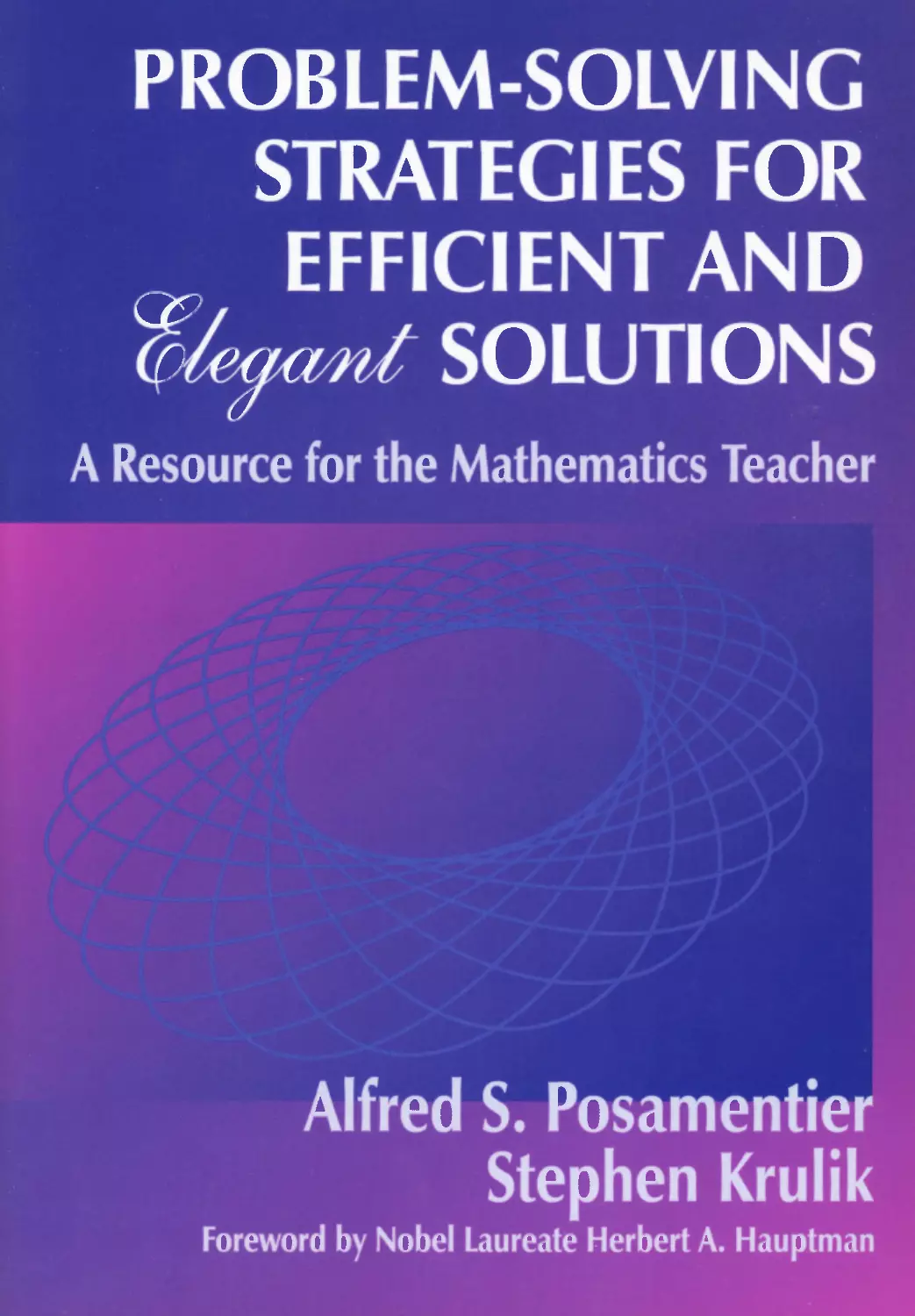


Автор: Posamentier A.S. Krulik S.
Теги: mathematics problem solving science strategies
ISBN: 0-8039-6697-0
Год: 1998
Текст
. . . . .
.
. , . .
, I
,
, 'I I . .
,
, .. I . I . . . .
. . I . I . .
.
. I .
I I . . I . · . . . . . . .
PROBLEM-SOLVING
STRATEGI ES FOR
EFFICIENT AND
'¥t SOLUTIONS
In memory of my parents,
Ernest and Alice Posamentier,
who encountered some of the most extraordinary problems
of the Twentieth Century and confronted them with
"efficient and elegant" solutions.
Alfred S. Posamentier
To my wife and life partner,
Gladys,
who, in her own "efficient" way, develops
"elegant" solutions to the problems I seem to create.
Stephen Krulik
PROBLEM-SOLVING
STRATEGIES FOR
EFFICIENT AND
SOLUTIONS
A Resource for the Mathematics Teacher
Alfred S. Posamentier
Stephen Krulik
Foreword by Nobel Laureate Herbert A. Hauptman
CORWIN PRESS, INC.
A Sage Publications Company
Thousand Oaks, California
Copyright @ 1998 by Corwin Press, Inc.
All rights reserved. No part of this book may be reproduced or utilized in any form or
by any means, electronic or mechanical, including photocopying, recording, or by any
information storage and retrieval system, without permission in writing from the
publisher.
For information:
Corwin Press, Inc.
A Sage Publications Company
2455 Teller Road
Thousand Oaks, California 91320
E-mail: order@corwinpress.com
SAGE Publications Ltd.
6 Bonhill Street
London EC2A 4 PU
United Kingdom
SAGE Publications India Pvt. Ltd.
M-32 Market
Greater Kai lash I
New Delhi 110 048 India
Printed in the United States of America
Library of Congress Cataloging-in-Publication Data
Posamentier, Alfred S.
Problem-solving strategies for efficient and elegant solutions: A resource for the
mathematics teacher / Alfred S. Posamentier, Stephen Krulik.
p. cm.
Includes bibliographical references.
ISBN 0-8039-6697-0 (cloth: acid-free paper)
ISBN 0-8039-6698-9 (pbk. : acid-free paper)
1. Problem solving. I. Krulik, Stephen. II. Title.
QA63 .P67 1998
510.1 ' 9 - ddc21
98-19702
This book is printed on acid-free paper.
98 99 00 01 02 03 10 9 8 7 6 5 4 3 2 1
Production Editor: S. Marlene Head
Editorial Assistant: Julia Parnell
Typesetter: Technical Typesetting, Inc.
Cover Designer: Michelle Lee
Contents
Foreword by Herbert A. Hauptman IX
Preface xv
About the Authors XIX
1. Introduction to Problem-Solving Strategies 1
2. Working Backwards 15
The Working Backwards Strategy in Everyday Life
Problem-Solving Situtations 16
Applying the Working Backwards Strategy to
Solve Mathematics Problems 17
Problems Using the Working Backwards Strategy 18
3. Finding a Pattern 37
The Finding a Pattern Strategy in Everyday Life
Problem-Solving Situations 38
Applying the Finding a Pattern Strategy to Solve
Mathematics Problems 40
Problems Using the Finding a Pattern Strategy 41
4. Adopting a Different Point of View 69
The Adopting a Different Point of View Strategy in
Everyday Life Problem-Solving Situations 70
Applying the Adopting a Different Point of View Strategy
to Solve Mathematics Problems 70
Problems Using the Adopting a Different Point of View Strategy 72
5. Solving a Simpler Analogous Problem 97
The Solving a Simpler Analogous Problem Strategy in
Everyday Life Problem-Solving Situations 97
Applying the Solving a Simpler Analogous Problem Strategy to
Solve Mathematics Problems 98
Problems Using the Solving a Simpler Analogous Problem Strategy 100
6. Considerillg Extreme Cases 117
The Considering Extreme Cases Strategy in Everyday Life
Problem-Solving Situations 117
Applying the Considering Extreme Cases Strategy to Solve
Mathematics Problems 118
Problems Using the Considering Extreme Cases Strategy 121
7. Making a Drawing (Visual Representation) 139
The Making a Drawing (Visual Representation) Strategy in
Everyday Life Problem-Solving Situations 139
Applying the Making a Drawing (Visual Representation)
Strategy to Solve Mathematics Problems 140
Problems Using the Making a Drawing (Visual Representation)
Strategy 141
8. Intelligent Guessing and Testing (Including Approximation) 165
The Intelligent Guessing and Testing (Including Approximation)
Strategy in Everyday Life Problem-Solving Situations 165
Applying the Intelligent Guessing and Testing (Including
Approximation) Strategy to Solve Mathematics Problems 166
Problems Using the Intelligent Guessing and Testing
(Including Approximation) Strategy 168
9. Accounting for All Possibilities 187
The Accounting for All Possibilities Strategy in Everyday
Life Problem-Solving Situations 187
Applying the Accounting for All Possibilities Strategy to
Solve Mathematics Problems 188
Problems Using the Accounting for All Possibilities Strategy 189
10. Organizing Data 203
The Organizing Data Strategy in Everyday Life Problem-Solving
Situations 203
Applying the Organizing Data Strategy to Solve Mathematics
Problems 204
Problems Using the Organizing Data Strategy 206
11. Logical Reasoning
The Logical Reasoning Strategy in Everyday Life
Problem-Solving Situations
225
225
Applying the Logical Reasoning Strategy to Solve
Mathematics Problems
Problems Using the Logical Reasoning Strategy
226
226
Sources for Problems
241
Readings on Problem Solving
247
Foreword
As I was reading the proof pages of this book, I was reminded of my high school
days when, as members of the mathematics club, a number of us students were
challenged every week to solve difficult problems presented by our faculty
advisor. I am surprised now to note that, however unconsciously, we students
were led, many years ago, to adopt many of the same strategies described in this
book.
As I continued thinking about those "good old days," one problem in
particular kept bubbling up from the depths of my subconscious: What is the
probability, call it P, that two numbers (positive integers) chosen at random will
be relatively prime, that is, will have no common divisor greater than unity? As
I struggled to recover my ancient solution to this problem I decided finally to
analyze the problem in accordance with the principles described in this book.
First, in order to be relatively prime it is necessary and sufficient that the two
numbers, call them M and N, not have the common factor p, where p is any
prime number whatsoever. In order to find this probability, let us solve a
simpler analogous problem (Chapter 5), the case that p = 2. In order to find the
probability that M and N do not have the factor 2 in common, we adopt a
different point of view (Chapter 4) and ask instead for the probability that M
and N do have the factor 2 in common, that is to say, are both even. Since the
probability that M is even is i and the probability that N is even is also , the
probability that M and N (independently chosen) are both even is . = i2 '
whence the probability that they are not both even is 1 - i2 . In short, the
probability that M and N do not have the factor 2 in common is 1 - i2 .
It is now easy to see (Chapter 5) that the same argument holds when p = 3
or 5, or, more generally, when p is any prime number. We conclude that the
probability that M and N are not both divisible by the same prime p is simply
1 - ;2 . It follows that the probability P that M and N have no prime factor p
in common, that is are relatively prime, is simply the infinite product
p = (1 - ;2 )( 1 - ;2 )( 1 - ;2 )... = (1 - ;2 )
[1]
taken over all primes p, and this is the solution I was looking for.
Or was it? The more I thought about this solution, the more convinced I
became that this was not the solution I was looking for. I simply had no
recollection whatsoever of this strange looking formula [1]. I therefore set about
looking for a different solution, the one that I had found many years ago.
IX
x
PROBLEM-SOLVING STRATEGIES
Again, denoting by P the probability that the greatest common divisor
(g.c.d.) of M and N is unity, we adopt a different point of view (Chapter 4) and
ask for the probability (call it Pg) that the g.c.d. of M and N is g, where g is an
arbitrary positive integer. For g to be the g.c.d. of M and N, g must, first of all,
divide M, and g must also divide N. The probability that M is a multiple of g
is , and the probability that N is a multiple of g is also . Hence the
probability that g divides both M and N is ;2 . However, since g is the g.c.d. of
M and N, the g.c.d. of the integers Mjg and Njg is unity and the probability
of this event has already been called P. Hence the probability that the g.c.d. of
M and N is g is simply P jg2. However, the g.c.d. of M and N must be some
number. We conclude that
00 P 00 1
L 2" = P L 2" = 1,
g= 1 g g= 1 g
whence
1
1
1 1 1 1
- + - + - + - + ...
1 2 2 2 3 2 4 2
,
[2]
P=
i:
g= 1 g
where the sum is taken over all positive integers g, which should be compared
with [1]. Now [2] does have a familiar ring to it, and I am now convinced that
this formula is the one I derived some 65 years ago.
So now we have found not one, but two answers ([1] and [2]) to our
original problem, and it is not at all obvious that these answers are identical.
Well, one thing leads to another, and our work so far suggests the following:
Challenge. Prove that
( 1 - :2 ) = i: 1 \ '
g=l g
[3]
where the infinite product is taken over all primes p and the infinite sum is
taken over all positive integers g.
To prove [3] we again adopt a different point of view (Chapter 4) and,
taking reciprocals, replace [3] by the equivalent
1 00 1
7T 1 - L 2.
P 1- - g=l g
p2
[4]
Recalling the formula for the sum of an infinite geometric series with common
. 1
ratIo pz'
1 1
1 + - + - + ...
p2 p4
00 1
- L 2n-
n=O P
1
1
1- -
p2
[5]
Foreword
XI
for each prime p, [4] is itself replaced by the equivalent
( 1 1 ) ':X) 1
7T 1 + 2" + 4" + ... = L 2.
p P P g= 1 g
[ 6]
Recall the fundamental theorem of arithmetic that every integer is a product of
primes in one and only one way. It follows that by carrying out the indicated
multiplications on the left-hand side of [6], the summands on the left range,
without duplication, over the products of all powers of the squares of the
reciprocals of primes, are therefore themselves the reciprocals of squares and are
to be found among the terms on the right-hand side. Again invoking the
fundamental theorem of arithmetic, we conclude that, conversely, every sum-
mand on the right-hand side of [6] is to be found, once and only once, on the
left-hand side. This concludes the proof of [6], [4], and [3].
We remark in passing that the formula
1
1
7T 2
6 '
[7]
1 + + + ...
2 2 3 2
well known to students of calculus, implies that
6
[ 8]
p=
2 '
7T
which, finally, is the satisfactory solution to our original problem.
An interesting check of the formula [8] is to choose, at random, several
hundred pairs of integers (M, N) and count the number of pairs (M, N) that are
relatively prime. Dividing this number by the total number of pairs (M, N)
yields an estimate for P. How does this estimate agree with [8]? Can we, in this
way, find an estimate for 7T? Can you generalize this problem to the case that n
integers chosen at random are relatively prime or have the greatest common
divisor g?
As I continued to think about the problem-solving strategies described in
this book, I began to wonder whether any of them had, in fact, played a role in
my own work. As it happens, I have devoted the past 50 years of my life to the
attempt to solve a single problem: the determination of crystal structures from
the X-ray scattering experiment. When a beam of X-rays strikes a crystal, it is
scattered by the crystal in many different (observed) directions and with
different (measured) intensities yielding what is known as the diffraction pat-
tern of the crystal. The diffraction pattern determines the crystal structure, that
is, the arrangement of the atoms in the crystal. The problem of going from the
observed diffraction pattern to the crystal structure (for 40 years considered at
best intractable, at worst unsolvable) may be formulated in purely mathematical
terms. Thus one anticipates that the problem-solving strategies described in this
Xll
PROBLEM-SOLVING STRATEGIES
book may find useful application in the solution of the crystal structure prob-
lem, and this expectation is, in fact, realized.
It is, of course, not possible in this brief account to describe the nature of
these strategies in great detail. Suffice it to say that the original problem was
earlier replaced by an equivalent, simpler one (Chapter 5), the so-called phase
problem of X-ray crystallography. It is essential to observe that this reformula-
tion of the original problem previously led the crystallographic community to
the erroneous conclusion that the problem was an unsolvable one, even in
principle. One of the first contributions that my colleague, Jerome Karle, and I
made (by adopting a different point of view) was to demonstrate that the phase
problem was not only solvable, at least in principle, but actually greatly
overdetermined. Owing to this overdetermination, stemming from the redun-
dancy of the experimentally observed data, a statistical approach was called for.
This necessitated the derivation of joint probability distributions of several
random variables. Because of the complexity of these distributions and their
derivations, it turned out to be advantageous first to solve a simpler problem
(Chapter 5)-the derivation of the analogous probability distribution of a single
random variable. Once this was done, the extension to the general case of
several random variables was straightforward. In time, this work led to ex-
tremely powerful and routine methods for the determination of crystal and
molecular structures that have important implications for structural chemistry
and molecular biology.
It should, perhaps, also be mentioned that two other problem-solving
strategies, consideration of extreme cases (Chapter 6) and making drawings
(Chapter 7), played the important role of yielding insights into the nature of the
solution that were not otherwise transparent.
Although the mathematical underpinning of this eventual Nobel Prize-
winning work was, for the most part, done in the years 1947 to 1955, and the
first applications were made in the middle 1950s, the Nobel Prize (in chemistry)
itself was not awarded until 1985. The delay was probably due to the fact that
the full importance of this work in applications to structural chemistry and the
life sciences was not fully appreciated until the late 1970s and early 1980s, when
the appropriate software and more powerful computers became widely avail-
able. In any case, I place a great deal of importance on my penchant for problem
solving, and my familiarity with the problem-solving strategies highlighted in
this very useful book enabled me to have the honor of being the first mathemati-
cian to win a Nobel Prize.
This book very cleverly demonstrates applications of the 10 most prevalent
problem-solving strategies, not only in the context of mathematics, but also as
they may be used in everyday life situations. This way the reader can begin to
get accustomed to the broader application of these important problem-solving
techniques beyond their use in mathematics. Once readers witness the power of
these strategies in the mathematical context, and see their use in everyday life,
they might begin to expand their application to other fields.
Foreword
XlII
Problem solving in general, whether it is used to solve mathematical
problems at the school level, or in serious research that may lead to major
medical breakthroughs, or simply to solve problems we encounter during our
daily lives, is an indispensable skill that every well-educated person should
acquire. There are some gifted people who have attained these skills in a natural
way. Yet the vast majority of us requires some training to develop proper
problem-solving skills. Providing this training is perhaps one of the most
important responsibilities resting with our educators. All too often students
"pick up" problem-solving skills through experience or as a by-product of
doing exercises in mathematics or science classes. Watching the teacher or the
textbook author plow through some problem situations can also lead to some
lasting spin-offs. However, with this book the teacher is provided (or one might
even say, "spoon fed") the tools essential for any problem-solving situation.
It could be said that all problem solving is merely a combination of the 10
problem-solving strategies presented in this book. In some cases, these tech-
niques, applied independently of others, can provide the key to a clever (or
elegant) solution. Other times, a solution may require a series of these tech-
niques to tickle out the solution to a problem. Prom my long experience with
problem solving, I find it absolutely essential that teachers familiarize them-
selves with the 10 problem-solving strategies presented in this book, make them
a part of their personal arsenal of mathematical tools, and then regularly
incorporate them into their teaching, whenever they appropriately fit.
I hope these brief remarks will persuade the reader that problem solving is
not only fun, but, at least occasionally, even important.
Herbert A. Hauptman, Ph.D.
Nobel Laureate in Chemistry, 1985
Preface
Over the years, problem solving has emerged as one of the major concerns at all
levels of school mathematics. In fact, the National Council of Supervisors of
Mathematics (NCSM) points out that "learning to solve problems is the princi-
pal reason for studying mathematics" (NCSM, 1977). Furthermore, the National
Council of Teachers of Mathematics (NCTM), in their Professional Standards for
Teaching Mathematics, states rather boldly that "Problem solving, reasoning and
communication are processes that should pervade all mathematics instruction
and should be modeled by teachers" (NCTM, 1991). We are in complete
agreement! In fact, we would go one step further-we feel that problem solving
is not only a skill to be taught in mathematics, but also a skill that will be
carried over to everyday "problems" and serve a person well throughout life.
In many cases, students seem to feel that a problem can only be solved in a
single way, specific to the "type" of problem being taught (Le., motion prob-
lems, age problems, mixture problems, and so on). Students often feel that an
algebraic approach is the only procedure that will "work." Where does this
misconception come from?
In fact, it is often the teachers themselves who are not aware of the many
problem-solving strategies that can be used to provide efficient and elegant
solutions to many problems. It is often they who unconsciously convey to their
students the notion that problems can only be solved using an algebraic
approach. While we would agree that algebra is a most powerful tool, it is still
only one of the many approaches students should be made aware of when it
comes to problem solving. This book is a result of our many years of efforts to
make teachers and students aware of this most important aspect of teaching
mathematics. The book is designed for the classroom teacher who has a sincere
desire to help students succeed as problem solvers both in mathematics and
beyond. This is not to say that the book cannot be used by students directly;
quite the contrary! However, its "tone" is directed to the teacher, who "should
engage students in mathematical discourse about problem-solving... (which)
includes discussing different solutions and solution-strategies for a given prob-
lem, (and) how solutions can be extended and generalized" (NCTM, 1991, p. 95).
In this book we examine 10 strategies that are widely used in problem-
solving, both in mathematics and real-life situations. In the mathematics class-
room these strategies provide an alternate plan for resolving many problem
xv
XVI
PROBLEM-SOLVING STRATEGIES
situations that arise within the curriculum. We have selected about 200 prob-
lems to illustrate these strategies, realizing that teachers will apply these
strategies to their regular instructional program. To do this, we recommend a
careful review and study of the examples provided for each strategy so that the
strategy eventually becomes a genuine part of the teacher's thinking processes
or, one might say, a part of their arsenal of problem-solving tools.
Although it is true that most of the problems can be solved using the
tried-and-true techniques of algebra and geometry (and we do show these
solutions as well), the purely "mechanical" approach often masks some of the
efficiency, beauty, and elegance of the mathematics. In many cases, the
problem-solving strategies presented make the solution of a problem much
easier, much "neater," much more understandable, and thereby, enjoyable!
Throughout the book we try to show how each of these strategies occurs
and ought to be consciously used in real-life situations. Many people already
make use of these strategies without realizing it. This carryover into life outside
of the school adds importance to the mathematics our students study, and
ultimately will improve their everyday performance. We believe that you and
your students alike can profit from a careful reading of (and working along
with) this book. As you examine each problem, take the time to solve it in any
way you wish, or perhaps in a variety of ways. Compare your solutions to those
provided. (Naturally, we welcome any clever alternatives to those in the book.)
Most importantly, try to absorb the impact of the application of the problem-
solving strategies and how they contribute to the beauty and power of mathe-
matics. All the better if you can carry this motivated feeling over to your
students.
Understand our feeling that problem solving must be the cornerstone of
any successful mathematics program. Then try to infuse this same enthusiastic
feeling and attitude in your daily teaching. This concentrated effort will make
you a better problem solver and in turn help your students to become better
problem solvers also. Not only will their attitude toward mathematics improve,
but so will their skills and abilities. This is our ultimate goal.
Acknowledgments
A book such as this one requires extensive criticism and suggestions from
professionals. We therefore sought input from a number of people in the
international community. We sincerely thank Dr. Gerd Baron* (Professor of
Mathematics, Technical University of Vienna, Austria), Linda Berman (Chair-
man (ret.), Mathematics Department, Bronx High School of Science, Bronx, NY),
Jacob Cohen (Chairman (ret.), Mathematics Department, Theodore Roosevelt
High School, Bronx, NY), Ira Ewen (Mathematics Specialist, (ret.), New York
City Public Schools), Joel Friedberg (Chairman (ret.), Mathematics Department,
Preface
XVll
Herbert Lehman High School, Bronx, NY), Dr. Hans K. Kaiser* (Professor of
Mathematics and Vice Rector, Technical University of Vienna, Austria), Dr.
Ingmar Lehmann* (Dozent, Mathematics Education, Humboldt University of
Berlin, Germany), Dr. Stephen Moresh (Associate Professor of Mathematics
Education, the City College of the City University of New York), Dr. Hans-
Christian Reichel (Professor of Mathematics, University of Vienna, Austria), Dr.
Jesse A. Rudnick (Professor Emeritus of Mathematics Education, Temple Uni-
versity, Philadelphia, PA), and Dr. Wolfgang Schulz* (Professor of Mathematics
Education, Humboldt University of Berlin, Germany). The asterisks (*) indicate
people who not only read the manuscript but also made several substantive
contributions in the form of problem suggestions and alternate solutions, for
which we are doubly grateful. We are especially honored and grateful for the
advice and the foreword provided by Dr. Herbert A. Hauptman, the first
mathematician to win the Nobel Prize (for chemistry, 1985).
We also wish to acknowledge the many high school teachers, too numer-
ous to mention, from New York, Philadelphia, Vienna (Austria), Berlin,
(Germany), and Klagenfurt (Austria), who played an important role by reading
various parts of the manuscript and evaluating it for content, appropriateness
for the secondary schools, and usefulness in the instructional program. In
particular, the continuous help and support provided by Gladys Krulik and
Barbara Lowin is most appreciated.
Alfred S. Posamentier
Stephen Krulik
May 1998
References
National Council of Supervisors of Mathematics. (1977). Position paper on basic mathematical skills.
Golden, co: Author.
National Council of Teachers of Mathematics. (1991). Professional standards for leading mathematics.
Reston, V A: Author.
About the Authors
Alfred S. Posamentier is Professor of Mathematics Education and Deputy Dean
of the School of Education of the City College of the City University of New
York. He is the author and coauthor of numerous mathematics books for
teachers and secondary school students. As a guest lecturer, he favors topics
regarding aspects of mathematics problem solving and the introduction of
uncommon topics into the secondary school realm for the purpose of enriching
the mathematics experience of those students. The development of this book
reflects these penchants.
After completing his A.B. degree in mathematics at Hunter College of the
City University of New York, he took a position as a teacher of mathematics at
Theodore Roosevelt High School in the Bronx (New York), where he focused his
attention on improving the students' problem-solving skills. He also developed
the school's first mathematics teams (both at the junior and senior level) and
established a special class whose primary focus was methods of mathematics
problem solving. Over the years he has modified his problem-solving interests,
becoming less interested in the "clever" or "challenging" problems (which tend
to be more appealing to gifted students) and more interested in problem-solving
strategies that can be applied to problems at all levels and in many contexts
outside of mathematics as well. He is currently involved in working with
mathematics teachers, internationally, to help them better understand the strate-
gies presented in this book, so that they can comfortably incorporate them into
their regular instructional program.
Immediately upon joining the faculty of the City College from which he
received his master's degree over 28 years ago, he began to develop inservice
courses for secondary school mathematics teachers, including such special areas
as recreational mathematics, problem solving in mathematics, and using com-
puters to enhance the instructional program.
Dr. Posamentier received his Ph.D. from Fordham University (New York)
in mathematics education and has since extended his reputation in mathematics
education beyond the United States to Europe. He is an Honorary Fellow at the
South Bank University (London, England). He has been a visiting professor at
several Austrian, British, and German Universities, most recently at the Hum-
boldt University (Berlin), The Technical University of Vienna, and the Univer-
sity of Vienna. At the latter, he was a Fulbright Professor in 1990.
In recognition of his outstanding teaching, the City College Alumni Associ-
ation named him Educator of the Year and had a "Day" named in his honor by
XIX
xx
PROBLEM-SOLVING STRATEGIES
the City Council President of New York City. More recently, he was awarded
the National Medal of Honor from the Austrian government.
Naturally, with his penchant for mathematics problem solving, he has been
very concerned that students have a proper introduction to and solid prepara-
tion for problem-solving strategies. This concern motivated the development of
this book.
Stephen Krulik is Professor of Mathematics Education at Temple University in
Philadelphia, where he is responsible for the undergraduate and graduate
preparation of mathematics teachers for grades K through 12, as well as in the
inservice training of mathematics teachers at the graduate level. He teaches a
wide variety of courses, among them, the History of Mathematics, Methods of
Teaching Mathematics, and the Teaching of Problem Solving. This latter course
grew out of his interest in problem solving and reasoning in the mathematics
classroom. His concern that students understand the beauty and value of
problem solving as well as the ability to reason led to this book.
Dr. Krulik received his B.A. degree in mathematics from Brooklyn College
of the City University of New York, and his M.A. and Ed.D. in mathematics
education from Columbia University's Teachers College. Before coming to
Temple University, he taught mathematics in the New York City public schools
for 15 years. At Lafayette High School in Brooklyn he created and implemented
several courses designed to prepare students for the SAT examination, while
stressing the art of problem solving as opposed to rote memory of algorithms.
Nationally, Dr. Krulik has served as a member of the committee responsi-
ble for preparing the Professional Standards for Teaching Mathematics of the
National Council of Teachers of Mathematics (NCTM). He was also the editor of
the NCTM's 1980 yearbook Problem Solving in School Mathematics. Regionally, he
served as president of the Association of Mathematics Teachers of New Jersey,
was a member of the editorial team that produced the 1993 publication The New
Jersey Calculator Handbook, and was the editor for their 1997 monograph, Tomor-
row's Lessons.
His major areas of interest are the teaching of problem solving and
reasoning, and materials for teaching mathematics, as well as comprehensive
assessment in mathematics. He is the author or coauthor of more than 20 books
for teachers of mathematics, including the new Assessing Reasoning and Problem
Solving: A Sourcebook for Elementary School Teachers (1998). He is also the senior
problem-solving author for a major basal textbook series. Dr. Krulik is a
frequent contributor to the professional journals in mathematics education. He
has served as a consultant to and has conducted many workshops for school
districts throughout the United States and Canada, as well as delivering major
presentations in Vienna (Austria), Budapest (Hungary), Adelaide (Australia),
and San Juan (Puerto Rico). He is in great demand as a speaker at both national
and international professional meetings, where his major focus is on preparing
all students to reason and problem solve in their mathematics classroom, as well
as in life.
C HAP T E R
1
Introduction to
Problem-Solving Strategies
B efore we can discuss what problem solving is, we must first come to grips
with what is meant by a problem. In essence, a problem is a situation that
confronts a person, that requires resolution, and for which the path to the
solution is not immediately known. In everyday life, a problem can manifest
itself as anything from a simple personal problem such as the best strategy for
crossing the street (usually done without much "thinking"), to a more complex
problem such as how to assemble a new bicycle. Of course, crossing the street
may not be a simple problem in some situations. For example, Americans
become radically aware of what is usually a subconscious behavior pattern
while visiting a country such as England, where their usual strategy for safely
crossing the street just will not work. The reverse is also true; the British
experience similar feelings when visiting the European continent, where traffic is
oriented differently from that in Britain. These everyday situations are usually
resolved "subconsciously," without our taking formal note of the procedures by
which we found the solution. A consciousness of everyday problem-solving
methods and strategies usually becomes more evident when we travel outside
of our usual cultural surroundings. There the usual way of life and habitual
behaviors may not fit or may not work. We may have to consciously adapt other
methods to achieve our goals.
Much of what we do is based on our prior experiences. As a result, the
level of sophistication with which we attack these problems will vary with the
individual. Whether the problems we face in everyday life involve selecting a
daily wardrobe, relating to friends or acquaintances, or dealing with profes-
sional issues or personal finances, we pretty much function automatically,
without considering the method or strategy that best suits the situation. We go
about addressing life's challenges with an algorithmic-like approach, and can
1
2
PROBLEM-SOLVING STRATEGIES
easily become a bit frustrated if that approach suddenly doesn't fit. In these
situations we are required to find a solution to the problem. That is, we must
search our previous experiences to find a way we solved an analogous problem
in the past. We could also reach into our bag of problem-solving tools and see
what works.
When students encounter problems in their everyday school lives, their
approach is not much different. They tend to tackle problems based upon their
previous experiences. These experiences can range from recognizing a II prob-
lem" as very similar to one previously solved, to taking on a homework exercise
similar to exercises presented in class that day. The student is not doing any
problem solving-rather he or she is merely mimicking (or practicing) the
earlier encountered situations. This is the behavior seen in a vast majority of
classrooms. In a certain sense, repetition of a "skill" is useful in attaining the
skill. This can also hold true as well for attaining problem-solving skills. Hence
we provide ample examples to practice the strategy applications in a variety of
contexts.
This sort of approach to dealing with what is often seen as artificial
situations created especially for the mathematics class, does not directly address
the idea of problem solving as a process to be studied for its own sake, and not
merely as a facilitator. People do not solve "age problems," "motion problems,"
"mixture problems," and so on, in their real lives. Historically, we always have
considered the study of mathematics topically. Without a conscious effort by
educators, this will clearly continue to be the case. We might rearrange the
topics in the syllabus in various orders, but it will still be the topics themselves
that link the courses together, rather than the mathematical procedures in-
volved, and this is not the way that most people think! Reasoning involves a
broad spectrum of thinking. We hope to encourage this thinking here.
We believe that there can be great benefits to students in a mathematics
class (as well as a spin-off effect in their everyday lives) by considering problem
solving as an end in itself and not merely as a means to an end. Problem solving
can be the vehicle used to introduce our students to the beauty that is inherent
in mathematics, but it can also be the unifying thread that ties their mathematics
experiences together into a meaningful whole. One immediate goal is to have
our students become familiar with numerous problem-solving strategies and to
practice using them. We expect this procedure will begin to show itself in the
way students approach problems and ultimately solve them. Enough practice of
this kind should, for the most part, make a longer range goal attainable, namely,
that students naturally come to use these same problem-solving strategies to
solve not only mathematical problems, but also to resolve problems in everyday
life. This transfer of learning (back and forth) can be best realized by introducing
problem-solving strategies in both mathematical and real-life situations con-
comitantly. This is a rather large order and an ambitious goal as well. Changing
an instructional program by relinquishing some of its time-honored emphasis
upon isolated topics and concepts, and devoting the time to a procedural
Introduction to Problem-Solving Strategies
3
approach, requires a great deal of teacher "buy-in" to succeed. This must begin
by convincing the teachers that the end results will prepare a more able student
for this era, where the ability to think becomes more and more important as we
continue to develop and make use of sophisticated technology.
When we study the history of mathematics, we find breakthroughs, that,
although simple to understand, often elicit the reaction, "Oh, I would never
have thought about that approach." Analogously, when clever solutions to
certain problems are found and presented as "tricks," they have the same effect
as the great breakthroughs in the history of mathematics. We must avoid this
sort of rendition and make clever solutions part of an attainable problem-solving
strategy knowledge base, that is constantly reinforced throughout the regular
instructional program.
You should be cautioned that in the last few decades, there has been much
talk about problem solving. The National Council of Teachers of Mathematics'
Agenda for Action (1980) and the widely accepted Curriculum and Evaluation
Standards for School Mathematics (1989) have played a major role in generating
the general acceptance of problem solving as a major curricular thrust. Everyone
seems to agree that problem solving and reasoning are, and must be, an integral
part of any good instructional program. Then why has this not come to pass? In
our view, the major impediment to a successful problem-solving component in
our regular school curriculum is a weakness in the training that teachers receive
in problem solving, as well as the lack of attention paid to the ways in which
these skills can be smoothly incorporated into their regular teaching program.
Teachers ought not to be forced to rely solely on their own resourcefulness as
they attempt to move ahead without special training. They need to focus their
attention on what problem solving is, how they should utilize problem solving,
and how it should be presented to their students. They must understand that
problem solving can be thought of in three different ways:
1. Problem solving is a subject for study in and of itself.
2. Problem solving is an approach to a particular problem.
3. Problem solving is a way of teaching.
Above all, teachers must focus their attention on their own ability to become
problem solvers. They must learn which problem-solving strategies are available
to them, what these entail, and when and how they can be used. They must then
learn to apply these strategies, not only to mathematical situations but also to
everyday life experiences whenever possible. Often, simple problems can be
used in clever ways to demonstrate these strategies. Naturally, more challenging
problems will show the power of the problem-solving strategies. By learning the
strategies, beginning with simple applications and then progressively moving to
more challenging and complex problems, the students will have opportunities to
grow in the everyday use of their problem-solving skills. Patience must be used
4
PROBLEM-SOLVING STRATEGIES
with students as they embark on, what is for most of them, this new adventure
in mathematics. We believe that only after teachers have had the proper
immersion in this alternate approach to mathematics in general and to problem
solving in particular, and after they have developed sensitivity toward the
learning needs and peculiarities of students, then, and only then, can we expect
to see some genuine positive change in students' mathematics performance.
We will set out with an overview of those problem-solving strategies that
are particularly useful as tools in solving mathematical problems. From the
outset, you should be keenly aware that it is rare that a problem can be solved
using all 10 strategies we present here. Similarly, it is equally rare that only a
single strategy can be used to solve a given problem. Rather, a combination of
strategies is the most likely occurrence when solving a problem. Thus, it is best
to become familiar with all the strategies and to develop facility in using them
when appropriate. The strategies selected here are not the only ones available,
but they represent those most applicable to mathematics instruction in the
schools. The user will, for the most part, determine appropriateness of a strategy
in a particular problem. This is analogous to carpenters, who, when called upon
to fix a problem with toolbox in hand, must decide which tool to use. The more
tools they have available and the better they know how to use them, the better
we would expect the results to be. However, just as not every task carpenters
have to do will be possible using the tools in their toolbox, so, too, not every
mathematics problem will be solvable using the strategies presented here. In
both cases, experience and judgment play an important role.
We believe that every teacher, if he or she is to help students learn and use
the strategies of problem solving, must have a collection from which to draw
examples. Throughout the book, we make a conscious effort to label the
strategies and to use these labels as much as possible, so that they can be called
upon quickly, as they are needed. This is analogous to the carpenter deciding
which tool to use in constructing something; usually the tool is referred to by
name (i.e., a label). For you to better understand the strategies presented in this
book, we begin each section with a description of a particular strategy, apply it
to an everyday problem situation, and then present examples of how it can be
applied in mathematics. We follow this with a series of mathematics problems
from topics covered in the schools, which can be used with your students to
practice the strategy. In each case, the illustrations are not necessarily meant to
be typical, but are presented merely to best illustrate the use of the particular
strategy under discussion. The following strategies will be considered in this
book:
1. Working backwards
2. Finding a pattern
3. Adopting a different point of view
Introduction to Problem-Solving Strategies 5
4. Solving a simpler, analogous problem (specification without loss of
generali ty )
5. Considering extreme cases
6. Making a drawing (visual representation)
7. Intelligent guessing and testing (including approximation)
8. Accounting for all possibilities (exhaustive listing)
9. Organizing data
10. Logical reasoning
As we have already mentioned, there is hardly ever one unique way to
solve a problem. Some problems lend themselves to a wide variety of solution
methods. As a rule, students should be encouraged to consider alternative
solutions to a problem. This usually means considering classmates' solutions
and comparing them to the "standard" solution (i.e., the one given in the
textbook or supplied by the teacher). In addition, we must again state that many
problems may require more than one strategy for solution. Furthermore, the
data given in the problem statement, rather than merely the nature of the
problem, can also determine the best strategy to be used in solving the problem.
All aspects of a particular problem must be carefully inspected before embark-
ing on a particular strategy.
Let's consider a problem that most people can resolve by an intuitive (or
random) trial-and-error method, but that might take a considerable amount of
time. To give you a feel for the use of these problem-solving strategies, we will
approach the problem by employing several of the strategies listed.
Problem
Place the numbers from 1 through 9 into the grid below so that the
sum of each row, column, and diagonal is the same. (This is often
referred to as a magic square.)
Figure 1.1
6
PROBLEM-SOLVING STRATEGIES
Solution. A first step to a solution would be to use logical reasoning. The sum
of the numbers in all nine cells would be 1 + 2 + 3 + ... +7 + 8 + 9 = 45. If
each row has to have the same sum, then each row must have a sum of or 15.
The next step might be to determine which number should be placed in
the center cell. Using intelligent guessing and testing along with some addi-
tional logical reasoning, we can begin by trying some extreme cases. Can 9
occupy the center cell? If it did, then 8 would be in some row, column, or
diagonal along with the 9, making a sum greater than 15. Therefore, 9 cannot be
in the center cell. Similarly, 6, 7, or 8 cannot occupy the center cell, because then
they would be in the same row, column, or diagonal with 9 and would not
permit a three number sum of 15. Consider now the other extreme. Could 1
occupy the center cell? If it did, then it would be in some row, column, or
diagonal with 2, thus requiring a 12 to obtain a sum of 15. Similarly, 2, 3, or 4
cannot occupy the center cell. Having accounted for all the possibilities, this
leaves only the 5 to occupy the center cell.
5
Figure 1.2
Now, using intelligent guessing and testing, we can try to put the 1 in a
corner cell. Because of symmetry, it does not matter which corner cell we use for
this guess. In any case, this forces us to place the 9 in the opposite corner, if we
are to obtain a diagonal sum of 15.
1
5
9
Figure 1.3
With a 9 in one corner, the remaining two numbers in the row with the 9
must total 6; that is, 2 and 4. One of those numbers (the 2 or the 4) would then
also be in a row or a column with the 1, making a sum of 15 impossible in that
row or column. Thus, 1 cannot occupy a corner. Placing it in a middle cell of one
outside row or column forces the 9 into the opposite cell so as to get a sum of 15.
Introduction to Problem-Solving Strategies
7
1
5
9
Figure 1.4
The 7 cannot be in the same row or column with the 1, because a second 7
\vould then be required to obtain a sum of 15.
7 1 ?
5
9
Figure 1.5
In this way, we can see that the 8 and 6 must be in the same row or column (and
at the corner positions, of course) with the 1.
8 1 6
5
9
Figure 1.6
This then determines the remaining two corner cells (4 and 2) to allow the
diagonals to have a sum of 15:
8 1 6
5
4 9 2
Figure 1.7
8
PROBLEM-SOLVING STRATEGIES
To complete the magic square, we simply place the remaining two numbers, 3
and 7, into the two remaining cells to get sums of 15 in the first and third
columns.
8 1 6
3 5 7
4 9 2
Figure 1.8
In this solution to the problem, observe how the various strategies were used for
each step of the solution.
We stated earlier that problems can (and should) be solved in more than
one way. Let's examine an alternative approach to solving this same problem.
Picking up the solution from the point at which we established that the sum of
every row, column, or diagonal is 15, list all the possibilities of three numbers
from this set of nine that have a sum of 15 (accounting for all the possibilities).
By organizing the data in this way, the answer comes rather quickly:
1,5,9 2,6,7
1,6,8 3,4,8
2,4,9 3,5,7
2,5,8 4,5,6
We now adopt a different point of view and consider the position of a cell and
the number of times it is counted into a sum of 15 (logical reasoning). The
center square must be counted four times: twice in the diagonals and once each
for a row and a column. The only number that appears four times in the triples
we have listed above is 5. Therefore it must belong in the center cell.
5
Figure 1.9
Introduction to Problem-Solving Strategies
9
The corner cells are each used three times. Therefore we place the numbers used
three times (the even numbers, 2, 4, 6, and 8) in the comers.
8 6
5
4 2
Figure 1.10
The remaining numbers (the odd numbers) are each used twice in the above
sums, and therefore are to be placed in the peripheral center cells (where they
are only used by two sums) to complete our magic square:
8 1 6
3 5 7
4 9 2
Figure 1.11
This logical reasoning was made considerably simpler by using a visual
representation of the problem. It is important to have students realize that we
solved the same problem in two very different ways. They should try to develop
other alternatives to these, and they might also consider using consecutive
numbers other than 1 to 9. An ambitious student might also consider the
construction of a 4 X 4 or a 5 X 5 magic square.
As we stated before, it is extremely rare to find a single problem that can
be efficiently solved using each of the 10 problem-solving strategies we listed.
There are times, however, when more than one strategy can be used, either
alone or in combination, with varying degrees of efficiency. Of course, the level
of efficiency of each method may vary with the reader. Let's take a look at one
such problem. It's a problem that is well known, and you may have seen it
before. We intend, however, to approach its solution with a variety of different
strategies.
10
PROBLEM-SOLVING STRATEGIES
Problem
In a room with 10 people, everyone shakes hands with everybody
else exactly once. How many handshakes are there?
Solution 1. Let's use our visual representation strategy, by drawing a diagram.
The 10 points (no 3 of which are collinear) represent the 10 people. Begin with
the person represented by point A.
°0 °E of
°c °G
Os
°H
°A
oJ °1
Figure 1.12
We join A to each of the other 9 points, indicating the first 9 handshakes that
take place.
H
Figure 1.13
Now, from B there are 8 additional handshakes (because since A has already
shaken hands with B, and AB is already drawn). Similarly, from C there will be
7 lines drawn to the other points ( AC and BC are already drawn), from D there
will be 6 additional lines or handshakes, and so on. When we reach point I,
there is only one remaining handshake to be made, namely, I with J, since I
Introduction to Problem-Solving Strategies
11
has already shaken hands with A, B, C, D, E, F, G, and H. Thus the sum of the
handshakes equals 9 + 8 + 7 + 6 + 5 + 4 + 3 + 2 + 1 = 45. In general, this is
the same as using the formula for the sum of the first n natura] numbers, n(n 2- 1) ,
where n > 2. (Notice that the final drawing will be a decagon with all of its
diagonals drawn.)
Solution 2. We can approach the problem by accounting for all the possibilities.
Consider the grid shown, in Figure 1.14, which indicates persons
A, B, C,. . ., H, I, J, shaking hands with one another. The diagonal with the xs
indicates that people cannot shake hands with themselves.
A B C D E F G H I J
A X
B X
C X
D X
E X
---
F X
. . --
G X
H X
I X
J X
Figure 1.14
The remaining cells indicate doubly all the other handshakes (i.e., A shakes
hands with Band B shakes hands with A). Thus we take the total number of
cells (10 2 ) minus those on the diagonal (10) and divide the result by 2. In this
case, we have 100:; 10 = 45.
2
In a general case for the n X n grid, the number would be n :; n , which is
equivalent to the formula n(n 2- 1) .
Solution 3. Let's now examine the problem by adopting a different point of
view. Consider the room with 10 people, each of whom will shake 9 other
people's hands. This seems to indicate that there are 10 X 9 or 90 handshakes,
but we must divide by 2 to eliminate the duplication (since, when A shakes
hands with B, we may also consider that as B shaking hands with A); hence
9 = 45.
Solution 4. Let's try to solve the problem by looking for a pattern. In the table
shown in Figure 1.15, we list the number of handshakes occurring in a room as
the number of people increases.
12
PROBLEM-SOLVING STRATEGIES
Number of Number of Handshakes Total Number of
People in Room for Additional Person Handshakes in Room
1 0 0
2 1 1
3 2 3
4 3 6
5 4 10
6 5 15
7 6 21
8 7 28
9 8 36
10 9 45
Figure 1.15
The third column, which is the total number of handshakes, gives a sequence of
numbers known as the triangular numbers, whose successive differences increase
by 1 each time. It is therefore possible to simply continue the table until we
reach the corresponding sum for the 10 people. Alternatively, we note that the
pattern at each entry is one half the product of the number of people on that line
and the number of people on the previous line.
Solution 5. We can approach the problem by a careful use of the organizing data
strategy. The chart in Figure 1.16 shows each of the people in the room and the
number of hands they have to shake each time, given that they have already
shaken the hands of their predecessors and don't shake their own hands. Thus,
person number 10 shakes 9 hands, person number 9 shakes 8 hands, and so on,
until we reach person number 2, who only has one person's hand left to shake,
and person number 1 has no hands to shake because everyone already shook his
hand. Again the sum is 45.
Organizing Data
No. of people 10 9 8 7 6 5 4 3 2 1
No. of handshakes 9 8 7 6 5 4 3 2 1 0
Figure 1.16
Solution 6. We may also combine solving a simpler problem with visual
representation (drawing a picture), organizing the data, and looking for a
pattern. Begin by considering a figure with 1 person, represented by a single
Introduction to Problem-Solving Strategies
13
point. Obviously, there will be 0 handshakes. Now, expand the number of
people to 2, represented by two points. There will be 1 handshake. Again, let's
expand the number of people to 3. Now, there will be 3 handshakes needed.
Continue with 4 people,S people, and so on.
Number of People Number of Handshakes
Visual Representation
1
o
.A
2
1
A.-
-. B
3
3
AVa
c
B
4 6
D C
A
B
5 10 E
D
Figure 1.17
The problem has now become a geometry problem, in which the answer is the
number of sides and diagonals of an /In-gon.'' Thus, for 10 people we have a
decagon, and the number of sides, n = 10. For the number of diagonals, we
may use the formula
n( n - 3)
d = , where n > 3.
2
Hence,
(10)(7)
d = = 35.
2
Thus, the number of handshakes equals 10 + 35 = 45.
14
PROBLEM-SOLVING STRATEGIES
Solution 7. Of course, some students might simply recognize that this problem
could be resolved easily by applying the combinations formula of 10 things
taken 2 at a time:
10.9
lOC 2 = = 45.
1.2
Although this solution is quite efficient, brief, and correct, it utilizes hardly any
mathematical thought (other than application of a formula), and it avoids the
problem-solving approach entirely. Although it is a solution that should be
discussed, we must call the other solutions to the students' attention.
We suggest that you read the book through; become familiar with all of the
strategies; practice them until you, yourself, have mastered them; and only then
begin to present them to your students. In this way, you and they can develop
facility with the basic tools of problem solving.
In addition, we suggest that you begin to format more and more of your
teaching in a problem-solving mode. That is, encourage your students to be
creative in their approach to problems, encourage them to solve problems in a
variety of ways, and encourage them to look for more than one answer to a
problem. Have your students work together in small groups solving problems
and communicating their ideas and work to others. The more students talk
about problems and problem solving, the better they will become in this vital
skill. Referring to the various problem solving methods or strategies by name
will ensure better and more efficient recollection when they are needed. Remem-
ber that the concept of metacognition (that is, being aware of one's own thought
processes) is an important factor in problem solving. Encouraging students to
talk to themselves when tackling a problem is another way to help the students
become aware of their problem-solving success.
C HAP T E R
2
Working Backwards
O n the surface, the very title of this problem-solving strategy sounds
confusing. This stems from a lack of familiarity with the procedure. Prom
their earliest days in school, students are typically taught to solve problems in
the most straightforward way possible. This is the way typical mathematics
textbook problems are intended to be solved. Unfortunately, a substantial
portion of this supposed "problem solving" is done by rote. Students struggle
through one problem in a section, the teacher then usually reveals a "model
solution," and the remainder of the "problems" in the section are solved in a
similar manner. Little imaginative thinking is required of the students. In fact,
we do not even consider these as problems; instead we refer to them as exercises,
whose purpose is simply to reinforce a particular method of solution via
repeated use. In the typical high school geometry course, when students are first
required to write proofs, they once again look for ways in which they can
merely repeat previous procedures to solve successive problems. We seek to
enable students to question the value of learning mathematics merely by rote.
Such students then are more receptive to the problem-solving strategy offered
here, namely, working backwards.
Developing a time schedule is another real-life example of using the
working backwards strategy. When people develop a schedule for various tasks
that must be completed by a certain time, they often start with what has to be
done, the time at which all the work must be completed, and how long each task
should take. They then work backwards to assign time "slots" to each task, and
thus to arrive at the appropriate time to begin the work.
The working backwards strategy also is widely used everyday in traffic
investigations. When the police are confronted by an automobile accident, they
must begin to work backwards from the time of the accident to determine the
causes, which car swerved immediately before the collision, who hit whom,
15
16
PROBLEM-SOLVING STRATEGIES
which driver was at fault, what the weather conditions were at the time of the
accident, and so on, as they attempt to reconstruct the accident.
When we look at the procedures that are shown in many typical textbook
exercises, some very useful techniques are sometimes presented. Unfortunately,
however, techniques are often taken for granted and not called to the students'
attention. Students may be required to reason in reverse order, even though they
have not been told to do so. An obvious example, once again, is the procedure
students should use when writing proofs in the high school geometry course.
They should begin by examining what they are trying to prove before doing
anything else. Thus, an attempt to prove line segments congruent might stem
from proving a pair of triangles congruent. This, in turn, should suggest that the
students look for the parts necessary to reach this triangle congruence. Continu-
ing in this manner, students will be led to examine the given information. They
are, in essence, working backwards. When the goal is unique, but there are
many possible starting points, a clever problem solver begins to work back-
wards from the desired conclusion to a point where the given information is
reached.
We must stress that when there is a unique endpoint (here, that which is to
be proved) and a variety of paths to get to the starting point, the working
backwards strategy may be desirable. The "working forward" method is still
the most natural method for solving the problem. In fact, working in the
forward direction is used to solve most problems. We are not saying that the
solving of all problems should be attempted by the working backwards strategy.
Rather, after a natural approach (usually "forward") has been examined, a
backwards strategy might be tried to see if it provides a more efficient, more
interesting, or more satisfying solution to the problem.
The Working Backwards Strategy in
Everyday Life Problem-Solving Situations
The best approach to determine the most efficient route from one city to
another depends upon whether the starting point or the destination (endpoint)
has more access roads. When there are fewer roads leading from the starting
point, the forward method is usually superior. However, when there are many
roads leading from the starting point and only one or two from the destination,
an efficient way to plan the trip is to locate this final destination on a map,
determine which roads lead most directly back toward the starting position, and
then determine to which larger road that "last" access road leads. Progressively,
by continuing in this way (that is, working backwards), one reaches a familar
road that is easily reachable from the starting point. At this step, you will have
mapped out the trip in a very systematic way.
A salesman or an executive who has an appointment in a distant city must
determine the flight he will take to arrive comfortably on time for his meeting,
yet not too far in advance. He begins by examining the airline schedule, starting
Working Backwards
17
with the arrival time closest to his appointment. Will he arrive in time? Is he
"cutting it too close"? If so, he examines the next earlier arrival time. Is this time
all right? What if there is a weather delay? When is the next earlier flight? Thus,
by working backwards, the executive can decide the most appropriate flight to
take to get to his appointment on time.
When a high school freshman announces to a guidance counselor the
desire to be admitted to a major Ivy League school and wants to know what
courses to take, the counselor will usually look at what the potential college
requires. At that point, the counselor begins to build the student's program for
the next 4 years by working backwards from the Advanced Placement courses
that are usually taken in the senior year. However, to be prepared to take these
courses, the student must first take some of the more basic courses as a
freshman, sophomore, and junior. For example, to take the Advanced Placement
examination in calculus during senior year, the student must take functions as a
junior, geometry as a sophomore, and algebra as a freshman. As we have stated
previously, when there is a single final goal and we are interested in discovering
the path to a starting point, we have a good opportunity to use the working
backwards strategy.
The strategy game of NIM is another excellent example of when it is
appropriate to use the working backwards strategy. In one version of the game,
two players are faced with 32 toothpicks placed in a pile between them. Each
player in turn takes 1, 2, or 3 toothpicks from the pile. The player who takes the
final toothpick is the winner. Players develop a winning strategy by working
backwards from 32 (Le., to win, the player must pick up the 28th toothpick, the
24th toothpick, etc.) Proceeding in this manner from the final goal of #32, we
find that the player who wins picks the 28th, 24th, 20th, 16th, 12th, 8th, and 4th
toothpicks. Thus, a winning strategy is to permit the opponent to go first, and
proceed as we have shown. (See Problem 2.12 for a more extensive discussion.)
Applying the Working Backwards
Strategy to Solve Mathematics Problems
Although many problems may require some reverse reasoning (even if
only to a small extent), there are some problems whose solutions are dramati-
cally facilitated by working backwards. Consider the following problem. Be
aware that it is not typical of the school curriculum but rather a dramatic
illustration of the power of working backwards.
The sum of two numbers is 12, and the product of the same two
number is 4. Find the sum of the reciprocals of the two numbers.
18
PROBLEM-SOLVING STRATEGIES
Most students will immediately generate two equations; x + y = 12 and
xy = 4, where x and y represent the two numbers. They have been taught to
solve this pair of equations simultaneously by substitution. If, in this compli-
cated example, the students do not make any algebraic errors, they will arrive at
a pair of rather unpleasant looking values for x and y, that is, x = 6 + 4/2 and
y = 6 + 4/2. They must then find the reciprocals of these numbers and, finally,
their sum. Can this problem be solved in this manner? Yes, of course! However,
this rather complicated solution process can be made much simpler by starting
from the end of the problem, namely, what we wish to find, + . The students
might now ask themselves, "What do we usually do when we see two fractions
to be added? How do we add them?" If we compute the sum in the usual way,
we obtain x: y 11 . However, since x + y was given as 12 and xy was given as 4,
this fraction becomes 2 = 3. (Notice that students were never asked to find the
specific values of x and y; rather, they were asked for the sum of their
reciprocals. *)
Special care must be taken to avoid having students, discouraged by their
frustrations, take the attitude that "I would never have been able to come up
with that I trick' solution." In fact, they should be encouraged to see that this
valuable and unusual problem-solving strategy is one with which they should
become familiar, and that its use is indeed attainable with some additional
practice.
Still another use of the working backwards strategy in mathematics is the
indirect proof or proof by contradiction. Euclid's proof of the infinitude of
primes and Aristotle's proof of the irrationality of /2 are two excellent exam-
ples. In both cases, we assume the opposite of what we wish to prove and then
work backwards from this assumption until we arrive at a contradiction.
Problems Using the Working Backwards Strategy
Problem 2.1
Evelyn, Henry, and AI playa certain game. The player who loses each
round must give each of the other players as much money as the
player has at that time. In Round 1, Evelyn loses and gives Henry and
AI as much money as they each have. In Round 2, Henry loses, and
gives Evelyn and AI as much money as they each then have. AI loses
* It may be useful at times to consider other versions of the problems, where the more elegant solution,
such as the one used here, bypasses other potential difficulties. For example, had we chosen to formulate
the problem with the equations x + y = 2 and xy = 3, then the resulting values for x and y would have
been complex. Might this then be useful in the instructional program?
Working Backwards
19
in Round 3 and gives Evelyn and Henry as much money as they each
have. They decide to quite at this point and discover that they each
have $24. How much money did they each start with?
Solution. Students usually begin this problem by setting up a system of three
equations in three variables. Can it be done? Of course! When teaching this topic
in an algebra class, you should have the students do exactly that. However,
because the problem requires a great deal of subtraction and simplification of
parenthetical expressions, the final set of equations is likely to be incorrect. Even
if the correct set of equations is obtained, they must then be solved simultane-
ously:
Round Evelyn Henry Al
Start x y z
1 x-y-z 2y 2z
2 2x-2y-2z 3y - x - z 4z
3 4x - 4y - 4z 6y-2x-2z 7z - x - y
which leads us to the system of equations
4x - 4y - 4z = 24,
- 2 x + 6 Y - 2 z = 24,
- x - y + 7z = 24.
Solving the system leads to x = 39, Y = 21, and z = 12. Thus Evelyn began
with $39, Henry began with $21, and Al began with $12.
Students should understand that the problem stated the situation at the
end of the story ("They each have $24") and asked for the starting situation
("How much money did they each start with?"). This is almost a sure sign that
the working backwards strategy could be employed. Let's see how this makes
our work easier. We begin at the end with each having $24:
Evelyn Henry Al
End of round 3 24 24 24
End of round 2 12 12 48
End of round 1 6 42 24
Start 39 21 12
Evelyn started with $39, Henry with $21, and Al with $12-the same
answers we arrived at by solving the problem algebraically.
You should encourage your students to solve the problem both ways. One of the
aims in problem solving and reasoning is to have students use their creative
20
PROBLEM-SOLVING STRATEGIES
skills to find as many ways as they can to solve a problem. This activity keeps
the given conditions of the problem completely intact and allows students to
focus on the thought processes needed to solve the problem.
Problem 2.2
Candis has an 11-liter can and a 5-liter can. How can she measure
out exactly 7 liters of water?
Solution. Most students simply guess at the answer and keep "pouring" back
and forth in an attempt to arrive at the correct answer, a sort of "unintelligent"
guessing and testing. However, the problem can be solved in a more organized
manner by using the working backwards strategy. We need to end up with
7 liters in the II-liter can, leaving a total of 4 empty liters in the can. But where
do 4 empty liters come from?
4 LITERS
------
......
7 LITERS
------
......
11-LITER CAN
Figure 2.1
To obtain 4 liters, we must leave 1 liter in the 5-liter can. Now, how can we
obtain 1 liter in the 5-liter can? Fill the II-liter can and pour from it twice into
the 5-liter can, discarding the water. This leaves 1 liter in the II-liter can. Pour
the 1 liter into the 5-liter can.
Now, fill the II-liter can and pour off the 4 liters needed to fill the 5-liter
can. This leaves the required 7 liters in the II-liter can.
Working Backwards
21
10 LITERS
------....
5 LITERS
5 LITERS
,.
"
1 LITER
------
-----....
------
-
"
-
......
Figure 2.2
11-LITER CAN
\
\
\
\
,
,
I
,
,
I
I
I
7 LITERS
4 LITERS
-- - - ...-.
./
"
1 LITER
5-LITER CAN
Figure 2.3
Note that problems of this sort do not always have a solution. That is, if
you wish to construct additional problems of this sort, you must bear in mind
that a solution exists only when the difference of multiples of the capacities of
the two given cans can be made equal to the desired quantity. In this problem,
2(11) - 3(5) = 7.
This concept can lead to a discussion of parity. We know that the linear
combination of two like parities will always be even (that is, even + even =
even; odd + odd = even), whereas the linear combination of two unlike parities
22
PROBLEM-SOLVING STRATEGIES
will always be odd (odd + even = odd). Thus, if two even quantities are given,
they can never yield an odd quantity. Further discussion can be particularly
fruitful because it gives the students a much-needed insight into some valuable
number properties and concepts.
Problem 2.3
Barbara visited the games-of-chance at the New Jersey State Fair on
three consecutive days. On the first day, she doubled her money and
spent $30. On the second day, she tripled her money and spent $54.
On the third day, she quadrupled her money and spent $72. She
found that she had $48 when she left the fair. How much money did
Barbara start with?
Solution. The typical solution presented by students is algebraic. Let 2 x - 30
represent the amount of money she had at the end of the first day. Then
3(2x-30) -54=6x-144
= the amount of money she had at the end of the second day
4(6x - 144) - 72 = 24x - 648
= the amount of money she had at the end of the third day
24 x - 648 = 48
24x = 696
x = 29.
Barbara started with $29. The students must, however, be extremely careful
formulating the equations, because it is quite easy to make an error and forget to
double, triple, or quadruple all the previous money.
Let's approach the problem using the working backwards strategy. Notice
that by working backwards we are also using inverse operations:
Third day
First day
48 + 72 = 120
120 -;- 4 = 30
30 + 54 = 84
84 -;- 3 = 28
28 + 30 = 58
58 -;- 2 = 29.
Second day
She started with $29.
Working Backwards
23
Problem 2.4
Jeanette and Ruth breed French poodles as a hobby. They sold half
of the puppies and half a puppy from the latest litter to the local pet
shop. They they sold half of the puppies that were left in the litter and
half a puppy to the Poodle Palace. They then decided to give the one
remaining puppy to their friend, Gladys. How many puppies were
originally in the litter?
Solution. The traditional, most obvious solution is to set up a series of expres-
sions following the action in the problem, until we arrive at an equation. Thus, if
x represents the number of puppies originally in the litter, we obtain
firs t sale
x 1
-+-
2 2 '
which leaves
[x-( ; + )]
x
or x - -
2
1
.
2 '
second sale
(x- - )
2
1
+-
2 '
which leaves
x_ ( x + ) _ (x- + )
2 2 2
1
+-.
2
Thus,
x_ ( x + ) _ x-( + )
2 2 2
1
+-
2
=1
,
which ultimately yields x = 7.
To obtain this equation and then to solve it is quite difficult for most
students. However, because we know they finished with one puppy, let's work
backwards.
24
PROBLEM-SOLVING STRATEGIES
First of all, since it is impossible to sell half a puppy, we reason that all the
numbers at each sale must be odd, to account for the extra "half puppy." Thus,
if they had one puppy left, but gave half a puppy (1 ) and sold half, there were
three puppies sold to the Poodle Palace. (That is, ( )(3) = 1 plus i = 2. This
leaves one puppy.) Similarly, this 3 + i then doubled, tells us that there were
seven puppies in the original litter.
Once again, we can check our work by examining the problem from the
beginning, to see if our answer is correct. They began with seven puppies, They
sold half the litter (3i + i puppy; 3i + i = 4), leaving them with three puppies.
Now they sell half of the three puppies (1 ) plus half a puppy (1 i + i = 2),
leaving them with one puppy. Our answer of seven puppies in the litter is
correct.
Problem 2.5
Jeremy's average (arithmetic mean) for 11 math tests is 80. His
teacher announced that the students could eliminate anyone of their
test grades and then recompute their average. Jeremy eliminated the
30 he received on his first test. What is Jeremy's new average?
Solution. Frequently students begin by guessing what the scores might have
been to yield an average of 80 for 11 tests. Obviously, this technique is quite
tedious, because so many different possibilities exist, and it may never yield the
correct set of scores. Let's work backwards from the average to the sum of the
11 scores. Because the original arithmetic mean was 80, the sum of Jeremy's
11 scores must have been 880. We subtract the 30 from this total. Thus, his new
a verage is 850 -;- 10 or 85.
Problem 2.6
Nancy breeds New Zealand rabbits for a hobby. During April, the
number of rabbits increased by 10%. In May, 10 new rabbits were
born, and at the end of May, Nancy sold one third of her flock. During
June, 20 new rabbits were born, and at the end of June, Nancy sold
one half of her total flock. So far in July, 5 rabbits have been born,
and Nancy now has 55 rabbits. How many rabbits did Nancy start
with on April 1 st?
Working Backwards
25
Solution. We can begin with an algebraic approach. Let x represent the number
of rabbits Nancy started with on April 1st. Then
xlIx
x + 10 = 10 = the number of rabbits at the end of April
( )( \10X + 10)
22x
=-+
30
20
3
= the number of rabbits at the end of May*
( 1 ) ( 22 x 20 )
2 30 + 3 + 20 = the number of rabbits at the end of June
( 1 ) ( 22 x 20 20 )
- - + - + - + 5 = 55 = Nancy's total rabbits in July
2 30 3 1
( 1 ) ( 22 x 20 )
2 30 + 3 + 20 = 50
( 22 x 20 )
- + - + 20 = 100
30 3
22 x 20
- + - =80
30 3
22 x = 2200
x = 100.
Nancy started with 100 rabbits.
Notice that the problem tells us how many rabbits Nancy had at the end of
the situation, and we are asked to find how many she began with. Let's apply
our working backwards strategy. We perform the inverse operations consecu-
tively, working backwards:
55 - 5 = 50
50 . 2 = 100
100 - 20 = 80
120
110
100
(start of July)
(June-sold t; therefore, must have been 100)
(20 were born in June-must have been 80)
(sold i; thus the 80 represents the she had, so we
multiply by )
(10 were born in May, so we subtract 10)
(to get to the start, we need to find the number, which
when increased by 10% is 110; that number is 100).
* Because Nancy sold one third of her flock, two thirds remained; hence the leftmost term.
26
PROBLEM-SOLVING STRATEGIES
Therefore, Nancy started with 100 rabbits. Be certain that your students check
the accuracy of their work by working the problem forward from 100 rabbits to
see if they do get 55 as the number she now has.
Problem 2.7
Using two egg timers, one of which runs for exactly 7 minutes and the
other for exactly 11 minutes, show how to time the cooking of an egg
for exactly 15 minutes.
Solution. The usual way that most students attempt to solve this problem is by
trial and error. They aimlessly try various combinations of the 7- and II-minute
timers to see how they can arrive at exactly 15 minutes. Although this might
eventually yield the correct result, it is a difficult and time-consuming procedure
to use.
To solve the problem, we will use the working backwards strategy.
Consider the end results, 15 minutes. This can be obtained from consecutive
timings of 11 and 4 minutes. We have an II-minute timer, but the 4 minutes
presents a possible difficulty. How can we measure exactly 4 minutes? Since
11 - 7 = 4, we begin the timing by starting both timers at the same time. When
the 7-minute timer rings, begin cooking the egg. This leaves exactly 4 minutes
on the II-minute timer. After the 4 minutes have elapsed, restart the II-minute
timer. When it finally rings, the egg will have cooked for exactly 15 minutes.
Problem 2.8
The RW Society has 100 members. One member has been notified
that the Society's meeting place must be changed. This member
activates the Society's telephone squad by telephoning 3 other
members, each of whom then telephones another 3 members and so
on, until all 100 RW Society members have been notified of the
meeting place change. What is the greatest number of members of
the RW Society who do not need to make a telephone call?
Working Backwards
27
Solution. The typical response to this question is to simulate the action in the
problem by counting. Students will begin to count systematically:
Member #1 calls 3 other members; total members contacted = 4.
Members #2, #3, #4 each make three calls; total members contacted =
4 + 9 = 13.
Members #5 thru #13 each make three calls; total members contacted =
4 + 9 + 27 = 40.
Members #14 thru #33 each make three calls; total members contacted =
4 + 9 + 27 + 60 = 100.
Since 33 members had to make telephone calls to reach all 100 members, there
were 67 members who did not have to make any calls.
This problem can be solved in a simpler way by working backwards. We
know that after the first member has been contacted, there are 99 additional
members who have to be contacted. This requires 33 members each making
three telephone calls. This leaves 67 members who need not make any calls.
Problem 2.9
Frosia delivers prescriptions for the local pharmacy. On Tuesday, she
delivered of the prescriptions already in the delivery van and then
of the remaining prescriptions. After picking up 10 more prescriptions
at the store, she delivered of those she had with her. She then
picked up an additional 12 prescriptions and delivered of those she
had in the van. Finally, she picked up 3 more and then delivered the
remaining 5 prescriptions. How many prescriptions did she deliver?
Solution. The traditional solution is to formulate a series of equations by follow-
ing through the action in the problem. This procedure is quite cumbersome and
qui te difficult.
A better approach is to utilize our working backwards strategy. If Prosia
picked up 3 additional prescriptions and then had 5 prescriptions to deliver,
there must have been 2 left in the van (this is the -k after delivering ). Thus, she
delivered 14 (the and had a total of 16. Since she picked up 12, she had 4 (the t)
remaining. This makes the % a total of 8. This gives a total of 12 after she picked
up 10. This result means that 2 (the -:t) remained, and the i must have been 3
times as much or 6 prescriptions. Since she delivered of the prescriptions at
first, there must have been * or 8 remaining, and the was 10 prescriptions. If
28
PROBLEM-SOL VING STRATEGIES
was 10, then of 10 is 18, the number of prescriptions Prosia started with. [In
general, if x = 10, then x = (10) = 18.] Thus, Prosia picked up 10, 12, and 3,
so the total delivered must have been 18 + 10 + 12 + 3 = 43 prescriptions.
Problem 2.10
Parsifal came to a drawbridge that had a sign stating that the toll taker
would double his money each time he crossed the bridge, but
Parsifal would have to pay a fee of $1.20 per crossing. Parsifal
decided to cross the bridge three times and see how the system
worked. Sure enough, each time Parsifal crossed the bridge, the toll
taken doubled his money, and then took $1.20 in toll charges. After
the third crossing, Parsifal was surprised when he paid the $1.20 fee
and found himself with no money. How much money did Parsifal start
with?
Solution. Students would start with an algebraic approach as follows:
Let x represent the amount of money Parsifal started with.
Then, after the first crossing he would have 2 x and pay 1.20, giving him
2 x - 1.20.
After the second crossing, he doubles his money, given him 4 x - 2.40 and
pays 1.20, giving him 4 x - 3.60.
After the third crossing, he again doubles his money, giving him 8x - 7.20
and then pays 1.20, giving him 8x - 8.40 which must equal 0;
8x - 8.40 = 0
8x = 8.40
x = 1.05.
Parsifal started with $1.05.
Of course, this approach requires a good background in algebra and the
ability to keep careful track of each transaction as it occurs. Let's take another
approach, namely, use the working backwards strategy. We set up a table to
Working Backwards
29
keep track of our work as we go through the transactions in reverse:
Amount Amount Amount He
Left After After Started This
Paying Doubling Trip Across
Transaction the Fee Plus Fee With
3 0 1.20 0.60
2 0.60 1.80 0.90
1 0.90 2.10 1.05
Thus, Parsifal started with $1.05 in his pocket.
Problem 2.11
An egg vendor delivering a shipment of eggs to a local store had an
accident, and all of his eggs were broken. He could not remember
how many eggs he had in the delivery. However, he did remember
that when he tried to pack them into packages of 2, he had one left
over; when he tried to pack them in packages of 3, he had one
left over; when he tried to pack them into packages of 4, he had
one left over; when he tried to pack them into packages of 5, he had
one left over; and when he tried to pack them into packages of 6, he
had one left over. Nonetheless, when he packed them into packages
of 7, he had none left over. What is the smallest number of eggs he
could have had in the shipment?
Solution. A student typically begins by using a trial-and-error method, without
much planning or forethought. Using the strategy of working backwards,
however, may give structure and meaning to a problem, which may not be the
case with a straightforward solution.
We should realize that if there is a remainder of 1 when dividing, then the
number of eggs had to be a multiple of that divisor plus 1. Because we are
looking for the smallest possible quantity of eggs the vendor had, we want to
take the least common multiple of 2, 3, 4, 5, and 6, and then add 1 to it. If that
number is exactly divisible by 7, our problem is solved.
The least common multiple of 2, 3, 4, 5, and 6 is 60, yet 61 is not divisible
by 7. Consider the next larger common multiple, 121 (i.e., 2 . 60 + 1), and test
its divisibility by 7. Continue this process sequentially with 3. 60 + 1 = 181,
4 . 60 + 1 = 241, and 5, 60 + 1 = 301, which is finally divisible by 7. This
solves our original problem: The merchant had 301 eggs.
30
PROBLEM-SOLVING STRATEGIES
Problem 2.12
NIM-type games are a broad category of games in which players
alternately take away chips from a given "pot" and try to be the one
who removes the final chip. Suppose the game is as follows: Thirty-two
chips are placed on the table between the two players. Each player,
in turn, removes 1, 2, or 3 chips from the pot. The player who
removes the final chip is the winner. What would be your strategy to
win the game?
Solution. Students will usually begin this game by guessing the number of chips
to remove each time it is their turn and testing their guesses to see if they
actually win. This so-called strategy is not very helpful; it certainly does not
guarantee success.
Instead, let's examine this problem using our working backwards strategy.
Start at the end. Put yourself in the position of being the player whose turn it is
to move, and there are 1, 2, or 3 chips left on the table. Obviously, you can take
all of them and win the game. Now work backwards from this point. You
should confront your opponent with 4 chips when it is his or her move; no
matter how many are removed, you will have the 1, 2, or 3 chips you require to
win. You cannot confront your opponent with 4 chips on your first move, so you
must again work backwards from this point. If you leave your opponent with
8 chips on the previous turn, no matter how many are taken, you can take the
correct number of chips to bring the number down to 4. Continuing in this
manner, we see that to win the game, you must leave your opponent with 12,
16, 20, 24, and 28 chips each time it is your turn. The working backwards
strategy readily reveals the correct "play" to win the game.
Note that if we change the number of chips in the original problem to 31,
then the first player can win by developing a similar strategy.
Problem 2.13
A merchant has five sections of chain, each consisting of three silver
links. He wishes to form one straight length of chain by connecting
the five sections. It costs him 30<t to open a link and 70<t to close a
link. Can he form the straight length of chain for just $3.00? If so,
how? If not, why not?
Solution. At first glance, the problem appears to be impossible to solve, because
it usually requires four links to connect five sections of chain. Students begin by
Working Backwards
31
attempting various open-close combinations to see if they can fulfill the require-
ments of the problem. Notice, too, that the money is basically a distraction. We
can work backwards, however, and ask ourselves the question, "Where is the
merchant to get the links that will be used as the connectors for the sections of
chain?" These can only be obtained by using some of the links he already has.
Thus, if he uses the three links that form one section as the connectors, they can
be used to connect the four sections that will remain. Thus, he opens three links,
costing him 3 X 30 = 90 , and then closes three links as follows:
One link connects sections 1 and 2 (cost: 70 ).
One link connects section 3 to 1-2 (cost: 70 ).
One link connects section 4 to 1-2-3 (cost: 70 ).
This completes the chain for the required $3.00 (3 X 70 + 3 X 30 = $3.00).
Note: A slightly different version of this problem can be simply solved by
using another strategy. Refer to Problem 4.16.
Problem 2.14
Construct a triangle (using a straightedge and compasses) given the
lengths of its three medians.
Solution. This problem was selected from a list of 179 such possible construc-
tions of triangles given three of its "parts."* Our reason for selecting this
particular problem is not that it is the most typical nor that it is the easiest of the
lot; rather, we selected it because it demonstrates the working backwards
strategy of problem solving quite dramatically. In addition, the solution is rather
interesting as an example that shows some useful geometric thinking.
When we consider the problem, that is, the triangle to be constructed, it is
natural to look at the finished (or end) product.
Figure 2.4
* By "parts" of a triangle, we refer to its sides, angles, medians, angle bisectors, altitudes, in radius, and
circumradius. In some cases the triangle can be determined by using sets of three of these parts. For a more
complete discussion of this sort of construction problem, as well as many other types of geometric
constructions, see Advanced Geometric Constructions, by A. S. Posamentier and W. Wernick (White Plains,
New York: Dale Seymour Publications, 1988).
32
PROBLEM-SOLVING STRATEGIES
We can draw each of the three medians, because we are given their length, but
we have no way to determine at which angle they meet the side to which they
are drawn nor what angle size they make with each other. Here we can use a
clever scheme, namely, extending one of the three medians one third of its
length through the midpoint of the side to which it is drawn.
A
'0
...... '
......... \
.........' "
.......'.--'
c
B
,
,
p
Figure 2.5
This creates quadrilateral BGCP, which is a parallelogram because its diagonals
bisect each other. The 6 GPC is easily constructable because each of its sides is
two thirds the length of each of the three medians. Using the traditional method,
we construct this triangle and then extend CG half its own length to locate point
F. Then extend PG its own length to point A. Finally, we can construct the
6 ABC by drawing AF and extending it its own length to locate point B. Now
having located the points A, B, and C, we have essentially constructed the
triangle, the length of whose medians were given.
The working backwards approach was essential in this problem, as it is in
many such geometric construction problems, which, by the way, provide a very
rich source of genuine problem-solving experiences.
Problem 2.15
The rational fraction in lowest terms, , is equivalent to the infinitely
repeating decimal 1 .26666. Find the fraction .
Working Backwards
33
Solution. Rather than puzzle out the fraction that yields the given infinitely
repeating decimal, we work backwards by "dismantling" the decimal expres-
sion * :
- - 6 6 6
1.26666 = 1.2 + 0.06666 = 1.2 + - - - +-
90 5 90
(6)(18) 6 (6)(19) 19
- + - - -
(5)(18) 90 90 15
Problem 2.16
Jimmy, Ronald, George, and Bill spent the afternoon picking apples,
which they put into a large box. They were so tired from their labors
that they went to sleep early that evening. During the night, Jimmy
awoke, took of the apples from the box, put them in his pack, and
went back to sleep. Later, Ronald awoke, took of the apples from
the box, put them into his pack, and went back. to sleep. Later,
George awoke, took of the apples in the box, and put them into his
pack. He, too, went back to sleep. Finally, just before daylight, Bill
awoke, took of the apples from the box, put them into his pack, and
woke the other three boys. They counted the apples and found 81
apples in the box. How many apples had they picked?
Solution. We can write an equation to find the number of apples as follows.
We let x represent the number of apples originally picked and placed in
the box.
Then Jimmy took i of x, leaving i of x in the box.
Ronald then took i of the i of x that remained, leaving i of i of x.
Then George took i of the i of the i of x that remained.
Finally, Bill took i of the i of the i of the i of x that remained.
* Students should be familiar with the traditional way to convert infinitel}': repeating decimals to common
fractions. In this case, let x = 0.06666. Then 10 x = 0.6666 and 100 x = 6.6666. By subtraction we get 90 x = 6
and x = .
34
PROBLEM-SOLVING STRATEGIES
Thus,
3 3 3 3
- - - -( x) = 81
4 4 4 4
81x
256
= 81
x = 256.
They picked 256 apples.
Although this procedure seems satisfactory, finding the correct equation
can prove difficult for some students. Let's use the working backwards strategy.
Bill left 81 apples after taking t. This was t of the apple sum; therefore,
t = 108.
George left 108 apples after taking . This was of the apple sum;
therefore, t = 144.
Ronald left 144 apples after taking . This was of the apple sum;
therefore, t = 192.
Jimmy left 192 apples after taking -l-. This was of the apple sum;
therefore, t = 256.
They began with 256 apples.
Problem 2.17
9 10
Which is larger, V9T or V1OT?
Solution. Using an algebraic method to prove the general case for this situation
n + 1 n
entails proving that V (n + I)! > ;;nf. Although it is a bit tedious, we
provide this proof here (also you can then better compare it to the problem-
n + 1 n + 1
solving strategy we offer as an alternative). Whereas v n + 1 > {ii,
n+l n+l n+l n+l
v n!( n + 1) > vn!n (multiplying by \fnT); that is, V ( n + I)! >
n + 1
vn!n .
n
Whereas nn > n! for n > 1, n > ;;nf. Therefore, n!n > n!( n!)11 n =
n+l n n+l n+l n
(n!)(n + 1)1 nand vn !n > ;;nf. Thus, V (n + I)! > vn !n > ;;nf.
As an alternative to this rather difficult proof, we can work backwards,
that is, we begin with what we want to establish. Let us start by taking both
Working Backwards
35
terms to a common power, namely, the 90th power:
9 10
Therefore, V9f < -;;10! .
( ( 10 90
V9f ? ( \'lTIIT)
(9!) 10 ? (10!) 9
(9!)9(9!) ? (9!)9(10)9
9! < 10 9 .
C HAP T E R
3
Finding a Pattern
O ne of the inherent beauties of mathematics is the logic and order that it
exudes. This logic can be seen "physically" as a pattern or as a series of
patterns. The non mathematician often appreciates geometry for the patterns it
provides. The mathematician uses patterns as an aid to solving problems in
geometry, as well as in many other fields. In the secondary school curriculum,
we see mathematics problems that clearly require pattern recognition for their
solution. For example, to find the next two numbers* in the sequence 1, 3, 4, 7,
11, 18, -, -, we must first search for and then recognize a pattern. One possible
pattern has each number after the first two as the sum of the two preceding
numbers. Recognizing that this is an example of a Fibonacci type sequence
(known as the Lucas numbers) leads to the next two numbers, namely, 29 and
47. It is true that there may be more sophisticated (and more cumbersome) ways
to find the immediate successors of 18 in the given sequence. Now consider
finding the next two terms in the sequence 1, 10, 2, 7, 3, 4, 4, -, -. It is very
unlikely that this can be resolved in any way other than by recognizing that this
sequence is actually two separate sequences interwoven. One sequence is from
the numbers in the odd positions: 1, 2, 3, and 4 (a difference of + 1). The other is
formed by the numbers in the even positions: 10, 7, 4 (a difference of - 3). Thus,
the next two terms would be 1 and 5.
These are problems whose resolution is, by their very nature, one of
pattern recognition. In these cases, the use of pattern seeking was announced by
the type of problem. We consider problems in this chapter, however, where
pattern recognition is not expected, yet proves to be an invaluable aid to solving
the given problem more simply than the traditional or common solution method.
* Although our wording implies that there are specific numbers to be found, note that there may be
sequences that may be correctly continued in a variety of ways. You will soon see this with the sequence
1,2,4,8, 16, _, where both 32 and 31 can be used correctly.
37
38
PROBLEM-SOLVING STRATEGIES
We must caution our students that finding a pattern within a given
sequence of numbers does not always lead to a unique "next term." For
example, consider the sequence 1, 2, 4, 8, 16, . .. . The next number, according to
most people, would be 32, which is obtained by doubling each number to arrive
at its successor or by using the general term 2(n -1) to generate the terms of the
given sequence. However, we could argue mathematically (and legitimately, as
well) that the next number could (or should) be 31, followed by 57 and 99. This
sequence, embedded in the Pascal triangle (Figure 3.1), also represents the
number of regions into which a circle may be partitioned by increasing the
number of joined points on the circle.
1 - 1
-
1 1 - 2
-
1 2 1 - 4
-
1 3 3 1 - 8
-
1 4 6 4 1 - 16
-
10 10 5 1 - 31
-
1 20 15 6 1 - 57
-
1 7 35 21 7 1 - 99
-
1 8 28 56 28 8 1 = 163
1 9 36 84 36 9 1 =256
Figure 3.1
The Finding a Pattern Strategy in
Everyday Life Problem-Solving Situations
We often use patterns or seek to form patterns to help us remember
numbers (combination locks, license plates, telephone numbers, etc.). We may
discover different patterns for the same set of numbers, yet these patterns (or
mnemonic devices) are helpful tools to aid our memory. Discovering patterns
can also be useful to navigate city streets by car. When driving through a city
where most of the streets lie on a rectangular grid, an astute driver tries to avoid
red lights as much as possible. Often pattern recognition is used to avoid these
stoplights. Noting a pattern can be a way to minimize waiting time. If we
assume that the lights are in synchronization either as a "green wave" or in
groups of x lights at a time, we can determine when it is best to change paths or
when to continue along the same one, when to speed up or when to slow down.
Finding a Pattern
39
When searching for an address, we very often seek to establish a pattern
amongst the house numbers along a street. Most streets have the odd-numbered
houses on one side and the even-numbered houses on the other. This establishes
a pattern. Furthermore, in one direction the numbers increase, and in the other
direction the numbers decrease. Again, a pattern.
Another pattern is often sought when trying to determine how many
blocks one has to travel to reach a particular address. That is, some address
numbers are hyphenated where the cross street is the first part of the address
number. Other types of patterns also exist, such as the dead-end street or
courtyard, where the numbers begin on one side starting from the open end,
and continue around the dead end, back consecutively on the other side of the
street. In all of these situations, we are required to search for the various
patterns so that we can find a sought-after address.
In most cities, when one of the local sports teams wins a championship, a
parade is usually held in their honor. Police keep a record of previous parades,
the patterns of alcohol consumption by those attending (depending on the time
of year), patterns of crowd behavior, and the impact of the weather on the
parade. As a result of these patterns, they are able to deploy their officers in
such a way as to maximize crowd control.
The police often make use of the finding a pattern strategy in other ways,
too. For example, when the police are confronted by a series of crimes (rob-
beries, for example), they often try to find a pattern in the crimes: They look for
a modus operandi that might lead them to a particular criminal.
Scientists involved in medical research often utilize the finding a pattern
strategy to permit them to locate and isolate similar variables, and thus draw
conclusions about the particular virus or bacteria they are examining.
Even in everyday school situations, we are involved in finding patterns.
We often see recurring patterns of behavior in certain children, which may
indicate the need for extra attention or extra help. In some extreme cases, the
patterns of behavior reveal the possible presence of ADD (attention deficit
disorder), which requires special help or even medication.
A game that we have frequently played with children is the "likes...
dislikes" game. In this game, the leader (usually the teacher) gives the students
several items (in this case, foods) that they "like" as well as several they
"dislike." It is the students' task to determine where to place additional items,
by discovering why certain items fall into their respective categories. Thus, we
might say that we like apples, but dislike fruit; we like cookies, but dislike cake;
we like pizza, but dislike tomatoes; we like vanilla ice cream, but dislike
chocolate ice cream. We then ask the children to categorize roast beef, cabbage,
duck, candy, rolls, bagels, strawberries, and so forth. The students must dis-
cover the pattern being used-in this case, foods with double letters are those
liked.
The power of pattern recognition is best seen, however, when the strategy
can be used to solve a problem where the nature of the problem is such that it is
not obvious that the solution can be significantly simplified by seeking a pattern.
40
PROBLEM-SOLVING STRATEGIES
Applying the Finding a Pattern
Strategy to Solve Mathematics Problems
Consider the following problem:
Determine the sum of the measures of the interior angles of an
icosagon (a 20-sided polygon).
Aside from referring to a formula (the derivation of which is in itself
dependent upon pattern recognition), the most efficient way to solve this
problem is to examine polygons of increasing number of sides and their
corresponding angle measure sums. Do they form a pattern? Is it easily recog-
nizable? Can we generalize it? Can we extend it? Let's begin with a triangle
(interior angle sum 180°), and then consider each of the polygons with succes-
sively increased numbers of sides, that is, quadrilateral, pentagon, hexagon, and
so forth. We find that we can triangulate the polygons by drawing lines from
one vertex to each of the other vertices (see Figure 3.2). When we do this, we
notice that each successive polygon includes one more triangle than its prede-
cessor.
6
Figure 3.2
This yields a pattern that can help us to our desired goal. These angle sums
should be put into tabular form so as to make it easier to recognize a pattern.
This shows how a geometric pattern yields a numerical pattern. (Figure 3.3)
Number of sides 3 4 5 6 7 8 9 ... 20
Number of triangles 1 2 3 4 5 6 7 ... 18
Angle measure sum 180 360 540 720 900 1,080 1,260 ... 3,240
Figure 3.3
Finding a Pattern
41
An inspection of the first seven entries (although we really didn't need that
many) shows a pattern; namely, when the number of sides increased by 1, the
number of triangles increased by 1 and the angle sum increased by 180°. Thus,
for a nonagon (9-sided polygon), the number of triangles formed would be 7
and the angle sum would be 7 .180° = 1,260°. Using this pattern, we could work
our way up to the 20-sided polygon we seek using the pattern of increments of
180°. Alternatively, we could recognize the pattern as one that implies that the
angle measure sum will always be 180 times a number that is 2 less than the
number of sides. Thus, for the icosagon, the angle measure sum is 18. 180° =
3,240°.
Although it was not obvious from the outset that finding a pattern was
necessary or even useful, we have used this strategy to solve this problem. As
with the earlier problems, identifying a pattern and then using it to discover the
answer to the question asked proves to be very efficient. Notice too, that solving
the problem involves more than a single strategy. In addition to recognizing a
pattern, we also used visual representation (making a drawing), organizing
the data, and solving a simpler version of the original problem. This should
remind you that a single strategy is usually not sufficient to solve a problem.
Furthermore, we could have solved this problem by considering it from a
different point of view. The sum of the exterior angles measures of any polygon
is 360°. We can consider a simpler version of the problem without any loss of
generality, namely, we can consider a regular icosagon. Here each exterior angle
has measure 3 go = 18°. The interior angle is its supplement or 162°. To get the
sum of the interior angles, we merely multiply by 20 to get 20 X 162° = 3,240°.
Problems Using the Finding a Pattern Strategy
Problem 3.1
Find the units digit of 8 19 .
Solution. Many of your students will attack this problem by entering the powers
of 8 into their calculators. Soon they will realize that most calculators do not
permit them to arrive at an answer, because the display will run out of digit
space before they reach their goal. Thus, we must look for another approach.
42
PROBLEM-SOLVING STRATEGIES
Let's examine the increasing powers of 8 and see if there is a pattern that we can
use:
8 1 = 8
8 2 = 64
8 3 = 512
8 4 = 4 096
, -
8 5 = 32,76
8 6 = 262,141
8 7 = 2,097,15
8 8 = 16,777,21Q.
Notice the pattern that emerges-the units digits repeat in cycles of four. Now
we can apply this pattern rule to our original problem. The exponent we are
interested in is 19, which gives a remainder of 3 when divided by 4. Thus, the
terminal digit of 8 19 should be the same as that of 8 15 , 8 11 , 8 7 , 8 3 , which we
recognize as 2.
(Note: This same kind of problem can be used to illustrate the solve a
simpler analogous problem strategy. This serves to reemphasize the fact that
students often use more than one strategy to solve a problem.)
Problem 3.2
Find the units digit for the sum 13 25 + 4 81 + 5 411 .
Solution. This problem is similar to the previous one. Again, some students will
attempt to solve this problem by using their calculators. This is a formidable
task, and a student error can usually be expected. Once again, let's utilize the
looking for a pattern strategy. Students must examine the patterns that exist in
the powers of three different sets of numbers. Practice in doing this will help
familiarize them with the cyclical pattern for the final digits of the powers of
numbers.
For powers of 13, we obtain
13 1 = 13
13 2 = 169
13 3 = 2,19Z
13 4 = 28 561
, -
13 5 = 371,29
13 6 = 4,826,802
13 7 = 62,748,51Z
13 8 = 725,731,721.
The units digits for powers of 13 repeat as 3, 9, 7, 1, 3, 9, 7, 1,... in cycles of
four. Thus 13 25 has the same units digit as 13 1 , which is 3.
Finding a Pattern
43
For powers of 4, we obtain
4 1 = 4
4 2 = 16
4 3 = 64
4 4 = 256
4 5 = 1 024
, -
4 6 = 4 096
, -
4 7 = 16 384
, -
4 8 = 65,53Q.
The units digits for powers of 4 repeat as 4, 6, 4, 6, 4, 6,... in cycles of two.
Thus, 4 81 has the same units digit as 4 1 , which is 4.
The units digit for powers of 5 must be 5 (i.e., , 2 , 12 , 62 , etc.).
The sum we are looking for is 3 + 4 + 5 = 12, which has a units digit of 2.
You might suggest to your students that they examine the cyclical nature
of the units digits when raising any number to powers. Are the powers of all
single-digit numbers cyclical? What are the cycles?
Problem 3.3
We have a function machine that operates only on the given number
and no other. Thus, if we input 3, the machine can only operate
on 3s. The machine uses the four fundamental operations of arith-
metic (addition, subtraction, multiplication, and division) either alone
or in combination. Here are the first five outputs for inputs of x = 1
through 5:
Input (x)
Output
1
2
3
4
5
6
1
9
29
67
129
221
What is the value if we input 9?
Solution. Most students begin this problem by attempting to guess the function
rule. This is a very difficult and time-consuming task. However, the problem can
be solved by using the looking for a pattern strategy together with some
reasoning to determine what the function machine is doing when we input a
44
PROBLEM-SOLVING STRATEGIES
number. The output appears to be close to the cube of the input number. That is,
Input (x) Output x 3 Difference (from x 3 )
1 1 1 0
2 9 8 + 1 or (2 - 1)
3 29 27 + 2 or (3 - 1)
4 67 64 + 3 or (4 - 1)
5 129 125 +40r(5 -1)
6 221 216 +50r(6 -1)
.
x x 3 + (x - 1)
However, because our output can contain only the input number, we must
express x 3 as x' x. x and (x - 1) as (x - ). Thus our output rule for input
of x seems to be x. x. x + (x - ), and the answer to our problem is 9.9.9 +
(9 - ) = 9 3 + 8 = 729 + 8 = 737.
Problem 3.4
Find the sum of the first 20 odd numbers.
Solution. The 20th odd number is 39. Thus, we wish to find the sum of
1 + 3 + 5 + 7 + ... + 33 + 35 + 37 + 39. Of course, some students may decide
to solve this problem by simply writing out all of the odd numbers from 1
through 39 and actually adding them. Alternatively, they can punch these same
numbers into a calculator one at a time and arrive at the sum. At best, however,
this method is extremely cumbersome and time consuming, and there are
numerous possibilities for error.
Some students might apply the looking for a pattern strategy in a manner
similar to the way we believe young Carl Friedrich Gauss did when he was in
elementary school. This involves listing the 20 odd l1umbers as 1, 3, 5, 7,
9, . . .,33, 35, 37, 39. Now notice that the sum of the 1st and 20th numbers is
39 + 1 = 40, the sum of the 2nd and 19th number is also 40 (37 + 3), and so on.
This then requires determining how many 40s to add. Because there were
20 numbers under consideration, we have 10 pairs, and we multiply 10 X 40 =
400 to get the answer.
Finding a Pattern
45
We can examine this problem by looking for a pattern, but in a different
manner:
Addends Number of Addends Sum
1 1 1
1 + 3 2 4
1+3+5 3 9
1+3+5+7 4 16
1+3+5+7+9 5 25
1 + 3 + 5 + 7 + 9 + 11 6 36
The table reveals quite clearly that the sum of the first n odd numbers is n 2 .
Thus the answer to our problem is simply 20 2 = 400.
Problem 3.5
Find the sum of the first 100 even numbers.
Solution. As we suggested in the previous problem, students may wish to write
out the first 100 even numbers and add them in the order written:
2 + 4 + 6 + 8 + ... + 194 + 196 + 198 + 200.
This can be done with a calculator, or they can be clever and add in pairs,
recognizing that there is a pattern:
2 + 200 = 202
4 + 198 = 202
6 + 196 = 202
and so on. There will be 50 pairs whose sum is 202. Thus, the sum of the first
100 even numbers would be 50 . 202 = 10,100.
As an alternate approach, let's make use of the looking for a pattern
strategy, but in a different and far less expected way. One might even say that
46
PROBLEM-SOLVING STRATEGIES
this is looking at the problem from a different point of view:
Number of Even
Numbers to Be
Added
Sum
1
2
3
4
2
2+4
2+4+6
2+4+6+8
=2
=6
= 12
= 20
= 1 .2
= 2.3
= 3.4
= 4.5
n
2 + 4 + 6 + 8 + ... + n
= n(n + 1)
Thus, for the first 100 even numbers, the sum would be (100)(101) = 10,100. In
both cases the notion of looking for a pattern was particularly useful for solving
this problem.
Problem 3.6
A map of a local town is shown in Figure 3.4. Billy lives at the corner
of 4th Street and Fairfield Avenue. Betty lives at the corner of 8th
Street and Appleton Avenue. Billy decides that he will visit Betty once
a day until he has tried every different route to her house. The streets
only run East and North. How many different routes can Billy take to
get to Betty's house?
Main
.III.
..
......
"'11'
Appleton
Brown
Cornell
Dartmouth
Exeter
Fairfield
o
IT]
o
[I]
[}]
[}]
Figure 3.4
Finding a Pattern
47
Solution. Traditionally, many students' first attempt is to try to draw all the
possible routes and count how many there are. This will not be an easy task, and
some ways are certain to be omitted. Other students may recognize that there
are four East streets and five North streets to be traveled. Thus, they look for all
the possible arrangements of the five N streets and the four E streets. At this
point, many students begin to list them all:
EENNEENNN
NENENENEN
NNNENNEEE . . .
Obviously, there are too many to list.
Some students may recognize that this problem is similar to the traditional
textbook exercise, "How many arrangements of the letters in the word 'Missis-
sippi' are possible?" These students are trying to find how many arrangements
of the letters EEEENNNNN (nine total, four Es, five Ns) are possible, and will
set up the expression
9!
4!5! '
which equals 126.
Let's see how we can solve this problem with the looking for a pattern
strategy. To do this, we must combine this strategy with the strategy of solving
a simpler analogous problem. Suppose we consider the simpler problem that
Betty's house is at the corner of 5th and Fairfield. There is only one way for Billy
to get there. Similarly, if Betty's house were "moved" to 6th and Fairfield there
would be only one way for Billy to get there. The same is true if we "move"
Betty's house to any point on Fairfield or to any point on 4th-exactly one way.
Now consider the number of different routes there are if we "move" Betty's
house to Exeter and 5th-there are only two ways. "Move" the house to Exeter
and 6th-3 ways (the same as if it were "moved" to Dartmouth and 5th). We
now consider how many routes there would be if Betty's house were "moved"
to each of the grid points in turn (see Figure 3.5).
....
....
1 6 21 56 126
1 5 15 35 70
1 4 10 20 35
1 3 6 10 15
1 2 3 4 5
..
., 1 1 1 1
Figure 3.5
48
PROBLEM-SOLVING STRATEGIES
Notice that these numbers form the coefficients of the Pascal triangle (see Figure
3.6). Once we recognize the pattern, the answer is readily found, namely, 126
ways.
1
1 1
1 2 1
1 3 3 1
1 4 6 4 1
1 5 10 10 5 1
1 6 15 20 15 6 1
1 7 21 35 35 21 7 1
1 8 28 56 70 56 28 8 1
1 9 36 84 126 1 126 1 84 36 9 1
Figure 3.6
Problem 3.7
How many digits are there in the expression (111, 111 ,111 ) 2? What is
the middle digit?
Solution. Some students may attempt to "beat the problem to death," that is,
actually perform the indicated multiplication. This can be done, but requires
extreme care, because the typical student calculator does not accept a nine-digit
number.
Let's see if we can solve this problem by looking for a pattern:
1 digit
2 digits
3 digits
4 digits
1 2
11 2
111 2
1111 2
=1
= 121
= 12321
= 1234321
= 1 digit; middle digit = 1
= 3 digits; middle digit = 2
= 5 digits; middle digit = 3
= 7 digits; middle digit = 4
.
9 digits 111,111,111 2 = 12345678987654321 = 17 digits; middle digit = 9
There are 17 digits in the product; the middle digit is 9.
Finding a Pattern
49
Although the symmetry of the original problem seemed to imply the
presence of a pattern, it still was not an obvious method of approach. Only
through practice will students try to find a pattern as a possible method of
solution.
Problem 3.8
How many pairs of vertical angles are formed by 10 distinct lines,
concurrent through a point?
Solution. Students often attempt to draw a large, accurate figure, showing the 10
concurrent lines. They then attempt to actually count the pairs of vertical angles.
This is rather confusing, however, and they can easily lose track of the pairs of
angles under examination.
Instead, we can make use of our search for a pattern strategy. Let's start
with a simpler case, gradually expand the number of lines, and see if a pattern
emerges.
If we start with one line, we get 0 pairs of vertical angles.
Two lines produce 2 pairs of angles: 1-3 and 2-4 (Figure 3.7a).
Three lines produce 6 pairs of angles: 1-4; 2-5; 3-6; 1, 2-4, 5; 2, 3-5, 6; 1,
6-3, 4 (Figure 3.7b)
Four lines produces 12 pairs of vertical angles: 1-5; 2-6; 3-7; 4-8; 1, 2-5, 6;
2, 3-6, 7; 3, 4-7, 8; 4, 5-8, 1; 1, 2, 3-5, 6, 7; 2, 3, 4-6, 7, 8; 3, 4, 5-7, 8, 1;
4, 5, 6-8, 1, 2 (Figure 3.7c).
We can now summarize the data in a table:
Number of lines
1
2
3
4
5
n
Pairs of vertical angles
o
2
6
12
20
n( n - 1)
Thus, for 10 distinct lines, there will be 10(9) = 90 pairs of vertical angles.
Notice that we can also consider this problem from another point of view.
Each pair of lines produces 2 pairs of vertical angles. Thus, we ask how many
selections of 2 lines can be made from 10? The answer is, of course, lOC 2 = 45.
Thus, we get 45 . 2 or 90 pairs of vertical angles.
50
PROBLEM-SOLVING STRATEGIES
c
D
(a)
F
A
D
c
E
(b)
H
D
c
G
(c)
Figure 3.7
Finding a Pattern
51
Problem 3.9
What is the sum of the numbers in the 25th row of the following
array?
1
3 5
7 9 11
13 15 17 19
21 23 25 27 29
31 33 35 37 39 41
Solution. Students can continue writing the odd numbers in the array until they
reach the 25th row, and then find the sum of the 25 addends. However, this is
rather awkward and requires a great deal of patience (not to mention a great
deal of paper!). It would be easier to examine this array and look for a pattern
that governs the entries. Let's summarize each row with a table:
Row Sum
1 1
2 8
3 27
4 64
5 125
6 216
.
n n 3
Therefore, in the 25th row, the sum of the 25 entries would be 25 3 = 15,625.
Problem 3.10
The first 6 "terms" in a sequence are shown in Figure 3.8. If the
sequence continues in this manner, how many squares will there be
in the 10th term and how many of these squares will be shaded?
52
.
PROBLEM-SOLVING STRATEGIES
Figure 3.8
Solution. We could, of course, continue to draw the figures, adding rows on top
and bottom as we do, until we obtain the 10th drawing in the sequence. We
would then simply count how many squares there are and how many of them
are shaded. However, if we organize our data in a table, we can use the strategy
of searching for a pattern to see if a pattern exists that might help us solve the
problem. Let's summarize the data we have in a table:
"Term" number
Total number
Number shaded
1
1
1
2
5
3
3
11
7
4
19
11
5
29
17
6
41
23
Let's first look at the total number of squares. There is a pattern here. The
differences between the terms are 4, 6, 8, 10,... . In other words, 1 + 4 = 5,
5 + 6 = 11, 11 + 8 = 19, 19 + 10 = 29, and so on. Now let's examine the num-
ber shaded row. Note that the differences between the terms form a different
pattern: 2, 4, 4, 6, 6, . .. . We can now complete our table up to 10 terms:
"Term" number 1 2 3 4 5 6 7 8 9 10
Total number 1 5 11 19 29 41 55 71 89 109
Number shaded 1 3 7 11 17 23 31 39 49 59
Differences 2 4 4 6 6 8 8 10 10
There will be 109 squares in the 10th figure and 59 of them will be shaded.
We can check our work by drawing the 7th figure and checking our
pattern (see Figure 3.9). Do we, indeed, get 55 squares, 31 of which are shaded?
Yes. Thus, we may conclude that the pattern we have found does work.
Finding a Pattern
53
Figure 3.9
Problem 3.11
If we continue writing the integers from 2 through 1 ,000 in the
following table, in which column will the number 1 ,000 fall?
A B C 0 E F G H
2 3 4 5
9 8 7 6
10 11 12 13
17 16 15 14
18 19 20 21
25 24 23 22
26 27 28 29
30
Solution. Students can solve this problem by continuing to place the numbers
into the array until they reach 1,000. Assuming they make no errors in place-
ment or in counting, they should arrive at the correct answer, namely, 1,000
occurs in column C. This is an extremely arduous task.
We will try to solve this problem another way, by looking for a pattern.
The numbers seem to be placed underneath the letters according to a pattern;
54
PROBLEM-SOLVING STRATEGIES
let's try to figure out what this pattern is. There are 8 columns headed by
8 letters. What happens if we divide the numbers in each column by 8?
Every number in the A column leaves a remainder of 1.
Every number in the B column leaves a remainder of 2.
Every number in the C column leaves a remainder of o.
Every number in the D column leaves a remainder of 3
Every number in the E column leaves a remainder of 7.
Every number in the G column leaves a remainder of 6.
Every number in the H column leaves a remainder of 5.
Let's divide our number, 1000, by 8. Aha! One thousand leaves a remainder of o.
Thus 1,000 will occur in the C column.
Note: This is an excellent place to discuss the concept of a modulo system.
All of the numbers fall into remainder categories from 1 through 7 when
divided by 8. For example, we say that 5, 13, 21, 29,. .. are all congruent to 5
modulo 8.
Problem 3.12
Solve for x and y:
X 3 +y3=133
x 2 _xy+y2 = 19.
Solution. The traditional solution involves a great many of the practical skills
taught in algebra:
Complete the square of
x 2 - xy + y2 = 19
x 2 - xy + y2 + 3xy = 19 + 3xy
x 2 + 2xy + y2 = 19 + 3xy
2
(x + y) = 19 + 3xy.
[1]
Finding a Pattern
55
Multiply both sides by (x + y):
(x + y)3 = (19 + 3xy)(x + y) = 19(x + y) + 3xy(x + y). [2]
Consider
(x + y)3 = x 3 + 3x 2 y + 3 xy 2 + y3
= x 3 + 3xy( x + y) + y3.
[3]
Now, from [2] and [3], we obtain
19( x + y) + 3xy( x + y) = x 3 + y3 + 3xy( x + y)
19(x+y) =X 3 +y3.
We know from the original equation that x 3 + y3 = 133. Therefore,
19( x + y) = 133
(x + y) = 7.
[ 4]
Substituting [4] into [1], we obtain
2
(7) = 19 + 3 xy
10 = xy.
[5]
If we now solve [4] and [5] simultaneously, we obtain
x=5
x=2
y=2
y = 5.
Now let's examine this problem by searching for a pattern. In this case,
the "pattern" is different: It entails recognizing algebraic specialties. This, of
course, comes from experience. Nonetheless, it is an important aspect of prob-
lem solving. We have often said that part of becoming a good problem solver in
both mathematics and everyday life is the ability to recall previous experiences
and relationships.
Here, factoring the sum of cubes makes the problem much simpler:
x 3 + y3 = 133
(x + Y)(X2 - xy + y2) = 133.
[ 6]
56
PROBLEM-SOLVING STRATEGIES
We know that
x 2 - xy + y2 = 19.
[7]
Thus by substituting in [6], we obtain
(x + y)(19) = 133
( x + y) = 7 and y = 7 - x.
Substituting into [7], we now get
x 2 - x(7 - x) + (7 - X)2 = 19
x 2 - 7x + x 2 + 49 - 14x + x 2 = 19
3x 2 - 21 x + 30 = 0
x 2 - 7x + 10 = 0
x=5
x=2
y=2
y = 5,
which are the same answers as before.
Problem 3.13
How many angles are formed by 10 distinct rays with a common
endpoint?
Solution. Traditionally, students begin by drawing a large figure composed of 10
distinct rays at a single endpoint. They use this to "count" the number of angles.
However, the drawing soon becomes rather confusing because they lose track of
the angles they are forming.
Students may also use combinatorics and realize that every pair of rays
determines one angle. Therefore,
10 . 9
lOC 2 = = 45.
1.2
Finding a Pattern
57
We could also reason that with each additional ray, we form an angle with each
of the existing rays, and so a sequence is established. Let's start with a simpler
case and look for a pattern as we increase the number of cases.
A
A
c
c
A
A
G
H
F
A
c
A
c
Figure 3.10
Let's summarize these data in a table:
Number 1 2 3 4 5 6 7 8
of rays
Number 0 1 3 6 10 15 21
of angles
formed
The students should not have to draw more than the case of 5 or 6 rays to see
the emerging pa ttem:
0,1,3,6,10,15,21,... .
This is a sequence whose differences form a simple arithmetic progressIon
1,2,3,4,5, 6, . .. . Continuing this sequence to 10 terms is simple:
0,1,3,6,10,15,21,28,36,45.
You can also determine from this relationship a general term for the nth number
in the sequence: n(n; 1) . Thus our strategy of finding a pattern enabled us to
discover that the number of angles formed by the 10 rays is 45.
58
PROBLEM-SOLVING STRATEGIES
Note: These numbers are referred to as the "triangular" numbers because
they can be represented geometrically in a triangular array:
e
e e e
e e e e - e
e e e e e e e e e e
3 6 10
Figure 3.11
Problem 3.14
If you take the digit-sum of a number, that is, you add the digits in the
number, how many three-digit numbers will have a digit-sum of 10?
(For example, 262 is one, since 2 + 6 + 2 = 10; 505 is another, since
5 + 0 + 5 = 10.)
Solution. Students usually try to solve this problem by writing out all the
numbers between 100 and 999 and then taking the digit-sum for each. This is
obviously a correct solution and will yield the correct answer, but it is very
cumbersome and time consuming.
Let's use our looking for a pattern strategy to see how we can solve the
problem. We can make use of our organizing data strategy to help set up the
lists of numbers with a digit-sum of 10 and then see if a pattern exists:
100s 200s 300s 400s
109 190 208 280 307 370 406 460
118 181 217 271 316 361 415 451
127 172 226 262 325 352 424 442
136 163 235 253 334 343 433
145 154 244
Total 10 9 8 7
Finding a Pattern
59
There does appear to be a pattern here. Let's move to the other end and examine
the 800s and 900s to be certain:
800s
900s
802
811
820
901
910
Total
3
2
Our pattern is confirmed. There are 10 + 9 + 8 + 7 + 6 + 5 + 4 + 3 + 2 =
54 numbers between 100 and 999 that have a digit-sum of 10.
Problem 3.15
Find the sum of the series
111 1
- + - + - + ... +
1 . 2 2 . 3 3 . 4 49 . 50
Solution. The traditional way to solve this problem is to compute the individual
values for each of the fractions and then add the results. That is,
1 1 1 1
- + - + - + ... +
2 6 12 2,450
At best, this is a rather laborious task and is likely to lead to some error. Let's
see if we can find some kind of pattern we can use:
1
1.2
1
-
2
112
-+-=-
1.2 2.3 3
1 113
-+-+-=-
1.2 2.3 3.4 4
1 1 1 1 4
-+-+-+-=-.
1.2 2.3 3.4 4.5 5
The pattern that emerges strongly suggests that the sum of this series, with its
last term of 49 50 ' will be . Here the finding a pattern strategy was a bit
hidden in the problem.
60
PROBLEM-SOLVING STRATEGIES
Another application of recognizing a pattern to help us to a solution can
be seen if we consider these fractions as
1 1 1
- --
1 . 2 1 2
111
-----
2.3 2 3
1 1 1
-----
3.4 3 4
1 1 1
---
49 . 50 49 50
We seek the sum of the left side, which is equal to the sum of the right side,
where every term drops out except for the first and the last terms:
1 1 49
---
-
1 50 50
Problem 3.16
What is the quotient of 1 divided by 500,000,000,000?
Solution. This problem cannot be done on the calculator most of your students
use, because the answer contains more places than the display permits. It can be
done manually, although the computation often leads to an error due to the
large number of zeros in the answer. We might, however, examine the answers
we obtain by starting with a small divisor, increasing the divisor, and seeing if a
usable pattern emerges. Notice that the recognition of a pattern strategy is used
here.
Number of Os
After the 5
Quotient
Number of Os
After the Decimal
and Before the 2
1 -;- 5
1 -;- 50
1 -;- 500
1 -;- 5000
o
1
2
3
0.2
0.02
0.002
0.0002
o
1
2
3
1 -;- 500000000000
11
0.000000000002
The correct answer is found easily. The number of zeros after the decimal point
and before the 2 is the same as the number of zeros in the divisor.
Finding a Pattern
61
Problem 3.17
Find the next two terms in the sequence 1, 0, 2, 3, 3, 8, 4, 15, 5... .
Solution. The type of problem offered here suggests that we search for a pattern.
We have a sequence that appears to have terms going up and down in some
"random" order. This might suggest a guess that there are possibly two
interwoven sequences in the set of numbers. Using this possible pattern, let's
examine the sequence further:
Sequence #1
Sequence #2
1 2 3 4 5 (the odd-place terms)
o 3 8 15 (the even-place terms).
Our conjecture was correct; there are indeed two interwoven sequences. The
first sequence is simply the counting numbers. The second sequence is a bit
more complex-the difference between successive terms is 3, 5, 7. The next term
in sequence #2 will differ from 15 by 9 and is 24. The next term in sequence #1
is 6. Thus the next two terms of the original sequence are 24 and 6. Once we find
a pattern (if one exists), the problem should be solved easily.
Problem 3.18
In the sequence 1,3,2,..., each term after the first two is found by
taking the preceding term and subtracting the one preceding that.
Thus to find the next term in this sequence, we would take 2 - 3 or
-1. Find the sum of the first 25 terms of this sequence.
Solution. The most obvious way to solve this problem is to write out the
25 terms and then add to find their sum. Many students prefer to sum all the
positive terms, sum all the negative terms, and then add the two sums.
We solve the problem by extending the sequence for several more terms
and then looking for a pattern. We continue the sequence:
1,3,2, -1, - 3, - 2, 1,3, 2, -1, - 3, - 2, . .. .
Aha! The pattern is easy to observe. The sequence has a cycle of six terms, after
which the cycle repeats. Furthermore, the sum of the six terms in the cycle is O.
Thus, the sum of the first 24 terms will be 0 and the 25th term will be 1. The
sum of the first 25 terms is 1.
62
PROBLEM-SOLVING STRATEGIES
Problem 3.19
A palindrome is a number that reads the same forward and backward,
such as 747 or 1991. How many palindromes are there between 1
and 1 ,000 inclusive?
Solution. The traditiorLal approach to this problem would be to write out all the
numbers between 1 and 1,000, and then see which ones are palindromes. This is
a cumbersome and time-consuming task at best, and some of the numbers could
be omitted easily.
Let's see if we can use the looking for a pattern strategy to solve the
problem in a more direct fashion.
Range Number of Palindromes Total Number
1-9 9 9
10-99 9 18
100-199 10 28
200-299 10 38
300-399 10 48
There is a pattern: there are exactly 10 palindromes in each group of 100
numbers (after 99). Thus there will be 9 sets of 10 = 90, plus the 18 from 1 to 99,
for a total of 108 palindromes between 1 and 1,000.
Another solution to this problem involves organizing the data in a favor-
able way. Consider all the single-digit numbers (self-palindromes), which num-
ber 9. The two-digit palindromes also number 9. The three-digit palindromes
have 9 possible "outside digits" and 10 possible "middle digits," so there are 90
of these. In total there are 108 palindromes between 1 and 1,000, inclusive.
Problem 3.20
In the adjoining diagram (Figure 3.12a), four unit squares are drawn.
Find the measure of the angle marked x.
Solution. There are many ways to solve this problem. One could involve
trigonometry. If we assume the length of the side of each of the squares (see Fig.
3.12b) to be equal to 1, then tan y = 2, which implies that y = 63.434949... .
Finding a Pattern
63
(a)
(b)
Figure 3.12
Also tan z = , which implies that z = 18.434949... . Furthermore, from prop-
erties of parallel lines we get x = y - z = 45. We can use a more formal
approach. Because
tan y - tan z
tan x = tan( y - z) =
1 + tan y tan z
2 - ! 5
3 3
1 + 2 .! = "5 = 1,
3 3
x = 45°.
This solution can be made considerably simpler if we search for a pattern
from the original problem diagram. If we consider the diagram in Figure 3.13 as
an extension of the given diagram, we easily can see that the two angles marked
x are the same measure because they are corresponding angles of parallel lines.
Because the newly introduced of the two angles is formed by a diagonal of a
square with its side, it must have a measure of 45°.
An interesting aspect of this problem is to notice (in Figure 3.14) that the
sum of the measures of LACE, L ABE, and LADE equals 90°. These are the
64
PROBLEM-SOL VING STRATEGIES
Figure 3.13
J
N
A
c
B
D
L
K
Figure 3.14
Finding a Pattern
65
same angles we used in our previous solution. We can prove this relationship by
considering the similar triangles EJD and EAB. Thus, L JDE -- L ABE. Because
mL JDE + mL ADE = 45° (since GD is a diagonal of a square), by substitution
mL ADE + mL ABE = 45°. We already know that mL ACE = 45°. Thus, the
sum of the three angles is 90°.
We can look at this same problem from another point of view. Consider the
circumscribed circle for the "cross":
J
- - - - - -
N
E
H
G
, F
,D
L --
- - - - -
Figure 3.15
This time we focus on the shaded quadrilateral. We can show it is a parallelo-
gram because the diagonals bisect each other (AC = CB and EC = KC, because
they are sides and diagonals, respectively, of congruent squares). Therefore,
LAKE - L BEK and because LAKE and LADE both intercept the same arc
(AE) of the circumcircle of the "cross," they, too, must be congruent. Thus,
L BEK - LADE. Consider L ACE, the exterior angle of Ll BCE, where m L BEC
+ mLCBE = mL ACE = 45°. By substitution, we get mL ADE + mL ABE +
mL ACE = 90°.
Problem 3.21
What is the sum of 1 3 + 2 3 + 3 3 + 4 3 + ... + 9 3 + 10 3 ?
Solution. Students could actually cube all the integers from 1 through 10 and
then take the sum. Carefully done with the aid of a calculator, this should yield
the correct answer.
66
PROBLEM-SOLVING STRATEGIES
If we did not have a calculator handy, however, the multiplication and
addition could prove quite cumbersome and messy! Let's see how we might
solve the problem by the search for a pattern strategy. We organize our data
(another strategy) with a table:
1 3 = (1) = 1 = 1 2
1 3 + 2 3 = (1 + 8) = 9 = 3 2
1 3 + 2 3 + 3 3 = (1 + 8 + 27) = 36 = 6 2
1 3 + 2 3 + 3 3 + 4 3 = (1 + 8 + 27 + 64) = 100 = 10 2
Notice that the numbers in the final column (namely, 1,3,6, 10, . . .) are the
triangular numbers. The nth triangular number is formed by taking the sum of
the first n integers. That is, the first triangular number, 1 = 1; the second
triangular number, 3 = (1 + 2); the third triangular number, 6 = (1 + 2 + 3);
the fourth triangular number, 10 = (1 + 2 + 3 + 4); and so on. Thus, we can
rewrite our problem as follows:
1 3
1 3 + 2 3
1 3 + 2 3 + 3 3
1 3 + 2 3 + 3 3 + ... +93 + 10 3
= (1)2
= (1 + 2)2
= (1 + 2 + 3)2
= (1 + 2 + 3 + ... + 9 + 10)2
= 1 2
= 3 2
= 6 2
= 55 2
=1
=9
= 36
= 3,025
Problem 3.22
Solve the equation (2x 2 - x + 4)2 - 6(2x 2 - x) = 19 for (real) x.
Solution. It is not unexpected that students begin to solve this equation by first
clearing parentheses in the hope that many cumbersome terms will drop out.
This is not the case here. As a matter of fact, clearing parentheses leaves a
troublesome quartic equation for solution, something outside the scope of a
secondary school student.
We ought to inspect the equation before simply plunging into a procedure
without forethought and a bit of planning. It is often advantageous to look for
patterns. In this case we notice that the expression 2 x 2 - x appears twice. Let
us call this expression 2 x 2 - X = u. By appropriate substitution, we get
2
(u+4) -6u=19.
Then
u 2 +2u-3=0 and (u+3)(u-1)=O,
Finding a Pattern
67
where u = -3 and u = 1. Now substitute for u:
2X2 - X = -3 2X2 - x = 1
2 x 2 - x + 3 = 0 2 x 2 - x-I = 0
imaginary roots x = - i and x = 1.
We must remember that "patterns" such as the one noticed in this problem do
not always exist. However, when one does exist and we can identify it, it
usually helps us tremendously toward an elegant solution.
C HAP T E R
4
Adopting a Different Point of View
T he typical training that students receive in school basically prepares them
to solve problems in a single, straightforward fashion. This leads to a
solution, but not always in the most efficient way. It is sometimes beneficial to
the problem solver to adopt a different point of view than that to which he or
she was led initially by the problem. This sort of thinking was used when we
discussed the working backwards strategy. The problem was inspected from a
different point of view, namely, from the end back to the beginning. We use this
sort of thinking automatically in everyday life. Consider the problem of being
separated from and trying to find a friend in a crowd. It would be logical to
stand on some sort of elevated platform so that your overview of the crowd is
different (more advantageous); that is, so that you can adopt a different point
of view (in this case, quite literally!)
Such a different point of view might be one where instead of focusing on
the winners of a contest, we look at the losers. For example, suppose you were
asked to determine how many games would have to be played in a single-
elimination tennis tournament that began with 25 players. You would find it
very cumbersome to work directly by setting up a diagram of the tournament,
counting the winners in each round, following them through the hypothetical
tournament, and arriving at a single winner. You would then have to count the
number of games that had been played. Yes, the problem could be solved in this
manner! It would be much more efficient, however, to look at this from a
different point of view; that is, to ask yourself how many losers this tourna-
ment must have. The answer is simply 24. Since 1 player is eliminated each time
a game is played, there would have to be 24 games to have 24 losers!
We can look at this problem from still another point of view. Consider
(hypothetically, of course), that you know who the winner will be. Then suppose
that this "winner" plays each of the other contestants and defeats them (of
69
70
PROBLEM-SOLVING STRATEGIES
course). Because this is a single-elimination tournament, players do not need to
play each other. This "winner" must play 24 games to get 24 losers!
Many times the complexity of the setting in which a problem is placed
impedes the students' ability to even understand what must be done. As a
result, experienced problem solvers often adopt a slightly different point of view
or setting in an attempt to simplify their understanding.
The Adopting a Different Point of View
Strategy in Everyday Life Problem-Solving Situations
You are asked to determine the number of people in attendance at a
meeting of an association. Counting the members present would be unwieldy,
because there are many empty seats spread throughout the auditorium. Absen-
tees all called in prior to the meeting to be excused. Therefore, you solve the
problem of determining the number present by subtracting the number of
absentees from the total membership of the association. This exemplifies ap-
proaching the problem from a point of view different from simply counting or
systematically "estimating" the attendance.
In any competitive sports event, the immediate tendency is to plan to use
your strengths or strategies directly. An alternative point of view would be to
assess and evaluate your competitor's strengths and weaknesses, and generate
your strategy from that assessment. Rather than viewing the impending con-
test and developing your game plan from your own vantage point, you could
just as easily adopt a different point of view and assess it by considering the
competition.
It is interesting to note that in any form of negotiations, rather than
considering only your own point of view, it is important to anticipate what
position your "opponent" will take. Looking at the situation from this other
point of view might help you find an appropriate direction for your own stance
at these negotiations.
Another way to look at this problem-solving strategy is to consider a
detective investigating a case. The detective can sometimes select the guilty
party from among several suspects, not necessarily proving that this one person
committed the crime, but rather by adopting a different point of view; that is,
by establishing that all the other suspects had valid alibis. Naturally, more
substantial arguments would be necessary for a conviction, but at least this
pr<?cess establishes a direction for the investigation.
Applying the Adopting a Different Point of View
Strategy to Solve Mathematics Problems
Problems in spatial geometry usually cause trouble for most students,
because the ability to visualize in three-dimensional space is not usually pur-
Adopting a Different Point of View
71
sued; hence most students have little practice. Consider, then, the following
problem from spatial geometry.
Determine the number of diagonals of a regular dodecahedron that
do not lie on a face of the dodecahedron.
A first reaction to this problem is to count the diagonals called for in the
statement of the problem itself. Quickly, we realize that this task is, at best,
extremely confusing and complicated. Direct counting is not a viable procedure.
At this point, it would be wise to approach this problem from a different point
of view.
Rather than counting just the required diagonals, let us consider counting
all the diagonals of the regular dodecahedron and then eliminating from that
count those that lie on a face or an edge. This would leave us with the number
of diagonals called for in the original problem. You will see that the task
becomes much simpler than the counting required in our original approach.
Let us begin by mentally picturing a regular dodecahedron. It is a 12-faced
regular polyhedron, which often is used as a calendar paperweight because it
has exactly 12 faces; thus, each face can be used to represent a different month
of the year. Each face is a regular pentagon. To determine the number of edges,
we simply count the number of sides of these 12 pentagons and then divide by
2, because each edge was counted twice (once in each of two adjacent pen-
tagons). Thus there are 12; 5 = 30 edges. To find the number of vertices, we can
use the famous (and extremely useful) Euler formula for the relationship
involving the number of vertices, faces, and edges of a polyhedron: faces +
vertices - edges = 2. We now calculate the number of vertices for the regular
dodecahedron, (12 + V - 30 = 2), so there are 20 vertices.
We now reason inductively. A "first vertex" is connected to 19 other
vertices, a "second vertex" is then connected to 18 other vertices, a "third
vertex" to 17 others, and so on. Therefore, the connection of all vertices is
achieved with 19 + 18 + 17 + 16 + ... +3 + 2 + 1 = 190 line segments. (Note:
The same result could be obtained with the formula 20C2 = 190.) Similarly, for
each face pentagon, the vertices can be joined by 4 + 3 + 2 + 1 = 10 (or sC 2 )
line segments. Because there are 12 faces, we have 12 . 10 or 120 line segments
joining vertices on the faces. Of these, we know that 30 lie on the edges and
therefore were counted twice. Hence, of the line segments joining the vertices,
120 - 30 = 90 must lie on a face or an edge of the dodecahedron. The remainder
of the 190 line segments must therefore lie "in the interior" of the dodecahe-
dron. There are, therefore, 190 - 90 = 100 interior diagonals. Notice that we
were able to find the number of interior diagonals of the dodecahedron by
adopting a different point of view, that is, not counting them directly, but
rather arriving at the number by eliminating all except those required.
72
PROBLEM-SOLVING STRATEGIES
In geometry we often can simplify a problem by considering it from
another point of view; one that may be brought about by adding one or more
auxiliary lines. Such is the case when we want to establish the angle measure
sum of a triangle is 180. We consider the line through one vertex, which is
parallel to the opposite side, and then simply proceed to reach our goal.
Problems Using the
Adopting a Different Point of View Strategy
Problem 4.1
Mike was racing in a bike marathon. He was of the way across a
narrow bridge, when he heard the whistle of the Wabash Cannonball
train approaching the bridge from behind him at 60 miles per hour.
Being an amateur mathematician as well as a marathon biker, Mike
calculated that he could just reach either end of the bridge at the
same time as the train. How fast was Mike pedaling his bike?
Solution. As we have said before, this problem, like many others, can be solved
by using traditional algebra methods. In this case, the situation can be described
as shown in Figure 4.1.
o
MIKE
3/8
I
o
B
-------- 0
Y A
Figure 4.1
We can now set up a system of equations as follows:
Case 1: Mike rides to point A. Let x be Mike's speed in miles per hour
and y be the distance of the train from the beginning of the bridge.
Suppose the length of the bridge is 8 miles (a rather long bridge); we
can choose any "convenient" length.
Adopting a Different Point of View
73
Rate
Time
Distance
Train
60
y
60
3
y
Mike
x
3
x
By equating the two times, we obtain
3
y
60
and then
xy = 180.
[1]
x
Case 2: Mike rides to point B. Again, let x be Mike's speed in miles per
hour and y be the distance of the train from the beginning of the
bridge:
Rate
Time
Distance
Train
60
8+y
60
5
8+y
Mike
x
5
x
By equating the two times, we obtain
8+y
60
5
x
8 x + xy = 300.
Solving [1] and [2] simultaneously, we obtain
8 x + xy = 300
8x + 180 = 300
8x = 120
x = 15.
[2]
Mike is cycling at 15 miles per hour.
Although this solution is perfectly satisfactory, we can examine the prob-
lem from another point of view. Because Mike can just reach point A (a
distance of the length of the bridge) when the train reaches point A, let him
pedal toward point B. When the train reaches point A, he will have covered
exactly an additional of the bridge, for a total traveled by Mike of i of the
bridge. Now, he has or i of the bridge remaining until he reaches point B, just
as the train covers the entire bridge to point B. Hence Mike can cycle i as fast as
the train, or 15 miles per hour.
74
PROBLEM-SOLVING STRATEGIES
Problem 4.2
Find the value of the following expression when x = 6:
(x - 10)(x - 9)(x - 8)". (x - 3)(x - 2)(x - 1).
Solution. It is true that students can write out the 10 terms in the sequence,
substitute 6 for x in each term, and then multiply the resulting 10 numbers.
However, let's examine this problem from another point of view. Within the
10-term sequence, we find (x - 6) as one of the factors. Because this factor will
have the value 0 when we substitute 6 for x, the entire expression will have the
value o. Thus, the problem is easily solved.
Problem 4.3
Find the area of the shaded region between triangle ABC and
triangle GHI, if the corresponding sides of the three triangles are
parallel and 1 unit apart. Triangle DEF lies midway between the other
two triangles. The lengths of the three sides of triangle DEF are 5, 6,
and 7 units. (See Figure 4.2.)
c
A
B
Figure 4.2
Adopting a Different Point of View
75
Solution. Students will initially try to find the area of triangles ABC and GHI,
and then take the difference. Rather than pursue this method, let's look at the
problem from another point of view. Consider the figure as cut into three
trapezoids (AGIC, AGHB, and BCIH) as shown in Figure 4.3.
A
B
Figure 4.3
In each case, the altitude of the trapezoid is 2. The medians are 5, 6, and 7,
respectively. Thus, we apply the formula for the area of a trapezoid, A =
median X height:
Trapezoid AGIC = 5 . 2 = 10.
Trapezoid AGHB = 7 . 2 = 14.
Trapezoid BCIH = 6 . 2 = 12.
The total area of the shaded region is 10 + 14 + 12 = 36 square units.
Problem 4.4
What is the greatest value of the expression
ab + be + cd + ad
if a, b, c, and d have values 1, 2, 3, and 4, but not necessarily in that
order?
76
PROBLEM-SOLVING STRATEGIES
Solution. We could list all possibilities for a, b, c, and d, and then for ab + bc +
cd + ad, but this appears to be somewhat cumbersome. Let's consider this
problem from another point of view. Can we possibly factor the expression?
ab + bc + cd + ad = b(a + c) + d(c + a)
= b(a + c) + d(a + c)
=(a+c)(b+d).
Now consider all possibilities for the two factors:
(1 + 2)(3 + 4) = 3.7 = 21
(1 + 3) (2 + 4) = 4 . 6 = 24
(1 + 4)(2 + 3) = 5 . 5 = 25.
The largest sum is 25.
Problem 4.5
Correct to two decimal places, find the value of
3.1416 x 2.7831 + 3.1416 x 12.27 - 5.0531 x 3.1416.
Solution. The most common and obvious method for solving this problem is to
find the three separate products and then add or subtract as necessary. Using a
calculator, we obtain
3.1416 X 2.7831 = 8.743387
+3.1416 X 12.27 = 38.547432
= 47.290819
-5.0531 X 3.1416 = 15.874818
= 31.416001
= 31.42 to the nearest hundredth.
Notice that students must carefully arrange their work and keep track of the
partial products. In addition, when using a calculator to solve the problem,
students can easily press a wrong key and not even be aware of it, or be able to
check it!
Adopting a Different Point of View
77
Let's examine this problem from another point of view. There is a
common factor in each term, namely, 3.1416. If we factor out this term, we
obtain
3.1416(2.7831 + 12.27 - 5.0531)
= 3.1416(10)
= 31.416
= 31.42 to the nearest hundredth,
a much simpler procedure.
Note that this solution also involves finding a pattern, namely, recognizing
that there is a common factor in each term. This sort of "pattern recognition" is
worth highlighting.
Problem 4.6
In Figure 4.4, ABCD is a square, and P and Q are the midpoints of
the sides. What is the ratio of the area of triangle DPQ to the area of
the square?
A
p
B
Q
D
c
Figure 4.4
78
PROBLEM-SOLVING STRATEGIES
Solution. The usual solution to this problem begins by considering a square with
side x, finding the areas of each of the three component right triangles whose
sides are either x or , and then adding them and subtracting their sum from
the whole square to get the area of triangle DPQ. We then express this area
compared to the area of the entire square as a ratio.
We can make our task a bit easier, however, by employing one of our
problem-solving strategies, namely, solve a simpler analogous problem. We
assign a convenient length to the side of the original square, say 10, and proceed
in a manner similar to that already described:
Area of square ABCD = (10)(10) = 100.
Area of triangle APD = (iX AP)( AD) = ( )(5)(10) = 25.
Area of triangle PBQ = (i)(PB)(BQ) = (tX5X5) = = 12i.
Area of triangle QCD = ( )(CD)(CQ) = ( )(10)(5) = 25.
The sum of the areas of the three right triangles is 62t. By subtracting this area
sum from the area of the square, we obtain the area of triangle DPQ = 37 .
Thus our required ratio is 37 :100 = .
Let's examine this problem from another point of view. Select E and F as
- -
midpoints of CD and AD, respectively (Figure 4.5).
A
p
B
F
Q
D
E
c
Figure 4.5
Now, because rectangle APED is one half the area of the original square, and
diagonal DP divides it in half, the area of triangle APD is half the area of the
rectangle APED and thus one quarter the area of the original square. Similarly,
Adopting a Different Point of View
79
with F the midpoint of AD, the area of rectangle DCQF is one half the area of
the original square, and triangle DQC is also one quarter the area of the original
- -
square. Furthermore, since PE and QF meet at G, the center of the original
square, the area of square PBQG is one quarter that of the original square, and
triangle PBQ (which is one half the area of square PBQG) is one eighth the area
of the original square. We now have the following information:
. The area of triangle APD = i the area of square ABCD.
. The area of triangle QCD = i the area of square ABCD.
. The area of triangle PBQ = the area of square ABCD.
· The sum of the area of the three triangles is i + i + = .
Hence, the area of triangle DPQ is the area of the original square.
Problem 4.7
How many different candy items can a vending machine offer if each
item costs a different amount of money and the machine accepts, at
most, one coin for each of the slots from among a penny, nickel,
dime, or quarter?
Solution. The immediate approach to solving this problem would be to make a
list of all possible combinations of the four coins in an organized manner.
However, this could prove difficult (and confusing) for students if they are not
systematic in the way they create this list. It is also quite easy to miss one or
more possible coin combinations.
However, let's look at this problem from another point of view. We can
solve it by considering each of the coin slots separately. That is, for each item, a
decision about inserting or not inserting a coin into each slot has to be made.
Thus, one either puts a penny into the penny slot or not-two possibilities. One
either puts a nickel into the nickel slot or not (again, two possibilities). One
either puts a dime into the dime slot or not. Finally, one either puts a quarter
into the quarter slot or not. Then, using the fundamental counting principle,
there are 2 X 2 X 2 X 2 = 16 ways of inserting or not inserting coins into the
machine with, at most, one coin per slot. However, one of these 16 options
involves not putting any coins into the slots, and, because there are no free
candy items in the machine, there are 16 - 1 or 15 ways.
80
PROBLEM-SOLVING STRATEGIES
Problem 4.8
River Vale has a population of 6,800, which is decreasing at a rate of
120 people per year. Altaussee has a population of 4,200, which is
increasing at a rate of 80 people per year. In how many years will the
populations of the two towns be equal?
Solution. Some students may set up an equation where x represents the number
of years until the populations are equal:
6,800 - 120x = 4,200 + 80x
2,600 = 200 x
13 = x.
The populations will be equal in 13 years.
Other students may create a table and follow the increases/decreases as
they take place on a year-by-year basis:
1
2
3
4
5
6
7
8
9
10
11
12
13
River Vale Altaussee
6,800 4,200
6,680 4,280
6,560 4,360
6,440 4,440
6,320 4,520
6,200 4,600
6,080 4,680
5,960 4,760
5,840 4,840
5,720 4,920
5,600 5,000
5,480 5,080
5,360 5,160
5,240 5,240
Year
They will be the same after 13 years.
Still other students may wish to use a graphic approach by drawing two
line graphs,
y = 6,800 - 120x
y = 4,200 + 80x,
and finding their point of intersection.
Adopting a Different Point of View
81
Although these solutions are all satisfactory, let's examine this problem
from another point of view. Since one town is losing 120 people per year and
the other is gaining 80 people per year, the net result is a change of 200 people
per year. Since the towns begin with populations that are 2,600 apart, it will take
2,600 -=- 200 = 13 years.
Problem 4.9
Find the value of (x + y) if
123x + 321y = 345
321x + 123y = 543.
Solution. When students are confronted with two equations that contain two
variables, they automatically revert to the process that has been taught as the
method of solution; that is, to solve them simultaneously. Students begin by
making the coefficients of either x or y the same:
(321)(123) x + (321)(321)y = (321)(345)
(123)(321) x + (123)(123)y = (543)(123)
39,483x + 103,041y = 110,745
39,483x + 15,129y = 66,789
87,912y = 43,956
Y = 0.5
(123) x + (321)(0.5) = 345
123x + 160.5 = 345
123x = 184.5
x = 1.5
Thus,
( x + y) = 1.5 + 0.5 = 2.
Notice that solving this pair of equations simultaneously leads to a great
deal of complicated arithmetic computation. Let's examine this problem from
another point of view. We are not really interested in the specific values for x
and y; rather, we are interested in their sum. If we add the two equations, we
obtain
444x + 444y = 888
82
PROBLEM-SOL VING STRATEGIES
or
x + Y = 2.
The problem is quite easily solved
Students should not think that this is merely a "trick" problem, although it
would appear so on the surface. This problem exemplifies the important skill of
looking at what is to be found in a given problem, rather than beginning in the
traditional way, given familiar stimuli. Students should begin to realize that
there are problems (in everyday life, as well) the solutions to which can be much
simpler with a bit of "foresight."
Problem 4.10
If x + y = 1 and = 1, what is the value of xy?
Solution. One traditional method for solving two equations with two variables is
by the method of substitution:
If = 1, then x = y.
Whereas x + y = 1 and x = y, then
x+y=1
y+y=l
2y = 1
1
Y = 2.
Th 1 d 1 d 1 1 1
us, X = 2 an Y = 2 an xy = 2 . 2 = 4.
Let's look at this problem from another point of view. We see that x must
equal y, because their quotient is 1. Furthermore, the only two equal numbers
whose sum is 1 are and ; thus their product is -.t.
Although this solution parallels the foregoing algebraic method, it does
require a bit more analysis and thought than the purely mechanical (algebraic)
method, and hence offers another strategy for solution.
Adopting a Different Point of View
83
Problem 4.11
When a number ends in zeros, the zeros are referred to as terminal
zeros. For example, 286,000 has three terminal zeros, whereas
607,400 has only two terminal zeros. Let N equal the product of all
the natural numbers from 1 through 20; that is, N = 1 . 2 . 3 . 4 . 5
. ... . 19 . 20. How many terminal zeros will N have when it is written in
standard form?
Solution. At first, students will attempt to actually multiply the numbers from 1
through 20 on a calculator. Most calculators do not have a display large enough
to accommodate the product. However, even if they have a calculator that will
give the product, the process is time consuming and open to error.
Let's examine this problem from another point of view. For each zero in
the product, we must have a factor of 10. How many 10s are in the final
product? This is equivalent to finding the number of 5s in the product, because
there are many more 2s, and each 5 . 2 will produce a 10. There is a 5 in 5, a 5 in
10, a 5 in 15, and a 5 in 20. There will be four 10s and thus four terminal zeros in
the product.
Problem 4.12
In Figure 4.6, ABCD is a unit square, and AFCB and AECD are both
quarter circles having Band D as their respective centers. Find the
area of the football-shaped portion, AECF.
A
B
c
Figure 4.6
84
PROBLEM-SOLVING STRATEGIES
Solution. Students have been taught to find the area of unusually shaped figures
by dividing the figure into portions, each area of which can be found, and then
adding or subtracting as needed. Thus, most students would begin by drawing
the diagonal (AC), which divides the shaded figure into two: one, a segment of
sector AECD; the other, a segment of sector BAFC. (If we find the area of one
segment, we can simply double it to find the required area.) The area of the
sector is one quarter of the circle with radius AD = 1. Thus, the area of the
sector is t 7T R 2 = t . 7T' 1 2 = : . Now we subtract the area of the right triangle
ADC, which is t .1 .1 = t. Hence, the area of the segment is f - , and the
area of the "football" is twice as much, or ¥ - 1.
A
B
CD
D
c
Figure 4.7
Although this is a satisfactory solution, let's examine the problem from
another point of view. Simply add the areas of the two sectors, AECD and
AFCB (which consist of regions 1 + 2, and 2 + 3, respectively). The result is one
half the area of the circle, or ¥. Subtract the area of square ABCD (which
consists of regions 1, 2, and 3, respectively). The resulting area is that of AECF
(region 2), which was used twice in the addition and only once in the subtrac-
tion. Thus the final area is ¥ - 1.
Problem 4.13
Solve for x:
(x - 3)3 + (x - 7)3 = (2x - 10)3.
Adopting a Different Point of View
85
Solution. The traditional approach to solving this problem is to cube all three of
the parenthetical expressions and solve the resulting equation as follows:
x 3 - 9x 2 + 27x - 27 + X 3 - 21x 2 + 147x - 343 = 8x 3 -120x 2 + 600x -1000
2x 3 - 30x 2 + 174x - 370 = 8x 3 - 120x 2 + 600x - 1000
o = 6x 3 - 90x 2 + 426x - 630
o = x 3 - 15x 2 + 71 x - 105
o = (x - 7)( x - 5)( x - 3)
x=3
x=5
x = 7.
Of course, this solution requires a great deal of algebraic manipulation, and
could easily lead to an error, making the expression unfactorable.
Instead, let's solve this problem by adopting a different point of view.
Notice that (x - 3) + (x - 7) = (2 x - 10). Suppose we let
a=x-3
b = x - 7.
Then
a + b = 2 x - 10.
Substituting in the original,
a 3 + b 3 = (a + b) 3
a 3 + b 3 = a 3 + 3a 2 b + 3ab 2 + b 3
o = 3a 2 b + 3ab 2 = 3ab(a + b)
o = (ab) (a + b).
Thus,
a = 0,
b = 0,
(a+b)=O.
If a = 0, then x - 3 = 0, x = 3.
If b = 0, then x - 7 = 0, x = 7.
If a + b = 0, then 2 x - 10 = 0 and x = 5.
86
PROBLEM-SOLVING STRATEGIES
Once again, although these steps directly parallel the original algebraic
solution, by adopting the point of view that we can substitute single variables
for the binomials, we are led to a much simpler degree of algebraic manipula-
tion.
Problem 4.14
Find the difference between the areas of the two right triangles ABC
and BCD, where BC = 18, BD = 30, and AD = 9.
A
D
9
c
18
B
Figure 4.8
Solution. The way the problem is stated leads the problem solver to find the
areas of the two right triangles in question, and then take the difference between
these areas. This is relatively time consuming, however, because we first have to
use the Pythagorean theorem to find DC = 24, recognizing that d BCD is a
9-12-15 Pythagorean triple.
There is another way to solve the problem by adopting a different point
of view. We revisit the question, which asks for "the difference between
the areas"; this is, geometrically speaking, d ADB. This obtuse triangle ADB,
with base AD = 9 and altitude BC = 18, has an area that can be computed
directly with the popular formula for the area of a triangle,
A = (base)(height) = (9)(18) = 81.
Adopting a Different Point of View
87
Problem 4.15
If it is now 10:45 a.m., what time will it be in 143,999,999,995 minutes
from now?
Solution. The problem appears to be rather complex. Students who see a large
number such as 143,999,999,995 will automatically turn to the calculator to
resolve the problem. However, this is a 12-digit number, which is hardly likely
to II fit" their calculator displays.
Let's examine this problem from another point of view. The number
143,999,999,995 is only 5 minutes short of 144,000,000,000 minutes, which is an
exact multiple of 60. Thus 144,000,000,000 -;- 60 = 2,400,000,000 hours, which
when divided by 24, yields exactly 100,000,000 days. In this case, the time would
once again be 10:45 a.m. Because the number given in our problem was
5 minutes short of the one we used, the correct time must also be 5 minutes
short, or 10:40 a.m.
Problem 4.16
Fidelia was given four pieces of chain, each consisting of three links
(shown in Figure 4.9). Show how these four pieces of chain can be
made into a circular chain by opening and closing, at most, three
links.
(c 0
('- 0 0 ))
(C ! 0 ))
C ) 0 V
Figure 4.9
88
PROBLEM-SOLVING STRATEGIES
Solution. Typically, a first attempt at a solution involves opening the end link of
one chain and joining it to the second chain to form a 6-link chain; then opening
and closing a link in the third chain and joining it to the 6-link chain to form a
9-link chain. By opening and closing a link in the fourth chain and joining it to
the 9-link chain, a 12-link chain, which is not a circle is obtained. Thus, this
traditional attempt usually ends unsuccessfully. Students typically try other
combinations of opening and closing one link of each of various chain pieces to
try to join them together to get the desired result, but this approach will not
work.
Here, our strategy of adopting a different point of view proves invalu-
able. Instead of continually trying to open and close one link of each chain piece, a
different point of view would involve opening all the links in one chain and
using those links to connect the remaining three chain pieces together and into
the required circle chain. This quickly gives the successful conclusion.
Note: A similar version of this problem is Problem 2.13 in Chapter 2.
Problem 4.17
In Figure 4.10, AB and CD are perpendicular diameters that meet at
O. Any point, E, is selected on arc AC, and perpendiculars are drawn
- -
to AB and CD, intersecting them at F and G, respectively. If diameter
AB = 16, find the length of segment FG.
A
D
c
B
Figure 4.10
Adopting a Different Point of View
89
Solution. A traditional approach is to draw auxiliary lines and try to place, in a
more familiar context, the segment whose length we seek. Thus, we extend EF
- -
to meet the circle at I, and extend EG to meet the circle at H. We now draw IOH.
Since angle E is a right angle, IOH must be a diameter of length 16. (See Figure
4.11.)
A
D
c
B
Figure 4.11
Whereas IE is a chord of the circle, it is bisected by perpendicular diameter AB.
Therefore, IF = FE. Similarly, EH is a chord of the circle and is bisected
by perpendicular diameter CD. Therefore, EG = GH. Thus, IE = 2 X EF and
EH = 2 X EG. This makes triangle EFG similar to triangle EIH, and the ratio of
similitude is 1:2. Thus FG = (16) = 8.
Although this solution yields the correct answer in a pretty straightfor-
ward manner, it may not be easy for students to decide which lines to draw.
Let's examine this problem from another point of view. Figure EFOG is a
rectangle, due to the perpendicular diameters and the perpendiculars dropped
from point E to these diameters. We can now draw the other diagonal, OE.
Because the diagonals of a rectangle are equal, FG = OE = 8. (See Figure 4.12.)
A
D
c
B
Figure 4.12
90
PROBLEM-SOLVING STRATEGIES
Problem 4.18
A box contains four slips of paper. On each slip is written one of
the four digits 3, 5, 7, and 9. The slips are drawn from the box one
at a time. As they are drawn, they are placed from left to right to
form a four-digit number. What is the probability that the number
formed is a prime number?
Solution. Students usually begin this problem by writing out the entire sample
space:
3579
3597
3759
3795
3975
3957
5379
5397
5739
5793
5973
5937
7953
7935
7395
7359
7539
7593
9753
9735
9573
9537
9357
9375
They then test each of the 24 numbers to determine if it is a prime. This is
extremely time consuming, even with a calculator, due to the size of the
numbers involved and the numbers to be tested. It will lead to the correct
answer, however, if carried out correctly.
Let's examine this problem from another point of view. Whereas the four
digits in each number are 3, 5, 7, and 9, the sum of these four digits will always
be 24. As this is a multiple of 3, the number formed by these digits must be a
multiple of 3, and therefore will not be a prime number. We can thus conclude
that there will be no prime numbers in this sample space, and the probability
requested is thus o. We looked at this problem from the point of view of
divisibility in classes of numbers rather than inspecting each entry separately.
This alternative point of view, one can clearly see, offers quite an efficient
method of solution.
Problem 4.19
A rectangular box has faces that measure 165, 176, and 540 in. 2
What is the volume of the box?
Solution. Most students might be expected to set up a system of three equations
that represent the areas of the three faces, solve them simultaneously to find the
three dimensions, and then multiply these dimensions to obtain the volume.
Adopting a Different Point of View
91
b
a
Figure 4.13
We know that
a . b = 165
a . c = 176
b · c = 540.
By solving these equations simultaneously, we obtain a = 23 2 , b = , and
c = 24. Thus the volume of the box is 3,960 in. 3 .
As an alternative, we can approach the problem from another point of
view. We were not asked to find the individual dimensions, a, b, and c. Thus,
we proceed as follows:
V=a.b.c
V 2 =a.b.c.a.b.c
V 2 = (a. b) . (a. c) · (b. c)
V 2 = 176 . 165 . 540
v = v 176 .165.540 = 3,960 in. 3 .
Problem 4.20
What is the probability that of five people in a room, at least two will
have the same birth date (assuming the exclusion of February 29th)?
92
PROBLEM-SOLVING STRATEGIES
Solution. The usual approach involves finding the probability that the "first"
person matches the birth date of one of the others in the room. Then this sort of
reasoning is continued to each of the other people in the room. This, of course,
inevitably leads to confusion.
A better way to approach this problem is to look at it from a different
point of view, namely, to consider the probability of not matching birth dates.
We begin with the "first" person's birth date.
The probability that the first person's own birth date matches is and
that the second person has a different birth date is .
The probability that the third person has a birth date different from the
previous two persons is .
The probability that the fourth person has a birth date different from the
previous two persons is ; .
The probability that the fifth person has a birth date different from the
previous two persons is .
The probability that all five have different birth dates is
365 364 363 362 361
_e_e_e_e_=
365 365 365 365 365
17,267,274,024
= .9728644263002
17,748,900,625
Therefore, the probability that they do not all have different birth dates, or that
at least two have the same birth date is 1 - .9728644263002 = .0271355736998.
Notice that rather than do directly what the problem asked, we considered
the problem from another point of view, which made it considerably easier to
solve.
Problem 4.21
Prove that the median drawn to the hypotenuse of a right triangle is
half the length of the hypotenuse.
Solution. The traditional way to prove this statement is to extend the median AM
- -
its own length to a point P, and draw PB and pc. The resulting quadrilateral
Adopting a Different Point of View
93
ABCP is a rectangle (because the diagonals bisect each other and it contains one
right angle). The diagonals of a rectangle are the same length, so therefore AM is
half the length of BC.
A
B
c
Figure 4.14
We can look at this problem from a different point of view by considering
the circumcircle of d ABC. Since BAC is a right angle, it is inscribed in a
- -
semicircle. This makes BC the diameter. Since BC is the diameter, the center of
- -
the circle is at the midpoint, M, of BC. Therefore median AM of d ABC is also a
radius of the circumcircle and therefore half the length of the hypotenuse.
B
c
Figure 4.15
Not only have we demonstrated here the value of looking at the problem
from a different point of view, but in this particular case we have shown a very
useful (and often neglected) scheme, that of considering the circumcircle of a
given figure. The circumcircle, which is a fixed "component" of many geometric
figures (all triangles, of course), brings with it many useful properties and helps
to put other aspects of a given situation into a useful perspective, as the
preceding example shows.
94
PROBLEM-SOLVING STRATEGIES
Problem 4.22
Express the number 999,973 as the product of primes (not necessarily
distinct primes).
Solution. It would be rather difficult, not to mention time consuming, to try to
check for divisibility by the various prime numbers so as to "stumble" upon the
correct prime factorization.
We can, however, try to get the number into another form-one that may
be more manageable. Since the number is close to 1 million, we can write this in
the form 1,000,000 - 27 = 999,973. We now can look at the number from
another point of view, namely, a difference of two cubes: 100 3 - 3 3 .
By factoring the difference of two cubes, a 3 - b 3 = (a - b)(a 2 + ab + b 2 ),
we get 100 3 - 3 3 = (100 - 3)(100 2 + 300 + 3 2 ) = 97.10,309. By intelligent
guessing and testing we find that 13 divides 10,309 twice; so that 10,309 =
13 . 13 . 61. Therefore 999,973 = 97 · 61 . 13 . 13.
Problem 4.23
A cat chases a mouse, who has a 160-m head start. For every 7 m
the mouse runs, the cat runs 9 m. How far must the cat run to catch
the mouse?
Solution. This (almost) typical uniform motion problem has one disconcerting
aspect: it doesn't give the speeds in the usual form, as meters per minute or
meters per second. Thus a usual "textbook" solution is not immediately forth-
coming. Hopefully, students will see that the relative speeds are, in fact, given:
For any time interval (seconds, minutes, or hours), the speed can be called (for
example) 9 x and 7 x meters per minute (or any other time interval).
Once this complication has been settled, the rest of the problem can be
solved in the usual way. That is, if the distance the mouse runs is d, then the
distance the cat runs is d + 160. Therefore, the time the mouse runs is gd X and
the time the cat runs is d +7;60 . Because both times are the same ( gd X = d ;60 ) and
d = 560, the cat runs 560 + 160 = 720 m.
We can look at this problem from another point of view. The cat gains
9 - 7 = 2 m for each 9-m interval it runs. To make up the mouse's 160-meter
head start, the cat must run 1 0 = 80 intervals. Because each interval for the cat
is 9 m, the cat runs (80)(9) = 720 m.
Adopting a Different Point of View
95
The best method to use to solve a problem is the one that the individual
learner feels comfortable with and can genuinely understand. Some students
may not be able to exercise a sufficient level of abstraction to understand how to
use our strategy of considering a different point of view. These students may
feel more comfortable using a more "automatic," more "mechanical" procedure.
For students who can appreciate the second (perhaps more elegant) method, the
teacher has an "obligation" to demonstrate and explain that method. The more
solutions teachers show their classes, the more they can appeal to the individual
learner and the broader the instructional program will be. This instructional
broadening is a desirable form of enrichment.
Problem 4.24
Find the real number values that satisfy the following three equations
simultaneously:
XYZ3 = 24
xy3Z = 54
x 3 yz = 6.
Solution. Typically students are trained to solve equations simultaneously by
either substitution or addition. The latter makes no sense here, and the former
becomes rather cumbersome because numerous substitutions are required.
We can look at this problem from a different point of view. First let us
look at the constants in factored form:
xyz3 = 2 3 · 3
xy3z = 3 3 . 2
X 3 yz = 2 . 3.
Multiplying these three equations together gives us
x 5 y5z5 = 3 5 .2 5
or
xyz = 3 . 2 = 6.
By dividing each of the original equations by xyz = 6, we get
Z2 = 4
y2 = 9
x 2 = 1.
96
PROBLEM-SOLVING STRATEGIES
All three of the variables can be positive, or two can be negative. So the
solutions are
Solution x y z
1 1 3 2
2 -1 3 -2
3 1 -3 -2
4 -1 -3 2
C HAP T E R
5
Solving a Simpler Analogous Problem
A lthough by now it should be apparent that there is usually more than one
way to solve a problem, the issue at hand is to discover (or determine) the
best, most efficient, or most revealing method for solving a particular problem.
One method that sometimes turns out to be most revealing is to change the
given problem into one that may be easier to solve and, by solving this ancillary
problem, gain the insight needed to solve the original problem. Although the
following example seems to skirt the issue of exactness, it is a practical way to
deal with an everyday problem that does not require an absolutely exact
answer.
The Solving a Simpler Analogous Problem
Strategy in Everyday Life Problem-Solving Situations
Americans travelling abroad find that daily temperatures are usually given
in degrees Celsius. Thus, they usually convert Celsius temperatures to the more
common (to them) Fahrenheit scale. Rather than use the formula F = C + 32,
we can approximate by doubling the Celsius given temperature and adding 30°.
Although the Fahrenheit temperature is merely an approximation, it is generally
adequate for everyday purposes. We see here, however, that by solving a
somewhat simpler problem, we have essentially arrived at a useful answer.
When people purchase a new computer, they rarely try to learn how to use
all the capabilities of the machine at one time. Rather, they learn how to use a
few of the simple, basic features; that is, they examine a series of simpler
problems. These simpler problems are then combined into a variety of se-
quences. By solving the simpler problem of mastering a few steps at a time, they
eventually master the complex whole.
97
98
PROBLEM-SOLVING STRATEGIES
Applying the Solving a Simpler Analogous Problem
Strategy to Solve Mathematics Problems
Consider the following problem from geometry:
Given that the angle sum of all pentagrams (Le., a five-pointed star) is
constant, determine that angle sum. (One such pentagram is shown
in Figure 5.1.)
Figure 5.1
This particular strategy, solving a simpler analogous problem, can be
referred to as specification without loss of generality. That is, if no restrictions
are given in the problem, we may select a special case of the given situation to
examine. Because, in this problem, the type of pentagram was not specified, we
can assume the pentagram to be regular, that is, one that is inscribable in a circle
(i.e., all of its vertices lie on the circle). In the latter case, we notice that each of
the angles is now an inscribed angle of the circle, and so has half the measure of
the intercepted arc (see Figure 5.2).
Consequently, we obtain
mL A = tmCD
mLB = imW
mLC = mAE
mLD = mAB
1 -
mL E = "2mBC.
Solving a Simpler Analogous Problem
99
B
\
\
\
\
\
\
\
,
\
,
,
,
,
,
,
I
I
I
I
I
I
I
I
I
I
,
I
,
,
,
,
,
,
,
,
,
,
,
,
,
,
,
,
,
,
"
,
"""
..,'
......
..--
0-
Figure 5.2
If we add these equalities, we obtain
mL A + mL B + mLC + mL D + mL E = i( CD + Ei5 + AE + AB + BC )
= .360° = 180°.
That is, the sum of measures of the angles of the pentagram is one-half the
degree measure of the circle, or 180°. Again, note that there was no loss of
generality by allowing the nonspecified pentagram to assume a more useful
configuration. Yet, this change made the solution of the problem much more
manageable and solvable. By adopting a different point of view, we had a
simpler yet analogous problem to solve, one that led to the solution of the
original problem immediately.
Problems need not always be taken from geometry to make use of this
valuable strategy. Consider the following problem that confronts many of us.
A special pack of three CDs is priced at $39.00 at the Village Music
Shop. The store manager puts the set on sale for 20% off, and then
adds an additional 10% discount for Monday only. Maria comes into
the store on Monday and wants to know what percent of a discount
she is really getting. A sales person tells Maria that she is receiving a
100
PROBLEM-SOLVING STRATEGIES
total discount of 30% (20% + 10%) and the CDs would sell for $27.30
($39 - 11.70). The manager intervenes and tells Maria that the CDs
should sell for $28.08, a combined discount of 28%. Which one is
correct?
Rather than work with the price of $39, let's solve a simpler problem,
where we assume a base price. Because we are working with percents, let's use
a base price of $100. Now, a 30% discount (the first case) reduces the price to
$70. In the second case, a discount of 20% reduces the price to $80, and the
second discount of 10% on the $80 further reduces the price to $72. Based on a
price of $100, the combined discounts result in a single discount equivalent to
28%. We can now simply take 72% of the original price of $39 and solve the
problem. Solving a simpler, analogous problem enables us to quickly resolve the
problem at hand. The manager was correct; the CDs should sell for $28.08.
Sometimes a problem can appear to be unusually overwhelming. Yet by
considering a simpler case of the situation presented, the problem can become
much more manageable. Take, for example, the following problem:*
_ « 25 !) !) ! . ?
If xPy - ((3!)!)! ,what 15 the value of x - y.
At first glance the nest of factorials can be a bit upsetting. Considering a simpler
analogous problem where, say, 7 P 3 = (7 13)! ' we notice that only the denomina-
tor plays a role in the determination of x - y. Thus we must evaluate only
(3!)! = 720 to get the answer. The inspection of a simpler analogous problem
gave us the necessary key to the solution, namely, the numerator did not playa
role in answering the question.
Problems Using the
Solving a Simpler Analogous Problem Strategy
Problem 5.1
The divisors of 360 add up to 1,170. What is the sum of the
reciprocals of the divisors of 360?
Solution. The most obvious solution would be to find all the divisors of 360, take
their reciprocals, and then add. The divisors of 360 are 1, 2, 3, 4, 5, 6, 8,
* This problem was contributed by Dr. Stephen E. Moresh.
Solving a Simpler Analogous Problem
101
9,...,120,180,360. The reciprocals are t, , t, -:t, , i;, , ,..., 1;0 ' 1 O ' 3 0 . We
now find the common denominator (360), convert all the fractions to their
equivalents, and add. It is quite easy to make a mechanical or computational
error, as well as possibly miss one or more divisors.
Let's examine a simpler analogous problem. Let's find the sum of the
reciprocals of the divisors of 12 and see if this helps. The divisors of 12 are 1, 2,
3, 4, 6, and 12. Their sum is 1 + 2 + 3 + 4 + 6 + 12 = 28. Now let's find the
sum of the reciprocals of these factors:
1 1 1 1 1 1 28
-+-+-+-+-+-=-.
1 2 3 4 6 12 12
Aha! The numerator of the fraction is the sum of the divisors, while the
denominator is the number we're working with. Now we can solve our original
problem.
The sum of the factors of 360 is 1,170. Thus, the sum of the reciprocals of
the factors must be 13 0 .
Problem 5.2
At the end of the seventh inning, the score of the baseball game was
Thunder: 8 and Rifles: 8. How many different scores were possible at
the end of the sixth inning?
Solution. The most usual approach to this problem is to list all the possible
scores. Even if this is done systematically, it is a difficult task, and students
rarely can be certain that they have listed them all. Let's apply the problem-
solving strategy of solving a simpler problem and see what happens. We
reduce the scores to 0-0, then 1-1, then 2-2, and so on. Hopefully, a pattern will
emerge. (Again, notice that we are making use of more than one single strategy
in solving the problem.)
How
Score Many
0-0 1
1-1 4
2-2 9
3-3 16
Actual Scores
0-0
0-1, 1-0, 0-0, 1-1
2-0, 0-2, 1-0, 1-1, 2-1, 1-2, 0-1, 0-0, 2-2
3-0, 0-3, 2-0, 0-2, 1-0, 1-1, 3-1, 1-3, 2-1, 1-2, 0-1, 0-0, 3-2, 2-3, 2-2, 3-3
102
PROBLEM-SOLVING STRATEGIES
Aha! The numbers in the uHow Many" column are perfect squares. For a score
of n-n, there must have been (n + 1)2 scores. Thus for a score of 8-8, there were
9 2 or 81 possible previous scores.
Notice we can also examine this problem from another point of view.
There are 9 possible scores for the Thunder (namely, 0-8), and 9 possible scores
for the Rifles (0-8). Thus there are 9 . 9 or 81 possible scores.
Problem 5.3
In Figure 5.3, point E lies on AB and point C lies on FG. The area of
parallelogram ABCD = 20 square units. Find the area of parallelogram
EFGD.
A
E
B
F
G
Figure 5.3
Solution. Although the solution would not occur to many people at first thought,
the problem can be readily solved using only the tools found in a high school
geometry course. Begin by drawing EC (see Figure 5.4).
A
E
B
F
Figure 5.4
Solving a Simpler Analogous Problem
103
Since triangle EDC and parallelogram ABCD share a common base ( DC ) and a
common altitude (a perpendicular from E to DC ), the area of triangle EDC is
equal to one half the area of parallelogram ABCD.
Similarly, triangle EDC and parallelogram EFGD share the same base
( ED ) and the same altitude to that base (a perpendicular from C to ED ); hence,
the area of triangle EDC equals one half the area of parallelogram EFGD.
Now, because the areas of parallelograms ABCD and EFGD are both
equal to the same area (twice the area of triangle EDC), the area of the two
parallelograms must be equal. Thus, the area of parallelogram EFGD = 20
square units.
Although the foregoing solution method is not often used, it is effective
and efficient. Nevertheless, this problem can be solved quite elegantly by
solving a simpler analogous problem (without loss of generality). Recall the
original given conditions that the two parallelograms had to have a common
vertex (D) and a vertex of one had to be on the side of the other as shown with
points E and C. Now, let us suppose that C coincides with G, and E coincides
with A. This satisfies the given condition of the original problem and makes the
two parallelograms coincide. Thus, the area of parallelogram EFGD = 20 square
units.
We could also look at this last solution as one of using extremes. That is,
we could consider point E on AB, yet placed at an extreme, such as on point A.
Similarly, we could place C on G and satisfy all the conditions of the original
problem. Thus, the problem is trivial, in that the two parallelograms coincide.
Problem 5.4
- -
What is the product of 0.333 and 0.666?
Solution. Students try to punch these two decimals into their calculators and
attempt to find the product, but how do you punch a never-ending decimal into
a calculator?
Consider a simpler analogous problem by changing the given repeating
decimals into their equivalent fraction form:
- 1
0.3333 = 3
- 2
0.6666 = 3.
Now simply multiply t . = = 0.222.
104
PROBLEM-SOLVING STRATEGIES
Problem 5.5
For consecutive, positive, odd integers a, b, and c
(where a < b < c), is the sign of the expression
(c - a)(b - a)(c - b)(a - c)(a - b)(b - c) positive or negative?
Solution. Some students may wish to actually multiply the six factors and obtain
the product. They then substitute values for a, b, and c (say 15, 17, and 19) to
obtain the sign of the expression.
However, we can solve this problem by solving a simpler analogous
problem. We start by selecting some conveniently small, consecutive, positive,
odd integers to replace a, b, and c. Let's choose the simplest ones: a = 1, b = 3,
and c = 5. Then,
(c - a)(b - a)(c - b) (a - c)(a - b)(b - c)
=(5 -1)(3 -1)(5 - 3)(1 - 5)(1 - 3)(3 - 5)
(4) (2) (2) (-4) (-2) (-2)
- - 256
Thus the sign of the expression is negative.
An alternative solution is to note that (a - c) is the negative of (c - a); also
(a - b) and (b - a) are negatives of one another, as are (b - c) and (c - b).
Therefore, there are three negative factors in the product, ensuring that the
product will be negative.
Note: This problem also could have been done in the same way if the given
numbers were not necessarily consecutive, just all three different.
Problem 5.6
Given the four numbers
7 ,895
13 , 127
51 ,873
7,356,
what percent of their sum is their average?
Solving a Simpler Analogous Problem
105
Solution. The typical student does exactly what the problem calls for. That is,
first find the sum of the four numbers; then find their average. Finally, divide
and convert to a percent.
We can solve a simpler analogous problem by considering the general
case. Let the sum of these numbers be represented by S. Then their average is
S /4. Now, to find what percent the average is of the sum, we first divide S 4 = t.
We now change -l- to a percent and get 25%.
Problem 5.7
To extend the amount of wine in a 16-oz bottle, Bob decides upon the
following procedure. On the 1 st day, he will only drink 1 oz of the
wine and then fill the bottle with water. On the 2nd day, he will drink
2 oz of the mixture and then again fill the bottle with water. On the 3rd
day, he will drink 3 oz of the mixture and again fill the bottle with
water. He will continue this procedure for succeeding days until he
empties the bottle by drinking 16 oz of the mixture on the 16th day.
How many ounces of water will Bob drink altogether?
Solution. It is very easy for a student to get bogged down with a problem like
this. Many students will make a table showing the amount of wine and water in
the bottle on each day, and attempt to compute the proportional amounts of
each type of liquid Bob drinks on any given day. We can more easily resolve the
problem by examining it from another point of view, namely, "How much
water does Bob add to the mixture each day?" Whereas he eventually empties
the bottle (on the 16th day) and it held no water to begin with, he must have
consumed all the water that was put into the bottle. On the 1st day, Bob added
1 oz of water. On the 2nd day, he added 2 oz of water. On the 3rd day, he added
3 oz of water. On the 15th day, he added 15 oz of water. (You should ask your
students why no water was added on the 16th day.) Therefore, the number of
ounces of water Bob consumed was
1 + 2 + 3 + 4 + 5 + 6 + 7 + 8 + 9 + 10 + 11 + 12 + 13 + 14 + 15 = 120 oz.
Although this solution is indeed valid, a slightly simpler analogous
problem to consider would be to find out how much liquid Bob drank alto-
gether, and then simply deduct the amount of wine, namely, 16 oz. Thus,
1 + 2 + 3 + 4 + 5 + 6 + 7 + 8 + 9 + 10 + 11 + 12 + 13 + 14 + 15 + 16 - 16
= 120.
Bob consumed 136 oz of liquid, of which 120 oz was the water.
106
PROBLEM-SOLVING STRATEGIES
Problem 5.8
In Figure 5.5 , the two unequal circles intersect at P and Q, and APB
is parallel to DQC. Show that ABCD is a parallelogram.
o
B
Figure 5.5
Solution. The usual initial approach by students is to examine the chord lengths
- - --
in an attempt to show that AP + PB = DQ + QC. When this fails, the students
examine the inscribed angles and their intercepted arcs. Again, this procedure is
usually doomed to failure.
The demonstration that follows depends on making a simpler analogous
problem out of this puzzling situation. One often-used technique is to draw an
auxiliary line, which reduces the problem to a much simpler one.
We draw PQ (see Figure 5.6) and then proceed as follows:
1. L A is supplementary to L PQD, and LC is supplementary to L BPQ,
because the opposite angles of an inscribed quadrilateral are sup-
plementary.
2. We were given that APB is parallel to DQC. Thus, mL BPQ = mL PQD,
because the alternate interior angles of parallel lines have equal measure.
Solving a Simpler Analogous Problem
107
D
B
Figure 5.6
3. This means that mL A = mLC, because they are each supplementary
to angles with equal measure.
4. In a similar manner, we can show that mL B = mL D.
5. Therefore, ABCD is a parallelogram because its opposite angles are
congruent.
The auxiliary line segment PQ allowed us to simplify the problem, which made
it solvable.
Another solution can be found using the strategy of adopting a different
point of view. Using the relationship that the base angles of an isosceles
trapezoid are congruent, we can get from isosceles trapezoids APQD and CQPB
that m L DAP = m L APQ = m L PQC = m L QCB. Since L C is supplementary
to L B, by substitution, L A is supplementary to L B, and hence AD is parallel
to BC, and ABCD is a parallelogram.
Problem 5.9
Find the sum of the coefficients in the binomial expansion of (x + y) 8 .
108
PROBLEM-SOLVING STRATEGIES
Solution. The traditional solution to this problem involves finding the coeffi-
cients of the nine terms in the expansion. Some students will expand the
binomial and obtain
(x + y)8 = x 8 + 8x 7 y + 28x 6 y2 + 56x 5 y3 + 70x 4 y4 + 56x 3 y5 + 28x 2 y6
+ 8 xy 7 + y8.
By adding the coefficients,
1 + 8 + 28 + 56 + 70 + 56 + 28 + 8 + 1 = 256.
Another somewhat traditional solution is to express the nine coefficients in
combinatorial form and then add them:
8CO = 1
8C} = 8
8C2 = 28
8C3 = 56
8C4 = 70
8C5 = 56
8 C 6 = 28
8C7 = 8
8C8 = 1.
Again we obtain the sum of 256.
However, a more elegant approach, one that greatly diminishes the amount
of work needed, can be found by solving a simpler problem. No values for x
and y were specified, so we let x = y = 1 in the original expression. Notice
that, in the original expansion with x = Y = 1, the only thing remaining is
the sum of the coefficients on the right side of the equation. Thus, (x + y)8 =
(1 + 1)8 = (2)8 = 256.
Problem 5.10
Find the value of
2 + 4 + 6 + 8 + ... + 34 + 36 + 38
3 + 6 + 9 + 12 + ... + 51 + 54 + 57
Solution. The traditional approach, and one that many students will use, is to
add the 19 numbers in the numerator and the 19 numbers in the denominator
(using a calculator), and then divide the two sums to find the value of the
fraction (again using a calculator). This solution is valid and should yield the
Solving a Simpler Analogous Problem
109
correct answer. However, it requires a great deal of effort, and it is easy to make
a mistake.
Instead, let's solve a simpler problem and see if it leads us to the answer
to the original problem. We'll begin with one term in the numerator and
denominator, then expand to two terms in each, then three, and so on:
2 2 2+4 6 2 2+4+6 12 2
- - - - - - - - -
3 3 3+6 9 3 3+6+9 18 3
2+4+6+8 20 2
- - -
3 + 6 + 9 + 12 30 3
The answer is .
An alternate solution also requires solving a simpler problem by getting
the problem into a factored form:
2(1 + 2 + 3 + ... + 17 + 18 + 19)
3(1 + 2 + 3 + ... + 17 + 18 + 19)
2
-
3
Problem 5.11
In Figure 5.7, the ratio of the diameters of the three circles is 2:3:5.
Find the ratio of the area of the shaded region to the area of the larger
circle.
Figure 5.7
110
PROBLEM-SOLVING STRATEGIES
Solution. Students may begin by trying to find the areas of each of the three
circles and then determining the required ratios. This is impossible in this
problem because the sizes of the circles are not given. We could use the strategy
of solving a simpler analogous problem or imposing a specification without
loss of generality. This involves assigning convenient lengths to the three
diameters, yet keeping them in the required ratio of 2:3:5, say 2, 3, and 5 in.,
then finding each of the areas of the three circles, and forming the required ratio.
However, even this is not the most efficient way to a solution. Another of
our strategies, namely, logical reasoning, generates a simple solution. Whereas
the ratio of the linear parts (the diameters) of these similar figures (circles) is
given as 2:3:5, the respective areas must be in the ratios of 22:3 2 :5 2 = 4:9:25.
Let's assume that the area of the largest circle is 25 (a specification without loss
of generality). Then the areas of the other two circles would be 4 and 9 for a sum
of 13. The area of the shaded region would be 25 - 13 = 12. The required ratio
is 12:25.
Problem 5.12
Find all the integral values of x that satisfy
(3x + 7) (x 2 -9) = 1.
Solution. The sight of a linear expression raised to a quadratic exponent appears
to require a rather lengthy and complex solution. The traditional algebraic
solution requires advanced algebraic facility.
However, let's examine a simpler analogous version of the problem to
find out what is really taking place here. For example, let's look at a b = 1. This
problem is a bit less frightening and somewhat easier to examine and discuss.
The expression has a value of 1 when the base, a, is 1, because (l)b = 1 for any
value of b. Similarly, the expression also has the value 1 when the exponent is 0,
because (a)O = 1 for any nonzero value of a. Now we have a method for
attacking the original problem. Have the students go back to the original
problem and apply what they found in their examination of the simpler version.
Case I: Whereas 1 raised to any power equals 1, set the base equal to 1:
3x + 7 = 1
3x = -6
x = - 2.
Solving a Simpler Analogous Problem
111
Case II: Whereas any nonzero expression raised to the 0 power equals 1,
set the exponent equal to 0:
x 2 - 9 = 0
( x - 3)( x + 3) = 0
x=3
x = -3.
Case III: When -1 is raised to an even power, it also has a value of + 1.
Consider 3x + 7 = -1. Then x = - , which is nonintegral.
Case IV: When 0 is raised to the 0 power, the value is 1. Here, because
3x + 7 = 0 gives us that x = - , and x 2 - 9 = 0 yields x = + 3,
this case is impossible.
Thus, there are three integral values of x for which the equation is correct,
namely, +3, -3, and -2.
Problem 5.13
Given 19 consecutive integers that sum to 95, what is the 10th of
these numbers?
Solution. Many students will write out the 19 consecutive numbers in algebraic
form as x, (x + 1), (x + 2), (x + 3), . . . , (x + 17), (x + 18) and then use these to
give a sum of 95.
Sometimes merely recognizing that a simpler version of a particular
problem will give us what we are looking for is a difficult process in itself. This
problem is an excellent illustration of this. There is a simpler, yet analogous
way to proceed. By recognizing that the 10th integer of 19 integers is the
"middle" one, we may represent this as x, the rest as (x - 9), (x - 8),
(x - 7), . . . ,( x-I), (x), (x + 1),..., (x + 8), (x + 9), and sum these to 95.
Notice that by pairing the first and last terms (x - 9) + (x + 9), the second and
next-to-Iast, (x - 8) + (x + 8), and so forth, we arrive at 19 x = 95, and the
tenth integer, x = 5.
We can also approach the problem in a still simpler manner. The "middle"
term is the average (or arithmetic mean) of the given 19 integers. Thus, we
simply take the sum, 95, and divide it by the numbers of integers, 19. The 10th
integer is 5.
112
PROBLEM-SOLVING STRATEGIES
Problem 5.14
From any point in or on an equilateral triangle, the sum of the
distances to the three sides is the same as for any other such point.
What is the sum of these distances if an equilateral triangle has a side
length 4?
Solution. There are several ways to solve this problem. One of the easiest to
understand is to select any point in the equilateral triangle (something expected
of the typical student) and draw the three perpendiculars to the sides.
A
c
B
Figure 5.8
By equating the area of d ABC with the sum of the areas of triangles APB, BPC,
and CPA using the three altitudes x, y, z and the base 4, we get the area
dABC = (4)(h) = (4)(x) + (4)(y) + (4)(z) = (4)(x + y + z).
Therefore h = x + y + z. In this case, we find the altitude of the equilateral
triangle is 2/3. Thus, x + y + z = 2/3.
Without loss of generality, we will consider a simpler analogous problem.
Because we can choose to place the point P anywhere in or on the equilateral
triangle (as the problem states), suppose we place P on A. Then the solution
Solving a Simpler Analogous Problem
113
- -
becomes trivial. The perpendiculars to AB and AC both have length 0, and the
perpendicular to BC is simply the altitude of the triangle, or 213.
Note that this solution strategy also fits our strategy description for
considering extreme cases. What we have done is consider the extreme case,
where the point assumes the position of the extreme of a triangle, the vertex. *
This shows that the selection of a strategy is flexible (see page 118).
Problem 5.15
The basketball squad is taking part in a free-throw contest. The 1 st
player scored x free throws. The 2nd shooter scored y free throws.
The 3rd shooter made the same number of free throws as the
arithmetic mean of the number of free throws made by the first two
shooters. Each subsequent shooter in the contest scored the
arithmetic mean of the number of free throws made by all the
preceding shooters. How many free throws did the 12th player make?
Solution. Some students may try to solve this problem by finding the arithmetic
mean for each of the 12 players in turn. This requires a great deal of time and
effort, and it is easy to make an error in the algebraic manipulation.
Instead, let's examine a simpler analogous problem. We will replace x
and y with simple numbers, and see what happens. Suppose the first player
made 8 free throws (x) and the second made 12 free throws ( y). Then the third
player had a score equal to their arithmetic mean, or 8 +2 12 = 2 = 10. Now, the
fourth player had a score equal to the arithmetic mean of the first three players,
namely, 8 + 1 + 10 = 3 = 10. Similarly, the score made by the fifth player is the
arithmetic mean of the scores of the first four players, 8 + 12 +4 10 + 10 = = 10.
Aha! The score made by any player after the first two will always be the
arithmetic mean of the scores of the first two players. The correct answer to the
problem is the arithmetic mean of the scores of the first two players, namely, x; 11 .
The simpler analogous problem enabled us to determine the method to use to
solve the original problem quite quickly.
Problem 5.16
How many subsets of the set {m, B, t, h} do not contain the letter m?
* This is discussed as an extreme case in the introduction to Chapter 6.
114
PROBLEM-SOLVING STRATEGIES
Solution. Students' first reaction to solving this problem would be to list the
entire sample space, that is, all possible combinations of these letters, and then
count those that do not contain the element m. Hopefully, this would be done in
a well-organized fashion.
The problem can be very neatly solved by restating the problem as a
simpler analogous problem. That is, look at the problem as if it did not even
contain the letter m. In other words, we are asked to find the number of subsets
of the set {a, t, h}, which is clearly 2 3 , which equals 8.
Problem 5.17
Assume that the shuttle trains traveling between New York and
Washington leave each city every hour on the hour. On its trip from
Washington to New York, a shuttle train will meet x shuttle trains
going in the opposite direction. If the one-way trip in either direction
requires exactly four hours, what is the value of x?
Solution. To determine the speed of the trains and simulate the situation to
enable counting the number of passings would be time consuming and could
easily lead to a miscount. We can, however, solve this problem by changing it to
a simpler analogous problem. Consider the following: At the moment train A
leaves Washington, say at 2 p.m., the train that left New York at 10 a.m. is just
pulling into the Washington station. When train A arrives in New York at
6 p.m., a train is leaving New York heading for Washington. Thus train A meets
all trains from New York leaving at 10 a.m., 11 a.m., 12 noon, 1 p.m., 2 p.m.,
3 p.m., 4 p.m., 5 p.m., and 6 p.m., nine trains in all.
Problem 5.18
Two trains serving the Chicago to New York route, a distance of 800
miles, start toward each other at the same time (along the same
tracks). One train is traveling uniformly at 60 mph and the other at
40 mph. At the same time, a bee begins to fly from the front of one of
the trains, at a speed of 80 mph toward the oncoming train. After
touching the front of this second train, the bee reverses direction and
flies toward the first train (still at the same speed of 80 mph). The bee
continues this back-and-forth flying until the two trains collide,
crushing the bee. How many miles did the bee fly?
Solving a Simpler Analogous Problem
115
Solution. One is naturally drawn to find the individual distances that the bee
traveled. An immediate reaction is to set up an equation based on the relation-
ship rate X time = distance. However, this back-and-forth path is rather diffi-
cult to determine, because it requires considerable calculation. Even then, it is
very difficult to solve the problem in this way.
A much more elegant approach would be to solve a simpler analogous
problem (we could also say we are looking at the problem from a different
point of view). We seek the distance the bee traveled. If we knew the time the
bee traveled, we could determine the bee's distance because we already know
the bee's speed.
The time the bee traveled can be easily calculated, because it traveled the
entire time the two trains traveled (until they collided). To determine the time,
t, the trains traveled, we set up an equation as follows: The distance of the first
train is 60t and the distance of the second train is 40t. The total distance the two
trains traveled is 800 miles. Therefore, 60 t + 40 t = 800 and t = 8, which is also
the time the bee traveled. We can now find the distance the bee traveled, which
is (8)(80) = 640 miles.
Problem 5.19
In Figure 5.9, CD and EF are, respectively, the north and south banks
of a river with a uniform width of 1 mile. Town A is 3 miles north of
- -
CD; town B is 5 miles south of EF and 15 miles east of town A. If
crossing at the riverbanks can be only at right angles to the banks,
find the length of the shortest path from town A to town B.
Town A
3
c
15
D
1
E
F
5
Town B
Figure 5.9
116
PROBLEM-SOLVING STRATEGIES
Solution. There are a number of ways in which this problem can be solved. The
most expedient way is to use our strategy of solving a simpler analogous
problem-one that modifies the problem without any loss of generality. This
entails considering the banks as merged. Then, obviously, the shortest path is
the segment AB (see Figure 5.10).
A ..............---.....---....................................--................-..-..---.....0
15 I
3 13
I
C(E) !
,D(F)
1 5
i
i
I
I
'B
Figure 5.10
AB 2 = 15 2 + 8 2 , AB = 17. Because there is a displacement of 1 mile at the
crossing point H, the shortest path is 17 + 1 = 18 miles.
Note: From the proportionality of the sides of similar triangles, we find that
the crossing point is 5 miles east of C along CD .
C HAP T E R
6
Considering Extreme Cases
T o analyze some situations, whether in a mathematical setting or not, it can
be helpful to look at extreme cases. Holding some variables constant while
others vary to extremes sometimes yields useful insights into a given situation.
Some problems can often be solved much more easily by considering extreme
cases of the given situation. By considering extremes, we may be changing
variables in the problem, but only those that do not affect the actual problem
situation. Here, we must be careful to consider only extremes that do not change
the nature of the crucial variables of the problem. In addition, we must be
careful that changing a variable does not affect other variables as well.
Used properly, this can be one of the most useful strategies for solving
mathematical problems as well as problems in everyday life. We frequently use
this sort of reasoning when we confront someone in a negotiation situation.
Suppose you feel that your position is right. You are concerned that pushing
your point too far with your colleague could cause other problems. Often we
pose this situation in the context of a "worst-case scenario." That is, what is the
worst that can happen if our argument goes awry? Then we proceed. This
worst-case scenario anticipation is a form of extreme-case consideration.
The Considering Extreme Cases Strategy
in Everyday Life Problem-Solving Situations
Upon observing that the windshield of your car appears to get wetter the
faster the car is moving in a rainstorm, you might be inclined to conclude that
the car would not get as wet if it were to move slower. This leads to the next
117
118
PROBLEM-SOLVING STRATEGIES
natural question, namely, Is it better to walk slowly or to run in a rainstorm to
minimize your wetness? Setting aside the amount of wetness that the front of
your body might get from the storm, let us consider two extreme cases for the
top of the head: first, going infinitely fast, and second, going so slowly as to be
practically stationary. In the first case, there will be a certain amount of wetness
on the top of your head, but if you proceed at practically a O-mph speed, you
would get drenched! Therefore, we conclude that the faster you move, the dryer
you stay.
The previous illustration of this rather useful problem-solving technique,
using extreme cases, demonstrates how we use this strategy to cleanly sort out
an otherwise cumbersome problem situation. We also use this same strategy of
considering extremes in more everyday situations. People who plan to buy an
item for which bargaining plays a part, such as buying a house or an item at a
garage sale, must determine a strategy to make the seller an offer. They must
decide what the lowest (extreme) price ought to be and what the highest
(extreme) price might be, and then orient themselves from there. In general, we
often consider the extreme values of anything we plan to purchase and then
make our decision about which item to settle on based on the extreme situa-
tions.
When budgeting time, we must consider extreme cases to be sure that
time allocations are adequate. For example, allowing the maximum amount of
time for each of a series of tasks assures when the series of tasks will certainly
be completed.
Extreme cases are also utilized when we seek to test a product, say stereo
speakers. We want to test them at extremely low volume and at extremely high
volume. We then take for granted (with a modicum of justification) that because
the speakers pass the extreme conditions test they will also function properly
between these extreme situations.
Applying the Considering Extreme Cases
Strategy to Solve Mathematics Problems
Here is an interesting mathematical problem that will shed some more
light on using this method of extreme cases:
Two concentric circles are 10 units apart as shown in Figure 6.1.
What is the difference between the lengths of the circumferences of
the circles?
Considering Extreme Cases
119
Figure 6.1
The traditional straightforward method for solving this problem is to find
the diameters of the two circles, find the circumference of each circle, and then
find their difference. Because the lengths of the diameters are not given, the
problem is a bit more complicated than usual. Let d represent the diameter of
the smaller circle. Then d + 20 is the diameter of the larger circle. The circum-
ferences of the two circles will then be 7Td and 7T(d + 20) respectively. Their
difference is 7T(d + 20) - 7Td = 207T.
A more elegant procedure is to use an extreme case. Let the smaller of the
two circles become smaller and smaller until it reaches an "extreme" and
becomes a "point-circle." In this case, it becomes the center of the larger circle.
The distance between the two circles now becomes the radius of the larger circle.
The difference between the lengths of the circumferences of the two circles at the
start is now merely the circumference of the larger circle, or 207T.
Although both procedures yield the same answer, notice how much more
work is required for the traditional solution of actually taking the difference of
the lengths of the circumferences of the two circles.
Let's consider another situation. Teachers are often interested in finding
different ways to demonstrate that the area of a circle equals 7Tr 2 . Here is one
way in which the extreme case strategy can be used.
Consider the circle as the extreme case of a regular polygon of n sides,
where n approaches infinity. Then we can make use of the formula for the area
of the regular polygon, A = i(aP), where a is the apothem (the perpendicular
distance from the center of the polygon to one of its sides) and P is the
perimeter. In the extreme case we are considering, the apothem equals the
radius, r, and the perimeter equals the circumference, 27T r. Thus the area
= (aXP) = (r)(27Tr) = 7Tr 2 .
120
PROBLEM-SOLVING STRATEGIES
Here is another problem that lends itself to the use of the extreme cases
strategy:
In a drawer, there are 8 blue socks, 6 green socks, and 12 black
socks. What is the smallest number of socks that must be taken from
the drawer without looking at them to be certain of having 2 black
socks?
This problem requires a form of extreme case reasoning, which again calls
for setting up the "worst-case scenario." This would have us pick the 8 blue
socks and the 6 green socks before a single black sock is selected. The next two
picks would have to be black socks. In this situation, it took 16 picks before we
were certain of getting 2 black socks. Naturally, we might have achieved our
goal of getting 2 black socks on our first two tries, but it was not assured, and it
would have been highly unusual. Even if we picked 10 socks at random, we
could not be certain that we had 2 black ones among them.
A simple extension of this problem is illuminating. Now that we know it
would take 16 picks to be certain of getting 2 black socks, how many picks
would be necessary to be certain of getting 4 black socks? If you know the
answer immediately, you are a logical reasoning whiz! Yes, you only need
two more picks, for a total of 18. You've already accounted for the worst case-
picking all the socks of the other colors plus 2 black socks with your first
16 picks-so the next two picks can only provide you with 2 black socks. Using
the extreme case technique can also help define a given problem and then
facilitate a solution. Consider the problem of proving the following theorem*:
From a point in an equilateral triangle, the sum of the distances to the
three sides of the triangle is a constant.
There are several ways to prove this theorem. However, before embarking
on a proof, it would be desirable to know what this "constant" is. We can
inspect this question by considering extreme positions for this randomly placed
point. Suppose we place this point on a side of the triangle (despite its violation
of the given condition, namely, being in the triangle). This would have the effect
of reducing the distance to this side to O. How could we reduce the distances to
* For a few proofs of this theorem as well as some interesting applications of the theorem, see Excursions in
Advanced Euclidean Geometry, by Alfred S. Posamentier (Menlo Park, CA: Addison-Wesley, 1984).
Considering Extreme Cases
121
two of the sides of the triangle to O? By placing the point so that it lies on two
sides at the same time, that is, at a vertex. Now a revisit to the original question
becomes trivial. The sum of the distances to the three sides is now simply the
altitude of the equilateral triangle. And so we have found out what this constant
probably is: the altitude of the triangle. Therefore, examining an extreme case
was an important aid in the pursuit of a solution. Once we know more precisely
what we have to prove, the more easily we should be able to accomplish the
task. (See Problem 5.14 on page 112 for another approach to this problem.)
Problems Using the Considering Extreme Cases Strategy
Problem 6.1
In a drawer, there are 8 blue socks, 6 green socks, and 12 black
socks. What is the smallest number of socks that must be taken from
the drawer without looking at the socks to be certain of having
2 socks of the same color?
Solution. At first glance this problem appears to be similar to the model problem
discussed previously. However, there is a slight difference. In this case, we are
looking for a matching pair of socks of any color. We now apply extreme case
reasoning, similar to that which we used previously. The worst case scenario has
us picking 1 blue sock, 1 green sock, and 1 black sock in our first three picks.
Thus, the fourth sock must provide us with a matching pair, regardless of what
color it is. The smallest number of socks to guarantee a matching pair is 4.
Problem 6.2
- -
In circle 0, chord ED is perpendicular to diameter AB at G. Point P is
- --
any point on arc AD, and PB intersects ED at N. PG intersects arc EB
at F. Show that BN > FG.
122
PROBLEM-SOL VING STRATEGIES
A
p
B
Figure 6.2
Solution. The traditional method for resolving this problem involves drawing
auxiliary lines, and turns out to be quite complicated. If we use our strategy of
considering extreme cases, the problem becomes fairly easy to resolve.
We are told that point P must be on arc AD, but its exact location on the
arc is not specified. Therefore, we can place point P at either extreme and make
the assumption that the lines will behave as though they move from one
extreme to the other as P moves from A to D.
Let's first consider what happens if point P coincides with point A. In this
- - - -
case, BN will coincide with BG, and FG becomes coincident with BG. Conse-
quently, BN = FG at this extreme (where P coincides with A).
Now, let's consider what happens if point P coincides with point D. In
- - - -
this case, BN is now coincident with BD, and FG becomes EG. However,
- - - -
because EG is the same length as DG, we can simply compare BD with DG.
Because triangle BDG is a right triangle, its hypotenuse ( BD , which equals BN)
must be the longest side. We now have BN > DG at this extreme (where P
coincides with D). Thus, BN > FG, which solves the problem.
Although this procedure may sound complicated, it's actually quite sim-
ple, especially compared to the more traditional solution, which is far too
complicated to warrant wasting precious space here.
Problem 6.3
There is only one four-digit perfect square that is formed by a pair of
different two-digit perfect squares placed side by side. Find it.
Considering Extreme Cases
123
Solution. Many students begin this problem by forming all possible four-digit
numbers composed of two two-digit perfect squares, and then trying to find
which of these is itself a perfect square. This takes a great deal of time and
depends upon the students obtaining all the perfect four-digit squares made
from two-digit squares. It's obviously rather complex.
Let's consider the extreme cases for the four-digit squares. The only
possible two-digit perfect squares are 16, 25, 36, 49, 64, and 81. The answer must
lie between 1,625 (the smallest possible four-digit number from the given
options) and 8,164 (the largest possible from the given options). The square root
of 1,625 = 40.31, whereas the square root of 8,164 = 90.35. Thus, the square root
must lie between 40 and 90. Using our calculator, 40 X 40 = 1,600; 41 X 41 =
1681. Aha, 16 and 81 are both two-digit perfect squares! Because the problem
stated that there is only one four-digit number satisfying the given conditions,
we need look no further; the answer is 1,681.
Problem 6.4
In Figure 6.3, AB is a chord of the larger of the two concentric circles
and is tangent to the smaller circle at T. Find the area of the shaded
region between the two circles if AB = 8.
Figure 6.3
Solution. We know that a radius is perpendicular to a tangent at the point of
contact (T). Furthermore, a radius perpendicular to a chord divides the chord
into two equal segments. Thus, AT = BT = 4. We know that the area of the
124
PROBLEM-SOLVING STRATEGIES
region between the two circles (the doughnut shape) can be found by obtaining
the difference between the areas of the two circles. Thus, the area of this region
between the two circles equals 7TR 2 - 7Tr 2 = 7T{R 2 - r 2 ). Now, whereas OC =
Rand OT = r, CT = (R - r), and DT = (R + r) (Figure 6.4).
Using the uproduct of the segments of the chords" theorem, we obtain
(R-r)(R+r)=4.4
R 2 - r 2 = 16.
Therefore, the area of the region between the two circles equals 167T square
uni ts.
We can also solve this problem by drawing line segment OA. We now
create a right triangle ATO, in which {OA)2 = {OT)2 + 4 2 , or R 2 - r 2 = 16.
We can also look at this problem by considering an extreme case. Let's
assume that the smaller circle gets smaller and smaller, until it becomes a point
that coincides with point O. Then AB becomes a diameter of the larger circle,
and the area of the region between the two circles becomes the area of the larger
circle, which equals 7TR 2 = 167T.
c
T
D
Figure 6.4
Problem 6.5
Imagine a metal hoop fitted tightly around the Earth at the equator.
We now cut the hoop and insert a piece exactly 10ft long. Now we
hold the hoop in a position so that it is exactly concentric with the
equator. How far above the surface will the hoop now be?
Considering Extreme Cases
125
Solution. Students usually begin by drawing the situation (Figure 6.5). In this
figure, C is the original circumference of the hoop and r is the radius; C' is the
circumference of the hoop with the 10 ft added, R is the new radius, and x is
the distance (in feet) of the new hoop above the Earth's surface:
( original circle)
C = 27Tr
(new circle)
C' = 27TR = C + 10
C + 10 = 27T( r + x)
C + 10 = 27Tr + 27T x
10=27TX
5
- =x
7T
1.6' = x.
Figure 6.5
Let's solve this problem by considering the extreme case. Let the original
circle shrink until r equals 0 (Figure 6.6). Now, the original 11 hoop" has become
point 0, with C = o.
126
PROBLEM-SOLVING STRATEGIES
Figure 6.6
The distance we seek is the length of the radius of a circle with a circumference
of 10 ft. Thus,
10 = 2'ITr
5
- = r
'IT
1.6 = r.
The distance above the surface is 1.6 ft.
Problem 6.6
Senta's mathematics teacher has given the class five tests this
semester, each scored from 0 to 100 inclusive. Senta had an average
of 90 for the five tests. What was the lowest possible score Senta
could have earned on anyone test?
Solution. Students usually begin a problem of this type by using trial-and-error
in an attempt to find Senta's lowest possible score. However, this procedure
does not guarantee finding it.
Let's consider the extreme case. If Senta had an overall average of 90 for
the five tests, the total of her scores must be 5 X 90 = 450. Now, consider the
extreme (highest) possible score for each of the first four tests, namely, 100 for
each. This is a total of 400. Thus, the lowest possible score on one test for Senta
would have been 50, so as to achieve the total of 450.
Considering Extreme Cases
127
Problem 6.7
Two squares, each with side 8, are placed such that a vertex of one
lies at the center of the other. Find the area of quadrilateral ENCL.
A
B
E
G
D
H
Figure 6.7
Solution. The traditional solution starts by drawing EB and EC.
A
B
E
/
/
/
/
/
/
/
/
/
D
G
H
Figure 6.8
Then, d ENB - d ELC because EB = EC, m L BEN = m L CEL (both are comple-
ments of L NEC), and m L EBN = m L ECL. Thus, the area of ENCL = area of
d BEN + area of d ENC = t the area of the original square = 16 square units.
128
PROBLEM-SOLVING STRATEGIES
We can, however, make the problem much simpler by considering an
extreme case, namely, to situate the squares so that E is at the requisite center
F
A
G
D
H
Figure 6.9
of ABCD, but EF and EH contain the vertices Band C, respectively.
In this extreme case, quadrilateral ENCL reduces to Ll EBC which is -1- the area
of ABCD or -1-(64) = 16 square units.
Problem 6.8
In Figure 6.10, m L ABC = 120°, and LlPQR is equilateral and has
- -
vertices Q and R on AB and BC, respectively. As equilateral triangle
PQR changes size and moves, with Q and R remaining on the rays
of L ABC, what is the path taken by point P?
p
c
B
Figure 6.10
Considering Extreme Cases
129
Solution. The traditional solution considers one position for d PQR and draws
the auxiliary line segment PB (Figure 6.11). Quadrilateral QPRB is cyclic (and
can, therefore, be inscribed in a circle), because m L QPR = 60°, making the
p
8
Figure 6.11
opposite angles supplementary.
Because mL PBR = mL RQP (both intercept the "arc"-not drawn-for which
PR would be a chord) and mL PRQ = mLQBP (both intercept the "arc"-again,
not drawn-for which PQ would be the chord), L QBP - L RBP. This implies
that P is on the angle bisector of L ABC.
Now, let's attack this problem by considering the extreme case, where
p
c
8(Q)
Figure 6.12
point Q falls directly on point B (Figure 6.12).
Now mL PB(Q)R = 60° and P is on the angle bisector of L ABC. Similarly, if R
falls onto B, we obtain the same result, but on the other side. With both of these
extremes showing that P lies on the angle bisector, we should consider that this
would be true for all positions of point P.
Problem 6.9
Find the missing digits in the seven-digit number
1 , 2 _ _, __6
130
PROBLEM-SOLVING STRATEGIES
so that the number itself is equal to the product of three consecutive
numbers. What are those three numbers?
Solution. Students may begin by simply guessing and testing various numbers
in the hope that they might get lucky and guess the digits. This is highly
unlikely. Instead, let's utilize the strategy of considering extreme cases. The
smallest possible number would be 1,200,006, whereas the largest possible
number is 1,299,996. Because we are looking for our answer to be the product of
three consecutive numbers, let's examine the cube root of each of these extremes
to determine the approximate magnitude of the three numbers.
The cube root of 1,200,006 is approximately 106, whereas the cube root of
1,299,996 is approximately 109. This limits our choices a great deal. Furthermore,
the given number has a units digit of 6. Thus, our three consecutive numbers
must end with either 1, 2, and 3 or 6, 7, and 8 since these are the products whose
units digit ends in 6. With these two clues, our numbers are easily found as 106,
107, and 108. Their product is 1,224,936 and the problem is solved.
Problem 6.10
A rectangle has adjacent sides of 10 units and 8 units, respectively. A
second rectangle with adjacent sides of 6 units and 4 units overlaps
the first rectangle as shown in Figure 6.13. What is the difference
between the two nonoverlapping regions of the two rectangles?
8
10
6
4
Figure 6.13
Considering Extreme Cases
131
Solution. Students may try to solve this problem directly by trying to find the
area of each rectangle and then trying to somehow find the area of the common
region. They will quickly find themselves at a loss. Let's consider the extreme
case of this situation. Whereas the area and placement of the region of overlap
were not specified, we can assume an overlap of o.
10
8
6
4
Figure 6.14
Now we see that the difference is 80 square units - 24 square units = 56 square
units. To reinforce our answer, let us consider several other extreme cases.
Consider rectangles that have a single unit of overlap.
10
79
1 4
1
8
23
6
Figure 6.15
132
PROBLEM-SOLVING STRATEGIES
The nonoverlapping difference is 79 square units - 23 square units = 56 square
units. Finally, let's consider the extreme case, where the smaller rectangle is
entirely enclosed within the larger.
8
4
10
6
Figure 6.16
Again, the nonoverlapping region is 56 square units. Once again, emphasize to
your students the value of considering the extreme situations of a problem. We
might also consider having looked at this problem from a different point of
view.
Notice that you need not consider each of the foregoing situations as
described. For some students, the initial idea that the rectangles merely share a
common point might be sufficient. For others, however, considering the other
situations might be necessary for them to conclude the correct answer.
Problem 6.11
We have two 1-gal bottles. One contains 1 qt of grape juice and the
other contains 1 qt of apple juice. We take 1 T (tablespoon) of grape
juice and pour it into the apple juice. Then we take 1 T of this new
mixture (apple juice and grape juice) and pour it into the bottle of
apple juice. Is there more grape juice in the apple juice bottle or more
apple juice in the grape juice bottle?
Solution. We can figure this out in any of the usual ways-often referred to as
mixture problems-or we can be "clever" and use the strategy of using
extremes.
Considering Extreme Cases
133
To do this, we will consider the tablespoon quantity to be a bit larger. We
will use an extremely large quantity. We'll let this quantity actually be the entire
1 qt. That is, following the instruction given in the problem statement, we will
take the entire amount (1 qt of grape juice) and pour it into the apple juice
bottle. This mixture is now 50% apple juice and 50% grape juice. We then pour
1 qt of this mixture back into the grape juice bottle. The mixture is now the same
in both bottles. Therefore, there is as much apple juice in the grape juice bottle
as there is grape juice in the apple juice bottle!
We can consider another form of an extreme case, where the spoon doing
the juice transporting has a zero quantity. In this case the conclusion follows
immediately: There is as much grape juice in the apple juice bottle as there is
apple juice in the grape juice bottle, that is, zero.
Yet another solution to this problem uses the strategy we call logical
reasoning. With the first "transport" of juice there is only grape juice on the
tablespoon. On the second "transport" of juice, there is as much apple juice on
the spoon as there is grape juice in the apple juice bottle. This may require
students to think a bit, but most should "get it" soon.
Problem 6.12
A car is driving along a highway at a constant speed of 55 mph. The
driver notices a second car, exactly mile behind. The second car
passes the first, exactly 1 min later. How fast was the second
car traveling, assuming its speed was constant?
Solution. The traditional solution is to set up a series of rate X time = distance
boxes, which many textbooks guide students to use for this sort of problem. This
would be done as follows:
Rate X Time = Distance
1 55
55 - -
60 60
1 x
x - -
60 60
55 1 x
-+-=-
60 2 60
55 + 30 = x
x = 85.
The second car was traveling at a rate of 85 mph.
134
PROBLEM-SOLVING STRATEGIES
An alternate approach is to consider extremes. We assume that the first car
is going extremely slowly, that is, at 0 mph. Under these conditions, the second
car travels mile in 1 min to catch the first car. Thus, the second car would have
to travel 30 mph. When the first car is moving at 0 mph, then the second car is
traveling 30 mph faster. If, on the other hand, the first car is traveling at 55 mph,
then the second car must be traveling at 85 mph (within the legal limit, of
course!) .
Problem 6.13
Figure 6.17 depicts three congruent circles with radius length 1, two
of which are tangent externally and a third that is drawn through the
point of tangency, T, of the first two, cutting the first two circles at
points A and B. What is the length of arc ADT + arc BET?
Figure 6.17
Solution. Typically, students begin this problem with no idea about the length of
the arc sum. Although a clever student can probably "stumble" onto a correct
answer, students would be well advised to analyze the problem situation first.
Here, the strategy of considering extremes is very helpful.
Considering Extreme Cases
135
Figure 6.18
Whereas the exact position of the third circle, Z, is not determined, except that it
must contain tangency point T, we have the flexibility to move it to an extreme
position, say to overlap circle Z on circle X. Notice as you "mentally" rotate
circle Z toward the overlap position with circle X, that arc BET gets smaller as
arc ADT gets larger. In its final position, arc ADT will assume the arc of the
semicircle of circle X. Again, using the extreme case situation, we now have
strong evidence that the sum of the two arcs ADT and BET will have a length
equal to the semicircular arc of one of the circles.
We c an ea sily prove this by showing that triangle A TB is a right triangle. *
Therefore, AZB is the diameter of circle Z (see Figure 6.18).
Whereas arc ADT is equal in length to arc AFT, then arc BET is equal in
length to arc BGT. The sum of lengths of arcs ADT and BET equals arc length
sum AFT + BGT, which equals the semicircle (because the right triangle is
inscribed in arc ATB). Therefore the length sought is 7T.
Problem 6.14
- -
P is any point on side AB of dABC, where M is the midpoint of AC
and N is the midpoint of BC. What is the ratio of the area of
quadrilateral MPNC to the area of d ABC? (See Figure 6.19.)
Solution. The expected solution entails the student drawing BM and then recog-
nizing that d BMC has half the area of d ABC (because the median of a triangle
partitions it into two equal areas). Also, since MN is parallel to AB , dMBN has
the same area as d MPN. The area of d BMN + area d NMC = area d ABC.
* To prove triang le A TB is right triangle, consider the rhombuses AXTZ and BYTZ (all sides are radiO,
where di agon als A T and BT bisect their respective angles of the rhombuses. Whereas X, T, and Yare
collinear (XT and YT are each perpendicular to the common tangent line at T), mL ATZ+mL BTZ=90°.
136
PROBLEM-SOLVING STRATEGIES
A
c
B
N
Figure 6.19
Now, by substitution, we have area dMPN + area dMCN = i area
d ABC. This is to say that the area of quadrilateral MPNC is area d ABC.
We could make this problem (practically) trivial by choosing a convenient
point, P, on AB. By using our strategy of considering extremes, suppose P was
at one extreme end of AB, say at point B. In that case, the quadrilateral MPNC
reduces to MBC, because the length of BP is O. As we mentioned previously,
dMBC results from a median partitioning a triangle; hence, the area of dMBC
is one half the area of d ABC.
Problem 6.15
Point M is the midpoint of side AB of dABC. P is any point on AM. A
- -
line parallel to PC, through point M, meets BC at D. What part of the
area of dABC is the area of dBDP?
A
B
D
c
Figure 6.20
Considering Extreme Cases
137
Solution. The area of d BMC is one half the area of d ABC (because the median
partitions a triangle into two equal areas). Area d BMC = area d BMD +
area dCMD = area dBMD + area dMPD, which equals area dBPD = area
d ABC. This conclusion rests on the property that when the vertices of two
triangles lie on a line parallel to a common base, their areas are equal.
The foregoing solution might be expected from a reasonably good student.
However, the problem can be considerably simplified by very carefully using
our strategy of considering extreme cases. Let us select point P at an extreme
position, either at point M or point A. Suppose P is selected at point A. Notice
- - -
that as P moves along BA toward A, MD, which must stay parallel to PC,
moves toward a position whereby D approaches the midpoint of BC. That final
position for D then has AD as a median of d ABC. Thus the area of d PBD is
one half the area d ABC.
This solution, by considering extreme cases, provides an interesting exam-
ple where we must watch all movements when we move a point to an extreme
position. In itself, it is a very useful example and contrasts nicely to the previous
problem's solution.
Problem 6.16
There are 50 teacher's letterboxes in George Washington High
School's general office. One day the letter carrier delivers 151 pieces
of mail for the teachers. What is the largest number of letters that any
one teacher is guaranteed to get?
Solution. Students have a tendency to "fumble around" aimlessly with this sort
of problem, usually not knowing where to start. Sometimes, guessing and
testing may work here. The advisable approach for a problem of this sort is to
consider extremes. Naturally it is possible for one teacher to get all the delivered
mail, but this is not guaranteed. To best assess this situation we consider the
extreme case where the mail is as evenly distributed as possible. Thus, each
teacher would receive 3 pieces of mail with the exception of one teacher, who
would have to receive the 151st piece of mail. Therefore, 4 pieces of mail is the
most anyone teacher is guaranteed to receive.
C HAP T E R
7
Making a Drawing
(Visual Representation)
T o make a drawing to solve a geometric problem is expected; not to do so is
foolhardy! In this section, we consider the use of a drawing to solve a
problem where a visual representation is not the usual approach based on the
nature of the problem. In real life, there are many decisions that are based on the
visual presentation of data and relationships, wherein a visual representation
acts more as a facilitator than as an expected element of the situation. In
sociology, for example, there are sociograms, which show visually the interrela-
tionships of a group. Graph theory enables the inspection of geometric relation-
ships, which depend upon location and interdependence rather than on size or
shape. The famous "Bridges of Konigsberg" problem can easily be resolved or
explained by setting up a network diagram as a visual representation of the
situation.
The Making a Drawing (Visual Representation)
Strategy in Everyday Life Problem-Solving Situations
We use diagrams or drawings quite a bit in everyday life. We use a map
to determine how to reach a specific destination. We sometimes sketch our
own maps to explain a route to another person, when we could explain the
travel instructions verbally. Drawing a picture makes the description clearer and
easier to follow. After all, it has been said many times that one picture is worth
1,000 words.
Companies that manufacture technical instruments typically provide users
with a picture of the device to better explain how to use the instrument.
Certainly they could give instructions in written form, but additional clarity is
139
140
PROBLEM-SOL VING STRATEGIES
gained by referring to a picture of the item being described. We take such
pictorial renditions for granted. A person taking personal notes of a lecture or
simply writing down personal reminders will often revert to drawing symbols
or even pictures to make note taking more efficient.
An inspection of the daily newspaper reveals numerous situations in
which visual rather than verbal descriptions are offered. This can be seen in the
use of descriptive graphs to represent data and in diagrams that explain
geographic stories or automobile accidents.
When we move or begin to furnish an apartment, it is usually advanta-
geous to make a scale drawing or sketch on graph paper of the floor plan, and
then sketch in the furniture and where it will be placed. In many cases, there is
too much furniture involved or it will not fit where you intend to place it. By
rearranging the furniture on your drawing or visual representation, you can
save a great deal of time and expense when you finally buy or place the
furniture.
In basketball and football, just to name a few sports, the coach often resorts
to making a diagram to better explain a strategy to the players. This is another
example of using a diagram to solve the problem of explaining an idea to others.
Applying the Making a Drawing
(Visual Representation) Strategy to Solve Mathematics Problems
Consider the following problem, one in which a diagram is not expected.
At 5:00, a clock strikes 5 chimes in 5 sec. How long will it take the
same clock at the same rate to strike 10 chimes at 10:00? (Assume
that the chime itself takes no time.)
The answer is not 10 sec. The nature of this problem does not lead us to
anticipate the need for a drawing. However, let us use a drawing of the
situation to see exactly what is taking place. In the drawing in Figure 7.1, each
dot represents a chime. Thus, the total time is 5 sec and there are four intervals
between chimes. Therefore, each interval must take sec.
o
@
C)
e
"
Figure 7.1
Now let's examine the second case. Here, we can see from the diagram that the
10 chimes give us nine intervals.
Making a Drawing
141
o @ 0 0 0 & 0 0
Figure 7.2
Because each interval takes i sec, the entire clock striking at 10:00 will take 9 . i
or 11 t sec.
Problems Using the
Making a Drawing (Visual Representation) Strategy
Problem 7.1
Among 40 Girl Scouts in one division at Camp Ellwood, 14 fell into
the lake, 13 came down with poison ivy, and 16 were lost on the
orientation hike. Three of these had poison ivy and fell into the lake.
Five of them fell into the lake and got lost. Eight came down with
poison ivy and also were lost. Two of them experienced all three
mishaps. How many of the Girl Scouts in this division escaped with
none of these mishaps?
Solution. Traditionally, students begin to solve this problem by adding all the
cases given, and then subtracting duplicate things that happened to people.
Rarely is this procedure effective.
Let's examine the problem with a visual representation. We'll make a
drawing to show the data with a set of Euler circles (a Venn diagram):
FELL INTO LAKE
POISON IVY
LOST ON ORIENTATION IDKE
Figure 7.3
142
PROBLEM-SOLVING STRATEGIES
The area of overlap for all three circles contains the two Girl Scouts who
were lost, fell into the lake, and contracted poison ivy. The circles reveal
lake = 14
poison ivy + lost = 8
poison ivy = 13
lost = 16
lake + poison ivy = 3
lake + lost = 5
total = 8 + 3 + 2 + 1 + 4 + 6 + 5 = 29.
There were 40 - 29 = 11 who suffered none of these mishaps.
Problem 7.2
Emily has her model trains set up on a circular track. There are six
telephone poles, evenly spaced around the track. It takes the engine
of the train 12 sec to go from the first to the third pole. At this same
rate, how long will it take the engine to go completely around the
track?
Solution. Many students attempt to solve this problem by setting up a propor-
tion:
3 poles
12 sec
6 poles
x sec
Unfortunately, this method yields 24 sec, which is not the correct answer.
Let's use our visual representation strategy and make a drawing.
1
(
o
6
\
)
/
;15
4
Figure 7.4
Making a Drawing
143
As the drawing reveals, it is the spaces we are interested in and not the
poles themselves. To go from pole 1 to pole 3 is two spaces. Thus it takes 6 sec.
to go from one pole to the next pole. Since there are six spaces to go completely
around the circle, it will take 6 . 6 or 36 sec.
Notice that from pole 1 to pole 3 is one third of the way, not one half.
Hence, it will take three times as long to go all the way around the circle. Thus,
it takes 3 . 12 or 36 sec.
Problem 7.3
AI is holding four cards in his hand: the ace of spades, the ace of
hearts, the ace of clubs, and the ace of diamonds. Steve pulls two of
the cards from AI's hand without looking. What is the probability that
Steve has pulled at least one black ace?
Solution. The students will probably make an initial guess of 2 out of 4 or .
However, if we make a drawing of the possible outcomes, we find that this is
not correct:
FIRST PICK
SECOND PICK
Ace of hearts *
Ace of spades 0: Ace of diamonds *
Ace of clubs *
Ace of hearts 0
Ace of spades *
Ace of diamonds
Ace of clubs *
Ace of diamonds ,
Ace of spades *
Ace of hearts
Ace of clubs *
Ace of clubs
Ace of spades *
Ace of hearts *
Ace of diamonds *
(Where * refers to a success: at least one black ace)
Figure 7.5
144
PROBLEM-SOLVING STRATEGIES
Our drawing quickly reveals that there are 12 possible occurrences, of which 10
are successful (that is, at least one ace drawn is black). The correct answer is
or , not the i initially guessed. Making a careful drawing of the situation
quickly reveals the correct answer.
Problem 7.4
Given that i of a number is i-, what is of that number?
Solution. The traditional approach to this problem is to solve it using algebra.
We let x represent the number. Then,
1 1
-( x) = -
8 5
x 1
8 5
5x = 8
8
x =-
5
( : )( : ) = 1.
We can use our visual representation strategy by making a drawing.
Divide a whole unit into eight equal pieces:
I I I I I I I I I
Figure 7.6
Now, each of these eighths must be :
looll loolooloolOOloolool
Figure 7.7
Since each of these eighths equals , would be five of them, or 5( ) = 1.
Making a Drawing
145
Problem 7.5
Alex has a beaker that contains 9 liters of a mixture that is 50%
alcohol and 50% water. His science experiment requires him to
reduce the alcohol concentration to 30%. How many liters of pure
water must he add?
Solution. Typically, students will use a chart to organize the given data (albeit in
a rather mechanical way) and then use one of the columns to obtain an equation
(or a set of equations) that they solve to get the desired answer. This is often
difficult to do, especially when the problem differs from others preceding it,
because this is done in a purely mechanical way, with no understanding of what
is taking place.
9
+
x
=
(9+ x)
.--.--------.....
.----------
--------
..
...
...
I 50% alcohol I
0% alcohol
I 30% alcohol I
Figure 7.8
We will use a visual representation (drawing) to better "see" what's going
on. The situation is shown in Figure 7.8.
The numbers in each beaker represent the amount of liquid they contain,
and the numbers below each beaker (the "label") represent the percentage of
alcohol in each. That is, the first beaker contains 9 liters, of which 50% is alcohol;
the second beaker contains x liters, of which 0% is alcohol; the final beaker
contains (9 + x) liters, of which 30% will be alcohol. We can now write a single
equation to represent the amount of alcohol present in the beakers:
(Beaker 1) (Beaker 2) (Beaker 3)
0.50(9) + O.Ox 0.30(9 + x)
450 - 270 + 30x
180 - 30x
6 - x.
Alex must add 6 liters of pure water to reduce the alcohol content to the
required 30%.
146
PROBLEM-SOLVING STRATEGIES
Problem 7.6
Steve is the jackpot contestant on a local quiz show and is going to
try to win a new car. The host places eight boxes, numbered 1 - 8,
clockwise, in a circular arrangement. Starting with any box, Steve is to
count three boxes (clockwise) and push the third box out of the circle.
Continuing where he left off (with the fourth box), he resumes counting
around the circle and pushes away every third box until only one box
is left. If that box contains the key to the car, Steve will win the car.
Which box should Steve begin with to win the car, if the key is in
box number 8?
Solution. Traditionally, most students attempt to guess which box holds the key,
and then test to see if that box is, indeed, the correct one. If not, they make
another guess and continue the process. Although this should eventually lead to
the correct answer, it could take quite a while until the correct box is revealed.
Let's try to solve this problem by simulating the action with a visual
representation (drawing). Figure 7.9 shows the original array of boxes.
1
7
3
5
Figure 7.9
Steve "removes" every third box-numbers 3 and 6 (see Figure 7.10).
He continues removing every third box. (This time, number 1 is the third
box-he counts 7, 8, 1; see Figure 7.11.)
He continues, this time removing boxes numbered 5 and 2
(counting 2, 4, 5-7, 8, 2; see Figure 7.12).
Making a Drawing
1
7
5
Figure 7.10
x
7
5
Figure 7.11
x
7
x
Figure 7.12
147
x
x
x
148
PROBLEM-SOLVING STRATEGIES
He now removes number 8 (counting 4, 7, 8) and then number 4 (counting 4, 7,
4). This leaves only number 7, which is the box he would have been left with if
he started his counting scheme with box number 1. Since the key is in box
number 8, the "correct" starting box is number 2 (the one after number 1)
(Figure 7.13).
x
7
x
x
Figure 7.13
Problem 7.7
Douglas and Seth are both part-time workers in the local pizza shop.
The shop is open seven days a week. Douglas works one day and
then has two days off before he works again. Seth works one day,
and then has three days off before he works again. Douglas and Seth
both worked on Tuesday, March 1 st. On which other days in March
do Douglas and Seth work together?
Solution. Many students will make a pair of lists, one for each boy, showing all
the dates in March on which each works. They then compare the dates on these
lists to determine those on which both boys work. This is a perfectly valid
method of solution and eventually yields the correct answer.
However, let's examine this problem with a visual representation. We'll
make a drawing of a calendar and then simply place initials on those dates on
which each boy works.
Making a Drawing
149
S M T W TH F S
D 1 s 2 3 D 4 5 s
6 D 7 8 9 s D 10 11 12
D 13 s 14 15 D 16 17 s 18 D 19
20 21 s D 22 23 24 D 25 s 26
27 D 28 29 s 30 D 31
Figure 7.14
Those dates that contain two sets of initials are the dates on which the two boys
work together. The figure readily shows these dates to be March 13th and March
25th.
Some students may attack this problem from another point of view.
Because 4 and 3 are relatively prime (the number of days in the work cycle of
each of the boys, respectively), their common multiple, 12, provides the days
between those on which they work together. Thus, day 1 + 12 = 13, is a day on
which they work together after the first day, and day 13 + 12 = 25 is the day
on which they next work together.
Problem 7.8
If, on the average, a hen and a half can lay an egg and a half in a day
and a half, how many eggs should six hens lay in eight days?
Solution. This is an old problem, one that most students have encountered at
one time or another. Traditionally, the problem is solved as follows. Whereas
hens work for days, we may speak of the job of laying an egg and a half
( eggs) as taking ( )( ) or ( ) "hen-days." Similarly, the second job takes (6).
(8) or 48 "hen-days." Thus we form the following proportion: Let x equal the
150
PROBLEM-SOL VING STRATEGIES
number of eggs laid by six hens in eight days. Then,
then-days
48 hen-days
eggs
x eggs
Multiply the product of the means and extremes:
( ) ( x) = (48) ( )
9x = 72
4
x = 32.
As an alternate solution we may set up the following visual representation
(here in the form of a tabular layout) of the situation:
hens lay eggs in days
(double previous line) 13 hens lay 3 eggs I in day s
3 hens lay 16 eggs in 3 days I
3 hens lay 12 eggs in 1 day I
(double previous line) 16 hens lay 4 eggs I in 1 day
6 hens lay 132 eggs in 8 days I
(double previous line)
( previous line)
(8 times previous line).
The six hens should lay 32 eggs in eight days.
Problem 7.9
Each corner of a rectangular prism has a triangular pyramid cut off,
and no two cut-off pyramids can intersect. (One of the cut corners is
shown in Figure 7.15). How many edges does the new figure have
after all the corners have been cut?
Figure 7.15
Making a Drawing
151
Solution. A typical solution attempted by many students is to apply Euler's
formula, F + V = E + 2. However, this will not be too helpful, because all parts
of the relationship are difficult to find. Instead, let's make a drawing of the
"before and after" situation using one corner of the prism. We'll then multiply
the result by 8 to obtain the final total.
Figure 7.16
The original rectangular prism had 12 edges. Cutting off a triangular
pyramid at each corner introduces 3 additional segments. Generating 3 addi-
tional line segments at each corner means we have generated 24 new line
segments. Thus, the new figure has 12 + 24 or 36 line segments that form the
edges.
Problem 7.10
In Mr. Strauss's classroom, there are 25 seats arranged in a square
array, consisting of 5 rows with 5 seats in each row. Mr. Strauss
wants the students to change their seats by moving to either the seat
immediately in back, immediately in front, or immediately to the right
or left. Can his instructions be carried out? Why or why not?
Solution. A typical approach is to use 25 markers to represent the seats, arrange
them in a square array, and then move them about as explained in the problem
to find out if it can or cannot be done. This procedure is difficult, awkward, and
probably will not produce the correct answer.
Let's approach this problem by making a visual representation of the
situation. We can regard the room as a square "checkerboard" arrangement of
5 rows and 5 seats as shown in Figure 7.17.
152
PROBLEM-SOLVING STRATEGIES
Figure 7.17
Now, to change seats as Mr. Strauss instructed, each student must move from a
black square (or "seat") into a white square. Because there are 13 black squares
and only 12 white squares, the students cannot follow Mr. Strauss's directions.
Problem 7.11
A jeweler makes silver earrings from silver blanks. Each blank makes
1 earring. The shavings left over from 6 blanks are then melted down
and recast to form another blank. The jeweler orders 36 blanks to fill
an order. How many earrings can be made from the 36 blanks?
Solution. Students usually assume that 36 blanks will yield 36 earrings. They are
quite surprised when they find that this is not the correct answer. Some astute
students may recognize that the leftover silver can form 6 additional blanks,
thus yielding 42 earrings. This, too, is incorrect.
Let's use the visual representation (make a drawing) strategy to see what
happens as the jeweler works. From the original 36 blanks, we do obtain 36
earrings. However, notice that the shavings left over from these 36 blanks are
melted down and form 6 new blanks, yielding 6 additional earrings. However,
we don't stop here-the shavings from these 6 blanks are then melted down
and recast to form 1 new blank from which we obtain 1 additional earring. Thus,
Figure 7.18, 43 earrings are possible.
Making a Drawing
153
1 2 3
4 5
6
789
10 11
12
13 14 15
16 17
18
19 20 21
22 23
24
25 26 27
28 29
30
31 32 33
34 35
36
1 37
38
39
40
41
42
Figure 7.18
Problem 7.12
Magdalene leaves home on a business trip, traveling at 50 mph. One
hour after she leaves, her son finds a briefcase with all her notes at
home. He jumps onto the family Harley and takes off after her at
70 mph. How long will it take him to catch up to her?
Solution. The traditional, algebraic solution is as follows: Let t represent the
time traveled by the woman until the son reaches her and let (t - 1) represent
the time traveled by the son until he catches up to her. Then we obtain the
equation
50 t = 70( t - 1)
50 t = 70 t - 70
70 = 20t
3 = t.
154
PROBLEM-SOLVING STRATEGIES
At this point, many students will stop and give 3i as their answer, but this
is not what we were asked to find. We want the time the son traveled until he
caught up. The correct answer is 3 - 1 = 2 h, and, of course, this solution
method is only open to students who can understand the problem and who
have the necessary algebra background.
Let's examine this problem with a visual representation (make a drawing).
We draw two lines, one to represent each trip. Magdalene has traveled 50 miles
at the end of the first hour, 100 at the end of the second hour, 150 at the end of
the third, and 200 by the end of the fourth. The son has traveled 70 miles at the
end of the first hour, 140 at the end of the second, and 210 at the end of the third
(passing her somewhere before she reaches the 200-mile point). Thus, he will
overtake her at some time during his third hour of travel (see Figure 7.19).
50
100
150
200
Son
second hour
meet
Woman
third hour
Figure 7.19
At this point, we can simply use our intelligent guessing and testing
strategy and try various values between 2 and 3 h. If we guess 2t h of travel
for the son and 3t h for the woman, we find that the woman has traveled
162.5 miles and the son only 157.5 miles-not a long enough travel time for the
son to overtake the mother.
Let's try 2t h of travel. The son has traveled 2.5 X 70 = 175 miles. The
woman has traveled 3.5 X 50 = 175 miles. Aha! They meet after the son has
traveled 2i h.
Notice that, once again, we made use of more than one single strategy. As
we have said several times before, problem-solving strategies are not always
used singly, but are most likely to be used in conjunction with one another.
Problem 7.13
Two tests each contain 25 different questions. If the first 5 questions
on Test I are added to the end of Test II, and the first 5 questions
from Test II are added to the end of Test I, each test now has 30
questions. How many questions will be the same on both tests,
assuming they began with no questions in common?
Making a Drawing
155
Solution. The traditional solution is to simulate the situation presented in the
problem. This can be quite confusing.
Let's make a drawing of the "before and after" situation, showing what
has taken place in this problem:
Before Test I
Test II
After Test I
Test II
A B
1 2
A B
1 2
C 0
3 4
C 0
3 4
W
23
x y
24 25
W X
23 24
Y 1 2 3 4 5
25ABCDE
E
5
The tests now contain 10 questions in common (i.e., 1, 2, 3, 4, 5 and A, B, C,
0, E).
Using a drawing we can also see this solution directly. The arrows in
Figure 7.20 indicate the copying of questions.
Test I
Test II
Additional
questions
from Test II
Additional
questions
from Test I
Figure 7.20
We can clearly see that both tests have the 5 + 5 = 10 questions in common.
Problem 7.14
Fly-by-Night Airlines has a flight from New Orleans to New York at
6:16 p.m. each day. On last Tuesday's flight, 480 passengers were
aboard. Of these, one eighth flew in first class, the rest in coach class.
Two thirds of those in coach were members of the CCNY Alumni
Association, on the way to a reunion. One fourth of the Alumni
Association members on board and flying in coach were female. How
many female passengers were in the Alumni Association?
156
PROBLEM-SOLVING STRATEGIES
Solution. There is a great deal of information given in this problem. The
traditional approach is to set up algebraic expressions that summarize the given
information. Such an approach should lead to an answer. However, to better
comprehend what is going on, students may feel it necessary to make a visual
representation of the situation. Let's represent the entire population on board
with a large rectangle.
FIRST
CLASS
COACH
1/8 =
60
7/8 = 420
Figure 7.21
Now we can divide the coach portion into thirds, and take two of them:
FIRST
CLASS
COACH
1/8 =
60
140
140
140
Figure 7.22
We finally take one quarter of these two thirds:
FIRST
CLASS
COACH
1/8=
60
140
FEM ALE
ALUMNAE
Figure 7.23
At this point, the answer is easily found to be one half of 140, or 70.
Making a Drawing
157
Problem 7.15
Eva left her house to drive to city hall in Boise. Her car's odometer
read 32,518 miles. She drove 5 miles but realized that she had left
her briefcase at home. So she returned home, picked up her briefcase,
and drove to city hall. After her meeting, she turned around and drove
directly home. Her odometer now read 32,966. How far is Eva's home
from the Boise city hall?
Solution. This is obviously not the typical (or expected) "uniform motion"
problem. In fact, if students attempt to solve it by drawing the typical R . T = D
chart, they may become quite confused. To better visualize the given informa-
tion in the problem, encourage students to make a visual representation of the
situation and see exactly what is taking place.
Home
City
Hall
5
5
x
x
Figure 7.24
If we let the distance from Eva's house to city hall in Boise be represented by x,
we obtain the simple equation:
2 x + 10 = 32,966 - 32,518
2x+10=448
2 x = 438
x = 219.
Problem 7.16
At the county fair, there are several employees assigned the task of
tracking the number of people who participate in specific activities
each day. Rosalinde's notes showed that from Monday through
158
PROBLEM-SOLVING STRATEGIES
Saturday there were 510 people at the games of chance booth.
Gabriel recorded that from Monday through Wednesday, there were
392 players at the booth. Frank found that on Tuesday and Friday
there were 220 players. Adele found that on Wednesday, Thursday,
and Saturday there were a total of 208 players. Finally, Alfred found
that from Thursday through Saturday, there were 118 players at the
booth. Assuming that all the figures were correct, how many players
were at the games of chance booth on Monday?
Solution. The usual approach is to set up a series of equations using variables to
represent the different days of the week. This will result in a set of five linear
equations with six variables as follows. (of course, not every variable will occur
in every equation):
T + P = 220
[1]
[2]
[ 3]
[ 4]
[ 5]
M + T + W + H + P + S = 510
M + T + W = 392
W + H + S = 208
H + P + S = 118
Now, by solving the set simultaneously, students attempt to obtain the answer.
Once again, the process is rather complicated and beyond their ability. (Pew of
them realize that by subtracting [3] and [4] from [1], they obtain M = 82.)
Let's make a visual representation (drawing) of the attendance figures as
they were reported:
Monday Tuesday Wednesday Thursday Friday Saturday Total
Rosalinde X X X X X X 510
Gabriel X X X 392
Prank X X 220
Adele X X X 208
Alfred X X X 118
Notice that, except for Monday, every day is mentioned three times. This results
in twice the attendance being accounted for by the last four people, except for
Making a Drawing
159
the "missing" Monday. This yields the single equation
2(510) - (392 + 220 + 208 + 118) = Monday's attendance
1020 - 938 = 82.
There were 82 people at the booth on Monday.
Problem 7.17
A local pet shop owner just bought her holiday supply of baby
chickens and baby rabbits. She doesn't really remember how many
of each she bought, but she has a system. She knows that she
bought a total of 22 animals, a number exactly equal to her age.
Furthermore, she also recalls that the animals had a total of 56 legs,
her mother's age. How many chickens and how many rabbits did she
buy?
Solution. The standard approach is to set up a system of two equations in two
variables as follows:
Let r represent the number of rabbits she bought.
Let c represent the number of chickens she bought.
Then,
r+c=22
4r + 2c = 56 (rabbits have four legs each; chickens have two legs each).
Solving these equations simultaneously yields
4r + 4c = 88
4 r + 2 c = 56
2c = 32
c = 16
r = 6.
The pet shop owner bought 16 chickens and 6 rabbits.
Of course, this method of solution depends on the students' ability to set
up a system of equations and to solve them simultaneously. Not all students are
equipped with this algebraic skill. However, we can solve this problem by
making a visual representation (drawing a picture) of the situation.
160
PROBLEM-SOLVING STRATEGIES
We can first reduce the number of animals to 11, and the number of legs to
28, reminding ourselves to multiply the answers we obtain by 2. Now we draw
11 circles to represent the 11 animals:
000000
00000
Figure 7.25
Now, whether the animals are chickens or rabbits, they must have at least 2 legs.
We now place 2 legs on each circle:
QQQQQQ
QQQQQ
Figure 7.26
This leaves us with 6 additional legs, which we place on the "rabbits" in pairs,
to give them a total of 4 legs each:
QQQQQQ
QQ
Figure 7.27
Thus, the drawing shows us a total of 3 rabbits and 8 chickens. Remembering to
double our answers, we obtain 6 rabbits and 16 chickens as before.
Making a Drawing
161
Problem 7.18
It is 1 ,000 miles from New York to St. Louis. A train leaves New York
for St. Louis at 9:00 a.m. and travels at a constant rate of 80 mph.
Two hours later, a second train leaves St. Louis for New York on a
parallel track, and travels at a constant rate of 65 mph. Which train will
be closer to New York when the two trains pass each other?
Solution. Many students will develop a table showing the relationship between
rate, time, and distance for the two trains:
Rate
Time
Distance
Train 1
Train 2
80
65
x
x-2
80x
65( x - 2)
They then form an equation from the "distance box":
80x + 65( x - 2) = 1,000
80x + 65x - 130 = 1,000
145x = 1,130
1,130
145
x=
226
-
29
This raises the question, "Where should we go from here?" The student may
then find the required distance, only to find a surprising result, which could
have been directly addressed with the following strategy.
Let's examine this problem by drawing a picture (making a visual repre-
sentation) of the situation. One train leaves New York for St. Louis; the other
leaves St. Louis headed for New York. If we are interested in which train is
closer to New York when they meet, let's examine our drawing:
Passing Point
>
St.
Louis
New York
<
Figure 7.28
162
PROBLEM-SOLVING STRATEGIES
Aha! When the two trains meet (wherever it may be) they will be exactly the
same distance from New York. The problem is easily solved with a drawing.
Problem 7.19
There is a frog at the bottom of a well that is 100 ft deep. The frog
laboriously climbs upward 5 ft during the daytime. However, at night,
he falls asleep and slips back 4 ft. At this rate, how many days will it
take the frog to get out of the well?
Solution. In the traditional approach, recognizing that the frog has a net gain of
1 ft per 24-h day, students therefore assume that it will take the frog 100 days to
get out of the well. This is not so. The clever student, realizing that this is an
incorrect answer, will eventually "see the light" and obtain the right answer.
Let's examine this by making a drawing of the situation.
100
99
98
97
96
Day 95
Day 94
Day 93
4
3
2
1
Day 3
Day 2
Day 1
Figure 7.29
Making a Drawing
163
It is true that the frog shows a net gain of 1 ft per day, so the frog has reached a
height of 95 ft at the end of day 95-a point 5 ft from the top of the well.
However, during the 96th day, he climbs 5 ft more and is out of the well, so he
doesn't slip back that night.
Problem 7.20
Two trains, one 350 ft long and the other 450 ft long, pass each other
completely in 8 sec moving in opposite directions. Moving in the
same direction, they pass each other completely in 16 sec. Find
the speed of the slower train (in feet per second).
Solution. We begin by letting x equal the speed of the faster train and y equal
the speed of the slower train. Making a drawing of what is occurring here
would be helpful.
When the trains are moving in opposite directions:
350 ft
.. ._._._._._._._._._._._._._
._._._._._._._._._._._._._._._._._._._. ..
450 ft
Figure 7.30
We can see from the diagram that the relative speed with which they pass each
other is x + y.
When the trains are moving in the same direction:
350 ft
.. -._._._._._._._._._._._.-._.
450 ft
.. ._._._._._._._._._._._._._._._._._._._._._._
Figure 7.31
Here the relative speed at which they pass each other is x - y.
164
PROBLEM-SOLVING STRATEGIES
In each case, the distance required to pass each other is the sum of their
lengths: 350 + 450 = 800 ft. Because the product of speed and time gives the
distance,
8(x + y) = 800 and 16(x - y) = 800.
Therefore x = 75 and y = 25, which is the speed of the slower train.
It should be stressed that it is very difficult to depict the motion of the
trains through diagrams, yet the diagrams do assist students to visualize this
rather difficult concept of relative motion. Teachers ought to stretch the abstrac-
tion ability of their students, which is what this sort of problem provides.
Problem 7.21
Mr. Lohengrin saw a row of swans on a lake. In front of two swans,
there were two swans. Behind two swans there were two swans, and
between two swans there were exactly two swans. What is the
minimum number of swans Mr. Lohengrin could have seen?
Solution. We can try to use reasoning to solve this problem. In fact, that may
well be the first approach that a student would take. In so doing, students
may have some difficulty understanding what the problem states or they may
automatically guess that there were six swans.
It would be advisable to use our strategy of making a drawing of the
described situation. If we begin with two swans situated in front of another two
swans, we get a row of four swans:
Figure 7.32
This also represents the second situation: exactly two swans behind two swans.
What remains is to depict exactly two swans between two other swans (using
the least number of swans). This can be achieved by considering the following
drawing:
Figure 7.33
Therefore, the minimum number of swans Mr. Lohengrin could have seen is a
row of four.
C HAP T E R
8
Intelligent Guessing and Testing
(Including Approximation)
T his technique is often referred to as the method of trial-and-error. This is an
oversimplification, because this problem-solving strategy is, in its own
right, quite sophisticated. It is particularly useful when it is necessary to limit
the values for a variable to make the solution more manageable. It is also
helpful when the general case is far more complicated than a specific case, with
which you can narrow down the options in an effort to focus on the correct
answer. In using this strategy, we make a guess, and then test it against the
conditions of the problem. Each succeeding guess is based upon information we
obtain from testing the previous guess. Keep in mind that there is a great deal of
difference between a "guess" and an "intelligent guess."
It is interesting to note that solving an equation is really only a variation of
intelligent guessing and testing. In the "solve" part we put forth a guess,
arrived at intelligently by some careful mathematical manipulations. In the
"check" or verification part, we test our guess to show that it is indeed correct.
The Intelligent Guessing and Testing
(Including Approximation) Strategy in
Everyday Life Problem-Solving Situations
A common use for this procedure is the test "poke" that we make in
cooking a roast to determine if it is ready to be served. We poke a thermometer
into the center of the meat, rather than cut the roast prematurely. We can read
the temperature inside the meat to verify our guess, enabling us to more
accurately determine its state of readiness. We are guessing and testing. If our
165
166
PROBLEM-SOLVING STRATEGIES
initial guess that the roast is done proves incorrect when we test the guess with
the thermometer, we continue cooking the meat for another few minutes until
we are ready to guess again.
This same procedure is also used by a carpenter who cannot get the precise
measurements of an odd-shaped piece of wood to fit a specific place. The
carpenter, too, estimates the size and shape of the piece of wood and then, by
continuously testing its fit and modifying it, solves the construction problem.
A lawyer wanting to determine the possible guilt or innocence of a
potential client might intelligently select a key question and test the client
candidate with it. The type of response to such an unexpected and cleverly
phrased key question could prove quite effective in "guessing" about innocence
or guilt in a preliminary (of course, not a legal) sense. This would possibly be
enough to guide the lawyer in deciding whether or not to represent the potential
client.
Applying the Intelligent Guessing
and Testing (Including Approximation)
Strategy to Solve Mathematics Problems
Consider the following problem:
Barbara took a 20-question multiple-choice test. The test was scored
+5 for each correct answer, -2 for each wrong answer, and 0 if the
question was omitted. Barbara scored a 44, even though she omitted
some questions. How many questions did Barbara omit?
Let us attempt to solve this problem algebraically.
Let x = the number of questions answered correctly.
Let y = the number of questions answered incorrectly.
Let z = the number of questions omitted.
Then
x + Y + z = 20
5x-2y+Oz=44.
Intelligent Guessing and Testing
167
Effectively, we now have only two equations containing three variables. Stu-
dents would expect to find another equation if they are to solve the system and
arrive at a unique set of answers. Furthermore, we know that there must be
some nonzero value for z, because the problem stated that Barbara omitted
some questions.
If we now continue with the solution process, we obtain the equation
7x + 2z = 84.
Solving for z,
84 - 7x
z=
2
Because z is a positive integer, x must be even and at least 10 if we are to
get a score of 44. (Because the denominator of the fraction is 2, x must be even
for the numerator to be divisible by 2. Furthermore, if x has any value less than
10, we would not be able to find a z that would yield a score of 44.) This leads
to the following table, arrived at by solving this equation as a Diophantine
equation (an equation in two or more variables with integer coefficients and
whose roots are positive integers):
x 10 12 14
Y 3 8 13
z 7 0 -7
The conditions of the problem now lead us to the single answer that Barbara
omitted 7 questions, because we know she did not omit 0 nor could she omit a
negative number of questions.
Now let's solve the problem using intelligent guessing and testing.
Examine the number of questions Barbara had correct. It must be at least 10,
because if she had answered only 9 correctly, she would have received a score of
9 · 5 = 45, and by subtracting an even number, she could never end up with 44.
With 10 correct, Barbara would have had 3 wrong for a score of 44. Thus, she
would have omitted 7 questions. This is a correct answer, but is it the only
answer? Suppose Barbara had answered 11 questions correctly. There is no way
she could arrive at 44 by subtracting an even number from 55. Therefore 11 is
impossible. Suppose we guess 12 correct. Then, 12. 5 = 60 and 60 - 16 = 44,
which means she had 12 correct, 8 wrong, and none omitted. However, this
contradicts the statement of the original problem. Therefore, the "omitted 7"
option is the only one. By guessing and testing we arrived at the answer in a
more efficient manner and have confidence that our answer is unique.
168
PROBLEM-SOLVING STRATEGIES
Problems Using the Intelligent Guessing
and Testing (Including Approximation) Strategy
Problem 8.1
Evelyn has five boxes of apples. When she weighs them two at a
time, she obtains the following weights [in pounds (lb)]:
11 0 112 113 114 11 5 116 11 7 118 1 20 121.
What are the weights of the individual boxes of apples?
Solution. Students can begin by setting up a series of equations. Let the five
weights be, in ascending order, a, b, C, d, and e (where e is the sole odd
weight). * Then, we obtain the following 10 equations:
a + e = 113
b + e = 115
C + e = 117
a + b = 110
a + C = 112
a + d = 114
b + C = 116
b + d = 118
C + d = 120
d + e = 121.
Subtracting the first two equations yields b - a = 2, but the fourth equa-
tion tells us that b + a = 110. Thus, b = 56 and a = 54. Now, because a + C =
112, C = 58. Finally, because a + e = 113, e = 59. Therefore, because d + e = 121,
d = 62. This is a good method if we cleverly select the correct equations to
combine. Furthermore, 10 equations in 5 variables suggests that the answers
may not be unique.
We can solve this problem in a much easier manner by using our strategy
of intelligent guessing and testing. We begin by guessing one half of 110, or 55
and 55, as two of the box weights. However, this makes no sense, because there
are no duplications in weight. So, we make a new guess of 56 and 54. (This
accounts for the 110.) Now we try 58. This permits us to account for the 110
(54 + 56), 112 (54 + 58), and 114 (56 + 58). Now, how can we obtain the first
odd number, 113? We can try 57. Now we test our guess. This is not correct,
because 54 + 57 = 111, a weight not given. Let's try 59. We obtain 54 + 59 = 113,
56 + 59 = 115, 58 + 59 = 117, and, finally, 62 + 59 = 121. Thus the five weights
are 54, 56, 58, 59, and 62 lb. To test the uniqueness of our answers, we can try
* Since each box is weighted with each of the others, a box is weighted four times. It takes an odd number
plus an even number to give an odd sum. There are four odd sums (113, 115, 117, 121); thus there can be
only one odd weight.
Intelligent Guessing and Testing
169
weights smaller than 54 and larger than 62. In each case, we arrive at duplicate
weights, or at weights larger or smaller than those given. Thus, our original set
of five weights was unique.
Problem 8.2
Find the value of x and the value of y, if x and yare positive integers
and
x y 19
- + - =-.
4 5 20
Solution. Many students are unable to work with one equation in two variables.
In most cases, they simply guess wildly at integers until they find some that
satisfy the equation. Obviously, this is not the most ideal method for solving the
problem. There are systematic ways to solve this equation in positive
integers-an application of a linear Diophantine equation. The procedures are
cumbersome and not worthy of the space it would take.
Instead, let's take another look at this equation and use our intelligent
guessing and testing strategy. We begin by solving the equation for x:
19 - 4y
x=
5
We know that x > O. Using the intelligent guessing and testing strategy, we
find that the only possible integral values for yare 1, 2, 3, and 4. (Any positive
integral value of y greater than 4 will make x negative.) Substituting these
values in turn, we find that only y = 1 will give an integral value for x, namely,
x = 3. Therefore, x = 3, Y = 1 are the values we seek.
Problem 8.3
A piece of wire 52 in. long is cut into two parts. Each part is bent to
form a square. The total area of the two squares is 97 in. 2. How much
larger is a side of the larger square than a side of the smaller square?
(Consider only integral lengths for the sides.)
170
PROBLEM-SOLVING STRATEGIES
Solution. Most students would solve this problem algebraically as follows. Let x
represent a side of the larger square and y represent a side of the smaller
square. Then we obtain the following two equations:
x 2 + y2 = 97
4 x + 4 Y = 52.
Dividing the second equation through by 4 and solving for y, we obtain
y = 13 - x.
Substituting in the first equation yields
x 2 + (13 - X)2 = 97
x 2 + 169 - 26 x + x 2 = 97
2 x 2 - 26 x + 72 = 0
x 2 - 13x + 36 = 0
( x - 9)( x - 4) = 0
x=9
x=4
y=4
y = 9.
The sides of the squares are 9 in. and 4 in.; their difference is 5 in.
Although this method is relatively straightforward, it does require a
knowledge of and the ability to solve quadratic equations. Let's look at this
problem using our strategy of intelligent guessing and testing. We prepare a
table of areas whose sum is 97 and test for those areas that are perfect squares as
follows:
Smaller Area Larger Area Total
Square Square Area
1 96 97
4 93 97
9 88 97
16 81 97*
25 72 97
36 61 97
The asterisk ( * ) indicates the only set of areas whose sum is 97 and where each
area is a perfect square. The two squares have areas 16 and 81, and their sides
are 4 and 9, respectively. The difference between the sides is 5 in.
Intelligent Guessing and Testing
171
If we were to continue the table, the next row entries would be 49 - 48 - 97,
and the areas in the first column would no longer be smaller than the areas in
the second column. The table ensures that we have a unique set of answers to
the problem.
Problem 8.4
Heckle and Jeckle make bracelets from beads and sell them at local
crafts shows. Yesterday, they sold some of the bracelets for $1.00
each and half as many for $1.50 each. Altogether they took in $87.50.
How many of each type did they sell?
Solution. The traditional approach for most students with an algebra back-
ground would be as follows:
x represents the number of bracelets sold at $1.50 each.
2 x represents the number of bracelets sold at $1.00 each.
Hence,
1.00( 2 x) + 1.50( x) = 87.50
2 x + 1.5 x = 87.50
3.5x = 87.50
x = 25.
They sold 25 bracelets at $1.50 each and 50 bracelets at $1.00 each.
For students without an algebra background, this problem can be solved
by utilizing our intelligent guessing and testing strategy. We know that the
number of bracelets sold at $1.00 each must be even, because the number of
bracelets sold for $1.50 each is one half this number. Because $87.50 is the
amount of money they earned, we can begin our guessing at $80.
Number Income at $1 Number Income at $1.50 Total Income Conclusion
80 $80 40 $60 $140 Too much
60 $60 30 $45 $105 Too much
40 $40 20 $30 $70 Too little
50 $50 25 $37.50 $87.50 Right
172
PROBLEM-SOLVING STRATEGIES
They sold 50 at $1.00 each and 25 at $1.50 each. The table reveals that there will
be no other set of answers, because any smaller number for the $1.50 bracelets
would yield a final sum less than the $87.50. Thus, our answers are unique.
Problem 8.5
Nancy loaned three friends a total of $54. She loaned Phoebe $10
more than she loaned Miriam and loaned Susan twice as much as
she loaned Phoebe. How much money did Nancy loan to each
friend?
Solution. The usual approach to this problem is to generate an equation as
follows:
Let x denote the amount of money Nancy loaned to Miriam.
Let x + 10 denote the amount of money Nancy loaned to Phoebe.
Let 2( x + 10) denote the amount of money Nancy loaned to Susan.
Then,
x + ( x + 10) + 2( x + 10) = 54
2x + 10 + 2x + 20 = 54
4 x + 30 = 54
4 x = 24
x = 6.
Nancy loaned $6 to Miriam, $16 to Phoebe, and $32 to Susan.
Let's see how we can solve this problem using our intelligent guessing
and testing strategy. We'll make a table to keep track of our guesses.
Guess
Test
Miriam $10
Miriam $2
Miriam $4
Miriam $6
Then Phoebe = $20, Susan = $40. Total = $70 (too much)
Then Phoebe = $12, Susan = $24. Total = $38 (too little)
Then Phoebe = $14, Susan = $28. Total = $46 (too little)
Then Phoebe = $16, Susan = $32. Total = $54 (right)
Nancy loaned $6 to Miriam, $16 to Phoebe, and $32 to Susan.
Intelligent Guessing and Testing
173
Problem 8.6
Solve the following system of equations for w, x, y, and z where w,
x, y, and z are positive integers:
w+x+y+z=10
W 2 + x 2 + y 2 + z 2 = 30
w 3 + x 3 + y3 + Z3 = 100
wxyz = 24.
Solution. Although this is not a topic that appears in the traditional high school
curriculum, students are familiar with systems of three linear equations in three
variables, and should be able to "handle" these. Most students who see a
system of four equations in four variables would solve the linear equation for
one variable in terms of the others, and then substitute elsewhere into the
system in hopes of solving by the method of addition and subtraction. Because
of the degrees of these equations, this method is probably doomed to failure.
Instead, let's use the problem-solving strategy of intelligent guessing and
testing. Because of the small sum (10) in the first equation, we can focus on
small values for the variables. We might guess 2, 2, 3, 3 as possible values
whose sum is 10. However, testing these values in the fourth equation yields a
product of 36, not 24. We need smaller numbers whose sum is 10. Let's guess at
1, 2, 3, and 4 as the possible values for w, x, y, and z, respectively. We test
these in the fourth equation. They give the correct product, but do they satisfy
the other two equations? They do! We now have one set of values for w, x, y,
and z. However, because of the symmetric nature of the variables in the
equations, all permutations of these four numbers will also satisfy the system.
Thus, we have 4! or 24 possible sets of answers, namely, all the arrangements of
1, 2, 3, and 4. Furthermore, because the product of the degrees of the equations
is 24, there are exactly 24 sets of answers. We have them all!
Another solution also uses our intelligent guessing and testing strategy in
reverse order. We begin with wxyz = 24. Consider the factors 6, 4, 1, and 1,
whose product is 24, but whose sum is 12, where we needed a sum of 10.
Consider the factors 6, 2, 2, and 1, whose product is 24, but whose sum is 11,
and not 10 as needed. We now consider factors 4, 3, 2, and 1, whose product is
24 and whose sum is 10. This works! We must now test these values in the
remaining two equations to see if they fit there as well. They do, and we have a
solution.
174
PROBLEM-SOLVING STRATEGIES
Problem 8.7
In Roman numerals, the following two "equations" are correct:
L I X
+ L V I
C X V
X . X = c.
Now consider the preceding as letters of the alphabet as
representative of Arabic numerals. If we substitute the proper Arabic
numerals, the "equations" are also correct. Each letter denotes the
same and unique numeral throughout the problem. What are the two
"equations" in Arabic numerals?
Solution. Students normally guess numerical values for the letters and keep on
trying different combinations until they arrive at a set that satisfies both
"equations." This procedure, although it should yield the correct answer, is time
consuming at best.
If we apply the intelligent guessing and testing strategy (with the empha-
sis upon the word "intelligent"), we can shorten our labors somewhat.
We know that only the digits 1 through 9 can be used. Prom the second
"equation," C must be a perfect square, namely, 1, 4, or 9. If C = 1, then X = 1,
which contradicts the given conditions. Similarly, if C = 4, then X = 2 and
L = 2 (from the leftmost column of the addition). Again, a contradiction,
because the letters have unique assignments. Therefore, C = 9 and X = 3 is the
only possibility remaining. However, for C to equal 9, L = 4 (with 1 to be
"carried" from the preceding column). We now use some logical reasoning.
Currently, we have
4 . 3
+ 4 . .
9 3 .
where . represents a unique digit and . represents another unique digit. Prom
the middle column, we see that . + . must equal 13. The only remaining
candidates for the sum of 13 are 1, 2, 5, 6, 7, and 8. The possible sums of 13 are
found by either 6 + 7 or 5 + 8. The first pair, 6 and 7, does not fit the first
column, whereas the 5 and 8 do fit properly. This leads to I = 5 and V = 8. The
original equations were
4 5 3
+4 8 5
938
3 . 3 = 9.
Intelligent Guessing and Testing
175
Problem 8.8
The one-mile relay team consists of four runners: Ludwig, Johann,
Richard, and Wolfgang. Coincidentally, the order in which they run
their quarter-mile lap is the same as the alphabetical order of their
names. Each runner runs his quarter-mile lap 2 sec faster than the
previous runner. The team finished the race in exactly 3 min 40 sec.
How fast did each runner run his lap?
Solution. Students with a background in algebra would solve the problem as
follows:
x equals the time it takes Ludwig to run his lap.
x - 2 equals the time it takes Johann to run his lap.
x - 4 equals the time it takes Richard to run his lap.
x - 6 equals the time it takes Wolfgang to run his lap.
Hence,
x + (x - 2) + (x - 4) + (x - 6) = 220
(3 min 40 sec = 220 sec)
4x - 12 = 220
4 x = 232
x = 58.
It takes Ludwig 58 sec to run his lap, Johann takes 56 sec, Richard takes
54 sec, and Wolfgang takes 52 sec.
Of course, this solution depends on the students having a knowledge of
equations and a basic background in algebra. Students who lack this back-
ground in algebra can still solve the problem by making use of the intelligent
guessing and testing strategy. We assume that the runners run at approxi-
mately the same speed; thus, we can divide 220 by 4, and obtain 55 as our first
guess.
Ludwig Johann Richard Wolfgang Total Time
Guess 1 55 53 51 49 208 (too little)
Guess 2 60 58 56 54 228 (too much)
Guess 3 59 57 55 53 224 (too much)
Guess 4 58 56 54 52 220 (correct)
176
PROBLEM-SOLVING STRATEGIES
Thus, Ludwig took 58 sec, Johann 56 sec, Richard took 54 sec, and Wolfgang
took 52 sec.
Problem 8.9
At a recent banquet, every two guests shared a dish of chicken, every
three guests shared a dish of rice, and every four guests shared a
dish of vegetables. If there was a total of 65 dishes in all, how many
guests were at the banquet?
Solution. Students who wish to use a typical algebraic solution could proceed as
follows:
Let x represent the number of guests at the banquet.
i equals the number of dishes of chicken.
1 equals the number of dishes of rice.
f equals the number of dishes of vegetables.
Then
+ + =65
234
6 x + 4 x + 3 x = 780
13x = 780
x = 60.
There were 60 guests at the banquet.
Of course, this solution involves interpreting the problem to obtain the
various representations needed to write the equation. This interpretation is far
from obvious to many students. Furthermore, some students may not have the
algebra background that the problem requires. For these students, we can solve
the problem by using the intelligent guessing and testing strategy. If the dishes
were shared by two, three, and four people, respectively (and we assume that
there was nothing left over in each dish), then the total number of guests must
be a multiple of 2, 3, and 4, or a multiple of 12. We create a table and make a
guess, which we will then test before making a second guess.
Intelligent Guessing and Testing 177
Number of Number of
Number of Chicken Number of Vegetable Total Number
Guests Dishes Rice Dishes Dishes of Dishes
12 6 4 3 13 (too small)
24 12 8 6 26 (still too small)
48 24 16 12 52 (better)
60 30 20 15 65 (right)
There were 60 guests at the banquet.
Problem 8.10
Two children were taking their tropical fish to a school pet show.
Emily said to Sarah, "Give me one of your fish and I'll have exactly as
many as you have." They walked a little bit further and Sarah said to
Emily, "Give me one of your fish and I'll have twice as many as you
have." How many fish does each child have?
Solution. The traditional approach to this problem involves the use of two
equations in two variables.
Let x denote the number of tropical fish Emily has.
Let y denote the number of tropical fish Sarah has.
Then
y-l=x+1
y + 1 = 2( x-I) .
Prom the first equation, we obtain
y = x + 2.
Substituting into the second equation yields
( x + 2) + 1 = 2( x-I)
x+3=2x-2
5=x
7 = y.
Sarah has 7 fish; Emily has 5 fish.
178
PROBLEM-SOLVING STRATEGIES
Of course, this solution depends on students being able to work with two
equations in two variables. Because some students may not have this power,
let's solve the problem using the intelligent guessing and testing strategy. We
can tell, from the difference that 1 fish makes, that the numbers must be small.
Hence, we make our first guess as 3 and 5. Then, if Sarah gives 1 fish to Emily,
they would each have 4. However, if Emily gives 1 fish to Sarah, she has 6 and
Emily has 2, which is three times as many. Let's increase our guess to 4 and 7.
Then, if Sarah gives 1 fish to Emily, she has 5 and Sarah has 6. Again, no good.
We realize at this point that the difference between the two sought-after
numbers must be 2. Let's try 5 and 7. If Sarah gives 1 fish to Emily, they each
have 6. If Emily gives 1 fish to Sarah, she has 8 and Emily has 4, exactly twice as
many. Thus, the answers are Sarah has 7 fish and Emily has 5 fish.
Problem 8.11
Mrs. Schubert gave her son $4.05 in dimes and quarters. She gave
him five more quarters than dimes. How many dimes did Mrs.
Schubert give her son?
Solution. To solve this problem we could create a complete table of all the
possible combinations of dimes and quarters and then look for the correct
combination. This would be rather tedious. The more frequently used solution
probably would be to set up a system of two equations in two variables and
solve them simultaneously:
Q=D+5
25Q + 10D = 405.
However, both of these processes are rather time consuming, even assum-
ing that your students can set up the equations. Let's use the strategy of
intelligent guessing and testing. Pick a number of dimes, say 5. Then this
would give us 10 quarters because there must be 5 more quarters than dimes.
The value of this combination of coins is
5(0.10) + 10(0.25) = 3.00.
The amount 3.00 is too small.
Let's increase the number of dimes. Let's try 8. We then have 8 + 5 =
13 quarters:
8(0.10) + 13(0.25) = 4.05.
We have the correct answer, 8 dimes.
Intelligent Guessing and Testing
179
It is a good idea to have students practice more than one procedure in
solving a problem. Thus, even if your students can use the algebraic solution,
have them practice the intelligent guessing and testing strategy as well,
because both can be advantageous in different situations.
Problem 8.12
Jeannette and Jesse bought a rectangular rug in Turkey last summer.
The rug has an area of 40.5 ft2. The length of the rug is twice the
width. What is the width of the rug?
Solution. Although students may be able to solve this problem algebraically, the
solution will involve a quadratic and a linear equation:
LW = 40.5
L = 2W.
An alternative and effective approach would be to use intelligent guess-
ing and testing. Make a series of guesses for the width of the rug, double it for
the length, and then check the resulting area.
Width (W) X Length (L) - Area
10 20 200 (too large)
5 10 50 (still too large)
4 8 32 (too small)
The width of the rug must lie somewhere between 4 and 5 ft. Since the
area of the rug ends in a "5," this suggests that one of the dimensions must also
end with a 1/5." Let's try 4.5 for our width: 4.5 . 9 = 40.5. The width of the rug is
4.5 ft.
Problem 8.13
Hans makes furniture as a hobby. Last year he made 4-legged tables
and 3-legged stools as gifts for family and friends. When he finished,
he had used up 37 legs. How many stools might he have made?
180
PROBLEM-SOLVING STRATEGIES
Solution. The first attempt by students is usually algebraic. They begin by
forming an equation. If x represents the number of (4-legged) tables and y
represents the number of (3-legged) stools, they get the equation 4 x + 3 Y = 37.
However, this is the only equation they can form. For many students this is a
"dead end."
Some students may recognize that this is a Diophantine equation, an
equation solved in integers. We can solve this algebraically as follows:
3y = 37 - 4x
y = 12 - x +
1 - x
3
(where 1; x must be an integer).
If x = 1, then y = 12 - 1 + 1; 1 = 11.
If x = 4, then y = 12 - 4 + 1; 4 = 7.
If x = 7, then y = 12 - 7 + 1; 7 = 3.
If x = 10, then y = 12 - 10 + 1 -3 10 = -1, which is not possible.
We can solve the problem by using the intelligent guessing and testing
strategy. Let's make a table to keep track of our guesses and the test results.
Guesses
Number of tables 1 2 3 4 5 6 7 8 9 10
Number of legs 4 8 12 16 20 24 28 32 36 40
Number of legs left for stools 33 29 25 21 17 13 9 5 1 0
Number of 3-legged stools 11 7 3
He might have made 3, 7, or 11 stools.
Problem 8.14
The sum of an integer, its square, and its square root is 276. What is
the integer?
Solution. The "properly trained" student will easily set up the equation
x + x 2 + IX = 276.
Intelligent Guessing and Testing
181
The solution of this equation can be found in a number of ways. One involves
isolating the IX on one side of the equation to get IX = 276 - x - x 2 . Squaring
both sides leads to a rather cumbersome quartic equation, which is not easily
solved by a secondary school student: x 4 + 2 x 3 - 553 x 2 - 553 x + (276)2 = o.
We could, however, approach this problem with our intelligent guessing
and testing strategy. We try to use the largest perfect square less than 276. This
would be 256. If this is the "square" of the problem statement, then the
"number" is 16, and its square root is 4. Now we must test to see if x +
x 2 + IX = 276. Yes, 16 + 256 + 4 = 276.
There is no question that the procedure used here is far simpler than
solving the quartic equation. Such is not always the case. There may be times
when our elegant strategies cannot be used, but we must at least try to see if
they can be applied.
Problem 8.15
The sum of five consecutive terms of an arithmetic sequence is 30,
and the sum of the squares of these terms is 220. Find the largest of
these terms.
Solution. Typically, a student of algebra who has had some experience with
arithmetic progressions (or series) will set up the following equations:
x + (x + d) + (x + 2d) + (x + 3d) + (x + 4d) = 30
and
x 2 + ( x + d)2 + (x + 2d)2 + (x + 3d)2 + (x + 4d)2 = 220.
Solving these two equations simultaneously is no easy task. Therefore, we
would be wise to seek another problem-solving strategy. *
Let us use the intelligent guessing and testing strategy. Because the sum
of the consecutive terms must be 30, their average, 3 = 6, will be the middle
term. One intelligent guess is for the series to be 4 + 5 + 6 + 7 + 8 = 30. We
must now test these terms for the second equation: 4 2 + 52 + 6 2 + 7 2 + 8 2 =
* We can also look at this representation from a different point of view and perhaps establish a pattern
(that is, use two of our other strategies). Such an approach requires a bit of experience, which comes
precisely from an application such as this problem offers. We write the algebraic representation
of the series as (a - 2d) + (a - d) + d + (a + d) + (a + 2d) = 30, which gives us a = 6. The second equa-
tion may be written as (6 - 2d)2 + (6 - d)2 + 6 2 + (6 + d)2 + (6 + 2d)2 = 220, which gives us 10d 2 = 40,
d = ::f: 2. Therefore the largest term is 6 + (2)(2) = 10.
182
PROBLEM-SOLVING STRATEGIES
16 + 25 + 36 + 49 + 64 = 190, which is not the 220 we seek. Therefore, our
guess of 4, 5, 6, 7, 8 was incorrect.
Let us consider a second sequence whose middle term is the average of a
sequence whose sum is 30: 2 + 4 + 6 + 8 + 10 = 30. Now we must check to see
if the sum of the squares of this conjecture is 220: 2 2 + 4 2 + 6 2 + 8 2 = 220.
Through intelligent guessing and testing, we have arrived at the solution to the
problem.
Problem 8.16
Find all real values of x that satisfy the equations
x 2 1xl = 8 and xlx 2 1 = 8.
Solution. Typically, students are trained to translate absolute value expressions
into pairs of equivalent equations that stem from their definition. This tradi-
tional method of solution will suffice but is not the most efficient method for this
problem.
Using the intelligent guessing and testing strategy we try x = 2, and
x = - 2 in both equations. We find that the solution for the first equation is
x = 2, and x = - 2, whereas in the second equation the solution is x = 2.
Therefore, the solution to the problem is x = 2, because it is the only value of x
that satisfies both equations.
Problem 8.17
Find the least integer n such that the sum of the first n positive
integers exceeds 1 ,000.
Solution. The sum of the first n integers is obtained by the formula n(n t 1) . Prom
this we can represent the problem as requiring a solution to the equation
n(n 2+ 1) > 1,000. This implies n( n + 1) > 2,000. At this point, we can either solve
the ensuing quadratic equation (which is the expected next step) or we can
revert to the problem-solving strategy of intelligent guessing and testing to
Intelligent Guessing and Testing
183
solve our problem. Whereas 44 < V 2,OOO < 45, we can try to take the two
consecutive integers as our "guess": (44)(45) = 1,980 and (45)(46) = 2,070.
Therefore n = 45 satisfies the inequality. We used the intelligent guessing and
testing strategy only as a part of our solution, yet by employing this procedure
we simplified our work.
Problem 8.18
Two positive integers differ by 5. If their square roots are added, the
sum is also 5. What are the two integers?
Solution. The traditional approach is to set up a system of equations as follows:
Let x denote the first integer.
Let y denote the second integer.
Then,
y=x+5
IX +{Y =5
IX + v x + 5 = 5.
Squaring both sides yields
x + x + 5 + 2 '; x( x + 5) = 25.
By simplifying,
2 '; x( x + 5)
-2x + 20.
Squaring again, we obtain
4x 2 + 20x = 4x 2 - 80x + 400
100x = 400
x=4
y = 9.
The two integers are 4 and 9.
Obviously, this procedure requires a knowledge of equations with radicals
and a great deal of careful algebraic manipulation. As an alternative, let us make
184
PROBLEM-SOLVING STRATEGIES
use of our intelligent guessing and testing strategy to solve this problem.
Whereas the sum of the square roots of the two integers is 5, the individual
square roots must be 4 and 1 or 3 and 2. Thus, the integers must be 16 and 1 or 9
and 4. However, only 9 and 4 have a difference of 5 and must, therefore, be the
correct answer.
Problem 8.19
Each a; of the arithmetic sequence a o , a 1 , 25, a 3 , a 4 is a positive
integer. In the sequence there is a pair of consecutive terms whose
squares differ by 399. Find the largest term of the sequence.
Solution. This sort of problem rests heavily on an intelligent guessing and
testing strategy. Yet the way in which this strategy is used may vary. So here we
will show two such approaches.
The first method for our intelligent guessing and testing strategy is to let
a o = 25 - 2d. Then a 1 = 25 - d, a 3 = 25 + d, and a 4 = 25 + 2d. We now try
(guess) 25 2 - (25 - d)2 = 399. Then d 2 - SOd + 399 = o. The discriminant is
904, so that d is not an integer and therefore, must be rejected as a possible
answer.
We now try the third and fourth elements in the sequence: (25 + d)2 -
25 2 = 399. Then d 2 + SOd - 399 = 0 or (d - 7)(d + 57) = 0, which yields d = 7
and d = - 57. Using the value d = 7, we obtain a 3 = 32 and a 4 = 39. With the
value d = -57, the sequence is 139, 82, 25, -32, -89. With the condition of the
problem that each a i is a positive integer, this result is rejected. If the problem is
changed so that each a i is an integer, then the result 139 is acceptable.
This solution is based heavily on algebra. Getting bogged down with
factoring the equation can be a drawback. We will use the intelligent guessing
and testing strategy yet another time and with less algebra involved. For this
second method we try 25 2 - ai = 399. Then ai = 226. This answer must be
rejected, because a 1 is not an integer. Let us now try a - 25 2 = 399. Then
a = 1024 = 32 2 ... a 3 = 32, and the difference between terms of this arithmetic
sequence is 7. Therefore, the largest term of the sequence, a 4 = 32 + 7 = 39.
Notice that we could not avoid using the intelligent guessing and testing
strategy because of the nature of the problem. Yet, it is important to point out
that there are often various ways in which we can employ the guess and test
method.
Intelligent Guessing and Testing
185
Problem 8.20
Jack's bank charges 10ct for each check he writes, plus a monthly
service charge of 25ct per month. Beginning in March of next year,
the fee structure will be changed. Jack will be charged 8ct for each
check he writes and a monthly service charge of 50ct. The bank told
Jack that this is a better fee structure for him, because of the number
of checks he writes each month. What is the minimum number of
checks Jack must write each month for the new fees really to be
"better' '?
Solution. This problem is regularly presented to students in an algebra class. The
traditional method for solving this problem is to set up an inequality as follows:
Let x represent the number of checks Jack writes each month.
Under the old fee structure, Jack spent 0.10 x + 0.25 per month.
Under the new fee structure, Jack will spend 0.08 x + 0.50 per month.
For the new system to save Jack money,
0.08x + 0.50 < 0.10x + 0.25
8 x + 50 < lOx + 25
-2x < -25
x > 12.5.
Because Jack cannot write a fractional number of checks, he must write a
minimum of 13 checks.
Notice that this technique requires the ability to set up an inequality, as
well as to solve it. Instead, let's look at this problem using our intelligent
guessing and testing strategy. The size of the numbers seems to indicate that
the number of checks will be relatively small. Let's begin with a guess of
10 checks.
Number
of Checks
Original Cost
New Cost
10 10 X 0.10 + 0.25 = $1.25 10 X 0.08 + 0.50 = $1.30 (too small)
15 15 X 0.10 + 0.25 = $1.25 15 X 0.08 + 0.50 = $1.70 (all right, but. . .)
186
PROBLEM-SOLVING STRATEGIES
All right, but is this the minimum number? We continue guessing and testing:
Number
of Checks
Original Cost
New Cost
14
13
12
14 X 0.10 + 0.25 = $1.65
13 X 0.10 + 0.25 = $1.55
12 X 0.10 + 0.25 = $1.45
14 X 0.08 + 0.50 = $1.62
13 X 0.08 + 0.50 = $1.54
12 X 0.08 + 0.50 = $1.46
The minimum number is 13 checks.
We could also solve this problem by logical reasoning. Since the monthly
fee goes up by 25 and the charge per check goes down by 2 , Jack needs 12i
checks to "make up" the 25 . Thus, he must write 13 checks to be "better off."
C HAP T E R
9
Accounting for All Possibilities
C onsidering all the options can be an effective way to solve a problem.
Although there may be instances where this strategy is not the most
sophisticated procedure, it may be the simplest to use, since it is typically not
very abstract. However, the issue of accounting for all the possibilities is crucial
in the use of this strategy. If we do not have an organized procedure to account
for all the possibilities, the strategy often goes awry. This can be seen in the
mathematics application that follows and more subtly in the everyday examples
that follow.
The Accounting for All Possibilities
Strategy in Everyday Life Problem-Solving Situations
We often use this problem-solving strategy in everyday life without
conscious awareness that the strategy is even being employed. Suppose that you
are asked to attend a meeting in a hotel about 150 miles away. The way most
people would decide on the best way to travel to the meeting is to list all the
possible modes of travel (e.g., train, plane, car, bus, helicopter, etc.) either in
writing or mentally, and then select the most efficient method by elimination or
direct selection (due to time, cost, etc.).
When a computer program malfunctions and we have to determine the
cause, we usually begin by listing (again, perhaps mentally) the various possible
reasons for the malfunction. Then, one by one, we inspect the potential trouble
spots on the list until we find the one that is causing the malfunction.
A similar approach is used when we try to determine why a lamp is not
functioning. We list the possible causes of the malfunction (e.g., bad WIre,
187
188
PROBLEM-SOLVING STRATEGIES
burned-out bulb, "dead" outlet, etc.) and then, one by one, eliminate the ones
that are functioning until the" culprit" is discovered.
When people are first seated in a restaurant, they are usually handed a
menu that has a selection of appetizers, salads, entrees, and desserts. From the
menu, they are expected to select those dishes that will provide a complete
meal. The usual procedure for most people is to read the entire menu through,
account for all the possibilities, and then place an order that provides a
balanced meal that will satisfy them. Even though we usually do not con-
sciously realize it, we are using the accounting for all the possibilities strategy to
select our dinner.
Similarly, when we settle back in an easy chair and peruse the local
television guide in preparation for an evening of entertainment, we usually
account for all the possibilities for programs that are being presented that
evening. We then make a selection from among the many programs.
Obviously, in criminal cases, detectives must investigate all possibilities to
solve a case. The everyday situations in which all possibilities are considered as
a way of solving a problem are bountiful. There are times when a simple
solution in hand is better than an elegant solution that you just cannot think of
easily in the time you have for solving the problem.
The often used "process of elimination" is another example of using the
accounting for all possibilities strategy in everyday life. For example, when-
ever a catastrophe such as a train or airplane crash occurs, the authorities must
account for all possibilities to determine the cause of the accident. Then by
making a careful investigation of the accident and all of its potential causes,
followed by a proper elimination of events that could not have occurred, the
authorities can be clear about the actual cause by its being the sole remainder in
this process of elimination.
Applying the Accounting for All Possibilities
Strategy to Solve Mathematics Problems
Consider the following problem:
If four coins are tossed, what is the probability that at least two heads
will be showing?
Naturally, we can use methods of probability calculation to obtain this
answer quite quickly if we recognize the appropriate "formula" to use. How-
ever, it is quite simple to list all the possibilities (the sample space) and then to
highlight those that fit the requirement of at least two heads. Here is the entire
Accounting for All Possibilities
list of all possibilities:
HHHH
THHH
HTTH
THTT
HHHT
HHTT
THTH
TTHT
189
HHTH
HTHT
TTHH
TTTH
HTHH
THHT
HTTT
TTTT
The boldface events are those that have two or more Hs, and satisfy the given
conditions. There are 11 of these; thus the required probability is .
Problems Using the Accounting for All Possibilities Strategy
Problem 9.1
Joyce invited 17 friends to a dinner party at her house last Friday
evening. She gave each guest a card with a number from 2 through
18, reserving number 1 for herself. When she had everyone paired off
at the dinner table, she noticed that the sum of each couple's
numbers was a perfect square. What number did Joyce's partner
have?
Solution. The traditional method of solution is to guess. Students can write all
the numerals from 1 through 18 and match them up until the conditions of the
problem have been met. Will this method yield an answer? Probably. However,
it will take a great deal of time.
Instead, let's account for all the possibilities by making a list of all
possible number pairs from 1 through 18, whose sum is a perfect square:
1 & 3, 1 & 8, 1 & 15
2&7,2&14
3&1,3&6,3&13
4 & 5, 4 & 12
5 & 4, 5 & 11
6 & 3, 6 & 10
7 & 2, 7 & 9, 7 & 18
8&1,8&17
9&7,9&16
10 & 6, 10 & 15
11&5,11&14
12 & 4, 12 & 13
13 & 3, 13 & 12
14&2,14&11
15&1,15&10
16&9
17&8
18&7
Notice that three pairs are" fixed" (16 & 9, 17 & 8, 18 & 7), because 16, 17,
and 18 cannot be combined with any other numbers to make a perfect square.
Eliminate any other combinations that contain any of these six numbers. We are
190
PROBLEM-SOLVING STRATEGIES
now left with 1 & 15, 2 & 14,3 & 13, 4 & 12, 5 & 11, and 6 & 10, because the other
numbers were already used. Thus, Joyce's dinner partner was number 15.
Problem 9.2
The two spinners shown in Figure 9.1 are spun, and the resulting
numbers are added. What is the probability that the sum of the two
numbers is even?
(a)
(b)
Figure 9.1
Solution. The even sums are produced by adding either two odd numbers or
two even numbers. We make an adjustment in the first spinner so that we have
four equal regions (see Figure 9.2).
Figure 9.2
Accounting for All Possibilities
191
Students who are familiar with probability can solve the problem In the
following manner:
P(3 + 5) + P(l + 5) + P(2 + 4) + P(2 + 6)
[where P(3 + 5) means "probability of a 3 or as"]
( )( ) + ( : )( ) + ( : )( ) + ( : )( ) =( :2 ).
Of course, this depends upon the individual student's ability to set up the
probability expressions.
We can also solve this problem and account for all the possibilities by
setting up an organized sample space:
+
4
5
6
1
2
3
3
5
6
7
7
6
7
8
8
7
8
9
9
There are 12 possibilities in the sample space, of which 5 are even. Thus, the
probability of the sum being even is 1 5 2 .
We can also look at this problem from a different point of view. We
simply need parity (Le., both spinners showing odd numbers or both spinners
showing even numbers). Consider the probability of getting an odd number
on the left-hand spinner and an odd number on the right-hand spinner (see Fig-
ure 9.1): P(odd and odd) = i . = i. Now the probability of getting two even
numbers: P(even and even) = i . = i. The probability of getting two odds or
. 1 1 5
two evens IS 4 + (; = 12.
Problem 9.3
In triangle ABC, cas LA. cas LB. cas L C > o. What kind af triangle
is triangle ABC?
Solution. Some students will attempt to substitute values for angles A, B, and C
and resolve the problem. This usually leads to a variety of difficulties. We will
solve the problem by considering all possibilities of types of triangles.
1. Triangle ABC is a right triangle. If triangle ABC is a right triangle, then
one of its angles must be 90°, and cos 90° = o. Then cos LA. cos LB.
cos L C = 0, which contradicts the given.
192
PROBLEM-SOLVING STRATEGIES
2. Triangle ABC is an obtuse triangle. If triangle ABC is an obtuse triangle,
then one of its angles (let's assume angle B) must have measure greater
than 90°, while angles A and C must both be acute. Then cos L B < 0,
while cos LA> 0 and cos L C > O. Here, cos LA. cos LB. cos L C < O.
Again, this is a contradiction of the given.
3. Triangle ABC is an acute triangle. If triangle ABC is acute, then all of its
three angles must be acute. Thus, cos LA> 0, cos L B > 0, and cos L C
> O. This makes cos LA. cos LB. cos L C > O. Thus our triangle is an
acute triangle.
Problem 9.4
Find the range of values for x in the triangle shown in Figure 9.3.
x
Figure 9.3
Solution. Many students faced with this problem use trial and error. They assign
various values to see to what extent the triangle inequality holds true for
varying values of x.
A more organized way is to directly consider all possibilities. We know
that the sum of any two sides of a triangle must be greater than the third side.
Thus, we must consider the following three possibilities:
(a) x < 3 + 8
x < 11
(b) 8 < 3 + x
5<x
x>5
(c) 3 < x + 8
-5 < x
x> -5
Accounting for All Possibilities
193
We can now draw a diagram to determine the intersection of these three
conditions:
x>-5
- .....
- r'
x>5
a..-
x< 11 ...
....
.....-
.... ...
.... r
-8 -7 -6 -5 -4 -3 -2 -1 0 1 2 3 4 5 6 7 8 9 10 11 12
I I
Figure 9.4
Thus, 5 < x < 11
We can also solve this problem by considering extremes. Suppose the
angle formed by the sides of length 5 and 8 gets extremely large, that is,
becomes 180°. Then to preserve a triangle, x < 3 + 8, or x < 11. Now suppose
this angle approaches the other extreme, namely, 0°. Then to preserve a triangle,
x > 5. Therefore,S < x < 11.
Problem 9.5
Given that the number 94,8 d8 IS divisible by 12, what are the
possible values for d?
Solution. Many students approach a problem such as this by substituting the
digits 0 through 9 for d. They then divide each of the resulting numbers by 12 to
see which leave no remainder. Although this solution would yield the correct
answer, it is quite time consuming and open to error, even with a calculator.
Let's examine this problem by considering all the possibilities in an
organized manner. If a number is divisible by 12, it must be divisible by both 3
and 4. First we find all the possible values of d that make 94,8d8 divisible by 3,
194
PROBLEM-SOLVING STRATEGIES
and then eliminate those for which the number is not divisible by 4. If 94,8d8 is
divisible by 3, then the sum of the digits must be a multiple of 3:
9 + 4 + 8 + d + 8 = 29 + d.
Therefore:
d can be 1 (a digit sum of 30).
d can be 4 (a digit sum of 33).
d can be 7 (a digit sum of 36).
Our number must be 94,818 or 94,848 or 94,878.
To be divisible by 4, the final two digits of the number, when considered
as a two-digit number, must be divisible by 4. Neither 18 nor 78 is divisible by
4. Only 48 is divisible by 4. Therefore, the only possible value for d that satisfies
both conditions is 4.
Note: This is an excellent opportunity to discuss the tests for divisibility by
various numbers. (See Teachers! Prepare Your Students for the Mathematics for
SA T I: Methods and Problem-Solving Strategies, by A. S. Posamentier and S. Krulik
[Corwin Press, 1996].)
Problem 9.6
The numerator of a fraction is randomly chosen from the set of odd
integers {1, 3, 5, 7, 9} and the denominator is chosen at random
from the set of the first five digits {1, 2, 3, 4, 5}. What is the
probability that the fraction thus formed, when expressed as a decimal,
will be a terminating decimal?
Solution. There will be a limited number of fractions possible, namely, 25
(because there are 5 choices for the numerator and 5 choices for the denomina-
tor, 5 X 5 = 25). Students may write out all 25 fractions, convert them to
decimal form using their calculators, and then determine which are terminating.
This method will produce the correct answer, but is rather tedious.
Instead, let's consider all the possibilities with some mathematical reason-
ing. Fractions will terminate if the denominators contain only factors of 1, 2,
Accounting for All Possibilities
195
or 5. Thus we know that the 20 fractions with denominators 1, 2, 4, and 5 will all
terminate. We need only examine the fractions whose denominators are 3.
Consider these 5 fractions. Of the five, and j terminate. Only , , and will
not terminate. Thus 22 of the 25 fractions terminate. The probability that the
fraction will terminate is .
Problem 9.7
Find the smallest integral value for x for which x 21 yields an integer.
Solution. Students usually try various values for x until they find a small one
for which x 1 yields an integer. However, does this guarantee that it will be the
smallest?
Let's consider all the possibilities by examining (x + 1). If x 1 is to give
an integral answer, then (x + 1) must divide 12, leaving no remainder. Thus,
(x + 1) must equal 12, 6, 4, 3, 2, 1, -1, - 2, - 3, - 4, - 6, or -12. This means
that x must equal 11, 5, 3, 2, 1, 0, - 2, - 3, - 4, - 5, -7, or -13. The smallest
integral value for x is -13.
Problem 9.8
On a standard die, the dots on the opposite faces have a sum of 7.
How many different sums of dots on three adjacent faces are there on
this standard die?
Solution. Most students will draw a die and then systematically count the dots
on adjacent faces to come up with an answer. Others will list all possible
combinations of dots on any three faces with no regard for whether or not they
are adjacent.
We will organize the data in such a way that we can account for all
possibilities. Whereas the sum of opposite faces is 7, the only possibilities for
this to happen would be 1 and 6, 2 and 5, and 3 and 4.
Now, we know that if we consider three adjacent faces, they must share a
common vertex. Because there are eight vertices, there will be eight sets of three
adjacent faces. We now check to see whether or not the sets all have different
sums. To do this, we select all possible sets of three by choosing one number
from each of the three pairs of described opposite faces and then take their sum.
196
PROBLEM-SOLVING STRATEGIES
To be certain that we have all the possibilities, we select them in an organized
manner:
{l,2,3};surn = 6
{1,2,4}; sum = 7
{6,5,3};surn = 14
{l,5,3};surn = 9
{l,5,4};surn = 10
{6,5,4};surn = 15.
{6,2,3};surn = 11
{6,2,4};surn = 12
There are eight different sums.
Problem 9.9
Two families have moved into a neighborhood. Each has a rectangular
backyard garden, with a perimeter of 24 yd. However, one garden
has an area that is 8 yd 2 more than the other. What are the areas of
the two gardens? (Consider only integral answers.)
Solution. The usual procedure most students follow is to draw the situation,
place variables on the dimensions, and attempt to form equations.
x
I y
r
s
Figure 9.5
This leads to the following system of equations:
2 x + 2 Y = 24
2 r + 2 s = 24
xy + 8 = rs.
Accounting for All Possibilities
197
Unfortunately, we have a system of three equations containing four variables.
This is beyond the abilities of most high school students.
Let's solve the problem by examining all the possibilities. To do this, we
will make an organized list of all possible cases where the perimeter is 24 and
the sides are integral:
Dimensions Area
11 X 1 11
10 X 2 20
9x3 27
8X4 32
7x5 35
6x6 36
Since the areas must differ by 8 yd 2 we look for two areas that satisfy this
condition. The areas of the two gardens are 27 and 35 yd 2 .
Problem 9.10
In Figure 9.6, what is the number of common tangents to exactly two
circles at a time?
Figure 9.6
198
PROBLEM-SOLVING STRATEGIES
Solution. We could draw all of the common tangents and count them, but we
would not necessarily get them all, because the drawing would probably
become too confusing. Instead, let's take the circles two at a time and account
for all the possibilities.
Circles A and B: two external tangents + one internal tangent.
Circles A and C: two external tangents + two internal tangents.
Circles Band C: two external tangents.
Thus there is a total of nine tangents in all. Emphasize to your students that the
problem was easily resolved by accounting for all the possibilities.
Problem 9.11
Figure 9.7 shows three faces of a cube. If the six faces of the cube
are numbered consecutively, what is the sum of the numbers on all
six faces?
49
48
52
Figure 9.7
Solution. Most students will observe that the numbers shown on the faces of the
cube begin with 48 and 49. The most usual assumption is to merely continue
the sequence for six terms, arriving at 48, 49, 50, 51, 52, 53 as the numbers on the
faces. Because the third face shown, namely, 52, appears in their sequence,
students are usually quite content to give the sum of these six numbers, 303, as
their answer.
However, the students have not accounted for all the possibilities. We see
three of the six faces. Because we see 48, 49, and 52, there must also be a 50 and
a 51. However, the sixth number could occur on either end of the sequence.
Thus there are two possibilities for the sixth number, either 47 or 53. This yields
two possible sums, 297 or 303.
Accounting for All Possibilities
199
Problem 9.12
Find all pairs of consecutive whole numbers less than 25, such that
their squares differ by a perfect square.
Solution. Students usually begin by forming a pair of equations as follows:
Let x represent the smaller of the consecutive numbers.
Let x + 1 represent the larger of the consecutive numbers.
Then
(x + 1)2 - X 2 = Z2
x 2 + 2 x + 1 - X 2 = Z2
2x+1=z2,
which presents us with one equation in two variables, which most high school
students cannot solve.
Since the answers are integers, this is a Diophantine equation and can be
solved as follows:
2x+1=z2.
Solving for x,
Z2 - 1
x=
2
If x is to be an integer, z must be an odd number for Z2 - 1 to be divisible by 2.
We now consider all possibilities for z:
If z = l,then x = Oand(x + 1) = 1
If z = 3, then x = 4 and (x + 1) = 5
If z = 5, then z = 12 and (x + 1) = 13
If z = 7, then x = 24 and (x + 1) = 25
If z = 9, then x = 40 and (x + 1) = 41
1 2 - 0 2 = 1 Correct
52 - 4 2 = 9 Correct
13 2 - 12 2 = 25 Correct
25 2 - 24 2 = 49 Correct
but these are greater than specified
in the problem statement.
By accounting for all possibilities we were able to focus quickly on the
sought-after values.
200
PROBLEM-SOLVING STRATEGIES
Problem 9.13
Find the number of ways in which 20 coins, consisting of nickels,
dimes, and quarters, can total $3.10.
Solution. It is expected that the students will immediately try to create algebraic
expressions that reflect the given information in the problem statement. There-
fore they will get:
n + d + q = 20,
where n, d, and q represent the number of nickels, dimes, and quarters, so that
n = 20 - q - d.
Furthermore, 25q + 10d + 5n = 310, which by combining the last two equations
gIves us
25q + 10d + 5(20 - q - d) = 310.
Then
4 q + d = 42 or q = 10 +
2-d
4
We are now at the point at which we must account for all possibilities for the
value of d. We find that d must be even and of the form 4k + 2.
The following chart shows the various value possibilities for k and the
ensuing values for d, q, and n:
k
d
q
10
9
8
7
n
o
1
2
3
2
6
10
14
8
5
2
-1
All seems to be fine with k = 0, 1, 2. However, when k = 3, then 4k + 2 = 14,
which will not render a proper result. Thus we have the solution to our problem
by having accounted for all possibilities.
Accounting for All Possibilities
201
Problem 9.14
A mathematics teacher noted that his present age is a prime number.
He observed the next time his age would be a prime number was as
far in the future as the previous prime number age was in the past.
How old is the mathematics teacher?
Solution. This problem does not lend itself to very many alternative methods of
solution. Yet it is important that students recognize the strategy of accounting
for all possibilities.
Primes
Differences
Primes
Differences
235
1 2
43 47 53
4 6
7 11
2 4
59
6 2
13 17
2 4
61 67
6 4
19 23 29 31 37
2 4 626
71 73 79 83 89
264 6
41
4 2
97 101
4
8
In so doing, a list of primes from 1 to 100 (although the mathematics teacher's
age would probably only require inspecting the prime numbers between 20 and
80) reveals only two situations where three consecutive primes have a common
difference. The first case, 3, 5, and 7, could not possibly be used because the
mathematics teacher's age cannot be 5 years. The second case, 47, 53, and 59,
seems to suggest a reasonable age range. Thus, the mathematics teacher's age
would be 53.
Problem 9.15
A digit is inserted between the digits of a two-digit perfect square
number, to form another perfect square. Find the three-digit squares
formed in this way.
Solution. An algebraic solution might be attempted here. However, it is clearly
not as efficient as using our strategy of accounting for all possibilities.
The two-digit squares are 16, 25, 36, 49, 64, and 81
The three-digit squares are 100, 121, 144, 169, 196, 225, 256, 289, 324, 361,
400, 441, 484, 529, 576, 625, 676, 729, 784, 841, 900, and 961.
Now we inspect the hundreds and units places of each of the three-digit
squares. We notice that those that come from the two-digit numbers are 196,
225, and 841. This solves our problem.
C HAP T E R
10
Organizing Data
I t is not uncommon to find a student who, a bit baffled by a problem, emerges
from this state of confusion by organizing given data from the problem
situation in a way different from the way it was presented. This reorganization
may be visual or it may simply be an alternate way to look at the situation. We
visually organize data when we do home budgeting and arrange bills according
to category.
The Organizing Data Strategy in
Everyday Life Problem-Solving Situations
This problem-solving strategy manifests itself frequently in our everyday
planning processes. When faced with several tasks and the problem of how best
to approach them, we tend to organize the tasks by time, place, difficulty, or
some other important criterion. For example, we use the notion of organizing
data when we embark on a shopping trip and want to make the best use of the
time available. We might list the items to be purchased and then organize them
in the order that makes the most sense to avoid crowds of people or to minimize
the travel time to and between stores. Similarly, a tourist, wanting to make his
sightseeing efficient, organizes the sights by location.
When we gather together the information needed to prepare our annual
taxes, the way in which we organize our receipts, checks, W-2 forms, 1099
forms, and so forth, becomes critical. If these papers are not placed into some
organized format, it becomes impossible to fill out the tax forms properly.
The problem of passing a history test is sometimes dependent on the
ability to organize data. Such organization can help to analyze concepts or to
establish common issues in history, which then lead to determining a policy or
203
204
PROBLEM-SOLVING STRATEGIES
principle. Just such a question could appear on a test, so that the student who
has the ability to first organize data and ideas and then to analyze them is at a
distinct advantage.
The organization of data is crucial for making sense out of a surveyor poll
taken to determine the meaning of subjects' responses. To be able to make
assessments, predictions, and descriptions about a given situation is also, in
large measure, dependent on the ability to organize data. There are times when
the same data collected by two researchers yield two different results because of
a variation in the organization of the data. The way in which data are combined
and counted can make a huge difference in interpretation.
The organization of data seems to permeate most aspects of everyday life.
From organizing a personal library to organizing your clothes closet or kitchen,
we can much better attack a problem situation with organized data or informa-
tion. Sometimes it is not merely an issue of it being easier to solve a problem
with organized information, it is absolutely essential!
Applying the Organizing Data
Strategy to Solve Mathematics Problems
Mathematicians face data organization in very dramatic ways. Often a
reorganization of data leads to a solution in a significantly more efficient
manner. For example, suppose we are asked to find the median score for the
following group of 15 test scores:
72,43,98,57,87,89,67,23,56,89,91,88,72,75,66
The way these scores have been listed makes it next to impossible to find the
median score directly. However, if we organize the scores from lowest to
highest,
23,43,56,57,66,67,72,72,75,87,88,88,89,91,98,
the middle or median score of 72 is readily found.
Often, a different organization can reveal a great deal about what is taking
place in the problem, as well. Consider the following problem:
Given eight dots, no three of which lie on a straight line, how many
straight line segments must be drawn to connect every pair of dots
with one straight line segment?
Some students may recognize that this can be approached simply as a
combination problem, with two points determining each segment. Thus, the
Organizing Data
205
formula 8C2 yields the answer 28 rather quickly. However, the reasoning behind
the use of this formula as well as a view of what is taking place is lost in this
quick application of a formula.
Other students will jump right in and begin by determining the eight dots
and then attempting to draw straight line segments connecting the points in
pairs. If they try this approach without any organization, they will soon become
confused about which points have already been joined and which line segments
have not yet been drawn. In other words, the diagram will become quite messy
and disorganized.
Let's begin by considering a different method of organizing the data. We
begin by drawing and labeling the eight points. Then, starting at A, how many
segments are needed to join point A to each of the other points? Since there are
--
seven other points, we need seven segments (see Figure 10.1). These are AB, AC,
---- -
AD, AE, AF, AG, and AH.
H
c
D
F
Figure 10.1
Now let's consider point B. To join B to everyone of the other points, we
also need seven line segments. However, one of these, namely, the segment
from B to A, is the same as the one already drawn to connect A to B. Thus,
because AB has already been used, we need only six new segments to connect B
----- -
to every other point, namely, BC, BD, BE, BF, BG, and BH.
If we continue following this pattern of organization, we find the following
requirements:
Five new line segments to join point C to each of the other points.
Four new line segments to join point D to each of the other points.
Three new line segments to join point E to each of the other points.
Two new line segments to join point F to each of the other points.
One new line segment to join point G to each of the other points.
Point H is already joined to each of the other points.
Thus, we need 7 + 6 + 5 + 4 + 3 + 2 + 1 = 28 line segments to join all the
pairs of points.
206
PROBLEM-SOLVING STRATEGIES
You should emphasize that a careful plan of organization often makes
solving a complex problem easier and more revealing than merely jumping in
without an organized plan.
Problems Using the Organizing Data Strategy
Problem 10.1
David and Lisa are in a charity tennis tournament at the local tennis
club. The first player to win either two consecutive games or a total of
three games wins the match. In how many different ways can their
match end?
Solution. We can begin to resolve this problem by writing out all the possible
scenarios. That is, suppose Lisa wins the first game, loses the second, wins the
third, wins the fourth. Alternatively, David might win the first game, lose the
second, win the third, win the fourth, and so on. Obviously, there are too many
ways to ensure that we'll have them all.
At first, there seem to be too many different ways to count. However, let's
organize the data in a careful manner by making an exhaustive list of the
possibilities. The first half of the list contains all situations when Lisa wins the
first game. The second half of the list contains all the situations when David
wins the first game.
LL
LDD
LOLL
LDLDL
LDLDD
DO
DLL
DLDD
DLDLD
DLDLL
Thus there are 10 possible ways to end the match.
Problem 10.2
A regular dodecagon is inscribed in a unit circle. A point, P, on the
circle is selected. Find the sum of the squares of the distances from P
to each of the vertices.
Organizing Data
207
Solution. An initial approach by many students would be to consider each of the
angles in turn, based upon their intercepted arcs. Examine the diagram shown in
Figure 10.2.
A
J
D
G
Figure 10.2
Each of the arcs contains 30°, and each angle intercepts 10 of these arcs (300°)
and must therefore contain 150°. Unfortunately, this approach seems to lead
nowhere.
Let's examine the problem by organizing the data in a slightly different
manner. As we have stated, each arc contains 30°, so the points occur in
diametrically opposite pairs. Now let's consider two of the distances called for
in the problem, namely, PA and PG (Figure 10.3).
A
J
D
G
Figure 10.3
208
PROBLEM-SOLVING STRATEGIES
Because AOG is a diameter, triangle APG is a right triangle. Applying the
Pythagorean theorem yields
( P A ) 2 + (PG) 2 = ( A G) 2 = 2 2 = 4.
Similarly, we conclude that (PL)2 + (PF)2 = 4, because d LPF is a right
triangle. Organizing the data in this manner reveals six pairs of diametrically
opposite points, and the sum of the squares of the distances from P is 6 . 4 = 24.
Problem 10.3
Find the greatest possible product of two natural numbers whose
su m is 41.
Solution. Students can set up the equation y = x (41 - x), where x is one of the
numbers, (41 - x) is the other, and y is the product. By drawing the graph, they
can obtain a parabola. They can then determine the maximum point of the
parabola to find the values required.
However, we can easily solve the problem by organizing the data in
tabular form:
Numbers Product
1 40 40
2 39 78
3 38 114
15 26 390
16 25 400
17 24 408
18 23 414
19 22 418
20 21 420
The greatest possible product is 420.
Organizing Data
209
Problem 10.4
If A apples cost D dollars, what is the cost in cents of B apples at the
same rate?
Solution. There are several ways that students tackle this problem. Most often,
they use numbers in place of the letters and then try to reinsert the letters to find
the answer. This can easily lead to confusion and, unfortunately, to an incorrect
answer. Some students have been taught to look for unit costs and proceed from
there. Again, this too, may lead to confusion.
As a general rule, a problem like this can best be solved by organizing the
data in some meaningful manner. Here, we will use proportionality together
with some common sense. The proportionality is obtained by setting up the
proportion with the same units of measure in each fraction.
A
B
cost of A apples
cost of B apples
100D
x
Notice that we have used common sense to obtain the last fraction. Because the
problem called for the answer in cents, we used a fraction with cents as the unit
rather than dollars. Thus, when we find x, we have found the answer. The rest
is simple:
A 100D
- -
B x
100 BD
x=
A
Problem 10.5
Find the product of (tan 15°) (tan 30°) (tan 45°) (tan 60°) (tan 75°).
Solution. Many students will approach this problem by finding the value for
each factor either with a table or with their calculators. They will then attempt to
multiply the numbers to find the product. Others will simply multiply the
factors as given on their calculators.
210
PROBLEM-SOLVING STRATEGIES
Rather than performing the multiplication as given, let's organize the data
in a slightly different fashion. That is,
( tan 15°) ( tan 75°) . (tan 30°) ( tan 60°) . (tan 45°) .
We know that tan A and tan(90° - A) are reciprocals, so their product must
equal 1. Thus,
(tan 15°) ( tan 75°) = 1
( tan 30°) ( tan 60°) = 1
( tan 45°) = 1.
Therefore the product is 1.
Problem 10.6
Find the sum of the terms in the series
20 2 - 19 2 + 1 8 2 - 1 7 2 + 1 6 2 - 1 52 + ... + 4 2 - 3 2 + 2 2 - 1 2 .
Solution. The traditional method for solving this problem is to evaluate each
square and then to add or subtract the appropriate terms (using a calculator, of
course). Some students might even separate the series into two separate series,
20 2 + 18 2 + 16 2 + ... + 4 2 + 2 2 and - 19 2 - 17 2 - 15 2 - ... - 3 2 - 1 2 ,
and then combine them.
However, using the problem-solving strategy of organizing data, we can
view this series as
(20 2 - 19 2 ) + (18 2 - 17 2 ) + (16 2 - 15 2 ) + ... + (4 2 - 3 2 ) + (2 2 - 12).
Factoring each set of parentheses, we obtain
(20 - 19)(20 + 19) + (18 - 17)(18 + 17) + (16 - 15)(16 + 15)
+ ... + (4 - 3)( 4 + 3) + (2 - 1)(2 + 1)
= (1)(20 + 19) + (1)(18 + 17) + (1)(16 + 15)
+ ... + (1)(4 + 3) + (1)(2 + 1)
= 20 + 19 + 18 + 17 + ... + 4 + 3 + 2 + 1 = 210,
Organizing Data
211
which is the required sum. This sum can be found easily by approaching the
addition from another point of view, that popularly attributed to Carl Friedrich
Gauss in his childhood. That is to organize the data differently from the way it
is presented by considering the sum of pairs of sums:
20 + 1 = 21
19 + 2 = 21
18 + 3 = 21
17 + 4 = 21
11 + 10 = 21.
Then
10 . 21 = 210.
Problem 10.7
How many positive integers are there that are less than or equal to
1,000,000 and are either perfect squares or perfect cubes?
Solution. An unsuspecting soul would list all the numbers in order, beginning
with 1 and ending with 1,000,000, then circle the perfect squares and the perfect
cubes, and count the results.
We can, however, use our strategy of organizing data to count the perfect
squares as
1 2 ,2 2 ,3 2 ,4 2 , . . ., 1,000 2 , which is 1,000 numbers.
We now must find the number of perfect cubes:
1 3 ,2 3 ,3 3 ,4 3 , . . ., 100 3 , which is 100 numbers.
However, those numbers that are both perfect squares and perfect cubes (i.e.,
sixth powers) have been counted twice. They are
1 6 ,2 6 ,3 6 ,4 6 , . . ., 10 6 , which is 10 numbers.
Therefore, the required number of numbers is 1,000 + 100 - 10 = 1,090.
212
PROBLEM-SOLVING STRATEGIES
Problem 10.8
Each of the 10 court jewelers gave the king's adviser, Mr. Pogner, a
stack of gold coins. Each stack contained 10 coins. The real coins
weighed exactly 1 oz each. However, one and only one stack
contained "light" coins, each having had exactly 0.1 oz of gold
shaved off the edge. Mr. pogner wishes to identify the crooked
jeweler and the stack of light coins with just one single weighing on a
scale. How can he do this?
Solution. The traditional procedure for most students is to begin by selecting
one of the stacks at random and weighing it. This trial-and-error technique
offers only a 1 chance in 10 of being correct. Once the students realize this, they
may then attempt to solve the problem by reasoning. First of all, if all the coins
were true, their total weight would be 10. 10 or 100 oz. Each of the 10
counterfeit coins are lighter, so there will be a deficiency of 10.0.1 or 1 oz.
However, thinking in terms of the overall deficiency doesn't lead anywhere,
because the l-oz shortage will occur regardless of which stack the counterfeit
. .
corns are rn.
Let us try to solve the problem by organizing the data in a different
fashion. We must find a method to vary the deficiency in a way that permits us
to identify the stack from which the counterfeit coins are taken. Label the stacks
1, 2, 3, 4,...,9, 10. Now, take one coin from stack 1, two coins from stack 2,
three coins from stack 3, four coins from stack 4, and so on. We now have a total
of 1 + 2 + 3 + 4 + ... + 8 + 9 + 10 = 55 coins. If they were all true, the total
weight would be 55 ounces. If the deficiency is 0.5 oz, then there were 5 light
coins, taken from stack 5. If the deficiency is 0.7 oz then there were 7 light coins,
taken from stack 7 and so on. Thus, Mr. Pogner can readily identify the stack of
light coins and, consequently, the jeweler who had shaved each coin.
Problem 10.9
A hungry hunter came upon two shepherds getting ready to eat. The
first shepherd had three loaves of bread and the second one had five
loaves of bread, all of the same size. The hunter had no bread, but he
did have 80ft to contribute to the "pot." The loaves of bread were
then divided equally among the three. How should the two shepherds
divide the money?
Organizing Data
213
Solution. Students usually try to solve this problem by attempting to find a set
of equations. This is an extremely difficult process, and probably doomed to
failure. The other traditional approach is to use a trial-and-error strategy, again,
usually without much success.
To facilitate a solution, we organize our data into a table, considering the
eight loaves of bread as a sort of "shepherd's pot."
Shepherd 1
Shepherd 2
Hunter
Amount given to the" pot"
Share taken from the "pot"
Amount left in the "pot"
(for the hunter)
3 loaves
loaf
loaf
5 loaves
loaf
loaf
no loaves
loaf
Whereas the hunter paid 80(t for his loaves, each loaf is worth 30(t. Because
each loaf is worth 30(t (as paid by the hunter), the first shepherd receives of
30(t or 10(t for his contribution, while the second shepherd receives of 30(t or
70(t for his contribution.
Problem 10.10
Find the numerical value of the expression
(1 - : )( 1 - )( 1 - 1 )( 1 - ;5 ) ... ( 1 - 2 5 ).
Solution. The usual first attempt by a student faced with this problem is to
simplify the expressions in each of the 14 parentheses to get
( : ) ( : ) ( ) ( : ) ... ( : ) .
They then try to change each fraction to a decimal (with a calculator) and
multiply the results (again with their calculators). It is obviously a very cumber-
some calculation.
An alternative method would be to organize the data in a different way.
This will permit us to look at the problem from a different point of view
(reinforcing what we have said many times before, namely, it often takes more
than one single strategy to solve a problem) and hope to see some sort of pattern
214
PROBLEM-SOLVING STRATEGIES
that will enable us to simplify our work:
( 12 - )( 12 - )( 12 - )( 12 - ) ... ( 12 - ) .
2 2 3 2 4 2 52 15 2
We now factor each parenthetical expression as the difference of two
perfect squares, which yields
(1 - )(1 + )(1- )(1 + )(1 - : )(1 + : )(1 - )(1 + ) ...
(1 - 11 5 )( 1 + 1 )
= ( ) ( ) ( ) ( ; ) ( : ) ( : ) ( : ) ( : ) ... ( :: ) ( :: ) ( :: ) ( :: ) .
A pattern is now evident, and we may "cancel" throughout the expression. As a
result, we are left with (i)( ) = 1 8 5 .
Problem 10.11
The coefficients of the quadratic equation x 2 + bx + c = 0 are
determined by throwing a fair die twice. The first outcome is b; the
second outcome is c. What is the probability that the equation will
have real roots?
Solution. There are 36 possible combinations of the two throws of the die.
Traditionally, students will substitute all 36 pairs of numbers for band c, form
the equations, and then solve each to see which equations have real roots.
Whereas not all the roots will be integral, this process will involve repeated use
of the quadratic formula, which takes an inordinate amount of time. Obviously,
this will be a long and tedious process, even though, if done correctly, it should
eventually yield the correct results.
Let's organize our data to show all the possible combinations:
1, 1 2, 1 3, 1 4, 1 5, 1 6, 1
1, 2 2,2 3,2 4,2 5,2 6,2
1, 3 2,3 3,3 4,3 5,3 6,3
1, 4 2,4 3,4 4,4 5,4 6,4
1, 5 2,5 3,5 4,5 5,5 6,5
1, 6 2,6 3,6 4,6 5,6 6,6
Organizing Data
215
Now, we can make use of the discriminant to see if any pattern exists. For
the roots to be real, b 2 - 4ac must be nonnegative; that is, b 2 - 4ac > o.
Obviously, all the pairs that have 1 as the coefficient of b will not yield real
roots, because 1 - 4(1)(c) will be negative. Similarly, of the pairs beginning with
2, only 2, 1 provides us with real roots. In fact, it quickly becomes apparent that
the following pattern "works":
1, 1 2, 1 3, 1 4, 1 5, 1 6, 1
1,2 2,2 3,2 4,2 5,2 6,2
1, 3 2,3 3,3 4,3 5,3 6,3
1,4 2,4 3,4 4,4 5,4 6,4
1,5 2,5 3,5 4,5 5, 5 6, 5
1, 6 2,6 3,6 4,6 5,6 6,6
Thus, there are 19 pairs that yield real roots out of 36 possibilities. The
probability is ;: , or 52.8%.
Problem 10.12
How many triangles are in Figure 10.4?
A
c
B
Figure 10.4
Solution. The traditional method, or that which 'lmight be expected by the
teacher," involves formal counting methods. These involve calculating the
combinations that can be formed by the six lines and excluding those combina-
tions that result in concurrency. Hence, the number of combinations of six lines
taken three at a time yield 6C3 = 20. Prom this we subtract the three concurren-
cies (at the vertices). Thus, there are 17 triangles in the figure.
216
PROBLEM-SOLVING STRATEGIES
If students attempt to count the triangles in the figure, they could very
likely miss some of them in their counting. It is obvious that they need some
method of organizing the information to obtain an accurate answer.
Let's try to simplify the problem by reconstructing the figure, gradually
adding the lines as we go, and counting from this form of organized data. That
is, counting the triangles created by the addition of each additional part of the
figure.
Start with the original triangle, ABC. Thus we have exactly 1 triangle.
A
B
c
Figure 10.5
Now consider the triangle ABC with one interior line segment, AD. We now
have 2 new triangles, ABD and ADC.
A
B
D
c
Figure 10.6
Now add the next interior line segment, BE, and count all the new triangles that
utilize BE as a side.
Organizing Data
217
A
B
c
Figure 10.7
Continue in this manner, adding line segment CF. Again count the new triangles
that use part of CF as a side.
A
B
D
c
Figure 10.8
Let's put these results into a table:
Added Line Segment
New Triangles Formed
Figure 10.5
Figure 10.6
Figure 10.7
Figure 10.8
o
AD
BGE
CKHF
1
2 (ABD, ADC)
5(ABG,BGD, AGE,BEC, ABE)
9 (FBH, AFC, BHC, AFK, KDC, AKC,
FBC, HKG, EHC)
Total
17
There are 17 triangles in the figure.
218
PROBLEM-SOLVING STRATEGIES
Problem 10.13
Given the sequence of integers 1, 2, 2, 3, 3, 3, 4, 4, 4, 4, 5, 5, 5, 5,
5, . . ., where each positive integer, n, occurs in a grouping of n
consecutive terms, how many terms are needed so that the sum of
the reciprocals is 500?
Solution. At first glance, the problem as posed appears to require some extensive
number crunching. The traditional solution would, therefore, involve an inordi-
nate amount of calculation. We must seek an alternate solution. Let's organize
data in a slightly different format. That is, we'll follow the wording in the
original problem and write the sum of the reciprocals, but by organizing the
data in a way that will enable us to solve the problem more easily:
1 1 1 1 1 1 111 1
- - - - - - - - - -
l' 2' 2'3' 3'3'4'4'4'4'....
Now help your students see the pattern that has emerged by examining the
fractions in "clusters":
t = 1 ( one term)
+ = 1 (two terms)
1. + 1. + 1. = 1 ( three terms )
333
1. + 1. + 1. + .! = 1 ( four terms ) ,
4 444
and so on.
Thus, for every grouping of n consecutive terms in the original series, the
sum of the reciprocals equals 1. Now the problem is easily resolved. We are
really looking for the sum of the first 500 integers from 1 through 500. The
correct answer is 125,250. The problem was easily solved once we organized the
data in a more meaningful manner.
Problem 10.14
Evaluate the expression
(211 .555) + (445 . 789) + (555 . 789) + (211 .445).
Solution. The traditional method is to follow the indicated arithmetic instruc-
tions and evaluate the expression. With the help of a calculator the problem
becomes considerably easier. However, there are times when even an arithmetic
Organizing Data
219
problem can be shortened if we can organize the data to our advantage. We
notice that several numbers appear more than once. Let's use this to make our
work simpler.
We factor as follows:
555(211 + 789) + 445(211 + 789)
= 555( 1,000) + 445 ( 1,000)
= (555 + 445) (1,000)
= (1,000)(1,000), which equals 1,000,000.
Problem 10.15
Four married couples belong to a theater club. The wives' names are
Alice, Barbara, Christa, and Edith. The husbands' names are AI,
Frank, Fred, and Ernest. Who is married to whom? Use the following
clues to determine the couples.
(a) AI is Edith's brother.
(b) Edith and Fred were once engaged, but "broke up" when Edith
met her present husband.
(c) Christa has a sister, but her husband is an only child.
(d) Alice is married to Ernest.
Solution. Students will usually begin by making guesses at who the couples are
and then seeing if their guesses fit the clues. However, this will yield an answer
only if the students guess right, and usually after several incorrect trials.
We can organize the data in a table, and then mark off the clues one at a
time to see what is happening. Have students prepare a table similar to the
following:
Alice Christa Barbara Edith
Al
Frank
Fred
Ernest
220
PROBLEM-SOLVING STRATEGIES
The fourth clue tells us that Alice and Ernest are married. We put a "YES" in
that cell, and an X in all the other cells in that row and column:
Alice Christa Barbara Edi th
Al X
Frank X
Fred X
Ernest YES X X X
The first clue tells us that Al could not be married to Edith:
Alice Christa Barbara Edi th
Al X X
Frank X
Fred X
Ernest YES X X X
We continue in a like manner, using one clue at a time. The final result:
Alice Christa Barbara Edi th
Al X X YES X
Frank X X X YES
Fred X YES X X
Ernest YES X X X
Thus, Al is married to Barbara, Frank is married to Edith, Fred is married to
Christa, and Ernest is married to Alice.
Organizing Data
221
Problem 10.16
Find the value of the expression
20 - 19 + 18 - 1 7 + 16 - 15 + 14 - 13 + 12 - 11.
Solution. An obvious way to solve this problem is to punch the numbers into
your calculator. Assuming that you punch in all the numbers correctly, you
should arrive at the correct answer,S.
However, we can solve this problem rather quickly by organizing the data
in the following way. We can group the numbers in pairs as follows:
(20 - 19) + (18 - 17) + (16 - 15) + (14 - 13) + (12 - 11)
=1+1+1+1+1
=5
Problem 10.17
You are given a number composed of the numbers from 1 through
1 ,998 written next to one another:
123456789101112131415161718...1995199619971998.
From this very large number, we delete all the zeros, yielding a new
number. What is the sum of digits of this resulting number?
Solution. Typically, a student faced with this problem, would set out to find the
sum of these digits-a daunting task, at best. It is clear that we will need a
clever problem-solving strategy to accomplish this task with a minimum amount
of effort. The key is to organize the data in a more manageable fashion. We
begin by taking the sum of the first 9 digits as follows:
1 + ... + 9 = 45 = S 1 .
222
PROBLEM-SOLVING STRATEGIES
The sum of the digits for the numbers 10 to 99 is dealt with by organizing the
sum of the 10s digits numerals and the sum of the units digits numerals, as
follows:
The digit sum, Sl' of the numbers from 1 to 9 = 45.
The digit sum of the numbers from 10 to 99 = 10 . (1 + ... + 9) + 9 . Sl =
10 · 45 + 9 . 45 = 855.
The total digit sum, S2' of the numbers from 1 to 99 is the sum of the
previous two sums:
S2 = 45 + 855 = 900.
Similarly, the digit sum, S3' of the numbers from 100 to 999 is found by taking
the sum of the hundredths digit numerals (which is 100 times each of the
numerals 1 through 9), plus 9 times the sum from 1 to 99:
S3 = 100 . Sl + 9 . S2 = 100 . 45 + 9 . 900 = 12,600.
To get the digit sum, S4' of the numbers from 1 to 999 we add the sum, S3' to
the sum, S2' which is
S3 + S2 = 12,600 + 900 = 13,500 = S4.
We now consider the digit sum, Ss, of the numbers 1,000 through 1,999. The
thousands digit is used 1,000 times for a sum of 1 . 1,000 = 1,000. Therefore the
digit sum, Ss' of the numbers from 1,000 to 1,999 is
Ss = 1,000 + S4 = 1,000 + 13,500 = 14,500.
The digit sum, S6' of the numbers from 1 to 1,999 is
S6 = Ss + S4 = 14,500 + 13,500 = 28,000.
Therefore, the digit sum of the numbers from 1 to 1,998 = S6 - (1 + 9 + 9 + 9)
= 28,000 - 28 = 27,972.
Problem 10.18
The basement of an apartment building has six tanks of oil. A
measuring gauge for the oil stored in the basement is set up to
measure five tanks at a time. Following are the results of these
measurements:
Without tank A there were 2,000 liters of oil.
Without tank B there were 2,200 liters of oil.
Organizing Data
223
Without tank C there were 2,400 liters of oil.
Without tank D there were 2,600 liters of oil.
Without tank E there were 2,800 liters of oil.
Without tank F there were 3,000 liters of oil.
How much oil is there in each tank?
Solution. This problem can be solved algebraically by setting up six equations
and solving them simultaneously.
B + C + D + E + F = 2,000
A + C + D + E + F = 2,200
A + B + D + E + F = 2,400
A + B + C + E + F = 2,600
A + B + C + D + F = 2,800
A + B + C + D + E = 3,000.
The task would be a bit more cumbersome than the typical high school student
is accustomed to. We can use our strategy of organizing data in a way that will
make the solution relatively simple.
Consider the following chart, where we organize the data from the
problem:
Measurements Tank A Tank B Tank C Tank D Tank E Tank F Totals
1 X X X X X 2,000
2 X X X X X 2,200
3 X X X X X 2,400
4 X X X X X 2,600
5 X X X X X 2,800
6 X X X X X 3,000
From the table we can easily see that the vertical sums, that is, SA + 5B + 5C +
5D + 5E + SF = 15,000.* Therefore, by taking one fifth of both sides of this
equation we get A + B + C + D + E + F = 3,000. Multiplying both sides by 4
we get 4A + 4B + 4C + 4D + 4E + 4F = 12,000. However, measurement 6
gave us A + B + C + D + E = 3,000, which when multiplied by 4 gives 4A +
4B + 4C + 4D + 4E = 12,000. This implies that tank F = o.
Similarly for measurement 5: A + B + C + D + F = 2,800, but since F = 0,
it follows that A + B + C + D = 2,800, yet we have from the table that A +
B + C + D + E + 0 = 3,000. Therefore, E must be 200. Following this same line
of reasoning we get D = 400, C = 600, B = 800, and A = 1000. The preceding
*The 5 A term represents 5 times the quantity in tank A.
224
PROBLEM-SOLVING STRATEGIES
chart enabled us to organize the data in a manageable form so that we could
then logically solve the problem.
Note: We did use our logical reasoning strategy here as well.
Problem 10.19
Which of the following, (A) or (8), has the larger total?
(A)
987654321
87654321
7654321
654321
54321
4321
321
.21
1
(8)
1
12
123
1234
12345
123456
1234567
12345678
123456789
Solution. Students can actually perform the addition and determine which is the
larger sum. However, the unusual array in (B) makes this difficult to do by
hand. Calculators, too, are quite difficult to use, because of the odd arrange-
ments of the digits. In addition, there are 9 digits in some of the addends, and
most calculators will not accept more than eight.
Let's examine these arrays using our organizing data strategy. Compare
the digits column by column. In the units column, for example, the 9 in (B) is
matched by nine Is in (A). In the 10s column, (A) has eight 2s, while (B) has two
8s. Similarly for the digits in the other places. The two sums are the same.
C HAP T E R
11
Logical Reasoning
W hen dealing with friends and colleagues, we find that what we say will
often evoke a certain response. That response can then lead to another,
and so on. When we try to predict a conversation scenario or a potential
discussion/argument, we are, in effect, using logical reasoning. That is, if you
say A, then it is expected that the response will be B. This then will lead to
statement C, which will likely be responded to with statement D. This sort of
logical reasoning, done effectively, can help immensely with interpersonal
relationships and can help solve (or perhaps avoid) problems before they arise.
We do this often without being aware of the actual process. However, in
mathematics, we more formally make our students aware of this thinking
process. We try to guide them or train them to think logically. Whereas it can be
argued that inductive thinking (Le., going from several specific examples to a
generalization) is more natural, the logical form of reasoning requires some
practice.
The Logical Reasoning Strategy in
Everyday Life Problem-Solving Situations
In everyday life situations, we typically rely on logical reasoning to plan a
strategy for a work plan, or we may use it to argue a point with a colleague or
boss. The strength of an argument is often dependent on the validity of the
logical reasoning used. This can often mean the difference between success and
failure in court proceedings. It can affect success or advancement on the job.
Status is gained when you convince your boss that you have a more efficient
way to conduct a process than was previously the case. The success or failure of
a business deal can depend on your facility with logical reasoning.
225
226
PROBLEM-SOLVING STRATEGIES
Even in the most elementary situations, we make use of this strategy. For
example, if you arrange to meet someone the day after tomorrow, you rely on
the fixed order of the days to deduce that, because today is Thursday, the day
after tomorrow must be Saturday.
Applying the Logical Reasoning
Strategy to Solve Mathematics Problems
Logical reasoning in a mathematical setting can be as simple as having to
figure out the least number of bottles needed to carry home 10 qt of water, when
there are 1-qt, 2-qt, and I-gal bottles available. To minimize the number of
bottles, we would reason that we need to maximize the size of the bottles.
Therefore, two I-gal bottles and one 2-qt bottle would be the correct answer.
This sort of logical reasoning can be applied to many mathematical situations.
Problems Using the Logical Reasoning Strategy
Problem 11.1
A domino can cover exactly 2 adjacent squares on a standard
checkerboard. Thus, 32 dominoes will exactly cover the 64 squares
on the checkerboard shown in Figure 11 .1. Suppose we now remove
one square from each of the two diagonally opposite corners of the
checkerboard (Figure 11 .2) and remove one domino as well. Can you
now cover this "notched" checkerboard with the 31 remaining
dominoes? Why or why not?
Solution. One way to solve this problem is to obtain a checkerboard, remove the
corner squares as shown, then take 31 dominoes and do it! However, this can be
rather messy and time consuming, since there are many ways we can place the
dominoes on the board.
Instead, let's apply our strategy of logical reasoning to solve the problem.
Notice that one domino covers exactly two squares either horizontally or
vertically, one of which is black, the other white. On the 64-square checkerboard,
there were 32 white and 32 black squares in an alternating pattern to be covered.
This was easily done. In the notched checkerboard, however, we have removed
2 squares of the same color, black. This leaves us with 30 black squares and 32
white squares. Since a domino must always cover one of each color, it is
impossible to completely cover the notched checkerboard with the 31 dominoes.
Logical Reasoning
227
Figure 11.1
.
.
Figure 11.2
Problem 11.2
Find the equation of the line that contains the common chord of the
two circles given by the equations
(X-5)2+(y+2)2=15
(X-4)2+(y+1)2=9.
228
PROBLEM-SOLVING STRATEGIES
Solution. We could plot the graphs of these two circles on the same set of axes,
find the coordinates of their points of intersection, and then, once we have the
coordinates of two points, use the y = mx + b form to write the equation of the
common chord that joins these two points.
However, let's use logical reasoning. Solving a pair of equations simulta-
neously means finding the points common to the graphs of both equations. So, if
we add or subtract these two equations, the graph of the resulting equation
must contain all points common to the original two equations.
Simplifying the original equations, we obtain
x 2 + y2 - 10x + 4y + 14 = 0
x 2 + y2 - 8x + 2y + 8 = o.
Subtracting yields
-2x+2y+6=0
y = x - 3.
The graph of this equation is a straight line, which must pass through the two
points of intersection of the two circles and must, therefore, contain their
common chord. We need not find the actual points of intersection, because only
the equation of the line containing these points was called for in the problem.
Problem 11.3
BrOnnhilde has $20 in quarters. She also has five times as many
nickels as quarters. How much money does BrOnnhilde have in
nickels?
Solution. The typical solution involves determining how many quarters are
required to have $20. That is, with 4 quarters to the dollar, Brunnhilde has
20 X 4 = 80 quarters. Then, if she has five times as many nickels, she will have
5 X 80 = 400 nickels. At 5<t each, this is 5 X 400 = 2,000 cents, or $20 in nickels.
Using logical reasoning we need only to reason that each quarter equals
five nickels. Because Brunnhilde has "five times as many nickels as quarters,"
she must have the same amount of money in nickels as she does in quarters, or
$20 in nickels.
Logical Reasoning
229
Problem 11.4
Find all real values for x that satisfy the equation
4_ 3 = /4 3 ,
x x
Solution. The traditional method begins by squaring both sides,
24 9 3
16 - - + - = 4 - -,
X X 2 X
which yields
12 x 2 - 21 x + 9 = 0
3(4x-3)(x-1) =0
3
x = - or x = 1.
4
This is a solution that requires careful algebraic manipulation to avoid error.
However, we can solve this problem in a much easier manner by using our
logical reasoning strategy. In the real number system, there are only two
numbers whose value equals the value of their square root. These are 0 and 1.
Therefore,
3
4 - - = 1 or
x
3
4--=0
x
x=1
3
x = -.
4
A check of these answers by substitution into the original equations is necessary.
Problem 11.5
Solve the following equation for x and y, where x and yare real:
(x - y2)2 + (x - Y - 2)2 = o.
230
PROBLEM-SOLVING STRATEGIES
Solution. The typical student approach would be to square both terms:
x 2 - 2 xy 2 + y4 + x 2 - 2xy - 4x + y2 + 4y + 4 = O.
If we collect like terms, we obtain
2X2 - 2 xy 2 - 2xy - 4x + y4 + y2 + 4y + 4 = O.
At this point, most students simply give up! After all, they really have not
spent much time working with problems involving a single equation with two
variables.
However, let's use logical reasoning along with with our knowledge of
our number system. An equation of the form a 2 + b 2 = 0 (where a and bare
real numbers) is true if and only if a = 0 and b = o. Thus,
x - y2 = 0 and x - y - 2 = 0
x = y2 and x = y + 2.
Substituting for x, we obtain
( y + 2) - y2 = 0
y2 - Y - 2 = 0
( y - 2) ( Y + 1) = 0
y=2
x=4
y = -1
x = 1.
A check of these answers by substitution into the original equations is necessary.
Problem 11.6
Ruth, Stan, Ted, Una, Vicky, and Walt are going to dinner to celebrate
Vicky's and Walt's graduation from high school. Each person's meal
costs the same amount. Vicky and Walt are being treated for their
own meal, but each must chip in equally for his or her share of the
other's meal. How much should each person pay if the total bill was
$108.00?
Solution. The typical student solution is algebraic:
$108 -;- 6 = a cost of $18.00 per meal.
Logical Reasoning
231
Let 2 x represent the amount each person pays for Vicky and Walt. Then
Ruth pays $18 + 2 x
Stan pays $18 + 2 x
Ted pays $18 + 2 x
Una pays $18 + 2 x
Vicky pays x
Walt pays x
72 + 10 x = 108
10 x = 36
x = 3.6.
Vicky and Walt each paid $3.60; everyone else paid $18 + $7.20 = $25.20.
Let's try to solve this problem using our problem strategy of logical
reasoning. We know that Vicky paid k of Walt's meal, or k of $18 = $3.60. At
the same time, Walt paid k of Vicky's meal or $3.60, for a total of $7.20. If we
subtract the $7.20 from the total bill of $108, we have $100.80 left for the
remaining four people to share. Dividing $100.80 by 4 we obtain $25.20 per
person, the amount paid by Ruth, Stan, Ted, and Una. Vicky and Walt each paid
$3.60.
Problem 11.7
When a certain integer is divided by 15, the remainder is 7. Find
the sum of the remainders if we divide the same integer by 3 and
then by 5.
Solution. Traditionally, students attack a problem of this type with an algebraic
approach. That is, if a number is divisible by 15 with a remainder of 7, it must
be of the form 15k + 7. At this point students usually disregard the algebraic
approach and examine several numbers that leave a remainder of 7 when
divided by 15. These might include 22, 37, 52, and so forth. Of course, this may
lead to an answer, but it will not determine if the answer they obtain is true for
all numbers of that form.
We can solve the problem by using our strategy of logical reasoning. Let's
begin at the point where we have expressed the number in its general form,
15k + 7. Now, when we divide this number by 5, we divide 15k by 5 and 7 by 5.
Dividing 15k by 5 leaves no remainder; dividing 7 by 5 leaves a remainder of 2.
232
PROBLEM-SOLVING STRATEGIES
Now we divide 15k + 7 by 3. Dividing 15k by 3 leaves no remainder; dividing 7
by 3 leaves a remainder of 1. Thus, the sum of the remainders is 2 + 1 or 3, and
the problem is solved.
More formally this would be done by beginning with x = 7 mod 15, which
implies x = 1St + 7. Then 1St + 7 = a mod 3, which implies that a = 1, and
1St + 7 = {3 mod 5, which implies that {3 = 2. Again 2 + 1 = 3.
Problem 11.8
Mrs. Shuttleworth sold 51 jars of her homemade jam in exactly three
days. Each day she sold 2 more jars than she sold on the previous
day. How many jars did she sell on each day?
Solution. Most students can approach the problem from an algebraic point of
VIew:
x denotes the number of jars sold on the first day.
x + 2 denotes the number of jars sold on the second day.
x + 4 denotes the number of jars sold on the third day.
x + ( x + 2) + (x + 4) = 51
3x + 6 = 51
3x = 45
x = 15.
She sold 15 jars the first day, 17 jars the second day, and 19 jars the third day.
Now, let's look at this problem from the point of view of logical reason-
ing. She sold 51 jars on three days, an average of 17 jars per day. Because the
difference between the number sold on each day is a constant, the 17 represents
the number sold on the "middle" day. Thus on the day previous, she sold
17 - 2 or 15 jars and on the day following, she sold 17 + 2 or 19 jars.
Problem 11.9
A Girl Scout troop baked a batch of cookies to sell at the annual bake
sale. They made between 100 and 150 cookies. One fourth of the
cookies were lemon crunch and one fifth of the cookies were
chocolate macadamia nut. What is the largest number of cookies the
troop could have baked?
Logical Reasoning
233
Solution. Most students will approach the problem algebraically as follows:
Let x represent the total number of cookies.
represents the number of lemon crunch cookies
represents the number of chocolate macadamia nut cookies
x - - represents the remainder of the cookies baked.
Then
x x [ XX ]
100 < - + - + x - - - - < 150
4 5 4 5
2,000 < 5x + 4x + 20x - 5x - 4x < 3,000
2,000 < 20x < 3,000
100 < x < 150,
which we already knew. As a result, this approach appears to lead nowhere.
Let's attack this problem with logical reasoning. Because the number of
cookies must be exactly divisible by 4 and by 5, it must be divisible by 20.
Furthermore, because the number lies between 100 and 150, it must be either
120 or 140. Thus, the maximum number of cookies they could have baked is 140,
and the problem is solved.
Problem 11.10
A standard deck of 52 playing cards is randomly split into two piles
with 26 cards in each. How does the number of red cards in one pile
compare with the number of black cards in the other pile?
Solution. We can represent the situation symbolically as follows:
Bl represents the number of black cards in pile 1.
B 2 represents the number of black cards in pile 2.
R} represents the number of red cards in pile 1.
R 2 represents the number of red cards in pile 2.
234
PROBLEM-SOLVING STRATEGIES
Then, because the total number of black cards equals 26,
Bl + B 2 = 26.
Whereas the total number of cards in pile 2 equals 26,
R 2 + B 2 = 26.
By subtraction, Bl - R 2 = 0 and Bl = R 2 . Thus, the number of red cards in one
pile equals the number of black cards in the other pile.
Although this solution leads to the correct answer, let's try to solve this
problem using our logical reasoning strategy. Take all the red cards in pile 1
and switch them with the black cards in pile 2. Now, all the black cards will be
in one pile and all the red cards in pile 2. Therefore, the number of red cards in
one pile and the number of black cards in the other pile had to be equal to begin
with.
Problem 11.11
If x 15 = 4, what is the value of x 16 ?
Solution. Traditionally, the student faced with this problem will seek to find the
value of x by solving the original equation. If we solve this equation for x, we
obtain x = - 1: . Then, we substitute for x in the fraction expression x 6 and
obtain . Of course, this will involve some rather cumbersome algebraic and
arithmetic manipulations.
Using our logical reasoning strategy we can approach the problem differ-
ently. If x 5 = 4, we can take the reciprocals of both sides and obtain x + 5 = t.
We now add 1 to both sides, giving us x + 6 = t. We again take the reciprocals
of both sides and obtain
1 4
-
x + 6 5
Problem 11.12
In a 10-team sports league, each team plays each of the other teams
10 times. When the season ends, there are no ties in the standings,
and each team is the same number of games ahead of the team
immediately following in the standings. What is the maximum number
of games the last-place team could have won?
Logical Reasoning
235
Solution. Students should begin by determining the total number of games
played by the 10 teams during the season. There will be 10(9 + 8 + 7 + 6 + 5 +
4 + 3 + 2 + 1) or 450 games played altogether. This can also be found by taking
lOC 2 or 45 (the number of games each team plays when they play every other
team once), and then multiplying by 10.
Students now approach the problem algebraically as follows:
Let n denote the number of games won by the last-place team.
Let d denote the consecutive difference between games won by each team.
Hence,
n + (n + d) + (n + 2 d) + (n + 3 d) + ... + (n + 8 d) + (n + 9 d) = 450
IOn + 45d = 450
2 n + 9 d = 90.
For n to be a maximum, d must be a minimum. We know that d =1= 0, because
there were no ties in the standings. The minimum value for d would be 2:
2n + 18 = 90
2 n = 72
n = 36.
The maximum number of games the last-place team could have won would be
36.
We can also solve the problem using the logical reasoning strategy. We
know there were 450 games played in all. With 10 teams in the league, the
"middle" teams (i.e., number 5 and 6) must win of them, or 90 games between
them. Furthermore, they must playas close to .500 as possible. Thus, the 5th
place team won 46 games; the sixth place team won 44. With a common
difference of 2, the 10 teams must have won, respectively, 54, 52, 50, 48, 46, 44,
42, 40, 38, and 36 games. The last-place team won a maximum of 36 games.
Problem 11.13
If a and b are both integers, how many ordered pairs (a, b) will
satisfy the equation a 2 + b 2 = 10?
Solution. Students may attempt to draw an accurate graph of a circle, center at
the origin and radius lID. They will then examine their graph to see where it
crosses the grid lines at lattice points. Of course, this requires a carefully drawn
diagram, large enough to read the coordinates of the points accurately.
236
PROBLEM-SOLVING STRATEGIES
Let's see if we can use our logical reasoning strategy instead. Because we
are working with integers for a and b, we must look for solutions in which a 2
and b 2 are whole numbers. Any number with an absolute value greater than 3
would give a square greater than 10. We need only examine those perfect
squares less than or equal to 10, meaning we must examine only a = 1, 2, or 3. If
a = 1 (a 2 = 1) and b = 3 (b 2 = 9), we have a set that satisfies the equation. The
only values that will satisfy the equation are a = 1 and b = 3 or their symmetric
opposites, a = 3 and b = 1. However, because we are dealing with squares, we
may also consider both positive and negative answers. There are eight pairs of
answers that will satisfy the equation. We prepare an organized list to be certain
that we have accounted for all the possibilities:
(+1, +3),( +1, -3),( -1, +3),( -1, -3),( +3, +1),( +3, -1),
( - 3, + 1 ), and ( - 3, - 1 ) .
Problem 11.14
The four points A(3,3), B(5,7), C(8, 7), and D(12, 3) are the vertices
of a trapezoid. The points A', B', C', and D' are found by multiplying
the abscissas of A, B, C, and D, respectively by - 1. Find the
difference in the number of square units in the areas of trapezoid
ABCD and trapezoid A' B ' C ' D ' .
Solution. Obviously, the problem can be resolved by students finding the areas
of each of the trapezoids and then finding their difference. This takes time.
It is easier to solve this problem by examining it using logical reasoning.
Examine the operator x x'. Whereas this results in a reflection in the y axis of
the original figure, it effects no change in area. Notice that all the multiplication
by -1 does is shift the coordinates to the opposite side of the y axis. It does
nothing to the size or shape of the original figure. Thus, the difference in the
areas is O.
Problem 11.15
One of the following numbers is exactly equal to 13!. Which is it?
(a) 6,227,020,800
( b) 6,227 ,028,000
(c) 6,227,280,000.
Logical Reasoning
237
Solution. Traditionally, students will try to resolve this problem by turning to
their calculators and entering the factors of 13!. The factors are 13, 12, 11,
10, . . .,3, 2, 1. This is a time-consuming process. Certainly if the calculator has a
"!" (factorial) key, then the problem becomes trivial. However, the problem-
solving strategy we use here is still instructive and useful.
We will use the logical reasoning strategy. Let's examine the factors of
13! = 13, 12, 11, 10 ... 5,4,3,2, 1. Because the only factors that can produce prod-
ucts of 10 are the 10, 5, and 2, the 13! will end with two zeros. Therefore, the
only possibly correct choice above is (a).
Problem 11.16
The four digit number x56 y, where x and yare the first and last
digits respectively, is divisible by 9. What is the value of x + y?
Solution. Typically, a student simply will try various values for x and y to see
which enable divisibility by 9. Although this is a form of guessing and testing, it
is not sufficient. It must be combined with logical reasoning from the given
information.
Recall that for a number to be divisible by 9, the sum of the digits of the
number must be a multiple of 9. Therefore, x + 5 + 6 + Y = 9M, or x + y +
11 = 9M. The largest x + y can be is 9 + 8 = 17, but 17 + 11 = 28, and 28 is
not a multiple of 9. Can we obtain 27? Then x + y would have to be 16, and
7 + 9 = 16. The next smaller multiple of 9 counting back from 27 would be 18.
Then x + y = 7. A lower multiple of 9 would be too small to work. There are no
others. Thus, x + Y = 16 or 7.
Problem 11.17
Find all pairs of prime numbers whose sum equals 999.
Solution. Many students will begin by taking a list of prime numbers and trying
various pairs to see if they obtain 999 for a sum. This is obviously very tedious
as well as time consuming, and students would never be quite certain that they
had considered all the prime number pairs.
238
PROBLEM-SOLVING STRATEGIES
Let's use our logical reasoning strategy to solve this problem. To obtain an
odd sum for two numbers (prime or otherwise), exactly one of the numbers
must be even. Because there is only one even prime, namely, 2, there can be
only one pair of primes whose sum is 999, and that pair is 2 and 997.
Problem 11.18
Henry is driving to the local shopping mall, a distance of 2 miles. He
drives the first mile at exactly 30 mph then realizes that he will be late
for his appointment and decides to drive faster. At what speed must
he drive the second mile to average 60 mph for the 2 miles?
Solution. Students will probably begin by setting up a table to organize their
data using the rate. time = distance relationship:
Rate
Time
Distance
30
1
30
1
1
x
1
x
total distance
total time
= average rate
2
1 1 = 60
- +-
30 x
60
2=2+-
x
60
- = 0,
x
which is impossible.
Let's use our logical reasoning strategy. For a 2-mile trip to be completed
at an average speed of 60 mph, it must take 2 min. At 30 mph, Henry has
already taken 2 min to drive the first mile. It would be impossible to average 60
mph for the entire 2 miles.
Logical Reasoning
239
Problem 11.19
Rudy offers to bet Christie that the product of the number of runs
scored by the New York Mets in each game of the 1998 baseball
season is less than the sum of the runs. Should Christie take the bet?
Solution. Students may wish to obtain a record book and examine the actual
number of runs scored by the New York Mets in the 1998 season. Using a
calculator, they can then actually find the product and sum of the numbers of
runs scored by the team. Obviously, this will be very time consuming and quite
possibly inaccurate. Others may reason that the product of the numbers is most
likely to be greater than the sum.
However, if we apply our logical reasoning strategy, we can reason as
follows. It is highly probable that the New York Mets were shut out at least once
during their 162 game season. Therefore, the product of the number of runs
scored would be 0, which has the effect of including a 0 in a product. Thus,
Christie should not take the bet.
Problem 11.20
A wooden cube is 3 in. on each edge. Mr. Twain wishes to cut it into
smaller cubes, each 1 in. on an edge. After each cut, he may stack
the pieces of wood any way he wishes prior to making the next cut.
What is the smallest number of cuts he must make?
Solution. Many students will attempt to draw a diagram to solve the problem.
Others may actually obtain a wooden (or paper) cube, and go through the
problem, attempting to find a smaller number of cuts.
However, let's make use of our logical reasoning strategy. No matter how
the pieces are stacked, it will still take a total of 6 cuts to create the cube in the
center. Thus, the minimum number of cuts required will be 6.
Sources for Problems
Abraham, R. M. (1932). Winter nights entertainments, London: Constable. (Reprinted as: Easy-to-do
entertainments and diversions with coins, cards, string, paper and matches. New York: Dover, 1961)
Ainley, S. (1977). Mathematical puzzles. London: Bell.
Alcuin (attrib.). Propositions Alcuini doctoris Caroli Magni Imperatoris ad acuendos juvenes. (Translated
and annotated by John Hadley and David Singmaster as: Problems to sharpen the young. Math.
Gaz, 76 [No. 475] [1992], 102-126)
Alexanderson, G. L., Klosinski, L. F., & Larson, L. C. (1985). The William Lowell Putnam Mathematical
Competition-Problems and solutions: 1965-1984. Washington, DC: Mathematical Association of
America.
Allen, L. (1991). Brainsharpeners. London: New English Library (Hodder & Stoughton).
ApSimon, H. (1984). Mathematical byways. New York: Oxford University Press.
ApSimon, H. (1990). More mathematical byways in ayling, beeling and ceiling. New York: Oxford
University Press.
Aref, M. N. & Wernick, W. (1986). Problems and solutions in Euclidean Geometry. New York: Dover.
Artino, R. A., Galione, A. N., & Shell, N. (1982) The contest problem book IV. Washington, DC:
Mathematical Association of America.
Barbeau, E., Klamkin, M., & Moser, W. (1976). 1001 problems in high school mathematics. Montreal:
Canadian Mathematical Congress. (Also reprinted in 1978, 1980, 1985)
Barr, S. (1965). A miscellany of puzzles. New York: Crowell.
Barr, S. (1969). Second miscellany of puzzles. New York: Macmillan. (Reissued as: Mathematical brain
benders. New York: Dover, 1982)
Barry, D. T., & Lux, J. R. (1984). The Philips Academy Prize Examination in mathematics. White Plains,
NY: Dale Seymour Publications.
Bates, N. B., & Smith, S. M. (1980). 101 puzzle problems. Concord, MA: Bates Publishing.
Berloquin, P. (1976). 100 geometric games. New York: Scribner's. (Retitled as Geometric games. London:
Unwin, 1980)
Berloquin, P. (1976). 100 numerical games. New York: Scribner's.
Berloquin, P. (1977). 100 games of logic. New York: Scribner's, 1977. (Retitled as Games of logic.
London: Unwin, 1980)
Berloquin, P. (1985). The garden of the sphinx. New York: Scribner's.
Birtwistle, C. (1971). Mathematical puzzles and perplexities. London: Allen & Unwin.
Brandes, L. G. (1975). The math wizard (Rev. ed.). Portland, ME: J. Weston Walch.
Bridgman, G. (1981). Lake Wobegon math problems (Rev. and enlarged ed.). Minneapolis: Author.
Brousseau, A. (1972). Saint Mary's College mathematics context problems. Palo Alto, CA: Creative
Publications.
Bryant, S. J., Graham, G. E., & Wiley, K. G. (1965). Nonroutine problems in algebra, geometry, and
trigonometry. New York: McGraw-Hill.
Bryant, V., & Postill, R. (1980). The Sunday Times book of brain teasers-Book 1. London: Unwin. (Also
published as The Sunday Times book of brainteasers. New York: St. Martin's Press, 1982)
Bryant, V., & Postill, R. (1983). The Sunday Times book of brain teasers-Book 2, Englewood Cliffs, NJ:
Prentice-Hall.
Burkill, J. C., & Kundy, H. M. (1961). Mathematical scholarship problems. London: Cambridge Univer-
sity Press.
Butts, T. (1973). Problem solving in mathematics. Glenview, IL: Scott, Foresman.
Canadian Mathematical Society. Crux mathematicorum. Ottawa, Canada: Canadian Mathematical
Society.
CEMREL. (1975). Elements of mathematics book, problem book (2 vols.). St. Louis, MO: CEMREL.
241
242
PROBLEM-SOLVING STRATEGIES
Charosh, M. (1965). Mathematical challenges. Washington, DC: National Council of Teachers of
Ma thema tics.
Clarke, B. R. (1994). Puzzles for pleasure. New York: Cambridge University Press.
Clarke, B. R., Gooch, R., Newing, A., & Singmaster, D. (1993). The daily telegraph book of brain twisters
No 1. London: Pan.
Conrad, s. R., & Flegler, D. (1992). Math contests for high school (2 vols.). Tenafly, NJ: Math League
Press.
Conrad, S. R., & Flegler, D. (1992). Math contests grades 7 and 8 (2 vols.). Tenafly, NJ: Math League
Press.
Conrad, s. R., & Flegler, D. (1994). Math contests grades 4, 5, and 6 (2 vols.). Tenafly, NJ: Math League
Press.
Dorofeev, G., Potapov, M., & Rozov, N. (1973). Elementary mathematics: Selected topics and problem
solving. Moscow: Mir Publishers.
Dorrie, H. (1965). 100 great problems of elementary mathematics. New York: Dover.
Dowlen, N., Powers,S., & Florence, H. (1987). College of Charleston mathematics contest books. White
Plains, NY: Dale Seymour Publications.
Dudney, H. E. (1926). Modern puzzles. New York: Pearson. (New edition, nd [1936])
Dudney, H. E. (1932). Puzzles and curious problems. London: Nelson. (Revised by J. Travers, nd [1936])
Dudney, H. E. (1941). A puzzle mine Q. Travers, Ed.). Nelson, London.
Dudney, H. E. (1958). The Canterbury puzzles. New York: Dover Publications.
Dudney, H. E. (1967). 536 puzzles and curious problems (Martin Gardner, Ed.). New York: Scribner's.
(Contains almost all of Modern puzzles and Puzzles and curious problems).
Dudney, H. E. (1970). Amusements in mathematics. New York: Dover.
Dunn, A. (1964). Mathematical bafflers. New York: McGraw-Hill.
Dunn, A. F. (1983). Second book of mathematical bafflers. New York: Dover.
Dynkin, E. B., & Uspenskii, V. A. (1963). Multicolor problems. Lexington, MA: Heath.
Edwards, J. D., King, D. J., & O'Halloran, P. J. (1986). All the best from the Australian Mathematics
Competition. Melbourne, Australia: Ruskin.
Emmet, E. R. (1976). Mind tickling brain teasers. Buchanan, NY: Emerson.
Emmet, E. R. (1976). The Puffin book of brain teasers. London: Puffin.
Emmet, E. R. (1977). A diversity of puzzles. New York: Barnes & Noble.
Emmet, E. R. (1977). Puzzles for pleasure. Buchanan, NY: Emerson.
Emmet, E. R. (1979). The great detective puzzle book. New York: Barnes & Noble.
Emmet, E. R. (1980). The island of imperfection puzzle book. New York: Barnes & Noble.
Emmet, E. R. (1984). The Penguin book of brain teasers. New York: Viking. (Compiled from Emmet's
posthumous notes by David Hall & Alan Summers)
Emmet, E. R. (1993). Brain puzzler's delight. New York: Sterling.
Emmet, E. R., & Eperson, D. B. (1988). Patterns in mathematics. Oxford, U.K.: Blackwell.
Engel, A. (1998). Problem-solving strategies. New York: Springer-Verlag.
Filipiak, A. S. (1942). Mathematical puzzles. New York: Bell.
Fisher, L., & Kennedy, B. (1984). Brother Alfred Brousseau Problem Solving and Mathematics Competition,
Introductory Division. White Plains, NY: Dale Seymour Publications.
Fisher, L., & Medigovich, W. (1984). Brother Alfred Brousseau Problem Solving and Mathematics
Competition, Senior Division. White Plains, NY: Dale Seymour Publications.
Friedland, A. J. (1970). Puzzles in math and logic. New York: Dover.
Frohlichstein, J. (1962). Mathematical fun, games and puzzles. New York: Dover.
Fujimura, K. (1978). The Tokyo puzzles (Martin Gardner, Ed.). New York: Scribner's.
Gamow, G., & Stern, M. (1958). Puzzle-math. London: Macmillan.
Gardner, M. (1959). Arrow book of brain teasers. New York: Scholastic Press.
Gardner, M. (1959). The Scientific American book of mathematical puzzles and diversions. New York:
Simon & Schuster. (Revised, with new afterword and references, as: Hexaflexagons and other
mathematical diversions. Chicago: University of Chicago Press, 1988)
Gardner, M. (1961). The second Scientific American book of mathematical puzzles and diversions. New
York: Simon & Schuster.
Gardner, M. (1966). Martin Gardner's new mathematical diversions from Scientific American. New York,
Simon & Schuster. (Reprinted in 1983 by the University of Chicago Press)
Gardner, M. (1967). The numerology of Dr. Matrix. New York: Simon & Schuster.
Gardner, M. (1969). Perplexing puzzles and tantalizing teasers. New York: Simon & Schuster.
Gardner, M. (1969). The unexpected hanging and other mathematical diversions. New York: Simon &
Schuster. (Revised ed. in 1991 by the University of Chicago Press)
Sources for Problems
243
Gardner, M. (1971). Martin Gardner's sixth book of mathematical games from Scientific American. San
Francisco: Freeman. (Reprinted in 1983 by the University of Chicago Press)
Gardner, M. (1975). Mathematical carnival. New York: Knopf. (Revised ed. in 1989 by the Mathemati-
cal Association of America)
Gardner, M. (1976). The incredible Dr. Matrix. New York: Scribner's. (Contains all of The numerology of
Dr. Matrix)
Gardner, M. (1977). Mathematical magic show. New York: Knopf. (Revised ed. in 1990 by the
Mathematical Association of America)
Gardner, M. (1977). More perplexing puzzles and tantalizing teasers. New York: Archway (Pocket
Books).
Gardner, M. (1978). Aha! Insight. New York: Scientific American & Freeman.
Gardner, M. (1979). Mathematical circus. New York: Knopf. (Revised ed. in 1992 by Mathematical
Association of America)
Gardner, M. (1981). Science fiction puzzle tales, New York: C. N. Potter.
Gardner, M. (1982). Aha! Gotcha. New York: Freeman.
Gardner, M. (1983). Wheels, life and other mathematical amusements. New York: Freeman.
Gardner, M. (1985). The magic numbers of Dr. Matrix. Buffalo, NY: Prometheus. (Contains all of The
incredible Dr. Matrix)
Gardner, M. (1986). Entertaining mathematical puzzles. New York: Dover.
Gardner, M. (1986). Knotted doughnuts and other mathematical entertainments. New York: Freeman.
Gardner, M. (1986). Puzzles from other worlds. New York: Vintage (Random House).
Gardner, M. (1987). Riddles of the sphinx. Washington, DC: New Mathematical Library, Mathematical
Association of America.
Gardner, M. (1988). Time travel and other mathematical bewilderments. New York: Freeman.
Gardner, M. (1989). Penrose tiles to trapdoor ciphers. New York: Freeman.
Gardner, M. (1992). Fractal music, hypercards and more. New York: Freeman.
Gardner, M. (1994). My best mathematical and logical puzzles. New York: Dover.
Garvin, A. D. (1975). Discovery problems for better students. Portland, ME: Weston Walch.
Gleason, A. M., Greenwood, R. E., & Kelly, L. M. (1980). The William Lowell Putnam Mathematical
Competitions. Problems and solutions: 1938-1964. Washington, DC: Mathematical Association of
America.
Goebel, J. A. (1992). Contest problem book: Problems and solutions from the North Carolina Mathematics
League, 1981-1989. White Plains, NY: Dale Seymour Publications.
Gould, P. (1992). Senior challenge '85-'91. Mathematical education on Merseyside, University of
Liverpool.
Gould, P., & Porteous, I. (1984). Senior challenge '80- '84. Mathematical education on Merseyside,
University of Liverpool.
Graham, L. A. (1959). Ingenious mathematical problems and methods. New York: Dover.
Graham, L. A. (1968). The surprise attack in mathematical problems. New York: Dover.
Grietzer, S. L. (1978). International Mathematical Olympiads 1959-1977. Washington, DC: Mathemati-
cal Association of America.
Haber, P. (1957). Mathematical puzzles and pastimes. Mount Vernon, NY: Peter Pauper.
Halmos, P. R. (1991). Problems for mathematicians young and old (Dolciani Mathematical Expositions
#12). Washington, DC: Mathematical Association of America.
Higgins, A. M. (1971). Geometry problems. Portland, ME: Weston Walch.
Hill, T. J. (1974). Mathematical challenges II-Plus six. Washington, DC: National Council of Teachers
of Mathematics.
Holton, D. (1988-1990). Problem solving series (15 vols.). Leicester, UK: Mathematical Association.
Honsberger, R. (1978). Mathematical morsels. Washington, DC: Mathematical Association of America.
Honsberger, R. (1997). In Polya's footsteps: Miscellaneous problems and essays. Washington, DC:
Mathematical Association of America.
Hunter, J. A. H. (1957). Figures for fun. London: Phoenix House.
Hunter, J. A. H. (1965). Fun with figures. New York: Dover.
Hunter, J. A. H. (1965). Hunter's math brain teasers, New York: Bantam. (Corrected and enlarged as
Mathematical brain teasers. New York: Dover, 1976)
Hunter, J. A. H. (1966). More fun with figures. New York: Dover.
Hunter, J. A. H. (1979). Challenging mathematical teasers. New York: Dover.
Hunter, J. A. H. (1983). Entertaining mathematical teasers and how to solve them. New York: Dover.
244
PROBLEM-SOLVING STRATEGIES
Kahan, S. (1978). Have some sums to solve: The compleat alphametics book. Farmingdale, NY: Baywood.
Kahan, S. (1994). At last!! Encoded totals second addition: The long awaited sequel to "Have some sums to
solve." Farmingdale, NY: Baywood.
Kahan, S. (1996). Take a look at a good book: The third collection of additive alphametics for the connoisseur.
Farmingdale, NY: Baywood.
Kendall, P. M. H., & Thomas, G. M. (1962). Mathematical puzzles for the connoisseur. London: Griffin;
New York: Apollo (Crowell).
King, T. (1927). The best 100 puzzles solves and answered. London: Foulsham.
Kinnaird, W. C. (Ed.) (1946). Encyclopedia of puzzles and pastimes. New York: Grosset and Dunlap.
Klamkin, M. S. (1986). International Mathematical Olympiads, 1979-1985. Washington, DC: Mathemati-
cal Association of America.
Klee, V., & Wagon, S. (1991). Old and new unsolved problems in plane geometry and number theory.
Washington, DC: Mathematical Association of America.
Konhauser, J. D. E., Velleman, D., & Wagon, S. (1996). Which way did the bicycle go? Washington, DC:
Mathematical Association of America.
Kordemsky, B. A. (1972). The Moscow puzzles (Martin Gardner, Ed.). New York: Scribner's.
Krechmer, V. A. (1974). A problem book in algebra (V. Shiffer, Trans.). Moscow: Mir.
Krulik, 5., & Rudnick, J. A. (1980). Problem solving: A handbook for teachers. Boston: Allyn & Bacon.
Krulik, 5., & Rudnick, J. A. (1996). The new sourcebook for teaching reasoning and problem solving in
junior and senior high schools. Boston: Allyn & Bacon.
Kiirschak, J. (1963). Hungarian problem book I and II (based on the Eatvas Competitions, 1894-1905
and 1906-1928. (Elvira Rapaport, Transl.). New Mathematical Library, Washington, DC: Mathe-
matical Association of America.
Kutepov, A., & Rubanov, A. (1975). Problems in geometry (0. Meshkov, Trans.). Moscow: Mir.
Kutepov, A., & Rubanov, A. (1978). Problem book: Algebra and elementary function (L. Levant, Trans.).
Moscow: Mir.
Larson, L. C. (1983). Problem solving through problems. New York: Springer-Verlag.
Lehoczky, 5., & Rusczyk, R. (1994). The art of problem solving, Volume 1: The basics. Stanford, CA:
Greater Testing Concepts.
Lenchner, G. (1983). Creative problem solving in school mathematics. Boston: Houghton Mifflin.
Loyd, S. (1914). Sam Loyd's cyclopedia of 5,000 puzzles, tricks and conundrums. New York: Bigelow; New
York: Lamb. (Reprint in 1976 by Corwin, New York).
Loyd, S. (1927). Sam Loyd's tricks and puzzles (Vol. I). New York: Experimenter Publishing.
Loyd, S. (1928). Sam Loyd and his puzzles. New York: Barse.
Loyd, S. (1959). Mathematical puzzles of Sam Loyd (Vol 1). New York: Dover.
Loyd, S. (1960). Mathematical puzzles of Sam Loyd (Vol. 2). New York: Dover.
Luckacs, C., & Tarjan, E. (1968). Mathematical games. New York: Walker.
Morris, I. (1969). The Riverside puzzles. New York: Walker.
Morris, I. (1970). The lonely monk and other puzzles. Boston: Little, Brown.
Morris, I. (1972). Foul play and other puzzles of all kinds. New York: Vintage (Random House).
Moscovich, I. (1984). Super-games. London: Hutchinson.
Moscovich, I. (1991). Fiendishly difficult math puzzles. New York: Sterling.
Moscovich, I. (1991). Fiendishly difficult visual perception puzzles. New York: Sterling.
Moser, W., & Barbeau, E. (1976). The Canadian Mathematics Olympiads 1969-1975. Montreal: Canadian
Mathematical Congress.
Moser, W. O. J., & Barbeau, E. J. (1978). The first ten Canadian Mathematics Olympiads (1969-1978).
Montreal: Canadian Mathematical Society.
Mosteller, F. (1965). Fifty challenging problems in probability. New York: Dover.
Mott-Smith, G. (1954). Mathematical puzzles for beginners and enthusiasts. New York: Dover.
Newton, D. E. (1972). One hundred quickies for math classes. Portland, ME: Weston Walch.
Phillips, H. (1932). The week-end problems book. London: Nonesuch.
Phillips, H. (1933). The playtime omnibus. London: Faber & Faber.
Phillips, H. (1934). The sphinx problem book. London: Faber.
Phillips, H. (1936). Brush up your wits. London: Dent.
Phillips. H. (1937). Question time. Dent, London. (Also New York: Farrar and Rinehart, 1938)
Phillips, H. (1945). Ask me another. London: Ptarmigan.
Phillips, H. (1945). Hubert Phillips's heptameron. London: Eyre and Spottiswoode.
Phillips, H. (1945). Something to think about. London: Ptarmigan. (With additional foreword, one
problem omitted, and 11 problems added, London: Max Parrish, 1958)
Sources for Problems
245
Phillips, H. (1947). Playtime. London: Ptarmigan.
Phillips, H. (1950). The Hubert Phillips annual 1951. London: Hamish Hamilton.
Phillips, H. (1960). Problems omnibus (Vol. 1). London: Arco.
Phillips, H. (1961). My best puzzles in logic and reasoning. New York: Dover.
Phillips, H. (1961). My best puzzles in mathematics. New York: Dover.
Phillips, H. (1962). Problems omnibus (Vol. 2). Arco, London.
Phillips, H., Shovel ton, s. T., & Marshal, G. S. (1961). Caliban's problem book. New York: Dover.
Polya, G., & Kilpatrick, J. (1974). The Stanford mathematics book. New York: Teachers College Press.
Posamentier, A. S. (1984). Excursions in advanced Euclidean geometry. Menlo Park, CA: Addison-
Wesley.
Posamentier, A. S. (1996). Students! Get ready for the mathematics for SAT I: Problem-solving strategies
and practice tests. Thousand Oaks, CA: Corwin Press.
Posamentier, A. S. (1996). Teachers! Prepare your students for the mathematics for SAT I: Methods and
problem-solving strategies. Thousand Oaks, CA: Corwin Press.
Posamentier, A. 5., & Salkind, C. T. (1996). Challenging problems in algebra (rev. ed.). New York:
Dover.
Posamentier, A. 5., & Salkind, C. T. (1996). Challenging problem"s1n geometry (rev. ed.). New York:
Dover.
Posamentier, A. 5., & Sheridan, G. (1984). Math motivators: Pre-algebra, algebra, and geometry. Menlo
Park, CA: Addison-Wesley.
Posamentier, A. 5., & Stepelman, J. (1999). Teaching secondary school mathematics: Techniques and
enrichment units (5th ed.). Columbus, OH: Prentice Hall/Merrill.
Posamentier, A. 5., & Wernick, W. (1988). Advanced geometric constructions. Palo Alto, CA: Dale
Seymour Publications.
Ransom, W. R. (1955). One hundred mathematical curiosities. Portland, ME: Weston Walch.
Rapaport, E. Hungarian problem book (2 vols.). New York: Random House.
Reis, C. M., & Ditor, S. Z. (Eds.). (1988). The Canadian Mathematics Olympiads (1979-1985). Ottawa:
Canadian Mathematical Society.
Ruderman, H. D. (1983). NYSML-ARML Contests 1973-1982. Norman, OK: Mu Alpha Theta.
Rusczyk, R., & Lehoczky, S. (1994). The art of problem solving, Volume 2: And beyond. Stanford, CA:
Greater Testing Concepts.
Salkind, C. T. (1961). The contest problem book. New York: Random House.
Salkind, C. T. (1966). The MAA problem book II. New York: Random House.
Salkind, C. T., & Earl, J. M. (1973). The MAA problem book III. New York: Random House.
Saul, N. A., Kessler, G. W., Krilov, 5., & Zimmerman, L. (1986). The New York City Contest problem
book. White Plains, NY: Dale Seymour Publications.
Shell Centre for Mathematics Education and the Joint Matriculation Board. (1982). Problems with
patterns and numbers. Manchester, UK: Shell Centre for Mathematics Education.
Shklarsky, D.O., Chentzov, N. N., & Yaglom, I. M. (1962). The USSR Olympiad problem book. San
Francisco: W. H. Freeman.
Shklarsky, D.O., Chentzov, N. N., and Yaglom, I. M. (1979). Selected problems and theorems In
elementary mathematics (V. M. Volosov & I. G. Volsova, Trans.). Moscow: Mir.
Shortz, W. (1991). Will Shortz's best brain busters. New York: Times Books (Random House).
Shortz, W. (1991). Will Shortz's best brain twisters. New York: Times Books (Random House).
Shortz, W. (1993). Brain twisters from the First World Puzzle Championships. New York: Times Books
(Random House).
Sierpinski, W. (1964). A selection of problems in the theory of numbers. London: Pergamon/Macmillan.
Sierpinski, W. (1970). 250 problems in elementary number theory. New York: American Elsevier.
Sitomer, H. (1974). The new mathlete problems book. Valley Stream, NY: Nassau County Interscholastic
Mathematics League.
Smith, D. P., Jr., & Fagan, L. T. (1961). Mathematics review exercises (4th ed.). Boston, MA: Ginn.
Snape, C., & Scott, H. (1991). How puzzling. Cambridge, UK: Cambridge University Press.
Soifer, A. (1987). Mathematics as problem solving. Colorado Springs, CO: Center for Excellence in
Mathematics Education.
Sole, T. (1988). The ticket to heaven and other superior puzzles. London: Penguin.
Steinhaus, H. (1963). One hundred problems in elementary mathematics. New York: Pergamon.
Straszewicz, S. (1965). Mathematical problems and puzzles from the Polish Mathematical Olympiads O.
Smsliska, Trans.). New York: Pergamon.
Trigg, C. W. (1967). Mathematical quickies. New York: McGraw-Hill.
246
PROBLEM-SOLVING STRATEGIES
Ulam, S. M. (1960). Problems in modern mathematics. New York: Wiley.
Vakil, R. (1996). A mathematical mosaic: Patterns and problem solving. Burlington, Canada: Brendan
Kelly.
Vout, C., & Gray, G. (1993). Challenging puzzles. Cambridge, UK: Cambridge University Press.
Wall, H. S. (1963). Creative mathematics. Austin, TX: University of Texas Press.
Wells, D. G. (1979). Recreations in logic. New York: Dover.
Wells, D. (1982). Can you solve these? Norfolk, England: Stradbroke.
Williams, W. T., & Savage, G. H. (1940). The Penguin problems book. London: Penguin.
Williams, W. T., & Savage, G. H. (1940). The Strand problems book. London: Newnes.
Williams, W. T., & Savage, G. H. (1944). The second Penguin problems book. London: Penguin.
Williams, W. T., & Savage, G. H. (1946). The third Penguin problems book. London: Penguin.
Yaglom, A. M., & Yaglom, I. M. (1964, 1967). Challenging mathematical problems with elementary
solutions (2 vols.). San Francisco: Holden-Day.
Readings on Problem Solving
Ackoff, R. L. (1978). The art of problem solving. New York: Wiley.
Adams, J. L. (1974). Conceptual blockbusting. San Francisco: Freeman.
Adler, I. Mathematics and mental growth. London: Dobson.
Andre, T. (1986). Problem solving and education. In G. Phye & T. Andre (Eds.), Cognitive classroom
learning. Orlando, FL: Academic Press.
Arnold, W. R. (1971). Students can pose and solve original problems. The Mathematics Teacher, 64,
325.
A verbach, B., & Chein, O. (1980). Mathematics: Problem solving through recreational mathematics, San
Francisco: Freeman.
Barbeau, E. J. (1997). Power play. Washington, DC: Mathematical Association of America.
Bransford, J. D., & Stein, B. S. (1984). The ideal problem solver. New York: Freeman.
Brown, S. I., & Walter, M. I. (1983). The art of problem posing. Hillsdale, NJ: Lawrence Erlbaum.
Butts, T. (1985). In praise of trial and error. The Mathematics Teacher, 78, 167.
Charles, R., & Lester, F. (1982). Teaching problem solving: What, why, and how. White Plains, NY: Dale
Seymour Publications.
Chipman,S., Segal, J., & Glaser, R. (1985). Thinking and learning skills: Vol. 2. Research and open
questions. Hillsdale, NJ: Erlbaum.
Cofman, J. (1990). What to solve? Problems and suggestions for young mathematicians. New York: Oxford
University Press.
Cofman, J. (1995). Numbers and shapes revisited: More problems for young mathematicians. New York:
Oxford University Press.
Costa, A. (1984, Nov.). Mediating the metacognitive. Educational Leadership, 57-62.
Curcio, F. (Ed.). (1987). Teaching and learning: A problem-solving focus. Reston, VA: National Council of
Teachers of Mathematics.
Davis, R., Jockusch, E., & McKnight, C. (1978). Cognitive processes in learning algebra. Journal of
Children's Mathematical Behavior 2(1).
Derry, S. J., & Murphy, D. A. (1986). Designing systems that train learning ability: From theory to
practice. Review of Educational Research, 56(1), 1-39.
Emmet, E. R. (1981). Learning to think. Verplanck, NY: Emerson.
Fisher, R. B. (1981). Brain games. London: Fontana.
Fixx, J. F. (1978). Solve it! New York: Doubleday.
Frederiksen, N. (1984). Implications of cognitive theory for instruction on problem solving. Review of
Educational Research, 54(3), 363-407.
Gardner, M. (1978). Aha! Insight. New York: Scientific American & Freeman.
Gardner, M. (1982). Aha! Gotcha. San Francisco: Freeman.
Gifted Students [Special issue]. (1983). The Mathematics Teacher, 76.
Gordon, W. J. J. (1961). Synectics-The development of creative capacity. New York: Harper & Row.
Hadamard, J. (1954). The psychology of invention in the mathematical field. New York: Dover.
Heiman, M., Narode, R., Slomianko, J., & Lochhead, J. (1987). Thinking skills: Mathematics, teaching.
Washington, DC: National Education Association.
Herr, T., & Johnson, K. (1994). Problem-solving strategies: Crossing the river with dogs. Berkeley, CA:
Key Curriculum Press.
Honsberger, R. (1970). Ingenuity in mathematics. New Mathematical Library, Washington, DC:
Mathematical Association of America.
Honsberger, R. (1973). Mathematical gems (Vol. 1, Dolciani Mathematical Expositions #1). Washing-
ton, DC: Mathematical Association of America.
Honsberger, R. (1976). Mathematical gems (Vol. 2, Dolciani Mathematical Expositions #2). Washing-
ton, DC: Mathematical Association of America.
247
248
PROBLEM-SOLVING STRATEGIES
Honsberger, R. (1978). Mathematical morsels (Dolciani Mathematical Expositions #3). Washington,
DC: Mathematical Association of America.
Honsberger, R. (1979). Mathematical plums (Dolciani Mathematical Expositions #4). Washington, DC:
Mathematical Association of America.
Honsberger, R. (1985). Mathematical gems III (Dolciani Mathematical Expositions #9). Washington,
DC: Mathematical Association of America.
Honsberger, R. (1991). More mathematical morsels (Dolciani Mathematical Expositions #10). Washing-
ton, DC: Mathematical Association of America.
Hough, J. S. (Ed.) (1984). Problem solving. Newsletter (V ols. 1-5). Philadelphia, P A: Franklin Institute
Press.
Hughes, B. (1975). Thinking through problems. Palo Alto, CA: Creative Publications.
Jensen, R. J. (1987). Stuck? Don't give up! Subgoal-generation strategies in problem solving. The
Mathematics Teacher 80, 614.
Karmos, J., & Karmos, A. (1987). Strategies for active involvement in problem solving. In M. Heiman
& J. Slomianko (Eds.), Thinking skills instruction: Concepts and techniques (pp. 99-110). Washington,
DC: National Educational Association.
Kluwe, R. (1987). Executive decisions and regulation of problem solving behavior. In F. Weinert &
R. Kluwe (Eds.), Metacognition, motivation and understanding. Hillsdale, NJ: Lawrence Erlbaum.
Krulik, S. (Ed.). (1980). Problem solving in school mathematics, 1980 yearbook. Reston, V A: National
Council of Teachers of Mathematics.
Krulik, 5., & Rudnick, J. (1987). Problem solving: A handbook for teachers (2nd ed.). Boston: Allyn &
Bacon.
Krulik, 5., & Rudnick, J. (1989). Problem solving: A handbook for senior high school teachers. Boston:
Allyn & Bacon.
Krulik, 5., & Rudnick, J. (1993). Reasoning and problem solving: A handbook for elementary school teachers.
Boston: Allyn & Bacon.
Krulik, 5., & Rudnick, J. (1995). The new sourcebook for teaching reasoning and problem solving in
elementary schools. Boston: Allyn & Bacon.
Krulik, 5., & Rudnick, J. (1996). The new sourcebook for teaching reasoning and problem solving in
secondary schools. Boston: Allyn & Bacon.
Mason, J. (1978). Learning and doing mathematics. Milton Keynes, UK: Open University Press.
Mason, J., with Burton, L., & Stacey, K. (1985). Thinking mathematically. Reading, MA: Addison-
Wesley.
Mayer, R. (1986). Mathematics. In R. Dillon & R. Sternberg (Eds.), Cognition and instruction. Orlando,
FL: Academic Press.
Mayer, R., Larkin, J., & Kadane, J. (1984). A cognitive analysis of mathematical problem solving
ability. In R. Sternberg (Ed.), Advances in the psychology of human intelligence (Vol. 2, pp. 231-273).
Hillsdale, NJ: Lawrence Erlbaum.
McKim, R. H. (1980). Thinking visually: A strategy manual for problem solving. White Plains, NY: Dale
Seymour Publications.
Moses, S. (1974). The art of problem-solving. London: Transworld.
Mottershead, L. (1978). Sources of mathematical discovery. Oxford, UK: Blackwell.
Mottershead, L. (1985). Investigations in mathematics. Oxford, UK: Blackwell.
Nickerson, R. (1981, Oct.). Thoughts on teaching thinking. Educational Leadership, 21-24.
Nickerson, R., Perkins, D., & Smith, E. (1985). The teaching of thinking. Hillsdale, NJ: Lawrence
Erlbaum.
Noller, R. B.; Heintz, R. E., & Blaeuer, D. A. (1978). Creative problem solving in mathematics, D. O. K.
Publishers.
Polya, G. (1945). How to solve it. Princeton, NJ: Princeton University Press.
Polya, G. (1954). Introduction and analogy in mathematics. Princeton, NJ: Princeton University Press.
Polya, G. (1954). Patterns of plausible inference. Princeton, NJ: Princeton University Press.
Polya, G. (1962). Mathematical discovery (2 vols.). New York: Wiley. (Combined ed. with foreword by
Peter Hilton, bibliography extended by Gerald Alexanderson, and index extended by Jean
Pedersen, New York: Wiley, 1981)
Posamentier, A. 5., & Schulz, W. (Eds.). (1996). The art of problem solving: A resource for the mathematics
teacher. Thousand Oaks, CA: Corwin Press.
Posamentier, A. 5., & Stepelman, J. (1999). Teaching secondary school mathematics: Techniques and
enrichment units (5th ed.) Columbus, OH: Merrill/Prentice Hall.
Reeves, C. A. (1987). Problem solving techniques helpful in mathematics and science. Reston, VA: National
Council of Teachers of Ma thema tics.
Readings on Problem Solving
249
Schoenfeld, A. H. (1983). Problem solving in the mathematics curriculum. Washington, DC: Mathemati-
cal Association of America.
Schoenfeld, A. H. (1985). Mathematical problem solving. Orlando, FL: Academic Press.
Segal, J., Chipman,S., & Glaser, R. (Eds.). (1985). Thinking and learning skills, Vol. I: Relating instruction
to research. Hillsdale, NJ: Lawrence Erlbaum.
Silver, E. A. (Ed.). (1985). Teaching and learning mathematical problem solving. Hillsdale, NJ: Lawrence
Erlbaum.
Simon, M. A. (1986). The teacher's role in increasing student understanding of mathematics.
Educational Leadership, 43(7), 40-43.
Skemp, R. R. (1971). The psychology of learning mathematics. Baltimore, MD: Penguin.
Smullyan, R. What is the name of this book? Englewood Cliffs, NJ: Prentice-Hall.
Soifer, A. (1987). Mathematics as problem solving. Colorado Springs, CO: Center for Excellence in
Mathematics Education.
Soifer, A. (1994). Colorado Mathematical Oympiad: The first ten years and further explorations. Colorado
Springs, CO: Center for Excellence in Mathematics Education.
Topoly, W. (1965). An introduction to solving problems. The Mathematics Teacher, 58, 48.
Troutman, A., & Lichtenberg, B. P. (1974). Problem solving in the general mathematics classroom.
The Mathematics Teacher, 67, 590.
Walter, M. I., & Brown, S. I. (1977). Problem posing and problem solving. The Mathematics Teacher,
70,4.
Whirl, R. J. (1973). Problem solving-Solution or technique? The Mathematics Teacher, 66, 551.
Winckelgren, W. A. (1974). How to solve problems. San Francisco: Freeman.
CORWIN
PRESS
The Corwin Press logo - a raven striding across an open
book- represents the happy union of courage and learning.
We are a professional-level publisher of books and journals
forK-12 educators, and we are committed to creating and pro-
viding resources that embody these qualities. Corwin's motto
is "Success for All Learners."