/
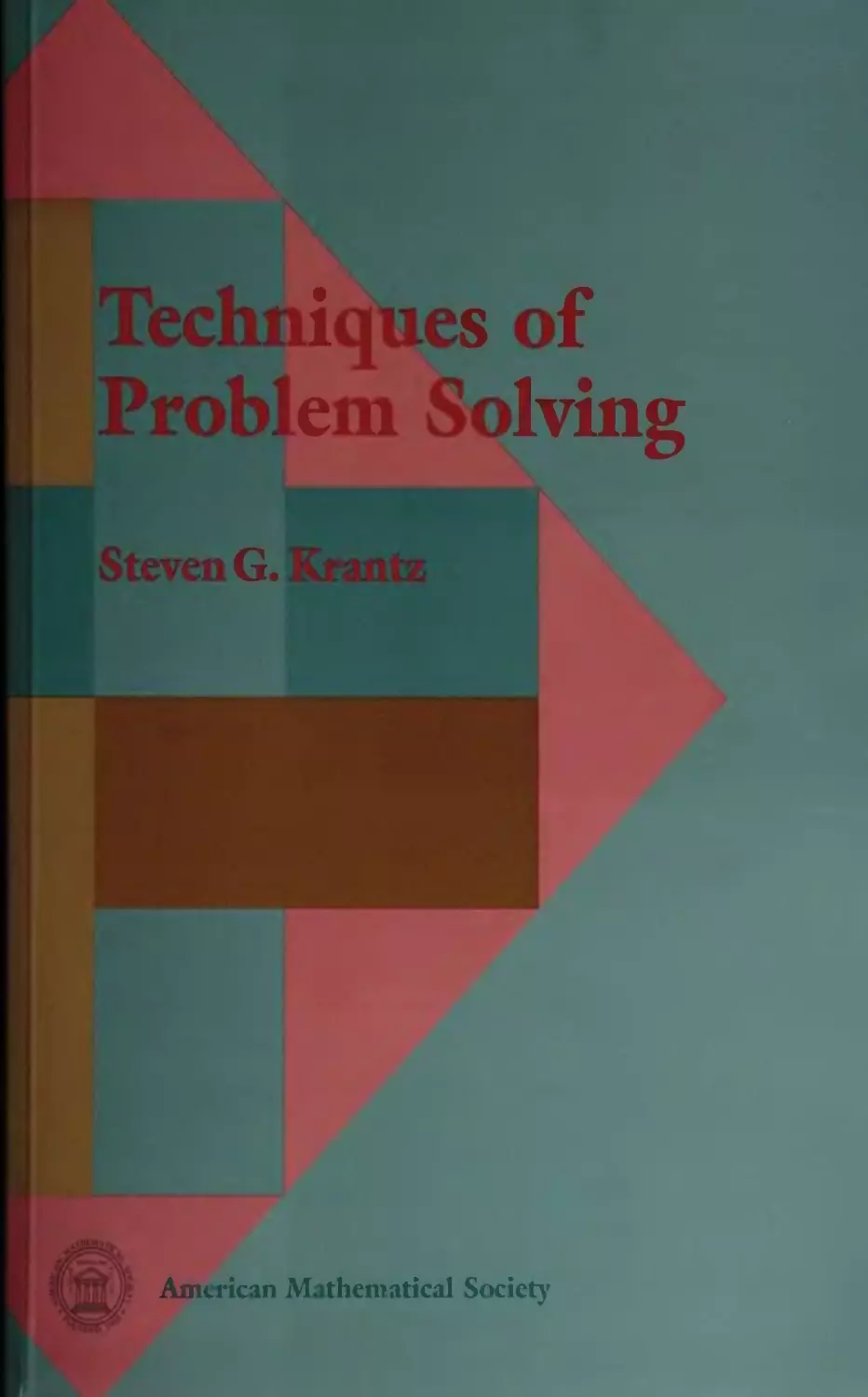


Автор: Krantz S.G.
Теги: mathematics problem solving discrete mathematics natural sciences
ISBN: 0-8218-0619-X
Год: 1997


Текст
G.
.
1
el
s f
lying
Anu.ric'ln M then1atical Socict),
Techniques of
Proble1t1 Solving
Steven G. I(.rantz
1991 Mathematics Subject Classification. Primary OOA05, OOA06, OOA08, OOA35. OOA71;
Secondary OOA69, OOA 73.
Library of Congress Cataloging-in-Publication Data
Krantz. Steven G. (Steven George), 1951-
Techniques of problem solving I Steven G. Krantz.
p. em.
Includes bibliographical references (p. - ) and index.
ISBN 0-8218-0619-X (acid-free paper)
1. Problem solving. I. Title.
QA63.K73 1996
510'.76-dc20
96-23878
CIP
Copying and reprinting. Individual readers of this publication, and nonprofit libraries acting
for them, are permitted to make fair use of the material, such as to copy a chapter for use
in teaching or research. Permission is granted to quote brief passages from this publication in
reviews, provided the customary acknowledgment of the source is given.
Republication, systematic copying, or multiple reproduction of any material in this publication
(including abstracts) is permitted only under license from the American Mathematical Society.
Requests for such permission should be addressed to the Assistant to the Publisher, American
Mathematical Society. P. O. Box 6248. Providence, Rhode Island 02940-6248. Requests can also
be made bye-mail to reprint-permissionClams. org.
@ 1997 by the American Mathematical Society. All rights reserved.
Reprint with corrections 1999.
The American Mathematical Society retains all rights
except those granted to the United States Government.
Printed in the United States of America.
€) The paper used in this book is acid-free and falls within the guidelines
established to ensure permanence and durability.
Visit the AMS home page at URL: http://ww.ams.org/
10 9 8 7 6 5 4 3 03 02 01 00 99
This one is for little Josephine, who is no problem at all.
TABLE OF CONTENTS
Preface
Acknowledgements
.
IX
...
XU!
CHAPTER 1: Basic Concepts
Introductory Remarks
A First Problem
How to Count
The Use of Induction
Problems of Logic
Issues of Parity
Exercises
1
3
14
20
30
35
43
CHAPTER 2: A Deeper Look at Geometry
Classical Planar Geometry
Analytic Geometry
Miscellaneous and Exotic Geometry Problems
Solid Geometry
Exercises
49
71
81
103
121
CHAPTER 3: Problems Involving Counting
Elementary Problems in Probability
More Sophisticated Problems in Probability
More on Counting
The Classical Marriage Problem and Related Ideas
Exercises
129
139
155
163
167
v
.
Vl
CHAPTER 4: Problems of Logic
Straight Logic
Games
Tracing Routes, and Learning from Parity
Mysterious Arithmetic Problems
Surprises
Exercises
177
183
191
201
214
219
CHAPTER 5: Recreational Math
Magic Squares and Related Ideas
Problems Involving Weighings
Exercises
235
246
257
CHAPTER 6: Algebra and Analysis
A Little Algebra
Inequalities
Trigonometry and Related Ideas
Exercises
263
271
279
286
CHAPTER 7: A Miscellany
Crossing the River and Similar Exercises
Things That Are Impossible
Exercises
295
299
309
CHAPTER 8: Real Life
Introductory Remarks
Everyday Objects
Some Case Studies
Statistics
Exercises
315
315
336
341
347
..
VIl
BIBLIOGRAPHY
INDEX
SOLUTIONS TO
ODD-NUMBERED PROBLEMS
361
365
369
PREFACE
OVERVIEW
A large component of everyday activity involves problem solving:
What is the best method to finance that new car? How should one
choose a spouse? What is the optimal method to schedule one's classes?
How can one best budget money?
Analytical thinking is not a panacea. It is not the right approach
for all contingencies and all problems. However it is a powerful method
for dealing with many situations. Most high school and college courses
that we take teach the consequences of analytical thinking; they do not,
in fact, teach the methodology of analytical thinking.
There already exist a great many books on problem solving, some
dating back to the last century. However the subject of problem solving,
as viewed by this author, is more than just a disconnected list of brain
teasers and recreations. It is a way of life. Scientists of every stripe-
chemists, physicists, psychologists, social engineers, and many others-
ply their trade by considering a set of data, deciding what techniques
are relevant to these data, and then solving a problem. It is this view
of problem solving that will be promulgated in the present book.
The purpose of this book is to teach the basic principles of prob-
lem solving. This will include both mathematical problems and non-
mathematical problems. A major component of the book consists of
learning to translate verbal discussions into analytical data. Another
major component consists of learning problem solving methods for at-
tacking collections of analytical questions or data. A third component
involves building a personal arsenal of solved problems and internal-
ized problem solving techniques; thus the student who has mastered
the material in this book is an "armed problem solver," ready to do
battle with a variety of puzzles in different parts of life.
.
lX
x
TECHNIQUE AND TEXTURE
Among the problem solving techniques considered in this book are
these: induction, contradiction, exhaustion, dissection, analogy, gener-
alization, specialization, reformulation, decomposition, recombination,
auxiliary analysis, counting, graphical methods, and diagraming. Of
course this list is by no means exhaustive; also the solving of a typical
problem might involve ideas from several of these methods.
While many of the illustrative problems provided in this book are
mathematical in nature, it is also the case that many of them are not.
We wish to provide the reader with a variety of analytical techniques
that may be used in many situations. Since the author of this book is a
mathematician, and since mathematics lends itself naturally to problem
formulation and solution, it is natural that mathematics will come up
frequently. But it is not the only point of this particular book.
Continuing the theme of the last paragraph, we will use this book as
an opportunity to teach the reader some important mathematical or an-
alytical ideas in context. These will include counting arguments, induc-
tion, the concept of "general position," proof by contradiction, graphing
and visual analysis techniques, the pigeonhole principle, recursion re-
lations, generating functions, ideas from probability and statistics, and
so forth. These ideas should serve the student well in other courses and
other contexts.
We also use this book, in a gentle fashion, as a device for introduc-
ing the student to the world of modern technology. By this we mean
that, on occasion, in the course of solving a problem, we may say "at
this stage we could use calculus, but instead get out your graphing
calculator and do the following . .. " Alternatively we might say "We
have reduced the problem to solving a transcendental equation; this is
virtually impossible to do by hand. Instead boot up your computer
algebra software...." These technological junctures occur only very
occasionally in the book. They are a device for teaching the student
to use the computer as a tool, just like a book or a slide rule or a
calculator.
.
Xl
COMPARISON WITH EXISTING BOOKS
There already exist a number of books that philosophize at length
about the nature of problem solving. Most notable among these are
books by Lakatos, Polya, Shoenfeld, and others (see the Bibliography).
We encourage the reader to become familiar with those works. The
present work takes a more direct and practical approach to the subject
matter. We feel that you learn to solve problems by solving problems
(note that not all experts on problem solving agree with this point of
view). This is very much in the vein that you learn to play the piano
by playing the piano. Most piano studies contain a graded list of pieces
to work on. They do not engage in extensive palaver about what it
feels like to touch the keys. Just so, we will make didactic points in the
context of solving problems, but will not provide discursive diatribes
about the ontology of problem solving.
One of the features that sets this problem solving book apart from
many others is that it incorporates exercises. These have two forms.
After many a solved problem in the text there appears a "Challenge"
problem for the reader to solve. This challenge usually involves tech-
niques related to the problem that the reader has just seen. It might
ask for an extension, or a variant, or for the solution of another problem
with a similar flavor. The student should endeavor to do the challenge
problems immediately upon encountering them-at least to give them
a first try. Some challenge problems are tricky (intentionally so) and
will require several attacks. Also, at the end of each chapter, there
are many additional problems for the reader to tackle. All of these
are related, at least to some extent, to material in the text. There are
more than 350 of these in all. Solutions to most of the end-of-chapter
exercises are available in the Solutions Manual.
PREREQUISITES
This book has minimal prerequisites. Certainly no calculus is re-
quired. (However an occasional optional problem will use calculus;
these problems are labeled as such. The reader who is willing to sus-
pend his/her disbelief will have no trouble with the handful of passages
..
Xll
that make reference to calculus.) There is some use of algebra and
trigonometry. But this is intended to be a book on reasoning more
than a book on mathematics per se. Most students with a modest
level of mathematical and/or analytical sophistication will benefit from
working with this text.
ACKNOWLEDGEMENTS
Several individuals were kind enough to read parts of the book and
contribute incisive suggestions. These include Fiona Chapple, N. M.
Kumar, Vladimir M
ek, Robert McDowell, Richard Rochberg, Steven
Weintraub, and Guido Weiss. Courtney Coleman did a line-by-line
reading of several portions of the manuscript and made many valuable
contributions. McDowell and Rochberg each contributed several in-
teresting problems. Barbara Luszczynska, our mathematics librarian,
was a tremendous help in tracking down resources. Luis Fernandez
and Haedeh Gooransarab did an absolutely splendid job of writing up
the Solutions Manual for this book. To all these I express my sincere
thanks. The students in my problem solving course were a delight, and
contributed to this book in ways both tangible and intangible.
I wish to express my appreciation to the Department of Mathemat-
ics at Washington University in St. Louis for allowing me to create a
problem solving course and to develop this book in conjunction with it.
Support from the Kemper Foundation, through a developmental grant,
is gratefully acknowledged.
S. G. K.
St. Louis, Missouri
...
XllI
Chapter 1
Basic Concepts
1.1 Introductory Remarks
Writing a book on problem solving is a bit foolish; it is also foolish to
write a book on swimming or piano playing. For you cannot learn any
of these skills by reading about them. You must do them. In fact you
must immerse yourself in them. Just as developing your torso would
entail pumping iron in a rigorous and planned fashion, so developing
your problem solving skills will involve a regimen of practice and hard
work.
Nevertheless, learning to solve problems can be fun and rewarding.
It is a process of developing and extending your mental powers, and it
will equip you with a body of techniques that will be useful in other
parts of your studies and of your life.
This book is organized around certain types of problem solving
techniques, and around certain mental processes that are involved in
problem solving. Each concept is illustrated with a number of sample
problems; these examples will help to train you in the techniques of
problem solving. You should work through each example with care, for
the specific examples are nluch more important than the philosophical
remarks that precede them.
Some examples may take a fair amount. of tinl€ for you to master;
but it is important to do so. If you are using this book in a class.
then be sure to talk to your instructor, and to your classnlates. about.
1
2
CHAPTER 1. BASIC CONCEPTS
the problems you are studying and the techniques you are learning.
Learn to ask questions. Part of the learning process is to learn to
formulate precise statements and precise questions. Another related
part is to learn to communicate processes of reasoning and analysis.
This is strenuous mental exercise. Do it alone, but also do it in a group.
Throw the ball back and forth and run around the track (mentally).
Another critical part of this book, this course, and your education
in general, is to learn to read. By this we do not mean the attainment
of literacy. If you are reading these words then you have that problem
solved. Instead we mean to read a problem, or an analytical passage,
or a solution, and to get to the bottom of it, to completely understand
it, and finally to internalize it.
Those ideas and techniques that you internalize are those that finally
belong to you, that you can use in practice in your life, that are at your
finger tips and have become your own personal tools. This book is
designed to familiarize you with the process of internalization and to
make it part of your working mental regimen.
Like most books, this one is written in linear order. That is to say,
the ideas on any page may utilize, or at least make reference to, the
ideas on the preceding pages. But it is no crime to flip ahead in the
book, to look at problems that are coming up, or to dip into the book
as your interest dictates.
In the next section we will begin to solve problems. At first, our
main interest will be to learn to defeat "mental inertia." Even for an
experienced and talented problem solver, a tempting way to react to a
tough, meaty problem is to look off into space, scratch the old head,
and say "Dh, gosh, I don't know. What's for lunch?" Your goal should
instead be to train to become a problem fighting machine. You see a
new problem and you say "I've seen something like that before. Let's
try this... Let's draw a figure... Let's reformulate it as follows... Let's
try an example. . . " Study this book and you will learn to think in this
fashion, not just in math class but in any situation.
1.2. A FIRST PROBLEM
3
1.2 A First Problem
We begin with the analysis of a simple problem. It stands alone, in
that one cannot imagine relating it to another problem, or another
technique. Its solution requires no specialized knowledge or experience.
PROBLEM 1.2.1 Determine how many zeros end the number 100!
Solution: Recall that
100! = 100 . 99 . 98 . · . 3 . 2 . 1.
Adding a zero to the end of a product occurs precisely when we
multiply by 10. Thus multiplication by any number ending in 1,3,7,9
cannot possibly add a zero to the product (since none of these numbers
divides 10). In fact the prime factorization of 10 is 10 = 5 . 2. We
endeavor to solve this problem by counting the factors of 5 in 100!
In the numbers 1-10, only the numbers 5 and 10 have factors of 5.
The number 5 may be paired with 2 to yield 10 and the number 10
does not need to be paired. The two resulting factors of 10 contribute
two zeros to the full product that forms the factorial.
In the numbers 11-20, only the numbers 15 and 20 have factors of
5. Reasoning as in the last paragraph, we count two additional zeros.
The numbers between 21 and 30 are a bit different. As before, 25
and 30 are the only numbers having a factor of 5, but 25 has two factors
of 5. Thus
22 x 24 x 25 = 11 x 12 x (2 x 5) x (2 x 5)
and this will contribute 10 x 10 = 100, or two zeros. Thus the range
21-30 contributes a total of three zeros.
The ranges 31-40 is a simple one, like the first two ranges we con-
sidered. It contributes two zeros.
The range 41-50 is special because 45 contributes one factor of 5
but 50 contributes two factors. Thus this range of numbers contributes
three zeros (as did the range 21-30).
The range 51-60 and the range 61-70 are like the first two. There
are no multiple factors of 5, and each range contributes two zeros.
4
CHAPTER 1. BASIC CONCEPTS
The range 71-80 is special because 75 contributes two factors of 5
and 80 contributes one factor of 5. The total contribution is three zeros.
The range 81-90 contributes two factors of 5 in the usual fashion,
and thus adds two zeros.
The range 91-100 contains 95 and 100. The first of these contributes
one factor of five and the second contributes two. Thus three zeros are
added.
Taking all of our analyses into account, we have six ranges of num-
bers that each contribute two zeros and four ranges that each contribute
three zeros. This gives a total of 24 zeros that will appear at the end
of 1001 0
This example already exhibits several important features of success-
ful problem solving:
. We identified the essential feature on which the problem hinges
(that a trailing zero comes from multiplication by 10).
. We began by analyzing a special case (i.e., the product 10. 9 .
8.. .3.2. 1).
. We determined how to pass from the special case to the full prob-
lem.
It is not always true that examining a special case, or a smaller
case, will lead to a solution of the problem at hand. But it will get you
started. This will be one of our many devices for attacking a problem.
Looking back at our solution of the first problem, we see that we
could have been more clever. The numbers from 1 to 100 contain
100 + 5 = 20 multiples of 5. Four of these multiples of 5 are in fact
multiples of 25, hence contribute two 5's. That gives a total of 24
factors of 5 in 1001 Pairing each of these with an even number gives a
factor of ten, and hence a zero. We conclude that there are 24 zeros at
the end of 100!
Here is another example of specialization:
PROBLEM 1.2.2 A math class has 12 students. At the beginning
oE each class hour, each student shakes hands with each of the other
students. How man.y handshakes take place?
1.2. A FIRST PROBLEM
5
Solution: We begin with a special case and build up to the case of 12
students.
Suppose that there are just 2 students. Then only one handshake
is possible.
Now suppose that a new student walks in the door. He/she must
shake hands with each of the students that is already in the room. So
that makes two more handshakes. The total number of handshakes is
1 + 2 = 3.
If a fourth student walks in the door, then he/she must shake hands
with each of the students already in the room. The total number of
handshakes is then 1 + 2 + 3 = 6.
The pattern is now clear: the addition of a fifth student would result
in 1 + 2 + 3 + 4 handshakes. When we get up to twelve students, we
will have required
1 + 2 + 3 + . . · + 9 + 10 + 11 = 66
handshakes.
That solves the problem.
D
Many times the solution or analysis of one problem will suggest
others. Here is another problem that Problem 1.2.2 suggests:
PROBLEM 1.2.3 Assume that k is a positive integer. What is the
sum of the integers
S = 1 + 2 + 3 + . . . + (k - 1) + k ?
Before we present a solution, we conduct some preliminary discussion
of this problem.
We think of S as function: set
S(k) = 1 + 2 + 3 +... + (k -1) + k.
What sort of function might this be? If a function f (k) increases by a
fixed amount, say 3, each time that k is increased by 1, then f must
be a linear function. Indeed, f must have the form f (k) = 3k + b.
6
CHAPTER 1. BASIC CONCEPTS
Likewise, if the function 9 increases by a linear function of k each time
that k is increased by 1, then we might suspect that 9 is quadratic.
(For those who know calculus, think of the concept of derivative: the
derivative of a quadratic function is linear.) For instance, if g(k) = k 2
then g(k + 1) - g(k) = 2k + 1, and that difference is linear.
These considerations motivate our attack on the present problem:
Solution: A useful method for analyzing a sum is to rewrite each term
so that some cancellations are introduced. Notice that
2 2 -12 - 3=2.1+1
3 2 _ 2 2 - 5=2.2+1
4 2 - 3 2 - 7=2.3+1
k 2 - (k _1)2 _
(k + 1)2 - k 2 _
2 . (k - 1) + 1
2.k+l
Now we add the columns:
[2 2 _ 12] + [3 2 _ 22] + [4 2 - 3 2 ] + . . . + [(k + 1)2 - k2]
= [2. 1 + 1] + [2 . 2 + 1] + [2 .3+ 1] + . . . + [2 . k + 1].
The left hand side "telescopes" (that is, all but the first and last terms
cancel) and the right side may be factored. The result is
(k + 1)2 - 12 = 2[1 + 2 + 3 + .. . + k] + II + 1 + 1 + . . . + IJ
....
k times
or
k 2 + 2k = 2 . S + k.
Recall here that S is that sum that we wish to calculate.
Solving for S, we find that
S= k2+k . D
2
The formula derived in the last problem is often attributed to Carl
Friedrich Gauss (1777-1855), although there is evidence that it was
known much earlier.
1.2. A FIRST PROBLEM
7
CHALLENGE PROBLEM 1.2.4 Imitate the method used in the last prob-
lem to find a formula for the sum
1 2 + 2 2 + 3 2 + . . . + k 2
when k is a positive integer.
The solution of our last problem sheds some light on the preceding
"handshake" problem. For if a class contains k students and the class
period begins with everyone shaking everyone else's hand, then our
solution of Problem 1.2.2 shows that the total number of handshakes
that occurs is 1 + 2 + 3 + . . . + (k - 1). Now Problem 1.2.3 teaches us
that this last sum equals [(k - 1)2 + (k - 1)]/2 = [k 2 - k]/2.
Here is another question that one might ask about the handshake
problem:
PROBLEM 1.2.5 Refer again to the situation in Problem 1.2.2, but
suppose now that there are k students in the class. If k is even then
will the number of handshakes that takes place be even or odd? If k
is odd then will the number of handshakes that takes place be even or
odd?
Solution: If there are 2 students (an even value for k) then the total
number of handshakes is 1, an odd number. If we add one student, that
adds two handshakes: the number of students is 3 (odd) and the number
of handshakes is 3 (odd). If we add yet another student then there are
3 additional handshakes. Thus the total number of handshakes is 6
(even) while the total number of students is 4 (even).
In fact if we draw up a chart then a pattern begins to emerge:
8
CHAPTER 1. BASIC CONCEPTS
I # students I # handshakes I parity of handshakes I
0 0 even
1 0 even
2 1 odd
3 3 odd
4 6 even
5 10 even
6 15 odd
7 21 odd
8 28 even
9 36 even
10 45 odd
11 55 odd
12 66 even
13 78 even
As is sometimes done in mathematics, we include the somewhat silly
cases of 0 students and 1 student for completeness, and to simplify the
discussion that follows.
We see that the first two numbers for handshakes are even, then
there are two odd, then there are two even, and so forth.
The pattern repeats itself in increments of four. Now notice that the
number in the u# handshakes" column in the row for (k + 1) students
is obtained by adding the two numbers in the row for k students. We
know that the number of handshakes for k students is (k 2 - k) /2. Ver-
ify this formula for yourself by plugging the numbers 1,2,3,4,5,6, 7, 8
into the expression. What you are in fact checking is that (for I. a non-
negative integer)
(i) In rows 41.,41. + 1, the number of handshakes is even;
(ii) In rows 41. + 2,41. + 3, the number of handshakes is odd.
That completes our analysis of the parity of the number of hand-
shakes of k students. D
Notice that our analysis of Problem 1.2.5 did not conform to the
theme of this section: it was not solved by first considering a simple
1.2. A FIRST PROBLEM
9
Figure 1
case. Instead, we explored Problem 1.2.5 as something of a side-track-
because it was suggested by the result of Problem 1.2.2.
We now turn to a final example of the technique of specialization:
PROBLEM 1.2.6 What is the greatest number of regions into which
three straight lines (of infinite extent) can divide the plane?
Solution: We begin with the simpler question: "What is the greatest
number of regions into which one line can divide the plane?" Of course
there is nothing to discuss, for one line will always separate the plane
into two regions.
Next we look at two lines. Refer to Figure 1 (top). If the two lines
coincide, then the plane is still divided into just two regions. If, instead,
the two lines are distinct but parallel (Figure 1, bottom) then the plane
is separated into three separate regions.
We think of the two cases just described as degenerate or atypical
for the following reason: if you drop two straws onto a floor, then
the probability that they will land on top of each other, or land in a
configuration so that they are parallel, is zero. Rather, with probability
one, the straws will land so that they are skew (or non-parallel). We
refer to this last situation as "general position" for the two straws.
10
CHAPTER 1. BASIC CONCEPTS
Figure 2
Now suppose that our two lines are in general position. This situ-
ation is illustrated in Figure 2. Then the plane is separated into four
regions.
Finally we pass to three lines. If all three lines coincide, then we
are in the situation for one line. If two of the lines coincide, then we
are in the situation for two lines. So suppose that the three lines are
distinct.
If the three lines are parallel, then the plane is separated into four
regions (Figure 3). If two are parallel, and the third is skew to them,
then the plane is separated into six regions (Figure 4). Now suppose
that no two of the three lines are parallel.
1.2. A FIRST PROBLEM
11
Figure 3
If the three lines pass through a single point, then (Figure 5) the
plane is separated into six regions. If the three lines do not pass through
a single point, and no two of them are parallel (this is the general
position situation, that is, the one that occurs with probability one-
see Figure 6) then the plane is separated into seven regions. Thus seven
is the maximal number of regions into which three lines can divide the
plane. D
In the last problem we certainly used the method of specializing to
simple cases to begin to get a grasp of how the problem works. But we
also used the method of exhaustion. We used the notions of parallelism
and intersection-what we ended up calling "general position" -to lay
out all the possible configurations for the lines. You may find it an
instructive exercise to generalize the last problem to four lines or five
lines.
12
CHAPTER 1. BASIC CONCEPTS
Figure 4
Figure 5
1.2. A FIRST PROBLEM
13
Figure 6
We wrap up the section with the second of several CHAL
ENGE
PROBLEMS. These are problems-for you to do-that are closely re-
lated to those in the text. You should attempt to do them right away,
right after you have read the cognate problems and solutions that have
been presented in the text. Sometimes the CHALLENGE PROBLEMS
will be routine, involving no essentially new ideas. Other times they
will exceed the usual level of difficulty, or trickiness, of the typical ex-
amples in the text or the exercises. They are included to encourage you
to stretch your abilities and imagination. Particularly, you should use
them as an excuse to talk to others in an effort to generate ideas.
CHALLENGE PROBLEM 1.2.7 What is the greatest number of regions
into which five planes can divide three dimensional space?
In fact the answer is 26 regions, and this is rather difficult to visual-
ize. The remarkable fact is that the actual solution is not very difficult;
what is difficult is harnessing your three dimensional geometric powers
of visualization so that you can come upon the solution. John Sununu,
a member of President George Bush's White House Staff, was able
14
CHAPTER 1. BASIC CONCEPTS
to solve this problem as a young man. We shall discuss its complete
solution later in the book.
1.3 How to Count
Already in Problem 1.2.1 we got a taste of a "counting problem."
Counting problems come up in many guises: How many different five
card poker hands are there? How many different ways can you roll 8
with two dice? How many different ways can you make up $1 with
nickels, dimes, and quarters?
The essence of counting technique is to have an organizational strat-
egy. We begin with the most elementary counting question.
PROBLEM 1.3.1 We are given k objects {al,...' ak}. How many
different ordered pairs may be made up from those k objects?
Solution: There are k possible choices (namely al,
, . . . , ak) for the
first element of the ordered pair. Having chosen an object for the first
element, how many choices remain for the second element? The answer
is that there are (k - 1) of the original {aI, . . . , ak} remaining.
So if we chose al for the first element then we may choose any of
a2, ag, . . . , ak for the second element-that's (k -1) choices. If we chose
a2 for the first element then we may choose any of aI, ag, a4, . . . ,ak for
the second element-that's (k -1) choices. And so forth.
In summary, there are k choices for the first element of the ordered
pair. For each of those choices, there are (k - 1) choices for the second
element of the ordered pair. The total number of possible ordered pairs,
chosen from among {al,a2,... ,ak}, is then k. (k -1). D
We can use the counting strategy from this last problem to come
up with a basic fact about "permutations," or orderings, of finite sets:
PROBLEM 1.3.2 We are given k objects {ah...' ak}. In how many
different orders can we arrange these objects?
Solution: Suppose that we have k positions into which to put the
objects (Figure 7). There are k different objects (namely a}, a2, . . . ,ak)
that we may put in the first position.
1.3. HOW TO COUNT
15
DDDDD...D
--
--.....---
-'"
k positions
Figure 7
Having placed an object into the first position, there remain (k-l)
different objects to put into the second position. Thus, reasoning as in
the last problem, there are k . (k - 1) choices of pairs of objects to put
into the first two positions.
Having chosen two objects to put into the first two positions, we see
that there remain (k - 2) objects to put into the third position. Thus
there are k. (k -1) . (k - 2) choices of objects to put into the first three
positions.
We may continue to reason in this fashion. We find that there
are k . (k - 1) . (k - 2) . (k - 3) choices for the first four positions,
k. (k - 1) . (k - 2) . (k - 3) . (k - 4) choices for the first five positions,
and so forth.
In the end, there are
k. (k - 1) . (k - 2) . · .3 . 2 . 1 = k!
possible different orderings of the k objects {a}, a2, . . . ,ak}. 0
A successful attack on many counting problem relies on knowledge
of the "choose function." We now turn to that notion:
PROBLEM 1.3.3 We are given k objects {a1 1 a2, . . . ,ak}. Suppose
that m is a positive integer that is less than or equal to k. In how many
ways can we choose m objects from among the original k?
16
CHAPTER 1. BASIC CONCEPTS
k objects
-
--..
DDDD DDDDDD ... DD
'---
--v-
first m objects
J
Figure 8
An example of this last type of problem is to ask how many different
5 card poker hands may be chosen from a deck of 52. Or how many
different 11 person football teams may be chosen from a group of 25
people. What is interesting about the question, and differentiates it
from the preceding problems, is that we are not interested in ordering.
That is, the poker hand
A. , K\) , J. , 9", 70
is just the same as the poker hand
K\) , 70 , 9" , A. , J..
Now we turn to the solution of our problem:
Solution: We need a system for selecting m objects from among the
original k. Suppose we proceed as follows: We select an ordering for
the entire set of k objects and choose as our subcollection of m objects
the first m in the ordering. See Figure 8. Since there are k! different
ways to order the k objects (see the last problem), this suggests that
there are k! different sub collections of m objects.
Of course there must be something wrong with this reasoning, since
the answer k! does not seem to depend on m. What is wrong is this:
We are counting different orderings of those first m objects as different
(see Figure 9). We do not wish to do this, so we divide out by the
1.3. HOW TO COUNT
17
r
-A-
0
G00DDDDD
. . .
GGJGJGGJDDDDD
"---
---v--
These are the same
subset of m = 5
elements, occurring
in a different order
--J
Figure 9
number of possible orderings of these m objects-namely we divide out
by m! Likewise, we are counting different orderings of the last k - m
objects as different. So we must divide out by the number of possible
orderings of those objects-namely we divide out by (k-m)!. Now our
counting scheme is accurate, and enumerates different subcollections of
m objects chosen from among a total of k objects.
We have discovered that the number of different subcollections of
m objects chosen from among a total of k objects is
k!
m! . (k - m)! .
Note once again that our strategy in deriving the formula was this:
we took the number of possible orderings of the totality of k objects,
and we thought in terms of selecting the first m from among any such
ordering. But we must divide out by the different possible orderings of
those first m objects. And we must divide out by the different possible
orderings of the remaining k - m objects. 0
18
CHAPTER 1. BASIC CONCEPTS
The quantity
k!
m! . (k - m)!
is used universally in counting ar
ents, and is commonly referred to
as "k choose m." It is written (
). Thus we have
(
) - m!. (:
m)!"
PROBLEM 1.3.4 How many different 5 card poker hands may be
had from a deck of 52 cards?
Solution: With the ideas that we have developed, this is an easy
problem. For the number of such poker hands is just "52 choose 5:"
( 52 ) 52!
# of poker hands = 5 = 5!47! = 2,598,960. 0
PROBLEM 1.3.5 How many pairs of bridge hands may be dealt from
a deck of 52 cards?
Solution: Recall that bridge is played by two teams of two people.
Each person is dealt 13 cards. Consider one of the teams.
The first team member is dealt 13 cards from among the total of
52. The number of possible hands that this person could be dealt is
( 52 ) 52!
C 1 = 13 = 13! . 391"
The second team member is also dealt 13 cards, chosen from among the
remaining 39 cards. [Notice here that in an actual game we do not first
give 13 cards to the first team member and then give 13 cards to the
second team member. But the order in which the cards are distributed
is irrelevant here. The only point is that the first team member is given
13 cards at random and the second team member is given 13 other
cards at random.] Thus the number of possibilities for the second team
member are
( 39 ) 39!
C 2 = 13 = 13! . 261"
1.3. HOW TO COUNT
19
ODD DO DO 0 0 DO 0",0
..........
--v--
m+ k-l boxes
Figure 10
ODDDDDDDDDDD...D
(k - 1) boxes shaded
m boxes unshaded
Figure 11
The total number of pairs of hands for the two team members is
( 52 ) ( 39 ) 52! 39! 21
C l . C 2 = 13 . 13 = 13! 39! . 13! 26!
5.1578 x 10 .
D
PROBLEM 1.3.6 Assume that k and m are positive integers. How
many different monomials of degree m are there in ]Rk?
First we clarify what we are asking here. The space ]Rk consists of ele-
ments of the form (Xl, X2, . . . , Xk), where Xl, X2, . . . ,Xk are real numbers.
A monomial is an expression like (Xl)2 . (X3)3 . (xs)6. In other words,
it consists of some powers of some of the variables multiplied together.
We say that this particular monomial has degree 11 because the sum
total of all the powers that occur is 2 + 3 + 6 = 11. The problem asks
for the number of all possible monomials of a given degree m in ]Rk.
Solution: We now learn a new counting device. Consider m + k - 1
boxes, as shown in Figure 10. We will shade any (k -1) of them. What
remains is some clusters of unshaded boxes-the total number of these
remaining boxes is m. Refer to Figure 11.
Between the leftmost edge of all the boxes and the first shaded box
is a group of unshaded boxes. Say that there are ml of them. Note
20
CHAPTER 1. BASIC CONCEPTS
DDDDDDDOOI&JDDDDDD
Figure 12
that 0 < ml < m. Next, to the right of the first shaded box and to the
left of the second shaded box there is a group of unshaded boxes, say
Tn2 of them. Continue in this fashion.
We see that the shading of k -1 boxes gives rise to non-negative in-
tegers ml, Tn2,..., mk such that ml +Tn2+.. .+mk = m. In turn, this k-
tuple of numbers corresponds to the monomial (Xl)m 1 .(X2)m 2 ... (Xk)m k .
The process runs in reverse. Any monomial (Xl)m 1 . (X2)m 2 . · . (Xk)m k
has a corresponding k-tuple (ml' m2,..., mk), and this k-tuple in turn
corresponds to a shading of k - 1 boxes from among m + k - 1 boxes.
In fact Figure 12 illustrates the shading of boxes that corresponds to
(Xl)2. (X3)3 . (xs)6 in IR6.
Thus counting the monomials of degree m in IRk corresponds exactly
to counting the different ways to shade (or to choose) k -1 boxes chosen
from among m + k - 1 boxes. Note that there are no redundancies or
ambigu.ities. Thus the number of monomials that we wish to count is
( m+k-l ) = (m+k-l)!
k - 1 (k - I)! . m!
o
1.4 The Use of Induction
Mathematical Induction is one of the most powerful techniques in all of
mathematics. Before we begin to study it, we should draw a distinction
between the use of "induction" in other fields of human endeavor and
the use of "Mathematical Induction" in mathematics.
Most scientific subjects rely heavily on induction. A chemist or
physicist or biologist examines a certain number of cases of some phe-
nomenon and then attempts to induct from this data some general rule
or dictum. The process of passing from the data to the rule can take
many forms. It is not defined in advance. And the main test of whether
1.4. THE USE OF INDUCTION
21
the process has been valid is further experimentation and gathering of
data.
"Mathematical Induction" is limited in scope, and proceeds in a
more rigid fashion. Here is the scheme for mathematical induction.
Suppose that we have a statement P(k) for each positive integer k. For
example, the statement could be "k 2 - 2k + 1 > 0." Or it could be
uThe number 2k + 4 can be written as the sum of two odd primes."
The method of Mathematical Induction is used to proved P( k) for all
k in the following fashion:
(i) First verify P(I).
(ii) Verify that P(j) => P(j + 1) for every j E {I, 2, 3,.. .}.
Assuming that these two statements have been verified, we notice
the following. Using (i) and the special instance j = 1 of (ii) gives us
P(l) and P(I) => P(2). From this we may conclude P(2). Now the
special instance j = 2 of (ii) gives us P(2) => P(3). From this, and the
statement P(2) obtained in the preceding step, we may conclude P(3).
Continuing in this fashion, we see that P( k) is true for every positive
integer k.
The discussion that we have just presented to explain why the
method of Mathematical Induction is a valid method of reasoning should
be taken as intuitive. A rigorous treatment of the method is intimately
bound up with set theory and the construction of the natural numbers;
we cannot go into the details here. We refer the reader to [KRA1] and
[SUP] for more detailed discussions.
Now we turn to some examples where induction is useful.
PROBLEM 1.4.1 VerifY the formula
k+k 2
1+2+3+...+(k-l)+k= 2 .
Solution: We solved this problem by a different method in Section
1.2. The technique that we used at the time may have seemed like
an unmotivated trick. Once you get used to induction, by studying
examples like the one we are doing now, it will seem like a standard
device for problems like this one.
22
CHAPTER 1. BASIC CONCEPTS
When using the method of induction (we now use this language,
instead of the more formalistic Mathematical Induction), it is important
to proceed systematically.
First, what is the statement P(k) that is to be verified? It is
k+k2
1+2+3+...+(k-l)+k= 2 .
To verify P(I), we note that
1+12
1= .
2
The most interesting, and subtle, part of the method of induction is
part (ii). We assume that P(j) is known to hold. Thus, in the present
problem, we are assuming that
. + .2
1+2+3+...+j= ' 2' . (*)
From this we wish to derive the corresponding statement for (j + 1).
To this end, we add (j + 1) to both sides of (*). We obtain
. + .2
1 + 2 + 3 +... + j + (j + 1) = ' 2' + (j + 1).
Simplifying, we have
1 + 2 + 3 + . . . + (j + 1) = j + j2 + 2(j + 1)
2
or
1 + 2 + 3 +... + (j + 1) = (j + 1) + (j + 1)2 .
2
This last is precisely the statement P(j + 1).
Notice that, assuming the validity of P(j), we have derived P(j+l).
That is precisely part (ii) of the method of induction.
The verification is complete. According to the method of induction,
once we have verified Steps (i) and (ii), then we can be sure that P(k)
holds for all k. Thus we have solved the problem. 0
Sometimes it is convenient to begin an induction at a point other
than j = 1. In the next problem we begin at j = o.
1.4. THE USE OF INDUCTION
23
PROBLEM 1.4.2 Suppose that 8 is a set with k elements. Show
that 8 has precisely 2 k subsets.
Solution: We will use the method of induction. First recall that a
set A is said to be a subset of a set B if each element of A is also an
element of B. In particular, 0 C A, where 0 is the "empty set" (or the
set with no elements). Also A c A.
Now our inductive statement P(k) is this: "If a set 8 has k elements
then 8 has 2 k subsets."
As already noted, we begin our induction at 0, rather than 1. For
step (i), notice that if 8 = {} = 0 has no elements then the only subset
of 8 is 8 itself. Thus 8 has 1 = 2 0 subsets. Thus we have verified P(O).
For step (ii), we assume that P(j) is valid. This means that any set
with j elements has 2; subsets. Now let 8 = {8J, 82,...,8;, 8;+1} be a
set with (j + 1) elements. Set 8' = {8I, 82,..., 8;}. Notice that the set
8' has j elements. By hypothesis, 8' has a total of 2; subsets. Now we
count the subsets of 8 itself.
Certainly any subset of 8' is also a subset of 8. That accounts for
2; subsets of 8. Also, if A is any subset of 8' then A U {S;+I} is a
subset of 8. That accounts for another 2; subsets of 8. We thus have
identified a total of 2; + 2; = 2;+1 subsets of the set 8. Notice that we
have in fact accounted for all the subsets of 8, since any subset of 8
either contains 8;+1 or it does not. Therefore we have derived P(j + 1)
from P(j). That is part (ii) of the method of induction.
The verification is complete. D
PROBLEM 1.4.3 Suppose that we have an admissible graph on the
unit sphere in three dimensional space. Here, by "admissible graph"
we mean a connected configuration of arcs. Two arcs may be joined
only at their endpoints. The endpoints of the arcs in the graph are
called vertices. The arcs are called edges. An edge is that portion of
an arc that lies between two vertices. A face is any two dimensional
region, without holes, that is bordered by edges and vertices. Figure
13 illustrates an admissible graph and a non-admissible graph.
This problem asks you to verify Euler's formula for an admissible
graph. We let V be the number of vertices, E the number of edges,
24
CHAPTER 1. BASIC CONCEPTS
admissible
non-admissible
Figure 13
and F the number of faces. Then Euler's formula is
v - E + F = 2.
Solution: We begin with some special cases, just to be sure that we
understand what is going on.
The simplest graph that is admissible, according to our definitions,
consists of a single vertex and nothing else (Figure 14). The comple-
ment of that single vertex, in the sphere, is a valid face. Thus V = 1,
E = 0, and F = 1. Then
V-E+F=I-0+1=2
1.4. THE USE OF INDUCTION
25
Figure 14
and we see that Eulerts formula is valid.
The next most complex graph has one edge t with a vertex on each
end, and nothing else. The complement (in the sphere) of this edge
with its endpoints is a single valid face. See Figure 15. Thus t in this
case, V = 2, E = 1, and F = 1. We see that
V-E+F=2-1+1=2.
Thus Eulees formula is valid in this case as well.
Now we let P(k) be the statement "Euler's formula is valid for any
admissible graph with kedges. n We shall use induction to prove this
statement for every k.
The statement P(l) has already been verified. That is part (i) of
the method of induction.
For part (ii), we assume that Euler's formula is valid for any admis-
sible graph having j edges. Now let Q be a graph having (j + 1) edges.
There is some edge that can be removed from Q so that the remaining
graph Q' is still admissible (exercise-for example, an edge that sepa-
rates two different faces will do). Say that V', E', and F' denote the
numbers of vertices, edges, and faces for the graph Q'. Now consider
what the corresponding numbers V t E, F for the graph Q might be.
The graph Q is obtained from Q' (we are reversing the construction
that produced Q') by adding an edge. If the edge is added by attaching
26
CHAPTER 1. BASIC CONCEPTS
Figure 15
---
-.
Figure 16
one end, and leaving the other free (the added edge is dotted in Figure
16), then the number of faces does not change, the number of edges
is increased by one, and the number of vertices is increased by one.
See Figure 16. Thus V = V' + 1, E = D' + 1, and F = F'. Since, by
hypothesis, V' - E' + F' = 2, it follows that V - E + F = 2 as desired. If
instead the edge is added by attaching both ends (again the added edge
is dotted in Figure 17-there are two possibilities, as shown), then the
number of faces is increased by one, the number of edges is increased
by one, and the number of vertices does not change. Therefore V = V',
E = E' + 1, and F = F' + 1. Since, by hypothesis, V' - E' + F' = 2,
1.4. THE USE OF INDUCTION
27
\
I
I
/
-"
or
I \
I I
\ I
..... ./
Figure 17
it follows that V - E + F = 2.
Since these are the only two ways that a new edge can be attached,
we have established step (ii) of the inductive procedure. Our argument
is complete. D
PROBLEM 1.4.4 Assume that k is a positive integer. If (k + 1)
letters are delivered to k mailboxes, then show that one mailbox must
contain at least two letters.
Solution: Although many solutions are possible, we will use induction
just to illustrate the method.
The statement P(k) is "If (k+ 1) letters are delivered to k mailboxes
then some mailbox must receive at least two letters."
28
CHAPTER 1. BASIC CONCEPTS
For the case k = 1, notice that if k + 1 = 2 letters are delivered
to k = 1 mailboxes then some mailbox (namely the only mailbox) will
receive two letters (indeed, all the letters).
Now assume that P(j) has been proved. Assume that (j + 1) + 1
letters have been delivered to (j + 1) mailboxes.
. If the last mailbox is empty, then all the letters have been de-
livered to the first j mailboxes. In particular, at least (j + 1)
(indeed, (j + 2» letters have been delivered to these first j mail-
boxes. So the inductive hypothesis applies and one of these first
j mailboxes contains at least two letters.
. If the last mailbox contains precisely one letter, then the remain-
ing (j + 1) letters have been delivered to the first j mailboxes.
Once again, the inductive hypothesis applies to the first j mail-
boxes. So one of them will contain at least two letters.
. If the last mailbox contains two or more letters, then we are done
because some mailbox (namely the last one) contains at least two
letters.
That completes the verification of our statement.
o
The principle embodied in the statement of the last problem is of
pre-eminent importance in mathematics. It is commonly called the "pi_
geonhole principle." It was originally called the Dirichletscher Schub-
fachschluss (Dirichlet's drawer-shutting principle) because it was for-
mulated by the German mathematician Peter Gustav Lejeune Dirich-
let (1805-1859). In the next section, you will learn about arguing by
contradiction. As an exercise, you can check then that the pigeonhole
principle can easily be verified using the method of contradiction.
CHALLENGE PROBLEM 1.4.5 A group of people gathers for a party.
A lot of handshaking goes on. Show that the number of people who
shake hands an odd number of times is even.
PROBLEM 1.4.6 Suppose that six people are in a room. Explain
why either three of these people all know each other or else there are
three of the people none of whom knows each other.
1.4. THE USE OF INDUCTION
29
Solution: Of course we are supposing that if A knows B then B knows
A and vice versa. Call one of the people Joe. Of the other five people,
either Joe knows three of them or he does not know three of them. Say
that the first case obtains. In fact, say that he knows Harry, Mary,
and Larry. Now if two of those people know each other (for instance,
Harry knows Larry), then the triple {Joe, Harry, Larry} is a mutually
acquainted triple. If, instead, it is not the case that two of these three
people know each other, then {Harry, Mary, Larry} is a triple of people
no two of whom know each other. D
CHALLENGE PROBLEM 1.4.7 We can reinterpret the last problem as
follows.
You have six points on a piece of paper. Each of the fifteen
possible pairs of these points will be joined either by a red
line segment or by a blue line segment. Show that there will
either be a triangle that is all blue or a triangle that is all
red.
Explain why this formulation is equivalent to the original one.
CHALLENGE PROBLEM 1.4.8 Refer to the last problem and the last
challenge problem. Suppose now that you have three colors in which
you can render the line segments: red, blue, and yellow. Then, with
six points, it will not be the case that there must be a triangle that is
all of one color. Explain why:
In fact how many points do you need, with every pair connected by
either a red, a blue, or a yellow line segment, so that you are guaranteed
to have a triangle of just one color?
CHALLENGE PROBLEM 1.4.9 Formulate a generalization of the last
challenge problem. Suppose that you have k colors. How many points
are required to guarantee that the process of joining all possible pairs of
points with line segment segments of one of these colors will guarantee
that there is a triangle of just one color?
30 CHAPTER 1. BASIC CONCEPTS
1.5 Problems of Logic
Logic plays a role in every problem that we solve. But some problems
are primarily geometrical in nature, others are counting problems, and
still others are analytical. In the present section we use logic itself as
the chief tool both for formulating and for solving problems. We begin
with a classic from the genre of "Liar and Truth Teller" problems.
PROBLEM 1.5.1 You are on an island that is populated by two
types of people: truth tellers and liars. When asked a YEs-No ques-
tion, a truth teller always tells the truth and a liar always lies. There
is no visual method for telling a truth teller from a liar. What single
question could you ask anyone that you meet on the island to determine
whether that person is a truth teller or a liar?
Solution: If you ask a direct question such as "Are you a truth teller?"
then a truth teller will answer "Yes" and a liar (who must lie) will
also answer "Yes". You will get a similar result if you ask "Are you
a liar?" Thus an elementary, direct question provides no basis for
differentiation.
Therefore a compound question, such as a conditional, or an "or"
question, or an "and" question is called for. One of the things that we
learn in a basic logic course is that any question that is of one of these
three types can be reformulated as a question of anyone of the other
three types (see [KRAl]). We concentrate on formulating an "if-then"
question that will do the job.
The question that we formulate could be of the form "If it is raining
then what would you say to ..." or "If you are a Doctor of Letters
then what would be your answer to . . . ." However it is clear that these
conditions have nothing to do with the matter at hand.
Probably more relevant would be a question of the form "If you were
a truth teller then what would you say to . . . ." Likewise the concluding
part of the question ought to have something to do with the problem
that we are trying to solve. We now try the question
If you are a truth teller then how would you answer
the question, 'Are you a liar?'
1.5. PROBLEMS OF LOGIC
31
Now we analyze how the two different types of island inhabitants
would answer this question.
Obviously a truth teller would answer the question "Are you a liar?"
by saying "No". If you pose the displayed question to a truth teller,
then he will report truthfully on the answer just given, so he/she will
say "No".
A liar can think just as clearly as a truth teller. He/she also knows
that a truth teller, if asked whether he/she is a liar, will say "No". But
the liar must lie. So he/she will say "Yes".
Thus we have found a question to which a truth teller will always
answer "No" and a liar will always answer "Yes". This certainly gives a
means for differentiating truth tellers from liars, and answers our prob-
D
You might have some fun modifying the question that we formulated
in the last problem and seeing what the results would be. Try the
question "If you are a liar then how would you answer the question
'Are you a truth teller?' " There are other variations that you might
try as well. What would happen if you used the question "Are you a
duck?"
Here is a problem of the same sort that you can try as a challenge:
CHALLENGE PROBLEM 1.5.2 You are on the island of truth tellers
and liars. Two people walk up to you. Call them A and B. What
single yes/no question can you ask A that will enable you to determine
whether B is a liar or a truth teller?
CHALLENGE PROBLEM 1.5.3 An island is inhabited by Liars, Truth
Tellers, and people who lie part of time and tell the truth part of the
time. These people cannot be differentiated by studying their external
appearance. If you meet an island inhabitant, what single question can
you ask him/her to determine which of the three types of people you
have encountered?
The next problem has received a considerable amount of publicity
in the last few years. It was inspired by the television game show LET'S
MAKE A DEAL. The nature of the game show (a bit over-simplified)
32
CHAPTER 1. BASIC CONCEPTS
is as follows. The contestant is faced with three doors. He/she knows
that behind one door is a very desirable prize-say a fancy car. Behind
the other two doors are rather pesky and undesirable items-say that
a goat is behind each. The contestant is to pick a door (blind), and is
awarded the prize that is behind the door. But the game show host,
Monty Hall, teases and cajoles and bribes the contestant, encouraging
the contestant to change his/her mind and forcing the contestant to
become confused over which is the most desirable door.
What has become known as the "Monty Hall" problem is this: The
contestant picks a door. For the sake of argument, we say that he/she
has picked Door Three. Before the door is opened, revealing what is
behind it, Monty Hall says "I will now reveal to you what is behind one
of the other doors." A door is opened and there stands a goat. Then
Monty Hall says "Would you like to change your door selection?" Very
interesting.
Clearly the contestant will not pick the door that Monty Hall has
already opened, since that has a goat behind it. So the issue is whether
the contestant will switch from the currently selected door to the re..
maining door (the one that the contestant has not chosen and Monty
Hall did not open). A naive approach would be to say there is an equal
probability for there to be a goat behind the remaining door and be..
hind the door that the contestant has already selected-after all, one
door has a goat and one has a car. What is the point of switching?
However this naive approach does not take into account the fact that
there are two distinct goats. A more careful analysis of cases occurs in
our solution to the problem, and reveals a surprising answer.
PROBLEM 1.5.4 Use a case-by-case analysis to solve the Monty Hall
problem.
Solution: We denote the goats by G 1 and G 2 (for goat one and goat
two) and the car by C. For simplicity, we assume that the contestant
will always select Door Three. We may not, however, assume that
Monty Hall always reveals a goat behind Door One; for there may not
be a goat behind Door One (it could be behind Door Two). Thus there
are several cases to consider:
1.5. PROBLEMS OF LOGIC
33
I Door 1 I Door 2 I Door 3 I
G 1 G 2 C
G 2 G 1 C
G 1 C G 2
G 2 C G 1
C G 1 G 2
C G 2 G 1
As we know from Section 1.4, there are 6 = 3! possible permutations
of three objects. That is why there are six rows in the array.
1. In the first case, Monty Hall will reveal a goat behind either Door
1 or Door 2. It is not to the contestant's advantage to switch, so
we record N.
2. The second case is similar to the first, it is not to the contestant's
advantage to switch, and we record N.
3. In the third case, Monty Hall will reveal a goat behind Door 1,
and it is to the contestant's advantage to switch. We record Y.
4. The fourth case is like the third, and it is to the contestant's
advantage to switch. We record Y.
5. In the fifth case, Monty Hall will reveal a goat behind Door 2. It
is to the contestant's advantage to switch, so we record Y.
6. The sixth case is like the fifth, it is to the contestant's advantage
to switch, and we record Y.
Observe that the tally of our case-by-case analysis is four Y's and
just two N's. Thus the odds are two against one in favor of switching
after Monty Hall reveals the goat. D
This last problem was in the nature of a probability problem. Many
elementary probability problems are amenable to careful case-by-case,
or counting, arguments. Chapters 3 and 8 will give you more experience
with probability problems.
34
CHAPTER 1. BASIC CONCEPTS
PROBLEM 1.5.5 There are more adults than boys, more boys than
girls, more girls than families. If no family has fewer than 3 children,
then what is the least number of families that there could be?
Solution: If there were just one family then there would be at least
two girls, at least three boys, and at least four adults. But four adults
make two families, and that is a contradiction.
If there were just two families, then there would be at least three
girls, at least four boys, and at least five adults. But five adults means
that there cannot be just two families; there are at least three. That is
a contradiction.
If there were just three families, then there would be at least four
girls, at least five boys, and at least six adults. That is not a contra-
diction. Thus three families might satisfy the conditions.
In fact suppose that there are three married couples. The first
couple has two girls and a boy, the second has two girls and a boy, and
the third has three boys. Then there are six adults, five boys, four girls
and three families. All conditions of the problem are met.
The answer is. that three families is the smallest number that there
could be. 0
The method of solution in the last problem is one of "exhaustion."
It would not be a very satisfactory method to use if the answer to the
problem were 357, for it would take a great deal of work to reach that
answer. Nevertheless, exhaustion is an important and systematic tool
to have in our arsenal.
PROBLEM 1.5.6 Explain why there are infinitely many prime num-
bers.
Solution: Recall that a prime number is a positive integer, not 1,
that has no divisors other than 1 and itself. The first several primes
are 2,3,5,7,11,13,17,19,23,.... Every positive integer is divisible by a
prime number-indeed can be factored in a unique manner into prime
factors. That is the content of the Fundamental Theorem of Arithmetic.
We solve the present problem by using the method of proof by
contradiction. Suppose that there were in fact only finitely many primes
1.6. ISSUES OF PARITY
35
in the world. Call these primes PI, 112, . . . , Pk. Consider the number
N = (PI . P2'" Pk) + I-the product of all these primes, with 1 added
to it. Now N must be divisible by some prime number-as noted in
the last paragraph. However it is not divisible by PI, since division
by PI results in a remainder of 1. Likewise, N is not divisible by P2,
because division by 112 results in a remainder of 1. In fact we see that
N is not divisible by any of PI,112,... ,Pk. But these were all the primes
in the universe. Yet N must be divisible by some prime! That is a
contradiction.
We conclude that there cannot be just finitely many primes. There
must be infinitely many. D
"Proof by contradiction" is a simple but powerful device in mathe-
matical and analytical reasoning. The scheme is as follows: We wish to
prove a proposition P. Now P is either true or it is false. There is no
"wait and see" or "in-between" status; it must be one or the other (see
[KRAI] for further discussion of this concept). The strategy in "proof
by contradiction" is to eliminate the possibility that P is false. So we
assume that P is false and argue that that assumption is untenable
(it leads to a contradiction). The only possible conclusion is that P is
true. Problem 1.5.6 illustrates this method of reasoning.
The proof that there are infinitely many primes is usually attributed
to Euclid; it is more than 2000 years old. It was one of the first proofs
by contradiction. Interestingly, proof by contradiction did not become
a standard mathematical tool until the twentieth century.
1.6 Issues of Parity
The most elementary example of parity is "oddness vs. evenness", but
there are many others. We shall explore various aspects of parity in
this section.
PROBLEM 1.6.1 An 8' x 8' bathroom is to have its floor tiled. Each
tile is 2' x I'. In one corner of the bathroom is a sink, and its plumbing
occupies a I' x I' square in the floor. In the opposite corner is a toilet,
and its plumbing occupies a I' x I' square in the floor. The situation
36
CHAPTER 1. BASIC CONCEPTS
Figure 18
is shown in Figure 18. [Figure 19 exhibits a way to envision the floor
broken up into one foot squares.)
How is it possible to achieve the required tiling of the floor?
Solution: The area to be tiled is 8' x 8' less two square feet-in other
words, we must tile an area of 62 square feet. Thus we will use 31 tiles.
Figure 20 shows one possible arrangement of tiles; notice that it fails
to cover the entire floor. There are two squares remaining (on the lower
right), and they cannot be covered by a single tile. Other attempts fail
similarly. (Try this with your checkerboard; put coins on two of the
opposite corners to signal that the tiles may not cover those squares).
We start to smell a rat. Perhaps the floor cannot be tiled. But
how can we produce a cogent argument that explains why no tiling
can work? There are many hundreds of ways to attempt to tile this
floor, and it is distasteful to consider all possible tilings. The idea that
we now introduce-one inspired by the concept of parity-is to color
the bare floor of the bathroom like a checkerboard. Look at Figure
21. Notice that when we place a 2' x l' tile on the floor then it will
cover two adjacent squares. One of these will be black and one will be
white. Thus if we place two tiles on the floor, they will cover a total
of two black squares and two white squares. In general, k tiles placed
on the floor will cover k black squares and k white squares. Yet the
bathroom floor that we are dealing with has 32 black squares and 30
1.6. ISSUES OF PARITY
37
Figure 19
Figure 20
38
CHAPTER 1. BASIC CONCEPTS
.
..
. .
.
.
. .
.
... :l-
.
.
.
. ...
Figure 21
white squares. Since the number of black squares covered will always
equal the number of white squares covered, we have an insurmountable
problem. This bathroom floor can never be tiled! D
The use of parity that came into the last problem was the device
of coloring the floor. It would have required intricate combinatorial
reasoning to solve this problem without the intervention of the coloring.
PROBLEM 1.6.2 We have a container that contains 6 quarts and
another that contains 4 quarts. We fill these containers by immersing
them in the river. How can we use them to fill one of the containers
with 3 quarts of water?
Solution: What is implicit in the problem, and what we make explicit
now, is that the only moves we are allowed are (i) to fill a container, (ii)
to empty a container, or (iii) to pour one container into the other. This
being the case, our various pouring operations correspond to adding
and subtracting multiples of 4 and 6. Now addition and subtraction of
even numbers always results in an even number answer. Thus there is
no way to obtain the number 3.
The problem cannot be solved. D
1.6. ISSUES OF PARITY
39
CHALLENGE PROBLEM 1.6.3 Now suppose that you have a 9 quart
container and a 4 quart container. How can you put exactly 6 quarts
of water into the large container?
We have given two examples in which the notion of parity taught
us that a certain problem cannot be solved. Now we give one in which
parity leads to a positive solution.
PROBLEM 1.6.4 (Ma
ek) Imagine a polyhedron with 1981 ver-
tices. [This is not as difficult as it sounds. Just place 1981 points
on the unit sphere in three dimensional space. Now connect them with
line segments in an obvious way to obtain a polyhedron.]
Imagine that each edge is assigned an electrical charge of +1 or
-1. Explain why there must be a vertex such that the product of the
charges of all the edges that meet at that vertex must be +1.
Solution: Suppose that we multiply together all the products corre-
sponding to all the vertices. Then every edge is counted twice (since
each edge has two vertices on its ends) so every +1 is counted twice
and every -1 is counted twice. Thus the product is +1.
But there are an odd number of vertices. Thus it cannot be the case
that the product coming from each vertex is -1 (since the product of
an odd number of -1's is equal to -1). Therefore at least one vertex
has product equaling +1. 0
PROBLEM 1.6.5 A herd of cattle invades a barn dance. Suddenly
the barn is running amok with both cattle and people. A quick count
reveals 120 heads and 300 feet. How many cattle are there, and how
many people?
Solution: We write p for the number of people and c for the number
of cattle. Then the total number of cattle plus people is c + p while
the total number of feet is 4c + 2p (since a head of cattle has four feet
while a person has two). Thus
c+p - 120
4c+2p - 200.
40
CHAPTER 1. BASIC CONCEPTS
We solve this system to find that c = 30 and p = 90.
o
CHALLENGE PROBLEM 1.6.6 Suppose you are told in advance that 10
of the cattle present are lame, and only have three feet. But the count
yields 120 heads and 300 feet. How many cattle and how many people
are there?
PROBLEM 1.6.7 (HaImos) A party is held at the house of the
Schlobodkins. There were four other couples present (besides Mr. and
Mrs. Schlobodkin), and many; but not all, pairs of people shook hands.
Nobody shook hands with anyone twice, and nobody shook hands with
his/her spouse. Both the host and hostess shook some hands.
At the end of the party, Mr. Schlobodkin polls each person present to
see how many hands each person (other than himself) shook. Each per-
son gives a different answer. Determine how many hands Mrs. Schlo..
bodkin must have shaken.
Solution: We write S for the two Schlobodkins and we denote each
of the other four couples by A, B, C, and D.
Nobody shook 9 hands, since nobody shook the hand of his/her
spouse. Therefore the numbers 0 through 8 are used in describing the
different numbers of handshakes performed by each of the nine people
(other than Mr. Schlobodkin).
Someone shook 8 hands. Say that it is Mr. A. Then how many
hands did Mrs. A shake? Everyone in couples B, C, D, S must have
shaken Mr. A's hand, in order to account for 8 shakes. So each of the
people in couples B, C, D, S shook hands at least once. But somebody
shook hands zero times. It must be Mrs. A.
Now we eliminate Mr. and Mrs. A from our consideration. Someone
shook exactly 7 hands. Say that it is Mrs. B. We know already that
Mrs. B shook the hand of Mr. A. She did not shake the hand of Mrs.
A, since nobody did. To obtain a total of 7 shakes, she must also have
shaken the hands of all the people in couples C, D, S. But someone had
to shake only one hand (the people in C, D, S have now each shaken at
least two hands, since they each shook Mr. A's hand, as well as Mrs.
B's hand). It must be Mr. B who shook only one hand.
1.6. ISSUES OF PARITY
41
Continuing in this fashion, we see that the person who shook 6
hands is betrothed to the person who shook 2. And the person who
shook 5 hands is betrothed to the person who shook 3. That leaves
only Mrs. Schlobodkin, who must have shaken 4 hands-four being the
only remaining number (and note also that 4 is the only number that
cannot be paired).
The answer to our problem is that Mrs. Sch1obodkin shook four
& D
CHALLENGE PROBLEM 1.6.8 Go back to the beginning of the solu-
tion of the last problem. How can we be sure that it was not Mrs.
Schlobodkin who shook 8 hands?
PROBLEM 1.6.9 A sheep can clear a certain field, eating the grass,
in one day. A cow can clear the same field in half a day. How long does
it take the sheep and the cow, working together, to clear the field?
Solution: According to the information in the problem, a cow is like
two sheep (when it comes to clearing the field, that is). So the cow and
the sheep together is like three sheep. Thus they will clear the field in
a third of a day. D
CHALLENGE PROBLEM 1.6.10 A wildebeest can clear a certain field
in two days. A llama can clear it in three days. And a goat can clear it
in four days. How long does it take the three animals together to clear
the field?
PROBLEM 1.6.11 What is the last digit of3 4798 ?
Solution: Clearly the last thing we want to do is to calculate this
number. Even using a system like MATHEMATICA we are liable to
encounter memory or storage problems. Instead let us think.
Notice that 3 1 = 3,3 2 = 9,33 = 27,3 4 = 81,3 5 = 243, etc. The only
possible last digits are 3,9,7, and 1; then the pattern repeats. In this
42
CHAPTER 1. BASIC CONCEPTS
list, 1 is special because 1 · 1 = 1. And the digit 1 occurs when we raise
3 to the fourth power. This suggest that we write
3 4796 = [3 4 ]1199 . 3 2 .
Here we simply divided the exponent 4798 by 4, obtaining a quotient of
1199 and a remainder of 2. Then we used elementary laws of exponents.
Now, by what we have already observed, the expression in brackets
will terminate with a 1. If we raise it to the 1199 power, it will still
terminate with a 1. On the other hand, 3 2 is 9. We conclude that 3 4796
terminates with a 9. 0
CHALLENGE PROBLEM 1.6.12 What is the last digit 0£7 65432 7
CHALLENGE PROBLEM 1.6.13 (THIS IS TRICKY.) What are the last
three digits 0£3 4798 7
EXERCISES
43
EXERCISES for Chapter 1
1. Show that any positi ve integral power of (...;2- 1) can be written in
the form IN - vi N - 1 for N a positive integer. [Hint: Use induction.
Consider separately the cases of even powers of ( ...;2-1) and odd powers
of (...;2 - 1).]
2. Calculate the sum of the first k odd integers.
3. Calculate the sum of the first k cubes of integers.
4. Demonstrate that, in any collection of 52 distinct positive integers,
there are two distinct numbers whose sum or whose difference is divis-
ible by 100.
5. Find all pairs of integers m, n such that m · n = m + n.
6. How many zeros end the number (2001) ?
7. How many zeros end the number 2300.5600. 4 400 ?
8. A bunch of people are in a room. Some of them shake hands. Some
do not. What can you say about the number of people who shake hands
an even number of times?
9. How many digits are used to number the pages of a book having 100
pages-numbered from 1 to 100?
10. How many positive integers k are there with the property that k!
does not end in a zero?
11. A certain number k is a multiple of 9. Add the digits together.
If the result has more than one digit, add those together. Continue
adding digits together until you have a one digit answer. It will be a 9.
Can you explain why this is so?
12. Refer to Exercise 11. Give the following instructions to a friend:
"Pick an integer from 1 to 10. Multiply it by 9. Add the digits together.
Subtract 5. Now you have a single digit. Think of the letter of the
alphabet that corresponds to that digit-1 is A, 2 is B, and so forth.
Think of a country whose name begins with that letter. Now take the
second letter of that country name. Think of an animal whose name
begins with that letter." Let the friend think about this for a moment.
Then say "But there are no elephants in Denmark!"
What is the joke? Why does it work?
13. Fix a positive prime integer p. Suppose that n is any positive
integer. Find a formula for the number of factors of p that occur in n!
44
CHAPTER 1. BASIC CONCEPTS
---....-----.....--.
.....
""
",
/
I
,
"
,
,
I
.....
I'
I \
.........._ , I __""
- -,- r -
'"
Figure 22
14. [Halmos] A watermelon weighs 500 pounds. It turns out that 99%
of the weight of the watermelon is due to water in the watermelon.
After the watermelon has sat in a drying room for a while, it turns out
that it is only 98% water by weight. How much does it weigh now?
15. Fifteen teams play in a tournament. Each team plays every other
team exactly once. A team receives 3 points for a win, 2 points for a
draw, and 1 point for a loss. Every team ends up with a different total
score. The team with the lowest total scored 21 points. Explain why
the best team had at least one loss.
16. Suppose that T is a torus, as illustrated in Figure 22.
Determine the correct number 'Y so that the formula V - E + F = 'Y
will hold for any admissible graph on the surface of the torus T (recall
that, for a sphere, the number 'Y was 2, but for the torus it will be a
different number). The number 'Y is called the Euler characteristic of
the torus. We learned in the text that the Euler characteristic of the
sphere is 2.
Devise a proof that this number 'Y will work for any admissible graph
in T.
17. Suppose that 8 is a sphere with k handles (see Figure 23).
[In a certain sense, a torus is a sphere with one handle. Can you explain
this assertion?] What is the correct number 'Y so that the formula
V - E + F = 'Y will be true for any admissible graph on the surface 8?
Once you find 'Y, can you explain why this formula is valid?
18. Each point of the cartesian plane is colored either red or blue or
yellow. Explain why we can conclude that some unit segment in the
plane has both ends the same color.
EXERCISES
45
sphere with k handles
Figure 23
19. Show that if each point in the plane is colored one of seven colors-
red, blue, yellow, green, purple, orange, magenta-then it is possible
that no segment of unit length has both ends the same color.
20. A certain primitive village has the following social rules: Whenever
a husband is unfaithful to his wife, every other wife knows immediately,
but not the wife who has been cheated on. The wives never talk to
anyone about these matters, and neither do the husbands. As soon
as a wife can determine irrefutably that her husband has cheated, she
tatoos the letter "A" on his forehead before sundown of that same day.
On a given day the mayor announces that there is at least one un-
faithful husband in the village (he does not, however, say how many
unfaithful husbands there are). If in fact there are 37 unfaithful hus-
bands in the village, what will transpire? [Hint: First think about
the situation where the mayor makes his announcement but there is
in fact just one unfaithful husband in the village. Then try the case
where there are just two unfaithful husbands in the village. Now use
induction.] This problem comes from [HAL].
21. How does the last problem change if the mayor actually announces
the number of unfaithful husbands?
46
OHAPTER 1. BASIO OONOEPTS
,
,
c
Figure 24
22. Say that you have a square piece of paper. Imagine pasting the
upper edge to the lower edge (Figure 24) and the left edge to the right
edge. Do this in such a way that the orientations of these edges are
preserved. What geometric figure results?
Now imagine that, when the left and right edges are glued we first
give the left edge a twist (Figure 25 suggests what is meant by this).
The result is an object called the Klein bottle; the Klein bottle cannot
actually be realized as a surface in space, but we may think about it
mathematically from the description just given.
What is the correct number 'Y so that the formula V - E + F = 'Y
will hold for any admissible graph on the surface of the Klein bottle?
Can you prove that your choice of 'Y is correct?
23. Calculate the sum in closed form:
123 n
2! + 3! + 4! +... + (n + 1)1"
24. Assume that S is a set with k elements. We know that S has
2 k subsets. What does this statement have to do with the binomial
coefficients? [Hint: Look at (1 + x)k.]
EXERCISES
47
match the orientation of the arrows
Figure 25
25. An urn contains a white balls and b black balls; we know that
a + b > 3. Players A and B play a game with the urn and the balls.
Consider two strategies:
1. Player A draws a ball at random. If it is white he wins, otherwise
he loses.
2. Player A draws a ball and throws it away without looking at it.
Player B then draws a black ball. Next, A draws another ball. If
this second ball for A is white then he wins. Otherwise he loses.
Show that, with the first strategy, player A wins with probability a/ (a+
b). But with the second strategy he wins with probability a/ (a + b) +
a/[(a + b)(a + b - 2)]. Clearly the second strategy is preferable.
What does this problem have to do with the Monte Hall problem?
26. You have a wooden cube that is 3" x 3" X 3". By drawing a 3 x 3
grid on each face of the cube, you can indicate how the cube subdivides
into 27 sub-cubes of equal size. Refer to Figure 26.
Is it possible for a termite to eat his way through each of the outside
cubes just once, and then finish his journey in the middle cube?
27. Examine the example from the text about tiling the bathroom
floor. What happens if the two omitted squares are in adjacent corners
of the bathroom instead of opposite corners? What happens if the two
omitted squares are adjacent to each other (in this last case, does it
48
CHAPTER 1. BASIC CONCEPTS
Figure 26
matter where the two omitted squares are-in a corner, in the middle
of a side, or in the middle of the floor?). Do some experimenting!
28. Find at least two methods for calculating the sum 101 + 102+ 103+
... + 200. [Note: Just adding them up does not count as a "method."]
29. An auditorium has 500 seats. The decorator has three different
colors of fabric-red, blue, and yellow, and will randomly upholster each
seat with one of the three colors. So some will end up red, some blue,
and some yellow, with no particular pattern. In how many different
ways can this be done?
30. Five people play "seven card stud" poker. In seven card stud, you
are dealt five cards face down and two face up. Joe is showing two aces
for his face up cards. No other aces show on the table. What are the
odds that he has another ace among his five face down cards?
Chapter 2
A Deeper Look at Geometry
2.1 Classical Planar Geometry
The problems in the present section will be based on the classical Eu-
clidean conception of geometry. We shall be concerned with triangles
and circles, with ruler and compass constructions, with right angles,
adjacent angles, and opposite angles. Later, we shall also consider
some questions of solid geometry. Everything that we do in the present
section will be in the plane.
PROBLEM 2.1.1 We let .e and m be two lines in the plane that are
skew to each other (that is, they intersect at a single point X). Let
P be a point (other than X) that is on the line.e. Using a ruler and
compass, construct a circle that is tangent to both lines and passes
through P.
Solution: If we can construct the center C of the circle, then we can
construct the circle. For the radius is the distance of C to P, and we
can measure that distance with the compass (Figure 27).
Since P is a point of tangency, we note that the radial segment that
terminates at P will be perpendicular to.e. Thus it will be useful to
construct the perpendicular line to l at P (Figure 28). We can measure
the distance from X to P. Thus we can locate a point pi on m that
has the same distance from X. By the symmetry of the situation, the
circle that we seek will be tangent to m at P'.
49
50
CHAPTER 2. A DEEPER LOOK AT GEOMETRY
t
Figure 27
If we can construct the perpendicular to l at P and the perpendicu-
lar to m at P' then the intersection of these two perpendiculars must be
the center of the circle that we seek. See Figure 28. We have reduced
our problem to constructing the perpendicular line to a give line at a
give point on that line.
Refer to Figure 29. The point Q lies on the line n. Use the compass
to locate points A and B, lying on n on either side of Q and equidistant
from Q. The perpendicular line that we seek will be the set of all points
equidistant from A and B. We already know one point on the line-
namely Q. We just need one more, for two points determine a line.
Set the compass at a length to equaling the distance from A to B.
Strike an arc, centered at A, with that radius. See Figure 30. Strike
another arc, centered at B, with that radius. Clearly the two points
0, D of intersection of these two arcs are equidistant from A and B.
Thus 0, D, Q all lie on the line we seek. The unique line that they
determine passes through Q and is perpendicular to the line n.
2.1. CLASSICAL PLANAR GEOMETRY
51
Figure 28
Figure 29
52
CHAPTER 2. A DEEPER LOOK AT GEOMETRY
Figure 30
We have learned how to construct the perpendicular to a given line
at a given point. Combining this information with the earlier analysis
of our problem of constructing a tangent circle to two lines completes
the solution of the problem. 0
An interesting feature of our solution to the last problem is that it
involved reduction: constructing the desired circle reduced to finding its
center; finding the center reduced to constructing certain perpendicu-
lars, and so forth. A good problem solver is adept at reducing the given
problem to simpler problems, perhaps a sequence of simpler problems.
PROBLEM 2.1.2 Of all parallelograms with a given perimeter, which
has the greatest area?
Solution: Denote the perimeter by p. Consider a parallelogram with
that perimeter (Figure 31). Notice that if we cut off a triangle as shown
in Figure 32, and rearrange as in Figure 33, then the area remains the
same but the perimeter decreases (because the width is unchanged but
2.1. CLASSICAL PLANAR GEOMETRY
53
. )
pernneter p
Figure 31
the other two sides have become vertical, hence shorter). It follows
that the optimal area will be obtained if we concentrate our attention
on rectangles rather than general parallelograms.
Now consider a rectangle, not necessarily a square, as shown in
Figure 34. Assume, as before, that the perimeter is p. We may represent
the length of the rectangle as (P14) + € and the width as (pi 4) - € for
some € > O. Notice that the perimeter sums to p, just as it should
(Figure 35). The area of this rectangle is
[ p +€ ] . [ p _€ ] = p2 _€2
4 4 16.
This area is maximized when € > 0 is made as small as possible. In-
deed, the maximum is clearly achieved when € = o. But this just says
that the optimal area occurs when the rectangle is a square. 0
There are several points to the last example. One is that one can
do quite a lot without calculus. Exploiting symmetry, and geometric
reasoning, are decisive techniques. One could do this problem with
calculus, or one could do it using analytic geometry. But ingenuity
serves as a powerful substitute for those more sophisticated tools.
54
CHAPTER 2. A DEEPER LOOK AT GEOMETRY
Figure 32
.....
"
"
"
.....
.....
.....
.....
.....
"
.....
"
.....
"
"
"
Figure 33
2.1. OLASSIOAL PLANAR GEOMETRY
p/4 - E
perimeter p
Figure 34
p/4 + E
p/4 + E
Figure 35
55
p/4 - E
56
CHAPTER 2. A DEEPER LOOK AT GEOMETRY
A
c
B
Figure 36
PROBLEM 2.1.3 Using a ruler and compass, find the center of the
inscribed circle of a given triangle.
Solution: We assume here no particular knowledge of inscribed circles-
just what the concept means geometrically. We take it for granted, at
least for the moment, that the inscribed circle exists; that is, given a
triangle, we assume that there is a circle that is internally tangent to
the interiors of each of the three sides of the triangle. We will worry
about the existence issue later.
Refer to Figure 36. The circle that we seek is tangent to the sides
AB and AC. Thus the center of the circle is equidistant from the two
sides of the angle at A, so it lies on the angle bisector of the angle Q
at A. This analysis applies to the other two pairs of sides as well. In
sum, if we can construct the three angle bisectors, and if we assume in
advance that the inscribed circle exists, then those three angle bisectors
intersect at a point and that point is the center of the inscribed circle.
The problem has been reduced to finding the angle bisector of a
given angle. Refer to Figure 37. We need to find a point that is, in
some sense, equidistant from the two rays that bound the angle. We
cannot do so by measuring from the vertex. So we open the compass
to a fixed amount d and mark off two points X and Y, on each side of
the angle, having distance d from the vertex. See Figure 38.
2.1. CLASSICAL PLANAR GEOMETRY
Figure 37
Figure 38
57
d
58
CHAPTER 2. A DEEPER LOOK AT GEOMETRY
I
I
7
I
I
I
I
I
I
I
I
I Y
I
I
I
I
I
I
I
Figure 39
Now put the compass point at X and strike an arc of radius d as
shown in Figure 39. Put the compass point at Y and strike an arc of
radius d. The point Z of intersection will be equidistant from X and
Y. The line through Z and the vertex will of course pass through the
vertex of the angle and will be the angle bisector that we seek.
Having determined a method for constructing angle bisectors, the
preceding argument shows how to find the center of an inscribed circle
to a given triangle. That solves our problem. 0
It remains to say a few words about the existence of the inscribed cir-
cle. Notice that the angle bisector emanating from vertex A is equidis-
tant from sides AB and AG. Also the angle bisector emanating from
vertex B is equidistant from sides AB and BG. It follows that the point
of intersection of these two bisectors is equidistant from AB, AG, and
BG as well. Thus the point of intersection of the bisectors emanating
from A and from B will also lie on the bisector emanating from C. This
2.1. CLASSICAL PLANAR GEOMETRY
59
p
t
Figure 40
demonstrates that there is indeed a single common point of intersec-
tion of the three angle bisectors. Since this point is equidistant from all
three sides of the triangle, it is the center of the inscribed circle. The
radius of that circle will be the common distance of this point from any
of the sides. The next problem makes it clear how to find this radius.
PROBLEM 2.1.4 Let t be a line and P a point that does not lie on
that line. Use a ruler and compass to construct the line through P that
is perpendicular to t.
Solution: Place the point of the compass at P and open the compass
so that it spans a distance greater than the distance from P to t (Figure
40).
Strike an arc, noting the two points of intersection with the line i.
Call these points A and B (Figure 41).
Now place the point of the compass at A, and open the compass so
that the writing end touches B. Strike an arc as shown in Figure 42.
Repeat this process with the point of the compass at B and the
writing end reaching to A. The result is shown in Figure 43.
The points of intersection of the arcs are equidistant from A and
B. They determine the line m of all points equidistant from A and B.
It will be perpendicular to i. And it will pass through P, since P is
certainly equidistant from A and B. 0
60
CHAPTER 2. A DEEPER LOOK AT GEOMETRY
p.
,
A
7
t
Figure 41
A
t
B
Figure 42
2.1. CLASSICAL PLANAR GEOMETRY
61
m
A
B
f.
Figure 43
Note that the circle with center P that is tangent to e has radius that
can now be measured as the distance of P to the point of intersection
of e and m.
PROBLEM 2.1.5 Suppose we are given a triangle T with base AB.
Give a constructive method for drawing a segment parallel to AB, ter-
minating on the sides C A and C B of the triangle, that divides the
triangle into two equal areas.
Solution: Look at Figure 44. Suppose that the height of the triangle
is h and that the distance of the vertex C to the segment we seek to
construct is k. [Note that in the preceding problem we already learned
how to construct a height or perpendicular.]
The portion P of the triangle T that lies above the segment we are
constructing is also a triangle, and it is similar to T itself. This is clear
because their respective sides are parallel. If the ratio of the height k
of the smaller triangle to the height h of the larger triangle is a then
this is also the ratio of their bases as well. Thus the ratio of their areas
62
CHAPTER 2. A DEEPER LOOK AT GEOMETRY
c
A
B
triangle T
Figure 44
is 0. 2 (since area is half of base times height). Thus we seek to choose
the horizontal segment in such a way that 0. 2 = 1/2 or a. = 1/.;2. In
other words, we want k = (1/.;2)h.
The problem has been reduced to producing a segment that has
length 1/.;2 times the length of a given segment. If.e is a given seg-
ment, as in Figure 45, then we may use ideas from the preceding prob-
lems, together with a ruler and compass, to construct an isosceles right
triangle with hypotenuse equal to.e. (In detail: construct a square with
side .e; draw the diagonals of this square.) Then each leg of this right
triangle will have length .e /.;2. That is the desired construction. 0
Once again, we see the method of reduction at play. We exploited
the power of similar triangles to reduce a sophisticated geometry prob-
lem to an elementary geometry problem.
PROBLEM 2.1.6 Assume that P is a regular polygon with k sides.
What is the measure of any of the k angles formed by P?
Solution: What do we already know about angles in a polygon? The
basic fact with which we are all familiar is that the sum of the angles in
2.1. CLASSICAL PLANAR GEOMETRY
I
I
I
I
I
I
I
I
I
I
I
___________ c
Figure 45
63
a triangle is 180° (or 1r in radian measure). Can we relate the problem
at hand to this fact?
We attempt to break the polygon P up into triangles. Figure 46
suggests one way to do it, and Figure 47 suggests another. We will
analyze each of these separately.
Notice that Figure 46 exhibits P as the union of k isosceles triangles.
Each of those triangles has angles summing to 180°. The sum of all the
angles in all the triangles is thus (180. k)o. However the sum of all the
angles in all the triangles is not equal to the sum of the angles in the
polygon. In fact there is an overage consisting of the sum of the angles
in the center. As a result of this reasoning, we see that
(sum of angles in P) + 360°
- sum of angles in all the triangles
= (180. kt.
In other words,
sum of angles in P = (180. (k - 2)t.
Presumably an analysis of the triangles in Figure 47 will give us the
same answer. Let us see. Since P has k sides, we determine that we
64
CHAPTER 2. A DEEPER LOOK AT GEOMETRY
Figure 46
Figure 47
2.1. CLASSICAL PLANAR GEOMETRY
65
have, in Figure 47, broken up the polygon into (k - 2) triangles. This
time the sum of all the angles in all the triangles precisely equals the
sum of the angles in the polygon, with no overage. Therefore
sum of angles in P = (180 . (k - 2))°.
This is the same answer that we derived in studying Figure 46.
According to either analysis, the measure of a single angle in the
polygon P is
sum of the angles in P (180. (k - 2))
Q= k = k .
o
CHALLENGE PROBLEM 2.1.7 Explain why the sum of the three angles
in any triangle equals 180°. (NOTE: We used tms fact in our analysis
of Problem 2.1.6. So we may not now invoke our solution of 2.1.6 to
solve tms challenge problem.]
Our solution of the last problem illustrated an important principle:
when solving a new problem, ask yourself what you already know that
might be related. Thy to find something to get you started. The next
problem gives another instance of this philosophy at work:
PROBLEM 2.1.8 A lattice point is a point in the plane whose carte-
sian coordinates are both integers. Figure 48 exmbits a number of
lattice points. We let C R be the circle with center the origin and ra-
dius R > o. Write M(R) for the number of lattice points lying inside
(not on) the circle CR. Develop an asymptotic formula for M(R) 8B
R
+00.
Solution: It is virtually impossible to obtain an exact formula for
M(R). What we seek instead is a calculable quantity p,(R) such that
p,(R)/M(R)
1 as R
+00. Read on.
A powerful tool in counting problems of this kind is the use of area.
Notice that any closed square with sides parallel to the coordinate axes,
having length 1, will contain at least one lattice point. For convenience,
66
CHAPTER 2. A DEEPER LOOK AT GEOMETRY
.
.
.
.
.
.
.
.
.
.
.
.
.
.
.
.
.
.
.
.
.
.
.
.
.
.
.
.
.
.
.
.
.
.
.
.
.
.
.
.
.
.
.
.
.
.
.
.
.
Figure 48
we restrict attention to squares of this sort having centers at points of
the form (m, n) with m, n integers. Call these "good squares." Each
such square has a lattice point at its center and contains no other.
Now inside the circle C R of center 0 and radius R we place the circle
DR of center 0 and radius (R - J2)-see Figure 49. Any good square
that intersects DR will lie strictly inside CR' Likewise let E R be the
circle of center 0 and radius R + J2,. Any good square that intersects
C R will lie inside E R . Refer to Figure 50.
Now we may do our analysis:
1r' (R - -12)2 - area inside DR
< sum of areas of good squares inside C R
< sum of areas of good squares containing
lattice points that are inside C R
- number of lattice points inside CR
< number of good square that are either
2.1. CLASSICAL PLANAR GEOMETRY
67
OR
Figure 49
inside C R or intersect CR
< sum of areas of all squares inside E R
< area inside E R
- 11". (R+ V2)2.
Thus we see that
'If . (R - V2)2 < number of lattice points inside C R :5 11" . (R + V2)2.
We may draw the following conclusions: First, divide these inequalities
through by 11" R 2 . We see that
11" . (R - V2)2 number of lattice points inside C R < 'If. (R + J'2)2
<
-
.
Letting R -+ +00, we conclude that
number of lattice points inside C R -+ 1
1I"R2 .
68
CHAPTER 2. A DEEPER LOOK AT GEOMETRY
OR
E R
Figure 50
This answers the original question, namely that the asymptotic
number of lattice points inside the circle of center zero and radius R is
'Ir R 2 . But we may refine this answer in an interesting way. For
[ 2V2 2 J
'Ir. (R - J2)2 = 'Ir[R 2 - 2J2R + 2] = 'Ir,R2 1- R + R2
and
'IT. (R+ V2)2 = 'IT(,R2 + 2V2R + 2J = 'IT,R2 [1 + 2: +
1
Thus
number of lattice points inside OR = 'Ir,R2[1 + £(R)],
where the error term £ (R) is of size not exceeding 0/ R. 0
PROBLEM 2.1.9 Prove the Pythagorean theorem.
2.1. CLASSICAL PLANAR GEOMETRY
69
a
b
b
a
b
a
a
Figure 51
Solution: It is worth noting that this is the theorem in mathematics
that has the greatest number of proofs (in excess of 30D-see [GUID.
One of the proofs is due to President James A. Garfield! We shall give
two proofs of the Pythagorean theorem.
Denote the legs of the right triangle by a and b and let the hy-
potenuse be c. Refer to Figure 51. Notice that the large outer square
has side a + b. So it has area (a + b)2.
On the other hand, the large square is made up of four triangles and
a smaller square of side c. Each triangle has area ab/2 and the smaller
square has area e-. Thus, equating areas, we find that
(a + b)2 = 4. (ab/2) + c 2 .
Simplifying gives a 2 + 1J2 = c2, which is the Pythagorean theorem.
For a second proof, look at Figure 52. [For convenience, we are
assuming in this figure that b > a.] Now the large outer square has side
c. Thus it has area c2.
On the other hand, the large square is made up of four triangles
and a smaller square. Each triangle has area ab /2; the little square has
70
CHAPTER 2. A DEEPER LOOK AT GEOMETRY
c
c
c
c
Figure 52
side (b - a) (assuming that b > a) hence area (b - a)2. Equating areas,
we find that
c 2 = 4. (ab/2) + (b - a)2.
Simplifying gives dl = b 2 + a 2 , which is the Pythagorean theorem. 0
CHALLENGE PROBLEM 2.1.10 Prove the law of sines: if
ABC is a
triangle and 0'., {3, 'Y are the angles at the vertices A, B, C respectively
then
sin 0'. sin {3 sin l'
BC - AC = AB .
[Hint: Write the height of the triangle in two different ways.]
CHALLENGE PROBLEM 2.1.11 Prove the law of cosines: given a tri-
angle
ABC, if 0'. is the angle determined by sides AB and AC, then
IBCI 2 = IABI2 + IACI 2 - 21ABIIACI cosO'..
2.2. ANALYTIC GEOMETRY
71
2.2 Analytic Geometry
In the last section we were concerned primarily with what is called
synthetic geometry, as practiced by Euclid and the ancient Greeks.
In the present section we concentrate on the coordinate geometry of
Descartes. Many problems can be solved using either one of these
methodologies, and you should take it as a challenge to find solutions
in the one geometry when the text presents a solution in the other.
PROBLEM 2.2.1 Suppose that T is a triangle in the plane. We let
P, Q, R be the midpoints of each of the three sides. Prove that the
triangle determined by P, Q, R is similar to the original triangle T.
Solution: Two triangles are similar if they have either the same angles
or, equivalently, if their side lengths are proportional. In either case,
one triangle is a magnification of the other.
We concentrate on the angles. If we could show that the triangle
determined by P, Q, R has sides parallel to the sides of T then of course
the angles will be the same (Figure 53 is labeled in such a way as to help
you see this). We have already reduced our problem to the following
simpler assertion
If T =
ABC is a triangle and M is the midpoint of side
AB and N is the midpoint of side AC , then the segment
M N is parallel to the side BC (Figure 54).
We use Cartesian geometry to verify this last assertion. It is impor-
tant when using coordinates to choose the coordinates so that they suit
the problem, and so that they help us rather than hinder us. By apply-
ing a rotation and a vertical translation to our triangle, we may assume
that the vertices B and C are horizontally situated on the x-axis and
the vertex A above the x-axis. By applying a horizontal translation,
we may then assume that the vertex A is on the positive y-axis. Refer
to Figure 55. We write A = (0, a), B = (b,O), and C = (c,O).
The midpoint of side AB is now easily calculated to be M =
(b/2, a/2). The midpoint of side AC is N = (c/2, a/2). Notice that
the slope of M N is
a/2 - a/2 = O.
c/2 - b/2
72
CHAPTER 2. A DEEPER LOOK AT GEOMETRY
Figure 53
A
B
c
Figure 54
2.2. ANALYTIC GEOMETRY
73
B
(b, 0)
o
(c, 0)
Figure 55
In other words, M N is horizontal. But the base BO of the triangle is
also horizontal. We conclude that M N is parallel to BO. That is the
desired conclusion. 0
Note once again that, in the last solution, we have used the method-
ology of reduction: we successively reduced the original problem to more
and more basic questions.
PROBLEM 2.2.2 Prove that any angle subtended by a semi-circle is
a right angle.
Solution: Refer to Figure 56. It serves to remind you what it means
for an arc of a circle to subtend an angle. We will also use the figure
in our solution to the problem.
We need to introduce some coordinates. We assume that the center
of the semi-circle is the origin, the radius is r, and the vertex of the
angle in question is X = (a, b) (Figure 57).
74
CHAPTER 2. A DEEPER LOOK AT GEOMETRY
Figure 56
(T, 0) = B
Figure 57
2.2. ANALYTIC GEOMETRY
75
The slope of the segment AX is (b - 0)/( a - (-r)). The slope of
the segment X B is (b - 0) / (a - r). The product of these two slopes is
b 2
a 2 - r 2 .
(*)
But, since the point (a, b) lies on the circle, we know that a 2 +z,2 = r 2 or
b 2 = r 2 - a 2 . Substituting this identity into (*) yields that the product
of the two slopes is -1. We conclude that the two sides of the angle
are perpendicular. In other words, the angle is a right angle. 0
CHALLENGE PROBLEM 2.2.3 Assume that B and C are fixed distinct
points in the plane. The letter a denotes an angle between 0° and
90°. Consider the locus of all points P such that the angle LBPC has
measure a. Show that this locus consists of two circular arcs.
PROBLEM 2.2.4 TRUE or FALSE: If the diagonals of a parallel-
ogram are perpendicular then the parallelogram is a rectangle.
Let us be careful about what is being asserted. Figure 58 shows a
rectangle whose diagonals are plainly not perpendicular to each other.
But the assertion is not that every rectangle has perpendicular diago-
nals. Instead, it is that if a parallelogram has perpendicular diagonals
then it is a rectangle.
Solution: We set up coordinates as in Figure 59. Notice that two of
the vertices of the parallelogram are (a, 0) and (b, c). The fact that we
are dealing with a parallelogram then forces the ordinate of the upper
right vertex to be c and the abscissa of the that vertex to be a + b. (Of
course the lower left vertex is (0,0).)
The slope of the main diagonal is c/(a+ b). The slope of the minor
diagonal is c/ (b - a). The hypothesis that the diagonals are perpendic-
ular means that the product of these two slopes is -1. Thus
c c
. =-1
b-a b+a
or
c 2 = _(b 2 _ a 2 ).
76
CHAPTER 2. A DEEPER LOOK AT GEOMETRY
Figure 58
(b, c)
(a+ b, c)
(a, 0)
Figure 59
2.2. ANALYTIC GEOMETRY
77
c
"'-- y J
b
"-- --..y-
a
These lengths are equal
Figure 60
This may be rearranged to read
b 2 + c 2 = a 2 .
(**)
The identity that we have thus derived looks extremely promising,
for it has the form of the Pythagorean theorem. This means that the
side of the parallelogram with endpoints (0,0) and (a, 0) has the same
length as the side with endpoints (0,0) and (b,c). See Figure 60. Thus
the parallelogram is certainly a rhombus.
However we seem to have used all the information in the problem.
Such an eventuality makes us wonder whether we are pursuing the
wrong goal. We now draw a few parallelograms by way of experimenting
with the assertion of the problem.
The parallelogram in Figure 61 has the property that its diagonals
are perpendicular. However it is plainly not a rectangle (it is, however,
a rhombus). The answer to the problem is FALSE. 0
78
CHAPTER 2. A DEEPER LOOK AT GEOMETRY
Figure 61
The last problem contains a simple but important lesson: just be-
cause a problem has a nice ring to it does not mean that it is correct, or
correctly formulated. The problems that we encounter in real life have
this property; we never know whether we are asking the correct ques-
tion, nor whether the question has an affirmative answer (or, often, any
answer at all). While these may sound like platitudes, they describe
a reality which is virtually impossible to convey with a textbook or a
classroom environment.
PROBLEM 2.2.5 Express the area of a triangle with a formula using
only the lengths of the triangle's three sides.
Solution: We write the side lengths as Q, (3, 'Y as shown in Figure
62. We place the triangl e on a c oordinat e system, as shown in Figure
63. Thus Q = ..; a 2 + c 2 , (3 = ";/)2 + c 2 , and 'Y = b - a. Our plan is
to express the area in terms of a, b, c, and then translate that to an
expression involving only Q, (3, 'Y.
Obviously the area of the triangle is
- !. base · height
2
1
- 2 . (b - a) . c.
A = Area
Now we know that b - a = 'Y so that our formula for area becomes
1
A= 2 .'Y.c.
Our problem will be solved if we can express c in terms of Q, (3, 'Y.
2.2. ANALYTIC GEOMETRY
79
'Y
Figure 62
(0, c)
(a, 0)
'---
(b, 0)
.-/
--v-
'Y
Figure 63
80
CHAPTER 2. A DEEPER LOOK AT GEOMETRY
In effect, we are simultaneously solving the equations
0. 2 - a 2 + C 2
{32 - b 2 +C 2
'Y - b-a
for the variable c in terms of 0., {3, 'Y. Of course these are not linear
equations, so the problem does not bow to any standard technique. We
will resort to fiddling (a technique that is not to be underestimated).
Looking at the figure, we see that the roles of 0. and {3 in the problem
are symmetric. Thus we would expect our final expression for c to be
symmetric in 0. and {3. Thus it is natural to consider the expression
Ql- + {32. We subtract 'Y 2 from it in order to cancel some terms. Thus
0. 2 + {32 - i' = 2c 2 + 2ab.
(*)
Another symmetric expression in 0. and {3 is 0.. {3. However this will
involve some nasty square roots so instead we consider 0. 2 . {32. Thus
0. 2 . {32 = (a 2 + c) . (b 2 + c) = a 2 b 2 + a 2 c 2 + c 2 b 2 + c 4 . (**)
Now if we expect to combine (*) and (**) then we have a mismatch.
For the terms in (*) are of second order and those in (**) are of fourth
order. Thus we consider
(
+ {32 - r)2 = (2c 2 + 2ab)2 = 4c 4 + 4a 2 b 2 + 8abc 2 .
(***)
Certainly there are a number of terms in (* * *) that also appear in
(**). In order to obtain useful cancellations, we thus finally calculate
4[
. {32] - (0. 2 + {32 - "l)2
_ 4[a 2 b 2 + a 2 c 2 + cb 2 + c 4 ]
-[4c 4 + 4a 2 b 2 + 8abc 2 ]
_ 4a 2 c 2 + 4b 2 c 2 - 8abc 2
- 4c 2 [b - af
- 4c 2 r.
2.3. MISCELLANEOUS GEOMETRY PROBLEMS
81
In summary,
c = V 4 [a:2. {PI - (a:2 + (P - -y2)2
2')' .
Notice that we have succeeded in expressing c in terms of 0.,{3,'Y and
nothing else.
Finally, the area of the triangle is
1 1
A = '2'Y · c = 4 y2 0. 2 ')'2 + 2[32')'2 + 20. 2 {32 - a.4 - f34 - "'(4. 0
Notice that the formula that we have derived is symmetric in 0.,{3,
and')'. That is to say, if we permute the roles of a., {3, ')' then the formula
is unchanged. Think carefully about why this must be the case. Some
books of tables (see [ORO]) give the area of the triangle in its more
classical form:
A = vs (s - o.)(s - {3)(s - ')'),
where s = (a. + {3 + 'Y) /2, or half the perimeter of the triangle. 0
Take it as a (small) challenge problem to see that the formula that
we have derived for A and that taken from [ORO] are really equivalent.
2.3 Miscellaneous and Exotic Geometry
Problems
This section will contain a variety of geometry problems-mostly pla-
nar geometry-that do not fit into any standard category. They are
presented in part with the lesson in mind that human knowledge, and
in particular problem solving technique, does not know any seams or
boundaries. Even though this book is organized by topics, you should
not think of problem solving as being compartmentalized. It is self-
defeating to look at a problem and hope to be able to say "Oh, this
is a geometry problem and therefore I ought to use these methods."
You just never know what methods might be relevant, and your mind
should be open to all possibilities.
So, yes, the problems in this section are geometrical. But the tech-
niques for solving them are varied.
82
CHAPTER 2. A DEEPER LOOK AT GEOMETRY
PROBLEM 2.3.1 Say that T is a triangle in the plane. Show that
there is a triangle that is similar to T and such that its area equals its
perimeter.
Solution: Let P be the perimeter of the triangle T and let A be its
area. For a > 0 let aT denote the triangle T with its sides magnified (or
shrunk) by a factor of a. For instance, if a = 2 then 2T has sides that
are twice as long as the corresponding sides of the original T; if a = 1/2
then (1/2)T has sides that are half the length of the corresponding sides
of T; if a = 1 then IT is just the triangle T itself.
Consider the graphs, plotted on the same set of axes, of the perime-
ter P(a) and the area A(a) of the triangle aT. The horizontal axis
should be the a-axis and the vertical axis should be either y = P( a) or
y = A(a).
Now the perimeter is a linear function of a: when the triangle is
dilated by a factor of a then each side is dilated by a and therefore the
perimeter is multiplies by a. Thus the graph of P( a) is a line passing
through the origin and having positive slope; in fact P( a) = P . a. By
contrast, the area is a quadratic function of a: when the triangle is
dilated by a factor of a then the base is dilated by a and the height
is dil
ted by.a so that the area is dilated by a 2 . Thus the graph of
A( a) is an upward opening parabola with vertex at the origin; in fact
A(a) = A . a 2 .
One sees immediately from Figure 64 that the graph of y = P( a)
and the graph of y = A( a) intersect at two points in the (closed) first
quadrant. First, they intersect at the origin; this fact is of no interest.
The other point of intersection, namely a = P / A, is more significant for
our problem. For that is a non-trivial value of a for which the perimeter
and the area of aT are equal. And since aT is similar to T, we have
solved our problem. 0
PROBLEM 2.3.2 (Advanced) We write"'( : [0, 1] -+ IR 2 for a closed
curve that does not cross itself. This notation means that "'( is a func-
tion, its domain is the interval [0,1] = {x E IR : 0 < x < I}, and its
range is the set of ordered pairs of real numbers. We are assuming that
"'(0) = ')'(1) but "'(8)
')'(t) otherwise. See Figure 65. Prove that there
2.3. MISCELLANEOUS GEOMETRY PROBLEMS
y
y = A( a)
Figure 64
y = P( a)
Figure 65
83
a
.. .
84
CHAPTER 2. A DEEPER LOOK AT GEOMETRY
Figure 66
are four points A, B, C, D lying on the curve such that these four points
are the vertices of a rectangle.
Solution: Look at Figure 66. At the left is a quadrilateral with
vertices on the given curve. At the right there is also a quadrilateral
with vertices on the given curve. In each quadrilateral the diagonals
are distinguished: one diagonal is dotted and the other is dashed.
Now imagine that the leftmost quadrilateral is continuously de-
formed to the rightmost quadrilateral by moving the vertices along
the curve. The leftmost quadrilateral has dashed diagonal longer than
the dotted diagonal. The rightmost quadrilateral has dashed diagonal
shorter than the dotted diagonal. It is plausible therefore that at some
intermediate position the dotted and the dashed diagonal have equal
length (Figure 67). If we could also arrange for these two equal diago-
nals to meet at their midpoints, then the quadrilateral would have to
be a rectangle.
What we have just described is a very simple form of what is called
the "continuity method." In fact this argument alone is not sufficient to
locate the desired rectangle. We need a more sophisticated continuity
method that will keep track both of the lengths of the diagonals and of
their centers at the same time. We caution the reader that a couple of
2.3. MISCELLANEOUS GEOMETRY PROBLEMS
85
Figure 67
sophisticated ideas are used along the way. Do not expect to completely
understand the reasoning the first time through. But take it as an
invitation to some new geometrical ideas.
Consider pairs of elements of the curve 1, but identify the pair
(P, Q) with the pair (Q, P). In other words, consider unordered pairs
of elements of 1 (we will come back to this idea momentarily, and
clarify what geometrical object this actually is). Denote the set of
these unordered pairs with the letter S. Denote an element of S, that
is an unordered pair of points on 1, by [P, Q].
Now think of the curve 1 as lying in the x-y plane in 3 dimensional
space. For each [P, Q] E S we find the midpoint of the segment PQ
and then let f([P, Q]) be the point in space that lies a distance IP - QI
above that midpoint. See Figure 68. This f is a continuous function
from S into three dimensional Euclidean space.
Now what geometrical object is S? The set of ordered pairs of
elements of 'Y corresponds in a natural way to a torus-see Figure
69. However we are making the situation more complex by identi-
fying (P, Q) with (Q, P). The markings in Figure 70 (a) suggest how
this is done. The resulting geometric object is what is called a "non-
orientable" surface-in fact it is a Mobius strip (see Figure 70 (b)).
But the function f is a continuous function of S into three dimen-
86
CHAPTER 2. A DEEPER LOOK AT GEOMETRY
Figure 68
p
Figure 69
2.3. MISCELLANEOUS GEOMETRY PROBLEMS
87
(a) 1
/
/
/ 7'\
. (P, Q) f'
/
/)
/
(Q, P}
.
7\
/
O
-
..
1
(b)
Mobius strip
Figure 70
sional space. If f were one-to-one then its image would be a realization
of S as a subset of three dimensional space. This is not yet a contra-
diction, because the torus with the additional identifications that we
have specified is equivalent to the Mobius strip. But we now obtain
a contradiction as follows. The bounding edge of the embedded sur-
face is a simple closed curve. Paste a topological "disc" to it to make
the surface closed. The result is a "cross cap" -in other words it is
a realization of the projective plane as an embedded surface in three
dimensional space. This is known to be impossible. [You may wish to
get some help with this idea.] Therefore f cannot be one-to-one. What
does this mean?
It means that there are two (unordered) pairs [P, Q] and [PI, Q']
that have the sa me im age under f. This means that the segment PQ
and the se gment PIQ' have the same midpoint; moreover, it means
that PQ and pI Q' have the same length, for the heights of the points
f([P, Q]) and f([PI, Q']) above the x-y plane are the s ame.
But now look at Figure 71. The segments PQ and P'Q' having the
88
CHAPTER 2. A DEEPER LOOK AT GEOMETRY
Q'
Figure 71
same length and the same midpoint implies that they are the diagonals
of a rectangle. In other words, the points P, Q, pI, Q' are four points
on the curve "( that are the corners of a rectangle. 0
At this writing, it is an open problem to determine whether any
curve'Y as in Problem 2.3.2 has on it four points that are the corners
of a square.
PROBLEM 2.3.3 Let PI, P 2 , P 3 , ... ,Pk be points in the plane-just
finitely many of them-that are not all collinear. Show that there is a
line in the plane that passes through just two of these points.
Solution: Just to illustrate the ideas, look at Figure 72. The first
part exhibits three points, not all collinear. It also shows a line that
passes through just two of them. The second part of Figure 72 shows
2.3. MISCELLANEOUS GEOMETRY PROBLEMS
89
PI
.
P 2 Pa
PI
.
· P.
a
Figure 72
four points, not all collinear_It also show a line that passes through
just two of them.
If we are given a large, but finite, collection of points-configured in
a fairly arbitrary manner-then how might we find two of them through
which a line passes that contains none of the other points Pj? We solve
this problem by using one of the most powerful techniques in all of
mathematics: that is, we solve an extremal problem.
Consider the set T of all ordered pairs (f., Pm) consisting of a line
that passes through at least two of the Pj's and a point Pm not on that
line (such a point Pm must exist since the points are assumed to not
all be collinear). Define a function
f:T--+JR
by
f((f., Pm)) = distance of f. to Pm-
Notice that f always takes positive values. Also the domain of f is
a finite set (since there are only finitely many lines i and finitely many
90
CHAPTER 2. A DEEPER LOOK AT GEOMETRY
1
Pm
.
Ps
Figure 73
/"
.....
l
.....
Pm
.....
...
......
.....
.....
Ps
.....
.....
.....
.....
.....
.....
....
Figure 74
points Pm). Therefore there will be a pa!r' (i:
) at which f takes a
minimum value. We claim that this line i is the one we seek.
Examine Figure 73. It shows one possible configuration of the line
l and the point Pm. Recall that, by definition, l is a line that contains
(at least) two of the points Pj. One possible con
ation of two of
those points is shown in Figure 73. We claim that i could not contain
a third point Pro
If Pr were situated as in Figure 74 then the line i' through Pm and
-- --
Pr would be closer to Ii than Pm is to i. That would contradict the
minimality of the function f on the pair (l, Pm)._ If instead Pr were
situated as in Figure 75 then the line i" through Pm and Ps would be
closer to Pr than Pm is to l. That would contradict the minimality of
the function f on the pair ( l, Pm). !.f instead Pr were situated as in
Figur
76 the
the line i'" through Pm and Pr would be closer to Ps
than Pm is to i. That would contradict the minimality of the function
2.3. MISCELLANEOUS GEOMETRY PROBLEMS
91
/.
Pm _ _ -/."
-------.---..-.--
Figure 75
i
- - - - - - - - - _ .. n ",
-- -----.t,
Pr Pm
Ps
Pt
Figure 76
f on the pair (i, Pm).
We have just argued, in deta
, that if the minimal pair (l, Pm) is
configured as in Figure 73, then l can have only two of the P;'8 on it.
We invite you to consider other possible configurat
ns of (i, Pm) and
argue that no third point Pr could be on the line l-otherwise there
would be a contradiction to the minimality of the function f on the
pair (i, Pm).
In conclusion, the line i taken from the pair (i, Pm) that minimizes
f is a line passing through just two of the points Ph P 2 , P 3 , . . . ,P k . 0
CHALLENGE PROBLEM 2.3.4 Show that the assertion of the last prob-
lem can be false if the given collection of points has infinitely many
elements.
Hint: Think about the integer lattice.
CHALLENGE PROBLEM 2.3.5 Find a solution of the last problem that
92
OHAPTER 2. A DEEPER LOOK AT GEOMETRY
Figure 77
does not rely on an extremal problem, but instead breaks the issue up
into cases.
Refer to Section 1.4, Problem 1.4.3, for a discussion of graphs in
the sphere and Euler's formula. The complete graph on k vertices
P l , P 2 , . . . , P k is defined to be the graph consisting of all arcs connect-
ing all possible pairs of these points. No crossings of these arcs are
allowed, since crossings would necessitate additional vertices.
Figure 77 shows the complete graph on four vertices. Notice that we
can realize it, as a subset of the sphere, without any additional cross-
ings. Verify for yourself that each of the six possible pairs is connected
by an arc, or edge.
PROBLEM 2.3.6 Veriljr that it is impossible to realize the complete
graph on five vertices as a subset of the sphere.
Solution: To do this, we will use Euler's formula. Suppose to the
contrary that we could realize the complete graph as a subset of the
sphere. Obviously there would be five vertices, since we are considering
the complete graph on five vertices. So V = 5. Also there would be ten
edges, since the number of possible edges corresponds to the number
of possible pairs of vertices and is therefore equal to (
) = 10. Thus
2.3. MISCELLANEOUS GEOMETRY PROBLEMS
93
Figure 78
E = 10. How many countries would there be? Look at Figure 78. It
exhibits several graphs. Notice that it is possible to have a face that has
more than three edges only when some pair of vertices is not connected.
If all pairs of vertices are connected (and only once for each pair), then
all faces are triangles.
Clearly we are in the latter situation. How many triangles are there?
Obviously (
) or 10. Thus F = 10. By Euler's formula, we have
2 = V - E + F = 5 - 10 + 10 = 5.
This is plainly absurd. The only possible conclusion is that the com-
plete graph on five vertices cannot be realized as a subset of the sphere
(the technical terminology is that the complete graph on five vertices
94
CHAPTER 2. A DEEPER LOOK AT GEOMETRY
<=Y
<=Y
Figure 79
cannot be imbedded in the sphere). That solves our problem. 0
CHALLENGE PROBLEM 2.3.7 Show that the complete graph on five
vertices can be imbedded in the torus.
CHALLENGE PROBLEM 2.3.8 What is the greatest k such that the
complete graph on k vertices can be imbedded in the torus?
CHALLENGE PROBLEM 2.3.9 What is the greatest k such that the
complete graph on k vertices can be imbedded in the two-holed torus
(Figure 79)?
A segment AB is said to be a chord of a planar region U if A
and B are boundary points of U. In the following discussion we shall
only consider closed, convex regions. [A convex region U is one with
the property that if points P, Q lie inside U then the segment PQ
connecting P to Q lies inside U.] Thus the chord will always lie in
the region. A point P in the interior of the region is said to be an
equichordal point if all chords passing through P have the same length.
PROBLEM 2.3.10 Does every closed, convex region have an equi-
chordal point? Does any closed, convex region have an equichordal
point?
2.3. MISOELLANEOUS GEOMETRY PROBLEMS
95
w
p
f.
Figure 80
Solution: The rectangle shown in Figure 80 has no equichordal point.
To see this, notice that no matter what point P we choose in the inte-
rior, there will be a horizontal chord through it of length i and there
will also be a vertical chord through it of length w. Since f. =F w, P will
not be an equichordal point.
The disc shown in Figure 81 does have its center P as an equichordal
point. Any chord through P will be a diameter of the bounding circle,
and all diameters have the same length. 0
PROBLEM 2.3.11 Is there any closed, convex planar figure-other
than a disc-that has an equichordal point?
Solution: Before you read the "official solution," do some experi-
menting with your pencil and paper (or use your computer graphics
know-how, if suitable hardware and software are available to you). Do
you have a conjecture as to what the answer is?
In fact there are infinitely many different closed, convex planar fig-
ures that have equichordal points. We shall now describe a technique
for creating such regions. We begin with the one region that we know
that has an equichordal point: the disc in Figure 81. We think of this
region as composed of the union of its chords through the origin; this
is almost a disjoint union, for the chords only intersect at the origin.
Now we will perturb some of those chords.
96
CHAPTER 2. A DEEPER LOOK AT GEOMETRY
Figure 81
Look at Figure 82. A fairly flat curve has been drawn across the
top part of the disc. Now we will take each chord through the origin
that intersects that curve and translate it, along itself, in a downward
direction until its upper endpoint meets the flattened curve. Figure
83 shows the operation performed on a selection of chords. The result
of translating all these (infinitely many) segments is the new region in
Figure 84. Notice that it is still closed and convex, and still equichordal.
It has just the same chords as before, except that some of them have
been translated downward. Note that the resulting region is not a disc.
We have succeeded in creating a new region with an equichordal
point. 0
CHALLENGE PROBLEM 2.3.12 Create anew closed, convex region that
has an equichordal point by taking a chord of fixed length (say a needle
dipped in ink) and moving it through 360 0 while keeping the needle
passing through a fixed point. One region that you should be able to
generate in this fashion is a c'rounded triangle."
"It has recently been proved by Marek R. Rychlik 1 that there does
1 Marek R. Rychlik, A complete solution to the equichodal point problem of Fujiwara,
Blaschke, Rothe and WeizenbOck, Inventiones Math. 129 (1997), 141-212.
2.3. MISCELLANEOUS GEOMETRY PROBLEMS
97
o
.
Figure 82
Figure 83
98
CHAPTER 2. A DEEPER LOOK AT GEOMETRY
Figure 84
not exist a closed, convex planar region with two equichordal points.
PROBLEM 2.3.13 (Bertrand's Paradox) Fix a circle of radius 1.
Draw the inscribed equilateral triangle as shown in Figure 85. We let
f. denote the length of a side of this triangle. Suppose that a chord
d (with length m) of the circle is chosen "at random." What is the
probability that the length m of d exceeds the length f. of a side of the
inscribed triangle?
Solution: The "paradox" is that this problem has three equally valid
solutions. We now present these apparently contradictory solutions in
sequence. At the end we shall explain why it is possible for a problem
like this to have three distinct solutions.
Solution 1: Examine Figure 86. It shows a shaded, open disc whose
boundary circle is internally tangent to the inscribed equilateral trian-
gle. If the center of the random chord d lies inside that shaded disc,
then m > f.. If the center of the random chord d lies outside that shaded
disc, then m < f.. Thus the probability that the length d is greater than
2.3. MISCELLANEOUS GEOMETRY PROBLEMS
99
Figure 85
.
. -..
\
\
,
"
"
-
Figure 86
100
OHAPTER 2. A DEEPER LOOK AT GEOMETRY
, 1
1 '" / I
1
'" I
/ 2
I
2
Figure 87
the length i is
area of shaded disc
area of unit disc .
But an analysis of the equilateral triangle (Figure 87) shows that the
shaded disc has radius 1/2 hence area'lr/4. The larger unit disc has area
'Ir. The ratio of these areas is 1/4. We conclude that the probability
that the length of the randomly chosen chord exceeds i is 1/4.
Solution 2: Examine Figure 88. We may as well assume that our
randomly chosen chord is horizontal (other positions of the chord may
be analyzed in a similar fashion). Notice that if the height, from the
base of the triangle, of the chord d is less than or equal to 1/2 then
m < i while if the height is greater than 1/2 (and not more than 1)
then m > i. We thus see that there is probability 1/2 that the length
m of d exceeds the length i of a side of the equilateral triangle.
Solution 3: Examine Figure 89. We may as well assume that one
vertex of our randomly chosen chord occurs at the lower left vertex
A of the inscribed triangle. Now look at the angle () that the chord
subtends with the tangent line to the circle at the vertex A (shown in
2.3. MISCELLANEOUS GEOMETRY PROBLEMS
1
2
1
2
101
Figure 88
the Figure 90). If that angle is between 0 0 and 60 0 inclusive then the
chord is shorter than or equal to i. If the angle is strictly between 60 0
and 120 0 then the chord is longer than i. Finally, if the angle is between
120 0 and 180 0 inclusive then the chord is shorter than i. In sum we see
that the probability is 60/180 = 1/3 that the randomly chosen chord
has length exceeding i.
How can a perfectly reasonable problem have three distinct solu-
tions: probabilities 1/4,1/3, 1/2? And be assured that each of these
solutions is correct! The answer is that, when one is dealing with
a probability space having infinitely many elements (that is to say,
a problem in which there are infinitely many outcomes-in this case
there are infinitely many positions for the random chord) then there
are infinitely many different ways to fairly assign probabilities to those
different outcomes.
For many years, because of paradoxes such as these, the subject
of probability theory was in ill repute. It was not until the invention
of a branch of mathematics called Umeasure theory" (Henri Lebesgue,
1906) that the tools became available to put probability theory on a
102 CHAPTER 2. A DEEPER LOOK AT GEOMETRY
Figure 89
Figure 90
2.4. SOLID GEOMETRY
103
rigorous footing. Problems like these are treated in an advanced course
on probability.
2.4 Solid Geometry
It is no longer the case that solid geometry is a basic part of the high
school or the college mathematics curriculum. Spherical trigonometry
is another venerable subject that has fallen by the wayside. Neverthe-
less, we all have some exposure to solid geometry through our calculus
course and our real variable course. The problems in this section pre-
suppose no particular special knowledge of solid geometry. Some of
their solutions will require ideas that we have introduced earlier in this
book. Others will just require determination and insight.
PROBLEM 2.4.1 A polyhedron is a solid whose boundary surface
consists of the union of finitely many planar polygons. Examples are
the Platonic solids such as the cube or the tetrahedron or the dodeca-
hedron. We will restrict our attention to polyhedra that are "topolog-
ically trivial" -this just means that they have no holes. For example,
we would not consider a polyhedron that was shaped like a donut, or
like a cylinder.
Show that a polyhedron with three triangular faces meeting at each
vertex must in fact have a total of four faces.
Solution: We reason using the formula of Euler that we discovered
in Section 1.4: V - E + F = 2. We proved this formula for a graph
on a sphere, but it is not difficult to see that any polyhedron may
be continuously deformed so that its boundary lies on a sphere. So
the formula applies to the polyhedron being considered in the present
problem.
We let V denote the number of vertices. We observe that there
are three triangular faces meeting at each vertex. So there are three
edges meeting at each vertex. Does it follow that E = 3V? Not quite,
because this would mean that we counted each edge twice, once for the
vertex on either end. What is true, then, is that E = 3V /2.
Likewise, since three triangular faces meet at each vertex, we nlay
be tempted to say that F = 3V. But this would count every face three
104
CHAPTER 2. A DEEPER LOOK AT GEOMETRY
/
" "
" "
"
Figure 91
times: once for each vertex. So what is true is that F = 3V/3 = V.
Euler's formula now becomes
2 = V - E + F = V - 3V /2 + V
or
V=4.
We conclude that our polyhedron has 4 vertices. Thus it has E =
3V/2 = 6 edges and F = V = 4 faces. It is a classical tetrahedron (see
Figure 91). 0
CHALLENGE PROBLEM 2.4.2 Show that if a polyhedron has all square
faces, three meeting at each vertex, then the polyhedron must be a cube.
CHALLENGE PROBLEM 2.4.3 Consider a polyhedron with three pen-
tagonal faces meeting at each vertex. What can you conclude about
the number of faces?
CHALLENGE PROBLEM 2.4.4 Explain why it is impossible to have a
polyhedron with 6 triangular faces meeting at each vertex.
CHALLENGE PROBLEM 2.4.5 Consider a polyhedron with 5 triangular
faces meeting at each vertex. How many faces will it have?
2.4. SOLID GEOMETRY
105
Figure 92
PROBLEM 2.4.6 Imagine a wooden cube, of side 3", with four par-
allellines on each face as shown in Figure 92.
How many straight cuts with a saw are needed to cut apart all 27
cubes delineated by the lines? What is the minimal number of cuts
required?
Solution: Notice that we may actually cut along two parallel lines of
one face, cutting the cube into three slices that are each one cube thick.
See Figure 93.
Keeping the slices stacked, we may then cut through two parallel
lines on the top slice, thus cutting the wood into nine strips of three
(Figure 94). Finally, keeping the strips stacked together, we may make
two more cuts (as indicated in Figure 95) to cut apart all the cubes.
We have used a total of six cuts to separate all 27 subcubes from each
other. The question is whether we can accomplish the job with fewer
than six cuts.
The answer is "no." Notice that the center cube has six faces.
Separating each of those faces from its surrounding wood will require
106 CHAPTER 2. A DEEPER LOOK AT GEOMETRY
Figure 93
Figure 94
2.4. SOLID GEOMETRY
107
Figure 95
a separate cut. Thus we cannot get away with fewer than six cuts, no
matter how clever we are at stacking the cut wood. 0
PROBLEM 2.4.7 Consider a unit cube with four of its eight vertices
joined to form a regular tetrahedron with vertices A, B, C, D (Figure
96). What is the ratio of the surface area of the cube to the surface
area of the tetrahedron?
Solution: Plainly the cube has six faces, each with area 1. So the
cube has surface area 6.
The tetrahedron has four faces each of which is an equilateral trian-
gle. The side of each of those triangles, using the Pythagorean theorem,
is ..;2. Now an equilateral triangle with side length a has height /3a/2
(see Figure 97). Thus it has area /3a 2 /4. In our case, a = V2,. Thus
each face of the tetrahedron has area /3/2. [Alternatively, at this
point, we could use the formula derived in Problem 2.2.5 for the area
of a triangle in terms of the lengths of its sides.] Since there are four
such faces on the tetrahedron, it has surface area 2/3.
108
CHAPTER 2. A DEEPER LOOK AT GEOMETRY
,
J /" ,
/ / " ,
J ' ""
/ /
t--------------
c
J P ",
'7 ""
/ b ",,'"
J
' ""
/ ' ",
// """,""
J , ",
/"" ", ""
B
/ 1'\,
J \,
\ "
/ \ ,
J \ '
D
A
Figure 96
a
2
-y-
a
2
Figure 97
2.4. SOLID GEOMETRY
109
Finally, the ratio of the surface area of the cube to the surface area
of the tetrahedron is
Ra . 6 3 _M
tl0 = 2V3 = V3 = v3.
CHALLENGE PROBLEM 2.4.8 In the last problem, find the ratio of the
volume of the box to the volume of the tetrahedron. [Hint: Do not
calculate!}
o
PROBLEM 2.4.9 A right circular cone, as shown in Figure 98, has
a cube inscribed in it. If the radius of the cone is 1, and its height is 3,
then what is the volume of the cube?
Solution: It is natural to try to find the side length of the cube.
Examine Figure 99, in which certain triangles are emphasized. The
triangles are similar, because their sides are parallel. Notice that a
denotes half the length of the diagonal of the base of the cube (the
distance from a corner of the base to the center of the base).
Now look at the smaller triangle. There are a number of useful
relationships. Certainly a + (3 = 1. Also a2 + a 2 = h 2 . And h = 3{3 by
the similarity of the triangles.
We have three equations in three unknowns, and we may attempt
to solve them.
Substituting the last equation into the second gives
2a 2 = 9{32
or
3
a = v'2 {3.
Substituting this result into the first of our equations yields
3
J2 {3 + (3 = 1.
Thus f.l =
M . It follows immediately that
fJ 3+v2
3J2 6
h = 3{3 = 3 + J2 = 3J2 + 2.
110
CHAPTER 2. A DEEPER LOOK AT GEOMETRY
3
'"'---
--y-
1
-.J
Figure 98
- ....
",
- .....
.....
.... ,
"
..... "
......
h
Q
{3 .... .... I ,
h........J.,'" '"
Figure 99
2.4. SOLID GEOMETRY
111
But then the volume of the inscribed cube is
[ ] 3
V = h 3 = 6 = 10S
3V2 + 2 45V2 + 5S.
This is the desired result.
o
PROBLEM 2.4.10 A subset U of three dimensional space is called
convex if, whenever A and B are points of U then the segment connect-
ing A to B lies in U. A convex set is called closed if it contains all its
boundary points.
A point P in a closed convex set U is called extreme if no non-trivial
line segment lying in U contains P in its interior.
As an example, consider the set V consisting of the unit sphere
together with its interior. This is a closed, solid ball. Intuitively, this is
a closed convex set. No point of the interior is extreme since any interior
point lies in a short segment that still lies in the interior. Any boundary
point is extreme, because the boundary has positive curvature: if P is
a boundary point and if l were a segment in V containing P then l
would have to lie in the boundary of V. But then l would have to have
zero length.
Explain why every closed, bounded, convex set W must have at
least one extreme point.
Solution: This problem is a good exercise in non-constructive reason-
ing. Since you do not know what W looks like, how could you possibly
identify the extreme point (assuming that it exists)? Well, you cannot.
So we must reason differently. Consider the collection of all closed
balls (spheres with their interiors) that are centered at the origin and
which contain W. Such closed balls must exist, since W is bounded. In
fact if PEW and if d is the diameter of W then the closed ball with
center at the origin and radius IIPII + d will certainly contain W. Now
let E be the intersection of all these closed balls.
First, E will still contain W since each of the balls that was inter-
sected to make E contains W. Second, E is still a closed ball centered
at O. There must be a point Q that is both in the boundary of E and in
112
CHAPTER 2. A DEEPER LOOK AT GEOMETRY
Figure 100
the boundary of W (otherwise we could make E smaller, which would
be a contradiction). That point Q is certainly an extreme point for E,
as the earlier discussion shows. Therefore it must be an extreme point
for W. 0
PROBLEM 2.4.11 A cube of side r is inscribed in a sphere. The
sphere is inscribed in a cone with side length equal to the diameter of
its base. The cone is inscribed in a right circular cylinder. What is the
surface area of the cylinder (including top and bottom)?
Solution: Refer to Figure 100. The sphere has diameter J3r-just
the major diagonal of the cube-hence it has radius [J3j2]r. A simple
diagram (Figure 101) shows that the cone must have base of diameter
3r-hence side length 3r. Thus the right circular cylinder has radius
[3/2]r and height [3J3/2]r.
In conclusion, the surface area of the cylinder is
2.4. SOLID GEOMETRY
113
..
3r
2
.
Figure 101
21T(radiUS)2 + 1T(radius) (height) _ 21T (
) 2 + 21T
. 3v;r
-
1TT2. [1 + V3] .
That concludes the solution of this problem.
o
PROBLEM 2.4.12 (The Platonic Solids) The classical term
"Platonic Solid" is used to denote a polyhedron in three dimensional
space with the property that (i) all faces are regular polygons and are
congruent, (ii) the same number of faces meet at each vertex. An
example is the cube. The cube has six faces that are squares. Three
faces meet at each vertex.
Find all the Platonic solids.
Solution: What is amazing is that there are a total of just five Platonic
solids, and we can find them all. To do so, we exploit the formula of
114
CHAPTER 2. A DEEPER LOOK AT GEOMETRY
Euler that we studied in Section 1.4:
V-E+F=2.
Recall that V is the number of vertices, E the number of edges,
and F the number of faces. We think of the edges and vertices of the
Platonic solid as forming an admissible graph on the surface of the
Platonic solid (which, topologically, is the same as a sphere).
Because we are describing a regular polyhedron, there are certain
relationships among V; E, and F. We let m be the number of edges to
a face, and let k be the number of edges that meet at any vertex.
First of all, since each face has m edges, we might think that m . F
describes the total number of edges. However this is not quite right
because each edge bounds two faces (one on each side of the edge) so
we have counted each edge twice. Thus
m.F
E= .
2
(*)
Second, each face has m vertices (since it has m edges). But the
quantity m . F counts each vertex k times, since each vertex is the
meeting place of k edges, hence of k faces. Thus
m.F
V= .
k
Substituting (*) and (**) into Euler's formula yields
m.F m.F
k - 2 + F = 2.
Multiplying through by 2k and factoring on the left side gives
F. (2m + 2k - mk) = 4k.
(**)
(t)
It turns out that (t) is a very rich formula that tells us everything
that we want to know. Now we proceed by numbered steps:
(1) It cannot be that both m > 4 and k > 4. If both inequalities held
and if m > k then
mk > 4m
2.4. SOLID GEOMETRY
115
and
mk > 4k.
Multiplying each inequality by 1/2 and adding gives
mk > 2m+2k.
This makes the left side of (t) less than or equal to zero, which is im-
possible (since the right side is positive). A similar contradiction would
result if k > m. Thus, in what follows, we may assume that either
m<40rk<4.
(2) We cannot have either k > 5 or m > 5. First consider the case
k > 5. Then, by the preceding step, m < 3. But m = 1 or m = 2 make
no sense (since a polygonal face cannot have just one side or two sides).
Thus if k > 5 then m = 3. Putting this information into the left side
of (t) gives
F. (2.3 + 2k - 3k) = 4k
or
F. (6 - k) = 4k.
But k > 5 makes the left side less than or equal to zero, which is again
impossible.
A similar argument, which we omit, shows that m > 5 cannot be
allowed.
(3) We have learned so far that both m and k must be less than or
equal to 5, and they cannot both be greater than or equal to 4. Thus
there are only finitely many cases to consider:
m=3
m=4
m=5
k = 3,4,5
k=3
k=3
Note that m = 1,2 make no sense geometrically, and neither do k = 1,2.
This limits our choices.
(4) We see that there are just five cases to consider, and each gives rise
to a platonic solid:
116
CHAPTER 2. A DEEPER LOOK AT GEOMETRY
(a) If m = 3, k = 3 then equation (t) yields that F = 4. This data
corresponds to a polyhedron with four faces, each a triangle. And three
triangles meet at each vertex. This is the tetrahedron (Figure 102a).
(b) If m = 3, k = 4 then equation (t) yields that F = 8. This data
corresponds to a polyhedron with eight faces, each a triangle. And four
triangles meet at each vertex. This is the octahedron (Figure 102b).
( c) If m = 3, k = 5 then equation (t) yields that F = 20. This
data corresponds to a polyhedron with twenty faces, each a triangle.
And five triangles meet at each vertex. This is the icosahedron (Figure
102c).
(d) If m = 4, k = 3 then equation (t) yields that F = 6. This data
corresponds to a polyhedron with six faces, each a square. And four
squares meet at each vertex. This is the cube (Figure 102d).
(e) If m = 5, k = 3 then equation (t) yields that F = 12. This data
corresponds to a polyhedron with twelve faces, each a pentagon. And
three pentagons meet at each vertex. This is the dodecahedron (Figure
102e) .
This completes our description of the five Platonic solids. 0
Now we shall enunciate and solve the problem that was described
at the end of Section 1.2.
PROBLEM 2.4.13 Imagine five planes in three dimensional space in
"general position" (refer to Section 1.2 for a discussion of the concept
of general position). Into how many regions will these planes divide
space?
Solution: We will use a form of induction. Our starting fact, as
determined at the end of Section 1.2, is that three lines in general
position in a plane will divide that plane into 7 regions (Figure 103).
2.4. SOLID GEOMETRY
.... -- - -
(a) The tetrahedron
(c) The icosahedron
117
(b) The octahedron
(d) The cube
( e) The dodecahedron
Figure 102
118
CHAPTER 2. A DEEPER LOOK AT GEOMETRY
Figure 103
Now suppose that a fourth line in general position is added in this plane
(Figure 104). Notice that this line intersects each of the original three
lines just once. Thus there are three points of intersection on the new
line. These three points separate the new line into four segments. Each
of those four segments divides one of the existing planar regions in two.
So there are now four new regions. This gives a total of 7 + 4 = 11
regions. That is the number of regions into which four lines, in general
position, divide the plane.
Now we apply what we learned in the last paragraph to the originally
posed problem. Clearly two planes in general position (that is, not
parallel to each other) divide space into four regions (Figure 105). Now
add a plane. That plane will intersect each of the original two planes
in a line. This will result in two lines in general position in the third,
added plane. Two lines in general position in that plane divide the
plane into four regions (refer to Section 1.2). Each of those four planar
regions will divide one of the four spatial regions resulting from the
first two planes into two. This creates four new regions. So we have a
total of 4 + 4 = 8 regions into which three planes in general position
divide space. Examine Figure 106 to confirm our calculations. It will
2.4. SOLID GEOMETRY
119
"
"
Figure 104
be the last figure you see, for now it becomes too difficult to draw good
figures. We must rely on our reasoning instead.
Fix three planes in general position in space as in the last paragraph.
This divides space, as we have learned, into eight spatial regions. Now
add a fourth plane. This plane will intersect each of the original three
planes in a line. This gives three lines, in general position, in the newly
added plane. Three such lines divide the newly added plane into 7
planar regions. Each of these planar regions divides one of the eight
spatial regions into two. Thus the total number of spatial regions is
increased by seven. We have a total number of 8 + 7 = 15 spatial
.
regIons.
The next step, almost impossible to visualize, is now easy. Now
we add a fifth plane in general position. It intersects each of the four
existing planes in a line. The result is four lines in general position
in the new plane. Said lines will divide the new plane into 11 planar
regions, as we learned in the first paragraph. Each of those planar
regions will divide an existing spatial region into two. This creates 11
new spatial regions. Thus the total number of spatial regions that we
have is 15 + 11 = 26.
120
CHAPTER 2. A DEEPER LOOK AT GEOMETRY
Figure 105
The answer to our problem is that 5 planes in general position in
three dimensional space separate space into 26 regions. 0
CHALLENGE PROBLEM 2.4.14 Devise a formula for the number ofre-
gions into which k planes in general position divides three dimensional
space.
CHALLENGE PROBLEM 2.4.15 [You can think about this problem if
you are accustomed to thinking about spaces of dimension four or
higher. You may wish to seek guidance in thinking about this problem.]
Devise a formula for the number of regions into which k subs paces of
dimension n - 1 in general position divide n-dimensional space.
EXERCISES
121
Figure 106
EXERCISES for Chapter 2
1. It is a theorem of Appel and Haken that any graph drawn on the
sphere can be colored with at most four colors. Here one colors the
vertices of the graph: the rule is that any two vertices joined by an
edge must have different colors. The number 4 is called the chromatic
number of the sphere because (i) no graph will require more than 4
colors and (ii) there is a graph that does require 4 colors.
a) Exhibit a graph on the sphere that really does require 4 colors,
and explain why four colors are necessary.
b) Exhibit a graph on the torus that requires 7 colors.
c) Make a conjecture for the chromatic number of a torus with two
holes.
2. Suppose that the plane is divided into regions by drawing finitely
many circles. The circles may intersect or not, and may have different
radii and, of course, different centers. How many colors are needed to
always be sure that such a collection of regions may always be colored-
so that no two adjacent regions are the same color? [Remember that
122
CHAPTER 2. A DEEPER LOOK AT GEOMETRY
for two regions to be adjacent they must share a portion of an edge,
not just a vertex.]
3. A circle of radius 1 is inscribed in an equilateral triangle of suitable
size. Then three more circles are inscribed between the first circle and
the two sides of the triangle near each vertex. The process continues
indefinitely, with progressively smaller circles. What is the sum of the
radii of all the circles?
4. Take Q to be a closed unit square (Le. each side has length 1),
together with its interior. Take five distinct points, at random, in Q.
Show that some two of the points are no more than -/2/2 units apart.
5. Assume that n is a positive integer. How many triangles, with
integral side lengths, are there such that the longest side has length n?
6. The perimeter of a certain right triangle is 60 inches. The height
perpendicular to the hypotenuse is 12 inches. What are the lengths of
the three sides of the triangle?
7. Imagine a huge rectangular table. There are two interesting ways to
pack the table with pennies.
1. One is to configure the pennies in rows and columns. Each penny
has four neighbors: two on the left and right and two above and
below. The lines radiating out from the center of any given penny
through the centers of its four neighbors form 90° angles with each
other. This is the rectilinear packing.
2. One is to let each penny have six neighbors. The lines radiating
out from the center of any given penny through the centers of
its six neighbors form 60° angles with each other. This is the
hexagonal packing.
Compare the merits of these two packings. Which is more efficient
at covering the table (Le. leaves the least percentage of uncovered
space)? Compute, asymptotically, the percentage of the plane covered
by each packing.
8. The plane can be tiled with regular hexagons that are I" on a side.
Here, by "tiled," we mean that the plane can be filled up with these
hexagonal tiles in a non-overlapping fashion with no space remaining.
Draw a figure to show how this tiling would be accomplished. Explain
EXERCISES
123
why the plane cannot be tiled by regular pentagons that are I" on a
side.
9. Refer to Exercise 8 for terminology. We let T be any fixed triangle.
Can the plane be tiled by tiles that are all congruent to T?
10. Refer to Exercise 8 for terminology. Suppose that R is a rectangle
with rational side lengths. Demonstrate that the plane can be tiled
with tiles congruent to R in infinitely many different ways.
11. Take U to be a closed, bounded set in the plane. The diameter
of U is the greatest distance between any two points of U. TRUE or
FALSE: If U has diameter d then there is a closed disc of diameter d
that contains U.
12. Fix real numbers a < {3. Define 8 = {(x, Y) E ]R2 : a < x < {3}.
We call the set 8 a strip of width {3 - a. Any set that can be obtained
by rotating 8 is also called a strip. We say that a closed set X has width
d if it is contained in some strip of width d. What is the connection
between the concept of width d and the concept of diameter d? Does a
set of width d have diameter at most d? Or is the opposite true? Give
examples.
13. We take X and Y to be planar sets. Define X + y = {x + Y : x E
X, Y E Y}. We call X + Y the sum of X and Y. If X and Y are each
convex sets then is their sum convex? If X and Y each have diameter
at most d then what can you say about the diameter of X + Y? If X
and Y each have width at most d, then what can you say about the
width of X + Y? [Refer to Exercises 11 and 12 for terminology.]
14. Refer to Exercise 13 for terminology. How is the area of X + Y
related to the area of X and the area of Y?
15. Let 8 be a closed, bounded set in the plane. Define 28 to be the
set of all {(2x,2y) : (x, y) E 8}. How is the area of 28 related to the
area of 8? Does the original position of 8 have any bearing on your
answer?
16. Assume that 8 is a closed, bounded set in the plane-not containing
the origin. Define 8' = {slllsll2 : s E 8}. What is the relationship
between the area of 8 and the area of 8'?
17. Answer Exercise 13 for subsets of the line.
18. Take a I" long sewing needle. Dip it in ink. Place it on a piece of
paper, and move it in the plane of the paper so that the ends switch
position. How can you do this so that the ink blot that you leave is
124
CHAPTER 2. A DEEPER LOOK AT GEOMETRY
Figure 107
as small in area as possible? This is the classical formulation of the
celebrated Kakeya Needle Problem. The surprising answer is that, if
E > 0, then there is a way to move the needle through 180 0 so that the
ink blot left behind has area smaller than E. Do some experiments and
see how small an inkblot you can create. See [CUN].
19. Look at the two angles depicted in Figure 107. Show that the sum
of these two angles is 45 0 . [Hint: One method is to use trigonometry;
another is to use a reflection.]
20. Show that the diagonals of a quadrilateral are perpendicular if
and only if the sum of the squares of one pair of opposite sides of the
quadrilateral equal the sum of the squares of the other pair of opposite
sides.
21. If triangle T lies inside a polygon P then explain why the perimeter
of the triangle does not exceed the perimeter of P.
22. The lengths of the sides of a triangle form a sequence of positive
integers: n, (n + 1), (n + 2). The area of the triangle is 6. Find the sides
and the angles of the triangle.
23. Suppose that
ABC is a right triangle. Explain why there must
exist a point N inside the triangle such that the angles iN BC, iNCA,
and iN AB are equal.
24. Look at the triangular figures, subdivided into smaller triangles,
in Figure 108. Notice that the first figure has one "row" of smaller
triangles, and the total number of smaller triangles is 1. In the next
figure, the (first) two rows together have a total of 2 2 = 4 smaller
triangles. In the next figure, the (first) three rows together have a total
of 3 2 = 9 smaller triangles. The pattern continues: the first n rows
EXERCISES
125
D
Figure 108
together have a total of n 2 smaller triangles. Explain why this is so.
25. Suppose that T is an equilateral triangle and let P be any point
interior to T. We write a, b, c for the distances of P to each of the three
sides of T. Then show that a + b + c = h, the altitude of T.
26. We let TZtY be a triangle with side lengths x, y, 1 and such that
x < y < 1. Think of a correspondence between this triangle and the
point (x, y) in the plane.
1. Sketch all those points (x, y) that correspond to valid triangles.
2. Sketch all those points (x, y) that correspond to isosceles triangles.
3. Sketch all those points (x, y) that correspond to equilateral tri-
angles.
4. Sketch all those points (x, y) that correspond to right triangles.
27. A right triangle has sides of length /', m, 10. Note that 10 is not the
hypotenuse, and that both £ and m are integers. Given this information,
find /, and m.
28. Show that if two medians of a triangle are equal then the triangle
is isosceles. [Hint: Let the two equal medians emanate from vertices A
and B. Call them AP and BQ. Write X for the point of intersection
of the two equal medians. Then AX = (2/3)AP and BX = (2/3)BQ.
Alternatively, use Cartesian geometry.]
126
CHAPTER 2. A DEEPER LOOK AT GEOMETRY
29. Prove that if a plane figure has precisely two axes of symmetry
then these axes are perpendicular.
30. Prove Sylvester's theorem: Given a finite number of points in the
plane, if a line drawn through any two of these points always passes
through a third, then all the points are collinear.
31. A hole is bored through the center of a solid round ball. The hole,
measured at the edge, is six inches in length. What is the volume of
that part of the ball that remains? [Hint: Note that we are asserting
that the answer you obtain will be independent of the radius of the
hole, and also independent of the radius of the ball.]
32. Consider a square of side 1. What is the triangle of greatest area
that will fit inside it? What happens if "square of side I" is replaced by
"rectangle of area I"? What happens if "square of side I" is replaced
by '
circle of diameter I"?
33. Pick a point P in the first quadrant. Use this point to determine a
triangle in the first quadrant by drawing a line through P that crosses
the positive x-axis and the positive y-axis. Which line, depending on
the coordinates of P, will give the triangle of least area?
34. Show that there is a universal constant G > 0 with the following
property:
If we are given a finite collection of complex numbers {aj } j l' then
there is a sub collection ajl' . . . , ajk such that
lajl + ah +... ajkl > Gnall + la21 +... + lam!].
35. Suppose that S is a closed surface in three space-such as a sphere,
a torus, a torus with two holes, etc. We say that S has genus 9 if it has
9 tunnels: the sphere has genus 0, the standard torus has genus 1, the
torus with two holes has genus 2, and so forth. A formula of Heawood,
later verified by Ringel and Youngs [RIN] when 9 > 0, says that the
chromatic number of a closed surface S with genus 9 is
x{S) = [
(7 + V I + 48 9)].
Here [ ] denotes the Ugreatest integer" function. Also, the "chromatic
number" of a surface is the least number of colors it will ever take to
color any map on that surface. Notice that, for the torus, 9 = 1 and
EXERCISES
127
Heawood's formula gives X = 7. What answer does it give for a torus
with two holes? With three holes? Can you give examples of maps
that show that this number is sharp? [Hint: Refer to Exercise 1 for
suggestions on how to proceed.]
36. Suppose that at, a2,... are infinitely many distinct points in the
plane. Suppose that the distance between any two of them is some
integer (different pairs will have different integer distances). Show that
all of the aj's must be collinear.
37. We let Q be a convex quadrilateral lying in the plane. Now imagine
the plane sitting in space. Demonstrate that Q is the "perspective im-
age" of some square in space. [Here is what "perspective image" means.
Fix a point Z in space; this point is the focus of the perspective. Fix a
set S. Finally, fix a plane so that S is between Z and the plane. One
imagines an observer at Z focusing on each point of S and projecting it
to the plane as follows. If s E S then draw the unique line determined
by sand Z. The point of intersection of that line with the given plane
is the perspective image of that point s. The image of the entire set S
is the union of all such projected points.]
38. A pyramid is a polyhedron with five faces. The base is a square.
The four sides are triangles which meet at a vertex at the top. The
volume of a pyramid is one third of the base area times the height.
Without using calculus, but instead using ideas of "similarity," explain
why this fact about the volume is true.
39. Consider a solid donut (a "torus" with interior) in space. You are
to give it three planar slices. What is the greatest number of pieces
into which you can thereby cut the solid?
40. Consider a solid wooden cube with side length 4 inches. You are to
drill a circular hole, one inch in diameter, along the main diagonal-
from the top left rear comer to the front right bottom comer. What
is the volume of the solid that remains? [Hint: You may find that
mathematics fails you in thinking about this problem. If that is the
case, devise another method for determining the volume. Be practical!]
41. Consider a square of side 1. Here is a scheme for measuring the
length of its diagonal. We do so by a sequence of approximations. The
first approximation is shown in Figure l09a. The second approximation
is shown in Figure 109b. The third is shown in Figure 109c. You can see
the pattern, and how to make the approximating, piecewise linear curve
128
CHAPTER 2. A DEEPER LOOK AT GEOMETRY
- --1
1
1
1- __,
1
1
1
- --,
1
1
1__-
(a)
(b)
---I
I
I
----
I
I
I
I
I
I
.-..
I
I
1-_-
I
I
I
---i
I
I
---I
I
I
'---
(c)
Figure 109
closer and closer to the diagonal that we wish to study. What is the
length of each of these approximations? What does this exercise suggest
that the length of the diagonal is? What does the Pythagorean theorem
tell us that the length of the diagonal is? What is the explanation for
this apparent contradiction?
42. Imitate the technique of Exercise 41 to obtain a fallacious answer
for the circumference of a circle of radius 1.
Chapter 3
Problems Involving
Counting
3.1 Elementary Problems in Probability
The sort of counting techniques that we have covered earlier in this book
will certainly be brought to bear in the present chapter. But probability
problems have another dimension. In a probability problem it is vital
to delineate the sample space. The world of probability is littered with
puzzles and paradoxes that are connected with a misunderstanding of
the sample space, or space of possibilities. We shall take special pains
in this section to tutor the reader in this matter.
PROBLEM 3.1.1 Eight slips of paper with the letters A, B, C, D, E
F, G, H written on them are placed into a bin. The eight slips are
drawn one by one from the bin. What is the probability that the first
four to come out are A, C, E, H (in some order)?
Solution: This problem is much less exciting than it sounds. After
we choose the first four slips, it does not matter what we do. We could
burn the others, or go drink coffee, or enroll in truck driving school.
And the statement of the problem rules out the order in which the slips
are drawn. Stripping away the language, we see that we are randomly
selecting four objects from among eight. We want to know whether a
particular four, in any order, will be the ones that we select.
129
130 CHAPTER 3. PROBLEMS INVOLVING COUNTING
The number of different ways to choose four objects from among
eight is
( 8 ) 8! 8 . 7 . 6 . 5
- - -70
4 - 4!. 4! - 4. 3 . 2 . 1 - .
Of these different subsets of four, only one will be the set {A, C, E, H}.
Thus the probability of the first four slips being the ones that we want
will be 1/70. 0
PROBLEM 3.1.2 Suppose that you write 37 letters and then you
address 37 envelopes to go with them. Closing your eyes, you randomly
stuff one letter into each envelope. What is the probability that just
one envelope contains the wrong letter?
Solution: Say that the envelopes are numbered 1-37 and the letters
are numbered 1-37. If letters 1 through 36 go into envelopes 1-36 then
what remains are letter 37 and envelope 37. So that last letter is forced
to go into the correct envelope.
Of course there is nothing special about the numbering used in the
last paragraph. It just helped us to make a simple point: it is impossible
to have just one letter in the wrong envelope. If one letter is in the
wrong envelope then at least two letters are in the wrong envelope.
Thus the answer to our problem is that the probability is zero. 0
The last problem illustrates a simple but important point: Namely,
a problem is not always what it seems. A problem with a simple and
elegant statement may be inconsistent or may not have any solution at
all.
Somewhat more interesting is the next problem:
PROBLEM 3.1.3 Suppose that you have 37 envelopes and you ad-
dress 37 letters to go with them. Closing your eyes, you randomly stuff
one letter into each envelope. What is the probability that precisely
two letters are in the wrong envelopes and all others in the correct
envelope?
3.1. ELEMENTARY PROBLEMS IN PROBABILITY 131
Solution: If just two letters are to be in the wrong envelope then they
will have to be switched; for instance, letter 5 could go into envelope 19
and letter 19 into envelope 5. Thus the number of different ways that
we can get just two letters in the wrong envelopes is just the same as
the number of different ways that we can choose two letters from among
37. [All of the other 35 letters must go into their correct envelopes, so
there is no choice involved for those 35.] This number is
N= ( 37 ) = 37! = 37.36 =666
2 2!35! 2 . 1 .
Now if we imagine the envelopes, in their correct order (numbers
1 to 37), lying in a row on the table, then a random distribution of
letters among the envelopes just corresponds to a random ordering of
the letters. Thus the number of different possible ways to distribute 37
letters among 37 envelopes is 37! (a very large number). In conclusion,
the probability that all letters but two will be in the correct envelopes
.
IS
p =
4.86 . 10- 41 .
o
In the next section we shall treat a truly sophisticated problem that
arises from stuffing letters into envelopes.
PROBLEM 3.1.4 A woman goes to visit the house of some friends
whom she has not seen in many years. She knows that, besides the
two married adults in the household, there are two children of different
ages. But she does not know their genders.
On entering the house, she sees a football helmet. What is the prob-
ability that both children are boys?
Solution: This is an ideal example for illustrating the concept of
sample space. An incorrect analysis would be: "At least one child is a
boy. There is equal probability that the other is a boy or a girl. So the
odds of a boy are .5.
What is wrong with this reasoning? The error is that we are given
in advance that there are two children. The sample space consists of all
132 CHAPTER 3. PROBLEMS INVOLVING COUNTING
possible pairs of children. If we consider all possible pairs of children,
in the order (oldest, youngest), then the possibilities are
(B, B) , (B, G) , (G, B) , (G, G).
There are four possible pairs of children. We do not know whether
the child who owns the helmet is the youngest or the oldest. So we
have no idea whether this child is the first in a pair or the second.
Thus any of the first three ordered pairs could be the one describing
the children in this family.
Of these three ordered pairs, two reveal the second child to be a
girl and one reveals the second child to be a boy. Thus there is a 1/3
probability in our problem that the second child is a boy. 0
CHALLENGE PROBLEM 3.1.5 Suppose that we modify our analysis of
the last problem as follows: Consider all possible pairs of children in
the order (owns the helmet, other). The first child is the one who owns
the helmet, the second is the other child. Then the possibilities are
(B, B) , (B, G) , (G, B) , (G, G).
The fact that one (male) child owns the helmet eliminates the last two
possibilities. The remaining pairs are (B, B) and (B, G). We
conclude that there is.5 probability that the second child (the one
who doesn't own the helmet) is a boJf. What is wrong with this analysis?
ANSWER THIS QUESTION BEFORE YOU READ ON.
CHALLENGE PROBLEM 3.1.6 To confuse you further, we now alter the
analysis in this waJf. Consider all possible pairs of children in the order
(owns the helmet, other). The first child is the one who owns the
helmet, the second is the other child. Then the possibilities are
(BI,B 2 ) , (B 2 ,B 1 ) , (B,G) , (G,B) , (G 1 ,G 2 ) , (G 2 ,G 1 ).
The change we have made is insightful: if there are two boys, then
either could be the one owning the helmet. So we must distinguish
these possibilities. The same reasoning applies if there are two girls.
3.1. ELEMENTARY PROBLEMS IN PROBABILITY 133
As before, we note that since the child with the helmet is a bo
the
last three ordered pairs must be eliminated from our analysis. Only
the first three are relevant.
The remaining pairs are (Bl' B 2 ), (B 2 , B 1 ), and (B, G). We con-
clude that there is 2/3 probability that the second child (the child who
does not own the helmet) is a boy: What is wrong with this analysis?
ANSWER THIS QUESTION BEFORE YOU READ ON.
If you are skeptical of the outcome of these "answering the door"
problems, then you are ,encouraged to perform an experiment. Replace
"boy" and "girl" with "heads" and "tails." Now flip a coin twice and
record the two results in a row. Flip the coin twice again and record
the results in a row. Repeat the process 50 times so that you have
50 experimental pieces of data. This represents fifty families, each
with two children. Two heads corresponds to two boys, two tails cor-
responds to two girls, and so forth.
Now, without thinking analytically, we examine our experimental
data. Consider the question "Given that one member of the pair is a
head, what is the probability that the other is a head?" As an illustra-
tion, this author has performed 50 pairs of flips as in the last paragraph.
His results are recorded in the next table:
T H T H H T H H T H
H H T H H T T H T T
T H H T H H H H T T
H T T H H T H H H H
H H H T H H T T H H
H T T H H T T H T T
H H H H H T H .H H T
H T T H T H T T H T
H T T H H H T T H H
H T H H H T H T T T
Notice that there are 43 pairs in which one member is a head. Of
those, 15 consist of two heads. Based on this sample, we calculate that
the probability of both flips being a head, given that one is a head, is
15/43
.3488. This is very close to 1/3, which is what our analysis
predicted.
134 CHAPTER 3. PROBLEMS INVOLVING COUNTING
In order to put the first problem, and the experiment, in perspective,
let's change the parameters a bit.
PROBLEM 3.1.7 A woman goes to visit the house of some friends
whom she has not seen in many years. She knows that, besides the
two married adults in the household, there are two children of different
ages. But she does not know their genders.
When she knocks on the door of the house, a boy answers. He says
"I am the oldest child in this family;. My sibling is in the back room
asleep. "
What is the probability that the other child is a boy?
Solution: This is a different question! Recall that all possible pairs
of children, in the order (oldest, youngest), are
(B, B) , (B, G) , (G, B) , (G, G).
The only ones that apply to the hypothesis that the eldest is a boy are
the first and second pairs. Of those pairs, one has a boy as the second
child and one has' a girl. Thus the probability that the sleeping child is
a boy is equal to the probability that the sleeping child is a girl. The
answer to the present question is .5. 0
It is again useful to look at our experimental data-the fifty pairs
of flips. Recall that "heads" corresponds to boys and "tails" to girls.
Notice that there are 31 pairs that have "heads" (boy) as the first, or
eldest, entry. Of those, 15 have heads as the second entry and 16 have
tails as the second entry. Thus the experimental data suggests (within
a reasonable error) that there is a probability of .4839 that the second
child is a boy and a probability of .5161 that the second child is a girl.
PROBLEM 3.1.8 You draw four parallel lines on a piece of paper
(Figure 110). You fold the paper along the dotted line indicated in
Figure 111.
You explain to a friend that you will, on one half of the paper,
connect the lines in two pairs. [There are three different ways to do
this; Figure 112 shows the three different things that you might do.]
You do not show the friend what you have done. With your work face
3.1. ELEMENTARY PROBLEMS IN PROBABILITY 135
Figure 110
.---- -- ------
back
Figure 111
136 CHAPTER 3. PROBLEMS INVOLVING COUNTING
Figure 112
down on the table, you then invite the friend to do as you did: connect
the four remaining loose ends in two pairs.
Then you place a bet with the friend: if the resulting figure, when
the paper is unfolded, is a continuous loop then you win the bet; if the
resulting figure is instead two disjoint loops, then the friend wins the
bet.
The bet is even moneJf. Is your friend wise to take this bet?
Solution: This is another one of those situations that, on the surface,
sounds eminently fair. It is not.
Examine Figure 113. With the paper unfolded, it shows all the
different things you might have done (your work is always on the top)
plotted against all the things that your friend might have tried (her
work is always on the bottom).
Notice that in six of the nine possible configurations the result is a
single continuous loop whereas in only three of the nine configurations
does the result consist of two disjoint loops. You have a 2/3 chance of
winning the bet.
Your friend would be foolish to take this bet. 0
3.1. ELEMENTARY PROBLEMS IN PROBABILITY 137
...... -
,-.
Figure 113
It is curious to note that you, as the perpetrator, do not even have
to know anything to be the odds on favorite to win this bet. No matter
what configuration you choose for your end of the paper, you have a
two out of three chance of ending up with a single closed loop and thus
winning the bet. Figure 113 illustrates this last point.
The next example also illustrates a "rigged bet" situation.
PROBLEM 3.1.9 You hand a friend a standard deck of 52 playing
cards face down. You ask him to divide the deck into three sub-decks,
using simple cuts, and to place them face down on the table. Then you
say "I'll bet you even money that one of those three top cards is a face
card" (here a face card is a jack, queen, or king).
Would your friend be wise to accept the bet?
Solution: Your friend may be thinking that there are only 12 face
cards in a deck of 52. The chances of selecting a face card are therefore
12/52
.2308. Clearly the bet is in his favor and he should accept it.
138 CHAPTER 3. PROBLEMS INVOLVING COUNTING
Unfortunately, your friend (if he is indeed thinking this way) does
not understand the concept of sample space, nor how to count accu-
rately. Here is a correct analysis.
If you set aside all the hocus pocus, then what you and your friend
are doing is selecting three cards at random from a deck of 52. The
question is what is the probability that one of those three cards is a
face card. Now there are (5;) ways to select three cards from among
52. It turns out-and this is true in many probability problems-to be
convenient to now calculate how many ways there are of not choosing a
face card. In other words, we shall calculate the probability of failing,
rather than succeeding.
If we are going to select three cards, none of which is a face card,
then we must select three cards from among the 40 = 52 - 12 that are
not face cards. The number of ways of doing this is (
). Thus the
probability of our failing to select a fa
e card is
(
)
(
) -
40!/(3! .37!)
52!j(3! . 49!)
49.48.47.46.45.44.43.42.41.40.39.38
52. 51 . 50.49.48.47 . 46 . 45 . 44 . 43 . 42 . 41
40 . 39 . 38
52 . 51 . 50
.44706.
As a result of this calculation, the probability that we did get a face
card among the three that we selected is
P = 1 - .44706 = .55294.
Notice that the odds are better than even that one of the three top
cards is a face card. Therefore the situation described is a good bet for
you and not a good bet for your friend.
This example is taken from [8IMl]; that source, however, has an
error in its analysis. 0
Notice, in the last problem, that the sample space is not the set
of 52 cards. If it were, then the odds of picking a face card would be
3.2. SOPHISTICATED PROBABILITY PROBLEMS 139
12/52, as already discussed. Instead, the sample space is the set of all
triples of cards, and the question is what are the odds that one card in
the triple is a face card. This considerably alters the odds.
3.2 More Sophisticated Problems in Prob-
ability
In this section we consider some more subtle questions related to prob-
ability, gambling, and counting.
We will find it convenient, both here and later in the book, to use
mathematical summing notation. This is notation of the form
k
E aj = al + a2 + . . . + ak,
j=1
where the expression on the left is shorthand for the written out sum
on the right. Some examples are
5
E
+
=
+ij+
+ij+
+
+
+
+
+ij=OO
j=1
and
4 1 1 1 1 1
E - = - + - + - + -.
j=1 j 1 2 3 4
The summation notation can be used to indicate a sum that begins at
an index other than 1:
7
EU-
=
-
+
-
+
-
+
-
+
-
k=3
and
3
E £3 = (_2)3 + (_1)3 + (0)3 + (1)3 + (2)3 + (3)3.
l=-2
As you read along in the book, you will find yourself becoming rapidly
accustomed to the summation notation.
140 CHAPTER 3. PROBLEMS INVOLVING COUNTING
PROBLEM 3.2.1 A bag of marbles contains some number of red
marbles and some number of blue marbles. The number of each may
be positive or zero. A marble is pulled blind from the bag and it turns
out to be red. H a second marble is pulled, what is the probability that
it, too, will be red?
Solution: What is new here is that we do not know how many marbles
are in the bag nor how many there are of each kind. We do know that,
to begin, there is at least one red marble. But all the rest could be red,
or none of them. How do we take this information (or lack of it) into
account?
Say that the total number of marbles in the bag is N. We will
perform N different analyses depending on how many of the marbles
(call the number k) in the bag are red. We write 8k for the situation
in which there are k red marbles in the bag, 1 < k < N.
Imagine that set before us are N bags of marbles: Bl is a bag
representing situation 8 1 (one red marble), B 2 is a bag representing
situation 8 2 (two red marbles), and so on. Taken altogether, there are
1+2+3+.. .+(N -1)+N = N(N +1)/2 red marbles in all the bags.
Each has a likelihood of
1
N(N + 1)/2
2
N(N + 1)
of being selected. The probability that the first red marble selected
is in Bl is 1 . 2/[N(N + 1)]-because Bl has just one red marble; the
probability that the first red marble selected is in B 2 is 2.2/[N(N + 1)]-
because B 2 has just two red marbles; the probability that the first red
marble selected is in B3 is 3.2/[N(N +1)]; and so forth. The probability
that the first red marble selected is in Bk is k. 2/[N(N + 1)]
After the first red marble is selected from bag Bk' then there are
(k - 1) red marbles remaining and (N - 1) marbles total left in the
bag. So the probability that the second selected marble is red is (k-
1) / (N -1). The probability of the first event conjoined with the second
event is the product of their probabilities:
k.2 k-l
P k = N(N + 1) N - 1 .
3.2. SOPHISTICATED PROBABILITY PROBLEMS
141
Since each of the k bags is equally likely to have been picked (Le.
each of the marble distributions is equally likely to have occurred), the
overall probability of the second marble being red is
N k.2 k-1
P=L,Pk=E
k=l k=l N (N + 1) N - 1 .
This is a quantity that we can calculate. Now
p =
2 N
(N -1) · N · (N + 1) h k(k -1)
_ 2 . r
k 2 _
k ]
(N - 1) · N . (N + 1)
.
We have previously calculated that E
1 k = N{N + 1) /2 and that
E
1 k 2 = (2N3 + 3N2 + N)/6 (see Section 1.2). As a result,
p= 2 . [ 2N3+3N2+N _ N(N+1) ] = 2 .
(N - 1) . N . (N + 1) 6 2 3
In conclusion, the probability that the second marble is red is 2/3.
o
Although the reasoning in the last example is airtight, the result
may be counterintuitive. The reader is encouraged to perform experi-
ments to bear out the results.
PROBLEM 3.2.2 A ten foot pole is dropped into a milling saw and
randomly cut into three shorter poles. What is the probability that
these three pieces will form a triangle?
Solution: What is the characterizing property of three lengths, call
them A, B, C, that form a triangle? It is that the triangle inequality
will hold: the sum of any two of the lengths will be at least as great as
the third. For instance, lengths 1, 2, 4 could not form a triangle.
If any of the pieces has length 5 feet then the triangle will be flat
and trivial; so we rule out this situation {the probability that any piece
142 CHAPTER 3. PROBLEMS INVOLVING COUNTING
will have length five feet, or any particular pre-specified length, is zero).
So we assume that each of the three pieces has length either greater
than 5 feet or less than 5 feet.
But if any piece, say A, has length exceeding 5 feet then the triangle
inequality A < B +0 must fail. Thus, to form a triangle, all three pieces
must have length less than 5 feet. But when this is the case, then all
three triangle inequalities will hold (since the sum of any two lengths
will exceed 5 feet) and hence a triangle can indeed be formed.
So the problem posed is equivalent to the question: "What is the
probability that each piece will have length less than five feet?"
It is convenient, for the purposes of calculating our probabilities, to
translate this last condition into a question about where the saw cuts
will fall. First, the saw cuts must lie on opposite sides of the midpoint of
the pole (otherwise the largest piece will have length exceeding 5 feet).
Second, the distance between the two saw cuts must not be greater
than or equal to 5 feet (otherwise the middle piece cut from the pole
will have length greater than or equal to 5 feet). Refer to Figure 114.
These two conditions taken together will guarantee that all three pieces
have length less than 5 feet.
A moment's thought (there are four possibilities) reveals that the
probability that the cuts lie on opposite sides of the midpoint is .5. Now
the distance d between the two cuts (if we rule out distance exactly 5, as
discussed above) is either 0 < d < 5 or 5 < d < 10. These eventualities
are equally likely. Thus the probability that the distance between the
cuts is less than 5 feet is .5.
The probability that the two eventualities-(i) cuts on opposite
sides of the midpoint and (ii) cuts with distance less than 5 feet between
them-will both occur is the product of the two probabilities. That is,
it is P = .5 . .5 = .25.
The probability is .25 that the three pieces will form a triangle. 0
CHALLENGE PROBLEM 3.2.3 A ten foot pole is accidentally dropped
into a milling saw. It is cut, at random, into two pieces. The mill
operator gets so upset that he takes one of the pieces and throws it
into the mill saw. That one piece gets cut in two-with the location of
3.
. SOPHISTICATED PROBABILITY PROBLEMS
143
distance must
be less than
five feet
Figure 114
the cut being random. What is the probability that the three resulting
pieces will form a triangle?
PROBLEM 3.2.4 Find the least positive integer N so that, in a room
containing N people, the odds are better than even that two of the
people have the same birthday (not the year, just the day). [Hint:
Forget about leap year. Assume that a year has 365 days.]
Solution: As has been indicated previously, it is sometimes convenient
to calculate the probability that something will not happen, and then
subtract that result from 1.
With this in mind, we fix N and determine the probability that no
two people, in a room of N people, have the same birthday. Say that the
people are PI, P 2 , . . . , P N . Now person PI may have any of the 365 days
of the year for his birthday without contradicting the condition that
no two people in the room will have the same birthday. Once person
PI has fixed a birthday (this is usually fixed on the day that hel she is
born, but we are rewriting history for the sake of our analysis), then
144 CHAPTER 3. PROBLEMS INVOLVING COUNTING
person P2 is not allowed to have that birthday if we are to maintain
distinct birthdays. Thus person P2 has 364 choices for his/her birthday.
And so it goes. If we are to maintain distinct birthdays, then person
P 3 has 363 choices for his/her birthday. In summary, the total number
of birthday combinations for N people, with no two being the same, is
365 . 364 . 363 . . . [365 - (N - 1)].
The total number of all possible birthday distributions among N people,
without regard for duplication or lack of duplication, is
365 . 365 . 365 . · · . . 365 .
....
N times
In summary, the probability that N people in a room will all have
distinct birthdays is
365 . 364 . 363 . . . [365 - (N - 1)]
P= 365 N .
For the purposes of calculation, so that we do not have to deal with
huge numbers, we rewrite this formula as
P = 365 . 364 . 363 . .. 365 - (N - 1) .
365 365 365 365
And now we must bring out our computer or calculator and begin to
calculate. Begin at the left, multiplying the fractions together. When
your product falls below 1/2 you are finished. The last fraction that you
multiplied in will tell you what N should be (because the last fraction
that you multiplied in was 365
<:: -1» ).
The author has performed this calculation. He multiplied together
23 terms to obtain a probability of .4927027. Using only 22 terms
yielded a probability of .5243046. Clearly the least N to yield a proba-
bility of less than half that each person in the room will have a distinct
birthday is N = 23.
We conclude that if there are 23 people in a room then the odds are
better than even (in fact the odds are P = 1- 0.4927027 = .5072973)
that two of them will have the same birthday. 0
3.2. SOPHISTICATED PROBABILITY PROBLEMS
145
CHALLENGE PROBLEM 3.2.5 Modify the preceding problem in the fol-
lowing wa
Assume that a year consists of 52 consecutive weeks, each
containing seven days (of course we are not assuming that a week be-
gins on Sunday, or on any particular day). What is the least N such
that, if N people are in a room, two of them will have their birthday
in the same week (not the same year or the same day, just the same
week).
How does your answer differ, if at all, from the answer in the last
problem?
CHALLENGE PROBLEM 3.2.6 How does the birthday problem change
if you do take leap year into account?
The next is a problem on envelope stuffing to which we alluded in
the last section. After you study this problem
refer back to the more
elementary envelope stuffing problems that we saw in Section 3.1. Why
were those so easy and why is this one so tricky?
PROBLEM 3.2.7 Suppose that you have 37 addressed envelopes and
you write 37 letters. Closing your eyes, you randomly stuff one letter
into each envelope. What is the probability that just one envelope
contains the right letter, and the other 36 each contain the wrong letter?
Solution: We will see that this problem is quite different from the
earlier one, even though its form is similar.
Suppose
as in our last solution
that the letters are numbered from
1 to 37 and that so are the envelopes numbered from 1 to 37. Now just
one of the letters is in the correct envelope.
Say that letter 1 goes into envelope 1. Then the number of possible
configurations of the other 36 letters are that each of letters 2-37 goes
to one of envelopes 2-37
but no letter goes to its identically numbered
envelope. Therefore we must count the number of permutations of 36
items in which no item goes to its original position.
A similar analysis applies if only letter 2 goes to envelope 2. Once
again
we must count the number of permutations of 36 items in which
no item goes to its original position.
A similar analysis applies if only letter 3 goes to envelope 3 or if
only letter 4 goes to envelope 4
and so on.
146 CHAPTER 3. PROBLEMS INVOLVING COUNTING
So the total number of possible distributions of the letters is this: 37
times the number of permutations of 36 objects in which every object
is moved to a new position. Thus the problem has devolved upon
computing this last quantity. At the end, we will have to divide by 371,
or the number of permutations of 37 objects.
As happens many times in analytical reasoning, our original prob-
lem has led to a new problem with interest of its own. We formulate
and solve the new problem, and then return to the present problem.
Sub-Problem 3.2.8 (Bernoulli-Euler: Advanced) Suppose that
you have k distinct objects in positions 1 through k. In how many
different ways can they be re-ordered so that no object is in its original
position?
Solution: We call the objects aI, a2, . . . , ak and we call their positions
PI, . . . , P k . The number that we seek will be called M (k )-the number
of rearrangements of aI, . . . , ak among the positions PI,. . . , P k so that
no aj lands on its corresponding p;.
We consider two different cases separately: (i) when al lands in
P 2 and a2 lands in PI and, further, a3,..., ak are distributed among
P3,..., P k ; (ii) when al lands in P 2 but a2 does not land in Pl.
Case (i) The positions of al and a2 are mandated in advance. The re-
maining k-2 elements a3,..., ak are to be distributed among Pg,..., P k
so that no aj lands on p;. But the number of possible ways to do this
is just M(k - 2).
Case (ii) It is convenient to view the second case in this way: we are
distributing a2, ag, a4,... , ak among Pi, P g , P 4 ,... ,P k . But the first of
these objects (namelya2) is not allowed to land in the first of these
positions (namely PI)' the second of these objects (namelya3) is not
allowed to land in the second of these positions (namely P 3 ), and so
forth. In other words, we are describing M (k - 1).
Taken altogether, the number of allowable rearrangements in which
allands in P 2 is M(k - 2) + M(k -1).
3.2. SOPHISTICATED PROBABILITY PROBLEMS 147
Now we could do a similar analysis to determine the number of
allowable arrangements in which at lands in P 3 . Of course the answer
will be the same: M(k - 2) + M(k -1). And if we repeat the analysis
to determine the number of allowable arrangements in which at lands
in P 4 , we will also obtain the answer M(k - 2) + M(k -I). And the
same result will hold if we consider at landing in Ps or P 6 , etc., all the
way up to al landing in P k . In sum, counting the "lands in P 2 " case
all the way up to the "lands in P k " case, we have k - 1 repetitions of
the same number of arrangements: M(k - 2) + M(k -I). Altogether
then, we find that the number we seek-the total number of allowable
rearrangements of al,
,..., ak-is
M(k) = (k - I)[M(k - 2) + M(k - I)].
We rearrange the terms and rewrite this as
M(k) = k. M(k - I) - M(k - I) + (k - I) . M(k - 2)
or
M(k) - k. M(k -1) = (-I)[M(k -I) - (k -I). M(k - 2)]. (*)
This is what is called a recursion relation for the function M (k). Re-
cursion relations are an important device in finite mathematics.
Writing out the cases 3, 4, 5) . . . , k of (*) we have
M(3) - 3 . M(2) - (-I)[M(2) - 2 . M(I)]
M(4) - 4 . M(3) - (-I)[M(3) - 3. M(2)]
M(5) - 5 . M(4) - (-I)[M(4) - 4. M(3)]
. . .
M(k) - k. M(k-I) - (-I)[M(k -I) - (k -I) . M(k - 2)]
Plainly we may substitute the first of these equations into the second
to obtain
M(4) - 4. M(3) = (-1)2[M(2) - 2. M(I)].
We may then substitute this equation into the third one above, and so
forth. The end result is
M(k) - k . M(k - I) = (_I)k-2[M(2) - 2 . M(I)].
148 CHAPTER 3. PROBLEMS INVOLVING COUNTING
Now (_I)k-2 = (-I)k. Also M(I) = 0 and M(2) = 1 (just stop
and count). Putting this information into the last equation gives us
M(k) - k. M(k -1) = (_I)k.
Dividing through by k! gives
M(k) M(k -1) (-I)k
k! - (k - I)! = k! .
(**)
Now we write out the formula (**) for the cases 2,3,4,. . . , k. We
obtain
M(2)
2!
M(3)
3!
M(4)
4!
M(k)
k!
M(I)
I!
M(2)
2!
M(3)
3!
( -1)2
2!
( -1 )3
3!
( -1)4
4!
M(k - 1)
(k - I)!
( -1)k
k!
We add these equations together. Notice that virtually everything can-
cels out on the left side (we call this telescoping). The result is
M(k) (-1)2 (-1)3 (-1)4 (-I)k
k! = 2! + 3! + 4! + . . . + k! .
Thus our final result is
( 1 1 1 ( -1)k )
M(k) = k! 2! - 3! + 4! - +... + k! .
This counts the admissible arrangements, or permutations. This com-
pletes our solution of the sub-problem. 0
Now we return to Problem 3.2.7, and complete the solution. We
have already determined that the number of ways of getting one letter
3.2. SOPHISTICATED PROBABILITY PROBLEMS
149
6" 6" 6"
u
o 0
o 0
o
o
o 0
o 0
o
Figure 115
into the right envelope and the other 36 letters each into the wrong
envelope is 37. M(36) (here we are using the notation from the sub-
problem 3.2.8). The probability of getting such an arrangement is then
p -
37 . M(36)
37f
37. 36f(l/2f -l/3f + l/4f - +... + (_1)36 /(36)f)
37f
1 1 1 1
- 2f - 3f + 4f - + . . . + (36)1"
This is the final solution to Problem 3.2.7.
o
PROBLEM 3.2.9 (Buffon; some calculus) A floor is made of long
planks that are six inches wide (Figure 115). A girl drops a thin stick
that is four inches long onto the floor. She does so a great many times-
say N times. Calculate the probability that the stick will land on a
crack (between two planks) in the floor as a function of N. What is its
asymptotic value as N -+ oo?
150 CHAPTER 3. PROBLEMS INVOLVING COUNTING
/
Figure 116
Solution: This is a classic problem that is known as "Buffon's Needle
Problem." Clearly the probability that the stick will land on a crack
depends on the angle at which the stick falls (Figure 116). For instance,
if the stick falls parallel to the cracks, then it is highly unlikely that
the stick will cross a crack. If, instead, the stick is perpendicular to the
cracks, then it is fairly likely that it will hit a crack. Since the question
of whether the stick will cross a crack depends on the angle at which
the stick falls, you may not be surprised to learn that our answer will
involve 1r. In fact it turns out that dropping a stick on the floor is one
method for calculating 1r.
We set up a coordinate system as in Figure 117. The x-axis is
perpendicular to the direction of the cracks. The y-axis is parallel to
the cracks. We arrange for the origin to lie on a crack, so that the
y-axis runs along a crack.
In order to make this problem tractable, we are now going to make
some normalizing assumptions. First, we assume that the stick is in-
finitely thin-like a line segment. Next, we assume that one end of the
stick is painted red. We measure the "angle of the stick" as follows:
translate the stick, without rotating it, so that the unpainted end is at
the origin. Now measure the directed angle beginning at the positive
x-axis, in the counterclockwise direction to the stick (just as you do
3.2. SOPHISTICATED PROBABILITY PROBLEMS
151
y
o
o 0
o
x
o
o 0
o
Figure 117
when learning about the sine and cosine functions). If that angle is (J
radians, then we say that the stick subtends an angle of (J radians with
the positive x-axis.
Now fix an angle 0 < (J < 1r/2. We restrict attention to a stick that
will fall onto the floor in such a fashion that it subtends an angle of
(J, but is otherwise random. What is the probability that it will cross
a crack? Clearly the vertical position of the stick is of no interest, for
it does not affect whether the stick crosses a crack. All that matters
is the left-right position of the stick. And the problem is periodic: as
the left end of the stick moves from 0 to 6, with the angle staying the
same, then the following occurs. For a certain distance the stick will not
touch a crack. Then it starts to cross a crack and the stick will move
left-ta-right across the crack. When the left end of the stick reaches 6,
we are again at a situation that is identical to when the left end of the
stick is at O.
Now we use a little trigonometry. The stick has length 4 inches.
When it subtends angle (J, then the left-ta-right extent of the stick is
4 cos (J. Thus when the left end of the stick is between 0 and 6 - 4 cos (J
then the stick will not cross a crack. However when the left end of the
stick is between 6 - 4 cos (J and 6 then the stick will cross a crack. Thus
152 CHAPTER 3. PROBLEMS INVOLVING COUNTING
the probability that a stick subtending an angle 8 will cross a crack is
Pe = 4cos8 .
6
A moment's thought reveals that the situation repeats itself when
1r/2 < 8 < 1r or when 1r < 8 < 31r/2 or when 31r/2 < 8 < 21r. So we
may concentrate attention on 0 < 8 < 1r /2.
The stick is just as likely to land so that it subtends anyone angle
as it is to land so that it subtends any other angle. Thus all the prob-
abilities Pe are equally likely to apply. We obtain our final answer by
averaging Pe over 0 < 8 < 1r/2. Thus the ultimate probability that our
stick will cross a crack is
1 (1r/24cos8 _ 4 (1r/2 _
1r/2 10 6 dB - 31r 10 oos8dB - 31r. 0
[Hint: This is the only place in the solution of the present problem
that we actually use calculus. And it could be avoided. Indeed, it is
avoided by using the ideas that go into developing calculus. Instead of
averaging Pe using an integral-something which you may have never
seen-instead do this. Divide the interval [0,1r/2] into one hundred tiny
subintervals of equal length. Evaluate Pe at one hundred values of 8,
one chosen from among each of these subintervals. (Use a computer,
of course.) Add together the one hundred values that you obtain and
divide by 100. You will obtain an answer that is very close to 4/31r.]
The author of this book performed an experiment dropping a stick of
length 4 inches onto a floor with 6 inch wide planks. After 100 drops,
the stick crossed a crack 46 times. Thus the calculated probability of
hitting a crack is .46. Equating this with the expression 4/(31r) yields
an approximate value for 1r of 2.9. This is not very accurate, and one
would expect to have to perform perhaps a great many more drops to
achieve any real accuracy.
In 1850, an experiment was performed by Wolf in Zurich. He used
a needle of length 36 mm. and planking of width 45 mm. Of course
he had to adjust the formula from the last problem accordingly. After
dropping the needle 5000 times he arrived at the value 3.1596 for 1r.
3.2. SOPHISTICATED PROBABILITY PROBLEMS
153
-a * 0 b
11III(1 I 1 .
(origin)
Figure 118
Analogous experiments conducted by Fox in England in 1864, using
1100 throws, gave a value of 3.1419 for 'Ir. Smith in England (1855)
used 3200 throws and found the value 3.1553 for 'Ir.
CHALLENGE PROBLEM 3.2.10 Do an analysis of Buffon's Needle Prob-
lem when the planks are distance d apart and the stick has length i.
What interesting new feature appears when i > d?
Next we discuss an important part of probability theory called "ran-
dom walks."
PROBLEM 3.2.11 Imagine a person walking along the real1ine, in
units of 1, beginning at the origin. The person moves one step, of
unit length, at a time-either left or right. The direction of the move
is determined by the flip of a coin: heads corresponds to one step
to the (viewer's) left, tails corresponds to one step to the (viewer's)
right. Thus if the first six flips of the coin are H, H, T, H, T, H then the
walker goes two steps left, one right, one left, one right, and one left.
The walker is then, after six steps, at the point -2.
Now imagine that two "absorbing barriers" have been set up: at
-a and at b, where a and b are fixed positive integers. Refer to Figure
118. If the walker ever reaches -a or b then she is 'absorbed' and the
journey ends immediately. The question we wish to consider is this:
What is the probability that the game will end with the walker exiting
at -a?
Solution: It is at least intuitively clear that if a = b then the walker,
who begins at the origin (equidistant from the two absorbing barriers),
is equally likely to exit at a or at b. If a > b then the walker is more
likely to exit at b than at -a (because b is closer to the origin); if a < b
154 CHAPTER 3. PROBLEMS INVOLVING COUNTING
then the walker is more likely to exit at -a than at b (because then -a
is closer to the origin). But we wish to obtain quantitative answers.
It is useful to introduce some notation. Suppose that the walker
is currently standing at n. Use Tn to denote the probability that the
walker is then absorbed at -a. We may relate Tn, Tn-b and Tn+l as
follows. When the walker is standing on n, then the next move will
take her to either n - 1 or to n + 1 with equal likelihood. If that next
moves takes the walker to n - 1 then the likelihood of exiting at -a
becomes T n-l; if instead the next move takes the walker to n + 1 then
the likelihood of exiting at -a becomes T n+l' Each of these probabilities
is equally likely. In summary,
1
Tn = 2 [Tn-l + Tn+l]'
But this last equation says that Tn is a linear function of n (draw a
picture of Tn = T( n) graphed against n). Thus
Tn = an + {3;
this is the general form of a linear function. However we have two
pieces of information about this line: if the walker is at -a then the
game ends, so T -a = 1; also if the walker is at b then the game ends, so
Tb = O. Thus
1 = T -a = a " (-a) + {3
and
o = Tb = a . b + {3.
We may solve these two equations to find that
-1
a=
a+b
b
{3 = "
a+b
In conclusion,
( 1 ) b b-n
Tn = a+b n+ a+b = a+b"
What does this last equation tell us about the original question?
Recall that Tn denotes the probability that the game will end with
3.3. MORE ON COUNTING
155
the walker being absorbed at -a, given that the walker is presently
standing at n. In particular, if the walker is presently standing at 0
then
b
ro = a + b.
Reversing the roles of a, and b, we may also see that, if the walker is
presently standing at 0, then the probability So of exiting at b is
a
So = a + b.
Thus we see explicitly that, when a and b are equal, then the prob-
abilities are equal. We also see quantitative realizations of the other
statements at the beginning of this solution. 0
CHALLENGE PROBLEM 3.2.12 The expected value of a probability is
the average of all possible outcomes. What is the expected number
of steps before the game in the last problem ends? [Hint: We let M n
denote the number of steps until the walker is absorbed, given that the
walker is currently standing at n. The symbol E( M n ) denotes be the
expected value of M n . In analogy with the solution of the last problem,
relate E(M n ) with E(M n - 1 ) and E(Mn+d. Note that the relationship
will not be exactly as in the last problem, since now we are counting the
number of steps rather than the probability!]
As a final remark, we comment on the famous "ruin problem." This
is a game with two players A and B. Player A begins with a dollars
and player B begins with b dollars. At each play, a coin is flipped. If
it comes up heads, then A pays B one dollar. If it comes up tails, then
B pays A one dollar. Interpret the last problem, and the last challenge
problem, in terms of this new game.
3.3 More on Counting
PROBLEM 3.3.1 Draw a planar grid that is 31 squares wide and 17
squares high. How many different non-trivial rectangles can be drawn,
156 CHAPTER 3. PROBLEMS INVOLVING COUNTING
Figure 119
using the lines of the grid to determine the boundaries? See Figure
119. [Here "non-trivial" means that the rectangle has positive width
and positive height.]
Solution: We need a cogent method for counting the rectangles. Note
that any rectangle is uniquely specified by the location of its lower left-
hand corner, its length, and its width.
We think of the lower left point of the grid in Figure 119 as the
origin and locate points in the usual cartesian fashion (with the side of
a square in the grid being a unit).
How many rectangles can have their lower left corner at the origin?
Well, there are 31 possible widths, from 1 to 31, and 17 possible heights,
from 1 to 17. That is a total of 31 x 17 = 527 possible rectangles with
lower left comer at O.
This is a good start, but will constitute an awfully tedious manner
of enumerating all the possible rectangles. We will now be a bit more
analytical. Suppose that we consider rectangles with lower left corner
at (j, k), with 0 < j < 30 and 0 < k < 16. There are (31 - j)
possible widths for such rectangles and (17 - k) possible heights. Thus,
altogether, there are (31-j) x (17-k) rectangles with lower left corner
3.3. MORE ON COUNTING
157
at (j, k). Given the range of j and k, the total number of all possible
non-trivial rectangles is
30 16
s= EE(31-j) x (17-k).
j=Ok=O
It is useful to expand the summands using the distributive law and
then to regroup. We have
30 16
S = E E[527 -17j - 31k+ jk].
j=Ok=O
This, in turn, equals
30 16 30 16 30 16 30 16
EE527- EE17j- EE31k+ EEjk
j=Ok=O j=Ok=O j=Ok=O j=Ok=O
30
- [527. 31 . 17] - 17 . 17 . E j
j=O
-31.31.
k+ l
j] ·
k] .
Now we may use Gauss's formula from Section 1.2 to evaluate each of
the sums in the last formula. We obtain
S - 277729 - 289 . 465 - 961 . 136 + 465 . 136
277729 - 134385 - 130696 + 63240
- 75888.
o
In Chapter 1 we saw how to use the method of induction to calculate
certain finite sums, such as 1 + 2 + 3 + . . . k, in closed form. Now we
look at another type of sum, known as a geometric sum.
PROBLEM 3.3.2 Let A be a real number and k a positive integer.
Calculate
S = 1 + A + A 2 + · . . + A k .
158 OHAPTER 3. PROBLEMS INVOLVING OOUNTING
Solution: The key is to note that multiplying 8 by A does not change
it very much. Indeed
A8 = A + A 2 + A 3 + . . . + Ak+1.
The sums 8 and A8 differ only in the presence of 1 in the first of these
and the presence of Ak+1 in the second. In other words
8 - 1 = A8 - Ak+1.
That is,
(A -1)8 = Ak+1 -1.
We finally write this as
Ak+1 -1
8= A-I '
o
An example of what the solution of the last problem tells us is as
follows: Suppose that we want to know explicitly the value of the sum
8 = 1 + (1/3) + (1/3)2 + . . . (1/3)100. It would be quite tedious to add
all these numbers up by hand. But this question fits the paradigm of
the geometric series, with A = 1/3 and k = 100. Thus
= (1/3)101 - 1 = 3 . ( _ [ 1 ] 101 )
8 (1/3) _ 1 2 1 3 .
Now a calculator may be used to see that the value of this last expres-
sion is about 1.5 - 9.702 . 10- 49
Sometimes it is convenient, when -1 < A < 1, to reason as follows:
For k E {I, 2, 3,...} we set
8k = 1 + A + A 2 + . . . A k .
We know, from the last problem, that
1 - A k+1
Sk = .
I-A
(*)
3.3. MORE ON COUNTING
159
Now we could ask what happens if, instead of adding just finitely many
powers of A, we add all powers of A. This would correspond (in a sense
that you will learn about more precisely when you take calculus) to
letting k tend to infinity in equation (*).
The result is that the sum S = 1 + A + A 2 + . .. of all non-negative
powers of A is obtained by asking what happens to the right hand side of
(*) when k becomes large without bound. Since IAI < 1, it is plausible
that Ak+l becomes smaller and smaller, in fact tends to 0, as k increases
without bound. In other words, Sk -+ 1/(1...:. A). We write
co. 1
?: A' = 1 - A .
,=0
(**)
This is a variant of the standard mathematical notation for summation
(see the beginning of Section 3.2). The symbol E is called a "capital
sigma," and denotes the summation process. The lower limit means
that we begin our summing with the exponent j equaling ° and the
upper limit having no bound (in other words, we sum all powers of A.
Here is an illustrative example: What is the sum
1 +
+ G ) \ G ) 3 +...
equal to? Draw a picture of the interval [0,2] on your scratch pad. The
sum of the first two terms is 3/2. Add one additional term and you
cover half the remaining distance to 2. Add the fourth term and you
again cover half the remaining distance to 2. In fact each additional
term repeats this key property. It is plausible to suppose that the entire
sum equals 2.
In fact our new formula makes this supposition concrete:
co ( I ) J 1
.f.; 2 = 1 - (1/2) = 2.
We will use these new ideas about geometric series, in a very simple
form, in the next problem.
PROBLEM 3.3.3 The Fibonacci sequence is famous in mathematics,
indeed in all of science. It is formed in the following way: The first two
160 CHAPTER 3. PROBLEMS INVOLVING COUNTING
terms are each equal to 1. The next term is obtained by adding the
preceding two: thus the third term equals 2. The next term (the fourth)
is obtained by adding the preceding two: 1 + 2 = 3. The next term is
obtained by adding the preceding two: 2 + 3 = 5. In fact the nrst ten
terms of the Fibonacci sequence are
1, 1, 2, 3, 5, 8, 13, 21 , 34, 55.
We denote the jth term of the Fibonacci sequence by aj. Thus
ao = 1, al = 1 , lt2 = 2 , a3 = 3, a4 = 5 ,
and so forth.
Show that the following formula for the Fibonacci sequence is valid:
(¥)j - (¥)j
aj = J5 .
Solution: We shall use the method of generating functions, a powerful
technique that is used throughout the mathematical sciences.
We write F(x) = ao+alx+a2x 2 +.... Here the ai's are the terms of
the Fibonacci sequence and the letter x denotes an unspecified variable.
What is curious here is that we do not care about what x is. We intend
to manipulate the function F in such a fashion that we will be able to
solve for the coefficients aj. Just think of F(x) as a polynomial with a
lot of coefficients.
Notice that
xF(x) = aox + alx 2 + a2x3 + a3x4 +...
and
2 F( ) 2 3 4 5
X X = aox + alX + a2X + a3X +... .
Thus, grouping like powers of x, we see that
F(x) - xF(x) - x 2 F(x)
- ao + (al - ao)x + (a2 - al - ao)x 2
+(a3 - a2 - adx 3 + (a4 - a3 - a2)x 4 + . . . .
3.3. MORE ON COUNTING
161
But the basic property that defines the Fibonacci sequence is that
a2 - al - ao = 0, ag - a2 - at = 0, etc. Thus our equation simplifies
drastically to
F(x) - xF(x) - x 2 F(x) = ao + (al - ao)x.
We also know that £to = at = 1. Thus the equation becomes
(l-x-x 2 )F(x) = 1
or
1
F(x) = 1 2 ' (***)
-x-x
It is convenient to factor the denominator as follows:
1
F(x) = [ -2 ] [ -2 ]
1 - l-J5 X . 1 - l+J5 X
(just simplify the right hand side to see that it equals (***)).
A little more algebraic manipulation yields that
F(x) = 5 + v'5 [ 12 ] + 5 - v'5 [ 12 ] .
10 1 + I-J5 X 10 1 + l+J5 X
Now we want to apply the formula (**) to each of the fractions in
brackets ([ ]). For the first fraction, we think of - l_2J5 X as A. Thus
the first expression in brackets equals
00 ( 2 ) j
L - x
j=O 1 - J5 .
Likewise the second sum equals
00 ( 2 ) j
L - x.
j=O 1 + J5
All told, we find that
5 + v'5 00 ( 2 ) j 5 - v'5 00 ( 2 ) j
F(x) = 10
- 1_v'5 x + 10
- 1+v'5 x .
162 CHAPTER 3. PROBLEMS INVOLVING COUNTING
Grouping terms with like powers of x, we finally conclude that
F(x) =
[ 5
Ovrs ( 1: vrs X r + 5
Ovrs (- 1 +2 vrs X r1 xi.
But we began our solution of this problem with the formula
F(x) = ao + alx + a2 x2 + . . . .
The two different formulas for F( x) must agree. In particular, the
coefficients of the different powers of x must match up. We conclude
that
5 + VS ( 2 ) i 5 - vs ( 2 ) j
aj = 10 - 1 - vs + 10 - 1 + vs .
We rewrite
5+VS 1 l+VS
10 = VS . 2
5-VS
10
1
=- y'S .
I-VS
2
and
2 l+VS 2 I-VS
I-VS- 2 I+VS- 2
Making these four substitutions into our formula for aj, and doing
a few algebraic simplifications, yields
( 1+2v'5 )j - ( 1-2v'5 )i
a.=
, y'S
as desired.
o
The exercises at the end of the chapter will give you some opportu-
nities to become adept at the method of generating functions. Before
trying your hand at those, you should first review the technique that we
used in analyzing the Fibonacci sequence. Notice how we combined F,
xF, and x 2 F so that important cancellations would take place. That
is how we used the special properties of the Fibonacci sequence. In
other problems, such as those at the end of the chapter, you will need
to use different combinations, with possibly different coefficients, that
are tailored to each specific problem.
3.4. THE CLASSICAL MARRIAGE PROBLEM
163
3.4 The Classical Marriage Problem and
Related Ideas
In order to describe and motivate this problem, let us be a bit old
fashioned and simple minded. And not politically correct, perhaps.
We describe a social situation which coincides with the way that many
people remember American life to have been sixty years ago.
A young man comes of age. His aim is to get married. In seeking a
wife, he decides to date at most 100 women. After he dates a woman
for a while, he must either marry her, or reject her and move on to
another. Once a woman is rejected, he may not return to her later.
Ultimately he must choose just one woman and marry her.
The interesting feature of the problem is that the young man may
look back, but he may not look ahead. At any point he may say "my
current lady friend is more appealing, and we are more compatible
together, than any woman that I've dated previously." On that basis
he may decide to marry her. Or he may think "this woman is terrific
but I am going to gamble that someone better will come along soon."
The "marriage problem" is to determine the best strategy for the
young man just described. In order to remove the emotional claptrap
from the problem, we reformulate it as follows:
PROBLEM 3.4.1 A hat is filled with 100 slips of paper. On each slip
of paper is written some positive integer (note that any positive integer
may appear on the slips-not just the integers from 1 to 100). The
integers do not necessarily appear in any sequence or pattern. Each of
the slips has a different integer on it, so there is just one slip with the
greatest integer.
A person, who has no prior knowledge of which numbers appear on
the slips-but who does know that there are 100 slips-is to blindly
pull slips from the hat one by one. The person looks at each slip, then
either agrees to accept that number of dollars and quit the game or
decides to go on and choose another slip.
Note that the contestant looks at each slip as he/she proceeds, and
then decides whether to quit or to go on. He/she can go forward, but
cannot go back. If no choice is made by the time the 10C1h slip is
164 CHAPTER 3. PROBLEMS INVOLVING COUNTING
reached, then the contestant must accept the number of dollars on the
lO{Jh slip.
What is the best strategy for the contestant? [Here "best strategy"
means that the contestant will garner the greatest number of dollars.]
This author is embarrassed to admit that, when he was first told this
problem, he thought a minute and said "Well, there is no strategy. It's
hopeless." In part, the difficulty was that he didn't understand what a
strategy was. The main problem was that he wasn't thinking.
We suppose in advance that a
strategy' will take the following form:
the contestant will draw out a certain number of slips-say k of them-
and make careful note of the numbers recorded. After the k slips have
been drawn, the contestant will determine to select the next slip that
satisfies 'Property P', where Property P is to be determined. We shall
discuss later why it is reasonable to concentrate on this type of strategy.
Solution: We call the first slip that is drawn "slip 1," the next one
drawn "slip 2," and so forth.
Our goal is to optimize the number of dollars received. Any strategy
that would result in choosing the (.e+ l)st slip, .e > k, can be improved by
remembering the largest recorded number M on the slips 1,2, . . . , .e and
then selecting the next slip that comes up that has a number greater
than M (if no such slip ever comes up then the contestant is stuck with
the last slip). Applying this observation over and over again, we find
that the best strategy, given the parameters set in the paragraph before
this solution began, is to take note of the largest number M on any of
the slips 1,2,..., k and then select the next slip that has a number
exceeding M.
This scheme having been established, our job is then to choose the
best possible k. Suppose that the largest overall number Q (of all 100
slips) appears on slip r + 1. The contestant will not be successful in
selecting that slip unless two conditions are fulfilled:
1) r > k (because we are going to reject the first k slips, so if r < k
then the (r + l)st slip, bearing the highest number, gets rejected).
2) the highest number on slips number 1 through r is also the
highest number on slips 1 through k (for if the highest number P on slips
3.4. THE CLASSICAL MARRIAGE PROBLEM
165
1 through r is greater than the highest number M on slips 1 through
k then P < Q and P will get chosen before the (r + 1 )st slip is ever
reached) .
The probability that the overall largest number Q is on slip r + 1
(or on any particular slip, for that matter) is 1/100. The probability of
finding the slip with number Q on it, assuming that that is slip number
r + 1, is k / r (think, for example, of what can go wrong if r = k + 1). In
sum, the probability of winning the game with the slip having largest
number Q, given that that slip is the (r + l)st and that we will reject
the first r and choose the (r + 1 )st, is
1 k
Pr = 100 . r .
The allowable values for r are r = k, k + 1,...,99. Thus the prob-
ability of winning the game, using the designated strategy, is
99 k 991
P=LPr= 100 L r . (*)
r=k r=k
But now here is an important lesson about the sum on the right hand
side of the last formula:
If x is small and positive then we may write
1n(1+ x) = x. {1n[(1+ x)l/'1}
and the expression inside the logarithm on the right is the expression
that we use to define Euler's number e
2.718. . . as x -+ o. Thus we
have that
In(l + x)
x .lne = x.
We apply this observation to our sum as follows:
In N _ In [ N . N - 1 . .. 3 . 2 ]
N-l N-2 2 1
- In ( N
1 ) +In (
=
) +... +In G ) +In G )
- In (1+ N
I )+In(I+ N
2 )
+.oo+ln(l+
) +1n(1+
).
166 CHAPTER 3. PROBLEMS INVOLVING COUNTING
Now we may apply our observation that In(l + x)
x to each of
these summands, with the role of x > 0 being played by l/(N -1),
l/(N - 2),... The result is that
1 1 1 1
lnN
+ +...+-+-.
N-l N-2 2 1
[Check this approximation formula on your calculator or computer to
see how accurate it is!] Thus we see that
1
1 k- 1 1 ( 99 )
L-=L--L-
ln99-ln(k-1)=ln .
r=k r r=l r r=l r k - 1
But, with this approximation, the formula (*) for the probability of
getting the slip with the biggest number by passing up k slips and then
picking the succeeding slip with the next largest number that we see is
k ( 99 )
P
100 · In k - 1 .
We wish to select k so that this probability is as large as possible.
Of course calculus is custom made for maximizing a function of
this sort. But this book does not presuppose that the reader knows
any calculus. Instead, take out your graphing calculator or computer
algebra software and, by inspecting the graph of the function
x ( 99 )
P(x) = 100 . In x - 1 '
determine where P takes its largest value. You will find that the answer
is approximately at x = 1001e, where e (as previously noted) is Euler's
number e
2.718 . . ..
We conclude from this analysis that the player should examine the
first 100le slips (rounded off to the nearest whole number, which is 37)
that he/she draws, remembering the largest number observed on these
slips. The next slip that comes up that has a number larger than that
observed maximum is the one to choose. This is the optimal strategy.
o
EXERCISES
167
EXERCISES for Chapter 3
1. Show that the number of different ways to deal n distinct playing
cards to two players is 2(2 n - 1 - 1). [Hint: You must allow for the
possibility of giving different numbers of cards to each of the players.
Each player gets at least one card.]
2. There are five women in a hotel room with a cache of stolen di-
amonds. They are to divide the loot evenly. When the others are
diverted, one woman decides to divide up the diamonds and take her
share. She divides them evenly with one left over, which she gives to
the maid. She then hides her 'share,' and puts the other four shares
together into a single pile.
Later on, a second woman divides the remaining diamonds into five
equal shares, with one diamond left over. She gives the odd diamond
to the maid, takes her "share," and puts the remaining diamonds into
a pile.
Each of the other three women, when the opportunity arises, se-
cretly takes a turn at dividing up what diamonds remain, taking her
share, and recombining the others into a single pile. In each instance
there is an odd diamond, which the woman gives to the maid.
Finally all five women get together and divide up the (remaining)
diamonds equally. One diamond is left over, and it is given to the maid.
What is the fewest number of diamonds that there could have been
in the first place?
3. Consider the array in Figure 120. Note that, after the first two rows,
each successive row is formed as follows: (i) a 1 goes on each end; (ii)
the term one in from the end is obtained by adding the two terms above
it; (iii) the terms that are two or more in from the ends are obtained
by adding the three terms above it. Explain why each row, beginning
with the third, will have at least one even number in it.
4. A little boy has his dollar changed into six coins. Running down
the street with the coins in his hand, he loses one down a sewer grate.
What is the probability that it was a dime?
5. What is the expected number of children that a married couple must
have so that the odds favor their having (at least) two boys and a girl?
6. A spider must eat three flies a day to survive. After he has eaten his
three, he quits for the day. For any fly that passes in his path, he has
168 CHAPTER 3. PROBLEMS INVOLVING COUNTING
1
1 1 1
1 2 3 2 1
1 3 6 7 6 3 1
1 4 10 16 19 16 10 4 1
. . .
Figure 120
an even chance of nabbing that fly. Given that five flies have sallied
past the spider today (some surviving and some not), what is the next
fly's chance of survival?
7. With each purchase of a pack of baseball cards, the purchaser receives
(for free) one card from a standard deck of 52 playing cards. What is
the expected number of packs of baseball cards that one must purchase
in order to get a complete deck of 52 distinct playing cards?
8. Bluesky and Truesky are both excellent dart players. Each can hit
any target with 50% probability. They stand twenty feet apart and
commence to take turns throwing darts at each other. The first to hit
the other wins. If Bluesky is the first dart thrower, then what are his
odds of winning this battle?
9. Three dots of ink are flung at random onto a disc-shaped target.
What is the probability that they are all in the same half disc?
10. Do Exercise 9 with "disc" replaced by "sphere" and "half disc"
replaced by "hemisphere."
11. Do Exercise 9 with "disc replaced by "square" and "half disc"
replace by "half square." Does it matter whether the square is divided
in half horizontally, vertically, or diagonally?
12. A hat contains 1000 slips of paper, each with a different positive
integer from 1 to 1000 written on it. Four slips of paper are drawn
blind from the hat. What is the probability that the numbers on them
occur in increasing order?
EXERCISES
169
13. How does problem 12 change if there are still 1000 slips with 1000
distinct numbers, but we do not know in advance what those numbers
are, or how they are sequenced? [Still assume, however, that the 1000
numbers are all distinct.]
14. Five red marbles and four blue marbles are placed in a bag. Five
marbles are selected blind from the bag. What is the probability that
they are all red?
15. We wish to bring from the river 1 quart of water, but we only have
a 8 quart container and a 5 quart container and no other containers.
How do we do it?
16. Begin writing out the positive integers, beginning with 1. What is
the 50,000th digit that you will write?
17. A book with 750 pages is to have its pages numbered in the usual
fashion. How many digits will this require?
18. Suppose that T is a triangle. We write s for one of its sides. What
is the probability that the length of s is less than the arithmetic mean
of the other two sides?
19. Forty one students took three exams each in Algebra, Biology, and
Chemistry. We have the following data:
. Twelve students failed the Algebra exam.
. Five students failed the Biology exam.
. Eight students failed the Chemistry exam.
. Two students failed both Algebra and Biology.
. Six students failed both Algebra and Chemistry.
. Three students failed both Biology and Chemistry.
. One student failed all three exams.
[ Note: Here is how to read this data: Five students failed Biology; of
those, two failed both Algebra and Biology. And so forth.]
How many students passed in all three subjects?
20. You are rolling two fair dice, and you are blindfolded. After
a certain roll, your friend tells you that you have rolled at least a 9.
170 CHAPTER 3. PROBLEMS INVOLVING COUNTING
What is the probability that you have actually rolled an II? What is
the probability that you have rolled at least II?
21. In the literature of sociology one can find articles that make the fol-
lowing assertion: "The majority of convicted felons in the U.S.A. come
from larger than average families." The articles go on to advocate that
social engineering should be enacted to address this familial connection
between crime and family size.
Consider whether this is an appropriate correlation. Could it be
that most people come from larger than average families? Set up a
statistical model and determine whether that could be true. Perform
some experiments!
22. Five men and five women belong to a social club. At the end of
the first year, each man ranks the women according to desirability for
marriage. Also each woman ranks each man according to desirability
for marriage. Given all this data, will there always be five marriages
with the property that everyone is satisfied? [Here "satisfied" means
that if man x is married to woman y then there is none of the four
remaining women with the property than if x instead married her then
both he would be married to someone more desirable and so would she,
and so that the other resulting marital re-arrangements would be at
least as desirable as they already are.]
23. Imagine k clear water glasses. These glasses correspond to the
elements of a set S with k elements. Drop just one grape into one
glass. Now drop a grape into another. Do this as many times as you
like, and then stop. [When you are finished, no glass should contain
more than one grape, and some glasses will perhaps have no grapes at
all.] Then you have designated a subset of S. Use this as a scheme for
counting the subsets of S, and give a new proof that the total number
of subsets is 2 k
24. I knock on the door of some old friends whom I have not seen in
years. Their daughter Mary answers the door. Mary says "Oh, we are
so glad to see you. I'll go into the back room and get my sibling."
What is the probability that the sibling is a boy?
25. Three cards, identical in shape and texture, are produced. One is
red on both sides. One is black on both sides. One is red on one side
and black on the other. The cards are placed in a hat and you pull one
out; you look only at one side of the card that you have selected. It is
EXERCISES
171
red. What is the probability that the card that you hold is red on both
sides?
26. A fair die is rolled six times. What is the probability of rolling at
least a 5 at least five times?
27. What is the number of distinct positive whole number divisors of
the integer 30 4 = 810000?
28. Partition the set S = {I, 2, 3, 4, 5} into two disjoint subsets whose
union is all of S. Then one of those two subsets must contain two
numbers and their difference. Why?
29. To number the pages of a large book, the printer uses 1890 digits.
How many pages are in the book?
30. Examine the equations
1 - 1
2+3+4 - 1+8
5+6+7+8+9 - 8+27
10 + 11 + 12 + . . . + 16 - 27 + 64.
Determine the pattern and prove the identity.
31. Examine the equations
1 - 1
1-4 - -(I + 2)
1-4+9 - 1+2+3
1 - 4 + 9 - 16 - -(1 + 2 + 3 + 4).
Determine the pattern and prove the identity.
32. George has 44 dimes and ten pockets in which to put them. Can
he distribute them in such a way that he has put a different number of
dimes in each pocket?
33. Examine the equations
1 - 1
3+5 - 8
7 + 9 + 11 - 27
13 + 15 + 17 + 19 - 64
21 + 23 + . . . + 29 - 125.
172 CHAPTER 3. PROBLEMS INVOLVING COUNTING
Determine the pattern and prove the identity.
34. You can compose 50 cents in fifty different ways- using standard
American currency consisting of pennies, nickels, dimes, quarters, and
half dollars. Show this. In how many different ways can you produce
25 cents?
35. A sign at the entrance to a large American city reads
TOLEDO
OHIO
Each letter is printed on a separate board, and the boards are all of
the same size. A great wind comes up and blows the ten boards to the
ground. A helpful illiterate comes along and replaces the boards; but
his efforts are random since he cannot read. What is the probability
that he got 'OHIO' correct? [Assume here that an upside down or
backwards I, H, 0 is still a valid I, H, 0.] What is the probability
that he got TOLEDO correct? What is the probability that he got
both words correct?
36. Consider a rectangular grid of size m x n. How many different
paths, drawn along the grid, are there from the lower left corner to the
upper right corner (where only motion up and to the right is allowed)?
37. Three teams playa round robin tournament. The team from New
York sits out the first game. Mter that, the loser of any particular
game sits out the following game. A total of eleven games are played.
Each team won a different number of games, and New York lost the
last game. What are the won-lost records for each of the three teams?
38. Five married couples are to be seated at a round table with ten
chairs. How many distinct ways are there to do this so that no person
sits next to his/her spouse? [Hint: First try this with two or three
couples.]
39. It is said that the subject of probability was born when, in 1654,
the Chevalier de Mere wrote to his friend Blaise Pascal (an eminent
seventeenth century mathematician) and asked him why he lost so con-
sistently when he gambled at dice. It turns out that he was betting
even money that, in twenty-four consecutive rolls of a pair of dice, he
would come up with a twelve. Emulate Pascal, analyze the situation,
and explain what the good Chevalier was doing wrong.
EXERCISES
173
40. Which is more likely: that you will get a 6 at least once when
rolling just one die four times, or that you will get a 12 at least once
when rolling two dice twenty-four times?
41. Imagine a game played by five people in which each flips a coin at
the same time. If all but one of the coins comes up the same, then the
odd person wins (for example, if there are four heads and a tail then
the "tail" wins). If such a situation does not occur, then the players
flip again. What is the probability that the game is settled on the first
toss? On the second toss?
42. A hat contains one white ball, two red balls, three green balls,
four blue balls, five black balls, six yellow balls, seven orange balls, and
eight purple balls. Your friend draws a ball at random, and does not
show it to you. You are allowed to ask the friend questions with yes/no
answers in order to determine the color of the selected ball. What is
your best strategy?
43. A sequence is defined by the rule ao = 2, al = 1, and aj = 3aj-l -
aj-2. Use the method of generating functions to find a formula for aj.
44. A sequence is defined by the rule ao = 4, al = -1, and aj =
-aj-l +2aj-2. Use the method of generating functions to find a formula
for aj.
45. A sequence is defined by the rule an = 0, al = -1, and aj =
3aj-1-2aj-2. Use the method of generating functions to find a formula
for aj.
46. Separate a standard deck of 52 playing cards into five piles. What
is the probability that one of the top five cards is a face card (King,
Queen, or Jack)?
47. How does your answer to Exercise 45 change if there are k piles of
cards?
48. One hundred white balls and one hundred black balls are dis-
tributed among three hats. You close your eyes, pick a hat, and select
a ball from it. Is the probability that you chose a white ball dependent
on how you distributed the balls among the hats in the first place?
49. A certain veterinarian specializes in testing herds of cattle for hoof-
and-mouth disease. It is convenient for him to treat the cattle in groups
of 100. Typically, just one in 500 cattle has the disease (if he catches
it early-otherwise the entire herd will have it). The test that he ad-
ministers is a blood test.
174 CHAPTER 3. PROBLEMS INVOLVING COUNTING
In order to increase efficiency and save costs, the veterinarian comes
up with the idea of taking a small portion of the blood sample from
each of the cattle in a group of 100, mixing these portions together,
and then testing the mixture. If the results are negative, then he can
pronounce the entire group of 100 cattle clean, and he has only had
to perform one test. If the results are positive, then he will have to
go back and examine each of the blood samples from each of the 100
cattle. So in this circumstance he will have to perform 101 tests.
What is the expected number of tests that the veterinarian will have
to perform on a total population of 5000 cattle if he uses the procedures
outlined above?
50. A tank contains 5 gallons of pure water and one cup (a cup is 1/16
of a gallon) of red dye. The two liquids are thoroughly mixed. You
then remove one cup of the mixture and replace it with one cup of pure
water.
Next, stir up the solution again and remove one cup of the new
mixture. Replace it with one cup of pure water.
Keep doing this procedure over and over again: remove one cup of
the mixture, replace with pure water, and mix. Obviously the concen-
tration of dye is getting lower and lower (why)? Does the concentration
of dye tend to zero if you repeat this operation enough (but finitely
many) times? Does the concentration ever become less than 1%? Does
it ever become less than .1%? Is there a lower bound on how low the
concentration of dye will go?
51. On the front of a 3" x 5" card, write the integers 1 through 4,
equally spaced in a row. Make them all the same size and shape, so
that none of them stands out from the rest. On the back of the card
write "Why did you pick 3"?
Now show the front of the card to a friend and ask her to pick a
number. You will surprised at how often people pick 3. In that instance,
you can instantly turn the card over and create a real surprise.
Why does this work? You will also find that, if you instead use the
numbers 1 through 10, people pick 3 and 7 a large part of the time
(more often than abstract probability would suggest). Why do you
suppose that is?
52. People's stomachs vary in size by a range of 15 to 1, from largest
to smallest. Hearts vary in size by a range of 2 to 1; there is a variation
EXERCISES
175
of 3 to 1 in pumping rate. Say that a person's attribute is "average" if
it is in the middle third. If these attributes are randomly distributed
among people, what percentage of the population will be average with
respect to all three characteristics?
53. In poker, the weakest respectable hand is a "pair." A pair consists
of two cards of the same denomination: two 7's or two Kings, for in-
stance. Here the 7's could be the 7 of diamonds and the seven of clubs;
the Kings could be the King of hearts and the King of spades. A hand
in draw poker consists of five cards dealt to each player. For simplicity,
suppose that there are only you and one other player in the game. If
you are dealt a pair, then is it more likely, or less likely, that the other
player will also have a pair (as compared to the situation where you
had no pair)?
54. You have a pot of beads. The beads are all identical in size and
shape, but come in two different colors. You wish to make a beaded
necklace consisting of ten beads. How many different necklaces could
you make? Note that two necklaces are equivalent, and count as just
one necklace, if a rotation of one gives the other. [After you have solved
this problem, try replacing "ten" with n and "two" with k and solve it
again. ]
55. In your drawer there is a pair of green gloves and a pair of brown
gloves. You reach in with your eyes closed and pull out two gloves at
random. What is the probability that you have a matched pair?
Chapter 4
Problems of Logic
4.1 Straight Logic
The problems in this section tend to involve no mathematics but just
plain logic and/or reasoning.
PROBLEM 4.1.1 Six people, named A, B, 0, D, E, F, are in the din-
ing car of a train. They are one each from New York City, Chicago,
Tulsa, St. Louis, Milwaukee, and Atlanta. The following facts are
known:
1. A and the man from New York City are physicians.
2. E and the woman from Chicago are teachers.
3. The person from Tulsa and 0 are engineers.
4. B and F are veterans of the Gulf war, but the person from Tulsa
has never served in the military.
5. The person from Milwaukee is older than A.
6. The person from Atlanta is older than o.
7. At St. Louis, B and the man from New York get off.
8. At San Francisco, 0 and the man from Milwaukee gets off.
177
178
CHAPTER 4. PROBLEMS OF LOGIC
Match the names of the people with their professions and their cities.
Solution: It is impossible to overestimate the importance of visual
aids. They can help to organize data in a fashion that mere scribblings
cannot. With this admonition in mind, we construct the following
chart:
A B C D E F
New York x x x x
Chicago x x x
Tulsa x x x x x
St. Louis
Milwaukee x x x
Atlanta x
We put an x in a box when that connection is impossible. For
example, statement 1 guarantees that A is not the man from New
York, so we put an x in the A column opposite New York. Likewise,
statement 7 guarantees that B is not from New York. Statements 1
and 2 taken together imply that A, who is a physician, cannot be from
Chicago (since the Chicagoan is a teacher). The other x's come from
similar reasoning.
Having entered all these x's, we see that C can only be from St.
Louis. But then the only possible city for A is Atlanta. Once St. Louis
was fixed for C, it is of course eliminated for the other five people and
we mark those with #. Likewise, we eliminate Atlanta for all but A.
We put a * to indicate that a city has been matched with a person:
4.1. STRAIGHT LOGIC 179
A B C D E F
New York x x x x
Chicago x x x
Tulsa x x x x x
St. Louis # # * # # #
Milwaukee x x x
Atlanta * # x # # #
Now we quickly see that B must be from Chicago, E from Milwau-
kee, F from New York, and finally D from Thlsa.
Finally, statements 1-3 connect six initials or cities to professions.
We conclude that
. A is from Atlanta and is a physician
. B is from Chicago and is a teacher
. C is from St. Louis and is an engineer
. D is from Thlsa and is an engineer
. E is from Milwaukee and is a teacher
. F is from New York and is a physician
The problem is solved.
o
CHALLENGE PROBLEM 4.1.2 Are all eight of the statements in the
last problem really needed in order to solve it?
PROBLEM 4.1.3 What is the greatest amount of American money
that you could have, in pennies, nickels, dimes, and quarters, such that
you still could not make up an even dollar?
180
CHAPTER 4. PROBLEMS OF LOGIC
Solution: We use the method of elimination. Clearly we cannot have
more than 3 quarters, nor more than 9 dimes, nor more than 19 nickels
nor more than 99 pennies. Of course things are more complex when we
mix the coins.
It is clear that we can make up 99 cents in any number of ways.
The trick is to see whether we can make up more than a dollar without
being able to make up an even dollar. This could only be possible if
some subset of our coins made up an amount less than one dollar, but
adding the last coin pushed us past a dollar. For instance, we could
have nine dimes and one quarter. Then seven dimes and a quarter
makes 95 cents, nine dimes makes 90 cents, eight dimes and a quarter
make $1.05, and the lot makes $1.15.
Can we improve on the last example? Clearly the phenomenon we
have uncovered hinges on having an odd number of quarters present
and then using the fact that dimes cannot make up the difference with
one dollar (pennies and nickels always can make up the difference). We
plainly cannot allow one quarter and ten dimes, for ten dimes make
an even dollar. Adding nickels makes things worse rather than better,
for that evens out the odd five cents in 25 cents. We could add four
pennies: nine dimes, one quarter, and four pennies gives $1.19, and it
is not possible to make a dollar from these coins. [Note that we cannot
have five pennies since then an even dollar could be composed.]
A second approach would be to have three quarters, four dimes (five
dimes would allow an even dollar to be made up), and four pennies.
This also makes $1.19. A moment's thought shows that no improve-
ment over $1.19 is possible. 0
CHALLENGE PROBLEM 4.1.4 Solve the preceding problem with "one
dollar" replaced by "fifty cents". How about "seventy five cents"?
PROBLEM 4.1.5 Three people stand in a circle with their eyes closed.
A hat is placed on each of their heads. Each hat is either red or black
in color, and all three players know this. They all open their eyes si-
multaneously, and each player who sees a red hat is to raise a hand.
The first player to then be able to correctly identify the color of his/her
own hat will win a prize.
4.1. STRAIGHT LOGIC
181
With this setup, what will happen if two hats are red and one is
black?
Solution: This is too easy. Suppose that the players are called A, B,
and C. Say that C wears the black hat.
Since there are two red hats, all three players raise their hands.
Player A sees that C is wearing a black hat. She reasons that she
cannot be wearing a black hat; for if she were, then B would not have
his hand raised. Thus A concludes that she must be wearing a red hat.
Player B can reason similarly. Thus either A or B, whoever is quickest,
will speak up and win.
Player C must lose. He sees that both A and B are wearing red
hats and both have their hands raised. Player C realizes that he could
have either a red hat or a black hat and that no further conclusion is
p
ibffi. 0
PROBLEM 4.1.6 Do an analysis of the last problem in which we
assume that each player wears a red hat.
Solution: Again call the players A, B, and C. Obviously all three
players will raise their hands, because each will see a red hat (indeed,
two red hats). Suppose, for the sake of argument, that A is the quickest
of the three players. He knows that his hat cannot be black. For, if it
were black then B would know that his hat cannot be black, otherwise
C would not have his hand raised. So, if A's hat were black, then B
would have figured this all out and would have concluded that his own
hat was red and would have said so. Player C could have reasoned in
the same way, if A's hat had been black, and would have spoken up.
Since neither B nor C has spoken up, A concludes that his own hat is
red, says so, and wins the prize. 0
CHALLENGE PROBLEM 4.1.7 What happens in the preceding prob-
lem(s) if there are now four players, and each has a red hat? [Hint:
How does this problem relate to Exercise 1.5.4?]
182
CHAPTER 4. PROBLEMS OF LOGIC
PROBLEM 4.1.8 Two vacationers travel to Hawaii. Each indepen-
dently buys the same effigy of the war god Mauna Loa. Each puts her
purchase in checked baggage for the return flight home. The airline
loses both of these art treasures.
Each traveler applies for reimbursement (the travelers are unac-
quainted). Offering no proof, each traveler puts down a putative value
for the statue that she lost. The two claimants do not consult with
each other before making their claims.
The manager who is to evaluate the claims notifies the two travelers
beforehand that he is expecting two claims and will judge them as
follows: (i) All claims must be for a whole number of dollars between
$5 and $200, inclusive; (ii) The person submitting the lower claim must
be telling the truth and will be awarded the amount of her claim plus
three dollars reward for honesty; (ii) The person submitting the higher
claim must be lying and will therefore be awarded the amount of the
lower claim less three dollars for dishonesty. In case of a tie, both
claimants will be treated as in case (ii)
Both travelers are smart, and equally so. What is the best strategy
for each traveler to adopt?
Solution: Clearly each traveler wants to maximize her return. Call
the travelers A and B.
If both travelers submit claims for $200 then each will garner $197.
Both travelers know this. Reasoning in this way, player A decides that
she had better claim only $199. But player B reasons in the same way,
and knows that A will have reasoned in this fashion also. Therefore
player B decides to claim $198.
Player A, however, can go through just the same reasoning that B
performed in the last paragraph, and knows that B can reason thus as
well, so A decides to bid $197.
Proceeding by backward induction, both players end up submitting
claims for $5 and receiving $2 for their pains. 0
The analysis of the last problem is troubling. It is an example, of
the sort that often occurs in game theory, of both players using correct
reasoning but coming to a conclusion that seems preposterous. What
is operative here is point of view: If each player could know what was
4.2. GAMES
183
going on in the other player's mind, and if they could communicate with
each other, then a more desirable conclusion could be reached. Since
both players are trying to out-fox each other, each player strategizes
herself into what is, in effect, a losing position. For further insight into
this type of problem, read [MON] to learn about the prisoner's dilemma
(see also Exercise 18 at the end of Chapter 7).
CHALLENGE PROBLEM 4.1.9 'ny to find a different analysis of the
last problem that leads to a more favorable conclusion for at least one
of the players.
CHALLENGE PROBLEM 4.1.10 A game is played by two players. Sit-
ting before them is a pile of fifty pennies. The players alternate turns.
Each move consists of a player removing either one or two pennies from
the pile.
The game ends if either the supply of pennies is depleted or if some
player opts to remove two pennies (in other words, if a player removes
one penny then the game proceeds; otherwise it ends).
Given that each player wants to gather as many pennies as possible,
what is an optimal strategy for the first player?
In the next section we shall give a more detailed treatment of the
subject of "games".
4.2 Games
In this section we examine various games and game-like situations.
Game theory has become a serious part of modern analytical thinking.
One of the first works to help realize the importance of game theory was
[MON] by von Neumann and Morgenstern. We shall not attempt to
develop any applications of game theory, but shall instead concentrate
on the games themselves.
PROBLEM 4.2.1 A game is played by two players. They begin with
a pile of 30 chips, all the same. For his or her move, a player may
remove 1 to 6 chips. The player who removes the last chip wins. What
strategy can the first player use so that he will always win?
184
CHAPTER 4. PROBLEMS OF LOGIC
Solution: We call the first player A and the second player B. We
wish to devise a strategy for A so that hel she can surely win.
Our idea is to work backwards. Clearly A would like to be left, on
his last move, with a pile of 6 or fewer chips. Then he can pick up all
the remaining chips, clear the table, and win the game. Thus, on the
preceding move, B should be faced with a number of chips such that,
after B selects his chips, A will be left with 6 or fewer.
If B is faced with, say, 8 chips, then he will pick just 1, leaving A
with 7. That is not good for A, since then A cannot clear the table.
The same is true if B is face with 9 chips, or even more. Best for A
would be if B is faced with 7 chips. Note that B has to choose at least
1, but not more than 6. So that he will leave between 1 and 6 for A,
and A will be able to clear the table. The upshot of our reasoning is
that A wants B to be faced with 7 chips on the second-to-Iast move.
Reasoning backward from this result, and using the very same logic,
we see that on the fourth-to-Iast move A would like B to be faced with
14 chips. Then, no matter how many B removes (from 1 to 6 chips),
A can take the complementary number on the third-to-Iast move so
that B is faced with 7 chips. We already know that that is a winning
situation for A. [For example, if B is faced with 14 chips and B takes
3 then A will take 4.]
Repeating this strategy, we see that on the sixth-to-Iast move A
would like B to be faced with 21 chips. And, on the eighth-to-Iast
move A would like B to be faced with 28 chips.
The problems is solved: For his first move, A removes two chips,
leaving B with 28. No matter how many B removes (from 1 to 6), A
then takes the complementary number so that B is faced with 21 chips.
Then, no matter how many B removes, A then takes the complementary
number so that B is faced with 14 chips. Next, no matter how many
chips B removes, A takes the complementary number so that B is faced
with 7 chips. This is the final moment. No matter how many chips B
removes on this, his last move, A can clear the table.
This completes our winning strategy for A. 0
CHALLENGE PROBLEM 4.2.2 Consider the game in the last problem.
Can you devise a winning strategy for the second player in this game?
4.2. GAMES
185
I I I
I()I 101 101
Figure 121
What if the first player is already implementing the strategy that we
developed in our solution of the last problem?
PROBLEM 4.2.3 A game is played on a board consisting of eight
adjacent squares, as shown in Figure 121. The initial position for the
three pieces is shown in the figure. A legal move is to move one piece to
the left by one square. A piece can be moved on top of another piece or
off of another piece. The goal is to move all three pieces to the square
at the far left. The player who makes the last move wins. What is a
winning strategy for the first player?
Solution: Denote the first player by A and the second player by B.
Draw a board, with I" x I" squares for this game. Use three nickels
as pieces. Try playing several games. Either do it by yourself or with
a friend. What do you notice? No matter what you do, A wins. How
could this be?
Notice that the pieces move only forward (left) and never backward
(right). Number the three pieces 1,2, and 3 from left to right. In any
game, piece 1 will be moved a total of three times on its journey to the
far left. Piece 2 will be moved a total of five times on its journey to
the far left. And piece 3 will be moved a total of seven times on its
journey to the far left. So the total number of legal moves in any game
is 3 + 5 + 7 = 15. That is, any game will have the same odd number of
moves.
Of those moves, A will make moves number 1, 3; 5, 7, 9, 11, 13, and
15. In other words, no matter what happens during the game, A will
always make the last move. Therefore A will win.
The conclusion of our analysis is that any strategy is a winning strat-
egy for A. 0
186
OHAPTER 4. PROBLEMS OF LOGIO
PROBLEM 4.2.4 (Chinese Traditional) This game is played be-
ginning witb two piles of chips. Tbe piles mayor may not bave tbe
same number of chips. Tbere are two players. A legal move is eitber
(i) to remove any number of chips from one pile, or (ii) to remove an
equal number of chips from each pile. Tbe player wbo removes tbe last
chip from tbe table wins.
Give two examples of winning positions. Give two examples of losing
positions.
Solution: The trick here is not to get too fancy. First, we decide what
a "winning position" is. It is a position such that the player facing it is
sure to win provided that he/she plays correctly. A "losing position" is
one such that the player facing it is sure to lose no matter what he/she
does (provided, of course, that the other player plays wisely).
A trivial example of a winning position in this game is (1,0). This
notation means that there is one chip in the first pile and no chips
in the second pile. It is a winning position because the player facing
it will invoke rule (i) and remove all the (one) chips from the first
pile. Likewise the position (k,O), for k a positive integer, is a winning
position. For the player facing it will simply remove all the chips from
the first pile.
Both of the examples in the last paragraph are deemed "trivial"
because the player facing the position wins instantly, on that move,
provided he/she does the right thing. A Unon-trivial" winning position
would be one for which the player facing the position has to plan ahead
for at least one move by the other player.
Working backwards from what we learned in the last paragraph, we
see that any position (j,j + 1) for j > 2 is a winning position. The
player facing it will invoke rule (ii) and remove (j -1) chips from each
pile. That will leave the position (1,2) for the other player to face.
Now that other player is cooked no matter what he/she does:
1) If the other player removes 1 chip from each pile then that leaves
(0,1) and the first player wins.
2) If the other player removes all chips from the first pile, then that
leaves (0,2) and the first player removes all chips from the second pile
and wins.
4.2. GAMES
187
3) If the other player removes one chip from the second pile, then
that leaves (1, 1). The first player can then remove both piles at once,
clearing the table.
4) If the other player removes all chips from the second pile, then
that leaves (1, 0) and the first player removes all (one) chips from the
first pile and wins.
Building on what we have learned so far, we see that any position
(1, k) with k > 2 is a winning position. For the player facing it removes
(k - 2) chips from the second pile. This leaves the other player with
(1,2), which we know to be a losing position from our earlier analysis.
We have seen several winning positions. Along the way, we have
seen one losing position: namely (1,2) (and, for that matter, (2,1)) is
a losing position. No matter what a player faced with that position
does, he/she will lose.
The position (3,5) is also a losing position. We analyze and discover
why. If the player facing this position removes 1 chip from the second
pile, then the other player has (3,4) and we have already noted that
this is a win. If he/she instead removes 2 chips from the second pile,
then the other player invokes rule (ii) and clears the table. If our player
removes 3 chips from the second pile then the other player is left with
a (j + 1,j) situation and wins. If our player removes 4 chips from the
second pile then (3, 1) remains; the other player removes one chip from
the first pile, leaving our player in the losing (2,1) position. If our
player removes the entire second pile, then the other player wins by
rule (i).
If our player removes 1 chip from the first pile then the other player
removes 4 from the second, leaving us in a losing position. If our player
removes 2 chips from the first pile then the other player removes 3 from
the second pile and we are in a losing position. Once again, it is an
immediate loss to clear the entire first pile in one move.
It remains to check the cases where our player removes an equal
number of chips from each pile. These are similar to the ones already
discussed, and the details are left for you. 0
188
CHAPTER 4. PROBLEMS OF LOGIC
Figure 122
CHALLENGE PROBLEM 4.2.5 Is it true that any position of the form
(k, k + 2) is a losing position?
CHALLENGE PROBLEM 4.2.6 A pile of fifteen chips sits on the table.
Two players take turns removing chips. At each turn, a player may
remove 1, 2, or 3 chips. That player wins who ends up with an odd
number of chips in his possession.
Devise a winning strategy for either player.
PROBLEM 4.2.7 (The Tower of Hanoi) Figure 122 illustrates the
setup for the famous (lTower of Hanoi" puzzle. [Hackers know that the
strategy that we are going to develop in the study of this problem is
used as a model for rotating tapes in backing up computer systems.)
Notice that there are four discs, of increasing size, on the leftmost post.
The goal is to move all the discs, in the same configuration, to the right
most post. The rules are that any disc that is on top of any pile can be
lifted and moved to any other post. However at no time are we allowed
to place a larger disc atop a smaller disc.
What is a strategy for moving all four discs to the rightmost post?
Solution: We begin with a simpler problem. Suppose that there are
only two discs, with the small one on top and the large on the bottom,
both on the far left post. As a first move we put the topmost small
disc on the middle post. Then we put the larger disc on the right post.
Then we move the small disc onto the right post, on top of the larger
disc. That solves the problem for two discs.
4.2. GAMES
189
Now we look at three discs. It is reasonable to suppose that the
solution for three discs will make use of what we learned in thinking
about two discs. Call the discs 1,2,3, with 1 being the smallest and 3
the largest. Call the posts A, B, G, where A is the leftmost and G is
the rightmost.
Begin by putting 1 on G. Then put 2 on B. Now put 1 on B. Then
put 3 on G. You can see that what we have accomplished is to transfer
the larger disc to the rightmost post and to leave discs 1 and 2, in the
proper order, on post B. This is precisely analogous to the situation in
the first paragraph of this solution. So we may now repeat those moves
to transfer 1 and 2 over to post G. That solves the case of three discs.
Now we consider four discs. Using what we learned in the last para-
graph, our plan is to get the largest disc (call it 4) onto the rightmost
post, while returning 1,2,3 (in their standard order) to the first or sec-
ond post. This will reduce the situation to the problem solved in the
last paragraph.
Begin by putting 1 on B. Now put 2 on G. Next put 1 on G. Then
transfer 3 to B. Now 4 is freed up and we have to transfer it to G. Put 1
on A, 2 on B, and then Ion B. Now post G is free, discs 1,2,3 are on B
in their natural order, and 4 is alone on A. 'Ifansfer 4 to C. Finally, we
transfer 1,2,3 to post G using our solution of the "three disc problem."
That completes the solution of the four disc Tower of Hanoi problem. 0
Notice how, in our solution of the last problem, the solving of sim-
pler cases was more than a formal exercise. Besides their use as "finger
exercises," we also were able to use the simpler cases to organize our
thoughts. Our solution of the two disc problem made the presentation
of the solution of the three disc problem simple and elegant. Likewise,
our solution of the three disc problem made it relatively straightforward
to explain the solution of the four disc problem.
CHALLENGE PROBLEM 4.2.8 Describe a solution of the five disc Tower
of Hanoi problem.
CHALLENGE PROBLEM 4.2.9 Describe an algorithm for reducing the
k disc Tower of Hanoi problem to the (k - 1) disc problem.
190
CHAPTER 4. PROBLEMS OF LOGIC
CHALLENGE PROBLEM 4.2.10 Demonstrate that the k disc Tower of
Hanoi problem can be solved in not more than 2 k - 1 moves. Indeed,
find an algorithm that can be implemented by a computer (this algo-
rithm will be closely related to our algorithm for solving certain magic
squares-as presented in Section 5.1).
PROBLEM 4.2.11 Suppose that a pseudo-checkerboard is k squares
by k squares, instead of 8 x 8. Is it possible to put k checkers on the
board so that no two are in the same row, no two are in the same
column, and none is on either of the diagonals?
Solution: It is often useful to try a special case. A 2 x 2 checkerboard
is too simple to be meaningful. We next try 3 x 3. The checker to go
in the first column cannot go in the first row (for then it would be on
a diagonal) and cannot go in the last row. So it must go in the second
row. That means that the checker in the second column must go in
either the first or third rows (it cannot go in the second row anyway,
for then it would be on the diagonal). Since the two configurations are
symmetric, say that it goes in the first row. Then the checker in the
third column must go in the third row, so it is on the diagonal.
The situation in the last paragraph is inescapable. What the prob-
lem requests is impossible for a 3 x 3 pseudo-checkerboard. We might
conjecture at this stage that the problem is impossible in general. We
now try a 4 x 4 pseudo-checkerboard. After some fiddling, we find that
we can place checkers in positions (3,1), (1,2), (4,3), and (2,4). [Here
(3,1) means the position third from the top and one from the left;
the position (2,4) means the position second from the top and fourth
from the left; etc.] This arrangement will satisfy the conditions of the
problem.
Now we modify our conjecture to this: if the pseudo-checkerboard
has at least 4 squares on a side then it is possible to satisfy the con-
ditions of the problem. We now verify this assertion using induction.
But we use it in a (slightly) new fashion.
We have already verified that the checkers can be arranged, as re-
quested, on a 4 x 4 board. You should verify by hand that you can do
a 5 x 5 board, a 6 x 6 board, and a 7 x 7 board (or you may cheat by
looking at Figure 123 on page 192).
4.3. TRACING ROUTES, AND LEARNING FROM PARITY 191
Now we check the following assertion: if we can solve the problem
for a k x k board then we can use that solution to solve the problem
for a (k + 4) x (k + 4) board. To see this, examine Figure 124, which
shows the k x k board sitting inside the (k + 4) x (k + 4) board in a
convenient fashion. Place checkers in a winning position on the smaller
k x k board. Now add checkers, as indicated in Figure 125, at positions
(1,2), (2, 1), (k + 3, k + 4), and (k + 4, k + 3) on the large board. Then
the problem is solved for the (k + 4) x (k + 4) board.
Our solution is now completed in four steps. Begin by noting that
the result of the last paragraph can now be applied beginning with the
4 x 4 board. This gives solutions for k = 4,8, 12, 16, etc. Next we can
apply the result of the last paragraph beginning with the 5 x 5 board.
This gives solutions for k = 5,9,13,17, etc. Next we can apply the
result of the last paragraph beginning with the 6 x 6 board. This gives
solutions for k = 6,10,14,18, etc. Finally, we can apply the result of
the last paragraph beginning with the 7 x 7 board. This gives solutions
for k = 7, 11,15,19, etc.
A glance now shows that we have constructed solutions for all k > 4.
o
CHALLENGE PROBLEM 4.2.12 Can you place k checkers on a k x k
pseudo-checkerboard so that each column has just one checker, each
row has just one checker, and each diagonal has just one checker?
4.3 Tracing Routes, and Learning from
Parity
In this section we will consider some of the most famous elementary
problems in all of mathematics. Some of these involve questions of
tracing paths. For example:
PROBLEM 4.3.1 Consider the geometric object in Figure 126. No-
tice that it has 16 segments delineated in its sides. Can we trace a
continuous planar path that passes through each segment exactly once?
192
k=5
k=7
k=6
CHAPTER 4. PROBLEMS OF LOGIC
0
0
0
0
0
0
0
0
0
0
0
0
0
0
0
0
0
0
Figure 123
4.3. TRACING ROUTES, AND LEARNING FROM PARITY 193
Figure 124
[Note: The path is not allowed to pass through a vertex; it can only
pass into or out of a region by going through the interior of an edge.]
This problem has baffled people for ages. In fact it is impossible to
produce such a path, and we will provide the correct logical argument
for seeing this in a moment. The fact remains that there are those
who refuse to believe these mathematical arguments, and who persist
in seeking the elusive path. Always remember that a "solution" to a
problem, like a mathematical proof, is a psychological device. Its pur-
pose is to convince the reader that the problem is solved.
Solution: The large rectangle has been subdivided into five regions.
Notice that three of those regions-the upper left, the upper right, and
the lower middle-each has an odd number (five) of walls, or bounding
edges. Now the critical fact about a region U with an odd number of
bounding edges is this: if a path begins in U then it cannot terminate
in U; if the path does not begin in U then it must terminate in U
194
CHAPTER 4. PROBLEMS OF LOGIC
0
0
0
0
Figure 125
Figure 126
4.3. TRACING ROUTES, AND LEARNING FROM PARITY 195
This point is so important that it bears some further thought. Sup-
pose that a region V has two edges. We are only allowed to cross each
edge once. If a path begins inside the region, then the first time it
crosses an edge it will exit the region. Now one edge has been used up.
There is just one edge remaining, for that region, to be crossed. The
path mayor may not cross that second edge immediately, but (accord-
ing to the rules) it must do so eventually. When it does so, the path
will cross from the outside of the region to the inside. Then the path is
trapped, because it has already crossed (exactly once!) each edge that
the region V possesses. It cannot leave, so the path must terminate
there.
The same reasoning applies to a region that has 4 or 6 or any even
number of edges: if the path begins inside that region then it must
end there. If the path begins outside the region then it must terminate
outside the region.
The reasoning for a region with an odd number of edges is just the
opposite. Take a region W with three edges. Suppose that the path
begins inside W. For a first move, the path can pass through one edge
of W and then end up in the exterior of W. At some later time (perhaps
not immediately), the path may cross another of the edges of W; this
time it will be passing from the outside of W to the inside. Now there
is just one edge of W left. The path is required to pass through every
edge just once, so it will next pass through the remaining edge of W.
Now all edges of W have been exhausted, and the path is outside W.
It cannot get back into W because all edges of W have been used.
The same reasoning would apply to a region having 5 or 7 or any odd
number of edges.
Now we return to the problem at hand. There are three regions,
already identified, each having an odd number of edges. Call these
regions E 1 ,
, E3. If the path begins at a point exterior to all three of
these regions, then it must terminate inside each one of these regions.
That is what our preceding reasoning demands. Since the interiors of
the Ej are pairwise disjoint, this is plainly impossible. Thus the path
must begin inside one (and only one) of these three regions. Say that
it begins inside El. Then it is beginning at a point that is external to
E 2 and external to E3. Then our reasoning shows that the path must
terminate at a point exterior to El (no problem so far) but also internal
196
CHAPTER 4. PROBLEMS OF LOGIC
to
and E3. However there are no points that are both internal to
E 2 and internal to E3.
Similar reasoning applies if the path begins at a point internal to
E 2 or at a point internal to E3.
We have eliminated all possible points where the path could begin.
Thus we have an untenable situation, and there is no path that fits the
description in the problem. 0
Notice the decisive use of "parity" in the solution of the first prob-
lem. The notion of parity we used is to distinguish between regions
with an odd number of edges and regions with an even number of
edges. If you attempt to construct a solution that sounds like "Well,
we could start by crossing this edge, and then we could go up here.
Well, now we have a choice of going to the left or going around the
other side. Then the problem branches into four choices... ," you will
become most frustrated. It is nearly impossible to keep track of all the
different possibilities and branchings. You will find that many times a
parity argument (remember covering the bathroom floor with tiles in
Chapter I?) cuts through all the apparent complications and gives a
crisp solution. Of course, a clever programmer could use a computer
to actually try all the possibilities.
Here is a problem that is much like the first one. It is also historically
significant: the celebrated mathematician Leonhard Euler (1707-1783)
was instrumental in its solution. Some historians trace the foundations
of the topology of the plane to this problem. So we include it for the
sake of culture.
PROBLEM 4.3.2 (The Seven Bridges of Konigsberg) In the
town of Konigsberg (now Kaliningrad, in Russia) there are seven
bridges. [Well, actually, by some accounts it has eight. But the prob-
lem with eight bridges has a different solution-see below.] They are
depicted in Figure 127. The problem is to draw a continuous path that
crosses each bridge exactly once.
Solution: The figure depicts the bodies of water as shaded, and the
land Inasses and bridges as white. Notice that each of the four land
nl8Sses gives way onto an odd number of bridges. Thus we have the
4.3. TRACING ROUTES, AND LEARNING FROM PARITY 197
\'1
\'1
\'1
land
\'1
\'1
land \'1
'" land
\'1 \'1
--1
water
\'1
\'1
land \'1
\'1
The seven bridges of Konigsberg
Figure 127
same situation as in the last problem: if the path begins on a particular
land mass, then it cannot terminate there.
As an exercise, complete the argument to see that no path, as de-
manded in the problem, is possible. 0
CHALLENGE PROBLEM 4.3.3 Figure 128 shows the configuration of
the town of Konigsberg with an eighth bridge. Show that now it is
possible to draw a continuous path that crosses each bridge exactly
once.
How many distinct ways are there to solve this problem?
CHALLENGE PROBLEM 4.3.4 Can you find a subset of seven of the
eight bridges in the last Challenge Problem so that a single continuous
path may traverse all seven of those bridges?
PROBLEM 4.3.5 (Sam Loyd) Consider the diagram in Figure 129.
It shows various letters which can be used to spell out the sentence
198
CHAPTER 4. PROBLEMS OF LOGIC
\'1 \'1
land
\'1
\'1
\'1
land \'1 \'1
land
\'1 \'1
water
\'1
\'1 land
\'1
Figure 128
"WAS IT A CAT I SAW?" The question is this: in how many different
ways, beginning on an edge, can you march along, from letter to letter,
in the diagram and spell out this sentence?
Solution: If you attempt to actually count the various paths then you
will quickly run out of patience. What we need is an idea.
A faulty attempt is as follows: Since the sentence ends with "SAW,"
and hence with a 'W', therefore it must terminate on an edge. Likewise,
the sentence begins with "WAS," so begins with a 'W', and so must
start on an edge. There are 24 distinct W's running around the edge.
Each version of the sentence must begin at one of these W's and end
at one of these W's. All different beginnings and endings are possible.
4.3. TRAOING ROUTES 1 AND LEARNING FROM PARITY 199
Figure 129
Therefore the number of different ways to trace out the sentence is
24 x 24 or 576 ways.
The count in the last paragraph falls far short. For we have over-
looked the fact that the sentence is a palindrome: it reads the same
forward as backwards. What one then notices is that one needs to (i)
begin at a square on the edge, (ii) proceed to the center, spelling out
'WAS IT A C', and then proceed back out to the edge, spelling out 'AT
I SAW'.
Counting all the branch routes, there are 252 different ways to be-
gin at an edge square and proceed to the center (we leave this as an
exercise for you). There are, of course, just as many ways to begin at
the center and go back out to the edge. A complete path would consist
of one of the first followed by one of the second. Thus the total number
200
CHAPTER 4. PROBLEMS OF LOGIC
Figure 130
of possibilities is 252 2 = 63504. We see that our initial guess of 576 was
off by several orders of magnitude. 0
The idea of a palindrome is one that has amused puzzle solvers for
many years. The longest (sensible) palindrome known to this author is
GO HANG A SALAMI I'M A LASAGNA HOG.
The World Wide Web site
http://www.cs.brown.edu/people/nfp/palindrome.html
contains myriad examples of palindromes, as well as information on
howtocrearethem. 0
CHALLENGE PROBLEM 4.3.6 Three water glasses are arranged on a
table as in Figure 130. Notice that the two on the ends are right side
up and the middle one is upside down. You are allowed to turn glasses
over two at a time. The goal is to end up with all glasses right side up.
Show that this is impossible.
PROBLEM 4.3.7 A lattice point in three dimensional space (1R3) is
one with all integer coordinates. Take any nine different lattice points
in JR3. Explain why one of the (thirty six) line segments connecting two
of them must have midpoint that is a lattice point.
4.4. MYSTERIOUS ARITHMETIC PROBLEMS
201
Solution: First notice that it is not automatic for the midpoint of
a segment connecting two lattice points to be a lattice point. For
instance, A = (0,0,0) and B = (1,1,1) are lattice points, but their
midpoint is C = (1/2,1/2,1/2), which is not a lattice point.
As we see from this simple example, what can go wrong is the fol-
lowing: When we compute the midpoint of the segment determined by
A = (a, b, c) and A' = (ai, b ' , c') then the coordinates of that midpoint
are ([a+a / ]/2, [b+b / ]/2, [c+c']/2). In order for each of these coordinates
to be whole numbers, it must be that a + a ' is even, b + b ' is even, and
c + c' is even. Thus a, a ' must either both be even or both be odd.
Likewise for b, b ' and c, c'. This is the determining feature.
We let e stand for "even" and 0 stand for "odd." Then the possible
parities for a lattice point in space are
(e, e, e)
(e, 0, e)
(0, e, e)
(e,e,0)
(0,0,0)
(o,e,o)
(e,o,o)
(0, 0, e)
In other words, there are a total of eight possibilities. But, in the prob-
lem, we are given nine lattice points. Thus two of them must have the
same parity. By the preceding reasoning, the midpoint of those two
points must also be a lattice point. 0
4.4 Mysterious Arithmetic Problems
In this section we shall explore a class of problems that goes back to
the English mathematician Berwick in the first part of this century, and
probably predates even Berwick by several years.
PROBLEM 4.4.1 Consider the letters in the display
LET S
WAVE
LATER
202
CHAPTER 4. PROBLEMS OF LOGIC
This represents an addition problem. Different letters stand for differ-
ent digits (chosen from among 0, 1,2, . . . ,9). Two occurrences of the
same letter (such as A) stand for the same digit. The problem is to
identify all the digits.
Solution: We begin with the leftmost L in LATER. This L arises
from the carrying operation of arithmetic. Since the L and W that we
added to get this leftmost L can each be no greater than 9, there is
no way (even if we did some carrying from adding the E and the A)
that the leftmost L could be anything other than a 1 (we could not
allow this particular L to be zero, since a zero in that position would
ordinarily never be written). Thus L = 1 in the leftmost and therefore
in both occurrences.
Now W could only be an 8 or a 9, since we have to add it to L = 1
to force a carrying operation. However it cannot be 8, since then A
must be zero and there will have to be carrying from the addition of E
and A to bump L + W = 1 + 8 up to 10. With A being zero, that would
force E to be equal to 9, and we would have to carry from the addition
ofT and V so that E would not equal T. But even that wouldn't help,
because after the carrying the result would be that T = 0 and 0 is
already taken. So W cannot equal 8; it must equal 9.
Our display now reads as follows:
1 E T S
9 0 V E
10TER
Now, whatever E is, T will have to be one greater (from carrying)
so that T will be unequal to E. But T + V must yield E again. How
could this be, unless V is 9? But V cannot be 9 because 9 is taken. So
V must be equal to 8, and the addition of S and E will have to force a
carry. Now we have
1 E T S
9 0 8 E
lOT E R
4.4. MYSTERIOUS ARITHMETIC PROBLEMS
203
Notice that T cannot be 2, because then E is 1 and 1 is taken. If
T = 3 then E is 2 and we have
1 2 3 S
908 2
----------
103 2 R
Since 9 and 8 are taken, then S cannot be greater than 7. But then
the addition in the rightmost column does not result in a carry and
nothing works.
1fT = 4 then E = 3 and we have
1 3 4 S
9 083
104 3 R
We are stuck again because if S = 7 then R = 0 and 0 is taken; if
S = 6 then there is no carry in the rightmost column. So we cannot
allow T = 4.
The possibility of T = 5 is eliminated in the same fashion. You
should work out this case as an exercise. Now we try T = 6. Then
E = 5 and we have
1 5 6 S
9 085
1 0 6 5 R
What is different now is that S = 7, R = 2 is a viable choice, and
everything works. We have solved our puzzle as
1 567
908 5
1 0 6 5 2
204
CHAPTER 4. PROBLEMS OF LOGIC
It is an exercise for you to check that T = 7 cannot work; T = 8
is not an option because 8 is taken. Thus we have found the unique
solution to our problem. 0
CHALLENGE PROBLEM 4.4.2 Solve the addition problem
SEND
MORE
MONEY
Follow the rules given in the last problem.
Here is a slightly different problem, of intermediate difficulty:
PROBLEM 4.4.3 Consider the division problem
* 5 3
* * 9 I 6 * 8 * * *
* * * 2
* 9 * *
* * 4 *
* * 4 *
* * * *
in which a number of the digits have been obliterated. It turns out that
each of the missing digits is uniquely determined by the information
provided. Solve for the missing digits.
Solution: First, we rename the * 's with letters so that we may refer
to them easily:
4.4. MYSTERIOUS ARITHMETIC PROBLEMS
205
a 5 3
------------
b c 9 I 6d8efg First line
h i j 2 Second line
-------
k9lm Third line
n 0 4 P Fourth line
-------
q r 4 s Fifth line
t u v w Sixth line
-------
Notice that 3. be9 gives the Sixth line. This forces w to be a 7,
with 2 carried. But then e must be 4 so that the next step of the
multiplication 3 . be9 gives a 4 in the second-to-Iast place. Of course s
must equal w, so must be 7. We get that p = 5 immediately because
the Third line is 5 · b49. Now we have
a 5 3
------------
b 4 9 I 6 d 8 e f g First line
h i j 2 Second line
-------
k9lm Third line
n 0 4 5 Fourth line
-------
qr47 Fifth line
t u 4 7 Sixth line
-------
The visuals are helpful. Now we see that m must be 9 (because
9 - 5 = 4), so that f is 9. Note also that a must be 8 so that the last
digit of the Second line turns out to be a 2. This makes j a 9. So now
we have
206
CHAPTER 4. PROBLEMS OF LOGIC
853
b4916d8e9g
h i 9 2
First line
Second line
k 9 1 9
n 0 4 5
Third line
Fourth line
qr47
tu47
Fifth line
Sixth line
Notice that 9 is a 7, and h must turn out to be a 6. Thus b is either
a 7 or an 8. If b is an 8 then hi92 is 6792 and no45 is 4245. Our diagram
becomes
853
------------
849 I 6d8e97 First line
679 2 Second line
-------
k 9 1 9 Third line
4 2 4 5 Fourth line
-------
qr47 Fifth line
t u 4 7 Sixth line
-------
Now we have a problem because k must turn out to be a 4. This
means that d is a 2, but then the subtraction of the Second line from
the First does not work since the Second line is too small. So we cannot
allow b to equal 8. It must equal 7. OUf diagram is now
4.4. MYSTERIOUS ARITHMETIC PROBLEMS
207
853
------------
749 I 6d8e97 First line
5 9 9 2 Second line
-------
k 9 1 9 Third line
3 7 4 5 Fourth line
-------
q r 4 7 Fifth line
2 247 Sixth line
-------
But now we have the complete divisor and the complete quotient.
We may multiply them to find that the dividend equals 638897. The
rest of the digits may now be found using ordinary arithmetic. 0
Next is Berwick's problem itself. It is, in essence, no more compli-
cated than the one we have already examined. But it requires many
more steps for its solution. It is perhaps the most famous problem of
its kind.
208
CHAPTER 4. PROBLEMS OF LOGIC
PROBLEM 4.4.4 (Berwick) Consider the long division problem
* * 7 * *
* * * * 7 * I * * 7 * * * * * * *
* * * * * *
* * * * * 7 *
* * * * * * *
* 1 * * * *
* 1 * * * *
* * * * * * *
* * * * 7 * *
* * * * * *
* * * * * *
Apart from the 7's shown, all the digits in the problem have been
suppressed. The challenge is to restore the missing digits.
Solution: Following the solution given in Dorrie [DOR], we shall label
each of the missing digits so that we can refer to them by name. We
shall also number several of the lines.
4.4. MYSTERIOUS ARITHMETIC PROBLEMS
209
: ;7"&
---------------------
+-?17%IAB7CDEFGHI
JKLMNO
---------...--
PQRST7U
WXYZ!@#
Third line
Fourth line
a7bcde
f 7 g h i j
Fifth line
Sixth line = 7x(Divisor)
klmnopq
rstu7vw
Seventh line
Eighth line
-------------
x y z $ -
Ninth line
x y z $ -
Tenth line
The reader will note that we ran out of alphanumeric characters
and had to resort to various ASCII symbols to stand for the unknowns.
These will disappear in due course.
We denote the divisor (the number by which we are dividing) by
V. The first numeral + in V must be a 1. For if it were a 2 then
7 . 'D would possess seven digits; as the Sixth line plainly shows, that
product only has six.
Now, since the remainder in the Third line is composed of the six
digits P Q R S T 7, it must be that P = 1; for otherwise the divisor
V would go into A B 7 C D E another time. The same reasoning then
shows that k must be 1. But then, exa minin g the subtraction, we see
that W = 1 and r = 1.
Now the divisor V cannot be any greater than 199979. And .. can-
not be any greater than 9. Thus the Eighth line, which is the product
of these, cannot exceed 1799811. In particular, s < 8. Now 1 can only
be 9 or 0 (since it results from subtracting 7 from 7); but it cannot be
9 (since no digits appear in the Ninth line, below r and s). So 1 = o.
But k = 1, hence s = o. Note that k = 1, 1 = 0 also forces a = f +
1. We conclude that f < 8. Thus the Sixth line cannot be any greater
210
CHAPTER 4. PROBLEMS OF LOGIC
than 87 ghij .
If - were equal to 3 (or greater) then, no matter what the other
digits of the divisor, 1) would be at least 130000 so that the sixth line,
resulting from 7.1), would be greater than 900000. We have already
ruled this out. So - is either 0 or 1 or 2. We can rule out - equaling
o because if it were then the Eighth line could not contain seven digits.
If - were equal to 1 then ? would have to be 0 or 1. This is
so because, if ? were at least 2, then 7 .1) (the third digit of the
quotient time the divisor) would entail 7.? which would be a two
digit number, forcing a carry. But then there is no way that the second
digit of the Sixth line could be a 7. So ? is either 0 or 1. But we can
rule out ? equaling 0, since that would make the divisor too small:
the Eight line could never have seven digits. Thus ? must be 1.
If we assume that ? is 1, then our divisor looks like 11117%. Now
the Eighth line results from multiplying this number by II . Thus
1 and % and II must be chosen so that the Eighth line is a seven
digit number. This could only happen if II is 9. But then the third-
to-last figure of the Eighth line can be 7 only if 1 is 0 or 1 is 9. But
1 equaling 0 is impossible, since then the Eighth line would have just
six digits. And 1 equaling 9 is impossible, since then the Sixth line
would begin with 783. By elimination, we have shown that ? cannot
be 1.
We now recap our reasoning. We have been considering whether
- could be equal to 1. If it is, then ? can only be 0 or 1. But
we have eliminated those two possibilities for ? The conclusion is
that - cannot be 1. Since we have already eliminated - being 0, it
must be that - assumes the only remaining possible value, which is
2. Knowing this, we see immediately that f is 8 and therefore a is 9.
Now we consider the third digit ? of 1). It can only equal 4 or 5.
This is so because 7 . 12600 is greater than the Sixth line and 4 . 12600
is less than the Sixth line. Likewise, since 9 . 124000 is greater than the
Eighth line and 7 . 126000 is less than the Eighth line, then II must
equal 8.
Now we decide whether ? is equal to 4 or to 5. Now 8 . 124979 <
1000000 hence ? equaling 4 would contradict the Eighth line. Thus
? must be 5.
Now we summarize what we have learned by drawing a new diagram:
4.4. MYSTERIOUS ARITHMETIC PROBLEMS
211
: ; 7 8 &
---------------------
12517% 1 AB7CDEFGHI
JKLMNO
-----------
1QRST7U
1XYZ!@#
Third line
Fourth line
-------------
9 7 bed e
87ghij
Fifth line
Sixth line = 7x(Divisor)
-----------
10mnopq
1 0 t u 7 v w
Seventh line
Eighth line
x y z $ - - Ninth line
x y z $ - - Tenth line
Now we see that 7.12517% is the Eighth line, and the third-to-the-
last digit of that line is 7. It follows that I can only be 4 or 9 (just
try out the possibilities). It turns out that 1 equaling 9 is impossible
because that would make 7 · 125970 a lower bound for the Sixth line,
and that is too big. Thus I equals 4. But then % can only be a
digit chosen from among 0, 1,2,3,4 (eliminate the others just by testing
them against the fact that 8. 12547% must have a 7 as the third to last
digit). Whichever of these five possibilities is the correct one, we can
conclude that g must be 8 just by considering 7. 12547% = 878 * **.
Similarly, the Eighth line tells us that 8. 12547% = 10037 * * and hence
t = 0 and u = 3.
Because (;) . (V) = (;) . (1254'r1o) produces the seven digit of the
Fourth line, and since only 8 . V and 9 . V have seven digits, it follows
that either; equals 8 or ; equals 9.
Now t = 0 and x > 1 (together with k = r = 1 and 1 = s = 0)
imply that m > 1. But g = 8 and b < 9 then imply m < 1. It follows
that m = 1. But then b = 9 and x = 1. But this last fact, together with
2 . V > 20000 (Ninth line) implies that & = 1. Furthermore, y = 2, z
= 5, $ = 4, - = 7, and'" = %.
212
CHAPTER 4. PROBLEMS OF LOGIC
We once again record our results on the diagram:
: ; 7 8 1
---------------------
12647% I AB7CDEFGH%
JKLMNO
lQRST7U
lXYZ! @#
Third line
Fourth line
-------------
979cde
878hij
Fifth line
Sixth line = 7x(Divisor)
101nopq
10037vw
Seventh line
Eighth line
1 2 6 4 7 % Ninth line
1 2 5 4 7 % Tenth line
Recall that % is one of the digits 0, 1, 2, 3, 4. These correspond,
respectively, to the two digit sequences
v w = 60, 68 , 76 , 84 , 92
opq = 290, 297 , 304 , 311 , 318.
Now, depending on whether ; is 8 or 9, either
@ # = 60, 68 , 76 , 84 , 92
or
@ # = 30, 39 , 48 , 67 , 66 .
Thus we have ten possibilities to test. Working backwards, and per-
forming the additions, from the Ninth line to the Third line, we find that
only % equaling 3 and ; equaling 8 give the needed 7 in the next to
last place in the Third line. Then we find that vw = 84, nopq = 6331,
hij = 311, cde = 944,XYZ!@# = 003784, andQRST7U = 101778. In
conclusion, our problem takes the following form:
4.4. MYSTERIOUS ARITHMETIC PROBLEMS
213
: 878 1
---------------------
1254731 AB7CDE8413
JKLMNO
110 1 778
1003784
Third line
Fourth line
-------------
979944
8 7 8 3 1 1
Fifth line
Sixth line = 7x(Divisor)
1 0 1 633 1
1003784
Seventh line
Eighth line
---------..---
1 2 5 4 7 3 Ninth line
1 2 5 4 7 3 Tenth line
Notice that, of all the multiples of the divisor 'D, only 5. 'D (compare
the third line) gives a number containing a 7 in the third to last place.
Thus : = 5. It also follows that JKLMNO = 627365 and AB7CDE = 737542.
This allows us to write our display as
214
CHAPTER 4. PROBLEMS OF LOGIC
5 878 1
------------------
-
1 2 5 473 I 737 5 4 2 8 4 1 3
627365
110 177 8
1 003 7 8 4
Third line
Fourth line
979944
87831 1
Fifth line
Sixth line = 7x(Divisor)
1 0 1 633 1
100 3 7 8 4
Seventh line
Eighth line
1 2 5 4 7 3 Ninth line
1 2 5 4 7 3 Tenth line
Check for yourself that all the steps of the division now work. A
review of the derivation shows that every single digit is uniquely deter-
mined. 0
4.5 Surprises
There are certain problems with the property that many people, even
those who are adept problems solvers, would just dismiss as ridiculous.
We have had a taste of these in earlier sections. Problem 3.2.4 showed
that if 23 people are in a room then it is better than even odds that
two have the same birthday. Problem 3.1.8 showed that if a deck of
fifty two cards is split into three sub-decks, then it is better than even
odds that one of the three top cards will be a face card. In this section
we shall explore some other problems and phenomena of this nature.
PROBLEM 4.5.1 (Calculus) You have an unlimited supply of domi-
noes that measure I" x 2". You are working in a room that is 10 feet
4.5. SURPRISES
215
Figure 131
long and has no ceiling. You begin at one wall, place a domino on the
floor, place another atop it (not necessarily squarely), and proceed to
pile dominoes (Figure 131). Will your pile be able to reach the other
wall, 10 feet awaJ', without toppling?
Solution: The key physical observation is that if the jth domino pro-
trudes a distance of >'j inches beyond the end of the (j _l)th domino,
then the moment of inertia of the jth domino is
t J pt dt.
Here p is the linear density of the domino. For simplicity, we assume
that pis 1. Then the moment of inertia of the jth domino is (Aj)2/2.
If we stack N dominoes in the manner indicated, then the total
moment of inertia of the system is
00 \ 2
M = L
.
. 2 2
3=
[Notice that we start the sum with j = 2 since the first domino lies flat
on the ground and has no moment that is relevant to this problem.]
216
CHAPTER 4. PROBLEMS OF LOGIC
Assume that c is a positive constant. Suppose that we take A2 = c/2,
A3 = c/3, and, in general, A; = c/ j. Then
N (C/j)2 e- N 1
M=L 2 =2L
.
j=2 ;=2 3
We know that this sum converges to a finite number. that depends on
the parameter c but is independent of N. However the sum of the
lengths of the protrusions is
N N c Nl
L = LA; = L -: = c. L"7.
;=2 ;=2 3 ;=2 3
This sum becomes large without bound as N becomes larger and larger.
If c is a very small positive number then we see that the moment of
inertia is as small as we please; we can certainly choose c small enough
that the stack will not tumble. But, since the sum defining L becomes
large without bound, the stack of dominoes will reach arbitrarily far to
the right.
The answer to the problem is "yes", the stack of dominoes can reach
10 feet to the far end of the room. 0
CHALLENGE PROBLEM 4.5.2 (THIS IS TRICKY) Find an estimate for
how many dominoes will be needed to reach across the room, as indi-
cated in the problem. [Hint: The number required is enormous. You
may wish to use your computer as an experimental tool)
The next problem does not have a surprising answer, but its solution
offers something of a surprise.
PROBLEM 4.5.3 Two train engines are aproaching each other as
shown in Figure 132. They begin at a distance of 20 miles, and are
each traveling at a rate of 10 miles per hour. At the instant they begin,
a fly takes off from the front of one train at a rate of 15 miles per
hour. When it meets the front of the other train, it immediately turns
around and heads back towards the first train. It continues back and
forth until it is crushed when the two trains meet.
What is the total1inear distance traveled by the fly on its zig-zag
journey before it meets its end?
4.5. SURPRISES
217
Figure 132
This is a famous problem that has made the rounds of the puzzle
circuit for at least fifty years. When it was posed to John von Neu-
mann, one of the most brilliant and versatile scientists and problem
solvers of this (or any) century, he gave the answer in a few seconds.
He later revealed that he had actually calculated the infinitely many
distances that the fly traveled-back and forth and back and forth-
and summed them up. We shall offer a solution that is more in the
spirit of this book: hard work is important and has its place, but some-
times an elegant idea can cut through a lot of drudgery.
Solution: How far does each train travel before the crash? That's
easy, for they are separated by 20 miles and each travels at the con-
stant speed of 10 miles per hour. We see that each travels 10 miles up
to the point of impact, so each travels for one hour. But, during that
one hour, the fly travels 15 miles. 0
PROBLEM 4.5.4 Imagine a steel band strapped tightly around the
equator of the earth. Such a band would be about 25,000 miles long.
Now suppose that we lengthen the band just enough so that it stands
uniformly one foot off the surface of the earth (but still forms a contin-
uous circular loop). How long will it be now? [Assume in solving this
218
CHAPTER 4. PROBLEMS OF LOGIC
problem that the earth is spherical and that the band strapped tightly
about the equator forms a circle.]
Solution: The imagination runs rampant with visions of this huge
band lifting off the surface of the earth, with miles of band being added
just to achieve a half inch of lift off the surface. The solution that
you are about to read points up the difference between intuition and
analytical thought. Intuition has its place, but it is only a guidepost to
the final solution.
We let R denote the radius of the earth at the equator, measured
in feet. The corresponding circumference is designated by C. Then
C = 21C'R. Now our goal is to increase the radius by 1, that is to replace
R by R' = R + 1. Call new circumference C'. Then 0' - 0 is the
amount of steel band that must be added to make the band stand one
foot off the surface of the earth.
We calculate that
0' = 21C'. R' = 21C'(R + 1) = 21C'R + 21C'.
Thus 0' - 0 = 21C'. The conclusion is that we must add 21C' feet, or
about 6.28318 feet, to the band to achieve our goal. 0
CHALLENGE PROBLEM 4.5.5 Now imagine, for simplicity, that the
surface of the earth is a sphere. Say that it is covered tightly by a
spherical sheet of plastic. How many square feet of plastic would have
to be added so that the spherical sheet stands one foot off the surface
of the earth? [Hint: You may assume that the radius of the earth is
4,000 miles.]
CHALLENGE PROBLEM 4.5.6 (THIS IS TRICKY.) Denote by VN the
volume of the unit ball {x E JRN : IIxll < I} in N-dimensional Eu-
clidean space JRN. Show that V N
0 as N
00.
Can the same be said for the surface area of the unit sphere in JRN?
CHALLENGE PROBLEM 4.5.7 (THIS IS EASIER.) Let V N be as in the
last challenge problem. Explain why, as N gets large, the volume of
the unit ball is concentrated more and more near the outer surface of
the sphere.
EXEROISES
219
EXERCISES for Chapter 4
1. Solve the following crypto-arithmetic problems. In any given prob-
lem, different letters denote different integers; identical letters denote
the same integer.
a)
DONALD
+ GERALD
ROBERT
b)
WRONG
+ WRONG
RIGHT
c)
SEVEN
+EIGHT
TWELVE
d)
ONE
+ 0 N E
TWO
e)
ONE
+FOUR
---------
F I V E
f)
ABC
+DEF
---------
G H I
220
CHAPTER 4. PROBLEMS OF LOGIC
g)
G D A
+HEB
I F C
h)
1/2
(A TOM) - A + TO + M
i)
AB x CDE = FGHI
2. In each of the following crypto-arithmetic problems, different x's
stand for different digits. In other words, no digit may be used (to
substitute for x) twice in the same problem. You also need to determine
what the arithmetic operation is in each problem.
a) xxx
xx
---------
xxx x 1
b) x x 2
xx
---------
xxx xx
c) x x x
xx
---------
xxx8x
d) 2 x x
xx
-------
xxx x
EXERCISES
221
e)
6 x x
x x x
xxx x
3. On which of Saturday or Sunday does New Years Day fall most
frequently?
4. On which day of the week does the 30 th of the month fall most
frequently?
5. A game is played by two players at a flat, rectangular table. The
players take turns placing round poker chips on the table. The chips
are to be placed so that they are fiat on the table, non-overlapping,
and so they do not extend over the edge. The winner is the player who
is last to place a chip on the table. Suggest a strategy so that the first
player will always win.
6. On the New York to Washington train there are, among others,
three passengers named Smith, Brown, and Pistilgaglioni. It happens
that the engineer, the conductor, and the waiter in the dining car have
the last names Smith, Brown, and Pistilgaglioni as well (though not
necessarily in that order). We also know the following:
1. Passenger Smith lives in New York.
2. The conductor lives halfway between New York and Washington.
3. The passenger with the same last name as the conductor lives in
Washington.
4. The passenger who lives nearest to the conductor earns three
times as much as a conductor.
5. Passenger Brown earns $2000 per month.
6. Crew man Pistilgaglioni recently beat the waiter at racquetball.
What is the engineer's last name?
7. [This problem is from Scripta Mathematica.]
222
CHAPTER 4. PROBLEMS OF LOGIC
At school one day, a teacher's purse is stolen. Based on a variety
of evidence, the search for the culprit was quickly narrowed to Lillian,
Judy, David, Theodore, and Margaret. The children made these state-
ments:
Lillian: I did not take the purse. I've never stolen anything.
Theodore did it.
Judy: I did not take the purse. My father is plenty rich, and I have
my own purse. Margaret knows the real culprit.
David: I did not take the purse. I was not acquainted with Mar-
garet before the beginning of this school year. Theodore did it.
Theodore: I did not do it. Margaret did it. Lillian is lying when
she says that I stole the purse.
Margaret: I did not take the purse. Judy took the purse. David
can vouch for me because he has known me for many years.
Later, using fiendish inducements, the authorities got each student
to admit that two of his/her statements was true but one was false.
Who stole the purse?
8. In these crypto-arithmetic problems, identical letters stand for the
same digit, different letters stand for different digits, and *'s stand for
any digit.
a)
ATOM
ATOM
* * * * *
* * * * *
* * * * *
* * * * *
* * * * A TOM
EXERCISES
223
b)
ABC
B A C
* * * *
* * A
* * * B
* * * * * *
c)
DO + RE - MI;
F A + S I - LA;
R E + S I + L A - SOL .
9. Three Boy Scouts were swapping information about various ac-
quaintances. The scoutmaster told them that Winken, Blinken, and
Nod would arrive tomorrow. Their first names are Blotzky, Schmotzky,
and Plotzky, but not necessarily in that order.
One Boy Scout said that he thought Blotzky's last name was Wink en.
The scout leader declared that to be wrong, and offered some hints:
1. The father of Mrs. Nod is a brother of Schmotzky's mother.
2. Schmotzky began school in the first grade when he was 7 years old.
This year I overheard him tell someone that he is now beginning
sixth grade arithmetic.
3. The butcher, Mr. Blinken, is Blotzky's grandfather.
4. Blinken is one year older than Schmotzky. And Plotzky is one
year older than Schmotzky.
Match the first name of each boy with a last name, and give their
ages.
10. When I am as old as my father is now, I will be five times as old as
my son is now. But at that time my son will be eight years older than
I am now. At present, the sum of the ages of my father and myself is
100. How old is my son?
224
CHAPTER 4. PROBLEMS OF LOGIC
11. Switch the minute and hour hands on a clock. How many different
times can the clock then show as the day progresses?
12. On which days of the week can the first day of a century fall?
13. In the game of chess, a knight can move in an L-shape: either two
squares sideways and one square up or down; or one square sideways
and two squares up or down. If the knight begins in the lower left hand
corner of the board, then in how many moves can the knight visit all
64 squares of the chessboard at least once?
14. A scrap of paper was found in an old desk. Obviously it was a
poultry bill, for it read
72 turkeys
$ * 67.9 * .
We see that the first and last digits of the price have been smudged,
and are represented here by *)s. What are the two smudged digits and
what is the price of one turkey (in whole numbers of dollars and cents)?
15. Using pennies, nickels, dimes, and quarters, how many different
ways can you form fifty cents? How about a dollar? How about k
dollars?
16. It is a hot day. Four couples, in the course of an afternoon, consume
a great many sodas. Selma has 2, Hyacinth has 3, Lucinda has 4, and
Myrtle has 5. Mr. Mergetroyd drinks as many bottles as his wife. But
Mr. Ahmenhotep drinks twice as many as his wife, Mr. Ataturk drinks
three times as many as his wife, and Mr. Herkimer drinks four times as
many as his wife. Altogether the four couples drink 44 bottles of soda.
What is the last name of each of the four ladies?
17. Sam asked his friend Irving, "How many children do you have and
how old are they?"
The friend replied "I have three boys. The product of their ages is
72, and the sum of their ages is the street number of my house." Sam
examined the street number of the house and declared the problem to
be indeterminate.
"Yes, it is indeterminate," said the friend. But I am still hoping
that one day my oldest son will quarterback the U.S.C. football team."
What are the boys' ages?
18. Is there a winning strategy for the first player in tic-tac-toe? Can
you modify the rules to force such a strategy to exist?
EXERCISES
225
19. Refer to Exercise 18. Show that if the first player fails to play in
the center square in his first move, then the second player can force a
draw.
20. Explain why jugglers usually juggle 3 or 5 balls (or clubs, or what-
ever). Here, by "juggling," we mean a system of throwing balls in the
air, first with the left hand, then with the right; the cycle repeats. If a
ball is thrown by the left hand then it is caught by the right, and vice
versa. What is the parity problem involved here?
21. The traveling salesman problem (or family of problems) smells like
a game, but it has serious applications in commerce, circuit design, and
other branches of human endeavor. Lately some startling applications
in complex analysis have been found!
The premise is that a certain salesman must depart the home office
and visit k cities. It is known how much it costs to stay in each city
and how much it costs to travel from any of the cities to any other, or
from the home office to any of the cities, or from any of the cities to
the home office. The problem is to find the cheapest route.
In fact the traveling salesman problem has not been completely
solved, so we shall not ask you to solve it. Instead, given the setup
in the preceding paragraph, determine how many different routes the
salesman could travel, in such a way that each city is visited just once
and then he returns to the home office.
22. Refer to problem 21 for terminology. Suppose that there are just
three cities and that it is much more expensive to travel to or from city
C 1 than to or from the other two cities C 2 and G g . What is the best
strategy for the salesman?
23. Refer to problem 21 for terminology. Write a computer program
that will input all the data that the salesman has about travel costs
and then will calculate the best route.
24. A game is played by two players. The first player writes down some
number (a positive integer) from 1 to 10. The second player writes down
a number from 1 to 10 and the two numbers are added. Then the first
player writes a number from 1 to 10 and this number is added to the
running sum. The players continue to alternate.
The player who contributes the number that makes the sum exactly
equal to 100 wins. Devise a winning strategy for the first player. Devise
a winning strategy for the second player.
226
CHAPTER 4. PROBLEMS OF LOGIC
25. I recently sent an e-mail to a mischievous friend. His reply was
"I couldn't possibly fail to disagree with you less." Write a simple
declarative sentence that sums up his meaning.
26. Ten people sit at a round table. The sum of $10 is to be distributed
among them so that each person receives the average of what each of
his two neighbors receives. In how many different ways can this be
achieved?
27. Joe is the captain of a large boat. We write A for his age, 0 for the
number of his children, and f. for the length of his boat. We are given
that
(a) A. 0 . i = 32118;
(b) i equals several feet;
(c) 0 counts both a non-zero number of sons and a non-zero
number of daughters;
(d) 100 > A > O.
Determine the exact value of A, 0, i.
28. In these crypto..arithmetic problems, all created by A. G. Bradbury,
identical letters stand for the same digit, different letters stand for
different digits, and *'s stand for any digit.
THE
a) SHE IFEARS
***
****
TALK
****
****
EXERCISES
227
RUN
------
b) RUN I RABBIT
****
----
****
PUMA
----
****
GRAB
----
**
GUM
c) GUM I BUBBLE
*C**
*L**
*U*
**E*
****
d) YES
YES
-----
****
SORT
**OF
------
SQUARE
228 CHAPTER 4. PROBLEMS OF LOGIC
e) CAN
CAN
****
*FOR
****
FROLIC
f) ERROR
OR
***A**
******
MISTAKE
29. We know that a clock's hands coincide when the time is twelve
o'clock. What is the next time that the clock's hands coincide? The
time after that?
30. A function f from the real numbers to the real numbers satisfies
the equation f(x +y) = f(x) + f(y). If it is known that f{l) = 1, then
what is 1(1/2)?
31. Solve this crypto-arithmetic problem of R. J. Lancaster:
NUDE + NOT + RUDE + NOR = CRUDE
32. Solve this crypto-arithmetic problem of Alan Wayne:
AYE + AYE + AYE + AYE = YES + YES + YES
33. Two boats head directly towards each other, one of them traveling
12 miles per hour and the other traveling 17 miles per hour. They begin
at a distance of 20 miles from each other. How far apart are they one
EXERCISES
229
minute before they collide? [Do this in your head, and take no more
than one minute.]
34. Take any three digit number. Write it on a piece of paper, and
then write the three digits again adjacent to the first three. So you end
up with a six digit number like 479479.
Divide the six digit number by 7. The answer will come out even.
Divide the answer that you just obtained by 11. The answer will
come out even.
Divide the answer that you just obtained by 13. The answer will
come out even. In fact the answer will be the three digit number with
which you began.
Why does this work?
35. You have a flask of water and a flask of acid. Each flask holds
the same amount of liquid, and each has a little room to spare. You
pour a small amount of water into the acid, mix it thoroughly, and
then pour the same amount of the mixture back in to the water. The
acid now contains a certain percentage of water and the water a certain
percentage of acid. Which is greater?
36. Suppose, in the last problem, that you continue to pour the same
amount of liquid back and forth, mixing thoroughly after each pour.
Will it ever happen, after finitely many pours, that each flask will
contain the same amount of acid?
37. The great British philosopher and mathematician Bertrand Russell
claimed that he ruined himself for the study of logic and mathematics
by considering the following question. Take a piece of paper. On the
front side, write the statement "The statement on the other side of this
sheet is false." On the back side, write the same statement. Now do
an analysis of the truth or falsity of these statements.
38. Three men are seated in a row, one behind the other. Thus the
last man can see the first two sitting before him. The middle man can
see only the first man sitting before him. And the first man can see
nobody. Each man closes his eyes, and either a red or a black hat is
placed on his head. It is known that these hats come from a supply of
three red and two black. After the hats are placed on the heads, the two
remaining are hidden from sight. The last man is asked if he knows the
color of his hat. After he gives his answer, the middle man is asked the
230
CHAPTER 4. PROBLEMS OF LOGIC
same question. After he gives his answer then the front man gives his
answer.
Give a complete analysis of this game.
39. The celebrated Hungarian mathematician Paul ErdOs (see [TIE])
likes to say that, when he was a child, scientists said that the earth
was two billion years old; and now they say that it is four billion years
old. Therefore he (Erdos) must be two billion years old. What is wrong
with this reasoning?
40. According to mathematician Casper Goffman [GOF], every math-
ematician has an Erdos number. (Refer to Exercise 39 for information
about Paul Erdos.) It is calculated as follows: if you are Paul ErdOs
then your Erdos number is zero. Continuing inductively, if you have
written a research paper with someone whose Erdos number is (k - 1)
then your Erdos number is k.
The Erdos number of the author of this book is 1. What does
that mean? Determine the Erdos number of a mathematician that you
know. What is the least Erdos number of anyone that you know?
41. Imagine a checker- or chess- board that measures four squares by
eight squares. Is it possible for a knight (the standard chess piece that
makes L-shaped moves) to begin on one square, visit each of the other
squares exactly once, and then return to its initial square? [Hint: Color
the board in a useful way.]
42. Refer to Exercise 41. Imagine a chess-board that is seven squares
by seven squares. Is it possible for the knight to begin on some square
and then take exactly 49 moves to visit every other square and then
return to the original square?
43. In a certain native tribe in Africa, members grow up learning to
shake their head left to right to indicate "yes" (this is the same head
movement that we in America use to indicate Uno"). In fact this gesture
is characteristic of this one particular tribe; no other native Africans
use this gesture to have this meaning.
Suppose that you are walking through the jungle, and you encounter
a person who you suspect is a member of this tribe. You ask her whether
she indeed belongs to the tribe; and she shakes her head left to right
(but she says nothing). What can you conclude? Why? Is there another
EXERCISES
231
question that you could ask, that could be answered with a motion of
the head only, that would settle the matter once and for all?
44. Joe, Bob, and Curly are actors. One of them plays leading roles,
one plays villains, and one plays loonies (but not necessarily in this
order). The villain wants the leading man in his current movie, but the
leading man is already booked to play in the loonie's current project.
This is OK with the villain, because he knows that they are both good
actors.
But the villain envies the loonie because the loonie is paid so much
more than he is. If Bob makes more than Joe, and Curly has never
heard of Bob, then which of these three men plays leading roles, which
plays villains, and which plays loonies?
45. Historically, a popular gambling game in Australia is "Two Up." It
is played as follows. The player, called the spinner, places a bet. Then
the spinner flips two coins simultaneously (in fact he/she is provided
with a wooden kip that enables a fair simultaneous flip). If both coins
come up heads, then the flip is called a "heads." If they both come
up tails, then the flip is called a "tails." If they come up one heads
and one tails then the flip is call "odds." The object of the game is
to get heads three times consecutively without spinning tails or five
consecutive odds. The player keeps playing until (i) he comes up with
tails (then loses), or (ii) he flips odds five times in succession (then
loses), or (iii) he flips heads three times in succession (then wins).
If the spinner succeeds, he/she is paid 7.5 to 1 and continues as
spinner. If he/she fails by either getting tails or getting five consecutive
odds, then he/she loses the bet.
Is this a fair game? If not, can you adjust the odds to make it a fair
game?
46. The ancient game of Morra is played thusly: There are two players.
At the same instant, each player shows either one, two, or three fingers.
Simultaneously, each player calls out what he thinks her opponent will
show. If both guess right or both guess, wrong, then the game is a
draw. If one player guesses right and one wrong, then the wrong player
pays the right player a number of dollars equal to the total number of
fingers showing. What is your best strategy when playing this game'?
47. In the game of bridge, each of four players is dealt thirteen cards
from a standard 52 card deck. A hand of thirteen cards is called a
232
CHAPTER 4. PROBLEMS OF LOGIC
Yarborough (named in honor of Lord Yarborough, a whist player who
became famous for betting against the existence of such hands) if it
contains no card with point value exceeding a ten-spot. In any given
dealing of the 52 cards to the four players, what is the probability that
at least one player will hold a Yarborough?
48. In the old days, a roulette wheel had 36 six slots in which the
ball could fall, numbered 1 through 36. The wheel was spun in one
direction, and the ball put inside the wheel and spun in the other
direction. Eventually the ball would fall, at random, into one of the
thirty six numbered slots. Players would bet by placing money or chips
on a felt board with spaces for each of the thirty six numbers. If a
player's number comes up, what should she be paid in a fair game?
Of the 36 numbers, 18 are colored red and 18 are colored black.
Players can bet on either "black" or "red." In a fair game, what should
a player be paid if she correctly bets black or red?
The casinos in Las Vegas are out to make money. All of the gambling
games in Las Vegas are slanted slightly towards the house. For a while,
this was done by adding a 37 th slot to the roulette wheel. It was labeled
'0' and colored green. But the payoffs were kept the same as for a fair
game of 36 numbers as described in the last two paragraphs. To what
degree did this tilt the game towards the house?
Not satisfied with the profits, the casinos later added a 38 th number
to the roulette wheel. This slot is labeled '00' and is colored green. But
the payoffs remain the same as described for a fair game of 36 numbers
as described in the first two paragraphs. To what degree does this tilt
the game towards the house?
49. In its original form, the Pennsylvania State Lottery was played as
follows. In exchange for fifty cents, the player obtained a ticket bearing
a six digit number. Say that your number is '987654'. At the end of
the week, the state drew the winner at random. You win
$50,000
$2,000
$200
$40
if the winning number is 987654
if the winning number is X87654 or 98765X
if the winning number is X X7654 or 9876X X
if the winning number is XXX654 or 987XXX.
Are all of these payoffs equally fair? In any given week, what are your
chances of winning at least some money?
EXERCISES
233
50. In the United States, national elections are held "on the first Tues-
day after the first Monday in November." What is the earliest date
in November on which a national election could be held? What is the
latest date?
Chapter 5
Recreational Math
5.1 Magic Squares and Related Ideas
The concept of "magic square" has many versions and variants. We
begin with one of the most basic.
PROBLEM 5.1.1 Imagine a 3 x 3 array of squares, as shown in Figure
133. The challenge is to put the integers 1 to 9, one in each square, so
that each row and each column adds up to the same number.
Solution: We first determine what the common sum 8 must be. If
we add up each number in each row then the following is true: since
there are three rows, we will have obtained the common sum 8 three
different times. So our grand total is 38. And we have counted each
square exactly once. These contain the numbers 1 through 9, just as
we have prescribed. Thus we have
38 = [1 + 2 + 3 + . . . + 9].
Using our formula for sums of consecutive integers, this last equation
becomes
38 = 9. 10 .
2
Solving for 8, we find that 8 = 15. So we need to place the numbers 1
to 9 into the array so that each row and each column adds to 15.
235
236
CHAPTER 5. RECREATIONAL MATH
Figure 133
It is often useful to begin with an extreme value, so we put 9 in the
center. This puts severe limits on what can go to the left and right of
9, or what can go above and below it. The choices are 1 + 5 or 2 + 4 or
3 + 3. The third" of these is of no use to us, since we are only allowed
to use 3 once. So we put 4 and 2 to the left and right of 9 and 5 and 1
above and below 9. The situation is now as in Figure 134.
We cannot put 3 in the bottom row, for 1 + 3 is too small; there
is no third number that will make 15. So we put 3 in the upper row;
say in the upper left hand corner. This forces the upper right to be 7,
which forces the lower right to be 6, which forces the lower left to be 8.
Checking the sums of the three columns and the sums of the three
rows, we find that we have constructed our first magic square. 0
The best magic squares not only have all the rows and all the
columns summing to the same number, but also the diagonals sum
to the same number. Figure 135 shows a 3 x 3 magic square in which
that is true. How might we discover such a magic square? Well, there
is always trial and error. Instead of beginning with a 9 in the central
square, we could have begun with a different number in the middle;
then we could have built the square, as in the last example. There
are only nine possible numbers to try in that center square; one could
5.1. MAGIC SQUARES AND RELATED IDEAS
237
5
4 9 2
1
Figure 134
always hope that one of these nine trials will yield success.
When we are dealing with larger squares than 3 x 3-say 5 x 5 or
6 x 6, then such hit-and-miss procedures become rather cumbersome.
It is desirable to have some strategy for producing these magic squares.
We begin by making some observations. Sometimes, when we do not
know where we are headed, it is useful to just see what we can learn
about the topic at hand.
We start with the magic square that we produced in Figure 135.
Suppose that we bump each number "up" (in the vertical direction)
one square. This empties the bottom row. But it also pushes the first
row off the top; so we rotate it down to the bottom. The result is shown
in Figure 136.
Notice that the result is still a magic square, with the same magic
number of 15. Of course this is no great surprise, since we have not
altered any row (just moved them) and we have simp
y juggled the
members of each column, but preserved each column's contents.
By the same token, we could push everything one unit to the right.
This empties the left column, and pushes the right-most column off
the right edge. So we just rotate that column off to the left. Try this
yourself, and verify that the result is still a magic square with magic
number 15.
238
CHAPTER 5. RECREATIONAL MATH
8 1 6
3 5 7
4 9 2
Figure 135
3 5 7
4 9 2
8 1 6
Figure 136
5.1. MAGIC SQUARES AND RELATED IDEAS
239
2 4 9
6 8 1
7 3 5
Figure 137
Emboldened by our success with the last two experiments, we try
a diagonal shift of the magic square produced in Figure 136. The
completed square is exhibited in Figure 137. Pick up your pencil and
follow along. We are going to shift each number in Figure 136 one
square to the right and one square up. We label the squares an, a12, a13
for the first row, a21,
2, a23 for the second row, and a31, a32, a33 for the
third row.
Now we take care of the obvious numbers first:
4 -+ a12
9 -+ a13
8--+
2
1 -+
3
We now think about the other numbers. We have already used the
idea of pretending that the upper edge and lower edge are attached,
and the left edge and the right edge are attached, to advantage when
we were doing simple left-right and up-down shifts. Now we determine
whether we may continue to use this notion.
If we shift the number 3 one to the right and one up, then it seems
to get shoved off the top of the array; but if we pretend that the upper
240
CHAPTER 5. RECREATIONAL MATH
edge and the lower edge are attached, then 3 lands in aS2. Similarly,S
gets moved to ass, 2 gets moved to au, and 6 gets moved to a21' This
leaves only 7, and there is nowhere for it to go but aSl'
Examine the resulting array, as shown in Figure 137. A quick check
shows that it is still a magic square! To summarize, we have discov-
ered that left-right shifts, up-down shifts, and diagonal shifts seem to
preserve magic squares. Is there some unifying idea behind all this
symmetry?
What happens if you take a square of paper and tape the left and
right edges together? If you cannot visualize it, then try it; you get
a tube, or cylinder. Now, after having taped the left and right edges
together, tape the top and bottom edges together (this is a bit difficult
with paper, but you can force the situation). What you obtain is the
surface of a donut, or what mathematicians call a torus. The three
operations that we have been considering-left-right translation, up-
down translation, and diagonal motion-are all very natural in the
setting of a torus.
On the torus, if we move each square one unit to the right, then
we no longer have to worry about "falling off the edge." For we have
already erased the boundaries by identifying the left and right edges
of the square. Likewise, if we move each square one unit up, then
we no longer have to worry about falling off the edge. For we have
already erased the boundaries by identifying the upper and lower edges
of the square. Finally, the diagonal shift operation becomes much less
mysterious if we view it in the torus setting.
Perhaps the torus is a much more natural setting in which to view
the creation of magic squares. Since we can shift at will from left to
right, or up to down, or along diagonals, it does not seem to matter
where we begin the magic square. All locations seem to be equivalent
to all others. Let us snip the torus with scissors and return it to the
form of a square (Figure 138).
We now build a 3 x 3 magic square by beginning in the location a12.
Place a 1 there. The rows and columns in the picture have 3 elements
each, so 3 seems to be a natural "period" for this problem. Beginning
with a12, we layout 1,2,3 along a diagonal (there is no sense to lay
1, 2, 3 out along a row or a column, since rows are supposed to sum to
15). Keeping in mind the structure of the torus, this gives us Figure
5.1. MAGIC SQUARES AND RELATED IDEAS
241
1
Figure 138
1
3
2
Figure 139
242
CHAPTER 5. RECREATIONAL MATH
8 1 6
3 5 7
4 9 2
Figure 140
139.
Now we exploit the natural period. We laid out 1,2,3 along a diag-
onal that moves up and to the right. Now we look at diagonals that
move up and to the left. We layout numbers on those diagonals using
the natural period 3. Beginning with 1 at a12, we next lay a 4 at a31
and then a 7 at a23. Next, beginning with 2 at a33, we lay a 5 at a22
and an 8 at an. Finally, beginning with 3 at
l, we next lay a 6 at a13
and then a 9 at a32.
What we have done makes sense geometrically, for it fills out the
square. It makes sense number theoretically, for it uses up all the
integers from 1 to 9. It makes sense from the point of view of parity,
for it exploits the natural period 3 of the problem. And guess what?
It produced a magic square. See Figure 140. Notice that in fact it is a
special magic square-even the diagonals add to fifteen.
PROBLEM 5.1.2 Use the ideas developed so far to produce a 5 x 5
magic square.
Solution: Without doing any further analysis, we attempt to imitate
the method that was so successful with the 3 x 3 magic square.
We begin as in Figure 141. We have a 5 x 5 tableau, and we have
placed a 1 in the square a13-the center of the top row. Now we lay
5.1. MAGIC SQUARES AND RELATED IDEAS
243
1
Figure 141
1
5
4
3
2
Figure 142
244
CHAPTER 5. RECREATIONAL MATH
10 18 1 14 22
17 5 13 21 9
4 12 25 8 16
11 24 7 20 3
23 6 19 2 15
Figure 143
out the numbers 1,2,3,4,5 along a diagonal moving up and to the right.
See Figure 142. Next we layout diagonals that proceed in the opposite
direction-moving up and to the left-and with the numbers having
period 5. For example, beginning with 1 at a13, we proceed to lay 6
at a52 and then 11 at a41 and then 16 at a35 and finally 21 at a24. We
complete the other skew diagonals in a similar fashion. The result is
shown in Figure 143.
This is indeed a magic square. The magic number is 65, as we could
have predicted in the same fashion that we predicted the magic number
of 15 in Problem 5.1.1 (do this as an exercise). 0
CHALLENGE PROBLEM 5.1.3 Use our algorithm tofillina3x3 tableau
or a 5 x 5 tableau, but do not begin at the top middle. Begin at some
other location. Do you still get a magic square? Are you surprised at
the result?
CHALLENGE PROBLEM 5.1.4 Use the algorithm developed above to
tackle a 4 x 4 tableau. Where will you begin? Why does the method
fail? {Your answer should be a geometrical one: think about the torus.]
5.1. MAGIC SQUARES AND RELATED IDEAS
245
Figure 144
What modification can you make to the method so that it will still
work in the 4 x 4 case?
It turns out that magic squares with an even count on each side
require an entirely different set of techniques for their construction. In
fact the method depends on the parity of the number of squares on a
side, even supposing that the number is even. For instance, when the
number is a multiple of 4 then one set of techniques applies. When the
number equals 6 another set of techniques applies. Since this is not
a book on magic squares, we shall forego investing much time in this
menagerie of special tricks. We refer the reader to [SIM1] for further
details.
We conclude with a few words on magic squares with a multiple of
4 squares on a side. Consider a 4 x 4 tableau as in Figure 144. Now
place the numbers 1 through 16 into this tableau in their natural order:
1 through 4 across the first row, 5 through 8 across the second row,
and so forth-see Figure 145. This is not yet a magic square! For each
element in either of the diagonals, replace it with its complementary
number. Here, by a complementary number, we mean the number that,
added to it, makes 17. For instance, the complementary number to 6 is
246
CHAPTER 5. RECREATIONAL MATH
1 2 3 4
5 6 7 8
9 10 11 12
13 14 15 16
Figure 145
11 and the complementary number to 13 is 4. We think of 6 and 11 as
complementary because 6 is the same "distance" from 1 as 11 is from
16.
Having switched all the elements on the diagonals, we arrive at the
array in Figure 146. This is a magic square!
CHALLENGE PROBLEM 5.1.5 Adapt the method just described for a
4 x 4 square to an 8 x 8 square. [Hint: Subdivide the 8 x 8 square into
4 x 4 blocks and apply the method for 4 x 4 squares to each block.]
CHALLENGE PROBLEM 5.1.6 Why does the method for 4 x 4 squares
and 8 x 8 squares work?
For 180 years it was thought to be impossible to put the numbers
1 100 into a 10 x 10 array to make a magic square. It is now known
that it can be done. Can you do it?
5.2 Problems Involving Weighings
We begin with a classic problem involving a collection of objects that
appear to be equal but are not.
5.2. PROBLEMS INVOLVING WEIGHINGS
247
16 2 3 13
5 11 10 8
9 7 6 12
4 14 15 1
Figure 146
PROBLEM 5.2.1 Suppose that you have 9 pearls. They a11100k the
same, but 8 of have equal weight and one is different. The odd pearl is
either lighter or heavier; you do not know which. The only equipment
that you have at hand is a balance scale-see Figure 147. How can you
use the scale to find the odd pearl in just three weighings?
Solution: Notice that weighing one pearl against one is almost a
waste of time. If they do not balance then what have you learned? One
of them is the odd pearl, but which one?
If instead you weigh one pearl against one and they balance, then
you know that neither is the odd pearl; the odd pearl must be one of the
other seven. That gives you two pearls that you can use as "controls,"
but seven more pearls to check.
Yet there are no other moves to be made with a balance scale. What
is to be done? We can make more efficient use of this limited number
of options by dividing the 9 pearls into three groups of three. Of course
3 is chosen because it is the only number that evenly divides 9 (other
than 9 or 1). We may think of each group of 3 as a "super pearl."
Label the groups of three with the names G 1 , G 2 , and G 3 .
Now we weigh G 1 against G 2 .
248
CHAPTER 5. RECREATIONAL MATH
Figure 147
1. If they happen to balance, then all six pearls in G 1 and G2 are
control pearls. The odd pearl is one of the pearls in G g .
2. If they do not balance, then all the pearls in G g are control pearls.
The odd pearl is either in G 1 or G 2 but we do not know which.
We first consider Case 1. For Step 2, weigh G 1 against G g . Of
course they will not balance. G g will either be lighter or heavier. Make
a note of which. Say that, for the sake of specificity, G g is heavier.
That means that the odd pearl is heavier than the others, and it lies in
G g . Now select any two pearls from G g and weigh them against each
other. If they balance, then the odd pearl is the third pearl in G g and
it is heavier. If they do not balance, then the heavier of the two is the
odd pearl.
Now consider Case 2. Make a note of whether G 1 or G 2 is heavier.
For specificity, say that G 1 is heavier. Now weigh G 1 against G g . If
they balance, then the odd pearl is in G 2 and it is lighter. Pick any
two pearls from G 2 and weigh them against each other. If they balance
then the odd pearl is the third one from G 2 and it is lighter. If they do
not balance then the lighter of the two is the odd pearl.
If instead G 1 and G g do not balance, then the only possibility is
that G 1 is heavier than G g (otherwise there would be three weight
categories, which is impossible). So the odd pearl is in GI, and it is
heavier. For the last step, weigh any two pearls from G 1 against each
5.2. PROBLEMS INVOLVING WEIGHINGS
249
other and proceed as in the earlier cases.
o
Notice that, once we realized that our best strategy was to divide
into groups of three and create three "super pearls," then our succeed-
ing steps were almost automatic. If we had instead divided into groups
of {2, 2, 5} or {4, 4, I}, then we would not have known what to do after
Step 1.
PROBLEM 5.2.2 Suppose now that you have 12 pearls, all appear-
ing the same but with one having an odd weight. You do not know
whether the odd pearl is heavier or lighter. How many weighings are
needed to find the odd pearl?
Solution: The solution that we gave to Problem 5.2.1 seems to be
"tight." And it is, insofar as use of the ideas that we have considered
so far is concerned. Therefore, if we are going to succeed in finding the
odd pearl among 12-using only three weighings-then a new idea will
be required.
Begin by using the "super pearl" idea. Divide the twelve pearls
into three groups of 4. Call them G t , G 2 , G 3 . As a first step, weigh G t
against G 2 .
1. If they happen to balance, then all eight pearls in G t and G 2 are
control pearls. The odd pearl is one of the pearls in G 3 .
2. If they do not balance, then all the pearls in G 3 are control pearls.
The odd pearl is either in G t or G 2 but we do not know which.
We first consider Case 1 (which is relatively easy). Take any three
pearls from G t and weigh them against any three pearls from G 3 . If
they balance, then the odd pearl is the remaining pearl from G 3 . Weigh-
ing that last pearl against one of the pearls from G t will tell whether the
odd pearl is heavy or light. If they do not balance, then the odd pearl
will be among the three selected from G 3 and we will know whether it
is lighter or heavier (since the pearls from G t are control pearls). Now
a third weighing, as usual, will pin down the odd pearl from among
those three that we selected from G 3 .
250
CHAPTER 5. RECREATIONAL MATH
For Case 2, we suppose for specificity that G 1 is heavier and G 2
lighter. Give the pearls in G 1 names a, b, c, d and give the pearls in
G 2 the names a', 11, d, d'. For the second weighing, we weigh {a, b, a'}
against {c, d, b'}.
(a) If they balance, then the odd pearl is one of c', d' (the two
pearls from G 1 and G 2 that we omitted from this second
trial). Of course d, d' come from the light side, so we know
that the odd pearl is light. For the third weighing, we weigh
d against d'. The odd pearl is the lighter of the two.
(b) If they do not balance, then say that {a, b, a'} is heavier.
This must mean that c, d are control pearls, and so is a', or
else the balance would be the other way. Thus the odd pearl
is either a, b or b'. Finally weigh a against b. IT they balance,
then the odd pearl is b' and it is light. If they do not balance
then the odd pearl is the heavier of the two (since a and b
come from G).
(c) The case that {c, d, b'} is heavier is handled just as in sub-
case (b).
o
CHALLENGE PROBLEM 5.2.3 Show that with 13 pearls, one odd, it is
still the case that three weighings williocate the odd pearl. But you
cannot tell whether it is heavy or light.
CHALLENGE PROBLEM 5.2.4 Show that with 14 pearls the odd one
cannot be determined with just 3 weighings.
PROBLEM 5.2.5 You have 80 pearls. One is lighter than all the
others. Find the odd pearl in just four weighings on a balance scale.
Solution: The most obvious thing to do is to divide the 80 pearls into
two groups of 40 and weigh them against each other. The lighter of
the two groups will contain the odd pearl. Then divide that group of
5.2. PROBLEMS INVOLVING WEIGHINGS
251
40 into two groups of 20. Weigh them against each other, and find the
lighter group of 20. Keep going.
The trouble with this strategy is that, after four weighings, we have
only limited our scope to a group of 5 pearls. What are we doing wrong?
We are not making full use of the fact that we know that the odd pearl
is light. We instead begin by dividing the pearls into three groups of
27, 27, and 26.
Weigh the 27 against the 27. If they balance, then the odd pearl
is among the 26, and it is light. If they do not balance, then the odd
pearl is in the lighter of the two groups. You can see that, after one
weighing, we have narrowed the pearl to either a group of 26 or a group
of 27 -because we are taking decisive advantage of knowing that it is
light.
In the first instance (that the scale balanced), divide the remaining
26 pearls into groups of 9,9, and 8. Weigh the 9 against the nine. And
so forth and so on. You can see that after narrowing to 9 we will then
narrow to 3, and then we are home.
If the 27 against 27 do not balance, then we focus on the lighter
group of 27. We divide that into three groups of 9 and weigh one group
of 9 against another. If they balance then we devolve upon the third
group of 9; if they do not balance then we choose the lighter group of
9. Then we narrow down to 3, and so forth.
The problem is solved. 0
PROBLEM 5.2.6 You have 24 marbles, all of which appear to be
the same. However a certain number of them are made of glass and a
certain number are made of quartz. The glass marbles are heavier. All
the glass marbles weigh the same and all the quartz marbles weigh the
same. How many weighings, using a balance scale, would be required
to determine the number of glass marbles and the number of quartz
marbles?
Solution: One procedure would be to designate one marble as the "test
marble" and proceed to weigh each of the other marbles, in succession,
against it. Say that the k th marble is the first marble against which the
test marble does not balance. If the first several marbles balance with
252
CHAPTER 5. RECREATIONAL MATH
the test marble, but the k th marble (for some k) is heavier, then the k th
marble is glass; moreover, the test marble and all the marbles tested up
to and including the (k - 1 )st marble must be quartz. We could then
continue to weigh the (k + 1 )st marble against the test marble, and
then the (k + 2)nd marble against the test marble, and so forth. Any
one that is heavier is glass, and anyone that balances is quartz. Thus
we would have classified all the marbles after 23 weighings (there is no
need, nor is it possible, to weigh the test marble against itself). Note
that if the first marble not to balance is lighter then we simply note
that that marble must be quartz and that all the preceding marbles
(including the test marble) must be glass. The problem concludes as
before.
What we have presented so far in this solution exhibits no imagina-
tion nor any idea. The issue is whether we can come up with a more
efficient algorithm. We begin as before. Pick up two marbles and test
them against each other. There are now two possibilities:
1. The marbles do not balance. Thus one (the heavier) is glass
and one (the lighter) is quartz. Now put those two marbles to-
gether on one side of the balance scale. Pick up two more marbles
and put them on the other side. If the two new marbles are heav-
ier, then they are both glass. If the two new marbles are lighter,
then they are both quartz. If the two new marbles balance, then
one is quartz and one is glass. In any of these three events, we
can count how many glass and how many quartz marbles there
are among the two new candidates (note that the problem did
not ask us to identify the marbles-just to count theml). So we
set those two new marbles aside and mark our tally on a piece of
paper. Then we put two more marbles on the balance scale and
weigh them against our first two. We keep going in this fashion.
We see that all the marbles will be weighed and counted after
1 + 22/2 = 12 weighings. This is a substantial improvementl
2. The marbles balance. Then either both are glass or both are
quartz. Now, as in the first case, we use those two together as
a test pair. Pick up another pair of marbles and weigh them
against the first two. If the scale balances, then we have two
5.2. PROBLEMS INVOLVING WEIGHINGS
253
more marbles of the same kind (either glass or quartz), but we
do not know which just yet. Keep going until you find a pair
that does not balance. Say that it is the k th pair. If that k th pair
is heavier, then we may conclude that the test pair, and all the
pairs up to that point, are quartz. If the k th pair is lighter, then
we may conclude that the test pair, and all the pairs up to that
point, are glass.
Suppose that the k th pair is heavier (the case when they are lighter
is handled in a similar fashion). Now separate the two marbles in
this k th pair and weigh these two marbles one against the other.
If they balance, then they are both glass. If they do not balance,
then one of them is glass and you know which one it is. In any
event, pick out the glass marble from the k th pair and one of
the quartz marbles from the original test pair. Use these two
to form a new test pair, and now proceed as in the first case to
test the rest of the pairs of marbles. Altogether, we have used
1 + (k - 1) + 1 + (24 - 2k)/2 = 13 weighings.
We see that, by grouping the marbles in pairs, we can count the
number of glass and the number of quartz marbles in 13 weighings.
Could we be even more efficient if we use triples of marbles or quadru-
ples of marbles? The trouble with quadruples, just to take an instance,
is that there are too many possibilities-five of them, to be exact. They
could all be glass, or three glass and one quartz, or two glass and two
quartz, or one glass and three quartz, or all quartz. Thus if, for in-
stance, we had a test quadruple that was two glass and two quartz,
and we weighed another quadruple against it, then how might things
turn out? If the new quadruple balanced, then we could be sure that it
contained two glass and two quartz marbles. If the new quadruple were
lighter, then it could be all quartz, or it could be three quartz and one
glass. A similar problem would arise if the new quadruple were heav-
ier. It would take two additional weighings each time to sort out which
was the case. And just isolating a test quadruple would take several
weighings. Check for yourself that using quadruples would result in no
improvement. Likewise, you can check that using triples would be no
improvement. Matters become very complicated very rapidly if we go
on to try groups of five or six.
254
CHAPTER 5. RECREATIONAL MATH
It is conceivable that there are more elaborate strategies that would
count the glass and the quartz marbles in fewer than 13 weighings. We
shall not take the time to do an exhaustive treatment here. 0
PROBLEM 5.2.7 (Bachet) In this problem we use a balance scale.
But we will be equipped with a collection of brass weights having stan-
dard denominations. In old fashioned dry goods stores, it was standard
for the proprietor to have several standardized brass weights: a 1 oz.
weight, two 2 oz. weights, a 5 oz. weight, two 10 oz. weights, a 20 oz.
weight, and a 50 oz. weight. It is plain to see that, by combining these,
any (integer number of ounces) weight from 1 oz. to 100 oz. could be
obtained. For example, 88 = 50 + 20 + 10 + 5 + 2 + 1.
With how few weights could one measure all integer weights from 1
oz. to 40 oz.?
Solution: Why rely on base 10? Why not use base 2? This suggests
that one could use weights of size 1 oz., 2 oz., 4 oz., 8 oz., 16 oz., 32
oz.-just six weights. Since any number between 1 and 40 inclusive
can be written in base 2, it is clear that these weights will do the job.
For instance, the number which in decimal language we call 27 can be
written in base 2 as 11011. This says to use the weights 16 oz., 8 oz.,
2 oz., 1 oz.
Could we get away with fewer weights? Suppose that we had a col-
lection of five weights. How many different magnitudes of weight could
we measure using these five? Well, how many different subsets does a
set with five elements have? The answer (as we know from Chapter 1)
is 2 5 = 32. Since our goal is to be able to measure the forty different
weights ranging from 1 to 40, clearly five weights will not do. The least
feasible number is six, and we have found a way to do it with six. 0
5.2. PROBLEMS INVOLVING WEIGHINGS
255
ounces left side of scale right side of scale
1 1 S
2 3 I+S
3 3 S
4 1+3 S
5 9 1+3+S
6 9 3+S
7 1+9 3+S
8 9 1+8
9 9 8
10 1+9 S
11 3+9 I+S
12 3+9 S
13 1+3+9 8
Table 1
What if we get sneaky and change the parameters of the problem?
Say that we are allowed to put weights on both sides of the balance scale.
For example, the weights 1,3,9 are sufficient to weigh all weights from
1 to 13 (for elegance, we will leave out the units). Here is how. Suppose
we are weighing a sack S. Table 1 is a chart showing how to measure
each of the weights from 1 to 13: You should have no trouble seeing
that what we are doing in six of these lines is setting up a subtraction
problem to achieve the weight that we want.
CHALLENGE PROBLEM 5.2.8 Show that there is no way to make all
the weights from 1 oz. to 13 oz. by using just two weights.
CHALLENGE PROBLEM 5.2.9 Using the idea of putting weights on
both sides of the balance scale, what is the fewest number of weights
that could be used to weigh any integral weight from 1 to 40 ounces?
You should verify both that the system that you propose works, and
that no smaller number of weights will work.
CHALLENGE PROBLEM 5.2.10 Give an algorithm for determining the
fewest number of weights that would be required to measure all integral
256
CHAPTER 5. RECREATIONAL MATH
weights from 1 oz. to N oz., for N a positive integer. You should
provide one algorithm for the llone side" method and another for the
llboth sides" method.
PROBLEM 5.2.11 Suppose that you have 13 pearls and a balance
scale. Assume that whenever you weigh any 6 pearls against 6 other
pearls they balance. Explain why it follows that a1113 pearls weigh the
same.
Solution: Suppose that the conclusion is false. So at least one pearl
weighs differently. Now order the pearls, left to right, so that the
heaviest is on the left and they are decreasing in weight. Call the
pearls PI, P 2 ,. .. , P 1S .
Now either {PI, P 2 ,..., Ps} weighed against {P 7 , Pa,..., P I 2} will
not balance or else {P 2 , Ps, . . . , P 7 } weighed against {Pa, Pg, . . . , PIS}
will not balance (because some pearl will weigh more than its neighbor
to the right). That is a contradiction. 0
CHALLENGE PROBLEM 5.2.12 What is special about the numbers 6
and 13 in the last example? Can you give an example in which the
conclusion is false if these numbers are changed?
EXERCISES
257
EXERCISES for Chapter 5
1. Suppose that we have 27 brass weights weighing 1 2 , 2 2 , 32, . . . , 27 2
grams respectively. How may we group them into three groups so that
each group has the same weight?
2. You have five brass weights, all with the same appearance and all
having different weight values. How can you use a balance scale, and as
few weighings as possible, to order the weights from lightest to heaviest?
3. A jeep needs to deliver 100 gallons of gas across a 500 mile desert.
The jeep only has range 200 miles based on its 10 gallon gas tank.
It can carry three 10 gallon cans of gas. Devise a strategy of driving
partway into the desert, leaving gas, going back for more gas, refilling
at various strategic points, and ultimately delivering 100 gallons of gas
to the other side of the desert. Can you devise an optimal strategy?
4. How would your strategy in Exercise 3 change if there were a gas sta-
tion at the 350 mile point (that the jeep can use for refueling purposes
only-not for refilling his gas cans)?
5. How would your strategy in Exercise 3 change if the jeep has a 20
gallon gas tank, still gets 20 miles per gallon, but can only carry two
10 gallon cans of gas in its cargo area?
6. You are on a game show. The host holds out two envelopes and asks
you to choose one (each is known to have some money in it). After you
make your choice, you are informed that one envelope has three times
as much money as the other, but you don't know which is which. You
open your envelope and observe that it has $150 in it. Thus the other
envelope either has $50 or $450. You are now offered a chance to switch
envelopes. Should you switch? Why or why not? If "three" is replaced
by "two" or "one and a half" then does your answer change?
7 . You have ten pearls, all with the same appearance. But they have
three different weights: eight are the same, one is light, and one is
heavy. How many weighings with a balance scale does it require to
isolate the two odd pearls and say which is light and which is heavy?
8. The source of this problem is [BAL]. Ten checkers are placed in a
row on a table. A legal move consists of lifting a checker, passing it over
the next two checkers to its right or to its left, and placing the lifted
checker atop the next checker after those two. How can one manage to
arrange five stacks, each of two checkers, that are equally spaced?
258
CHAPTER 5. RECREATIONAL MATH
9. Can you form a magic square of size 3 x 3 using the first nine odd
integers?
10. Can you form a magic square of size 3 x 3 using the first nine even
integers?
11. Can you form a magic square of size 3 x 3 using any consecutive
sequence of 9 positive integers?
12. You've purchased a new balance scale. It has three pans. You can
put on three separate batches to weigh at once. If all three weigh the
same, the scale shows that; if two balance and the third is heavier or
lighter, it shows that; if the three batches all have different weights, it
exhibits heaviest, medium heaviest, and lightest. Now you have nine
pearls, with one odd, as in Problem 5.2.1. Show that you can find the
odd pearl in two weighings.
13. Use the balance scale from Exercise 12. How many weighings will
it take to find the odd pearl from among twelve (with one odd, either
heavier or lighter). What about fifteen?
14. How do Exercises 12 and 13 change if you know in advance that
the odd pearl is heavier? How many pearls can you handle with two
weighings? How many can you handle with three weighings?
15. A Latin square in an n x n tableau in which we place n different
types of objects: say cherries, nuts, beans, coins, and so on. The goal
is to have each row and each column contain just one, but not two, of
each of these n distinct objects.
Construct a 2 x 2 Latin square. How many different 2 x 2 Latin
squares are there?
Construct a 3 x 3 Latin square. How many different 3 x 3 Latin
squares are there?
It turns out that there are more than 10 21 distinct 8 x 8 Latin squares
and fewer than 10 22 of them. These estimates are rather difficult to
prove. Can you instead derive a rough upper bound for the number of
8 x 8 Latin squares?
Latin squares are a subject of current research in mathematics. It
turns out, for instance, that they are used in designing bias-free exper-
iments in agricultural research.
16. What is the next element in the sequence
9 , 61 , 52 , 63 , 94 , 46, 18 ?
EXERCISES
259
17. The Game of Life (invented by John Horton Conway) is played on
a board divided into squares-like a large piece of graph paper. Begin
by placing x's on some of the squares. These are the "people" in your
population. Two people (squares) are "neighbors" if they share either
an edge or a corner. Thus each square has eight neighbors-four to the
left and right or above and below, and four diagonal.
The rules of the game are these: (i) if three people are neighbors to
the same empty square, then they produce an offspring (another person)
in that square, (ii) if some person has four or more neighbors, then it
dies of overcrowding, (iii) if some person has one or fewer neighbors,
then it dies of loneliness. Given any population configuration, all three
rules are applied instantly to produce the next configuration.
Is there any initial population that will produce a population that is
periodic-Leo develops a pattern that, after finitely many steps, keeps
repeating (try three squares in a horizontal row)? Is there any initial
population that will remain static and never increase or decrease? Is
there any initial population that will die out quickly-or immediately?
Is there any that will keep reproducing and become ever larger without
bound?
18. A (six sided) die is rolled. It is numbered, as usual, from 1 to 6 on
the six sides. If a 6 does not come up in the first 30 rolls, then you are
paid one million dollars. If, instead, a 6 comes up in the first 30 rolls,
then you must pay $100 dollars. Is this a game that you should play
or that you should pass up?
19. This problem comes from [BAL]. A man is traveling with a wolf,
a goat, and a basket of cabbages. The goat cannot be left alone with
the wolf. or else it would be eaten. For a similar reason, the cabbages
cannot be left alone with the goat. However the wolf has no interest in
the cabbages.
The party needs to cross a river, and the only transportation avail-
able is a small boat that will hold the man and just one of the wolf,
goat, and cabbages. How can the trip be managed? What is the fewest
number of passages needed to ferry the entire party across the river?
20. This problem also comes from [BAL]. Three men and three boys
need to cross a river. The only boat available will hold just one man
or just two boys. Everyone is capable of rowing the boat. How can the
trip be achieved, and what is the fewest number of passages needed?
260
CHAPTER 5. RECREATIONAL MATH
Figure 148
21. In the game of chess, the king may be moved from the square
that it occupies to any adjacent square-left or right, up or down, or
diagonally. A piece is captured by moving your piece on top of it. What
is the maximum number of kings that may be placed on a chessboard
so that no king may capture any other?
22. In chess, the queen can move linearly for any number of squares
in any direction: up or down, left or right, or diagonally. What is the
minimum number of queens that can be placed on the chessboard so
that every square is under attack. [ Note: A square that is occupied by
a queen is not under attack by that queen.]
23. Consider the geometric figure that is shown in Figure 148. Show
that it is possible to trace a pencil along the figure so that you traverse
every segment once and only once without lifting the pencil from the
paper. [Hint: The parity of the vertices is relevant here.]
24. The numbers 1,2,3,... are written consecutively. What is the
40,OOOth digit that appears?
25. A merchant has a beaker containing 24 ounces of a precious fluid.
At a given transaction, he has available only a 5 ounce, an 11 ounce,
EXERCISES
261
San Francisco
$400
$325
Dallas
Figure 149
and a 13 ounce beaker. How can he divide the fluid into three equal
portions?
26. Examine Figure 149. It shows the cost of traveling between various
pairs of cities. Assuming that the traveler will start in San Francisco
and finish in San Francisco (the location of the home office), what is
the cheapest route that will enable the traveler to visit each city (at
least) once?
This is a special case of the very important traveling salesman
problem-a problem whose full solution still has not been found; they
were first mentioned in the Exercises at the end of Chapter 4.
27. How many k x m matrices are there with all entries :1:1 and every
row or column having the product of its entries equal to -I?
Chapter 6
Algebra and Analysis
6.1 A Little Algebra
Elementary algebra provides a self-contained venue for exercising prob-
lem solving skills. We provide some practice with these techniques in
the present section.
PROBLEM 6.1.1 Show that ifn is a positive integer then n 3 - n is
always divisible by 3.
Solution: The number n 3 - n factors as (n -1 }n( n+ 1). These factors
are three integers in succession. Therefore one of them is a multiple of
3. As a result, n 3 - n is a multiple of 3. 0
PROBLEM 6.1.2 Show that if n is a positive integer then n 5 - n is
always divisible by 5.
Solution: If we factor n 5 -n, in an attempt to imitate the last problem,
then we obtain
n 5 - n = n(n 4 -1) = n(n 2 -1)(n 2 + 1) = n(n -1)(n + 1)(n 2 + 1).
Now the picture is not so simple as in the last problem, since the factors
do not form a set of five successive integers.
263
264
CHAPTER 6. ALGEBRA AND ANALYSIS
Instead we notice that, if n is an integer ending with one of the
digits 0,1,4,5,6,9 then one of (n - 1), n, (n + 1) is divisible by 5. So
the product is divisible by 5. If, instead, n is an integer ending with
2,3, 7, or 8, then n 2 ends with 4 or 9 hence n 2 + 1 is divisible by 5.
Therefore the product is divisible by 5. Thus, no matter what n is, the
number n 5 - n is divisible by 5. 0
CHALLENGE PROBLEM 6.1.3 Show that ifn is a positive integer then
n 7 - n is always divisible by 7.
PROBLEM 6.1.4 VerifY the combinatorial identity
(
) + (m
l) = (
:
).
Solution: We write out the left hand side:
(
) + (m
l) -
k! k!
m!(k - m)! + (m + 1)!(k - m -I)!
(m + l)k! (k - m)k!
- (m + I)!(k - m)! + (m + 1)!(k - m)!
(k + I)k!
(m + 1)!(k - m)!
(k + I)!
(m + I)!((k + 1) - (m + I))!
- (
:
).
This is the desired result.
o
PROBLEM 6.1.5 VerifY the binomial formula:
(a+W = a k + (
)ak-lb+ (
)a
-21J2
+ . . . ( k ) a2bk-2 + ( k ) abk-l + b k .
k-2 k-I
6.1. A LITTLE ALGEBRA
265
Solution: It is not feasible, for an arbitrary k, to attempt to multiply
out the expression (a + b)k. But for small k it is eminently feasible.
This suggests that we attempt to use induction.
When k = 1 the formula becomes
a+b=a+b.
This is so simple as to be unenlightening. Just for practice, let us try
k=2:
(a+ W = a 2 + G)ab+'; = a 2 + 200+'; = a 2 + G) a 2 - 1 b + b 2 .
This is familiar and true, and it coincides with the desired formula.
Now we suppose that the formula has been verified for k, and we
use that information to verify it for k + 1. So we are assuming that
(a +b)k = a k + (
)ak-1b+ (
)ak-2'; +... + (k k 2)a 2 1f- 2
+(k k l)aiI'-l + If.
We multiply both sides of this equation by (a + b). The result is
(a + W+1 = (a + b) [J: + (
)ak-lb + (
)ak-2b2 + .. .
( k ) 2 k-2 ( k )ab k-1 b k ]
+ (k - 2) a b + (k - 1) +.
Now we will expand the right hand side. Notice that, except for the
terms a k + 1 and b k + 1 each term amb n will arise twice in this expansion.
Thus we have
(a + b)k+l
_ a k +1 + [1+ (
)]akb+ [(
) + (
)]ak-lb2
+[ (
) + (:) ]a k - 2 b 3 +...
266
CHAPTER 6. ALGEBRA AND ANALYSIS
+ [(k k 2) + (k k 1) ]a 2 b"-1
+[ (k k 1) + (:) jab" + b k .
We may use the result from the previous problem about binomial
coefficients to write this as
(a+W+1 = ak+1+(k+l)akb+e;l)ak-lb2+e;l)ak-2b3
+ . . . + ( k + 1 ) a2 b k - 1 + ( k + 1 ) abk + b k
(k - 1) k .
This is the desired identity for (k + 1). The induction is therefore com-
plete. We have proved the binomial formula. 0
PROBLEM 6.1.6 Which is greater,
a = (1 + 0.000001)1,000,000
or
2?
Solution: Before you study the solution to this problem, try fiddling
around on a calculator. What problem do you encounter? The same
difficulty would arise on most computer systems: you can only keep
track of so many decimal places. Now we turn to an analytical solution
of the problem.
As a guide to the intuition, we recall that (1 + l/k)k tends to the
number e, which is 2.718 . . . . The number a is just this expression with
k = 1,000,000. So we would anticipate that a is greater than 2.
'ro bear out this notion, we apply the binomial formula to a:
a = (1 + 0.000001)1,000.000 = 1 1 ,000,000 + 1,000,000. 1 999 ,999 .0.000001
+ other positive terms
= 1 + 1 + positive terms
> 2.
This confirms our intuition. Indeed, a > 2.
o
6.1. A LITTLE ALGEBRA
267
PROBLEM 6.1.7 Which is greater,
1000 1000 or
1001 999 ?
Solution: We again use the binomial theorem:
1001 999 _ [1000 + 1]999
- 1000 999 + 999 . 100Q'J98 · 1 + e
9) . 1000 997 - 1 2
+(9
9) -1000996 _1 3 +.. _ +
( 999 ) . 1000 2 . 1997 + ( 999 ) . 1000 . 1 998 + 1
997 998
< 1000 999 + 1000 999 +... + 1000 999
.....
1000 times
_ 1000 1000 .
Thus we see that 1000 1000 is the greater number.
o
The remarkable thing about the last problem is that it virtually
defies calculation. Ordinary computer languages, such as FORTRAN-
even in double precision mode-cannot handles numbers as large as
1000 1000 . One could pass to scientific notation- 1000 1000 = 1 X 103000_
but this would not yield the accuracy necessary for the comparison that
the problem requests. On the other hand, one could use a computer
algebra system such as MATHEMATICA or MAPLE or AXIOM. But
it is quite difficult to evaluate a number such as 1001 999 , with about
three thousand digits. Of course, if you are a real hacker, you can
always write a filter to compare any given number with any other. But
this is a lot of work.
Instead of these more mundane attacks on the problem, we used
elementary but important ideas from combinatorial analysis. The so-
lution is therefore simple, straightforward, and easy to understand and
to check.
PROBLEM 6.1.8 Assume that k is a positive integer. Calculate
1 1 1 1
-+-++. +
1.2 2.3 (k-1).k k.(k+l)"
268
CHAPTER 6. ALGEBRA AND ANALYSIS
Solution: One approach would be to actually add up the sum for
various small values of k, such as k = 1, 2, 3, 4, and see whether there
is a pattern. We shall try that first. Call the sum 8k.
Now
8 1 1
- -
2
8 2 2
- -
3
8 3 3
- -
4
8 4 4
- -
5
Plainly there is a pattern. A pattern such as this suggests a verification
by induction.
The statement to be proved is that 8k = k/(k + 1) for each k. We
have verified 8 1 . Now we assume that 8j is true. So we are assuming
that
1 1 1 1 j
8j = 1. 2 + 2.3 + +. (j - 1) . j + j. (j + 1) = j + 1 .
We add 1/[(j + 1)(j + 2)] to both sides. The result is
j 1 j+l
8j+l = j + 1 + (j + 1) (j + 2) - j + 2 .
This is precisely the statement that we wished to derive for 8j+1. The
induction is complete, and we have verified our formula for 8k.
We wish to present a second quick technique for doing this problem.
It is a trick, but it is an important trick that you should know: we will
learn a method for forcing the sum to "telescope" and hence to collapse.
We write
8k
1 1 1
- 1. 2 + 2 . 3 + +. (k - 1) . k
1
+ k . (k + 1)
6.1. A LITTLE ALGEBRA
269
- [
-
] + [
-
]
+ [
-
]
+... + [
- k
1 ] ·
Notice that all the terms, except for the first and last, cancel. Hence
1 k
Sk = 1 - k + 1 = k + 1 .
This is, of course, the same answer that we derived before. But we have
now discovered it in an even more elegant fashion. 0
CHALLENGE PROBLEM 6.1.9 Calculate the sum
1 1 1 1
1 .2.3 + 2.3.4 + 3.4. 5 + ... + (k - 2)(k - l)k'
Solve this problem twice, using each of the methods presented in the
last solution.
PROBLEM 6.1.10 Calculate the sum
1 . 2 + 2 . 3 + 3 . 4 + · . . n( n + 1).
Solution: We can again begin by seeking a pattern. Call the sum Tn.
Then:
Tl - 2
T 2 - 8
T g - 20
T4 - 40
Ts - 70
We begin to see the limitations of this method. No pattern is apparent.
We instead attempt to imitate the "forced collapsing" technique
that we used in the second half of our last solution. How can we take
270
CHAPTER 6. ALGEBRA AND ANALYSIS
advantage of the fact that each successive pair of terms has a common
factor? We can attempt to write
Tn = 2(1 +3) +3(2 +4) +4(3 +5) +... +n((n -1) + (n + 1)). (*)
Of course this is incorrect algebra. Notice that the term 2 . 3 occurs
twice, as does 3 . 4 and so forth. The only terms that do not occur
twice are the first and last terms. So, while we stress that our attempt
in line (*) is WRONG, it gives us an idea.
We learn from our mistake. We write
2(1 + 3) + 3(2 + 4) +4(3 + 5) +... + n((n -1) + (n + 1))
2(1 · 2 + 2 · 3 + 3 · 4 + . · · + n( n + 1)]
-1.2 - n(n + 1).
Notice that we have subtracted off 1. 2 and n. (n + 1) on the right,
because they should not be counted twice. Thus we have
2 . 4 + 3 . 6 + 4 . 8 + · . . + n . 2n = 2Tn - 2 - n( n + 1).
In other words,
2[
+3 2 +4 2 +... +n2] = 2Tn - (n 2 +n+2). (**)
The sum of squares on the left is one that we have calculated pre-
viously. More precisely, we know that
1 2 2 2 3 2 2 2n 3 + 3n 2 + n
+ + +...+n = 6 '
hence
2 2 3 2 2 2n 3 + 3n 2 + n - 6
+ +...+n = 6 .
Putting this information into (**) gives
2n 3 + 3n 2 + n - 6 _ 2 m _ ( 2 2)
3 -.Ln n + n + .
6.2. INEQUALITIES
271
We may solve for Tn to obtain
Tn = n(n + l
(n + 2) .
This completes our solution.
o
CHALLENGE PROBLEM 6.1.11 Calculate the sum
1 . 2 .3+ 2 . 3 . 4 + 3 .4. 5 + . . . n(n + l)(n + 2).
Use any method (including building on our last solution).
6.2 Inequalities
Inequalities are a fundamental part of mathematical analysis. They
involve a subtle combination of quantitative and qualitative reasoning.
In this section we will get some practice with inequalities.
PROBLEM 6.2.1 If a and b are positive real numbers then show that
a 2 + b 2
ab < .
- 2
Solution: We may rewrite the inequality as
2ab < a 2 + b 2 .
We recognize, in this display, various factors from the binomial theorem.
We rearrange the inequality as
o < a 2 - 200 + b 2 .
Now the right hand side is a perfect square, so we may write our in-
equality as
o « a- b)2.
This is certainly true, for the square of any real number is greater than
or equal to zero.
272
CHAPTER 6. ALGEBRA AND ANALYSIS
We have used reverse reasoning to reduce the desired inequality
to something that is patently true. We check our work by reasoning
forward: Certainly (a - b)2 > 0 for any real numbers a and b. Therefore
a 2 - 2ab + b 2 > o.
We may rearrange this as
a 2 + b 2 > 2ab.
Finally, we may divide by 2 and conclude that
a 2 + b 2
> ab.
2 -
This is the desired result.
o
In some of the problems below, we will present a solution using
reverse reasoning, but will leave it up to you to reformulate the ideas
in forward order as we have just done.
Problem 6.2.1 is a special instance of a general phenomenon known
as the fact that "the arithmetic mean majorizes the geometric mean."
We now introduce some terminology. If al,
,... ,ak are positive num-
bers then their "arithmetic mean" is
al +
+ . . . + ak
M= .
k
In common parlance, this number M is sometimes called the "average"
of al, a2, . . . ,ak. On the other hand, the "geometric mean" of these
numbers is
G = [al . a2 . . . . . ak]l/k.
These are both reasonable methods for averaging k positive numbers
-one method based on adding and the other on multiplying. It is
reasonable to wish to know the relationship between M and G. We
have
PROBLEM 6.2.2 Show that, for any positive numbers al, a2, . . . , ak
we have
G < M.
6.2. INEQUALITIES
273
Solution: One method would be to attempt induction on the num-
ber of elements that are being averaged. We have already proved this
inequality for two elements in the first problem of this section.
Now assume that it has been proved for j elements; that is, assume
that we know that
11" al + a2 + . . . + aj
[al . a2 . . . aj] 3 < . ' (*)
J
We rename the elements as follows: al = b 1 j , a2 = b 2 j , ..., aj = b/.
Then our induction hypothesis (*) becomes
b 1 j + bl + . . . + bl
b 1 .
... bo <
,- j
or
j . [b 1 . b 2 . . . b j ] < b 1 j + b 2 j + · · . + b j j . (t)
In our new notation, we may say that our aim is to prove inductively
that
°+1 °+1 °+1
(j + 1) . [b 1 . b 2 . . . b j + 1 ] < b 1 ' +
, + .. . + b j + 1 '. (t)
Now we study the inequality (t). Assume, as we may, that the b's
don't vanish (if anyone does then G is 0 and the desired inequality
is obvious). We divide through by b j + 1 j + 1 and rename b 1 /b j + 1 = Cl,
b 2 /b j + 1 = C2, ... , Cj = b j /b j + 1 . Then (t) becomes
° 1 °+1 °+1
(j + 1) . [Cl . C2" . Cj] 5 Cl'+ + C2' + ... + C;' + 1
or
°+1 °+1 '+1 )
(j + 1) . [Cl . C2 . . . Cj] - 1 < Cl' + C2' + . . . + C;' (**
We need to verify this inequality for any positive numbers Cl, . . . , Cj.
We may apply the induction hypothesis (t) to Cl (j+l)/j, C2(j+l)/j ,... ,
co(j+l)/j and see that
'1
j . [Cl (j+l)/j . C2 (j+l)/; . . . c/ j + 1 )/j] < Cl j + 1 + C2 j + 1 + . . . + Cjj+l.
Putting this information into (**) yields that it suffices for us to prove
that
(j + 1) . [Cl . C2' . . Cj] - 1 < j . [Cl (j+l)/j · C2(j+l)/j . .. c/ i + 1 )/j].
274
CHAPTER 6. ALGEBRA AND ANALYSIS
We may simplify this inequality further by setting m = [CIC2... CiP/i.
Thus we must prove
(j + l)m i - 1 < jm i + 1
for every positive number m and every positive integer j. [Notice how
much simpler this is than the original question. Apart from the index
j, there is only one unknown m.]
One could prove this inequality by induction on j, but such an
induction within an induction might become confusing. Instead we do
a direct algebraic computation:
(j + l)m j - 1 - jm i + 1 = -jmi(m - 1) + (m i - 1).
But
m i -1 = (m -1)(m i - 1 +m i - 2 +... +m 2 +m+ 1)
(just do the long division, for instance-or multiply out the right hand
side). Thus our formula becomes
(j + l)m j -1- jm i + 1
_ (m-1)[-jm i +m i - 1 +m j - 2
+.. .m 2 +m+ 1]
. . 1
- -(m - l)[(m' - m'- )
. . 2 . .
+(m' - m'- ) + . . . + (m' - m) + (m' - 1)]
- -(m - 1)[m j - 1 (m - 1) + m j - 2 (m 2 - 1)
.1'
+ . . . + m( m'- - 1) + (m' - 1)]
- -(m - 1)[m i - 1 (m - 1) + m j - 2 (m - l)(m + 1)
. 2 . 3
+. . . + m(m - l)(m'- + m J - +... + m + 1)
+(m -1)(m j - 1 +m i - 2 +... +m + 1)]
- -(m _1)2. (something positive)
< o.
This establishes the desired inequality, and completes the induction. 0
We now take a look back at this last solution. The most interesting
part is the systematic renaming of the variables. This is more than
6.2. INEQUALITIES
275
a notational trick. For we are exploiting certain built-in symmetry in
the problem. We could have even used a version of these notational
changes to handle the simple inequality in Problem 6.2.1. Remember
that we were trying to establish
2ab < a 2 + b 2 .
Assume that a > b and that b f. O. Suppose that we divide through by
b 2 and set a/b = c. Then c > 1 and the problem becomes
2c < c 2 + 1 for all c > 1.
Suddenly a two variable inequality has become a one variable inequality.
With this simplification, new avenues of approach suggest them-
selves. For instance, set f(c) = 2c and g(c) = c? + 1. Notice that
f(l) = g(l) and that f'(c) = 2 < 2c = g'(c) (we have just used a little
calculus). Thus the two functions f,g agree at c = 1 and 9 grows faster
than f. It follows that f(c) ::; g(c) for c > 1 and the last inequality is
established.
What is going on behind the scenes in this discussion is that an
inequality of expressions involving powers simply cannot be true unless
the powers on both sides are "in balance." For example, the inequality
a 3 + b 3 < 3ab + b 2
could not possibly be true for all positive a and b. To see this, divide
through by b 3 to obtain
(afb)3 + 1 < 3afb 2 + Ifb.
Fix a and let b tend to 00 through positive values. The inequality
becomes 1 < 0, which is patently false. The problem, once again,
is that the powers on either side of the alleged inequality are out of
balance.
By contrast, the powers in
2ab < a 2 +b 2
are in balance. Every power that occurs, that is to say every monomial
that appears, is of second order. That is why the change of variable
a/b = c is successful and leads to a new proof.
276
CHAPTER 6. ALGEBRA AND ANALYSIS
The changes of variables that we performed in our solution of Prob-
lem 6.2.2 are just a sophisticated version of the a/b = c substitution.
It is a powerful technique that you should make part of yOur arsenal.
PROBLEM 6.2.3 Prove that
1 1
2 < + .
log2 1f logs 1f
Solution: This is a different sort of inequality from the ones that we
have considered so far-because it involves transcendental expressions
such as the logarithm function.
Certainly we could get out the old pocket calculator or computer
and just calculate all the expressions in the inequality. But that is
avoiding the challenge. Can we solve the problem just by thinking?
Recall that
Inb
loga b = Ina
for positive numbers a and b. Using this fact, we rewrite the desired
inequality as
1 1
2 < In1f/ln2 + ln1f/lnS .
Multiply both sides by In 1f and simplify to obtain
2ln 1f < ln2 + InS
or
In 1f2 < In 10.
Exponentiating both sides of this inequality gives (since exp is an
increasing function)
1f2 < 10.
This is certainly true, since we know that 1f < 3.15. That establishes
the inequality and finishes the problem. 0
CHALLENGE PROBLEM 6.2.4 Verify that
1 1
2 < + .
log2 1f log?!" 2
6.2. INEQUALITIES
277
PROBLEM 6.2.5 Show that
I cosx + sin xl < V2,
with equality only if sin 2x = 1.
Solution: This is another transcendental inequality. Often a good
way to understand lal is to write it as -10.2. Using this idea, we have
I cosx + sin xl - V(cosx + sinx)2
- V cos 2 x + sin 2 x + 2 sin x cos x
- vI + 2sinx cosx
- v I +sin2x.
Clearly the greatest that sin 2x can be is 1. That yields
I cosx + sin xl < J2,
which is the required inequality. Since the displayed rel ations are all
equalities, we see that I cosx+sinxl can equal,;2 only if v I + sin2x =
,;2, which is true only if 1 + sin 2x = 2 or sin 2x = 1.
This completes our solution of the problem. 0
CHALLENGE PROBLEM 6.2.6 Show that
I cosx - sin xl < J2,
with equality only if sin 2x = -1.
PROBLEM 6.2.7 Which is greater, sin(cosx) or cos(sinx)?
Solution: Keep in mind that one expression may be greater for one
range of x and the other greater for another range of x. Our strategy is
to use trigonometric identities to make it simpler to compare the two
transcendental expressions.
278
CHAPTER 6. ALGEBRA AND ANALYSIS
We begin with
cos (COSX + ; ) = cos(cosx) cos ; - sin(cosx) sin ; = - sin(cosx).
This gives us a new way to write one of our two expressions. Thus we
have
cos( sin x) - sin ( cos x) = cos( sin x) + cos ( cos x + ; ) . ( *)
Now it is an elementary fact from trigonometry that
( X + Y ) ( X - Y )
cos X + cos Y = 2 . cos 2 . cos 2 .
[Hint: To verify this, write
(**)
( X + Y X - Y )
cosX=cos 2 + 2
and
( X + y X - Y )
cos Y = cos 2 - 2 .
Then apply the usual sum/difference formula for cosine and add the
results.]
We apply (**) to the right side of (*) to obtain
cos( sin x) - sin( cos x)
2 ( sin x + cosx + 1f/2 ) ( sin x - cosx -1f/2 )
- .cos 2 .cos 2
2 ( sinx + cosx + 7r/2 ) ( cosx - sin x + 1f/2 )
- .cos 2 .cos 2 '
(t)
where we have used the evenness of the cosine function in the last
equality. Now since, by Problem 6.2.5, I sin x + cosxl < ..;2, and since
7r
3.141 and ..;2
1.414, we can be sure that
sin x + cos x + 1f /2 1.415 + 1.58 1 5 1f
0< 2 < 2 <. < 2 .
6.3. TRIGONOMETRY AND RELATED IDEAS
279
Likewise, we may use Challenge Problem 6.2.6 to see that
O cosx - sin x + 11"/2 11"
< 2 < 2.
[Notice here that I sin x + cos xl and I cos x - sin xl are too small for
the numerators to be 0.] Now cosw is positive when 0 < Iwl < 11"/2.
Thus we may conclude that the two factors on the right of (t) are
positive. Therefore cos( sin x) - sin ( cos x) is always positive, for any
value of the argument x.
In conclusion,
sin(cosx) < cos(sinx)
for any real number x.
o
6.3 Trigonometry and Related Ideas
The ideas of trigonometry date back to the times of ancient Greek
mathematics. Originally used in surveying, as well as in understanding
rational numbers, trigonometry is now part of the bedrock of mathe-
matics. Since it involves basic ideas such as proportionality, congruence
of angles, and similar triangles, it is a rich source of problems.
PROBLEM 6.3.1 Suppose that a is an angle and that tan(a/2) is
rational. VerifY that then sin a and cos a are both rational.
Solution: We know that
1 + tan 2 ;
cos 2 g sin 2 g
_ 2 + 2
cos 2 g cos 2 g
2 2
1
-
cos 2 g .
2
Since tan ; is rational we conclude that the left side of this last equation
is rational, hence so is the right. It follows that cos 2 ; is rational.
280
CHAPTER 6. ALGEBRA AND ANALYSIS
Now
2 a .2 a
cosa - cos "2- sin "2
- cos2 a _ [1 - cos 2 a ]
2 2
2 a
- 2cos 2 -l.
Our preceding calculation guarantees that the right side of this last
identity is rational, hence so is the left side. We conclude that cos a is
rational. That is half of our task.
Next observe that
tan a -
.
sIn a
cosa
sin2
cos2 Q
2
2 sin Q cos Q
2 2
- cos 2 Q - sin 2 Q
2 2
2 tan
-
1 - tan 2
'
2
where in the last equality we have divided both numerator and denom-
inator by cos 2 (a/2). Now we know already that each component of the
right hand side of this last identity is rational. We therefore conclude
that tan a = sinal cosa is rational. But since cosa is rational, we
finally see that sin a is rational. That solves the problem. 0
CHALLENGE PROBLEM 6.3.2 Formulate and prove a converse to the
last problem.
PROBLEM 6.3.3 If () is a positive, acute angle, measured in radians,
then show that tan () > (J.
Solution: Examine Figure 150, which is the standard setup for the
trigonometry of the angle (). The figure makes it plain that sin () < ().
However the question at hand makes it clear that we need an estimate
from above on ().
6.3. TRIGONOMETRY AND RELATED IDEAS
281
Figure 150
Now look at Figure 151. It is the same as Figure 150, except that
some new segments are emphasized. Notice that the base of the triangle
with bold sides has length 1. Using similar triangles (compare with the
well-known triangle having dotted sides), we see that hypotenuse has
length 1/ COB () and the height is sin () / cos ().
Also the height of this triangle is greater than the length of the arc
of the circle that is subtended (give a concrete reason for this assertion).
But the length of that arc is (). We conclude that
sin () ()
() > .
cos
This is what we wished to demonstrate. 0
CHALLENGE PROBLEM 6.3.4 (DIFFICULT) For () an acute angle mea-
sure in radians, explain why
() sin () + tan ()
< 2 .
282
CHAPTER 6. ALGEBRA AND ANALYSIS
sin e
cos e
Figure 151
PROBLEM 6.3.5 Suppose that 8 be any angle. Explain why
.
a a a SIn a
COS"2 cos 4 cos 8 = 8 sin ( a/8f
Solution: It is almost impossible to make any progress in trigonometry
without knowledge of the most basic trigonometric identities. In this
problem we shall use the fact that sin 28 = 2 sin 8 cos 8. With this
identity in mind, we are tempted to rewrite the desired equation as
a a [ a. a ] sin a
cos 2 cos 4 2 cos 8 SIn 8 = 4 .
But then the left side simplifies and the equation becomes
a a. a sin a
cos '2 cos 4 SIn 4 = 4 .
Now we may multiply both sides by 2 and group terms on the left
to obtain
.
a [ a. a ] SIn a
cos 2 2 cos 4 SIn 4 = 2 .
6.3. TRIGONOMETRY AND RELATED IDEAS
283
This simplifies to
a . a sin a
COS-Sln- =
2 2 2.
Again multiplying both sides of the equation by 2, we note that we
have reduced the problem to the double angle formula with which we
began. Since all steps of this derivation are reversible, we have suc-
ceeded in verifying the required identity. 0
CHALLENGE PROBLEM 6.3.6 See whether you can generalize the last
identity to one having four terms on the left. Is there an analogous
formula having cosines on the right?
PROBLEM 6.3.7 How many solutions are there to the equation
tan x = tan(x + 10°) . tan(x + 20°) . tan(x + 30°) (*)
with 0 < x < 60°? [Notice here that angles are measured in degrees.]
Solution: Begin by graphing the function on the left side using your
graphing calculator or computer algebra software. Graph the function
on the right hand side on the same set of axes. What do your graphs
suggest?
Now we do a little analysis. We will implement the philosophy
enunciated at the start of the book-which is to try something. First
notice that the function tangent is a strictly increasing function when
the argument is between 0° and 90°. Therefore the left side of (*) is
strictly increasing. Also each factor on the right side is increasing for
o < x < 60°, so the entire function on the right side is strictly increas-
ing.
We call the function on the left side of (*) by the name f(x) and
that on the right side by the name g(x). Now f(O) = 0 and g(O) > o.
So the graph of f begins lower than the graph of g. However we may
use a pocket calculator (be sure to set it on degree mode!) or a book
of tables or a computer and calculate that g(7°) < f(7°). In brief, let
hex) = f(x)-g(x). Then h(O) < 0 and h(7°} > O. Since h is continuous,
it follows that there is a value in between where h = 0, that is where
284
CHAPTER 6. ALGEBRA AND ANALYSIS
y
x
Figure 152
f equals g. We have established that the equation (*) has at least one
solution.
In fact we can do better than that. Because, once again, the graph
of 9 begins, at 0, lying above the graph of f. And, when 45 0 < x < 60 0
then each factor on the right is greater than 1 and greater than the
single factor on the left; so the graph of 9 is eventually above the graph
of f again. In between, at x = 7 0 for instance, the graph of 9 dips
below the graph of f. This can only happen if the graphs cross at least
twice-see Figure 152. We conclude that the graphs of f and 9 cross
at least twice. [Note that Figure 152 is not drawn to scale; it is merely
a visual representation of what we have described in words.]
In fact they cross exactly twice. This is rather difficult to see rigor-
ously without the use of calculus. This discussion has served to show
how much one can see just by using common sense.
Again, think of your computer algebra software as a friend that you
can turn to at times like this. Graph both functions on the same set
of axes (be sure that you are in degree mode). Zoom in on the portion
6.3. TRIGONOMETRY AND RELATED IDEAS
285
of the graph where 0 < x < 10 0 . How many points of intersection does
the graph show? 0
286
CHAPTER 6. ALGEBRA AND ANALYSIS
EXERCISES for Chapter 6
1. Prove that if 0 < a, b, e, d < 1 then
(1 - a) (1 - b) (1 - e) (1 - d) > 1 - a - b - e - d.
2. If a, b, e, d are positive real numbers then show that
(a 2 + 1)(b 2 + l)(c2 + 1)(d2 + 1) > 16.
abed -
3. Suppose that k is a positive integer greater than 1. Prove that
111 1
1 + 2 + 3 +"' k
is not an integer.
4. Explain why 7 will evenly divide 2222 5555 + 5555 2222 .
5. Explain why 11 10 - 1 is divisible by 100.
6. Assume that N is a positive integer. Show that there is an integral
multiple of N whose digits are all O's and 1 's. Show that if 2 does not
divide Nand 5 does not divide N then there is a multiple of N that
has all digits equal to 1.
7. Say that N is a positive integer that is greater than 1000. Which is
greater, 99 N + lOON or lOIN?
8. If al, a2, . . . , ak are positive real numbers then show that
(al + a2 + . . . + ak) . ( .!. + .!. + · . . + .!. ) > k 2 .
al
ak
9. How many 7's are used in writing out all the positive integers from
1 to 10 8 ?
10. Find a condition on the positive integer n that will guarantee
that In + 2 n + 3 n + 4 n is divisible by 5. [Hint: One possible answer is
"n = 1." However we are looking for a "condition" that will be satisfied
by infinitely many n. Better still would be to find a condition that is
both necessary and sufficient.]
11. Show that the number
'Yn = (
+
+ . . .
) - In n
EXERCISES
287
satisfies l'Ynl < 4. [Hint: Draw a picture.]
12. Solve the equation for real x:
Ix + 11 - Ixl + 31x - 11 - 21x - 21 = x + 2.
13. Consider the series
111
1 + 2 + 3 +....
This is the harmonic series, and is known to diverge (refer to your
calculus book for the details). Show that if we discard all the terms
with a 7 in the denominator then the series converges. Can you estimate
the size of the sum?
14. Explain why if aI, a2,..., ak are positive integers such that al +
a2 + . . . + ak < n then the number
n!
(al)!(a2)!...(ak)!
is an integer.
15. Assume that p is a prime number greater than 3. What is the
remainder when p2 is divided by 12? Why is it always the same?
16. Find all integer values x, y, z such that
x 2 + y2 + z2 = 2xyz.
17. What is the first digit of 2 43 ?
18. A 10 year old child puts $100 in the bank. She intends to with-
draw the money on her twenty first birthday. Is she better off with an
account with 5% percent interest compounded daily or 5.1% interest
compounded weekly?
19. Take a and r to be any real numbers. Let k > 0 be an integer.
Calculate the sum
2 k
a+a.r+a.r +...+a.r.
[Hint: Use either induction or an algebraic trick.]
20. A woman buys a car for $20,000. She puts $3,500 down. She
arranges a loan for 3 years-with 36 equal monthly payments-at 5%
288
CHAPTER 6. ALGEBRA AND ANALYSIS
APR (annual percentage rate). What should be the amount of each of
her monthly payments? [Note: Automobile salespeople and real estate
sales people rely on a book of tables to give them these figures. But
the figures come from mathematical calculations. Your job is to do the
calculations. You may find the result of problem 19 to be useful.]
21. A certain sphere encloses a volume equal to its surface area, and
both numbers are a two digit integer times 11". What is the volume/area
of the sphere?
22. If x, y, z are real numbers such that x + y + z = 1 then establish
the inequality xy + yz + xz < 1/2.
23. Which is larger, 101/10 or 2 1 / 3 ?
24. Solve the equation
8(43: + 4-3:) - 54(23: + 2-3:) + 101 = O.
[Hint: Use the substitutions y = 23: and z = y + 1/y.]
25. 37. If a 2 + 1J2 + e- + cP = ab + be + cd + da then show that
a = b = c = d. [Hint: Complete the squares-the sum of four squares
equals zero.]
26. This problem is attributed to Isaac Newton:
A group of m cows grazes n fields bare in k days. A group
of m' cows grazes n' fields bare in k' days. A group of m"
cows grazes n" fields bare in kIf days.
What relationship is there among the numbers m, n, k, m' , n' , k', m", n",
and kIf?
27. Prove that no positive integer, all of whose digits are 1 's, is a perfect
square (the only exception being the first positive integer 1).
28. Explain why each of the numbers 49,4489,444889, 44448889, . . . is
a perfect square.
29. [From a recent Math Olympiad] Construct a set A of positive
integers with the property that if S is any infinite set of prime numbers
then A contains an element that is a product of at least two distinct
elements of S and also the complement of A in the positive integers
contains an element that is a product of at least two elements of S.
[Hint: Map out carefully what this problem says. Do not get fancy;
this is a simple problem.]
EXERCISES
289
30. Use the binomial formula to give a new proof that the number of
subsets of a set with k elements is 2 k .
31. If a is an irrational number and {3 is an irrational number then can
a(J be rational?
32. Calculate cos 36 0 - cos 72 0 .
33. If 8 is an acute angle and sin 28 = a then calculate sin 8 + cos 8.
34. If sin x + cosx = 1/5 and if 0 < x < 7r then what is tan x?
35. Suppose that x is a positive number such that
x(x(:I:. = 2
Determine the value of x.
36. Which other positive numbers besides 2 will result in an equation,
in Exercise 35, which can be solved for x? [This question was first
studied by Gauss.]
37. The hands of a standard two-handed clock will meet at noon. What
is the first time thereafter that they meet? What is the second such
time? How many such times are there altogether during a twelve hour
period?
38. Explain why, if p and q are odd integers, then the equation x 2 +
2px + 2q has no rational roots.
39. Assume that a and b are odd integers and let n be a positive integer.
Explain why a 3 - b 3 is divisible by 2 n if and only if a - b is divisible by
2 n .
40. The numbers a, (J, and 'Y are the sides of a right triangle, with 'Y
the hypotenuse. If n > 2 is an integer then explain why 'Y n > an + (In.
41. If n is a positive integer then explain why
(n + 2)3 :f n 3 + (n + 1)3.
42. Suppose that j is a positive integer. Explain why
1 1 1
3 + 5 + . . . + 2j + 1
can never be an integer.
43. If n is an integer greater than 1 then explain why 2 n cannot divide
3 n + 1 evenly.
290
CHAPTER 6. ALGEBRA AND ANALYSIS
44. How many five digit positive integers are there such that each digit
is a 1 or a 2 or a 3? How many such numbers are there with the
property that each of 1,2,3 occurs at least once?
45. If n is a positive integer then show that
5 n + 2 . 3 n - 1 + 1
is divisible by 8.
46. If n > 2 is an integer then explain why
(1 .2. ... n)2 > nn.
47. Assume that a is an integer such that a 2 has the digit 7 in the tens
place. What must the ones digit be?
48. Find three distinct natural numbers such that the sum of their
reciprocals is an integer.
49. Show that the polynomial x 4 + 2x 2 + 2x + 2 is not the product of
two polynomials of the form x 2 + ax + b and x 2 + ex + d, where a, b, C, d
are integers.
50. If at, a2,..., an are distinct natural numbers, and none of them is
divisible by any prime greater than 3, then show that
1 1 1
- + - + . . . + - < 3.
al a2 an
51. Assume that {aj} is a non-constant arithmetic sequence. This
means that
at - a
a2 a+r
ag a+2r
a4 - a+3r
. . .
for some fixed numbers a, r with r
O. Then show that the aj's cannot
all be primes.
52. Explain why, if n is a positive integer, then n. (n+ 1). (n+2). (n+3)
cannot be a perfect square.
EXERCISES
291
53. Find the sum of all distinct four digit numbers that contain only
the digits 1,2,3,4,5, each at most once.
54. Suppose that a > O. Consider the numbers a, 2a, 3a,..., (n -l)a
for some fixed positive integer n. Then one of these listed numbers
must differ from some integer by at most 1/n.
55. Say that x, yare integers. Explain why the expression 2x + 3y is
divisible by 17 exactly when the expression and 9x + 5y is divisible by
17.
56. Find all positive integers n such that 2 n + 1 is divisible by 3.
57. Take n to be a positive integer and assume that n has k distinct
prime factors. (Each of these factors could be raised to some power; we
say that the number 12 = 2 2 . 3 has two distinct prime factors.) Then
show that
logn > klog2.
58. Suppose that
al . a2 +
. aa + . . . + an . al = 0,
(with each aj = :::1:1). Then show that 4 divides n.
59. If n is a positive integer then show that (n -1)2 will always divide
the quantity nn-l -1 evenly.
60. Find the correct analog of Problem 6.3.5 with four terms multiplied
together on the left side.
61. Demonstrate that if n is a positive integer exceeding 2 then 360
divides the number n 2 (n 2 - 1)(n 2 - 4).
62. If m > n are integers then explain why
(1 +
) m > (1 +
) n .
63. The numbers a and b are positive integers. If the greatest common
divisor of a, b is 12 and if their least common multiple is 432 then
determine exactly what a and bare.
64. Check that the number
11111. . .11
"'"
.....
91 times
is not prime.
292
CHAPTER 6. ALGEBRA AND ANALYSIS
65. Check that if m, n, k are positive integers and if m+n+ k is divisible
by 3 then so is m 3 +n 3 + k 3 .
66. Check that each odd prime number p is the difference of the squares
of two integers; it is possible to arrange this decomposition in just one
way for each p.
67. Calculate all triples of positive integers m, n, p such that m 2 + n 2 =
'# (these are called Pythagorean triples for obvious reasons). [Hint:
Write a = p + n, b = p - n. The equation reduces to m 2 = a . b with a
and b either both odd or both even.]
68. Everyone knows the quadratic formula for solving an equation like
x 2 - 3x - 5 = o. Here is an alternate technique, known as the method
of continued fractions: We write
3x+5
x -
x
5
- 3+-
x
5
- 3+3 5
+-
z
5
- 3+ 5
3 + 3+!
z
- etc.
Carry this procedure out for five iterations, and replace the terminal
x by 3. Then calculate the value of x and compare it with the cor-
responding value of x that comes from the quadratic formula. How
many iterations of the continued fraction procedure would be required
to attain an accuracy of one decimal place? Of two decimal places?
69. Factor the polynomial x 8 + x 4 + 1 into polynomial factors of degree
not exceeding 2, with real coefficients.
70. Explain why cos 4 9 can be written in the form
cos 4 9 = a cos 9 + {j cos 29 + "( cos 39 + 6 cos 49 + T
for suitable constants a, {3, "(, 6, T.
71. [Halmos [HAL)) What is the sum of the digits of the number
4444 4444 ?
EXERCISES
293
72. For all positive integers n show that
1 . 3 . 5 . . . (2n - 1)
2.4. (2n) < I/Jn.
73. If the two legs of a right triangle are squares of integers then show
that the hypotenuse cannot be an integer.
74. Find all integer pairs m) n such that m + n = m . n.
75. Take n to be a positive integer. Explain why 11 will always divide
n ll - n. Explain why 13 will always divide n l3 - n.
76. Take PI)]J2)... to be the positive prime integers listed in order. In
other words PI = 2, P2 = 3, P3 = 5) . . . . Explain why the sum
111
-+-+-+...
PI P2 P3
becomes large without bound.
77. Factor x lO + x 5 + 1 in two ways:
1. As a product of two polynomials with integer coefficients;
2. As a product of five polynomials with real (possibly non-integer)
coefficients.
[Hint: Think about what degrees the polynomials must be. Can any
of them be of first degree? Does the polynomial have any real roots?
Why or why not?]
78. Find a polynomial of degree 2) having real coefficients, that divides
two of the polynomials
X 3986 + X l993 + 1
X 3988 + X l994 + 1
X 3990 + X 1995 + 1
but does not divide the third.
Chapter 7
A Miscellany
7.1 Crossing the River and Similar Ex-
.
erClses
There is a class of problems that dates from the middle ages, and has
been attributed to such writers as Alcuin and Tartaglia. It involves a
group of people, or animals, that need to cross a river in a small boat
subject to a variety of constraints. Here is a simple example:
PROBLEM 7.1.1 There are two married couples that need to cross
a river. A small boat is available that will hold just two people at a
time. The males involved are quite jealous. No woman can be left
with a man unless her husband is also present. There are no other
constraints. How can these four people cross the river? What is the
fewest number of trips possible?
Solution: We denote the people by HI, H 2 for the husbands and
WI, W 2 for the corresponding wives.
Suppose we begin with HI and WI crossing the river on the first
trip. One person must return. It cannot be Wt, since she would then
find herself without a chaperone in the company of H 2 . So HI returns.
We cannot send H 2 and W 2 across the river at this point, for then H 2
would be in the company of WI without benefit of HI's presence. Thus
we must send HI and H 2 across the river on the second trip. Of course
HI must then be left on the far shore with WI; otherwise the rules
295
296
CHAPTER 7. A MISCELLANY
would be violated. Now H 2 returns to the starting shore, picks up his
wife W2, and the two row across the river.
We have achieved the stated goal with five passages. Clearly an
odd number of passages is required. Thus if the goal could be achieved
with fewer passages, then the number would have to be three. But each
trip, except the last one, only deposits one new person across the river.
Thus three passages would only transfer 1 + 2 people on the far shore,
and that would not do the job. 0
CHALLENGE PROBLEM 7.1.2 In the last problem, can you get all four
people across the river in five passages if you begin with some pair of
people other than HI, WI? [Of course you can do it with H 2 , W 2 , but
can you find a solution that is genuinely different?] H you discard the
constraint of doing it in just five passages, then can you begin with
some other couple?
CHALLENGE PROBLEM 7.1.3 Now suppose that there are three cou-
ples, subject to the same rules and constraints. Can you get them
across the river in eleven passages?
CHALLENGE PROBLEM 7.1.4 How does Problem 7.1.1 change if we
suppose that there is an island in the middle of the river?
CHALLENGE PROBLEM 7.1.5 It is impossible to do the first problem
if there are four couples. However, if there is an island in the river then
it becomes possible. Explain.
PROBLEM 7.1.6 A general needs to take his troops across the river.
He spies two boys with a small boat. He commandeers both the boat
and the boys. Unfortunately, the boat will only hold two boys or one
soldier. Yet he determines a method for getting his troops across. What
could it be?
Solution: This is more of a problem in logic than in combinatorics.
Notice that the number of soldiers is not given, suggesting that the
problem is independent of the number of soldiers and therefore (per-
haps) elementary.
7.1. CROSSING THE RNER AND SIMILAR EXERCISES 297
For the first trip, there is no sense to send one soldier. For all
he could do would be to go across and then either (i) stay and leave
everyone else stranded or (ii) just row back. So, for the first trip, the
two boys go. One boy returns. Then one soldier goes across. Then the
boy on the far side of the river can take the boat back.
Now matters are just as at the start, except that one soldier has
been transferred across the river. So now the two boys cross again.
One boy stays on the far shore (with the lone soldier) and the other
returns with the boat. Now a second soldier can go across. The boy
returns with the boat. Now both boys are on the starting shore with
the remaining soldiers.
Clearly this process can be repeated indefinitely to get all the sol-
diers, and the commander, across. 0
PROBLEM 7.1.7 (Halmos) We leave jealous couples behind for a
while and talk about coupling railroad cars. A railroad engine can first
couple with, and then either pull or push, either one or two cars. Of
course the two cars can be coupled to each other as well.
At a certain junction, the railroad track is configured as in Figure
153. Note that the portion of track between 'Y and 6 in the figure is a
dead end and can hold either just one car or just the engine. However
the portion of track to the left of Q and the portion of track to the right
of (3 have no restrictions and can hold any number of cars.
How can the engine reverse the positions of the black car and the
white car (that is, put the black car on the right track between (3 and
'Y and the white car on the left track between Q and 'Y) and return to
its original position, facing right? This should be done in at most 10
moves. Here a move consists either of having the engine go to some
point and couple with a car, or having the engine pull a car to some
point and uncouple.
Solution: Call the white car W, the black car B, and the engine E.
The moves are these. Draw a sketch to accompany each move so that
you can see how the cars are moving.
1. E drives past (3, backs into (36, and couples with the white car.
298
CHAPTER 7. A MISCELLANY
6
'Y
EJ
Figure 153
7.2. THINGS THAT ARE IMPOSSIBLE
299
2. E backs the white car into "(6, uncouples, and moves out along
/36.
3. E moves past /3, backs along 0./3, goes forward into 0."(, and cou-
ples its front end on the black car.
4. E pushes B forward, couples it on W, and backs out past a.
5. E pushes both cars forward until W is midway between a and /3,
then uncouples {3.
6. E backs past a, then pushes B into 0."( and up into "(6, where it
uncouples B.
7. E backs down 0."( past a, then moves forward on 0./3 and couples
with W.
8. E backs on 0./3 past a, then goes forward on 0.1, pushing W to
the center of 0."(, where it uncouples W.
9. E backs down 0."(, past a, moves forward on a{3 past /3, backs
into /31 all the way to B, and couples with B.
10. EpulIs B forward, decouples in the middle of {31, continues for-
ward past /3, and then backs down a{3 to the midpoint of 0./3.
That completes the journey of the engine, leaving it facing right in its
original position. 0
CHALLENGE PROBLEM 7.1.8 In the last problem if we allow the en-
gine to return to its original position facing left (that is, with its ori-
entation reversed), then how can we accomplish the stated goal in 6
moves?
7.2 Things That Are Impossible
We begin with a sample of the numerous geometric fallacies that are
known.
300
CHAPTER 7. A MISCELLANY
A
c
Figure 154
PROBLEM 7.2.1 We shall now present a "proof" that all triangles
are isosceles. We stress that this assertion is false. There is, for in-
stance, a triangle with sides 5, 6, and 7. Such a triangle is clearly not
iscosceles. So the "proof" 'that we are presenting must have an error in
it. And the error is a subtle one. The problem is to find the error.
Proof that all triangles are isosceles: Begin with any
triangle
ABC. Let AY bisect angle LBAC (refer to Fig-
ure 154).
There are now two possibilities:
1. If AY is perpendicular to BC then triangles
AY B
and
AYC are congruent. Indeed angles LBAY and
LCAY are equal and angles LBY A and LCY A are
equal. So the two triangles are certainly similar. But
they also have a common side. So they are congruent.
It follows that
ABC is isosceles.
2. H AY is not perpendicular to BC then it will intersect
the line perpendicular to BO and passing through the
midpoint D of BO. Call the point of intersection X.
7.2. THINGS THAT ARE IMPOSSIBLE
301
A
c
Figure 155
Draw X E perpendicular to AC and X F perpendicular
to AB. Refer to Figure 155.
We suppose that X is actually in the interior of
ABC,
so that E is actually an interior point of AC and F
is actually an interior point of AB. Then
AX F
and
AXE are congruent: for AX is a common side,
LXAF = LXAE, and LX FA = LX EA. Since the tri-
angles are congruent, w
may conclude that AF = AE.
Also the triangles
BXF and
CXE are congruent.
To see this, note that X D bisects BC at right angles.
So BX = CX. Also XF = XE by our preceding
congruence. Also, angles LBFX and LCEX are both
right and hence equal. Because of this triangle con-
gruence, we may conclude that F B = EC. But then
AF+FB = AE+EC or AB = .AC. Therefore
ABC
is an isosceles triangle.
We also must consider the possibility, in Case (2), that
X lies outside the triangle
ABC. An example is shown
in Figure 156. Notice that the figure includes the perpen-
dicular X F dropped to the extension of side AB and also
302
I
I
F
I
I
I
I
I
CHAPTER 7. A MISCELLANY
A
......
....
......
x
Figure 156
7.2. THINGS THAT ARE IMPOSSIBLE
303
the perpendicular X E dropped to the extension of side AG.
Just as before, triangles AXF and AXE are congruent. It
follows that AF = AE. Also triangles BXF and CXE are
congruent. Thus FB = EC. Thus AF - FB = AE - EC
or AB = AC. Once again, we conclude that the triangle
6ABC is isosceles.
Solution: The figures already suggest that there must be something
wrong with this reasoning. But what is it? The figures are presented
only as a guide, to help us picture the concepts. The proof is in the
words and ideas, and these seem to cohere.
There is nothing wrong with the instance that the angle bisector
at A is perpendicular to the opposite side. That is precisely when the
triangle under consideration is isosceles. The error must be in Case (2).
First we consider the possibility that X lies inside the triangle.
The remarkable fact is that this case cannot occur! For let () denote
LBAY = LCAY. According to the Law of Cosines,
(By)2 = (AB)2 + (Ay)2 - 2. AB. AY . cos()
and
(Cy)2 = (AC)2 + (Ay)2 - 2 . AC . AY . cos ().
If AB > AC (for instance) then we can easily see that BY > CY
because
(AB)2 + (Ay)2 - 2. AB . AY . cos ()
- (Ay)2 + AB. (AB - 2. AY. cos())
> (Ay)2 + AC. (AC - 2. AY. cos()).
Thus the true picture is as in Figure 157.
We leave it to you to find the error when X lies outside the triangle.
o
PROBLEM 7.2.2 (Turton) Find the error in the following "proof"
that 1r/4 = 1r/3.
304
CHAPTER 7. A MISCELLANY
A
B
YD
c
Figure 157
Before we present this fallacious proof, we must emphasize that proofs
of false statements are deadly. If A is a false statement then the syllo-
gism A => B is true, no matter what B is (see [KRAl]). Therefore if
we can find a "proof' of A then we can prove absolutely anything. A
"proof" that 'lr/4 = 'lr/3 is not merely mildly amusing. It cuts at the
very fiber of analytical thought.
Solution: Consider an isosceles right triangle
ABC with hypotenuse
BC. The triangle X BC is an equilateral triangle with common side
length BC (Figure 158). Choose a point H on CX so that CH = CA.
We write K for the midpoint of BA. Draw the line through H and
K so that it intersects the extension of side BC in a point L. Draw
segment AL.
We write M for the midpoint of AL. We write N for the midpoint of
H L. Suppose that the perpendicular to AL at M and the perpendicular
to H L at N intersect at a point O. Note that 0 is on the side of AL
opposite to X. We complete the figure by drawing OC, 0 A, 0 H, and
OL.
Now triangles
OML and
OMA are congruent in an obvious
way: they share a side, AM = LM, and they have oppositely situated
right angles. Thus OA = OL. Similarly, triangles
ONL and
ONH
7.2. THINGS THAT ARE IMPOSSIBLE
305
x
L
Figure 158
306
CHAPTER 7. A MISCELLANY
are congruent. So 0 A = 0 H.
Now compare triangles 6.0CA and 6.0CH. We know that OA =
OH, CA = CH (as we constructed), and they share the side OC. So
these two triangles are congruent. But this forces LBCA = LBCH.
That is, 'If / 4 = 1l" /3.
Since the conclusion of this argument is patently false (it would im-
ply, for instance, that 1 = 0), there must be an error. Where is it?
If there is no error in the formal logic (and apparently there is not),
then the mistake must be in the way we are picturing the situation.
Curiously, the source [BALL] from which the author derived this argu-
ment provides no picture. The most slippery part of the argument is
the claim that 0 is on the side of AL opposite to X. We challenge the
reader to find the error in this proof.
PROBLEM 7.2.3 Explain why the line drawing in Figure 159 cannot
be traced with a single, continuous, non-overlapping stroke of the pen.
Solution: Did we learn anything when studying the Konigsberg bridge
problem and other impossible situations of that nature?
The line drawing in Figure 159 contains two types of nodes or ver-
tices: those which have an even number of edges emanating and those
which have an odd number of edges emanating. If the "trace" is to
enter a node and then leave it (with no overlaps allowed) then there
must be an even number of edges emanating from that node. If instead
there are an odd number of edges emanating then either
(i) the trace will not begin at that node but, at some time, the trace
will arrive at that node and never leave (that is, the trace will end at
that node)
or
(ii) the trace will begin at that node but not end there.
Notice that the drawing in Figure 159 has four nodes from which
an odd number of edges emanate. The trace must either begin or end
at each one of these. That is clearly impossible. 0
7.2. THINGS THAT ARE IMPOSSIBLE
307
Figure 159
Figure 160
308
CHAPTER 7. A MISCELLANY
CHALLENGE PROBLEM 7.2.4 Explain how to delete a single linear
segment (this single segment could contain several edges, in the sense of
graph theory) and convert Figure 159 to a drawing that can be traced
with a single, continuous, non-overlapping stroke of the pen.
EXERCISES
309
ABCDEFGHIJKLMN
OPQRSTUVWXYZ
Figure 161
EXERCISES for Chapter 7
1. Can we use each of the digits 0,1,2,3,4,5,6,7,8,9 just once to create
a collection of positive integers that sum to 100?
2. In a distant land, bigamy is common. There are six people who want
to cross a river in this land. This group consists of two men, each with
two wives. No man can tolerate any of his wives being in the company
of another man unless he is present to chaperone. There is a boat that
holds two people to be used for crossing the river. Can they do it? In
how many crossings?
3. Same as Exercises 2 except the boat will hold three people.
4. Same as Exercise 2 except that there are three men, each with three
wives; and the boat will hold three people.
5. Same as Exercises 2 except that there are three men, each with three
wives; and there are two boats, each of which will hold two people.
6. Explain why it is impossible to trace the line drawing in Figure 160
with a single, continuous, non-overlapping stroke of the pen.
7. Which characters from the block capital, sans serif roman alphabet
can be traced with a single, continuous, non-overlapping stroke of the
pen (Figure 161)? Why?
8. Explain why, if two positive real numbers sum to 100, then their
product cannot be 3000.
9. It is not possible to completely fill up a closed square of side one with
finitely many closed, round discs (circles, together with their interiors),
even if we allow their boundaries to touch. Explain why.
10. It is not possible to fill up a closed disc of radius one with finitely
many closed squares, even if we allow their boundaries to touch. Ex-
plain why.
310
CHAPTER 7. A MISCELLANY
11. Suppose that T is an equilateral triangle made of cardboard. Ex-
plain why it is not possible to take a pair of scissors and cut T into two
pieces-with a single cut-that can be recombined to form a square.
12. Two walkers begin at opposite ends of a straight road. At a given
moment, they begin walking towards each other. Each travels at a
constant speed, but one is faster. They pass each other at a point 720
meters from the right hand end of the road. When each reaches the
end of her walk (the end of the road), she rests for ten minutes. Then
they start back to their initial positions, walking at the same speed
that they walked before. On this second part of the walk, they pass
when they are 400 meters from the left end of the road. How long is
the road?
13. The following sequence has become known as the John H. Con-
way sequence, after the celebrated Princeton mathematician. Can you
determine the next term of the sequence?
1,1,1,3,1,4,1,1,3,6,1,2,3,1,4,8,1,3,3,2,4,1,6, ?
14. An explorer is only able to carry provisions that will last him for
three days. He begins his journey on the frontier of a desert, and wants
to journey as far as possible into the desert. Because of a contract with
traders, he is allowed to stock up on provisions at most ten times. He is
allowed to journey a certain distance into the desert, deposit provisions
in an oasis, and return for more provisions. He can walk eight miles
per day. How far into the desert will he be able to go?
15. Calculate the area of Nevada. [Hint: In order to do this, you will
need a good map and perhaps a protractor to measure the angles.]
16. Suppose that you have twelve sticks of wood, each one foot long. In
how many different ways can you assemble them to form the skeleton
of a cube?
17. Two child's building blocks sit on a table. One is 4 inches on a side
and the other is 2 inches on a side. The volume of the larger is 4 3 = 64
cubic inches and the volume of the smaller is 2 3 = 8 cubic inches.
We see that the average side length of the cubes is (2 + 4)/2 = 3
and the average volume is (8+64)/2 = 36. But the cube of the average
side length is not equal to average volume. What is going on here?
18. Here is a variant of the famous Prisoner's Dilemma, which is the
basis for much analysis in psychology, sociology, and economics.
EXERCISES
311
You are in a room with 49 other people. You are all blindfolded and
do not communicate with each other. The leader stands at the front of
the room. The leader declares that you have five minutes to consider
your options. If, at the end of five minutes, nobody raises his/her hand
then you each must pay $10 and you are free to go. However if anyone
raises his/her right hand then those with raised hands will pay $20 and
everyone else must pay $100.
Clearly the best option for everyone is to not raise their hands. But
if someone else does raise his/her hand then you are better off for having
raised yours (since you will then only have to pay $20 instead of $100).
What should you do? Is there a clear answer? Is there a best
strategy?
19. You are on a game show. The host offers you $600 right now or
you can spin a wheel which gives you an 80% chance of winning $800
and a 20% chance of winning nothing. What is your best choice? How
could the figure $800 be modified to induce you to change your choice?
What if instead the odds on the wheel are changed to 75%?
20. Suppose that we want to count the number of bees in a hive. We
pull out 100 of them and mark them with a dye label. Then we return
these bees to the hive and allow them to mix with the other bees. After
a period of time we take a random sample of 100 bees and note that six
of them have the die marker. What can we conclude about the number
of bees in the hive?
Can you anticipate any faults that this method of counting the bees
might have?
21. Here is a problem that has been popularized by the Hungarian
mathematician Paul Erdos (see [MP
). Say that N is a positive integer.
What is the fewest number of people who need to be present in a room
so that we can be sure that at least N people know each other or N do
not? For instance, if there are just two people in the room then they
will either know each other or they will not. So that solves the problem
for N = 2. Explain why, when N = 3, the answer is 6.
This problem becomes very complex very quickly. For instance, the
answer is not known when N = 6.
22. Complete the following outline to demonstrate that there is no ra-
tional number whose square is 2:
312
CHAPTER 7. A MISCELLANY
a) Suppose that there is a rational fraction J.t = m/n such that J.t2 = 2.
We may assume that m, n are positive and have no common factors
(that is, the fraction is in lowest terms).
b) Our hypothesis means that
( : Y =Jj2 =2.
Conclude that
a 2 = 2b 2 . (*)
c) Since 2 divides the right side of the last equation, it also divides the
left side. Therefore 2 divides a. Thus a = 2a for some positive integer
a.
d) Substituting this last equation for a into (*) gives
2cr = b 2 .
e) Conclude that, since 2 divides the left side of this last equation, then
it divides the right side. Thus 2 divides b.
f) We have shown that both 2 divides a and 2 divides b. This means
that a and b have a common factor. But our hypothesis was that they
do not. This contradiction means that the rational number J.t = a/b
does not exist.
23. Prove that there is no rational number whose square is 8. [Hint:
Either use the result of Exercise 22 or imitate the method of solution
of Exercise 22.]
24. Assume that k is a positive integer. Prove that if k has a rational
square root then in fact it has an integer (whole number) square root.
25. Explain why, between any two rational numbers, there lies an
irrational number.
26. Explain why, between any two irrational numbers, there lies a
rational number.
27. This exercises involves techniques from several different parts of
this book. It is tricky. Use it as a basis for discussion with a friend;
determine ways to experiment.
Four points, labeled A, B, C, D, are selected at random from the
unit square. They are connected, in order, with line segments: A to
EXERCISES
313
B, B to C, C to D, D to A. What is the probability that this process
forms a convex body? [This problem is due to Jade Vinson.]
28. An intrepid explorer walks one mile south, one mile due east, and
one mile north. She ends up at the same place that she began. How
is this possible? Well, it is possible if the explorer began at the north
pole. Find infinitely many other ways in which it is also possible.
29. [This problem and the next are adapted from notes by Mike Fellows
and Neal Koblitz.] The following text represents an encryption of an
English message (in plain English, the message is in secret code):
ESPNTASPCSLDMPPYMCZVPY
The encryption was performed by shifting each letter in the original
message a fixed number of letters to the right or to the left. For ex-
ample, if we perform a +5 shift on the message "HELLO THERE,"
then the resulting encrypted message is
MJQQT YMJWJ
Observe that 'M' is five letters after (to the right of) 'H' (that is, the
first letter of the encryption is five letters in the alphabet after the first
letter of the original message); also 'J' is five letters after (to the right
of) 'E' (that is, the second letter of the encryption is five letters in the
alphabet after the second letter of the original message); and so forth.
Alternatively, if we perform a -3 shift on the message "BOO
HOD," then the resulting encrypted message is
YLL ELL
Observe that we treat the alphabet as though it runs in a loop: after
we reach the end "X, Y, Z," then we return immediately to 'A'. Thus
when we shift three to the left from B, we count 'A, Z, V'.
The encoded message given at the beginning of this problem was
produced by a shift method, either positive or negative (such a method
is called a Cl£sar cipher). Determine the original English message.
(Hint: We have omitted the blank spaces from the message. Also, the
most commonly used letter in English is 'E'. What is the second most
commonly used letter? What is the third? Use this idea to guess what
314
CHAPTER 7. A MISCELLANY
letter some of the elements of the encrypted message must correspond
to.)
30. Refer to Exercise 29 for some of the basic ideas about encrypted
messages.
A Vigenere cipher is an encryption method that consists of shifts,
but the shifts are modeled on a key word. Here is how the method
works. Suppose that our key word is "FLAT". The first step is to
convert the key word to numbers: F is the sixth letter of the alphabet,
L is the twelfth letter of the alphabet, A the first, and T the twentieth
letter. Thus we convert the key word to the sequence 6-12-1-20.
Now suppose that we are encrypting the message "SEE THE
HOG." We shift the first letter to the right by 6 (the first digit from
the key word). Therefore S is replaced in the encryption by Y. We shift
the second letter by 12 (the second digit from the key word). Thus E
is replaced by Q. Now notice that the next E is not replaced by Q. We
must follow the rules dictated by the key word. We will shift the third
letter of our message by 1 (the third digit from the key word). Thus E
is replaced by F. Continuing, we replace T by N.
Now we have reached the end of the key word (having cycled through
four letters of the message) so we now start again: We shift H to the
right by 6. Thus H is replaced by N. Then we shift E to the right by
12. So E is replaced by Q. We next shift H to the right by 1. Hence
H is replaced by I. We shift 0 to the right by 20. So 0 is replaced by
I. Finally, we shift G to the right by 6. Thus G is replaced by M.
In summary, the encryption of "SEE THE HOG," as determined
by Vigenere cypher from the key word FLAT, is
YQF NNQ 11M
Now here is an encrypted message for you to decode. Your hint
is that the key word has just two letters; moreover, as usual, we have
omitted the blank spaces from the code.
CPTOTXTCVPCNNCTWXPU
Chapter 8
Real Life
8.0 Introductory Remarks
The fact is that genuine problems that come up in everyday life can
be quite complex. Often they involve specialized ideas and terminol-
ogy, and many times they do not lend themselves to precise measure-
ment or formulation. Often the solver or analyst must use guesswork
and approximation just to formulate a question that can be analyzed.
Sometimes a huge amount of data must be processed before one can
decide what question to ask. Thus we see that problems of this nature
would not lend themselves well to a brief, elementary textbook such as
the present one.
What we can do instead in this chapter is to give you just a taste
of some problems that lend themselves to analytical thinking but are
not already formulated in the language of analytical or mathematical
thought. If some of the problems seem overly simple, or fanciful, then
take that observation under advisement. The problems are offered to
you for practice and experience.
8.1 Everyday Objects
Here we will look at a variety of questions that involve common house-
hold items. The main strategy is to try to look at familiar items in a
new way. Do not be constrained by common wisdom, or by what is
315
316
CHAPTER 8. REAL LIFE
Figure 162
obvious. Resist the temptation to look at a solution and say to yourself
"Oh, that's just a trick." It really is not. It is just an original way of
looking at things.
PROBLEM 8.1.1 Examine the configuration of two paper clips and
a dollar bill shown in Figure 162. If the two ends of the dollar bill are
pulled apart sharply, then the paper clips will spring free of the dollar
bill and will be linked. Explain why they become linked.
Solution: Pull the ends of the dollar bill apart slowly. Watch what
is happening with the two paper clips. You can imitate the operation
without the aid of the dollar bill (Figure 163) . You are pulling each
paper clip between two tines of the other paper clip, thus linking them.
The final jerk of the paper tosses the front paper clip over the top of the
dollar bill to join the other paper clip in back, thus freeing the linked
clips. 0
PROBLEM 8.1.2 Take a standard 3" x 5" index card. How can you
cut a hole in it that you can walk through?
8.1. EVERYDAY OBJECTS
317
Figure 163
Solution: Figure 164 shows how to cut the card. After you have made
this cut, you can gently pull the card apart to form a ring of circumfer-
ence about four feet-large enough to step through if you are gentle. 0
PROBLEM 8.1.3 Two volumes of Gibbon's The Rise and Fall a/the
Roman Empire sit in order on the shelf. The cover material of these
books is 1/8" inch thick. The 500 pages in each volume are 2" thick. A
small worm bores a hole and crawls from the very first page of Volume
1 to the very last page of Volume 2. How far does the worm crawl?
Solution: Look at Figure 165. Notice that Volume 1 is on the left
and Volume 2 is on the right. Notice that the first page of Volume 1
is just to the left of center and the last page of Volume 2 is just to the
right of center. In fact the worm only has to bore from the inside front
cover of Volume 1 to the outside of Volume 1 (between the two books)
and then bore into the back cover of Volume 2. In other words, the
worm only bores through two book covers, and no pages. So the worm
travels a total of 1/4". 0
CHALLENGE PROBLEM 8.1.4 Suppose that you have another edition
of Gibbon with 4 volumes. The covers are still 1/8" thick, but the
paper portion in each volume is just I" thick. Then how far does the
worm have to crawl to get from the very first page of Volume 1 to the
very last page of Volume 4?
318
CHAPTER 8. REAL LIFE
Figure 164
/
l
.,"
I..
Vol I Vol 2
Figure 165
8.1. EVERYDAY OBJECTS
319
PROBLEM 8.1.5 You have a piece of paper with a circle of radius
between 2" and 4" drawn on it. You also have a plastic square of side
10". You have no ruler and no compass. How can you find the center
of the circle?
Solution: This is in the vein of a ruler and compass construction,
except that we have no compass. What we have is the ability to draw
a straight line (using the edge of the plastic square) and the ability to
draw a right angle.
Place a corner of the square so that it touches the circle from the
inside. Thus you have a right angle inscribed inside the circle. We
know from geometry that a right angle subtends a semicircle. Thus the
two points where the square crosses the circle are at opposite ends of a
diameter (we are purposely not supplying a figure here so that you will
supply the figure). Using the edge of the square, draw that diameter.
Now use the method of the last paragraph to draw a second diame-
ter. The point of intersection of the two diameters is the center of the
circle. 0
CHALLENGE PROBLEM 8.1.6 Can you do the last problem if you dis-
card the square and replace it with a large plastic equilateral triangle?
PROBLEM 8.1.7 A room has a floor that measures 8' x 10'. The
ceiling is 7' high. A spider perches on one of the 8' x 7' walls, just 6"
from the ceiling and midway between the two adjoining walls. A fly is
on the opposite wall, just 6" from the floor and midway between the
two adjoining walls. See Figure 166.
The spider decides to quietly sneak up on the fly, walking along
walls, floor, and ceiling. What is his shortest possible path?
Solution: Disassemble the room as shown in Figure 167. The shortest
path from the spider to the fly is a linear one as shown. [ Note: There
are other ways to open up and flatten out the room, and they will give
rise to other linear paths from the spider to the fly. Try those and
convince yourself that the one in Figure 167 is the shortest. 0
320
CHAPTER 8. REAL LIFE
7
spider
8
fly
Figure 166
The last solution illustrates an important principle: You do not have
to analyze a problem as given. Bend it so that you can understand it.
CHALLENGE PROBLEM 8.1.8 Redo the last problem if the spider and
the fly are at opposite corners of the room (i.e. one is at the corner of
the ceiling and the other is at the opposite corner of the floor).
PROBLEM 8.1.9 Say that a bottle has a round or square, flat, bot-
tom and it has straight sides. The bottle is partly full (about half) of
liquid. See Figure 168. It is tapered at the top (as bottles usually are)
and has a screw-on cap. How can you accurately determine the volume
of the bottle if you are equipped with only a ruler?
Solution: The enemy is the tapered part of the bottle, which
would be difficult to measure even if we had very sophisticated tools.
The unusual resource that we have available-which it is unclear how
to use-is the liquid in the bottle. How can we use the latter to address
the former?
8.1. EVERYDAY OBJECTS
wall
wall
floor
fly
wall
ceiling
Figure 167
321
wall
322
CHAPTER 8. REAL LIFE
,
.t
,..,
.
- .
.;.
.. ..... ..
round bottom
square bottom
Figure 168
First, use the ruler to measure the base. Calculate the area. Call
that A. Now measure the height h of the water. Then the volume of
the water in the bottle is V = A . h.
Now turn the bottle upside down (be sure that the cap is on!). Look
at Figure 169. We see that the water fills up the (difficult to measure)
neck, and that the part not filled by water is cylindrical. Now measure
the height hi of the air column inside the bottle and above the water.
The volume of that air column is V' = A . hi.
The total volume inside the bottle is then just V = V + V'. 0
PROBLEM 8.1.10 A new car is equipped with three fuel saving de-
vices. Device A, by itself, saves 25% on fuel; device B, by itself, saves
45% on fuel; and device C, by itself, saves 30% on fuel.
Now suppose that the three devices are used together, and that
they act independently. Will the combination save 25 + 45 + 30 = 100
percent on fuel? Probably not. What is the correct answer?
Solution: Before we solve this problem, you might find it helpful to
refer to Exercise 26 of Chapter 6.
Of course 100% cannot be the correct answer, just because of the
basic physical principle that energy cannot be created from nothing.
8.1. EVERYDAY OBJECTS
323
..
: .'
Figure 169
A correct analysis is as follows. Device A results in using only .75
of the fuel that the machine would use without any devices. Device
B applied on top of device A results in .55 of that fuel being used to
achieve the same mileage. And device C on top of those two results in
.70 of that fuel being used to achieve the same mileage.
All told, equipped with devices A, B, and C, we need only use
.75 x .55 x .70 as much fuel to achieve the same mileage as the car
without any fuel saving devices. That is, we need only use .28875 as
much fuel. Thus, in total, we are saving .71125, or 71.125% on fuel
consumption. 0
PROBLEM 8.1.11 A martini is made by mixing k parts gin with
1 part vermouth. Gin is usually 40% alcohol while vermouth is 20%
alcohol. A martini is said to be "dry" if it contains relatively little
vermouth. For instance, if k = 15 then the martini is said to be dry. If
instead k = 5 then the martini is said to be "sweet."
Some people refuse to drink dry martinis, as they claim it makes
them drunk very quickly. Others prefer dry martinis because they taste
better. Shed some light on this discussion by calculating the amount
of alcohol in a dry martini vs. a sweet martini as described in the last
paragraph.
324
CHAPTER 8. REAL LIFE
Solution: We first consider the sweet martini. It is made up of 6
parts-five of them gin and one of them vermouth. Each part consisting
of gin is 40% alcohol-this gives a total of .4. 5 = 2 parts alcohol. The
one part that is vermouth is 20% alcohol-this gives a total of .2.1 = .2
parts alcohol. Altogether we have 2.2 out of 6 parts alcohol. Thus the
percentage of alcohol in a
Csweet martini" is 2.2/6 or 36.67% alcohol.
The dry martini has 16 parts-fifteen of them gin and one of them
vermouth. Each part consisting of gin is 40% alcohol-this gives a
total of .4 . 15 = 6 parts alcohol. The one part that is vermouth is 20%
alcohol-this gives a total of .2. 1 = .2 parts alcohol. Altogether we
have 6.2 out of 16 parts alcohol. Thus the percentage of alcohol in a
"dry martini" is 6.2/16 or 38.75% alcohol.
We see that the difference in alcoholic content between the sweet
and the dry martini is about 2.09ro-not very much. Aficionados,
however, will claim that there is a great difference in taste. 0
PROBLEM 8.1.12 The continuity method is one of the most power-
ful in mathematics. We encountered it earlier in Section 2.3. It shows
that certain types of problem have a solution, without necessarily con-
structing that solution.
We shall concentrate here on what are known as "ham sandwich
problems." While ostensibly a bit frivolous, these are in fact a proto-
type for a number of important problems in topology and geometry.
The first question is this: suppose that we are given a two dimen-
sional quantity of ham in the plane-in any configuration you like. The
ham could be shaped like a star, or a square, or just a blob with no
particular shape at all-see Figure 170. Is there a vertical slice (parallel
to the y-axis in the figure) that cuts the area of the ham exactly in two?
Solution: The basic idea is to introduce a continuous function and
then to take advantage of the properties of continuous functions. We
assume that our ham has total area 1, and lies in a bounded part of
the plane (that is to say, like most ham that we encounter in real life,
the ham in this problem does not wander in dribs and drabs out to
infinity).
8.1. EVERYDAY OBJECTS
325
ham
Figure 170
For each value x in the horizontal axis, let f (x) be the area of the
ham to the left of the vertical line erected at x (Figure 171). Notice
that if x is sufficiently negative (say x = -0), then the vertical line is
all the way to the left of the ham, so that f (x) = 0 (that is, there is no
ham to the left of the vertical line at x). Refer to Figure 172. On the
other hand, if x is sufficiently positive (say x = (3), then all of the ham
is to the left of the vertical line at x. Thus f(x) = 1. See Figure 173.
Now the function f is continuous-this means that if we move the
value x just a little bit then the value f(x) changes just a little bit.
You should think about why this is so (although, to make the matter
completely rigorous, the advanced subject of "measure theory" would
be required).
Recall that a continuous function (with domain an interval) is one
whose graph can be drawn without lifting the pencil from the paper.
In other words, the graph has no breaks or jumps in it. Now our graph
passes through the point (-0,0) and also through the point ({3,1).
Because the graph has no breaks, it must cross the line y = 1/2 at least
once-see Figure 174. We denote the point of intersection in the figure
326
CHAPTER 8. REAL LIFE
y axis
x axis
The area is f(x)
Figure 171
8.1. EVERYDAY OBJECTS
-QI
1
1
1
I
327
Figure 172
328
CHAPTER 8. REAL LIFE
/31
I
I
I
I
Figure 173
8.1. EVERYDAY OBJECTS
329
1
1/2
--------
'Y
(3
Figure 174
by (1,1/2).
When x = 'Y then f (x) = 1/2. This means that precisely half of the
ham, measured by area, is to the left of the vertical line at x = 1. But
that means that precisely half of the ham is also to the right of that
same vertical line. This is shown in Figure 175. We have solved the
problem, although we have not found a way to actually produce the
vertical line that does the job. 0
Is there anything special about vertical lines in our solution of the
last problem? The answer is "no." If instead we were interested in lines
that make an angle of 1r/6 with the horizontal (Figure 176), then we
could simply rotate coordinates (Figure 177), solve the problem, just
as before, in the rotated coordinates, and then rotate back again. In
conclusion, given any direction angle Bo, we can find a line having that
direction and cutting the given quantity of ham in half.
PROBLEM 8.1.13 Now we will elaborate on the last problem. Sup-
pose that we are given a quantity of ham, in any configuration whatever,
330
CHAPTER 8. REAL LIFE
y axis
x axis
X='Y
Figure 175
8.1. EVERYDAY OBJECTS
331
Figure 176
bisecting line at
angle 1r /6
Figure 177
332
CHAPTER 8. REAL LIFE
Ham
Figure 178
and also a quantity of bread. For simplicity, both of these quantities
are in the Euclidean plane-see Figure 178.
Is it possible to find a single straight linear cut that bisects both the
ham and the bread (measured as usual by area)?
Solution: We build on what we learned in the last problem. For
specificity we work with the particular configuration of ham and bread
that is shown in Figure 178. We suppose that the ham still has area
1 and the bread has some area b (there is nothing special about these
numbers, as you will see in a moment). You can easily adapt the
argument to any other configuration that you like.
Again we will introduce a certain continuous function. To each angle
(J between 0 and 1r radians we assign the line i8 with direction angle
6 that bisects the ham-refer to Figure 179. We already noted, in the
remarks preceding this problem, that such a line i8 will exist. We let
g( 6) denote the area of the quantity of bread that is above and to the
left of the line i8.
Notice (Figure 180) that g(1r/4) = b; that is to say, all of the bread
is above and to the left of the line with direction angle 1r / 4 that bisects
8.1. EVERYDAY OBJECTS
333
bisecting line that
sub tends angle 8
Figure 179
the ham. Also notice that 9(111r/12) = o. This says that there is
no bread above and to the left of the line with direction angle ll1r/12
(Figure 181).
Reasoning as in the last example, the function 9 is continuous. It
takes the value b at () = 1r/4 and the value 0 at () = ll1r/12. Figure 182
shows the graph of a continuous function 9 that has these properties.
Since the graph of a continuous function is an unbroken curve, the graph
must cross the horizontal line at height b/2 at some point (Figure 182).
Let the corresponding value for () be 1]. Thus 9(1]) = b/2.
This means that the line l71-which we have constructed so that it
bisects the ham-also bisects the bread. We have found the line that
we seek. 0
It turns out that if we add one more level of complexity to the
problem-by throwing in a quantity of cheese, then it is not possible to
find a single line in the plane that simultaneously bisects the ham, the
bread, and the cheese. This is not a fact about weird shapes; you may
assume that each of the bread, the ham, and the cheese is a perfect
334
CHAPTER 8. REAL LIFE
Figure 180
8.1. EVERYDAY OBJECTS
335
Bread
Ham
Figure 181
b
(1J, b/2)
--- ----------------
b/2
7r
4
1J
117r
12
Figure 182
336
CHAPTER 8. REAL LIFE
unit disc if you like. It still cannot be done. We leave it as a challenge
to you to give an example.
The problems we are discussing are really problems of dimension. If
you have ham, bread, and cheese in three dimensional space, then it is
possible to find a single planar cut that will bisect all three quantities
(measured by volume). The technical details involved in seeing this
fact are rather advanced, so we omit them for now. But we encourage
you to do some experiments to convince yourself that the assertion is
true.
8.2 Some Case Studies
In this section we actually take some topics from the scientific and other
academic literature. The purpose is to let you see problem solving "in
action" -in reatlife situations. You are encouraged to think over, and
to discuss in your class, what problem solving techniques are being
applied, or might be applicable, in each example.
PROBLEM 8.2.1 (Different Voting Schemes) The theoryofvot-
ing is well developed. The goal of this theory is to have a voting system
that most closely reflects the will of the voters. It is a theorem of Arrow
[ARR] that essentially any voting system may be manipulated. This
means that the voters can cast their votes, not necessarily for their
favorite candidate, in such a way as to eliminate certain members of
the opposition and increase their favorite's chances of success. As a
consequence of Arrow's theorem, there is not now, nor will there ever
be, a perfect voting system.
In this ''problem,'' we shall compare and contrast three systems of
voting: (i) the plurality method, (ii) the Borda method, and (iii) the
Hare method. The exercises at the end of the chapter will give you
further practice in thinking about these ideas.
Imagine that a certain election has three candidates: A, B, C. Now
we describe the three voting systems as they would apply to these
candidates.
Method (i) is the simplest, and perhaps the most flawed: the candi-
date with the greatest number of votes wins. In method (ii), each voter
8.2. SOME CASE STUDIES
337
ranks the candidates first, second, and third. The "average rank" of
each candidate is calculated, and the candidate with the greatest aver-
age wins. In method (iii), each voter ranks the candidates first, second,
and third. If no candidate gets a clear majority of firsts, then the can-
didate with the fewest firsts is eliminated. Each of that candidate's
votes is given to the candidate whom each voter ranked second.
In order to make these three methods clear, and to highlight their
differences, we work a concrete example.
Solution: Imagine an election involving three candidates: A, B, C.
There are 33 voters. So that we may treat all voting methods at once,
we suppose that every voter votes, and that every voter gives a linear
ranking to the three candidates. The results are tabulated as follows:
Ranking No. of Voters
ABC 10
ACB 4
BAC 2
BCA 7
CAB 3
CBA 7
We see (from the first line of the table) that ten voters ranked A
first, B second, and C third. From the second line, we see that four
voters ranked A first, C second, and B third. And so forth.
We first consider voting method (i). Fourteen voters prefer A (from
lines one and two of the table), nine voters prefer B (from lines three
and four), and ten voters prefer C (from lines five and six). The candi-
date with the greatest number of votes is A. Thus A wins the election
by the plurality method.
Now consider the Borda method. This requires a little more work.
We assign a candidate 3 points for each voter who ranks him first, 2
points for each voter who ranks him second, and 1 point for each voter
who ranks him third. The first row of the table accounts for ten of the
voters. According to this information, A receives 10 x 3 = 30 points,
B receives 10 x 2 = 20 points, and C receives 10 x 1 = 10 points.
338
OHAPTER 8. REAL LIFE
Continuing in this fashion down the rows, we find that
total number of points for A
= (10 x 3) + (4 x 3) + (2 x 2) + (7 x 1) + (3 x 2) + (7 x 1) = 66.
total number of points for B
= (10 x 2) + (4 x 1) + (2 x 3) + (7 x 3) + (3 x 1) + (7 x 2) = 68.
total number of points for C
= (10 x 1) + (4 x 2) + (2 x 1) + (7 x 2) + (3 x 3) + (7 x 3) = 64.
Plainly A's average rank is 66/33, B's average rank is 68/33, and C's
average rank is 64/33. With this voting method, B wins.
Now we examine the third, or the Hare, method. Plainly no can-
didate has a majority of first place votes. We eliminate B, because B
has the fewest first place votes. Two of B's first place votes rank A
second, so we give those two votes to A. Seven of B's first place votes
rank C second, so we give those seven votes to B. Thus A ends up with
14 + 2 = 16 votes, and C ends up with 10 + 7 = 17 votes. As a result,
G wins the election using voting method (iii).
In summary, we have shown three valid methods of vote analysis
that give three different results using the same set of voting data. In
the exercises, we will ask you to explore ways in which these voting
methods can be manipulated. 0
PROBLEM 8.2.2 There have been sociological and other studies that
have noted that most convicted criminals come from larger than aver-
age families. These studies suggest, at least implicitly, that it therefore
behooves us to understand better what influences a large family has on
children that might cause them to be attracted to criminal activities.
An important principle of statistics is that all statistical results can
be influenced by point of view, by sampling methods, and by statistical
technique. In this problem we will present an analysis that suggests that
most people (not just most criminals) come from larger than average
families.
8.2. SOME CASE STUDIES
339
Solution: For specificity, we assume that we are dealing with a pop-
ulation of twenty families. Further suppose that in nineteen of these
families there is one child and in one of these families there are two
children. We now address the question raised in the last paragraph for
this particular collection of families. In order to avoid irrelevant data,
we concentrate only on the children.
There are a grand total of 19.1 + 1. 2 = 21 children. And there
are twenty families. So the average number of children per family is
21/20. But now we calculate the average size of family from which a
child comes. Note here that we are changing point of view: for the first
statistic the point of view was "per family;" now the point of view is
"per child". This is a very important statistical device.
There are a total of 21 children. Nineteen of those children come
from a one-child family. Two of those children come from two-child
families. Thus the average family size, from the child's point of view,
.
IS
19 . 1 + 2 . 2 23
21 = 21 .
Observe that
23 21
21 > 20 .
This says precisely that, on average, most children come from larger
than average families. 0
CHALLENGE PROBLEM 8.2.3 Can you set up a different analysis for
the last problem that would suggest that, on average, most children
come from smaller than average families?
PROBLEM 8.2.4 Many paradoxes and puzzles arise from a misun-
derstanding of "conditional probability." Conditional probability con-
siders the probability of event A, given event B. The notion is best
understood by way of an example.
Suppose that you submit to a certain test for a specific cancer. The
doctor tells you that the test is 95% percent accurate. The test results
are positive (here positive, in standard medical jargon, means that the
test indicates that you have the disease). If you did not really analyze
340
CHAPTER 8. REAL LIFE
the situation, you might conclude that you have cancer with 95% cer-
tainty. This turns out not to be correct. In fact your chances of having
cancer are much less. Before we explain why; it is worth pointing out
that an understanding of these matters is of more than casual interest.
These days, many employers submit employees, and job applicants, to
urinalysis in an attempt to detect substance abuse. H the given test
is only 95% accurate, and if you test positive, then it is important for
you to know (and for your attorney to know) just what this means.
On the other hand, most medical and life insurance companies will not
provide insurance unless the applicant submits to a test for the HN
virus. The same comments apply: every test is accurate only a certain
percentage of the time. It is important for a person who tests positive
to understand, and for the person or company administering the test
to understand, just what a positive reading signifies.
Solution: We will deal with very specific data. Suppose that the test
being administered is known to be 95% accurate. Just what does this
mean? It means that 95% of all tests are correct. This means that 95%
of all positive tests are correct and 95% of all negative tests are correct.
The understanding of these two simple facts is the key to our analysis.
Again, for specificity, we suppose that the test is administered to
every member of a population of 20,000. And suppose that 1% of the
population actually has the malady that is being tested for. This is the
setup.
So our hypothesis is that 1% of 20,000, or 200 people, actually have
the malady. Because the test is 95% accurate, just 95% of these 200
people will test positive and 5% will test negative. Therefore 190 of
this group will test positive and 10 will test negative.
By the same token, 19,800 members of our population do not have
the disease. Of those, 95% will test negative and 5% will test positive.
Thus 18,810 people will test negative and 990 will test positive.
Taking the last two paragraphs into account, we find that 190 +
990 = 1180 people will test positive and 10 + 18,810 = 18,820 people
will test negative. The probability that you have the disease, given that
you test positive, is
number of people having the disease who test positive 190
b f 1 h . . = 1180
0.161
num er 0 peop e w 0 test positive
8.3. STATISTICS
341
By comparison, the probability that you test positive, given that you
have the disease, is
number of people testing positive who have the disease 190
= - = 0.95
number of people who have the disease 200
We see that the two results are very different. If you go in for the
test cold, having no idea whether you have the disease or not, and if
you test positive, then you have a 16.1% chance of actually having the
disease. Instead, if you know that you have the disease, then there is
95% chance that you will test positive.
We have learned, in this problem, a specific instance of Bayes's
Theorem on conditional probability. 0
8.3 Statistics
A large part of modern analytical thinking involves statistics. Statistics
are used to study data in the medical profession, to study data from
political and opinion polls, to study results of psychology exams, to
determine the accuracy of DNA fingerprinting, and so forth. With
statistics, we attempt to draw conclusions about a population using
information about only a piece of the population. In this section we
illustrate both correct and spurious uses of statistics.
PROBLEM 8.3.1 It is claimed that the average child has no time
to go to school. For the child spends 8 hours per day, or one third
of his/her time sleeping. Based on a 365 day year, that's 121.67 days
sleeping.
Also the child spends three hours per day eating. That's a total of
45 days in the year spent eating.
Also the child spends 90 days taking summer vacation.
Also the child spends 21 days on Christmas and Easter holiday.
Finany, the child has each Saturday and Sunday off. That's a total
of 104 days.
In short, we have (rounding to whole days) accounted for
122 + 45 + 90 + 21 + 104 = 382
342
CHAPTER 8. REAL LIFE
days of the year taken up by ordinary child-like activities. This is
already more than the 365 days that are known to comprise a year. We
conclude that there is certainly no time for the child to attend school.
What is wrong with this reasoning?
Solution: We shall only say a word about what is wrong with this
analysis. During the 90 days that the child has summer vacation, the
child is also eating and sleeping. Thus those hours have been counted
twice. Likewise, the child eats and sleeps on weekends.
Taking into account these redundancies, you should now do a cor-
rect analysis and determine how many hours remain during which the
child might attend school. 0
CHALLENGE PROBLEM 8.3.2 During the Spanish-American War, a
brief conflict that occurred in 1898, the death rate in the Navy was
9 per thousand. At the same time, the death rate in New York City
was 16 per thousand.
These are valid statistics. What conclusion can you draw from these
numbers? Is it safer to join the Navy and go to war than to be a retiring
civilian in New York City? Is the crime rate in New York City so high
that you are better off on the battlefield than taking a walk down the
street? Give several different analyses of this problem.
PROBLEM 8.3.3 A certain small business shows the following data
at the end of a certain fiscal year. There are 4 owners and 120 em-
ployees. Each owner receives $100,000 per year in annual salary. Each
employee is paid $12,000 per year in annual wages. There is a total
of $240,000 profit, to be divided among the owners. Set up two differ-
ent statistical models which could be used to generate a report on the
finances of this companJf.
Solution: The most simple-minded report (and perhaps the most
truthful) is this
1. Each employee receives $12,000-that is all.
8.3. STATISTICS
343
2. Each owner receives $100,000 in salary and $60,000 in profits for
a total of $160,000.
The trouble with this statistical analysis is that it reveals each owner
to be remunerated at a rate that is about 13.333 times the rate at which
each employee is remunerated. Moreover each owner receives profits
equal to 500% of the wages of a typical employee. These numbers
makes for bad public relations, from the point of view of management.
Of course there are a great many ways to do bookkeeping, and these
may be used (just like any statistics) to the advantage of those doing
the bookkeeping. Suppose that we say that $160,000 of the profits
will be used as salary bonuses for the owners. Thus each owner will
receive $100,000 in regular salary, $40,000 in salary bonus (for a total
of $140,000 salary for each owner), and $20,000 in profits. Look how
advantageously this may be reported:
120 . 12,000 + 4 . 140,000
average salary = 120 + 4 = $16, 129.03.
And the profit per owner is now $20,000. This sounds much more
benign: the average salary is about 4/3 of what each worker makes-
but that is reasonable because the owners will (and should) make more
than the workers. And each owner receives $20,000 in profit. But that
makes a total of $80,000 in profits; compare that with $2 million dollars
paid in salaries. We see that a very small total profit is being made as
compared to the total amount of salaries paid.
Clearly this is a company that is primarily interested in the welfare
of its employees, and only just a little in the wealth of its owners. 0
PROBLEM 8.3.4 This problem is old and famous. Its statement
appears to be frivolous: "What is the probability that the next breath
of air that you take will contain a molecule that was expelled by Julius
Cresar when he exclaimed 'Et tu, Brute?' "
There are two points to this problem: one is that you can actually
set up a mathematical model and arrive at an answer; the second is
that the likelihood of your sharing a breath with Cresar is surprisingly
high. The problem is originally credited to James Jeans [JEA}, and has
344
CHAPTER 8. REAL LIFE
been discussed at length in [LIT}, [PAULl}, and [REN]. Our treatment
is derived from those sources.
Solution: First, we cannot know everything. We must make cer-
tain assumptions. One is that the last breath that Julius Cresar ex-
haled is uniformly distributed throughout the atmosphere. A second
is that all the molecules that were in that breath are still present in
the atmosphere-they haven't dispersed to parts unknown in the uni-
verse, and they haven't decomposed and recombined with other ele-
ments (for instance, in a process of oxidation). Finally, we shall assume
that molecules of air are evenly distributed in the atmosphere (this is
not strictly true, as the atmosphere becomes more rarefied the further
we go from the surface of the earth-however near the surface of the
earth, where we actually live, the hypothesis is approximately true).
We also need some information, that we will borrow from the sources
already indicated. First, one may use The Handbook of Physics and
Chemistry to find the mass of our atmosphere, the magnitude of Avo..
gadro's number, and the gram molecular weight of the atmosphere.
The result is that the atmosphere contains 10 44 molecules.
The gram molecular weight of any gas at standard temperature fills
22.4 liters and contains 6 x 10 23 molecules. Experimentation shows
that an average breath contains 0.4 liters of air. Thus the number of
molecules in an average breath is
1 [ 23 ]
0.4 . 22.4 . 6. 10 .
This amounts to 1.0714 x 10 22 molecules.
Thus the situation is quite simple: your next breath has 1.0714x 10 22
molecules, Cresar's last breath had 1.0714 x 10 22 molecules, and these
molecules are mixing around in a universe of 10 44 molecules. What is
the probability that the two breaths will overlap (i.e. have at least one
molecule in common)?
First we discuss the matter intuitively. Round off the number of
molecules per breath to 10 22 . Since the atmosphere has 10 44 molecules,
that makes 10 22 total breaths in the atmosphere, each having 10 22
molecules. If Cregar's last breath of 10 22 molecules is equally and ran-
domly distributed in the atmosphere, then there is likely one molecule
8.3. STATISTICS
345
of that last breath in each of the other breaths (for there is one of
Cresar's molecules for each of the breaths in the atmosphere). So it
seems nearly certain that your next breath will contain one of Cresar's
molecules.
The trick is to make this precise. And the process of making the
calculation precise introduces us to a major problem with scientific com-
puting. According to the preceding simplified figures, the atmosphere
contains 10 44 - 10 22 molecules that are not Cresar's. Pick a molecule of
your next breath. The probability that that is a non-Cresarian molecule
.
IS
10 44 - 10 22
10 44 = 1-10- 22 . (*)
This probability applies to each molecule in your next breath. So the
probability that every molecule in your next breath is non-Cresarian is
the product of the number in line (*) with itself 10 22 times (once for
each molecule in your next breath). Thus
The Probability that your next breath is entirely non-Cresarian
( ) 1022
= 1-10- 22 . (**)
Now here is the rub: if you punch in the number 1 - 10- 22 on your
calculator, you will just get I-because your calculator is probably only
accurate to 10 digits at most. The number in (**) is most assuredly
not one. But how can we get our hands on it? Most out-of-the-box
computer languages (such as FORTRAN) are accurate to eight digits-
sixteen digits in double precision. How can we proceed?
Calculators and computers are no substitute for theoretical mathe-
matics, and theoretical mathematics is virtually the only tool that can
save us now (you might, however, try the computer algebra package
MATHEMATICA if it is available to you). It is known (check a book of
tables such as [CRC)) that the expression (l-l/k)k tends to lIe, where
e is Euler's number e
2.718 . .. as k -+ 00. It is further known that
(1- 1/k)k approximates lIe to an accuracy of k decimal places. Our
number (1 - 10- 22 )10 22 fits this model exactly with k = 10 22 . We con-
clude that the probability of our next breath not containing a molecule
346
CHAPTER 8. REAL LIFE
of Cresar's last breath is
( 10
1 1
1 - 10- 22 )
-
= 0.368.
e 2.718
In other words, the odds are at least 63% that your next breath will
contain a molecule of Julius Cresar's last breath. 0
CHALLENGE PROBLEM 8.3.5 Suppose that you were unfamiliar with
Euler's number e. Can you find another way to estimate (1_10- 22 )10 22 ?
[Hint: Logarithms might help.]
EXERCISES
347
EXERCISES for Chapter 8
1. A railroad track is exactly one mile long. It sits on a piece of ground
that is flat. One day, under intense heat from the sun, the track expands
one foot in length. Its ends remain fixed to the ground, so the track
bows up to form a circular arc of length 5281 feet (remember that a
mile is 5280 feet). At the center of the arc, how high is the track above
the ground? [Hint: Using just hand calculations, you will be able to
do this problem up to a point. Then you will need to enlist the aid of
calculating or computing equipment, or perhaps very accurate drafting
equipment or a CAD. An alternate technique would be to use Newton's
method. Discuss this problem with others.] This problem comes from
[HAL] .
2. Pick up the business page of the newspaper. Write down the first
hundred integer numbers that you see cited in articles. For instance, if
an article says that the DOW Jones average increased 27 points to 3542
then write down 27 and 3542. Now sort the numbers you have found
according to which begin with 1, which begin with 2, and so forth. A
naive analysis of the situation would suggest that about one ninth of
the numbers begin with 1, about one ninth begin with 2, and so (note
that numbers do not usually begin with 0, so 0 is out of consideration).
However, in all likelihood, the percentage of your numbers that begins
with 1 is greater than 11.11111.... Can you do an analysis to explain
why this is the case? Here are some hints:
For each of the numbers N from 1 to 100, calculate the number
i(N) of integers from 1 to N that begins with a 1. Then determine the
ratio i(N)/N. Notice that this ratio always is at least 1/9. Now do the
same for numbers N from 101 to 1000. Again, the ratio i(N)/N always
is at least 1/9. Can you establish a pattern?
Now, for each positive integer K, average the set of numbers
{i(l)/l, i(2)/2,..., i(K)/ K}. This average tends to a limit as K
00.
What is it? Can you bound it from below? Can you determine it
precisely?
3. Go to the library and determine the shape and dimensions of Mt.
Fuji. Devise an analysis to determine how long it would take to haul
Mt. Fuji to a location 100 miles away using trucks. [Hint: Your analysis
must be credible. You may not assume that a truck can haul a cubic
348
CHAPTER 8. REAL LIFE
mile of earth, for example. You may not assume that you have a million
trucks at your disposa1.] A fairly detailed discussion of this problem
may be found in [PAULI] and in [RENZ].
4. What is the probability that, with the next breath you take, you
will inhale a molecule of air that was exhaled by the great race horse
Sea Biscuit the instant before he died? Set up an analysis to give an
answer to this question. You will need to know how many liters of air
in an average sized breath of a race horse. Of course you can also use
some of the ideas in Problem 8.3.4.
5. An economy has two commodities: bread and milk. Last year bread
cost fifty cents per loaf and milk one dollar per quart. This year bread
costs one dollar per loaf and milk costs fifty cents per quart. Set up an
analysis to show that the cost of living has gone up. Set up an analysis
to show that the cost of living has gone down. Set up an analysis to
show that the cost of living has not changed.
6. A survey indicates a high correlation between college students who
smoke and college students with low grades. One might conclude, there-
fore, that there is a connection between smoking and low grades. Or
that not smoking will lead to higher grades.
Suggest three reasons why this conclusion could be in error.
7. Each morning I purchase an item for 99 cents and in the afternoon
I sell it for one dollar. I do this each day for one year.
Do an analysis showing that I'm making 1% profit on total sales.
Now do an analysis showing that I'm making 365% on money in-
vested.
8. A ballpoint pen manufacturer used to advertise that his disposable
19 cent pen would write (that is, draw a line) of length one mile. Is
this impressive? How many average pages of writing would that be?
9. How fast does hair grow in miles per hour?
10. You borrow $100 from the bank for one year at 6% simple interest.
How much do you actually end up paying for the use of the money?
[Hint: Assume that you pay exactly one twelfth of the principal back
each month. The monthly interest payment is not constant.]
11. A test for venereal disease is known to be 98% accurate. This
means that if a person has VD and takes the test then 98% of the time
a positive reading results; and if a person does not have VD and takes
the test then 98% of the time a negative reading results.
EXERCISES
349
Now imagine that this test is administered to Irving and that the
test results are positive. What is the probability that he actually has
VD? For concreteness, assume that it is known that, in a typical pop-
ulation, 0.5% of the people have VD. Also assume that the population
sample has 100, 000 people.
Now suppose that Irving is tested twice, and that both times the
test is negative. What is the probability that Irving has VD?
12. Some studies indicate that lie detector tests (and, for that matter,
PAP smears) are about 75% accurate. Devise an analysis, similar to
that in Exercise 11, to determine what exactly it means if you flunk a
lie detector test, or if you get a positive indication from a PAP smear.
13. A student at Princeton University has a girl friend in New York
City and another in Philadelphia. He visits them by catching the train
at Princeton Junction. Trains to New York and Philadelphia come
equally often-at twenty minute intervals. The student goes out to
Princeton Junction when the mood strikes him and just takes the first
train that comes along-whether it is going to Philadelphia or to New
York. He finds, over a period of two years, that he visits the girl in
New York nine times as often as the girl in Philadelphia. How could
this be?
14. Sam can type a certain manuscript in 10 hours. George can do it
in 5 hours. How long will it take for the two of them to do it together?
15. This problem is sometimes known as "Kant's clock." Immanual
Kant (1724-1804) was a celebrated philosopher and mathematician of
eighteenth century Germany. He was born and raised in Konigsberg,
and was reputed never to have left the town. Each day he went for a
walk at the same time. He always took the same route. His pace was
reputed to be so regular that his walks always had the same duration.
One day Kant's clock stopped. He had no other clock or watch in
the house. At a certain time, he then walked to a friend's house. He
remained for a while to chat. Then he left and went straight home by
the same route. When he arrived home, he was able to set his clock
with the correct time. How did he do it? [Hint: This is not a trick
question; it is a question of logic.]
16. Suppose that there are 250 million people in the United States.
Suppose that each person has 1500 acquaintances. If two people meet at
random on a train, then what is the probability that they have a mutual
350
CHAPTER 8. REAL LIFE
acquaintance? [Hint: You may assume that everyone's acquaintances
are randomly distributed throughout the U.S.]
Now change the question: if two people, A and B, meet at random,
then what is the probability that there exist people 0: and (3 such that
A knows a, B knows (3, and a knows (3?
17. Set up a statistical model to answer the following question: what is
the likelihood that two people in New York City have the same number
of hairs on their head? [Hint: You will need to determine the number
of people in New York City, the number of hairs on an average head,
and proceed from there.]
18. You plan to flip a coin continuously until a "head" appears. If this
does not happen until the 15 th flip, then you win one million dollars.
If the head comes up before the 15 th flip, then you pay $10.
Would it be wise for you to play this game? What are your chances
of winning? What are your chances of losing? How do these compare
with the payoff?
19. On Friday evening the weatherperson predicts 50% chance of rain
on Saturday and 50% chance of rain on Sunday. What is the probability
that it will rain at some time this weekend? [Hint: You must think
carefully about what it means to say that there is a 50% chance of
rain. It is incorrect to conclude that there is 100% chance of rain this
weekend. ]
20. How fast does the height of a newborn baby increase in kilometers
per minute? [Hint: You will have to go to the library and find out how
fast babies grow with respect to some units. Then you can begin to
answer the question.]
21. If you were to take all the human blood from all the living people
in the United States and pour it into Busch Stadium in St. Louis, how
deep would it be? [Hint: How many people are in the United States?
How many pints of blood in each person? How many cubic feet per
pint? What is the area inside Busch Stadium?]
22. If you were to take all the hairs on your head and lay them end to
end, how far would they reach?
23. An efficiency expert is doing a study of a certain fast food restau-
rant. She observes that a particularly clumsy waiter drops 30% of all
the hamburgers that he serves. What is the probability that he will
drop exactly four of the next ten?
EXERCISES
351
24. A certain game has a spinner with the letters A, B, 0, D, E, F on
it. The spinner is spun 100 times and the letters that come up are
recorded in a sequence across the page. What is the probability that
one of the words BAD, CAD, DAD, FAD, BED, DAB, or FED will
appear?
25. How many people need to be in a (large) building before we can be
sure that two of them have the same number of hairs on their heads?
How many before the probability is greater than .5 that two of them
have the same number of hairs on their heads?
26. One of the most famous and often used Wall Street con games goes
as follows. On Monday our con man writes 1000 letters to 1000 differ-
ent people, predicting that on Thursday the stock of United XOL YTL
Company will go up. He also writes 1000 letters to 1000 other people
predicting that on Thursday the stock of United XOL YTL Company
will go down.
Say that Thursday comes and goes and the stock of United XOL YTL
has gone down. The con man forgets the first group of 1000 and con-
centrates on the second. He now divides this group into two subgroups
of 500. To one subgroup he sends a letter predicting that, on the fol-
lowing Thursday, the stock of Aardvark International will go up; to
the other subgroup he sends a letter predicting that, on the following
Thursday, the Aardvark stock will go down.
The following Thursday comes and goes and Aardvark International
has gone up. The con man discards the second subgroup of 500 and
concentrates on the first. He divides this subgroup of 500 into two
new subgroups of 250. To the first of these, he sends out 250 letters
predicting that, on the following Thursday, Blink, Inc. stock will go
up. And he sends another 250 letters (to the second group) predicting
that Blink, Inc. stock will go down.
That third Thursday comes and goes. Now the con man has a
group of 250 people singled out who believe that this man can predict
activities in the stock market! After all, he has sent each of these 250
people three correct predictions (and no incorrect predictions). He now
sends a letter to each of those 250 people claiming that he is now ready
to make a marvelous prediction-that will make them a great deal of
money-but this time they will have to pay for his advice. Considering
postage and other expenses, how much will he have to charge in order
352
CHAPTER 8. REAL LIFE
to make a profit of $100,000?
27. The most famous con game of all is the "Ponzi scheme," named
after Charles Ponzi (1877-1949). A typical Ponzi scheme works like
this. Say that a very desirable computer costs $10,000. You approach
your "mark" (i.e. your victim) and tell him that you can obtain this
computer for him/her for a mere $5,000. The only catch is that they
must give you the money up front, and they must be willing to wait
two months for delivery.
So far so good. What the mark doesn't know is (i) that you are
paying the full price of $10,000 for each computer but (ii) that you are
taking orders at triple the rate at which you are making deliveries.
Thus, in the first month, let us say that you take ten orders but
deliver no computers. In the second month you take twenty more orders
but only deliver computers to your ten customers from the first month.
We see that by the end of the second month you have taken in 30 x
$5,000 but have only delivered ten computers at $10,000 each. You
have made a profit of $50,000.
Clearly, if the con artist is to make money, he must at some point
disappear, leaving a (large) number of orders unfilled. Your assignment
is to design a Ponzi scheme so that, at the end of one year, the con man
can make away with an even one million dollars.
28. A certain insurance company specializes in sports injuries. Based
on its actuarial tables, it anticipates that in any given year, if it insures
50,000 people, then the following will occur: (a) two of these people
will have a valid claim of $20,000, (b) twenty of these people will have
a valid claim of $10,000, (c) two hundred of these people will have a
valid claim of $1,000, and (d) one thousand people will have a valid
claim of $250. Calculate the average number of dollars paid out by the
company per policy, and determine what premium the company should
charge so that it is assured of clearing one million dollars per year.
29. Two fishermen, Forrest and Bubba, are very competitive. They
never go fishing together. In 1987 Forrest averages more fish per trip
than Bubba. And in 1988 Forrest averages more fish per trip than
Bubba. But in 1987 and 1988 taken together, Bubba averages more
fish per trip than Forrest. How is this possible?
30. Here is a problem involving "cooked dice" that is due to Bradley
Efron (see [PAULI, p. 100]. Die a has 4's on four faces and O's on the
EXERCISES
353
other two. Die {3 has 3's on all six faces. Die"( has 2's on four faces
and 6's on the other two. Die 6 has three faces with 5 and three faces
with 1.
A dice game is played by having each player rolling one of these
special dice. The player with the highest number wins. Show that if a
plays {3 then a wins 2/3 of the time. If {3 plays "( then {3 wins 2/3 of the
time. If "( plays 6 then "( wins 2/3 of the time. Since a beats {3 and {3
beats "( and "( beats 6 (two thirds of the time) then one might conclude
that a will beat 6. But show that, in fact, 6 beats a a total of 2/3 of
the time.
31. Arrow's theorem says, in effect, that any voting system can be
manipulated. Explain, for each of the three voting systems treated in
the text, how voters can skew the outcome of a vote by (possibly) voting
for a candidate that would not ordinarily be their first preference. More
precisely, how can voters cast their votes for a less favored candidate
in early rounds of voting in order to eliminate challengers who might
be a real threat to their preferred candidate?
Do not simply philosophize about this problem: come up with con-
crete sets of data, just as we did in the text.
32. Read an article-in an encyclopedia, for example-about the Elec-
toral College of the United States. Learn how it operates. Come up
with examples that show how the popular vote can determine one out-
come while the Electoral College will determine another.
33. You are walking through a steady rain. Are you better off running
at a steady rate or walking at a steady rate? That is, which method of
locomotion will result in less rain falling on you? [Hint: Your answer
will depend on whether the rain is coming down vertically or at an
angle.]
34. It begins snowing some time before noon. The snow falls steadily,
when measured by the rate of change of depth. At exactly noon, a snow
plow begins working at a steady rate (in terms of cubic feet of snow
removed per hour). The plow clears two blocks during the first hour of
work, and one block during the second hour.
At what time did it begin snowing?
35. Mary was reading an advertisement for automobile tires. Tires
guaranteed to last 20,000 miles were $45 apiece. Tires guaranteed to
last 30,000 miles were $60 apiece. Tires guaranteed to last 40,000 miles
354
CHAPTER 8. REAL LIFE
were $75 apiece. Mary noticed that the company, if it chose, could be
manufacturing just one kind of tire that would last n miles and then
selling it at three different prices. Assuming that all three types of tires
sell in equal numbers, which value of n would maximize the company's
profits?
36. Imagine a sandwich made from a piece of wheat bread, a piece
of white bread, and a piece of cheese. As is usually the case with
these matters, each piece of bread and the piece of cheese is of an
irregular shape. Is it true that there is a single, straight, planar knife
cut that bisects the wheat bread, bisects the white bread, and bisects
the cheese? (Here we say that the cheese is bisected if each piece has
the same volume; the same for each piece of bread.) [Hint: Thy the
problem first for one piece of bread and one piece of cheese.]
37. In [PAULI], a statistical model is set up to support this contention:
if you have unprotected sex on a first date, with someone that you meet
in a bar, then you are more likely to be killed in your car driving home
than by AIDS contracted in the sexual encounter.
Thy to separate the emotional overtones of this claim from the sta-
tistical assertion itself. Set up your own statistical model. Do you
agree with Paulos's conclusions? Renz [REN] is vehement in contra-
dicting Paulos. After doing your own analysis, read Renz's comments
and evaluate the merit of his remarks.
38. In a gambling casino, the game of "blackjack" is played as follows.
As a player, you do not play against the other players. You only play
against the dealer, who works for the house. The dealer deals cards
to you from an ordinary deck of 52. Each card numbered 2 through
10 counts a number of points corresponding to its face value; so a 3\?
counts 3 points, a 7" counts 7 points, and so forth. The Jack, Queen,
and King are each worth 10 points. The ace is worth either one point
or eleven points; it is your choice.
The game begins with each player placing a bet and being dealt
two cards; usually the first card for each player is face down and the
second card for each player is face up (a variant is that only the dealer's
second card is face up). In turn, the dealer deals additional cards to
each player until she is told to stop. As you are dealt cards, you sum
the total number of points in your hand. You want to get as close to
21 as possible, without going over. If you go over then you lose your
EXERCISES
355
bet.
After the dealer has dealt cards to you, then she deals cards to
herself. She, too, stops at a certain point so as not to exceed 21.
Whichever of you or the dealer has the highest score (not to exceed 21)
wins. If you win, the dealer pays you an amount of money equal to
your bet. If you tie, then the game is a draw, and your bet is returned
to you.
The "blackjack" rule is this: If, at the very outset, you are dealt an
ace plus either a ten, Jack, Queen, or King, then you have "blackjack"
or a "natural." That is obviously 21, and beats 21 formed in other
ways. Instead of just winning an amount equal to your bet, you win
1.5 times your bet. (This is true unless the dealer also has blackjack,
in which case the game is a "push," and you only win an amount equal
to your bet.)
Now, as previously noted, the dealer works for the house. She plays
by a strict rule: if she has sixteen or fewer points in her hand, then she
takes another card (she is "hit"); if she has seventeen or more points,
then she does not take another card (she "stands"). There are no ex-
ceptions to this rule. Typically, players (playing for themselves) decide
whether or not to take another card based on a variety of emotional
and intuitive considerations-card counting, lucky numbers, "systems,"
and so forth. But the house rule for the dealer is very simple. Explain
where the house rule comes from, and why sixteen is the right choice
for the cutoff.
39. In most city streets, every block has one or more round holes in the
center. These are placed so that city workers can access sewer lines, gas
lines, and so forth. The steel covers to these holes are called "manhole
covers." The hole, and the cover, are always round.
Why is a manhole cover always round? Is there another shape that
will work as well?
40. You are driving west on Interstate 70. Coming to St. Louis, you
intend to turn north on Lindbergh Boulevard. Lindbergh is a major
artery, so you know that there will be separate turnoffs for Lindbergh
north and Lindbergh south. Which turnoff will come first? Why?
41. [Feynman] A common type of lawn sprinkler appears as in Figure
183. Notice that it has two arms, and it rotates about the pedestal.
When water enters the sprinkler through the hose, it squirts in a fine
356
CHAPTER 8. REAL LIFE
...
. ."
\.
Figure 183
stream from holes in the arms. By Newton's second law, the arms then
spin around.
Now imagine that such a sprinkler, attached to a hose, is placed
at the bottom of a swimming pool full of water. Then water is sucked
out of the pool, through the hose, at a steady rate. At the instant this
process begins, in which direction does the sprinkler rotate?
42. Imagine a sealed can on one end of a balance scale. The can is
filled with water, except that there is a small balloon full of air inside
the can. The balloon is attached to the bottom of the can by a string.
A weight is placed on the other side of the balance scale so that the
system is in equilibrium-see Figure 184.
At a given instant, the string attached to the balloon breaks. [Since
air is considerably lighter than water, the balloon would rise if it were
in a can that was in a system at rest.] In that first instant, will the end
of the scale with the can move up or down?
43. In many large parking lots, cars are parked diagonally-refer to
Figure 185. What is the reason for this? Consider a configuration in
which cars are parked at a 30° angle. How many more cars will this
fit than if the cars are parked in a "rectangular" fashion (Figure 186)?
What angle will fit the most cars? Will extreme angles cause problems
with entering or exiting the parking space? Set up a detailed model for
this problem and discuss it with others.
44. The Pitofsky family of Scarsdale, New York seems to have more
than the usual number of male children. In fact, in 1959, the forty-
EXEROISES
water
string
357
o
Figure 184
Figure 185
358
OHAPTER 8. REAL LIFE
Figure 186
seventh consecutive boy was born to the Pitofsky line. These births
span seven generations of Pitofsky's. Assuming equal likelihood of male
and female children, what is the probability of this event? The source
of this problem is [HUF2].
45. "If enough monkeys pound on enough typewriters for enough years,
one of them will eventually pound out Hamlet." Assuming, for the sake
of argument, that Hamlet is 100,000 words long, and that the average
length of a word is five characters, how many monkeys and or how
many years would it take to make the probability of this event greater
than .5?
46. Perform the following experiment. Lightly hold a penny on its edge
on a flat table by using the tip of the index finger of one hand. Flick the
penny sharply with the other hand, so that it spins rapidly. When the
penny falls flat to the table, make a note of whether it comes up heads
or tails. Perform this experiment fifty times. With what frequency
does 'heads' occur?
Now balance a penny on its edge on the table, so that it stands by
itself, and has no spin or other motion. Slam the flat of your hand down
on another part of the table so that the penny falls. Record whether it
EXERCISES
359
comes up heads or tails. With what frequency does 'heads' occur?
Your answers will be strikingly different. Explain why.
47. In some cities, cars guilty of a certain number of unpaid parking
violations are slapped with a "Denver boot." This is a device that is
attached to the right rear wheel of the car and prevents the vehicle
from being driven until the fines are paid. This problem asks you to
design a Denver boot. It should have the following properties:
1. It can easily be applied, on the street side of the car, by a single
traffic officer without lifting the car.
2. It does not obstruct traffic.
3. It cannot be removed by the owner of the car.
4. It makes the car undriveable.
Your solution to this problem should consist of a drawing, a description
of the device, and instructions for its use.
48. George goes into a 7-11 convenience store. He selects some licorice,
some jerky, some potato chips, and a soda and proceeds to the counter.
Being good at math, he adds up the total cost and takes a $10 bill from
his wallet to pay. George lives in a state with no sales tax on food.
The cash register is broken, and the clerk uses a hand calculator to
tally the bill. However the clerk is dishonest and George notices that,
after each item is punched in, the clerk hits the 'multiply' key rather
than the 'add' key. Thus George is extremely surprised that the clerk
ends up with the same answer that he himself got with addition: $7.11.
What are the prices of the individual items?
49. Joe pledges to love Samantha until "Niagara Falls erodes the cliffs
beneath them and blends into Lake Erie." Set up a theoretical model
to determine how long Joe will love Samantha.
50. Joe and Sam have a physics test on Wednesday. But they are
partying in the next town on Thesday night, and they do not make it
back to the test on time. They throw themselves on the Professor's
mercy-claiming that they had a fiat tire-and he agrees to give them
another test. He gives Joe and Sam each the same test, but puts theln
in separate rooms.
360
CHAPTER 8. REAL LIFE
The new exam has just two questions. The one on the front, worth
5 points, is an elementary problem about falling bodies. The one on the
back, worth 95 points, asks which tire had the flat. The boys have not
consulted on this particular item. What is the probability (assuming
that the car has four tires) that the boys will give the same answer?
51. A perfectly insulated room has temperature 72°. The source of
climate control is turned off. But a refrigerator is put into the room
and plugged in. The adjustment inside the refrigerator is turned to
"maximum cold" and the door to the refrigerator is left open. Only the
refrigerator affects the temperature in the room. After one hour, is the
room hotter or colder than the original 72°?
52. Three women rent a hotel room to share for the night. The room
clerk charges them $75 for the room. Later, the clerk realizes that he
has made a mistake and that the charge should have been $70. He
gives the bellhop $5 to return to the women. Realizing that 3 does not
divide $5 evenly, the bellhop gives each of the women $1 and pockets
the remaining $2.
On the way back to his post, the bellhop reviews the situation: each
woman paid $24 = $25 - $1. And he has $2. That makes {3x$24)+$2 =
$74. What happened to the missing $1?
Bibliography
[MPI] D. Albers and J. Alexanderson, Mathematical People: Pro-
files and Interviews, Birkhauser, Cambridge, 1985.
[BAL] W. W. Rouse Ball and H. S. M. Coxeter, Mathematical
Recreations and Essays, 13th ed., Dover, New York, 1987.
[BER] E. R. Berlekamp, et ai, Winning Ways for Your Mathemat-
ical Plays, Academic Press, New York, 1982.
[CRC] S. Krantz, K. Rosen, and D. Zwillinger, eds., Standard Math-
ematical Tables, 30 th ed., CRC Press, Boca Raton, 1996.
[BHS] G. Blom, L. Holst, D. Sandell, Problems and Snapshots from
the World of Probability, Springer Verlag, Berlin, 1994.
[CUN] F. Cunningham, The Kakeya problem for simply connected
and star-shaped sets, Am. Math. Monthly 78(1971), 114-129.
[DOR] H. Dorrie, 100 Great Problems of Elementary Mathematics:
Their History and Solution, Dover Publishing, New York,
1965.
[ERD] P. Erdos, On the fundamental problem of mathematics, Am.
Math. Monthly 79(1972), 149-150.
[GAR] M. Gardner, ed., Mathematical Puzzles of Sam Loyd, Dover,
New York, 1959.
[GOF] C. Goffman, And what is your Erdos number?, Am. Math.
Monthly 76(1969), 791.
361
362 BIBLIOGRAPHY
[HAL] P. Halmos, Problems for Mathematicians Young and Old,
The Mathematical Association of America, Washington, D.
C., 1991.
[HUF1] D. Huff, How to Lie with Statistics, 34 th Edition, W. W.
Norton & Co., New York, 1954.
[HUF2] D. Huff, How to Take a Chance, W. W. Norton & Co., New
York, 1959.
(JEA] J. Jeans, An Introduction to the Kinetic Theory of Gases,
Cambridge University Press, Cambridge, 1942.
[KLW] V. Klee and S. Wagon, Old and New Unsolved Problems in
Plane Geometry and Number Theory, Mathematical Associ-
ation of America, Washington, D.C., 1991.
[KRAl] S. Krantz, The Elements of Advanced Mathematics, CRC
Press, Boca Raton, 1995.
[KRA2] S. Krantz, Real Analysis and Foundations, CRC Press, Boca
Raton, 1992.
[LAK] Lakatos, Proofs and Refutations, Cambridge University
Press, Cambridge, 1976.
(LAR] L. Larsen, Problem Solving through Problems, Springer Ver-
lag, Berlin, 1983.
[LIT] J. E. Littlewood, A Mathematician's Miscellany, Methuen,
London, 1953.
[GUI] P. Matthews, The Guinness Book of World's Records, Ban-
tam Books, New York, 1994.
[MOO] David S. rvIoore, Statistics: Concepts and Controversies, W.
H. Freeman and Co., San Francisco, 1979.
[IvION] O. Morgenstern and J. von Neumann, The Theory of Games
and Economic Behavior, Princeton University Press, Prince-
ton, 1946.
BIBLIOGRAPHY
[PAULI]
[PAUL2]
[POLl]
[POL2]
[POK]
[REN]
[RIN]
[SCHO]
[SH]
[SIM1]
[SIM2]
[STR]
[SUP]
[TIE]
363
J. A. Paulos, Innumeracy, Hill and Wang, New York, 1988.
J. A. Paulos, Beyond Innumeracy, Vintage, New York, 1992.
G. Polya, How to Solve It, Princeton University Press,
Princeton, 1988.
G. Polya, Mathematics and Plausible Reasoning, in two vol-
umes, Princeton University Press, Princeton, 1954.
G. Polya and J. Kilpatrick, The Stanford Mathematics Prob-
lem Book, Teachers College Press, New York, 1974.
P. Renz, Thoughts on Innumeracy: Mathematics Versus the
World, Am. Math. Monthly 1993, 732-742.
G. Ringel, Map Color Theorem, Springer Verlag, 1974.
A. Schoenfeld, Mathematical Problem Solving, Academic
Press, New York 1985.
J. R. Shoenfeld, Mathematical Logic, Addison-Wesley, Read-
ing, 1967.
W. Simon Mathematical Magic, Charles Scribner's Sons,
New York, 1964.
W. Simon, Mathematical Magic, Dover Books, New York,
1993.
S. Straszewicz, Mathematical Problems and Puzzles from the
Polish Mathematical Olympiads, Pergamon Press, Oxford,
1965.
P. Suppes, Axiomatic Set Theory, Dover Publications, New
York, 1972.
J. Tierney, Paul Erdos is in town. His brain is open, Science
84 5(1984), 40-47.
Index
absorbing barrier 153
addressing letters 130, 131
admissible graph 23
all triangles are isosceles 300
analytic geometry 71
angle
subtending a semi-circle 73
in a regular polygon 62
in a triangle 65
Appel, K. and Haken, W. 121
area of a triangle in terms of its
sides 78
arithmetic mean 272
Arrow's theorem 353
Avagadro's number 344
average families 170
Bachet's problem 254
band around the earth 217, 218
Bayes's theorem 341
Bernoulli-Euler problem 146
Bertrand's paradox 98
birthday coincidence 143
blackjack 354
bridge hands 18
Buffon needle problem 149
Cresar cipher 313
cancer, testing for 340
chess 260
365
choose function 15
chord of a planar region 94
coloring problem 122
complete graph 92, 94
conditional probability 339
continuity method 324
Conway, J. H. sequence 310
counting
monomials 19
pairs 14
permutations 14
problems 3
subsets 23
crypta-arithmetic
problems 202
Denver boot 359
domino stacking 215
Efron, Bradley 352
Electoral College 353
encryption problems 313
envelope addressing 145
equichordal point 94, 96
Erdos, Paul 230, 311
Euler, Leonhard 196
formula 24, 44
number e 346
expected value 155
extremal problem 88
366
extreme points of a
convex body 111
Feynman problem 355
Fibonacci sequence 159
four color problem 121
fuel saving devices 322
game
of Life 259
theory 183
Gauss's problem 6
generating function 161
geometric
mean 272
series 158
Goffman, Casper 230
ham sandwich problem 324, 354
hand shaking 4, 7, 40
Heawood formula 126
human blood in the
United States 350
Jeans, James 343
Julius Cresar 343
Kakeya needle problem 124
Kant's clock 349
larger than average families 338
Latin square 258
lattice points in the plane 65
law
of cosines 70
of sines 70
liars and truth tellers 30, 31
line passing through
just two points 88
magic square 235
even order 245
periodicity 240
manhole cover 355
INDEX
marriage problem 163
martini, mixing a 323
mathematical induction 21
maximizing area 52
monkeys pounding
typewriters 358
Monty Hall problem 32
Morra 231
Mt. Fuji 347
Nevada, area of 310
Newton, Isaac problem 288
palindrome 200
parity problems 35
Pascal, Blaise 172
Pennsylvania State Lottery 232
pigeonhole principle 28
Pitofsky family 358
Platonic solids 104, 113
poker hands 18
Ponzi scheme 352
primes, infinitely many 34, 35
prisoner's dilemma 183, 310
problems involving
weighings 247
pseudo-checkers 190
pulling a dollar bill 316
Pythagorean
theorem 68
triples 292
random
pole cutting 141, 143
walk 153
rectangle inscribed in a curve 84
Ringel, G. and
Youngs, J. W. T. 126
river crossing problems 295, 296
ruin problem 155
INDEX
367
ruler and compass
constructions 49, 56, 59
Russell, Bertrand 229
Seven Bridges of Konigsberg 196
Spanish-American War 342
Sununu's geometry problem 14,
116
Sylvester's theorem 126
telescoping sum 268
Tower of Hanoi 188, 189
trigonometry 279
Thrton's proof that 1r/4 = 1r/3
304
Two Up 231
Vigenere cipher 314
volume of the unit ball in space
218
van Neumann problem 217
voting schemes 336
weighing of pearls 247, 249, 250,
251
Yarborough 232
Solutions to
Odd-Numbered Problems
Preface
This manual contains the solutions to most of the odd-numbered
exercises in the book Techniques of Problem Solving by Steven G.
Krantz, hereinafter referred to as "the text."
It is essential that this manual be used only as a reference, and never
as a way to learn how to solve the exercises. It is strongly encouraged
never to look up the solution of any exercise before attempting to solve
it. The 'attempt time' will always be as rewarding to the student-or
maybe more-as solving the exercise itself.
Notation and references as well as the results used to solve the
problems are taken directly from the text
We would like to express our gratitude to Nicola Arcozzi, Steven
Krantz and Vladimir M ek for their valuable comments on several of
the exercises.
Luis Fernandez and Haedeh Gooransarab.
St. Louis, May 15 th 1996.
371
Chapter 1
Basic Concepts
1.1. Let us use induction. We will prove something that at first seems
stronger: (J2 - 1) k = .JNk - V N k - 1 for N k a positive integer
satisfying J2.JNk .JN k - 1 E Z. We added this last condition
because it helps in the induction argument.
The statement is true for k = 1: picking N l = 2, we have
( v'2 - 1) = v'2 - V2 - 1,
and
v'2J1 v'2 = 2 E Z.
Suppose that the statement is true for k = n. Our goal is to find
a number N n + l such that
(v'2 _l)n+l = JN n + 1 - J Nn+l-l
and
v'2 J N n + l V N n + l - 1 E Z.
From the induction hypothesis we have:
( v'2 - 1) n+l = ( v'2 - 1) n ( v'2 - 1)
- (IN:. - .JN n -1) ( Vi-I)
- (IN:.Vi+ .JN n -1) - (Vi .J N n -1+VN:)
373
374
CHAPTER 1. BASIC CONCEPTS
Now observe that:
( VN,.V2 + VN ,.-lr = 2N,.+(N,.-I)+2 V2{N:.V N ,.-1
= 3N n - 1 + 2J2{N:. V Nn - 1
e Z.
Let K be the number 3N n -1 + 2J2 ';N n - 1.
(V2 VN ,. -1 + VN,.r = 2(N,. -1) +N,. +2 V2{N:.VN ,.-1
= 3N n - 2 + 2J2{N:. VN n - 1
= K-1eZ
Therefore we have:
VK -vK -1 = (./?{N:.+ VN ,. - i) - (V2 VN ,. -1 +IN:)
= (V2 - 1) n+l ,
and
VK VK -IV2
- ( {N:.V2+ VN ,. -1) (V2 V N,. -1+ {N:.) V2
- 3 VN n V N n -1V2 + 2N n + 2 (N n -1)
e Z,
since V2{N:. V N n - 1 e Z by the induction hypothesis. So K
has all the properties we want for N n + 1 . Therefore, if we take
N n + 1 = K, we are done.
1.3. Let us first find a formula for the sum of the first k squares of
integers. We will follow the same scheme as in PROBLEM 1.1.2
in the text. First observe that
1. 3 - (£ - 1)3 = (1. 3 - 1. 3 + 31. 2 - 31. + 1) = 3£2 - 31. + 1.
CHAPTER 1. BASIO CONCEPTS
375
Adding now from I, = 1 to k we obtain a 'telescopic sum' on the
left hand side in which most of the terms will cancel:
(k 3 - (k -1)3) + «k - 1)3 - (k - 2)3) +... + (2 3 - 1) + (1- 0)
= (3k 2 - 3k + 1)+(3(k -1)2 - 3(k -1) + 1)+.. .+(3 - 3 + 1).
Simplifying, reordering, and applying the formula for the sum of
the first k integers, we obtain:
k 3 = 3(k 2 + (k - 1)2 + ... + 1)
-3(k + (k - 1) + . . . + 1) + (1 + 1 + . . . + 1)
( 2 ( ) 2 k(k + 1)
3 k + k - 1 + . . . + 1) - 3 2 + k
( 2 ( 2 ) 3k2 + k
- 3 k + k -1) +... + 1 - 2 .
Finally, solving for (k 2 + (k - 1)2 + · · . + 1), we find:
( + (k _ 1)2 + . . . + 1) = 2k 3 + :k 2 + k .
For the sum of the cubes, we repeat this scheme again: we first
observe that
1,4 - (I, _1)4 = 1. (r _£4 +4£3 - 6£2+41,-1 = 41,3 - 61,2+41, -1.
Adding now from £ = 1 to k we obtain a 'telescopic sum' on the
left hand side in which most of the terms will cancel:
[(k 4 _ (k - 1)4] + [«k - 1)4- (k - 2)4] + . . . + [«2 4 _ 1) + (1 - 0)]
= [(4k 3 - 6k 2 + 4k-l] + [(4(k _1)3_ 6(k _1)2] + [(4(k -1) -1]
+.. . + (4. 1 3 - 6 .1 2 + 4.1 -1).
Simplifying and reordering the last expression, we find:
k 4 = 4(1+23+.. .+k3)-6(1+22+.. .+k2)+4(1+2+.. .+k)-(k).
376
CHAPTER 1. BASIC CONCEPTS
Solving for (1 + 2 3 +... + k 3 ), we find:
1 3 + 2 3 ... + k 3 = k 4 + 6(1+22+.. .+k2)-4(1+2+.. .+k)+(k)
2
_ {k 4 + 6 2k3 +:k 2 + k _ 4 k2 : k + k}
k 2 (k + 1)2
4 ' after simplifying.
1.5. Write the equation as
n(m - 1) = m.
This means that m - 1 divides m. But this can only happen if
m = 2 or if m = O.
If m = 2, the equation above reads
n(2 - 1) = 2,
which implies n = 2.
If m = 0, the equation above reads
n(O - 1) = 0,
which implies n = o.
Thus, the only solutions are m = n = 0 and m = n = 2.
1.7. Proceed as follows:
2 300 . 5 600 . 4 400 _ 2 300 . 5 600 . 2 800
_ 2600.5600.2500
_ 10 600 . 2 500 .
Therefore, the number 2 300 . 5 600 . 4 400 ends in 600 zeros.
1.9. Between 1 and 100, we have:
9 numbers with 1 digit
90 numbers with 2 digits -
1 number with 3 digits
TOTAL
9 digits
180 digits
3 digits
192 digits
CHAPTER 1. BASIC CONCEPTS
377
1.11. Suppose that we have a number N with k digits, which we write
as N = akak-l . . . alaO. We can also write N as:
N - ak10k + ak_I10k-1 + . . · + a l l0 + ao
- ak ( 9 ...... + 1) + ak-I( 9:: .9, + 1) +.. .+ al(9 + 1) + ao
k digits k-l digits
- [ak +ak-l 9:;. 9, +...+ 9] + [ak + ak-l +...+ ao]
k digits k-l digits
Since both N and the first term are divisible by 9, the second
term, namely ak + ak-l +. . . + ao, must also be divisible by 9.
Also, the number ak + ak-l +...+ ao has fewer digits than the
original number N that we started with. When we add the digits
of a number divisible by 9 we obtain a number with fewer digits
than the original that is also divisible by 9. If we continue this
process, at some point we will obtain a number with only one
digit that is divisible by nine. This number has to be 9.
1.13. Let us proceed using the same strategy as in Exercise 6. Suppose
that we write out all the numbers that we are multiplying to form
n!, i.e. 1. 2 .3.. . n. Put k dots, arranged vertically, over each
number of the string that is divisible by pk until we exhaust all
numbers in the string. It is clear that the number of factors of p
in n! equals the number of dots, so let us count the dots.
When we count how many numbers are divisible by p it is as if
we were counting the bottom dots. If we now count how many
numbers are divisible by p2, we are counting the dots 'at the
second level'. Proceeding this way, we will eventually reach some
k such that no numbers in the string are divisible by pk (when
pk > n), i.e. we have exhausted all the 'levels'.
Therefore, the number of factors of p that occur in n! equals the
number of numbers between 1 and n that are divisible by p plus
the number of numbers between 1 and n that are divisible by
p2, etc. Now, how many numbers are divisible by pk, some k,
between 1 and n? We will have that 1 . pk, 2 · pk, ..., l . pk are
the ones that are divisible by pk, up to the greatest l such that
l. pk is less than or equal to n. This implies that between 1 and
378
OHAPTER 1. BASIO OONOEPTS
n there are exactly
[ ; ]
numbers divisible by pk, where [x] denotes the greatest integer
lesser than x.
This is because
pk . [ ; ] < n,
and
If. ([ ; ] +1) >n,
so that [ ] is the greatest l such that l.If is less than or equal
to n. Thus, the final formula is
00 [ n ]
Eli.
k=l P
(Note that we can safely sum to 00 since [ ; ] equals 0 for all k
sufficiently large.)
1.15. The total number of games played, if each team plays every other
exactly once, is 14+13+12+.. .+2+1 = 105. To see this, count
first the games that the best team played (14), then the games
that the second best team played, excluding the game with the
best team-that we have already counted-(13), etc. Each game
generates a total of 4 points, shared between the two teams in
that game. Thus the total number of points is 4 . 105 = 420.
Now, if every team ends up with a different total score and the
team with lowest total scored 21, it must be that the team with
second lowest total scored at least 22, the one with third lowest
total scored at least 23, up to the best team which scored at least
CHAPTER 1. BASIC CONCEPTS
379
35 points. Adding up the total scores we must have that the total
number of points has to be greater than or equal to
21 + 22 + 23 + · · . + 34 + 35 = 420.
Since this is exactly the total number of points, it must be that
the team with second lowest total scored exactly 22, the one with
third lowest total scored exactly 23, and the best team scored
exactly 35 points (note that if any team had scored more, then
the sum of the final scores of all the teams would exceed 420,
which is impossible).
The maximum number of points that a team could have received
.
IS
3 points x 14 games = 42 points.
Thus the best team lost only 7 points. Note that, for each loss,
2 points are subtracted (a win is 3 but a loss is 1). If the best
team had not had any draws, then the total number of points lost
would be even, never 7. Therefore one of the games of the best
team was surely a draw.
1.17. The correct number is 2 - 2k.
1.19. One can color the plane in the following way. The hexagons are
regular and have diameter 1. Each letter stands for a color. We
color the inside and the left half of the boundary of each hexagon,
including the top vertex and excluding the bottom one, with the
color corresponding to the letter. Notice that the distance be-
tween two hexagons of the same color is always greater than one.
380
CHAPTER 1. BASIC CONCEPTS
1.21. If the mayor announces how many husbands were unfaithful, ev-
erything will be clear right away: all the wives that know about
fewer unfaithful husbands than the number given by the mayor
will immediately know that they have been cheated.
1.23. Note that
[ 1 2 n ] [ 1 1 1 ]
2! + 3! +... + (n + I)! + 2! + 3! +... + (n + I)!
[ 2 3 n + 1 ]
- 2! + 3! + . .. + (n + I)!
- [ .!.+.!.+...+ ]
I! 2! n! .
Therefore we have:
[ 1 2 n ]
2! + 3! + . . . + (n + I)!
_ [ .!. + .!. + . . . + ] _ [ .!. + .!. + . . . + 1 ]
I! 2! n! 2! 3! (n + I)!
_ 1- 1
(n + I)!
CHAPTER 1. BASIC CONCEPTS
381
1.25. For the first strategy, the probability of winning is:
number of winning cases a
number of possible cases - a + b.
To find the probability of winning with the second strategy, we
have to take into account the fact that the probability of drawing
a white ball in the second draw depends on which ball was thrown
away in the first draw. We have:
Pr{ drawing a white ball at the end}
= Pr{ white at the end I assuming 1 st white} . Pr{ 1 st white}
+Pr{ white at the end I assuming 1 st black} . Pr{ 1 st black}
a-I a a b
- a+b-2. a+b + a+b-2. a+b
a 2 -a+ab
(a+b)(a+b-2)
a(a+b-2)+a
-
(a+b)(a+b-2)
a a
- a+b + (a+b)(a+b-2)"
It is similar to the Monty Hall problem: player B eliminates one
of the black balls, just like Monty Hall would eliminate one of the
doors in the game.
1.27. In all the cases asked it is possible to tile the floor-and actually
not too hard. If two adjacent corners are missing, then tile the
entire floor placing the tiles parallel to the side that has the miss-
ing corners. If the omitted squares are adjacent to each other,
then place the tiles parallel to these two adjacent squares; then
filling up the rest will be straightforward.
Chapter 2
A Deeper Look at Geometry
2.1. a) For example, the complete graph on four vertices in the
sphere requires 4 colors.
b) The complete graph on seven vertices in the torus requires
7 colors, as is shown in the figure below. We picture the
torus as a rectangle in which we identify the top edge with
the bottom edge and the left edge with the right edge. The
letters a, a' , b, II in the figure indicate this identification.
b'
b
a'
a
a
0'
b'
b
c) The chromatic number of a torus with two holes is 8.
2.3. View the triangle lying on one of its sides, as in the figure:
383
384
CHAPTER 2. A DEEPER LOOK AT GEOMETRY
If we draw a vertical segment from the base of the triangle to the
top vertex, then the length of this segment will be exactly the
sum of the diameters of all the circles in the figure. Since the
altitude of the triangle is 3, we have that the sum of the lengths
of the diameters of all the triangles is 3, which implies that the
sum of their radii is 1.5. Now, since we are doing this process in
every vertex of the triangle, the sum of the radii of all the circles
involved is 3 . 1.5 - 2 = 2.5. Notice that we are subtracting 2
because, otherwise, the radius of the circle in the center (which
has length 1) would be counted thrice. Thus, the answer is 2.5.
2.5. View the triangle as lying on its longest side, denoted by a, and
let band c be the left and right sides respectively, as in the figure
below:
a
We are assuming that a = n. If b = k, for k an integer between 1
and n (both inclusive), then c can be (n- k+ 1), (n- k+2),..., n
(note that we must have a < b + c, otherwise the figure cannot
be a triangle). Thus, if b = k, we have k choices for c. This gives
a total of
n(n + 1)
1 + 2 + 3 + . . . + n = 2 triangles.
CHAPTER 2. A DEEPER LOOK AT GEOMETRY
385
Note, though, that the isosceles triangles for which two of the
sides have length n are congruent, so they have been counted
twice (namely, for a = b = n, C = k < n and for a = c = n,
b = k < n). Since there are n - 1 such triangles, the final answer
.
IS
n(n+l) n 2 -n+2
2 - (n - 1) = 2 non-congruent triangles.
2.7. To find the proportion of the plane covered in the square packing,
just divide the area of the inscribed circle (of diameter 1) by the
area of the square of side 1 in which the circle is inscribed. This
gives 1r/4.
In the case of the hexagon, divide the area of the inscribed circle
(of radius ..;3/2) by the area of a hexagon of side 1 in which the
circle is inscribed. This gives 1r / (2\1'3).
Note that the second packing is more efficient.
2.9. Adjoining two congruent triangles along a corresponding side, we
obtain parallelograms. The plane can always be tiled by parallel-
ograms of any shape (see Figure 3 in the text), so the answer is
affirmative.
2.11. False: an equilateral triangle of side d has diameter d, but it
cannot be inscribed in a circle of diameter d, since the distance
from the center of the triangle to each vertex is d/V3, which is
greater than the radius of the circle.
2.13. Convexity can be defined as follows: a set is convex if, for any
two points p, q in the set, all the points of the form
p. t + q . (1 - t), 0 < t < 1
also lie in the set.
Let p,q E X + Y, and let 0 < t < 1. We want to show that
p. t + q. (1- t) EX + Y. By definition of X + Y, we can write
p = Px +py and q = qx + qy, with Px,qx E X and py,qy E Y.
Since X is convex, the point p x . t + qx . (1 - t) lies in X, and
386
CHAPTER 2. A DEEPER LOOK AT GEOMETRY
since Y is convex, the point py . t + qy · (1- t) lies in Y. Thus,
we have
p . t + q . (1 - t)
- (px + py) . t + (qx + qy) . (1 - t)
= (Px. t + qx · (1 - t)) + (py . t + qy . (1 - t)) E X + y
Therefore, X + Y is convex.
The only thing that can be said about the diameter is that it
is at least dV2 and at most 2d. To show this, use the triangle
inequality. These bounds are sharp: taking for example two discs
of diameter 1, the sum will be a disc of diameter 2. On the other
hand, taking two perpendicular segments of length d, their sum
will be a square of side d, which has diameter dV2.
Concerning the width, nothing can be said. For example, taking
X as a horizontal infinite stripe of diameter d and Y as a vertical
infinite stripe of diameter d, X +Y will be the whole plane, which
has infinite diameter.
2.15. The area gets multiplied by 2 2 = 4. To show this think first of
the fact that, when we multiply by 2, the sides of any square in
the plane doubles, and so its area quadruples. Since squares are
the building blocks to measure area (Le. to find the area of a set
we tile it as best as we can with very small squares and then we
add the areas of the squares), the area of any set gets multiplied
by 4.
Note that the original position of the set does not play any role.
When we multiply by 2, if the set is originally far from 0 it will
be now twice as far, but its shape will be the original one resealed
by 2.
2.17. For subsets of the line, a set is convex if and only if it contains all
the points between two given points, Le. if it is connected. The
sum of two connected sets (here, connected means that it has no
'holes') is clearly connected.
CHAPTER 2. A DEEPER LOOK AT GEOMETRY
387
The diameter and the width are the same quantity for subsets of
the line. For subsets of the line, the diameter of the sum of two
sets is the sum of the diameters of the sets.
2.19. Denote the bigger angle by a and the smaller by p. Then we have
sin a = l/VS, cosa = 2/VS, sin{3 = l/VW and cos{3 = 3/VW.
This implies
sin( a + (3) - sin a cos {3 + sin (J cos a
1 3 2 1
- vsVW + vsVW
3 2
- SV2 + SV2
1
-
V2
- sin4So.
Therefore, a + {3 = 4So.
2.21. We can assume that the vertices of the triangle lie in the boundary
of the polygon. The perimeter of the polygon is the sum of the
lengths of the sectors of the polygon joining each pair of vertices
of the triangle. Each of these lengths is no less than the length of
the corresponding side of the triangle. Therefore the sum of the
lengths of the sectors of the polygon joining each pair of vertices
of the triangle is greater than or equal to the sum of the lengths
of the corresponding sides of the triangle, which is exactly the
perimeter of the triangle.
2.23. Let the vertices of the triangle be denoted by A, B, G. Let us find
the set of points N such that LNAB = LNBG. Given an angle
8, let Ne be a point such that LNeAB = LNeBG = 8. To find
this point, draw a line through A at an angle 8 from the segment
AB and draw a line through B at an angle 8 from the segment
BG. These lines are not parallel (if they were, it is easy to see
that the angle LABG would be 180°). The point N e is the point
of intersection of both lines (note that since N e is in the first line,
388
CHAPTER 2. A DEEPER LOOK AT GEOMETRY
NeAB = 0 and since N e is in the second line, NeBC = 8). This
is illustrated in the figure below.
B
As we change 0, N e will- describe a convex arc, as in the figure
below:
c
B
Similarly, the set of points M such that LM BC = LM C A is a
concave arc, as in the following figure:
B
c
The first arc is tangent to BC, whereas the second is transversal.
Since the first arc ends at A and the second ends at C , the arcs
must intersect, as in the figure:
B
c
CHAPTER 2. A DEEPER LOOK AT GEOMETRY
389
Let us denote the point of intersection by P. Since P is in the
first are, LP AB = LP BC, and since P is in the second are,
LP BC = LPC A. Thus, LP AB = LP BC = LPC A, as desired.
2.25. It can be solved using analytic geometry: fix two coordinate axes
and write everything explicitly. A nicer way is the following:
denote the sides by p, q, r, and let a, b, c be the distances from P
to the sides p, q, r respectively. Suppose that the triangle is laying
on its side r. Let h be the altitude of the triangle.
Draw a line through P parallel to the side p. We obtain a smaller
triangle T1, whose altitude is h - a. Then draw a line through
P parallel to q. We obtain an even smaller triangle T2 inside T1
whose altitude is the altitude of T1 minus b, i.e. h - a-b. On
the other hand, the top vertex of T2 is P, and the base lies on r.
Therefore the altitude of T2 is equal to the distance from P to r,
which is equal to c. Thus we have h - a - b = c, which is what
we wanted to prove.
2.27. Assume that m is the hypotenuse. Then we must have m 2 =
£2+100, or m 2 -l 2 = 100. This can be written as (m+l)(m-l) =
100. Denote m + l by a and m -l by b. Then a and b divide
100 and their product is 100. Also, we have m = (a + b) /2 and
l = (a - b) /2, so for m and l to be integers we must have that a
and b have the same parity, that is, they are either both odd or
both even. Inspecting all the divisors of 100 we find that the only
possibilities are a = b = 10 and a = 50, b = 2. This corresponds
to m = 10, l = 0, which is the degenerate case, and m = 26,
e = 24.
2.29. Assume that one of the axes of symmetry is horizontal. Denote
the other axis by f., and denote the angle between the axes by
a. If we apply the symmetry along the horizontal axis first, the
other axis will move to form an angle -a with the horizontal.
This means that the line m that forms an angle -a with the
horizontal is also an axis of symmetry. Since there are only two
axes of symmetry, it must be that f. = m, which implies a = 90°.
2.31. Since the problem can be solved without knowing the radius, T,
390
CHAPTER 2. A DEEPER LOOK AT GEOMETRY
of the hole, the solution must be independent of r. We have to do
a calculation, and we know that the final answer is independent
of the value of r. So we might as well choose r = 0 (any other r
would work, but it would make the computation much harder).
In this case, the volume of the portion that remains is the volume
of the original ball, and since the length of the hole is 6 inches,
the diameter of this ball must be 6 inches. This implies that its
volume is 361r. Thus, the volume of the portion that remains is
361r .
2.33. Let P = (PbP2). Let X = (x,O) be the point of intersection
of the line with the x-axis, and let Y = (0, y) be the point of
intersection of the line with the y-axis. Finally, denote the point
(PI, 0) by R and the point (0,P2) by S. All this is depicted in the
following figure:
y
S = (0, p) -----..1 P = (PI' p)
.
R= (PI' 0) X
By similarity of the triangles
Y SP and
RX P, we have
(y - P2)
P2
PI
(x - Pi)"
This implies
P2 X
y= .
(x - PI)
Denote the area of the triangle by A(x). Then we have A(x) =
(xy)/2. Thus
P2 x 2
A(x) = _ 2 . ( )"
X-Pi
CHAPTER 2. A DEEPER LOOK AT GEOMETRY
391
We want to find the value of x that gives the triangle with least
area. Note that, from the inequality
o
(x - 2PI)2 = X 2 - 4PI . (x - PI)'
we obtain
x 2
4PI < ( ) ,
X-PI
which implies
A(x) < 2pIP2.
But A(2pI) = 2PIP2. Thus, the minimum area is attained when
x = 2PI and y = 2P2.
2.39. Here is a way to cut a torus in 12 pieces with three planar cuts.
We do not know if this is the maximum number of pieces that
one can get with three cuts.
2.41. The length of each of the approximations is exactly 2 (note that,
in the nth approximation, we are going up n steps of length 11 n
each and we are going left n steps of length I/n each, so the
total is 2). This suggests that the length of the diagonal is 2,
b ut we k now from the Pythagorean theorem that the length is
v' 12 + 1 2 = ..;2. This seems to be a contradiction. But it is not:
the length of the limit of a sequence of sets need not be the limit
of the lengths of the sets.
392
CHAPTER 2. A DEEPER LOOK AT GEOMETRY
Note that two curves can be very close together but have com-
pletely different lengths. For example, look at the following pic-
ture. The saw-like grey curve is much longer, yet they are very
close.
\
\
\
\
\\\
\
\
iii
\
Chapter 3
Problems Involving Counting
3.1. Let the players be A and B. If player A receives one card, then
there are n choices, namely all the ways to choose the card that
player A will receive.
If player A receives 2 cards, then we have to count all
ossible
ways to choose 2 cards out of a deck with n cards, i.e. (;).
Continuing in this fashion, we have that if player A receives k
cards, then the number of possible ways will be (
).
Therefore, the total number of ways to deal the cards will be
n-l ( )
2: ; = 2(2 n - 1 -1).
k=l
This last equality can be proved as follows:
From the text we know that
t ( n ) = 2 n .
k=O k
Therefore we have
E (;) - E (;) - (
) - (:)
_ 2 n -l-l
_ 2(2 n - 1 - 1),
as desired.
393
394 CHAPTER 3. PROBLEMS INVOLVING COUNTING
3.3. Let us study the parity of the first four numbers of each row. Let
o stand for 'odd' and e stand for 'even'. The first four numbers
of the third row are {I, e, 0, e}. The first four numbers of the
subsequent rows will be as follows:
3 rd row . . { 1 e 0 e }
, , , ,...
4 th row. . { 1 0 e 0 }
, , , ,...
5 th row . . {I e e e }
, , , ,...
6 th ro n, . . {I 0 0 e }
'yy "" . . .
7 th r l'\'n'. . { 1 e 0 e }
Vyy J J , ,...
After the 7 th row, the pattern repeats. Since every row in the
pattern above has an even number among the four first numbers
and the pattern repeats, we must have that every row has at least
one even number among its first four elements.
3.5. The strategy we will use is the following: assuming that the couple
has n children, find the probability that they have two sons (s)
and one daughter (d). Then find n so that this probability is
greater than one-half.
Given that the couple has n children,
Pr{ 2 s, 1 d} - 1 - (Pr{less than 2 s} + Pr{less than 1 d})
- 1 - (Pr{ 0 b} + Pr{ 1 b} + Pr{ 0 d})
( 1 n 1 )
- 1 - 2 n + 2 n + 2 n .
We want to find the least n such that
( 1 n 1 ) 1
1- -+-+- >-
2 n 2 n 2 n 2 '
or, reordering,
2 n - 1 > n + 2.
By simple inspection we find that n = 4.
3.7. This problem is quite hard, and requires some more advanced
notions of probability. We are receiving one card out of a deck
CHAPTER 3. PROBLEMS INVOLVING COUNTING 395
of 52 for each purchase of a pack of baseball cards. Let us do a
more general case and assume that for each purchase we receive
one card out of a deck of n cards, which we will number from 1 to
n. Let X n be the number of purchases made when we complete
the whole deck of n cards. We want to find
E[X] = 1.Pr{X = 1}+2.Pr{X = 2}+.. .+m.Pr{X = m}+....
Let us first find the probability that X n > k. For k < n, this
probability is always 1. In general, it is quite complicated, but it
can be found as follows:
Pr{ X n > k} = Pr{ some card is missing after k - 1 purchases}.
Now, the probability that some card is missing is the probability
of the union of the events
A
= {card i is missing after k - 1 purchases}, 1 < i < n.
The probability of the union of n events can be found using the
following formula. The proof of this formula is not hard using
induction, and is left as an exercise for the reader. It is best to
work out a few easy cases (say n = 1,2,3) to see that the formula
makes sense (see also Exercise 19 in this chapter).
Pr{ A
U A
U A
u . . . U
}
n
- EPr{A:}-EPr{A
nAj}+ E Pr{AtnA
2n
3}
l=l i<; il <i2<ia
+... + (_l)d+l E Pr{
l n A
2 n... n A
d}
it <i2<...<id
+... + (_l)n+lPr{A
n A
n A
n... n
}.
Now, Pr{Ai} is the same for every i (the probability that card
1 is missing is the same as the probability that any other card
is missing). The probability that card i is missing after k - 1
purchases is
( n: I f-t,
396 CHAPTER 3. PROBLEMS INVOLVING COUNTING
The probability that two cards are missing (i.e. Pr{ A
n A1}) is
also independent of i and j, and equals
C: 2 t- 1 .
In general, the probability that d cards are missing, (in other
words, Pr{ A
l n A
2 n . · . n A
d} ), is also independent of it, . . . id,
and equals
( n : d r- 1 .
Thus, applying the formula above we obtain
Pr{X n > k}
_ n ( n _l ) k-l ( n - 2 ) k-l ( n - 3 ) k-l
t.; n -
n + i,f:i3 n
d ( n - d ) k-l
+...+(-1) +1
.. . n
'1 <'2<"'<'4
+... + (_1)'*1 ( n: n r- 1 .
The summation in the third line of the equation above has (
)
terms. Using this fact and skipping the last term (which is 0), we
can rewrite the last expression as
Pr{X n
k}
_ (
) ( n: 1 ) k-1 _ (;) ( n: 2 ) k-1 + (
) ( n: 3 t- 1
+... + (_I)d+! (
) ( n: d r- 1
+... + (-I)n(n n 1) (
t-l.
This can be rewritten in a more compact form as
n-l ( ) ( d ) k-l
Pr{X n > k} =
(_I)d+1
n: .
CHAPTER 3. PROBLEMS INVOLVING COUNTING 397
Once we have found Pr{ X n > k}, we could find Pr{ X n = k} and
use the formula for E[X n ] above. Instead we will use the following:
We have
00
E[X n ] = E i. Pr{X n = k}.
k=1
Since multiplying by i is the same as adding i times, we can
rewrite the last expression as
00 k
E[X n ] = EEpr{X n = k}.
i -k ;=1
Reversing the order of summation we obtain
00 00
E[X n ] = E Epr{X n = k}.
i=k k ....j
But we also have
00
EPr{X n = k} = Pr{X n > j}.
k i
Thus, we obtain the formula
00
E[X n ] = EPr{X n > j}.
i=1
Therefore, in our case we have (recall that Pr{ X > k} = 1 for
k < n)
n 00 n-l ( n ) ( n d ) i-I
E[XnJ = H 1+ j
J;(-l)d+l d : ·
Simplify the first sum and reverse the order of summation in the
second:
n-l ( n ) 00 ( n d ) i-l
E[Xn]=n+E(-l)d+l d. E - .
d= 1 3=n+l n
398 CHAPTER 3. PROBLEMS INVOLVING COUNTING
Using the formula for a geometric series, we get
E[Xnl = n + 'f: (-1 )d+1 ( n ) n ( n - d ) n .
d=1 d d n
This is actually the final solution. The only thing that remains
is to substitute n = 52. Calculating this sum by hand is very
tedious. Fortunately, we can use a computer to do the job. For
n = 52 and using Mathematica we obtained E[X S2 ] = 235.978.
3.9. If all the points lie in the same half disc, then there is an angle
formed by the rays through two of the points that contains the
third point, and the measure of this angle is less than or equal
to 180 0 . If we replace the middle point with its antipodal point
then the points do not lie in the same half disc any more.
In other words, substituting the middle point with its antipodal
gives a function from the set {configurations lying in the same half
disc} to the set {configurations not lying in the same half disc}.
This function is 3 to 1: each configuration of points not lying in
the same half disk has three preimages under our function, as in
the picture below:
(j)
Thus, the sets {configurations lying in the same half disc} and
{configurations not lying in the same half disc} are in 3 to 1 cor-
respondence. Thus, the probability that the points do not lie in
the same half disk is 1/4.
CHAPTER 3. PROBLEMS INVOLVING COUNTING 399
3.11. Although this problem seems similar to the previous two, it is
actually much easier. We are assuming that the square has been
divided beforehand, either diagonally, horizontally or in any other
way. Then the probability that each of the points lies in a given
half square is 1/2. Therefore, the probability that all three points
lie in a given half square is
1 1 1 1
2 ' 2 ' 2 = 8 '
Since there are two half squares, the probability that all three
points lie in the same half square is 2.1/8 = 1/4.
3.13. In the previous exercise we only took into account the fact that
there was an ordering, not the values of the numbers involved. In
this exercise, even though we do not know what the numbers are
or how they are sequenced, we do know that there is an ordering,
and that is the only thing that matters. Therefore the answer is
the same as in the previous exercise.
3.15. Step 1: Fill the 8 quart container. Then fill up the 5 quart
container using the contents of the 8 quart container. Then 3
quarts remain in the 8 quart container.
Step 2: Empty the 5 quart container and pour the 3 quarts from
the 8 quart container into it. Then fill up the 8 quart container
again and top-off the 5 quart container using the contents of the 8
quart container. Since the 5 quart container already had 3 quarts
of water, 6 quarts still remain in the 8 quart container.
Step 3: Empty the 5 quart container and fill it up using the
contents of the 8 quart container again. Since we had 6 quarts
in the 8 quart container, only 1 quart remains in the 8 quart
container, as desired.
3.17. Proceed as follows:
From 1 to 9 there are 9 . 1 = 9 digits.
From 10 to 99 there are 90.2 = 180 digits.
From 100 to 750 there are 651. 3 = 1,953 digits.
TOTAL 2,141 digits.
400 CHAPTER 3. PROBLEMS INVOLVING COUNTING
It will require 2,141 digits.
3.19. An easy way to do this kind of problems is by means of a Venn
diagram. There is also a formula-which is not hard to prove
after looking at a Venn diagram-that reads as follows: If A, B,
C are finite sets,
IAUBUCI = IAI+IBI+lcl-IAnBI-IBncl-lcnAI+IAnBncl,
where I . I means 'number of elements'. In our case, let A, Band
C stand for' Algebra', 'Biology' and 'Chemistry' respectively. We
have
#{Students who failed any exam} = 12+5+8-2-6-3+1 = 15.
We can see this in the following Venn diagram:
3.21. It is actually true that most people come from larger than average
families. This can be proved as follows: let fi be the number of
families with i children, and let Ci be the number of children that
come from families of size i. We must have Ci = ifi. The average
family size is the sum of the number of families times their size
divided by the total number of families, i.e.
K
Lifi
A i=l
vI = K '
Lfi
i=l
CHAPTER 3. PROBLEMS INVOLVING COUNTING 401
where K the maximum number of children found in any family.
On the other hand, if we pick a person, how big will her family
be, on average? This is a different question. We have to add the
number of people times the size of each person's family, and then
divide by the total number of people, i.e.
K K
LiCi Li 2 !i
A i=l i=l
V p = K - K
LCi Li!i
i=l i=l
We will show that A v I < AVe, thus showing that if we pick a
person in the street then, on average, she will come from a larger
than average family.
We need to show that
K K
Lifi Li 2 !i
i=l < i=l
K - K
L!i Li!i
i=1 i=l
or, equivalently,
( t ili ) ( t ili ) < ( t i2 Ii ) ( t Ii ) 0
=1
=1 1=1 ,=1
Multiplying this out,
K K
Lij!i!j < Li 2 !i!j.
i=l i=l
We can split the sums to obtain
L ij!i!j+ L ij!i!j < L i 2 !i!j+ L i 2 !i!j.
l
iSjSK l
j<iSK l
i
;
K 1
<i
K
Interchanging i and j in the last summation of both sides (this is
just a change of variables), we get
L ij !i!j + L j ifj!i < L i 2 Ii!; + L j2 !;fi o
l<i< O<K l
i<;
K l
i
;
K l
i<;
K
_SJ_
402 CHAPTER 3. PROBLEMS INVOLVING COUNTING
Rearranging, we have
E ijfifj+ E jifjfi+ E i 2 fl
lSi<;SK lSi<;SK lSiSK
< E i 2 fifj + E j2 f;fi +
lSi<jSK lSi<;SK
E i 2 fl.
lSiSK
We can subtract ElSiSK i 2 ff from both sides to obtain
E ijfifj+ E jifjfi < E i2fifj+ E j2fjfi.
lSi<iSK lSi<;SK lSi<iSK lSi<;SK
Now, both terms in the left hand side are equal, and in the right
hand side we can factor f;fi. We obtain
E 2ijfif; < E (i 2 + j2)fif;.
lSi<j < K lSi<;SK
Finally, note that since 0 < (i - j)2 = i 2 + j2 - 2ij, we have
2ij < i 2 + j2. Thus, the coefficients of fif; in the left hand side
are always less than or equal to the corresponding coefficients in
the right hand side. Thus, the inequality is true, proving that
most people come from larger than average families.
3.23. In how many ways can we distribute l grapes into k glasses, sub-
ject to the given rules? Well, by definition, exactly (
). Thus,
if we count the number of subsets with 0 elements, plus the num-
ber of subsets with 1 element, plus the number of subsets with
2 elements, ..., plus the number of subsets with k elements, we
have the sum
(
) + (
) + (
) +...+ (
).
By the binomial theorem, this equals 2 k .
3.25. The probability that the other side is also red is the probability
that we chose the card with both sides red at the beginning. The
probability that we chose the card with both sides red at the
CHAPTER 3. PROBLEMS INVOLVING COUNTING 403
beginning given that one of the sides of our card is red is 2/3:
there are 2 favorable cases (each of the red faces of the all-red
card) and 3 possible cases (the 3 faces we have not seen yet).
Thus the probability that the other side is also red is 2/3.
3.27. The number 30 4 can be decomposed as 2 4 3 4 5 4 . Any divisor of 30 4
can be decomposed uniquely as 2 Q 3 b 5 C , with a, b, c nonnegative
integers not exceeding 4. Thus the number of divisors is exactly
the number of ordered triples (a, b, c), where a, band c are integers
between 0 and 4 inclusive. This number is exactly 5 . 5 . 5 = 125.
3.29. We just have to count the number of digits used:
From 1 to 9 there are 9 . 1 = 9 digits.
From 10 to 99 there are 90.2 = 180 digits.
From 100 to 599 there are 500.3 = 1,500 digits.
From 600 to 659 there are 60 . 3 = 180 digits.
From 660 to 666 there are 7.3 = 21 digits.
TOTAL 1,890 digits.
Therefore, the book has 666 pages.
3.31. The general pattern is
1 2 _2 2 +3 2 _4 2 +.. .+( _1)n+ln2 = (_I)n+l. (1 +2+3+.. .+n).
For n even, the left hand side can be written as
(1 2 - 22) + (3 2 - 4 2 ) +... + ((n -1)2 - n 2 )
- (1 - 2) (1 + 2) + (3 - 4) (3 + 4) + . . .
+((n -1) - n)((n -1) + n)
- -(1 + 2) - (3 + 4) - ... - ((n - 1) + n)
- -(1 + 2 + 3 + . . . + n), which is the desired formula.
For n odd, the left hand side can be written as
(1 2 _ 22) + (3 2 - 4 2 ) +... + ((n - 2)2 - (n _1)2) + n 2
- (1 - 2)(1 + 2) + (3 - 4)(3 + 4) + . . .
+((n - 2) - (n - 1))((n - 2) + (n -1)) + n 2
404 CHAPTER 3. PROBLEMS INVOLVING COUNTING
- -(1 + 2) - (3 + 4) - . · . - ((n - 2) + (n - 1)) + n 2
- -(1 + 2 + 3 + .. . + (n - 1)) + 2(1 + 2 + 3 + . . . n) - n
- 1 + 2 + 3 + . . . n, which is the desired formula.
Note that we have used the fact that, using the formula stated in
the solution to the previous exercise, we have
2 (1 + 2 + 3 +... n) - n
_ 2. (n+l)n _n
2
- n 2 + n - n
_ n 2 .
3.33. The pattern is
(n 2 -n+I)+(n 2 -n+3)+(n 2 -n+5)+.. .+(n 2 -n+(2n-I)) = n 3 .
Note that the left hand side has n summands. Thus it can be
written as
n. n 2 - n . n + (1 + 3 + 5 + . . . + 2n - 1).
Now, 1 + 3 + 5 + . . . + 2n - 1 equals
1 + 3 + 5 + . . . + 2n - 1
- (2.1-1) + (2.2 -1) + (2.3 - 1) +... + (2. n - 1)
- 2 (1 + 2 + 3 + . . . + n) - (1 + 1 + 1 + . . . + 1)
n-summands
n2+n
- 2. -n
2
_ n 2 .
Thus we have that the expression above equals:
n . n 2 - n . n + (1 + 3 + 5 + . . . + 2n - 1) = n 3 + n 2 - n 2 = n 3 ,
which is the desired result.
CHAPTER 3. PROBLEMS INVOLVING COUNTING 405
3.35. The probability that he got TOLEDO correct can be found as
follows: the probability that T is correct is 1/20, since there are
10 letters and 2 positions for each letter. The probability that 0
is correct when T is correct is 4/9, since 9 letters remain, 4 are
O's, and the position of the 0 does not matter. The probability
that L is correct when T and 0 are correct is 1/16 (8 letters
remain and L has 2 positions). Continuing this way we find:
Pr{TOLEDO correct}
1 4 1 1 1 3
- -e_e_e_e___
20 9 16 14 12 5
1
201600
4.96032. 10- 6
Proceeding in the same manner, we find that
Pr{OHIO correct}
4 1 1 3
- ___e_e_
10 9 8 7
1
420
2.38095.10- 3
The probability that he got both words correct is the probability
that he got TOLEDO correct times the probability that he got
OHIO correct given that he got TOLEDO correct. Proceeding as
before we find
Pr{both correct} -
1 2 1 1
____e_
201600 4 3 2
1
2419200
4.1336. 10- 7
3.37. First note that, for the two teams that played the first game, the
number of losses equals the number of games-out of the 11-
that they did not play. This is because they will sit out in a game
if and only if they lost the previous one, and one of them won
406 CHAPTER 3. PROBLEMS INVOLVING COUNTING
the last one against New York. For the New York team, this rule
also holds, with the exception of the first game, in which New
York sat out without having lost the previous game; but this is
compensated by the fact that they lost the last game (i.e. we can
think, as an abstraction, that they did not play the first game
because they lost the last one). Therefore, for every team, the
number of lost games equals the number of games they missed.
On the other hand, for each team we have
#{games won} + #{games lost} + #{games missed}
- #{ total number of games}
= 11
Therefore we must have that, for each team
#{games won} + 2 . #{games lost} = 11.
This means that each team won an odd number of games.
Let WI, W2, W3 denote the number of games won by each team.
Since, by hypothesis, they all won a different number of games,
it must be that the wi's are all different numbers. Thus the Wi'S
must be odd numbers, all different and must add up to 11 (since
every game had a winner). By inspection, we see that the only
possibility is 1,3,7. Also, by the last equation, we also know that
the team that won 7 games lost 2, the team that won 3 games
lost 4 and the team that won 1 game lost 5.
Note that this does not specify which team won 1,3 or 7 games. In
fact, there are valid configurations in which the New York team
won 1,3 or 7 games respectively, so this information cannot be
inferred from the data given in the exercise.
3.39. The probability of getting a 12 when rolling two dice twenty-four
times is
1- Pr{not getting a 12 in twenty-four rolls}
= 1- (
f
CHAPTER 3. PROBLEMS INVOLVING COUNTING 407
- 1 - ( : ) 4 · G t . ( : t
- 1 - 0.508596
- 0.491404
< 0.5.
Chevalier de Mere was betting even money even though the game
was slightly unfavorable for him. In fact, the payoff was only
98.2808 francs for every 100 francs he bet.
3.41. For each toss, the number of possible outcomes is 2 5 = 32. The
number of outcomes that settle the game can be counted as fol-
lows: If the game is settled, that means that one person got a tail
when all the others had heads or vice versa. Therefore, each per-
son wins in 2 out of the 32 possible outcomes. Thus, the number
of outcomes that settle the game is 2.5 = 10. Thus, the prob-
ability of having the game settled in the first toss is 5/16. The
probability of having it settled in the second toss is the probabil-
ity that nobody won in the first toss times the probability that
someone won in the second toss. This is, we have
. ( 5 ) 5 55
Pr{game settled In second toss} = 1- 16 . 16 = 256 '
3.43. Let us follow the scheme given in PROBLEM 3.3.3. Let
F(x) = ao + alx l + a2x2 + a3x3 + a4 x4 ...
Notice that
3xF(x) = 3aox + 3alX2 + 3
X3 + 3a3x4 + 3a4x5...,
and
x 2 F(x) = aox2 + alx 3 + a2x4 + a3x5 + a4 x6 ....
Grouping like powers of x, we obtain
F(x) - 3xF(x) + x 2 F(x)
- ao + (at - 3ao)x + (a2 - 3al + ao)x 2
+(a3 - 3a2 + al)x 3 + (a4 - 3a3 + a2)x 4 + . . '.
408 CHAPTER 3. PROBLEMS INVOLVING COUNTING
Now, since aj -aj-l +aj-2 = 0 for all j > 2, the expression above
simplifies to
F(x) - 3xF(x) +x 2 F(x) = ao + (al - 3ao)x.
Since ao = 2 and al = 1, we have
F(x)(1- 3x + x 2 ) = 2 - 5x,
or
2-5x
F ( x ) = .
1-3x+x 2
Manipulating the last expression, we find
F(x) = ( 1 -
) [ 12 J + ( 1 +
) [ 12 ] .
J5 1- 3_
X J5 1- 3+
x
This can be written as
F(x) = ( 1
) t ( _2"';f/ ]; )
( 1 +
) t ( 2 ...;s x ) j.
v 5 J=O 3 5 v 5 J=O 3 + 5
Therefore, the coefficient of x j in the last expression is
(1- Js ) ( 3_ 2 ...;s Y+ (1+ Js ) ( 3+ 2 ...;s r
Since, on the other hand,
00
F(x) = :E ajx j ,
j=1
we must have
( 2 ) ( 2 ) i ( 2 ) ( 2 ) i
a.= 1-- + 1+-
, J5 3-J5 J5 3+V5 .
3.45. Proceed as in the two previous exercises. The solution is
a; = 1 - 2;.
CHAPTER 3. PROBLEMS INVOLVING COUNTING 409
3.47. Proceeding as in the previous exercise, the desired probability is
C1 2 ) (k
1)
(
)
Note that, when k > 40, this probability is 1 (by the pigeonhole
principle, for example).
3.49. We will assume that each cow has probability 1/500 of having the
disease, independent of the fact that other cows mayor may not
have the disease. Thus, the probability that some cow has the
disease in a randomly selected group of 100 is 1/5.
For 100 cows, the expected number is
1. Pr{all clean in tOO} + 101. Pr{some infected in 100}
4 1
- 1. 5 + 101 . 5
105
5
- 21.
Thus, the expected number of tests for a total population of 5,000
cattle is 50.21 = 1,050.
3.53. We will find the probability that the other has a pair or better
(i.e. a pair, two-pairs, three of a kind, full house or poker) both
when you have a pair and when all your cards are different.
Suppose that all your cards are different. Note that it does not
matter which cards you have, as soon as they are all different,
so we can assume that your cards are 1,2,3,4,5 of hearts (here, 1
stands for an ace). We want to find the probability that the other
has a pair or better. Note that
Pr{pair or better} = 1 - Pr{ all 5 cards different},
so let us instead find the probab!lity that all her cards are differ-
ent. The number of possible hands that she can have is (
). To
410 CHAPTER 3. PROBLEMS INVOLVING COUNTING
find how many of these hands contain no pair, we have to consider
several cases:
If all her cards are in the set {I, 2, 3, 4, 5}, then there are 3 5 dif-
ferent hands with no pair (since there are 3 choices for 1, 3 for 2,
etc) .
If exactly four of her cards are in the set {I, 2, 3, 4, 5}, there are
(:) 3 4 (
) 4 1 different hands with no pair. This is because there
are (:) ways of choosing 4 numbers among {I, 2, 3,4, 5} and 3
suits per number, and (r) ways of choosing 1 number among
{6, 7, 8,9,10, J, Q, K} and 4 suits per number.
If exactly three of her cards are in the set {I, 2, 3, 4, 5}, there are
{
)33{
)42 different hands with no pair. The explanation is the
same as above.
If exactly two of her cards are in the set {I, 2, 3, 4, 5}, there are
(
)32 (
)43 different hands with no pair.
If exactly one of her cards is in the set {I, 2, 3, 4, 5}, there are
(
)31 (:)4 4 different hands with no pair.
Finally, if none of her cards are in the set {I, 2, 3,4, 5}, there are
(:)4 5 different hands with no pair.
Thus, the probability that she has a pair or better when all your
cards are different is
1- (
) (35 + (:)34(
)41 + (
)33(
)42 + (
)32(:)43
+(
)31 (:)4 4 + (
)45).
N ow let us find the probability that all her cards are different
when you have a pair. As before, we can assume that your cards
are, for example, 1 of spades and 1,2,3 and 4 of hearts. There are
again several cases. In each case, the number of hands is found
using the same ideas as before.
CHAPTER 3. PROBLEMS INVOLVING COUNTING 411
If she has a 1 and exactly 3 cards in the set {2, 3, 4}, there
are 2 . 3 3 . e:)4 1 hands with no pair (we have 2 choices of 1,
3 choices for each card in {2, 3, 4}, e:)4 1 choices of number in
{5, 6, 7, 8, 9,10, J, Q, K} and 4 choices of suit in this set.
If she has a 1 and exactly 2 cards in the set {2, 3, 4}, there are
2. (
)32. e:)4 2 hands with no pair. The explanation of this is as
above.
If she has a 1 and exactly 1 card in the set {2, 3, 4}, there are
2 . (
)31 . (
4)43 hands with no pair.
If she has a 1 and no cards in the set {2, 3, 4}, there are 2 . (
4)44
hands with no pair.
Now, if she has no aces, we proceed similarly:
No aces and exactly 3 cards in the set {2, 3, 4}: (
)33. (
4)42
hands.
No aces and exactly 2 cards in the set {2, 3, 4}: (
)32. (
4)43
hands.
No aces and exactly 1 card in the set {2, 3, 4}: (
)31. (
)44 hands.
No aces and no cards in the set {2, 3, 4}: (
4)45 hands.
This gives that the probability that she has a pair or better when
you have a pair is
1- (
) (2, 3 3 . (
)41 + 2. (
)32. (
)42 + 2. m 31 · (:)43
+2. (:)4 4 + (
)33 . (
)42 + (
)32 . (
)43
+m 31 . (:)44 + (:)45).
Calculating these quantities, we find that the probability that the
other has a pair or better when you have no pair is approximately
0.489636, and the probability that the other has a pair or better
when you have a pair is approximately 0.495182. Thus, the second
one is slightly higher.
Chapter 4
Problems of Logic
4.1. a) We start with E. The addition of E and 0 has yielded O.
Hence, either E = 0, and nothing has been carried from the
previous column, or E = 9, and there has to be a carry from
the addition of Nand R. Let us assume that the first case,
E = 0, is true. This forces A to be 5 (How else can we get
zero from A + A in the fourth column?). Now we have
1
DON5LD
+GO R5LD
ROBORT
Since we cannot have carrying from N + R, and 5 + 5 = 10
forces a carry it follows that N + R must be at most 8. In
particular, since zero has been used and hence N has to be
at least 1, we have that R is 7 or less. On the other hand,
D + G = R, so R has to be at least 3. Now R cannot be 3,
because then one of the pair D or G has to be 1 (and the
other 2), and at the same time since L+L produces 3 in the
fifth column, L has to be 1 too.
If R = 4, then L has to be 2, and since D + G = R = 4,
then one of the pair, D or G has to be 1 and the other 3. So
by now all numbers from 0 to 5 are taken. This makes N at
least 6 which means N + R is at least 10, and we will have
413
414
CHAPTER 4. PROBLEMS OF LOGIC
to have a carry from this column. But that contradicts the
o + 0 = 0 in the next column. So R cannot be 4.
Since 5 is already taken, this leaves us with 6 and 7 for R.
Let us try R = 6. This forces L to be 3, and also means
that D + D in the first column cannot produce a carry, so
D is 4 or less. At the same time, N cannot be more than
2, otherwise N + R + 1 forces an unwanted carry. It follows
that D is not 1, because then T = 2, and the next choice
for N would be too large. We cannot allow D = 2 either,
because then G and T both have to be 4. So if R = 6, D
has to be 4. Let us see what we have
1
DON534
+GO R534
ROB06T
Next, we have T = 8 and G = 2. Now N has to be 1; but
this cannot be, because then B would have to be 8, and 8
has already been taken.
The last choice for R is 7. Assuming this, N can only be 1.
Furthermore, L = 3 and there has to be a carry from D + D,
so that L + L yields 7. Our display reads
1 1
D0153D
+GO 753D
70B07T
Now D is greater than 5, since otherwise we will not have a
carry from D + D. At the same time, since D + G = R = 7,
D is less than 7. That leaves us with only 6 for D. But if
D = 6 then G must be 1, and 1 is already taken.
We have run out of options for R, so we cannot proceed.
The only thing we can do at the moment is to go back and
change E = 0 to E = 9. This makes A = 4, and forces a
CHAPTER 4. PROBLEMS OF LOGIC
415
carry from L + L. We have
111
DON4LD
+09 R4LD
ROB9RT
Since 1 + D + G = R, and none of D or G could be zero,
R is at least 4. Now R cannot be 4, because A = 4. So
R must be 5 or greater. Let us assume that R = 5. Then
L would have to be 7, and we would have to have a carry
from D + D. This makes D greater than 5 which cannot be,
because 1 + D + G = R = 5. Likewise, if R = 7 (or any
other odd number), then D has to be greater than 5. But
this time 1 + D + G = R, forcing D to be 5. Then G has to
be 1, and L has to be 8. And we have
11 1
50N485
+197485
70B97T
Clearly T must be zero. The only numbers left are 2, 3 and
6. With a little experimenting, we see that N = 6, B = 3
and 0 = 2. So the puzzle is solved as
526485
+197485
723970
We leave it to the reader to check that R = 6 or 8 do not
yield any additional solutions.
c) The T in TWELVE arises from carrying and since
SEVEN + EIGHT < 1000000 + 1000000 = 2000000,
T must be 1. Furthermore, notice that in the third column
from the left, E + I yields E. Hence I is either zero or 9.
Let us first assume that 1=0.
416
CHAPTER 4. PROBLEMS OF LOGIC
In the last column (counting from the left), N + T = N + 1
yields E. Since E cannot be zero, we cannot have a carry
from the right, and we must have N + 1 = E. We have
SEVEN
+EOGHI
1 WEL VE
We see that E has occurred five times in the above addition.
Hence, knowing E would give a lot of information. So it is
worthwhile to try different values for E.
Since N + 1 = E, and N is at least 2, we start with E = 3.
Then
83V32
+30GHI
1 W3LV3
Now 8 has to be 7,8 or 9, so that 8+3 in the second column
forces a carry. This implies that W = 0, 1 or 2. But all of
these numbers are already taken. This means that we have
to try another number for E. If E = 4, we have
S 4V4 3
+40GHI
lW4LV4
Obviously 8 has to be at least 6 to force a carrying operation.
On the other hand, 8 cannot be 6, 7 or 9 (otherwise W = 0, 1
or 3, and all these are already taken). This forces 8 to be
8 and W to be 2. Now, since all the numbers from 0 to 4
have been taken, V +G has to be at least 11. But we cannot
have a carry from this column. 80, assuming E = 4 leads to
contradiction.
The next natural choice is E = 5. Substituting this we get
S 5V54
+50GHl
1 W5LV5
CHAPTER 4. PROBLEMS OF LOGIC
417
The possible values for S are 7 and 8. If S = 7, then W = 2.
Since V + G cannot produce a carry, one of V or G has to
be less than 5. The same is true for V and H (why?). Since
there is only one such number left, namely 3, V = 3. Then
H = 8, and G has to be 6. But we are in trouble here,
because 3 + 6 with a carry yields 0 and a carry. We have a
contradiction so we proceed to the next choice for S.
If S = 8, we get W = 3. Similar reasoning as in the previous
paragraph implies that V = 2, H = 7 and G = 6. Then
L = 9, and the puzzle is solved as
85254
+50671
1 35925
Going back to the beginning of the solution, we see that we
have not explored the possibility that I = 9. As a matter of
fact, this gives us another solution as follows:
63732
+3 9 8 4 1
103573
We leave the details to the reader.
e) This puzzle has many solutions. Among them are
342
+1350
1692
and
462
+8450
8912
g) There are many solutions, such as
418
CHAPTER 4. PROBLEMS OF LOGIC
173
+295
468
and
289
+461
750
i) By trial and error one gets these as possible solutions to the
puzzle
63 x 154 - 9702
54 x 168 - 9072
59 x 136 - 8024
26 x 345 - 8970
4.3. In the Gregorian Calendar, there are 52 weeks and 1 day in a
normal year. Leap years have 1 extra day, February 29th. Hence,
if year x starts on a Saturday, year x + 1 will start on a Sunday
if x is a normal year; otherwise it will start on Monday.
Recall that all years which are divisible by 4 are leap years, except
the years which are divisible by 100, in which case they are leap
years only if they are divisible by 400. So year 2100 is not a leap
year, whereas year 2000 is.
On the other hand, a period of 400 years has exactly 20871 weeks
(refer to Exercise 12). Thus years x and x + 400 start with the
same day of the week, no matter which year x is. This implies
that to know the relative frequencies by which New Year's Day
falls in different days of the week, it is enough to know these
frequencies only in a period of 400 years.
It would be a terribly boring and tedious job if we were to sit
down and write 400 consecutive years and their corresponding
New Year's Days. Fortunately, there are steps that we can take
to make the job easier.
CHAPTER 4. PROBLEMS OF LOGIC
419
First it is obvious that each period of 400 years has one and only
one year which is divisible by 400. If it were not for this year, we
could divide the interval of 400 years into 4 subintervals of 100
years, and then find how many times each particular day becomes
New Year's Day in the first 100 year. Then since all the other 3
subintervals would have had the same pattern, except that each
starts on a different day, by renaming the days of the week we
could find the number of times each day becomes New Year's Day
in the other subintervals. Finally by adding the figures we could
answer the question.
We can do this if we choose the period so that the "troubling"
year is at the end of one of the subintervals, preferably at the end
of the interval itself. For example, the interval from 2001 to 2400
will do.
Before starting to count, let us refer to each day of the week by
numbers 1,2,...,7, assuming that the year 2001 starts with day
1. We will give the appropriate names at the end.
To make counting even easier, we notice that in each interval
of 28 years which does not include the years which are divisible
by 100, New Year's Day fall on each day of the week exactly 4
times. We leave it to the reader to either prove this or convince
himself/herself by counting. Thus by the year 2084 each day will
have been New year's day exactly for 12 = 3 X 4 times. We
only have to include the last sixteen years which we do simply
by counting. Knowing that the years 2001 and 2085 start on the
same day we have
1,2,3,4,6,7,1,2,4,5,6,7,2,3,4,5
as New Year's Days for the last 16 years. Notice that the next
period of one-hundred years will start with day 6.
We summarize all the results in the following table.
n 1234567
Al(n) 14 15 14 15 14 14 14
420
CHAPTER 4. PROBLEMS OF LOGIC
Here
(n) denotes the number of times New Year's Day falls on
day n during the ith subinterval.
As we mentioned before, the next hundred years starts with day
6. Hence, by relabeling the above table, we get
n 6 7 1 2 3 4 5
A2(n) 14 15 14 15 14 14 14
Similarly we get the following tables.
n 4 5 6 7 1 2 3
Aa (n) 14 15 14 15 14 14 14
n 2 3 4 5 6 7 1
A4(n) 14 15 14 15 14 14 14
Adding the corresponding figures for each day we get Table 4.1,
in which A(n) refers to the number of times day n will be New
Year's Day in the period 2001 to 2400. Now it only remains to
give appropriate name to each of the numbers. This can be done
easily by checking a calendar to see that the year 2001 starts on
a Monday, so in Table 4.1 Saturday is day 6, and Sunday is day
7. Thus, New Year's Day falls more often on Sunday than on
Saturday.
n 1 234 5 6 7
A(n) 56 58 57 57 57 56 58
Table 4.1
4.5. In her first move, the first player should place the center of the
poker chip at the center of the table. After that, each time the
second player makes a move, the first player should place her chip
in exactly the symmetric position with respect to the center of
the table. This way each time that the first player completes her
move, the position of the poker chips on the table are symmetric
with respect to the center. Hence, if the second player has a move,
the first player will also have a move. So she has to be the player
who puts the last chip.
CHAPTER 4. PROBLEMS OF LOGIC
421
4.7. Theodore's first and last statements are either both false or both
true. Since each student has said exactly one false statement,
both of these must be true. So Theodore is not the culprit.
Now we examine David's statements. In his third statement, he
claims that Theodore has stolen the purse. We know that this is
false. So we know that his other two statements are true, includ-
ing the statement claiming that he, David, was not acquainted
with Margaret before the beginning of this school year. From
this we conclude that Margaret is lying when she says that David
has known her for many years. So she is telling the truth in
her other two statements, including when she says that Judy has
taken the purse.
4.9. It follows from the first statement that Nod and Schmotzky have
different mothers, so they cannot be the same person. Naturally,
Nod's first name is not Schmotzky. On the other hand, Blinken
and Schmotzky are different people by the fourth statement. So
Schmotzky's last name must be Winken. He also must be 12 years
old, because he began first grade when he was 7, and now he is
beginning sixth grade.
From the last statement, we cannot conclude that Blinken and
Plotzky are different people. And the assumption that Plotzky's
last name is Blinken is consistent with all the other statements.
However, with this assumption we do not have enough informa-
tion to find Blotzky Nod's age. So this problem is solvable only
if Plotzky and Blinken are different people. Then the three boy
scouts are as follows: Schmotzky Winken 12, Blotzky Nod 13 and
Plotzky Blinken 13.
4.11. The question is how many times we can switch the minute and
the hour hands and still get a valid time. For example, if the
clock shows 1 o'clock, after switching the hands, the hour hand
will be exactly on 12, and the minute hand will be on 1, which is
not a valid time because the hour hand would have to be a little
past the top when the minute hand is past the top.
Now suppose h is the time. It also coincides with the position of
the hour hand in the clock (we make the convention that 12:00
422
CHAPTER 4. PROBLEMS OF LOGIC
is the hour zero.) Also let L denote the position of the minute
hand. Then
L
h = k + 12 '
where k = 0,1,...,11. If we switch the hands, and the clock still
shows a valid time, then the following must be true too.
, h
L = k + 12 '
where k' = 0,1,...,11. Eliminating L between the above two
equations we get
h = 144k + 12k'
143 .
This gives 12 x 12 combinations. We have to take into the account
that the beginning of the cycle, corresponding to k = k' = 0, and
the end of the cycle, corresponding to k = k' = 11, are actually
both the same time, which is 12 o'clock. Hence as time passes
the clock would show 143 valid times.
We suggest to the dubious reader to make a table of h values for
all the 144 combinations of k and k', to see that the only repeated
values are for k = k' = ° and k = k' = 11. We believe that after
computing the first two rows and the first two columns he or she
will be convinced.
4.13. It is possible to cover the whole board in 64 moves. To find a way
to do so, we make an ordinary chess board of 64 cells. We move
the knight on the board till there are no more moves. We label
the remaining squares by a, b, c, . ... Then we try to add them to
the route. We illustrate this through one example. Suppose that
CHAPTER 4. PROBLEMS OF LOGIC
423
we have the following route.
42 21 54 9 40 19 52 7
55 10 41 20 53 8 39 18
22 43 24 63 30 59 6 51
11 56 31 60 27 62 17 38
32 23 44 25 58 29 50 5
45 12 57 28 61 26 37 16
a 33 2 47 14 35 4 49
1 46 13 34 3 48 15 36
We have covered everything except square a. Notice that a com-
mands the square 57, and 63 commands the square 56. So if we
change the sequence to 1,...56,63,...57, we can add a to the
end of the route. After renumbering we have
42 21 54 9 40 19 52 7
55 10 41 20 53 8 39 18
22 43 24 57 30 61 6 51
11 56 31 60 27 58 17 38
32 23 44 25 62 29 50 5
45 12 63 28 59 26 37 16
64 33 2 47 14 35 4 49
1 46 13 34 3 48 15 36
Sometimes one might need to change the sequence a few times
before one can add any new cell to the route. As an exercise, the
reader can try to make the above path re-entrant (i.e. the knight
finishes in the same square that it started.). For further reading
on the subject see "Mathematical Recreations and Essays" by W.
W. Rouse Ball.
4.15. Simple counting shows that there are 49 ways of fanning 50 cents
424
OHAPTER 4. PROBLEMS OF LOGIO
using quarters, dimes, nickels, and pennies. Here we do the count-
ing methodically.
Let Ni(k), i = 1,5,10,25, denote the number of ways that one can
make k cents, using coins of value less than or equal to i. Here we
want to find N 2S (50). Obviously, N1(k) = 1, and N s (5k) = k+l.
In order to calculate N 2S (50), we break it into to three sub-
problems. First, we may not use any quarters, in which case
there are N 10 (50) ways of forming 50 cents. Or we may use one
quarter and make the other 25 cents using dimes, nickels and pen-
nies. So the number in this case is N 10 (25). Finally one may use
two quarters, and of course there is only one way of forming 50
cents using two quarters. Now everything is covered. Hence,
N 2S (50) = N 10 (50) + N 10 (25) + 1 (4.1)
Now we have to calculate N 10 (50) and N lO (25). Similarly, to make
50 cents using dimes, nickels, and pennies, we may use no dimes,
one dime, two dimes, etc. So
N 10 (50) - N s (50) + N s (40) +... + N s + 1
- 11 + 9 + 7 + 5 + 3 + 1
- 36
and,
N 10 (25) - N s (25) + N s (15) + N s (5)
- 6+4+2
- 12.
Substituting these into (4.1) we get
N 25 (50) = 36 + 12 + 1 = 49.
In this way we can calculate N 2S (k) for any number of dollars.
For example,
N 2s (lOO) = N lO (100) + N lO (75) + N lO (50) + N lO (25) + 1
CHAPTER 4. PROBLEMS OF LOGIC
425
In the above, we already know the last three terms. So we only
have to find the first two, which is done similarly. Next we can
find N 25 (125) and etc.
It is possible to calculate a formula for N 25 (50k). In fact
N ( 50k ) = 100k 3 + 135k 2 + 53k + 6
25 6.
Since the process of calculating the above formula is rather te-
dious, we skip it. But it is worthwhile to mention that once we
have the formula, we can actually prove it by induction. First we
check the formula for k = 1 (since we have just found N 25 (50) it
is easy to check that the formula is correct in this case). Then
we prove that if it is valid for k, then it must be valid for k + 1
as well. In this manner we cover all the integers. [The relation
N 2S (50(k + 1» = N 10 (50(k + 1» + N 10 (50k + 25) + N 25 (50k) will
be helpful in the induction step.]
4.17. The following table is useful.
72 - 1.1.72 1 + 1 + 72 = 74
72 - 1.2.36 1+2+36=39
72 - 1.3.24 1+3+24=28
72 - 1 . 4 . 18 1 + 4 + 18 = 23
72 - 1 . 6 . 12 1 + 6 + 12 = 19
72 - 1.8.9 1 + 8 + 9 = 18
72 - 2.2.18 2 + 2 + 18 = 22
72 - 2.3.12 2 + 3 + 12 = 17
72 - 2.4.9 2 + 4 + 9 = 15
72 - 2.6.6 2 + 6 + 6 = 14
72 - 3.3.8 3 + 3 + 8 = 14
72 - 3.4.6 3 + 4 + 6 = 13
We know that Sam knows the product of the boys' ages, which
is 72. He also knows the sum of their ages, which we do not
426
CHAPTER 4. PROBLEMS OF LOGIC
know. However, we know that the problem is indeterminate. In
the above table, we have written 72 as product of three integers in
all possible ways. We have also included the sum of the integers
in each row. Now 14 is the only number which appears more than
once. Had the street number been any of the other numbers, Sam
would have had enough information to find the boys' ages. So the
street number is 14, and then his friend has three boys at ages
either 2, 6, 6 or 3, 3, 8. Then he says that he hopes that one day
his oldest son will be quarterback in the U.S.C. football team. So
he has one oldest son, and it follows that his boys have ages 3, 3
and 8.
4.19. This problem is done similarly to the previous exercise.
4.25. eel completely disagree with you."
4.27. First 32118 factors to 2 .3. 53 . 101. From the third statement we
get that C > 2. Since C < A < 100, the only choice for A is 53.
On the other hand we can have several legitimate choices for C
and l, which we list below.
C= 2,
C=3,
C= 6,
l = 303;
l = 202;
l = 101.
4.29. Right after 12 o'clock, the hands start moving. But since the
minute hand goes faster, the hands will not coincide before the
minute hand makes a complete cycle. Now the hour hand is at
1. They continue moving, now with the minute hand chasing the
other hand from behind. After some time, before the minute hand
makes another cycle, they must coincide again. At this moment
the minute hand has made one complete cycle and a fraction of
cycle, say A. Meanwhile, the hour hand has only covered the
fraction A of one complete cycle. Since the minute hand moves
12 times faster,
1 + A = 12A
CHAPTER 4. PROBLEMS OF LOGIC
427
From the above we get .A = A of a cycle. It takes one hour for
the minute hand to complete one cycle, so after 1 hour and
minutes the hands coincide again.
4.31. Notice that CRUDE = C x 10000 + RUDE. So we can cancel
RU D E from both sides of the equation and get
NUDE + NOT + NOR = C x 10000.
On the other hand, the left hand side of the above equation is
less than 12000. This forces C to be 1. Now we have
NUDE+NOT+ NOR = 10000.
If N is 7 or less, then
NUDE+NOT+NOR < 8000+800+800
- 9600
< 10000.
Therefore, N must be 8 or greater. On the other hand, N = 9 is
too large since
NUDE+NOT+NOR > 9000+900+900
- 10800
> 10000.
Hence N = 8.
Bearing this in mind, there are many solutions; among them are
8350 + 824 + 826 - 10000;
8251 + 873 + 876 - 10000;
8213 + 890 + 897 - 10000.
4.33. Each hour the boats get 12+17 = 29 miles closer. So each minute
they get 29/60 of a mile closer. So one minute before they collided
they were 29/60 of a mile apart.
428
CHAPTER 4. PROBLEMS OF LOGIC
4.35. For simplicity we assume that we have one unit of each liquid.
We also assume that flask A contains water and flask B contains
.
acid. Mter transferring liquids back and forth according to the
problem, both flasks still hold one unit of mixed liquid each. Let
r be the amount of water in flask B. Then flask B holds 1 - r
units of acid. Since we started with one unit of acid, the rest of
it, 1 - (1 - r) = r, should be in flask A. So we have the same
amount of acid in A that we have water in B.
4.37. We cannot cut the cube into 27 sub-cubes with fewer than six
cuts. Suppose that we have cut the cube into 27 sub-cubes of
equal size some way or another. Imagine that they are still in
their original position as part of the larger cube. One of these
sub-cubes is completely in the center of the larger cube while the
rest of them have at least one face which is part of one of the
faces of the original cube. All the faces of the inner cube have to
be cut. It has six faces so we need at least six planar cuts.
4.39. The assumption that at both times scientists were expressing the
truth is wrong, and we can conclude anything from a wrong as-
sumption.
4.41. Let us color the chess board in the following way.
n
l
I
If, in fact, the knight could visit all the squares exactly once and
come back to the original square, it should not matter from which
CHAPTER 4. PROBLEMS OF LOGIC
429
square it starts. If such a loop exists starting from one square, it
will exist if we start from any other square.
Suppose that the knight starts from the lower left corner of the
chess board. This square is colored white. The knight has only
two squares to which it can move, so if we are able to complete
a loop, we have to come back to the original square via one of
these two. We also need one of them to get out of the corner
square. Notice that both of these squares are colored white. So
the first move and the last move are to and from a white square.
In the mean time, we have to visit all the black squares exactly
once. But notice that the only time the knight can go to a black
square from a white square or vice versa is in the two middle
rows. Otherwise the knight cannot change color. Since the first
and last moves are from white squares, the first black square and
the last black square that the knight visits both have to be in the
two middle rows.
There are 8 black squares in the lowest and highest rows. Each
time that the knight is in one of these squares, the next move will
be to a black square in the middle two rows (these are the only
moves available). So in order to visit all the black squares in the
top and bottom rows, we need a total of nine black squares in
the middle two rows: one to start with, and one after each visit
to one of the 8 squares in the top and bottom rows. But we only
have 8 black squares in the middle two rows. Hence, the answer
to the question is no.
But it is possible to cover all the squares exactly once. We leave
it to the reader to find a solution. Only remember that in this
case the starting position is important.
4.43. One can ask her if she is a woman. If she answers with left to
right motion of head, we know she is from that particular tribe.
Any other motion of head tell us that she is not from that tribe.
4.47. We need some notation before we start to solve the problem. Let
A, B, C and D denote the four players of the game and let
P(X) = Pr{ X gets a Yarborough hand},
430
CHAPTER 4. PROBLEMS OF LOGIC
P(X, Y) = Pr{X and Y get Yarborough hands}.
Also, let P denote the probability that at least one player gets a
Yarborough hand. It would seems reasonable that
P = P(A) + P(B) + P(C) + P(D),
but this equation needs some corrections. If we examine the right
hand side of the above equality, we see that P(A, B) has been
included twice, both in P(A) and in P(B). The same is true for
P(B, C) and so on. To correct this, we have to subtract all the
combinations of P(X, Y) once. Now we have
P = P(A) + P(B) + P(C) + P(D) - P(A,B) -... - P(C, D).
Since no more than two players can get Yarborough hands at the
same time, no other terms are needed and the above equation is
correct. Notice that all P(X)'s are equal. Similarly all different
combinations of P(X, Y) are equal. Thus we can write
P = 4P(A) - 6P(A, B).
(4.2)
( 36 ) . ( 52 )
There are 13 possible Yarborough hands out of 13 possible
hands so
If A has a Yarborough hand then there are G:) Yarborough
hands out of the G:) left for B. So
_ G
) (
:)
P(A, B) - (
) (
:)'
CHAPTER 4. PROBLEMS OF LOGIC
431
Substituting these into (4.2)) we get
_ G
) G
) G:)
P - 4 (
) - 6 (
) G:)
0.0145528.
4.49. Let us answer the last question first. To win $40 or more) the
winning number should at least have the first three digits or the
last three digits in common with 987654. There are 1000 integers
of the form XXX654 and 1000 integers of the form 987XXX.
Since 987654 is counted twice, and it is the only number which is
counted twice, there are 1000+ 1000-1 = 1999 integers of either
form. So the chances that the winning number be one of these
are 1999 out of 1000000.
In the same way we can calculate the odds of winning $200 or
more, $2000 or more and so on. The result is in the following
table.
Odds of winning
Odds of winning
Odds of winning
Odds of winning
$50,000
$2,000
$200
$40
or more are
or more are
or more are
or more are
1 in 900,000
19 in 900, 000
199 in 900, 000
1999 in 900,000
We get another table which shows the odds of winning exactly
each prize. For example to calculate the odds of winning $40 , we
have to exclude the cases for which we would win $200 or more.
Hence for 1899 -189 cases out of 900000 we win exactly $40. The
rest of the table is calculated the same way.
Odds of winning
Odds of winning
Odds of winning
Odds of winning
50,000
2,000
200
40
are
are
are
are
1 in 900, 000
18 in 900, 000
180 in 900,000
1800 in 900, 000
If we compare the first two rows of the above table, we see that
the odds of winning are 18 times better in the second row but the
432
CHAPTER 4. PROBLEMS OF LOGIC
payoff is 25 times less, whereas it should have been 18 times less
if both payoffs were equally fair. The payoffs in the second and
the third row are equally fair.
Notice that none of the payoffs is fair according to the odds.
Chapter 5
Recreational Math
5.1. Adding all the squares from 1 to 27 we obtain 6930 = 3 . 2310.
Thus, the weight of each subset must be 2310. One possible
solution, obtained using a computer, is
2310 - 1 2 + 2 2 + 3 2 + 4 2 + 52 + 6 2 + 7 2 + 8 2
9 2 + 10 2 + 11 2 + 13 2 + 14 2 + 15 2 + 18 2 + 19 2 + 23 2
2 > 310 - 12 2 + 17 2 + 24 2 + 25 2 + 26 2
2310 - 16 2 + 20 2 + 21 2 + 22 2 + 27 2 .
5.3. A possible strategy is to carry as many gallons as needed in five
IOO-mile steps. Note that the jeep can go from the starting point
to the first step and back without refueling. Thus, for each step,
the jeep needs 4 cans of gas in order to deliver 3 (the extra can is
used as fuel for the jeep). Deliver first a certain amount of gas to
the first step. Note that once all the gas has been delivered to this
first step, the tank of the jeep is still half full. Fill it up (so now
we have one container with only 5 gallons of gas) and repeat the
same process to get to step 2, and so on. One can count carefully
how many gallons are needed so that exactly 100 are delivered at
the last step: we will have 430 at the start (assuming that the
jeep's tank is empty at first; if it is full, we need only 420), 320
at the first step, 235 at the second, 180 at the third, 135 at the
fourth and 100 at the last step.
433
434
CHAPTER 5. RECREATIONAL MATH
5.9. Take any conventiona13x3-magic square, multiply all its entries
by 2 and subtract 1 from all of them. You obtain a magic square
whose entries are the first nine odd integers.
5.11. Let a + 1, a + 2, . . . ,a + 9 be any sequence of nine consecutive
integers. Take any conventional 3 x 3-magic square, and add a
to all its entries. You obtain a magic square whose entries are
a + 1, a + 2,..., a + 9, as desired.
5.13. With twelve, put four pearls in each tray. One of them will not
balance, so the odd pearl is among the four in this tray. Now
weigh three of these four pearls, and keep the fourth in your
hand. If one tray does not balance, it contains the odd one. If
the trays balance, then the odd one is the one you have in your
hand.
With fifteen, put also four pearls in each tray. If it balances, the
odd pearl is among the remaining three, which can be weighted
to find the odd one. If it does not balance, just proceed as with
twelve.
5.15. The only 2 x 2 Latin squares are
a b
b a
and
b a
a b'
where a and b are arbitrary objects.
There are twelve 3 x 3 Latin squares, namely all the squares gen-
erated by all the permutations of {a, b, c} in
a b c
cab
b c a
and
a b c
b c a
cab.
Note that given, without loss of generality, that the first row is a,
b, c, then in the second row we have only two choices for a, and
the positions of band c are forced once a is located. So only two
cases are possible up to permutations of {a, b, c}.
To find an upper bound to the number of 8 x 8 Latin squares,
we can do the following. There are 8! arrangements of the first
CHAPTER 5. RECREATIONAL MATH
435
row (all the permutations of the 8 objects). Given one such ar-
rangement, there are 7! arrangements of the first column (the
permutations of 7 objects, since the object that occupies the top
left corner is already fixed). Then there are 7! ways to arrange
the second row, once we have an arrangement of the first row and
column, and then there are 6! arrangements of the second row.
Continuing in this fashion we find that an upper bound to the
number of 8 x 8 Latin squares is
8!7!7!6!6!5!5!4!4!3!3!2!2!=63,415,300,800,997,490,688.10 7
This bound is actually very rough. The actual number of 8 x 8
Latin squares is 108, 776,032,459,082,956,800, a much smaller
number, but this fact is very hard to prove.
One can easily derive a lower bound. Let us count the possibilities
per row. Denote the objects bya,b,c,d,e,f,g,h. For the first
row, we clearly have 8! arrangements (all the ways to permute
8 elements). Let us see in how many ways we can arrange the
second row for each given first row. The object a can be placed in
7 positions in the second row (all but the one that it occupied in
the first row). For each position that a takes, the object b can be
placed at least in 6 positions (all but the one that it occupied in
the first row and the one that is already taken by a). Note that,
if a in the second row is placed in the same column as b in the
first row, then we can put b in 7 different positions in the second
column, so 6 is just a lower bound. For each position that a and
b take, the object C can be placed in at least 5 positions (all but
the one that it occupied in the first row and the ones that are
already taken by a and b). As before, there are cases where C can
actually take 6 different positions. Following in this fashion, we
see that, for each arrangement of the first row, there are at least
7! arrangements of the second row. We can reason in the same
manner for rows 3 to 8, and obtain at least 6! arrangements of
the third row for each arrangement of the first and second row,
at least 5! arrangements of the fourth row for each arrangement
of the first, second and third row, etc. Thus, at least we have
8!7!6!5!4!3!2! = 5, 056, 584, 744,960,000
436
CHAPTER 5. RECREATIONAL MATH
different 8 x 8 Latin squares.
For more on Latin Squares, see [BAL, p. 189 ff.].
5.17. A configuration that produces a periodic population is
>
>
Unless we have infinitely many people, a static configuration is
impossible. If there are only one or two squares, they die. If
there are more, one can easily check that if one person has three
neighbors, an offspring is always produced. Thus, for the con-
figuration to remain static, each person must have at most two
neighbors. On the other hand, the following configurations also
produce offsprings:
mTTl
Thus, the only possibility is if all the squares are arranged in a
diagonal line:
CHAPTER 5. RECREATIONAL MATH
437
But then the ones at the ends will die of loneliness (of course,
unless the line has no ends, for which we need infinitely many
people) .
A configuration that dies immediately is
There are configurations that grow without bound. One such
configuration was found in 1970 by B.W Gosper. It is called the
'Glider Gun'. It looks as follows:
-
.
.. .. I
. .. . . . .1
I . . . . , .,1
I .. . . . . . .. .
-
I .. . .. .. .. .
. . I .. .
. .
.
I. . .
I . .
.
- I
I
I I .
-
, .
. .
-
..
I ..
I I I'
'.J. ;-
The reader can check that every 30 generations, a new 'glide'
is shot from the gun (top of the figure) in the southeast direc-
tion. For more on 'The Game of Life' and other games, we refer
438
CHAPTER 5. RECREATIONAL MATH
the interested reader to the book Winning Ways, by Elwyn R.
Berlekamp, John H. Conway and Richard K. Guy.
5.19. Take the goat to the other side, come back, pick up the wolf,
take it to the other side and bring the goat back to its original
position. Then pick up the cabbages, take them to the other side
and leave them with the wolf. Finally, come back and pick up the
goat. Bring the goat to the other side, and you are done.
5.21. We can put a maximum of 16 kings. Note that we cannot put
more than 4 kings per row. If we have 4 kings in a row the next
row must be empty, and if we have 3 kings, the next one can only
have 1 king. Therefore we cannot put more than 16 kings. A
possible configuration with 16 kings is the following:
I I I I
I I I I
I I I I
I I I I
5.23. Note that all the vertices have an even number of edges except for
two of the central ones, which have five. Thus we have to start at
one of these vertices with five edges and finish at the other one. A
possible route is shown below; the numbers denote the sequence
of paths.
CHAPTER 5. RECREATIONAL MATH
439
5
23 19
5.25. Step 1: Fill the 5 oz. and the 11 oz. containers with the liquid.
Note that exactly 24 - (5 + 11) = 8 oz. remain in the original
container.
Step 2: Pour all the contents of the 5 oz. container in the 13
oz. container, and refill the rest with the contents of the 11 oz.
container. Note that exactly 11- (13 - 5) = 3 oz. remain in the
11 oz. container.
Step 3: Fill the 5 oz. container with the contents of the 13 oz.
container, and then empty the 5 oz. container in the 11 oz. con-
tainer. Now we have 8 oz. of liquid in the original container, 8
oz. of liquid in the 11 oz. container and 8 oz. of liquid in the 13
oz. container
5.27. Let us denote the elements of the matrix by aij, 1 < i < k,
1 < j < m. Let Ti be the product of all the entries in row i, and
Cj the product of all the entries in column j. That is,
T I = ail' ai2 . . . aim and Cj = alj . a2j . . . akj.
Note that
Cl . C2 . . . em . TI . T2 . . . Tk
= (au. a21" .akl)' (a12' a22' .ak2)'" (aIm' a2m.' .akm)
440
CHAPTER 5. RECREATIONAL MATH
. (au. a12' . . aim) . (a21 . a22 . . . a2m) · · . (akl . ak2 . · · akm)
k m
- II II a
j
i=l j=1
- 1
Therefore, if we want Cj and ri to be -1 for all i, j, we must have
that k + m is an even number. Thus, for k + m odd, there are no
k x m matrices of this type.
When k + m is even we can do the following. First note that, for
each row, we have 2 m possibilities (since for each entry we have
2 possibilities and we have m entries). This is without taking
into consideration that we want the product of its entries (ri)
to be -1. For how many of these do we have ri = -I? Well,
for exactly half of them (this may take a minute of thought, but
note that for each combination in which ri = 1, we have another
for which ri = -I-just multiply all the entries by -1. Thus
the combinations with ri = 1 are in one-to-one correspondence
with those for which ri = -1). Therefore, we have 2 m /2 = 2 m - 1
possibilities for each row.
We can now write the first k - 1 rows arbitrarily, and we have
(2m-l)k-l overall possibilities. Now note that in the last row there
are no choices since we need to make sure that Cj = -1 in each
column. So far we have Cj = -1 for j = 1,2,... m and ri = -1
for i = 1,2,... k - 1. It only remains to check that rk = -1. By
the formula above, and using the fact that if k + m is even then
k + m - 1 is odd, we have
Cl . C2 . . . Ck . rl . r2 . . . r m
(_1)k+m-l . rk
- -rk
- 1.
Therefore we must also have rk = -1. Thus, the total number of
k x m matrices of this type is
2{k-l){m-l)
o
for k + m even
for k +m odd.
Chapter 6
Algebra and Analysis
6.1. We can proceed as follows:
(1- a)(l- b)(l- c)(l- d)
- l-a-b-c-d+ab+ac+ad+be+bd+cd
-abe - abd - aed - bed + abed
- 1 - a - b - c - d + ab(l - c) + be(l - d)
+cd(l- a) + ad(l- b) + ae + bd + abed
> l-a-b-c-d
,
since 0 < a, b, e, d < 1 implies
ab(l- e) + be(l- d) + ed(l- a) + ad(l- b) + ac+ bd + abed > o.
6.3. Let
111
M=l+-+-+...+-
2 3 n'
with n > 1. Let k be the greatest integer such that 2 k < n. Note
that k > 1. By the definition of k, we must have
2 k < n < 2k+l
Now note that none of the numbers 2 k , 2 k + 1,2 k + 2, . . . , n is
divisible by 2 k (if one of these numbers is divisible by 2 k , then it
must be of the form t . 2 k , with t > 2. But then we would have
441
442
CHAPTER 6. ALGEBRA AND ANALYSIS
2 . 2 k < n, contrary to the choice of k). Thus, only one of the
denominators in the right hand side of
III
M=I+-+-+...+-
2 3 n
is divisible by 2 k . Now, let D be the least common multiple of
1,2,3, . . . n. Note that D is divisible by 2 k , but not divisible
by 2k+l. Then, writing the expression above with a common
denominator, we have
MIl 1 1
- + 2 + 3 +...+ n
D + D/2 + D/3 +... + D/2k +... + D/n
D
Finally, note that every summand in the numerator of the last
expression is even except for D /2k, which is odd. Thus, the nu-
merator must be odd (since the sum of even numbers is even and
the sum of an even number plus an odd number is odd), whereas
the denominator is even (since D is divisible by 2 k ). But an odd
number divided by an even number is never an integer. So M
cannot be an integer.
6.5. We can use the binomial theorem as follows:
11 10 - 1
_ (10 + 1) 10 - 1
- [eoO) 10 10 + e10) 10 9 + 0.0 + (
) 0100
+e
) 010+1]-1
- [(
0)1010 + e10) 10 9 +... + e
) 0100 + 10 0 10 ]
- 100[e
)108+e10)107+000+e
)+1]
OHAPTER 6. ALGEBRA AND ANALYSIS
443
6.7. It is easy to check with a pocket calculator that
(
) 50 ( 100 ) 50 = ( 101 ) 50
101 + 101 < 1 101 .
Therefore, since
(
) N < (
) 50
101 - 101
and
( 100 ) N < ( 100 ) 50
101 - 101
for any N > 50, we must have
(
) N ( 100 ) N 1 = ( 101 ) N
101 + 101 < 101
or, multiplying by lOIN,
ggN + lOON < lOIN,
in particular, for all N > 1000.
6.9. We can count them as follows: We have:
1 for every 10 numbers, in the units slot .. .. . .. .. . .. .... . . 10 7
10 for every 100 numbers, in the tens slot .................. 10 7
.
.
.
10 6 for every 10 7 numbers, in the millions slot ............. .10 7
TOTAL ........... .................................... 7 . 10 7
6.11. In n is just the area under the curve y = 1/ x and between x = 1
and x = n. The sum
111
1+-+-+...+-
2 3 n
is the area of the rectangles under the curve in the figure below.
444
CHAPTER 6. ALGEBRA AND ANALYSIS
5
4
3
2
1
1
2
3
4
5
An approximation to
111
l+-+-+...+--lnn
2 3 n
is 1 minus the sum of the areas of the regions between each rect-
angle and the curve. This region is almost a triangle. The k th
triangle (Le. the one over the rectangle of height l/k+ 1) has area
1 ( 1 1 )
2 k -k+1.
Adding up from 1 to n we obtain a telescopic sum that equals
(1- n:1 )'
Therefore, the value of
III
l+-+-+...+--lnn
2 3 n
is approximately
1- [
(1- n: 1 )] =
+ 2(n
1) '
which is definitely less than 4.
CHAPTER 6. ALGEBRA AND ANALYSIS
445
A more geometric way to estimate the sum of the areas of the
regions between each rectangle and the curve is sliding all these
regions horizontally to the first square (the one that has (0,0) as
a vertex). Then they will all be disjoint regions contained in a
square of area 1, so the sum of their areas must be less than 1.
6.13. Let Sn be the partial sum up to n in the harmonic series. Then,
as we saw in Exercise 11, Sn
In n. The idea is that the sum of
the numbers in Sn that have a 7 in the denominator is roughly of
size In (n/l0). Thus, Sn minus the numbers in Sn that have a 7
in the denominator is approximately of size
Inn -In(n/l0) = In ( n
o ) = In 10 < 00.
We leave the details to the interested reader.
6.15. Note that p2 - 1 = (p + l)(p - 1). Since p is prime, it is not
divisible by 3, so either (p + 1) or (p - 1) is divisible by 3. In
particular, (p + 1)(p - 1) is divisible by 3. Notice that p is not
divisible by 2 either, so both (p + 1) and (p -1) are divisible by
2. In particular, (p + 1)(P -1) is divisible by 4. Thus, 12 divides
p2 _ 1. In other words, the remainder when we divide p2 by 12 is
always 1.
6.17. The solution is 8. One way to solve it is to write 2 43 as (1,000 +
24)4.8 and then multiply.
6.19. One way to proceed is as follows:
S 2 k
k - a+a.r+a.r +...+a.r
T . Sk = a. r + a · r 2 + . . . + a . r k + a . rk+l.
Subtracting the above equations, we obtain
S S k+l
k-T. k=a-a.r .
Solving for Sk we finally obtain
a(1 - rk+l)
Sk = .
l-r
446
CHAPTER 6. ALGEBRA AND ANALYSIS
6.21. The area of a sphere of radius r is 41fr 2 , and the volume is 4/31fr 3 .
Thus we have the equation
4
41fr = -1fr 3 .
3
Solving for r we obtain r = 3, which implies that the volume/area
of the sphere is 361f.
6.23. After raising both 101/10 and 21/3 to the 30 th power, we obtain
10 3 and 2 10 , so it is equivalent to compare these last numbers.
Now, 2 10 = 1,028 > 10 3 , so 21/3 is greater than 101/10.
6.25. Multiply both sides of the equation by 2. We have
o - 2a 2 + 2b 2 + 2c 2 + 2d 2 - 2ab - 2bc - 2cd - 2da
_ (a 2 - 2ab + b 2 ) + (b 2 - 2bc + c 2 ) + (
- 2cd + d 2 )
+(d 2 - 2da + a 2 )
- (a - b)2 + (b - C)2 + (c - d)2 + (d - a)2
Thus, since the last expression is zero only when the summands
are zero, we must have a = b = c = d.
6.27. Let a and b be, in order, the last two digits of some number n.
Then n = lOOT + lOa + b, where T is an integer. Then we have
n 2 = 100L + 2ab10 + b 2 ,
where L is some integer. Thus, the last two digits of n 2 are the
last two digits of 2ab10 + b 2 If we assume that all the digits of n 2
are l's, then we must have that the last two digits of 2abl0 + b 2
are 1 'So This implies that b = 1 or b = 9. If b = 1, then the second
digit will be the last digit of2a, which is even, so it cannot be 1. If
b = 9, then the second digit will be the last digit of 2a+8 (8 comes
from what we carry over to the second digit when we multiply
9 . 9), which is also even, so it cannot be 1. Thus no perfect
square has 1 's as the last two digits of its decimal expression.
CHAPTER 6. ALGEBRA AND ANALYSIS
447
6.29. Take A to be the set of products of all pairs of distinct primes,
this is
A = {p . q, where p and q are distinct primes}.
Then, if 5 is any set of primes, then A will contain all products of
pairs of elements of 5, and the complement of A will contain all
the products of triples of elements of S. (Note that the exercise
says 'at least two elements of 5'.)
6.31. Yes it can. Let us assume the contrary. We know that ..;2 is
irrational. By our assumption, we must have that
.;2V2
is irrational. But then
( tn 2 V2 ) V2 _
v
(.;2) V2.V2
_ (.;2)2
- 2
must be irrational, which is false, so we arrive at a contradiction.
6.33. We have sin 20 = 2 sin 0 cos 0 = a. Note that
(sin () + cos 0)2 = sin 2 0 + cos 2 0 + 2 sin 0 cos 0
= 1 + a.
Thus, since 0 is acute, sin 0 + cos 0 > 0, an d
sinO + cosO = V I + a.
6.35. Since we are assuming that
2 - (x(3:'
-x ,
we have that
(3:(3:'
x 2 -xx
- 2
This gives x = ..;2.
448
CHAPTER 6. ALGEBRA AND ANALYSIS
6.37. Let L denote the position of the long hand measured in minutes
with 0 < L < 60, and let I denote the position of the short hand
measured in hours with 0 < I < 12, (i.e. at three o'clock, L=O
and I = 3). Then we must have that I and L satisfy the equation
L
k + 60 = I,
where k = 0,1,2, . . . , 11. The hands meet when 51 = L. Thus we
have that, in this case, 1 satisfies
I
k + 12 = I.
Thus the hands will meet at I = 1:: hours and L = 6
: minutes,
with k = 0,1,2, . . . , 11. Now, since for k = 11 we obtain I = 12
and L = 60 (which actually corresponds to I = 0, L = 0, which
is the case k = 0), we have that the hands meet 11 times in a 12
hour period.
6.39. Note that a 3 - b 3 = (a - b)(a 2 + ab + b 2 ). Since a and b are odd,
(a 2 + ab + b 2 ) is odd, and therefore is not divisible by 2 n for any
n > 1. Thus 2 n divides a 3 - b 3 if and only if it divides a-b.
6.41. Assume the contrary. If n is even then the left hand side is even
and the right hand side is odd, so n must be odd. If n is odd
then, writing the equation as (n + 2)3 - n 3 = (n + 1)3 we must
have, after expanding,
8 + 12n+6n 2 = (n+ 1)3.
The right hand side is divisible by 8. The left hand side is not,
since that would imply that 6n+3n 2 is divisible by 4, which would
imply n even. Therefore the equality cannot hold.
6.43. For n even we have that, for some integer k,
3 n +l = (4-1)n+l =4k+(-I)n+l =4k+2,
which cannot be divisible by 4, and therefore cannot be divisible
by 2 n for n > 1.
CHAPTER 6. ALGEBRA AND ANALYSIS
449
For n odd, writing n = 2f + 1, we have that, for some integer k ' ,
3 n + 1 = 3. (8 + I)t + 1 = 8k ' + 3 .I t + 1 = 8k ' + 4,
which cannot be divisible by 8, and therefore cannot be divisible
by 2 n (note that we are assuming that n > 1 and n odd, so n 2: 3).
6.45. Since 5 = 8 - 3 we can write
sn + 2 . 3 n - 1 + 1 - (8 - 3)n + 2 . 3 n - 1 + 1
- 8. k + ( _3)n + 2 . 3 n - 1 + 1.
For n even, n = 2f,
8 . k + ( _3)n + 2 . 3 n - 1 + 1 - 8. k + S . 3 n - 1 + 1
- 8. k + (8 - 3) . 3 n - 1 + 1
- 8. k ' - 3n + 1
- 8. k ' - (8 + I)t + 1
_ 8.k"-I t +I
- 8. kill,
where k, k ' , k", kill are integers.
For n odd, n = 2j + 1,
8 . m + (-3)n + 2 . 3n-l + 1 - 8. m - 3 . 3n-l + 2 . 3n-l + 1
_ 8.m-3n-l+I
2"
- 8'm-3 3 +1
- 8. m - (8 + I)i + 1
I "
- 8. m - I' + 1
- 8. m"
where m, m', mil are integers.
6.47. Without loss of generality we can assume that a has only two
digits, i.e. a = 10 . b + c, with 0 < b, C < 9. Then a 2 = IOO
+
10(2bc) + c 2 . So we have the conditions:
the ones digit of 2bc + the tens digit of c 2 = 7.
450
CHAPTER 6. ALGEBRA AND ANALYSIS
First this implies that the tens digit of c 2 is odd, which restricts
our choices to c = 4 or 6. If c = 4, then we must have that the
ones digit of 2bc is 6, or, substituting c = 4, that the ones digit
of 8b is 6, which implies b = 2,7 or 9. If c = 6, then we must
have that the ones digit of 2bc is 4 or, substituting c = 6, that the
ones digit of 12b is 4, which implies b = 2 or 7. Thus, the possible
values of a are 24, 74, 94, 26, 76, and the ones digits must be 4
or 6.
6.49. Expanding the left hand side of the equation (x 2 + ax + b)(x 2 +
ex + d) = x 4 + 2x2 + 2x + 2 we obtain the relations
a+c - 2
b+ac+d - 2
ad+bc - 2
bd - 2
From the last equation we can assume Ibl = 2, Idl = 1. From the
first equation we have that a and c have the same parity (i.e. they
are both odd or both even). If they are both even, then the left
hand side of the second equation is odd, whereas the right hand
side is even. Thus they must both be odd. But then the left hand
side of the third equation is odd, whereas the right hand side is
even. Therefore a, b, c, d cannot all be integers.
6.51. Assume r =F -1 (this case is trivial). If lal > 1, then a =F 1
divides aa+l = a + ar If a = -1,0 or 1, then a + 3r =F 1 divides
aa+3r+3 = a + ar + 3r 2 + 3r = (a + 3r)(1 + r).
6.53. There are (:) . 4! = 5 . 24 numbers of this kind (we have (:) ways
to choose the 4 digits and 4! permutations of each choice). Write
the numbers in a column as follows:
1234
1235
1243
2543
CHAPTER 6. ALGEBRA AND ANALYSIS
451
Then observe that each of 1,2,3,4,5 appears 1/5 of the time in
the units slot, 1/5 of the time in the tens slot, 1/5 of the time in
the hundreds slot, etc. Thus, the sum of all these numbers is
24. 1111 + 24 . 2222 + 24 . 3333 + 24 . 4444 + 24 . 5555 = 399,960.
6.55. 17x + 17y - (9x + 5y) = 8x + 12y = 4(2x + 3y). Thus 2x + 3y is
divisible by 17 if and only if 9x + 5y is divisible by 17.
6.57. The least value n can have is Pl.P2... Pk, where Pi are consecutive
primes in increasing order with Pl = 2. Thus Pi > 2, which implies
n > 2 k , which is equivalent to log n > k log 2.
6.59. The number nn-l-1 can be written as ((n-1) + l)n-l_1. Using
the binomial theorem, we obtain
nn-l - 1 _ ((n - 1) + l)n-l - 1
- e
l)(n-lrl+ e;1)(n-lr2+...
( n - 1 ) ( n - 1 )
+ n-3 (n-1)l+ n-2 +1-1
( n - 1 ) ( ) n 1 ( n - 1 ) ( ) n-2
- 0 n-1 - + 1 n-l +...
( n - 1 )
+ n _ 3 (n - 1)2 + (n - l)(n - 1),
where we have used the fact that (:=
) = n - 1. Finally, note
that every term of the last sum is divisible by (n - 1)2. Thus,
(n - 1)2 divides nn-l - 1.
6.61. Note that n 2 (n 2 - 1)(n 2 - 4) = (n - 2)(n - 1)n 2 (n + l)(n + 2)
(five consecutive integers). One of these numbers is divisible by 4,
another one by 2, two of them by 3 and one of them by 5. Thus,
the product is divisible by 4 . 2 . 3 . 3 . 5 = 360.
6.63. We can write a = 12r and b = 128, with r and 8 relatively prime.
Then 12r8 = 432, or rs = 36 = 2.2.3.3.. Since rand s do not
have common factors, we must have r = 9, 8 = 4 (or vice versa).
Thus a = 108, b = 48 (or vice versa).
452
CHAPTER 6. ALGEBRA AND ANALYSIS
6.65. Expanding (m + n + k)3, we have
(m + n + k)3 = k 3 + 3k 2 m + 3km 2 + m 3 + 3k 2 n + 6kmn
+3m 2 n + 3kn 2 + 3mn 2 + n 3
_ m 3 + n 3 + k 3 + 3K,
where K is some integer. Thus (m + n + k)3 is divisible by 3 if
and only if m 3 + n 3 + k 3 is.
6.67. Write m 2 = p2_n 2 = (p+n)(p-n). Call a = (p+n), b = (p-n).
Note that for each value of a and b we can find p and n by just
solving the equation that defines a and b. This actually gives
a+b
p -
2
a-b
n -
2
Since p and n are integers, our only condition on a and b is that
they be either both odd or both even (so that both a+b and a-b
are divisible by 2).
Thus, for each m, and for-any two integers a, b with same parity
satisfying
m 2 = a . b,
we can find two integers p, n in a unique way so that the equation
m 2 +n 2 =p2
is satisfied. This classifies all the Pythagorean triples.
6.69. The factorization with real coefficients is
x8+x4+1 = (1-x+x 2 )(1+x+x 2 )(x 2 -xV3+1)(x 2 +xV3+1).
6.71. We have to find the sum of the sum of the sum of the digits of
4444 4444 We will use the fact that, if a number can be written as
OHAPTER 6. ALGEBRA AND ANALYSIS
453
9c + r, then the sum of its digits can be written as 9d + r (same
r). First note that 4444 = 9.494 - 2. Thus
4444 4444 = (9 . 494 - 2)4444 = 9 . f, + 2 4444 ,
where f, is an integer. Now, since 2 3 = 8 = 9 - 1, and 4444 =
3.1481 + 1, we have
2 4444 - 23.1481+1
- 8 1481 . 2
- (9 - 1)1481 . 2
- (9 . k - 1) . 2
- 9.k'-2
,
where k, k' are integers. Therefore, the number 4444 4444 can be
written as
9 . f. + 9 . k' - 2 = 9 . (f. + k') - 9 + 7 = 9 . kIt + 7,
where kIt is an integer.
Thus, we must have that the sum of the sum of the sum of the
digits of 4444 4444 is also of the form 9c+ 7. The number 4444 4444
is less than 10000 4444 , which has 4445 digits. Thus, the sum of the
digits of 4444 4444 is less than or equal to 9 . 4445 = 40005. Now,
40005 has 5 digits, so the sum of its digits is at most 5.9 = 45.
Finally, the sum of the digits of a number that is less than 45 is
always a one-digit number. Therefore, we have that the sum of
the sum of the sum of the digits of 4444 4444 is a one-digit number
of the form 9c + 7. The only possibility is that this number is
7 itself. Thus, the sum of the sum of the sum of the digits of
4444 4444 is 7.
6.75. We will show that n ll -n is divisible by 11, the case n 13 -n being
similar. First, since every number n can be written as 11. m + q,
o < q < 11, we have, using the binomial theorem,
n ll - n _ (11. m + q)ll - (11 . m + q)
= 11. A + qll - q.
454
CHAPTER 6. ALGEBRA AND ANALYSIS
Thus nIl - n is divisible by 11 if and only if ql1 - q is divisible
by 11 for 0 < q < 11. This is easy to check by hand.
In general, it is true that n k - n is divisible by k for any integers
nand k. This is called CFermat's Little Theorem' (not to be
confused with CFermat's Last Theorem'). The proof of this result
is not too difficult using modular arithmetic.
Chapter 7
A Miscellany
7.1. Here is one example
72
4 + 5 + 9 + 13 + 8 + 60.
We cannot do this without using fractions. We explain the reason
in the following way:
o + 1 + 2 + . . . + 9 = 45.
Notice that 45 is divisible by 9. We know that any number is
divisible by 9 if and only if the sum of its digits is divisible by 9.
In fact, any positive integer, divided by 9, has the same remainder
as the remainder of the sum of it is digits divided by 9. This means
that if we subtract the sum of the digits of a positive integer from
the number itself, the result is going to be divisible by 9. For
example, 28- (2+8) = 18, 49- (4+9) = 36, and so on. Suppose
N is the sum of a collection of positive integers in which all the
digits 0, 1, . . . , 9 have been used and they have been used just
once. Then N - (0 + 1 +... + 9) = N - 45 should be divisible
by 9. So N cannot be 100 because 100 - 45 = 55, and 55 is not
divisible by 9.
7.3. Let us use the same conventions as in the previous exercise. It is
obvious that the solution for the previous problem still works for
this one, but it does not use the entire capacity of the boat. One
455
456
CHAPTER 7. A MISCELLANY
possible solution which uses the entire capacity of the boat is as
follows:
(a) A, M and m go to side 2.
(b) A takes the boat back to side 1.
(c) A, a and b go to side 2.
(d) A takes the boat to side 1 (if you think that A is doing all
the work you can replace her with any of the other women).
( e) Finally A and B go to side 2.
7.5. We refer to people as in the previous exercise and assume that
they want to transfer from side 1 to side 2. Also, let us call the
boats Tl and T 2 .
(a) al and b l in TI' and a2 and b 2 in T 2 go to side 2.
(b) al in TI and a2 in T 2 take the boats back to side 1.
(c) al and Cl in Tl' and a2 and C2 in T 2 go to side 2.
(d) b l and
take the boats Tl and T 2 back to side 1.
(e) ml and b l in Tl and, m2 and b 2 in T 2 go to side 2.
(f) Now in side 1, there are only four people, the third man with
his three wives, and the boat is on side 2. Since the first two
men cannot send any of their wives to side 1, otherwise their
wives would be without chaperone in the other side of the
river with m3, they have to take the boats back to side 1
themselves.
(g) In Tl' m3 and one of his wives go to side 2, and in T2' ml
and m2 go to side 2.
(h) Now any two women in side 2 can take the boats to side 1
and bring the two remaining women to side 2.
7.7. The solution is: 8, C, D, G, I, J, L, M, N, 0, P, Q, R, S, U, V. W,
Z. For further explanation see PROBLEM 7.2.3.
CHAPTER 7. A MISCELLANY
457
7.9. Obviously if we allow the interiors of the circles to intersect the
sides of the square then the problem is solvable even by using only
one circle. So the assumption is that the interior of a circle does
not intersect the sides of the square. At most the boundary of a
circle can touch one or two of the sides. Obviously if we are to
fill the square by finitely many circles t some of them must touch
the sides. A line and a circle touch at exactly one point. With
finitely many circles we can at most cover finitely many points on
the sides of the square; since a square has infinitely many points
on its sides t all but finitely many points on the sides of the square
will be outside all the circles.
7.11. If an equilateral triangle has side It then it has area ..;3/4. Thus if
it could be turned into a square then that square would have side
/2. Also it would have diagonal
. V2/2. Note that both
this side length and this diagonal length are less than 1. SOt if the
triangle could be cut with a single cut so that the two pieces can
form a square t then all three sides of the triangle (having length
1) would have to be cut (to achieve the desired shortness). This
is clearly impossible with a single cut.
7.13. We start with 1. We count what we see: ONE 1 or "In 1. We
add these to the sequence t and we get
It 1, 1.
We count again. Now we see "THREE" 1 'so We add 3, 1 to the
sequence, to obtain
1,1, It3t 1.
Now we see "FOUR" l'g and "ONE tt 3. By adding these to the
sequence we get
Itltl,3tlt4,1,lt3.
Now there are "SIX n 1 'St "TWO" 3's and "ONE" 4. The sequence
now grows to
1,ltlt3,1,4t1,1,3t6,lt2,3tl,4.
458
CHAPTER 7. A MISCELLANY
Continuing this way we get
1,1,1,3,4,1,1,3,6,1,2,3,1,4,8,1,3,3,2,4,1,6,1,2.
SO CC?" stands for 1.
7.17. In general, (a 3 +b 3 )/2 is not equal to ((a + b)/2)3 because Y -4 y3
is not a linear function.
7.19. Suppose 1000 people decide to spin the wheel. According to the
odds approximately 800 are going to win $800. Hence, 200 of
them will win nothing. So, on average, each person wins 640
dollars. So on average, people get more money by spinning the
wheel. So it seems that it is wiser to spin the wheel.
7.23. Suppose there is such a rational number. Let us refer to it by r.
So the assumption is that r 2 = 8. If r is a rational number then
so is r /2. But
G / =
= : = 2.
So we just found a rational number whose square is 2. But this
contradicts Exercise 7.22, in which we have shown that there is no
such rational number. Hence, we conclude that the assumption
that VB is rational is incorrect.
7.25. Let rand s be two different rational numbers, r being the smaller
one. Then a = (s - r) / J2 is an irrational number, because
otherwise J2 = (s - r) / a implies that J2 is a rational number
which contradicts Exercise 7.22. On the other hand, a is positive
and is less than s - r. So r + a is greater than r and less than
s. At the same time, r + a is an irrational number, otherwise
a = r + a - r would be rational, but we just showed that this is
not the case.
Chapter 8
Real Life
8.1. Let R be the radius of the circular arc in the problem, and let 4J
be the angle that it spans in radians. Then we must have
2Rsin
= 5280
and
R4J = 5281.
We want to find
4J
h=R-Rcos"2.
Using the first equation we have
h = R - VR 2 - (2640)2.
Thus, everything reduces to finding R. This is no easy task, but
it can be done. The first two equations give
R . 2640.5 - 2640
SIn R - .
One can find an approximate numerical solution using a com-
puter package. Another possibility is to use a computer to plot,
for example, the graph of Rsin2640.5/R - 2640, and then pa-
tiently finding the interval in which the function is approximately
O. Using this method and the computer package Mathematica,
we found R
78335.08051. This gives h
44.4985 feet, which is
much larger than one would expect.
459
460
CHAPTER 8. REAL LIFE
8.5. The idea is that figures change depending on what year we take
as a base for the price of the commodities. See also the nice
exposition in the book How to Lie with Statistics, by Darrell Huff.
The cost of living has gone up: Take last year as the base year.
This means that, to find a percentage of how much prices have
changed, we take the price of the commodities last year to be
100. That means that the price of bread is 200% higher now than
it was last year, and the price of milk had a drop of 50%. The
average of 200 and 50 is 125. Therefore, the cost of living has
gone up 25%.
The cost of living has gone down: Take this year as the base year.
Assume that the price of the commodities this year is 100. Last
year, milk used to cost 200% as much as it does now, and bread
was selling for 50% as much. The average is 125. Thus, the cost
of living was 25% higher last year.
The cost of living did not change: Take last year as the base year,
but use geometric average instead of arithmetic. The price of
milk now is 50% of last ye ar's, an d the price of bread is 200%.
The geometric average is \1' 50.200 = 100. Thus, the prices are
100% of last year's prices; in other words, the cost of living has
not changed.
8.7. Same reference as in the previous exercise, page 82. It is clear
that one is making 1% on total sales (1 cent for each item, one
dollar per item). Also, the money invested is 99 cents and the
total profit is 365 cents, approximately 365% on money invested.
8.9. According to the EncycIopredia Britannica, hair grows at a speed
of 0.5 inches per month. There are 24.30 = 720 hours in a month,
and 12 . 5280 = 63360 inches in a mile. Therefore, hair grows at
a rate of
0.5 . 720 -4 .
63360 = 0.315657. 10 mIles per hour.
8.11. In this problem we use Bayes' formula (see Chapter 3 for details):
Pr{Irving has VD I test +}
CHAPTER 8. REAL LIFE
461
Pr{ test + I has VD } . Pr{ has VD}
Pr{+1 VD} .Pr{VD} +Pr{+1 no VD }. Pr{ no VD}
0.98 . 0.005
0.98 . 0.005 + 0.02 . 0.995
- 0.197581,
which is remarkably low. See also the discussion of this problem
in [PAULI, p. 89]
The probability that Irving has VD when one test is negative is
Pr{Irving has VD I test -}
Pr{ test - I has VD } . Pr{ has VD}
-
Pr{-I VD } . Pr{VD} + Pr{-I no VD } . Pr{ no VD}
0.02 . 0.005
0.02 . 0.005 + 0.98 . 0.995
- 0.000102543.
Now, since different tests are uncorrelated, the probability of Irv-
ing having VD after two negative tests is the square of the prob-
ability of Irving having VD after one negative test, Le. it is the
square of 0.000102543.
Thus, the probability that Irving has VD after two negative tests
is approximately 10- 8 .
8.13. The important point in this exercise is that he takes the first
train that comes along. This means that if the train to New York
always arrives 2 minutes before the train to Philadelphia, he will
very rarely take this last train. In fact, unless he arrives in this
two-minute interval, he will always end up in New York. There are
3 trains per hour, i.e. 3 two-minute intervals of this kind per hour.
Hence the probability that he takes the train to Philadelphia is
2 . 3/60 = 1/10. In other words, he visits his girlfriend in New
York nine times as often as his girlfriend in Philadelphia.
8.15. He counted the paces to his friend's house. Then, while he was
with his friend, he timed the walk by counting up to the same
number at approximately the same rhythm as his paces. He noted
462
CHAPTER 8. REAL LIFE
the time when he left his friend's house and added the time length
of the walk when he set up his clock.
8.17. The maximum number of hairs in the human scalp is about
500,000. Since there are about 10 million people in New York, by
the pigeonhole principle two people must have the same number
of hairs. See [PAULI, p. 42] for a more detailed discussion.
8.19. The probability that it does not rain is (1/2). (1/2) = 1/4. There-
fore the probability that it does rain is 1-1/4 = 3/4, or 75%.
8.21. According to the Encyclopredia Britannica, there are approxi-
mately 60 mililitres of blood per kilogram in the human body.
Take the average weight of a person to be 50 kilograms (note
that children are included). There are 250 million people in the
U.S., which will give 60.50.250.10 6 = 75.10 10 mililitres, or 750
cubic meters. Now you have to find the radius r in meters of the
base circle of Busch Stadium, and then solve for h in the equation
'1rr 2 h = 750.
8.23. The probability that he drops a hamburger is 0.3. We assume that
the events are independent, i.e. for each hamburger the probabil-
ity is 0.3 no matter what happened with the other hamburgers.
Thus the probability that he drops four of the next ten is
4 6 ( 10 )
0.3 . 0.7. 4
0.200121.
8.25. Since the maximum number of hairs in the human scalp is about
500,000, each person can have from 0 to 500,000 hairs, so there
are 500,001 possibilities. Thus, we need at least 500,002 people
to be absolutely sure that two of them have the same number of
hairs.
The problem of finding how many people we need in order to find
two scalps with the same number of hairs is similar to the birthday
problem in the text. We will assume that the distribution of
number of hairs in the population is uniform and ranges between
CHAPTER 8. REAL LIFE
463
o and 500, 000, and that the number of hairs of two different
people are uncorre1ated variables. We have
Pr{ at least two of N people have same no. of hairs}
- 1 - Pr{ N people have different number of hairs}
= 1 _ 500,001 . 500,000. . . (500,001 - N + 1)
500, ODIN
With the help of a computer, we found that this value is greater
than 1/2 for N > 833 and less than 1/2 for N < 833. Thus,
we need 833 people in order to have probability at least 1/2 of
finding two people with the same number of hairs.
8.29. The average of both years does not equal the sum of the averages
of each year. For example, if Forrest got 4 fish in 1 trip in 1987
and 3 fish in 1 trip in 1988, and if Bubba got 31 fish in 8 trips in
1987 and 5 fish in 2 trips in 1988, then we have
4 31
- > -
1 8
3 5
- > - (8.1)
1 2
But the average for the two years for Forrest is
4 + 3 = 7 = 3.5
1+1 2 '
and for Bubba,
31 + 5 = 36 = 3 6
8 + 2 10 ..
We see that Bubba's average over the two years is greater.
See also [PAULI, p.44] for this and other related problems.
8.33. If the rain is falling vertically, then clearly the best strategy is not
to move, since in this way we expose less surface area to the rain.
If the rain is falling at an angle then the best strategy is to move
in the direction of the rain and at the same horizontal speed as
the rain. The idea is that if we move with the rain, exactly at the
same speed and the same direction, it is essentially as if the rain
were falling vertically and we were standing still.
464
CHAPTER 8. REAL LIFE
8.35. Assuming that the cost of manufacturing a tire is proportional to
its durability, if they made tires that last less than 20,000 miles,
then they would be giving out a lot of money in replacements
of tires. Similarly, if they were making tires that lasted longer
than 40,000 miles, then the prices are too low. The number that
maximizes profit in these cases is the average; in our case, they
should make tires that last 30,000 miles. Note that, in average,
only half the people that purchased 30,000 mile-guaranteed tires
will return them.
8.37. See [PAULI, p.28] and [REN] for a discussion of these matters.
8.39. The reason they are round is so that they do not fall through
the hold and injure the worker below. Clearly a miniscule per-
turbation of round will still do the job, but make it more difficult
to replace the cover properly into its place when the job is done
(these covers are very heavy).
8.45. The probability of a monkey typing Hamlet, assuming that the
typewriter has 35 keys and that Hamlet has 500,000 characters
is 1/35 to the power 500,000. Let us call this probability p. If
we have a very long chain of characters of length K, Hamlet
could appear in the first 500,000 characters, or in characters 2
to 500,001, or in characters 3 to 500,002, etc. Thus, Hamlet
could start in the first, second, third, up to the K - 500,000 + 1
character. Thus we have K - 499,999 ways of obtaining Hamlet
in the string of characters. This implies that the probability of
finding Hamlet in this string is p. (K - 499,999). Since we want
this last probability to be 0.5, we must have
1 1 727272
K = 499,999 + 2. p = 499,999 + 2.35 500 ,000 > 10 .
Assuming that in a year the monkeys may type, say, a billion
characters per year (this is more than 400,000 pages, since each
page has about 2,400 characters), the monkeys would take more
than 10727263 years to type Hamlet by chance. The age of the
universe is estimated to be much, much less than this figure. See
[PAULI, p.75] for an interesting and humorous discussion of this
CHAPTER 8. REAL LIFE
465
and other related problems. We also recommend to the reader
the short story IThe Library of Babel', by Jorge Luis Borges, in
which ideas similar to the one posed in this problem are discussed
in a literary and poetic manner.
Techniques of Problem Solving
tl \ en G. I
Ul1
If)/ IiI
.
.
.
.
ISBN 0-8218-0619-X