/








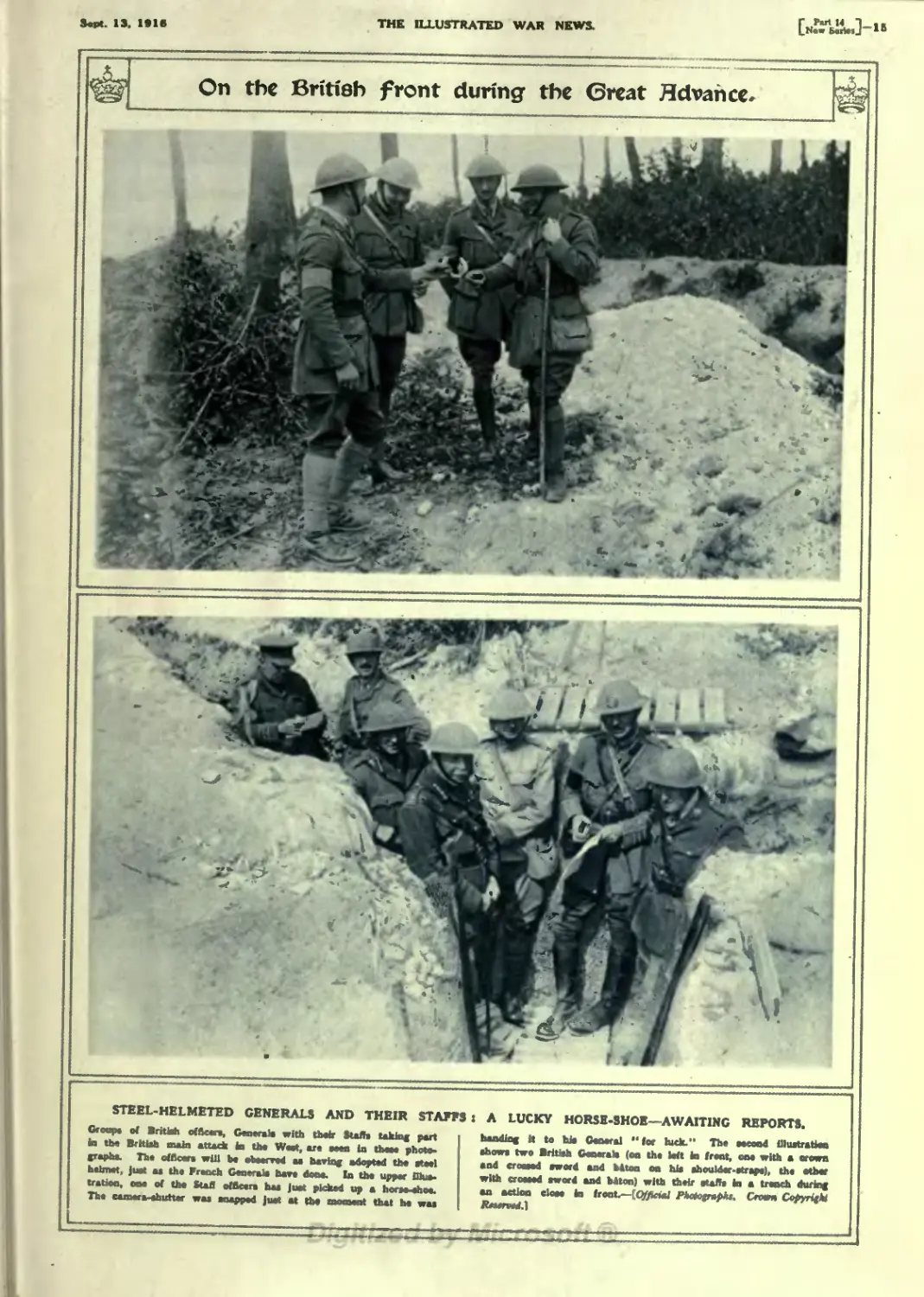
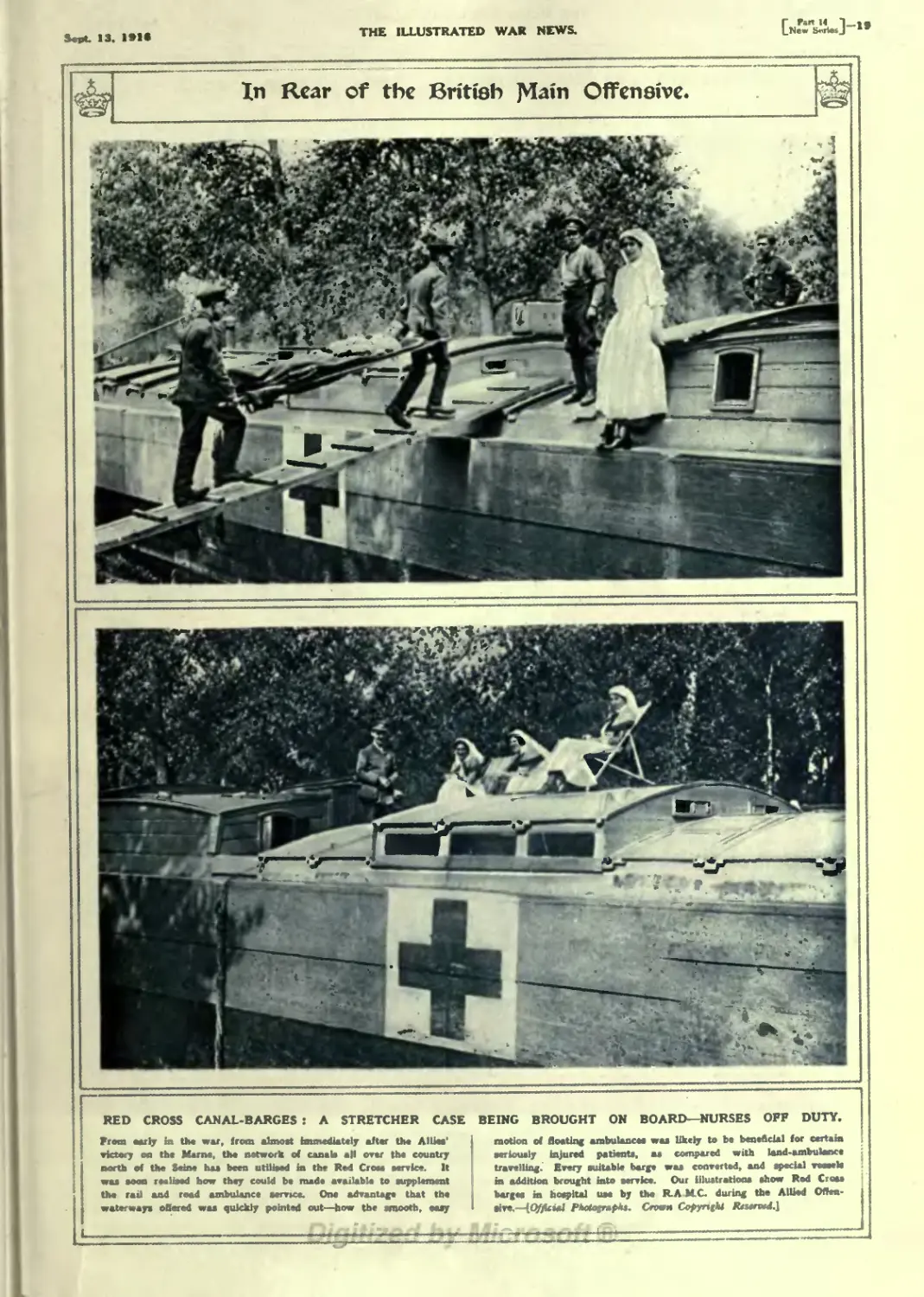
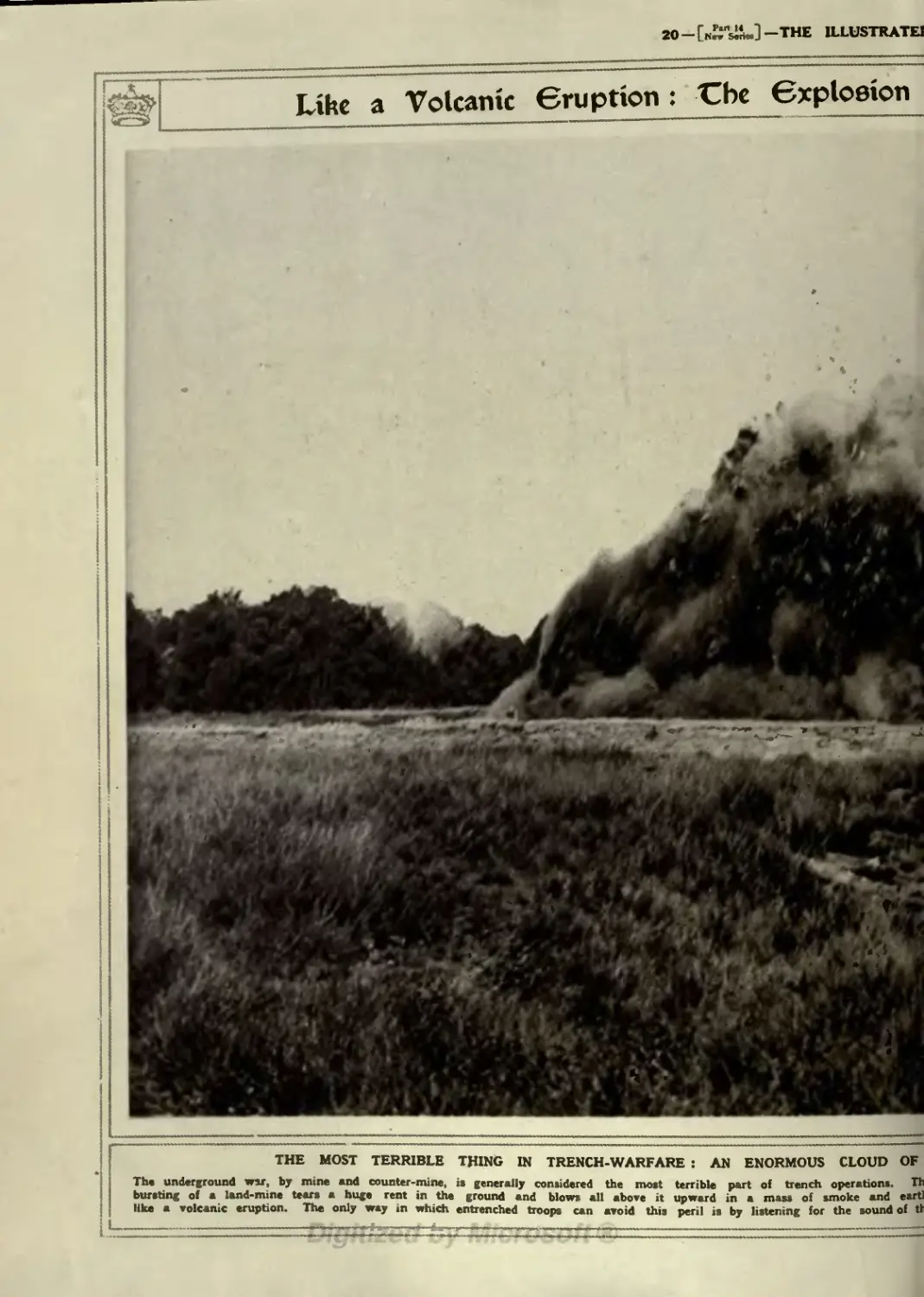
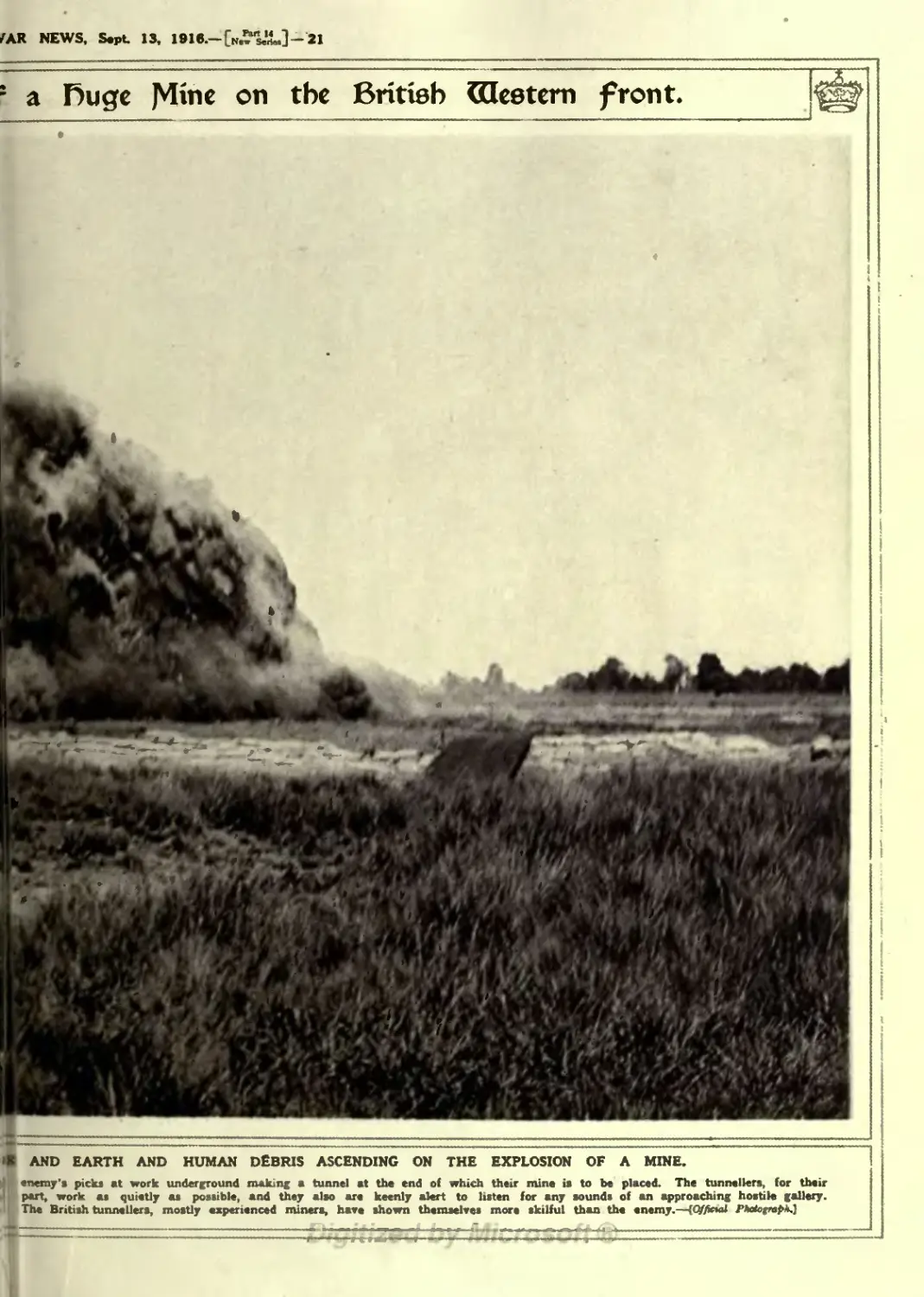
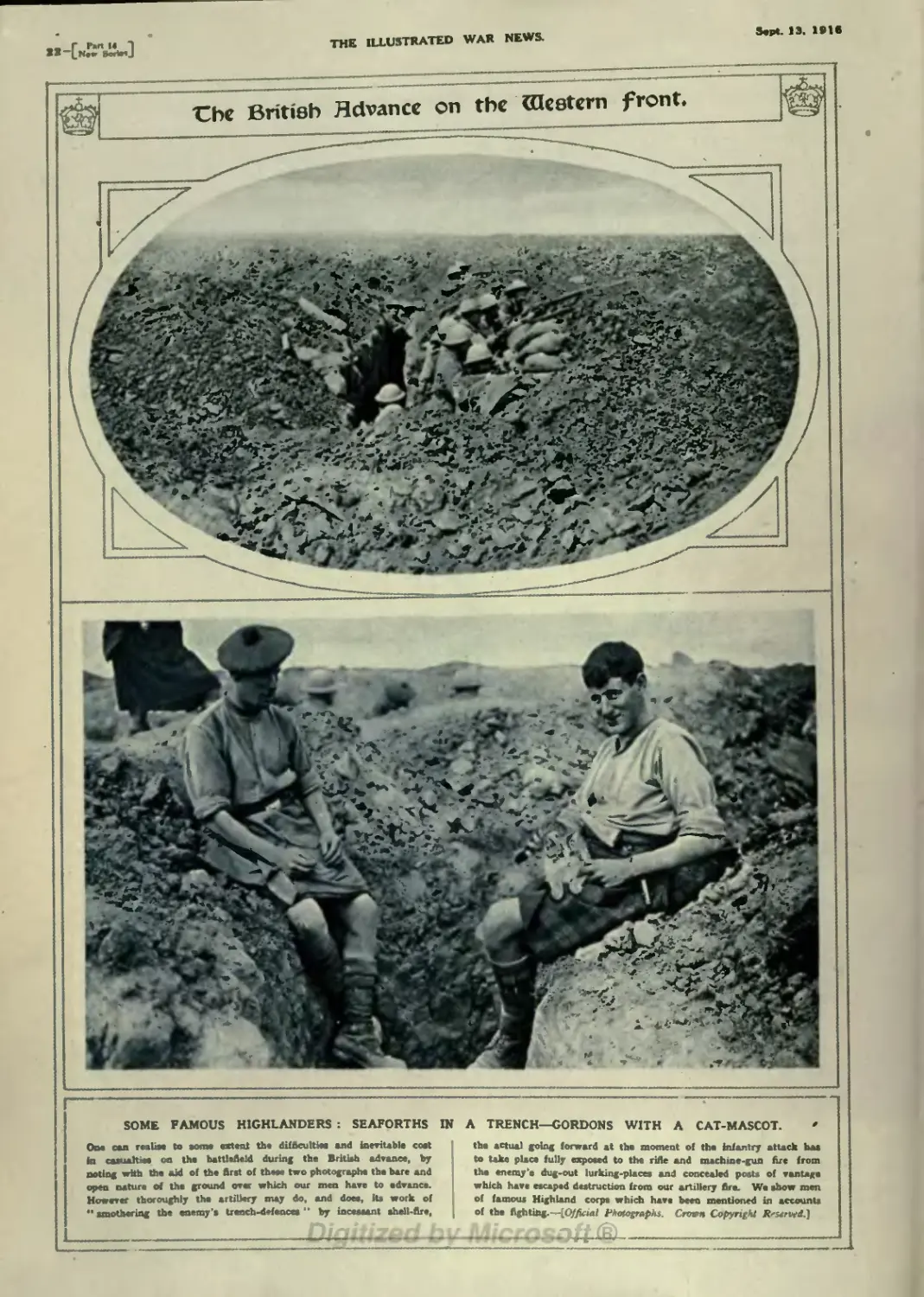
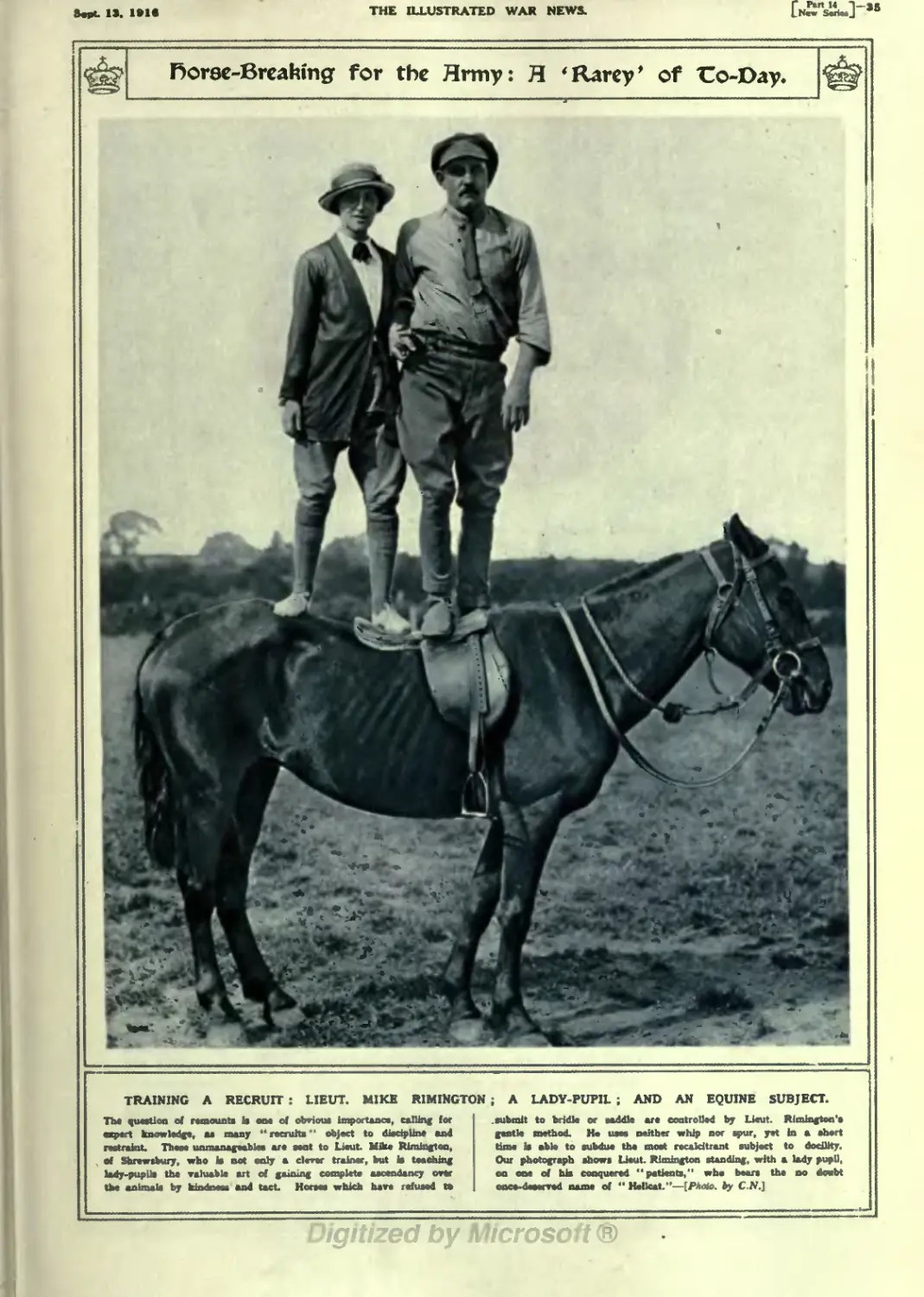
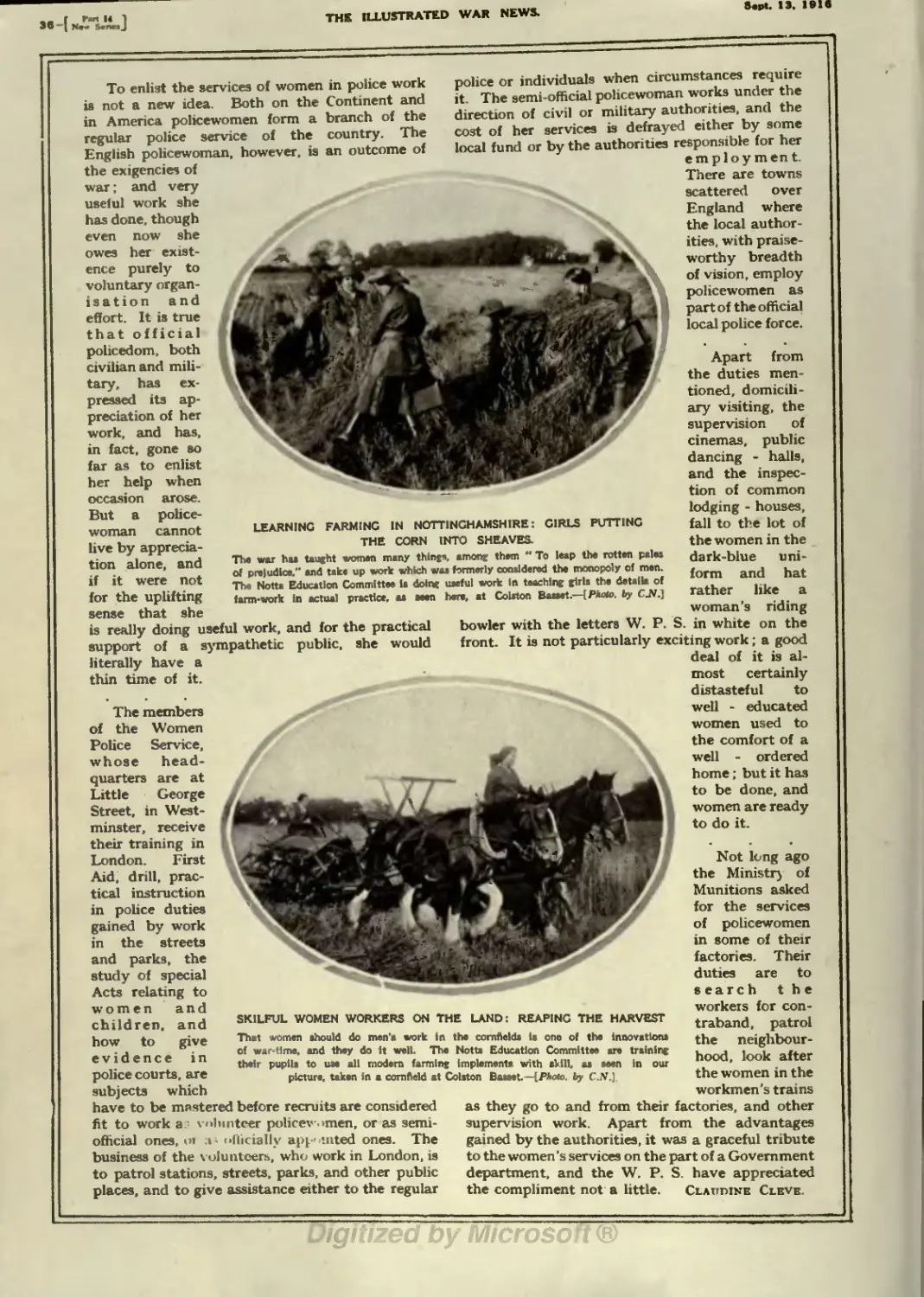
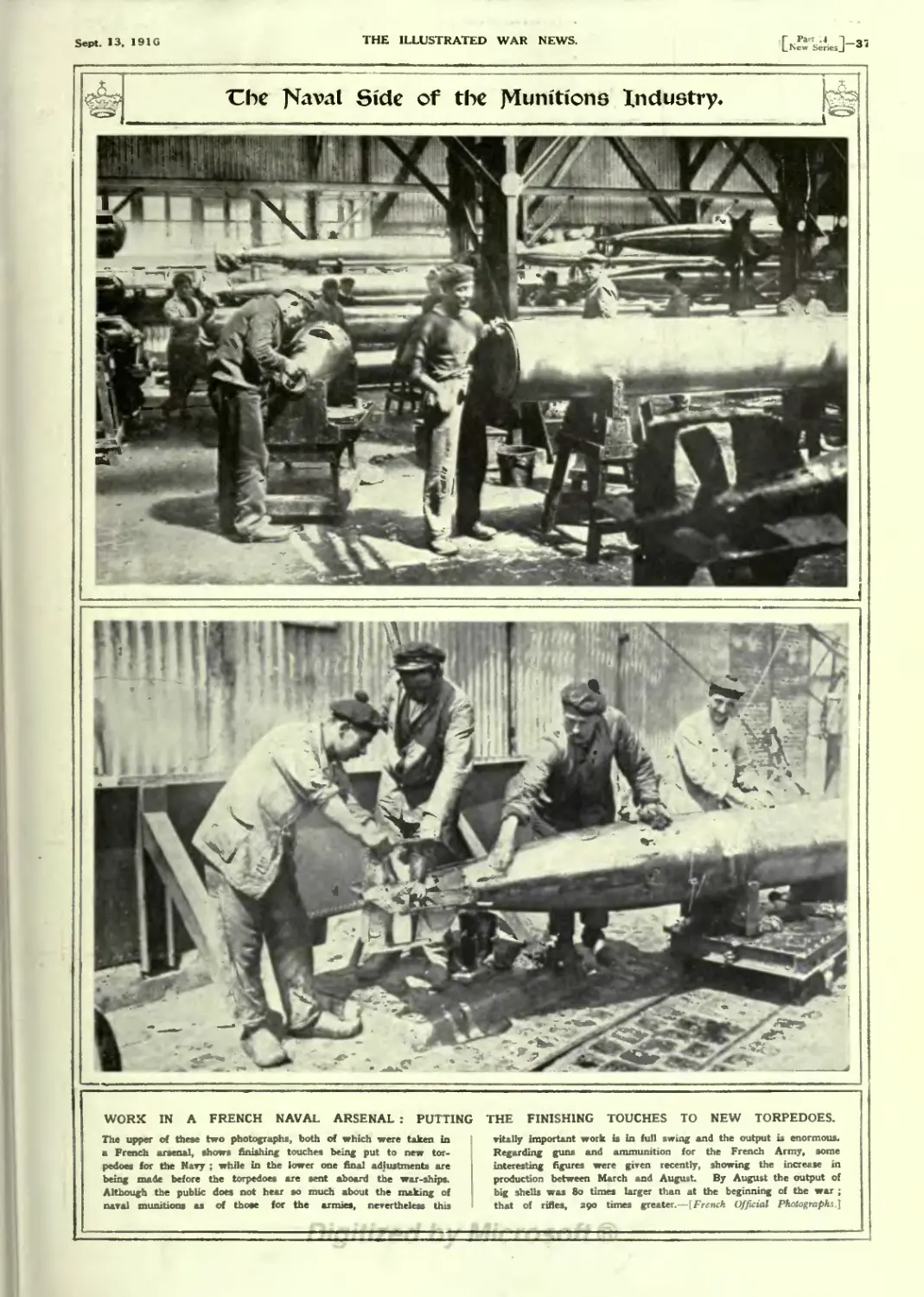
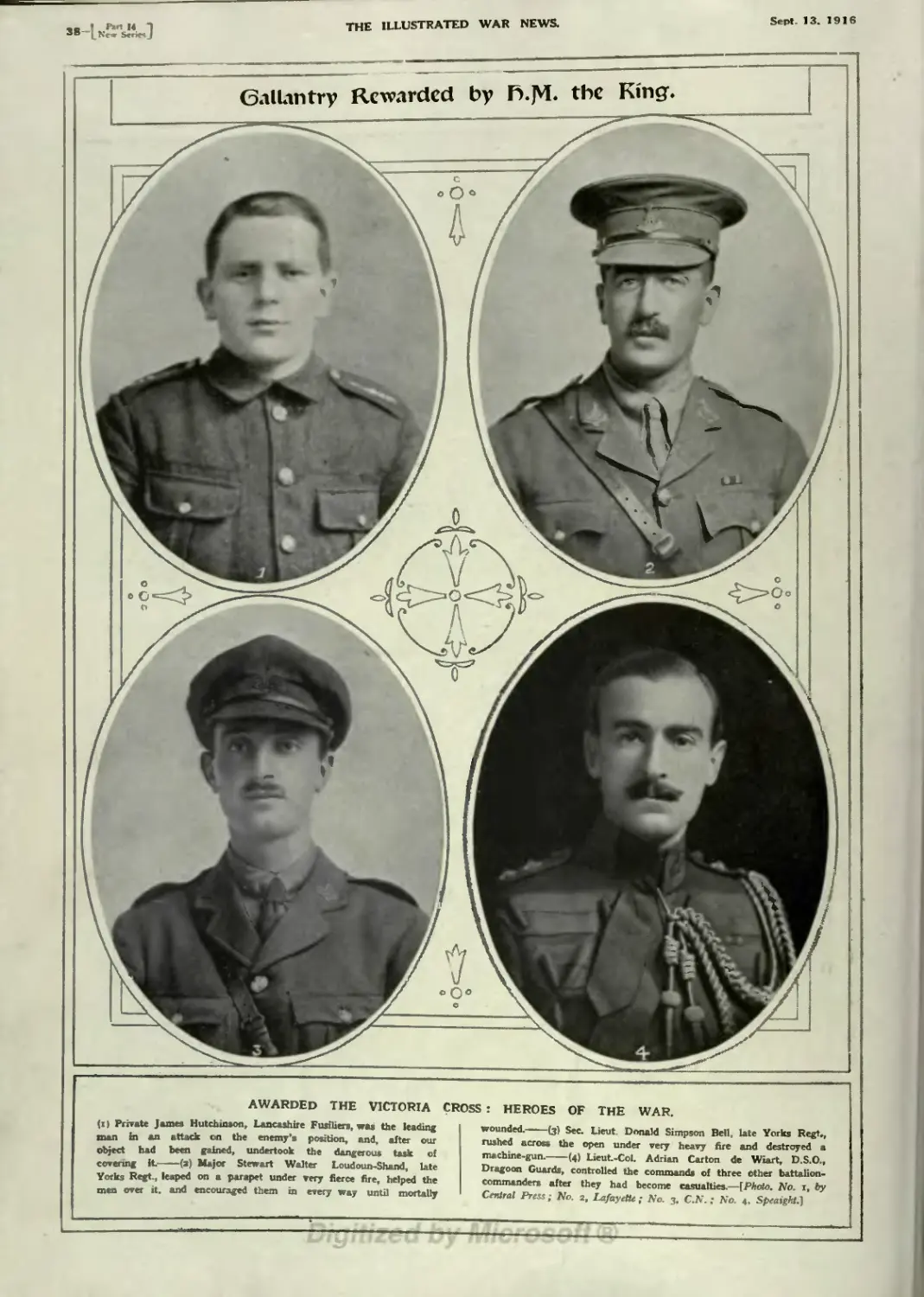
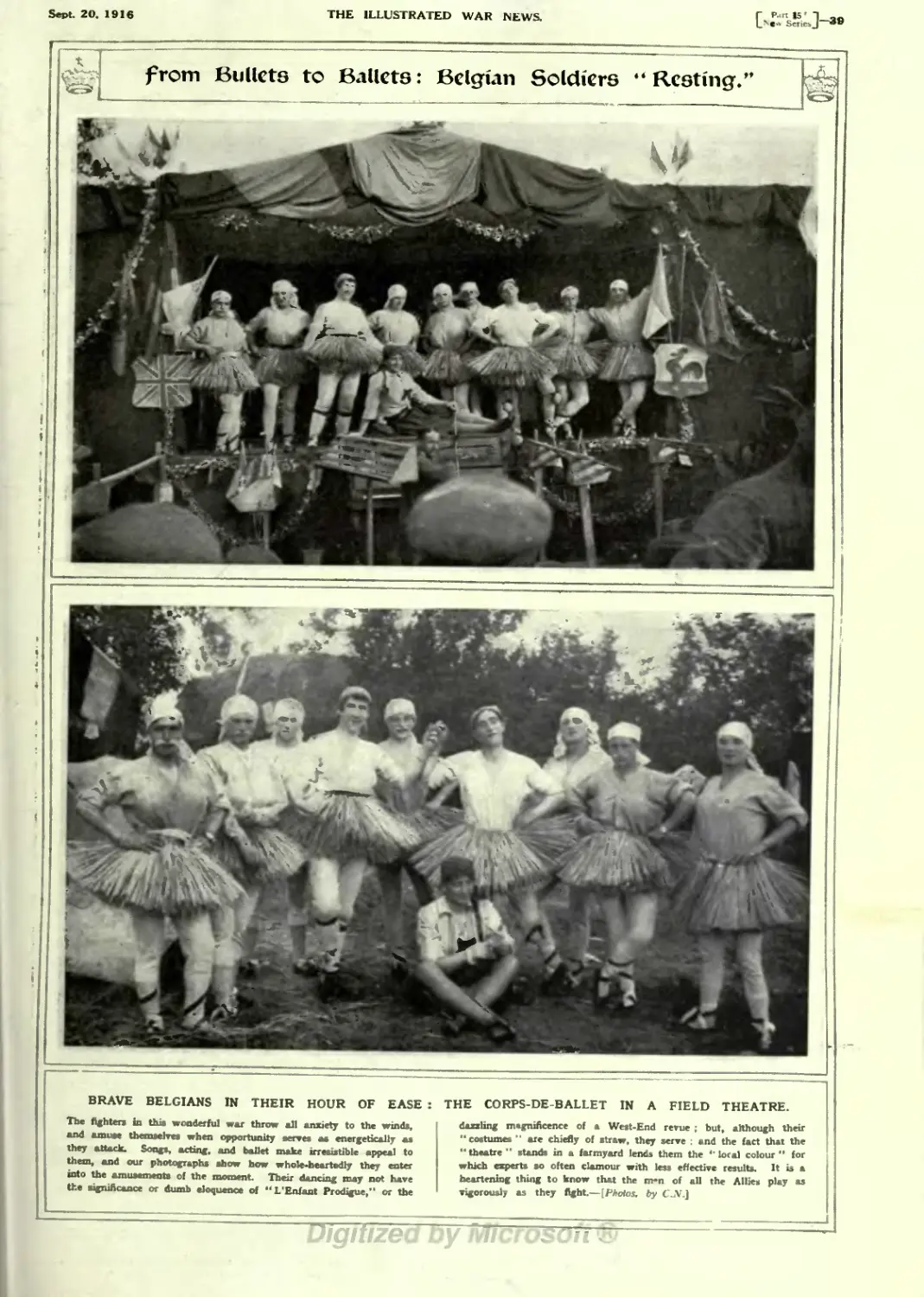
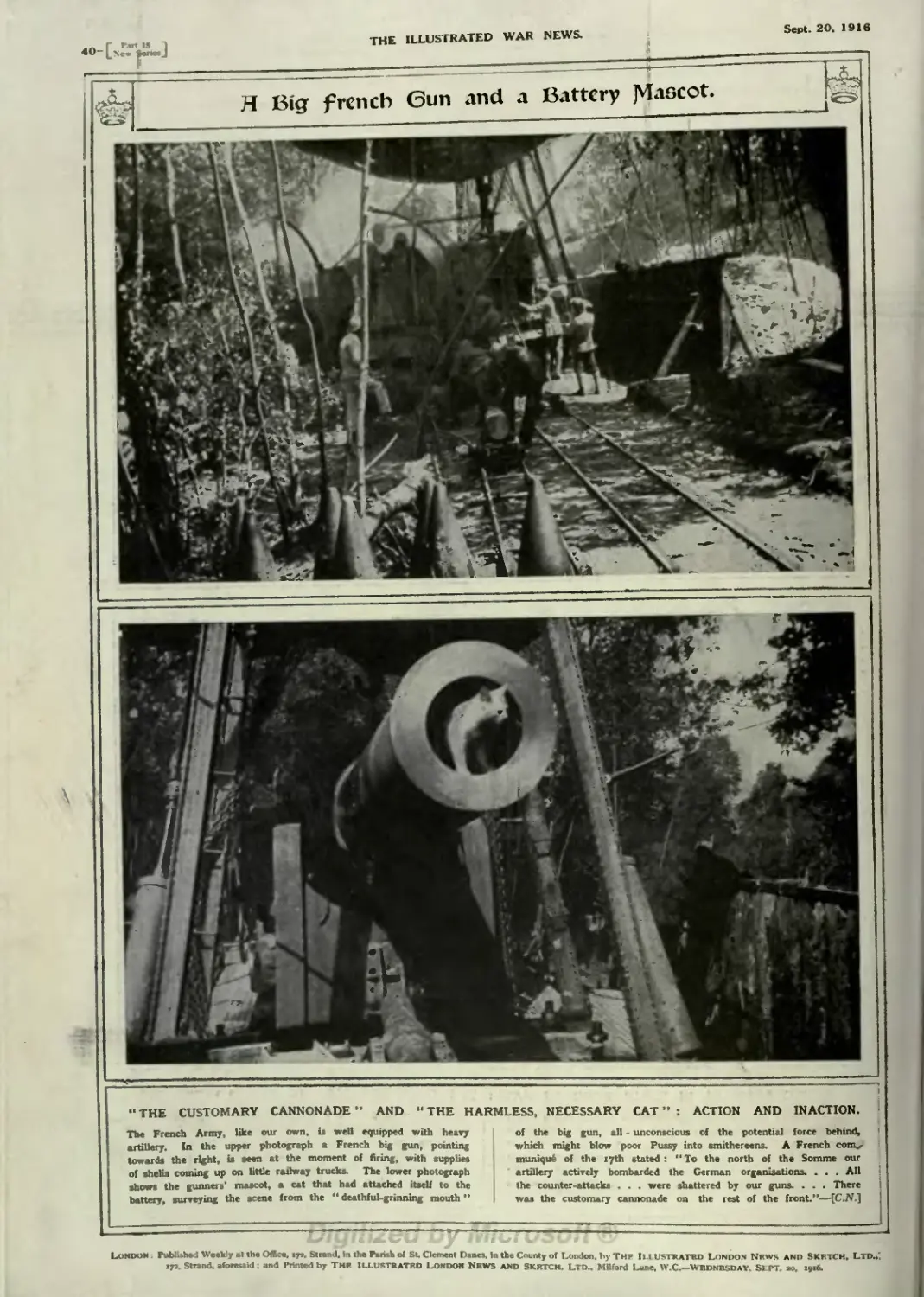
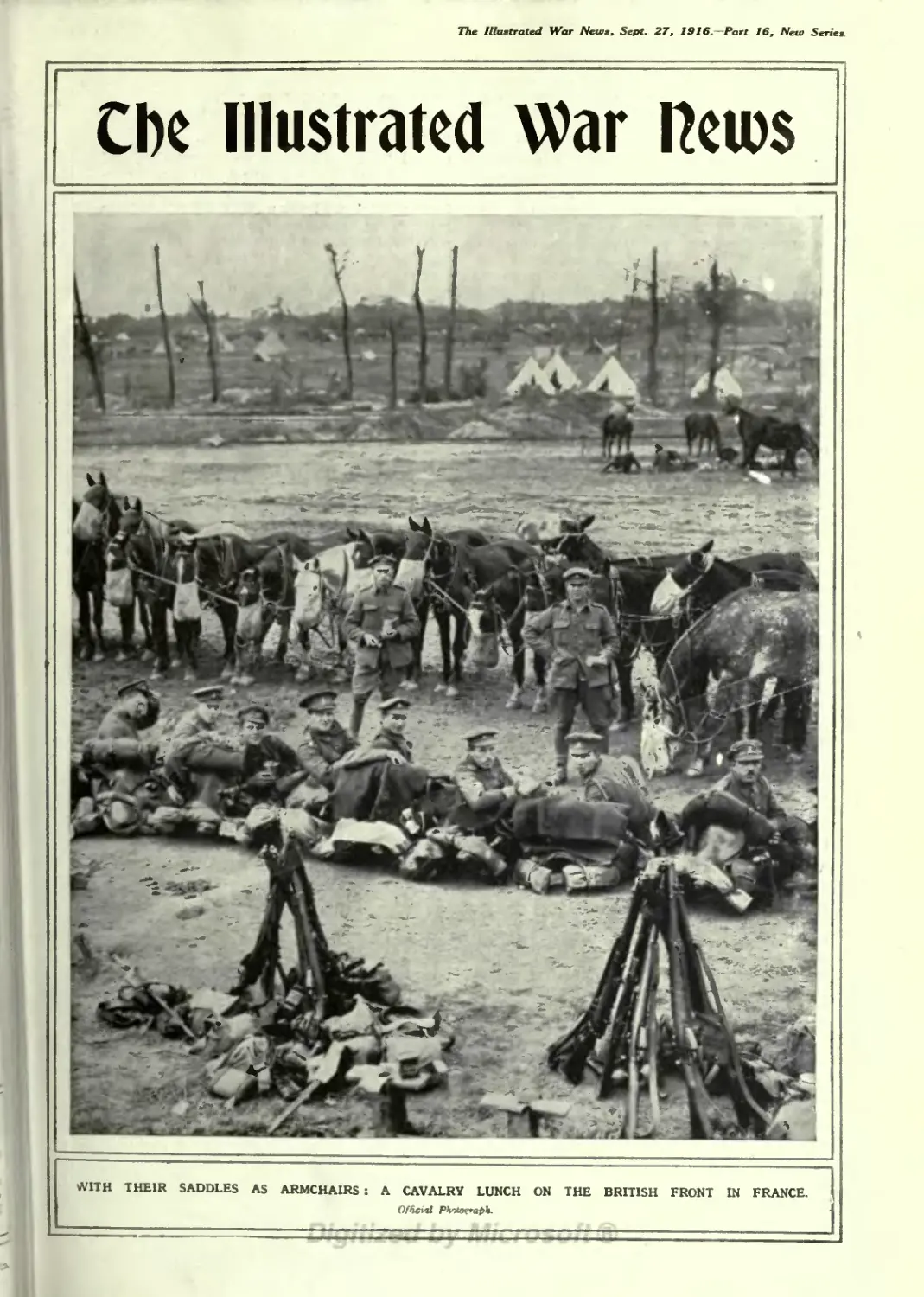
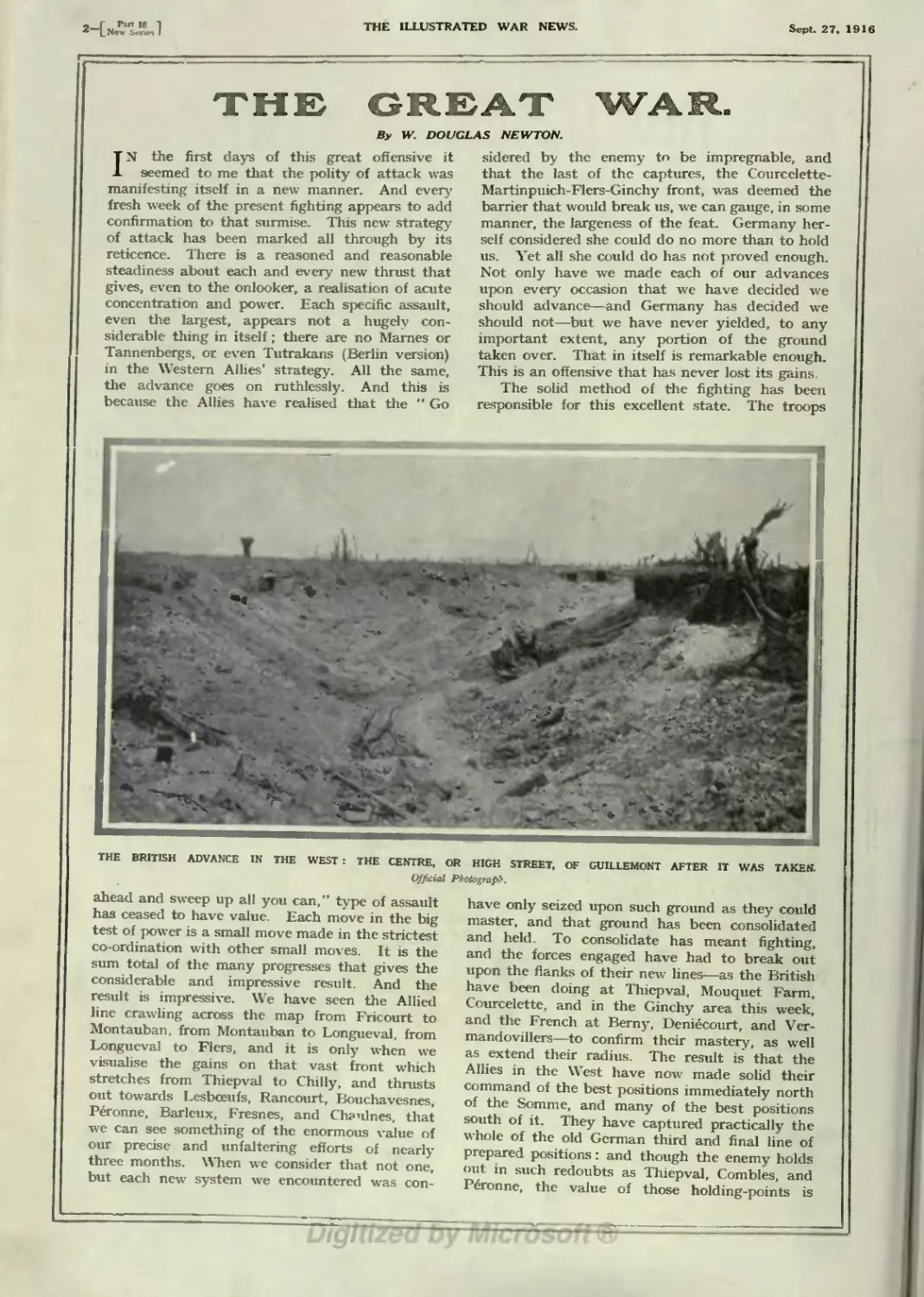
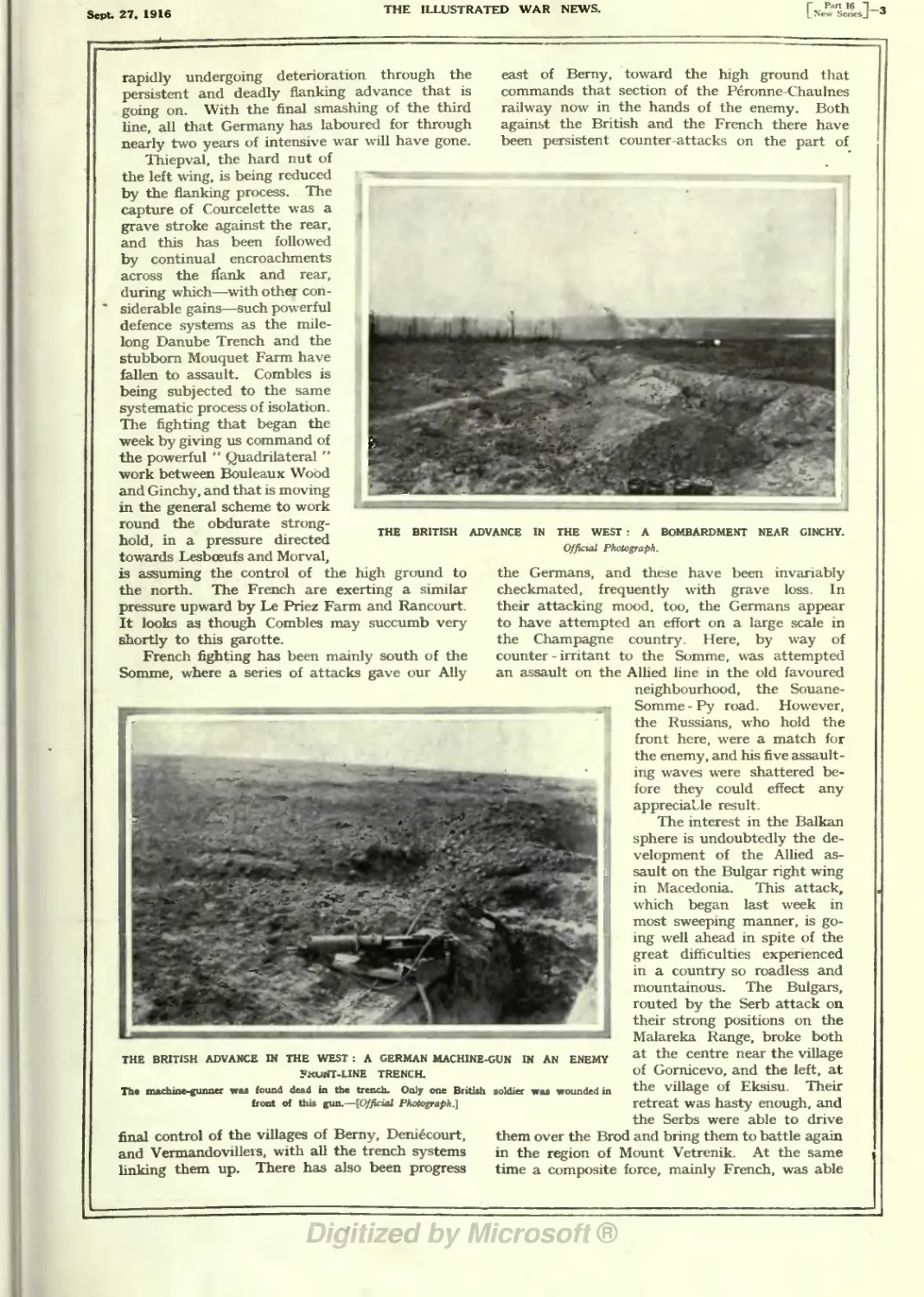
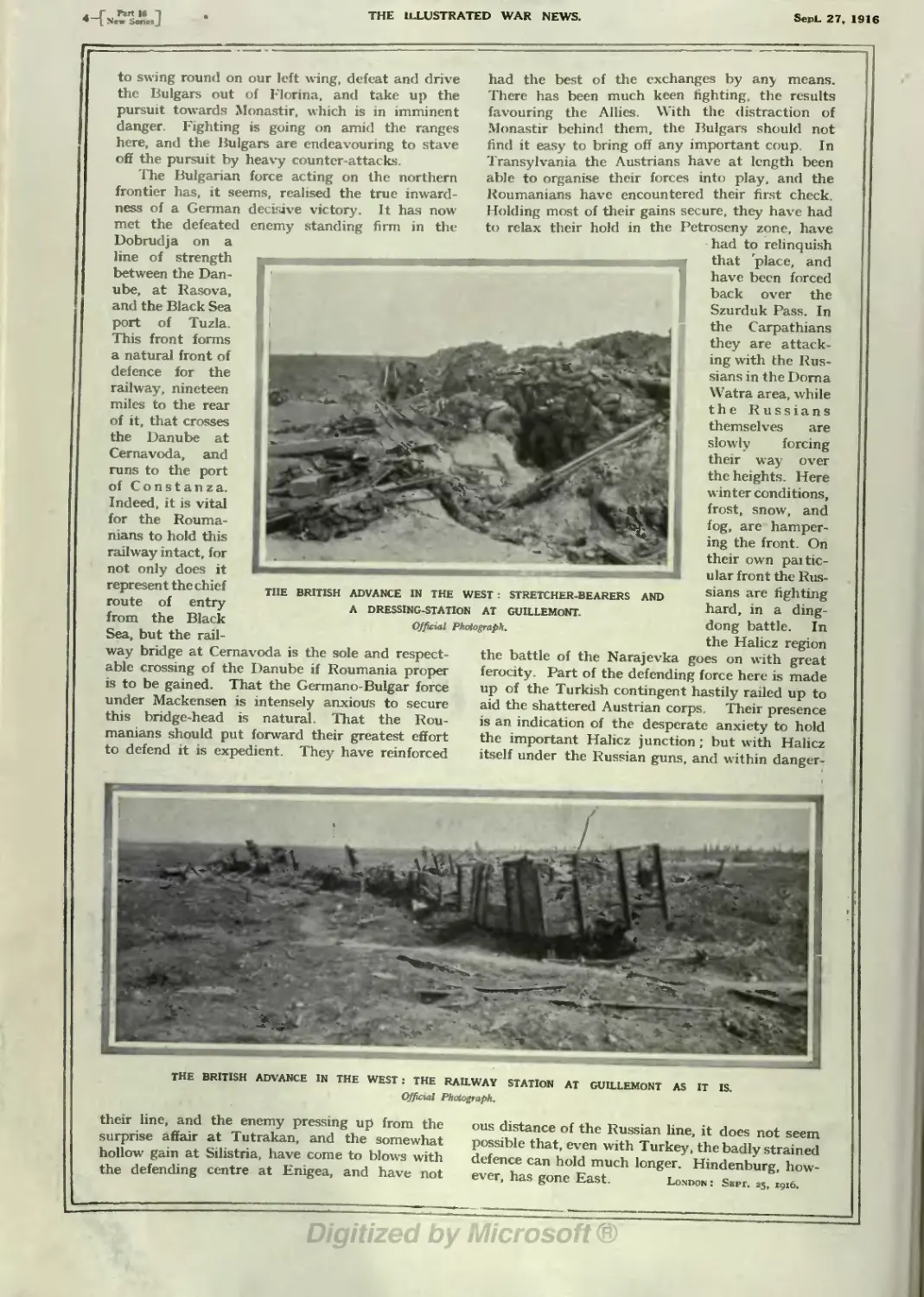
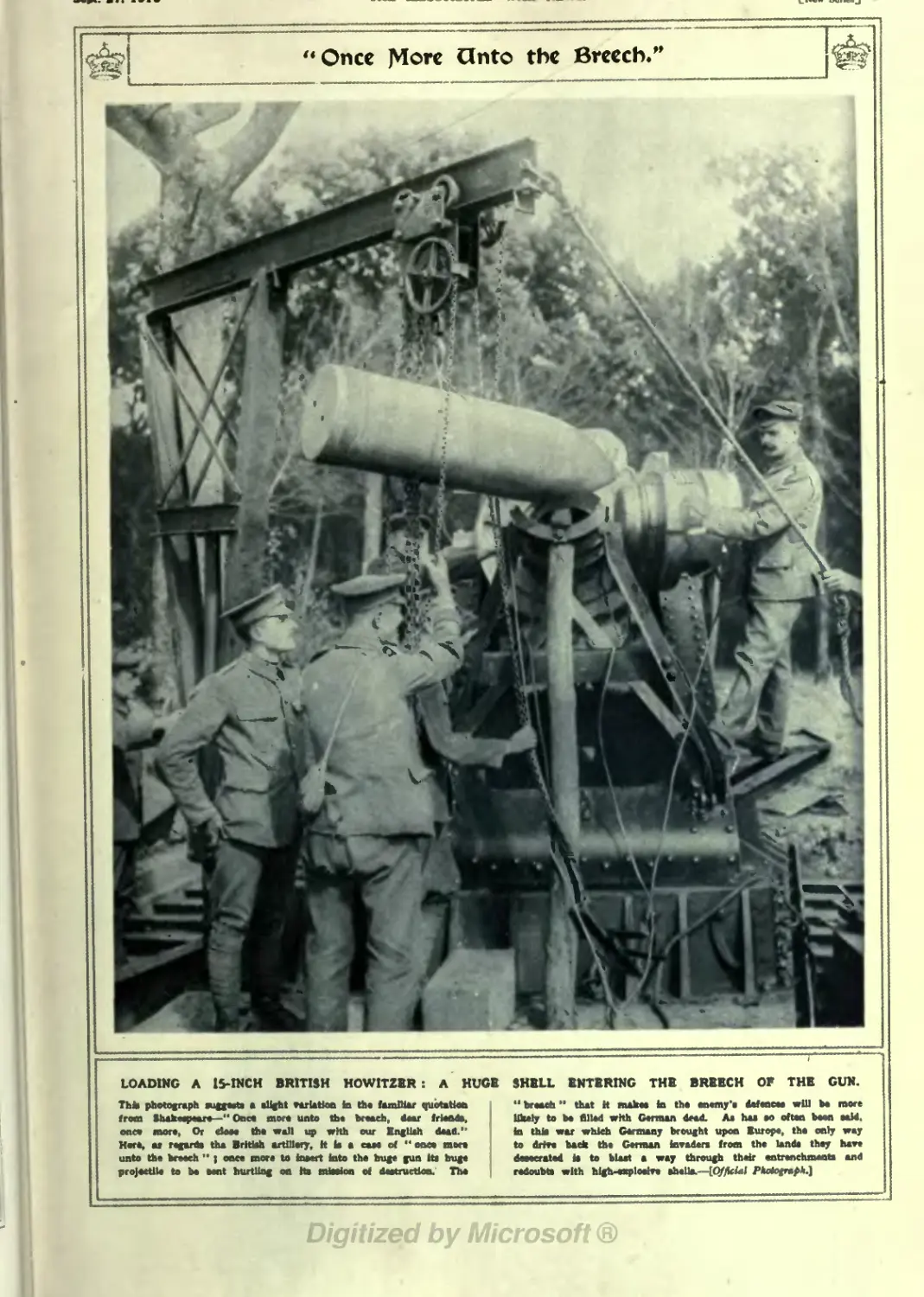
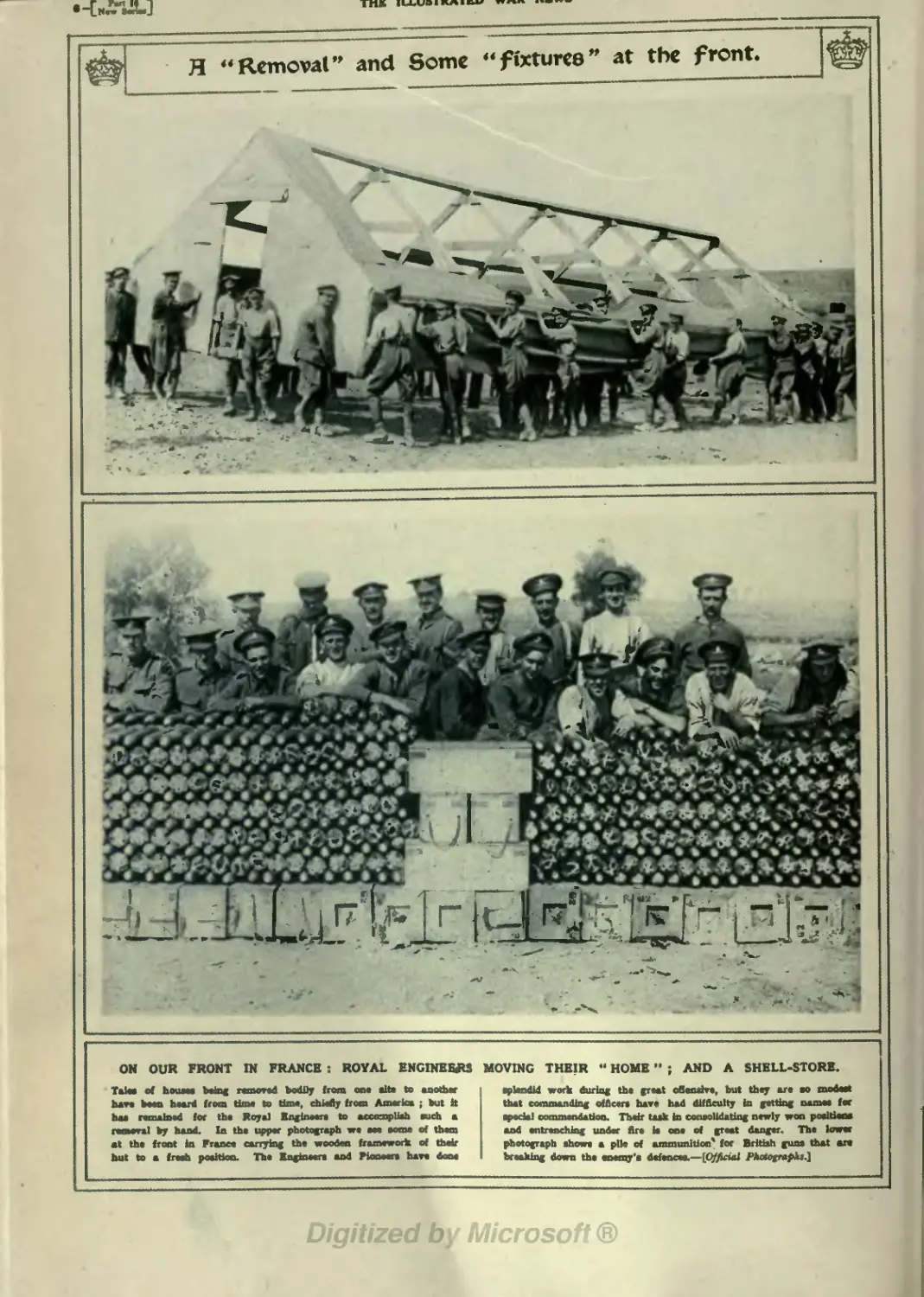
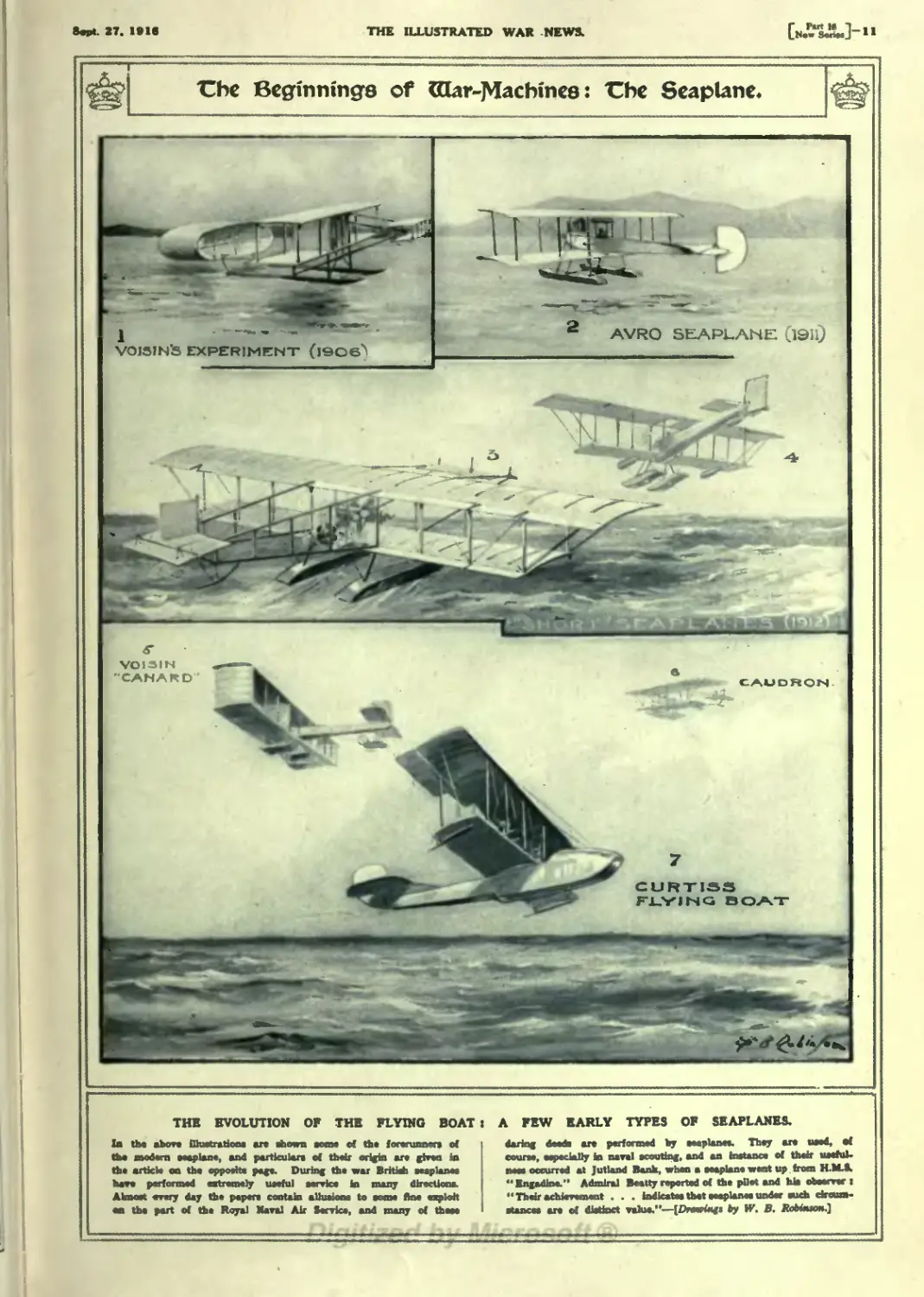
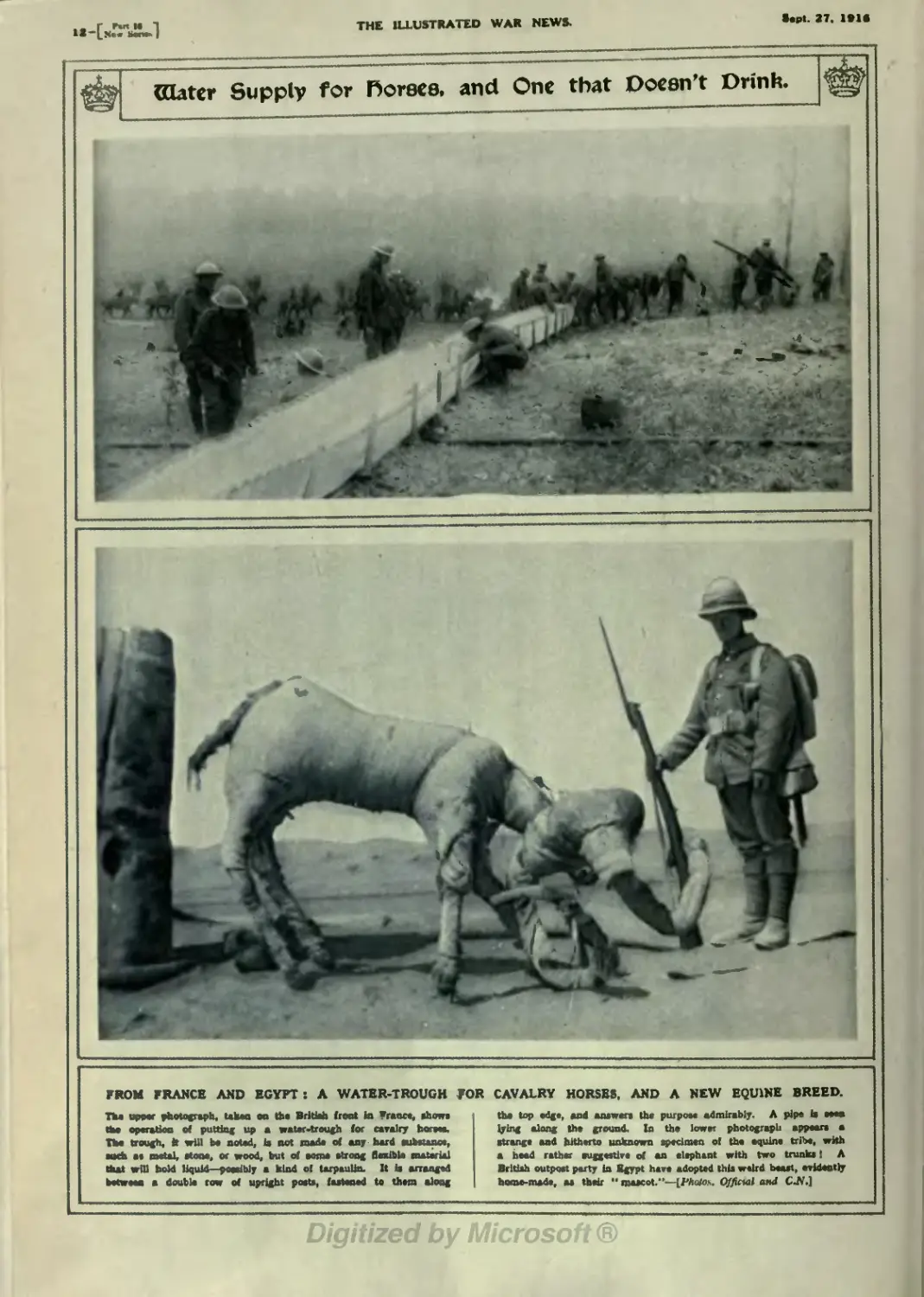
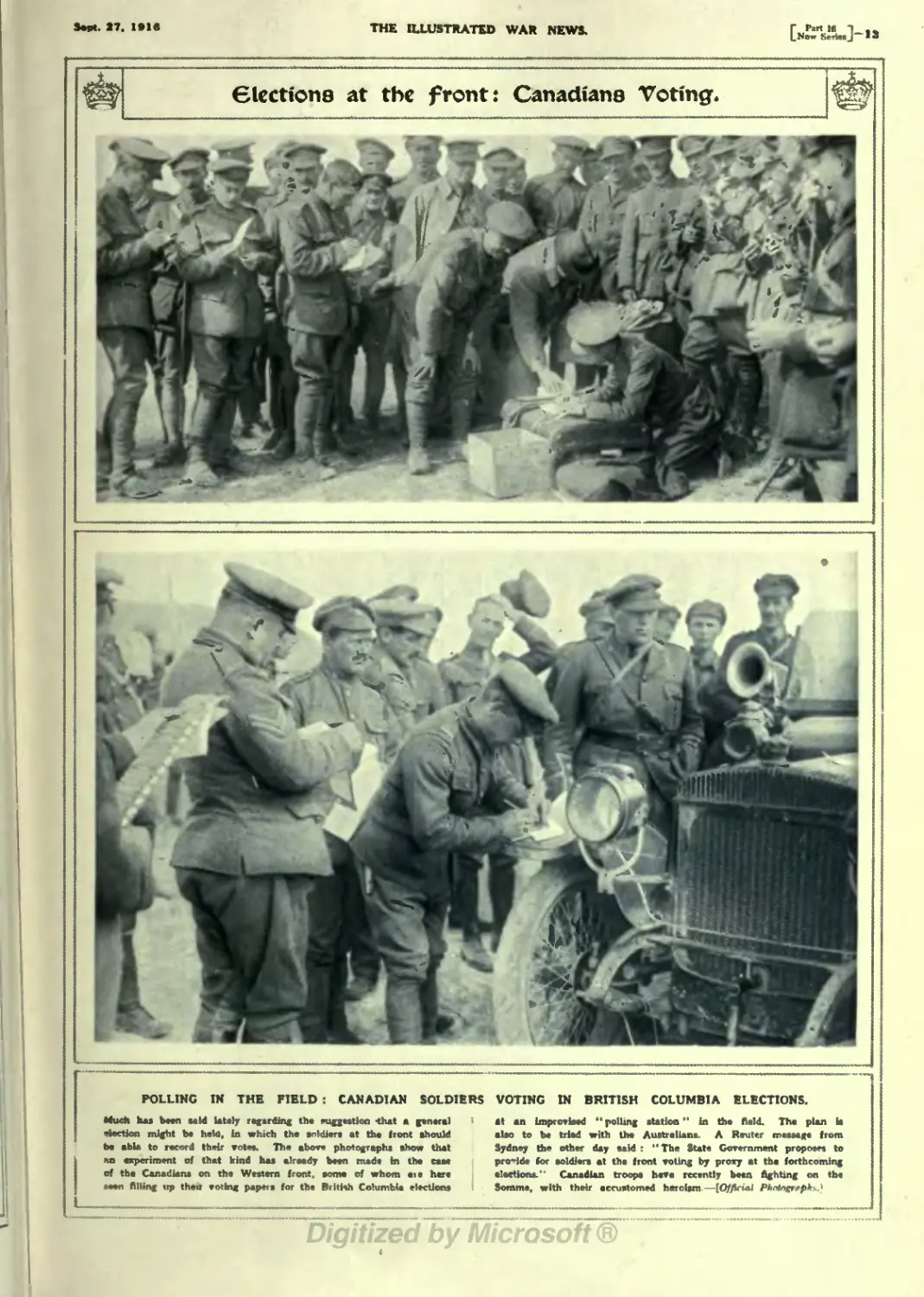
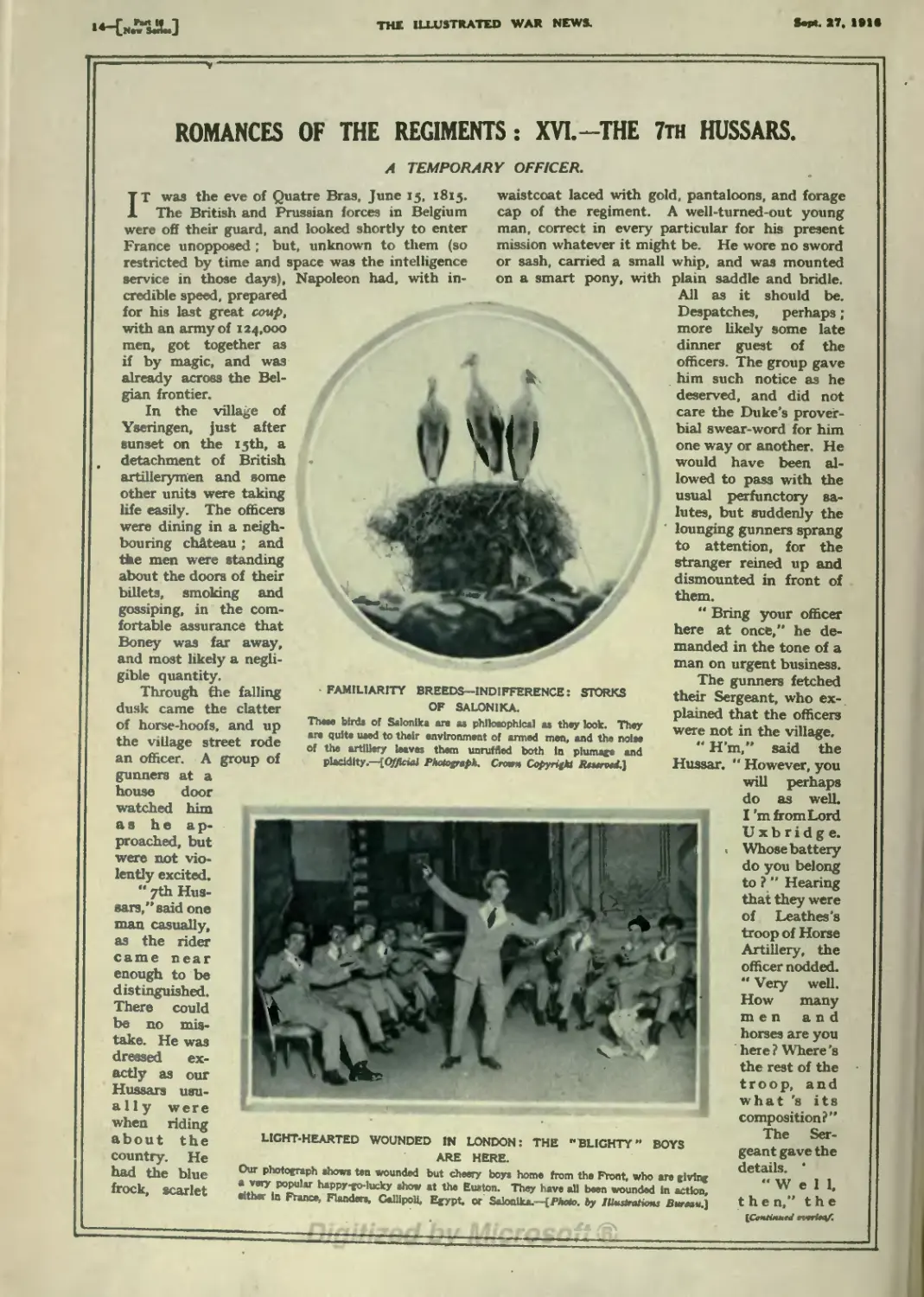
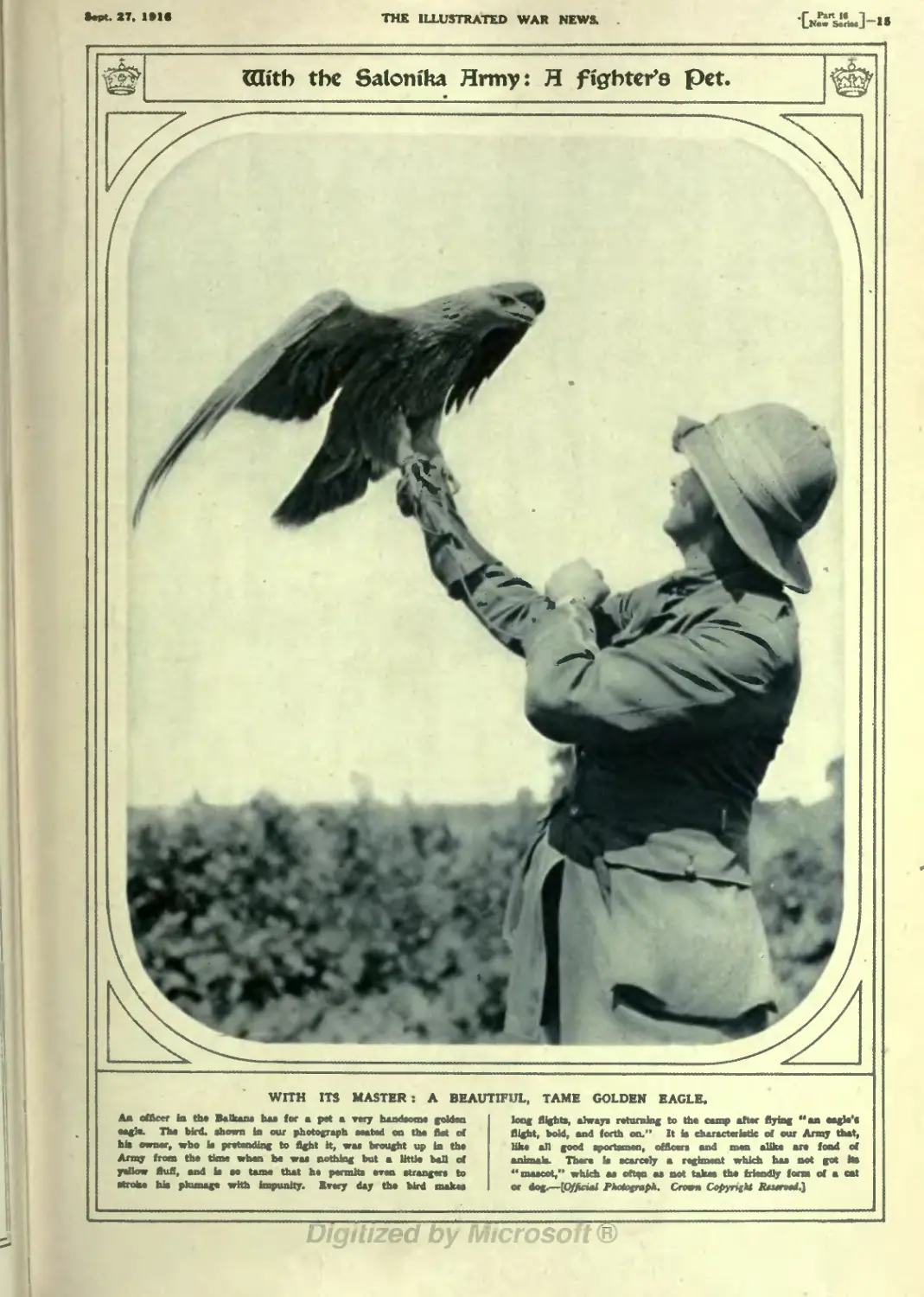
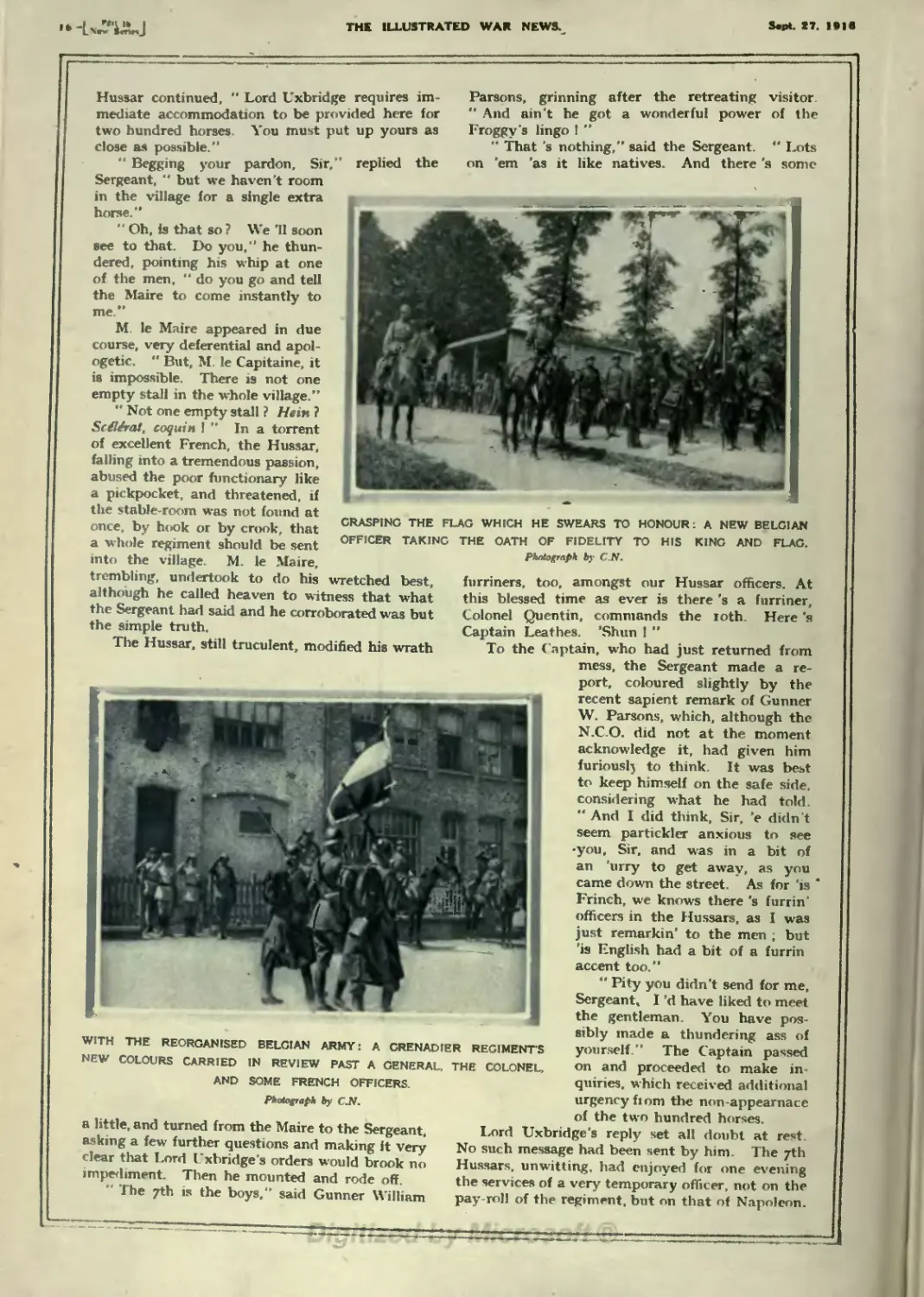
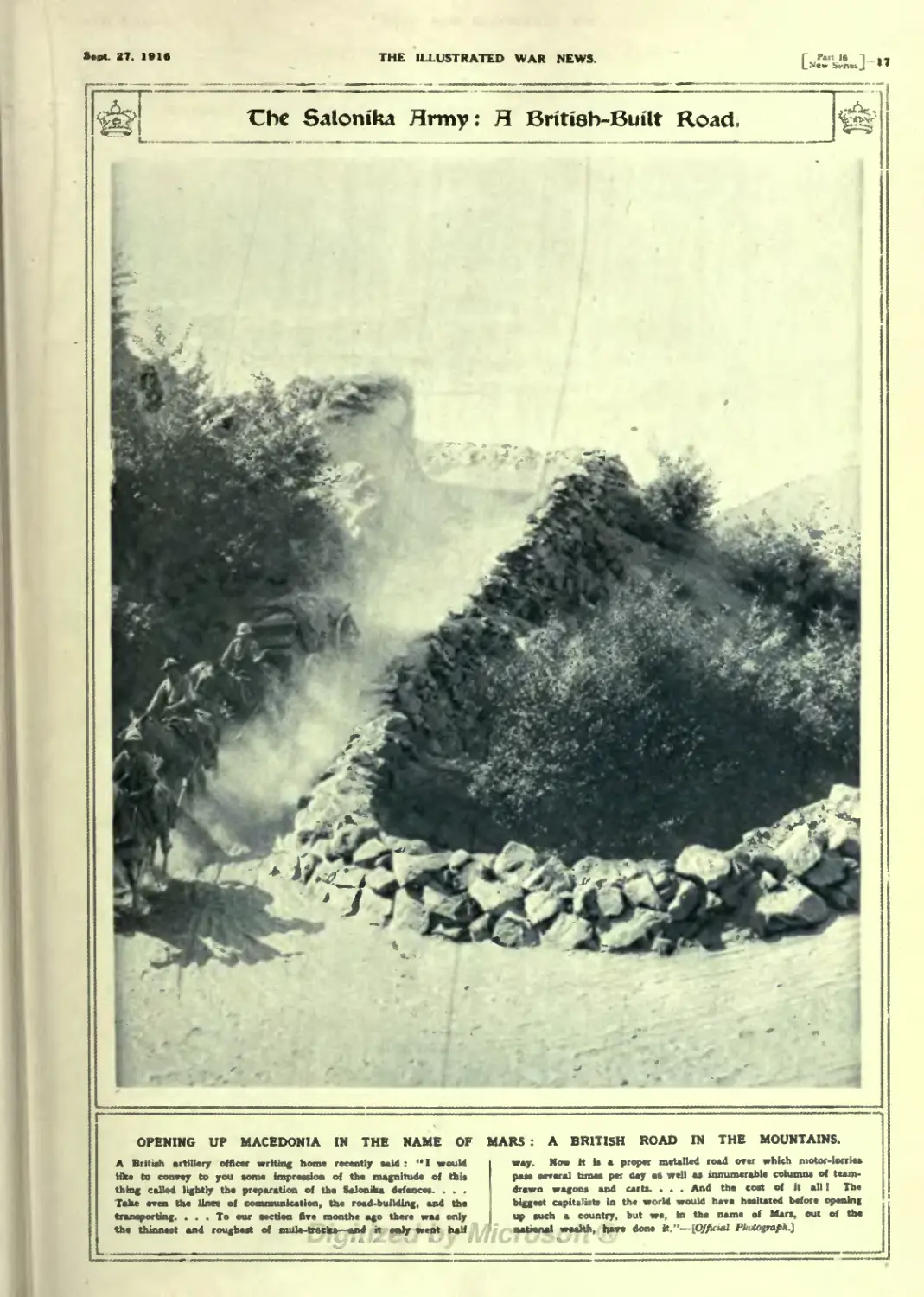
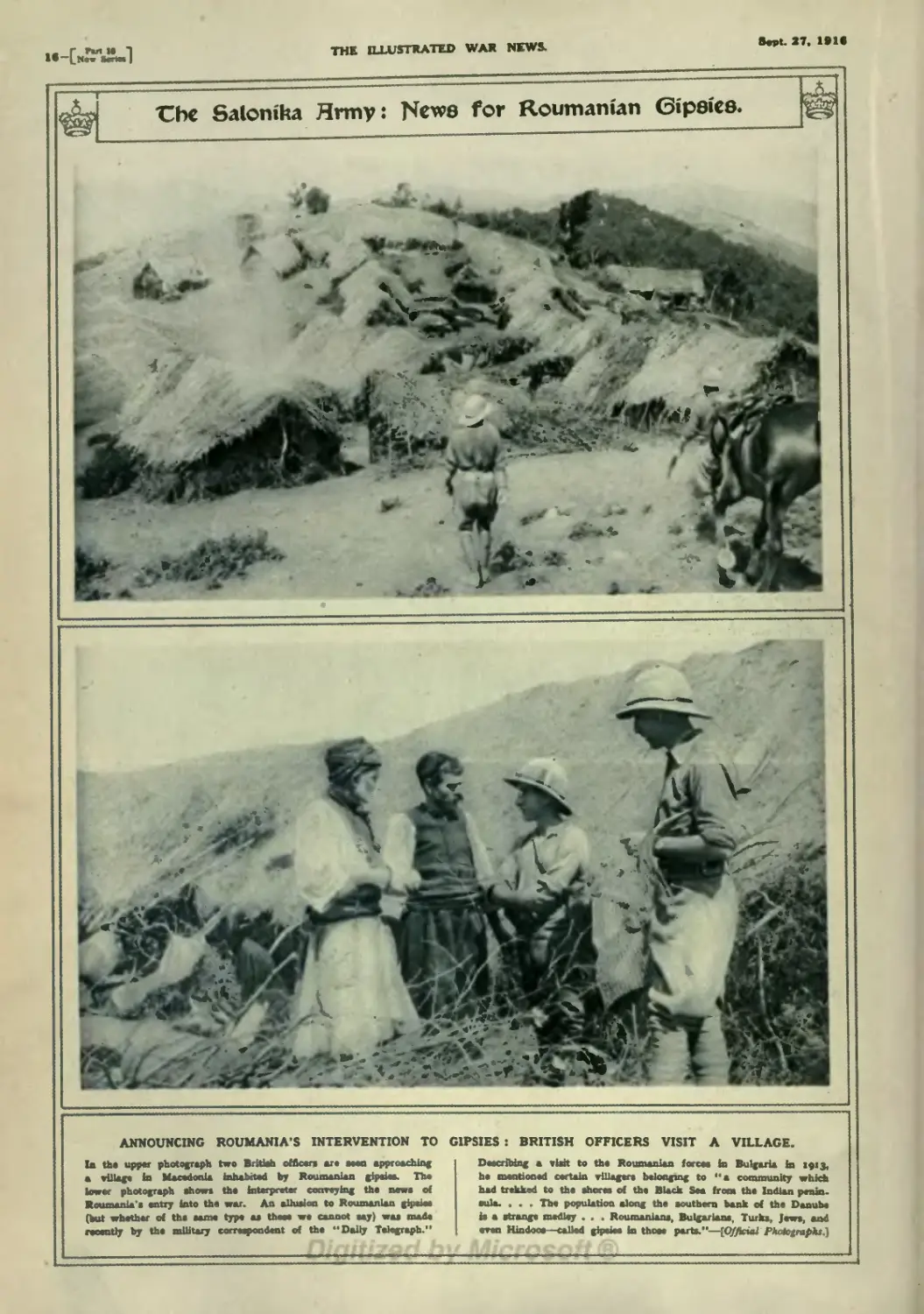
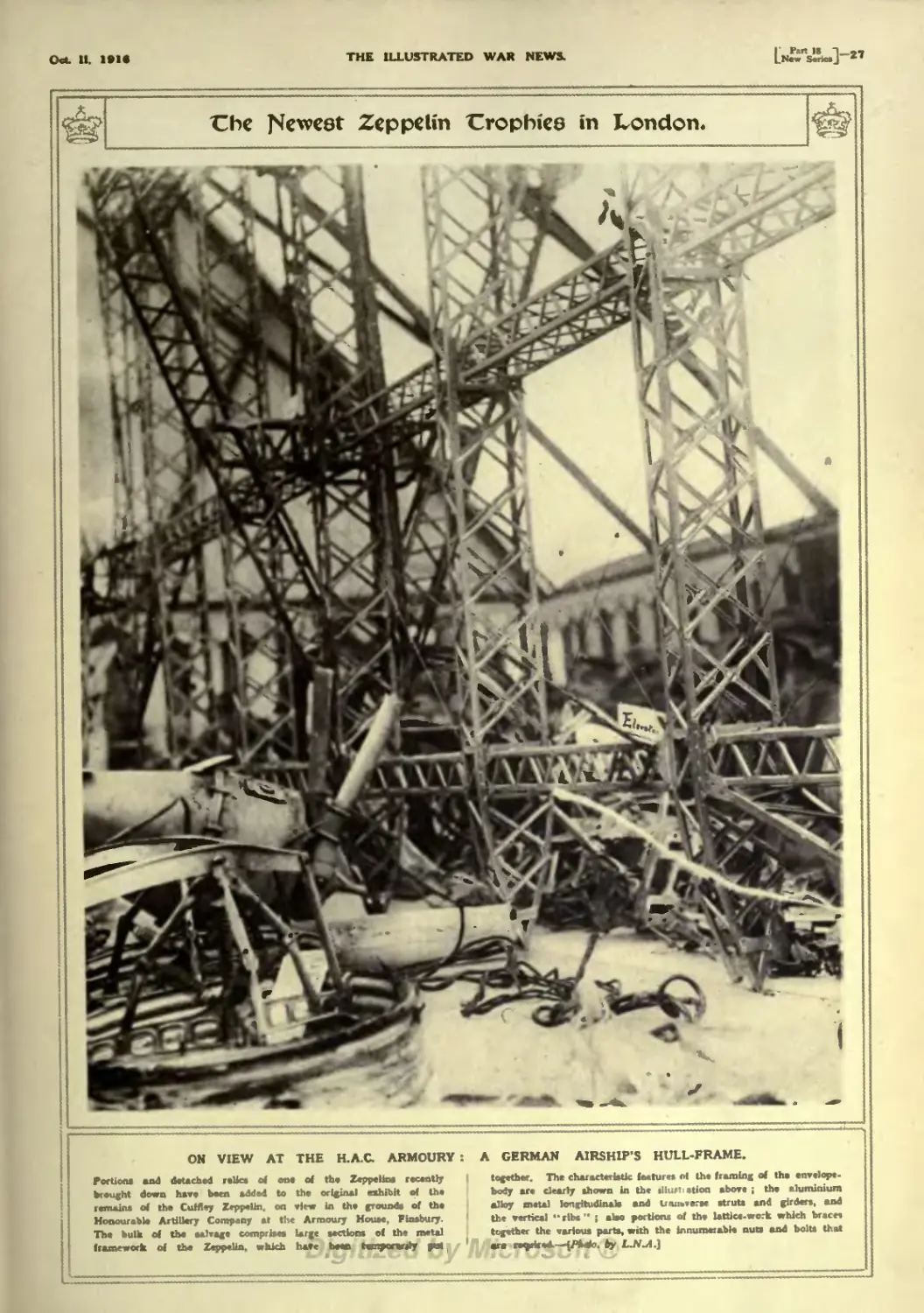
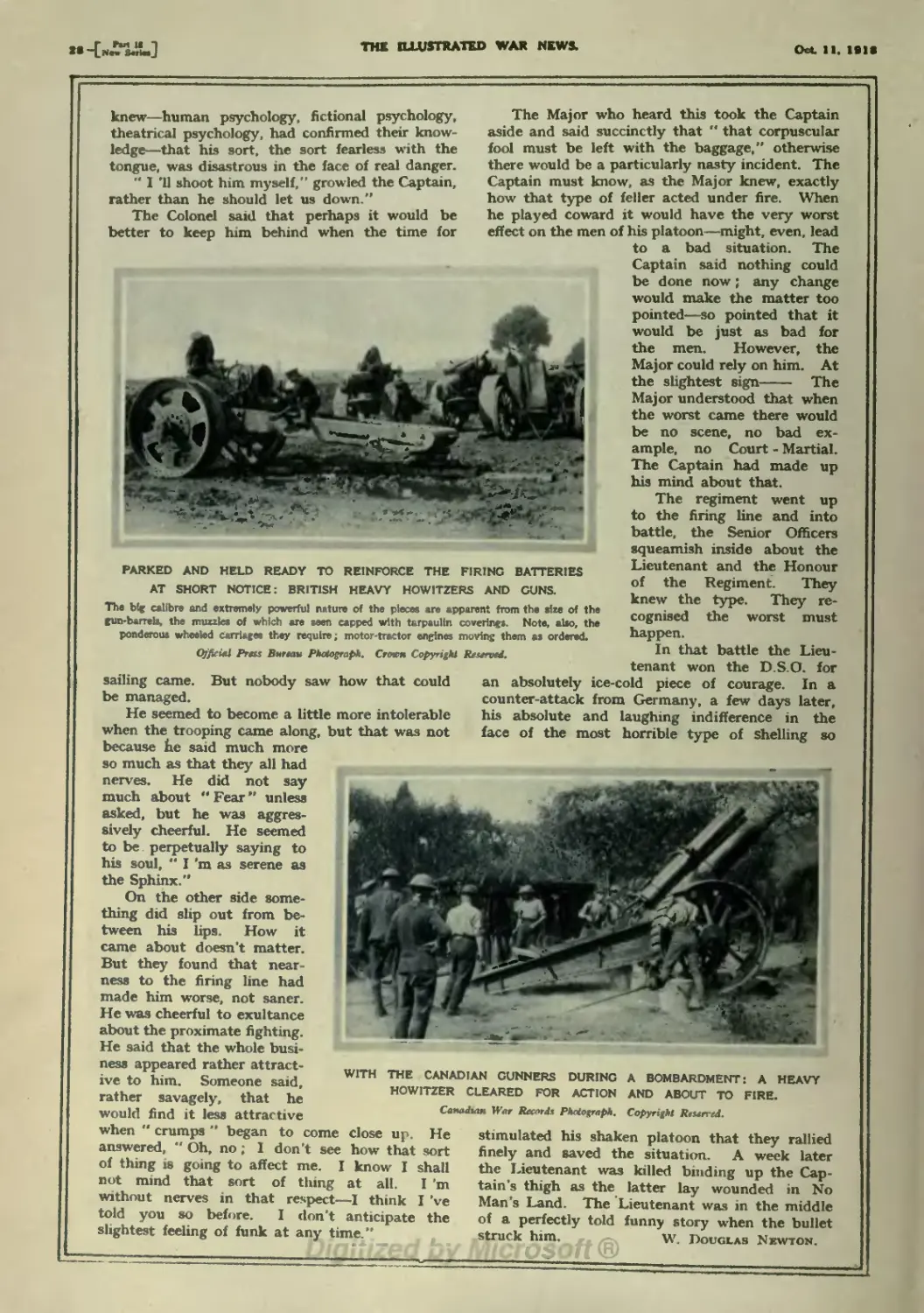
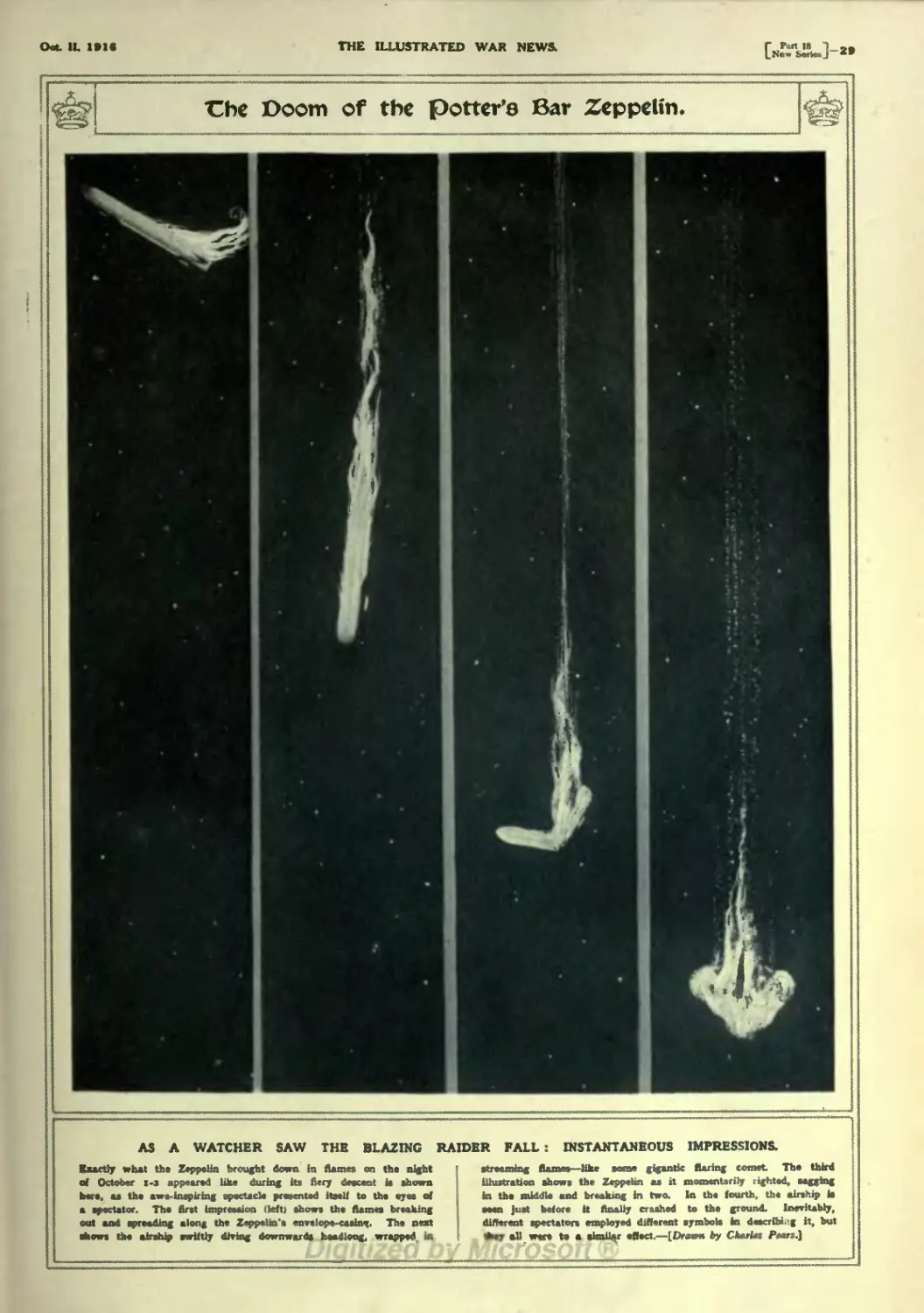
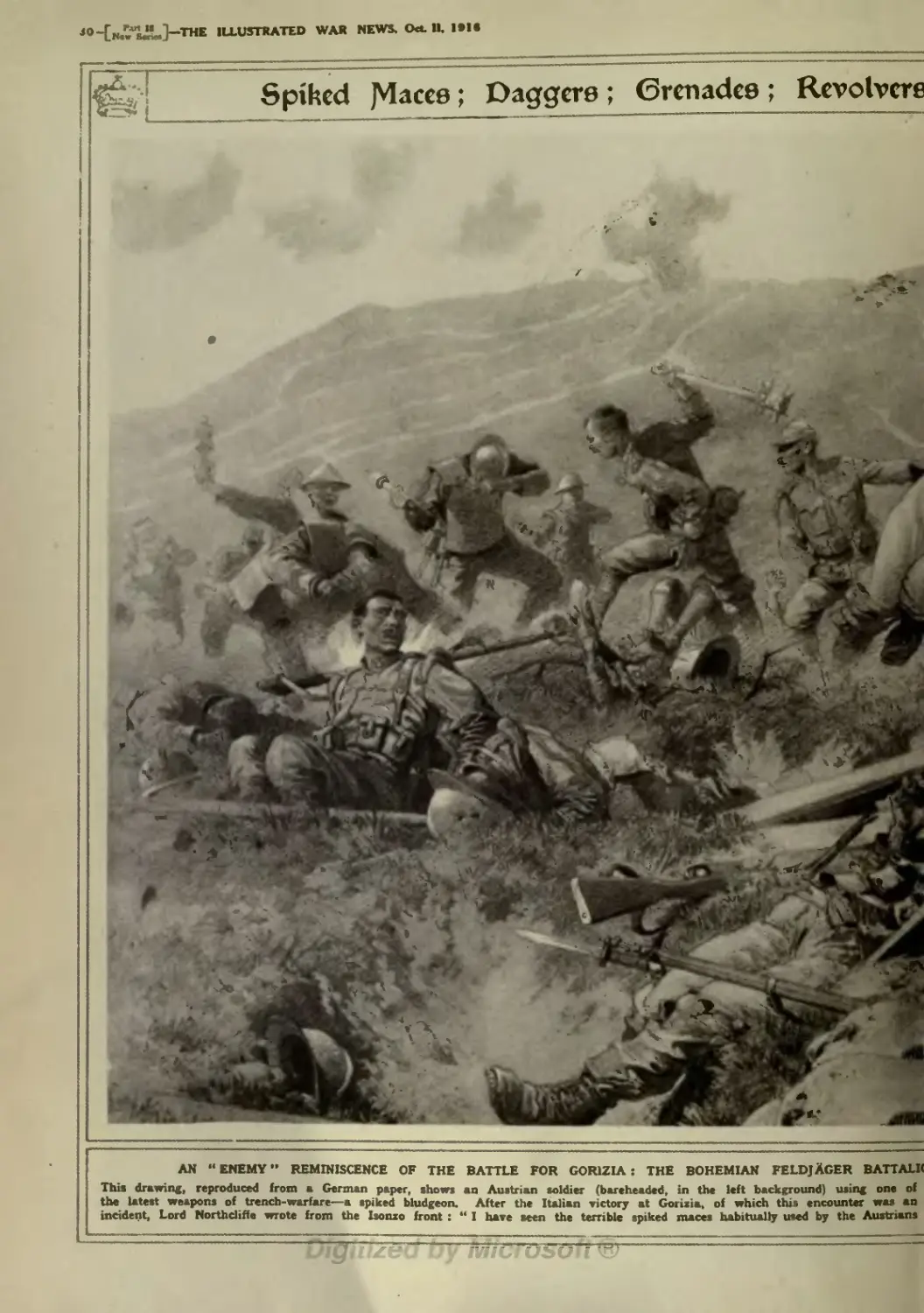
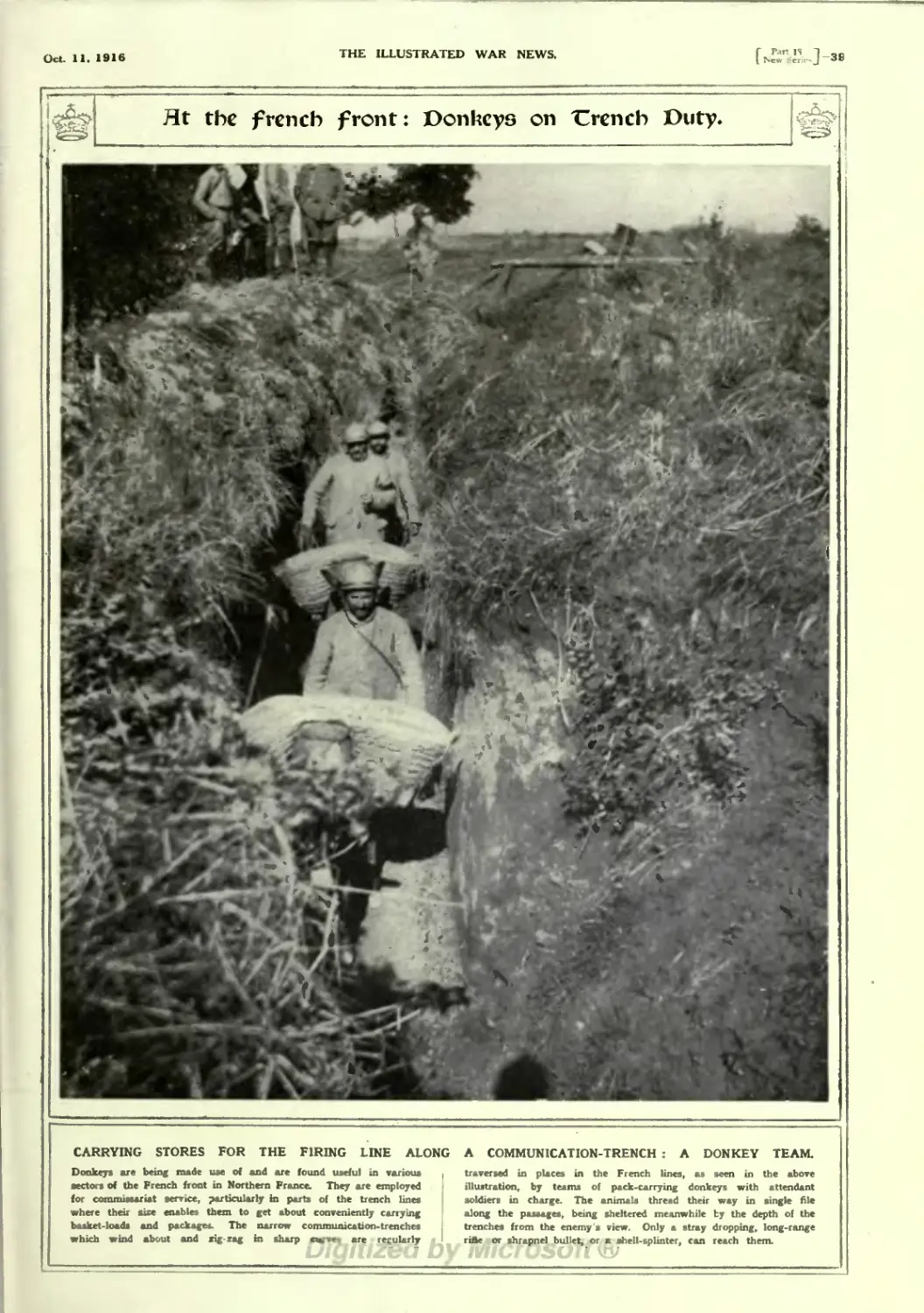
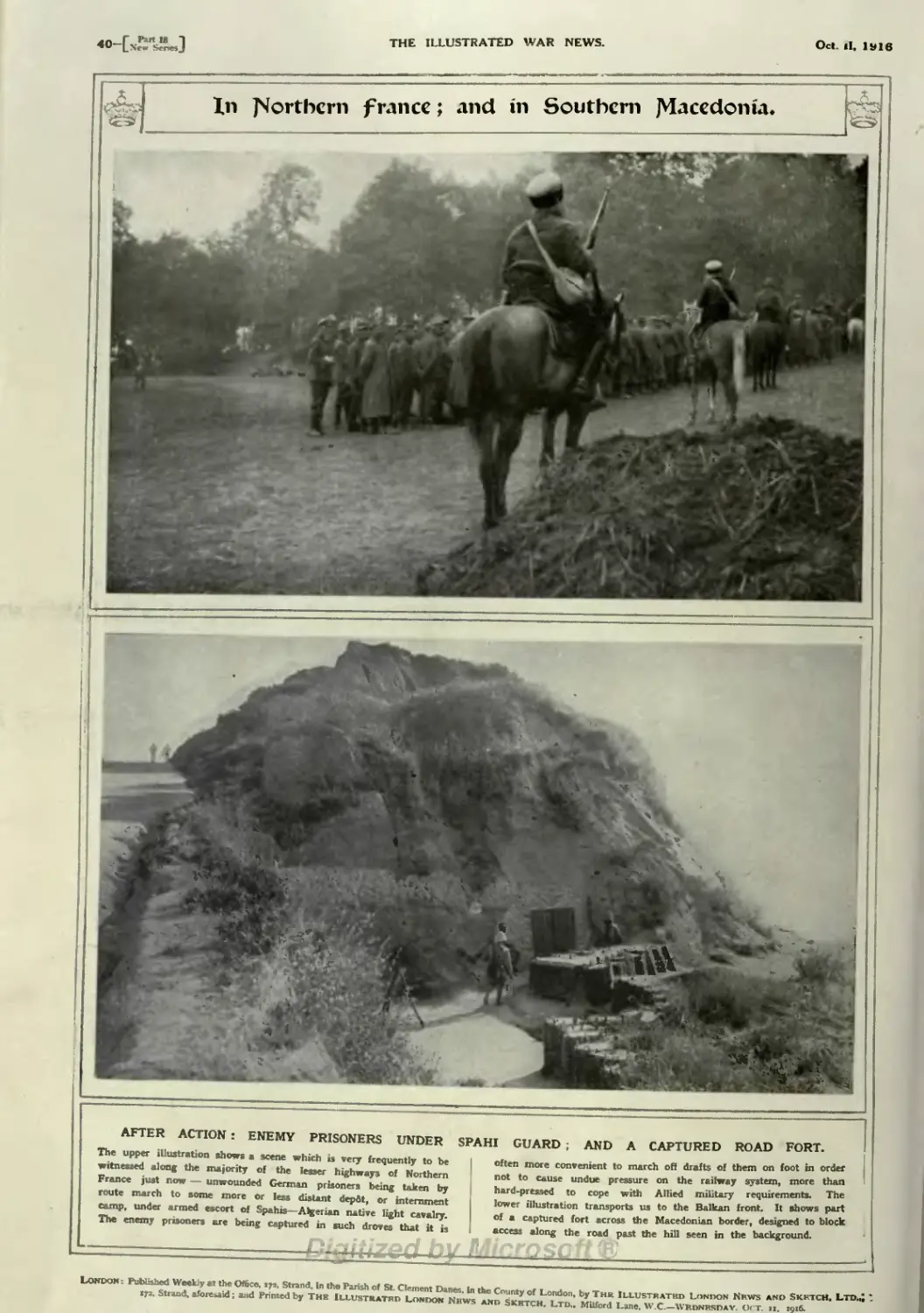
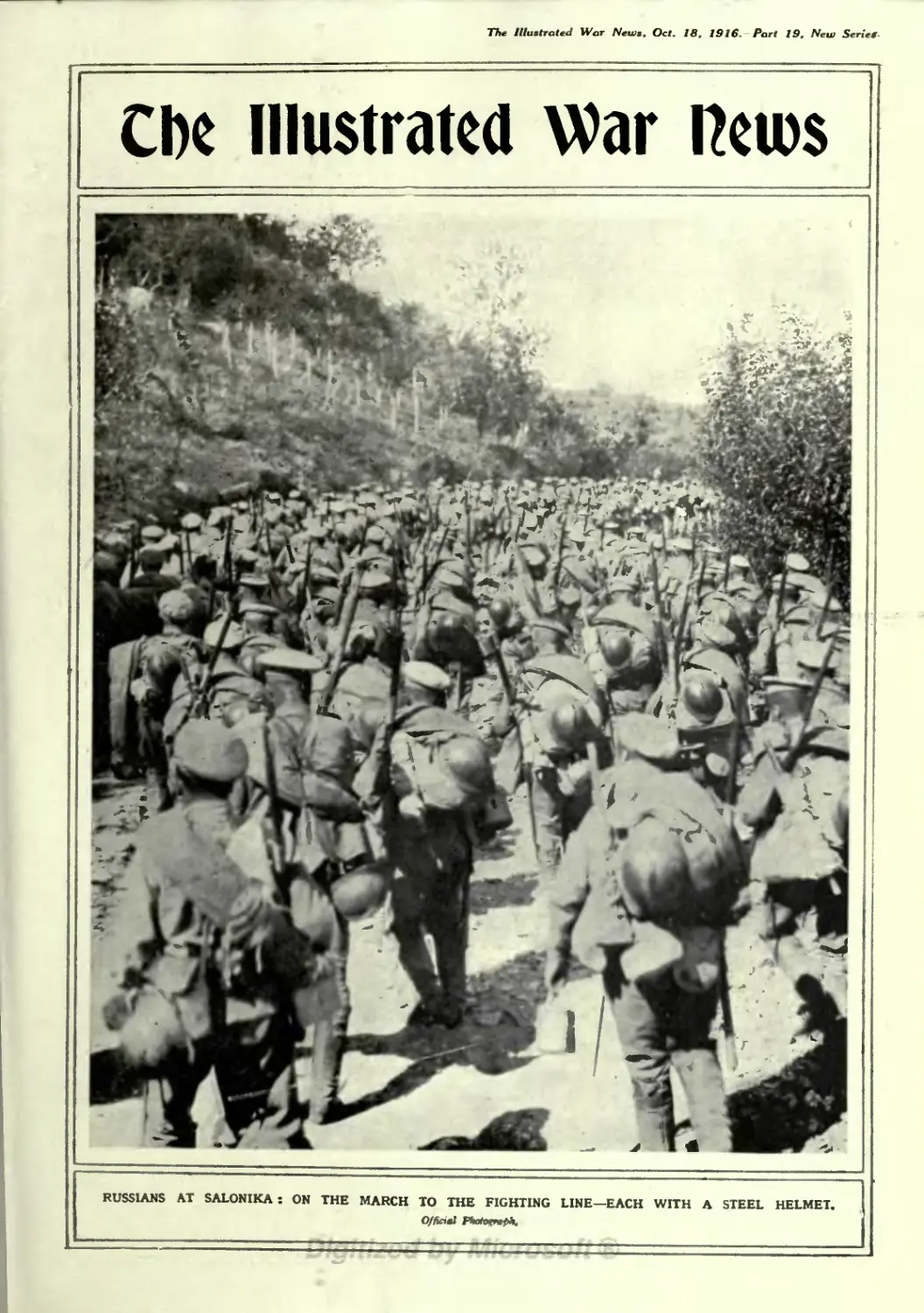
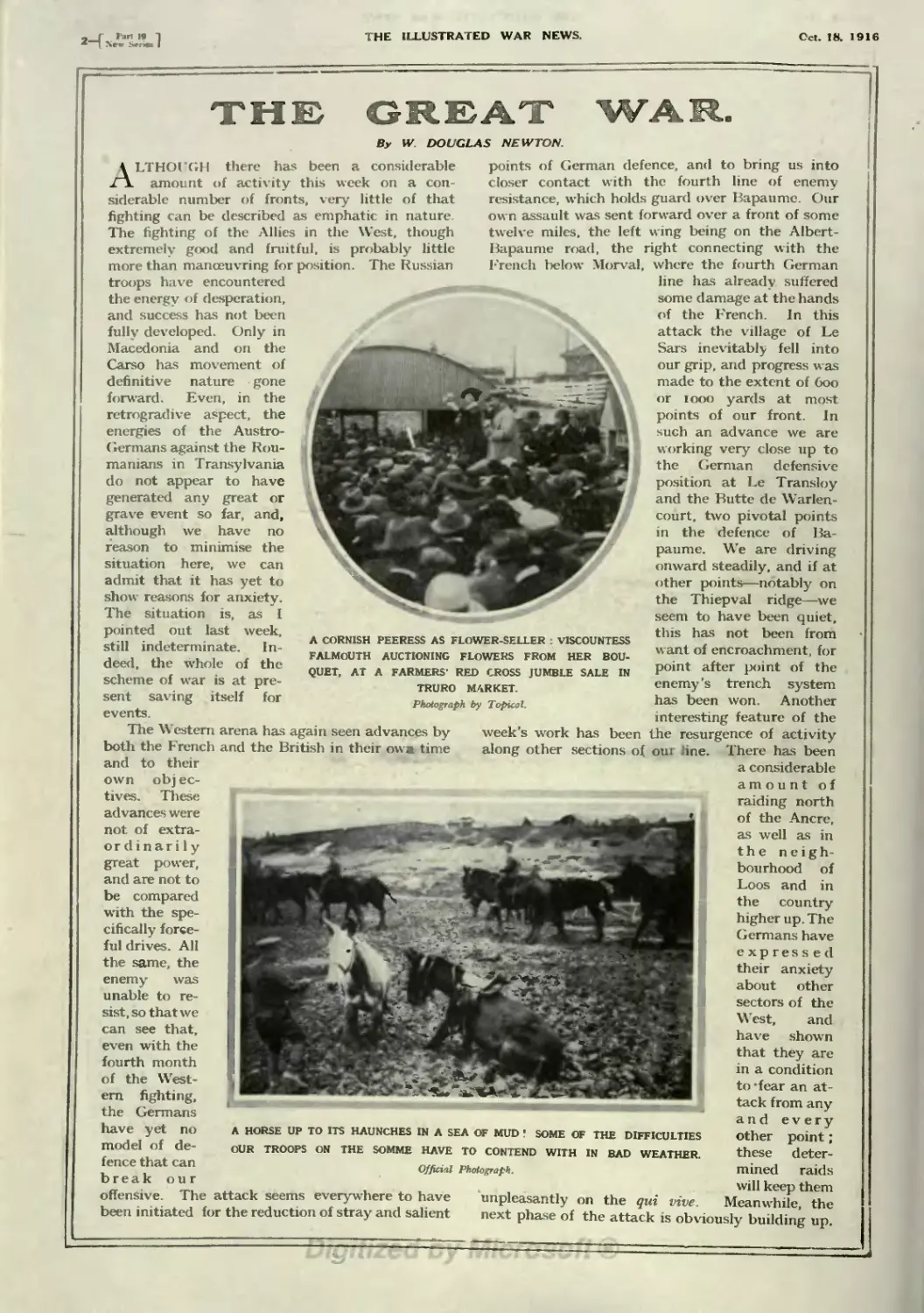
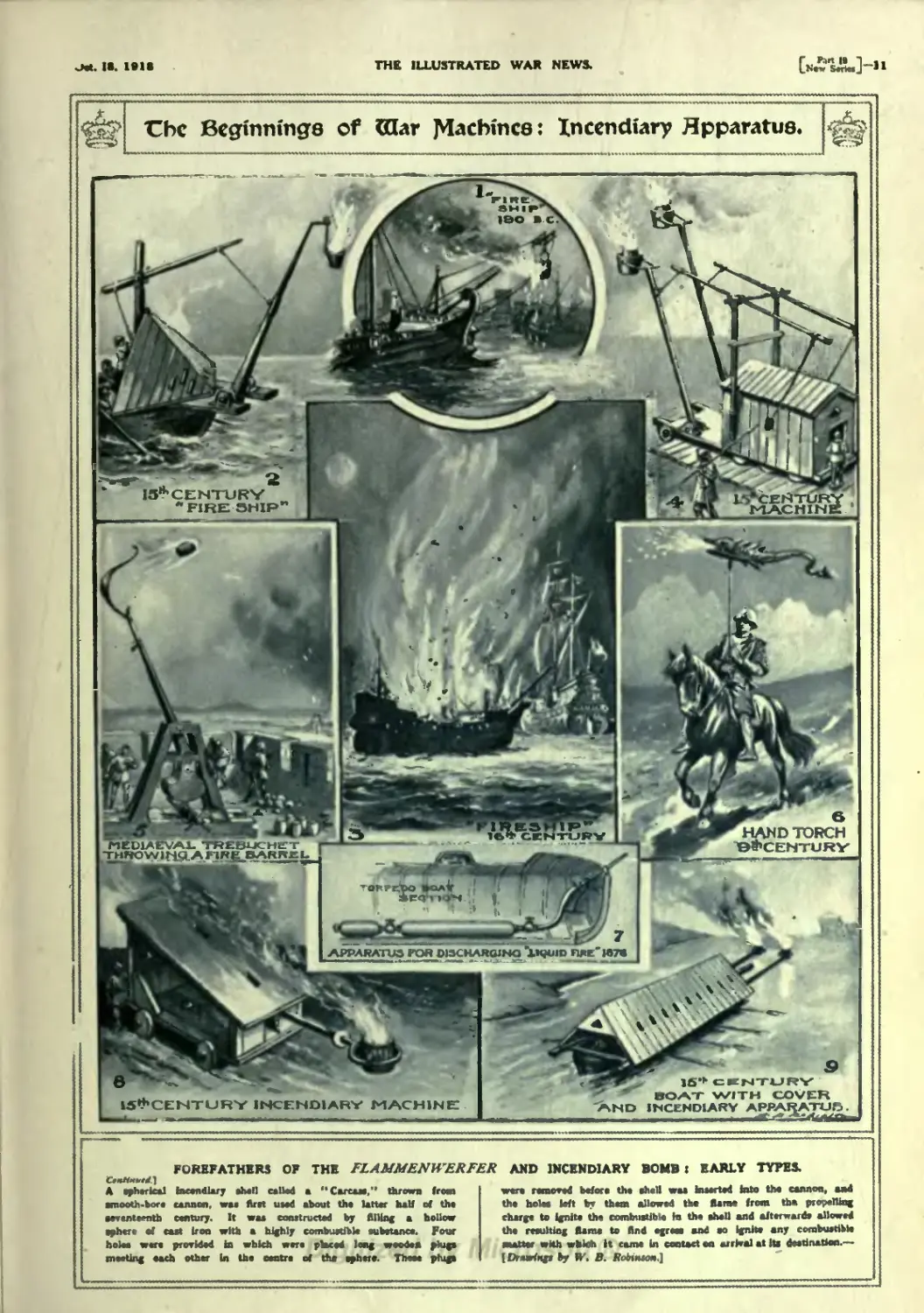
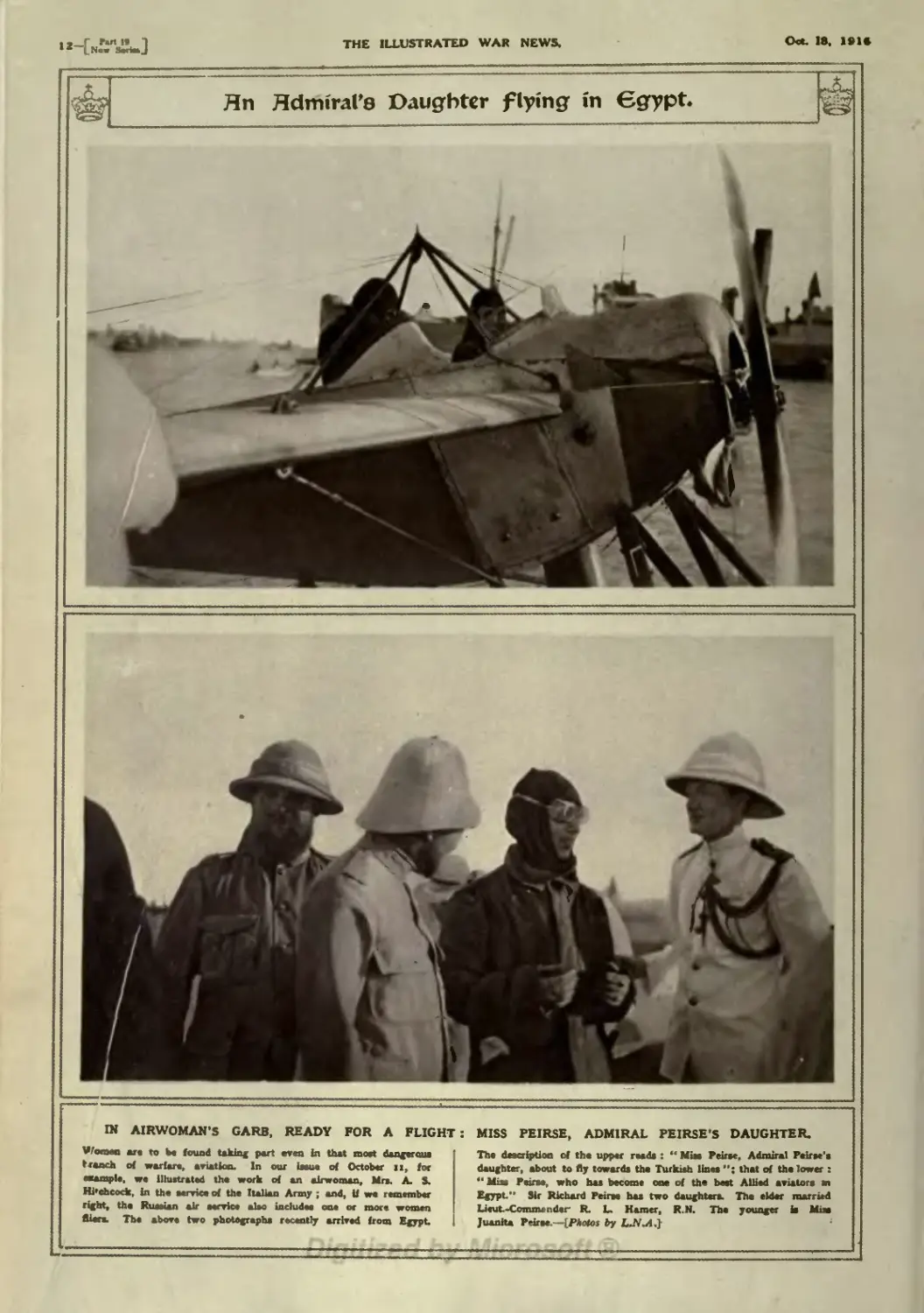
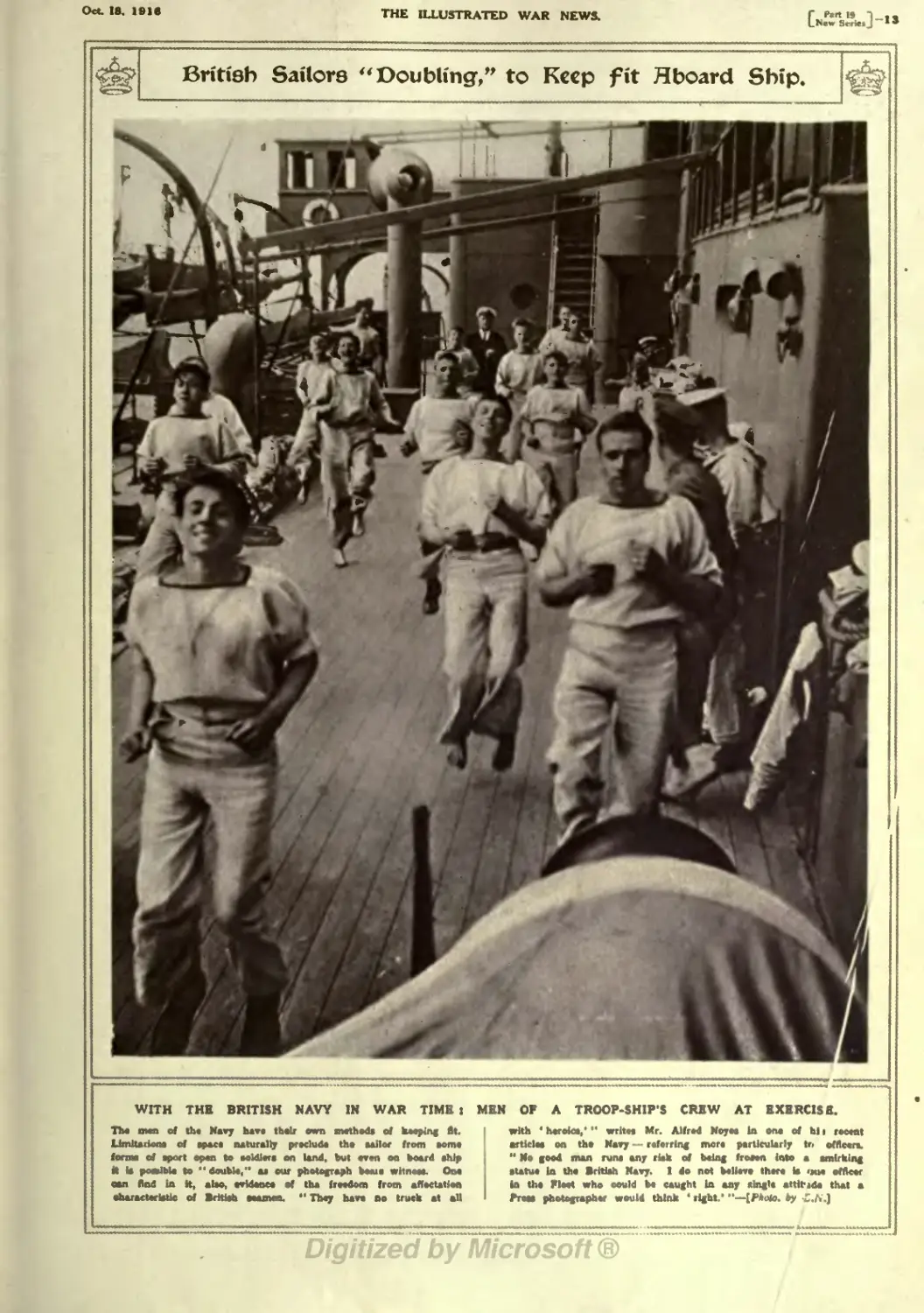
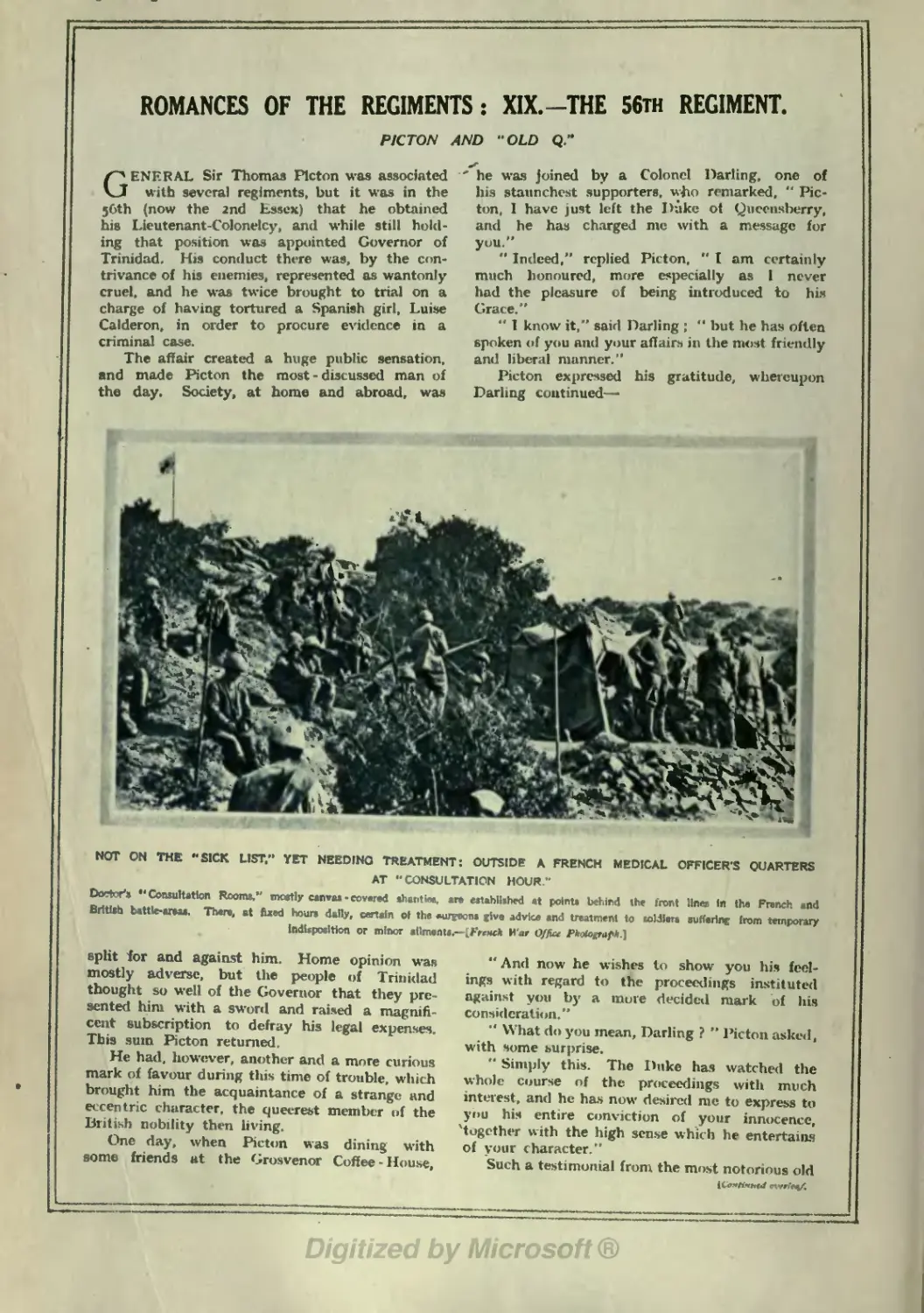
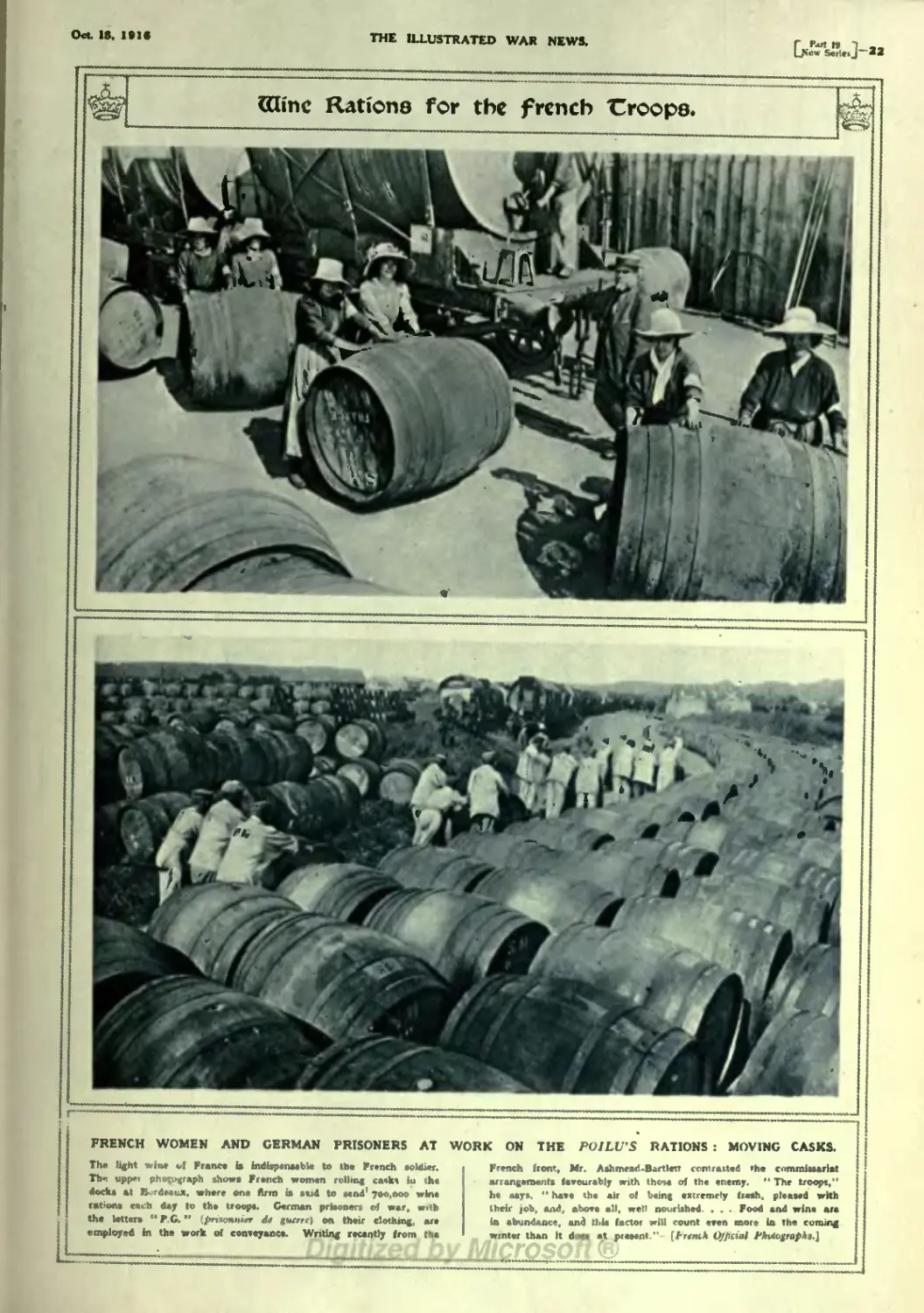
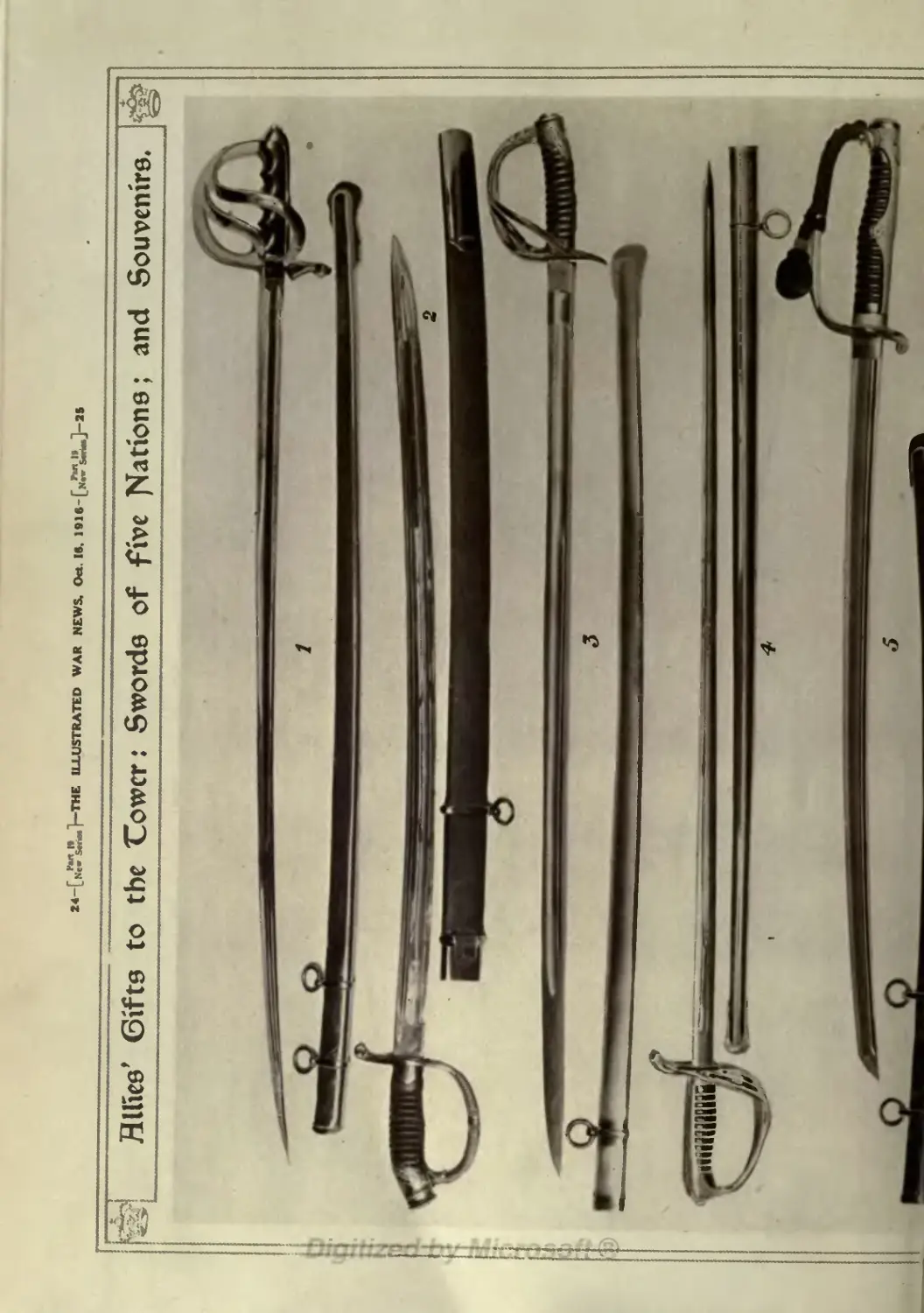
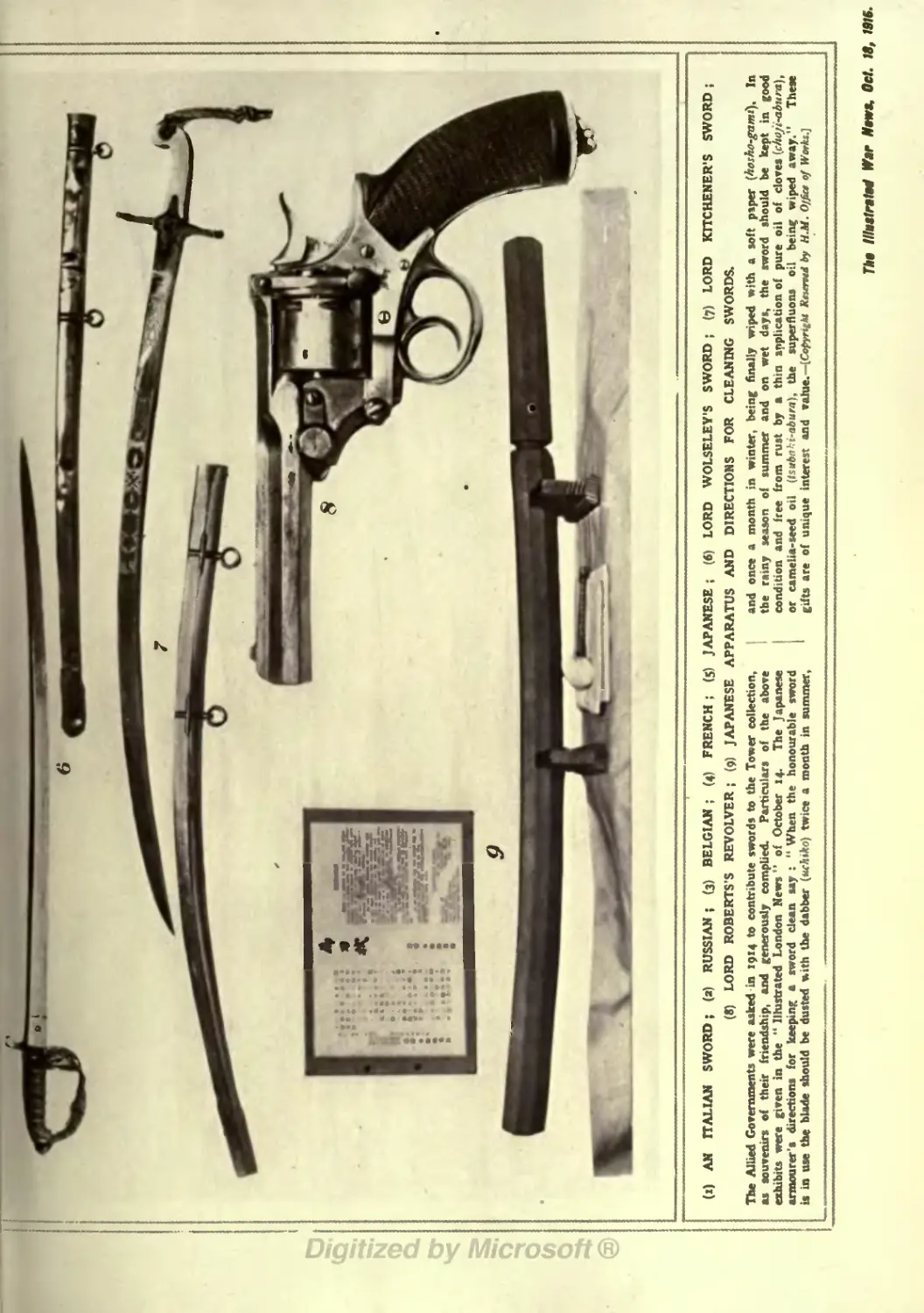
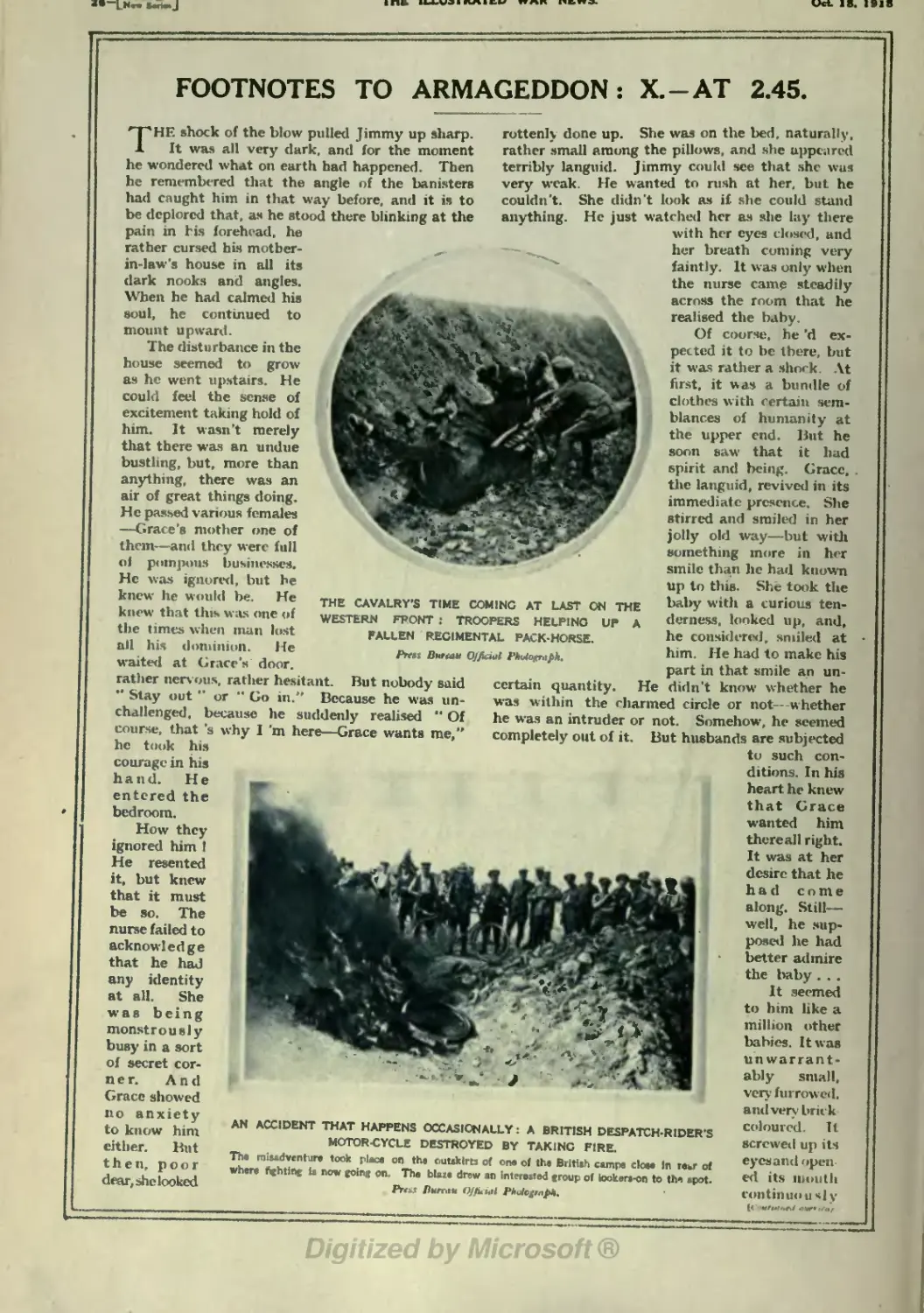
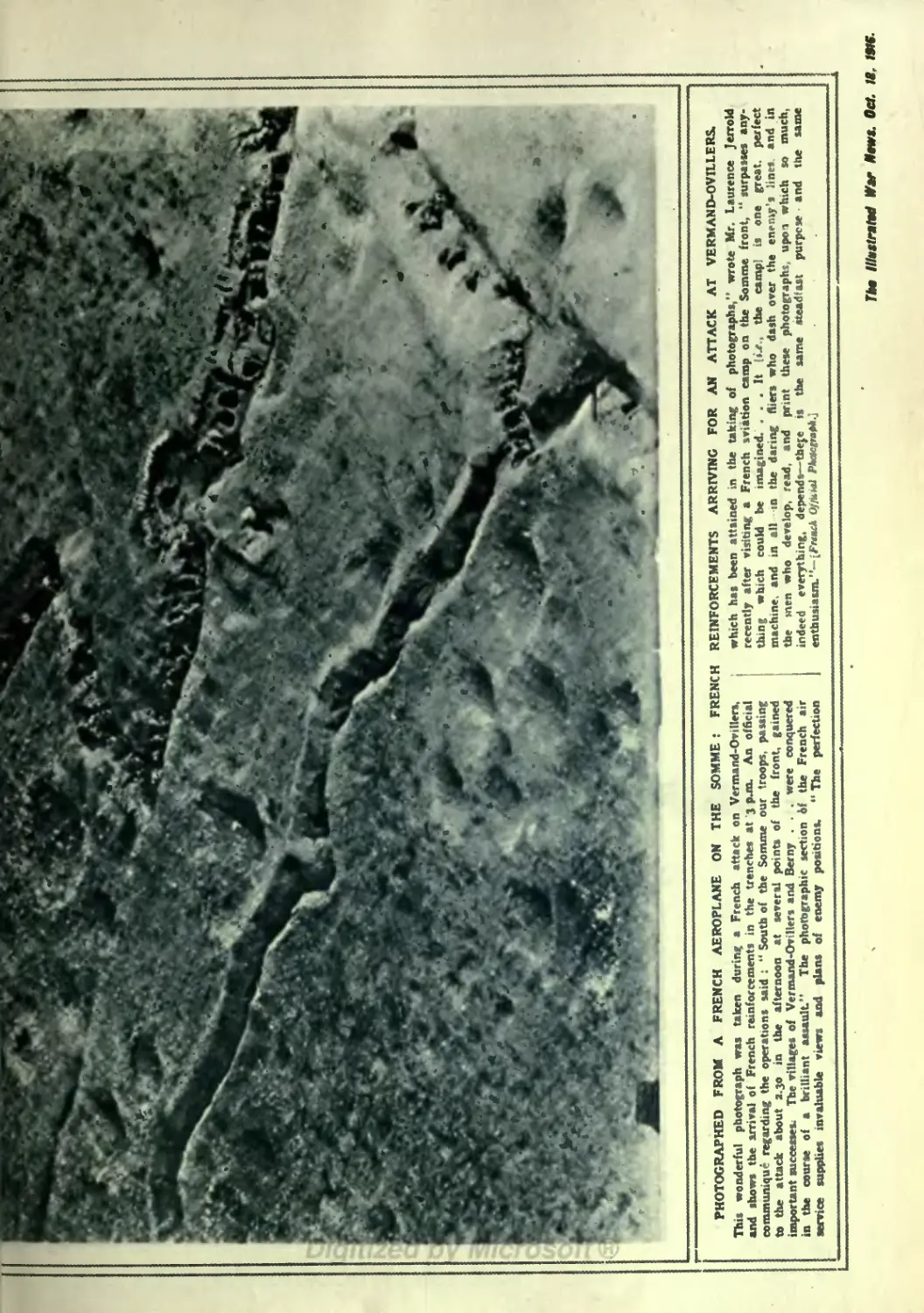
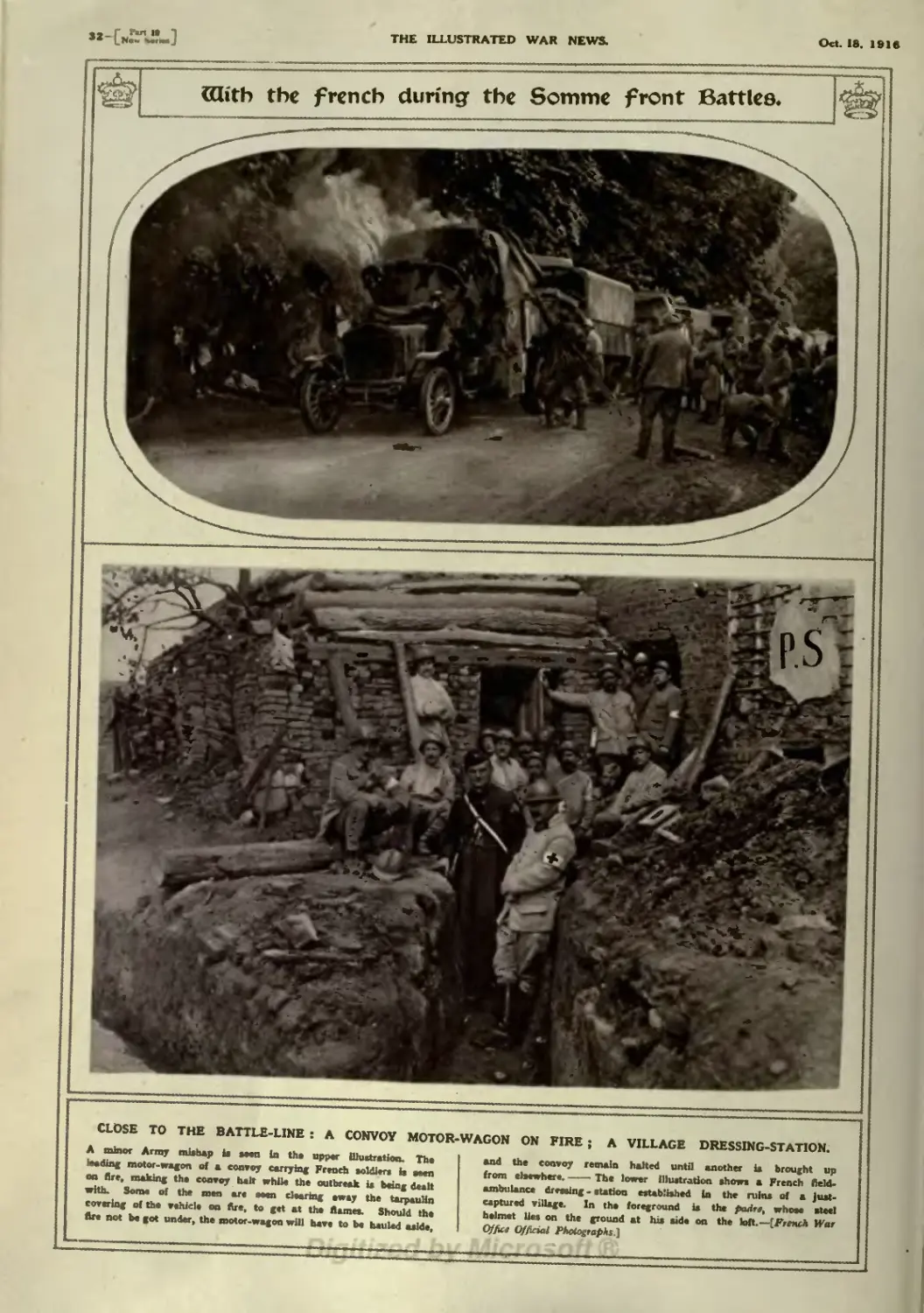
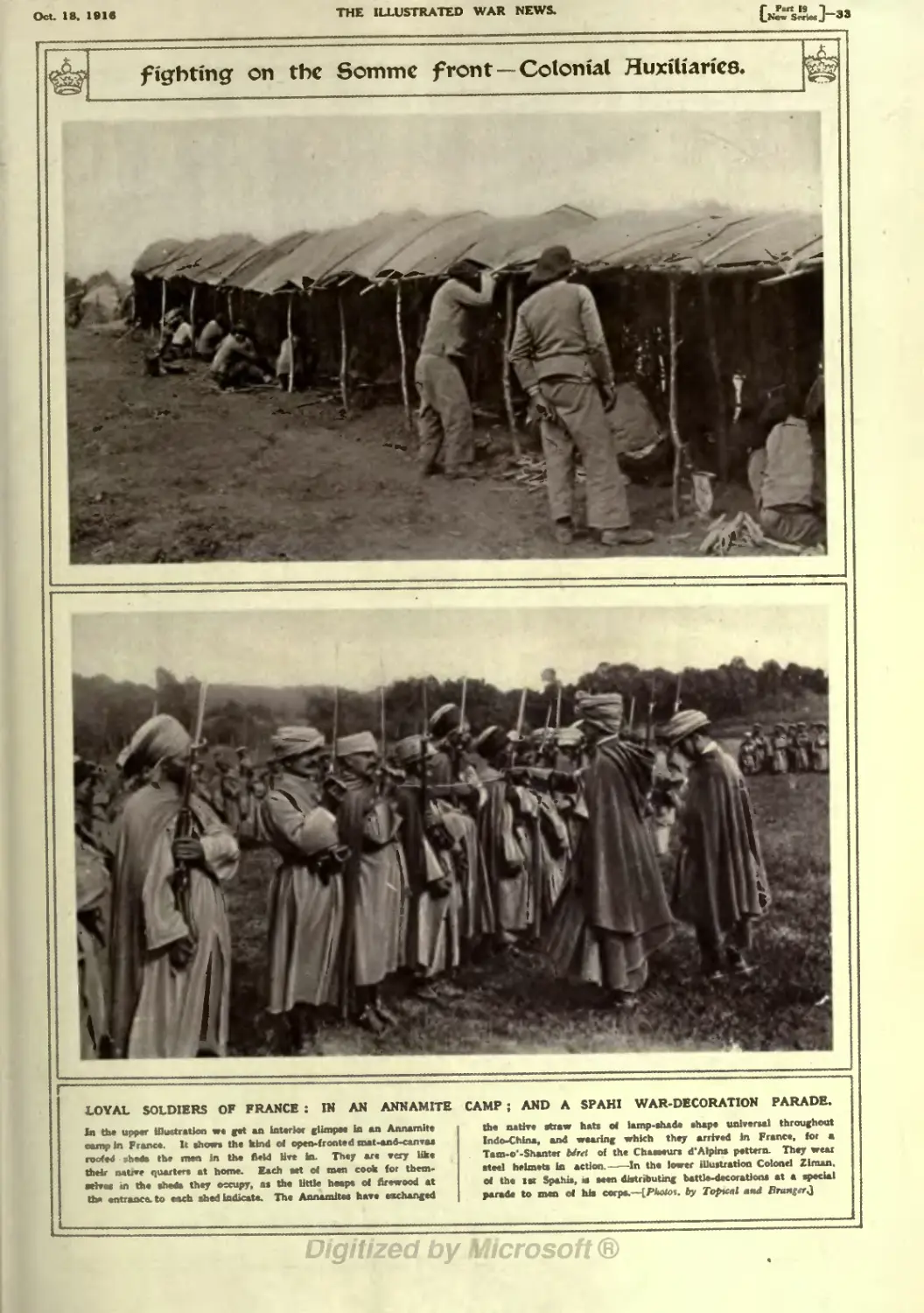
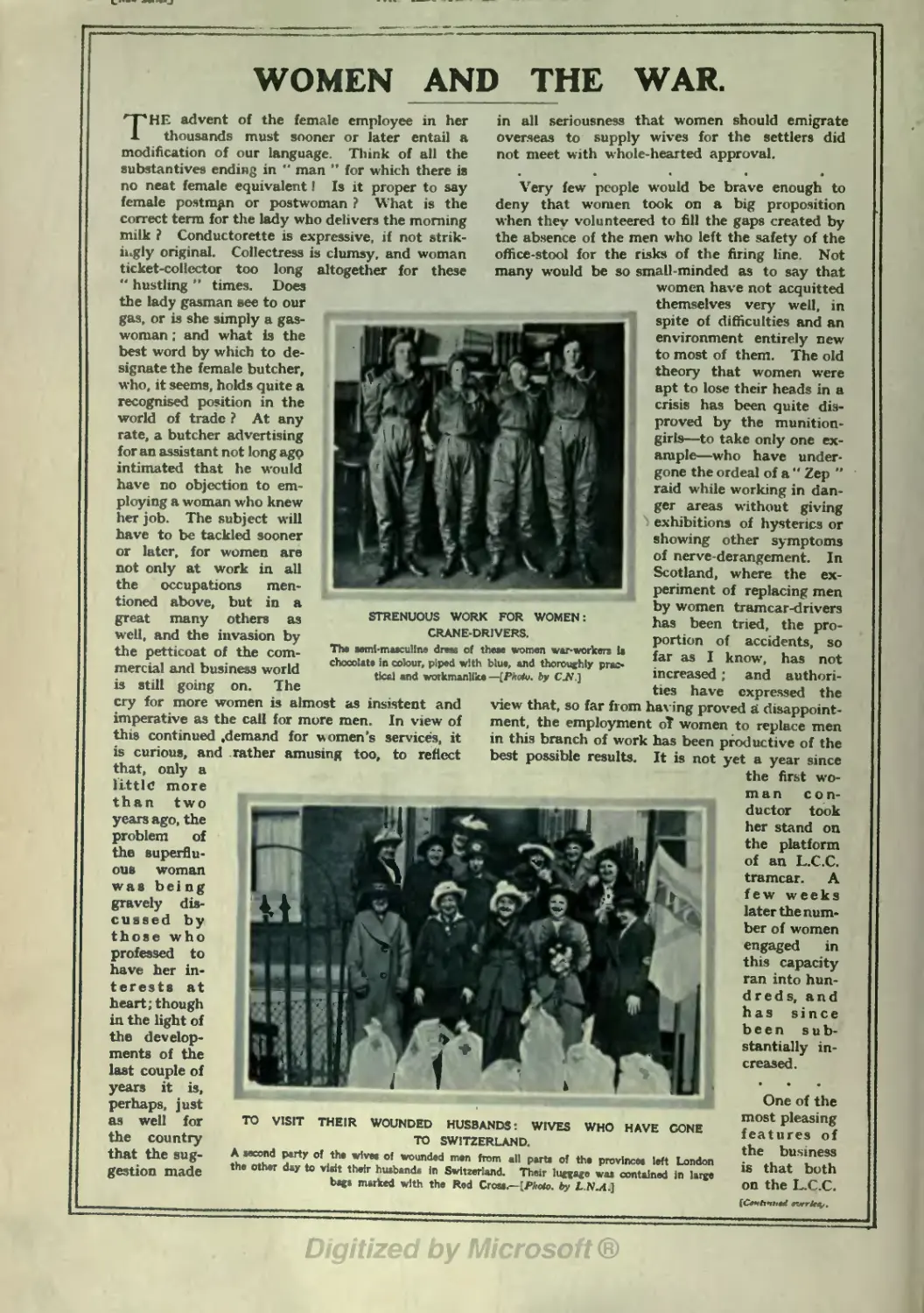
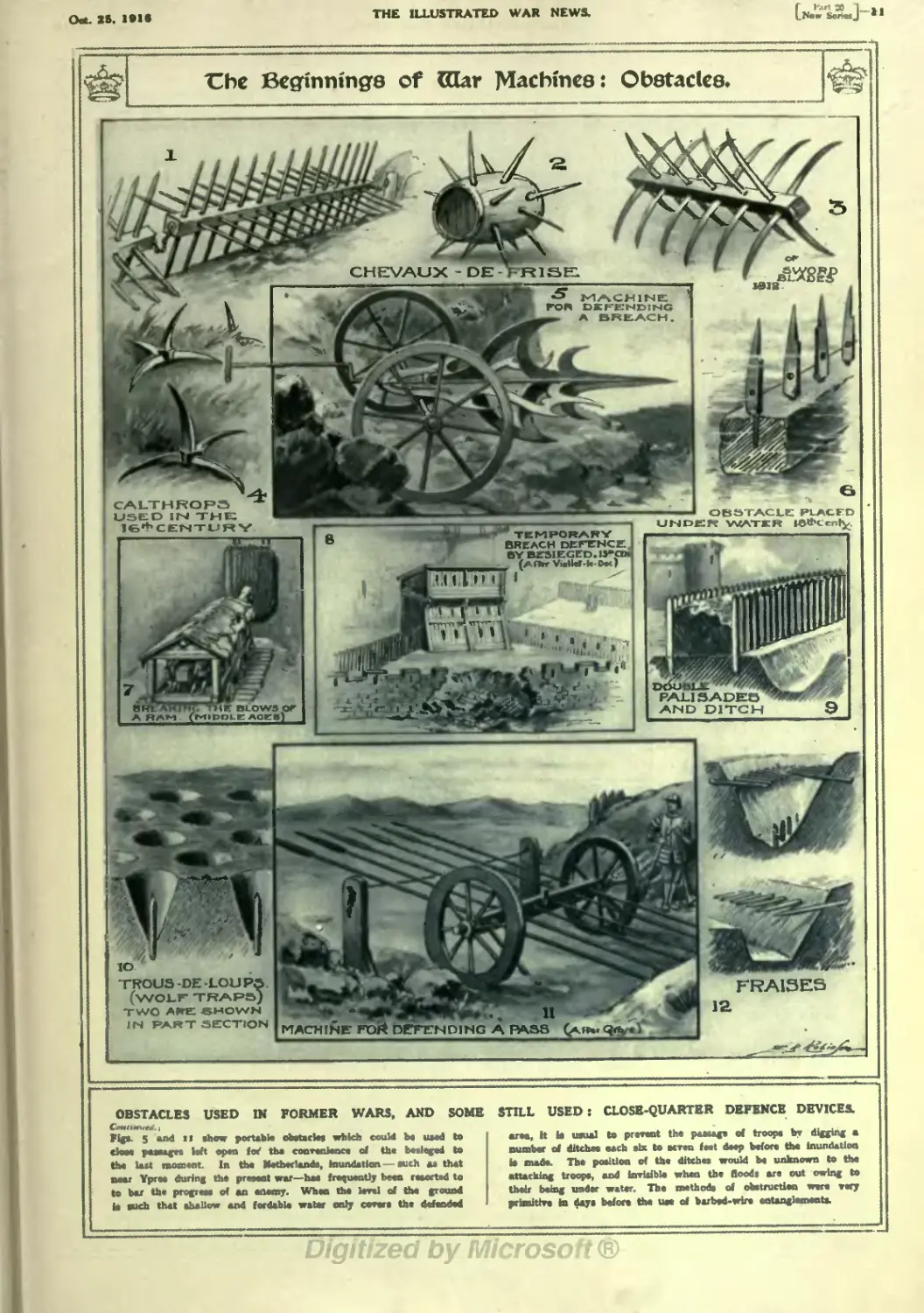
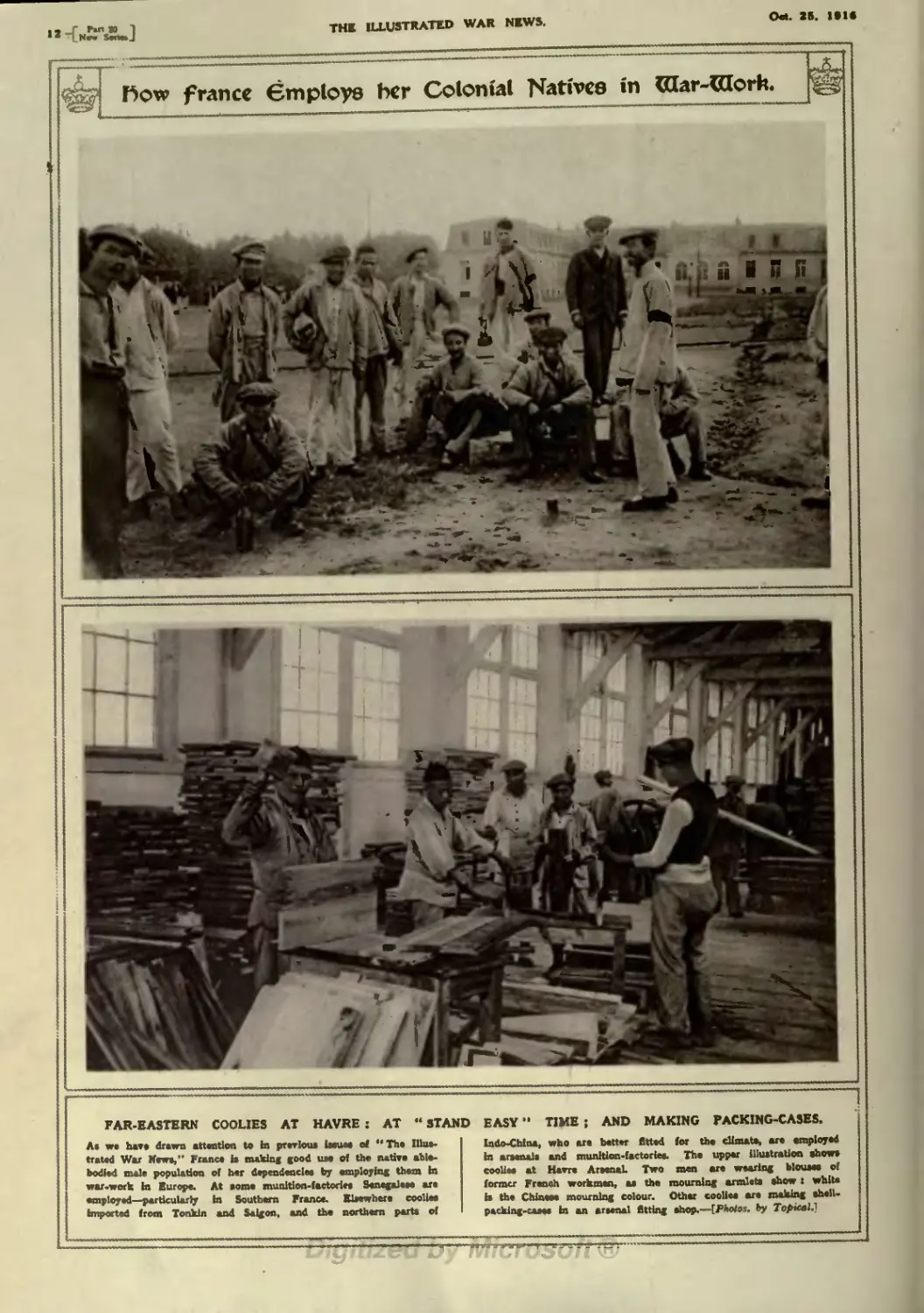
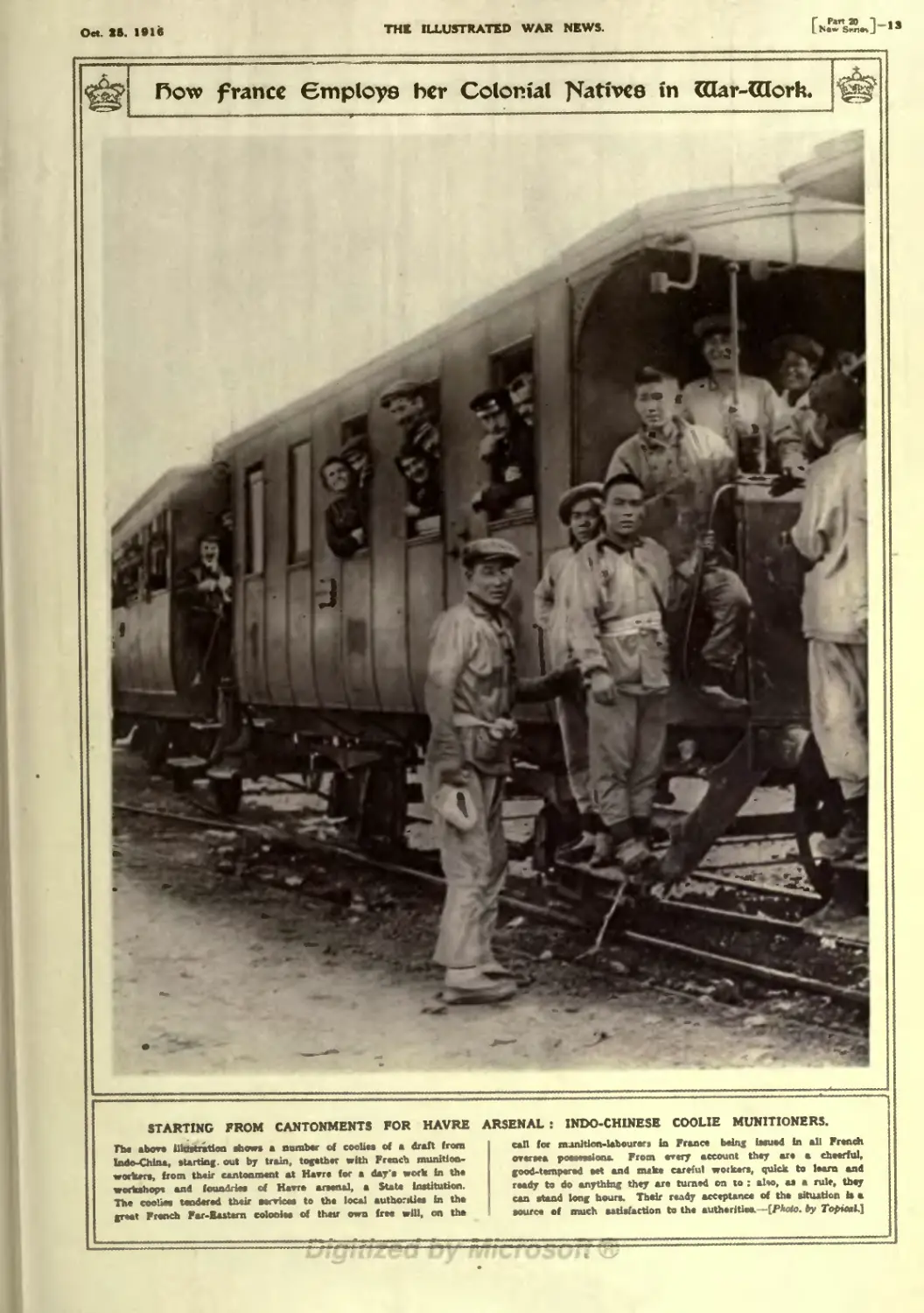
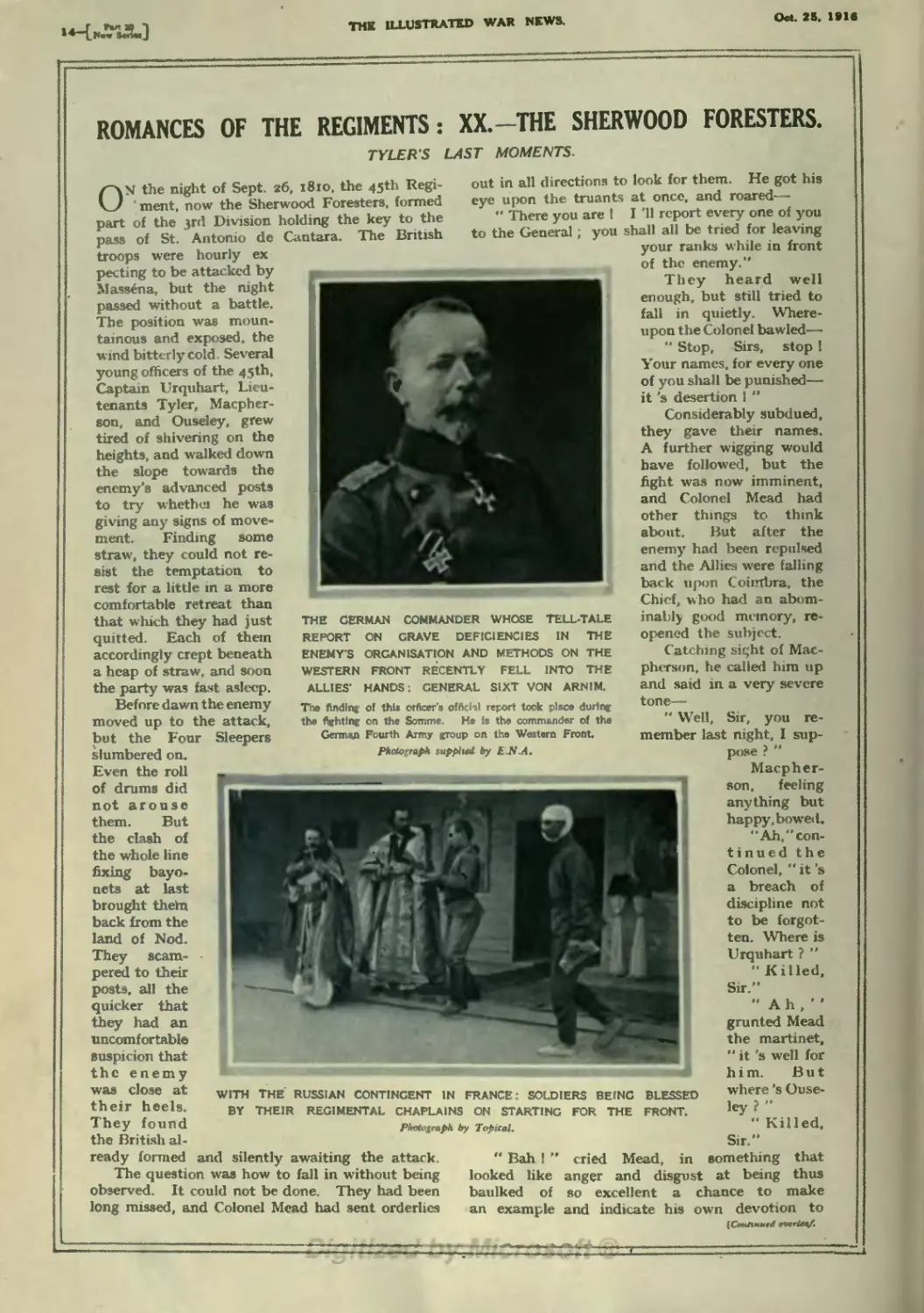
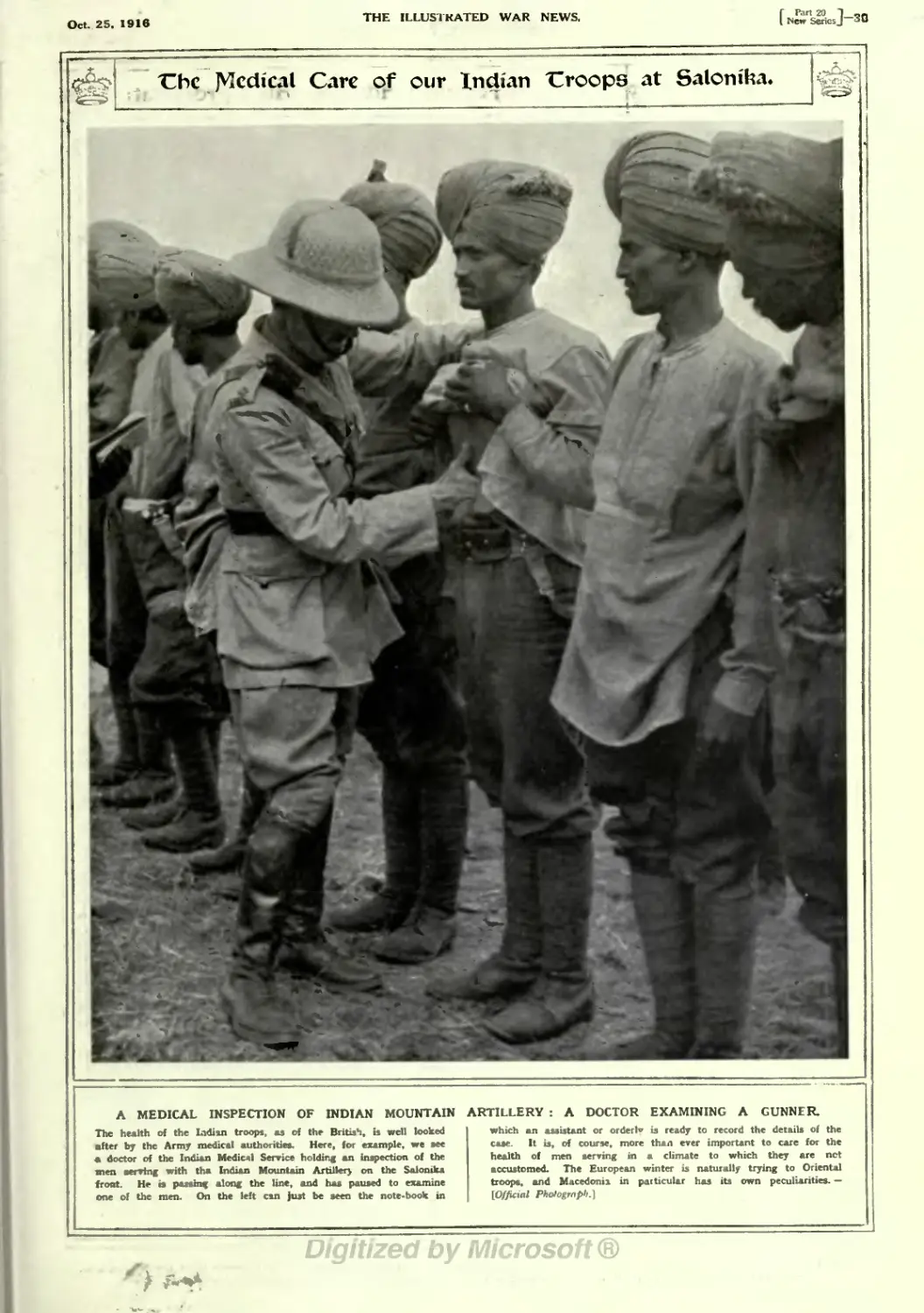
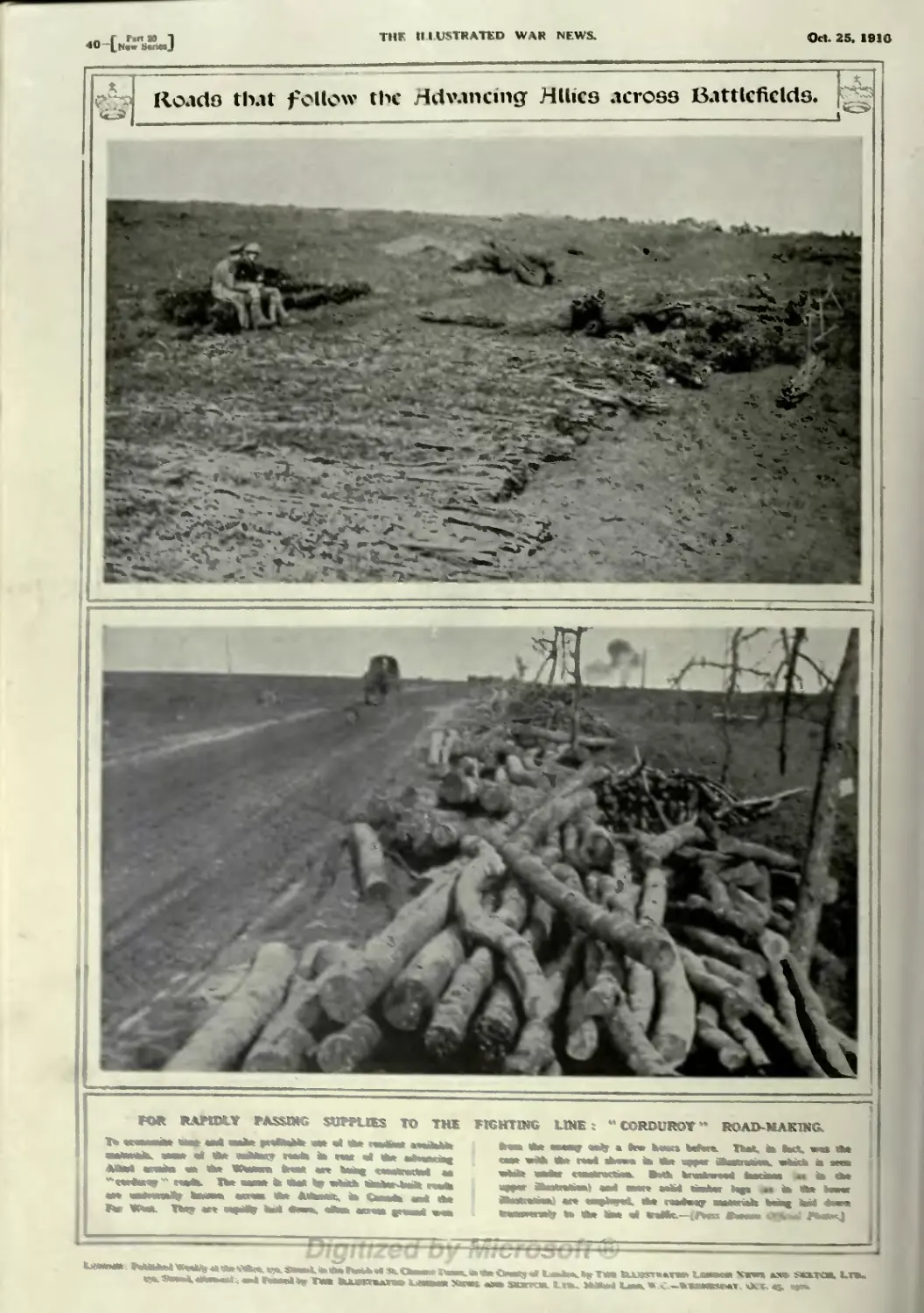
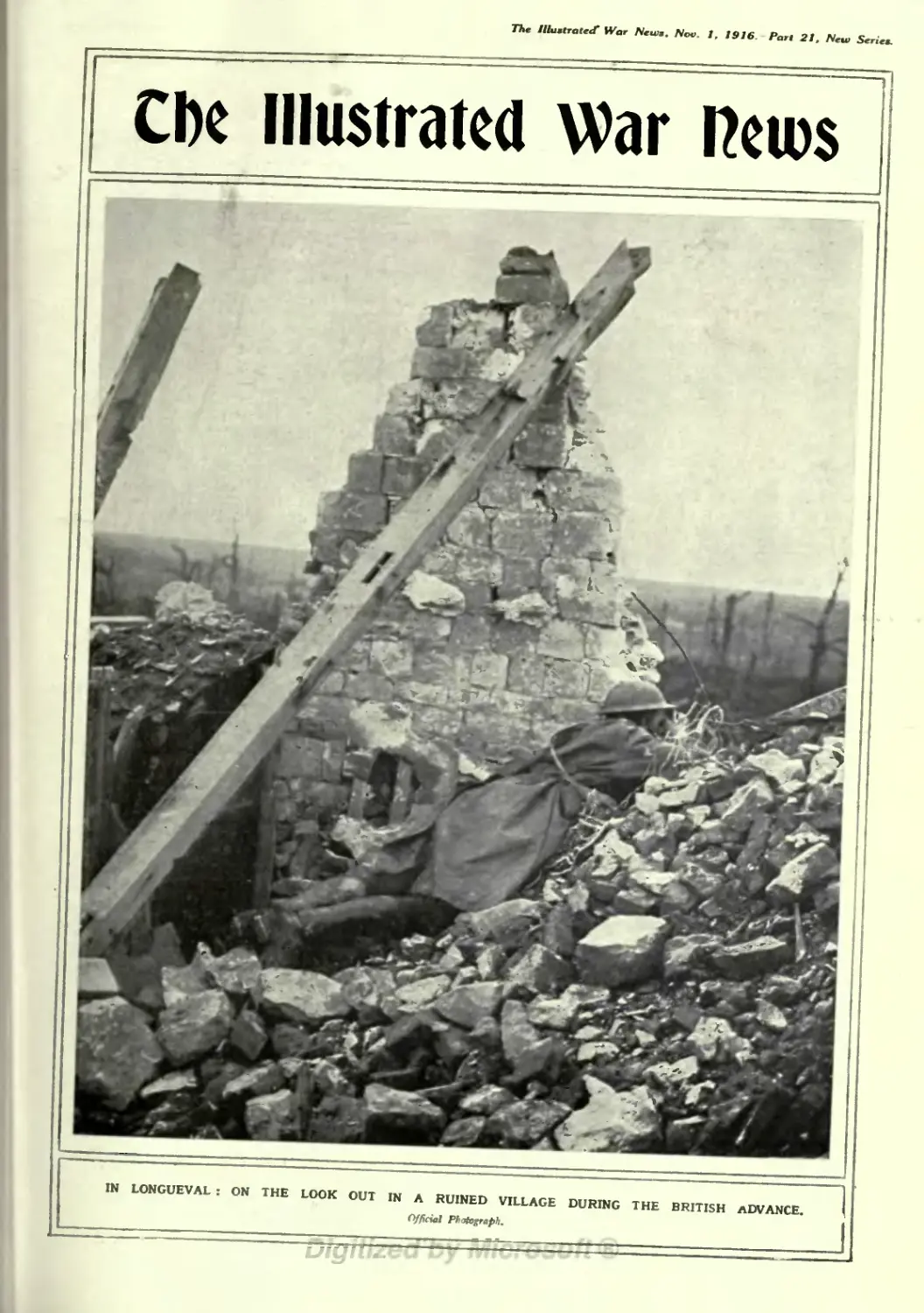
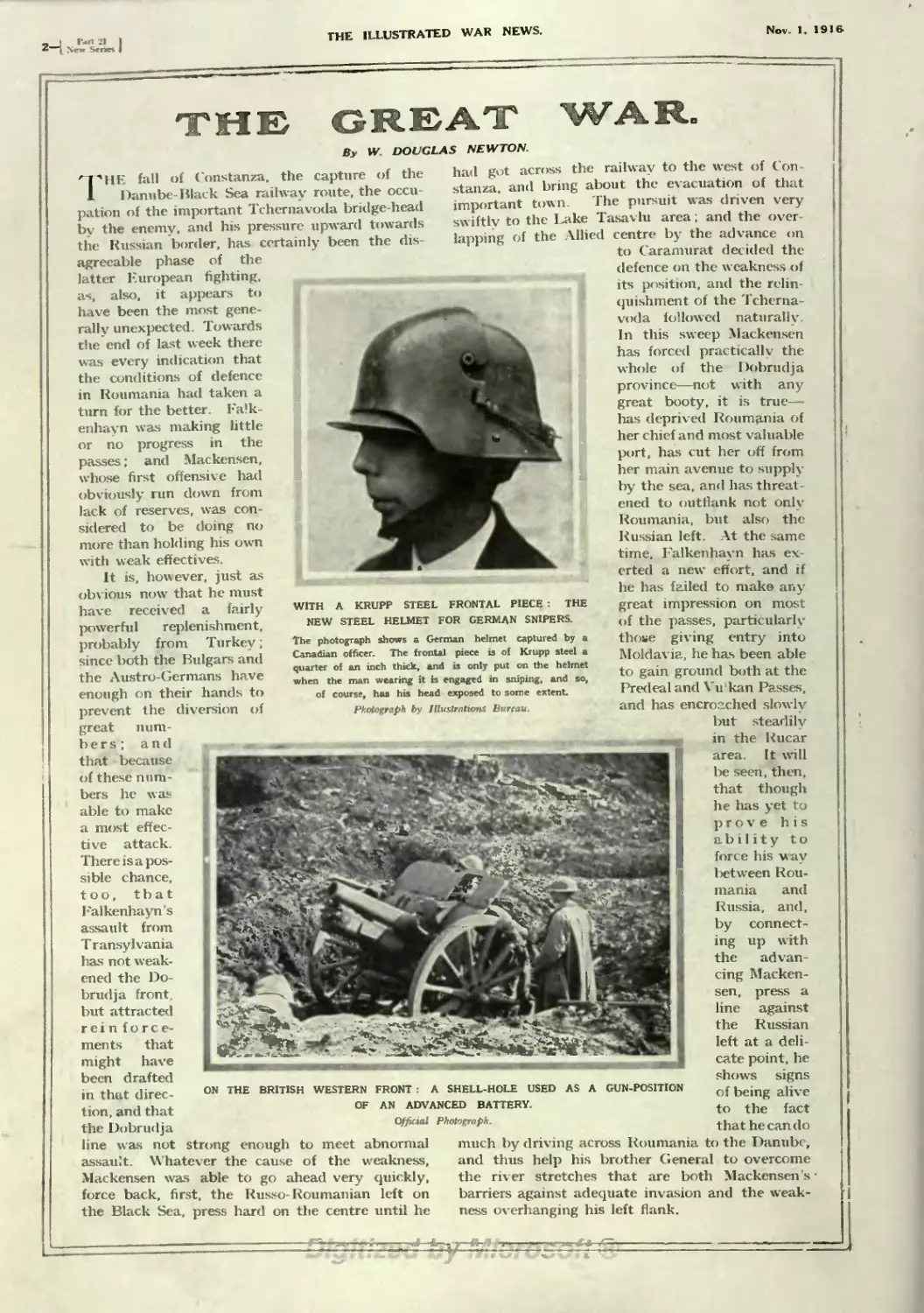
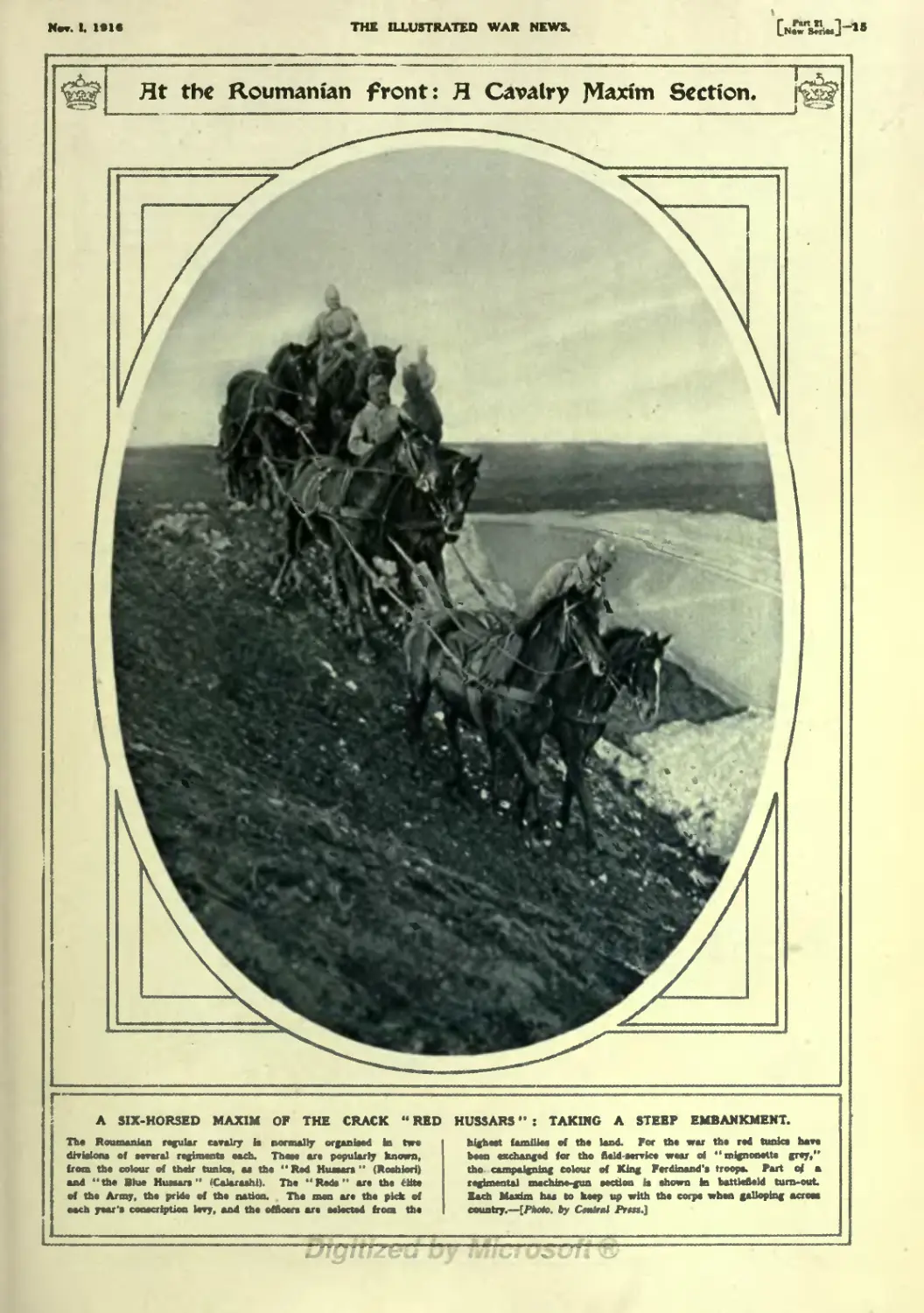
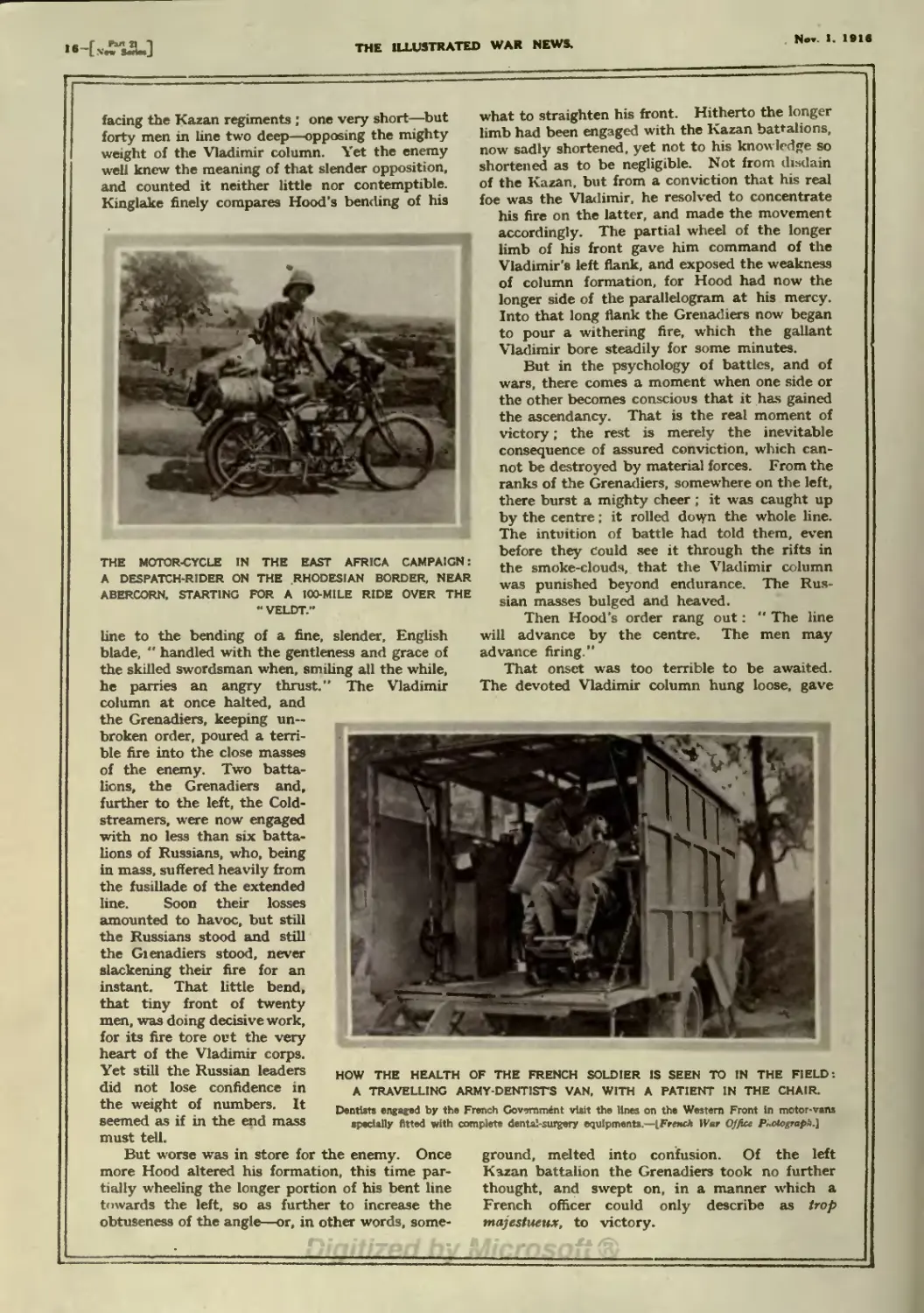
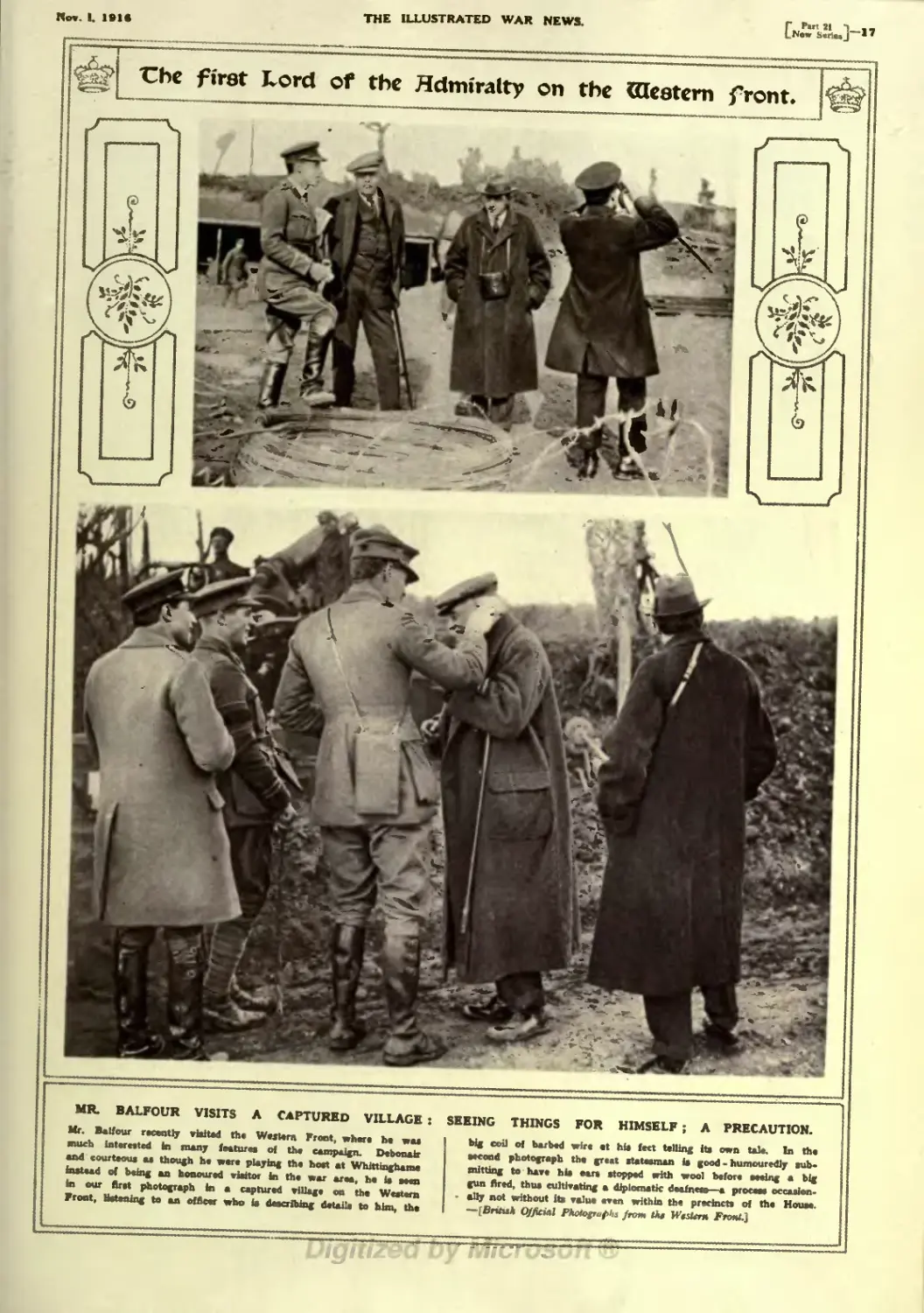
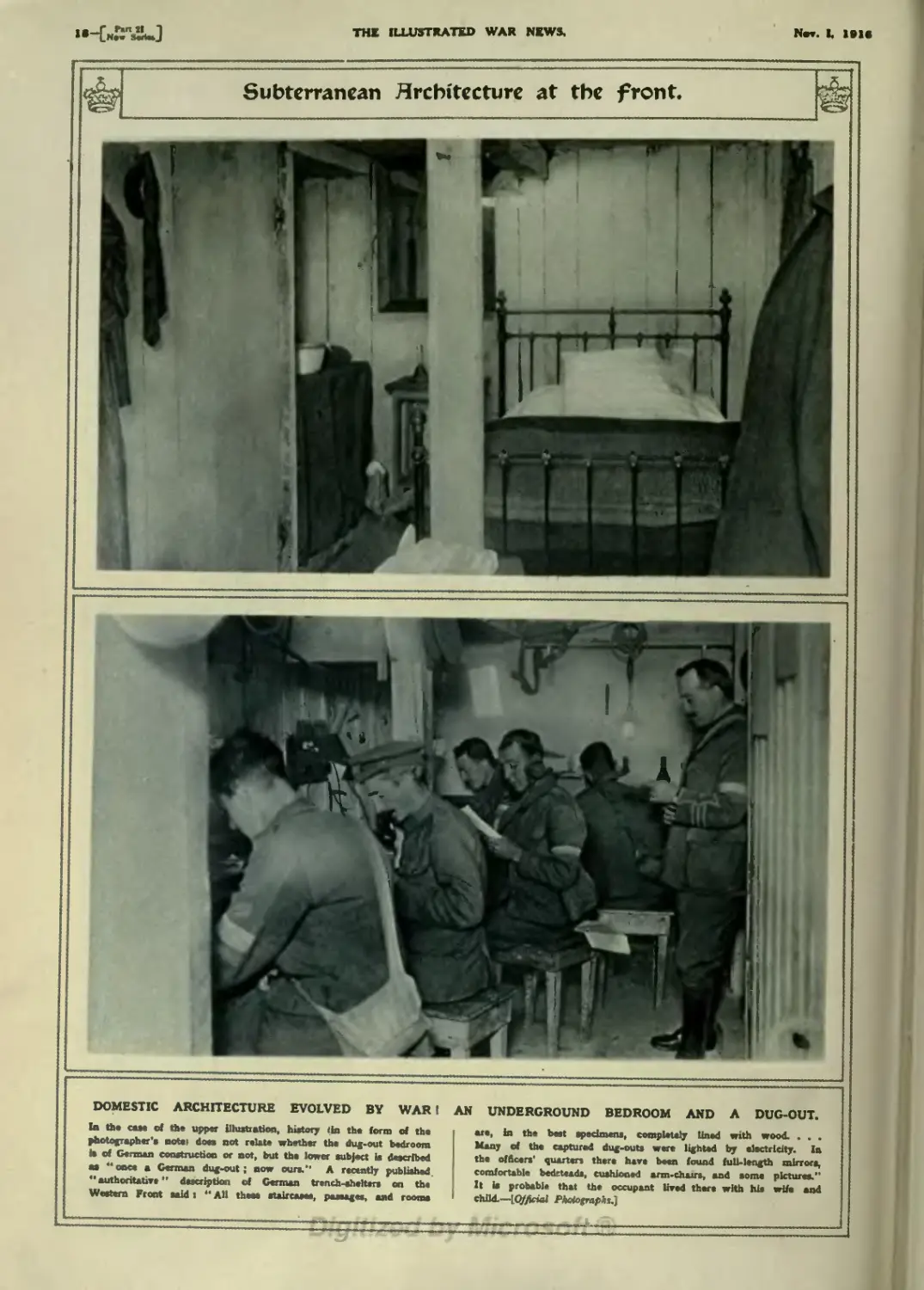
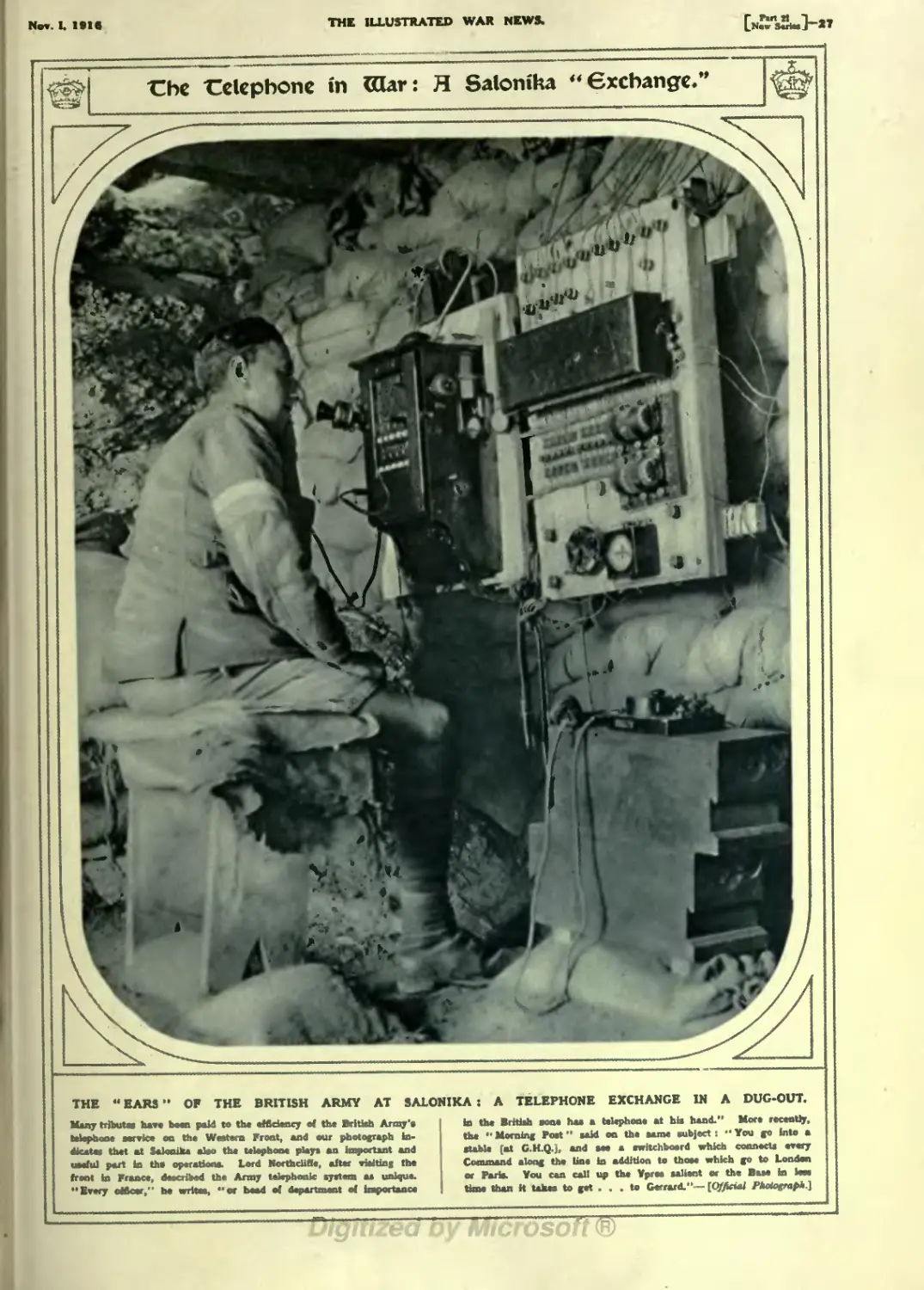
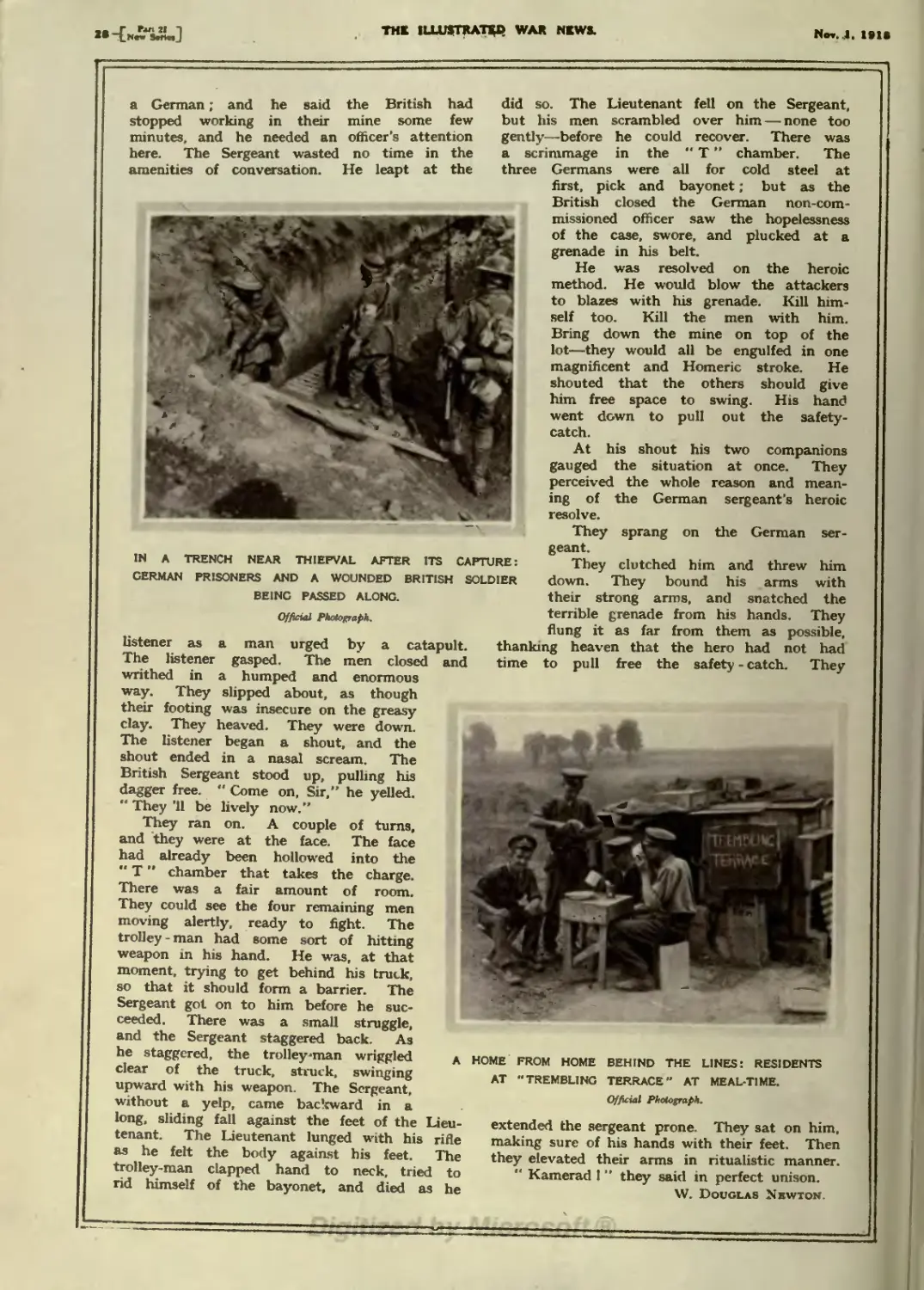
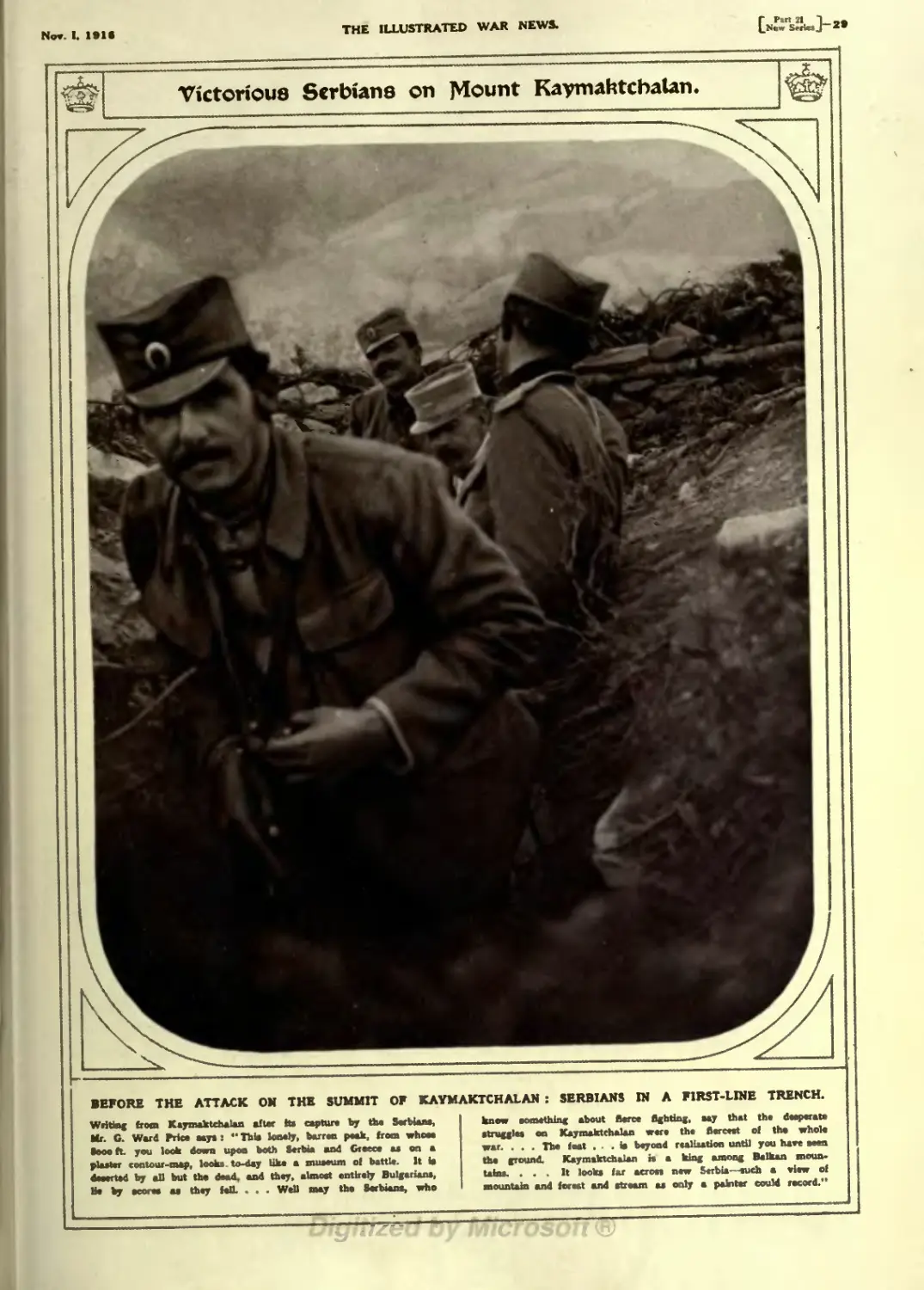
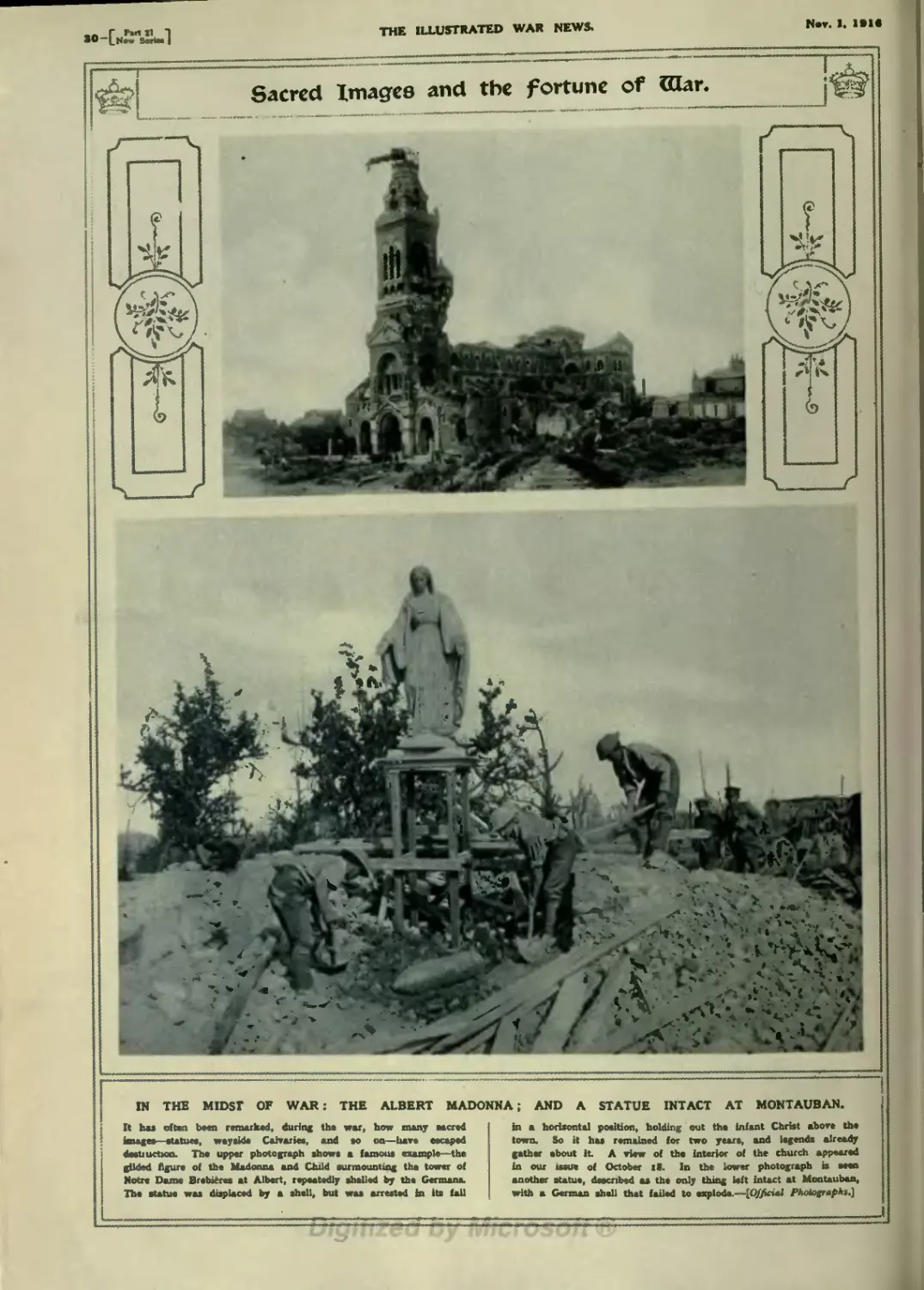
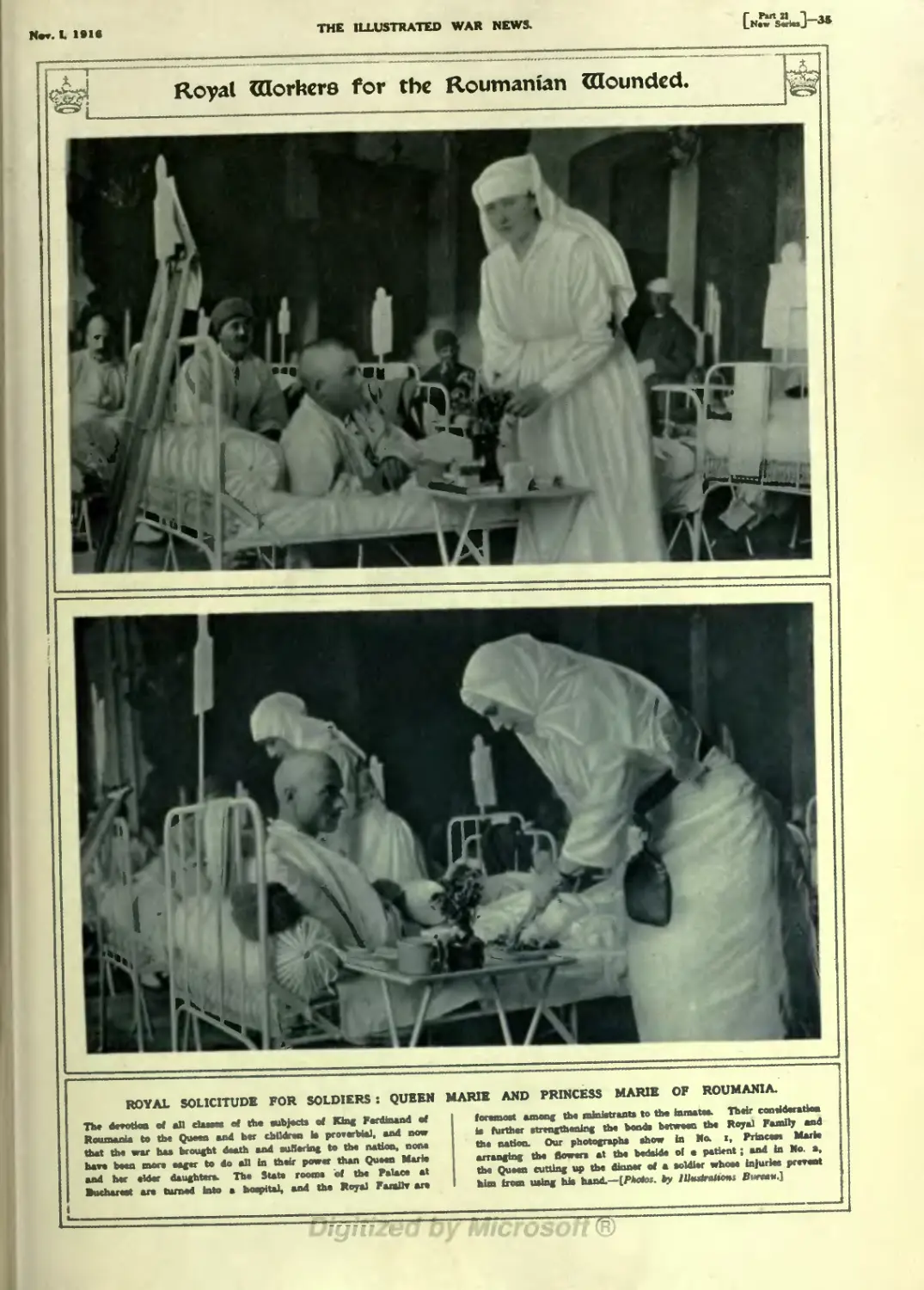
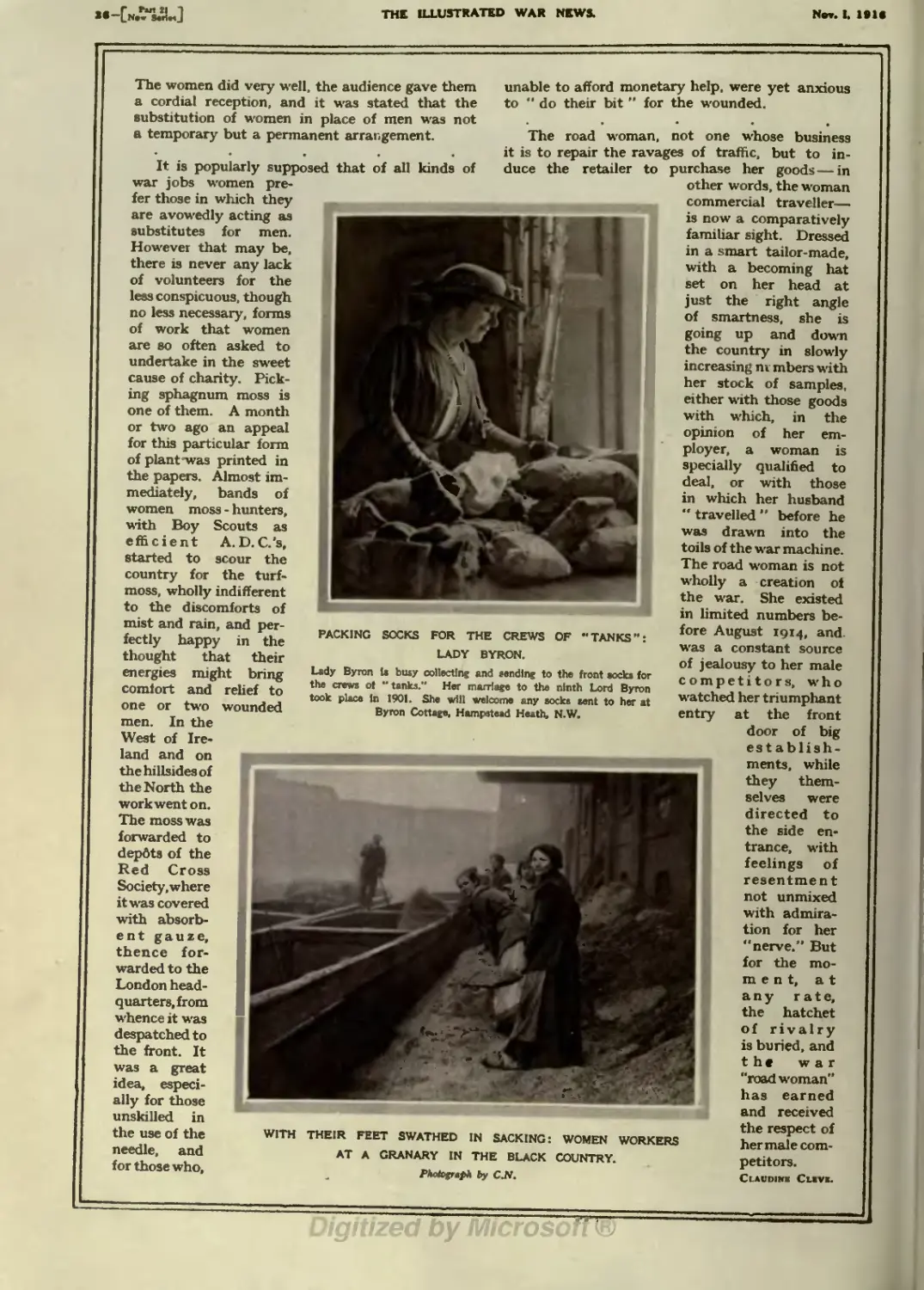
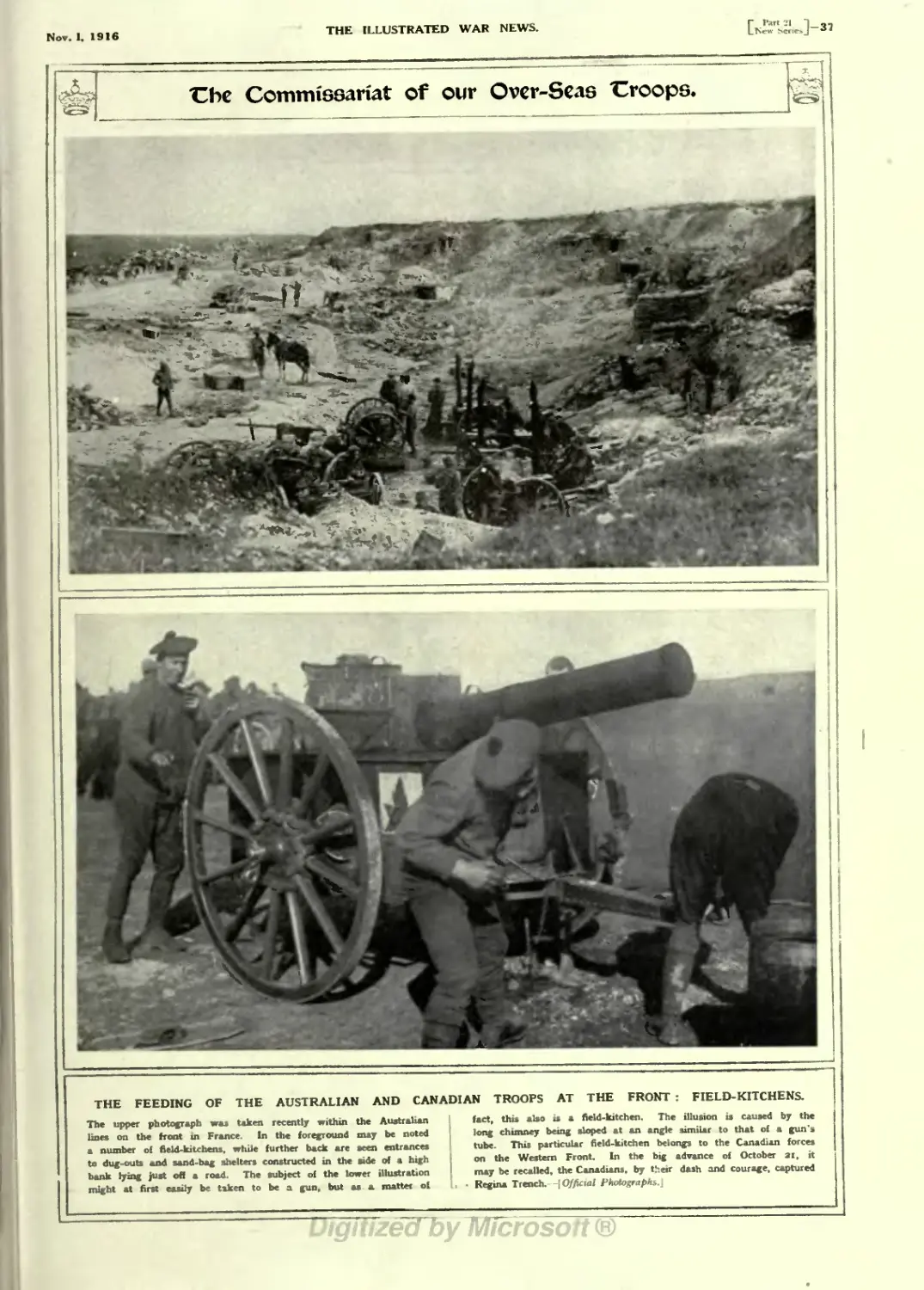
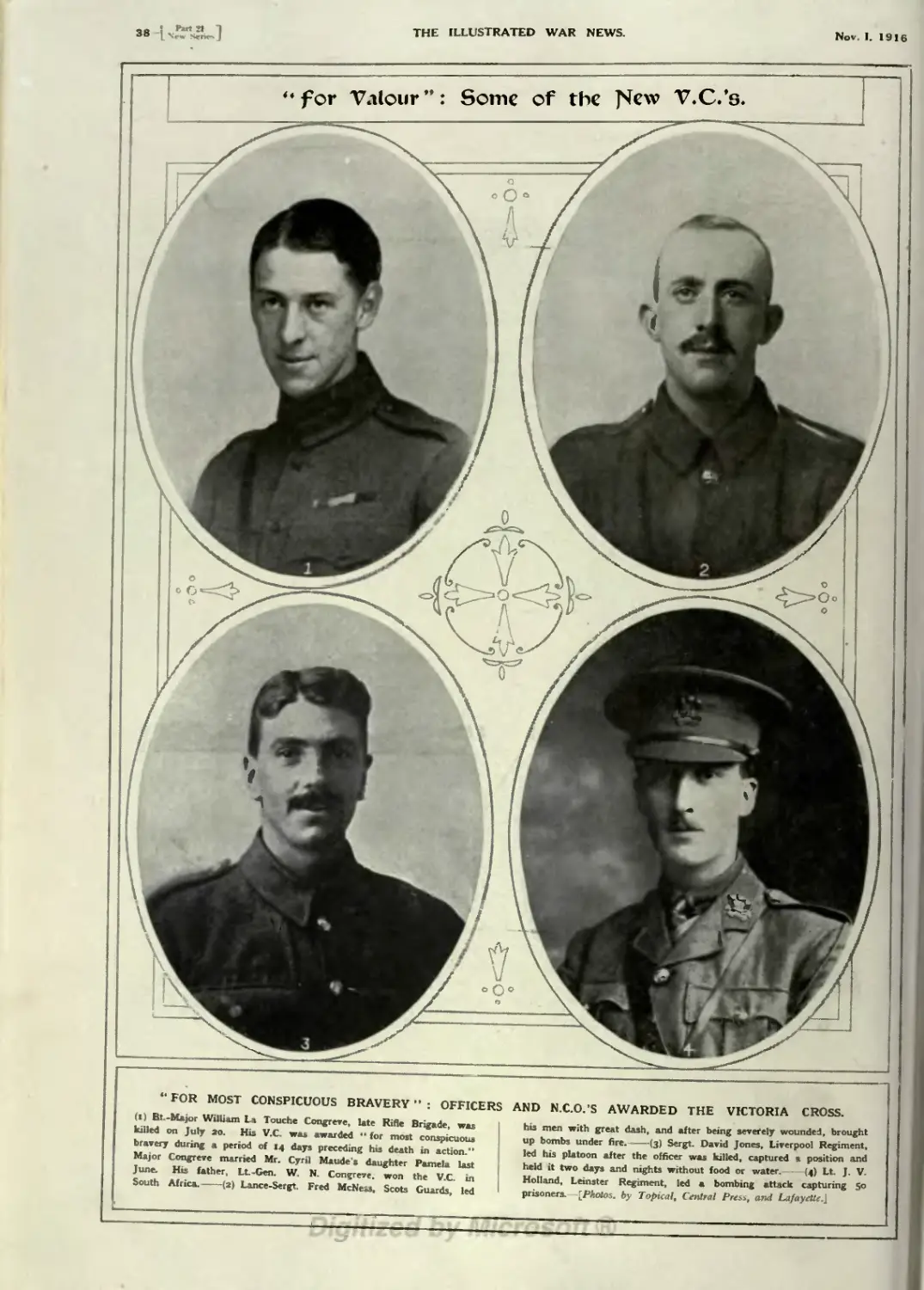
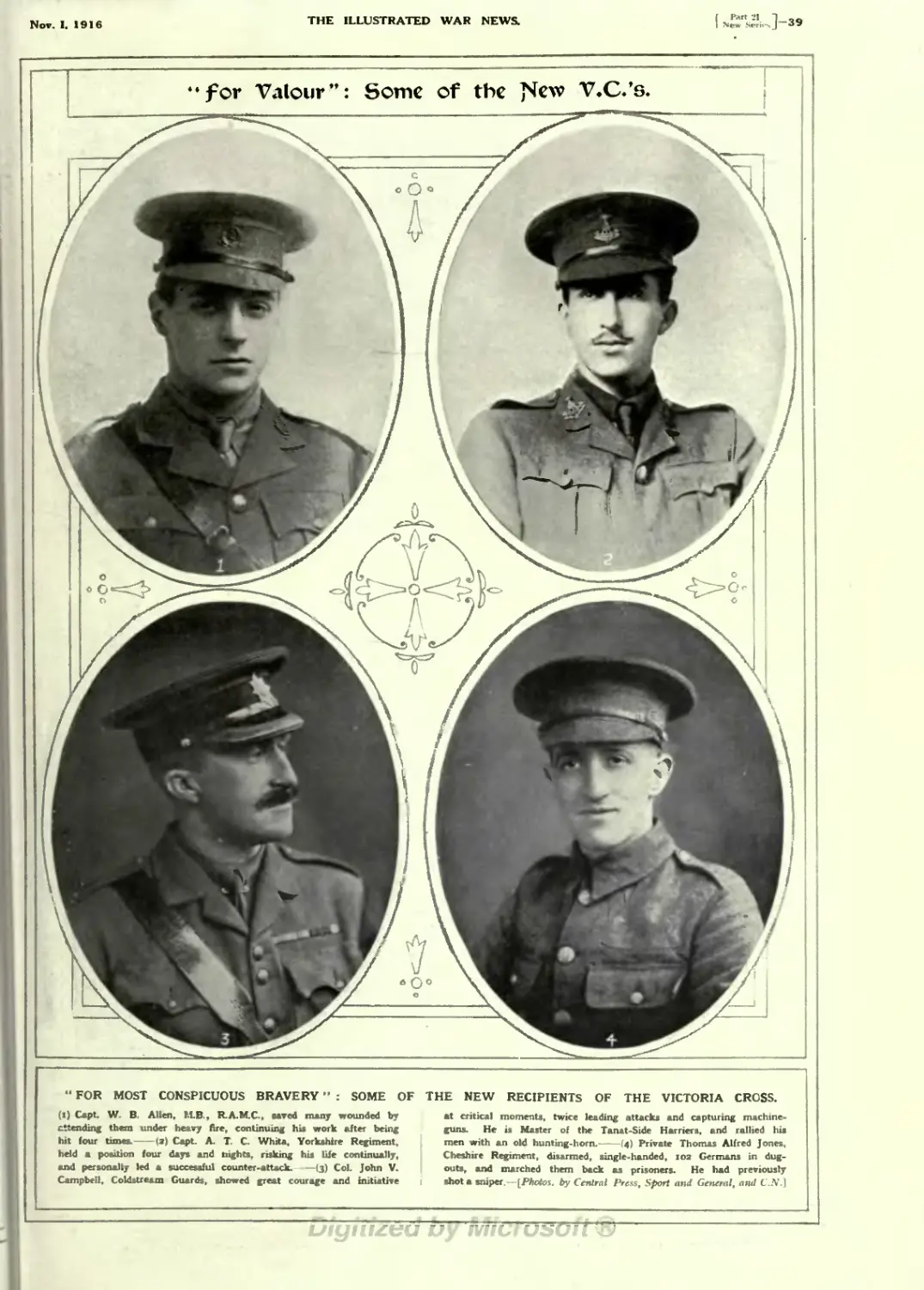
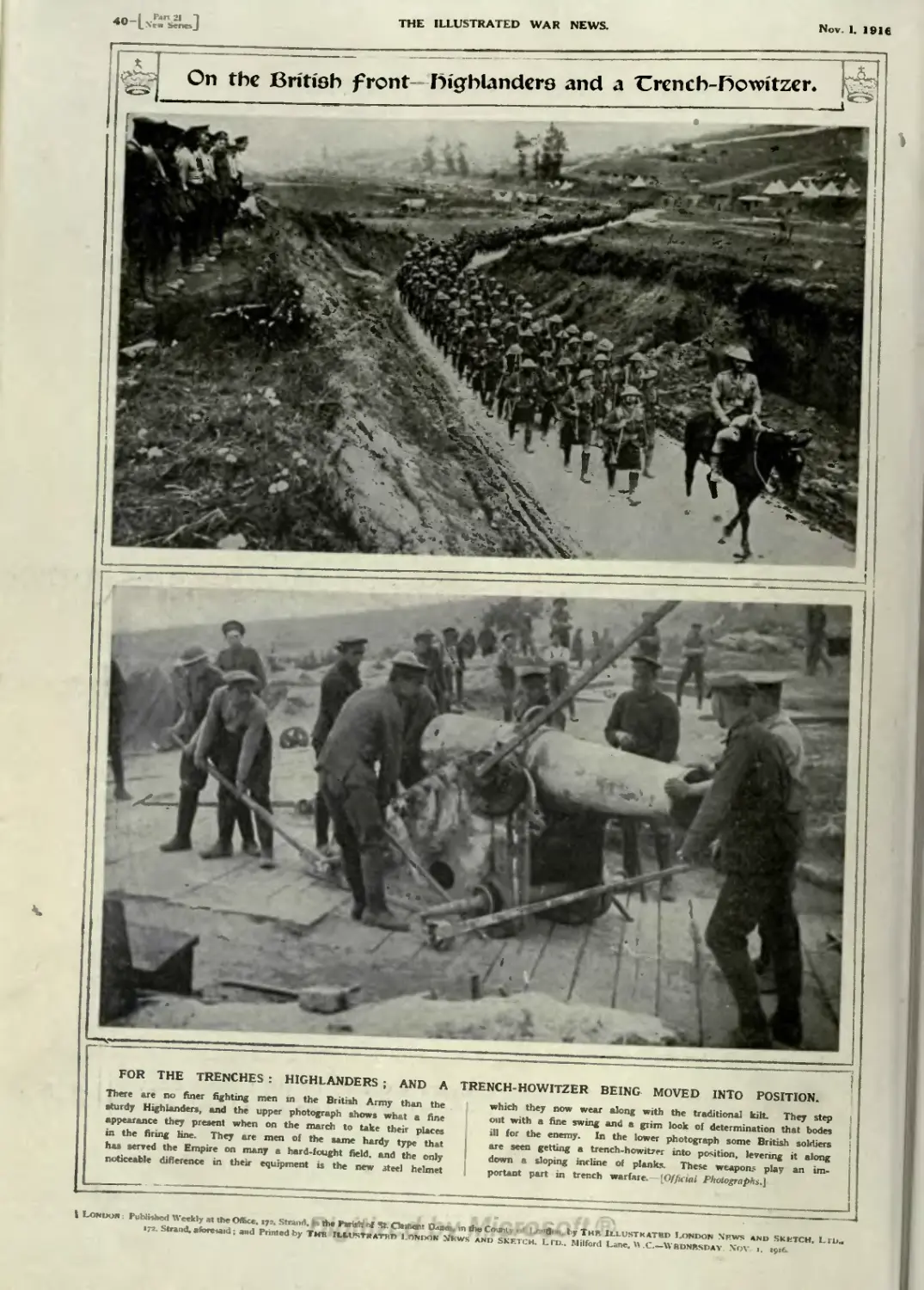
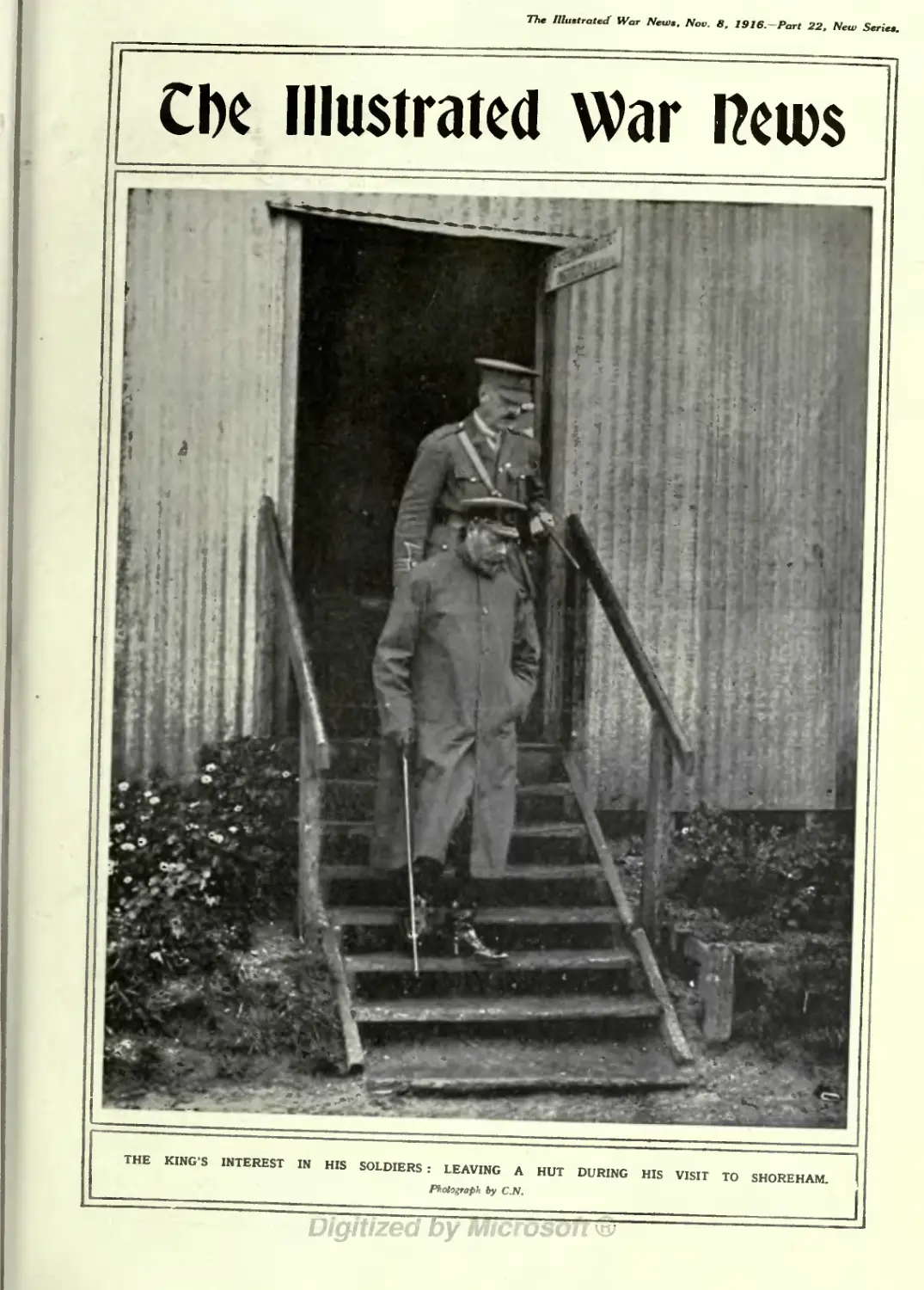
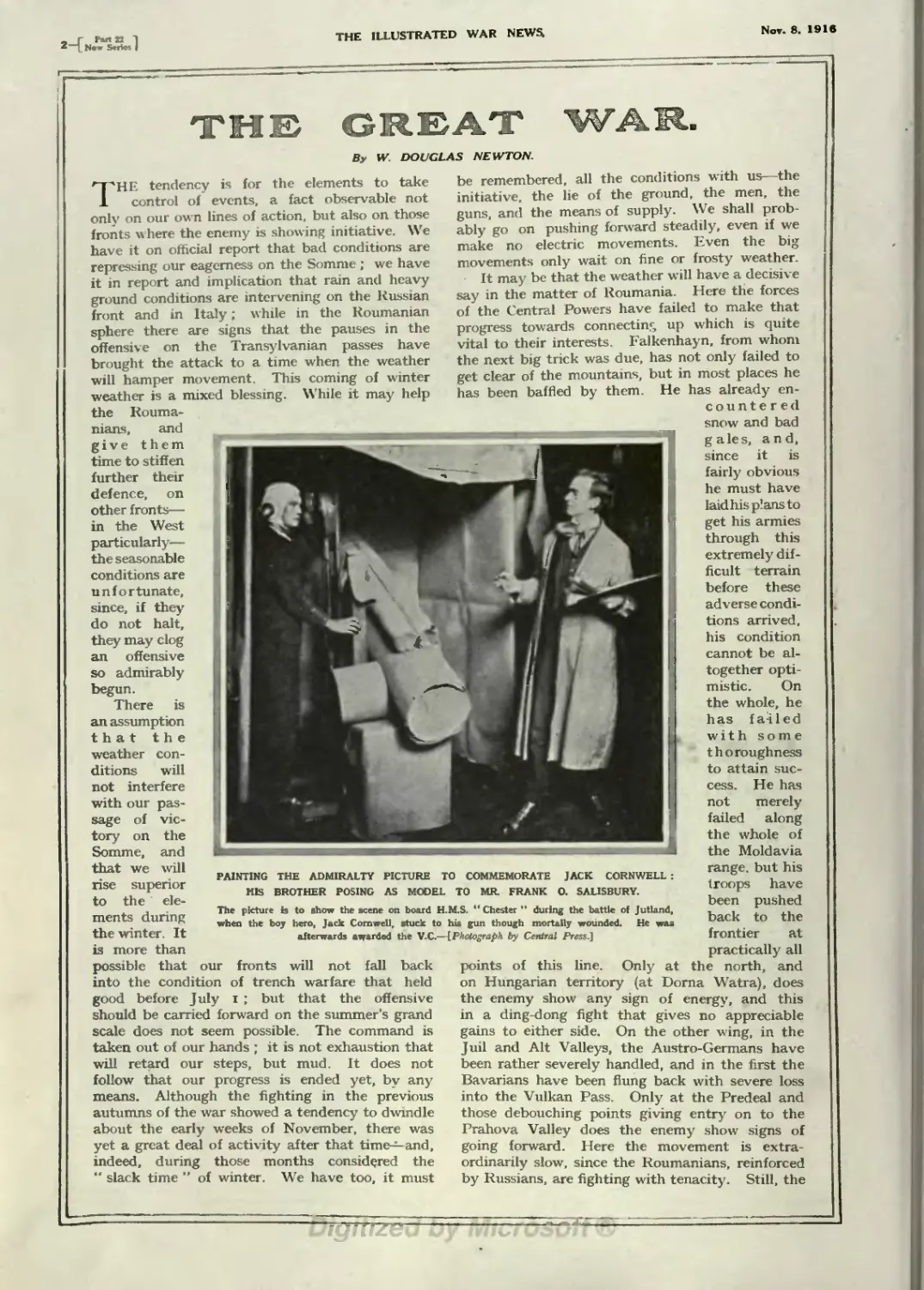
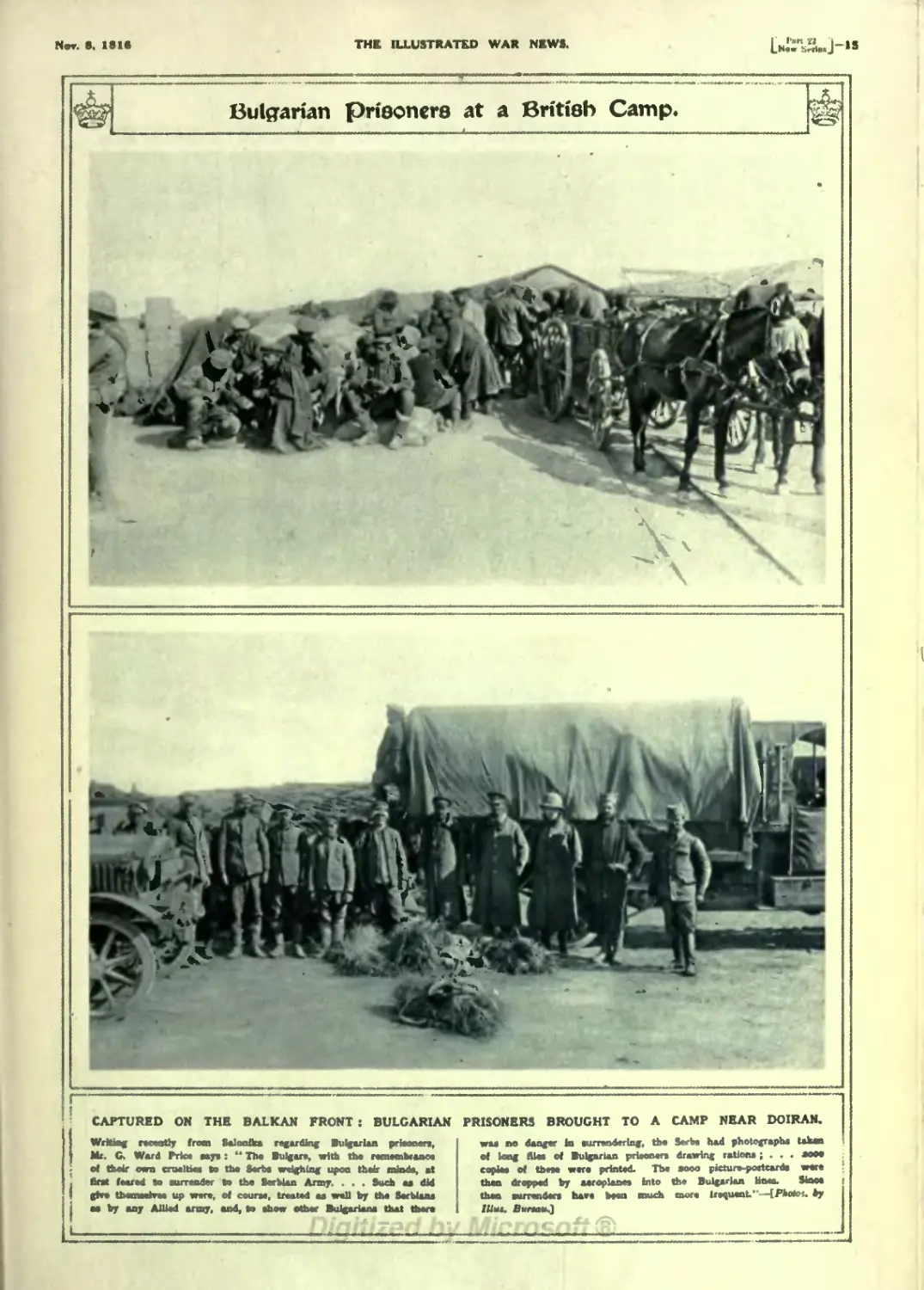
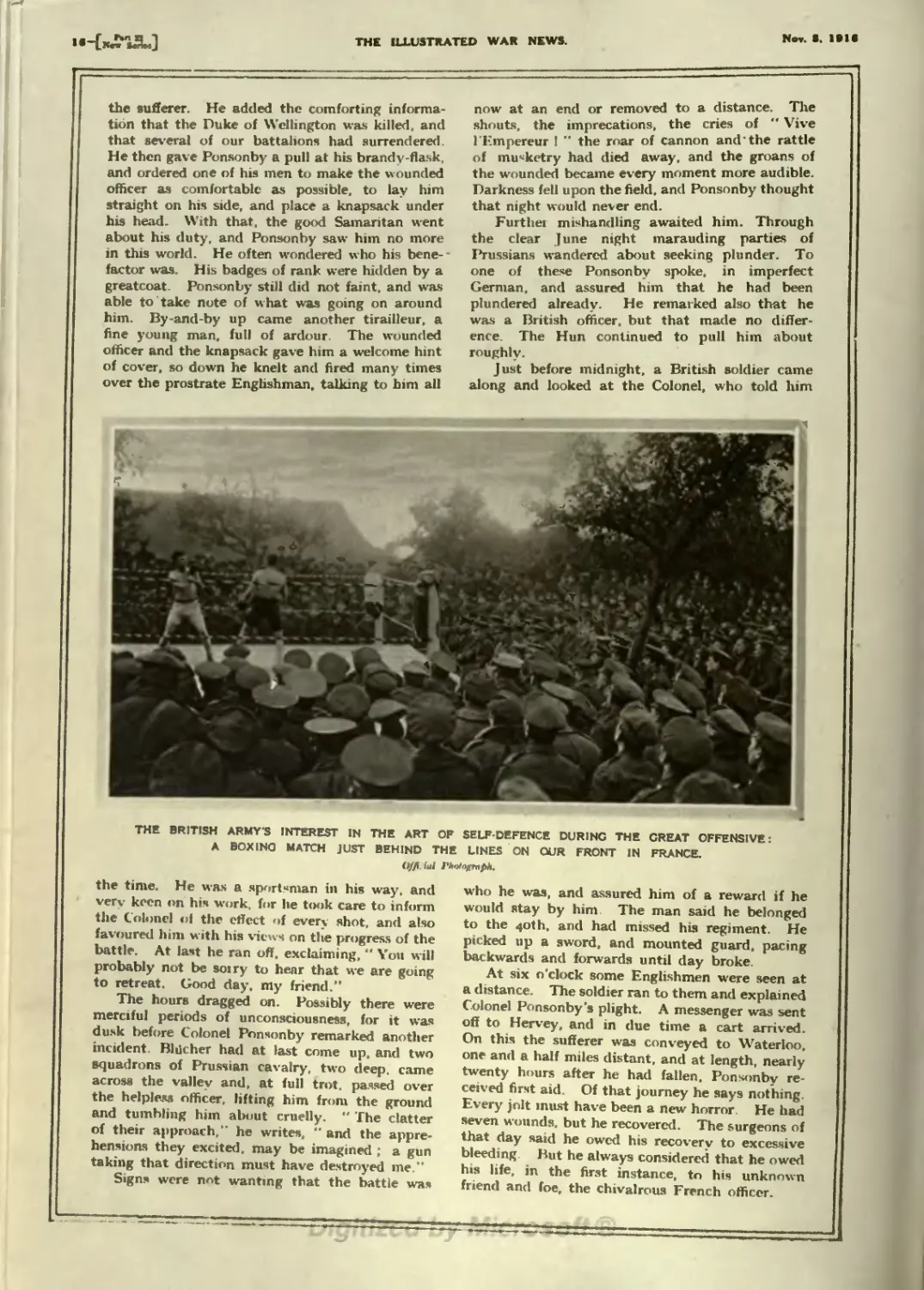
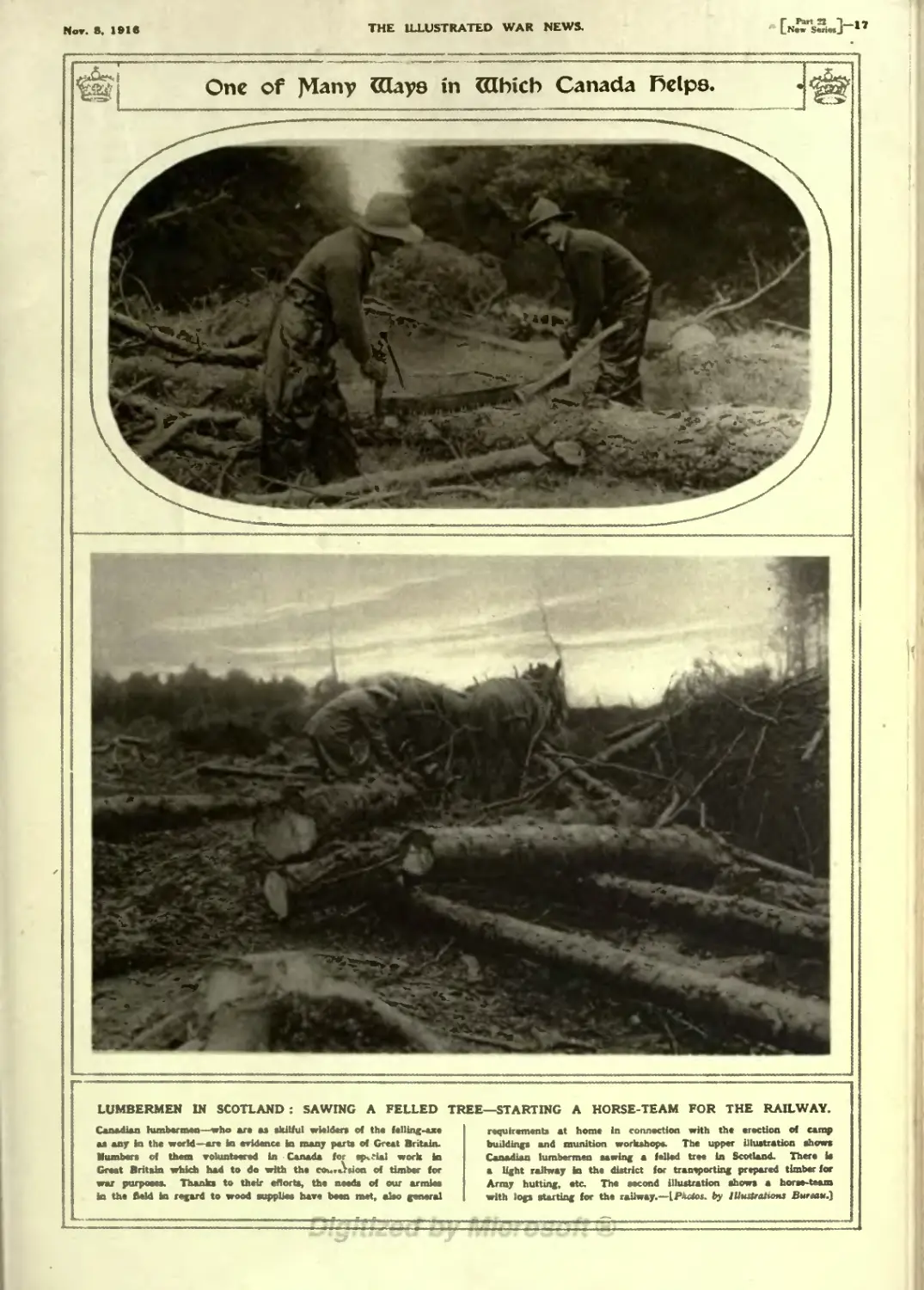
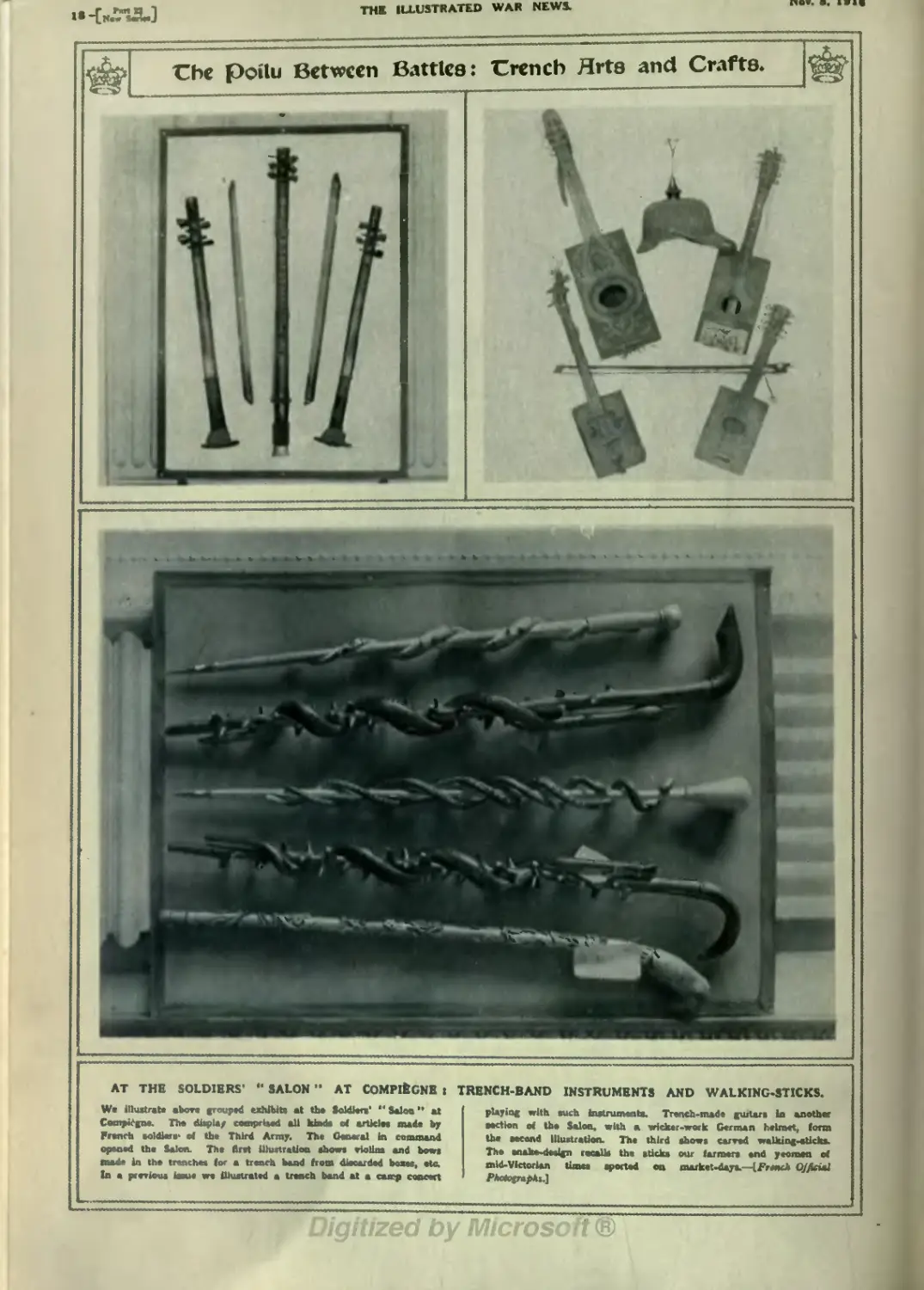
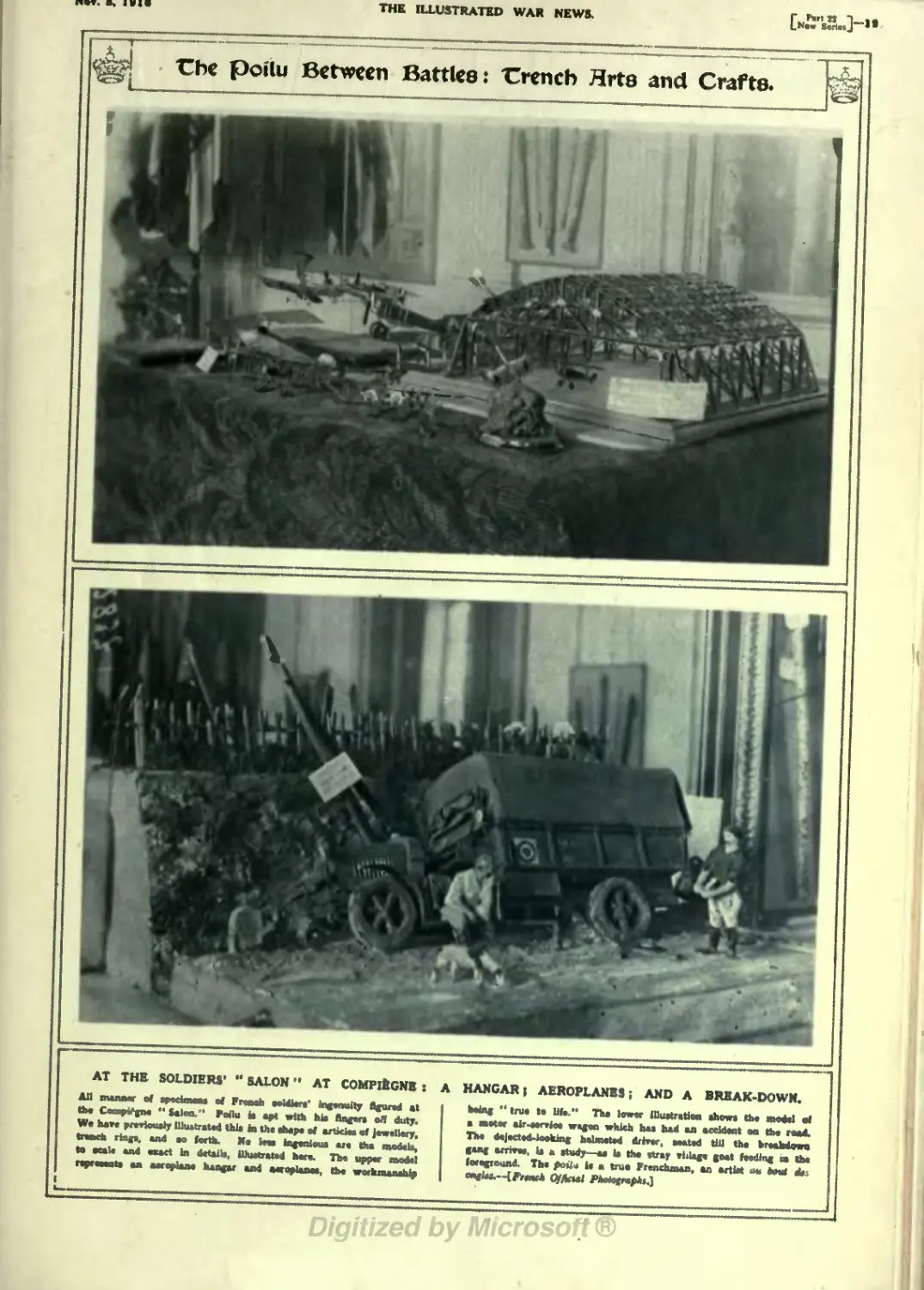
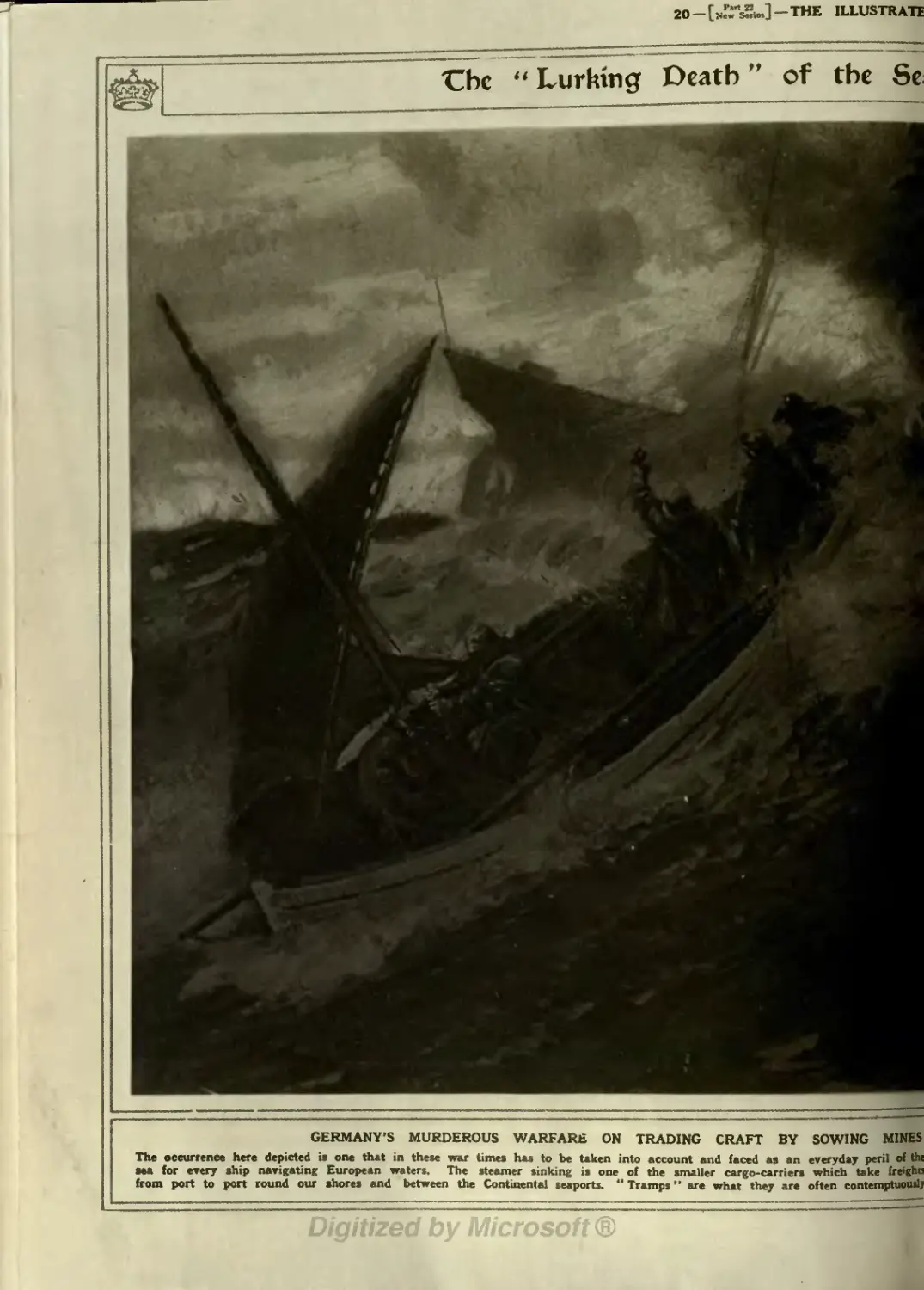
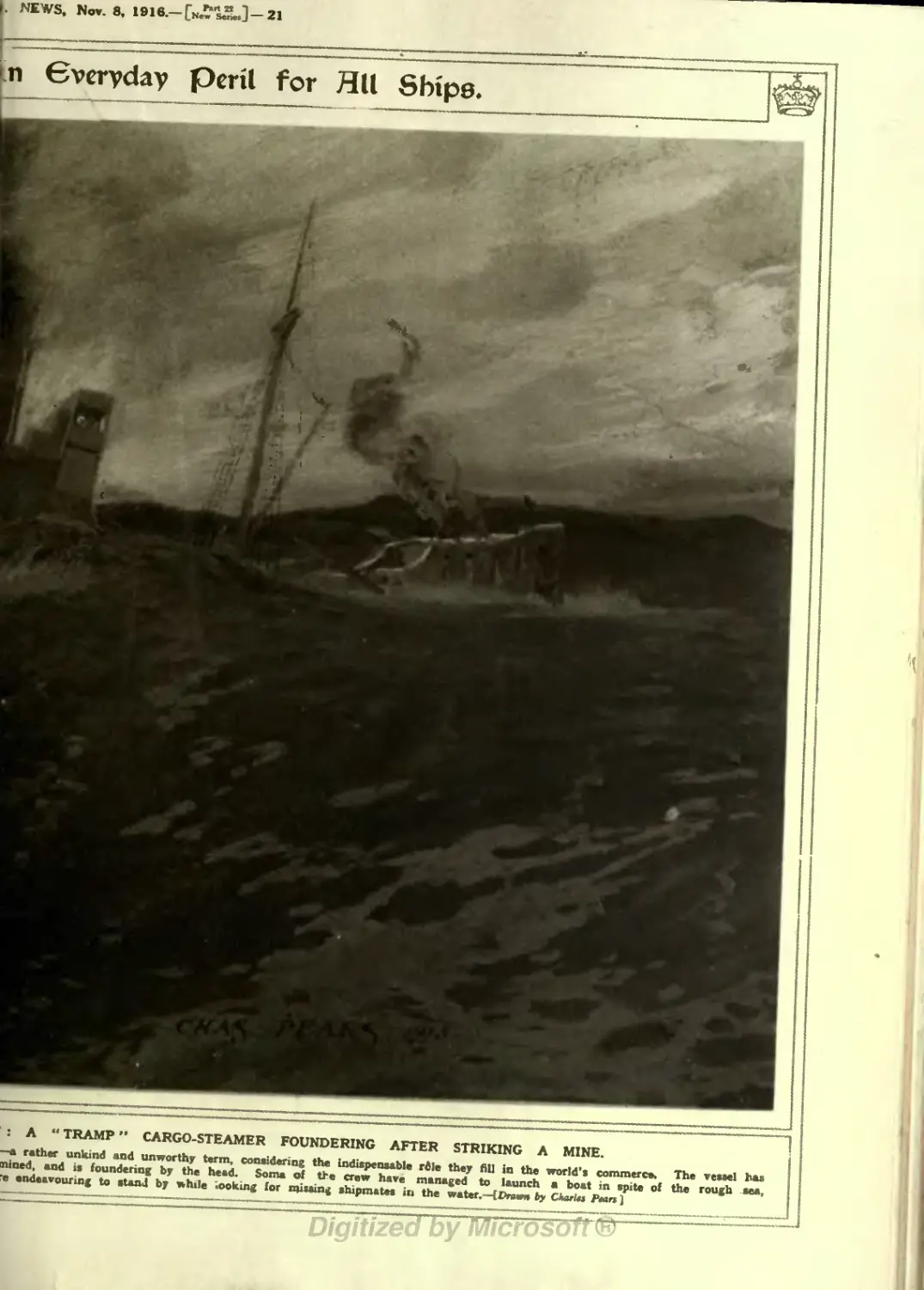
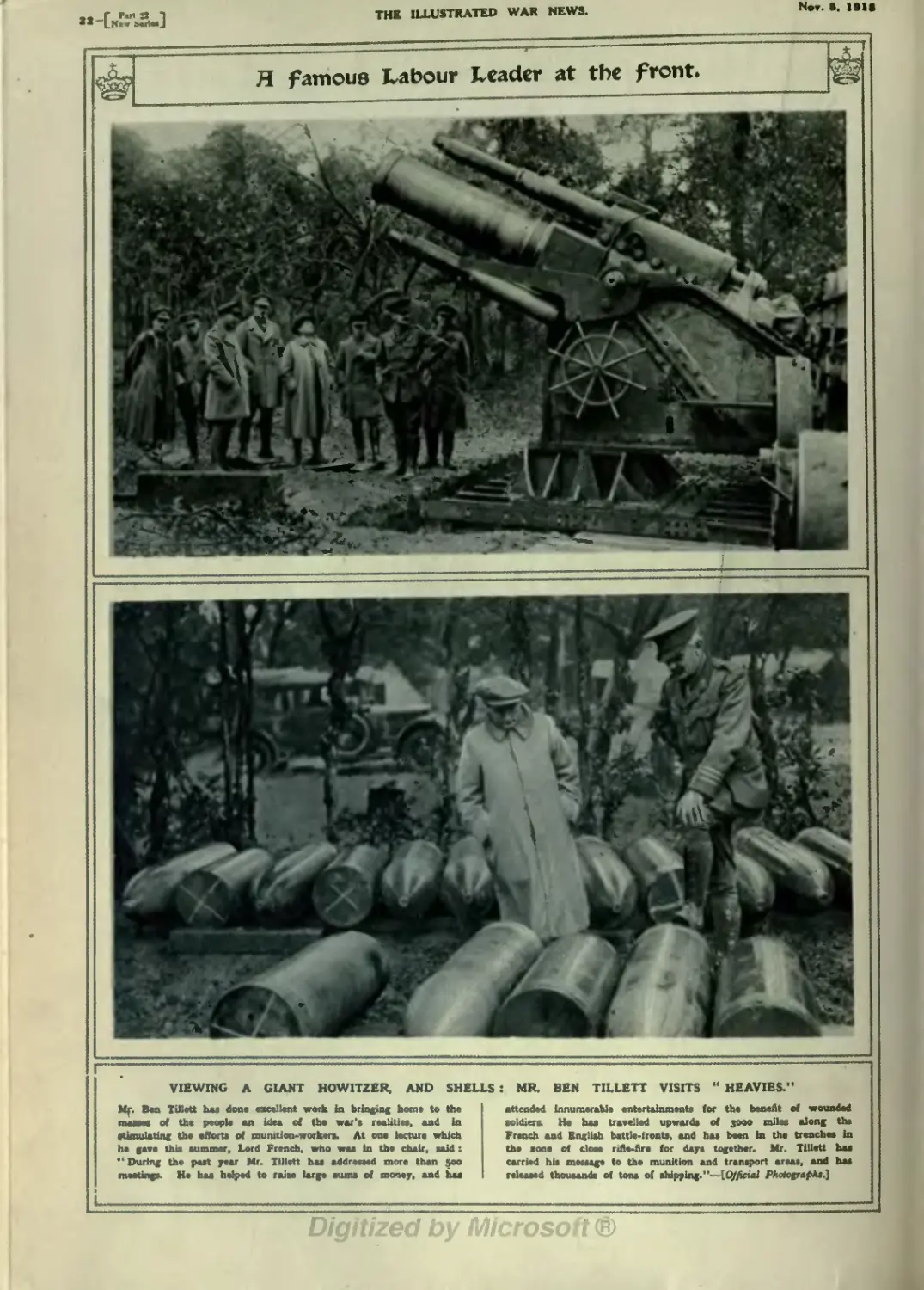
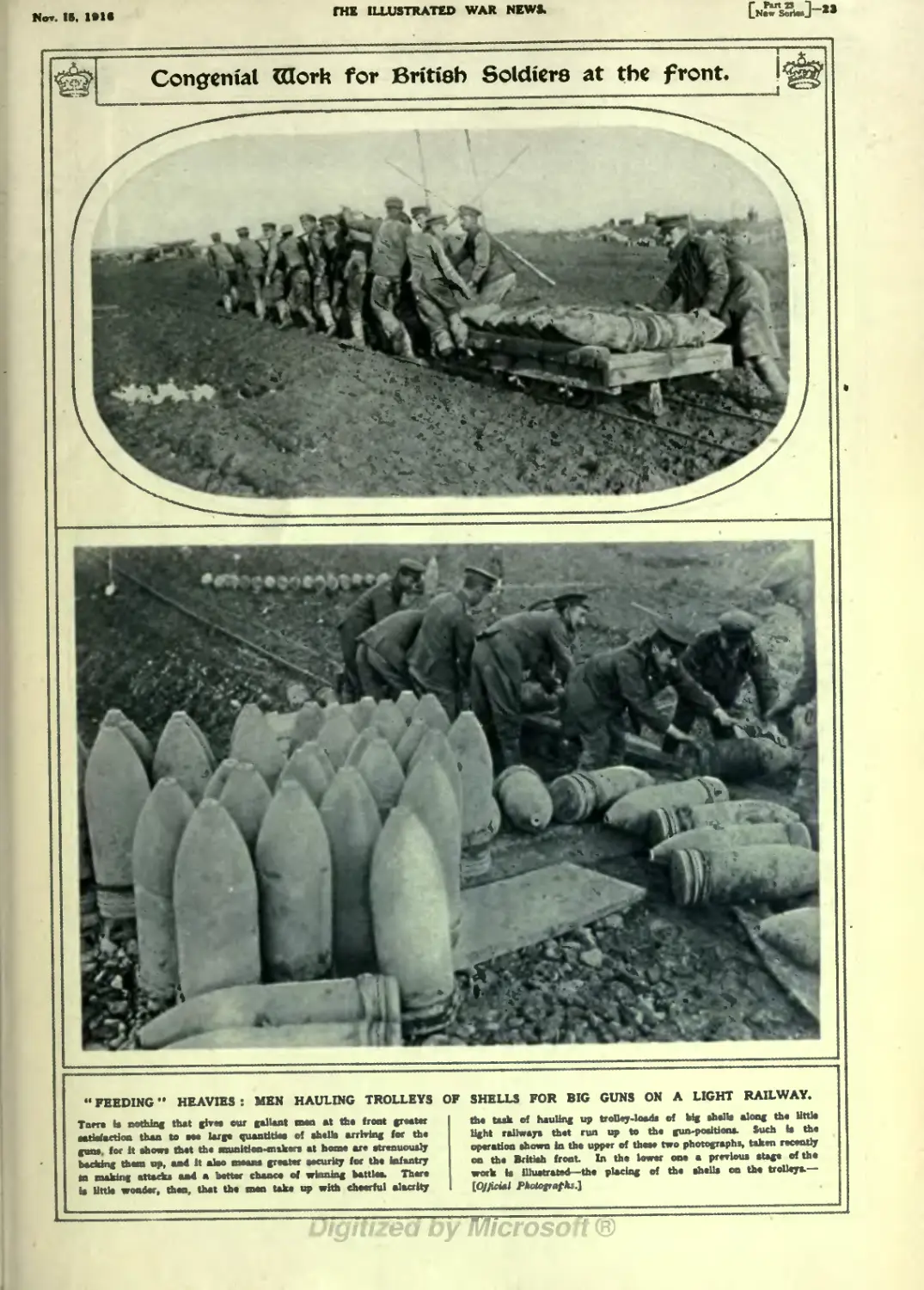
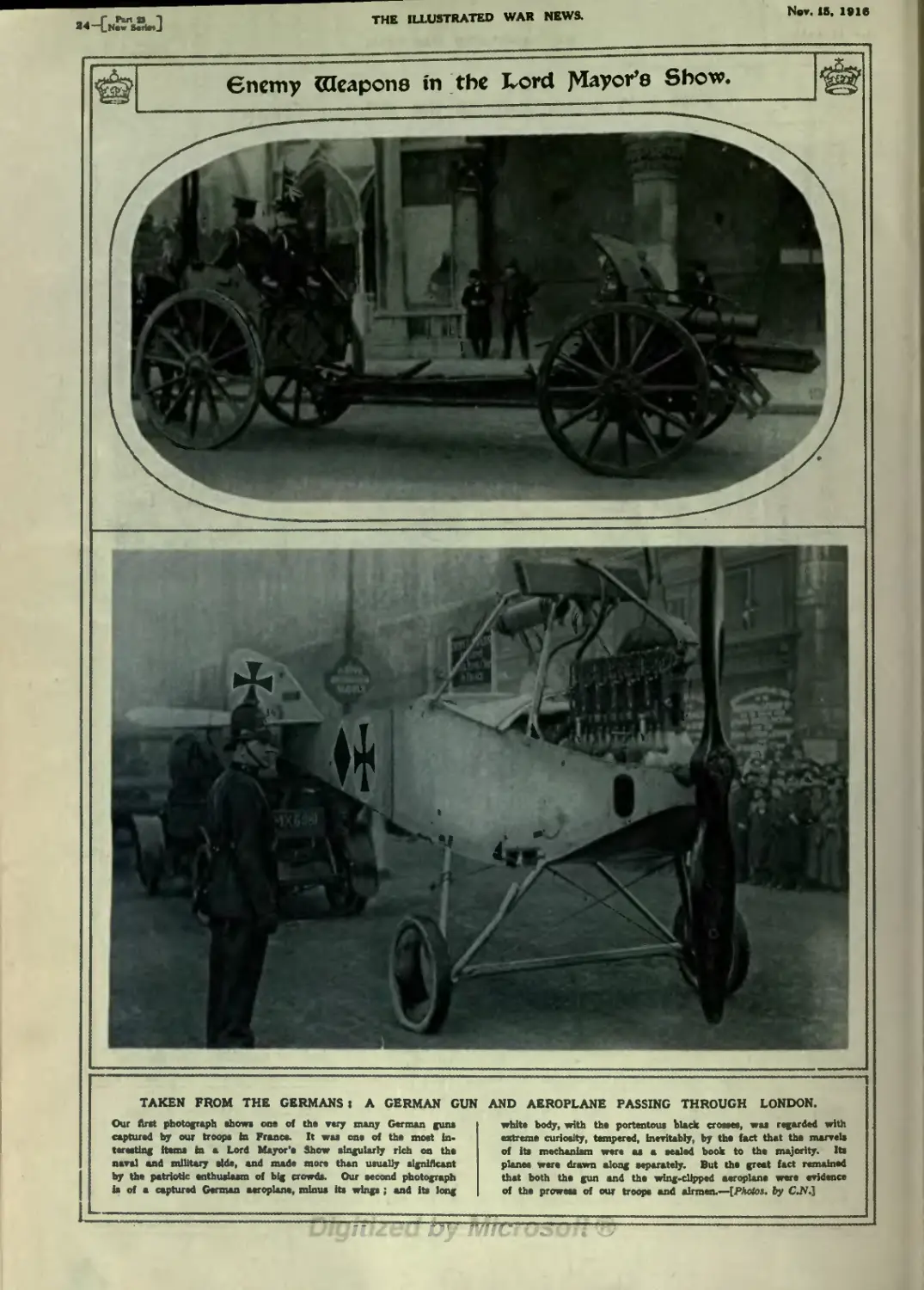
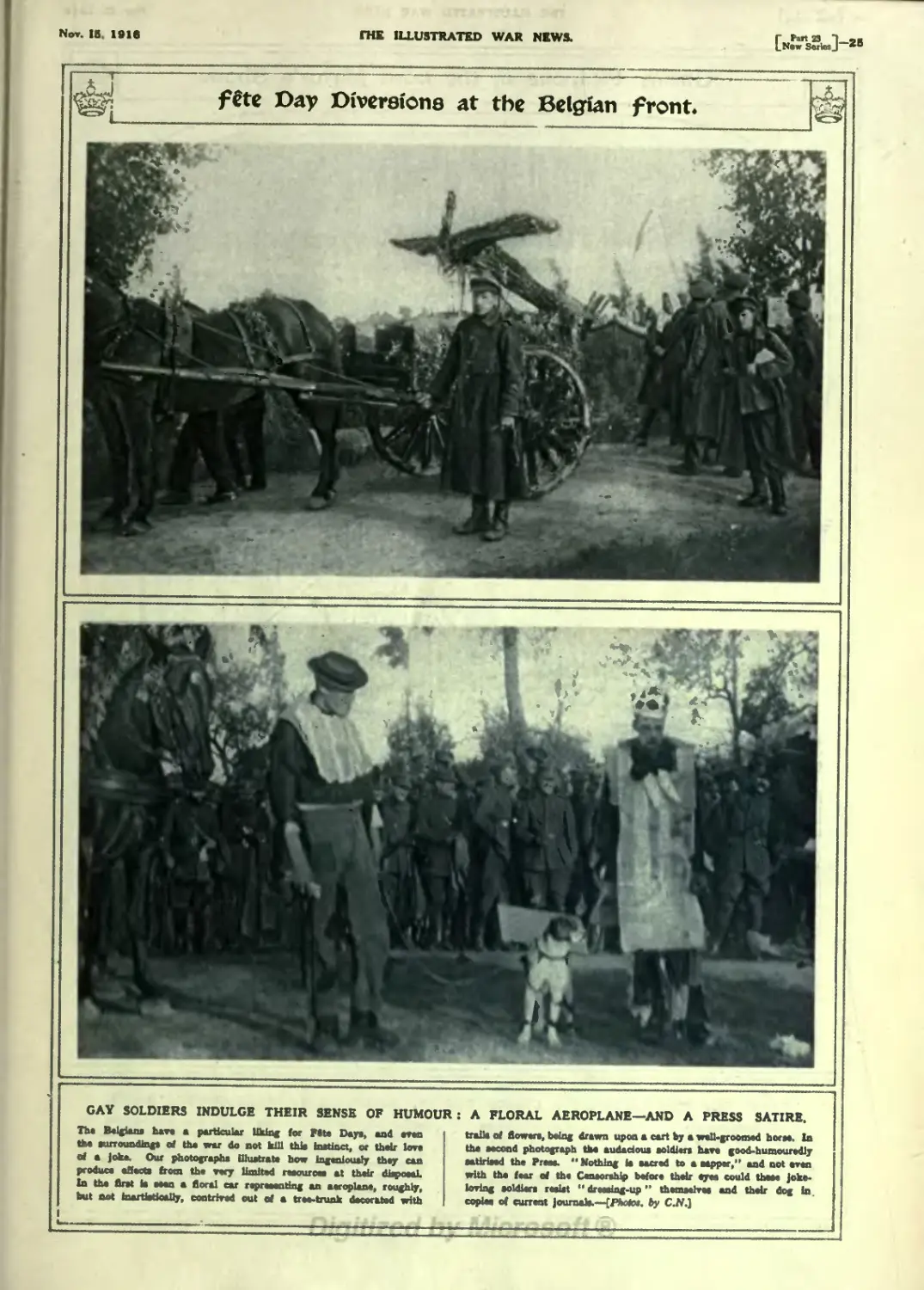
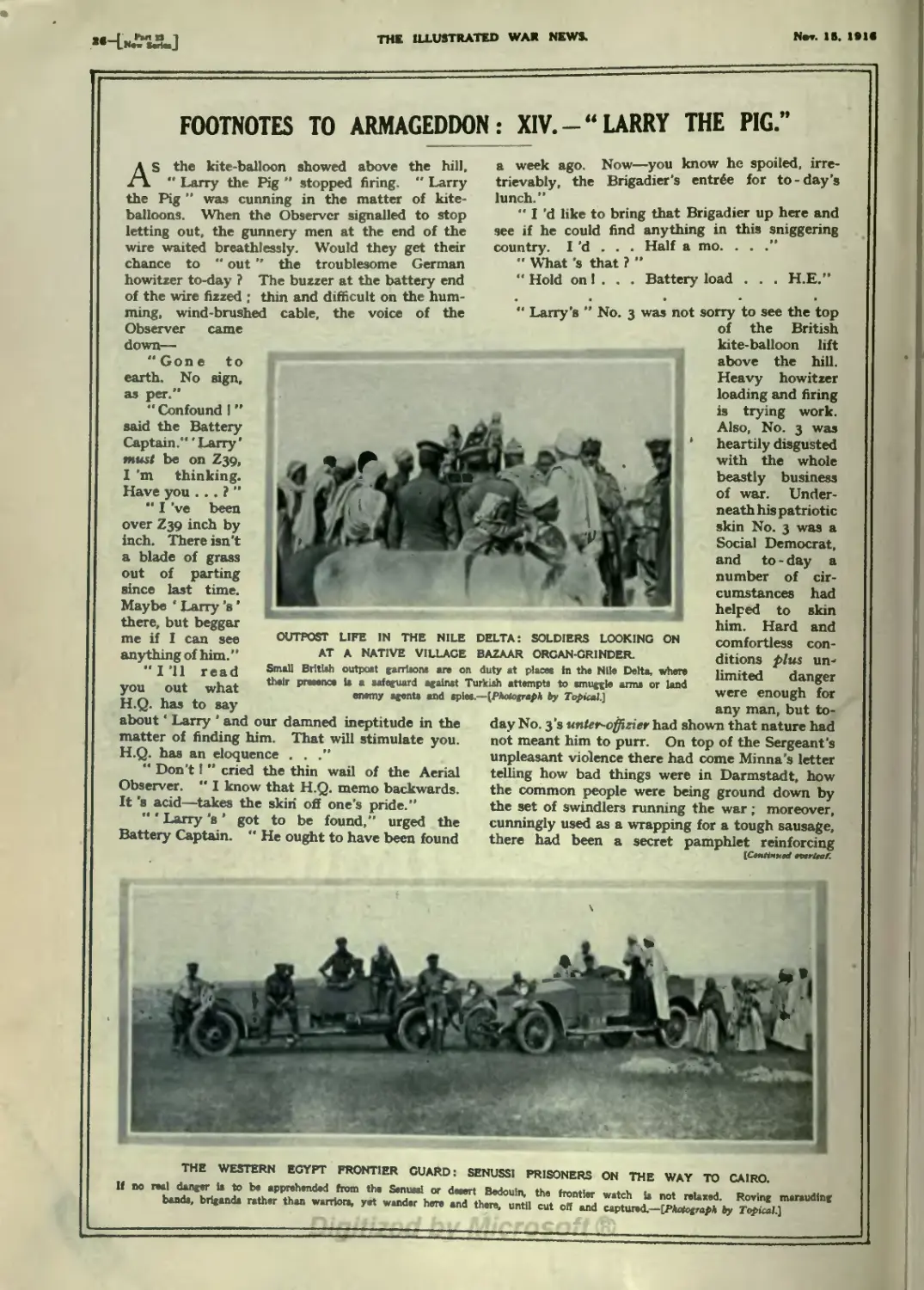




Теги: military news
Год: 2007


Текст
                    .^USTRATED
AR NEWS

to
of Hit
of Toronto
Dr. P.K. Menzies

Uiiimiiiimiiiimiimiimimmiiiiiiiiiiiim
THE
ILLUSTRATED
WAR NEWS.
Being a Pictorial Record of the Great War.
VOLUME 2
PARTS 1324. (Sept. 6th, 1916, to Nov. 22nd, 1916.)
\
i
'Published by the ILLUSTRATED LONDON NEWS AND SKETCH, Ltd.,
172, Strand, London, W.C.

:D
501
T.ONDON :
THK TU.rsTRATKD LONnoV NKWS AVn SKKTCR, T.IMTTF.n
!:, STRAND. I.ONnON', W.C 2.
" Y ;

The Illustrated War News, Sept. 6, 1916. Part 13, New Series.
Illustrated War
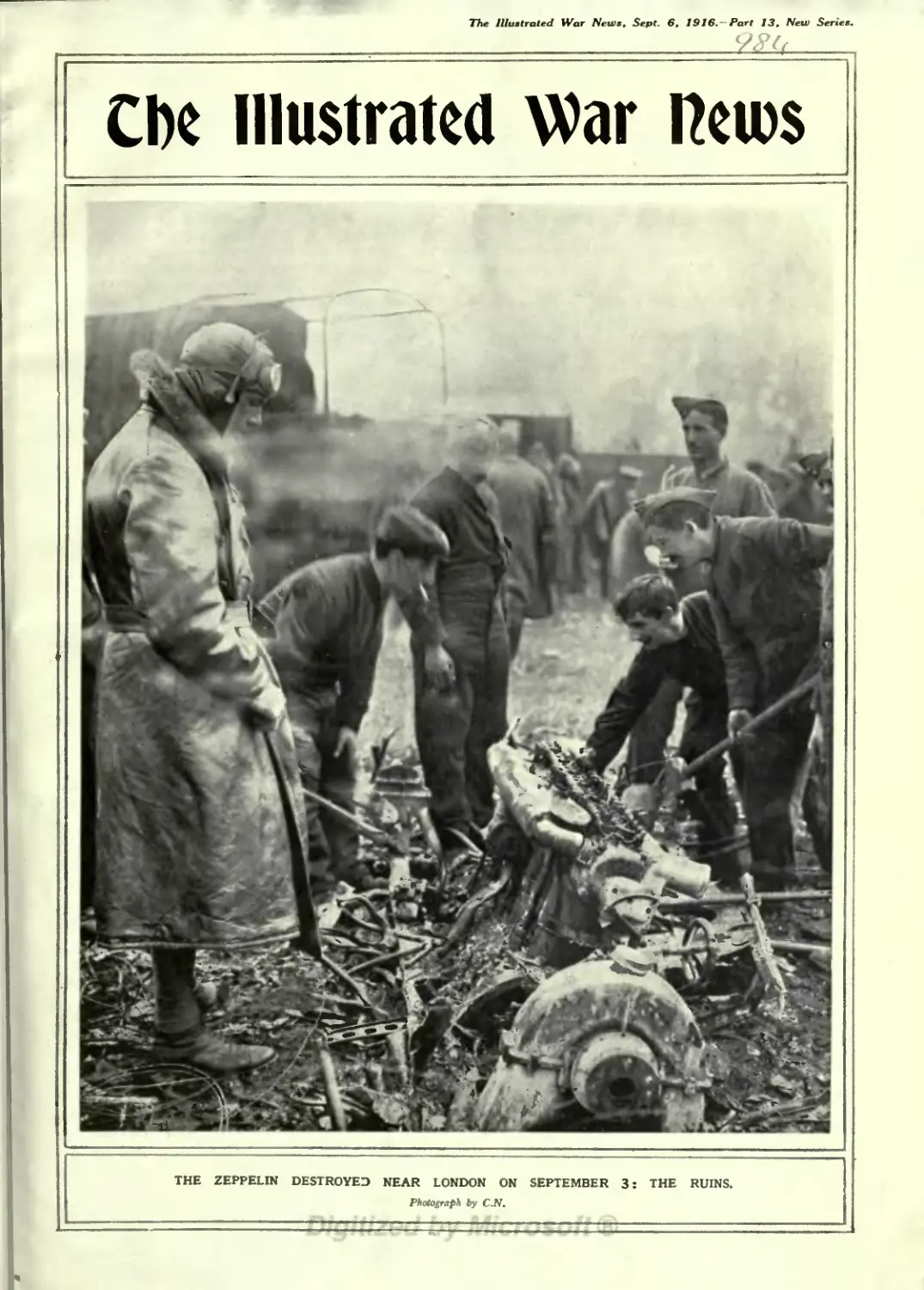
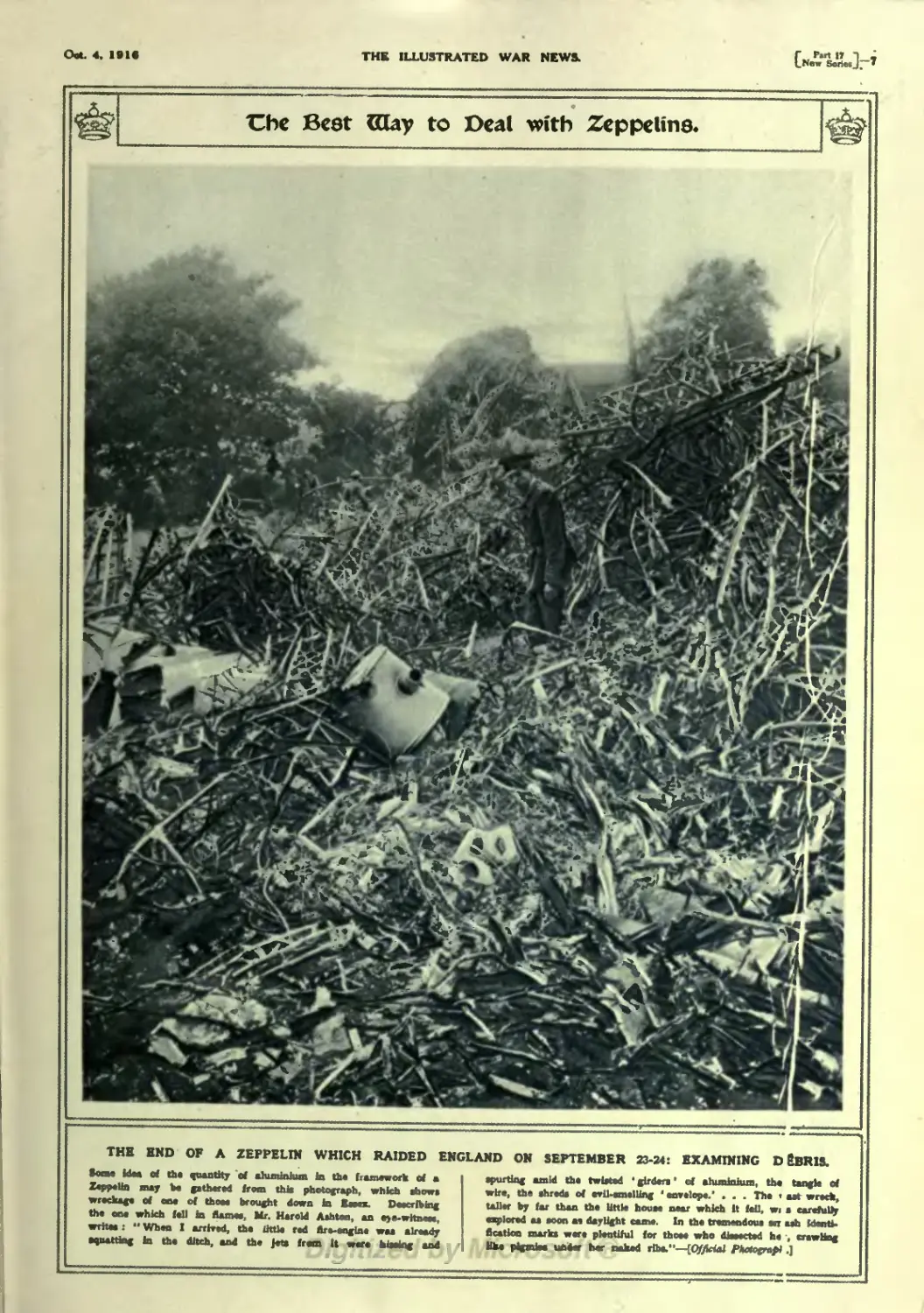
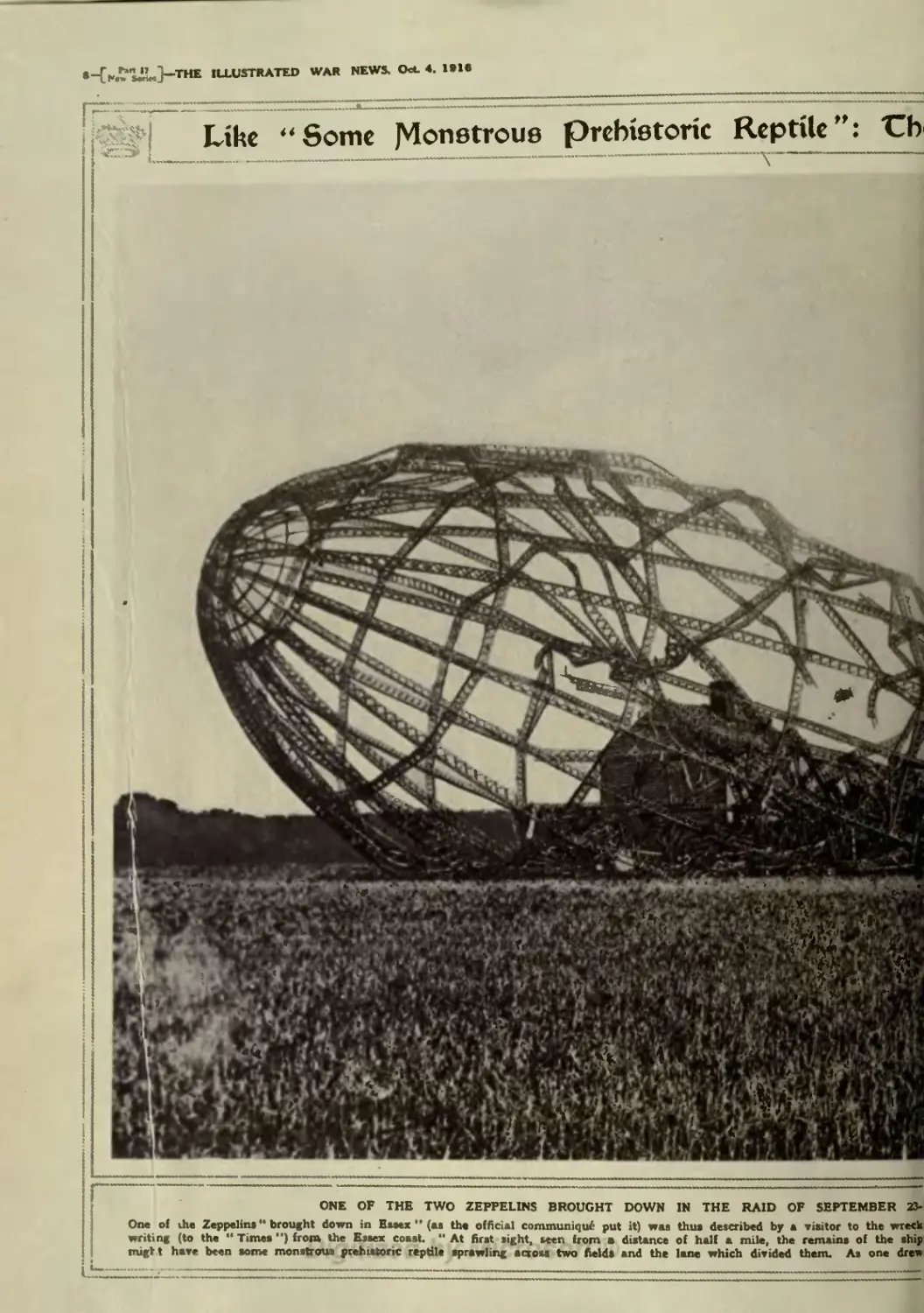
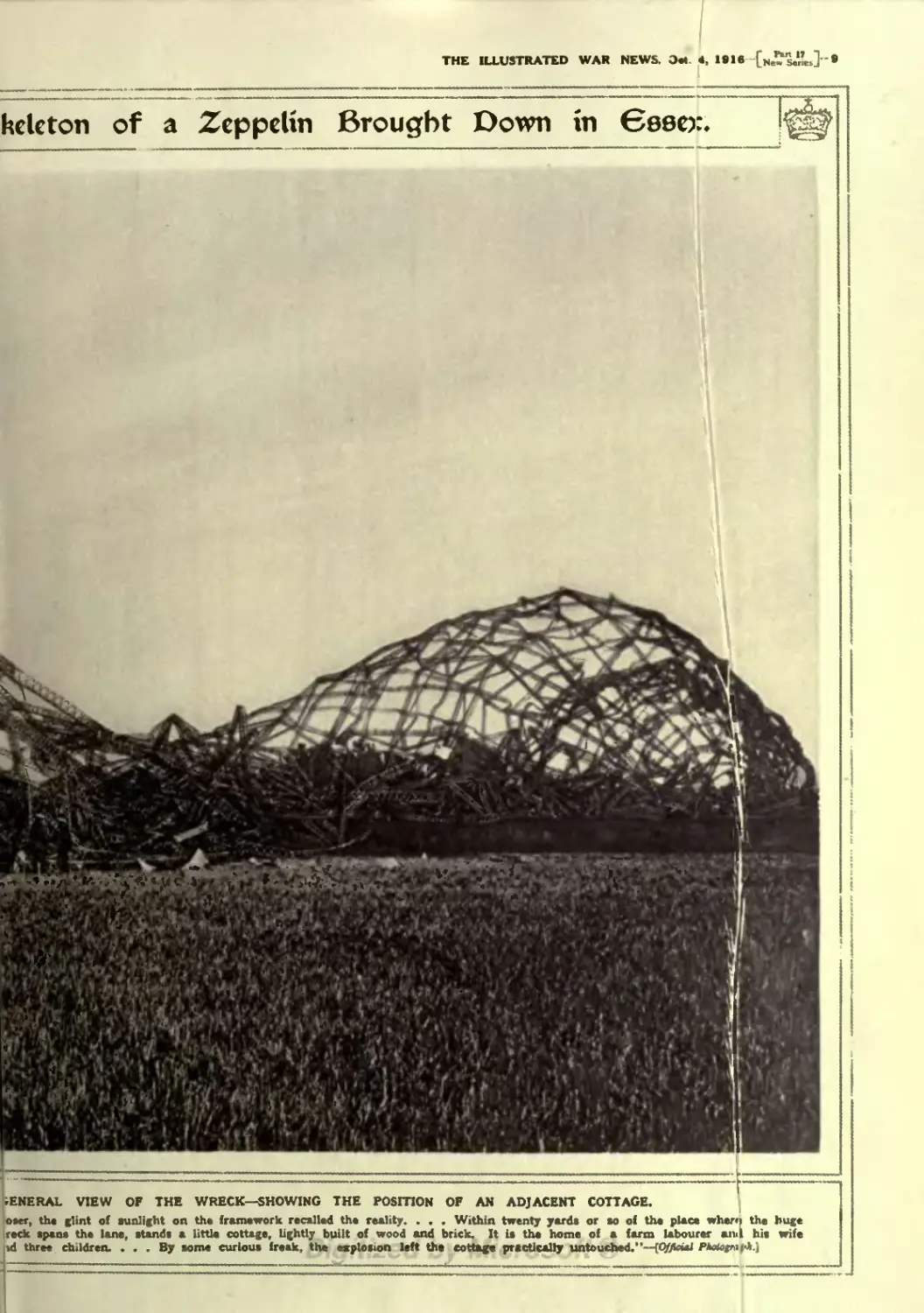
THE ZEPPELIN DESTROYED NEAR LONDON ON SEPTEMBER 3: THE RUINS.
Photograph by C.N.

- r
2 ^N
THE ILLUSTRATED WAR NEWS.
Sepl. 6. 1916
By W
THE entry of Roumania into the war on the
side of the Allies, is, perhaps, the most
significant and emphatic act in the long history
of hostilities. It is, as it were, a clinching fact.
So decisive is the stroke that it separates all the
future of the war into a new and critical com-
partment of development.
By its incisive action it gives
the touch of finality to the
phase of the war in which it
has happened. As we could
say, after the battle of the
Marne, " Germany cannot
win the war now," so we
can say, since Roumania's
declaration of Sunday, Aug.
27, " Germany cannot escape
being beaten now." Indeed,
those two great points have
aspects of similarity. As with
the Marne, the whole German
race has felt the repercussion
of this event ; as with the
Marne, a German Chief of
the General Staff has gone
down under the stroke.
Roumania is the final
moral and material weight
flung into the balance of
events on the side of the
Allies. If Greece follows,
and that is not unlikely, it
will be merely a touch of
over-weight in our favour.
The act of Roumania is the
decisive act,
for a number
of specific rea-
sons. The first
and the most
important of
these is that
Roumania has
been convinced
out of her cau-
tion that the
cause of the
Allies is now
the winning
cause. The ex-
treme slowness
of Roumania
to act only
emphasises this
point ; for, pro-
perly to under -
stand the
meaning of
Roumania's
declaration, we
must appre-
ciate the cir-
cumstances of
DOUGLAS NEWTON.
these small Balkan States. With such countries
it is necessary to be wary. A false stroke does
not mean defeat and humiliation to them, it
means extinction. There are some who have
been puzzled at the apparent obstinacy in
neutrality in the face of facts of Roumania and
Greece, but
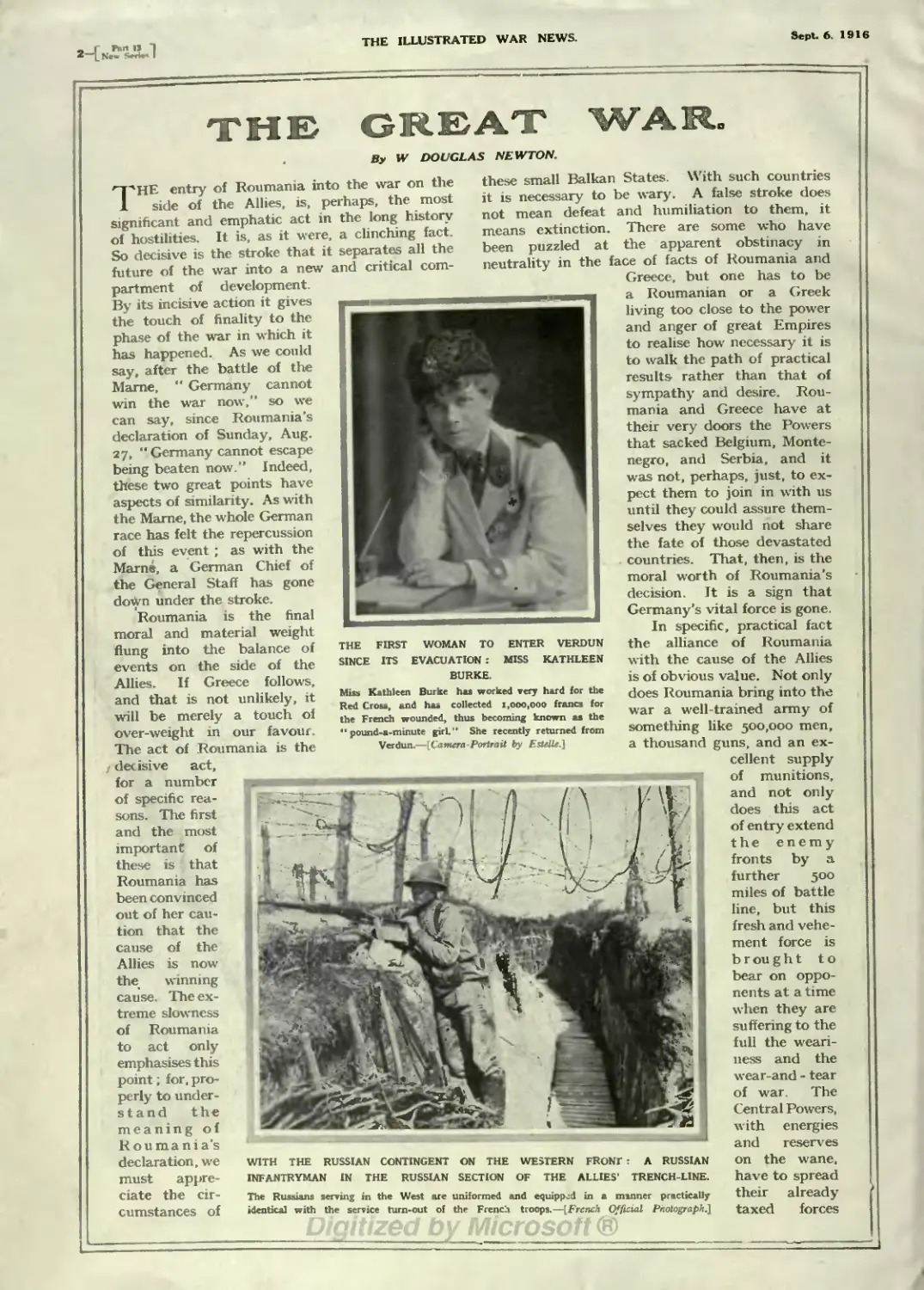
THE FIRST WOMAN TO ENTER VERDUN
SINCE ITS EVACUATION : MISS KATHLEEN
BURKE.
Miss Kathleen Burke has worked very hard for the
Red Cross, and has collected 1,000,000 francs for
the French wounded, thus becoming known as the
" pound-a-minute girl." She recently returned from
Verdun. [Camera-Portrait by Estelli.]
WITH THE RUSSIAN CONTINGENT ON THE WESTERN FRONT : A RUSSIAN
INFANTRYMAN IN THE RUSSIAN SECTION OF THE ALLIES' TRENCH-LINE.
The Russians serving in the West are uniformed and equipped in a manner practically
identical with the service turn-out of the French troops. [French Official Piwtogrupli.]
one has to be
a Roumanian or a Greek
living too close to the power
and anger of great Empires
to realise how necessary it is
to walk the path of practical
results- rather than that of
sympathy and desire. Rou-
mania and Greece have at
their very doors the Powers
that sacked Belgium, Monte-
negro, and Serbia, and it
was not, perhaps, just, to ex-
pect them to join in with us
until they could assure them-
selves they would not share
the fate of those devastated
countries. That, then, is the
moral worth of Roumania's
decision. It is a sign that
Germany's vital force is gone.
In specific, practical fact
the alliance of Roumania
with the cause of the Allies
is of obvious value. Not only
does Roumania bring into the
war a well-trained army of
something like 500,000 men,
a thousand guns, and an ex-
cellent supply
of munitions,
and not only
does this act
of entry extend
the enemy
fronts by a
further 500
miles of battle
line, but this
fresh and vehe-
ment force is
brought to
bear on oppo-
nents at a time
when they are
suffering to the
full the weari-
ness and the
wear-and - tear
of war. The
Central Powers,
with energies
and reserves
on the wane,
have to spread
their already
taxed forces

Sept. 6. 1916
THE ILLUSTRATED WAR NEWS.
r i
l_Ne
over a new front at a critical point. For, of the
several lines of offensive open to her one of them
would be an invasion of Bulgaria the Rouma-
nians show that they have chosen a front of ad-
vance that will link up with the Russians already
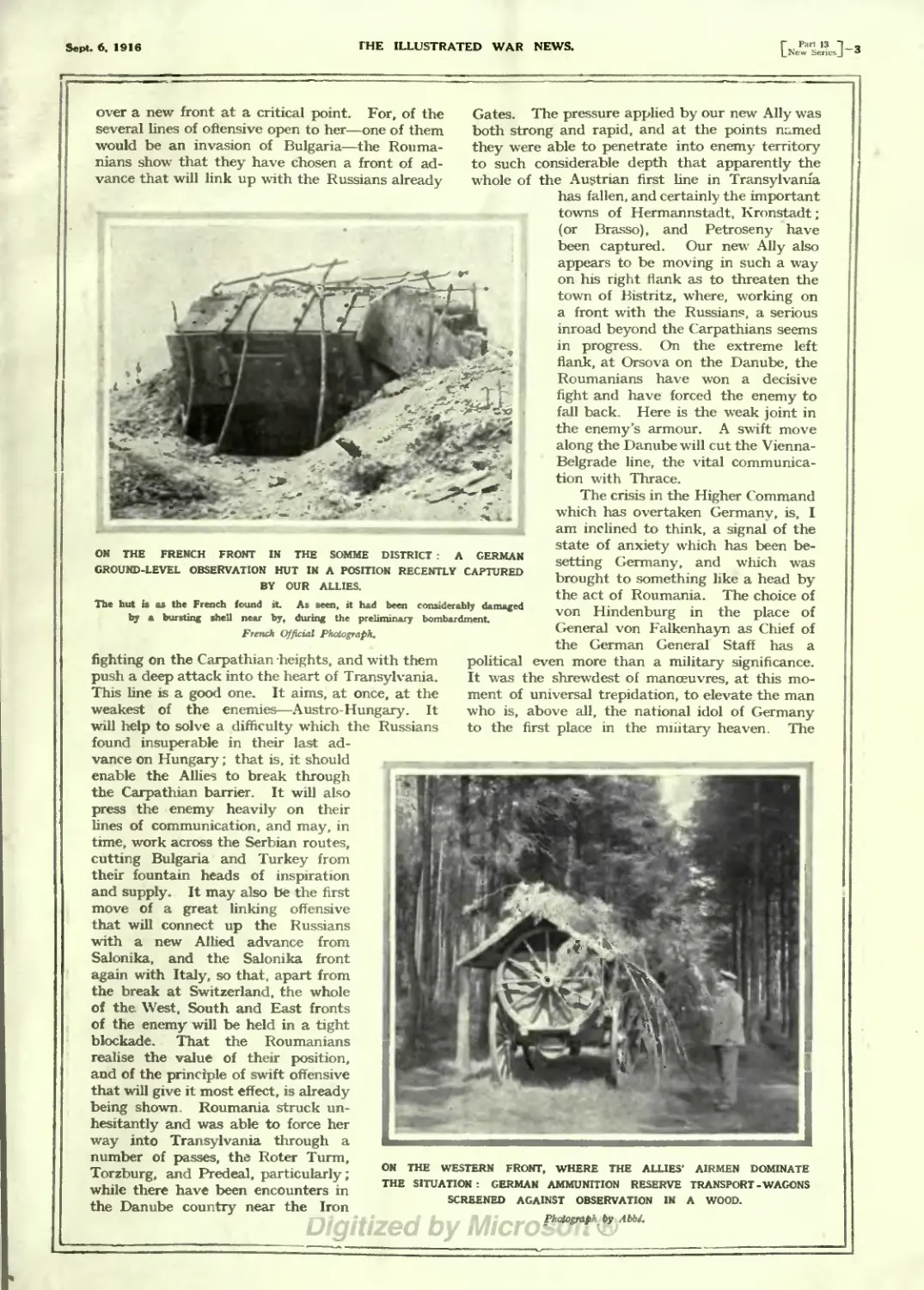
ON THE FRENCH FRONT IN THE SOMME DISTRICT : A GERMAN
GROUND-LEVEL OBSERVATION HUT IN A POSITION RECENTLY CAPTURED
BY OUR ALLIES.
The hut is as the French found it. As seen, it had been considerably damaged
by a bursting shell near by, during the preliminary bombardment.
French Official Photograph.
fighting on the Carpathian heights, and with them
push a deep attack into the heart of Transylvania.
This line is a good one. It aims, at once, at the
weakest of the enemies Austro-Hungary. It
will help to solve a difficulty which the Russians
found insuperable in their last ad-
vance on Hungary ; that is, it should
enable the Allies to break through
the Carpathian barrier. It will also
press the enemy heavily on their
lines of communication, and may, in
time, work across the Serbian routes,
cutting Bulgaria and Turkey from
their fountain heads of inspiration
and supply. It may also be the first
move of a great linking offensive
that will connect up the Russians
with a new Allied advance from
Salonika, and the Salonika front
again with Italy, so that, apart from
the break at Switzerland, the whole
of the West, South and East fronts
of the enemy will be held in a tight
blockade. That the Roumanians
realise the value of their position,
and of the principle of swift offensive
that will give it most effect, is already
being shown. Rou mania struck un-
hesitantly and was able to force her
way into Transylvania through a
number of passes, the Roter Turm,
Torzburg, and Predeal, particularly ;
while there have been encounters in
the Danube country near the Iron
Gates. The pressure applied by our new Ally was
both strong and rapid, and at the points named
they were able to penetrate into enemy territory
to such considerable depth that apparently the
whole of the Austrian first line in Transylvania
has fallen, and certainly the important
towns of Hermannstadt, Kronstadt ;
(or Brasso), and Petroseny have
been captured. Our new Ally also
appears to be moving in such a way
on his right flank as to threaten the
town of Bistritz, where, working on
a front with the Russians, a serious
inroad beyond the Carpathians seems
in progress. On the extreme left
flank, at Orsova on the Danube, the
Roumanians have won a decisive
fight and have forced the enemy to
fall back. Here is the weak joint in
the enemy's armour. A swift move
along the Danube will cut the Vienna-
Belgrade line, the vital communica-
tion with Thrace.
The crisis in the Higher Command
which has overtaken Germany, is, I
am inclined to think, a signal of the
state of anxiety which has been be-
setting Germany, and which was
brought to something like a head by
the act of Roumania. The choice of
von Hindenburg in the place of
General von Falkenhayn as Chief of
the German General Staff has a
political even more than a military significance.
It was the shrewdest of manoeuvres, at this mo-
ment of universal trepidation, to elevate the man
who is, above all, the national idol of Germany
to the first place in the military heaven. The
ON THE WESTERN FRONT, WHERE THE ALLIES' AIRMEN DOMINATE
THE SITUATION: GERMAN AMMUNITION RESERVE TRANSPORT -WAGONS
SCREENED AGAINST OBSERVATION IN A WOOD.
Photograph by Abbi.

13 1
THE ILLUSTRATED WAR NEWS.
Sepl. 6, 1916
glory of Hindenburg is about the only thing that
will blind the eyes of the depressed enemy to the
gloomy military condition. As a military mind
IlmdiMiburg is probably a
very bail second to Falk-
enhayn, who, whatever
his faults, showed that he
was possessed of consider-
able ability. At the same
time it must be remem-
bered that Hindenburg
does stand as an asset of
great moral force, and the
choice of him as Chief of
Staff is bound to en-
hearten the German peo-
ple at any rate, for the
time bsing.
The complications of
the German Eastern front
are being added to both
by Russia and by the
attitude of the Allies and
the Greeks at Salonika.
Russia seems to have
timed a vigorous offensive
on her left flank to march
with the line of Rouma-
nia. In the Carpathians
the Roumanians and Rus-
sians are fighting side by
side, and progress on the
summits in the direction
of Korosmezo is being
made. In Galicia a new drive is being made
at von Bothmer's flank, and the advance has
been pushed forward in the direction of Halicz
and Zolotchevsk.
There has been
some fighting on
the Kovel salient,
and ground has
been gained, on
German admis-
sion, south-west
of Lutzk. The
Russian activity
is also develop-
ing on a new, if
anticipated, line.
Our Ally's troops
are already cross-
ing Roumania
on their way to
the Bulgarian
border, and these
troops are al-
ready over the
Danube and are
massing on the
Dobrudja. Bul-
garia, waiting to
exhibit the
effects on a nut
when it is caught
between the crackers, appears to be in no happy
mood. There are symptoms of real anxiety ap-
parent, and aireadv there seems to be a touch of
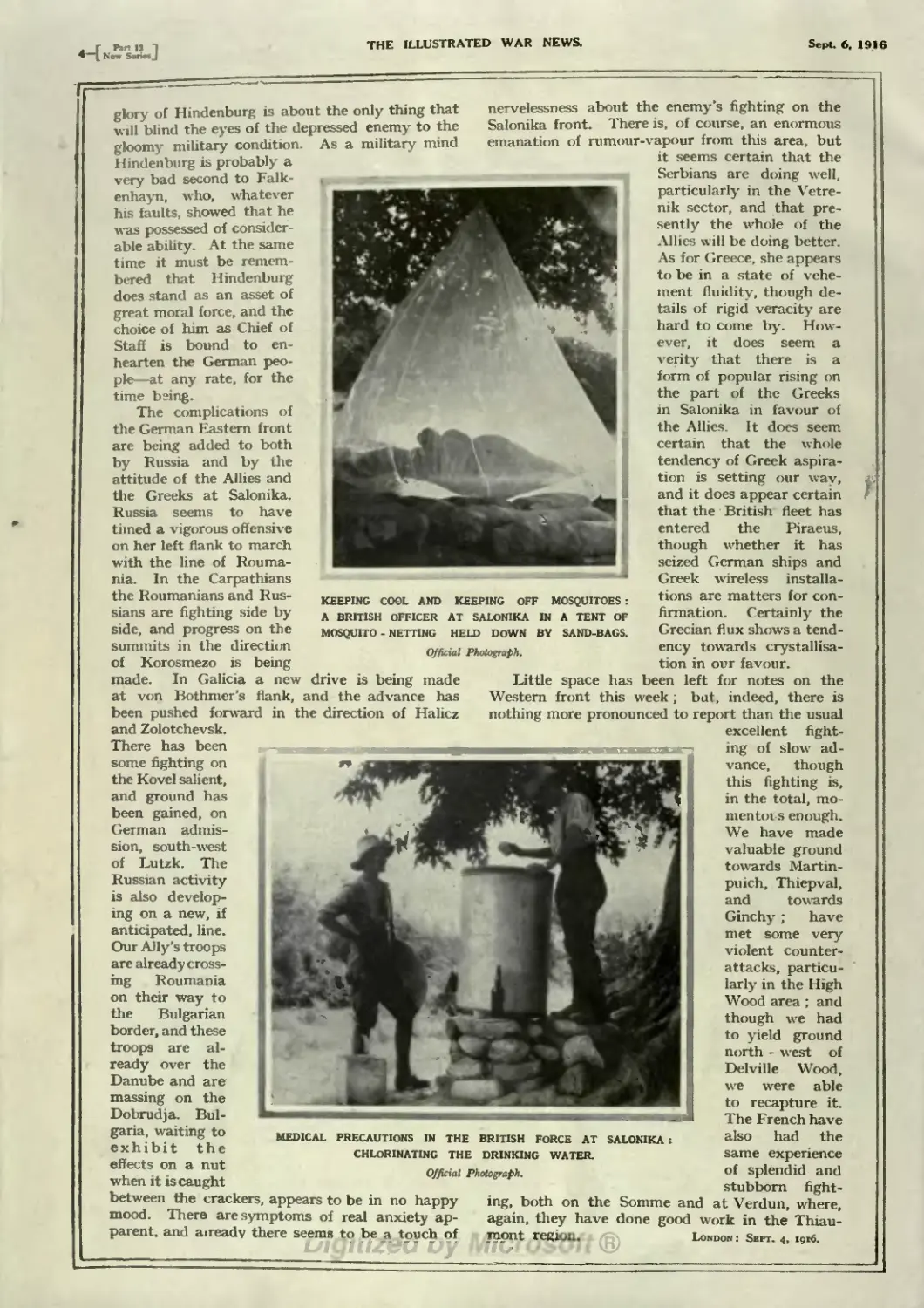
KEEPING COOL AND KEEPING OFF MOSQUITOES :
A BRITISH OFFICER AT SALONIKA IN A TENT OF
MOSQUITO - NETTING HELD DOWN BY SAND-BAGS.
Official Photograph.
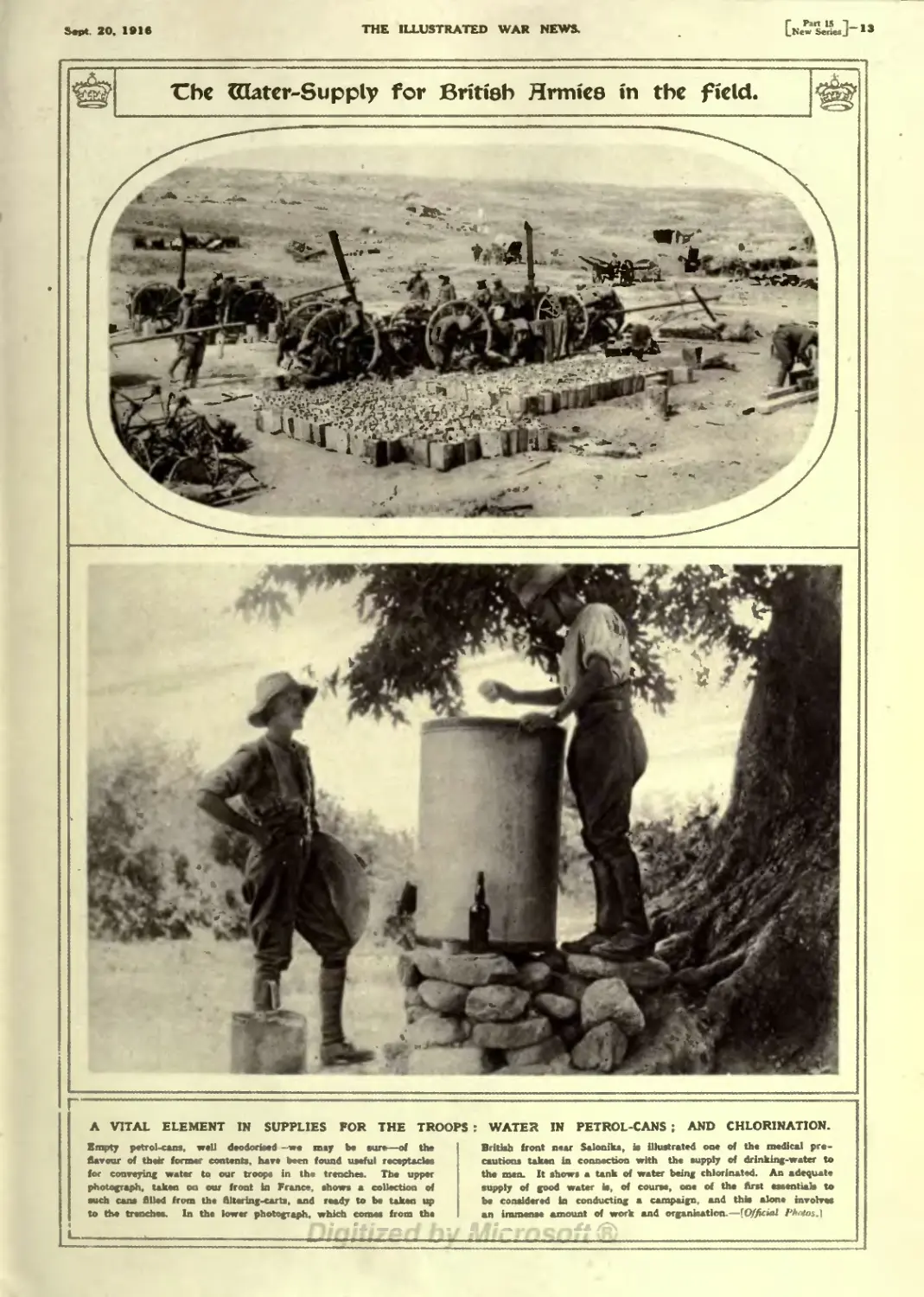
MEDICAL PRECAUTIONS IN THE BRITISH FORCE AT SALONIKA :
CHLORINATING THE DRINKING WATER.
Official Photograph.
nervelessness about the enemy's fighting on the
Salonika front. There is, of course, an enormous
emanation of rumour-vapour from this area, but
it seems certain that the
K^MnBaMa^BMi Serbians are doing well,
particularly in the Vetre-
nik sector, and that pre-
sently the whole of the
Allies will be doing better.
As for Greece, she appears
to be in a state of vehe-
ment fluidity, though de-
tails of rigid veracity are
hard to come by. How-
ever, it does seem a
verity that there is a
form of popular rising on
the part of the Greeks
in Salonika in favour of
the Allies. It does seem
certain that the whole
tendency of Greek aspira-
tion is setting our way,
and it does appear certain
that the British fleet has
entered the Piraeus,
though whether it has
seized German ships and
Greek wireless installa-
tions are matters for con-
firmation. Certainly the
Grecian flux shows a tend-
ency towards crystallisa-
tion in our favour.
Little space has been left for notes on the
Western front this week ; but, indeed, there is
nothing more pronounced to report than the usual
excellent fight-
ing of slow ad-
vance, though
this fighting is,
in the total, mo-
mentous enough.
We have made
valuable ground
towards Martin-
puich, Thiepval,
and towards
Ginchy ; have
met some very
violent counter-
attacks, particu-
larly in the High
Wood area ; and
though we had
to yield ground
north - west of
Delville Wood,
we were able
to recapture it.
The French have
also had the
same experience
of splendid and
stubborn fight-
ing, both on the Somme and at Verdun, where,
again, they have done good work in the Thiau-
mont region. LONDON: SEPT. 4, 191*.

Sept. 6, 1916
THE ILLUSTRATED WAR NEWS.
Lran |.j i -
New Scries J~
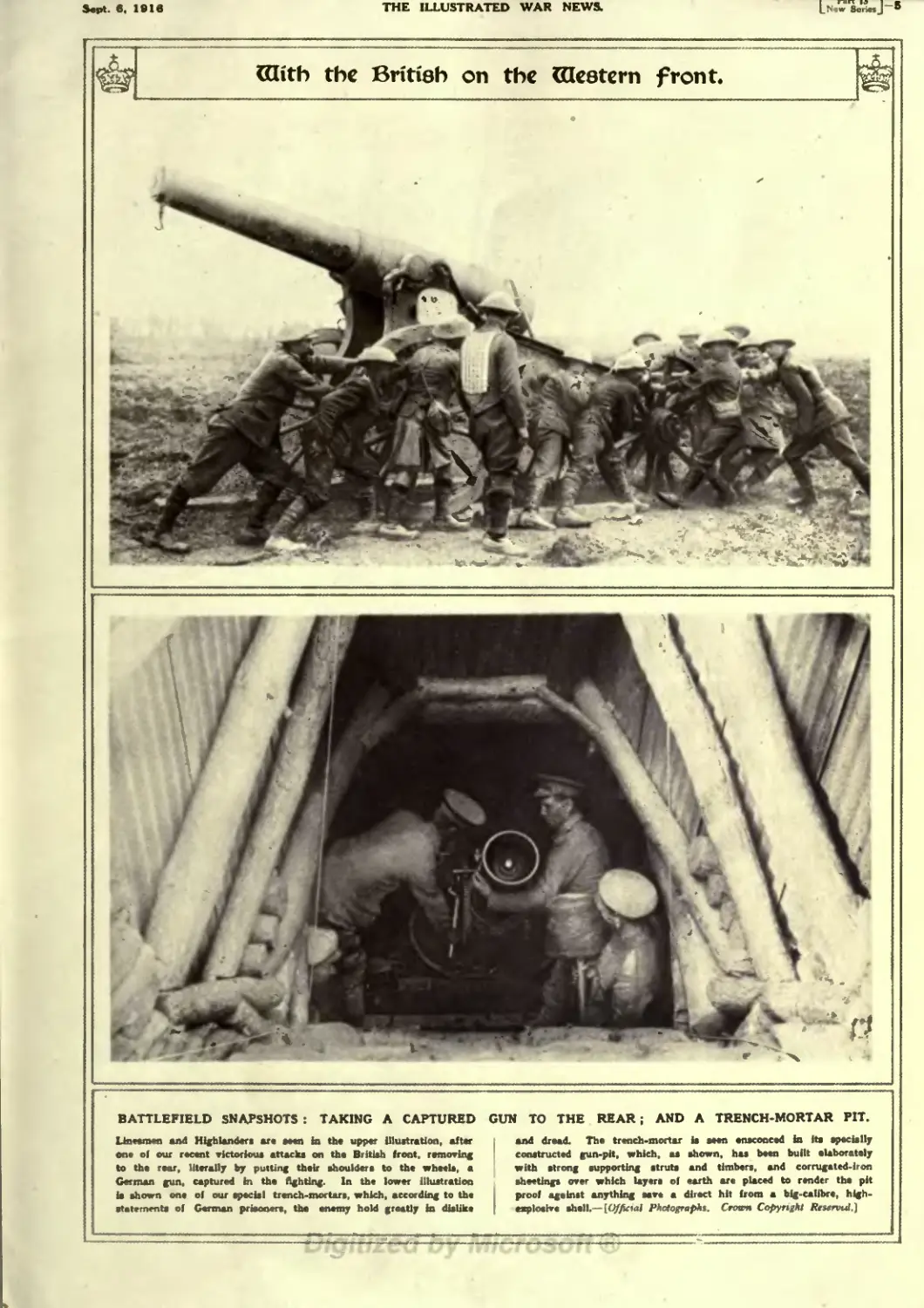
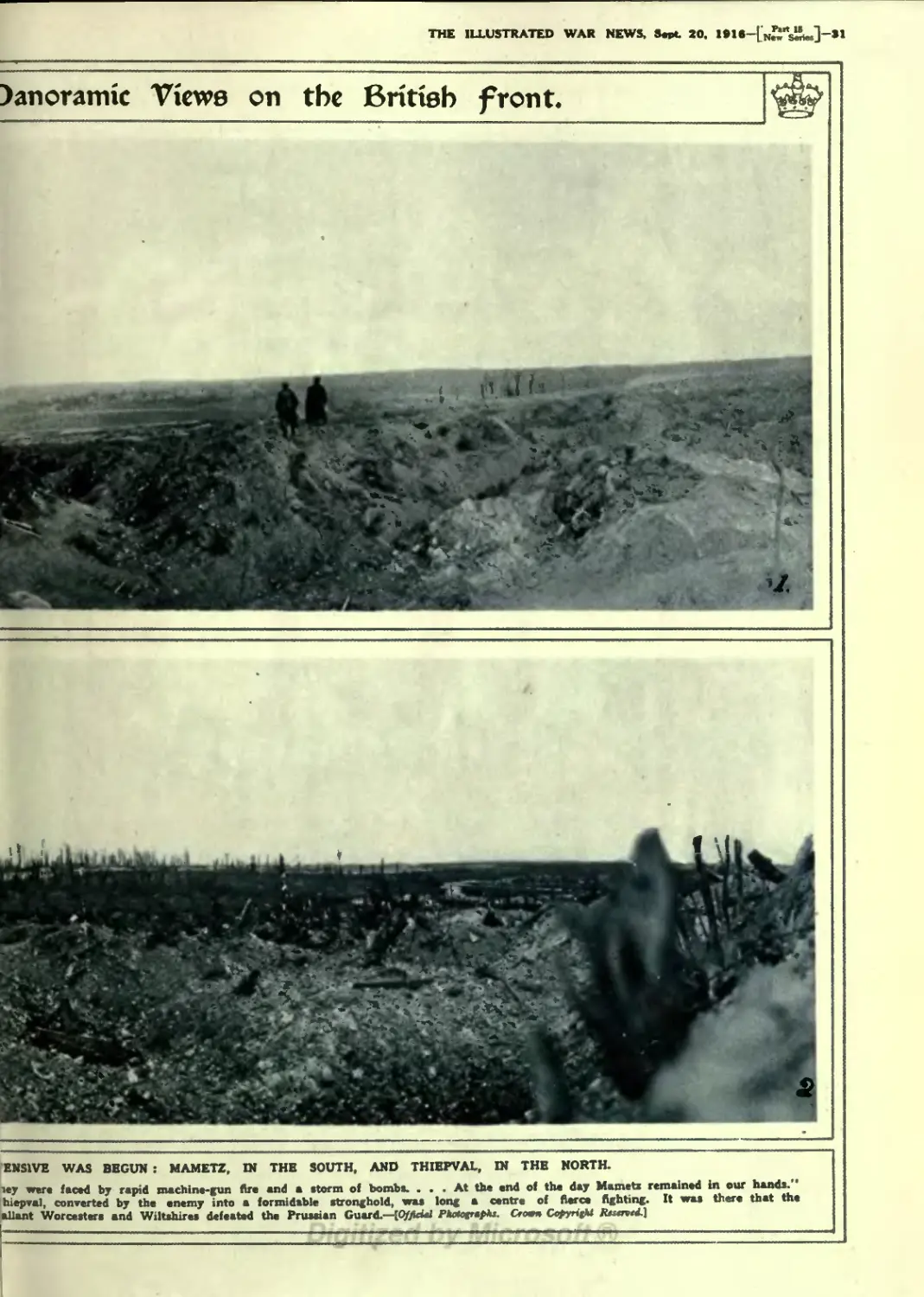
OKtb the British on the Olestern front.
BATTLEFIELD SNAPSHOTS : TAKING A CAPTURED GUN TO THE REAR ; AND A TRENCH-MORTAR PIT.
Linesmen and Highlanders are i*en in the upper illustration, after
one of our recent rictorious attack* on the British front, removing
to the rear, literally by putting their shoulders to the wheels, a
German gun, captured in the fighting. In the lower illustration
is shown one of our special trench-mortars, which, according to the
statements of German prisoners, the enemy hold greatly in dislike
and dread. The trench -mortar is seen ensconced in its specially
constructed gun-pit, which, as shown, has been built elaborately
with it rung supporting struts and timbers, and corrugated- iron
sheetings over which layers of earth are placed to render the pit
proof against anything sare a direct hit from a big-calibre, high-
explosive shell. [Official Photographs. Crown Copyright Reservui.}

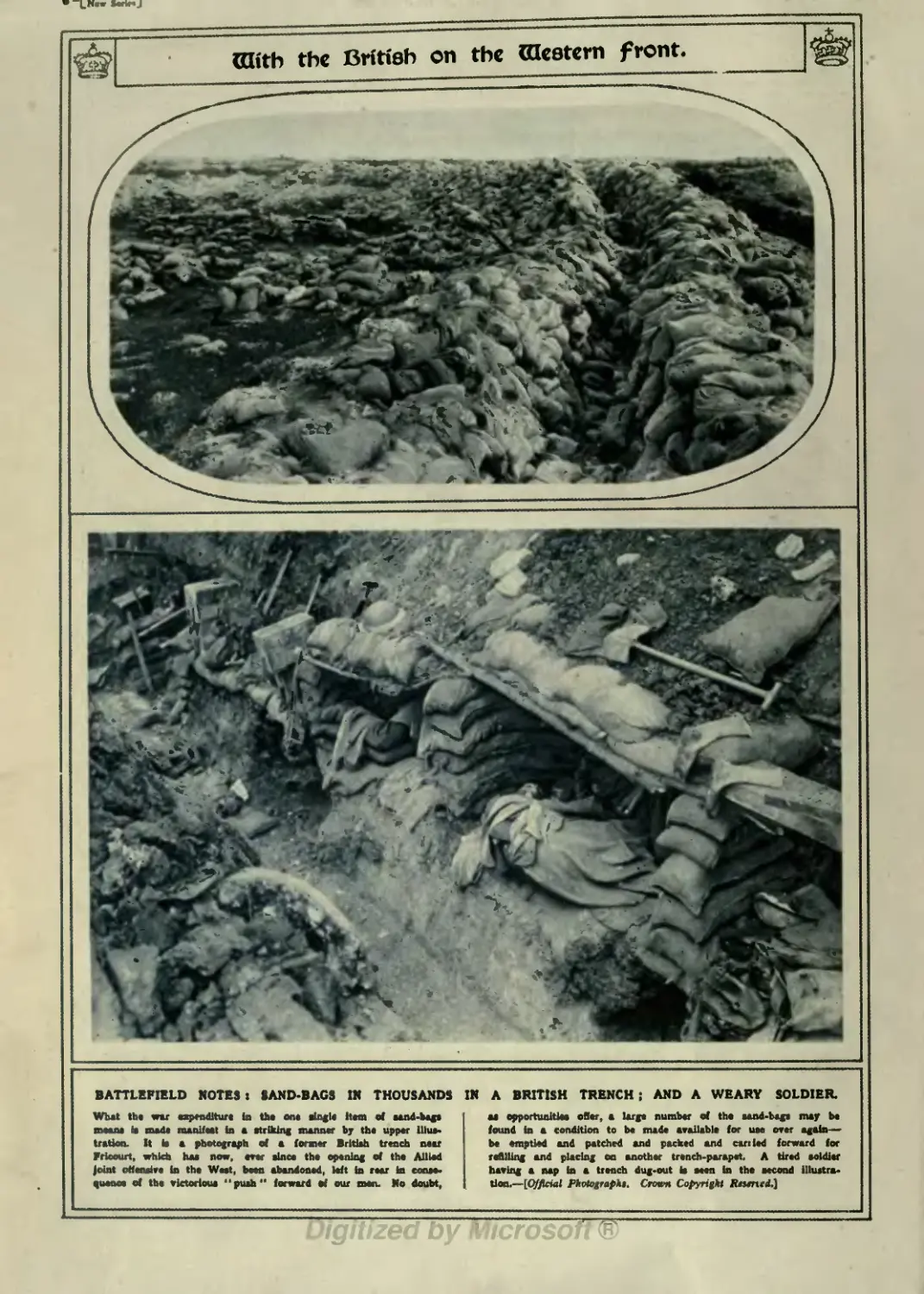
OTith the British on the Otestern front.
BATTLEFIELD NOTES : SAND-BAGS IN THOUSANDS IN A BRITISH TRENCH ; AND A WEARY SOLDIER
What the war expenditure in the one tingle Item of und-fctfi
menu ii made manifett in a striking manner bjr the upper illus-
tration. It la a photograph of a former Britlah trench near
Fricouit, which haa now, erer ilnce the opening of the Allied
joint orlenaire In the Weit, been abandoned, left In rear in conn,
quince of the Tlctorloui " puih " forward ef our men. No doubt,
aa opportunitiea offer, a large number of the sand-tags may be
found In a condition to be made arailable for use over again
be emptied and patched and packed and cart led forward for
refilling and placing on another trench-parapet. A tired soldier
having a nap in a trench dug-out la seen In the second illuitra-
tlon. (Official PkolograpHi. Crown Copyright Ristned,]

Sept. 6. 1916
THE ILLUSTRATED WAR NEWS.
r Part 13 -I _
l_New SrieJ ~
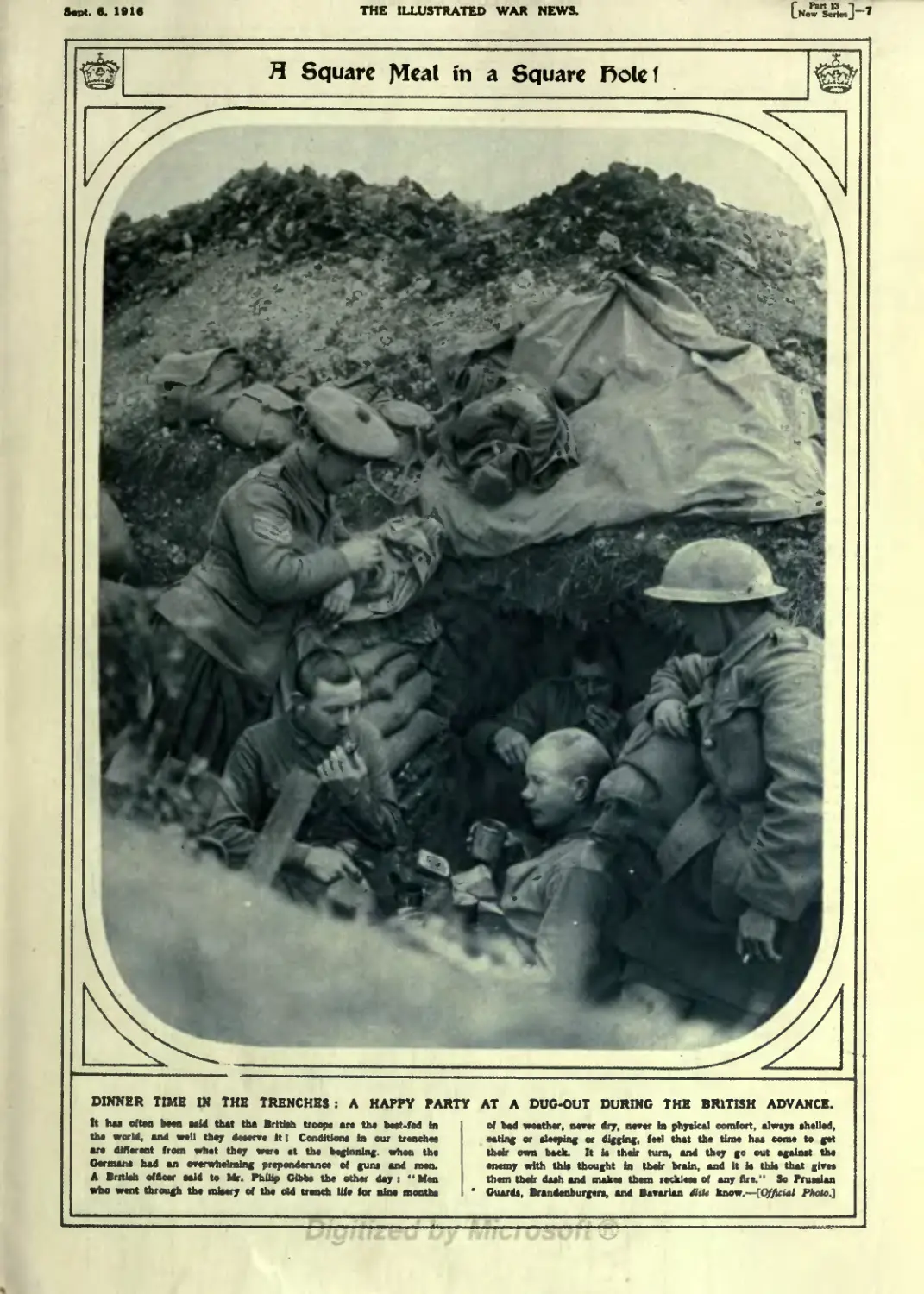
H Square JMcal in a Square fiolef
DINNER TIME IN THE TRENCHES : A HAPPY PARTY AT A DUG-OUT DURING THE BRITISH ADVANCE.
It hu often been uld that the British troop. are the but-fed In
the world, nd well they deserre It ! Conditions In our trenches
re different from whst they wre at the beginning, when the
Grnuni had an orerwh<lmin( preponderance of (uni and men.
A BritUh officer uld to Mr. Philip Glbbi the other day: "Mm
who went throujh the misery of the old trench life (or nine montht
of bad weather, nerer dry, never In phyiical comfort, alwayi shelled,
eatint or sleepinf or digeinj, feel that the time has come to (et
their own back. It Is their turn, and they (o out against the
enemy with this thought In their brain, and it Is this that (ires
them their dash and makes them reckless of any Are." So Prussian
Guards, Brindenburfers, and Bararlan tiitt ham. [Official Photo.]

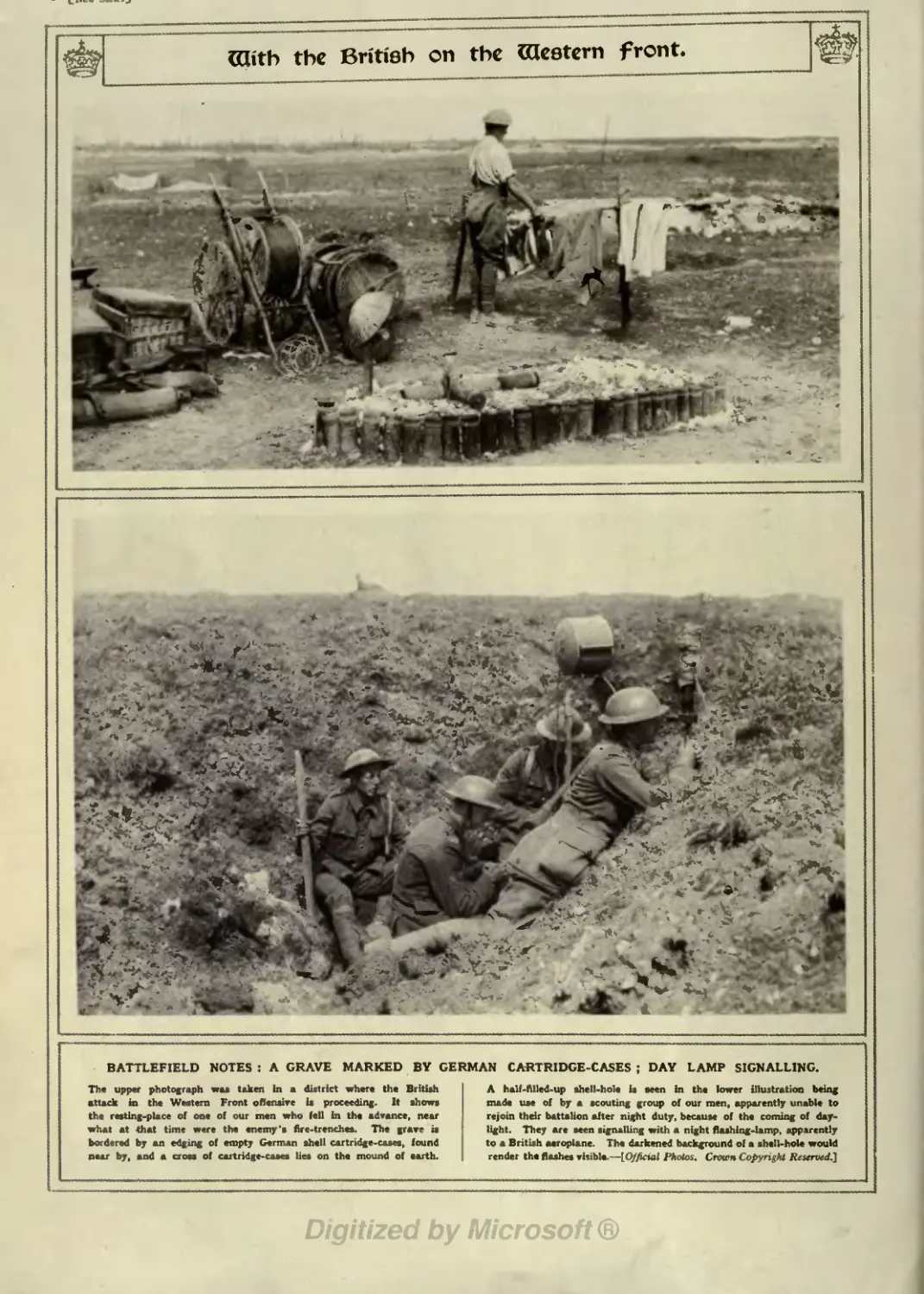
m\tb the British on the Western front.
BATTLEFIELD NOTES : A GRAVE MARKED BY GERMAN CARTRIDGE-CASES ; DAY LAMP SIGNALLING.
The upper photograph was taken in a district where the British
attack in the Western Front offensive is proceeding. It shows
the resting-place of one of our men who fell in the advance, near
what at that time were the enemy's fire-trenches. The grave is
bordered by an edging of empty German shell cartridge-cases, found
near by, and a cross of cartridge-cases lies on the mound of earth.
A half-filled-up shell-hole is seen in the lower illustration being
made use of by a scouting group of our men, apparently unable to
rejoin their battalion after night duty, because of the coming of day-
light. They are seen signalling with a night flashing-lamp, apparently
to a British aeroplane. The darkened background of a shell-hole would
render the flashes visible. [Official Photos. Crown Copyright Reserved,]

Sept 6. 1916
THE ILLUSTRATED WAR NEWS.
f Part IJ -1 -
[.New Series J "
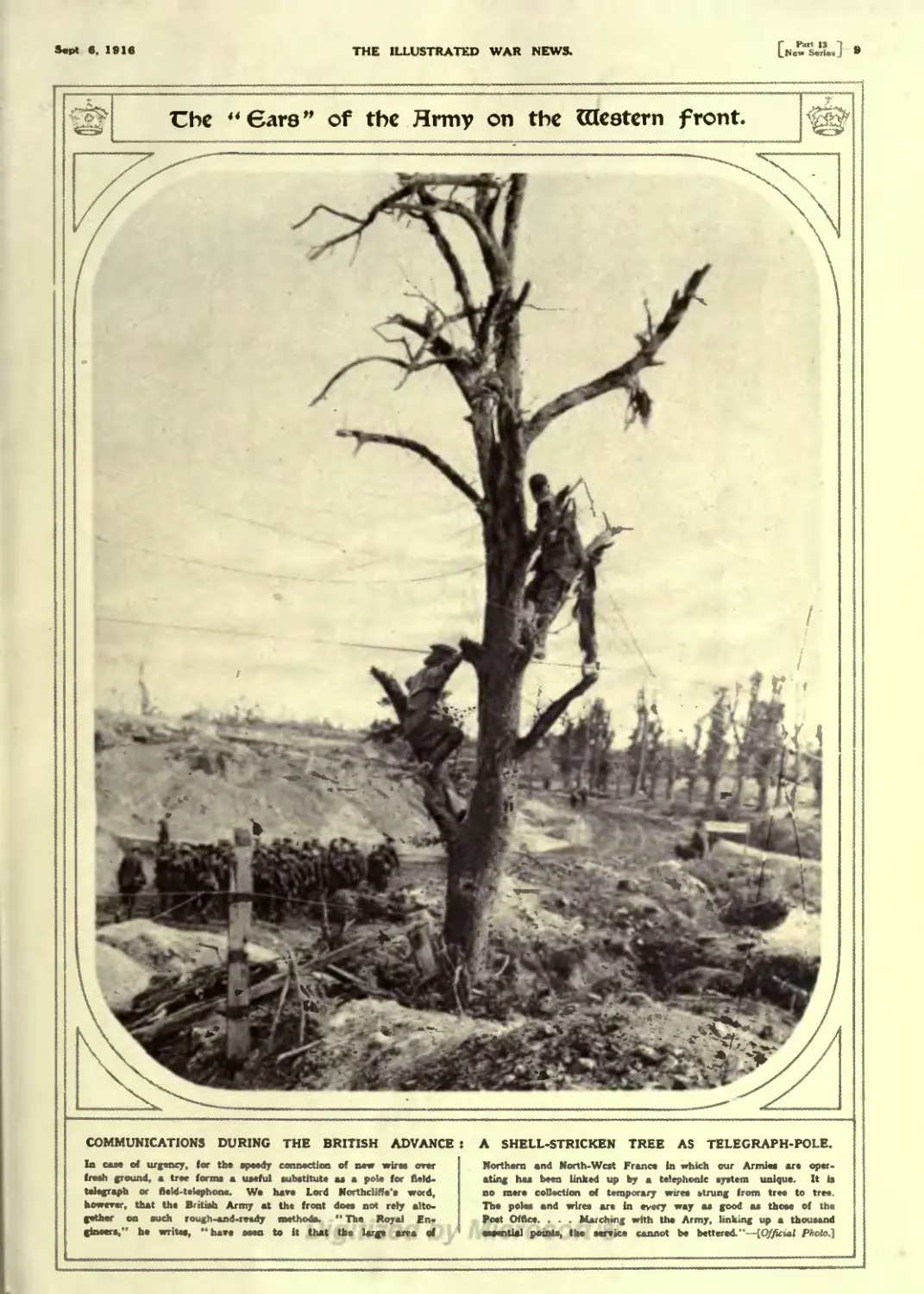
Che "6ar8" of the Hrmy on the OTestern front*
COMMUNICATIONS DURING THE BRITISH ADVANCE : A SHELL-STRICKEN TREE AS TELEGRAPH-POLE.
In case of urgency, for the speedy connection of new wires over
fresh (round, a tree forms * useful substitute as a pole for field-
telegraph or field-telephone. We have Lord Northcliffe'i word,
howerer. that the British Army at the front does not rely alto-
tether on such rou(cti-and-redy methods. " The Royal En-
gineers," he writes, " hare seen to it that the large area of
Northern and North-West France in which our Armies are oper-
ating has been linked up by a telephonic system unique. It is
no mere collection of temporary wires ktrung from tree to tree.
The poles and wires are in every way as good as those of the
Post Office. . . . Marching with the Army, linking up a thousand
essential points, the service cannot be bettered." [Official Photo,]

THE ILLUSTRATED WAR NEWS.
S.i. 6. 1916
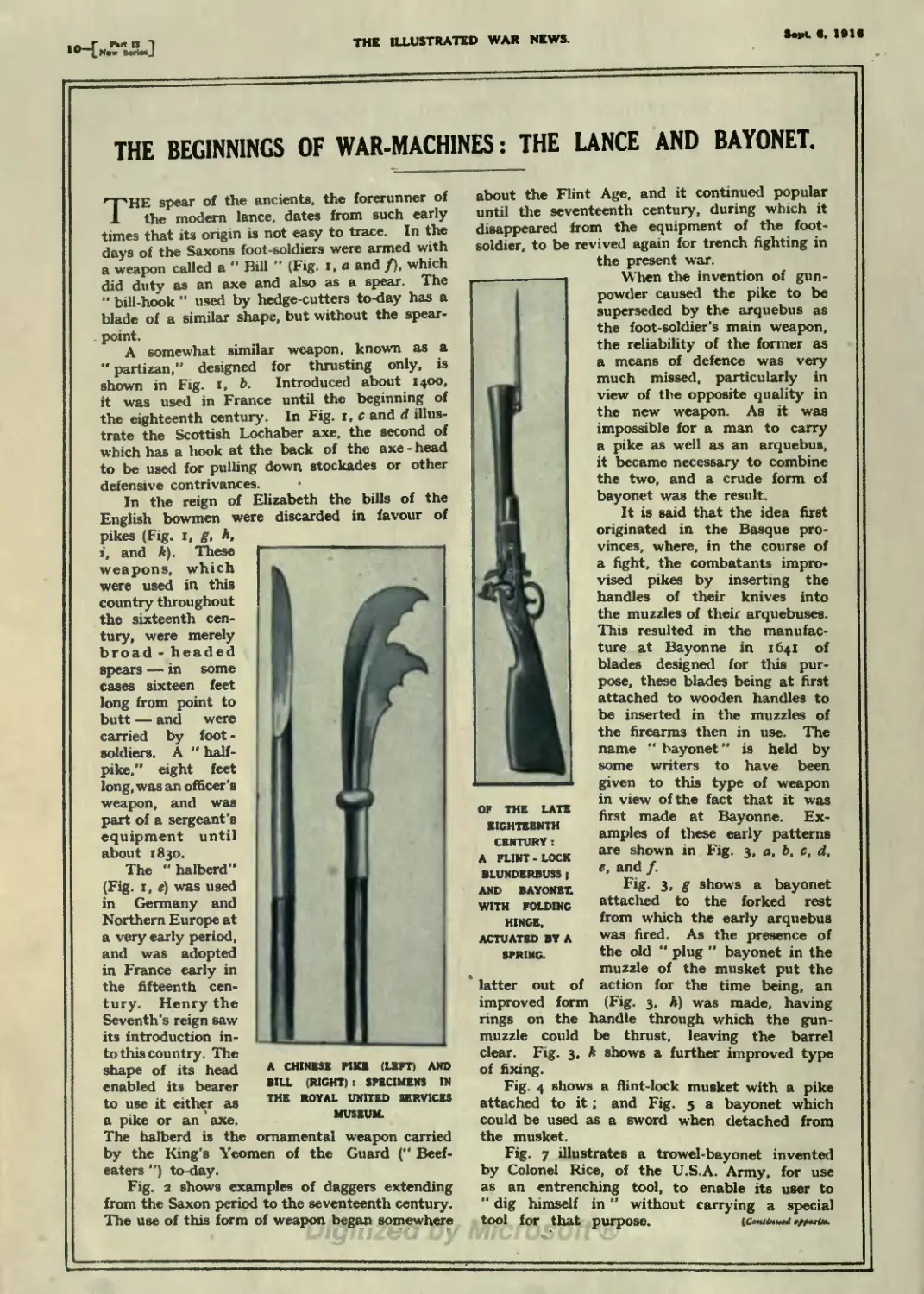
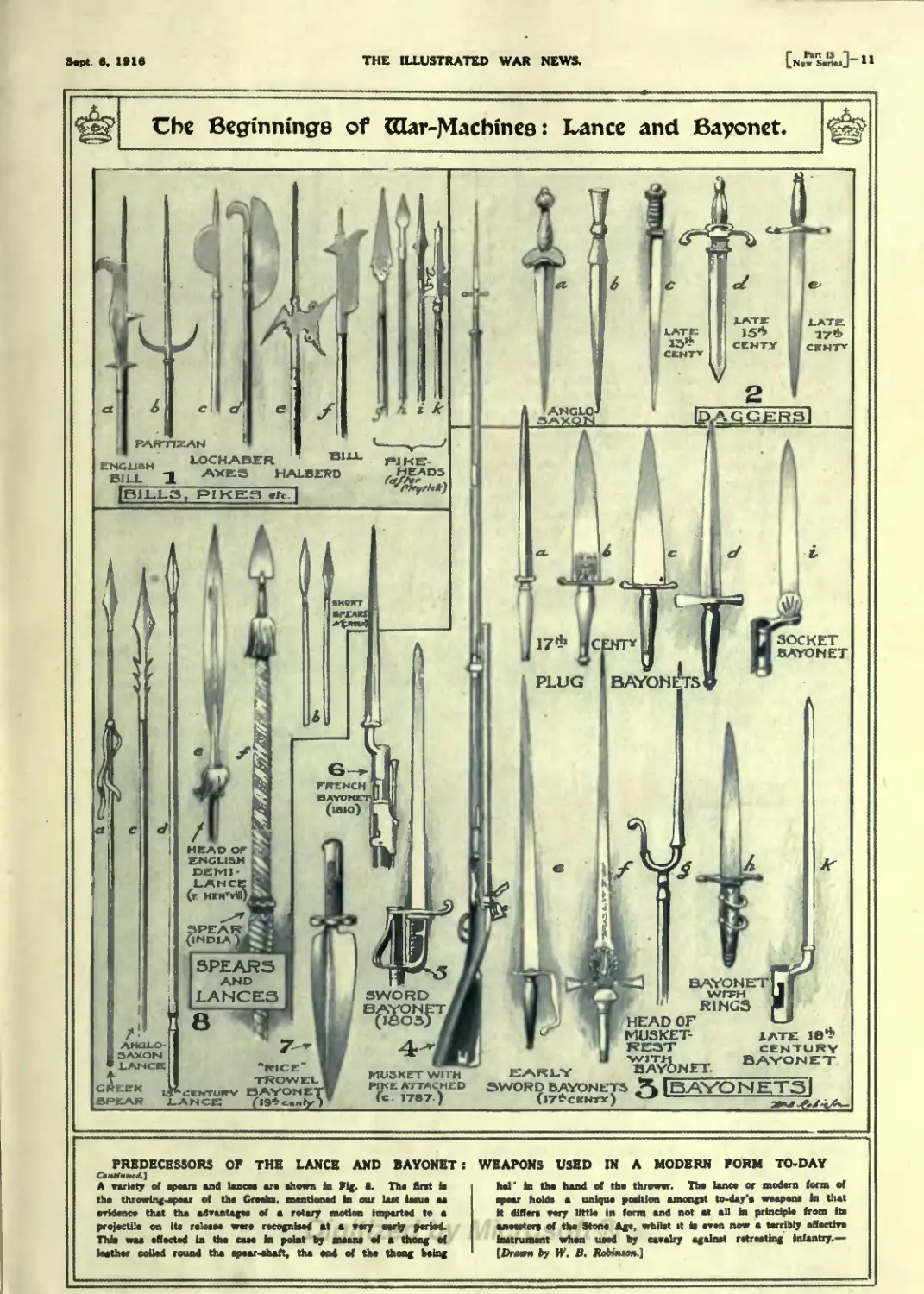
THE BEGINNINGS OF WAR-MACHINES : THE LANCE AND BAYONET.
THE spear of the ancients, the forerunner of
the modern lance, dates from such early
times that its origin is not easy to trace. In the
days of the Saxons foot-soldiers were armed with
a weapon called a " Bill " (Fig. I, a and /), which
did duty as an axe and also as a spear. The
" bill-hook " used by hedge-cutters to-day has a
blade of a similar shape, but without the spear-
point.
A somewhat similar weapon, known as a
" partizan," designed for thrusting only, is
shown in Fig. i. b. Introduced about 1400,
it was used in France until the beginning of
the eighteenth century. In Fig. I, c and d illus-
trate the Scottish Lochaber axe, the second of
which has a hook at the back of the axe - head
to be used for pulling down stockades or other
defensive contrivances.
In the reign of Elizabeth the bills of the
English bowmen were discarded in favour of
pikes (Fig. i, g, h,
i, and A). These
weapons, which
were used in this
country throughout
the sixteenth cen-
tury, were merely
broad - headed
spears in some
cases sixteen feet
long from point to
butt and were
carried by foot -
soldiers. A " half-
pike," eight feet
long, was an officer's
weapon, and was
part of a sergeant's
equipment until
about 1830.
The " halberd"
(Fig. i, e) was used
in Germany and
Northern Europe at
a very early period,
and was adopted
in France early in
the fifteenth cen-
tury. Henry the
Seventh's reign saw
its introduction in-
to this country. The
shape of its head
enabled its bearer
to use it either as
a pike or an axe.
The halberd is the ornamental weapon carried
by the King's Yeomen of the Guard (" Beef-
eaters ") to-day.
Fig. i shows examples of daggers extending
from the Saxon period to the seventeenth century.
The use of this form of weapon began somewhere
A CHINESE PIKE (LEFT) AND
BILL (RIGHT) : SPECIMENS IN
THE ROYAL UNITED SERVICES
MUSEUM.
about the Flint Age. and it continued popular
until the seventeenth century, during which it
disappeared from the equipment of the foot-
soldier, to be revived again for trench fighting in
the present war.
When the invention of gun-
powder caused the pike to be
superseded by the arquebus as
the foot-soldier's main weapon,
the reliability of the former as
a means of defence was very
much missed, particularly in
view of the opposite quality in
the new weapon. As it was
impossible for a man to carry
a pike as well as an arquebus,
it became necessary to combine
the two, and a crude form of
bayonet was the result.
It is said that the idea first
originated in the Basque pro-
vinces, where, in the course of
a fight, the combatants impro-
vised pikes by inserting the
handles of their knives into
the muzzles of their arquebuses.
This resulted in the manufac-
ture at Bayonne in 1641 of
blades designed for this pur-
pose, these blades being at first
attached to wooden handles to
be inserted in the muzzles of
the firearms then in use. The
name "bayonet" is held by
some writers to have been
given to this type of weapon
in view of the fact that it was
first made at Bayonne. Ex-
amples of these early patterns
are shown in Fig. 3, a, b, c, d,
e, and /.
Fig' 3. 8 shows a bayonet
attached to the forked rest
from which the early arquebus
was fired. As the presence of
the old " plug " bayonet in the
muzzle of the musket put the
latter out of action for the time being, an
improved form (Fig. 3, h) was made, having
rings on the handle through which the gun-
muzzle could be thrust, leaving the barrel
clear. Fig. 3, k shows a further improved type
of fixing.
Fig, 4 shows a flint-lock musket with a pike
attached to it ; and Fig. 5 a bayonet which
could be used as a sword when detached from
the musket.
Fig. 7 illustrates a trowel-bayonet invented
by Colonel Rice, of the U.S.A. Army, for use
as an entrenching tool, to enable its user to
" dig himself in " without carrying a special
tool for that purpose. icm
OF THE LATE
EIGHTEENTH
CENTURY :
A FLINT - LOCK
BLUNDERBUSS ;
AND BAYONET.
WITH FOLDING
HINGE,
ACTUATED BY A
SPRING.

S.pl 6, 1916
THE ILLUSTRATED WAR NEWS.
rt 13 T , ,
SerietJ * '
Che Beginnings of COar-JVIachines : Lance and Bayonet.
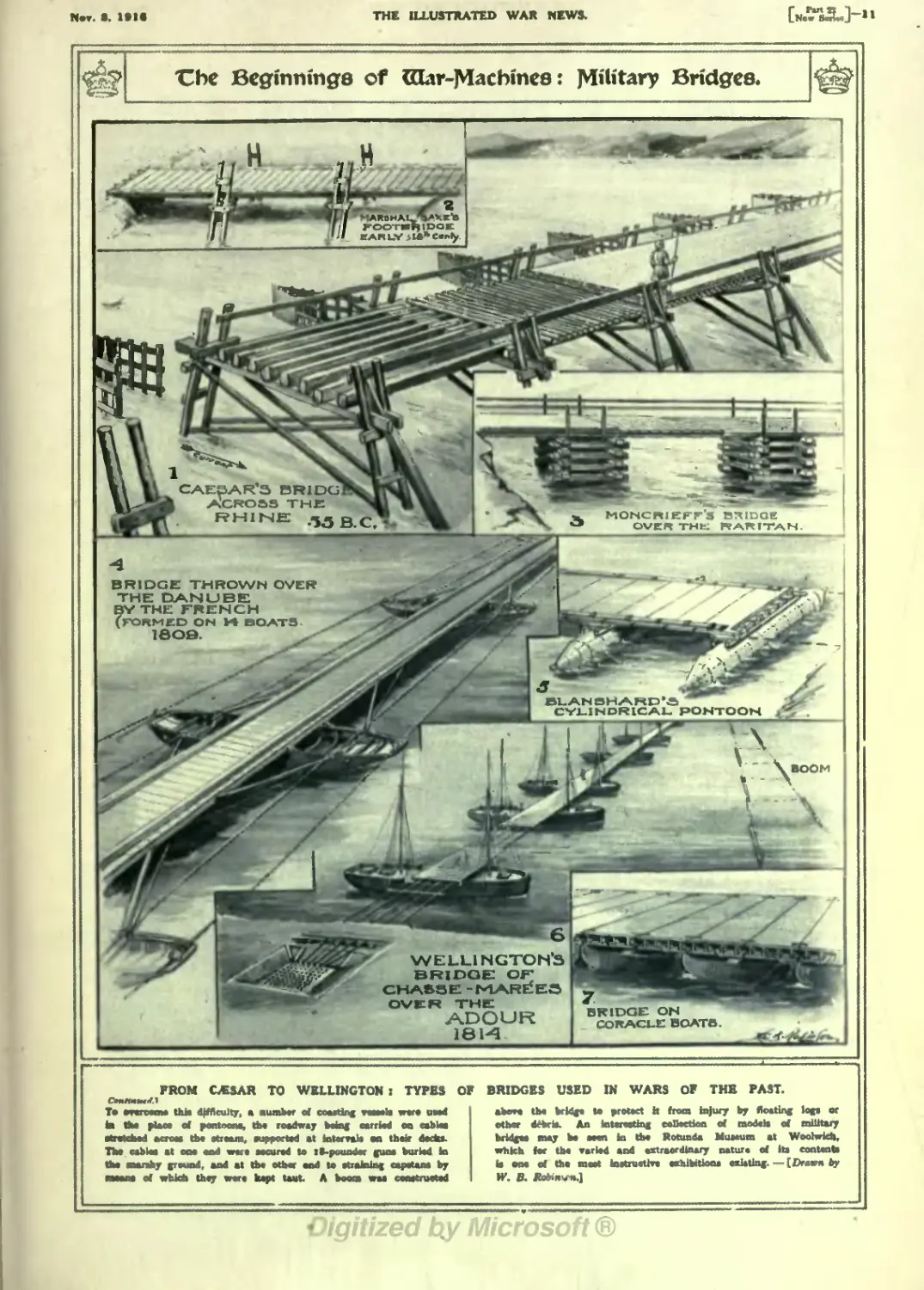
[P-ACCERSJ
BILLS. P1KE3 cfc.
SOCKET
BAYONET
PLUG BAYONETS
SPEARS
AND
LANCE3
BAYONET
WJ35H
RINGS
HEAD OF
MUSKET-
REST CENTURY
SWORD
BAYONET
(J603;
mcE
TROWEL
^CENTUWV OAYONET
i-ANCE /'19'f'c.cnrv )
EARLY
SWORD BAYONETS
(l7*ceNT*)
MU5KET WITH
PIKE ATTACHED
fc. 1787.)
PREDECESSORS OF THE LANCE AND BAYONET : WEAPONS USED IN A MODERN FORM TO-DAY
A Twlety of ipuri and UncM art ihown in Fit. ' The Ant U
tht throwinf-ipeir o< the Cretlu, mentioned in our lat iitue at
eTtdpnce that the advantafts of a rotary motion imparted to a
projectile on iti release were recognised at a rery early period.
This was effected in the case in point by means of a thong of
leather coiled round the spear-shaft, the end of the thonf being
hel' In the hand of the thrower. The lance or modern form of
spear holds a unique position amongst to-day's weapons In that
it differs very little in form and not at all In principle from its
ancestors of the Stone Age, whilst it is even now a terribly effectrn
Instrument when used by caralry g.iinit retreating Infantry.
[Drawn by W. B. Robinson.]

THE ILLUSTRATED WAR NEWS
S.pt 6. 1916
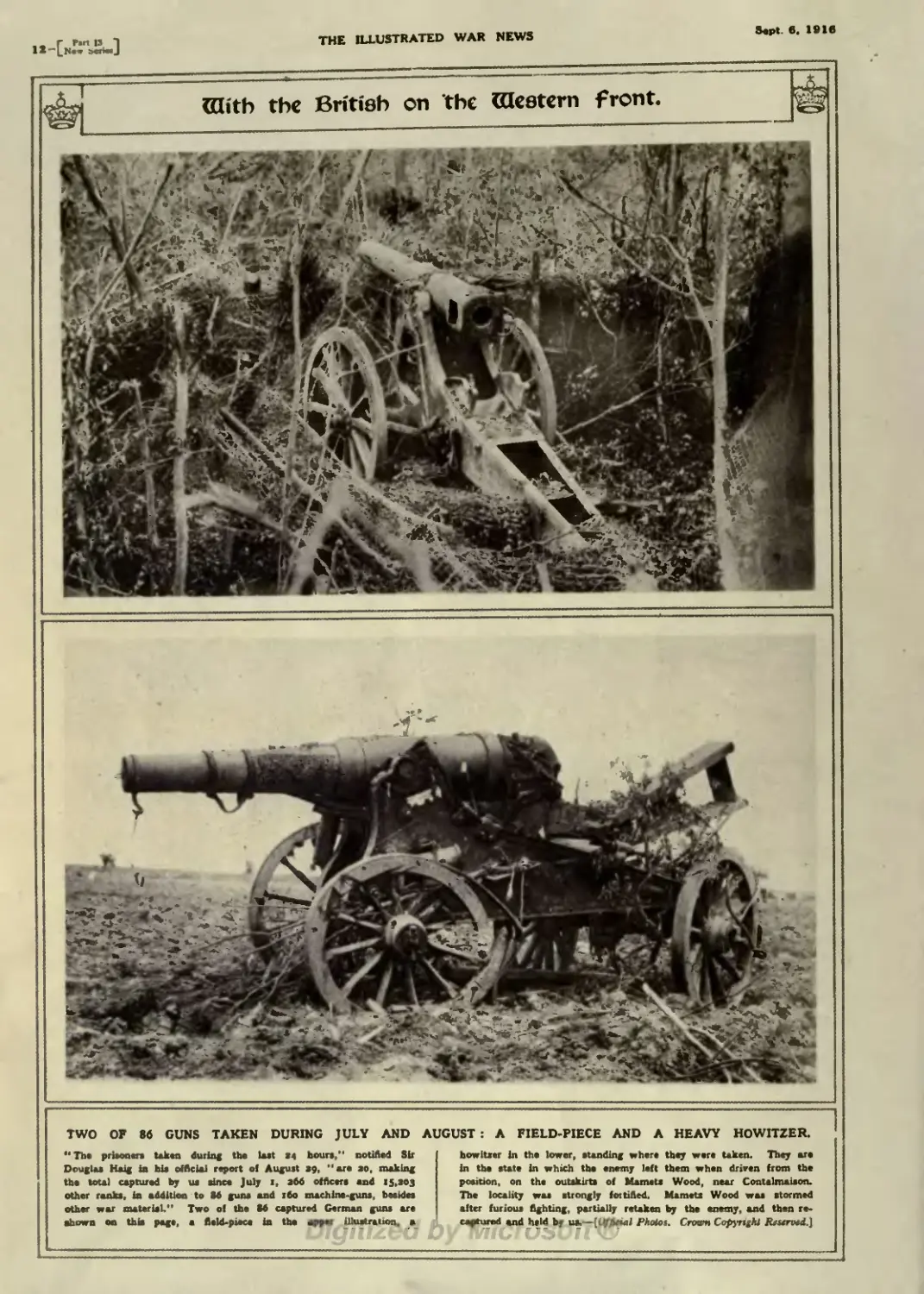
Uth the British on "the Olcstern front
" The prisoners taken during the lst 24 hours," notified Sir
Douglas Haig in his official report of August 29, "are 20, making
the total captured by us since July i, 266 officer* and 15,203
other ranks, in addition to 86 guns and 160 machine-guns, besides
other war material." Two of the 86 captured German guns are
shown on this page, a field-piece in the upper illustration, a
HEAVY HOWITZER.
howitzer in the lower, standing where they were Uken. They are
in the state in which the enemy left them when driven from the
position, on the outskirts of MameU Wood, near Contalmaison.
The locality was strongly foi lifted, Mametz Wood was stormed
after furious fighting, partially retaken by the enemy, and then re-
captured and held by us. [Official Photos. Crown Copyright Reserved.]

Sept. 6. 1916
THE ILLUSTRATED WAR NEWS.
f Part 13 "I . -
(.Now SeriesJ~'3
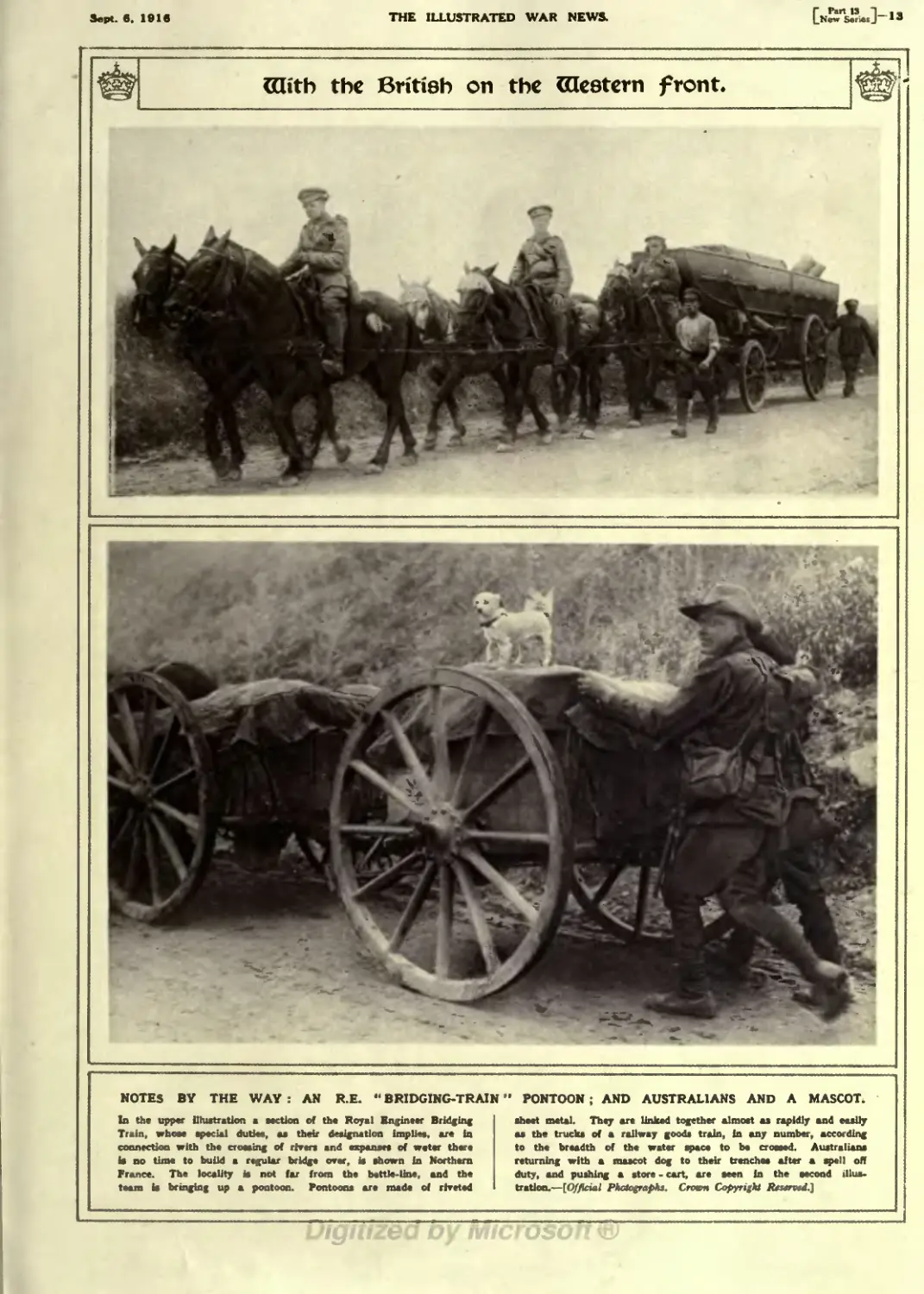
CCTitb the British on the Slestern front.
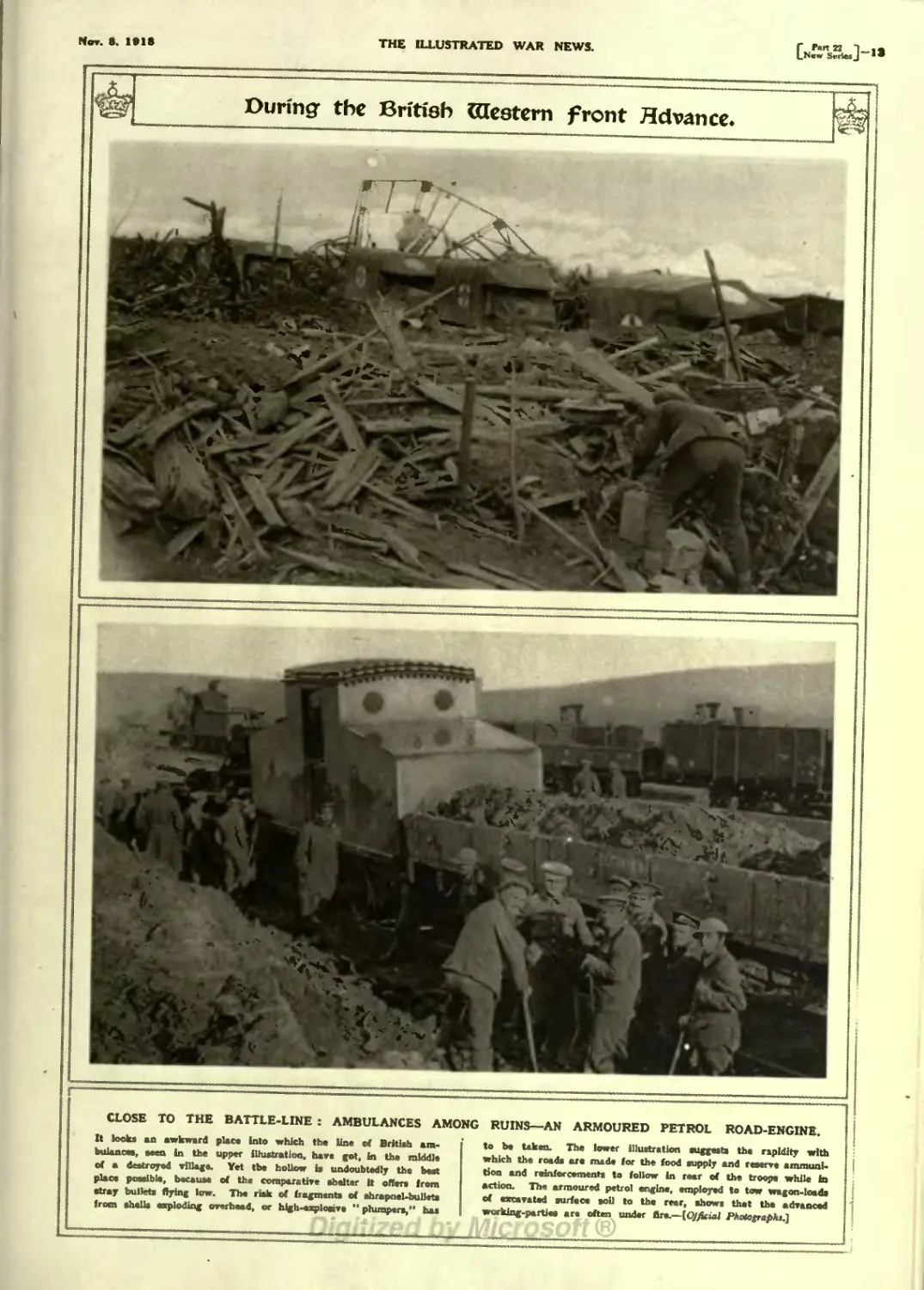
NOTES BY THE WAY: AN R.E. " BRIDGING-TRAIN " PONTOON; AND AUSTRALIANS AND A MASCOT,
In the upper illustration a section of the Royal Engineer Bridging
Train, whose special duties, as their designation implies, are in
connection with the crossing of rirers and expanses of water there
it no time to build a regular bridge over , is shown in Northern
France. The locality is not far from the battle-tine, and the
team is bringing up a pontoon. Pontoons are made of riveted
sheet metal. They are linked together almost u rapidly and easily
as the trucks of a railway goods train, in any number, according
to the breadth of the water space to be crossed. Australians
returning with a mascot dog to their trenches after * spell off
duty, and pushing a store - cart, are seen In the second illus-
tration. [Official Photographs. Crown Copyright Reserved.}

M
THE ILLUSTRATED WAR Ntws.
ROMANCES OF THE REGIMENTS: XIII. -THE IST WEST RIDING.
THE WYNYARD MYSTERY.
IN the clays when the ist West Riding
Regiment (Duke of Wellington's) was known
as the 33rd Foot, the corps had a sensational
experience such as has fallen to the lot of few
units of the Hritish Army. Through the long
days of a Canadian winter, the officers' mess had
its curiosity profoundly excited, and it hung upon
the incoming mails with feverish expectation of
some solution of a mysterious happening which
seemed to portend bad news from home for one
of the members.
The date of the occurrence is believed to be
Oct. 15, 1785; the place was the new barracks
at Sydney, Cape Breton Island ; the dramatis
yard's sitting-room and deep in their task. Here
an ingenuous chronicler takes care to note that
neither of the two young officers had drunk any
wine at their meal. In view of what follows, the
statement is useful. Equally useful is his descrip-
tion of Wynyard's sitting-room. It had two
doors one opening on the passage, the other
leading into Wynyard's bedroom. No other
entrance or egress existed ; the bedroom had
but the one door.
Suddenly Sherbroke glanced up from his book,
and, looking towards the door that led into the
passage, he saw a tall youth, of about twenty
years of age and extremely emaciated in appear -
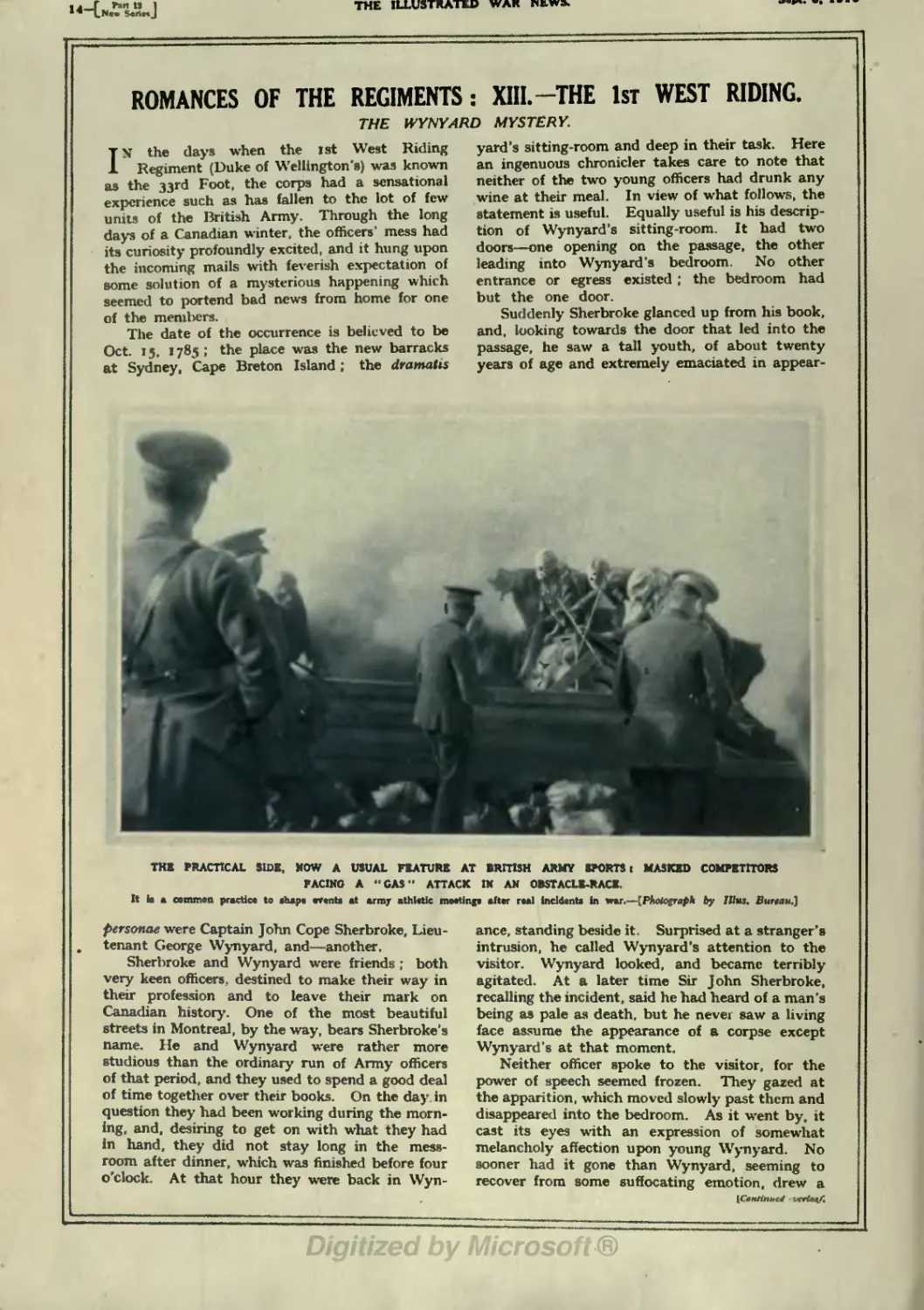
THE PRACTICAL SIDE, NOW A USUAL FEATURE AT BRITISH ARMY SPORTS: MASKED COMPETITORS
FACING A "CAS" ATTACK IN AN OBSTACLE-RACE.
It it common practice to ihmpe erenti at trmjr athletic meetinp after real incident! in war. [Photograph by lllus. Bureau.]
personae were Captain John Cope Sherbroke, Lieu-
tenant George Wynyard, and another.
Sherbroke and Wynyard were friends ; both
very keen officers, destined to make their way in
their profession and to leave their mark on
Canadian history. One of the most beautiful
streets in Montreal, by the way, bears Sherbroke's
name. He and Wynyard were rather more
studious than the ordinary run of Army officers
of that period, and they used to spend a good deal
of time together over their books. On the day. in
question they had been working during the morn-
ing, and, desiring to get on with what they had
in hand, they did not stay long in the mess-
room after dinner, which was finished before four
o'clock. At that hour they were back in Wyn-
ance, standing beside it. Surprised at a stranger's
intrusion, he called Wynyard's attention to the
visitor. Wynyard looked, and became terribly
agitated. At a later time Sir John Sherbroke,
recalling the incident, said he had heard of a man's
being as pale as death, but he nevei saw a living
face assume the appearance of a corpse except
Wynyard's at that moment.
Neither officer spoke to the visitor, for the
power of speech seemed frozen. They gazed at
the apparition, which moved slowly past them and
disappeared into the bedroom. As it went by, it
cast its eyes with an expression of somewhat
melancholy affection upon young Wynyard. No
sooner had it gone than Wynyard, seeming to
recover from some suffocating emotion, drew a
[Cotttinitett vcrlea/.

e. IBIS
THE ILLUSTRATED WAR NEWS.
The prince of Monaco at Rbeims Cathedral.
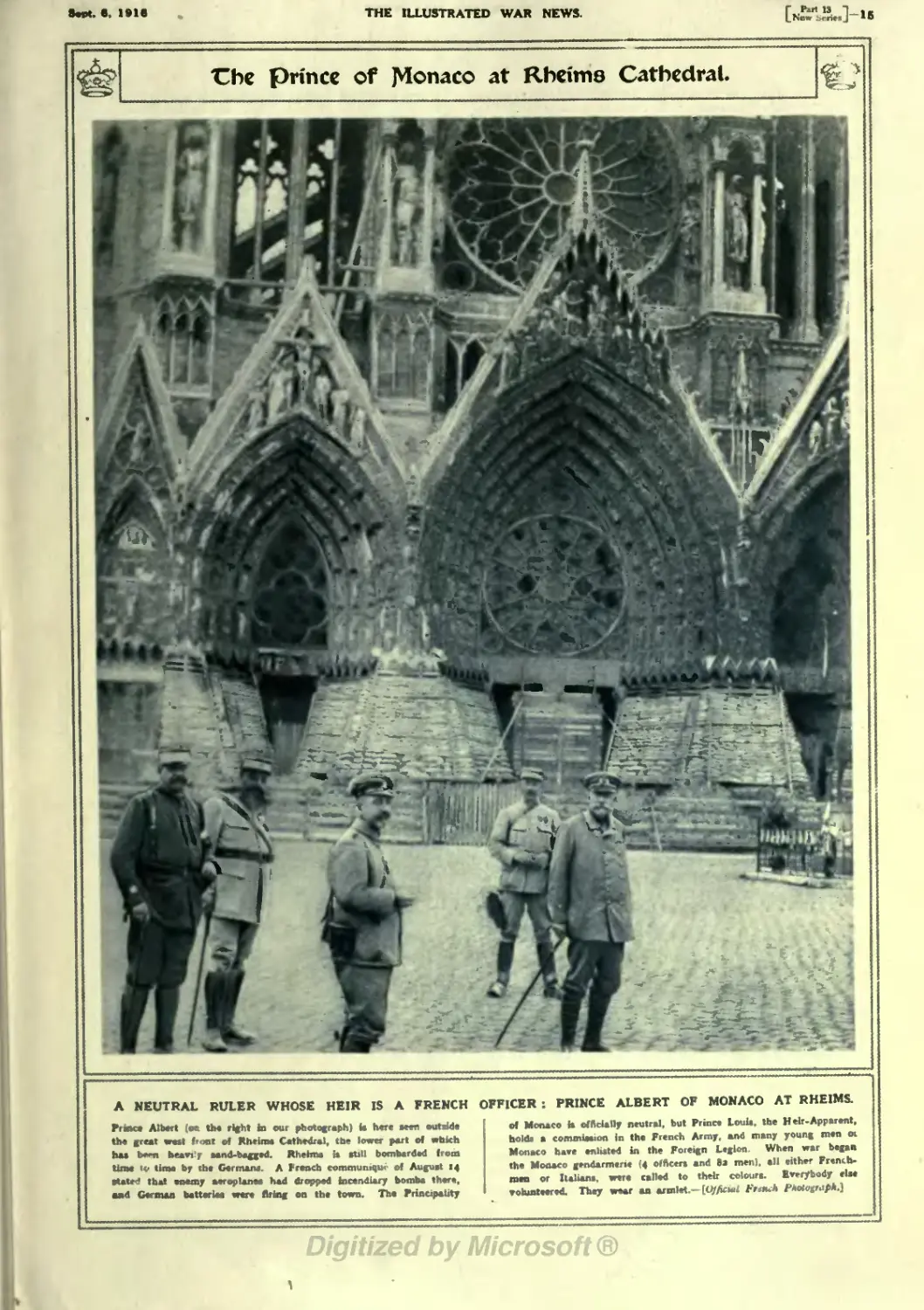
A NEUTRAL RULER WHOSE HEIR IS A FRENCH OFFICER : PRINCE ALBERT OF MONACO AT RHEIMS.
Prince Albert Jon the rifht in our photograph) is here Ken outside
the great west l-.int of Rheirna Cathedral, the lower part of which
hat !"-n heavily sand-bagged. Rheinu if Kill bombarded from
time if time by the German*. A French communique of August 14
stair ' that enemj aeroplanes had dropped incendiary bombs there,
and German batteries were firing on the town. The Principality
of Monaco is officially neutral, but Prince Louis, the Heir- Apparent,
holds a commission in the French Army, and many young men 01
Monaco hare enlisted in the Foreign Legion. When wsr began
the Monaco gendarmerie (4 officers and 81 men), all either French-
men or Italians, were called to their colours. Everybody else
volunteered. They wear an armlet.- [UJficul frtiuli Wolc/*r,ip*.]

, . _ f i'..n is -I
19 [ ,N>W S.TH-vJ
THE ILLUSTRATED WAR NEWS.
Sept. e. 1916
deep breath, and, clutching Sherbroke by the arm,
muttered " Great God ! My brother ! "
" Your brother ! " Sherbroke repeated. " What
can you mean, Wynyard ? There must be some
deception follow me."
Therewith he drew Wynyard into the bedroom,
only to find it quite untenanted. Had any living
person entered, he must have returned through the
sitting-room or not at all.
Much perplexed, they noted the day and hour
of the occurrence, and agreed to say nothing about
it to the regiment. Sherbroke believed it was
some trick ; but how contrived, or why, he had
no idea. Wynyard. on the other hand, was con-
vinced that he had seen his brother's ghost. He
grew very anxious and fidgety about his kins-
man's safety, and waited impatiently for the next
mail. His anxiety at length could not be con-
cealed from his brother-officers, who began to ask
questions, and bit by bit the whole story came out.
The weird incident was now the chief topic of
interest in the mess-room of the 33rd, and the
other officers' anxiety was almost as great as that
of the person most concerned. They would inquire
for Wynyard's letters before asking for their own,
and the mails from England were welcomed with
more than usual eagerness. The members of the
distributed at supper-time. For Wynyard, alone of
the whole mess, there was no letter. It seemed
as if the matter must still await explanation.
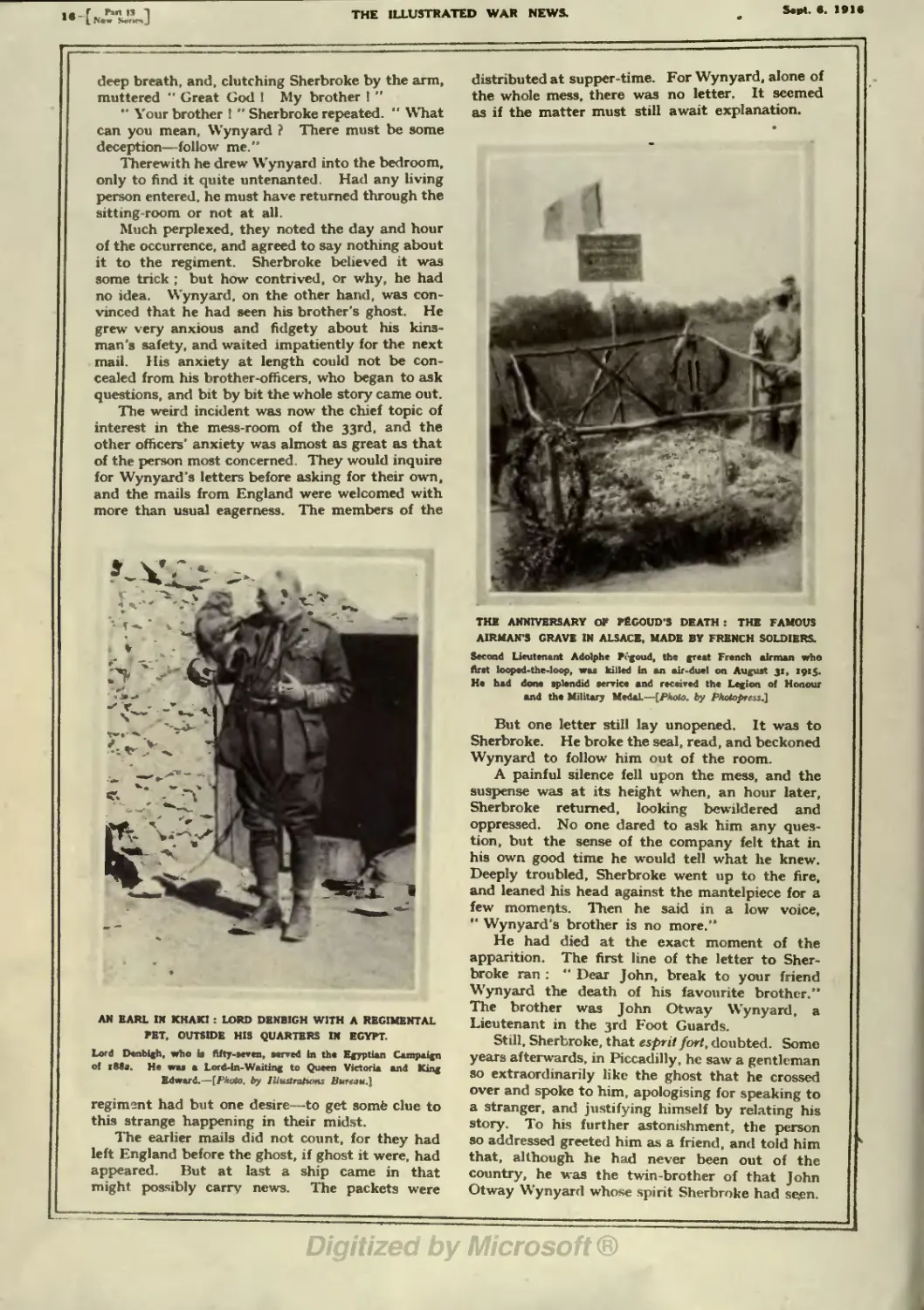
AN EARL IN KHAKI : LORD DENBIGH WITH A REGIMENTAL
PET, OUTSIDE HIS QUARTERS IN EGYPT.
Lord Denbigh, who u fifty-seven, served in the Egyptian Campaign
of 1883. He was a Lord-in- Waiting to Queen Victoria and King
Edward. [Photo, by Illustrations Hureaw.}
regiment had but one desire to get some clue to
this strange happening in their midst.
The earlier mails did not count, for they had
left England before the ghost, if ghost it were, had
appeared. Hut at last a ship came in that
might possibly carry news. The packets were
THE ANNIVERSARY OF PEGOUD'S DEATH : THE FAMOUS
AIRMAN'S GRAVE IN ALSACE, MADE BY FRENCH SOLDIERS.
Second Lieutenant Adolphe P.'goud, the great French airman who
first looped-the-loop, was killed in an air-duel on August 31, 1915.
He bad done splendid service and received the Legion of Honour
and the Military Medal. [Photo, by Pkotopress.]
But one letter still lay unopened. It was to
Sherbroke. He broke the seal, read, and beckoned
Wynyard to follow him out of the room.
A painful silence fell upon the mess, and the
suspense was at its height when, an hour later,
Sherbroke returned, looking bewildered and
oppressed. No one dared to ask him any ques-
tion, but the sense of the company felt that in
his own good time he would tell what he knew.
Deeply troubled. Sherbroke went up to the fire,
and leaned his head against the mantelpiece for a
few moments. Then he said in a low voice,
" Wynyard's brother is no more."
He had died at the exact moment of the
apparition. The first line of the letter to Sher-
broke ran : " Dear John, break to your friend
Wynyard the death of his favourite brother."
The brother was John Otway Wynyard, a
Lieutenant in the 3rd Foot Guards.
Still, Sherbroke, that esprit fort, doubted. Some
years afterwards, in Piccadilly, he saw a gentleman
so extraordinarily like the ghost that he crossed
over and spoke to him, apologising for speaking to
a stranger, and justifying himself by relating his
story. To his further astonishment, the person
so addressed greeted him as a friend, and told him
that, although he had never been out of the
country, he was the twin-brother of that John
Otway Wynyard whose spirit Sherbroke had seen.

Sept. 6. 1916
THE ILLUSTRATED WAR NEWS.
Part a -I ..
New htlo.- ' '
Ht a Garden Cdar fete at Ren don.
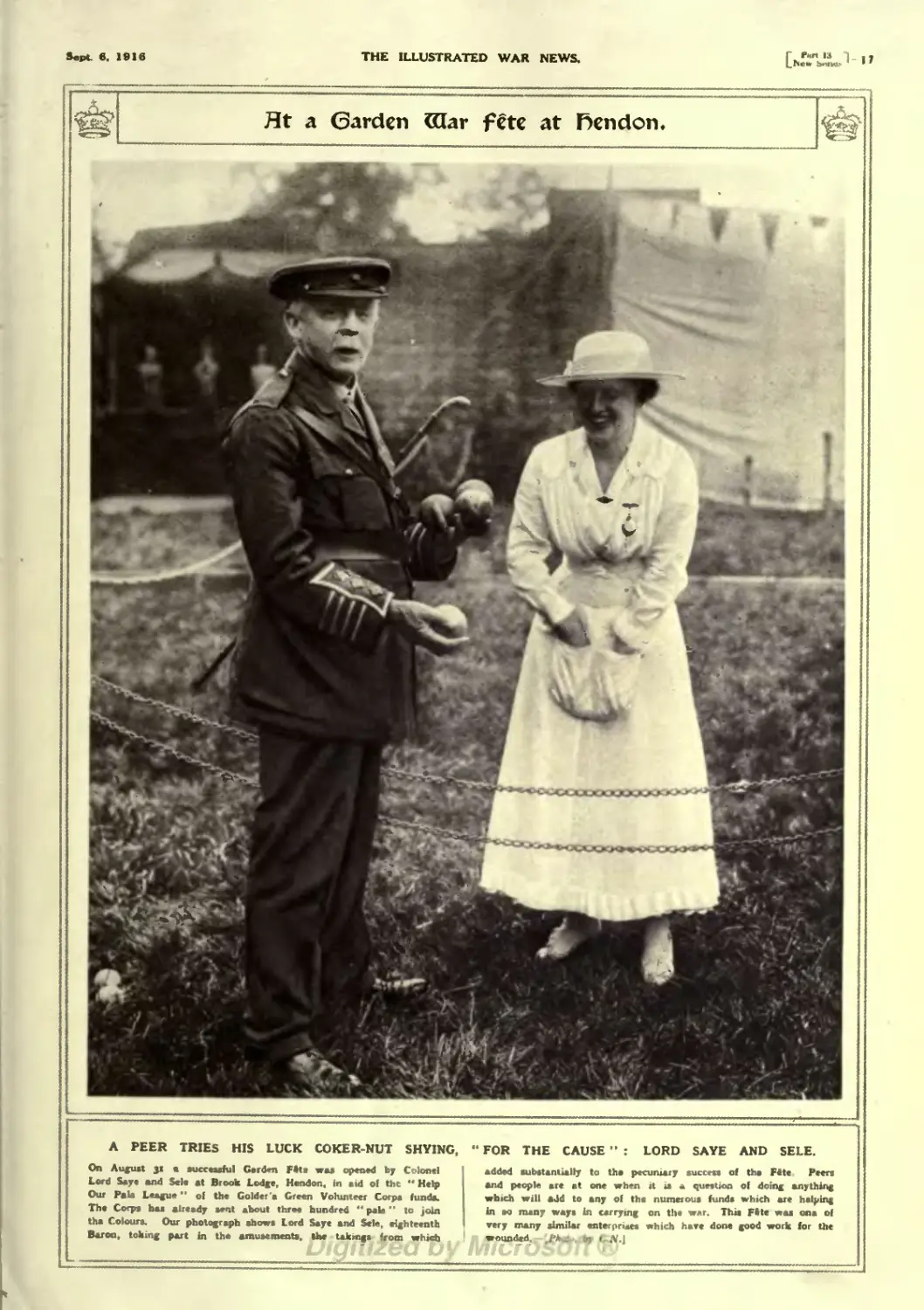
A PEER TRIES HIS LUCK COKER-NUT SHYING, "FOR THE CAUSE": LORD SAVE AND SELE.
L
On August 31 successful Grden F*ts was opened by Colonel
Lord Save and Sele at Brook Lodge, Hendon, in aid of the " Help
Our Pal* League " of the Colder'* Green Volunteer Corps fund*.
The Corps ha* already sent about three hundred "pah" to join
the Colours. Our photograph shows Lord Saye and Sele, eighteenth
Baron, taking part in the amusement*, the takings from which
added substantially to the pecuniary success of the Fete. Peers
and people are at one when it is a question of doing anything
which will aJd to any of the numerous funds which are helping
in so many ways in carrying on t!ie war. This Fete was one of
very many similar enterprises which have done good work for the
wounded. [/'Ao&. by C.A'.]

THE ILLUSTRATED WAR NEWS
Sept 6. 1916
Roumania'8 Contribution to the Grand HUiance.
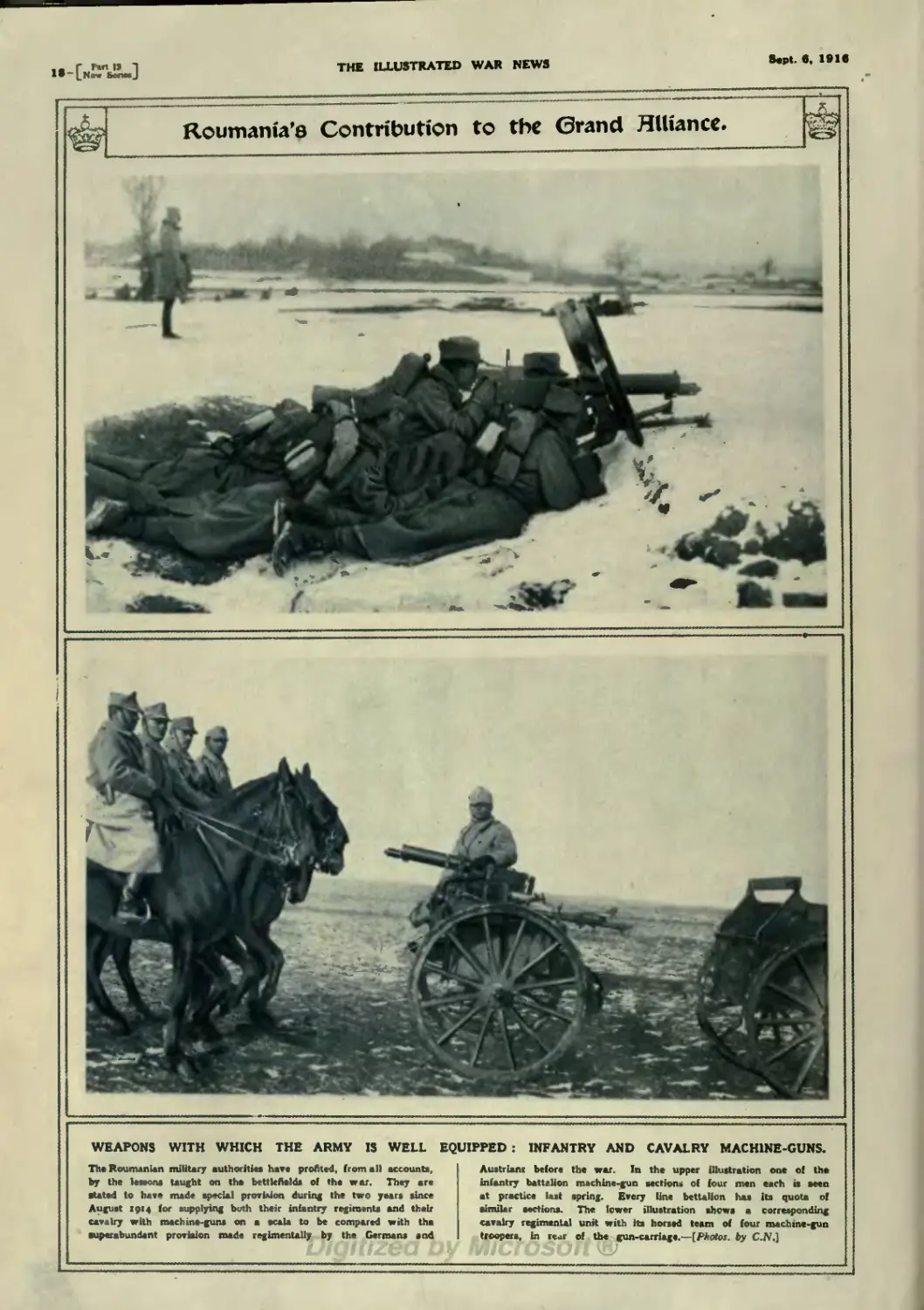
WEAPONS WITH WHICH THE ARMY IS WELL EQUIPPED : INFANTRY AND CAVALRY MACHINE-GUNS.
The Roumanian military authorities have profited, from all accounts,
by the leuoni taught on the battlefield! of the w ar. They are
stated to have made special provision during the two years since
August 1914 for supplying both their infantry regiments and their
cavalry with machine-guns on a scale to be compared with the
superabundant provision made regimen tally by the Germans *nd
Austrian: before the war. In the upper illustration one of the
infantry batt?.lion machine-gun sections of four men each is seen
at practice last spring. Every line battalion has its quota of
similar sections. The lower illustration shows a corresponding
cavalry regimental unit with its horsed team of four machine-gun
troopers, in rear of the gun-carriagt. [Photos, by C.N.]

6. 1916
THE ILLUSTRATED WAR NEWS.
I PartIS ")_i
|_New Scries J '
Roumania's Contribution to the Grand HUiancc.
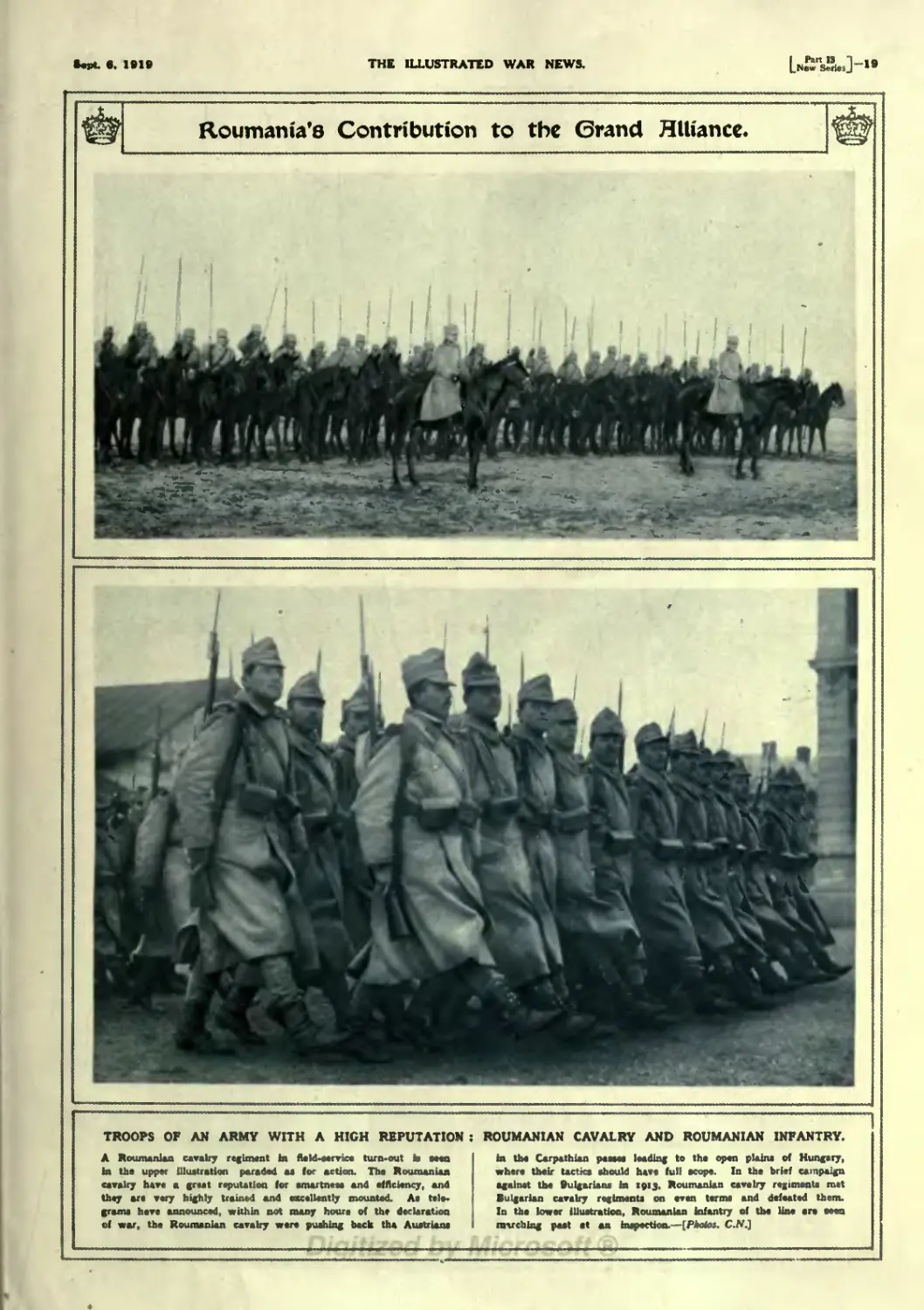
TROOPS OF AN ARMY WITH A HIGH REPUTATION : ROUMANIAN CAVALRY AND ROUMANIAN INFANTRY.
A Roumanian cavalry regiment in Acid-service turn-out is scan
In the upper illustration paraded as for action. The Roumanian
caTalry hare a (real reputation (or smartnest and efficiency, and
they are Tery highly trained and excellently mounted. As tele-
grams have announced, within not many hours of the declaration
of war, the Roumanian cavalry were pushing back the Austrian*
in the Carpathian passes leading to the open plains of Hungary,
where their tactics should hare full scope. In the brief campaign
against the Bulgarians in 1913, Roumanian caTalry regiments met
Bulgarian caralry regiments on e'en terms and defeated them.
In the lower illustration, Roumanian infantry of the line are seen
mtrching past at an inspection. (Photos. C..V.]

ILLUSTRATED WAF
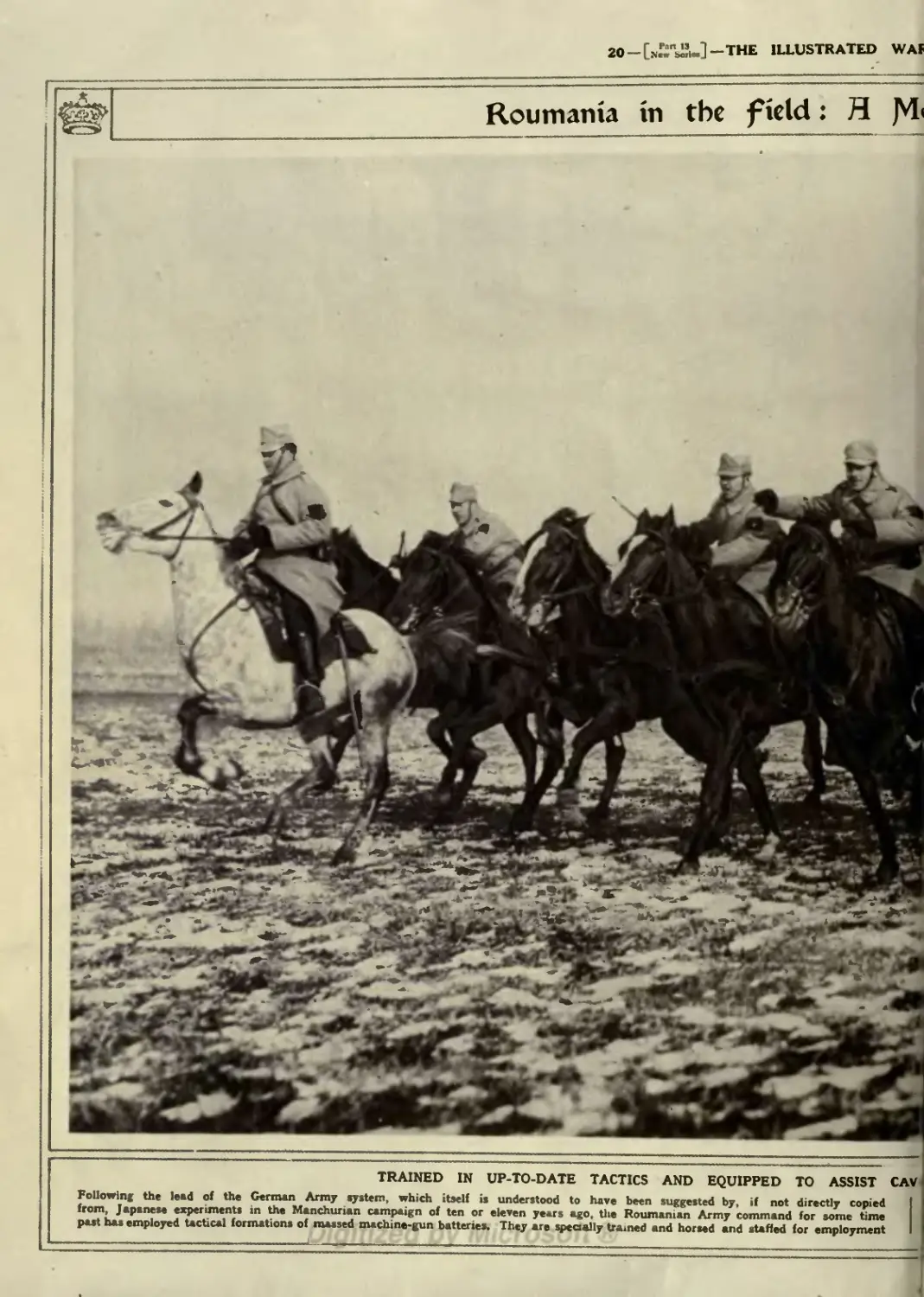
Roumania in the field : H JVl
TRAINED IN UP-TO-DATE TACTICS AND EQUIPPED TO ASSIST CAV
Following the lead of the German Army system, which itself is understood to have been suggested by, if not directly copied
om Japanese experiments in the Manchurian campaign of ten or eleven years ago, the Roumanian Army command for some time
has employed tactical formattons of massed machine-gun batteries. They are specially trained and horsed and staffed for employment

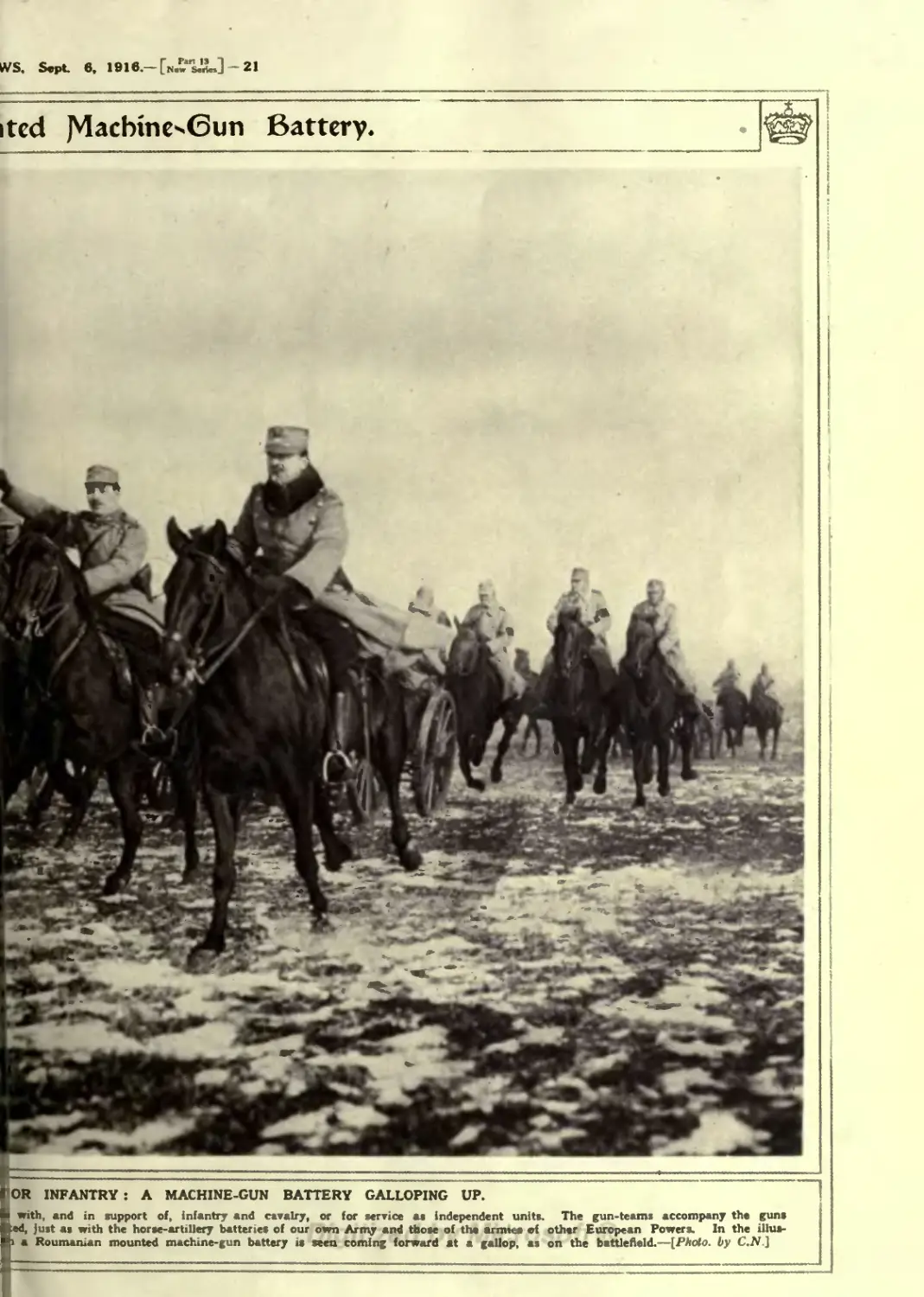
WS, Sept. 6, 1916. [u.
21
itcd JVlacbincsGun Battery.
OR INFANTRY : A MACHINE-GUN BATTERY GALLOPING UP.
with, and in support of, infantry and cavalry, or for service as independent units. The gun-teams accompany the Runs
just as with the horse-artillery batteries of our own Army and those of the armies of other European Powers. In tht illus-
Roumanian mounted machine-gun battery is seen coming forward at a gallop, as on the battlefield. [Photo, by C.N.]

Mr P.rt 13
LN s'
THE ILLUSTRATED WAR NEWS,
S.pt. 6. 1916
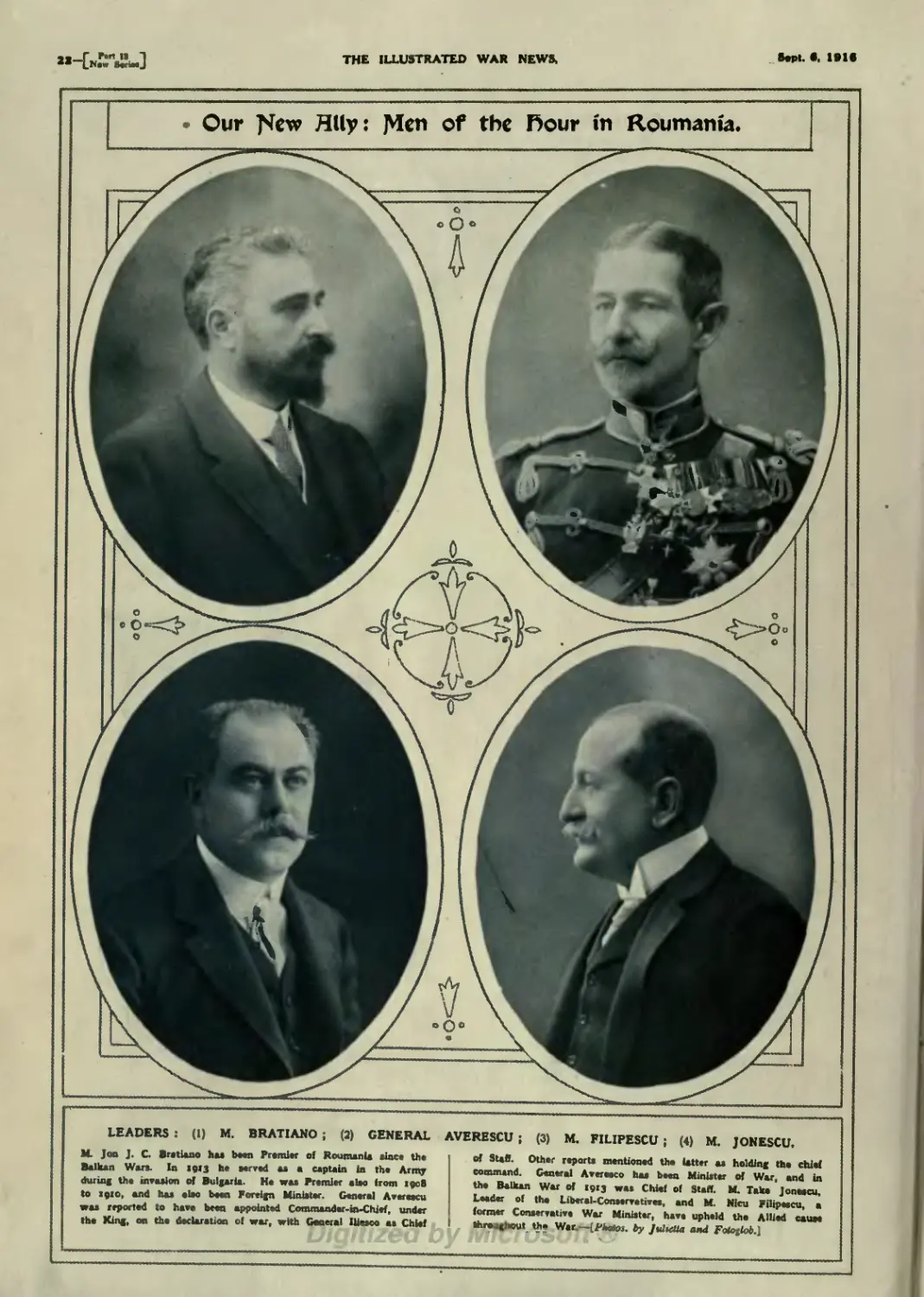
HUy: Men of the fiour in Roumania.
LEADERS : (1) M. BRATIANO ; (2) GENERAL AVERESCU ; (3) M. FILIPESCU
M. Jon J. C. Britiano hu been Premier of Roumania since the
Balkan Wan. In 1913 he lerved as a captain in the Army
during the inrasion of Bulgaria. He wu Premier alio from 1908
to 1910, and hai alio been Foreign MinUter. General Averetcu
wai reported to hare been appointed Commander-in-Chief, under
the King, on the declaration of war, with General Illetco at Chief
(4) M. JONESCU.
o( StaS. Othec reports mentioned the Utter as holding the chief
command. General Areresco has been Minuter of War, and in
the Balkan War of I9 i 3 wai Chief of Staff. M. Take Jonetcu,
Leader of the Liberal-Conseryativei, and M. Nicu Filipescu a
former CoruerraHye War Minister, hare upheld the Allied cause
throughout the W.r.-t/Vwfcu. by Julutla and Fatoglob }

Spt. 6, 1916
THE ILLUSTRATED WAR NEWS
P Part 13 -I _,
LNew Series J 23
Roumania 7oins the entente powers.
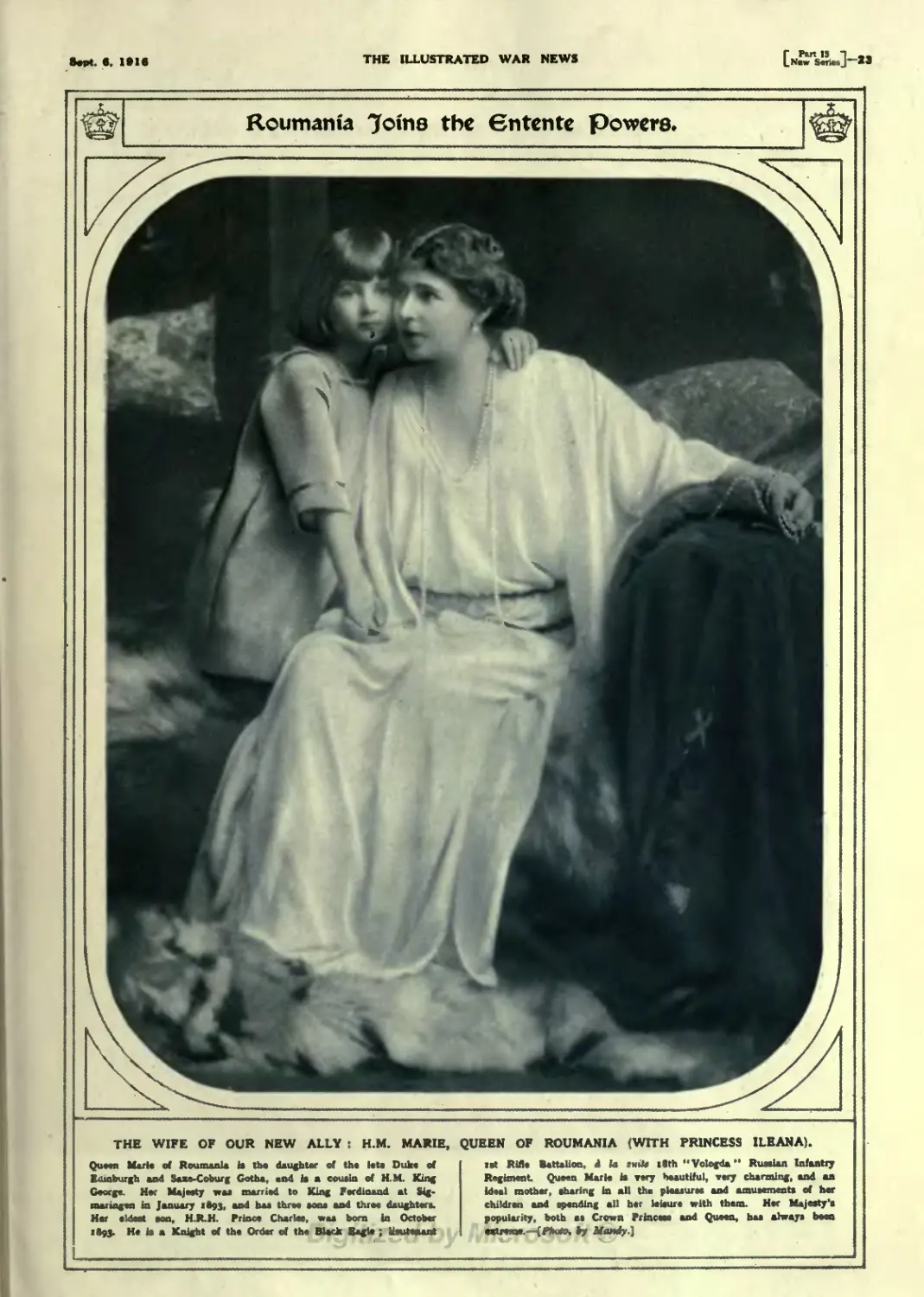
THE WIFE OF OUR NEW ALLY : H.M. MARIE,
Queen Marie of Roumanla is the daughter of the late Duke of
Edinburgh and Saxe-Coburg Cotha, and is a cousin of H.M. King
George. Her Majesty was married to King Ferdinand at Sig-
maringen in January 1893, and has three sons and three daughters.
Her eldest son, H.R.H. Prince Charles, was born in October
iSoj. He is a Knight of the Order of the Black Eagle ; lieutenant
QUEEN OF ROUMANIA (WITH PRINCESS ILEANA).
1st Rifle Battalion, d la tuite ilth "Vologda" Russian Infantry
Regiment. Queen Marie is rery beautiful, very charming, and an
ideal mother, sharing in all the pleasures and amusements of her
children and spending all her leisure with them. Her Majesty's
popularity, both ss Crown Princess and Queen, has always been
extreme. -[Photo, by Handy.}

24-[ N . l '; r ' s t ,]-THE ILLUSTRATED WAR NEWS. Sept. e, 1916
Barrage fire, and Olbat It Looks Like : H
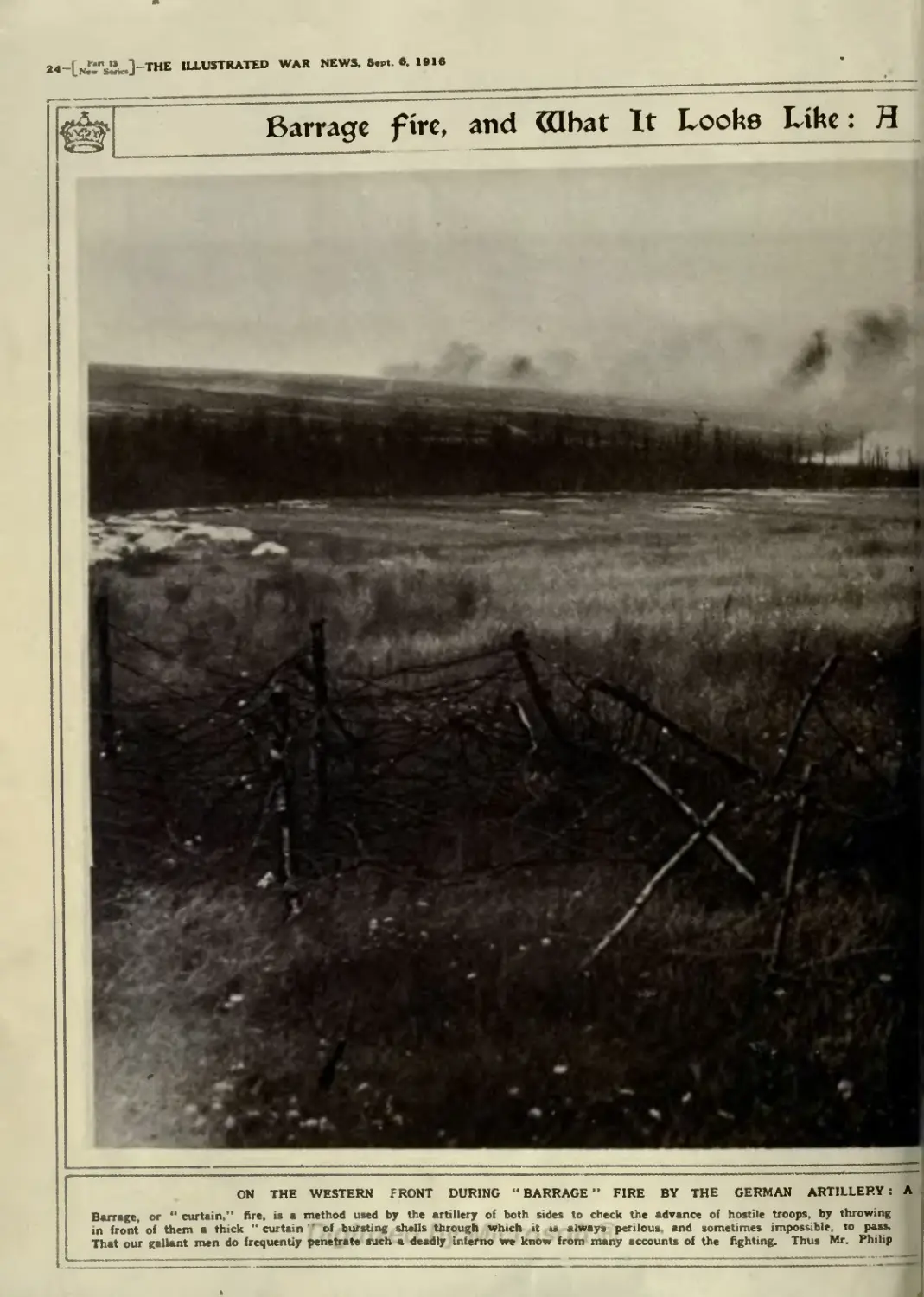
ON THE WESTERN fRONT DURING "BARRAGE" FIRE BY THE GERMAN ARTILLERY: A
Barrage, or " curtain," fire, is a method used by the artillery of both sides to check the advance of hostile troops, by throwing
in front of them a thick " curtain " of bursting shells through which it is always perilous, and sometimes impossible, to pass.
That our gallant mn do frequently penetrate such a deadly inferno we know from many accounts of the fighting. Thus Mr. Philip

THE ILLUSTRATED WAR NEWS. Spt. 6. l16-[ N j rt s i; ies ]-25
Line of Bursting Shells Like a prairie fire.
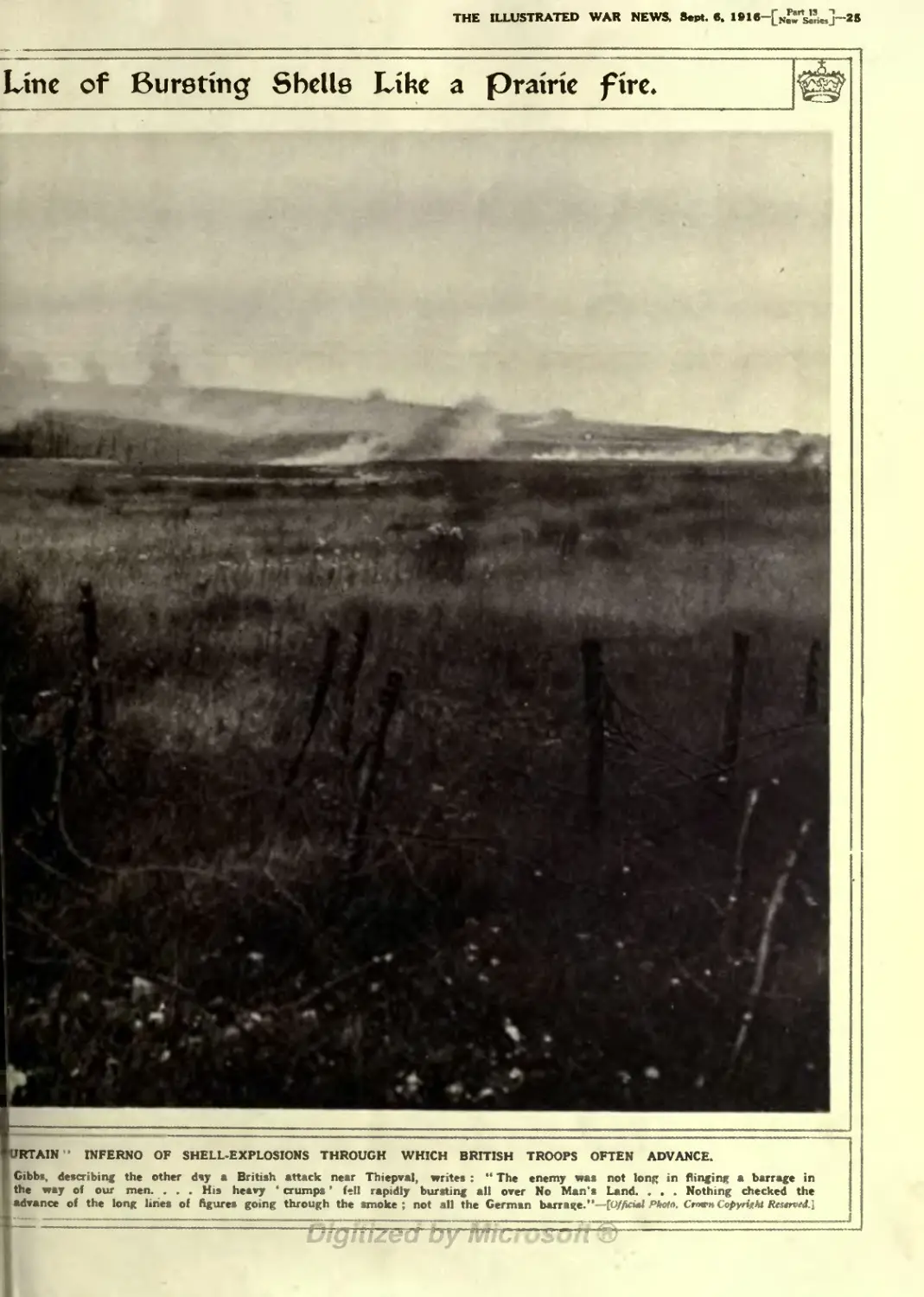
URTAIN INFERNO OF SHELL-EXPLOSIONS THROUGH WHICH BRITISH TROOPS OFTEN ADVANCE.
Gibbs, describing the other d%y a British attack near Thiepval, writes : " The enemy was not long in flinging a barrage in
the way of our men. . . . His heavy ' crumps ' (-11 rapidly bursting all over No Man's Land. . . . Nothing checked the
advance of the long lines of figures going through the smoke: not all the Germin barrage." [Official Photo. Crmrn Copyright Reserved.}

THE ILLUSTRATED WAR NEWS.
S.pt. 8, 191*
FOOTNOTES TO ARMAGEDDON: IV. -JOHNNY TURK.
A MAN who had come back from fighting the
Turk told me tnis. He said : " Every-
body knows, I suppose, that ' Johnny Turk ' is
no end of a sporting fighter. He 's an honour-
able chap, more honourable than his German
officers. The German professors haven't edu-
cated the Ottoman mind out of the laws of
humanity. The Turk 's a clean man. Sometimes
curiously clean.
" We had to take a sector of Turkish
trenches somewhere east of Suez one day.
And we had a very brisk scrap in the process.
The Turk doesn't ' down tools ' so readily as big
brother Hun, and we had as much fighting as
we wanted in cleaning up that trench. When
we "d cleaned it up thoroughly, and it was ours,
we found we had a pocketful of prisoners.
" When the first bayonet dropped, and the
hand that held it stretched out and gave him a
' gasper,' he took the cigarette in the same Kismet
manner. Perhaps he thought it was poisoned.
But the next bayonet-hand gave him food, and
the next water, and a fourth pulled him out of
the trench into cover, as the Turkish guns were
putting it over in the regular way.
" I don't know whether he was surprised or
grateful at being saved, or whether he knew he
had been spared then. That is, you couldn't
tell from his face. He sat back in the dug-out
quiet and blinking, and eating and drinking as
though it didn't matter. And when someone
said something to him, he just smiled faintly
and went on with his job.
" He didn't talk ; just sat there watching us
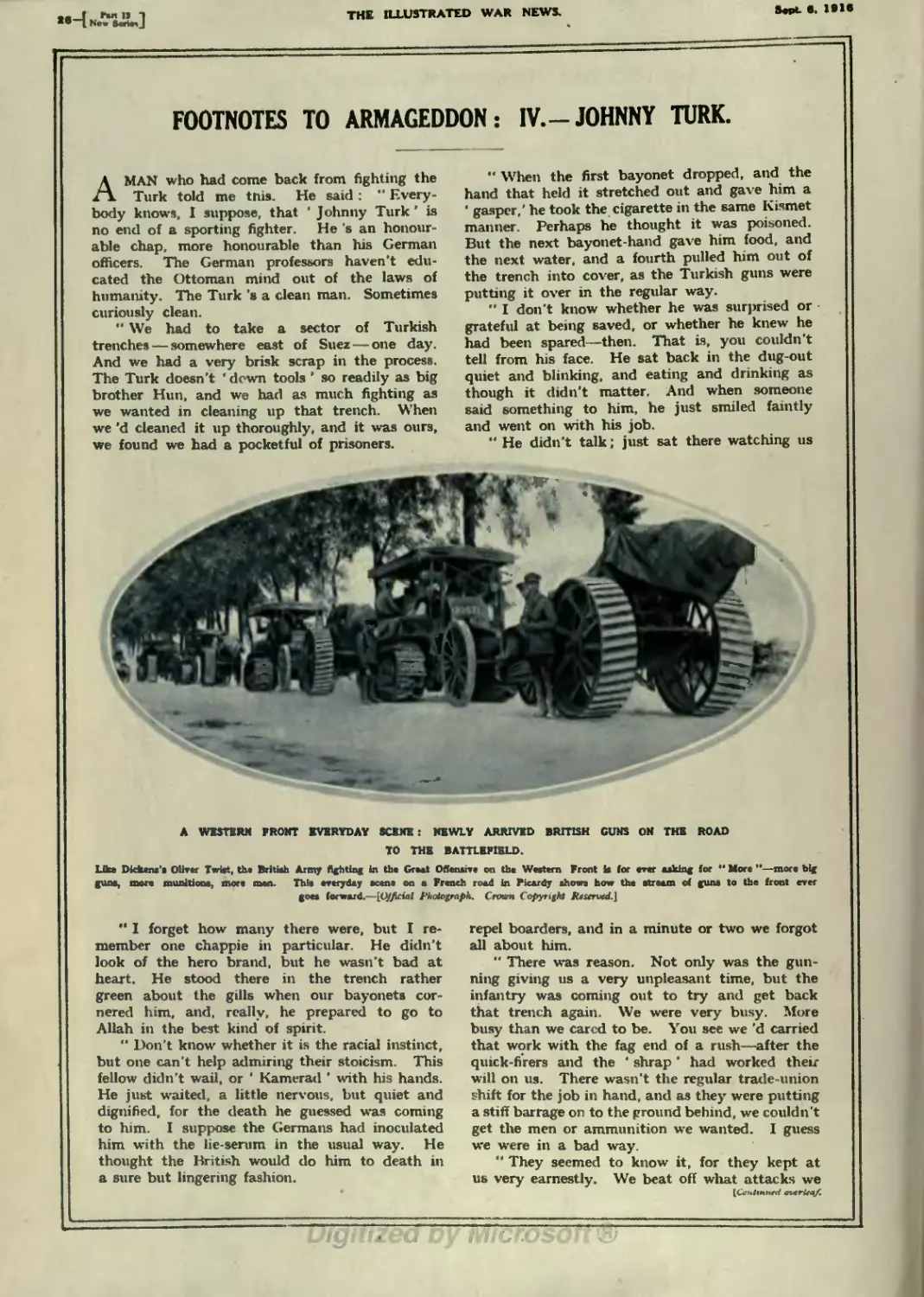
A WESTERN FRONT EVERYDAY SCENE : NEWLY ARRIVED BRITISH GUNS ON THE ROAD
TO THE BATTLEFIELD.
Like Dkkeni'i Olirer Twist, thr BritUh Army lighting in the Great Ofensie on the Western Front Is lot erer uking for "More" more big
guni, more munition*, more men. This everyday scene on m French road in Picardy shows how the stream of guns to the front erer
goes forward. [Official Fliotograph. Crown Copyright Reserved.}
" I forget how many there were, but I re-
member one chappie in particular. He didn't
look of the hero brand, but he wasn't bad at
heart. He stood there in the trench rather
green about the gills when our bayonets cor-
nered him, and, really, he prepared to go to
Allah in the best kind of spirit.
" Don't know whether it is the racial instinct,
but one can't help admiring their stoicism. This
fellow didn't wail, or ' Kamerad ' with his hands.
He just waited, a little nervous, but quiet and
dignified, for the death he guessed was coming
to him. I suppose the Germans had inoculated
him with the lie-serum in the usual way. He
thought the British would do him to death in
a sure but lingering fashion.
repel boarders, and in a minute or two we forgot
all about him.
" There was reason. Not only was the gun-
ning giving us a very unpleasant time, but the
infantry was coming out to try and get back
that trench again. We were very busy. More
busy than we cared to be. You see we 'd carried
that work with the fag end of a rush after the
quick-firers and the ' shrap ' had worked their
will on us. There wasn't the regular trade-union
shift for the job in hand, and as they were putting
a stiff barrage on to the ground behind, we couldn't
get the men or ammunition we wanted. I guess
we were in a bad way.
" They seemed to know it, for they kept at
us very earnestly. We beat off what attacks we
[CV'iflKK/rf mxrtta/.

Sept. 6. 1916
THE ILLUSTRATED WAR NEWS.
CPart |3 -I
New Sr! s J~ 27
Mascots and Regimental pets in the OTar.
^p
\
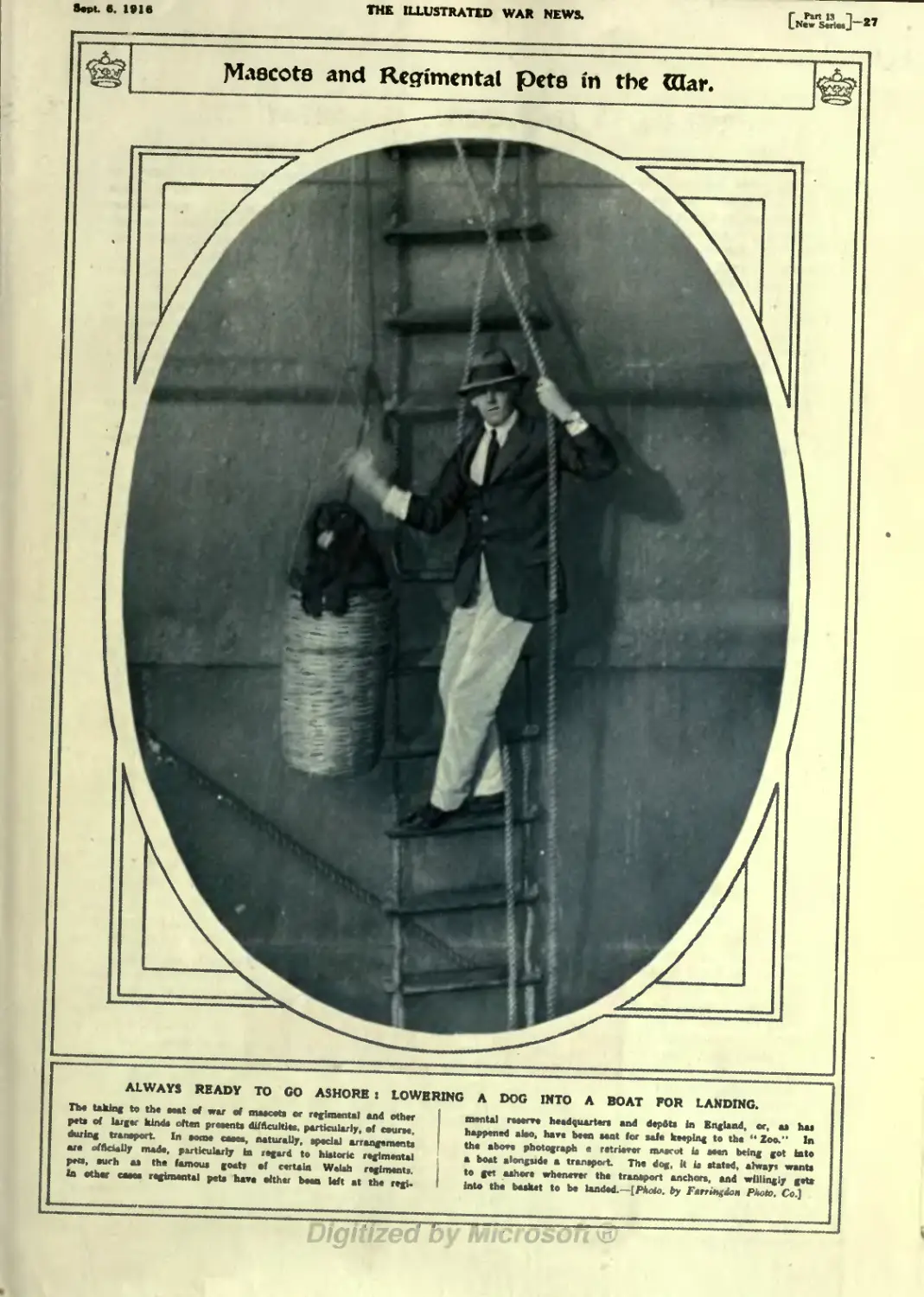
ALWAYS
T ASHORE ' LOWE "" I
if to the Mat of war of matcoti or regiment!
ir t er kind, often pretenti dilficultie.. particularly, of cour^
"
the
ln reiard (
t , , .,
h . . (th , t
mental rt.en-e headquarttn and depu in Enfland, or at ha.
happened alao, hare been tent for lafe ktepinc to the " Zoo." In
the abore photofraph a r.trievor m.cot ii Men beinr ( ot into
boat along,ide a transport. The dog, it i. .t.ted, always wants
10 fet .ihor. whenerer tht traiuport anchor,, .nd wlllin f ly t*
Into the baaket to be landed. -[/>*<*>. by FartiHgdon Plato. Co]

THE ILLUSTRATED WAR NEWS.
J.pi. 6. 1916
could, but soon realised
that we couldn't go on
doing it. A hefty bit
of a rush brought them
right into us at the end,
and in the whirling mix-
up of that hand-to-
hand scrapping we got
the word to clear out.
We cleared out nimbly
enough, and, in the curi-
ous way of these things,
quite a lot of us were
able to get back over our
bags. Not all of us.
We knew we 'd left a lot
of good chaps, dead or
wounded, back in the
trench, and we knew
we 'd left our prisoners
there, too. But we didn't
think much of our pris-
oners. They are persons
easily forgot in strenuous
moments, and we wouldn't
have thought of them at
all if one of them hadn't
come over to us.
" It was the man we
had fed and fagged. He
came over to us through
the machine-gun fire. And
he was carrying one of
our fellows on his back.
" Rather surpris-
ing that, eh ? We
were rather taken
aback. He brought
this wounded fel-
low right across,
dumped him over
our bags, and then
began to go back.
We yelled to him
to come in out
of the rain. We
knew what he
was going through,
and we seemed
to think that he
might get it in
the neck from his
own men, even
if he got back
safe to his own
trenches. He just
grinned at us, and
nodded, and went
off to his own
line. We never
knew what hap-
pened to him.
" The wounded
chap he had
brought in filled
in the story for
us. He was hit
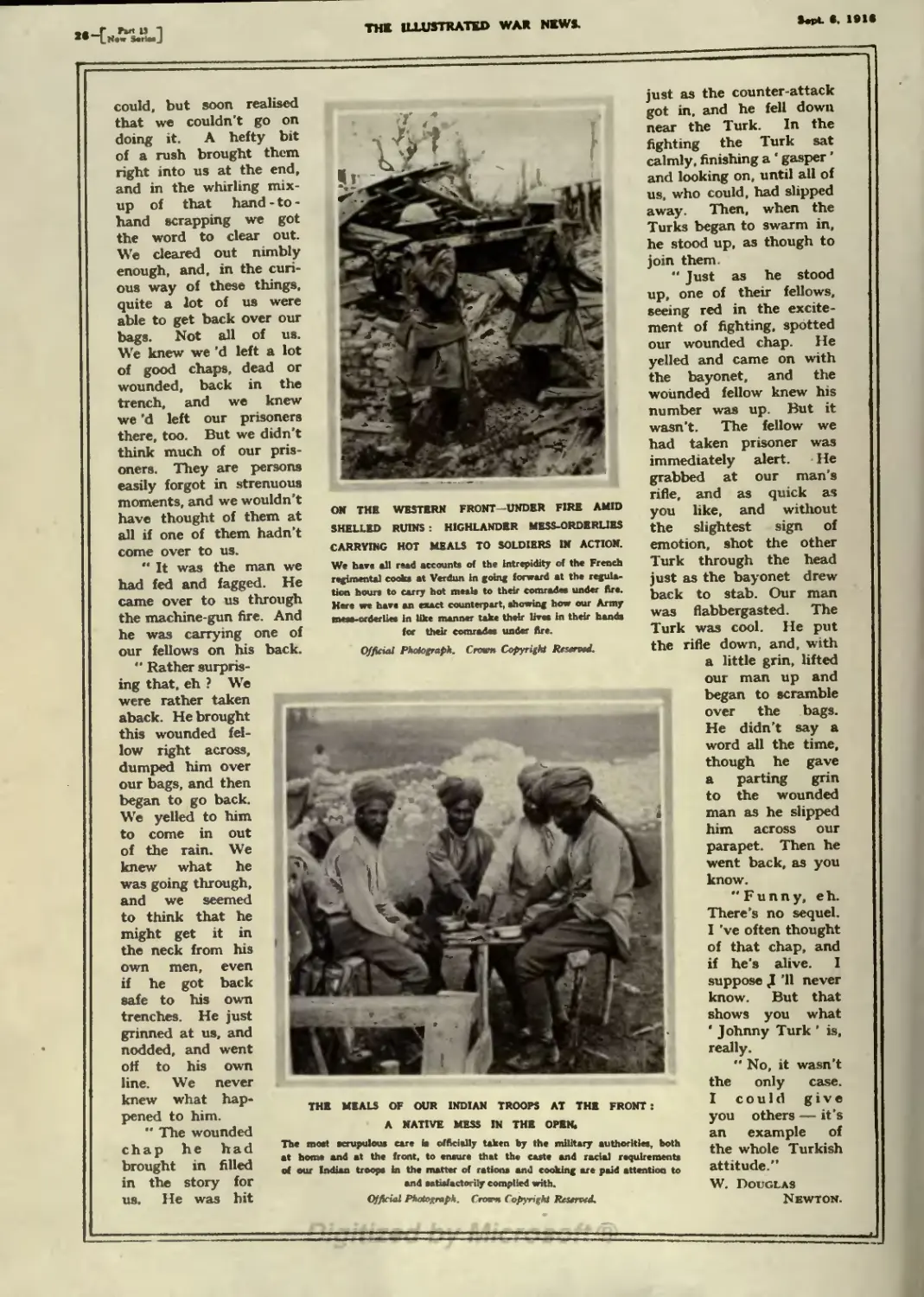
ON THE WESTERN FRONT^UNDER FIRE AMID
SHELLED RUINS : HIGHLANDER MESS-ORDERLIES
CARRYING HOT MEALS TO SOLDIERS IN ACTION.
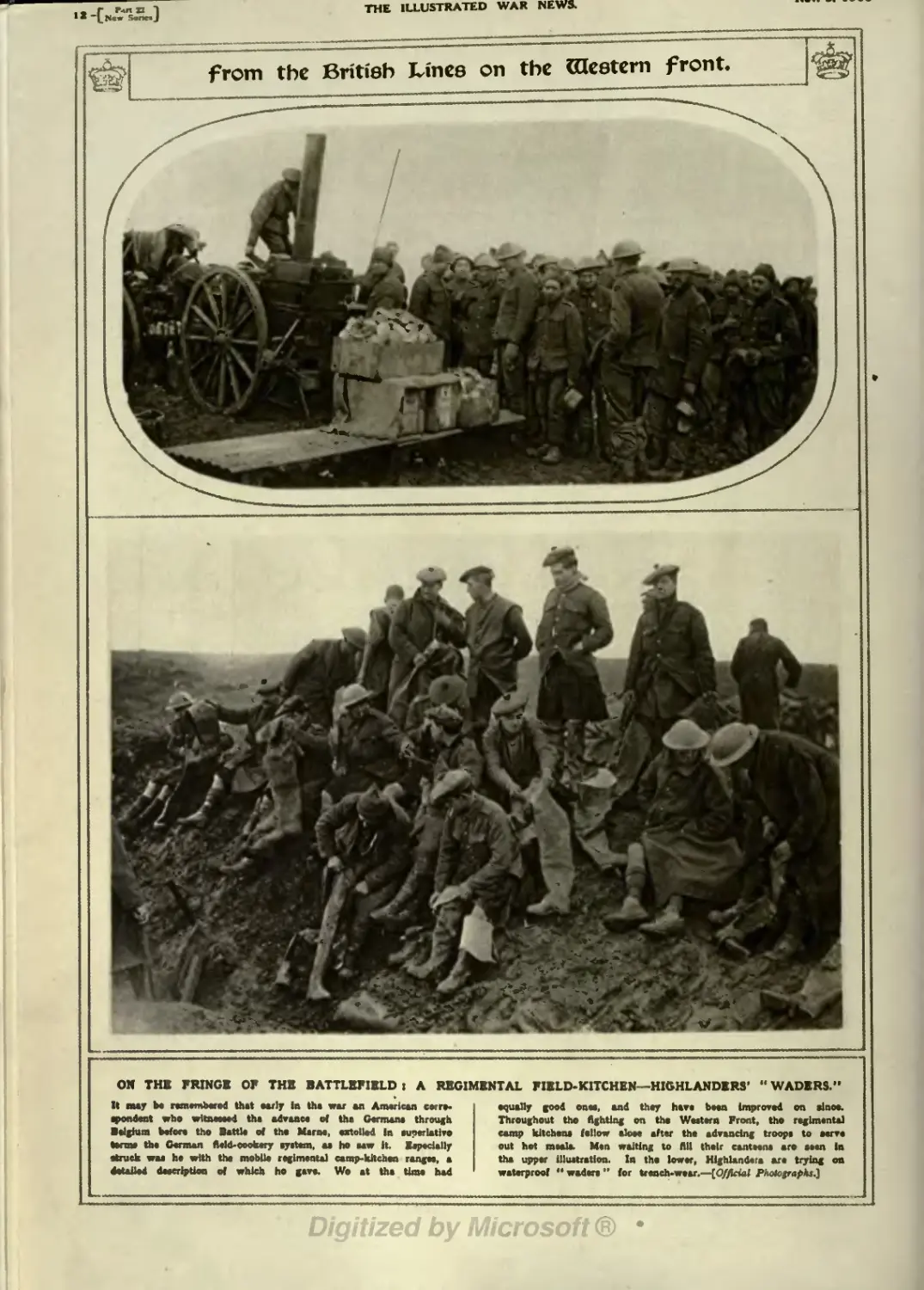
Vie hare all rend accounts of the intrepidity of the French
regimental cooks at Verdun in going forward at the regula-
tion hour to carry hot meali to their comrades under fire.
Here we hare an exact counterpart, showing how our Army
men-orderlies in like manner take their lire* in their hands
lor their comrades under fire.
Official Photograph. Crown Copyright Reserved.
THE MEALS OF OUR INDIAN TROOPS AT THE FRONT :
A NATIVE MESS IN THE OPEN,
The most scrupulous care is officially taken by the military authorities, both
at home and at the front, to ensure that the caste and racial requirements
of our Indian troops in the matter of rations and cooking are paid attention to
and satisfactorily complied with.
0/frial Photograph. Cromt Copy-right Reserved.
just as the counter-attack
got in, and he fell down
near the Turk. In the
fighting the Turk sat
calmly, finishing a ' gasper '
and looking on, until all of
us, who could, had slipped
away. Then, when the
Turks began to swarm in,
he stood up, as though to
join them.
" Just as he stood
up, one of their fellows,
seeing red in the excite-
ment of fighting, spotted
our wounded chap. He
yelled and came on with
the bayonet, and the
wounded fellow knew his
number was up. But it
wasn't. The fellow we
had taken prisoner was
immediately alert. He
grabbed at our man's
rifle, and as quick as
you like, and without
the slightest sign of
emotion, shot the other
Turk through the head
just as the bayonet drew
back to stab. Our man
was flabbergasted. The
Turk was cool. He put
the rifle down, and, with
a little grin, lifted
our man up and
began to scramble
over the bags.
He didn't say a
word all the time,
though he gave
a parting grin
to the wounded
man as he slipped
him across our
parapet. Then he
went back, as you
know.
"Funny, eh.
There's no sequel.
I Ve often thought
of that chap, and
if he's alive. I
suppose J '11 never
know. But that
shows you what
' Johnny Turk ' is,
really.
" No, it wasn't
the only case.
I could give
you others it's
an example of
the whole Turkish
attitude."
W. DOUGLAS
NEWTON.

Snt. 6. 1916
THE ILLUSTRATED WAR NEWS.
Part 13
OZoundeci fiero's Romcward Voyage.
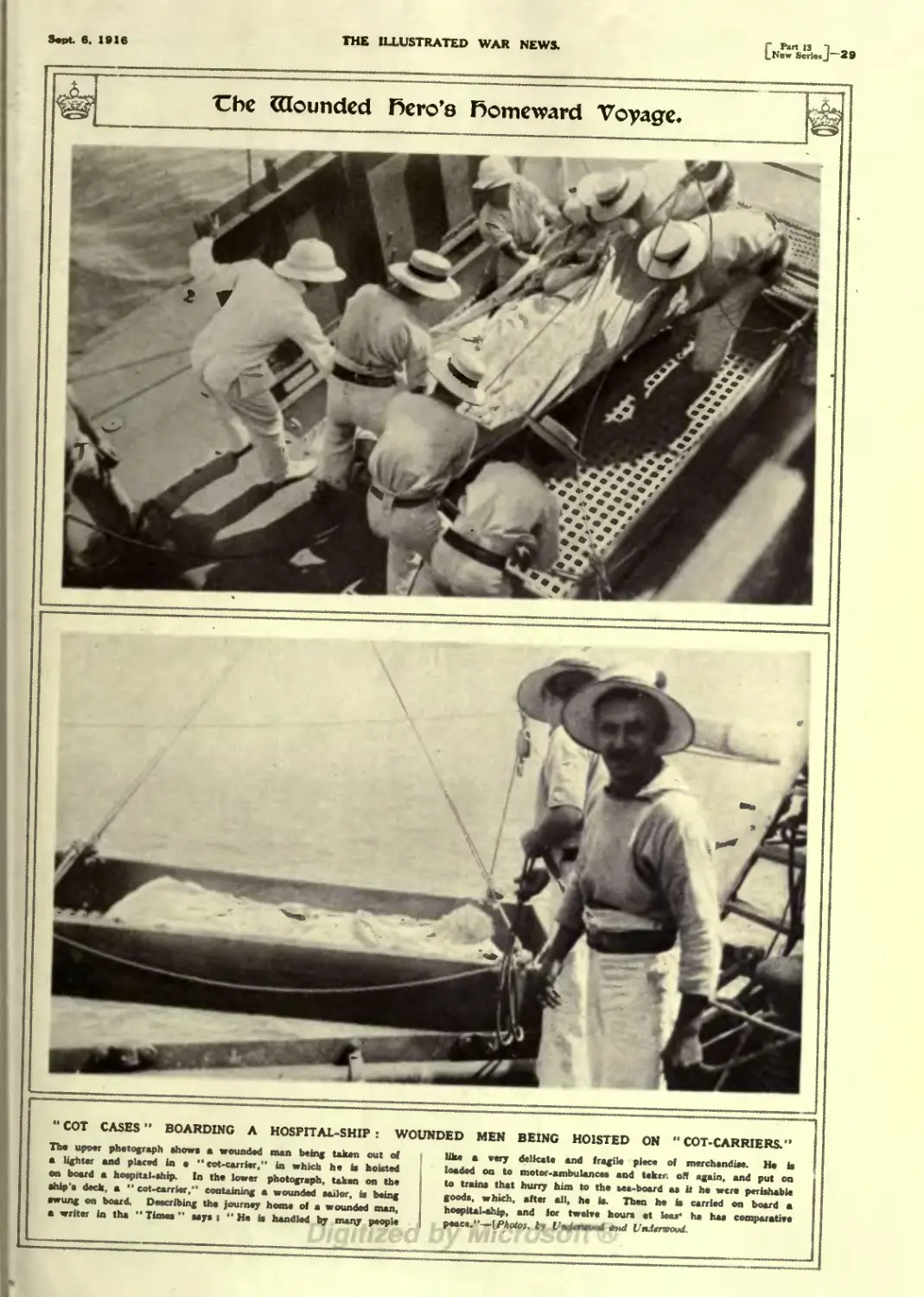
BOARDING A HOSPITAL-SHIP : WOUNDED MEN BEING HOKTED ON " COT-CARRIERS
fhe unit Dholoor.nh >hn. J-.I _ VnKKlEKS.
The upoer photograph .how, . wounded man being taken out of
ughter and placed in . "cot-rri," in which he u hoi , te( j
on board a ho^fl-hip. In , h . Iow , r photojr.ph, uken on th
lk, . co.-c.rri.r." conUining . wounded ilor, i, being
wung on bord. DeKribing h, journ^ hom . o( . wounded ^
. wnter in th. Tta M " -jr. : " H. i. handled by many
ike a very delicate and fragile piece of merchandise. Ht to
I on to motor-ambulancet and taker, off again, and put on
a train, that hurry him to the Ma-board a. il he were periihable
.rood., which, after ., he i.. Then he i. carried on board a
ho.p,t.l.ahip, and for twelve hour, at In., h. ha. comparatir.
peace. [Photos, by Underwood a,ul Vnltrwood.

Pin 13 "I
N SriJ
THE ILLUSTRATED WAR NEWS.
S.pi. 6. 1916
Che Recent British Victory in gypt.
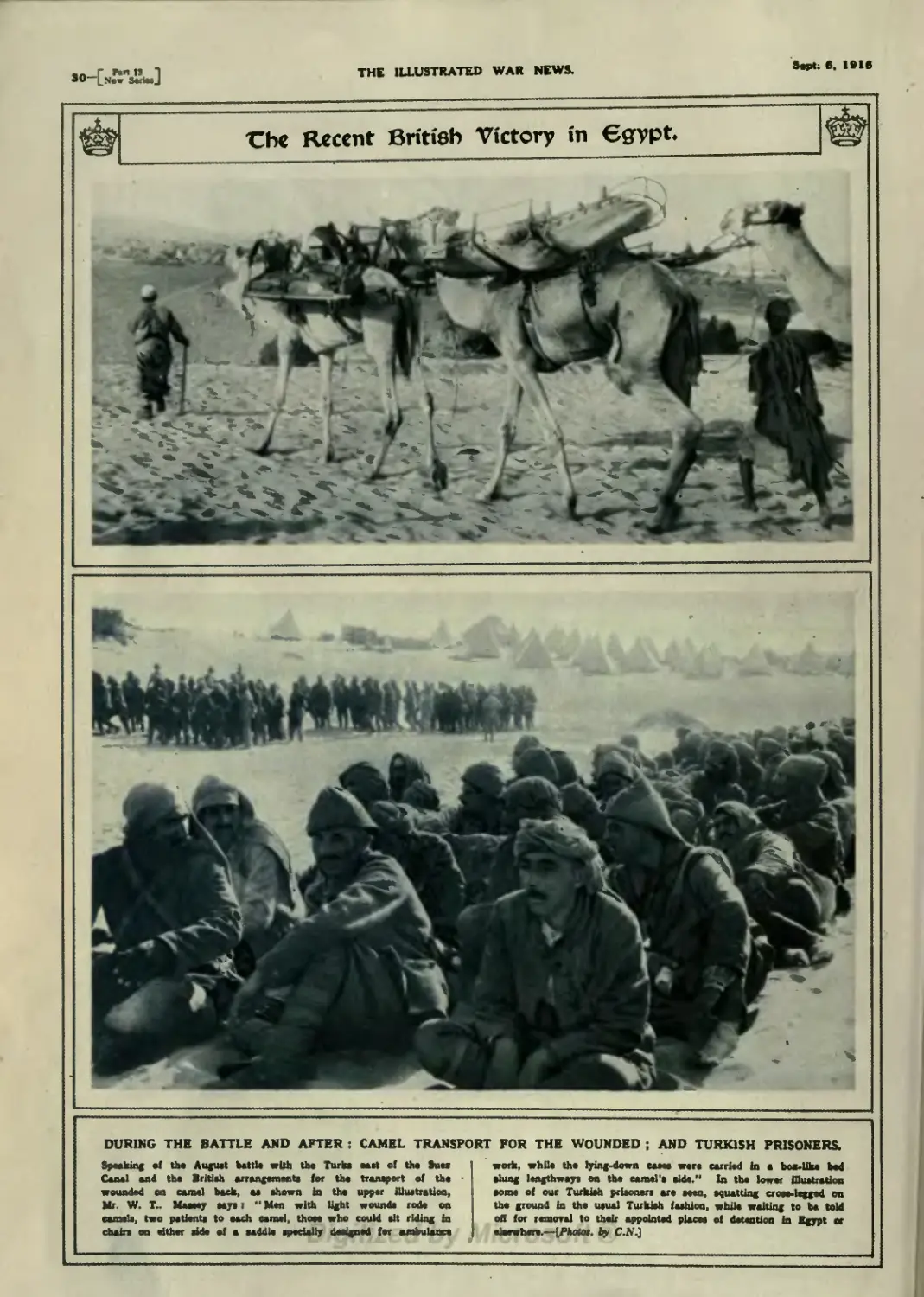
DURING THE BATTLE AND AFTER : CAMEL TRANSPORT FOR THE WOUNDED ; AND TURKISH PRISONERS.
Speaking of the August battle with the Turki eait of the Suet
Canal and the British arrangement! (or the transport of the
wounded on camel back, as shown in the upper illustration,
Mr. W. T.. Masaey says: "Men with light wounds rode on
camels, two patients to each camel, those who could sit riding in
chairs on either side of a saddle specially designed for ambulance
work, while the lying-down cases were curled in a box-Ilk* bed
tlung lengthways on the camel'a aide." In the lower illustration
tome of our Turkiah prisoner! are teen, squatting crosi-legged oa
the (round in the uiual Turkiah faihion, while waiting to be told
off (or removal to their appointed placet of detention in Egypt or
elaewhere. [Photos, by C.N.]

6. 1916
THE ILLUSTRATED WAR NEWS.
r Part 13 1 ,,
(.New Series J 31
flditb the British Yeomanry in gypt.
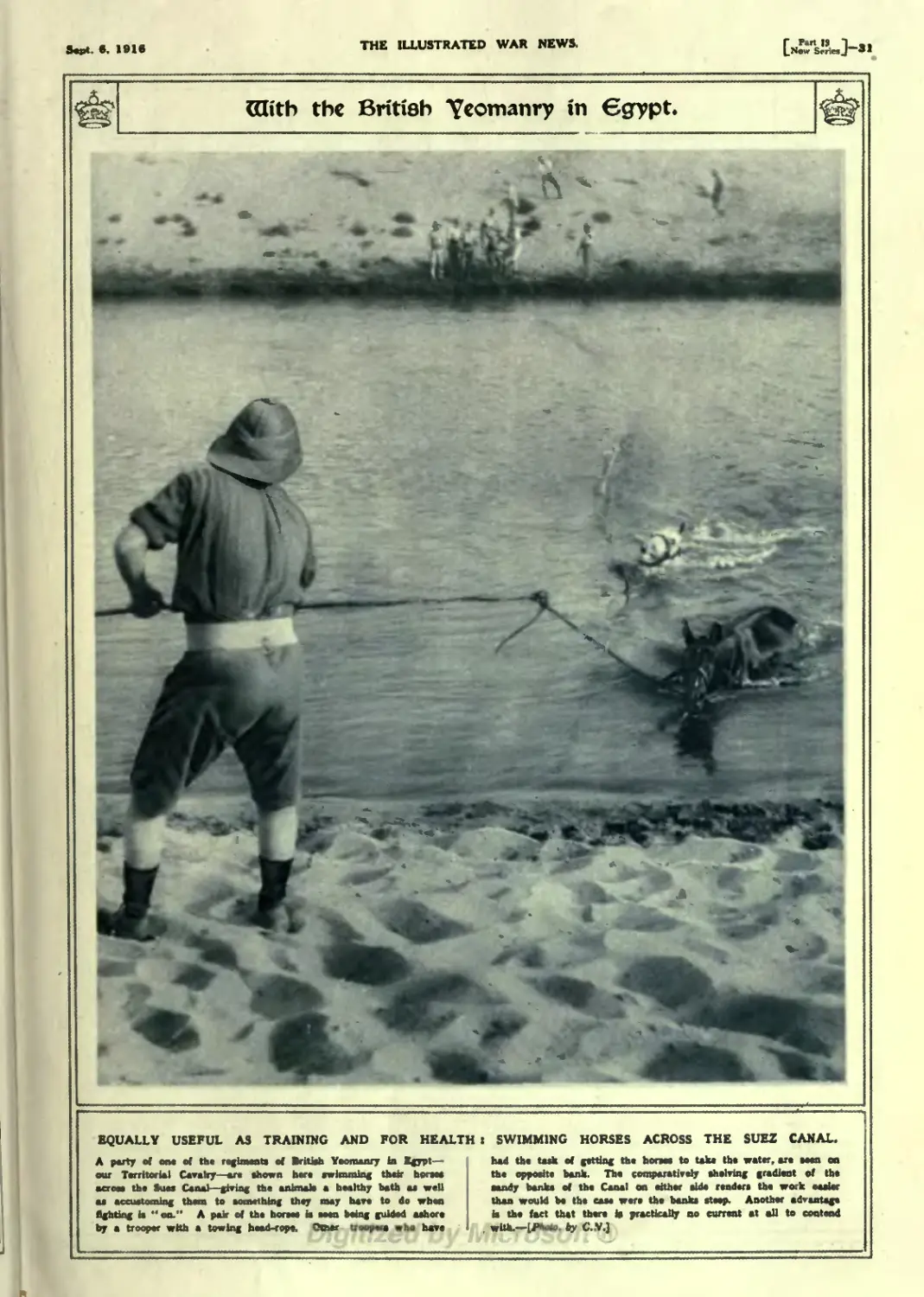
EQUALLY USEFUL AS TRAINING AND FOR HEALTH : SWIMMING HORSES ACROSS THE SUEZ CANAL.
A party of one of the reflmenti of Bnliih Yeomanry in Efjrpt
our Territorial Caralry are ihown here twimminf their horia
aerote the Sue* Canal giTing the animate a health? bath as well
aj accustoming them to something they may have to do when
fighting is " on." A pair of the horses Is seen being guided ashore
by a trooper with a towing head-rope. Other troopers who hart
had the task of getting the hones to take the water, art se*n on
the opposite bank. The comparatively shelving gradient of the
Mndy banks of the Canal on either side renders the work easier
than would be the case were the banks iteep. Another advantage
to the fact that there is practically no current at all to contend
with. [Plwlo. by C.N.]

I- Pan 13 "I
l_N.w sn~J
THE ILLUSTRATED WAR NEWS.
Sept. 6. 1916
Children and the Wounded: Ht Lady poutett's hospital
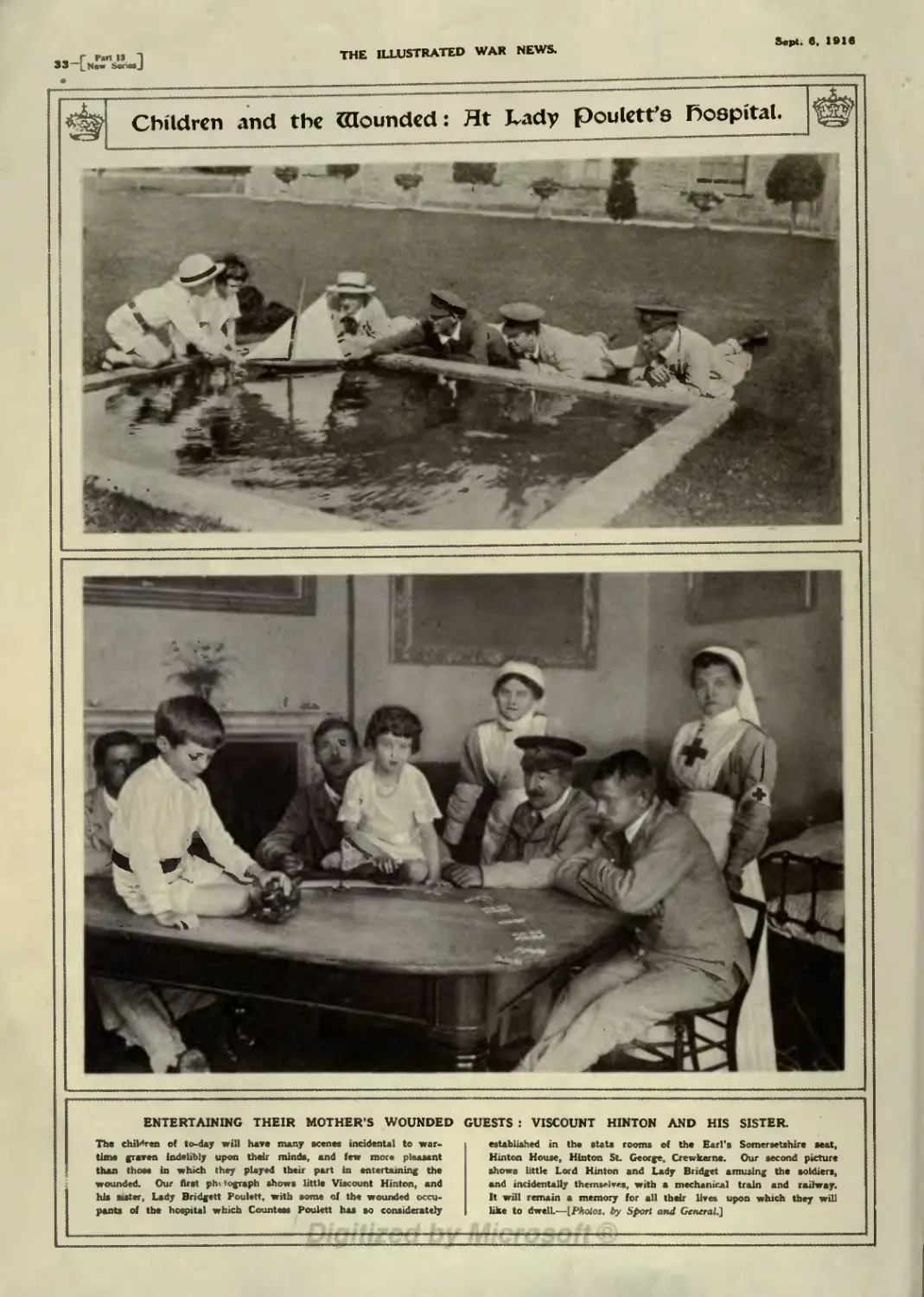
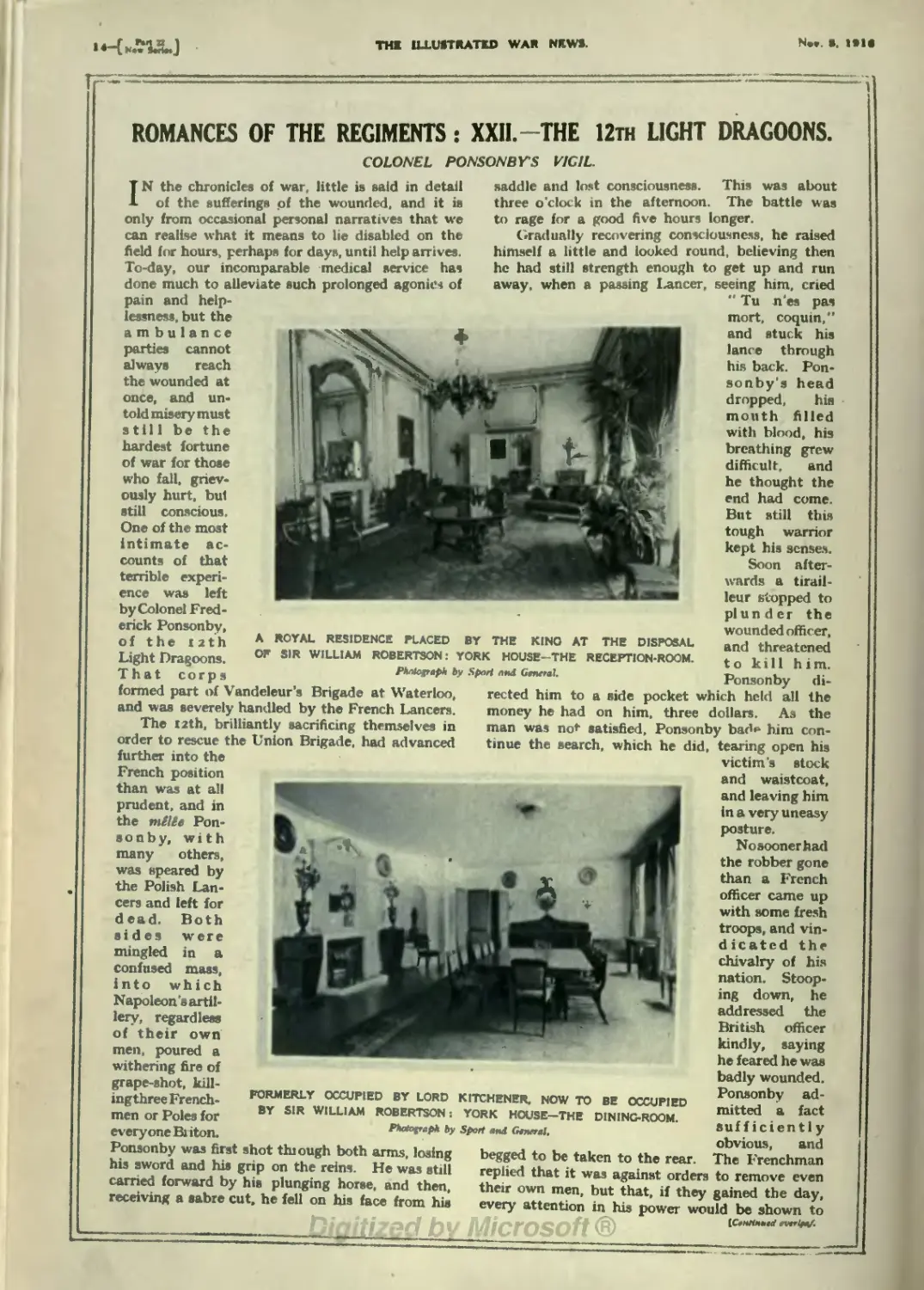
ENTERTAINING THEIR MOTHER'S WOUNDED GUESTS : VISCOUNT HINTON AND HIS SISTER.
The children of to-day will have many scenes incidental to war-
time graven indelibly upon their minds, and few more pleasant
than those in which they played their part in entertaining the
wounded. Our first phi. tograph shows little Viscount Hinton, and
his sister, Lady Bridget! Poulett, with some of the wounded occu-
pants of the hospital which Countess Poulett has so considerately
established in the state rooms of the Earl's Somersetshire seat,
Hinton House, Hinton St. George, Crewkerne. Our second picture
shows little Lord Hinton and Lady Bridget amusing the soldiers,
and incidentally thems*lv*s, with a mechanical train and railway.
It will remain a memory for all their lives upon which they will
like to dwell, [Photos, by Sport and General.}

. D. 1 91 O
ILL US I K A I tL> WAK NEWS.
Children and the Wounded: In Lady poulett's fiospital.
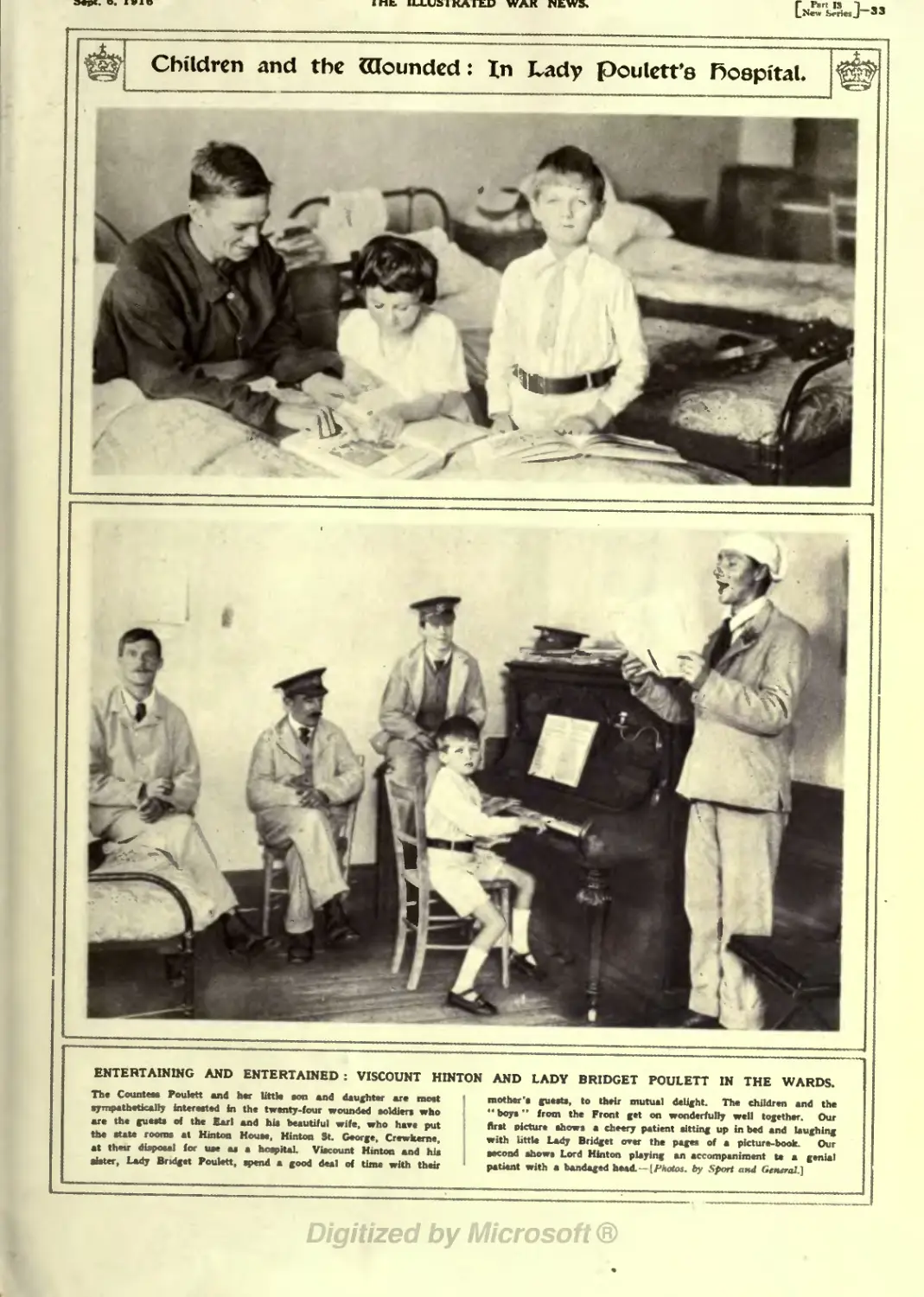
ENTERTAINING AND ENTERTAINED : VISCOUNT HINTON AND LADY BRIDGET POULETT IN THE WARDS.
The Countess Poulett and her little son and daughter are most
sympathetically intereated in the twenty-four wounded soldiers who
are the guests of the Earl and his beautiful wife, who hare put
the state rooms at Hmton House, Hinton St. George, Crewkerne,
at their disposal for use as a hospital. Viscount Hinton and his
aister, Lady Budget Poulett, spend a good deal of time with their
mother's guests, to their mutual delight. The children and the
boys ' ' from the Front get on wonderfully well together. Our
first picture shows a cheery patient sitting up in bed and laughing
with little Lady Bridget orer the pages of a picture-book. Our
second shows Lord Hinton playing an accompaniment to a genial
patient with a bandaged head. [Photos, fry Sport and General.]

THE ILLUSTRATED WAR NEWS.
Sept. O, IV 10
WOMEN AND THE WAR.
AS a nation we are extraordinarily indifferent
to our own interests. Broadly speaking, it
has always been " the thing that 's nearest " that
we have overlooked. Amongst other trifles that
in our own superior way we have brushed aside
as being unworthy of attention is the cultivation
of drug herbs and medicinal plants.
It was not until the war cut off supplies from
Central Europe that we realised with something
of a shock the extent to which we were dependent
on our enemies for the drug plants used in the
science of healing. But things will be different
in the future. Experts tell us that there is no
ago, unless, indeed, it was indulged in by way
of a hobby. Necessity, however, has taught us
many things. Women have proved that their
entry into industry and commerce does not
necessarily produce chaos, and medicinal herb-
growing is one of the new occupations that have
been thrown open to women by the War.
Down in Buckinghamshire at Chalfont St.
Peter, to be precise I have watched the women
learning the elements of the work at the school
started for the purpose by Mrs. Grieve. There
are several acres of garden, and in them you see
the British Pharmacopoeia, or, at any rate, a
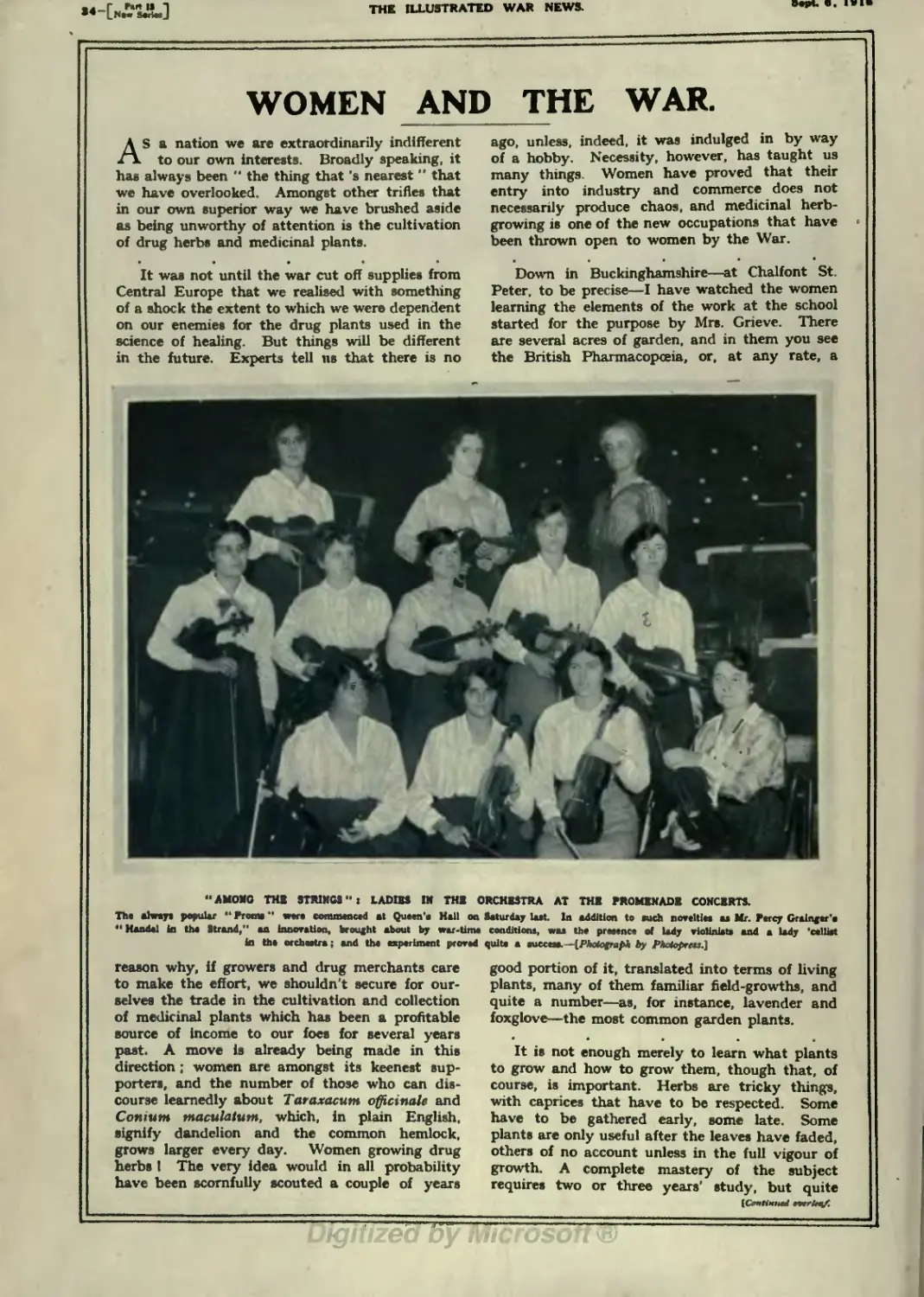
" AMONG TMB STRINGS " : LADIES IN THE ORCHESTRA AT THE PROMENADE CONCERTS.
The alwtyi popular "Promt" were commenced t Queen's Hall on Saturday lut. In addition to luch novelties as Mr. Percy Gralnfer'i
" Hudtl In tht Strand," an innovation, brought about by war-tlnu conditions, wai the presence of lady violinists and a lady 'cellist
in tht orchestra j and the experiment proved quite a success. [Photograph by Pliotopras.]
reason why, if growers and drug merchants care
to make the effort, we shouldn't secure for our-
selves the trade in the cultivation and collection
of medicinal plants which has been a profitable
source of income to our foes for several years
past, A move is already being made in this
direction ; women are amongst its keenest sup-
porters, and the number of those who can dis-
course learnedly about Taraxacum officinale and
Conium tnaculatum, which, in plain English,
signify dandelion and the common hemlock,
grows larger every day. Women growing drug
herbs ! The very idea would in all probability
have been scornfully scouted a couple of years
good portion of it, translated into terms of living
plants, many of them familiar field-growths, and
quite a number as, for instance, lavender and
foxglove the most common garden plants.
It is not enough merely to learn what plants
to grow and how to grow them, though that, of
course, is important. Herbs are tricky things,
with caprices that have to be respected. Some
have to be gathered early, some late. Some
plants are only useful after the leaves have faded,
others of no account unless in the full vigour of
growth. A complete mastery of the subject
requires two or three years' study, but quite
[Continued ovtrtenf.

nt lU-USTKATED WAR NEWS.
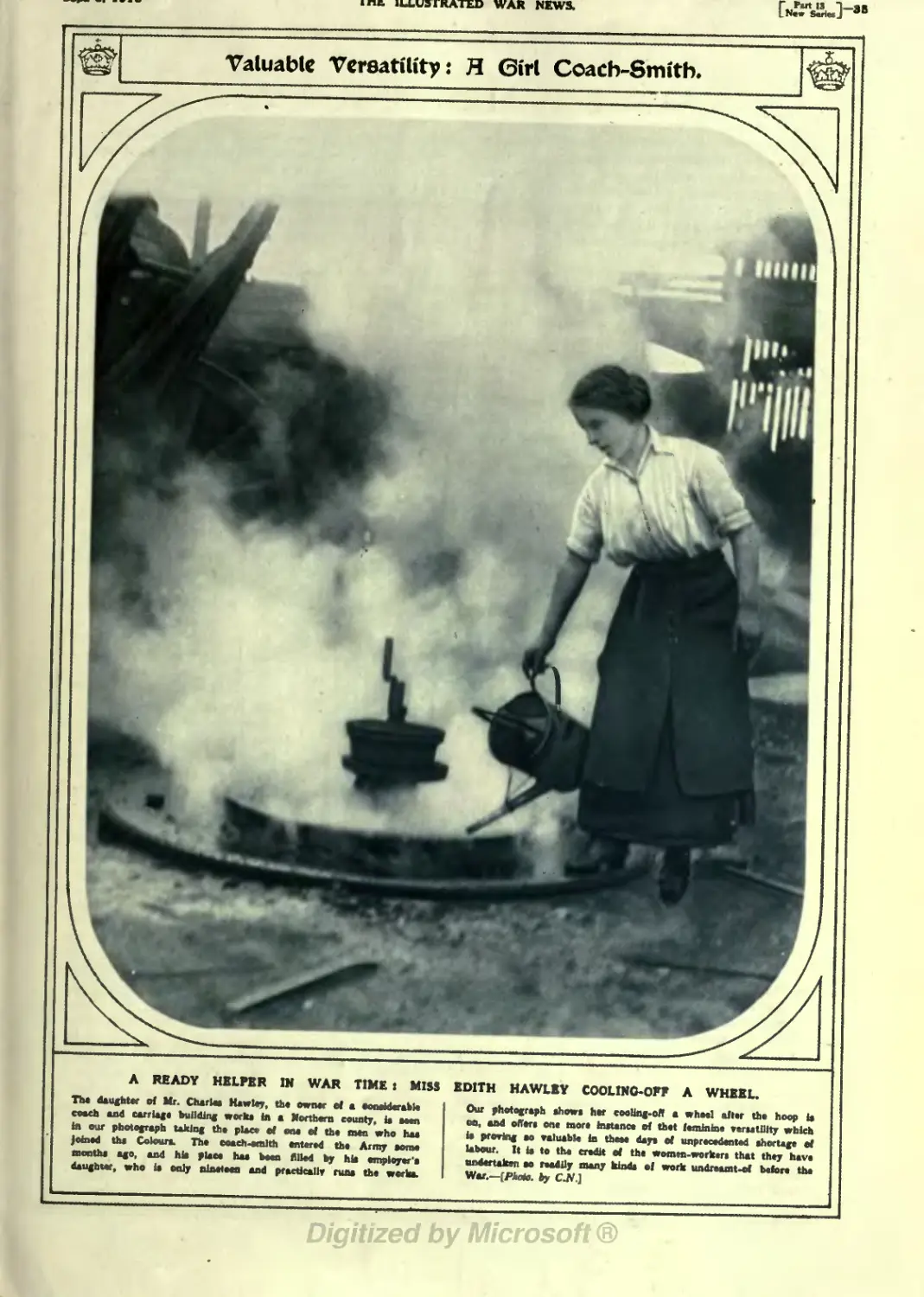
Valuable Versatility: H Girl Coach-Smith.
A READY HELPER ,N WAR T1MH : MISS EDITH HAWLEY COOLING-OKF A WHEEL.
Th daughter of Mr. Chrl H.wley, tht owner of . con.lder.ble
coach and c.rri.ge building work, in . Northern county i. Mm
to our pho.otr.ph taking the place of on. of the men who h
Joined the Colour,. The co.ch-.mith entered the Army torn.
month. M o, .nd hi. P Uc. hu been filled by hi. employer'.
d.u,hwr, who 1. only nineteen .nd pr.ctlc.llr run. the worlu.
Our photograph .how, her coollng-off . wheel after the hoop i,
on, .nd offer, one more In.Unce of th.t feminine verutllity which
to prortag ,o r.lu.bl. In the.e <Uy. of unprecedented >hort. of
Ubour. It I. to the endit of the women-worker. th.t they h.v.
und,,tdn K, ,,lily m,y kind, .f work undr.n,^,f before the

enough may be learnt in a few months to enable
the pupil to take an active part in what is a real
national service. O'halfont St. Peter is exceed-
ingly proud of its students who lodge in the
cottages, or at the hostel recently opened by a
patriotic woman as her contribution to the
work and so it ought
to be.
The fl a g-g i r 1 is
familiar by reputation
if not by sight to most
of us. Not the one
who sells the penny and
sixpenny emblems for
the many and varied
charities which flourish
so plentifully, but the
more business-like kind,
who can claim an in-
timate acquaintance
with air lines, and
cables, buzzers, and
heliographs, and to
whom the intricacies
of semaphore work are
an open book. The Women Signallers Terri-
torial Corps, which started life towards the end
of 1914, if it cannot exactly lay claim to
supplying a long - felt want, can at least pride
itself on being ready to lend an exceedingly
useful and capable hand, if women should, per-
chance, be called to take any part in the defence
of their country.
Its members are ready, in the first place, to
undertake duties as army signallers in warfare,
be ready for every contingency. Not that the
Corps aims at a place in the forefront of
battle, though no doubt its members would
unhesitatingly obey such orders if they came
discipline is a very strong point of the organ-
isation. It does claim, however, that, if necessity
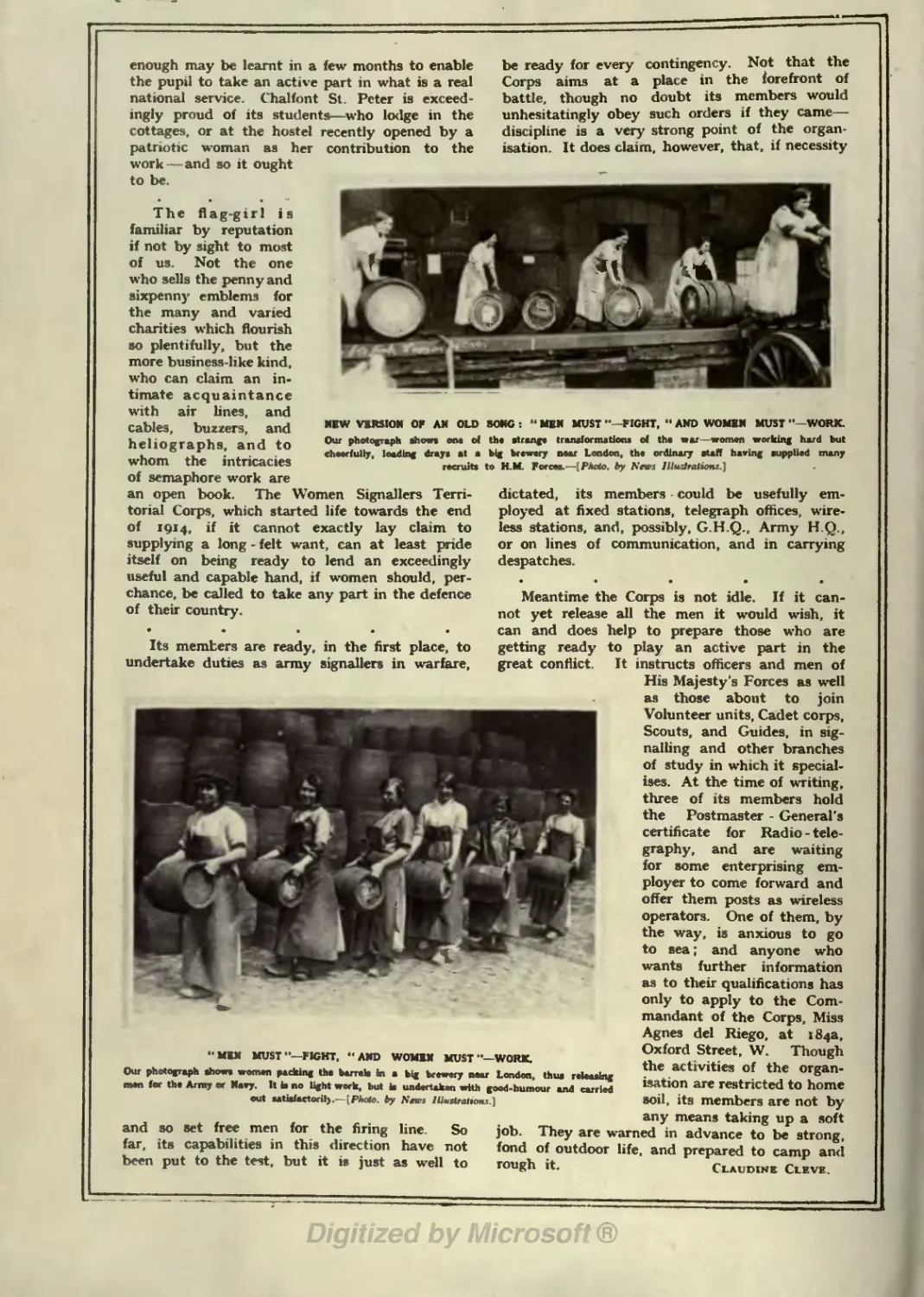
NEW VERSION OF AN OLD SONG : " MEN MUST "FIGHT, " AND WOMEN MUST "WORK.
Our photograph shows one of the strange transformations of the war women working hard but
cheerfully, loading drays at a big brewery near London, the ordinary staff having supplied many
recruits to H.M. Forces. [Photo, by Xea'S Illustrations.]
dictated, its members could be usefully em-
ployed at fixed stations, telegraph offices, wire-
less stations, and, possibly, G.H.Q., Army H.Q.,
or on lines of communication, and in carrying
despatches.
Meantime the Corps is not idle. If it can-
not yet release all the men it would wish, it
can and does help to prepare those who are
getting ready to play an active part in the
great conflict. It instructs officers and men of
His Majesty's Forces as well
as those about to join
Volunteer units, Cadet corps,
Scouts, and Guides, in sig-
nalling and other branches
of study in which it special-
ises. At the time of writing,
three of its members hold
the Postmaster - General's
certificate for Radio - tele-
graphy, and are waiting
for some enterprising em-
ployer to come forward and
offer them posts as wireless
operators. One of them, by
the way, is anxious to go
to sea ; and anyone who
wants further information
as to their qualifications has
only to apply to the Com-
mandant of the Corps, Miss
Agnes del Riego, at 1843,
Oxford Street, W. Though
the activities of the organ-
isation are restricted to home
soil, its members are not by
any means taking up a soft
job. They are warned in advance to be strong,
fond of outdoor life, and prepared to camp and
rough it. CLAUDINE CLEVE.
"MEN MUST" FIGHT, "AND WOMEN MUST "WORK.
Our photograph shows women packing the barrels in a big brewery near London, thus releasing
men for the Army or Nary. It is no light work, but is undertaken with good-humour and carried
ut satiafactoril>._ [Photo, by Nans Illustrations.]
and so set free men for the firing line. So
far, its capabilities in this direction have not
been put to the test, but it is just as well to

Sept. 6. 1916
THE ILLUSTRATED WAR NEWi.
. .
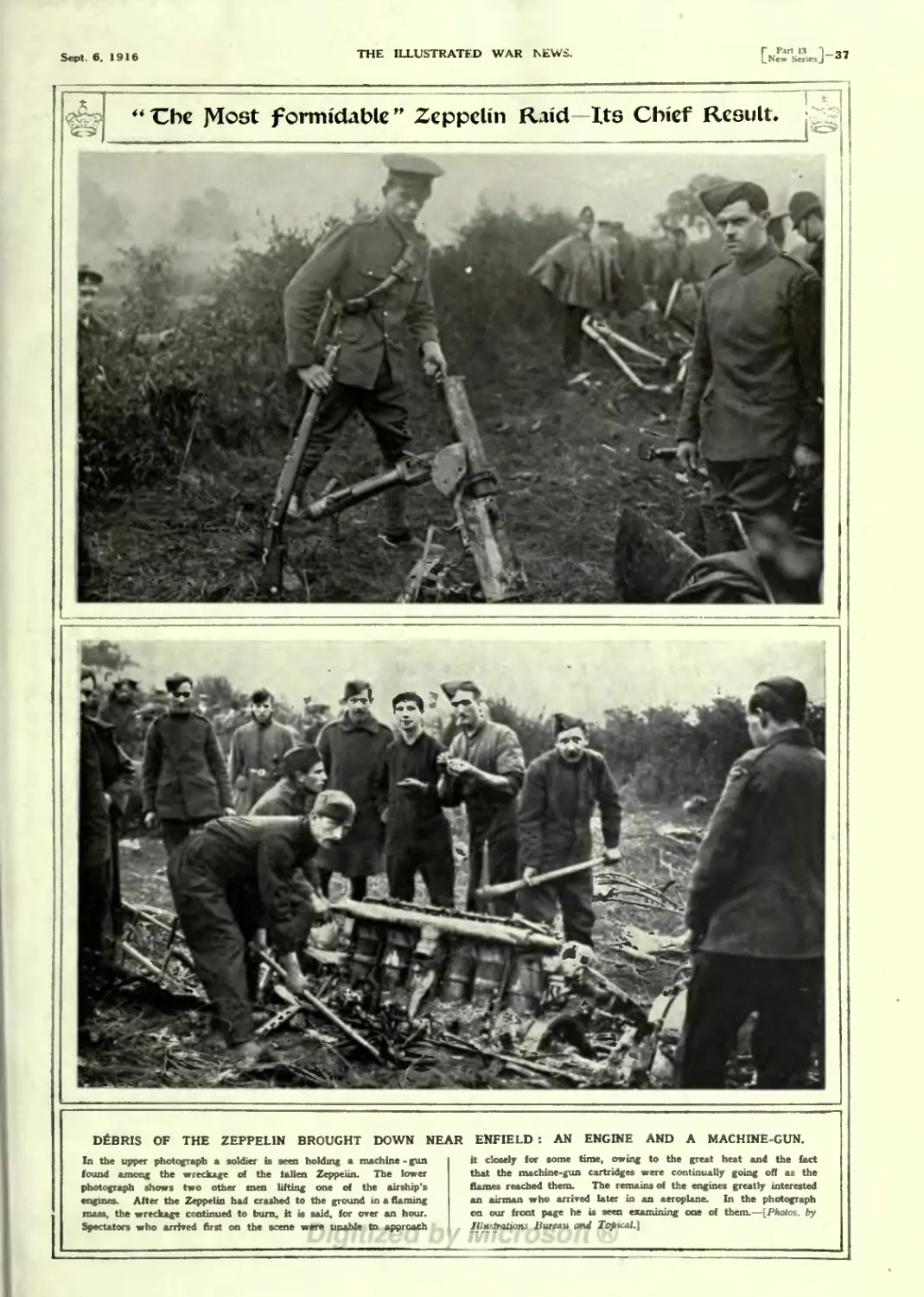
Most formidable " Zeppelin Raid Its Chief Result*
DEBRIS OF THE ZEPPELIN BROUGHT DOWN NEAR ENFIELD : AN ENGINE AND A MACHINE-GUN.
In the upper photograph a soldier is seen holding a machine - gun
found among the wreckage of the (alien Zeppelin. The lower
photograph shows two other men lifting one of the airship's
engines. After the Zeppelin had crashed to the ground in a flaming
mass, the wreckage continued to burn, it is said, for over an hour.
Spectators who arrived first on the scene were unable to approach
it closely for some time, owing to the great heat and the fact
that the machine-gun cartridges were continually going off as the
flames reached them. The remains of the engines greatly interested
an airman who arrived later in an aeroplane. In the photograph
on our front page he is seen examining one of them. [Photos, by
Illustrations Bureau and Topical.]

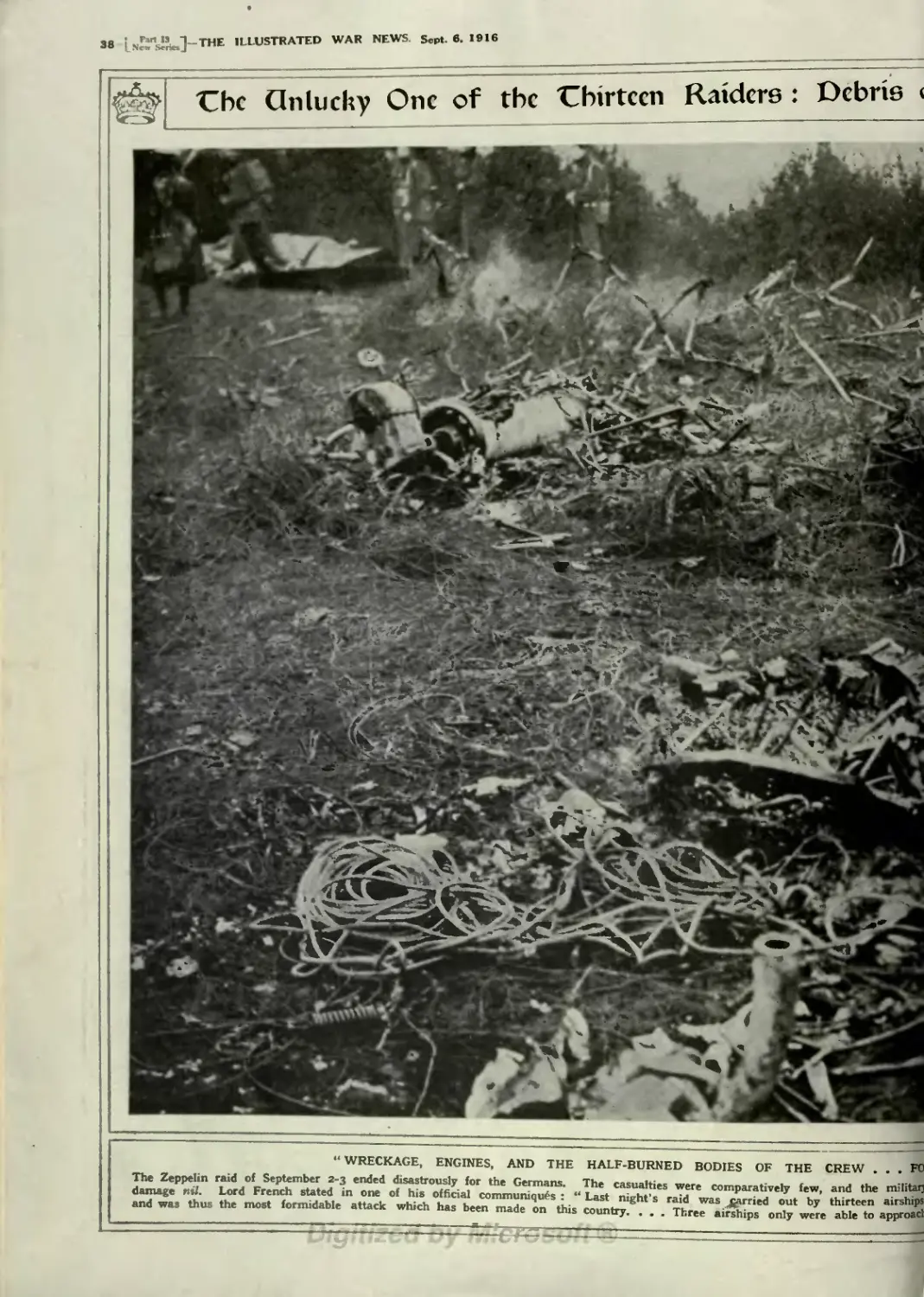
38 : N,'';:",",, S ]-THE ILLUSTRATED WAR NEWS. Sept. 6. 1916
Oc On lucky One of the Thirteen Raiders : Debris
"WRECKAGE, ENGINES, AND THE HALF-BURNED BODIES OF THE CREW . . . FO
j ijermans. The casualties were comparatively few and the military
nis omcial communiques : " Last nitrht'c f. -
which has

THE ILLUSTRATED WAR NEWS. Sept. 6. 1916-[ N r yj es ]-a9
>e Zeppelin Shot Down on Gnglieb Soil on Sept. 3.
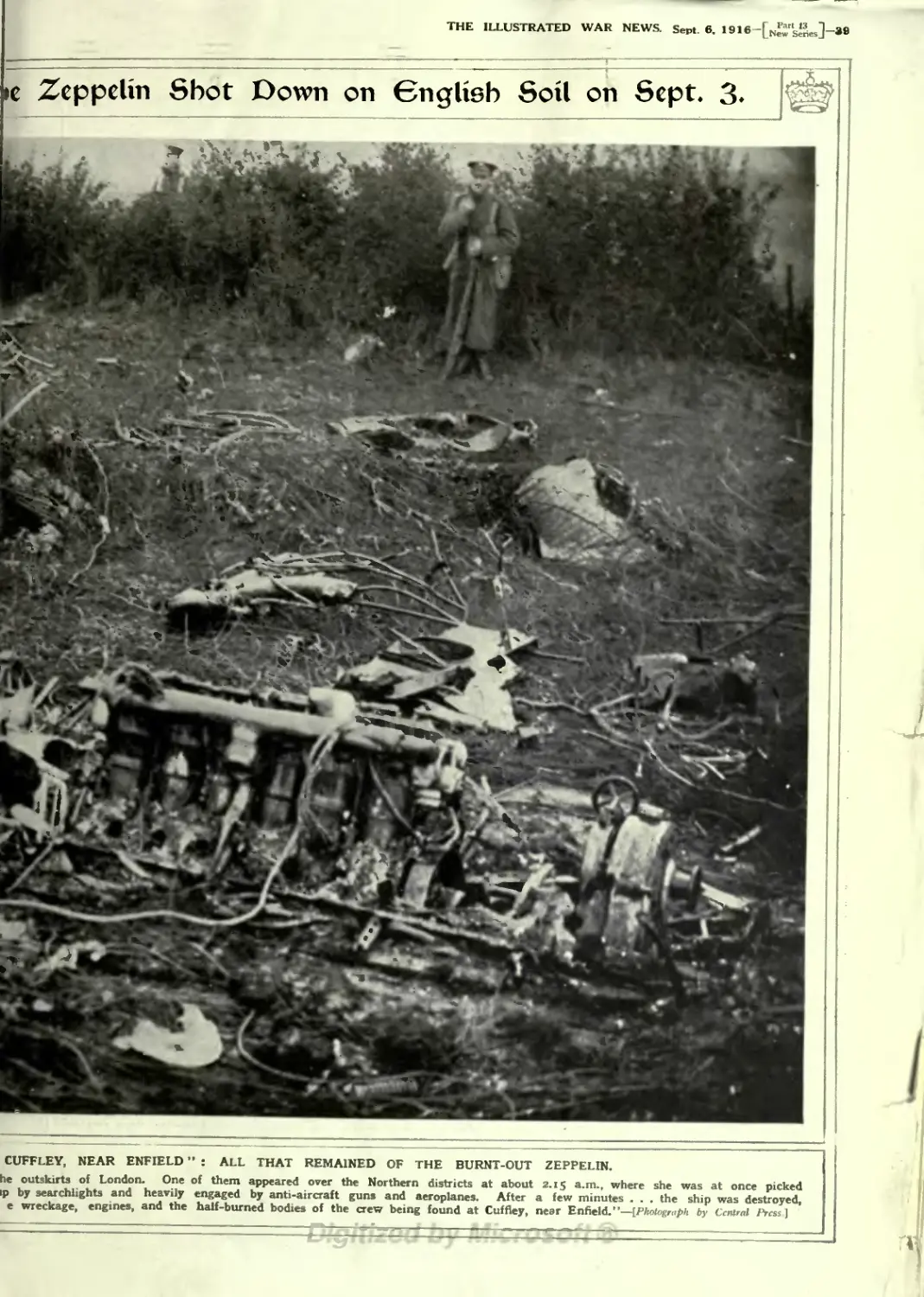
CUFFLEY, NEAR ENFIELD " : ALL THAT REMAINED OF THE BURNT-OUT ZEPPELIN,
he outskirts of London One of them appeared over the Northern districts at about 2.15 a.m., where she was at once picked
ip by searchlights and heavily engaged by anti-aircraft guns and aeroplanes. After a few minutes ... the ship was destroyed
e wreckage, engines, and the half-burned bodies of the crew being found at Cuffley, near EnMA." -[Photograph by CcMral Press] '
*

LNcw Se'ncsJ
THE ILLUSTRATED WAR NEWS.
Sept. 6, 1916
t:hc Destruction of a Zeppelin near London,
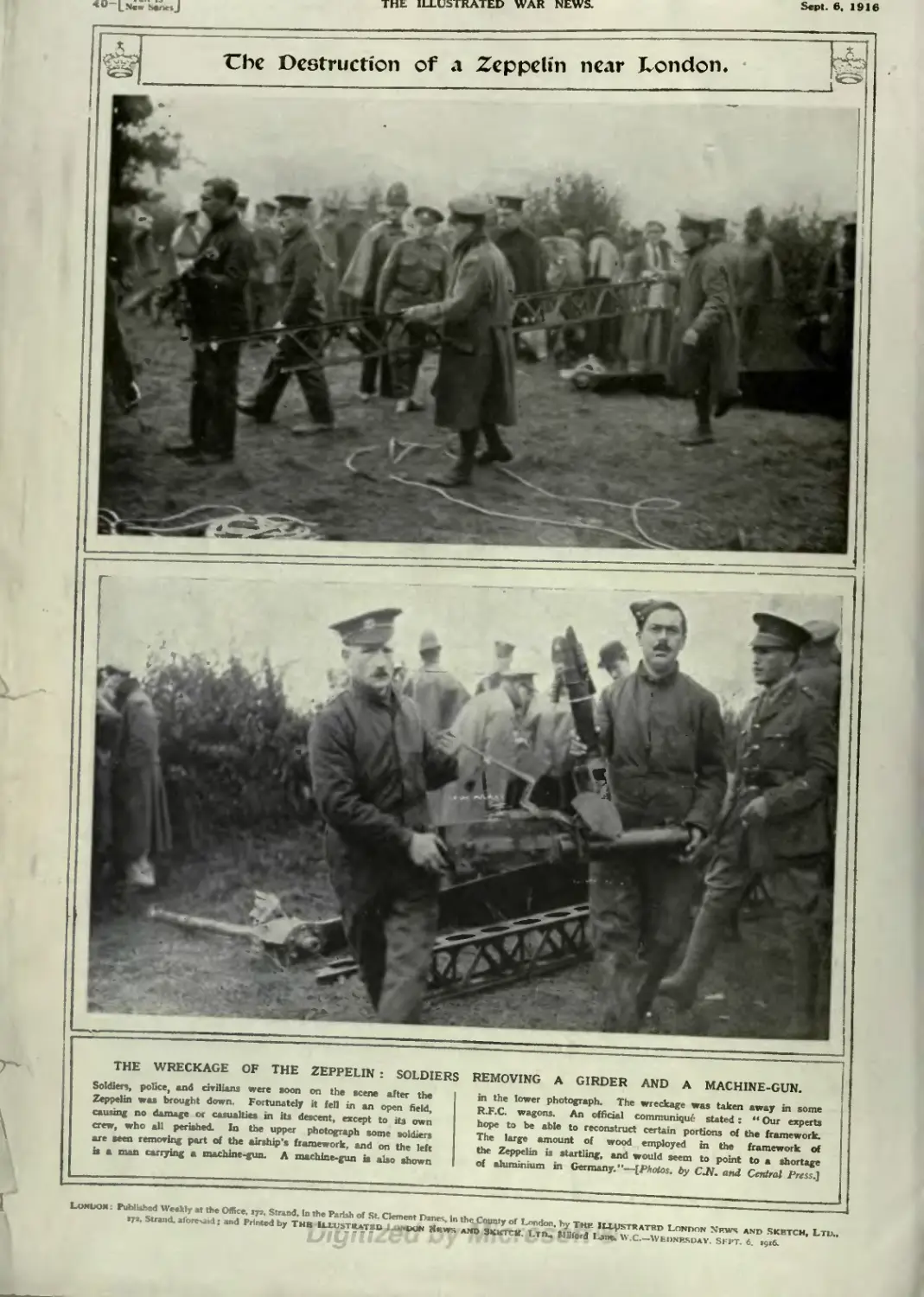
THE WRECKAGE OF THE ZEPPELIN: SOLDIERS
Sold,^, pohce, and civilians were soon on the scene after ,,
Zeppelm was brought down. Fortunately it fell in M opcn *'
causmg no damage or casualties in its descent, except to its own
crew, who all perished. fa , he upper photograph some so.dlrs
are seen removmg part of the airship's framework, and on the eft
. man carrymg a machine-gun. A machine-gun is also shown
REMOVING A GIRDER AND A MACHINE-GUN

The Illustrated War Newt, Sept. 13, 1916. Part 14, New Series.
Illustrated War Rcius
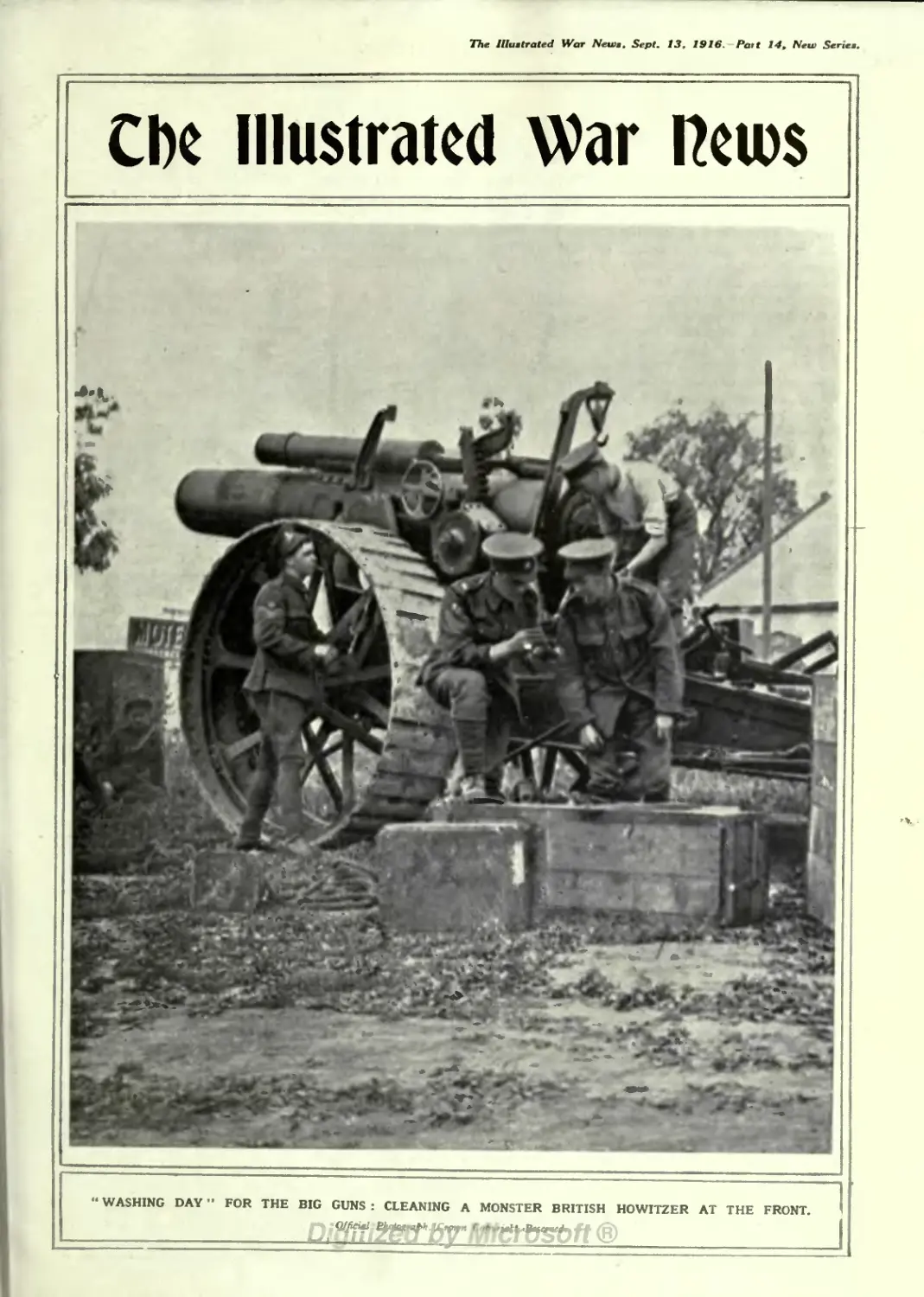
'WASHING DAY" FOR THE BIG GUNS: CLEANING A MONSTER BRITISH HOWITZER AT THE FRONT.
Official Photoeraflt. Cmm Cnpyrisl-.t Referred.

K
pwt H
THE ILLUSTRATED WAR NEWS.
Sept. 13. 1918
*Tpi TLJJT TT:^
IH^
THE stiff fighting of largely handled offensives
has again been resumed, and in heavy
actions both the East and West have this week
played pronounced and highly satisfactory parts.
In tho West, after a period of that stubborn
intensive work which is necessary for the security
of positions, the Allies have
inaugurated a new attack
on a scale which, both in
scope and success, has
dwarfed even the big efforts
of July. Similarly, Russia,
after a period of quietness
which, of course, meant any-
thing but the absence of
effort has driven forward
the battering-ram of ad-
vance once more, and has
won an emphatic success at
that point where it is likely
to bring the best results
that is, on the southern
wing of her long line. At
the same time, it must be
said, Germany has shown
herself as active as her foes,
and, if her attempts at check-
ing actions against the Allies
West and East have proved
singularly abortive, she does
seem to be initiating against
the Roumanian frontier
positions in the Dobrudja a
movement which demands
attention. But even this
success which, as yet, must
be considered
undeveloped
and unfinal
has done little
to detract
from the great
profit gained
by the Allies
in a week full
of interest.
The new
and exceed-
ingly valuable
success gained
on the Somme
was initiated
in the first
days of Sep-
tember, and
has been ex-
tending ad-
mirably since.
The first of
the fighting
was a splendid
move forward
made by the
French and
By W. DOUGLAS NEWTON.
the British acting in conjunction north of the
Somme, and this victory was amplified by another
brilliant affair, in which the French carried the
whole of the enormously strong German positions
on a twelve-mile front south of the Somme.
These successes were conspicuous as efforts of
victorious attack and in
their capture of great areas
of enemy territory, but they
are also much more. The
whole effect of the strokes
threatens the strong pivotal
points of the German de-
fence. The holding points
of Combles, Peronne, and
Chaulnes are endangered,
and the great road of com-
munications running from
Bapaume to Peronne, and
Peronne to Roye, comes not
only under threat, but is
now swept by the fire of the
Allied batteries. More, the
whole system of German de-
fence in France has been so
deeplypierced that this blow,
more than any other, ex-
poses the whole plan to ex-
treme danger. Finally, the
success of the attack was so
complete that it points to a
spirit of action as fresh and
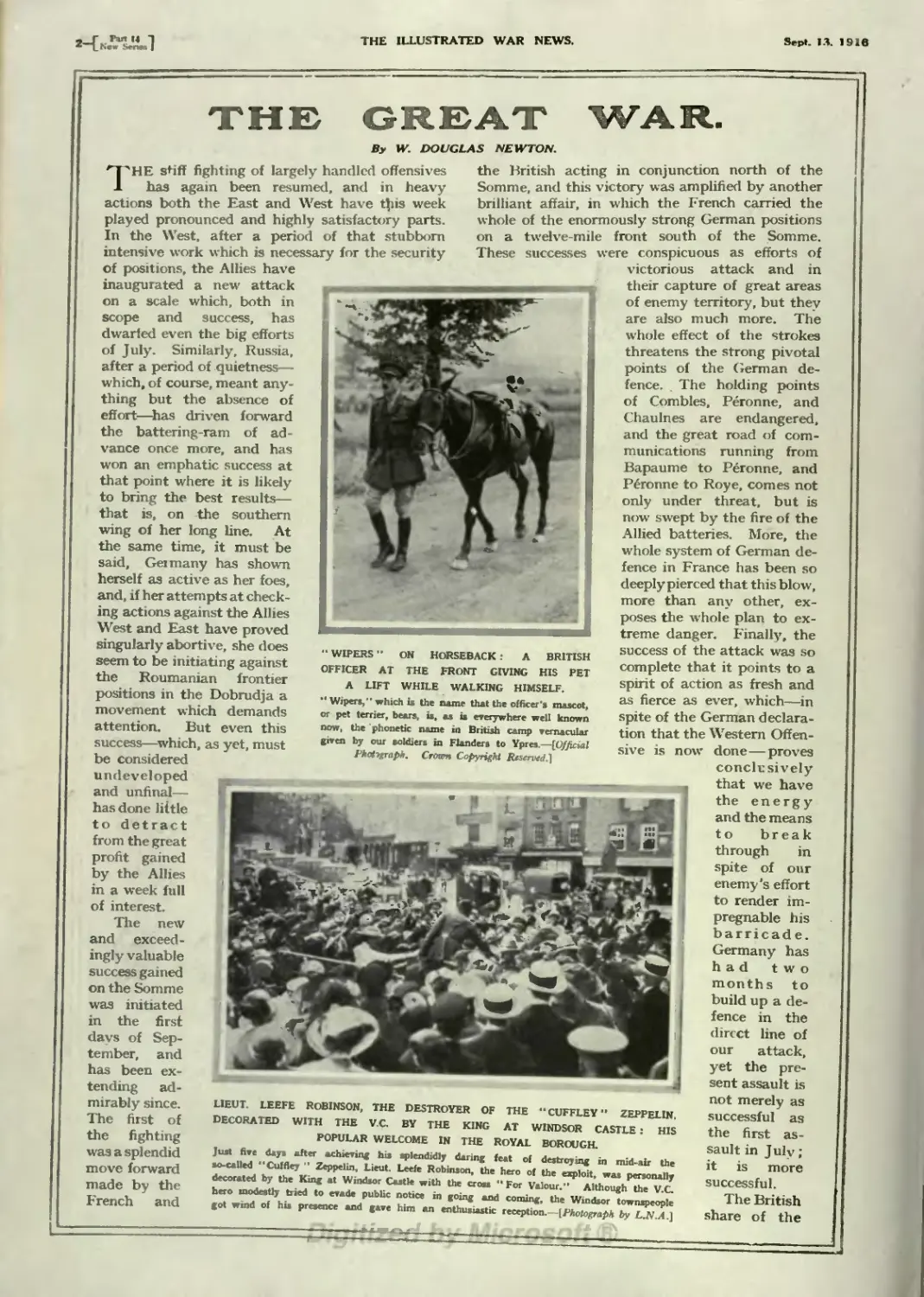
" WIPERS " ON HORSEBACK : A BRITISH
OFFICER AT THE FRONT GIVING HIS PET
A LIFT WHILE WALKING HIMSELF.
" Wipers," which is the name that the officer's mascot,
or pet terrier, bears, is, as is everywhere well known
now, the phonetic name in British camp vernacular
given by our soldiers in Flanders to Ypres. [Official
Mot ivaph. Crown Copyright Reserreil.]
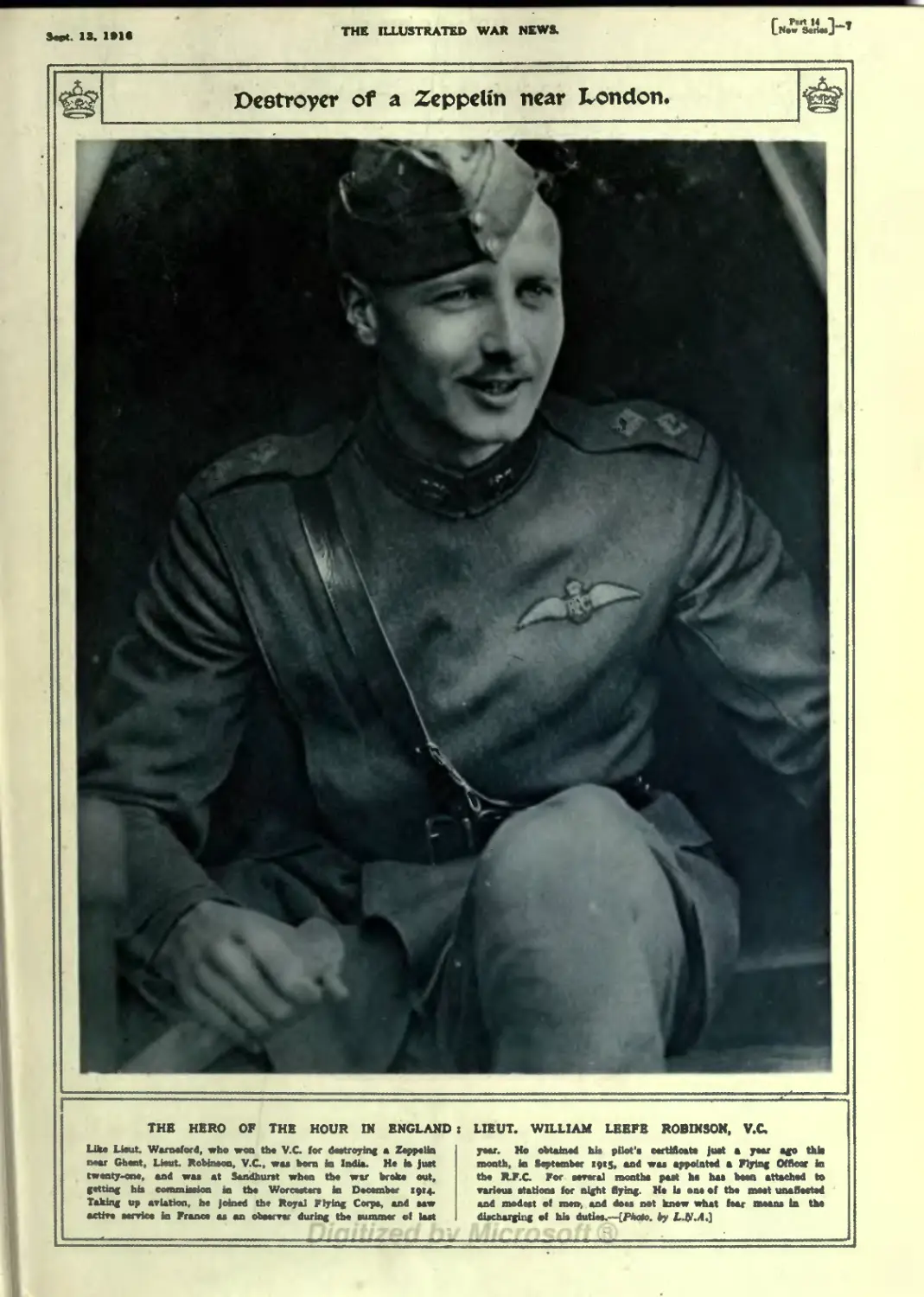
LEEFE ROBINSON, THE DESTROYER OF THE "CUFFLEY" ZEPPELIN
DECORATED WITH THE V.C. BY THE KING AT WINDSOR CASTLE H
POPULAR WELCOME IN THE ROYAL BOROUGH.
Just five days after achieving his splendidly darine feat of rt.
so-called " Cufney " Zeppelin, Lieu,. Lf, RoLso^he hero o, th" e^t I^^J?
s3SHS?5Si5SSSSSS
as fierce as ever, which in
spite of the German declara-
tion that the Western Offen-
sive is now done proves
conclusively
Bi^^Mi that we have
the energy
and the means
to break
through in
spite of our
enemy's effort
to render im-
pregnable his
barricad e .
Germany has
had two
months to
build up a de-
fence in the
direct line of
our attack,
yet the pre-
sent assault is
not merely as
successful as
the first as-
sault in July ;
it is more
successful.
The British
share of the

Sept. 13, 1916
THE ILLUSTRATED WAR NEWS.
r Part 14 1 ,
|_New SeriesJ 3
task was to attack the enemy as he held his front
from Ginchy to Combles. The first impulse of the
assault on Sept. 3 swept us through Guillemont and
five hundred yards beyond, gave us the outskirts
of Ginchy, and brought us well towards Combles.
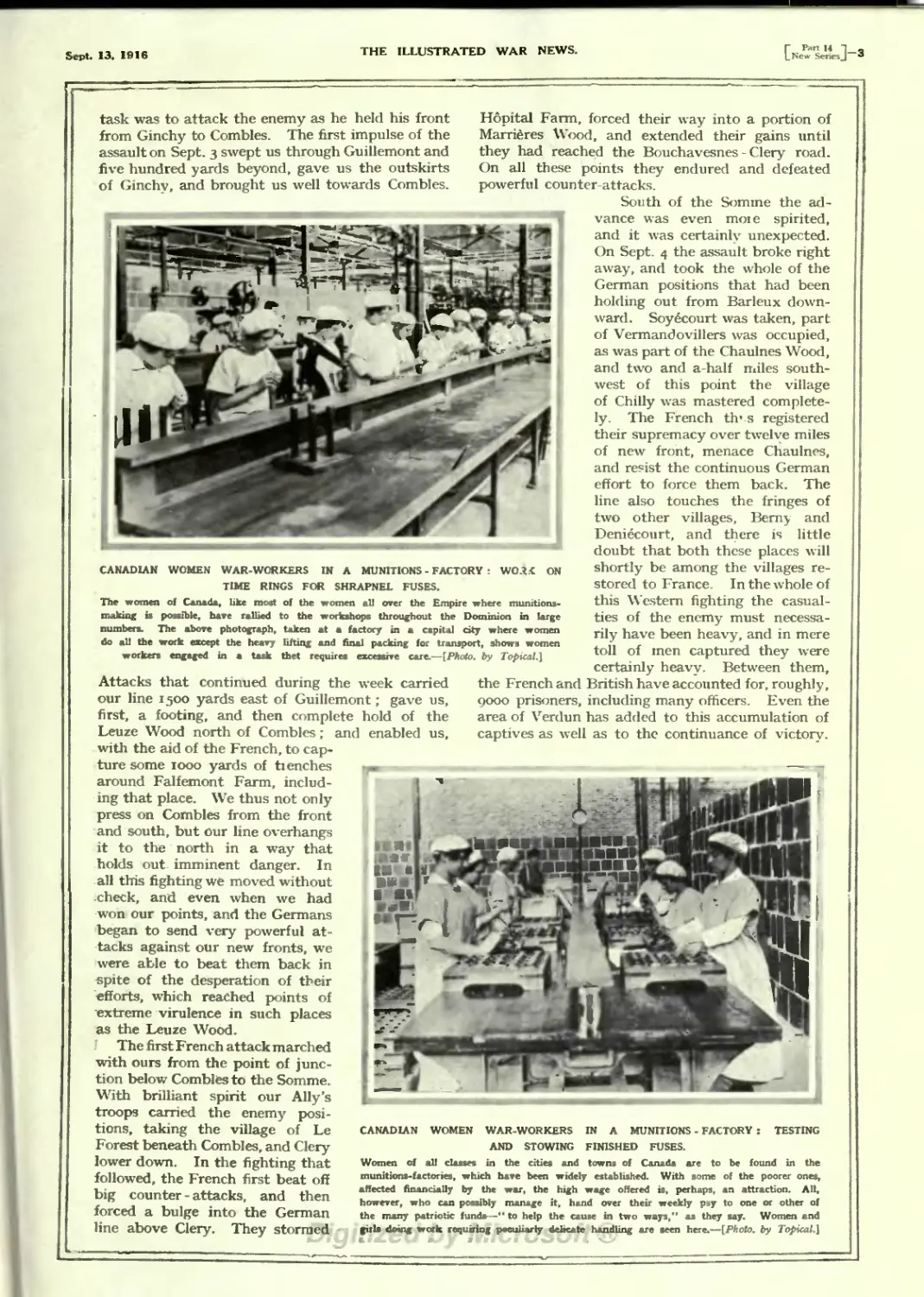
CANADIAN WOMEN WAR-WORKERS IN A MUNITIONS - FACTORY : W0.*.< ON
TIME RINGS FOR SHRAPNEL FUSES.
The women of Canada, like most of the women all over the Empire where munitions-
making is possible, have rallied to the workshops throughout the Dominion in large
numbers. The above photograph, taken at a factory in a capital city where women
do all the work except the heavy lifting and final packing for transport, shows women
workers engaged in a task that requires excessive care. [Photo, by Topical.]
Attacks that continued during the week carried
our line 1500 yards east of Guillemont ; gave us,
first, a footing, and then complete hold of the
Leuze Wood north of Combles ; and enabled us,
with the aid of the French, to cap-
ture some 1000 yards of trenches p,
around Falfemont Farm, includ-
ing that place. We thus not only
press on Combles from the front
and south, but our line overhangs
it to the north in a way that
holds out imminent danger. In
all this fighting we moved without
.check, and even when we had
won our points, and the Germans
began to send very powerful at-
tacks against our new fronts, we
were able to beat them back in
spite of the desperation of tbeir
efforts, which reached points of
extreme virulence in such places
as the Leuze Wood.
The first French attack marched
with ours from the point of junc-
tion below Combles to the Somme.
With brilliant spirit our Ally's
troops carried the enemy posi-
tions, taking the village of Le
Forest beneath Combles, and Clery
lower down. In the fighting that
followed, the French first beat off
big counter-attacks, and then
forced a bulge into the German
line above Clery. They stormed
Hopital Farm, forced their way into a portion of
Marrieres Wood, and extended their gains until
they had reached the Bouchavesnes - Clery road.
On all these points they endured and defeated
powerful counter-attacks.
South of the Somme the ad-
vance was even more spirited,
and it was certainly unexpected.
On Sept. 4 the assault broke right
away, and took the whole of the
German positions that had been
holding out from Barleux down-
ward. Soyecourt was taken, part
of Vermandovillers was occupied,
as was part of the Chaulnes Wood,
and two and a-half miles south-
west of this point the village
of Chilly was mastered complete-
ly. The French thvs registered
their supremacy over twelve miles
of new front, menace Chaulnes,
and resist the continuous German
effort to force them back. The
line also touches the fringes of
two other villages, Berny and
Deniecourt, and there is little
doubt that both these places will
shortly be among the villages re-
stored to France. In the whole of
this Western fighting the casual-
ties of the enemy must necessa-
rily have been heavy, and in mere
toll of men captured they were
certainly heavy. Between them,
the French and British have accounted for, roughly,
9000 prisoners, including many officers. Even the
area of Verdun has added to this accumulation of
captives as well as to the continuance of victory.
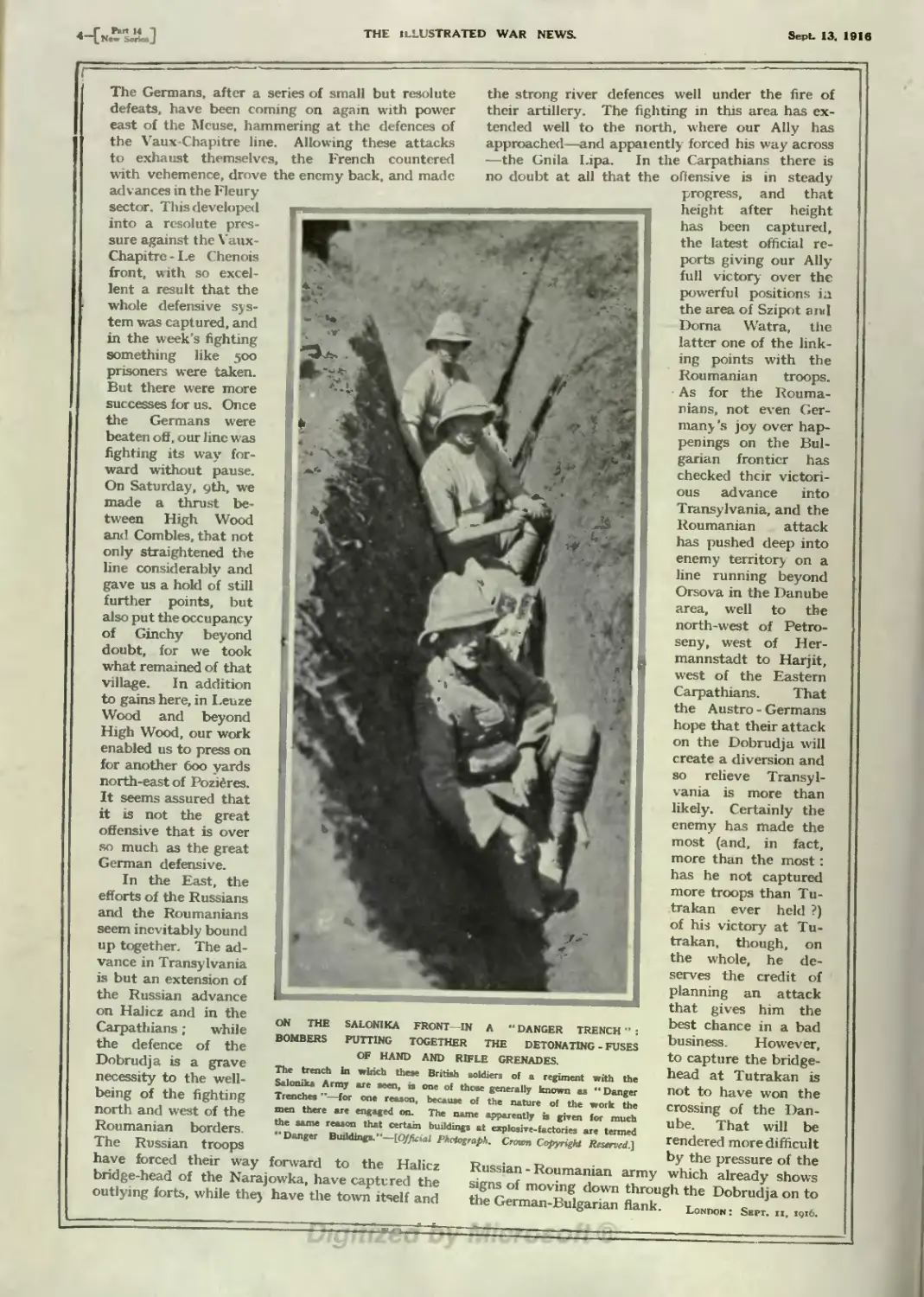
CANADIAN WOMEN WAR-WORKERS IN A MUNITIONS - FACTORY : TESTING
AND STOWING FINISHED FUSES.
Women of all classes in the cities and towns of Canada are to be found in the
munitions-factories, which have been widely established. With some of the poorer ones,
affected financially by the war, the high wage offered is, perhaps, an attraction. All,
however, who can possibly manage it, hand over their weekly pay to one or other of
the many patriotic funds " to help the cause in two ways," as they say. Women and
girls doing work requiring peculiarly delicate handling are seen here. [Photo, by Topical.]

A r Pirt M i
* (_New ScriciJ
THE ILLUSTRATED WAR NEWS.
Sept. 13, 1916
The Germans, after a series of small but resolute
defeats, have been coining on again with power
east of the Meuse, hammering at the defences of
the Yaux-Chapitre line. Allowing these attacks
to exhaust themselves, the French countered
with vehemence, drove the enemy back, and made
advances in the Fleury
sector. This developed
into a resolute pres-
sure against the Vau\
Chapitrc - I.e Chem >is
front, with so excel-
lent a result that the
whole defensive s\ s-
tem wa.s captured, and
in the week's fighting
something like 500
prisoners were taken.
But there were more
successes for us. Once
the Germans were
beaten off, our line was
fighting its way for-
ward without pause.
On Saturday, gth, we
made a thrust be-
tween High Wood
and Combles, that not
only straightened the
line considerably and
gave us a hold of still
further points, but
also put the occupancy
of Ginchy beyond
doubt, for we took
what remained of that
village. In addition
to gains here, in Leuze
Wood and beyond
High Wood, our work
enabled us to press on
for another 600 yards
north-east of Pozidres.
It seems assured that
it is not the great
offensive that is over
so much as the great
German defensive.
In the East, the
efforts of the Russians
and the Roumanians
seem inevitably bound
up together. The ad-
vance in Transylvania
is but an extension of
the Russian advance
on Halicz and in the
Carpathians ; while
the defence of the
Dobrudja is a grave
necessity to the well-
being of the fighting
north and west of the
Roumanian borders.
ON THE
BOMBERS
The Russian troops
have forced their way forward to the Halicz
bridge-head of the Narajowka, have captured the
outlying forts, while they have the town itself and
SALONIKA FRONT-IN A "DANGER TRENCH"-
PUTTING TOGETHER THE DETONATING - FUSES
OF HAND AND RIFLE GRENADES
The trench in which these British soldiers of a regiment with the
n n. 7 a " *" " " e f ' hose genera " y kn wn " D "*
-for one reason, because of the nature of the work the
men there are engaged on. The name apparently is given for much
he same reason that certain buildings at explosive-factories are termed
Danger Buddo^-to//*., Pl , ctoe , ap ,, CTOH ,, c '*%*
the strong river defences well under the fire of
their artillery. The fighting in this area has ex-
tended well to the north, where our Ally has
approached and appaiently forced his way across
the Gnila Lipa. In the Carpathians there is
no doubt at all that the offensive is in steady
progress, and that
height after height
has been captured,
the latest official re-
ports giving our Ally
full victory over the
powerful positions in
the area of Szipot and
Dorna Watra, the
latter one of the link-
ing points with the
Roumanian troops.
As for the Rouma-
nians, not even Ger-
many 's joy over hap-
penings on the Bul-
garian frontier has
checked their victori-
ous advance into
Transylvania, and the
Roumanian attack
has pushed deep into
enemy territory on a
line running beyond
Orsova in the Danube
area, well to the
north-west of Petro-
seny, west of Her-
mannstadt to Harjit,
west of the Eastern
Carpathians. That
the Austro - Germans
hope that their attack
on the Dobrudja will
create a diversion and
so relieve Transyl-
vania is more than
likely. Certainly the
enemy has made the
most (and, in fact,
more than the most :
has he not captured
more troops than Tu-
trakan ever held ?)
of his victory at Tu-
trakan, though, on
the whole, he de-
serves the credit of
planning an attack
that gives him the
best chance in a bad
business. However,
to capture the bridge-
head at Tutrakan is
not to have won the
crossing of the Dan-
ube. That will be
rendered more difficult
by the pressure of the
ssian- Roumanian army which already shows
(US of moving down through the Dobrudja on to
the German-Bulgarian flank. LONDON : S J

13. 1918
THE ILLUSTRATED WAR NEWS.
LH frencb <Oar Hllegory in pebbles and Shells.
" PATIENCE ! WE SHALL PLUCK YOU ! " THE FATE OF THE GERMAN EAGLE SHOWN AT SALONIKA.
the French ariation camp there are many example! of the art,
each tent being surrounded by a decorative border. The allegorical
design here illustrated is alto to be teen there. It represents the
German eagle pierced with the poles of the Allied flags with the
inscription" Patience ! We shall pluck you." Th*. work hai
been carried out in pebbles and shells. [Fmuh Official Photograph.}
A favourite hobby of French soldiers during their leisure moments
on active service is ornamental gardening. They delight in making
designs and inscriptions in flowers, plants, pebbles, shells (the sea-
short variety) and so on, showing great ingenuity and artistic taste
in th's form of decoration. At Salonika they have perhaps, until
recently, had more leisure for such pursuits than elsewhere. At

THE ILLUSTRATED WAR Ntwa
Hftcr the Destruction of the Cuffley Zeppelin
AT THE SPOT : SOUVENIR-HUNTERS ; AND ONE OF THE PROPELLER-BLADES WITH A GERMAN STAMP.
The upper illustration recalls scenes witnessed round London some
years ago during the "Buried Treasure" craze. It shows the
crowd that visited the field at Cuffley, near EnfieM, where the
destroyed Zeopelin fell, after the military had packed up and
carted off the wreckage. The police in charge of the ground
allowed people to wander freely OTer the meadow and hunt for
souvenirs with the proviso, that a!l finds were sent for inspection
to the War Office. An idea of the sice of a Zeppelin propeller
may be gained from the third illustration. It shows Sergt. f. W.
Smith, of the A.S.C., with a blade that he found in a hedge near
by. The second illustration shows the German official factory stamp
on the blade. [Photos, by G.P.U. and Langfter.]

Spt. 13.
THE ILLUSTRATED WAR NEWS.
r Part 14 H
I New Series J
Destroyer of a Zeppelin near London.
THE HERO OF THE HOUR IN ENGLAND : LIEUT. WILLIAM LEEFE ROBINSON, V.C.
Like Lieut. Waroeford, who won the V.C. for deitroyinj a Zeppelin
near Ghent, Lieut. Robinson, V.C., wu born in Indu. He is just
twenty-one, and wu *t Sandhurst when the wtr broke out,
getting his commission in the Worcester! in December 1914.
Tikinj up arUtion, he joined the Royal Flying Corpe, and uw
actire terrice in Franc* ai an obterrer during the iununer ol lait
rear. He obtained his pilot't certiftcte just a year afo thi.
month, in September 1915, and was appointed a Flying Offtcor In
the R.F.C. For sereral monthi put he hit been attached to
Tariout itationi for night flying. He U one of the moil unaHected
and modest of men-, and does not know what fear means la the
discharging of his dutle*. {PMo. by L.N.A.]

. r rn U 1
* "[New SoJ
THE ILLUSTRATED WAR NEWS
Sept. 13, 1916
R.f.C. Honours at the Zeppelin Crew's funeral.
B
ARRIVING : THE COMMANDER'S COFFIN BORNE BY R.F.C. OFFICERS ; THE CREW'S, BY PRIVATES.
Potter's Br those of the crew on in R.F.C. motor-lorry and
trailer and that of the commander on a separate car. He was
burled in a separate pare. Among the officers who carried his
coffin was Lieut. A. de B. Brandon, who received the Military
Croat for his part in bringing down the Zeppelin "Lis," which
fell into the Thames estuary. [Photos, by Newspaper
In tht upper photograph are seen men of the Royal Firing Corps
carrying the coffins of the Zeppelin's crew ; the lower one shows
six R.F.C. officers bearing that of the Commander. The funeral
took place in the cemetery at Potter's Bar on the afternoon of
September 6. The remains of the sixteen bodies found were placed
in coffins of Japanese ash, and conveyed from Cufney Church to

Sept. 13. 1*16
THE ILLUSTRATED WAR NEWS.
r fan u ~\
LNew SrliJ~ S
Chivalry of the Hir towards Dead German Hirmen.
THE BURIAL OF THE ZEPPELIN'S CREW: THE GRAVESIDE SERVICE AND THE "LAST POST."
The upper photograph ahow th tin R.F.C. officers standing by
the Zeppelin commander 'i (rare in the background, and in the
foreground the large jrart containing the coffins of th> crew,
with torn* R.F.C. men drawn up betide it. In the lower photo-
graph two buglers are Men sounding the " Lalt Poit." This
ienrice wa> conducted by the Rer. M. Handcock, militarr chaplain,
aiaiKed by the Vicars of Potter' Bar, South Mjrmnu, and Northaw,
in which parish the Zeppelin came down. The graves had been
dug by men of the Royal Garrison Artillery. Thus, with military
honours accorded in the spirit of that chiralry of the air which
has (town up among flying men, the bodies of the fallen
Zeppelin's crew were laid to rest. [Pkotos. by Farringdon Pkotu. Co.

THE ILLUSTRATED WAR NEWS.
S.pi. 13. 1916
THE BEGINNINGS OF WAR-MACHINES : THE MACHINE-GUN.
T*HE low of time inseparable from the loading
1 of early hand-guns placed the soldier at a
grave disadvantage, and quite early in the history
of firearms efforts were made to provide a repeat-
ing arm. The provision of several barrels fixed
together on one stock, each barrel having its own
firing device, may be considered as the primitive
weapon from which the machine-gun of to-day
has evolved. Specimens of this class of weapon
having from three to five barrels attached to the
same stock, and ignited by the application of a
lighted match to a touch-hole near the breech of
each barrel, were built about the end of the
fifteenth century.
One early form of repeating matchlock rifle, of
an ingenious though somewhat dangerous design,
was provided with a number of touch-holes suffi-
ciently far apart to allow for a round of ammunition
to be placed
in the barrel
between each
of them, and
the rounds
separated by a
substantial
wad. A sliding
serpentine was
also provided.
(An illustra-
tion of this
piece is given
opposite page
78 in Green's
"Gun." It
appears to be
the earliest-
known ex-
ample of a
true magazine
gun.) The
application of
the match to
the foremost
touch-hole dis-
charged the
first round
DESIGNED TO SHOOT SQUARE BULLETS AGAINST TURKS AND ROUND
BULLETS AGAINST CHRISTIANS! THE PUCKLE GUN, 1718.
This curious sun (A) with revolving rm, was patented by James Puckle in 1718.
B It "the plate of the chambers of the gun for a ship shooting square bullets
against Turks " ; C, " for round bullets against Christians."
Whilst the foregoing were early attempts to
provide guns capable of continuous fire, they none
of them really attained that object, as an interval
was required for the operation of reloading when
completely discharged. In the more modern
designs of this weapon a continuous supply of
' ammunition is fed into the gun from cartridge-
hclders of various types, the empty holder being
quickly replaced by one containing loaded
cartridges. One of the first serviceable machine-
guns was the mitrailleuse (Fig. 4) adopted by the
French about 1866, and used against the Germans
in 1870. This gun had thirty-seven barrels, and
its cartridges were put up in small boxes each
containing that number. A metal plate, pierced
with thirty-seven holes in the same relative
positions as the chambers in the breech ends of the
gun-barrels, was placed on the box of cartridges,
which was then
overturned to
allow the cart-
ridges to fall
into the holes,
bullet end first,
until their rims
at the powder
end retained
them. The
plate was then
passed into the
gun breech as a
sensitised plate
is passed into
a camera, and,
when in posi-
tion, the cart-
ridges were ex-
ploded by suit-
able mechan-
ism. One of
these guns
worked by five
men could dis-
charge about
480 shots per
minute.
without disturbing those behind, always providing
the wad did its duty. If not, the fire would be
communicated to the second and possibly the
remaining rounds, and a burst barrel would prob-
ably be the result. The man who was brave
enough to fire a weapon of this class would
deserve well of his country.
A revolving gun of German design had ten
chambers similar to those of a modern revolver,
but each chamber held two charges fired by
separate touch-holes, as in the above-mentioned
match-lock rifle, twenty shots being in that way
available in rapid succession without reloading.
Old-fashioned revolving cannon were used in
Russia until comparatively recent times. In one
of these a large number of short barrels were
arranged radially on a turn-table carriage with two
wheels, a trail, and elevating scale-screw.
From 1867 onwards, a number of efficient
weapons of this class were developed e.g., the
" Gardner " (Fig. 3), having two barrels fired by
.the rotation of a crank, and fed continuously
with cartridges by a second attendant ; and the
" Lowell " (Fig. 6), with one barrel working at a
time, but provided with two, three, or more
barrels fixed round a central shaft in such a manner
that a partial revolution of the shaft displaced the
working barrel and replaced it with another when
desired. The speed was about 300 shots per minute.
In the " Catling " gun, introduced to this
country about 1867, a group of barrels, usually
ten in number, surrounded a central pivot -shaft,
each barrel being discharged in turn as it passed
the firing mechanism. Cartridges were supplied
to it from a detachable holder, its fire being
practically continuous.

Sept IS. 1916
THE ILLUSTRATED WAR NEWS.
I- Part 14 1_|
l_Ntw SerisJ
TThc Beginnings of Star-Machines: Che Machine-Gun.
F1RECAHKIAGE"
USED IN THE
16^? CENTURY.
ISORDENFELT
FOUR-BARREJ-J-EO ONE INCH
MACHINE GUN 1&7R.
FRENCH
MITRAILLEUSE
MACHINE GUM
MOUNTED OH
f X
,5
NORDEl^FELT
A
THE FIRST MACHINE: GUN
EVER USED ON LAND . 166B
THE LOWELL MACHINE-GUN
MOUNTED OH A TRIPOD.
PROTOTYPES OF THE LEWIS GUN AND THE HOTCHKISS : EARLY FORMS. OF THE MACHINE-GUN.
wu, therefore, limited to the cpbilitj of the pinner, fig. I
thowt " Fire Cvriaf* " * machine composed of a number of
mutketl fired limuluneouily. A patent for a timiUr weapon wai
(ranted to William Drummond in 1616. It U in the Royal United
Serticet Museum. The two Nordenfeldtt (Fiji, a and 5) an in
the iame collection. [Dram by W. B. Rotonsm.'}
The " Mixim " machine-fun hu * tingle water-cooled barrtl
capable el diicharfinf 600 roundi per minute, tha extreme rapldjtr
of Are beinf nude pouible bjr the fact that the recoil of the (un
itMlf i> utiliMd to extract the diichar(cd cartrid(e-cue and replace
it with a full one from the rru^nine. In the older funi thete
operatioru were performed by manual power, the q>eed of fire

1 1 \,.
THE ILLUSTRATED WAR NEWS.
Sept 13. 1916
Glith the HUiee on the Salonika front
READY FOR BATTLE : SERBIAN TROOPS LEAVING SALONIKA TO FIGHT A BRITISH GUN IN ACTION.
In the upper illustration, the leading company of a battalion of
Serbian soldier* of the reorganised army i een marching out of
Salonika on its way to the front. The men are wearing French
>teel helmets and field-blue uniforma. They look exactly like one
of General Jorlre's regiments on the march. The regimental flag,
the Serbian national tricolor, red, blue, an^, white (the Russian
colour* reversed), is shown being carried at the head of the
battalion, ai in the French Army. The colour-bearer, it may be
remarked, is armed with a sword a weapon in modern war not
carried by infantry officers, ai everybody knowt. The tecond
illustration thowi a British position-pin in action on a hill-top
on the Salonika front. [Photoi. by C.N. and Official Press Bureau.}

S-nl 13. 1918
THE ILLUSTRATED WAR NEWS.
Pan 14 "I .
New Scries J~ 3
fe On the Balkan front Greece and the JiUies.
^ I ....;
THE APPEAL OF MACEDONIA AGAINST THE BULGARIAN INVASION : A MASS MEETING AT SALONIKA.
"Cora* orcr into Macedonia and help us." Such in effect was the
call to roice which publicly the immense gathering of, it is stated,
-.om' thirty thousand Macedonians, seen in the a* u* illustrations,
assembled at Salonika recently, claiming the he'p of Greece against
the Bulgarian inraders. The great gathering centred round the
railed platform seen in the foreground of the illustration, on which.
betide the speakers, was erected a flagstaff on which flew the blue,
and-white national flag of Greece. As the newspaper! have
reported, there hare been many public meetings in cerUin of th
larger towns of Greece, urging the Government to take action, at
one of the principal of which, M. Veniielos himself delhreted a
stirring address. [Official Pliolograpli. Crown Copyright Restr:>cd.

THE ILLUSTRATED WAR NEWS.
Sept. 11. 1918
ROMANCES Of THE REGIMENTS : XIV. -THE ROYAL ARTILLERY.
A GUNNER'S YARN.
DURING the Crimean War a volunteer officer
of Artillery, seated one bitter night in front
of the Museum at Kertch. ready to issue the
ammunition stored there, was entertained by one
of his own Sergeants, Pat Leary, with the story of
a remarkable adventure. The terrible winter and
the barren country around Sebastopol had bred
all sorts of superstitious fears in the minds of the
troops, particularly those of Celtic origin ; and one
night a sentry on coming off duty told a queer
tale of how a woman in grey had haunted him all
the time of his guard, and had made mysterious
signals to him to follow her.
For a week this went on, and the men
became so nervous that the authorities took
the matter
in hand. Ser- m:-rar**ti**'mmmimi^^^^^m^m
geant Leary, a
fellow who
feared neither
man nor devil,
was deputed to
lay the ghost.
He got the
loan of his
Captain's re-
volver, for use
in the last
extremity, but
his orders were
to capture the
spectral lady
alive if possi-
ble. Fortified
with a good
tot of rum, the
Sergeant went
out to his post,
not altogether
comfortable
for all his
courage, and
glad to keep
up his spirits
by whistling
that pleasant
and then very
popular tune,
"The Night
Before Larry
was Stretched."
Before long
he heard a slight sound, and saw a dim figure
gibbering and mowing at him through the dusk.
He made similar motions to encourage it to ap-
proach, and even laid down his firelock, but
at the same time kept his hand tightly on his
revolver. He hated, however, to think that
perhaps his duty might compel him to shoot a
woman. The figure came still nearer, and Pat
challenged in the usual form.
A musical voice, in a foreign accent, replied
" A friend."
" Advance, friend, and give the countersign,"
said Leary.
At that moment the moon broke through the
clouds, and the Sergeant saw that his fair visitor
wore an enormous grey beard. Leary dissembled,
saying " Come here, me darlint," in his most
winning tones, but the stranger did not seem to
fancy Pat's blandishments. She turned to flee,
tripping and stumbling over her skirts. Pat
dashed after her, and she turned at bay, flourishing
a formidable yatagkan.
A scuffle ensued. Leary got a thrust through
the arm, and then they closed, rolling over each
other and fighting for the revolver, which went off,
wounding the ghost in the lungs. Both com-
batants were
too seriously
injured to be
able to move,
but the noise
of the struggle
had brought
up the quarter-
guard, and
Leary and his
prisoner were
conveyed to
camp.
The ghost
turned out to
be a fine-look-
ing old man,
who made him-
self known as
Constantino, a
Pole, who had
narrowly es-
caped death for
his share in
the revolution
of 1831. He
had been con-
demned at
Warsaw, but
was sent to
Russia and was
compelled to
do all kinds of
shady commis-
sions for the
secret police.
When the Cri-
mean War began he was ordered to Sebastopol
with his only daughter, and had to play the
spy nightly in the British and French lines.
His admirable command of languages enabled
him to do this with great success. Constan-
tine abhorred his duties, but was caught either
way. If he refused, his old sentence still
remained in force. If he were caught by the
enemy, he was equally a dead man. To guard
against the chance of his desertion, his daughter
Eudoxia, a beautiful girl of three-and-twenty,
THE KING AND THE LIGHT SIDE OF ARMY TRAINING: HIS MAJESTY
WATCHING A BOLSTER FIGHT AT THE LIFE GUARDS' SPORTS.
The King and Queen and Princess Mary, with the Grand Duchess George of Russia and
Prince Andrew of Greece, recently attended the athletic sports of the Life Guards at
Sunningdale. They were received by Lleut.-Col. Sir George Holford. The King laughed
heartily at two competitors in a bolster fight who fell off the pole into the water.
Ptoto. by Topical.

Sept. 13. 1916
THE ILLUSTRATED WAR NEWS.
Prt 14
On the British front during the Great Hdvahce.
LuL
tea:
STEEL-HELMETED GENERALS AND THEIR STAFFS: A LUCKY HORSE-SHOE-AWAITING
Croupi of Britah ofncen, Gner*b with their SUff> t.kin. out
i the Britiih main .tuck in the Wert, are Mn In the* photo.
fraphi. The officer* will b* obwrred u h.rin, tdopud the MM!
helmet, jiut u the French Cener.U htre done. In the upp.r illtu-
tr.Uon, on, of the Staff office,, hu ju .t picked up . hor.e^hoe.
c.mer.-rtutt wu n.pped juit .t the moment th.t he wu
REPORTS.
handing it to hi. General "for hiek." Th Mcond illuitration
howt two British Cener.l. (on the left In front, on* with * crown
nd croiMd (word ud btton on hit houlder-trpi), the other
with crowed iword nd b.lton) with their ittfh In trench durinf
u action cloM in front.- [Official Pkotomplu. Croan CopyritH

. I mn 14 1
IHH SrttiJ
THE ILLUSTRATED WAR NEWS.
S.pt. 13, 1918
was held as a hostage by the Governor of
the fortress. Poor old Constantine was in a
fix every way.
Then he was offered his liberty if he could
induce a French or a British soldier to desert, and
obtain valuable information from the prisoner.
In his desire to free himself and Eudoxia, Con-
stantine began to haunt our sentry posts in his
feminine disguise, hoping that some gallant
fellow would forget his duty on the chance
of a flirtation. But Leary was out to serve
Mars, not Venus, and it was a very sad old
Constantine who lay in hospital, making little
or no progress, and consumed with worries for
his beloved Eudoxia. Even a visit from Lord
Raglan, the assurance of safety, and much
kindness from all ranks did nothing to cheer
him or hasten his recovery.
Two nights later, Leary, little the worse of his
flesh-wound, was in the front parallel, and set up
his shako on the parapet for the snipers' benefit.
It was soon riddled.
" Whirra," said Pat, as he took it down,
" here 's a patent ventilator."- Suddenly a more
terrific fusillade opened from the enemy trenches,
and our men, forgetting all caution, put their
heads up to see what could be the reason. Across
the open space a figure was dashing, pursued by a
shower of lead ; and Leary, with several com-
rades, rushed out to the rescue. When he got
near enough, he recognised his original woman
A RELIC OF A GERMAN SUBMARINE: A LIFE-
SAVING JACKET OF THE TYPE WORN BY THE
CREWS OF "U" BOATS.
I'nnu. by Sport and General.
in grey, but minus the beard. With all speed
he got her into the shelter of our trenches,
where she assailed him not with a yataghan,
but with a most ravishing pair of eyes and
a lovely voice. Leary (believed by his C.O.
to be lying) swore he understood every word
she said. At any rate, the officer of the
guard understood that Mile. Eudoxia was asking
most anxiously after her father's wclr.re.
He sent her at once under escort to Lord
Raglan, who heard
her story, admired
" her pluck, and gave
orders that she should
be treated with the
greatest consideration
and should have free
access to the prisoner.
Unable to bear the
suspense of separa-
tion any longer, Eu-
doxia had taken her
life in her hands and
had fled from the
Russian lines. Her
escape evidently irri-
tated the enemy, who
opened all his bat-
teries and kept up
a terrific fire for an
hour after Leary had
brought the lady in.
Her presence and
nursing had the
happiest results for
Constantine, who im-
proved hand over
hand, and before long
was off the sick-list.
Then Eudoxia found
another patient, for
Leary managed to
get a Minie ball in
the face which spoiled
his good looks con-
siderably, but brought
him much consola-
tion and compensa-
tion in the gentle
ministry of Eudoxia,
who was, perhaps,
grateful to him for
his assiduous visits
to her father, and,
it may be, for other
services also.
Five years later, Mr. Lascelles Wraxall, who
put the story on record in a pleasant little
volume of Crimean sketches now almost far-
gotten, was in the habit of buying lus
tobacco at a shop in Leicester Square, kept
by one Serge-ant Leary (retired) and his wife
Eudoxia. Mr. Wraxall, chronicler and ex-
gunner, had the privilege of nursing the
youngest Miss Leaiy, lately arrived, and was
invited to wait and see father Constantine,
now comfortably installed as a London police-
court interpreter. With the patriarch and
ex-ghost the former artillery officer smoked a
refreshing pipe, and heard him confirm all the
particulars of the foregoing story.
"1
A RELIC OF LORD
KITCHENER : THE FIELD-
MARSHAL'S BATON PRE-
SENTED TO HIM BY
KING EDWARD.
This and the other photograph on
this page were taken at an in-
teresting exhibition of war-relics
at the Royal United Services
Institution in Whitehall.
Photo. b\ f*t and General.

Sept. IS, 1916
THE ILLUSTRATED WAR NEWS.
f Part 14 1_ 17
l_New Series J '

OUtb General SarraiTs Hrmy at Salonika.
t- - -
FRENCH LINES CONFRONT THE BULGARIAN POSITION : A ROCK-HEWN COMMUNICATION-TRENCH.
In the above photograph is Men one of the French eoirrmunication-
trenches, or boyaux, on the Salonika front , a narrow passage which
has been blasted and excavated along the solid rock-face of a hill-
side on the Macedonian border, fronting the Bulgarian lines. It
is ' at an important point, and the immense labour of quarrying a
communication-way was necessitated in consequence, so as to link
certain positions in a manner the enemy could not interfere with.
Al will be observed along the left side in the upper part of the
trench, telephone-wires have bern laid between the front trenches
and the supporting trenches to which the communication-trench
leadi. In the background, at the open end, a soldier is seen
wearing a sun-helmet. 'French Official War Office Pketo.}

THE ILLUSTRATED WAR NEWS.
S.pl. 13. 19)6
Olorcestera and OIHtshires Beat the Prussian Guard.
FROM CAPTURED TRENCHES: THIEPVAL WOOD-THIEPVAL VILLAGE RUINS SEEN THROUGH TREES.
"On the left, where the slope falls down to the Ancre, wt are
close under the outer defences of Thiepval." So noted a " Times "
correapondent at the end of August. Since then the storming of
toe Thiepval outwork of Mouquet Frm brought the British
nearer the fortified village stronghold which was for six weeks a
principal point of the Britiah local objective. The photographa
here ahown were taken near where the Worcesteri and Wiltshire*
met and beat back the Pruwian Guard in the great assault of the
lait week of August. " The Worceaters and Wiltshires," describes
Mr. Philip Cibbs, " held their ground, and their losses were paid
hearily in German blood. The black trees of Thiepial should be
red at the roots. "[Official Photographs. Crown Copyright Resnvtd.}

Sp. 13. !!
THE ILLUSTRATED WAR NEWS.
CPart 14 1_i
New SrisJ
Rear of the British jMain Offensive.
RED CROSS CANAL-BARGES : A STRETCHER CASE BEING BROUGHT ON BOARD NURSES OFF DUTY.
From early in the war, from almost immediately after the Allies'
victor; on the Marne, the network of canal* a)! orer the country
north of the Seine hai been utilised in the Red Cross service. It
was soon realised how they could be made available to supplement
the rail and road ambulance service. One advantage that the
waterways offered was quickly pointed out how the smooth, easy
motion of floating ambulances was likely to be beneficial for certain
seriously injured patient*, aa compared with land-ambulance
travelling. Every suitable barge was converted, and ipecial vessels
in addition brought into service. Our illustrations ihow Red Croat
b.rjei in hoipital UK by the R.A.M.C. during the Allied ORen-
tire. [Official Photographs. Crovit Copyright Reservtd.]

20 - [NeTsi^] -THE ILLUSTRATE!
Like a Volcanic eruption: XTbc explosion
THE MOST TERRIBLE THING IN TRENCH-WARFARE : AN ENORMOUS CLOUD OF
The underground WIT, by mine and counter-mine, is generally considered the most terrible part of trench operations. Th
bursting of a land-mine tears a huge rent in the ground and blows all above it upward in a mass of smoke and eartl
like a volcanic eruption. The only way in which entrenched troops can avoid this peril is by listening for the sound of tt

fAR NEWS, Sept. 13, 1916. [N.?!.^,] -'21
: a Huge
the British QJeetem front.
I AND EARTH AND HUMAN DEBRIS ASCENDING ON THE EXPLOSION OF A MINE.
I enemy's picks at work underground making a tunnel at the end of which their mine it to be placed. The tunnellers, for their
part, work as quietly as possible, and they also are keenly alert to listen for any lounds of an approaching hostile gallery.
! The British tunnellers, mostly experienced miners, hare shown themselves more skilful than the enemy. [Official Ptotograpk.]

. r ptt 14 ~\
-LN.W SCTWIJ
THE ILLUSTRATED WAR NEWS.
Sept. 13. 1916
t:hc British Hdvance on the Western front
SOME FAMOUS HIGHLANDERS : SEAFORTHS IN A TRENCH GORDONS WITH A CAT-MASCOT.
One can realise to *ome extent the difficulties and inevitable cost
fat casualties on the battlefield during the British advance, by
noting with the aid of the first of these two photographs the bare and
open nature of the ground orer which our men hare to advance.
However thoroughly the artillery may do, and does, its work of
"smothering the enemy's trench-defences" by incessant shell-fire,
the actual going forward at the moment of the infantry attack has
to take place fully exposed to the rifle and machine-gun fire from
the enemy's dug-out lurking-places and concealed posts of vantage
which have escaped destruction from our artillery fire. We show men
of famous Highland corps which have been mentioned in accounts
of the fighting. [Official Photographs. Crown Cdfryright Rrsermd.}

S*pt. 13. !!
THE ILLUSTRATED WAR NEWS.
r Part U "I --
[.New ScrisJ 23
On the British front during the Great Hdvance.
WITH THE ARTILLERY : HAULING A BIG GUN INTO ACTION 15-INCH SHELLS WAITING TILL WANTED.
Thank* to the workers in our munition . factories, the big funs
wanted t the front are there now, in numbers, together with
innumerable shells although more and more are erer being called
for. A year ago, it has heen officially stated, neither the guns
nor the ammunition existed. In the upper illustration a ponderous
British gun is shown being "walked up" with drag-ropes to the
plan where it is to come into action along a side road close to
which is a yawning shell-hole. In the lower illustration a line
of trolleys, each carrying a 1 5-inch shell, is seen on a light railway
track leading to where a British battery is in action. Our munition
workers, of both sexes, continue to show the most patriotic
Industry and seal.- [Official Photograph}. Cram Copyright Reuntd.]

. r Paw 14
*-Ne. st
THE ILLUSTRATED WAR NEWS.
Swt. 13. 1*16
On the German OTestem front in flanders.
WHERE A SHELL HAD BROKEN THE TELEGRAPH-LINE': ENGINEERS FILLING THE GAP.
The scene is on the Western Front in a district in Flanders near
where the present offensive is tilting place At the spot shown
in the illustration (from a German paper) a gap has been made in
the roadside German communication telegraph-line by a falling shell
from one of the batteries of the Allies. Apparent!; the bursting
shell uprooted, or otherwise destroyed, one of the trees fringing
the road, which had been used by the enemy u supports to th
line, for stringing the telephone or telegraph wires on. To make
good the breach, German soldiers of a road battalion of the
Engineer department are hoisting a pole into place assisted appar-
ently by a couple of impressed villagers, commandeered from near
by. On the road is seen the German repair-service wagon.

S,p 13, 1916
THE ILLUSTRATED WAR NEWS
r Part u -1
LNW Series j 25
TTbe Kaiser's forlorn-Rope Hrmy Leader.
GERMAN GENERALISSIMO ; AND MENTOR : MARSHAL VON HINDENBURG ; LIEUT.-GEN. VON LUDENDORFF.
On the left is Marshal ron Hindenburg on the light, his Chief
Of the Staff and chitf adviser, Lieut. 'General Ton Ludendorff.
Von Hindenburg was in retirement at Hanover when the wsr
broke out. He i stated to hare been shelved five years ago for
caustic comments on the Kaiser's generalship during the annual
manoeuvres. Von Ludendorff, who was on the Kilter's stuff in
August 1914, it the time of the Rutjiau Invasion of East Prusaia.
is understood to have suggested Hindenburg as the man to UTC
the situation owing to hit knowledge of the Masurian Lakes
locality in the invaded territory. Hindenburg was sent there with
Ludendorff at hit ,-lbow. The two are together again now when
the Marshal is in the place of the dismissed von Falkenhayn.

THE ILLUSTRATED WAR NEWS
Sept 13. 1916
FOOTNOTES TO ARMAGEDDON: V.--'WARE GAS.
THE Junior Subaltern's sleep had been full of
dreams. He woke up with the violence of
them As he opened his eyes he was still un-
certain whether he was in the midst of the worst
kind of trench raid or
whether he was still dream-
ing. Something that had
been with him in his sleep
seemed with him still.
The dug-out was
quiet with the curious
dancing silence of the
candles. He looked round
it. No ; the violence of
the dream wasn't in the
dug-out. There was Jock,
and Dicky, and the others
asleep, and there was
Potter's foot sticking over
in the high German bunk
under the roof-timbers.
There in the shuffling light
were the rifles, and the
hanging things, and the
odd bits ; the coloured
pictures from The Sketch,
as well as the pictures
from the Jugendthe last
just as the Germans had
left 'em. The whole thing
as quiet and as comfy as.
per, and looking, as it al-
ways did, so extraordinarily
like the underground scene
from " Peter Pan." No ;
the violence had been in
the dream only.
" That galantine of
Jock's," thought the Sub.,
for they had
supped on a
hamper from
Home. " Too
rich." He
sank back on
his shelf.
And at once
he sensed the
thing again.
Yes, by Jove
there was
something !
He sat up.
Sniffed hard.
" Heavens I "
he gasped.
He sat there
in a moment
that was both
a flash and an
eternity. He
listened, as he
explained it,
" with three
ears." And
FIRST NAMED OF THE FIRST FIVE MEMBERS
OF THE ARMY NURSING SERVICE TO RE-
CEIVE THE MILITARY MEDAL FOR BRAVERY:
LADY DOROTHIE FEILD1NG.
Lady Dorothle Fellding, the second daughfc.- of the Earl
of Denbigh, has been awarded the Miliury Medal by
the King. She is a member of the Monro Motor
Ambulance -a Red Cross unit attached to the Belgian
Army and also working for the French -and has driven
the ambulance and attended the wounded for over a year
with marked devotion to duty and contempt of danger.
Photo, by News Illustrations.
FOR SPECIAL SERVICE IN THE MOUNTAINOUS DISTRICTS OF THE
VOSCES ON THE FRENCH ALSACE PRONT: A PETRoI H?LL MOTOR

Fnnck Official Photograph.
he sniffed. Yes, he didn't think he could mistake
that. But outside there wasn't a sound from the
trench thirty feet up. Not a sound. No bustle.
No indications of men moving excitedly. No
signal. No Sergeant bawl-
ing from the stair-head like
the Trump of Judgment.
Nothing at all.
" Snakes ! They 're
asleep. All asleep at
their posts. Or they have
been asleep and this has
caught them, and and,
My Hat, it 's done them in !
It it must be that ..."
, He caught a full whiff
of the terrible and detest-
able odour. He jumped
for his gas-helmet.
As he jumped, he
shouted. He shouted bril-
liantly. His voice fired the
whole dug-out to life. A
swirl of excitement rushed
the place. Potter was only
awake a moment before
Dicky that is, he was
stirring just soon enough
to come down with full
power on the small of
Dicky's back. Dicky didn't
swear. What the Sub.
had yelled left no instinct
for swearing in a man. It
was just a grab at the
hanging gas - mask, and
snappy action as one put
it on. In six seconds five
officers, looking like things
out of a Wells
fantasia, were
making for
j the stairs.
Potter
snarled ques-
tions through
his mask as
they rushed.
" I didn't
hear the Ser-
geant. Who 's
on duty?
Cubby. I
didn't hear
Cubby." The
Junior Sub.
tried to ex-
plain much in
little time.
" Nowarn-
ing . . .
can't under-
stand. . . .
Think they
must have
{Continued evertta/.

13.
THE ILLUSTRATED VAR NEWS.
CPart 14 1 _
New Series J-27
Che HU-Oay and HU-]Vigbt Manufacture of Munitions.
IN A STEEL. WORKS: HAMMERING STEEL INGOTS FROM THE FOUNDRY.
n moit of the peater munition work, and factories .11 orer the
: ha, been found practicable to brine in womi .nd
b d employ them ry tarj.ly in , h . p, r(ormtnc ol CTen
y work of ,pui n.tu, hitherto con.idered beyond their
duruc. d phy^, p. ei ,y. En in .tee, .nd met.l factory
of munition work, thi. h bn done- -but there
remain, nd mult remain, certain foundry workshops in which it
cannot be made possible to utilise the help of women. The abore
illustration fives an example of one kind of manual and muscular
labour that Is beyond the powers of woman, and for which rigorous
men have to be retained in any circumstances in consequent* of
the national importance of the work. [Photo, by S. and G.J


THE ILLUSTRATED WAR NEWS.
S.pt. IS. 1916
caught it unawares . . . overwhelmed them . . .
I say, that 's awful ... if I hadn't sniffed it ...
1 . .me ... sniffed it, you know. ..." He
FOR THE ITALIAN P.ED CROSS: THE OPERATING-TABLE
IN THE MOTOR FIELD OPERATING-THEATRE PRESENTED
BY THE WOUNDED ALLIES' RELIEF COMMITTEE.
Sir Rennell Rodd. British Ambassador In Rome, is to hand over the
motor-ambulance theatre on arrival from London, where It was on
view lost week. The vehicle is divided into three compartments and
Is equipped down to the smallest details with the most recently
designed instruments. Every resource of modern surgery is at hand
for saving life by preventing hemorrhage and sepsis, and for promptly
dealing also with all kinds of injuries. [Plioto. by Illustrations Durrau.]
lost his breath. Gas-masks are the worst
possible accessories to polite conversation.
They burst their way up to the trench.
Rifles ready ; bombs ready. They were de-
termined to sell their lives dearly though they
were the sole survivors. They rushed into
the trench. They stopped.
The trench was as peaceful as the native
home of the Sleeping Beauty. Peaceful.
Nothing stirred. No excitement. No carnage.
The sentry on the nearest fire-step looked
round at them quickly. ' And looked back.
Officers is officeis, and their ways is strange ;
'sides, he had a real duty keepin' his heyes
on them 'Uns. A Sergeant poked his head out
of a bay, looking at them curiously, not cer-
tain whether he should come forward or wait
until he was called. The Sub. in charge, Cubby,
was not apparent. Two men doing something
a little way along the trench stopped doing it,
and looked at the gathered Company Mess.
Potter glanced up at the sky. He struggled
with his helmet. He snapped out, when he
was free " Curse you, Blinks, is this a good
joke or a bad one ? "
The Junior Sub., also free of his helmet,
said, " I swear
" Oh, do. And I 'm with you. Swear
hard ; but it "s too mild a word, anyway.
Dammee, man, look at the sky. Not a wraith
of vapour. You can see every star unless
you can see two for each one."
' Look here, Potter, I sniffed that gas,"
urged the Sub. " I swear I sniffed it." He
sniffed to illustiate the feat. " And and, by
George, I sniff it now Lordy, no mistake
about that " Potter sniffed.
" Holy shucks I " he cried. ' Sergeant
what the blazes are you thinking about ?
Where 's the officer in charge ? Gas ! "
The Sergeant came up at the jump.
" Gas, Sir. Beg pardon, Sir, No gas, Sir."
" Sniff ! " rapped Potter. " Sniff, Sergeant."
The Sergeant did. " Beg pardon, Sir," he
said ; " but that ain't gas, Sir." He turned to
the two men at work along the trench.
" Farmer 'ere, Farmer."
One of the men came forward. As he came
the Company Mess started perceptibly. The
reek of the gas grew more intense to their noses.
Farmer arrived. He gave off vapours like a
German retort. " Farmer," commanded the
Sergeant, " it 's you wot 'as Chloride of Lime,
ain't it ? " " Eh ? " muttered Potter.,
" Yessir." The man stood at attention be-
fore the officer. " Yessir. When exc'vating
trench, found dead 'Un in wall of same. A
little bit gone, Sir. Buried said 'Un under
trench floor, Sir. Brought up Chloride of Lime
to liberally apply same to grave and trench
wall, Sir. Am now performing said task to
best of ability, Sir."
" Chloride of Lime ! ' ' said Potter. He turned
and glared at the Junior Sub. The Junior Sub.
was first down the steps. He was also first on to
the sleeping-shelf. The silence was dense with
unspoken thoughts. W. DOUGLAS NEWTON.
THE WOUNDED ALLIES' RELIEF COMMITTEE'S GIFT TO THE
ITALIAN RED CROSS: LIFTING A STRETCHER CASE INTO
THE MOTOR FIELD AMBULANCE OPERATING-THEATRE.
In addition to the operating-table provided for graver cases, arrange*
ments are made in the vehicle for minor operations to be performed
with the patient on his stretcher, which is held by stanchions fixed
In the floor. The theatre is ventilated and lighted from the glass
roof windows, with green blinds to modify the sun's rays. At night
it is illuminated by 200 candle-power electric lamps supplied from the
ambulance motor-accumulator and battery.
Photo, by CtHtral Press.

Scot 13. 1916
THE ILLUSTRATED WAR NEWS.
CPrt 14 |_
New Serie.J f
On the f rench front : Hn enemy Disaster.
A LONG-RANGE SCORE : A GERMAN AMMUNITION-DEPdt BLOWN UP BY FRENCH SHELLS.
In the illustration, a German ammunition-depot in rear of the
fighting front it Men being blown up by long-range bombardment.
It It a ratult of the air-mattery that we and the French hare
gained along the Western front. The German depot wat situated
under cover of a belt of screening trees near a railway line at a
elected spot in a dip in the chalk downs of the district in
Northern France where the Allied offensive is taking place. It
is shown after its whereabouts had been discovered from orerhead
and the exact spot reported to a battery of French artillery. It
only remained, then, to effect the destruction as seen, with incen-
diary shells dropped on the ammunition-sheds at a high angle over
intervening ridge*. [Pluto, fry Alfieri.]

THE ILLUSTRATED WAR NEWS.
*!*: 13, 1916 f
H Comfcdie franchise Company at the front.
ENTERTAINING THE TROOPS AT THE FRONT : WELL-KNOWN FRENCH ACTRESSES WHO TOOK PART
Some httl. , : m._. f o M. Km, F.bre, ,h. temporary .dmin,r.,or ., .>_ ^ ~ _ J> ^'J^
In the upper photop.ph, Mme. Pi6r.t, of the Comedie Fr.ncuse
.nd Lieut Guirwd de ScV ; yoU, he.d of the French Artists section^
r seen ulkin to . British officer, .t the section's , utters.
a pholn,r.ph shows some French and Russian officers
COnffr.tUl.tinr thfl rM>rfnrmr> r /.'!. l t l.'_> n, .
Some little Urn. .go M. Emilt F.bre. the temponur .dmini.tr.tor
Com*d.e Frnc.le, su u ested to the French Minuter of WM
it he should orfuilM . series of performwice. to be jiren .1 the
front. The ide. WM welcomed, .nd, the consent of the French
He.do.uter. h.Tinf been dul, obuined, the comp, r K l. e te,l
Wt Ptri. (or the front. They took with them . repertory of
mows some trench .nd Rusi
congr.tuUtinf the performers. [French Official P/utos.]

Scut. 13. !!
THE ILLUSTRATED WAR NEWS.
Pact 14 ~|_,.
New SieiJ 31
^
H
frcnch
TThcatrc
for
TTroops
at
the
front.
A COM^DIE FRANCAISE PERFORMANCE AT THE FRONT : SOME OF THE COMPANY, AND THE AUDIENCE.
conversation with a number of staff officers after one of their playi.
The lower photograph shows the audience, compoied of French
and Russian officers and men, In a "theatre" specially prepared
for the cccation. The Brltiah troop., hare also been provided from
time to time with theatrical entertainments, and hare shown much
As mentioned on the opposite page, a company from the Comi die
Prancaise, the famous Paris theatre, was recently orfsnised to
Tisit the front and fire performances to the trcopi. Some of the
Russian forces In Prance, as well as the French themsehres, were
able to take advantage of this welcome diversion from military
In the upper photographs some of the artistes are seen in
ingenuity in getting them up themselres, [Official Frtnck PkototrapksS.

2 -[ni."
| n
THE ILLUSTRATED WAR NEWS
Sept. 13, IS 16
bounded Soldiers in the JMicbie fiospital.
A GAME OF BILLIARDS AT QUEEN'S GATE ; AND THE COMMANDANT AT WORK.
the picture-galleries, while some of the nurse* look on. This
room is now used as the mess-room and recreation-room. In our
second picture is seen the Commandant, Mrs. Harry Isaacs, busily
engaged with the voluminous correspondence called for by her position
and the onerous work which it entails to ensure the satisfactory
results which are obtained. [Photos, by Sport and General.}
With generous sympathy, Mrs. James Coutts-Michie, the wealthy
Australian lady, has equipped her house in Queen's Gate as a
hospital for wounded soldiers, and has given it over to the Com-
mandant, Mrs. Harry Isaacs, titter-in-law of Lord Reading, Lord
Chief Justice of England. Our first photograph shows some of
the inmates of the hospital enjoying a game of billiards in one of

Sept. IS. 1918
THE ILLUSTRATED WAR NEWS.
Caking film Battle-pictures Cinder fire.
PROTECTED FROM BULLETS BY AN ARMOURED STEEL SHIELD : THE OPERATOR AT WORK.
The above illustration should help in serving to show how near
to the fighting the cinematograph operators at the front whose
ftlms are attracting such widespread interest have to go in order
to obtain their wonderful pictures of actual battles. The official
operator (so described), who is seen here is at work wedged in
one of the narrow and deep communication-trenches. His post
has to be close to where firing is going on at the moment. To
guard against the risks to which an operator in such circumstancat
Is exposed, the camera carried a bullet-proof shield, as well as
can be contrived. It consists of light steel armour-plates Axed
transversely across the camera, with only sufficient aperture for the
lni to " see " its picture. {Official Pkoto. Crown CopyrigH Ktstrved:

THE ILLUSTRATED WAR NEWS.
*P. IS, 1916
WOMEN AND THE WAR.
ONE can get used to anything, and the entry
of women into one new field of work after
another has become such a commonplace by this
time that the announcement that this or that
trade or profession has at last opened its doors
to admit feminine workers, scarcely rouses com-
ment. As one industry after another that used
to be a monopoly of our enemies is started in
this country, women are asked, as a matter of
course, to help. In this way hundreds of them
are preparing themselves to play their part, and
an important part
too, in the struggle ^^ B ^__^^
for trade supremacy
that will come when
the war is over.
It would be
difficult off-hand to
make a complete
list of the different
branches of indus-
try in which women
are employed as a
direct result of the
present conflict and
the consequent dis-
location of peace-
time industrial con-
ditions. Anyhow,
their number is be-
ing added to almost
everyday. We hear
very little these
times about women
being unsuited to
this or that sort of
work. The men are deliberately inviting the
co-operation of women in their efforts to capture
enemy trade for British workers, and when the
war is over, and industries that have perforce
GIRLS LEARNING PRACTICAL FARMING: THE CAREFUL
SHEPHERDING OF PIGS.
Our photofraph shows that a group of whit* ple, plus their keeper, may
make a quite attractive picture ; and it also illustrates the very practical
methods by which the Notts Education Committee is training its pupils.
PHota. by C.N.
lain dormant become active again, the women's
help is pretty certain to be more than ever wanted.
Women are needed for dental mechanics.
Before the war it was a science a knowledge of
which would have brought to its possessor, at
any rate if she had been a woman, very little in
the way of money or " kudos." Things have
changed. It is being diligently explained that
woman, with her delicacy of touch, her infinite
capacity for taking pains it really does seem
sometimes that all
women are geniuses
her scrupulous
regard for detail
and all the rest of
it, is the one person
required to work in
what is a very ne-
cessary, if not par-
ticularly romantic
or exciting trade.
To meet this de-
mand, Polytechnics
in London are
thinking of estab-
lishing classes in
fact, one institution
has already decided
to do so to give
women the neces-
sary instruction ;
and after she has
mastered the ele-
ments of her craft.
a matter of about
a term, the young
worker can earn fifteen shillings a week as an
initial salary. In a very few weeks the woman
dental mechanic, who will by no means disap-
pear with the war, will have become a reality.

S.PL 13. !!
THE ILLUSTRATED WAR NEWS.
f Part 14 "I
[New Series J
Florae-Breaking for the Hrmy: H 'Rare?' of "Co-Day.
TRAINING A RECRUIT : LIEUT. MIKE RIMIKGTON ; A LADY-PUPIL ; AND AN EQUINE SUBJECT.
The question of remountl ii one o( obvious importance, calling for
expert knowledge, as many "recruits" object to discipline and
restraint. These unmanageables are sent to Lieut. Mike Rimington,
of Shrewsbury, who is not only a clerer trainer, but is teachinf
lady-pupils the valuable art of gaining complete ascendancy orer
the animals br kindness and tact. Horses which hare refused to
.submit to bridle or saddle are controlled br Lieut. Rimington 's
gentle method. He uses neither whip nor spur, jet in a short
time is able to subdue the most recalcitrant subject to docility.
Our photograph shows Lieut. Rimington standing, with a lady pupil,
on one of his conquered "patients," who bears the no doubt
once-deserred name of " Hellcat." [Plmto. ty C.N.]

I Kn 14
THE ILLUSTRATED WAR NEWS.
Sept. IS. Ull
To enlist the services of women in police work
is not a new idea. Both on the Continent and
in America policewomen form a branch of the
regular police service of the country. The
Knglish policewoman, however, is an outcome of
the exigencies of
war ; and very
use l nl work she
has done, though
even now she
owes her exist-
ence purely to
voluntary organ-
isation and
effort. It is true
that official
policedom, both
civilian and mili-
tary, has ex-
pressed its ap-
preciation of her
work, and has,
in fact, gone so
far as to enlist
her help when
occasion arose.
But a police-
woman cannot
live by apprecia-
tion alone, and
if it were not
for the uplifting
sense that she
is really doing useful work, and for the practical
support of a sympathetic public,
literally have a
thin time of it.
LEARNING FARMING IN NOTTINGHAMSHIRE: GIRLS PUTTING
THE CORN INTO SHEAVES.
Th war has taught women many things, among them " To leap the rotten pales
of prejudice," and take up work which was formerly considered the monopoly of men.
The Notts Education Committee is doing useful work in teaching girls the details of
farm-work In actual practice, as seen here, at Colston Basset .-[Photo, iy CJV.]
she would
The members
of the Women
Police Service,
whose head-
quarters are at
Little George
Street, in West-
minster, receive
their training in
London. First
Aid, drill, prac-
tical instruction
in police duties
gained by work
in the streets
and parks, the
study of special
Acts relating to
women and
children, and
how to give
evidence in
police courts, are
subjects which
have to be mastered before recruits are considered
fit to work a. volunteer policev >men, or as semi-
official ones, "i i "fii< ially apj ' tilted ones. The
business of the volunteers, who work in London, is
to patrol stations, streets, parks, and other public
places, and to give assistance either to the regular
police or individuals when circumstances require
it The semi-official policewoman works under the
direction of civil or military authorities, and the
cost of her services is defrayed either by some
local fund or by the authorities responsible for her
employment.
There are towns
scattered over
England where
the local author-
ities, with praise-
worthy breadth
of vision, employ
policewomen as
part of the official
local police force.
Apart from
the duties men-
tioned, domicili-
ary visiting, the
supervision of
cinemas, public
dancing - halls,
and the inspec-
tion of common
lodging - houses,
fall to the lot of
the women in the
dark-blue uni-
form and hat
rather like a
woman's riding
bowler with the letters W. P. S. in white on the
front. It is not particularly exciting work ; a good
deal of it is al-
most certainly
distasteful to
well - educated
women used to
the comfort of a
well - ordered
home ; but it has
to be done, and
women are ready
to do it.
Not long ago
the Ministry of
Munitions asked
for the services
of policewomen
in some of their
factories. Their
duties are to
search the
workers for con-
traband, patrol
the neighbour-
hood, look after
the women in the
workmen's trains
as they go to and from their factories, and other
supervision work. Apart from the advantages
gained by the authorities, it was a graceful tribute
to the women's services on the part of a Government
department, and the W. P. S. have appreciated
the compliment not a little. CLAHDINE CLEVE.
SKILFUL WOMEN WORKERS ON THE LAND: REAPING THE HARVEST
That women should do men's work in the cornfields is one of the innovations
of war-time, and they do it well. The Notts Education Committee are training
their pupils to use alt modern farming implements with skill, as seen in our
picture, taken in a cornfield at Colston Basset. {Photo, by C..V.]

Sept. 13. 1910
THE ILLUSTRATED WAR NEWS.
T Part .4 I -
|_Nw Series J~ 3 '
"Che j^Taval Side of the Munitions Industry.
WORK IN A FRENCH NAVAL ARSENAL : PUTTING THE FINISHING TOUCHES TO NEW TORPEDOES.
The upper of these two photographs, both of which were taken in
a French arsenal, shows finishing touches being put to new tor-
pedoes for the Navy ; while in the lower one final adjustments are
being made before the torpedoes are sent aboard the war-ships.
Although the public does not hear so much about the making of
naval munitions as of those for the armies, nevertheless this
vitally important work is in full swing and the output is enormous.
Regarding guns and ammunition for the French Army, some
interesting figures were given recently, showing the increase in
production between March and August. By August the output of
big shells was 80 times larger than at the beginning of the war ;
that of rifles, 290 times greater. [French Official Photographs.]

THE ILLUSTRATED WAR NEWS.
Sept. 13. 1916
Gallantry Rewarded by fi.jVL thc
AWARDED THE VICTORIA CROSS :
(i) Private James Hutchinson, Lancashire Fusiliers, was the leading
man in an attack on the enemy's position, and, after our
object had been gained, undertook the dangerous task of
covering it. (2) Major Stewart Walter Loudoun-Shand, late
Vorks Regt, leaped on a parapet under very fierce fire, helped the
men over it. and encouraged them in every way until mortally
HEROES OF THE WAR.
wounded. (3) Sec. Lieut. Donald Simpson Bell, late Yorks Regt.,
rushed across the open under very heavy fire and destroyed a
machine-gun. (4) Lieut.-Col. Adrian Carton de Wiart, D.S.O.,
Dragoon Guards, controlled the commands of three other battalion-
commanders after they had become casualties. [Photo. No. i, by
Central Press ; No. 2 , Lafayette ; No. 3, C.K. : Xo. 4. SpeaigH.]

Sept. 13. 1916
THE ILLUSTRATED WAR NEWS.
Gallantry Rewarded by fi.JVL the King.
AWARDED THE VICTORIA CROSS : HEROES OF THE WAR.
(I) Private James Miller, late R. Lane. Regt, brought a messag;
and f II mortally wounded at the feet of hi? officer. (2) Sergt.-Major
Nelson Victor Carter, late R. Sussex Regt., after carrying wounded men
into safety, was mortally wounded. " His conduct throughout the day
was magnificent." (3) Private Martin O'Meara, Australian Infantry,
brought in wounded officers and men from "No Man's Land,"
under intense fire. He showed an utter contempt of danger and
saved many lives. (4) Private William Jackson, Australian
Infantry, brought in wounded men from " No Man's Land," and
his own arm was blown off by a shell. He set "a splendid
example of pluck and determination." [Phctjs. Nos. i and 2, by
C.N. ; Nos. 3 and 4, by Central Press.]

THE ILLUSTRATED WAR NEWS.
Sept. 13, 1916
Our Strenuous ^Hounded : H TTcnnis Tlournament.
OLD PATIENTS v. ":
Great activity prevailed among the wounded soldiers at Ilford the
other day, at a lawn-tennis tournament in which the old patients
were opposed by men who had become casualties more recently
in the "Big Push." Victory eventually fell to the old patients,
whose hurts had had more time to heal, but they did not win
without a severe struggle. Some of the men, it will be seen,
PUSHERS ": WOUNDED SOLDIERS PLAYING IN A TENNIS MAFCH AT ILFORD.
played with one arm in a sling, or with bandages on their heads.
The strenuous character of the action may be seen from the
photographs, in all of which the subject is off the ground. No. I
shows Gunner W. H. Kent (an old patient) ; No. 2, Driver Herkes
making a return ; and No. 3, Lance-Corporal Hentley (" Big
Push "). [Photos, by Illustrations Bureau.]
LuNDON : Published Week.y
^s .in the County of London. hy THH H.,.,-. LONDON NKW,
B ILLUSTRATED LONDON NEWS AND SKETCH. LTD.. Milfbrd Lane. W.C.-WHDNHSDAY. S1LPT. ,
SKETCH, LTD..
1916.

The Illustrated War Newt, Sept. 2O, l&16.Part IS, New Series.
n
Illustrated War
1 EYES " AND " EARS " OF THE RUSSIAN ARMY : TELEPHONING AT AN OBSERVATION-POST.
Photograph by Illustrations Bureau.

HJ'.irt 15
rrlf, I
THt ILLUSIKAltU WAK NtWb.
Sept. 20, 1916
Till-! pressure on Germ my has extended to
another seetor of tile enclosing circle this
week, for, following the Russian onslaught and
the Western, the Italian offensive, and the move-
ment of Koumania. the Allied troops at Salonika
hive begun the encroachment of their attack.
It is this concentric movement of assault which
seems to me to be the most ad-
mirable note of the present phase
of righting, even though some of
the work done by individual sec-
tions of the Allied troops the
French and the British, for ex-
ample has been brilliant. For
the movement, though it marches
with slow feet at times, is de-
veloping in a fine crescendo;
there is a sense of accumulation
about the gradual extension of
pressure and power. Its strength
is in its quietness and its cer-
tainty, and, more than anything,
in the fact that each movement
is being made in fulfilment of a
promise, though that promise
was denied by the enemy. It
is the advertisement, by acts,
that we are choosing our own
fields and time and means. And
it is more than that. It is the
sign that, in this, the third year
of war, the Allies have the initia-
tive, and the latter end of the
war is the most promising time
to have it.
The study of the present
situation offers no occasion to
doubt this. It is not merely
that Germany
By W. DOUGLAS NEWTON.
Dobrudja appears to have run down after its
dramatic opening at Tutrakan. In this way
the massing of large effectives on the Somme
front has not merely failed to bend back the
Allied line, or to hold it in check, it has not even
stayed for a moment the deep movement of
advance. Here, in the 'third month of the
AWARDED THE VICTORIA CROSS :
COMMANDER THE HON. EDWARD
BARRY STEWART BINGHAM, R.N.
His Majesty has awarded the Victoria Cross
to Commander the Hon. Barry Stewart
Bingham, of H.M.S. " Nestor," for his
bravery and devotion to duty in the Battle
of Jutland Bank. Commander Bingham is
at present a .prisoner of war in Germany.
Other recipients of the V.C. are 'Major
Francis John William Harvey, R.M.L.I.,
who was killed in action, in the Battle
of Jutland Bank ; and the gallant boy,
John TraversCornwell. of H.M.S. "Chester."
Pktito. by Central Press.
just now seems
incapable of
holding us
when we attack
direct ; it is
that Germany
can only en -
counter failure
when she
endeavours to
balance mat-
ters by move-
ments of her
own. In this
way the coun-
ter-effort that
was to force
back Russia in
Galiciaappe.u s
to have been
muffled. In
this way the
brave Ger-
mano - Bulgar
assault on the
Western offensive the Allies
have registered gains more
brilliant than those made in
the beginning.
The French fighting, indeed,
is truly magnificent. So fluent
and smooth has been their
attack that, despite the forces
that must have been marshalled
against our Allies, they appear
to have reduced their enemies
to impotence. The Germans
were yet, on Tuesday, counter-
assaulting the French line at
points in the Berny-Chaulnes
area, for one and attacking
with ev-dent ferocity when our
Ally sent her troops forward
once more. Without a moment's
check, these admirable fighters
proceeded to drive a dangerous
wedge between those most vital
enemy holding - points, Combles
and Peronne, and 'to drive it
deep. In less than half an hour
they had 'over-run all the Ger-
man first 'defences from the
south of Combles to the Somme,
had swept up and over Hill 14^,
had carried the remainder of the
Wood of Marrieres (they had
fought their
POSTHUMOUS HONOURS FOR BOY FIRST CLASS, JOHN TRAVERS CORNWELL,
O.N.J., 42563 : MR. F. O. SALISBURY TO PAINT THE PORTRAIT OF-THE YOUNG VC
His Majesty has awarded the Victoria Cross to the brave boy Cornwell, for his gallantry in
the Battle of Jutland Bank, and Mr. Frank Salisbury, whose portrait we give is to paint
a commemorative portrait of the young hero, for which the Admiralty have promised to
reconstruct the scene on board the battle-ship itself, H.M.S. "Chester. "-[Photo, by Photopress.}
way into it
last week) ,and,
southward, had
est a b li shed
their line along
the ridge of
Height 76. In
this thrustthey
had formed a
new front from
a point south
of Rancourt,|
passing against
the skirts of
Houchavesnes
along the Ba-
paume-Peronne
road, until it
turned back at
the ridge 76.
An admirable
gainoi ground,
but even here
the attack was
not stopped.

Sept. 20. 1916
THE ILLUSTRATED WAR NEWS.
r Part 15 -]_-
LNew SeriesJ
By eight o'clock that evening the assault was
going forward again, the village of Bouchavesnes
was assaulted and carried, and the wedge pushed
on beyond the high road thus cutting one of the
important lines of communication and reinforce-
ment. On Wednesday, the gains were extended
in the face of German resistance by assault ; 600
yards to the east of the road the Farm of 1'Abbe
Wood was taken, and in the fighting the wedge
was opened out by gains east of Combles, where
Le Priez Farm was stormed, as well as on and
beyond the ridge 76.
This new wedge, extending over a front of
about four miles to a depth, at points, of a mile
and a-half, makes the positions of both Combles
and Peronne yet more perilous. From the ridges
of Height 76, the
German gun-posi- r^^m
tions about Mt.
St. Quentin are
only a mile away ;
Mt. St. Quentin
is the guardian of
Peronne, and with
its dominance,
Peronne must fall.
Combles is in a
more desperate
predicament. The
French flank it
very badly from
the south, hold-
ing the avenues of
supply from Han-
court northward
under their guns.
While from the
north the British
render the roads
impassable with
their artillery. The
British, too, even
before their big
movement had
pushed onward in
the Ginchy sector,
and the work they
have done : ince
holds out a most
iritimate threat to
the village.
i What the Brit-
ish have done since
has been magnifi-
c^nt enough. They
have taken up the
stride of the French assault, have vied with it in
excellence and power, and have struck against
Germany one of the most telling blows that has
fallen since the Maine. Again let me refer to
the crescendo effect of the Aliied pressure.
Emphatically this is an example in point. As the
thrust of the French, earlier in the week, exceeded
in strength and victory anything attempted pre-
viously, so the British assault initiated on
Thursday was of increased and not diminished
power. There is an immensity in it that must be
dismaying. This attack began late on the night
THE SECOND ANNIVERSARY OF THE BATTLE OF THE MARNE :
HONOURING THE GRAVES OF MEN WHO SAVED PARIS.
The woman is putting a contribution in a box inscribed : "For the upkeep of the
graves in the arrondissetnent at Meaux." On another page we illustrate the service
in the cathedral at Meaux, which was the nearest place to Paris reached by
the Germans. [Photo, by Illustrations Bureau.}
of the 1 4th with a new, strong, and brilliant
action south-east of Thiepval. Here, on a fixed
front of 1000 yards, all the German defences were
stormed, notwithstanding the fact that the back-
bone of the defence was the immensely strong
Wunderwerk. With this prelude, the onslaught
extended largely. B\ the next morning, shell-fire
had devastated and our infantry had captured all
the formidable works that held tight the six-mile
front running from the Albert-Bapaume road to
Bouleaux Wood. And, having captured these
defences, our forces pushed on until they had won
their way sometimes to the depth of two miles,
sometimes to the depth of a mile. In the course
of that victory they took the strong and con-
siderable villages of Courcelette, which is behind
Thiepval ; Martin-
puich, which is
above Pozieres ;
and Flers, which
holds a road-fork
on the Longueval-
Ligny highway.
High Wood was
entirely captured,
with most of the
wood of Bouleaux ;
and there seems
to be a decided in-
clination towards
Morval, which
gives the thrust
the air of being
the final threat to
Combles a threat
accentuated by
the co - operative
movement of the
French which
brought them to
the fringes of
Rancourt. These
are the hard de-
tails of the great
attack up to date ;
the material and
moral force of so
terrible a blow
must have been
more impressive
still. Four thou-
sand and more
prisoners were cap-
tured, as well as a
great deal of
booty, and such a
haul seems to suggest a certain amount of demoral-
isation in the German defence. This demoralisation
was, no doubt, partly due to the severe hammering,
partly to the vigour and dash of our troops, and,
perhaps considerably, to our unexpected use of
those novel instruments of war, " the armoured
cars." The armoured car, as it fought last week,
is a new weapon of war, though it is an old weapon
in fiction, for Mr. Wells employed it in a short
story with a similar method many years ago. It
is apparently a heavily armoured gun - vehicle
which can go anywhere on caterpillar wheels.

. r f*n is "i
*~l Sew Series J
THE ILLUSTRATED WAR NEWS.
Sept. 20, 1916
constructed in a style suggested by the soldiers'
nickname, " Tanks. The use of the " Tank " to
make straight and immune the way of the infantry-
man must be as incomparable as its approach
mist be dismaying to the defenders. And its uses
will undoubtedly continue to be brought into pla\ ,
for there is every indication that the fine victory
of this attack has caused a serious lesion in the
enemy line, and that we are at the beginning of
heavier fighting and possibly greater events.
Fighting almost as dramatic in quality has
been going forward in Macedonia. Here the
going to develop so irresistibly as the enemy
imagines. This suggestion is backed up by
the Roumanian official news, which does not
mention the German victory, and is calm
enough about the situation in the Dobrudja.
In any case, whatever the Germans have to say
about the Danube frontier, they have nothing to
write home about in the matter of Transylvania.
Here it is obvious the Roumanians are con-
tinuously forcing their way forward, and the
latest news of their armies is that they are across
the Aluta River, and are fighting east of Her-
mannstadt and
north-west of Kron-
stadt. They have
also stopped all
river traffic on the
Danube with their
gun-fire. In the
Carpathians the
joint forces of
Russia and Rou-
mania appear to
be pressing steadily
westward ; and on
their own account
the Russians have
won a very signal
victory over the
Austrians, driving
them from Kapul
Mountain, north of the Kirlibaba Pass. To-dav
brings news of big Russian successes north of and
menacing Halicz. Finally, though there is not
very much space to record the Italian hews, it has
been notable. Our Southern Ally has joined again
in the general offensive, and has done so to great
purpose. The Italians have pushed a big assault
both in the Dolomites and on the' Carso. In the
Fiemme Valley, Mount Cauiiol (7727 feet) has been
carried, and the defending troops practically
annihilated. On the Carso a stride has been made
THE LIGHTER SIDE OF MILITARY TRAINING : THE OFFICERS' 120 YARDS' RACE (WON BY
LIEUT. LAWSON JOHNSTON) AT THE SPORTS OF THE 3RD RESERVE BATT., SCOTS GUARDS.
Photograph by Illustrations Bureau.
tentative movements of last week have accumu-
lated in purpose, and not only have there been
engagements all along the front, but there has
been progress. The British began by fighting the
Bulgars back over the Struma, and driving them
off both to the south and north of Lake Tahinos.
The movement developed forward through Machu-
kovo, where, to the north, an enemy salient was
captured. The French also advanced and cap-
tured enemy positions ; while on the left the
Serbians and the co-ordinated Allied force have
done so well that
the Bulgars are in
hot retreat to Mon-
astir, and perhaps
beyond it, so swift
being the pursuit of
the Serbians in the
Malkanitchi Range
that thirty - two
guns and an im-
mense amount of
booty have already
fallen into their
hands. All the
Allied troops have
done excellently in
this zone, the Rus-
sians and Italians
in the centre. How
far this fighting will
react on the Roumanian front, or the Roumanian
fighting react on this, has yet to be seen. The
campaign in the Dobrudja is still in a condition of
ambiguity. It seems likely to me that what
appeared a flashing stroke at Tutrakan is not
IN
THE PIPING TIMES OF WAR: THE PIPERS' RACE (WITH PIPES PLAYING) IN
THE SCOTS GUARDS (3RD RESERVE BATT.) SPORTS AT QUEEN'S CLUB.
Photograph by Illustrations Bureau.
towards Trieste, San Grado has fallen, and enemy
lines south and east of Oppacchiasella have been
taken. Over a thousand prisoners were captured,
and the brave thrust has rounded off a particularly
brave week. ^^^ . SKPT lg 6 _

Sept. 20, 19 IS
THE ILLUSTRATED WAR NEWS.
Part 15 -1
LN ScriesJ *
Cypes of Italy's Soldiers: In Camp and Hospital.
A "REGIMENTAL" BIRD; AND A HELMET DISGUISED WITH FOLIAGE: FROM THE ITALIAN FRONT.
Two Italian Alpinl are Men in the upper photograph, at their the Italian Army medical serrice. the " Corpo Sanitario," Mr. Sidney
quarters in camp. One of them is playing with a pet bird (a Low write* : " These Italian military surgeon* were full of pro-
thruh apparently) in an ingeniously constructed cage. The lower fexional teal and radiating with intelligence. It is an intelligent
photograph show* a wounded nan receiring attention at a first-aid Army in all its sections. . . . The Italian soldier like* adorning
drewing station. From the f i that hi* helmet i> disgui*ed with his quarter., pulling them about, altering them, and generally
foliage it woul seem ptobal that he i* a aniper. Describing working at and on them." r/'Aotos. by Henri Manuel.]

, *n
* ~L"w SriJ
THE ILLUSTRATED WAR NEWS
Sept. ZU, IS 16
Scenes of the HUiee' New Hctivity in Macedonia.
ON THE FRENCH FRONT IN MACEDONIA : A WIRELESS STATION AND AN BSE RV AT I ON -POST.
The upper photograph shows the antennae of a French wireless
station in Macedonia, and the lower one a French observation-post
in the hills. "It is an imposing country," writes Mr. G. Ward
Price from the British front in the Balkans, " in which the
enemy and ourselves hare set out our respective arrays. It hat
the air of having been designed for no other purpose than that of
a battlefield. The soil is thin and poor. , . . The steep, black-
sided mountains have a harsh, grim look, for they have watched
all sorts of armies kill each other on the plains below. . . .
The brown Vardn ^.wirls sullenly past ; it has carried many corpses
and washed down much blood. . . . There are hills from which you
can look down upon German lines. [French. Official Photographs.]

&*pt. 20. 1916
THE ILLUSTRATED WAR NEWS.
f Prt IT.
IN., SoriJ-
frcnch Hfrican TTroops Serving in Macedonia.
IN THE FRENCH TRENCHES IN MACEDONIA : AFRICAN SOLDIERS AMONG THE GUN-SHELTERS.
Th French are employing African troops in Macedonia, i they
did in Gallipoli. The presence of tome Senegalese, for instance.
at Salonika was mentioned at the landing of the Italians there.
In the abore photograph African soldiers are seen among tht
neatly constructed trench - shelters at a French gun-position.
Our Allies' artillery in that region has recently been very active
On the 1 3th it was Mated : " The bombardment continual to
be rery lirely. ... On both sides of the Vardar the Allied
artillery violently bombarded the Bulgarian organiaations north of
MatchukoTO and of Majadag. . . . South-west of Lake Ostroro
our artillery has let on fire several placet occupied by the
Bulgarians," IFrtnck Official Pkotograph.]

, r P.- .5 1_THE ILLUSTRATED WAR NEWS. S.pt.
l_Nw STi**J
Some of the 17,000. prisoners Ohen b?Jbe l taUa "

4 kl-
1 -. ^'*r
>.. '
MEN WHO OFTEN CAN ONLY CONVERSE WITH THEIR CAPTORS IN ENGLISH :
After the fall of Gorizia it waj stated that 15,393 prisoners were taken by the Italians, and shortly afterwards 1639 more were
brought in Lord Northclifle, writing from the Isonzo front, said : " I went out to see 13,000 of these
cptured in this offensive. They reminded me exactly of the raw, lusty labourers who used to land from emigrant

THE ILLUSTRATED WAR NEWS, Sept. 20. me-[ N tt s IL,]-
Hrmy: Hustrians Captured at the Battle of Gorizia,
A LARGE GROUP OF AUSTRIAN PRISONERS IN THE HANDS OF THE ITALIANS.
Quebec before the war and were drafted out to make the great transcontinental railways of Canada. . . . Owing to tht fact
that so many Italian and Austrian soldiers hare worked in the United States and Canada, it often happens that English is
the only language in which they can mutually conrerse." [PlM/togmpk issued by Ou Italian Suprtm* Command.)

in U 1
S.I1..J
THE ILUUMKAItu WAK
THE BEGINNINGS OF WAR-MACHINES : SIGNALLING APPARATUS.
WIRELESS telegraphy, the latest develop-
ment in signalling, plays such an indis-
pensable part in njodern warfare that a review of
its forerunners is of peculiar interest at the
present moment.
The transmission of signals by sight and sound
dates from the very earliest ages, and, although
some writers attribute the in-
vention of the first signalling sys-
tem to Palamedes, at the time of
the Trojan War (about 1 174 B.C.),
there is no doubt that methods
of transmitting messages over
distances were in use amongst
the Egyptians and Persians at a
much earlier date. Before the
end of the Trojan war the Greeks
had so far developed the art of
signalling that they were able to
transmit the knowledge of their
victory to their mother country
by means of fire and smoke
signals. A very ingenious instru-
ment a "clepsydra" (Figs, i
and 6)~said to have been in-
vented by the Greek soldier
Armas, consisted of a tall vessel
containing water, having a hole
at the bottom stopped by a
removable plug. A cork carry-
ing a vertical rod or mast floated
on the water, the mast being
provided with horizontal strips
one above another, on which
were written such messages as
were likely to be required (Fig. 6
A), Exactly similar vessels
were placed at the sending and
receiving stations, the system
being worked as fol-
lows : Both vessels
being full of water,
a torch or flag raised
a"hd lowered at the
sending st. .ion
called attention to
the fact that a
message was about
to be transmitted.
The signal was ac-
knowledged in a
similar manner by
the receiving sta-
tion. When the
torch at the sending
station was again
raised the plugs in
both the vessels
were removed (Fig.
i), and the torch at
the sending station
held aloft until enough water had run out to bring
the required message-strip down to the " reading
point " in both vessels, at which moment the
FIG. 6. THE WATER-CLOCK PR1N.
CIPLE: AN ANCIENT GREEK
"CLEPSYDRA" SIGNALLING CODE.
A shows position of gauge before torch
signals no outflow. B shows water flowing
out and lowering gauge to reading-point.
Each crow-bar bore a set message, which
wis conveyed by the time the torch was
held up, the receiving station having an
exactly similar "clepsydra." (See Fig. 1
and Article).
FIG. 7. THE ALPHABETICAL PRINCIPLE IN SIGNALLING:
THE METHOD OF POLYBIUS SHOWN IN DIAGRAM.
In each square is a letter of the Greek alphabet. The columns are numbered
1, 2, 3, 4, 5, along the top and down the left side. The number of torch-
lights on the left shows in which column the letter is; those on the right
its position in the column. See Fig. 3 and Article.
torch .was lowered and the plugs replaced. This
system, though reliable, was very limited in scope,
as only set messages could be transmitted. A
method devised for transmitting any message was
perfected by the Greek Polybius at a somewhat
later date. In this case the twenty-four letters of
the Greek alphabet were transcribed on tablets in
five vertical columns, a tablet
being supplied to the sending and
also to the receiving stations.
To operate this system, two
opaque screens or fences about
ten feet long and six feet high
were erected at the sending
station, the screens being placed
in a line some little distance
apart. Three men, with five
torches at their disposal, were
stationed behind each screen
(Fig. 3). In order to signify a
given letter, a number of torches
equal to the number of the
column in which the letter
appeared were shown over the
left-hand screen, and a number
equal to its position in the
column over the right - hand
screen (Fig. 7).
The receiving station was
provided with two horizontal
sight tubes (shown in Fig. 3), or
telescopes without lenses, one of
which was set to bear on the
right-hand screen at the sending
station, the other on the left-
hand screen. By this means the
observer's field of vision was
confined to the particular screen
he had under observation.
The Romans em-
ployed fire and
smoke signals for
transmitting mes-
sages between per-
manent towers or
stations throughout
their \ ast empire.
Semaphore signals
were first used in
France about 1794,
and in England a
year later, when a
chain of towers pro-
vided with sema-
phore arms was
erected to connect
'the Admiralty in
London with Ports-
mouth, Sheerness,
Deal, and other
ports (Figs. 4 and
5). Powerful telescopes enabled each tower to
keep its neighbours under observation, although
in some cases ten or eleven miles distant.
[Coniitiutd vffestit.

20. 1916
THE ILLUSTRATED WAR NEWS.
r Part 15 1 .,
|_New Series j>l
t:he Beginnings of OTar-JVlacbines : Signalling apparatus,
BEFORE TELEGRAPHY : GREEK AND ROMAN SIGNALS, AND EIGHTEENTH-CENTURY SEMAPHORES.
code stands alone, in that by its means Intelligible communicatiot
can be established between Teasels of different rmtion.-.lities, eren
though no one can speak or understand a word of the other's
language. Further information on ancient methods of signalling may
At a message could be delivered to Portsmouth in about fifteen
minutes, the system was certainly of very considerable value before
the days of the electric telegraph, which eventually superseded it.
Very little use was made of this signal line after 1815, and the
last message was sent over it in December 1847. Amongst alt
the signalling systems of the past or present, the international flag
be found in the "Cornhill Mugaiine " (or January 1898, and in
" La Science et la Vie " for May 1916. [Drawl byW.B J

. , r r*n i
12 ~LNw s*rleJ
THE iLLusiKAitu WAK ntwa
east and Qlcst : Olire and a " M88-f ire."
ON THE FRENCH EASTERN FRONT AND OUR WESTERN FRONT : WIRE AND AN UNEXPLODED SHELL.
In Macedonia, as in France and Flanders, there are long lines of
trenches protected by mile> ol barbed-wire entanglements. A
typical section of this wire on the French front near Salonika is
shown in the upper photograph, with a soldier on guard in the
long grass to the left. The lower photograph was taken in the
British line-, on the Western front. It shows a large German
shell, which failed to explode, with its nose buried in the ground
and the other end protruding. Placed beside it, in order to in-
dicate its great size, is a smaller shell of the type commonly known
as * "whii-bang." Many nicknames have been given at various
times to the enemy's big shells. To-day they are often called
"crumps." [French and British Official Photographs.}

S*. 20. 1916
THE ILLUSTRATED WAR NEWS.
r Part 15 1 , ,
|_New Series J~ 13
The ^Hater-Supply for British Hrmies in the field.
-*-
A VITAL ELEMENT IN SUPPLIES FOR THE TROOPS : WATER IN PETROL-CANS ; AND CHLORINATION.
Empty petrol-cans, well deodorised we miy be sure of the
flavour of their former contents, have been found useful receptacles
for conveying water to our troops in the trenches. The upper
photograph, taken on our front in France, shows a collection of
such cans filled from the filtering-carts, and ready to be taken up
to the trenches. In the lower photograph, which cornea from the
British front near Salonika, is illustrated one of the medical pre-
cautions taken in connection with the supply of drinking-water to
the men. It shows a tank of water being chlorinated. An adequate
supply of good water is, of course, one of the first essentials to
be considered in conducting a campaign, and this alone involves
an immense amount of work and organisation. ^Official //....,,.

THE ILLUSTRATED WAR NEWS.
S.p. 20. 1916
ROMANCES OF THE REGIMENTS: XV. -THE 2ND DORSETSHIRE.
HEROISM ON THE HIGH SEAS.
IT docs not often fall to foot-soldiers to prove
their quality at sea, but that distinction was
won in 1857 by the old 54th, now the 2nd Dorset-
shire Regiment, which holds among its noblest
traditions the conduct of its officers and men
during the burning of the Sarah Sands. The story
is as fine as that other sea-adventure of British
infantry, the wreck of the Birkenhead ; but it has
a happier ending, for not one life was lost in this
struggle with two
elements fire and
water.
The Sarah Sands,
transport of 2000 tons
burthen. Captain
Castle, was bound for
India, with a large
part of the 54th,
detailed for service in
the suppression of the
Mutiny. Together
with the ship's crew,
the number of persons
on board men,
women, and children
was about 400. On
Nov. it the vessel
had reached a point
about 400 miles from
Mauritius. At three
o'clock in the after-
noon, the cargo in the
hold was discovered
to be on fire. The
alarm was given, the crew went to fire-quarters,
and the soldiers were mustered under I.ieut.-
Colonel Moffat, who, with Captain Castle, devised
measures for maintaining discipline and fighting
the flames. While the sailors took in sail and
brought the ship before the wind, the soldiers
rigged the fire-engine and ran out lengths of hose.
WOUNDED GERMANS TAKEN AT GUILLEMONT WELL
TREATED BY THEIR BRITISH CAPTORS: A REST BY THE
ROAD-SIDESHOWING BRITISH AND GERMAN HELMETS.
Official Photograph. Crown Copyright Resmtd.
In a few minutes th'ey were pouring a deluge
of water upon the burning mass in the hold,
while separate parties toiled at removing the still
unignited stores. The w?ter, however, had little
effect, and the increasing density of the smoke
soon drove out the men who were working below.
It was clear that the fire must certainly spread
farther, and endanger the magazines. The star-
board magazine was still comparatively easily
accessible, and from
this the soldiers, not
without risk, removed
and heaved over-
board all the ammu-
nition. But the port
magazine was another
matter. It was already
so near the fire and
so densely enveloped
in smoke that Colonel
Moffat hesitated to
command men to
approach it. He
accordingly called for
volunteers, and did
not call in vain. A
party at once sprang
forward, rushed to
the magazine, and
cleared it out, except
a barrel or two of
powder, which not
even the boldest could
reach. The heat and
smoke were now unbearable ; several of the
volunteers were overpowered, and were hauled
up senseless.
Although the danger of the most serious
explosion was now past, the situation was still
perilous in the extreme, for the flames continued
to make headway. They burst through the decks
[CoMtintttd overleaf.
SAND-BACS FOR BRIDCE-BUILDING : BRITISH TROOPS CROSSING A TRENCH ON THE WESTERN FRONT.
Official Photograph. Crown Copyright Rtsentd.

Sep.. 20. 1918
THE ILLUSTRATED WAR NEWS.
Generations of the frencb "poilu/
" BLEUET ET BRISCARDS " : A YOUNG FRENCH
Here Are *n two generations of French fighting men. A young
recruit, known as a blcutt (cornflower* from the colour of his new
uniform, is the centre of a group of yeterans (driwariis, as they
Are cilled) who beam upon him with good-humoured approral.
The eider type, as seen at Salonika, was well described recently by
Mr. Ward Price : " There stood a group of Frenchmen, bearded
RECRUIT IN A GROUP OF HARDENED VETERANS.
and lunburnt, two yesus ago pit is it famille In some sleepy French
provincial town, driring some honest handicraft by day, spending
their erenings OTW cards at a cafi. nshint; in the riw on Sunday,
and ner thinking so much as to leare their natin depaitmentt
again ; and yet here they are as soldiers, hardened to the serrlca
by two years of military life." I.Droaxi 6y /. Simonl.]

THE ILLUSTRATED WAR NEWS.
s,p. 20. me
and seized the cabins, and, to make matters worse,
the wind rose to a gale. Captain Castle ordered
the boats to be lowered, and this was done without
accident. The women and children were put
safely into the lifeboat, and as many of the soldiers
as innld be accommodated, moving with the order
and stiMilmoss of parade, embarked on the other
boats at the word of command. Panic there was
none. The boats were cast off, and were ordered
E CANADIAN FORESTRY BATTALION IN DEVON: MAKING A RAILROAD
THROUGH A WOOD, WHERE THE WORK WILL BE TOO HEAVY FOR HORSES.
Photograph *> Sport and General.
to keep within reach until further orders. The
crew and the rest of the troops then resumed
their grim battle with the flames, which had
taken almost complete hold of the vessel. All
the saloons and state-rooms were now ablaze, and
at nine o'clock the fire attacked the upper deck and
the mizzen rigging. The , remaining barrels of
powder exploded, and blew out the port quarter of
the ship. Through the hole the water rushed, but
it was stopped to some extent
with sails and blankets. Gangs
toiled without rest at the pumps,
and bailing parties did good ser-
vice with buckets. For hours
other relnys dashed water on
the iron after-bulkhead to keep
it cool, and so at last checked
the further spread of the flames.
Soldiers and sailors alike went
up into the blazing rigging and
extinguished the fire there with
wet blankets. At two o'clock in
the morning the fire was got
under. At daybreak it was out.
But the situation was still
almost desperate, for the after-
part of the ship was a mere
shell, which threatened to go to
pieces in the gale, The water-
tanks broke loose, and banged
about from side to side as the
hulk rolled in the heavy seas.
But, by superhuman efforts, hawsers were passed
round the stern, and the battered Sarah Sands
still held together somehow. The boats had
kept touch, and their occupants were got on
board the ship again, by a miracle of good
management and discipline. The gig had been
swamped, but its- crew was rescued. For thirty-
six hours longer all hands manned the pumps, and
at last the hulk was sufficiently cleared of water to
be fairly navigable. , Then Captain Castle headed
for Mauritius, which he reached in eight days,
with his full complement alive and well. Never
had such an apology for a ship come safely into
port. Longshoremen at Mauritius
were puzzled when the queer-
looking craft first hove in sight.
When she came in and her story
was told, the public enthusiasm
was unbounded. The 54th had
put another victory to their
credit ; and, if it was not one
that they could inscribe on their
colours, it remains as gallant and
glorious an achievement as any
they have won in the field.
Their colours, by the way,
played a memorable part in the
affair, and gave the regiment yet
another chance of proving its
discipline and devotion. When
the fire was at its height, some-
one remembered that the em-
blems of regimental honour were
in the after-part of the saloon.
To save them seemed almost
hopeless, for a barrier of flame and smoke cut
off that part of the ship ; but Quartermaster
Richmond determined to make the attempt.
He rushed below, fought his way to the saloon,
snatched up the Queen's colour and brought
it on deck, which he reached only to fall down
fainting and half-suffocated. When he revived
a little, he would not be kept from a second
attempt, and, taking Private Wills with him, he
MOROCCAN MUSIC ON THE SOMME FRONT: PERFORMERS AT A CAMP
CONCERT IMPROVISED BY SPAHIS IN FRANCE.
Photograph by Pkotoprtss.
went below once. more. Their comrades scarcely
expected to see the two men again, but in a
few moments they staggered back, bringing
with them the regimental colour.

Snpt. 20. 1916
THE ILLUSTRATED WAR NEWS.
f Part U "I -
(_Ncw ieriesj~~l '
Big jviissiles fired from a Little Gun.
VERY FORMIDABLE PROJECTILES : TRENCH-MORTAR BOMBS IN A RESERVE TRENCH, READY FOR USE.
to therefore not necessary. Each bomb, it will be ien, attached
to a long bar or rod, which is fitted into the bore of the gun for
firing. The photograph, taken recently on the British front, shows
the msnner in which a supply of these projectiles is kept at hand
in th trenches ready for immediate use. Their value has alrtady
been prored orer and over iin. ;O//i. ii/
The trench-mortar bomb is one of the moat formidable missiles
which have come into use in trench-warfare. It carries a bij
charge of high-explosive, the effects of which are very destructive.
The great sue of the bomb looks disproportionate to the small
gun from which it is discharged, for it is fired, of course, at a
comparatively short range, fiom trench to trench, and a big gun
L_T."

THE ILLUSTRATED WAR NEWS.
Sepl. 20, 1916
-Che prime
at the front in the Olest
r
A PERSONAL VISIT OF INSPECTION : MR. ASQUITH SPENDS THREE DAYS AMONG THE BRITISH TROOPS.
Tht Premier recently returned from a visit to the Army in France,
during which he spent three busy days inspecting many details of
Ufa at the Front, exploring old German trenches and dug-outs,
talking with the wounded and the' staffs at a casualty clearing
station, visiting the headquarters of the Royal Flying Corps, con-
ferring with heads of departments at General Headquarters, risiting
Canadian troops, and seeing batteries in action. Our first photo-
graph shows Mr. Asquith looking, not without a shrewd, quiet
smile, at captured German ammunition ; and in our second he is
seen looking with interest at some of our great howitzer shells.
The Prime Minister's visit proved of great interest to himself and to
the troops. [Official Photographs. Cram Copyright Reserved.}

Sept. 20. 1916
THE ILLUSTRATED WAR NEWS.
r Part U 1 , a
|_Ner Series J~"
^
H Big British Gun for Smashing German Trenches.
LOADING A BIG HOWITZER ON THE WESTERN FRONT : GUNNERS LOWERING A SHELL INTO POSITION.
It has long been recognised that the only way to break through
the enemy's entrenched positions is to bring up an orerwhetming
force of big guns, and to keep on pounding away with high*
ezplosire shells until a path has been sufficiently cleared for an
adrance of infantry. Happily {or the hopes of the Allied cause,
the British and French Armiss on the Western front now possess
an immense and erer-growing weight of heary artillery, which is
telling gradually on the German defence. Here we see a British
gun-team loading one of our big howitzers with its formidable
shell. "The gunners," says one obserrer, "do not deal in blood
like the infantry, and the work of smashing up the Boche U to
them merely a scientific process." [Official Photograph.]

20 - [N rt siJto] THE ILLUSTRATED V
It 19 the Voice of the <3uns that Speafc
WITH ITS HUGE SHELL READY TO BE HOISTED INTO THE BREECH FOR FIRIN"
.^""on!' ""., " heavies " ' th '. 1 Bri ! i ' h 1 llory_th monster howitzers which have wrought such havoc in the German
V nous Project'les ' lymg on the ground to the left, attached to the chains of the pulley above by
. is honied on to the slide behind the gun and then inserted into the breech. That stage in the operation is illustrated

iWS, Sept 20, 191&- {>?&,] -21
Jere": H Big British Howitzer in Hction,
OF THE BRITISH ARTILLERY'S HEAVY
mother photograph in this number, showing the gunners hoisting the shell into position for loading.
ritish Headquarters, Mr. Philip Gibbs said : " It is the Toice of the guns that speaks her To-night as I write
th a greater thunder than usual in a mighty bombardment along our own and the French lines." {Official Photograph.]
Writing on the 12th
To-night as I write

Part 15 "1
NW Scr*J
THE ILLUSTRATED WAR NEWS.
Sept. 20. 1918
Mud and Haulage on the British front
LABOUR THAT LEADS TO VICTORY : DRAGGING A LEWIS GUN-CARRIAGE, AND UNLOADING TIMBER.
These photographs, both taken recently on the British front in the
West, afford a little glimpse into the immense amount of work of
various kinds incidental to the advance of a big army. In the
foreground of the upper photograph men are seen hauling the gun-
carriage of a Lewis gun through a sea of mud, the result of
recent heavy rains, in which the wh**ls have sunk up to the axle.
In the background are seen all the busy activities of a camp. The
lower photograph shows men unloading from motor- lorries great
baulks of timber to be used as props, no doubt in building trench-
shelters and other structures. On the speed and efficiency with
which this supplementary labour is performed the success of righting
operations largely depends. [Official Photographs.]

Sept. 20. 1916
THE ILLUSTRATED WAR NEWS.
r Part IS ~[ ,_
LN.W Series JJ>
Qlbere Germans were Runted from Deep Dug-Outs.
.
LAID OPEN BY BRITISH SHELLS : CELLARS AND CAVITIES WHICH HELD HUNDREDS OF GERMANS.
In all the fortified Tillages which our troops hare captured during
the adrance, they hare had to rout out from cellars and dug-outs
large numberi of concealed Germans. The upper photograph
'.howi two British soldiers billeted in a wrecked cottage, with the
entrance to one of these cellars risible. In the lower one is seen
part of the ruins of Montauban, with similar caTitie*. "I saw
here," wrote Mr. Philip Cibbj, "the awful result of that great
gun-fire which I had watched from the centre of our batteries.
That bombardment had annihilated the German position. Era
many of the dug-outs, going 30 ft. deep below the earth and
strongly timbered and cemented, had been choked with masses of
arth." [0/fcial Photograph.]

. r pit is T
24 [MM sot. I
THE ILLUSTRATED WAR NEWS.
S.pl. 20. 1918
In Memory of the Victims at Sen Us in 1914.
'
REMEMBER 1914! THE DEPUTY AND THE WIFE OF THE SOUS-PREFET BEFORE GRAVES OF VICTIMS.
~1
Two years ago Ton Kluck Mopped at Sen In in hit ambitious inarch
Paris, and, it waj laid authoritatively, committed savage
itrocities. "A soldier," it was said, "shot one German soldier
id wounded another as the (orces entered the town. The German
commander then assembled the Mayor of the town and five other
leading citizens and forced them to kneel before graves which had
already been dug ... The six citiieni were then taken to a
neighbouring field and shot. ... The town was then pillaged,
and was fired in several places before it was evacuated." The
anniversary was marked by the Deputy making a moving speech
before the graves of the victims, and the wife of the sout. firc/ct
recited with passionate emotion. -(French Official Photographs.]

Spt. 20. 1916
THE ILLUSTRATED WAR NEWS.
H Thanksgiving for the Victory that Saved pan's.
THE ANNIVERSARY OF THE BATTLE OF THE MARNE: A CELEBRATION IN MEAUX
The second anniversary of the great Battle of the Marne, fought
in September 1914, by which the German invaders were thrown
back from their advance on Paris, was celebrated In France, as
last year, with great enthusiasm. On Sunday, September 10,
thousands of Paii.ii.na made pilgrimage to Mraux, the nearest
point to Paris to which tha Germans had penetrated, and joined in a
CATHEDRAL.
rellfiotu celebration,. Our photograph ihowi the interior of the
cathedral at Meauz during the ierrice. The Biihop of Arrai, Man.
aignoi Lobbedejr, to in the pulpit preaching. Among the con-
gregation one teemi to recognise President Poincari, about midway
acroa> the church on a line level with the lower part of the
pulpit. At the back may be noted a big Union Jack.- {Photo. Kol.}
~ j

THE ILLUSTRATED WAR NEWS.
20. 114
FOOTNOTES TO ARMAGEDDON: VI. -BLOOMING UNFORTUNATE!
HENRY, to use, with modifications, his own
expression, was a " blooming unfortunate
fellow." Henry, off and on, had been " Out
There," ten months, and he had not been into
German trenches, or had much truck with war
to speak of, in all that time. He was built on
the small side, so nobody thought him useful for
raids and such stimulating scraps. And if he
had been put down for two " offensives," his
share in them was " nixes." In the first he had
sat still in a particularly dull trench wondering
why it was that the " Brass-hats " didn't send
him up to win the war, and that was all. In the
second he received a clout from something im-
pressive before he had taken three strides across
No Man's Land. He only came to in the base
hospital to find that again he had not been
" in it."
Curiously,
his lack of
active experi-
ence made
Henry melan-
c h o 1 y. He
wasn't of any
particularly
military tem-
perament, but
he was sen-
sitive. In
" Blighty,"
when recover-
ing from his
clout, he had
expressed his
wonderment
to friends at
the curious
fact that he
should always
be"out of it."
His friends
did not seem
to think it
particularly
marvellous.
Those who
didn't want to hurt his feelings merely looked at
his abbreviated figure. The candid admitted
that " arter all, they thort the horffkers rather
wise in not running the risk of a little bloke like
'im gettin' trodden on and lost." Henry had a
girl who hovered between the delicate and the
candid groups of friends. It was these things
and not martial ardour that caused Henry
to snarl, " I '11 be in till the blinkin' death.
I '11 go right up to the top o' that hill.
I '11 go as far as the farthest. You see. I '11
show 'em."
This was said two minutes before the whistle
sent the British up the low Albert slopes in the
" Great Push." Henry was out of the trenches
with the first, gripping his teeth grimly. He
wasn't afraid of death or wounds, he was
STORES ONE OF SEVERAL
THE TRENCH GROCERY SHOP: A MOTOR
ORGANISED BY THE FRENCH HEAD-QUARTERS STAFF FOR THE BENEFIT
OF THE " POILU."
Photograph by Topical.
afraid that something would prevent him
going " right through to the terminus," and
" showing them."
It was easy to the first trench. The British
artillery had snaffled all the defence with its
marvellous shelling. The first trench was pulp
and tossed earth, and certain pit-holes. Henry
fell into one of them.
He had been left behind a little by the move-
ments of bigger men. He had tried to negotiate
a piece of pummelled trench that larger fellows
had found simple enough, and had tripped and
slipped into this deepish hole an untouched
section of the German trench. As he fell he
brought up on something soft that squealed.
He sat up, and there were three Germans,
with their hands up, and their trembling
lips mouthing
" Kamerad,
K amerad,"
like automatic
pianos.
Henry came
to his senses
quickly. He
surveyed his
captives with
sharp eyes.
" Got any
arms," he
asked, and one
pointed out
in English
that -they
had no arms.
" Right -o,"
continued
Henry. " You
shin up that
bank, and
march one-
time to the
rear. Get
along."
The Ger-
mans blinked
at him.
the one with English
" You will take us ?
asked.
" No bloomin' fear," said Henry. " Got
something better to do up the 'ill." The Man
of Knowledge translated ; he received advice, he
said decisively
" No good. No good. You shall take us.
We your prisoners. The English kill us if we
walk alone."
" Don't be a crumpet," snapped Henry ; he
was anxious to be in at the death. " We don't
kill prisoners, savvee. You get along, now."
They blinked at him.
" You take us," said the linguist again. " We
you 're prisoners."
" Get up an' out o' this," yelled Henry.
" Can't waste no time on you. / 'm busy."
[Continued overhaf.

Vpt. 20. 1916
THE ILLUSTRATED WAR NEWS
r Part II -I ,-
I New SortosJ" 2 '
frencb Superiority in the Hir: H Captive Balloon.
AT A FRENCH AVIATION PARK ON THE SOMME FRONT : A CAPTIVE BALLOON BEING INFLATED.
The inflation of the gas-bag of * French observation- balloon is
shown in the upper photograph, and in the right background may
be seen the apparatus of gas-cylinders by which the operation is
performed. A close view of this apparatus is given in the lower
illustration. After a recent visit to the French Army on the
Sotnme, Mr. G. H. Ferris wrote: "Perhaps the clearest and most
important advantage t! - Allies have had in the Somme offensive
is the dominant superiority of their air services. ... At one
point on the Santerre plateau I counted 23 .French ' sausages '
(kite-balloons) dragging at a great height upon their cables, and
only a that could be German, of which one was doubtful. . . .
I ... -was deeply impressed. .'. ." [French Official Photographs.]

M
Prt IS
THE ILLUSTRATED WAR NEWS.
Sept. 20. 1916
" You shall take us," reiterated the German.
" We your prisoners."
" You go to blazes ! " shouted Henry. "I've
got an appointment. Stay here and take what
you get, if you like."
He began to clamber out of the trench. The
linguist he was a fine, hefty man put out
his hand. Henry's pro-
gress ceased. Henry
came glissading down
the bank covered in
grit and oaths. The
motive power of his
descent was the large
hand of the large
Hun applied neatly to
the slack of Henry's
trousers.
" Look here, you
blighters," shouted
Henry in the wildest
rage he saw that he
would have the dickens
of a job to catch
up with the advance
and be in at the
death. " Look here,
you hugly louts, if
you try any tricks
like that, I '11 soon
settle you."
" We your prison-
ers," said the Ger-
man. " You take us
at rear."
" I '11 jolly well
show you," yelled Henry beside hi iself with
anxiety to get on. " Up that b; nk with
you now." He advanced his bayonet,
AFTER THE TAKING OF GUILLEMONT: GERMAN
PRISONERS ACTING AS STRETCHER-BEARERS FOR
ONE OF OUR WOUNDED.
Offrxil Photograph. Croam Copyright Reserved.
reacted in opposite directions. Henry sat down
on the bank. The big German stood before
him holding the rifle.
" We your prisoners," the fellow said
blandly. " You shall take us at rear. I
carry your rifle."
Henry all but wept with frustrated rage.
" Look here," he
snarled. " I won't
'ave this. I '11 report
you. I Ve got a very
special order to go up
that hill."
" We your prison-
ers," said the bland
German. " You take
us at rear. I hold
your rifle see."
Henry could see.
He held the rifle, and
the cut - off and the
safety-catch was out,
and his fingers were
curiously near the trig-
ger there might easily
be an accident.
" You take us at
rear, see. I hold
your rifle see. It is
heavy. You act in a
' swanky ' way to give
it me see. But /
hold it."
Henry looked at
the German. He was
a very big German.
And he had that rifle. He got up. Per-
haps he could carry it off with a bit of
swank. . . . But he thought of his girl
AFTER THE TAKING OF GUILLEMONT: WOUNDED COMING IN THROUGH BARBED WIRE.
Official Photograph. Cram Copyright Reserved.
' cut-off " mean-
-
and he thumbed out his
ingly.
A large hand was placed on his chest. A
large hand clasped his rifle. Both hands
and his friends at home. " Out of it again,"
he groaned. He shepherded the sheep who
were shepherding him up the bank and rear-
wards - W. DOUGLAS NEWTON.

. 20. 1916
THE ILLUSTRATED WAR NEWS.
r Part 15 "I
[.New SeriesJ 2*
JMoroccans Wounded in the Service of france.
AT A FRENCH FIRST-AID DRESSING-STATION : A WOUNDED MOROCCAN HAVING HIS HAND BANDAGED.
The Moroccan troops of the French colonial forces have done fine
service in the war in Europe. Some of them are seen in our
photograph, at a first-aid dressing-station behind the lines. One,
wounded in the hand, is being bandaged b> an Army surgeon, while
others are waiting. In the foreground on the left is a box well
filled with medical appliances. The efficiency of the French
tit son// has often 1xcn noted. Writing from the Sorame (root
recently, Mr. Laurence Jerrold says : " Just behind the firing-line
the business and the industry of war are being carried on by
France with an earnestness and a thoroughness that no one can
imagine who has not son the various French Army services at
work." (Pkato. by Manuti.]

v V
et>
|r
NEAR EITHER END OF THE TWENTY-MILE FRONT OK WHICH THE GREAT BR1
These photographs the upper one a panorama of Mameti and the lower of Thiepval give a good general view of the country
which our troops have been fighting so heroically. Mameti was captured by the Gordons. "These keen fighting-men," wrote M-
Philip Gibbs, " rushed forward with great enthusiasm until they reached one end of the village of Mametz, and then quite sudden)

THE ILLUSTRATED WAR NEWS. Sept. 20.
Panoramic Views on the British front.
ENS1VE WAS BEGUN : MAMETZ, IN THE SOUTH, AND THIBPVAL, IN THE NORTH.
ity were faced by rapid machine-Run fire and a storm of bomb*. ... At the end of the day Mametz remained in our hands."
hiepval, converted by the enemy into a formidable stronghold, wa long a centre of fierce fighting. It WM ther that the
allant Worcesters and Wiluhirei defeated the Prussian Guard. [Official Pkalopapla. Croam CopytigM Resmtd.]

.. r pn 15
S* LN" SCTI
THE ILLUSTRATED WAR NEWS.
Sept. 20, 1919
forma of Red Cross effort in London.
THE RED CROSS: WORKERS AT THE ROYAL ACADEMY; AND A
SMce the closing of the Royal Academy Exhibition the Red Crow
hold, sway again at Burlington Home, where are the British Red
Cross Society and Order of St. John Central Work.Rooms for the
supply of hospital necessaries and comforts for the wounded at
home and abroad. In the upper photograph Lady Arbuthnot Lane
(standing), the wife of the well-known surgeon, is seen there with
BRITISH
her workers, who are miking body-bandages. The lower shows
the Italian Ambassador, Mirchese Imperial!, acknowledging the
gift of a motor field-operating theatre for the Italian Army, pre-
sented, on behalf of the Wounded Allies' Relief Committee, by
S.r William Collins, F.R.C.S. (left). The ceremony took place at
Aldford House. -{Photos, ty Sport and General and Central Press.]

Sept. 20. 1916
THE ILLUSTRATED WAR NEWS.
r Part 15 ~l . ,
|_New Seriej~ 33
JVIen who Capture Guns; and Guns Captured.
AN ATTACK AND SOME FRUITS OF ATTACK : W1LTSHIRES ADVANCING ; AND CAPTURED GERMAN GUNS.
The capture of German guns muni that a itrong advance of
infantry hat taken place, following a heavy bombardment of the
enemy's lines. In the upper photograph we see what^an infantry
attack is like. It shows some men of the Wiltshire Regiment,
who, along with the Worcesteri, so gallantly fought and defeated
the Prussian Guard ner Thiepral recently, going forward to the
assault across shell-swept (round through barbed-wire entangle.
menu. In the lower photograph is shown a group of German
funs captured during the British offensire. Since the Allied offen-
SIT* began, the British on the Somme and the French there and at
Verdun hare taken in all, according to a recent statement, 360 guns,
til machine-guns, and about 54,000 men. {Official

Mr P
-[.New
Put 11
THE ILLUSTRATED WAR NEWS.
Sopt. 20. 1816
WOMEN AND THE WAR.
THOSE who used to preach that " home " and
the things thereunto appertaining should be
" woman's whole existence " are silenced by the
war. Almost the entire work that women are
doing for the nation is carried on outside the four
walls of the Englishman's castle, and a very great
deal of it is being done away from England,
though there has not yet been found anyone to
argue that it should
be dropped on that
account. The work
of women nurses, for
example, goes a very
long way from home.
The woman nurse has
to be. prepared for
" antres vast, and
deserts idle," as well
as for the more civil-
ised hell of Northern
France. For there
is need for nursing
among our more dis-
tant Allies which
must be met by us or
not at all, and all the
old prejudices about
sending F.nglishwomen
afar have had to be
abandoned.
FIRE-FIGHTERS: A
of regular members of
The whole-hearted
way in which women
in this country have
answered the call for
nurses here at home
or for service
abroad has
been extraor-
dinary. Quite
as striking,
however, are
the services in
this direction
that they, have
rendered to
our Allies.
Their energies
have not been
confined to the
victims of the
battlefield
either, but
have extended
to the more
prosaic though
no less neces-
sary job of
looking after
the innocent
victims of the
war in the shape of refugees, both women and
children. Our position and our Navy have saved us
from the horrors of invasion as Belgium, Russia,
SCENE AT
the City of
DARTFORD.
FEMININE
A the result of regular members of the City of London Mental
Hospital Fire Brigade at Dartford having joined the Services, mem-
bers of the women's staff have volunteered to perform the duties.
The brigade consists of ten nurses, with Chief Officer Clayton as their
instructor. The fire station is fully equipped with appliances ; and the
uniform is blue with red facmgs, helmet and cap. Our photograph
shows " The Alarm "running out with the hose-cart. [Pkoto. by C.N.]
A NOVEL EXPERIENCE FOR LADIES: WAR-TIME HOP-PICKERS IN A BARN.
Many ladies have responded to Lady Hindlip's appeal to assist in the Worcestershire hop-
slos, anJ are content to sleep in the primitive conditions afforded by a barn.
Poland, France/ and Serbia understand that
word and its consequences, so it seemed only in
the fitness of things that we should do our utmost
to alleviate the misery of those less fortunate than
ourselves. When the tide of war swept over and
swamped Poland and Galicia last year, the popu-
lation of the districts flocked in their millions to
Russia. Long before adequate arrangements could
be made to receive
them, cities and vil-
lages were invaded by
crowds of homeless,
starving, and destitute
humanity. The plight
of the Belgian refugees
in this country only
conveys a very faint
idea of what the exiles
from Poland who had
to face a journey over
a vast and sparsely
populated region and
endure the rigour of a
Russian winter at the
same time had to
endure. There were no
ships to convey them
to the shelter of a
friendly port ; there
were practically no
railways available
railways had long be-
fore been command-
eered for military pur-
poses. So the journey
had to be made on
foot, and thou-
sands died in
the attempt to
make it, for
disease and
death were
travelling com-
panions whose
presence could
always be re-
lied upon.
Russia did
all that any
country could
do. But the
difficulties
were enorm-
ous. Remem-
ber, Russia's
wounded are
infinitely in
excess of the
wounded of
any other of
the Allied countries. All the medical aid that
could be commandeered had been commandeered
for the army. Every woman who could be trained

S,pt. 20. 1916
THE ILLUSTRATED WAR NEWS.
[Part 15 1 .
New S.riesJ-36
Olar-T:.me OTorh for fldomen.
A WET JOB : WOMEN CLAY- WASHERS IN A CORNISH PIT.
Scarcely * day passes which do* not brine ">m new proof of the
pluck with which women are taking up new forms of work which
entail condition! not usually associated in thii country with the
field of feminine industry. One of the newest reretations of
woman's physical ability to take up man's work in case of
necessity is found in the fact that theme new women-workers of
to-day are now beinf employed in a Tery ancient Industry that
of "waahers" in a Cornish clay-pit, near St. Auitell. Instead of
washing out the clay with running water, a powerful stream is
now, in many places, pumped against the clayey sides of the pits.
The " liquid " is then refined, dried into lumps and powder, and
used in the manufacture of pottery and paper. [Photos, by C.N.]

. r p
LN
TH ILLUSTRATED WAR NEWS.
*pt. 20.
to look after the soldiers in any way was busy in
the service of the wounded. But feeding-stations
were established, barracks were built, and com-
mittees appointed to deal with the situation. It
is not, however, the easiest thing in the world to
get a great organisation into smooth working order.
It was here that the National Union of Women's
Suffrage Societies stepped in. Since the beginning
of the war its powers as a highly trained and
organised body had been used for services national
as well as international. Although it was already
supporting the Scottish Women's Hospitals, it
determined to go to the help of our great ally.
The help took the form of a maternity unit for
Petrograd, sent through the joint committee of the
Red Cross and the Order of St. John. It consisted
of two doctors, a matron, nurses, a sanitary officer,
an administrator, secretary, and almoner ; and the
equipment, besides medical stores and comforts,
included clothes for women, children, and infants.
The Tatiana Committee organised to deal with the
refugees gratefully accepted the society's offer of
help. It was itself engaged in trying to solve the
problem of how to arrange for a maternity home
when there were no nurses who could be spared to
work it. It promised, however, to built} a hospital
with twelve beds, and give a thousand roubles a
month towards its upkeep. This was how the
British Women's Maternity Hospital, which has
1
AN AMERICAN LADY IN THE TRENCHES:
MRS. FRANKLIN ADAMS.
A delegation of well known Americans is visiting the Western
Front trenches, getting glimpses of the war in progress, and of
the devastation wrought by German soldiery. Our picture shows
Mrs. Franklin Adams leaving a trench with a posy of flowers
forming the national colours, presented to her by the attendant
" poilu." (French Official Pketograpk.]
now been for some months a going concern in the
Russian capital, first came into being.
It was not long before the necessity of enlarging
their sphere became apparent to the English-
women. In the Province of Kazan, overrun as it
was with refugees who herded indiscriminately in
ON A DEVONSHIRE FARM: LADIES ABOUT
TO MAKE BUTTER.
These ladles have been trained in the theory and practice of dairying
at a farm college, and are practical helpers of much value in the
present dearth of men workers. [Photo, by Record Press.]
badly built structures, or crowded into underground
cellars, disease and death were reaping a grim
harvest. Once more the British women came to
the rescue, and the urban council of Kazan rose to
its feet in token of respect when one of the women
doctors the medical officers who accompany the
units are all women offered them the help of
skilled workers to deal with the situation. The
Great Britain to Poland Fund promised equipment
and maintenance, Kazan itself contributed two
buildings, and a staff of English women doctors and
nurses set to work to organise and equip them as
children's hospitals for infectious diseases. There
is, in addition, a large out-patients' department ;
and it is hoped to start a school for mothers to
instruct the women in the elementary principles
of child care.
The other day another addition was made to
the hospital work being carried on by English-
women in Russia. Dr. Elsie Inglis, and a new
Russian unit of two field hospitals and a convoy,
have recently been sent to Russia. The unit is
under the auspices of the Scottish Women's
Hospitals. CLAUDINB CLEVE.

Sept. 20 1916
THE ILLUSTRATED WAR NEWS.
LPan 15 1 37
New Series J
Released prisoners from Kut at Hyderabad.
.TIB
GUESTS OF A GREAT INDIAN SOLDIER : WOUNDED ENTERTAINED BY SIR AFSUR-UL-MULK.
Writing from Hyderabad on August 17, our correspondent who
sends these interesting photographs mentions that they show
"wounded British and Indian soldiers (mostly released prisoners
from Kut) being entertained at Hyderabad by Colonel Sir Afsur-ul-
Mulk last week." At one time there was some misgiving as to
the treatment of the Kut prisoners by the Turks, but, later,
reassuring letters from individual prisoners were published, written
from Angora, Bagdad, and elsewhere in Asiatic Turkey. Sir
Afsur-ul-Mulk is Commander-in-Chief of the Forces of the Nizam
of Hyderabad. He visited London last January with his son (who
was attached to a British regiment in France) in connection with
Indian hospitals here. He was at King Edward's Coronation.
'

! I'.trl 15 "1
8 [_ Nclv :
THE ILLUSTRATED WAR NEWS.
Sept. 20, 1916
Hcroplanc "figure-Reads": Belgian Hviators' Rumour.
MEDUSA'S HEAD ON AN AEROPLANE : CHARLIE CHAPLIN AS A FIGURE-HEAD IN WAR-TIME.
illustration distinctly affords *' comic relief," but *he humour of the
famous quaint and world-popular cinema star, seen in such
conditions, will scarcely be appreciated by the enemy who finds
himself confronted with this grotesquely decorated 'plane. It affords,
however, one more testimonial to the universality of fam which a
really humorous and original player commands. [Photos, by C.N.]
The humour of the figure-head shown in our first illustration as
part of the decoration of a Belgian aeroplane is grim, but suggests
clearly enough the terror which the sight of the machine may well
strike into the soul of an enemy combatant, and, as in the classic
legend, turn him into stone. The transformation would be a
singularly suggestive incident In the war in the air. Our second

Sept. 20. 1916
THE ILLUSTRATED WAR NEWS.
from Bullets to Ballets: Belgian Soldiers "Resting."
BRAVE BELGIANS IN THEIR HOUR OF EASE : THE CORPS-DE-BALLET IN A FIELD THEATRE.
The fighters in this wonderful war throw all anxiety to the winds,
and amuse themselves when opportunity serves as energetically as
they attack. Songs, acting, and ballet make irresistible appeal to
them, and our photographs show how whole-heartedly they enter
into the amusements of the moment. Their dancing may not have
the significance or dumb eloquence of " L'Enfant Prodigue," or the
dazzling magnificence of a West-End revue ; but, although their
"costumes " are chiefly of straw, they serve ; and the fact that the
"theatre" stands in a farmyard lends them the "local colour" for
which experts so often clamour with less effective results. It is a
heartening thing to know that the m-n of all the Allies play as
vigorously as they fight. [Photos, by C.A'J

THE ILLUSTRATED WAR NEWS.
Sept. 20, 1916
H Big frcnch Gun and a Battery Mascot.
'THE CUSTOMARY CANNONADE" AND "THE HARMLESS, NECESSARY CAT": ACTION AND INACTION.
The French Army, like our own, is well equipped with heavy
artillery. In the upper photograph a French big gun, pointing
towards the right, is seen at the moment of firing, with supplies
of shells coming up on little railway trucks. The lower photograph
shows the gunners' mascot, a cat that had attached itself to the
battery, surveying the scene from the " deathful-grinning mouth "
of the big gun, all - unconscious of the potential force behind,
which might blow poor Pussy into smithereens. A French com>
munique of the iyth stated : "To the north of the Somme our
artillery actively bombarded the German organisations. . . . All
the counter-attacks . , . were shattered by our guns. . . . There
was the customary cannonade on the rest of the front." [C.N.]
LONDON : Published Weekly at the Office. 172. Strand, in the Parish of St. Clement Danes, in the County of London, by THE ILLUSTRATED LONDON NP.WS AND SKRTCH, LTD..;
173. strand, aforesaid ; ad Primed by THE ILLUSTRATED LONDON NHWS AND SKETCH, LTD.. Milford Lane, W.C. WEDNESDAY. SEPT. 20, 1916.

The Illustrated War News. Sept. 27, 1916. Part 16, New Series
Che Illustrated War news
WITH THEIR SADDLES AS ARMCHAIRS : A CAVALRY LUNCH ON THE BRITISH FRONT IN FRANCE.

~ r Part Ifi T
2 LNY,
THE ILLUSTRATED WAR NEWS.
Sept. 27, 1916
W. DOUGLAS NEWTON.
IN the first clays of this great offensive it
seemed to me that the polity of attack was
manifesting itself in a new manner. And every
fresh week of the present fighting appears to add
confirmation to that surmise. This new strategy
of attack has been marked all through by its
reticence. There is a reasoned and reasonable
steadiness about each and every new thrust that
gives, even to the onlooker, a realisation of acute
concentration and power. Each specific assault,
even the largest, appears not a hugely con-
siderable thing in itself ; there are no Marnes or
Tannenbergs, or even Tutrakans (Berlin version)
in the Western Allies' strategy. All the same,
the advance goes on ruthlessly. And this is
because the Allies have realised that the " Go
sidered by the enemy tn be impregnable, and
that the last of the captures, the Courcelette-
Martinpuich-Flers-Ginchy front, was deemed the
barrier that would break us, we can gauge, in some
manner, the largeness of the feat. Germany her-
self considered she could do no more than to hold
us. Yet all she could do has not proved enough.
Not only have we made each of our advances
upon every occasion that we have decided we
should advance and Germany has decided we
should not but we have never yielded, to any
important extent, any portion of the ground
taken over. That in itself is remarkable enough.
This is an offensive that has never lost its gains.
The solid method of the fighting has been
responsible for this excellent state. The troops
THE BRITISH ADVANCE IN THE WEST: THE CENTRE, OR HIGH STREET, OF GUILLEMONT AFTER IT WAS TAKEN.
Official Pliotograp!'.
ahead and sweep up all you can," type of assault
has ceased to have value. Each move in the big
test of power is a small move made in the strictest
co-ordination with other small moves. It is the
sum total of the many progresses that gives the
considerable and impressive result. And the
result is impressive. We have seen the Allied
line crawling across the map from Fricourt to
Montauban, from Montauban to Longueval, from
Longueval to Flers, and it is only when we
visualise the gains on that vast front which
stretches from Thiepval to Chilly, and thrusts
out towards Lesbceufs, Rancourt, Bouchavesnes,
Peronne, Barleux, Fresnes, and Chaulnes, that
we can see something of the enormous value of
our precise and unfaltering efforts of nearly
three months. When we consider that not one,
but each new system we encountered was con-
have only seized upon such ground as they could
master, and that ground has been consolidated
and held. To consolidate has meant fighting,
and the forces engaged have had to break out
upon the flanks of their new lines as the British
have been doing at Thiepval, Mouquet Farm,
Courcelette, and in the Ginchy area this week^
and the French at Berny, Deniecourt, and Ver-
mandovillers to confirm their mastery, as well
as extend their radius. The result is that the
Allies in the West have now made solid their
command of the best positions immediately north
of the Somme, and many of the best positions
south of it. They have captured practically the
whole of the old German third and final line of
prepared positions : and though the enemy holds
out in such redoubts as Thiepval, Combles and
Peronne, the value of those holding-points is

Sept. 27, 1916
THE ILLUSTRATED WAR NEWS.
f Part 16 1,
[_Xew Series J J
rapidly undergoing deterioration through the
persistent and deadly flanking advance that is
going on. With the final smashing of the third
line, all that Germany has laboured for through
nearly two years of intensive war will have gone.
Thiepval, the hard nut of
the left wing, is being reduced
by the flanking process. The
capture of Courcelette was a
grave stroke against the rear,
and this has been followed
by continual encroachments
across the ffank and rear,
during which with other con-
siderable gains such powerful
defence systems as the mile-
long Danube Trench and the
stubborn Mouquet Farm have
fallen to assault. Combles is
being subjected to the same
systematic process of isolation.
The fighting that began the
week by giving us command of
the powerful " Quadrilateral "
work between Bouleaux Wood
and Ginchy, and that is moving
in the general scheme to work
round the obdurate strong-
hold, in a pressure directed
towards Lesbceufs and Morval,
is assuming the control of the high ground to
the north. The French are exerting a similar
pressure upward by Le Priez Farm and Rancourt.
It looks as though Combles may succumb very
shortly to this garotte.
French fighting has been mainly south of the
Somme, where a series of attacks gave our Ally
east of Berny, toward the high ground that
commands that section of the Peronne-Chaulnes
railway now in the hands of the enemy. Both
againbt the British and the French there have
been persistent counter-attacks on the part of
THE BRITISH ADVANCE IN
THE BRITISH ADVANCE IN THE WEST : A GERMAN MACHINE-GUN IN AN ENEMY
FXUfJT-LINE TRENCH.
The machine-gunner was found dead in the trench. Only one British soldier was wounded in
front of this gun. [Official Photograph.]
final control of the villages of Berny, Deni^court,
and Vermandovilleis, with all the trench systems
linking them up. There has also been progress
THE WEST : A BOMBARDMENT NEAR GINCHY.
Official Photograph.
the Germans, and these have been invariably
checkmated, frequently with grave loss. In
their attacking mood, too, the Germans appear
to have attempted an effort on a large scale in
the Champagne country. Here, by way of
counter - irritant to the Somme, was attempted
an assault on the Allied line in the old favoured
neighbourhood, the Souane-
Somme-Py road. However,
the Russians, who hold the
front here, were a match for
the enemy, and his five assault-
ing waves were shattered be-
fore they could effect any
appreciable result.
The interest in the Balkan
sphere is undoubtedly the de-
velopment of the Allied as-
sault on the Bulgar right wing
in Macedonia. This attack,
which began last week in
most sweeping manner, is go-
ing well ahead in spite of the
great difficulties experienced
in a country so roadless and
mountainous. The Bulgars,
routed by the Serb attack on
their strong positions on the
Malareka Range, broke both
at the centre near the village
of Gornicevo, and the left, at
the village of Eksisu. Their
retreat was hasty enough, and
the Serbs were able to drive
them over the Brod and bring them to battle again
in the region of Mount Vetrenik. At the same
time a composite force, mainly French, was able

-_T
4 [
Part 16
New Seri
THE ILLUSTRATED WAR NEWS.
Sept. 27, 1916
to swing round on our left wing, defeat and drive
the Bulgars out of Fiorina, and take up the
pursuit towards Monustir, which is in imminent
danger. Fighting is going on amid the ranges
here, and the Mulgars arc endeavouring to stave
off the pursuit by heavy counter-attacks.
The Bulgarian force acting on the northern
frontier lias, it seems, realised the true inward-
ness of a German deciriive victory. It has now
met the defeated enemy standing firm in the
Dobrudja on a
line of strength
between the Dan-
ube, at Rasova,
and the Black Sea
port of Tuzla.
This front forms
a natural front of
defence for the
railway, nineteen
miles to the rear
of it, that crosses
the Danube at
Cernavoda, and
runs to the port
of Constanza.
Indeed, it is vital
for the Rouma-
nians to hold this
railway intact, for
not only does it
represent the chief
route of entry
from the Black
Sea, but the rail-
way bridge at Cernavoda is the sole and respect-
able crossing of the Danube if Roumania proper
is to be gained. That the Germano-Bulgar force
under Mackensen is intensely anxious to secure
this bridge-head is natural. That the Rou-
manians should put forward their greatest effort
to defend it is expedient. They have reinforced
THE BRITISH ADVANCE IN THE WEST : STRETCHER-BEARERS
A DRESSING-STATION AT GUILLEMONT.
Official Photograph.
had the best of the exchanges by any means.
There has been much keen fighting, the results
favouring the Allies. With the distraction of
Monastir behind them, the Bulgars should not
find it easy to bring off any important coup. In
Transylvania the Austrians have at length been
able to organise their forces into play, and the
Roumanians have encountered their first check.
Holding most of their gains secure, they have had
to relax their hold in the Petroseny zone, have
had to relinquish
that 'place, and
have been forced
back over the
Szurduk Pass. In
the Carpathians
they are attack-
ing with the Rus-
sians in the Dorna
Watra area, while
the Russians
themselves are
slowly forcing
their way over
the heights. Here
winter conditions,
frost, snow, and
fog, are hamper-
ing the front. On
their own paitic-
ular front the Rus-
sians are fighting
hard, in a ding-
dong battle. In
the Halicz region
the battle of the Narajevka goes on with great
ferocity. Part of the defending force here is made
up of the Turkish contingent hastily railed up to
aid the shattered Austrian corps. Their presence
is an indication of the desperate anxiety to hold
the important Halicz junction ; but with Halicz
itself under the Russian guns, and within danger-
AND
THE BRITISH ADVANCE IN THE WEST: THE RAILWAY STATION AT GUILLEMONT AS IT IS.
Official Photograph.
their line, and the enemy pressing up from the
surprise affair at Tutrakan, and the somewhat
hollow gain at Silistria, have come to blows with
the defending centre at Enigea, and have not
ous distance of the Russian line, it does not seem
possible that, even with Turkey, the badly strained
defence can hold much longer. Hindenburg how-
ever, has gone East. LoNDON : SEPr . 25 i 9l6

"Once More Clnto the Breech/'
LOADING A 15-INCH BRITISH HOWITZER : A HUGE SHELL ENTERING THE BREECH OF THE GUN.
" breach " th.t it makoa la the enemy'e dafencea will be more
likely to be filled with German dead. Ai luui eo often been uid.
In thil wtr which Germany brought upon Europe, the only way
to drrre back the Germn mradera from the landa they hart
dntcrtttd |t to blut way throufh their entrenchmenti and
rdoubt with hlfh-mplotln ihU. [Official PMagnpli.}
Thu photograph iu(t**t> a allfht rarlatlon In the familiar quotation
from Shakeapaare " Once more unto the breach, daar friendt,
one* more, Or clote the wall up with our Englith dead.'
Her*, u regardt tha Brltlah artillery, It la a caae of " once more
unto the breach " ; once more to Inaert Into the htige gun Iti huge
projectile to be tent hurtling on Ita minion of destruction. The

H ''Removal'' and Some "fixtures" at the front.
ON OUR FRONT IN FRANCE : ROYAL ENGINEERS MOVING THEIR " HOME " ; AND A SHELL-STORE.
Tiles of house! being removed bodily from one site to mother
hare k*en heard from time to time, chiefly from America ; but It
tuu remained tor the Royal Engineers to accomplish nich *
rtmoral by hand. In the upper photograph we ice tome of them
at the front In France carrying the wooden framework of their
hut to * frwh petition. The Engineer! and Pioneen hare done
| iplendid work during the great oflenaire, but they are so modal
that commanding officer! hare had difficulty In getting name* for
ipedal commendation. Their task in consolidating newly won position*
and entrenching under fire is one of great danger. The Iowa
photograph shows a pile of ammunition' for British guni that art
breaking down the enemy's defence!. [Official Photographs.}

Indians and OTest Indians at the front.
FIGHTING IN FRANCE : INDIAN CAVALRY TRANSPORT, AND MEN OF A WEST INDIAN REGIMENT.
Th upper photograph, thowlnf Indian cavalry traniport on the
much in Fnnce, rcealli the tact that one Indian cavalry regiment,
the beccan Hone, not long ago got a chance of allowing their
quality in an open charge. Introducing lome new Indian war.
filnu recently, Mr. Chamberlain laid : "There are Indian troop*
in France to thii day, but it u not in France alone that they
bare helped to maintain the honour of the flag. In But Africa,
in Mesopotamia, in Callipoli, and In Egypt, Indian troopi have
borne their part." In the lower photograph party of men of a
West Indian Regiment are Men intent on omethlng overhead.
They are watching a German aeroplane being cha*ed by Britiih
machine. [Official Photographs.}

-In..
British Croops Hctvancing Hgainst Germans ander fire.
i
THE BRITISH PUSH : INFANTRY ADVANCING, AND CROSSING GERMAN TRENCHES NEAR FLERS.
In the upper photograph British troops are teen moving forward
in support. They are spread out over the ground to minimise the
effect of hostile shelling. The lower photograph shows some of
our reinforcements advancing towards Fieri, crossing the front
German trench captured on September 15. An official despatch
of the 17th from Sir Douglas Haig stated : " South of the Ancre
the enemy marie several heavy counter-attacks on our new positions
in the course of the dy, all of which were repulsed. . . . Between
Flerj an<! Martinpuich an enemy brigade advancing to attack in the
direction of High Wood was met by two of our battalions in the
open. Hand-to-hand fighting ensued, in which we were com-
pletely successful." [Official Photographs.]

27. 1916
THE ILLUSTRATED WAR NEWS.
Shell-Craters as "Trenches; and a Captured position.
T-.
THE BRITISH ADVANCE : JOINING-UP SHELL-CRATERS ; OFFICERS IN A NEWLY CAPTURED TRENCH.
The upper photograph, taken on September 15 near Martinpuich,
shows Britiah troopa making a trench by joining shell-craters. In
the lower one (of the same date) tome Britiah officer! are seen
taking obaerrationa from what had been the German front line
si hours before. An official Britiah despatch of the following dajr
laid : " Two local counter-attacka by the enemy were beaten off,
and we hold the line gained yesterday, which now runs fire
hundred yarda to the north of High Wood and includes the whole
of the large villages of Coureelette, Martinpuich, and Plan, each
fully twice the sin of Guillemont. Many successful enterprise
were carried out by us last night at various pointa on the real ol
our front." [Official Photographs.]

THE ILLUSTRATED WAR NEWS.
27.
THE BEGINNINGS OF WAR - MACHINES : THE SEAPLANE.
THE difficulty involved in rising from and
alighting safely upon a land surface,
necessarily unyielding and comparatively uneven,
caused many early investigators to carry out
their first experiments with aeroplanes and gliders
on the surface of inland waters, and, when the
principles underlying the successful design and
manipulation ot this class of vehicle were to some
extent understood, operations
were transferred to the land,
and the ordinary land 'plane
was developed. The experience
gained in these early aquatic
experiments, added to that
afforded by the development
of the land "plane, led to the
production of the modern sea-
plane, which differs from the
former only in that it is pro-
vided with floats instead of
wheels to support it when at
rest and in the act of rising
from and alighting on the
surface.
A hydroplane is a power-
driven flat-bottomed float 01
punt designed to skim over the
surface of the water instead of
passing through it like an
ordinary boat. A seaplane is
a hydroplane provided with
air - supporting planes, upon
which it is carried like an ordinary aeroplane
when driven ahead at a sufficient speed. The
shape of the floats used on up-to-date seaplanes
has been developed from experience afforded by
high-speed hydroplanes, air-resistance when flying
being also taken into
account. When a
seaplane is at rest on
the water or moving
very slowly its floats
are partly submerged,
but quickly rise to
the surface as the
speed increases, their
bottoms being so de-
signed as to leave the
water with least pos-
sible resistance when
the machine takes
to the air.
The first machine
to fly off the water
was the Curtiss bi-
plane, produced in
January 1911 ; but
a number of inven-
tors gained consider-
HOW A SEAPLANE RESTS ON THE
WATER: A FEW TYPES OF FLOAT.
is a biplane whose " fuselage," or body, takes
the form of a boat or rather, hydroplane hull,
which, with the assistance of small floats at the
wing tips, supports the weight of the whole
machine when at rest.
The " Voisin Canard " (Fig. 5) is an amphibian,
its chassis being provided with floats for sea and
wheels for land work. Fig. 4 is a twin-float
" Short " biplane, a land
machine converted for sea-
plane work by the substitution
of floats for wheels. A " Short "
biplane somewhat similar to
that shown in Fig. 3, fitted with
Gnome engines of i6o-h.p.,
made a very creditable per-
formance in carry ing 'three men
up the Nile to Khartum. Fig. 2
shows the Avr6 seaplane, the
first machine to fly off British
seas, and the pattern on which
a very large number of our ser-
vice machines are designed. A
machine of this make fitted
with a loo-h.p. Gnome engine,
was purchased by the German
Navy some time before the out-
break of war, and was the first
German naval aeroplane to fly
to Heligoland.
The Sopwith " Bat " boat
was an amphibian which gained
a prize as the first all-British machine to make a
series of starts from land and water alternately.
The value of the services rendered by the sea-
plane as a scout attached to a fighting fleet can
scarcely be exaggerated, particularly in locating
hostile submarines,
these vessels being
visible at some con-
siderable depth be-
low the surface when
viewed from above.
A number of sea-
planes are therefore
earned with each
squadron, and special
" mother " ships are
provided to accom-
modate them, the
machines themselves
being fitted with fold-
ing wings so as to
stow away in a
reasonable space.
A PIONEER OF THE SEAPLANE: THE DONNET-LEVEOUE
FLYING BOAT.
able preliminary experience from gliders, such
as that illustrated in Fig. i, which were towed
by fast launches, and provided valuable data
afterwards used in the production of self-pro-
pelled machines. The Curtiss flying-boat (Fig. 7)
A large number
of different patterns
of seaplanes are in
use to-day, and the
- . *\j~\*a,y f aJIU. LUC
design is undergoing almost daily improvement ;
but the work done by such machines as
Curtiss flying-boat justifies anticipation of
widely extended employment in peace time as
a safe and rapid means of ocean transport.

27. 1916
THE ILLUSTRATED WAR .NEWS.
CPart I -)
Nw SoriesJ
TThc Beginnings of <Oar-]Macbine8 : The Seaplane.
^
VOJSJN'S EXPERIMFTNT (i9O6 N
r
AVRO SEAPLANE:
CURTISS
F.L.VJJSC.
THE EVOLUTION OF THE FLYING BOAT : A FEW EARLY TYPES OF SEAPLANES.
In the above Uliutrationi ra ihown torn* of the (ortninntri of
th modem M*pUn t and particuUra of their origin are fiTtn in
the article on the opposite page. During the war British teaplanea
hare performed extremery useful serrice in many directions.
Almost erery day the papers contain allusions to some fine exploit
on the part of the Royal Naral Air Service, and many of these
dartnf deeds are performed by seaplanes. They are used, of
course, especially in rural scouting, and an Instance of their useful-
ness occurred at Jutland Bank, when a seaplane went up from H.M.S.
"Engadme." Admiral Beatty reported of the pilot and his obserrer :
" Their achievement . . . indicates that seaplanes under such clrcum-
are of distinct Talue." [Dronwfs by W. B.

r P.II 11 I
ll-|_s son* I
THE ILLUSTRATED WAR NEWS.
Sept. 27. 1916
Cdatcr Supply for Rorses, and One that Doesn't DHnh.
FROM FRANCE AND EGYPT : A WATER-TROUGH FOR CAVALRY HORSES, AND A NEW EQUiNE BREED.
The upoer photograph, taken on tht Britiih front in France, thowi
the operation o( putting up a water-trough (or caralry honn.
Tht trough, it will be noted, u not made of any hard tubitance,
tueh at metal, ttone, or wood, but of tome itrong flexible material
Hut will hold liquid powibly a kind of tarpaulin. It it arranged
be(wan a double row of upright pott, fattened to them along
the top edge, and aruweri the purpose admirably. A pipe I* teen
lying along the ground. In the lower photograpli appeart a
ttrange and hitherto unknown specimen of the equine tribe, with
a head rather tuggestire of an elephant with two trunk* ! A
Britiih outpoit party in Egypt have adopted thlt weird beart, evidently
home-made, at their " maicot." t/'Aotos. Official and

Sept. 27, 1916
THE ILLUSTRATED WAR NEWS.
r Part 16 T -.
[New SerieJ~* S
elections at the front : Canadians Voting*
POLLING IN THE FIELD : CANADIAN SOLDIERS VOTING IN BRITISH COLUMBIA ELECTIONS.
Much hat been Mid lately regarding the vmggestion -that A general
election might be held, in which the soldiers at the front should
be able to record their rotes. The above photographs show that
an experiment of that kind has already been made in the ease
of the Canadians on the Western front, some of whom ate here
teen filling tip their voting papers for the British Columbia flections
at an improvised "polling station " in the field. The plan b
also to be triad with the Australians. A Reuter message from
Sydney the other day aid : ' ' The State Government proposes to
provide (or soldiers at the front voting by proxy at the forthcoming
elections. ' ' Canadian troops havt recently been fighting on tb
Somme, with their accustomed heroism. [Offifinl

TH ILLUSTRATED WAR NEWS.
S.pt. 27. IBIS
ROMANCES OF THE REGIMENTS : XVI. -THE 7ra HUSSARS.
A TEMPORARY OFFICER.
IT was the eve of Quatre Bras, June 15, 1815.
The British and Prussian forces in Belgium
were off their guard, and looked shortly to enter
France unopposed ; but, unknown to them (so
restricted by time and space was the intelligence
service in those days). Napoleon had, with in-
credible speed, prepared
for his last great coup,
with an army of 124,000
men, got together as
if by magic, and was
already across the Bel-
gian frontier.
In the village of
Yseringen, just after
sunset on the i5th, a
detachment of British
artillerymen and some
other units were taking
life easily. The officers
were dining in a neigh-
bouring chateau ; and
the men were standing
about the doors of their
billets, smoking and
gossiping, in the com-
fortable assurance that
Boney was far away,
and most likely a negli-
gible quantity.
Through fhe falling
dusk came the clatter
of horse-hoofs, and up
the village street rode
an officer. A group of
gunners at a
house door
watched him
as he a p-
proached, but
were not vio-
lently excited.
" 7th Hus-
sars, "said one
man casually,
as the rider
came near
enough to be
distinguished.
There could
be no mis-
take. He was
dressed ex-
actly as our
Hussars usu-
ally were
when riding
about the
country. He
had the blue
frock, scarlet
FAMILIARITY
STORKS
BREEDS INDIFFERENCE :
OF SALONIKA.
The birds of Salonika are as philosophical as they look. They
are quite used to their environment of armed men, and the noise
of the artillery leaves them unruffled both In plumage and
placidity. [Official Photograph. Crown Copyright Reserved.]
LIGHT-HEARTED WOUNDED IN LONDON: THE "BLIGHTY" BOYS
ARE HERE.
Our photograph shows ten wounded but cheery boys home from the Front, who are giving
very popular happy-go-lucky show at the Euston. They have all been wounded In action,
France, Flanders, Gallipoll, Egypt, or Salonika. {Pkoto. by Illustrations Bureau ]
waistcoat laced with gold, pantaloons, and forage
cap of the regiment. A well-turned-out young
man, correct in every particular for his present
mission whatever it might be. He wore no sword
or sash, carried a small whip, and was mounted
on a smart pony, with plain saddle and bridle.
All as it should be.
Despatches, perhaps ;
more likely some late
dinner guest of the
officers. The group gave
him such notice as he
deserved, and did not
care the Duke's prover-
bial swear-word for him
one way or another. He
would have been al-
lowed to pass with the
usual perfunctory sa-
lutes, but suddenly the
lounging gunners sprang
to attention, for the
stranger reined up and
dismounted in front of
them.
" Bring your officer
here at once," he de-
manded in the tone of a
man on urgent business.
The gunners fetched
their Sergeant, who ex-
plained that the officers
were not in the village.
" H'm," said the
Hussar. " However, you
will perhaps
do as well.
I'm from Lord
Uxbridge.
Whose battery
do you belong
to ? " Hearing
that they were
of Leathes's
troop of Horse
Artillery, the
officer nodded.
" Very well.
How many
men and
horses are you
here ? Where 's
the rest of the
troop, and
what's its
composition?"
The Ser-
geant gave the
details. '
"Well,
then," the

Sept. 27. 1916
THE ILLUSTRATED WAR NEWS,
[Part 16 T , .
Ne. Series J I*
Olith the Salonika Hrmy: H fighter's pet.
WITH ITS MASTER: A BEAUTIFUL, TAME GOLDEN EAGLE.
Aa officer In the Balkan* has (or * pet a rery handsome golden
eagle. The bird, shown In our photograph Mated on the fist of
hh owner, who is pretending to fight It, wu brought up in th*
Army from the time when he wu nothing but a little ball of
yellow fluff, and it to tame that he permits eren ttrngen to
troke hi* plumage with impunity. Erery day the bird makea
long flight*, ahrajn returning to the camp after flying "an eagle'i
flight, bold, and forth on." It ii characteristic of our Army that,
like all food sportsmen, officer! and men alike ate fond of
animals. There is scarcely a regiment which has not got rat
"mascot," which as often as not take* the friendly form of cat
or taf. [Official Pkotogrupk. Cram CopyrifU Rtuntd.}

THE ILLUSTRATED WAR NEWS.
Sept. 27. 1916
Hussar continued, " Lord Uxbridge requires im-
mediate accommodation to be provided here for
two hundred horses. You must put up yours as
close as possible."
" Begging your pardon. Sir," replied the
Sergeant, " but we haven't room
in the village for a single extra
horse."
" Oh, is that so ? We '11 soon
see to that. Do you," he thun-
dered, pointing his whip at one
of the men, " do you go and tell
the Maire to come instantly to
me."
M. le Maire appeared in due
course, very deferential and apol-
ogetic. " But, M. le Capitaine, it
is impossible. There is not one
empty stall in the whole village."
" Not one empty stall ? Hein ?
Sctltrat, coquin \ " In a torrent
of excellent French, the Hussar,
falling into a tremendous passion,
abused the poor functionary like
a pickpocket, and threatened, if
the stable-room was not found at
once, by hook or by crook, that
a whole regiment should be sent
into the village. M. le Maire,
trembling, undertook to do his wretched best,
although he called heaven to witness that what
the Sergeant had said and he corroborated was but
the simple truth.
The Hussar, still truculent, modified his wrath
Parsons, grinning after the retreating visitor.
" And ain't he got a wonderful power of the
Froggy 's lingo ! "
" That 's nothing," said the Sergeant. " Lots
on 'em 'as it like natives. And there 's some
WITH THE REORGANISED BELGIAN ARMY: A GRENADIER REGIMENTS
COLOURS CARRIED IN REVIEW PAST A GENERAL. THE COLONEL.
AND SOME FRENCH OFFICERS.
Photograph by C.N,
a little, and turned from the Maire to the Sergeant,
asking a few further questions and making it very
clear that Lord Uxbridge s orders would brook no
impediment. Then he mounted and rode off.
" The ;th is the boys," said Gunner William
GRASPING THE FLAG WHICH HE SWEARS TO HONOUR: A NEW BELGIAN
OFFICER TAKING THE OATH OF FIDELITY TO HIS KING AND FLAG.
Ptintognpk by C.N.
furriners, too, amongst our Hussar officers. At
this blessed time as ever is there 's a fnrriner,
Colonel Quentin, commands the loth. Here 's
Captain Leathes. "Shun 1 "
To the Captain, who had just returned from
mess, the Sergeant made a re-
port, coloured slightly by the
recent sapient remark of Gunner
W. Parsons, which, although the
N.C.O. did not at the moment-
acknowledge it, had given him
furiouslj to think. It was best
to keep himself on the safe side,
considering what he had told.
" And I did think, Sir, 'e didn't
seem partickler anxious to see
you, Sir, and was in a bit of
an 'urry to get away, as you
came down the street. As for 'is '
Frinch, we knows there 's furrin'
officers in the Hussars, as I was
just remarkin' to the men ; but
'is English had a bit of a furrin
accent too."
" Pity you didn't send for me,
Sergeant, I 'd have liked to meet
the gentleman. You have pos-
sibly made a thundering ass of
yourself." The Captain passed
on and proceeded to make in-
quiries, which received additional
urgency fiom the non-appearnace
of the two hundred horses.
Lord Uxbridge's reply set all doubt at rest.
No such message had been sent by him. The ;th
Hussars, unwitting, had enjoyed for one evening
the services of a very temporary officer, not on the
pay-roll of the regiment, but on that of Napoleon.

S*pt. 2T. 1M16
THE ILLUSTRATED WAR NEWS.
T Pail 16 1 t .
|_Ne iMhlJ *
TThc Salonika Hrmy: H British-Built Road,
OPENING UP MACEDONIA IN THE NAME OF MARS : A BRITISH ROAD IN THE MOUNTAINS.
A British artillery officer writing home recently laid : " I would
like to convey to you tome impreuion of the magnitude of this
thing called lightly the preparation of the Salonika defence*. . . .
Take eren the linn of communication, the road-building, and the
transporting. ... To our section five months ago there was only
the thinnest and roughest of mule-tracks and it only went half
way. Now it is a proper metalled road over which motor-lorries
pasi several times per day as well as innumerable columns of team-
drawn wagons and carts. . . . And the cost of it all ! The
biggest capitalists In the world would have hesitated before opening
up such a country, but we, in the name of Mars, out of the
national wealth, have done it."- (Official Photograph.]

THE ILLUSTRATED WAR NEWS.
Sept. 27. 11
"Che Salonika Hrmy: News for Roumanian Gipsies.
ANNOUNCING ROUMANIA'S INTERVENTION TO GIPSIES : BRITISH OFFICERS VISIT A VILLAGE.
In the uppr photofrtph two Britiih oMctn tie Men appratchinf
a Tillage in Macedonia Inhabited by Roumanian (iptla. The
lower photograph ihowi the interpreter conTeying the newt of
Roumania'l entrr into the war. An alluaion to Roumanian gipiiea
(but whether of the tame tjrpe at these we cannot lay) wai made
ntrf DT the military correepondent of the ' Dairy Telegraph."
Describing a Tiiit to the Roumanian forces In Bulgaria in 1913,
he mentioned certain rillagers belonging to "a community which
had trekked to the shores of the Black Sea from the Indian penin.
tula. . . . The population along the southern bank of the Danube
is a strange medley . . . Roumanians, Bulgarians, Turks, Jews, and
eren Hindoos called gipsies in those parts." [Official Photographs.}

Sept. 27. 1916
THE ILLUSTRATED WAR NEWS.
Prt Ifi !
N SrisJ
Olitb the Salonika Hrmy: H Ounh ae Store.
THE INGENUITY OF TOMMY: A
Among the minor drawback! of camp life in the Salonika Army
the abaence, under aome drcunutancea, of ordm.ry appliance!
far itoring food tupplin ; and thi. U emphaabed by the fact that
tha wild dog> which haunt certain neighbourhood! are a predatory
peat. But the ingenuity of "Tommy" haa proved equal to the
occasion ; and a* the tog, hare dereloped a knack of helping them-
HOLLOW TREE AS A MEAT-SAFE.
elres to ration*, he ha* had the ieea of turning the hollow trunk
of a tree to account It now u fitted crudely but aatiafactorlly,
on the principle of the famous piece of furniture " contrived
double debt to pay, A bed by night, a chest of drawers by day."
A strong wire-latticed door is a protection against the attacks of the
four-footed enemy. [Official PlMopaph. Craem Cofyrifla Ktumd.]

20 - s
THE ILLUSTRATED
CQitb the Hrtny at Salonika: H British Defence
WHERE THE RIVER STRUMA CAN BE FAINTLY SEEN IN THE DISTANCE 3000
The British forces at Salonika are operating in a Tery different country from that on the Western front in France and Flanders.
Describing it recently, Mr. Ward Price writes : " Between Doiran Lake and the Vardar, at each end of which the enemy's
position rests, is the centre and heart of our far-stretching front. Not only is it about the middle point geographically between

NEWS, Sept. 27. 1916.-[ N !i"!*iL]-21
It 3000 feet dp in the Mountains of Macedonia.
IBELOW: A COMMANDING POSITION ON THE BRITISH FRONT NEAR SALONIKA. -
the Serbs around OsUoro on the west nd our own forces on the Strum* mouth to the est, but it has the addition*!
importance of corering the roost direct route into the enemy's territory. ... The steep, bUck-sided mountains have a n :!>,
grim look, for they hae watched all sorts of armies kill each other on the plain below." (Official PMoptplt.]

f Prt II
~
THE ILLUSTRATED WAR NEWS.
Sept. 27. 1816
The Salonika Hrmy: Scenes in an Indian Camp.
AMONG THE INDIANS AT SALONIKA ;
The Indian soldier is not only a fine fighting man, but he possesses
to * remarkable degree the Oriental talent for dexterity in handi-
craft, which shows itself in all the Tarious kinds of work incidental
to the requirements of an army in the field. The upper photo-
graph, taken in an Indian transport camp at Salonika, shows some
harness-maker! at work. An interesting point in the picture is
HARNESS-MAKERS AND A BLACKSMITH.
that the men are using their feet as well as their bands in the
adjustment of the ropes and chains on which they ace engaged.
In the lower photograph is seen a camp smithy, with the black-
smith and his two assistants busily engaged on a piece of metal.
The bey on the left it working a native Indian bellows mad* of
goat-skin. [Official Photograph.}

Sept. 27. 1916
THE ILLUSTRATED WAR NEWS.
r Part 16 "I -
LN Swiesj 21
The Salonika Hrmv: Hn Indian's Improvised fioohab.
HADE FROM A PICKLE-JAR, A FUNNEL, AND HOLLOW CANES : AN INDIAN CARPENTER'S PIPE.
The Indian Contingent with the Briliih (ore* at Salonika hu iu
own method! of recrettion, which extend to the form of pipe
favoured by those of them who are smokers. Here we see an
Indian carpenter, with his plane and saw temporarily laid amide
while he takes a few minutes of well-deserved rest, smoking a
pipe which is in the nature of an improvised hookah. It I*
composed of an empty pickle-Jar, a tin funnel, and two hollow
canes. As mentioned on another pate, some new official films
of the work of the Indians on the Western Front were recently
put on exhibition in London. They include picturesque scene* from
the daily life of Indian regiments, which is doubtless much the
same in the case of those at Salonika. [Official PMogtafli.]

r K...I i> i
14 -(_N. tHtwJ
THB ILLUSTRATED WAR NEWS.
Sept. 27. IBID
Salonika Hrmy: Repairing a Damaged 0un.
ILLUSTRATING THE NEED FOR CARE
The ne*d for extreme care and meticulous accuracy in the making
of munition!, especially shells and the delicate mechanism of their
fujtes, is suggested by the photographs on this and the opposite
pag* Not that such accidents are of frequent occurrence in the
British artillery , in fact, they are extremely rare, and the illus-
trations art given rather as a curiosity of war than as showing
CASE OF A FAULTY FUZE.
any carelessness in munition-making generally. In this instance
a faulty fure caused the shell to explode in the mouth of the gun,
but happily the gunners all escaped injury. In the upper photo*
graph they are seen wheeling the gun to a big tree to be repaired.
The lower photograph shows the work of repair in progress, with
a Brigadier-General looking on.-- -{Official

S*pt. 27. 1918
THE ILLUSTRATED WAR NEWS.
r p<t in i ,
|_New Sri-vJ IB
The Salonika Hrmy: Gun-Repair in the field*
THE EFFICIENCY OF THE BRITISH MOBILE ORDNANCE WORKSHOPS : REPAIRING A DAMAGED GUN.
The above two photograph* were taken on the wme occasion as
those on the opposite page, and show a British fun at Salonika
which was damaged by the explosion of a shell in it owing to i
faulty fue. As already mentioned, such a thing is very excep-
tional In the munitions supplied to the British forces, and th*
photographs may consequently be regarded as something of a
curiosity. The upper one shows the damaged gun being brought
into position for repair, and in the lower one the actual damage
to the tube Is rery clearly seen. The fact that such a serious
break could be repaired in the field, without sending the gun back
to a base, speaks Tolumes for the efficiency of th British M"bil*
Ordnance Workshops. [Offifinl

THE ILLUSTRATED WAR NEWS.
27. 1916
FOOTNOTES TO ARMAGEDDON: VII.-THE QUEUE.
A RIFLE was stuck upright in the mud, and
bandages were hung on it. Just now
however, it did not need that to indicate the
Field Dressing Station. The queue was very long.
There was a big rumpus of guns over against
the sky. Large fighting going on. Again it
did not need the noise of the guns to proclaim
the fact. The wounded were coming in steadily.
The queue was very long.
The Field Dressing Station was an affair of
canvas-screens and a few trees, with one largish
tent. The weather was fine, .so greater pro-
tection did not matter. The wounded in their
groups and lines thanked God for the weather,
drank the Padre's tea, and thanked Cod for
that, and smoked stoically when things to smoke
descended upon them out of heaven. The sur-
geons in the tent were getting through the cases
and yet more firm. Both took men separately,
examined them, dressed them, labelled them, and
turned their back on them unless the case was
a bad one. Then both united to beat the enemy
and score a victory for healing.
The stretcher cases were nearly all bad. The
machine-gunning, which makes clean wounds, had
not been so vigorous as the enemy's shell barrage.
After rather a protracted run of such cases,
both doctors paused a little. The elder man said,
" Are these shell cases unending ? "
The younger man answered, " Rather a lot.
I '11 go out and see how many more. I want a
breath of fresh air just about now."
The young doctor stood outside the tent-flap
for a moment before going to the queue. He was
letting some of the fatigue and pain drain out of
him, letting some of the fresh energy in the
WRECKED BY ITALIAN SHELLS: CAPTURED AUSTRIAN TRENCHES ON SAN MICHELE, SHOWING
THE WIRE MESH ROOFING USED AS PROTECTION AGAINST GRENADES.
Official Plutognpl, by tht Italian Gaural Headquarter? PMopapkic Section.
as quickly as humanity could. But the queue
accumulated. It was very long.
Inside the tent there were two doctors working
with a smooth and concentrated fury. Their
actions were desperate, like the actions of men
building a sea wall against a tide that was bound
to submerge them unless they were capable and
untiring. They seemed anxious to crowd on
their work at the greatest pace, yet their pace
was never flurried, and they never scamped.
They worked in their shirt-sleeves, and they
sweated. One was a middle-aged, unfaltering sort
of man, who looked homely in all things save in
his hands and eyes. The other was younger, yet
not very young, with a face at once more attractive
delightfully sunny air drain into him. Then he
went round the screens and looked at the waiting
men. The queue was very long.
He thought the queue was monstrously long,
but he did not show this in his face. His training
wa* too good for that, though his heart was full of
pity for the men who waited. He looked toward
the walking cases, but not with the greatest interest.
They were all right. Blighty wounds mostly a
promise of rest and not much pain their share.
It was to the stretcher cases he walked.
He passed before the long line, looking down
at the prone and mostly silent men. Perhaps he
was counting them ; perhaps his trained eye was
catching the descriptions of the men's hurts on
{Continued vttrUaf.

Swt. 27. 1918
THE ILLUSTRATED WAR NEWS.
P Part 18 "I -,
(.New SerleJ~ 2 '
Rard Rita at " Rindenburg n : Driving t^bem Rome.
A HOSPITAL NURSE REVERSING HER USUAL ROLE : HAMMERING THE ENEMY AT STEPNEY.
Our photograph, taken at the Stepney Boroufh Fit* held to collect
fond* (or our brave wounded and disabled soldiers, shows a nun*
from the Mil* End Hospital rerersinf her customary role of healer
and Indulfinf in the patriotic pleasure of driving a shilling's-worth
of nailf into a wooden effigy of Hindenburg. If the tcene shocks
the delicate tuaceptibiUtiea of the German., they will do well to
remember that it waa themtelrea who initiated thii curious per-
Tenlon of mothre and method. The enerfjr with which the nun*
la ezpreuiinf her feelings maj conceivably be due to the fact that
he la rememberinj the many brave fellows who have (one from
Stepney to the field of battle, and hare laid down their Urea for
their country.- [WoW. by L.N.A.]

THE ILLUSTRATED WAR NEWS.
Sept. 27. 1916
their labels; perhaps his trained eye was estimating
their chances of pulling through. Most of these
men, he saw, ought to come to the tent straight
away. He also saw that no just man would know
which stretcher case to take first. He did not
stop before any of the cases, but he almost stopped
once. It was far down the line. He caught the
eye of a man, and for a second they stared at each
other understanding each other, perhaps, for both
THE EYES OF THE ARMY: CINEMATOGRAPHY
IN THE AIR, AT SALONIKA.
Our photograph shows an official Army cinematographer, with his
outfit, In one of his Majesty's airships.
Official Photograph. Crimut Copyright Rumcd.
nodded. But they did not speak. The doctor
passed on, and then returned to the tent. Without
unnecessary comment, both surgeons took up
their enormous task again.
They worked steadily, swiftly ; but the queue
was very long, and waiting was long. This could
not be helped. The men knew it. The doctors
knew it. But whereas the young doctor simply
went on with his work in grim silence, the older,
more homely man encouraged himself and some-
times his patients with a running stream of
comment. Now and then it was a quip ; now and
then it was a message of cheerfulness : now and
then it was a grumble at the burden of work that
had been thrust on to their two shoulders. He
was not, perhaps, a tactful man ; perhaps he
should not have talked so freely. But he was
human, and in the majority of cases the men who
came under his hands liked him the better for it.
To be told grave news with a quip and a laugh is
some-times more enheartening than to be faced
with the grim mystery of taciturn and uncom-
municative workers. So the older doctor felt ; so
most of the patients .felt, no doubt. One patient,
however, was a little different. He was a quiet
man, with an attractive yet firm face. He had
waited on his stretcher a long way down the queue
The older doctor looked him over sharply, and,
calling the younger, spoke to him in a whisper.
The man on the stretcher said surprisingly,
" There were others as bad as me worse,
perhaps in line before me ? "
The younger doctor stood very rigid, looking
at the man. The older doctor exploded, " Kh ? "
" I guessed what you were saying," said the
man on the stretcher. " There were others as
bad . . ."
" Of course," said the older doctor, nodding
vigorously. " Can't be helped, you know. Can't
really select, you know. . . ."
" I knew," said the man on the stretcher. He
looked up at the younger doctor and smiled. Thr
young doctor looked down at him and smiled too
a different smile.
" I '11 come to you presently," he said. The
stretcher was carried out. As the next
stretcher was being brought in, the young
doctor said to his colleague, " Four hours ? "
LOOKING OUT FOR ENEMY AIRCRAFT: A "SNIPER"
AT SALONIKA.
An officer termed a "sniper" is constantly on the look-out
for enemy aircraft and renders invaluable services.
O//TI -iVll rilnlofrapll. Ctoim fnftyriclll Rt-.rr,'C,i.
The older man, knowing to whom he referred,
answered, "Not more"; and then he added!
" You know him ? "
"My brother," said the younger surgeon.
W. DOUGLAS NEWTON

spc IT. me
THE IU.USTRATED WAR NEWS.
f Pan | 1
\ New Serin l
Hn "eye" of the German Hrmy Blinded.
'
AN " IMPREGNABLE " WOOD TAKEN BY THE FRENCH : BOIS ETOILt A GERMAN OBSERVATION-POST.
In wooded country, observetion-posts or "0. Pips," u they are
commonly called in the British Army are frequently established
in 1*11 treca, especially durinc 'he lummer, when foUa(e affords
an effective screen for the obMrrer. Ladderi mount to lucceatiTe
platfornu in the tree, until the top U reached. A our phototraph
shows, the Germans employ similar devices. The presence of a
French soldier at the foot of the toe* Indicates that the wood ha*
at that time been captured by our Allies, though the Germans
had, ft Is said, regarded the position as unpregnsble. The Bow
fitoilf, where the photograph was taken, is one of the numerous
woods in the French theatre of operations on the Somme, and is
situated in the district south of the rirer.

" i
SnJ
THE ILLUSTRATED WAR NEWS.
S.pt. 27, 116
" bounded" Vehicles; and dater for french Troops.
AT RIBECOURT AND ON THE SOMME : A MOTOR-'BUS HORS DE COMB A T ; AND WATER FOR TROOPS.
All torts of odd lijhu and unusual devices arc to be met with
in a country where military operation are in progress. TheH
two photographs, taken at different parti of the long French line,
aflord caMl in point. In the upper one are leen two broken-down
vehicles at Ribecourt which hare Buffered from the ravages of
war a forlorn-looking French autobus and an equally forlorn-
looking caupi. Ribecourt U on the Oiie, about ten mile* north-
east of Compiegne. The lower photograph shows a water-supply
for the French troops on the Sonune, organised near the firing-line.
Water, of course, is one of the most important requirements of an
Army in the field, and whenever an advance is made a reserve
supply has to be arranged close to the trenches.

S*pt. 27. 1916
THE ILLUSTRATED WAR NEWS.
I Prt II
LN.W Sie
Ronoura for a fieroic City: Verdun'a Decorations.
TRIBUTES TO THE UNCONQUERED ' TOWN OF VERDUN BY THE ALLIES: INSIGNIA OF VALOUR.
Our photograph ahowi the rrioui Orden conferred by the AlUe
and presented to the city oi Vtrdun by M. Poincare, who ipoke
in noble termi of th heroism ihown by th city, and exprMMd
with emphuii and emotion the high appreciation of the Allied
Powen. The inuenia ihown in our photograph include tributes
from France, RuiaU, Great Britain, Italy, Belgium, Serbia, and
Montenegro. They are a> follow* : Runla, Crat* <* St George ;
England, Military Croat ; Franc*, Legion oi Honour and War
Crew ; Italy, Gold Medal (or Valour ; Serbia, Cold Medal (or
Valour ; Belgium, Croat of Leopold I. ; Montenegro, Gold Medal
o( Obllltch. It U alo Mated that Japan hai presented a Sword
of Honour. [Frank Official Pkotugrapk.}

ILLUSTRATED WAR NEWS. S.p. 17. 1916
bc Imperial Head of the Rueeian
REVIEWING PART OF THE ARMY WHICH HAS HAD A TRIUMPHANT YEAR UNDER
Victory has attended the Russian arms since the Emperor assumed the supreme command of his army and navy a littt
over a year ago. "During the year," said an official survey of its events, "the offensive which has been carried ou
methodically and simultaneously has strengthened the faith of the Allies in the power and military qualities of each other an

THE ILLUSTRATED WAR NEWS, S.p. 27. Il { xlTiUta J
ctortoue Hrmy : "Cbc Gmperor Inspecting tTroops. j 1
ME COMMAND : THE EMPEROR OF RUSSIA INSPECTING INFANTRY AND COSSACKS.
e final triumph of their just cause. ... The Emperor set forth the terms of his unalterable decUion ' with firm faith
mency of God and unshakable assurance of final victory to fulfil our sacred duty to defend the country to the
d not dishonour Russia.' " (Photos, by Timofuw ; uuihoristd for publication by tht Minister of Uu Imperial HonvhoU .}

THE ILLUSTRATED WAR NEWS.
S.PI. IT. llt
WOMEN AND THE WAR.
A PEER whom no one could accuse of leanings
towards feminism said not very long ago
that by their work women had helped to sustain
the financial stability of Great Britain. It was
just one more addition to
the many tributes that have
been paid from time to time
to the splendid capacity
that women have shown in
tackling the various pro-
blems raised by the war.
A great many people act
and speak as if the need
for wpmen's help would dis-
appear with the declaration
of peace. They think, ap-
parently, that women will
scuttle back to the safe
monotony of " life in the
home " directly the cause
that drew them out of it
has ceased to become opera-
tive. But things are not
going to be quite so simple
as all that. There may be
fewer female railway em-
ployees; it is possible that
the conductorette will have
to say good-bye to her
perch ; the number of
women clerks in business
will quite pos-
sibly diminish ;
similarly, a weed-
ing - out process
may take place
in other depart-
ments of indus-
try but, when,
all that has been
done, there will
still be plenty of
work for women
to do.
By c o m-
mandeering the
National Liberal
Club for use as
" a central office
for demobilisa-
tion work," the
Government has
shown that it is
looking ahead to
the time when,
war over, the
work of taking
England's great
army to pieces
will have to be
undertaken. The
object of the
present scheme
BRITISH SPORTSMEN AND THE WAR:
AN EQUINE COLLECTOR.
Our photograph shows Lady Sophie Scott, the Judge
at the Southern Cairn Terrier Club's first Champion-
ship Show at Ranelagh, with Mrs. Hunloke's Shetland
pony ' Midge," collecting on behalf of the British Sports-
men's Ambulance Fund. [/*<*>. by Sport and Central.}
is "to assist men to take their proper places in
the industries of the country steadily and with-
out any appreciable interregnum of unemploy-
ment." Women, too, are preparing for " after
the war." There will be
many men for whom life
will have become entirely
different and inexpressibly
sad : men paralysed, dis-
abled, and helpless as the
result of rallying to the
defence of their country.
Englishwomen are already
making it their business to
ensure that the men per-
manently broken in the war
shall be properly cared for
after.
It is to be done at the
Star and Garter Home for
Disabled Soldiers and Sailors
at Richmond, which the
women of England are
erecting as a perpetual
monument of their grati-
tude to those who fought
and suffered on their be-
half. A part of the famous
old hostelry is already shel-
tering sixty helpless men.
The rest of the
building has been
demolished to
make room for
an up - to - date
structure that
will be fitted
with every con-
venience for the
benefit of the
guests it is to
shelter, and
equipped with
every appliance
known to science.
ON THE STOKHOD: AN INTERVAL FOR REST AND REFRESHMENT.
The work which is being done by the British nurses and doctors In the camp on
the Stolchod is of the utmost value. The interval of rest shown in our photograph
is as welcome to them as it is well earned.-{P*olo. by Illustrations Bureau }
The success of
the scheme is due
to the energetic
campaign organ-
ised and carried
on by the Ac-
tresses 'Franchise
League. Like
other Suffrage
bodies, that or-
ganisation sus-
pended its polit-
ical propaganda
at the outbreak
of war. Instead,
its energies were
devoted to

Spi. 27. 1916
THE ILLUSTRATED WAR NEWS.
H kumberwoman : Cttar-Time OTorh in Somerset.
A STRENUOUS WOMAN-WORKER AT WESTON-SUPER-MARE : FELLING TREES IN A SOMERSET WOOD.
The Gorernment, who hT ducotered th remarkable dpubi]ity
W women to all sorts of work, eren of the mott strenuous kinds,
now that the war hal called upon them to take the plan of mm
who ban joined the Colours, are employing them in many form*
W labour hitherto undertaken only by men. In Kewdoke Woods,
bout two milt, out of We.ton-iuper-M.re, there it a notable
Instance of thi. to be found, u U thown in our picture of a
iturdy woman-worker who it eng.jed, with othen, in fellinn tree*.
TheM workers hare been found not only Induitrioui but rery
capable, carryinf out their dutie. in a thoroughly workmanlike
manner. They drew suitably, wearing orerallt tied jutt below
the knee, much la the fashion of the narry. [PMo. by C.N.]

L
hospital work. Under the title of the British
Women's Hospital, it equipped and maintained
a hospital in France. Later, it turned its at-
tention to the Star and Garter Home. It
happened in this way. The Auctioneers and
Kstate Agents' Institute purchased the famous
Star and Garter at Richmond and presented
it to the Queen.
Her Majesty, who
takes the keenest
interest in every-
thing that con-
cerns the welfare
of the sick or
wounded, and
greatly touched
by the know-
ledge- often se-
cured at first
hand of para-
lysed and dis-
abled men lying
in hospitals,
handed over the
gift to the Red
Cross with the
wish that it
should be used
for the benefit of
these men. The
Society under-
took to equip
and maintain
such an institu-
tion, and then
arose the question of funds for adapting the
building to the purpose. At this point the
Actresses' Fran-
chise League
or, to give it its
war title, the
British Women's
Hospital came
forward with
their offer to
raise the neces-
sary money, at
that time estim-
ated at 50,000,
from the Women
of England.
With charit-
able appeals as
thick as flies in
Mesopotamia, it
wasn't the easi-
est thing in -the
world to accom-
plish. Also, ex-
pert examination
showed that the
existing Star and
Garter needed
elaborate recon-
struction. The increased cost of materials con-
sequent on the war led to a revision of the
HOW TOMMY'S PARCELS ARE DEALT WITH: AT A MILITARY
POST OFFICE IN LONDON.
Probably not one In ten thousand of the tenders or recipients of parcels for men
at the Front realises the work involved In ensuring that they shall reach their
destinations. Parcels are sent by millions to the Army Post Office in London,
and no trouble Is spared to repack Insecure parcels or correct insufficient addresses.
Photograph by Sport and Central.
original estimate. To shorten the story, the
women decided to raise twice the original sum,
and at the moment of writing the 100,000
that is to provide for the building, furnish-
ing and equipping for the women's memorial
to soldier heroes is all but complete,
endowment of the institution will be the busi-
ness of the Red
Cross.
When com-
plete, the Star
and Garter
Home will shelter
nearly three
hundred men.
The ground floor
will be given
over to bed-
ridden patients,
and there will
be adequately
equipped rooms
for men no
longer able to
work or help
themselves, and
who, except for
the Star and
Garter, might be
driven to seek
the haven of
the workhouse
infirmary.
RETURNING INSUFFICIENTLY ADDRESSED PARCELS FOR MEN
AT THE FRONT TO THE SENDERS: A MILITARY POST OFFICE
IN LONDON.
Nothing jives Tommy more pleasure than to receive a parcel from " Home,"
There is to be an open verandah overlook-
ing the Thames Valley, upon which the patients'
beds and chairs
will be wheeled,
and the garden
ia to remain in-
tact. There will
be visitors still
to the new Star
and Garter not
the old pleasure-
seeking kind, but
the friends and
relatives of the
patients, for
whom special
rooms are be-
ing set apart.
The sum of
250 builds a
room ; 2000
both builds and
endows one, and
gives the donor
the privilege
of nominating
an inhabitant.
I
and no trouble is spared to ensure that he should not be disappointed.
But among millions of parcels, a certain proportion must bs Inadequately
addressed. These are returned to the senders. {Plato, by Sport and Central.}
Finally, the ad-
dress of the
British Women's
Hospital Fund is 21, Old Bond Street, Lon-
don, W. CLAUDINE CLBVB.

Sept. 27, 1916
THE ILLUSTRATED WAR NEWS.
r Part 16 137
|_Ne>. Series J * '
Hn Observation-Balloon and its "JVurse"
'FEEDING" AN OBSERVATION-BALLOON IN THE WEST: BRINGING UP THE "NURSE" BALLOON.
The process of filling an observation-balloon with gas includes the
use of what are known as "nurse balloons." The meaning of the
metaphor is obvious. In the upper photograph some men of the
British air service are seen hauling a nurse-balloon along to the
place where it is to impart gas to a big observation-balloon. The
lower photograph shows the two balloons side by side in a pit,
with the men in charge making the requisite attachments.
Describing a Russian kite-balloon (kolbasa), Mr. Hamilton Fyfe writes :
" The balloon lived in a wood. Like the violet, it modestly shrank
from notice. It crouched among fir-trees, and did its best to
look Kke a fir-cone in case inquisitive aeroplanes should pass that
way." [Official Photographs.]

ILLUSTRATED WAR NEWS. Sept. 27. 1916
> ..'
Britieb Hrm/s
A CONSIDERABLE DEDUCTION FROM GERMANY'S TRAINED MAN-POWER : SOME OF THE
Sir Douglas Haig stated in a despatch from General Headquarters on September 16 : " The total number of prisoners captured i
the fighting of the last two days is over 4000, of whom 116 are officers." An interesting estimate of the total number o
enemy prisoners captured by the Allies on the four principal fronts in Europe, during the period from July I to September it

THE ILLUSTRATED WAR NEWS. Sept. 27. 1 91 6-f ^ rt s ]? ic ,]-3
isoners: ]Sew Hrrivals at a SosCalled " Cage.'
|)NERS TAKEN IN THE BRITISH ADVANCE CROWDING TO WATCH SOME FRESH ARRIVALS.
lis given recently in the Paris "Journal." Russia heads the list with 402,471 ; France comes next with 33,699 ; then Italy
jth 33,048 ; and Britain with 21,450. These taken together amount to 490,668. The prisoners taken by the Roumanian
I my and by the Allies at Salonika are not included, so that the total is probably about 500,000. [Official Photograph.}

n I I'art IK "I
0-[_Ne SwtaJ
THE ILLUSTRATED WAR NEWS.
Sept. 27, 1916
Stretcher Cases: Men Cdounded in the British Hdvance*
BRITISH WOUNDED; AND TWO TYPES OF WAR- VEHICLE: AMBULANCES AND AN ARMOURED CAR.
The heroic cheerfulness of the British wounded has often aroused,
in those who have seen them brought back from the fighting
zone, feelings of wonder and admiration. The bravery of the am-
bulance men who bring them in under fire has also frequently
been mentioned, as well as that of the doctors who labour with
untiring devotion to deal with the flood of cases that come in
during a big engagement. In the upper photograph are seen rows
of wounded men on stretchers, behind our front in France, waiting
to be taken away to the clearing station. In the right background
may be noted a line of motor-ambulances. The lower photograph,
taken near Guillemont, shows a contrast in war - vehicles an
armoured car and an ambulance car. [Official Photographs.]
LONDON : Published Weekly at the Office ,7,. Strand, in the Parish of St. Clement Danes, in the County of London, by THE ILLUSTRATED LONDON NEWS AND SKETCH LTD
I7. Strand, aforesaid ; and Prmted by THR ILLUSTRATED LONDON NEWS AND SKETCH, LTD., Milford Lane, W.C.-WHDNE5DAY. SEPT. =7, ,9,6."

The Illustrated War News. Oct. 4, 1916. Part 17, New Series.
CDc Illustrated War l?eu)$
A RUSSIAN TRENCH IN FRANCE : A SCOUT SETTING OUT.
Photograph supplied by L.N.A

r Part 17 1
I New Series I
THE ILLUSTRATED WAR NEWS.
Oct. 4, 1916
/~*OMBLES and Thiqivul, in their own right,
V_x dominate the news. A week has passed
since both these places fell, but the effect, the
reason, and the meaning of the victory that gave
us both places are things that colour all present
movement, and, indeed, may colour all move-
ment' for some time to come.
It will be remembered that the Germans
considered both these points impregnable, and
there are some who find it easy to smile that the
enemy should have insisted so much on this
point with, apparently, so little actuality behind
their opinion. There is no reason to smile. It
Ls not at all unlikely that the Germans were
almost right. Indeed, it is to the credit of the
Allied Generals that though they were able to
agree with
the enemy,
they still had
the ability
which en-
abled them
to reduce
positions
which mili-
tary men
who know
their busi-
ness and no
one can deny
the Germans
know theirs
considered
invulnerable.
It is this
higher ability
of the Allied
Command
which gives
the Franco-
British suc-
cess at Com-
bles and
Thiepval its
stamp of
By W. DOUGLAS NEWTON.
found their advance threatened by the German
flank overhanging at Rancourt, and took Ran-
court. With their front and flank clear they
drove hard at Fregicourt, and with the capture
of that village Combles was cut off from its
routes of supply south and south-east. To the
north the British movement was even larger and
equally determined. The attack that gave our
men Lesbccufs and Morval practically shut off
the neck of the bottle that allowed reinforcements
to flow into Combles. On Sept. 25, both the
French and the British horn of encroachment
pressed inward : the French broke into the ceme-
tery from the south-east ; the British forced their
way into the redoubt from the north, both
actions taking place after the artillery had battered
the town
THE COMMANDER-IN-CHIEF OF THE HOME FORCES AND THE WRECK OF THE
SECOND ZEPPELIN BROUGHT DOWN IN ESSEX ON SEPTEMBER 24 : LORD FRENCH
INSPECTING ONE OF THE GONDOLAS.
Official Photograph.
emphatic paramountcy. It is even obvious, from
the line of attack that reduced Combles, that we
fully recognised the enormous strength of the
place, and, since it is obvious, the brilliancy with
which the French and British Staffs adapted
their assault to the needs in hand is also apparent.
The movement on Combles may be studied in
years to come for its finesse in the rigorous art of
war. For it was a movement that did not
attempt to capture Combles, but attempted, and
did, throttle all resistance out of it. We can see
now, in the larger and easier vision that always
comes to us after the event, the splendid and
unfaltering encroachments by which the French
on the south and the British on the north slowly
and inevitably squeezed the life out of the
doomed town. The French, from their side,
pushed up from Le Forest to Le Priez Farm,
horribly. The
attack, in-
e v i t a b 1 y,
gave us
Combles on
the 26th ;
though it
might be
said the town
was lost to
Germany
since the
time when
Morval and
Fregicou r t
were lost.
The capture
of Thiepval
followed the
same pro-
cesses. The
steady en-
croachment
to the rear
from Cource-
1 e 1 1 e, the
gradual
whittling
away of positions on front and south-west flank,
prepared the way for the strangle-hold. An attack
from the east and the south exquisitely timed, and
on Sept. 26 Thiepval the impregnable had fallen.
But the victory itself is something more than
a success over points of resistance. It gives, in
the first place, a new front and a new power to
our line in the West. From Thiepval to the
Somme the Franco-British forces are now arrayed
in a curve that seems devoid of dangerous salient,
and is unchecked by powerfully organised posi-
tions. That is, the tactical victory has given our
front a certain strategic value. We have in an
advance of over five miles along the Albert-
Bapaume road, reached the commanding position
above Bapaume (about three miles away), and
the country about it. We have, in doing that,
passed all the really serious German defences, so

Oct. 4. 1916
THE ILLUSTRATED WAR NEWS.
that with our advantage we face an enemy
fighting at disadvantage. Moreover, strategic-
ally, we have put a grave strain on the German
front. Our success at Thiepval which has carried
ON THE BRITISH WESTERN FRONT : ROAD-MAKING ON THE BATTLEFIELD.
Official Photograph.
us on to the ridge north-east of that place, puts
the Germans fighting in the Gommecourt salient
in an unpleasant and derogatory position. The
salient between the German Arras front and here
is growing dangerously sharp, and, moreover.
our continual pressure in the Le Sars-Eaucourt-
1'Abbaye-Gueudecourt zones threatens communi-
cation by the upward thrust towards Bapaume.
At the same time the French are encroaching
upon the Peronne defences in their continual
advances both north and south of the Somme,
so that they threaten the
invulnerability of the German
line bulging about Roye.
And, indeed, if the assault on
the Somme shows any sign
of getting on to ground that
will enable it to quicken its
pace a state not unlikely
now that the first grim de-
fences have collapsed the
two pronounced salients al-
ready named will be factors
of grave peril to the Germans.
It is the victory on the
Thiepval-Combles front that
has made the consideration of
all these things most apposite.
There is yet another factor
to be considered in the study
of this victory, and that is
the insight it gives us into
the state of Germany, especi-
ally Germany militant. It
seems certain that, quite
apart from tactics and strategy, this particular
victory lends an air of verity to the suggestion
that Germany is suffering gravely from ex-
haustion. It can be said, as the Berlin com-
munique tearfully argues, that the Allies in the
West outnumbered the defenders in man-power
and gun-power. At the same time, under cir-
cumstances of battle that seem parallel, the
French and the British held tight at Arras and
Ypres in the autumn of 1914.
^^^^^^^^^^^ If the German gun-power in
1914 was not so overwhelm-
ing as the Allied gun-power
of to-day, certainly the Allied
positions of defence were not
a tithe so redoubtable then.
There must be some definite
reason why the Germans on
the Albert plateau have failed
to emulate in resistance the
Allies defending the Calais
coast ; and quite apart from
the brilliance of the Franco-
British troops, it must be
admitted that the reasons for
this are that the German re-
serve power is, indeed, very
seriously strained, and that
even what reserve power there
is, is suffering from deteriora-
tion in moral, and the sense
that they are fighting a hope-
less and uphill fight. This is
shown by the habit of delegating the defence so
conspicuously to machine-gunners, a form of re-
sistance quite hopeless once opposing infantry
can get within striking distance. Another sign is
the air of nervelessness shown in counter-attack.
Some of these have had an imposing air, but very
few have exhibited real vigour, and practically
none have gained success. A still further, and
more emphatic indication of this condition is
shown in the few examples of enemy initiative,
particularly those two efforts in the Balkans
ON THE BRITISH WESTERN FRONT : MAKING A ROAD THROUGH CAPTURED GROUND.
Official Photograph.
which will be discussed later. For those efforts
have been rendered conspicuous by their large
planning and their curious feebleness in driving
power, a state of things which can only be ex-
plained by lack of man-power in reserve. The

. (- P.lrl 17 "I
| NVw StncsJ
THE ILLUSTRATED WAR NEWS.
Oct. 4, 1916
declension of Germanic moral need not be dis-
cussed. It has been apparent to all who read, in
the big captures at the Combles-Thiepval front,
5000 in two days the sense of disorder in the
Germanic resistance.
Perhaps, in its way, this new condition of Ger-
many has appeared nowhere more profoundly
actual than in the campaigns of the East. The
new onslaught from Roumania was met by strokes
that must have seemed well considered to every
onlooker, save the most prejudiced. Mackensen
countered the inva-
sion of Transylvania
by an acute blow in
the Dobrudja, press-
ing along the Danube
and driving at the
Cernavoda Bridge ;
an attack that was so
close home that the
Roumanians were
bound to feel the dis-
tracting power of it.
When he had pressed
the defending force
back to the Rasova-
Tuzla line, the Aus-
trian force in Transyl-
vania, which had con-
cerned itself with a
gently retrograde
movement up to this,
turned on the Rou-
manians, distracted by the attack on their
rear, and, obviously because of Mackensen 's
counter-action, were able to drive back the
attackers beyond both the Vulkan and Szurduk
Passes. It was apparent that the enemy had
played his pieces well, and that he had so mani-
pulated the fronts that he had turned what was
a disadvantage into a distinct advantage. From
that moment it should have been in his power
to do something emphatic, and also dramatic.
Certainly, both the military and the moral
ON THE
SOMME FRONT : DONKEYS WHICH
TO THE FRENCH TRENCHES.
situation demanded both these things. In spite
of that, Mackensen was defeated rather badly
in the Dobrudja, and his forces driven back
some thirty miles by a reinforced Russo-
Roumanian array ; while the Austrians, with the
powerful positions at the passes in their hands,
were flung back, their gains seized from them,
and their troops thrust off to their old positions
with something like ignominy. The explanation,
then, can only be that of Allied ability plus
Germany's lack of reserve effectives. Both the
Austrian and the Bui-
gar -German assaults
petered out because
they had not the
vitality of reinforce-
ments behind them.
A strong Germany
would have been able
to nullify the attack
from Salonika that
was meant to influ-
ence the Dobrudja
zone, while the pres-
sure in the latter
place would have
continued unabated.
Whereas not only did
the Dobrudja attack
fall down, but the
defence of Serbian
Thrace failed also,
and the Allies were,
and are, able to continue their offensive. Even
Russia, though its periods of war seem quiet, is
showing emphatically the weakness of the enemy.
It is obvious that large counter-offensives have
been inaugurated by the Germans in Galicia and
Poland. They have done no more than hold
out a sturdy defensive. They have gone ahead
nowhere; they have only held on, and that but
for a time, since Russia is inclining to advance
again, and is doing damaging work, particularly
at the Kovel salient. LONDO.V : OCT. 2, 1016.
BEAR FOOD
VBOM.H,, , ,. DUTY , S , OF
*
, omcBKS OP A COMP.HV OP
,P,R,L CAL co.,3.

Oct. 4. 1916
THE ILLUSTRATED WAR NEWS.
, Pnrt 17 '
[.New S ( 5
The "Special" Captor of a Zeppelin Crew.
THREE v. TWENTY-TWO ! THE SPECIAL CONSTABLE WHO CAPTURED A ZEPPELIN CREW IN ESSEX.
As in mott human affairs, the Ut<tt Zeppelin raid, with It*
lamentable talt ol death xnd destruction, wu not without ill
incident! bordering on the Gllbertian, one of which wai the cool
and plucky capture of the whole cre of one of the Zeppelins by
a Tillage "Special " In Essex, who portrait we (ire. It It true
lint two others joined In the work, but the initial action stands
to the credit oi the tubject of our picture. The Incident reminds
one irreiiitibl? of the story told of Moltke, who, when asked,
"What would jou do if the Enclith were to land in Germany J "
replied : " I should send the police to arrest them ! " The ' whir.'i^if
of Time bring* in his revenges," and Essex has turned the tables
on the grim epigrammatist. (Pkotc. by

THE ILLUSTRATED WAR NEWS
Oct. 4. 1916
J^aval Zeppelin Brought Down in Cesex.
(I) . A SIDE PROPELLER ; (a) FRAGMENTS ; (3) A PROPELLER AND PART OF LOWER STRUCTURE.
These photographs show the wreckage of one of the two Zeppelins
which were brought down in Essex during the great raid on this
country, made by about a dozen airships, on the night of
September 23-24. An official announcement by Lord French on
the l6th stated : " It has now been established that the two
airships brought down In this raid were the Naral Zeppelins
' L Jf ' and ' L 33.' Both were of rery recent construction. The
first airship was finally destroyed by an aeroplane after passing
through effectire gun-fire. The second airship was hit by gun-fire
from the London defences, and forced to descend in Essex through
loss of gas." The attack on London was made by two airships
from the south-east, and one from the east. [Official Photographs.)

Oct. 4. 1916
THE ILLUSTRATED WAR NEWS.
t
N
rt 17 T
Scries J
TTbe Best flttay to Deal with Zeppelins.
THE END OF A ZEPPELIN WHICH RAIDED ENGLAND ON SEPTEMBER 23-24: EXAMINING D BBR1S.
Some Idea of the quantity 'of aluminium In the framework of a
Zeppelin mar * gathered from thii photograph, which ihowi
wreckage of one of thote brought down in Boex. Deecribinf
the one which (ell In flame*, Mr. Harold Athlon, an e>e-witneu,
writea : " When I arrired, the little red Are-enf Ine wai already
equalling in the ditch, and the jeu from It wart hltalnf and
ipurtinj amid the twiated f irdtn of aluminium, the tanfle of
wire, the ahreda of eril-imelllnt; ' envelope. ' . . . The art wreck,
taller b)r far than the Uttle houie near which It fell, wi a carefully
explored aa aoon a darlifht came. In the tremendoui tn h Menti-
flcatlon marka were plentiful for thoM who diatected he , crawling
like pifmiea under her naked rifca. " [O/ficial Pkolograpl .]

ILLUSTRATED WAR NEWS. Del. 4. 1B16
! :*>.,
Like ''Some JYionstrous prehistoric
ONE OF THE TWO ZEPPELINS BROUGHT DOWN IN THE RAID OF SEPTEMBER 23-
One of the Zeppelins " brought down in Essex" (as the official communique put it) was thus described by a visitor to the wreck
writing (to the " Times ") from the Essex coast. "At first sight, seen from a distance of half a mile, the remains of the ship
migrt hare been some monstrous prehistoric reptile sprawling across two fields and the lane which divided them. As one drew
Lh:

THE ILLUSTRATED WAR NEWS. Oet 4. 1916 ~[ N< JX',L] ~
heleton of a Zeppelin Brought Down in
GENERAL
VIEW OF THE
WRECK SHOWING THE
POSITION OF AN ADJACENT
COTTAGE.
oser, the glint of sunlight on the framework recalled the reality. . . . Within twenty yards or so of the place when: the huge
reck span* the lane, lUndi a little cottage, lightly built of wood and brick. It it the home of a farm labourer anil hit wife
id three children. ... By som curious freak, the explosion left the cottage practically untouched." [Official

"* " 1
*rt..J
THE ILLUSTRATED WAR NEWS.
Oct. 4. 1918
THE BEGINNINGS OF WAR - MACHINES : TORPEDO CRAFT.
THE first seri. ms use of torpedo craft was made
in the Air irican Civil War, when the Con-
federates emplo' ,-d a number of small launches,
each carrying a Vorpedo at the end of a spar, in
attacking the F > Jeral war-ships blockading their
ports. So smal were these boats as compared
with their intei i led victims that their contests
were only comj ; .rable with that between David
and Goliath o ; old. They were consequently
nicknamed " D ivids," and have been known by
that name eve: since. Experiments were made
in the same ;;impaign with crude submarine
torpedo-boats, I ,ut very little success attended
their efforts, th : ugh one of them managed to sink
the Federal ve >. ,el Housatonic.
A torpedo-1 >at, to be of any practical use,
requires a very much higher speed than was avail-
able when this -jveapon was first introduced ; but,
recognising th ; necessity, ship-builders very soon
turned their a 1 l.ention to the problem of designing
suitable craft / >r the purpose. In 1871 Thorny-
croft's launch f d the Miranda, the first experi-
mental boat b jiilt for this purpose. With a length
of 50 feet, dr .1 en by go-h.p., this vessel attained
As the torpedo-boat was now taking its place
in all the leading navies of the world, means of
defence against its attack became a matter of
considerable importance. The first of these
defences used by the British Navy was the torpedo-
net or " crinoline," as it was sometimes called.
This device consisted of a large-mesh steel net
suspended from spars radiating frbm the sides of
a battle-ship, and was first fitted to H.M.S. Thun-
derer. At first this contrivance proved a tolerably
efficient defence for a slow moving or stationary
vessel, but could not be used by a fast-moving
craft owing to its resistance when immersed.
Soon, however, the torpedoes themselves were
provided with a net-cutting device, and the
protection afforded was therefore materially re-
duced. As a matter of fact, there is no
really satisfactory method of warding off a well-
aimed torpedo, and the safety of most modern
vessels when at anchor or moving slowly entirely
depends on the efficiency of the " look-out "
and the accuracy of their gun-fire, neither of
which, it must be admitted, is very effective
against the submarine torpedo-boat of to-day.
F f . 6. THE FIRST TORPEDO-BOAT TO ATTAIN A SPEED OF PRACTICALLY 30 KNOTS:
THE RUSSIAN T.B. " SOKOU" BUILT IN 1895.
the then rt-n arkable speed of i6| knots per hour.
As a resu'.c of this experiment, the Norwegian
Governmen t placed an order for their first torpedo-
boat in i^-f ;. The torpedo used by this boat was
towei behii id it at a speed of about 1 1 knots, the
tow-rope b ring secured to the funnel-top. The
'.ow-line vrs s. attached to the torpedo in such a
manner tha t the latter's course lay at some dis-
tance to oni : side of that taken by the boat. By
means of tb b? arrangement, the torpedo could be
dragged int > contact with its victim after the
towing boat r ad passed it. Sweden and Denmark
soon orderei I similar vessels ; and afterwards, in
1875, the A ustrian and French naval authorities
placed orde T, for a number of 67 -ft. boats of
200 h.p., ar ned with spar-torpedoes, the Italian
and Dutch < Jjvernments following with orders for
250-h.p. ve.' sels. H.M.S. Lightning (Fig. 3), built
in 1876, wz s the first torpedo-boat built for the
British Go 1 urnment. This vessel was 84 feet
long, and s :<amed 19-4 knots with 350 h.p., and
was constr i';ted with a peculiar shaped bow or
" cut-water ," which was discarded in favour of
a straight stem in later vessels. Two "White-
head " tor] iijdoes were carried on deck, and dis-
charged b- compressed air from a bow tube.
Fig. 2 is a vedette boat of 1878 designed to be
carried on the deck of a war-ship and hoisted over-
board when required. The first of these little
vessels were 48 feet long, and steamed 12 knots ;
but a large type, 56 feet in length and steaming
19 knots, was afterwards produced.
The first vessels specially designed to operate
against torpedo-boats were introduced into the
British Navy early in 1886. These vessels, at first
called " Catchers," were 150 feet long, and very
easily handled, a special design of stern and rudder
enabling them to make a complete turn in a circle
only 225 feet in diameter. As time went on, the
size and speed were increased, the later models
going by the name of " Destroyers." Although
originally designed to catch and destroy torpedo-
boats, the destroyers eventually almost superseded
these small craft, and to a very large extent took
over their work. The Japanese destroyer Kotaka,
170 feet long, built by Yarrow's in 1885, led the
torpedo attack on the Chinese vessels at Port
Arthur. On that occasion only two out of the
eight torpedoes carried on deck could be used, the
others being frozen firmly into their carriages.
Fig. 5 shows a Thornycroft torpedo-boat of 1892,
with 2ooo-h.p. and a speed of 23 knots.
\C>ilin,trJ offfftitt.

Oot. 4, 1916
THE ILLUSTRATED WAR NEWS.
T Part 17 T ,
|_New Series J~ '
I
The Beginnings of War -Machines: Torpedo - Craft.
rARl_Y TVPE OF'
TORPEDO t)
FOR CAR'
! PBC-Af=?I:
5
!TCLASS TORPEDO BOAT (l8Q2)
THE EVOLUTION OF TORPEDO-CRAFT : SOME EARLY TYPES OF THB TORPEDO-BOAT.
From 1(91 to 1806, J7-knot deatroyera wtr built In larfe numbers,
lulaf 3700 to 4800 hone power, ao knou btinj 4tuined on lonu
ccuioru. The RuiiUn bo.l " Sokol " iFif. 6), althoujh only
1)3 ft. long, did tpted of 39) knou, and 31) knou wu atulned
bj the " Albttroii," uilng 7700 horM power. From the abort
f.cu It U nidtnt that Heady IncteaM in ain and ipeed of torpedo-
craft haa bean progressing alnca 1871 ; but It haa probably reached
iU limit, owing to the advent of tht submarine, which is now doing
the work which called the torpedo-boat into existence. The iia
and ipeed of to-day 'a destroyers are, of course, far ahaad of thoae
of tht boats described abort, which only bring us down to 1890.
[Drmm by W. B. Robinson.]

. r K.rt 17 ]
-LNCW s n < I
THE ILLUSTRATED WAR NEWS.
Oct. 4. 1916
H Zeppelin OTrech: Che Bow and a Gondola
' LIKE A HUGE OVERTURNED CRAB-POT " : THE BOW AND GONDOLA OF A ZEPPELIN BROUGHT DOWN.
Both these photograph! were taken after the two Zeppelins were
brought down in Etse* during the raid of September 33-24. The
upper one how the bow, or noie, of one airship after its fall to
arth, and the lower one a burned engine-gondola. A visitor to
one of '.he wrecks, whose description is quoted on one double-page
ihowing the whole skeleton of the fallen Zeppelin, says : " The
' nose ' wan practically intact, looking for all the world like a huje
overturned crab-pot. The four engines were also practically un-
damaged. The most remarkable feature of the framework was
its si. Its girth was difficult to estimate. . . but it appeared
to be considerably larger, even in proportion to the great length,
than in the ordinary type of Zeppelin." [Official Photograph.}

Oct. 4, 1916
THE ILLUSTRATED WAR NEWS.
a Gondola": H New "Jaed Ohnc OTorte,"
<~.
AMONG THE WRECKAGE OF A ZEPPELIN BROUGHT DOWN IN ESSEX : GONDOLAS AND OTHER DEBRIS
The " f ondola " of a Zeppelin ii * very different tort of craft
from that which Mendelisohn had in mind when he compoeed
that particular "op. " in his " Song* Without Words" which we
know by the title, "In a Gondola." A Zeppelin's gondola* are,
of course, the cars suspended beneath the envelope, and containing
the motors. In each of the above photographs may be seen the
wrecked gondola of one of the two Zeppelins brought to earth in
Eliei during the raid of September 13-14. The upper one il>inr>
alto a portion of a broken propeller-blade atuehed to the gondola.
In the lower photograph, it will be noted, is a British officer, to-
whom, no doubt, the examination of the fallen airship's mechanism
was a matter of intense professional interest {Official
L.

THE ILLUSTRATED WAR NEWS.
Oct. 4. !
ROMANCES OF THE REGIMENTS : XVII. -THE 32ND FOOT,
CHE ROASTING OF AESCULAPIUS.
IT was in October 1809, when the remnant
of the 32nd, scarcely two hundred strong,
was returning from the luckless Walcheren
Expedition, that the corps sought relief from
recent miseries in a round of practical joking.
The subject of the elaborate series of impostures
was a medical man temporarily attached to the
Service. He was a capable little person in
his profession, but a babe in the ways of the
world, and so childishly credulous that he took
for gospel everything that his companions chose
to tell him.
The regiment had not long embarked on the
transport
when it be-
came known
that vEscula-
pius went in
mortal terror
of privateers.
None were
about, but no
matter ; the
wags of the
mess, aided by
the Captain of
the transport,
requested the
fat, good-
natured little
man to keep
watch day
and night. He
took the task
seriously, and
delighted in
the equip-
ment with
which he was
supplied a
cutlass, a
belt, a brace
of pistols, a
speaking-
trumpet, and
a spy-glass.
BROUGHT DOWN IN THE CANADIAN LINES ON THE
THE REMAINS OK A FOKKER.
Canadian Government Official Photograph. Copyright resmied.
These he never laid aside, and he
stuck tight to the deck, taking scarcely any
rest, and never seeking his cabin of his own
free will. When he did go below, it was in the
arms of others, after he had succumbed' to the
constant succession of hospitable glasses of punch
which the officers sent up to him to sustain
his spirits. He believed that the safety of the
ship and of all on board lay in his hands, and
he lived up to his mission gallantly.
To enable him to deal more effectively with
any hostile craft, he was taught a choice selec-
tion of sea - phrases ; and the Captain of the
vessel actually placed one gun at his disposal,
and slipped in a blank charge, which the
good physician believed to be something more
formidable. He enjoyed himself thoroughly, in
spite of his fears, and when he awoke to find
that he had been carried below he always
humbly apologised to the Captain for his in-
voluntary desertion. But his fits of oblivion
never lasted ve y long. He was always on deck
again by sunrise, pacing to and fro with the
utmost gravity and vigilance.
One day a Welsh brig drew close alongside,
and the skipper hailed the doctor very politely
with, " How are you, Sir how are you ? "
The guardian, who did not like the looks of
his friendly
interlocutor,
sternly bade
him sheer
off, or be
fired into. The
poor Taffy,
astounded,
hitched his
trousers and
could find no
reply. At this
Sawbones got
to work. He
ordered up the
red-hotpoker,
and bang
went the gun,
whereupon
the skipper
made haste to
depart.
Great credit
was his for
this affair, and
he was in-
formed that
he must
board the next
privateer they
sighted. A
su ffi c i e n t
He promised
WESTERN FRONT:
party was detailed to help him.
to do his best, but said he could never clamber
up a ship's side. He must be permitted to
remain in the boat to look after the wounded.
This being agreed to, he put the drummers,
through a course of first-aid, and tore up his
worst shirts for lint and his best for muffling
the oars. He also wrapped his money up in his
neck-cloth and stopped his watch, lest its ticking
should betray that he carried one.
That evening, on an urgent invitation from
the mess, he went down to the cabin for a
rubber of whist, but not before he had care-
fully posted and instructed a- relief guard. Mid-
way in the rubber, a cry was raised that a
[Continued wtrtt^f.

Oct. 4. 1918
THE ILLUSTRATED WAR NEWS.
f Pan 17 ~!
(_New Series J
Cdith the Victorious Russians in G.ilicu.
FIXING BARBED WIRE AND UNPACKING NEW EQUIPMENT : RUSSIANS ON THE EAS 'ERN FRONT.
In the upper photograph iom< Ruaiian loldiru on the GalicUn
front are a*en hmmfinf into the (round tome posti (or barbed-
wire entanflementa. The lower one thowt the imral of new
equipment and men unpacking it from wooden cues, at the
Rujaian poeitioni near StaniiUu. That town wa> evacuated bt the
enemy lat month, and more than half of the population dome
50,000) are laid to have left In * feneral iti mpede on the new*
that the Ruiaiaiu had croated the River Izeremott and had
occupied Ottyoniaa. Not many miles north i f SUnltlau, on the
River Narajevka, near HaJicx, the Ruialana recently fained an
important victory, after a three-daya' battle in < >hkh their armoured
can did food awvice. Over 3000 Gannani were aken prlaoneri there.

f*r> i i
SriiJ
THE ILLUSTRATED WAR NEWS.
Oct. 4, Iflie
privateer was alongside. The doctor sprang to
arms, but before he could reach the cabin
door a party of sailors, disguised as privateer's
men, rushed in, seized and bound the hero,
and pushed him up through the sky -light,
thereafter placing him in one of the boats,
where he lay groaning and lamenting that
his vigilance i.hould have availed nothing. Very
soon, however, after a scuffle, the privateer's
men were dx.'ven overboard, and ^Esculapius
was released.
Heartfelt v,-ere his
thanks to his gallant
comrades, a'nd he
swore he >vou Id
never, never cuit the
deck again until they
reached Portsmouth.
But the merrj glasses
of punch cam 5 up to
him in a steady
stream, and at length
he slept on the cabin
floor till dnybreak.
Luckily, someone
noticed, only just in
time, that th<; weight
of the dollaia in the
doctor's neck - cloth
was choking liim. He
was already black in
the face when his
friends agaii saved his life, this time from
real peril.
This did not end the game, although it
marked the conclusion of the doctor's mili-
tary duties! , Just before the vessel reached
SHELLS AND SMILES: A STUDY FROM THE WESTERN
FRONT.
Official Photograph. Crown Copyright Reserved.
He had had no sleep.
would never do, they said, for him to venture
ashore without credentials. He was truly in a
fearful scrape. How were they to help him
out ? Then some genius saw alternative devices.
He must either be dressed up as a soldier,
with knapsack and firelock, or he must be
smuggled ashore in a hogshead.
The disguise was clearly impossible : his
rotund little figure could never pass for that
of a sentinel of the gallant 32nd. The hogshead
remained. To this
he consented, stipu-
lating only that an
officer upon whose
carefulness he relied
should see that the
bunghole was kept
open.
Unfortunately for
the completeness of
the joke, the elabor-
ate scheme was for-
gotten in the hurry
and bustle of dis-
embarkation. De-
serted, and afraid to
go ashore, the vic-
tim sat all night
in a chair in his
cabin. There Major
Ross - Lewin found
him next morning.
A mouse had been
caught in a cage-trap, and the ship's cat had
rolled the thing about the floor the whole
night long.
But still /Esculapius proved his staying
COMING BACK FROM FLERS: AN INDIAN DESPATCH-RIDER.
Official Photograph. Crown Copyright Rtanta.
port, the unfortunate man, who never dis-
covered thai: he was being fooled, confided to
his friends the woeful fact that he had lost
his certificate from the senior medical officer
at Middelburg.
The wags made haste to enlarge upon the
seriousness of the poor doctor's situation. It
powers, saying he would not leave the ship
until he had received an answer to a letter
which he had sent to London. As to his final
disembarkation the record is silent. It may be
added that 'he old jznd Foot, the perpetrators
of this practical joke, are now the Duke of
Cornwall's Light Infantry.

Oct. 4. 1916
THE ILLUSTRATED WAR NEWS.
TThe King's first Review of "Hnzacs" in england.
THE " ANZAC" REVIEW ON SALISBURY PLAIN : HIS MAJESTY INSPECTING ; AND AN AUSTRALIAN MASCOT.
On a flouble-page elsewhen In this issue we fire a general view
"i a memorable scene on Salisbury PUin, when the King inspected
loop* from Australia and Nw Zealand who are in training there
until their time comes to go to the front. In his special order
issued after the reriew, his Majesty began : " To-day I inspected
or the first time in this country troopa from my Dominions of
Australia and New Zealand." The rest ol the order b quoted on
the double-page already mentioned. 01 the two photographs
reproduced above, the upper one shows the King 'in front on the
right) riding past a line of convalescent wounded Australian*. In
the lower one some of them are seen with their mascot, a pet
kangaroo. [Pkotos. by C.N.]

- r P.rt 17 1
I -[.New Serin I
THE ILLUSTRATED WAR NEWS.
Oct. 4. 1916
funeral Honours for Russians fallen in f ranee.
i
AT THE CHAPEL OF THE RUSSIAN CAMP IN CHAMPAGNE : THE BURIAL OF SOME RUSSIAN SOLDIERS.
Th RuHian contingent in France hare been in act.un more than
once, end Mussian soldiers hare laid down their tint there for the
fret caute. These photofrmptu were taken t the chpel of the
Russian camp in Champagne when some o[ these Russian heroes
were buried. In the upper one the coffins are about to be con-
eyed to ihe cemetery after a service. On the rifht is t military
band. The lower photograph shows Russian soldiers taking * tut
farewell of dead comrades. A recent French communique regarding
a battle in Champagne stated : " The enemy's bombardment . . .
was followed by several German attempts, notably in the Russian
ector, against which fire attacks were delivered in succession.
The enemy sustained serious losses." [Pkotos. by L.N.A.]

Oct. 4: 1916
THE ILLUSTRATED WAR NEWS.
CPart 17 '1 ,
New SMlesJ
""Che fiuge JMacbinery of Cttar": Drench Guns.
NEW TYPES OF FRENCH ARTILLERY : AN ANTI-AIRCRAFT GUN AND A RAIL-MOUNTED MONSTER.
The French Army U now well prorided with every type of gun,
from tnti-tircrafl pieces like that shown in the upper photograph,
to huge. ' heavies," mounted for railway transit, such as that seen
below. Ail this has been the result of a splendid national effort.
"Whtn France," writes Mr. Laurence Jerrold after raiting the
French Somme (toot, " had no heavy guns, little ammunition,
scarcely any motor lorries, and no material for war for more than
a few months, that spirit (lowed on ... while the whole country
was building up the huge machinery of war. . . . Fighting
France . . . knows that it now holds at last the material weapons
for irresistible victory. That ... the visitor learns in the monster
wax workshop*," {Pluka. by C.N. and Frauh Official.]

20 - L.ve" siri.,J THE ILLUSTRATED
"Hnzacs" "o Reinforce the fighting Line":
L-
"WORTHY SUCCESSORS TO THOSE WHO HAVE MADE FAMOUS THE NAME* OF AN2
After inspecting Australian and New Zi-Mand troops rr.x-ntly on Salisbury Plain, th King issued a special Order in which he said :
These successive contingents are tl'i- recogn ion , the Dominions of their obligation! to the common defence ot the Empire.
I was particularly impressed by the soldierly uppraranc* and ..hytique of the men of the various units, while the warm-hearted

NEWS, Oct. 4. 1916.-0."L',L]-21
King Reviewing Hustralians and J^ew Zealanders.
ILLERY PASSING HIS MAJESTY AT THE SALUTING-POINT ON SALISBURY PLAIN.
. touched me deeply. The keen spirit which animates all ranks shows that officers and men realise what careful training
discipline are necessary to reach that high standard of efficiency demanded by modern war. Make good use of your time
hsbury Plain, and reinforce the fighting line with worthy successors to those who he made famous the nme of Anxac."

THE ILLUSTRATED WAR NEWS.
Oct. 4. 1916
for Canada's Victorious HrtiUery
PROJECTILES WHICH HERALDED A MAPLE-LEAF VICTORY: BIG SHELLS FOR CANADIAN GUNS.
The Canadian! have played a iplendid part in lh Battle of the
Sontme, capturing Mouquet Farm and Courcelette, among other
position*, and taking more than laoo German prisoners, with several
guns. The Canadian guns thared in the honours of the day.
Dwribing the action of September 15 in which these brilliant mc-
were achieved, a Canadian official communique says :
"Suddenly our massed artillery burst into a freniy of actMtjr.
Shells of every calibre were hurled over the heads of our waiting
infantry. Shortly after 6 a.m. our battalion began their attack.
Before them the artillery barrage advanced stage by stage with
remarkable precision and a great intensity of fire." The photogrnphl
show men unloading shells. [Official Canadian Photographs.]

Dot. 4. 1916
THE ILLUSTRATED WAR NEWS.
f Part 17 "I
l.New SeriesJ
Commemorating an Italian patriot executed by Hustria.
IM HONOUR OF CESARE BATTISTI : PRINCE COLONNA, MAYOR OF ROME, UNVEILING A MEMORIAL.
On September 30, the anniversary of the Italian entry into Rome
under General Cadorru's father In 1(70, the Mayor of Rome,
Prince Colonna, unveiled In the Plaxsa Venuu, opposite the former
Austrian Embassy to the Vatican, a marble tablet commemorating
Signor Ceiare Battiiti, the famoui Italian IrredentUt, executed by
the Aiutriani after being wounded in battle and taken prisoner.
"The liucrtption, by Signer Ferdinando Martini, ex-Minister of the
Colonies" (to quote the "Morning Pot "} " tare< how Austria 1 !
desperate ferocity wished to offend and punish in C*r* BattllU
his nationality, his faith and lore of his country and liberty, thus,
by the blind barbarity of his punishment, condemning herself .' .
and holding him up to the admiration of centuries." [PAoto. by /..A'./f.]

THE ILLUSTRATED WAR NEWS.
Oct. 4. 1916
Battlefield Signposts; and a pathetic Grave.
\ s '**'
?<,';' V vfc^, ""iV :. .-i* , . ."> 4
RIFLES AS SIGN-POSTS; AND A SIGN OF THE BRITISH SOLDIER'S AFFECTION FOR.
HIS HORSE.
re a common feature of the British front. Most of
the trenchm and other structures and positions hare their names,
<nd naturally it is important that the way to any particular spot
Aould be easily found. Sometimes the sign-posts are of a peculiar
Und. In the upper photograph, for, example, two are seen con-
.tructed of metal and wood, with old rifles across the top to place
of the usual board. The lower photograph Illustrates a different
sort of sign, and also the affection of the Britijh soldier for hit
horse. It is a memorial set up by a driver at the place where
two, killed by a shell, lie buried. The simple inscription reads :
"2 Dead Horses Buried Here. Dick and Dingy." (The second
name is not quite legible.) [Official Photograph*.}

Oct. 4. 1916
THE ILLUSTRATED WAR NEWS.
r l-urt 17 "! -
|_Ne. SerieJ 25
Cinder the Red Cross near the firing Line.
WITH THE RED CROSS FLAG FLYING FROM A TREE : AN ADVANCED DRESSING-STATION.
It is sometimes suggested that ambulance work at the front U
comparatively safe, but soldiers know better. " The sharp staccato
of machine-fun fire," says a writer in the "Mail/ 1 "is every*
where. . . . The enemjr if erecting a wall of death from his gum
behind our infantry. It is intended to stop the arrival of ammuni-
tion, reinforcements, food and Ihe stretcher-bearers. But it does
not stop them. . . . With an utter disregard for their own lives,
the medical men rush forward and pick out their cases. The
stretchers are set down. Bandages are applied to broken limbs-
all under appalling Are. The wounded man is placed very gently
on the stretcher, and coolly, carefully, the bearers take up their
burdens, and set out for the dressing-stations." [Official Photograph.]

Ml Put 17 1
[ N. Scrl.J
THE ILLUSTRATED WAR NEWS.
Del. 4. 1916
FOOTNOTES TO ARMAGEDDON: VIII. -THE FRUIT - SELLER.
1"*HE Squadron was acting in advance ; the
men were lying in extended order, trying
not to mind the sub-tropical sun, trying to show
their composure in the matter of gunning noises.
Things had only briskened up latterly in this
" somewhere " of the war. The massive and
piled-up unison of guns was new to their nerves.
The Corporal was
well out on the flank.
He was conscious of
being very much ex-
posed. He was wonder-
ing why it was that the
several thousand par-
ticular and personal
enemies over there amid
the harsh rocks of this
land waited so Jong to
kill him. He was also
hoping that someone
would come along and
peg him down, so that
when his nerves con-
quered his will as
they showed every sign
of doing he would not
get up and run away,
to the disgrace of him-
self and his troop.
Inside him the Cor-
poral was almost hys-
terical. It wasn't that
he was particularly
afraid of death or
wounds ; it was that
the angry
and ominous
sound swept
him c o m-
pletely off his
spiritual feet.
No, it wasn't
the funk of
death. He
could stand
the shrapnel.
The shrapnel
was no more
than a rather
fluffy and not
very stimulat-
ing firework
display to
him. He
could, he felt,
stand a thun-
derstorm of
" shrap." Though he knew, naturally, that
under the present circumstances shrapnel was
infinitely more deadly than anything in the
heavy stuff that was being put across. In spite
of his knowledge, it was the heavy stuff that
was driving panic-deep into his soul.
Reasoning couldn't check it. Every time a
GERMAN AIRMEN CAPTURED BY THE FRENCH: THE
PILOT AND OBSERVER OF THE MACHINE SHOWN IN
THE ADJACENT PHOTOGRAPH ON THEIR WAY TO
HEADQUARTERS TO BE INTERROGATED.
A GERMAN AEROPLANE CAPTURED BY THE FRENCH: A MACHINE THAT
WAS SET ON FIRE BY ITS OCCUPANTS WHEN FORCED TO LAND.
heavy or a " how." shell leapt howling and
rattling across the arc of the sky his heart went
sick and flabby. Every time one of the large
brutes hit and detonated a soft and crunching
bang in the open, sharp and shattering amid the
rocks his heart seemed to bang and burst its
thin walls too. As shock after shock swept
through him he be-
came jellified. The
whole of him was soft
and quivering. He
was simply something
pappy and palpitating.
And he knew the gun-
ning was going to get
worse. That was tins
plan of the day. And
when it got worse he 'd
get worse. And some-
thing ghastly would
happen.
He asked the Powers
that Be to send some-
thing anything along
to pull him together,
to take his mind off
this damnable clamour.
Something that he
could bite on to, so
that, through this dis-
traction, he could grip
himself together. Per-
haps the Powers that
Be understood the
righteousness of his de-
mand. When
he was sickest
the Fruit-
Vendor came
along.
The Cor-
poral saw him
suddenly,
walking along
the line of the
men. He was
a picturesque
creature a
local peasant,
with all the
colour and dirt
of the district
to make him
unusual and
dramatic.
Over his
shoulder, rest-
ing on his spine, was slung one of the country's
big mat baskets. The basket was full of fruit-
oranges, perhaps ; and, with ingratiating gestures,
the man was exhibiting to the troopers the rich-
ness of his wares, and making bargains.
The theatrical unexpectedness of his presence
was startling. His presence, his business, was
[Cinittiined <H*rlfaJ.

Oct. 4. 1916
THE ILLUSTRATED WAR NEWS.
f Part 17 ~|_7
(.New SeriesJ
H Natal Station Named after Miss CavelU
" HIMMELBERG " RENAMED " CAVELL
THE MEMORY OF A GERMAN CRIME PERPETUATED.
" We 'II never forget " arc the words inscribed btiide the name
"Cavell" on the board shown In thi photograph ; and it it certain
that not only Natal, but the whole world, will never forget the
murder of the heroic English nurse by the Germans in Belgium.
Germany herself may possibly hare cause to remember it as well
as any country before the war which she provoked is over. Our
correspondent who sends the photograph writes : " The name of
this halt, which is on the Stuartstown narrow-gauge railway in
Natal, was formerly Himmelberg. Some enterprising person
chalked that out, substituting ' We '11 never forget and never
forgive Cavell.' Later the old board was taken down and a new
one, bearing the Inscription on the photo, took its place."

THE ILLUSTRATED WAR NEWS.
Oct. 4. 1916
absurd on that scene. The shock of his appear-
ance was so profound that the Corporal was, for
the moment, jerked aside from the uproar of guns.
He almost grinned. " What weird, unexpected
coves these dagoes were ! " he thought. A
shuddering burst of heavy-gun fire swept down on
WITH A SAND -BAGGED SIGNAL-BOX: A WRECKED
RAILWAY -STATION IN THE SOMME DISTRICT.
Frtnfli Official Photograph.
the soldier again, and he quaked. He ducked his
head earthward, shut his eyes. Then he thought,
" How 's the orange-man taking that ? "
He looked up curiously. He had ex-
pected to see the orange-man bolting for
his life. The orange-man was bending
forward with the barterer's smile on his
lips, tempting a Tommy with fruit.
The Corporal was staggered. It was
amazing that cool nerve. He stared at
the peasant with wonder and admiration,
and as he stared he felt a little bit
cheap. What call had he, a Britisher
a fighting man, to cower and tremble'
when this homely old fruit-seller was
treating the whole business as if it were
no more than a showei of rain ? The
orange-man's calm pluck was inspiring.
He walked from soldier to soldier as
though all this beastly terror of noise
was not. The clangour of the guns which
so unnerved the Corporal made not the
slightest impression upon the old man.
The upheaval of death that was going
on round him left the old buffer bored
stiff. He might get pipped any moment :
he thought selling oranges was of much
more importance.
Stimulating, bracing, that old blighter.
The Corporal watched him with a growing
admiration, with growing forgetfulness of the
frightfulness of gun-fire. The fruit-seller was
strolling onward as easy and as cool as you
please. He might have been selling bananas
in the Strand. He did not seem to mind
how long he was kept standing in the line
of bullets, as long as he brought off his deal.
Splendid, nervy old buck I Made a man feel all
backbone only to look at him. The Corporal
was grinning easily and carelessly by now. The
sight of the old man selling under these cir-
cumstances was too funny.
It was the Lieutenant who called his mind
back to facts.
" Look at the silly old idiot," yelled the
Lieutenant against the noise of firing. " Clear
him out, Corporal boot him ! He '11 draw fire."
The Corporal saw the point. He was up on
his feet at once. Of course, the old chap 's being
here was all wrong. Must boot him oft. He went
foiward quickly to the man. He was himself
now he 'd forgotten all about the noise and the
rest. The " something " had happened.
" Here, you I " he yelled. " Hook it
vamoose ! Go on, now get a move on I " He
put himself in front of the fruit-seller.
The fruit-seller grinned at him, turned on his
ingratiating leer. He held out a handful of fruit.
Silly old ass !
" Get off ! " yelled the Corporal. " Get a
move on ! Can't have you here ! Sharp, now ! "
The fruit-seller still grinned. He shook his
head. He put up both hands, pointing to his
ears. He was stone-deaf.
The Corporal caught hold of him led him
away. But the Corporal was laughing. No wonder
the old bucco didn't heed the gun-fire. But that
didn't affect the Corporal. The " something "
had happened. W. DOUGLAS NBWTON.
RECRUITING FOR THE FRENCH FORCES: VOLUNTEERS
FOR THE WAR BEING ENROLLED IN TUNIS.
h by Wynitham.

Od. 4. 1916
FHE ILLUSTRATED WAR NEWS.
Purl 17 ")
Ne* SirleJ
england'9 Welcome to the Garde Republtcaine Band.
POPULAR ENTHUSIASM : THE GARDE REPUBLICAINE BAND IN FOLKESTONE AND LONDON.
The Band of the French Garde Rt-publicaine, whose long-Iooked-for
arrival had keen temporarily delayed, reached Folkestone on
September it, and were entertained to luncheon by the Mayor.
The upper photograph shows tlxir chief, Captain Guillaume Balay
(right) and the French Consul at Folkestone, M. Corbes (left)
heading the march through 'he town. In the lower photograph
is seen the great crowd which assembled in Trafalgar Square to
greet the visitors as they marched to Wellington Barracks after
their arrival at Charing Cross. London gave th^m an enthusiastic
welcome. They came over as the guests of the Brigade of Guards,
whose bands played the " Marseillaise " when the train arrived
at Charing Cross. [Photos, by L.N.A., and Illtutratma liumv.l

THE ILLUSTRATED WAR NEWS.
Oct. 4. 1816
.A, A, AD * CAME O, CA.D, , TUH.S.AK
O. tM
DUTY.
The photograph, on th two page., taken on the Somme front,
give tonu interesting glimpM. Into the dutia .no recre.Uon. of
thou nn. fighting men of the French Army, the TunUlan troopi.
On the left-h,<l PH. h h u " r l" u " tion a " "* D 5Ome
TuntaUn tirttiilnn <inclng one of their n.tire dncet in a F.
rilUge. Two often we eeated on a nut fuppiying the muaical
part of the entertainment, while another, .landing by, appear, to
be conducting, with a drawn .word for baton. In _ th. 1.
photograph on th. -me page, a little grov.p of Tuni.n .oldier.
are enjoying a <,ui.t gam, of card, in on, of the trh.
more .trenuou. actiriti,.. In this photograph th. form of head-
gr worn by the TunUian.-. kind of fe,

Oct. 4. 1816
THE ILLUSTRATED WAR NEWS.
I Pin 17 -|_..
INm, Series J
Duties and Decorations of Tunisian Troops.
TUNIS : A GUARD AT A GENERAL'S HEADQUARTERS ; AND DISTINGUISHED OFFICERS.
will bl Men, wur tl many ai MTtn or eight medtli nd crouet.
The Tunblan troopi contitute tht fourth division, with headquarter*
t Tunll, o( tht I gth French Arm? Cor pi, the other three diriiinni
of which belonf to Algert. Thii Army Corpi i> nut diuifled
with tht French Colon!*! (orcw, but fornii part of tht Metropolitan
Army. [Photoi. fry Vndtrwood and Vndtrwxxl.]
FROM
Continued. J
it clearly thown. On tht rlfht-h*nd ptfe the upper photofraph
thowt t Tunltun guard outaidt tht (at of a house uatd aa tht
headqutrten of a French feneral on tht Somrat. Tht tall man
on tht left, it mar he noted, hai a bugle. In tht lowtr illut-
tration art tatn a group of Tunisian ofnceri who haTt rtcefftd
rarlout decor.tioni for diatlnfulahtd conduct. Some of them. It

r Purt 17 "I
a~LNw Mtx&J
THE ILLUSTRATED WAR NEWS,
Oct. 4. 191
H New Motor Dental Surgery for the f rout.
TO FIGHT TOOTHACHE AND TRENCH-GUMS : A MOBILE DENTAL SURGERY, AND A CASE OF " GASSING.
_ #t_M f :- C.^.r^tinn It will UStiull
Shakcitwart ha. told u tht "there wa. nerer yet philowpher
Tht could endure the toothache patiently." The Mine ii true of
mott people -Midler, included. Moreover, toothache and con*,
quent neuralfia deprea. the nerre. and spirit., while bad teeth
and indietion caue more Krious trouble. Our photopaphi
Illuitrate a new motor dental ur|ery for the trenchw, provided,
at a coat of 9*0, by the Ciril Serrice Federation. It will uJully
supplement the effort, of the dentit at the front, whoK numbei
wa> recently ti'en a. 43- Mr. Autin Fryer, laid: "To-day
hare not a .ingle dental motor-car at the front, the r
offered by the Brltiah Dental Aociation at the commencemen
the war haring been refuMd."-[/>*otos. by Nta* Illustrations.}

Oct. 4. I9tt
THE ILLUSTRATED WAR NEWS.
I P.m 17 )_,
I Ne SetieJ
frcnch Olirclcss Outpost on the Sommc.
TLGRAPHIE SANS FIL WITHIN RANGE
Wireless telegraphy, combined with aTlation, hu done much to
transform the condition! of warfare. The French always to the
fore in nutteri of tcientinc inTention ind mechanical ingenuity
nuke Urge and tucceuful UK of this modern marrel of icience.
In th abore photograph we iee an oulpott of the French Army
on the Somme engaged in working a field wlrelev installation, by
THE ENEMY : FRENCH WIRELESS OPERATORS.
meant of which Headquarters are placed in possession of the latex
information, both as to the progress of the French advanc* and the
increments of the enemy. The field in which they art crouching
wean a singularly peaceful aspect. At the far end are tome cows
tranquilly grazing. Only the air ribrates with the ominous mextagss
of war. \_Frtncli Official Pliotopaph.}

THE ILLUSTRATED WAR NEWS.
Oct. 4. 191*
WOMEN AND THE WAR.
TO most of us, the recollection of the crowds
of helpless Belgian refugees who flocked to
England from their own devastated country is
one of the most poignant of the early memories
of the war. No one will
ever know the full story of
the tragedies that fell thick
and fast on the luckless
people of the country that
put its honour before its
existence ; but everyone
knows how its people, home-
less, penniless, hungry, and
half-clad, fled in thousands
to this country for shelter
and safety. True to her hos-
pitable traditions, England
extended a warm welcome
to the unfortunate victims
of German barbarity.
Day after day the work
of lodging, feeding, clothing,
and caring for the seemingly
endless procession of Belgian
refugees went steadily on.
Most people at the time had
a vague sort of notion that
this country was acting host
to the women and children,
as well as the old and infirm,
of our hard-pressed little
Ally. I wonder how many
realised a fraction of the work
entailed, or
THE WOMAN BUTCHER: A NEW OCCUPATION
CREATED BY THE WAR.
There Is no end to the opening up of new forms of work
for women. Our photograph shows a Hertfordshire
woman who has taken the place of her husband, who is
fighting In the war, and prepares the carcases for sale
as well as serving in the shop.
Photograph by Undtnood and Underwood.
the extent to
which women
helped in cre-
ating homes
away from
home for our
guests, who
in the ma-
jority of in-
stances had
lost every-
thing that
they pos-
sessed.
Our women
were splen-
did. No one
thought of
saying so at
the time, but
it was just as
true then as
it was at a
later date. Some of them worked at Tilbury as
voluntary interpreters under the Local Govern-
ment Board, going out in tenders to meet the
incoming boats, and acting in the capacity of
chaperon and general caretaker to the miserable
WOMEN TELEPHONISTS AT THE FRONT: AN IMPORTANT TRUST.
It would be difficult to overrate the responsibility of the duties carried out by experienced
women as operators In the French Central Army Telephone Office on the Somme. Their
work Is literally of the most vital importance. [French Official Photograph.}
people who formed the passenger list. Others,
who met the trains that deposited load after
load of dazed fugitives at one or other of the
great London termini every day, shepherded the
members of different families
into their proper groups and
conveyed them to their ap-
pointed destinations. Others
again they were- members
of the Women's Emergency
Corps besides acting as in-
terpreters and chaperons-in-
chief, tackled the housing
problem. Hospitality had
to be arranged for, clothes
and money and food had to
be collected, and women
came forward by the score
to help in the good work.
One of the most difficult
problems was that of caring
for the upper classes.
Financially, they were often
no better placed than the
peasant or the artisan. On
the other hand, it is neither
easy nor pleasant to dole
out small sums of money
and apportion a daily food
ration to people who have
been accustomed to sur-
roundings that reach a high
standard of comfort. At
any time the
task of feed-
ing at short
notice thou-
sands of extra
people who
could neither
earn nor buy
for them-
selves would
not have been
an easy mat-
ter. At a time
when there
was a danger
that an arti-
ficial shortage
of food might
be created by
the stupidity
of scaremon-
gers, it was
doubly diffi-
cult.
The Belgian Refugee Food Fund came into
existence on Oct. 31, 1914, with the object of
supplying with food the better - class Belgian
families, and it is interesting to note that two
Lady Williams and Miss C. C. Holmes out of the
[Co it 1 1 it: i r,t a

Oct. 4. 1910
THE ILLUSTRATED WAR NEWS.
CPart 17 T _-
New SerleiJ-35
H Rappy dorhcr on her father's farm.
COMPLIMENTED BY A CHAIRMAN OF TRIBUNAL : -MISS G. DICKENS.
Tht daughter of farmer near Bton, who hu taken the place of
a nun who hu joined the Colours, hat had the pleasant experience
of being complimented by a Chairman of Tribunal. Mm Gladys
Dickens, who it Hen in our picture, ie only fifteen, and hai cut
fifty acres of clorer for the Army. Mlat Dickeni It not only
thoroughly at home at the work, but enjoys her duties upon her
father'! farm. She If, moreorer, one of many thousand! of girll
and women who are learning, through the itreat of labour diffl-
cultiei due to the war, how completely capable they are for
employment upon the landa knowledge which may well hare iti
effect upon the labour problem when the war hu pasted. -
[Pkolo. by CJV.]

. r p
LN.
THE ILLUSTRATED WAR NEWS.
Oct. 4. !]
three founders were women, Mr. Frank Kitchener,
Chairman of the Fund, being the third founder. It
started its work in a basement in King Street, Pall
Mall, with three chairs, a trestle-table, and a box or
two by way of properties, and a capital consisting
chiefly of a boundless faith in the generosity of the
British nation. Applications for assistance poured
in. Instead of fifty people a day, the Fund was
very quickly feeding over two thousand. Larger
quarters had to be found. After one or two
moves, the Fund finally located itself in its pre-
sent quarters, ig, St. James's Street, S.W.
If there is anyone who thinks that the work of
sending out the food day by day to the various
families is a simple matter, I advise them to visit
the headquarters of the Fund and learn wisdom.
Each day you can't undertake to feed people and
then do it spasmodically a little army of volun-
tary helpers, all of them women, arrive at
St. James's Street, and spend the morning weigh-
ing food, making up parcels, checking and re-
checking each case of provisions. Everything is
done with the utmost method.
Three times a week the Fund sends carts
to Smithfield Market. The Smithfield Belgian
Refugee Committee allots them supplies from
gifts of meat given in the Market, and individual
firms help by storing frozen carcases sent from
New Zealand and other distant countries. The
meat is divided at St. James's Street by Belgian
butchers two of the very few paid workers
employed by the Fund who cut it up into joints
LADIES ON THE LAND: THE WIFE OF THE SPEAKER.
The Speaker of the House of Commons, the Right Hon. James
William Lowther, P.C., M.P., interest! himself poetically in the
work of the farm and garden at his beautiful house, Campsey <kshe
Wlckham Market, Suffolk. Mrs. Lowther also helps, and Is seen In
our photograph feeding the pigs. [Photograph by Photoprcss.),
DRESS BY LADY CADOGAN : THE WOMAN GARDENER.
Lady Cadogan, who is nothing If not practical, Is much interested
In the work of women on the land, and has designed a special
dress for the women gardeners In her employ. The skirt is sus-
pended by braces, and the hood and blouse are well designed for
the work the wearer has to do. [Photograph by Pliotopress.]
as prescribed by schedule. Then there are the
vegetables fetched from Covent Garden.
At the headquarters there is the grocery
department, where coffee and cocoa, sugar and
tea, flour and condensed milk, and all the hundred
othei food requirements included in the term, are
weighed and measured, and tied into parcels, and
finally sorted into " lots " by the ladies who help,
being ultimately sent down to the forwarding
department, where the packing sacks are filled.
Similarly the bread and greengrocery and butcher's
departments send their contributions. Once more
every " lot " is carefully checked. If the food is
not right it may mean that a family has to go
hungry. Finally, it is despatched on its journey,
and the recipient sends a receipt by way of
acknowledgment.
There are just one or two other points to be
borne in mind. Though the price of food is
rising, the Fund has to maintain its supplies. It
is an obvious hint. Frankly, the Fund wants
money to help to keep it going, so that our guests
may not be reduced to making shift on short
commons. Food, or money to buy it, will be
gratefully received at the headquarters in
St. James's Street. CLAUDINE CLKVE.

Oct. 4. 1916
THE ILLUSTRATED WAR NEWS.
CPart 17 1 ~,
New Series J~ 3 '
H fortune for the Red Cross in Zeppelin Cdire.
GERMANY'S GIFT TO THE BRITISH RED CROSS : TONS OF WIRE FROM THE CUFFLEY ZEPPELIN.
Enormous quantities of wire were collected from the wreck of the
Zeppelin brought down at Cuffley, and have been given to the
Red Cross Society to be made into souvenirs and sold on behalf
of their funds. In the upper photograph, Mr. H. Ireland, Secretary
of the Collection Committee of the Red Cross Gift House in Pall
Mall, is seen surveying his acquisition, said to weigh about three
tons. The lower photograph shows the great roll of wire after its
arrival at the Gift House. The souvenirs will be sold in connection
with " Our Day," on October 19. As much of the wire as is
possible in the interval is to be made into brooches, bangles, rings,
and other trinkets. The rest will be sold simply in short lengths.
[Photos, try Illustrations Bureau and Photopress.]

! ''"' " 1
38- LX,.,, SwtaJ
THE ILLUSTRATED WAR NEWS.
Oct. 4. 1916
Cdct Cdeathcr on the Cdestern front.
-..
($
^
AFTER A STORM: TOMMY TRIES TO MAKE THINGS "AS THEY WERE
AND CAVALRY CLEANING UP.
In certain parts of the war area on our Western Front our troops
have been much troubled of late with a veritable plague of waters,
but the good temper and adaptability of our brave, cheery men
never fail them. It may seem a minor trouble that a drenching
should often accompany the sterner penalties of warfare, and that
discomfort of the kind is not to be compared with the grave
dangers that are never far off. It is good to see, none the less,
that even in surroundings of bare and distorted trees in a setting
which might almost pass as the "blasted heath" of " Macbeth ( "
fame, the Mark Tapleyism of our men may be relied upon, even
though the redoubtable Mark himself could scarcely call it "jolly."
[Official Photographs. Crown Copyright Reserved.]

Oct. 4. 1916
THE ILLUSTRATED WAR NEWS.
New SeriesJ"
"Dirty Meatber " ; and a Smash.
HIGHLANDERS ON THE MARCH ON THE WESTERN FRONT ; AND A CHEERY CHAUFFEUR.
It would be painting the lily and gilding refined gold to emphasise
the splendid work which has been done at the Front by our
Scottish soldiers, and their imperturbability is equally admirable
in small things as in great : witness the sturdy cheerfulness with
which Highlanders with waterproof-sheets by way of plaids are
trudging through a storm. In the background, sheaves of corn
lend a peaceful and picturesque touch to the scene. Our second
photograph represents what might have proved a gravely serious
incident, the motor-car having been struck by a shell. But the
driver shows no alarm and is obviously chuckling over his lucky
escape from potential injury or even something worse. [Official
Photographs. Crown Copyright Reserved.}

40-[ N .
THE ILLUSTRATED WAR NEWS.
Oct. 4, 1916
Directions at the front a Ctlarning, and Guides.
.RDING AGAINST P OI SONOUS WATER; AND SHO WI NG THE WAV: A NOTICE-BOARD AND GUIDES
In these two photoeraohs. taken on th. rt,M,t. <_._. ._ . uui^i-o.
In these two photographs, taken on the British front in France are
shown two of the less familiar- to the reading public that 'is-
features of the war zone. The notice-board seen in the upper one
wit .1 the inscription, " This Water is Poisonous," speaks for itself
How the water became poisonous, history in the making does not
record, and there is no ground for suggesting that the enemy
poisoned it, although we know that in South-West Africa the
Jermans occasionally resorted to that agreeable device. The lower
photograph shows two British soldiers as guides to men for the front.
Among the maze of trenches and communication-trenches th. ir
services are valuable. The state of their boots and puttees indicates
a muddy period. [Official Photographs. Cram Copyright Revn-cd }
17', Strand, afure,aid ; and Printed y THE fc
'Sl '" "" C " a "' y ' Lo " (io "' ^ THB ' t-LUSTRATED LONDON Np.ws AND SKKTCH, LTD..'
Maws AND SKETCH. LTD.. Milford Lane. W.C.-WRDNHSI.AY. OCT. 4 . ,9,6

TVie Illustrated War News, Oct. 11, 1916. Part 18, New Series.
CD* Illustrated War
'HANDS UP!" GERMAN PRISONERS FROM THIEPVAL COMING INTO OUR LINES UNDER AUMED GUARD.
Official Photograph.

__| !
X,- Scnei I
THE ILLUSTRATED WAR NEWS.
O-t. 11. 191S
E\ K\ if the fronts in the West had not shown,
in the- main, that grim and powerful
quietness which proverb and fact connect
with the next phase of big events even if
this had not been the case, the situation in the
is such that it demands careful attention.
Thii situation
has been develop-
ing, as the situa-
tions on all fronts
are now develop-
ing - - steadily,
with no very
great show of de-
monstration, but
with a definite
accumulation in
power. The
fighting with
which Roumania
inaugurated her
alliance stood,
for the moment,
almost alone ;
there were skir-
mishes on the
Russian lines of
the Carpathians,
there was much
By W. DOUGLAS NEWTON.
stretching from the Lutsk salient by Brody to the
defences of the '/.lota. Lipa and the Narajowka.
There is a new and enormous battle engaging and
testing the enemy in the whole of the East.
For that area under the control of the
Roumanian command, it can be said at once that
AWARDED THE D.S.O. FOR FIGHT-
ING ZEPPELINS : LIEUT. F. SOWREY,
OF THE ROYAL FLYING CORPS.
Lieut. Frederick Sowrey joined the Army
from the O.T.C. as a lieutenant in the
Royal Fusiliers in August 1914. He was
wounded at Loos, and on recovery volun-
teered for and was transferred to the
R.F C. Among other air experiences he
was "up " and at hand when the Cufney
Zeppelin was destroyed. [Photo, ov C..V.]
gun-work down
on the South-
ern line above
Salonika, but
there is still ap-
parent much of
what might be
called the vacil-
lation of begin-
nings. That is,
frankly, that
there has oc-
curred little to
aid a reviewer of
events to develop
any reasonable
set of theories
concerning both
present and fu-
ture movements.
The general
vagueness of con-
ditions is not
helped towards
lucidity by the
fact that the
area of conflict
is situated in the
Balkans, the
home of both
mythological and
not much more than
that at the time. It was
from this point that the
new energy in the East
can be said to have de-
veloped. With Rouma-
nia herself there was a
big and purposeful in-
vasion of Transylvania,
and some fighting, with
the Russians, about the
hills of Dorna Watra ;
and then she, in turn,
had to face an invasion
of her Danube tracts.
Following this, the Mace-
donian fronts of the Allies
began to push forward
with a capacity for fight-
ing that was far from
tentative. The Russians
pressed south and joined
the Roumanians in the
Dobrudja ; and now, in
a battle that must be
one of the most furious
of the war, the Russians
are thrusting heavily and
vehemently at the enemy
line on a huge front
AWARDED THE D.S.O. FOR FIGHT-
ING A ZEPPELIN : LIEUT. A. DE B.
BRANDON, M.C., ROYAL FLYING CORPS.
Lieut. Alfred de Bath Brandon is a New
Zealander, being born at Wellington, N.Z
He qualified as an aviator in October last
year, joined the R.F.C. in December, and
received his commission as a Flying Officer
in February last. The War Office in April
recorded an attack by him on a Zeppelin,
and in May awarded the M.C. i /O'/u.f '.\.\
M
BRINGER-DOWN OF 29 GERMAN 'PLANES AND A
"SAUSAGE": LIEUT. ALBERT BALL, D.S.O., M.C.
Lieut. Ball's feat of bringing down 29 German aeroplanes plus a
"Drachen," or "sausage," observation-balloon (to October 5),
makes a record for outdoing the German champion airman, Lieut.
Boelcko's total (19). Lieut. Ball, who is nineteen years of age,
comes from Nottingham. He enlisted at the outset of the war,
and has been awarded both the D.S.O and the M.C. [Pl.oto. C..V.1
modem oracles. Still,
out of this " low visi-
bility " of information we
can disentangle certain
trends towards defini-
tion. From these we can
say with fair emphasis
that in the opening
rounds of the campaign
the success is on the
side of our new Ally,
and that the tendencies
of victory all incline to
his direction. The facts
are these : Roumania
has invaded the enemy
country ; at certain
points notably on the
Fogaras - Szekeley - Ud-
varhely line our Ally's
troops have penetrated
to a depth of fifty miles.
They still hold practic-
ally all the area of pene-
tration, and still advance
on this line and capture
prisoners by the thou-
sand. And they have
done this, and do this,
in spite of a very much

Cct. 11. 1916
THE ILLUSTRATED WAR NEWS
f P.irt 18 "I _
l_Xew Series J~3
beflagsed German victory- in the Hermannstadt
sector, and in spite of the German invasion of
the Dobrudja.
It is v/ell to consider this curious German
victory in Transylvania. At first sight, it was an
affair full of dramatic quality ; it was a battle
that saw the deposed von Falkenhayn marching
with troops as a victorious generalissimo ; it was
a victory which is
said to have an-
nihilated the 2nd
Roumanian Army ;
and it was a vic-
tory in which a
brilliant effort of
tactics enabled the
enemy troops to
get behind their
opponents and not
only cut off com-
munications, but
force an entry
through a strong
pass into Rouma-
nian territory. It
was an episode,
then, that had a
big and sounding
effect. Upon con-
sideration, it will
appear to most
attentive students
Even its process of invasion has fallen through.
For the Roumanians are attacking again, and
winning back ground. The victory, then, appears
to be unsatisfactory from a military point of view,
no matter how much it met with political adver-
tisement. And that, probably, is the reason it
was received with such clamour. It is necessary
for the enemy to make the most of anything,
especially anything
^^ connected with
Roumania, in order
to quicken the
spirits of a de-
pressed populace.
The fighting in the
Dobrudja shows to
us another process
of invasion that
has gone wrong.
Here von Macken-
sen has not merely
to relinquish every
thought of advance,
but has to exert all
his faculties to save
himself from defeat.
The Roumanians,
and the Russians
fighting with them,
THE QUEEN OF THE NETHERLANDS' SUBMARINE VENTURE : HER are pressing his
MAJESTY GOING BELOW, INTO THE INTERIOR OF THE VESSEL. right wing in the
During September the Queen of the Netherlands visited Flushing, and had a
half-hour's underwater trip in a Dutch submarine. Crowds watched Queen
Wilhelmina go on board, and cheered her Majesty enthusiastically on her
return to shore. [Fotopfrsbur an.]
that it was, indeed,
an episode which
seemed to depend
too much on drama and sound. Having been full
of this striking victory one day, the Berlin com-
muniques refused to discuss it on any day after.
Then upon
examination,
the number
of captives
3000 men
is curiously
small in com-
parison with
the status
given to the
victory.
Again, the
effect of the
victory, ob-
viously, has
been singu-
larly local.
The Rouma-
nians have
been driven
to and
through the
Roten Turm
.Pass, they
have given
up Petro-
seny, and that seems to be the sum-total of it.
The attack has, apparently, neither the means to
check advances elsewhere or expand its radius.
Toprosari area
rather savagely,
forcing it back and
taking prisoners ;
while Allied forces are working down the Danube
and are holding out a threat grave enough to the
left flank. Meanwhile, the Roumanians have
shown that
they can
bring their
troops across
the river well
to the rear
of the enemy
line, and so
hold out the
liveliest
menace to
the commu-
ni cations.
The success
of the cross-
ing at Ria-
hovo, a point
between Tu-
trakan and
Rustchuk, is,
at the time
WIVES AND RELATIVES OF WOUNDED BRITISH PRISONERS NOW IN SWITZERLAND
STARTING FROM LONDON TO VISIT THEM : AT WATERLOO STATION.
The parties are organised and taken out under the auspices and through the instrumentality of
the Lord Kitchener Memorial Fund, and travel in charge of the British Red Cross.
Photograp'i by S. and G.
of writing,
still a matter
of uncer-
tainty ; but,
even as it
stands, it does show that the Roumanians realise
to the full the value of an initiative on these
lines. It is, also, as well to call attention to the

r r*n is "i
I Nr >
THE ILLUSTRATED WAR NEWS.
Oct. 11. 19U
fact, so freely mentioned in Germany when Ger-
man troops tooU Tutrakan, that this is the area
which von Moltke considered gave the Russians
their best chance of invading Bulgaria.
The Russian offensive on the PoHsh-Galiciari
borderlands is bringing into play huge forces
on either side, since the Germans have pressed
in every available man to resist Bnissiloffs
WITH THE SOUTH AFRICAN TROOPS IN EAST AFRICA : A PATROL
ON THE MOVE BY A NATIVE JUNGLE ROAD.
All along these routes the troopers literally carry their lives in their hands, being liable,
in spite of all precautions, to be ambushed at any time by German asfcm irregulars,
who swarm in such neighbourhoods, particularly near fords and watering-places.
commanding effort. While theie is heavy fighting
going on at the fronts that guard the important
depot of Vladimir Volynsk, and the Russians have
encroached a little further west from Lutsk, the
main impulse of assault appears
to be directed against those
fronts holding the roads to Lem-
berg. |3oth to the north-east
and the south-east the Russians
are hammering their way toward
the Galician capital, and they
have made ground along the
Lemberg-Tarnopol railway, par-
ticularly in the area of Krasna ;
while, further down on the Zlota-
Lipa front, they are pushing the
stubborn Germans out of their
stronghold at Brzezany, and
winning the lines in that em-
bittered area. Big hauls of pri-
soners have fallen to the Rus-
sians, though the Germans them-
selves notify captives by the
thousand.
On the Salonika front the
extremely resolute work of the
Allies in general, and the Ser-
bians in particular, has been too
much for the defence, and, after
driving the enemy from crest
to crest, the Allies have got him well into Serbia
proper, have pressed him beyond Kenali, on the
Monastir railway, and are now going hard at his
heels towards Monastir. The work of all the
Allied troops appears to have been excellently and
even brilliantly done. The French and Russians,
on the wing above Fiorina, have made their
advances and have rendered the situation of the
Mulgars uncomfortable during all the time of
their retreat. On the Struma the British have
not been at all idle, but have forced their way
across the river, have taken the villages of Kara-
zakeui and Bala-Zir, and are
pushing on in such a fashion that
they hold out a danger to the
Bulgarian communications on
the railway in the Rupel-Seres
country . This new phase of the
Balkan war must be giving the
enemy a considerable amount of
worry.
The campaign in the West
has, on the whole, been quieter.
Bad weather and preparation for
the next move are the two pri-
mary reasons. All the same,
there has been a great deal of
steady fighting, and this fighting
has been such as to develop our
lines to advantage at certain im-
portant points. We have tested
the enemy enormously, and have
not only beaten him in a succes-
sion of battles, but we have
drained his strength badly in the
process. Of the thirty-eight Ger-
man divisions which have come
into the Somme battle, twenty-nine have been
withdrawn in a broken and exhausted state,
while, since the opening of the battle on July i,
26,735 prisoners have been taken. Add to this
WITH ONE 01' THE BRITISH COLUMNS IN EAST AFRICA : AN OX TRANSPORT
CONVOY ON THE LINE OF MARCH.
Horses being unsuitable for draught labour under the climatic conditions of East Africa,
teams of native oxen take their place at all times. During the present military
operations, oxen are being employed by the thousand ; in commissariat ind transport
work, as seen here, and as artillery gun-teams.
the drain of the Russian and Italian offensives, and
the fighting in the Balkans, and we can estimate
roughly the huge depredations caused in enemy
ranks in the past few months. -LONDON: Oci. 9, 1916.

Of*. II. 1916
THE ILLUSTRATED WAR NEWS.
f Part II
LN<! Series
On the Somme front pollu S'Hmusc.
AN OFF-DUTY INTERLUDE IN A FRENCH CAMP
The tradition*! and characteristic llght-heartedness of the French
soldier at the front forma one of the most marked traits of his
nature. Instances, as varied as innumerable, have been recorded
by British war-correspondents who have seen the French camps ;
and by other visitors to our Ally's lines. In the illustration we
have an amusing "scene" which waa witnessed only * little wajr
' DANCING BEAR " ENTERTAINS HIS COMRADES.
from the battle-lint the other day on the Somme front during
the advance. A French^ soldier, dressed up in skins to represent
one of the peripatetic dancinf bears to be met with among roadside
villages every summer all over France, is performing his quaint
antics before tome of hia comrades. He was attended by another
comrade acting aa ring-master. [Photo, by Pkotoprets.]

. r Pirt II T
-|_N" Scries |
THE ILLUSTRATED WAR NEWS.
Oct. II. 19)8
TThc Greek Call to Hrms at Salonika.
THE GREEK RISING AT SALONIKA: NEW GREEK REGIMENTS MARCHING THROUGH THE STREETS.
The Greek revolutionary increment, In favour of entering the wr
on the side of the Allies and driving the Bulgarians from Mace-
donia, hu latterly gained much strength. Mont of the Creek
islands hare joined it, and the forces of the Committee of National
Defence at Salonika have continued to grow. The upper photo-
graph shows the assembling of new Greek regiments, and in the
lower one the troops are seen marching through the streets. A
Reuter message stated that the Committee had issued a proclama-
tion : " Sufficient forces being indispensable to save the country
In the present danger, and to expel our hereditary enemy from
the national patrimony, we call to arms all refugees belonging to
the Classes from 1907 to 1915." [French Official Photographs.]

Oct. II. 191
THE ILLUSTRATED WAR NEWS.
C Part 18 "I
I New Series j-'
On the Somme front in a Senegalese Camp.
FRENCH COLONIAL TROOPS RESTING : PREPARING
To the Germans, from all account!, the French "blacks," the
Senegalese lirailUur, or sharpshooter, battalions of the Colonial
Army, who he been in the forefront in bittle after battle in
Northern France from the earlier months of the war, hare
repeatedly prored thenuelTea at close quarters as dreaded antaf onists
as were admittedly our own Gurkhas in the trenches before Ypres
THE COMPANY COFFEE AN OPEM-AIR LAUNDRY.
durinf the first fighting there. Some of the SmefaleM battalions
are on the Somme now, takinf a prominent part In the fiercest
of the fighting. In the upper illustration, one of the sharpshooters
is seen preparing to make coflee for his company ; in the lower,
three of them, while of! duty, are washing clothing beside a canal
of the Somme district. [PMos. by PluHoprea.]

-[N'*sJS]-THK ILLUSTRATED WAR NEWS. Oct. II. 1916
bc Care of the Dead Heroee: Oe Gallant frcn.
TRIBUTE TO BRITISH SOLDIERS WHO HAVE FALLEN IN FRANCE : V
It is more than satisfactory to km w that our honoured dead who have given their lives for their country are the objects of th
greatest reverence at the hands of the authorities, at home and in France, their graves being cared for by a special department
Our photographs show one of the British Military Cemeteries at the Base in France, which is in charge of the Director of th

THE ILLUSTRATED WAR NEWS. Oct. II. 1916-[ N< srL]-
end, with Us, a British Military Cemetery at the Base,
f A BRITISH MILITARY CEMETERY CARED FOR BY FRANCE AND BRITAIN.
Committee for the Registration of Graves. The British and French Gove'nments have undertaken to provide for the maintenance
of the grave* in perpetuity. Relatives of the fallen who desire information should write to the Director of Grai
and Enquiries, War Office, Winchester House, St. James's Square, S.W. [Brills* Official PMograpks. Cromt Copyright

THE ILLUSTRATED WAR NEWS.
Oct. 11, 1916
THE BEGINNINGS OF WAR - MACHINES : THE SWORD.
THK sword is such an ancient weapon that the
date of its introduction cannot be accurately
fixed. A fairly efficient weapon of this class is
known to have been in use amongst the Assyrians
as far back as 710 B.C.
The Ancient Britons used bronze swords (Fig. i)
about the time of the Roman Invasion, and some
historians hold that this weapon was introduced
into England by its Roman conquerors. This
view, however, is open to very serious doubt, as
numbers of these bronze
swords have been found
in Ireland, a country
which the Romans never
invaded. The bronze
swords of the Roman
Army were replaced by
iron ones about 200 B.C.,
the latter metal having
been proved superior for
the purpose. An inter-
esting iron sword dating
from the Saxon period
(illustrated in Fig. 2)
was found in the bed of
the River Witham in
Lincolnshire.
Fig. 3 shows a thir-
teenth-fourteenth century
sword, and Fig. 4 one
dating about a hundred
years later. The peculiar
scroll -guard, known as
the " pas d'ane," below
the hilt of the sixteenth-
century weapon (Fig. 5)
appears on many swords
made after that period.
It was apparently de-
signed to protect the
thumb and finger of the
user, the hilt proper
being so short that the
whole hand could not be
accommodated above the
cross-guard, or "quillons."
A somewhat similar
weapon (shown in Fig. 6)
is said to have been
taken from the body of
King James IV. of Scot-
land after Flodden Field.
The blade of this sword
is just over three feet
long. It is inscribed on
one side with the words
" Maestro Domingo," and
on the other " Espoin
conforte le Greval."
Figs. 7 and 8 show six-
teenth and seventeenth
WEAPONS OF DAYS WHEN THE SWORD WAS THE
PRINCIPAL BATTLEFIELD ARM: THREE CHOICE
SPECIMENS.
century weapons respect-
ively, the latter having
a straight guard and
Fif. A shows a famous < Bilboa blade " from Spain, wllh
3 ft. I to. blade, solid steel guard, cross-guard, and back-
guard. The grip or the hilt is copper-wired. Fi.;. B it a
specimen of in early Highland claymore, basket-timed and
with its blade i ft. 6 in. long. Its date is 1715. Tig. C
is a serenteenth -century German sword, with thumb-ring,
corered guard, and circular pommel. These arc in the col.
lection at the Royal United Serrice Institution, Whitehall.
shell-hilt. Many of the musketeers of Charles I.
were armed with swords of Dutch manufacture,
one of which is shown in Fig. g. The sword
worn at the siege of Drogheda in 1640, by Oliver
Cromwell is represented in Fig. 10. Its blade
shows damage said to have been done to it by
two musket-balls. The sword is at the United
Service Museum.
Fig. ii gives an outline of a basket-hilted
Highland claymore, or heavy cutting sword,
having a grooved blade
2} feet long. Light
cavalry swords are shown
in Figs. 12 and 13. The
first of these two was
used by an officer of the
1 2th Light Dragoons at
Waterloo.
It is evident that at
this period attempts were
being made to produce
a blade whose shape was
calculated to give more
efficient results in its
special work, which was
cutting, not thrusting,
than the straight blades
generally used prior to
this date. The receding
portion of a convex-
curved blade gives a
drawing motion in the
wound inflicted by a
downright stroke, and
therefore a deeper wound
from a given weight of
blow. The cavalry sword
of to-day has again a
straight blade.
Figs. 14 and 15 show
ancient Greek swords. .
The latter example re-
sembles to some extent
the Gurkha kukri (Fig.
20), used to-day as the
favourite and national
weapon of our gallant
Gurkha regiments, of the
deadly nature of which
the Germans in Flanders
had several terrifying
night experiences in the
trenches during an earlier
stage of the war.
Fig. 1 6 is a short
Roman sword in its
scabbard. Two-handed
swords, such as that
depicted in Fig. 17,
having blades over four
feet long, were used
until about the middle
of the eighteenth cen-
tury. [ConrtnW ofpositr.

Oct. II. 1916
THE ILLUSTRATED WAR NEWS.
Ll'art 18 "I - -
New SriesJ~'
"Che Beginnings of OTar JMacbines: "Che Sword.
SWORDS OF PAST AND PRESENT PATTERNS : WEAPONS OF MANY NATIONS AND PERIODS.
itit S"""' / '*"' V* drawn from iptcimtm nau in Ikt lioyal UnlltJ Stnlct Initilulloa, W hiltkall ; ty ptrmlision of the Council.
Specially powerful men armol with theie weapon! were employed
as bodjfuards to defend tandard-beareri and important personmgei
in action. Fig. 10 U a cutlaM used in the reign of Henry VI.,
at the time of the Wan of the ROMS. Fig. 19 shows a Chinese
cutlaM with a brass guard. T&e peculiar - shaped Indian sword
(Fig. 21) U > konkri-lcon from Nepal. The MabraiU acimitar
(Fig. a) is a keen curved-bladed weapon designed to inflict a deep
and crippling gash under a mere light blow. 71 Arab sword
(Fig. 15) is a two-edged weapon, with blade * feet long
and a leather-covered handle.

._ r fan II ~l
IS (.MM Series I
THE ILLUSTRATED WAR NEWS.
Oct. II. 1916
TTbe end is Not Vctf"
Air, i'i Ai r.;r;m.' L r m * - * *-
, er, e
Imperial Gen.r.1 SUB. unveiled . ri u M , ,,,, erected
D.ld.,by, Lincoln.hir t (Sir Willtan. ii . Lmcoln.hir m) to
comm.mor.te the Krrira of its manhood in the fightrng forcei
.. croM w ofl^ed ^ Llncoln chanlber o( Co o
U Lmcohuhir. rilUg. which curd th. grtt pwc^u,. of
of
nl y 4,,
nn CT
of our troop, and their cheerful confidence, Sir William
*tod a lalutar, wora or , wo of .,, . , <The end ^ ^
> hT. yet long way to go and we murt be ready to go all

Oct. II. 1916
THE ILLUSTRATED WAR NEWS.
r Part Id -I .,
l_New Series J~ ls
The Dalderby Village Cross*
A TRIBUTE TO PATRIOTISM : THE VILLAGE CROSS PRESENTED TO DALDERBY, LINCOLNSHIRE,
*ht way. . . . We want men, more men. We want them now."
Sir William created no little enthusiasm when he spoke with
energy in a spirit of complete confidence. "I think,' he said,
" w* can look forward with every confidence. I do that also
because of the splendid spirit that prerails at the front, where you
must go for the beat judges of our prospects of winning. Thera
is no sham confidence at the front. There are no shams at the
front, and when men at the front are confident it shows that
our situation is good. ... If ever you feel inclined to be pessi-
mistic take a trip t^ the front if you can. ' ' Our photographs
how Sir William Robertson speaking, and the DaMerby Croat.
[Photos, by Alfitri.)

< n 1
s,,,,J
THE ILLUSTRATED WAR NEWS.
Oct. 11. 1916
ROMANCES OF THE REGIMENTS: XVIII. -THE IST EAST SURREY.
A TROUBLESOME TROPHY.
THE ist East Surrey Regiment, as the old
3 ist Foot, saw some of the hardest fight-
ing of the first Afghan War, and came through
many tight places. The story of its adven-
tures was told by Lieutenant Greenwood, a
subaltern with an
abounding sense of
humour, who, in
the British soldier's
usual manner, con-
trived to extract
a considerable
amount of fun
from the most un-
comfortable situa-
tions. He pub-
lished in 1844 a
racy little volume
of reminiscences,
which forms a most
interesting docu-
ment of travel and
campaigning in the
India of those far-
off days, when
transport was of
the most primitive
kind. It seems
like the story of a
primitive age, when
howitzer, which he had to convey from the
Kurd Cabul Pass to the British camp at Tezeen.
The country was rough beyond belief, the gun
unwieldy, the means of traction entirely in-
adequate to wit, four half-starved oxen, the
most self-willed and
obstinate of brutes,
unbroken to the
yoke. " This vile
piece of ordnance,"
as the author calls
the gun, would have
required a team of
a dozen oxen at
least. No proper
drivers were forth-
coming only two
native tent-pitchers
who knew as much
about bullock-driv-
ing as the Lieu-
tenant knew about
playing the fiddle,
in which he con-
fesses he had no
skill. To make
matters worse, the
beasts hated the
sight of British
uniforms, and began
ENEMY AIR-BOMBS USED IN FLANDERS: SIX DIFFERENT
TYPES FROM CAPTURED GERMAN AEROPLANES.
The projectiles shown rang in size from the biggest employed, downwards.
All are fitted with wing-tlanges at the tail, to ensure that the head
the author remarks containing the detonator shall strike point first. by charging the
that until his re- French War office Official Photograph, men of the 3 ist.
turn home after Somehow, how-
the war he had never seen a railway train. ever, they got yoked up and the performance
There was an occasion when he would have began. A little judicious tail-twisting by the
been very
glad of me-
c h a n i c a 1
transport, but
such a thing
still lay in the
dim future,
and Green-
wood de-
scribes the
operation in
question as
" purgatory."
It is also
another sali-
ent example
of the innate
malevolence
of inanimate
objects. Al-
though not
an artillery
officer. Lieu-
tenant Green-
wood was de-
tailed, with a section of his company, to take
charge of a trophy, a big brass 24-pounder
A DECORATION - PARADE AT THE FRONT IN THE BELGIAN LINES: KING
ALBERT'S GRENADIERS BEING PRESENTED WITH MEDALS FOR VAL3UR.
The Belgian Grenadier Regiment i., the cr ck - infantry corps of the Army. In normal
times, the corps mounts the Palace Guard at Brussels, and the men in their showy
uniforms are one of the sights of the Belgian capital.
French War Offitt Official Photograph.
soldiers at
length effected
a start, and
the natives
used bam-
boos and ex-
pletives with
^^ some success.
Bayonets
helped the
good work,
and off the
gun went at
a great rate,
the bullocks,
with tails
erect, plung-
ing and kick-
ing. Guid-
ance was im-
possible, and
before long
the piece was
off the road,
such as it
was, and had foundered among some rocks.
The men had now to set to work to drag the

Oct. II. 1916
THE ILLUSTRATED WAR NEWS.
I" I'.m 1* 1_i5
|_N<>w Scries j ls
Hnnamites on Duty with the Salonika Hrmy.
NV **W,'
THE FIGHTING IN MACEDONIA : FRENCH ANNAMITE RED CROSS AMBULANCE ATTENDANTS AT WORK.
Apart from the fighting they arc called on to do, the men of the
Annamite contingent of the French Colonial Army are rendering
Red Cross service on the battlefield in Macedonia, as ambulance,
attendant! and stretcher-bearers. Their temperament makes them
fearless and placid workers under fire and, like most Oriental*
u thoM who know India hare often remarked they make under
and careful mining assistants at the bedside. In the upper niut-
tration, Annamitu, during re<ent fighting near Doiran, are Men
bringing in wounded French soldiers on stretchers to a field hospital.
A French medical officer is giring directions. In Uw lower ilhi*-
tration the surgeon and an orderly in sun helmet) are assisted by
Annamite dressers and attendant*. [//(. by I..N^.}

THE ILLUSTRATED WAR NEWS
0<rt. 11. 11C
gun back to the path, and the former pantomime
was repeated before a fresh move could be made.
This went on until the party struck the Huft
Kotel, from which there is a terrific descent by a
narrow and winding path, covered with huge loose
masses of stone. Drag-ropes there were none, and
how to get the gun down the Lieutenant did not
know. He was fairly puzzled until one of the men
suggested that, in the absence of drag-ropes, they
should fasten the oxen behind the piece and let it
run down the slope, the cattle acting as a brake,
to save the carriage, if possible, from otherwise
inevitable smash. So far so good. The oxen
were taken to the rear and were hooked on
behind. The plunging and kicking having
subsided a little, the gun was started, happy-
go-lucky, down the precipitous descent. For
some time it went steadily enough, the oxen
pulling bravely against the weight which was
dragging them down backwards.
Very soon, however, the slope became more
the whole day passed amid incredible toil and
worry, and when darkness was closing in the
trophy had been brought to the top of the last
descent. It seemed as if the back of the job was
now broken ; valuable experience had been gained,
and the party began to count on a speedy end to
their labours. But the gun had its own ideas on
the subject. Once again it took charge, ran off
the road just when it had nearly reached the
bottom of the hill, and, with a defiant flourish of
its muzzle, upset in a ravine.
" We were now," says Mr. Greenwood, " in a
pretty mess." Had it been merely a question of
the gun, the situation was bad enough ; but the
enemy now took a hand in the game. On the
neighbouring heights an Afghan audience had
been viewing, with absorbing interest, the antics
of their former weapon. It had done well, and
deserved a little help. Accordingly, they opened
a sharp fusillade, and a hail of bullets came
whistling over the heads of the British, who
THE GERMANS USING A DEVICE FAVOURED BY THE ALLIES:
A "MATTING" SCREEN ACROSS A ROAD.
abrupt, the howitzer increased its speed, and, the
oxen losing their footing, the piece thundered like
an avalanche down the hill, amid a cloud of dust
and a shower of falling stones. The oxen were
thrown out of the yokes. This was the gun's
opportunity. It plunged away on its own account,
and arrived at the bottom of the hill with a crash
that could be heard a mile off. Then, by its
remaining momentum, it ran for a hundred yards
along the road below.
Nothing was broken, the carriage, fortunately,
being of extremely strong build, but for which it
would never have come whole out of the ordeal
and would have had to be abandoned, for no extra
tackle was available in that wild region. Several
further descents were managed in the same manner,
while on the corresponding ascents the soldiers
pushed behind and the oxen pulled in front. Thus
luckily had a little cover in the ravine, where after
a struggle they got the howitzer on its wheels once
more. This feat was performed in less time than
could have been hoped for, considering the fatigue
all hands, and the wretched bullocks, had under-
gone. Thankful to have escaped casualties in his
detachment, Mr. Greenwood got forward once
more with that wicked piece of ordnance, and
along a comparatively level road he and his weary
followers trundled the gun merrily enough through
the Tezeen Pass to the camping ground in the
valley. Dead beat but triumphant, they got in
finally at ten o'clock at night. Two hours later,
their rear-guard, with another captured piece, also
arrived in safety, having fought a severe action and
repulsed, with great loss, an attack of the Afghans,
who had counted on a big haul of plunder and
baggage, but obtained precisely nothing.

Oct. II. 1916
THE ILLUSTRATED WAR NEWS.
Curbs and Bulgarians Captured by British TTroops.
PRISONERS TAKEK IN EGYPT AND THE BALKANS : CAPTURED TURKS IN CAIRO ; AND A BULGARIAN.
In the upper photograph a bitch of Turkish prisoners are Mm
arming in Cairo. They were captured by a mobile column of
*' Anxac " mounted troops and Camel Corps, with some artillery, at
Bir-el-Mazar, 65 miles east of the Suei Canal, on September 17.
An official despatch stated: "A sharp encasement followed, in
which our troops penetrated the enemy trenches at sertral points.
and inflicted considerable casualties." The lower photograph shows
a British officer interrogating a Bulgarian prisoner in the Balkans.
A British despatch regarding the capture of Bulgarian positions on
the Struma front said: "The number of prisoners taken has in-
creased to 250, while our own casualties are comparatively
amaUl." (.Plwtos. by Topical.}

THE ILLUSTRATED WAR NEWS.
Oct. II. 11
On One of our Battlefields in Northern france
.-- --v-
'*,.'.,.;..<;.
*/,> '
5 '
BOMBS AND WIRE : A BOMBING PARTY ; AND AN ENTANGLEMENT CONSTRUCTION PARTY.
entrenching tools, and so forth. In the lower illustration *
following-up paity, told off for instantly fortifying, with barbed
wirf, stretches of ground as won, are seen moving out. Note the
coikscrew-shaped, pointed ends of the iron uprights for quickly
Axing up the posU to support the entanglement in any ground.
[Official Press Bateau Photograph. Crown Copyright Roerved.]
. ;j scenes such as those shown in the illustrations are
witnessed dally at the front in Northern France every time the
advance goes forward. In the upper illustration men comprising
one of the bombing parties in an attack are seen setting out.
Each man carries his quota of bombs attached at his belt, together
with the rest of an infantryman's fighting kit, rifle, ammunition,

Oct. 11. !!
THE ILLUSTRATED WAR NEWS.
r Partlg "I
|_New Series I
TThe Courage of the Red Cross.
ON "NO MAN'S LAND'
STRETCHER-BEARERS PICKING UP THE WOUNDED UNDER SHELL-FIRE.
Our photograph shows * bif shell buntlnf clow to > stretcher-
quad engaged in their work of picking up the wounded. The
quad to the rifht it composed of German pritonen, who are
employed in emergency to help. In one of his ririd letters to the
"Times" Lord Northrlifle SATS, in a tribute .to the courage of
the war doctors and their sta/b : "First in the order of danger
is the Regimental Aid Post, where the regimental doctor, with his
stretcher-bearers, awaits, alongside the men who are to clamber
' orer the top,' the bloody fruits of battle. . . . There is but
little available cover . . . The advanced medical forces on both
ides are sparing the wounded a good deal of the drawn-out horrors
of -No Man's Land.' " -(Official Pkotogratk.}

1LLUSTRA
Our Men Can be Seen H<

NEWS, Oct. 11, 1916. [w.w"yL]-
ng on the Greet of the Ml."
v;
- .-
**V^ 4*
. ** * T
^
RY ADVANCING AGAINST THE GERMANS DURING THE GREAT OFFENSIVE.
th French Somme front, says : " At long at an attack is being made againit an entrenched position or fortified village on
one of the crests of the rolling downs, all is visible, but there are villages, like Combles, for instance, which He in hollows,
and it ii almost impossible to witness the tragedies that are being played out to their logical finish." [Official Photograph.}

,_! Pan U "I
LN. Seri.J
THE ILLUSTRATED WAR NEWS,
Oct. II. 191*
Cumbering "Over the Cop": Che JMoming of Battle
THE MORNING OF THE FIGHT FOR MORVAL : BRITISH TROOPS LEAVING THEIR TRENCHES TO ATTACK.
The upptr photograph ihmri "the Kent on the morning of the Comblel, and constituted * formidable lortreM." Apropo. the
battle before Morral," and the lower, " ReierTei moring up on man with a .tretcher in the lower photograph, we may quote Lord
morning of the zsth " (..*., September). An official detpatch Northcliffe's account of the R.A.M.C. : "First in the order of danger
the following day stated : "The ... Tillages of Morral and a the Regimental Aid Post, where the regimental doctor, with his
Lesboeufs, toother with sereral lines of trenches, hare fallen into stretcher-bearers, awaits, alongside the men who are to clamber
r hands. The Tillage of Morral stands on the height north of OTCT the top,' the bloody fruit, of battle. "-[Official

Oct. 11. 191S
THE ILLUSTRATED WAR NEWS.
P Part 18 ~]
l_New SeriesJ~ 2 '
H German prisoner Making for Safety.
ON THE SOMME FRONT : A GERMAN PRISONER RUNNING TO THE BRITISH LINES.
The Urge captures ol prisoners nude in the (rut adrance on the
Somme has waled the (act that many Germans taken hae shown
alacrity in (irinf themselves up a practiral expression ol their
faith in the humanitarianism of the Allies. The leeling of relief
at being captured is shown by this steel-capped prisoner running
towards our lines ahead of his captors. Man; of the piisoners
recently made by the Allies were unwounded. A recent French
official communiquu stated the number of prisoners taken on the
Somme from July I to September ift exceeded 55,800, of whom
34,050 fell into the hands of the French. Later, Sir Douglas Haif
reported that between July I and September jo we had taken
prisoner 588 officers, and 26,147 other ranks. [Official Pkotogrnpli.}

,.
**
THE ILLUSTRATED WAR NEWS.
Oct. 11, IS* 16
Che HUicd Httach Hlong the Balhan front.
Kothln, h been left ,!. by ,h. Allle, on the Balfam front
W.JT of providing for the efficiency of the reornid
>rbl, Army, now righting .long the frontier side bv ,ide with
The upper illustration show, men of Serbian in f . ntry
n their ,teel helmeu and gener.-,! turn-out they might
.11 pass for . French regiment-while witing in rewrT. durtag
one of the recent actions during the advance towards Monastir,
bemg given a few last words of instruction by an officer (seen in
e centre with a paper in his hand) as to the puttinj-on of their
gas-masks. In the lower illustration a Serbian machine-gunner
tt seen firing through a trench loophole, with his helmeted 'belt-
Her. ' at either side. [Official Press Bureau Photoirapk.]

Oct. 11. 1916
THE ILLUSTRATED WAR NEWS.
CPart 18 !_
New Series j ZS
Che HUied Httach Hlong the Balkan front.
BRINGING DOWN WOUNDED SERBIANS FROM
Thanks to the excellent roads the Al'ies on the Bilkan front hae
been constnjctinf among thf mountains on their lide of the Greek
frontier bordering on Southern Serbia and Macedonia, the wounded
in the battles now in progress are brought back to the field
ho*'i : stationed on the plaint, with the minimum ol dixomfort.
Brer since Salonika was first occupied, road-makinf towards the
A MOUNTAIN BATTLE : A MULE CACOLET
enemy's general lin has been coniinuoutlr in progress. A sample
of the Tery sstisfictory equipment and practical organisation of the
medical-appliance dep*rtmnt of the reformed Serbian Army is
se^n in the illustration. It showi two wounded Serbi being con-
veye.1 to hospital in cacolets or mule . panniers on a good
road.-- -[',>///.. laJ I'resv Burt/t*

THE ILLUSTRATED WAR NEWS.
Oct. 11. 1916
FOOTNOTES TO ARMAGEDDON: IX. -ETHICS OF FEAR.
WHENEVER the Lieutenant himself, or
someone rather crass, enticed conversation
round to the topic of " fear," the Colonel curled
up, the Majors shuddered, and the Lieutenant's
Captain remembered abruptly and well the pro-
cedure of Courts-Martial on officers guilty of
" misbehaving before the enemy in such a manner
as to show cowardice."
When the Lieutenant
talked oa the topic of
" Fear," the Cap-
tain the rest of the
Mess, in fact knew
what the miserable
end of him would be.
The topic gave him a
fatal and, it seemed
to his brother officers,
an ominous fluency.
He was a very de-
cent twelve - to - the-
dozen ordinary fellow.
But just his method
of handling the sub-
ject showed the flaw
in him.
He didn't exactly
brag he was too well
bred for that but he
did something danger
ONE OF THE GUNS THAT FIRE CEASELESSLY DAY AND
NIGHT ALONG THE BRITISH FRONT: A HEAVY HOWITZER
DURING ACTION.
Offirial Press Bureau Photograph. Crown Copyright Reserved.
ously near it. He
came out of his
humdrurnmery, and let off very vaporous and
high ideas on the matter. When a man with
four campaigns
behind him
mentioned the
truth, and said
that he always
funked under
fire, that every
good man he
had known had
funked under
fire, the Lieu-
tenant begged
to differ.
He said pre-
cisely and to
the point that
he didn't ex-
pect to be at all
nervous under
fire. He saw
nothing to fear
about it, and
that he wasn't
The navvy battalions raised by Colonel John Ward, M.P., often work within the enemy's
range, as is suggested by the steel helmets some of the men seen are wearing.
Offitial Press Bureau Photograph. Crown Copyright Reserve*.
credit tried to stem the Lieutenant's heroics
by suggesting that the best time to prophesy
about one's emotions would be after one had
had some real experience.
The Lieutenant said that that was all right :
he 'd had experience. He had been on the Amazon
one day when some revolutionaries had " shot up "
the town. He seemed
to think that memoir
would impress the
world. It was re-
ceived rather blankly.
" Oh, that sort of
thing," said the four-
campaign man supe-
riorly, and the Mess
seemed a little bit
disgusted. The Lieu-
tenant tried to em-
phasise himself. He
said he knew the ex-
perience wasn't much,
but it was an indica-
tion. It was from his
own spiritual essence
that he knew that
shell-fire and rifle-fire
and all that wouldn't
make him quiver a
fraction. The four-
campaign man
changed the subject.
He began to discuss the merits of hunting in
Ireland as a means to cavalry training. The
Mess took its
cue from him.
All knew that
he had passed
judgment on
theLieutenant,
that the judg-
ment coincided
with their own,
and that that
judgment pro-
mised some-
thing very un-
KEEPING UP ROAD REPAIRS IN REAR AS THE ATTACK PROGRESSES:
A NAVVY BATTALION LOADING UP ROAD METAL AT A RAILWAY " DUMP."
himself. When
the time came
he knew that,
for himself, he would be quite unshaken. The
Mess felt bad about it all. The man he was
a guest who had the four campaigns to his
pleasant for the
future.
" I hope,"
said the Ad-
jutant to the
Senior Major,
" I hope to
heaven he is
knocked out
by a shell be-
fore he can get
to the firing
line and make
an exhibition
of himself and of The Regiment."
They knew his type. They understood that he
was cast in an inevitable sort of mould. They

Oct. 11. 1916
THE ILLUSTRATED WAR NEWS.
I' Part 18 1_ 2
Series J Z
Che fewest Zeppelin Trophies in London.
ON VIEW AT THE H.A.C.
Portion* nd detached relic* of one of the Zeppelins recently
krought down hire been added to the original exhibit of the
remains of the Cuffley Zeppelin, on iew in the grounds of th
Honourable Artillery Company t!i Armoury House, Finsbury.
The bulk of the Mirage comprise* Urge MCtiortt of the metal
ftunework of the Zeppelin, which hare been temporarily put
AIRSHIP'S HULL-FRAME.
together. The character Utk futures of the framing of the enrelope.
body are clearly shown in the illiif:ation abore ; the aluminium
alloy metal longitudinal* and Uanmerae itrut* and girder*, and
the ertical "rib*" j aura portions of the lattice-work which brace*
together the various part*, with the innumerable nuts and bolt* that
are re^ed. [Pkolo. fry

THE ILLUSTRATED WAR NEWS.
Oct. 11, 1911
knew human psychology, fictional psychology,
theatrical psychology, had confirmed their know-
ledge that his sort, the sort fearless with the
tongue, was disastrous in the face of real danger.
" I '11 shoot him myself," growled the Captain,
rather than he should let us down."
The Colonel said that perhaps it would be
better to keep him behind when the time for
PARKED AND HELD READY TO REINFORCE THE FIRING BATTERIES
AT SHORT NOTICE: BRITISH HEAVY HOWITZERS AND GUNS.
The b'.g calibre and extremely powerful nature of the pieces are apparent from the size of the
gun-barrels, the muzzles of which are seen capped with tarpaulin coverings. Note, also, the
ponderous wheeled carriages they require; motor-tractor eneines movinj them as ordered.
Offifial Press Bureau Photograph. Crotfn Copyright Reserved.
sailing came. But nobody saw how that could
be managed.
He seemed to become a little more intolerable
when the trooping came along, but that was not
because he said much more
so much as that they all had
nerves. He did not say
much about " Fear " unless
asked, but he was aggres-
sively cheerful. He seemed
to be perpetually saying to
his soul, " I 'm as serene as
the Sphinx."
On the other side some-
thing did slip out from be-
tween his lips. How it
came about doesn't matter.
But they found that near-
ness to the firing line had
made him worse, not saner.
He was cheerful to exultance
about the proximate fighting.
He said that the whole busi-
ness appeared rather attract-
ive to him. Someone said,
rather savagely, that he
would find it less attractive
when " crumps " began to come close up. He
answered, " Oh, no ; I don't see how that sort
of thing is going to affect me. I know I shall
not mind that sort of thing at all. I 'm
without nerves in that respect I think I 've
told you so before. I don't anticipate the
slightest feeling of funk at any time."
The Major who heard this took the Captain
aside and said succinctly that " that corpuscular
fool must be left with the baggage," otherwise
there would be a particularly nasty incident. The
Captain must know, as the Major knew, exactly
how that type of feller acted under fire. When
he played coward it would have the very worst
effect on the men of his platoon might, even, lead
to a bad situation. The
Captain said nothing could
be done now ; any change
would make the matter too
pointed so pointed that it
would be just as bad for
the men. However, the
Major could rely on him. At
the slightest sign The
Major understood that when
the worst came there would
be no scene, no bad ex-
ample, no Court - Martial.
The Captain had made up
his mind about that.
The regiment went up
to the firing line and into
battle, the Senior Officers
squeamish inside about the
Lieutenant and the Honour
of the Regiment. They
knew the type. They re-
cognised the worst must
happen.
In that battle the Lieu-
tenant won the D.S.O. for
an absolutely ice-cold piece of courage. In a
counter-attack from Germany, a few days later,
his absolute and laughing indifference in the
face of the most horrible type of shelling so
WITH THE CANADIAN GUNNERS DURING A BOMBARDMENT: A HEAVY
HOWITZER CLEARED FOR ACTION AND ABOUT TO FIRE.
Canadian War Records Photograph. Copyright Rtser,'fd.
stimulated his shaken platoon that they rallied
finely and saved the situation. A week later
the Lieutenant was killed binding up the Cap-
tain's thigh as the latter lay wounded in No
Man's Land. The Lieutenant was in the middle
of a perfectly told funny story when the bullet
struck him. w. DOUGLAS NEWTON.

Dot. II. 1916
THE ILLUSTRATED WAR NEWS.
CPart 18 1
New Series_|~"
The Doom of the potter's Bar Zeppelin.
AS A WATCHER SAW THE BLAZING RAIDER FALL : INSTANTANEOUS IMPRESSIONS.
Exactly what the Zeppelin brought down in flames on the night
of October 1-2 appeared like during its fiery descent is shown
here, as the awe-iiupiring spectacle presented itself to the eyes of
a spectator. The first impression Heft) shows the flames breaking
out and spreading slong the Zeppelin's envelope-casing. The next
shows the airship swiftly diTing downwards headlong, wrapped in
streaming flames like some gigantic flaring comet The third
illustration shows the Zeppelin as it moments rily lighted, sagging
in the middle and breaking in two. In the fourth, the airship I*
seen just before it finally crashed to the ground. Ineritably,
different spectators employed different symbols in describing it, but
they all were to a similar effect. [Draun fry Charles Peats.}

J -[Nw"sJlL]- THE ILLUSTRATED WAR NEWS, Ort. 11. 1916
Spiked JVlaces; Daggers; Grenades ; Revolvere
AN " ENEMY " REMINISCENCE OF THE BATTLE FOR GOR1ZIA : THE BOHEMIAN FELDJAGER BATTALK
Thil drawing, reproduced from a German paper, shows an Austrian soldier (bareheaded, in the left background) using one of
the latest weapons of trench-warfare a spiked bludgeon. After the Italian victory at Gorizia, of which this encounter was an
incident, Lord Northcliffe wrote from the Isonzo front : " I have seen the terrible spiked maces habitually used by the Austrian!

THE ILLUSTRATED WAR NEWS. Oct. 11.
Italians and Hustrians fighting FJandsto^Rand
1 ATTACKED BY ITALIAN TROOPS ON THE OSLAVIA HEIGHTS A GERMAN DRAWING.
ie skulls of the wounded." The Italians are in helmets, attacking from the right The Oslavia heights are on the right
uo, north of Gorixia. An Italian official account stated : " The Abruizi Brigade of the 24th Division made a
the very strongly fortified lines of Oslavia and ... succeeded finally in becoming masters of it"

THE ILLUSTRATED WAR NEWS,
Oct. II. 1*16
OTith the French "Hrmcc d'Orient" in Macedonia
1 MASK".; AND MAILS: A FRENCH HEAVY ARTILLERY MUNITION-TRAIN SCREENED; AND "THE POST.
The precautions against aircraft activities observed by the Allied
Army on the Macedonian border are 1 much the same as those
adopted on other European fronts, although the enemy's 'ocnl force,
in air-machines and aggressive power, is considerably less formidable
in point of numbers in that quarter than elsewhere. In the upper
illustration a French train of heavy artillery and mnMritl on a
railway from Salonika to an advanced position is seen practically
roofed over along its length with screening tree-branches and leafy
boughs, to disguise it and baffle reconnoitring enemy airmen. The
lower illustration shows the arrival of a mail from France, and
the bags being dumped down near a camp field post-office for sort-
ing and distribution to various regiments. [Photon, by Photopress,]

Oct. 11. 1916
THE ILLUSTRATED WAR NEWS.
I P.rt 18 -|_
(.New SeriMj SS
H Memento; and a "Monitor."
MARNE RELICS ; AND A NEW FEATURE OF THE SOMME : FRENCH WIRE ; AND A FRENCH " MONITOR."
An interesting contr.it U pretented by theM two photographs. In
the upper one are >een tome of the old wire entanglements which
protected the first French lines on the battlefield of the Marne in
September 1014. To-day the .pot 'a overgrown with wild flowers.
The lower photograph ihowt a new feature in the great battle of
the Somra* a French armed boat passing under a runnel on a
canal. Mr. Henry Wood wrote recently : "The methodical advance
of the French against Mont St. Quentin presents the norel charac-
teristic of a combined land and naval aaaault. France's magni-
ficent network of canals along the Somme, centring on Pi'ronne,
la now narifated by ironclad monitors, which participate dally In
the bombardment." [Phatot, by Frindi Official And Topical.]

THE ILLUSTRATED WAR NEWS.
Oct. 11. 1918
WOMEN AND THE WAR.
LAST week the Queen opened the extension of
the London (Koyal Free Hospital) School
of Medicine for \Yomon. The function was
something more than a purely formal though
gracious act. It not only set the seal of royal
approval on the progress of medical women since
the beginning of the war, but was in a sense
symbolical of the nation's
recognition of their right
to study and practise
their profession without
let or hindrance in future.
As a nation we are
not given to " enthusing "
about the capabilities of
our womenkind. Things,
in fact, are rather the
other way, and so far as
the woman doctor was
concerned the idea gener-
ally prevalent, if one may
judge from appearances,
seems to have been that
she was born and not
made. Even when women
had won the right to
study medicine their path
was hardly one of roses.
There was but a single
medical school in London
the one enlarged last
week that would allow
them to pass its doors ;
and its re-
cord since it
opened to
admit about
a dozen stu-
dents some-
thing like
forty years
ago has been
one of con-
tinual pro-
gress. Similar
institutions in
London ob-
stinately per-
sisted in ex-
eluding
women from
their schools.
Though wo-
men were
able to study
medicine in
the provinces
at Birmingham, Bristol, Durham, and other
places the provincial hospitals seem to have
steadily ignored t.he woman doctor. That state of
things has been altered by the war, and women
have been offered posts hitherto exclusively filled
by men. If it had not been for the present
ITALIAN WOMEN AS MUNITION-MAKERS:
IN THE FIRST SCHOOL IN ROME.
Quick-witted and eager to learn. Italian women are being
Instructed in munition-making in an official school in Rome.
Our photograph shows a pupil attentively following the
work of an expert teacher. [Photograph by Record Press.]
ITALIAN WOMEN MAKING MUNITIONS: AN OFFICIAL SCHOOL.
Italy is rapidly increasing her output of munitions, and our photograph shows apt pupils In
a school in Rome. (Photograph by Record Press.]
conflict, however, medical women might have been
obliged to continue their fight against prejudice
for some time to come. It was not until a pro-
spective shortage of male doctors directed public
attention to the matter that the idea of utilising
women's services in this direction seems to have
occurred to the " powers that be." I believe the
credit of first publicly ac-
knowledging the error of
its ways lies at the doors
of the Army Medical De-
partment. At any rate,
Sir Alfred Keogh, the
Director, did publicly
state his conversion to
the value of the work
done by medical women
during the war, and in-
vited them to undertake
the responsibility of run-
ning a military hospital
in London.
Since then Charing
Cross Hospital has de-
cided to open its Medical
School to women students.
So far amongst London
general hospitals it re-
mains singular in this re-
spect. One other hos-
pital in London has made
arrangements with the
school in Hunter Street to
take a certain
number of
students for
tuition in
some of the
final subjects,
but at pre-
sent Charing
Cross is in
the proud
position of
being the
only general
hospital in
London that
admits men
and women
as students
to its school
on equ al
terms. If its
broad-minded
policy is in
any way an
indication of future events, then the full recogni-
tion of the national value of the woman doctor
will be one of the good results of the war.
People in these days are so accustomed to the
idea of the woman war -worker that there is a

Oct. 11.
THE ILLUSTRATED WAR NEWS.
Part U -) ,-
New Series J~ 35
H Lady Hviator fighting with the Italians.
A DEMONSTRATION WITH THE AEROPLANE LEWIS GUN BEFORE FRIENDS : IN ACTION.
In the abore illuitrtion, Mn. A. S. Hitchcock, a lady who hu
bee>i operating an aeroplane with grwt intrepidity and complete
expert skill in the service of the Italian Army, is shown firing a
efemonttration within the Italian lines before a number of American
friends, in the handling of the Lewis automatic machine-gun with
which her aeroplane is armed. Mrs. Hitchcock is shown at her
post in the fort-part of the nacelle, manipulating the gun as In
action with an enemy 'plane below. The appearance and mounting
of the gun in an aeroplane are clearly brought out the jacketed
barrel with the "drum " of bullets orer the breech which "feeds"
the firing-chamber at the rate of some 300 rounds a minute, and
the sighting-scale bar. [Photo, by Vndtrwood and Underwood.}

36
[Tin in
KM
THE ILLUSTRATED WAR NEWS.
Oct. 11, 1916
tendency occasionally to overlook the strenuous
nature of the work she is very often called upon
to do. If, as some say, there are jobs of a more
or less ornamental nature to be had, they are
certainly few and far between. Emphatically,
hop-picking is not one of them. Two or three
weeks ago the Women's National Land Service
Corps, whose headquarters are at 50, Upper Baker
Street, W., were asked by hop-growers in Wor-
cestershire to send down parties of educated
and, despite the fact that the waking hour was
5 a.m., there was a general rush for water, and
shirking was a sin unknown ; though a cold-
water wash at early dawn, even in the summer,
is a process that calls for the exercise of quite
considerable powers of endurance and a wholly
English passion for cleanliness. The preliminary
duties of the day filling kettles, chopping fire-
wood, and preparing breakfast over, the rest of
the time from 7 a.m. till 6 p.m. was devoted to
more serious business in
the hop-fields, with an
interval of half an hour
at 8.30 and an hour for
the midday meal of
bread and cheese or
potted meat at i o'clock.
The return to camp was
followed by dinner, the
principal and most sub-
stantial meal of the day,
and no one resented
" lights out " and the
closing of a strenuous
day at half-past nine.
WOMEN POULTRY FARMERS: AT THE DUKE OF PORTLAND'S WELBECK ESTATE.
The Duke and Duchess of Portland are encouraging the instruction of girls In various farming
operations, the Notts Education Committee having the task In hand. Our photograph shows two
of the young students amongst the turkeys at leeding-time, on the Duke's estate at Welbeck
Abbey. lf*otosra/>* ly C.N.]
women to help in the hop-picking ; and the daily
programme of these workers dissipates any idea
that their labours are anything approaching the
nature of a " picnic."
A few of the workers, who totalled between
sixty and seventy, were " put up " by different
growers, some in cot-
tages, others in schools.
But the greater number
have been " camping
out " in barns or tents
round one of the great
kilns used for drying the
hops. By way of beds
they have had mat-
tresses stuffed with chaff
laid on raised wooden
platforms that run down
each side of the barn,
the doors of which, by
the way, were left open
night and day. Hurri-
cane lanterns suspended
from beams supplied the
light ; and a few of the
more hardened members
of the party took their
mattresses and slept
under the stars, only
coming inside when
weather conditions necessitated the protection of
a roof overhead. A cow-shed served as a mess-
room, a pump represented the water-supply ;
Of course, the em-
ployment of women in
place of men raised a
special crop of difficul-
ties ; but, on the other
hand, it has shown up
women's work in a new
and wholly satisfactory light. Taking things
all round, the general consensus of opinion
among employers seems to be that the
change is perfectly satisfactory ; and not a
few go so far as to say that women are
both more diligent and more earnest in their
attention to detail than men. " Briefly," said
WOMEN WORKERS ON A DUCAL ESTATE: A CROUP OF MILKMAIDS.
Our photograph shows a group of pupils of the Notts Education Committee, employed on the
Duke of Portland's estate at Welbeck Abbey. The pupils are proving quick to learn and earnest
in their work, and will prove of real wvice in this time when men are needed for the Army and
Navy. IPIiatografk by C.N.]
one, " while an inefficient woman is the last
trial of the saints, a competent one saves a
lot of worries." CLAUDINB CLEVE.

Oct. 11, 1916
THE ILLUSTRATED WAR NEWS.
r Pan IS 1 ,,
l_New Series J *
and Bombs: TTypical French (Harfare.
GRENADE-FIGHTING IN GAS-MASKS : FRENCH SOLDIERS ACTIVELY ENGAGED NEAR COMBLES.
Bomb-throwing has become, as it were, part of the routine work
of trench-warfare, and it goes on more or less continuously in the
intervals between the big engagements, as well as forming an
important factor in the offensive on those occasions. A typical
example of the ordinary incidence of grenade fighting was given in
a French communique issued a few days ago. "To the north of
the Somme," it stated, "during the day we made some progress
by grenade-fighting to the east of Bouchavesnes. About forty
prisoners and six machine-guns were left in our hands." In the
above photograph two of the Frenchmen are seen hurling bombs
over the parapet, while a third is handing them up as required.
A fourth man is firing at the enemy with a rifle.

, I Part IS
3S LN Md
THE ILLUSTRATED WAR NEWS.
Oct. 11. 1916
H Qlar-rime football JVIatcb in pan's.
AT THE " PARC DES PRINCES " : THE CROWD
An interesting, and in these times exceptional, spectacle was
witnessed in Paris the other day in the shape of a public football
match. The organisers of the match, which was played on the
ground at the "Pare des Princes" in the French capital were
the French "Sports Association," which, in spite of the calls on
their membership for service at the front, has continued to maintain
AND THE " SPORTS ASSOCIATION " TEAM.
a healthy and efficient existence. Our upper illustration shows
part of the large gathering of spectators assembled to witness the
match. Among them was the veteran King Nicholas of Monte-
negro. The lower illustration shows the team (belonging to the
2oth Corps) which the Sports Association placed in the field.
[Photos by Topical.]

Oct. 11. 1916
THE ILLUSTRATED WAR NEWS.
r Part H -1
L Neiv Serin J ~J
Ht the french front: Donkeys on French Duty.
CARRYING STORES FOR THE FIRING LINE ALONG A COMMUNICATION-TRENCH : A DONKEY TEAM.
Donkeys are being made use of and are found useful in various
sectors of the French front in Northern France, They arc employed
for commissariat service, particularly in parts of the trench lines
where their size enables them to get about conveniently carrying
basket-loads and package.. The narrow communication- trenches
which wind about and zig zag in sharp curves are regularly
traversed in places in the French lines, as seen in the above
illustration, by teams of pack-carrying donkeys with attendant
soldiers in charge. The animals thread their way in single file
along the passages, being sheltered meanwhile by the depth of the
trenches from the enemy's view. Only a stray dropping, long-range
rifle or shrapnel bullet, or a shell-splinter, can reach them.

THE ILLUSTRATED WAR NEWS.
Oct. il,
In Northern f ranee ; and in Southern Macedonia.
AFTER ACTION: ENEM Y PR ISO NERS UNDER SPAHI GUARD; AND A CAPTURED ROAD FORT.
The upper illustration shows a scene which is very frequently to be
witnessed along ,h, majority of the lesser highways of Northern
ance just now _ unwounded German prisoners being taken by
* march to some more or less distant depot, or internment
camp, under armed escort of Spahis- Algerian native light cavalry
The enemy pnsoners are being captured in such droves that it *
often more convenient to march off drafts of them on foot in order
not to cause undue pressure on the railway system, more than
hard-pressed to cope with Allied military requirements. The
lower illustration transports us to the Balkan front. It shows part
of a captured fort across the Macedonian border, designed to block
access along the road past the hill seen in the background.
LONDON: Published Weekly at the Office. , 7 ,, Strand, in the Parish of S t Clement Dane.
7. Strand, aforesaid ; a,,d Printed by THE ILLUSTRATRD LONDON NRWS A r , by THE I "- UST ** T '> LONDON NRWS AND SKHTCH, LTD.,;
CHTCH. LTD.. Milford Lane. W.C.-WRDNKSDAY. OCT. n. ,916.

The lllattrated War News, Oct. 18, 1916. Part 19, New Serief.
CD* Illustrated War
RUSSIANS AT SALONIKA: ON THE MARCH TO THE FIGHTING LINE-EACH WITH A STEEL HELMET.
Official

THE ILLUSTRATED WAR NEWS.
Oct. 18. 1916
WAUL
B> W. DOUGLAS NEWTON.
AI.THOrc.ll there lias been a considerable
amount of activity this week on a con-
siderable number of fronts, very little of that
fighting can be described as emphatic in nature.
The lighting (if the Allies in the West, though
extremely good and fruitful, is probably little
more than maiKvuvring for position. The Russian
troops have encountered
the energy of desperation,
and success has not been
fully developed. Only in
Macedonia and on the
Carso has movement of
definitive nature gone
forward. Even, in the
retrogradive aspect, the
energies of the Austro-
( iennans against the Rou-
manians in Transylvania
do not appear to have
generated any great or
grave event so far, and,
although we have no
reason to minimise the
situation here, we can
admit that it has yet to
show reasons for anxiety.
The situation is, as I
pointed out last week,
still indeterminate. In-
deed, the whole of the
scheme of war is at pre-
sent saving itself for
events.
The Western arena has again seen advances by
both the French and the British in their own time
and to their
own obj ec-
tives. These
advances were
not of extra-
ordinari ly
great power,
and are not to
be compared
with the spe-
cifically force-
ful drives. All
the same, the
enemy was
unable to re-
sist, so that we
can see that,
even with the
fourth month
of the West-
ern fighting,
the Germans
have yet no
model of de-
fence that can
break our
offensive. The attack seems everywhere to have
been initiated for the reduction of stray and salient
A CORNISH PEERESS AS FLOWER-SELLER : VISCOUNTESS
FALMOUTH AUCTIONING FLOWERS FROM HER BOU-
QUET, AT A FARMERS' RED CROSS JUMBLE SALE IN
TRURO MARKET.
Photograph by Topical.
A HORSE UP TO ITS HAUNCHES IN A SEA OF MUD ! SOME OF THE DIFFICULTIES
OUR TROOPS ON THE SOMME HAVE TO CONTEND WITH IN BAD WEATHER.
Official Photograph.
points of German defence, and to bring us into
closer contact with the fourth line of enemy
resistance, which holds guard over Hapaume. Our
own assault was sent forward over a front of some
twelve miles, the left wing being on the Albert-
Bapaume road, the right connecting with the
French below Morval, where the fourth German
line has already suffered
some damage at the hands
of the French. In this
attack the village of Le
Sars inevitably fell into
our grip, and progress was
made to the extent of 600
or 1000 yards at most
points of our front. In
such an advance we are
working very close up to
the German defensive
position at Le Transloy
and the Butte de Warlen-
court, two pivotal points
in the defence of Ba-
paume. We are driving
onward steadily, and if at
other points notably on
the Thiepval ridge we
seem to have been quiet,
this has not been from
want of encroachment, for
point after point of the
enemy 's trench system
has been won. Another
interesting feature of the
week's work has been the resurgence of activity
along other sections of our line. There has been
a considerable
__ '... ' amount of
raiding north
of the Ancre,
as well as in
the neigh-
bourhood of
Loos and in
the country
higher up. The
Germans have
expressed
their anxiety
about other
sectors of the
West, and
have shown
that they are
in a condition
to -fear an at-
tack from any
and every
other point ;
these deter-
mined raids
will keep them
Meanwhile, the
unpleasantly on the qui vive.
next phase of the attack is obviously building up.

Oct. 18. 1916
THE ILLUSTRATED WAR NEWS.
r Part 19 "I ,
LNew Series J~*
The French marched with us in our attack
which drove towards Bapaume and the Bapaume-
Peronne road, and they brought their line to such
a position as to make the village of Sailly-Saillisel
ready for capture ; they also began fighting their
way through the immensely strong St. Pierre
Vaast Wood, making progress. Pcronne also
came into attention by the still further develop-
ment towards Mont St. Quentin. North of the
Somme, indeed, the French have been wearing
down the defence, and making their unhampered
advances towards and on to the fourth defensive
system. South of the Somme also the industry of
encroachment has been going forward. On Tues-
day, Oct. 10, an assault was manoeuvred on a
front of about three miles between Berny and
Chaulnes. This was a small as things go now
but brilliant affair. Not merely were all the
objectives captured, but the troops went ahead
Gibraltar " ; it may well be so, but the troopr
who could take Combles should take Bapaume.
It is probably because of this hopelessness in
the West that they are playing their hand so
heavily in the East. With Russia, of course, it is
so far a matter of mere defence, though it is a
defence of furious nature, giving our Ally a stern
battle for every small advance he is making on the
Kovel front or in Galicia. Against Roumania the
game is being played with a desperate boldness.
There are, naturally, reasons for this determined
effort. One is political. A striking victory would
be, at this moment, the most valuable asset
Germany could attain. It would not merely
enhearten a depressed people, it might act as a
weight to throw in the scales both of neutral
regard and peace procedure. There is, however, a
most practical side to the desire to conquer
Roumania. It is that Roumania is not merely a
MUD THE ENEMY OF TRANSPORT : A BRITISH BIG GUN GOING UP TO THE SOMME FRONT IN BAD WEATHER.
Official Photograph.
and took yet further ground. The hamlet of
Bovent fell, a hold was gained on Ablaincourt,
and the woods west and north of Chaulnes were
taken. The fighting was obviously undertaken for
the rectification of line, though the French move-
ment here is in excellent direction, and gives
promise of enabling our Ally to control in due
time the German railway of supply that runs
northward behind Ablaincourt to Peronne.
Peronne, indeed, is the nut on which the crackers
are steadily gripping.
Bapaume and Peronne now stand as Thiepval
and Combles stood in relation to the fighting,
though their importance is more pronounced. It
will be seen, too, that similar tactics are being
brought to bear on their reduction, and these
tactics should beget similar results. It is said
that the Germans consider Bapaume a " little .
store from which foodstuffs and war material
might be gathered to needy Empires, it is that
the conquest of Roumania would bar the door
against a Russian attack on Bulgaria would, that
is, keep clear the line of route between Berlin and
the Ottoman East. It would be both polity and
policy, then, to reduce the newest enemy ; and,
also, the newest enemy presents opportunities of
victory not to be found on other spheres of the
vast girdle. Roumania has not yet been welded
to full power by war ; she is, as I said last week,
at the " beginnings " of things. By applying the
full and sudden impact of her accumulated force,
Germany, no doubt, considers she will be able to
drive her way to the Black Sea, as she drove the
Serbians down to the Grecian border. Her choice
of two such leaders as Falkenhayn and Mackensen
to control her plan gives an inkling of her hopes.

Part l "I
.-.
THE ILLUSTRATED WAR NEWS.
Oct. 18. 1916
The energy with which she has gathered from her
Vplrtrd reserves men enough to make the big
att ' k in Transylvania is another indication of her
intention. I int. 1 "ill repeat, so far her advance
has lacked the hall-mark of decision. True,
von l-'alkenhayn's Austro-German troops have
moved forward' on a front running from I'etroseny
to the Predeal. from that point to Szckeley-
I'dvarhely. True the latter town, as well as the
more important town of Brasso, has been taken ;
PLENTY OF PROVISIONS FOR THE
CARRIED BY HORSES
BRITISH ARMY ON THE SOMME FRONT :
IN PANIERS, ON ITS WAY TO THE
Photograph by Photopress.
but there is little in the Roumanian retirement to
point to a drastic defeat of our Ally ; and, while
the actions seem to indicate ordinary and unshaken
rearguard battles, there is no suggestion yet that
the enemy has gained control of the difficult
mountain entries into Roumania. At the same
time, the Roumanians continue to fight on enemy
soil about and above the Maros Valley ; while
Mackensen, with his Bulgav-Turkish-German force,
has not yet shown ,
signs of recovery
from his defeat in
the Dobrudja. It
is useless to spec-
ulate about a
theatre so full of
the elements of
the unexpected,
though we have
reason to hope
that the Russo-
Roumanian
strength and the
German weakness
may set events
flowing in our fa-
vour in due time.
The fighting
in Macedonia has
not been demon-
strative, but it
has been steady and useful. The Bulgars, appar-
ently, have received some reinforcements, and are
making things difficult for the left wing, particu-
larly before the Serbians, but the advance has
been in no place definitely checked. The Serbians
are now well to the north of the Tcherna, and
are capturing villages as they press forward. The
French, in the centre, have carried the defences in
the region of Ghevgheli and menace that place ;
while the whole front here draws steadily towards
Monastir. Across the Struma the Bulgars have not
been able to hold the British, who have been able
to get across the Demirhissar-Seres line, in addi-
tion to forcing the enemy out of all the salient
villages and driving him off to the hills. Seres
itself has been reached, and contact made with
the strong de-
fences there. The
position of the
Bulgars in Seres
is one of con-
siderable danger.
The Italian
advance of this
week appears to
have been a bril-
liant as well as
valuable affair.
Not one, but
three, attacks
were launched at
points of the Aus-
trian line, and
each attack was a
success. On the
Carso our Ally
carried with great
dash the system of defences running from the River
Vippacco to the southof Oppacchiasella.takingover
5000 prisoners during the attack. South-east of
Gorizia, between the points of Sober and Vertoiba,
some 1000 yards of front was overrun and nearly
a thousand prisoners captured ; while the third
blow, in the Trentino, struck at the inordinately
powerful defence works the Austrians had built on
Mt. Pasubio and in the neighbourhood, and the
A CONVOY OF
FIRST LINE.
SUPPLIES,
PLENTY OF AMMUNITION FOR FRENCH MORTARS : A CONVOY OF AERIAL TORPEDOES
(LARGE BOMBS WITH TAIL-FINS) ON ITS WAY TO THE SOMME FRONT.
Photograph by Photopress.
greater part of these works were carried. In all,
the episode as a victory is striking, and it
is more so because of the effect it may have in
drawing reserves away from the Austrian forces in
Transylvania at a moment when few men can be
spared from that theatre. LONDON: OCT. 16, 1916.

Oct. 18. 1S1
THE ILLUSTRATED WAR NEWS.
r Part 19 1_ .
(.New Stiei J 8
Shells Bursting on the Canadian front.
SHOWING (LOWER PHOTOGRAPH) GAS CREEPING ON THE GROUND : BURSTING GERMAN GAS SHELLS.
Gas th!U hare been largely used by the Germans in the Battle
of the Somme. Writing of the British attack on Cuillemont, the
military correspondent of the " Times " laid : " Before the attack
the Germans had thrown into or about our front line* on this
part of the front (as shells to the number of about 10,000, it is
estimated by competent suthoritio. They certainly did not, at
the Germans now know, seriously impair the rigour of our
attack." The two gas shells seen in our photographs, the low ;
one of which was taken, evidently, a few moments after the othe ,
exploded near the Canadian lines. In the lower photograph, wh'.to
clouds of gas from the right-hand shell can be seen creeping
along the ground. [Official Photos. Canadian War Records.]

TLLUSTKA I tu WMI
THE HIGHWAY OF VICTORY: THE SCENE OF CEAS!
b, .hich troops

THE ILLUSTRATED WAR NEWS. O. 18.
eeping up Supplies of JVlcn, JVIumtions, and food.
'EMENT IMMEDIATELY IN REAR OF THE BATTLE-LINE.
rtny pioneers, or else entirely new-made roads, convoys of stores, ammunition, and provisions, mater-wagons with reinforcc-
ents, keep passing night and day, tide by aide. In the reverse direction, similar columns of " empties" and continuous
occasions of German prisoners are on the move. Lines of railway extend along either side of the convoy-road routes.

r -P>" n "1
SiinJ
THE ILLUSTRATED WAR NEWS.
O,-. 18. 191b
TThc dcstern front: dith the Canadians at Courcetette.
IN A COMMUNICATION-TRENCH UNDER SHRAPNEL-FIRE : CANADIANS PASSING TO THE FIRE-TRENCHES.
A reinforcing party of Canadian infantry, during the atUck on
Courcelette, are Men in the upper illustration going forward under
ihrapnel fire from the enemy along narrow, winding communi-
cation-trench leading to our fire-trenches facing the enemy's
fortified lines. The men as photographed by a Canadian official
photographer from a point of rantage a short way in rear are
li
shown in the background to the left-centre, making their way
cautiously in file, and keeping their heads bent to get what
protection is possible from the crest of the parapet thrown up in
digging the trench. In the lower illustration a group of officers
is een, with a Canadian army camera-operator at work, during the
attack on Courcelette. [Canadian Official Photographs.]
_J

Oct. 18. 1916
THE ILLUSTRATED WAR NEWS.
r P. is -i.
|_New SoriesJ "
t:hc Olestern front: ditb the Canadians at Courcclcttc.
THE FATE OF THE GERMAN FIELD ARTILLERY : WHAT WAS LEFT OF TWO GUNS.
It ii hard to imagine more telling presentment of the shattering
effect of a hit with high-explosive shell than that ihown in the
upper photograph. It shows what happened during the battle In
the neighbourhood of Courcelette, on one of our shells striking a
German field-gun. What remained was a flattened heap of scrap,
metal. The gun and trail were struck down on the ground, the
hub and spokes of the gun-carriage wheels were blown by the
explosion bodily out of the tires, the gun gear and fitting* were
hurled aside in bent and twisted fragments. In the lower illus-
tration another German field-gun, similarly struck down and little
less of a wreck, is teen as the victorious Canadians found It on
taking Courcelette. {Canadian Official Pliotographs.]

THE ILLUSTRATED WAR NtWS.
Oct. 18. 1918
THE BEGINNINGS OF WAR - MACHINES : INCENDIARY APPARATUS.
THi: liquid fire used in the trenches and
incendiary bombs dropped by the aircraft
of to-day represent a recent development of
incendiary war appliances whose original forms
date from a very early period of the world's
history. " Greek Fire " (invented by Callinicus
in the seventh century), a highly combustible
liquid the composition of which is now unknown,
contained in earthen
ware vessels, was thrown
by means of catapults
on : .) the roofs of enemy
towns with the object
of setting- fire to their
thatch. As recently as
1878 patents were taken
out covering contriv-
ances for throwing com-
bustible liquids by
means of compressed
air, and cylinders for
this purpose formed
part of the suggested
offensive armament of
small launches and other craft (Fig-7.) By means
of this device a spray of the liquid could be
projected about 300 feet on to the deck of an
enemy ship, and there ignited by the enemy's
own fire or by incendiary rockets.
In the Middle Ages burning substances were
attached to swallows and other birds, so that the
thatched roofs containing their nests might be
set on fire when they returned to them. Cats,
dogs, rats, and other
animals treated in the
same barbarous man-
ner served to com-
municate fire to the
buildings into which
they ran for shelter
when released (Fig.
10). Illustrations of
the ninth century also
show horsemen carry-
ing flaming torches
at their lance-points
(Fig. 6). In the
fifteenth century
cross - bowmen . occa-
sionally used incendi-
ary arrows.
The use of fire-
ships extended over a
long period from about
190 B.C., when the
Rhodians attempted to fire hostile vessels by
means of cauldrons of burning material carried at
the ends of spars from the bows of their ships
(Fig. i), until i8oQ, when Lord Cochrane used fire-
ships in his attack on the French in the Basque
Roads. In this instance the holds of three of the
fire-ships were filled with powder-casks and sand
covered with heavy timber, which was again
II. AN ANCIENT CHINESE INCENDIARY ARROW,
WITH TORCH AND SHELLS.
FIG. 10.-A DOG (WITH PROTECTIVE
AN INCENDIARY VESSEL TO SET
covered with hand-grenades and rockets. The
attack was only indirectly successful, as no enemy
vessels were s<a alight, but in the panic caused by
the premature blowing up of, one of Cochrane 's
explosive fire-ships the French cut their cables
and so allowed their vessels to drift ashore to
destruction. In 1588 the Spanish Armada at
anchor off Calais were forced to put to sea by
means of light fire-ship*
which were set adrift
amongst them by the
English. This man-
ecu vredrove the Spanish
ships into the clutches
of the waiting English
fleet, and did much to
precipitate their final
defeat (Fig. 3). In the
Dutch War of 1672 fire-
ships were expected to
play an important part,
no less than ^^ of these
vessels accompanying
the combined French,
and Knglish fleet of 101 sail. Figs, i and i
show fire-ships provided with fire-cauldrons carried
at the extremities of hinged masts or " derricks,"
by means of which the fire-cauldron's position
could be adjusted so as to bring it into contact
with the most inflammable part of the vessel
attacked. In order to protect their roofs from the
effect of incendiary projectiles, people in ancient
and mediaeval days are said to have covered
them with raw hides,
and this means of pro-
tection was used in
more recent times
by settlers in North
America in their Red
Indian conflicts,
arrows carrying burn-
ing brands being com-
monly used by these
savages to set on fire
cabins or other build-
ings sheltering their
white adversaries.
In siege warfare
of the Middle Ages,
melted lead, boiling
oil, and burning
materials of many
kinds were showered
on the heads of the
besiegers working at
the foot of a castle wall, these missiles being
dropped through the floor of a wooden gallery,
called a " hourd," projecting from the face of
the wall. Our word " hoarding," signifying a
wooden protection, may be derived from this.
Castle walls were eventually built with " machico-
lations," or projecting parapets, to take the place
and answer the purpose of the ancient " hourcls."
{I'anliltufJ opfaxttt.
BODY-BELT) CARRYING
FIRE TO A CAMP.

Jcl. 18. 1916
THE ILLUSTRATED WAR NEWS.
CKirt It 1 . .
New SerteiJ '
Che Beginnings of OTar Machines: Incendiary Hpparatus.
-<
I5 1 * 1 CENTURY
" FIRE SHIP
APPARATUJ FOR DISCHARGING
INCENDIARY MACHINE
IS'* 1
BOAT VS^ITH COVER
AND INCENDIARY APPARATUS.
FOREFATHERS OF THE FLAMMENU'ERFER AND INCENDIARY BOMB : EARLY TYPES.
A iphric4l inctndiary ihH ulld t " Cuetm," thrown from
smooth>bor cannon, WAS hrit UMd about th Uttor half of th
HTcnlernth ctntur;. It wu conitructxl by filling * hollow
sphere of cast iron with ft hifhly combustible subitnce. Four
holes wert provided in which were pUced long wooden pities
mcetinf each other In the centre of tht sphere. These plugs
weri remored before the shell wu inserted into the cuinon, and
the holes left by them allowed the (lame from th propelling
chsrge to Ignite the combustible In the shell and afterwards allowed
the resulting Asms to find egress and so Ignite an; combustible
matter with which it came in contact on Miriralatiu destination.
[Drawing* by W. B. RotriiuoH.]

i r f<rt " i
12 LN- srfJ
THE ILLUSTRATED WAR NEWS.
Oct. 18. 1916
Hn Hdrmrars Daughter flying in Sgypt.
IN AIRWOMAN'S GARB, READY FOR A FLIGHT :
Women Are to be found taking part even in that most dangerous
f ranch of warfare, aviation. In our issue of October II, for
example, we illustrated the work of an airwoman, Mrs. A. S.
Hi'chcock, in the service of the Italian Army ; and, if we remember
rifht, the Russian air service also includes one or more women
fliers. The above two photographs recently arrived from Egypt.
MISS PEIRSE, ADMIRAL PEIRSE'S DAUGHTER.
The description of the upper reads : " Miss Peirse, Admiral Peirse's
daughter, about to fly towards the Turkish lines "; that of the lower :
" Miss Peirse, who has become one of the best Allied aviators in
Egypt." Sir Richard Peirse has two daughters. The elder married
Lieut. -Commander R. L. Hamer, R.N. The younger is Miss
Juanita Peirse. [Photos 6y Z.JV.X.]'

Oct. 18. 1916
THE ILLUSTRATED WAR NEWS.
CPart 19 T . .
New Si-ricsJ"" 1 *
British Sailors "Doubling," to Keep fit Hboard Ship.
, i *
WITH THE BRITISH NAVY IN WAR TIME: MEN OP A TROOP-SHIP'S CREW AT EXERCISE.
Th men of the Nary hare their own methods of keeping At.
LimitAiiom of space naturally preclude the tailor from some
forma of tport open to soldiers on land, but even on board ship
It U possible to "double," ai our photo(raph beats witness. One
can rind in It, ilio, evidence of the freedom from affectation
characteristic of British seamen. " They hare no truck i all
with 'heroics,'" writes Mr. Alfred NOJM In on* of hli recent
articles on the Navy referring more particularly tr> officers.
" No good man runs any risk of being froten Into untrklng
statue In the Brltlah Nary. I do not believe there ls 'me officer
In the Fleet who could be caught In any single attlfide that a
Frees photographer would think ' right.' " [fo<o. by .\.)

ROMANCES OF THE REGIMENTS: XIX. -THE 56TH REGIMENT.
PICTON AND "OLD Q."
f* ENRRAL Sir Thomas Plcton was associated
vJ with several regiments, but it was in the
5&th (now the ind Essex) that he obtained
his Lieutenant-Colonelcy, and while still hold-
ing that position was appointed Governor of
Trinidad. His conduct there was, by the con-
trivance of his enemies, represented as wantonly
cruel, and he was twice brought to trial on a
charge of having tortured a Spanish girl, Luise
Calderon, in order to procure evidence in a
criminal case.
The affair created a huge public sensation,
and made Picton the most -discussed man of
the day. Society, at home and abroad, was
' he was joined by a Colonel Darling, one of
his staunchest supporters, wjio remarked, " Pic-
ton, I have just left the Duke of Qiiconsberry,
and he has charged me with a message for
you."
" Indeed," replied Picton, " I am certainly
much honoured, more especially as I never
had the pleasure of being introduced to his
Grace."
" 1 know it," said Darling ; " but he has often
spoken of you and your affairs in the most friendly
and liberal manner."
Picton expressed his gratitude, whereupon
Darling continued
NOT ON THE "SICK LIST," YET NEEDING TREATMENT: OUTSIDE A FRENCH MEDICAL OFFICER'S QUARTERS
AT "CONSULTATION HOUR."
looms." mo.tlyc.nvM. covered th.ntiet. *n established at point, behind the front lines In the French and
*n. at fued hour, dully, certain ol the .unreons giv, advice nd treatment to soldiers sufferlnc [rom temporary
Indisposition or minor allmmu.-- [J-'nuwft War Office
split for and against him. Home opinion was
mostly adverse, but the people of Trinidad
thought so well of the Governor that they pre-
sented him with a sword and raised a magnifi-
cent subscription to defray his legal expenses.
This sum Picton returned.
He had, however, another and a more curious
mark of favour during this time of trouble, which
brought him the acquaintance of a strange and
I'M.-ntrii-. character, the queerest member of the
British nobility then living.
( >ne day, when Picton was dining with
some friends at the Grosvenor Coffee - House,
" And now he wishes lo show you his feel-
ings with regard to the proceedings instituted
against you by a more decided mark of his
consideration."
" What do you mean, Darling ? " Picton asked,
with some surprise.
" Simply this. The Duke has watched the
whole course of the proceedings with much
interest, and he has now desired me to express to
jou his entire conviction of your innocence,
"together with the high sense which he entertains
of your character."
Such a testimonial from the most notorious old
(Ovft..-J,(,/ ,.,

Oct. 18. 1916
THE ILLUSTRATED WAR NEWS.
f Part l 1 ,
LN. siJ-l
"Manon kcscaut-" at the frcnch front.
AN ENTR'ACTE Of THE GREAT TRAGEDY : " MANON LBSCAUT " GIVEN BEFORE MEN AT THE FRONT.
The men a: the front are able, now and then, to find relief from
the ahiarblnf tragedy of the war In varioul theatrical entertnlnmenu
or<m>-d for their benefit. Both thr I rich Army and the Briliah
have been thus provided by the dram.ric proleseton with mental
relaxation that hu been highly appreciated. In our lame of
Sepltmber ij, our reader t may leciill, we Uluttraled a performance
firen t the French front by tomp^nx from '>' C>nM>r)i
Franealie. The drawlne, reproduced here sh>wi an eur'ieitce nf
Frcnch ofAceia and men UMening to a >cn<ierir?. irf Fuedni'x
opera, " Manon Lencaut," founded on Pr<v.)l' (miiolit Hory. Ai
rafardl the DriUih Army Mill Leni A>bw<tll and hei coinpalijr
hare lately been touting the cmp and hotpitaU.

""LIN
IMC. IUA/9IBAIBV
reprobate in London may or may not have been
gratifying to Picton, and it certainly was not
without its humour. But he bowed his acknow-
ledgments.
Darling,
however, had
still mure to
say. " But
that is not
all. I have
just parted
with him,
and he de-
sired me to
say that as
he is aware
of the great
e x p e n s e s
which you
must incur
in defending*
yourself
against a
Government
prosecution,
and as he is
uncertain
whether you
can support
the heavy
demands up-
on you, he is
desirous that
you should
make him
your banker
during the
remainder of
of the pro-
ceedings. He
offers you the use of any sum under ten thou-
sand pounds."
By this generosity Picton was quite overcome.
For a little he could not express his feelings, but
at length he let it be seen that he was really
touched. He wrote a note of very cordial thanks,
declining the assistance offered, and explaining
that he had no need of the money, as his uncle
had placed his whole fortune at his disposal for
the defence. But for that, however, he would
" readily have availed himself of the Duke's dis-
interested liberality." He closed with an ex-
pression of his eternal gratitude. Picton showed
the note to the company, and handed it to Colonel
Darling for delivery.
There, for the time, the matter ended ; but
Picton had not heard the last of " Old Q." Two
days before the General left for the Peninsula,
where he was to enhance that military- reputation
which he sealed with his death at Waterloo, he
was once more at the Grosvenor Coffee-House
making preparations for his journey. A card was
handed to him, and he read with some surprise the
name of the Duke of Queensberry, coupled with
a request that the General would oblige his Grace
by coming to his carriage at the door for one
"OUR DAY" ZEPPELIN RELICS:
TWO AIRSHIP - WIRE SOUVENIR
PATTERNS DESIGNED FOR THE
RED CROSS SALE.
Forty miles of Zeppelin wire, it is estimated,
salved material from the brought-down Zeppe-
lins, were specially fashioned into souvenirs
by wounded soldien lor the Red Cross " Our
Day " Sale, on October 19. The men worked
for weeks beforehand, making the wire mostly
Into personal ornaments of various shapes.
Photo, by Noes Illustrations.
moment. Picton went down immediately, and
the Duke, apologising for not alighting, owing to
his years and infirmity (he was then eighty-six),
shook hands very cordially, and said
" General Picton, I have ventured out expressly
to shake you by the hand and bid you farewell
before you leave the country ; and there is one
request which I have to make, and which I hope
you will oblige me in."
Pk'ton assured the Duke that it would give
him the greatest satisfaction to oblige his Grace
in any possible way.
" Well, then," said " Old Q.," " it is this : you
know what vague and contradictory accounts we
get in the newspapers about the proceedings of
our Army ; now I want you to write me a letter
occasionally that is, whenever you can find
leisure just that I may know the truth."
General Picton said he would certainly do so
with the utmost pleasure, and would take care to
send particulars of every important affair. Hard
pressed though he was for time, he kept his word
punctually, and Queensberry regarded his corre-
spondent as a sure source of authentic news.
" Ah," he used to remark, " this is a letter -from
Picton now we shall have the truth."
The correspondence, however, did not con-
tinue very long. "Old Q." was on his last
legs, and December of 1810 saw him laid to rest
beneath the altar of St. James's, Piccadilly.
When his will, disposing of more than a million
sterling, was opened, it was found that he
had remembered his special war-correspondent
to the tune of five thousand pounds.
"OUR DAY" ZEPPELIN RELICS : A SOUVENIR-BROOCH
PATTERN ON ITS CARD, DESIGNED FOR THE
RED CROSS SALE.
For days before the Red Cross " Our Day " Sale on October 19,
offers up to S each poured into the offices of the organiser of
the sale. Miss May Beeman. They were mostly, it is stated, for the
brooches of metal from the brought-down Zeppelins. Miss Beeman
described the airships as "The Kaiser's Gift to the Red Cross."
Photo, by Noes Illustrations.

Oct. 18. 1916
THE ILLUSTRATED WAR NEWS.
r Pan 19 ! IT
l_New Series J '
Greek domen and JVIacedomans Slorhing for the HUies.
ROAD-MAKING AT SALONIKA : GREEK WOMEN BREAKING STONES ; AND MACEDONIAN LABOURERS.
garb. They re Macedonians of Bulgarian origin, pressed into tht
service. The amount of road-construction accomplished by our
forces among the desolate Balkan hillj, where highways were
few and far between, hat been rery (real. The new roads
will doubtless hare a considerable effect on the future development
of the country. [Official Photographs.]
Native labour h*a been largely employed by the Allies in the
Balkans, chiefly in connection with road-making. The upper photo-
graph shows an Interesting scene among the mountains a group
of Greek women breaking stones near S*Jonika, with a British
soldier as overseer. In the lower photograph are some labourers
armed with picks and hoes and clad in their picturesque native

THE ILLUSTRATED WAR NEWS,
Oct. 18. 1>U
Our German and Bulgarian prisoners at Salonika.
PRISONERS TAKEN ON THE BRITISH BALKAN FRONT i FEEDING GERMANS AND QUESTIONING BULGARS.
Both Cirrmins and Buljsmiw hare been captured by th* British
forces in the Balkans. Tin upper photograph show* tome ol our
RIMI w>a\K out rations to Gernun prisoner. D( wt in * Stuinilu
cuinpourd In tlx !"wrt un' i group of Bulfatin ( wen being
intcnojitfii by a Butuli i :IV-r. Rf.-'nt olftcial dp4tche8 from
our Balkan dool ht innounetd conjidertble .British ctivity.
One, for ormp!e. uid : " On our Srrunu front on :h nigtit of
October 5-6 we repulied n enemy counter. attack n(intt Nio!ien.
t>kin( some prisoner!. On October 6 our trops orcv.piod the
following villages : Ago Mh, Komarjan, Hrrilum Kan>ila, Kukuluk,
and Eliihin." A lMr report mid : . " Closi to our line* over
1500 enemy dead have been counted." [iVri.:i'I rh-il^-r-'ph^.}

Oct. 18, 1916
THE ILLUSTRATED WAR NEWS.
f Part l )_.
[Now Series j
rjr~ "T
On the Italian front: Concrete parapet; and Watch-Dog, jfgfj
WELL PROTECTED AGAINST SURPRISE : AH ITALIAN HILL - POST AND ITS FOUR-FOOTED SENTRY.
Accounts of the Italian Army's mountain fighting mention the
widespread UM bv the Austrian* at concrete in tht construction
of then trenches at important points. They employ concrete much
u the German* he used it in their eltborale); fortified linn in
Northern France, which the British aie now attacking. Tht
Italians in the Mp> also adopt similar measures, in particular for
tht extra-fortification of positions where tht lie of tht ground
favours an enemy counter-offensive in force ; such as saddle-back
dips along ridges or stretches of open ground where flankmg
pastes debouch into valleys. One such concrete-built breastwork,
Joopholed for musketry, ic shown abovt. On the banquette tht
watch-dog U going hit round. -[Pkolo. by fhotopras.}
=i

20-
-THE ILLUSTRATED
On the Somme front: frcn
A NIGHT SCENE REMBRANDT MIGHT HAVE PAINTED : A "75
Vhere It an almoit Rembrandtesque effect In th falling of the lighti and ihadows, and blackness in the background, of the nigh
fcene here depicted, In drawing by George* Leroux, made " tomewhert " cloe in rear of one of the Somme battlefieldi
The modern mechanical detaili of the partially Men gun-carriage being only indistinctly visible by the lantern-gleam in th

EWS. Oct. 18, 1916. [N.S
Irtillcry JVIoving Hftcr Darfc.
Y ON THE MOVE TO A FRESH POSITION BY LANTERN-LIGHT.
rkness, with but little effort of Imagination, uking in the helmeted and cloaked figures on horseback, one might, Indeed, fancy
a night-march icena of the period of Alra'i terrible Spanish legioni, across the Flanders border not far distant. Actually
: tee the passage of a French field-battery through village in Northern France after nightfall, shifting its daytime position.

THE ILLUSTRATED WAR NEWS.
Oct. 18. 11(
TTbe "Caking of ComOlco by British and frencb Cogetber.
PARISH CHURCH (LEFT*.
AFTER THE STORMING : THE " PLACE" ; WITH
The fortified country town of Combles formed, in conjunction with
Thi''pval in the same neighbourhood, two print; ,1 up/tut, or pilot.
j>'..i".'m!., for the enemy. The importance attached to Combles is
pr.<f by the desperate tenacity that the Germans showed in its
defence. Comblts was attacked by both British and French on
fo;ierginK fines, the position being where our right wing and the
French left linked. It was erentually srnrmed and occupied by the
troops of both nations on September 26, after weeks of attack.
During that time the intricately entrenched maze of outlying
German positions and underground defences was assailed bv a
constant succession of thrust, forward, in which the ground gained
had to be fought for foot by foot. \Pkotn::. by /..A I

Oct. 18. 1916
THE ILLUSTRATED WAR NEWS.
dine Ratione for the frcnch Troops.
RATIONS : MOVING CASKS.
FRENCH WOMEN AND GERMAN PRISONERS AT
Thr light wine uf Franc* is indisprnsabl' to the Fr*nch o!dw.
Thr uppi ph:>',j>(iph shawl French women ro)lin( c*<k< in the
docks it Bordmux, whtre one Arm U stid to und' 700,000 wint
otiuni each dy to the troopl. German priionorc o( wr, with
th letter* " f,G. " ' ptifonnier de g\uirc) on their clothing, are
employed in the work of conveyance. Writing recently from the
French front, Mr. AthmrMd-BartlfftT contrasted 'he commissariat
arrangements favourably with those of the enemr. " Thr troopt,"
he uyi. " ha<* the air ol being extremely fih. pleas*d with
their job, and, above all, well nourished. ... Food and wine are
in abundance, and this factor will count even mor* in the coming
winter than it does at preent." [1-rtnt.k Official Photograph*.]

h
i >
i


0)

4-
3
O
O
<4-
o
I
o
p
2
i
if

_, *^
wtti

UcU 15. 1916
FOOTNOTES TO ARMAGEDDON: X.-AT 2.45.
'"pHF. shock of the blow pulled Jimmy up sharp.
1 It was all very dark, and for the moment
he wondered what on earth had happened. Then
he remembered that the angle of the banisters
had cnught him in that way before, and it is to
be deplored that, as he stood there blinking at the
pain in his forehead, he
rather cursed his mother-
in-law's house in all its
dark nooks and angles.
When ho had calmed his
soul, he continued to
mount upward.
The disturbance in the
house seemed to grow
as he, went upstairs. He
could feel the sense of
excitement taking hold of
him. It wasn't merely
that there was an undue
bustling, but, more than
anything, there was an
air of great things doing.
He passed various females
Grace's mother one of
them and they were full
of pompous businesses.
He was ignored, but he
knew he would be. He
knew that this was one of
the times when man lost
all his dominion. He
waited at Grace's door,
rather nervou.s, rather hesitant. But nobody said
' Stay out " or " Go in." Because he was un-
challenged, because he suddenly realised " Of
course, that 's why I 'm here Grace wants me,"
he took his
courage in his
hand. He
entered the
bedroom.
How they
ignored him !
He resented
it, but knew
that it must
be so. The
nurse failed to
acknowledge
that he had
any identity
at all. She
was being
monstrously
busy in a sort
of secret cor-
n e r. And
Grace showed
no anxiety
to know him
either. But
then, poor
dear, she looked
&
of
THE CAVALRY'S TIME COMING AT LAST ON THE
WESTERN FRONT : TROOPERS HELPING UP A
FALLEN REGIMENTAL PACK-HORSE.
Press Bureau Official FMiigr.ifk.
AN ACCIDENT THAT HAPPENS OCCASIONALLY: A BRITISH DESPATCH-RIDER'S
MOTOR-CYCLE DESTROYED BY TAKING FIRE
!, m ;" h d " nture took .'' lac<1 on th 1 "' ir " f on. of th. British campa clow In , k r of
wher, ffchtme u now jomg on. Th. bhu. drew an int,r, e d group of loote,- on to th, .pot.
Prta llun;iii Oj/uiat I'hulosriipk.
rottenly done up. She was on the bed, naturally,
rather small among the pillows, and she appeared
terribly languid. Jimmy could see that she wiis
very weak. He wanted to rush at her, but he
couldn't. She didn't look as if. she could stand
anything. He just watched her as she lay there
with her eyes closed, and
her breath coming very
faintly. It was only when
the nurse came steadily
across the room that he
realised the baby.
Of course, he "d ex-
petted it to be there, but
it was rather a shock. At
lir.st, it was a bundle of
clothes with r.ertain sem-
blanc.es of humanity at
the upper end. But he
soon saw that it had
spirit and being. Grace, .
the languid, revived in its
immediate presence. She
stirred and smiled in her
jolly old way but with
something more in her
smile than he had known
up to this. She took the
baby with a curious ten-
derness, looked up, and,
he considered, smiled at
him. He had to make his
part in that smile an un-
certain quantity. He didn't know whether he
was within the charmed circle or not whether
he was an intruder or not. Somehow, he seemed
completely out of it. But husbands are subjected
to such con-
ditions. In his
heart he knew
that Grace
wanted him
there all right.
It was at her
desire that he
had come
along. Still
well, he sup-
posed he had
better admire
the baby . . .
It seemed
to him like a
million other
babies. It was
unwarrant-
ably small,
very furrowed,
and very brick
coloun-d. It
screwed up its
eyes and open.
ed its mouth
continuously
I! .I,.-,,/..,,, .,

LN* JwttoJ 27
"Ohing the Veil" in the Red Cross Service,
A WHITE-ROBED NOVICE OF THE WAR HOSPITALS : A FRENCH NURSE ENTERING HER " NOVITIATE.'
llkr our own hcipilal nunn, th French womn who dtrorei
h*elf la the luk of nuiiine, tht wounded undergoes > prlod
of probation and training, and hai to pau oumlnationi btfore >h*
qualifln ai an infvmkrc. When the kaa obtained her diploma,
the ii called up lor errict like a aoldltr or a nun. and i Mnt
to a hotpltal in th< war xone, tometimn naar tht front. Under
the orderj ol hr wfirmifn-majm tht may kt itnt to Salonika,
or Corfu, or Tnnii. Tht work it ardumii and occaiiaunlly
danftroui. Somt tn/jrmir's hare been wounded. Mrtral haT< been
killed, and othtri, again, hare died from illntuM tnnvrxn! on
MTTlct. ThtM ladltt wtar th aame white unllorm ai th women
who btlong 10 tha French Croix Rouge. [Dram by L .\ibatlitr.]

THE ILLUSTRATED WAR NEWS.
On. l&.
with a sort of automatic boredom. And he saw
that his preconceived notions of the baldness of
babies was all wrong, for this one was thatched
thatched sandily. That took him off his perch.
He was sandy. And then he gradually came to
perceive a certain amount of identity about the
tiny creature. The nose and the chin, and that
way of screwing the mouth that belonged to his
family. His mother was like that " No, by Jove,"
he said to himself ; " that 's me me ; the little
beggar's like me. How jolly ! " Grace was smiling-
rather wistfully, it is truf. Then, she looked up
straight at him, though her glance fled past him
and fastened on the clock. He looked at the
clock it was ^.45 or thereabouts. Grace stared at
the clock and began to talk. And she talked to
the nurse, not to him, and he couldn't hear what
she was saying . . . he heard the sounds . . . but
not what she was saying . . . the nurse was bustling
about . . . giving him something . . . why
him ? . . . and speaking to him. What was it all
about ? . . . and why did she give him ration
rum ? Why ? He called " What on earth is up ? "
and he struggled to get free, feeling very seedy.
" All right now, Sir,"' said a thick voice about
him but surely that was the Sergeant, not a
nurse ? " All right now, Sir. Be all right in a
minute hif, you keep still."
" What the blazes ? " began Jimmy. He
opened his eyes. His Company Sergeant was
standing over him, and a dixie of rum was in his
hand. Behind the Sergeant were sand-bags . . .
the men of his platoon were on the fire-step. He
blinked. His eyes asked a question.
" Pebble, Sir," said the Sergeant. " That
there sniper, Sir. Slapped one into the trench-
wall, an' a glancing pebble caught you a clout on
the forehead, Sir."
It told him all about the boy that had arrived. It
described him, " his nose and chin, and the way he
has of screwing his mouth you to a shade. And
oh. Jimmy, it has hair, sandy hair your hair."
CLOSE BEHIND THE BATTLE-LINE DURING ACTION: A DRINK AT A "WATER
POST," WITH A GERMAN SHELL-CASE FOR DRINKING-MUO.
Puts Burtau Offuial Photografk.
" Oh, that was it," said Jimmy and he won-
dered whether it was. He wondered a lot until
Grace's letter came. Grace's was a joyful letter.
ON THE BRITISH FRONT IN THE WEST: WHAT OUR
ARTILLERY BOMBARDMENT BEFORE EACH ADVANCE
MEANS TO THE GERMAN TRENCHES.
This illustration shows more vividly than columns of written de-
scription could do, the shattering devastation wrought by our'
gunners on the enemy's lines In overwhelming the enemy's trenches
preliminary to an infantry attack. (Prtss Bureau Official Photograph.}
" Heavens ! " said Jimmy to himself, " this is
all very wonderful. " But as he read on he thought
he saw meaning The letter
was smiling but rather
wistful too. It said : " But
all the time I was wish-
ing you were here, that
you were in the house,
and could come up - stairs
and see the boy. I was sad
that you were missing it
all. I longed for you with all
my heart. And then in the
afternoon I thought but
that was an absurd thought,
because I thought, really, you
were there. As you weren't,
I fed the younger Jimmy '
instead. I wonder what you
were doing at that time. I
remember looking at the
clock, and it was 2.45 or
thereabouts."
Jimmy thought solidly
after, that. Yes, it was all
very wonderful. He wrote
home immediately, and he
began his letter : " You
were right. I was there. And I have seen
Mm." And then he explained what he
meant - W. DOUGLAS NEWTON.

18.
THE ILLUSTRATED WAR NEWS.
CPart 19 T -
New b,ieJ-2
Ht the British front in Bast Hfrica: Campaign Incidents
WITH A FLYING COLUMN : ASKARI PRISONERS,
In the upper photograph are teen typical German uniformed natire
troopi in Eait Africa, or " Aikarii," aa they are usually called.
They are prisoners being brought in under escort of Indian Sepoys.
Before the war the Germans had under arms in East Africa
wreral Atkarl battalion* regularly drilled, uniformed, and
quipped troops under German officers. They occupied garrisons
UNDER SEPOY ESCORT ; AND QUESTIONING NATIVES.
on the main roads across the colony, with fortified posts along the
German frontier bordering on British East Africa. In the lower
illustration, General Hannyngton, In command of one of the British
columns in German East Africa, is seen with an officer of the
Intelligence Department questioning a friendly natlre tribesman,
with a natire soldier as interpreter.

1 HP I Hi
g
Q
Z
." J3
JB ' C ~ '
< rf * f I
IB *2 C ~ c
S * s |
H ' 6 S < " a
<; . S 3 t' 2 i
l^^j;
< ! 111
f i 8 .!?'.!
K Jf-S '
!! 1 iPri
K - o
c
M
< "^ r $$$
imp.tl
I i *jti
O * K * g I " .2
2 im.il
g Iliiill
D
&
ii5^
-n : ij
o 3 I .S 9i -a
rt K ""
, S ** .a *
Mj^iu
a I
* iii!-
JS M
*?x
.g ^s|||-s- s
| |g'|lg||
s-e t
H S 85
tit

II 1
LN- ^nj
THE ILLUSTRATED WAR NEWS.
Oct. 18. 1916
I
Utn the french during the Somtne front Battles.
3

L?' * ^ M < " ' A VILLAGE ORESSING-STATIO,
minor Army mbhap it . m , h . upper uiuar.tion. Th.
notor-wagon of a conroy carrying French .oldie
Some of the men are Men clearing away the
(Ire not be got under, the motor-wagon will hare to"be hauled
nd the convoy remain halted until another it brought up
elwwhere. The lower illustration .how. a French field-
mbulance drying - nation e.tab:i,hed in the ruin, of a jutt-
captured village. In the foreground it the padrt whose ateel
helmet lies on the ground at hi, tide on the left.lf.
Office Official PhologtaplK.}

Oct. 18. 1916
THE ILLUSTRATED WAR NEWS.
CPart 19 "I ,.
New SeriJ 3 s
fighting on the Sommc front Colonial Huxiliaries.
IN AN ANNAMITE
LOYAL SOLDIERS OF FRANCE :
In the upper illustration we fti an interior (limpx in *n Annamite
camp in Frnce. It thowi the kind of open-fronted mat-and-canrai
roofed shed* the men in the Held lie in. The? re ery like
tbtir MtiTr r|Urtt ml home. Eeh et of men cook for thetn-
ttlit* in the hed they occupy, at the little he4pi of firewood t
th entranci-- to each shed indicte. The Aniumito he exchmn(ed
CAMP ; AND A SPAHI WAR-DECORATION PARADE.
the ntire trw hti o< lmp-hde ihmpe uniernl throujhout
Indo-China, nd wearing which they arrired in France, for a
Tam-o'-Shanter Mrrt of the Ch.iseuri d'Alpinl pattern. They wear
iteel helmet* in action. In the lower illuitration Colonel Ziraan.
of the in Spahii, i< en diitributing battle-decoration* at a special
parade to men of hit cccpt. t/Vwto!. fry Topical and

WOMEN AND THE WAR.
THE advent of the female employee in her
thousands must sooner or later entail a
modification of our language. Think of all the
substantives ending in " man " for which there is
no neat female equivalent I Is it proper to say
female postman or postwoman ? What is the
correct term for the lady who delivers the morning
milk ? Conductorette is expressive, if not strik-
ii.gly original. Collectress is clumsy, and woman
ticket-collector too long altogether for these
" hustling " times. Does
the lady gasman see to our
gas, or is she simply a gas-
woman ; and what is the
best word by which to de-
signate the female butcher,
who, it seems, holds quite a
recognised position in the
world of trade ? At any
rate, a butcher advertising
for an assistant not long agp
intimated that he would
have no objection to em-
ploying a woman who knew
her job. The subject will
have to be tackled sooner
or later, for women are
not only at work in all
the occupations men-
tioned above, but in a
great many others as
well, and the invasion by
the petticoat of the com-
mercial and business world
is still going on. The
cry for more women is almost as insistent and
imperative as the call for more men. In view of
this continued .demand for women's service's, it
is curious, and .rather amusing too, to reflect
that, only a
little! more
than two
years ago, the
problem of
the superflu-
ous woman
was being
gravely dis-
cussed by
those who
professed to
have her in-
teresta at
heart ; though
in the light of
the develop-
ments of the
last couple of
years it is,
perhaps, just
as well for
the country
that the sug-
gestion made
STRENUOUS WORK FOR WOMEN:
CRANE-DRIVERS.
The semi-masculine dress of these women war-workers Is
chocolate in colour, piped with blue, and thoroughly prac-
tical and workmanlike [P*ofe>. by CJV.]
in all seriousness that women should emigrate
overseas to supply wives for the settlers did
not meet with whole-hearted approval.
Very few people would be brave enough to
deny that women took on a big proposition
when they volunteered to fill the gaps created by
the absence of the men who left the safety of the
office-stool for the risks of the firing line. Not
many would be so small-minded as to say that
women have not acquitted
themselves very well, in
spite of difficulties and an
environment entirely new
to most of them. The old
theory that women were
apt to lose their heads in a
crisis has been quite dis-
proved by the munition-
girls to take only one ex-
ample who have under-
gone the ordeal of a " Zep "
raid while working in dan-
ger areas without giving
exhibitions of hysterics or
showing other symptoms
of nerve-derangement. In
Scotland, where the ex-
periment of replacing men
by women tramcar-drivers
has been tried, the pro-
portion of accidents, so
far as I know, has not
increased ; and authori-
ties have expressed the
view that, so far from having proved a disappoint-
ment, the employment oT women to replace men
in this branch of work has been productive of the
best possible results. It is not yet a year since
the first wo-
_^_ i man c o n-
ductor took
her stand on
the platform
of an L.C.C.
tramcar. A
few weeks
later the num-
ber of women
engaged in
this capacity
ran into hun-
dreds, and
has since
been sub-
stantially in-
creased.
VISIT THEIR
WOUNDED HUSBANDS: WIVES
TO SWITZERLAND.
WHO HAVE GONE
from
of
, ,
he other day to visit their husbands In Switzerland. Their luggage was contained in Urge
bags marked with the Red Cros. [Photo, by L.N.A.]
One of the
most pleasing
features of
the business
is that both
on the L.C.C.

With Scottish purses on the Serbian front.
il
IN THE BALKANS : LADIES WHO ARE WORKING WITH THE SCOTTISH WOMEN'S HOSPITAL.
Our flrst photograph sho#s lomc of th eooka At tht headquarters
of UK Scott, ih Women'i Hospital on tht Serbian front. Whilt
waiting lor their tents to arrive, they practical!/ lived fn the open
Air. Photograph No. 2 show* the woman bugler attached to the
Hospital, sounding a call. Our third photograph is that of an
ambulance transport of the Scottish Woman'! Hospital. The
ladies attached to the Hospital usual!; do everything for thr-nvs'lv-v
but in this instance one of tht chauffeurs who wai looking on
asked to be allowed to help with the lyre. The work which it
being done by tht Scottish Women'i Hospital on the Serbian front
It at varied and at valuable it la urgently neeo>d. i OJficM
Pkolopaphi. Crown Copyrifti Ktserrat.]

cars and on other systems the women are paid
at the same rate as the men for the same work,
beginning at a salary of five shillings a day.
At the outset, when they were unaccustomed to
the duties, the women were tried on the routes
where the work was not particularly heavy.
But a brief trial convinced the employers that
they were perfectly capable of working on equal
WOMEN VOLUNTEERS STAND AT ATTENTION: AT AN INSPECTION
OF THE MOTOR VOLUNTEERS BY SIR FRANCIS LLOYD.
Photo, by Illustrations Bureau.
^^ .
rms with men, and that is now the prevailing
The preliminary instruction includes a few
lays at a school, and tours on a special car
under the eye of an inspector, whose business
t is to initiate the learner into the mysteries
of points, brakes, and trolleys.
Finally, the novice has to be
" passed," licensed, and photo-
graphed by the authorities at
Scotland Yard before being able
to appear as an official em-
ployee of the respective com-
panies.
It is amusing to recall, now
that the success of the woman
conductor is generally recog-
nised, the opposition shown by
the police authorities, who, when
first approached, declined to
issue the necessary licenses.
Here is an extract bearing on
the matter taken from a daily
paper of September 1915. The
words are reported as being
those of a Scotland Yard official :
" If women were licensed as con-
ductors during the war, they
would undoubtedly remain after-
wards, and it must be remem-
bered thai the tramways are a
encourage the displacing of men and consequent
trouble in the labour world. Besides, it is safe
to say that all the men who have wanted to
join the colours have been able to do so, and
it would not be fair to exercise a form of com-
pulsory service on men of a certain calling by
ousting them from their employment. It is
not denied that, where women have been em-
ployed as conductors, they have
performed their duties satisfac-
torily ; but it is impossible to
compare tramway systems in
other towns with the huge un-
dertakings in London." But
the official attitude has had to
give way in the face of the
exigencies of war, and events
have shown how completely the
doubters were at fault.
As in the tramcars, so in
the railways women have taken
the place of those who have
answered the call to arms. You
find them in the goods and
traffic and carriage and loco-
motive departments, in the
offices of district superintendents,
and variously engaged in all
kinds of outside and indoor
duties. In the early days of
the war one often used to hear
people complaining of irritating delays in the
transport services all over the country in general
and in London in particular. The steady
improvement that followed the disorganisation
inevitable at the outset is due in a very
are capable of doing it, there is no desire to
AN INSPECTION OF MOTOR VOLUNTEERS: AN ADDRESS
TO THE DRIVERS, INCLUDING WOMEN.
General Sir Francis Lloyd, commanding the London District, inspected the Motor
rs, at Wellington Barracks, the other day. Our photograph shows him addling
rers, among whom were two women drivers.-tWs/o. by Xaespapcr Illustrations.}
"' *
' ***"*"" f
CLAUDINE CLKVE.
men
en -

Oct. 18, 1916
THE ILLUSTRATED WAR NEWS.
r Part 19 "I ,
(_New Series _| J
TIbe Gdith Cavcll Memorial in Shorcditch Infirmary,
1 FOR REMEMBRANCE " : IN THE INFIRMARY WHERE MISS CAVELL WAS ASSISTANT MATRON.
On October 12, the anniversary of the execution of Miss Edith
Cavell by the Germans, the memorial illustrated was unveiled by
Mr. H. Busby, Mayor of Shoreditch. Among those present was
Dr. Addison, Parliamentary Secretary to the Ministry of Munitions.
Dr. Addison paid a tribute to Miss CaveM's unselfish life, and said
that the same motive which inspired her had led our workmen to
put aside many of their most cherished traditions. The Memorial
is an oil painting in three panels : " Faith," " Hope," and
"Charity," the artist, Mr. Gordon M. Forsyth, carryin; out the
work without payment, the incidental expenses being defrayed by
subscriptions collected from local residents by Miss Inglis, Matron
of the Infirmary. [Photo. No, i, by Topical; No. 2, by Photopress.]

THE ILLUSTRATtU '
COURCELETTE AFTER BEING STORMED : THE ENEMY SHELLING THE LAST HOUSE-AMIDST THE RUINS.
The story of the storming of the fortified village of Courcelette by
a French-Canadian battalion on September 15 can never die in
homes on the St. Lawrence. "With shouts and wild cries," says
the Canadian Official narrative, "they poured into Courcelette in
an irresistible flood. Heavy machine-gun fire met them. . . .
Here and there hand-to-hand struggles took place, snipers had to
be dislodged, and deep dug-outs .full of cowering Germans had to
be bombed. The greater part of the 2000 Germans who formed
the garrison, of Courcelette had, however, little stomach for the
fight. The French-Canadians speak of them with disgust as ' les
vaches. 1 In the streets they knelt down imploring mercy with their
hands raised." [Canadian Official Photographs.}

Oct. 18. 1916
THE ILLUSTRATED WAR NEWS.
f Part 19 "I ,
I New SeriesJ~J<>
Che Church with the fiorizontat Statue of Our Lady.
IN BOMBARDED ALBERT IN ARTOIS : THE WRECKED INTERIOR OF NOTRE DAME BREBIERES.
The wrecked interior of the parish church of Albert in Aitois,
dedicated to Notre Dame Brebii res, which has been within the
battle-zone since early in the war, and has been repeatedly shelled
by the Germans, is seen in its present state. It is on the still-
standing church-tower that the gilded statue of the Virgin Mother
and Child remains in a horizontal position, Our Lady holding out
the infant Christ with outstretched arms over the town. A
German shell bursting near displaced the statue from its vertical
position. It did not fall, and for two years has remained horizontal,
as we have illustrated in earlier issues. According to legend its
fall will portend the doom of the Hohenzollerns, the Kaiser's
family. [Canadian Official Photograph.]

. r Pan 19
40-LNe. seri
THE ILLUSTRATED WAR NEWS.
Oct. 18, 1910
(flith the Hllies on the Salonika front.
CAMPAIGN INCIDENTS: CAPTURED BULGARIAN RIFLES AT SALONIKA A
The upper illustration shows captured Bulgarian rifles stacked with
other spil in a camp of the Allies on the Salonika front A
Serbian soldier is lifting a couple of the rifles to get at something.
The Bulgarian weapon is the Mannlicher magazine-rifle, of
3i5-calibre, identical in size of bullet with that of the Austrian
Army. It fires a larger bullet than the '256-calibre Mannlicher
RUSSIAN MONKEY-MASCOT.
of the Roumanians. The Serbians, formerly armed with the
Mauser, are stated now to have the rifle used in one of the Allied
Armies -of a different calibre from the Bulgarian rifle. Bulgarian
ammunition has been taken, so the captured rifles may be usable.
The lower illustration shows the monkey-mascot of a Russian regiment,
trotting alongside a baggage-donkey. [Official Press Bureau Photos.]
LONDON : Published ^Weekly a, the Office, ,-,,, Strand, in the Parish ol St. Cleme,,, Danes, i,, the County of London, hy THF. ILLUSTRATE LONDON NFWS AND SKETCH, LTD..
a,.d,afore*ud; and Printed by THE ILLUSTRATHD LONDON NEWS AND SKETCH. LTD.. Milford Lane, W.C.-WEDNBSDAY. OCT. ,8. ,916.

The llluitrateJ" War New,. Oct. 25, 1916. -Part 2O, New Series
Cbc Illustrated War Reu)$
AN AERIAL TORPEDO: A BELGIAN TRENCH-MORTAR GUNNER AWAITING THE WORD TO FIRE.
Pholofrapli by C..V.

THE ILLUSTRATED WAR NEWS.
Oct. 25. 1916
By W. DOUGLAS
ROU MANIA has not been over-run in fifteen
days, as the Greek King promised ; and,
from the German point of view, the Somme
offensive is anything but well in hand ; so that,
if the fighting on the various fronts has shown
less intensity on the whole,
this lias been a bad season
for pan-Germanic prophecy.
Of their prophecies, that
concerning the West is the
one by which we can form
our most decisive views.
German reports have not
made little of the opinion
that the fighting on the
Somme was waning. They
have had facts, other than
the ability of an army which
has not yet been able to
hold the Allies, to support
their theories. Having con-
quered all the highest
ground, and having by this
means deprived the enemy
of his opportunities for
artillery observation, we
have since driven his line
back to ground where some
of this natural disadvantage
passed from him. The ridges
over which we are now pass-
ing are lower and less ab-
rupt, and, as our armies
open out into
NEWTON.
ANOTHER YOUNG HERO OF THE BATTLE
OF JUTLAND : BOY WILLIAM WALKER ; WITH
HIS MOTHER AND SISTERS.
Boy William Walker, a bugler of H.M.S. "Calliope,"
was severely wounded by a shell splinter. The King
visited him in hospital, and Admiral Jellicoe has
given him a new bugle, with an inscription on it.
Photograph by Pl.otopress.
this easier
ground about
the Gueude-
court - Eau-
court-l'Abbaye
front, the
German has
greater oppor-
tunities for
observing our
troops as they
come down the
slopes against
his positions.
The ridges
above the slope 5
give him this
small advan-
tage, for, as far
as the air is
concerned, his
efforts aie still
feeble. The
effect of this
advantage is to be seen in the greater strength of
German gun-fire, as well as in the frequency, no
Jess than the depth, of German counter-attacks.
Added to the opportunities for directing their
artillery, the Germans no doubt have the facts of
CARRYING THEIR SHIP'S FLAG, FLOWN IN THE BATTLE
TO BE HUNG IN GLOUCESTER CAT Z-iDRAL : MEN OF H.M.S.
IN THE PROCESSION.
Photograph by Topical.
the season to aid their theories about the Somme
offensive. Rain has already interfered with the
fighting ; in autumn it can be expected that rains
will continue to hamper big movements of men
and munitions and guns. Taking all things, then,
the German no doubt feels
safe in saying that the
Western offensive must be
on the decline.
However, whatever the
German thinks, the facts of
the past few days set his
theories to naught. Again
the fighting has not been so
dramatic ; yet scarcely since
the opening of the offensive
has there been a period in
which gains so fruitful and
full of meaning have been
made. Take the fighting on
the Thiepval ridge, for the
first example. Here, with-
out any stroke of large
order, we have worked our
line into such a position that
we now emphatically com-
mand the Ancre and its
valley, to say nothing of a
point of the railway from
Beaucourt northward. By '
slow degrees we have con-
quered both the Schwaben
and Stuff Redoubts, and
have brought
q ourselves to
the crest, from
which a steep
decline swings
straight down
to the river.
The German,
to counter-
attack, must
come up hill
under terrible
disadvantage.
Notwithstand -
ing this, he has
counter - at-
tacked, be-
cause the posi-
tion is so ex-
tremely valu -
able. Every
one of these
very heavy ef-
forts has been
beaten off.
On the main front, towards Bapaume, the
movement forward has been deliberative, as it has
been admirably co-operative. We have here not
merely set ourselves to conquer the low hills that
divided us from the Bapaume-Peronne road, but
OF JUTLAND,
GLOUCESTER "

Oct. 25. 1916
THE ILLUSTRATED WAR NEWS.
r Part 20 1 .
l_Neiv SeiiesJ" *
we have also co-ordinated our attacks to go for-
ward with and support the French on our right.
We have pushed up on to these hills on a curved
front running from Le Sars, by GueuAecourt, to
the join with the French above Sailly-Saillisel. We
are pressing against the German defences about
the Butte of Warlencourt as well as at Le Transloy.
We are thus threatening Hapaume from the wing
on the Albert-Bapaume road that is, the north-
A FRENCH ARMOURED-CAR MACHINE-GUN SECTION LEAVING FOR THU FRONT
DRAWN UP READY FOR DEPARTURE.
Photograph by Phttipres*.
west while, with the French, we are working our
way to get round to the south-east by way of the
Bapaume-Peronne road. We can see, perhaps,
already the beginnings of a double wedge move-
ment that will take our men round Bapaume to
squeeze the life out of it rather than carry it by
direct assau-t. This is the method of both Combles
and Thiepvai indeed, it is the method obtaining
all along the front, to the
south of the Somme as well _____________
as to the north.
Our movements on to Le
Trans!oy should have helped
the French in their attack on
Sailly-Saillisel, just as the
capture of that place and its
commanding ridges by the
French will undoubtedly give
us immense help in the Le
Transloy region. As a victory
the French success here has
a double meaning, a tactical
as well as a strategic value.
The advance brings them well
above and on the flank of St.
Pierre Vaast Wood, a strong
point that has been able to
resist in a major degree for
some time. With their hold
on Sailly-Saillisel, and their
pressure south of the wood in the region of Mois-
lains, our Ally should carry the point by processes
of flanking. By carrying the heights the French
also removed German machine-gun positions that
held us up about Le Transloy. On the larger
scale, the capture of the village is valuable because
it is, or was, an effective point of hold the last,
practically, on the edge of the Cambrai Plain, ^y
their success the French have forced, the final
topographical barriers between them and the
great railway centre. South of the Somme, rrom
La Maisonette to Biaches, and between Baileux
and Ablaincourt, our All} has ai?o been registering
determined advances. Particularly this has been
notable east of Berny, where a drive that has
given much ground has been pressed resomtely.
Here again we can observe
the progresses of a wedge
movement being driven be-
tween Barieux and Ablain-
court, the two strongholds of
this sector. Barleu* in par-
ticular is threatened by the
progress both above and be-
low it, and, since the village
stands as sentinel to the rail-
way, which is very near to
the east, the fall of the place
will have particular value to
the Allies, since, with the rail-
way cut, the communications
between Peronne and the
German deiences between
Chaulnes and Biaches will
suffer badly.
The Roumanian situation
is developing along more
healthy lines. Von I'alken-
hayn's attack has certainly pressed along a great
front running from Dorna Watra to the Danube,
and on the major portion of that front the Rou-
manian armies have found it necessary to retire
before the enemy. At certain points, at the Torz-
burger and the Gyimes Passes, the enemy has been
able to penetrate into Roumania, and this suggests
a menace to rather important points of resistance.
ENOUGH TO SATISFY THE MOST GRUMBLING OF TAXPAYERS ! REMAINS
OF A TAX-COLLECTOR'S OFFICES IN THE SOMME DISTRICT.
French Official Photograph.
At Gyimes, for example, the attack fol'o-.ved the
railway defile, menacing, but forty miles distant, the
main line between Bucharest and the Bukovina
that is, the main route by which Russia can give
support to our Balkan Ally. There has also been
a great deal of pressure exerted against the
Predeal and Busau Passes, the first of which opens

- Part 20 "I
[ New ScriesJ
THE ILLUSTRATED WAR NEWS.
Ocl. 25, 19 1C
out into the valuable oil-bearing valley of Prahova,
the second of which holds the key to the com-
munications between the capital and Moldavia.
The two passes named, as well as the Tor/burgei,
are those that can be struck at along the roads
leading from Brasso ; all of them are doors open-
ing on Mncharest, and the capture of any of them
gives to the situation an air of gravity. At the
1'redeal and Musau this point of gravity was not
reached. Not merely have
the Roumanians held their
own at all times, but they
have been able to exert
counter-pressure to some
effect. Even where the
Austro - German forces
have passed the defiles
it remains to be seen
whether the situation is
yet inimical. It must be
pointed out that in all
probability the enemy had
not to exert much effort
to get through at Gyimes
or the Torzburger. The
defences of passes are
usually in the rear of the
defiles, not in them. The
Austro - German - Turco
columns would not actu-
ally be resisted with ten-
acity until their columns
debouched that is when
opportunities to manoeu-
vre and deploy would be
most difficult. The stand
the Roumanians have put
up at Rucar, east of the Torzburger, and in the
region of Agas, east of Gyimes, seems to indicate
that it was only then that the enemy came in
contact with
adequate and
organised de-
fences. The
enemy attack
consequently
slowed down,
and his com-
muniques of
success failed
to appear so
regulaily in
the Berlin
Wireless. These
facts increase
our confidence;
the facts, also,
that strong
Russian con-
tingents have
made their ap-
pearance in
the Rouma-
nian line, and
that so capable
a commander as the French General Berthelot has
headed a military mission to aid the Roumanian
command with a peculiar knowledge of modern
FIXING AN EMERGENCY TELEPHONE-POST JUST
BEHIND THE FIRING-LINE : AN INCIDENT ON THE
CANADIAN FRONT.
Official Photograph. Canadian War Records.
\ WORLD-FAMOUS BELGIAN VIOLINIST WHO GAVE A CONCERT UNDER
BOMBARDMENT: M. YSAYE WITH BELGIAN OFFICERS AT THE FRONT.
Photograph by C,N.
war conditions, suggest to us that Falkenhayn
has yet to encounter the most difficult moments of
his task. The situation is one that we have rea-
son to watch with gravity, yet with optimism.
The fronts in Macedonia have been consider-
ably complicated by the turbulence of Greece.
General Sarrail's attempt to force the Vardar
defile has obviously been hinc'ered by his know-
ledge of the unsettled, and perhaps hostile, con-
ditions threatening his
rear. It is obvious, too,
that such a state of things
could not possibly con-
tinue, and the strong
measures shown at Athens,
even if they provoke a
certain amount of disturb-
ance, are the only mea-
sures possible at such a
critical time. Any large
plan of action on our
Macedonian fronts is quite
impracticable if the whole
Greek question is not ade-
quately settled in our fa-
vour. It is possibly this
reason, as \\ell as the
strength of the Bulgarian
positions before us, that
has slowed our advance
during the time ander re-
view. The British have
pushed within artillery
range of Seres, but it will
probably need a swinging
flanking movement to-
wards Monastir to dis-
lodge the enemy from the powerful lines on the
Vardar. The Serbian wing is forcing its way ahead
beyond Brod, but the French and Russians are ex-
periencing diffi-
culties. Of the
other fronts,
the best news
is from Italy.
The forces on
the Carso and
in the Sober
region of Gor-
izia are still
exerting pres-
sure and mak-
ing the Aus-
trian defence
anxious ; while
in theTrentino
the greater
portion of the
resistance on
Monte Pasubio
has gone. Rus-
sia is still fight-
ing an obsti-
nate battle,
and, although
some advances have been made in the Lutsk sali-
ent, our Ally has still to overcome the full power
of the enemy's resistance. LONDON: OCT. 23, 1916.

Oct. 2. !!
THE ILLUSTRATED WAH NEWI.
ftm JO I .
Nw S.n,J-|
^Ht Salonfha . . . a Considerable Measure of Success."
In hi. f n.l
:,:iT c ~ c LTj:;i,r s " *""- -" * - ""-
Ru.ln trooo.. u. um .d th. oflnuir.
ii nd in th.
of
^ .
th. RuUn, d
>brudj. Thu oden^r.
wilh
UCCCM. On th. ri,ht fl.nk Uu Bril!,h tro^p. h.r. <u.bliihl
thdT m , h . Wt buik , ,. Jtninul whert ^^
.pturl MT W<t l Bulgwlw poutioni. . . . Ouf operation.
not onl T <nt.ill hT T IOMW on th. .nemy but
!I" m
tlllo. [

, r Pin -a T
-[.New Si.J
THE ILLUSTRATED WAR NEWS.
Oct. 25. 19IS
elephant Meat for Dative "Croops in Rhodesia.
FOOD FOR OUR NATIVE FORCES ON THE RHODESIAN BORDER : PREPARING ELEPHANT MEAT.
The Interesting photographs on this and the opposite page come
from Fife, in Northern Rhodesia. The upper one shows elephant
meat being dried. In the lower one are seen elephant.meat rations
in packages ready to be forwarded, also the animal's feet, from
which the natives make bracelets. It may be recalled that
Mr. Asquith, In his recent suivey of the war, said, regarding East
Africi : "We hare employed in these operations native troopi from
Nigeria, British East Africa, and the Cape, with marked success,
and we are now raiting more, in addition to a considerable con-
tingent of coloured labourers. We shall thus be less dependent
on the white troops, who are not adapted for operations in an
unhealthy tropical climate."

0<rt 25. !!
THE ILLUSTRATED WAR NEWS.
CPirt JO 1_
New S..L..J 7
Kings of the Hnimal World deed as food.
KILLED FOR MEAT RATIONS FOR OUR RHODESIAN NATIVE TROOPS : AN ELEPHANT AND TWO LIONS.
The elephant omnium Mvanim ifgtciuimu*. ai the Roman tald
nd th< lion, " king of beait," both hlrnlth food (or our Ditto
(orci on the Northern RhodoUn border. In the upper photofrapb
tu'i" irt Men cutting up the ctrcue of bij tuiker. The lower
MM ihow* two liont, (hot near the b>M, tlao to provide meat
UOM hare fln our troopi a good deal of trouble in
the Iat African bush. An Intareitinf initanct wai mentioned
fat a recent Reuttr meaiat* from Mrofora, in "German Baat"
After an action on September 16, " In the politut potaible manner,
the Cermani Mnt tercral of our wounded in with a doctor, warning
ui of the danger to wounded men at night from lions, three of
which war* put up in Colonel Nuatey'i nrtafUnc"

. r r*n
* r X* S
THE ILLUSTRATED WAR NEWS.
Oct. 25. Itlf
OKtb the British Hir Service at Salonika.
-
i
ARMED AEROPLANE AND TOY BALLOON : PHASES OF AVIATION WORK ON OUR BALKAN FRONT.
A Britiih aeroplane on the Salonika front, with pilot and observer
in their seats, and automatic rifle ready to hand, ii teen in the
upper photograph. The lower one ihowi Air-Service men while
preparing to tend up a toy balloon for letting the wind. Britiih
airmen hare done excellent tervlce at Salonika. A typical exploit
there by the R.N.A.S. was mentioned in a recent Admiralty state-
ment, which taid : " A large body of infantry and transport con-
centrated at Poraa were attacked. Considerable havoc was caused
in the village and among the troops, A large fire was started
among the stores in the transport park. The moral at well at
the material effect waa considerable, as a reconnaissance on the
following day ihowed." (Official Photograph.]

ZS. 1918
THE ILLUSTRATED WAR NEWS.
r p>n jo 1
[ N. S,".. |~
H Bird friend of our Bird-]Men at Salonika.
OUR AIRMEN'S MASCOT IN THE- BALKANS: A MACEDONIAN STORK ON A BRITISH AEROPLANE.
Th Britiih airmen on our Salonika front hue n appropriate
maacot, beloniinj to the aamt element in which the? operate, in
UM hpe of a itorlr, which ii here seen tUndinj on on< of the
British machine*. It always meets the pilot* when they land, and
it no doubt (rtat!; interested In the new and strange kind of
" bird ' on which they fly. The stork, it will be remembered, is the
subject of many Itfends In Germany, but thlt particular specimen
U a native of Macedonia, and has definitely thrown in its lot with
the Allies. Perhaps it looks forward to rescuing its brothers of
Straasburg from the German yoke I The stork family, of course,,
has its own military traditions, for ttt* It net, a* It is held, include
that Tery dignified person, the Adjutant ? [Official

THE ILLUSTRATED WAR NEWS.
Oc. 25. 191*
THE BEGINNINGS .OF WAR-MACHINES : OBSTACLES.
A MILITARY " obstacle " is designed with the
object of delaying an enemy's advance, and
of holding him up under fire meanwhile. Barbed-
wire entanglements give no cover to an eneim ,
and materially delay him.
Fig. i shows a beam of wood from which a
number of sharp spikes project. This device was
first used by the then Prince of Orange at the
siege of Groningen, in Friesland, in the year 1594.
The device was therefore called a " cheval de
Frise " (horse of Friesland). Similar contrivances,
such as that shown in Fig. 2, were afterwards
known by the name.
The cheval de frise illustrated in Fig. 3 is of
the pattern used by the French in 1812 to stop
the breach in the fortifications of Badaj6s made
by Wellington's gunners before the memorable
assault, which Napier
describes in terms the
vividness of which no
war - 'correspondent
has ever matched. The
obstacle in the breach
at Badajos consisted
of sword-blades, sharp-
edged and pointed.
Pointed stakes have
always figured largely
in -the construction
of military obstacles.
Planted at the bottom
of conical holes (Fig.
10), they formed an
integral part of the
"trous de loup," or
" wolf - traps," of
eighteenth - century
warfare. The trous
de loup, where con-
structed in suffici-
ently large numbers
and closely set in
front of a position, gave a sure protection against
cavalry attack. Another obstacle answering the
same purpose is the " calthrop," 01 crow's-foot
{Fig. 4). It was a small iron star having four
points, designed in such a manner that one
point always stuck upwards. Cavalry attack
over ground covered with " calthrops " is ex-
tremely difficult, as the spikes are long enough
to lame a horse and make it come to the ground
with its rider.
A device for rendering a ford impassable which
was used in the eighteenth century is shown in
Fig. 6. A number of knife-blades are fixed, point-
upwards, in a baulk of timber which would be
placed across the fording track beneath the
surface of the water. Fig. 9 shows a double
palisade with a ditch alongside, the earth from
the ditch filling the space between the rows of
stakes. The stakes were placed one pike's length
apart, so that an attacking pikeman who suc-
ceeded in gaining the outside of the obstacle
could not reach the defenders with his weapon.
TIG. 13. -INTERIOR VIEW OF A PARAPET - TOPPED WALL,
"REINFORCED " AGAINST MINING BY ARCHES THE POSITION OF
WHICH CANNOT BE DISCOVERED FROM THE ASSAILANTS' SIDE.
In the Middle Ages siege warfare was con-
tinually employed, and many special devices were
introduced with the object of retarding an attack
on besieged castles. The moat may be taken as
the best known of these. Rough stone walls were
constructed at a very early period to fortify
military positions. The rough stonework was
superseded by dressed stone and brick walls, as
the latter gave less foothold and were consequently
more difficult to scale. Two notable examples
exist. The Romans built a wall sixteen miles long
between Carlisle and Newcastle as a defence
against the Picts, portions of which in various
stages of preservation still exist or are traceable.
The Great Wall of China, however, is a still more
wonderful work of the kind. Its length is 1500
miles, and its height twenty-seven feet more
than twice the height
of the Roman Wall.
So long as a
smooth high wall re-
mained intact it was
a very effective ob-
stacle to an attack-
ing force, and before
the invention of artil-
lery could only be
broken through by
means of a battering-
ram or by mining
operations. Adeferce
employed against the
battering - ram is
shown in Fig. 7. It
consists of a soft mat
let down from the
ramparts by the de-
fenders to take the
blow of the ram,
and so neutralise the
effect of its con-
tinuous thumping
A similar device called a " fender,"
on the wall.
constructed from plaited rope, is used to-day to
prevent damage when a ship's hull bumps against
a pier or another vessel. Fig. 13 shows the inside
surface of a wall specially designed to resist
damage by mining operations. " The arched form
of construction made the upper portion of the
wall secure against the effect of undermining
operations at its base, unless the undermining was
effected under the pillar between the arches. As
the outside of the wall was covered by plain brick
or stone work, the besiegers had no indication of
the position of the arches, and might even be
unaware of their existence. On the other hand,
if the besieged became aware that mining opera-
tions were in progress in a certain locality, it
was usual for them to erect a loopholed palisade
(Fig. 8) within the existing wall at the threatened
point ; so that, in the event of a breach being
made, the attacking force would find themselves
faced by a second obstacle should they succeed
in passing the breach. ic<ama* //.*.

Oe. 25. 1916
THE ILLUSTRATED WAR NEWS.
f I'-" 30 I 1
lNe Scries J~*
Che Beginnings of Cttar Machines: Obstacles.
aS
CHEVAUX - DE-T=-RISK:
CALTHROF3
USED Il^l THE
le* CE1STU1 R V
UNDER WATER ie*Cenly
kJirr" TEMPORARY
BREACH DErENCEJ
BY RES1ECCD. I3"CW
(Afttr Violltt-
PAL) 3ADE3
AND DITCH 9
TROUS -DE -LOU PS
(WOLF- TRAPS)
TWO ARE SHOWN
IN PART SECTION I MACHI NE FT)f? nrPTrNDlNG A PASS (X"-
OBSTACLES USED IN FORMER WARS, AND SOME STILL USED: CLOSE-QUARTER DEFENCE DEVICES.
tmntniti. i
fill S "<! " >>>ow poruble obiucln which could b ml to
cloM ruufn left opn lot the conrmitncc of the besieged to
Uw Ust moment. In the Netherlandl, inuniUtion such u thtt
netr Ypres during the present war- hu frequently been rturtxl to
to bw the propcn of an enemy. When the lerel of the ground
u wch that ihUow and fordabl* water only coreri the defended
area, it is usual to prerent the passage of troops by digging a
number of ditches each six to seren feet deep before the inundation
is made. The position of the ditches would be unknown to the
attacking troops, and inrisible when the flood) are out owing to
their being under water. The methods of obstruction were rery
prlmitiTs in days before the use of barbed-wire entanglements.

, - f Prt "I
"-(.New SoeJ
THE ILLUSTRATED WAR NEWS.
Oct. 2S. 191*
flow francc employs her Colonial
FAR-EASTERN
At we bar* drawn attention to in previous issues of "The Illus-
trated War News," France is miking good use of the native able-
bodied male population of her dependencies by employing them in
war-work In Europe, At aome munition-factories Senegalese are
employed particularly In Southern France. Eliewhere coolie
imported from Tonkin and Saigon, and the northern parts of
"STAND
EASY " TIME ; AND MAKING PACKING-CASES.
Indo-China, who are better fitted for tha climate, are employed
in arsenals and munition-factories. The upper Illustration show*
coolies at Havre Arsenal. Two men are wearing blousw of
former French workmen, as the mourning armlets show : white
Is the Chinese mourning colour. Other coolies are mailing shell,
packing-cases in an arsenal fitting shop. [P*oios. y Topical.}

Oct. . 1916
THE ILLUSTRATED WAR NEWS.
Part 30 ~t _
Row france employs her Colonial jSTativcs in Cttar-OTorh.
STARTING FROM CANTONMENTS FOR HAVRE ARSENAL: INDO-CHINESE COOLIE MUNITIONERS.
fh abore Illuitrition shows * numbr of coolies of drift from
Indo-China, suiting out by train, together with French munition-
workers, from their cantonment *t Harr* for a day's work in the
workihopi and founitrio of Harre arwnal, a State butitution.
The coo!i tendered their terricct to the local authorities in the
peat French Far-Eastern colon ie. of their own free will, on the
call for munition-labourers in Franc* being issued In all French
oreraea poneniona, From ererr account they are a cheerful,
food-tempered set and nuke careful workers, quick to learn and
ready to do anythlnf they are turned on to : alw, at a nil*, they
can stand long hours. Their ready acceptance of the situation it a
source of much satisfaction to the authorities [Photo, by Topieat.]

THE ILLUSTRATED WAR NEWS.
Oci. 2S. 1916
ROMANCES OF THE REGIMENTS : XX.-THE SHERWOOD FORESTERS.
TYLER'S LAST MOMENTS.
ON the night of Sept. 26, 1810, the 45th Regi-
' ment, now the Sherwood Foresters, formed
part of the 3rd Division holding the key to the
pass of St. Antonio de Cantara. The British
troops were hourly ex
pec ting to be attacked by
Massena, but the night
passed without a battle.
The position was moun-
tainous and exposed, the
wind bitterly cold. Several
young officers of the 45th,
Captain Urquhart, Lieu-
tenants Tyler, Macpher-
son, and Ouseley, grew
tired of shivering on the
heights, and walked down
the slope towards the
enemy's advanced posts
to try whethci he was
giving any signs of move-
ment. Finding some
straw, they could not re-
sist the temptation to
rest for a little in a more
comfortable retreat than
that which they had just
quitted. Each of them
accordingly crept beneath
a heap of straw, and soon
the party was fast asleep.
Before dawn the enemy
moved up to the attack,
but the Four Sleepers
slumbered on.
Even the roll
of drums did
not arouse
them. But
the clash of
the whole line
fixing bayo-
nets at last
brought thehi
back from the
land of Nod.
They scam-
pered to their
posts, all the
quicker that
they had an
uncomfortable
suspicion that
the enemy
was close at
their heels.
They found
the British al-
ready formed and silently awaiting the attack.
The question was how to fall in without being
observed. It could not be done. They had been
long missed, and Colonel Mead had sent orderlies
THE GERMAN COMMANDER WHOSE TELL-TALE
REPORT ON CRAVE DEFICIENCIES IN THE
ENEMY'S ORGANISATION AND METHODS ON THE
WESTERN FRONT RECENTLY FELL INTO THE
ALLIES' HANDS: GENERAL SIXT VON ARNIM.
The finding of this officer's offichl report took place during
the fighting on the Somme. He is the commander of the
German Fourth Army group on the Western Front.
Pkolosrapli supplied by E.N.A.
WITH THE RUSSIAN CONTINGENT IN FRANCE: SOLDIERS BEING BLESSED
BY THEIR REGIMENTAL CHAPLAINS ON STARTING FOR THE FRONT.
I'liokygruph by Topical.
out in all directions to look for them. He got his
eye upon the truants at once, and roared
" There you are I I '11 report every one of you
to the General ; you shall all be tried for leaving
your ranks while in front
of the enemy."
They heard well
enough, but still tried to
fall in quietly. Where-
upon the Colonel bawled
" Stop, Sirs, stop !
Your names, for every one
of you shall be punished
it 's desertion ! "
Considerably subdued,
they gave their names.
A further wigging would
have followed, but the
fight was now imminent,
and Colonel Mead had
other things to think
about. But after the
enemy had been repulsed
and the Allies were falling
back upon Coimbra, the
Chief, v\ho had an abom-
inably good memory, re-
opened the subject.
( alching sicjht o{ Mac-
pherson, he called him up
and said in a very severe
tone
" Well, Sir, you re-
member last night, I sup-
pose ? "
Macpher-
son, feeling
anything but
happy, bowed.
" Ah, " con-
tinue d the
Colonel, "it's
a breach of
discipline not
to be forgot-
ten. Where is
Urquhart ? "
"Killed,
Sir."
" Ah, '
grunted Mead
the martinet,
"it 's well for
him. But
where 's Ouse-
ley ? "
" Killed,
Sir."
" Bah ! " cried Mead, in something that
looked like anger and disgust at being thus
baulked of so excellent a chance to make
an example and indicate his own devotion to

Oct. 2$. 1916
THE ILLUSTRATED WAR NEWS.
frencb front: Hit within Sound of the Guns.
OD- r.,ul, .f ,,, raiuunr uroptM
II prole-ion, M d wiling , r p r wnted in ,
.nd Lrtttn, Jouriuliim, Lw, and Commerce-In >um
ta.rn.bl. roation kn own to d.il Hie Th. Pr,ch ArmV, with
whirl ih. lllu.tr.tion h to do. c^>tiOMll y rich In r^^d to
U,e number, of UlenlM Midler. o static .tUinmenU-u mi,ht
VALLEY.
be expected, indeed. In particular b thli the cue with the corn.
tJwrUer Utln .nd Sorbonn,. How the natural bent comet
i the mJd.i of w.r and at th front, 1* exemplified abor*
cellent carrin, of a Sphinx', head. It w.i done on a chalk
boulder new the front in the OUM reflon b y a Kulptor - conicript
off dutr [Frawlt Official Photograph ]

-LN...A.J
THE ILLUSTRATED WAR NEWS.
Oct. 25. 1816
discipline. Then he made a 'last shot. " Where
is Tyler ? "
" Mortally wounded, Sir."
This was too much for the peppery old Colonel.
He gave Macpherson a look of anger and rode off,
leaving that officer in a state of much uncertainty.
As the sole survivor of the delinquents, he may
have expected that the sins of all would be visited
on him alone.
The breath of life, however, was not yet out
of all the erring
party. Tyler lin-
gered on in Coim-
bra, and two days
later, Macpherson _^^tfH
had a message
from the wounded
officer begging for
a visit. Macpher-
son at once ap-
plied for leave
" to attend [as he
believed] the dy-
ing moments of
his friend." But
Colonel Mead had
not forgotten the
recent offence.
Here was a
chance, of a sort,
to inflict punishment. " No, no," he said ;
shan't go ; you haven't deserved it, Sir ;
your duty."
But Mac was not to be done. Shortly after-
wards, he met
General Pic-
ton and told
him of Tyler's
dying request
and Colonel
Mead's
Meanwhile, Macpherson had made haste to
Coimbra. A melancholy satisfaction was all he
could have hoped or expected from the visit
the satisfaction of comforting a dying friend, and
lightening, if possible, his last moments. He
found on reaching the hospital that Lieutenant
Tyler had taken a turn for the better, and was,
in fact, doing wonderfully well. It seemed as if
there had been a general movement of sym-
pathisers towards Coimbra that day, for one
officer after an-
other arrived at
the hospital, and
all to inquire for
fcHBj^^^,^ their comrade
fi^fct an d support him
in his final agony.
But when they
were at last
ushered into the
patient's pre-
sence, they found
that the sup-
posed occasion of
mourning was to
be something very
different. There
was no doubt
you
go to
re-
fusal. Picton,
stern disci-
plinarian as
he was, could
see no force
in t h i s.
"What!" he
cried indig-
nantly. "Not
let you go !
Damme, you
shall go ; and
tell Colonel
Mead I say
so d'ye hear,
Sir? "
Macpher-
son both heard
and obeyed.
He thanked
the General,
and went off
THE BELGIAN KHAKI ATTESTATION ARMLET: THE OFFICIAL
BADGE WITH THE NATIONAL COLOURS WORN BY BELGIANS IN
ENGLAND OF MILITARY AGE UNTIL CALLED UP.
s. and c. about Lieutenant
Tyler's improve-
ment, or his ultimate chances of recovery ; no
doubt either about the excellence of the breakfast
which he had had prepared for his hospital visitors.
They made a merry morning of it, and enjoyed
a good laugh
over the
Colonel's
double chag-
rin at the mis-
carriage of his
major and
minor punish-
ments. The
affair was sad
enough in one
respect, for
they mourned
sincerely for
Ouseley and
Urquhart ;
but in war
these losses
are regarded
as inevitable,
and the sur-
vivors learn
to make the
THE POILU'S TRENCH VERSION most o f thpir
OF THE PUBLIC WARNING PLACARDED ALL OVER FRANCE.
Paris and all over France, and In public vehicles and places of resort, the official
displayed, " Be on your guard Enemy ears may be listening to you." The
LOOK OUT FOR SNIPERS' BULLETS I '
In
warning
soldier In the trenches' version runs as above: "Don't stand upright, bealert, 'enemy eyes
watch you." tPhotograpli by C..V.J
in hot haste to deliver Picton's message to Mead,
who fell into a worse passion. He was helpless in
face of the Brigadier's order, and could only blow
off his rage and express (with oaths) his opinion
,* "all discipline had ceased in the Army."
that
hour while
they have it.
Nothing could
damp Tyler's
spirits, and
before the company separated he confessed that,
feeling equal to the breakfast party and doubting
if he could get it together by ordinary means,
he had hit upon the happy expedient of sum-
moning his friends to " attend his last moments."

Oct. 25. 1916
THE ILLUSTRATED WAR NEWS.
Part 30 -)_. ,
NW Srij 1T
|s>i Our HUy'8 T^avy Submarine Seamanship in a Storm.
A FRENCH SUBMARINE SURFACE-CRUISING IN A GALE : ON THE WATCH FOR SUSPICIOUS CRAFT.
In hil recent book on the Atlantic voyage of the notorioui German
"commercial" submarine, " DeutichlanrJ,." the skipper, Captain
Koenig, dilate* in terms of horror on the experiences of all on
board when, during the royae;e, the " Deutschland " occasionally
came up in rough weather fur a few milei' run abore witer and
to lire the men freah air/ The Tet*ol'i " Tieliness " under such
conditions, now wallowing and rolling hearlly in the trough of the
ware*, now pitching abruptly end-on at a iteep angle, he deacrlbee
as " schreclclich "an express!" German term for the utterly
objectionable. The above illustration of a French submarine
surface-cruising in a stormy sea on patrol duty a sketch by
Henri Rudaux shows how the " submersibles " keep the *

THE ILLUSTRATED WAR NEWS,
Hnothcr JVcw Industry for OTomen-Lcns - Jttahing,
BRITISH WOMEN AT WORK FORMERLY DONE
Before the war, lentes for optical instruments often came from
Germany, but the British Government are now encouraging this
industry among women workers. Under the direction of the
Ministry of Munitions, girls are being taught lens-making at the
Northampton Institute. The upper photograph shows the process
of grinding, in which 30 lenses are ground and polished at one
GERMANY : GIRLS MAKING OPTICAL LENSES.
operation by means of a special holder. In the lower photograph
is shown the making of prisms. The operator is rounding 13
prisms bound in form with plaster of Paris. It was stated
recently in some statistics issued by the Board of Trade Employ,
ment Department, that women had replaced over three-quarters
of a million men in yarioua Industrie*. [Pliolos. by Topical.}

Oct. 25. 1918
THE ILLUSTRATED WAR NEWS.
r Pan 20 ~!_i
(_New Suite J *
The Recent Italian Victory on the Carao front.
HIDDEN FROM THE ENEMY IN A RAVINE : AN
In the abort illustration an Italian infantry regiment i< Men,
under corer from the enemy'i iew, waittaf on the slope of one
of the narrow ralleyi that interject the Cano plateau for the
giTing of the order to (o into action. The occaaion in question
wal during one of the recent battles the engagement at Noa
Va. -which culminated in the itrikinf rictory that forced In the
ITALIAN REGIMENT BEFORE THE ATTACK
Aiutrian front line to the eartward of Goruia and left upwardt of
nine thouiand prisoners (according to the latest returns) In th
hands of the Italians. By making skilful us* of the corer afforded
by rarmes leading towards certain points of the Austrian position,
atreral Italian battalions were able to get close to the enemy with
comparatiTely small losses. (Plato, by Topical.]

20-[N. P r s f ri .,J-THE ILLUSTRATED
On the Belgian front in fland<
AN EXCEPTIONALLY LUCKY CAMERA-SNAPSHOT DURING A HOT BOMBARDMENT : A
Thit illuntration shows a Urge building on the Belgian front in Flanders, near the banks of a canal, durinj a severe shelling of th
locality by the enemy. The camera-shutter snapped at the very instant that a high-explosive shell dropped through the roof. 1
walls are seen being violently reft apart ; the roof, with only its rafters left, is tumbling into the middle of the wrecked interior.

NEWS, Oct. 28. 1916. [N.^S."..]- 21
TTbc enemy's Hrtillery Hctive.
H.JCPLOSIVE SHELL-BURST, AT THE MOMENT OF DESTROYING A LARGE BUILDING.
I comparatively little hai come through recently tbout the Belgiani, who hold the extreme left of the Allied lint in Flanders,
>\ j have not been inactiye, nor hat the enemy facing them been idle. Elsewhere, in Bait Africa, the gallant General Tombeur
. hit Belgian battalions are taking their full part in the Great Drive with never-failing success. -{Pkolotnpk 6y C.N.]

ILLUSTRATED WAR NEWS. Oc,. 25. 116
Coloure in Battle: H frcncb
THE COLOURS OF A FRENCH REGIMENT BORNE BEFORE THEM INTO ACTION: A GA
the Somme which a French communique thus described : " In the
brilliant assault to the south (of the river), from Vermand-Ovillers to Chilly, after a very violent fight our mfantry
carried, on . front of more than four kilometres, the whole of the first lines of the former German front. . .^T

THE ILLUSTRATED WAR NEWS. Oct. 25. .l16-[ N
Standard^Bearer Crossing German dire.
' DRAPE AU TAKING PART IN A FRENCH INFANTRY ADVANCE ON THE SOMME.
of Chilly was taken." On that day south of the Somme the French took over 2700 prisoner!. In the foreground ii the Chilly
Lihons road, crossing the German lines slantwise. It is bordered by German wire, and in, the background are the entanglements
of the German front trench. The French standard-bearer was preceded by a squad of sappers and machine-gunners.

THE ILLUSTRATED WAR NEWS.
Oct. 26, !!
Che Roly " Carpet" pilgrimage to Mecca: Leaving gypt
THE DEPARTURE OF THE HOLY "CARPET": THE ESCORT AT SUEZ; DISEMBARKING A CAMEL.
After being suspended for two years on account of the war, the
Holy " Carpet " pilgrimage from Egypt to Mecca wai returned
thii year under Britiah protection. It was announced on October 6
that the pilgrimage had lately arrived at Mecca, and that iU
journey thither from Jedda had been uneventful. British war-
ship* there rendered it full honours. The military eacort consisted
of some 650 Egyptian infantry and cavalry. The upper photograph
shows the arrival at Old Suez Station and entraining for Port
Tewfik, whence the ship conveying the "Carpet" and escort
aailed for Jedda. In the centre is seen the Mahmal, or sacred
palanquin. The lower photograph illustrate* the method of
embarking the sacred camels, one of which carries the Mahmal.

Oct 25. 1>16
FHE ILLUSTRATED WAR NEWS.
The embarkation of the Roly "Carpet" for 7edda.
THE HOLY "CARPET" AT PORT TEWFIK : THE SHIP; ESCORT MOUNTS; AND DECORATED CAR.
On the left in th upper photograph ii mil the ihip which ctrried
the Holy " Carpet " and ctcort from Port Tewfik, the fr*at port
al Suei, down the Red Sea to Jedda, whence it towelled overland
to Mecca. The beautiful Arab honei on the quay are the mounts
of the EfyptUn cavalry forminf part of the escort. The to-called
''Carpet" really a corerinf for the tomb of Mahomet. The
I
lower photograph ihowi the decorated railway carriife in which
it wu conveyed to Port Tewfik The "Carpet" travelled by train
from Cairo to Suet, and at Old Sue> Station wu met by the
Governor and hli staff, removed from the train, and carried in
procettlon round the principal ttroeti. Then It wu brought back
to the station and placed in the decorated car.

THE ILLUSTRATED WAR NEWS.
Oct. 25. 1916
FOOTNOTES TO ARMAGEDDON: XI. -A CUSHY JOB.
THE wounded man was one of the rarities of
his kind. He grumbled. His wound was a
nasty one, but not dangerous. Like many wounds
that are not grave, it was painful. Also, he was
not of the nature to bear wounds stoically. He
groused his way into the dug-out of the Dressing
1'ost. He uttered a terse commentary on the
habits of bearers when he was put upon the table.
The bearers had been working under all varieties
of shell and machine-gun fire since six that morn-
ing (it was now late afternoon), but the wounded
man seemed to think
that this should not
have impaired their J*
youthful freshness.
He told the Surgeon
that his men needed
keying up. He said
it caustically.
The Surgeon smiled
resolutely, and a gay
but stereotyped joke
came from his curi-
ously pale and drawn
lips." That the Sur-
geon should find
humour in the situa-
tion seemed to in-
furiate the wounded
man. He said that
it was easy to be
good-tempered when
one was on a soft job.
The Surgeon smiled
again. He suggested that
should not be misled
IN THE CENTRE OF THE VILLAGE OF MARTINPUICH
AFTER ITS TAKING BY THE BRITISH ON SEPTEMBER 15:
THE RUINS OF THE PARISH CHURCH.
Prtss Bureau Official Pkolofrnfli. Cmrn Copyright Keurvtd.
the wounded man
by appearances. He had
known several men of the H.A.M.C. who, on occa-
sion, had been unable to avoid working several
hours a day. As he said this, an orderly came
from the hole that served as a telephone booth
and the Surgeon looked towards him eagerly.
The orderly said urgently, but respectfully
"Won't be more than ten minutes, Sir.
Suggested that you should stand easy, Sir, until
he comes, Sir."
The Surgeon grinned pallidly, and turned back
to the man on the table. " We '11 fix you up
comfortably for Blighty first, eh ? " he said.
His swift and sure hands were busy at once.
They were gentle hands, but the wounded
man squirmed uneasily under their touch.
" I suppose doc-
toring makes a man
callous," he snarled.
" You don't seem to
realise what pain is
what it means to be
wounded."
" You think not,"
said the Surgeon
cheerily.
" You 're hurting
me cruelly. Yes. But
you don't know what
it means to be under
fire -to be hit by
an adjectival bit of
shrapnel. You 're safe,
you 're all right. A
cushy job, you have."
The orderly stand-
ing by with a basin
snorted violently. He
said something under
his breath it was undoubtedly something terse.
The Surgeon was undeviatingly amiable.
" Oh, we get a whizz-bang across sometimes,"
he admitted. " And we have made the acquaint-
ance of crumps."
" By accident," muttered the wounded man.
WHERE THE "TANKS" DID GOOD PRELIMINARY WORK: WHAT THE MAIN STREET OF MARTINPUICH
LOOKED LIKE ON THE AFTERNOON OF THE CAPTURE OF THE VILLAGE, SEPTEMBER 15.
Press Burttlu Official Photograph. Crown Copyright Rtstmd.

Oct. ZS. 1916
THE ILLUSTRATED WAR NEWS.
CPart 20 T ..
N.w SetiesJ 27
"Che tribute of paria to f-Jurse 6ditb CavcU.
ASSOCIATION pin R IF DEVELOPPEMENT ni ^ASSISTANCE AW MALADES
Fon.lri- .MI i:mo Reconnue dtJUUW I'ul.liqnr .-n I!>O8
HOPITAL ECOLE D'INFIRIJlTiRESlROiESSIONNELLES FRAMCAISES
io\l)i:i: i:s MI.MHIMI. in:
MISS EDITH CAVELL
'c.Lricf! dune Ecole ISormalf^ d'lnflrmteres Professionnelles ^ Bruxelles
A5SASSINEE PAR LA JUSTICE ALLEMAND!
Owns la Null du 11 au 12 OcLobre 1915
INAUGURATED BY MME. POINCARE : THE HOSPITAL SCHOOL MEMORIAL TO EDITH CAVBLL.
Pub hat pcrpttuated the memoir of Nune Edith Carell by thi
Hotpit.l uld School (or Nurtej nf which we ji photofraph*. The
notira-board recordi the objert of the Memorial ; and the Hoipiul
School entrance is shown in the wcond photograph. Thanks to the
feneroiity of M. CharlM Stern, orothet of the MarquiM de ChlSMloup-
Laubat, provision has been made fof the care of sick and wounded durinf
the war and i* months after. A hundred bedi are at disposal of the
Army Medical Serrice, and the radiography service* will be under
Mme. Curie. Also there will be an Institution for tralninf nuise* and
pupili of the Association Militaire'. Subscriptions should be sent to
the Secretary, Edith Cavell Hospital, 64, Rue Deenouettet, Paris
(XVmr). [Photo. No. I. Topical; No. 2, Official FrlMh Photograph.]

THE ILLUSTRATED WAR NEWS.
Oct. 25. 1918
" By sheer accident. An' a lot it matters to you.
Safe in a funk-hole, well hidden, well out of range.
Everybody looking after you, making it easy for
you Ugh ! Go easy there, for the Lord's sake ! '
" Sorry," whispered the Surgeon. The orderly
hissed passionately into the wounded man's ear-
demanded the
AS OUR MEN FOUND IT ON STORMING MARTINPUICH, NEAR
COURCELETTE, ON SEPTEMBER 15: ALL OUR GUNNERS HAD
LEFT OF A GERMAN FIELD-ARTILLERY BATTERY.
Priss Bureau Photograph. Crown Copyright Rtstntd.
" You shut your trap, Jimmy ! You ain't got
anythin' to sing about. Bloomin' flesh wound. . . .
If you knew . . ."
" Let 's have that gaure,"
Surgeon.
" A cushy job. No danger,
no discomfort you can't under-
stand. If you 'd got a chunk of
shrapnel in you, you 'd know
what things were."
The Surgeon rocked a little
on his feet. The orderly looked
at him anxiously.
" Best stand easy, Sir," he
said. " Mr. Marsh will be along
in less than a minute or so now.
Sir."
" That 's all right," said the
Surgeon. " Just finished this
man. We "11 get him away to
comfort first." His hands ac-
complished the last movements
of dressing. He stood upright,
his breath hissing between his
teeth. He meant to make a
motion bidding the bearers carry
the soldier away. What he did
was to fall across the table,
across the soldier.
The orderly swore loudly and
jumped to his aid. The wounded man swore
too. In the middle of it a neat, small man, a
gesture, he indicated the Surgeon heaped across
the table. " He wouldn't give up, Sir," he
protested. " He wouldn't give up. I told him
what you said, but he would go on."
The wounded man was joining his voice to the
air of excitement. " Take him off me. He 's
hurting me. I 'm wounded.
_ Take him oft me."
Mr. Marsh paid not the slight-
est attention. He demanded
" How did it happen ? " His
fingers were already busy on the
body of the Surgeon. Appar-
ently he could see something
that the wounded man could not
see. He was busy cutting away
the tunic, exposing the flesh of
the fallen Burke. The orderly
was saying
" When they began to drop
stuff down there by the left of the
Post he went along with the
rest of us to get the stretcher
cases under cover. It happened
just as we finished. Shrapnel, I
think. Sir."
Mr. Marsh had exposed the
body. His face was grave. His
mouth formed into an expression
of sadness and hopelessness. His
fingers probed at the body of the
Surgeon, but more as one ex-
amining, scientifically, an old but interesting ex-
ample of casualty than as one seeking a means
of remedy. He shook his head at the orderly.
The wounded man said angrily, " When you Ve
AFTER THE PRELIMINARY SHELLING BY OUR HEAVY BATTERIES
OF THE GERMAN LINES AT MARTINPUICH: WHAT WAS ONCE A
GERMAN FIELD-GUN.
Official Photograph. Crown Copyright Reitrrtd.
subaltern of the R.A.M.C., came nimbly into the
dug-out. He cried as he came in " Where
have you put Mr. Burke ? How is he ? "
The orderly turned round ; with a despairing
finished . . . perhaps you '11 take him oft" me. You
don't seem to realise that he is lying on me, and is
causing me pain . . . I 'm wounded, you know."
Mr. Marsh looked at him swiftly and keenly.
" And he 's dead," he said.
W. DOUGLAS NEWTON.

Oct. 25. 191C
THE ILLUSTRATED WAR NEWS.
* |
I H Wounded Hustralian, and a J^urse, Voting in London.
L
AUSTRALIANS AND CONSCRIPTION : HOW THE AUSTRALIAN VOTE IS TAKEN IN A LONDON HOSPITAL.
It wai recently said, with no mull amount of truth, that to
Ignore the rote of the fighters would be to ignore the rot* of the
n*tion. Australia U obTlouslT of thii opinion, and our flrst
photograph chows a wounded Australian soldier in a London
hospital recording his Tots on the subject of the Conscription
Referendum which is to be held In the Commonwealth. All the
hospitals bars bttn supplied with ballot papers, and our second
photograph shows Australian nurses also engaged in the similar
duty and prirlltc* of Australian cltinnshlp, where the Tote U
giTtn to both sexes. It cannot be denied that the war embraces
innumerable Interests, responsibilities, and problems with which
women and men are equally closely concerned. [Plwlos. by L.N.A.]

Mr r.r
LN.
THE ILLUSTRATED WAR NEWS.
Oct. 25. 191*
Che frcnch Hrmy's Raul of German prisoners.
an*
CAPTURED BY THE FRENCH ON THE SOMME : GERMAN PRISONERS AWAITING DISPOSAL.
Many thousands of Germans have fallen into the hand* of the
French since the Battle of the Somme began. A recent French
communique ttated : "The total number of prisoners taken on the
Somme by the Anglo-French troops between July i, when the
offensive opened, and September 18 exceeds 55,800, oj whom
34,050 were captured by the French troops alone." Since this
statement was made the total has increased by several thousand,
On October it, for instance, a French communique said: " Tha
total number of prisoners taken in yesterday's operation south ot
the Somme is 1702, including a' battalion commanders and 25
officers." The sime thing occurs at every fresh push, great or
imall, wherever it takes place. [1'lioto. by Topical.}

Oct. 25. 1916
THE ILLUSTRATED WAR NEWS.
r ! vo T ,.
I New SfriwJ-31
Glimpse of the Enemy in his Frenches.
WHERE HOSTILE TRENCHES ARE CLOSE : GERMANS SEEN FROM A FRENCH TRENCH IN CHAMPAGNE.
At certain point*, where the opposing trenchea ire clow together,
it U postible to catch a glimpse of the enemy at short range,
Naturally, it tl not ear to photograph him hence the exceptional
Interett of thit ilhlltration, showing three or lour German head*
through a gap in the wire entanglement*. Mr. Athmead-Bartlett,
escribing a similar point on the French Soram* (root, writ** :
"We now enter the fire trenchet, which only contain juit enough
men to keep an eye on the German* a few yard* away, for the
condition* are very ' unhealthy/ Fortunately, the Hun* are hxving
an even worse time. The French thells paw a few feet over our
head* and bunt 30 or 40 yard* away, some amongst the enemy 1 *
wire and other* right on top of him." [PMo. 6y Al/iert.]

., r r.n jo -I
*-|_Nw sta |
THE ILLUSTRATED WAR NEWS.
Del. 2S, 1910
"Olben the Swallows Romeward fly":
" BUSINESS AS USUAL " : AN " ILLUSTRATED LONDON NEWS " PICTURE OF TWELVE MONTHS AGO.
It wu a brilliant American artist who, when complimented upon
tht reslism displayed in one of his paintings, remarked quietly :
" Yes, Nature if creeping up I " But, it a prorerbial that coin-
cidence, like necessity, knows no law, and the likeness of our
artist's work to that of the photograph on the opposite page, taken
a few days ago, is remarkable. It was said of this drawing in the
" Illustrated London News " a year ago :" It Is in the Tery heart
of a shelled and ruined town that these swallows are seen, quiet))
perched on war-telegraph wires before migrating, as though the
turmoil of battle were a thousand miles away." The two pictures
offer one* more proof of the way in which (natural) history repeats
itself regardless of man's doings'. [From a Drawing by S.

Oet 15.
THE ILLUSTRATED WAR NEWS.
I Pirt 10 "|-J
I New StiJ '
Cdbcn the Swallows fiomeward fly": 1916.
SOISSONS DURING; THE WAR: A CONGRESS OF SWALLOWS DISCUSSING MATTERS BEFORE MIGRATING.
Our illustration! on thli and the opposite ptje represent the
tendency of Nature to "cop/ ' Art, or, a* a cynical poet ha* said t
"'A strange coincidence,' to use a phraae By which such things
are settle! nowadays." This photograph, which has just reached
us from Prance, shows a remarkable n-niUrity to the picture which
faces it, which was published in the " Illustrated London News "
Just about a year ago, from the brush of one of our well-known
artist*. In the 1915 page, it will be remembered, the material
was sent to us In its original form a* a sketch by a correspondent
at the front, and eren the rulneJ houita of 1915 Had their parallel
In this photograph of to-day. The similarity Is too marked and
curious to be passed orer. [French Official Photograph.]


THE ILLUSTRATED WAR NEW*.
0t. 25.
WOMEN AND THE WAR.
THE War has done great things for women.
The feminists even claim that it has ad-
vanced the cause of Women's fuffrage right up
to the goal-post of the vote. However that may
be, there is no doubt that from the point of view
of their usefulness, women are regarded in quite
a different light from what they were a couple of
years ago. Their capabilities for work, really
useful work, not the
ornamental or purely
domestic variety, are
being freely recognised
in every direction, and
conspicuous proofs of the
confidence felt in their
ability to tackle new and
unusual situations are
constantly forthcoming.
One of the most
recent instances of the
triumph of the woman
worker is the appoint-
ment of a woman bank
manager. The woman
bank clerk, with few
exceptions, is a "war
baby." The exceptions,
I believe, were only to
be iound in the old days
in a bank that was
managed and staffed by
women. An idea used
to be current
that the ad- _____
mission of
women into
banks in a
general way
of business
might ulti-
mately result
in their at-
tempting to
work their
way into pro-
minent posi-
tions in the
world of
finance. The
prospect was
regarded with
horror by the
masculinehalf
of the com-
munity, and:
finance was, in
consequence,
strictly re-
served for
men. The
BRAVE WOMEN IN THE FIRING-LINE: THE BARONESS
DE T'SERCLAES AND MISS M. CHISHOLM.
Klnt Albert hu conferred upon theta Indies the decoration of
Chevalier de I'Ordre de Leopold II. They have mtnlMered to
the Belgian Army for more thn two years. The Baroneu li
wife of the Baron de T'Setclaes, of the Belf Ian Army Flylnc
Corps. Milt Chiihoim li a irand-daufhter of the late Colonel
Frawr, of Newtown, Nairn. (PMognpIt 4y C.N.]
IN THE GROUNDS OF THE AMERICAN HOSPITAL AT NEUILLY :
MRS. W. K. VANDERBILT GIVING A WOUNDED POILU A RIDE.
Mrs. W. K. Vanderbilt it one of the ladies who founded the American Hoipltal at Neullly.
and has practically tupplled the whole of the fund, for the American Ambulance at the
le wounded poilus enjoy nothing more than a ride round the pounds of thia
front.
..... "* iwwitM 1119 (i vunua vi uu
hospital, which la doing auch generous work for the men who have suffered In the war.
Pliotograph by C.N,
English money market, so one inferred, stable
as it was, was not sufficiently so to withstand
the shock of feminine interference. Gilt-edged
securities and other kindred matters were sup-
posed to lie a long way outside the boundaries
of woman's sphere. The prejudice died hard.
Even when the war had forced managers to
employ female clerks in banks, the notion still
persisted that the more responsible posts must
be inaccessible to them, in case an extensive
knowledge of money matters might kindle in
the breast of the lady
clerk a longing to enter
the Stock Exchange.
Prejudice, however, is
fast being flattened out
by the steam-roller of
war; and by appointing
a woman as manager of
one of its branches, the
London City and Mid-
land Bank has removed
yet another of those ob-
stacles that intervened
between woman and
complete economic free-
dom. Quite a satisfac-
tory feature of the ap-
pointment is that the
authorities, apparently,
recognise the possibility
of repeating it elsewhere.
When the announcement
was first made, an official
of the company is re-
ported as hav-
ing said that
it was " in no
sense an ex-
periment, as
the lady ap-
pointed has
been training
for the intri-
cate work and
special know-
ledge required
for some
time." He
added that in
view of the
fact that the
demands of
the Army had
made serious
inroads on the
staff of his
own bank, and
might demand
even further
sacrifices in
the future, the
innovation
was " only a prevision of possible contingencies
which may arise," and that between thirty and
forty women were being trained in readiness for
[Continued ovtrlta/.

Oct. 25. 1916
THE ILLUSTRATED WAR NEWS.
Pan m "l
SriJ
palatial ffew hospitals in London for British Officers.
IDEAL WARDS : THE RUSSIAN HOSPITAL GIVEN BY THE COURT CHAMBERLAIN" RUTLAND HOSPITAL."
The upper illustration ihowf wrd in the Russian Hotplul (or
British Officers, South Audlr Stint, London, opened by Mr. Aiquith
on October 17, in the presence of * distinguuhed gathering,
including the Grand Duke Michael and the Russian Ambassador.
It has been founded and will be maintained by M. Mouratiefl, Russian
Court Chamberlain, who attended the openinf. Sir Arbuthnot Lane
Is at the head of the medical staff, and Mme. Mourariefl will be
in charge as " Commandants." The second illustration shows a
ward in the newly opened "Rutland Hospital" for Officers at
16, Arlington Street, London. The Duchess of Rutland herself
opened the Hospital, and Lady Diana Manners and Ladjr Elcho
ar* members of the nursing staff. [Pkolos. by L.N.A.]

THE ILLUSTRATED WAR NEWS.
Oct. it, !!
future emergencies. It is Interesting, too, to
note that the greater number of banking institu-
tions which have employed women are agreed that
" lor accuracy, willingness, and attention to duty
they have seriously undermined the ' citadels ' of
men " ; and the official already referred to said,
TAKING THE PLACE OF A MAN WHO HAS JOINED UP:
A WOMAN AS COAL-CARTER.
In Glasgow the woman coal-heaver is to be teen at work dally In tome parts of
the city, and the rough duties are willingly accepted, as the workers know
that they are liberating men, and so doing an act of patriotism.
Photograph by C.N.
further, that his bank had " absolutely no doubt "
about the success of its first lady bank manager.
Women are now doing in earnest what Nerissa
did for the sweet cause of humanity. When the
Royal Courts of Justice opened the other day,
women appeared practically for
the first time in an official capa-
city. ' It is true they did not fill
a specially prominent or import-
ant rdle solicitors' clerks seldom
do. But the Law has hitherto
turned such an entirely deaf ear
to the women who knocked at its
gates in any capacity, save that
of litigants, that this departure
from its ordinary attitude of rigid
hostility is rather specially inter-
esting. So once more the war
has accomplished what reason
failed to do.
"More women are wanted."
It seems a strange cry for a
nation that used at one time to
talk complacently about the
superfluous woman. But now
that it has been publicly admitted
that without the help of women
the Army in the field could never
have been set on the road that
leads to victory, the one-time
superfluous ones have acquired
a very real value. Mr. Montagu"
wants women for Munitions. The War Office
wants them too, and, like the Ministry of Muni-
tions, has said so more than once. The cynic
might point to the fact as a proof of his theory
that women never " stick " at anything for long.
But the cynic would be quite wrong. Thousands
of women have come forward to make
munitions. Thousands more will no
doubt do the same, for, patriotism
apart, the work pays better than many
other activities in the industrial world.
The women clerks are just as patri-
otic as their munition-making sisters,
but the conduct of the authorities sug-
gests the idea that the Government
takes a rather one-sided view of the
matter. Not that Whitehall is adver-
tising or asking for voluntary workers,
but it does seem to have its own idea
about the rate at which the services of
educated women should be paid, and
perhaps takes it for granted that the
applicants will be in the happy position
of being able to supplement their sala-
ries out of their own private incomes,
which is more often than not very far
indeed from being the case. A good
deal has been said about the well-paid
posts that service under the Govern-
ment brings within the reach of women.
They seem, however, to be more the ex-
ception than the rule, and those well
versed in the matter have no hesitation
in saying that the salaries offered are, as a rule,
rather inadequate for the class of worker re-
quired. People are still so ready to discover
defects in women workers that it seems only
fair that this aspect of the question should not
be overlooked. CLAUDINB CIEVK.
IN ORDER TO LIBERATE MEN FOR THE FORCES.
WOMEN "COALMEN" AT WORK.
In some parts of Glasgow the hitherto unusual sight of strong, healthy women acting u
coal-heavers and coal-carters Is not infrequent, and our photograph shows how good-
humpuredly they have taken up the work, thus freeing men for the service of their country.
Photograph by C.N.

Oct. 23. 1916
THE ILLUSTRATED WAR NEWS.
r Part 20 ~l - ,
I New SenciJ 37
~m
french Hrmy field -Stork JSotes from TTwo fronts. jgi
IN THE BALKANS AND THE SOMME BATTLE-REGION : AEROPLANE REPORTS PIGEON DESPATCHES.
In the upper illustration a party of French Army wireless-operators
are seen at a temporary station in a Macedonian village near the
AC iting-zone on the Balkan front. They are in the act of
receiving reports from an aeroplane while engaged in dropping
bombs on the enemy's lines. The wire leading to the station-
aerial and its pole-framework may be noted overhead. In the
second illustration the soldier " pigeonnier " in charge of a French
Army mobile carrier-pigeon van in Northern France is seen about
to start one of the birds on its flight. The carrier-pigeon service
has for years been a department of the French Field Service
organisation. The birds are of selected breeds, trained under practical
war conditions. [Photos, by Press Bureau OJfictal an.l C.N.]

, ; I'art ill -]
"-(.New -SriesJ
THE ILLUSTRATED WAR NEWS.
Oct. 25. 19IG
Slitb the Victorious Serbians on the JMonastir Road.
SIGNIFICANT SIGNS OF VICTORY: BULGARIAN
to the upper illustration is seen one of the strings of Bulgarian
deserters that for some time past have bten making their appear-
ce at Serbian camps on the Monastir road. Bulgarian deserters
stated to be becoming more numerous as the victorious Serbian
advance on Monastir progresses. They steal over from their own
nes, bringing their arms and kit with them, to the nearest Serbian
DESERTERS COMING IN CAPTURED BULGARIANS.
outposts, whence Serbian soldiers accompany them as guides to
the nearest camp. A Serbian soldier leading the way is shown
i the illustration. Bulgarian prisoners taken in action are shown
m fte second illustration. The Bulgarians are stated to be now
surrendering to the Serbians readily in app-ee-iable numbers, knowing
that they can count on good treatment [Pli/Mos. by L.N.A.]

Oct. 25. 1916
THE ILLUSTRATED WAR NEWS.
r Part 20 T - n
I New Series J 33
JVIedical Care of our Indian droops at Salonika.
A MEDICAL INSPECTION OF INDIAN MOUNTAIN ARTILLERY : A DOCTOR EXAMINING A GUNNER.
The health of the Indisn troops, as of the British, is well looked which an assistant or orderly is ready to record the details of the
after by the Army medical authorities. Here, for example, we see case. It is, of course, more than ever important to care for the
a doctor of the Indian Medical Service holding an inspection of the health of men serving in a climate to which they are net
men lerring with the Indian Mountain Artillerj on the Salonika accustomed. The European winter is naturally trying to Oriental
front. He is passing along the line, and has paused to examine troops, and Macedonia in particular has its own peculiarities.
one of the men. On the left cm just be seen the note-book in [Official Photograph. ]

.- f I'jrl JO 1
40 |_Ncw SorlciJ
THK ILLUSTRATED WAR NEWS.
Oct. 25. 191G
Roads that follow the Hdvaneincr Hllics across Battlefields
r^
I
FOR RAMDLY PASSING SUPHJSS TO THE FIGHTING UHE : "CORDUROY" ROAD-MAKING.
M
T^^ - BAA^^M. fc ***
-^^*^^^
ftun

The Ulu.traUd- War Nfw ,, Nov . ,, , 9 , 6 ^ ^
Che Illustrated War neu>$
IN ^A RUINED VILLAGE DURING THE BRITISH ADVANCE.
Photograph,

THE ILLUSTRATED WAR NEWS.
Nov. 1. 1916-
By W. DOUGLAS NEWTON.
:a, the capture of the had got across the^ailway to thejv^t of Con-
, ,-, ,
ible phase of the
latter Kuropcan fighting.
as, also, it appears to
have been the most gene-
rally unexpected. Towards
the end of last week there
was every indication that
the conditions of defence
in Roumania had taken a
turn for the better. Fa'k-
enhayn was making little
or no progress in the
passes ; and Mackensen,
whose first offensive had
obviously run down from
lack of reserves, was con-
sidered to be doing no
more than holding his own
with weak effectives.
It is, however, just as
obvious now that he must
have received a fairly
powerful replenishment,
probably from Turkey ;
since both the Bulgars and
the Austro-Germans have
enough on their hands to
prevent the diversion of
great num-
bers ; and
that because
of these num-
bers he was
able to make
a most effec-
tive attack.
There is a pos-
sible chance,
too, that
Kalkenhayn's
assault from
Transylvania
has not weak-
ened the Do-
brudja front,
but attracted
rein force-
ments that
might have
been drafted
in that direc-
tion, and that
the Dobrudja
line was not strong enough to meet abnormal
assault. Whatever the cause of the weakness,
Mackensen was able to go ahead very quickly,
force back, first, the Russo-Roumanian left on
WITH A KRUPP STEEL FRONTAL PIECE : THE
NEW STEEL HELMET FOR GERMAN SNIPERS.
The photograph shows a German helmet captured by a
Canadian officer. The frontal piece is of Krupp steel a
quarter of an inch thick, and is only put on the helmet
when the man wearing it is engaged in sniping, and so,
of course, has his head exposed to some extent.
Photograph by Illustrations Bureau.
ON THE
to Caramurat decided the
defence on the weakness of
its position, and the relin-
quishment of the Tcherna-
voda followed naturally.
In this sweep Mackensen
has forced practically the
whole of the Dobrudja
province not with any
great booty, it is true
has deprived Roumania of
her chief and most valuable
port, has cut her off from
her main avenue to supply
by the sea, and has threat-
ened to outflank not only
Roumania, but also the
Russian left. At the same
time, Falkenhayn has ex-
erted a new effort, and if
he has failed to make any
great impression on most
of the passes, particularly
those giving entry into
Moldavia, he has been able
to gain ground both at the
Predcal and Vu'.kan Passes,
and has encroached slowly
but steadily
in the Rucar
area. It will
be seen, then,
that though
he has yet to
prove his
ab ili ty to
force his way
between Rou-
mania and
Russia, and,
by connect-
ing up with
the advan-
cing Macken-
sen, press a
line against
the Russian
left at a deli-
cate point, he
shows signs
of being alive
to the fact
that he can do
the Black Sea, press hard on the centre until he
BRITISH WESTERN FRONT : A SHELL-HOLE USED AS A GUN-POSITION
OF AN ADVANCED BATTERY.
Official Photograph.
much by driving across Roumania to the Danube,
and thus help his brother General to overcome
the river stretches that are both Mackensen's
barriers against adequate invasion and the weak-
ness overhanging his left flank.
i

Nov. 1, 191S
THE ILLUSTRATED WAR NEWS.
T .P;irt 31 "I ,
I New Series J-3
This, of course, is but a suggestion of what
may be the German intention. It is certain that
the German commanders' plan is to exert reciprocal
pressure on the ring of Rou mania (as the Allies
are exerting reciprocal pressure on the ring of
the Central Powers), and that they hope to link
up when the victory of that pressure has been
fulfilled. This is certain, not only because their
end is victory over Koumania and dominion over
Roumania's capacity to supply foodstuffs, but
because such a movement will give them positions
against the Russian enemy that might force that
enemy to alter dispositions along a great part
of his line. There is also the tactical point of
Mackensen 's position in the Dobrudja to consider.
His action there is an anomaly unless he receives
help from the Bucharest side of the Danube. It
is quite possible that he may be able to force his
A conquered Rou mania would be a fact of vital
depression. Not only would our new Ally suffer,
but such a victory would be both of great political
and strategic value to the Central Powers. They
would dispose themselves in new and enormously
powerful positions, they would menace the fronts
of Russia, they would make our task in the Balkans
immensely difficult, and they would be able to
revictual themselves for perhaps another year's
campaign. It is obvious that these dangers are
fully seen. Russia, palpably, is making a great
effort for the safety of her neighbouring Ally and
herself.
The strong hand shown in Greece by the
Allies, the new energy shown by the Italians
in Epirus, where fresh troops have been landed,
fresh advances made, and the ground so cleared
that the Italian right wing now links up with the
ON THE BRITISH WESTERN FRONT : MOTOR MACHINE-GUNS TAKING COVER IN A SUNKEN ROAD.
Official Pkotograp'i.
way to the loop of the river between Galatz and
the Black Sea, but his occupancy would not have
very great meaning unless he could force the
formidable banner of the stream, a thing he has
not shown any desire to do up to this. In fact,
unless Falkenhayn can get through, conditions
appear against him ; and, indeed, the Roumanian
Staff plans seemed to have been drawn up on
the theory that the Dobrudja, as a sphere of
action, was negligible. There has been a ten-
dency to consider the Danube the natural line of
defence, and to focus the major attention on the
Transylvanian stretches of frontier. Indeed, if
the western attack can be held, the loss of the
Dobrudja, its fine port, and its communications,
though grave enough, should not, on the face of
things, be overwhelmingly embarrassing.
The fact remains, however, that the security
of Roumania is an item of paramount importance.
Allied left wing below Monastir these things
and the sturdy efforts put out by the Serbians in
the Tcherna bend south of Mrnistir, and by the
French, Russians, and British on their fronts
here in Macedonia all seem to show that the
Balkan Allies are anxious to co-operate in dis-
tracting and weakening the enemy's power in
the peninsula. The weather is not too kindly
(it may handicap the Austro-German intentions
in the Balkans also), but when the conditions
are with us it would seem likely that we have
decided to act with power in this theatre, and
that perhaps the German game will not go
entirely their way in the future.
It is not unlikely, either, that an effort for
Roumania is being made on the Western Front.
Quite the most brilliant episode of the week has
been the striking French advance at Verdun.
Magnificent advances are not \\ar unless they

THE ILLUSTRATED. WAR NEWS.
Nov. 1, 1916
have some definite object, and the real and definite
object we can perceive in the Verdun victory is the
stern lesson taught to Germany that to weaken
her fronts for campaigns elsewhere is a most
dangeious thing. It is probably true that the
Germans felt safe in thinning their Verdun lines
that botli the Somme and the Roumanian armies
ON THE BRITISH WESTERN FRONT : COLLECTING FIREWOOD
IN A RUINED VILLAGE. [Official Pantograph.]
might benefit. It is not likely that they will
feel so safe at any point of their line after this
French stroke. With the initiative wholly in
Allied hands in the West, we can strike anywhere
and at the time we will, and Germany has no
right to anticipate lethargy.
In the tactical sense the suc-
cess has been truly admirable.
With other fronts held up by
l>.nl weather, the French 'chose
the higher, drier soil of Verdun
with their usual sureness. They
manipulated their surprise, too,
with terrible ability. The re-
sult, from the German point of
view, must be calamitous, since
in one day our Ally recaptured
all the ground the enemy had
spent five months' fighting and
lives by the hundred thousand
to gain. It will be remembered
that the first German attack on
Feb. 20 brought them in a
few days to the first line of
real resistance about the fort
and village of Douaumont. It
was in the desperate battling
that carried their front from
here to Fleury they suffered most
savagely.
Since the Verdun battle waned in July
the time of the Somme offensive the French
have been steadily fighting for positions in
the area of Fleury, and it was from Fleury
that this week's attack was launched and took
in its stride all the debatable ground up to and
beyond Haudromont Quarry, Douaumont battery
itself, and to the fort of Vaux. The cost of
the effort was small, for the asset of surprise
was utilised in full. It is possible that, with a
line lightly held, the Germans did not suffer
immeasurably, but the disturbing effect of the
stroke must react unpleasantly along the line.
And one wonders what will hap-
pen to the Crown Prince's oak
leaves.
Although the rain neces-
sarily has forbidden major en-
deavours, yet the Somme front
has seen some hard and in-
teresting fighting. The two
general tendencies have been,
first to work the Germans out
of their strong flanking posi-
tions about Grandcourt and Pys,
so that the domination of the
Ancre valley works may be at-
tained ; and again to press the
Germans towards the lo\\cr
levels beyond Gueudecourt, Le
Transloy, and Sailly - Saillisel.
The general fighting of the
week has developed in these
directions, and, in spite of
vigorous German counter-efforts
and the rain, it has usually
forced its way forward. The Le Transloy zone
appears to offer great advantages. It gives a
good line of ground that would carry us across
the flank of Bapaume, and give us control of
the Bapaume-Roisel railway, and possibly the
WITH THE WELSH GUARDS AT THE FRONT: IN A RESERVE TRENCH
AT GUILLEMONT [Official Photograph.}
Bapaume - Cambrai line behind the town, into
the bargain.
So much, however, now depends on the
weather, and our ability to rise superior to it.
This, of course, is one of the inevitable uncer-
tainties of war waged at this season of the year.
LO.VDON : OCT. 30, 1916.

NOT. 1. 1916
THE ILLUSTRATED WAR NEWS.
CPmrt 21 T .
N.w SeriJ-S
Hn enemy HeropUnc "Snapped" in Mid-Hir.
PHOTOGRAPHED FROM A BELGIAN MACHINE AT ONLY FIFTY YARDS : A GERMAN AVIATIK.
Thlt remarkable photograph of a German aeroplane in mid-air wu
taken recently on the Yser front by the observer of a Belgian
machine flying near it at a distance of only about fifty yard*.
To approach, with a camera, an armed enemy in nich circum-
stances was in itself a feat of daring. The German machine is an
Aviatik. The engine in front and the observer with his machine-
gun at the back can be distinguished in the photograph. On the
ground below may be teen, slanting across a comer of the picture,
the canal that connects Nieuport and Oltend. The Belgian airmen
hare done splendid work in photographing German positions, and, in
addition to that rahiable work, hare also brought down many
enemy machines. [Atrial Photographic Section of the llelgian Army.]

THE ILLUSTRATED WAR NEWS.
No.. 1. !!
Behind the Canadian Wnes on the Western front.
,...! I I -
.... ""
I
A kite - balloon being technically a " captive " balloon, tethered
by its mooring cable to the ground, it neettf only to be hauled down
mechanically by winding in the mooring-cable until the hold-fast
guy-ropes hanging along it* tides are within graip of the air-service
star! below. They complete the lowering process and bring the
big gas-bag "gingerly" to rest on the ground, and anchor it there
STEADIED FOR LANDING A WINDINC-IN WINDLASS CAR FROM ALOFT,
by means of sand-bag- weights, foe deflation or, weather permitting,
until wanted for another ascent before long. In the upper illus-
tration a kite -balloon is about to land. The second illustration
is a surface-photograph from an observer's car in descending,
shows an R.F.C. motor-wagon with engine-worked windlass winding
in the moorlng-cable.-^Caia<ttaFi War Rtcords ; Official Pkotos.}

Nor I. 1916
THE ILLUSTRATED WAR NEWS.
Behind the Canadian Lines on the CQcstcrn front.
' REPAIRS WHILE YOU WAIT " : DOCTORING A SLIGHT DEFECT IN A KITE-BALLOON, BETWEEN ASCENTS.
Held fait orer one place by iu raooring-ctble u a kite-balloon
necettarily It, thould a itrong wind get up while ft it aloft, or
tudden guttt ttrike the enTelope, any weak toot In the texture of '*
the enTelope fabric it liable to "glre," or at leatt be further
weakened by the ttrain and ttren tet up. Weak tpott, howerer,
*n Tery rare indeed. If only trivial, the defect utually walla till
the obaerrer't "watch" aloft i> completed. A CAM of the kind
it exemplified in the illujtr.Uon. A kite-balloon, the envelope o(
which wu aUfhtly damafed on * rough day, it teen h.rinj the
dunaf e made (ood by an air-eerrice artificer while waiting to go
up on another aacent Apparently there hat been tome smell leakage
of gat. [Canadian War Records; Official Pkotograpk.]

r -rt 11 I
L^" linmj
THE ILLUSTRATED WAR NEWS.
NOT. 1. 1916
THE BEGINNINGS OF WAR - MACHINES : MILITARY MINING.
MINING operations have been employed
in warfare ever since the time when
fortifications became so substantial that siege
operations were necessary. A mine or gallery is
excavated beneath an enemy position, either to
is first exploded there, the effect of this being to
form a larger chamber capable of holding the
required charge. Two pounds of high-explosive
are sufficient to form a chamber to take about
400 Ib. of gunpowder. A " camouflet " is used
provide a passage through which a body of by defenders where possible in preference to
troops may pass within his fortifications and
so take him in the rear (Fig. i), or to de-
molish a section of his defences so that the
position may be stormed through the breach.
In order to carry out the last-named purpose,
the early miners, having excavated a gallery
beneath the wall or tower to be destroyed,
replaced the supporting earth with timbers
soaked in oil or
some other inflam-
mable substance (Fig.
2), and, when every-
thing was prepared,
destroyed these
timber supports by
setting fire to them
and so allowed the
tower or wall to
collapse. A more
modern method is
to place an explo-
sive charge at the
end of the gallery
beneath the doomed
fortification, and to
" tamp " it firmly
with earth rammed
into the gallery be-
hind it, so that
the line of least re-
sistance is upwards,
and the explosion consequently takes effect
in that direction. The use of mines in siege
operations is not confined to the besiegers,
as it is usual for the defenders to construct
counter-mines running out to meet the enemy
mines, with the object of destroying them
before they approached dangerously near the
position they are defending. In order to effect
this, the location of the enemy mine having
been ascertained by listeners at the end of the
defending gallery, a bore-hole is made from
that point in the required direction, and the
enemy gallery blown in by a small explosive
charge rammed into the end of this bore-hole.
This contrivance is called a " camouflet." When
'i mi in IMUIII, ,
MEDI/EVAL MINING OPERATIONS: A SAPPER AT WORK
UNDER A CHAS-CHATEIL, OR "CAT CASTLE."
The duu-ckattil, according to Meyrick, was a gallery under which the
miners worked, tearing up the ground .like a cat.
a large mine, as it forms no crater on the
surface which could be used as cover by an
assaulting party.
A counter-mine constructed as a pitfall to
compass the destruction of the movable tower
commonly used by besiegers in ancient times
is shown in Fig. 3 ; whilst Fig. 4 gives an
idea of the effect of its successful employ-
ment.
Fig. 5 illustrates
the construction of
one of the towers
of Avignon. The
view sWows the
tower as seen from
the interior of the
town, to which it
is open. The de-
sign of the tower
is such that a tem-
porary wall closing
the entrance to the
town could be built
from B to C when-
ever the wall A was
in danger of being
undermined and de-
stroyed. A large
hole, or " machicola-
tion," pierced
through the floor of
the upper storey was designed to enable the
defenders to harass and destroy a storming
party, entering through a breach at A and
brought to a stand by the wall B C, by
dropping on their heads melted lead, boil-
ing oil, large stones, and other effective
missiles. In the days of the Romans, the
sappers undermining a wall were protected
from missiles thrown from the wall -top by a
movable wooden shed called " musculus."
At the siege of Pien King in the year
1232, the Mongols used a passage covered
with ox-hides to enable them to approach
the walls, in the foot of which they ex-
cavated holes where they could take shelter
it is desired to use a heavy charge at the end of . from attack by the men on the top of the
a small bore-hole, a small charge of high-explosive fortifications. :..,. ,/,*.

NOT. I. 1916
THE ILLUSTRATED WAR NEWS.
f Part 21 1_
l_New Scries j *
Machines: Military Mining.
^FIRING" THE MINE (s
irrr
STAGE IN THE EVOLUTION OF UNDERGROUND WARFARE.
loc.1 The poMUon of the column, could not be Ken from outride
e outer ,urfe of the wall WM mwked fcy pWn rmnonry'
injeniou, lai'^h"^^ "" non ' continuit ' r ' th 'che. wu
^^f^'^"^^^
Itt m our lut week'* HitiAn f n.,.. .^ j,i u/ ' o D i. i
oy W. B, Robinson.]

,
10 |_NW sri.
THE ILLUSTRATED WAR NEWS,
No.. 1. ltl
UUlbat Rain ]Mean9 on the Oleatcrn front!
STRANDED IK A SEA OF MUD : AMBULANCES IMPEDED IN THEIR PROGRESS TO AID THE WOUNDED.
Not the least of the difficulties of the fighting on the Western Front
to the plague of mud which follows a course of hea.y rains. The
(round becomes a swamp, and both the fighting and the beneficent
work of the R.A.M.C. are (rarely impeded. Our photographs
how this jery clearly. In the first are seen a team of horses
struggling along through mud which comes nearly half-way up the
wheels, and the second shows eren greater hindrance. An ambulance
which has stuck in a great hole almost like the crater caused by
the falling of a shell, has turned orer, and necessitated being dug
out The two pictures supply a rery realistic proof of one of the
many difficultin and hindrances with which our troops in the West
hare to contend. [Britisk Official Photographs.]

NOT. I. 1918
THE ILLUSTRATED WAR NEWS.
r nut zi -i . .
iNew ScriesJ 1 1
Cinder the Maple Leaf: Big Shells and H. H. Guns.
WITH THE CANADIANS AT THE FRONT : MONSTER SHELLS ; AND ANTI-AIRCRAFT GUNS IN ACTION.
The hufe sin and weight of tht ihtllt for heavy guns can be
realised from the upper photograph, which shows two lorries, loaded
with six shells each, going up to tht front in tow of a traction
engine. In the lower photograph two Canadian anti-aircraft guns
are seen in action. There ii a wonderful sense of movement in
this photograph, whern the men are seen hurrying round intent on
their various tasks. The Canadian gunners hav* done good work
on the Somme. An official communique describing the victory
near Mouquet Farm said : " Our massed artillery burst into a
freniy of activity. . . . Our battalions began their attack. Before
them the artillery barrage advanced stage by stage with a remark-
able precision." [Official PhotograpHs ; Canadian War Jfeowrf.t.]

THE ILLUSTRATED WAR NEWS.
NOT. I. 1916
Somme front: Regained Territory nd_pHssn.
PROOFS OF VICTORY: GROUND WON BACK WITH BOMB AND BAYONET-CAPTIVES FROM COMB!
In the upper illuitrtion we see a trip of reconquered Francs in
the Somme district. The locality via, until quite recently, held
by the enemy u n extremely itrongly fortified sector of their
line. Hi appearance on being retaken by infantry attack after
bombardment is shown abore. It present! a typical after-battle
scene of wholesale deTattation. The lower illustration shows a
column of German prisoner, taken in the action of September
on the outskirts of Combles, being marched to a detention-eneta
close behind the front under mounted escort. Two
officers are seen in adyance (one bareheaded) following the French
leader of the column. Two trench-helmeted Germans head
rank and file a few paces behind. - [F* War Offi* J**f**(.]

Nor. I. 1916
THE ILLUSTRATED WAR NEWS.
P Part 21 1_t
|_New Swleij '*
Storking for their f ellow-OIounded : In Baton Square.
IN THE COUNTESS OF DUNDONALD'S HOSPITAL : MAKING CIGARETTES FOR WOUNDED COMRADES.
Our photographs of wounded toldiert, taken in the Countett of
Dundonald s Hospital in Eaton Square, illustrate not only a pleatant
occupation for the men themtelTet, tome of them still unable to
leay their bed:, but alto the admirable spirit of camaraderie which
I* characteristic of our troops from all quarters of the Empire
who have fouht tide by tide. It alto (itet particularly in-
terettinf (limpte of the exquitite cleanlinett and the thoujhtful
care with which our wounded toldlert are housed and tended, for
this hospital it one of many placet where equally satisfactory con-
ditiont obtain. The all-perradint; air of cheerineu ol the men who
are making cigarettes for thote not to well provided for themtelret
It a most confincinf proof of their own content [PluUa. by C.N.\

THE ILLUSTRATED WAR NEWS.
NOT. 1, 1618
ROMANCES OF THE REGIMENTS : XXI. -THE GRENADIER GUARDS.
THE BENDING LINE AT THE ALMA.
DURING the advance from the Great Redoubt
at the Alma the Grenadier Guards per-
formed a feat which was a revelation in field
movements, never surpassed perhaps, and cer-
tainly not paralleled until Macdonald and Hunter
made their wonderful
four changes of front
at the Battle of Om-
durman. The Guards'
feat at the Alma was
a triumph of attack
in line against an
enemy massed in
dense columns, and
to the onlooker it
seemed at first that
the slender formation
was doomed to be
overwhelmed. For a
time, indeed, even
experienced leaders
thought that the
doom not only of the
Grenadiers, but of
the Coldstreamers as
well, was sealed ; and
one went so far as to
exclaim, ' The Bri-
gade ot Guards will
be destroyed ; ought
it not to fall back ? "
THRIFT AND INGENUITY ON THE WESTERN FRONT:
A LIGHT-RAILWAY ENGINE CONSTRUCTED OF SALVED
PARTS OF A DISABLED MOTOR-CAR.
The nationality c.1 the mechanician responsible tor the locomotive is ue-
they should now turn their backs upon the enemy."
The words may be said to have won the fight of
the Alma. Sir Colin had business elsewhere, and
immediately rode off to attend to it ; but he had
put resolve into the heart of his doubting colleague.
The threat to the
Grenadiers was cer-
tainly terrible
enough almost to
justify the misgiving.
Their main front and
left was opposed to
the Kazan battalions,
a force in itself ap-
parently more than
sufficient to annihi-
late the flower of the
British infantry. To
engage these batta-
lions, advancing in
column, was task
enough, when, to add
to the difficulty of the
situation, there ap-
peared on the Grena-
diers' extreme left
the serried ranks of
the Vladimir batta-
lion, so disposed as
already to overhang
jested by the badge and inscription on the engine. (Official
But the cry was
heard with indignation by another commander,
a man tried by long warfare and full of con-
fidence in the fighting qualities of the British
that flank. Seeing
this. Colonel Hood
devised a movement as vital to ultimate success as
were the burning words spoken so lately by Colin
Campbell. -He ordered the left subdivision of the
RAIL-HEAD" AT THE FRONT CONTINUALLY SHIFTS FORWARD: A LIGHT FIELD-RAILWAY TROLLEY-TRAIN
CARRYING RAILS FOR LAYING AS OUR TROOPS GAIN FRESH GROUND.
Official Plialograpk.
soldier. " It is better, Sir," rejoined Sir Colin
Campbell, " that every man of Her Majesty's
Guards should lie dead upon the field than that
left company to wheel back in such a way as' to
form an obtuse angle with the rest of the battalion.
The Guards now had two fronts : one long, still

T. I. 1916
THE ILLUSTRATED WAR NEWS.
CPt Zl ~l_i
New SrieJ 1S
Ht the Roumanian front: H Cavalry Maxim Section.
A SIX-HORSED MAXIM OF THE CRACK " RED HUSSARS '
TAKING A STEEP EMBANKMENT.
The Roumanian regular caralry li normally organised in two
divisions of several regiments each. These are popularly known,
from the colour of their tunics, at the "Red Huaaart " (Roahiori)
am) "the Blue Huaun " (Calarashi). The " Reda " art the elite
of the Army, the price of the nation. . The men are the pick of
each year's conscription lery, and the officers are selected from the
hifhest families of the land. For the war the red tunks have
been exchanged for the field-terries wear of "mignonette gnj,"
the campaigning colour of Xing Ferdinand's troops. Part of a
regimental machine-gun section Is shown in battlefield turn-out
Each Maxim has to keep up with the corps when galloping across
country. [PMo. by Central Press.]

THE ILLUSTRATED WAR NEWS.
No.. 1. 1918
facing the Kazan regiments ; one very short but
forty men in line two deep opposing the mighty
weight of the Vladimir column. Yet the enemy
well knew the meaning of that slender opposition,
and counted it neither little nor contemptible.
Kinglake finely compares Hood's bending of his
THE MOTOR-CYCLE IN THE EAST AFRICA CAMPAIGN:
A DESPATCH-RIDER ON THE .RHODESIAN BORDER, NEAR
ABERCORN, STARTING FOR A 100-MILE RIDE OVER THE
11 VELDT."
line to the bending of a fine, slender, English
blade, " handled with the gentleness and grace of
the skilled swordsman when, smiling all the while,
he parries an angry thrust." The Vladimir
column at once halted, and
the Grenadiers, keeping un-
broken order, poured a terri-
ble fire into the close masses
of the enemy. Two batta-
lions, the Grenadiers and,
further to the left, the Cold-
streamers, were now engaged
with no less than six batta-
lions of Russians, who, being
in mass, suffered heavily from
the fusillade of the extended
line. Soon their losses
amounted to havoc, but still
the Russians stood and still
the Gienadiers stood, never
slackening their fire for an
instant. That little bend,
that tiny front of twenty
men, was doing decisive work,
for its fire tore out the very
heart of the Vladimir corps.
Yet still the Russian leaders
did not lose confidence in
the weight of numbers. It
seemed as if in the end mass
must tell.
But worse was in store for the enemy. Once
more Hood altered his formation, this time par-
tially wheeling the longer portion of his bent line
towards the left, so as further to increase the
obtuseness of the angle or, in other words, some-
what to straighten his front. Hitherto the longer
limb had been engaged with the Kazan battalions,
now sadly shortened, yet not to his knowledge so
shortened as to be negligible. Not from disdain
of the Kazan, but from a conviction that his real
foe was the Vladimir, he resolved to concentrate
his fire on the latter, and made the movement
accordingly. The partial wheel of the longer
limb of his front gave him command of the
Vladimir's left flank, and exposed the weakness
of column formation, for Hood had now the
longer side of the parallelogram at his mercy.
Into that long flank the Grenadiers now began
to pour a withering fire, which the gallant
Vladimir bore steadily for some minutes.
But in the psychology of battles, and of
wars, there comes a moment when one side or
the other becomes conscious that it has gained
the ascendancy. That is the real moment of
victory ; the rest is merely the inevitable
consequence of assured conviction, which can-
not be destroyed by material forces. From the
ranks of the Grenadiers, somewhere on the left,
there burst a mighty cheer ; it was caught up
by the centre ; it rolled down the whole line.
The intuition of battle had told them, even
before they could see it through the rifts in
the smoke-clouds, that the Vladimir column
was punished beyond endurance. The Rus-
sian masses bulged and heaved.
Then Hood's order rang out : " The line
will advance by the centre. The men may
advance firing."
That onset was too terrible to be awaited.
The devoted Vladimir column hung loose, gave
HOW THE HEALTH OF THE FRENCH SOLDIER IS SEEN TO IN THE FIELD:
A TRAVELLING ARMY-DENTIST'S VAN, WITH A PATIENT IN THE CHAIR.
Dentists engaged by the French Government visit the lines on the Western Front in motor-vans
specially fitted with complete dental-surgery equipments. [French War Office Pi.otograp!i.]
ground, melted into confusion. Of the left
Kazan battalion the Grenadiers took no further
thought, and swept on, in a manner which a
French officer could only describe as trap
tnajestueux, to victory.

No. I. 1916
THE ILLUSTRATED WAR NEWS.
j'taj
j I fcr-
L^J^^ on tbc Astern front, ~]f|j
T
rjrsjritrs VILLAGE: SEEWC INGS FOR " - ^
,u,t, i wn.rn Front, where he wa. bi, roil M X-.K-J _,..
. Balfour recently Ti . iud the w , JUrft
.m.r,d in rrumy feature, of ,h
jourteou, lhou , h he wer . plmyfaf ^ ho .t
to.td of b, mf honoured TWtor in ,, ,
ta our fir., phot^.ph in . captured , illif , on h , W
Front, lUtenin. to office who i. dcr it>in 7 deuiU ,o hi
big coil of barbed wire .t hi. feet telling it. own tale. In the
.d photopaph the great ,ute M n I. g,d - humouredly ,ub-
tting to ha. hi. ear. .topped with wool before Keing a big
"red, thu. cultLating . diplomatic deafnea^-a proc occulon!
t w.thout it. ralue even within the precinct, of the Houae
(Bntwk Official Phalog, a f,l, s / rom rt< WtsUrn Front.}

THE ILLUSTRATED WAR NEWS.
No. I. 1916
Subterranean Hrchitecture at the front.
DOMESTIC ARCHITECTURE EVOLVED BY WAR! AN UNDERGROUND BEDROOM
In the cue of the upper illustration, history lin the form of the
photographer's notel doei not relate whether the dug-out bedroom
It of German construction or not, but the lower subject is described
as "once a German dug-out: now ours." A recently published
" authoritatiTt " description of German trench-shelters on the
Western Front said : " All these staircases, passages, and rooms
AND A DUG-OUT.
are, in the best specimens, completely lined with wood. . . .
Many of the captured dug-outs were lighted by electricity. In
the officers' quarter! there hare been found full-length mirrors,
comfortable bedsteads, cushioned arm-chairs, and some pictures."
It it probable that the occupant lired there with hii wife and
child. [Official Photographs.}

No. I. 1916
THE ILLUSTRATED WAR NEWS.
r Pirt2I 1_l
LN.W Series J
H Bill at the front framed after the King.
KING
GEORGL
HILL.
A MEMENTO OF THE KING'S VISIT TO THE
The King's last visit to the Front possesses, besides its permanent
historic interest, a topical interest of the moment in connection
with the official films illustrating it. which were recently produced
at the picture theatres. Several times during his tour of the
British lines, his Majesty surveyed the battlefields from various
Of one such occasion a " Times " correspondent said :
FRONT : A HILL NAMED AFTER HIS MAJESTY.
"He proceeded to a certain piece of high (round, which has been
periodically shelled during the last year and a half. Standing
there, with the shell marks around, the King had spread before
him a magnificent view of the front. . . . There Is, perhaps, no
other place on all the Western Front where ground whWh has seen
so much fighting ... is under view at once." [Official

20- [*"&] -THE ILLUSTRATED
On the British front in the Qlcet : H Big
ONE OF OUR -MAKERS OF VICTORY" IN ACTION PREPARING THE WAY FOR
.U Have been flltunerou^ bonded
_n advance. It is sending
way ahead in their fire-trenches until the
A kite-balloon (out of the picture, of

.WS, Nov. 1.
tin photographed Immediately on firing.
ADVANCE: BOMBARDING AT NEARLY EXTREME RANGE WITH HEAVY-CALIBRE SHELL.
irse) is probably "spotting" (or the gunners, transmitting its reports by telephone or wireless to the officer in charge of the
fn who would ordinarily have hii post some yards in rear of the firing-point The gun went off only an instant before th?
nera-shutter snapped, as the dense pall of smoke spread out above the muxxl* indicates. [Official

. r p
11 (_Ne
THE ILLUSTRATED WAR NEWS.
Nov. 1. 1*11
On the British front during Recent fighting injtt*
BATTLE-ZONE NOTES : " COACHING " MEN
One of the teerett of the unbroken success which has attended
the dibut of our "New Army" on the battlefield during the
Weilern Front operations of the part four month* is suggested
in the upper of the*e illustrations. A young officer is teen giving
hu command their final instruction! a* to an attack they art to
carry out yry shortly. The latent capacity for leadership of most
of the young officers of the "Kitcheners" has been repeatedly
drawn attention to by correspondents. The lower illustratioi
shows a Y.M.C.A. "Trench Shop." Its establishment incidentally
instances one of the many beneficent and practical departures 01
which the activities of the Y.M.C.A. are centred on behalf of .
soldiers. [Canadian War Hoards ; Official Photographs.}

N, I. 1916
THE ILLUSTRATED WAR NEWS.
On the egyptian frontier: H Camel Hmbulance.
ACTING AS A HOSPITAL SHIP OF THE DESERT : A CAMEL ON SERVICE WITH THE R.A.M.C.
In addition to the multifarious military uin to which tht canul
ba> been put in tht Egyptian frontier desert campaigns on both
(ront>, a> a mount for reconnoitring and fighting detachment!, in
the eommiieariat and transport service, and to on, it hai done
conaiderible work for the R.A.M.C. A camel while employed on
ambulance service it ihown in the abore illuttratlon, with its special
equipment, carrying a sick or wounded soldier across the desert
to a Red Cross station miles in the rear. The Soudanese camel,
which prorides a large proportion of the "camelry" lor the
Egyptian frontier operations, can cover, as a rule, from sixteen to
twenty-fire miles a day, according to the nature of the going,
travelling at a walking rate of about four miles an hour.

THE ILLUSTRATED WAR NEWS.
NOT. I, 1916
Che "Ship of the Desert" as "Olar-Ship."
MILITARY USES OF THE CAMEL IN EGYPT: PACK ANZMALS AND A TEAM IN HARNESS.
The cune! i> a ry useful animal (or transport purpose. In his
native region., having peat poweri of endurance and frugal tastes.
( hai hi. little weakneues, u immortalised by Kipling "0
the oont, O the oont, O the commissariat oont, With 'is silly neck
a bobbin' like a batket-full o' make. ; We packs 'im like an
Wol, an' you ought to 'ear 'im grunt, An' when we gets im
loaded up 'i, blessed girth-rope breaki." The harnessing ol
camels to a wagon, as seen in the lower photograph, is something
of a novelty. In the upper illustration may be noted a small
wire enclosure for prisoners. The camel, of course, is also
employed for actual fighting, in the Camel Corps, which recently
carried out a successful raid in Western Egypt.

Nor. 1. 191*
THE ILLUSTRATED WAR NEWS.
T Part 21 "I ,
I_Ner SrisJ
Our Sick and (Hounded Soldiers in Bgrypt*
CONVALESCING IN CAIRO : AN OPEN-AIR CONSUMPTIVE-WARD ; AND A CAMEL RIDE TO THE PYRAMIDS.
Egypt at this season of the yesr provides pleasant conditions under
which the sick or wounded soldier may recover health and
strength. The upper photograph on this page illustrate* the open-
air treatment for consumptive patients that is in use at a military
hospital in Cairo. The beds are placed in a small ward con* '
structed of grass matting on a roof, and open to the air on one
side. In the lower photograph are seen some wounded soldier*
leaving hospital for an afternoon's trip to the Pyramids, as guests
of the Convalescent Outings Society of Cairo. Some of the men
are having the novel experience of a camel ride from the tram
terminus, and are evidently enjoying it thoroughly. Others, who
art stronger, are able to walk. [Photos, by Topical,}

ILLUSTRATED WAK NKWS.
Nov f. II6
FOOTNOTES TO ARMAGEDDON: XII. -HEROISM WITHIN REASON.
TTHEY sent back word from the face of the
1 gallery, and the Engineer Lieutenant came
along. The two half-naked sappers were resting,
pick in hand, by the hole that had suddenly shown
in the face on which they had been working.
They said the Sergeant
had gone through into
the German gallery to
explore. Both men, as
miners, said emphati-
cally that the German
gallery was an old one
disused. The Sergeant
came back presently, and
said the same. He 'also
said
" Bit of luck,- Sir.
This has been an old
gallery, I sh'd say. It
goes on fifty feet of it.
There 's a bit where
it 's been blown in, but
we can squeeze over
th' top o' that. Then
there 's about another
thirty or forty feet.
And a main gallery 's
at the end. And the
Germans are working in
that."
" Ah ! " said the Lieu-
tenant. " Could we "
" We could do it nice
and comfortable. Face is 'parently a fair way
to the right. Only truckmen pass the head
of this dead
gallery at
intervals.
With picks
and baynits
and trench-
knives we 'd
do it nice an'
quiet. We 'd
wipe up that
party, an'
the fellers in
the trench up
top 'ud never
know."
" Half - a-
dozen men ? "
" Do fine,"
said the Ser-
geant. He
jerked his
head at one
of the half-
naked men.
HONOURED BY FRANCE: THE TWO FRENCH
ALGERIAN NATIVE SOLDIERS FIRST TO BE
DECORATED WITH THE LEGION OF HONOUR.
Frtnck War Offici Photograph.
FRANCE'S FIGHTERS FROM THE FAR EAST: MEN OF AN ANNAMITE
BATTALION ON SERVICE ON THE SOMME FRONT.
French War Office Photograph.
When he came back, this fellow had half-a-
dozen fully armed privates at his heels He
looked at the Lieutenant. " If I went for'rard
Sir, I could widen the 'ole at th' top o' that
fault the Sergeant spoke of." He said this
wistfully. The Lieutenant grinned. In the
dim light of the shrouded bulbs the Lieu-
tenant could see that the half-naked man had
possessed himself of a
most likely trench-dagger.
Not merely did he de-
sire to widen the hole
for the passage of his
mates he wished to be
first through it. The
Lieutenant nodded.
" Very well," he said ;
and, as the man started
forward, " let me go
through first." The man
did not seem to find
the world so happy
a place as he first
thought.
The half-dozen and
more men groped through
the hole with infinite
care. They moved for-
ward with stealthy silence
Beyond the fault there
was an angle in the
gallery. Slipping for-
ward, they had just a
glimpse of a man and
his leather - shod trolley
pushing forward up to
the face. The glow of the electric light
made his figure and his crouched movements
curious and
^^^mMyVBBBBHn .* monstrous.
"Three
men up that
end at
least," said
the Sergeant,
making wise
dispositions
of men. As
a matter of
fact, there
were five.
A German
sergeant was
up with the
two pick-men
at the face,
also there was
a fellow in a
listening gal-
lery. It was
this fellow
who gave the
He came out of his gallery just
as the British drew level. In fact, in the
dim light he took the British Sergeant for
[ConttHttttt trverttaf

Nor. I. 1916
THE ILLUSTRATED WAR NEWS.
Part II I
Nw Series J
The telephone in CtTar: H Salonika "exchange."
THE "EARS" OF THE BRITISH ARMY AT
Many tribute! he been paid to the efficiency o! the British Army's
telephone serTice on the Western Front, and our photograph in-
dicates that at Salonika also the telephone plays an important and
useful part in the operations. Lord Northclifte, after visiting the
front in France, described the Army telephonic system as unique.
"ETrry officer," he writes, "or head of department of importance
SALONIKA : A TELEPHONE EXCHANGE IN A DUG-OUT.
In the British sone has a telephone at his hand." More recently,
the "Morning Post" said on the same subject : "You fo into a
stable [at G.H.Q.], and see a switchboard which connects every
Command along the line in addition to those which (o to London
or Paris. You can call up the Ypres salient or the BSM In leu
time than it takes to get ... to Cerratd." (Official Photograph.}

THE ILLUSTRATED WAR NEWS.
No,. 1. 1916
a German ; and he said the British had
stopped working in their mine some few
minutes, and he needed an officer's attention
here. The Sergeant wasted no time in the
amenities of conversation. He leapt at the
IN A TRENCH NEAR THIEPVAL AFTER ITS CAPTURE:
GERMAN PRISONERS AND A WOUNDED BRITISH SOLDIER
BEING PASSED ALONG.
Official Photograph.
did so. The Lieutenant fell on the Sergeant,
but his men scrambled over him none too
gently before he could recover. There was
a scrimmage in the " T " chamber. The
three Germans were all for cold steel at
first, pick and bayonet ; but as the
British closed the German non-com-
missioned officer saw the hopelessness
of the case, swore, and plucked at a
grenade in his belt.
He was resolved on the heroic
method. He would blow the attackers
to blazes with his grenade. Kill him-
self too. Kill the men with him.
Bring down the mine on top of the
lot they would all be engulfed in one
magnificent and Homeric stroke. He
shouted that the others should give
him free space to swing. His hand
went down to pull out the safety-
catch.
At his shout his two companions
gauged the situation at once. They
perceived the whole reason and mean-
ing of the German sergeant's heroic
resolve.
They sprang on the German ser-
geant.
They clutched him and threw him
down. They bound his arms with
their strong arms, and snatched the
terrible grenade from his hands. They
flung it as far from them as possible,
listener as a man urged by a catapult. thanking heaven that the hero had not had
The listener gasped. The men closed and time to pull free the safety - catch. They
writhed in a humped and enormous
way. They slipped about, as though
their footing was insecure on the greasy
clay. They heaved. They were down.
The listener began a shout, and the
shout ended in a nasal scream. The
British Sergeant stood up, pulling his
dagger free. " Come on, Sir," he yelled.
" They "11 be lively now."
They ran on. A couple of turns,
and they were at the face. The face
had already been hollowed into the
" T " chamber that takes the charge.
There was a fair amount of room.
They could see the four remaining men
moving alertly, ready to fight. The
trolley - man had some sort of hitting
weapon in his hand. He was, at that
moment, trying to get behind his truck,
so that it should form a barrier. The
Sergeant got on to him before he suc-
ceeded. There was a small struggle,
and the Sergeant staggered back. As
he staggered, the trolley-man wriggled
clear of the truck, struck, swinging
upward with his weapon. The Sergeant,
without a yelp, came backward in a
long, sliding fall against the feet of the Lieu-
tenant. The Lieutenant lunged with his rifle
A HOME FROM HOME BEHIND THE LINES: RESIDENTS
AT "TREMBLING TERRACE" AT MEAL-TIME.
Official Photograph.
as he felt the body against his feet. The
trolley-man clapped hand to neck, tried to
rid himself of the bayonet, and died as he
extended the sergeant prone. They sat on him,
making sure of his hands with their feet. Then
they elevated their arms in ritualistic manner.
" Kamerad I " they said in perfect unison.
W. DOUGLAS NEWTOK.

Nov. I. 1916
THE ILLUSTRATED WAR NEWS.
r Part 21 "I _ a
LNew Series J~ z *
Victorious Serbians on Mount Kaymahtcbatan
BEFORE THE ATTACK ON THE SUMMIT OF KAYMAKTCHALAN : SERBIANS IN A FIRST-LINE TRE
Writing from Kay.natch.lan UUt it, ttptur. by th. SwbUn.. know .omething .bout fierce lighting, y that the -P""
Mr G Wd Price y. : "ThU lonely, barren p.k, from who* .tni!e, on K.ynktchl. were the flerwtt of the whole
rTtoTZ! upon both Mb and G,c. a. on a war. . . . Th, ,, . . . i. b^ono re.l^m unti. y. hare M
eon.our-map, looks, to-day like a muum o battle. It U tb. pound. Kaymtktchalan l a king among Balkan moon-
by .11 but th. dead, and thtf, almo.t entirely Bulg.rian.. tain.. ... It tod. far .cro., n Serbia-^ruch . Ttew of
lit by wore. they leU. ... Well my the Serbiua, who mountain and forett and .tteam u only a pamter could

it "I
ntai I
THE ILLUSTRATED WAR NEWS.
NOT. I. 11
Sacred Images and the fortune of dar
.
- * -.
IN THE MIDST OF WAR : THE ALBERT MADONNA ; AND A STATUE INTACT AT MONTAUBAN.
It has often been remarked, during the war, how many sacred
images statues, wayside Calvaries, and so on- have escaped
destruction. The upper photograph shows a famous example the
gilded figure of the Madonna and Child surmounting the tower of
Notre Dame Brebior at Albert, repeatedly shelled by the Germans.
The statue was displaced by a shell, but was arrested in its fall
in a horizontal position, holding out the infant Christ above the
town. So it has remained for two years, and legends already
gather about it. A view of the interior of the church appeared
in our issue of October 18. In the lower photograph is seen
another statue, described as the only thing left intact at Montauban,
with a German shell that failed to explode. [Official

NOT. I. 1918
THE ILLUSTRATED WAR NEWS.
I'
LN
Prt Jl l
w Series J
t:hc french Rational Loan of Victory.
AN INSPIRING DRAWING BY A FAMOUS FRENCH ARTIST: " L'EMPRUNT DE LA VICTOIRB." BY " SBM.
The new French War Loan, which ha. prored o nicceuhil, l
tij<ctory ptool not only ot the determination of the French
people to M the wr through to iu ine.iuble end without
flinching from the eerci of ptriotic M-denil, but mlw rf that
pr.ctic.llT inexhaustible ource of national welth, the French bt
it lamf, which, Te-and-forty r**" o. P'" 1 * enormou.
indemnity demanded by Germany. Art, too, ha placed iu powert
of appeal at the errice o the country, and the ttrikmc drawing
by "Sem," which we reproduce, ha been mot eflectire. At
work of art, the manipulation of light and shade and the impretahre
figure waring the long procettion of helmetod troopa on *
Victofy, are irreatatible. IFrnck QfflcW

THE ILLUSTRATED WAR NEWS.
NOT. 1. 1916
Che Hrrival of )M. Vcnizctos at Salonika
" ENGULFED BY FELLOW-CITIZENS " : M. VENIZELOS SPEAKING J AND WELCOMED BY GENERAL SARRAIL.
M. Venizeloi arrived at Salonika, u head of the Greek Provisional
Government, on October 9. Describing the scene, Mr. G. Ward
Price writes: "It was just * white-haired, kindly faced man of
older years who landed at the quayside steps. He wore . . .
the gold spectacles that give him such a professional look. . . .
Procession there was none. M. Venizelos was literally engulfed
by his admiring fellow-citizens directly he landed, and he was
borne along, the heart of a jostling throng. Nothing ofnciil had
been arranged, but a few moments after M. Venizelos set foot
ashore . . . General Sarrail'i tall form, in full uniform . . .
was seen advancing on foot through the crowd. He shook
M. Venizelos warmly by the hand." [Official Pkotogra.plts.]

NOT. J.
THE ILLUSTRATED WAR NEWS.
I Part 21 "!_*
l_Nw Series J 3
-Che Ending of frcnch Sailors at Hthcns
r
FRENCH COMMANDER INSPECTING A LANDING PARTY ; AND ADMIRAL DU FOURNET.
OFF PIRSUS : A
Th. upper photogr.ph, tken on bord hip, .how. French
n.T.1 commander iMpectin . detachment mbout to disembark at
the Pir.eu, the port of Athen*. Seated in the centre of the
rroup in the lower illuitr.tion ii Admir.l Drtie du Fournet,
with hi. chief ol iUfl on hi. rifht. In . mtutt* from Athen.,
d.tl October 10. Mr. C. J. Steren. id . " I^ndtaf. of French
uilor. hTe jurt taken pU .1 the Wr-eu.. A detachment
taken poeion of the Munlcipd The.tr., Ath. Admir.J
Dwtife du Fournrt h remitted . new Note." A Reuter xieM.ce
of the m. Oat. .taled tht .lto,ethr 1200 men were landed,
d th.t the object, u offlcUlly dlared, ... to reinforce tb.
police in keepinf order.-[r*o(os. by Topical.]

THE ILLUSTRATED WAR NEWS.
NOT. 1. 1816
WOMEN AND THE WAR.
THERE was a time when love was supposed
to be woman's whole existence. It was a
pretty and poetic fiction which, like many other
illusions, has been shattered by the war. Not
that women's hearts are any harder than they
were two years ago, but during that time they
have been brought face to face with realities in a
way they have never been before. More than
that, both commerce and industry have been so
" diluted " that there is scarcely any form of
work in which women's capacity has not been
tested ; and it is quite certain that after the war
circumstances will compel many women to devote
to work the
time they
would prefer to
spend on love.
Of course,
there are still
peoplewho per-
sist in talking
as if by taking
part in the work
of the country
women had
sounded the
death-knell of
the "home
life " which is
supposed to be
the special and
particular
niche in which
nature had in-
tended them to
remain for ever
enshrined.
Why exactly
unalloyed do-
mesticity
should have
been supposed
to satisfy them
is one of the
things > that
women them-
sel ves can
never under-
stand. A daily
fare of fashion
and flannel is
not stimulat-
ing, though
women were not only expected to thrive on
it, but remain bright, amusing, and attractive
at the same time. The fact that men believed
them capable of the effort is just another of those
curious, lop-sided sort of compliments with which
we women are sometimes honoured by the other
sex. But that state of things, at any rate, must
be different after the war. Most intelligent people
believe that the entry of woman into all sorts of
new work will, by widening her interests and
ROYAL NURSES IN ROUMANIA: H.M. THE QUEEN OF ROUMANIA
AND THE PRINCESSES MARIE AND ELIZABETH, AT BUCHAREST.
The Royal Palace at Bucharest his for some time past been largely devoted to the
wounded, and Queen Marie and her elder daughters are most assiduous as nurses In
their efforts to add to the comfort of the Inmates, assisting with the meals and carry-
ing the food from the kitchens to the wards. Queen Marie is a grand-daughter of Queen
Victoria. Princess Marie is nearly seventeen and Princess Elizabeth la twenty-two.
Photograph by Illustrations Bureau.
enlarging her mental outlook, make for greater
happiness all round.
Though it has been going on for many months,
we are not yet at the end of the " dilution " pro-
cess. Last week I mentioned the woman bank
manager and solicitor's clerk as two more mile-
stones in woman's path of progiess. Since then
another woman has scored a record. Miss Mary
Scobie has been appointed as analytical chemist
at Musselburgh Wire Mills, and is the first woman
to hold such a post. Wliat one woman has done
others can imitate. Probably there won't be a
sudden out-
crop of such
appointments,
but Miss Sco-
bie's success is
simply another
blow dealt to
the bad old idea
that sex rather
than ability
should be the
test of fitness
for certain fields
of activity.
That is not
the only record
women have
achieved during
the last two or
three weeks.
For an orches-
tra composed,
with one or
two exceptions,
entirely of
women to sup-
ply the over-
ture, the inci-
dental music
and, in fact,
the whole of
the musical
portion of the
programme at
a great London
theatre o f
varieties is
sufficiently a
novelty to ex-
cite comment
even in these days of ubiquitous women. Yet
that is what occurred not long ago to be pre-
cise, on Oct. 16. It is rather unfortunate that
the prime factor that led to the employment
of the women should have been a difference of
opinion between the management and its male
employees, but at least the incident proved that
those who had confidently prophesied that women
would be incapable of producing a sufficient
volume of sound were quite wrong in their surmise.
[ContiHiteit oitrti*/.

N~. I. 1916
THE ILLUSTRATED WAR NEWS.
r Prt 21 ~\_*
LN.W Series J a
Royal (Horhcrs for the Roumanian bounded
ROYAL SOLICITUDE FOR SOLDIERS : QUEEN MARIE AND PRINCESS MARIE OF ^^
.. . .___._ th. it-imt> Tncir conwawiw
The demotion of all clane. l the tubjectt of King Ferdinand of
Roumanu to the Queen and her children i. pro.erbia), and n
that Ihe war hu brought death and iu.1e.in t to the nation, none
ha been more eaier to do all in their power than Queen Marie
and her elder daufhtot. The State roomt of the Palace
Bucharest ar. turned Into a hopital, and the Royal Famllr are
amonj the miniitrantm to the inmate*.
.t-^enin. the bond, betwe^ the
the nation. Our phototraph. how in No.
arranfinf the flower, at the bedride of a patient ; and in N.
the Queen cutttaf up the dinner of a .oldler who Injuri., prerent
him from uwnf hta hand. -[<*>*. *X u

THE ILLUSTRATED WAR NEWS.
Nor. I, 1916
The women did very well, the audience gave them
a cordial reception, and it was stated that the
substitution of women in place of men was not
a temporary but a permanent arrangement.
It is popularly supposed that of all kinds of
war jobs women pre-
fer those in which they
are avowedly acting as
substitutes for men.
However that may be,
there is never any lack
of volunteers for the
less conspicuous, though
no less necessary, forms
of work that women
are so often asked to
undertake in the sweet
cause of charity. Pick-
ing sphagnum moss is
one of them. A month
or two ago an appeal
for this particular form
of plant -was printed in
the papers. Almost im-
mediately, bands of
women moss - hunters,
with Boy Scouts as
efficient A. D. C.'s,
started to scour the
country for the turf-
moss, wholly indifferent
to the discomforts of
mist and rain, and per-
fectly happy in the
thought that their
energies might bring
comfort and relief to
PACKING SOCKS
FOR THE CREWS
LADY BYRON.
one or two wounded
men. In the
West of Ire-
land and on
thehillsidesof
the North the
work went on.
The moss was
forwarded to
dep6ts of the
Red Cross
Society, where
it was covered
with absorb-
ent gauze,
thence for-
warded to the
London head-
quarters, from
whence it was
despatched to
the front. It
was a great
idea, especi-
ally for those
unskilled in
the use of the
needle, and
for those who,
Lady Byron Is busy collecting and fending to the front socks for
the crews of " tanks." Her marriage to the ninth Lord Byron
took place in 1901. She will welcome any socks sent to her at
Byron Cottage, Hampstead Heath, N.W.
WITH THEIR FEET SWATHED IN SACKING: WOMEN WORKERS
AT A GRANARY IN THE BLACK COUNTRY.
Photograph by C.N.
unable to afford monetary help, were yet anxious
to " do their bit " for the wounded.
The road woman, not one whose business
it is to repair the ravages of traffic, but to in-
duce the retailer to purchase her goods in
other words, the woman
commercial traveller
is now a comparatively
familiar sight. Dressed
in a smart tailor-made,
with a becoming hat
set on her head at
just the right angle
of smartness, she is
going up and down
the country in slowly
increasing nv mbers with
her stock of samples,
either with those goods
with which, in the
opinion of her em-
ployer, a woman is
specially qualified to
deal, or with those
in which her husband
" travelled " before he
was drawn into the
toils of the war machine.
The road woman is not
wholly a creation ol
the war. She existed
in limited numbers be-
fore August 1914, and
was a constant source
of jealousy to her male
competitors, who
watched her triumphant
entry at the front
door of big
establish-
ments, while
they them-
selves were
directed to
the side en-
trance, with
feelings of
resentment
not unmixed
with admira-
tion for her
"nerve." But
for the mo-
rn e n t, at
any rate,
the hatchet
of rivalry
is buried, and
the war
"road woman"
has earned
and received
the respect of
her male com-
petitors.
CLAUDINB CLIVB.
OF "TANKS":

Nov. I, 1916
THE ILLUSTRATED WAR NEWS.
Che Commissariat of our Over-Seas T>oops
THE FEEDING OF THE AUSTRALIAN AND CANADIAN TROOPS
The upper photograph was taken recently within the Australian fact, this also a field-kitchen. The illusion is caused by the
lines on the front in France. In the foreground may be noted
a number of field-kitchens, while further back are seen entrances
to dug-outs and sand-bag shelters constructed in the side of a high
bank lying just off a road. The subject of the lower illustration
might at first easily te liken to be a gun, but as a matter o
long chimney being sloped at an angle similar to that of a gun's
tube. This particular field-kitchen belongs to the Canadian forces
on the Weitern Front. In the big advance of October 21, it
may be recalled, the Canadians, by their dash and courage, captured
Regina Trench.--;O//ia'<i; Photographs.]

THE ILLUSTRATED WAR NEWS.
Nov. I. 1916
for Valour " : Some of the N^ w V.C.'s.
"FOR MOST CONSPICUOUS BRAVERY": OFFICERS
(I) Bt.-Major William La Touche Congreve, late Rifle Brigade was
tailed on July 2O . His V.C. was awarded " for most conspicuous
ry during a period of .4 days preceding his death in action "
a,or Congreve married Mr. Cyril Maude's daughter Pamela last
His father, Lt.-Gen. W. N. Congreve, won the V.C. in
South Afnca. ( 2 , Lance-Sergt. Fred McNess, Scots Guards led
AND N.C.O.'S AWARDED THE VICTORIA CROSS,
his men with great dash, and after being severely wounded, brought
up bombs under fire. (3) Sergt. David Jones, Liverpool Regiment,
led his platoon after the officer was killed, captured a position and
held it two days and nights without food or water. (4) Lt. J. V.
Holland, Leinster Regiment, led a bombing attack capturing 50
prisoners. [Photos, by Topical, Central Press, aiul Lafayette.}

Nov. I. 1916
THE ILLUSTRATED WAR NEWS.
' Fart 21 "I 10
New Series J~ 39
for Valour": Some of the
"FOR MOST CONSPICUOUS BRAVERY": SOME OF THE NEW RECIPIENTS OF THE VICTORIA CROSS.
at critical moments, twice leading attacks and capturing machine-
guns. He is Master of the Tanat-Side Harriers, and rallied his
men with an old hunting-horn. (4) Private Thomas Alfred Jones,
Cheshire Regiment, disarmed, single-handed, 102 Germans in dug-
outs, and marched them back as prisoners. He had previously
shot a sniper. [Photos, by Central Press, Sport and General, and C.N.]
(i) Capt. W. B. Allen, MB., R.A.M.C., saved many wounded by
attending them under heavy fire, continuing his work after being
hit four times.- (2) Capt. A. T. C. White, Yorkshire Regiment,
held a position four days and nights, risking his life continually,
and personally led a successful counter-attack. (3) Col. John V.
Campbell, Coldstream Guards, showed great courage and initiative

THE ILLUSTRATED WAR NEWS.
Nov. 1. 1916
On the British front fiigblanders and a T>encb-f>owitzer.
.?."'_ a "_,r* ner fi f u " g men < h < B "-
ana the upper photograph s
with? T W "^ a ' ng W " h '^ traditi Ml "' They step
down a slopmg .ndine of plank s . Th
porun, par, in trench warfare..
e s e
JicM
plav
'
im

The Illattratetf War New,. Nov. 8, 1916.-P a rt 22, New Serf*
Cbc Illustrated War Rcu>$
HIS SO LDIERS: LEAVING A HUT DURING HIS VISIT TO SHORHHAM
PMograpk by C.N.

-_r rota ~\
2~1_New Series I
THE ILLUSTRATED WAR NEWS.
Nov. 8. 1916
THK tendency is for the elements to take
control of events, a fact observable not
only on our own lines of action, but also on those
fronts \\here the enemy is showing initiative. We
have it <m official report that bad conditions are
repressing our eagerness on the Somme ; we have
it in report and implication that rain and heavy
ground conditions are intervening on the Russian
front and in Italy ; while in the Roumanian
sphere there are signs that the pauses in the
offensive on the Transylvanian passes have
brought the attack to a time when the weather
will hamper movement. This coming of winter
weather is a mixed blessing. While it may help
the Rouma-
nians, and
give them
time to stiffen
further their
defence, on
other fronts
in the West
particularly
the seasonable
conditions are
unfortunate,
since, if they
do not halt,
they may clog
an offensive
so admirably
begun.
There is
an assumption
that the
weather con-
ditions will
not interfere
with our pas-
sage of vic-
tory on the
Somme, and
that we will
rise superior
to the ele-
ments during
the winter. It
is more than
possible that our fronts will not fall back
into the condition of trench warfare that held
good before July i ; but that the offensive
should be carried forward on the summer's grand
scale does not seem possible. The command is
taken out of our hands ; it is not exhaustion that
will retard our steps, but mud. It does not
follow that our progress is ended yet, by any
means. Although the fighting in the previous
autumns of the war showed a tendency to dwindle
about the early weeks of November, there was
yet a great deal of activity after that time^-and,
indeed, during those months considered the
" slack time " of winter. We have too, it must
By W. DOUGLAS NEWTON.
be remembered, all the conditions with us the
initiative, the lie of the ground, the men, the
guns, and the means of supply. We shall prob-
ably go on pushing forward steadily, even if we
make no electric movements. Even the big
movements only wait on fine or frosty weather.
It may be that the weather will have a decisive
say in the matter of Roumania. Here the forces
of the Central Powers have failed to make that
progress towards connectin;-, up which is quite
vital to their interests. Falkenhayn, from whom
the next big trick was due, has not only failed to
get clear of the mountains, but in most places he
has been baffled by them. He has already en-
countered
PAINTING THE ADMIRALTY PICTURE TO COMMEMORATE JACK CORNWELL :
HIS BROTHER POSING AS MODEL TO MR FRANK O. SALISBURY.
The picture is to show the scene on board H.M.S. " Chester " during the battle of Jutland,
when the boy hero, Jack Cornwall, stuck to his gun though mortally wounded. He was
afterwards awarded the V.C. [Photograph by Central Press.]
snow and bad
gales, and,
since it is
fairly obvious
he must have
laidhisp!ansto
get his armies
through this
extremely dif-
ficult terrain
before these
adverse condi-
tions arrived,
his condition
cannot be al-
together opti-
mistic. On
the whole, he
has fa : iled
with some
thoroughness
to attain suc-
cess. He has
not merely
failed along
the whole of
the Moldavia
range, but his
troops have
been pushed
back to the
frontier at
practically all
points of this line. Only at the north, and
on Hungarian territory (at Dorna Watra), does
the enemy show any sign of energy, and this
in a ding-dong fight that gives no appreciable
gains to either side. On the other wing, in the
Juil and Alt Valleys, the Austro-Germans have
been rather severely handled, and in the first the
Bavarians have been flung back with severe loss
into the Vulkan Pass. Only at the Predeal and
those debouching points giving entry on to the
Prahova Valley does the enemy show signs of
going forward. Here the movement is extra-
ordinarily slow, since the Roumanians, reinforced
by Russians, are fighting with tenacity. Still, the

Nov. 8. 1916
THE ILLUSTRATED WAR NEWS.
r Part 22 T -
I New Series J~
movement is apparent, and, since this line is the
direct one to Bucharest and will give the conquest
of one of Roumania's richest tracts, it demands a
gravity of attention. In the Dobrudja, Mackensen
has carried his line forward some twenty-five
miles, and has come up to the bad and broken
country of swamps and lakes
between Galatza and Braila.
Here he has stopped, probably
because of the indifferent cam-
paigning country, possibly be-
cause he must recoup with re-
serves. There is also a new
strength of resistance growing
before him, for the Roumanians
and Russians are falling into a
firmer line, and have gained
strength in leadership by the
presence in command of General
Sakharoff, who did well in Galicia.
Mackensen's triumphant progress
reads tamely enough, for in men
and booty captured it is un-
impressing. Again, it might be
pointed out that, as far as major
considerations go, he will have
achieved little enough if he can-
not force the Danube, or its
reaches are not cleared by
Falkenhayn.
Russia's part in the Balkan theatre includes
not only heavy contingents of men and munitions
to Roumania, but also some big fighting on the
Galician front. This, apart from its value as a
" holding " battle, has not been notably successful.
Some gains were made south-west of Lutsk, and
these were held ; but a powerful attack made by
Turkish and German troops in the Narajowka
at Brzezany could be threatened. At other points
on this front, between Brzezany and Halicz,
determined attacks have been thrown back with
some loss.
Though the Macedonian front has been fairly
quiet, the Allied forces in this area have certainly
WITH
WARRIORS OF A FINE, GOOD-HUMOURED TYPE : SPAHIS LINED UP TO
BE PHOTOGRAPHED WHILE GROOMING THEIR HORSES.
French Official Photograph.
region has pressed cur Ally's front out of good
positions. This stroke is the less happy because
the Russians had worked their way on to a good
line by which the flank of the German stronghold
THE SPAHIS ON THE SOMME : FRENCH AFRICAN CAVALRYMEN
WATERING THEIR HORSES AT A TROUGH.
French Official Photograph.
contributed towards the general embarrassment
of the Central Powers. The Serbian line is fight-
ing very gamely in the bend of the Tcherna, and
is working a slow way towards Monastir. The
British on the Struma front have been busy con-
cerning themselves with the Seres-Demir Hissar
railway. Our force had already cut this line,
and appreciably increased their hold by a brilliant
piece of work that gave them
a firm grasp of ground in the
direction of Demir Hissar. In
this affair a number of villages
were taken, the chief of which
was that of Barakli Djuma, a
place which had been strongly
organised to hold any move-
ment towards Demir Hissar, only
six miles away. Weather is
interfering in this zone also,
but by now the whole of the
front has been well organised
from the Struma to the Italian
wing on the sea, and, with a
I
state of certainty possible in
Greece behind the lines a state
that seems likely to come
about this front should pre-
- sent the most formidable threat
to the enemy, and might join
in rendering his position im-
possible in the Balkans at any
time.
The impulse of the fighting in the West has
again set towards the Le Transloy-Saillisel entrant
into the Cambrai Plain. Practically the whole of
the more important fighting during the time under

r Part a 1
L New SrisJ
THE ILLUSTRATED WAR NEWS.
Nov. 8. 1916
review has been pushing on north-east of Lesbceufs
towards the Pc'ronne road. The ground has been
heavy enough, but the progress has been marked.
Under the persistent hammering the German
position should be sadly weakened, and the strong
points of resistance about Le Transloy must be
in grave danger. The French, too, are showing
e\ cry inclination of working round the flanks of
the strongly held St. Pierre Vaast Wood, and to
carry this point is to give
yet further command of the
high ground east of the
Pdronne road. The Ger-
mans themselves have not
been inactive, and have sent
forward a number of force-
ful attacks both against the
heads of our new progress,
against the old and valuable
gains on the Thiepval ridge,
and against the French
holds before Peronne. These
assaults have invariably
come in for severe treat-
ment, and at only one point
have the Germans to con-
gratulate themselves on a
gain. This was at the
Maisonette position in the
bend of the Somme before
PeVonne. The French have
Deen pressing here in a
manner to overlap the lines
that safeguard the vital
point of Barleux. By a
vigorous assault in which
fire-jets played a part, the
Germans obtained a footing
in the French line and the
possession of the Maisonette Farm, or what
few bricks of it remained. Our Ally, however,
GERMANY'S SYMBOLIC BIRD OF PREY : THE
" IRON " EAGLE OF FRANKFORT, THE " NAIL-
ING " OF WHICH RAISED 100,000 MARKS.
enemy has been impotent. Both his bombard-
ments and counter-attacks have failed to affect
the French holding, and the French in their own
time have yet further encroached. The fortified
quarries about Douaumont have once more come
into French hands, and under the influence of our
Ally's attack Vaux Fort has been evacuated by
the enemy in favour of the French. On the firmer
ground here the French show every indication of
being able to widen the arc
of their victory.
On the Italian front
another blow has been
struck for Italy and Rou-
mania. The assault, that
cleared a line between
Gorizia and the sea, has
added 8900 prisoners to the
toll of captives, and has
brought further embarrass-
ment to the troubled Aus-
trian cause.
One of the items of
last week's news amplified
this week has been that
of the Channel raid. Mr.
Balfour explained in the
House that ten German
destroyers raided the Chan-
nel in the hope of inter-
fering with our transport
traffic. They did not suc-
ceed, though in the en-
counter six drift-boats were
lost and the transport
Queen, the British destroyer
Flirt is missing, and the
Nubian went aground. The
Germans are said to have
lost two of their destroyers through mine ex-
plosions, and the damage done to them by gun-fire
1
FRENCH HUSSARS ON THE SOMME: A PICTURES JJE GROUP OF DISMOUNTED CAVALRYMEN WITH THEIR HORSES
AND LANCES. [French Official Photograph.]
holds the paramount crests of the ground, and
it is difficult to see any advantage to come
out of this small victory. At Verdun the
is, of course, not known. The incident, at any
rate, was of very minor importance, and of little
significance to the main issue.-Lo.vDon: Nov. 6, I9 i6.

NOT. 8. 1916
THE ILLUSTRATED WAR NEWS.
f Part 22 I .
LN.w Series J~S
South Hfrfca and the Star: H Novel Departure.
WAR-WORKERS OF A USEFUL KIND : DURBAN " RECRUITING GIRLS
South Africa hu needed no adTtntltloiu aids to itlmulata the
patriotic ardour of iti people. That wu arldaneod by tha Tolun-
tawinc for th* campalfn In Gwman South-Witt Africa, and afttr
that by th lint amwtf that wa> nud to tht call to follow
Cwral (mutt to lut Africa. At th. M m* llm. no ndtatour
that would aid In brlnflnf In r*crulti wa> l*ft unutilliad In tha
AND AN AUSTRALIAN.
formation of contingent! and to tnntrc a continuous itaady flow of
rtlnforcamanti for making food inevitable caiualtlu In th* field.
On* of the moat intereitinj; maalurta adopttd at Durban, in Natal,
took tha form of " recruiting glrli," draatad to tha charactar, u hi
tha Illuitratlon. It ihowi two batldt a italwart Auitrallan atatry
during an " Anne " vlilt to Durban. [Woto. ty C.N.}

THE ILLUSTRATED WAR NEWS.
Nor. I. IBIS
H Modem Quixote; Daople; and Dapple's Brothers.
THE DONKEY IN WAR : EMULATING THE HORSE, THE MULE, THE CAMEL, AND THE ELEPHANT.
That humble butt of burden, the donkey, it " doing hli bit " In the
war, u our photographi thaw. Kt It not to be denied a part
In It when nich a Tarlety of other animals, Including the horu,
tht mule, the dog, the elephant, and the " commliauUt camel "
are "eerrlng." fhe donkey, indeed, can be rery unful. In the upper
photograph on* i> two carrying the tutpliu kit of a Frtnch
mounted esiafrlu, or nuuengar, and looka for all the world like
Sancho Panaa'i immortal Dapple, followed by a modern counterpart
of Sancho't matter, Don Quixote. The lower photograph ehowi
a atrlng of donkeyi employed by the French Army carrying luppliea
of food up to the troopi In the ttenchei. Neddy will hare a good
when hli grandaoni aak what he did in the Great War I

N.Y. 8. 1918
THE ILLUSTRATED WAR NEWS.
[Part 23 1 -
Nw Serie.J
Carrying Ris Life in Ris Rand for france.
ON THE SOMME FRONT : A HEROIC POILU TAKING A MESSAGE ACROSS " NO MAN'S LAND."
No nam* appears on the detcription aflbud to lh official photo-
graph of a Pollu'f btroiim reproduced abort. On* would, thoufh,
Ilk* to know th* man't nun*. He It ihown. u photofraplMd by
a French official pholofripher, juit when Itartlnf to CfOM a wide),
bar*. rpo*>4, bultet^wvpt Mrlo of " No Man'i Land " In a dhtrfet
In th* Sonun* ana, In iteTUfM, taking a mowfe <>om hb rif.de.
Did h* turie th* perlloui vmtur* ? Hal hit nan* jrt app*ai*d
among th* " CltatldU " In French Armr Orden, with mention !
Hi* act, or It* reward ? Th* Croat of th* Let/ m ol Honour hat
hard)? b**n mote nobly **rn*d than by our hero. It may be hoped
that la Mm* way hi* identity will become known, and hi* couraf*
Official

THE ILLUSTRATED WAR NEWS.
Nor. 8. 1910
OTomcn'9 lar-<Klork on a Royal farm
i
. _~ v
ON THE KING'S ESTATE AT SANDRINGHAM : TENDING AND PREPARING FOOD FOR CATTLE.
The chronicles of Smithfield Cattle Show offer many proofs tht
the tending of the royal herds at Sandrlngham involves no light
responsibility, for his Majesty's name figures Tery frequently in the
list of prize-winners. It is, therefore, doubly ir -sting to know
that, in order to release men for service in the ' a good deal
of th* work is being taketf over by women. Th< King's cattle
are being well looked after by three London ladies who took uj>
farming some months ago : Miss Marjorie Maxfield, Miss Hilda
Hobion, and Miss Phyllis Hobson, who are seen in our first
photograph milking Dexter cows, and in the second preparing food
for cattle at a turnip-cutting machine. They are proving most
satisfactory substitutes for men called up. (Photos, by C.N.}

NOT. 8. 1916
THE ILLUSTRATED WAR NEWS.
r P.rt 22 "I .
LNew Scries j
'I
Women's OJar-SOorh on a Royal farm.
ON THE KING'S SANDRINGHAM ESTATE: THE ROUGHER WORK;
Th. dutie, of th. ladies wh. are working on hi, Majerty.
. Sandringham are by no mean, wj. Th^ lin work .t .ix
ta the morning and cor ,e untU it is dark. Th. ctttl. and th.
houwn, ol them are mo,l. o< cleanlineM, and, on a recent rWt,
the lOnj perionally congratulated the workeri on their tucceu.
Our photofraph ghow, Mm Hilda Hobn, Mm HUrjori. Maxfleld
AND A DEXTER-ANGUS STEER.
nd Mm Phyllii Hobn, with a sh.pt ly Dexter. An ju steer in
the pink of condition. The top picture ihowi them engaged in
cleaning out the litter of the cowsheds, on thl cleanlineii of
which the health of the cattle so largely depend!. In riew of such
responsible work at is being carried out to eflectively by these and
other ladio, the Talue of their aid is obrfoui.- [Pkous. by C.N.]

THE ILLUSTRATED WAR NEW*.
Nv. t.
THE BEGINNINGS OF WAR - MACHINES : MILITARY BRIDGES.
A FROTOTYFE OF THE TRENCH-BRIDOE : AN OLD CONTRIVANCE
CROSSING THE DITCH OF A FIELD-WORK.
From i motftl In thi Rotund* MtiMUm it Woolwich.
""THE success of an army in the field depends
1 to a large extent on its ability to move
freely in any desired direction, and its very exist-
ence is endangered unless uninterrupted communi-
cation is maintained with its source of supplies.
In these circumstances, it is not surprising to
find that we have records of military bridge-
building dating from a very early period in the
world's history. One of the first military bridges
of which we have any definite knowledge was
constructed by Cyrus, King of the Persians, in
536 B.C., though pontoon bridges are mentioned
by Homer about 800 B.C. We find two types of
military bridges
used in ancient
times namely,
the pontoon
bridge, in which
the roadway is
carried on float-
ing supports;
and the fixed
bridge, whose
upports rest on,
or are driven in-
to, the bed of the
stream. Most of
the very early
bridges seem to have been of the first-named
type, such as that of Cyrus, the Persian -men-
tioned above, which was carried on floats made
from skins stuffed with straw or some other
buoyant material. In 510 B.C. Darius, King of
the Persians, constructed a bridge of boats or
pontoons across the Danube to facilitate his oper-
ations against the Scythians ; and in 493 B.C. he
bridged the
Bosphorus,
during his
invasion of
Thrace, at a
point where
it was 1000
yards in
width. The
last - named
bridge must
have been a
substantial
edifice, in
that it pro-
vided a passage for an army of 600,000 men.
Thiiteen years later, a double pontoon bridge was
thrown across the Hellespont, or Dardanelles,
which divides Europe from Asia, by Xerxes, who
followed Darius, his father, as King of the Persians.
The length of this bridge was about 1000 yards,
and, according to Herodotus, it was destroyed' by
a storm immediately after construction. The
same writer tells us that Xerxes was so angry at
this mishap that he executed the builders and
"scourged the waters of the Hellespont with
rods and blasphemous words."
FOR
TRAJAN'S BRIDGE ACROSS THE DANUBE: A 1ECOND.CBNTURY STRUCTURE,
WITH STONE FIERI AND WOODEN ARCHES.
Having apparently persuaded himself that the
elements were not likely again to risk such punish-
ment, he built two other pontoon bridges sup-
ported on large boats anchored in the stream,
connected by cables extending the whole length
of the bridge, stretched by capstans at each end.
The army for the conquest of Greece which
marched over these bridges must have been a
very large one, in that it is said to have occupied
seven days and nights in crossing. Caesar's bridge
over the Rhine, 35 B.C., shown in Fig. i, is the
first-known bridge of the fixed type, supporting
piles being driven into the river-bed, and the road-
Wa y w a 1 1 1 e s
covered with
e a r t h b e i n g
carried on planks
resting on trans-
verse ^timbers
between the
piles. It is fully
described in
" Caesar's Com-
m en t a r i e s,"
Book IV. Evi-
dence of con-
siderable engin-
eering knowledge
appears in the design of this bridge. It was
erected in ten days, from material collected in the
vicinity. Fig. 2 shows a fixed bridge of the early
eighteenth century, which has much in common
with the Roman edifice described above. An easily
constructed temporary bridge suitable for cross;
ing a shallow river is illustrated in Fig. 3, the sup-
ports in this case consisting of stacks of timber
built up to
the required
height. The
bridge of
boats (Fig.
4) thrown
over the
Danube by
Nappleo n
just before
the Battle of
Wagram, in
July 1809, is
an example
of exceed-
ingly clever engineering, in that it was completed
in a sheltered situation and floated into position
intact. 'The bridge over the Adour (Fig. 6) erected
by Lord Wellington before the siege of Bayonne
was a somewhat difficult undertaking, as it was
exposed to a very high rise of tide about four-
teen feet making a floating bridge of some kind
preferable ; whilst the necessity for providing a
structure substantial enough to serve as an
infallible means of communication for the army
after the reduction of the town precluded the use
of ordinary light pontoons. (c/<,.w /*.*.

N.r. 8. 1916
THE ILLUSTRATED WAR NEWS.
r Finn ~l_i
LNew Scri J *
"Che Beginnings of CttaHMacbtnes :
Bridges*
CAESAR'S BR1DG
ACROSS THE
MONCRIRFFS
-53B.C
BRIDGE THROWN OVER
THE DANUBE
BY THE FRENCH
(FORMED ON w BOATS.
iaoa.
BUANSHARD'S
CYLINDRICAL PONTOON
WELLINGTONS
BRIDGE: or
CHASSE -NIAREE3
OVER THE
ADOUK
7
BRIDGE ON
CORACLE BOATS
FROM OESAR TO WELLINGTON : TYPES OF BRIDGES USED IN WARS OF THE PAST.
To ortreome thli difficulty, a number of coutlnc TWM! wr uMd
In Ou pUee ol pontootu, tb ro*dw>r bdnf ctcrM on cablet
rtrttchtd acrota the itraam, (upporttd at m(ilt en thtlt declu.
The eablea at on* tod w*ri Mcurcd to it-pounder funa buried In
ttw manhr fround, and at the other end to attaining capataru bjr
ol which they were kept taut. A boom wa> conttrueted
above the bridge to protect it from Injury bjr floating left or
other drtru. An tnterettlnf collection ol models ol military
bride** may be teen la the Rotunda Muteum at Woolwich,
which lor the Tarled and extraordinary nature of ita contend
It one ol the meet mttructrn exhibition. exittlng. [Dram *y
W. B. Rahtn.n.]

r f ' n n
l*-|_Ne. S,c,
THE ILLUSTRATED WAR NEWS.
from the British Lines on the
OH THE FRINGE OP THE BATTLEFIELD: A REGIMENTAL FIELD-KITCHENHIGHLANDERS' "WADERS."
II mar b ranwmbarad that aarlj In the war an American corre-
apondant who witneiaed the advance of the Germini through
Belgium before the Battle of the Marna, extolled In luoerlative
tarm* the Gorman neld-cookary lyitem, as ha saw it. Epecially
truck waa ha with tha mobile rafjmantal camp-kitchen rangae, a
detailed daterlptlon of which ha fava. Wa at tha time had
equally good onaf, and they hare baan Improved on ainca.
Throughout tha fighting on tha Western Front, tha regimental
camp kitcheni follow cloaa aftar tha advincinj troopa to aarra
out hot maala. Man waiting to All their cantaana ara aaen In
tha uppar illustration. In tha lower, Highlandars ara trying on
watarproof " wadara " for tranch-waar. [Official Photographs.]

Nor. 8. 1916
THE ILLUSTRATED WAR NEWS.
During the British Olestern front Hdvance.
CLOSE TO THE BATTLE-LINE: AMBULANCES AMONG RUINS-AN ARMOURED PETROL ROAD-ENGINE.
It looks an awkward place Into which the line of British m .
bulancej, teen in the upper illustration, hare got, in the middle
of a deitroyed Tillage. Yet the hollow in undoubtedly the beat
place possible, because of the comparetive shelter it offers from
stray bullets flying low. The risk of fragments of shrapnel-bulleti
from shells exploding overhead, or high-explosive " plumpers " has
to be taken. The lower illustration suggests the npidlty with
which the roads are made for the food supply and reserve ammuni-
tion and reinforcement! to follow in rear of the troops while fa
action. The armoured petrol engine, employed to tow wagon-loads
excavated surface soil to the rear, shows that the advanced
working-parties are often under fire. (Official Photapaphi.}

THE ILLUSTRATED WAR NEWS.
No, I, Itlt
ROMANCES OF THE REGIMENTS : XXII. -THE 12TH LIGHT DRAGOONS.
COLONEL POHSONBVS VIGIL.
A ROYAL RESIDENCE PLACED BY THE KING AT THE DISPOSAL
OF SIR WILLIAM ROBERTSON: YORK HOUSE-THE RECEPTION-ROOM.
Pkntograph by S/xirt and Gtnttal.
IN the chronicles of war, little is said in detail
of the sufferings of the wounded, and it is
only from occasional personal narratives that we
can realise what it means to lie disabled on the
field for hours, perhaps for days, until help arrives.
To-day, our incomparable medical service has
done much to alleviate such prolonged agon UN of
pain and help-
lessness, but the
ambulance
parties cannot
always reach
the wounded at
once, and un-
told misery must
still be the
hardest fortune
of war for those
who fall, griev-
ously hurt, but
still conscious.
One of the most
intimate ac-
counts of that
terrible experi-
ence was left
by Colonel Fred-
erick Ponsonby,
of the I2th
Light Dragoons.
That corps
formed part of Vandeleur's Brigade at Waterloo,
and was severely handled by the French Lancers.
The 1 2th, brilliantly sacrificing themselves in
order to rescue the Union Brigade, had advanced
further into the
French position
than was at all
prudent, and in
the mflte Pon-
sonby, with
many others,
was speared by
the Polish Lan-
cers and left for
dead. Both
sides were
mingled in a
confused mass,
into which
Napoleon's artil-
lery, regardless
of their own'
men, poured a
withering fire of
grape-shot, kill-
ing three French-
men or Poles for
every one Briton.
Ponsonby was first shot through both arms, losing
his sword and his grip on the reins. He was still
carried forward by his plunging horse, and then,
receiving a sabre cut. he fell on his face from his
FORMERLY OCCUPIED BY LORD KITCHENER, NOW TO BE OCCUPIED
BY SIR WILLIAM ROBERTSON: YORK HOUSE-THE DINING-ROOM.
PHo/afrapk by Sport and Gtnnal.
saddle and lost consciousness. This was about
three o'clock in the afternoon. The battle was
to rage for a good five hours longer.
Gradually recovering consciousness, he raised
himself a little and looked round, believing then
he had still strength enough to get up and run
away, when a passing Lancer, seeing him, cried
" Tu n'es pas
mort, coquin,"
and stuck his
lance through
his back. Pon-
sonby's head
dropped, his
mouth filled
with Wood, his
breathing grew
difficult, and
he thought the
end had come.
But still this
tough warrior
kept his senses.
Soon after-
wards a tirail-
leur .stopped to
plunder the
wounded officer,
and threatened
to kill him.
Ponsonby di-
rected him to a side pocket which held all the
money he had on him, three dollars. As the
man was nof satisfied, Ponsonby baf'<> him con-
tinue the search, which he did, tearing open his
victim's stock
and waistcoat,
and leaving him
in a very uneasy
posture.
No sooner had
the robber gone
than a French
officer came up
with some fresh
troops, and vin-
dicated the
chivalry of his
nation. Stoop-
ing down, he
addressed the
British officer
kindly, saying
he feared he was
badly wounded.
Ponsonby ad-
mitted a fact
sufficiently
obvious, and
begged to be taken to the rear. The Frenchman
replied that it was against orders to remove even
their own men, but that, if they gained the day,
every attention in his power would be shown to
tCfHHHUIlf OWlftV.

NOT. 8. 1916
THE ILLUSTRATED WAR NEWS.
Ll'n
N- i
Bulgarian prisoners at a British Camp,
CAPTURED ON THE BALKAN FRONT : BULGARIAN PRISONERS BROUGHT TO A CAMP NEAR DOIRAN.
Writing recently from Salonika regarding Bulgarian pniontri,
Mr. G. Ward Price tayi : " The Bulgara, with the remembrance
ot their own crueltiei to the Serin weighing upon their mindi, at
ant feared to lurrender to the Serbian Armr . . . Such ai did
gtre themMhrei up were, of courie, treated ai well by the Serbian!
ai by any Allied army, and, to ihow other Bulgariani that thert
w>< no danger In turrendring, the Serbs had photograph! taken
of long files of Bulgarian priaonen drawing ration* j . . . JOO
coplee of thet* were printed. The tooo picrure-pottcardt wet
than dropped by aeroplanei Into the Bulgarian line*. Sloe* :
then lurrendera hate been much more frequent" [P*c*>:. 6y
lUut. Bureau.)

THE ILLUSTRATED WAR NEWS.
Nov. t. 1916
the sufferer. He added the comforting informa-
tion that the Duke of Wellington was killed, and
that several of our battalions had surrendered.
He then gave Ponsonby a pull at his brandy-flask,
and ordered one of his men to make the wounded
officer as comfortable as possible, to lay him
straight on his side, and place a knapsack under
his head. With that, the good Samaritan went
about his duty, and Ponsonby saw him no more
in this world. He often wondered who his bene--
factor was. His badges of rank were hidden by a
greatcoat. Ponsonby still did not faint, and was
able to 'take note of what was going on around
him. By-and-by up came another tirailleur, a
fine young man, full of ardour. The wounded
officer and the knapsack gave him a welcome hint
of cover, so down he knelt and fired many times
over the prostrate Englishman, talking to him all
now at an end or removed to a distance. The
shouts, the imprecations, the cries of " Vive
1'Kmpereur ! " the roar of cannon and'the rattle
of musketry had died away, and the groans of
the wounded became every moment more audible.
Darkness fell upon the field, and Ponsonby thought
that night would never end.
Further mishandling awaited him. Through
the clear June night marauding parties of
Prussians wandered about seeking plunder. To
one of these Ponsonby spoke, in imperfect
German, and assured him that he had been
plundered already. He remarked also that he
was a British officer, but that made no differ-
ence. The Hun continued to pull him about
roughly.
Just before midnight, a British soldier came
along and looked at the Colonel, who told him
if'.
THE BRITISH ARMY'S INTEREST IN THE ART OF
A BOXINO MATCH JUST BEHIND THE
It/fi. Ml
the time. He was a sportsman in his way. and
vi-rv keen on his work, for he took care to inform
the Colonel ot the effect >f every shot, and also
favoured him with his vicns on tlie progress of the
battle. At last he ran off, exclaiming, " You will
probably not be soiry to hear that we are going
to retreat. Good day, my friend."
The hours dragged on. Possibly there were
merciful periods of unconsciousness, for it was
dusk before Colonel Ponsonby remarked another
incident. Blucher had at last come up. and two
squadrons of Prussian cavalry, two deep, came
across the valley and, at full trot, passed over
the helpless officer, lifting him from the ground
and tumbling him about cruelly. " The clatter
of their approach," he writes, "and the appre-
hensions they excited, may be imagined ; a gun
taking that direction must have destroyed me."
Signs were not wanting that the battle was
SELF-DEFENCE DURING THE GREAT OFFENSIVE-
LINES ON OUR FRONT IN FRANCE.
who he was, and assured him of a reward if he
would stay by him. The man said he belonged
to the 40th. and had missed his regiment. He
picked up a sword, and mounted guard, pacing
backwards and forwards until day broke.
At six o'clock some Englishmen were seen at
a distance. The soldier ran to them and explained
Colonel Ponsonby 's plight. A messenger was sent
off to Hervey, and in due time a cart arrived.
On this the sufferer was conveyed to Waterloo,
one and a half miles distant, and at length, nearly
twenty hours after he had fallen, Ponsonby re-
ceived first aid. Of that journey he says nothing.
Every jolt must have been a new horror. He had
seven wounds, but he recovered. The surgeons of
that day said he owed his recovery to excessive
bleeding. But he always considered that he owed
life, m the first instance, to his unknown
friend and foe. the chivalrous French officer.

NOT. 8. 1916
THE ILLUSTRATED WAR NEWS.
r Part 22 1_I
LNW Series J >
One of jMany days in Which Canada fJelps.
LUMBERMEN IN SCOTLAND : SAWING A FELLED TREE STARTING A HORSE-TEAM FOR THE RAILWAY.
Canadian lumbermen who are as ikilful wielders of the feDinj-axe
as any in the world are in evidence in many part* of Great Britain.
Numbers of them rolunteered in Canada for jp^-ial work in
Great Brltiin which had to do with the cou.iVsion of timber for
war purposes. Thanks to their effort*, the needs of our armies
in the field in regard to wood supplies have been met, also general
requirements at home in connection with the erection of camp
buildings and munition workshops. The upper illustration shows
Canadian lumbermen sawing a felled tree in Scotland. There I*
s light railway in the district for transporting prepared timber for
Army hutting, etc. The second illustration shows a horse-team
with logs starting for the railway. [Pkotoi. fry Illustrations Bureau,}

THE ILLUSTRATED WAR NEWS.
WOT. 9. IV1V
The poilu Between Battles: French Hrts and Crafts.
AT THE SOLDIERS' " SALON " AT COMPIEGNE : TRENCH-BAND INSTRUMENTS AND WALKING-STICKS.
We illustrate abore grouped exhibit! at the Soldiers' " Salon " at
Comp, int. The duplt/ compriied all kinds of articles made by
French soldiers- of the Third Army. The General In command
opened the Salon. The first illustration shows riolins and bows
made in the trcnche* (or a trench band from discarded boxes, etc.
In a previous issue we illustrated a trench band at a cairp concert
with such instruments. Trench-made guitars in another
section of the Salon, with a wtcktr-work German helmet, form
the second illustration. The third shows carred walkinf-sticks.
The inske-desi(n recalls the sticks our farmers nd yeomen ot
mld-Vlclorian times sported on market-days. {FrK* Official

THE ILLUSTRATED WAR NEWS.
: Trench Hrta and Crafts
'ir. : rr," c ir' * " ~- - * ,
"tnit to 1J(.." Th, low., lllu,.ti rtowt th.

20 - *
-THE ILLUSTRATE
The " Lurking Death' of the Se
GERMANY'S MURDEROUS WARFARE ON TRADING CRAFT BY SOWING MINES
The occurrence here depicted is one that in these war times has to be taken into account and faced as an everyday peril of thi
sea for every ship navigating European waters. The steamer sinking is one of the smaller cargo-carriers which take freight!
from port to port round our shores and between the Continental seaports. "Tramps" are what they are often contemptuous!}

NEWS, Nov. 8.
pcril for
CARGO-STEAMER FOUNDERING AFTER
NG

, r PA 27 "I
* [.Now bertatj
THE ILLUSTRATED WAR NEWS.
NOT. S. 191*
H famous labour Leader at the front.
VIEWING A GIANT HOWITZER, AND SHELLS : MR. BEN TILLETT VISITS " HEAVIES."
Ben Tillett has done excellent work in bringing home to the
of the people an idem of the war's realities, and in
stimulating the efforts of munition-workers. At one lecture which
he gaTe this summer, Lord French, who was in the ctuir, said :
" During the past year Mr. Tillett has addressed more than 500
meetings. He has helped to raise large sums of money, and has
attended Innumerable entertainments for the benefit of wounded
soldiers. He has travelled upwards of 3000 miles alone th*
French and English battle-fronts, and hat been in the trenches in
the sone of close rifle-fire for days together. Mr. Tillett has
carried his message to the munition and transport areas, and has
released thousands of tons of shipping." (Official Photographs.]

HOT. B. IS 18
FHE ILLUSTRATED WAR NEWS.
WS'SJ-M
of the Croix-Rouge f ratifaise.
:ENE ON THE STAIRWAY OF A

14 (_ No
THE ILLUSTRATED WAR NEWS.
NOT. 8, 1811
Mesopotamia Some Campaigning Reminiscences.
BY DESERT AND RIVER : OBSERVATION DURING A BATTLE ; AND A SEAPLANE ON THE TIGRIS.
Although little, save the voice of criticism, has been heard of late
regarding Mesopotamia, public interest in that campaign is by no
means dead. No apology, therefore, is needed for publishing these
photographs, taken by a British officer ; especially as they have
only just reached us. Mr. Asquith said the other day In his
general survey of the war : "In Mesopotamia, the hot weather
of the past month has hampered active operations, but substantial
progress has been made in the improvement of our rail and river
communications. The health of the troops is also greatly improved.
General Maude assumed command of the forces in Mesopotamia
on August 38, and his most recent reports indicate that real
headway has been made in overcoming the difficulties."

Nor. 8. 1918
FHE ILLUSTRATED WAR NEWS.
CPatt 22 ~|_
N.w SerietJ 2 *
Where British Heroplanee Httach TTurkisb Cavalry f
CAPTURED IN MESOPOTAMIA : TURKISH CAVALRY PRISONERS-TWO OTHERS BEING INTERROGATED.
In an interesting message from the Mesopotamia front, published
on November 2, Mr. Edmund Candler gave several striking instances
of British aeroplanes effectively attacking Turkish cavalry. Thus
he writes on October 26 : " Yesterday morning one of our airmen,
returning from a reconnaissance, attacked a party of enemy
Irregular cavalry. After dropping bombs among them, he descended
to 800 ft., firing his machine-gun, and killing many. In the
evening five of our machines raided a cavalry camp by Shatt-1-Hal,
dropped bombs, and again brought the machine-gun into action,
causing considerable lost and panic, and returning untouched.
Machine-gun fire employed against troops from an aeroplane is a
new factor on this front." British cavalry also co-operated.

THE ILLUSTRATED WAR NEWS.
.!... *. !
FOOTNOTES TO ARMAGEDDON: XIII. -THE LAST STRAW.
/CORPORAL HENRY was one of the best
v> type of soldier. He was not merely plucky
and clever, he had that equable and unruffled
tenacity under all conditions that is so admirable
an asset to a soldier. He was, of course, a very
brave man. He had been recommended for some
sort of medal, and he would get it. Meanwhile,
he was noted down for quick promotion, .and his
officer thanked Heaven daily he had got that type
of man in his
section. He m^^^^^^m*io*^a*M,*~mi*..-.
was invaluable
at knotty
moments.
In the ter-
rible days of
the great ad-
vance Corporal
Henry proved
the great stuff
in him. The
regiment had
some particu-
larly awful
work, in a par-
ticularly lethal
sector. And
they had, as
s ometimes
happens, to do
rather more
work than was
planned for them. The whole regiment did well,
Corporal Henry more than well.
In the first day they took their initial objective
with fair ease ; the gunning had been " right up
to it," and there seemed little work to do. How-
ever, there was one pocket of " Emma Gees " that
raked the newly captured position pretty badly.
It was Corporal Henry who organised a party, and
SPOILS OF VICTORY ON THE BRITISH FRONT IN FRANCE : WAR MATERIAL
COLLECTED BY PARTIES DETAILED TO CLEAR UP A BATTLEFIELD.
Official
the machine-guns quiet. That night
the Germans began the opening figure of a
counter-attack. Corporal Henry was out of the
trench before it clicked. He had a little body
of men with him, and what portion of the
attack he didn't break up with bombs, he and
liis men shattered with their bayonets. When
hi^ officer suggested a doze, he said, " That 's
all right, Sir " ; and he " carried <m."
That day
the regiment
reached its
second objec-
tive after
rather stiff
fighting. The
German trench
was in a dip
that was also
in one of the
many \vninlx,
and the gun-
ners hddn't
boon able to
do all that
was necessary
t" the wire.
Part of the line
was held up.
It was the '
Corporal's sec-
tion. When the
trench was taken, the officer saw the Corporal
was wounded, and spoke to him. "Just a
scratch," the Corporal said. The officer, reluc-
tantly, suggested the Dressing Station. Corporal
Henry smiled out of eyes swollen from lack
of sleep, and insisted again that it was quite
all right. He did not go to the rear. He
"carried on" again. \r.,,M,,i v ,t ta r.
"CANADA NEWS FOR CANADIANS'
AT THE FRONT: THE WELCOME ARRIVAL OF A MAIL FROM HOME.
Official PkotogmpkCanaiUan War Ktconti.

Nor. 8. 191
THE ILLUSTRATED WAR NEWS.
Che frcnch dse of Coloured Ooops in 6uropc.
Now tht the quMtion of ulilklnf our ( rut colon,.] rcuurco of
nun- power in Africa and elimheri it bong much ducuMtd it
taUTMUr,, to M. th French .mpl. The upper photo^ph
how. . typlc.1 Ken. t Salonik*. where troop, of all kind, tub
MM Arnonc . crowd of French .old*,, i. Anntimt.
chr,e of . bullock-wagon. In the lower photograph
ANNAMITE "AGON-DRIVER AT SALONIKA; SENEGALESE
re SentgaleH troop, on the Sommt, fetching their dinner at a
field-kitchen. Writing of their comrade, at Verdun the day before
the great French rictorr, Mr. Aihrnead-Birtlett iar<: "I saw
Uck African, grinning w.th utiifactlon they munched their
white bread. . . . Ther are great in attack, the -
\Frtnck Of/utal ." L

M
THE ILLUSTRATED WAR NEWS.
NOT. 8. 1916
It was rather necessary now. The regiment
had been thinned. Also, though they were due
to be relieved, they were not relieved. The men
ate what was left of the iron rations, and those
who had water shared with those who had not.
Then it began to rain, not gently, but infernally.
The shallow and battered trenches became bogs
of slimy wet chalk, and the water formed pools
all over the place. The officers became anxious.
These were bad conditions for any
men, and their men had had two
days' very stiff fighting with little to
eat and drink, and less sleep.
The Germans seemed to realise
the situation, and attacked. They
plastered the position with a hellish
bombardment, then they sent theij
battalions in heavy waves. The regi-
ment smashed the first wave and
stopped the second. But the third
got home. The enemy came up to
bayonet range, and there was a messy,
stumbling fipht over the puddingy
ground. Only at one point did the
Germans break in.
This wasn't at the Corporal's sec-
tion, but he with some of his men
was sent to stiffen the defence. He
and his section had fought extra-
ordinarily well. They had taken the
Germans on, hand to hand, and beaten
them handsomely in a bitter fight.
They were anxious for a breather ;
all the same, encouraged by the
untiring Corporal, they came up to
turned (what was left) of the Germans out. In
all that fighting the Corporal was as a giant.
When his men had faltered he had put ginger
into them by his quiet and determined reckless-
ness. Where there was a weak spot he had
forced himself into the fight, and his unruffled
phlegm, no less than his sturdy energy, had
soon altered the circumstances. It was almost
entirely due \o the tenacious courage and endur-
JAPANESE RED CROSS HEROINES WHO HAVE SERVED IN FRANCE
DURING THE WAR: LISTENING TO THEIR PRESIDENT'S ADDRESS
OF WELCOME ON THEIR RETURN.
Photograph by The Meiki Seihcmjo.
the scratch and went for the Germans who had
got in. It was a ferocious affair. The Germans
were tough. They were determined to make the
JAPAN'S WORK OF MERCY IN EUROPE: A CONTINGENT OF THE
JAPANESE RED CROSS SOCIETY, RETURNED FROM FRANCE, WELCOMED
BY THEIR PRESIDENT. VISCOUNT HANABUSA.
Photograph by The Mtihi SeOianjo.
most of their small advantage. It was only
after a stubborn fight with bomb and bayonet
and club and trench-dagger that the Britishers
ance of the Corporal that the trench was saved,
and the Germans beaten back, as they were,
so badly that they did not return that night.
The men stood to arms all
through the darkness and in the
rain. In the morning they were re-
lieved. The officer went to the
Corporal, pleased to tell the news of
their return to billets. He was glad
for himself ; he was more than glad
that the Corporal would now get
some rest. The Corporal met him
with a heavy and listless but smil-
ing face. It was only when he
heard the news that he seemed
to break down. He had received
the worst news of his life. His
features became almost tearful.
His tone became as fretful as a
baby's.
" But look here, Sir," he pro-
tested, as one driven to desperation,
" I 've broke my boot-lace, Sir."
" Eh ? " said the officer, rather
startled.
" I Ve broke my boot-lace, an'
it 's a two-mile walk. I can't do
it I won't do it ! I Ve broke my
boot-lace. Sir."
The Corporal sat down in a lumpy and
trembling heap. And he burst into tears.
W. DOUGLAS NEWTON.

On Campaign in German Bast Hfrica.
INDIAN ARMY REGULARS IN THE "ROUND UP": A CAVALRY RECONNOITRING - PATROL HALTING.
Tnt Indian Array, It It common knowledge, hu Mnt numtrout
unitt from It* highly trained native regular troopt, to take part
in tht campaign In Grman Bait Africa. Somt, index], of our
Indian rtfirnenta have been ftfhtlnf In th* country trtr alnct Uu
arll*r montha of thi war for coniderbly or<r two yean. Both
th caralry and tb< Infantry of tht Indian Army art rtpr*Mnt*d
In th* Field Fore* commanded by General Smuto, tenrinf with one
column or mother. In tht abort Illustration an Indian caralrj
reconnoitring patrol it teen halted apparently awaitinf a report
from iu KOUU In adranct on a tract in the " buah," which at
first lif ht might bt taken for ont of tht wilder parti on one of
our own Surrty common*. [Photo, fry C.N.]

On Campaign in German Bast Hfnca.
CAMERA FIELD-NOTES: IN A CAPTURED GERMAN CAMP NATIVE BUSH-SKIRMISHERS (BRITISH).
The upper illustration showi the itt oj one o( tbe captured camps and Bight. A snwll heap of Germtn army equipment lie* on the
at the enemy after being occupied by our troops. It ii leen much ground by the flag-pole on which are th Britiih colour!.
in the condition in which it wai found on being haitily abandoned second illuttration, we ha a squad of on of the uniform*
by the German* et our approach. Soldien' unlfornu, aaddltry, natire corp of lerles, enlbted at auxiliaries on the British tide,
all kinds of articles of military equipment, were strewn about, as Some of these hare been serring continuously as scouts or as bush
Ml by the enemy in the confusion of their sudden eracuation skirmishers. (Photos, by C.N.]

On Campaign in German ast Hfrica.
DROPPED " BY A PATROL TO FRONT, AS CONNECTING LINK : A NATIVE " FIXED POINT."
Two natire aoldlen of on* of the Ba>t African tribal lerlea which
willingly offered their Mi-rice, u guide* through the buah and
cout*, u well u fighting Irregular*, are Men in the abore photo-
graph. They ha* been, apparently, " dropped " at the place by
a preceding party, to *TT* a* connecting-link* with the next
party following in rear. "Touch" la thui kept between patrol*,
or armed partiei, morlng acroat country, particularly where croea.
roads intereect. That eniurei that the troope coming on behind
do not take the wrong road and break connection with thoat in
adrance. The rery English-looking hound ii doubtlan a dog
belonging to one of our ofAcen, left under the charge of the two
men.-[oK>. by C.N.]

THE ILLUSTRATED WAR NEWS.
Nov. 8. 191
"I dish YOU God -Speed and Good JUickf"
i
THE HOUSEHOLD CAVALRY BATTALION INSPECTION BY THE KING : THE MARCH-PAST,
" ThU u the flrtt occasion in the hiilory of the Household
Cavalry," i*d the King, addressing the new battalion In Hyde
Park on November 2, " that an infantry batttlion (or active service
has been formed from iu regiments. Remember," continued his
Majesty, " that you are members of either the 1st Life Guards,
ind Life Guards, or the Blues, and I am convinced that, as
infantry, you will maintain the splendid traditions which are the
pride of those refimenta. You are shortly leaving for the front,
and I shall follow all your doing* with the greatest interest. I
wish you God-speed and good luck." In the upper illustration
the King is watching the march-past. In the lower are : Queen
Alexandra, Princess Mary, Queen Mary. [Photos, by Alftti.]

NOT. 8. 1816
THE ILLUSTRATED WAR NEWS.
I Part 22 "I
I New Series J 33
Hnotber "Star" German Hirman Recently Killed.
KILLED IN A SQUADRON FIGHT WITH BRITISH AIRMEN : CAPTAIN BOELKE, THE GERMAN PILOT.
Captain Boelke died on October 28, the day after, it ii laid, he
had ihot down hit fortieth opponent. During * fight with Britah
airmen, he collided with another German machine. He tucceeded
In making a spiral descent of over 6000 ft., but at 1500 ft. hit
machine got out of control and fell. A funeral eervice in hii
honour waa held In Cambral Cathedral on October ji. Since the
death of Immelmann on June 1 8, Captain Boelk* had been the
" tar " of the German lir eric. Lajt Jiuary they received
the Order Pour le Mr-rite, which Boelke i leen waring with other
decorations, including the Iron Croa and croued iwords. He was
born in 1891, ion of a schoolmaster, entered the Military Telegraph
Serrice, and began flying in 1914. [P*ok>. try E.N.A.)

THE ILLUSTRATED WAJt NEWS.
NOT. I. ll<
WOMEN AND THE WAR.
WE have been told solemnly quite recently
that women, at any rate town - bred
women, are not much good for farm work. That
they cannot be bothered to learn the elements of
land craft, find milking dull
and the country monotonous,
are gome of the reproaches
levelled against women who
are used to the comparative
gaiety of urban life as com-
pared with the quiet plea-
sures of the countryside. Of
course, if it were really true
that the women who volun-
teer for war work on the
land were frivolous creatures
" out " merely for a little
excitement and change of
scene under pretence of help-
ing the national cause, the
statement might be rather
disquieting. However, taking
things all round, it does not
seem probable that women
will have to be made to do
by law what they are not
willing to do of their own
free will.
The fact is that people
were far too apt to treat
farm work and work on the
land in general as unskilled
labour.where-
as in reality
it is nothing
of the kind,
but demands
quite a lot erf
preliminary
study if it is
to be done
successfully.
Mr. Walter
Long said the
other day
that one of
the things
that would
help to win
the war was
the " spirit
that refuses
to be checked
by adverse
criticisms or
obstacles."
The women
in this
country, as a whole, have shown themselves to
be very liberally imbued with this spirit of in-
difference to adverse comment. If they had paid
any attention to, or believed all those who de-
nned their limitations before the war. Germany
HEAVY WORK WILLINGLY DONE: A
WOMAN WORKING A HYDRAULIC RIVETTER.
The women boiler-maken of Glasgow do their heavy
work with a light heart. It Include* many details,
one of which, working the hydraulic rivetter, is
ahown to our picture. [Pkotograpk by 111ns. Burtau.}
HEAVY WORK WILLINGLY DONE: A GLASGOW WOMAN-WORKER CARTING
CLINKERS IN A BARROW.
ih 1 ' > ' rn ' n <> on '
are belnr cheerfully carried out by women, one of whom it ihown In our picture cartlne
ly ellnken. MaKuline earb U worn tor convenience.-! PMofrafk by lUu,. Buruu]
would be very much farther from defeat than
she is at this moment.
Those most competent to speak on the subject
scout the notion that town
girls are useless for war work
on the land. On the con-
trary, if properly trained,
they are said to do as well
as anybody. Apart from this
matter of training there are,
it seems, one or two quite
reasonably formidable ob-
stacles that must be over-
come before women can
achieve any very great suc-
cess as land workers. There
is the attitude of the farmers,
who, conservative by in-
stinct, regard women workers
as a sort of refuge of the
destitute, and are not par-
ticularly ready to grant them
training facilities, though
quite ready to " grouse "
volubly at the natural mis-
takes of inexperience. There
is, too, the housing question.
Neven an easy one in rural
districts, it has been com-
plicated by the fact . that
many landowners have, quite
rightly, allowed the wives
and families
of their farm
labourers to
remain in oc-
cupation of
their cottages
during the ab-
sence of their
husbands on
military duty.
So it not in-
frequently
happens that
the n e w-
comers have,
literally. " no
place to go
to." or, at
any rate, only
such an un-
comfortable
one as causes
them to seek
work where
some more
congen i al
form of lodging is available. Then there is the
wages question. There is no denying the fact
that land work- is not a particularly remunerative
business. Farmers will have to make up their
minds to pay more if they don't want to be left
[CMHuiurf nxrUff.

NOT. t. 1918
THE ILLUSTRATED WAR NEWS.
[ran 22 ~\ ,.
New SeriJ **
Hmertcan Olorh in parts for the Olounded,
IN THE RUE DE LA FAISANDERIE : MAKING BANDAGES FOR THE WOUNDED SOLDIERS.
A iemi-cynicUm ha told ut that food Americana when they die
(0 to Park. That Americana Ion ParU i> eiridence of their food
to**, and it ii kindly and natural that ther thould turn to Paria
helpfully In thU time of lu anxiety. Anurlca'i help In war-Hma
hat taktn Tarloua forma, among them an MUbUahnunt, In the
Km la ^alaandtrl*, whert willinc halptn work hard and long
nukln( bandagn for the comfort of the wounded. The French
authoritlaa art Tery frattful for the aid afforded by thex roluntary
workeri, two of whom, clad in immaculate white farb, art tern
buaily employed winding and making bandafta. It it a practical
form of otpraMlnf, and In part repaying, the debt which America
ow*a to Parto in 1U playtime. [Frmdk Official Photographs.]

THE ILLUSTRATED WAR NEWS.
Nv.
stranded when January arrives and the period
of " grace " extended by the authorities to
agricultural workers expires
Meantime, there are women who are working
hard to organise and train members of
their sex to be ready to step into the gaps
that will be left when the men at present
exempted are called up for service. The
Marchioness of Londonderry is one of
them. As a practical, hardworking
Peeress it would be hard to find her
equal ; and the Women's Legion which
she founded, and of which she is Presi-
dent, has succeeded, during its fourteen
months or so of existence, in establishing
for itself an enviable reputation for prac-
tical and really useful work.
Its efforts in the direction of supplying
women cooks for military camps, and
women waitresses for military messes,
have already been described. Equally
successful has been the work of the'
agricultural and horticultural section, of
which Lady Selborne is Chairman, in
affording relief to fanners in need of
labour. The Corps early recognised the
necessity not only of maintaining but in-
creasing the home food supply, and set
to work to do it. Its members have
proved that they can do the work of
men on the land and thus relieve them
Up and down the country you will find mem-
bers of the Legion doing their work quietly and
without fuss. In Rutland nearly 500 women
have registered, of whom nearly 400 are actually
employed. In Gloucestershire about sixty farmers
MINISTERING TO THE WOUNDED: WORKERS IN THE AMERICAN
INSTITUTION IN THE RUE DE LA FAISANDERIE, PARIS.
Our photograph shows a white-clad worker sterili'ing bandagK for the use of
the wounded. I French Official Pkotograph.}
for combatant service, but it has required not
a little patient and persistent effort to overcome
MINISTERING TO THE WOUNDED: AMERICA AIDS THE SUFFERERS
BY SUPPLYING BANDAGES.
Our photograph shows an American worker in the Institution established by
America in the Rue de la Falsanderle, for supplying bandages and dressings
for th wounded. The lady in the photograph is seen sterilising packets of
dressings (Frtnck Offtfial
the prejudice that exists in many quarters against
the employment of women's labour on a large
scale in agricultural pursuits.
employ between them several hundred women
workers ; and Worcestershire, to mention only-
one other county, has leavnt to appre-
ciate the value of their services. Apart
from actual work on the land the agricul-
tural section of the Legion aims at help-
ing the small farmer by supplying him
with motor-tractors and other labour-
saving machinery, thus minimising the
inevitable inconvenience caused by the
loss of "hands." This particular branch
of the work, by the way, needs to be
greatly developed, and funds are badly
wanted for the purchase of more ma-
chinery. Subscriptions can be sent to
the headquarters of the organisation at
72, Upper Berkeley Street, \V.
Closely linked with the work of the
agricultural section is that undertaken
by the Legion's horticultural branch.
Broadly speaking, the aim is to induce
people who have gardens to cultivate
them, and the encouragement of veget-
able growing, and the fruit-bottling ;.:-
dustry. Another interesting departure
concerns the growing of medicinal herbs
in England, instead of depending for our
supply on foreign countries. The work
has already been taken in hand, and in
two counties the herb-growing industry
has been revived, and it is hoped that in both
it will be possible to run it on a commercial and
co-operative basis. CLAUDINE CLEVE.

Nov. 8, 1916
THE ILLUSTRATED WAR NEWS.
r Part 22 1 ,_
LNew SenesJ '
'Cca-'Cimc in a Canteen for Sdonien JMunitioners*
AT A VOLUNTARY CANTEEN FOR WOMEN MUNITION-MAKERS : TAKING TEA AND MAKING TEA.
Voluntary lady workers run the big canteen illustrated in these
two photographs. The upper one was taken at tea-time in the
dining-hatl of the National Control Canteen, and the lower one
gives a glimpse of operations in the kitchen. A typical day in
the life of women workers 'in that case, at Woolwich) was described
recently by Miss Lilian Barker, Government Inspector of Munition-
Workers' Welfare. The twelve-hours' day, she said, was possible
because the conditions at Woolwich were very good. The women
arrived at 7 ; at 9 they had a ten-minutes' break, when they had
milk, tea, or coffee at the canteen ; at 12 they had an hour's break
for dinner ; at 4 half an hour for tea, and left at 7. They got
good money, spent largely on food." [Photon, by C.N.]

i
Cdith the Serbians on the Balkan front
OLD AND NEW : ARTILLERY AND MOTOR-CAR ON THE ROMAN ROAD A FRONTIER FRUITERER'S.
It was remarked at the time of the Serbian retreat last year in
published letters from members of British Red Cross ambulances
that the only reliable road in the country was that in the south
the centuries-old Roman road from Durazzo to Constantinople.
Durazzo, the ancient Dyrrachium, was the terminus on the Adriatic
of the imperial highway connecting Rome with the rival capital
on the Bosphorus, and the traditional skill of the Roman road-
makers was employed in its construction. It remains in excellent
preservation, and the section along the northern border of modern
Greece is proving highly serviceable just now. The upper illus-
tration shows it in use. The lower illustration suggests how the
Macedonian frontier fruit-dealers " make hay." [Official Photo%riph*.]

Nov. 8. 1916
THE ILLUSTRATED WAR NEWS.
I Part 2! I ,
I New SericsJ 39
Ht Salonika: Local Commercial enterprise.
a. i W5
r!AI SAUTE BATH SALUTE 'W
10TT0.il BOTTON ' BOTTOK ! OTI
BATHS FOR OFFICERS OF THE ALLIES : AN ESTABLISHMENT ADVERTISING ITSELF IN FIVE LANGUAGES,
If it were possible to take a f'U'f'i cttc vote of the opinions among
the shopkeepers of Salonika on the Allied occupation and its results
for themselves, there can hardly be a doubt as to how the voting
would go. From all accounts, quite fortunes, as wealth goes in
the Balkan States, have been made by some proprietors of various
establishments. Those who dealt in the conveniences of civilised
life, or kept establishments of the kind illustrated here, must have
reaped a golden harvest during the past summer from officers of
the Allied armies. The notice over the entrance of the bath estab-
lishment seen above in the languages of the five Allied contingents,
shows that the enterprising proprietor, at any rate, grasped the situa-
tion, and did his best to rise to 'A. {Official Photograph.}

r Pan T. 1
|_N ew Scries J
THE ILLUSTRATED WAR NEWS.
Nov. 8, 1916
^
Tommy and lack at Sea.
ON A TROOP-SHIP AND A WAR-SHIP : RAPID-FIRING
In the upper photograph, squads of British soldiers on board a
troop-ship are seen at rapid-firing drill, while in the lower one a
Naval squad is going through physical exercises. In connection
with the daily life of our sailors it may not be inapposite to
recall what the Lord Mayor, Sir Charles Wakefield, said after his
recent visit to the Grand Fleet. " It is, I suppose," he said, " the
DRILL ; AND SAILORS AT MORNING EXERCISE.
most perfect machine of war ever imagined and perfected ; at all
events, that is how it struck me, as a business man. But, above
all, I was impressed with the marvellous spirit of our sailors, as
shown apart from their fighting qualities. The splendid alaciity of
movement and the air of cheerful confidence everywhere displayed
are what strike one most." [Photos, by C.N.]
LONDON : Published Weekly at the Office, 172, Strand, in the Parish of St. Clement Danes, in the County of London, by THE ILLUSTRATED LONDON NKWS AND SKHTCH, LTD.,
in. Strand, aforesaid ; and Printed by THE ILLUSTRATED LONDON News AND SKETCH. LTD.. Milford Lane. W.C.-WBDNESDAY. Nov. 8. 1916.

The Illustrated' War News, Nov. IS, 1916. Part 23, New Series
Che illustrated War
YOUNG ITALY'S INTEREST IN THE FRENCH GENERALISSIMO'S VISIT : GENERALS JOFFRE AND CADORNA.
Photograph by Topical.

_ - Part 23 1
Z L N ew Series I
THE ILLUSTRATED WAR NEWS.
Nov. 15. 1916
By W. DOUGLAS NEWTON.
HAVING attained the initiative by the power
and men that give it, the Allies are using
their advantage at every turn of events. It is
interesting to watch the circle of hammer-men at
work. It is interesting to note that a blow is
always being struck from a new point the moment
Germany halts and recovers from the blow that
preceded. Germany braces herself to stand the
shock of Russia, and the West drives in. Germany
concentrates against Italy, and Koumania hits.
Roumania is thrust back, and, as Germany pre-
pares to spring, the hammer of Verdun throws
her off her purchase. She recovers, and, with
anxious desire, strives once more to break down
the Roumanian guard. Russia hits to the north,
Italy hits to the south-west, there are a shower of
blows from Thrace. The thing happens and
happens again ; there is always a blow to distract
Germany's attention and her force from remote
came in but not in time to give great help to
Russia or Serbia. Even with the assault upon
Verdun, the fronts had to wait until they had full
means to distract pressure with pressure ; and the
British remained waiting, under orders, until the
time when all ranks could utilise their power to
the best. But from Verdun our scheme of con-
summate disturbance has grown strong, and it
will develop.
Even an apparent weakness in our line can be
a danger to the enemy. The south-east fronts
make this obvious. If Italy's victory on the
Carso has helped Roumania, it is certain that
Roumania's set back has helped Italy. To make
sure of their victory beyond the Transylvanian
passes, the enemy had to leave the Italian fronts,
if not weakened, then unbacked. And the Italians
did not miss their moment. They have at a stroke
forced their way beyond the Austrian pivotal
1
FORMERLY THE AGRICULTURAL COLLEGE OF THE GOVERNMENT OF BOMBAY : THE DECCAN BRITISH
WAR-HOSPITAL AT POONA.
To this magnificent building are taken men invalided from Mesopotamia.
angles of the fronts should she attack one angle.
We can even see the Allied plan working out in
Roumania. Falkenhayn, reinforced, is endeavour-
ing to press anew on the Transylvanian fronts
and Roumania and Russia return to the attack in
the Dobrudja.
This may seem straining at a truism, but it is
not quite that. The thing is new. The circle of
hammer-men have not worked with such com-
plete unison before. True, the Russians were into
Prussia when the Germans entered France ; but
the movement was independent of co-ordination,
and Tannenburg was lost while the Mons-Charleroi
fight was lost. Ypres does not seem to have been
relieved from the East, and Warsaw received no
help from the West. The West had to stand by,
without full means to help, when Mackensen
charged his massed front from the Donajec. Italy
position at Fajti Hrib, and stand over Kostan-
jevica, which holds command not only of the chief
Carso highway from Ranziano, but also a web of
roads that give supply to the Austrian defence.
This position was enormously strong, and to
Germany it was impregnable. At the same time,
tKe Italians have carried Mount Volkovnjak, and
so settled their grip on the high country running
north of the Vippacco. In the fighting on this
front alone over 40,000 prisoners have been taken
since Aug. 6. But the value of the fighting is
more than in captives ; not merely does it open
up an avenue of development dangerous to the
enemy by which the coastal regions about Duino
and even Trieste (now about twelve miles distant
from the Italian front) are threatened, but such a
thrust into the delicate mechanism of the assault
by which Roumania was to be conquered may
j

Nov. IS. 1916
THE ILLUSTRATED WAR NEWS.
r Part 23 T -
[.Mm SencsJ-3
well help to vitiate that hopeful invasion. Austria,
of course, appreciates the point. She is working
strenuously with her guns against the Isonzo
encroachment (with the weather aiding and
abetting), and she has manipulated a counter-
attack in the Trentino, where, by forcing the strong
height known as the Cima Bocche Observatory
(a point holding the
Travignolo Valley), ^_^^_^^^___^_^__
she hopes to distract
Italian attention. It
is doubtful whether
she will.
The Roumanian
encounter does not
bring any swift re-
sults to the enemy,
for all their eagerness.
Held in the Alt and
P r e d e a 1 Valleys,
driven back with some
despatch towards the
Vulkan Pass, the
Austro-Germans have
reorganised and rein-
forced, and hav^ come
on again to both
these zones. The
painful slowness of
the invasion seems
testimony not only
of its difficulty, but
an omen of its even-
tual failure. The Ger-
man temper of assault
demands quick suc-
cess ; if that success
lags, and the enemy stiffens, the German progres-
sive impulse has the habit of failing. The
Roumanians have had time and help now,
the situation
should be
within their
capacity, es-
pecially since
the enemy
is showing
where his
main line of
attack will be
t hat is,
through the
Alt and Pra-
hova Valleys,
which will
give rich re-
wards, the
easiest route
to Bucharest
and the Dan-
ube, and can
be served
from such
ON THE SALONIKA FRONT : A BRITISH SOLDIER'S RESTING-
PLACE IN THE BALKANS.
The cross and cairn are over the grave of a British motor-driver
whose unit was taking supplies for the Serbians. One dark night
his car fell into the gully shown. Comrades are marking the grave.
Official Photograph.
A TASK IN PERFORMING WHICH A SOLDIER CARRIES HIS LIFE IN HIS HANDS :
A WIRE-ENTANGLEMENT CUTTER AT WORK.
The above is an enemy illustration, from a drawing in a German paper. The man is
seen wearing the German regulation pattern of steel helmet. [Exclusive News Agency.}
useful bases
as Brasso and Hermannstadt. As he has con-
centrated his attack, so can be concentrated the
defence. Possibly the defence will lie high up on
the Austrian flank, where the Russians and Rou-
manians are making progress in the Dorna Watra-
Tolgyes zones. The overhang of our Allies' line
gives them great advantage here. From the
Buzeu Pass, where the enemy is so ineffectual,
to the Tolgyes area the Russo-Roumanian line is
on or over the Hungarian border, and any deter-
mined outward swing
^^^^^^^^^^^^__^ will bring it danger-
ously across the. Aus-
trian left and rear :
even the threat of
progress may damage
enemy aims lower
djown. The Dobrudja
has been mainly
silent ; but Mackensen
has changed his atti-
tude of waiting to
one of alertness, be-
fore the movement
downward by Hir-
sova and the Danube
from the strengthened
Allies before him. He
has possession, which
is nine points of war ;
but, should things go
wrong, his position
might not be alto-
gether enviable. The
Russians, on their
fronts, are still subject
to fluctuations with-
out good results to
themselves. A Ger-
man attack turned
them from trenches on the Stokhod, and, though
they won some back, they have not been able to
get ahead either here or elsewhere. Still, if they
are held, the
.-.. , strain they
must be in-
flicting on the
enemy is
heavy. For
the Germans
to proclaim
Poland an
independency
is, perhaps, a
signal of this.
Poland can
only be in-
dependent of
Russia, and
therefore both
a buffer and
a source of
man -power to
the disinter-
ested nation
which makes
it free.
Whether the German type of freedom will have
an irresistible appeal to the eligible Poles is
another matter.

. r ftrt -3 "I
4 1 NV Series J
THE ILLUSTRATED WAR NEWS.
Nov. 15, 19U
Our western line being forced into the some-
what narrow front between the Ancre and
Saillisel has given the enemy a greater oppor-
tunity to deepen his counter-attacks. He has
been able (as he was able to do several times in
the previous months of advance) to regain a
footing in positions we had captured our men
losing their grip on trenches by VVarlencourt, the
French being pushed back in the village of
Saillisel. As before, this gain was of no advan-
tage to th<- enemy, and our pressure still con-
tinues to carry us forward on the Warlenconrt-
],. | ransloy line, the high ground gradually coming
into our control. The French drive away at the ; r
front from under le Transloy to both wings of
St. Pierre Yaast Wood. The gains are regular,
and. In now, habitual. The French, too, are
again testing severely the front south of the
Somme. and by a movement through the German-
held villages of Ablaincourt and Pressoir (both
now completely French) to the village of Gomie-
court are turning the northern flank of the
defences of C'haulnes, while thrusting towards
the Peronne railway. The rain is again inter-
fering with the work on the Somme, but, in spite
of the wet, we have pushed our steady advances
light up to the strong works of the fourth German
defensive front. And during the spell of our
advance (from July i), the French and British
have not only gained these three powerful lines.
of resistance, but have made a bag of nearly
73,000 men, and 1499 field, heavy, machine, and
other guns. Add this number to Italy's 40,000,
to the pri-
soners cap-
tured in
Roumania
(some 20,000
or 30,000),
those cap-
t u r e d in
Thrace, and
those taken
by Russia
(perhaps,
500,000 here
since June),
and you will
have the
smallest esti-
mate of the
enemy losses
since the
Allies began
to strike.
The tur-
bulent wea-
ther has
given the
naval arena
INVENTOR OF A WEAPON THAT IS
REVOLUTIONISING WAR : COLONEL
ISAAC LEWIS.
As the collar lettering indicates, the inventor
of the Lewis automitic rifle belongs to the
United States Army. The crossed-cannon
badge shows the Colonel's branch of the
service. [Photograph by Photopress.]
REALISTIC SYMBOLISM ON A BATTLEFIELD GRAVE :
A BELGIAN SOLDIER'S RESTING-PLACE.
Tike rifle is, of course, meant to be emblematic of the dead man':
calling in life. The scythe is similarly intended to typify Death.
its chance
latterly.
The fact
that a German submarine went aground off
Jutland may not be to our immediate credit,
but when the Germans blew her up as she lay,
they showed how nervous our naval vigilance
has made them. There is no such specula-
tion as to cause and effect about two German
Dreadnoughts torpedoed this week. They were
the victims of a British submarine which
made certain both that the vessels were hit,
and that they were fine 24,3io-ton vessels of
the Kaiser class. It is not known whether
they were sunk, but it is pretty obvious that
they received damage enough to keep them
out of action and thinking deeply for some time
to come. The Italians have quite a schedule
to their credit, all of torpedo-boat actions.
The first victory was that of a destroyer which
sunk an Austrian submarine as it "marked
over " a transport. The Italian war-vessel was
sunk as well, but the crew were rescued by
the transport. Other Italian torpedo - boats
went through the mined zone at Durazzo,
sunk a large ship, and fought their way out.
However, the most dazzling episode was that
of a flotilla which passed through the mines off
the naval port of Pola, smashed the boom, and
got into the anchorage of the Austrian Fleet.
They loosed torpedoes at enemy battle-ships,
but, apparently, without grave effect, though,
with the gieatest coolness imaginable, they re-
mained under the forts reconnoitring for two
hours, before drawing off in a disdainful way.
There is something bigger even than the attack
in the adventurous spirit shown in these affairs.
LONDON : Nov. ij, 1916

Nor. IS. 1916
THE ILLUSTRATED WAR NEWS.
f Prt 23 )
(.New Series J
In a Oencb on the frcnch front.
TO KEEP THE ENEMY'S LINES UNDER OBSERVATION : HOW A LIGHT-ROCKET IS FIRED.
Th Illustration depicu a French soldier In th trenches thowlnf
how a " lif hi - rocket " ta fired at night to Illuminate the (round
In front orer the German line*. As we hare illustrated In prerlous
Issues, the open space between the lines of front trenches, or "No
Man's Land," and orer the opposing Uenches also, Is brightly
lighted up every night by the discharge of rockets, star-shells, and
parachute-bombs. These are sent up at constant Intenrals, to
prevent either side attempting to leare their trench-cover stealthily,
In an effort to " rush " the positions in front Night-scouting
patrols, also, venturing to creep near the opposing trenches and
listen for sounds Indicating a possible sortie, are often discovered
and baulked of their object by that means. [Photo, by C.N.] ' ,

6-[ N It s JL]-THK ILLUSTRATED WAR NEWS, Nr. JS. 1916
the frcncb
MASTERLY ORGANISATION AND ITS BUSINESS-LIKE METHODS OF WORKI1
The French heavy-gun ammunition reserve dept shown in the above illustration is one of many similar deoott distributed i
different places in rear of the battle-front To minimise the results of an explosion, should enemy aeroplanes drop bomb
any depat, the supply at each is kept as small as is compatible with efficiency, the depots being numerous in consequence, so

THE ILLUSTRATED WAR NEWS. N~. 15. !-[*.>,
Never Run Short of Shells.
V^LT,!, AMMUNITI N DEPdTi **> WAG *S FROM THE

. r r*
-LN.W
THE ILLUSTRATED WAR NEWS.
NOT. 15. 1916
testimony to the Victorious progress
PRISONERS OF WAR : BULGARIANS BEING NUMBERED GERMANS BEING QUESTIONED.
Incidentally, the upper Illustration helps to confirm the general
impression as to the reliability of the official returns of prisoners
'published by the Allied Governments. It shows a two-deep line of
Bulgarian prisoners taken In battle on the Balkan Front being
methodically counted, man by man. Thus there is no room for
questioning the numbers returned In the official statements of
captures. In the second illustration, a batch of German prisoners
are shown undergoing the regulation examination by an Intelligence
Department officer. All prisoners of war are subjected to question-
ing by their captors, and they often blurt out useful facts. The
fourth German prisoner on the left of the tow has on a French
soldier's h(pi. He was an Aliatlan. [Official Photographs.]

Nor. 15. 1918
THE ILLUSTRATED WAR NEWS.
r i-Htt a ]_ .
|_New SerlesJ
ever-<3ro\vtng HUied Hrmy in the Balkans.
ON THE QUAY AT SALONIKA : AN ITALIAN REGIMENT MUSTERING ON LEAVING A TRANSPORT.
How many contingent! of the Tartoui ntion!itici that fo to make i French, of Ruuian*, Serbians and Italian*. One of the landing!
up the Army under General Sarrail't supreme command hare of theM lut is ihown abore, the Italian Mldlen being teen just
been landed at Salonika ii, of cour>, known only to the Higher after they had come off their trantport, completely armed and
Command of the Alliea. Not all the embarkationi, nor their equipped for campaigning. An officer 't charger may be obterred
compoaition, hare been made public. The quayi of Salonika, we . being ilung orer the ihlp'e tide, while being lowered on to the
know, howerer, hare witneawd the coming aihore of British and quay where men (land ready to receive it. [Official Photograph.]
~

THE ILLUSTRATED WAR NEWS.
Nor. 15. 1916
THE BEGINNINGS OF WAR-MACHINES : MORTARS AND HOWITZERS.
A STUDY of artillery operations carried out
during the present war shows clearly that
forts constructed on the most up-to-date lines
(unless Verdun be considered as an exception) are
very vulnerable to high-angle or " plunging " fire
FIG. 13. 36- IN. SHELL FOR THE MALLET MORTAR OF 1S55.
(Rotunda Museum, Woolwich.)
from modern howitzers. Thus the consideration
of the origin of this class of weapon is of peculiar
interest at the present time.
One of the earliest pieces employed to throw
stone or solid shot by means of gunpowder was a
high-angle gun called a " mortar." It is said to
have been invented by the Germans, and to have
been used in 1435, when Naples was besieged.
A mortar, it may be explained, is a short-barrelled
cannon having a large bore. It is mounted in such
a manner that it throws its shot upwards at a high
angle, with the intention of causing the projectile
to fall'more or less vertically on the target.
The howitzer (an eighteenth-century invention)
as improved, has become the most modern form of
mortar. It differs from the earlier mortar types
in that it is now mounted so that its angle of fire
can be varied at the will of the gunner. The
modern howitzer is, of course, loaded at the
breech instead of at the muzzle as formerly, and
is provided with a rifled bore, sights, and all the
appliances fitted to modern artillery.
Fig. i shows a crude form of mortar, throwing
a shot thirteen inches in diameter. This gun
could only fire at one angle of elevation, as the
barrel was cast in one piece with the base. The
small mortar shown in Fig. 2 was the invention of
a Dutch military engineer named Coehorn (the
rival of the famous Vauban), and was small
enough to be operated by one man. Similar
weapons were formerly used in mountain war, the
gun being carried on the back of a mule, whilst
another mule carried the ammunition. Red-hot
shell was fired from mortars in the defence of
Cherbourg as early as the year 1418, and again
at the Siege of Gibraltar in 1782. The Germans,
in the sixteenth century, first employed explosive
shells in mortars. The bursting-charge was
ignited by means of a slow-match, or fuse, which
projected from the muzzle of the mortar when the
shell was in place in the barrel.
Figs. 3 and 4 show seventeenth-century
weapons of this class, the shape of the bore being
indicated by dotted lines. It will be seen that
the powder-chamber at the bottom was of a
smaller diameter than the projectile, which rested
on a ledge above it. Fig. 3 shows a mortar with
trunnions at the base. Fig. 4 shows another
model, with trunnions at its centre. The barrel
of each would pivot on the trunnions when
mounted on the carriage (Figs, n and 12). By
that means the angle of fire could be varied.
Mortars of different kinds were used in the
Crimean War of 1854-5. Fig- 4 shows a number
of " bomb ketches " bomb ketches were origin-
ally invented and used nearly two centuries
earlier attacking a Russian battery. The vessels
shown were specially built for the Crimean War,
and carried one 13-inch mortar amidships. It
weighed about five tons, and threw a 2oo-lb. shell.
One of the largest mortars ever made was that
designed by Mallet in 1855, and cast to the order
of Lord Palmerston for use against the Russians.
The huge piece weighed 50 J tons, and was intended
ra
FIG. 11. MORTAR-CARRIAGE FOR A CENTRE-TRUNNION
MORTAR. FIG. 12. MORTAR-CARRIAGE FOR A BASE-
TRUNNION MORTAR. THE WHEELS WERE REMOVED
WHEN AT THE FIRING-POINT.
to fire a 2940-lb. shell (Fig. 13), propelled by 80 Ib.
of gunpowder. The bore of the barrel was
36 inches in diameter. (Oirf <>r?<uat.

NOT. IS. 191
THE ILLUSTRATED WAR NEWS.
r f"t y ~\
LN.W s.ri<J-*
Beginnings of dar-Macbines : Mortars and Rovpitzers.
FRENCH
13-PN IRON MORTAR
CAST COMPLETE
WITH ITS BED.
THE MORTAR IS
CHflMBEKED
SMALL BRONZE
COEHORN
MORTAR
17? CENTLJR V
*T R A.B
17 lh CENTURY
- NtORT/VR
a SECTION OF
A MOKTAR AND
ITS SHEL.L.
'
MORTAR BOATS ENGAGING THE QUARANTINE
BATTERY. SEBAaTOPOi. 18557 ('V/>r^^^w /t t/^
ANCIENT VENETIAN CAST-IRON
MORTAR. FIRING A STONE 3HOT
AN OL!
bOMB-KET)
WITH A 1S-
.AND
ATFOF?
1O-IN MORTAR
AND BED
OUKC or MARUboiHO a
CAMPAtCISS
1701
l7iO
10
1C IN MO\A/1TXEF? AND BED UPON
CA.RRIAGE. G.
HIGH-ANGLE FIRING PIECES OF PAST WARS : BIG-SHELL THROWERS.
Ourinf in trlils th otijlnl Mllet morUi wu fired 10 tlnu*. It
deretopd, however. MTtral cracki and showed iigni of strain, In
consequence of which it was condemned as danferous. The piece
was nerer used on service, and no more were made. At the
tieje of Antwerp In 183*, the French attempted to use a 14-inch
morur, but it proved to be too large to be operated with efficiency.
la 1(70, the Germans employed rifled mortars in the slsf* of Stras-
burf, firing elongated shells instead of the spherical bombs pre-
viously used. A number of large mortars were mounted on the
Egyptian works at Alexandria when the British Fleet .bombarded
that city in i Ux. It is not clear, however, whether use was made
of them on that occasion.

THE ILLUSTRATED WAR NEWS.
NOT. IS. 1816
One More french Rero fallen fighting for "La patrie,"
" BURIED WITH MILITARY HONOURS " ON THE SOMME FRONT : THE FUNERAL OF A FRENCH OFFICER.
The spirit of fighting France Is shown not only in the heroism of funeral of an officer killed on the Somme, the ceremony is con-
the battlefield, but In the honour paid to the men who have given ducted with full military honours. The upper one shows the
their ItTes for "la Patrie." For many, perhaps, all that Is possible coffin, conveyed in a regimental van, on its way to the place of
Is a hastily dug grave on the field and a little white cross ; foe burial ; the lower one shows the scene on Its arrival, at a church,
some, not even that. But the military cemeteries are tended with with troops drawn up bareheaded, a military band, and a priest
reverent care, and in some cases, as In that here illustrated, the In his robes. [Photos, by C.N.]

Nov. IS. 1916
THE ILLUSTRATED WAR NEWS.
Bach Serbfa fo, tb Serbtana.
J r * >:
Wm
a i
th.
o th.
rd,,
it wm ,

14-CnJMA.J
THE ILLUSTRATED WAR NEWS.
NOT. IS. !!
ROMANCES OF THE REGIMENTS : XXIII.-THE ROYAL WELSH.
-YOUNG ANSTRUTHER AND THE QUEEN'S COLOUR.
WHEN the Light Division under General
Codrington went into action at the Alma,
there was among the officers of the 23rd Regiment
(the Royal Welsh Fusiliers) a very young subalte
who bore the name of a famous family of soldiers.
He had not long left school
to take a Second Lieutenancy
in the Royal Welsh, and this
was his first, as it was to
be his last, engagement. His
young figure flashes out for a
moment from the smoke of
combat, he is seen playing a
hero's part for the honour of
his corps, and the next mo-
ment he is gone, having made
in a few seconds of time an
undying name. To the Light
Division was entrusted the
attack upon the Great Re-
doubt, where the Russians had
planted fourteen heavy guns
a trifling armament nowa-
days, but then sufficiently
formidable which took a
heavy toll of the advancing
regiments. These were the
23rd, the 33rd, the 95th, the
igth, and the Rifles. As they
advanced within musket-shot,
they had to endure not only
the ploughing havoc of round
shot, but the biting hail of
small arms
from a breast-
work behind
the guns,
where the
Russians had
posted picked
riflemen. Wide
lanes were
torn through
the ranks of
the attacking
force, but
with match-
less steadiness
they pressed
on, and al-
ways inclining
inwards from
the flanks
closed up the
gaps as fast
as they were
made. Tough
as their work
had been
hitherto, they
OLD TIN CANS PUT TO A NOVEL USE
AT THE PHARMACISTS V.T.C. CAMP:
AN INCINERATOR FOR BURNING WET
OR DRY RUBBISH, MADE OF TIN CANS.
Pliotograpk ky Clarlu and Hyi*.
looked for still sterner business when they should
close with the enemy artillery, but at that
moment there happened one of those strange and
inexplicable things which the military historian
often despairs of explaining. It seemed as
the Russian guns, well posted and well served
had every chance of holding their ground and of
doing terrible damage to the advancing Division,
but the assailants suddenly
looked at each other in as-
tonishment, scarcely believing
their eyes.
The artillery fire slackened,
ceased ; a movement was ob-
served in the Redoubt ; gun-
teams were busy limbering
up. A shout ran down the
British line, "He is limber-
ing U p he is retreating,"
and then the fox-hunter's
instinct raised the familiar
cry of the covert-side, " Stole
away I Stole away 1 "
The Light Division pressed
on, every regiment eager to
be the first into the Redoubt,
and all straining to that end.
Fortune was to favour the
Royal Welsh, through the
impetuous courage of one of
the youngest subalterns. Out
in front of his men leaped
Second-Lieutenant Anstruther,
bearing the Queen's Colour.
He was little more than a
schoolboy, a lithe, supple
figure who
had but lately
exchanged
the sports of
the playing-
fields for the
sterner athle-
tics of war. On
he dashed,
outstripping
all others, un-
til he reached
the breast-
work. The
musketry fire
was still hot,
although the
heavy guns
had been re-
moved, and
the attacking
force had no
easy task;
but young
Anstruther,
clambering up
to the para-
pet, stuck the staff of the colour deep in the
earthwork and claimed the Great Redoubt in
A RUBBISH -DESTRUCTOR MADE OUT OF RUBBISH: A " BEE- HIVE"
INCINERATOR FOR BURNING REFUSE, BUILT OUT OF OLD BRICKS AND
MUD, AT THE PHARMACISTS V.T.C. CAMP.
Photograph by Clarlu and Hydt.
the name of the Royal Welsh.
\Contin*

Nor. IS. 1916
THE ILLUSTRATED WAR NEWS.
Canadian Indians and their Cdar-Charity OTorN.
LOYAL INDIANS OF THE FILE HILLS AGENCY: WOMEN'S BEAD-WORK ; AND A BASEBALL TEAM
fttM* nhnn.~f-k. 111. a. "* * *.m>l.
Theae photojraph. Illu,trt, u fin. q> a it of loyalty to the Empire
that prerail* amonf the Indian communitlt* of Canada. The
Indian, of (he FU. Hi!U Afency, at Balcarre., Saakttchewan, hare
sd OTM j 5 oo dollar> for the rariou. Canadian war charitie*-
li mean, a conilderable nun per head of the inhabitant*.
The moner ha. been obtained u the proceed* of fair., athletic
metttaf., banball matche., etc. A l.rge percentafe of the young
<n hare enliMed, and manjr of them are fight in t In France. The
upper photograph shows bead-work nude by File Hill* women for
ale at the Red Croat Society', booth. In the lower photograph
I* an Indian ba.tb.ll team known a. the Blue., who have won thr
ag'ncy champlotiahlp the Uut three rear.. [Pltotos. by CJV.]

THE ILLUSTRATED WAR NEWS.
NOT. IS. 1916
At that moment he. was hit and fell dead.
His small, lifeless hands still clasped the Colour,
and, as he sank, the crimson folds fell around his
body, making for him the most martial and the
most honourable of shrouds. So he lay for a few
seconds, a creature too young and fair to have
been thus untimely sacrificed. But,
although the hero must lie where
he had fallen, the Queen's Colour
could not be left in the dust.
Watchful eyes were upon it, and
willing hands were ready to raise
it. From Anstruther's stiffening
clasp Private William Evans dis-
engaged the Colour and lifted it
once more. He also is said to
have claimed the Redoubt for the
regiment, but here the matter grows
obscure and accounts vary.
A third actor now enters, Ser-
geant Luke O'Connor. He during
the whole of the attapk had been
keeping up with the Colour, but,
just as Anstruther made his final
dash to the parapet and fell, was
wounded by a musket-ball in the
breast. For a short time he lay
still, but found that he could still
make another effort. He rose, and,
going forward to where Evans had
lifted the Colour, claimed his right
as Sergeant to carry it. Evans had
no choice but to give it up to his superior, and
thereupon O'Connor planted the Colour once
more in the name of the 2 3rd Regiment, Royal
Welsh Fusiliers.
Badly hurt though he was, the gallant
O'Connor determined to bear the Colour through
noticing that the Sergeant was growing very
weak, urged him to go to the rear For once
O'Connor was insubordinate, with that sort
noble disobedience which is sometimes for-
given to a soldier in the heat of action.
It is possible that Granville only urged,
COOKING APPARATUS BUILT OF OLD BRICKS: IMPROVISED FIELD-
OVENS AT THE CAMP OF THE PHARMACISTS VOLUNTEER CORPS.
PMograpIt by Clarke and Hydt.

the rest ni the action, which now raged- fiercely
within the Redoubt itself. But loss of blood
begajj to tell, and at length Lieutenant Granville,
INGENIOUS USE OF WASTE MATERIAL AT THE CAMP OF THE
PHARMACISTS V.T.C. : THREE TYPES OF FIELD - KITCHENS MADE
WITH OLD TIN CANS.
Photograph *V Clarke and Hydi.
and did not formally command. However that
may be. O'Connor would not give in. He
would finish the work which young Anstruther
had so well begun. He therefore continued
in the thick of the fight, and bore the Colour
to the very end of the battle, when victory
crowned the Standard.
For this deed Sergeant Luke
O'Connor had not long to wait for
his reward. His conduct had been
noted by officers in high command,
and the smoke of the Alma had
hardly cleared away when he was
thanks' in the field by General
Sir Ge'i-ge Browne and by his own
General of Division, General Cod-
rington. He was also recommended
for and received the Victoria Cross.
The rule, happily now relaxed, that
the most -coveted of decorations
might not be conferred on the
dead kept Anstruther's name out of
the roll of that Order. Nowadays
he would have received the post-
humous honour. But, although his
name car/ies no V.C., his act of
boyish gallantry has given him
an enduring place in history, and
he is remembered by the Royal
Welsh as the officer whose in-
itiative gave them the Great Re-
doubt.
. O'Connor, afterwards a Captain in the
regiment (and later a General) only finished the
work which young > Anstruther had so well begun.

No*. IS. 1916
THE ILLUSTRATED WAR NEWS.
r Part 23 1 i T
|_New Series j 17
In the Champagne Battle-Hrea : french Chasseurs' Cdorh.
" OUR LADY OF THE TRENCHES " : A VILLAGE CHURCH BUILT BELOW GROUND LEVEL.
A church unique In its situation ii that with which the abort
Illuttration deala. It U Notre Dame del Tranchees (Our Lady of
the Trenches), at Le Meinil les Hurlui, In Champagne. The
village lie* In the Souain-Tahure district, where fighting haa been
going on during a long period. To replace the destroyed Tillage
church of Le Meanil, the 3rd Battalion of the Chaeteun * Pid, while
quartered near bj, erected a substitute of wood for the villagers. To
safeguard the new edifice as much as possible from enemy shells,
the soldiers built it, as icen, In a deep pit, or trench (whence
the name of the church). The former church-bell, which was salved
Intact from the ruins of the destroyed old Tillage church, Is seen
hung in a new-made belfry at one side. [Pluto, by C.N.]

THE ILLUSfRATED WAR NEWS.
famous Regiments on the Western front
AFTER DUTY DONE : " WORCESTERS '
Both the Worceer (upper ilhutratlon) and the Mlddlewx (lower
illuetratlon) of which reglmenti there are ererel battalion. have
repeatedly to uae a conventional phraw, " covered thenwelve. with
glory " In the war. Of coue, thi. i, without making the l.-Mt
iovidlou, uggetlon by wy of comparUon with the herown that
other regiment.-*, whole Army, In fact-have dln>l.yed on th.
RETURNING FROM THE TRENCHES-" MIDDLESEX COMING BACK.
battlefield, of the part two year,, time and again. That the
Worctr. and the Middle... .hould do .rilllantly, go with
ying, if tradition count, for anything in war. The Worcert
are the famou. " Old and Bold " of Wellington'. Peniiuular Army.
The Middlewx are the hUtoric "Die- Hard." of Alouera and
Inkerman fame. [Official Photographs.}

THE ILLUSTRATED WAR NEWS.
f Part 23 1_|
!_New Serijj
olith our Croops on the OTestern front.
THE AUTUMN CAMPAIGN:
The upper Illiwtratlon bring, brfor. th. ey. of th. reader a
i. .tat. of thing, with our .oldieri in the trenche. and erery
itor^n, "of* "" ** V/ " t '" t hmt ' durfa the tac<ant rain, and
blLr^'" " h ^ "" **" * th Ught to what '"' < the oHrl
i th. ny muat have bn like for our battlefield ho.
"Mud Twrc" needi no explanation in the drcumitancet, The
lower llluttratlon thowi a road-sldt " coffee.,hcp,- where troop.
;oing to and fro on duty are served with hot coffee and bliculu
cot It li a happy Idea that i. unlrtrully apprMlated,
md. Incidentally, reflect, credit on th. Arm,
rnoto(;taph$.]

ILLUSTRATED
On the Balkan front during the Hutumn
HORSES TO THE RESCUE-TIMELY AID IN NEED: A BOGGED
STAI!
l '

IffiWS, NOT. 15.
B : Old Style Craction Saves the Situation.
OR-CAR BEING TAKEN IN TOW BY A SERBIAN ARTILLERY TEAM.
cessation, over South - Etern Europe, in addition to causing floods by the overflowing of river banks, convert wide itretchei of
country into little more than morassts and quagmire*. Our illustration shows a bogged military motor-car being hauled through
the mud of a stream-bed at one place by a team of Serbian artillery horses. [Official Photograph.}

THE ILLUSTRATED WAR NEWS.
Nov. 15. 1916
Delivering the Goods and Returned empties.
THE BRITISH ADVANCE: SHELLS GOING UP ON PACK-ANIMALS; AND SOME EMPTY SHELL-CASES.
It it * commonplace of war discussions now to say that success
depends on >n unlimited supply of shells, but there Is no harm in
repeating the fact, especi.llj- In view of the demand for more
munition-workers by the hundred thousand, in order to maintain
and increase the output. In the upper of these photographs we
we the final stafe of a shell's journey from the factory to the
pin*. In this case the consignment it being carried up to the
battery by pack-animals, ilung in basket-work cases from the
saddle, fire a tide. The lower photograph, described as "a few
of our empties" (i.e., shell-cases after the shells have been Bred),
indicates the enormous scale on which ammunition is now con-
sumed by the British artillery. [0/fcial Photographs.]

NOT. IB, 1916
fHE ILLUSTRATED WAR NEW*.
r Put a ~|_
(.New SetlesJ "
Congenial Olorh for British Soldiers at the front.
i
"FEEDING" HEAVIES: MEN HAULING TROLLEYS
Tnrre It nothing that gires our gallant men at the front greater
satisfaction than to tee large quantities of shells arriving for the
gum, for It shows that the munitlon-mtkers at home are strenuously
backing them up, and it also means greater security for tht infuitry
in making attacks and * better chance of winning battles. There
is little wonder, then, that the nun take up with cheerful alacrity
OF SHELLS FOR BIG GUNS ON A LIGHT RAILWAY.
tht talk of hauling up trolley-loads of big shells along the little
light railways that run up to the gun-positions. Such Is the
operation shown in the upper of these two photographs, taken recently
on the British front. In the lower one a prerious stage of the
work is illustrated the placing of tht thtlla on tht trolleys.
[ftlftcM

24 l.New Serin J
THE ILLUSTRATED WAR NEWS.
Nor. IS. 1916
enemy OTcapons in the JvOrd JMayofs Show.
TAKEN FROM THE GERMANS ) A GERMAN GUN AND AEROPLANE PASSING THROUGH LONDON.
Our first photograph shows one of the very many German guns
captured by our troops In France, It was one of the most in-
teresting items in a Lord Mayor's Show singularly rich on the
naval and military side, and made more than usually significant
by the patriotic enthusiasm of big crowds. Our second photograph
it of a captured German aeroplane, minus its wings ; and its long
white body, with the portentous black crosses, was regarded with
extreme curiosity, tempered, inevitably, by the fact that the marvels
of its mechanism were as a sealed book to the majority. Its
planes were drawn along separately. But the great fact remained
that both the gun and the wing-clipped aeroplane were evidence
of the prowess of our troops and airmen. [Photos, by C.N.]

Nov. 15. 1916
fHE ILLUSTRATED WAR NEWS.
r Pan 23
LNew Serie
fete Day Diversions at the Belgian front.
GAY SOLDIERS INDULGE THEIR SENSE OF HUMOUR: A FLORAL AEROPLANE-AND A PRESS SATIRE.
The Belgians h particular liking for Fete Days, and mn
the surroundings of the war do not kill thii Instinct, or their lore
of a joke. Our photographs illustrate how ingeniously they can
produce effects from the Tery limited reiourco at their dlipoaal.
In the flnt I* seen a floral car representing an aeroplane, roughly,
but not taartiitioally, contrived out of a tree-trunk decorated with
traila of flowera, being drawn upon a cart by a well-groomed horse. In
the second photograph the audadou* soldiers hare good-huraouredljr
satirised the Press. " Nothing it sacred to a upper," and not even
with the fear of the Censorship before their eyes could these joke-
loring soldiers resist " dreasing-up " themselves and their dog In
copies of current journals. [Pliotos. by C.N.]

THE ILLUSTRATED WAR NEWS.
NOT. IS. 1916
FOOTNOTES TO ARMAGEDDON: XIV. -"LARRY THE PIG."
AS the kite-balloon showed above the hill,
" Larry the Pig " stopped firing. " Larry
the Pig " was cunning in the matter of kite-
balloons. When the Observer signalled to stop
letting out, the gunnery men at the end of the
wire waited breathlessly. Would they get their
chance to " out " the troublesome German
howitzer to-day ? The buzzer at the battery end
of the wire fizzed ; thin and difficult on the hum-
ming, wind-brushed cable, the voice of the
Observer came
a week ago. Now you know he spoiled, irre-
trievably, the Brigadier's entre'e for to - day's
lunch."
" I 'd like to bring that Brigadier up here and
see if he could find anything in this sniggering
country. I 'd . . . Half a mo. . . ."
" What 's that ? "
" Hold on ! . . . Battery load . . . H.E."
" Larry's
down
" Gon e to
earth. No sign,
as per."
" Confound I "
said the Battery
Captain." 'Larry'
must be on 239,
I 'm thinking.
Have you . . . ? "
" I Ve been
over Z39 inch by
inch. There isn't
a blade of grass
out of parting
since last time.
Maybe ' Larry 's '
there, but beggar
me if I can see
anything of him."
"I'll read
you out what
H.Q. has to say
ON
OUTPOST LIFE IN THE NILE DELTA: SOLDIERS LOOKING
AT A NATIVE VILLAGE BAZAAR ORGAN-GRINDER.
Small British outpost garrisons are on duty at places in the Nile Delta, where
their presence Is a safeguard against Turkish attempts to smuggle arms or land
enemy agents and spies. (Photograph by Topical.]
about ' Larry ' and our damned ineptitude in the
matter of finding him. That will stimulate you.
H.Q. has an eloquence ..."
" Don't ! " cried the thin wail of the Aerial
Observer. " I know that H.Q. memo backwards.
It 's acid takes the skin off one's pride."
' Larry 's ' got to be found," urged the
Battery Captain. " He ought to have been found
No. 3 was not sorry to see the top
of the British
kite-balloon lift
above the hill.
Heavy howitzer
loading and firing
is trying work.
Also, No. 3 was
heartily disgusted
with the whole
beastly business
of war. Under-
neath his patriotic
skin No. 3 was a
Social Democrat,
and to - day a
number of cir-
cumstances had
helped to skin
him. Hard and
comfortless con-
ditions plus un-
limited danger
were enough for
any man, but to-
day No. 3's unter^offizier had shown that nature had
not meant him to purr. On top of the Sergeant's
unpleasant violence there had come Minna's letter
telling how bad things were in Darmstadt, how
the common people were being ground down by
the set of swindlers running the war ; moreover,
cunningly used as a wrapping for a tough sausage,
there had been a secret pamphlet reinforcing
[Continued interleaf.
THE WESTERN EGYPT FRONTIER GUARD: SENUSS. PR.SONERS ON THE WAY TO CA.RO.
If no real danger is to be apprehended from the Senussi or desert Bedouin th frnnt(.r
bands, brigand, rather than warriors, yet wander her. and the^i, 'oTand

NOT. IS, 1016
THE ILLUSTRATED WAR NEWS.
OKtb One of Our Columns in German east Hfrica
THE ENEMY NOT FAR OFF : FUEL-COLLECTING
G*thtrinf futl for camp, with tht troopa or our mobile column*
In Carman But Africa, ii arwaya attended with risk. The men
ant on tht eerrice hare to be accompanied by armed etcorta, and
go to no peat diitance. P.rtiel of German Aakaril, or of natir*
tribal lerlet in tha pay of th enemy, are conatantly lurking in the
buah In tha neighbourhood of our camps, for either tpying, or
UNDER ESCORT WATCHING AN AEROPLANE START,
aniplnj purpose., or tlat in order to ambuih any imall Britiah
patty they may hope to ihoot down from in hiding. Tht uppei
illmtration thowa a fuel-collecting party and ita guard. Tht lower
b a camp went thowing Britiah loldleri and naUre African troopt
In their " undrtja " wear watching a reconnoitring aeroplant about
to mAkt an aactnt (PMos. by Pkalopttu.]

M
THE ILLUSTRATED WAR NEWS
NOT. IS. 1916
Minna's remarks with facts and eloquence and
logic. No. 3, then, was quite willing to step aside
from war during that time the British observa-
tion balloon searched the country for the hidden
position of " Larry the Pig." Also, he would be
able to finish reading the pacifist pamphlet, which
was moving him greatly.
The British balloon swung up in the air, and
the crew of the howitzer began to busy themselves
on little jobs. Now and then they flung glances
DISABLED IN THE DESERT FIFTY MILES BEYOND THE
EGYPTIAN FRONTIER: A BRITISH AEROPLANE SET RIGHT
BY . A MOTOR-CAR PATROL.
The aeroplane seen here met with a mlaadventure uch u may happen at
any time. While deert acoutlne, It came down tliroujh engine trouble,
SO miles beyond the frontier. The enemy did not dltcover lt ltuatlon,
and next day an armed motor-car patrol arrived and put the engine In
working order again. [Plwtofrapk by Topwal.]
through their cunning loop-holes at the balloon
and j eered at its impotence. They knew extremely
well how beautifully and perfectly they were
hidden under the turf from English eyes. ' No. 3,
having nothing particular
to do, went to a corner
under an embrasure.
Suddenly he heard a
harsh voice calling for
Heinrich, and he nearly
jumped out of his skin.
He was Heinrich.
The voice was that of
the unier-offizier, and the
unter-offitier was in a
lion-taming mood. He
was just coming round
the traverse, and when
he did. . . . And only
then did No. 3 remember
the pamphlet, the pacifist
pamphlet, the " Down
with the Military "
pamphlet, the treason-
able, criminal pamphlet.
His heart gave a throb
ofhorror ; then, with ad-
mirable nous, he jerked
the seditious paper
through the embrasure.
He was standing mildly and innocently to
attention when the unter - offizier came upon
him the next moment.
" All guns H.E.," the Aerial Observer was
yelling down the 'phone. " Range not on Z$v,
but on 238. 238 don't fumble that."
" Good heavens, Puggy, have you got it ? "
shouted the Battery Captain.
" Don't know . . . Don't know . . . But I
think . . ." His eyes, through his glasses, were
glued upon a patch of white. That patch of white
had suddenly risen out of the nowhere on to the
green flat of the world. He could see that patch
of white blowing about, so he guessed it was
paper. Paper does not suddenly blossom
on the surface of a meadow in the ordinary
nature of things. Paper and men, they
form an inseparable twain. . . . And he
was thinking that undoubtedly those dark
blobs he had thought to be mud-holes were
loop-holes that that slightly darker stain
of green on green was not a damp patch,
but a turfed-ovei gun-pit. Well, he could
try. ...
" I don't know," he yelled down the
'phone ; " but it 's worth the experiment.
Go twenty-five right. One-o-seven-five.
No. i gun fire."
There was a disembodied boom from
the world below. A sudden fleck of mud
appeared on the green of the meadow, a
trumpet of smoke and flame leaped up
from the fleck. "Add two-o-six," yelled
the Observer. " No. 2 gun fire."
There was the same faint boom ; then
not a fleck, but a gash, opened in the
meadow. There was a leaping of flame
and smoke, and then, as it leapt, it deepened
in flame and vapour with a sort of gushing up-
spout. Ammunition I ... As the heave of ex-
plosion flashed up, up went thick black objects.
And there was the ugly spout of a big gun,
DESERT WATCHING ON THE EGYPTIAN FRONTIER: AN ARMOURED
MOTOR-CAR PATROL CAMP.
formation seen here Is common to many
leering groggily. . .
' Larry "... give
luck.
by Topical.]
" Got it I We Ve got
him a couple more 'for
W. DOUGLAS NSWTON.

NOT. 15. 1916
THE ILLUSTRATED WAR NEWS.
dith One of Our Columns in German east Hfrica.
BUSH SCOUTING: STARTING ON A RECONNAISSANCE-A CAPTURED RIFLE'S TELL-TALE BULLET-HOLE.
In the upper Illuitration nathre carriers- who art regularly enrolled
and uniformed membtn o( our local army transport sentce in
Bast Africa art am luting camp at part of a reconnoitring
expedition. Tht fore* includes British officers and men, together
with attire African guides and scouts. Such expedition, are often
away for day* at a time, and hare to carry their supply of pro-
visions with them, ai forafirtf for food It impowible to the dr.
cumitancea. Captain Outram, of the East African Field Force,
who to teen to the lower Illustration receiving reports from native
scouts, is holding a German rifle. The black hole to the butt of
the weapon was made by a bullet from one of the party of native
scouti, who shot the original possessor, [Photo,, by Photopnu.}

THE ILLUSTRATED WAR NEWS.
No*. IS, 1916
On the Rbodesian Border of German Bast Africa
WITH GENERAL NORTHEY IN N.E.
The photographs on thii and the opposite page just to hand,
illustrate the work of the Rhodesian force under General Northey,
operating on the southern border of German East Africa. In the
upper one is seen a method of conveying sick or wounded men by
means of a hammock, protected from the sun by an awning above
it, slung from a long pole borne by stalwart native bearers. The
lower photograph shows some cars of the motor transport service
In Rhodesia, taking supplies from the railway at Kashltu to
Katama a distance of fire hundred miles. There are forty cars
employed on this particular route, and the journey is divided into
four sections. An official War Office statement regarding a recent
success by General Northey's force is quoted on the opposite page.

Nor. 15. 1916
THE ILLUSTRATED WAR NEWS.
I' P
|_Ne
Part 23 ~\ ,
-3
On General f^ortbey's Line of Cornmunications.
A BOTTLE AS INSULATOR : A TELEGRAPH USED BY
In recent announcement iwued by the War Office regarding the
campaign in But Africa, itwai luted : " E*it of Lupemba a strong
enemy (ore* from the direction of Mahenge had adranced about
the middle of October, and by October 17 wat entrenched weet of
the Rung I Hirer in dote contact with a column of Brig. . General
Northey'i troops. At dawn on October 30 our troop* ruihed
GENERAL NORTHEY, VICTORIOUS NEAR LUPEMBE.
the eneray'i poeltloni with- complete luccete, drlrlnf him orer the
rirer with lotto itated to exceed coniiderably the flfure of loo.
In addition, 8* prisoners were taken, one field-gun complete and
undamaged, with ammunition, three machine-guns, and a large
quantity of rifles, ammunition, and maUriel were captured. Our
total casualties In this latter operation were at."

THE ILLUSTRATED WAR NEWS.
Nov. IS. 1916
Our Big Gune and the leather at the front
HARD-WORKED GUNNERS : A HOWITZER " TREKKING "ANOTHER BEING LIMBERED UP.
As official reports horn Headquarters continually notify, th rainy
weather on the Western Front, by rendering the chalk and clay
oil water-logged, greatly hamper* the progress of both British and
French. Infantry and artillery alike are vitally handicapped in
their movement! by the condition of the terrain the artillery, in
particular, bcaue of the ponderous weight! of the massive maUriel
they have to drag forward. These Illustrations give some idea of
the ground over which our big guns have to get about under
present conditions. A heavy howitzer and its tractor, temporarily
halted while on the way to a new position, are seen in the upper
illustration. A gun-team levering up dead-weight of the trail of
another howitzer is shown in the second. [Official Photographs.]

Nor. IS. 1916
THE ILLUSTRATED WAR NEWS.
Hrtillery Incidents on the British front in the Blest.
ALL
In the upper illustration > haary gun, out of action owing to
some delect, ii being ulun to an artillery repair-depot behind the
lines. There are establishments of the kind at many points, all
eatily tccejsible (rom the firing lint. The workihopi are adequately
equipped with appliance! (or executing reasonable repairs at abort
notice. They are kept stocked from England with spare " parti " and
GOING TO "HOSPITAL" A DRAG-ROPE JOB.
fitting!. Ai previously illustrated, trarelling motor workshops are
al*o constantly on the more to attend to minor repair, on the
spot. Th lower illustration shows how sometimes heary ordnance
are man-hauled between firing points by their gun-teams. In the
present case use Is being made of the comparatlrely smooth, If
muddy, surface of a light-railway track. [Official PMognphs.}

THE ILLUSTRATED WAR NEWS.
No*. IS. 1916
WOMEN AND THE WAR.
WITH the problem of a new register occu-
pying the attention of a. specially selected
Committee, and the memory of the recently
slaughtered proposals fresh in the minds of
most people, one can't help wondering whether
the women who have worked so hard in the
country's cause will have any voice in its govern-
ment when the old order of things is changed.
This article is not in any sense intended as a plea
for Women's Suffrage. Like its predecessors, it
merely aims at recording a fraction of the part
that women are playing in the greatest war the
world has ever known.
Everyone knows that directly war broke out
Suffragists of all shades of opinion, forswearing
themselves adepts in the art of picking up the
threads of forms of business to which they were
totally unaccustomed, and one member at least
of the " gentle sex " is occupying her spare time
in introducing and demonstrating the - use of
machines for certain munition purposes. In her
spare moments, she finds time to be a member
of her county appeal tribunal for military service,
and, in addition, is a member of Representative
and Central Committees for the Prevention and
Relief of Distress, a Naval and Military Pensions
County' Sub-Committee, a District Women's
Employment Sub-Committee, and several other
bodies of a similar character. All of which helps
to prove the truth of the old adage that it is only
the busy people who have time for everything.
WOMEN FOR THE LAND: WORKING A MOTOR TRACTOR AND FOUR -FURROW PLOUGH.
A novel feature at the Colllngham Fanners' Club recent annual ploughing competitions Is shown In our photograph two young women
working a motor-tractor and four-furrow plough, the combination, It is said, equalling the work of six horses and twelve men.
Photograph by C.N.
all political propaganda, devoted themselves
heart and soul to war work of all kinds. The
National Union of Women's Suffrage Societies,
which has lately been collecting evidence of war
work done by members of suffrage organisations
throughout the kingdom, recently issued an
extraordinarily interesting document, which not
only forms a unique record of the varied activities
of the woman war-worker, but proves con-
clusively that patriotism and suffragism are not,
as some old-time critics used to contend, entirely
opposed to one another.
The war has made us quite familiar with sales-
women and travellers of the feminine gender,
though one usually associates the woman who
fills the r61e with frills and fripperies and other
feminine follies^ Howevet, women have proved
The work of women doctors in connection
with military hospitals, and in other posts under
the control of the civil and military authorities,
has already been mentioned ; but the civilian
medical woman, too, is entitled to her place in
the Roll of Honour that will surely be one day
compiled to perpetuate the services of the women.
It is difficult, for instance, to see how any man
could, single-handed, do more than a certain
M.D. who, besides being in charge of the electrical
department of a county hospital, is the visiting
medical officer at a Red Cross hospital, and, in
addition, takes charge of part of the practices
of three doctors on active service. Quite a
number of women, too, are breaking new ground
and. doing pioneer work in trades and professions
hitherto closed to members of their sex. The
Government, whom no one could justly accuse
[CantiHtttd pverltaf.

NOT. IS, 1916
THE ILLUSTRATED WAR NEWS.
Part 23 ~\
"
Our Day" on the Rock: Gibraltar flag-Sellers.
LONDON; SO IN GIBRALTAR: MEMBERS OF BOTH SERVICES PURCHASING
AS
It would be . great mbttke to ImAgine that the charming flai-
elleri who ptrr.de th< town on the wriotu war-charity Dem"
e a phenomenon pecultar to London, or era to Bn f Und
nitar ienf .re meted, no doubt, .11 orer the Empire on ,uch
***. Th.t hown in the .bore photop.ph, for exwnpl,
.t Oibralur on " Our D.y," might equallj well h.e
FLAGS.
occurred on Plymouth Hoe, M far u regtrdi the appeuanc* of
e partklpanti and the nature of the pmning-on ceremony.
ribraltar raJMd orer fjaoo on "Our Dy " for the Britbh Red
Croee, the Corernor, Sir Herbert Milei, ciTlng a lead to the effort*
! the little colony. Other outposts of Empire did likewise. Thui
Malto cabled a " flr.t Instalment " for ' Our Day " of 31*0.

- r Pr 1
I New SertaJ
THE ILLUSTRATED WAR NEWS.
Nor. IB. 1916
of being partial to women employees, has of late
seen the folly of its ways. A woman is now doing
the work of a deputy superintendent of a bureau
under a Government office which, though it
had at one time men and women on its staff, is
now worked entirely by women. Another woman
who trained at an engineering
school is now working on optical
instruments for the Government ;
and her work as also the labours
of a woman who works as Assist-
ant Metallurgist in the Research
Department of a Government
factory, and another whose time
is occupied as an investigator of
claims to separation allowances
under the Board of Customs and
Excise constitutes a record, for
all the positions had previously
been held by men, and the work
itself had never before been done
by a woman.
Of all the various women's
organisations now working abroad
amongst our Allies, none is more
appreciated than the Women's
Emergency Canteens for Soldiers,
the workers connected with which
are the only women allowed to
work in the firing line. British
military authorities rigidly exclude
women from working close up to the
and recreation that the British Tommy enjoys
almost as a matter of course. One of the largest
canteens run by the body is situated underground,
beneath the Gare du Nord in Paris. All night and
all day the devoted women who form the staff are
ministering to the needs of the men English,
trenches. The French allow Les Dames Anglaises,
as the canteen workers are called, to work within
reach as well as sound of the guns, and a bombard-
ment is not an uncommon event in their lives.

Wherever the poilu is to be found in any
WOMEN FOR THE LAND: WINNER OF A PLOUGHING MATCH.
The war has necessitated a revision of the poets, and Woman, to-day. It to be found
everywhere rather than at th "hearth." They are proving very valuable In farm
work, witness our picture of Miss Elsie May Jackson, of Tattershall Thorpe, winner of
the ploughing match recently held at Colllngham, which was open to women of all
England. [Photograph fr C.N.]
French, Belgian, and the cosmopolitan crowd
who compose some of the units of our Allies
across the Channel. There are sixty beds for
those who care to use them, and the work is
done by ten Englishwomen who not only pay
their own expenses, but i a week towards the
running expenses of the under-
taking into the bargain.
PLOUGHWOMEN OF THE FUTURE : GIRL - PUPILS FROM SWANLEY.
Women are every day taking up work on the land In Increasing numbers, and our
picture shows a little group of girl pupils from the Swantey Agricultural College,
Interested spectators of the work of a woman expert at the ploughing competition
recently held at Wilmington, Kent. {Photograph 6y CJv'J
numbers, there you will also find the members of
the Women's Emergency Canteens, doing their
level best to provide them with the " comforts "
Farther up near the firing line,
the canteen ladies minister to
the comforts of the French
soldier 'in a way that moves
that warm-hearted individual to
ecstasies of "gratitude that are
sometimes not a little embarrass-
ing. Rest-rooms and recreation
huts where the men off duty
can get light refreshments, work
in hospitals and the "barracks"
where men are housed for a
temporary "rest," are some of
the activities undertaken by
this corps of canteen workers.
Another is the establishment of
workshops wherein the soldiers
make all sorts of trifles from
fragments of shell and other
battlefield relics. Some of their
handiwork, by the bye, is for
sale at a certain Piccadilly shop,
and the address of the organisa-
tion, in case anyone feels inclined to send
cash or cigarettes, is 15, York Place, Baker
Street, W. CLAUDWE CIEVE.

Nov. 15, 1916
THE ILLUSTRATED WAR NEWS.
f Par! 23 "I_o
|_New SetiesJ J
In f>earty Sympathy \vith that Great Greek patriot/ 1
AT SALONIKA : THE VENIZELIST HEADQUARTERS NATIONALIST VOLUNTEERS ARRIVING.
' I say quite frankly, on behalf of His Majesty's Government, ' '
to quote Mr. Asquith's words at the Lord Mayor's banquet, " that
we are in hearty sympathy with that great Greek patriot, M.
Venizelos. He has assured us, and we fully accept his assurance,
that his efforts and his organisation have no anti-dynastic purpose.
His governing, his sole object is that in this world- struggle Greece
should play a worthy part on the side of Freedom. ' ' The first
illustration shows the front of the headquarters at Salonika of the
Venizelist organisation and the National Movement. Between the
gateway and the passage is displayed a portrait of the patriot leader.
The second illustration shows Greek volunteers for the Nationalist
forces arriving by ship at Salonika. [Photos, by Illustrations Bureau]

38-U-sSJ-THE .LLUSTRATED WAR NEWS. Nov. .5. ,9.6
5iTBoard a British Cransport at Sca-
flx
LOOKING DOWN ON THE WAIST TROOP-DECK FROM THE MASTHEAD :
We are looking down on the deck of a transport from the masthead. At the moment the daily inspection of troops on board
by the Commanding Officer is taking place. A band on board the bandsmen are seen standing round in a circle in tl
orthodox manner to the right-centre in the illustration is playing, according to service usage. Note should be taken of I

THE ILLUSTRATED WAR NEWS. Nov. 15. 19lG- K ^"-
catbe C,O/s Inspection in progress.
r~
I
IAND PLAYING, AND ALT. BOATS READY IN CASE OF SUBMARINE ATTACK.
^jsitsyr rs jwi^iavsi Ww.r
kept slung m the same way. They saved all on board, except two men, within twenty minus

i" fin 23 1
40-|_ New Scr.es J
THE ILLUSTRATED WAR NEWS.
Nov. 15, 1916
Continual Bond of franco-British Hccord.
A FRENCH REVIEW FOR PRINCE ARTHUR OF
Prince Arthur of Connaught has done a great deal to give public
expression to that spirit of friendship and camanutmt which has
existed from the beginning of the war between the French and
British armies, a spirit which is essential to effective co-operation
in the field. His Royal Highness is here seen attending a French
review held in his honour, and inspecting the fine body of mei
CONNAUGHT : H.R.H. WITH GENERAL JOFFRE.
present in company with General Joffre. Earlier in the year, it
may be recalled, he visited Italy and the Italian front. His father,
the Duke of Connaught, who recently went over to Paris, proceeded
on November 7 to Alsace, where he was received with great
enthusiasm by the people, and bestowed British decorations on a
number of French officers and men. (Photos, by Topical.}
LONDON : Published Weekly at the Office, 172. Strand, in the Parish of St Clement
,. S^aro^id; and Printed by ,, 8 ILLUSTRATHD KE

The lllattrated War Newt, Nov. 22, 1916. Part 24, New Seriet.
Cfte Illustrated War
"THE BIG PUSH": ONE OF OUR BIG GUNS THAT ARE EFFECTIVELY "PUSHING" THE GERMANS.
Official

r ran n -\
l^Nc
THE ILLUSTRATED WAK
By W. DOUGLAS NEWTON.
WIII.X the war is done we shall be 'provided
with several various definitions of the
simple word " impregnable." There will certainly
he the Allied rendering, and there will be the
German rendering, and the meanings will not be
the game. It need not be said which version is
the better. What the Allies mean by the word
can be gathered from
their application of the
term to the lines of the
Ypres salient and the
citadel of Verdun. In
support of their render-
ing the Germans will ex-
plain exactly what they
meant wh"n they used
" impregnable " in con-
junction with Fricourt
and Maurepas, Combles
and Thiepval, Beau-
mont - Hamel and the
heights above the Ancre.
The word " impreg-
nable " has, indeed,
sustained considerable
tarnish in the months
of the advance, and it
has sustained it never
so much as during the
last week. It has been the German version which
has suffered badly. A stubborn and automatic
optimist at all times, the German, as he prepares
each retro-
grade line of
Somme de-
fences, ever
rises from his
labour of
ditches and
entanglements
with the
blessed and
prideful ad-
jective on his
lips. He is
sure of the
work of his
hands and
brain, and he
is sure because
he is a good
workman and
no fool. His
folly, indeed,
is that he is
too sure of his
AFTER THE KING HAD PRESENTED THE DECORATION
MRS. WARNER, MOTHER OF THE LATE PRIVATE
WARNER, SHOWING HER SON'S V.C. TO NEIGHBOURS
AT ST. ALBANS.
Photograph by \ews Illustrations Company.
ON THE SOMME FRONT : ALL THAT REMAINS OF THE CURLU MILL.
f holograph by Photopress.
work and his cleverness ; he cannot bring himself
to be aware that the earth can bring forth hands
and brains that can better his, or that there can
be a spirit in the world that transcends his
sup:r-Geman spirit. That is, he calls a thing
impi-egnable because, if Germany and Germans
were the only considerations in the matter, it
would be impregnable. However, it is not the
Germans who are fighting the Central Powers in
the West.
I remember, at the beginning of this war, an
officer of a neutral, German-trained army spoke
to me ex cathedra about bayonet-fighting. There
would be no bayonet -fighting in this war. Bayonet
charges never got home.
^^^ If such charges weie not
shattered before coming
to engage, it would be
because the defending
side had already bolted.
When the war made it
obvious that the bayo-
net was coming into
considerable play, this
officer was puzzled. In
the end, he came to
feel that these French
and British and Kns-
sians were not like
other men. I bring up
this point because the
present fighting " astride
the Ancre " seems to
emphasise as the dif-
erent meanings of the
word " impregnable "
seem to emphasise both the spirit and the habit
of the Allies in this war. The German line north
of the Ancre to Gommecourt has, from the begin-
ning, been a
very hard
bone to pick.
The French
found it stood
most tests
when they
held this line ;
the British, in
their assault
on July i,
found that
though they
swept easily
enough into
the fi r s t
trenches, and
even into Serre
and Beau-
mont, the
steep, trench-
terraced hills
were much too
powerful at
that moment. At the time of the July attack these
sharp hills were, in fact, the strongest barriers we
had to encounter. It will be remembered that
here, anticipating the British offensive, the enemy
had massed considerable forces, and was able to
bring his batteries into play in a way he was not
able to do on any other portion of the front. Now,

NOT. 22. 1916
THE ILLUSTRATED WAR NEWS.
r Part 24 "I ,
LNew Series J J
after four months, we have carried the whole of
that old front line on a front of about five miles.
The minor Verdun of Beaumont-Hamel has been
captured, the line has pushed round Serre, the
strong and important village of Beaucourt has
been placed behind our line, and, south of the
Ancre, we have smashed in the knuckle of defence
on the river and railway, and, by pressing beyond
St. Pierre- Divion, we have worked the enemy out
of a highly valuable defensive area.
Hard to break the German line here was, and
at the same time it was valuable. While the
enemy held on to these defences our progress was
hampered and cramped by this block on our left
wing. The hills here and the salient Ancre Valley
were narrowing the front of our route to Bapaume.
It was probably doing more than that. From the
heights of Beaumont, and the strong points of
Beaucourt, Grandcourt, Miraumont, and the like
next week, or in the spring, we feel that when our
next chance to move largely comes, the hard,
patient, and brilliant fighting that has won im-
pregnable positions and won them with the
bayonet, in spite of the considered opinion of our
enemies has given us a series of " stepping-off "
positions so good that in future the chances are
decidedly in our favour upon this line.
The rest of the fighting on this front has been
going tenaciously in the old direction. The
Canadians have cleared the Regina trench between
Le Sars and the Schwaben Redoubt. Progress
has been made east of the Butte of Warlencourt,
and pressure is still being applied against the
lines of Le Transloy by ourselves and the French
fighting about Saillisel, which is in their hands
once more, after a short lease to Germany. The
French are slowly mastering the St. Pierre Vaast
Wood, though not without stubborn resistance and
THE ALLIES ON THE MACEDONIAN FRONT : SOLDIERS REPRESENTING THE NATIONALITIES.
Official Photograph.
under the protection of the heights, the enemy was
able to direct a flanking fire upon the main arena
of our progress. The new victory should take the
sting out of this enemy practice, for, with the
Beaumont heights, Beaucourt, and St. Pierre-
Divion taken, some of the best of these enfilade
points have gone ; and the other points
Grandcourt, Miraumont, and the rest will be in
an uncomfortable and dangerous position for the
future. There is also this to note so excellent a
gain should give us an added radius in our progress
towards and beyond Bapaume. Our line may
enter upon a freer movement by this admirable
addition of front to the north. We should now
stand on a platform giving less cramped and more
flexible scope. We know by this time that
victories cannot be won in hours, we expect no
more than slow movement, we know that success
waits much on conditions ; but slow or fast, now.
violent counter-efforts on the part of the enemy.
The enemy also has manoeuvred a tardy counter-
effort against the French gains in the beginning
of November, made south of the Somme on the
Barleux-Ablaincourt-Chaulnes front. These were
of notable concentration, backed by heavy artillery
fire, and supported with the fire-jets which the
Germans are bringing into play in increasing
strength. The fighting was very bitter, but the
appreciable German recaptures are hard to see.
Even of these, points like Pressoir have been won
back.
In the East the Germans are also showing an
increased pressure in their attack on the
Roumanian entrants. For some time the fighting,
narrowed down to the group of passes south of
Brasso and Hermannstadt, has undergone con-
siderable fluctuation, the Roumanians sometimes
retiring and sometimes pressing in the Vulkan,

THE ILLUSTRATED WAR NEWS.
Nov. 22, 191 S
Roter Turm, and
remaining linn in
liran I'ass'-s. \\inle always
the important area of the
Predeal. Now, it seems, the fighting is under-
going a change. The enemy bus made greater
concentrations, and a]>;.ear engaged in a big throw
for success. The fighting is not only becoming
more bitter, but the movement of the Germans is
ON THE WESTERN FRONT : PART OF THE BELGIAN SQUADRON OF AEROPLANES
WHICH HAVE PLAYED THEIR PART IN THE RECENT FIGHTING.
Photograph by Underwood and Underwood.
showing signs of acceleration. Below the Roter
Turm, where most ground has been made, the
enemy front is over twenty miles inside the
boundary, and in this particular area that of the
Jiu and the Alt the average depth of invasion is
some fifteen miles. More, at the Predeal the
Roumanian defence has weakened somewhat, and
where our Ally has held so tenaciously he has been
forced to give ground, the enemy being some six
or seven 1 miles inside the
frontier here. On the rest of
the Transylvanian front the
defence holds its own fairly
easily, and becomes aggres-
sive on occasions ; while,
high up on the flank of this
line, the Austrian attack
which, showed signs of de-
veloping in the Carpathians
has passed to negation. The
present situation on the Rou-
manian western front is, how-
ever, not generally good.
Some of the quickening in
progress may be put down
to the fact that the invading
columns are now working
their way on to the de-
scending slopes of the hilly
country, and that their fight-
ing is easier. There can be
no doubt, though, that heavy
reserves have been brought up, and a big cast
for success is being made.
The position in the Dobrudja is still ambiguous.
It is certain that Mackensen's advance forces have
been driven back, and that the Russo-Roumanian
force has established a new front between Hirsova
and the Black Sea, and are threatening from it.
What happened at the Cernavoda Bridge is
entirely vague. Both the Russians and the
Germans have crossed the Danube here according
to which side one pins one's faith in reports. What
seems to have happened is that the troops of both
sides have met in the marshy land that the great
viaduct traverses, but the fighting there has yet
to germinate in meaning. It
does seem likely, though,
that the Russians have been
doing their fighting on the
west bank of the river.
Fighting of some bril-
liance has been going on in
Macedonia, where the Ser-
bians have been carrying
a steady way forward in the
bend of the Cerna. Backed by
French gun-fire, they rushed
the particularly powerful hill
defences of the Chuke
heights, worked their way
forward) and won the vil-
lage of Polog all this in
spite of a furious defence.
Following this victory, an-
other village Iven was
taken, and strong forces of
Bulgarians and Germans were met, roughly
handled, and forced to yield up a number of
prisoners and much booty. This advance brought
the Allied front threateningly across the flank of
Monastir less than four miles distant. Then came
the welcome news that French troops had entered
Monastir, on November 19 as a result of the
Serbian victories. There has been fighting on the
Lake Prespa flank of this line, where the enemy
A GERMAN AIRMAN CAPTURED : THE ENEMY OFFICER BEING TAKEN
TO A HOSPITAL TO HAVE HIS WOUND REDRESSED.
French Official Photograph.
has been tested heavily, though great movement
has not been made, and most of the Allied
contingents have been engaged. On their por-
tion of the line the British have been getting
forward, and, among other things, have stormed
the village of Karaska, to the east of Lake
Tahinos. LONDON: Nov. 20, 1916.

Nor. 23. 191
THE ILLUSTRATED WAR NEWS.
fionourmg the Defenders of Verdun.
LEASANT DUTY FOR PRINCE ARTHUR OF CONNAUGHT : DECORATING FRENCH OFFICERS AND MEN,
Recently, in the preaence of a large aaaembly, Prince Arthur of
Connaught carried out, at the Inral.de., on behalf of King George
the pleasant duty of inrnting a number of gallant French officers
their men with Brituh decorations, m recognition of the
iroiam which they diaplayed in the saving of Veicun. Our
photograph ahowa Prince Arthur, asautrd by General Nille, the
Commander of the Forces holding the Verdun linn, and General
Mangin, who commanded the Infantry, pinning the medato on the
breatta of the recipienta. The keeneat gratification waa wpreaMd
i nouble mark of honour and appreciation on the part of
King George of the splendid tenacity and courage of the toldien
( France and their Commander,-!TMn:* OffcM. Photograph]

THE ILLUSTRATED WAR NEWS.
NOT. 22. 191ft
Germany's Revenge for Verdun
GERMAN , SHELLING : RHEIMS CATHEDRAL.
MENACED WITH COMPLETE COLLAPSE BY INSIDIOUS
pointed out that, if this process continues, the mite will <* *
Since the great French rictory at Verdun, the Germans have, as
if in revengeful spite, renewed their shelling of Rheims Cathedral.
Their present method is to send a few shells into it now and then
and so proceed with its destruction gradually and insidiously, in a
way that may appear almost an inevitable accident of war. Four
of the flying buttresses hare been already demolished, and it is
the weight of the roof, and the wholt structure must collapse
windows, statuary, and carvings of the glorious western
suffered much from the fire that consumed the KtHnUlaf.
French cannot even send up masons to effect repaiis livit th'.y alMM
be taken for military observers. [French Official P*OtoiraplH.}
The
o.

Nor. 22. 191C
THE ILLUSTRATED WAR NEWS.
r pm -1 _
LNw Serleij
Victory-anci a Boy-Rero: The flag of R.]VLS. "Chester/'
IN CHESTER CATHEDRAL: THE FLAG OF THE
On Sunday, Norember la, the b.ttlf-lorn tmjfn ol H.M.S. "ChMttr,"
th ctuiMr enfafed in the memorabi. battle ol Jutland Bay n
which "Pint CIM Bor" Jack Corn well lt hit life and won
the Victoria Cfoit, waa o*dicatd In ChetMr Cahdral, whtr* It
will b. prewrred. Mrs. Cornwall wai inritad to l prtMnt at
the cwtmony aa th. ,ut of th Mayor, but wai not wll anoufh
SHIP. ON WHICH JACK CORNWSLL LOST MIS UPS.
t make the journey. The fl., la the Ant natal trophy to ke
hun( ' la the Cathedral, but aereral hlitorle coloun of the county
refiment are already there. The Incident by which the brat* boy
who waa mortally wounded la the Jutland Battle won the Victoria
Croee, will lire, aad hit name will alwayt be auoclated with the
tory of the "Cheater " and the femoiu battle. [P/wla. by C.N.]

, r PIT M T
I N.w Strtat j
THE ILLUSTRATED WAR NEWS.
Nov. 12. !!
Morocco peaceful under the french -protectorate.
THE
SULTAN S PILGRIMAGE : ARAB NOTABLES
Th Sultan ol Morucco, Moulay Youurf. recently, at the time of
th grent Moslem reilfioui festiTsl ol Id-el-Kebir, while on hit
ctutonui/ State journey to the Moroccan holy city of Fe for the
lettir.l lucntd wide to nuk< hU pilgrim*!' tb tomb of Monty
Uilw, Founoer of th Dynuty. Court officiU nd locl dijnl-
tarlv n<4 kaldi nceompmiri th. Sulun. Th upor iUutrtlon
AWAITING THE FRENCH RESIDENT-GENERAL.
how theM on horseback entering the town of Monty Idrta
(which Ukes its name from the tomb) In formal procmton. Th
lower illustration shows the crowd of local Arb, sheikhs, tai
others on the outskirts of Mouty Idrias, waiting to greet CeneraJ
Lyautcy, the French Resident-General In Morocco, on hi* arriral
to meet the Sultan. [Fc 0/fcial Photographs.}

THE ILLUSTRATED WAR NEWS.
france'8 Olar on enemy Crade in Morocco.
TWO METHODS ; AT THE SUCCESSFUL
Th Pr*nch In thtir ortrxa potaattioni art wifinf commercial
w.r on enemy tr.de, In ordtr to curb the puihful .ctiTiti..
Itue.ttned by Germany .fur Buroptan hoitilltiM CMM. In
Morocco a hlfhlr niCMMhii "Pair of SamplM " wu held at the
capital, to ditplar b(ore thi nathrat, who crowded to Hit Fair,
tnanufactum or France and tki Alliai, to tht cxcluafon 01 Geiman
product*. Ctntral Lyautay, the Re.ident-G.ner.1. opantd tht
Pair, mnd tht litdlnf Moroccan notakltt ittended. Tht optnlnf
0*t\T lornu tht upptr illu.tration. In tht lowtr It ittn light
motor railwar lor pottal ttrTlet ktrond tht main railway, 4! ito
tartlnf point. It I* ont war In which tht Prtnch keep ptopl*
la tht interior of Morocco In touch with mat*.

THK ILLUSIKATtl) WAR NEWS.
Nov. 22. 1916
THE BEGINNINGS OF WAR - MACHINES : TRANSPORT VEHICLES.
A GLANCE only at a few of the earlier methods
of transport is possible within our limits, and
we must confine ourselves to forms before the
introduction of steam-power revolutionised the
system. Military transport is the organisation by
the agency of which all supplies required by an
army are carried with it, or to it, as may be, the
men themselves being also carried by it when long
distances have to be covered or an intervening
space of water crossed.
In the earliest times, it would ap-
pear, transport work iti peace and war
was performed by human carriers,
generally by the women, who at that
stage of the world's history were prac-
tically slaves to the stronger sex.
The use of pack-animals followed
the human carrier. We read of the
ass as an early beast of burden used
by the ancient Egyptians. A plat-
form laid across the backs of two of
these animals served to carry travel-
lers, and no doubt the Pharaohs used
the method for army work. Horses,
mules, elephants, and camels have all
served as military transport animals
from very early times, and are, of
course, still largely used for that pur-
pose. The constitution of the mule
in particular, it may be noted, renders
it capable of doing very hard work in
situations where food is inferior and
scarce. It is probable that the first
cart used by primitive man consisted
of a plank of wood dragged along the ground, but
the heavy draught entailed must very soon have
resulted in the invention of the wheel. Transport
vehicles of almost every description, with the
exception of the sledge which can only be used
on snow or ice depend on wheels to this day
for support and
means of locomo-
tion, and, in the
case of self-propelled
vehicles, for power-
transmission also.
The type of wheel
known to the
Aryans, the ances-
tors of the Greeks,
appears to have
been a very crude
affair, consisting of a
solid disc. Spokes
and felloes were unheard of until much later.
A very early reference to carts or chariots
is that of Sharrukin, King of Agade in Meso-
potamia, who mentions such vehicles in his
account of his incursion into the lands on the
borders of the " Sea of the Setting Sun " (the
Mediterranean) about 3800 B.C. The Assyrian
chariots of about 630 B.C. were two-wheeled
vehicles of apparently a similar kind. The four-
wheeled cart, or wagon proper, seems to have
FIG. 12. HOW THE ROMAN
SOLDIER CARRIED HIS
PACK IN THE FIELD :
THE " MARIAN MULE."
FIO. II. A BRITISH ARMY "0BVIL CART" OF 1831; CARRYING
A HEAVY CANNON FOR MOUNTING ON FORTIFIED WORKS.
originated in Persia soon after 500 B.C., in the
reign of King Xerxes, whose father, Darius, had
constructed the smooth high-roads which made its
use possible.
Transport work by sea and land was greatly
advanced by the Greeks, who were expert sailors.
They early appreciated the value of the horse as a
means of transport, and, in fact, used horses to
draw chariots at the siege of Troy. To come
nearer modern times, in the earliest
days of gunpowder, cannon for siege
purposes were not mounted on wheels,
but were carried wherever they were
required on carts.
Our illustrations show various old
transport vehicles, Figs. 3 to 10 being
a few specimens taken from the fine
collection of models in the Kotunda
Museum at Woolwich. One form of
gun-carriage, called a " Devil's cart"
(Fig. n), shows a. heavy gun slung
underneath, a beam extending be-
tween the axles of the front and rear
wheels. A very similar contrivance is
in ordinary civil use to-day for convey-
ing trunks of trees from place to place.
As to sea-transport, we hear of
trading ships about 1200 B.C. They
would be available, of course, to carry
small parties of soldiers on occasion.
In such vessels the captain and crew
lived and slept in the open and in
company. No cabin was provided,
nor shelter of any kind. As the
compass was still unknown, the stars by night
and the sun by day served to guide the steers-
man on his course or he managed by groping
alony shore from headland to headland.
The Romans apparently first made use of sea.
transport on a large scale in their campaign
against. Carthage in
140 B.C. Boats pro-
pel led by oars for
transport of armed
men were employed
in Egypt as far
back as 2500 B.C.
In land warfare,
the Roman soldiers
themselves carried
their baggage on
their person, as well
as their military
equipment. Heavy,
baggage, such as tents, poles, etc , were trans-
ported on mules or carts (Fig. i). The " Marian
'mule" (Fig, 12) was a long stick with forked
ends, forming a " V "- shaped aperture, with
struts across on which the soldier secured ijis
lighter baggage. The contrivance was Carried
on the shoulder when on the march. Hie de-
vice was invented by the famous commander
Marius, to enable his soldiers to carry their loads
with the least inconvenience. [cu/i

MOT. 22. 1916
THE ILLUSTRATED WAR NEWS.
f *' -'< ,_i
LNevv Sri.j
"*t"7>-' ;
Beginnings of COar-Jviachines : transport Vehicles.
ROMAM TRANSPORT
EJM GI-ISH TRANSPORT J6^Cgnrury
F-RENCH
STORE CART
17.33
CARRIAGE FOR
"EXPEDITIOUSL.Y'RElClOVjryG BRIT
TROOPS FROM PI. ACE TO RJ-ACE
WHEN REQUIRED.
FRENCH 12 PR. AMMJJHJT1ON WAGGON.
F"OR /OiMTvTUNITIOM FOR SIEG
FO
TRANSPORT
VEHICLES
FORERUNNERS OF THE ARMY SERVICE CORPS : TRANSPORT-VEHICLE TYPES USED IN OLD WARS.
It also allowed them to throw 08 their packs instantly when
required to fight. As the contrivance did a mule's work in effect,
it was nicknam'd the "Marian Mule." When Caesar invaded
Britain (SS-54 B.C.), he transported his troops acrow the English
Channel in So small vessels, which carried about 10,000 men in
all It would appear that the transporti employed for a shniUr
| purpose bjr William the C<mqur.ir (A.D. io6) numbered 696. The
Uifnt of these veneli ws oi about so font. The f.-. : \ lor.g M*
voyage oi a fleet of transports was that from Britain to the Holy
Land undertaken by Richard 1. (A.D. l8$>. tt*Crua<lis anny ra
carried by * fleet of about 190 Ttssek. In 1338 Edward 111. Assembled
500 UaniporU to convey hil army to France.

THE ILLUSTRATED WAR NEWS.
N. SI. tlf
Some of Sir Douglas IWs 56/8 prisoners.
CAPTURED BY OUR MEN : PRISONERS FROM ST. PIERRE DIVION AND BEAUMONT HAMEL.
i
Some of the several thousand* of Germans captured in the renewed
British offensive are seen in these photographs, the upper one of
which shows prisoners coining in on November 13 from St. Pierre
Oirion, and the lower one a collecting station, or enclosure, con-
taining few of the many prisoners taken at Beaumont Haoiel.
An official despatch of the 1 5th from General Headquarters stated :
"The prisoners taken since Monday (the ijth) bar* reached a
total of 5678. The troops employed hare shown conspicuous skill,
dash, and fortitude, and our success was not won without a hard
struggle. . . . Our losses, considering our gains, haTe not been
high. One division advanced a mile and took over 1 000 prisoners,
with only 450 casualties." {Official Photograpki.}

Nor. 21, 1*1*
tt ILLUSTRATED WAR NEWS.
German Officers among our Big Raul of prisoner*
UNTING THE "BAG"; AND A GROUP OF OFFICERS: GERMAN PRISONERS ON THE ANCRE.
Th process of counting Ctrmn prisoner. M they came in from
eaumont Hamel it lf tn in the upper photograph. The lower
oo ahowi i German Colonel, a Major, and an Adjutant captured
near It. Pierre Dirion. "Twenty-nine officers," writa Mr. Perceval
Gibbon, "and 1300 men were made prisoners in and around
. Pierre Dirion alone. . . AU the officer* hare their paeki,
containing their kin, and all the men hare their greatcoate ; than
ii not one that was not ready to be transported to {he 'cafe*.'
The office were lodged for the night in a Tillage behind the
linea." One complained of limited accommodation. A British Stall
officer suarely replied : " If only you 'd let me know you were
coming, I'd hare made better arrangement!." [O/Juuil Photographs.}

'- .
1 4- '
THE ILLUSTRATED WAR NEWS.
Nov. 22. !"'
ROMANCES OF THE REGIMENTS: XXIV. -THE IST NORTH STAFFORD.
THE LAST OF THE
DIKING the Peninsular War there was ,i
jp ol friction betwien the British
officers stationed at Gibraltar and ofticers of the
United States Ma\y and men haul service who
happened to touch 'theie. Frequent quarrels led
to duels, and the matter had become a public
>\hen it Was stopped, once f.u all, bv the
i.M.lness and courage of an Irishman, Captain
K.ilph Johnson, "f the 6 4 th Regiment, now the
ist North Staf-
ford-hire. The
fracas in which
Johnston, by
no will of his
own, was con-
cerned arose
out of the dis-
orderly con-
duct of a Yan-
kee merchant
skipper, who
one night,
when Captain
Johnston was
on guard, came
to the guard-
. i nd kicked
up a gratuitous
row.
Tin- ser-
geant who re-
ported the case
described the
skipper as mad
as a Mai '-It
1 re-
orders
to put him
under arrest if
he did not go
away quietly.
This was done.
In the.
morning the
American com-
plained that an
officer like him
should have
been treated
in such a man-
ner. He waited
upon Captain
Johnston and demanded the satisfaction of a
gentleman. Johnston said he was sorry, but he
had no choice. The blame lay with the aggressor.
" Well," replied the skipper, " suppose we have
a turn-up outside the gates of the fortrcs-.
" A turn up ? " said Johnston. " I don't
exactly understand you."
\\ell. perhaps you do not ; but what 1 mean
by a turn-up is a fair stand-up light between two
office
1 do not," said Johnston. " consider you in
GIBRALTAR DUELS.
the station of an officer; and, besides, you have
no complaint against roe. 1 acted as any or her
pi'i'Min would have done in the same circum-
stances."
The skij^per, a very angry man, went his
and sailed for N.-W York. Two days out, he fell
in with an American Irigate, whose Captain wa.s
,, notorious lire-eater and the best shot in Ken-
tucky. To him the aggrieved master-mariner
told his story,
and received
an a -.Durance
that his wrongs
should be
avenged. The
naval officer
shaped his
course accord-
ingly, and two
days later
dropped anchor
in Gibraltar
Harbour.
To Captain
J ohnston he
hurried , and
told him on
whose behalf
he appeared.
" You refused
to meet him
in combat, be-
cause you did
not consider
him yosir equal
in rank ; now
you cannot ad-
vance that ar-
gument against
i ml 1 am
ready to stand
or fall for the
honour of our
little. Navy.
Will you fight
me ? "
" Yes," re-
plied Johnston
quietly.
Tii.- nexi
morning at six
oV.loi k on the.
glacis of the fortress was agreed upon. The
parties exhanged cards, friends were named, and
Johnston bowed his visitor out.
Captain Frith, of the 64th, acted for Captain
Johnston. Frith himself had just been oui>
in a similar Anglo-American affair, and sii:.l
carried ins left arm in a sling. Hut he \va- deter-
mined not to let his injury interfere with his
jsi'luhuss in the present encounter, and went
about the preparations, con a wore.
The dnrllisls nn-t punctually ; eight ,
'
WITH THE SERBIANS: TWO WOUNDED BULGARIAN PRISONERS BEING
BROUGHT DOWN FROM A. MOUNTAIN BATTLEFIELD TO A SERBIAN
FIELD-HOSPITAL. \tlf/uud

Nor. 22, 1916
THE ILLUSTRATED WAR NEWS.
C Part 24 "l_i|t
New Series J I8
Representatives of Colonial france in pan's.
ALGERIAN ARABS AND MOROCCANS AT THE EIFFEL TOWER: THE ARRIVAL IN A LIFT.
RepresrntaHres of most of the French colonial possessions MI to
be met with in Paris just now. Some are there on matter! of
State Dullness ; others as special deputations in connection with the
war. Algerian Arabs, Moroccans, Soudanese, and Senegilese, Far.
Easterns from Saigon and Tonquin their Taried attire and, in the
case of the Algerians and Moroccans, flowing robes of white, add
a picturesque touch of contrasting colour among the wrrice
uniforms and the untTeraal dark-hued civilian garb about the streets.
We see here a party of Algerian Arab and Moroccan notables
visiting the Eiffel Tower. In the upper illustration they are arming
In the care of Colonial Office officials. In the second they are in one
of the lifts. (French Official PHologmpki.]

TMK ILLUSTRATED WAR NEWS.
N.. It, UK
.i<M-uifd off by Uie American ' second, and
the prinuptils took post.
" Where will you hit him ? " said the American
1 to his principal.
" In the head, I calculate," said tho Yankee.
Both fired at once, and Johnston's hat was
knocked off. He took it up, put it on, and
remarked to his adversary, " You 'ro a clos
shaver, I see."
To make sure ot
his mark, the unsports-
manlike Captain ol th
fiifjatc rai*od his left
arm, and, resting his
pi.itol upon it, took a
steady and murderous
aim at Johnston, who
did not ftoem to realise
what tho other was
about Hut Frith was
fortunately alert. He
hurled Johnston's first
pi.stol at the Ameri-
can's head, and shouted,
" You infernal scoun-
drel, do you want to
murder my friend ? "
The American low-
ered his weapon, and
remarked with the ut-
most composure:
" H r- and d ,
what do you mean ?
I calcu Uited that I had
every right to make
use of all
the faculties
which God
Almighty has
endowed me
with I "
"You
must fight
like a man of
ho- 1 mror not
at all, Sir 1 "
Frith said
sternly. The
parties took
ground again,
and immedi-
ately the pis-
tols rang out.
Jolmston was
safe ; but the
American re-
ceived a dan-
gerousthough
not fatal
wound. Cap-
tain Johnston
helped him
to walk back
to his ship,
and there, for that day, the affair ended.
But next morning Johnston and two of his
Jther officers went on board the frigate. First,
they made kind inquiries for the Captain's
A CAPTURED GERMAN ALSATIAN 1870-1 WAR VETERANS
LEAGUE FLAG: THE ARMS OF THE LEAGUE AND
DATE OF FOUNDATION.
W IM In detail h* th* dcortion on on* ilde of the Dammer-
kirch Vtrni League. It thowi the arms of the League , n d in
inioriplloii fUttni the dute of foundation, 1891. Il wu in ortanlta-
tlon specially located In Aluca for political reasons, and the flag
wu given on itl formitfon. [frinc* Official rtioto(n\ph.\
health, and were assured that he was going on
very well indeed. The three American Lieutenants
who received the British officers added a handsome
compliment to them on their conduct of the duel.
Johnston made suitable acknowledgments, and
expressed his satisfaction at his late adversary's
favourable progress. " Rut," he added, " I have
another matter to speak about." " Well, before
you do so," said the
First Lieutenant, " we
must have a morsel of
summat and a sneaker
of brandy - punch to
wash it down."
Johnston and Co.,
to their regret, felt
that, owing to their
errand, they must de-
cline the hospitality,
and Johnston went on
to explain that the
quarrel had been forced
upon him, but, as the
Americans seemed to
have made the affair
a national contest, he
and his friends were
ready to meet the three
American Lieutenants
next day.
The Yankees were
astounded, and declined
the contest. "Enough,"
said the First Lieu-
A CAPTURED GERMAN ALSATIAN 1870-1 WAR VETERANS LEAGUE FLAG:
ON THE WAY TO FRENCH HEADQUARTERS.
In 1891, the Kaiser distributed new flags to the whole German Army, and also to the
Leagues or Clubs of Veteran, of the Franco-German War of 1870-1 all over Germany One
given to Veterans resident at Dammerkirch, in Alsice, was recently taken ia a Vosges skirmish'
leen above being carried to French headquarters by one of it* captor*.
PtaKk Official Pkotograpk.
tenant, " has been done
by my friends
to keep up
the honour
of 01, r little
Navy."
" Nothing,"
said John-
ston, " could
be more
straightfor-
ward than
that, and we
now under-
stand each
other. This
incident may
teach your
countrymen,
and my coun-
trymen also,
the folly of
bumping our
heads t o-
gether and
risking our
lives in con-
sequence of
a drunken
freak."
Johnston's reductio
On that, all shook hands.
ad absurdum put an end, as far as' British and Ameri-
can officers were concerned, to an idiotic practice,
exalted by habit into an international observance.

nor. , IVIB
THE ILLUSTRATED WAR NEWS.
Ht the British front in the Hncre District.
Highland battalion i, seen employed on
work of ktepin, . n ,!y made Uttlefidd road
In the upper
tht we
n working order. A. fut u our lTce proceed., with trery
H cnI. roadmkrj, nmrry corp.. u,d others, cut * w r
icro il for the puuce of upplia and reinforcement. ; often
r ground held by the enemy not twenty-fmu hours before, lcd-
FOR WOUNDED.
ing right up to where fighting has begun again. The second
illustration shows the sljgh, employed by the R.A.M.C. (or bringing
back wounded from the flring-Une with the least suffering to the
men from road obstructions, or ruts and holes, and keeping them
cUar of the mud. The jolting Inevitable in such conditions with
wheeled vehicles Is thus avoided. [Official

THE ILLUSTRATED WAR NEWS.
Nov. 22. 1918
Detention Camp Life among German
EVERYDAY INCIDENTS : AFTER ROLL-CALL, THE DISCIPLINARY SALUTE : AT THEIR DINNER.
On Ihif and the adjoining page, we have scenea of everyday life
In on of the -tention cmmpi in Fiance where German prisoner')
are Interned. .-. the upper illmtr-ition we are witnessing the
performance of an act of ducipline whicli Uke place u a matter
of ordinary camp routine. The prioner, after their morning's work,
are leen paraded in iquadl for roll-call, giiing the official salute
before breaking-up to go to their dinner. In the iwer illustration
a gang are seen eating the midday meal in the open, seated on
the wheelbarrow with which they are doing their taste. A portion
of the barbed-wire enclosure of the camp is risible in the background.
Sv-ntries watch unseen in the dark wood beyond, which offers ideal
cover for the purpose. [French Official Photographs.]

THE ILLUSTRATED WAR NEWS.
r Part n I ,
LN> S5UJ I*
Detention Camp JUfe among German prisoners in france.
EVERYDAY INCIDENTS: SOUP AT THE COOK-HOUSE; BUYING DELIKATESSEN " AT"THE'
ThM* I11ne*T*ls. n . -u
Thee illustration, offer a valuable contrast to what is stated in
the accounts officially publUhed both in England and France of
lthod and management at certain prison camps in Germany
In the upper illu.tr.tion, German prisoner, we shown filing into
cook-house to hare their bowb and pannikin, filled with the
soup .erred out at the midday meal time. The mp, a, ha.
been officially stated, of ,*,,. the vitne nourishing quality
1 from .imilar ingredient:,, M Uw toup applied to the French'
Army in the field. The Germans are M- entering at one door
and tearing at another with their .tmj>. fc, the lower illu.tr.tion
prisoner, we ,hown at a camp canteen buying "DelikateMen, '
or petty luxuries, with their weekly pay,- lf, eiK k Official Photograph* }

20-[N.Ts&.]-THE ILLUSTRATED
One of the Masters of the
ENTERING TOULON HARBOUR AFTER SEA SERVICE IN HOLDING THE ENEMY CHECKM/I
A three- funnelled French war-ship of powerful type, mounting heavy ? uns on boar<! much after our own super-Dreadnought
fashion in supei mposed turrets for fore-and-aft firing, and in smaller turrets and casemates along the sides for broadside firing -
U seen being towed up Toulon inner harbour to be docked, or moored in a refitting basin in the dockyard. On such occasions,

NEWS. Nov. 22,
ea in the JVlcditerrancan,
IENCH WAR-SHIP BEING TOWED PAST A RED CROSS SHIP TO THE DOCKYARD.
>J a port standing order, it has always, been the practice for war-ship* to be towed in, no', to proceed in under their own steam. The
war-ship is shown passing a white paintfd hospital- ihip, so marked with * broad b. ,.rl and the Rer 1 Crois on funnels and sidei that
t mott wilfully blind " U "-boat commander cannot, in any circum > 'anci turely, tail to rcognie it IPrtnek Official

22
THE ILLUSTRATED WAR NEWS.
NOT. 22. 1!'I8
Uth the Serbian Hrmy in the Balkans
THE ADVANCE ON MONASTIR : A PROVISION TRAIN LOADING UP WELL POSTED TRENCH-MORTARS.
The British and Frmrh commissariat departments at Salonika are
sparing no eflorts to keep their Serbian brothers-in-arms battling
their way victoriously towards Monastir, as the Left Wing of the
Allied Army in the Balkans, well supplied with stores of all kinds.
The upper illustration shows one of the light-railway lines liid
down by the Allies between Salonika and the battle-front- -..;%
as is the case in rear of the Allied battle-fronts in France being
loaded up by a Serbian base-camp fatigue-party to carry bigt of
provisions, etc., to the Army in the mountains. Even the engine
is carrying bags. The lower illustration is a battle-line scene. It
shows two partially concealed Serbian trench - mortars below ground
Itvel. [Official Photograph*. Crown Copyright Rcstned.}

Nov. 22. 1916
FHE ILLUSTRATED WAR NEWS.
OUtb the Serbian Hrmv in the Balkans.
J
DURING THE ADVANCE ON MONASTIR : SHELLING THE ENEMY OVER THE HILL ALIGNING A HOWITZER.
An instructive battle-picture of artillery in mountain fighting it
the subject of the upper illustration. It (hows a Serbian field-gun,
one ol a battery in action C!OM by, firing on the unsten enemr
beyond the hills in front, through the medium of 'U Oburvau'on-
Poat, established on the ridge in advance, over which the >hell>
are being find. The obaemtion-pott officer hat the " target "
in view from hi> elerated point, which u concealed from the
enemr among rocks. The battery officer (on donkey-back) watchel
his ijnal with field-glawei, while another wtth a tripod range-
finding telescope (on the left in foreground) check* reports. The
lower illustration thowi Serbian gunneri thifting a field - howitzer
carriage to get the barrel into itj line of fat. [Official Photographs.}

"sfrt-j THE ILLUSTRATED WAR NEWS. Nr. 22. 116
parents of fallen Heroes nonour^ by the King
WILLIA*
The King received at Buckingham Palace on November 16 the next of-kin of various soldirrs and sailors posthumously awarded
the Victoria Cross. Mr. William Williams received the V.C. for his son, William Charles Williams, Able Seaman (Royal Fleet
Reserve), who took part in the heroic landing on Gallipoli (rom the transport " River Clyde," holding on to a line in the water

THE ILLUSTRATED WAR NEWS. N.v. at. ll-[N n slrt]->*
Recipients of the Victoria Cross.
VILUAMS j (i) MRS. WARNER, WITH THE MAYOR OF ST. ALBANS ; (3) MRS. BARBER.
fo: orer an hour until he was killed. Mrs. Warner, of St Albans, received the V.C. awarded her ton, Private Edward Warner,
Bedfordshire Regiment. He held a trench single-handed in a gas-attack, dying from gas-poisoning. Mrs. Barber received the V.C.
pn behalf of her son, Private Edward Barber, Grenadier Guards, killed leading a grenade attack.- -[/'tou>e">** *>' C.A'J

THE ILLUSTRATED WAR NEWS.
Nov. 22. 1916
1
FOOTNOTES TO ARMAGEDDON: XV. -DOPE.
THE M.O. resigned his soul. He had done his
best to talk of football and Ring Boys and
thing's, but the Sub came round to " to-morrow "
with thi. 1 trembling but unfaltering detonnin.il ion
of a comp.iss-necdle finding North. When a man
turn, a <;e,irr.e Kobey joke into a speculation of
what, will happen to a man " once over the top,"
no change of subject can suffice. The M.O. saw
that the only reasonable thing to do was to face
nun tors squarely.
He said, very
wisely
" 'Spose you
combatant officers
get anxious a bit
how the men will
shape. I mean ? "
The Sub. took
a deep breath
and went in with
ci splash
" Yes, that 's
a great responsi-
bility. But but
you know you
know, the thing
that sets me all of
a jump is how
bow, you km
liow I '11 - ;
before the men."
\\orry won't
help you there,"
said the M.O.,
grinning in his soul. He 'd met these Subs.
God Moss 'cm before.
" Can't help it, Doc. Gets hold of a feller,
FOR KEEPING A LOOK-OUT ON THE WESTERN EGYPT FRONTIER:
AN AEROPLANE ABOUT TO DETRAIN AT RAILHEAD.
As staled at the time, the Senussi attack on tho Western Egypt frontier
received a permanent check, if not i*s quietus, in action last winter, but
marauding ban* ate occasionally reported. Watch is kept on them by
aeroplane observation, in conjunction with armoured motor-car patiols.
Photograph by JPfiotoprtss.
that perhaps I 'd crack and bunk before my
my chaps ... I can't bear myself when I
think of ".hat."
"Be all right on the night," said the M.O.
" Take that as Gospel."
The Sub. was certainly a most nervy specimen
of his genre : these keen young dogs of the New
Army, all ardour and anxiety, and no tradition or
habit to mould them to their job, were usually
nervy until they
made good. But,
nervy as the Sub.
was, the M.O.
knew him to have
the right stuff. A
little careful hand-
ling . . .
" Leave it un-
til to-morrow," he
suggested.
But the Sub.
was too nervy.
Unexpectedly, he
all but cracked.
" But I can't,"
he almost wailed.
" I can see myself
being being a
cur. And those
men behind me
. . . well, look at
the example, the
impression I shall
make."
" Wait until you crack," said the M.O. ; but
really he was a little anxious. " I know you '11
be all right, but I can't make you see that until
FOR KEEPING A LOOK-OUT ON THE WESTERN EGYPT FRONTIER: AN AEROPLANE CROSSING THE DESERT
TO ITS CAMP AERODROME.
' keeping an eye" on roving Bedouin or Senussi on the Western E-ypt border is seen, after arriving bv train
illustrate, en route for a froM.er camp. The unit comprises ?e ar - wagon and mule-team, with the plane
chassis wheels. [Photograph by Photopretu.]
I don't know that T 'm more than you Ve proved it yourself." The Sub. shook his
an v afr.ul about my - myself. Bemg head ; such a boy he was. very near to that criti-
cked out and all that. I mean. But to think cal point when his nerves might send him all

Nor. 22. 1916
THE ILLUSTRATED WAR NEWS.
The Hliics' Battle-front in 6aat Hfrtca
:LGIAN "ASKARIS- ON CAMPAIGN: A BATTALION ra THE BUSH-IN ACTION IN THE OPEN.
For garruoning it Congo powcniont the Belgian Gorernment,
before the *..r, mjitUlned an army of native batulioni within
: territories Th^y were, and rt, recruiteil locally, with Belgian
ollicerj in command, on the model of our Brituh But Africa forces
They art called "Aakari.," M in the German Mfriw, th term
bin uted ill OT Eutera Central Africa for armed men of all
art*. The Belgian Aakaria are excellent fighting material. They
hare prored their mettle in the war, forming, as they do, the
Belgian Army mrading the enemy'a colony from the Congo tide.
A column trekking through the bush (wearing khaki fet coreri with
neck-flaps) it xsen in the upper illustration. The lower thowj a
battalion in action. [Pkotos. by C.N.]

TMK ILLUSTKATtO WAR NKWS.
. la.
adrift. Just a little weight on either side
and he might bunk like a coward or fight like a
god. It depended on which side the weight (ell.
" I feel it in my bones," laid the Sub. shakily.
" I know I 'm going to go a mucker. In my
bones, you know. It 's driving me mad ! I tell
you honest I really can't face . . . tilings.
Unless isn't there something . . . ? "
AT THE FRONT IN GERMAN EAST AFRICA: A BRITISH SNIPER-
SCOUT WITH HIS NATIVE CARTRIDGE - BOX CARRIERS TREKKING
ACROSS THE BUSH
Photograph by Phrtofirss.
The M.O. looked curiously at the Sub. through
1 1n; tobacco smoke. He was beginning to see
s<ime reason in the Sub.'s visit.
" You think . . . ? " he asked quietly.
" Well, you 're a doctor . . . and don't the
'Hermans use some sort of dope ? Well . . ."
The doctor gazed at him steadily,
thinking deeply.
" Well, of course, there is some-
thing," he said slowly, choosing his
words. " Only only it 's not always
wise to piny tricks with well, the will."
The Sub. stood up. He was
trembling like a snared bird.
" Doc," he said huskily, " you
can see my condition.
The M.O. saw. He decided.
" I like to leave these things
alone," he said. " But well, I can
see how you feel." He went to his
store, hung over it a little came
back with two soft, spongy cubes.
" Just take these ten minutes before
you go over," he said, looking steadily
at the Sub.
" Thank God I " said the Sub. He
said other things, incoherent and
pitiable. He said, " These they '11
deaden me, I suppose ? "
" They '11 just turn the balance
" I don't want to be blind to it all but, my God,
I don't want to to be beastly."
" You won't," said the M.O., grinning now.
" Not with those."
The Sub. wasn't beastly. The M.O. took the
occasion to see the battalion go over. He was
keen to watch the Sub. The Sub. was good to
see. First man out, and going like a racehorse.
No holding him ; nerves, of course
but nerve brought to play on the
right side of the scale. The M.O.
nipped back to the Dressing Post,
and he was smiling.
The rags of the battalion were
relieved four days later. The Sub.
was one of the few who came in. He
had had a most conspicuous and hairy
time, but had come out with scratches
only. For many things the M.O. was
glad to see hi' u, and the matter of
" nerves " was one of the things.
The Sub. was as anxious to see
the M.O., and for the same reason.
He came in sane and strong a
veteran, and sure of himself ; but
he came in full of thanks.
" It just did the trick, that dope
you gave me, Doc," he cried. " I
kii''w all that was happening ; and, yes,
I was funky in some ways, but not in
that way the wa} r I feared most. The
dope did the trick ; funny taste those
cubes knew it, but couldn't place it;
but they did it. I 'm enormously thankful."
" All right," said the M.O. " But you won't
that is, I can't give you the s ( nff again. Not good
for the will, as I said, you know."
" Never again," cried the Sub. " I 'm quite
hard now. It was that first go off that was
between running away and fighting like blazes."
Relief streamed out of the Sub. relief and
a gush of gratitude. Already he was more
cheerful.
" That 's the only thing I wanted," he said. rathe'r low.
AT THE FRONT IN GERMAN EAST AFRICA: A BRITISH NAVAL
GUN-TEAM TRAINING A HEAVY GUN IN READINESS FOR ACTION.
Photograph by Photoprtss.
the knotty point. I won't need any more."
The M.O. was glad. As he had said, such
tricks were not good for the will. Also, his
supply of pure - glycerine cubes was getting
W. DOUGLAS NEWTON.

NT. 22. Itll
THE ILLUSTRATED WAR NEWS.
Mcrt au Champ dTtenneur"! H Verdun Rcro,
KILLED IN THE RETAKING OF DOUAUMONT : GENERAL ANCELIN BROUGHT IN ON A STRETCHER.
Gener.I AnctUn dii on the Add of honour while the great French
adraBceat Verdun, which ht h*d helped largely to render tucctuful,
wi being mde. A French account at hit death uyi : "General
Ancelin, u General NiTelle wrote to hit widow, fell florioiuly on
the morning of the Tictory for whica he had prepared, and which
he did not doubt would be won." One mut quote alto from a
letter written by General Paasaga, commander of the Dirhton ' to
which the Ancelin Bri ( ade belonged : " HU death WM annged by
the brilliant tuccen of which you know. The Ancelin Brigade was
ahead of all the other troopn in the attack en the Fort of
Douaumont Thi< high achievement was the fneat homage our
braTe boyi could render to the memory of their belored chief."

THE ILLUSTRATED WAR NEWS.
Nor. 22,
Victorious Verdun Generals honoured by England.
"As I
.:
RECAPTORS OF DOUAUMONT AKD VAUX : GENERAL NIVELLE AND GENERAL MANGIN,
Theie m office j hare had the >l(nal honour of receirlnf Brlllih
deoorntioni from Kin* f.eurge (or the (rut French rlctory at
V*<\m To G-tieral Nirtlle, u Commander of the Army holding
/tidun linn, u pranarily due the credit of brinjinf the German
tUckii to a tUndatiU, and, after that, of achi.rinj the recent An*
ictory whirl, WO |, back Douaumont and Vaui. General Manfin
had charge of the Infantry Diriiionl concentrated for thn bati>.
His brilliant leadership enaured the splendid success of the day
and the recapture of the two positions. Genenl Mangin has been
Sre tirnei wounded since the war began. In hi* erlier day he
wai a companion of the celebrated Colonel (now General) Maichaiid in
the French Faahoda Expedition. [Ftmck Official '

Nov. 22. 1916
THE ILLUSTRATED WAR NEWS.
I Part 24 T .
LNew Series J~ SI
president poincare Decorates the Victor of Douaumont, l^
GENERAL MANGIN DECORATED : SALUTING
M. Foincar<- recently vii.ted Verdun to confratulate the army and
Hi commander, on their freit victory. Hf conferred on Central
Manjin tht plaqut of Graad Officer of the Lefton al Honour
awarded to him (to quott the official note) for haTinf, ai "Com.
<nandr ol a poup ol Diviaioiu before Verdun, prepared and
directed the attack of October 14, 1916, which enabled ui to
AFTER RECEIVING THE LEGION OF HONOUR.
recapture the Fort of Douaumont in four hours, and take 6000
prioner, 15 juni, and important war raateiial." Mr. Aihmead-
Battlett mentiont that Central Mangin accompanied Marchand to
Faihoda, and uyi of him : " The General ii one of the harden
nfhtetf In the French Army, and har been wounded no fewer than
fir. time* la the coune of the war."

r i-.fi 14 I
I~LN.. tain I
TH* IlLUSTKATID WAR NIW1.
N**. II.
Roumania'8 Danube flotilla of River
r
A LAUNCH BROADS1DE-ON : ENTERING THE WATER AND BRINGING UP BEING FITTED OUT.
In the upper illustration a new Roumanian armoured river-monitor
of which there are several is Men being launched into the Danube
broadside- on. Tht inclined launching " way* " art reen at the
left side of the illustration, just below the centre. The method
is not unusual where the waterway in front is narrow ; or where,
as here, the ship has to be kept near the bank. In the dajn of
our wooden navy, small frigates, built la priyate yard* beside
narrow riven, were often so launched. In the lower illuttratleet,
the monitor is seen being fitted out. Tht guns are placed on board
last, owing to their weight, it being always adyisahle to launch
vessels " light " i.e., with ai little dead-weight s poasiblt. Umally,
indeed, a Teasel takes the water with her hull only complete, [Topic**.]

NOT. 22. l>16
THE ILLUSTRATED WAR NEWS.
loan of Hrc's Chapel in Verdun Cathedral.
LITTLE DAMAGED SO FAR BY THE BOMBARDMENT : THE ALTAR EFFIGY WITH FESTIVAL WREATH.
Join of Are it, and hu been for centuries, the genius Ion to
North- Western France. It hu been uid, indeed, that ther* it
hardly a church all orer the countryside south of the Metite
which hat not a chap*! dedicated to the warrior " Maid of Orleani."
In Verdun Cathedral, u mifht be expected (or Verdun is no jr -at
distance from the Mald'i birthplace at Domrcfflj Joan is com-
memorated by a chaptl, shown In the abort Illustration. The
Maid i.i armour holding the ancient Royal Banner of Prance itands
in effigy abore the altar. So far, u Men, the chapel hu nupttf
serioui damage from the German ihelllnp of the Cathedral little
beyond the blowinf -in of stained glass in the window from the
blast of bombs bunting outside. [Prnuk Official PkotOfmph.}

THE ILLUSTRATED WAR NEWS.
Nor. 22. 1916
WOMEN AND THE WAR.
THE war seems to have dissipated the notion,
common enough at one time, that women
were unfitted for hard work, or at least that kind
of hard work in which men only were generally
engaged which meant, of course, work calling for
the exercise of physi-
cal strength. Whether _
labour of this kind, if
generally persisted in,
is going to affect detri-
mentally the health of
the future generation
to any alarming ex-
tent is a matter that
scientists, doctors, and
other learned people
must settle between
themselves. The amus-
ing part of the busi-
ness is the way in
which people who in
peace time were so
solicitous for women's
welfare that they called
down the judgment of
heaven on those who
believed her fitted for
better things than a
life of sheltered ease
which quite often re-
DOMESTIC
solved itself into real
hard hou^e-work are
now urging her to break fresh ground in
every direction. Of course, it is very gratify-
ing to the women on whom the war has pre-
s u m a b 1 y
worked mir-
acles in the
way of harden-
ing muscles
and confer-
ring unlimited
powers of en-
durance that
she is sup-
posed never
to have pos-
sessed before.
One result
of the short-
age of male
1 a b o u r
which, by the
way, grows
more acute
every day
is the appear-
ance of the
FELICITY WITHOUT DOMESTICS:
IN A SERVANTLESS KITCHEN.
At the Coombe Hill School. Kint's Lfmjley, th girls are taufht to
do the work ot * houia In a aervantlast household. The tchool
It built on to the ruliu of an ancient priory, anJ Its aim li to let
character develop healthily and naturally.
k by lU.<*trali<nK Curtail.
chiefly in the capacity of cleaners, though there
are others who help in the business of un-
loading timber or are engaged in warehouse
work. Not a few women, too, are employed
in the shipyards as dry - dock workers ; and
ubiquitous woman has
even made her appear-
^^^ ance in the ship-build-
ing yard in the
capacity of caulker's
: Lp and distiller's assist-
ant. The woman
docker, however, is
not only employed in
the northern yards.
She is to be found
also in the dockyards
at Chatham, .Devon-
port, and Portsmouth
where, indeed, she
worked before the war,
though it is interest-
ing to note that during
the last two years or
so the number of
women thus employed
at these ports has
risen from 430 to
nearly four times that
number, and the figures
are still increasing.
A SCENE
A SENSIBLE SCHOOL: LOOKING
In the Coombe Hill School, King's Langley, not
belnt taught the art of domesticity. The school Is built on to the ruins of an old priory,
dating buck to the time of Edward II.- -[Photograph by lUuttmtions Bureau.}
woman docker on the wharves and quay-sides,
and especially in our more northern ports,
where numbers of them work in shipyards,
Apropos of the employment of women in
shipping yards, it does really seem as if the
woman engineer is at last coming to her own.
At any rate,
the President
it/la of the Insti-
tution of
Automobile
Engineers,
who ought to
know, made
some highly
gratifying re-
marks about
her not long
ago, praising
her work in
the munition
factory, as
well as in
tool - setting,
aeroplane
building, and
boiler-making
to mention
only a few of
the engineer-
are engaged.
AFTER THE GOATS.
servant Is employed, all the pupils
ing activities in which women
Another engineer has gone even further, arul
declared his conviction that, given a couple

NOT. 22. 1916
THE ILLUSTRATED WAR NEWS.
H British Olomen's Hmbulance Clntt for Roumania.
UNDETERRED BY HARDSHIPS IN THE DOBRUDJA
Our firit photoffiph thowi * number <f girh in khaki dealing
with 4 ttretcher cat. They re m*mbn of lh Brititb Am-
bulance Unit now on itt wr to th Dobrudj*, then to join their
comrade, who re nuklnf * fret tflort to under vrttj aid to
our hrd-prewed Allie. Miu Mr, o th Scollixh Women't Hospital,
n wxompuiying thf party it chaufleuu. The new unit i. rptendidly
MEMBERS .OF A WOMAN'S AMBULANCE CORPS.
equipped and will be InTaluable, ai 'ciallr now that th ineriuble
hardihipt of winter mult be added to thote at war. In the Mcond
photofraph are iten ome member. o( the unit enerfetic*lr>
)iumpin( up the amb,iUn tyro. No irtrin that can help the
brae Roumanlani it trudged by the devoted women-workeri in
the war.- [Diotot. by 1..N.-I.}

THE ILLUSTRATED WAR NEWS.
more years of war, he would undertake to build
a battle-ship, complex machinery and all, ready
for trial, with the help of women alone. Which
just shows, doesn't it, that opportunity makes the
worker as well as the thief ?
The advance of women in the engineering
profession reminds me that the Ministry of
FARM WORK FOR WOMEN: MANURING THE FIELDS.
The rough ilda of farm work does not alarm the women of to-day, and a number
of London glrto are being trained at Wembley, and are applying themselves energetically
to all phaes of their work. [Wotogntf* by Alfitri.]
Munitions (a department that has every oppor-
tunity of gauging the value of women's work)
recently stated its intention of opening an
instructional workshop the first of its kind in
England in a London suburb, for the purpose
of training workers in the pro-
duction of aero-engine parts. About
two hundred women are to be
taken as pupils, and only those
who have undergone a prelimin-
ary training in a munition school
will be accepted. Not only that,
but they must be " picked women,
intelligent, with a sense of pro-
portion, and a talent for minutiae,"
so that the new school will be
no place for the frivolous or for
those who regard war work in
any but the most serious light.
To conscript or not to con-
script is a problem exercising the
minds of a good many clever
people. Only a fortnight ago a
Member of the House of Commons
asked the Prime Minister whether,
in view of the further large num-
bers of men needed for military
service, he would consider the
At first glance, such a proposal suggests the
idea that women are holding back from doing
their duty; but those most qualified to speak
are quite definite in their assertions that such
is not the case, though of course there are
some goats amid an army of sheep.
It is quite true that a great many women
are still wanted for war work
^^^^ m partly, perhaps, because the less
serious - minded ones who yearned
to "do something " in the early
days of the war have lived down
their first enthusiasm, and prefer
to "do their bit " by amusing the
" home - on - leaves " rather than
engaging in nationally useful work ;
partly, also, because woman's
sphere in the labour market grows
daily wider.
Apart from these considera-
tions, the absence of any com-
prehensive scheme for co - ordin-
ating women's work may have
something to do with the fact
that there is more work to be
done than women to do it, though
it has been said recently that the
organisation of woman power on
a voluntary basis is already being
undertaken. There is very little doubt that
the rather haphazard methods now employed
are not exactly productive of the best results.
There may, as Solomon said, be safety in a
multitude of counsellors ; but a multitude of
WORKING AT WEMBLEY: DESPATCHING THE CHURNS
AFTER MILKING.
A number of London girls are being trained for farm work at Wembley, and are
devoting themselves to it with vigour and success. [Photograph by Alfitri.}
question of setting up a Woman-Power Board
for the purpose of utilising to the best advan-
tage women's services throughout, the country.
separate organisations, each working independ-
ently, does not tend to the promotion of
efficiency. CLAUDINB CLEVE.

Nov. 22, 1916
THE ILLUSTRATED WAR NEWS.
r Part 24 1
[New SeriebJ~
TTea for TTommy in the T>encbes.
BY TONS : PACKING AND DESPATCHING TEA IN LONDON FOR OUR TROOPS AT THE FRONT.
Merer in the annals of war has an Army been so well cared-for
as that which is fighting for us in many parts of the world ;
and the details of the commissariat which we illustrate suggest
the enormous scale upon which things are being done. The two
consolers-in-chief of the troops' leisure are tobucn and tea, and
it is impossible for us in the quiet surroundings of our homes to
realise all that they mean to men at the Front. Our first photo-
graph shows a veiitable mountain of tea, no less than 48,000 lb.,
being blended, in the Port of London ; and our second shows a
later stage, in which the teas are being sealed in canisters for
transportation to the troops. The blenders work in trenches of tea,
the mounds being taller than the men. [PMos. by Topical.]

- fl
38
THE ILLUSTRATED WAR NEWS.
Nov. 22. 1916
Mechanical "Casualties" on the British front.
MISADVENTURES : AN AEROPLANE CAPSIZED, THE AIRMAN UNHURT A SHELL-HOLED MOTOR-CAR.
The upper illustration shows an incident at the Front after a
gale which raged with severity across the districts in Northern
France where our troops are righting. In spite of the storm,
our airmen over the battle-line went up at every opportunity a
marvellous instance of British pluck and skill. The aeroplane seen
was caprized by the violence of a gust while cruising. It fell
heavily, but, by great good fortune, the airman on board escaped
injury. R.F.C. mechanics are seen at work next day on the
machine, repairing damages and getting the plane again into service
trim. The second illustration shows a wayside incident in the battle-
ar'a a discarded motor-car with a big rent in its side from a
shell that burst quite close. [Official Photographs.}

nc. H.LU5IKATED WAR NEWS,
Modern Sentry and his Scientific equipment.
I
ON THE AISNE: ARMOURED SENTRY-BOX; LISTENING-POST, PERISCOPE, ROCKETS, AND ALARM~
tse photoeraohs. lAk^n nn th * cvnns-u (. _ i_ . * .
These photographs, ^ken on the French front on the Aisne show
* interesting details of modern scientific equipment for look-out
: in trench-warfare. In the upper illustration a French
look-out man a seen inside an armoured bo*, or turret, the top
* which is screened from the enemy. The lower photograph
*ows a paste ttcoutl, or listening-post The man on duty is
using a trench-periscope, while behind him, to the right, are a sheaf
of rockets for signalling and an alarm apparatus to give warning
of poison-gas. There has been little news from the Aisne of
Ute. The phrase "on the rest of the front (i.e., except Verdun
and the Somme) there is- nothing to report" has become frequent
in French communiques. [Photos, by Alfieri.]

I IVin
38- l_ Nt . w
THE ILLUSTRATED WAR NEWS.
Nov. 22, 1916
]VIcchanical "Casualties" on the British front
-

'-
MISADVENTURES : AN AEROPLANE CAPSIZED, THE AIRMAN UNHURT A SHELL- HOLED MOTOR-CAR.
The upper illustration shows an incident at the Front after a
gale which raged with severity across the districts in Northern
France where our troops are fighting. In spite of the storm-
our airmen over the battle-line went up at every opportunity a
marvellous instance of British pluck and skill. The aeroplane seen
was caprized by the violence of a gust while cruising. It fell
heavily, but, by great good fortune, the airman on board escaped
injury. R.F.C. mechanics are seen at work next day on the
machine, repairing damages and getting the plane again into service
trim. The second illustration shows a wayside incident in the battle-
area a discarded motor-car with a big rent in its side from a
shell that burst quite close.- [Official Photographs.]

110V. .., 19 AD
THE ILLUSTRATED WAR NEWS.
Modern Sentry and his Scientific equipment.
ON THE AJSNE: ARMOURED SENTRY-BOX; USTENING-POST, PERISCOPE, ROCKETS, AND ALARM"
se photographs, taken on thi Fr*nrh fr,,~f ~. .- *: _.
us.n a trench-periscope, while behind him, to the right, are a sheaf
of rockets for signalling and an alarm apparatus to give warning
of poison-gas. There has been little news from the Aisne of
late. The phrase "on the rest of the front It.,., except Verdun
These photographs, iaken on the French front on the Aisne, show
* interesting details of modern scientific equipment for look-out
rork in trench-warfare. In the upper illustration a French
look-out man is seen inside an armoured bor, or turret, the top
<. which is screened from the enemy. The lower photograph
shows a posit ftcoutt, listening-post. The man on duty is
c irom ir.tr., except Verdun
and the Somme) there is nothing to report " has become frequent
in French communiques. [Photos, by Aljuri.}

THE ILLUSTRATED WAR NEWS.
Nov. 22, 1916
frcncb Hnnamite Soldiers when not in Hction,
AT WORK AS CAMP CARPENTERS : HUT-BUILDING IN A WINTER CANTONMENT-ON LIGHT LABOUR.
Like the majority of Far-Eastern natives, the French Annamites
make skilful handicraftsmen in carpentering and in the simpler
forms of woodworking. They are quick at learning, or at copying
what is set before them, and are careful and reliable worker- as
a rule, giving little trouble to their French soldier-overseers' or
the native headmen in charge of gangs. In the upper illustration
a party of Annan ite soldiers in France are putting up the frame-
work of timber huts of the army pattern. They have on their
undress camp uniform, with the Chasseurs fAlpins type of bfyet,
served out to the corps for wear when not in steel helmets. The
second illustration shows an Annamite working party shifting battens
and matchboard-planking. [French Official Photographs.]
inty of London, by THE ILLUSTRATED LONDON NKWS AND SKETCH. LTD.,
AND SKETCH. LTD.. Milford Line. W.C.-WEDNBSDAY. NOV. 33, 1916.

r
501
U
n.s.
v.2
The Illustrated war news
PLEASE DO NOT REMOVE
SLIPS FROM THIS POCKET
UNIVERSITY OF TORONTO
LIBRARY

!