/











Теги: military news
Год: 2007




Текст
                    THE ILLUSTRATED
WAR N E WS

l^resenieb to
of
of Toronto
Dr. P.K. Menzies

THE
ILLUSTRATED
WAR NEWS.
Being a Pictorial Record of the Great War.
VOLUME I

PARTS 112. (June 14th, 1916, to August 30th, 1916.)
by the ILLUSTRATED LONDON NEWS AND SKETCH, Lid.,
172, Strand, London, W.C.
HlllllllinilMlllll.lllllllllllMIIIIIIIIHIIIIIIIIIIIlllllltllllllllllll

3)
v.f
OF
852313 '
LONDON :
IHE ILLUSTRATED LONDON NEWS AND SKETCH, LIMITED,
1"2, STRAND, LONDON. W.C.

The Illustrated War News. Jjne 14, 1916. Pj t /., New Serin:
Cbc illustrated War
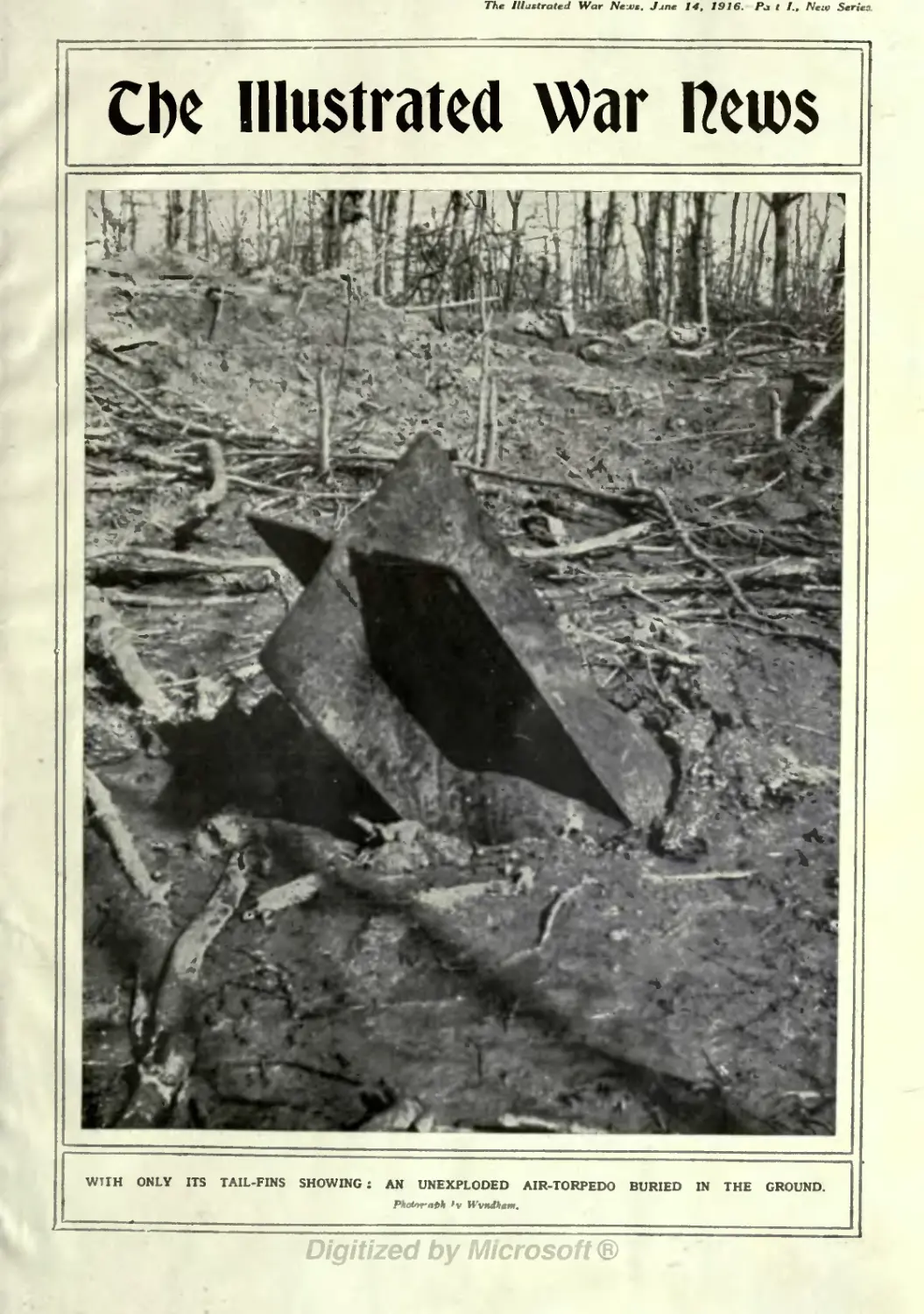
WTIH ONLY ITS TAIL-FINS SHOWING : AN UNEXPLODED AIR-TORPEDO BURIED IN THE GROUND.
Pho/wafih 'v Wvndbam.

. ir t j n
wrtasj
THE ILLUSTRATED WAR NEWS.
June 14, 191G
IN a general situation growing daily more
momentous has come the great tragedy of
Lord Kitchener's death. His abrupt and un-
expected passing on the smitten Hampshire gave
greater poignancy to the Mow that deprived us
of a personality which has had our staunchest
regard and has been our surest strength since the
outbreak of the war. The position of Lord
Kitchener was not merely official ; it was national.
His employment as Secretary for \Var was
inevitable. There may be reason to debate upon
his worth as a leader in strategy and tactics, but
there is no doubt at all that popular imagination
found in him
its one natural
military leader
and adviser in
the time of
crisis. And,
having elected
him as such,
was prepared
to and, in
fact, actually
did accom-
plish all he
asked. That
this unequivo-
cal reliance had
reason behind
it is also true.
Lord Kitch-
ener's reputa-
tion as an or-
ganiser, as a
person su-
premely capa-
ble of making
bricks with
very little
straw, rests not
merely upon his
work in his past
campaigns, but
is proved up to
the hilt by his
brilliant feat of
bringing into
being out of
nothing, and in
spite of an en-
tanglement of
difficulties, the,
trem endous
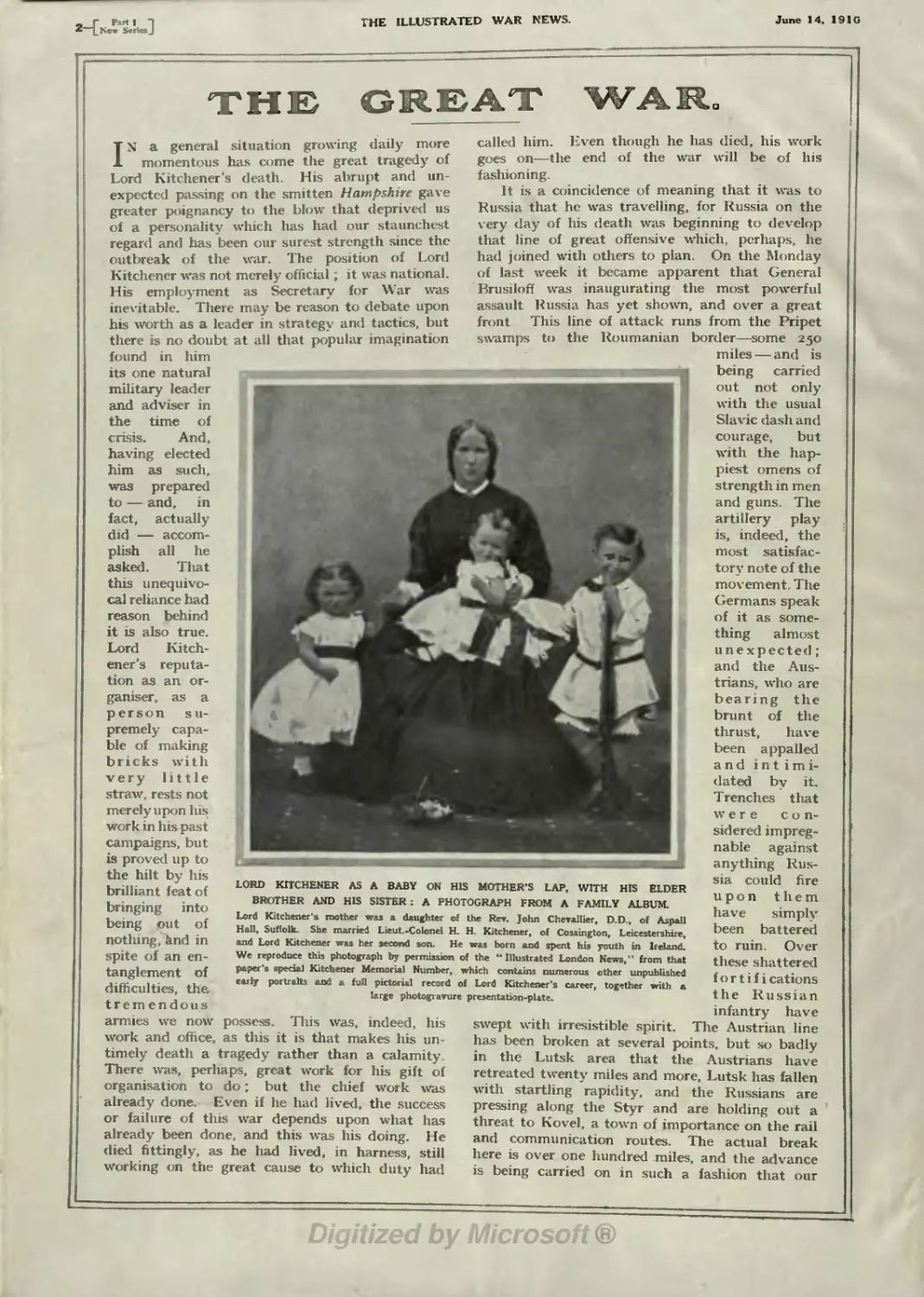
LORD KITCHENER AS A BABY ON HIS MOTHER'S LAP, WITH HIS ELDER
BROTHER AND HIS SISTER : A PHOTOGRAPH FROM A FAMILY ALBUM.
Lord Kitchener's mother was a daughter of the Rev. John Chevallier, D.D., of Aspall
Hall, Suffolk. She married Lieut.-Colonel H. H. Kitchener, of Cossington, Leicestershire,
and Lord Kitchener was her second son. He was born and spent his youth in Ireland.
We reproduce this photograph by permission of the " Illustrated London News," from that
paper's special Kitchener Memorial Number, which contains numerous other unpublished
early portraits and a full pictorial record of Lord Kitchener's career, together with a
large photogravure presentation-plate.
armies we now possess. This was, indeed, his
work and office, as this it is that makes his un-
timely death a tragedy rather than a calamity.
There was, perhaps, great work for his gift of
organisation to do ; but the chief work was
already done. Even if he had lived, the success
or failure of this war depends upon what has
already been done, and this was his doing. He
died fittingly, as he had lived, in harness, still
working on the great cause to which duty had
called him. Even though he has died, his work
goes on the end of the war will be of his
fashioning.
It is a coincidence of meaning that it was to
Russia that he was travelling, for Russia on the
very day of his death was beginning to develop
that line of great offensive which, perhaps, he
had joined with others to plan. On the Monday
of last week it became apparent that General
Brusiloff was inaugurating the most powerful
assault Russia has yet shown, and over a great
front This line of attack runs from the Pripet
swamps to the Roumanian border some 250
miles and is
being carried
out not only
with the usual
Slavic dash and
courage, but
with the hap-
piest omens of
strength in men
and guns. The
artillery play-
is, indeed, the
most satisfac-
tory note of the
movement. The
Germans speak
of it as some-
thing almost
unexpected ;
and the Aus-
trians, who are
bearing the
brunt of the
thrust, have
been appalled
and i n t i m i-
dated by it.
Trenches that
were c o n-
sidered impreg-
nable against
anything Rus-
sia could fire
upon them
have simply
been battered
to ruin. Over
these shattered
fortifications
the Russian
infantry have
swept with irresistible spirit. The Austrian line
has been broken at several points, but so badly
in the Lutsk area that the Austrians have
retreated twenty miles and more, Lutsk has fallen
with startling rapidity, and the Russians are
pressing along the Styr and are holding out a
threat to Kovel, a town of importance on the rail
and communication routes. The actual break
here is over one hundred miles, and the advance
is being carried on in such a fashion that our

June 14, 1916
THE ILLUSTRATED WAR NEWS.
r
[.M
Part 1 I
Series J
Ally is becoming a real menace to the flanks of
the line that stretches northward from Pripet.
Further south, on the
Strypa, the Russians are also
going forward, and have
brought their front beyond the
river, especially in the Jazloviec
sector below Trembovla. The
whole offensive has an uncom-
fortable proximity to Lemberg,
and not only eastern Galicia
may be over-run, but the good-
will of the Roumanians may be
involved in the fighting. In
actual cost of battling the Aus-
trians have lost some 107,000
prisoners and an amount of
booty as yet uncounted ; with
wounds and deaths, the whole
of the casualties to the Central
Powers may well be 200,000
men, a tale of loss that should
have decided effect in other
fields of the war. It seems
possible that such an offensive
has been of excellent service to
the Italians who are facing the
great Austrian drive in the
Tyrol ; and it is possible, too,
that it will force the hand of
German commanders on other parts of the line,
and lead them to inaugurate offensive movements
for the relief of the
Austrians. There
are indications that
help is being de-
manded from Hin-
denburg ; there are
suggestions that an
attack might be
launched against
the Dvinsk front.
But, so far, in en-
ergy and spirit, the
initiative is entirely
with the Russians.
Hindenburg has
been credited with
saying of the Rus-
sians that next
time they come on
they will mean
business. He is
probably right.
In the West, the
fighting about Ver-
dun has been con-
centrated into a
determined struggle
to capture the fort
of Vaux. The Ger-
mans have spent a
costly week accom-
plishing this end,
and only succeeded
in gaining the
broken works after
terrible fighting
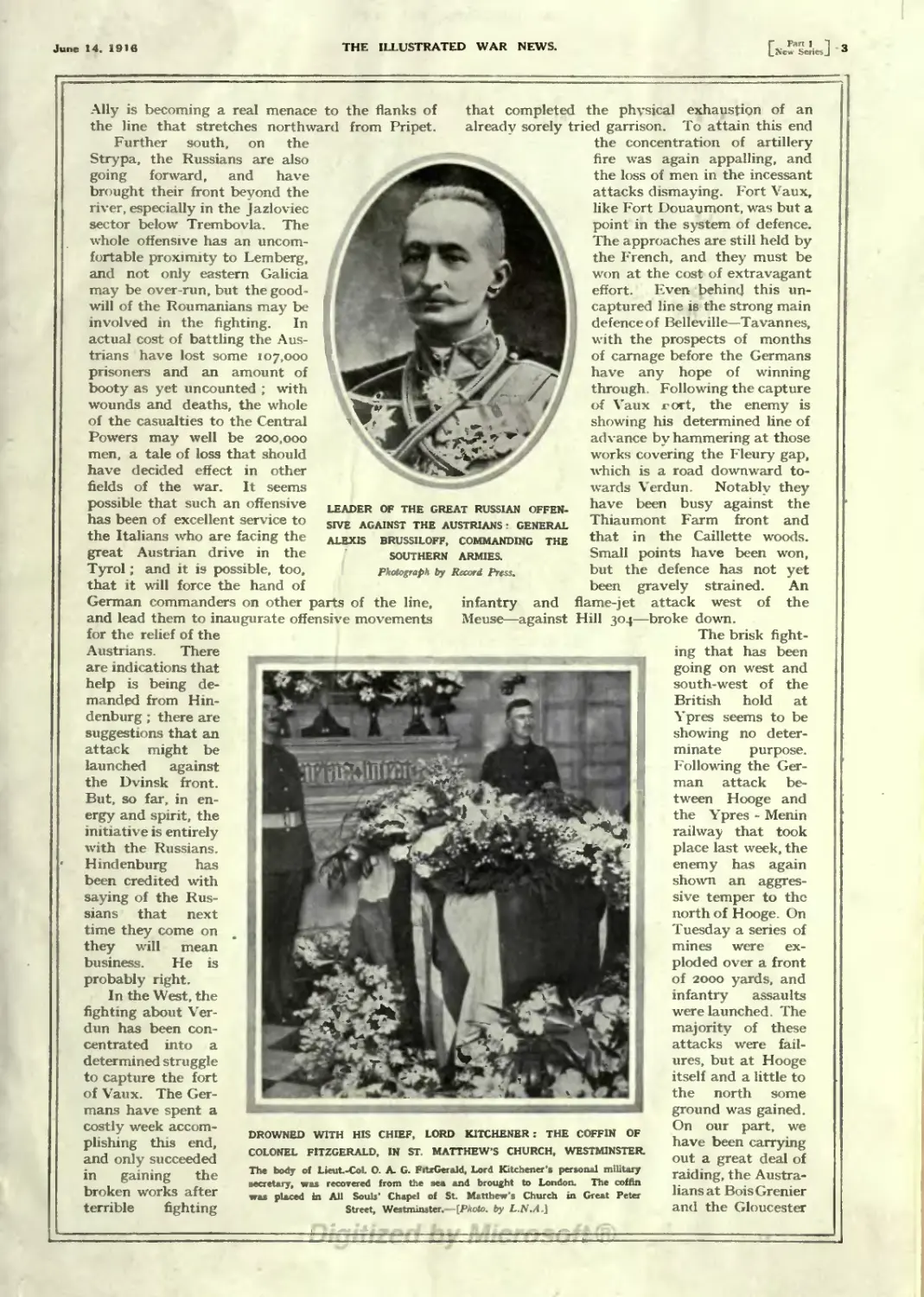
LEADER OF THE GREAT RUSSIAN OFFEN-
SIVE AGAINST THE AUSTRIANS: GENERAL
ALEXIS BRUSSILOFF, COMMANDING THE
SOUTHERN ARMIES.
Photograph by Record Press.
DROWNED WITH HIS CHIEF, LORD KITCHENER : THE COFFIN OF
COLONEL FITZGERALD, IN ST. MATTHEW'S CHURCH, WESTMINSTER.
The body of Lieut-Col. O. A. G. FitzGerald, Lord Kitchener's personal military
secretary, was recovered from the sea and brought to London. The coffin
was placed in All Souls' Chapel of St. Matthew's Church in Great Peter
Street, Westminster. [Photo, by L.N.A.]
that completed the physical exhaustion of an
already sorely tried garrison. To attain this end
the concentration of artillery
fire was again appalling, and
the loss of men in the incessant
attacks dismaying. Fort Vaux,
like Fort Douaumont, was but a
point in the system of defence.
The approaches are still held by
the French, and they must be
won at the cost of extravagant
effort. Even behind this un-
captured line is the strong main
defence of Belleville Tavannes,
with the prospects of months
of carnage before the Germans
have any hope of winning
through. Following the capture
cif Vaux i-ort, the enemy is
showing his determined line of
advance by hammering at those
works covering the Fleury gap,
which is a road downward to-
wards Verdun. Notably they
have been busy against the
Thiaumont Farm front and
that in the Caillette woods.
Small points have been won,
but the defence has not yet
been gravely strained. An
infantry and flame-jet attack west of the
Meuse against Hill 304 broke down.
The brisk fight-
ing that has been
going on west and
south-west of the
British hold at
Ypres seems to be
showing no deter-
minate purpose.
Following the Ger-
man attack be-
tween Hooge and
the Ypres - Menin
railway that took
place last week, the
enemy has again
shown an aggres-
sive temper to the
north of Hooge. On
Tuesday a series of
mines Were ex-
ploded over a front
of 2000 yards, and
infantry assaults
were launched. The
majority of these
attacks were fail-
ures, but at Hooge
itself and a little to
the north some
ground was gained.
On our part, we
have been carrying
out a great deal of
raiding, the Austra-
lians at BoisGrenier
and the Gloucester

THE ILLUSTRATED WAR NEWS.
Juni 14, 1316
Kegiment at Neuvo fhapelle doing particularly
well. Mining and gunnery activity is playing a
gir.it part in the lighting just now, and from neu-
trals and unoliicials we learn that the general
tendency of the actions are severe. The British,
however, are showing a
wise patience, and their
effort, when it comes, will
certainly be at a time of
their own choosing.
The stamp of our own
truth has been shown by
the acknowledged falsehood
of the Germans with regard
to the Jutland battle. \\ e
can see now how well the
severity of our own Ad-
miralty statements stands
the test in view of the men-
dacity of those of the
enemy. \Ve can see that
the " military necessity
of proclaiming a victory led
the Germans to suppress
the fact that two more at
least of their ships had been
sunk. It does not increase
the good opinion of neu-
trals to learn that one of
those ships was curiously
one of the latest and
best of the German battle-
cruisers. The Lutzow was
the sister - ship to the
Derfflinger, a. 28,ooo-ton
boat, finished only last
year. The Rostock was a
smaller vessel of the light-cruiser type. What the
disclosure of this duplicity may mean to Germany
we cannot say,
IBOM DCK",
JOth Hay, 1916.
erewtth a box cf
Ki-d my In your letter
"Pu t -; U,y" will be a.
ri',
:'oraraing h
cigarettes Ctc ich you eo
of tat 2-ifi i
I truat that the
very ^reot success. Om. cannot to too much for
the conrort unJ eU-b<-i.ng of wounded solJiers
ariLi Bailors who have aont their oil for the
country.
Yours vtr;: tr^ly,
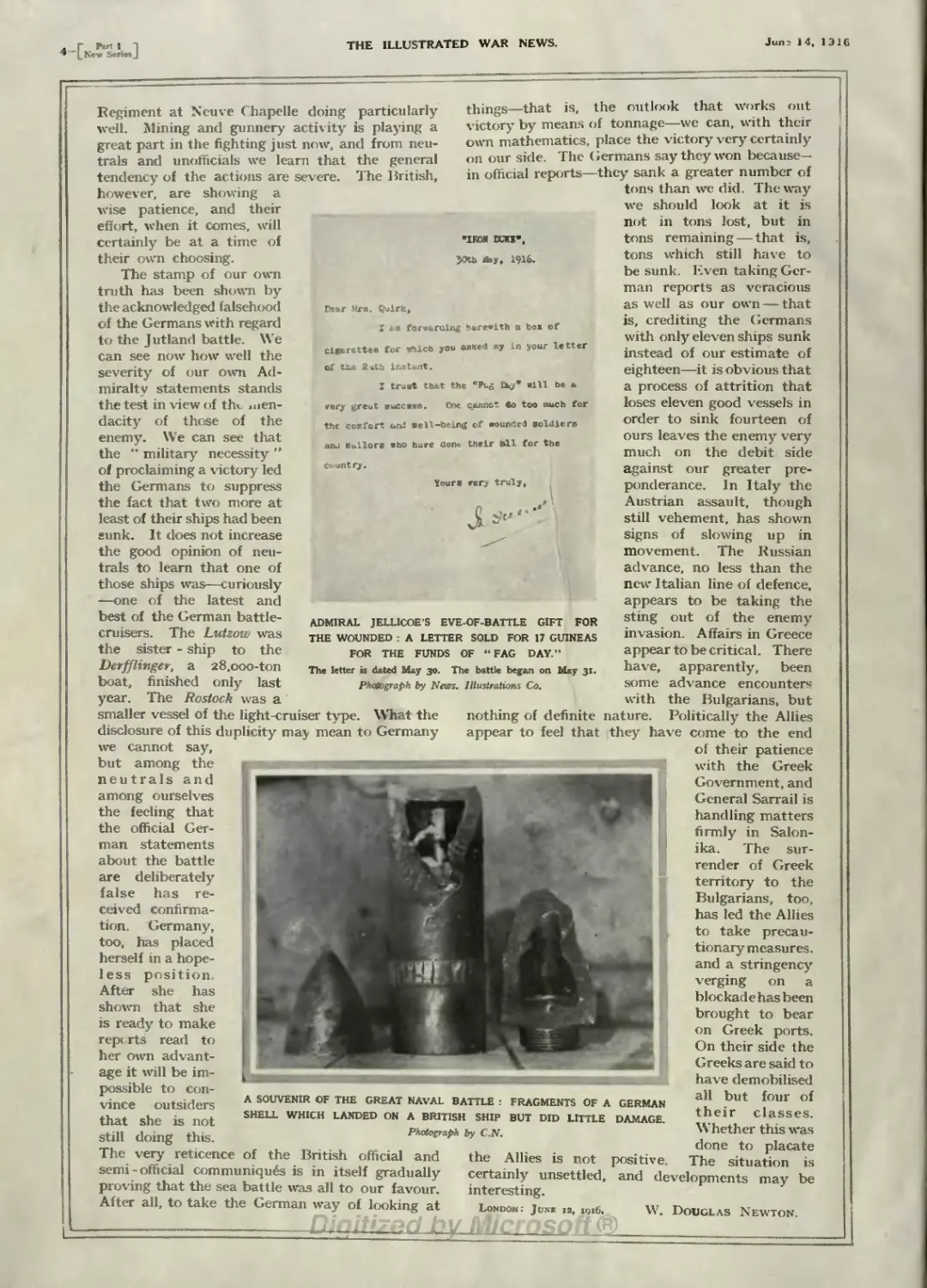
ADMIRAL JELLICOE'S EVE-OF-BATTLE GIFT FOR
THE WOUNDED : A LETTER SOLD FOR 17 GUINEAS
FOR THE FUNDS OF "FAG DAY."
The letter is dated May 30. The battle began on May 31.
Photograph by News. Illustrations Co.
but among the
neu trals and
among ourselves
the feeling that
the official Ger-
man statements
about the battle
are deliberately
false has re-
ceived confirma-
tion. Germany,
too, has placed
herself in a hope-
less position.
After she has
shown that she
is ready to make
repcrts read to
her own advant-
age it will be im-
possible to con-
vince outsiders
that she is not
still doing this.
The very reticence
things that is, the outlook that works out
victory by means of tonnage we can, with their
own mathematics, place the victory very certainly
on our side. The Germans say they won because
in official reports they sank a greater number of
tons than we did. The way
we should look at it is
not in tons lost, but in
tons remaining that is,
tons which still have to
be sunk. Even taking Ger-
man reports as veracious
as well as our own that
is, crediting the Germans
with only eleven ships sunk
instead of our estimate of
eighteen it is obvious that
a process of attrition that
loses eleven good vessels in
order to sink fourteen of
ours leaves the enemy very
much on the debit side
against our greater pre-
ponderance. In Italy the
Austrian assault, though
still vehement, has shown
signs of slowing up in
movement. The Russian
advance, no less than the
new Italian line of defence,
appears to be taking the
sting out of the enemy
invasion. Affairs in Greece
appear to be critical . There
have, apparently, been
some advance encounters
with the Bulgarians, but
nothing of definite nature. Politically the Allies
appear to feel that .they have come to the end
of their patience
FRAGMENTS OF A GERMAN
BUT DID LITTLE DAMAGE.
A SOUVENIR OF THE GREAT NAVAL BATTLE :
SHELL WHICH LANDED ON A BRITISH SHIP
Photograph by C.N.
of the British official and the Allies is not positive
semi-official communiques is in itself gradually certainly unsettled, and developments may be
proving that the sea battle was all to our favour. interesting
After all, to take the German way of looking at LONDON: J B , 19 , 6 . w. DOUGLAS NEWTON.
with the Greek
Government, and
General Sarrail is
handling matters
firmly in Salon-
ika. The sur-
render of Greek
territory to the
Bulgarians, too,
has led the Allies
to take precau-
tionary m easu res .
and a stringency
verging on a
blockadehasbeen
brought to bear
on Greek ports.
On their side the
Greeks are said to
have demobilised
all but four of
their classes.
Whether this was
done to placate
The situation is

June 14. 1916
THE ILLUSTRATED WAR NEWS.
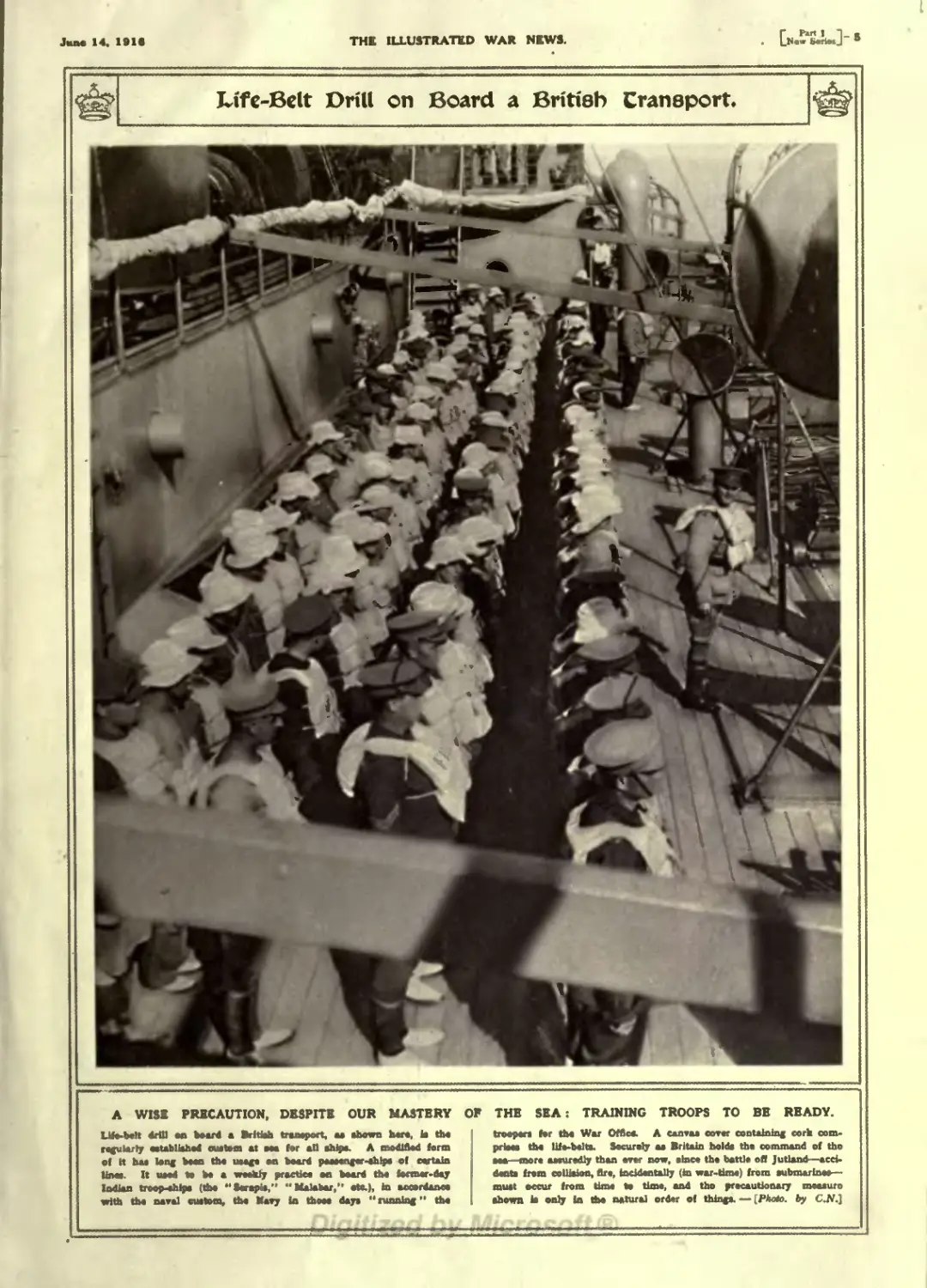
Jvife-Belt Drill on Board a British transport.
A WISE PRECAUTION, DESPITE OUR MASTERY OF THE SEA : TRAINING TROOPS TO BE READY.
Life-belt drill on board * British transport, u thown here, ii th
regularly established euitom t sea for !! ihipt. A modified form
of It hu long been the usafe on board paseenfer -ships of certain
lina. It u>4 to t a wnkljr prictice on board thi formr-dar
Indian troop-thrpi (th " Swap!*," "Malabar," ate.), In accordant*
with tht naral cutlom, tht Nary in thoM daj> " running " tht
trooptri for tht War Officf. A canvas COTCT contalnlnf cork com-
priitt tht lile-belti. Securely ai Britain holda the command of the
aaa more assuredly than eyer now, since the battle off Jutland acd-
dents from collision, Are, Incidentally (In war-time) from submarines
must occur from time to time, and the precautionary measure
shown Is only In the natural order of things. [Pkola. fry C.N.]

Prt I "I
ew SerieiJ.
T.HE ILLUSTRATED WAR NEWS.
June 14. 1916
Gilbert the Htrman's escape: f)is Hrrival in parts.
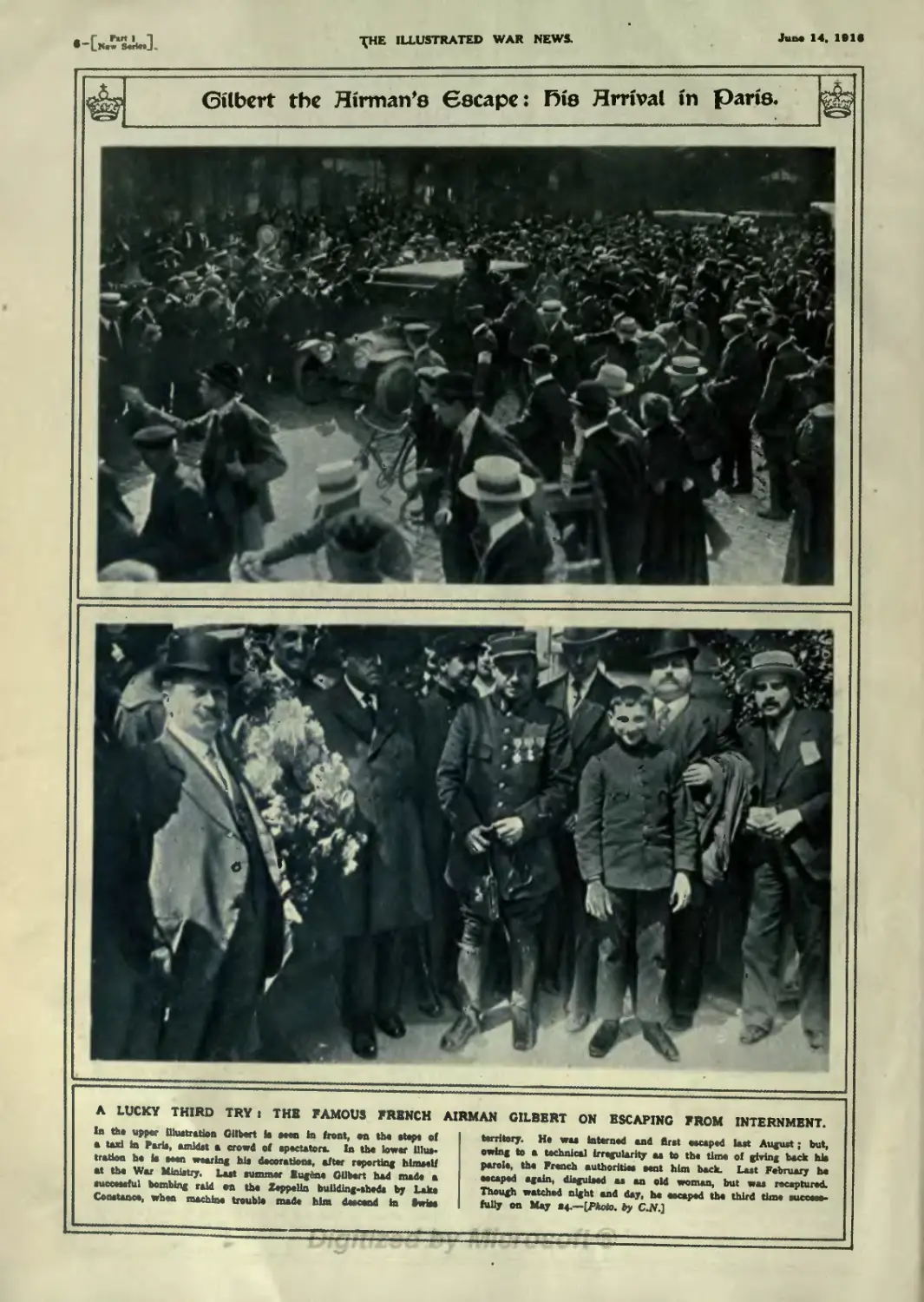
A LUCKY THIRD TRY: THB FAMOUS FRENCH AIRMAN GILBERT ON ESCAPING
In the upper Illuttration Gilbert li leen In front, en the it.pi of
* taxi In Prl, mmidit a crowd of ipectaton. In the lowr Illut-
Ir4on h U i<*n wtwlnf hli dworttioni, after reporting hirattlf
Ow Wr Minlitrj. Ltit lumnwr Bu|nt Gilbert had nud* a
ucctwful bomblrn raid on th Zeppelin bujldlnf-thcdt by Laka
Contanc, when macbln. troublt mad* him dc*nd In Swlu
FROM INTERNMENT,
territory. He wai interned and Artt neaped last Augutt ; but,
owing to a technicil irregularity ai to the time of giraig back hit
parol., the Frtnch authorltiw nt him back. La,t Fbruary he
atcaptd again, dUgulied at an old woman, but wat recaptured.
Thoufh watched night and day, he etcaped the third time success-
fully on May 14. [Ptoto. by C.N.]

Jan* 14. 1916
THE ILLUSTRATED WAR NEWS.
I" Part 1
LNew Scrie
t:be price of Hir Supremacy paid by a British Hirman.
i
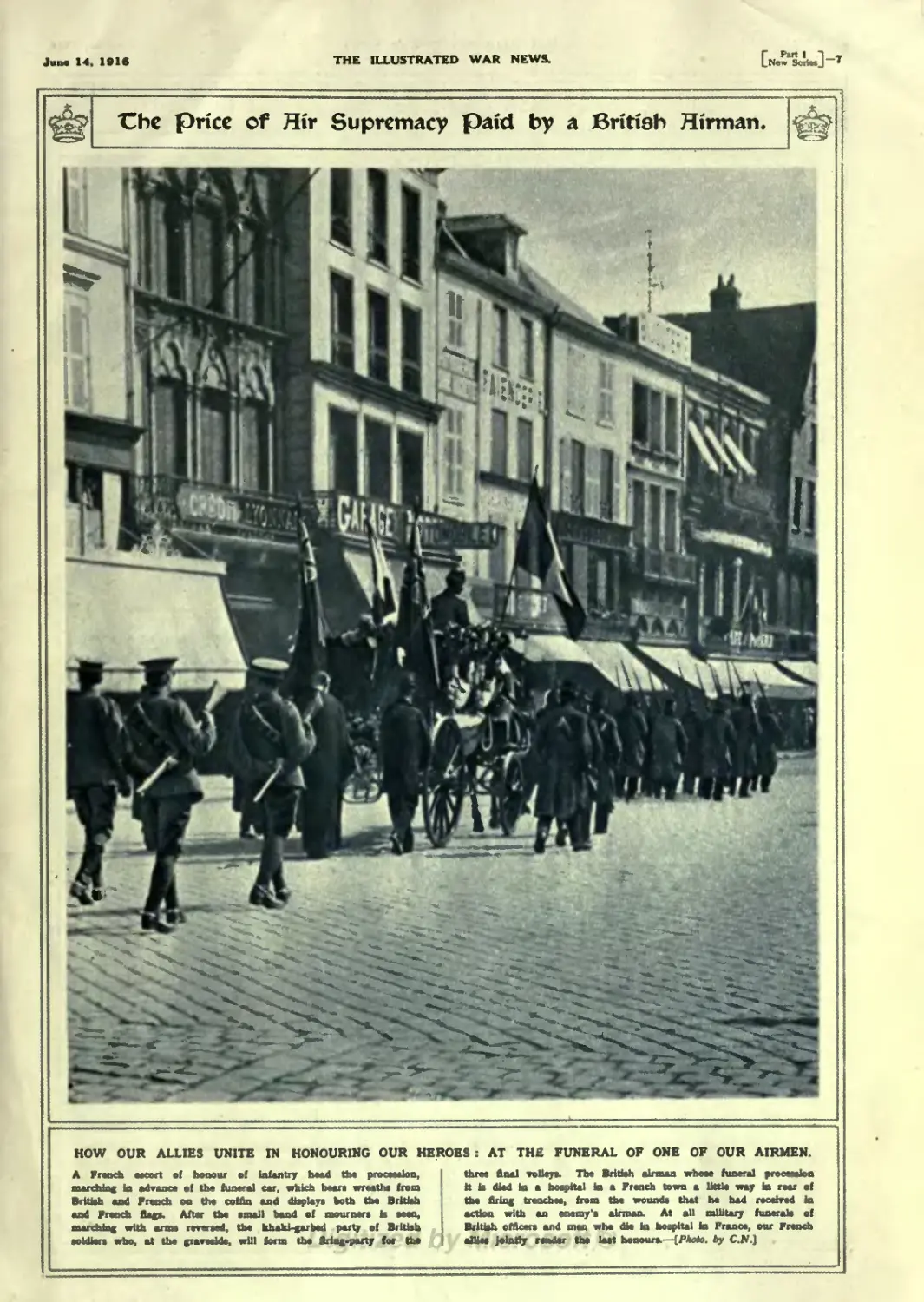
HOW OUR ALLIES UNITE IN HONOURING OUR HEROES : AT THE FUNERAL OF ONE OF OUR AIRMEN.
A French escort of honour of infantry head the procession,
inarching in advance of the funeral car, which bears wreaths from
British and French on the coffin and displays both the British
and French flags. After the small band of mourners is seen,
marching with arms rerersed, the khaki-garbed party of British
soldiers who, at the graveside, will form the firing-party (or the
three final volleys. The British airman whose funeral procession
it is died in a hospital in a French town a little way in rear of
the firing trenches, from the wounds that he had received in
action with an enemy's airman. At all military funerals of
British officers and men who die in hospital in France, our French
allies jointly render the last honours. (PAoto. hy C.N.]

r p " rt i i
~LNew SrriJ
THE ILLUSTRATED WAR NEWS
June 14, 1916
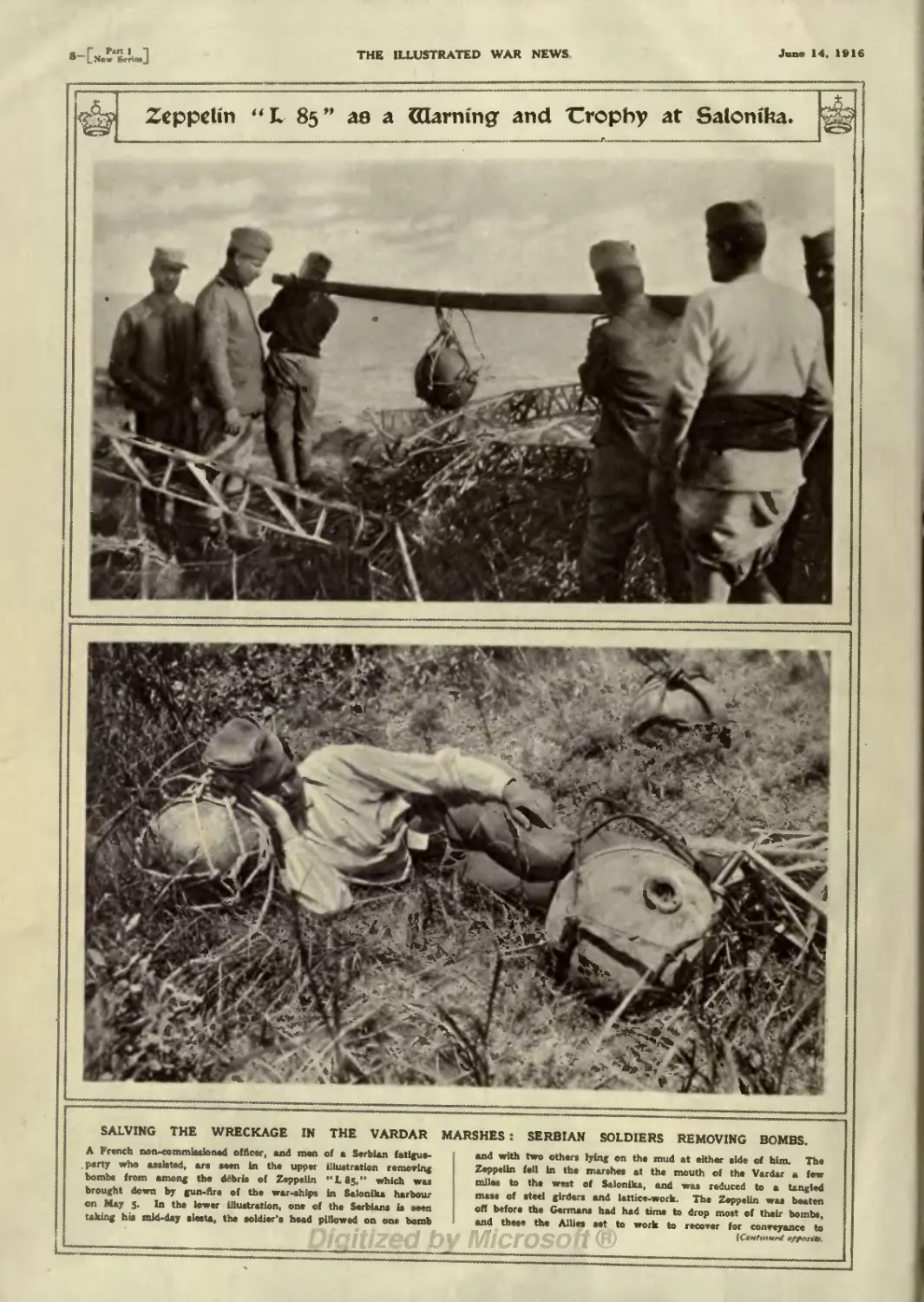
SALVING THE WRECKAGE IN THE VARDAR MARSHES: SERBIAN SOLDIERS
A French non-commiuioncd officer, and men of Serbian fatigue-
. party who auiited, are seen in the upper illustration removing
bombs from among the d6bris of Zeppelin "L8s," which wai
brought down by gun-fire of the war-ships in Salonika harbour
on May 5. In the lower illustration, one of the Serbians is seen
taking his mid-day siesta, the soldier's head pillowed on one bomb
REMOVING BOMBS,
and with two others lying on the mud at either side of him. The
Zeppelin fell in the marshes at the mouth of the Vardar a few
miles to the west of Salonika, and was reduced to a tangled
mass of steel girders and lattice-work. The Zeppelin was beaten
oft before the Germans had had time to drop most of their bombs,
to recover for conveyance to
fC0i/i<rW ofpotitt.
and these the Allies set to work

Juno 14. 1916
THE ILLUSTRATED WAR NEWS.
LNuw Series J
Zeppelin *'L 85" as a darning and Trophy at Salonika
I V I...J l-
i
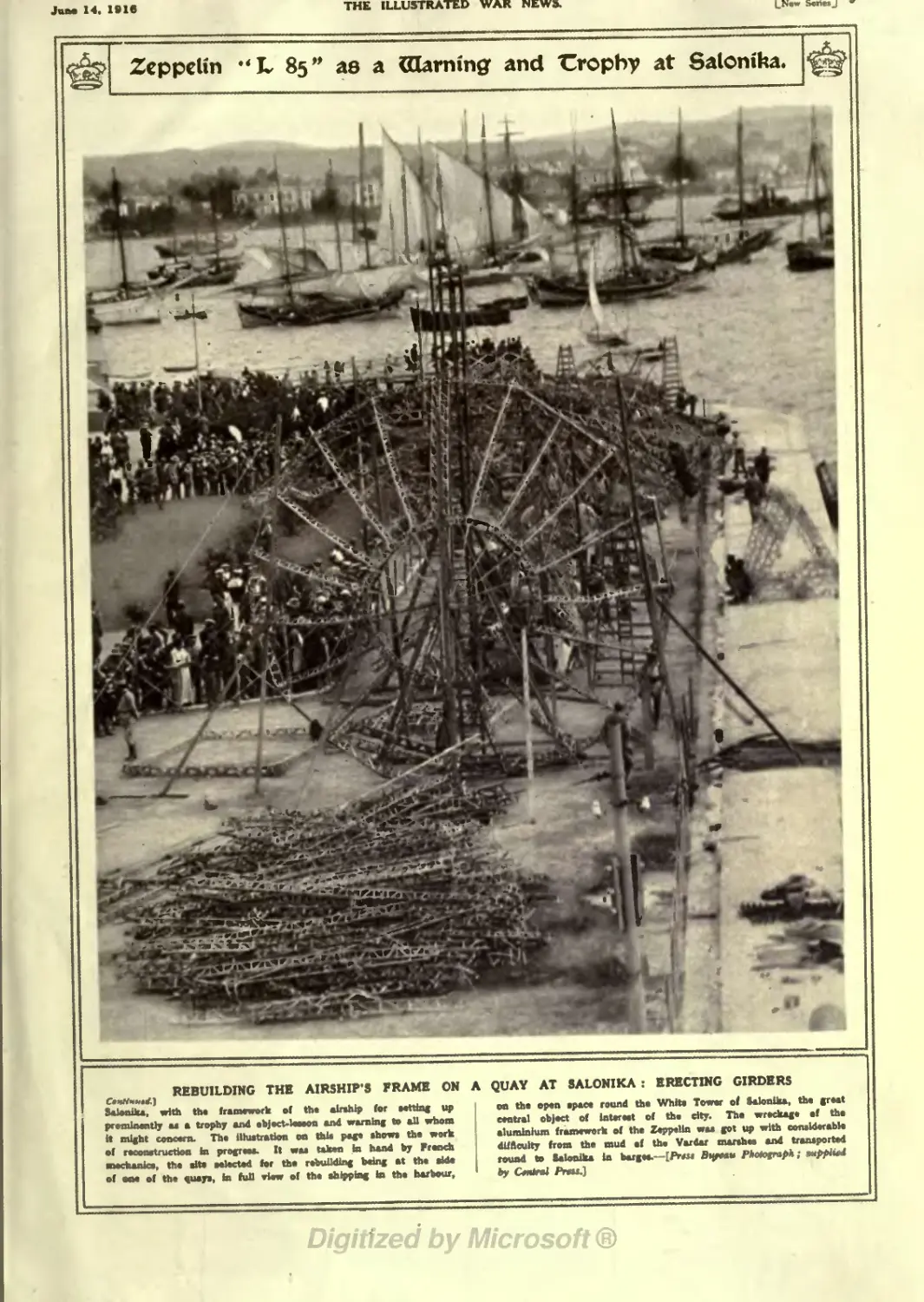
REBUILDING THE AIRSHIP'S FRAME ON
Salonika, with th framework of the alrihip lor setting up
prominently u a trophy and object-lewon nl warning to all whom
it mifht concern. The illuitrtion on thli pag* bow the work
of reconstruction In propee.. It WM tmken in hand by French
mechanic!, the lite ielecUd for the rebuilding being at the tide
of one of the quay., in full rlew of the ehippinf in the harbour,
A QUAY AT SALONIKA : ERECTING GIRDERS
on the open space round the White Tower of Salonika, the great
central object of interest of the city. The wreckage of the
aluminium framework of the Zeppelin was got up with considerable
difficulty from the mud of the Vardar marshes and transported
round to Salonika In barges.- [/V Btywu Ptiotopapk ; r
' by Ctnlral Prat.]

rt I '
' SrteJ
THE ILLUSTRATED WAR NEWS.
JUM 14. 1916
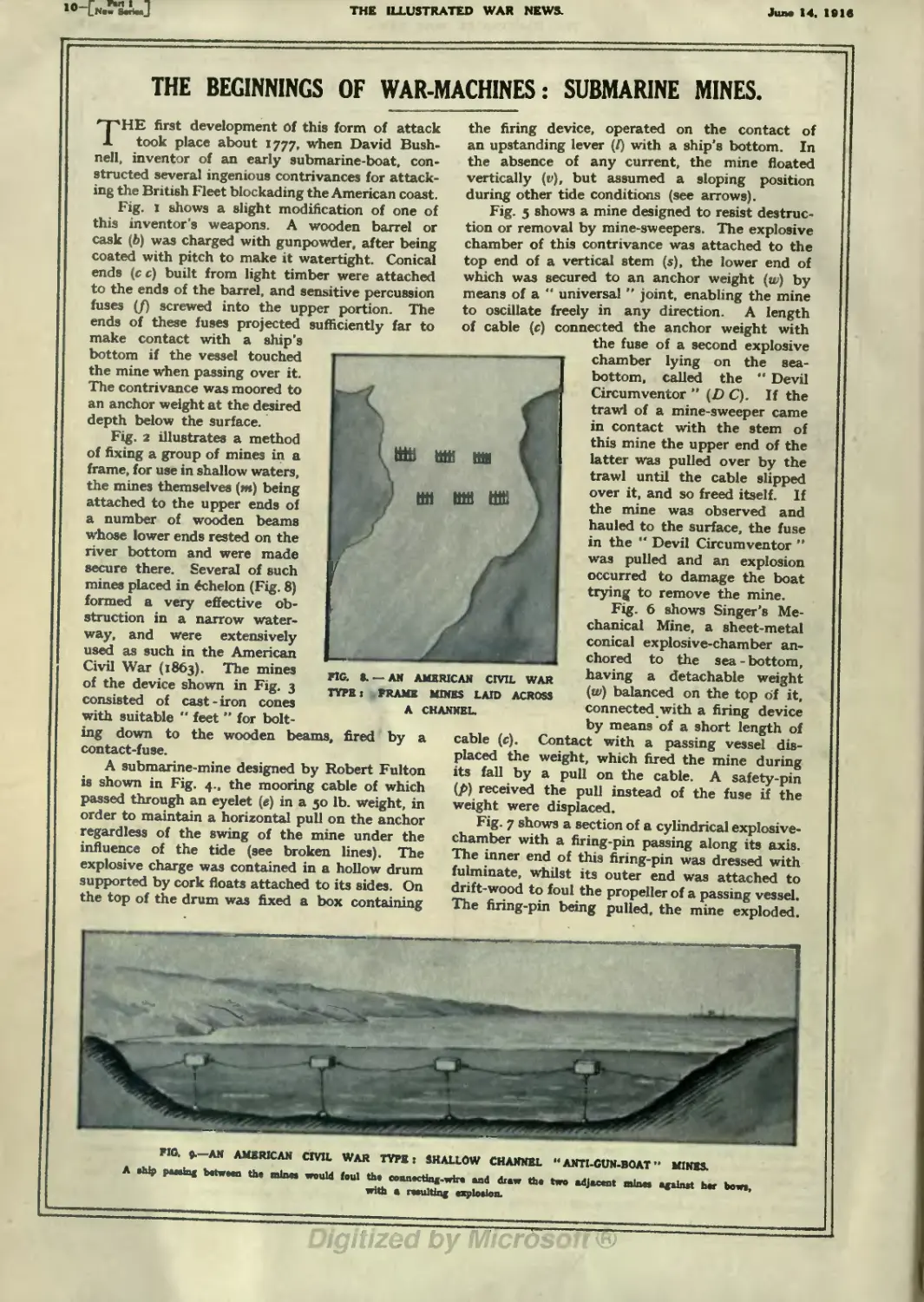
THE BEGINNINGS OF WAR-MACHINES : SUBMARINE MINES.
THE first development of this form of attack
took place about 1777, when David Bush-
nell, inventor of an early submarine-boat, con-
structed several ingenious contrivances for attack-
ing the British Fleet blockading the American coast.
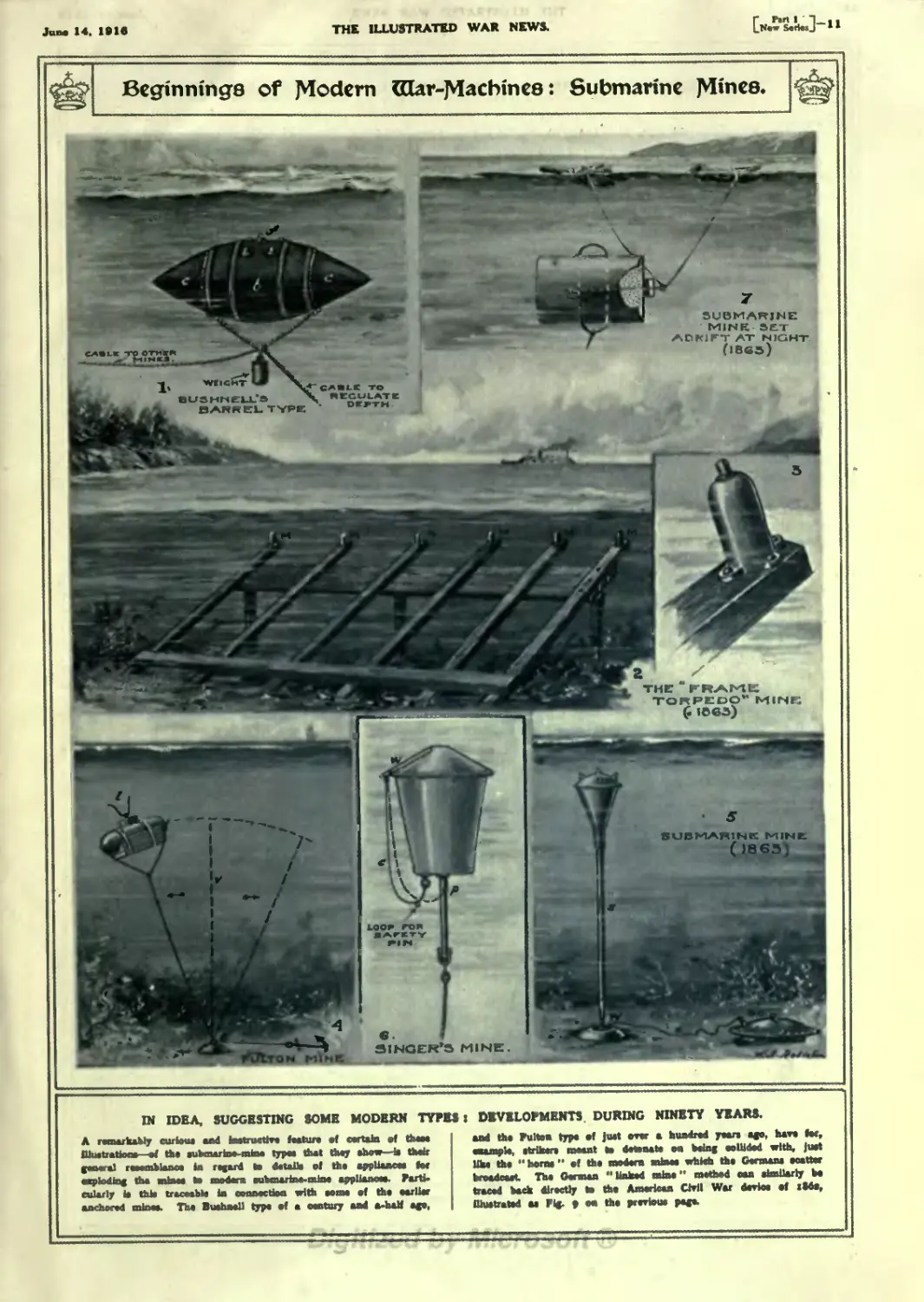
Fig. i shows a slight modification of one of
this inventor's weapons. A wooden barrel or
cask (6) was charged with gunpowder, after being
coated with pitch to make it watertight. Conical
ends (c c) built from light timber were attached
to the ends of the barrel, and sensitive percussion
fuses (/) screwed into the upper portion. The
ends of these fuses projected sufficiently far to
make contact with a ship's
bottom if the vessel touched
the mine when passing over it.
The contrivance was moored to
an anchor weight at the desired
depth below the surface.
Fig. 2 illustrates a method
of fixing a group of mines in a
frame, for use in shallow waters,
the mines themselves (nt) being
attached to the upper ends of
a number of wooden beams
whose lower ends rested on the
river bottom and were made
secure there. Several of such
mines placed in Echelon (Fig. 8)
formed a very effective ob-
struction in a narrow water-
way, and were extensively
used as such in the American
Civil War (1863). The mines
of the device shown in Fig. 3
consisted of cast - iron cones
with suitable " feet " for bolt-
ing down to the wooden beams, fired by a
contact-fuse.
A submarine-mine designed by Robert Fulton
is shown in Fig. 4., the mooring cable of which
passed through an eyelet (e) in a 50 Ib. weight, in
order to maintain a horizontal pull on the anchor
regardless of the swing of the mine under the
influence of the tide (see broken lines). The
explosive charge was contained in a hollow drum
supported by cork floats attached to its sides. On
the top of the drum was fixed a box containing
FIG. (. AN AMERICAN CIVIL WAR
TYPE : FRAME MINES LAID ACROSS
A CHANNEL
the firing device, operated on the contact of
an upstanding lever (/) with a ship's bottom. In
the absence of any current, the mine floated
vertically (v), but assumed a sloping position
during other tide conditions (see arrows).
Fig. 5 shows a mine designed to resist destruc-
tion or removal by mine-sweepers. The explosive
chamber of this contrivance was attached to the
top end of a vertical stem (s), the lower end of
which was secured to an anchor weight (w) by
means of a " universal " joint, enabling the mine
to oscillate freely in any direction. A length
of cable (c) connected the anchor weight with
the fuse of a second explosive
chamber lying on the sea-
bottom, called the " Devil
Circumventor " (D C). If the
trawl of a mine-sweeper came
in contact with the stem of
this mine the upper end of the
latter was pulled over by the
trawl until the cable slipped
over it, and so freed itself. If
the mine was observed and
hauled to the surface, the fuse
in the " Devil Circumventor "
was pulled and an explosion
occurred to damage the boat
trying to remove the mine.
Fig. 6 shows Singer's Me-
chanical Mine, a sheet-metal
conical explosive-chamber an-
chored to the sea -bottom,
having a detachable weight
(w) balanced on the top of it,
connected with a firing device
by means of a short length of
cable (c). Contact with a passing vessel dis-
placed the weight, which fired the mine during
its fall by a pull on the cable. A safety-pin
(/>) received the pull instead of the fuse if the
weight were displaced.
Fig. 7 shows a section of a cylindrical explosive-
chamber with a firing-pin passing along its axis.
The inner end of this firing-pin was dressed with
fulminate, whilst its outer end was attached to
drift-wood to foul the propeller of a passing vessel.
The firing-pin being pulled, the mine exploded.
'
-AN AMERICAN CIVIL WAR TYPE: SHALLOW CHANNEL " ANTI-CON-BOAT " MINES.

June 14. 1918
THE ILLUSTRATED WAR NEWS.
|- Pin I 1 * ,
LNW Series J~ 11
4-
Beginnings
of
Modern CKar-jMacbinee :
Submarine
JWms.
it?
MINE SET
ADKIFT AT NIGHT
THE
TORPEDO" MINE
(. 18 63)
IN IDEA, SUGGESTING SOME MODERN TYPES ! DEVELOPMENTS. DURING NINETY YEARS.
and tht Fulton typ e( juit orr a hundred year, afo, hare lor,
sample, ttrlktrt meant to detonate on beini collided with, juat
Hk the " horn. " ol the modem mlnn which tht Germani .catter
bro.dcut. Th Ownun "linked mint" mtthod can tlmlUrlr
trtctd back dlrectlr to tht Amtrlcan Ciril War device ol !*,
UlUitrtMd ai fit- 9 n tht pr.riou. pagt.
A rtmarkablr curiaui and Initructirt Itaturt of certain of thtte
Uliutration* of the lubmarlne-mlnt type, that they ihow U their
(tneral reMmbUnct in regard to details of tht applianctt for
ecplodinf the minet to modern lubmarlne-mlnt applianctt. Parti-
cularly It thii traceable in connection with tornt of tht earlier
anchored mine.. The Buihnel! type ol a etnturr and a-nall ago,

THE ILLUSTRATED WAR NEWS.
Jan. 14, 1916
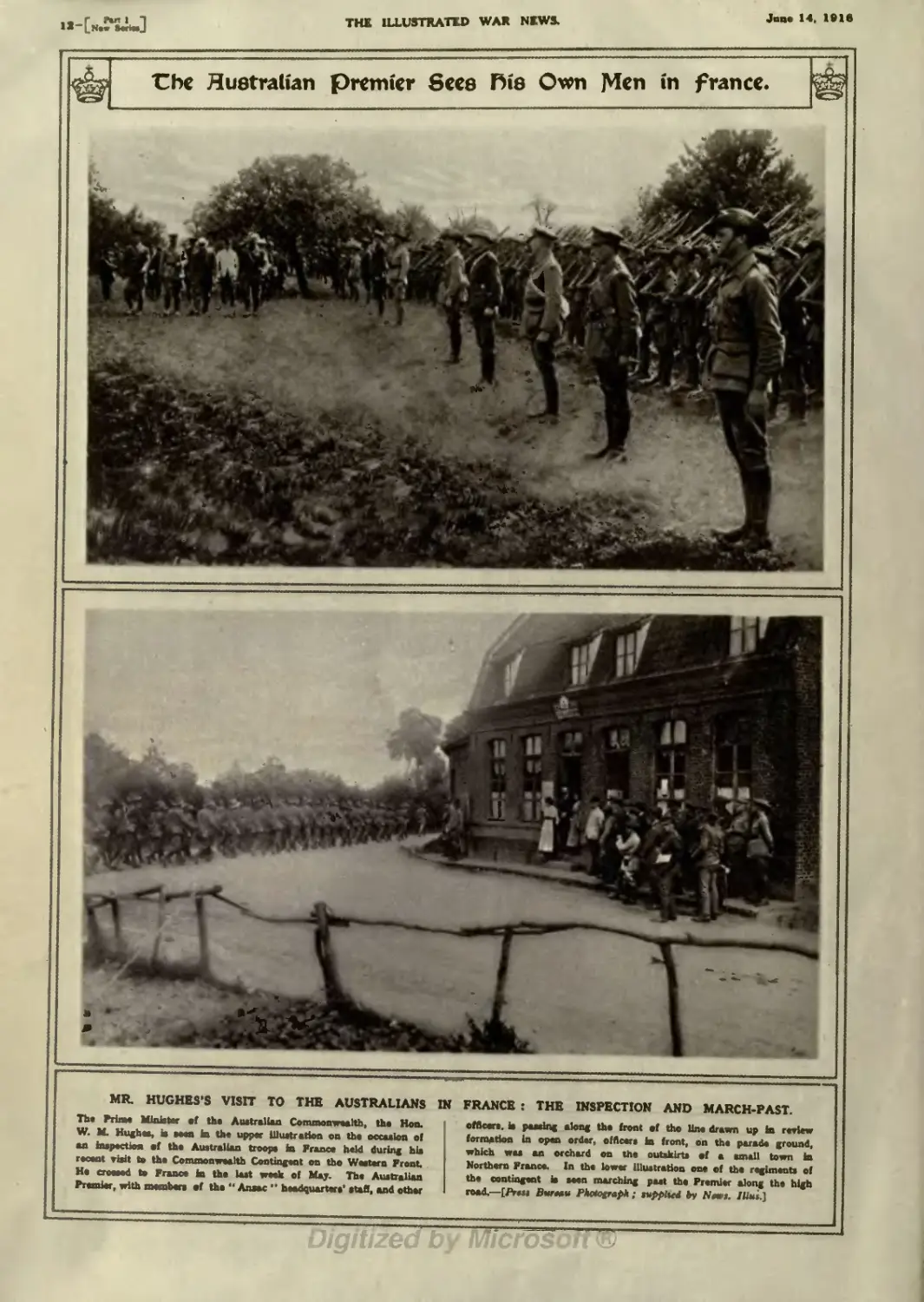
"Che Australian premier Sees fits Own Men in france.
MR. HUGHES'S VISIT TO THE AUSTRALIANS
The Prime Minuter of the Auitralian Commonwealth, the Hon.
W. M. Hughei, U feen In the upper Illustration on the occuion of
n inspection of the Australian troop* In France held during hli
recent risit to the Commonwealth Contingent on the Wettern Front,
He crowed to France in the last week of May. The Australian
Premier, with members of the " Anne " headquarters' lUfl, and other
IK FRANCE : THE INSPECTION AND MARCH-PAST.
offlceri. it passing .long the front of the line drawn up in reriew
formation in open order, officer, in front, on the parade ground,
which wai an orchard on the outskirts of a imall town in
Northern France. In the lower illustration one of the reg ImenU of
the contingent it teen marching put the Premier along the high
road. [Priss Bureau Photograph ; supplied ov News, lllus.]

JUM 14. 1916
THE ILLUSTRATED WAR NEWS.
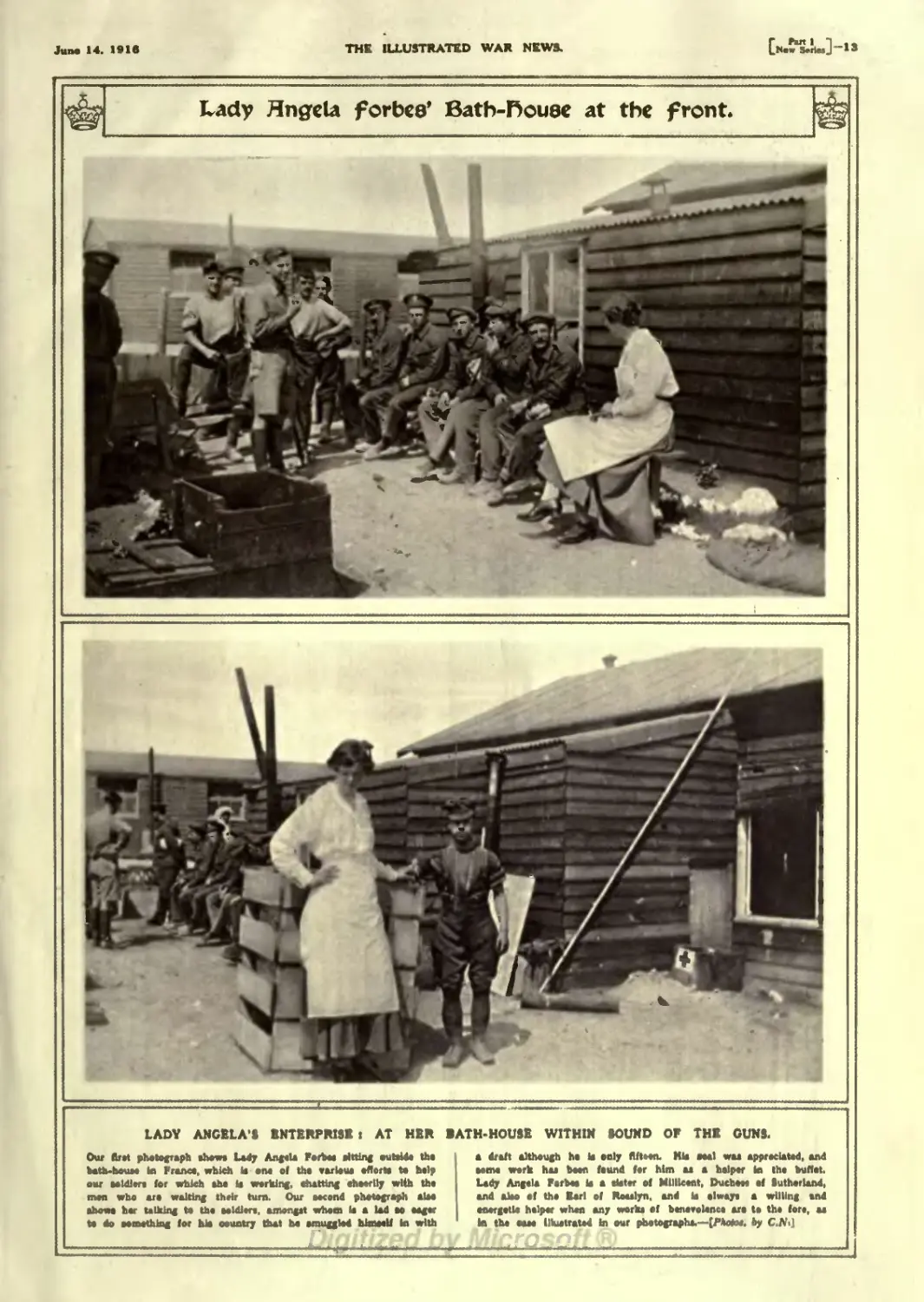
Lady Hngela forbea' Bath-Rouse at the front.
LADY ANGELA'S ENTERPRISE i AT HER BATH-HOUSE WITHIN SOUND OF THE GUNS.
Our AMI photojraph ihowt Ladj Anfl Forbi tlttinf outtldi thi
bath-houi> In Pranct, which u ont o( thi tirlom florti to hilp
our toldltri (or which iho U worklnf, chatting chotrlljr with iht
mm who art willing thrlr turn. Our itcond photofrtph kite
ihowi her ulkinf to th wldltrt, *mon|>t whom ii a ltd to Uftr
to do lomtthlnf (or hU country tht hi imuffld hlnu*U In with
4 draft tlthouch hi to onlr (Ktom. Kb IM! w*t pprcltd, and
torn* work hti b*n found (or him u hilpar In th buflot.
Utfy An|l Perbw U 4 iltttr of Mllllcmt, Duchtn of Juthtrland,
and lio of th* Brl of Roulyn. and U ilwuyi 4 willlnf nd
tnorfotl< hilpor whon any workt of bintrolanci an to tht fort, ai
In tht can llluitraUil In our photofrapha. [PMoi. ky C.N\]

M
p i i
W SrifJ
THE ILLUSTRATED WAR NEWS.
June 14, 1916
ROMANCES OF THE REGIMENTS : No. I.-THE ROYAL ENGINEERS.
THE PARTING OF TWO FAMOUS SAPPERS.
THERE is a minor incident in the annals of
the Royal Engineers, quite apart from the
regiment's long, and famous record of military
exploits, which, although a quiet personal hap-
pening, is as romantic as any story of siege or
assault. Although remembered, for the most
part, only by specialists in military history, this
event may claim a place among the world's
famous partings, for it has in it that pathos .and
finality, touched with the sense of coming doom,
which marks such scenes as the farewell of Hector
and Andromache, or that last episode at Toledo
Bridge, when the student-admirer of Cervantes
took leave for ever of his dying master
" the All-Famous and Joy of the
Muses," and sadly turned aside
to go round by the bridge
leading to Segovia. Akin
to such human docu-
ments is the part-
ing of two illus-
trious Engineer
officers, Graham
and Gordon.
Colonel
(afterwards
Lieutenant -
General) Sir
Gerald Gra-
ham, and
General Gor-
don were \ery
old friends,
comrades in
the Crimea and
in China. It was
a curious chance,
entirely in accord-
ance with the eternal
fitness of things, that the
last glimpse of the hero
of Khartoum, before he
plunged into the desert
from which he was never
to return, should have
been vouchsafed to a
brother Sapper, whose
sense of the picturesque
significance of the moment
enabled him to do it justice in a simple but
adequate record. Graham, who had served with
great distinction through the first Egyptian
Campaign, was in Cairo, commanding an infantry
brigade of the Army of Occupation, when
Gordon came out on his mission to the Soudan
in January 1884. During Gordon's brief halt in
Cairo the two men saw as much of each other
as possible, and when the time came for Gordon
to push southward, Graham decided to see him
on his way as far as Korosko.
The caravan set out about eight o'clock in
the morning. Gordon mounted his camel and
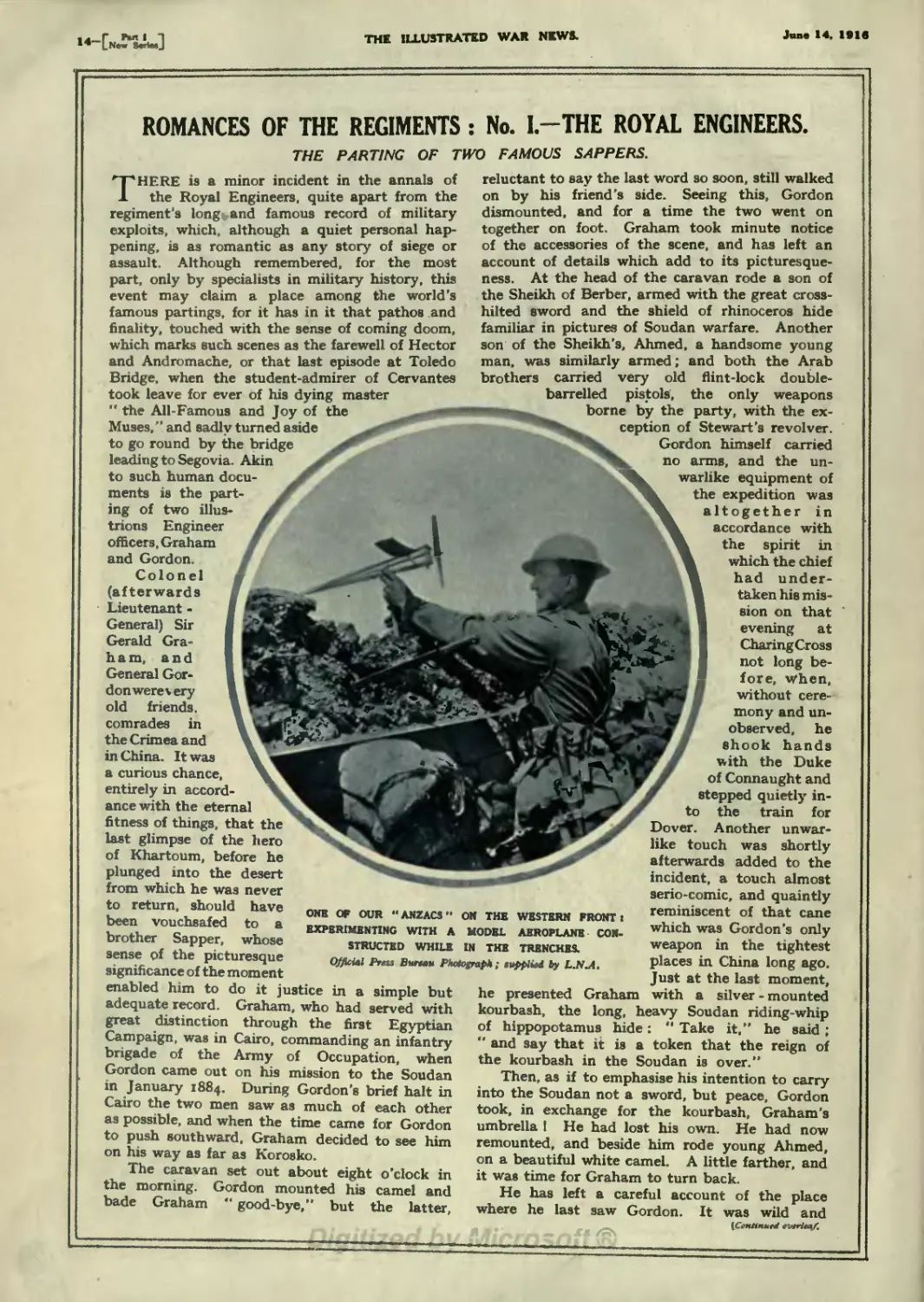
ONE OF OUR "ANZACS" OH THE WESTERN FRONT:
EXPERIMENTING WITH A MODEL AEROPLANE CON-
STRUCTED WHILE IN THE TRENCHES.
Official Press Bureau Photograph; supplied by Z..JV.X.
w-j_ f__v .. . . iil= """ *** a WUTOUI account 01 tne Dlace
bade Graham good-bye," but the latter, where he last saw Gordon. It was wild and
reluctant to say the last word so soon, still walked
on by his friend's side. Seeing this, Gordon
dismounted, and for a time the two went on
together on foot. Graham took minute notice
of the accessories of the scene, and has left an
account of details which add to its picturesque-
ness. At the head of the caravan rode a son of
the Sheikh of Berber, armed with the great cross-
hilted sword and the shield of rhinoceros hide
familiar in pictures of Soudan warfare. Another
son of the Sheikh's, Ahmed, a handsome young
man, was similarly armed ; and both the Arab
brothers carried very old flint-lock double-
barrelled pistols, the only weapons
borne by the party, with the ex-
ception of Stewart's revolver.
Gordon himself carried
no arms, and the un-
warlike equipment of
the expedition was
altogether in
accordance with
the spirit in
which the chief
had under-
taken his mis-
sion on that
evening at
Charing Cross
not long be-
fore, when,
without cere-
mony and un-
observed, he
shook hands
with the Duke
of Connaught and
stepped quietly in-
to the train for
Dover. Another unwar-
like touch was shortly
afterwards added to the
incident, a touch almost
serio-comic, and quaintly
reminiscent of that cane
which was Gordon's only
weapon in the tightest
places in China long ago.
Just at the last moment,
he presented Graham with a silver - mounted
kourbash, the long, heavy Soudan riding-whip
of hippopotamus hide : " Take it," he said ;
" and say that it is a token that the reign of
the kourbash in the Soudan is over."
Then, as if to emphasise his intention to carry
into the Soudan not a sword, but peace, Gordon
took, in exchange for the kourbash, Graham's
umbrella I He had lost his own. He had now
remounted, and beside him rode young Ahmed,
on a beautiful white camel. A little farther, and
it was time for Graham to turn back.
He has left a careful account of the place
(Cjnttnuttt t

June 14, 1914
THE ILLUSTRATED WAR NEWS
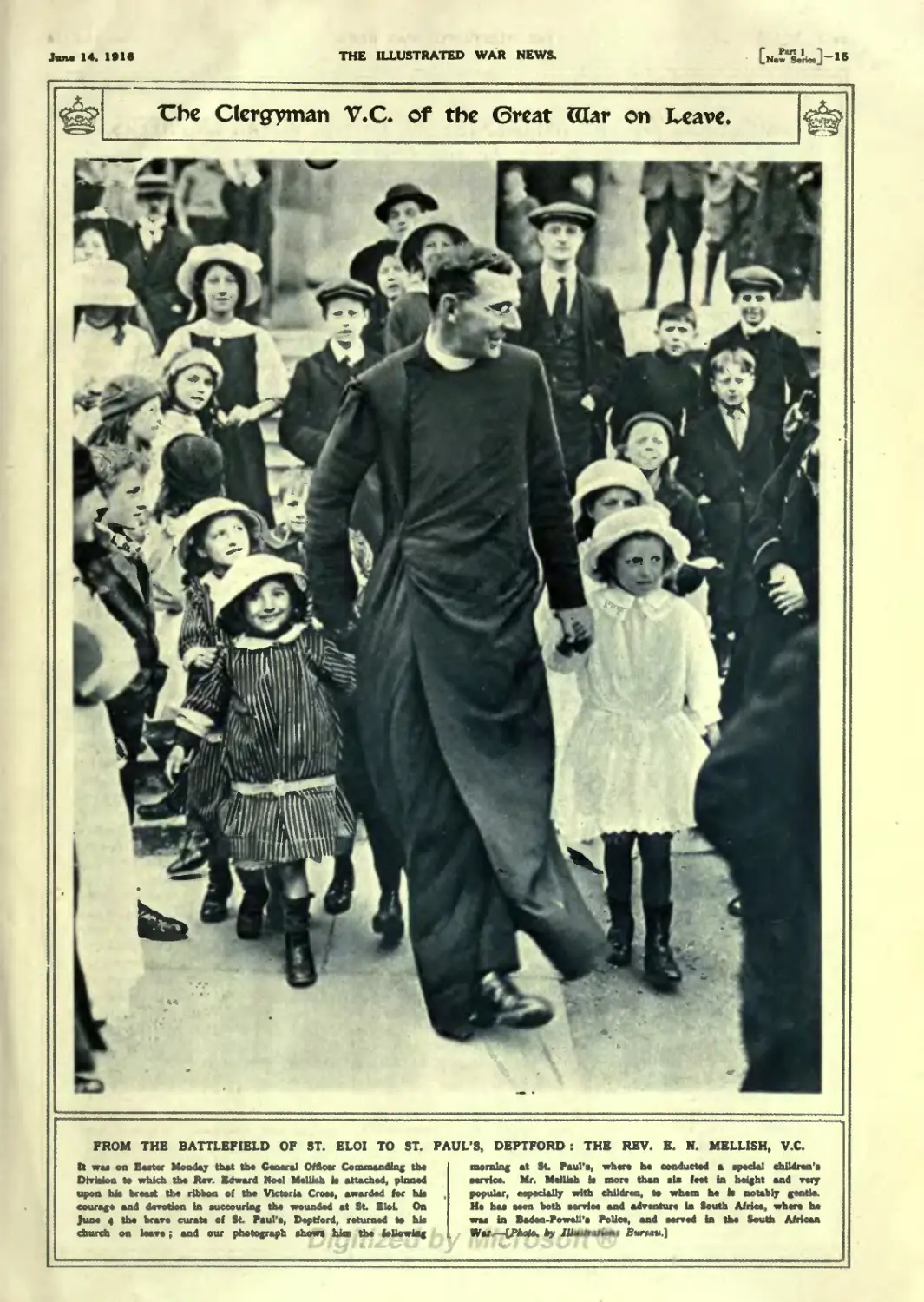
TThc Clergyman V*C* of the Great dar on Jvea\>e.
FROM THE BATTLEFIELD OF ST. ELOI TO ST. PAUL'S, DEPTFORD : THE REV. E. N. HELLISH, V.C.
It was on Easter Monday that the General Officer Commanding the
Division to which the Her. Edward Noel Hellish i* attached, pinned
upon his breast the ribbon of the Victoria Cross, awarded for his
courage and devotion in succouring the wounded at St. Blot On
June 4 the brave curate of St. Paul's, Deptford, returned to his
church on leave ; and our photograph shows him the following
morning at St. Paul's, where he conducted a special children's
service. Mr. Melliih is more than six feet In height and very
popular, especially with children, to whom he is notably gentle.
He has se*n both service and adventure in South Africa, where he
was in Baden-Powell's Police, and served in the South African
War. [Photo, by Illustrations Bureau.]

THE ILLUSTRATED WAR NEWS.
Junr 14. 1916
desolate, amid desert covered with a series of
volcanic hills. Scott, Stewart's aide-de-camp,
compared it to a miniature Switzerland. But
Graham noted the incompleteness of that com-
parison, for there, he wrote, were no fertile
valleys, no bright sun-clad peaks, no thriving
population nothing between the hills but black
basins, or ravines, dry, dark and desolate of all
vegetation, look-
ing like separate
entrances to the
pit, where those
who entered might
leave hope behind .
The forbidding
features of the
region accorded
well with Graham 's
mood at the mo-
ment, and drove
his thoughts back
to Hicks Pasha
with his doomed
army coming into
such a ravine after
forty days in the
wilderness, utterly
spent and worn
out, only to find
the dark crests of
the surrounding
heights lined with
a fierce, exultant
enemy.
Still unwilling
to lose sight of
his friend . Graham
climbed the highest of the hills with Scott, and
through a glass watched Gordon and the little
caravan, as his camels threaded their way along
a sandy valley. " I watched, hoping that he would
turn round, so that I might give him one more
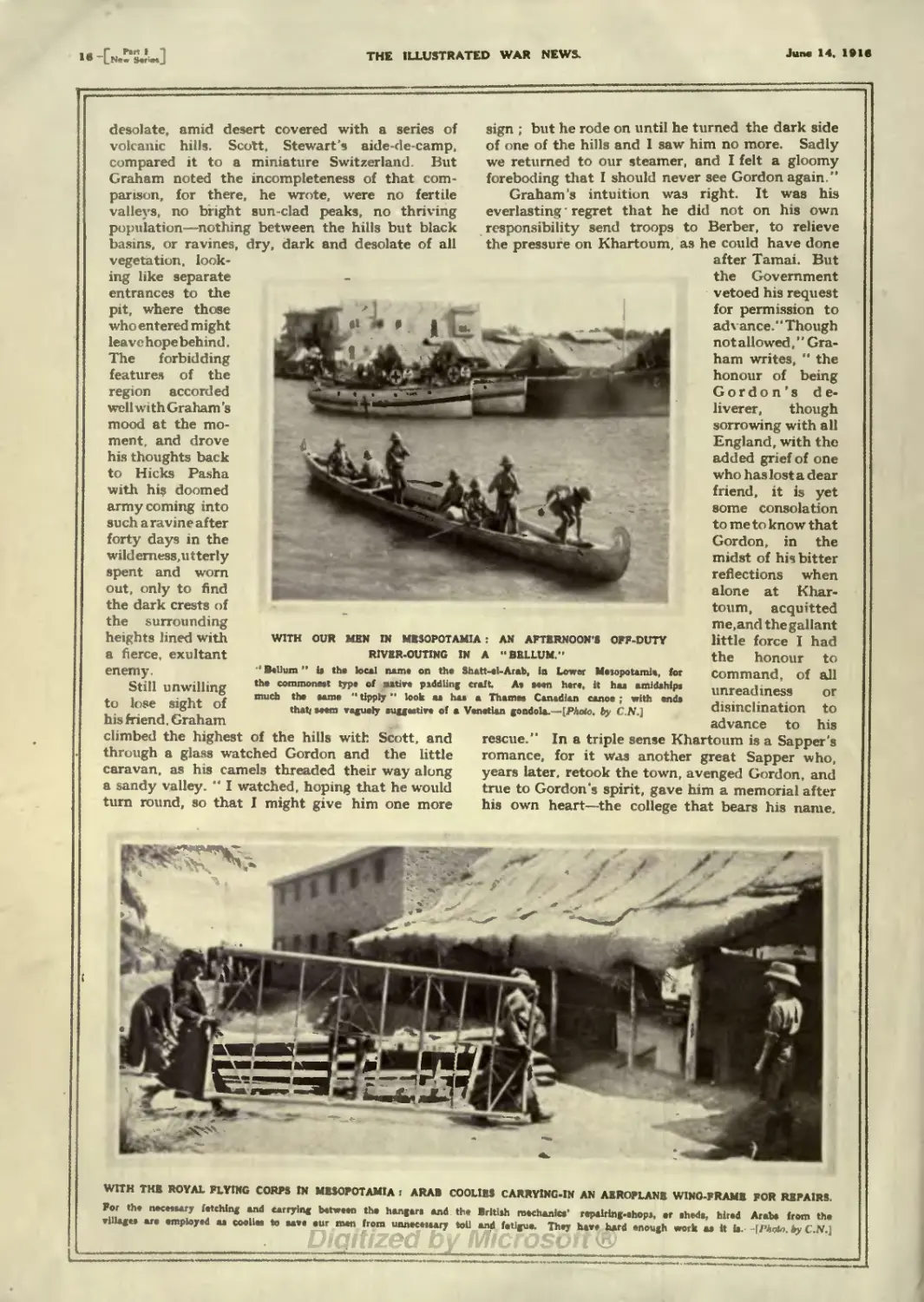
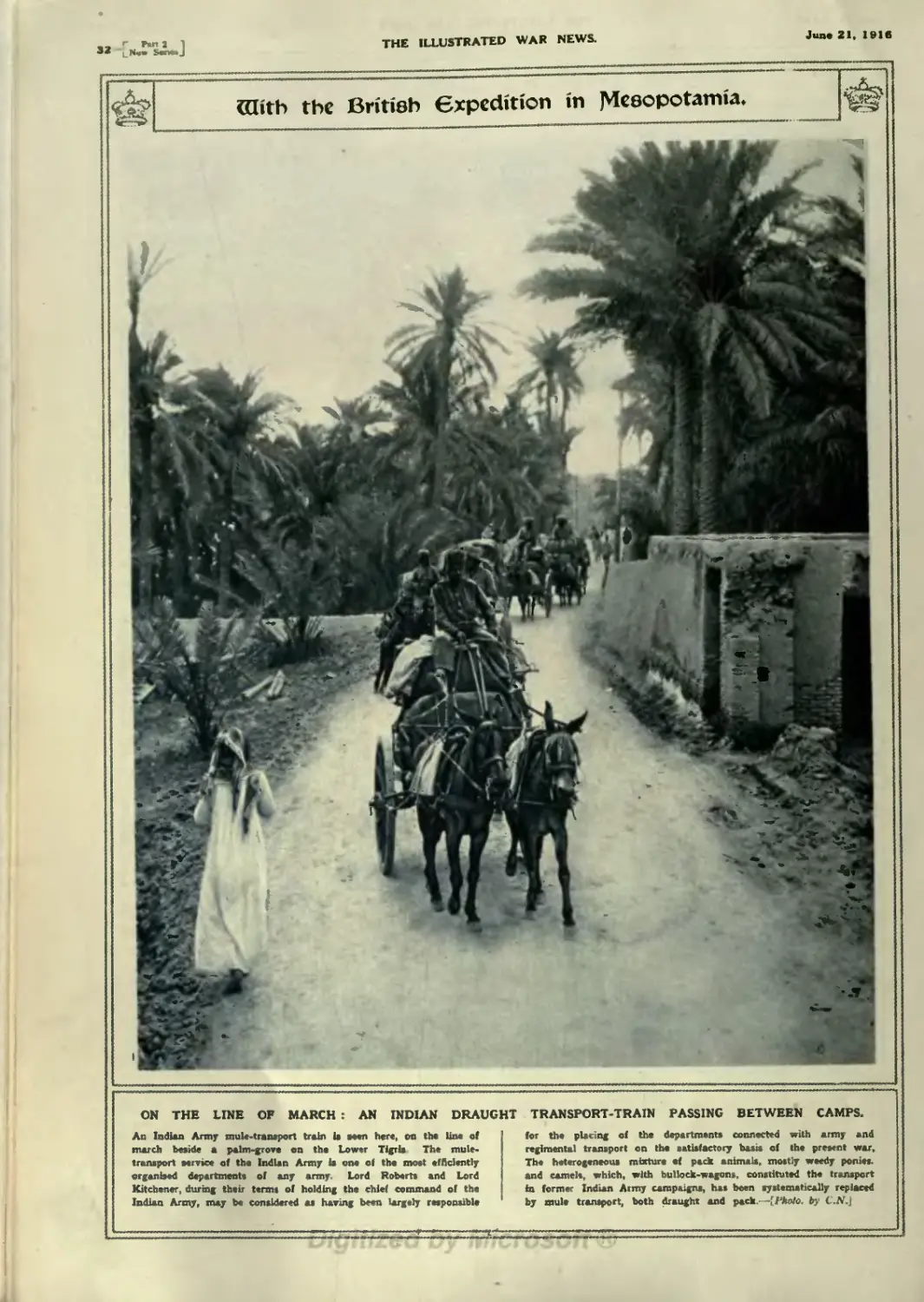
WITH OUR MEN IN MESOPOTAMIA : AN AFTERNOON'S OFF-DUTY
RIVER.OUTING IN A "BBLLUM."
'Bellum" b the local name on the Shatt-el-Arb, in Lower MelopotamU, for
the commoneit type of natire piddling craft A leen here, It has amidhip
much the aame " tipply " look ai ho a Thamei Canadian canoe; with end*
that, stem riguely luggeatire of a Venetian gondola. [Photo, by C.V.J
sign ; but he rode on until he turned the dark side
of one of the hills and I saw him no more. Sadly
we returned to our steamer, and I felt a gloomy
foreboding that I should never see Gordon again."
Graham's intuition was right. It was his
everlasting ' regret that he did not on his own
responsibility send troops to Berber, to relieve
the pressure on Khartoum, as he could have done
after Tamai. But
the Government
vetoed his request
for permission to
advance. " Though
not allowed ," Gra-
ham writes, " the
honour of being
Gordon's de-
liverer, though
sorrowing with all
England, with the
added grief of one
who has lost a dear
friend, it is yet
some consolation
to me to know that
Gordon, in the
midst of his bitter
reflections when
alone at Khar-
toum, acquitted
me.and the gallant
little force I had
the honour to
command, of all
unreadiness or
disinclination to
advance to his
rescue." In a triple sense Khartoum is a Sapper's
romance, for it was another great Sapper who,
years later, retook the town, avenged Gordon, and
true to Gordon's spirit, gave him a memorial after
his own heart the college that bears his name.
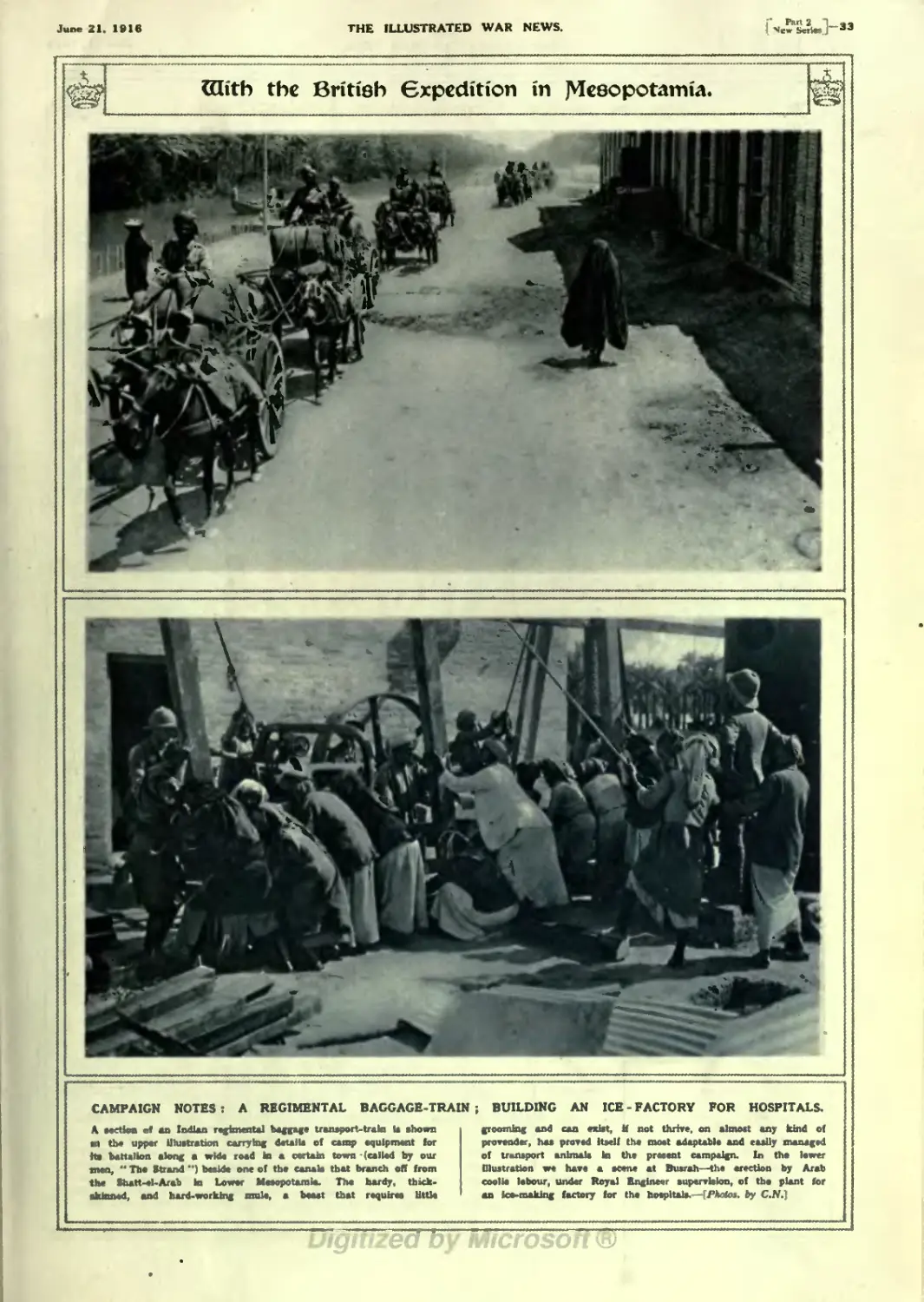
WITH THE ROYAL FLYING CORPS IN MESOPOTAMIA : ARAB COOLIES CARRY1NG.IN AN AEROPLANE WING-FRAME FOR REPAIRS.
SL^aTeZZ ( r h "* T "*"* "*'""" ,' h * """"' * n<1 ' h * Br "" h m h "" M ' "V'""|..hop,, or ,hU, hired Arab, from the
employed a. coolie, to .are our men from unneceiiary toil and fatigue. They have hard enough work at it I., -fl'hak,. fry CM.]

|_New SetiwJ * '
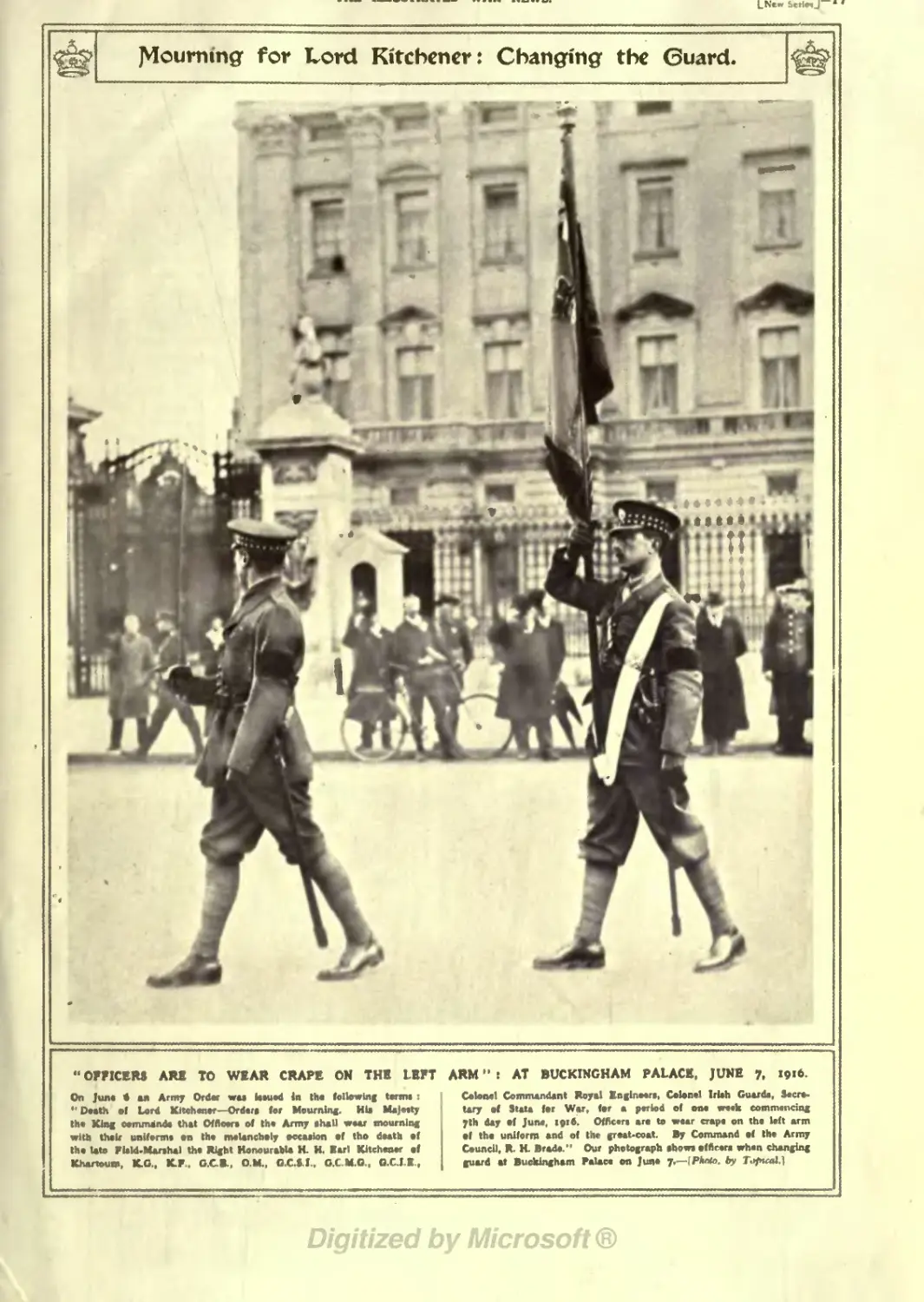
]VIourning for Lord Kitchener: Changing the Guard.
*
" OFFICERS ARE TO WEAR CRAPE ON THE LEFT ARM " : AT BUCKINGHAM PALACE, JUNE 7, 1916.
On Junt an Army Ordr wet Uiuid in tht following ttrmi :
" Death o( Lord Kitchener -Orderi lor Mourning. Hii Majetty
tht Kini commandt that Office of the Army ihll wur mournini
with thur unlformt on ih meltncholy occulon of the duth of
(h Ute Fitld-Mrih4l thi Rifht Honourbl* H. H. Earl Kltchnur of
Khmtoum. K.C., K.P.. G.C.I., O.M., G.C.S.I., G.C.M.G.. G.C.I.E.,
Coloiul Comm*ndnt Roytl EnglnMri, Colon*! IrUh Guudi, Secre-
lry of Sttt* for War, for * pirlod of on* wetlc commincinf
7th day of Junt, 1916. Offtcrn art to wtar erapt on tht Itft arm
of tht uniform and of the (rtat-coat. By Command of tht Army
Council, R H. Bradt." Our photograph ihowi officer! when chanjinj
(uard at ucklnchtm Palace on June 7. \Pkrto. by T,iptcal.l

[_Nw SeriosJ
THE ILLUSTRATED WAR NEWS.
Jun 14, 1916
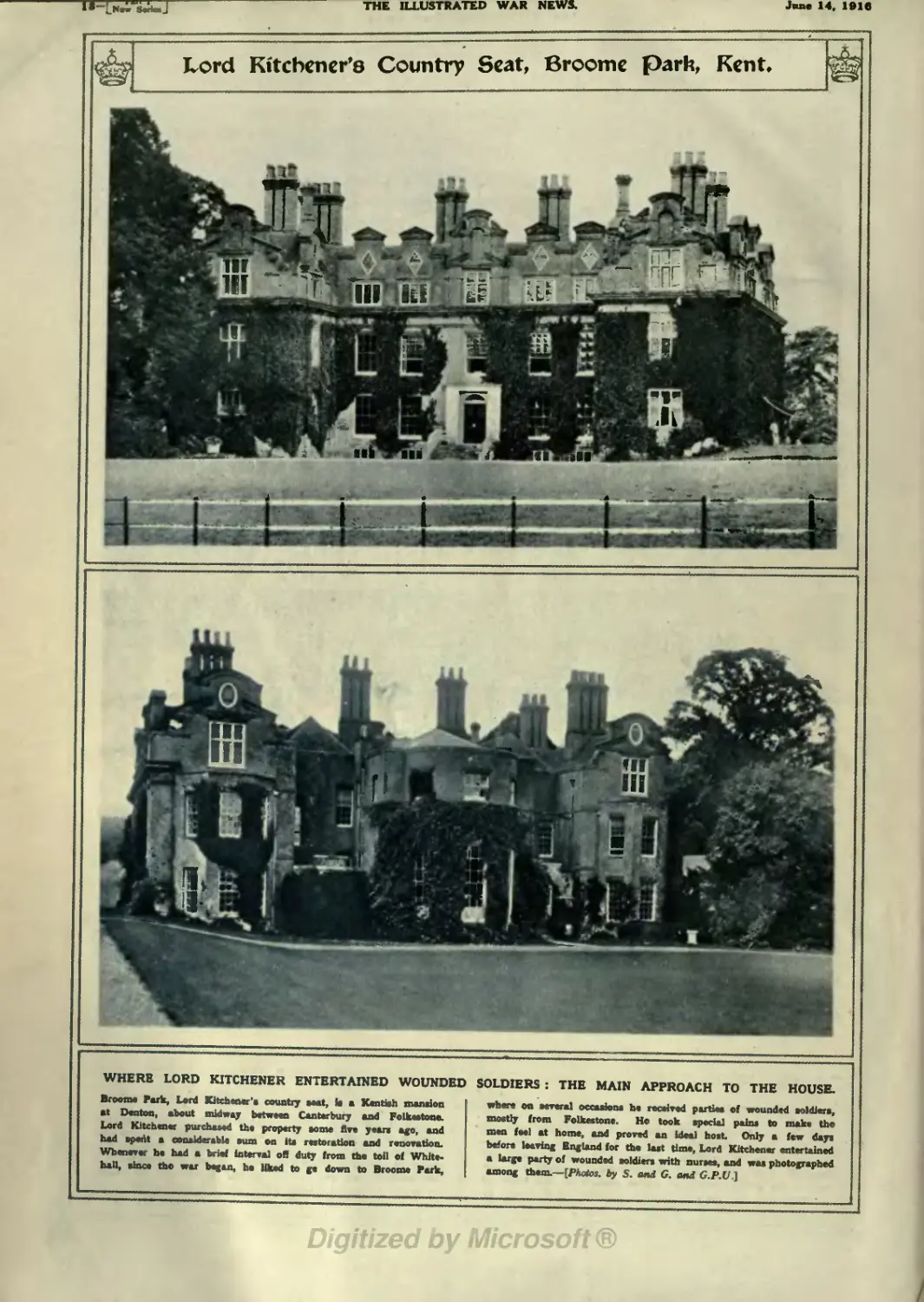
Lord Kitchener's Country Seat, Broome parh, Kent.
WHERE LORD KITCHENER ENTERTAINED WOUNDED SOLDIERS : THE MAIN APPROACH TO THE HOUSE.
Broome Park, Lord Kitchener'* country teat, ii * Kentish mansion
at Denton, about midway between Canterbury and Folkestone.
Lord Kitchener purchased the property some dye years ago, and
had spent a considerable sum on its restoration and renovation.
Whenever he had a brief interral o duty from the toll of White-
hall, since the war began, he liked to go down to Broome Park,
where on several occasions he received parties of wounded soldiers,
mostly from Folkestone. He took special pains to make the
men feel at home, and proved an ideal host. Only a few days
before leaving England for the last time, Lord Kitchener entertained
a large party of wounded soldiers with nurses, and was photographed
among them. [Photos, by S. and G. and G.P.U.]

June 14, 1916
THE ILLUSTRATED WAR NEWS.
f Part 1 -| .
[New Series J
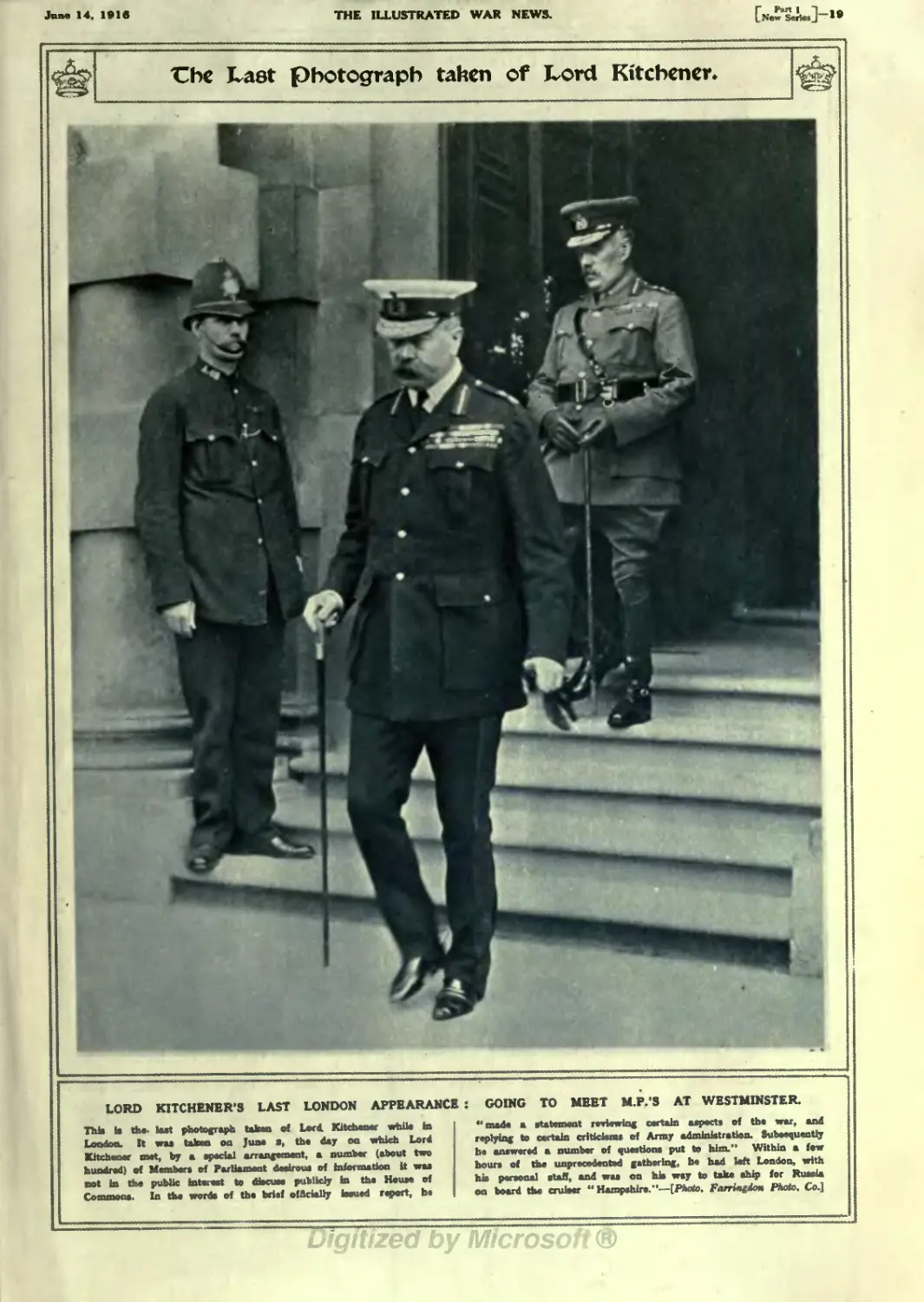
t:he Last photograph tahen of Lord Kitchener.
LORD KITCHENER'S LAST LONDON APPEARANCE: GOING TO MEET M.F.'S AT WESTMINSTER.
Thii u the. lut photograph taken ol Lord Kitchener while in
London. It wa Uken on June 2, the dty on which Lord
Kitchener met, by * special arrangement, a number (about two
hundred) of Memben ol Parliament deiiroui of information it wal
not in the public intereit to discuw publicly in the Home of
Commoni. In the word* of the brief officially lued report, he
"made a itatement reriewing certain aipecti of the war, and
replying to certain criticisms of Army admlniitration. Subsequently
he aiuwered a number of queitioni put to him." Within a few
hour of the unprecedented fathering, he had left London, with
his peraonal itaff, and wai on hii way to take ship for Ruisia
on board the cruller " Hamprhire. 1 ' [PfoXo. Farringdon Photo. Co.]

MH O
]||
H I 1
< ||
"
rf -'
U) .'
i 5 u S -a ti
^ Z- O g-;2
[ *?1 "O ^tj ITl '
.' 5
if
iiPrJ 1
99 ( * E ^ -a
o.
iii 5*>*."* .*
S 2 ~ c *
lillilri
I \W
\ Sl<<0^

s
1 Iff ftfl
:J;ll}i
B-Jf
s tf !]iil
S f : il- ? .
u *j
Z O WO .. 8 "i
1 2 K S|^
K d- 3
:*;'i
01
H "SS.S^g'Si
Bwfjr'f
^ ''jlfti*
Ulfiii
I'JIA
.a
-
J i
!

THE ILLUSTRATED WAR NEWS.
June 14. 1916
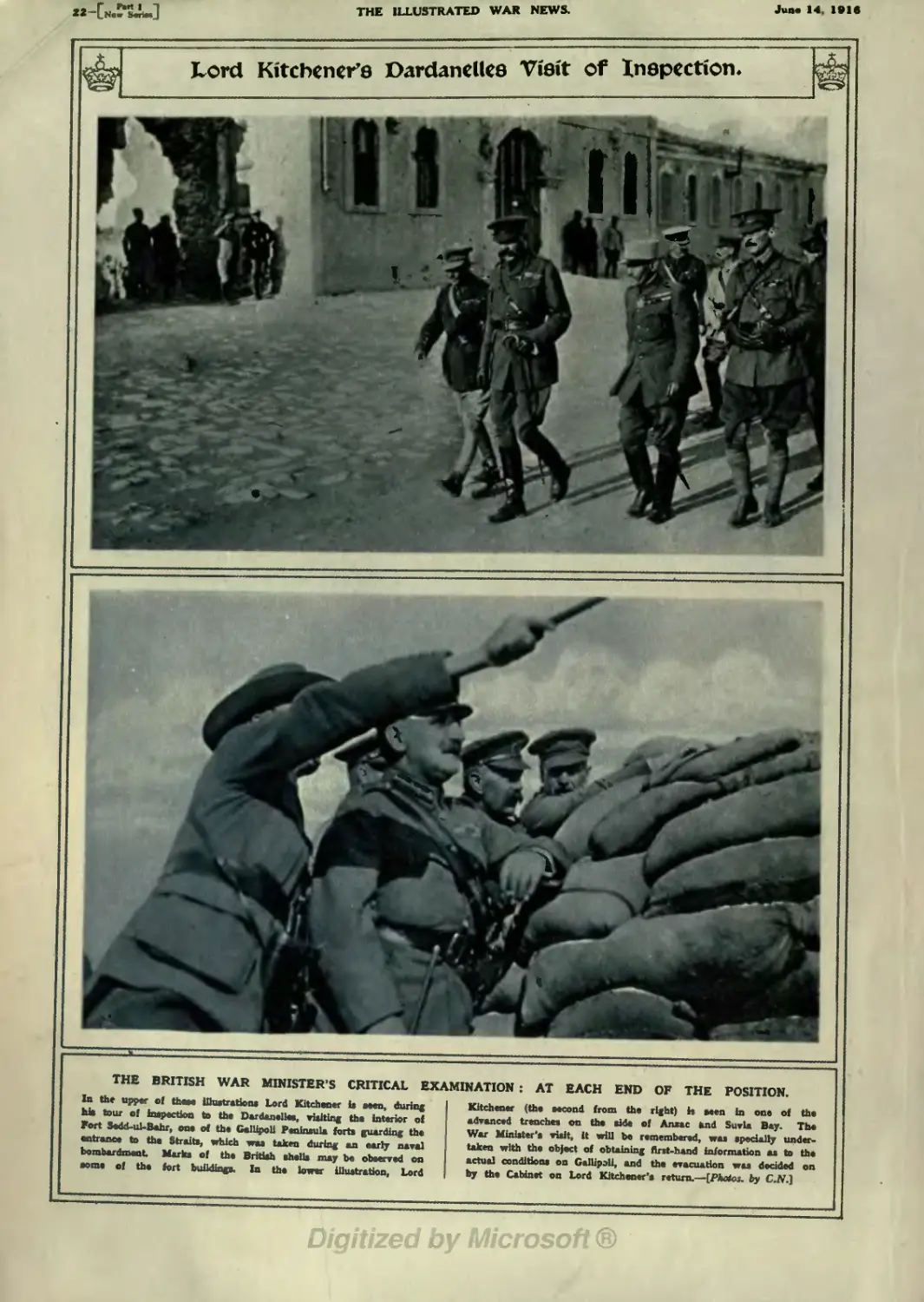
Lord Kitchener's Dardanelles Visit of Inspection,
THE BRITISH WAR MINISTER'S CRITICAL EXAMINATION: AT EACH END
In the upper of these illu.tr.tion. Lord Kitchener U een, during
hi. tour of impection to the Dardwelle., Siting the interior of
Id-ul-Bahr, one of the Gallipoll Peniruula forts guiding the
sn to the Strait., which wu taken during an early naval
mbardment. Marks of the British .hells may be observed on
e of the fort building* In the lower illutrtion, Lord
OF THE POSITION.
Kitchener (the second from the right) is H en in one of the
advanced trenches on the side of Anxac and Suvla Bay. The
War Minister 1 , vi.lt, it will be remembered, was specially under-
taken with the object of obtaining first-hand information as to the
actual conditions on Gallipali, and the evacuation wu decided on
bjr the Cabinet on Lord Kitchener's return. [Photos, by C.N.]

June 14, 1916
THE ILLUSTRATED WAR NEWS.
c SeriesJ~ 23
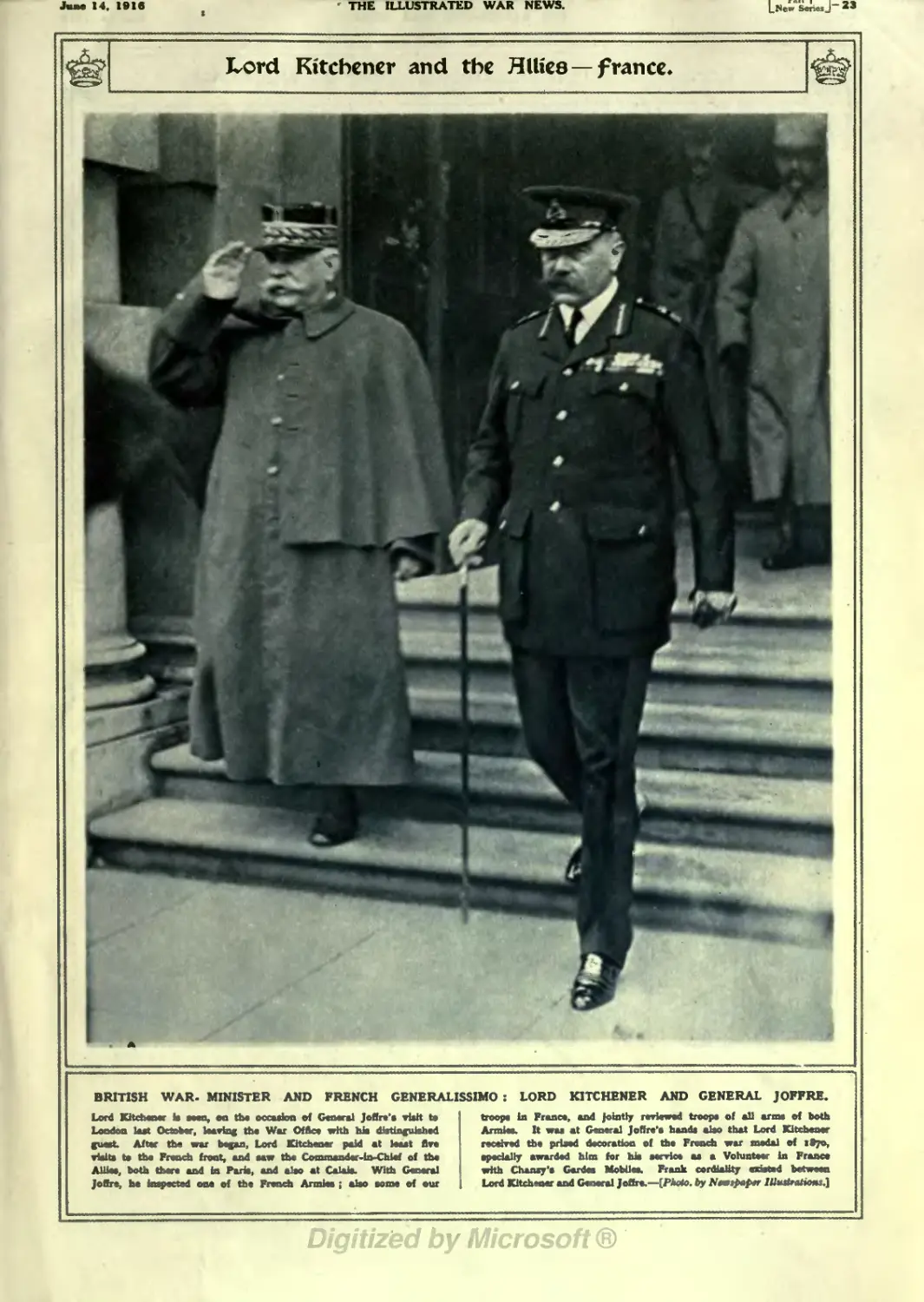
Lord Kitchener and the HUiea f ranee.
BRITISH WAR. MINISTER AND FRENCH GENERALISSIMO : LORD KITCHENER AND GENERAL JOFFRE.
Lord Kitchener U seen, on the occuion of General Joflre'i ruit to
London lut October, leaving the War Office with hu distinguished
guest After the war began, Lord Kitchener paid at least fire
risits to the French front, and saw the Commander-in-Chief of the
Allies, both there and in Paris, and also at Calais. With General
Joffre, he inspected one of the French Armies ; also some of our
troopt in France, and jointly reviewed troops of all arms of both
Armies. It was at General Jofire's hands also that Lord Kitchener
received the prized decoration of the French war medal of 1(70,
specially awarded him for his service as a Volunteer in Franc*
with Chansy's Gardes Mobiles. Frank cordiality existed between
Lord Kitchener and General Joffre. [Pkoto. by Newspaper Illustrations.]

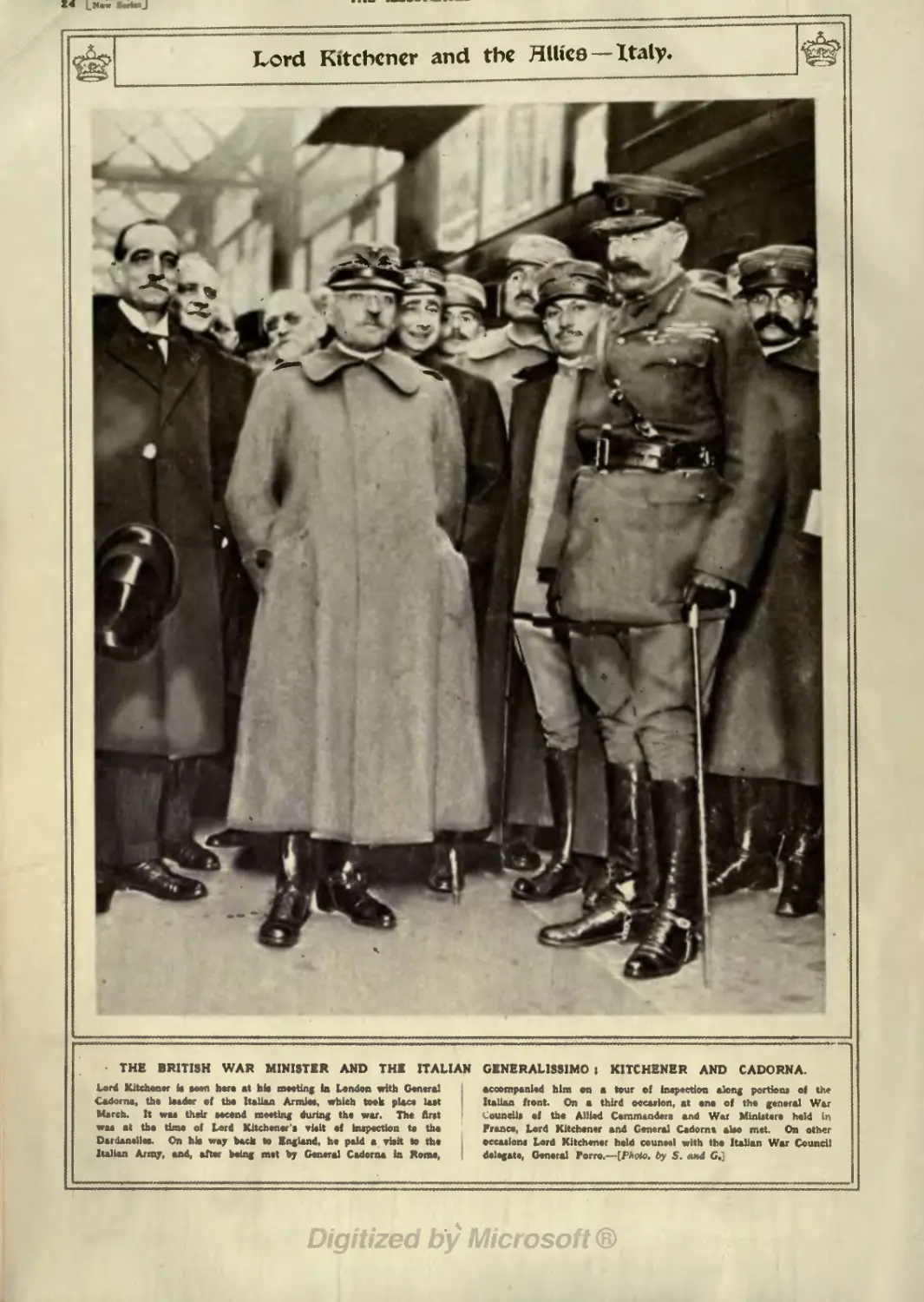
24 N.W SertosJ
Lord Kitchener and the HUiee Italy.
THE BRITISH WAR MINISTER AND THE ITALIAN GENERALISSIMO : KITCHENER AND CADORNA.
Lord Kitchener la ie*n here at hii meeting In London with General
Cadorna, the leader el thi Italian Armta, which took plact lait
March. It wit their Mcond meeting during th war. Tht Ant
waa at tht tlmt of Lord Kitchener's riiit el Inipectlon to th
Dardanelles. On hli way back to England, hi paid a viiit to the
Italian Anny, and, after binj met by General Cadorna In Rome,
accompanied him on a tour of Inspection along portions of tht
Italian front. On a third occasion, at one of the general War
Council! of the Allied Coramandtrt and War Ministers htld in
Franc*, Lord Kitchener and General Cadornt alto met. On other
occasloni Lord Kitchener held counsel with tht Italian War Council
delegate, General Porro. [/Vioto. by S. and G.'_

June 14, 1918
THE ILLUSTRATED WAR NEWS,
|- Part I -I ,.
LNew SrlesJ~ zs
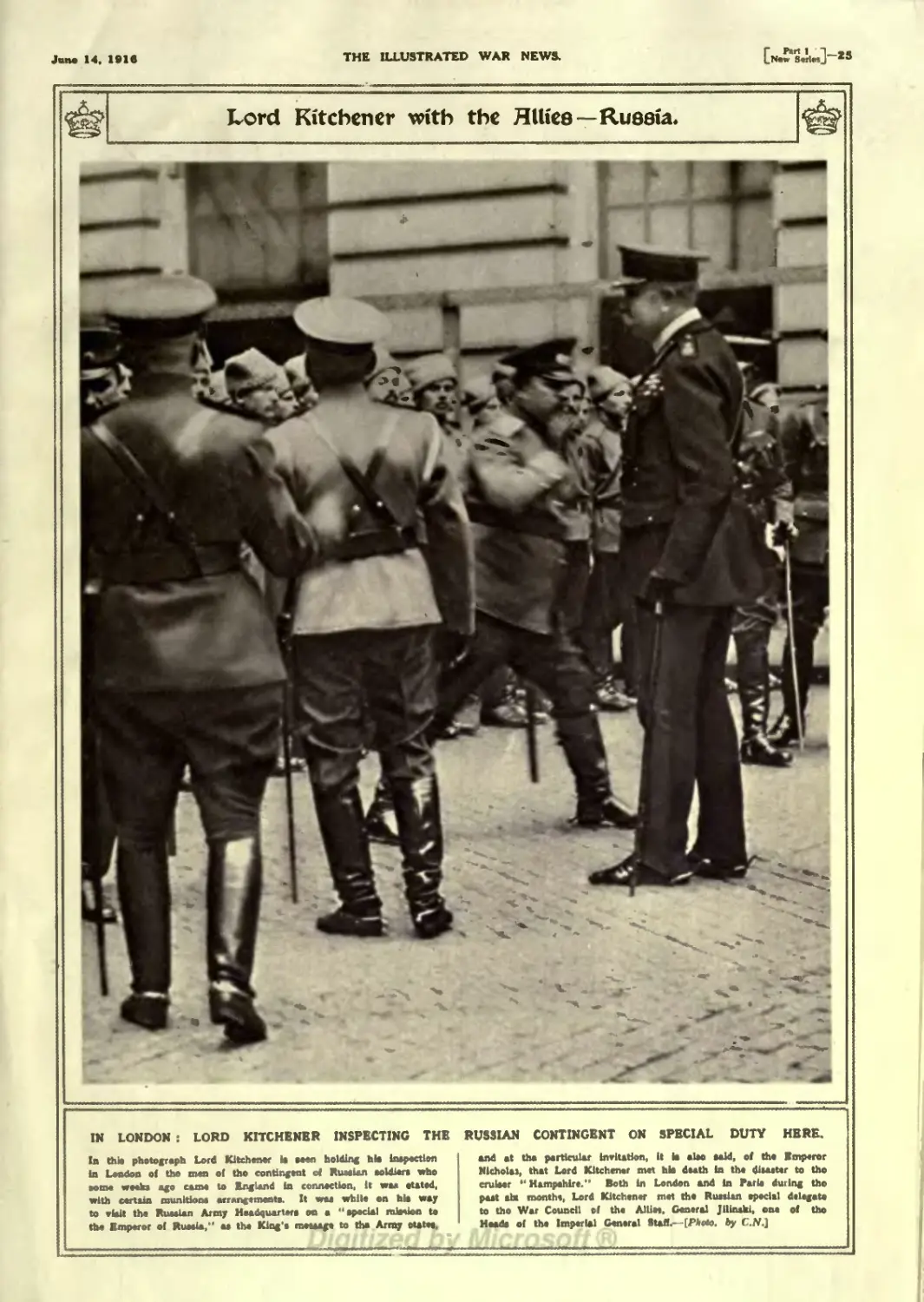
Lord Kitchener with the HUies Rueeia.
IN LONDON : LORD KITCHENER INSPECTING THE RUSSIAN CONTINGENT ON SPECIAL DUTY HERE.
In thte photograph Lord Kitchener It Men holding hii inipectlon
in London ol the men of the contingent ol Ruetlan lolditn who
ome weeks ago came to England in connection, It wu Hated,
with certain munition! arrongementi. It wai while on hll way
to Tlalt the Russian Army Headquarters on a " special minion to
the Emperor ol Rueila," ea the King's mmaje to the Army states,
and at the particular Invitation, It ii alao aaid, of the Bmperor
Nlcholai, that Lord Kitchener met hll death In the dluiter to the
cruiser " Hampahlre. " Both In London and In Parla during the
paat >lx monthi, Lord Kitchener met the Rutilan ipeclil delegate
to the War Council of the Allln, General Jillnikl, one at the
Httdi ol the Imperial General Starl.-- [Woto. fty C.N.]

.- r
26 L
ftn l "|
B.rmJ
THE ILLUSTRATED WAR NEWS.
June 14. 1916
THINGS DONE: I.-THE ROYAL HORSE AND FIELD ARTILLERY.
A \VISE and fearless man can, even now,
divide the functions of the Royal Regiment
of Artillery into two groups, though it must be
confessed that, in the time before war went to
earth and stayed
there, one felt easier
and less daring in
insisting upon the
fact that artillery
was light and
mobile, as well as
heavy and more or
less fixed in posi-
tion. However,
even to-day, when
strange and cen-
sored guns and
groupings are mak-
ing their appear-
ances in the culs-
de-sac of war, the
laws that govern
the administration
of Army groups
help us, and we
can say, with the
War Office behind
us, that the Royal
Regiment is separ-
ated into two
corps the Horse
and Field (the
light and mobile) and the Garrison Artillery,
which is the slow and heavy. In the latter
grouping
might be'in-
cluded the
Howitzer
Batteries,
though, un-
til war came
to confuse
us, these
were usually
b rigaded
with the
Field. To
place trench-
mo rt ar s,
b o m b-
throw.ers,
and aerial-
to rp e d o
casters must
be left to
the military
historian of
the future.
He is sure
to be a fel-
low heroic
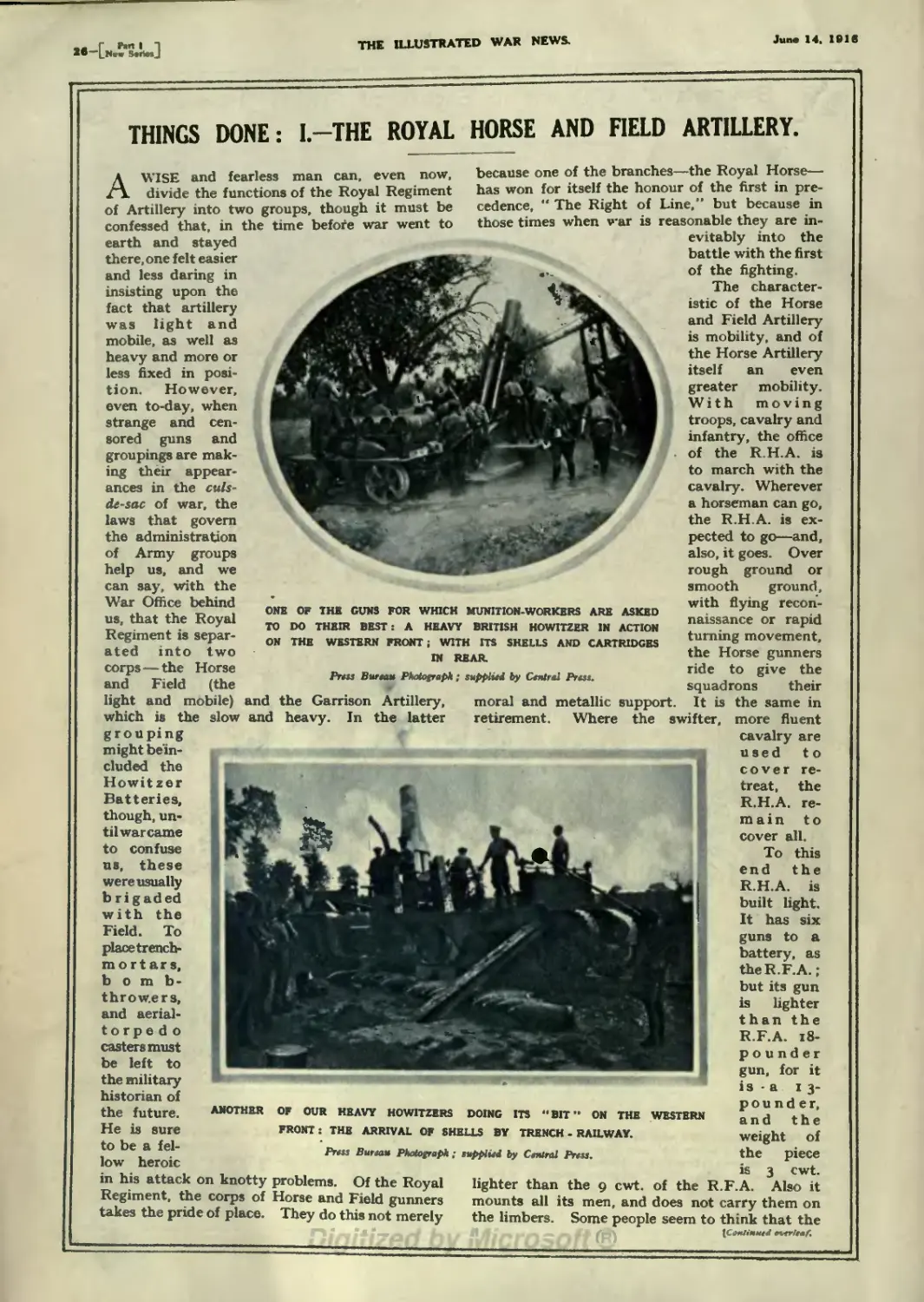
ONE OF THE GUNS FOR WHICH MUNITION-WORKERS ARE ASKED
TO DO THEIR BEST: A HEAVY BRITISH HOWITZER IN ACTION
ON THE WESTERN FRONT ; WITH ITS SHELLS AND CARTRIDGES
IN REAR
Press Bureau Photograph ; supplied by Central Press.
ANOTHER OF OUR HEAVY HOWITZERS DOING ITS "BIT" ON THE WESTERN
FRONT : THE ARRIVAL OF SHELLS BY TRENCH . RAILWAY.
Press Bureau Photograph ; supplied by Central Press.
in his attack on knotty problems. Of the Royal
Regiment, the corps of Horse and Field gunners
takes the pride of place. They do this not merely
because one of the branches the Royal Horse
has won for itself the honour of the first in pre-
cedence, " The Right of Line," but because in
those times when war is reasonable they are in-
evitably into the
battle with the first
of the fighting.
The character-
istic of the Horse
and Field Artillery
is mobility, and of
the Horse Artillery
itself an even
greater mobility.
With moving
troops, cavalry and
infantry, the office
of the R.H.A. is
to march with the
cavalry. Wherever
a horseman can go,
the R.H.A. is ex-
pected to go and,
also, it goes. Over
rough ground or
smooth ground,
with flying recon-
naissance or rapid
turning movement,
the Horse gunners
ride to give the
squadrons their
moral and metallic support. It is the same in
retirement. Where the swifter, more fluent
cavalry are
MVCBMMMMWMMMBaiHMB used to
cover re-
treat, the
R.H.A. re-
main to
cover all.
To this
end the
R.H.A. is
built light.
It has six
guns to a
battery, as
theR.F.A. ;
but its gun
is lighter
than the
R.F.A. 18-
p o u nder
gun, for it
is a 13-
pounder,
and the
weight of
the piece
is 3 cvvt.
lighter than the 9 cwt. of the R.F.A. Also it
mounts all its men, and does not carry them on
the limbers. Some people seem to think that the

Jun. 14. 1916
THE ILLUSTRATED WAR NEWS.
f Part 1 "I
|_New Sf.r!.s_|-
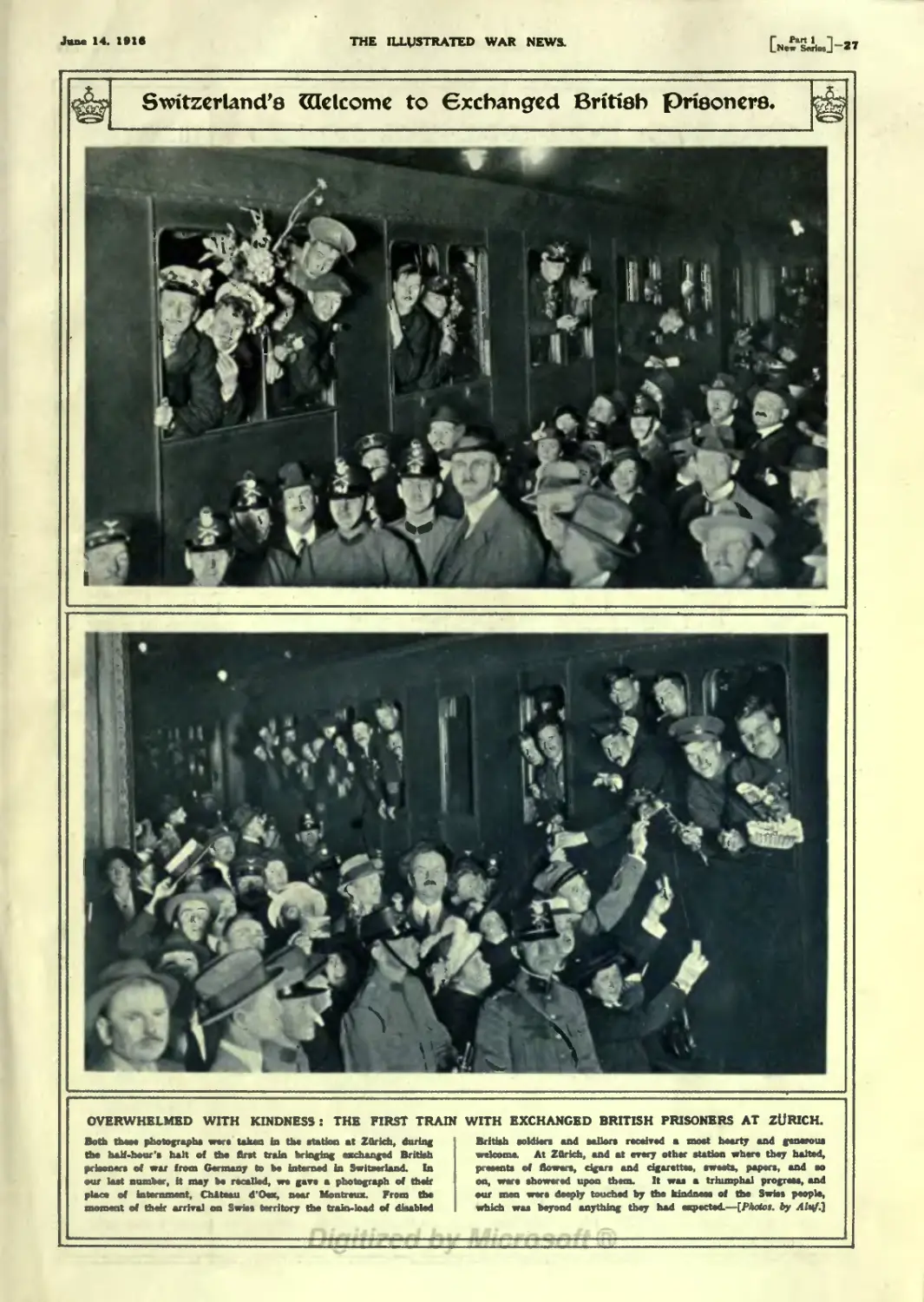
Switzerland's delcomc to exchanged British prisoners.
OVERWHELMED WITH KINDNESS : THE FIRST TRAIN WITH EXCHANGED BRITISH PRISONERS AT ZURICH.
Both these photographs were taken in the nation at Zurich, during
the half-hour's hlt of the first train bringing exchanged British
prisoners of war from Germany to be interned in Switzerland. In
our last number, it may be recalled, we gave a photograph of their
place of internment, Chateau d'Ocx, near Montreux. From the
moment of their arrival on Swiai territory the train-load of disabled
British soldiers and sailors received a most hearty and generous
welcome. At Zurich, and at every other station where they halted,
presents of flowers, cigars and cigarettes, sweets, papers, and so
on, were showered upon them. It was a triumphal progress, and
our men were deeply touched by the kindness of the Swiss people,
which was beyond anything they had expected. [PAoiot. by Altif.}

, r Fan I 1
"-(.New Series]
THE ILLUSTRATED WAR NEWS.
June 14, 1916
fact that the R.H.A. does not carry gunners on
the limbers is the chief difference between Horse
and Field batteries. This is not quite the truth.
The difference lies in the fact that the R.II.A.
cannot afford to risk carrying gunners on the
limbers. Watch the corps charging headlong,
teams stretching, traces taut (as is the resolute
L
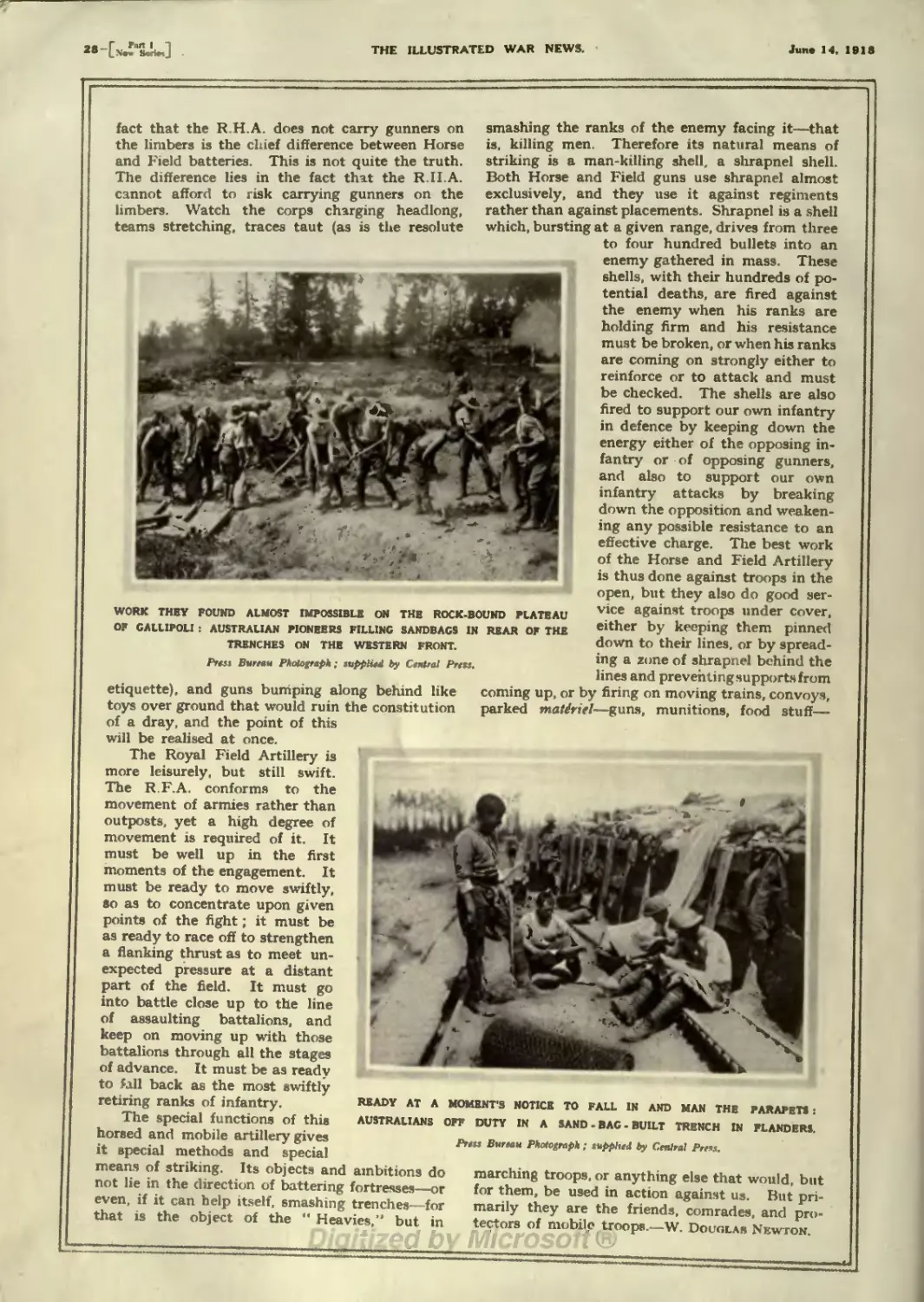
WORK THEY FOUND ALMOST IMPOSSIBLE ON THE ROCK-BOUND PLATEAU
OF GALLIPOLI : AUSTRALIAN PIONEERS FILLING SANDBAGS IN REAR OF THE
TRENCHES ON THE WESTERN FRONT.
Prtsi Bureau Photograph ; supplied ky Central Prtss.
etiquette), and guns bumping along behind like
toys over ground that would ruin the constitution
of a dray, and the point of this
will be realised at once.
The Royal Field Artillery is
more leisurely, but still swift.
The R.F.A. conforms to the
movement of armies rather than
outposts, yet a high degree of
movement is required of it. It
must be well up in the first
moments of the engagement. It
must be ready to move swiftly,
so as to concentrate upon given
points of the fight ; it must be
as ready to race off to strengthen
a flanking thrust as to meet un-
expected pressure at a distant
part of the field. It must go
into battle close up to the line
of assaulting battalions, and
keep on moving up with those
battalions through all the stages
of advance. It must be as ready
to fall back as the most swiftly
retiring ranks of infantry.
The special functions of this
horsed and mobile artillery gives
it special methods and special
means of striking. Its objects and ambitions do
not lie in the direction of battering fortresses or
even, if it can help itself, smashing trenches for
that is the object of the " Heavies," but in
smashing the ranks of the enemy facing it that
is, killing men. Therefore its natural means of
striking is a man-killing shell, a shrapnel shell.
Both Horse and Field guns use shrapnel almost
exclusively, and they use it against regiments
rather than against placements. Shrapnel is a shell
which, bursting at a given range, drives from three
to four hundred bullets into an
enemy gathered in mass. These
shells, with their hundreds of po-
tential deaths, are fired against
the enemy when his ranks are
holding firm and his resistance
must be broken, or when his ranks
are coming on strongly either to
reinforce or to attack and must
be checked. The shells are also
fired to support our own infantry
in defence by keeping down the
energy either of the opposing in-
fantry or of opposing gunners,
and also to support our own
infantry attacks by breaking
down the opposition and weaken-
ing any possible resistance to an
effective charge. The best work
of the Horse and Field Artillery
is thus done against troops in the
open, but they also clo good ser-
vice against troops under cover,
either by keeping them pinned
down to their lines, or by spread-
ing a zone of shrapnel behind the
lines and prevehtingsupportsfrom
coming up, or by firing on moving trains, convoys,
parked matMel guns, munitions, food stuff
READY AT A MOMENT'S NOTICB TO FALL IN AND MAN THE PARAPETS:
AUSTRALIANS OFF DUTY IN A SAND . BAG - BUILT TRENCH IN FLANDERS.
Prtss Bnau Photograph ; supplied by Central P,m.
marching troops, or anything else that would, but
for them, be used in action against us. But pri-
marily they are the friends, comrades, and pro-
tectors of mobile troops. w. DOUCLAS XKWTON

Jun. 14, 1916
THE ILLUSTRATED WAR NEWS.
CPar
New
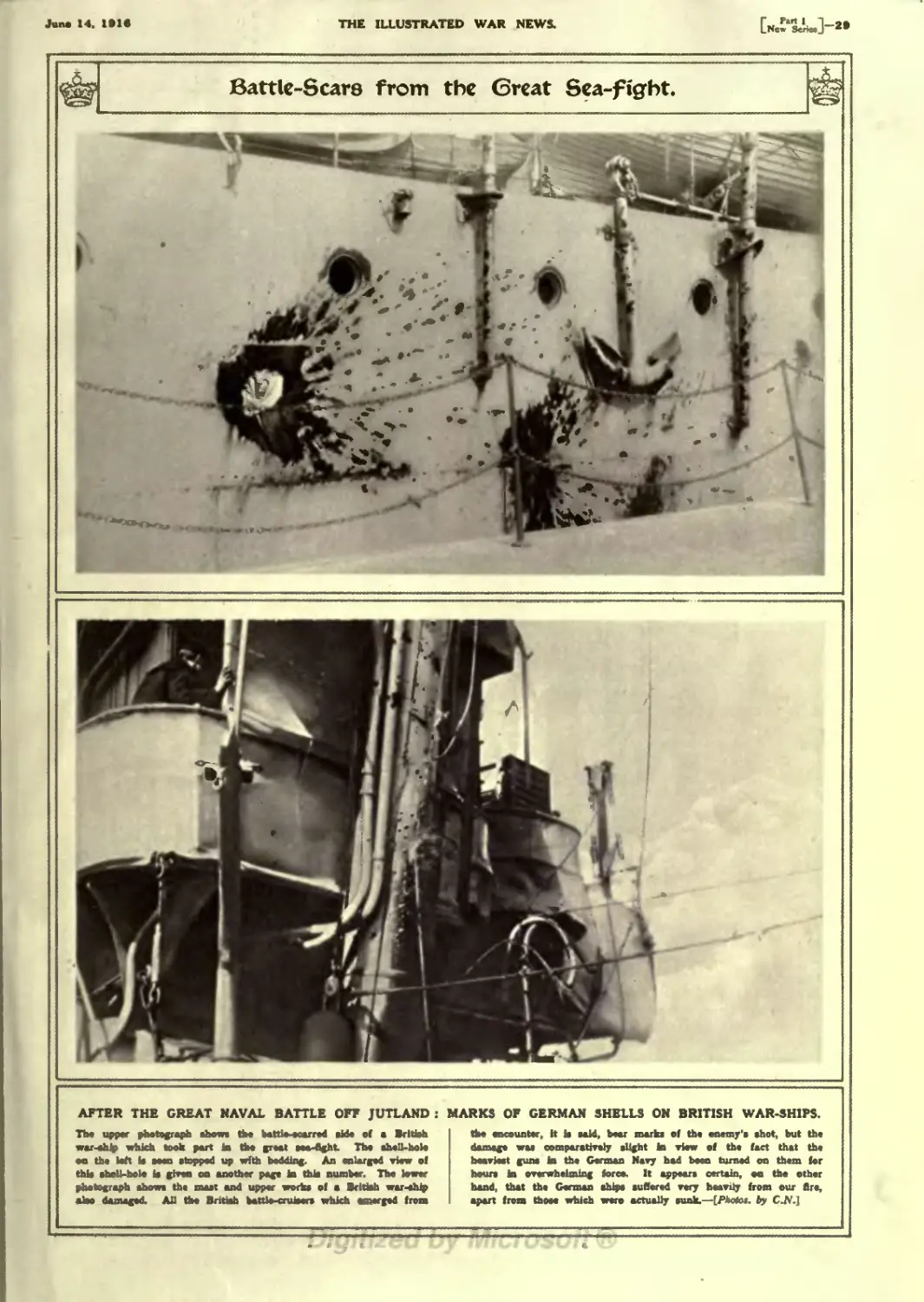
Battle-Scars from the Great Sea-fight.

AFTER THE GREAT NAVAL BATTLE OFF JUTLAND : MARKS OF GERMAN SHELLS ON BRITISH WAR-SHIPS.
The upper photograph ihowi the batt!e-carr*d iid of a British
war-thip which took part in the freat sea-fight. The ihell-hole
oo the left is s*en stopped up with bedding. An enlarged rlew of
this shell-hole is given on another page in this number. The lower
photograph shows the mast and upper works of a British war-ship
also damaged. All the British battle-cruiaen which emerged from
the encounter, it Is said, bear marks of the enemy's shot, but the
damage was comparatively slight in view of the fact that the
heaviest guns in the German Nary had been turned on them for
hours in overwhelming force. It appears certain, on the other
hand, that the German ships suffered very heavily from our fire,
apart from those which were actually sunk. [Photos, by CJV.J

THE ILLUSTRATED WAR NEWS.
Jon* 14. 1916
jviarhs of the Great Battle on British Olar-Ships.
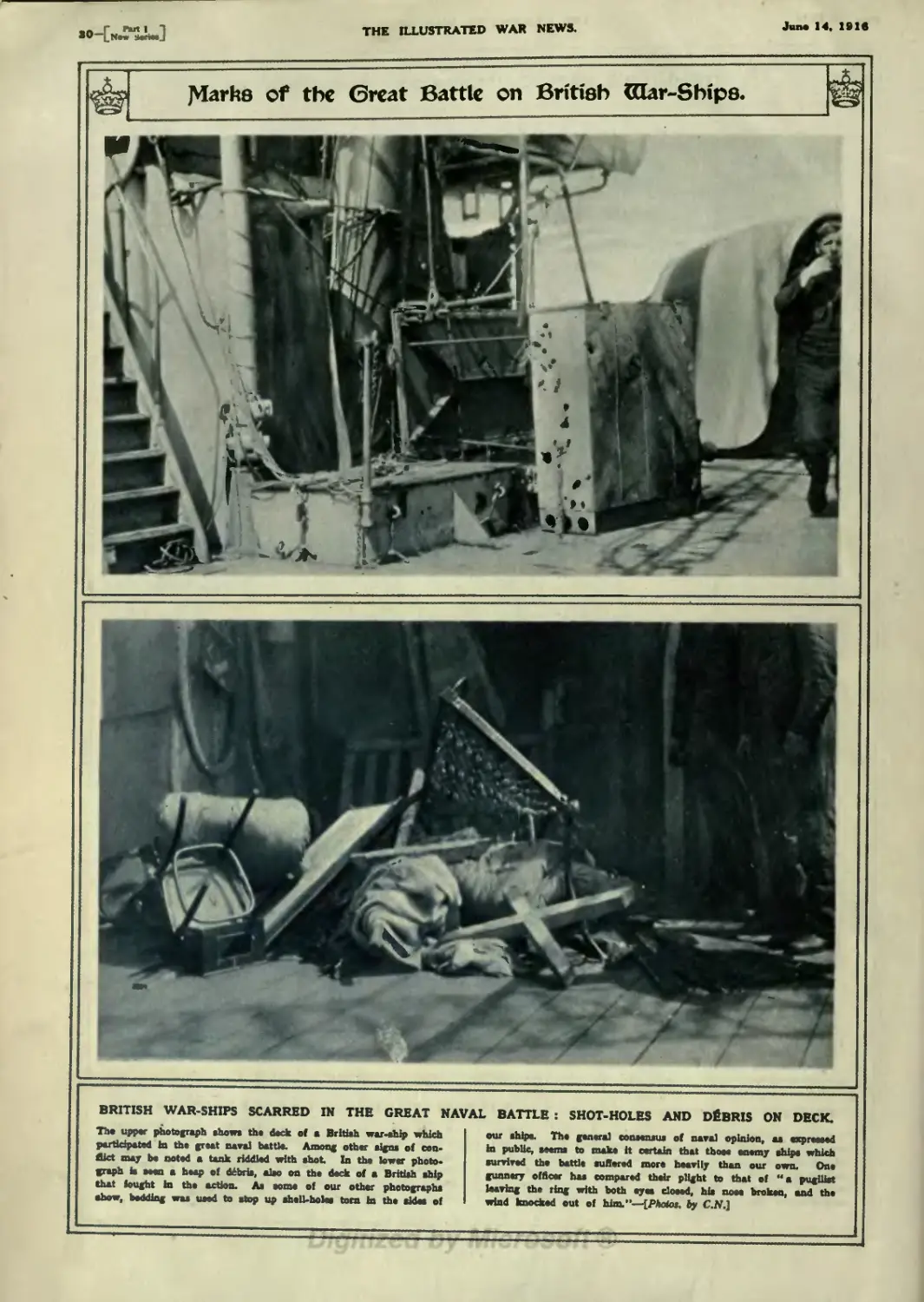
BRITISH WAR-SHIPS SCARRED IN THE GREAT NAVAL BATTLE : SHOT-HOLES AND DEBRIS ON DECK.
Th. upper photograph .how, the deck of * British war-.hlp which our ihlpi. The general coniennu of naral opinion, a. exprewed
d in the great naral battle. Among other .ign. of con- In public, Menu to make it certain that thoie enemr ihipi which
fllct m. r be noted a tank riddled with .hot In the tower photo- weired the battle .uff.red more hearU, than our owrl On,
graph i. , a heap of debrl,, aUo on the deck of a Britiah .hip gunnery officer ha. compart their plight to that of "a pugili.
that fought in the action. A. some of our other photograph. l..Ttag the ring with both eye. clo.ed, hi. no broken and
.bow, bJding wa. ud to .top up A.ll-hole. torn In the aide, of wind knocked out of him. "-[/>*<* by ftlfj

June 14. 1916
THE ILLUSTRATED WAR NEWS.
r pan i 1 .
LNew SerlesJ 3
H ttlar-Sbip's Wound " Dressed" with Bedding.
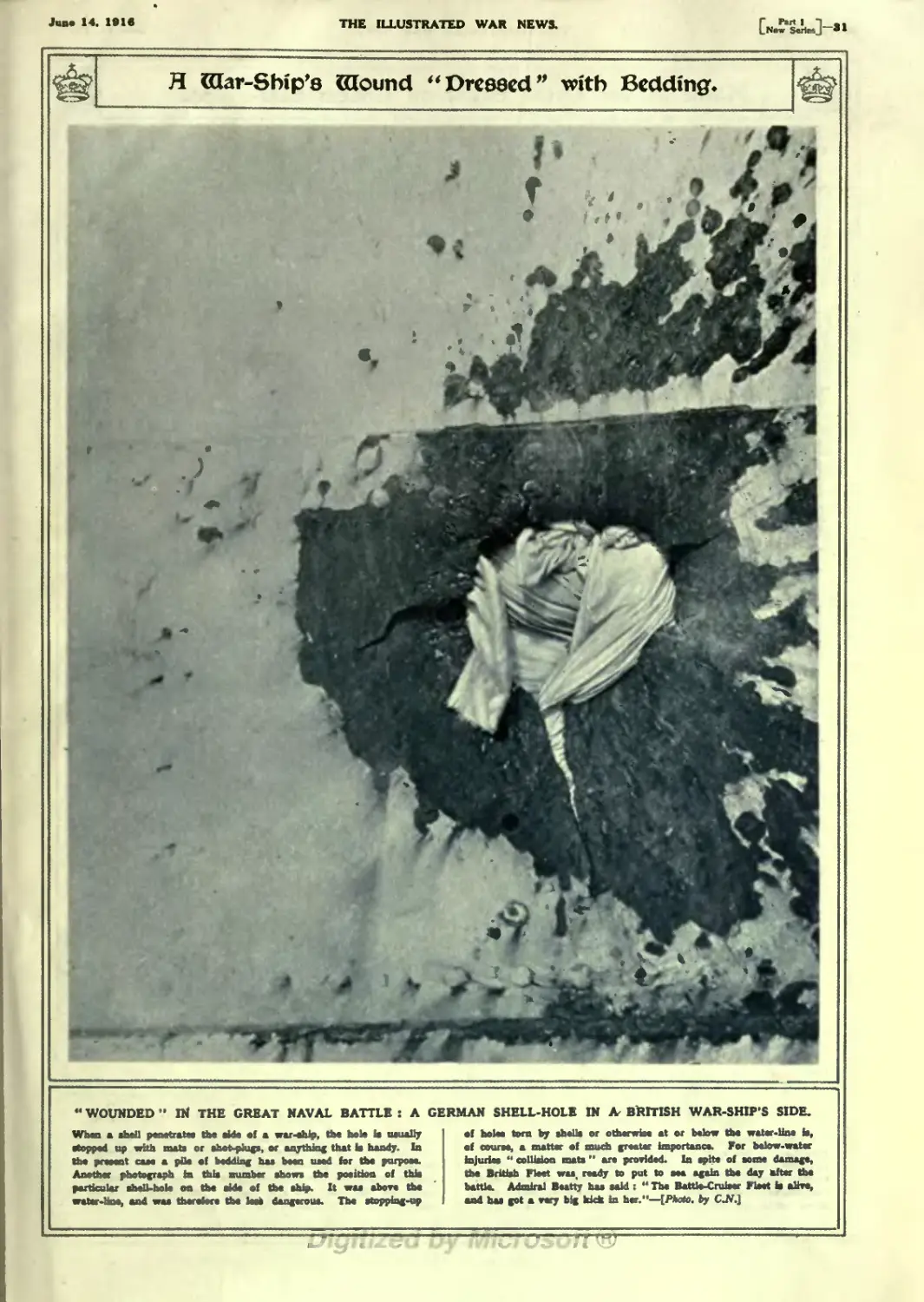
"WOUKDED" nt THE GREAT NAVAL BATTLE: A GERMAN SHELL-HOLE IN A- BRITISH WAR-SHIP'S SIDE.
When a shell penetrttes the side of * wmr-thip, the hole Is usually
topped up with nuts or shot-plugs, or anything that is handy. In
the present caM a pile of bedding has been used (or the purpose.
Another photograph In this number shows the pontion of this
particular shell-hole on the aide of the ship. It wu above the
water-line, and was therefore the leti dangerous. The stopping-up
of holes torn by sheila or otherwise at or below the water-line Is,
of course, a matter of much greater importance. For below-water
Injuries " collision mats " are provided. In spite of some damage,
the British Fleet was. ready to put to sea again the day after the
battle. Admiral Beatty has said : "The Battle-Cruiser Fleet is .lire,
and has got a very big kick in her." [PMo. by C..V.]

THE ILLUSTRATED WAR NEWS.
June 14, 1916
Ht the Camp of the Russians in france
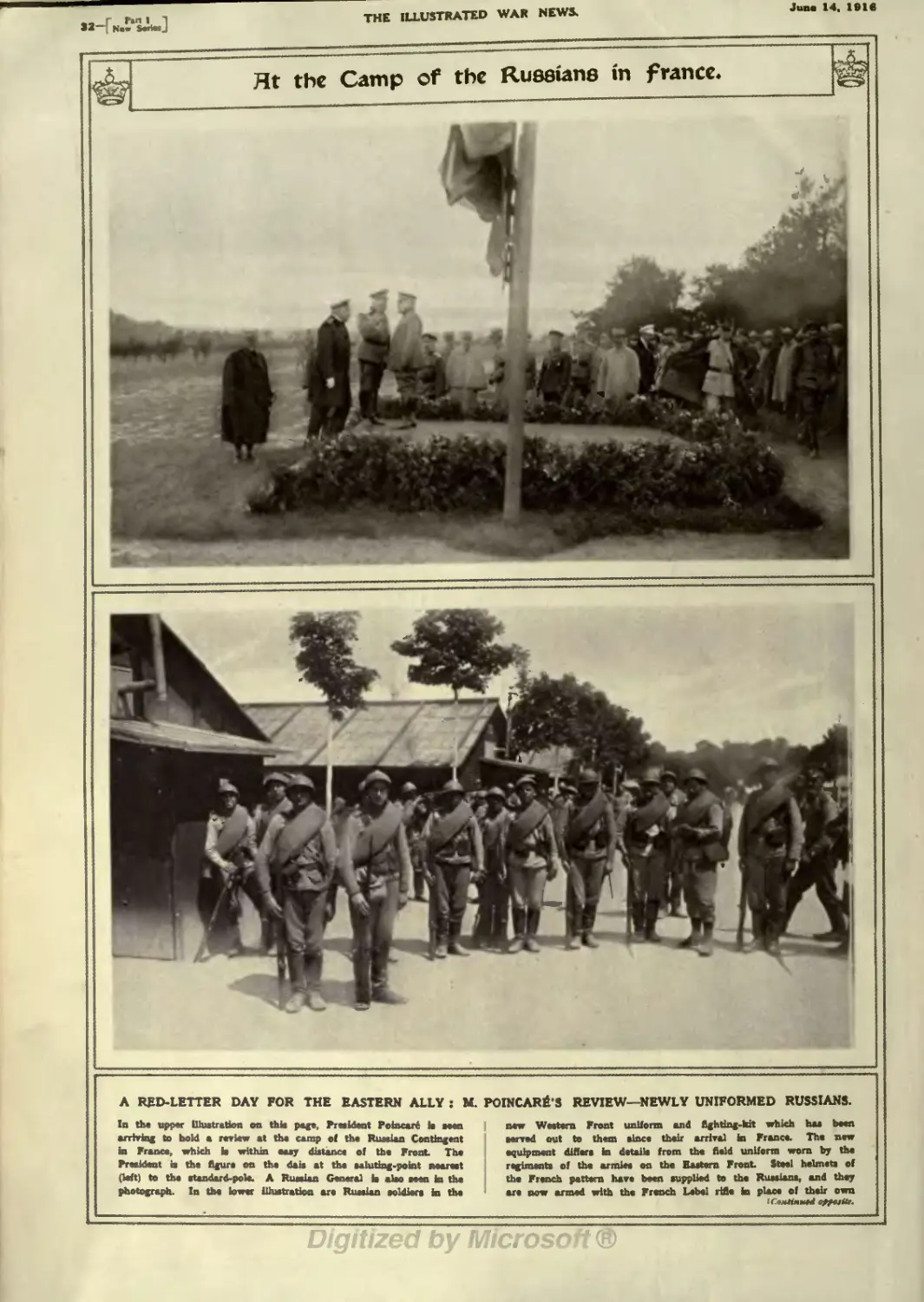
A RED-LETTER DAY FOR THE EASTERN ALLY : M. POINCARlt'S REVIEW NEWLY UNIFORMED RUSSIANS.
In the upper illustration on thU page, President Poincart fa seen
arnYing to hold a reriew at the camp of the Russian Contin(ent
In France, which is within easy distance of the Front. The
President is the figure on the daii at the saluting-point nearest
(left) to the standard-pole. A Russian General is also seen in the
photograph. In the lower illustration are Russian soldiers in the
new Western Front uniform and nihtlni-kit which has been
served out to them since their arrival in France. The new
equipment differs In details from the field uniform worn by the
regiments of the armies on the Eastern Front Steel helmets of
the French pattern have been supplied to the Russians, and they
are now armed with the French Lebel rifle in place of their own

Jan. 14. 1918
THE ILLUSTRATED WAR NEWS.
Che New fighting Kit of the Russians in f ranee.
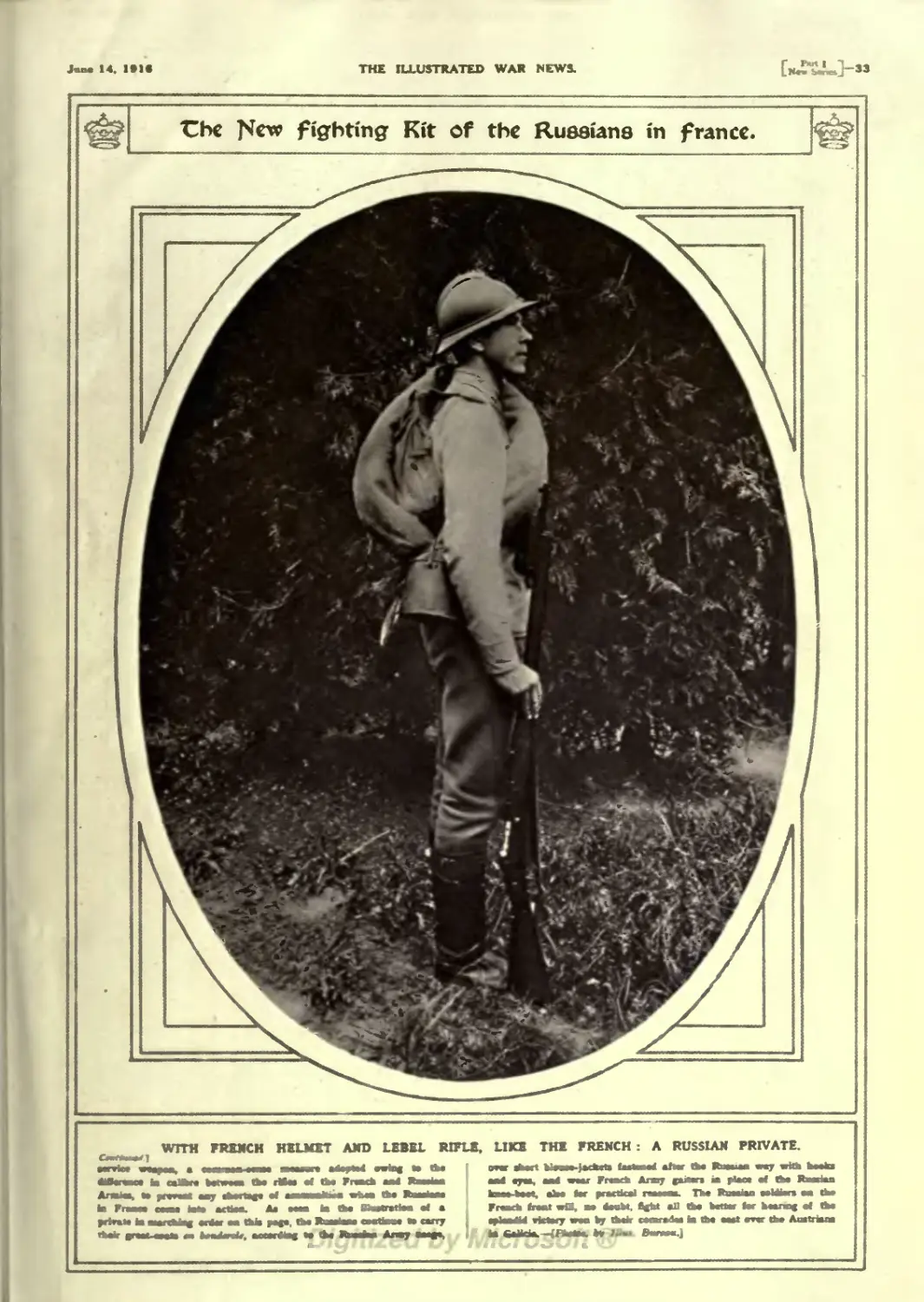
WITH FRENCH HELMET AMD LEBEL RIFLE, LIKE THE FRENCH : A RUSSIAN PRIVATE.
! CB*M tatwMB tb. rifl*. of * Praock and ill I
aialnia wban dM Roataim
M ta UM OlmrallM <
Ik* Riiiilini CMtknw to carry
. iccirlBH to DM RuHiu Arnrj
and wear French Array faitcn place a< th<
aba tar practical mini TW Biiaihin MUiiri aa th*
Franch (rant will, no doubt, ftfht an dx better <er hearinc ef th*
aalaaaW Tickxy wao by their comrade* in th* tan or*r the Aoltriaai

THE ILLUSTRATED WAR NEWS.
June 14. 1916
WOMEN AND THE WAR.
THE women are splendid." said Mr. Lloyd
George some time ago. As if women did
not know that before. They are not surprised,
though a great many men seem to be, that the
hand that uses the powder-
puff can also help to rule
the world or at least to
help England at her task
in preventing Germany
ruling it and there is
ample testimony to the
value ol women's services
in this direction . Seriously,
it is not altogether a com-
pliment, this perpetual
astonishment of the male
publicist that the women
should have proved them-
selves worth their salt in
the great emergency of
the war.
It is the object of these
articles to sketch the activi-
ties of women in various
directions connected with
the great struggle. The
full story must be left till
later. When it is told it
will astonish England and
Germany too. For Germany
made not the least coarse
of her mistakes when she imagined that because
Englishwomen were not dull, fat, and housewifey
in and out of
season, like the
German frau,
they are merely
frivolous and
giddy. We
do not know
what Fraulein
Schmidt and
Frau Schultz
are doing.
Their best, no
doubt. But
one may be
sure it is a
dull, uninven-
tive, routine
sort of best as
compared with
the energetic
and creative
work of Eng-
lishwomen.
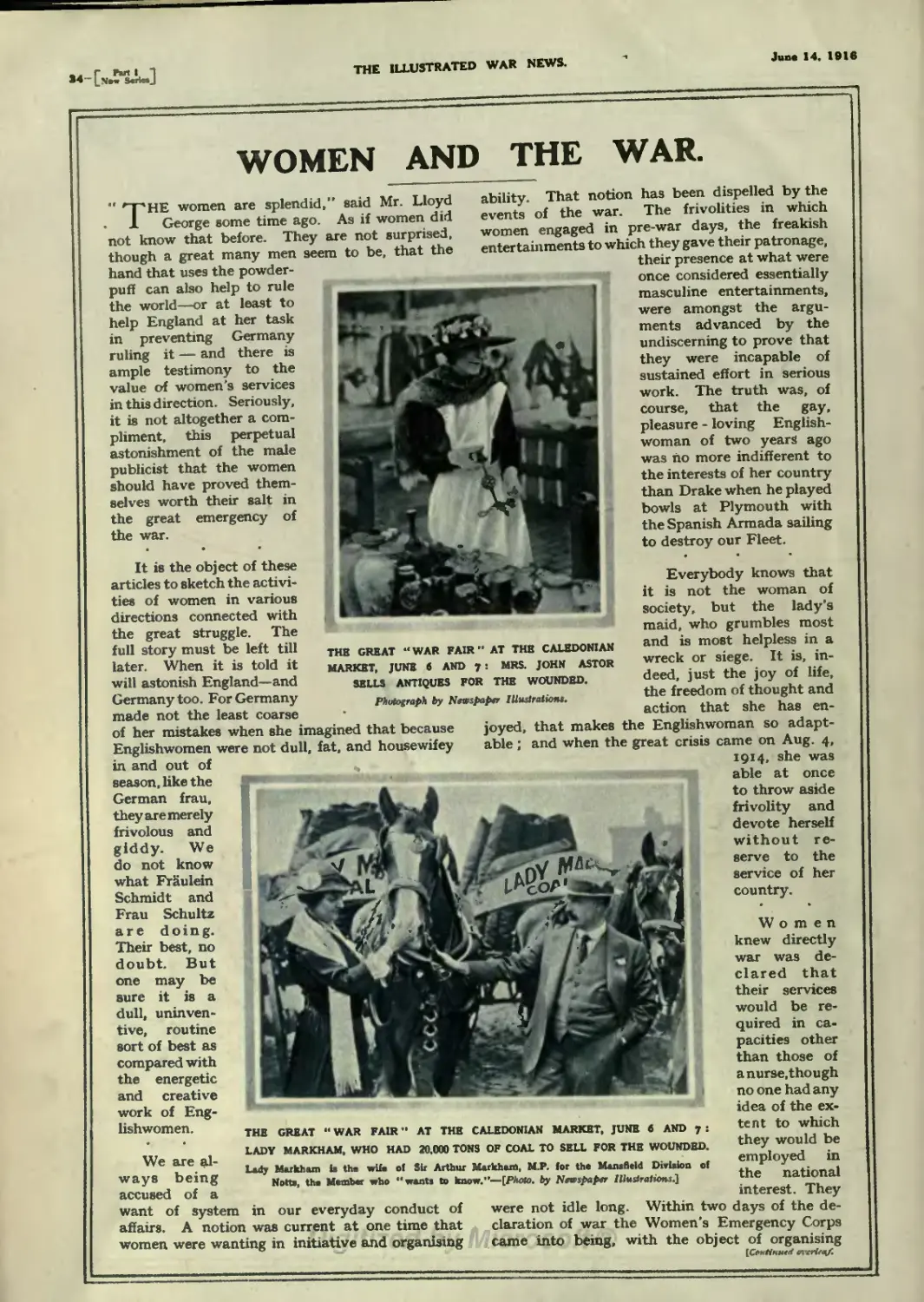
THE GREAT "WAR FAIR" AT THE CALEDONIAN
MARKET, JUNE 6 AND 7 : MRS. JOHN ASTOR
SELLS ANTIQUES FOR THE WOUNDED.
Photograph by Newspaper Illustrations.
THE GREAT " WAR FAIR " AT THE CALEDONIAN MARKET, JUNE 6 AND 7 :
LADY MARKHAM, WHO HAD 20.000 TONS OF COAL TO SELL FOR THE WOUNDED.
Lady Markham is the wife of Sir Arthur Markham, M.P. for the Mansfield Dirision of
Nottt, the Member who "wanti to know." [Photo, by Newspaper Illustrations.}
We are al-
ways being
accused of a
want of system in our everyday conduct of
affairs. A notion was current at one time that
women were wanting in initiative and organising
ability That notion has been dispelled by the
events of the war. The frivolities in which
women engaged in pre-war days, the freakish
entertainments to which they gave their patronage,
their presence at what were
once considered essentially
masculine entertainments,
were amongst the argu-
ments advanced by the
undiscerning to prove that
they were incapable of
sustained effort in serious
work. The truth was, of
course, that the gay,
pleasure - loving English-
woman of two years' ago
was no more indifferent to
the interests of her country
than Drake when he played
bowls at Plymouth with
the Spanish Armada sailing
to destroy our Fleet.
Everybody knows that
it is not the woman of
society, but the lady's
maid, who grumbles most
and is most helpless in a
wreck or siege. It is, in-
deed, just the joy of life,
the freedom of thought and
action that she has en-
joyed, that makes the Englishwoman so adapt-
able ; and when the great crisis came on Aug. 4,
1914, she was
able at once
to throw aside
frivolity and
devote herself
without re-
serve to the
service of her
country.
Women
knew directly
war was de-
clared that
their services
would be re-
quired in ca-
pacities other
than those of
anurse, though
no one had any
idea of the ex-
tent to which
they would be
employed in
the national
interest. They
were not idle long. Within two days of the de-
claration of war the Women's Emergency Corps
came into being, with the object of organising
[Continued oi'crl/af.

Jan* 14. 1918
THE ILLUSTRATED WAR NEWS.
r p ' I_
LNew Series] 3
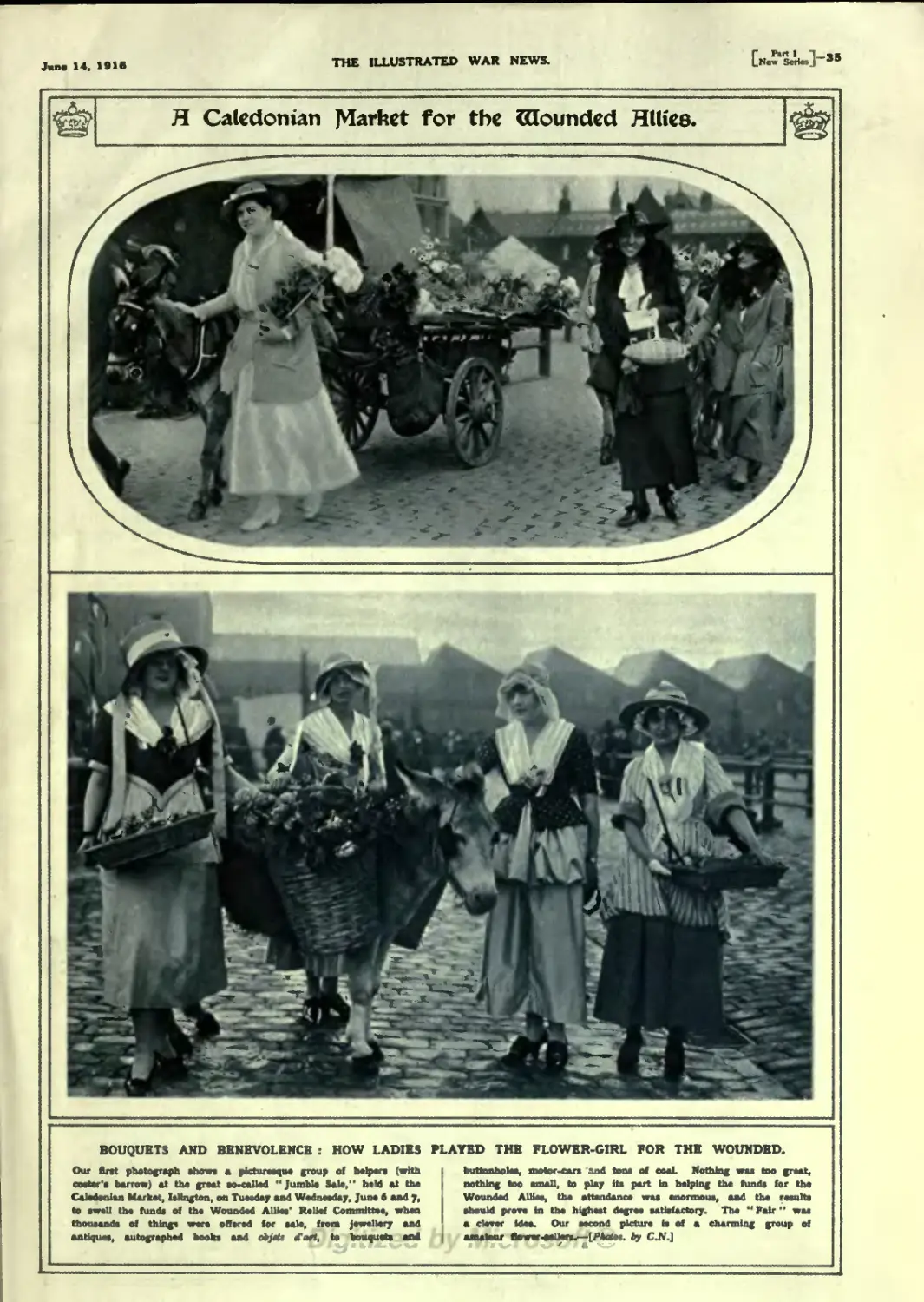
H Caledonian JMarhet for the Wounded HUies.
BOUQUETS AND BENEVOLENCE : HOW LADIES PLAYED THE FLOWER-GIRL FOR THE WOUNDED.
Our first photograph ihows a pictureequo group of helpers (with
coster's barrow) at the great to-called "Jumble Sale," held at the
Caledoniui Market, Itlington, on Tuesday and Wednesday, June 6 and 7,
to swell the funds of the Wounded Allies' Relief Committee, when
thousands of things were offered for sale, from jewellery and
antiques, autographed books and oo/tfl fart, to bouquet* and
buttonhole*, motor-can '^nd tons of coal. Nothing was too great,
nothing too small, to play ite part in helping the funds for the
Wounded Allies, the attendance was enormous, and the results
should proTe in the highest degree satisfactory. The " Fair " was
a clerer Idee, Our second picture is of a charming group of
amateur flower-sellers. \Ptwtta. by C.N.]

36-[ N
THE ILLUSTRATED WAR NEWS.
June 14. 1916
women's help to deal effectively with whatever
emergencies might arise, and to co-operate with
the authorities in any way that might be desired.
Mitlicent Duchess of Sutherland, the Duchess
of Marlborough, the Marchioness of Londonderry,
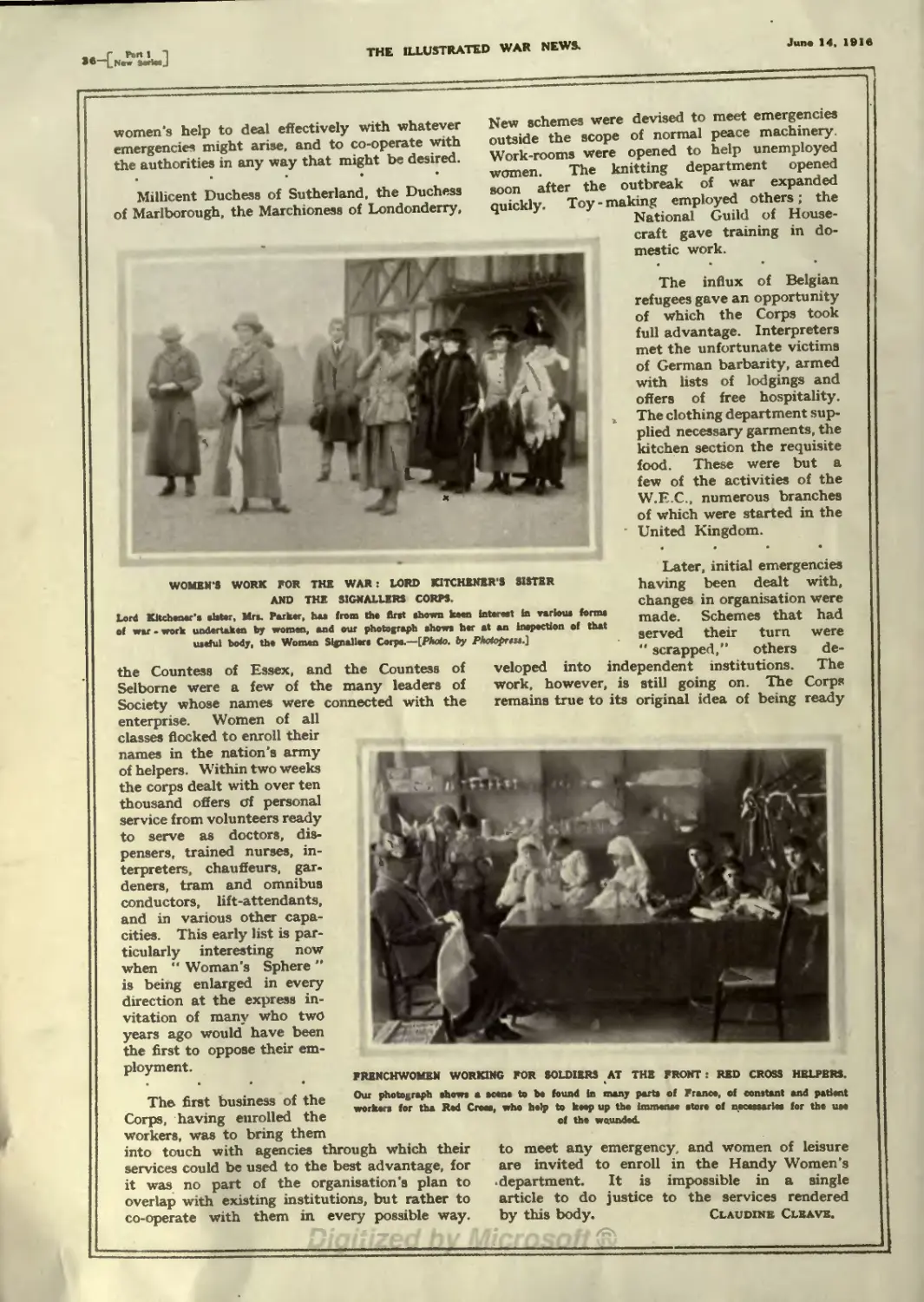
WOMEN'S WORK FOR THE WAR : LORD KITCHENER'S SISTER
AND THE SIGNALLERS CORPS.
Lord Kltchenr' iliter, MM. Parker, hu from the flrit ihown keen interest In rarloui formt
of war - work undertaken by women, and our photogrnph ihowi her at an Inspection of that
useful body, the Women Signalleri Corpi. [Photo, by
the Countess of Essex, and the Countess of
Selborne were a few of the many leaders of
Society whose names were connected with the
enterprise. Women of all
classes flocked to enroll their
names in the nation's army
of helpers. Within two weeks
the corps dealt with over ten
thousand offers df personal
service from volunteers ready
to serve as doctors, dis-
pensers, trained nurses, in-
terpreters, chauffeurs, gar-
deners, tram and omnibus
conductors, lift-attendants,
and in various other capa-
cities. This early list is par-
ticularly interesting now
when " Woman's Sphere "
is being enlarged in every
direction at the express in-
vitation of many who two
years ago would have been
the first to oppose their em-
ployment.
New schemes were devised to meet emergencies
outside the scope of normal peace machinery
Work-rooms were opened to help unemployed
women. The knitting department opened
soon after the outbreak of war expanded
auicklv Toy - making employed others ; the
National Guild of House-
craft gave training in do-
mestic work.
I Mill
The influx of Belgian
refugees gave an opportunity
of which the Corps took
full advantage. Interpreters
met the unfortunate victims
of German barbarity, armed
with lists of lodgings and
offers of free hospitality.
The clothing department sup-
plied necessary garments, the
kitchen section the requisite
food. These were but a
few of the activities of the
W.E.C., numerous branches
of which were started in the
United Kingdom.
Later, initial emergencies
having been dealt with,
changes in organisation were
made. Schemes that had
served their turn were
" scrapped," others de-
veloped into independent institutions. The
work, however, is still going on. The Corps
remains true to its original idea of being ready
The first business of the
Corps, having enrolled the
workers, was to bring them
into touch with agencies through which their
services could be used to the best advantage, for
it was no part of the organisation's plan to
overlap with existing institutions, but rather to
co-operate with them in every possible way.
FRENCHWOMEN WORKING FOR SOLDIERS AT THE FRONT : RED CROSS HELPERS.
Our photograph ihowi a icene to be found in many parti of France, of constant and patient
workeri for the Red Crou, who help to keep up the immeme itore of neceaiariet for the use
of the wounded.
to meet any emergency, and women of leisure
are invited to enroll in the Handy Women's
.department. It is impossible in a single
article to do justice to the services rendered
by this body. CLAUDINE CLEAVE.

June 14. 191G
THE ILLUSTRATED WAR NEWS.
r Part 1 I
|_New Series J 37
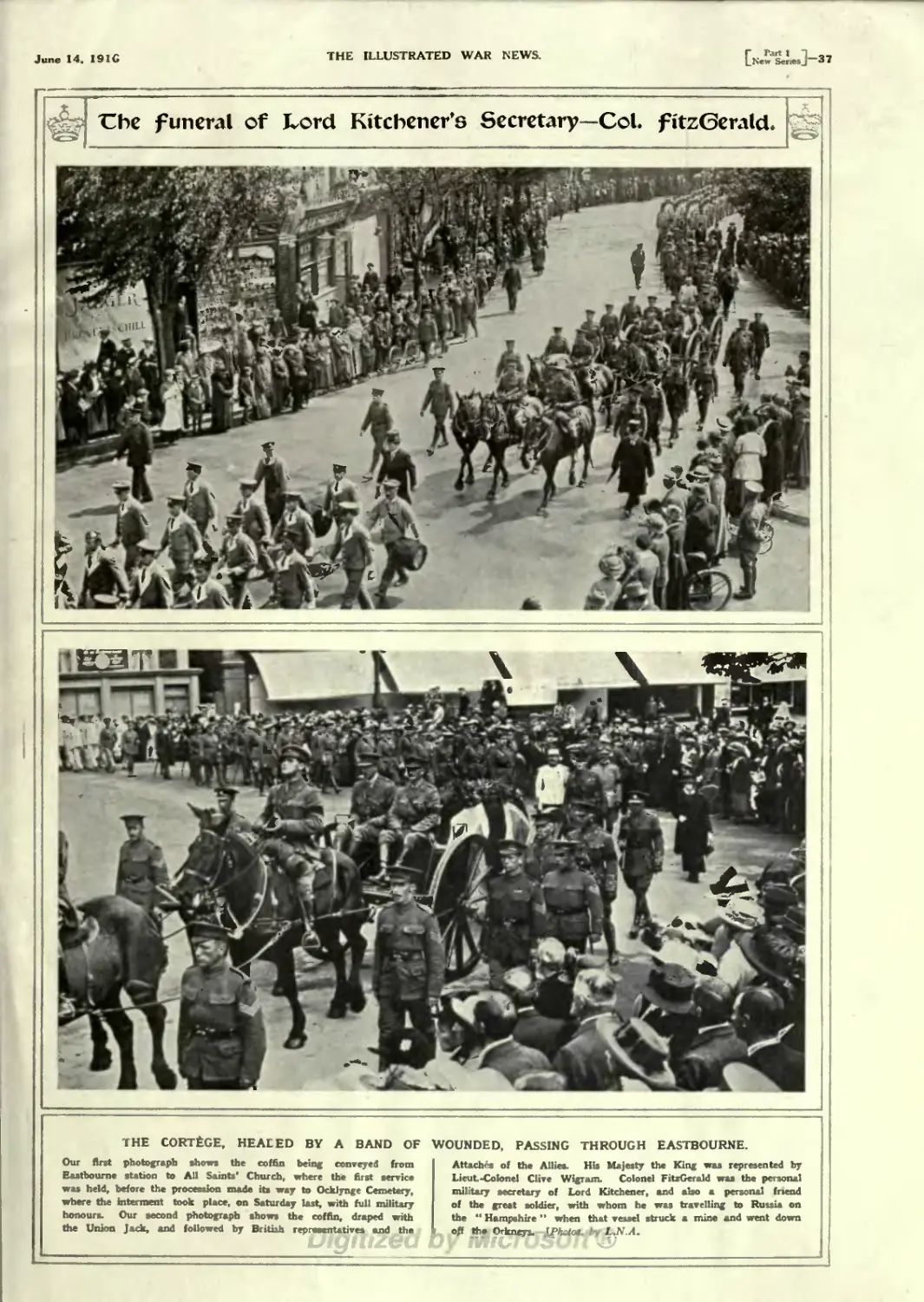
Che funeral of Lord Kitchener's Secretary Col. fitzGerald.
THE CORTEGE, HEALED BY A BAND OF
Our first photograph shows the coffin being conveyed from
Eastbourne station to All Saints' Church, where the first service
was held, before the procession made its way to Ocklynge Cemetery,
where the interment took place, on Saturday last, with full military
honours. Our second photograph shows the coffin, draped with
the Union Jack, and followed by British representatives and the
WOUNDED, PASSING THROUGH EASTBOURNE.
Attach6s of the Allies. His Majesty the King was represented by
Lieut-Colonel dive Wigram. Colonel FitiGerald was the personal
military secretary of Lord Kitchener, and also a personal friend
of the great soldier, with whom he was travelling to Russia on
the "Hampshire" when that vessel struck a mine and went down
off the Orkneys. [Photos, by L.N.A.

, a r Part 1 "I
33 - I \Vw SrrifsJ
THE ILLUSTRATED WAR NEWS.
June 14, 191C
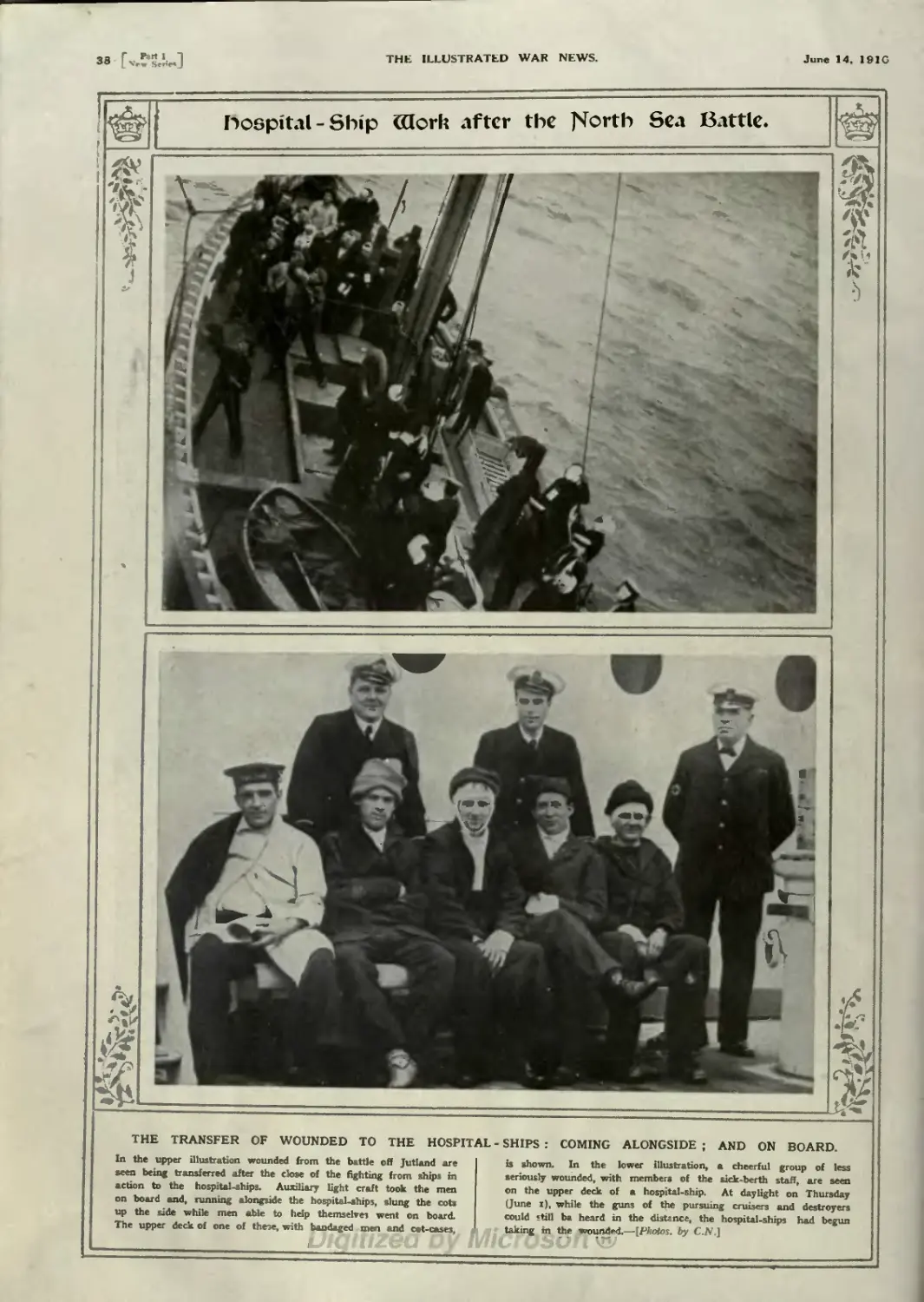
hospital - Ship Olorh after the North Sea Battle.
THE TRANSFER OF WOUNDED TO THE HOSPITAL
In the upper illustration wounded from the battle off Jutland are
seen being transferred after the close of the fighting from ships in
action to the hospital-ships. Auxiliary light craft took the men
on board and, running alongside the hospital-ships, slung the cots
up the side while men able to help themselve-i went on board.
The upper deck of one of theie, with bandaged men and cot-cases,
- SHIPS : COMING ALONGSIDE ; AND ON BOARD.
is shown. In the lower illustration, a cheerful group of less
seriously wounded, with members of the sick-berth staff, are seen
on the upper deck of a hospital-ship. At daylight on Thursday
(June I), while the guns of the pursuing cruisers and destroyers
could still be heard in the distance, the hospital-ships had begun
taking in the wounded. [Photos, by C.N.]

June 14. 1916
THE ILLUSTRATED WAR NEWS.
'Sek] -39
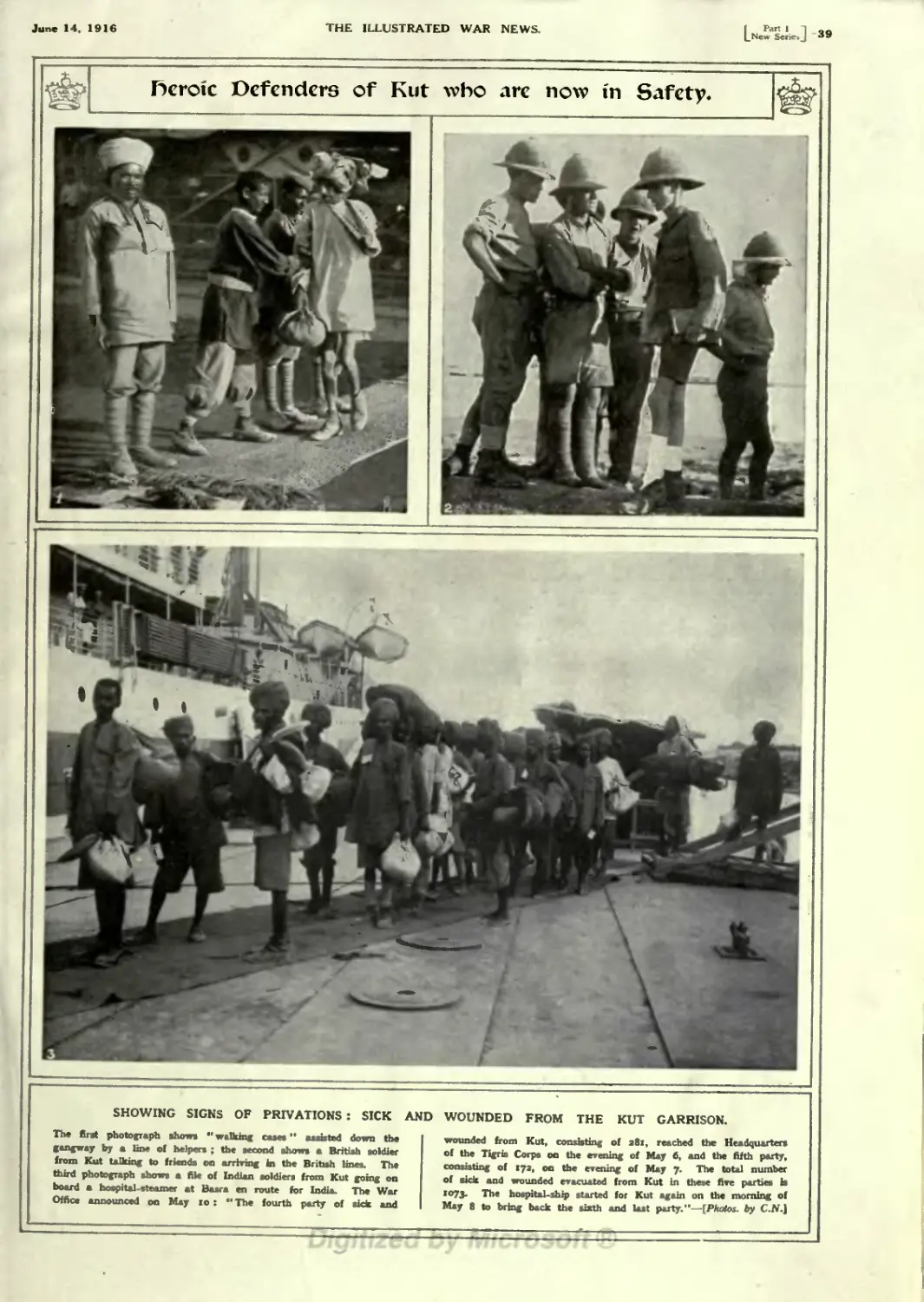
fieroic Defenders of Kut who are now in Safety.
SHOWING SIGNS OF PRIVATIONS: SICK AND WOUNDED FROM THE KUT GARRISON.
The first photograph shows " walking cases " assisted down the
gangway by a line of helpers ; the second shows a British soldier
from Kut talking to friends on arriving in the British lines. Th
third photograph shows a file of Indian soldiers from Kut going on
board a hospital -steamer at Basra en route for India. The War
Office announced on May 10 : " The fourth party of sick and
wounded from Kut, consisting of 281, reached the Headquarters
of the Tigris Corps on the evening of May 6, and the fifth party,
consisting of 172, on the evening of May 7. The total number
of sick and wounded evacuated from Kut in these five parties is
1073. The hospital-ship started for Kut again on the morning of
May 8 to bring back the sixth and last party." [Photos, by C.N.]

,- I- Part I
40-[_ N >w
THE ILLUSTRATED WAR NEWS.
June 14. 1916
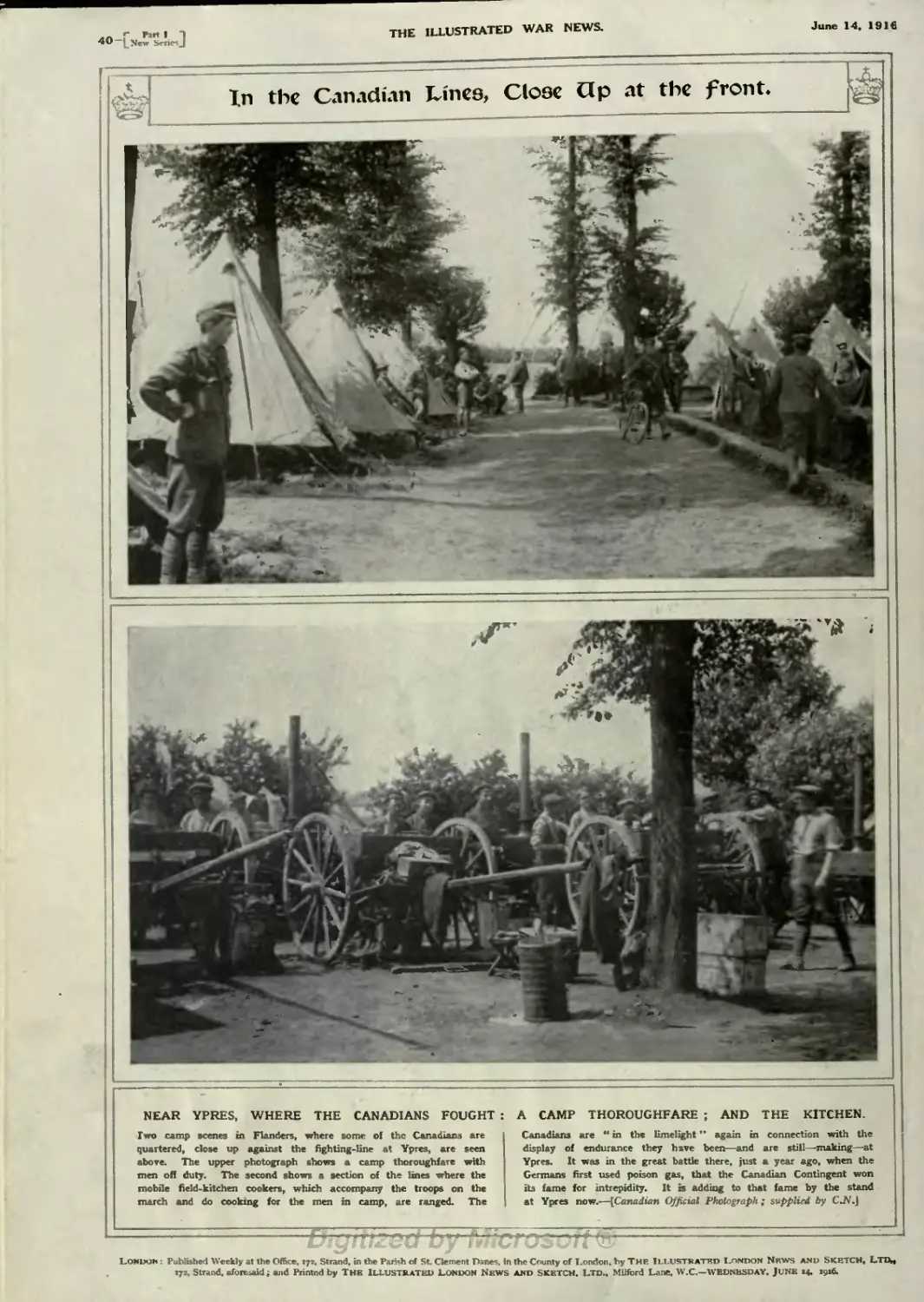
In the Canadian kines, Close dp at the front.
NEAR YPRES, WHERE THE CANADIANS FOUGHT : A CAMP
Two camp scenes in Flanders, where some of the Canadians are
quartered, close up against the fighting-line at Ypres, are seen
above. The upper photograph shows a camp thoroughfare with
men off duty. The second shows a section of the lines where the
mobile field-kitchen cookers, which accompany the troops on the
march and do cooking for the men in camp, are ranged. The
Canadians are " in the limelight " again in connection with the
display of endurance they have been and are still making at
Ypres. It was in the great battle there, just a year ago, when the
Germans first used poison gas, that the Canadian Contingent won
its fame for intrepidity. It is adding to that fame by the stand
at Ypres now. [Canadian Official Photograph ; supplied by C.N.]
LONDON : Published Weekly at the Office, 172, Strand, in the Parish of St. Clement Danes, in the County of London, by THE ILLUSTKATKD LONDON NP.WS AND SKETCH, LTD,,
173. Strand, aforesaid ; and Printed by THE ILLUSTRATED LONDON NEWS AND SKETCH, LTD., Milford Lane, W.C. WEDNESDAY. JUNE 14, 1916.

The illustrated War Newt. Ju le 21, 1916. Part 2, New Series.
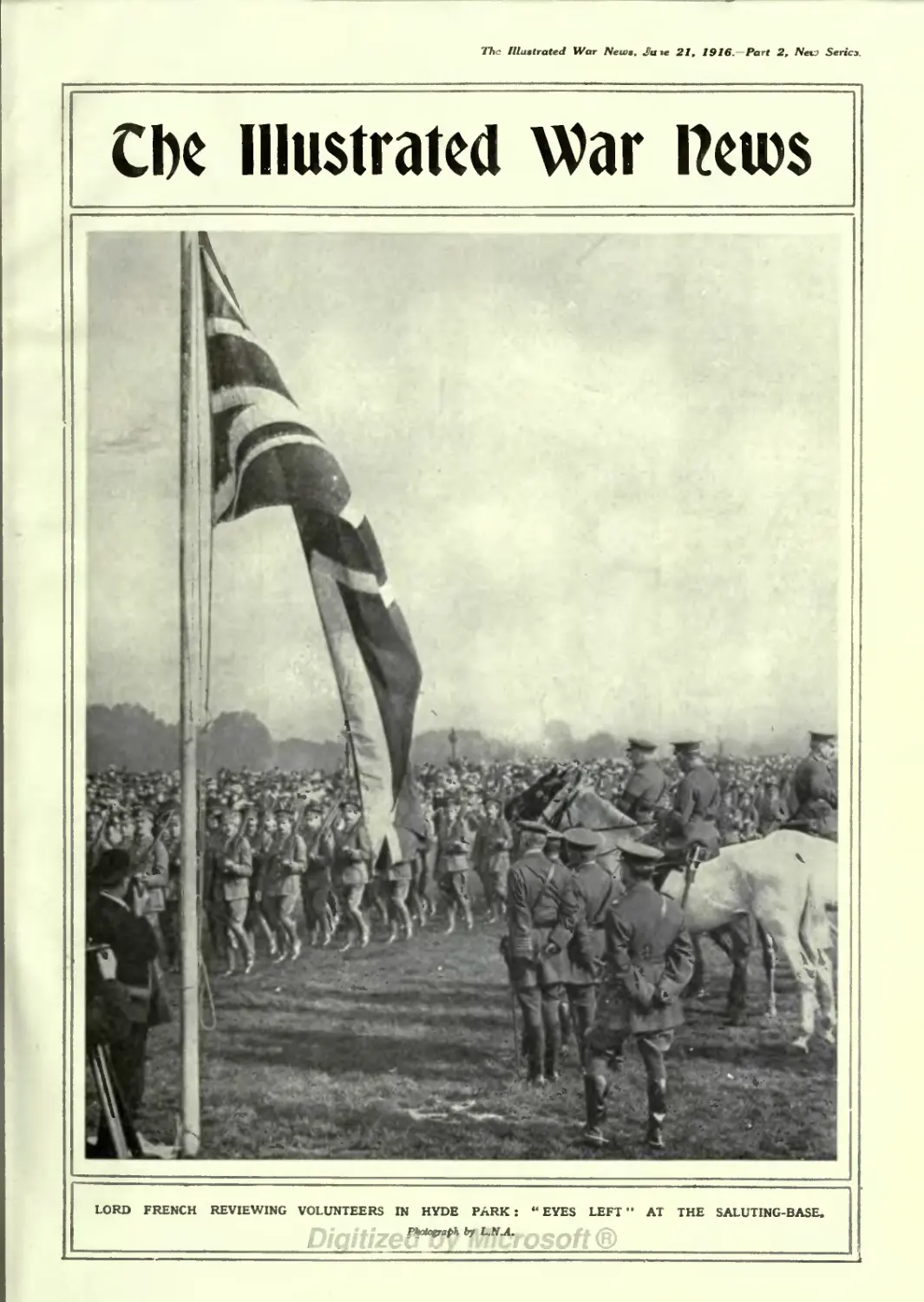
ClK Illustrated War
LORD FRENCH REVIEWING VOLUNTEERS IN HYDE PARK : " EYES LEFT " AT THE SALUTING-BASE.
Photograph by L.N.A.

, r Part 2 I
2 LS.-
THE ILLUSTRATED WAR NEW:.
Jun- 21, 191;.
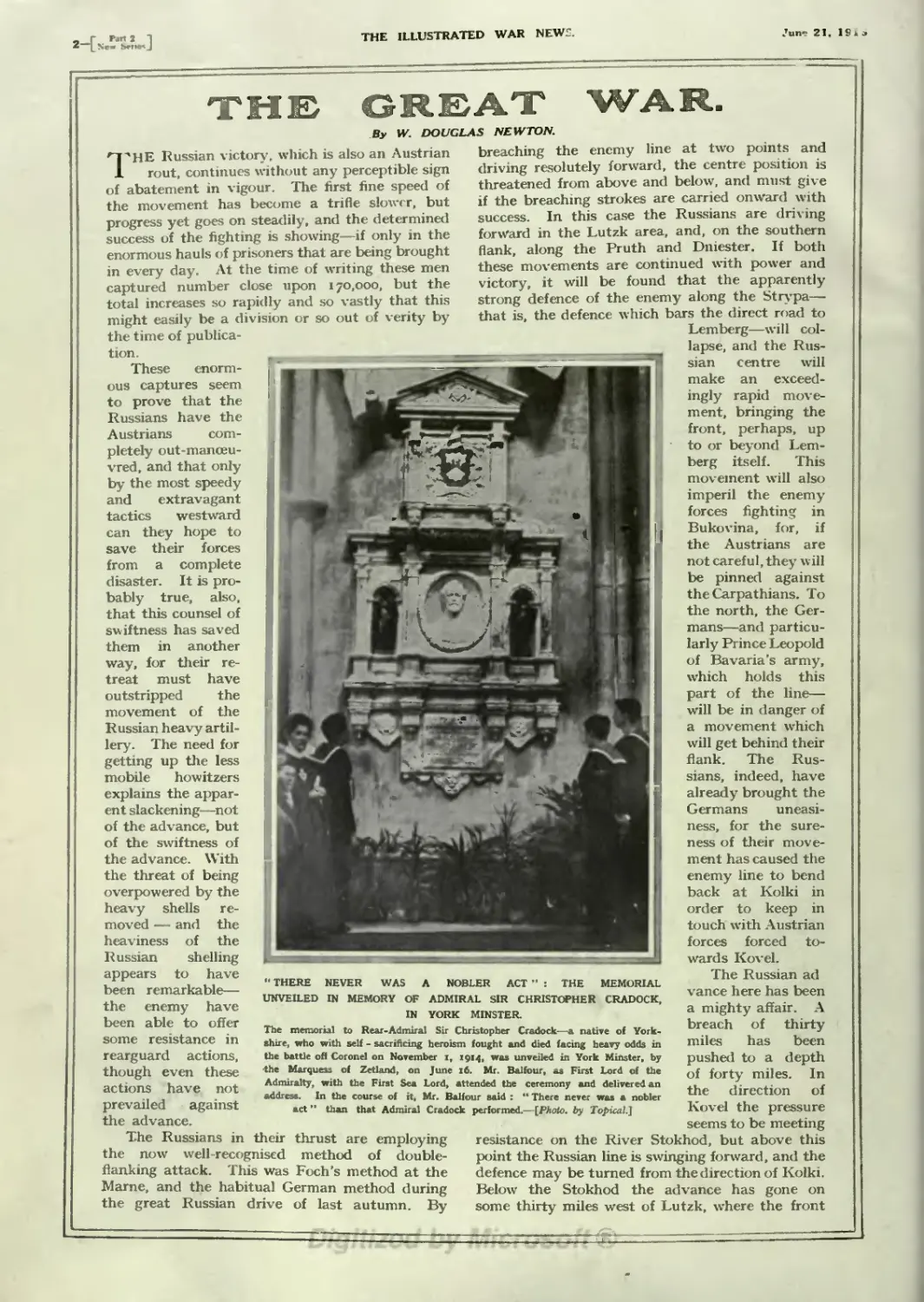
HPHE Russian victory, which is also an Austrian
1 rout, cimtinm-s without any perceptible sign
of abatement in vigour. The first fine speed of
the movement has become a trifle slower, but
progress yet goes on steadily, and the determined
success of the fighting is showing if only in the
enormous hauls of prisoners that are being brought
in every day. At the time of writing these men
captured number close upon 170,000, but the
total increases so rapidly and so vastly that this
might easily be a division or so out of verity by
the time of publica-
tion.
These enorm-
ous captures seem
to prove that the
Russians have the
Austrians com-
pletely out-manoeu-
vred, and that only
by the most speedy
and extravagant
tactics westward
can they hope to
save their forces
from a complete
disaster. It is pro-
bably true, also,
that this counsel of
swiftness has saved
them in another
way, for their re-
treat must have
outstripped the
movement of the
Russian heavy artil-
lery. The need for
getting up the less
mobile howitzers
explains the appar-
ent slackening not
of the advance, but
of the swiftness of
the advance. With
the threat of being
overpowered by the
heavy shells re-
moved and the
heaviness of the
Russian shelling
appears to have
been remarkable
the enemy have
been able to offer
some resistance in
rearguard actions,
though even these
actions have not
prevailed against
the advance.
By W. DOUGLAS NEWTON.
breaching the enemy line at two points and
driving resolutely forward, the centre position is
threatened from above and below, and must give
if the breaching strokes are carried onward with
success. In this case the Russians are driving
forward in the Lutzk area, and, on the southern
flank, along the Pruth and Dniester. If both
these movements are continued with power and
victory, it will be found that the apparently
strong defence of the enemy along the Strypa
that is, the defence which bars the direct road to
Lemberg will col-
lapse, and the Rus-
sian centre will
make an exceed-
ingly rapid move-
ment, bringing the
front, perhaps, up
to or beyond Lem-
berg itself. This
movement will also
imperil the enemy
forces fighting in
Bukovina, for, if
the Austrians are
not careful, they will
be pinned against
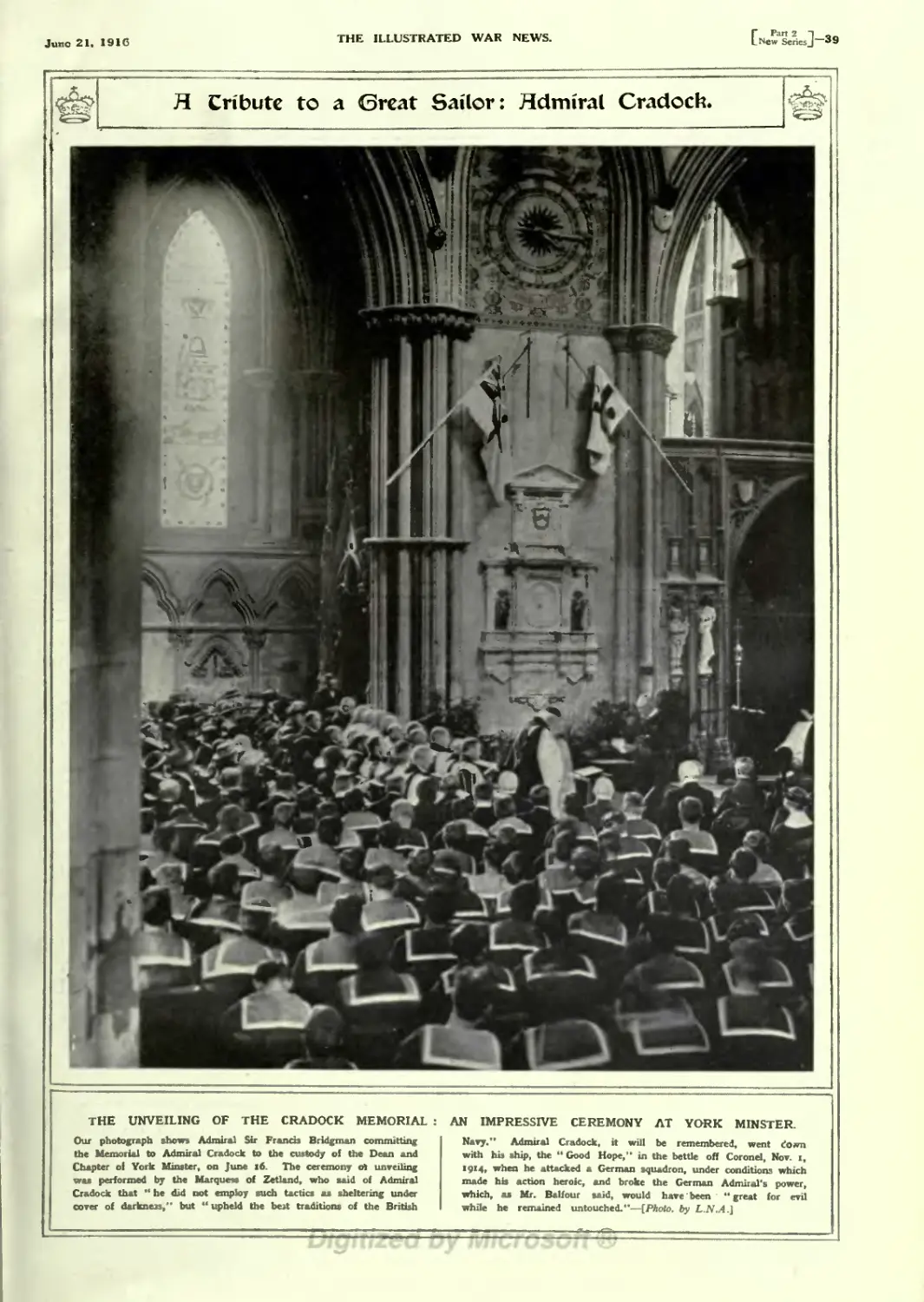
" THERE NEVER WAS A NOBLER ACT " : THE MEMORIAL
UNVEILED IN MEMORY OF ADMIRAL SIR CHRISTOPHER CRADOCK,
IN YORK MINSTER.
The memorial to Rear-Admiral Sir Christopher Cradock a native of York-
shire, who with self - sacrificing heroism fought and died facing heavy odds in
the battle off Coronel on November i, 1914, was unveiled in York Minster, by
the Marquess of Zetland, on June 16. Mr. Balfour, as First Lord of the
Admiralty, with the First Sea Lord, attended the ceremony and delivered an
address. In the course of it, Mr. Balfour said : " There never was a nobler
act " than that Admiral Cradock performed. [Photo, by Topical.]
the Carpathians. To
the north, the Ger-
mans and particu-
larly Prince Leopold
of Bavaria's army,
which holds this
part of the line
will be in danger of
a movement which
will get behind their
flank. The Rus-
sians, indeed, have
already brought the
Germans uneasi-
ness, for the sure-
ness of their move-
ment has caused the
enemy line to bend
back at Kolki in
order to keep in
touch with Austrian
forces forced to-
wards Kovel.
The Russian ad
vance here has been
a mighty affair. A
breach of thirty
miles has been
pushed to a depth
of forty miles. In
the direction of
Kovel the pressure
The Russians in their thrust are employing
the now well-recognised method of double-
flanking attack. This was Foch's method at the
Marne, and the habitual German method during
the great Russian drive of last autumn. By
seems to be meeting
resistance on the River Stokhod, but above this
point the Russian line is swinging forward, and the
defence may be turned from the direction of Kolki.
Below the Stokhod the advance has gone on
some thirty miles west of Lutzk, where the front

June 21. 1916
THE ILLUSTRATED WAR NEWS.
Part 2 "I _
e- Serles_|~3
is pressing towards the Bug. In the Czernovitz
area the Russians, in spite of strong fighting by
the enemy at Buczacz, are pushing well forward
along the Dniester, and between the Dniester and
the Pruth. The direct railway line between
Czernovitz and Lemberg was cut early in the
week when our Ally took Sniatyn, and Czernovitz
itself was hemmed on three sides and its suburbs
the ground of battle from the beginning of this
movement. Its fall was inevitable. The Russians
have plenty of strategic points to aim at here,
for the important
junctions at Kolo-
mea and Stanis-
lau are delicate
cogs in the ma-
chinery of de-
fence, and the
Austrian line is
bound to react
under threat to
them. The fight-
ing, however,
must be hard and
strenuous, for the
steep banks of
the Dniester give
good footholds
for defence, and
for their lives
the enemy must
make good use of
them.
Our Ally's wis-
dom in directing
the main power of
his attack against
the weaker of the
.enemy partners,
with the object of inaugurating a process of dis-
integration more surely, is made obvious both
by facts and its success. The armour of the
Central Powers is most vulnerable through
.Austria, and it has always been recognised
that the death-wound might be struck through
her. It is probable that the Germans will
endeavour to create some diversion to save
A TRIBUTE TO GORDON'S AVENGER PLACED ON GORDON'S EFFIGY :
THE MEMORIAL WREATH FOR LORD KITCHENER FROM THE WOMEN
WORKERS OF THE WAR OFFICE.
This splendid wreath of laurel, lilies, and scarlet carnations, " a last tribute of respect
and remembrance from the women workers of the War Office," was placed
appropriately on Gordon's effigy in St. Paul's on the occasion of the Memorial
Service to Lord Kitchener. [Photo, by Illustrations Bureau.]
their Ally and, indeed, the3 ; have already
attempted something in their attacks on the
northern front near Riga and at Kevo. Directly
above the Russian point of advance the counter-
irritant movements have been pushed heavily.
At Baranovitchi, north of Pinsk, there has been
a good deal of fluctuating fighting. Though it is
difficult to know whether the initial move came
from the Germans or our Ally, the Germans cer-
tainly appear to be fighting in strength, and to
have made advances and captured prisoners. It
is true this en-
gagement may be
a Russian man-
oeuvre to pin
down the enemy
while Russians
further south
press on towards
Kovel ; but it is
more likely that
the Germans con-
sider that pres-
sure here would
have a great
effect on the posi-
tion lower down,
and are fighting
to distract energy
to themselves.
German attempts
should be ham-
pered not only by
the energy of the
Russians, but by
their own present
distribution of re-
serves. The enemy
has been caught
and deliberately caught at a moment when his
forces are heavily concentrated in distant spheres :
before Verdun and our lines at Ypres, for example,
and in front of the Italians in the Trentino. These
things will not make the Austro-German defence
of Galicia and Poland an easy and a happy affair.
Of the Verdun fighting a good tone is
apparent. The Germans, with some pauses, have
THE GHOULISH EFFECT OF THE ANTI-GAS RESPIRATOR : A PARTY OF FRENCH ARTILLERYMEN
AGAINST GERMAN POISON.
Photo, t;,
MASKED

THE ILLUSTRATED WAR NEWS.
June 21, 1916
been hammering away at the defences in the
Thiaumont area in the hope of pushing through
by thr Fleury Gap, and to this end their most
determined assaults have been driven forward in
the Caillette Woods above Fleury, and against
Hill 321, which guards the left flank of the
Thiaumont line. These attacks have been broken,
ami, more than tins the French have been able
to counter and win elements of German works
on Hill 321, these being held in spite of all
Teutonic offensives. On the west bank of the
Meuse the French also made some ground on the
Mort Homme, and have held it in spite of attacks
of most desperate nature all along this front. On
the rest of the French line there has been con-
siderable activity at many points on the Somme,
in the Champagne, in the Argonne, and in the
Vosges. On the British front there are growing
signs of energy. The Canadians have brilliantly
regained all the lost ground south-east of Zille-
beke. Following this, the enemy indulged his
spirit in heavy bombardments, and on Friday
endeavoured to force matters by sending forward
two gas-clouds west of the Messines-Wytschaete
ridge ; the clouds were ineffectual, and were not
followed up by infantry assaults. Bombing,
mining, and artillery work complete a tale of
somewhat unusual activity, and, coupled with
the hints thrown out by the usually laconic Paris
reports, we have reason to view the general work
THE CANADIAN POSTMASTER-GENERAL'S WIFE :
MME. CASGRAIN.
Mme. Casgrain, who has come on a short visit to France and England,
has brought out a memoir of Madeleine de Vercheres, with a frontis-
piece by Princess Patricia, to be sold for the Red Cross. Copies may be
obtained by sending subscriptions to Mme. Casgrain, c.o. the High
Commissioner of Canada, 19, Victoria Street, S.W. [Photo, by C.N.]

on the Western front with much interest and"
attention within the next few weeks.
The Austrian offensive in the Trentino has
been engineered at a most unfortunate time.
Already there are signs that the impulse of
aggression has died advances have stopped, and
the Italians
are working
their way
back over
conquered
ground
about Asi-
ago and in
the Laga-
rina Valley.
In Greece,
artillery
duels are re-
ported be-
t w e e n the
Allies and
the mystical
troops we
cannot say
whether
they are Bui-
gars, Ger-
mans, or
Austrians
oppos ing
them. Greece
itself is ap-
parently a
prey to
mental un-
certainty,
accelerated
by the determination of the Allies to handle
the matter decisively. The shipping restrictions
enforced by us are pressing heavily. A decisive
success either in the East or the West will settle
Grecian opinion once and for all.
General Smuts 's steady campaign in German
South-West Africa continues excellently. The
force acting in the east of the colony has taken
the town of Wilhemstal, the capital of Usambara ;
and a column under Brigadier-General Hannyng-
ton has done the same for Korogwe. This latter
town is but forty miles from the port of Tanga,
which is said to be clear of the enemy. The
Belgians moving up from Lake Tanganyika have
not merely taken Usumbara, the chief port on the
lake, but have pushed inland over 120 miles. On
Lake Victoria Nyanza the British have secured
the island of Ukerewe, and two Krupp guns on
it, and are now in a position to direct their threat
against the port of Mwanza, on the mainland. In
the Kilimanjaro district another British column
is moving in strength against the Germans
entrenched about the water supply at Handeni.
On the sea there has been little to note. The
British destroyer Eden was sunk in collision in
the Channel, and most of her crew, apparently
lost. In the Baltic, on the other hand, a German
convoy was attacked and roughly handled by a
Russian flotilla ; several ships were sunk.
LONDON: JUNB 19, 1916.
COMMANDING A BRITISH COLU.MN WHICH
RECENTLY ENTERED KERMAN, IN SOUTHERN
PERSIA : BRIG.-GEN. SIR PERCY SYKES.
Sir Percy Sykes, author of a " History of Persia,"
was recently sent to organise a Military Police
Force in Southern Persia, for the Persian Govern-
ment, to rid the country of German and Turkish
rebels. He and his troops were received most
cordially at Kerman. [Photo, by Elliott and Fry.]

Jum- 21. 1916
THE ILLUSTRATED WAR NEWS.
''* i K
NYi. SrieJ~ B
Vaux Church, Wrecked in the Battle of Verdun.
NEAR VAUX FORT, CAPTURED BY THE GERMANS AFTER BOMBARDMENT : RUINS OF VAUX CHURCH.
The Tillage of Viux, which lies about h*U mile north of the
Fort, hn been l*id in mini during the terrific ftruggle round the!
part of the defence* of Verdun. A French communique* of June 8
announced that " after teten dayi' detperate fi t htinj againit
aauulting troops renewed inceuantlr, the garriaon of the Port of
Vauz, which had reached the limit of ita strength, wai unable to
prevent the enemy from occupying the work, which had been
completely ruined by furloui bombardment. " The Fort had with-
flood direct attack for ninety dari, and on it, latterly, had been
concentrated an immune weight and relume of artillery Are. The
Vaux position wai not rital, and the tones tuitained by the Germans
there were altogether incommeniurate with the gain.- -[Mote. ("..V.)

THE ILLUSTRATED WAR NEWS.
June 21. 1916
British bounded happy in a playground of Europe.
OUR EXCHANGED P RI SONERS FROM GERMANY TRANSFERRED TO SWITZERLAND : AT CHATEAU D'OEX.
The first photograph thorn a party of British wounded In Switzer-
land ofl (or trip on a mountain railway. In the second *
ntish soldier, of n industrious turn of mind, is seen helping two
Sw,ss women with their washing in a public square. The change
from a German prison camp and its attendant miseries to the
delightful hospitality of Switzerland h seemed, to the^men lucky
enough to be chosen, like passing into Paradise from a region leu
alluring. The second convoy of wounded British soldiers from
Germany arrived at Chateau d'Oex, near Montreux. on the Lake
of Geneva, about twenty-four hours after the first ; and from the
moment of crossing the frontier of Switzerland they received a
no less hearty welcome. [PHolos. by Sport m,l Genera!.}

June 21, 1916
THE ILLUSTRATED WAR NEWS.
f Part 2 1 _,
LN Scries.)'- *
m\tb the ficroic Canadians on the Sdcstern front.
MEN OF AN ARMY ONCE MORE FIGHTING MAGNIFICENTLY NEAR YPRES : CANADIANS IN RESERVE.
fighting, it u said, not only the mm in the advance trenches, but
even those in the wooded positions behind, came under a terrific
bombardment from the Germin aitillery. They had their reveugr,
however, in their " gallant and successful assault! " near Zillebeke,
where th^y captured a position and took 123 Gtrmtn prisoners.
The first photograph show) a Winnipeg battalion held in reserve
near the Western front ; the second a Canadian soldier in charge
of a field post-office. In the new battle of Ypres, which began on
June 2. the Canadian tioops have again shown the same migrti-
ficent heroism as when they withstood the first Germui attacks
with poison-gas, and thus sav-1 the Alliel line. In the recent
[Cai/jrfi.in Official P'aotvs. ; supplied by C..V. Crown Copyright nsenal.}

P" I ')
C. Sri., .
THE ILLUSTRATED WAR NEWS.
June 21. 1916
Loyalty of france's Olest Hfrican jMabomedans.
.
^
AT BONDOUKOU, CAPITAL OF THE "IVORY COAST": THE COLLECTING BOOTH ON " POILUS' DAY."
This illustration affords a useful glimpse behind the scenes of war
in an out-of-the-way part of the world- evidence of the sterling
loyalty to Prance of the Mshotnedan peoples in French colonial
possessions. Bondoukou, where the photograph was taken, is the
capital of the French West African colony, the " Ivory Coast"
The vast Mahomedan population of the region, which adjoins
and forms part of the French Soudan territory, have subscribed
liberally ever since the war began to aid the French Army's sick
and wounded. They also raised a contingent of " tirailleurs."
Bondoukou itself had a special " Soldiers' Day/' " La Journe>
du Poilu." The living representation of, the poster by Poulbot,
as arranged outside the collection booth, is seen ' above.

June 21. 1916
THE ILLUSTRATED WAR NEWS.
T Part J -I -
[New Series J
Shelled and Stormed : In a Captured German Trench.
ARTILLERY WORK COMPLETED WITH THE BAYONET : FRENCH VICTORS AFTER AN ASSAULT.
A realistic idea of the scene of chaotic disruption and havoc that
a trench presents after havinf been subjected to * protracted shellinf
and then taken by storm is afforded by this illustration. It is a
photograph of one of the German trenches, in a locality that
has to be nameless just at present, immediately after the victorious
French in the neighbourhood had overwhelmed the section with
continuous salvos of high-explosive shells, and then followed up
the artillery devastation by charging; in among the bartered and
shapeless ridges and mounds of earth, to seize and occupy the
position. Everywhere the surface of the ground Is seen to be
littered with torn and tangled wire, broken stumps, German rifle*,
clothing and accoutrements. (Pliuto. by Alfiai.}

THE ILLUSTRATED WAR NEWS.
June 21. 1916
THE BEGINNINGS OF WAR-MACHINES : EARLY TORPEDOES.
FIG. 9 :
TIIK first torpedo experiment .was made in the
year of Trafalgar. In 1805 Robert Fulton,
whose name history records as the " father " ot
mi propulsion lor marine work, came over
from Amerii.a with the object of persuading 111"
British Government to adopt, one or other of his
schemes for blowing up enemy vessels by means
of expl< sivcs applied to their bottoms. To demon-
strate the possibilities of this mode of attack, he
destroyed the brig Dorothea off VValmer (Fig. 10)
by exploding 180 Ib. of gunpowder under her. The
British Admir-
alty refused to
adopt any of Ful-
ton's inventions,
and he returned
to America. Con-
tinuing his ex-
periments there,
he, in 1810, in-
vented the Har-
poon Torpedo
(Figs, i and 2). In
this device a har-
poon (II) fired
from a musket
(A/) was intended to embed itself in the side of the
attacked vessel (//, Fig. 2). A canister (C) con-
taining the explosive charge, supported a few feet
below the surface by a cork float (F), was attached
to the harpoon by a short length of cable (50
feet). When the current, due to th'e vessel's
motion or to the tide, caused the canister to strike
the ship's bottom, a spring gun-lock was released
to explode the charge.
The gun - lock was
cocked by a safety-
line when the musket
shooting the harpoon
was discharged.
Fig. 3 shows a
small boat designed
in 1863 for the Con-
federate States of
America for the pur-
pose of attacking
Federal ships blocking
the Southern ports
during the American
Civil War. The vessel
shown was propelled
by steam (though
hand -power was em-
ployed in some cases),
and made its attack
whilst almost sub-
merged. A spar-
torpedo (T T) carried
at its bow was its only
HARVEY'S "SEA TORPEDO" TOWING ON THE SURFACE,
WITH ITS FLOATS.
weapon. These little
boats were nicknamed
Davids." The head of another type of spar-
torpedo is illustrated in Fig. 4. The contact-
fuses (F) in its forward end are clearly shown,
FIG. 10: FULTON'S EXPERIMENTAL BLOWING-UP OF THE
DANISH BRIG "DOROTHEA" OFF WALMER CASTLE IN 1805.
Th above is a sketch from a contemporary drawing. The brig was
a ressel of 200 tons, formerly captured by the British from the Danes,
and British property. She was specially anchored for the experiment.
al-D a pair of tie-rods (1< !\'} designed to take
the strain off the spar where attached to the
torpedo.
The method of using Harvey's " he.i Turp.
is shown in Figs. 5 and 6. This device was a
wooden box (Fig. >) containing the explosive
fitted with a system of luvers (/,. Fit.' <>) on its
top. The depression of any one of them forced
inwards a firing-pin (/', Fig <>) which ex;
the torpedo. The attacking vessel towed the
weapon by its main tow line, which was coupled
to the torpedo
by means of an
arrangement of
short lines called
a ' go<..;e foot "
to ensure its
approaching the
a Hailed vessel
right end first.
The box was of
such . a shape
that it flo
near the -.urtace
when being
towed, but sank
when the tow-line was slack. The lines com-
prising the " goose foot " were also attached
in such a manner that the torpedo took a course
considerably to one side of that of the towing
vessel. A line having a number of floats (F F)
attached to it like the tail f a kite was
employed with the same object in view. When
towed across the bow of an enemy ship, its tow-
line was slacked away
at the correct moment
by means of a wind-
lass '.>n the deck of
the attacking vessel
just before the tor-
pedo made con i
with the attacked
ship's side and ex-
ploded there (Figs. 5
and 6 positions B) .
The Simms Kdison
torpedo (Fig. 7) was
electrically controlled
by a wire (C) from
the shore, the cable
being coiled on a
drum inside the tor-
pedo itself. The l.av
torpedo (Fig. 8) was
propelled by liquefied
gas inside, being
similarly controlled
from shore.
The Brennan tor-
pedo, constructed in
i.SSa, was also con-
trolled from outside, but in this case its pro-
peller was revolved by uncoiling piano -wire
from drums mounted on its shaft.

June 21. 1918
THE ILLUSTRATED WAR NEWS.
f Part 2 -I , .
LNew Scries J * *
Beginnings of Cdar JMachincs: early torpedoes.
as.
A PLAN OF THE ATTACK.
RVEY TORPEDO.
OF ATTACK
CROSSING THE BOW or
-AH ENEMV VESSEL JN MOTION
(POSITIONS (B) IN n*)
coMrroEKATC STEAM -DAVID" .
-ARMED WITH A SPAR TOJIPEDO. <1BC)
A SPAR TORPEDO USED WITH THE
"PAVIP"OOATa. (AMERICAN CIVIL WAK . JBO )
1 FULTON'S HARPOOM
TORPEDO ON BOAT
READV TO ATTACK
HEAD OF
SPAR TORPEDO.
CIVI1-
THE 3 IMS EDISON " LOCOMOTIVE TORPEDO.
LAY" TORPEDO. (
CAKRIEO OVEK A MIl.T AND A
HALF Or CONTROL V/IRC .
FULTON'S HARPOON TORPED
EARLY TYPES PREVIOUS TO THE AUTOMOBILE WHITEHEAD : DEPENDENT ON HUMAN CONTROL.
The dUfram abort being out incidentally what wni nceeaiarilT
the governing feature in all torpedo designs until the invention of
tha automobile Whitehead type (about 1870) revolutionised the
syitem of under-water warfare. All the earlier devices, as
explained on the page opposite and illustrated here, were dependent
lot trttir manipulation on active human agency on board the
attacking craft. Controllable torpedoes were dependent in like manner
on human operation throughout. Spar and towing torpedoes were
in use during the American Civil War, and Confederate vessel* were
sunk by them. The British Navy employed both forms during
the 'seventies of last century. The masted iron-clad men - of - war
seen in Diagrams "os. J and 6 are of that date.

!* 2 ~
12 \c itoriu J
THE ILLUSTRATED WAR NEWS.
Jim- 21. 1916
Outpost Incidents in Western Sgypt.
WHERE WATCH IS EVER MAINTAINED : ARMOURED CARS ; AND SOUDANESE CAMEL CORPS TROOPERS.
If the operations on the Western Egypt frontier arc complete, yet
watch is still kept there. In the first illustration one of our
armoured cars, a brigade of which rendered effective service in the
campaign against the Senuisi, is seen heading out to communicate
with a patrol in the desert. The second illustration shows Soudanese
Camel Corps troopers, who garrison the desert stations, moving
from one post to another, with their families. The leading came!
trooper has his wife riding behind on a pillion. The wife is riding
the second camel which the soldier is leading. The third man is
holding his wife on. In the lower illustration Staff armoured cars
going at speed along a desert highway are seen passing a Camel
Corps column on the march. [Press Photo. Agency.]

Jun 21. 1916
THE ILLUSTRATED WAR NEWS.
7ocund-f)cartcd " Qloundcd in Grosvenor Square.
ENJOYING HERO-WORSHIP.
"HAPPY, HAPPY WOUNDED MAN"' MEN
The** photographs show wounded soldiers enjoying the fruits of
patrioxiam on the balcony of the Coulter Hospital, In Grosvenor
Square. It it right that men who have risked their lives for the
benefit and protection of those at home should receive abundant
(latitude. Ma; the public solicitude for their welfare last through
the years ahead when their hurts may disable them for the long
battle of life ! Meantime, the "happy, happy wounded man " (to
quote some recent verses) is well content in the consciousness of
having " done his bit " and escaped the greater peril. The milieu
of our photograph* recalls >ome older IIIKS tu a " jocund'hearted
grinder," of whom the poet sang : " As they IOTC thec in
St. Giles's, Thou art loved in Orosvenor Square." ' f'hvti'?,. by
:

. r IM" -i }
14 \_Scw S-iurJ
THE ILLUSTRATED WAR NEWS.
June 21. 1916
ROMANCES OF THE REGIMENTS : No. II -THE RIFLE BRIGADE.
THE BRIDE OF BADAJOS.
A FAMOUS officer of the Rifle Brigade, recall-
ing, in his later years, the story of Badajos,
turns away from the grimmer details of that
memorable fight to relate the romance which
came to him out of that field of carnage,
scene," he says, " however cruel to many, to me
has been the solace and whole happiness of my
lifi.- fur thirty-three years." For at Badajos,
r.ipiain, afterwards Lieutenant-General, Sir Harry
Smith found the lady who became his wife, and
may almost be
named a recruit
to the Rifle
Brigade, whose
fortunes she fol-
lowed in the field
for many a day
to come. Both
husband and wife
wrotetheir names
large in the mili-
tary annals of
Great Britain,
and Lady Smith
stood godmother
to that South
African town
which is for ever
associated with
heroic memories.
It was on the
day following the
capture of Ba-
dajos, when the
regrettable ex-
cesses of the
victorious troops
had not yet been
entirely quelled
by their com-
manders (many
of whom had
been wounded in
the attempt to
restore order),
that Smith and
his friend Kin-
caid, a brother
Rifleman, talking
together at the
door of Cap-
tain Smith's tent, saw two ladies approach-
ing them from the city. The ladies made
directly for the British officers, who noticed
tlAt both were young and both evidently
Spaniards. As they came within speaking dis-
tance, the elder of the pair threw back her
mantilla, revealing a face of great beauty, although
her sallow, sunburnt, and careworn appearance
told an unmistakable story of hardship and
terror. But there was no mistaking the spirit
of the Spanish aristocrat in the bearing of the
fugitives, who introduced themselves as the last
the worst
rage, they
A FRENCH SOLDIER FROM THE FAR EAST AT SALONIKA : ONE OF
THE COLONIAL MARINE INFANTRY FROM COCHIN-CHINA RECENTLY
LANDED THERE.
Official Plutograph, issued by Hit Press Bureau ; supplied by Central Prfss.
of an ancient and honourable house, and gave
sufficient guarantees that they were what they
professed to be.
The elder of the two girls, for they were only
in their 'teens, was the wife of a Spanish officer,
or possibly his widow, for she did not know her
husband's fate. She and her sister w.ere home-
less, their house had been wrecked during the
previous day's disturbances; they were starving,
and had only the clothes they stood up in. If
they had escaped
out-
had
still suffered
cruelty and in-
dignity, and their
bleeding ears
showed how their
ear - rings had
been wrenched
through the flesh
by the plun-
derers , who won Id
not take the
trouble to un-
clasp the orna-
ments.
For herself the
Seflora said she
cared nothing,
but for her sis-
ter, not yet four-
teen, and only
lately returned
from a convent
school, she was
in despair, and
declared that she
saw no security
except to throw
herself upon the
protection of
some British offi-
cer. She apolo-
gised charmingly
for the apparent
indelicacy of her
action, but so
great, she said,
was her faith in
our national
character that she felt sure her appeal would not
be made in vain, nor the confidence abused. She
had reason ; and fortune had sent her to two
exceptionally chivalrous and sympathetic men.
For her own sake the officers would have done
everything in their power to help her, but the
little sister added an overwhelming argument.
Kincaid in later life could still rhapsodise about
her, for he, although not destined to be the lucky
man, had experienced also the coup tie Joudre,
" A being more transcendently lovely," he
writes, " I had never before seen one more
fritaf.

June 21. 1916
THE ILLUSTRATED WAR NEWS
r PrirtJ - .
On the datcb in our Lines at Salonika*
IN THE BRITISH TRENCHES AT SALONIKA : A SERGEANT USING HIS PERISCOPE
Interesting news regarding the position m the Balkans came in a
despatch dated June 10, from Mr. G Waid Price. " Already."
he Mid, " there exists much nearer TO the enemy than the works
round Salonika a strong line of defm.e, where freh trenches and
more baibed wire are daily appearing. White German aeroplanes,
u ' '. that you can hardly -e them, go droning across the sky,
i watching long sections of open road below them covered by black
echelons of adv.v icing troops ; Bulgarian field-officers focus their
telescopes upon the working patties they can sec from their own
advance-trenches, and sometime; order a few shells to be fired,
though the distance in really beyond the effective range of the
gun* the enemy has." [O/yicwi Phvtograpk snpfilittt by C.N.]

-_[ Put I

THE ILLUSTRATED WAR NEWS.
June 21, 1916
amiable I have nevor yet known ! Fourteen
summers had not yet passed over her youthful
countenance, which was of
a delicate freshness more
Knglish than Sp.ini.sU ; her
face, although not perhaps
rigidly beautiful, was never-
theless MI remarkably hand-
some, and so irresistibly
attractive, surmounting a
figure cast in Nature 'sfairest
mould, that to look at her
\v;is to love her ; and 1 did
love her, but 1 never told
my love, and in the mean-
time another and a more
impudent fellow stepped in
and won her ! "
Sir Harry Smith, with
excellent humom, quotes
his friend Kincaid's words
in his Autobiography, add-
ing, " I confess myself to be
' the more impudent fel-
low,' " and Kincaid, for his
part, says In- was happy, for
in Harry Smith, Senoiit;i
J uaiia Maria de los Dolores
de I. con lound a husband
in every way worthy of her.
They were married in the
field, just after Juana had
passed her fourteenth birthday, which
marriageable age for a Spanish woman.
Smith was then
twenty - four.
Their romance
never faded.
" From that
day to this,"
wrote Sir
I l.ury in 1844,
" she has been
my guardian
angel. She has
shared with me
tin dangers and
privations, the
hardships and
fatigues of a
restless life of
war in every
quarter. of the
globe. Already
inured to war
(she had seen
three sieges of
Hadajos before
her marriage)
she followed the
Rifle Brigade
all through the
rest of the
Peninsul a r
(niggle, and
was the verit-
able daughter
PRECAUTIONS AGAINST VIOLENCE AT A VENIZELIST
MEETING AT SALONIKA : POLICE SEARCHING EVERY
PERSON ENTERING, FOR CONCEALED WEAPONS.
is fully
Captain
WHERE THE
AT SALONIKA
of the regiment, behaving with a courage worthy
of her ancestor. Ponce Juan de Leon, the
Knight of Romance." Kin-
caul tells how one day when
the battalion was moving
into action, he passed
Juana's lodging, which was
so near the outposts that
he never doubted but tlm
she had been already re-
moved to some place of
greater safety. Conse-
quently he did not trouble
to look out for her. " IJul
just as I passed the door,
I found my hand suddenly
grasped in hers. Slie gave
it, a gentle pressure, and
without uttering a word,
had rushed back into the
house again. Throughout
the remainder of that long
arid trying day 1 felt a light-
ness of heart and buoyancy
of spirit, which, in such a
situation, was no less new
than delightful. "Sir Harry's
account of those J'cmrisular
days, when his young wife
was the idol of the regiment,
reads more like a chapter
of "Charles < I'Malley " than
serious history. She went through Salamanca
and Vimiera, and three years later saw thrilling
adventures Hi
Waterloo. Her
mad ride to
Antwerp and
her frenzied re
turn to the field
>n a rumour
of her hus-
band'sdeath.to
search, happily
without reason,
tor his body,
were recorded
by Lady Smith
herself ( possi-
bly with her
husband 'shelp)
in a delight-
fully human
d o c u m e n t,
which modern
soldiers' wives
have little
chance of rival-
ling, for they
may no longer
take that per-
sonal share in
campaigning
which fell a.
century ago to
thi- Lady of the
Brigade.
ALLIES RECENTLY PROCLAIMED MARTIAL LAW: POLICE
SEARCHING ALL WHO ATTENDED A VENIZELIST MEETING.
Offir.M Pholm;,af>l,s, iw,c.l by llu Pmi Humw : supplied by Central Prrsj.

June 21. 1916
THE ILLUSTRATED WAR NEWS.
2 i-
SoriesJ '
H Royal Boy Scout: The Italian Crown prince.
A SOLEMN CEREMONY IN ROME : PRINCE HUMBERT SWEARS LOYALTY TO HIS COUNTRY.
Our firji photograph showt Humbert, Prince of Piedmont, Heir to
ht Throne of Italy, u a Boy Scout, at the bate of the itatue of
his grandfather, King Victor Emmanuel H., which was raised in
Rome in ion, to celebrate the fiftieth Tear of Italian unity. He
viands, a gallant young figure, as he vows fidelity to his country.
Our second photograph shovrs him waiting to attach his signature
to the document sptead upon the table. In our thifd illustration
ha is teen affixing to the flag ol the Boy Scouts, or Jeunei
Exploiateurt, of Veiona, the gold medal which was awarded in
memory and honoui of ihoe who lost their lives by an air. raid
on Verona by Austro-Hungarians, who. like their allin, do not
heed that most ol their victims are civilians. -[/'*uriw. *> f..V 1

THE ILLUSTRATED WAR NEWS
June 21, 1916
Che Memorial Service to kord Kitchener, lime n,
A ROYAL TRIBUTE TO A GREAT SOLDIER : THE KING AND QUEEN ON THEIR WAY TO ST. PAUL'S.
GUI illustration shows their Majesties the King and Queen driving
to St. Paul's for the Memorial Service to Lord Kitchener. The
King was attended by a captain ' s escort , and was in khaki.
Queen Mary was in black. The route was crowded with
spectators, who silently playeu their part in the tribute to the
splendid soldier whose loss is mourned by the whole Empire.
The solemn and impressive service was conducted by the Arch-
bishop of Canterbury and the Bishop of London, Dr. Winnington
Ingram. Stately and beautiful in every word and note, the great
tribute to the splendid soldier and gallant gentleman proceeded step
by step until the buglers sounded the pathetic and appealing notes
ol the Last Post. [Trtoto. by Nf\vspapcr lilustmti

June 21. 1918
THE ILLUSTRATED WAR NEWS.
r Part J -]_ , n
|_New bcriesj '
frcnch Colonial Troops fighting for the Tricolour.
FROM FAR EAST TO EUROPEAN BATTLE-GROUNDS : AN ANNAMITE BATTALION ; AND RED CROSS PARTY.
In normal times, the troops in the upper illustration Are infantry
ot an Annamite regiment of the Cochin-Chin* garrison, They
hae recently made their appearance in Europe, to join the other
colonial corpj, from the French West African possessions and
elewhere, who are fighting for the Tricolour. The battalion seen
here is one that has joined the Allies at a certain camp. Other*
of the Annamite troops, as the papers hare announced, marched
through ParU the other day, " perfectly equipped and formed .'.to
regular companiej." The hats the men are wearing are made
of ligl.l cane, covered with greyish khaki doth. The lower illus-
tration shows an Annamite Red Cross ambulance party. [Of JVM I
Press Bureau Photograph ; supplied by Central Press.]

20 [.Nc'"scnr.s] ~ THE ILLUSTRATED
theatrical Olcnt in the Russian
SOLDIERS RELIEVE THE fEDIUM
TRENCH LIFE
ONE WAY IN WHICH RUSSIAN
In the Ruian Army, as in all those now at war, the men keep up their spirits by various recreations. Dramatic enter tainm*
aire popular with the Russian soldiers, and, as our photograph shows, the men possess ingenuity and originality in improviti
tableaux with the scanty " properties " available in the field. Reading is also a favourite amusement, as indicated by several let(

EWS. June 21. Itlt, [&]- tl
'abteau Hrrangcd by TTroope in the field.
LEGORICAL TABLEAU, "THE APOTHEOSIS OF RUSSIA," PERFORMED NEAR THE FRONT.
jm Russian soldiers recently published. " Beautiful spring," says one, " ha set in ; we have become at ease and free ; we have come
.t of our earthen refuges in which we passed the winter and the cold, and now it has grown warm, and it is possible to sit where
ie wishes, alongside a bush, to read some story or novel, or legend, which our illustrious writers have composed." [Pttaln. Ktnakoff.)

THE ILLUSTRATED WAR NEWS.
June 21. 1916
Iitb the Victorious Russians on the eastern front.
Russian infantry soldiers bivouacking in a farmyard on an early
spring afternoon, during a halt of the column to which they
GREAT SPRING ADVANCE : BIVOUAC AND
tents, of the
, ^ m iwfc , lne Column to which they
i'o:.g, are shown in the upper illustration. Sbelter-t.
pattern seen, are carried on the march by Russian &., ,.
to each section of four men. Each of the men carries a part of
e tent equipment as his own share the sheets, poles, ropes and

June 21, 1916
THE ILLUSTRATED WAR NEWS.
Part 2 I _.
OW Serifi, J ~"
Slitb the Victorious Russians on the Gastern front.
FRONTIER SCENES : CONVALESCENT RUSSIAN SOLDIERS ENTERTAINED ; AND GERMAN PRISONERS.
In the upper illustration m party of convalescent Russian soldiers is
seen while being entertained at Ua in a farmhouse garden by a
Russian family living near a hospital on the frontier. One of
the band of Sisters of Mercy who are attached to every field hos-
pital unit of the Russian Army at part of the staff, is seen among
the patients ; also hospital orderlies and visiting comrades of the
wounded. In the lower illustration a gang of German prisoners
are seen while being marched off to their internment camp under
an armed Ruislan escort. In physique there is apparently little
to choose between the captives and their guards. The sullen and
dejected look that most of the German prisoners show is note-
worthy, by the way. 'P*o/os. *> Ckauli!,ky Korsakoff.]

.
24-
Part J
THE ILLUSTRATED WAR NEWS.
June 21, 1916
Olitb our Victorious Hlly on the eastern front
IN A CAMP OF ONE OF THE RUSSIAN ARMIES ; CAMERA-NOTES AMONG THE LINES.
A Russian field-service church-tent, with its roof and cross partial)?
decked with boughs, is seen in the first illustration. In accordance
with the religious spirit innate in every Russian, every regiment
has priest-chaplain, who accompanies the unit on campaign, and
wherever camp is formed the church-tent i pitched. The second
illustration shows the new pattern gas-mask adopted by the
Russians. The mouth and nostrils are protected by .* rubbei
attachment connected with a small flask, holding anti-gas chrmiot's,
and worn slung round the neck. In the third illustration a Russian
airma.ii is seen with his lion-cub mascot. The man in mutti is
Lieut. Effimoff, a pilot noted (or dating, - /VMV-. !>y t/ffffcmoOM
und Utulertt-

June 21, 1916
THE ILLUSTRATED WAR NEWS.
,_
27
H Clnique Heroplane episode of the ular.
HOW KUT GARRISON WAS FED BY FLYING-MACHINE : READY FOR FLIGHT WITH BAGS OF GRAIN.
An ai,man-s feat which must reckon u one of the moH iolereiting During these lat week, of the !*, while the relieving force w
episode, of the air operations durinf the war is illmtwted in thi. held up on the flooded front .t S.nna-i-Yat, .tore, were dropped into
photo.r.ph from the MesopoLmU front. It .how. . Briti.h Kut bjr eropl.ne, chiefly salt. a, flour, and tei. E.rlier .ero-
aeroplane ready for flijht to Kut with b, gs of gl .in to be dropped pU^nes h.d also dropped .ariou, light article.-rifle-cleaner., .pare
in General Townshend's camp In order to help the garrin to part, for wirelew, net. for fishing, and, at one time, ogarette. and
hold out a. long as pouible during the last weeks of the siege. tobacco.

. r Part 1 "I
t-LMn Svn.-.J
THE ILLUSTRATED WAR NEWS.
June 21, 1916
fabulous weights of the fabulous ifj-inch Skocla
howitzer used by Austria. The more enormous
the weight, the greater the use against heavily
fortified works, until such thick concrete and
steel as went to the building of the Belgian and
Polish fort.s simply crumble like dry earth under
its fearful impact. The heavier the shell, how-
ever, the heavier
arid less mobile
the howit zer.
The light 5-inch
piece can be
pulled anywhere
by a small team
of stout horses ;
heavier guns
demand heavier
teams, and as
many as forty
horses are needed
to move some
of the smallest
of the brutes.
Motor traction
has helped here.
Heavy trolleys,
guns cunningly
divided into two
sections, and
mounted on
" Caterpi liar
wheels " to ease
the strain and save the road from the weight,
have partly solved the difficulty. But even when
they arrive mounting is slow, for solid platforms
of beams, concrete, and steel have to be built, to
take the recoil -thrust. Heavy guns proper were
born in the South African War. The Boers intro-
duced us to them when they astonished us with
" Long Tom." But we had a repartee in the
naval 47-inch. The Heavy gun is of the genus
KING ALBERT IN A STEEL HELMET : HIS MAJESTY INSPECTING
TRENCHES AT THE FRONT.
Phdo^mpli by C..V.
of field-gun, but heavier and more cumbersome in
build, and capable of tiring a heavier charge a
greater distance. Its vocation is accurate lung-
range tire and big shelj-power ; and, besides being
of notable service against fortified places ami
shielded guns, it is used to bring enldadc and cross
fire to bear on the enemy. For instance, because
of their inordin-
ate range, they
can fire o\ er om-
face of a salient
and shell the
rear of anothei
face. I'lie oo-
poumlrr guns of
the II <-HVH-S w<-n-
used with great
offen at the
Ma me, where
they unild tire
across the bends
<>l rivers into the
flanks of Get
mans holding
tight on op[>. isite
hank*. F'art oi
the Garrison Ar-
tillery's job is.
of course, coast,
defence. The
work and the
method of this
is simple Itis merely the work of guns of the oo-lb.
and heavier type employed to fire from fortified
positions at enemy ships venturesome enough to
raid. Under this heading, too, must rank th"
Mountain Batteries, Kipling's " .screw guns," tin-
infants of artillery, and jointed at that. They are
lo-ponnd pieces that can be unjointed and slung
on mule-back, and do their bast service high up
against the sky. w. DOUGLAS NEWTON.
"AN? ACS" FROM VPRES ON LEAVE IN LONDON: GIVING THREE CHEERS FOR KING AND COUNTRY
trip round London and
nd Richmond. [Pluto, by Topical.]

June 21. 1916
THE ILLUSTRATED WAR NEWS.
IV'" 2 "
Series J
-29
Slith the British expedition in Mesopotamia*
CAMPAIGN SCENES : ARAB COOLIES LADING FODDER IN NATIVE BARGES ; BRITISH CROSSING A BRIDGE.
In the upper illustration is shown an erery-day scene on the
ShatveUArab, at one of the places along the river in the neigh-
bourhood of Basra where a base-camp for the Mesopotamia
Expedition has brrn established. Steamers from oversea*, laden
with commissariat store* and munitions, as well as transports with
men, can navigate for some way up the lower reaches of the
stream and its fituary from the Persian Gulf, beyond the outer
bars, crossing by way of deeper channels. On arrival at the
destinations, the store* are unladen into native craft (by local
Arabs employed as coolies) lor towing up-stream. In the tower
illustration a detachment of British infantry is seen crossing a
bridge after traversing a narrow thoroughfare. [Photos, by C.A'.J

n [" P
30 New
THE ILLUSTRATED WAR NEWS.
June 21, 1916
CClith the British expedition in Mesopotamia.
THE HELPING HAND : A BRITISH ARMY POLICEMAN PILOTING A BLIND ARAB BKGGAR.
The illustration represents a homely incident, but one typical of
the kindly treatment of the natives b> our men which has
undoubtedly gone long way towards nesting a feeling of goodwill
tuwaids the Expeditionary troops on the part of the inhabitants of
Lower Mesopotamia. A British soldier-policeman on duty for
regulating the military traffic near a British-built road-bridge in
A town is seen piloting a blind Arab brggar safely through the
traffic on a bridge. After their pat*, experience of the rigorout
measures dealt out to the native Aral- inhabitants of Lown
Mesopiftamia by the enemy, the humane attitude of the British
authorities of all grades has brought about a marked change in
the demeanour of the natives.- ^P/wfo. by ( '.

June 21. 1916
THE ILLUSTRATED WAR NEWS.
f Part 2
[New Sc[ie
CLTtth the British expedition in jMesopotamia,
ON THE LINE OF COMMUNICATIONS : IN
AN
I
In the uppet illio'/ation the men of a company from an Indian
infantry battalion oie seen, on arrival at a camp on the Tigris,
btit\f told ofl to the quarters that they aie to occupy - so manjr
mm with thru kits to each hut. The huts ire of the materials
of which the native*' huts in the Arab ullage! along the banks of
the Tigris are built- structures of reed or cane, roofed orer with
INDIAN REGIMENT'S CAMP BESIDE THE TIGRIS.
I rush-matting. The walls of the upper part of the residence of the
former Turkish governor of the district are seen beyond. The
illustration below shows a camp bazaar. The regimental baxaar
is an integral feature in the lines of Indian troop*, and in the
il.op, they mike purchases to supplement their rations. Shopping
if quite a favourite occupation of the troop- when occasion serves.

r P< 2
32 Nvw sn
THE ILLUSTRATED WAR NEWS.
June 21. 1916
OTith the British expedition in Mesopotamia
ON THE LINE OF MARCH : AN INDIAN DRAUGHT TRANSPORT-TRAIN PASSING BETWEEN CAMPS.
for the plat ing of the department* connected with army and
regimental transport on the satisfactory basis of the present war.
The heterogeneous mixture of pack animals, mostly weedy ponies.
and camels, which, with bullock-wagons, constituted the transport
in former Indian Army campaigns, has been systematically replaced
by mule transport, both draught and pack.--[7Vi0/i>. by ( ..\.
An Indian Army mule-transport train Is seen here, on the line of
march beside a palm-grove on the Lower Tigris. The mule-
transport service of the Indian Army is one of the most efficiently
organised departments of any army. Lord Roberts and Lord
Kitchener, during their terms of holding the chief command of the
Indian Army, may be considered as having been largely responsible

June 21, 1916
THE ILLUSTRATED WAR NEWS.
f Part 2 ~L_o
I New Series J 33
the British expedition in Mesopotamia.
CAMPAIGN NOTES : A REGIMENTAL BAGGAGE-TRAIN j BUILDING AN ICE - FACTORY FOR HOSPITALS.
glooming and can nut, If not thrive, on almost any kind of
provender, hat proved itself the mott adaptable and easily managed
of transport animals In the present campaign. In the lower
illustration we have a scene at Busrah the erection by Arab
coolie labour, under Royal Engineer supervision, of the plant for
an ice-making factory for the hospitals. -[Photos, by C.N.]
A section of an Indian regimental baggage transport-train is shown
n the upper illustration carrying details of camp equipment for
Its battalion along a wide road in a certain town (called by our
men, "The Strand ") beside one of the canals that branch oft from
the Shan-el-Arab in Lower Mesopotamia. The hardy, thick-
skinned, and hard-working mule, a beast that requires little

. r
34 | s'
THE ILLUSTRATED WAR NEWS.
June 21. 19)6
WOMEN AND THE WAR.
npHK history of woman's work in the war is
1 really the record of the mobilisation of a
sex. The highest and the lowest have vied with
each other in the service of the country. This
.splendid solidarity, which seems now a common-
place, could not have been achieved without one
gracious inspiration. It is impossible to exaggerate
the inlluence of her Majesty the Queen on the
enrolment of the army of women that stands
behind the army of men.
It you go through Colour Court, which is in
St. James's Palace, and turn to the right, a walk
i very few yards will bring you to the head-
quarters of Queen Mary's Needlework Guild ; and
Oileen M
Need! o w o r k
( luild is one of
the largest and
most all em-
bracing of
those organisa-
tions that have
come into be-
ing as a result
of the war. The
vanguard of
our " contemp-
tible little
army " had
scarcely arrived
on French soil
before her
Majesty, with
rare imagina-
tive sympathy,
translated into
action the un-
spoken desire
*f her feminine
subjects and
issued a public
call for service
to the women WOMEN AND THE WAR : LANCASHIRE
of Great Bri- notograph by ni
tain. It took
the form of an appeal for clothes for soldiers and
sailors, for their families, for the inmates of naval
and military hospitals, and for such others as
might suffer through the war. It was in this
way that Queen Mary's Needlework Guild came
into being ; and its headquarters at Friary Court,
St. James's Palace, is a vast sorting and clearing
house for the work sent in by a nation of women
at the needle.
A wave of industry swept over the country.
Even bridge lost its charm. For the moment its
problems proved less engrossing than those pre
sented by the refractory heel of a sock or the
inexplicable obstinacy of a flannel shirt. Athletics
lost their savour, ousted by the superior attractions
of making flannel bed-jackets and striped pyjamas ;
and, if the golfer did not exactly beat her niblick
into knitting-needles, she did at least invest in
and employ herself to some purpose with those
indispensable articles.
Ever since it was founded, a steady stream of
parcels h'is flowed to the Guild headquarters.
The value of the goods handled each week
amounts to several thousands of pounds. The
rooms at the Palace, once the scene of brilliant
levees, are now piled high with mountains of
swabs and miles of bandages, with pillows that
come from China and pyjamas from Pern. Here,
shelf on shelf of gauze bandages tells of the
sympathy of New Brunswick, and 20,000 cardigans
convey the good-will of Boston. There, barrels
of disinfectant
and a goodly
number of kegs
of soap form
part of a vast
United States
contribution.
Here, too, is
cotton - wool
from Chile; and
a consignment
of cases await-
ing packing
and classifica-
tion is pointed
out as gifts
from our Allies
farthest East.
Perak is repre-
sented ; Thurs-
day Island has
done its share.
From Trembu-
land and the
Transvaal,
Mnlakand and
Manchuria,
Hongkong and
Siam, Oporto
and Nova Sco-
tia, and every
corner of the civilised world have come proofs of
the sympathy felt with the Allied Cause. Not
long ago the Queen received a parcel which on
being' opened was found to contain some very
finely embroidered towels, and a note saying that
the contents were the work of some Russian
peasants, and asking that they might be sold and
the money expended on behalf of British soldiers,
for whom the givers expressed the warmest ad-
miration. Parcels with similar requests enclosed
have been sent by Zulu chiefs. The Queen's ap-
peal has gone far beyond the limits of the Kmpire,
and the generosity of the world-wide response has
touched and pleased her Majesty not a little.
Day after day the work of sorting and classify-
ing goes on under the personal direction of the
Hon. Lady Lawley, who has acted as Hon.
LASSES WORKING AT AN ARMATURE.
Orations, Bureau.

June 21, 1916
THE ILLUSTRATED WAR NEWS.
r Part 2 1_
[New SrriesJ" 3
JVew (Horh for Olomcn: Ht a Lancashire Glass Works
AT ST. HELENS : DIGGING CLAY ; AND MOVING A HUGE SHEET OF GLASS,
Our first photograph ihows a number of women engaged in work
somewhat, in appearance like that of the women who are working
on agricultural land ; but those shown are digging clay for use in
the glass works in which they are employ* J. The particular glass
inciu>tiy in question WAS. until the war, largely in the hands of
the Belgians, but now that enemy gum have levelled so many
I
factories to the ground, the industry is being more largely under-
taken in this country. Our second photograph shows a number
of other Lancashire women workrrs moving, with studious care,
a big and costly sheet of glass. They mike a particularly
interesting picture, their poses graceful, their sense of responsibility
to be read in their faces. [rhotv;*. by Illustrations Uureau.}

M
p.,ri : j

THE ILLUSTRATED WAR NEWS.
Jun 21. 1916
Organising Secretary from the outset. Day after
day bales and packages of medical requisites,
clothing, and the " comforts " that the men so
WOMEN WORKERS IN A CLASS-FACTORY : A SCENE AT ST. HELENS.
It It not surprising that the women war-workers seen Ut out picture look determined, for they
in working an overhead crane in a Lancashire glass-factory, and eridently hare a due sense
of their responsibilities. [Pliolo. try IllmJraliotH Burma.]
clearly love are sent to our hospitals at home or
abroad. Patients in France and Flanders, Bel-
gium and Egypt, Salonika and Kast Africa,
Persia and Malta, have reason to be grateful to
the Queen's army of- workers. In the general
distribution the needs of our Allies have not been
overlooked, for the sympa-
thies of the Guild in this
respect are as catholic as its
friends arc widespread.
About two-and-a-half mil-
lion articles have been re-
ceived since the Guild was
founded, and almost that
number have been sent out in
5000 grants, more or less.
F.vory article received is en-
tered in the stock-book ; each
one despatched must be shown
in the requisition volume. I
have seen those books. They
are a revelation of what fault-
less organisation can achieve
in the uay of record-keeping.
It all sounds very easy and
simple, but the work of run-
ning a huge organisation the
Guild has more than 240
branches at home and abroad
is not all tea and talk by
any means. There is hard
work to do, and plenty of it.
Lady Lawlcy and ht-r helpers,
included amongst whom are Lady Dawson, Miss
Welch, Miss Manning, Mrs. Mullins, and Miss
noughts - Pennant, are incessantly busy. The
Marchesa Imperial!, Count t.'.s.-,
Greppi, Mrs. Page, Lady
Wemyss, Lady Sandhurst,
Lady Fitzwilliarn, and Mrs.
Arthur James are others who
render help. The Queen, whose
interest in this scheme of her
own creation has never waned,
is a constant visitor at Friary
Court. Those visits are un-
announced and entirely free
from ceremony. Work goes
on as usual whilst the Presi-
dent makes her round, ex-
amining parcels, inspecting
gifts, and gleaning informa-
tion on the latest details of
working. As a president her
Majesty is nothing if not prac-
tical, and a daily bulletin of
work accomplished is for-
warded to Buckingham Palace
from I'riary Court. The
gigantic amount of work ac-
complished by the Guild and
its friends is, of course, merely
a fraction ol the service women
are rendering. Much of the
work it has clone has been
made possible by the generous co-operation of
sympathisers the world over, but not a little of
the success achieved is due to the royal and
gracious lady to whose kindly personal interest
in all that affects the welfare of her subjects the
institution owes its origin. CLAUDINK CLKAVK.
LANCASHIRE LASSES WORKING FOR THE WAR: MOVING SHEETS OF CLASS
IN A FACTORY.
Thw busy workers are helpers in the mumfacture of glass, in St. Helens, and are seen
momg great sheets along in a trolley. It ii a new industry for them, but they nw taken
readily to their task. [Plata, by lllustntiam Purrau.)

June 21. 1916
THE ILLUSTRATED WAK NEWS.
Making British Snipers at the front.
MARKSMANSHIP TRAINING AT THE FRONT : AN OFFICERS' CLASS ; AND AN " INTERNATIONAL MATCH.
In the upper illustration, a squad of officers, whose qualifications
as marksmen may be assumed, are seen liming through loopholei
while undergoing instruction in sniping. To learn how to " snipe "
a a branch of military training that stands by itsell in its
methods. Unwearying patience, alertness of hand and eye, in com-
bination with rapidity of decision and steadiness of nerre, are
qualities the ideal sniper should possess, and the training of natural
faculties requires exceptional qualifications. In the lower illustration
we have an instance of the interest in good shooting taken at the
front It shows in progress an " International Match " between
Canadians, Australians, New Zealanders, South Africans, and Mother
Country corps. [Official Canadian Photographs ; supplied by C..V.]

THE ILLUSTRATED WAR NEWS.
June 21. 1916
Grand fleet Officers at play after the Day's Cdorh.
IN AN OFF-DUTY HOUR : JUNIOR OFFICERS AT HOCKEY ABOARD A SH!P OF THE GRAND FLEET
It is in ffenera af fh* ,,i / *.u* _**___ *^** ri-c.E.1
It is in general at the end of the afternoon, or getting on towards
*rly evening, Dog Watch time, after four o'clock Divisions'
muster, and the last fleet exercise, or ship's drill, is done for the
day, that scenes such as those shown above may often be witnessed
on board ship. The officers' "dress for mess" bugle-if that
peace-time call be still sounded -has not yet gone. The lower.
deck hands, except for the men on watch and ever vigilant look-
Juts on the bridge, or right forward, or at the mast-head, are
takulg life easily, or "sky-larking," according to the usage of
the ship. The "First Dog," say, between five and six p.^, and
sometimes for half an hour or so later, is the playtime of the
:t by immemorial custom. [Photos, by CJVJ

Juno 21, 1916
THE ILLUSTRATED WAR NEWS.
CPart 2 1
New SeriesJ 39
tribute to a Great Sailor: Hdmiral Cradoch*
THE UNVEILING OF THE CRADOCK MEMORIAL : AN IMPRESSIVE CEREMONY AT YORK MINSTER.
Our photograph shows Admiral Sir Francis Bridgman committing
the Memorial to Admiral Cradock to the custody of the Dean and
Chapter of York Minster, on June 16. The ceremony ol unveiling
was performed by the Marquess of Zetland, who said of Admiral
Cradock that " he did not employ such tactics as sheltering under
cover of darkness, " but "upheld the best traditions of the British
Navy." Admiral Cradock, it will be remembered, went down
with his ship, the "Good Hope," in the battle off Coronel, Nov. i,
1914, when he attacked a German squadron, under conditions which
made his action heroic, and broke the German Admiral's power,
which, as Mr. Balfour said, would have 'been "great for evil
while he remained untouched." [Photo, by L.N.A.]

40 -
THE ILLUSTRATED WAR NEWS.
June 21, 1918
tlbe Volunteers now "part of P)is Majesty's forces/'

' i>.i n4- . , -."ML: fc. i
BEFORE THE REVIEW : THE NATIONAL GUARD
The upper photograph' shows the City of London National Guard
drawn up on the Horse Guards' Parade, just before marching to
Hyde Park to join in the great review of London Volunteers by
Lord French, on Saturday, June 17. In the lower photograph,
the Lord Mayor, Sir Charles Wakefield, is seen administering the
oaih to members of the corps, of whom over 1500 were enrolled,
AT THE HORSE GUARDS' AND " SWEARING IN."
in the Guildhall, before they assembled at the Horse Guards. The
Lord Mayor said that during his recent visit to the front he heard
high praise of the National Guard and the service they had
rendered at London stations to men on leave from the front
At the inspection, Lord French said : " The Volunteer Force now
forms part of His Majesty's Forces." [Photos, by Topical.]
LONUUN : Published Weekly it the Office. 172. Strand, in the Parish of St. Clement Danes, in the County of London, by THE ILLUSTRATED LONDON NRWS AND SKETCH. LTD..
173. Strand, aforesaid j and Primed by THE ILLUSTRATED LONDON NEWS AND SKETCH. LTD.. Milfotd Lane, W.C.-WBDNBSDAY. JUNt si. 1916.

The Illustrated War News. Jute 28. 1916. Pa-t 3. N'W Series.
Che Illustrated War Pews
ITALY'S ALPINE WAR WITH AUSTRIA : IN A SHELLED CHURCH AT GORIZIA.
P-om a fainlinc by Ludmnco Pogliaghi in Uu Collection of War Picture by Italian Artists at tht Lsic;it;r GiUiria. Ltictitir Sjuire.

THE ILLUSTRATED WAR NEWS.
June 28, 1310
By W. DOUGLAS NEWTON.
THE paramount struggle of the week has been
the very earnest ellort of the Germans to
save tin- til.i! :::'lit;iry [lost of Kovel. The
let.irded pareol the Russians
in this district is first-hand
evidence that the Germans
;iK- light in.L; with the energy
of an..iety, but there are
other Sibils that the enemy
has not put his trust in Aus-
tri.ins, and is rushing up re-
s.T\es at a lively pace, in the
hope of putting the brake on
the fine impetuosity of the
Russian advance. There are
reports that von Mackensen
has lent himself to the de-
fence ; there is the certainty
that von Linscngen, with
strong forces, has been hur-
ried to the immediate Kovel
front, and that he is fighting
desperately to bar the way.
.Further north, along the
Dvina and below it, Hinden-
burg is employing the weight
of his army and his prestige
to distract the Russians and
to dress the line. Berlin
hails as a victory a powerful
attack that penetrated the
Russian line south of Smor-
gon ; but the Berlin version
is apparently only half a
truth, for the Russians, while
admitting the strength of the
attack, also mention that it
was frustrated.
:
DECORATING A WOUNDED LIEUTENANT :
THE CROWN PRINCE OF ITALY AT A
CEREMONY IN ROME.
Photograph by Alfieri.
The same can be
said for another
Hindenburg vic-
tory in the Vilna
zone, at Duba-
tovka. Here the
German mass was
able to penetrate,
and, having pene-
trated, the com-
munique was
promptly de-
spatched to the
waiting heart of
Germany. Mean-
while, the Rus-
sian reserves had
come up, and the
penetration was
finished and the
penetrators
driven back to
their own line. At
the same time,
the condition of
von Linsengen is less equivocal. He is certainly
giving our Ally a very stern fight, though, on the
whole, the movement is favouring the Russians.
From Kolki, the enemy line
has been forced back until
quite another fifty miles of
front have been added to
German tribulations. The
fighting in this area has been
mainly counter-attacks from
the (iermans, and these have
all been rendered inutile with
the greatest loss. Lower
down, the River Stokhod has
been crossed, and fighting of a
particularly ferocious nature
is going on. The Germans
here have been making use
of explosive bullets, and have
received a very drastic re-
prisal for their criminality,
the angry Slavs having re-
fused to give quarter. In the
early days of the week our
Ally was able to extend the
breach in the enemy line by
carrying his front towards
Brody ; but the defence has
pulled itself together, and the
movement became slower.
At the Austrian centre the
defence has weakened a little,
and the Russians have been
able to force some advances
north of Buczacz.
In the Bukovina the Aus-
trian " cave " has been as
startling as any-
^*i* A
SERBIA'S NEW SEA FORCES : THE FIRST SERBIAN NAVAL CAPTAIN
(ON THE LEFT).
It was stated on May 2 that Serbia had acquired her first naval unit a destroyer
named the " Velika Serbia "for escorting transports. Each of the Allies, it was
added, would present Serbia with two units to form the nucleus of a Serbian Navy.
thing observed in
this great new
offensive. Czer-
nowitz had hardly
fallen before the
Russian cavalry
was pressing the
retreat with a
most swift deter-
mination. The
Czernowitz army
seems to have
been very badly
handled, and to
have been d ivid ed
by General Letch-
itsky's fine hand-
ling of the cav-
alry : one portion
of this force ap-
pears to have
been driven to
the Carpathians,
the other harried
to the south in

June 28. 1916
THE ILLUSTRATED WAR NEWS.
Part 3 1 _
* SeriesJ-3
such a fashion that it is in imminent danger of
being engulfed by the advance or driven over
the Roumanian frontier and into internment.
The rapidity of this movement is remarkable.
QUEEN ALEXANDRA AND SOLDIERS AND SAILORS : AT THE
OPENING OF THE NEW Y.M.C.A. ALDWYCH HUT.
Queen Alexandra paid a special visit to Aldwych to open a new Y.M.C. A.
Hostel for soldiers and sailors. Her Majesty, after inspecting the building,
presided over the tea-bar and personally served tea to a number of
wounded men. [Photo, fry Photoprcss.}
In a few days the Russians had forced their way
down to Radautz (30 miles due south of Czerno-
witz), and a day later to Gura
Humora, which is 20 miles further
on, as well as Kuty, more directly
west. Here, once again, our Ally's
troops have come within march-
ing distance of the Kirlibaba Pass,
the gate of Austrian Transylvania,
and from here they might well
open out into an invasion of the
Hungarian plain, a movement
that should have immense signi-
ficance to the Allies fighting in the
south-eastern theatres of Europe,
that might have real meaning to
Roumania, and which, already,
may have had some moral bearing
upon the attitude of Greece. In
the other spheres of the Bukovina
fighting, the Russians have yet to
make decisive movement towards
Kolomea or Stanislau. As far as
mental strategy goes, however, it
is obvious that their victories have
had disturbing effect on the de-
fenders of those two important
points, no less than the defenders
of Lemberg. There are palpable
signs of uneasiness among our enemies, particu-
larly among our Austrian enemies, and the dis-
turbing effects are bound to have reaction in
other spheres.
It is fairly certain, for instance, that Aus-
tria's Trentino adventure has been robbed of
some of its vitality by the Russian menace.
Austria has ceased to report victories in Italy,
while, on the other hand, the Italians can
show some good movements to their credit.
On the Asiago Plateau our Ally is pressing
forward in the face of a strong Austrian de-
fence, that remains, practically, no more than
a defence ; on the ground between Lake Garda
and the Astico, the Italians have been making
captures, and the whole tone has a healthy
suggestion in favour of the Entente. There
are also suggestions that the Austrians have
been obliged to relinquish their hold on
Albania, the troops being required for the
Trent and Galician fronts. In the Balkans the
situation has become better, thanks to the em-
phatic attitude of the Allies. Greece, after a
great deal of gentleness, has been handled with
decisive action. The three protecting Powers,
Great Britain, France, and Russia, presented
a final Note to Athens on Wednesday last de-
manding complete demobilisation of the Greek
Army, the establishment of a Government
which would guarantee benevolent neutrality
in fact as well as in theory, the dissolution
of the Skouloudis Chamber, and the dismissal
of those police officials whose neutral benevol-
ence was all in favour of Germany. The deter-
mination of the attitude met with prompt
acceptance, all the demands were conceded by
King Constantine, M. Zaimis took over the
formation of a new Cabinet in the place of M.
Skouloudis, and there is every prospect that the
Greek people, having elected a Government in
favour of the Allies, will now be permitted to be
NELL FOY '
WIN THE TOY TRADE FOR ENGLAND : MISS
IN HER CHELSEA FACTORY.
Miss Borthwick, niece of Lord Borthwick otherwise Miss " Nell Foy," the sculptor
has established a doll-factory in Chelsea. It is run entirely by women, to free men
for service and also to help in capturing a trade annexed by Germany. Miss Borthwick
knows all the German toy centres. [Photo, by L.N.A.]

. f I'.m 3 "I
4
THE ILLUSTRATED WAR NEWS.
June 28. 1916
ruled by that Government, and not by methods
that have been inherently unconstitutional. The
acceptance of the Allied demands brought Greece
its own relief, for the embargo on shipping has
lilted and the menace of a dangerous food-
removed. The action >hould be beneficial
AN EMPIRE DAY CELEBRATION AT TOKYO : THE BRITISH ASSOCIATION TEA-PARTY.
Empire Day was celebrated by the Tokyo branch of the British Association by a tea-party in
the garden of the British Embassy. Members of the Eri'.ish colony at Tokyo and their families
were invited. Photo, by The Meiji Scilinnjo.
to the Greeks and the Allies ; it should end a
period of distrust that has made the situation at
Salonika difficult and vexatious.
The main development in the West has been
a formidable German effort against the north-
eastern lines of Verdun. After battering the
defences out of all form and
shape, the masses of infantry
have been able to press for-
ward and occupy the devas-
tated ground. They have
thus been able to make ad-
vances on Hill 321 and Hill
320, and west and south of
Fort Vaux in the woods of
Chenois and Fumin. Late
in the week, after a pause,
a terrible battle developed.
Thanks to their power of
guns and their prodigality in
lives, advances were made
on the half-circle from Hill
32 1 to Fleury. Thiaumont
was apparently forced, and
Fleury itself captured. The
French retort to this was an
immediate and very spirited
counter. Ground on Hills
321 and 320 was won back,
though Thiaumont still re-
mained in German hands ;
the village of Fleury was
cleared as far as the fringes,
and gains made by the
On the west bank of the Meuse there have been a
number of unsuccessful attacks by the enemy, and
a like fate befel an attack in the Champagne,
where two German assaults near Mont Tetu were
shattered, and a third only succeeded in getting
into a trench in order to be flung out with the
bayonet. On the British
front the Germans were able
to follow up a mine explosion
near Givenchy and enter our
line. They were promptly
attacked by the Welsh Fusi-
liers, and routed in very
quick time. On all the sectors
of the West there has been a
great deal of artillery work,
and also a significant amount
of air fighting, in which the
French and British aviators
have dealt out punishment
both to opposing pilots and
strategic towns.
One of the most interest-
ing side-issues of the war has
been the revolt of the Grand
Sherif of Mecca against Otto-
man rule. The Grand Sherif
has had the support of the
Arab tribes of West and Cen-
tral Arabia, who had grown
weary of the inaction and
maladministration of Turkey, and the rising swiftly
met with success. Jeddah, the Red Sea port, as
well as Mecca, has been captured, with the Turk-
ish garrisons ; and, save for garrisons holding
out in two small forts, Taif has fallen also ; while
Medina, the terminus of the Hedjaz Railway, is
THE NEW RUSSIAN AMBASSADOR TO JAPAN : M. KRUPENSKY ARRIVING
AT TOKYO STATION.
The new Russian Ambassador to Japan, M. Krupensky, made his entree at Tokyo in the quietest
and most unobtrusive way. He arrived as an ordinary passenger by train, and only some of the
Embassy officials met him at the station. [Photo, by The Meiji Seihimju.}
enemy in Chenois and Fumin Woods were retaken.
The battle is still raging, and the losses are ex-
ceedingly heavy, especially among the Germans.
under close siege. The capture of Jeddah opens
up trade routes with the Arabian littoral, as well
as giving access to the Holy Places of Mecca.
LONDON: JUNE 26. 1916.

June 28, 1916
THE ILLUSTRATED WAR NEWS.
r Part 3 "I .
[New ScriesJ~ S
Both Brought Down ? Germany's Most Lauded Hirmen.
ENEMY AIR-FIGHTERS : CAPTAIN BOELCKE ; WITH THE LATE FIRST LIEUTENANT IMMBLMANN.
Germany." He was of Saxon birth, twenty-six years old, and
was credited with baring brought down 15 Allied aeroplanes, 9 of
them, aa claimed by Immelmann himself, British. His tactics were
to rise to an immense height and swoop down diagonally, shooting
at cloae quarters. Boelke was reported erroneously, It Is now
First-Lieutenant Immelmann, whose death in action is reported
from Berlin, la seen here (ri(ht), in a photograph reproduced from
a German paper, with the Kaiser's other "star-turn" airman,
Captain Boelcke. Both wear the " Ordre pour le M. rite " and
the Iron Cross. Immelmann la stated to hare been killed on
June 20, and "his death has created a profound sensation in
said to hare been killed previously.

. r rt I "I
-|_New StrinJ
THE ILLUSTRATED WAR NEWS.
Jane 28, 1916
]Morc french Trophies at the
COLLECTION THAT IS GROWING CONSTANTLY: HOWITZERS AND TRENCH ARTILLERY.
Captured German gam form the greater number of the war
trophies at the Inralidss, in Paris, and the specimen! on exhibition
are being constantly added to by fresh trophies, mostly from the
Champagne area of operations. In the upper illustration an array
of captured German machine-guns is seen as at present displayed
In th Grand Court. In the lower illustration, the two pieces in
the foreground are (right) a German mortar of old type, apparently
sent to the trenches from some arsenal ; and (left) a medium,
sired modern howiUer. The Krupp wedge-block has ben remored
from the breech and the aperture for its insertion is en open.
In the second row of trophies a German position-gun stands on
the rigb* of the row of smaller pieces of different patterns.

June 28. 1916
THE ILLUSTRATED WAR NEWS.
r Pan a I -.
(.New SeriwJ"'
More frencb Crophics at the tnvalidca
EXHIBITS THAT DRAW CROWDS: A BIG GUN; AEROPLANES; AND A "77" "ELD GUN.
In the upper of the Illuitratioru on this page, In addition to the
captured German " positlon-juni," there are ahown, elerated on
cone-shaped pylons, portloni of two captured aeroplane* ; to
be teen to the rifht and left. There are ereral German
aeroplanei amonf the trophiei at the Invalidet, most of them
belonfint to the earlier period of the war. Indoors, within the
(allerlee are displayed In (Ian catei the twelre or so German
refimental battle-itandards which the French took prelouly to
and at the Battle of the Mama. Since that time the Germain
hare giren up carrying their colours into action. In the illuitration
below, a German "77," a 77-mnv field-gun of the ordinary Knipp
pattern used by the German artillery, is teen.

, r pit s -)
*-|_N'.-w Series J
THE ILLUSTRATED WAR NEWS
June 28, 1916
Hfter the Tutland Battle Shell Damage
ON THE NAVIGATING BRIDGE OF A BRITISH SHIP : OUTSIDE AND INSIDE THE CHART-HOUSE.
The smashed and riddled thin meul of the door of the chart-home
in a British ship after the battle off Jutland is shown in the
upper illustration, the effects of (hell-splinters. Fot the safety,
during action, of the navigation party, whose habitat the chart-
house ordinarily is, the conning-tower, behind thickly armoured
walls, is provided. In the lower illustration, we have an interior
view, within the chart-house. It shows the damage shell-fragments
did to the steering-wheel, voice-pipe apparatus, and engine-room
telegraphs which are installed on the chart-house bridge for every-
day use. Duplicate steering-gear, voice-pipes, telephones and tele-
graphs to all parts of the ship, turrets, q.f. gun positions, engine-
rooms, are in the conning-tower. [Photos, by C.N.]

June 28. 1916
THE ILLUSTRATED WAR NEWS.
f Part 3 "|_ g
LNW Series J l
TThc Runting-Down of enemy Submarines.
ALONGSIDE A BRITISH DESTROYER : A GERMAN SUBMARINE'S RESCUED CREW BROUGHT ABOARD.
A British destroyer's whaler, or principal boat, it Men here juit
after coming alongside the ship on returning with the crew of a
German submarine as prisoners after the destroyer had settled
accounts with the enemy vessel. The officer in charge of the
whaler is seen standing up with, in front of him, the captain of
the German submarine. Our destroyers are the principal dread of
the German submarines they pounce on them at sight, just as a
dragon-fly "hawks" at a wasp. Gun-fire is one form of attack
commonly employed for a submarine sighted on the surface at
any distance ; aiming at the submarine's superstructure. Another
is to go full speed at and ram the submarine before it can sub-
merge ; when the enemy is within speedy reach. [Photo, by C.N.]

w-WSLJ
THE ILLUSTRATED WAR NEWS.
June 28. 1916
THE BEGINNINGS OF WAR-MACHINES : THE DIRIGIBLE.
IN 1670, Francisco Lana, a Jesuit priest,
designed a " flying boat " which was to be
supported in the air by light copper spheres from
which the air had been exhausted (Fig. 14). It
is obvious that this could never have succeeded,
as the weight of the copper spheres, if strong
enough to withstand the resultant unbalanced air-
pressure, would be such as to counteract the lift-
ing power of the vacuum within them. In 1709,
a Portuguese friar, Laurence de Guzman, designed
a wonderful
"flying ship."
From the de-
scription, the
inventor
seems to have
provided con-
trivances to
enable the
ship to do
everything
except fly. In
the year 1 783
the brothers
Montgolfier
tried some
buoyancy ex-
periments by
filling paper
bags with
heated air
(Fig. i). The
results of
these experi-
ments they developed in the " Montgolfier " fire-
balloon, in which air 'within the envelope was
heated by a fire burning in a brazier below the
opening in its neck. One of these vessels (Fig. 2)
was the first balloon to make a free ascent.
The danger caused by the proximity of fire
to the envelope induced research in the direction
of buoyancy without heat, the best medium being
found in hydrogen gas. The difference in weight
between hydrogen and air is such that 35,000
cubic feet of the former gas will lift a weight of
about one ton. This first balloon filled with
hydrogen as a buoyancy agent ascended in Paris
on Aug. 27, 1783 (Fig. 3). In September of the
same year a Montgolfier fire-balloon (Fig. 4) was
sent up at Versailles carrying a cock, a sheep,
and a duck, none of which was injured when the
balloon descended. Two Frenchmen, Pilatre de
Rozier and the Marquis d'Arlandes, made the
first free ascent in a fire-balloon (Fig. 5) from
Paris on Nov. 24, 1783.
The first ascent in a " manned " gas-balloon
(Fig. 6) took place in Paris on Dec. 4, 1783, when
MM. Charles and Robert made a voyage of
twenty-seven miles. In this case hydrogen gas
was used. The first ascent in a " manned "
balloon using coal-gas instead of hydrogen took
place about 1820. Coal-gas, though not so light
as hydrogen, is used in cases wliere great lifting
capacity for volume is not required. Its lifting
FIG. 14. A SEVENTEENTH - CENTURY
JESUIT'S DESIGN FOR A FLYING-BOAT :
A DIAGRAM OF LAMA'S PROPOSED CRAFT.
capacity is about half that of hydrogen. In
1784 the first attempts at steering were made.
Fig. 7 shows Blanchard's balloon, which was
provided with a parachute, to break its fall when
landing with a collapsed envelope, and wings
with which it was proposed to steer it. These
latter were, of course, quite useless for that
purpose as, any steering contrivance must be
when fitted to a balloon which drifts with the
air -current and has no " steerage way."
On June 30, 1784, a Montgolfier balloon (Fig. 8),
also fitted with a useless rudder, ascended from
Paris in charge of l'Abb6 Miollan, but was caught
in a tree in its descent and burnt.
Fig. 9 shows a more business-like attempt at
a dirigible balloon, but in this case also the
inventor provided a totally inadequate means of
propulsion by oars. As, however, he expected to
propel his vessel by means of these oars, he was
justified in fitting a rudder for the purpose Of
steering it.
One of the first mechanically propelled dirigible
balloons was that constructed by Henri Giffard
in 1850. The vessel was 144 feet long and 39 feet
in diameter. It was propelled by a steam-engine
acting on a screw propeller. The inventor made
an ascent in Paris in 1852 (Fig. 10), and obtained
a speed between 4} and 7 miles per hour.
The next illustration (Fig. n) is that of M.
Dupuy de Lome's dirigible balloon, commenced
during the siege of Paris and finished in 1872.
This balloon had
a capacity of
120,000 cubic
feet, was 118
feet long, and
48 feet in diam-
eter. Its screw-
propeller was
operated by
eight men, and
it made a speed
of about 6J
miles per hour.
Tissandier's
dirigible bal -
loon (Fig. 12)
made use of
electric power
as a means of
propulsion.
This machine
was constructed
in 1883, and
was 91 feet
long by 30 feet
in diameter.
Driven by stor-
age batteries, it
was well under
control, and
was a very
promising ex-
periment.
AN EARLY TYPE OF SUSPENDED
BASKET FOR BOMB - DROPPING :
GALE'S BALLOON, 1847.
Mr. G*le ascended at Peckham on April 7,
1847. At a great altitude he went from
one basket to the other. About the same
time Coxwell demonstrated before military
authorities at Berlin in a similar balloon,
with a second basket 40 ft below, and
dropped bombs I

June 28. 1916
THE ILLUSTRATED WAR NEWS.
CPart 3 -I .
New Series J'
Beginnings of Modem ftlar-JVlacbines : Dirigibles.
FIRST ASCENT OF
A BALLOON FILLED
WITH HYDROGEN
AND UNMANNED.
PARIS.
S.7 AUGUST 1763.
FIRST ASCENT
OFA MANNED
GAS BALLOON.
PARIS.
) DEC. 1763.
MONTCOLFIER
WITH A COCK ,
A SHEEP AND
A DUCK IN
A BASKET.
VERSAILLES
19 SER 1763.
MONTGOLfMCR
BROTH r-R3'
EXPERIMENTS
(I7O3 OR BEFORE.}
AHNONAV T* I l C" ETTDttT"
rn.rt THfc- r IKS I
FIRST rftflfl
ASCENT OF A
MONTGOL.FIER'.'
ANNONAV
5 JUNE 1783.
FIRST FREE
ASCENT OF A
MANNED
FIRE BALLOON
BALLOONS /"^j^l^
ft ~r o x *\ K/^rslo-
1/ooJ M NOV i?as.
8
A "MONTCOLFIEIX '
(iaO FT-CT HIGH)
WITH A RUDDCf*
FITTCD TO A GALLERY.
pr*OM KAKIS
3O JUNK
I7M.
BLANCHARD'3
GAS BALLOON
WITH WINGS.
PARIS
MAR. 1
BROTHERS ROBCKT-
A BALLOON WITH
WUDOEW AND OARS.
PARIS. IS JULY i/tt-1
SOME FIRST ATTEMPTS
TO DIRECT A COURSE.
10
GIFFARD'O
STEAM - .
DIRIGIBLE.
LEISQTH 111 Ft.
DUPUY DE I.6ME'S
D1R1GIB1.E . THE
PROPELLER 3Of ^ Jir,
WAS WORKED BY
8 MEN. LENGTH 118ft
C187S)
TISSANDIER'S
DIRIGIBLE
EI-ECTR1C
MOTOR
LENGTH 91 ft
REfHARD AMD
KREB'S
DIRlGiaLE.
ELECTRICALLV
DRIVEN-
LENGTH IBS F^
(1884-5)
SOME OF THE FIRST AIRSHIPS.
(SECOND HALF OP latb CENTURY)
ANCESTORS OF THE ZEPPELIN : EARLY TYPES OF DIRIGIBLE AIRSHIPS.
A dirigible balloon 'Fig. 13) 163 tat long *nd 17 <e*t diameter,
of a shape much more in keeping with modern practice, was tried
by Renard and Krebs in 1884. This machine was also electrically
driven, and did lome Tery good work, considering its date of
production. It made two trips from Paris for some distance and
back, and attained a speed of about twelre miles per hour.
In the year 1900 Count Zeppelin's first airship ascended from
Lake Constance. This vessel was 420 feet long by 40 feet
diameter, and the envelope was divided into seventeen separate
compartments. It was driven by two lo-h.p. Daimler motors.
Only three flights were made with this dirigible of 1900, and the
results were fairly satisfactory.

THE ILLUSTRATED WAR NEWS.
June 28. 1916
"Roses, Roses, Hit the OTayf" Hlexandra Day
THE " DAY " OF " DAYS " IN LONDON : HOW SOME OF THE 30,000,000 ALEXANDRA ROSES WERE SOLD.
The first photograph (hows a rose-seller, greatly daring, offering
her wares to the statuesque equestrian figure of a Life Guard on
duty at the Horse Guards. In the second, a party of wounded
soldiers out motoring have chosen a favourable moment to stop
their car and buy coses. The third photograph shows three
soldiers at Victoria Station, about to return to th front, duly
decorated with the emblem. In the case of the Highlander, the
rose may be said to have joined the thistle. Alexandra Day
(June i) this year was a huge success, in spite "of the
many "flag" and other "days" that preceded it. The weather
was fine, and nearly 15,000 dainty rose-sellers were busy in London
alone. [Photos, by Sport and General and L.N.A.]

June 28. 1916
THE ILLUSTRATED WAR NEWS.
Part 8 "I .
-
Hn "Hnzac" fielps to Sell Roses on Hlexandra Day*
A TALL AUSTRALIAN ASSISTS IN SELLING ROSES TO WOUNDED SOLDIERS : A ROSE DAY INCIDENT.
The problem was to effect communication between the rose-seller
and the would-be purchasers, convalescent wounded soldiers at the
Fourth London General Hospital. A 'tall member of the Australian
Military Police solved it in the manner shown. The dog, by the
way, is an Australian mascot, and wears an identification-disc. In
her letter of thanks to the Duchess of Portland, Queen Alexandra
said : " ' Alexandra Day ' ... it now celebrated not only in the
United Kingdom, but in most parts of our great dominions over-
seas. . . . This year roses have been sent to Canada, Australia,
New Zealand, South Africa, and the West Indies, and to our
soldiers at the front ; also we hare our Australian, New Zealand,
and Canadian sections working in London." [Photo, by C.N.I

14-[ N .?S.i*,]
THE ILLUSTRATED WAR NEWS.
June 28. 1918
ROMANCES OF THE REGIMENTS : No. III.-THE K.O.Y.L.I.
THE EXPLOITS OF ENSIGN DYAS.
THE old 5 ist, which with the iO5th Regiment
is now the King's Own Yorkshire Light
Infantry, had among its Peninsular heroes a
certain Ensign Dyas, who covered himself with
glory and yet contrived for a long time to escape
any substantial recognition of his services. Even
at the last, when his merit was tardily rewarded,
a perverse fortune
cheated him of the
full fruition of his
bravery, and he died
a half-pay Captain.
But he was remem-
bered by Grattan, the
historian of the Con-
naught Rangers, who
went a little out of
his way to do jus-
tice to the memory
of this gallant officer
of another regiment.
Joseph Dyas first
came into notice dur-
ing the second siege of
Badajos. On June 6,
1811, the British bat-
teries had so far over-
come the fire of the
San Christoval Fort
that an assault was
considered practicable,
Nearly all his men had fallen, but still the Ensign
hung on in the breach, until he heard the enemy
entering the ditch by the sally-port. Then, and
not till then, he withdrew, determined to repair
his luck, if possible, on the next opportunity.
Three days later he had another chance. A
new attack was ordered. The party advanced
under the fire of every
gun that San Chris-
toval could bring to
bear upon them. They
did all that men could
do, but their numbers
thinned rapidly, and
again the assault
failed. Dyas was
wounded in the fore-
head and fell upon his
face, but he sprang
up and rallied his few
remaining followers.
In vain. A second
time he had to retire.
As before, he was the
last to leave the ditch,
from which he escaped
by a curious chance.
One of the ladders,
and a hundred men of
the 7th Division, commanded by Major Macintosh
of the 85th, were detached to storm the breach.
Ensign Dyas
begged per-
mission to
lead the for-
lorn hope of
six volunteers
who headed
the attack.
With them
went an En-
gineer officer,
who fell in
the first rush,
leaving Dyas
in sole com-
mand, for
Macintosh and
the main body
failed to plant
the scaling-
ladders and
had to retire,
believing that
the forlorn
hope had died
"WATCHING FOR THE ENEMY" DURING MANOEUVRES
AT SALONIKA : SCOTTISH TROOPS.
Official Photograph, issued by the Press Bureau ; supplied by C.P.
DURING MANOEUVRES AT SALONIKA : A HIGHLAND BATTALION ON THE MARCH.
Official Photograph, issued by the Press Bureau ; supplied by C.P.
A little later, when Macintosh was
to a man.
seated in his tent regretting the failure of the
attack and the loss of so many brave fellows, who
should walk in but Dyas, not even scratched !
which could not be
placed upright, still
hung from the glacis
on the palisades. Up
this he sprang, and immediately flung himself on
his face on the top of the glacis. At that moment
the enemy had
delivered a
volley, and,
seeing Dyas
fall, they
shouted "He's
dead ; that 's
the last of
them." Hear-
ing these
words, the En-
sign lay per-
fectly still for
a few minutes,
and shortly
afterwards
the enemy
slackened
their fire.
Dyas seized
his chance,
and reached
tjhe British
batteries in
safety,
conduct had been
In the first affair, his
sufficiently gallant, but the authorities blamed
him for too hastily pronouncing the breach
impracticable to twelve-foot ladders. When
\Cctttfnttetf overleaf.

June 28. 1910
THE ILLUSTRATED WAR NEWS.
[Part 31 ,
NewSlesJ-l
Canadian Contingent J^otes: Behind the Lines.
FOR BATTLE AND AFTERWARDS : A GRENADE TESTING-HOUSE ; AND A FIELD-HOSPITAL WARD.
The upper illustration shows a building that has been specially
fitted up for the testing of bo mbs and grenades. Tes ting is
necessary before the projectiles are served out, in order to ensure
their being safe for handling by those to whom they are issued.
To keep off inquisitive persons, wire fencing surrounds the
building. The piled-up sajuUWj* act as anti-splinter screens, to
prevent fragments from a bomb, or grenade, which may explode
while undergoing its testing, flying outside the building and
harming any persons within reach. Every possible precaution is
taken against accidents within the buildings and without. The Tower
illustration shows men in a field-ambulance ward a contented-looking
group. [Canadian Official Photographs ; supplied by C.N.]

.,_[ Part ] "I
I New Series J
THE ILLUSTRATED WAR NEWS.
June 28, 1916
he volunteered the second time, General Houston
refused, remarking that Dyas had already done
enough, and that it would be unfair that he
should again bear the brunt of the attack. Dyas
modestly referred to the doubts cast upon his
opinion, and begged that, although he still
believed the breach to be impracticable, he might
again lead the
party. Houston
would not yield,
whereupon Dyas
exclaimed, "Gen-
eral Houston, I
hope you will
not refuse my
request, because
I am determined,
if you order the
fort to be stormed
forty times, to
lead the advance
as long as I
have life." This
argument suc-
ceeded. Dyas did
his work with
admirable skill,
but the en-
countering of
unexpected ob-
stacles led to the
second failure.
In reconnais-
FISHINC UNDER THE WATCHFUL BYE OF THE BRITISH ARMY,
ON A LAKE NEAR SALONIKA : FISHERMEN HAILED BY A MOTOR
PATROL-BOAT AND ASKED TO PRODUCE THEIR PERMIT.
Official Photograph ; supplied by Newspaper Illustrations.
sance, however, as well as in attack, Dyas was
a cool and capable hand. The night before the
second attack he had been sent out with fifteen
men to observe the communications between
Badajos and San Christoval. All through an un-
usually still sum-
mer night the
party lay in a
hollow, within
point-blank shot
of the fort. Day
broke, and they
had no order to
retire. Dyas be-
came anxious,
and expected
every moment
to be observed.
He sent back a
trusty Irishman
to ask for in-
structions. If
they were to re-
tire, the messen-
ger w"as to hoist
his cap on his
musket. The long
minutes passed,
and at length
the signal came.
Dyas, telling his
fifteen that their lives depended on strict ad- *
herence to orders, started them singly to different
parts of the British lines, and, although it was
daylight, not a man was hit. His splendid, if
unsuccessful, service before San Christoval was
brought to Wellington's notice; but, by some
oversight or mischance, nothing came of the re-
commendation, and Dyas served all through the
Peninsular War, and afterwards at Waterloo, with-
out rising higher than Lieutenant. Nearly ten years
passed, and then, in 1820, he was suddenly re-
membered. In
^a that year Sir
Henry Torrens,
happening to in-
spect the 5ist at
Hampton Court,
heard of Dyas's
exploits from
Colonel Gur-
wood, of the
loth Hussars,
Colonel Pon-
sonby, and Lord
Wiltshire (all,
curiously enough,
personally un-
acquainted with
the gallant Lieu-
tenant), and Tor-
rens made it his
business, on re-
turning to Lon-
don, to look up
the documents,
and drew the
Duke of York's
attention to the matter. The Duke recognised
the merits of the case, and at once had Dyas
gazetted to a company in the ist Ceylon Regiment,
and when the Lieutenant called to thank him the
Commander - in - Chief took care to express his
regret that pro-
mgMH*tt*HHMMMMM*^f motion had in
this instance
been so slow.
His Royal High-
ness then asked
what leave of
absence Captain
Dyas would re-
quire before he
joined his regi-
ment. " Six
months," Dyas
replied, " if your
Royal Highness
does not think
that too long."
" Perhaps," said
the Duke, " you
would prefer two
years. "The hero,
who had cer-
EXAMINING PERMITS : THE OFFICER IN COMMAND OF A BRITISH MOTOR
PATROL-BOAT ON A LAKE NEAR SALONIKA QUESTIONING FISHERMEN.
Official Photograph; supplied by Newspaper Illustrations.
tainly not en-
joyed much leave
for many a day,
was delighted,
and may have indulged visions of further promotion
after a well-earned holiday. But it was not to be.
Dyas got no further in his profession, and before
long had to retire on the half-pay of his Company.

June 28. 1916
THE ILLUSTRATED WAR NEWS.
Part 3 ~|_ 17
cw SnriebJ * '
ditb the Indian Contingent at Salonika*
A CAMP GYMKHANA MEETING : A COUPLED - MULE RACE ; AND MOUNTED TUG-OF-WAR.
Two very sporting " events " on the card at a recent camp gym-
khana meeting at or near Salonika are shown here ; and soldiers
of the Indian Contingent who are serving with the Army under
General Sarrail figure in them. In the upper illustration we have
a coupled-mule race incident, which made everybody on the course
laugh heartily. The competing mules, each with a rider, had to
race fastened two and two. What happened at one of the jumps
with one pair, where one of the mules took the leap, and the
other jibbed, is depicted. The lower illustration shows another mirth-
provoking "event " of the afternoon, a tug-of-war on mules between
Indian competitors, each man stripped to the skin and riding bare-
back. [Prg$s Bureau Photograph ; supplied by Newspaper Illustrations.]

, . r Part -\
>'-[.New Series J
THE ILLUSTRATED WAR NEWS.
June 28. 1816
CCUth the British Red Cross on the Tigris.
AT AMARA MILITARY HOSPITAL: A HOT OR COLD FOOD APPARATUS, AND A HOSPITAL TENT.
In the upper illustration is shown an ingenious contrivance (in use
t the Military Hospital at Amara, on the Tigris) designed for
keeping invalids' food either hot or cold, as may be required. Its
value is obvious for keeping food cool in the hot season of the
year which prevails in Mesopotamia from April to the autumn
rains. Ice is not procurable except by artificial means. As
illustrated in a recent issue of "The War News," it is not very
long since the very first ice-factory in the country began to be
built at Basra, by British Engineers and coolie labour, primarily
for the use of the hospitals. In the lower illustration, the interior
of a hospital-tent at Amara, with men at a meal, is seen. The
netting is to keep the flies off the food. [Photos, by C.N.]'

June 28, 1916
THE ILLUSTRATED WAR NEWS.
C
Ne
dith the British Red Cross on the Cigris.
\
AT AMARA MILITARY HOSPITAL : ONE OF THE OUTSIDE WARDS, AND THE CONVALESCENTS' VERANDAH.
The upper illustration shows one of the smaller temporary structures,
an erection with walls of the woven rush-matting used in native
buildings, in the compound, or enclosuie, of the large military
hospital at Amara. It is used as a ward for minor cases. More
serious cases are housed in a large permanent brick building,
formerly the residence of the Turkish official in charge of the
Amara district. Its verandah overlooks the Tigris, and a con-
valescent patient is reading and resting while an orderly fans him.
Amara, shown in the lower illustration, is a largish town on
the Tigris, alut midway between Basra and Bagdad, and its
position marked it out for a hospital centre' and headquarters
tation. Kut-el-Amara is many miles off. [Photos, by C.N.]

20 'N C w"sL,]-THE ILLUSTRATED
(flben the Ode Rieee Over
ASSAULTING THE ENEMY'S TRENCHES AFTER ARTILLERY PREPARATION
cear for

IEWS, June 28, 1916.- [ N( "LL. S ] - 21
's Land: " Qlavee ' of Hesault.
AN INFANTRY ADVANCE IN SUCCESSIVE LINESA FRENCH ARTIST'S IMPRESSION,
sufficient, the signal is given, and the troops surge forward to the assault in successive "waves" The object of the first
sweep over the enemy's front line of trenches and pass on to attack those beyond. Then the next "wave" follows
the position in the front line of enemy trenches, and so on. [From the Drmint by AnArt Dnambei}

r Part S "I
12 -IN.. Series J
THE ILLUSTRATED WAR NEWS.
June 28. 1916
Battlefield Scenes on the Italian front.
Jfl THE CARSO COCKPIT : A STORMED AUSTRIAN TRENCH AT SELTZ, AND THE TOWN.
In the upper illustration is seen what remained of an Austrian
trench section on the Isonto front after its bombardment and
storming by the Italians. Describing the locality, a correspondent
says this : " Each one of these hills a nothing but a chaotic mass
of rocks and stones, flat and open, recalling a Dante scene. The
effect of shells falling on this rocky ground is terrible. Each shell,
as it bursts on the rocks, scatters them into a thousand splinters,
which are as deadly as bullets. Seltz the ruins of which heavily
bombarded township in the ralley of the name is on the Cargo
front. It was the scene of a brilliant Italian rictory a few weeks
ago, and the Austrian guns from a distance hare continued to
shell the place ever since."
J

June 28. 1916
THE ILLUSTRATED WAR NEWS.
r puts i _.
(.Now SeriesJ~ z *
General Cadorna on the Italian front*

GLIMPSES OF THE ITALIAN GENERALISSIMO : DESCENDING FROM A TREE AND ENJOYING A JOKE.
Napoleon, it is told, in one of his earlier battles, while still a slim
young Republican General, "spotted" from up a tree the tell-tale
dust of an important enemy Inove far oft, *nd, countering it, won
the day. In the lower illustration, General Cadorna is seen much
mused at something told him. The " bonne histoire " is a welcome
relief in war-time. [Photos, by Topical.]
. The world was faroured recently with a German war-correspondent's
story of how the Kaiser spent a Sunday morning up a tree in
Alsace with members of his General Staff, scanning the French lines
through a telescope. In the upper illustration General Cadorna,
with some of his Staff, is teen coming down from a similar
observation post. An interesting precedent is recorded of Napoleon.

l-.rl 3 "1
W iiurtej
THE ILLUSTRATED WAR NEWS.
June 28. 1916
By a Raemaehera of Italy: Sachctti OTar Gartoona.
L
ITALIAN WAR-CARTOONS AT THE LEICESTER GALLERIES : SOME EXAMPLES BY SIGNOR E. SACHETTI.
Cartoon No. I on this page shows a German soldier saying " Teach
the child German ? It Is unnecessary. He will He soon enough."
No. 2 is entitled simply, "A Boche," and No. 3, "Those who
spread Kultur." These Caricatures represent Teuton types familiar
in photographs of German prisoners. No. 4 is called "The
Censor in Belgium," and shows a German soldier who has pre-
vented the spread of unfavourable news by the simple expedient
of killing the newsboy. These cartoons, with those on the opposite
page, form part of the interesting collection of Italian war-drawings
brought together by a Belgian gentleman, and recently placed on
view at the Leicester Galleries in Leicester Square. Those on
this page are all by Signer E. Sachetti. (Photos, by C.N.]

June 28. 1916
THE ILLUSTRATED WAR NEWS.
r Part 3 ~|
|_New Series J
By a Max Beerbobm of Italy: Pirelli dar Cartoons.
ITALIAN WAR-CARTOONS AT THE LEICESTER GALLERIES : EXAMPLES BY SIGNOR UMBERTO TIRELLI.
Cartoon No. i on this page it called "A Kaiser" ; No. a, "A
Crown Prince" ; No. 3, "A Cr " ; and No. 4, "An Emperor."
They represent respective!?, of course, the Kaiser and his heir
the German Crown Prince ; Czar Ferdinand of Bulgaria ; and the
Emperor Francis Joseph of Austria, and they hit off rery cleverly
the characteristics popularly associated with the several subject*
arrogance, imbecility, craftiness, and dotage. Signer Tlrelli's work
In caricature has been compared with that of Max Beerbohm, who
similarly gets his humorous effects by emphasising points of facial
expression with an element of distortion. Another striking Tirelli
cartoon at the Leicester Galleriei, called " Miss Kronprinzina," shows
the Crown Prince as a smirking circus rider. [Photos, by C.\.]

. r p/t j ~\
l_New SeitasJ
THE ILLUSTRATED WAR NEWS.
June 28. 1916
THINGS DONE: III.-CAVALRY.
OHRAPNEL, machine gunnery, magazine rifles,
O armoured care, aeroplanes, and the theo-
retical experts who sit at home and settle large
and little destinies with the stroke of a fountain
pen have played havoc with the function and
worth of the cavalry. But the cavalry still goes
on. Between the South African War and this
war, even between the Franco-German War and
this, few men considered themselves ex cathedra
experts unless they said solemnly and often that
" the day of cavalry was over." But the cavalry
still went on. Armageddon 1914 came, ex-
hibiting its shocking capacity for shattering the
moral fibres of both theories and theorists ; and
one of the theories that received a bad compound
fracture was that accepted one about the arme
blanche. In the beginning that is, while there
forming the manoeuvre of pursuit, when a swiftly
moving and mobile force is absolutely a necessity,
we have seen that in the battle of the Marne, no
less than in the latest splendidly rapid Russian
advance in Poland and Galicia, cavalry has
been able to fulfil all that was desired of it in
practical fact.
The functions of the cavalry squadrons are
the functions of mobility. Their business in life
is to see quickly, to hit quickly, and to parry
quickly and flexibly ; it is also their habit to
raise a dust by the volatility of their movements,
and the object of that dust is to get into the
other people's eyes. The last attribute is
linked with the first ; while they see as much
as they can themselves, they must do their
best to make the enemy see as little as possible.
I
HOW THE ALLIES DO EVERYTHING POSSIBLE FOR THEIR PRISONERS : A MASS FOR AUSTRIAN PRISONERS
IN AN ITALIAN INTERNMENT CAMP.
Brerywhere in England, In Frnc, in Riuim, In Italy the Allies haTe set an example of humanity and consideration for their prisoner!
which contrasts ai light and darkneu with the rile cruelties and atrocious barbarities which the two Central Powers deliberately inflict on
the men in their hands. The illustration of how the Italian Government foes out of the way to show consideration for the religious
creed of its Austrian prisoners it, in this regard, instructive. [PHolo. by Topical.]
was movement in war the one profoundly certain
thing about the cavalry was that it was doing
most of those things the theorists said it would
not do. It did excellently in scouting ; it formed,
especially in the case of the Germans, an ad-
mirable screen to veil the advance of armies; it
showed sound propensities for covering flanks
and attacking them; and of our own cavalry
even yet not enough has been said of the magni-
ficent skill and courage with which the retreat
was covered. When opportunities showed, shock
tactics were employed with effect, and, in per-
This scouting and screening faculty of the
cavalry is, in modern war, perhaps the most vital
duty. The cavalry go out to find, to feel, and
to see the strength of the enemy. The face of
any army in movement must be protected by
numberless sensitive antennae, and these antennae
must send back facts of position, movement, and
power of the force opposing. Aeroplanes, cyclists,
and motorists have taken from the cavalry
patrols much of their value as scouts, but not
even the advance of modern science has been
able to beat the horse and horsemen in this.
\CoMtiHMttt oifr/ca/.

June) 28. 1916
THE ILLUSTRATED WAR NEWS.
Prt 3 ~|
CW srie J
Hn tU-fatect Hir-Httach on King Htbert.
DESTROYED IN AN ATTEMPT TO BOMB KING ALBERT'S RESIDENCE : AN AVIATIK BROUGHT DOWN.
The upper photograph wt taken, from abort, at th< moment when
a German Ariatik biplane, brought down by a Belgian warplane
at La Pagne, was falling into the tea. The lower photograph
shows the wreckage of the machine being hauled up on to the
beach. Both the pilot and the observer were drowned. Their
object, it it itated, wae to drop bombe on the reeidence of the
King and Queen of the BtlgUni. It will be noted that tome of
the eoldlen are wearing tteel helmets. King Albert hat also adopted
this form 'of head-gear for use at the front Queen Elisabeth
was last month presented with the French "Croix de Guerre"
by President Poincarc, when he rislted the Belgian troops near
Nleuport Ville and Ramscapelle. (PMograplu by C.N.I

r prt s
28 |_New Serto
THE ILLUSTRATED WAR NEWS.
June 28. 1916
Cycles and automobiles are things of frail virtue
on rough ground and in roadless tracts ; and
where there are troop-covering trees and valleys
the airman is lost ; and the enemy can bluff
him, in any case, with dummy positions, or care-
fully screened guns and forces. Amid trees and
over rough country, then, the horsemen come
into their own. They find out the enemy by
actual contact and the effect of arms. This
AN ENEMY TRENCH PROJECTILE FROM THE WESTERN FRONT :
A GERMAN HAND-GRENADE.
The hand-grenade, with its throwing-shaf t, has tag of tape attached at the upper end.
The hook seen Axed on the metal case of the grenade itself is to hold the grenade, with the
explosive head uppermost, on the soldier's belt Fire and a-half seconds are allowed for the
flinging ; between the pulling of the tag and the explosion taking place.
advance screen of horsemen has the second
advantage of hiding the movements of troops
behind from the screen of equally anxious scouts
pushed out by the foe. By attacking and driving
in enemy cavalry patrols, certain numbers of
the enemy's are put out. Even the progress of
the enemy can be hampered by making swift
raids on communications, against
railways and railway bridges with
an aim to destruction, or upon
convoys and outposts insuffici-
ently protected.
In the actual battle the cavalry
waits on tip -toe ready to seize
opportunities. Its office is to lunge
a swift and slogging blow when,
for a moment, the opposing guard
has weakened or lost alertness. If
it can catch artillery unguarded
or in a moment of flurry, or in-
fantry in a moment of sixes and
sevens, or if it can swing on to
enemy cavalry when that cavalry
is unable to counter, that is the
horsemen's chance. The abrupt
smash of the charge is to break,
throw into confusion and to scatter
enemy units by the swiftness and
fire of the stroke. In this way
the cavalry is best at home in a
flanking attack, -when its rapidity
of movement, its mobility, en-
ables it to get round the enemy,
threaten his rear, and roll up
his line.
love of speed and urgency. The cavalry breaks
up the enemy's retiring line and keeps g it moving
and broken. All attempts to stand are shattered,
and amongst the broken regiments the quick,
raiding charges beget panic and stop all hope of
reforming with courage. If, unfortunately, the
enemy is pursuing, the cavalry and their horse-
batteries form a thin wall to protect the retreat-
ing columns. The cavalry can do this because
its greater speed enables it to
fall back more swiftly, and its
greater mobility enables it to
move about to those points
where effective defence will hold
back the most aspiring 'of the
pursuers.
The British cavalry can per-
form this office admirably, be-
cause the British cavalry has been
trained to fight with equal in-
souciance on foot as well as
mounted. Continental cavalry
except, in some degree, the
Russian do not do this as well,
because the trooper has been
taught to fight as a horse soldier
pure and simple.
The Continent, however, had
no South African War ; if the
South African War led us to
place too much trust in shrapnel, it also
taught us that a man and a rifle, plus a
horse, form something more valuable than a
decorative unit of shock-tactics design, that
the added mobility gave the man and a rifle
immense effectiveness both in advance and
retreat. We have no mounted infantry now,
AN ENEMY TRENCH-PROJECTILE FROM THE WESTERN FRONT:
A GERMAN "CRAB" HAND-BOMB.
The crab bomb, which \i shaped like the upper and under shells of a crab, It shown with Its
safety-pin (to be pulled out at the moment of flinging) still fixed in position for safe carrying.
Before throwing, the soldier pulls out the pin, using the ring seen, and the bomb explodes
on striking, by means of an internal detonator.
In retreat the cavalry lives to harry and to
hold. If, fortunately, it is the enemy who
retreats, then the horsemen fill his soul with the
as we had in South Africa, but that is only
because every cavalryman is also a mounted
infantryman. W. DOUGLAS NEWTON.

June 28. 1916
THE ILLUSTRATED WAR NEWS.
I Part 3 ~|_
LNew Series J
Ht the front in German Bast Hfrica.
WITH ONE OF OUR COLUMNS : ON THE MARCH ; AND COOKING AN EVENING MEAL.
The pair of illustrations which are shown here are campaign notes
taken with one of the British columns now fighting in German
East Africa. Their progress, according to the telegraphic despatches
from General Smuts and his Brigadiers, is meeting erer with more
and more success. Alike on the northern or Kilimanjaro side,
and in the south-west of the German colony in the Lake Tangan-
yika quarter, our troops, British, Indians, South Africans, Rhodesians,
are all advancing and striking hard. In the upper illustration
is seen a marching column of strapping fellows In shirt-sleeves
and shorts because of the intense heat of the country at this time
of year. In the lower illustration men are seen during a halt,
cooking an evening meal. [Photos, by Realistic Travels.]

0-[ N .
THE ILLUSTRATED WAR NEWS.
June 28. 1916
Cdith a British dnit Serving in Russia.

WHERE OUR MEN LANDED IN THE FAR NORTH : ARCTIC TRANSPORT AND A PARADE MUSTER.
The Emperor of Russia has conferred the. Order and Medal of
St Anne on tome of the officer! and men of a British unit In
Russia for "meritorious work." The unit comprises rarlous
contingents, it would appear ; one a large armoured motor-car
section. They landed some time ago and spent some time at
AlexandroTsk, on the Kola Peninsula, between the White Sea and
the Arctic Ocean, a glimpse of which in winter time Is glren in
the upper illustration, when reindeer-drawn sledges perform the
ordinary transport traffic. In the contingents of the unit, seen in the
lower illustration on parade "somewhere " in Russia, are men who
hare seen service in Belgium, Northern France, Callipoli, and Africa,
and practically the whole Empire is represented.

June 28. 1916
THE ILLUSTRATED WAR NEWS.
f Fart 3 -] . .
I New Series J~ * >
Russia in the field; and On a Visit to Italy.
FIELD GUNS IN THE SNOW ; AND THE DUMA DEPUTATION : INCIDENTS ON TWO FRONTS.
While England wu experiencing cold windj from the north-cut In
mid-May, the same winds, according to Petrograd teleframj, were
bringing a recurrence of hear? mow along the Ri'Stian front.
There wu, however, no cessation of artillery activity anywhere, and
at tereral places, facing Marshal Hindenburf 'a, group of armies,
the Ruaslana pushed home attacks against points of vantage held
by the enemy. Russian field artillery moving forward through
the snow are seen in the upper illustration. In the lower w
have an incident during the visit of the Duma Deputies to the Italian
front They have visited England and France. Prince Lobanofl
Chairman of the Empire Council, is seen returning a popular greeting
in the war zone. [/'/kotos, by IHustralwn* Bureau and S. <md G.]

Pin s "I
e SrieiJ
THE ILLUSTRATED WAR NEWS.
June 28. 1916
Cditb our Indian Cavalry in francc.
KEEPING UP THEIR TRAINING : A JODHPUR LANCER PATROL AT A
A patrol of Jodhpur Lancers one of the highly trained and dis-
ciplined cavalry corps of Indian Imperial Service troops which the
patriotism of its native Prince sent to Europe as a unit of the
Indian Contingent is seen in the upper illustration. The patrol
is shown at a field day such as are of constant occurrence at the
cavalry camps in rear of the trench front, for keeping men and
FIELD DAY.
horses fit and in hard training. An alarm that hostile forces are
approaching has just been given, and several of the Lancers are
seen dismounting or already on foot, hastening off to hold a certain
point. In the lower illustration the Sowars of the troop are seen
lying down under cover of a bush-grown hedge-row ready to open
fire as the enemy appear. [Photos, by Realistic Travels.]

June 28. 1916
THE ILLUSTRATED WAR NEWS.
f ran 3 !_
I New Series. I
dith the Indian Contingent in france.
AT WORK AT FIELD ENGINEERING : LAYING AN OVERHEAD TELEPHONE WIRE IN A VILLAGE.
Men of a section of Indian pioneer infantry on lijnalling service
are seen in the illustration above at a Tillage in Northern France
engaged in running an overhead field-telephone wire connecting
headquarter! with aome point. Aa ahown, one of the Uneamen
ia up the ladder fastening the insulator on the upper part of a
brick-walled house, and affixing he telephone wire to it. Another
sepoy on the ground is holding up the length of wire with a
guiding fork and regulating the strain on it as it comes off the
reel which two other men in the background are holding. Tele-
phone wires over military roads are fixed as high aa possible where
there ia traffic. The chief risk the; run is of being cut by stray
shrapnel bullets. [Photo, by Realistic Travels.]

THE ILLUSTRATED WAR NEWS.
June 28. 1916
WOMEN AND THE WAR.
WAR, we are told, is the business of men.
But there is at least one section of the
feminine community officially linked with the
profession of arms on land and sea. Wherever
the British soldier goes in any numbers there goes
the grey-clad, scarlet-caped figure of the Army
nurse. In war or peace the fortunes of the
members of Queen Alexandra's Imperial Mili-
tary Nursing Service are
closely linked with the
fortunes of Thomas
Atkins. The first hint
of definite " trouble "
that sends him cheering
into the barrack square
sends her to her post,
alert and ready to meet
any emergency that may
arise.
When the Fleet mo-
bilises and clears for
action, the members
of Queen Alexandra's
Royal Naval Nursing
Service, metaphorically
speaking, " pull up their
socks," call up their re-
serves, and prepare for
developments. Amongst
other duties that fall to
their lot is helping to
" man " the hospital-
ships attached to the
Fleet. It is a task to
which the Hun, with his studied disregard for the
laws of humanity and the Geneva Convention,
has added not a few anxieties.
The ambition of the Army nurse is to be sent
on active service ; and our quarrel with Germany
was not many hours old before Miss Becher,
THE " WAR BROWNIES " ON THE LAND : A CHEERFUL
GROUP OF WOMEN RETURNING FROM WORK.
" War Brownies ' ' is the name given to women workers on the
land at Eeshm. They have been so nicknamed on account of
their earth-brown breeches and smocks. [Photograph by C.N.]
R.R.C. Matron-in-Chief at the War Office, had
called up her reserves and was well on with the
work of transforming her army of matrons,
sisters, and staff nurses from its peace footing of
rather less than three hundred to its war com-
plement of about as many thousand. A few
days later the first batch of English nurses
military nurses, at any rate had left London
for the " Front " on
general service with the
Allied troops. Like the
British Army, the Nurs-
ing Service attached to
it was definitely caught
up in the great war
machine.
Those early nurses
had a stirring time.
When the fog of war
definitely lifts, their ad-
ventures will make in-
teresting reading. We
do know, though, that
the rapid advance of
the Germans entailed
an equally rapid retreat
on the part of the staffs
attached to hospitals
barely in working order
before the order to
" move on " was re-
ceived. First one and
then another building
had to be abandoned.
But the nurses were "wonderful." Wherever, for
the moment, they happened to find themselves,
the work of preparing for the patients went
methodically forward. If the necessary furni-
ture was lacking, it was improvised from the
best materials that came to hand. Stately
homes became in less than twenty-four hours
[CoHtinnea oitrttaf.
" FARM-WORK FOR WOMEN " : A DEMONSTRATION AT KELMSCOTT, OXFORD.
Photograph by Dennis Moss.

Jon* 28. 1916
THE ILLUSTRATED WAR NEWS.
r Part 3 "I ,.
l_N<!.v Series J 35
Che "dar-Brownies" at dork on a farm.
WOMEN ON THE LAND : SOME INTERESTING SCENES AT EVESHAM.
Our first photograph shows women workers watering marrows ; our
second shows other women-workers filling a barn. They form part
of the little army of some two hundred women now at regular
work on the land at Bveaham. The first party of women fruit*
pickers tent out by the National Land Council, seen in other
pictures, arrired at Eresham last week. It included cheery,
enthusiastic women, daughters of clergymen, professional and
business men, some artists, a teacher, and some girls who prefer
to exchange office work for life In the open air. They joined
the "Brownies," so nicknamed because of their earth-brown
breeches and imorki. They also wear high boots and " boots
they wear in the trenches." [Photos, by C.N.]

THE ILLUSTRATED WAR NEWS.
June 28, 1916
up-to-date hospitals, with their furniture and
fittings put to strange uses, and into these the
wounded poured in one continuous stream of
dirty, tired, hungry, half-naked, and indescrib-
ably mangled humanity. Later on the nurses in
the hospital-ships had an equally strenuous time.
THE "WAR BROWNIES" DOING MEN'S WORK: FILLING WATER-BARRELS
FROM THE RIVER AVON.
The workers shown here have undertaken a heavy task witness the huge butt on wheels
but are showing that they have the strength of a man when occasion calls.
Photograph by C.N.
nearly a thousand are on foreign service scattered
abroad in France, Egypt, and other distant
theatres of war.
Incidentally, this calling-up of the Territorial
Force Nursing Service has given, another proof
of the sacrifices women are ready
to make in the cause of their
country. In not a few instances
the women who responded to the
call of the War Office gave up
good posts to do it. Many of
these positions will not be open
to them when they return to civil
life. But almost without ex-
ception the " called-up " nurse
has stuck to her job.
From the farthest corners of
the Empire and beyond it, women
have flocked to serve under the
sign of the Red Cross. A hospital-
ship came from the Begum of
Bhopal. Canada supplied its
nursing contingent ; so did Aus-
tralia, so did South Africa.
Japan sent a fully equipped Red
Cross unit.
Queen Alexandra's Military Nursing Service,
however, is only one branch of the great organisa-
tion whose business it is to attend to the sick
and wounded in war time. Behind it in readiness
for emergencies is the Territorial
Force Nursing Service, founded *^aBaw
ten years ago at the instance of
Miss Haldane, with Miss Sidney
Browne, R.R.C., as Matron-in-
Chief. In peace it is a "paper"
service, and " Preparedness " can
properly be called its motto.
Never was motto more apt.
From the Matron-in-Chief work-
ing ceaselessly at the War Office,
the twenty-three principal ma-
trons enrolled on its books fully
trained nurses, as are all the
members of the Force received
their mobilisation orders the day
after war was declared. They in
their turn summoned their staffs.
A few days later the three thou-
sand Territorial nurses scattered
throughout England, Scotland,
and Wales were ready for service,
and the twenty-three Territorial
General Hospitals were ready too.
Since then the number of nurses
has risen to over five thousand,
and an additional hospital has been formed in
London, and four hospitals staffed for service at
the Front. The members, on mobilisation, come
directly under the War Office, and at the moment
Magnificent as the military
nursing organisation is, without
outside help it would have been wholly in-
adequate to meet the gigantic needs created
by the war. The history of what private
effort has accomplished in the direction of
THE "WAR BROWNIES" x* FRUIT-PICKERS: PLUCKING GOOSEBERRIES.
Our photograph suggests that this form of work demands something of the nerre of
those who are told to "grasp the nettle" like a man and it "soft as silk remains."
Photograph by C.N.
hospital work would fill a volume. Nor must
the efforts of the British Red Cross Society and
the Order of St. John be overlooked. These
will be described later. CLAUDINE CLEVB.

Juno 28. 1316
THE ILLUSTRATED WAR NEWS.
H Religious Service Hmid Glaciers.
ITALY'S ALPINE WAR WITH AUSTRIA : MASS BEING CELEBRATED ON A MOUNTAIN-SIDE.
This picture by Ludovico Pogliaghi U one of the series of battle-
paintings in the Italian Exhibition at the Leicester Galleriei, Leicester
Square. It illustrate! the almost incredible difficulties of terrain
and climate with which the Italian armies hare had and have to
contend. The incident of a mountain -side Mass, near an Alpini
camp, with the celebrant priest at an altar set up on a steep slope,
evidences also the devotional character of the Italian soldier, to
whom the wir against Austria for the recovery of " Unredeemed
Italy "ha Cruiade. The surroundings of sheer crags where rock-
fissures and ledges between gliciers afford the only foothold, with
dark masses of vapour rolling overhead, are everyday concomitants
of an Alpine battlefield. The pictures should be seen.

,_ <- P.vt3
3 LKr .-. r.i
THE ILLUSTRATED WAR NEWS.
June 28, 1916
H Campaign that was Brilliantly Successful.
ON THE WESTERN EGYPT FRONTIER : A BIG GUN ; AND GIFTS
In the upper illustration a heavy position gun, for service with the
Western Egypt Frontier Force and strengthening certain defences,
is seen on disembarkation. The gun is starting for its destination
in charge of a section of the Australian transport train. Sir
John Maxwell, in his recent despatch on the Egyptian operations,
speaks of the Australian train as having " worked splendidly."
The landing of heavy matfricl was under control of the Navy, a
transport of which is seen in the background. " I wish to
emphasise the unvarying and whole-hearted support accorded through-
out by the Royal Navy," writes Sir John Maxwell. In the lower
illustration an incidental naval service in the safeguarding of
vessels from Australia to Egypt is suggested. [Photos, by C.N.]

Juno 28, 1910
THE ILLUSTRATED WAR NEWS.
r Part a i
l_New Series j
H Campaign that was Brilliantly Successful.
ON THE WESTERN EGYPT FRONTIER : A FLOODED
Australians digging trenches in a swamped desert camp to drain off
the flood water during the Western Egyptian Frontier campaign
are seen in the upper illustration. It ma;' be true that rain never
falls in the Nile valley, but it certainly does to the west, towards
the Tripolitan border along the shore; of the Mediterranean. On
the occasion illustrated, rain-storms swept the camp for days on
AUSTRALIAN CAMP ;
end. Sir John Maxwell, in his recently published despatch, speaks
of " torrential rains which continued with rare breaks for a week,
the country bjcoming a >e> of mud." A party of Bedouin enemy
captured by an Australian patrol while escaping after a battle
across the desert, are seen with their captors in the lower
illustration. [Photos, by C.N.]

THE ILLUSTRATED WAR NEWS.
June 28, 1916
TThe Hear and F)is Victorious General at the front.
THE VICTORIES IN
It was stated on the 2 6th that the Russians had conquered the
whole of the Bukovina, thus adding to the Tsar's dominions a
territory of 4000 square miles. Further north, near Lutsk, they
had been slightly checked by the Germans in their advance towards
the important railway centre of Kovel, but had since regained some
of the (jround. Speaking of his recent great victories to Mr. Stanley
THE BUKOVINA : THE EMPEROR OF RUSSIA AND GENERAL BRUSSILOFF.
Washburn, General Brussiloff said : " The sweeping successes
attained by my armies are not the product of chance, or of
Austrian weakness, but represent the application of all the lessons
which we have learnt in two years of bitter warfare against the
Germans. ... If we are able to take Kovel ... the whole
Eastern front will be obliged to fall back." [Photo, by C.X.]
LONDON, Published I Weekly ,he Office , 7 ,. s, ra ,,d. m ,he Parish < S, Clemen, Danes, in the Oun.y of London, hv THK IM.USTKATKD LONOON NFW, ANn SKHTCH, LTD..
.md. alorea,di and Printed by THE ILLUSTRATED LONDON NEWS AND SKETCH. LTD.. M ',Ifu,d Lane. W.C.-WHUNESDAY. JUNK 28, .9:6.

The Illustrated War News. July 5, 1916. Part 4, New Seriei.
Illustrated War Rcius
LEADER OF THE BRITISH ADVANCE ON THE WESTERN FRONT : GENERAL SIR DOUGLAS HAIG.
PMigraph by Elliott and Fry.

r..n 4 '
THE ILLUSTRATED WAR NEWS.
July 5, 1916
'T^HEKE has come a quickening on practically
1 the whole of tlu- great girdle of war that
encircles the strength of the German Powers. It
is a sense ot movement which we of the Allies
. experienced before, though it was ex-
,1 m th- spring of last year. Not merely its
novelty anil its obvious
strength, but even more
its indication of sure
unanimity among the
Allied forces, carries to us
a hope of great signific-
ance. The Allied Powers
have given us optimism
by the strength of this
co-operative initiative, but
as much as anything we
have gained that good
feeling by the knowledge,
now made obvious, of
the greater strength that
made the co-operative re-
ticence that went before.
During the past few
months the patience of
the different army groups
has been undergoing a
great strain. It is clear
that the German move-
ment upon Verdun must
have been watched with
anxiety, for the most
natural mode of relieving
the pressure there would
be to set up a counter-
irritant by
large attacks
on the German
fronts else-
where. It is
not easy for
powerful forces
to stand idle
while the
enemy is win-
ning ground
elsewhere, and
undoubtedly
part of the Ger-
man intention
was to force
that impera-
tive desire " to
do something "
i ato activity,
and so upset
our plans by
causing our
premature ac-
tion. It says
much for the
strength of the Allies that their Commanders
were determined enough to take the risks, and
abide bv a plan of their own making. The results
By W. DOUGLAS NEWTON.
have so far justified the plan. Germany has
involved herself in a huge local encounter, in
which her interest has been prolonged consider-
ably beyond her schedule, and in which her losses
have been at least equal, and probably greater,
than the French. She has concentrated her
effort against France, and
in so doing has left two of
her chief enemies almost
intact. Having allowed
Germany to concentrate
on France, Russia and
England (and in a mea-
sure Italy), following the
set plan, are now going to
war with Germany, when,
obviously, she must be
suffering in some degree
from exhaustion. Russia is
making big movements ;
the British front has
broken into a state of
activity that is full of real
menace to the Central
Powers, and may develop
to calamity ; Italy, after
allowing the Austrian to
expend his vigour against
an equable retreat, is
countering with a vehem-
ence which is telling on
QUEEN ALEXANDRA AND A CHILD COLLECTOR OF
1100: HER MAJESTY INSPECTING THE "YOUNG
KITCHENER'S" MOTOR AMBULANCE.
Little Miss Jeannie Jackson, the daughter of a Burnley miner,
has collected 1100 in coppers in the streets of Burnley during
the past twelve months. With 450 of the money the " Young
Kitchener's " Motor Ambulance was provided. {Photo, by C.N.]
A WAR-GIFT FROM INDIA : A BATTLEPLANE PRESENTED BY RESIDENTS
IN THE PUNJAB ABOUT TO LEAVE ENGLAND FOR FRANCE.
Official photograph issued by tile Press Bureau ; supplied by Topical.
the tired opponent ; and
France, calling together
again her splendid re-
serves of power after her
truly wonder-
ful defence, is
thrusting at
the enemy line.
The whole of
the fronts are
quickening; the
enemy, after
months o f
heavy fighting,
is being called
upon, not to
rest, but to
fight with
greater heavi-
ness. This may
not be the end,
or even the be-
ginning of the
end yet, but the
patience, the
strength, and
the freshness
of the Allied
movement
place all the
advantages with us. The auspicious note of
Allied co-ordination is that, side by side with the
Russians and the Italians, the Western forces have

July S. 1916
THE ILLUSTRATED WAR NEWS.
f Part 4
[New Serie
J-3
entered upon an offensive of power. This big move-
ment was begun on the morning of July i, and the
zone of pressure embraced a front of some twenty-
five miles. About sixteen miles of this front lies
within the British sphere between Gommecourt
and the Somme; the remainder is on the French
line running down from the Somme, probably to
somewhere in the Chaulnes area. The line of
attack seems to be an admirable one. The
face of this great curve that turns over the
Oise to the Aisne line, and stretches upward
from the Somme in the long curtain of Arras,
Ypres, and the Yser, protects the most delicate of
strategic communications. A deep penetration
would not merely mean the retirement of the
German front it would uncover great flanks and
rears to the right and left, and would demand
working magnificently in conjunction along this
line. The first German trenches were swiftly
carried, the British reaching Contalmaison, two
miles in front of our line ; Mametz, and Montauban,
and practically isolating the Germans at Fricourt.
The French, pushing up on our right, took Harde-
court, the outskirts of Curlu, and, further to the
south, the villages of Dompierre, Becquincourt,
Bussu, and Fay. North of Albert we have broken
into the Gommecourt salient, and are making
fighting advance north of the Ancre Valley. Here
the Germans resisted strenuously, and we were
not able to hold all the ground we captured at
first. Still, the trend of the fighting is carrying us
forward, and we are penetrating on the whole of
our sixteen miles of front. It is useless yet to
note down specific gains of ground, because each
.QUEEN ALEXANDRA AND THE GIFT </F THE BRITISH SPORTSMEN'S AMBULANCE FUND : HER MAJESTY INSPECTING
MOTOR-AMBULANCES, WITH LORD LONSDALE.
Queen Alexandra inspected at Maryborough House the other day 16 motor-ambulances provided by the British Sportsmen's Ambulance
Fund, of which Lord Lonsdale is President. Her Majesty presented the vehicles, on their behalf, to the Wounded Allies Relief Committee
and the Sir Arthur Du Cros Ambulance Convoy. Lord Lonsdale said the Fund hoped to raise 50,000 and provide loo cars.
. . . Photograph by Central Press.
t .violent readjustment o$ enemy fronts for
which tjhe Germans seem to be aiming at Verdun.
The attack, which .was not (unexpected by
those who had followed the communiques closely,
began in spirited fashion. A great deal of trench-
raiding and reconnaissance work and heavy bom-
barding had filled the seven days preceding July i.
The Germans spoke of our excessive zeal in
artillery in the Somme area, especially before
Albert. The attack itself was heralded by a
particularly heavy bombardment, and the move-
ment of the infantry, which followed at 7.30, was
thus able to attain some of its initial gains with
few casualties. The main line of the assault
appears to be in the direction of Bapaume, and
perhaps Peronne, the French and the British
fresh day may bring some change. All that need
be said is that the Allies in the West appear to
have entered upon an undertaking that will not
be lightly relinquished.
At Verdun the French have changed their
mode of defence from the resolutely passive to
the resolutely aggressive. They have been count-
ering heavily and have won back ground, includ-
ing the Thiaumont works. A swaying battle is
taking place, the Germans alternately capturing
and being evicted from Thiaumont.
Not the least august of the movements to
record this week are those of the Russians and
the Italians. Of the former, it may be said that,
after a short and anticipated pause, the advance
has again broken forward. This advance has been

Part 4 I
>: Scries J
THE ILLUSTRATED WAR NEWS.
July 5. 1916
on the Russian left wing, where General Lechitsky,
after over-running Bukovina between the Rou-
manian border and the Carpathians, is pressing
forward along the Pruth beyond Kolomea. Here,
between the Pruth and the Dniester, and in
country that is conspicuously more easy for
defence than attack, our Ally struck his blow on
a line running from the Dniester to Kuty, gained
three sets of trenches, and
added another 10,000 men
captured to his spoils. Kolo-
mea fell quickly, and its cap-
ture took one of the primary
converging points out of
enemy hands ; its fall weak-
ens the whole of the defensive
system even, perhaps, to
Kovel. On the right of the
offensive that is, on the
Lutsk front the Germans are
still fighting strenuously to
save Kovel. Here the Rus-
sians appear to be waiting
calmly for the exhaustion of
the German counter-efforts,
breaking every attack as it is
sent out against them. The
Germans claim to have made
certain gains, but these appear
to have been so small as not
to have made a very tangible impression on
the battle. On the Riga an:l Dvinsk fronts
there are signs that the Germans are feeling
for an opportunity to attack heavily. Heavy
bombardments and gas discharges have been
brought into play, but the Russians have been
able to hold the enemy at most points.
Arsiero and Asiago, and their invasion appeared
well on towards the subjection of the Venetian
plain and the damage of the Isonzo communica-
tions. General Cadorna was, however, able to
master the enemy in brilliant fashion, to hold
him, and then to drive him back in a manner
entirely unequivocal. The fighting in Galicia and
Poland must have had effect on the Austrian
The Italian counter in the Tyrol has been only
less startling than the Russian offensive. The
Austrian attack had carried them to a line beyond
A SCHOOL O.T.C. BATTALION WITH A FAMOUS NAME : THE " MARLBOROUGHS "
MARCHING TO THE REVIEW GROUND.
strength, if it only starved the movement of
reserves ; but the new victory owes quite as
much to the skill and the dash of the Italian
soldiers.
The front of invasion has been rolled back
along its entire line, and in a couple of days
our Ally has been able to regain quite half of
what the Austrians had taken
in their whole campaign.
Such strong positions as the
Asiago and Arsiero defences,
and the works on Mounts
Priafora, Cengio, Trappola,
and on Monte Maggio were
carried with extraordinary
swiftness, until the line in
the centre has advanced
well up the Astico towards
Tonezza. The right is
making good and steady pro-
gress in the Val Sugana,
but the left is facing heavy
counter - attacks, though
pressing upward in the
Monte Zugna and Pasubio
areas. The Austrians have
the strength of the ground
in their favour, and the
Italians have a hard task;
they are attacking it with
great spirit and with ex-
ceedingly well equipped
armies. Some excellent work
is being accomplished on the
A SCHOOL O.T.C. BATTALION WITH A FAMOUS NAME: LIEUT.-COL. STEWART
INSPECTING MARLBOROUGH COLLEGE O.T.C.
Marlborough College, as becomes the great public school at the town whence the great captain
the first great war on the Continent in which the British Army took part received his
:itle, has been one of the strongest supporters of the O.T.C. At the outset of the war in
August I 9M , it possessed an O.T.C. battalion of six companies ; and the corps is stronger still
with its espnt de corps raised to the highest pitch by what former members serving with the
Armies ID the F.eld have done and the distinctions that they have won.-fPAoto by S and G 1
road to Tarvis and in the Isonzo area gener-
ally, where an Italian offensive is meeting with
SUCCeSS. LONDON: JULY 3, 1916.

July 5. 1916
THE ILLUSTRATED WAR NEWS.
r Part 4 "1 ,
LNe ScriesJ" 5
H British Officer's "Rouse-Boat" on the Tigris.
1
WITH A HEN-COOP ON THE ROOF ! A TRANSPORT OFFICER'S MESOPOTAMIA HEADQUARTERS.
One of the native river-craft of the Tigris, turned to wr service
In the capacity of house-boat, u the floating headquarter! of
the officer in charge of the local transport arrangements at a
British riverside camp, is seen in the abort illustration. The open-
boat hull of the vessel has been housed over by means of a timber
framework structure, covered on the roof and at the sides with
rush, or cocoanut, matting, over which is drawn, as a protective
awning against the fierce heat of the sun, a canvas-screen covering,
the outer fly of a tent. There are on earth few hotter places II
any thin Lower Mesopotamia between May and August. The
crate on the roof is a hen-coop, to- provide the " Murghi-roast "
(roast fowl), the Indian mess khansamah's staple dish. [Photo. C.N.]

r Part I 1
-|_Nw Strict J
THE ILLUSTRATED WAR NEWS
July 5. 1916
H fancy fair for Ur funds in
JAPANESE AND EUROPEANS IN TOKYO WORK FOR SERBIAN, FRENCH, AND BELGIAN SUFFERERS.
Our first photograph shows the Belgian booth at the rery attractiTe open-handed purchasers came from Yokohama. Our second picture
1 admirably managed bazaar, held in Tokyo on May 18, 19, shows some pretty, white-clad girls selling flowers ; and in our third
and 20, which was promoted by foreign residents and realised a is seen Count Okuma talking to a lady at a stall Many other nott-
Tery substantial and welcome addition to the much-needed war bilitiei were present, among them being Princess Mori, Princess
funds on behalf of which it was got up. It was held at Mitsukoshl Nabeshina, Baron and Barjness Mitsui, Baron Iwasapi, and other
Store, Niponbashi, -Tokyo ; and a large number of sympathetic and I distinguished personages. [Photos, by C.N.]

Julr 5. 1916
THE ILLUSTRATED WAR NEWS.
Part 4
Queen JMary Visits the Rational economy exhibition.
.
r
ROYAL AND CIVIC INTEREST IN THE HOME : THE QUEEN AND LORD MAYOR STUDY ECONOMY.
The prcticl T*lue of the National Economy Exhibition at Prince's I Majesty leaYinf Prince's after paying a rislt to the Exhibition on
Skating Club, Knightsbridje, appeals to all ; the intereit shown In Tuesday, June 17, prior to the official opening by the Lord Mayor.
It by high and low hat been most marked, and it hat concluiirely Our second photograph shows the Lord Mayor, Sir Charles Wakefield,
prorcd that economy doei not necessarily imply discomfort Queen arrlring to open the Exhibition. Our third picture shows Sir Charles
Mary, an expert in ererything connected with home life, has taken -purchasing a War Loan certificate. [Pliotas. Nos. l and 2, by Photo.
much interest in the Exhibition. Our first photograph shows her press ; No. 3, by Illustrations Bureau.}

, (- Part 4 "I
-(.New Sri*J
THE ILLUSTRATED WAR NEWS
July S. 1918
Cdith the British Gunners on the Western front.
\

A HEAVY GUN ON A RAILWAY MOUNTING : RAMMING THE SHELL HOME ; A GUN FIRING.
In the upper illustration, a heavy gun team is seen loading a big
gun on a railway mounting. The gunners are shown in the act
of ramming home into the breech of the gun one of the heavy
projectiles fired by ordnance of the class. The shell is, of course,
inserted first into the rear end of the gun-barrel immediately
forward of the chamber in which the cartridge with the charge
of propellent is placed. The charge lodged, the breech is closed,
and the gun is ready for firing. In the lower illustration *
howitzer on a railway mounting is seen at the moment of filing
with the- fumes of the smokeless powder from the discharge still
hanging round in the air, and the gunners getting ready for the
next round. [Official Photograph ; supplied fry C.A'.j

July 5. 1916
THE ILLUSTRATED WAR NEWS.
r P.H 4 -|
LNcw Series J
^[
Cdith the British Gunners on the Western front.
IN ONE OF THE "STRAFING" BATTERIES: A HEAVY GUN IN ACTION; A MESSAGE TO "FRITZ.*
A British he*yy gun in time of Action is seen in the upper illus-
tration. Its " long, lean barrel," as Mr. Kipling somewhere
sajr* when speaking of the appearance of a long-range piece of
heary ordnance, differentiates it at a glance, at first tight, from
a howitzer, the barrel of which weapon is , Jhort, stumpy, and
squat- looking, whatever the calibre. To the left are seen ammuni-
tion-cases in which the charges are conveyed, also some projectiles
of different classes, each of which is known by the marking on
the tip of the shell. In the lower illustration a shell labelled for
the enemy with words of a sort that gunners in all armies rather
like writing, is seen ready for insertion in the breech. {Official
Photographs ; supplied by C.N.]

THE ILLUSTRATED WAR NEWS.
THE BEGINNINGS OF WAR - MACHINES ; ARTILLERY.
THE beginnings of artillery, in the modern on the same carriage. This device appears to
_ -j i. . j_x^ x . . ;,., v.if, Knuii an arr*Tnrf tri TirnHiif.** a " fininlc-
1 acceptation, may be said to date from the
early part of the fourteenth century. Gun-
powder, as it is known to-day, then began
to be used as the propelling charge, and by
the middle of the century the employment of
firearms in Central and Western Europe was
considerable.
" Crakys of War " were employed by
Edward III. against the Scots in 1327, but no
authentic description of the pieces exists. Cannon
were used by the French, in 1338, at the Siege of
Pay Guillaume, and two years later by the
English at the Siege of
Quesnoy. " Bombards,"
as they were called,
were used at Crecy in
1346, the first occasion
on which the English
used such weapons in
the field. A contem-
porary historian (Vil-
lani) says that the Eng-
lish king had, inter-
mixed with his archers,
" bombs which by
means of fire darted
small iron balls, for
the purpose of affright-
ing and destroying
the horses ; and this
kind of missile caused
so much noise and
tremour that it seemed like thunder from heaven,
whilst it produced great slaughter amongst the
soldiery and the overthrow of their horses."
In 1347 cannon were used by Edward III.
at the Siege of Calais, " arrows bound with
leather," in addition to round metal shot, being
fired from these weapons.
The early cannon, or bombard, was built up
by means of wrought-iron bars bound together
with iron hoops, and was larger in diameter at
the muzzle than at the breech. An example is
shown in Fig.
4 amongst
the fifteenth-
century wea-
pons illus-
trated. In
the chamber
at the breech
a charge of
powder was
exploded be-
hind a mis-
sile placed
in the barrel.
The tapered
bore of the
latter accommodated a variety of sizes of shot,
which at first took the form of stone balls, but
these were afterwards superseded by iron balls.
Fig. 5 shows a number of small bombards mounted
SIXTEENTH - CENTURY BREECH - LOADERS : ENGLISH
NAVAL SWIVEL GUNS.
A ".BOMBARD " OF HISTORY : HONS MEG OF EDINBURGH CASTLE.
"Meg " u the fun wu familiarly called, was made in the fifteenth century, at Mans, whence
the name. It a id to hare been used at the liege of Dumbarton in 1489, and fired granite
shot of about 323 Ib. weight.
have been an attempt to produce a " quick-
firing " weapon. Fig. 2 shows a bombard much
resembling a mortar, mounted on a primitive
carriage and fitted with an elevating device in its
trail. An early breech-loader is illustrated in
Fig. 3, the barrel being fixed in a wooden cradle
whose rear end was turned up at right angles
to the bed to form a breech-block holding in
position the powder - chamber whilst the gun
was fired. This powder-chamber was contained
in a detachable section of the barrel, which,
after receiving the powder charge, was wedged
in between the breech
end of the barrel pro-
per and the breech-
block abutment on the
cradle. Fig. i shows a
pair of fourteenth-cen-
tury bombards, one of
which is being fired by
the artilleryman with a
red-hot iron applied to
its touch-hole, the iron
having been heated in
the brazier or file-
bucket kept burning
alongside the weapon
for this purpose. Bom-
bards were replaced by
guns of cast-iron and
brass at the end of the
fifteenth century.
In the sixteenth century the question of
mobility seems to have received consideration,
and we find cannon of that period in some
cases mounted on serviceable travelling wheels
and moved by horse-traction. Fig. 6 shows
a French culverin of about 1550 so fitted. An
ammunition - wagon of ten years later is seen
in Fig. 7.
A sixteenth-century breech-loader (Fig. 8)
has a detachable breech-block which is kept
in position by a primitive form of wedge
action. The
same prin-
ciple is used
for that
purpose in
the German
q. f. field-
gun of to-
day. A ve-
hicle for
carrying two
light guns
called ""Pet-
rieroes " is
shown in
Fig. 9. This
machine was in use in the fifteenth and six-
teenth centuries, and appears to have been
designed to act in addition as a gun -shield for
the protection of the artillerymen.

Julr S. 1916
THE ILLUSTRATED WAR NEWS.
CPart 4 1 i t
New Series J J1
t:hc Beginnings of Olar-Machines : HrtUlery.
15*CIMT3T.
LARGE ENGLISH
BOMBARD" AND SHIELD.
** SMALL 15* ctnty
ITALIAN "BOMBARD"
EARLY 15* CENT?- BOM BARD (ITALIAN)
Y 14 CENTY "BOMBARDS"
A FRENCH CULVCRIM C.ISSO
CANNON.
A IS 1 * 1 CENTURY BREECH-LOADER
EARLY
"WAR CART
TWO
FOR CARRYING
PROTOTYPES OF WEAPONS IN THE GREAT
Toe bombard in its giant calibre uid heaTy projectiles m lyYfii a
aense, be spoken of u the linul ancotor of the type ol ordmnie
the employment of which hu ipecUlly been the epoeh-miklnj
erent of the preeent Great War. The idea of its flnt maken In
produunj luch a monster piece wai the) tame aa that in the mindt
of Herr Krupp and the Director* of the Austrian Skoda Factory
WAR : BOMBARDS ; CULVERINS ; PETRIEROES.
to bring into existence a weapon absolutely to be relied upon for
battering down the most formidable fortification* of the age by
means of the huge and tremendously powerful projectile that it
threw. A typical "roaring culrerin " of Macaulay's " Ivry " U
shown in Fig. 6 above exactly, also, of the same period just such
a gun, indeed, as was used at the date and in the battle.

THE ILLUSTRATED WAR NEWS.
July 5. 1916
Che Duchess of Connaugbt's Successor in Canada.
THE NEW "VICEREINE" OF THE DOMINION: THE DUCHESS OF DEVONSHIRE.
The Duchess of Devonshire is the eldest daughter of the M..rquess
of Lansdowne, and before her marriage, in 1892, to Mr. Victor
Cavendish (as the Duke of Devonshire then was), wai Lady Evelyn
Emily Mary Fitzmaurice. The Duchess of Devonshire has been
Mistress of the Robes to Queen Mary since 1919. The Duke and
Duchess of Devonshire hare two sons and five daughters. The
| eldest sjn, and heir to the Dukedom, the Marquess of Harrington,
is in the Army and serving at the Front. He joined as an officer
of the Derbyshire Yeomanry, and has been an A.D.C. to the
Brigadier-General Commanding the South Midland Mounted Brigade.
The Duchess of Devonshire has Interested herself greatly in war-
work for the wounded soldiers. [Photo, by Wliitlock.}

Jul, 5, 1916
THE ILLUSTRATED WAR NEWS.
CPart 41 .
New beriesj""" 1 '
Duhc of Connaugbt's Successor in Canada*
THE NEW GOVERNOR-GENERAL : THE DUKE OF DEVONSHIRE, K.G., K.C.V.O.
The Duke of Devonshire, whose Appointment to succeed the Duke
of Connaught AS Governor -General and Commander-in-Chief in
Canada was officially announced on June 28, ha* been a Civil
Lord of the Admiralty since the formation of the Coalition
Ministry. He held office under the Administrations of the late
Lord Salisbury and Mr. Balfour, as Treasurer of the Household
and u Financial Secretary of the Treasury. He ii a grandson of
the seventh Duke, and a nephew of the late Duke, who was for
so many years one of our leading statesmen, while Marquess of
Hartinglon. The Duke of Devonshire is forty-eight years of age.
Ai Mr. Victor Cavendish he sat in the House of Commons for
upwards of seventeen years. [Photo, by Doumey.}

Part 4 I
cw Serir-J
THE ILLUSTRATED WAR NEWS.
July 5, 1916
ROMANCES OF THE REGIMENTS : No. IV. THE ZND OXFORDSHIRE LIGHT INFANTRY.
CUR WOOD AND THE GOVERNOR.
AT the period of the following story, the
2nd Oxfordshire Light Infantry was known
as the 5-md Regiment of Foot, and during the
Peninsular War one of its young Lieutenants,
Gurwood, afterwards that Colonel Gurwood who
edited the Duke of Wellington's despatches, made
his reputation and his fortune by his gallant con-
duct at Ciudad Rodrigo. With a touch almost of
superstition, he attributed his success in life to
a mascot, which came into his possession at the
storming of that stronghold, and his own account
of his exploit is coloured by a curious vein of
fatalism. His credit in the adventure was, it is
true, challenged by another officer, and in the
to his battalion and asked leave of the Battalion
Commandant to go alone to El Bodon, the can-
tonment of the 52nd. During a long and toil-
some walk he still pondered the chances of death
or distinction, in the event of an assault on
Ciudad Rodrigo, and the probability of the Light
Division being ordered for such service, and
decided to volunteer for the forlorn hope.
At headquarters he spoke to Major Napier,
brother of the historian, who said he too would
volunteer ; and together they went to Colonel
Colborne, their chief, who approved of the plan,
but bade them keep it secret. He forwarded the
proposal in writing to General Crauford, and either
ONE OF THE FORCE THAT HAS DISTINGUISHED ITSELF
AH " ANZAC " OH
Official Photograph ;
'forties a belated controversy raged in the Press
and in certain memoirs over the affair, without
a satisfactory conclusion. But Gurwood 's rival
spoke too late, and the first claimant's name bears
the honours of a remarkable adventure.
On the night of Jan. 17, 1812, Lieutenant
Gurwood was on duty on the midnight relief,
advancing a sap. Towards the end of his four
hours' spell, while he was anxiously awaiting the
stroke of four o'clock from the tower of the
cathedral not two hundred yards distant from the
works, the thought of the probable assault of the
town flashed across his mind. This still occupied
him when the relief came on, and after snatching
a few hours' sleep on an epaulement for he was
too much fatigued to quit the trenches he returned
IH RECENT TRENCH-RAIDS AT THE BRITISH FRONT:
SENTRY DUTY.
supplied by Alfieri.
he or Wellington himself Gurwood never heard
which consented. Early on the morning of the
19th, orders for the attack and a call for 300 volun-
teers arrived by the hands of Lord March, and it was
made known that Major Napier and Lieutenant
Gurwood " had their positions already allotted."
Lord March, knowing the full meaning of the
cryptic phrase, came to Gurwood and shook hands
with him. There followed a little wrangle about
precedence, another Lieutenant, Mackie of the
43rd (the subsequent claimant), having also
volunteered ; but reference to the Army List
settled Gurwood 's seniority, and his post was
confirmed. Gurwood now began to live at high
tension ; he kept on eating, principally bread, and
carefully controlled his thirst, knowing how
[Continued overleaf.

J.J, S, 1916
THE ILLUSTRATED WAR NEWS.
CPart 4 ~1 i
New SiiriesJ" 1
far eastern " Bantams" fighting for f ranee.
MEN OF THE ANNAMITE CONTINGENT : HOME SERVICE KIT (LEFT) ; WAR FRONT KIT (RIGHT).
Two Annamite soldiers of the French Colonial contingent from the
Far Eut now serving in Europe are shown here. On the left is
private in the uniform worn in Indo-China, where the corps Is
recruited. He is wearing the conical, lamp-shade shaped hat
by natives in the Far East. It is of straw or bamboo-fibre,
with the troops is covered with grey cloth. The fan carried
it an indispensable adjunct of life among Far-Eastern peoples. The
Annamites arrived wearing these hats, and with fans, but both
have been discarded, the fans entirely. Neither will be resumed until
the Annamites embark for home again at the conclusion of the war.
A soldier in the new hat, a btnt of the Alpine Chasseurs pattern,
is on the right. [Official French Photographs ; supplied by CJV.]

THE ILLUSTRATED WAR NEWS.
July 5. 1916
insatiable that becomes under nervous excite-
ment. Meanwhile, Wellington, Crauford, Napier,
and Gurwood climbed the tower of a neighbour-
ing convent and carefully examined the point of
attack, Gurwood being told to make very sure of
his ground and direction. The storming party,
drawn from the 43rd, the 52nd, and the 95th, was
A SERBIAN REGIMENTAL CELEBRATION AT SALONIKA : THE RELIGIOUS
PART OF THE CEREMONY.
The Serbian isth Regiment of Infantry at Salonika celebrated its regimental
name-da; recently. After a religious ceremony in memory of 37 officers and
1005 men of the regiment killed in action, there were songs, dances, and gymnas-
tic diplay. The Allied commanded and their staffs attended. [PAoto. by L.N.A.]
now assembling, and March carried Gurwood,
Napier, and others off to discuss a turkey-pie,
Some spoke of horses, others of other things ; but,
in joke, Gurwood said to Lord March, " I will
bring you the Governor."
He little dreamed how his jest would be
turned to earnest. As
soon as darkness had
fallen, the Light Division
moved off, headed by the
300 volunteers. Of these,
the forlorn hope was to
number not more than
thirty. Gurwood de-
tached thirteen file and
told them simply to fol-
low him.
Three guns from the
batteries gave the signal
for the attack.
He missed the main
breach, which was his
objective, but by a neat
piece of scaling mounted
and turned a smaller
breach in the fausse-
braie, which was at once .
abandoned by the de-
fenders. The forlorn
hope then made for the
main breach, which the
rest of the 300 carried after a terrific struggle.
Gurwood was knocked over by a stone shot, and
for a while lay stunned, but picked himself up,
and was then wounded in the back of the head.
He pushed on, however, and dropped down into
the town, which he knew well. There was now a
lull in the firing, and Gurwood, with Sergeant
Maclntyre and Corporal Lowe, made for La Tour
Carrie, about which, by strange luck, a French
officer whom they had captured told them some-
thing particularly interesting. Gurwood summoned
the place to surrender, on pain of instant
death to all the garrison, and a voice
cried from within, " Je ne me rendrai
qu' au Gtniral-en-chej ." Gurwood an-
swered that the Geniral-en-chef would not
trouble to come there, but if the door was
not opened he would blow the tower up.
After a time they were admitted,
and in the darkness someone fell on
the Lieutenant's neck, and, kissing him,
cried, " Je suit le Gonverneur de la
place, le Gtniral Barrit. Je suis votre
prisonnier."
The fortunate captor received the
prisoner's sword and led him to the
Governor's house. The victorious troops
were now pouring into Ciudad Rodrigo,
and as he went along Gurwood kept
shouting " Lord Wellington, Lord Well-
ington." Picton heard him, and gruffly
bade him rejoin at once ; but Gurwood
risked disobedience and went on, still
shouting for the Commander-in-Chief.
At last a well-known voice answered out
of the confusion, " Who wants me ? "
On the rampart Gurwood presented
the Governor to his Commander. " Did you take
him ? " Wellington asked.
" Yes, Sir ; I took him in the Citadel above
the Almeida Gate."
Whereupon Wellington handed Gurwood the
Governor's sword, saying, " Take it ; you are the
A MEMORIAL FORMED OF MACHINE-GUNS AND RIFLES : A SERBIAN REGIMENT
AT SALONIKA COMMEMORATING ITS DEAD.
Photograph by L.N.A.
proper person to wear it." Gurwood wore it ever
after, and considered it his luck-bringer.
And so the Lieutenant kept his word and
brought back the Governor.

July S. 1916
THE ILLUSTRATED WAR NEWS.
, 7
1T
, doman for the Cttatertng-Cart :
AN IRISH SPORTSWOMAN WORKING A WATERING-CART : MISS M. K. McVEAGH, AT FINCHLEY.
War-work for women n branching out in new direction* every day,
and our photograph shows what is perhaps the latest in novation.
Two young ladies well known in Irnh sporting circle*, Miat M. K.
McVeagh and Miss N. M. Loughrey, are employed by the Finchley
Urban Council in watering the roads. Miss McVeagh is here teen
preparing to load up the cart with water. The term war-work
includes, of course, not only work done directly for the Services,
but every form of industry by which women are able to release
men for combatant duties. Thus hundreds of women are now
engaged in agriculture and in factories, also as clerks, van-drivers,
'bus-conductors, milk-carriers, postal messengers, window- cleaners
to mention but a few of their activities. [Photo, by L.N.A,}

. r Part 4 ~\
l-|.New SerwtJ
THE ILLUSTRATED WAR NEWS.
July 5. 1916
Ready for the fiour of "ka Revanche f"
BELGIUM'S REORGANISED AND HIGHLY EFFICIENT ARMY : A BATTALION WITH MACHINE-GUNS.
In the illustration, a battalion of Belgian infantry is seen on the
march in hilly country "somewhere" near the front, with its
equipment of machine-guns. The Belgian Army, it has been stated
in the papers, is now numerically stronger than the entire force
that King Albert could put into the field in 1914. It is immeasur-
ably more powerful in every other respect, in moral and to
maUriel. The men are all in khaki and hare been furnished with
steel helmets (as seen above). They had no field uniform in 1914,
and had to fight in their conspicuous dark-coloured peace-time
uniforms. Their artillery has been reorganised and is provided
with powerful pieces, both field guns and heavy ordnance. Their
cavalry is in fine form. [Photo, by C.N.]

July 5. 191*
THE ILLUSTRATED WAR NEWS.
[Part 4 "I ,
New Series J -1
Wounded British Soldiers Taking a '"Busman's holiday/'
RISKS OF THE AIR AS A DIVERSION AFTER THE TRENCHES 1 WOUNDED SOLDIERS TAKING AIR-TRIPS.
Same of the wounded BritUh soldiers who were recently exchanged
from prison-camps in Germany, and returned to this country, have
been enjoyinf their freedom in a manner suggestive of the pro-
vwbial " 'busman's holiday." Having survived the perils of the
trenches, they tempted the risks of the air the other day when
they were taken for an outing to a British aerodrome. A
" joy-ride " in an aeroplane was evidently very much to their
tistc, judging by our photograph, which shows one of them seated
behind the pilot and talking to his comrades just before the
ascent. The experience would no doubt be very interesting to
men who must have watched many t thrilling aeroplane flight at
the front, under less tranquil conditions. [1'Huto. by Central Press.]

20
THE ILLUSTRATED
Hbe Stricken field of Verdun : H Sc
HEROIC DEFENDERS OF FRANCE FIGHTING AMID A SCENE OF DEATH AND DEVASTATION M
they are S Ull
four """^ Xt b <* with the fi "' G m ' -" I
h , a " d *"" had to yield 8 round - as at Douumont, Vaux, and ,
ing the mam defences and dealing effective counter-blows. A semi-official French statement .

SEWS July 5,
of Superb fighting by the frcncb.
fCH INFANTRY ADVANCING ALONG A TRENCH TO ATTACK BEFORE FORT DOUAUMONT.
I June 26 said : "During the night a German attack against our positions west of the Thiaumont works . . . was absolutely
Icked. ... A c(jup-de-ma\n between the Fumin and the Chenois Woods gave us back some ground. . . . The Germans may be
inentarily exhausted by the violent effort . . . which has cost them sanguinary losses." [From the Drawing by George* Scott.]

r
~l_
P.rt 4 T
New SertojJ
THE ILLUSTRATED WAR NEWS.
July 5, 1916
Nurses Decorated by the King at Buckingham palace.
NOW ELIGIBLE ALSO FOR THE MILITARY MEDAL : NURSES WHO RECEIVED THE ROYAL RED CROSS.
The first of these photographs, taken outside Buckingham PaUce
at the Investiture held by his Majesty on June 37, shows some of
the nurses decorated leaving the Palace. In the second, two
Canadian sisters, Miss Dorothy Winter and Miss Kathleen Lambkin,
are seen showing their decorations to an officer. In the centre
of the third photograph is Miss Annie Harrington, a staff nurse of
one of the Civil Hospitals, among a group of wounded soldiers
from the hospital where she is serving. All the ladies mentioned
received the Royal Red Cross of the Second Class. It is announced,
by Royal Warrant, that the Military Medal may now be awarded
to women who have shown devotion under fire, on the recom-
mendation of a Commander-in-Chief in the Field. [Photos, by C.N.]

July 5. 1916
THE ILLUSTRATED WAR NEWS.
Pan 4 1 .
LNew ScrtesJ~ z *
'Che trench mat-fare in Mesopotamia.
ON THE TIGRIS : FILING ALONG A COMMUNICATION-TRENCH BETWEEN FIRE AND SUPPORT TRENCHES.
Some of our men on the Mesopotamia front, wearing their tun-
helmets and neck-coverings, are seen passing between the fire-
trenches and the support-tranches by way of one of the zig-zagged
communication-trenches. In its essential features, modern warfare
has to be conducted on the same general lines everywhere. The
trench system U the same in Mesopotamia as in Flanders. As in
Flanders, the terrain along the Tigris is flat and open. Hardly
an deration shows above the wide-stretching level of the plain
higher than a sand hillock, and these only here and there. Thus
digging-in or trench tactics are imposed on both sides. Exposure
in the open to machine-gun and magazine-rifle fire mean* anni-
hilation to the combatants. [Photo, by C.N.]

-crtc.j
THE ILLUSTRATED WAR NEWS.
July 5, 1916
Bees provide an Industry for JVIaimed Soldiers,
BEE-KEEPING INSTRUCTION UNDER LORD EGLINTON'S SCHEME : FUMIGATION, AND COMB-EXAMINATION.
y=
On th! page, a number of wounded soldiers are shown being
instructed in details connected with bee-keeping and the production
of honey for market. That industry is one in which the Earl of
Eglinton is specially interested, as offering a ready and profitable
means of livelihood for disabled and maimed soldiers. Lord
Eglinton has put his scheme into operation, and is having it
conducted on practical working lines at Borland House, Kilmarnock,
where tuition in the methods of bee-keeping is being given to
wounded men. In the upper illustration a group of soldiers, some
in civilian dress and others in uniform, are seen being taught the
best method of fumigating bees. In the lower illustration men are
being shown how best to examine the combs. [Pholo*. by C.N.]

Julr 5. 1916
THE ILLUSTRATED WAR NEWS.
[Part 4 T ,
New SrieJ 2
Bees provide an Industry for Maimed Soldiers.
BEE-KEEPING INSTRUCTION UNDER LORD EGLINTON'S SCHEME : A MASKED CLASS AT THE HIVES.
On this page some of th wounded soldieri who are being taught
bee-keeping and hire management a* a future means of earning a
living, at Borland House, Kilmarnoclt, under Lord Eglinton's scheme
of training (illustrated also on the adjoining page), are seen en-
gaged in undergoing instruction in another of the working details
of the industry adding a section to a hire. They are shown here
wearing hire-masks of gauce netting which to some of them no
doubt will recall the wearing of other masks against a more noxious
foe than stinging bees during days at the Front. In regard to the
originator of the scheme. Lord Eglinton was himself formerly in
the Army, and is at the present time President of the Ayrshire
Territorial Force Association. ' /'*"/> M ''.AY

THE ILLUSTRATED WAR NEWS.
July 5, 1916
THINGS DONE : IV.- INFANTRY.
IN these days it would be an easier task to set
down the things the Infantry does not do,
but that is a cowardly way to evade a topic. In
a general sense, the Infantry does everything in
the military line you can think of, and, in these
days, a few more on top of that. The Infantry-
man has increased his scope ; he always does.
Once upon a time he was a skirmisher and an
outpost, the man who guarded convoys, the man
who sat tight be-
hind his rifle, and
the man who went
in and finished
things with his
bayonet. He was
also the man who'
marched, who gar-
risoned communi-
cation lines, and
the man who held
towns and forts.
In these days he
is a general utility
fellow, sometimes
a prestidigitator
with bombs, some-
times a troglo-
dyte, sometimes a
sort of nimble
night-hawk with
a club and a ready
way of killing in
a trench. At all
times, before and
FRIENDLY ARABS OF MESOPOTAMIA VISITING A BRITISH WAR-SHIP :
THE SHEIK OF MOHAMMERAH'S BODYGUARD ON BOARD H.M.S.
"BSPIEGLB."
Photograph by C.N.
now and after, he is the backbone and the bulk,
the sinew and the substance, of the Army. The
Cavalry and the Artillery can argue how they
like, but as far as armies and war go the
Infantryman is It.
Infantry forms the solid stuff of battles. All
other arms minister and support it in the actual
shock of war. The Cavalry seeks out the enemy
so that the Infantry can fight him, or covers up
the retreat so that the Infantry can get away
whole for another day. The Artillery mauls the
enemy so that the Infantry can get in with a final
and unequivocal blow, or holds the enemy in
check so that the Infantry can preserve itself for
a crucial effort. The Engineers, the Army Service
Corps, the Army Ordnance Corps, all serve and
make smooth the way of the Infantry. The
Infantry is the weapon that kills and wins, or
that holds and
saves. The Ger-
mans call Infantry
"cannon-fodder";
what they should
really explain is
that cannon had
to be invented in
order to cope with
multitudinous,
well - handled in-
fantry. And can-
non has never
yet succeeded in
coping with it.
The Infantry
battalion is a mass
of one thousand
men divided into
four companies,
and the companies
divided into pla-
toons. A bat-
talion is not a
regiment, but only
a part of it. It would be easy to explain a regi-
ment in pre-war terms, but now it is not so easy.
In pre-war days a regiment had three, and occa-
sionally more, battalions one serving at home
and sending drafts to one serving abroad, and a
Territorial battalion tacked on to these two regular
units. Nowadays regiments go on accumulating
battalions until the mind grows dizzy, and these
battalions go to positions and even lands miles
[Continued tnitrleaf.
BRITISH MOTOR - AMBULANCES FOR VERDUN INSPECTED BY THE KING : THE CONVOY
APPROACHING BUCKINGHAM PALACE.
The King inspected on June 24 a convoy of motor-arnbulance presented to the French Army for use at Verdun, out of a um
of 40,000 subscribed by members of Lloyd's. [Photo, by Newspaper Illustration*.}

July 5. 1916
THE ILLUSTRATED WAR NEWS.
H Great Indian prince at the Glestern front.
A FAMOUS VETERAN : SIR PERTAB SINGH"; WITH GENERAL JOFFRE AND SIR DOUGLAS HAIG.
The veteran Indian Prince, the Maharajah Sir Pertab Singh,
formerly Regent of Jodhpur and Ruler of Idar (left), is seen in
conversation with General Joffre (right) and Sir Douglas Hmif.
Sir Peitab, who is a Lieut. -General in the Army, is one of the
most famous of the Princes of India a chevalier sans peur et sans
ttproche. He came to Europe with the Indian Contingent,
returned home on urgent private affairs for a short time, and
then came back to the front. Sir Pertab is seventy-one, and
has seen service with the British on the Indian frontier, and in
China. He was wounded in action on the frontier, but concealed
the wound until a British officer accidentally discovered it, in time
to prevent blood-poisoning. [Official Photograph ; supplied by C.N.]

,- P Pirt 4 "I
* LN.W r '
' SerieJ
THE ILLUSTRATED WAR NEWS.
July 5. 1916
away from cither battalions of the same
regiment ; this is why it is that you read
that a certain regiment is fighting in Flanders,
.
HOW THE LARGEST KIND OF TRENCH-BOMB IS BROUGHT
UP TO THE FIRING LINE : A FRENCH SOLDIER IN A
COMMUNICATION - TRENCH CARRYING AN AIR - TORPEDO.
Photograph by Kol.
whereas the next column of the paper makes
out that it is also fighting in Mesopotamia.
The function of an Infantry battalion
is to fight in mass. Usually its entrance
into fighting means that this fighting is ' I
a battle. When, by the grace of Ger-
many, the war is one of movement, the
infantry comes up to fight when the
cavalry has picked up the enemy, and
has found that that enemy is strong and
is showing a rigid determination to hold
his ground. The Infantry battalions move
up to positions in column formation,
then the column formation breaks and a
thin screen of skirmishers move out to
get in touch with the enemy and to
cover the movement of the main body.
The main body also moves up in lines
the firing line ; then, at an interval, the
supports ; then, further behind, the re-
serve. The movement is carried out in
open order that is, with wide spaces
between each man, so that the effect of
the enemy's fire shall be minimised.
There are special advancing formations
too, in order to counteract artillery fire
and machine-gun fire. Drawing near the
point of attack, the lines converge, the
supports come up to thicken the first
rank, and the charge is attempted.
The Germans at least taught us the
value of hurling masses of men against
lines without any preliminaries such as
skirmishers. This gives to the attack
some of the values of surprise. The trenches are
battered flat, and then in a mass the assaulting
Infantry is swung at the breach in battering-ram
fashion. In the same way trench warfare, while
accumulating the tools of the infantryman's trade
has robbed the old weapons of some of their effect-
iveness. Thus a regimental charge is now some-
thing like a workshop moving in a hurry. All the
instruments needed for cutting or bridging barbed
wire, for making parapets of sand-bags and filling
the sand-bags, and for bridging trenches, have to
be carried, as well as the rifle for defending the
trenches, and the specialised weapons the trench-
knife, the trench -club, and the grenade for
clearing up communication works and staving
off enemy bombing parties.
For infantry fighting after the old style has
given place to excavation and construction work.
After a brisk few minutes with knife and bomb
the rifle and bayonet are too cumbersome for
ditches the building is taken up; while the
bombers (who must be called grenadiers) work
along the trenches, driving the Germans further
back, or finishing off any Germans who yet hold
sections of the captured trenches. If they can,
the rest of the infantry follow the grenadiers, and
push on and on into enemy territory ; but always,
as they go, digging and building and fortifying
captured works. If they cannot press forward,
the captured trench is made as strong as possible,
and defence of it is assumed. Here at last the
rifle, and that highest common multiple of the
rifle the machine-gun are brought into play,
and the Infantry, after their old manner but with
a new method, hold tight and beat the enemy
back with the bullet. W. DOUGLAS NEWTON.
MOUNTING A NEW TYPE OF AIRCRAFT MITRAILLEUSE:
ONE OF THE FRENCH ARMY'S FAST AND POWERFUL
DOUBLE - ENGINED AEROPLANES.
i by C.ff.

July 9, 1916
THE ILLUSTRATED WAR NEWS.
I Part 4 !_..
(.New Scries j 2t
presentation Heroplanes Ready to Cross Overseas.
AWAITING ORDERS TO START : NEWEST-TYPE
Fifteen presentation aeroplanes, gifts from various quarters, art
seen in the upper illustration. They art shown as when recently
assembled in readiness for flight overseas to the Front. All are
completely equipped in every detail, down to the painting of the
red, white, and blue concentric circles on the planes and tricolour
bands on the vertical rudders, recognition-marks common to both
BIPLANES ; AND CROSS-CHANNEL PILOTS.
British and French machines. There is hardly an outlying
dependency or Crown Colony within the radius of the Empire
which has not presented to the Royal Flying Corps aeroplanes pro-
vided by public subscription. In the lower illustration art seen a
number of cross-Channel pilots, both military and naval, awaiting
orders to start. [Press Bureau Photograph ; supplied fry Topical.] ,

THE ILLUSTRATED WAR NEWS.
July 5, 191
H french Infantry Httach photographed from the Hir,
TAKEN FROM AN AEROPLANE : FRENCH INFANTRY
This photograph of Fort Douaumont, near Verdun, wu taken from
French aeroplane during the recapture of the fort from the
German, on Ma? a. The direction of the fort fa toward, the
right of the photograph. The dark, irregular currlng lints, which
toroewhat resemble the markings on a photograph of the moon,
trenche.. Following these Ime. in the upper half of the
ADVANCING TO ATTACK AT FORT DOUAUMONT.
photograph may be discerned, on cloe inspection, a number of
dark dots in rowi or little groups. These are French infantrymen
adrancing to assault the fort. The French, it may be recalled,
were temporarily successful in recapturing the greater part of the
fort, but on May 24 the Germans again dislodged them from it.
{Photo, by the Photographic Section of the French Army.]

July S. 1916
THE ILLUSTRATED WAR NEWS.
Part 4 1
New Series. I
-31
H famous Verdun position photographed from the Hir.
m
fSSSfi?
TAKEN FROM A FRENCH AEROPLANE : DOUAUMONT FORT AFTER A THREE-DAYS' STRUGGLE.
Thit photognph, taken, like the one opposite, from French
teropUne, ihowi the Fort of Douaumont u it appeared from the
air after the three days of fighting from May n to 34, during
which the French temporarily recovered it. In the middle of the
photograph, just within the lower tide of the fort (which
ihowi white), may be deicried the curring line of new French
benches established on May 13 within the rectangular enclosure.
These trenches show dark, and in shape resemble a wriggling
snake, or the course of a winding river on a map. On the right-
hand side, at the top, are a number of German tracks or pathways
leading through the north-east corner of the fort. {Photo, by Hit
Photographic Section of t/u French Army.]

r UK 4 I
~l_Nw SrieiJ
THE ILLUSTRATED WAR NEWS.
July 5, 1916
Sporting events of Camp and TTrench.
TWO KINDS OF SPORTS : AN ATHLETIC COMPETITION ; AND A " REHEARSAL " AT THE FRONT.
An erent at a recent camp athletic meeting is ihown in the upper
illustration. The sports were held at a training camp of the Irish
Guardi, and the programme included, as in these times is the
cue at similar gatherings, a number of competitions of a class
which might prove of utility in war, on the battlefield, such as
that here seen. Sport, in another sense, is seen in the second
illustration. The incident playfully reproduces the sort of thing
that may happen just now nightly during our trench-raids. One
of the two British soldiers (left) is wearing a German officer's
field cap, the man to the right has on the German pattern of
trench-helmet (which is of interest in comparison wi.h the British
and French patterns) both trophies. [Photos. Photoprcss and C.N.J

July S. 1916
THE ILLUSTRATED WAR NEWS.
Part 4 "1 .,
ew Series .I~ B
Sport as draining for the Battlefield.
AT A RECENT ARMY ATHLETIC SPORTS MEETING: THE "GAS-MASK" OBSTACLE RACE.
In the above illustration is seen an obstacle-race incident at a
recent camp ath If tic- sports meeting. A soldier is shown, masked
and carrying his rifle as in a charge in action in Flanders, taking
a por.t- and- rail fence. It is, of course, impossible to say too
much in regard to the immense benefit that such athletic sports
are to the British so'.dier. He owes to them in no small degree
that physique which has so surprised and pleased our Allies across
the Channel. The robust physique and alert athletic bearing of
the men of the British Army have been among the things which,
as innumerable letters during the war have recorded, have almost
above everything else struck the French people with admiration
and wonder. (Photo, by Underwood and Underwood.}

r pit 4 T
[.!. SrtJ
THE ILLUSTRATED WAR NEWS.
Julr 5, 1916
WOMEN AND THE WAR.
HOW many women are now engaged in occu-
pations generally regarded as men's ?
There are exact figures available, but the total
must run into millions. Every week sees their
number increased, as the men get weeded out from
the offices and shops and warehouses. The supply
of women is generally looked on as inexhaust-
ible. Everybody writes and talks as if women
could be called from the vasty deep whenever
Ministers or a managing-director wants them. But
is this so ? There are, of course, plenty of feeble
and useless women left in a country which, before
the war, was inclined to treat its womenfolk
either as drudges or as playthings. But the
physically strong women are being very rapidly
absorbed. For the able and educated woman
capable of organising and enforcing discipline,
the demand is at least as great, 'if not greater
than, the supply. It is possible, if the war lasts
long enough, that a Civil Service (Women's) Bill
may supplement the Military Service Acts.
Those in authority at some of the organisa-
tions specially connected with getting voluntary
helpers for the war, hint at difficulties to come.
They depend already in some cases largely on
women already hard at work in business and
professional pursuits, who can only give a limited
ROSALINDS OF RUSSELL SQUARE : WOMEN AMBULANCE
DRIVERS AND ATTENDANTS.
The Adaptability of women to work hitherto accepted as a masculine
monopoly ii one of the changes brought about by war. Our photo-
graph shows an attendant and driver, employees of the London County
Council, at the new Ambulance Station, Bloomsbury. [I'lioto. by C.N.]
amount cf time. The work itself, however, is
without limit, and there are already the hints of
an agitation that people of comfortable means
and no occupation should be conscripted, if they
fail to volunteer. The number of women abso-
lutely uninterested in the war is, of course, very
small. There are few who have not done " their
A SNAPSHOT IN THE WEST END : WOMEN WINDOW-CLEANERS.
The woman window-cleaner is a practical addition to our army of
war - workers. Clad in sensible brown " over - alls," she has some-
thing of the look of the French workman, and she does her work
expeditlously and well. [Photo, by Sport and General.']
bit." The" bit," however, is often not particularly
useful. The want is felt of some authority to
decide what is and what is not worth doing. For
example, some conscientious maid or matron may
make herself thoroughly tired sending lavender
water to the soldiers in hospital ; but then Tommy
is not really very much given to lavender water,
and transport might be unnecessarily blocked
by the packages. The woman, too, who labori-
ously " sewed shirts for soldiers " 36 inches round
the neck and long enough for the funeral shroud
of a Gargantua, must be regarded as a miracle of
undisciplined energy. Yet she is no figment of the
imagination. She does exist, though not, perhaps,
in such great numbers as in the early days. The
writer has vivid memories of the face of the
wounded soldier who put on one of these garments
on his first day of convalescence. " Seems a
sort of hoss-cloth for the King of Siam's number
one elephant " was his comment.
The truth is that women are wanted every-
where for work real, hard, soulless, unromantic
work, and not for the amateurish busybodiness
that satisfies conscience without doing anybody
much good. It is no question of incapacity.
Women have shown, in jobs that are paid for,
that they can manage most things as well as men.
[Continue.! ovtrlcaf.

July 5. 1918
THE ILLUSTRATED WAR NEWS.
ttlar-'Cimc pastorals: CKomen on the Land.
PICTURESQUE WAR-WORK: THE LADY SHEPHERD; AND CORNELIA
Something of the pastoral pe.ct of . painting by Jean Fiancoij
et ii suggested in the beautiful picture which we fire of a lady
ihepherd, picturesquely garbed in Knock and soft hat, tending her
flock u they make their way homrward in the light of the setting
un. An arti.t could not wih for a more charmingly "composed"
ubject than thu page from the wrap-book of Nature. Our tecond
photograph shows a cheery scene at Cornelia, Lady Wimborne'.
" rabbitry " at Canford, Doriet. With a new to encouraiim rabbit
breeding, Cornelia Lady Wlmborne ha> had reral greenhome.
filled with hutches. Our photograph show, the lady gardener feeding
the rabbits. A greenhouse stocked with hutches is seen in the
background. [Photos, by C.N.]

r pn 4
NV-
THE ILLUSTRATED WAR NEWS
July 5, 1916
The office girl is, on the whole, better than the
office boy, and a good deal more cleanly and
decorative. We may laugh at hf spending part
of her week's money on face massage or manicure,
but she runs about briskly and gives messages
with intelligence. And the " conductorette " and
ticket - collector, the chauffeuse and the lift-
girl are they not standing (or sitting) witnesses
to the adaptability of the sex ? But there is
HARD WORK, BUT WILLING WORKERS : WOMEN STACKING BRICKS FOR
THE PRESS.
These women workers in South Wales make pretty figures in a prosaic setting. Stacking
bricks is cheerfully undertaken by the girls and women who hare taken the men's places.
Photograph by Illustrations Bureau.
interest in anything connected with the welfare
of the sailors and soldiers, is patron. The
Duchess of Somerset is president.
For the first time in two years the Royal
Opera House at Covent Garden has opened its
doors for public entertainments ; and promenade
concerts by celebrated military bands, theatri
cal entertainments organised and performed by
particularly bright ' stars," a
special interlude, " An Extra-
ordinary General Meeting," repre-
senting women's services in the
war, by Louis N. Parker, are
some of the features of Tribute
Week in London.
Every woman who contri-
butes, whether the sum be one
shilling or a thousand pounds,
will receive a pledge card. -This is
the pledge
TO THE SAILORS AND SOLDIERS
OF THE GREAT WAR.
Inspired by gratitude for
your Heroic Defence of All we
Hold Dear, Admiration of your
Gallantry and Valour, and Sym-
pathy for your Suffering and
Sacrifice ; I pledge myself to
make the welfare of our disabled
Sailors and Soldiers, now and
always, 'my special care.
Date Signed.
a want of women for work that is no less
necessary but which is not paid and demands
rather higher thinking capacity. One hears a
good deal about this need among those who
direct various war organisations,
and a regret that so much energy
is directed to things less essential
things too much on the lines of
peace-time charity work.
No such criticism, however,
can attach to the scheme origin-
ated by the Duchess of Somerset,
in aid of which a series of con-
certs, matinees, and other enter-
tainments is given in London
this week. It is called the
" Women's Tribute," and its
object is to crystallise, as it were,
for all time women's desire to
care for those who have been
broken in the war, by raising a
tribute in money from all women
of the Empire with the idea of
permanently placing on a sound
footing those institutions which
give help to soldiers and sailors,
and particularly to those wholly
or partially disabled on active service. The
Women's Tribute is to stand to existing organisa-
tions concerned in much the same relation as
King Edward's Hospital Fund does to the hos-
pitals. Queen Alexandra, who takes a keen
Of course, there is no obligation to sign
the pledge. It is merely meant to act as
a reminder to the women in years to come,
when the war is a memory, of their debt
WOMEN'S WORK IN BRICKFIELDS : CLOSING UP A LOADED TRUCK.
Women workers in South Wale*, where concrete bricks are being made on scientific lines.
Photograph by Illustrations Bureau.
to the men, and as a help to make their
gratitude a warm and pleasant and ever-
present thing, and the address at which
it can be obtained is SA, New Cavendish
Street. CLAUD T VE CLF.VE.

Ju!y 5, 1916
THE ILLUSTRATED WAR NEWS.
r Part 4 ~1_
[_New Series J
Read of the Hrmy and the Chief of Staff*
THE KING'S INTEREST IN HIS ARMY : HIS MAJESTY
This photograph, taken a few days ago in the grounds of the Royal I
Pavilion at Aldershot, affords another example of the King's
untieing interest in the doings of the Services. Only recently, it
will be remembered, he returned from inspecting the Grand Fleet,
and now we find htm, at the fir: t opportunity, hurrying off to
renew his first-hand acquaintance with the p ogress of the Army.
WITH SIR WILLIAM ROBERTSON AT ALDERSHOT.
With the Queen, his Majesty remained at Aldershot for several
days, and during that time they received a visit from General Sir
William Robertson. Since Lord Kitchener's death, Sir William
Robertson, as Chief of the Imperial General Staff, has occupied the
first position of responsibility for the military side of the War Office
administration. [Official Photograph ; supplied by Newspaper Illus.]

Part 4 "I
ew SeriesJ
THE ILLUSTRATED WAR NEWS.
July 5. 1916
honour to the flags of fi.JM.S. "Kent."
THE FLAGS OF THE "KENT" BEING BORNE TO THEIR RESTING-PLACE IN CANTERBURY CATHEDRAL.
Our first photograph shows the arrival at Canterbury Cathedral, on
July I, of the flags flown by H.M.S. " Kent " in the victory off
the Falkland Islands, December 8, 1914. Our second shows the
procession in which they were borne from the station to the
Cathedral. The flags were presented to the ship by the ladies of
Kent. They were badly rent during the battle, but the fragments
were collected by Captain Allen and restored by the Ladies' Com-
mittee of the Association of the Men of Kent and Kentish Men.
Beneath them is a plate bearing a record of the action, and the
names of men who fell. Seamen formed a guard of honour.
Captain Allen was on duty with his ship, but Mrs. Allen was present.
[Photo. No. i by C.N. ; No. 2 by Newspaper Illustrations.]

July 5, 1916
THE ILLUSTRATED WAR NEWS.
r Part 4 ~\ ,
|_New Scries J~39
fjclping a German Kite-Balloon Observer to Land.
DESCENT OF A "SAUSAGE": HAULING THE BALLOON DOWN AND "UNPACKING" THE OBSERVER.
jr the whole day," and Mr. W. Beach Thomis writes : " Scores
of our great kite-balloons hung like clothes on an invisible washing
line, at a commanding level along all the battle front. I counted
exactly 22 to my right, and could not detect a single German with
the strongest glasses." A British despatch on June 25 records the
destruction of 3 German kite-balloons. [Photos, by Baudouin.]
In the upper photograph German air - service men are hurrying
to the spot where a kite-balloon is descending, some holding ropes
attached to a winch for hauling it down. Below, the observer is
seen being divested of his thick and cumbersome attire. Kite-
balloons shared in the great British offensive. Sir Douglas Haig
said in his despatch of July 2 : " Our kite-balloons were in the

_ r p..n 4 1
40- L\e>, M-, e-J
THE ILLUSTRATED WAR NEWS.
July 5, 1916
Serbian Soldiers Ready to CQin Bach TTheir Country.
AT EXERCISE, AND A RELIGIOUS CEREMONY :
The upper photograph shows Serbian soldiers going through physical
exercises : *he lower one, a religious service held on Holy Thursday.
At the table, it will be noticed, is a priest wearing a stole over
his uniform as the only outward mark of his sacred office. By
the end at May the Serbian Army had been transferred from
Corfu to Salonika. "Now they are all here," writes Mr. G. Ward
SERBIA'S REORGANISED SOLDIERS AT SALONIKA.
Price, " hard-bitten, war-seasoned veterans, both young and old.
What strikes one about them chiefly is their good- humour and
simplicity brawny, i5-stone men with the heart and spirits of a
child. . - . The Serbian camps stretch for miles. - - - Here they
are putting the last touches to their training, though they need
little, for all are veterans. ' ' [Photos, by Baudouin. \
LONDON : Published Weekly at the Office, 172, Strand, in the Parish of St. Clement Danes, in the County of London, by THE ILLUSTRATED LONDON NF.WS AND SKETCH, LTD..
172, Strand, aforesaid ; and Printed by THE ILLUSTRATED LONDON News AND SKETCH. LTD.. Milford Lane. W.C. WEDNESDAY. JUL Y 5. 1916.

The Illustrated War New,, July 12, 1916.-Part S, Nzw Series
CD* Illustrated War Rcius
GREAT BRITAIN'S NEW AND POWERFUL ARTILLERY: A HEAVY HOWITZER IN ACTION.
Official Photograph issued by the Press Bureau; supplied by L.N.A.

r.irt 5
THE ILLUSTRATED WAR NEWS.
July 12. 19H
.By W. DOUGLAS NEWTON.
' I ^HIS has been a week of progress on all fronts.
1 There has been that steady and deliberate
motion on the three centres of assault which gives
to the present offensive
its enduring and deter- puacaBBwcmKsMM^M
mined character. The
French and the British
have pressed on, the
French rather more
swiftly than the British,
but both in a manner
suggesting that a plan is
being followed justly
and that there is no
thought of halting. The
Italians are pushing the
Austrians back from
point to point in un-
hesitant fashion ; and
the Russians, after their
deliberate pause before
Kovel, have shown their
capacity for progress by
a new effort here and
on the Lake Narotch-
Baranovitch line ; while
in their advance on the
southern wing there has
been at no time the
slightest hesitation. The
concentric squeeze of the
Allies follows its natural,
patient and inflexible
course. It seems to me
that there is no need for any of us to bolster up our
hope in regard to the Western advance by a con-
stant repetition of " All is well," because the very
tone of the
official reports
carries with it
that atmo-
sphere. The
calmness and
reticence of
the British
statements
give one the
impression
that there is
really nothing
to worry
about, or even
to enthuse
about.because
the work is
going on all
right, and that
it will be time
enou gh to
HONOURING A FORMER CHORISTER KILLED IN ACTION :
A MEMORIAL WREATH IN ST. MICHAEL'S, BEDFORD PARK.
The wreath is placed over the seat formerly occupied by Mr. Kenneth
Hallward, of the Worcestershire Regiment, who was recently killed
in action. Before joining the Army he was in the choir at St. Michael's.
Pl.otograph by Photopress.
as there is no advertisement of heady victories,
so there is no hint of any unexpected setback.
The cool tone of the communiques seems to me
to be especially stimu-
lating : it seems to be
the outcome of a resolve
equally cool to finish off
this business without
any nonsense. It is not
the reticence of ambi-
guity either, since, for
those who are sceptical
(if there are any), the
German reports provide
a running annotation to
our own in which one
can note sometimes
through a rush of can-
dour, and sometimes
through the deliber-
ate fog of German
ambiguities that the
enemy is not at all satis-
fied with the Franco-
British advance, and is
inclined to show his
nerves over it.
It will be found,
upon examination, that
this advance has varied
in extent and texture
in a manner proper to
BRINDLE,
shout about
things when
this job is
through. Just
A FAMOUS ARMY CHAPLAIN BURIED: THE FUNERAL OF BISHOP
D.S.O., ROMAN CATHOLIC BISHOP OF NOTTINGHAM.
Bishop Brindl, who died near Sheffield on June a 7 , was buried at Nottingham, with military
honours, on July 5. As an Army Chaplain he served from ,874 to ,809, was at OmdurmaZ
and officiated at the Gordon Memorial Service at Khartoum.
Photograph by Photopress.
the ground over which
it passes and the cir-
cumstances of '4ts encounters. We 'have learnt
from the French (not from our men) that of the
great tasks before them that of the British was the
more difficult,
-j and that this
is the reason
why our move-
ment appears
slower. The
British had to
face the most
intricate and
powerful ter-
rain. Before
them at
Thiepval,
Ovillers, and
in the La
Boisselle-Con-
talm aison
area, the
ground rose
up to give the
Germans the
full benefit of
the positions.
Also, and
again with
the ground in

July 12. 1916
THE ILLUSTRATED WAR NEWS.
CPa't 5 ~] ,
Ne Series J-3
their favour, the Germans had anticipated that
the offensive would be directed against the
positions occupying the ground on the Gomme-
court-Fricourt front, and were thus well prepared
to cope with the aggressive when it came. This
explains in a particular way why progress has not
developed on the Gommecourt-Serre-Thiepval line
with the success attained elsewhere. At the same
time, it must not be thought that advances have
not been made ; apparently, the first German line
has fallen into our hands, and, if there is no per-
ceptible further progress, this front is doing good
work in breaking and exhausting German counter-
strokes against us. At Thiepval, after a good deal
of fighting, our advance is pushing well on to the
plateau which ranks as the highest ground in this
area. The same forward progress up-hill is to be
observed at Ovillers ; and part, if not all, of the
village is now in our grasp. La Boisselle, also on
was made at most other points mentioned, and
heavy German attacks even one by the Prussian
Guard have been able to make little or no
impression. In captures the toll is steadily
mounting, 16,000 men and 96 guns having already
fallen to the Anglo-French troops.
The French have, as has been said, made
splendid progress. North of the Somme they have
pushed out beyond Curlu and Hem, taking both
places, and are driving forward towards Clery.
South of the river, with the ground a little in their
favour, they have gone on through the woods
and over the flat, swampy levels with notable
sureness and swiftness. Frise, Feuilleres, together
with all the ground contained by the arm of the
Somme Canal as far as the Sormont Farm at the
the bend of th canal and river, have been taken,
and the front browbeats Peronne from a distance
of no more than three-quarters of a mile. From
A MOUNTAIN OF PARCELS FOR INTERNED SOLDIERS IN SWITZERLAND : A SPECIAL DEPARTMENT
OF THE GENERAL POST OFFICE AT BERNE.
The Swiss postal officials at Berne hare organised a special department for dealing with letters and parcels for British, French, and
German prisoners of war interned in Switzerland. There are some 500 British, at Chateau d'Oex, Leysin, and elsewhere. Most of the parcels
shown in the photograph have been re-directed from German prison-camps.
the rise, was the seat of a severe tussle ; but our
men won the exchanges, and passed still further
up the slopes. From here the line bends deep
into the German defences in excellent fashion.
The Bois de Mametz has been reached, and our
hold secured there in spite of counter-effort.
Fricourt, that held out with some tenacity, has
now come entirely into our grasp, so that, with the
capture of Montauban, we have secured all the
ground well forward in a straightish line from the
Wood of Mametz to the Wood of Bernafay, where
we turn south to link up with the French at
Hardecourt. On this last sector more progress
was made in a renewed offensive begun last
Friday, the French and British, acting in con-
junction, being able to force their way forward
north of Hardecourt, taking a knoll and extend-
ing their gains in the Bois de Trones. Progress
Sormont downward, the French enclose, in a wide
line that bends sharply west from Belloy to Estrees,
a great area of country, containing many villages,
that has fallen to their assault. It is a big slice
slashed out of the German front, and its occupation
was the result both of brilliant fighting and
curiously few casualties. Some of the villages were
entered apparently without battle ; others were
fought for with desperation, and had to be held
against the heaviest assault. On all fronts, both
French and British, there is considerable activity
in evidence, apart from the advance. British and
Germans are showing much energy at Hulluch,
La Bassee, and elsewhere ; and French and
Germans are strongly engaged at Verdun,
especially at Damloup. On all fronts the note of
confidence is with us.
The offensive has yet to show any specific

r '" *
*~ LN>-W SenesJ
THE ILLUSTRATED WAR NEWS.
July 12, 1914
tactical or strategic intention, save that the
1 rcnch have been able to reach within shelling
distance of the Peronne-Combles railway, which
serves a portion of the Somme front. But, though
it does not do this, the reason seems to lie in the
fact that the major objective is yet far distant,
A ITEW TYPE OF HEAD-GEAR FOR BRITISH SOLDIERS : MEM WEARING HATS
OF A KIND RECENTLY ADOPTED.
Photograph by Spurt and General,
and that the present fighting is little more than
the initial move towards a larger end. This end
may well be as I suggested last week the
breaking of the great Western salient and the
turning of the German flanks both south and
south-east, as well as north and north-west. It
is well to keep in mind that, the larger the scope
of a manoeuvre, the less easy is it to see the
ultimate objective. This is
probably so here, and, since it .
is, it is a matter for intense
congratulation. It signifies that
the Western Allies have at last
the means to initiate a huge
campaign after the fashion of
the Germans in the manner,
for example, of the Polish ad-
vances and that we are enter-
ing upon war on that large scale
which will give large results.
In the East, too, the Rus-
sians have also once more taken
up the attitude of advance.
The new break is above the big
Lutsk bulge, running downward
into it, and the line of pressure
is in the Styr country from a
point above Rafalovka and
running west of Chartoryisk to
Kolki that is, the front is
some thirty miles long. Work-
ing forward in the now ac-
cepted manner, the Russians
were able first to shatter the
defence, and then to rush it
with cavalry until they have driven forward to
the Stokhod and even over it above Kovel. The
number of prisoners taken is again bewilderingly
great. North of the Pripet the Russians have
also made a move that must embarrass Germany.
Allowing von Hindenburg to spend himself, they
have retorted in force along a line running from
Lake Narotch to Baranovitch, and have broken
forward at several points. In Galicia, the pres-
sure of General Lechitsky is
OWM^ already having effect on the
enemy right wing. Von Bothmer
has already begun to fall back
along the Dniester, and has suf-
fered a bad mauling in the pro-
cess at Koropiec, where again
the haul of prisoners was large.
As the Russians gain rapid con-
trol over the strategic railways,
the retirement is bound to be
sure and hurried, and this is the
process which is going on.
The Italian offensive must
not be overlooked either in the
great spate of events, for they
have not only been able to exert
pressure on the whole of their
line, but they have made useful
progress. In the Astico area
they have patiently won back
ground, carrying the crest of
Monte Seluggio and advancing at
the Rio Freddo, as well as other
points. On the Sette Communi Plateau the
defence works are coming into their hands one
by one, and in the Campelle Valley (north of Yal
Sugana) they are forcing the Austrians out of
very strong positions. All the time a vigorous
activity is going forward on the Isonzo, and good
gains are being registered. With the Russians,
the French, and the British, the Italians are not
WOMEN AS POLICE : NEWLY ENROLLED RECRUITS PARADING AT THE LONDON
HEADQUARTERS BEFORE RECEIVING THEIR UNIFORMS.
Police-women are doing very good service ; they are much in request at munition-factories,
and are employed at many places throughout the country.
Photograph by L.N.A.
only threatening the enemy by advances, they are
also embarrassing his dispositions and reserves to
an unpleasant degree. LONDON: JULY 10, 1916.

July 12. 1918
THE ILLUSTRATED WAR NEWS,
r f"t i .
(.New Series J -8
'Che British Hrtillery Surprise in the Great Offensive.
" GRANDMOTHER "- THE ENEMY'S DREAD: GETTING UP 15-INCH SHHLtS FROM A CONCEALED MAGAZINE.
This photograph, like others in the pretent issue, It one of the
official eriea uken on July t, while the e r "' Anf lo-Pi eneh
orTimstve on >h Weitern Front wat in profreas on i'l oiMnlng dijr.
It thowi some of the (if antic t<-inrh thelle uaed in the Brltiih
bombardment of the enemy'i pnfltion at Beaumont Hamel, e, vllUfe
in the northern terror of Hi- Brithh attack, lrin t about mile
touih-weit of Serre, and about th* uune distance north-wetl of the
Rleer Anne. In thtt dUtrlct terere infantry fltthtinf afterward*
developed Tt iant funs for which thella are belnf unearth*4
In their hidinf.pUce from German airmen are uch known
individual!) u " Crindmother." Their tremendous boom U audible
far and wide. (/V/ Rurtau flialatrafli ; mpflitd try Topical.}

. r
-|_Ne
THE ILLUSTRATED WAR NEWS
July 12. 1916
Che British OTeotern Offensivc-Our Opening Bombardment
CLEARING THE WAY FOR THE INFANTRY ONSET : BRITISH SHELLS DESTROYING THE GERMAN TRENCHES.
The preliminary bombardment nf La Boisselle (a Tillage two miles
from Albert) and the German Benches 'shown as white chalk-soil
furrows across the middle distance) is seen taking place. The
photograph* were taken immediately before the attack on July i.
Albert is the town where the Virgin and Child statue still remains,
horizontally outstretched over the cathedral ruins. "I could see/'
relates Mr. Philip Gibbs. who was present as a war- correspondent,
" our shells falling on the German line by Thit pval and La Boisselle,
and further by MameU, and southwards over Fiicourt. Hitjh explosives
were tossing up . . black smoke and earth. Shrapnel was pouring
upon these places and leaving curly white clouds which clung to
the ground." [Press Bureau Photograph ; supplied by Topical.]

July 12. 1916
THE ILLUSTRATED WAR NEWS.
T IVrt 51-
LNew Series J '
Master Cdcapon on the British front.
PREPARERS
In the upper illustration one of the heavy British howitzers is seen
in action in the bombardment of th*e German tines preceding th
attack on July I. A similar howitzer is shown at closer quarters
in the lower illustration. There is enemy testimony t3 the terri-
fyinf effect of the British fire. "One man," relates Mr. Philip
Gibbt, in mentioning how he spoke to some of the prisoner*.
" told me that most of his comrades and himself had been without
food and water for several days, as our intense fire made it
impossible to get supplies. . . . About the bombardment, he
raised his hands and eyes a moment eyes full of a remembered
horror and said, * Es war schrecklich ' ' it was horrible.' "
[Press Bureau Photograph ; supplied by Topical,]

- r ftrt S T
8 - L Nr Setic, J
THE ILLUSTRATED WAR NEWS
July 12, 1916
TThc Great Hnglo-frencb Offensive first Results.
ALREADY NUMBERING THOUSANDS : GERMAN PRISONERS TAKEN IN THE OPENING INFANTRY CHARGE.
Some of the prisoners made in our opening oiuweep on the
morninf of July i over the battered mounds of the German first-
line trenches are teen in these two illustrations. In the upper
one the prisoners are shown, as shepherded in bitchet of c;o
or 100, on their arrival within the British second line. Mr. Philip
Glbbs speaks of many of them as "wounded and nerve-shaken
in the great bombardment. . . . Some of them, on halting, lay
on the ground all bloody and mangled. . . . But the English
soldiers gave them water, and one of our officers emptied his
cigarette-case and gave them a'l he had to smoke." Prisoners
are seen below on the marchthose on the left were mere lads.
as they appear. [Press Bureau Photograph ; supplied by Taptail.]

July 12. 1916
THE ILLUSTRATED WAR NEWS.
Part 5 I ,
ew SoricsJ" *
German prisoners from the Great Offensive.
A BATCH OF PRISONERS TAKEN BY THE BRITISH : ON THE MARCH TO THE REAR.
The first bitch of German prisoners taken during the opening of
the fighting on July i are shown here while oeing marched to the
rear during the battle. Thry are men who had surrendered in
dug-out* and amid the wreckage of the German first-line trenches.
Most of them were unnerved and dazed by the fearful ordeal of
the incessant bombardment before the infantry assault, and gare
themselves up after in most cases offering little fight. Some held
out for a time, but, as more cf our men came charging up, the
German resistance at these pai.its callapvsd and surrenders became
numerous. The first day's fighting, according to the latest accounts,
left 4000 prisoners in our hands. The numbers hare since increased
to 6000. [Press Bureau Photograph ; supplied by Topical.}

THE ILLUSTRATED WAR NEWS.
July 12. 1916
THE BEGINNINGS OF WAR - MACHINES : NAVAL GUNS.
WHILST arrows and spears were thrown by
the fighting men carried on war-vessels as
early as fx>o B.C.. these could scarcely be con-
sidered as tl- beginnings of naval artillery, in
that they were employed to destroy the crew
rather than to damage the vessel. The advent of
cannon early in the fourteenth century may there-
fore be looked upon as the serious beginning of
this branch of warfare, though catapults throwing
heavy stones were used in the intermediate period.
'
v \
FIG. 9. A SEVENTEENTH-CENTURY NAVAL GUNNER'S OUTFIT :
CHARGING IMPLEMENTS.
The Tarious implements, reproduced from Sir Jonas Morris's treatise on artillery
(1685), are explained in the accompanying article.
In A.D. 1338 three vessels Christopher of the
Tower, Mary of the Tower, and Bernard of the
Tower were armed with iron and brass cannon,
but such weapons were not common in the Navy
until about 1373. A breech-loading naval gun
was produced about 1398.
The Venetian Navy used cannon at sea in
1380, one of their vessels being ,taken in that year
at Sluys having a number of these weapons on
board. Fig. 2 shows one type of fourteenth-
century I3'6 gun.
Fig. 4 shows the barrel of a hooped iron gun
of the sixteenth century ; and Fig. I quaint
breech-loaders of two centuries earlier, in which
a detachable breech-block, shown alongside the
gun, was removed to load the piece. " Bombards "
were carried by trading vessels towards the end
of the fifteenth century, at which date each
recognised size of gun had its own name e.g., an
8-in. gun was called a " Cannon," a 5^-in. a
"Culverin," a 3j-in. a "Saker," a zj-in. a " Fal-
con," a 2-in. a " Serpentine," etc.
During the fifteenth century artillery of all
sorts was placed on the upper deck, but about
1500 a Frenchman named Descharges hit upon
the idea of mounting guns on the lower decks
also, by means of port-holes. Port-holes as first
made were circular and little larger than the gun-
muzzle, but this involved a fixed position for the
gun. The round port-holes were therefore quickly
superseded. This improvement contributed largely
to the success of the English against the Spanish
Armada, as the Spaniards had the old-fashioned
port-holes, and so could not make the best of
their fire, whilst the English were more up-to-
date in that respect. In the reign of Henry VIII.
artillery had attained some importance, and
the Venetian Ambassador is said to have
informed his Government that the English King
had "cannon enough to conquer Hell." The
Henri Grace it Dieu, launched at Woolwich in
1515, carried 21 heavy guns and about 230
smaller pieces.
Some interesting inforrmtion as to sixteenth-
century ordnance was obtamed about the middle
of last century, when some guns were recovered
from the wreck of the Mary Rose, which capsized
and sank in 1545, owing, it is suggested,
to the weight of her own ordnance
(Figs. 3 and 5). Fig. 3 illustrates one of
these recovered guns. Leather has been
used at times instead of iron in the
construction of cannon, and a weapon
made of this material was fired in 1780
at Edinburgh.
In Nelson's day the largest gun in
common use at sea was the long 32-
pounder, of which the Victory carried 30
on her lower deck at Trafalgar. This gun
(Fig. 6) consisted of a simple cast-iron
tube mounted on trunnions fixed to a
wooden carriage. The gun -muzzle was
lowered by hand -spikes inserted below
the breech and retained, by wedges or
" quoins " driven under the breech end, at any
desired elevation. Lateral training was effected
by moving the carriage bodily, recoil being kept
within bounds by a cable passing through an eye
at the breech of the gun, the ends of which were
fastened to the side of the vessel. The gun was
loaded through the muzzle, and fired through a
touch-hole near the breech. Fig. 9 shows a number
of tools used in the manipulation of muzzle-load-
ing cannon of the seventeenth century and later,
consisting of (A ) a ladle for inserting a charge of
loose powder ; () a similar instrument for insert-
FIG.
10. INVENTED AT THE CARRON FOUNDRY IN 1779 :
AN EARLY "CARRONADE."
ing a cartridge (F) ; a ramnu-< (B) for driving
home the shot ; a sponge (<") for cleaning the
gun ; a wad-hook or " worm " (D), for withdraw-
ing a charge; and a " driver " (//), or heavy
type of rammer, having a small wheel under its
forward end to roll along the bottom of '/..e gun's
bore. A good grip of the after end was obtained
by means of suitable transverse handles.
[CoHlttturtt appofiu.

July 12. 1916
THE ILLUSTRATED WAR NEWS.
r Part S "I , ,
|_New Series J~ '
Beginnings of Cttar-]Macbines : Garly J^aval Guns.
CENTURY
BREECH- LOADING
CANNON .
1 v ^ ^
16^CENTURY HOOPED IRON GUN.
BRASS CANNON c.1555 L.
RECOVERED FHO., :ARYRO.5E "
BREECH -LOADING CANNCN
5
EARLY lev
CENTURY
BREECH LOA.D1NQ CANNON
18'- h CENTURY
52-POUNDER
GUN
A CARR^ )NADh:
A BROADSIDE GUN
MAIN DECK BATTEFfV
=. 1BGG
,
FROM THE FOURTEENTH CENTURY TO NELSON'S TIME : THE EVOLUTION OF NAVAL GUNS.
In 1 779 the Can-on Foundry in Stirlingshire produced a short
cast-tron gun afterwards called a " Ctrronade." This weapon
Fig. 7) was much shorter and lighter than the existing gun of the
same calibre, and as its smashing power at the short range,
then UEual in sea-fights, was equal to that of the heavier and
more clumsy weapon, it soon became rery popular. Fig. 10
hows an early type of Carronade, In which the barrel is fired to
a wooden carriage by means of an eye-bolt. Fig. 8 shows A
much more elaborate weapon, forming a unit of a main deck
battery, 1865 to 1867. In this case lateral training is obtained
by swivelling the carriage round a centre-pin situated as nearly
below the centre of the porthole as possible.

. r Pirt 9 ~]
l-l_Xow SeftoJ
THE ILLUSTRATED WAR NEWS.
July 12. 1916
Captured in Our Hdvance : German prisoners in Gngland.
SOME OF THE 6000 GERMANS TAKEN IN OUR OFFENSIVE : PRISONERS MARCHED THROUGH SOUTHAMPTON.
file, mostly ssoned troops. Mny were without cpl, nd *
number of these ware handkerchief! tied over their close-cropped
head*. Number! of women lined the streets to see them pan.
An official despatch from the British Headquarter! in France on
July J lUted : "... The total number of prisoners taken in the
These photograph! show some of the first batch of German
prisoners broujht to this country, after being captured in the
opening itafw of the British offensive. They were landed at
Southampton on July 4, and marched along the esplanade and
through the streets to their temporary quarter!. There were
over 30 officer! among them and more than 1500 rank and
lait fire days now amount! to orer 6000." [Photos, by Central Press.)

July 12. 1916
THE ILLUSTRATED WAR NEWS.
T Part 5~]
(New Ser
Series
German prisoners Marched through Southampton*
CAPTURED BY AN ARMY NEITHER "LITTLE" NOR "CONTEMPTIBLE
GERMAN PRISONERS.
At mentioned on the opposite page, more than 1 530 German
prison wi, captured by the British Army in th* great off entire
befun on July i, were landed three days later at Southampton.
They were only a first instalment, for by July 4 the total number
captured by our troops had exceeded 6000. By the same date th*
Frnch on our rlfht flank had taken over 9000, making a total
for the first four days of the Allied offensive of about 15,500.
Most of the Germans brought to Southampton looked dejected or
indifferent. In some places the enemy's troop* had given them-
selves up in large batches. A British official despatch of July 4
aid : " The remainder of a whole German battalion surrendered
In the vicinity of Fricourt yesterday." (Photo, by Central Press.]

THE ILLUSTRATED WAR NEWS.
July 12. 1916
ROMANCES OF THE REGIMENTS: V.-THE 14TH (KING'S) HUSSARS.
HOW BROTHERTON KNOCKED UP WELLINGTON.
A TROPHY OF ITALIAN ^'-AIRCRAFT ARTILLERY MARKSMANSHIP:
AUSTRIAN AEROW -* NE SH T DOWN BY THE ITALIAN GUNNERS
A wit t vi\sr ue AD A t AMD
AND LY1NC NEAR A CAMP '
*" U *" Army t"" 1 * 4 '" Ktn < 1>e let- The Austrian aeroplane is marked
"actly u ore all German aircraft, with the German Iron Crow badge.
k by Vnttnmi ant Vntewoot.
THERE was a moment during the Peninsular
War when it was a case of touch-and-go
with the British Army. But the dash and energy
of a single horseman, and afterwards his persist-
ence in overcoming certain natural scruples of the
Staff, saved the
situation. It is
very well known
that Napoleon's
officers feared to
waken the great
man when he
was Asleep ; it is
less known that
a similar reluc-
tance to arouse
Wellington once
nearly cost the
British arms very
dear. Yet such
is the fact. The
credit of the
affair lies with
General Sir
Thomas William
Brotherton, who
was at the time
a Captain in the
I 4 th Light Dra-
goons, now the
I 4 th (King's)
Hussars.
Brotherton had joined the Army in 1800 as an
Ensign in the Coldstream Guards, and seven years
later, as Captain,
exchanged into
the I 4 th Light
Dragoons. He
was a stirring
fellow, up to any
adventure and
the hero of many,
for adventures,
saith the old
platitude, are to
the adventurous.
Seven clasps on
his Peninsular
medal marked
his share in the
battles of Busaco,
Fuentes d'Onor,
Salamanca, Vit-
toria, the Pyre-
nees, Nivelle,
Nive. He
twice wounded,
and once taken
prisoner in cir-
cumstances that
form another romance ; and, besides, there was
not a skirmish in which the I 4 th was concerned
where Brotherton was not to the fore with credit
A FALLEN FOKKER IN FRENCH HANDS: SOLDIERS EXAMINING THE
CARTRIDGE-BELT AND FIRING - MECHANISM OF THE MACHINE-GUN.
On, of the features of the opening stage of the Crt Attack now in progress hu
** the success that attended the French air-service. "While the attack ws
proceeding, our aeroplanes were matters of the Front," says a French official
despatch.- [Photo, by C.N.]
to the regiment and to himself. In the case here
noted he did his country yeoman service and
saved Portugal from a second invasion.
Wellington lay at Govea in the north of
Portugal, near Castello Branco, the key of the
country in that
^^^^ direction. The
enemy was
massed on the
frontier in supe-
rior force, and it
fell to the I 4 th,
^ m j^ . together with an
H|^\ alien corps of a
nationalitywrio.se
alliance with
Britain is now
for ever, impos-
sible, to take the
advanced post
and watch all
hostile move-
ments. Suddenly,
at dead of night,
the enemy
moved, and the
Allied forces
were in instant
peril unless a
strong counter-
movement should
be immediately
undertaken. Wellington's headquarters lay eight
leagues distant from the force of observation, a
serious matter in
those days of
slow communica-
tion. To-day the
field - telephone
laughs at such
comparatively
trifling distances.
Then, it was a case
of good horse-
flesh or failure.
The good horse-
flesh was forth-
coming, and the
bold horseman.
Brotherton was
chosen to carry
the message to
He
best
mount, a valu-
able thorough-
bred which Ids
father had re-
cently sent him
from England.
The hoise had been purchased at the sale of the
King's stud, and the elder Brotherlon had trained
him himself, which gave the animal additional
[Cjitiiiutf't owlfaL/.

July 12. 1916
THE ILLUSTRATED WAR NEWS.
r Part 9 l_,
I New !.Ti;J J
Che patriotic Spirit of Young Italy
GIRL GUIDES AND SCOUTS AT THE BRITISH EMBASSY, ROME : AN ADDRESS ; AND CAMP COOKING.
In the upoer illustration a party of Italian Girl Guides *nd Boy
Scouts, with their leaden, Kout-maMcis, and Army friends, ate seen
being addressed on what patriotism requires of tbem at a fete in
the grounds of the British Embj^y. Rome. There U little need,
though, to say much to members of the organisation on such a
fubject just now. The British Ambassador, Sir Renne.tl Rodd, U
seen standing beside the speaker, on the left. Seated on the
extemporised dais ( betid r the speaker on the tight) is Lady Rennell
Rodd. A patty of Italian Girl Guides, who correspond in essential!
of training with our own Girl Guides, the model of alt bodies of
the kind, are seen in the lower illustration, giving a display of
camp cooking. [PhvttK. by S. ami </.]

- r P
l-[_New
Part *
THE ILLUSTRATED WAR NEWS.
July 12, 1916
value to his owner. The beast went well, but No sooner had the messenger told his story
no consideration was possible ; and Captain than Wellington began to make things hum.
Brotherton, against his will, had to force the As usual, he had grasped the situation in a
pace to such an extent that before he had got flash.
half-way the poor brute dropped dead under him.
He ordered his visitor to go at once
, , and awaken the Quartermaster - General. Sir
Luckily, he fell near a cavalry regiment on the George Murray, and bring him back instantly
road, and from that corps Brotherton borrowed to the Chief's room. Headquarters imme-
troop-horse and went forward ventre-h-terre. diately got astir with the liveliest bustle,
The second mount just lasted out the
distance, but no more. It was
already half-dead when the
rider d.ew rein in the dark-
ness before dawn outside
the old convent where
Wellington had his head-
quarters.
No one was about
except one sentry,
who was greatly sur-
prised when the head-
long rider dismounted
and assailed the door
with furious knock-
ing. It was long be-
fore Brotherton suc-
ceeded in gaining ad-
mittance. He then had
to find his way alone in
the dark to one of the bed-
rooms, where he aroused an
aide - de - camp. This was
Captain, afterwards Major-
General, Fremantle, rather a N THB RUSSIAN FRONT m "UKOWINA :
orderlies and aides - de - camp were
sent out in every direction, and
a general movement of the
Army was commanded.
But for the timely alarm,
only just in time, the
position at Castello
Branco would have
been turned, and the
enemy would have
re-entered Portugal.
As it was, Wel-
lington's sudden
counter - dispositions
rendered the move-
ment futile.
To one regret, and
one only, Brotherton
confessed over the bril-
liant little affair. He
never received adequate com-
pensation for the loss of his
good horse. The authorities
him the bare regu-
AN AUSTRIAN BAGGAGE TRANSPORT WAGON lation price
. small
ABANDONED AND SET ON FIRE DURING THE consolation, seeing that he
ENEMY'S HEADLONG FLIGHT.
Photograph by C.N.
favourite of the Chief's and
well versed in his ways, for "ENEMY^S" HEADloNVTuGHT."" had lately refused three
,ch he had a wholesome hundred guineas which Lord
respect. Fremantle did not Londonderry had offered
at first take in the full significance of Brother- him for his mount. But "he grinned and
ton's errand, and demurred about awaking Wei- bore it cheerfully, for the honour of the
llrf /111 1mrV j-\
lington, who
had gone to
bed very tired
and in no very
pleasant tem-
per. Temper
or none, the
messenger
knew that the
risk must be
taken. Fre-
mantle still re-
fused, where-
upon Brother-
ton said he
must do the
job himself, if
Fremant 1 e
would have
the goodness
to point out
Lord Welling-
ton's room.
Not h in}?
l
ON THE ITALIAN FRONT: HELMETED REGIMENTAL TAILORS AND COBBLERS
AT WORK WITHIN SOUND OF THE GUNS NEAR THE SUPPORT-LINES.
Photograph by S. and G.
would move the aide-de-camp, so at last
Brotherton took the law into his own hands
,. ,, iiciuus, , iifvtl ^ig,,i. iviagoons. /\na ne nacl it
the Chiefs room, knocked, and was to his everlasting credit that he a oke Wel-
lington with impunity.
Service and
the safety of
the Army
counted with
him far be-
yond mere
filthy lucre.
It is not re-
corded that
his feat
brought him
any special
distinction
it was before
the days of
D.S.O.'s and
the like
thronging
honours but
Brotherton's
list of de-
corations and
rewards for a
long life of
service is as fine as any in the records of
the 1 4th Light Dragoons. And he had it

July 12. 1916
THE ILLUSTRATED WAR NEWS.
C Part 5 ~|_i
New SrrieJ 1
TThe Romance and pathos of the OTar.
A TRIBUTE TO THE BRAVE
Nowhere in London has the price of war been p*jd more freely
than in the E*\t, more than hundred men, for instance, volun-
tarily enlisting from Palace Road, Hackney. Of these, many have
already given their live* for King and Country. The names of
men at the front are written in a framed Roll of Honour. To
these little " shrine* " women .ting their offerings of flowers, and a
1 ROLL OF HONOUR/' FLOWER-DECORATED, IN A LONDON STREET.
brave note is struck by the flags with which the wall is decorated.
It U a strange and touching tribute of sympathy and remembrance
to be found in such prosaic surroundings, but the war has brought
to the surface things besides " Man's inhumanity to man," and
has created an awakening of sympathy, of courage, of patriotism,
which will long be an influence for good. [Photo, by Sport and Central.]

. r rrt * i
-IN" SrtJ
THE ILLUSTRATED WAR NEWS.
July 12, 1916
TTbc Russian Hrmy's Munition Supply from f ranee.
AN IMPERIAL HONOUR FOR FRENCH FACTORY
General Gilimki i* shown here pinning the Emperor of Russia's
special decoration lor the munition-workers of France on the
breasts of a number of factory workmen. Both men and women
workers are receiving it, as the photographs on this page and on
that opposite show. The Russian General, it miy be recalled, is
the specially appointed representative of Ihe Russian Army at the
WORKERS : GENERAL GILINSKI DECORATING MEN.
War Council of the Allies. He is one of the principal officers ol
the Imperial War Council at Petrograd, and on the Headquarters
Staff. He came to Western Europe with a mission in connection
with the co-ordination of operations between the Allies. Genera!
Cilinski has paid several visits to London. [French Official l>lwto-
grtiph ; supplied by Kaespafa lilus!rnlions.\

July 12. 1916
THE ILLUSTRATED WAR NEWS.
r PIS "i_i
l_Ne Scries J
TThc Russian Hrtny's Munition Supply from france.
AN IMPERIAL HONOUR FOR FRENCH WORKERS : GENERAL GILINSKI DECORATING WOMEN.
In both the above illustration* the Russian General Gilinakl, of the
Imperial General Staff, is seen decorating female munition-workers
in France. The decorations were specially sent by the Emperor
as a testimony to the valuable aid that the French munition-workers
have been rendering to the Russian armies. In addition to
manufacturing munitions for their vwn Army, the French factories
have turned out an immense quantity for Russia. In the upper
illustration some of the decorated women are seen lined up in the
presence of their co-workers. The General is seen in the l^wer
illustration bestowing the decoration, while just behind him stands
a French officer with a decoration teady for the next. \Frtnch
Official Photograph ; supplied by Newspaper

20
THE ILLUSTRATED Vft
Cbe Glorious Defence of Verdun : Deroic f
I...
THE SHATTERING EFFECT OF HEAVY GUNS : THE CRUMBLED RUINS OF FORT DOUAl I
This remarkable photograph was taken within the enclosure of the Fort of Douaumont, near Verdun, three hours after a succesifu
French assault. It shows French infantrymen and engineers at the south-weit corner of the fort, holding a trench which they ha>
hastily itur round the masonry structure, within which the enemy had taken refuge and installed machine-guns. A French commumqu

, July 12, 1916. tNcS u Urt] 21
cb Ooops Holding the Ruins of a fort.
<
OCCUPIED BY FRENCH INFANTRY AND ENGINEERS WHO HAD JUST RECAPTURED IT.
dcribing the enemy's counter-attacks, said : "The Haudromont-Douaumont region was all day the theatre of a murderous struggle.
1: Germant multiplied their assaults, which were on each occasion preceded by very powerful artillery preparations. In spite of all
t se efforts, the positions won by us yesterday were held in their entirety, particularly in the Fort of Douaumont."

THE ILLUSTRATED WAR NEWS.
July 12. 1916
Gunnery H board a British Cruiser.
ON THE QUARTER-DECK : SIX-INCH GUNS'
A gun-crew of bluejackets on board a cruiser is shown in the upper
illustration, at practice with a 6-inch gun on the quarter-deck.
The gun is mounted (a is also shown in the photograph I behind
stoutly armoured shield, to save the gun-crew from harm by the
splinters of enemy shells. In the lower illustration, a gun-crew
of marines is seen at practice with a iimilar quick-firing gun to
CREWS OF BLUEJACKETS AND MARINES.
that shown above. On board ship the marines man certain guns
as well as the bluejackets, and the rivalry between the two services
for the credit of their gun is very keen at all times, as the
annual Admiralty gun-practice returns of the days before the war
often showed. The national watchword, " Fear Cod. Honour the
King," may be observed blazoned on the bulkhead.

THE ILLUSTRATED WAR NEWS.
Gunnery Hboard a British Cruiser*
THE IDEAL WEAPON FOR SWIFT AND HARD-HITTING CRAFT ; A SIX-INCH GUN.
The 6-inch quick-firing i""n has fo f years past formed the principal
armament in our cruisers, in particular of the swift and lighter-
armoured types. It is the biggest gun of the quick-firing class,
the reason being that the shell it fires, weighing 100 Ib.. is the
heaviest that can be conveniently " man-handled," or loaded by
hand without the employment of machinery. The range of the
gun is considerable, and the penetrative power and explosive
destructiveneM of its projectile are sufficient for the special purposes
for which our fast cruisers are designed. Also the rapidity with
which the gun can discharge a succession of shells is one of its
most important piopertie* as has been shown in recent actbni
in which our cruisers have taken part.

14 L.N""^?-J THE ILLUSTRATED WAR NEWS. July I A 1910
"Che Conduct of Officers and JMer
t
M
n
THE KING AND OUR JUTLAND BATTLE VICTORS : HIS MAJES:
Men of the Grand Fleet's ships' companies who won the Action off Jutla id Bank, a' the Admiralty designate the battle of May 31,
*re seen here being addressed by the King, who inspected the Fleet on its return to poit. In the background is seen the " Warspite."
The King is seen standing, while he is addressing the men, on the draped platform which appears in the background to the left

THE ILLUSTRATED WAR NEWS. July 12,
9 Gntirely Beyond Praise,
iDESSING GRAND FLEET CREWS- H.M.b. " WARSPITE " IN THE BACKGROUND.
tn-, almost in front of one of the funnels of the " Warspite." "The conduct of officers and men," records Sir John Jellicoe
I s despatch on the victory, " was entirely beyond praise. No words of mine could do them justice. On all sides it is
IP-ted to me that the glorious traditions of the past were most worthily upheld. "[Offiiial Photo, supplied bv S. and G.]

. f Port S I
| NY. sriJ
THE ILLUSTRATED WAR NEWS.
July 12. 1916
THINGS DONE : V. THE ENGINEERS.
THE Engineer is the bold fellow who carries a
rifle and fifty rounds of ammunition, and
never has time to use them. Even in his most
dramatic moments, when he is doing his best to
push a pontoon bridge across an ungrateful river,
and the enemy has oth'cr ideas about the matter,
the last thing an Engineer hopes to handle is
a rifle ; and as for the fifty rounds, they are
but a dream. For
the Engineer has no
time for fightinj ; set
in another sense, he
has no time for any-
thing else. His
method of fighting
is a little different
from the accepted
ideal, that is all. His
fighting, in fact, is
frequently no more
than inspired plumb-
ing, and the weapons
he employs are every
kind of weapon
save, perhaps, the
rifle from a tack-
hammer to a ton of
explosive. He makes
such deadly use of his
tools, however, that
all other arms bow
down to him,- and
find him lots of work
to do. The man who invented the proverb " A
woman's work is never done " was really thinking
of the Engineers, only he couldn't mention the
Engineers because the proverb would have
sounded too indolent a thing in the face of the
amount, variety, and continuity of the Engineers'
THE DRINKING-WATER SUPPLY FOR OUR MEN IN THE TRENCHES
"ANZACS" TAKING A CASK TO THE FIRING-LINE.
Official Press Bureau Photograph ; supplied fry A/fieri.
tasks. As with women, nobody really realises
how much the Engineers do until something
happens to the entanglements or to a pump-
washer. It is only when one telephones along and
finds that the line is blocked for two hours and a
half that one grasps the fact that every other
telephone in the line is calling up the Engineers,
demanding that a man be .sent along at once to
mend or build or cle- '
stroy something. At
these times one per-
ceives that the life
of an Engineer has
plenty of interest.
In fact, the Engin-
eer's life has plenty of
interest. He is the
general-utility man of
armies. That specta-
cular role of his the
building of pontoon
or trestle or lock
bridges under fire,
and even the driv-
ing of mine-galleries
through earth that is
half water to some
point from which the
enemy 's trench can
be blown sky-high
are but things of
glowing incident in
his arduous and
laborious existence. The solid, Martha - like
grind he puts into his daily round is more
natural to him, and quite as important to war-
fare as the building of bridges, with the destruc-
tion of them too, and the tunnelling of mines.
It is also something even more marvellous.
(CoHttHutJ mi-lea/.
WEARING STEEL TRENCH - HELMETS AND READY FOR IMMEDIATE ACTION: A RELIEF PARTY OF
MARCHING IN SINGLE FILE TO TAKE THEIR TURN IN THE FIRE-TRENCHES.
Of/Mai Press Bureau Photograph ; supplied by Alfitri.
' ANZACS

Julr 12. 1916
THE ILLUSTRATED WAR NEWS.
, Part 3 ~\ .
(.New Scries J~ 2
H TTurhisb Hir Raid on the Ggyptian frontier*
<r-;~-!
DURING AN ATTACK : AN ATTACKING ENEMY, AND A BRITISH AIRMAN RISING TO PURSUE.
A Turkish aeroplane appears in the upper illustration, while
attempting to raid n Egyptian frontier post from acrojs the Sinai
denert. The Turks, it is stated, make "somewhat reckless airmen."
In the lower illustration a British aii man is seen rising in
pursuit of a daring Turkish air-raider. As stated in an official
despatch in June, the Turks had an acrodome at a camp at El
Arish (95 miles east of the Canal), which was bombed by us. An
enemy Fokker attacked our machines, but was driven down.
Turkish air-attack* hare been made at Serapeum, north of the
Bitter Lakes ; on shipping in the Canal, and at KanUra. Only
negligible damage was done, " by bombs and machine-gun fire,' 1
the enemy being driren off by gun-ftre and aircraft.
J

THE ILLUSTRATED WAR NEWS.
July 12. 1916
It is the Engineer who sets the scenes of war.
It was he who plotted the ground of it, and who,
through his Survey Companies, drew up the
exquisite and elaborate maps of hostile and allied
countries upon which the Generals base their
plans. As the war progresses, it is his work that
is the basis of battles. He is constantly pro-
ducing maps, from surveys by his own comrades
I
ON THE WAY TO HELP IN BREAKING THROUGH THE GERMAN FRONT :
ONE OF FRANCE'S NEW GIANT GUNS ON THE RAILWAY.
It has now ben allowed to become generally known that the equipment of the French Army
at the Front includes a large number of heavy guns yet bigger and more powerful than any
the Germans are known ti have. [Photo, by Pttatoprcss.]
or by other officers and men in the field, that
show at a glance the shift and change of fronts
and dispositions. Skilled, rapid, wondrous work
this, by which every conformation of ground
and trench in the German line can be drawn
perfectly from rough notes, etched, and re-
turned to Headquarters in
a thousand copies after but
a few hours of time.
And as they map the
country, so the Engineers also
bend it to their wills. They
change the face of the land
not merely by excavating or
building up to their needs,
but by driving roads through
it, constructing railways, fill-
ing or turning rivers, and
running up bridges as the
powers that command re-
quire. Roads and railways
are, perhaps, the most strik-
ing items of their virtuosity.
They take over existing lines
and run trains to their own
time-tables, just as capably
as they string out light field
railways for the conveyance
of troops, guns, and ammu-
across a ravine ; and, no matter how in earnest an
enemy may have been in the destruction of a
viaduct, they will mend it with their timber, or, if
it is past mending, erect, with an air almost of
derision, a new structure of their own alongside.
Occupied with making smooth the way of
armies, it also makes easy the means of inter-
course. The Corps, in addition to other things, is
a portable and highly efficient
G.P.O. ; telegraphs, tele-
phones their laying, upkeep,
and repair as well as letter
and parcel deliveries, form
part of the Engineers' daily
grind. The Corps must be
just as ready to send a mes-
sage under shell-fire as to
mend the wire that carries
the message. More often than
not the dug-out or hut that
forms the telephone or tele-
graph-box was first built by
the Engineers. 'The attribute
of building is, indeed, very
much in the Engineers'
schedule of existence. It 1 is
the Engineer who is called in
to build the most responsible
kind of redoubt and field-
work, and to baffle the enemy
with the most deadly sort
of craft. Hehind the front
line there is no doubt at all
who does the building. The hutments and camps
that the Engineers have built stretch from County
Mayo to the Somme, and, after a discreet interval,
go on fronr Salonika to the Tigris, and on again
through India to the last far-flung outpost at
Tsing-tao, Sydney, and beyond. And as camps
ANOTHER DETAIL OF THE EXCELLENCE OF FRENCH ORGANISATION : A TRAVELLING
FIELD-KITCHEN PASSING THROUGH A VILLAGE TO THE BATTLE FRONT.
I'kotngrtiph by Photopref.
nition. And they re-set the old main roads, just
as easily as they put down heavy or light tracks of
metal or rough beams lo take the horse and foot
traffic of armies across a diffident country. Their
gift in bridging too, is superb. They will put up
;iti\thin:' fi om ;ui iron cantilever to a rope-walk
and hutments and barracks, and the Headquarter
chateau, infantry billets and fire-trench dug-outs,
experience the wear and tear of war, it is the
Engineer who is called in 1o repair and make good
One of those days tho KnginiH'r hopes to do ;<
little fighting for a rc-;t \V Dorr.ns NF.WTOV.

July 12. 1916
THE ILLUSTRATED WAR NEWS.
r Part i ' "I _"-
LNW Series J-2
Iith the enemy in the Hdriatic Hccording to fiimself f
GAS-MASKS IN NAVAL FIGHTING : ON
The three ghost (or irnsqutredeMike figures teen in the abort
illuitration (reproduced from a German paper) are those of uilori
on board an Austro- Hungarian war-ship. They are upper-deck
hand*, and are seen coming down from the navig atlon-bridge to
take their placej at the guru, apparently juu before action. The
goggled muka -ht the men wer in general appearance not
BOARD AN AUSTRIAN WAR-SHIP.
unlike those worn by tome of the French and our own aoldieVt
in the trenches on the Western Front ate for protection againit
the noxioui fumes which are given off by mi linite and lyddite
high-explosive charges of shells, on bursting after impact with
Hie upper works of the ship. The fumes from the chemical sub-
stance* used in high explosives are somewhat pouonoun in their effect

r Pun ( >
>-! New ri^
THE ILLUSTRATED WAR NEWS.
July 12, 1916
Ibj
dar-TTime Jvife in the British Submarine Service.
PATROLLING FOR PETROL-CARRYING ENEMY
A British submarine is seen in the above illustration in the act of
stopping an apparently harmless sailing-coaster for the purpose f
overhauling her, and " rummaging " for contraband in particular,
to see if she is carrying cans of petrol. It is notorious that enemy
submarines are in the habit of surreptitiously obtaining supplies of
petrol from similar coasters, as well as from other innocent-looking
CRAFT : ABOUT TO OVERHAUL A COASTER.
craft of different kinds. They employ both steam and sailing
vessels which navigate under various neutral flags, or even under
sham British flags, and pose as ordinary trading or fishing craft.
In addition to the patrol and torpedo-boats told off for the in-
spection of coasting vessels, some of our submarines are at times
so employed. [Press Bureau Photograph ; supplied by Alfieri.]

July 12. 1916
THE ILLUSTRATED WAR NEWS.
[Part 5 ~|_ a i
New Series.! 31
OTar-'Omc Life in the British Submarine Service.
AFTER A RUN BELOW THE SURFACE : THE CREW ON DECK TO GET FRESH AIR.
Some of the crew of one of our submarine* just come up " on
deck " for a blow of fresh air after cruising submerged for some
time are seen here. While under water, the necessary supply of
breathinf air is ordinarily derived either (ram large steel cylinders
containing air in a highly compressed state, or from flasks of
oaylitbe. Conrersely, the carbonic acid gas of the respired air a
at the same time chemically absorbed. The drinking, water supply
is kept stored in special tanks, and the food for the submarine's
crew js cooked by electricity, the power which propels and lights
the ship when submerged. It may be added that the temperature whila
a submarine is under water is little abore that of a ship's engine-
room. [Prca Bureau Photograph ; supplied by Alfieri.}

,- T.m 5 '
32 LN Senas J
THE ILLUSTRATED WAR NEWS.
- >r 12. 1916
Before Our Bombardment : photographed from an Heroplane.
IOWING ROADS AND TRENCHES CLEARLY: GERMAN POSITIONS BEFORE OUR BOMBARDMENT.
Striking proof of the immensely destructive effect of the heavy guns
now possessed by our Army is afforded by comparing the above
photograph with that on the opposite page. Both were taken
from a British aeroplane scouting above the enemy's lines, the one
on this page shortly before a Britiih bombardment, and the other
shortly after. The former shows the lines of roads, paths, and
trenches clearly denned, while in the latter everything Is blurred
and indistinct, all the outlines oi the German defences having been
obliterated in the havoc wrought by our shells. The whole place
had become a mass of craters some 15 ft. deep in which it wu
impossible to recognise the former features of the ground. [Official
Photograph Ksurd by tht Press Bureau ; supplied by Central Press.}
j

July 12. 1916
THE ILLUSTRATED WAR NEWS.
fa
: C 55
Hftcr Our Bombardment : photographed from an Heroplane.
THE AREA SHOWN OPPOSITE, AFTER BOMBARDMENT.
This photograph shows the um positions u those opposite after
they had been bombarded by our guns. The district U that
round Observatory Ridfe and Armagh Wood, near Ypres, where
the Germans temporarily gained some (round last month, and the
Canadians gallantly recaptured it. Their Assault wai preceded, as
usual, by artillery preparation. ' ' What happened, ' ' write*
Mr. Philip Cibbs, " is a Terr strong proof that when our guns get
to work in a combined effort with plenty of ammunition they can
be aa frightful in destruction as the enemy's. . . . The Canadian
guns were but a small part of the great orchestra of heavies and
ft eld- batteries which played the devil's tattoo.-- -] Official
issued bv tkf /Vr ffwwww ; supplied fry Central Press.]

THE ILLUSTRATED WAR NEWS.
WOMEN AND THE WAR.
O\"K after another, the old shibboleths con-
cerning women's sphere are being ruthlessly
demolished by the war. In peace time they were
constantly being told that such-and-such an
occupation on which they had
set their hearts was " unsuit-
able." But that hard-worked
weapon in the verbal armoury
of those " agin " women's pro-
gress in any direction seems
to have been definitely laid
on the shelf. And that is
one of the few good results
of the war.
In less serious times
men's touching confidence in
women's capacity to perform
any and every job that wants
doing would be distinctly
humorous. Who, for instance,
would imagine that the War
Office would so far lay aside
tradition and red tape as to
invite women to become
Government hay and forage
inspectors ? But several hun-
dred women are employed in
this way, and do their work
very well too.
the music." This mark of appreciation of
women's services is rather specially gratifying,
because decorations for women are very much the
exception in England. And now that a start
has been made, why should
not a medal be instituted for
valour in the fields of domes-
ticity ? After all, with prices
up and household allowances
-down, to make both ends
meet involves a real struggle,
and it requires a good deal
of courage . moral courage,
which is much more difficult
than the other kind -to adopt
economy on a wholesale scale.
But, domesticity apart,
active war-work involves the
performance of endless duties
which, dull though they are,
are cheerfully undertaken by
women anxious to help in the
great cause. The members of
the various Voluntary Aid
Detachments are a case in
point.
There are, in fact, very
few things these days, short
of actual fighting, at which
women are not willingly, or
almost willingly, allowed to
try their hand. But though
there is no re-
cognised place
for women in
the firing line,
the official an-
nouncement
the other day
that the Mili-
tary Medal
might, in ex-
ceptional cir-
cumstances,
and on the
special recom-
mendation of
a Commander-
in-Chief in the
field, be given
to women for
bravery and
devotion under
fire shows
that, when oc-
casion requires,
women are
ready and will-
ing to " face
WOMEN'S WORK IN NOTTINGHAM : A
WILLING WORKER IN A FLOUR - MILL.
With all due cart in retaining men for the heavier
work, women are being successfully employed as
millers. The worker seen in our photograph is
obviously well contented jnd well able to discharge
her new and unusual duties.
Photograph by Illustrations liurtau.
A HAMMER. AKD-NAIL CONTEST FOR NURSES: "DOMINION DAY"
IN A CONVALESCENT HOME AT DULWICH.
A characteristically cheery pirty of convalescent C%nadin soldiers celebrated " Dominion
Day" at the Massey-Harris Convalescent Home, Kingswood, Dulwich. Th nurses entered
cordially into the sports. Our photograph shows Sister Orm (centre), winner of the Hammer-
and-Nail contest, and Sister Wilson, second (on th right). -[Photo, by Sf.,,1 a,,d C.otfral.]
The Women's Voluntary
Aid Detachments were, as a
good many people know, at-
tached to Territorial units in
peace, and spent their span;
time learning to prepare
emergency hospitals and ac-
quainting themselves \\ith the
best ways of preparing food
for sick -<>!-
diers, so that
in the event of
invasion they
would be equal
to the task of
acting as a
link between
the field and
the base hos-
pitals.
Organised
by the British
Red Cross
Society and
the Order of
St. John, they
learned also
the elements of
Home Nursing
and First Aid,
and, o)i occa-
sion, improv-
ised hospitals
and nursed
and dosed and

July 12, 1916
THE ILLUSTRATED WAR NEWS.
[Part 5 "3 OK
New Se,.es_, 35
]Vew Stork for Clemen : Merry Millers of Nottingham.
A PICTURESQUE GROUP OF WOMEN WORKERS : MAIDS IN A MILL IN NOTTINGHAM.
War-time, with iti hitherto unheard-of conditions, has convinced
even the moit bigoted that the nature of womanhood is chameleonic.
Jut At the chamrleon develops the colour of his nurroundings, to
does the woman of to-day adipt herself to the calif of the labour
market with characteristic ability and really goodwill. Milling h
not light work, but it has been taken up successfully and cheerfully
by the workers seen in our photographs. The first shows a girl
lifting a lack on to a trolley ; the second shows a row of eight
girU in white overalls and caps, looking as though they were play-
ing at work instead of working seii<mly, as they do. The girls
attend to the grinding machines, weighing and tying up the sacks :
but the heaviett part a itill done by men. [1'liolos. by Illus. Bureau.]

M
THE ILLUSTRATED WAR NEWS.
July 12. 1916
bandaged " patients " under the eye of an ex-
amining War Office magnate, to the amusement
of the public, who audibly wondered " what
was the good of it all."
But the war upset the homekeeping char-
acter of the V.A.D.'s, many of whose members
are now serving abroad, sent thither by the
authorities at Devonshire House, where, for the
period of the war. the Order of St. John and
the British Red
Cross Society are
working as one
organisation.
The V. A.D.
worker's sphere of
activities is as
wide as her will-
ingness is unlim
ited, though her
efforts are neces-
sarily confined to
activities con-
nected with the
care of the sick
and wounded in
war. She may be
sent to help in a
regular military
hospital, where she
is very small fry
indeed, or to one
of the auxiliary
institutions served
by the Voluntary Aid Detachments, in which
case she feels less of a worm and more of
a woman, and rises to the height of applying
simple dressings and bandaging by way of
variation on the scrubbing, cleaning, dusting,
THE WOMAN SILVERSMITH AT WORK : IN THE " PEASANT ARTS "
SHOP, NOTTWG HILL.
The adaptability of women to the delicti* craft of the lilTetimith is not
a matter for surprise, and our picture, taken at the " Peasant Arts " shop,
in Netting Hill, show* how seriously intent upon her work the woman
silversmith can be. \Plwlo. by Alfieri.]
polishing, and washing-up that fall plentifully
to her lot.
But the usefulness of the V.A.TX worker
is far from being confined to nursing. She may-
be a cook, or a clerk, or an X-ray assistant,
or a motor - ambulance driver, a storekeeper,
or a telephone - operator ; for it. is her busi-
ness to do just whatever work requires doing.
There is, for instance, a home " somewhere
in France " for
nurses, and a
hostel for the re-
lations of the
wounded on the
danger list. There
the domestic staff is
composed entirely
of these voluntary
workers, educated
women all of them,
who interpret the
call to " do their
bit " in the widest
possible sense.
And if the
V.A.1X worker is
doing none of these
things, you will find
her, may be, at one
of the rest stations
or Ked Cross hostel -
ries where wounded
men taken from the
train are cared for till the ambulance arrives, or
sick men on their way to hospital are fed, and
many other things are done to mitigate those
hardships of war that are none the less re:il
because less well known. CLAUDINB CLBVF
L
.h
out their
WOMEN
" PUT '" 8U
WORKERS AT PLAY: A TUG OF WAR.
Phot :r " >h mt " lnt<> lhe l-Wt of the tu, of war .pe.k. well for the condition, under
a. munition - worker, at M.r,. Thornycroff,. where our photograph wa. taken on Saturday at the ,r-o,t,
held by the Athletic Club of the firm. -[/'*<>' by Tnpiral.}

July 12, 1916
THE ILLUSTRATED WAR NEWS.
r Part 5 ~| .
[New Series |
faithful ante Death": i:hc "Chester's" Koy-Rero*
"WITH JUST HIS OWN BRAVE HEART AND GOD'S HELP TO SUPPORT HIM": JOHN T. CORNWELL.
The Battle of Jutland Bank saw many acts of heroism, but none
finer than that of the sixteen-year-old boy whose portrait we give.
Admiral Beatty said : " A report from the Commanding Officer of
' Chester ' give, a splendid ins ance of devotion to duty. Boy (ist
class) John Travers Cornwell, of 'Chester,' was mortally wounded
early in the action. He nevertheless remained standing alone at
a most exposed post, quietly awaiting orders till the end of the
action, with the gun's crew dead and wounded all round him.
His age was under (61 years. I regret that he has since died,
but I recommend his case for special recognition in justice to his
memory, and as an acknowledgment of the high example set by
him." [Photo, by C.N.]

_
3
THE ILLUSTRATED WAR NEWS.
July 12. 191G
-
^
Che Great British Offensive in progress.
THE STEADY, RESISTLESS, CONFIDENT ADVANCE OF OUR MEN : GOING FORWARD TO THE ATTACK.
In the two illustrations here some of our men are seen going
forward at a certain point during one of the opening phases of the
great British offensive, to attack through the curtain of powder-
smoke and mist that lay over the battle area, and turned later on
to pouring rain. Across the front is seen stretching the battered
and apparently abandoned line of an advanced German trench,
reduced to a ragged length of mounds of earth, untenable by
anything alive, by the British preliminary artillery bombardment.
Our men are seen advancing in extended order by sections and
platoons, moving steadily forward in calm, assured confidence across
the open, exposed ground some with rifles carried at the trail,
others with arms sloped. [Official Pltotcgr.iphs ; supplied by L.N.A.]

July 12. 1916
THE ILLUSTRATED WAR NEWS.
German prisoners 'Caken in the Great British Offensive*
SOME OF THE THOUSANDS CAPTURED BY OUR TROOPS : GERMAN PRISONERS IN BRITISH HANDS.
The upper photograph shows 1700 German prisoners at Meaulte,
near Albert, who were captured in the British advance In the
lower photograph are seen a further batch. Altogether, several
thousand Germans fell into our hands in the first few days of the
offensive which began on July i. An official despatch of the 5th
gave the total as over 6000. and this figure has since received
considerable additions. On the 7th it was stated in another
despatch : " About 10 a.m. the Prussian Guard were thrown into
the fight east of Contalmaison ... but the attack was crushed
by our fire. The enemy subsequently fell back northwards, leaving
700 prisoners of various regiments in our hands." [Official Photo-
graphs issued by the Press Bureau ; supplied by Central Press.]

r P.irt 5 "I
40-L"n *
THE ILLUSTRATED WAR NEWS.
July )2, 1918
Cdoman as Recipient and Giver of Decorations.
BRITISH
The upper photograph shows Mme. Raynal, wife of the heroic
defender of Fort Vaux, near Verdun, receiving from General Cousin,
at the Invalides, in Pan;, the decoration awarded to her husband,
that of a Commander of the Legion of Honour. Major Raynal,
who is a prisoner at Mainz, has been treated with honour by the
Germans, who gave him his sword and a copy of General Joffre's
PRINCESS : TWO NOTABLE MILITARY OCCASIONS.
Order congratulating him on his defence. He was also allowed to
take his dog with him. -The lower photograph shows Princess
Louise Duchess of Argyll, presenting colours and a silver shield to
the General Officer Commanding the Canadian Forces, Major-General
Steele. The presentation was made outside Kensington Palace
[Photos, by Rol and, C.JV.]

The Illustrated War Newt, July 19, 1916. Part 6, New Series.
Illustrated War Hews
BY THE FRENCH IN THE GREAT SOMME OFFENSIVE: A GERMAN 15-CM. SIEGE- GUN.
Official French War Office Photograph.

_ f Pan G T
2 [New Series I
THE ILLUSTRATED WAR NEWS.
July 19. 1916
By W. DOUGLAS NEWTON.
THE
THE fighting of the Allies continues in its
admirable compact and progressive fashion.
Pressure is being exerted not only evenly upon
the opposing lines, but being exerted evenly
through all the days. It is easily to be observed
that at all times our full
weight is straining against the
enemy's front, and this only
gives place to those occasions
when we give that necessary
heave which carries the
labouring enemy back still
further. The enemy is having
no breathing space ; he is
engaged all the time against
a movement unceasing and
implacable. This is observ-
able on both the Western and
Eastern fronts, both the Rus-
sian and the Franco-British
forces being ready to allow
the Germans to fight them-
selves to exhaustion, until the
enemy's fatigue as well as
their own striking power
gives them the opportunity of
breaking forward once more.
Thus the line of progress is
indubitably inward on all
fronts, in spite of all pauses.
The most impressive of the
fighting in the West this week
has fallen to the lot of the British,
stern stuff, concerned mainly with the consolida-
tion of difficult positions in the face of very game
counter-assaults driven forward by the enemy,
and concerned, too, towards the end of the week,
with another deliberative push forward that has
won more
ground of im-
portant nature
and has helped
to damage the
enemy both
morally and
materially
along his line.
The heaviest
of the engage-
ments have
taken place at
ths village of
Contalmaison
anc for pos-
session of the
woods of
Mametz and
Trones. Con-
talmaison was
taken by us
in the first
hours of the
advance on
July i, but
WIFE OF A GERMAN POPULAR IDOL
FRAU VON HINDENBURG.
From a Drawing in a German Paper.
It has been
PILING
"FOOD" FOR THE TRENCH-MORTARS DURING THE BRITISH ADVANCE:
BOMBS IN READINESS BEHIND THE LINES.
Trench - mortars played an important part in the British advance, and the photograph suggests
that there was no lack of ammunition for them.
Official Photograph issued by the Press Bureau.
the Germans, having the advantage of the ground
with them, were able to push us out. After
staunch effort we succeeded in fighting our way
over the hills, and on Wednesday the village was
completely in our grasp ; while a succession of
powerful counter-strokes di-
rected against it during the
following days were beaten
off. In the Mametz and
Trones Woods a fluctuating
battle has been going on
(luring all the week, The
Germans attacked with the
greatest urgency, particularly
against Trones, and, though
most of the assaults were
broken, some succeeded, and
the Germans were able to
gain place into the woods.
We have at no time left the
enemy in idle security, and
our own determination won
back the Wood of Mametz
in .very quick time, while we
pushed ahead in the Wood
of Trones. This was the
situation up to Friday ; but
on Friday, at dawn, the
British offensive opened out
again into a state of new
and admirable vigour. The
German second line, which
had held its own with some show of tenacity up
to this, was swept away under the astonishing
double impact of shells and men, and in unex-
pectedly quick time our men were able to force
their way ahead through the five-mile gap they
had torn in the German front as far as the out-
skirts of Po-
zieres on the
left, to the
woods of Baz-
entin le Petit
and Foureaux
in the centre,
and the vil-
lage of Lon-
gueval and the
woods of Del-
ville on the
right. The ad-
vance is even
more auspici-
ous than that
which gave us
the victories
of July i. In
practical as-
set, it gives
us control of
ground four
miles beyond
the German
first - line
~~ J

July 19. 1916
THE ILLUSTRATED WAR NEWS.
T Part 6 1
[.NOT Series J
positions at Fricourt and Mametz, it has carried
as well beyond the debatable Bois de Trones, has
given us command in addition of such advanced
woods as those of Delville and Bazentin le Petit ;
while we have captured the rather significant
FIGHTERS IN THE GREAT BRITISH OFFENSIVE : BANDSMEN OF A ROYAL
SCOTS BATTALION AT THEIR HUT.
A bandsmen group of Royal Scots, who are taking part in the fighting itne in the
Great Offensive on the Western Front, are seen in the above illustration at their hut in the
British lines. Their regiment, the former-day ist of the Line, won its first victories with
the British Army just two hundred anl twenty-two yeirs ago over the same tract of country
where the Royal Scots are now fighting. [Press Bureau Photograph.}
village of Longueval, as well as the villages of
Bazantin le Grand and le Petit. Moreover, we
ho'd out real menace to Pozieres, a village of
critical value on the Bapaume road; and there ate
indications that we are working
forward to the right of that
village and are threatening Mar-
tinpuich, which is slightly in its
rear. In this way we must be
making uncomfortable the Ger-
man line holding at Thiepval and
Authuille. Better than any news
is that which tells us that we
actually penetrated into the
enemy's third line in the Bois de
Foureaux, though we have since
relinquished th s point. Beyond
this position the country is appar-
ently more open, and our troops
should be able to gain greater
play to push a finely successful
advance. That the attack is
obtaining some mobility seems
certain by the particular atten-
tion drawn to the fact that our
cavalry has, after nearly two
years, been able to indulge in
mounted action, and has come
into contact with and defeated a
detachment ot the enemy. It is
certain that Sir Douglas Haig is
alert to the uses that cavalry
can be put in even modern and
peculiar circumstances of war, and that, like the
Russians, he hopes to make them responsible for
the switt power of an advance if the slightest
chance is offered. With our men already ham-
mering at and into the German third line, we
have reason to expect events of
great interest ; at the same time,
we must not minimise the defen-
sive faculty of the enemy. He
has had ample time to be pre-
pared for just such an attack,
and he owes it to his very exist-
ence to make the most of his
opportunities. A point of really
notable excellence is the way
this second lunge has been han-
dled. It is one thing to prepare
through months to smash the
first line of the enemy ; it is
quite another thing to prepare
in the course of a few days only,
and over ground that must be
badly torn up, to smash in the
second line. Not the least hon-
ourable part of this second vic-
tory is the admirable staffing
that has passed the guns and
supplies up so smoothly and
swiftly that the renewed assault
has gone so well.
The French, though they have
been quieter during the week,
have also been extending their
front where it joins with our
own in the Hardecourt area,
showing sign of pushing east towards Maurepas,
which would give them a good advantage north cf
the Somme. South of the river they have carried
their line to Biaches and Barleux, and, what is
BRITISH SPOIL TAKEN IN THE GREAT OFFENSIVE : GERMAN MINING AND
DUG-OUT ELECTRIC APPARATUS.
In addition to captures of German guns and howitzers with ammunition which, as Sir
Douglas Haig says, in a despatch, will be available against the enemy quantities of
other useful spoil have fallen into our hands during the Great Offensive. Mining
apparatus and electric gear for dug-outs, found at Camoy and Mamnz. are shown
displayed above. [Press Bureau Photograph.]

THE ILLUSTRATED WAR NEWS.
July 19, 1916
more, have taken the Maisonette work on
Hill <)-- a point which gives them command of
the river and I'eronne itself, not more than 1000
yards away. The capture of
this point was a brilliant
piece of work, well in keep-
ing with the excellence of
tin- lighting that is showing
on the whole of theWes'ern
front.
It might be said, too,
that a great deal of fight-
ing has occupied the rest of
the Western line during the
time under review. There
has been a great deal of
raiding going on, a little by
the Germans and more than
a little by ourselves, and
'this has kept the West in a
high state of tension. Our
own raids took place in the
Loos salient, and those of
the French were placed in
the Champagne ; these were
successful. The Germans
raided at La Bassee and
in Lorraine, the first being
a failure, the second givirg
them command of a short
section of line. At Verdun
the attack has been actu-
ating spasmodically. There
has been more bombard-
ment than infantry assault
so far, but the infantry
assaults have certainly
made a little progress to-
wards the Souville line in
and about the Chapitre,
Chenois, and Fumin woods.
Also, after heavy fighting
and heavy losses, the
Germans were able to
force their way into the
Damloup Battery, where
they cling to a precarious
foothold.
To a great extent the
Russians have halted their
lines this week to hold off
the heavy German counter-
assaults that have been
flung against the advan-
cing faces of the Slav
attack. The most vehem-
ent of these attacks have
been placed in the Barano-
vitchi sector, and they
have followed a Russian
thrust in the middle of
the week which carried
them over the Stokhod at
several points and won
back river crossings at
Svidniki. Following this
threat, the Germans have
been fighting north of the
A RELIC OF A ZEPPELIN RAID : ONE OF A
NUMBER CF ASH-TRAYS MADE FROM A DROPPED
PETROL-TANK AND SOLD FOR THE RED CROSS.
A number of ash-trays made from part of a Zeppelin
petrol-tank picked up in the eastern counties are being
sold for the Red Cross.- [Photo, by U'aitMl.]
INDKPKNDENCK DAY LUNCHEON
TIIK FOURTH OF Jl'LY. 191O.
MENU
TOMATO son>
Tl'RBOr WITH SPIXAC.K
NKW CAHROTS AMI URKKN 1'KAS
OMKLKT WITH FRKSU MUSHROOMS
.ICK-CRKAM WITH STKAWBKRRIK-i.
A " MEAT-LESS " AMERICAN BANQUET IN BERLIN :
A SIGNIFICANT MENU.
We have no wish to exaggerate the alleged food shortage in
Germany, but the menu here reproduced is certainly interesting.
It suggests at least that July 4 was a " meatless " day in
Berlin. The Hotel Adlon is one of the most fashionable in
the city. [Photo, by Topical.]
village of Skrobova, and by their furious deter-
mination have striven to blunt the power of the
Russian drive. An offensive, too, has been
engineered to the south-
east of Riga in the I 'rant/
centre. Notwithstanding
the excessive losses of the
enemy at both places, no
success was gained, and
there is little hope of relief
for the hard-tried German
lines, since the Russians are
only waiting their tim to
come forward again. Mean-
while, though the front in
Poland and Galicia has been
quieter during the week, the
campaign in the Caucasus,
which has been for some
time obscured by a cloud of
peculiarly Turkish reports,
has again developed in-
terest, and developed it o
Russian success. In their
advance from Erzerum to
Erzinghan the Russians
have once more been able
to break the Turks, turning
them out of the strongly
planned positions that
held the heights east of
Baiburt. This victory was
completed by the capture
of that important depot
town. In battles south-
east of Mamakhatun and
south-east of Mush the
Russians have also been
victorious, and have driven
the Turks in some haste
towards Diarbekir. This
news will add some further
distraction to the none too
concentrated forces of the
enemy. Italy, on her front,
continues in the role of
progress ; strong and diffi-
cult positions in the Po-
sina Valley and in the
Tofana have now been
reached and passed, and
the Austrian resistance,
though obstinate, has not
yet reached a solid halt-
ing-place.
In East Africa, Gen-
eral Smuts has reached
the coast at Tanga, cap-
turing the railway port,
thus cutting the Ger-
mans off from one of
their very few points of
concentration and rein-
forcement. Generally,
then, the week has been
an excellent one for the
Allies all round.
LONDON: JULY 17, 1916.

July 19. 1*16
THE ILLUSTRATED WAR NEWS.
r i't > i .
LNW Series J-
In an eastern front Hction.
WEARING THEIR GAS-MASKS : RUSSIAN INFANTRY IN A FOREST BATTLE.
The abort photograph from ths Eastern Front thowi something of
tit* kind of country orer which our Russian allies art operating.
It Illustrate* > battle-incident, characteristic In details, of the
m(ntr7 flfhttaf now proceeding tlonf great prU of the Ruultn
front from the n*ihbourhood of Drlruk to the Car>thint. A
detachment of Ruuitni, entrenched In l fir cope*, re Men In tction
wearing gu-muki. The combat ll taking place tmldit typic.l
natural iurroundingi In a little wood of clMe.gr Owing treei. Such
woods commute th prerailing natural feature In the forest rafton
Which eitendi acrolt the iwamp Of the Great Plain of Eastern
Europe la Callda and Poland. Strips of open moor and patch** of
marth intersect the forest bait

Part < 1
SeriwJ
THE ILLUSTRATED WAR NEWS
Jul T 19, 19J6
H public Tribute to an Intrepid Hirman.
HONOURING A ZEPPELIN-DESTROYER : A MEMORIAL TO FLIGHT SUB-LT. R. A. J. WARNEFORD, V.C.
In unveiling, on June n t the memorial in Brompton Cemetery, to
Flijht Sub-Lieut. R. A. J. Warneford, V.C., R.N., who destrojed
* Zeppelin, Lord Derby, Under-Secretary of State for War, paid
stirring tribute to the courage of the airman. Lord Derby referred
to the way in which the imagination wai appealed to by the
spectacle of "a man, tingle- hmded, taking on a great opponent.
knowing full well that in doing to the odds against hit turrfring
were indeed small, but counting it not for one minute in hit
determination to do what was right by hit country, and by the
corps to which he belonged." Among those present were
Mr. Warneford's mother, Lieut. -General Sir E. Bethune, and
Commodore Murray Sueter. [Photo, by C.N.]

July 19. 1916
THE ILLUSTRATED WAR NEWS,
r Part 6 ~] -
[New ScriesJ "
TTbc Victor over Imtnctmann: H Gallant Hirman.
THE BRITISH PILOT WHO CONQUERED GERMANY'S MOST FAMOUS AIRMAN: SEC. LIEUT. McCUBBINS.
The brinfinf down of the famous German airman, Inmitlmann,
wu due to the pluck and ikill of th brare ,oung pilat who por-
trait we (Ire. He is a Johannesburg man, who joined the Royil
Flying Corps this year, us a mechanic, but quickly won promotion.
On the morning of his achievement he saw two Fokkers dropping
upon the machine of his comrade, Lieut. Savage (who waa killed),
and plunged down 2500 feet. His obaerrer fired and brought
Immelmann down. Our pilot was unharmed, but wounded in another
encounter, and is now in hospital in France. Airmen recognise the
courage and skill of their opponents ; and at the squadron aerodrome
were seen two wreaths, one for Lieut. Sarafe, the other for Immel-
mann. [Photo, fassid by Uu Prtu Burma ; supplied by C.N.]

irn i ~\
Serial
THE ILLUSTRATED WAR NEWS
July 19. 1IC
"fishing" by explosives and for explosives.
TWO FORMS OF "FISHING" IN WAR-TIME: A CATCH BY GUN-COTTON; AND MINE-SWEEPERS.
The upper photograph, taken in Egypt, shows a quantity of fish
that have been blown up by fun-cotton ; th lower one ihows
two motor-bo.ts o( the BrltUh Navy engaged in mlne-nreepltif.
The tue of exploiirei to catch Aah li not exactly a dlicorery of
the war -It has been heard of occasionally in the past but the
war has probably cauied it to be more prevalent. Sometime nth
art killed In thl> way accidentally in the count of naval engagr
mants ; at other times the explosive method is employed on
purpose, in order to replenish the larder. Mine-sweeping is also
known as "Ashing" among the thousands of daring men of the
auxiliary fleet who are daily risking their lives in tl.i nuat
perilous form of "sport."

THE ILLUSTRATED WAR NEWS.
I" ran 1 .
LN.W SarieiJ"
Bach in "Blighty": (Hounded Soldiers at Rome Hgain
HEROES OF " THB GREAT PUSH
SOMME SOLDIERS ON A HOSPITAL "ROOF-GARDEN."
Tha roof-garden, which ww originally an American notion, b
leaf been acclimatiMd, in England when the climate permiti -
and, at our photographs ihow, la mtd now not merely for
faahtonably unconrtntional la* or (upper partiaa, but, with excellent
aflaet, (or (Irinf our bran Hl<Uara who hat returned home,
"fMkad with honourable K4TI," a welcome opportunity o( raatlaf
and recuperating In tha open air. Our photofrapha show the
cheery fallowa, imilinf contentedly daapite their array of bandages,
of aUnf*, and empty aloaraa, all dumbly eloquent of wounda aua-
tained In battle. In tha little open-air encampment ihown on tha
roof of a hoipital "aonwwhan" in England, thow man are being
nuraad hack to haaJth. [PkoHu. by Newspaper Illustrations.}

THE ILLUSTRATED WAR NEWS.
July 19. 1916
THE BEGINNINGS OF WAR - MACHINES : AEROPLANES.
IN the year 1480 Leonardo da Vinci produced
what were probably the first designs of a
" heavier-than-air " flying-machine. The ideas of
this inventor involved the use of flapping wings
like those of a bird, together with vertical air-
propellers to assist in lifting the machine.
In 1617 Veranzio attempted to fly by means
of a parachute (Fig. 7), and in 1678 a smith
named Besnier constructed a device operated by
the arms and legs of the " fly-
ing " man with which he ex-
pected to be able to soar in the
air (Fig. 8). This contrivance
was, of course, quite useless in
view of the fact that the mus-
cular power of a man is hope-
lessly inadequate to operate any
mechanical contrivance which
will raise and carry his weight
through the air.
It was not until the year 1810
that any serious attempts were
made to investigate the principles
underlying flight in " heavier-than-
air " machines. In that year Sir
George Cayley produced designs
of monoplane to be driven by a
steam-engine, after having made
a study of the effect of wind-
pressure on inclined planes. About
the year 1842 an aeroplane was
made by one Henson, called the
'' Aerial " (Fig. i). This machine
was very similar to the modern
monoplane, having one pair of
fixed planes (P P) or wings, a
horizontal rudder-tail (H), a ver-
tical rudder (V), and an under-
carriage provided with wheels
(W) for landing. The machine did not fly,
as its steam-power plant was too heavy. Had
the internal-combustion engine been available at
that date, it is probable that this inventor would
have made the .thing a success, as he evidently
thoroughly understood the principles involved. In
1843, W. Miller, M.R.C.S., in spite of his presumed
FIG. 7. AN EARLY SEVEN-
TEENTH-CENTURY EXPERIMENT :
VERANZIO'S PARACHUTE FROM
A CONTEMPORARY PRINT.
(Fig. 9) killed its inventor, a Belgian named De
Groof, in the year 1 874. This accident occurred at
Chelsea. The machine, having been taken up by
a balloon to an altitude of 3000 feet, was then
allowed to fall. The inventor did his best to
work the wings, but the whole thing fell quickly
to the ground and he was instantly killed.
Much valuable information as to the behaviour
of aeroplanes when in operation has been obtained
by the use of " gliders." These
machines have the supporting
wings of the aeroplane proper, but
are not provided with any motive
power. It is, therefore, necessary
to launch them from a high level
and allow them to plane down to
a lower level under the influence
of gravity, the air-pressure under
the wings supporting them during
the voyage. The first well-known
machine of this class (Fig. 2) was
produced in 1893 by Otto Lilien-
thal, a German inventor, who
made a series of experiments with
it, and was finally killed by it in
August 1896 when flying in the
province of Brandenburg.
In 1894, Mr. (now Sir Hiram)
Maxim built a flying - machine
driven by a steam - engine of a
very light type specially designed
by the inventor for the pur-
pose. It never had a free flight,
but its lifting power was demon-
strated.
A steam-driven model called
by the inventor an "aerodrome"
(Fig. 3) was constructed by Pro-
fessor Langley in 1896, and made
several successful flights in America. The
total weight of this model was 25 lb., and
its length over the wing-tips 14 feet. After
travelling about 1000 yards at 22 to 25
miles per hour, its steam reserve was ex-
hausted, and it alighted safely on the surface
of the water over which the flight took place.
FIG. 8. ATTEMPTING THE IMPOSSIBLE : BESNIER THE
SMITH, 1678 FROM A SEVENTEENTH - CENTURY SKETCH.
professional knowledge of anatomy, was foolish
enough to put his name to a wing-flapping flying-
machine to be operated by the arms and legs of
the flier. Another " man -power " flying-machine
FIG. . A FATAL ATTEMPT TO FLY BY MAN - POWER,
IN 1874 : DB GROOF'S MACHINE.
Percy Pilcher, an English engineer, built a
glider in 1896, but was killed whilst operat-
ing it in 1899, although he had made many
Successful flights. (C..i

July 19. 1916
THE ILLUSTRATED WAR NEWS.
r ran 6 i , .
LNW series J * *
TThc Beginnings of dar-M^chincs : early Heroplanes.
1LIENTHAL
GUID1NG
THE
HENSON'3 AEROP.L.ANE
(DID HOT
3
L.ANGi.EY'3
STEAM -DRIVE M
AN EARLY
"WRIGHT" GL.1DI
POWER DRIVEN
WRIGHT
BI RJ-.A.ISE
THE EVOLUTION OF HEAVIER-THAN-AIR FLYING MACHINES : ANCESTORS OF THE AEROPLANE.
The Herring Glider shown in Fig. 4 was an American device.
The best-known machine of thh clan is that of the brothers
Orrille and Wilbur Wright, of California (Fig. 5), whose experiments,
commencing about 1900, were carried out with great care and
patience, and went a long way towards developing the modern
biplane. When these gentlemen, by experiments with the Glider,
had become thoroughly familiar with the conditions under which
these machines are operated, they turned their attention to
power-driven 'plane, and produced, in 1908, the "Wright"
Biplane (Fig. 6), propelled by an internal-combustion engine
situated amidships, which operated a pair of " pusher " screw-
propellers through the medium of pitch chains.

THE ILLUSTRATED WAR NEWS.
July 19. 1818
Che Great Offensive in the dest: Captured Guns.
SOME PROOFS OF THE ALLIES' SUCCESS: A GERMAN POSITION-GUN AND A "77" FIELD-GUN.
In tht upper illustration Grmn potition-|w> ceptured by th
French U Men puiloc throufh tht French metre linn, drawn
by n horm ridden by helmeted and clo.ked French rUllry
drlTWfc In the lowtt illuitr.tion Frneh Gner4l, wcmrinj the
itMl htlratl orlfiiullj dtiicnid hr trench nrrict, but now th
unlTnl tattltflild ww, ta iniiMctinc the brttch mcchanum of
out of the IMOT Ctrnwn nrid-rti)tary T7't which our Alliei h.ve
captured utd continut to ptur, Th majority re field-pitcn, 77'!,
but hwrr ptoew and howltwri r Uo being taken. U U known
that, at Itait In the wctor (.cint the Britiih, the Gornwra with-
drow moit of their hurier trtillery from the (root lint before the
attaok b*fn-- IFrnuli 0/Jlaal Ptotopitk t tupplud by Nn. /,]

July 19. 1916
THE ILLUSTRATED WAR NEWS.
f Parti TI
l.NwS.riJ '
H picturesque HUr-fete in a historic Chateau.
m
FOR WAR-CHARITIES OF FRANCE : THE GLORIES OF VERSAILLES REVIVED FOR FRENCH WOUNDED.
There waj lomethinf curiously lUffeetiTe In the recent rerhral of
the ancient beauty of Veriaillri u it wu In tht luiurioui era o(
Louii Qu*tor nd LouU Qulnn. Th Tableaux wttt (Irtn In
aid of toldicrs wounded in fifhtinf German invaders of France,
and many who cheerfully paid lee franct for the prrrllef* of wlt-
ntain( them r- ( ll*d that 1< warn here that William I., In 1(71,
waj proclaimed German Emperor, after hii entry Into Paru.
"The whitligif of Time brinp In hit rerengea." The scene, too,
wat not without Ita humour, for the contract between the hooped
and flowered iklrted darne* and drmoitellei of the dead centuriel and
the itutdf , kilted Scon of to-day, who (are an exhibition of theli
national danen. muet here bn piquant.- [rorn by ( ' .K ]

_r f> T
*-|_N.w S.H..J
THE ILLUSTRATED WAR NEWS.
July 19. 1916
r?
ROMANCES OF THE REGIMENTS: VI. -THE BLACK WATCH.
THE GHOST -STORY OF TICONDEROGA.
IT is an old and well-worn tale, but it will bear
retelling once more, although it must be
familiar to many readers of Dean Stanley and of
Robert Louis Stevenson. Stanley's account of the
legend, taken down by him and vouched for by
the Campbells of Inverawe, occurs in Parkman's
" Montcalm and Wolfe " ; and Stevenson, to
whose hand it was a subject made, wrought the
story into his poem " Ticonderoga," which
Scribner published in December 1887. The
bibliography of
the tale is, how-
ever, far more
considerablethan
these instances ;
it has been
much traversed
by American ^ ^^^ MIMM
writers, and will
be found also in
the works of Sir
Thomas Dick
Lauder and Lord
Archibald Camp-
bell. The curious
in psychic lore
and in Celtic mys-
ticism will find
all the references
in Mr. Richards'
"The Black
Watch at Ticon-
derog a," a
minutely careful
monograph to
which the pre-
sent version is
much indebted.
On July 7,
1758, the 42nd
Highlanders were
preparing, in the
highest spirits,
to attack Mont-
calm's position
on a neck of
land that runs
out into Lake
Champlain. But
one of their
number did not
share the cheerfulness of his comrades, for the
discovery of the Indian name of the place,
otherwise known as Fort Carillon, was to him
a menace of doom. For years past, while he
was still unaware that such a place existed,
the word " Ticonderoga " had haunted him,
for he had heard it once spoken with terribly
sinister meaning. To Major Duncan Campbell
of Inverawe it signified a. tryst with death.
His thoughts flew back to a strange adventure
which had befallen him long ago in the romantic
BACKGROUND) PLACED ACROSS
WITH SCALING-LADDERS (IN THE
THE TRENCH IN READINESS : BRITISH TROOPS IN A SUPPORT-TRENCH
DURING A BOMBARDMENT WAITING TO ATTACK.
Official PMograpk issued, by the Prtss Bureau; supplied by L.N.A.
castle of his race, that keep of Inverawe which
stands beside the Awe under the shadow of Ben
Cruachan, whereby the Campbells swear their
binding oath. As he sat alone, late one evening,
in the hall of his ancestors, there came a furious
knocking at the door, which the laird opened to
admit a stranger all tattered and bloody from
a recent fraj . Breathless with long and hard
running, the man begged for shelter and conceal-
ment. He had killed a man : the avengers of
blood were at
his heels. Dun-
can Campbell, re-
specting the laws
of Highland hos-
pitality, bade the
fugitive enter,
and, asking no
questions, pro-
mised to shield
him. But the
murderer hesi-
tated ; he would
have fuller as-
surance. Little
did the laird
suspect why his
bare word was
doubted.
" Swear on
your dirk," said
the stranger.
And Campbell
swore, adding,
it may be, the
family oath by
Ben Cruachan.
He led the
fugitive to a
secret chamber
in the innermost
part of the castle;
but hardly had
he got him safely
bestowed when
again the door
was assailed with
heavy blows. It
was a night of ,
unbidden guests
at Inverawe.
This tifce, as the laird had surmised, he had to
deal with the pursuers ; but he was not pre-
pared for their news.
" Your cousin Donald," they said, " has
been murdered, and we are looking for the
murderer."
Mindful of his oath, Campbell denied all
knowledg'e of the fugitive, and the avengers
went on their way.
The laird was now in an unenviable state of
mind. For his oath's sake he had done well ;
[Continued ovtrtea/.

July 19, 1916
THE ILLUSTRATED WAR NEWS.
r Part "]_,
LN Series J '
Che HUies' Western Offensive : projectiles the french
, . :,. -.
THREE HIGH-EXPLOSIVE GIANTS : SHELLS WITH WHICH OUR ALLIES ASSAIL THE GERMAN FRONT.
The three French heavy gun, or howitter, high-explosive projectile*
seen above re, reading from left to right 20-mm. (or 16'5-in.)
shell ; a 36o-mm. (or M-in.) hell ; ind * 35-mm. (or li-in.) helL
They ihow certain kindt o< heTjr maUriel the French (unners hr
used in the battle on the Somme. The enormoui bulk of the two
former trpe of shell, in particular, may be judged from the
height of the French soldier standing by. A l6'5-ln. shell of th
ordinary pattern weighs, loaded, according to the published tables
in text-books, 2350 Ib. ; a M-in. shell, 1400 Ib. ; and a iz-in.
* hell, 850 Ib. The ishells shown are a tribute to the magnificent
work of the French munition-factories, whence they come. [French
War Office Photograph ; supplied by Newspaper Illustrations.]

, r r*
I -[*>
THE ILLUSTRATED WAR NEWS.
July 1. I9IK
but, unwitting, he harl come to harbour be-
neath his own root one who had shed the
blood of his near kindred. Torn with conflict-
ing emotions, he retired to rest in a large
dark room, still shown at Inverawe, with its
sombre hangings and furniture; and there
Campbell tossed until he fell asleep, only to
waken to new terrors.
For beside him before cock-
crow stood the ghost of the
murdered Donald, crying in a
hollow voice, " Inverawe, In-
verawe, blood has been shed.
Shield not the murderer."
At dawn the laird went to
the murderer's hiding-place
and told him that he could
shelter him no longer.
But the man appealed to
the oath. " You have sworn
on your dirk," he cried ; and
Inverawe was flung back upon
the homs of his dilemma.
The blood of the Campbells
called aloud for vengeance, yet
a Campbell's honour was at
stake. Dimcan, sorely per-
plexed, at last resorted to a
compromise. Not beneath the
Campbells' roof-tree, but in a
cave of Ben Cruachan, the murderer might
lurk, virtually protected, and yet not enter-
tained a fine point of casuistry. So to the
cave Duncan led his strange guest, and hid
him there.
Next night the laird was as unhappy as before ;
he slept fitfully and in fever, expecting what he
" Inverawe, Inverawe, blood has been shed.
Shield not the murderer."
At daybreak Campbell, greatly agitated, sought
the cave, for what purpose no man knoweth Hut
the stranger was gone.
No sleep visited the laird's eyes that
night either, and again the shape of Donald .
CANADIANS REHEARSING A SMOKE - ATTACK : A BOMBING - SCHOOL
DEMONSTRATION ON THE WESTERN FRONT.
Official Canadian Photograph issued by C.N. (Canadian Gwtrnmcnt Copyright reserved.)
hardly dared think upon. And, sure enough,
again the shade of the murdered Donald stood
by the bedside and again came the adjuration
THE OFFICE - WORK SIDE OF A MODERN BATTLE : THE INTERIOR
OF A SIGNAL EXCHANGE DURING THE BRITISH ADVANCE.
Official Photoftaph issued by tht Press Bureau ; supplied by Alfifri.
ghastly pale, stood by him. But the accents
were now less stern more in sorrow than
in anger.
" Farewell, Inverawe," said the spectre; " fare-
well, till we meet at TICONDEROGA ! "
Where or what Ticonderoga might be Camp-
bell had no notion ; but the strange name
dwelt in his memory, and
.amnMBMMH ^ e was horror - stricken
when in after years he
was ordered to attack the
very place. His brother
officers, who knew the
story well, tried to dis-
arm his fears by telling
him they had not yet
reached the spot, but were
at Fort George.
Their kindness reckoned
without the ghost.
For next morning, the
day of the fight (July 8),
Major Campbell appeared
with haggard looks be-
fore his comrades. " I
have seen him. You have
deceived me. He came
to my tent last night !
This is Ticonderoga ! 1
shall die to-day ! "
Not that day in actual
fact, but he had his
death-wound early in the
disastrous affair, and nine days later Major
Duncan Campbell of the Black \Vatrh kept
his tryst with death.

July 19. 1916
THE ILLUSTRATED WAR NEWS.
Hfter British Mines and Guns had Done their dork.
dfci'i : _ ii...
PHOTOGRAPHS TAKEN DURING THE BRITISH ADVANCE : A MINE-CRATER AND RUINED VILLAGE.
The upper photograph ihow the enormous uphe.T.l cauaed by the
expfeuon of mint underneath the enemy'i poiition at a certain
poirl in the German linet during the Brltiih offenain. Sereral
great carltiM in the ground hare become Ailed with rain-water,
and formed into pondi of considerable iie. A group of Britilh
olnceri art leen eumining the rtult, and In tht backfiound on
the left art two men carrying a itretchar. In the lower photo-
graph is ran all that wa left of a Tillage near MameU after the
BritUh bombardment of the German trenchet there. The place It
in ruins, and Mattered about are lengthi of rail which perhaps
had formed part of a German light railway. [Offctal Photngmflt >
iisxtd on txkal; of tin I'resi Bureau by Narspapcr

Pn T
e SnsJ
THE ILLUSTRATED WAR NEWS.
July 19. llft
C&estern front Offensive : British BombarcUng-picces.
WEAPONS THAT CLEAR THE WAY TO VICTORY :
One of the many $!mil*r giant guns along the British front which
have been engaged in breaking through the German defence
lines, and are still at woik with every fresh advance of our uncon-
querable infantry, is shown in the upper illustration. It appears,
after having just fired, a moment or two after going off, and with
the cloud of smoke of the discharge still drifting away, as seen to
A HEAVY GUN AND A HOWITZER.
the left. In the lower illustration, and affording an informative
contrast between the characteristic features of the two classes of
weapon one long-barrelled, the other dumpy and short is seen a
British heavy howitzer in its firing-pit, with the howitzer team
awaiting orders to stand to for action. [Press Bureau Photographs ;
supplied by Newspaper Illustrations.}

JulT 18. 1916
THE ILLUSTRATED WAR NEWS.
r Part* 1-10
|_New Series J *
The Cdestern front Offensive: In Our Hrtiltery Line.
IN POSITION, AND PREPARING FOR ACTION : A BRITISH HEAVY GUN, AND A HOWITZER
A British heavy fun, apparently not long brought up to its place
for action to join in the general bombardment of the enemy trench-
Una during the different phua of the British attack, a seen In
the upper illustration. Placed conveniently in a clearing in a
copse, it has already been partially screened from Fokker observa-
tion by boughs of leaves, and the gun-team are at work making
preparations for getting the gun into firing trim. A newly arrived,
or recently moved on, British howitzer is seen in similar circum-
stances in the lower illustration. To be in the firing position
the short barrel of a howitzer has to be elevated at a more or lew
steep angle, tilted well up so as to give its shells their trajectory-
curve according to range. \OfficM Photographs ; supplied by L.N.A .)

20 - [ N J8JL] -THE ILLUSTRATED
Che Great British Offensive on the
-
ADVANCED GERMAN TRENCHES : T
IMMEDIATELY AFTER THE BRITISH HAD STORMED THE
Thii ii the cene on the bttlefild t La Boiwell. immediately after the British infantry attack which .termed the position h
been clrr M through. The photograph wa, taken from the Briti.h front trenche,-~the original Bnti.h advanced hnt and lbbed-
enunglement i. in the foreground. Shell, from our gun, are to be seen burning ahead, .earchmg out part! r

t NIWS, July IB, l16.-r N JS M Ji i .,] -21
rn front: The Battlefield at La Boieeelle.
tEMAINS OF THE ENEMY'S FRONT LINE, SHOWING A HUGE MINE-CRATER IN THE CENTRE.
pparentljr inUct in tht German entrenchment*. A wide clearance in the German defences at on* point wai madt by blowing up
immene mine, which had taken our men many dayi to dig and carry right under the enemy'i front. Its crater is teen in
he centre ; iti resemblance to the crater of a natural volcano it extraordinary. (Prtu Burtau PMofra^A , Suppiml by Central
i

THE ILLUSTRATED WAR NEWS,
July 19. 191
effects of British Gun-fire on German TTrenches.
BATTERED OUT OF RECOGNITION : HAVOC WROUGHT IN GERMAN TRENCHES BY BRITISH ARTILLERY.
These and other photographs in thh issue show the devastating
effects of the British bombardment directed upon the German
trenches, as & preparation for the adTtnce of the infantry In the
Great Ofiensire. The scene suggests the havoc of an earthquake
of a volcanic eruption. Where formerly there had been orderly
and well-constructed trenches, with solidly built parapets and dug-
out*, and protected by barbed- wire entanglements, there was
nothing but a confused heap of nibble and shattered timber.
Everything was blown to pieces by the terrific explosions of our
shells. Only thus, under modern conditions, can the way be cleared
for assaulting infantry. [Official Photographs issued on behalf of the
Press Bureau, by Newspaper lUtistrattons.]

July 19. 1916.
THE ILLUSTRATED WAR NEWS
(" Pan 6 -1
[.New Series J 23
On the Canadian front: drecfced German TTrencbes.
DEMOLISHED BY BRITISH SHELLS : GERMAN TRENCHES CAPTURED BY CANADIANS.
The upper photograph show, the haToc wrought by the British
artillery fire in a hearily sand-bagged section of German trenches,
preparatory to an attack by Canadian t: . >, who succeeded in
<aptu:inf the position. In the lower phoiugraph, alw ihowinf
German trenches taken by the Canadian, it may be noted that,
although the trench iuelf hat not been rendered to ahapeleu ai
that seen in the other photograph, -he bubed-wire entangtemenU out-
side the parapet have been thoroughly torn and shattered by the action
of our high-explotiTe shells, making it easier (or the Canadians to force
their way through. A successful assault was made recently by the
Canadians near Yprn.--(Pliotngrap>>s by Hit Canadian Official PtuiiQ.
graptur ; supplied by C.N. Canadian Gmtrnmtnt CopytigU rtunud.}

THE ILLUSTRATED WAR NEWS,
July 19. 1916
Che Scene of a Gallant Canadian Counter-HttacH.
CANADIAN HEROISM TRIUMPHS : RECAPTURED GUNS ;
The upper photograph ihowt the emplacements of two forward
guni in Sanctuary Wood, near Ypres, which were temporarily cap-
lured by tat Germans but retaken toon afterwards by the Canadian*
in the court* of a rigorous counter-attack. In the lower photo-
graph 11 wm part of a trench from which the iith Canadian
Regiment charged on thU occailon. Detcribing the erent,
ANu A TRENCH FROM WHICH TROOPS CHARGED.
Mr. Philip Gibbj writes : " The Canadian troopi charged at two
o'clock In the morning. Their attack was directed to the part of
the line from the southern end of Sanctuary Wood to Mount Sore!,
about a milt, which includes Armagh Wood, Otwerratory Hill,
and Mount Sorel itself." [Canadian Official Photographs;
by C.N. Canadian Government Copyright reserved.}
ML

July 19. 1916.
THE ILLUSTRATED WAR NEWS
r Part 1 .
I New seri^ J 48
Captured by the Canadians: OTreched German trenches,
GALLANTLY TAKEN BY THE CANADIANS AFTER BOMBARDMENT : GERMAN TRENCHES ; AND A DUG-OUT.
Tht upper photograph ihowi put of the German trenchn after
thrj had been wrecked by a Britiah artillery bombardment prior
to a luccmful raunter-attack by Canadian Infinity. The effect,
it will b teen, waa the urne aa in other parti of the German
front durhif the Britiah offeniire. Parapets were reduced to heapi
of nibble, and duf-outl were blocked up with d.'brU. The wretkaf*
at the entrance to on* 0*rman offlrar't dug-out U ihown In the
lower photofraph. On the riht may b i**n the ihaft down
which either itain or a ladder led to the chamber btlow, in moat
ca* torn* 30 f**t b*nath the lurfaee. Many Germani were found In
their duf-outv and moet turrendered. [Wotos. by Hit Official I'ajtadtan
V. ( anadian
-v

[ New Serin J
THE ILLUSTRATED WAR NEWS.
July IB, 1916
THINGS DONE: VI.-THE ARMY SERVICE CORPS.
'"THERE are some who consider that the
J. existence of the Army Service Corps is all
jam plum-and-apple jam but this is not quite
the case. They have other reasons for existence.
They arc the people the infantry use in their best
jokes, and they are also the people the Army
cannot do without. The Army makes jokes
about the A.S.C. in the same way that a man
lets off pleasant
little witticisms
about his wife.
And the A.S.C.
is the wife of the
Army, ordering
its life to that
wifely rule con-
tained in the
seraphic coun-
sel " Feed the
brute."
The Army
Service Corps
spends its days
feeding the
brute, and, on
the whole, feed-
ing him with
such efficiency
that the food
CAPTURED IN THE GERMAN TRENCHES DURING THE BRITISH ADVANCE :
A GERMAN TRENCH. MORTAR (ON THE RIGHT), A GERMAN MACHINE-GUN,
A RUSSIAN MACHINE-GUN, AND AN AUTOMATIC RIFLE.
Official Photograph issued by the Press Bureau; supplied by Alfieri.
is brought to the fighting men not so much in a
series of meals, as in a series of miracles. The
A.S.C. is the bringer-up of meals though the
heavens fall. Advance or retreat, order or chaos,
choked roads or communications strafed, the
A.S.C. brings up the plum-and-apple jam, and
whatever else is eatable in food and forage or
consumable in fuel and light. Men who fight
must have their several meals a day, and the
A.S.C. is there to see it is done. One of the
marvels of the war has been the thoroughness
of the way the A.S.C. has seen to the doing.
The task is an enormous one. It is the sort
of task that makes a statistician go mad in an
aureole of figures. It is the sort of task that makes
men say, " If all the A.S.C. lorries were put end
to end they would reach But why put
lorries end to end ? It is a task that sets men
__ carrying food
^^^_ and fodder in
pounds and
o,unces over
roads thousands
of miles in ex-
tent to men in
millions. The
vision of the
task is a vision
of lorries and
carts, railway
trucks and
ships, and lor-
ries and carts
again, travelling
in an endless
circle, travelling
forward with
loads of food
and returning
empty, but always moving in that endless
chain, as though progressing in some enormous
Dantesque circle under the doom of feeding an
insatiable maw. The task, and the vision of it,
is Gargantuan. But the A.S.C. never seem to
notice.
The plan of the A.S.C. task is the plan of the
linked chain, and each link is a revolving circle of
carts, trains, or ships. The carts go out collecting
from different centres all the foodstuffs the huge
(>.;ti'it4/tttt ntrleuf.
GERMAN HEAD. GEAR, BUT NOT GERMAN FACES I TROPHIES CAPTURED BY THE SHERWOOD FORESTERS,
INCLUDING A DOG FOUND IN A GERMAN DUG-OUT, DURING THE ADVANCE.
Official Photograph issued by Hit Press Bitmu ; supplutl by Alfuri.

Jul T 19. 1916
THE ILLUSTRATED WAR NEWS.
C
Ne
Part 8 ~\
Series J
"Che Cdestern front Offensive : f rench Big Guns
TWO OF GENERAL JOFFRE'S TITANS : HEAVY PIECES SHELLING THE GERMAN LINES IN PICARDY.
la the upper illustration is shown one of the giant fuiu that the
French uie in the great Allied Offensive on the Western Front,
and by means of which they are, literally, battering down the
German entrenched works in Picardy. Its mounting rests on a
field-railway truck. To screen the piece from overhead observation,
tree-branches hare been laid on the superstructure over the gun,
which Itself is protectively coloured. In the lower illustration,
French artillerymen are shown preparing to get a big gun, just
arrived at its firing-point, and stil! roped down and with tarpaulin
muzzle and breech covers on, off the vehicle on which it has been
brought to the Front. They work smartly and all is soon clear.
[French Official Photographs ; supplied by Newspaper Illustrations.]

. r rut I )
! ["* i""J
THE ILLUSTRATED WAR NEWI.
July 19. Itll
armies require ; the foodstuffs are stored in great
depots. From the dep6ts trains carry the food-
stuffs to ports, going full, returning empty. From
the ports the ships carry foodstuffs to sea-bases
behind the fighting line, where the great caches
of food are piled for ever, to be unpiled as quickly
SOME OF MANY SIMILAR IMPLEMENTS FOUND IN THE GERMAN TRENCHES
DURING THE BRITISH ADVANCE : GERMAN CAT-O'-NINE-TAILS I
Official PkotogttpH iatitd by Hit ft< Rurtau : supplud by .tlfiert
as they grow. From these bases the radial links
circle out to the fronts, by lorry and cart, carry-
ing food up to Corps parks, returning empty.
From the Corps parks, the food is taken to the
Divisional depots, the Divisional depots separate
it into Brigade depots, and tn the Brigade dep6ts
the regimental wagons come empty and return
full to the trysting-places where the company
"grub-fatigues" snatch the
life-giving jam and meat
and the weekly pepper ration
per man for the sake of the
privates. Always the links
are in motion, the regimental
carts always racing back full
to the "grub-orderlies," the
Brigade lorries always bump-
ing back at high speed to the
Brigade depdt to keep large
the pile of goods from which
the regimental wagons are
constantly stealing. The
Divisional lorries are always
racing back empty to get
goods in time before the
Brigade fellows have reduced
their stores to nothing. And
so along the whole chain the
A.S.C. is working at top
speed to keep pace with the
voracity of the demand. And
the miracle is the. smooth-
ness of the whole thing. n/Kciai
The bacon-rasher appears on
the end of the bayonet over the trench brn/ior
without the slightest sign of flurry on it roniely
rountenance. though it lias horn uhit'od through
intricacies of miles and men have laboured like
giants to bring it to this, its just fruition.
But besides being the provider of food and the
carter of every kind of cartable thing between
Britain and the front and the front is as long
away as Mesopotamia, remember the A.S.C. has
several other little jobs to do. They
are the slaughtermen, butchers, and
bakers of the Army also. They catch
their meat, drive it to the abattoirs,
and kill it, as well as preparing it
and sending it to the front. In the
same way, they bake the bread that
goes along to the firing line, setting
up bakeries (as well as butcheries) at
the strategic gastronomic points in
the lines of communication. Again,
not content with training their own
motor-men and wagon-drivers, the^
concern their industrious minds with
the problems of remounts, though
here they 'lose some of their Corps
distinguishing marks and become ad-
mixed with cavalry and artillerymen
who join them in training the young
horses of the Government in the way
they should go. Moreover, the Arnn
Service Corps man is the sort of
fellow who is expected to go away
at any moment and drive a General
or a General's Staff, or even fill up the gaps
in the Field Ambulance section. The A.S
privates have, therefore, to be versatile ; they
must know how to handle a four-ton lorry and a
high-power touring limousine just as perfectly as
they must know how to drive with a delicate
hand over a shell-pitted road that would give
agony to the wounded in the Red Cross tonnean
CAPTURED IN THE GERMAN TRENCHES DUPING THE BRITISH ADVANCE : TWO
WITH CASES. A TELEPHONE A GAS - HELMET. AND A FIPST - AID
OUTFIT FOR DEALING WITH G AS.POISONINO
behiiul them And over all. though th"y are
nnt. "ii thf whi>l\ fii>hter=. thev must know
how tn fitrlit V\ Povr.tA* N F.'vTns.

Julr 1. I16
TH ILLUSTRATED WAR NgWS.
<nc8tcrn front
"*: enemy t>*ncb-Deetro?eiu
FRENCH ARTILLERY GIANTS IN THE 30MME BATTI.E , A GUN MOVING BY TRAIN-AND IN POSITION.
K IJTPlWl IfMclmen Of th. hU. rtlll.rT tht th. Pr.nrh ,i.. in .iu_. -
A Wel ipKlmrn pi th. hu,. .rtm.r, tht tht Frnth u fa,
lomm. wtor of th. C,.t OR*.),, to . n in th . ttpp . r
: T^ lo lu * A mtt * 1
ri 1 th * br " e "" tn4 - "" oi "
and Ftwch, tctnl on th. tattto.from by ralhru,
.tb. n.two,k of '
Alto' pwitloni. Th. trrin to Jwt .!*<, with MnM .( ,.
mm on th. fun.tn.cli, ,n* .r tw. j umpta f t, in< ,th.r.
to th. fiu behind th. wjlM. which M ^, ^ ,
^* ** **" *" lower tlltrtion .how, VUA
, undtr . ,cr..n of bough., b,m, prmrnt (or

THE ILLUSTRATED WAR NEWS.
July 19. 1916
The Western front Offensive: f ranee's Readiness.
AT A FRENCH AMMUNITION DEPdT NEAR THE SOMME : SHELLS ARRIVED AND ARRIVING.
These illustrations will fin an idea of the output of the French
munition-factories, and the strenuous labour of the workers ; also
of the enormous store of projectiles that the French hare amassed
in readiness for the Great Offensive in the West now taking place.
In the upper photograph is seen one of the many railway sidings in
the Somme sector of the French battle-front. Every yard and
corner is crammed with shells of all calibres and kinds, unladen
from train* which keep continually arriving by day and night. In
the lower photograph one of the ammunition-trains is seen on its
way, with trucks laden with big high-explosive shells, on one of
the network of light railways in the French rear. [French Official
Photograph ; supplied by Newspaper Illustrations.'}

Julr 19, 1916
THE ILLUSTRATED WAR NEWS.
Parts "I
tlbe Cttesterri Offensive : QJbile the Guns are Busy.
THE FRENCH BATTLE LINE : POILU RESERVES IN REAR ; OTHERS AWAITING TO ATTACK.
Until the artillery have completed their special work of sufficiently
battering to pieces the enemy's trench-linet, and with a form of
projectiles of every calibre mostlj high-explosive shells- -have
practically swept away the barbed-wire entanglement defences across
the front of the enemy's position along the whole space to be
tucked, the infantry of the assaulting regiments, front line and
supports, have only to stand by and await the order to advance.
In the upper illustration French infantrymen held in reserve to
support the first attacking line, are seen resting, but ready to go
forward at a moment's notice. In the lower illustration, men
in the French advanced trench-line are seen at ease under sheltei
during a lull in the bombardment. [Photos, by C.K.]

THE ILLUSTRATED WAR NEWS.
Julr
Ht the front in German east Hfrica
CAMPAIGN NOTES : GERMAN ASKARI PRISONERS ; AND A BRITISH SCOUT IN THE BUSH.
In th uyper Uluitratlon i n a batch of German n*tiT nliiln,
ne in uniform, captured during General Smutl' erer-Tictoriouily
progrwinf campaign In GtrnUUI Et Africa. They we in a
Bntiih cWttntion camp at Aruiha, gnt ( tht place, where a
prinntn' dqrtt to ntabUabwt, behind barbd-wir weloiur* with
BrltUh toUt* on fUWd. They ar generally known u
" AskirU," an Eat Afritan yernacular term In common UM, alike
In the British and German poweuioni, lor armed leriet (enerally.
It includee, In time of peace, the native armed watchmen hired to
accompany big-jame hunterl oa safari, or hunting pedi(n,
Who do Mntry-go at the camping-grounds. In the lower illui-
traHon a eWtiah eeout to eeen. [Photos. <y C.N.]

1lT 19. 1916
THE ILLUSTRATED WAR NEWS.
Cl'.ur fi
Ne 8<rl
Italy's Battle-front amtdet tec and Snow.
A WAR-AREA WHERE WINTER CONDITIONS HOLD ALL THROUGH THE YEAR : OUR ALLY'S TASK.
Both illustrations on this pfr re photographs from the Italian
Army collection of biltle-front photojrtphi which hare been dded
to UM lutiui Wr Picture Exhibition at the Leicester Gtllwiw,
teiceeter Squu. In the upper ilhutrmtlon, an lUliui n<ld-(un a
tn being traniported to flrirtf-polnt hlfh up on a mountain
Me. at altitudes where the mow lies all the 7ear round, ilung
on a wire rep* by muiu of a travelling cradle, to the underbid*
of which th* gun U attached. The method is one that hu been
successfully employed by the Italians throughout the Alpin* cam
palgns. In the lower illustration U sa*n the mttanee to a gallery
tunnelled under let and snow, among the upper peaks of the
Monte Nero range on the Isonso front.

THE ILLUSTRATED WAR NEWS.
July I a, 1916
WOMEN AND THE WAR.
THE ex-Minister of Munitions, in one of his
outbursts of picturesque oratory, declared
that it should " rain shells for forty days and
forty nights." So far, there
has been no occasion for
this very up-to-date form
of deluge, though no doubt
Mr. Lloyd George would have
been as good as his words
if needful. \Ve do know,
though, that for forty hours,
and many more than forty
hours, British big guns poured
a continuous hail of steel and
explosives on the German
trenches not so many days
ago. The victims of the " Big
Push," whether our own men
or enemy prisoners, declare
that the lire of our guns was
terrific, and that nothing like
it had ever been known. As
for the Germans, they have
lately and very painfully ac-
quired a wholesome respect
for the might of our artillery,
plentifully supplied as it is
with stores of shells of every
sort and description.
On the face of it, there
does not seem to be much
direct connection between the
women at home and the
British advance in France. But the shot and
shell symphony given on the fields of France
the other day appealed to a wider audience than
the Germans
cowering in
their deep dug-
outs, or the
British await-
ing the mo-
ment to ad-
vance. In
England, thou-
sands of women
engaged on
their twelve-
hour shifts in
the munition-
factories
worked with
quickened in-
terest at their
tasks of shell-
making, cart-
ridge - filling,
and kindred
jobs as the brief
official bulle-
tins recorded
the increasing
intensity of the
UNDER MILITARY DISCIPLINE : A CAMP
"ORDERLY" IN WORCESTERSHIRE.
The women worker! on a farm in Worcester
have adopted military discipline and fall in with
its rules and methods loyally. Our photograph
offers proof of this salutary state of ttungs.
Photograph by L.N.A.
British fire. After all, the .great bombardment was
in a measure the direct result of their labours :
no wonder that its success is a matter of per-
sonal pride to every individual
female munition-worker in the
country.
Quite early iri the war
women realised that, even if
they could not fight, they
could help to provide the
means of killing the enemy.
But it took quite a long time,
and a " right- to-make-muni-
tions " procession into the
bargain, to convince the au-
thorities that women's ener-
gies could be employed in
other spheres than the "work-
rooms " so lavishly established
after war was first declared.
So women were admitted to
munition - factories, and now
there are few processes con-
nected with the manufacture
of the death-dealing devices
of modern warfare in which
they . do not take an active
part. Incidentally, though
woman has temporarily for-
saken home toil for the
arsenal, and laid aside the
needle in favour of the lathe,
there is none of the con-
fusion that Tennyson predicted would result if
ever woman should prove herself possessed of
head as well as heart. Perhaps the best testi-
monial to the
OH THE GREATER SCALE: DOMESTIC DUTIES CARRIED OUT
IN UNDOMESTIC SURROUNDINGS.
A humorous writer not Song ago gae us a wonderfully funny description of the Horrors of
Washing-up. He did not specifically include tea-things, hut even they, under conditions, may
be not quite the sort of work to obtain which " influence " is sought. - ,;'!/<*.. hy Z...V..4J
value of wo-
men's work at
munitions is
found in the
fact that in
one large in-
stitution where
10,000 women
are already
employed it is
proposed to
increase the
number to
20,000 in the
near future. In
the same fac-
tory, one of
the superin-
tendents de-
clared that he
had no inten-
tion of engag-
ing ;uiy more
boys. " I dis-
miss about six
a month." he
"?V*f <***//:

July 19. 11
THE ILLUSTRATED WAR NEWS.
I Part 6 "1
LN.W Series. I
CKorh for the
Cdar-Ctmc Cttomen,
AMONG THE CRAPES : MEMBERS OF THE WOMEN'S DEFENCE RELIEF CORPS PRUNING VINES.
A question cognate to that of the suitability of women lor work
on the land, in and after war-time, n that of their success hi such
lifhter branches of the work ai fruit and flower growing. In
these fields of labour it would teem that certain of the more
dalle-ate forms of work might be entrusted to women with advantage.
Such wsrk, for inatance, al that shown in our photograph demands
a niceneaa of touch, a care for detail, a delicacy in handling which
come naturally to women workers. Viticulture is an industry
demanding close attention to weather and other conditions, neglect
of which may destroy a whole crop of (rapes in a few hours.
The earnings of the workers who seen in our photograph are to
be given to the Red Cross Funds. [Pluto, by Alftfri.]

THE ILLUSTRATED WAR NEWS.
July 19. I 1C
added, " Out of hundreds of women, I have
only sent away half-a-dozen in as many months."
From making shell-cases for heavy eighteen-
pounder shells to filling blank Cartridges used for
training horses to stand fire, women are playing
their part in the production of munitions of war.
A shell-case starts life as a rather thick round
metal disc. It ia placed on an iron platform
covering an unseen furnace. A girl in a khaki
overall and a cap turns a handle, down comes a
heavy metal rod, the disc crumples like a piece of
paper, disappears from sight, and finally emerges
in the image of a roughly fashioned finger-bowl.
That is one stage. There are about half-a-dozen
others, each one of which is noisy, and during
each much the same performance is repeated,
except that every time the case is lengthened
an inch or two, until it finally emerges clean
and polished and perfect the shell-case as we
know it, that makes such a perfect dinher-gong
when it is empty and such a matchless engine of
death when charged with its burden of explosive.
But the charging operation is a part of the
business that belongs to the sheds in the " danger "
zone, where the workers wear fireproof overalls,
and flat leather shoes innocent of heel and free
from metal of any kind, where hairpins are
anathema and the wearing of rings is sternly
discouraged. Here the gigantic " cartridges " are
charged with the cordite (which resembles nothing
so much as a handful of bristles taken from a
carpet-broom) that finally sends the projectile
whistling on its death-dealing errand. Here, too.
these same projectiles are fitted to the cases,
gauged to ensure correctitude of size, and then
filled with the innocuous-looking substances that
suggest scented soap, whose pleasant appearance
"THERE'S MOTH WO LIKE LHATHBR!" ESSENTIAL AIDS TO VICTORY.
Attune tilt Industries in which war-time hu enltjted many of iti recruiu
from the r.nlu ol wemen, tht of boot-makinj to one of the moit important.
Out photojraph shows tome wonwn workerj with " try " of boots for the
UH of our troopj ready for delivery. -[P/iofn. by lUuitmima flur*u.]
WOMEN WORKER* FOR tHE WAR: HOW OUR BRAVB
SOLDIERS ARE SHOD.
The tubitantlal and comfoit.blt boots worn by our troops art of
immense help to them la the arduous conditions of War, for they,
of all men, learn "where the shoe pinches." But, rery wily, the
freateat cart It taken In the matter of {Mt-|*ar tor the oldlrs.
for the matter it ont of ery real Importance.
Pkniognfk by Illustration* Bureau.
entirely belies their explosive reputation. Then
the fuse is fitted and screwed on a delicate
business, where careless handling may
bring disaster to all concerned and then
the shell ia ready for its journey to the
gunners "somewhere at the front."
That is just one fraction of the work
the women are doing. There is the lighter
ammunition for the rifles and the deadly
machine-guns; and. while some women
spend their time waxing wicked-looking
little bullets, others fit the caps into the
cartridge-cases, where they are punched
into security by machines before being
charged. Or, again, there is the tailor's
shop that supplies the cartridges with
their textile requisites and the workers in
danger-buildings with clothes ; or there is
the paper -factory, where all sorts of
things necessary to the interior well-
being of shells are turned out ; as well
as the work on machine-tools. And in
most of the buildings there is noise. But
through it all the women work steadily,
and, if you ask them, they will tell you
quite frankly that, while the money is
acceptable, the thought that they are help-
ing to avenge our soldiers slain in the field
is even more pleasant.- C.LAUPWF CLBVR.

July 19, 191C
THE ILLUSTRATED WAR NEWS.
Part 6
ov Seri
TTbe fourteenth of 'July parade in paris.
THE ALLIES' MARCH-PAST IN PARIS ON THE NATIONAL FltTE DAY: FRENCH INFANTRY AND " 75's."
July 14, the anniversary of the fall of the Bastille in 1789, was
celebrated in Paris this year by a deeply impressive military
pageant, held at a no less momentous hour in the history of France.
Representatives of the French, Belgian, Russian, and British Armies
paraded through the city, in such force that they took three-
quarters of an hour to pass a given point The French troops,
in their battle-stained blue uniforms, marched to the music of
" Mourir pour La Patrie " and M- hul's "Chant de Depart,"
Several batteries of the famous " Soixante-Quinze " field-guns,
decorated with flowers, were greeted with special enthusiasm. The
fervour was intense, without "mafficking"; for Paris, though full of
confidence, realises that the war is not over. [Photos, by Topical.}

a ! Part 6 ~\
8~ Series J
THE ILLUSTRATED WAR NEWS.
July 19. 1916
Hn Ovation for British and Indians in paris.
PARIS WELCOMES BRITISH AND INDIAN TROOPS : MARCHING DOWN THE CHAMPS ELYS^ES.
The British contingents that took part in the great parade of
Allied troops in Paris on July 14 received a most enthusiastic
welcome. They were headed by the pipers of the Scots Guards,
and among them were English battalions, Highlanders, Canadians,
Australians, and Indians. To all of them the Parisians paid the
same hearty tribute, and, as they went by, girls ran out to offer
gifts of flowers. Every officer and many of the men received
flowers as they passed down the Champs Elysees. In reply to
a message from Sir Douglas Haig, President Poincarc said : '* Those
of your magnificent troops who have to-day paraded in the streets
of Parts . . . received throughout their march a striking proof of
the public sentiment." [Photos, by Topical.}

July 19, 1916
THE ILLUSTRATED WAR NEWS.
[" Part 6 "1 ,
|_New ScriesJ~ J
Russians and Hnnamites in the Great paris pageant.
ALLIES AND COLONIAL TROOPS OF FRANCE IN PARIS ON JULY 14 : RUSSIANS AND ANNAMITES.
The upper photograph shows a regiment of the splendid Russian
infantry marching past in the Rue Royale during the great parade
of Allied troops in Paris on July 14. They marched in long lines
of sixteen abreast, singing every now and then their national
battle-chants. Their mounted officers saluted with their swords
as they passed. President Poincare, in reply to a message of
congratulation from the Emperor, thanked him for having authorised
the magnificent Russian troops in France to join in the French
national fete. The Russians received a hearty welcome from the
crowd. In the lower photograph is seen a contingent of Annamites,
French colonial troops from Cochin China, in khaki uniforms and
caps of Chasseur Alpin shape. [Photos, by Topical.]

- r PartK
40-Ld.il Sm
THE ILLUSTRATED WAR NEWS.
July 19, 1910
Belgium's place of Donour in the paris parade.
THE BELGIAN ARMY LEADS THE WAY IN THE MARCH-PAST: INFANTRY AND MACHINE-GUNS.
The upper photograph shows Belgian infantry in the Rue Royale
during the great march-past of Allied troops in Paris on July 14.
The lower photograph shows a Belgian mitrailleuse (machine-gun)
section in the Place de la Concorde. Belgium was given the
place of honour in leading the procession, just as she held it in
the war by being the first to withstand the invader. The well-
drilled and well-equipped appearance of the Belgian troops, and
their resolute demeanour, evoked general admiration and testified
to the successful reorganisation of the Belgian Army. As the
Belgians came by, the shower of flowers began. The infantry
were followed by the michine-gun parties, cyclist-buglers, Red
Cross cyclists, and Belgian Lancers. [Photo, bv Topical.]
LON.H.N: Pu l,l isl ,e<l Weekly , ,,,e office ,. strand, in , he Parish of St. Clemen, Dane,, in ,l,e Cnu,,, y of ,.,,,, ,,v T- lujwr..,, L.M.M. NHW, AN,, SKK'TCH, LTD..
,72. Strand. lftak] ; ;,nd Prmted by THE ILLUSTRATKD LONDON Haws AND SKETCH. Lro.. Milford La^e, W.C.-WRDXBSUAV IULY IQ

The Illustrated War Newt. Jjly 26. 1916. Pa-l 7, New Seriet.
Cbc Illustrated War Rcu)$
TURBAN AND HELMET: INDIAN CAVALRY RECENTLY IN ACTION IN FRANCE A BATTLEFIELD PHOTOGRAPH.
Official Photograph issued by the Press Bureau, Crown Copyright reserved.

r P.irt 7 I
[ N,.,, -,,.rii-v I
THE ILLUSTRATED V/AR NEW:;.
July 26, 1316
IT was not to be expected that the Germans
would remain passively acquiescent in the
face of the Allied advance ; and it was also in-
evitable that, when they did attempt to readjust
the balance of events, their efforts would be planned
in a series of heavy attacks rather in the method
of grand assault than
that of a counter-stroke.
The Germans have no pro-
nounced genius or habit
for tenacity in defence I
mean by that the sort of
grim immobility in resist-
ance that both the British
and French have exhibited
both before and since
Ypres and Arras and
their dispositions for battle
are always based on an
aggressive, an aggressive
managed with large ges-
tures. Therefore, when
they came out against the
new fronts of the British
and French, it was to be
expected that they would
come out in a big manner.
What remained to be seen
was whether new lines
swiftly won and but hastily
consolidated could stand
the enormous strain of the
German assault. Within
the last week we have had
a solution of this point,
which, if it is not final for the German efforts to
throw us back are certainly not over yet is at
least as hopeful
and satisfactory
as any omen in
this world of
war and wild
transition can
be. The Ger-
mans have
launched two
great thrusts
against the new
Western lines
against the
French at
Biaches, and
against the
, British at Lon-
gueval. Both
these attempts
have been fail-
ures that
against the
French a com-
plete failure,
that against the
British hardly
less complete.
By W. DOUGLAS NEWTON.
The attack directed against the French had as
its objective those paramount positions south of
the Somme near Biaches Hill 97 and the works
of the Maisonnette Farm. Early in the week an
assault in the fog gave the Germans the mastery
of these points for a time that is, only until the
French counter - attack
drove them out. Later in
the week, a second power-
ful assault was sent for-
ward, but met with more
drastic repulse. In front
of Maisonnette the enemy
met with complete failure ;
at Biaches they did man-
age to enter the village,
only to be driven out
again with heavy losses.
Thus this part of the new
line remained enduring in
spite of Germany, and the
French were so little in-
commoded by the assaults
that they were able to
make their definite ad-
vances elsewhere. The
German attack against the
British was probably in-
tended to be more im-
posing. Applying a great
force in guns and men, the
THE GOLDEN STRIPES OF HONOUR OUR WOUNDED
OFFICERS AND MEN NOW WEAR : A SCOTS OFFICER
WITH THE NEW " DECORATION " ON HIS SLEEVE.
AS
THEY APPEARED WHEN ENTERTAINING SOLDIERS IN THE TRENCHES :
ARTISTS WHO DID THEIR "BIT" AMONG OUR MEN AT THE FRONT.
The five are, reading from left to right : Mr. Walter Hyde ; Mr. Percy Sharman ; Mr. Arthur
Fagge (Piano) ; Mr. Nelson Jackson, the well-known humorous entertainer ; and Mr. Charles
Tree. They are now at the Coliseum giving the entertainment they gave in the trenches as
a Firing-Line Concert Party, and wear the same muddy clothes, gaiters, etc., they wore
while at the Front. [Photo, by Alfieri.]
enemy pushed against the
spear-head of our front at
Longueval and the Bois
Delville, and by their in-
ordinate weight managed to win the wood and
the village. When the counter-advance was at
the top of the
tide, its pro-
gr e s s was
widely adver-
tised in Ger-
m a n y and
among neutrals
credulous and
incredulous.
When the tide
turned this ad-
verti semen t
ceased. The
tide turned in
grim fashion ;
the battle,
never easy, was
fought with a
great deal of
ferocity, but
went steadily
iff ' our favour
until by degrees
we won back
most of the
ground we had
lost, and the

July 26. 1916
THE ILLUSTRATED WAR NEWS.
P Part 71
|_New Series J
position became more or less as it was before the
advent of the German effort. It should be noted
that other German thrusts against our new
works at Waterlot, for example broke down
before there was the meanest occasion for wiring
a victory Berlinwards.
The German counter-effort is given first place
here because its failure gives the most auspicious
note of the week. At the same time, the German
effort has represented but a part of the week's
fighting, and the result of the rest is very palpably
on the credit side of our account. There has been
very useful movement in the West from both
British and French lines, and our advance has
made ground at many notable points. The British
have set themselves the deliberate task of widen-
ing out the gap they have forced in the enemy's
ffont. East of Longueval, early in the week, they
German third line, and have again made an entry
into the positions in the Bois des Foureaux. At
one time we held the whole of this wood, but
counter-attacks gave the enemy back the northern
fringes, though not the southern, which we still
hold, and which we will know how to turn to
excellent use when the just time for further ad-
vance arises. There has been a great deal of
heavy bombardment on this and other fronts,
and some raiding, particularly near Fromelles.
Everywhere the troops are showing progressive
activity, and are working forward in the best of
spirits.
At the point, it seemed, where our second big
offensive slackened, the French took up the
fighting, the plan being reminiscent of the German
method of alternation in attack east and west of
the Meuse. The French, however, were not con-
" KING ALBERT'S BAND " IN LONDON TO CELEBRATE THE BELGIAN INDEPENDENCE ANNIVERSARY DAY :
THE BAND OF THE 1st ROYAL BELGIAN GUIDES.
In honour of the Belgian National Fete, on July 21, the anniversary da; of the Declaration of Belgian Independence three-quarters of a
century ago, the crack regimental band of the Belgian Army, that of the 1st Regiment of Guides (known also as " King Albert's Band ")
have been in London to take part in the patriotic celebration at the Royal Albert Hall. [Photograph by Alfifri,]
forced their way past the Waterlot Farm, to flank
the German works at Guillemont Fort. North of
Longueval our troops are pursuing the conquest
of the remaining high points of the Albert Plateau ;
and the front is working towards Martinpuich in
such a manner as to encroach dangerously north-
west of the German hold at Pozieres ; and have,
indeed, since fought their way into the village.
Between the Bapaume Road and our left flank
above Thiepval we have been going forward also ;
Ovillers is now entirely in our hands, and we have
captured strongly held lines and posts eastward
of this village and eastward of the Leipzig Re-
doubt, which is south of Thiepval. Better still,
the British have returned to their attack on the
tent with the German advance of yards. From
the point where the French join our lines they
have pushed the enemy back over a front of four
miles that is, from the hill north-east of Harde-
court to the river. This advance not only
straightens out the line, but carries our Ally well
along the light railway east of Hardecourt, and
very close up to the Combles-Peronne railway that
acts as feeder to the German front. At the same
time, the French attacked south of the Somme,
on the extreme right flank of the battle, and yet
again forced the Germans to give ground. Here
they carried in its entirety the first German
position from Estrees to the Hill of Vermand-
Ovillers. The French have won their advances in

. r Part 7 "I
[Nw SerioJ
THE ILLUSTRATED WAR NEWS.
July 26, 1916
spite of heavy attacks made upon them, notably
against their new front by Soytcourt and near
Chaulnes. All attacks have been frustrated.
Moreover, it is well to call attention to the fighting
at Verdun. Here the Germans have certainly
given indications of lack of drive ; and the
French who should be, accord-
ing to German calculations, ex-
hausted have been pushing very
deliberately ahead in the direc-
tion of Fleury. Nearly every
d iv of the week has seen re-
corded some movement here, and,
though these gains have gener-
ally been small, they have been
final enough to show which way
the power of action is setting.
The Germans have attacked
Verdun in a direction south of
Damloup, and they have been
broken. Quite one of the out-
standing features of the week ha^>
been the work of the Allied avia-
tors ; numerou ; aerial combats
have seen them successful, and
some large bombing expeditions
against Metz and against points
of importance behind the Ger-
man lines have been brilliantly
carried out.
Russia has once more shown
her versatility in movement ; our
Ally has again broken the enemy
line, and has again broken it in
the Lutsk salient. The fighting
brings yet another able Russian
commander to prominence, for it is General
Sakharoff 's army which has driven its way forward
in the region of the Styr at its junction with the
I.ipa, and is pressing back the Austrians in some
hurry along the Galician border. This movement
has brought a number of villages, including the
town of Herestechko, within the Russian line, and
our Ally is going westward in such a manner as
to imperil the enemy line southward through
name of
READY TO WIN BACK THEIR COUNTRY : SERBIAN OFFICERS AT SALONIKA
EXAMINING A NEW TRENCH-MORTAR AND PROJECTILE.
The Serbian Army at Salonika is in a state of efficiency unknown before, completely
equipped, drilled and disciplined, Every modern appliance in the way of war materiel hss
been supplied to it by England and France, down to as seen above trench-helmets and the
newest pattern of trench-mortars for firing air-torpedoes or giant bombs.
Official Press Bureau Photograph.
A SERBIAN REGIMENTAL ANNIVERSARY AT SALONIKA : MEN OF THE
IST SERBIAN CAVALRY KEEPING THEIR ANNUAL "SLAVA" ROUND THEIR
" CAIRN OF VICTORIES. '
The 1st Serbian Cavalry (now equipped as infantry) are seen keeping their yearly " Slava,"
or festival, in memory of Milan Obilitz, their reputed organiser, who killed a Turkish Sultan
in battle in 1389. The troopers are dancing round a cairn of stones each bearing the
battle the regiment fought in, crowned by flags of the Allies.
Official Press Bureau Photograph.
Brody to Tarnopol. The enemy is surrendering
in wholesale fashion, and is offering a weak resist-
ance so far. Further south, the Russians are also
pressing, and have made their
way to the Carpathian Passes
without adequate check. To the
north, Hindenburg has not been
able to do anything satisfactory,
and our Ally is attacking the
German line from Baranovitchi
to Riga, and at points has broken
into the trench system. In the
Caucasus, also, the Russian arms
go forward, and have developed
their attack on a big front from
the Black Sea and Trebizond to a
point 100 miles west of Erzerum.
The Italians, too, in their sphere
have been doing extremely well,
and the latest news gives them
advances between the Brenta and
the Piave, the capture of the
Rolle Pass, the storming of the
strong Eniser Peak (8000 feet) in
the Sexten Valley, and the occu-
pation of the summit in the Upper
Piave. From East Africa comes
the news that General Smuts has
driven the enemy across the Pan-
gani, and that the Usambara
railways have fallen into our
hands. LONDON : JULY 24, 11316.

July 26. 1916
THE ILLUSTRATED WAR NEWS.
r Part J ~| .
|_Nw Scries J~*
TThc Battlefield Chivalry of the British Soldier.
TOMMY BEARS NO ILL-FEELING : GIVING A WOUNDED GERMAN PRISONER A LIGHT.
A British soldier on the battlefield ii here seen firing 4 wounded
German prisoner * cigarette, n<l lighting it for him. Hundreds of
such instances hare been told of our men's good-hearted kindness
to enemy loldieri on surrender, Germans with whom barer/ RT
minute* before, It may be, they were hotly engaged in hand-to-hand
light. No finer testimony indeed to the chiralrous spirit of one
and all among our troops at the front could be giren than the
story which has gone the round of the Press, o( how, after the
taking of Drillers the other day, during the Great Offensire, the
British rlctors presented arms to the remnant of the German
garrison men of the Prussian Guard on surrendering, In recognition
of the gallantry of the defence. [Official Prat Bureau Photopuph.]

Prt 7
THE ILLUSTRATED WAR NEWS
July 26, 1916
'Curhisb prisoners in British Rands.
AT A DETENTION CAMP FOR TURKS : THE - JJOOK-HOUSE j AND BREAD-RATION ISSUE.
The Ant of the photographs here (hen shows the cook-house In
one of the British internment camps for Turkish prisoners captured
in the Dardanelles fighting, on the Tigris, and in the actions on
the banks of the Suez Canal. Our Turkish prisoners everywhere
accept their lot, not only with characteristic resignation, but also,
it is on record, with expressions of contentment at the way they
are dealt with. Many, indeed, hare admitted that their considerate
treatment is a condition of things unknown in their lirei before.
Turkish prisoner-orderlies parading at a camp during the serving
out of the daily bread ration, prepared according to Mahomedan
custom, are seen in the lower illustration. [Official Press Bureau
Photographs,}

lulr 26. 1916
THE ILLUSTRATED WAR NEWS.
f Part 7 "I.
LN'ew ScriesJ
TTurhisb prisoners' Camp Life Scenes.
INCIDENTS OF CAMP ROUTINE : KIT INSPECTION AND ROLL CALL ; TOBACCO BEING SERVED OUT.
Turkish prisoners at a periodical kit-inspection parade and roll-call report*, the most friendly relation* are maintained between the
in camp are seen in the upper illustration, mustered in one of the British officers in charge and the Turkish prisoners, who take
barracks in which they are quartered. In front of the line, their detention rery philosophically - and gin practically no trouble,
towards the centre, are seen a helmeted group of British officers In the second illustration, Turkish prisoner-orderl.es are shown
In charge. Bach prisoner wears on his coat his Identification-disc with members of prison camp commissariat staff drawing the
with his number on the books of the establishment. From all tobacco ration. [Official Prtss Bureau Photographs.}

, r Pun 7
"[.N
[.New SerteiJ
THE ILLUSTRATED WAR NEWS
July 26, 1918
Curhtsb prisoners' days of passing the Cime.
k
CAMP RECREATION AND FESTIVAL SCENES : A PRISONERS' CONCERT PARTY AND A REHEARSAL.
Teitimony to the manner in which our Turkish prisoners appreciate
the consideration shown them by their British captors Is given by
the demeanour of the men shown in both these illustrations. They
erre, too, to fire an Idea of the stalwart physique of the Turkish
soldiery, recruited at they largely are from the brawny-limbed,
sturdy peasantry of Rumelia, Anatolia, and Syria j besides In-
cidentally reflecting credit on our soldiers who made them captive.
A native orchestra at a concert got up In camp by the prisoners
themselves iff seen In the upper illustration. In the lower, Turks
are seen rehearsing dances for the great Mahomedan festival of
the Bed, allowed to be celebrated at the prison camps in orthodox
religious fashion. [Official Press Bureau Photographs.]

July 26. 1916
THE ILLUSTRATED WAR NEWS.
T Part
[New S
r 1-
Series J~
Italy's Hustrian prisoners : H few of the
CAPTURED BY THE ITALIANS : AUSTRIANS MARCHING FROM THE FRONT ALONG A LOMBARDY ROAD.
The Italian High Command doe* not go into dctaili of figures in
regard to it* priionen ; nor, indeed, as to the numbers of guru
or quantities of war materiel captured. Taken as they are
both prisoner! and spoil among the recesses of the Alpine ralley*
and all orer the mountain sides, exsct enumeration is certainly
difficult. The illustration above is the more interesting on that
account by being a photograph of one of the many roads from the
Italian front through Lombardy. It shows a column of Austrian
prisoners which kept on marching apparently endlessly one day
along the road. The Austrian losses on the Italian front are
known to be immense, amounting in lulled, wounded, and prisoners
to sereral hundreds of thousands. [Photo, by Record Press,]

THE ILLUSTRATED WAR NEWS.
July 28. 1916
THE BEGINNINGS OF WAR - MACHINES : PROJECTILES.
STICKS and stones thrown by hand were
probably the first projectiles used in war-
fare, and at a very early period a body of men
called " Stone Casters " formed a part of the
ancient Greek army. The stick as a projectile,
in the form of a throwing-spear (Fig. 26). sur-
vives to-day amongst savage warriors.
Stones thrown from slings were used by the
Gauls against the Romans about B.C. 59, and we
find stone shot projected from catapults at a
somewhat later date ; whilst, later still, stone
missiles were fired from cannon. Catapults and
ballistae for throwing heavy stones were used over
a very long period extending from a date prior to
the siege of Jerusalem by the Romans to 1303,
when Edward I. employed one of these weapons
to throw 300 Ib. shot at the siege of Stirling.
Stones and darts were thrown from cannon by
the Arabs at the siege of Niebla, in Spain, in 1257.
During the fourteenth, fifteenth, and sixteenth
centuries efforts were made to produce cannon
throwing the heaviest possible shot, and 3OO-lb.
missiles were frequently used. In the two follow-
ing centuries, however, the large-bore pieces gave
place to smaller and longer weapons calculated to
attain greater range and accuracy, the largest
shot these used weighing about 150 Ib. The
change from stone to cast - iron occurred about
FIG. 27. MEDIAEVAL CROSS-BOW BOLTS.
FIG.
26. -ANCIENT THROWING -SPEARS: (1) A ROMAN P1LVM, 6 FT. LONG, HELD AT
AND (2) A GREEK SPEAR 2 OR 3 FT. LONG.
1400, when the French adopted it, though it had
been tried somewhat earlier, the English having
used iron cannon-balls in 1346 at Crecy. Com-
binations of lead, cast-iron, bronze, etc., were
experimented with over a long period, and cast-
iron shells filled with lead are said to have been
thrown to a distance of 3j miles at the siege of
Cadiz, in 1596. Early in the fifteenth century
stone shot 600 Ib. in weight, were used by
Mahomet II. at the siege
of Constantinople ; and
cannon were at one time
in existence on the coast
of the Dardanelles which
were constructed to throw
a stone shot weighing
1 1 oo Ib. Stone balls were
used by the Turks as
recently as 1807, when
defending the passage of
the Dardanelles. An enor-
mous stone shot may be
seen in the United Services
Museum in Whitehall, where also are specimens
of many of the projectiles illustrated here. A
granite shot about 325 Ib. in weight was the
missile of the old Edinburgh cannon. " Mons
FIG. 25. INSCRIBED WITH WORDS OF DEFIANCE
(E.G., "SHOW YOURSELF"): ANCIENT GREEK
LEADEN SLING-BULLETS, B.C. SCO.
Meg," of 1489. Arrows thrown from long-bows
were used as far back as B.C. 1058, and continued
in use till A.D. 1643. Slings for throwing stones
were in existence about B.C. 810. Lead bullets took
the place of stones for sling missiles about the end
of the fifth century B.C. These bullets, used by the
Greeks and Romans, were frequently ornamented
with some fancy device or with a word of defiance
(Fig. 25), " Receive this," " Desist," or some similar
inscription
being en-
graved or cast
in the surface
of the metal.
We first
hear of the
use of red-hot
shot in B. ( C.
57, inQuintus
Cicero's cam-
paign against the Nervii, when porcelain or
earthenware pellets were discharged from a sling
in that condition. Red-hot shot from cannon was
employed at Cherbourg in 1418, at La F6re in
1580, and at Gibraltar in 1782, the successful
defence of the last-named being attributed in a
very great measure to its use. A hollow iron
shell lined with clay and filled with molten metal
five minutes
before it was
thrown from
the cannon,
known as
Mart in's
shell, was in-
troduced in
1855, with
the object of setting fire to any vessel or build-
ing struck by it. Its use was discontinued in 1869.
Burning brands attached to arrows, were at one
time thrown from catapults.
" Wild Fire," a mixture of pitch, sulphur, and
naphtha made up in a ball, used to be thrown,
when alight, on to an enemy vessel. " Greek Fire,"
A.U. 668, was a combustible mixture inextinguish-
able in water, the secret of whose composition is not
now known. A chemical
known as "Chinese Fire"
is said to have developed
such fierce heat that it
penetrated the breast-
plates on which it fell.
This substance, together
with fire-arrows, was used
at the siege of Pien-Leang
in 1232. Incendiary shells
and hand-grenades were
used by the Chinese in
the twelfth and thirteenth
centuries.
Figs, i to 14 illustrate a variety of missiles
thrown from ancient cannon bar-shot, chain-
shot, and linked-shot, all used to damage the
rigging and sails of an enemy vessel.
[Contiitutd

July 26. 1916
THE ILLUSTRATED WAR NEWS.
CPrt 7 "1 . .
New SerlesJ- 1 1
The Beginnings of ^Oar-Machines : projectiles.
13
BarShoh
15 inches in
Weight- 38)ba
Early type of
Bomb.
Sech'on IZpcJr
S. B. Coinmon
Shell.
Explosive
Bombs fitted
from Mortar-
Larie -Linked
PARACHUTf
O O
Sh'rapnel She^l
.' I t*. \ \
3. B. Grape Shoi
S. B. Grape Shot
(SandShoHn '
Section ^^.n^^
of lOin Boxer Pdrachohs
?n Rl A r K 7inehR.M.L. 9prS.B iglj*" N ^hVlwor}h Section R.M.L.
E, ^Shel n ^Palii Se r5hot. CaLshot. C ^t. C^m^ r Sh e lI. 3hpne!3hel!
f ATOr QffAWAt 7-0 JiCAlf) ^ -^- -g.-"tx&~
FROM STONE SHOT TO SHRAPNEL SHELL : PROTOTYPES OF THE PROJECTILES USED IN THE WAR.
A " cftrcAie " was aa early tyjx of Incendjaiy ihell. Figs. 15 and 16
ihow nuthodt of holding together a charge of grift shot for a
muzile-loadlng cannon ; and Fig. 17 a Boser " >tar " shell, with
its supporting parachute, intended to cause a gradual descent and,
consequently, an extended period of light. Fig. it is a spherical
shrapnel shell. Fig. to, a 7-Inch PalUser shell, shows the studs
that engaged with the rifllng-grooTet In the barrel, and so caused
the shell to rerolTe and keep " now first," a specially Important
detail for the purpoee of the PalUser. Fig. 13 shows a Whit-
worth shell haring sloping groores on its exterior surface to take
the rifling. Fig. 24 shows another shell Acted with driTing-studs
like the PalUser. (Dram by W. B.

, f P.i 7
'
THE ILLUSTRATED WAR NEWS.
July 26. 1916
france's Gratitude to Fxr Sons who have Died for fier.
K % i
J *
\*J
PEUGEOT JULES ANDRE
CAPORAL AU 4v ! RF.CIAXENT ITINFAXTERIE
AV'^RI POUR LA FRAN'
iQK
H(W\AGE DE LA NATION
vufr
GIVEN TO RELATIVES OF FALLEN FRENCH SOLDIERS : A MEMORIAL CARD.
Just before the great parade of Allied troop, in Paris on July M, without shaking French resolution." The verses may be trans-
M Pomcard presented to relative, of fallen French soldiers, as a lated thus : Those who di.d for their country deserve that to
e of national gratitude, a memorial card inscribed with the their tomb the multitude should come and pray. Among the
ers name. The card here reproduced is that of the first noblest name, theirs is the most noble. Beside them all glSry
h soldier killed In the war. In a moving speech to the passes away and droops ephemeral, and, like a mother's, the voice
reaved relat.ves, M. PoincarS said: "Two years have passed of a whole people lull, them in their grave. "-(Photo, by Rol.}

July 26. 1916
THE ILLUSTRATED WAR NEWS.
r Part 71
l_New SeriesJ~
Dealing with German prisoners in the British Hdvance.
GERMAN PRISONERS ! UNWOUNDED MEN SET TO WORK ; A WOUNDED MAN HAVING HIS NAME TAKEN.
The upper photograph ihowt >om< German prlioneri captured in
the British ndvanre helping with a Red Cross water-cart. In the
lower photograph a wounded German ia being questioned by an
Intelligence Officer, who is taking the names of prisoners as they
are brought in. Some of the prisoners who were unwounded have
also been employed as stretcher-bearers and in other ways. The
prisoners themselves were generally very glad to get water to drink.
Describing the capture of some at Drillers, Mr. Philip Gibbs jays :
" These man . . . had long been In a hopeless position. They
were starving because all supplies had been cut off by our never-
ending barrage, and they had no water supply, so that they suffered
all the torture of great thirst" [Official Press Bureau Photograph.}

THE ILLUSTRATED WAR NEWS.
Julr 26, 1918
ROMANCES OF THE REGIMENTS: VII.-THE ROYAL FUSILIERS.
A PAGEANT AND A TRAGEDY.
IN the old wars soldiers had more leisure than
they enjoy in the field to-day, and the
intervals of fighting were often filled up with
amusements not casual, but elaborate. One of
the most magnificent of these interludes was
organised in May 1778 at Philadelphia by a young
officer of the Royal Fusiliers ; and under the
direction" of his genius for pageantry it was
brought to splendid success, and provided not
only the Army but Philadelphian society with a
nine days' wonder. In the city there were many
colonists favourable to the British ; and even
among the disaffected some were not averse to
knowing the officers of King George. Howe, it is
true, was in possession of Philadelphia, but his
triumph had been barren ; he was about to retire,
stiff old writer, " took a character of romance and
elegant gaiety from the genius of its promoter."
The revel opened with a regatta on the Delaware.
After the procession of boats, the chief personages
landed and marched in very picturesque style to
the lists, in a meadow a quarter of a mile from
the river. Six Knights of the Blended Rose
contended with six of the Burning Mountain,
all in fantastic silk dresses, with ribbons, devices
and mottoes, lances, shields, and (let purists in
romance be calm if they can) pistols I Perhaps
the Burning Mountain thought pistols indispens-
able and appropriate.
Lord Cathcart, attended by two squires, led
the Knights. On his shield he bore a Cupid
mounted on a lion. He proclaimed that he
THE GREAT BRITISH OFFENSIVE: A BATTALION OF LANCASHIRE FUSILIERS, MASSED DJ HOLLOW SQUARE,
BEING ADDRESSED BY THEIR DIVISIONAL GENERAL BEFORE ACTION.
The Lancashire Fusiliers hare wan than once, and at many place* (including " Lancashire Landing " at the Dardanelles), made their
mark in the war. The firtt battalion it the famous old aoth Foot, the heroes of Minden. [Official Press Bureau Photograph.]
appeared in honour of Miss Auchmuty. Andr6,
Knight of the Blended Rose, stood forth for Miss
P. Chew. He bore as device on his shield two
game-cocks, and the motto " No Rival."
The Herald of the Blended Rose now, with
flourish of trumpet, proclaimed the Knights'
intention to maintain by force of arms the
supremacy of their ladies in wit, beauty, and virtue.
The Herald of the Burning Mountain responded
with defiance ; and the two factions closed,
shivering lances, discharging pistols, and finally
going at it with their swords until the Marshal
of the Lists, at the ladies' request, ordered the
combatants to desist.
Then to the dance. A house close by had been
fantastically decorated for the occasion, and here
the revel was continued. Concealed folding doors
[Continued overlea/.
the army was soon to evacuate the city, and it
was by way of putting the best face on the matter
that the revel was set afoot professedly in
honour of Howe, but also, perhaps, for the edifica-
tion of Washington's shoeless army, which lay in
cantonments a few miles away. The pageant-
master improved his acquaintance among the
belles of Philadelphia, little dreaming that his
friendship with one of them would be the indirect
means of bringing him, three years later, to the
gallows. The reader will already have guessed
that the officer in question was none other than
the gallant and chivalrous, but most unfortunate
Major (then Captain) John Andre".
Andre called his festival the " Mischianza "
(Italian for "a medley"), and did his best to
make it live up to its title. " The affair," says a

Julr 26. 191S
THE ILLUSTRATED WAR NEWS.
r I'art 71,.
[.Now Series J~ IS
H British 'Tribute to franco's Rcroes.
PRESENTED FOR THE WOUNDED OF OUR ALLY, FRANCE : A RED CROSS AMBULANCE CONVOY.
In the upper illustration ii seen a conioy of Red Crotl ambulanoe-
wagoni presented by donors In England to France as a special
gilt to the French nation and a token of admiration for the heroic
stand the Army of our ally is making at Verdun. The ambulances
art seen parked on the Esplanade des Inralides in Paris, where
President Poincar Inspected them and in peison accepted the gift
in the name of the people of France. In the lower Illustration
part of the interior of the motor repair lorry, which accompanies
the ambulance-car section, is seen. One of its sides Is let down,
as would be the case for workshop purposes, disclosing also a
glimpse of the interior with its racks of tools and appliances.
[Pkolos. by Rol and Meurisa.]

._r Part 7

THE ILLUSTRATED WAR NEWS.
July 26. 1916
r
now glided aside, and showed an exquisitely laid
supper-table. And at last, as darkness fell,
Philadelphia was treated to a display of fireworks
such as had not been seen before in America.
Andr6 was hugely congratulated upon his skill
as an organiser, and the affair
brought him into notice. Miss
P. Chew, however, was not An-
dr6's only flame in Philadelphia.
He was received everywhere in
the best circles of that exclusive
old colonial world, and he was
particularly intimate with the
family of a Mr. Edward Shippen,
whose favourite daughter married
Benedict Arnold.
That the future Mrs. Arnold
was charming all accounts of her
agree ; but the most curious
testimony to the continuance of
her fascination is the chance re-
mark of Washington himself
made to Lafayette, strangely
enough, that very morning on
which Arnold's treachery was
discovered. " Ah, Marquis, all
you young men are in love with
Mrs. Arnold. Ride on, if you
like, and tell her not to wait
breakfast for me."
For Mrs. Arnold that break-
fast was memorable and terrible.
In all innocence she had been the
link between two men, an American and a Briton,
whose downfall was at hand. These were her
husband and Major Andr6. Perhaps at some
earlier day she brought them together at any
rate, it was Andre's known friendship with Mrs.
Arnold which led to his selection by Clinton to
meet the traitor Arnold and negotiate with him
for the betrayal of West Point to the British.
Arnold and Andr6 met by night in a thicket
RUSSIA'S HARD-FIGHTING WOMEN SOLDIERS : A GIRL HERO OF SIXTEEN,
RECOMMENDED FOR THE ST. GEORGE'S CROSS.
Mile. Tania, the centre figure here, ii a Ruiilan girl of iixteen who managed to fet
into the Army. She hai keen in action, and been recommended for the St. George's
Crou, the Ruuian V.C. Th loldier on the right is boy rolunteer of fifteen. The
loldier on the le/t fa the tallest man in the company to which Mile. Tania belongs.
Photograph by C.N.
RUSSIAN OFFICERS OF GENERAL BRUSILOFF'S ARMY VISITING THE SCENE
OF SHARP FIGHTING AFTER A BATTLE : INSPECTING AN AUSTRIAN EN-
TRENCHED AND FORTIFIED DWELLING-HOUSE AT DUBNO.
Photograph by Illustrations Bureau.
near Haverstraw, some thirty-five miles up the
Hudson. There the traitor made over, for a
consideration, the plans of West Point and the
scheme for its betrayal. On the way back to
New York Andre fell into the
hands of the Americans. He
had foolishly put off his uniform
for a civilian disguise, he carried
the proofs of his errand : there
was no way out of it, he was
a spy.
Suspicion did not immediately
fasten upon Arnold, for the
plans bore no identifying mark,
and Andre's custodian wrote in
all good faith to the traitor tell-
ing him of the spy's capture. It
was that letter which upset Mrs.
Arnold's breakfast - party and
compelled her husband to flee
in haste to a British ship. It is
little wonder that she fainted
when Arnold confessed to her
what he had been about, how his
plans had miscarried, and how
his wife's friend of the gay Mis-
chianza days was a prisoner with
little hope of escaping a spy's fate.
Washington had a hard
struggle with himself to send
Major Andre to the gallows, but
his sense of duty prevailed ; nor
would he yield even so little as
to grant the condemned man's
petition to be shot as a soldier.

Julr 26
. 1.16
THE ILLUSTRATED WAR NEWS.
T Part 7 ~l
|_New STiesJ~
lmmclmann'8 Conqueror in Roepital: JUeutenant "]McC."
PILOT OF THE BATTLE-PLANE WHICH BROUGHT DOWN IMMELMANN : LIEUT. McCUBBIN IN HOSPITAL.
Second Unit McCubbin, the pilot of the British battle-plane whole
observer shot down the famous German airman, Immelmann, had
never been in an aeroplane before last February. He dived for
5<x> feet from a height of about 8000 feet to attack the German,
who had just brought down another British machine. Immelmann
was shot at very close quartan. In the official report! the
victorious pilot was called merely " Lieutenant McC.," but liu
name was mentioned in a question asked In Parliament. It was
not in the fight with Immelmann that he was wounded, but in
later encounter. A bullet entered his shoulder and passed down
into his forearm, but he heroically brought his machine and ob-
senrer to earth, himself collapsing as they landed. (Photo, by C.N.]

Part 7 "I
N sri,J
THE ILLUSTRATED WAR NEWS.
July 26. 1916
flying Corps Service with the Hrmy in 6gypt.
f
..
,
A DESERT DILEMMA AND A CONTRAST : DISABLED IN A SANDSTORM ; ABOVE CHEOPS' PYRAMID.
A Britiih obserrer and pilot belonging to the ariation corps of the
Army in Egypt are seen in the upper illustration in difficulties
with a disabled aeroplane in the detert eait of the Suez Canal,
during a aanditorm. Petrol ahortafe had compelled a descent
when nine milei out, while reconnoitrint towardl the enemy. Th
airmen had to remain for upwards of nine hours, most of the
time in a blinding sandstorm, on the watch through the fog-like
gloom until evening. On the storm abating, a party of some
two hundred Australians appeared, and hauled the aeroplane back
to the nearest camp. In the second illustration is shown an almost
unimaginable contrast : an aeroplane flying orer the Sphinx and
the Pyramid of Cheops. [Sketclics from Egypt.]

July 26. 1916
THE ILLUSTRATED WAR NEWS.
r Part 7 -I .
(.New SriesJ~ 18
flying Corps Service with the Hrmy in Sgrypt.
THE PILOT'S COCKPIT: THE "ENGINE ROOM" AND POWER CENTRE OF AN AEROPLANE.
The illustration ihom what the wn<icr of the sketch aptly terms
the "Pilot's cockpit." It ii the cavity in the body of an aeroplane
where are placed the indicating instruments, levers, gauges, and
machinery details among which the pilot aits, in touch with every
appliance, and whence he controls every movement of the 'plane
speed, elevation change*, and so forth. The 'plane aketched was
one of those that took part, on June it. In the aerial attack by a
squadron of the Royal Plying Corps on the enemy's advanced Air-
base at El Ariih, in the desert, a hundred mile* east of the Sues
Canal. In the brilliantly carried-out operation, the German hangar*
were all either wrecked inside, burned, or blown up, and eight Ger-
man aeroplanes destroyed. [Skttclus from Egypt.]

20-[N,^eL.]-THE ILLUSTRATED
H Captured German JVUne^Laying Submarii
.-,..._
I. THE BRITISH NAVAL ENSIGN FLYING
2. THE "UC5" IN A BRITI
IT was announced in Parliament on the 20th that tl|
ef the mine-laying type "-UCs" up the Th
fortnight beginning on Wednesday, July 26, between
for admission to the pier. From our photographs ti
on the top of the submarine. We quote the following u
"The German submarine mine-layer 'UCs,' which Mi
ment next week, was found in distress off the Ea C
jumped into the sea and swam for dear life from tl vi
of the vessel. The last of the explosions was the hi j
tower and went up forty feet into the air ; the fact a<
ship from destruction, for the force of the explosio: m
were blown in the bottom of the submarine, with < I
of the vessel was full of thick black gases, and n<ll
there, but it was impossible to estimate the damag .
German U-boat to the extraordinary fearlessness of '
at the bottom of the ship, detached the detonators, i'(
attempt to salve the captured vessel. This work oc ?
brought into port. She lies now in an East Coast h n
the German ensign. A coat of grey paint and ' U '
at any rate, quite the ship she was before her adv MI
she received from the explosions. . . . ' U C 5 ' is ' >
across Belgium and assembled at the coast, the icu

NEWS, July 26, l16.-[si"s.',c.J - 21
for exhibition in London :
"
UC5."
|l! GERMAN FLAG ON BOARD THE "UC5":
KK; 3. ONE OF HER MINES.
Imlty proposed to bring a captured German submarine
||! alongside Temple Pier on view to the public (or a
l.r and 9 p.m. every day, a small charge being made
le noted that mines to be laid are Axed in position
1 1 article on the subject in the " Pall Mall Gazette " :
* i view of! the Temple Pier on the Thames Embank-
fc last April. . . . Alter the crew of the submarine
m there followed a series of explosions in the interior
WA lot of hammocks came flying out of the conning-
U conning-tower was left open undoubtedly saved the
I Irtially expended in the air. As it was, two hole*
isi that she made water pretty quickly. The interior
(J uld be seen. There was about two feet of water
. The public owes its opportunity to inspect a real
: fi who went down as a diver to inspect the mines
tiered them as safe as he could preparatory to the
4 venteen days ; the U-boat was ultimately lifted and
*, !. Union Jack flying proudly at her masthead above
inirge white letters on her side make her, externally
V Inside she still bears marks of the rough handling
f e U-boats which were conveyed in section* by land
en of her four sections being now clearly visible."

r Part 7 "1
22~[_New ScrkrtJ
THE ILLUSTRATED WAR NEWS,
July 26. 1916
mm Not Relax Our efforts t"
LABOUR DELEGATES AND THE HOLIDAYS: THE CONFERENCE AT CAXTON HALL, JULY 18, 1916.
Th Conference of reoresentatiTe. of the principal trades of the
country, under the chairmanship of the Right Hon. Arthur
Henderson President of the Board of Education, to discuM the
question of postponing the August holidays, was characterised by
a fine spirit of patriotism, stimulated by a letter from Sir Douglas
Haig, in which he said: "Let the whole British nation forego
any We. of a general holiday until our goal i> reached." Our
photograph, .how : (!) The platform, with Mr. Henderson in the
chair, supported by Mr. Montagu, Minuter of Munitions, and
Dr. Addison, Parliamentary Secretary to the Miontry of Muni-
tion. ; (a) Some delegates, including Mr. Arthur Henderson and
Mr. Ben Tillett. [Photos, by L.N.A.]
ii

July 26, 1916.
THE ILLUSTRATED WAR NEWS
r Part 7 1 ,,
[.New Series J2S
South Hfrica's Share in the Great British Hdvance.
WOUNDED ON THE WESTERN FRONT : GALLANT SOUTH AFRICANS IN HOSPITAL IN ENGLAND.
South African troops now fifhtinf on the Western Front nan
borne tbnoMhr splendidly In the freat orlenslre. "In the
heavy fifhtinf of Saturday (the 1 5th)," said a Reuter menace
from the War-Correspondents' Headquarters, "the South African
Infantry attaclMd with friat (allantry, and went rifht through a
cUin wood. They displayed (reat roource and ikill in orer-
cominf the peculiar difflcultiei of thii pecie of nghtlnf, and
hare won unitlnted praue for their terricel. South Africa may
well be proud of the part her tons haTC borne in the tremendous
ttruffle." An official despatch of the 1510 said: "We hare
captured the whole of the DeMlle Wood." Heary fifhtinf
continued there, with fluctuatinf results. [Pluku. fry Central Press.]

.
24 -
rn 7 T
\ cw Strto-J
THE ILLUSTRATED WAR NEWS,
July 26, 1916
fruits of Victor? : Captured German Hrmament.
SOME OF THE 100 OR SO TAKEN BY THE BRITISH : GERMAN TRENCH-MORTARS AND A FIELD-GUN.
In the Anglo-French offensive the German losses in guns and
lighter armament have been heavy. A Reuter message of the I7th
from the British Headquarters said : " It is pretty certain that the
enemy losses in guns run into three figures, not including machine-
guns." An official despatch of that date gave the totals already
collected M " five 8-inch howitzers, three 6-inch howitzers, four
6-inch guns, .five other heavy guns, 37 field-guns, 30 trench-
howitzers, and 66 machine-guns . . . exclusive of many guns not
yet brought in and of the numbers destroyed by our artillery."
The French had then taken 85 guns, 26 mine-throwers, and 89
machine-guns, and on the 20th they captured 3 more guns, and
30 machine-guns. [Official Photographs issued by the Press Bureau.]

Julr 26. 1916.
THE ILLUSTRATED WAR NEWS
r Part 7 I ,
|_New Series J~Z 5
British trophies from the Great Offensive.
.
CAPTURED " MINNIEWAFFERS" : GERMAN WIRE-WOUND WOODEN MINENWERFER.
Captured German Minenwerfer, or trench-bomb mortars, taken by
our men during the present fighting In Northern France, are shown
above. They are made of wood strapped over with closely coiled
wire and clamped round, at intervals, with metal bands. They are
of big calibre, for large projectiles. Owing to the material used, such
pieces cannot stand very many rounds, and have constantly to be
replaced. As seen in th illustration, beside the mounted A/men*
verfer Is a relief weapon wh ich was taken at the same time.
Wood as a material for homo-throwing guns was used in war in
the East in former times, and every State War Museum in Germany
has specimens of the leather cannon used by Gustavus Adolphus
In the Thirty Years' War.- [Photo, by Topical.}

f Pit! 7 1
l Nw SneJ
THE ILLUSTRATED WAR NEWS.
July 26. 1916
THINGS DONE: VII.-THE R.A.M.C.
ONE of the unfortunate delusions of the Army
is the Royal Army Medical Corps. The form
the delusion takes is this that to some who
wished to do their duty, but not to do it violently,
the R.A.M.C. appeared to be a haven of rest.
The men who thought that know better now.
The R.A.M.C. is everything else.
The way wisdom came to these men was with
a stretcher, carried at the double over very rough
ground and under a
most cynical sun.
When the men ar-
rived, after distress-
ful periods of time,
at the point where
human nature de-
manded and ex-
pected to receive a
little rest, rest was
not. A large, un-
helpful man lying
inert, and, since this
was only training,
jeermgly cheerful in
a trench where the
architecture was all
wrong for stretcher-
bearers, had to be
lifted on to the
stretcher not
bumped in, as his
uncanny cheeriness
tempted one to
bump him, but lifted
in with a most appalling gentleness. Then that
large man had to be carried off. He had to be
carried along
that idiot
trench with
fi n n i c k y
care, by the
rounded cor-
ners of tra-
verses that
permitted
the stretcher
to get by, and
then, when
the soul of
the stretcher
bearer said
unto him,
" Really. I
can't stand
this any
longer,." he
had to be
carried over
the rough
ground,
through dis-
tressful peri-
THE BERLIN MUNICIPAL ORGANISATION FOR SUPPLYING CHEAP
SOUP IN THE STREET : TRAVELLING KITCHENS AND STREET-
DISTRIBUTING HAND. CARTS AT A DEPOT.
For some considerable time past the Berlin City authorities have been
sending out vehicles to sell soup and cooked food cheaply to the poorer
classes. On one hand-cart seen above is the city heraldic badge a
crimson bear on a white shield. {I'koto. by S. and G.}
ods of time,
and under
RUSSIAN STAFF OFFICERS VISITING THE ALLIES ON THE WESTERN FRONT:
AN INSPECTION OF BELGIAN AIR-BOMBS.
The officers, reading from left to right, are : Capt. Prebjiano, Russian Attach^ at Belgian Head-
quarters ; Stafl-Col. KoudatcheR ; Gen. RonunoTski ; Major Van Crombrugghe, Head of the
Belgian Flying Corps ; Engr.-Col. Loganoff ; Flight-Lieut. Coomani ; Commdr. De Haen, of the
Belgian Headquarters Staff. [Photo, by Underwood and Underwood.}
the cynical sun, until the stretcher-bearers'
hearts broke and the field dressing-station was
reached. After that, and immediately, the bearers
went back again over the rough ground and did
it all over again with another cheerful fellow,
who kept them warm with pointed comment
all the return journey. And they went on
doing this all day.
When the R.A.M.C. recruit could pause for a
moment, and his
aching body allowed
him to think of
something other than
long cool drinks and
well - applied lini-
ment, his reflections
were not as luxu-
rious as he had an-
ticipated. He re-
flected that this
back-breaking,
heart - cracking la-
bour would presently
be carried on under
circumstances not
even so pleasant. It
would be carried on
at a time when the
bullets were whin-
ing round, and the
shrapnel was reach-
ing out for him with
greedy fingers, and
when " crumps " of
all degrees would be after him with a hearty
unanimity. And there would be no cover. He
would be
MM doing his job
at a time
when his
knees were
weak and
his back was
water, and
the dry and
coppery taste
that filled
his mouth
and throat
and got into
his lungs
made him
feel inclined
to swoon. As
he thought
of those
things, the
R.A.M.C.
man w o n-
dered what
form of con-
genital lun-
acy had en-
abled him to

July 26. 116
THE ILLUSTRATED WAR NEWS.
r Part 7 1 .,
LNW Series J~* 7
44
Hdmittance except on Business f
THE FRENCH FRONT A BOYAU WIRE-NETTING BARRIER; TO STOP TRESPASSERS AND GERMANS.
A wire-netting grilU, forming a gateway in one section of * boyau,
or communicAtion-tr*nch, in the French lines at the front, between
th- tuppoi t- trenches and th adranced Are-trenches, is seen in the
abore photograph with a sentry on duty there interrogating a
comrade on the other side of the barrier. To prerent its being
climbed over, strands of barbed wire hare been attached to the
transrerse pole, as can be seen. Ordinarily, the gateway it
intended to prerent unauthorised persons passing, to stop soldiers
and others from trespassing beyond their sections. In case of
the enemy getting into the boyau, the barrier would be an obstacle
to hold up a party while the defenders fired on them through the
netting. [Photo, by Pkotopress.]

THE ILLUSTRATED WAR NEWS.
July 26. 11(
conclude that the job of the R.A.M.C. was
a " soft " one.
And, when he had thought his thoughts in
full, he took up his stretcher and did some
more, not with a cloying sweetness, but with
a stout heart. He had tackled the task; he
was going through with it in
spite of sweat and "crumps."
And he is going through with it
now, with his lip stiff and his
chin out. That is the way of
the R.A.M.C. For hard work
and sheer grit the corps stands
second to none. Just tot up the
casualty lists, every man in them
having been brought out of the
line and brought home and
looked after by the R.A.M.C. ;
and just tot up the list of
R.A.M.C. " V.C.'s " no other
corps in the Army can equal
them there.
Hiking a wounded man out
of the firing-line, giving him first
aid, carrying him through the
shell barrage to the field dressing-
station, and then taking him by
motor, train, and ship from gen-
eral hospital to clearing hospital,
from clearing hospital to base
hospital, and then on to the
nursing homes and hospitals of England, is only
part of the R.A.M.C. job. Their job is concerned
with disease as well as casualties, with prevention
as well as cure. They start before war, labouring
with an immense scientific energy to make war as
innocuous as possible They are out in a general
offensive against the conditions that beget
which is the foe of all ungodly illness, including
the hated gangrene and other unspeakable things.
By inoculation, by splendid laboratory work, by
the application of scientific systems of filtration,
by their rigid attention to and inspection of camps,
billets, and barracks, and the men in camps,
WITH THE TROOPS IN MESOPOTAMIA THE FLY PLAGUE : SOLDIERS
ON A TIGRIS TRANSPORT-STEAMER ASLEEP UNDER THE GAUZE NETTING
SUPPLIED FOR NIGHT USE AGAINST MOSQUITOES.
Photograph by C.N.
disease ; they tackle the water supply that may
bring enteric, but must not ; they see to sanitation
that may lead to fevers and infection if not well
organised ; they are the apostles of cleanliness,
IN MESOPOTAMIA ASSAILANTS THAT TROUBLE BOTH MAN AND BEAST :
THE FLY PLAGUE DONKEYS STANDING IN SMOKE TO AVOID THE FLIES.
Photograph by C.N.
billets, and barracks, they have brought down the
waste of war to a minimum, and have made, on
the whole, the soldier's life a not unreasonable one.
And the things they cannot check or prevent
and the bullet of Brother Boche is one of the
things they cannot check or prevent they fight
with an equally scientific manner in the arts of
healing and building up. The
wounded soldier is handled in a
manner at times little short of
miraculous as he travels back
from the point of wounds through
the various hospitals to that
home of convalescence where his
full recovery is assured. The
brilliant flexibility of the
R.A.M.C. in grappling with
modern hurts in the most modern
fashion is astounding. Nothing
baffles. Brain shock and shat-
tered nerves are cured just as
capably as broken limbs and
shattered bodies. Faces that in
the old days of war were left in
the almost unspeakable deformity
of wounds are now made whole.
In the same way science is ap-
plied to the old terror of septic
poisoning. A new method of
wound-irrigation the discovery
of an Englishman has sup-
planted old forms of dressing for
certain cases, and recovery has
usurped the place held so grimly in past days by
gangrene. Science with its miracles works through
the R.A.M.C., and the R.A.M.C. works with all
the ardours of science. W. DOUGLAS NEWTON.

July 26. 1918
THE ILLUSTRATED WAR NEWS.
r Part 7 1_ 2B
|_New Series J '*
Hnnamitee in france : T>oop9 from In do-China.
MEN OF THE FRENCH COLONIAL ARMY SERVING IN FRANCE : ANNAMITE TROOPS AT ST. RAPHAEL.
The upper photograph, taken at the Gallieni Camp at St. Raphael,
where the Annamite troop* from French Indo-China are quartered,
thowi tome of them at work there, attending, apparently, to one
of their field-kitchens. From the lower photograph it may be
aeen that they aie provided with modern and scientific transport
equipment, in the form of motor-lorriea, from which boxes of
supplies or munitions are being unloaded. Armani became a French
protectorate in 1884, and French troops occupy part of the citadel
ol Huo, the capital. The internal affairs of the country aie
administered by natire officials under the control of the French
Government. France maintain* a European /orce in Indo-China
and also natire troops under French officers. [Pkato. by /Sol.]

THE ILLUSTRATED WAR NEWS.
July 26, 191
the Hnnamitcs in francc: Camp Coohcrv.
AFTER THE "LAMP-SHADE" HAT, THE CHASSEUR B&RET : ANNAMITE SOLDIERS IN FRANCE.
A> mentioned on the previous page, the French colonial troops
from Annam, in Indo-China, after their arrlral in France, discarded
their native head-gear, consisting of a conical hat like a " lamp-
hade," and received new caps of a kind of Tam-o'-Shanter ihape
uch is are worn by the French Chau> Alpins. Some of the
Annamitet are seen wearing these caps in thr .above photographs.
which are interesting as showing the physical type of the men,
and their camp arrangements in the matter of cookery and meals.
They are using, it may be noted, the ordinary European spoon
and fork. Their faces give an impression of cheerfulness and
docility. As in .the case of the two previous pages, the photo-
graphs were taken at the Callieni Camp, St. Raphael. {Photos. Rol.]

July 2. 1916
THE ILLUSTRATED WAR NEWS.
r l>art 7 ~\ . .
I New Sirica.]-* 1
Men from the far 6aet Come to fight for f ranee.
IN THEIR CONICAL " LAMP-SHADE " HATS : TROOPS FROM ANNAM MARCHING TO CAMP IN FRANCE.
In their native country, the Amuunitt troop* wear conical hata,
made of straw or bimbo o fibre covered with grey cloth, and in
ihape resembling an ordinary electric-light lamp-shsde. They
aho UM fans in the hot weather, ai shown in a photograph given
la our issue of July J. They were wearing these conical hats
when they arrived in France, and when they marched to camp
at St. Raphael, at seen in the above illustration. Liter, however,
they were provided with cap, or Urcls, of a pattern similar to those
worn by the French Chasseurs Alpine. Their fan* have been
entirely discarded since they reached Europe. A contingent of
Annamites, It may be recalled, took part in the great much-past
of Allied troipi In Paris on July 14. [Pluto, by Rot.]

- r Pi" 7 I
z . Nc Sri<J
THE ILLUSTRATED WAR NEWS.
July 26. 1916
^be Great Hngto-french Offensive: i:he Battle Hrea
THE BATTLE OF THE SOMME : WHERE BRITISH AND FRENCH TROOPS HAVE ADVANCED.
The battle that is still raging north and south of the River Somme
began, it will be remembered, on July i with a general advance
of the British troops between Gommecourt and Montauban, and of
the French troops on their right flank, further south, between
Hardecourt and Fay. In the first two days our troops captured
the strongly fortified villages of Montauban, Matnetz, and Fricourt,
and afterwards La Boisselle and Contalmaison. The French took
Frise, Dompierre, Bussu, Becquincourt. Fay HerWxourt, Feuilldrea,
Belloy, Estr6es, and Biaches. On the 30th they captured the whole
German 1st line from Barleux to Soyf court. In the attack on the
German second line, begun on July 14, the British captured Longue-
val, Bazentin, and Ovillers, and later advanced north of Longueval.

July 28, 1918
THE ILLUSTRATED WAR NEWS.
1 New SirielJ '
British fionours for a Great JVIalay Ruler.
HONOURING A MUNIFICENT ALLY : THE INVESTITURE OF THE SULTAN OF JOHORE WITH THE G.C.M.G.
'The upper photograph howl a clotc view of the Investiture of
the Sultan of Johore with the G.C.M.G. (Grand Commander of the
Order of St. Michael and St. George). The ceremony wai per-
formed bj the Governor of the Straita Settlements, Sir Arthur
Young, G.C.M.G., at Johore, on May n. At the outbreak of the
war, the Sultan placed the Johore forcea at the diapotal of the
Straits Government, and he has lately given the munificent sum
of 23,000 to purchase aircraft for the British Army. The Sultan
Ibrahim was born In 1873 and succeeded his father in 1895. As
Crown Prince he rutted Europe in 1800 and as Sultan In 1904-5.
He is a keen sportsman and motorist, and is a member of the
K.A.C. Johore is an Independent State, under British protection.

r Kit j
LN
THE ILLUSTRATED WAR NEWS.
July 26. 1916
WOMEN AND THE WAR.
SINCE women have taken a. prominent part in
all sorts of public services, life all round has
become much more pleasant. The magistrate who
made such complimentary remarks about the
" conductorette "the other day was really express-
ing the general opinion about the " footwoman "
and the van-woman, the lift-woman and the page-
girl, the commissionairess in her smart braided
uniform, and all those
other " war workers "
in unaccustomed pro-
fessions who have now
become an accepted
fact of life.
Women seem to
bring an interest and
enthusiasm to bear on
their duties which
suggest the idea that
work to them has the
zest of play. The at-
titude of the average
man, on the other
hand, however polite
he may be, is invari-
ably one of boredom
towards his work.
Probably it is a pose
rather than an actual
fact, but as people
and at any rate women
have an objection
to being made to feel that they are regarded as
nuisances, the new woman worker, with her in-
gratiating smile and polite manners, has firmly
established
herself in the
public affec-
tions.
Some peo-
ple have al-
reVdy begun
to ask what
is going to
happen when
the war is
over. Shall we
go back to the
lift -man who
whirls you up
to the top
landing and
then suggests
by his man-
ner, if not
by his words,
that it is your
fault and not
his ; or the
conductor who
seems to take fiendish delight in stamping on your
feet and spoiling the blocking of your best shoes ?
Is the impish page likely to supplant his pleasant
little successor; and will the managers of large
establishments revert to the stolid commissionaire
to the exclusion of that worthy's distinctly pic-
turesque war-time substitute ? Above all, what
will women themselves have to say on the sub-
ject ? These and many other knotty problems
are amongst the things that will have to be dealt
with after the war,
when the general
" straightening out "
process is likely to be
a very complicated
affair. Experienced
people, however, seem
inclined to the view
that now that women
have had a chance of
proving their indus-
trial value things will
never go back to their
pre-war status. Mean-
time, the new woman
worker enjoys her
duties as much as the
public appreciates her
presence.
ENGLISH LADIES DOING RED CROSS WORK IN FRANCE :
MISS CHISHOLM AND THE BARONESS DE SERCLAES.
The Red Cross ambulance . wagons in the background tell their own
tale of the useful work being done by the ladies in our picture, both
of whom are English, the Baroness de Serclaes being an English lady
by birth. [Photo, by Sport and General.}
AT WORK FOR THE ARMY AND NAVY : MEMBERS OF THE WOMEN'S
VOLUNTEER RESERVE CULTIVATING WASTE LAND.
These ladies are busily employed on waste land at Flnchley, to be used, when fit, for
growing Tegetables for our soldiers and sailors. [Photo, by Central Press.]
.1
T_
The war, which has
brought about a wider
and a more general ap-
preciation of- women's
capabilities, has inci-
dentally led to quite a number of interesting
"discoveries" or what some term discoveries
concerning women themselves. For instance,
women have
proved, to the
astonishment
of not a few
men, that they
are quite good
engineers, and
the result is
that a brand-
new profes-
sion is to be
thrown open
to them. The
announce-
ment is more
importan t
than on the
face of it it
appears, for
in this case
opportunities
for practising
it will con-
tinue after
peace has
been restored.
Impressed by women's engineering efforts in war-
time factories, a certain number of men have
[CaHliHtud OT-trltaf.

I..IT 26. 1918
THE ILLUSTRATED WAR NEWS.
f Part 7 "1_,
|_Ne.w SeriesJ s
"pigs in Clover": H Scene in Sussex.
A JUDGE'S DAUGHTER WHO WORKS LOYALLY ON A SUSSEX FARM : MISS TRAYNER FEEDING PIGS.
To the woman of to-day, 10 admirably eager to "do her bit" In
the labour crisis broufht about by the war, DO work comet amiss,
and nothing, to her, is " common or unclean," at our very
unconventional picture ihowi. Mil* Trajner U a daughter of
Lord Trayner, LL.D., Judge of Court of Seision, Scotland, and it
here Mn feeding pigs on The Women's Co-opertiTe Farm at
Heathfteld, Sussex. Very contented teem the porcine proteg<*
of their new keeper, and they are probably preferable in some
ways to the human bipeds exhibited to a wondering world aft
"Pigs in Clover" in one of the late "Frank Danby's " clever
novels. Miss Trayner ii Terr thorough In her new work. [Photo.
by F. R. J*ma.}

THE ILLUSTRATED WAR NEWS.
July 28. 1918
determined to start works for the construction
of aeroplane-engine parts, and the works are to
be staffed by women. Whether the scope of the
work is extended after the war, is in the hands of
MARY, DUCHESS OF HAMILTON. AS FARMER :
HER GRACE FEEDS THE CHICKENS.
Mary, Ducheu of Hamilton, widow of the twelfth Duke, hu a
model poultry farm at Baiton Park, Wickham Market, Suffolk,
where every detail i* carried on upon the most up-to-date prin-
ciples. Our picture ihowi her Grace feeding the chickens at Easton.
Photograph by Photopress,
the workers themselves, upon whom, in the last
resort, the success or failure of the enterprise must
necessarily depend. An interesting
point about the scheme is that it is
intended for educated women, pre-
ferably the widows and daughters
of military and naval officers.
Amongst the various duties now
undertaken by women, not the least
interesting are those connected with
work in the postal censor's depart-
ment. This particular form of work,
by the way, has revealed the fact
that the numbers of women in this
country who possess a useful know-
ledge of German is much greater
than the number of men similarly
accomplished, and the department
in question is full of women to
whom the war has given an oppor-
tunity for serving their country in
an exceedingly useful and necessary
way. For some reason or another,
women in the past seem to have
taken a fancy to the tongue-tor-
menting language of the Hun, with
its multisyllabic words and arbi-
trary rules on gender. Perhaps one
reason may be that few women
learn Latin, and the Southern European lan-
guages, therefore, come to them as strangers,
whereas there is a strong similarity between
common words in German and common words
in English. Women, too, have shown themselves
to be remarkably quick at picking up a working
knowledge of Dutch, Flemish, and Swedish. It is
no uncommon thing to find fair students immersed
in foreign grammars on the top of motor- 'buses.
For the time being, at any rate, it is even more
interesting to learn a new tongue than to read
all about the doings of impossibly vicious Dukes
and blameless damsels.
Censor-girls with a gift for writing could pro-
duce marvellously interesting books concerning
the follies, frailties, and virtues of mankind and
womenkind to boot were it not for the strict
secrecy that officialdom imposes upon them.
They know all about the war weariness of Fritz,
longing only for the peace that will enable him
to return to his Gretchen, interned in comfort,
well fed, while he bears the brunt of battle. The
duplicity of Heinrich, from whom three plump
Frauleins receive letters of love in rotation does
not escape their all-seeing eyes. In addition, they
are up to all the dodges for conveying interesting
information through texts, and dinner menus,
and other seemingly harmless things.
An enormous increase of work is one of the
results of the war as it affects the telegraph
department of the Post Office. Here, too,
women are largely employed. In fact, for all
the lighter parts of telegraphy women are often
better than men ; and while they are scarcely
up to the punching necessary with the Wheat-
stone transmitter, at ordinary machines their
A DUCHESS AS FARMER : MARY, DUCHESS OF HAMILTON,
WITH HER DAUGHTER AND GRAND-CHILDREN.
Our photograph shows Mary, Duchess of Hamilton, with her daughter, the Marchioness
of Graham, who was married to the heir of the Duke of Montrose in 1906, with two
of the children of the Marchioness, Lord Ronald and Lady Mary Graham. The
Marchioness of Graham takes a very practical interest in gardening. [Photo, by Photopress.}
natural lightness of touch and quickness of hand
secure for them an undoubted advantage over
the mere male. CLAUDINE CLEVE.

July 29, 191
THE ILLUSTRATED WAR NEWS.
(-Part 7 1 ,
[New S-rics I"-*
OLir-OIorkcrs in the Slomen s procession in London.
DROPFY
MORTAL Th
&SENH
THEM
PLENT'
OF
CHEERED BY THE WAR SECRETARY : MUNITIONERS IN THE PROCESSION ; AND MR. LL. GEORGE.
The first photograph shows a party of munition-workers wearing
mouth-coyerings in the Women's War Procession held in London,
on July 22, by the Women's Social and Political Union. In
the second photograph is seen Mr. Lloyd George, the new Sec-
retary of State for War, with Mr. Herbert Samuel, on a balcony
of the War Office. They cheered the women munition-makers,
and some with shell-cases raised them aloft in acknowledgment.
The third photograph shows a car containing tableaux of war-work.
On it were women shell-makers demonstrating how part of their
task is done. The section representing the wOlk of women in
munition - making received the heartiest welcome from the
crowd. [Photos, by Topical, C.N., and Central Pr?.l

. ' !'..rt 7 "I
b~ [_Nfw Series J
THE ILLUSTRATED WAR NEWS.
July 2G, 1916
'Cbirty feet dnderground, and fortified with Concrete.
SAFE FROM SHELLS, BUT NOT FROM RUSSIAN VALOUR : AN AUSTRIAN OFFICERS' DUG-OUT.
This illustration offers striking testimony to the heroic intrepidity
and impetuous dash of the Russian onset during General BrusiloTs
sweeping advance across the Austrian trench-lines in the Great
Offensive, so brilliantly carried through by our Ally on the Eastern
Front The Austrian dug-out, the entrance to which is seen here,
was in the lines stormed by the Russians without giving the enemy
opportunity to rally. It was thirty feat below ground and was
used as living quarters for Austrian officers, at a depth where they
could count on being secure against the heaviest high-explosive
shells. It was specially strengthened with a concrete roof and
walls. One of the Russian captors is seen in the photograph
emerging from its recesses. [Photo, ty Illustrations Bureau.}

July 26 1916
THE ILLUSI RATED WAR NEWS.
Cdanton Vandalism with a Cunning purpose*
UTILISING THE RUSSIAN RESPECT FOR CHURCHES : AN AUSTRIAN DUG-OUT UNDER AN ALTAR !
There, is little to choose as to wanton vandalism between Germans
and Austrians in regard to their methods of dealing with sacred
buildings churches and cathedrals. The illustration affords an
Austrian instance of a church on the Galician front being made a
screen for a trench dug-out, excavated in the foundations imme-
diately under the high altar. One idea in the minds of the enemy
in choosing the church is obvious. From the very opening of the
war and consistently since, even during the great retreat of last
summer, the Russians have carefully refrained from firing on
churches. Again, here, from the intact state of the church, shown
after the Russian capture of the place, the Russians turned their
guns aside and spared the build ng. [Photo, by Illustrations Bureau.]

THE ILLUSTRATED WAR NEWS.
July 2". 1916
H football that Deaded a Charge.
THE EAST SURREYS' FIGHT WITH THE PRUSSIAN GUARD : A KICK-OFF FOOTBALL HONOURED.
In the upper illustration the East Surreys at Kingston Barracks,
and wounded from the military hospital, are seen cheering, led by
Colonel H. S. Treeby, D.S.O., their " chief," at the presentation of
the historic football which Captain Nevill, of the regiment, kicked
off in action with the Prussian Guard during the Great Offensive.
The football is on the flag- draped table before the Colonel.
Below, Colonel Treeby is shown holding up the football as he
addressed the men : " The gallant officer who kicked it off," he
said, " fell in front of the German trenches. ... It will be a
fitting memorial of the devotion and sacrifice of the battalion who
played the game so well and served so heroically our God, our
King, and our Country." [Photos, by L.N.A.]
LONDON : Published Weekly at the Office. 172. StrarH. in the Parish of St. Clement Danes, in the County of London, by THE ILLUSTRATKD LONDON NRWS AND SKETCH, LTD..
172. Strand, aforesaid; and Printed by THE ILLUSTRATED LONDON NEWS AND SKBTCH. LTD., Milford Lane. W.C. WEDNESDAY. JULY 36, 1916.

The Illistrated War Newt. Aug. 2, 1916.- Part 8, New Strict.
OK Illustrated War Rcius
THE FUNERAL OF THE NAVAL BOY HERO, JACK CORNWELL : LEAVING EAST HAM TOWN HALL.
Photograph by C.N.

THE ILLUSTRATED WAR NEWS.
Auc. 2. 1916
T
By W. DOUGLAS NEWTON.
THERE are two things obvious in the fight-
ing, not merely of the West, but of the
whole circle of war and these things are such
as to engender a distinctly happy feeling. The
first of these is that the enemy has already
had time to gauge the scope of the Allied
offensives, and lias stiffened his fronts to the best
of his ability to check them. The second is that
he has failed to check them. Kxactly a month
has passed since the opening of the Western
offensive ; close on two months since the opening
of the Eastern offensive time enough to re-
orr-iiise and re-strengthen the fronts. All the
sa.ne, the Western
Allies press inward _
and the Eastern
Allies press inward.
At no time have
the Central Powers
been able to call a
halt.
The fronts are
moving forward
with a sense of in-
evitability, and this
sense of inevita-
bility is founded on
the strongest prac-
tical basis the
practical basis of an
overwhelming ait:l-
lery strength over-
whelmingly sup-
plied with shells.
With these means
to hand, the reduc-
tion of the enemy
is automatic. It is
perhaps slow, be-
cause it means that
each line of works
must be reduced,
the defenders forced
to fight on the same
plane and terms as
the attackers or
on slightly worse
terms with the
regularised victory
of the attackers and
the taking over of
the shell - prepared
ground following.
The method is, after
all, an apt adapta-
tion of the German
plan of attack on
Verdun ; and as the Germans were able to force
advances in spite of the most heroic resistance of
the French, so the British, the French, and the
Russians are able, and will continue able, to force
advances in spite of the Germans. There are
differences, however, between the present aggres-
SHOT BY THE GERMANS IN BELGIUM : CAPTAIN CHARLES FRYATT,
OF THE CAPTURED G.E.R. LINER "BRUSSELS."
The shooting of Captain Fryatt, after a court-martial for an alleged attempt
to ram a German submarine, has aroused intense indignation. Captain Fryatt
commanded the Great Eastern Railway's steamer "Brussels," captured by
German war-ships on June 23. In correspondence regarding his trial with
the United States Ambassador, Sir Edward Grey said : " His Majesty's
Government are of opinion that his action was perfectly legitimate. His
Majesty's Government consider that the act of a merchant-ship in steering for
an enemy submarine and forcing her to dive is essentially defensive, and
precisely on the same footing as the use by a defensively armed vessel of her
defensive armament in order to resist capture, which both the United States
Government and His Majesty's Gcvernment hold to be the exercise of an
undoubted right." \Plioto. by lllus. Bureau.}
sion and the German attempt on Verdun. These
differences are in favour of the Allies. The Allies
are attacking not only on fronts wider and less
cramped geographically, but they are attacking
from points as widely apart as the Somme and
the Lipa that is, the Allies are not attacking an
enemy able to resist without distraction, as the
French could resist at Verdun, but are attacking
an enemy who has to pay particular attention to
Poland and Galicia as well as the Somme, and
who must keep a general, uneasy eye on other
points of concentration also ; I mean, he must
watch events at Trent, in the Balkans, and in
Turkey. The fruit
of this distraction
of power is already
apparent. It is the
reason why the An-
glo-French advance
has been able to do
so much more than
the German ad-
vance has been able
to do at Verdun,
though our advance
has covered only a
, month to Verdun's
six months of fight-
ing. It explains
why German resist-
ance has been in-
effectual before the
determination of
our troops, who
have so far been
able to attain their
objectives in spite
of the most anxious
efforts of Germany ;
whereas the Ger-
mans before Verdun
were not always
able to attain their
objectives, though
they put as much
power, and perhaps
more, into their
efforts. Germany
is unable to hold
the Allies because ,
she cannot meet
them on the equal
and practical basis
of war that is, the
basis of gun-power
and man - power.
The only way to
stop us each of the Allies is to face our concen-
trations with equal concentrations. This Germany
is obviously unable to do. She has frittered away
her strength in her successes ; she has extended
her line until that line has drained her ; she has
won a burden of territorial booty that weighs too

Aug. 2. 1916
THE ILLUSTRATED WAR NEWS.
r Part 8 -I
l_N'ew Series J
heavily on her present strength. She is, in fact,
now reaping the harvest of her victories.
She is not, of course, beaten yet nor, perhaps,
nearly beaten fcr, if her fighting has been
ineffectual in the past few months, it has been at
least fiercely brave. In the West we have had a
week's experience of the
bitterest fighting, though
from Germany's pcint of
view it has been unavail-
ing. These encounters
have fallen mainly to the
share of the British, and
the battle has been waged
about that point of strat-
egic worth known as the
village of Pozieres. The
enemy clung to this spot
with the utmost tenacity.
They had reason. It was
the last bar of consider-
able fortification between
our advancing troops and
the crests of the high
ground. If the British
won Pozieres, they would
have a more open terrain
between them and Hill
1 60 a short space along
the Bapaume road and,
Hill 1 60 taken, our men
would then have control
of the summits that dom-
inate the stretch of coun-
try between here and
Bapaume. Pozieres was
defended furiously. But
it was taken. After three
days of the most ferocious
battling, our Territorials and units of the Anzacs
won the place, and pushed upward until they
came beneath
the crest of the
hill. At the
same time, our
front was ex-
tended along
the plateau be-
yond Pozieres
cemetery to-
wards Thiep-
v'al, and so a
threat is held
out that may
send the whole
German line
back beyond
the latter vil-
lage. During
the week, too,
and in the
closest hand-
to-hand fight-
ing, our troops
have worked
forward at
Longueval, in
THE NEW SERBIAN MINISTER IN LONDON :
M VOVAN M. YOVANOVITCH.
M. Yovanovitch has been appointed to represent Serbia at
the Court of St. James's in place ol the former Minister,
M. Boschkovitch. [Plwto. by Vandyk.}
THE BRITISH SPORTSMEN'S GIFT OF A HUNDRED AMBULANCES TO THE
ALLIED ARMIES: " ANZAC " WOMEN CHAUFFEURS.
Thirty-five of the hundred motor-ambulances which the British Sportsmen's Ambulance
Fund is providing for service on various fronts have been recently handed over by Lord
Lonsdale, President of the Fund, at Carlton House Terrace. " Anzac " Women chauffeurs
in uniform are shown above. \Pho:o. Sport and Censral.}
the Wood of Delville, and in the Guillemont area.
The fighting has been that of consolidation rather
than that of deliberate attack, and it has had to
encounter heavy German resistance, yet it has
been pressed so successfully that the whole of
Delville Wood has been wrenched from the
Brandenburgers who were
called upon, as a last re-
sort, to hold it ; and the
last houses of Longueval
have been won back by
us. These gains, with
continued gains beyond
Pozieres, mark the para-
mountcy of our will in
the fighting. The new
joint advance of French
and British on a front
extending from Delville
Wood to the Somme, and
to a depth reaching to the
outskirts of Maurepas, is
but an entr'acte of events.
The French have been
quieter on their Somme
front indeed, ominously
quiet. They have re-
sisted in excellent fashion
some enemy thrusts, and
have proved that their
front can stand any strain
applied to it. Their own
movements during the
week gave them a group
of heavily fortified houses
south of Estrees and cer-
tain trenches north of
Vermand - Ovillers, to-
gether with a number of
guns, machine-guns, and prisoners. On the rest
of the French line there has been a certain amount
of activity, and
among such
minor incidents
a successful
trench raid by
the Russians
against the
Germans in the
Champagne
country is
worth noting.
At Verdun the
balance of
events favours
the French.
The few Ger-
man attacks
have been
easily broken,
while our Ally
continues to
creep forward
in the Fleury
area.
The Rus-
sians have had

. r Part 8
* 1 New Serie
THE ILLUSTRATED WAR NEWS.
HN TRAVERS
CORNWELL
! H MS CHESTER
a notable week, and have included in it the seri-
ous discomfort of the three main enemy Powers.
They have struck two very shrewd blows, one in
Europe and one in Asia, and each of these blows
has won them towns of singular importance in the
scale of war. The European victory is the fruit of
General Sak-
haroff's of-
ensive on the
Lutsk sali-
ent. E n-
gaging in his
third great
battle in the
region of the
Bold u rka,
Slonu vka,
and Styr, he
has won his
third victory
in magnifi-
cent fashion,
has pressed
forward -over
these three
rivers, and
has taken
Brody in his
stride. Brody
in itself,
though on
the direct-
railway to
Lemberg,
is not of
violent im-
portance,
but the advance here is overhanging the Austro-
German defence on the Strypa, and threatening
it in a way it has not been threatened before.
Pressing forward some twenty-five miles along
this line, the Russians will be cutting one of the
feeder railways serving, from Lemberg, von
Bothmer's front. And Lemberg itself lies in
peril from the menace of the swift advance.
The victory, too, may give General Sakharoff an
occasion to swing his right flank against the line
defending the marches to Kovel. The position
of the enemy in the face of this threat is not
pleasant, and it is made less comfortable by the
fact that the line of battle has spread northward
until, on a front of eighty miles that is, as far
as the railway running from Kovel to Rovno
the Russians are breaking into the Austro-Ger-
man line, are forcing their way across such im-
portant streams as the Stokhod, and are netting
men and guns in lavish fashion. The whole of
the enemy line is endangered in Poland and
Galicia, and any moment may see a drastic and
fateful retirement. The threat to the Galician
front, that has held out staunchly up to this, is
increased by the reassumption of movement
from the Russian wing acting on the Dniester.
Here the floods have held our Ally for some time,
out at last General Lechitsky has gone forward
again, has flung his forces towards Stanislaus,
and has carried ground in brilliant fashion. At
THE PUBLIC FUNERAL OF THE BOY
HERO OF JUTLAND BATTLE : JOHN
CORNWELL'S COFFIN-PLATE.
Owing to his mother's lack of means, the body
of John Travers Cornwell was first laid t
rest in a common grave in Ilford Cemetery.
It was removed and, by Government order,
laid in a specially presented grave with a
State funeral ceremony. The coffin name-
plate, with the motto, "Faithful unto Death,"
is shown here. [Photo, by S. and G.]
the same time, the Russians are not idle in other
sectors of their front. They are keeping von
Hindenburg busy enough, and are holding their
lines from Riga to Baranovitchi ; while on the
Carpathians they already fight their way to the
summits of the passes.
The Russian Asiatic campaign shows equal
merit. After the Grand Duke's patient wait in
Armenia, he has struck again. From Trebizond and
Erzerum the attack passed onward, until, in an
amazingly short space, all resistance was cleared
away, and Erzingan fell in a manner almost nerve-
less. The brilliance of the victory must not be lost
in the rapidity and smoothness of the movement :
it was Staff work of the first order that gave such
effectual and uncheckable results. The fall of the
main Turkish depot town gives the Russians the
entire command of Armenia, and it does more
than this it gives them the gates of the roads
that lead to the heart of Turkey. The advance is
already moving towards Sivas, and Sivas is a
pivotal point of all the Ottoman East from the
Black Sea to the Persian border, and from that
to Mesopotamia. It seems probable that we are
at the dawn of a new phase in the East, and the
action of the reorganised Serbian Army, which
has attacked and driven its Bulgarian enemy from
strong hill positions on the Greek border, may be
the first hint of that new phase. The Balkans have
been quiet, but that is not a proof they will be
quiet for ever. LONDON : JULY 31, iqi6.
THE PUBLIC FUNERAL OF THE BOY HERO OF JUTLAND
BATTLE : HIS SHIPMATES' TRIBUTE.
On July 29 the Admiralty accorded a public funeral with naval honours
to the remains of Boy John Travers Cornwell, whose superb heroism
was specially mentioned in Sir John Jellicoe's despatch. His boy
shipmates sent the wreath seen above. [Photo, by S. and G.]

AIM. 2. 1916
THE ILLUSTRATED WAR NEWS.
r P
[New
Part g
Co Clear the day for our Invincible Infantry.
" SUPER-DREADNOUGHT " PROJECTILES FOR THE
The enormous size and bulk of one of the big shells with which,
da; after day, our gunners in the Great OrTcnirti are bombarding
the enemy's fortified position* and clearing the way for our heroic
infantry to attack, can be well realised by comparing the shell in
the above illustration with the Agure of the man close to it. One
can understand the blank amannunt and sheer terror with which
GREAT BRITISH OFFENSIVE : A 15-INCH SHELL.
such projectiles All the enemy during our bombardments when these
shells plough up their trench - lines, as recorded in the numerous
letters and diaries found on dead Germans, or taken from prisoners,
and published in the papers. The Empire may well be grateful to
the munition . workers who work day and night to make such
projectiles, [Official Phdugrafk.}

THE ILLUSTRATED WAR NEWS
Aoc. it. 191
the Sommc: Captured Guns. [
Che french Victories on
gun. r.pre.ent only a fraction of the large number taken by
Valiant French allies Summing up the remit, of tl
of the battle on the French aide, up to July 10, Mr. H.
& Al'en wrote recently, quoting a mi.ofcU, account^
"In le than a fortnight the French troop., on a front iq m
,, \rith a maximum depth of 1 mile., bar. cried 50 aquar.
mile, of fortification.. The booty amount, to:
of large calibre), oo machine-gun., 6 **""""*" r,,"'^
F ?. d nc"r =. tr r. cs: ir'i*, -
I^unce, t; ttk 3 *. 30 machin^gun., and ,000 priaoner..-
\fhoto. by Rpl.]

Anc. 2. 1916
THE ILLUSTRATED WAR NEWS.
f Part I "I ,
LNew SrieJ~
TTbe Chief post of Danger in Hrtillery Cdorh.
AN ARTILLERY OBSERVER'S "CROW'S-NEST" : AN OBSERVATION-POST IN A TREE THE FIRST PLATFORM.
A tall tree, especially in summer time, when the foliage conceals
anyone within it, forms an excellent obserration-post, though it i,
of course, like anjr other such pott, liable to destruction by the
enemy's shell-Are. The duty of a "spotter " is always perilous.
A British artillery officer, describing his work in a letter home,
writes : "At length the position is ready and the guns can be
brought up and coaxed into the pits made for them. . . . Forward
of such a gun-position would be an obsenring-station. About
obserring-stations it would not be wise to say much lest this letter
should fall into- alien hands. Observing-stations are the chief posts
of danger in modern artillery work, and the most careful guard
is kept on their secret*." [Photo, by Baudouin.]

pft i T
e. Serin J
THE ILLUSTRATED WAR NEWS
Aut. 2. 191 S
TThc Kind of Men fighting for as.
FOUR HEROES : TWO MILITARY CROSSES ; A D.S.O. ; AND ONE WHO SACRIFICED HIMSELF.
Lieut. Archibald S. C. M.cl.icn, R.F.C. (flrit portrait), hu won
the Military Cross for descending to within 100 feet and destroying
a German aeroplane juit itartlnf, and a Pokker In iti hanfar.
Capt W. A. Crattan Bellew, R.F.C. .(second portrait), won the M.C.
for attacklnf, on three occasions, first eight enemy 'plane*, then
four, then three more, destroying sereral and returning safely.
Capt Stuart Crant-Dalton, R.F.C. (third portrait), has the D.S.O.
Seeing a British 'plane down in enemy territory, he descended and
rescued the pilot. Corpl. H. Cowlln, London Rifle Brigade, was
wounded and dropped his bomb, fuse alight. To save his comrades,
he*flung himself on the bomb, which burst and killed him.
[Photos, by Central Ptcss and Ptiolopress,]

Aur 2, 1916
THE ILLUSTRATED WAR NEWS.
r i>a " "i-c
[New Se,K S _T
t:be Hnnamites in f ranee Receiving Steel Relmets.
PARADED FOR INSPECTION : ANNAMITE INFANTRY WEARING THE NEW " SHRAPNEL-PROOF " HELMETS.
The French Oversea possessions are all lurnUhing contingenu lor
service in Europe. Annamites from the Far East, battalions of
whom serve in Tonkin and Annam, are seen in these illustrations.
In the upper, infantry are being inspected after hiving the native
conical ' bamboo hats replaced by steet helmets. In the lower, a
lieutenant is examining the fit of the helmets. Algerian Turcos,
Moroccans, and Soudanese (u we have previously illustrated) are
in the French battle-line. The >u((ation that we should freely
utiliie the fighting races in British African colonies, notably Zulus
and Basutos, has been recently made in Parliament by Commander
Wedgwood, M.P., just back (rom seeing how our " black " troop*
are fighting in East Africa. [Frmcli War Of/at Photograph.}

THE ILLUSTRATED WAR NEWS.
Aui. 2. 191*
THE BEGINNINGS OF WAR - MACHINES : WAR-SHIPS.
A MONGST the earliest fighting vessels of which
1~\. we have any record are the Egyptian galleys
of Rameses III., 1200 B.C., though his predecessor,
Rameses II., is known to have carried on several
naval campaigns. These vessels were propelled
by oars operated by rowers, with sails as an
auxiliary power, and steered by means of oars
or paddles situated aft on either counter. In
some of the earliest Egyptian illustrations of these
boats a man is shown posted in a " crow's-nest,"
or look-out station at the top of the mast.
In later years, galleys having two or more
rows or banks of oars
were used, the rowers
pulling the higher rows
being seated higher and
further inboard than
those operating the oars
projecting from the ves-
sel's side lower down.
A galley having two
banks of oars was called
a " bireme," and one
having three banks a
" trireme." The fighting
men were stationed on a
platform above the heads
of the rowers, a forecastle
being erected at the bows
and a poop at the stern, above the level of this
platform, to accommodate the catapults and other
" ordnance." The archers were also stationed
on these, whilst the slingers occupied the top.
Fig. i shows a galley such as the Romans used
in their invasion of Britain, and Fig. 2 an Attic
trireme of the middle of the fourth century B.C.
The length of this vessel was about 125 feet, to
which must be added
about 10 feet of " ""TMBMMBfci^M
" beak," or ram
a strong, pointed
projection at the
vessel's stem de-
signed to rip open
the side of a ves-
sel attacked. Sails
were used when the
wind w.as favour-
able, but only oars
when the vessel was
in action, as rapid
manoeuvring was
impossible with the
primitive form of
sail-rigging then in
use.
The Romans had
very powerfully propelled vessels of this class
even at a very early date, a quinquereme (a
vessel having five banks of oars or else five
men to each oar) being used by them in the first
Carthaginian War, in 256 B.C. This craft carried
300 rowers and 120 fighting men. A similar
vessel of about A.D. 50 employed 400 rowers.
A MEDITERRANEAN WAR-GALLEY : THE BEAK AND
FORWARD FIGHTING "CASTLE."
the French fleet
1213. Four years
IN THE GALLEY-SLAVE PERIOD : A MALTESE GALLEY OF THE
EARLY EIGHTEENTH CENTURY.
Th* Mediterranean (alleyi continued in use till the middle of the eighteenth
century. C C are " cutlet " for fighting men, fore and alt.
The Roman galleys carried a " corvus," or
crow an ingenious " boarding " device in the
shape of a long gangway hinged to the bottom of
the mast, and -lashed to it in a vertical position
until the enemy vessel was reached, when the end
of the gangway was allowed to fall on the enemy's
deck to provide a passage for the attacking force,
whilst the spike or beak-- projecting from the under-
side of the board at its outer end embedded itself
in the enemy's deck.
The first British attempt to provide a Navy
was that made by Alfred the Great towards
the end of the ninth
_ __ _ _ _ ^ _^ century, when the in-
cursions of the Danes
became so troublesome
tha.t merchant - vessels
were organised as a de-
fence force. A Danish
vessel of this period is
shown in Fig. 3, and a
Norman vessel such as
carried William the Con-
queror to England in 1066
is shown in Fig. 4.
In the reign of King
John a considerable naval
force was accumulated,
and this force destroyed
at the battle of Damme in
later, a large English fleet
under Hubert de Burgh again defeated a
French squadron, this result being partly due to
the fact that the English ships were provided
with large quantities of quick -lime, which
blinded the enemy when the English attacked
with the wind behind them. Fig. 5 shows
the type of vessel
ifpCRSPSPfft^RKlRPRniB use d at that period,
which did not carry
cannon of any de-
scription.
Sans Merci, an
early thirteenth-
century ship, first
carried the Royal ,
Standard to sea,
emblazoned on the
vessel's mainsail.
The middle of
the fourteenth cen-
tury saw the end
of the galley as a
first - line fighting
unit, and larger
vessels propelled by
sails took its place.
Fig. 6 shows a fifteenth - century vessel on
which, deck - cannon were used, though the
archers had not as yet disappeared. The
first ship built by any English monarch for
fighting purposes only was a vessel of this
type, the Regent, constructed by Henry VII. in
1485. Some writers call her the Great Harry.
[Continued fffasite.

Ax. 2. 1916
THE ILLUSTRATED WAR NEWS.
r p i -i ..
[.New srii j- 1
"Che Beginnings of dar-JVIachincs : early Olar-Ships.
ROMAN GALLEY
y 11OA.D.
2 DIAGRAMMATIC DRAWING OF AN ATTIC TRIREME.
4* CENTURY B.C.
.
-4 NORMAN WAKSH IP 1 I* CENTURY
' AS RETSTORr.U BTV %JAL.)
DANISH WARSHIP C 876A.D.
EARLY IS*CENTY ENGLISH WAJfSHIP 0ENCLK-5H K5*CENTURV
(MO CANNON) (FAULT 1 CANNON T BOWMEN)
.
.
TUDOR SHIP HENRI GRACE A DIEU
c J5EO
LATE IS* CENTURY
CMal-ISr-f
W/NRSHIF 3
THE "SOVEREIGN OF THE ftEAS " 1G37
FROM THE ANCIENT GREEK TRIREME TO NELSON'S THREE-DECKERS : THE EVOLUTION OF WAR-SHIPS.
Thii may, therefore, be correctly termed the Arlt ihlp of the Royal
Nary. In the next illustration (Fif. 7) we tee the " Henri Grace
4 Otau," a two-decker built by Henry VIII., provided with port-
hole* through the Teteel'l tides. The invention of the " port-hole "
revolutionised naval armament, in that It made possible the UM
of a number of superimposed fun-decks and consequently a very
much heavier broadside. Fif. S shows an Blisabethan vessel such
as those used against the Sptnith Armada. The first three-decker
constructed in England was the "Sovereign of the Seas" (Fig. 9),
afterwards renamed the " Royal Sovereign," which appears to
have resembled in general external features the main points of the
three-decker at Nelson's time shown In Fig. 10.

THE ILLUSTRATED WAR NEWS.
Au. 2. 191 i
H Russian MWtary funeral in francc.
HONOURING THE FIRST RUSSIAN OFFICER TO
These photographs were taken at the funeral of the first Russian
officer to lay down his life for France on French soil. He was
mortally wounded during a raid on German trenches, and was
burled In a Tillage cemetery in Champagne. The first photograph
shows the procession, headed bj two Russian "popes" (priests),
one of whom (in the lower photograph) is pronouncing a valediction.
FALL IN FRANCE : A FUNERAL IN CHAMPAGNE.
It may be recalled that a Reuter message from Paris of July 16
said : " The newspapers report that the Russian troops in France
have received their baptism of fire on the Western front, and that
they recently attacked the enemy's trenches and brought back a
number of German prisoners, who seemed dazed at finding themselves
in the hands of the Tsar's soldiers in France." [Photos, by C.N.]

Ant. 2. 1918
THE ILLUSTRATED WAR NEWS.
[Part 81.,
New Scries j-l>
t:hc "Gear's emissary Inspects Russians in france.
INSPECTING RUSSIANS IN FRANCE FOR THE TSAR : GENERAL BELAIEFF LEAVING A DUG-C'-T.
The correspondent who supplies the above photograph writes :
" General BelaieH, head of the Russian General Staff, was sent by
the Tsar from Petrograd to inspect and review the Russian brigade
in France. General Belaieff is here seen inspecting the Russian
trenches in Champagne." It was reported from Paris on the iyth
that a new contingent had landed at Brest, to proceed to the front after
a period of preparation in camp. The previous contingents, it will
be remembered, landed at Marseilles. Part of the Champagne
front is known as the Russian sector, and the Russians hare
already bf . successful there, as mentioned on the page illus-
trating the funeral of the Arst Russian officer to fall in 'Franc*.
[Pkoto. by C.N.]

i f Plrt '
4 LN.W S.rie^
THE ILLUSTRATED WAR NEWS.
Au,. 2. 116
ROMANCES OF THE REGIMENTS: VIH.-THE 6ra ROYAL WARWICK.
THE GHOST OF SERGEANT DAVIS.
FOUR years after the '45, when Guise's
Regiment, nicknamed " Guise's Geese," now
the Royal Warwickshire Regiment, was stationed
at Castleton of Braewar, in Aberdeenshire
(the village, by-the-bye, where Robert Louis
wrote " Treasure Island "), a certain Sergeant
Arthur Davis fell a victim possibly to the
Highland dislike of the
English troops, but
chiefly, it is believed,
to the cupidity of the
wild clansmen. He
disappeared, and for
years no clue to the
mystery was found.
Davis was known to
have gone out alone
with a fowling-piece.
He had money and
some valuables about
him, and Scott, who
was interested in the
affair and wrote a short
account of it long after,
believed that robbery
was the sole motive
for the murder. Be
that as it may, Davis
vanished, leaving no
trace, on Sept. 28, 1749.
The matter was
almost forgotten, when
in 1754 it was suddenly
revived by the extra-
ordinary story told by
Alexander
Macpherson (or
Macgillias), a
farm - servant
at Inveray, not
far from Brae-
mar, whose evi-
dence led to
the arrest of
Duncan Terig,
alias Clark, and
Alexander Bain
Macdonald.two
Highlanders,
who were tried
on June 10 at
Edinburgh for
the murder of
Davis.
Macpherson,
the chief wit-
ness, who spoke
only Gaelic and
gave his evi-
dence through
an interpreter,
deposed that
one night, two
NOT COUNTED IN THE BRITISH DESPATCHES: A GERMAN
GUN TOO MUCH DAMAGED FOR REMOVAL.
Sir Douglas Half stated In a recent despatch that, although an
erer-lncreasing number of captured German guru had been brought
In from the front during the Great Offensive, many more had
been left on the field as being so damaged at to be not worth
while removing.
Official Prta Bureau Photograph, Crown Copyright resenxd.
GALLANT " ANZAC " GREETS GALLANT INDIAN: AN INDIAN OFFICER D.S.O,
BEING CONGRATULATED OUTSIDE BUCKINGHAM PALACE.
An Interesting touch of Imperial sentiment attache! to this snapshot, taken outside Bucking.
ham Palace after a recent Investiture of war honours by the King. It shows Captain
Badan Singh, of the 34* Poona Horse, on leaving the Palace after receiving the D.S.O.,
being congratulated by an " Ansae." [Plalo. try Topical.}
years after the murder, when he was in bed in
his cottage, an apparition came to him and
commanded him to rise and follow it out of
doors. Macpherson, fancying that his visitor
was his friend and neighbour Donald Farquhar-
son (it must have been a substantial-looking
ghost, for the Farquharsons are fine men), did
as he was bid. Once
outside, the ghost in-
troduced himself as
the late Sergeant Davis,
of Guise's Regiment,
and requested Macpher-
son to go and bury
his mortal remains,
which lay concealed
at a place he pointed
out, on a moorland
tract known as the
Hill of Christie. The
shade of Davis further
requested Macpherson
to take with him, as
assistant sexton, Donald
Farquharson aforesaid.
Next day the obe-
dient Sandy went to
the place specified,
where he duly dis-
covered the bones of
a human body, in no
very good state of pre-
servation, as was only
to be expected. Evi-
dently he fought shy
of his task, for
he did nothing.
That night the
Sergeant again
appeared, con-
siderably hurt,
and upbraided
Alexander for
his breach of
faith. Mac-
pherson very
pru dently
asked for some
information as
to the mur-
derers, where-
upon Davis
named the
prisoners at
the bar. Mac-
pherson now
resolved to do
his duty, sum-
moned Farqu-
harson, and
with his help
buried- the re-
mains.

AM. 2. 1916
THE ILLUSTRATED WAR NEWS.
Part S -I
ew Series J
H frcnch Theatre near the Guns: "The Theatre du front/'
DESIGNED BY THE FAMOUS ARTIST GEORGES SCOTT : A THEATRE FOR FIGHTING-MEN.
Tbt "Th.atre du Front" U a great iiutitution with tht play-
loring pailus, although tht scenes cannot always, be put upon tht
stage with such charm as that lufiested by our photograph*.
With iti gracefully proportioned proKenium, decorated with the
national Tricolour and medallions bearing the date* 1914, 1915,
and a suggestive , p c for the current jear, it hi. pretty efiect
and mutt recall to tht French soldiers the gaitiet of their beloved
Paris. Easily put together and taken down, it ia as conveniently
portable at It is artistic. It was designed by that cleTer artist
M. Georges Scott, with whew admirable work readers of both the
Paris " ^'Illustration " and the " Illustrated London News" art
pleasantly familiar. [Frtnck War Offia Official 1'hotograpks.]

. . r Pin I
'-[.N.W Seri
THE ILLUSTRATED WAR NEWS.
Aw. 2. 1916
Farquharson was next called, and corrobo-
rated Macpherson's story in every particular
known to him.
Further corroboration was given by Isabel
Machardie (a lady with a typical Braemar
name), who slept in the same house as Mac-
pherson and in the same room, for accom-
MOVTNG UP TO SHELL THE GERMAN THIRD-LINE TRENCHES : A BRITISH
FIELD-ARTILLERY BATTERY GOING FORWARD.
The field-artillery battery shown here a one whose shells hare been raining down on and
destroying the German flrst and second line trenches. The gunners are now seen on the more
forward to come into action ahetd and shell the German third-line trenches.
Official Press Bureau Photograph. Croam Copyright reservea.
modation in Highland shielings was not pala-
tial. Isabel testified that on the fateful night
she saw the figure of a naked man enter
the house and go towards Macpherson's bed.
It came in in a bowing posture, and fright-
ened Isabel so much that she drew the bed-
clothes over her head. She
could not identify the ghost,
whose lack of apparel, by
the way, does not seem to
have been noted by either
of the two gentlemen con-
cerned. In the morning she
asked Macpherson what it
was that had troubled them
the night before, and he
replied that she might be
easy, for it would trouble
her no more.
So far, so good ; but
the Court was inclined to
treat the case for the prose-
cution as rather ludicrous.
More suspicious was the
alleged fact that some of
Davis's valuables had been
seen in the possession of
Messrs. Duncan Terig, alias
Clark, and Alexander Bain
Macdonald, the panels at
the bar. The defence naturally fastened on
the ghost story as excellent material for cross-
examination, and the wits of the Parliament
House, as is their way, got in their fine work
upon it.
COUNSEL (cross-examining Macpherson) : What
language did the ghost speak ?
MACPHERSON (who knew no English) : As good
Gaelic as I ever heard in Lochaber.
COUNSEL : Pretty well for the ghost of an
English sergeant."
This was the trump-card
for the prisoners. The jury
thereupon acquitted them
both, although the Court,
their counsel, and solicitors
were perfectly convinced ol
their guilt. Scott criticises
counsel's point as unsound,
remarking that, admitting
the apparition, we know
too little of the other world
to judge whether all lan-
guages may not be alike
familiar to those who be-
long to it. Sir Walter
believed that Macpherson,
unwilling to play the direct
informer, got up his story
to save his face. But such
a passion for justice to an
English soldier is improb-
able in a Highlander of
that date. Three years had
elapsed after Macpherson saw
the ghost before proceedings
were taken, and nothing
would have been done but for a retired Army
officer named Small, who forced on the case.
Small was so angry with Lockhart, prisoners'
counsel, an ardent Jacobite, that next day he
drew his sword upon him in Parliament Close.
For this he was committed by the Lords of Session,
THE FOOD SUPPLY OF OUR TROOPS IN ACTION : REGIMENTAL PARTIES
LOADING UP RATIONS AT A "DUMP."
Official Press Bureau Photograph. Crown Copyright reserved.
and was only released on making an abject
apology. There in farce ended one of the most
curious cases in the annals of Scottish justice.

Au. 2. 1916
THE ILLUSTRATED WAR NEWS.
CPart ~l_i
New SilJ I
_.- ,
MUSIC after Victory; The Shirl of the pipes*
AFTER THE CAPTURE OF LONGUEVAL : THE BAND OF THE BLACK WATCH PLAYS TO THE TROOPS.
The capture of Longueval wu * feat of military importance, as
well as tht occssiori of splendid courage on the part of our gallant
troop v and there was every reason for the band of the Black
Watch further to hearten their comrade* on their return by the
(trains of their stirring national music. The subject is worthy of
the brush of an artist, as well as the realisation of the scene by
the camera. The beautiful, peaceful background, with treat,
would have appealed to Corot ; and the gallant show of braTe
troops Meiuonier would not hare disdained to immortalise on
canvas. The grim mouth of a trench emphasises the pastoral peace of
the landscape, and the martial figures complete a remarkable camera-
picture. [Official Photograph ; issued on behalf of tht Prtss Bureau.]

r p.tt I -I
18- [.New SrieJ
THE ILLUSTRATED WAR NEWS.
Auc. 2. 1916
Hn Hrm which is NOW Coming into Its Own in the Olcst.
OUR CAVALRY GETTING THEIR DAY ONCE
Dragoon Guards charging the enemy, with their sabres held ready
to thrust when they get to close quarters, are shown in the upper
illustration. It was Tery much like that, with sabres out, that the
troop of Dragoon Guards pressed forward when they made their
dashing and highly successful attack the other day on German
infantry in a cornfield in the cavalry fight on July 14 between
MORE : DRAGOON GUARDS CHARGING.
High Wood and Longueral, in company with a troop of Indian
cavalry. The Indian horsemen, as a "Times" correspondent
relates, went at the enemy with the lance ; the Dragoon Guards
with the sabre. In the lower illustration a patrol of British
cavalry scouts is seen setting off to reconnoitre. [Official Press
Bureau Photograph. Crown Copyright reserved.]

Ax. 2. 1918
THE ILLUSTRATED WAR NEWS.
r Part I ~|_it)
|_New SwtelJ
Beginning to loin in the Great Offensive.
OUR CAVALRY RESUMING THEIR ROLE : A PATROL WHILE ENCAGED IN A MUSKETRY SKIRMISH.
Men o! a cavalry section on detached duty, part of them dismounted
and Mnt forward on foot to engage an enemy force with musketry
a little way in advance, are Ken In the fint illustration. The
troopen thown here are waiting in rear of the attaekera, in charge
of the hone* of their dismounted comrade*, to tee after the horeei
until the othen return, or the order be given to ride on ahead up
to the firing squad for the attacking party to mount again where
they are. In the second illuitration a dismounted party ii teen
doubling out in advance with their carbine*, juat after getting
down from their horses, which hare been left with the squad of
their comrades, as the photograph shows, to the right in rear. {Official
Priii Bureau Photograph. Cram Cofyrigkt nuntd.}

20 [.N-..'"ScL,] - THE ILLUSTRATED
Hn Hrm Now Coming into Its
Our British cavalry are now tit
enemy a taste of their quality, as" they did o "
-
READY TO REPEAT THE LESSONS OF AUGUST
' " *" "" f On e m r ' Ukm th K th
r;

NEWS, Aug. 2, 1916.-[N.^" s 8 ri i ]-21
n on the Qlest : British Cavalry.
GOING FORWARD OVER ROUGH GROUND.
wht happened the other dy. The little "scrap" in the cornfields near Contalmaison on July 14, when Dragoon Guards and
ian cavalry rode down with sabre and lance a well-potted force of the enemy with machine-guns and cut them up badly,
amphantly returning with prisoners, may be taken ts a sample of what is in store for the enemy. [PMo. C.N.]

.
12
prt t T
.. tataj
THE ILLUSTRATED WAR NEWS,
Au. 2, 191*
In the Httach on the German Second Line.
AUTOMATIC RIFLES THAT ARE DOING USEFUL SERVICE : THE LEWIS AND THE HOTCHKISS.
A trench incident during the battle in front o( Drillers, in Sir
Dou,lu Haig's .tUck on the Germn tecond-line positions, i.
shown in the upper illustration. Ovillera was Tery strongly
fortified, and was stubbornly held for some time by a battalion of
the Prussian Guard. A British soldier is seen firing with a Lewis
automatic rifle, which can discharge three hundred and more aimed
shots a minute. Weighing only twenty-nine pounds, it is easily
portable by infantry. It is an air-cooled weapon, and is " fed "
in action, as seen above, by means of a "drum" of cartridges
attached orer the breech-mechanism. In the lower illustration a
caTalry trooper is firing with a Hotchkiss automatic rifle. [Official
Press Bureau Photographs. Croam Copyright reserved?

Au. 2.
THE ILLUSTRATED WAR NEWS
r Part 8 I ,.
|_Ne SeriesJ 2J
British Gayatry Scout against German Hirman.
USING A HOTCHK1SS AUTOMATIC RIFLE FROM A SHELL-HOLE : AN UNEXPECTED ATTACK.
German irnwn at U (rant re mil aarlted to fly hlfh, u they
rc reported to be doing consistently. In many places, expert
marksmen are to be found lyinj in wait, on the look out to winf
them. This often happen! in localities where there are no anti-
aircraft guns available in the Immediate neighbourhood. Our
illustration shows a plan where unsuspected danger (or an enemy
airman, flying probably unawares till too late within range of
musketry, Is found lurking on occasion. The British cavalryman
shown using a Hotchklss automatic rifle it a member of a
scouting party and has sighted a German aeroplane within range.
He is making use of a high-exploslre shell - hole in the road as
corer. (Pluto, by C.N.]

THE ILLUSTRATED WAR NEWS,
Aug. 2, 1916
On a Battlefield in the Great Offensive
HOW BRITISH SOLDIERS BIVOUAC ! IN DUG-OUTS IN CAPTURED GERMAN TRENCHES.
How our Iroopt in present-day warfare bivouac on their Held o(
battle it well suggested in this pair of illustrations. Some of our
heroic men now in the midst of the Great Offensive are seen resting
on the scene of their victories ; during an interval between attacks
burrowing in the former dug-outs of the German trenches while
shells of the Carman reply artillery fire are bursting all round.
The rabbit-hole-like formation of some of the dug - out entrances
is noticeable in the upper illustration. In the second, the con-
creted roof over one entrance may be observed incidentally also
the wrappings over the muzzles of our men's rifles, whioh serve to
provide protection against rain or heavy night dews. (Official Press
Bureau Photograph. Crown Copyright reserved.]

Aut. 2. 1918
THE ILLUSTRATED WAR NEWS
T Part 8 "I -
LN Series J 25
1__ R .!!?! 8 f thc ^ aplc Lcaf : On thc
front
WITH THE GALLANT CANADIANS : A BATTALION HEADQUARTERS ; AND MINE-SHAFT
The upper photograph ihowi the lolid comtructinn of the sand-bag
delfncM at l battalion htadquartfrt on the Canadian front.
Outside the dug-out will be noted an ingeniously conitructed garden
teat which, in ibapf, U reminiicent of H;de Park. In the lower
photograph tome French Canadians in the trenches are Men
employed in pumping air into a mine-shaft. The Canadian troops, it
AIR-PUMPING.
Is hardly necessary to recall, have displayed magnificent fighting
qualities ever since they first went out to the Front. Their heroic
deeds in more than one battle near Ypres are not, and never will be,
forgotten. It was stated recently that the Canadian Minister of Militia,
General Sir Sam Hughes, would be arriving in London before long.
(Canadian Official notograpks. Government Copyright reserved.}

' I 1
SwlJ
THE ILLUSTRATED WAR NEWS.
Am. X, 1S16
THINGS DONE: VIII. -THE ARMY ORDNANCE CORPS.
CAROUSING IN THE HOUSE OF GOD : GERMANS DESECRATING
A CHURCH ALTAR A PICTURE POST-CARD.
IF you have a large American imagination, and
can dream dreams of the biggest kind of
Store doing a trade beyond the visions of million-
aires in every kind of goods from howitzers to
tablets of soap ; if you can screw your imagination
up a trifle more, can see this Biggest Emporium
on Earth keeping the books for six or more
million customers, and delivering its goods,
carriage in advance to Mombassa as easily as
Aldershot, and
to the Tigris
as easily as to
Tyneside, and
doing this not
by way of ex-
ception, but as
a regular every-
day-of-the-week
habit if you
can grasp just
the broad and
magnificent
effect of this
Largest Univer-
sal Provider bar
None, then you
are just begin-
ning to know
something of the
work of the
Army Ordnance
Corps.
It is hard
to realise the
A.O.C. in fact,
there are quite
a number of
people who have
to be told of its
existence. This
is because the
Corps remains
in the back-
ground too
busy to come
forward, may-
be and also
because many
are inclined to
give credit to
the Army Ser-
vice Corps for
the blessings
the A.O.C. send.
This is unfair.
The A.S.C. only carries the goods ; it is the A.O.C.
usually finds the goods to carry. All equipment
and stores, from gun-parts to " housewife," are
provided by the A.O.C., and, more often than
not, packed and despatched by the A.O.C. Take
a soldier to pieces, and though his body is cer-
tainly his own and hasn't been indented for on
an A.O.C. memo in the recognised A.O.C. style
(" Body, private of the line, one" would be the
WRITTEN BY A GERMAN EVIDENTLY PROUD OF iT : THE ' ADDRESS
SIDE OF THE PICTURE CARD ABOVE.
The picture post-card of which both sides are here reproduced, illustrates a nap-ant
case of quite needless desecration of churches bjr the Germans. The card was taken
from a prisoner of the aist Bararian Reserve Regiment.
correct entry), the rest of him is all A.O.C. Boots'
puttees, clothes, kit, first-aid dressing, buttons,
shoulder-plates, cap, rifle, cartridges all the
civilisation of him comes from the Biggest Stores
on earth, which are the A.O.C. stores unlimited.
The A.O.C. lives a hurried life in its vast
central dep6ts trying to keep pace with all the
wants of the Army, trying to keep its stocks up
to " Great Reduction Sale " standard. But even
that is not
enough. It ties
itself into knots
all over the
country ; and
wherever you
go, to the towns
that ship muni-
tions, to the
towns that vic-
tual troops, to
the camps and
the barracks and
the billeting cen-
tres, you will
find in each the
little knot that
is, the A.O.C.
working miracles
daily, keeping
the stores and
the equipment
of fighting men
up to fighting
trim, and doing
it all with a
sleight of hand
that makes it
seem so simple
that the soldier
grumbles when
anything goes
wrong.
And supply
isn't enough.
The A.O.C. has
the bump of
economy largely
developed. The
A.O.C. repairs,
makes worn
equipment good,
makes new
lamps out of
old. They have
the war-saving
habit in the large way that brings balm to the soul
of Chancellors of the Exchequer. To-day armies
do not scrap those things that seem past repairing,
as in the bad days of old. They simply send those
things along to the A.O.C. ; the A.O.C. again
performs miracles, and returns the things as new.
There are whole battalions of the A.O.C. enlisted
to do the science of economic renovation on dis-
carded things. Cobblers many of them serenely
[Continued mitrtttt/.

Aac. 2. 1916
THE ILLUSTRATED WAR NEWS.
r Part I _,
I New SriiJ~ z7
Che Great Offensive: Indian Cavalry and Cyclists*
INDIANS WHOSE TURN IS NEAR AT HAND : LANCERS ; AND A CYCLIST SECTION.
In the upper Illustration a detachment of Indian caralry in France,
"somewhere " cloee to the fighting front during the Great Off entire
now to successfully breaking through the German defence lines,
are seen at a halt. They are wearing, it wilt be noted, the steel
helmet worn by all in action or about to go under fire. They
carry long bamboo lances, the typical arm of our Indian horsemen,
In the handling of which In action no caTalry In the world can
surpass them. The Germans on the Western Front are likely to
find our Indian horse no less redoubtable antagonists In hand-to-
hand fight than the dreaded Cossacks of our Russian ally. Indian
cyclist riders are shown in the lower illustration. [Official Prtss
Bureau Photograph. Crown Copyright reserved.}

JS [Ne"s*
THE ILLUSTRATED WAR NEWS.
A.t. Z. 191*
over age deal with all the boots an army of
millions wears out or kicks out. Tailors do the
same for old uniforms ; harness-makers do the
same for old kit. Indeed, you cannot, with the
greatest ingenuity in the world, make anything
altogether useless in this war. Cycle-smiths, sail-
WITH ALTAR AND CHANCEL DAMAGED BY SHELL-FIRE :
THE CHOIR OF A BOMBARDED CHURCH IN ARTOIS.
Photograph by CM.
makers, carpenters, tinsmiths, motor-mechanics,
wheelwrights, armourers, and the rest, have all
been drafted into the A.O.C. to make whole the
things that have been broken. The organisation
is marvellous. Nothing is scrapped that can be
mended. The great motor -repair depdts deal
with broken-down lorries as surely and as com-
pletely as they deal with Staff automobiles that
have encountered shells not wisely but too well.
Battered cycles are no longer thrown into ditches,
but taken to those who know their ways, and are
repaired. From field-guns to fountain-pens the
A.O.C. ranges in its passion for replacement and
repair.
The officer and the private of the A.O.C. are
specialists each of their kind. The officers
generally find themselves destined by their
curious attainments to the ranks of the Corps, the
privates are enlisted from their trades. Being
specialists, they lend themselves and their ser-
vices to the battalions who have not their
talents, and so the armourer - serge;. ats that
mend the rifles of the line arc sergeants of
the Ordnance Corps.
Rifles and guns and shells come naturally under
the A.O.C.'s wide vision of industry. Woolwich
has been its sanctuary since the time of autocratic
Kings and old and curious prints, for the old and
curious prints are in existence to prove that the
A.O.C. existed in early days as the workers in
explosives and the makers of guns. As early as
1418 there was a " Clerk of the Ordinance," and
since then he has sometimes been a clerk and
sometimes a General, a civilian at times and at
times a soldier, and the A.O.C. has led a worried
life with a variety of masters. Still, it has always
done well enough, and it has always worked hard.
In peace it not only provided for armies who must
live and fire off musketry courses and run through
suits of clothes, but it had to prepare for war.
The whole means of war had to be stored and
set by, so that when war came the armies could
fight ; so that when recruits came and reserves
were called up they could be instantly equipped
and sent out to battle, or to training for battle.
And while there is a war there are no trading
limits to the Corps. Where there are men
needing bayonets or buttons, to those men
must the Corps. send the goods. The whole Ger-
man Empire is ringed round with the Branch
WRECKED IN THE BATTLE OF THE SOMME : THE RUINS
OF THE VILLAGE CHURCH AT FRISE.
Frije, which lies just south of the Somnw, between Bray and Pcroiv.e.
was one or the first Tillages captured by the French in the great
Franco - British offensive on the Western Front.
Photograph by Rot.
Establishments of the A.O.C. ; and possibly the
German Empire, with its eye on this fact, is
very much in earnest in its desire for military
Tariff Reform. W. DOUGLAS NEWTON.

Aus. 2. 1916
THE ILLUSTRATED WAR NEWS.
I- Parts 1_,
|_Nw SeriJ '
picking ap the Wounded and Hftcr.
*4h
SCENES OF MERCY : THE R.A.M.C. IN THE WEST ; THE ANGLO-RUSSIAN HOSPITAL AT PETROGRAD.
Our tint photograph ihowi the P.A.M.t. at work In the Watt,
picking up loldiert who hart been wounded in the " Crtat Push "
which has lately been of inch engrossing inttrait, and of luch
unquestionable alue to the Allied Force*. The Red Croat am-
bulance wafoni are teen in an enTironment of broken tract
and shattered watli ineritable in war, amid which the Royl Army
Medical Corps does itt tplendid work. Our second photograph shows
Lady Muriel Pafet (in (rej, on right), in one of the wards of
the Anglc-Ruuian Hoipiul. In the Dmitri Palace, Petrograd. Ladr
Muriel Pagtt it Honorary Organising Secretary of the Anglo-Russian
Hospital, 3*, Victoria Street, S.W. [Photo. No. i. Official, issued on
behalf of the Press Bureau ; No. 3, by Steinberg, Petrogrtut.]

THE ILLUSTRATED WAR NEWS.
Au,. 2. 1916
Striving for "H Speedy and Decisive Victory": TTbe C.-in-C.
LEADER OF THE BRITISH OFFENSIVE : SIR DOUGLAS HAIG (RIGHT) ; WITH GENERAL RAWLINSON.
It I* appropriate now to recall Sir Douglas Halg'a appeal to
munition-makers to forego the August holiday promised Instead
of Whitsuntide. After expressing the Army's high appreciation of
the self-sacrifice of the workers at home, he. said: "The con-
tinuous supply of ammunition is a rital factor. ... Let the
whole British nation forego any idea of a general holiday until
our goal is reached. A speedy and decisive rietory will then be'
ours I " He is also reported to hare said, in an interview, to Senator
Henry B6renger : "The supreme decisions of the war are on the
battlefields of the West ; it is there that we must impose a peace
that is worth the price we shall hare paid for it." [Official Press
Bureau Photograph taken during the British Advance.]

A.i. 2. 1B1C
THE ILLUSTRATED WAR NEWS.
CParl S "I , ,
New SriJ~ SI
^
Victors of the Sommc : Two famous f rcnch Generals.
^wSS
ESS
ORGANISERS OF THE FRENCH OFFENSIVE ON THE SOMME : GEN. FOCH (RIGHT) AND GEN. FAYOLLE.
General Foch, who did nich brilliant work in th< Battle at the
Marne and in subsequent operations, has had the chief direction
of the great French ofteniie. " General Fayolle," write* Mr. H.
Warner Allen, " comnunoi the umj of the Somme, which ii one
of the group of irmira commanded by General Foch. General
Fayolle had reached the age limit More the outbreak of war, and
wai actually on the retired lut. . . . While General P< t.in, th*
hero of Verdun, hai followed >tep by itep General de Cutelnau in
hie command! and promotion!, General Fajolle haa . . . followed
in the itrpi of General PC tain. He held a command in the
French orlenaire in Artoia in May lat year, and In Champagne in
September." [FfK War Offia Official Pliatograpk.)

THE ILLUSTRATED WAR NEWS.
AU*. 2, 1916
H German "O. pip "Somewhat Out of Repair
DAMAGED BY OUR FIRE IN THE ADVANCE : A
The capture of the MameU Wood was announced in a British
official despatch of July 13. Writing on the same day, of this
" battle of the woods," Mr. Philip Gibbs said : " Some of these
place* are but a few shell-slashed trees serving as land-marks, but
Bailiff Wood, MameU Wood, Bernafay Wood, and Trones Wod
are still dense thickets under heavy foliage hiding the enemy's
GERMAN OBSERVATION-POST IN MAMETZ WOOD.
troops and our own, but giving no protection from shell-fire. It
is for these woodlands on high ground that our men have ben
fighting with the greatest gallantry . . . these woods are the way
to th second bastion of the German stronghold." Among our own
troops artillery observation-posts are nicknamed *' O. Pipi." [Official
Press Bureau Photograph. Crown Copyright reserved.]

Au. 2. 1916
THE ILLUSTRATED WAR NEWS.
r Pun I ~|
LNcw SfrlesJ~ 3S
H Cornish Link with the past Retained in OIar-T:ime.
ill;
A PICTURESQUE OLD CUSTOM AT ST. IVES : THE " OLD HUNDREDTH " AT THE JOHN KNILL OBELISK.
More than a hundred yaars ago one John Knill, a prominent
dtuen of St. iTea, left a turn of money to perpetuate hia memory
by the erection of an obelisk and the distribution of sums of money
every fii years. The ceremony was carried out again last week,
children and aged widows dancing round the memorial and
singing, to the playing of a ftddler. Various sums of is nd i">
were diatributed, and the " Old Hundredth " wu lung, aa ahown in
our photograph. It is intereitlng to notice that the coat of arm
on the obeliak bean a lion rampant, ai doea the coat of arma of
the Sir John Knlll of to-day, who waa Lord Mayor of London in
1909-10 ; but the Lord Mayor's coat of arma haa lo the faacet,
token of authority. [Photo, by CJi.]

THE ILLUSTRATED WAR NEWS.
AUK. 2. 1916
WOMEN AND THE WAR.
THOUGH women have been working on the
land ever since Eve first learnt ^what was
really meant by " division of labour," it took a
European war and a whole lot of " high-ex-
plosive " speeches about scarcity of food and the
necessity of preserving our ex-
port trade in edible commodi-
ties, before the British farmer
could be brought to realise
that the employment of female
labour on his farm would not
immediately set him on the
path that leads to ruin. But
then farmers are a conservative
class; a class, moreover, who
have brought grumbling to the
level of a. fine art ; so that per-
haps it is mot to be wondered
at that when the cry of women
for the land was first raised
they were amongst its most
bitter opponents. Even now,
though a great many of them
are quite ready to enlist the
services of women, there are
not a few who hint darkly at
reduced turnip supplies or an
inferior crop of mangel-wurzels
as though it were directly due
to their presence; and it only
needs a little encouragement
for them to attribute the poor
plum prospect to the same
cause.
The late President of the
Board of Agriculture said some
time ago that
turnips were as
important as
shells. The
country, how-
ever, was rather
slow to realise
that women
could be as use-
ful in helping
to grow the
one as they had
proved them-
selves capable
of making the
other. The
popular notion
of women in re-
lation to work
on the land pre-
valent before
August 1914
seems to have
been limited to
a dairymaid in
THB DAY OP THE WOMAN DOCTOR :
AN M D. IN HER UNIFORM.
Not to lonf f<> * woman doctor was, as It
were, fighting for recognition, but the wu hu
brought the ralue, and need, of her services
equHy to the front. Forty qualified ladiea
hare been chosen for regular service in Army
hospital*. It it the first time women hare
been thu! requisitioned. The uniform chosen
for them is practical but not unfeminlne except
In the very desir.ble det.il that It is well
supplied with pocket* \(Photu. by Pholoprcss.]
WOMEN CHEMISTS: TWO CLEVER WORKERS IN THEIR LABORATORY.
the flowered
These ladies. Mix E. J. Smith (right) and Miss Markham (left), are Ken conducting the
final test* in the manufacture of a certain disinfectant. They control Urge works and
hope to obtain a Board of Trade certificate to use a certain process in the production
of a diainfectant used in the trenches. Miss Smith is a B.Sc. in engineering, of Edinburgh
University, and Miss Markham took Honours in Chemistry at Oxford. \PMo. by L.N.A.]
print and sun-bonnet of a bygone time, or a girl
weeding an immaculate garden path. Of course,
there were women farmers and nursery gardeners
before the war, as well as those who kept poultry
and bred stock. But they were exceptions, and
if the truth were told, regarded
as rather eccentric specimens of
their sex. The woman farm-
labourer, versed in the rudi-
ments of general farm-work,
was practically unknown.
But many prejudices have
been laid aside during the last
twenty months or so, and there
has now sprung up in the
country a corps of land Amazons
armed with hoe and rake, and
scythe and pruning-knife, ready
to go where duty and the farmer
calls, and their usefulness is not
by any means limited to waging
war on dock and nettle, " or
doing a little weeding," or
keeping flower-beds tidy. The
land army is out for " busi-
ness " in the strictest sense of
the word, and there are few
branches of farming or horti-
culture, ploughing not excepted,
in which it is not ready to lend
a hand. Some of its members
are employed in the care of live
stock, others have shown that
the manipulation of the plough
and the harrow are not beyond
the capacity of an intelligent,
though female,
human being.
Market-garden-
ing has claimed
others : the
number of lady
expert pea and
bean pickers,
fruit - grafters,
and vegetable-
packers is
growing more
numerous every
day. Others,
again, devote
their energies
to rearing
poultry, or the
money - making
goat, or occupy
themselves in
the multifari-
ous duties con-
nected with
dairy- farming ;
from all of
[CtHttinittd ovtrteaf.

Aug. 2. 191S
THE ILLUSTRATED WAR NEWS.
f Part ti
[New SeriJ
Olomen fruit-farmers in Rertforctebire.
PLEASANT ; PROFITABLE ; PATRIOTIC : ON A FRUIT-FARM AT LETCHMORB HEATH, NEAR ST. ALBANS.
A large land-owner In Hertfordthlre, Mr. Phlllimore, hat conrerted I fruit-treei, and lookinf health; and happy '" their new work and
many acrn of hit property Into a typical fruit-farm, and, what la unconTentlonal drew. No. * thaws one of the firli puttlnf on her
apecially typical of thf*e war-dayi, only girU are employed on the puttee* for a comrade ; and in No, J we Me tome girt; orinfinf
land. They lire a thoroughly healthy and pleaiant life In tne open In material for cuttinfi to be made In their huta. The experiment
air ; do their work well ; and have their meal* in huta. Our flrtt hai been made with firli largely drawn from Bait London, and hu
photof r.ph ihowi tome of them planting acre* of ground with prored rery tatitfactory. [PltoKa. by Pkotopms.]

. r
S6 l_Ne
rut i
Ser.rv
THE ILLUSTRATED WAR NEWS.
Aug. 2, IV IB
which it will be seen that there is no place for the
dilettante worker in the ranks of the land army.
As a witty cartoonist recently pointed out,
" Marian, Marian, utilitarian," is the exact anti-
thesis of "Mary, Mary, quite contrary." of other
days, whom she
has entirely or
almost entirely
superseded.
She is an out-
come of the
war, though
her services are
not necessarily
restricted to
its duration ;
and, as befits
the stern neces-
sity that called
her into being,
she is animated
with a severely
business - like
spirit. You see
her on the land
in her " war "
dress of
breeches and
gaiters, which,
strangely
enough, be-
comes her just
as well as the more conventional skirt of peace
time. She deals with soils and turnips and cattle-
food mixtures
with the same
skill that she
used to lavish
on wood-carv-
ing or golf, and
her work, like
that of her mu-
nition - making
sister, is of in-
finite value to
the country.
Her job is not
in any sense a
" soft " one.
To get up at
four and work
steadily at hoe-
ing, picking,
pitching, plant-
ing, and pack-
ing, or any
A NEW USB FOR A GOLF CLUB HOUSE : QUBEH MARY'S NEEDLBWORKBRS,
AT WOLD1NCHAM.
Members of tht rnoit excellent society, "Queen Mry'i Needlework Guild," hare done
fairthitblt work (or the wounded, and our photograph shows a number of them busily
enticed In the Coll Club HOUM at Woldlngham making iwabt, bandages, dressings, and
larmenti for our wounded In the various war hospitals. [Photo, by Undtnmod and UtuUtwxxt.]
other farm-
work for ten
hours a day and
sleep on a straw
mattress in a
barn at the end
of it, is no light
feat for women
accustomed to the ordinary comforts of well-run
homes for the land army is by no means recruited
solely from the industrial classes. College gradu-
"I'M GOING A-MILKING, SIR,' SHE SAID " i DAIRY-FARMING BEING TAUGHT
AT AN ESSEX SCHOOL.
Women's work on the land hai paned Into an accepted fact brought about by the war.
The Buex Women'i War Agricultural Auoclation, of which Lady Petre, of Thorndon Hall,
Brentwood, U president, la dolni useful work In this direction. Our picture shows a clan of
boys and girls assembled for their first lesson in milking a cow, which stands patiently enough
with an air of sleepy superciliousness which is not without its amusing side. The work,
howerer, Is Tery practical and useful in the present shortage of labour. [PAoto. by Alfieri.]
ates, women of leisure, daughters of professional
men, women who have given up lucrative em-
ployment at their country's call, are amongst
those who have thrown aside the frock of peace
for the brown drabbet overalls of war. Some
of them have volunteered for the holiday season,
others until the
declaration of
peace ; to not
a few the work
offers a pros-
pect of a com-
fortable liveli-
hood derived
from new pota-
toes and cab-
bages and cu-
cumbers all in
a row, long
after the need
for munitions
has ceased to
exist.
Experts are
always telling
us that Eng-
land must grow
more food, and
" Marian " is
now held in
such esteem in
official circles
that the Board of Agriculture has been emphasis-
ing the need for her permanent presence in the
ranks of the
land - worker.
A good deal of
the valuable
work she has
already done
would have
been impossible
had it not been
for the initia-
tive and energy
of the National
Political Re-
form League,
who organised
the National
Land Council
as soon as it
became appa-
rent that there
would be a call
for women's
services in this
direction.
Patriotic land-
owners made
a generous re-
sponse to the
request that
they should ad-
mit women to work on their farms in order that
later on they might be fit to replace Hodge at
the harrow. CLAUDINB CLEVE.

Aug. 2. 1010
THE ILLUSTRATED WAR NEWS.
|- Part 8 1_ 17
|_New Series J "
Honouring the Boy fiero of the Great Sea-fight.
" THIS GRAVE SHALL BE THE BIRTHPLACE OF
The upper photograph shows bluejackets carrying wreaths, and the
lower one the procession in the High Street, East Ham, on July 29,
when John Travers Cornwall, of H.M.S. "Chester," whose heroism
in the Battle of Jutland was mentioned in Admiral Beatty's report,
was reburied in Manor Park Cemetery. East Ham was his native
place. Six boys from the "Chester," who were in the battle,
HEROES": THE FUNERAL OF JACK CORNWELL.
carried wreaths from the ship. Among many other floral tributes
was one from Admiral Beatty. The coffin was covered with the White
Ensign. The Bishop of Barking conducted the service. At the
graveside, Dr. Macnamara, Financial Secretary to the Admiralty,
in a moving address, said: "This grave shall be the birthplace
of heroes." [Photos, by Central Press and News Illustrations Co.]

J part s 1
L >' ew Series J
THE ILLUSTRATED WAP NF.WS.
Aug. 2. 1916
Che
Belgian Hrmy Ready for the field.
ARTILLERY TYPES : ANTI-AIRCRAFT GUNS AND AN EX-PRUSSIAN-GUARD GUN.
A Belgian battery of 75-mm. (2 '9-inch) anti-aircraft guns, with
their field carriages, are seen in the upper illustration. They are
mounted on special pedestals, on which the guns are swivelled so
as to be readily trained to point to any quarter right round the
horizon. In the lower illustration is shown an ex-German field-gun
of 105 mm. (4-inch), one of the larger-calibre field-pieces originally
served out to the batteries of the artillery of the Prussian Guard,
and turned over to the Belgian Army by the French, who captured
several batteries of such pieces, brand - new and intact, in Cham-
pagne. They constitute a valuable addition to the new artillery
with which the reorganised Belgian Army is already amply
provided. [Photos, supplied by Topical.]
L

Aug. 2. 1916
THE ILLUSTRATED WAR NEWS.
t:he JVew Belgian Hrmy Ready for the field.
ARTILLERY TYPES : 75-MM. (2'9-INCH) MORTAR, AND 210-MM. (SCINCH) HOWITZER, MADE IN ENGLAND.
The gun in the upper illu-tration is a 75-mm. (2 '9-inch) mortar
of a new and powerful pattern, with which the Belgian Army, now
fit and "ready to go anywhere and do anything" in the regaining
of its native land, has been supplied. Such pieces are available
for use either in the trenches or for holding or attacking fortified
village positions like those the British have been victoriously fighting
among in the Great Offensive during the past month. These mortars
can be easily man-handled on their light trolley carts, as seen. The
gun in the lower illustration is a Belgian 2io-mm. (8-inch)
howitzer, of the latest type, one of a number of these hard-hitting
weapons which have been constructed in England specially for
-Ong Albert's Army. [Photos, supplied by Topical.]

. f >'> 8 "I
40 -|_ New Series J
THE ILLUSTRATED WAR NEWS.
Aug. 2. 1916
H Giant
on thc
front.
LIKE A QUARRY, OR A VOLCANO : A CRATER FORMED BY THE EXPLOSION OF A BRITISH MINE.
of an exceptionally huge mine, for which it had taken many days'
labour to excavate the galleries. It spoke of the anxiety of our
men in the trenches, during its being dug, lest the enemy should
find out prematurely what was going on. As things turned out,
their anxiety proved unfounded. The enemy remained totally unaware
of its existence until it was exploded. [Photo, by C.A*.]
This might be taken at first glance for a picture of a man clam-
bering up the side of a quarry, or exploring a volcano it is the
photograph of a part of one side of a mine-crater on the Western
Front after being blown up. The figure helps in giving an idea of
the enormous depth and area of the cavity resulting from an
explosion. A letter in the papers recently described the blowing-up
LONDON Published Weekly at the Office, 172, Strand, in the Parish of St. Clement Danes, in the County of London, by THE iLLUSTRATKn LONDON NEWS AND SKETCH, LTD.,
172, Strand, aforesaid ; and Printed by THE ILLUSTRATED LONDON NEWS AND SKETCH, LTD., Milford Lane, W.C. \VBDNBSDAY, AUG. 2, 1916.

The Ill-is;ra:ed War News. Aug. 9, 1916.- Part 9, New Series
Cftc Illustrated War l?cu>$
THE ARMY BEHIND THE ARMY : ROYAL ARSENAL BOYS IN A HOLIDAY CAMP.
Pkotograpk by Alferi.

THE ILLUSTRATED WAR NEWS.
Aug. 9, 19H
By
TH "! week has been fully occupied with the
heavy and exacting fighting of consolidation,
rather than with the more striking incidents of
large offensive. The week, then, has appeared
quieter, though in practical fact the work accom-
plished by the troops is undoubtedly more trying
than that necessary to win
sweeping advances. It is work
necessary for events, and under
cover of this reticence in report
the next great fighting is being
matured. The battle in the
West has worked forward on
natural lines to that point which
may give us our biggest gain.
The enemy has been driven
through his vast intricacies of
trenches, and has reached his
final effective hold in this sphere
along the crest of hills running
from Thiepval, north - east of
Pozidres, through the Bois des
Foureaux, past Longueval and
the wood of Delville, by Guille-
mont and the Bois des Trones,
to Hardecourt and the fringes of
Maurepas. He has still the
commanding positions, and his
salients push, at some places,
well into the Allied line.
The work of the week, then,
has been mainly concerned in
reducing the salients, straighten-
ing out the Franco-British front
notably be-
tween Guille- H^^BHMuaaa
mont and the
Somme con-
centrating in
the newly
captured posi-
tions for the
next step, and
generally accu-
mulating force
necessary to re-
move the Ger-
mans from their
last holds on
the Albert pla-
teau. The whole
intention of this
can be observed
in the engage-
ments of the
week. The
movement, so
capably carried
out at the be-
ginning of the
week, making
more regular
the Guillemont-
Somme front
W. DOUGLAS NEWTON.
gave to the French particularly a good advan-
tage of ground, including the strong positions in
the Wood of Hem and in and about the Monacu
Farm. The attack appears to have been halted
deliberately on the outskirts of Maurepas, the
French feeling it not to their gain to carry the
powerfully held village at this
moment. At the same time, the
British joined in the push as far
as they had the opportunities,
and straightened out any kinks
north of the French. North of
Bazentin-le-Petit, too, our men
also made steady if small en-
croachments towards the ridge
line in the direction of Martin-
puich, and the week closed with
a brave attack by the Anzac and
new army troops, in which a new
dent from 400 to 600 yards deep
and 3000 yards wide was ham-
mered into the German line
north and west of Pozieres.
Here, and at most points of the
Allied sphere of offensive, the
Germans have been held off, in
spite of the fact that some of
their attacks have been handled
with the greatest determination.
A note of extreme auspicious-
ness in the whole tale of the
Western fighting has been the
marked turn of the current at
Verdun. For some time past it
has been appar-
BHOBBBBMBBBf Cllt that the
German effort
has suffered
from vitiation
here, undoubt-
edly because of
events on the
Somme and in
the East. Not
only has the
German assault
lacked dynamic
fervour, but the
French have
been creeping
back over the
ground the Ger-
mans spent so
many lives and
so much energy
to win. The
return towards
Fleury has been
constant dur-
ing the past
few weeks, and
now the French
have won back
most of the
AN IRISH THEOLOGICAL PROFESSOR
FALLEN ON THE BATTLEFIELD :
THE REV. D. O. SULLIVAN.
The Rev. D. O. Sullivan, a Professor at
St. Brendan's Seminary, Killarney, whose
death in action in France has been reported
among recent casualties, was Roman Catholic
Chaplain to the Loyal North Lancashire
Regiment. With them he was serving when
killed. [Photo, by News Illustrations.}
FRENCH ARMY PHOTOGRAPHS IN LONDON : THE OPENING OF THE GEORGIAN
GALLERIES EXHIBITION, BY M. PAINLEVE, MINISTER OF EDUCATION.
The collection, which is exceedingly interesting, comprises some six hundred photographs
of life on the Front and of Verdun since the bombardment began, taken by the Photographic
Section of the French Army. The exhibition, which is held at Messrs. Waring and
Gillow's Georgian Galleries, Oxford Street, is free, and will be open for some weeks.
Photo, by Newspaper Illustrations.

Aug. 9. 1916
THE ILLUSTRATED WAR NEWS.
r
|_N
Part 9 -]
cw Se.ies_
village, and have taken all the trenches as far
as and including the grim Thiaumont Work
and the approaches of Hill 320. When it
is remembered how much importance the enemy
attached to Fleury, how anxious they showed
themselves to get this position which they
considered was a pistol directed at the heart of
the Verdun defences and how tenacious they
have been in holding to the place, we can measure
something of the real power of the blow that the
French have struck at the enemy. It is not
belittling the heroic French to say that their work
and our work on the Somme, no less than the work
of the Russians in the East, have helped to win
at Fleury. It is, indeed, more important to
realise that fighting so remote as that at Albert
then, shows not only that practically all their
efforts have gone for nothing, but that they are
without the means to uphold their honour in spite
of all that depends upon it. The fighting at
Verdun may develop in a greater intensity yet
there are signs that this will be so but the
French victory at Fleury is as striking a sign of
Allied power and German weakness as those signs
shown at the Somme and in the Lutsk salient.
The Russians are encountering the force of a
desperate and accumulated resistance on their
European fronts, and their pace has accommodated
itself to the necessity of breaking German counter-
efforts before sweeping forward again. The fight-
ing in the Lutsk salient is of the liveliest nature,
and, though the enemy is doing the best he can.
A MEMORIAL TO LORD KITCHENER, JACK CORNWELL, AND MEN OF THE H.A.C. : THE BISHOP OF STEPNEY
SPEAKING AT THE UNVEILING.
The Lord Mayor, Colonel Sir Charles Wakefield (seated to the right), unveiled on August 4, in the churchyard of St. Botolph's, Bishopsgate,
a Gothic cross in memory of Lord Kitchener and also of Jack Cornwall, the boy hero of Jutland Bank, and of fallen officers and men of
the Honourable Artillery Company. The Bishop of Stepney gave a short address. {Photo, by Sport ani General.}
and that in Poland has had a very palpable effect
at a point where the Germans had staked so much.
Since the Germans committed themselves so
deeply at Verdun, it has always been obvious that
a German setback would have a greater moral
repercussion than a defeat to the French that is,
that the French had accomplished so much in
their defence that the fall of the fortress had
ceased to be vital ; while the Germans had staked
so much that anything less than a complete
victory meant to them the gravest military and
moral defeat of modern times. The fact that the
Germans have been unable to hold on at Fleury,
he has not been able to prevent a progressive
encroachment before Kovel, and the gains across
the Stokhod no more than twenty-one miles
from the menaced town have been consolidated
and held. On the southern flank of this salient,
where the Russians have been able to press a new
advance into Galicia beyond Brody, our Ally
shows a tendency to force his way to the north of
Lemberg, and has already brought the fighting to
the Sereth, where villages, woods, and prisoners
have fallen into Russian hands. During the week,
too, the Austrians under von Bothmer were driven
back across the Koropiec, and the Russians were

A r ''>' "i
*| Nev.
THE ILLUSTRATED WAR NEWS.
Aug. 9, 1916
able to gain the further bank. The success was
small, but it is of a kind that might easily lead to
something bigger as the Austrian centre grows
more embarrassed from the pressure to the north.
The appearance of the Turks in some force at
outposts some eighteen miles east of Suez Canal
was an event more dramatic than disturbing.
This force of some 14,000 strong appeared at
Katia where there have been certain cavalry
incidents in the past and at Romani, a little to
the west of Katia. Here the British positions over
a front of eight miles were attacked, in a way that
seems unsubstan-
tial. The Turks gMMmmsnEnanv
met with a crush-
ing reverse. Lured
into the sandhills,
they were attacked
and routed in
centre and flank,
with the loss of
over 2500 prisoners.
During the fighting
the ships of the
Royal Navy ren-
dered excellent help
by firing on the
enemy from the
Bay of Tina. Four-
teen thousand
Turks could not
have hoped to make
a very pronounced
impression on the
powerful line of
defensive works
that guard- the canal, and certainly the number
was hopelessly inadequate in the face of
the troops we must have in this area to do any-
thing of purpose at all. The mission of the
14,000, however, was probably rather strategical
than tactical, and is an example of Germany's
FOR THE REBUILDING OF DEVASTATED FRENCH TOWNS AND
VILLAGES : AT THE EXHIBITION IN PARIS A MODEL COTTAGE.
Under the auspices of the French Government, in anticipation of the driving
out of the German invaders before long, an exhibition has been opened in the
Tuileries Gardens, in Paris, of model houses and cottages to replace the
destroyed homes of the former inhabitants. [Photo, by Newspaper Illustrations.}
delicate Egyptian front, and 30 preserve the main
German armies from contact with those troops.
In this it must now be counted a failure. We
have already, it is obvious, taken full stock
of the Turkish chances against Suez and Egypt,
and our dispositions to mar those chances must
have been made before, or at least at the same
time as, the Western offensive was planned.
The feat of transporting 14,000 troops across
the desert from El Arish is, no doubt, a great
one ; but the feat is more likely to stand as
a record than as a regular habit.
The East African
phase of the great
offensive continues
in its condition of
unabated victory.
General Van De-
venter, one of the
most brilliant of
mobile fighters, has
forced his way
down to the Central
Railway by three
roads from Kondoa
Irangi, beating the
Germans on all of
them, and has cut
the line by his
occupation of
Dodona. Further
to the east the
defence is being
swept out of the
country about the
Usambara railway,
the port of Pagani has been occupied, and
the enemy hustled southward. On Lake Tan-
ganyika, the Belgian force, working along in
capital fashion, has seized the last and most
important of the lake ports. With their cap-
ture of tJjiji, the Belgians have taken the lake
FOR THE REBUILDING OF DEVASTATED FRENCH TOWNS AND VILLAGES : AT THE EXHIBITION IN PARIS
A TOWNSHIP OF THE FUTURE IN MINIATURE.
The Exhibition in the Tuileries Gardens, in Paris, has been made as complete as possible by the inclusion of models not only of dwellings
of every kind, but also of towns and villages in miniature. [Photo, by Newspaper Illustrations.}
rather frantic endeavour to distract us anyhow and
at all costs. The assault, then, must be regarded
as a holding movement. By it the enemy hopes
to tie down prodigal numbers of troops on this
terminus of the railway that runs from Dar-es-
Salaam, and have thus helped considerably to
cripple German mobility and supply in the
doomed colony. LONDON: AUG. 7, 1916.

Aw. . 1916
THE ILLUSTRATED WAR NEWS.
I H
l_Nw
H "Kitchener's JMan" as f ranee Sees nim
A CELEBRATED FRENCH ARTIST'S PORTRAIT : " TOMMY, LE VAINQUEUR DES ' HUNS. 1 "
The July battles of the British " New " Army in the Allied
Offensive in the West have proved, in the language of the price-
ring, an "eye-opener" to friends and foes alike. To the enemy
the irresistible fighting qualities of our troops have proved a
revelation admittedly startling, if not, indeed, staggering, to German
moral. To the French they have ben a discovery surpassing the
highest expectations. The smashing-in of the German front ; the
storming of the tremendously fortified villages in hand-to-hand
fight ; above all, the smashing blows dealt to the redoubtable
Prussian Guard at Contalmalson, %nd Germany's next bt troops,
the "Iron" 3rd Brandenburg Army Corps, at Polices, have won
the hearts of all France.- (Drawn by J. Simon/.]

r Pn I
-
THE ILLUSTRATED WAR NEWS
At. 9. 1916
H Game as Respite from "The Great Game."
SOLDIERS AND SPORTSMEN : BELGIAN AND BRITISH OFFICERS IN A POLO MATCH AT THE FRONT.
Although the old story which attributed to the Duke of Wellington
the epigram that the Battle of Waterloo was won upon the Eton
Playing Fieldi hu long puied Into the limbo of exploded legends,
the ipirit of sport hu been very evident in the present great war,
Brttiah officers, in particular, telling upon their rat time to
indulge their tuu. Our picture* ihow a polo match being played
on the Belgian Front between British and Belgian officers. Then
are " brave men " in the teams, but none of the " fair women "
who shared in the glories of the historic ball in Brussels on the eve
of Waterloo. Yet the scene is typical of the spirit In which the
war i> being carried on by our gallant Army and Its AlUea. [Official
Photographs tssutd by tht Pna Bureau.]

Am. t. 1916
THE ILLUSTRATED WAR NEWS.
?*nt -i ,
W SrleiJ~'
"Che Hllied Httach in the C&eat: Gunners off Duty.
BETWEEN BOMBARDMENTS : BRITISH SERGEANTS AT MESS ; AND FRENCH HAVING COFFBB AND MUSIC.
In the upper
ergeantl, Off
their field mi
tion-boxn, (
t -the Front
enemy wbll*
of theee two Illuitritlotu a party of British artillery
duty for > brief ipell, .re wtn htring 4 me*! In
quarttn, al fretta. In * corner among the ammunl-
hort w7 In re*r of one of the placet " tomewhere
," at which our artillery batterlee dally ihell the
the Great Oflerube iieidiljr (oee forward. In the
Uliutratlon we hare a blrouao scene cloee In rear of the
French artillery line ; tome of the French gunner* hmrinj coffee
during a ipell off between their turnt of battery duty. In the
boUer-caaing one of the uldleri U playing a Urery tune on a plane,
talved from an abandoned dwelling-hoiuae clow at hand. [Pkotot. hi
0/flctol Pros Bureau and CM.}

THE ILLUSTRATED WAR NEWS
A<tc. 9. 191*
King's Visit of Inspection to Cambridge.
fiSxi
AT A UNIVERSITY WHICH HAS OVER 12,000 MEN IN THE SERVICES : HIS MAJESTY AT CAMBRIDGE.
The upper of these photographs, taken during the King's visit to
Cambridge on August 3, shows his Majesty, accompanied by Col.
H. J. Edwards, C.B., in the grounds of King's College, where he
inspected a company of cadets engaged on the lawn in preliminary
instruction in rifle drill and musketry. In the lower photograph
the King is conrersing with some of the Dons. Among those
presented to him were the Vice-Chancellor, the Muter of Trinity,
the Provost of King's, the President of Queen's, and the Masters
of Clare, Peterhouse, Christ's, 'and Emmanuel. After visiting Clare
and King's, his Majesty drove- to Trinity and inspected the Univer-
sity O.T.C. and some cadets. Later, at the ist Eastern General
Hospital, he saw many wounded. [Photos, by C.N.]

Au 9. 1916
THE ILLUSTRATED WAR NEWS.
TThc King at the Xnna of Court O.TT.C. Camp.
GREETING WOUNDED SOLDIERS AND THEIR NURSES: HIS MAJESTY'S INSPECTION AT BERKHAMSTED.
The King's unflagging interest in the welfare of his soldiers, both
thoe who hive fought and those preparing to fight, is once more
illustrated in these photographs, as in those on another page taken
a few days later, at Cambridge. His Majesty went .down to the
camp of the Inns of Court Officers' Training Corps at Berk-
hanwted on August i, and wis received there by Colonel Errington.
He witnessed a sham fight, inspected the trenches made by the
corps, and saw them go through rarious training exercises. At the
camp the King also spoke words of kindly greeting to a number
of wounded soldiers and the nurses in attendance on them. His
Majesty was attended by Brig.-General W. W. Bird, Col. dire
Wigram, and Major R. H. Seymour. [Photos, by Newspaptr Ittus,}

THE ILLUSTRATED WAR NEWS.
AM. 9. 1916
THE BEGINNINGS OF WAR-MACHINES: STEAM WAR-SHIPS AND IRONCLADS.
THE introduction of steam-power about 1832
caused a great change in naval design. The
paddle-steamer H.M.S. Salamander appeared in
that year, and was followed by a number of
similar war-vessels. Paddle-steamers did not,
however, long hold a place as fighting vessels.
The paddles themselves were so placed as to be
easily damaged by gun-fire, and their engines
were, of necessity above the water-line, and
vulnerable.
In 1843, H.M.S. Rattler was built, and given
a screw-propeller. Her success led to the
general adoption of the screw, but it was five
years later before the
screw was applied to
the line-of-battle ship,
Although satisfactory
iron ships were built in
1832, iron was not
adopted by the naval
authorities for fighting
craft till eighteen years
later, when wooden
beams in certain war-
ships were replaced by
iron. Six years later
still, iron - built war-
vessels were produced.
These were the floating
batteries Thunderbolt,
Erebus, and Terror of
the Crimean War.
As the best position
for engines of a screw-
propelled vessel is in
the lowest part of the
ship, the conversion of
old sailing-vessels on
that system was fairly
simple, the engines and
boilers replacing the
ballast (Fig. 8). A
certain number of ves-
sels were converted
from sail to steam or
rather, had steam-pro-
pulsion added to their
existing sail-power.
In 1858 the British
authorities recognised
the fact that the French Navy was becoming
dangerously strong as compared with our own,
and steps were taken to balance matters. In view
of the situation to-day, it is interesting to recall
that the German Press of 1859 first drew serious
attention to our laxity in this matter. Indeed, it
was in some measure due to the agitation started
by German newspaper articles that the British
public became awake to the situation.
The introduction of explosive shells, the
destructive power of which was first put to the
test by Russia in the fight with the Turkish
vessels off Sinope in 1854, necessitated better pro-
tection than that afforded by the old " wooden
FIG. 8. A WOODEN WAR-SHIP, SHOWING THE HOLD-
SPACE WHERE THE ENGINES WERE PLACED: PART OF
THE MID-SHIP SECTION OF H.M.S. "RODNEY."
The " Rodney " w* built u a wiling two-decker In 1833. In iMo
he was " conTerted " into an auxiliary acrew-steam man-o'-war.
walls." Armoured vessels came into existence as
a result. The first sea-going ironclad, La Gloire,
was built by the French in 1859. Great Britain's
first effort in this direction was the Warrior (Fig. i),
launched in 1860. The French vessel displaced
about 5600 tons, and steamed nearly 13 knots ;
the English ironclad displaced 6100 tons, and
steamed over 14 knots. Both were protected by
iron side-armour 4$ inches thick, which experi-
ments had shown could not be penetrated at
8oo-yards range by the projectiles thrown by a
68-pounder, then the most powerful gun at sea,
if the plate were tacked by 18 inches of teak (see
Fig. 3). The Warrior
carried a crew of about
700 men, and cost about
356,700 to build a
small sum compared
with 2,500,000, the
cost of a modern battle-
ship. The armour-plat-
ing in the Warrior and
in many subsequent
vessels only covered a
portion of the ship's
side, and consequently
gave protection to a
comparatively small
part of the hull. This
fault was inevitable,
owing to the restricted
use of plating made
necessary by its enor-
mous weight. In later
years, when, hardened
steel took the place of
iron, this defect was
remedied. The resist-
ance of a hardened steel
plate being equal to
that of an iron plate of
double its thickness, a
vessel was able to carry
twice the superficial
area of the improved
plating without adding
to weight.
In 1861 H.M.S.
Minotaur was laid
down, and fitted with
armour extending from stem to stern (Fig. 6) ;
and four years later. H.M.S. Bellerophon
followed : an iron-built vessel, also protected
throughout her full length (Fig. 7). In 1869, 9-inch
armour was used in the Hercules, and 14-inch in
the Dreadnought of 1875. The American Civil
War led to the production of a peculiar type of
vessel for use in the river estuaries, called a
" monitor," mounting one or more heavy guns in
a revolving turret heavily armour-plated (Fig. 4).
The vessel itself was constructed with a very
low "freeboard," and consequently was unsuit-
able for high-sea work. Its hull was so deeply
submerged as to be fairly safe under gun-fire.
(Conlitiutlt cffetiH.

Aw. 9. 1916
THE ILLUSTRATED WAR NEWS.
"Che Beginnings of Olar-Machines* Steam and Ironclads.
BRITAIN'S FIRS
IRONCLAD
VHi:"WARRlOR"
\939'
IN" ias-1 i nee
H.r1.3"WAKKIOR
r/noeHiF SECTION WIO
IKON ARMOUR -l-ff InchoeT-HKK (A)
BACKI-:D BV 18 inche
EVOLUTION OF ARMOURED WAR-SHIPS : EARLY BRITISH IRON-CLADS AND AMERICAN " MONITORS."
.
Th frl(at* " Ktrrintc " WM conTtrt*d Into an iionclad during
th Mm* cunpal(n by the traction on iti deck of tn rmour-
pUId fort, the YMMl'l mutt and wiU being entirely rcmorMl
(Flj. j). From 1875 onward, until about iMo, the font of Uu
fun IncrMMd more rapidly than the rwitance of the armour, and, ai
a raiult, TM!> were built (inch ai the " Inflexible," i8i) In which
the central turret, containing the guns, waa protected with armour
34 Inches thick, whilst the bow and stern of the Teasel were left
unprotected. This unsatisfactory method was discontinued about
1889, when hardened steel-plating so reduced armour weight that
it became possible for a Teasel to carry practically complete
protection, a condition of the first Importance.

THE ILLUSTRATED WAR NEWS.
Au*. 9. 19J6
In egypt in Olar-Cimc : H Question of Supplies.
AT CAIRO : VEGETABLES FOR THE GARRISON AND PETROLEUM FOR THE PEOPLE.
In the upper illustration is thown a daily scene at Cairo station
in connection with the provisioning of the garrison. Fresh
vegetables are brought in regularly by train from outlying native
villages and market gardens, coming packed in crates or baskets
(as seen here), of date palm leaf stalks. At the station the crates
are stacked on carts, as shown, and taken to the commissariat and
barnck depots. Another war-time incident at Cairo is recorded
in the lower illustration. The authorities decided, for very good
reasons, to take control of the petroleum supply. The issue now
takes place at the Cairo police-stations at officially fixed minimum
prices. Natives are seen obtaining supplies, which may soon be as
rigidly regulated there as here. [Photos, by Topical.}

Auc. 9. 1916
THE ILLUSTRATED WAR NEWS.
r Pan g i .
L New Series J-l*
Hn egrptian Officer fallen for fJis Country.
AT CAIRO STATION THE MILITARY FUNERAL : THE GUARD OF HONOUR AND GUN-CARRIAGE.
On this page are shown two scenes at the recent military funeral,
specialty held at Cairo, of an Egyptian artillery officer, Lieut Helmi.
who fell in action with the Turks on the Sue* Canal some time
ago, and was provisionally buried at Suez. He was mentioned in
General Maxwell's despatches for gallantry in action. The body
was disinterred lately and removed by rail to Cairo for final
sepulture there. In the upper illustration an Egyptian military
band with a guard of honour of the deceased officer's regiment
are seen outside Cairo railway station waiting for the arrival of
the train from Suez. In the lower illustration the funeral pro-
cession is seen starting from Cairo station, with Lieut. Helmi's
coffin under the Egyptian national fUf. [Photos, by Topical.]

r n* i
I New SertaJ
THE ILLUSTRATED WAR NEWS.
Am. 9. 1916
ROMANCES OF THE REGIMENTS : IX. -THE WORCESTERSHIRES.
LIEUTENANT WILD AND MARSHAL MORTIER.
were cruelties enough in the Peninsular
campaigns, but, as a general rule, the sol-
diers of that day had not forgotten the ordinary
laws of war, and a prisoner, however hard his
lot, did not run much risk of being murdered
in cold blood, after the manner recommended,
approved, and practised by the soi-disant supreme
War-Lord of to-day. The captive might even
receive such consideration as he could hardly
expect, and find
himself treated as
a friend. Such
was the experi-
ence of Lieuten-
ant Wild. Adju-
tant of the old
29th Regiment in
Spain, who was
wounded and
taken prisoner at
Salamanca. Out
of that misfor-
tune arose one
of the pleasantest
episodes of Wild's
career, a little
adventure which
he always de-
lighted to recall,
for it brought
him the acquaint-
ance of Marshal
Mortier, Duke of
Treviso the'
man who fell a
victim long afterwards to one of the shots fired
at Louis Philippe from Fieschi's infernal machine.
The first courtesy shown to Wild by his
captors, as he was being taken up country to
JAPAN'S HONOUR TO A JAPANESE OFFICER KILLED AT THE BATTLE OF
JUTLAND t THE FUNERAL PROCESSION ON THE WAV TO THE CEMETERY.
The Emperor o! Japan, on learning that Commander Shlmonura, of the Japanese
Nary, had perished at the Battle of Jutland, ordered a special funeral service to
be held for him at the pavilion in Aoyama cemetery. The principal Japanese
Admirals, including the famous Admiral Togo, officially attended the service.
prison, was an invitation from the officers to
march with them at the head of the column, in
order to escape the dust.
Marshal Mortier had his own notions about
the way to treat an unfortunate enemy. When
the party reported to him at the garrison town,
he invited the officers to dine with him the
same evening, and added : " Bring your English
prisoner with you." Wild, for all the good
treatment he had
hitherto received,
was naturally a
little surprised at
this mark of dis-
tinction, and at
the same time
rather put about,
for he was not
exactly in the
best possible
form to make
the appearance
he would like.
Kit he had none,
except what be
had been taken
in, and that was
battle-stained
and travel-
stained, and for
the most part in
rags. He had not
a decent shirt to
his back.
The French
officers, however, were kindness itself, and in-
sisted on giving him all that he required. The
dinner was magnificent, as befitted an enter-
tainment given by a Marshal of France, and
{CoHtittu
SPREADING THE NEWS AMONG THE RUSSIANS OF THE ALLIES' SUCCESSES ON THE WESTERN FRONT:
THE COLONEL OF SIH SIBERIAN COSSACKS READING AN OFFICIAL TELEGRAM TO HIS MEN.
The news of the British and French victories on the Western Front has been specially communicated by telegrams from the Russian Main
Headquarters to the troops in the field everywhere. Commanding officers are instructed to read the telegrams at the head of their
regiments on parade. [Photo, by Illustrations Bureau.]

AM. ft; 1918
THE ILLUSTRATED WAR NEWS.
prt i -i , .
s J IS
Series J
The Italian front: Sniping on a Mountain-Side,
USING AN ALPINE SHEPHERDS' SHELTER FOR CONCEALMENT : A SNIPER'S WELL-CHOSEN POST.
An Italian sniper potted In a selected coign of vantage high up
on a mountain side in th< Alpi a teen In the illustration. The
place U one of the Alpine thepherdi' faggot and brushwood iheltara,
wch at are met with erenrwhere In the Higher Alps in localise*
whither the aheep and cattle herdsmen drire their charges for the
animal summer paaturafe. Generally, as here, tuch shelters are
on the edge of some thicket, near a hollow where * mountain
prlnf trickle* out, affording a ready water supply, the place alto
proTldlnf grateful ahade from the heat of the noonday sun. There
is always a good rlew obtainable over where the animals an
grating below in the open. Nothing seems suspicious about such
shelters at first glance, as Italian tnlpen know. [Ptioto. by L.N.A.}

THE ILLUSTRATED WAR NEWS.
Am. 9. 191S
everything passed off most agreeably. And there
was a great surprise in store for Wild. When
the guests rose to retire, Mortier bade the French
officers leave their prisoner with him ; and,
when they had gone, Wild was thunderstruck
to find himself addressed by the Marshal in
excellent colloquial English.
" Well, and where do you come from ? " said
Mortier.
" From beyond Rochdale, in Lancashire," said
the Lieutenant.
He could not have made a happier opening.
Mortier smiled, and, to the prisoner's further
amazement, continued
" Well, and how 's Dick Crompton ? "
Mortier was amused to learn that the Lan-
cashire worthy in question was at that moment
town-major of Lisbon, and the conversation flowed
into an easy channel of Rochdale local gossip, in
which the Marshal showed himself extraordinarily
well posted.
Wild went back to prison, where he remained
for some time ; but he was at last enabled to
escape through the favour and connivance of the
jailer's daughter. At first he wandered about the
country, but at length he fell in with some
contrabandista, and with their aid regained the
British headquarters. He got his captaincy and
retired on half-pay, to marry a very beautiful girl
THE INFURIATED VANDALISM OF THE BAFFLED GER-
MANS AT VERDUN : JOAN OF ARC'S CHAPEL AMID
THE CATHEDRAL RUINS.
Since the end of June, the Germans, apparently out of sheer saragcrr
at finding thenuelra baffled by the heroic defenders of Verdun, hare
been firing day after d*y deliberately at the ancient Cathedral, which
it now a heap of ruins. The last part to remain fairly intact
amidst the surrounding destruction was the Chapel of Joan of Arc.
French Official Photograph.
and take up the not very distinguished profession
of publican in Manchester. There he fell on evil
days, and died in a debtors' prison.
In his native county he found not a few
persons who were able to explain Marshal
Mortier's interest in him and his curious know-
VERDUN'S MEMENTO OF THE FRANCO . GERMAN WAR
OF 1870 : THE MONUMENT ERECTED IN MEMORY OF
THOSE WHO FELL IN THE SIEGE.
The monument (as in existence on July 8) is in the Garden of the
Bishop of Verdun's residence, near the Cathedral. The cross stands
on shells of the pattern used during the siege in 1870 when Verdun
held out for months after Sedan and only surrendered after Metz
had fallen, when the last hope of relief had gone, and the garrison
wa at the last gasp. [French Official Photograph.]
ledge of Lancashire and its people. The Ma'rshal
was the son of a Lyons merchant, and had been
sent by him to a Manchester academy, and later
was attached to various business houses in the
city to obtain insight into English methods. It
has been said that he served as a clerk in the firm
of Sylvester, but his position was always that of
a pupil without salary. He made himself very
much at home in Lancashire, and had a large
circle of acquaintances, among whom was that
Captain Crompton whose name he sprung at
random upon Wild, scarcely hoping, perhaps, to
get an immediate and particular answer, or
to learn that Crompton too was, comparatively
speaking, so near at hand. When the Peninsular
War began, Mortier left Manchester and joined the
French Army, where his talents very soon brought
him the coveted baton.
Mortier's meeting with the Lieutenant of the
zgth (now the Worcestershire) Regiment is one of
those coincidences which a careful novelist would
hardly dare to invent. But, fortunately, it does
not fall within the province of fiction.

A... 9. 1916
THE ILLUSTRATED WAR NEWS.
r pn T IT
LNW Series J 1T
On the frencb front: Hn tf Inspection " and Spoils.
, '-'... /
YOUNG FRANCE, AND THE FRUITS OF FRENCH HEROISM : A BOY'S CURIOSITY ; AND CAPTURED GUNS.
The upper photograph hows a kindly French soldier lifting up *
little French boy for a peep down the barrel of a " peat big gun,"
while another eagrr youngster lUnds by awaiting; his turn. To all
boy* a gun is * thing of wonder and romance, and now young
France is, of course, more deeply interested than erer in the big
guns which, in the hands of their brare elders, are delivering " la
patrie " from the inrader. In the lower photograph are seen some
German guns captured in recent French rictories on the Somme.
Many such trophies hare already been placed on riew at the
Inralides in Paris. More recently, it may be recalled, the French
have also won successes at Verdun, taking many prisoners.
[Photos, by Wyndham and C.ff.)

. r Pirt *
l*-|_New S
THE ILLUSTRATED WAR NEWS.
Au 9, 1916
french Spoil from the Somme Battles.
THREE PATTERNS OF GERMAN HAND-GRENADES : " CRAPAUDS "
1 PIGEONS '
AND ORDINARIES.
Three dUlinct pattern! of Germtn hand-grenades we shown on
this page. They art part of the immense quantity of war tttutSriel
captured by the French during the series of battles on the Somme
with which our Allies opened the Great Offensive on the Western
Front In the first Illustration are seen hand-grenades of a type
called, from their peculiar shape, " crapauds," or toads ; somewhat
like flat flasks, studded round the edge with detonating knob*.
Another type called "pigeons" by the French, with torpedo-pro-
peller-shaped tails to ensure the bomb coming down head - flrst
on to its detonating-stud, are shown in the second illustration. The
third shows captured boxes of ordinary German hand-bomb* fitted
with club-handle*. [French Official Photograph.]

Au,. 9. 1916
THE ILLUSTRATED WAR NEWS,
r *" n_
[.New SfrieiJ
Guns in the Great Offensive: H British Giant.
ONE OF THE BIG PIECES OUR ARTILLERY ARE USING : MOVING UP INTO POSITION.
A squad of men are Mn here, at A place "somewhere" on the
Western Front, where the British Ofienthre U being pressed hrd,
hAulinf one of our bigger guns to its firing-point by main force.
The ponderout gun-carriaf* U on rails. fcUn-power could hudljr
tir it were It on ordinary (round. The (lint weapon my be
tAken u A umple-ol the hearier guna which we are uaing lUCCeiA.
fully to destroy And "smother" the tremendously strong German
fortified positions nil Along the front of the British stance.
Before the war such monster pieces were only to be seen on board
battle-ships, as turret guns, or specially mounted at certain of our
principal fortresses abroad such AS Gibraltar and Malta. To - day
they are important features of the Great Push.

20 - [ N .'"s^,] - THE ILLUSTRATE
H <GKord from the Cdeetem ft
are
A MESSAGE FROM MARS - PICARDY VERSION : NEW GIANT BRITISH " TH

Some gigantic projectUe, in dai./ u* by o" Inners aTe s hL g ' ^ ^^ *"* mUni " On V ' hkleS " their
shown *" "tillery dump ; the enormous dimensions of I

NEWS, Aug. 9, 1916.-[ K .?si.,J 21
To vUUlie with Complimcnte.
DLTS OF VICTORY " ; AND A READY METHOD OF JUDGING THEIR SIZE.
projectiles being readily realisable by a comparison with the size of the sergeant seen lying down beside the nearest shell. It
bears a message of the sort gunners often chalk on their shells. The German make use of similar dumps in rear of their
lines, one of which, as a recent official communique recorded, was blown up by bombs dropped by our airmen.

THE ILLUSTRATED WAR NEWS,
Aur. 9. 1916
frcnch SbeU-Mahing for the HUicd Offensive.
INSIDE
The upper illuitr.tlon .how.
(un, Intended to take a
the interior surface of the
i> one
ha. an abulutely imooth
from friction owing to
for .
chlu ,. of
.nd
ther .
competition, either durin the truuport of the .hell to the front
on beuig fired whUe in fli,ht, ponibly ju.t .ft leading the
un . muMte, when the comequence. could hrdl T f.il to be dim.
' 1 T *' "" *"" A """ tUrned "> flt to the
T t' mn tach tte bore ' " I- * a,
in the Mcond photocr.ph.-t/-,^* o/^wi Phologmphs ]

Aw. 9. 1918
THE ILLUSTRATED WAR NEWS
r Part*
|_Nw
frcnch <3un-JMahing for the HUicd Offensive.
IM A MUNITION-FACTORY : A GUN READY ; AND A TUBE-INGOT UNDERGOING A FURNACE PROCESS.
In the upp<r illmtration one of th heary goat In procaai of
corutruction (or th. Frtnch Army U Man while till at the workl
of Itl makeri, at * French munition . factory nf af (4 on fun-
foundry work. Similar French |uni art already In action at Ihe
Front The one Men bar* la a 340-0101. (or ij^-tach) weapon,
60 ton. and 50 <t lonf. It ftrea a hih-etploe4T
hall, 1300 odd Ib. in weight In the lower Uluitratlon b wn a
olid, forced Infot of ttMl. welf hlnf upward! of ate toni, which to
intended to form the inner tube of a larft-calibra French fun.
It I* inown beinj tuper-heated In a furnace In on* of the foundry
.hope, held in plan meanwhile by an enormou. chain. [Prtnek
Official PHototnfli.}

THE ILLUSTRATED WAR NEWS.
Auc. 9. !!
Hvenues of British Shells " Somewhere^ at the front. .
. .&,
!^%s.
.li-it^i,-- _< ^SSSfesf^iTMaBfi^v^ibj^
^f^*"? $#'*- *
wr^^-M^^
^^^^MifeSii
" MADE IN ENGLAND " : SOME OF THE FORMIDABLE PROJECTILES OUR GUNNERS ARE USING.
It u more thin highly probable that some time before the illus-
trations on this page meet the eyes of any of our readers, the
British munition-factory-made big shells seen here will have been
sent on their errand to blow up German trenches in the " Great
Push." They were photographed at a " place "as lawyers say,
and a few years ago argued over in the Law Courts for weeks
on end that Is ' ' somewhere ' ' very near the front, where Sir
Douglas Haig is attacking. The sight of them, at any rate, ought
to encourage our munition workers who have so patriotically given
up, first their Whitsuntide and now their August Bank Holidays.
Yet the insatiable gunners everywhere want more and ever yet more
and will get them ! [Official Press Bureau Photograph,]
J

Aur. 9, 1916
THE ILLUSTRATED WAR NEWS
f Part 91-
l_Nw SeriesJ Z
TTbe Western front Offensive: french Commanders,
MEN OF THE HOUR : THE LEADER ON THE SOMME AND A VETERAN COMRADE.
In
the mot of -car are seen seated together two French Generals
.ted with tht operations of the Great Offensive in Picardy.
One, the officer in field-blue uniform, second from the right, with
the open map on his knees, is the man who count* at the front
in that quarter, the officer in charge of the attack on the Somme,
General Fayolle. The other (on the right), the white-haired, elderly
officer in general's everyday uniform, it General Balfourler. He
succeeded the famous General Foch in the command of the aoth
Army Corps, which General Balfourier led victoriously in earlier
battles of the first year of the war, and in Champagne last year,
He is now leading the 2oth Corps in fresh successes ; while every
day proves more and more the capabilities of General Fayolle.

THE ILLUSTRATED WAR NEWS.
Am. 9. 1916
THINGS DONE: IX. -THE ROYAL FLYING CORPS.
THE Royal Flying Corps is the last word in
war, but it has not finished all that it has
to say yet. The R.F.C. is still finding new
things to do, and not only does it rise to every
occasion, but it sometimes drops to them. A
very short yesterday ago its main concern in life
was scouting, ranging for
the guns, and an occasional
flutter in bombs. To-day
it is turning itself into a
species of flying infantry,
and is charging into battle
with the rest of the troops,
to the damage to German
feelings, with machine-gun
fire at close quarters.
From the moment that
men began to fly it was
apparent that the R.F.C.
would have to come into
existence. The vision of
the bird is so much more
august than the vision of
the earth-walker, and so
much more useful. The
R.F.C., then, grew up out
of that portion of the
Army connected with the
faculty of seeing as much
as possible of what the
enemy did not want seen
that is, it grew up out of
the old balloon section of
the Royal Engineers. It
came into being for observ-
ation purposes, then and,
indeed, practically all its
functions and feats have de-
veloped out of this faculty.
The enormous range and the comparative
immunity of the aeroplane gave war its new
science. The aviator who passes many miles back
PREPARING SHOULD THE CALL COMB FOR HIM
TO JOIN HIS ROYAL BROTHERS : PRINCE HENRY
IN THE ETON O.T.C.
Prince Henrjr, the Klng'i third too, who 1* *t Eton, U
a member of the Eton College branch of th Office'
Training Corp. [Pluto, by Vandyk.]
over the enemy's lines can bring information of
dispositions, of points of concentration and lines
of route, of depdts of reserve, positions of guns
and ammunition parks, and can gauge with his
trained eye the enemy's means and strengths in
resistance as well as his developments for attack.
He can do this with such
accuracy that Commanders-
in-Chief know in this war
things the Commanders-in-
Chief never really knew
before. The present Com-
mander can be certain
where the old Commander
only guessed. In this way
the aeroplane has robbed
wai of much of its roman-
tical element of surprise ;
in this way it is the aero-
plane which has bound
down war with entangle-
ments and trenches. Both
sides can know what is
going on on the enemy's
side. Both sides take
rigid precautions.
The aviator whom
you will not call an " air-
man," it is not done has
for his first task that of
observation. He learns,
with a range and vision
not possible to cavalry
or cyclist or automobile
scouts, all the facts pos-
sible about the enemy.
The science of .doing this
well is still developing. Not
merely does the observer's
novel bird's-eye view call for special method of
examination and appreciation of the top of things
rather than their profiles, but it calls for special
\Cont\nutd oixrtca/.
A CELEBRATED JOCKEY WOUNDED IN ACTION, AND NOW IN ENGLAND FROM THE FRONT:
STANLEY WOOTTON AT WINDSOR.
In the photograph art Men, rating during the hut of an afternoon In the paddock, Lt Stanley Wootton, who hat been wounded recently
and haa receired the Military Croea ; Dr. RoMnthal ; and Frank Wootton. (PHoto. by S. and 0.}

Aoc. 9. 1016
THE ILLUSTRATED WAR NEWS.
The HUicd Httach in the (Heat: frencb HcropUncs.
ESCADRILLE, OR AIR-SQUADRON, FIGHTING : AEROPLANES PHOTOGRAPHED FROM CONSORTS IN MID-AIR.
Time Illustrations show French aeroplanes acting in " escadrille,"
or squadron formation in each cue one machine ii ieen In flight
aa photographed from one of iti consorts. The esodrllle system
of air-fl(htin( la one that the Alliet largely favour, and it* tactical
employment haj met with unrrersal nicceta. In practically ererjr
caae where our own and the French airmen, ao acting together,
hare encountered the enemy, the outcome hat been in the highest
drgree encouraging. Both for air-battle purposes over the enemy's
lines and for bomb-dropping expeditions to raid German camps and
fortified positions and munition-factories, the eecadrille attack method
has prored ita efflcacy. Below the aeroplanes are teen long, whltith-
grey streaks trench lines. [Pholot. by AIJuH.}

THE ILLUSTRATED WAR NEWS.
Aug. 9, 1916
rapidity in reconnaissance, special coolness, and
special judgment and courage in choosing the just
heights of flight for each scouting effort. That is,
the observer in an aeroplane must be able to note
everything on the eaith's surface, in spite of the
mot cunning concealment, record what he has
noted on the just place of the map before him
with a method which will make it recognisable,
or signal it back to the gunners in a way to make
their fire infallible and he must do all these
things swiftly, while the pilot drives the machine
at a great pace,
and frequently in
an erratic manner,
to avoid the eager
attention of Archi-
bald, the anti-air-
craft gun. Added
to this skill in see-
ing and recording
vital things, the
R.F.C. observer
must be able to
take photographs
of enemy positions
at the right time
and at the right
places to give the
best negatives.
Arising out of
this habit of find-
ing out facts, there
arises the brisk
business of dealing
with those who
would check the
growth of know-
ledge. Here the
developed on fighting
THE NEW CHIEF SECRETARY
FOR IRELAND : THE RIGHT
HON. H. E. DUKE, P.C., K.C., M P.
Mr. Henry Edward Duke was born in
1855, and called to the Bar in 1885.
He sat in Parliament for Plymouth
from 1000 to 1906, and represented
Exeter since 1910. He is Chairman of
the Royal Commission on Defence of
the Realm losses. [Photo, by Vandyk.}
aviation
will
has
science of
lines, and
probably de-
velop much fur-
ther. Fighting
passed from the
slower observ-
ation planes
when it was
found that the
R.F.C. had a
pretty skill in
fighting. The
fast Fokker
monoplanes
were brought
in, to make up
in speed what
the Germans
lacked in native
fibre. In our
turn, fighting
planes were
linked to the
observation
planes to meet
the Fokker, so
that now the
steadier reconnaissance machines go to their work
with an escort of fighting planes to meet and
destroy the fighting destroyers. The German
aviator, who sneered at and rigorously avoided
such "gallery-play " as looping-the-loop, has more
than once found that a British (or French) aviator
whom he considered at his mercy has looped the
loop, secured a position to strike, and has struck.
In the same way, too, the method of fighting has
developed to the uneasiness of observation bal-
loons. At one time " kite-balloons " had a sport-
ing chance of being dragged to ground safely when
an aeroplane went for them. The aviator had
only bombs where-
with to shatter
them, and to bomb
a balloon is [not
easy. Now the
aviator just burns
a balloon with a
shot from an in-
cendiary pistol.
In the realms
of active aggression
the R.F.C. is de-
veloping healthily
and swiftly also.
It can hit with its
own power. It can
bomb the depots
that feed and main-
tain the enemy's
line on a war foot-
ing ; it bombs and
breaks the railways
over which troops
must pass to the
front ; it destroys
and scatters troops
and gun trains
and commissariat
PERMANENT ONDER-SECRETARY
FOR IRELAND PRO. TEM. : SIR
ROBERT CHALMERS, K.C.B.
Sir Robert Chalmers was appointed
Governor of Ceylon in 1913. He
took over the duties of Permanent
Under-Secretary for Ireland during the
Dublin rising, and will continue in that
post for the present.
Photo, by Elliott and Fry.
columns
IF
THE BISHOP OF LONDON'S RECENT VISIT TO THE GRAND FLEET : THE BISHOP
AND SIR JOHN JELLICOE ON THE QUARTER-DECK OF THE FLAG-SHIP.
On July 33 the Bishop held a special Confirmation Service on board the Grand Fleet
flag-ship. [Photo, by Alfteri.]
tne Germans
able to act.
have not
the roads ;
spends
many indus-
trious hours
this way in
disturbing and
irritating the
delicate system
of communi-
cations and
supply that
mean every-
thing to an
efficient de-
fence. And it
does this in
a fashion that
the Germans
do not at-
tempt. For
the R.F.C.
makes its
bombing raids
with large
numbers of
machines, act-
ing in con-
cert in a way
found themselves
NEWTON.
yet
W. DOUGLAS

Au. 9. 1916
THE ILLUSTRATED WAR NEWS.
r P
l.Ne
dorh of the Splendid Russian force in france.
IN STEEL HELMETS : RUSSIAN TROOPS IN FRANCE TRENCH-DIGGING.
The upper photograph show* a trench-digging party of the Russian
force in France, with picks and shorels orer their shoulders, on
the march to their quarters, la the lower photograph some of
them are seen at work on their trench-digging operations. The
fine physique and soldierly bearing of the men are very erident from
these illustrations. It will be noted that they are wearing steel
helmets similir to those adopted in the French Army. They wear
the same uniforms as the French troops, except for the little blouse
that is associated with the Moujik costume. Some other photo-
graphs of the magnificent Russian brigade, which is now actirery
engaged on the French front, are given on the two succeeding
pages. [Official Photographs issued by tlu French War Office.]

_
30 -|_N.W
THE ILLUSTRATED WAR NEWS.
Au,. 9. 1916
In the Russian TTrenches on the french front
U6HTPI
HUPTOW mn
WITH THE RUSSIAN BRIGADE IN FRANCE : A 'FIRST-LINE
In the upper photograph It teen part of a trench occupied by
Ruaalan troopi in France. The lower one ahowi the Ruaiian
General making a tour of inepectlon. The delegate! of the Ruatian
Duma who recently rialted Britain, France, and Italy reported :
" With feeling! of the lireUeit Joy we Tiaited in France the camp
of our RuatUn warrior brethren at , where our RueaUn
TRENCH ; AND A GENERAL INSPECTING.
officer! and men are preparing toon to take a ahare in the
common fighting cauae. ... We know that their number! will
grow ; we know with what fraternal feeling! France and their
French comrade* regard them, and with feeling! of pride we taw
theae glorious, confident young Ruaiian tioopt In our kindred
France." [Official Photographs issued by the French War Offict.]

Am. 9. 1816
THE ILLUSTRATED WAR NEWS.
Part* ")_.
s
Bvidcncc of a Russian Success in france.
RUSSIAN KIHDNESS TO PRISONERS: A WOUKDfiD GERMAN HELPED BY TWO RUSSIAN SOLDIBRS.
At mentioiMd In our laat law*, th fact that the RunUn troop*
in France had b*en In action, and retired their Upturn of fir*
on French loU, wu reported in Reuter mMUft of Juljr 16. It
wu added that they " brought back a number of Ceimn pritooeri,
who tnnwd Hand at finding themielrei in the handi of the Taw'i
tldiari in Franot." Later, an official French communique, faiutd
on July tS, lUted : "In Champagne, In the district of AuMrin,
a reconnaiinc carried out by RuiaUn troopt penetrated Into the
enemy 1 ! trench, which Wat cleared with grenade*. The Rutaiana
brought back some priionen." Our photograph ihowl a typical
butane* of' the kindnaw with which the Ruadan toldlen treat
captured foe, etpecially whan he it wounded. [Plldo. fry C.JVJ

r PMI i
>* [ N Sectaj
THE ILLUSTRATED WAR NEWS.
Au. 9. 1916
Campaigning in Bast Hfrica : e.H.JM.R. and K.H.R.
., rr,po n J.n,
the oterm o f tbt fort in th, German town of
Aruh.. to wh,ch th, railway doe, ^ run , ta , , whm ,
map. m the paper, .how. E.A.M.R. (But African Mounted Rifle.)
hare ,u.t ridden in and off-addled on the villag, peen." In th,
T photopaph are Men torn, natire troop., of the Kin'.
Afncan R,fles, with a BritiA officer (in the centre foreground),
on the march. In the HOUK of Commons a few day. ago
Ueut..Commr. Wedgwood, who had juit returned from that county'
We r.i.ed in Eat Africa perhaps the very best coloured
troops in the world." He claimed that we could raise J millions
i,re, and strongly urged more exterie use of African troops

. 9. 1916
THE ILLUSTRATED WAR NEWS
r Pirt 9
[N
Che British "push": Road-Stork and Hrtillery Himing.
WHILE THE INFANTRY ADVANCE : ROAD-MENDING ; AND DIRECTING ARTILLERY BY WIRELESS.
The upper o( these two photographs, both of which were taken
during the great British adrance on the Western Front, ihowi
tome bif motor-lorries unlodin( stones for making up the roads
as our troops adrance a rery importint and necessary task as
the roads are frequently torn up by shells. In the lower photo-
fraph a British artillery officer, speaking through mefaphone, is
seen firing his battery the order to ' ' Open Fire ! " after receding
information retarding a target by wireless from some of our spotting
aircraft. By his side is seated a member of the Royal Flying
Corps. Aerial obserrstion for the artillery is done by scouting
aeroplanes, and by kite-balloons, which keep permanent watch.
{Official Photographs issued by tilt Press Bureau.]

,. r Pwtt -\
4-|_N. Mriwj
TH1 IU.USTRAT1D WAR NlWi.
Au. 9. !!
WOMEN AND THE WAR.
The nursery lisps out in all they utter ;
Besides they always smell of bread-and-butter.
Byron.
Like a well-conducted person,
Went on cutting bread-and-butter. Thackerav.
THIS is no time for the bread-and-butter miss.
Among all the old Victorian ideas, good and
bad, that the war has demolished, none has gone
with a greater crash than the notion that a
woman, if she is not to be " unsexed," must stick
to a certain routine of duties, and, above all, be
indoors (preferably in bed) at an orthodox hour.
What can people still not more than middle-aged
think of the revo-
lution in woman's __^^^^^^^^^^^MI
life that the last
twenty months or
so has brought
about ? Social
values have had
to be violently
readjusted. Mrs.
Grundy is dead
and buried under
a tomb mountains
high. The occupa-
tions still con-
sidered " not pro-
per for girls "
other than those
that call for ex-
ceptional physical
strength are very
few in number.
The woman's army
daily extends its
activities in some
new direction ;
there is no demand
that its members
are not ready and
willing to meet. It
is said that there
is a woman at the
front who spends
her working hours
nailing down sol-
diers' coffins. Could
there be a more
striking instance of
women's determin-
ation to stifle all personal feeling and inclination
at the call of national necessity?
the cook-house for the uncertainties of life at the
front, and their place is being taken by members
of the Martha battalion of the Women's Army.
There are hundreds of them engaged in the work
of attending to the " stomach " on which the
Army marches, which is just as important now as
it was in Napoleon's time.
Not far from London there is a military camp
inhabited by 4000 convalescent soldiers. Their
digestive welfare is entirely in the hands of women,
whose natural aptitude for " looking after " some-
thing finds an out-
let in devising all
sorts of new and
savoury ways of
cooking the pro-
saic rations pre-
scribed by the
Government au-
thorities. Pel haps
the male cook is
wanting in im-
agination ; maybe
a man can never
enter heart and
soul into what is
supposed to be
an essentially
womanly task ;
but, anyhow, the
men are quick to
appreciate the im-
aginative sympa-
thy that prompts
the preparation of
unaccustomed
puddings and sa-
voury dishes from
the " trimmings "
purchased with
the few pence per
man allowed over
and above the
more solid part
of the " ration."
" Them girls seem
to know what a
feller likes " is
WOMEN AND THE WAR: THE GIRL KILLER.
The wtr Is sttadlly lUmpinc out the old fallacy of the wekne of women,
whether physical or intellectual, nd U opening up for them channels of work
unthoufht of in pre-war days. Our photograph shows some girli In a Yorkshire
mitt in their mat white working garb, filling sacks with flour. [Photo, fry C.N.]
about as far as
the verbal expression of their gratitude for these
extra attentions goes, and with it the girls are
more than content.
Two years ago, if anyone had suggested that
women should replace the Army cooks in a
military camp, they would have been written down
as imbecile or worse. Even the most revolu-
tionary would have dismissed the idea as' unthink-
able. To-day the phenomenon is looked upon
not only as commonplace, but as absolutely the
right and natural thing. Army cooks have been
obliged in increasing numbers to relinquish the
ladle for the bayonet, and exchange the safety of
The woman Army cook, like the soldier, lives
under military discipline. She has her uniform
a Norfolk coat and skirt of brown frieze, flannel
shirt and tie, brown shoes and felt hat, with a
khaki overall and cap for working hours. She has
to get up early and work hard all day, for cooking,
when the number of meals to be prepared runs into
thousands, is by no means a light recreation, but
arduous work of a kind that is not to be lightly

Au,. >. 1918
THE ILLUSTRATED WAR NEWS.
r
(.N
ew Serlei
WOMEN'S WORK IN WAR-TIME : THE " MILLER'S DAUGHTER " OF TO-DAY.
<}uite as remarkable u It U valuable U the readiness with which
the woman worker of these war-days has adapted herself to calling!
in many cue* quite opposed to her previous experience. Pic-
turesque, too, I* the subject of our photograph, a young worker
In * Yorkshire flour-mill, clad in a manner suggesting Rosalind,
and placing a sack of flour in It* place, to be hauled up In due
course. We cannot see In the picture the " dark round of the dripping
wheel," but the " meal-sucks on the whlten'd floor " are there, and
the well-poised figure of the worker offers t pleasant Illustration of
one of the unconventional product! of the war In the world of labour.
Scarcely a diy passes without bringing new proofs of feminine rent-
tUity and eagerness to take Its share of the new duties. [Photo. C.N.]

SiefJ
THE ILLUSTRATED WAR NEWS.
Aui. 9. 1916
undertaken. The Military Cooking section of the
Women's Legion, which provides the Army cook
new pattern have neither the leisure nor the
desire to deal with any but serious workers.
After the applicant has served a probationary
period of a month, she signs an
agreement to serve for a year or
the duration of the war, which-
ever is less.
The Army kitchen is not the
only stronghold to capitulate to
all-conquering woman. The mess-
room, where her presence in
peace time was only tolerated on
an occasional " Ladies' Night,"
has had to yield to the necessities
of war, and the mess-waitress has
been added to the already long
list of war-workers. There are
any number of messes all over
the country where young women
are learning to acquire the cor-
rect degree of dignity and im-
passiveness necessary for the
perfect waitress. In clubs, where
women have been installed as
attendants for some time, Fritz's
war-time substitute has proved
such a success that her per-
manent retention is declared to be strongly
probable.
Perhaps the most striking example of departure
from the fetters of red tape during this war has
authorities at home. They were declined. France
and Belgium, however, saw things in a different
light. A month after war was declared, a women's
hospital unit was working in Belgium, and the
Women's Hospital Corps had established itself, its
ENGAGED IN RESEARCH : FRENCH RED CROSS WORKERS.
The war has proved, both here and on the Continent, how able, as well as devoted, are
the nurses of all countries. Our photographs show French Red Cross workers deeply engaged
in research work for the benefit of " case*." [F rench Official Photograph.}
A PRIVATE SECRETARY TO MR. LLOYD GEORGE : MISS F. L. STEVENSON.
Among the unconventional innovation* which the Right Hon. David Lloyd Gorgt has
instituted ii the encouragement of the woman worker, upon a scale hitherto unparalleled.
Mr. Lloyd George, knowing how ably and loyally the Empire Is being served by women,
has taken Milt f. L. Stevenson, of whose capability and zeal he has been able to judge
white she was serving under him when he was Minister of Munitions, to act as one
of his principal private secretaries at the War Office a compliment to women which they
will be slow to forget. [Photo, by L.N.A.]
been given, curiously enough, by the War Office.
When the war was yet young, British medical
women offered their services to the military
ofler of help having been accepted by the French
Government, at Claridge's Hotel in Paris. The
papers gave it columns of praise, and the medical
people at home began to think they had been
mistaken, and, not long after, the Corps was
working under theii auspices.
Their ideas have enlarged a good
deal since those early days. There
is now a military hospital in
Endell Street with 500 beds, and
the whole of the medical and
administrative staff are women.
There are other military hos-
pitals, too, to which medical
women have been appointed in
different capacities, where they
are graded according to military
rank, but only for purposes
of pay.
Now a further interesting de-
velopment has taken place. The
War Office, for the first time on
record, has invited women to
apply for appointments in regular
Army hospitals. A large number
of them have already been ap-
pointed. The work of medical
women has not been confined to
military institutions. It coveis a
wide field of activity. Their efforts
have been loyally supported by
people of the most widely diver-
gent views, but it seems only fair to add that the
Women's Hospital Corps was in the first instance
the work of Suffragists. CLAUDINE CLEVE.

Aug. 9, 1916
THE ILLUSTRATED WAR NEWS.
r Part 9
l_New Sefie
1
tt
Iron Rations " for the enemy.
ONE REASON WHY OUR ADVANCE CONTINUES
The British offensive in Northern France owes its success largely
to the big shells, as seen above, with which our munition-workers
are keeping our artillerymen well supplied. Where they fall the
German trenches cease to exist, save as flattened hollows and
tumbled mounds of earth. The massive bulk of the projectiles is
apparent by comparing the shell in the upper illustration with the
UNCHECKED : BIG SHELLS FOR THE BIG GUNS.
men slinging it for loading. Its ponderous weight may be surmised
from the stout tackling needed to support the shell. The legend,
"Iron Ration," chalked on the shell in the second illustration, is
an appropriate specimen of battlefield wit in the circumstances.
[Official Photographs issued by the Press Bureau. Crown copyright
reserved.]

THE ILLUSTRATED WAR NEWS.
Aug. 9, 1916
"Che JMacbine-Gun as an Hrm for Cavalry.
CAVALRY UNDER NEW CONDITIONS : A LEWIS
These photographs, taken during the British advance in the West
istrate some of the activities of our cavalry. They show a
i-team, consisting of eight mounted men and a horse
' gun, going into action recently. Our cavalry have
r had some chances of operating in their own traditional
manner. It will be remembered that a short time ago some
GUN-TEAM GOING INTO ACTION IN OUR ADVANCE,
detachments of the Dragoon Guards and the Deccan Horse were
ride forward in open country, near Delville Wood when
they charged a body of German infantry in a cornfield. It was
the first cavalry action in the old style on the Western Front since
:tober 19,4, and seemed to promise a change from trench-warfare
to open fighting.-[0//io a / Photographs issued by the Press Bureau j

Aug. 9. 1916
THE ILLUSTRATED WAR NEWS.
CPart 9 1 _
New ScriesJ 39
Hn effective Reply to the German Macbine-Guns.
BATTLE-FRONT EPISODES : INDIANS WITH A HOTCHKISS AUTOMATIC RIFLE ; AN INDIAN BARBER.
The enemy's former preponderance in machine-guns is being met
by our increasing employment of automatic rifles that can fire
upwards of three hundred shots a minute. Automatic rifles are
also more readily portable than machine-guns. One man can
race forward with an automatic rifle for a considerable distance,
where it takes three men to get over the ground with a machine-
gun and its apparatus. The machine-gun has then to be put
together again ; the automatic rifle is ready. An Indian soldier
with ammunition-supply attendants is seen in action in the upper
illustration. A scene behind the lines is shown in the lower illus-
tration : one of the Indian regimental barbers at work. [Official
Photographs. Crown copyright reserved.}

r ]
40 LN> Scries J
THE ILLUSTRATED WAR NEWS.
Aug. 9, 1916
.-vV_^'
..
Sarch 'is pockets f " prisoners in British Rands.
THE FIRST STEP WITH GERMAN PRISONERS : SEARCHING
The upper photograph shows some British N.C.O.s searching
German prisoners, and in the lower one they are making sure that
the captured men have nothing dangerous concealed in their caps.
There is a story told in Cornwall of the old wrecking days, that a
stranger once inquired : " What do you do when you find a person
apparently drowned?" and the answer was, " Sarch 'is pockets."
The object of searching prisoners is only to see that they have no
arms or explosives concealed about them, and not to deprive them
of personal effects. Their gratitude at being allowed to keep
souvenirs and belongings was mentioned recently. The number
captured is increasing. An official despatch of the 6th mentioned
several hundred prisoners. [Official Pliotos. issued by Press Bureau.']
LONDON : Published Weekly at the Office. 172, Strand, in the Parish of St. Clement Danes, in the County of London, by THE ILLUSTRATED LONDON NEWS AND SKETCH, Li u.,
.172, Strand, aforesaid; and Printed by THE ILLUSTRATED LONDON News AND SKETCH. LTD.. Milford Lane, W.C. WEDNESDAY. AUG. 9. i 9l s.

The Illustrated War New*. Aug. 16, 1916. Part 10. New Series.
Cl)c Illustrated War
FRENCH CIVILIANS BEING HARDENED INTO SOLDIERS : GYMNASTICS AT A TRAINING SCHOOL, VINCENNES.
Official Photograph issued by the French War Office.

__T P
* LNe.
THE ILLUSTRATED WAR NEWS.
Aug. 16. 1916
By W. DOUGLAS NEWTON.
THE week is certainly Italy's. The fall of
Gorizia after a few days of brilliantly
planned and handled fighting is a splendid
achievement under any circumstances. Under
the present circumstances it is even more notable.
It is the outward and dramatic sign that Italy is,
w ith the other Allies, one in plan and power ; and
that Italy, in spite of the extreme difficulties of
her campaign, in spite of a disturbing circum-
stance like the Austrian offensive in the Tyrol,
has yet the tenacity, elasticity, and striking force
to hold to the determined scheme of concentric
offensive, even as France, Russia, Britain, and
Serbia are ready to hold to it.
We can be exceedingly glad with the triumph-
ing Italians because we have always recognised the
trials of the
task that was
before them.
Our Southern
Ally has had,
from the out-
set, perhaps
the most diffi-
cult of all
campaigns to
face. The
Austrians, at
every point,
have had the
best of de-
fence sys-
tems, for the
frontier was
drawn by
Austria to
take in a
series of al-
most impreg-
nable posi-
tions. Italy
has not
merely been
fighting uphill, but up mountains, from the
moment she entered the war ; and it was only the
swift ability of our Ally's Command in the first
days that enabled them to neutralise their adverse
circumstances by a rapid jump-off into Austrian
territory. The Gorizia position is one of the
difficulties in point. Gorizia itself is in the valley,
and it might have been entered by the Italians at
any time during the last few months. Gorizia,
however, is surrounded by an amphitheatre of
mountain positions that must be turned before the
town could be entered with any degree of security
and finality. During the months of the war the
Italians have been working a dogged way forward
to that point from which the mountain positions
could be effectually turned.
The patient, wearying, and heroic months bore
good fruit ; but there came a time when it seemed
that all the work would be undone at one bitter
stroke. This was the moment when the Austrians
WITH THE SALONIKA ARMY ;
GAS - HELMETED
Official Photograph,
began to thrust with such keenness from the
Trentino down through the frontier passes and out
towards the Venetian Plain. The ideal of this
offensive was undoubtedly to spoil the labours on
the Isonzo for ever. The assault was dangerous.
It threatened to cut right across the communica-
tions of Italy's north-eastern army. If it had
done so, Gorizia would not have fallen. We can
see, both by the power of this threat and the
swiftness and certainty with which it was checked,
what high and real ability there is in the Italian
Command. We can see this even more in the way
the Italian forces have recovered and reorganised
after that assault, and have, with unexpected
rapidity, returned to the offensive and carried the
defences of the Isonzo in their rebound. It is
possible that
Austria could
not realise
that such
power re-
mained after
the heavy
battles in the
Tyrol. If so,
the Higher
Command of
the Central
Powers has
been again at
fault, as they
were at fault
about Russia,
France after
Verdun, and
the British
Army all the
time.
The Italian
victory was
finely and
compactly
planned. The
strength of the fighting developed on Aug. 8,
when the advance forces, notably the cyclists
of the Bersaglieri, began to push forward in
the Monfalcone area, over-running the enemy
works on Hills 85 and 121, and capturing some
3600 prisoners. On the gth the assault had
worked up admirably on both wings, and the key
positions on Monte Sabotino (to the north) and
Monte St. Michele (to the south) were carried, the
bridge-heads of Gorizia thus falling into Italian
hands. From that point our Ally advanced with
great sureness, took the town itself, with its
ammunition depots, guns, and some prisoners, and
pressed well east of the town until they had
reached and were fighting on a line Rosenthal-
Vertoiba. The cavalry came into action and did
some dashing work, and the whole impression of
the fighting is that the Austrians were woefully
shaken and disordered after their defeat. Over
12,000 prisoners fell to the Italians in the capture
SOLDIERS IN THE TRENCHES.

Aug. 16, 1916
THE ILLUSTRATED WAR NEWS.
CPart 10 ~> _
New SeiiesJ" 3
of the town, and the fall of so important a centre
does not make the position of the Trieste defences
at all healthy. One of the very few avenues of
supply has gone. Stimulated by their victory, the
Italians are bound to go on, also adding their
invaluable co-operation to the growing embarrass-
ment of the Central Powers, especially to Austria,
NOT A BIG GUN ! A NEW SEAPLANE PACKED FOR TRANSPORT IN ENGLAND.
Photograph by Topical.
the weaker partner of the Central Powers. And
indeed there are many signs of Italy's deter-
mination. Already, over the week - end, the
attack had pressed to the second line of Aus-
trian defence, Italian arms are hammering in
a predominant way at the defences of Tolmino,
the whole of the painful Doberdo plateau has
come under Italian command, and the capture
of Monte San Martino with
that of San Michele gives our
Ally a strong position on
the Carso
Austria has certainly had
a terrible week, for Russia
has opened out again and
added enormously to her
discomfort. Both General
Lechitsky and General Sak-
haroff have been swinging
their lines to the peril of the
Austrian defence, and have
gained ground on von Both-
mer's flanks in alarming
fashion to say nothing of
. their inevitable gains in pri-
soners. The movement on
the southern flank is, at this
moment, the most valuable
and important. General
Lechitsky's troops, who had
been held up by the rains,
have, in spite of bad con-
ditions, resumed the forward march, and, with
that quickness we have learned to expect from the
new Russian attack, have swung forward on a big
front. They drove the enemy out of the important
positions at Tysmienica, smashed past the railway
junction at Chryplin, and reached the River
Bystryca at a point almost in the environments
of Stanislau. It was expected that the strong
defences on the Bystryca would give some trouble,
but, in surprising fashion, the Austrians con-
tinued their retreat, and the Russians were able
to enter Stanislau not merely without fighting,
but without finding any
damage done to the defences.
With Stanislau fallen the ad-
vance was not halted, and
the Russians set themselves
to attack and embarass the
enemy by striking at those
vital points of communica-
tion and retreat, the railway
junctions. They are now
pressing towards Halicz, and
have already secured an im-
portant stretch of line and
some high ground near Mon-
astergyska. Here the advance
indubitably cuts in behind
von Bothmer's sturdy defence
on the Strypa, and from this
wing his position was rapidly
becoming precarious. With
the Russian advance on the
north the Austrian chances of
resistance developed on most
malignant lines. Sakharoff
managed to hammer Bothmer's left flank until he
had forced it across the Sereth, and moving to-
wards the Lemberg-Odessa line, bent the Austrian
front back woefully, as well as threatened to get
across yet another of the avenues of retirement.
It was not unexpected, then, that von Bothmer's
attack should at last crumble, and that, at this
late hour, he should make up his mind to go back
FRENCH MUNITIONS : SHELL-TRAINS ON THE WESTERN FRONT.
French War Office Official Photograph.
in order to escape envelopment. In this con-
dition of mind the Russians gave him all the
necessary help, and on Aug. 12 the Austrians
began to fall back from the Strypa, our Ally
following them across it with such urgency that

- Part 10 "I
[New Series j
THE ILLUSTRATED WAR NEWS.
Aug. 16. 1916
soon the whole thirty-five mile front, running
from a point north-west of Tarnopol to the
Dniester was on the move. Village after village
was captured, and all the ground which had been
so strongly fortified, and which has been held so
powerfully since the winter of last year, has been
overrun. At the same time, lower down on the
map, the Russians have captured the important
village of Nadvorna, on the railway, and twenty-
two miles south of Stanislau, and are pushing
along into enemy territory. The brilliance
of the Eastern command is, perhaps, on the eve
of its most glorious
achievements. ^^^^^^^:^M
Meanwhile, it is
well to point out that
both Italy and 'Rus-
sia are receiving co-
operative help from
the Balkans. The
signal for movement
seems to have been
set at Salonika. The
Serbians had already
initiated the offen-
sive by turning the
Bulgars from their
hill positions below
the Greek border.
Now the Allies, par-
ticularly the French,
guns have joined in
the crescendo of fight-
ing, and the troops
have gone in where
the guns paved the way. The result was admir-
able. The Franco-British force advanced, occu-
pied Hill 227, south of Doiran, and the station
five miles east of the town, and so made their
mark for a starting-off point for anything that
is to come after. The movement has not been
if it is weakened we still hold the threat of cutting
up through Serbia, and pushing right up against
the most intimate frontiers of our enemies in a
linked line that would join with Russia and Italy.
This to say nothing of the threat to separate
Bulgaria and Turkey from their central partners.
Our troops in the West have continued the
fighting of consolidation, and have been widening
the ripple of advance round Pozieres, as well as
fighting south-west of Guillemont. The gains
have been regular, and in some cases of really
emphatic utility, and we are gradually working
our way into positions
KSO^^^^^^^^^^^^^ of command on the
hill-tops that will give
us an excellent ad-
vantage for the next
planned push. On
their line the French
have done magnifi-
cently. They have
again opened out in a
AUSTRALIANS ON THE WESTERN FRONT : MACHINE-GUNNERS
RETURNING FROM THE TRENCHES.
Official Photograph.
smashing attack north
of the Somme, and
have, with the force
of their blow, driven
their way into the
enemy third line from
Hardecourt to the
height of Buscourt by
the Somme. They
have, in this, captured
all the trenches and
fortified positions on
a front of four miles
and to a depth of penetration varying from
600 to 1000 metres. In this attack the village
of Maurepas was entered ; the new front is also
carried to the southern slope of Hill 109, along
the Maurepas-Clery road, and on to the saddle
west of Clery village. At Verdun the days are still
AUSTRALIANS ON THE WESTERN FRONT: BRINGING UP A HEAVY GUN.
Official Photograph.
much so far, but it is one that is bound to disturb the reward of the French. The Germans make
nemy and again, particularly, the Austrian no impression in spite of attacks ; on the other
e enemy front cannot be weakened hand, the French have scored further advances in
here, whatever the need of men elsewhere, and the Thiaumont sector. LONDON: A UC . M I9 .6.

Au. 16. 1916
THE ILLUSTRATED WAR NEWS.
r Part 10 T t
I New ScricsJ n
H Memorial to fallen Heroes, at fiampstead.
THE
CALVARY
IN
HAMPSTEAD
GARDEN
SUBURB :
WOUNDED
SOLDIERS
VIEWING
THE
MEMORIAL.
The Garden Suburb at Hampstead has sent many residents to the
war, and a worthy tribute to the memory of those who hare
already given their lire* for their country has been erected in the
central square. Beneath the sacred Figure on the Cross is a stone
on which are inscribed the names of the fallen men. Their relatives
brinf, day by day, tributes of flowers, and among those who
rererently Tisit the spot are groups of wounded soldiers, as seen in
our photograph. No doubt the kindly act of the residents of this
Suburb will initiate many more tributes of the kind. The
originators of the increment deserre the hearty thanks of all
relatives and friends of soldiers who hare fought and fallen,
[Photo, by Photopress.]

Pn 10 ~\
rw SriJ
THE ILLUSTRATED WAR NEWS
Aug. 16. 1916
DuNc of Connaught: British prince and Indian Chief.
INSPECTING STONY INDIANS: "CHIEF" THE DUKE OF CONNAUGHT, AT ALBERTA,
Picturesque, unconventional, and impressive, was the investiture, at
Alberta, on July 15, of H.R.H. the Duke of Connaught with the
insignia and costume of a Chief of the Stony Tribe of Indians.
The ceremony took place on the racecourse, In the presence of
H.R.H. the Duchess of Connaught and Princess Patricia, who spoke
with some of the Indian Chiefs and Braves, their squaws and
papooses. Our first photograph shows the scene on the racecourse,
and our second the Duke, wearing his " bonnet " as Great
Mountain Chief Tcenchaka Betake Oonka of the Stony Tribe.
Chief George McLean and Mr. N. K. Luzton read Addresses, to
which the Duke made appreciative replies, the Rer. Dr. John
McDougall acting as interpreter.

Am. 16. 1916
THE ILLUSTRATED WAR NEWS.
r Pkrt 10 "I -
l_Ne SeriejJ~
Canadian Representatives in the Grand fleet.
ONE WAY IN WHICH THE DOMINION HELPS AT SEA : TWO CANADIAN SUBMARINES.
When the notorious German carf o-carryina; submarine, " Deutsch-
land," nude her noisily advertised appearance in Baltimore Harbour,
U.S.A., it wa* widely trumpeted amonf neutrali by the German
Pint and alto by certain hyphenated American newipaper writer!
in the United States, that the " Deutschland's " Toyafe acroea the
Atlantic was a record performance in erery respect. "Germany,"
declared one writer, " has performed what the rest of the world
declared to be impossible I " As a fact, not only had British sub-
marines been navigated to Australia before the war, but Canadian-built
submarines had since the war began crossed the Atlantic to British
waters for serrlce with the Grand Fleet. Two Canadian submarines
are seen abore, lying alongside a dockyard wharf. [Photo. Topical.}

_ r r*n 10 "I
8- LNe" SriJ
THE ILLUSTRATED WAR NEWS
AUK. 16. 1916
Direct Rita on German Guns at pozieres.
EVIDENCE OF GOOD SHOOTING BY THE BRITISH ARTILLERY : GERMAN GUNS KNOCKED OUT AT POZIERES.
Then photographs, taken during the British advance, show the
shattering effects of direct hiti obtained by our guns on some of
the enemy's at Pozieres, where there was very heavy fighting
before the position was finally carried, on August 4, by Australian
and English troops. On the subject of our artillery's work here,
Mr. Philip Cibbs writes : " One thing must have disheartened the
German troops. . . . The British guns, which should have been worn
out, and the British gunners, supposed to be exhausted, went on firing.
They went on all yesterday, as on the day before, and more than
a month of yesterdays, with their long, steady bombardment - . .
Long-range guns were reaching out to places far behind the
German lines." [Official Photographs issued by the Press Bureau.}

Au. 16. 1916
THE ILLUSTRATED WAR NEWS.
r Pan 10 i
|_New Series _T
.1
Hnzac" Gunners at Work in Rot ^leather.
STRIPPED TO THE WAIST, LIKE NELSON'S SAILORS : AUSTRALIAN GUNNERS IN THE BRITISH ADVANCE.
The Australians are not (low to discard superfluous clothing in hot
weather, and in their dSsliabille they work Iheii guns with magni-
ficent rigour. They did the same in Callipoli, and doubtless they
do the same in Egypt, where they hare lately been distinguishing
themselves, as on the Western Front, near Posieres. Our photo-
graphs, taken during the British offensive in France, show (abore)
the gunners with a shell ready to insert in the gun ; and (below)
ramming it home. A British despatch of August s stated :
" North of Pozicres a local attack last night, in which the Austra-
lians and troops of the New Army took part, was completely
successful." Further successes were announced on the 9th, [Official
Photographs issued by Uu Press Bureau.]

THE ILLUSTRATED WAR NEWS.
Aui. 16. 1918
THE BEGINNINGS OF WAR - MACHINES : HAND FIREARMS.
A LTHOUGH the successful use of hand fire-
f\ arms for throwing projectiles dates from
some time in the fourteenth century, devices
coming within this category were used in very
early times for stampeding cattle and horses.
These weapons took the form of iron tubes
covered with wood, and lashed round with hemp,
hides, or similar materials. They were loaded
with alternate layers of powder and inflammable
balls. The charge vas ignited at the muzzle,
and the naming balls went off one after another
like those of a " Roman - candle " of to-day.
One of the earliest
"hand cannons,"
throwing a solid ball as
a ballistic projectile,
is that illustrated in
Fig. i. This device
comprises an iron barrel
attached to a wooden
stock, the latter to be
placed on the shoulder
when the weapon was fired. The application of a
lighted match to the touch-hole near the breech
end of the barrel discharged the piece, which was
loaded from the muzzle. Weapons of this type
came in about the middle of the fourteenth cen-
tury. A later type, with a more suitable stock,
charge in a hand-gun by the application of
fire to the old type of touch -hole soon led to
attempted improvements in firing devices. The
first result was the " matchlock," in which a " ser-
pentin " or pivotted " hammer " held in its " nose "
an inflammable substance. This, when the trigger
was pulled, became ignited by passing contact
with a " slow match," kept burning in a suitable
position on the barrel. On the hammer con-
tinuing its fall, it finally applied the fire to the
touch-hole. This was one of the first devices by
means of which guns could be fired by merely
pulling a trigger. The
sixteenth - century ar-
quebus (Fig. 6) is pro-
vided with a firing de-
vice of this type. The
form of ignition was
very unreliable, partic-
A.-AN EIGHTEENTH. CENTURY FLINT-LOCK: ularly in wet weather.
THE BLUNDERBUSS. At the Battle ofDunbar,
1650, the firearms of
the English were for that reason practically useless.
The remedy for this trouble was found in the
employment of flint and steel. The wheel-lock,
produced at Nuremberg early in the sixteenth
century, was one of the first reasonably successful
devices for effecting the discharge of firearms by
B. AS USED IN NAPOLEON'S ARMY: A FRENCH WATERLOO MUSKET.
in Fig. 2. Fig. 3 shows a similar
weapon whose stock takes the form of a battle-
axe head. In view of the crude nature of the fire-
arm, it was probably a more destructive weapon
as battle-axe than as a gun. Fig. 4 shows a " hand-
gonne " adapted for use on horseback. An iron
rod in this case takes the place of the stock. A
hole through the after-end of this rod accom-
modated a cord which, passing round the neck of
the horseman, sup-
ported the breech
end of the piece,
the muzzle being
carried in a fork
on the saddle-bow.
In the reign of
Henry VIII. a pis-
tol-shield (Figs. 5a
and 56) was in-
vented, and a number of such were made by com-
mand of the King. It was a weapon of offence
and defence, a ci"ude form of breech-loading pis-
tol being attached to a shield, with its muzzle
projecting through the shield. The breech was
inside the shield, which also afforded cover
for the user.
The difficulties attending the ignition of the
this means. A toothed steel wheel was caused to
revolve by means of a spring when the pull of the
trigger released its retaining pawl, or catch.
Whilst the wheel was rapidly revolving, a piece of
flint was brought into contact with its teeth, the
resulting stream of sparks falling on the priming
powder communicating with the touch-hole. The
spring was wound up when the piece was reloaded.
After the " wheel-lock " came the " flint-lock "
(shown in Fig. 14).
A piece of flint,
held in the nose of
a spring-operated
hammer, struck a
slanting blow on
the vertical por-
C.-AN EARLY NINETEENTH - CENTURY INVENTION: tion of a hinged lid
A SEVEN . BARRELLED FLINT-LOCK CARBINE. covering a prim-
ing-pan containing
powder. The blow caused the Id to fly open, and
the sparks resulting from it fell on the powder in
the priming-pan, which communicated with the
charge inside the barrel through ;i horizontal touch-
hole. This form survived to ;,ome extent until
1857, when the " Brown Bess," was superseded
by the Enfield muzzle-loader find by a percussion-
cap the first really reliable form of ignition.

A. 16. 1916
THE ILLUSTRATED WAR NEWS.
[Part 10 ~\ ,
New Series J~ 11
The Beginnings of dar-JMachines : Rand firearms.
HAND
CANNON
M* CENTURY)
BATTLE-AXE WITH
CONNE-AT ITS ND
PISTOL SHIELD.
REVERSE (HENRY
vm)
THE
PETRONEL
HAND
MORTAR
(ELIZABETHAN)
ARQUEBUS
(EARLY
ARQUEBUS
(]6*CENT V )
CENTURY)
(AFrer
MtyrtcK J
AN ARQUEBUS] ER (l6*CENTURY ]
MATCH- LOCK
MUSKET
ELIZABETHAN)
WHEEL LO
PETRONEL
SCOTCH
3NAPHAUNCE
fp'L.lNT LOCK")
RI3TOL. 1619
FOR THE
LEFT HAND
WHEEL-LOCK '
CAL.1VER
(EARLY
FLINT-LOCK MUSKET
C REMADE. C.UP.
_T-.<<*<y-
FOUR CENTURIES OF MUSKET EVOLUTION : PREDECESSORS OF THE RIFLE.
It remain! to-iimy, although it U now plcd in the cartridfe
butead of belnc on n outside nipple at the breech end of the
barrel. The performance of early weapon* at " armt of preciaion "
wu unwtufactorr down to the dayi o( "Brown Ben." That
weapon'e eflectlre ran(e wu mppoeed to be 100 yardt, but no
reliance could be placed on to accuracy except at rerjr clow
quarteri. Soldieri usually referred their (Ire until they could M*
the whites ol their enemy's eyes. The erratic flight of the ball
from the old smooth - bore musket was caused by the escape of
fas between the spherical ball and the barrel of the weapon, known
as "windage," and this defection remained until the adoption of
" rifling " permitted the use of a long and partly cylindrical bullet.

THE ILLUSTRATED WAR NEWS.
Aug. 16. 1916
Che Cale of Bricks and the Ole of Slater.
BRICKS AND WATER: ROAD-REPAIR; AND SOLDIERS' WATER-SUPPLY DURING OUR ADVANCE.
In the upper photograph som e of our men are seen collecting
bricks in a captured village, for repairing roads. The lower one
show* how water for the troops is stored in the trenches, in butts
strongly protected by Umber and sand-bags. In an ' interesting
account of the "Army behind the Army," Lord Northcliffe wrote
recently, after a visit to the British front : " Presently we come
to the roads where one sees one of the triumphs of the war the
transport which brings the ammunition for the guns and the food
for the men, a transport which has had to meet all kinds of
unexpected difficulties. The last is water, for our troops are
approaching a part of France which is as chalky and dry as our
South Downs." [Official Photographs issued by the Press Bureau.]

Au*. 16. 1916
THE ILLUSTRATEP WAR NEWS.
r Part 10 "I .
[.New Series j- 1
BUch OLitcb pipers; and a "flying pig."
DURING OUR ADVANCE : THE BLACK WATCH ON THE MARCH ; AND LOADING A TRENCH-MORTAR.
The upper photograph shows the Black Watch marching back from
the trenches headed by their pipers ; the lower one, some British
soldiers loading a trench -mortar, the shell of which is known at
the front aj " a flying pig." The pipers of the Scottish regiments
have shown their accustomed heroism in this war. Describing an
attack by Highlanders at Longueral recently, Mr. Philip Gibbs
wrote : "They were led forward by their pipers, who went with
them . . . into the thick of the battle. It was to the tune of * The
Campbells are Coming ' that one regiment went forward. . . .
Then the pipes screamed out the 'Charge,' the most awful music
to be heard by men who have the Highlanders against them,"
[Official Photographs issued by the Press Bureau.}

Fin 10
THE ILLUSTRATED WAR NEWS.
Aa ( . 16. 1916
ROMANCES OF THE REGIMENTS : X.-THE 27TH BENGAL INFANTRY.
THE COD "NIKALSAIN."
A LEGENDARY glory has gathered about the
name of more than one British soldier in
India, but to John Nicholson, of the a;th (and
later of the 4ist) Bengal In-
fantry, divine honour:- have
been paid, for the natives
he impressed by his prowess
in the field and by his iron
rule as an administrator
came at length to regard
him as a god. He went out
to India to join the Army
when he was only seventeen,
and two years later, in 1841,
he played a memorable part
in the defence of Ghazni,
Afghanistan, thus laying the
foundation of that career
which, cut short at thirty-
four, placed him in the fore-
most rank of our Anglo-
Indian heroes.
After his arrival in India
young Nicholson set him-
self to study the native
languages, but these peace-
ful pursuits were interrupted
by orders for his regiment
to form part of a force that
was to relieve the i6th at
Ghazni, which lies eighty-
five miles south-west of
Kabul. The fortress was
weakly held, and had al-
ready been more than seri-
ously threat-
FALLEN FOR THE EMPIRE IN GERMAN EAST
AFRICA : A MEMORIAL STONE ERECTED BY
COMRADES.
Thlt memorial stone has been erected In memory of
the men of one of our mounted corps serving in Bast
Africa, who fell in action at Longldo in November
1914. Comrades of the same squadron provided it,
and set It up at the foot of the German position.
marksmen, whose long jezails outranged the
smooth bores of the Sepoys. In January the
British were practically starved out. and, two
months later, were fain to
make terms. They were to
march out with the honours
of war, and occupy new
quarters in the city. On
March 6 they evacuated the
citadel, with colours flying,
under promise of a safe con-
duct to Peshawar when the
snows in the passes should
have melted.
But there was no faith
in the Afghan of that time.
Next day the British force
was set upon by a crowd
of fanatical natives, who
stormed the houses where
the English officers and their
native troops had found
shelter. For two days
Nicholson and Lieutenant
Crawford, with two com-
panies of Sepoys, fought for
their lives in a burning build-
ing, defending room by room
as the flames forced them to
retire. They were without
food and water, and were
worn out, but they contrived
with their bayonets to dig
through the back wall of the
house and drop down into
the street.
ened by the
Afghans, who
were in a most
unsettled state.
Things rapidly
went from bad
to worse, and in
bitter Decem-
ber weather the
enemy reap-
peared in force
before the
wallsofGhazni,
and, pouring
in through a
breach dug for
them by their
friends inside
the town,
drove the gar-
rison into the
citadel. Then
began a period
of great misery.
Food was
AS IT APPEARED ON CAPTURE, DURING THE WESTERN FRONT OFFENSIVE :
A GERMAN HOWITZER.
This la one of the German heavy guns referred to in the despatches as pieces there had
not been time to bring in as yet. [Official Press Bureau Photograph.}
scarce, the hours of duty interminable, and the
defenders were constantly sniped by the Afghan
Thence they
made their
way to the
quarters held
by the other
survivors.
These were
crowded with
men, women,
and children
in a terrible
plight, for the
place was con-
stantly har-
assed by the
big guns of the
citadel. But
they held oat
until March 20,
when they sur-
rendered for
the second
time, receiving,
with mistrust,
further fair
promises of good treatment. Nicholson was most
reluctant to give in. Three times he drove the
[C.'MflHHt.f

Aat. 18. 1918
THE ILLUSTRATED WAR NEWS.
f Part 10 1 . .
LN Series J~ * *
H peeress's Kindly thought for JMotbers.
" MOTHERS' DAY " : LADY BYRON ENTERTAINS MOTHERS OF FIGHTING MEN TO TEA.
It wu in admirable and mot kindly fate* that "dy," August I,
thould be Mt aaide lot some special mark of recognition of
mothen, upon whom the inxieties and .orrowi of the war hart
failtn hcarily tnoufh. Ai Colerldf* i; : " A motta<r Is a
.mother itill, Th holiot thing alhr," and the mothen of the
Empire hare borne their burdeni braver/. Our photopapht ihow
Lady Byron and tome of her friends, entertaining to tea in the
ground! of Byron Cottage, Hampitead Heath, a number of mothen
of the " bojri " who are doing, or have done, luch iplendid ferric*
to their country. The aad-coloured dreetei of some of the gueita tell
their own story. It ! well to know that they, too, are in the thought)
of the nation In this time of strete. (Photos, by C.N.]

THE ILLUSTRATED WAR NEWS.
Aug. 16. 1916
Afghan guard before him at the point of the
bayonet before, with tears in his eyes, he bade
his men yield and flung his sword at the feet
of his captors. For nearly a year tortured,
threatened, and robbed the survivors of the
Ghazni garrison were kept in captivity. But even
in this desperate pass Nicnolson showed that
mastery of the native mind which was his supreme
gift. He alone of the party was not robbed of
every article of value he possessed. He managed
to keep a little locket containing his mother's hair.
He did this not by craft or by persuasion, but
simply by those downright methods which the
Oriental understands and respects. When Nicholson
was ordered to give up the trinket, he flung it at
the sirdar's head-. The act might have cost him his
life then and there ; but no. " He seemed," writes
Nicholson, " to like it, for he gave strict orders
that the locket was not to be taken from me."
thrashings to which their divinity treated them in
return for their devotion. The more Nikalsain
thrashed his ardent worshippers, the more they
loved and venerated him. The sect grew and
flourished.
A man of his time, the priest of the Nikalsainis
had his eye not only upon religion, but upon
the main chance. He worried Sir James Abbott,
a friend of Nicholson's, for the gift of an old top
hat, which that official, somewhat mystified, at
length gave him. Thereby hung a queer tale.
One day a native shopkeeper rushed into Abbott's
office and complained that the fakir had come
begging to his door, and, being refused, produced
the ancient tile, which he set upon the ground and
dared the tradesman to advance and outrage the
sahib-log by treading upon it. To avoid so dire a
contingency, the poor merchant parted with a
rupee towards the funds of the Nikalsaini. This
A FRENCH PRISON . SHIP FOR CAPTURED GERMANS : WASHING DAY ON BOARD.
Numbers of the German prisoners in France re found useful employment on harbour works and in coast reclamation. They are housed
in cargo-steamers hired by the French Government at various ports. [Photo, by C.N.]
That act was an earnest of the Nikalsain to
be, that Deputy Commissioner of a Punjab dis-
trict who, at the age of twenty-seven, was feared
and adored, and by his wise though stern justice
did more than any man to exalt and confirm the
authority of the British name in India. His sub-
jects invested him with, perhaps, more than his
fair share of the fame he had won in the late Sikh
war, and acclaimed him as the supreme conqueror.
From that it was an easy step to apotheosis.
A Gosain, or Hindu devotee, saw in Nikalsain
a new incarnation of Brahma, and began to preach
the gospel of the Deputy Commissioner's godhead.
He was joined by other believers, and they insti-
tuted a new sect, the Nikalsainis. Every day they
prayed, with characteristic fervour, to the new
Avatar, and refused to be discouraged by the
subtle combination of religion and profit was too
much for Abbott. He required the devotee to
withdraw from the district. He did so, but only
to seek Nicholson at Derajat and resume his pious
efforts. Again Nicholson rewarded him with the
. proverbial alternative of halfpence, and he went
home, a little subdued, but still faithful to his
belief.
Brigadier-General Nicholson's glorious and
tragic fate before Delhi forms one of the most
romantic passages of Lord Koberts's memoirs.
Death did not extinguish the Nikalsain legend,
and in Northern India the natives still whisper
his name with awe and affection. To favoured
eyes he is believed to be visible even yet,
and among Indian minstrels there lingers a
ballad to his honour.

W. 16. 19(6
THE ILLUSTRATED WAR NEWS.
I Pan 10 1 , ,
[New sriesJ->'
Queen's Tribute to 6ast end patriotism.
CHATTING WITH RELATIVES OF SOLDIERS : HER MAJESTY INSPECTING STREET ROLLS
The informality nd kindliness of the Queen's risit to South
Hackney on Aufuit 10, to iiupect locil Rolls of Honour, were
immensely appreciated by the people. Her Majesty left her car
mod Ulked personally with relatires of men who hare iruwered the
country'i call, and placed floweri baide the Rolb. Oui photo-
graph wai taken in Palace Road, from which in men had Tolun-
OF -HONOUR,
tariljr enlisted out of a total of 77 housei. The Queen, who was
attended by Lady Mary Trefiuii and Sir Edward Wallinfton, also
Tiiited Rolls of Honour in Balcorne Street, Harelock Road, Framp-
ton Park Road, and Eaton Place. This excellent system of recording
local patriotism wa> instituted by the Rev. B. S. Batty, Rector of
St. John of Jerusalem, South Hackney. {Photo, by C.N.]

. r prt io T
18 |_Nw SriJ
THE ILLUSTRATED WAR NEWS.
Au. 16. 1914
Olith the British "Croops at Salonika
KILTS-WITH BROAD-BRIMMED HATS; AND A SYLVAN SURGERY : SUMMER SCENES AT SALONIKA
With the upper photograph, showing ionu of the Britiih troopt
t Salonika, the followlnf description i supplied : ." Why the
Greelu smile. The crowd of ciutomert. Note the unusual com-
bin.tion of kilti and broad-brimmed hats." Apparently the men
re making purchun at a Greek store, but at to the nature of the
goodi history U lilent. Of the lower photograph, it la itated :
" This great hollow sycamore is used as a surgery by the doctor
attached to Dirisional Headquarters." Recent news from
Salonika has concerned chiefly the successful resumption of fighting by
the Serbians, but Mr. Ward Price wrote on the 8th : " For the first time
for many months the British were engaged in bomb and bayonet fight* '
ing on this front.". [Official Photographs. Crown copyright reserved.)

Au: 16. 1916
THE ILLUSTRATED WAR NEWS.
[Part 10 1 ]B
New SrleJ *
puggarees and Sun-fietmeta in Vogue at Salonika.
A SPELL OF TROPICAL HEAT FOR OUR TROOPS AT SALONIKA : ROLLING PUGGAREES FOR SUN-HELMETS.
The upper of theM two photograph*, Uk*n recently at Salonika,
ebowi the method of rolling a o-yard-long muelio puggaree (or a
lun-helmet. In the lower one u ieen the proceea of rolllnf it
round the helmet. " It la an inaldioui character iatk o( the climate
of Salonika," layi Mr. Ward Price in a recent deepatch from
" that In a hot lummer like thia it haa moat ol the
characterJatid of the tropici, but, owing to Ita being aituated In
Europe, life la organiaed aa if nothing more torrid were to be
expected than an Engliah June. Sun-helmeti, smoked ipectaclea,
puggareet, and light drill clothe* hare all had to be adopted aa the
thermometer haa climbed relentleialjr higher." [Official PMogmpkt.
Crown copyright reserved.]

20 - [ sITsl" ] - THE ILLUSTRATED
Cbc Might of Britain's J^cw Hrtillcry : One o
HOW THE BRITISH ARTILLERY BLASTS A WAY FOR THE INFANTRY THROUGH TI
Our big guns, of the typ< shown in the above photograph, make havoc in the German trenches and enable the troops to breal
through. Describing recently the work of the British artillery near Pozieres and Guillemont, M. Marcel Hutin, the well-known Frencl
writer, said : " The great if-inch guns fire with extraordinary precision a lyoo-lb. shell, containing a new secret and terribl

NEWS, Aug. 16, 1916.-[ N ew'"L!es] 21
Dur Big Guns in Hction During the Hdvance,
IAN LINES : A LONG-RANGE MONSTER PHOTOGRAPHED AT THE MOMENT OF FIRING.
plosive, to a distance of seven miles, and can fire one shell per minute. The aim is regulated with remarkable precision by
eroplane and wireless . . . these huge guns are really mobile weapons. I saw men lay, take up, and lay down again across the
Duntry in a few hours railway lines sufficient for moving these enormous guns rapidly forward." [Official Pkoto. issued by the Press Buteau.]

r Pwt 10 "I
l'-|_New SrietJ
THE ILLUSTRATED WAR NEWS.
Aiu. 16, 1911
Italian Hlpine OTarfare in the eternal Snows
IN THE MOUNTAINS WHILE COMRADES TRIUMPH ON THE ISONZO: ITALIANS IN CADORE AND TRENTINO.
The upper photograph ihowi an Italian blockhouse in Cudore at a
height of over looo ft., and the lower one tome tenti and huti
at a mountain petition in the Trentino at an altitude almoet a*
great The magnificent Italian victory on the homo hat eclipsed
for the moment the wonderful felti of the Alpini in lialj'i more
mountainouf (ronti in Cadore and the Trentino. In the latter
district it will be remembered that the Italian troops successfully
withstood a great AustrUn offensive in May, and on June 16 began
a victorious counter-offensive there, driving the enemy headlong
back into the mountain!. Much of the fighting in the Trentino
and Cadore hai to be conducted amid the perpetual snows, the
snow-line in the Alpi ranging from about 7590 to 9000 ft.

Ax. 16. 1916
THE ILLUSTRATED WAR NEWS
f Part 10 "I ,
LNW SoriesJ
Italy's Victorious Hdvance: H Mountain March.
TROOPS OF THE TRIUMPHANT ITALIAN ARMY : A COLUMN APPROACHING THE GARIBALDI SHELTER.
An interfiling account of the Italian campaign in the Alp ww
giren recently by " Time* " military correipondent. " The
luliani," ht writat, "were the first people In Europe, except the
Swiai, to organise mountain warfare icirntincally, and in their
Alpine Groupi they poeeeaa a force unrivalled for combat in the
higher mountains. . Orer nlne-tenthl of Italy's frontier the
war it Alpine, and . . . Italian soldiers hve brought the art of
mountain fighting to a degree of perfection nerer attained before. . . .
The time allowed for big things in the Alps by big armies is strictly
limited. . . . There are winter defences to be made in snow, and
summer defences in earth and rock. . . . The barbed-wire chtvata-
di-friic are often covered by snow in a night."

. I' Part 10 1
*-[.>.. sriJ
THE ILLUSTRATED WAR NEWS,
Au ( . 16, 1916
The Italian tTriumpb: Gorizia, the Captured
"THE AUSTRIAN NICE" TAKEN BY THE
*'"*"" TieW ' G rWa ' r0m
ITALIAN
""
ARMY ON AUGUST 9: VIEWS OF GORIZIA.
,
An luli offici.1 communique of
mmmf our troop. ,nt,rl the town of
".."J"". Uken ab<M " I0 ' 000 prUoiMr ''
in. Tim .mporUnt and. long-lookl.for
"" betn h * ae<l * th ulmo thusU.m throughout
ltal)r - C rUia ' which " on th te ^^ "' ">' Iso '^
36 mil from Trie,t, h bn called "the Au,tri.n Ni," from
it, mild clim.t, picturqu. grounding,, M d ftrtility in flowers
"- 1 f "- 'I ..ntUH 7 Italian. In th e old part U the ctl e
of the former CounH of Gorizia, now a barrack.- [Photos, by C.N.]

Am. 16. 1916
THE ILLUSTRATED WAR NEWS
f Pan 10 T ''_
LNW Series J 25
H Sommc front Snapshot : "Che fog of dar.
A GERMAN ARTIFICE FOR COVERING A DAY-TIME ATTACK : A SMOKE-BOMB BURSTING.
The Grnun smoke-bombs are largely used to corer day-time macks
with the bayonet where the trenches are only a ihort distance
apart. A photograph taken quite close to one of the bombs at
the moment of its explosion is given here. Ordinarily they are
thrown by trench-mortars, which lob them over to burst on
impact just in front of the trenches opposite, near the points
selected for assault. A number are fired simultaneously, extending
over the whole space to be attacked in a line of bursting bombs.
The dense, black smoke created is spread wider by means of a
chemical powder intermingled with the bursting charge, which acts
in the middle of the dense column thrown up and widens the area
of smoke-fog caused by the shell. [French War Office Photograph.]

Pn 10 ]
\ Sew SricJ
THE ILLUSTRATED WAR NEWS.
Aut. 16. 1916
FOOTNOTES TO ARMAGEDDON: I.- THE CHARMED LIFE.
A" WOUNDED " was in a bath-chair on the
sea-front. H< looked weak and painfully
ill. This is his story.
From the beginning of his fighting days he
seemed to be set asile for breathless experiences.
His battalion was shelled when they arrived in
billets at the front, and they picked this man
out with a certainty that the worst had hap-
pened from amid
the shattered beams
and broken bricks ol
a house. One big
beam, large enough
to crush to death the
strongest man, was
across his stomach.
But it had stopped
before it touched
him. The debris up-
held it and he was
safe. In fact, there
was scarcely a bruise
on him when they
got him out.
Going into the
trenches for the first
time the man before
him and the man
following him in
single file were shot.
He was not touched.
TAKING OUT
BY FRANCE :
ONE OF THE AEROPLANES PRESENTED
A SERBIAN AIR SQUAD AT SALONIKA.
To complete the war equipment of the re-orginiied Serbian Arm;, the
French hire supplied the force* at Salonika with aeroplane), in the
handling of which Serbian airmen are trained regularly. Thejr make
conitant practice flight!. [Photo, by Illustrations Bureau.]
When he had been in
the trenches a few days a " crump " blew in his
section of the parapet. The man with him was
killed outright, he himself- was buried to the hips,
and the crump-
ing continued ^^^^^^^^^^^^^^^^^
for several
minutes. When
the dust and
smoke had
finally settled
and his com-
rades could get
at him, they
f ou nd his
clothes badly
tattered, but
himself cheer-
ful and unhurt.
The next
thing that
happened to
him was a
bomb. It came
over the para-
pet in a solid
German man-
ner, and fell be-
tween his feet.
He guessed he
was a dead
man then. The trenches were particularly narrow
here, and he was hemmed in by a traverse. He
ENABLING AMMUNITION AND STORES TO KEEP UP WITH THE BRITISH
ADVANCE IN THE "GREAT PUSH": A LABOUR BATTALION ROAD-MAKING.
The naryy Labour battalion) railed by Colonel John Ward, M.P., ai unit) of the London
Regiment, are doing notable " tpade-work " at the Front, >cloae in rear of the firing-line.
Official Press Bureau Photograph,
had, also, no more than a second or so to do his
thinking. He threw the msn vho was with him
flat, and sat on the fellow's back and waited. It
seemed he waited for a million years, but the
bomb went off all right. There was an explosion
that nearly made him insane, and a wildness of
smoke. He felt a great blow on his chest, and he
guessed that this time his luck had fizzled. But
it had not. He
picked an ugly piece
of iron out of the
khaki of his chest,
and found a large,
unlovely bruise un-
derneath. Nothing
more. He was so
little shaken that he
did not even think of
leaving the trench.
He began to
think that, after all,
he wasn't born to be
strafed. He acted on
the idea. He did
daring things. He
went out across No
Man's Land in a
number of raids, and
one, at least, should
have ended him.
This was a raid that
didn't " function."
Something had upset the Germans in front, and
they were irritable and alert. The party had no
sooner reached the wire when the star-lights went
aloft in unat-
^^^^^^^^^^^^^^^^^^ tractive num-
^^ _^ bers, and the
German' ma-
chine-guns be-
gan to work
overtime.
There were a
good many
casualties to
the British
party, but some
of them got
back. The man
was not among
that number.
At the mo-
ment the Ger-
mans opened
fire he found
himself right in
the line of one
c f the machine-
guns. He felt
bullets snatch-
ing and whip-
ping at his
clothes even as he dropped prone. Fortunately,
he dropped into a shell-hole, and the main
[Continued mtrltaf.

Am. 16. 191*
THE ILLUSTRATED WAR NEWS
r Part 10 1_ 2
LNw Series J *
On the Battlefield in the British Offensive.
WOUNDED GERMAN PRISONERS : A PARTY GOING TO HOSPITAL A SOLDIER DISTRIBUTING WATER.
la the upper illustration a party of wounded German prisoner*, able
to walk, are wen arrrrinf at a Brituh adranced drw*m^-sution,
from tht trenches in which they were captured. A general (lance
at their uniform* tu(|ti that they are men of Mreral different
rejtmenu. In the lower i I hut ration we h*Te * characteristic in-
of the kindly nature of the British aoldier. The scene is
at one cod of a captured trench, and the Germans shown have not
long been prisoners. Some of their captors are in the background
keepmc guard until the prisoners can be moved away. Red Cross
attendants are at work among them, while one of our men is
taking round water. The humane? instincts sunrirt the ordeal of
war. [Official Pkotofrapk issued by Prtts Bureau.}

,. r Part 10 T
""I.*-'** SrieJ
THE ILLUSTRATED WAR NEWS.
AUK. 16, 1916
stream of bullets swept over and clear of him.
The shell - hole protected him only while he
remained still. The Germans were firing along
the ground to destroy the illusions of any man
who thought that to hug Mother Earth was to
be safe. Two or three times the man tried to
crawl out of his hole and get away ; each time
bullets whipped very close to him, even snapped
through his clothes again. Day came and he
u-:i* still in his hole, alone, and in a dangerous
position. He remained quiet as
long as he could, but his anxiety
made him venturesome. He tried
to get back to the shelter of the
British parapets once more. The
Germans saw him with uncanny
celerity, and they spent an athletic
day trying to lob bombs into his
shell-hole. The German was not
trained on the playing fields of
England, so that most of his full-
pitchers were wides, but some
were not. After bombs had ex-
ploded with an air of finality in
the shell-hole there came such an
immobility about the spot that
the British in the trenches con-
cluded that the man had been
killed. But he clambered back
over the parapets that night. He
was Homerically hungry, and
super-Homerically thirsty. There
were bullet -holes or marks in
every garment exterior and in-
terior and the smoke of the
bombs had made his eyes sore.
But he was untouched. It would take a good
deal of time to chronicle all the things that man
survived, the number of times he seemed to be
scheduled for wounds and death and came out
unscratched. He was blown up by shells once or
twice. He took part in an offensive or two and
turned up with the remnants of his platoon, un-
bowed and unbloody. He had a long duel with
a particularly brilliant sniper and had beaten him.
A bullet should have passed through his head in
a dug-out, only at that critical moment he hap-
pened to be leaning forward to read a difficult
word in a letter from Blighty. He carried a
message, at one time, over a patch of shell-trap
I
Division in England.
TROPHIES TO BE ON VIEW IN ENGLAND SOON : A FEW OF THE GERMAN
GUNS CAPTURED BY US DURING THE RECENT FIGHTING.
the "" Uken ' rom the
-gun,, with, ne*r the centre, . position-gun.
Official Press Bureau Photograph.
MR. LLOYD GEORGE'S REVIEW OF A CANADIAN DIVISION : GENERAL SIR
SAM HUGHES LEADING THE CHEERS FOR THE WAR MINISTER.
Mr. Lloyd George 'i first review as War Minister took place at the camp of a Canadian
The Canadian War Minister, General Sir Sam Hughes, rccompanied
him. [Photo, by C.tfJ
that had killed the three messengers who had
tried the task before him. He had been in a
working party that had been caught by a machine-
gun. The swing of the machine-gun stopped
just as it killed the man next
him. He had been in a trench
that had been isolated by a
barrage and had lived well be-
yond the limits of his iron
ration and the water - supply
and had survived where others
.did not. He had been a mem-
ber of an indomitable regiment
that had mustered a sergeant, a
lance-corporal, and three privates
after a terrible fight, and he was
one of the privates.
He had hobnobbed with Death
as no other man had ; he should
have been slain or wounded a
thousand times, it seemed. And
had not even been touched. His
adventures and escapes were al-
most epic. There was some-
thing immense and transcendent
about them.
And yet here he is in a bath-
chair, on the sea-front, weak, and
painfully ill. He has been invalided
home with an attack of summer
influenza. W. DOUGLAS NEWTON.

A<if. 16, 1916
THE ILLUSTRATED WAR NEWS.
T Hart 10 1
LNew Series J
The Bnemy and bis Limbless Soldiers.
IN BREST-LITOVSK HOSPITAL : CRIPPLED AUSTRIANS PRACTISING WALKING WITH ARTIFICIAL LIMBS.
The hospital authorities in German? and Aiutria are taking
specially derived measures with regard to the traininf of their
maimed and permanently crippled toldieri in the use of the
appliances supplied to the men to make food as far as possible
the loas of their limbi. A special surgical commission at Berlin
and Vienna has had the matter in hand since early in the war,
and has held exhibitions of the appliances. These illustrations,
from a German paper, show wounded men, Austrian*, being taught
how to walk with artificial legs at the War Hospital at Brest-
Litorsk, in Poland. They are teen practising in a regular drill to
lift their artificial feet orer undulating surfaces and obstacles (aa
on a road), and to maintain their balance while using the limbs.

r Part 10 "I
SI' |_x.. SeriwJ
THE ILLUSTRATED WAR NEWS.
Am; 16, IB 16
On the Italian front: Cloac-Hction Hrtillcry.
SHORT-RANGE PIECES FOUND EXCEPTIONALLY EFFECTIVE : PATTERNS OF TRENCH " BOMBARDS."
There is necessarily a certain sameness not only oi methods of
warfare but alto in the apparatus employed on all fronts, in
contequence of the uniTertality of trench fighting. Whether among
the Russians on the Riga front (where, a> far ai i> known at the
time of writing, no general advance in force hai taken shape). ; at
Yprei ; in Champagne ; or with the Italians in the Trentino,
practically identical appliances are in use. The two illustrations
here show two kinds of mortars, or small howitzers, which the
Italians use for trench-fighting. "Bombards" is the name given
them. In the upper illustration is seen a bombard of 2io-mm.
(9 inches) with an artillery officer by it ; in the lower is another
type of Italian bombard. [Photos, by H. Manuel.]

y uf. 18. 1916
THE ILLUSTRATED WAR NEWS.
Part 10 "I
e Sri J
On the Italian front: Close-Hction projectiles.
USEFUL TYPES : A WING-HEADED SHELL AND AN AIR-TORPEDO IN A GUN.
It it Uriel? bjr aid of the kinds of projectile ihown btre that
the Italians on the l,)iiin front, particularly, ar< succeeding in
forcing their way forward across th< ratrcnchtd Aiutrian poaitiom
on tht plateaux towards TrietU. Th adranc* has nccoaitated
the taking of trench after trench by bombardment at cloM quarUra
followed by direct attack*. The nature of the pound hai precluded
hitherto the oniweepinf tictici that the French and ourielTM find
practicable in the Weat. In the flnt llluitration Italian artillerymen
are teen carrying a winf-headed shell for a large-calibre trench-
mortar. In the second, an air-torpedo of the ordinary pattern
la seen ready loaded in a trench-mortar of the minenwerfer type.
[Pkotfu. by H. Mmtul.]

THE ILLUSTRATED WAR NEWS.
Aug. 16. 1916
flies and films: Salonika front Incidents
WAR APPLIANCES: A MOSQUITO-CURTAINED AMBULANCE LITTER-A CINEMA CAMERA.
In the upper illustration is seen a field -ambulance litter, mule-
drawn, and of a special design, used on the Salonika front- The
long shaft-poles with slightly turned-up lower ends are so devised
for getting over rough ground where wheeled traffic is impossible
owing to the lack of made roads. The litter itself, slung on the
poles so as to remain horizontal, has all openings draped with
gauze netting to keep out the flies and mosquitoes which swarm
everywhere. In the lower photograph one of the cinematograph
operators at the front, some of whose films are being shown in
England, is seen with the Salonika army taking a picture of
quick-firing gun shooting through a. trench loop-hole. The
operators repeatedly run risks. {Official Photographs.}

A ... 16. 1916
THE ILLUSTRATED WAR NEWS
r Part 10
l_New Srric
ii
p. G." But Not Persona Grata f
GERMAN PRISONERS OF THE FRENCH: PLACING CLOTHES IN A DISINFECTING-CHAMBER.
The number of German prisoners taken by the French in the first
push in Picardy was over 6000. Nearly 3000 more were captured
on the 20th, and the total has since increased. At Verdun some
1700 were taken on August 4. They are very well treated by our
chivalrous Allies. Lord Northcliffe writes : " The authorities at
home seem to hide our German prisoners. In France they work,
and in public, and are content with their lot, as 1 know by personal
inquiry of many of them. Save for the letters ' P.G.' (prisonnier ,
df gwrrt) at the back of their coats, it would be difficult to realise
that comfortable-looking, middle-aged Landsturm Hans, with his
long pipe, and young Fritz, with his cigarette, were prisoners at
all." -[Official Photographs authorised by the French War Office.]

THE ILLUSTRATED WAR NEWS.
Auc. 18. 1918
WOMEN AND THE WAR.
STRENUOUS
WOMEN in these days are divided into two
classes those who wear khaki and those
who don't. But usually since most women are
doing some sort of work iust now, the distinction
between them is only dress deep. Mufti, whether
its wearer is in trousers or skirt, does not necessarily
symbolise the slacker. The
khaki woman is, of course
rather a more picturesque
figure than her less con-
spicuous though equally
useful colleague. But, her
work apart, she serves
another and a quite im-
portant purpose, for she is
a constant reminder that
this war, at any rate, is
not only a man's game,
and she is, as it were, the
outward and visible sym-
bol of the practical genius
which women have brought
to bear on the unexpected
problems with which they
have been confronted dur-
ing the last two years.
Nowadays the petti -
coated platoons of the
khaki brigade are accepted
as a matter of course. It
was otherwise when they
made their first public ap-
pearance. Ignorant people
smiled a superior smile at
" the women who can't
keep away from apeing
men," and pro-
phesied their
speedy disappear-
ance. That was
in the early days
of the war, before
it had been ac-
knowledged that
women were of
" invaluable use
to the State."
Jeers notwith-
standing, the
numbers of those
who joined the
ranks of the
khaki women in-
creased every
day. Now they
are counted by
thousands, and
there is no job,
from washing
dishes at a hos-
pital to driving a
motor - ambul-
ance, that they
WOMEN-
WORK FOR WAR-HELPERS
IN THE GAS-WORKS.
In the absence of men who have joined the colours, from
the Somerset parish of Chew Magna, women-workers hare
taken up their strenuous tasks in the gss-works, under the
supenrision of a manager. Mrs. Summers and her daughter
open and refill retorts, although the heat is terrific.
Photograph by Photoprtss,
The
SPORTSWOMEN AND WAR-WORK : LADIES IN A DEPOT
FOR CONVALESCENT REMOUNTS.
ralue of sport as a training for the "great game" has been prored a
thousand times at the Front, and it has also been shown in cases such as that
illustrated, where a group of ladies, obriously good sportswomen who know how
to "dress the part," are seen cheerily carrying saddles, bridles, and so on, to clean,
and looking businesslike and smart, as sportswomen should. [Photo, hy Alficri.}
are not ready and willing to undertake. Probably
the best testimony to their efficiency is the -ever-
increasing demand for their services, and particu-
larly in regard to canteen work.
It was only four or five weeks after the de-
claration of war that the
appearance of companies
of women, dressed in a
neat khaki unifoim of
Norfolk coat and skirt,
leather belt, brown shoes,
spat -puttees, and felt hat,
marching through the
streets of London first
startled steady-going citi-
zens, and gave them a
faint inkling of the active
part women were to play
in the struggle. They were
the Women's Volunteer
Reserve, founded under
the auspices of the
Women's Emergency
Corps (whose activities
have already been de-
scribed) by the Hon.
Evelina Haverfield, and
they claimed to be ready
to help the State in any
direction in which it
might require their ser-
vice. Starting as a com-
paratively small body,
the Corps has now eight
London companies, forty
branches throughout the
country, four
battalions in Can-
ada, and a mem-
bership of over
10,000.
Recently the
newspapers have
been emphasising
the need for the
services of volun-
tary workers in
hospitals and in
other directions,
and a list of the
activities of the
W.V.R. shows
how wide is the
field in which
workers are
needed. There is
ambuiance work,
for instance. If
it should happen,
and it has hap-
pened over and
over again in
[Ceiitinited nvrttqf.

At. 16. 1918
THE ILLUSTRATED WAR NEWS.
r rm 10 "!
[New SrtaJ
H Cdar-'Cimc "Transformation in Baton Square.
A BELGRAVIAN MANSION FOR THE WOUNDED : THE COUNTESS OF DUNDONALD'S HOSPITAL.
The Countess of Dundonald generously bought No. 87, Eaton
Square, equipped it u a hospital, and is maintaining it with the
co-operation of those who hsTe giren beds. The hospital a being
conducted by the Hon. Marjartt Amhertt, a aiiter of the Btronen
Amhent of Hackney, and the tuff of the Norfolk 110 V.A.D., who,
by apecul permiulon, hat truuferred their terrice* to the London
Area. Miss Amherat is a Lady of Justice of the Order of St. John
of Jerusalem in England. The mansion makes a lordly home for
the gallant wounded inmates. The Countess of Dundonald was,
before her marriage, Miss Winifred Bamforth-Hesketh, only child
of the late Mr. Robert Bamforth-Hesketh, formerly and Life Guards,
of Cwrych Castle, Abergele, North Wales. [Photo, by C.N.]

S6 [
t 10 i
SrieJ
THE ILLUSTRATED WAR NEWS.
Aug. 16. 1916
London, that a hospital wants the sen ices of a
chauffeur and an ambulance- van for the transport-
ation of stretcher cases, the Corps will, on request,
very quickly supply both. Or, again, wounded
soldiers are constantly being entertained by
hospitable people who, however, are not always
ENTERTAINING THE WOUNDED IN THE COUNTESS OF DUNDONALD'S
HOSPITAL: "SISTER" THE HON. MARGARET AMHERST PLAYS
TO THE PATIENTS.
The Countess of Dundonald generously purchised and equipped No 87, Eaton
Square, and it maintaining it as a hospital for wounded soldiers, with the
co-operation of friends who hare given beds. The Hon. Margaret Amherst is
conducting the hospital, aided by her staff of the Norfolk 110 V.A.D. Miss
Amherst, who is a sister of the Baroness Amherst of Hackney, and a Lady
of Justice of the Order of St. John of Jerusalem in England, gives her patients
much enjoyment by playing to them when time permits. [Photo, by C.N.]
able to provide the necessary conveyances for their
guests. Such an Smergency has been met by the
Corps over and over again. Here
are a few more of their activities. ^H
They have regularly carried bales of
medical supplies and other hospital
accessories for the central workrooms
of the British Red Cross Society,
they have transported food for the
Belgian Refugees Food Fund, and
there is a town " somewhere in Eng-
land " that remembers with a rather
amazed gratitude the complete calm-
ness and indifference to personal
danger shown by the local stretcher
squad of the W.V.R. when " called
out " for duty on the occasion of "a
quite considerable Zeppelin raid.
They have helped on " Flag " days,
and acted as stewards at the various
in-aid-of entertainments which have,
for the time being, become almost a
feature of our national life; and clean-
ing Admiralty cars or carrying de-
spatches to and from aircraft stations
have been included in their duties.
country can't do without the workers, and the
workers can't do without the food and recreation
necessary to keep them fit. So the W.V.R. has can-
teen squads who work in relays from g p.m. every
night until 7 a.m. next morning in the Y.M.C.A.
canteens at Woolwich Arsenal, as well as in other
munition areas throughout the country ;
and, afterwards, not a few will hurry off,
after a hasty breakfast and a necessary wash,
to a long day's work in office or classroom.
mm .....
Now that everyone, even the owner of
a small backyard, is a horticulturist on a
small scale, and vegetable -growing is fast
developing into a national hobby, the
woman gardener is coming to her own. The
W.V.R. has taken under its wing hospital
gardens in various towns throughout the
country, and has secured on the outskirts
of London a large plot of ground, the vege-
tables grown on which are sent regularly to
different ships of his Majesty's Navy. A
motor garage for instructional and repair-
ing purposes has recently been started by
the organisation at 12, Cromwell Mews, and
is run on a co-operative basis for the benefit
of the workers, all of whom are Corps mem-
bers. This brief sketch of the activities of
the Women's Volunteer Reserve who, by
the way, may be known from other khaki
women by the bronze letters W.V.R. they
wear on their shoulder though by no means
a complete list of everything that has been
achieved or is in course of being carried out,
does ^erve to show that the Corps lives up
to the article of its constitution as " an organisation
of trained and disciplined women ready to assist the
OYEZ ! OYEZ ! OYE2 ! '
Canteen work is a branch of
activity the importance of which is
being repeatedly urged by people interested in the
physical and moral welfare of those who are en-
gaged on work of national importance. The
AN EAST ANGLIAN GIRL AS TOWN-CRIER
OF THETFORD.
The Town Council of Thetford, in the absence of her father, who has joined the Army,
have appointed Miss Florrie Clark, who is only fifteen, to be Town-Crier and official
bill-poster. Our photograph shows her at her work. [Photo, by C.N.]
State in any capacity." The Colonel commanding is
Mrs. W. M. Charlesworth, and the headquarters are
at 15, York Place, Baker Street. CLAUDINE CLEVE.

Aug. 16, 1916
THE ILLUSTRATED WAR NEWS.
CPart 10 "1 o-
New SeriesJ~ 3 '
TTbe Lord Mayor of London and the dounded*
SIR CHARLES WAKEFIELD ENTERTAINS WOUNDED SOLDIERS AND GENERAL MACKINTOSH.
Sir Charles Wakeneld has shown in many ways the interest taken
by him in the war and the troops. He has paid a visit to the
Front, and seen for himself the brave men who are facing death
with so fine a patriotism. On Saturday, August 1 2, he gave a
pleasant proof of his goodwill by entertaining at The Karsino,
Hampton Court, a thousand wounded men drawn from the hospitals
in and round London. It proved a very cheery fete, the men
taking a lively interest in the amusements provided for them, and
being specially appreciative of the geniality with which the Lord
Mayor, in all the civic dignity of feathered hat, furred robes, and
chain of office, entered into a competition with General Mackintosh
in a "cocoa-nut shy." [Photos, by C.N.]

, Part 10 T
38 |_Ncw Scries J
THE ILLUSTRATED WAR NEWS.
Aug. 16. 1916
Ccsting the SHind by a jVHmature Balloon.
TESTING ATMOSPHERIC CONDITIONS FOR ARTILLERY FIRE : A FRENCH AEROLOGICAL SECTION.
In the upper photograph a miniature balloon, which at first
sight resembles a big football, is seen being sent up by a French
aero'.ogical section, in order to test the strength and direction of
the wind for the guidance of a " 320 " battery of artillery. The
lower photograph shows the process of inflating the balloon. It
has been found that the projectile from a gun does not travel
always on exactly the same line, but that its course is subject to
deflection by the condition of the wind. Consequently the in-
formation as to the state of the upper atmosphere obtained by the
use of these little balloons is of great value to the gunners. The
illustrations show the highly scientific methods of the French
artillery. [Official Photographs authorised by the French War Office.]

Aig. 16, 1916
THE ILLUSTRATED WAR NEWS.
f Part 1
[_r*ew series j **
German Striplings Hmong prisoners ^ahen by the frencb.
-!l* --'- -
-' ..-.-. -
EVIDENCE OF AGE AND PHYSIQUE OF GERMAN TROOPS : PRISONERS GUARDED BY ALGERIANS.
These photographs afford testimony to the fact that many of
the German troops opposed to the Allies in the West are youths of
the 1916 class. It is not, of course, the case that the German
armies are generally composed of such material, as many German
prisoners are of more mature age and finer type. Those shown
above were captured in the battles of the Somme, and have been
taken to work in the quarries of Royanmoix. They form a
striking contrast with the stalwart Algerians seen guarding them
in the upper photograph. A French communique of August 12
stated regarding recent fighting at Maurepas : " The number of
unwounded prisoners counted up to the present number 1000."
[Official Photographs authorised by the French War Office.}

Captain Scott's Old Ship to Rescue Sbachleton's Men.
ISLAND: THE "DISCOVERY" SAIL
A MEW ATTEMPT TO RESCUE SHACKLETON'S MEN
The upper photograph ihowi the "Dlacovery," Captain Scott'e old
hip, leaving home watart (or Elephant Island, in the Antarctic,
where tome memberi of Sir Erneet Shackleton's expedition were
left. The lower photograph howi men at work In the " Di-
eoverjf'i" rigging. She hai been tent out by the Government at
Mr rneet'i requmt, being placed at their diipoial by the Hudson
ON
Bay Company, and fitted out at Devonport. Three previous rescue
attempts by Sir Ernest were unsuccessful. The first was made
in a whiler from South Georgia ; the second from the Falklands in
a vessel lent by the Uruguay Governmen ; and the third in the
schooner " Emma," which left Chile on July 12. Badly damaged,
she reached the Falklands early this month. [Photos, by Topical.}
I. '.*!. I'uMUIuul W." i i ,,, n,,, Purf,!, ,,| si i I, ,,,, i 1 ,.,,..., ! the County of London, liy THE ILLUSTRATHI) LONDON NF.ws AND SKETCH. LTD.,
ijt, lrnd. ifelMild | .ml Printed by THE ILLUTHA| HI, I.ONIH,N NKWS AND SKETCH. LTD.. Milfur.l Lane. W.C.-WEUNESDAY. AUG. 16. 1916.

;;/,i. i..ir.< Wai /v.iw, AH*, M. titt PmH II,
Illustrated War

THE COMMAJTOER OF THE HOME FORCES Of IRELAKD s LORD rRENCH IKiFICTWO WOWOf D AT COWfc

2-1
THE ILLUSTRATED WAR NEWS.
Aug. 23, 1916
A
By W. DOUGLAS NEWTON.
POINT that is worth peculiar attention is Germany is experiencing, for the first time in
this new sterility of the German effort.
The certainty with which the enemy finds himself
incapable of doing things is a distinguished and
attractive feature of the
present phase of fighting,
The Germans have before
failed to do the things
they had planned they
failed to break through at
Ypres, and they failed to
break through on the
Dvina, for example. At
no moment in their con-
temporary history, how-
ever, have they failed
as n ow with such un-
animity in every particu-
lar of their circumferent
war. They are advan-
cing nowhere, and at no
point are they able to
check the Allied advance.
They cannot balance
events. They cannot set
an advance in Poland
against our advance in
the Champagne, as they
did last year. They can-
not set the invasion of
Serbia against their failure
to break the Russian line,
as they could last Nov-
ember. They can show
nothing in their favour. Their defence systems
have been broken in Russia, Italy, at Verdun, and
on the Somme,
and when those
systems have
been reorganised
with every ounce
of strength and
material, they
have been broken
again with the
ease of delibera-
tion. And as they
cannot hold the
Allies in line,
they have been
unable to stop
the Allied ad-
vance by counter-
assault. On all
the fronts these
counter - moves
have been initi-
ated, on all the
fronts they
have been dis-
integrated ; and
the Allies have
gone forward.
THE ALLIES' COMBINED OFFENSIVE : THE SECTION IN
FLANDERS AND NORTHERN FRANCE HELD BY THE
BELGIANS AND BRITISH ; AND THE POZIERES DISTRICT.
The Belgian position extends between the Ypres district and
the sea ; the British from Ypres to the Ancre, north of Albert.
THE ALLIES' COMBINED OFFENSIVE : THE FRENCH BATTLE-LINE FROM
THE SOMME TO SWITZERLAND, AND THE PLACES WHERE FIGHTING IS
PROCEEDING NEAR PERONNE AND VERDUN.
The French line connects with the British on the north bank of the Somme, a
little to the north and north-west of Amiens.
the war, the attribute of complete negation.
During the period under consideration we
have had marked occasion to perceive this state
of things. For the major
portion of the week the
entirety of the Allied ring
has been in that condi-
tion of hiatus which is
the natural and expected
state between powerful
advances. Russia, after
her great blows on the
Sereth and at Stanislau,
has been gathering her-
self for new blows. Italy,
after that spring that
carried her bey ond Gorizia,
has been accumulating
her strength for fresh pro-
gress. The Anglo-French
on the Somme, after their
advances to the crests
running from Pozieres
past Maurepas to the
Somme, have been work-
ing deliberately for the
stroke that will drive the
Germans well below the
crests. Here, surely, was
the time for the German
and Austrian reserves
reserves which, we know,
have been hurried to all
points of fracture to drive back at their enemies
and force them oft their fields of victory. In
no place have
ths Germans and
Austrians been
able to reap the
fruit of this occa-
sion, or even to
hold out an effici-
ent defence
against the ad
vances of con-
solidation. On the
Sereth and Stan-
islau wings the
Austro - Germans
can only fight
desperately for
their lives, while
they do not even
hold the Russians,
while in the centre
General Bezobra-
zoff has . made
ground and taken
prisoners. The
Italians hold their
gains and push
steadilyacross the

Aug. 23. 1916
THE ILLUSTRATED WAR NEWS.
r Part II
[New Serie
mountains to Trieste, and six waves of attack
against the lines of the Somme not only failed
to force a gap in the Allied front, but failed to
halt for a moment a plan that sent new waves of
British and French over the German trenches from
Guillemont to Maurepas, from Maurepas to the
Clery road. Most ominous of all ominous facts,
this, that shows that, in the three months of her
most desperate need, Germany has been able to
do nothing.
It must be said, . that for
one moment there was a
hint the Germans might do
something. Largely grouped
attacks gave them an entry
into some of those trenches
west of Pozieres which the
British had lately captured.
But so confident was the
British Command of its own
strength and dispositions that
they were able to prophesy
the German hold as tem-
porary. The prophecy was
good, for in less than a day
the Germans were out of the
works, and our men had them
soundly. At the same time
we had not curtailed our in-
clination to work forward at
all points, and thanks to the
grimly deliberate work of our
men from trench to trench,
we were soon able to establish
ourselves on practically all the
heights of the easy plateau
for which we had been fight-
ing. As the Times points
out, the enemy now holds
only one point of ground
A SPLENDID EXAMPLE OF AUSTRALIAN
PATRIOTISM : PRIVATE THE HON. STANIFORTH
SMITH EX-ADMINISTRATOR OF PAPUA.
A notable example of the high patriotism of all in
the Oversea Dominions is afforded by the case of the
Hon. Miles Staniforth Cater Smith, of Victoria,
Australia, Administrator of Papua. He has resigned
his eppointment, and enlisted as a private in the
Commonwealth Forces for the Front.
Photograph by Walsltams.
Thiepval is threatened from the rear via Cour-
celette, and Martinpuich is endangered both by
the face and the flank of our advance between
Pozieres and the High Wood.
Moreover, we are driving forward a wedge that
browbeats Guillemont and its strong defences,
and, with the French, are pushing south of that
place in a manner which shows the likelihood of
flanking it as well as moving on to Combles.. -The
initial movement of the fight-
ing which is giving us this
command of the line, was
that undertaken with the
French on Thursday and
Friday. The battle, how-
ever, developed in a pro-
found manner until, during
the week-end, our gains had
assumed great and excellent
proportions. This fighting
entailed engagements not
only on the Guillemont-
Maurepas front, but in the
entire eleven -mile arc from
Thiepval to Guillemont. On
most points our gains were
striking. At Guillemont we
have pushed our way into
the outskirts of that strong
place, and hold as well the
railway station and the
quarry, a point of specific
importance ; here, too, our
line has progressed half-way
to Ginchy. We have also
won our way to the western
edge of the High Woods, and
have gained the orchards
north of Longueval, besides
encroaching deeply beyond
"FIRST AID" FOR TEMPORARILY DISABLED GUNS: ONE OF OUR "HEAVIES" ON A TRAVELLING -WORKSHOP LORRY.
Official Photograph issued by the Press Bureau.
higher than our general level, and that is a point Pozieres on both sides of the Pozieres-Bapaume
between High Wood and Delville Wood. At the road. North of Pozieres we have pushed well
same time we have pushed along the hills until beyond the Mouquet Farm, on a front of a mile

. r Pan n ~\
4 I N....
THE ILLUSTRATED WAR NEWS.
Aug. 23, 1916
and a half, and have captured the dominant
south-east ridge of Thiepval : so that, with our
command of the slopes north of -Pozieres, we
now look down upon the enemy to the east and
north-east. With these admirable gains we have
made a big haul of prisoners. There is an
inclination led by a whole Saxon detachment
to surrender without waiting for the fighting.
These tactics of the salient are also apparent
in the movements of the French. In the advance
in which our men co-operated the front was carried
beyond a line of German trenches to reach at
certain points the Guillemont-Maurepas road.
South of Maurepas the French alone were able to
take over the whole line on a front of a mile and
a quarter to a depth of 500 yards, until, indeed,
the new front was well east of the Maurepas-
Clery road. These advances hem Maurepas from
both flanks, and presage its fall under the enfilading
fire of the new, sharp salient. South of the Somme
the French were also active, for on the same day
\Yednesday they carried a strong system of
German trenches over a front of 1300 yards.
At Verdun counter-attack has availed nothing.
The brilliant French go on brilliantly. The end
of the week saw the whole of Fleury once more
in their hands, and the course of the week
saw them working steadily to the capture of
position after position in the Thiaumont region.
The Russian fighting has been concerned,
mainly, with the breaking of Bothmer's wings on
the Sereth and in the Stanislau area. Bothmer
has been fighting stubbornly on a line he has been
able to straighten for the betterment of his wings,
but at the same time he has not T)een able to hold
off our Ally. Now Brusiloff has the Austro-Ger-
man force in retreat again, and has forced them
out of their fine lines on the Zlota Lipa, south of
Brzezany, and is driving them west. Further south
the Russians are across the Western Bystrzyca,
and are going ahead beyond Solotwina. South
again they are driving in to the Jablonica Pass,
and are holding out a threat to Hungary beyond
the Carpathians. Finally, the end of the week
THE ALLIES' COMBINED OFFENSIVE : THE LOCALITIES OF THE ITALIAN
TRENTINO OPERATIONS AND THE GORIZIA-TOLMINO BATTLE-LINE.
The Italians on their Isonzo Front hold Monfalcone and Gorizia beyond the river, also the
western bink at Monte Nero. In the Trentino the Italians are near Rovereto.
THE ALLIES' COMBINED OFFENSIVE : THE SPHERE OF
GENERAL BRUSILOFF'S OPERATIONS ON THE SOUTHERN
SECTION OF THE MAIN RUSSIAN BATTLE-LINE.
Count Bothmer's Austro-German army is in front of Lemberg, and
the Austrian General Boehm-Ermolli near Lutsk and Kovel. General
Sakharoff is striking at the enemy from Brody, and General Lechinsky from
Stanislau, with General Shcherbacheff's Central Russian Army between.
shows them to have broken the German defences
on the Stokhod, and to have broached for-
ward there beyond the village of
Tobol. A good week for Russia too.
In reply to the Allied move-
ment in the Balkans, the Bul-
garians have stirred themselves
with energy, have attacked, and
have been bitterly repulsed on
a line running along the Greek
border from Doiran to Fiorina.
The French were able to force
some works and establish them-
selves on Tortoise Hill, near
Doldjeli, a point of importance.
The Italian front has pressed on
over the Carso.
The Secretary of the Admir-
alty announced on Monday :
" The German High Sea Fleet
came out " (on Saturday) " but
learning from their scouts that
the British forces were in con-
siderable strength the enemy
avoided engaging and returned
to port." Our losses were two
light cruisers by submarine attack;
the enemy lost one submarine and
another was " rammed and pos-
sibly sunk." LONDON: AUG. 21. 10,16.

Aai. 23. 1916
THE ILLUSTRATED WAR NEWS.
f Prt II T .
I New Sorted" 8
Che German fashion in "Cin Rats" for the Frenches.
WITH LOW BACK BRIM, CUT-AWAY FRONT, AND VENTILATION HOLES : INFANTRY IN STEEL HELMETS.
The type of steel helmet worn by the German troop* haj, of count,
al'tn been illuitrmted before, but this photofraph thowi iti peculiar
shape 10 much better than any that hare prrriouily appeared that
it certainly Justifies a return to the subject. The German helmets
differ a food deal both from thoae of our own men, who call
them "tin bate," and from thoee worn by the French. While
ouri are wide-brimmed and comparatively shallow, like inverted
baiint, the German type fiu more closely to the head, and currea
down behind orer the back of the neck, like the back of a flreman't
helmet. Over the forehead in front It 1> slightly cut away, and
in the crown are two little ventilation holes, one on each side.
[Pkola. by Topical.]

Ttn II I
e- SrlwJ
THE ILLUSTRATED WAR NEWS
Auc. 23. 1916
-Croops from the far Cast Serving in francc.
ANNAMITES OF THE FRENCH COLONIAL ARMY IN FRANCE : EQUIPMENT AND MEALS.
The upper phOfrph ihom the smart and thorough equipment
of the Annamite troopi who have been brought from the Far East
to fight for France on French toil. It will be noted that they hare
been provided with the French iteel helmet, and also with water-
proof cloaks. In the lower photograph tome are seen at a meal,
which they are eridently enjoying. Like our own native troopi
in India and Africa, the Annamites are officered by Europeans.
They are of Mongolian race, though differing somewhat from the
Chinese. Their food consist! largely of rice, quantities of which
are imported from China and Cochin-China, in addition to that
grown in Annam. The country became a French protectorate in
1884. [Officml Photographs authorised by the French War Office.}

Auc. 23. 1916
THE ILLUSTRATED WAR NEWS.
Hnnamites in france practising their Religion.
RELIGIOUS OBSERVANCES AMONG THE ANNAMITE TROOPS IN FRANCE : THE HOUR OF PRAYER.
country, through the efforts of missionaries. In an article on
Annam in "BTeryman's Encyclopaedia," it is stated : "The religion,
borrowed as is all the rest of the culture from China, is chiefly
Buddhism. There are some 420,000 Roman Catholics. Extreme
rererence is shown to the dead, and ancestor-worship is in great
rogue." [Official Photographs authorised by t/tt French War Office.]
The Annamite soldier* terrlng in France are, of course, enabled to
practice their religioui observances just as they do In their own
country. It Is not stated to what form of faith the particular
men here shown belong. The majority of the people of Annun
are Buddhists, while there are also a certain number of Confucian-
isu. Christianity has also made considerable headway in the


*
THE ILLUSTRATED WAR NEWS
Ant. 13. 1916
Httcmptcd TTurhteb Invasion of Sgypt.
: ARRIVAL OK TWO THOUSAND PR,SONERS AT CAIRO: MARCHING THROUGH THE
- _,.. iM4.va.ejij ixen ai the coast battle
Roman!, in the dewrt beyond the Sue. Canal, on Aururt e
MUiro during the afternoon of Augtut 6. They nun>
marched through the .treeu to the place of'tempTr'a^ "tentTo"
r-el.N,l Barrack., co,ted by BritUh troop,. The column
STREETS.
WM headed by the band of the Welth Regiment. A tecond batch
hundred Turks came in the ume erening. Our upper
Illuitration shows the leading lection, of the priaoner. column on
it. war 'rom the railway .ution, headed by fttt of the ecort.
In the lower illuttration the leading filei of the prisoners are een
paning through a .treet in Cairo. [Photos, by Ruord Press ]

Au, 23. 1916
THE ILLUSTRATED WAR NEWS.
r Part II "I
[New S.rliJ-
Httcmptcd "Curhish Invasion of
OUR PRISONERS : UNWOUNDED TURKS MARCHING THROUGH CAIRO ; WOUNDED BORNE IN AMBULANCES.
According to > Cairo correspondent of the " Daily Telegraph," the number, relate* the corropondtnt, hd on canrai ihot* like
Turkuh pruoner. who marched throuch the city wrt meetly nn tennie ahoea. Some wore fern, othen of the priaonera had on
who were lirly well drilled and of ( ood phjnique. They were the queer-,htp*d " EnTerieh " ion-helmet, inrented, ot introduced,
all, howerer, rery dirty-lookinf and unkempt, after their deeert by Enrer Patha, and named after the then War Minuter. The
marchinj before the battle. They were wearing all aorta of wounded prbonen] were brought to Cairo by a Red Croat train, and
patched (armenta. The majority of them were barefooted, but a taken to ho^ltal in Britiah Army ambulances. [Pkotos. Rteord Prns.1

THE ILLUSTRATED WAR NEWS
Aut. 23. 1916
THE BEGINNINGS OF WAR - MACHINES : HELMETS, ARMOUR, AND SHIELDS.
1"*HE adoption of steel helmets in the present
campaign imparts considerable interest to a
review of the various types of protective armour
used by fighting men in days of old. We find
one of the earliest records in the British Museum
bas - reliefs representing Assyrian foot soldiers
about 700 B.C. Amongst others,
a soldier of Sennacherib's army is
shown wearing a coat and leggings
of what appears to be chain-mail.
In the Louvre Museum is an As-
syrian horseman's helmet with
cheek-plates, which dates from the
same period. Bronze helmets and
breast - plates were used by the
Greeks and Etruscans about 200 B.C.
Body-armour may be roughly
divided into three classes, viz.,
chain-mail, scale-armour, and plate-
armour. The first of these was
made by interlacing metal links or
rings so as to .form a protection
against any weapon inflicting a
wound larger than the clearance
space through the links. The space
was so small that the shaft of an arrow would not
pass through it. Armour of this class was worn
prior to the
Norman Con-
quest, but by
rich men alone,
as its cost of
production was
very high.
Each ring or
link of which it
was composed
was beaten
from a solid
FIG. 13. A THIRTEENTH-CEN-
TURY 'SOLDIER IN SCALE-
ARMOUR THE SYSTEM OF
ARMOURING.
same time, the garment itself was sufficiently
flexible to allow free movement to its wearer.
Plate-armour came into general use in the
latter part of the reign of Edward II., but the
older chain-armour was for some time worn with
it, as a leg protection, the plate-armour consisting
of " helm " " breastplate " and
" gauntlets " only.
Improvements in hand weapons
about the middle of the twelfth
century led to the adoption of the
helm or " heaume," a metal head-
covering worn over a hood of mail.
Many varieties of this device were
used through the Middle Ages. A
comparatively modern example of
the headpiece is the nineteenth-
century sapper's helmet (Fig. 8),
designed to protect the head of its
wearer against damage through
falls of earth during mining
operations.
The steel helmets used by the
British and French infantry to-
day are very like the cup-shaped
helmet (Fig.3) and the archer's helmet (Fig. i),
the former of these dating from the thirteenth
century. The
^semblance,
however, ends
with the shape,
as the remark-
able strength
of the metal of
which the
modern helmet
is made is the
result of very
FIG. I4.-TRELLISBD-COAT MAIL (LEFT); RINGED MAIL (CENTRE);
CHAIN. MAIL (RIGHT).
recent improve-
ments. Its resistance to indentation or fracture
is so high that it will give efficient protection
against a blow which would have demolished the
older type. Breastplates do not as yet form part
lump of iron and rivetted up, the art of wire-
drawing being unknown until some time in the
fourteenth century. The rivets completing the
links are clearly shown in the chain-mail illustra-
tion Fig. 14. In another
type of " ringed armour,"
shown in the same figure,
the rings are sewn in rows
on a leather coat. The
" Trellised " coat illustrated
with it constructed by in-
terlacing thongs of leather,
with rivets in the interven-
ing spaces though not
strictly chain-mail, is really
a more or less efficient sub-
stitute, which could be pro-
duced at a much lower cost.
Scale-armour (Fig. 13) was
produced by attaching rows
of small metal plates to a
leather, or quilted, garment
in such a manner that the
edges of the plates over-lapped and a metal sur-
face was consequently always presented to the
point or edge of an adversary's weapon. At the
FIG. 15. ARCHER'S ATTENDANT WITH
"PAVISE" (LEFT); A " TARGITER " OF
LONDON SIXTEENTH - CENTURY
CITIZEN FORCES.
THE
of the modern soldier's
equipment, but several are
in existence which are said
to be bullet-proof. Pro-
vided this effect can be
attained without overload-
ing the wearer, no doubt the
use of body armour will be
to a certain extent revived.
It will, however, probably
never regain the popularity
it lost when the invention
of gunpowder caused it to
be relinquished. The hardest
metal in use at that date
was so soft that a ball from
an " Arquebus " or " match-
lock " would penetrate any
armour whose weight was
not too much for a man to carry. Fig. 12
shows a breastplate which has been severely
damaged by a round shot, or cannon-ball.
[CtHi>iHt4 cffasite.

Auc. 23. 1916
THE ILLUSTRATED WAR NEWS.
II
Beginnings of dar JVIachincs: Hrmour.
15* CENTURY
HELMETS.
CUP-SHAPED
^ C EN TV
HEJ-MET
TO WE. R 11
SOLDIERS
CHAPELUE -DE- PER
SCOTCH HIGHLAND TARGET
VVITH CENTRAL BOSS AND
6TUDS
STEEL,
BUCKLER
Vlll
8
SAPPER'S
HEJ-MET- MIDDLE OF
5*
BACK VIEW OF A SCOTCH
HIGHLAND TARQET
SHOWING ITS LINING OF 1
SKIJslefc.
HELI^IET
SMALL PIECES OF STEEL ARE
ENCLOSED BETWEEN STOUT
CANVAS OoWttFO
11.
MARKOF-BULLET ON
BREAST- Pi. ATE OF
VJ>\TVIE:S ir (TOWER)
EFFECT OF 1 ROUND SHOT
UPOH AN El/\Ri-Y IT"**
CENTURA' BREA3T-
HEAD AND BODY PROTECTION IN BATTLE : PROTOTYPES OF EXPEDIENTS REVIVED IN THE WAR.
Cefttttw/rf. |
Shieldi, bucklers, and Ur(et< were ustd in England over * rery
long period of history, commencing before the Roman invasion and
ending about 1748, when a Highland regiment in Flanders was
allowed to carry targets similar in pattern to the one shown in
Pigs. 5a. and 5b. The shield, though used in the Highland! in
tribal fights, did not form part of the military uniform. The
Scottish shield was carried on the forearm by means of loops, as
shown in Fig. 56. The buckler {Fig. ) was a smaller affair, and
was held in the hand, at arm's length. King Henry V. provided
his archers with a large shield (Fig. 15) called a "pavise," carried
by an attendant, behind which the bowman could shelter from
the missiles of his enemy, and shoot undisturbed.

THE ILLUSTRATED WAR NEWS.
Au. 23,
Hrt in dar: french Rumour at Salonika.
BY A FRENCH ARTIST SERVING IN THE RANKS AT SALONIKA: A CARICATURE BY M. JOLLIOT.
There mrc many artist! and men of letters on active serrice in the
French Army, both on the Western Front and elsewhere. At
Salonika the artistic element is sufficiently important to hare made
it possible recently to hold an exhibition of drawings and paintings,
done by prominent artists serving in the ranks of the French forces.
The above caricature, by M. Jolliot, was one of the exhibits. A*
regards its subject, we must leave the drawing to speak for itself,
as no explanation of it has been supplied beyond the words, in
French that appear upon it, doubtless in allusion to some topical
joke familiar to the men on the spot. The skill of the drawing,
however, is obvious to anyone. [Official Photograph issued by Ike
Press Bureau.]

Act. 23. 1916
THE ILLUSTRATED WAR NEWS.
I ran 11 i , ,
|_New Serlci J * a
"The poilu" fashioned in Salonika Ocnch-Clav.
BY A FRENCH SCULPTOR SERVING IN THE RANKS AT SALONIKA : A PLAQUE BY M. BAL1CK.
Ai mentioned on the opposite par', n exhibition of drawings and
paintinfi by prominent artuu aerrinf In the French ranks wu
held recently at Salonika. Sculpture wu alto represented, at witness
thia clever plaque entitled "The Poilu, 1 ' (uhioned from the clay
of the trenchea by M. R. Balick. Durtnf the summer the troop.
at Salonika have had a certain amount of leinire to pursue their
particular hobbies. In the hot weather the French military
authorities there introduced a Tery sensible system of periodical
rests. Batches of ten men at a time were released from military
duties for ten days, and spent their time as though on holiday, reading .
smoking, and so on. Doubtless the artists took advantage of the
respite. [Official Photograph issued by the Press Bureau.]

THE ILLUSTRATED WAR NEWS.
Auc. 23, 1916
ROMANCES OF THE REGIMENTS : XI.-THE 14ra BENGAL LANCERS.
THE CAPTURE OF SAIFOOLLAH DEEN.
-THE capture of Saifoollah Deen, styled " Gen- what to do next. Suddenly Mitford had an
1 eral" Saifoollah Deen, one of the very inspiration. Hearing the sound of women
choice Afghan rascals who fought against us in talking, he called in a loud voice to Ibrahim,
the war of 1879, is the subject of one of the most " Where are the women's apartments ? Ihe
grimly humorous stories in Major Maitland's General wants to see ths zenana."
lively diary, " To
Caubul with the
Cavalry Brigade."
Saifoollah had been
one of the leaders
at Char Asjab,
which was fought
on Oct. 6, 1879,
and on the 2ist
Major Mitford was
ordered to search
certain villages and
bring in the worthy
G-eneral. who had
been a fugitive
ever since the ac-
tion , and was wisely
making himself
very scarce. Sai-
foollah's probable
whereabouts had
been made known
by a Kisil Bash, Ibrahim Khan, who had his
own private reasons for wishing to see the
General captured, and to this Ibrahim, a con-
siderable cha-
racter in his
way, fell the
congenial
duty of act-
ing as guide
to Major Mit-
ford, who took
with him
thirty men of
his own regi-
ment, the
1 4th Bengal
Lancers. In
the first vil-
lage they
tried, they
had no suc-
cess, and in
the next they
seemed likely
to fare no
USED AT GALLIPOLI, SHOT-TORN THERE, AND NOW TO DO
SERVICE AT SALONIKA : AN ENGINE UNDER REPAIR.
Official Photograph. Crown Copyright Reserved.
WITH THE SALONIKA ARMY : THE NEW PIER AT STAVROS.
Official Photograph. Crown Copyright Reserved.
better. The leader, with Ibrahim, and six
dismounted men, entered the place and
searched it thoroughly, in vain ; and, com-
pletely thrown out for the moment, stood in
the courtyard of the headman's house, wondering
This astound-
ing proposition
from a British
officer knocked the
excellent Ibrahim
metaphorically flat.
He stared open-
mouthed at his
commander, and
imagined, perhaps,
that the chief had
taken leave of his
senses. But al-
ready the ruse had
worked. Indignant
female voices be-
trayed the position
of the zenana, and
thither the search
party made their
way, led by the
poor headman in
person, under the gentle persuasion of a re-
volver held to his ear. As they went up a
narrow stair, Ibrahim received orders to call
out to the
MsaaHBMMBM*HMfMMWmp women to veil
themselves,
and no harm
would come
to them. But
the dove-cote
was terribly
fluttered, and
a chorus of
screams
greeted the
arrival of the
intruders.
The beauties,
to the im-
pious eye of
the beholder,
presented
onlyahuddled
mass of fem-
inine apparel,
with a foot visible here and there. The
narrator, however, hints that they were not
too frightened to take a sly glance at their
visitor, and he swears to a flash or two of
bright eyes. \coMinutd m*rit*/.

Am. 23. 1916
THE ILLUSTRATED WAR NEWS.
f Part 111,.
[.New SrksJ-'5
The Mulder of Captain fryatt ]Vot forgotten by the Hrmy.
AN EFFECT OF CAPTAIN FRYATT'S DEATH ON BRITISH TROOPS : SIGNIFICANT SHELL-INSCRIPTIONS.
The judicial murder of CipUin Frjrtt by the Cermuu hi had a
deep effect on the British Army at the front, as did that of Nurse
Carell, of which It was said that her death was worth an Army
Corps to this country. Now, howerer, the Army is better able to
(ire effect to its indignation, and Captain Fryalt's memory will
act as a spur to their reserve. Deducing German motives for the
crime from an article in the " Kreuz Zeitunf," Mr. Charles Town
writes : "Captain Fryatt was murdered with the deliberate inten-
tion of exasperating British public opinion and of enabling the Pan-
Germans, Annexationists, and anti - Bethmannites to cry, ' England
will never forgive us now ; we must fight her to the last drop
of blood.' " [Official Photograph issued by the Press Hurtau.]

THE ILLUSTRATED WAR NEWS.
Aug. 23. 1916
But beauty was not in the bill that day for Major Mitford had now a strong desire for
the British officer. The one woman whom he the retiring gentleman's better acquaintance.
was privileged to see unveiled was of a most He knew that at Char Asiab the gentle Sai
finished and perfect ugliness. As this good lady
barred a door, which her visitor was curious to
foollah had been wounded in the foot. A
lame man with an objection to publicity had
open, he bade her make way, and Ibrahim inter- therefore points of peculiar interest.
preted the order first in Persian and then in
3
WITH THE SALONIKA ARMY : ROYAL ENGINEERS LAYING A LIGHT RAILWAY.
Official Photofnph. Cram CopyrifH Rtuntt.
Pushtoo, without result. Madam sat tight,
gibbering and making most horrible grimaces.
Budge she would not.
Words being in vain, Major Mitford resorted
to action, and the occasion scarcely being one for
ceremony, he used hone, but nicked the fair one
up in his arms and set her
down on the heap of
trembling femininity in the
corner. More screams and
curses. Babel and confusion;
but the way was now clear,
and the ladies a negligible
quantity.
The door was kicked
open, and revealed a small,
dark chamber in the wall.
At first nothing could be
seen, but gradually Major
Mitford made out a white
figure crouching in the far
corner. He presented his
revolver, and said, " Come
out, or I '11 fire."
The inmate of the retreat
mumbled something in Per-
sian, which the officer failed
to catch. Ibrahim, inter-
preting, explained that the person inside said
he was lame, and could not obey. Further,
he begged that his visitors would kindly go
away and shut the door, as the light hurt
his eyes. The plea did not prevail ; for
Certain cogent arguments soon brought the
gentleman into clear visi-
bility, whereupon Ibrahim,
who loved to air his
English before a native
audience, fit, if few, set
all doubt at rest with the
fervent exclamation " This
your man, Sir ; this your
damn rascal ! "
The " damn rascal " it
was, and , if any further
doubt existed, it was soon
dispelled by an examina-
tion of his foot, which
bore a half-healed bullet-
wound. Saifoollah's stay
in his seductive refuge was
not prolonged. Someone
found a pony in the vil-
lage, and on this he was
set for his journey to
Headquarters. To make the story quite
complete in its irony, the pony turned out
to be the prisoner's own. The party left the
village amid a storm of objurgations from the
old lady and her fair charges, who might
well weep for the unreturrting brave, for they
WITH THE SALONIKA ARMY : WHERE THE BRITISH LINE
RUNS DOWN TO THE SEA.
Official Photograph.
had seen the last of the gallant " General "
Saifoollah Deen.
In due time he was found guilty of com-
plicity in the murder of Cavagnari, which
earned him a short shrift and a long drop.

Am. 23, 1916
THE ILLUSTRATED WAR NEWS.
tart 1! 1
Some of Russia's 366,000 Hustro-German prisoners.
i 8 ! I
TAKEN BY THE RUSSIANS IN THE RECENT GREAT OFFENSIVE : TYPICAL AUSTRIAN GROUPS.
Russia's toll of pruoneri taken In the recent ftfhtlnc hu reched
an enormous figure. An official Pet roped communique of the l6th
tuted : "The total capture* by the troops of General Brutiloff
during the operelioni from June 4 up to August it, In which
period the winter fortified lines of the Auttro-Germanl, itretchinf
from the Rirer Pripet up to the Roumanian frontier, were captured,
are ai follows : ... In all 7757 officers and 350,945 rank and
file, 405 cannon, 1316 machine-fuiu, 338 mine and bomb-throwers,
and 191 powder -cru." Considerable additions bare been made
since. A communique of the I7th said that General Besobrasofl
had captured a further 108 officers and 7308 nun, with man?
(uns, and orer 14,000 shells. [PAofcu. ty Korsakcff.]

THE ILLUSTRATED WAR NEWS.
AUK. 23. 1916
General Brusiloff'a Victorious Hdvance in Galicia
THE LEADER OF THE RUSSIAN LEFT-WING ARMY GROUP : GENERAL LECH1TSKY.
ji
1
Central Lechiuky'i army froup, according to an official Petrograd
message, captured between June 4 and August 12, 102,717 prisoner*,
127 (un, and 464 machine and trench gum. The General, a
man of sixty, has pawed most of hit career with the Siberian
Army, which ia continually undergoing war-training. He com-
manded the Siberian Rifle Division in the war with Japan ; then
the First Guard Division at Petrograd, and the iSth Army Corps.
In June General Lechitsky overran Bukovina to the Carpathians,
breaking up the Austrian Southern Armies. More recently he struck
north and captured Stanislau, and the enemy's Dniester River
positions, outflanking the centre army of Austro-Germans under
Count Bothmer.

Aui. 23. 1916
THE ILLUSTRATED WAR NEWS.
I Part 11 "1 _ a
LNw St-rieiJ '
General Brusiloff's Victorious Hdvance in Galicia.
THE LEADER OP THE RUSSIAN RIGHT-WING ARMY GROUP : GENERAL SAKHAROFF.
The total of Austro-German prisoner! and war spoil officially
credited to the group of Russian armies under the leadership of
General Sakharoff, for the period of General Brusiloff's offensive
between June 4 and August 1 2, amounts to 89,21 5 officers and
men, 76 guns, and 351 machine and trench guns. General
Sakharoff is at the head of the troops operating against Count
Bothmer's left wing. He commands the right wing of General
Brusiloff's main force, corresponding to General Lechitsky's left-
wing group af armies. General Sakharoff has been acknowledged
as an officer of exceptional capacity ever since the Russo-Japanese
War, when General Kuropatkin, Commander -in-Chief in Manchuria,
chose him as Chief of the Staff to the armies in the field.

20 -[N^,,]- THE ILLUSTRATED Wfi
Caking part in the British Off cneivc :
WITH THE AUSTRALIANS ON THE WESTERN
While the " Anzac " infantry regiments on the Western Front have been adding fresh laurels to the immortal fame they won at
the Dardanelles, on the battlefields of Northern France during the Great Offensive, and notably at the capture of Pozi&res, their
gunners have been no less profitably employed in the same district. The photograph shows a heavy position-gun of one of the

(VS. Aug. 23, 1916.- CN.?"*,!,]- 21
"Hnzac' position s(3un at the front.
A LONG-RANGE " ANZ AC " HARD-HITTER.
Etc" batteries in action, rendering invaluable aid by shelling German entrenched positions far in advance. If we hear less
.p, of the " Anzac gunners" in the recent battles, they are taking their full share equally with the infantry, of whose
b exploits in the Pozierts district the whole Empire is proud. [War Offiet Photograph issutd by tin Prta Burtau.]

THE ILLUSTRATED WAR NEWS.
AIM. 23. 1916
Ht Verdun : H Recently Captured German " Hlbatrosa."
NOTING NEW FEATURES: GENERALS JOFFRE
An informative acquisition for the constructive branch of the
French Military Air Department was made lately by the bringing,
down within the French lines at Verdun, of a new type of German
Albatross biplane, practically undamaged. In the upper illustration
it it shown being examined by General Joffre himself. General
Nivelle, the highly talented officer in charge of the Verdun forces,
AND NIVELLE VIEWING THE FLYING-MACHINE.
is seen beside the Generalissimo, to whom novel points of the
engine mechanism are being explained. General Joffre is readily
recognisable in the dark undress Staff uniform he always wears.
In the second illustration the three French aviators concerned in
the. capture are seen being congratulated by the Generals. [French
War Office Photographs.}

Ami. 23. 1916
THE ILLUSTRATED WAR NEWS
r Part II "I
[New Series j 21
Hftcr the Storming of a Somme position by the frcnch.
IN A CAPTURED VILLAGE : A WRECKED GERMAN RAILWAY LINE AND AN ENGINE LEFT DERELICT.
The actual taking of trenches and gains of ground apart, one highly
useful and satisfactory piece of work effected by the Allied oflensire
in the West is the disintegrstion of the network of railway lines
which intersect the German front-line positions. They are laid to
enable reinforcements to be movtd rapidly between threatened
points, and keep up a continuous supply of munitions as these
arrire at the main railway junctions in rer, from Krupp's and
elsewhere in Germany. The upper illustration shows how one such
light line was laid through a Tillage recently captured by th*
French, and its wrecked state after the preliminary bombardment.
In the lower is noted the fate of a German engine disabled
and left standing on the line. [Fntuli War Office

THE ILLUSTRATED WAR NEWS.
Aug. 23. 1916
Nearly 3,000 Tears Old: " finds" at Salonika,

RELICS DISCOVERED WHILE DIGGING BRITISH TRENCHES NEAR SALONIKA : ORNAMENTS 2700 YEARS OLD.
These or n* menu, found in ancient graves while trench-digging
ntar Salonika, are said to date from the eighth century B.C. The
object* are (reading from left to right, beginning at the top) a
gold spike, bronze spiral ring, earthenware bead, china bead, gold
ornament, gold ornament with design impressed, bronxe bracelets,
and bronze safety-pin. Describing the museum mentioned on the
opposite page, Mr. Ward Price continues : " The best things came
from a tomb which one of our working parties dug into near
Langaza Lake. It contained a skeleton bedecked with ornaments of
gold and bronxe of a pattern unusual in Greece, though found in
middle Europe, which may prove to be a link of some archaeo-
logical importance. " [Official Photograph issued by the Press Bureau.}

Ai> ( . 23. 1918
THE ILLUSTRATED WAR NEWS
r Part II -1
(.New Series J
Hrcbaeotogy in OTar: "finds" at Salonika.
UNEARTHED WHILE TRENCH-DIGGING, AND KEPT FOR GREECE : ANCIENT INCISED POTTERY.
"The country around Salonika," write* Mr. C. Ward Price, " ii
rich in archaeological remains, and hat never been properly
explored. The Allied Armies decided to take steps to preserve the
relics that they found, for the benefit of the Creek Government. . . .
A well-known BnfUsh professor of archaeology was here already
as a lieutenant in the R.N.V.R., and he was put in charfe of a
collection of British finds which he is arranging as a local
archaeological museum in the Whits Tower." A British cyclist
officer at Salonika writes : " The road by which we came was
before the war absolutely unknown to all but about three archaeo-
logists ; some of the most perfect and invaluable things hare been
found there. . . ."[Official PltoKifaph issued by the Prrss Bureau.]

. I' Prt
9* \,N,W
THE ILLUSTRATED WAR NEWS.
AIM. 23. 1916
Nearly 3,000 Tears Old: " finds" at Salonika,
RELICS DISCOVERED WHILE DIGGING BRITISH TRENCHES NEAR SALONIKA : ORNAMENTS 2700 YEARS OLD.
Thtte ornament*, found in Ancient graves while trench-digging
near Salonika, are Hid to date from the eighth century B.C. The
objects are (reading from left to right, beginning at the top) a
gold ipike, bronze spiral ring, earthenware bead, china bead, gold
ornament, gold ornament with design impressed, bronze bracelets,
and bronze safety-pin. Describing the museum mentioned on the
opposite page, Mr. Ward Price continues : " The best things came
from a tomb which one of our working parties dug into near
Langaza Lake. It contained a skeleton bedecked with ornaments of
gold and bronze of a pattern unusual in Greece, though found in
middle Europe, which may prove to be a link of some archaeo-
logical importance. " [Official Photograph issued try the Press Bureau.}
i
J

Aug. 13. 1916
THE ILLUSTRATED WAR NEWS
r Pan II -| ,
(.New Series J~
Hrcbaeology in Olar: "finds" at Salonika.
UNEARTHED WHILE TRENCH-DIGGING, AND KEPT FOR GREECE : ANCIENT INCISED POTTERY.
"The country around Salonika," writes Mr. G. Ward Price, "is
rich In archaeological remains, and hu nerer been properly
explored. The Allied Armies decided to take steps to preserve the
relict that they found, lor the benefit of the Creek Government. . . .
A well-known English professor of archaeology was here already
as a lieutenant In the R.N.V.R., and he was put In charge of a
collection of British finds which he Is arranging as a local
archaeological museum in the White Tower." A British cyclist
officer at Salonika writes : " The road by which we came was
before the war absolutely unknown to all but about three archaeo-
logists ; some of the most perfect and Invaluable things hare been
found there. . . ."[Official Pholnitrapli iviunf by the Prrt< Bureau.}

. [ prt 11 1
* [New Series J
THE ILLUSTRATED WAR NEWS.
Auc. 23. 1916
FOOTNOTES TO ARMAGEDDON: II.- WIRE.
THE Verey flare made a creepy daylight over to balance matters by a few emphatic moments
Nn Man's Land." The watching men of shooting. It would relieve the feelings. The
1 " No Man's Land." The watching men
stared avidly, greedily using every moment of
the brightness.
" No mistake about that," said the Lieutenant,
when the light had sunk into blackness once
more. " The whole
happy family outside
the bags. Did you
see 'em ? As numer-
ous as a battalion;
neither in profile nor
deportment are they
like wire - entangle-
ment supports ? "
The Subaltern said
ruefully, " Well, they
don't seem short of
wire, do they ? From
the size of that party,
they are rolling in.
wire. Opulent beasts I
. Let 's take it out of
them with a little
strafe."
" Shall I give 'em
a couple o" trays,
Sir ? " said the ma-
chine-gunner, think-
ing this was his cue.
" Got a line on "em,
dead sure." The
machine-gunner -was
looking affectionately
along his gun to that
point, now invisible in that deep darkness that
is before the dawn, where the large German
working party was renewing its entanglements
with a detestably lavish supply of wire. A
couple of minutes' work from his gun, and there
would be no German working party. The
machine-gunner, like the Subaltern, would like
DURING THE ADVANCE IN THE WEST : AN AUSTRALIAN
SIGNALMAN MENDING HIS APPARATUS.
Official Photograph.
shooting.
Lieutenant said, thoughtfully, " Wait."
They waited. It was very unpleasant to
wait while the Germans piled up defences. It
was almost against nature to wait when one
was on a sure target.
But they waited.
They heard muffled
sounds from the other
side of " No Man's
Land " the soft
shuffling of nervous
men, now and then
the gentle " clop " of
muffled mallets, now
and then the tang of
cut wire, now and
then the gentle crash
of things dropped to
the ground. The Sub-
altern was impatient
and angry.
" Listen to the
brutes, " he whispered .
" For heaven's sake,
let Johns give them
a tray or two. That 's
another" knife - rest
over the bags-^-that 's
the fifth I 've counted.
Positively wallowing
in wire, they are.
Let 's take the pride
out of them. Smith."
Lieutenant Smith again said " Wait." But
now he said it with something sharp in his voice.
The Subaltern thought there was a chuckle in
it almost. He couldn't understand it. He
thought that the heads of full Lieutenants had
surfaces that tended to impenetrability. The
machine-gunner was resigned. He thought he
[Continued overleaf.
DURING THE ADVANCE IN THE WEST : AUSTRALIAN TRAVELLING - KITCHENS IN THE FIELD.
Official Photograph.

23, 1916
THE ILLUSTRATED WAR NEWS.
CPrt 11 "I ,,
New SeriexJ 2 '
British Offensive: Scenes JSow Often Cditnessed.
GERMAN PRISONERS : ARRIVALS AT A DETENTION-CAMP AND OUR MEN'S CHIVALRY.
The Activities and spheres of labour of the Army Service Corps
are admittedly manifold ; extensive and peculiar. They include,
u the upper photograph shows, the carting of German prisoners
from the front to the first-line detention-camps. There the
prisoners, as batch after batch are brought in, remain until a suf-
ficient number hare been, collected and a convenient opportunity
arrives for sending them further to the rear, to be entrained for
their ports of embarkation for England. The illustration of British
soldiers tossing cigarettes to their captives testifies to the kindly,
chivalrous spirit of our men. The reverse of such an incident
German soldiers so behaving to British captives is, unfortunately,
unimaginable '.[Official Plulograplis ; supplied by tlit Press Uurtau.]

i fart II )
IS -|_ N ew SilJ
THE ILLUSTRATED WAR NEWS.
At. S3. 1916
saw now why it was we hadn't won the war so
soon. They waited, and presently the Lieutenant
got down from the firing-step his line of route
was obviously set towards the dug-out.
" If anything extra happens," he said to the
sentry, " call me before you fire." The Sub-
altern followed him bunkwards more in anger
than in sorrow. The Subaltern was protesting
softly.
" There is a proverb all about waiting," said
the Lieutenant to his junior. " Bear it in mind,
old dear. Consider it well and let me go to
sleep. Waiting sometimes pays."
But this did not appear to be one of those
happy times. When morning came the German
trenches lodked loathly. Barbed wire had grown
up there like a species of weed. Knife-rests had
accumulated with abominable profusion. The
luxuriance of those entanglements was disgusting.
The Lieutenant looked at them assiduously
throughout the day. And now and then the
angry Sub. thought he chuckled. The Sub.
thought that the Lieutenant's attitude towards
the whole business was fundamentally dangerous,
and when the Lieutenant said to him, apropos of
nothing, that " they " were not bad fellows,
" Saxons, you know," the Sub. wondered whether
he should report to H.Q. that his senior officer was
mad. As the day went on his conviction deepened,
and he could hardly keep away from the H.Q.
telephone. For in the afternoon the Lieutenant
had chosen a working party, a large working
party, for that night. The Sub. said, " Hullo, has
our wire come along, or is it coming along ? "
And to that the fool Lieutenant had answered,
foolishly, " Perhaps."
The Lieutenant laughed at the Sub. when
the latter tried to talk wisdom and mere sense,
and the Lieutenant got over the parapet with
deuce ... He tried to tell himself that what
he was hearing couldn't be mallet - strokes,
or the noise of men busy over wire. It
was all idiotic. The Lieutenant came tum-
bling back before dawn. He was chuckling.
So were his men. The Sub. was too dignified
ENEMY WAR-DOGS : KENNELS BEHIND THE LINES ON THE EASTERN FRONT.
his working party. The Sub. thought he
was living in a world of dreams and luna-
tics. What the deuce was the good of
going out " there " e*roty -handed ? What the
THE SOMME OFFENSIVE : A FRENCH ARTILLERY
OBSERVATION - OFFICER AND HIS PORTABLE
SEARCHLIGHT.
to ask questions. But he thought the Lieu-
tenant rather incompetent, on the whole.
In the morning the Saxons woke him. The
Saxons were very bad-tempered. They were yell-
ing. Also they were wast-
ing much good ammuni-
tion against solid para-
pets in the way the
Teutonic mind does
when it is really hurt.
The Sub. went to the
fire-step at the double,
and gazed at nature
and the Saxons through
his periscope. At first,
the most amazing thing
about the Saxon trenches
was the illusion that
they were without en-
tanglements. All that
beautiful wire, all those
beautiful knife-rests, had
vanished. The second
amazing thing was that
they had all crossed
over " No Man's Land "
in the night. All that
beautiful wire, all those knife-rests were be-
fore the British trenches. The Lieutenant was
behind the Sub. There was no mistake about
his chuckling now. W. DOUGLAS NEWTON.

Au>. 23. 1916
THE ILLUSTRATED WAR NEWS.
r:be pbyaiognorny of the 2otb Century Run.
FACIAL TYPES OF GERMAN PRISONERS : MEN OF RECENT BATCHES FROM THE SOMME.
Th**c are typical German prisoners in France recently brought in
to on* of the detention-camp*, from the battlefield* on the Sonun*.
On* of them, it will be noted, has still on a German iteel trench-
helmet. The German prisoner* in Franc* wear the uniform* they
arrive in a* long a* the garment! are wearable, the only mark or
badf* to ihow that they re captives being the letteri " P.G. "
(prisonnitr de gutrre), which are affixed or stamped on the backs
of their coat*. They are well housed in huts behind barbed-wtr*
barriers, are well fed, and have plenty of tobacco supplied them.
Occupation is provided for them on public works of various kinds,
according to the sort of labour required in each neighbourhood.
[Pkoto. by I

THE ILLUSTRATED WAR NEWS.
AUK. 23. 1916
for Wives of Soldiers travelling by -Grain.
"THE MARSHALL GUEST-ROOM," WATERLOO ROAD Y.M.C.A. HUT: AT THE OPENING.
A " Wivet' Room," for wives accompanying soldiers to Waterloo
Railway Station or meeting them on arrival, was opened on
August 15 at the Y.M.C.A. Hut in Waterloo Road by Lady Lloyd,
wife of Major-General Sir Francis Lloyd, commanding the London
District. In the new room (known as " The Marshall Guest-
Room ") teas will be obtainable, and there will also be facilities
for doing needlework. In the upper photograph are seen (reading
from left to right) : Mrs. T. R. Marshall, the donor of the hut (in
a black hat and standing) Lady Lloyd, and Major-General Lloyd.
In the lower illustration * soldier and his wife and family are
seen at tea. Similar rooms, it is hoped, will be provided near
other railway termini. [Pl.otos. by S. and G.]

Aut. 23. 1916
THE ILLUSTRATED WAR NEWS.
r Part 11 T__.
LNeiv Series J~31
Hn Hppropriate figure on a Bombarded Church.
AN ALLY OF GERMANY? A STONE DEVIL GLARES AT FRENCH TROOPS MARCHING TO THE TRENCHES.
There U something peculiarly appropriate to the lurroundinft la
the figure of the stone deril in the Above photograph, which wu
taken recently during the French operations on the Somme. The
French soldier* marching along the road below are on their way
to the trenches. As they pax the ruined church, wrecked, no
doubt, by bombardment, they look up, smiling at the grotesque
image leering down at them from the broken wall. The demon
has the air of gloating over the general devastation and the pros-
pect of further bloodshed. He is not unlike the Derit in Raemaekers'
cartoon, shown as Germany's Ally, who remarks that his name would
not benefit the business, .but that his partners are quite competent
to conduct it themselves. [Photo, by Topical.]

Ml <! II
LN> sne
THE ILLUSTRATED WAR NEWS.
Aix. 2J, 1S16
from the New Country to the Old: Canadian Colours. E&S
MUI
JSSJ^-jffr* T0 8E " - . ~w*
'T* *" *""'" in|1
ChUICh ' ta
from "> Town
Hi h Str ". "lch
City of Windier, OnUrlo. The M. T or .nd Town Council took
t in the ceremony of the l6th in.t., ,d our .econd phoK-r.ph
howi . interesting group, taken ouWde the Town H.11, in whkh
teen the Mayor of Windior, Lieut-Colonel T. B. Welch, Com-
,T Ueutlm " ti ""yi"* "> Colour..-[/>A<*- s .
tral.]

AM. 23, 1916
THE ILLUSTRATED WAR NEWS.
f Part 11 -1 -
LNew Series J-33
Ht the Italian front: H TTribute to the HUiancc.
HOW THE STORMERS OF GOR1ZIA KEEP FIT : A FOOTBALL MATCH AND A BRITISH LINESMAN.
Thi* pair of Illustrations, depicting incidents >t football match
at an Italian camp recently, hare a curloiu and initructire interest.
They ihow something of the physical capabilities of the Italian
soldier the match taking place under blazing sunshine, in grilling
heat. Northern Italy in July and August ii as torrid a place,
perhaps, as any on the continent of Europe. One can understand
something of the powers of endurance of the stormers of the
heights at Gorisia in as hot weather as this summer has seen.
From another point of riew the illustrations are of Interest as
showing how one of our own soldiers' farourite camp games finds
farour with the soldiers of one of our Allies. A lore of sport
" makes the whole world kin." [Photos, by S. atut G.}

rut 11 )
" SrliJ
THE ILLUSTRATED WAR NEWS.
AIM. 23. 1916
WOMEN AND THE WAR.
/CHARITY begins at home. The proverb is
\^s as true to-day as it ever was, but it all
depends on the definition of home. Our horizon
has now to be widened to sweep in not only the
whole British Empire, but France, Russia, Serbia,
Belgium, and all the rest.
For these are all " home "
for the purposes of war and
charity.
An industrial magnate in
the North is credited with
the remark that " the women
are going to pull the country
through this war." His
generous overstatement of
the case is most probably
due to the fact that his
conversion to the value of
women's help in matters in-
dustrial, dates from the time
the nation utilised their ser-
vices to help make munitions
of war. Not that women
have any intention of posing
as the saviours of England.
And though women cannot
fight for their country, and
are not yet in a position to
help in its government, no
history of the war will be
complete that does not in-
clude a record- of their ac-
tivities.
Never before in the his-
tory of the world have
women's efforts
in all direc-
tions met with
greater encour-
agement or, on
the whole, more
generous re-
cognition, and
the opposition
in the early
days against
the dilution oi
labour has col-
lapsed under
the pressure of
war necessity.
Everyone
knows that
women have
done splendid
work in muni-
tions factories
throu g hou t
the country.
Equally impor-
tant has been
WOMEN ON THE LAND : A WOMAN-WORKER
IN KENT.
Now that crops are being cut all over the country, and
men workers are for the most part doing gallant work
in a very different field, it is no uncommon thing to
see, as in our photograph, taken in Kent,' a woman
sharpening her scythe. The help of the women-workers
in the rush of harvest-time a proving of great ralue
to farmers all over the country. [Photo, by
the part played by those who set themselves to
relieve the sufferings of the wounded. The casu-
alty lists are long enough, but they convey no
adequate idea of the amount of work entailed in
the care of each single individual whose name
occupies but half a line in
the newspaper. Hundreds
of thousands of women are
employed in hospital work,
and the British Red Cross
Society appeals for thou-
sands more.
Women have taken their
responsibilities seriously in
this war. " Home" bound-
aries have been widely ex-
tended. The certainty of
encountering disease, diffi-
culty, and danger has
merely spurred women on
to greater effort to help
our Allies in the different
theatres of action. Unfortu-
nate Serbia, Russia (now
marching, as we are con-
vinced, to victory), martyred
Belgium, and France have
all good cause to be grate-
ful to Englishwomen.
"SWEET GIRL "GARDENERS : AT OTFORD CASTLE FARM, KENT.
The war has translated the charm of poetry into prosaic but very practical and useful fact,
and our photograph shows a group of girls, including, two Cirton girls, who lire in an
oast house in Kent, sleep under canras, and work hard in the hop-gardens during the day.
The variety in their working garb is picturesque, and the workers distinctly "gire satis-
faction" to their employer. [Photo, by Photopress.]
Of all the hospitals or-
ganised by private enterprise
probably none have done
better or more valuable
work than those known as
the Scottish Women's Hos-
pitals for For-
eign Service.
War had no
sooner been de-
clared than the
National Union
of Women's
Suffrage Socie-
ties, in com-
mon with other
suffrage bodies,
suspended its
political activi-
ties. Ever
since, its great
organisation
and resources
ha\e been de-
voted to war
relief work.
The Scottish
Federation of
the Union de-
cided on hos-
pital work, and
the Scottish
[Cfftinlitd ffltrtea/.

Aur. 23. 1916
THE ILLUSTRATED WAR NEWS.
T Pan II 1 . r
I New SeriesJ~ SS
.
"Che fiarvest T>ulv is plenteous."
1 THE LABOURERS ARE FEW " : WOMEN- WORKERS ON THE LAND IN TIME OF HARVEST.
There it every promije of a food harvest, and women have come
forward to take the place of men who are at the front, and tiro,
in no mere holiday-making humour, but In real earnest, working
hard and giving complete satisfaction to farmer!. In our first
photograph a woman-worker is seen riding, man-fashion, one fine
horse and leading another. In the second picture the farmer's
daughter, Miss Luke, is herself driving the machine, and a soldier
in khaki is at the side. Mr. Luke, of Aldboro' Hatch Farm, Essex,
has arranged for a number of soldier helpers. His daughter is an
expert reaper and is shown cutting a large field of wheat. The
versatility of the woman-worker as elicited by the war is little leal
than wjnderful [Photos, by C.N.]

THE ILLUSTRATED WAR NEWS.
Am. 23. 1916
Women's Hospitals for Foreign Service, which a
month or two ago had been responsible for 1300
beds and received subscriptions amounting to
over ^104,000, are the result of their labours.
The first hospital started at Calais undertook,
by special request of a famous Belgian surgeon,
captured by the Austrians, and its members
treated as common prisoners of war. Another
fell into the hands of the Germans. After a good
many hardships, both succeeded in reaching
England once more. From all of which it will
be seen that some of the workers attached to the
Scottish Women's Hospitals have had their share
of adventure a good deal of it
under conditions the reverse of
agreeable. Because Serbia was
invaded it did not mean that
Serbia had no further need of
such help as the Scottish units
could give it. Streams of Serbian
refugees, flying before the in-
vading enemy armies, went to
Corsica. The French Govern-
ment have found accommodation
for some 5000 refugees, and a
Scottish unit is in charge of their
medical affairs.
GOLF COURSES IN WAR-TIME : FROM PLAY TO WORK.
In addition to itt original purpose, the golf course at Sandy Hook U now in part utilised
aa a poultry farm, and for the growth of potatoes and other regetables. The labour Is
largely supplied by boys on holiday and by girls, or women. Our photograph shows a
greenswoman and a girl mowing one of the greens. [PHote. by Alfieri.}
the charge of a typhoid annexe, and the hospital
gained the distinction of having the lowest death-
rate of any similar institution in the place. The
epidemic coming to an end, the
activities of the hospital staff
were transferred to another
sphere of work.
i .... S
The woeful lack of all medical
requisites in Serbia was not the
least of the drawbacks against
which its people had to contend,
and Serbia in consequence has
received a very large share of
the attention of the Committee
of the Scottish Women's Hos-
pitals. The first unit was sent
there at the beginning of 1915.
Others soon followed. One of
them, by the way, was detained
by the Government for a fort-
night at Malta to help cope with
the rush of wounded from the
Dardanelles. But the enemy oc-
cupation of Serbia necessitated a
hasty change of plans, and the
evacuation of hospitals already
established. Down through Ser-
bia to the coast marched the
personnel of some of the units. The distance
was over two hundred miles, most of it had to be
done on foot, and it took six weeks in bitter cold
weather to do it. Of the other units, one was
There is, too, a unit at
Salonika. It is there, by order
of the French military authori-
ties, attached to the army operat-
ing in the Balkans. As the
occasions on which a voluntary
hospital has been ordered to ac-
company an expeditionary force
are very few in number, the unit
is naturally proud of the honour
conferred upon it, and the im-
plied compliment to the organisation it represents.
There is another hospital at Royaumont, in France.
Originally intended for a hundred patients, it was
GOLF COURSES
It it no light tasl
which they hare
and, and might
IN WAR-TIME : WOMEN-WORKERS WEEDING A SAND - HILL.
k which these women-workers hare set themselres, for the coarse bent
to exterminate is of the hard-and-wiry kind of grass common to waste
almost be held as peace parallels to the wire " entanglements " in the
war area. (Photo, by Alfieri.]
enlarged to double its former size, at the urgent
request of the French medical department, whose
enthusiasm and admiration for the staff is whole-
hearted and sincere. CLAUDINE CLEVE.

Aug. 23, 1916
THE ILLUSTRATED WAR NEWS.
T Part 11 "I _,
|_New SeriesJ a '
f)orne Slork for a Rare "Bird," the Conscientious Objector*
CONSCIENTIOUS OBJECTORS USEFULLY EMPLOYED : MEN OF THE N.C.C. ON A MILITARY ROAD.
In order to utilise the services of conscientious objectors, it will be
remembered, the military authorities formed a Non-Combatant
Corps, to be employed on various kinds of useful work. Our
photographs show some of the men employed on the construction
of A military road in East Anglia. Others of the corps have been
sent to France, where the first batches arrived early in May.
"At present," wrote Mr. Philip Gibbs shortly afterwards, "they are
engaged on railway work ; but afterwards, if they are strong
enough, they will be put to stiffer work. ' ' It is part of our
faith,' said one of them, ' that it is wrong to take human life. If
we became combatants we should deny our faith.' " Another said :
"It's not cowardice that brings us here." [Photo, by L.N.A.]

30
'-t II 1_TKE ILLUSTRATED WAR NEWS. Aug. 23. 1916
\p S,-ri*-s I
]Sfo JVlan'e Land: H Section of the Long Strif
WHERE THE DEAD ARE OFTEN UNCLAIMED : " NO MAN'S LAND " PHOTOGRAPHE:
" No Man's Land " is, of course, the ground that lies between the front trenches of the opposing armies. It varies in v
it points, and in some places as here it is only a few yards across. This long strip of tortured soil that w
across Northern France and Flanders is an outcome of the modern system of trench warfare. Its position is shifted, of course,

THE ILLUSTRATED WAR NEWS. Aug. 23. 1916 -f N
5uted Territory between the Opposing Trenches.


WHERE THE HOSTILE TRENCHES ARE SEPARATED BY ONLY A FEW YARDS.
advance, and it is a scene of utter desolation. Ordinarily, no one can appear in it in daylight and hope to live only at
do men crawl across it stealthily, or make sudden rushes to raid the enemy's trenches. Bodies of those who fall there often
n for weeks and months unclaimed and unburied. [Official Photograph authorised by the French War Offio\

_T Part II "I
40 1_\, MctiJ
THE ILLUSTRATED WAR NEWS.
Aug. 23, 1916
H Soldier's dn conventional Sledding.
MARRIED IN A MILITARY HOSPITAL : A SAPPER'S
St. John's Military Hospital, Barry Island, reverted to its original
purpose for a time on Saturday last. Before its conversion for the
occupation of wounded soldiers, it was a Wesleyan Chapel, and on
Saturday it was the scene of the wedding of Sapper W. H.
Crockett, R.E., and Miss Mitchell. Our first photograph shows the
bride and bridegroom and their friends leaving the altar for the
WEDDING AT BARRY ISLAND, GLAMORGANSHIRE.
vestry ; our second, nurses and patients lined up outside the
building ready good-humouredly to "strafe" with confetti the
newly married couple. Staff, nurses, and patients all showed the
friendliest interest in the wedding, and patients in cots formed a
novel "Guard of Honour" outside the building. The hospital has
already dealt with two thousand patients. [Photographs by Topical.]
LONDON : Published Weekly at the Office. 172, Strand, in the Parish of St. Clement Danes, in the County of London, by THE ILLUSTRATED LONDON NKWS AND SKFTCH. I.T
Id; and Printed by THE ILLUSTRATED LONDON NEWS AND SKETCH. LTD., Milfurd Lane, W.C. WEDNESDAY. Al G. 83. 1916.

The Illustrated War Newt. Aug. 3O. 1916. Part 12, New Seriel.
ClK illustrated War
THE LATEST ALLY OF THE ENTENTE : HIS MAJESTY KING FERDINAND OF ROUMANIA.
Photwapk by Mandy.

I-
I'.irl 1L' "I
THE ILLUSTRATED WAR NEWS.
AUK. 30. 191Q
A LTHOl'CiH the week has been, in the main,
f\ devoid of major encounters, it has, none
the less, been full of events that are interesting
and stimulating enough as signs of the uncheck-
able volatility of the Allies. There has been this
quickening movement all over the workl, and at
every point that movement has been of our com-
manding. Not merely
in the West have we
lough t German at-
tacks to the standstill,
and then pushed for-
ward ourselves with
an unexcited imper-
turbability ; not only
in the East has move-
ment being going on
as Russia breaks the
Austro-German spirit,
and forces her ad-
vances ; but there has
also been fighting in
the Asiatic East a
new blow by Russia
against a Turkish
point of self-congratu-
lation ; there has been
a pronounced and
significant develop-
W. DOUGLAS NEWTON.
reaction in German anxiety, and the enemy has
spent a determined week trying to win those
heights back. The fighting may not possess
much of the dramatic air that lies in great success,
but it has been of fierce and terrible nature. The
enemy appears to have come on with great, if
unavailing, resolution time and time again. At
points the fringes
of the assault did
penetrate into our
works, notably south
of Thiepval and at
the advance posts
near High Wood, but
even these footholds
availed nothing, and
reflex movements on
the part of our men
not only drove the
ment in the Balkan
East, where the
Armies of all the
Allies have joined up to present a new weapon,
fused in unity, to the fronts of the enemy ; there
has, in that Italy which was for a time Austria,
been steady movement ; in East Africa there has
been that progress
which is leading to
the last acts of the
German comedy of
occupation; and,
finally, on the sea,
truth has again got
the better of a Ger-
man success, and an
enemy victory over
two of our light
cruisers has proved to
be the sort of victory
the Germans gain by
losing a capital ship
like the Westfalen, and
a submarine, if not
two, into the bargain.
In the entire ring of
war where is the deci-
sive German success ?
unless we name the
safe arrival of the submersible Deutschland such
a one ? And then what is one small Deutsch-
land among so much ?
The success that gave the British the Thiepval-
Pozieres-Longueval hill crests has had its natural
AT. THE FRONT DURING THE BRITISH ADVANCE : THE GERMANS
SHELLING OUR WIRE ENTANGLEMENTS.
While our gunners are destroying the German trenches by bombard-
ments, the enemy reply with similar artillery fire on our trench lines.
One of their objects is to clear away the British wire entanglements, in
view of counter-attacks. [Official Photograph. Crown Copyright Resented.]
OFF DUTY AFTER THE TAKING OF GORIZIA : AN ITALIAN
OFFICER AND HIS PET PUPPY.
Photograph by C.N.
attacks off, but car-
ried our line further
forward, so that we
have now straight-
ened out most of our
salients on the heights,
have advanced until
we are well within
five hun Ired yards of
Thiepval, and have
pushed forward in
other areas, the
Pozieres zone par-
ticularly. The whole tendency of this fighting is
to reduce the Thiepval defences, and to cause the
collapse of the whole of this very strong sector
of the enemy line. When that is done it may
be found that a big
German front, run-
ning up towards Arras,
will be in a position
of considerable diffi-
culty, and that a
great deal of genius
will have to be em-
ployed to hold the
German scheme of
defence in the West
together. That the
Germans place par-
ticular value on their
dispositions in the
Thiepval bend needs
no more evidence
than that shown by
the calibre of their
effort here during the
week-end. No less a
force than that of the
redoubtable Prussian Guard was flung against our
new hold south of the village. The attack was
bitterly determined ; but, thanks to the steadiness
of two fine county regiments the Wiltshires and
the Worcesters, the assault was a failure. At the

Aug. 30. 1916
THE ILLUSTRATED WAR NEWS.
f Part 12 "1 ,
l_New Series_|~ J
same time, attacks of an almost equal intensity
were driven against our front in the Guillemont
sector. These were broken. The attack on the
latter front was an attempt to regain a valuable
point of ground captured by the British in an
advance on Friday. The advance gave us com-
mand of several hundred yards of works on the
eastern and north-eastern fringes of Delville Wood
north-east of Guillemont. It is a bite into the
enemy line that places our front in valuable
position, since it now tends to overhang Guille-
mont and its precarious defences.
On their front the French have been meeting
with equanimity the heavy buffets of counter-
offensive. The whole of their line north and
south of the Somme has had to face these engage-
ments, and, on the whole, the French have broken
up the German advances admirably. As with
notably heavy. Indeed, in a war of almost
incessant movement the Western Allies are forcing
the pace for their enemies in a manner that must
be intensely detrimental to their strength and
their morale. There has been some violent
fighting both on the Champagne and Fleury
fronts, but the final results of the encounters have
been to the advantage of the French, particularly
at Verdun.
The first item of Eastern news concerns the
reawakening of the southern wing of the Caucasian
campaign. Here, during an offensive in the
beginning of August, the Turks were able to force
the Russians back to a depth of thirty milf-s,
capturing the towns of Mush and Bitlis in their
stride. The Russians turned their attention
from the Erzinghan zone, where they had a great
deal in hand, and reorganised their troops on the
A WAR HONOURS CEREMONY IN MOROCCO : GENERAL LYAUTEY DECORATING SOLDIERS
ON THE DAY OF THE FETE NATIONALS.
The French- Fite Nationale was observed in Morocco by a presentation of war decorations to soldiers of the local army corps from the
front. General Lyautey, the Resident-General, performed the ceremony at Rabat before a large gathering of Moroccan notables.
the British, the French had to suffer penetration
it several points of their front ; near Soyecourt
was one such break, but the lines were soon made
good at the affected points, and the French, in
return, have been gaining advances all the week
in the Guillemont-Maurepas zone, near Clery, and
even about Soy6court. They have captured
trenches and prisoners and guns, and have still
forced their way forward until, their work in the
Maurepas sector being so good, they were able to
take in a sweep those houses of the village of Maure-
pas that they did not already possess, and push
east and south on a front of a mile and a quarter,
to a depth of 200 yards. Here, elsewhere on
the French line, and at all points of the British
line, the casualties of the enemy have been
Lake Van front. The result is to hand. The
Russians have won forward again, Mush has fallen,
and so powerful was the drive that the Turkish
forces were handled with extreme severity. An
entire battalion and the great part of another fell
intact into Russian hands, and in all 2300 prisoners
were taken. Our Ally will no doubt press on to
Diarbekr, and thus not merely straighten his line,
but menace in a very thorough manner the
Mesopotamian and Persian communications, par-
ticularly the Nisibin railhead of the Bagdad
railway. There is every sign of this forward
movement, for under the threat of advance Bitlis
has been evacuated, while the harried Fourth
Turkish Division is falling back on the Tigris and
its base at Mosul.

-. r Part 12 T
* [ New Scries J
i'.'. ILLUSTRATED WAR NEWS.
Aug. 30, 1916
The forces of Russia in Europe are still meet-
ing with very obstinate resistance, though there
are signs that General
Brusiloff is gathering his p,..-
strength for a deep blow,
as there are also signs
that this appearance of
endless supplies of reserves
is making the enemy
timid. There has been no
particular movement in
the major portion of the
Polish or Galician line,
though in the Carpathians
it is obvious that our Ally
is working to- control the
summits, and has already
brought the advance
guards into play, and by
this means dispersed the
enemy holding the ground
west of Nadvorna, occu-
pying the village of Guta.
Already the sources of the
rivers Bystritza and Bys-
tritza - Nadvorna in the
Rafalov area have been
reached, and the enemy's
resistance subdued. This
progress in the Carpa-
thians is interesting. It
may prove to have mean-
ing not only for Hungary,
but, as I write, comes
a report that Roumania
has joined the Allies.
The condition of Rou-
mania and the Balkans
generally is cer-
tainly worthy of
a great deal of
attention just
now. It is vain
to prophesy any-
thing about a
peninsula so
enigmatical, but
we can watch
the very definite
things that ap-
pear to be hap-
pening there. Of
Roumania her-
self it is best to
adopt a wait-
ing attitude,
noting, by the
way, that her
vote for military
purposes has j ust
been expanded
from 8,000,000
to 24,000,000,
that some dras-
tic changes have
SETTING AN EXAMPLE TO YOUNG ITALY : THE DUKE
OF AOSTA'S HEIR DIGGING A GUN-PIT.
Prince Amadeus of Savoy, who is also known as the Duke
of the Puglie, has taken his place in the ranks as a gunner.
Photo, by Brocherel.
/.>'
'X'^i.*'"'
A BOY PRINCE OF THE ITALIAN ROYAL HOUSE AT THE FRONT i
PRINCE AMADEUS OF SAVOY, CORPORAL OF ARTILLERY.
The sixteen-year-old Prince Amadeus of Savoy, eldest son of the Duke of Aosta, is
doing his part as a corporal of artillery on the Isonzo front. His father commanded
the corps that stormed Gorizia, and has won high distinction as a leader.
Photo, by Brocherel.
been made in her higher military commands, and
that Berlin and Vienna show an attitude of ner-
vous anger towards the Danube State. Of the
critical fronts in Greece much more can be said.
Here the situation has taken on a more deter-
mined complexion by the
.i^^aBMHanMMi entry of both Italian and
Russian contingents into
the army of the Allies
holding the front at
Salonika. At the same
time there has been fight-
ing of varying and curious
quality. This fighting was
caused by a Bulgarian
offensive ; this in answer
to the Allied move that
gave us command of cer-
tain positions near Doiran.
The offensive against the
Serbs on the left wing was
legitimate enough, even if
it failed ; but the move-
ment upon the Greek
posts of Seres, Kavalla,
and the like brought about
a grave situation. Cer-
tain of the Greek posts
resisted, and so great was
the outcry in Greece that
the Germans had to call
off their acquisitive ally.
The movement toward
Kavalla has apparently
stopped, and, the Bulgar
assault on the left wing
tiring, the Serbs at once
turned to counter-assault.
They are pushing up into
the Moglena Mountains,
and have so far driven
back the Bulgars
half a mile in the
Ostrovo sector.
The British cav-
alry has also
been active, and
has blown up
bridges on the
right wing, nota-
bly those on the
Angista that
carried the Salo-
nika - Drama
Railway.
With the fall
of Kilossa and
the march of
General Smuts's
troops on Dar-
es - Salaam, the
German hold on
the Central Rail-
way of German
East A f ri ca
seems virtually
at an end, and
on the face
of things it seems improbable that the
East African campaign can last many weeks
longer. LONDON: AUG. 28, 1916.

Aug. 30, 1916
THE ILLUSTRATED WAR NEWS.
r Part IJ "I .
I_New Series J
H "poilu" as Disciple of Izaac S&alton.
rSi-
RECREATION AFTER WAR'S ALARMS : A FRENCH
Occasional periods of rest and recreation arc essential for men
engaged In the nerre-rackmf work of war, In order to maintain
the efficiency of mind and body There is no more peaceful
occupation than fiihinj in a quiet rirer on a summer day ; and
here we see a French soldier, temporarily off duty, thus whiiinj
way a fre* hour at a Tillage in the Department of the Name.
SOLDIER WITH ROD AND LINE ON THE MARNE.
Hit rod is of the home-made type, but that would not detract
from his enjoyment, and it may be hoped that he had Rood sport.
Both the church and the bridge, it will be noted, bear signs of
harinf suffered sererely from bombtrdment, and form a jtrnfe
contrast with the insoHcianet of the angler, intent only on watching
for a " bite. 1 '- [Fro** War Of fin Official PholofrapH.]

ft it ~i
" sriJ
THE ILLUSTRATED WAR NEWS
Am. SO, 1916
Behind the fighting front Line of the french.
CAMP BANDSMEN WITH INSTRUMENTS MADE BY THEMSELVES; AND
In tht UDO*T illn*r.tJ,.- i .__, ' ***
A SHELLBD HEADQUARTERS.
topoed by the Franco-BrlUih Tlctory on the Hunt. W. tee her.
ruined remain* of what wu before the war * beautiful country
Th. German Crown Prince mad. It hli temporary hd-
quarter., and other German officer. Urea" there until .helled out by
French thenuelrei. whose projectile, reduced the maiulon to
a wrecked condition. [Frtncli W*, ntt,,, Official

Au,. 30. 1916
THE ILLUSTRATED WAR NEWS.
f Prt U "I -
[New Srl.J '
OTar-Rarvesting in francc Soldiers and peasants.
HARVEST TIME ON THE SOMME AND THB MARNE : PEACE AND WAR.
th old pemnti l(t In th* Mrne district hu CMMd work for the
moment to watch tht puling of 4 military convoy. Here, again,
the eontrut li linking, and drlru horn* with tht rigour of remliim
th* item Ittton and itrang* truufornutionl brought about by th*
graat ttruggl* now at iu height In th* paitoral diitricti of
Franc*. [Frntch War Office Official Photographs.}
Our flnt photograph ahowi on* of th* contraata which ar* M often
th* outcome of th* war French aoldierl encamped in th* Somme
district, n*ar a rilUg* from which th* paaaanta bar* ben obliged
to flw, '-n-g up their work In th* n*14>, cutting th* corn that U
rip* ana raady to harrwt. Th*lr tenu ar* M*n In th* background,
the inad* of th* tr*a. In th* Mcond photograph on* of

THE ILLUSTRATED WAR NEWS
Au. 30. 1916
Cbe Resurgence of the Serbian Hrmy.
IN THEIR NEW EQUIPMENT INCLUDING STEEL
Th* Serbian Army, after being reorganlaed nd iefitted, recently
took tht field again at Salonika, and h.re already had IOIM
notable aueewMa. They art naturally burninf to drire tht Inraoer
from their country. A French official communique of August 1J
from Salonika Hated : " Aloof thl entire mountain front west of
the Moflenitia the Serbian troopt are dmlopltlf their offenalra.
HELMETS : SERBIAN TROOPS AT SALONIKA.
On the extreme lift they reoecupled by a rigoroui counter attack
Hill 1500, . . . Hot fighting continues on the Serbian left, north
of Lake Ottroro, where the Serblana are holding the Gajund Well."
The upper photograph jhowi a Serbian regiment leaving for the
Doiran front. In the lower one tome Serbian aoldiera are Men In
biiouac. [Photos, by Undtntood and Undtrmml.]

Au 30. 1916
THE ILLUSTRATED WAR NEWS.
Part II "I
e SetiJ"
Cdith the Russians on the Eastern front.
GOING INTO ACTION AND ENTRAINING MUNITIONS : MEN OF THE VICTORIOUS RUSSIAN ARMIES.
Our corrttpondtnt who stnds then two photographs from Uw
Baatarn front stattt, regarding tht uppar one, that it shows Russian '
troops going towards tht trenches. It will b* noted that some of
than art carrying large planks, posstbljr to bt ustd as bridgei for
crossing trenchts ; while tht heary smokt in tht background
indicates that somt action Is In progress. In tht lowar photograph
Runian toldieis art ittn buiilj engaged in loading a train
with munition! of war. At tht momtnt o( writing tht centre of
interest in tht Ruiaian campaign hai shifted from Galicia to tht
Caucasus. Russian communiques of August 14 announced tht
capture of Mush, ntar lake Van, with somt 1300 Turkish
prisoners. [PMot. by Keriakoff.}

THE ILLUSTRATED WAR NEWS.
Aut. SO. 1918
THE BEGINNINGS OF WAR-MACHINES : RIFLES AND BREECH-LOADERS.
THE invention of rifling for firearms dates
from the middle of the sixteenth century ;
but, although used for sporting weapons at an
earlier period, rifled arms were put to no serious
military use until the end of that century. In
the beginning of the seventeenth century rifles
were used by certain Danish and Bavarian troops,
and some French cavalry units were armed with
them about 1680. Although the advantages
of the rifle in point of accuracy and range were
recognised, it did not, for some time, become
popular as a military weapon. The difficulty
of forcing the tight-fitting bullet required down
the barrel against the grooves, so retarded the
loading operation that a slow rate of fire was
unavoidable, compared with
that of the old smooth-bore
musket, whosebullet dropped
easily down into its place.
This trouble was responsible
for the non-adoption of the
rifle for service use until
about the end of the eight-
eenth century. The final
triumph of rifling was pro-
bably due to the experience
gained in hunting rather
than in fighting, accuracy
of fire being of more im-
portance than rapidity in
sporting work.
The hunter's rifle used
for military purposes in the
American War of Independ-
ence gave practical proof of
its immense advantages,
and went some way towards
causing its adoption by
other nations. Napoleon
armed some of his troops
with the rifle, but gave it
up, as he considered that the
firing was too slow. After
the American War the British
authorities formed the Rifle
Brigade and armed it with
the Baker rifle (Fig. i). This
weapon fired a spherical lead
bullet. It was sighted up
to 200 yards, and was rifled
with seven grooves. Great difficulty, however,
was experienced in loading the weapon, and a
wooden mallet was provided with which to drive
down the bullet.
Fig. 2 shows the Brunswick rifle, issued to the
Rifle Brigade in 1836. This was a percussion
rifle of a very large bore, more than twice that of
the present Service weapon. Fig. 6 shows the
bullet used, which is peculiar in that a projecting
band runs round it to fit the two grooves in the
barrel, the spiral of which gives the turn in thirty
inches. Many attempts were made from time to
time to overcome the loading difficulty by pro-
viding a ball which would slip easily down the
oo
oo
FIG. 14. SYSTEMS OF RIFLING IN BRITISH
ARMY WEAPONS.
The left-hand thrM, reading from top to bottom, re-
present the Enfield (fire-grooved) system ; the Lancaster
oral-bore system ; the Metford system. The right-hand
three represent, in similar order, the Enfield (three-
froored) system ; the Whitworth hexagonal-bore system ;
and the Henry system.
barrel, and would have a tight fit during the dis-
charge of the piece. In one of these, by M. Del-
vigne (Fig. 4), the diameter of the powder-chamber
was reduced, and the bullet was expanded by
forcing it with the ramrod against the shoulder
thus formed. This method, however, so deformed
it that its accuracy was impaired. Poncharra, in
1833, improved upon the Delvigne system by
enclosing the bullet in a greased patch, and placing
it in a wooden cup. Greener's compound bullet
(Fig. 3) is another example of an attempt to pro-
duce an expanding bullet. In. this case the force
of the explosion was employed to drive a tapered
plug into the body of the bullet.
The introduction of the Mini6 rifle (Fig. 7)
marked the abolition of the
spherical bullet. From this
time onwards conical and
semi-cylindrical bullets were
universally adopted. The
Minie bullet (Fig. 9) had a
loose iron centre, which the
force of the explosion drove
into its base, and in that
way expanded it to fit the
grooves. The Mini6 bullet
was the first really satis-
factory expanding bullet for
a muzzle-loader, as it could
be made small enough to
fall easily into place when
the weapon was loaded, and
at the same time was fairly
" gas tight " during dis-
charge. The Mini6 rifle was
introduced intb the British
Army in 1851, but was not
generally issued. A number
of regiments, however, had
it in the Crimean War. In
the Kaffir War (1846-1852)
our troops were armed with
a number of Lancaster rifles,
whose bullets were cast with
two wings to fit the grooves.
The Enfield rifle (Fig. 8)
was the last muzzle-loader
used by the British Army.
With its disappearance de-
parted the expanding bullet
difficulty. The breech-loading system eliminated
the necessity for ramming a bullet down the
rifled barrel. The " needle gun " (Fig. 12), adopted
by Prussia in 1841, led the way in breech-loading
military rifles. The breech was closed by a bolt,
through which passed a spring-operated needle,
which, when released by the trigger, pierced the
base of the cartridge, and ignited the charge by
striking a disc of fulminate. The escape of
gas and flame was, however, very serious, and
the rifle was consequently difficult, not to say
dangerous, to use. The advantage, however, that
it gave of extremely rapid fire, was so marked
that no muzzle-loader could compete with it.
ICtMtiuad e

Aui 30. 1916
THE ILLUSTRATED WAR NEWS.
r Pin n ~\ .
LN.W s.ri.i j-
The Beginnings of (Bar Machines: Rifles; Breech-Loaders.
THE BAKER RIFLE (FLINT LOCK) I8OI .
THE FIRST BRITISH SERVICE RIFLE.
. THE BRUNSWICK RIFLE: 1836
l> (JPERCUS3IO.M)
~^^r ^^^ JACOB'S BRUNSWICK
GREENER'S COMPOUND TH E DELVICNE CROSS- BELTED
EXPANDING BULLET BULLET BELTED BULLET.
IQ26 ^ (Art.r Q rneO BULLET I8S5.
THE BRITISH M1NIE RIFLE!
P E F?C U 33 1 OIS
E IS FIELD RIFLE OF
11
SNIDER BREECH
/BRITISH B.L,!) J86G
THE M1NIE
BULLET WJTH
IRON CUP.
10
WHITWORTH
BULLET. 1&57.
THE EVOLUTION OF THE MODERN RIFLE I MUZZLE AND BREECH LOADERS AND BULLETS.
.
In 1*66 the French ulopttd the ChUMpot (Flf. 13), bolt-
rlft lomewh.t ilmilw to lh "nwdlt-fun." Th flrat
UMd In the Britkh Army wu the "Snider " (Fi.
II), which wu mctuillj tht old Ennld rifle conrerted to
breech-loder. Tht (U trouble wu orercome In the Snirier 07
th UM of mtul c*rtrld(e-e>M which wu not pierced by
1
tht (trlktf, Iht ptrciutlon-up In tht but ol tht cut rtnuininf
hi poiition after tht dichr|e. Thli ijnttm of cartridge contrac-
tion it now universal. In 1871 tht Snider rifle wu mper*
eded by tht " hammtrlttt " Martini - Henry of '45 - inch bort,
which ftTt plan in 1(91 to tht Lee-Met.ord mull bore { '303-inch)
mafulnt rifle.

r PI IJ 1-THE ILLUSTRATED WAR NEWS. Aug. SO. 1916
i* l_^* w ^orvf'j
One of the British Hcrial (Hatch
CRAFT OF WHOSE DOINGS THE PUBLIC HEAR LITTl
A squadron of five of our British airships is seen here while engaged in carrying out evolutions in company, in a certain area
"somewhere in England." Although, certainly, the public at large necessarily hear comparatively little of the proceedings of our
British dirigibles, these vessels have their allotted duties of a special nature to perform in various localities, and the work appointed

THE ILLUSTRATED WAR NEWS. Am. SO. 1916
ccping Squadrons on a Cruise,
'HOUGH THEY ARE CONSTANTLY ON DUTY : BRITISH AIRSHIPS.
to them i> utiifactonlr carried out. It is generally understood that one of the duties allotted to some of our airships is to cruise off
ihore, in association with patrol-boats and destroyer flotillas, along the coast, particularly in the vicinity of selected districts or places
where it is suspected that enemy submarines may be lurking submerged, in wait to attack passing British vessels. (flute. M

THE ILLUSTRATED WAR NEWS.
Aut. JO, 1916
ROMANCES OF THE REGIMENTS : XII. -THE COLDSTREAM GUARDS.
THE LENNOX AFFAIR.
DURING the early part of the year 1789,
military society, and, in fact, society gener-
ally, found abundant material for gossip and dis-
cussion over the peculiar imbroglio which arose
between the Duke of York, Colonel of the Cold-
stream Guards, and Lieutenant-Colonel Lennox,
of the same regiment. The King had just
recovered from one of his mental illnesses, and
at a dinner given to celebrate the happy event,
Lieutenant-Colonel Lennox, a Tory, proposed Mr.
Pitt's health. This gave great offence to his
Colonel-in-Chief, who resolved to give Lennox a
bit of his mind, but took the strangest end most
roundabout way of doing so, with unfortunate
results. Hence the following queer and involved
story, very characteristic of the solemn fooling of
duelling days. Soon after the dinner, the Duchess
of Ancaster gave a masked ball, at which the
after parade Lennox returned to, the attack in the
orderly room. The Duke declined to give his
authority for the words alleged, but said he was
quite ready to answer for his conduct in the
manner usual between men of honour. He wished
to derive no protection from his rank : when not
on duty he wore a brown coat, and he hoped that
Colonel Lennox would consider him merely as an
officer of the regiment. Lennox replied that he
could not consider his Royal Highness as any other
than the son of his King.
Lennox thereupon wrote a circular letter to
every member of D'Aubigny's Club, asking whether
such words had been used to him. If no reply
was received within seven days, Colonel Lennox
said he would take it as evidence that no such
words had been spoken. No member had any
recollection of any such affair ; and so, when the
AN OPERATION MUCH APPRECIATED IN HOT WEATHER :
BRITISH SOLDIERS AT THE FRONT ENJOYING A BATH.
Official Photograph. Crom Copyright Reserved.
Duke of York was present. Seeing a gentleman,
whom he took for Lennox, speaking to the Duchess
of Gordon, his Royal Highness went up to him
and said that recently at D'Aubigny's Club
Colonel Lennox had put up with words which no
gentleman should have endured. As it happened,
the person whom the Duke addressed was not
Colonel Lennox, but Lord Paget, who, in the usual
kind friend's way, made it his business to pass
the amiable remark on to the person most con-
cerned. He took care to add that he was sure,
from voice and manner, that the person who had
spoken to him was the Duke of York.
The fat was now in the fire. At the next
field-day, Lennox publicly asked the Duke what
were the words in question, and by whom they
had been spoken. The Duke replied by ordering
the Lieutenant-Colonel back to his post. But
seven days were up, Colonel Lennox sent the Earl
of Winchilsea to the Duke, to call upon him either
to give up the name of his false informant or afford
the satisfaction of a gentleman. The Duke re-
plied by naming Lord Rawdon as his friend, and
the Wo seconds proceeded to arrange a meeting.
This took place on the morning of May 26,
1789, on Wimbledon Common. ' The distance
was twelve paces, the parties to fire at a given
signal. Lennox fired, and his bullet grazed the
Duke's side-curl. The Duke did not return the
shot. Lord Rawdon then interfered, and said
matters had gone far enough. Lennox remarked
that his Royal Highness had not yet fired, 'to
which Rawdon replied that his "Royal Highness
had no intention of firing. The Duke had come
out merely to give Colonel Lennox the satisfac-
tion he desired; he bore no animosity. Lennox

Aui. SO. 1916
THE ILLUSTRATED WAR NEWS.
SerliJ~
The Terror of German fohfcers.
PHOTOGRAPHED FROM A COMPANION AEROPLANE IN MID-AIR: ONE OF OUR NIEUPORT "CHASERS."
A Nituport aeroplane one of clot of aircraft that ho been, uid
U now, doing eECeptionalrf valuable work for the Alliea u a
"chixr " all aloof the Weatern Front and off the Belgian co.it
la ahown in flight, starting off to bring to action a German machine
which it hai In light. The photograph wai taken from a
aeroplane. Apart from Its remarkable ipeed and general
handtncai, a feature of the Nieuport which make* It a magnificent
fighting craft and deadly to German Fokkeri, as ertnts for tome
time paat haTt proved la the mounting and training arrangement!
ol in gun. All the Brttiah, French, and Italian aircraft are
marked with tricolour badge*. All the German and Austrian
plant, bear black croawa, of Iron Croat dealgn. [PAoto. by CM,]

THE ILLUSTRATED WAR NEWS.
Am*. 30. 1*16
begged that the Duke should fire, but the request
was refused and the reason repeated. Lord
Winchilsea thereupon approached the Duke, and
said he hoped that his Koyal Highness would not
object to say that he considered Colonel Lennox
a man of courage and honour. The Duke re-
plied that he should say nothing, and repeated
his former reason for not firing. If Colonel Lennox
was not satisfied, he might fire again. Lennox
said he could not possibly fire again at the Duke,
if the Duke refused to fire at him. Jh face of
such a deadlock, there was nothing for it but that
the parties should
withdraw from
the field.
There it might
well have ended,
but Colonel
Lennox was still
very sore, feeling
that, as his oppo-
nent had not
fired at him, his
honour had not
been properly
vindicated. He
accordingly called
a meeting of the
officers of the
Coldstream
Guards and in-
vited them to de-
cide whether he
had behaved in
the recent dis-
pute as became
an officer and a gentleman. Considering who the
parties were, the officers may be pardoned if they
issued a rather Delphic deliverance. The debate
was long, and was once adjourned ; but at last
the following resolution was carried : " It is the
opinion of the Coldstream regiment, that subse-
AN ARMY FARRIER AT THB BRITISH FRONT DEALING WITH
A REFRACTORY SUBJECT : SHOEING A MULE.
I'hotofnpli. Cram Copyright Sestntil.
difficulty of his case, not with judgment." The
affair had a further development at the next
King's Birthday Ball at St. James's Palace. It
was fated to be a ball of only one dance, for
the Queen broke it up by a sudden withdrawal,
on a complaint of the Prince of Wales that he was
tired, not with the dance, but with dancing in
such company. He refused to let his sister, the
Princess Royal, who was his partner, be turned
through a certain figure of a square dance by one
of the other dancers ; and that although the
Duke of York, the Princess Augusta, the Duke of
Clarence, and the
Princess Eliza-
beth had made
not the slightest
objection to dance
the figure with
the chance part-
ner of the mo-
ment. " I never,"
said the Prince,
" will counten-
ance insults given
to my family,
however they
may be treated
by others." He
might have rested
content with the
Duke of York's
willingness to en-
dure the supposed
obnoxious part-
ner, for the Duke,
though most con-
cerned in any possible " insult," was not the
person most insulted. He may even have intended
reparation for his own recent folly ; for the guest
at whom the Prince of Wales's petulance was
maliciously aimed was none other than Colonel
Lennox, who had to endure this further annoy-
A BRITISH MACHINE-GUN 1BCTION AT THB FRONT EN DESHABILLE: BRINGING UF LEWI* GUNS BY HAND-CART.
Offleial Photograph, Cratn Copyright Kiftntd.
quent to the i5th of May, the day of the meeting
in the orderly room, Lieutenant-Colonel Lennox
has behaved with courage, but, from the peculiar
ance. He at once exchanged into the 35th, then
quartered at Edinburgh, where he was received
with open arms, and became a popular hero.

Aut. 30. 1916
THE ILLUSTRATED WAR NEWS.
f Part IJ "!_.
[.New Snrlet J *
Intelligence Department in ast Hfnca.
GETTING NEWS OF THE ENEMY : A BRITISH OFFICER, WITH NATIVE GUN-BEARERS.
A British officer belonging to one of the forct* operating under
General Smuts in But Africa is wen here, accompanied by hit
party of " gun-bearers. ' ' Officer! attached to various columns are
tent forward into the bush on reconnoitring expeditions that Use
often for da,. They take gun-bearers, and baggage-carriers with
supplies and light camping gear. The officers generally goto work
In pairs, but sometimes aingly, usually sending back natives to
headquarters with intelligence, or, if the information be urgent and
specially important, returning themselves. It is largely by the
individual work of officer-scouts that the dispositions of the enemy
are discovered, enabling the general rounding up of the Germans to
be effected as it has been with unvarying luccess.
J

Pin It
THE ILLUSTRATED WAR NEWS.
An*. SO. 1916
King George's jvfost Recent Visit to the front.
I !
HIS MAJESTY AND PRESIDENT POINCARE BEFORE
In our first photofr.ph tht Klnt, Proid.nl Poincar*, Sir Douflas
Hal, and C.n.r.1 Joftre we Mm In Franc., with the camera
makuif it, record of th. historic if informal nuetinc which has had
uch h.ppy remit! on the cordial relations of the Allied armies.
In the second picture, his Majesty is shown intently watchinf
Australians at trench drill, bayonet work belnt; of the first
THE CAMERA; AND H.M. WATCHING AUSTRALIANS,
importance in that form of warfare. The brare Australian
Contingent has no warmer admirer than the King. Such
representations of actualities as these are of permanent interest and
Talue, no previous wars In history hiving been recorded in such
undeniably faithful fashion. [Official Photographs. Crom CopyrigU
Keurved,]

Am. 30. 1916
THE ILLUSTRATED WAR NEWS.
I Part IJ "]
|_New sri.J
"Che Moat Recent Visit of King George to the front.
HIS MAJESTY AT A SOLDIER'S GRAVE ;
Our lint photograph record, one of man? rery human and ery
touching incident, in the recent ri.it of Kin( George to the bettle-
field, of Franc*. HU Majesty a lookinf at "a little, little (ran,
an obaeurt gran," but it ii the (ran of an unnanud htro, one of
the (allant ram who han anawertd the call of their country at
tht oM of tbtir lire., and thU fetlinf ptrntcatH the whole of the
AND AT CHURCH WITH HIS TROOPS.
pletura. Clow to th King, on the left, ii H.R.H. the Princt of
Wal, The lecond photojr.ph la of bij Majesty .ttendin f church
tenrice mon, hi. troop., .howing by hit preaence hi. kean
appreciation of the fine iplrlt which hi. Army hai ahown throughout
the long and arduoui campaign. {O/ficial PMotnpks. Cram
Rcstrvcd.}

20 - [N"sflJ -THE ILLUSTRATED
i *
Cbc King at the front: Hie JVIajesty's Inter
THE KING IN A GUN-PIT DURING HIS RECENT VISIT TO THE FRONT : HIS MA
During hit visit to the front the King saw many of the British guns in action. Describing his activities on August 14, Mr. Phil
Gibbs writes : " There was a ' big shoot ' in progress on the Wytschaete trenches, and before watching its general effect the Kil
watched the work of some of our ' heavies ' 9'a and 6-inch guns and went down into the dug-out of one of the batteries. . .

Mb NEWS, Aug. 30, 1916. [(,.? K sJ3.,]- 21
in the QJorh of the British Heavy Hrtillery.
rl
[INSPECTING ONE OF THE HEAVY BRITISH HOWITZERS WHICH HE SAW IN ACTION.
After spending some time with the battery, the Kin? went to the obtenration pott and watched the bombardment of the enemy's
trenches. Over a ihott line it was terrific in intensity. . . . The field-guns were firing in salvoes from hidden positions. . . . Th
heaTits were sending out their great shells .... The King was intensely interested." [Of/ictal Photograph. Crown CofyrifU Keunn4.]

THE ILLUSTRATED WAR NEWS,
Aoc. SO. 1916
Italy's Triumph at Gorizia Ready to fire.
S=sS~ r< K ~^r^i:rrrj
i on a grand scale as the &nn*l* ni c*poi piacei by day, ht nuuMd his main forc
^_ir ^_.!~" h .." . mi<U1 ' Ju^. i, . Ul ," ^S""*. " ' h "". '"-, of Go,*., Md ..ucked forthw
I phlCM bjr l y , h. _
-h. .nn y , in front of Gortai., ^ tttteluil forthwltk ;
Wn, through th. wk me d Au.trtan <Uf rac . Una ., rjj
my W w ne colr.d IUIUn IUn *' brOU * ht ' hW ' Unkn Wn *
> General Headquarttrs Photographic ,

Auc. SO. 1916
THE ILLUSTRATED WAR NEWS
r Part 12 1 -
LN.W serie.j 2S
Italy's TTriumph at Gorizia 7ust Before Httaching.
IN A FRONT ITALIAN TRENCH AT PODCORA HILL : A GAS-MASKED SENTRY.
For till fTUid attack on CocUi, the Italian main forces were
brought lofUher in front of the Austrian poiitiom nd rtt" 1 In
hidinf-pUcM and excavated tunntls until the order to attack wai
firen. In tht forernott Italian trenches the troops to lead the
aeeault waited in a state of tht completest readiness, and the
entries Intently watched the Austrian lines in front from loopholes
and ererr other place whence secret obteryetion was possible. la
the illustration an Italian trench-sentry, steeUhelmeted and wearln(
his antl-fu mask (with a relief sentry, similarly ready for any
emergency), is seen with his eyes fixed on the enemy at Podfora
Hill on the morning of August 6, just before the onset [PMa.
by tin Italian Gnural Headquarttrs Pkotopapkic Stclion.]

.__r ! is
14-Lse. fari
THE ILLUSTRATED WAR NEWS,
Aur. 30. 1916
Hnother Royal Hct of forethought for the bounded
"QUEEN MARY'S WORKSHOP," BRIGHTON: HER MAJESTY'S GIFT; AND A D.C.M. PRESENTATION.
VtacountMi Falmouth, u representative of the Queen, opened the
"Queen Mary's Workshop" the other day .1 the military hospital,
Brighton Pavilion. The workihop hu been founded by h*r
Majesty for the training of diubled loldieri in Tarioui iktlled
indiutriei u electrical engineering, carpentering, and typewriting, etc.
The upper illiutration ihom Lady Falraouth, in the courie of the
ceremony, presenting Colonel Campbell, who it in charge of the
hoipltal, with a framed portrait of the Queen. The second illus-
tration shows the presentation of the D.C.M. by Major - General Sir
Francis Lloyd, on behalf of the King, to Sergeant Crimble, loth
Battalion Royal Yorkshire Regiment, for gallantry at Armentidrai in
1914, where the sergeant lost both legi.- (Photos, fry S. and G.J

Au. 30, 1916
THE ILLUSTRATED WAR NEWS
r Part 13 1 _,
LN.W 5rlJ 2S
ttlitb the HUies in the Balhans: Salonika Scenes.
ON THE SALONIKA FRONT : A FRENCH AVIATION CAMP ; AND A BRITISH DETENTION CAMP.
Interest in the operation* on the Balkan front has been greatly
stimulated by the news of the arrival of Ruian and Italian troops
at Salonika. With the British, French, and Serbians already there,
the number of the Allies represented in the Balkan forces was thus
increased to fire, and a detachment of Albanians hat since arrived.
The upper photograph, of a French aviation camp near Salonika,
shows the care with which the Frenchmen tend the trim little
flower-beds with which they have surrounded each tent. Some are
worked into legends, such as ' ' Gloire A notre France Iternelle, ' '
round the nearest tent, in the right foreground. The lower
photograph shows a place of detention for persons suspected of
espionage at Stavros. [KwiwA mid British .O/ftcM

THE ILLUSTRATED WAR NEWS.
Aut. SO, 1916
FOOTNOTES TO ARMAGEDDON: HI. -THE NATURE OF THE BEAST.
A LARGE fellow came forward, moving as a
stodgy shadow in the semi-darkness of the
dug-out. His hands were aloft in the latest Hun
fashion.
" Don't shoot." he cried in a voice amiable but
a little nervy, and accented in German. " As one
says to your policemen, ' I "11 come quietly.' " The
British officer clicked
his torch alight.
A redundant Ger-
man Captain, gold-
spectacled and fre-
quent in chin, blinked
and smirked under
the impact of the
bitter white beam.
The Britisher was glad
at the sight of him.
He couldn't face very
much trouble not in
his condition and
this one did not look
the troublesome sort.
" Are you alone
here ? " the Britisher
demanded. " Don't
lie. We 're prepared
for all tricks now.
Try any on and it
will be unpleasant."
"Quite alone,"
cried the German fervently.
have no right to be here . .
are an officer."
" You would find it the same if I were a
private. The art of private assassination in a dug-
out is not a
British accom-
plishment."
The fat Ger-
man smiled
promptly a
large, humane,
ingratiating
smile. "No
no, of course
not. I did
not intend to
imply such a
thing. But
war that is
assassination
on a general
scale, is it
not ? And in
the excite-
ment well,
privates might
not be so disciplined as men of culture."
The British officer looked at the fellow care-
fully. Was the man's national egoism making him
unconsciously ironic ? No, he did not think it
was that. Again he recognised with relief that
the fellow was not as other Germans. There was
THE MOTOR OUSTING THE MULE FOR MILITARY TRANSPORT
IN INDIA : A LORRY GOING AT THIRTY - FIVE MILES
PER HOUR.
" Actually I
I am glad you
THE DEVELOPMENT OF THE MECHANICAL TRANSPORT CORPS ON THE INDIAN
FRONTIER: A LINE OF CARS AND LORRIES.
a large benevolence about him. Not that of good-
humour and good-spirits so much as that of kind-
liness and humanity. The Britisher guessed
that the .German Captain was a " dug-out " ; a
fat, easy, middle-aged man hoicked by war from
some gentle calling. Probably from a professor-
ship. The fellow certainly looked as though he
might have been a
mg professor in some
drowsy backwater, a
professor of philo-
sophy, or social econ-
omics something
with fine dreams, not
cruel action, in it.
" This discipline
you speak of," he
said cuttingly to the
German ; " we don't
find culture has done
very much for your
people officers or
privates." The fat,
dreamy Captain ex-
pressed himself, faci-
ally, in a manner
to convey sorrow,
agreement, and dis-
gust.
" You are right,"
he said, as one chew-
ing food distasteful to the palate. " That is
the evil and the horror of war. That is why
I hate it so very much. As you have taken me
prisoner, I can say to you very fervently, I am
glad to get out of the whole vile wallow of it."
"Oh, you
hate it," said
the Britisher,
feeling that
the conversa-
tion was un-
real and un-
natural.
" I have
always hated
it "the Ger-
man drew
himself up
with a touch
of pride;
" You see, I
am a humani-
tarian, a phil-
osopher. I
have studied
a great deal
in these mat-
ters, and thought over them deeply all my life.
The business of warring and killing is, to men of
my type, not merely unlovely, it is useless. It
is against all the laws and ideals of civilisation
and progress. I have, in fact, written a small
pamphlet on this matter. If you knew Germany,
\Coittint4fd tnxrltaf.

Aug. 30. 1918
THE ILLUSTRATED WAR NEWS.
r Pin 1] 1 .
LN.W S.rlJ
"Che Surprise in the Balkan Campaign.
' >
THE RUSSIAN LANDING AT SALONIKA : THE BRITISH BAND ; GENERAL SARRAIL'S INSPECTION.
A* itated t>r the Pres Bureau despatch, the flrtt drill of Russians
landad at Salonika on July 30. They were tnthualaatkaJly
welcomed, officer! and nun of the A111 at Salonika Brltlth,
French, and Sarbiau bdnf on the quay to cheer the new-comen ;
while (uardi of honour were mounud, and British and French
rtfinwntal bandi pUjed the Ruialani alhort. In the uppt
illu.tr.tion a Brltlah military band, weiring .hort., i. thown
playlnc ai the RuaaUiu pau aeroM the quajr. la the lower
Illustration Gffisral Sarrail, the Allied Gener.linimo at Salonika,
accompanied by the Russian General and his Staff, Is s*tn Inspsctlnf
the Russians, streral of whom art wtarlnf dscorations won In
Poland and CalicU. [OJfidtU PHotogruPks. Crown CopyrifU Reserved.}

THE ILLUSTRATED WAR NEWS.
Aut. 10, 1916
Sir, you would know that there are many men
of my way of thinking. There is a grow-
ing opinion among intellectual and thinking
men against this useless and abhorrent war-
fare. I am one of those in the van of that
movement. We will end war and killing,
you will see, Sir. We are the me.n who will
MILAN'S HEARTY WELCOME TO THE PRESIDENT OF THE BOARD OF TRADE:
THE CROWD WATCHING MR RUNCIMAN'S ARRIVAL AT THE CHAMBER OF COMMERCE.
Photograph by Raord Prtss.
reshape Germany in a greater and more humane
mould."
" Yet here you are at war, killing," sug-
gested the Britisher, anxious to bring the
conversation to a more practical level.
" There are forces that
command us in spite of our
ideals," said the German.
" Our following is small and
unorganised. Still, as you see,
I have evaded as much of this
strife as possible." His gentle,
his dreamy face smiled. " It
was not merely cowardice
which kept me down here,
or which makes me glad to
be a prisoner."
" Which reminds me,"
jerked the Britisher. " Will
you walk towards the steps.
Keep clear of me, and keep
in front." . . . The German
smiled serenely.
" I assure you you need
not fear me. I have told you
of my mind." His beaming
more slowly. His eyes did not seem to be so
beaming. " And that torch is in your right
hand ... in your right hand."
" Go on," cried the Britisher grimly.
" And your left hand why, you haven't a pis-
tol. You haven't a pistol." He stopped. He stared
at the Britisher, his serene features curiously set.
" You heard me. Go on.
No tricks."
" Wounded. No pistol."
The attitude of the Ger-
man crouched abruptly.
" Wounded no pistol." His
upheld hands wavered for a
moment. Then
" Schwein hund ! " he
roared. His placid face was
lit with a fire of appalling
and animal ferocity, his right
hand darted downward to
the automatic in his holster.
His shoulder bunched and he
lunged forward.
The Britisher crouched,
met lunge with lunge. The
Britisher's hand swept up-
ward with the peculiar and
deadly movement that gives
a trench dagger full play.
The German Captain dropped
his pistol and clutched at the
fatal wound in his throat.
The| British officer looked down at the dead
body with a surprised curiosity. He wondered
if the pian had been a liar. An idea occurred
to himL and he went through the fellow's
pocketsl His haul of literature on universal
OF THE BOARD OF TRADE
ANGLO-ITALIAN COMMERCIAL
officer, seemed to gaze closely! *" AR AT E CHAMBER F COMMERC *
" Keep clear of you ... I assure you . . but
you are wounded."
" Go on," said the Britisher.
" But you are wounded," said the German

DISCUSS
by R KO rd
peace and goodwill among men was amazing.
No,, the fellow hadn't been a liar. The nature
of the beast had been too strong for him, that
was all. w. DOUGLAS NEWTON.

Aui. SO. 1916
THE ILLUSTRATED WAR NEWS.
[I'.irl 12 1 -
New Sri,J 2
The Surprise in the Balkan Campaign.
AT THE LANDING OF THE RUSSIANS AT SALONIKA : THE RUSSIAN GENERAL IN COMMAND.
Tht central figure of the three officers facing the remder u the
Russian General at the head at the contingent which hai landed at
Salonika. Another Ruaaian officer U a**n to the te.der'i rifht.
The officer to the left, half-turned towards the camera, ii a French
Field-Officer, a Lieutenant-Colonel of the Infanterle de Marine, u
the anchor badge on hit kepi and collar denote*. The officer in
dark uniform, with hit bsck turned while he is watching th*
Rmsian troops defiling down th gangway from the transport en to
th* quay, it a Ruuian. The loldieri arc a*en cominf off the ship
In full marching kit, carrying their rifle*, and with their great-coats'
worn in the Russian servlc* fashion on campaign, en banderol orer
the left ihouldar. \Qfjuial Photograph. Crown Copyright Rtstrvcd.]

r P
< LN.W
THE ILLUSTRATED WAR NEWS.
Aur. 30. 1918
Scene of a Six Months' Battle: Verdun.
.
II. on it, w . y .
( TTT
round " Vwdun -
hliround ' to
In th. t rf
..,, th .
> httar. I.
c W whJI. .
Kto o( , he
French ^^J
H'.r

Aw. SO. 1916
THE ILLUSTRATED WAR NEWS
r prt ~\ ,,
I New SerKuJ-31
On the Somme Battlefield OTith the french,
IN ACTION : KEEPING UP THE BIG-GUN SHELL SUPPLY ; AND MACHINE-GUN SHOOTING AT 30 YARDS.
French artillerymen are ihown to the upper illu.tr.tion wheeling up
to where their gun ia firing a load of 40-mm. (or 9'4-inch) ahella,
on a truck running on ralla from the battery magaaine to the gun
atation The railed track leada through a timbered tunnel at the
rear o* the trenchea, and one of the artillerymen 'haa with him a
pet terrier. The teeond illustration ahowa a iteeUhelmeted French
iold!r In a front trench worklnf a nuchlnt-fun, aa Matad, within
thirty ft from tha Gwrnana, at whom he .. firing through a
loophole. Tha French Army uaa tha Hotchklaa machtoa-fun, an
air-cooled weapon led by . rlfU metal clip of cartridtea. The recoil
action and machanlam are worked by the blaat aet up by the powder.
(aaee of tha cartridge..-- [Frmck War Offia Official Ptatopaplu.}

THE ILLUSTRATED WAR NEWS.
Au. SO. 1916
french Ornamental and Memorial Hit in dar
THE RED CROSS IN FLOWERS AND A BLOCKHOUSE AS MONUMENT : IN THE MARNE AND THE MEUSE.
The upper of them two photographs ihowt a fir>t.aid dressing
sution and dispensary in connection with French camp In the
Department of the Marne. The Red Cross has been carried out in
the style of ornamental gardening with which the French loldier,
both on the Western front and in the Balkans, it fond of whiting
way hia leisure time. Another example of thii kind of floral
ornamentation appean on another page of this issue, showing some
tents at a French ariation camp near Salonika, each surrounded
with borders of flowers, some of them formed into inscriptions.
The lower photograph shows a French blockhouse in the lines of
the Meuse, on the side of which is engrared a memorial to a fallen
officer. {Official Photograph* authorised by the French War 0/fiu.]

Aut. 30. 1916
THE ILLUSTRATED WAR NEWS.
Raving a (Hell-earned Rest Che "Reroinc of Loos."
THE HEROIC FRENCH GIRL WHO RESCUED BRITISH
Milt, Knulienne Moretu, whOM lame u the "Heroine at Loot" U
world-wide, It Mem here on the undl t Trourille, where the it
hartaf reit with her mother and brother end iter. A number
o( friend* Ul speclelly staying at Trourille with her alto. Mil*.
MOTMU wu, * few wesll ago, publicly decorated bjr the Britilh
AmbMdor in Pri with the Britilh MHJUrjr Medal and Out of
SOLDIERS BY SHOOTING GERMANS : MLLE. MOREAU.
the Order of St. John of Jerusalem. Previously she had been
decorated with the French Military Crow. A girl of seventeen, during
the battle of Loos she taw some Germans firing on the British
from a cellar. She courageously went to the rescue, and shot two
of the enemy with a rerolrer, killing three more with hand-frenadc*.
Mile, Mortau it tten on the right. [P*oto. by C.N.]

THE ILLUSTRATED WAR NEWS.
AUK. 30. 1918
WOMEN AND THE WAR.
A POPULAR writer once said that " men hunt,
fish, keep the cattle, or raise corn, for
women to eat the game, the fish, the meat, and
the corn." What he probably had in his mind,
though he was too polite to say so, was that men,
and men only, were fit to do the useful work of
the world. But the stern logic of recent events
has killed that theory beyond hope of resurrection.
Its epitaph was
written by Mr.
Asquith the other
day when he said,
" The women of
this country have
rendered as effect-
ive service in the
prosecution of the
war as any other
class of the com-
munity," and no
one would accuse
Mr. Asquith of
going out of his
way to emphasise
the value of
women's work in
its relation to the
State.
Since women
have proved be-
cause they have at
last had a chance that they really do possess
practical genius, men have been so busy patting
them on the back that it will be a difficult matter
for them to reconcile themselves to being treated
as merely " ordinary," instead of superwomen,
Skilled work and trained brains are no mean
gifts to offer in the service of the country, but
their value is apt to be a good deal minimised if
they happen to be employed in an unsuitable
direction. That the number of misfits was not
greater was due in large measure to the Women's
Service Bureau, organised by the London Society
for Women's Suffrage, at 58, Victoria Street, S.W.
It is the society's
contribution to
national necessity,
and a very valu-
able contribution
too. As far as
women's work is
concerned, I sup-
pose its effects are
more valuable and
far - reaching than
any other institu-
tion of the kind in
London. It is run
on lines of sheer
common-sense, and
the results of its
labours will con-
tinue long after
peace has been
signed.
A NEW BUSINESS FOR WOMEN : PIANOFORTE-TUNING.
Not tuning only, but manufacturing of piano., It among the Tariout klntft
of employment which women have taken up auccMtfuUjr. Our photograph
howl a woman learning to hint piano. U'Ao/o. ty L.N.A.]
Its aims are four-
fold. In the first
place, acting on the round-peg-for-the-round-hole
principle, it begins by enrolling the services of
educated women who are able and anxious to
help in these critical times, and then seeks to
" place " them where their particular qualifications
HOVW - WORK 'OR WOMEN: THB CULTIVATION OF BACTERIA.
I Urttfl. dtmand. aoupulou. cut, and woman are bring employed to tend tht .pray, on nlttr-btdt in the Midland,.
rntjr wear high boot* of rabbar, and rubbtr coat, and tkirtt. [Plioto. by Topical.}
T * er ! ^ v , d ubt about ** women ^ be of most v alue to the country. Unlooked-
he test of the last two years very well. for needs demand emergency measures, so the
e are no signs of slackening. Bureau makes arrangements by means of short

AM. 30. 1916
THE ILLUSTRATED WAR NEWS.
rPut 1] 1 ..
New Srla.J->8
Glasgow's
Tribute to Lord Roberts.
A REPLICA OF THE CELEBRATED CALCUTTA STATUE : UNVEILED BY THE GREAT SOLDIER'S DAUGHTER.
The Counted Robert*, the tldir daughter ol the jrt oldier,
unreiled the equeitrUn lUtue of larl RobetU which hat been'
erected In Kelrinfrore Park, GUi(ow. Amonf thote who attended
the ceremonr were Lord Derby, Under-StcreUry for War, Field-
Martha) Vtocount French, General Sir Ian Hamilton, the Duke and
DuchCM of Montrott, the Marqueee of Allaa, and Lord and Lady
Laminfton. A notable feature in the proceeding! was the pretence,
grouped in front of the ttatue, of tome hundred and forty reteran
toldieri who had terred with or under Lord* Robert! In rarlout of
hit CAmpe.if.ni. They Included Teterant-o! the Indian Mutiny, the
AbyMinian War of |8M, and the Afghan campaign* ol 1878-80 and
the hUtoric march to Candahar. [Photo, by C..V.]

. r
H L
u 1
.N.W 9rieJ
THE ILLUSTRATED WAR NEWS.
Au ( . 30. 1916
courses to supply the call for semi-skilled
workers in aircraft and munition factories.
It lends a hand, too, in the task of sending
out women to take part in the work of caring
for the sick and wounded overseas; and, lastly,
it gives women an opportunity for full and
thorough instruction in professions and trades
GIRL FARMERS IN ESSEX : FEEDING THE PIGS.
The Hon. Edward Gerald Strutt, who controli hil brothir'l, Lord Ryleigh', lrrtu it
Terlinj, bu trained young women to look to the herd* and do other farm-work, In plan
of men called to the colour* Our photofraph ihowi tome of them at Ringer's Farm.
Plioto. by Sport and Guttral.
where there is a prospect of a permanent or
temporary shortage.
The Bureau, by the way, works partly in
conjunction with the Labour Ex-
changes, and the number of women
who have taken advantage of its
good offices runs into many thou-
sands. Roughly speaking, there is
no form of work, whether paid
or voluntary, with which its officials
are not capable of dealing; and,
as an instance of its hydra-headed
activity, it may be mentioned that
some of its clients are at present
serving as tram -conductors, lift-
girls, clerks, agricultural labourers,
forage and munition workers, rail-
way and munition workers, as well
as in many other occupations.
Not the least interesting develop-
ment in regard to women's work
has been the enlistment in increas-
ing numbers of their services in
aircraft factories. In this direction
the Women's Service Bureau can
claim the credit of having started
the first schopl in the country where
women can be taught oxy-acety-
lene welding a branch of air-
craft work that requires great care and accu-
racy. Here again the women have proved
once more that they are equal to any call that
may be made upon them, and the demand for
workers from the school is in excess of the
supply. Other classes exist for micrometer-
viewing, with instructions in reading from draw-
ings ; gauging and measuring, for the inspection
of the parts of aircraft, as well as those for in-
struction in lathe-work (turning and fitting and
filing of metals) ; and, if only
sufficient funds were available,
the work could be greatly ex-
tended.
It is certain that women will
have to continue to work after
the war. So, with an eye to the
future, the authorities at Victoria
Street have made a thorough and
exhaustive inquiry into the pos-
sible shortage in professions and
trades, and new openings in in-
.dustries hitherto chiefly carried on
by enemy countries. As a result,
it seems clearly established that if
women are not allowed to come
to the rescue we shall in the
future, unless the Hun is to re-
gain his old place in the trade
world, be reduced to wearing
clogs, reverting to the hour-glass,
suffering toothlessness with as
good grace as we can command,
and in general leading a quite un-
comfortable sort of existence. The
Bureau, however, is doing its best to brighten
the prospect by founding scholarships for women
which will enable them to train in these and
Other professions or trades, and is thus throw-
TAKING THE PLACE OF MEN WHO HAVE " JOINED UP " :
GIRL FARMERS IN ESSEX.
Girl and women we doing men't work on Lord Rayleigh't fantu in BUCK. They
are billeted In Terling, and work In oreralli and breeches and toft felt hatt. Lord
Raylelgh't brother, the Hon. Edward Gerald Strutt, hat trained them. The girli in
our picture are putting the corn up in thocka, [Photo, by Alfieri.}
ing open to them additional opportunities for
undertaking work that is patriotic as well as
profitable. CLAUDINB CLEVK.

Aug 30, 1916
THE ILLUSTRATED WAR NEWS.
Part 12 'I 07
?fw SeriesJ~ d7
JVIost Oesolate Region of the Somme Battlefield.
' t >- -/JP , '
-'^^Sr
-** r
WHERE OVILLERS WAS: A CAPTURED GERMAN TRENCH IN THE CHALK; AND THE VILLAGE RUINS.
No section of the German line captured by our troops presents a
more utterly desolate appearance than that near Ovillers- la- Boiselle,
which has been practically obliterated. After visiting the scene, a
"Times" correspondent wrote: "The whole earth's surface, before
and around, is torn with shell-holes and seamed with lines of
trenches, all white, because the soil here is chalk. . . . Opposite,
a few ragged 'stumps, fragments of tree-trunks . . . with bits of
splintered lower branches sticking from them, stand gaunt against
the sky and mark where Ovillers used to be. ... We went down
across the torn and blasted earth to the white line of what was
once the German front line trench. It is a trench no more.
. . . The parapet is strewn all over the ground." [Official Photograph.]

I'art 12 1
Ne ScriesJ
THE ILLUSTRATED WAR NEWS.
AUE. 30. 1916
f ranee's Immense Stock of fiuge projectiles.
AN ARTILLERY RAILWAY STATION
DUMP ' : SHELLS BY HUNDREDS-ONE COMPARED WITH A MAN.
specimen, as to size, of the huge projectiles that are being fired
everv dav all a1nn<* *-tia AII;,,J * . *r_ _ .. ,1
""s 1 - i" n--mto iiiai d.i e oeing nreu
every day all along the Allied front. The shells seen in the upper
illustration, stacked on the ground beside the railway track, are never
left there for many hours. Trains from the front arrive and carry
: tons of them, while as many fresh trains from the munitions
factones arrive and replace the shells. [French Official Photograph }

Aug. 30. 1916
THE ILLUSTRATED WAR NEWS.
H British HntC-Hircraft "fowling-piece."
FIRING A BATTALION'S DISCHARGE OF BULLETS : A
The rifle-like shape and handiness of the Lewis magazine-gun make
it readily adaptable for employment as an anti-aircraft weapon,
apart from its other manifold battlefield uses. In the illustration
a Lewis gun. and its drum-shaped cartridge-supply attachment
above the breech, is shown with the tripod mounting fixed on an
ingeniously contrived stand, devised in order to enable the weapon
LEWIS GUN ON WHEEL MOUNTING,
to deliver an all-round fire. The Lewis fires 300 shots a minute,
dotation is obtained by means of the wheel-base which enables the
gunner to follow the evolutions of an aeroplane. There are two
wheels, one (on which the gun-tripod rests) revolving above ; the
other by way of support or counter-balance, below, bjried in the
pound. [Official Photograph. Crown Copyright Re^enrd.]

40
r r.in 12 "I
L N *' W >e" ( ' s J
THE ILLUSTRATED WAR NEWS.
Aug. 30, 1916
Splendid fighting Spirit of the Serbian Hrmy.
ENTHUSIASTIC: SERBIANS WORKING A "75"
Recent news from Salonika stated that the Serbians, now re-
equipped and full of fight, were dislodging the Bulgarians from
hill after hill in the Moglena sector. A French communique of
August 27 stated: "West of the Vardar. . . . five successive
(Bulgarian) attacks conducted with extreme violence were shattered
by the Serbian artillery fire." The upper photograph shows Serbian
MALARIA PATIENTS EAGER TO FIGHT AGAIN.
artillerymen, in their new French helmets, working a "75." In
the lower one are Serbian malaria patients in a field-dressing
station, who at their own special request were not sent to a base
hospital, because they wished to remain near the front and get
back into the fighting, This incident illustrates the splendid spirit
that animates the Serbian Army. [Official Photographs.}
LONDON : Published Weekly at the Office. 172. Strand, in the Parish of St. Clement Danes, in the County of London, by THE ILLUSTRATED LONDON NF.WS AND SKETCH, LTD.,
172, Strand, aforesaid; and Printed by THH ILLUSTRATED LONDON NF.WS AND SKETCH. LTD.. Milford Lane, W.C.-WBDNBSDAY. AUG. 30, 1916.

D
501
U
n.s.
v.l
The Illustrated war news
PLEASE DO NOT REMOVE
SLIPS FROM THIS POCKET
UNIVERSITY OF TORONTO
LIBRARY