/




















































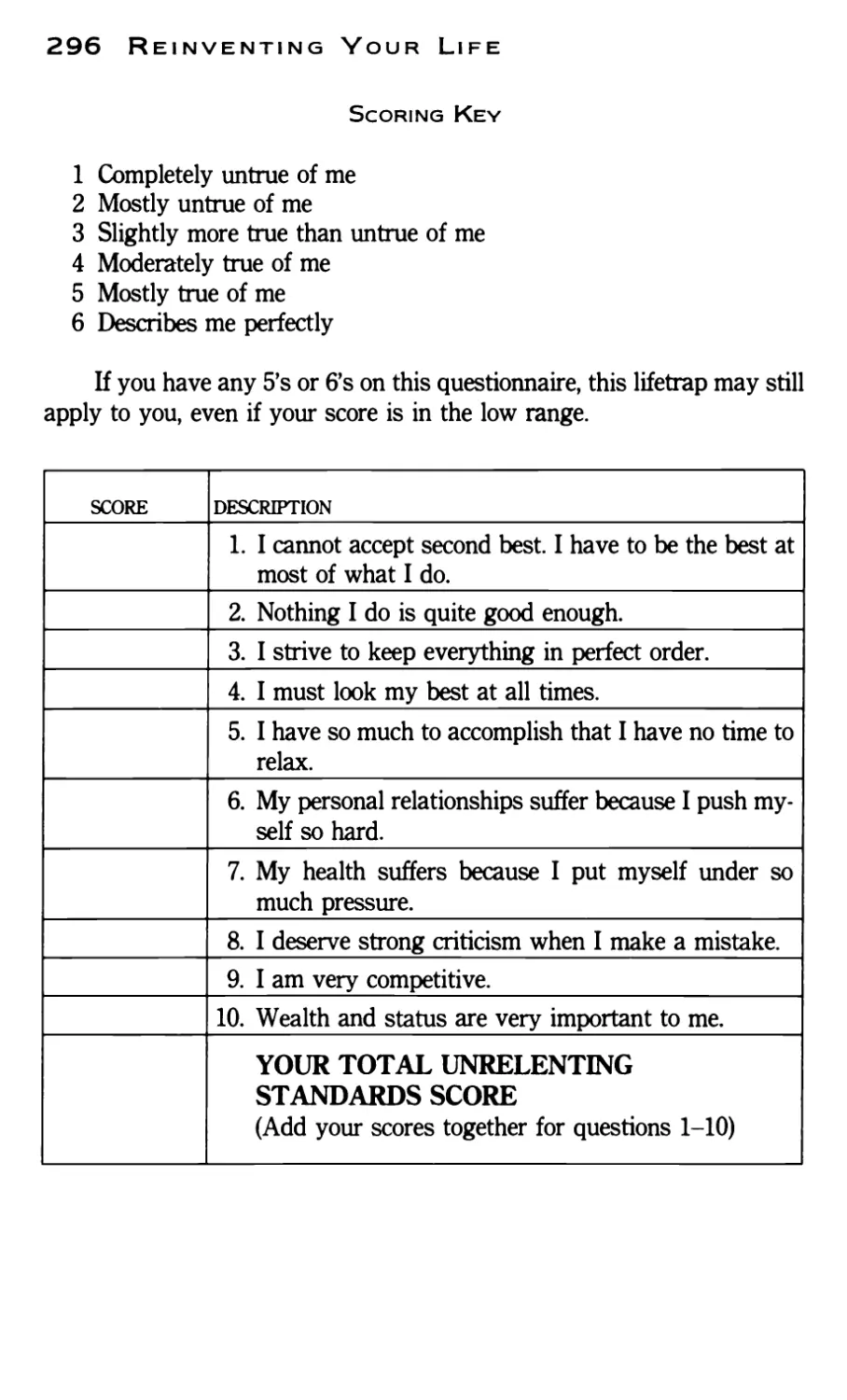

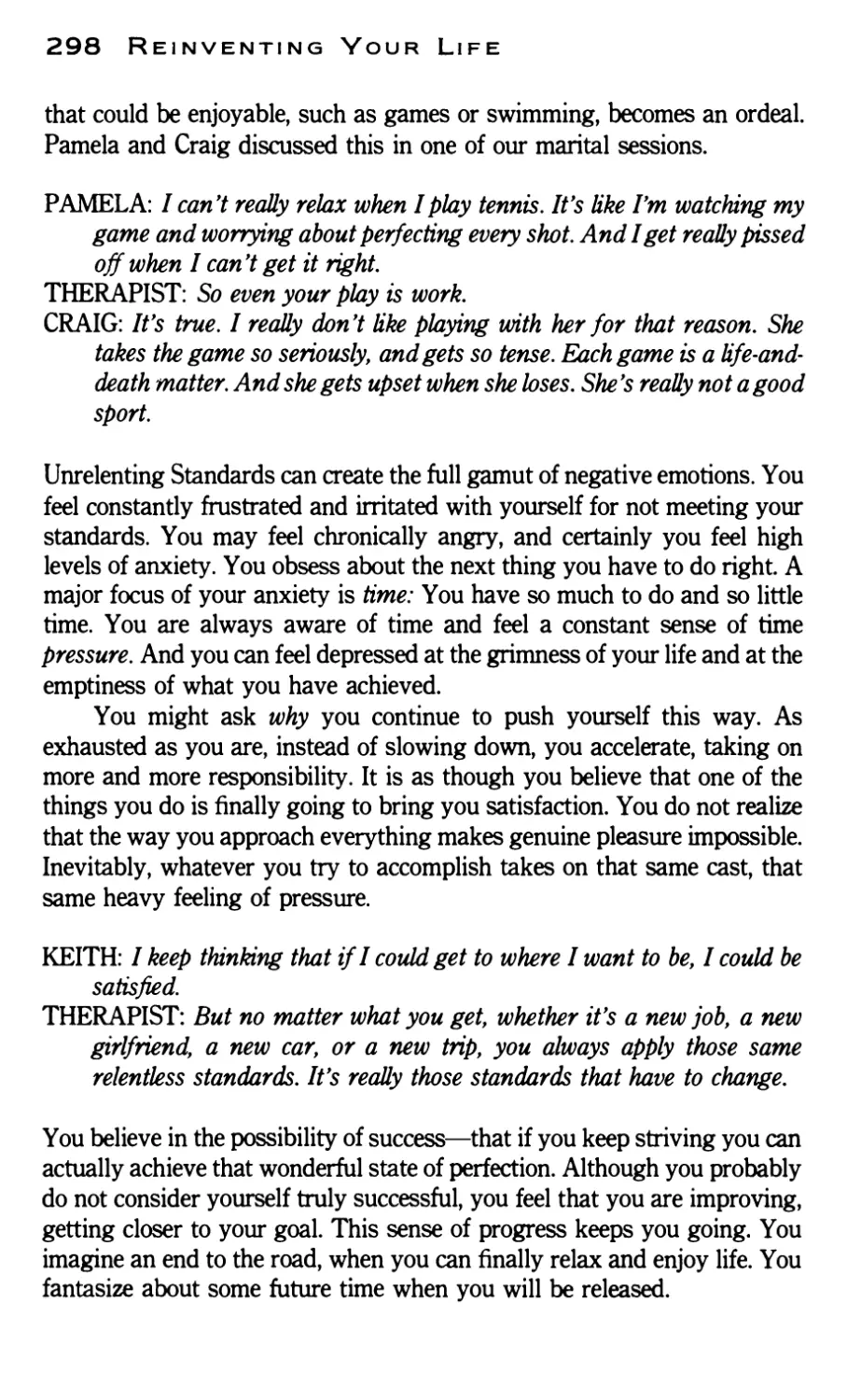
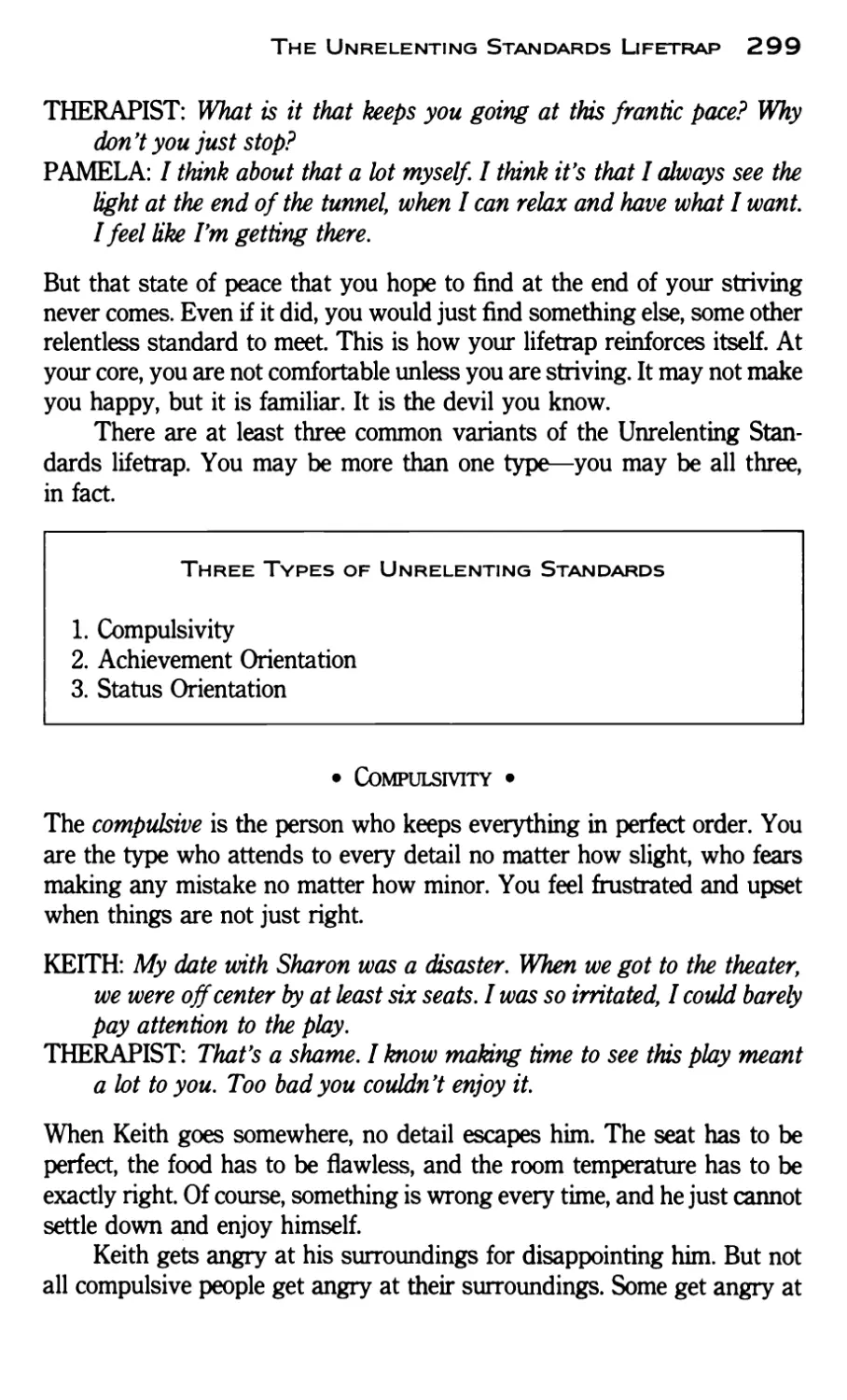
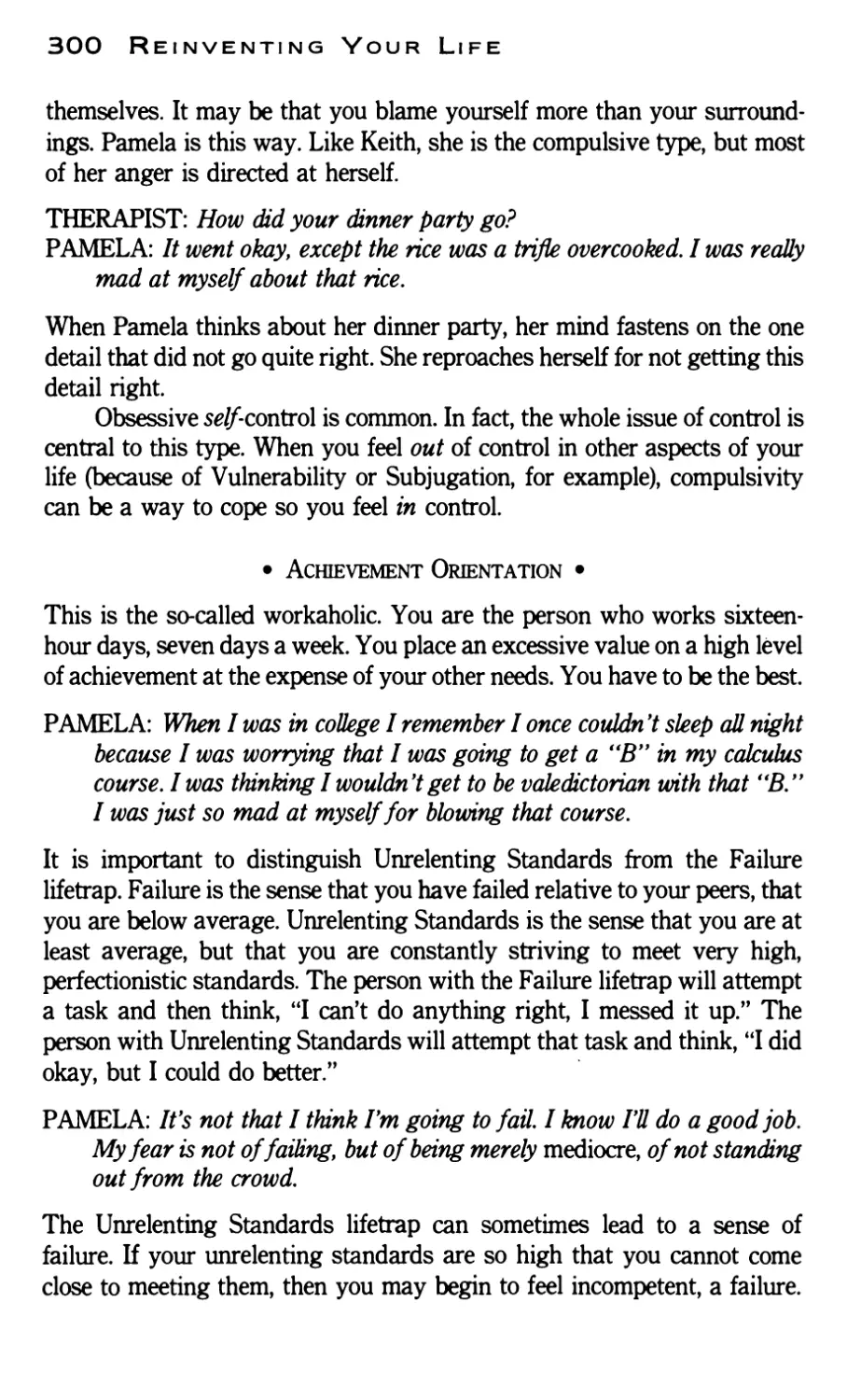
















Текст
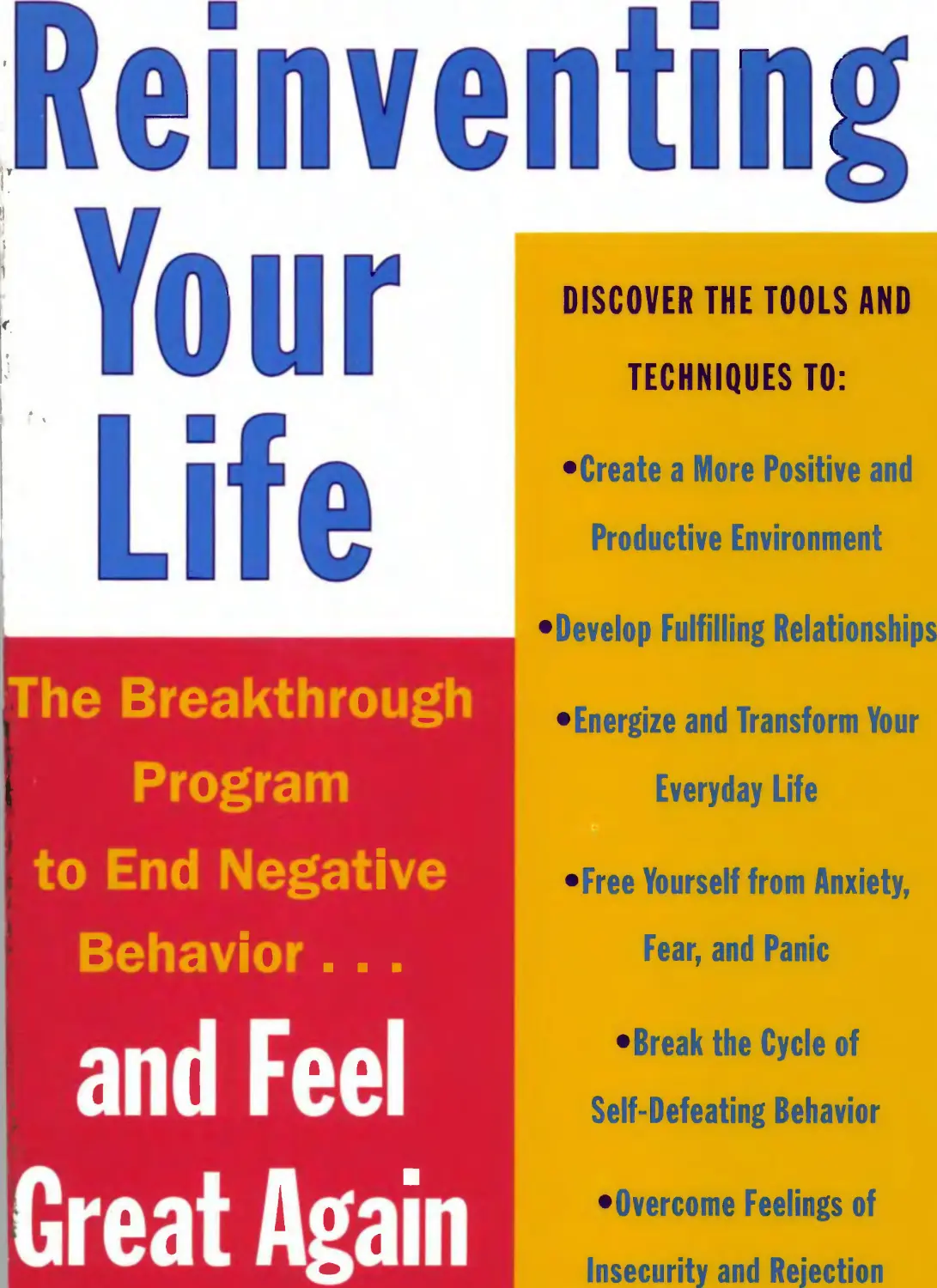
                    DISCOVER THE TOOLS AND
TECHNIQUES TO:
•Create a More Positive and
Productive Environment
•Develop Fulfilling Relationships
•Energize and Transform Your
Everyday Life
•Free Yourself from Anxiety,
Fear, and Panic
•Break the Cycle of
Self-Defeating Behavior
•Overcome Feelings of
Insecurity and Rejection

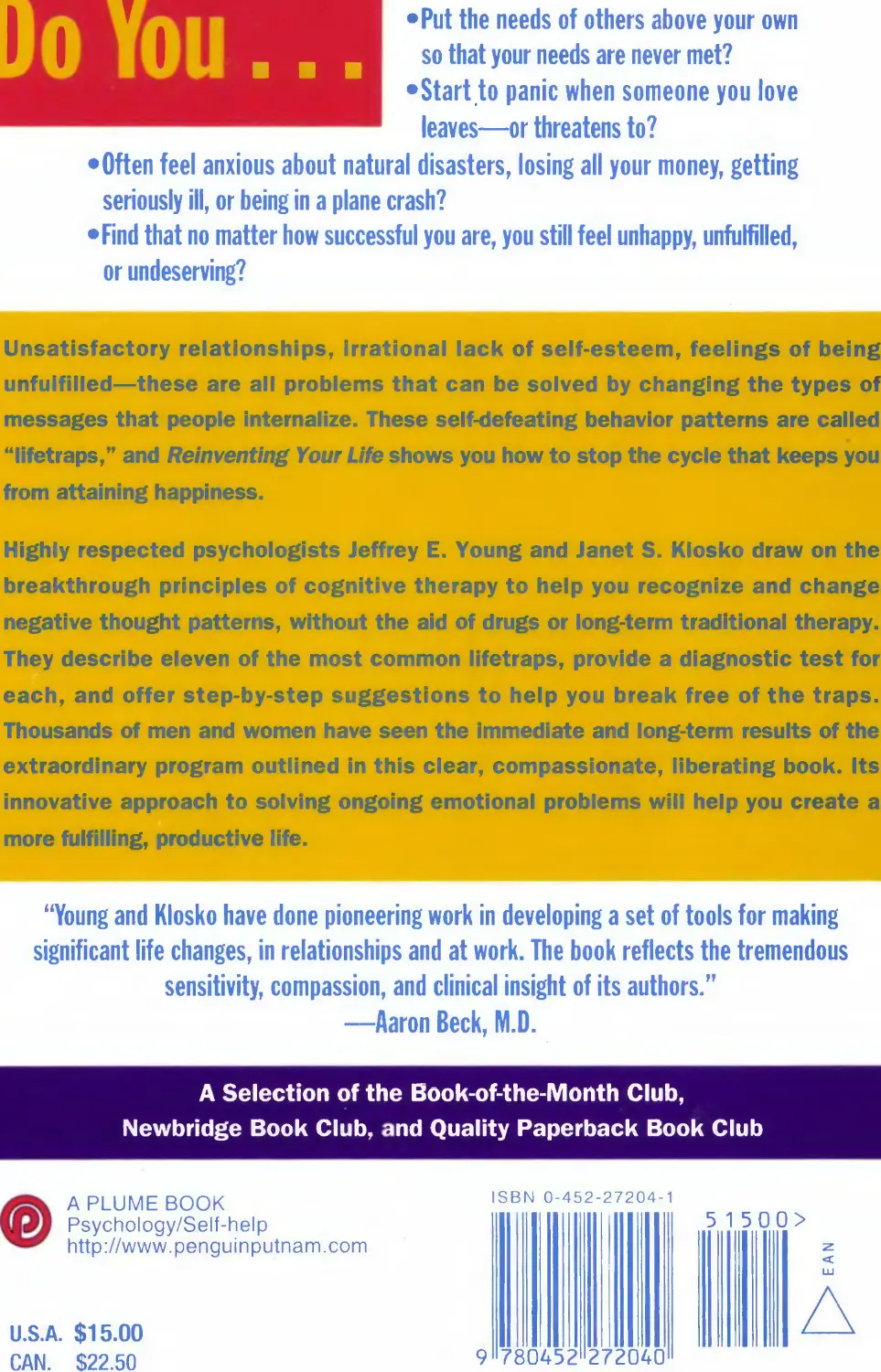
Are You Caught in a "Lifetrap"?
Are you drawn into relationships with people
who are selfish or cold?
Are you afraid of showing other people who you really are,
because you think they might reject you?
Do you feel inadequate compared to people around you?
Do you sacrifice relaxation and fun because you're
always trying to do your best?
Let two of America's leading psychologists show you
how to free yourself from these destructive
"lifetraps" with exciting, breakthrough techniques
that can transform your life.
JEFFREY E. YOUNG, Ph.D., is founder and director of the
Cognitive Therapy Centers of New York and Fairfield County
(Connecticut), as well as a faculty member in the Department
of Psychiatry at Columbia University. Dr. Young is an
internationally recognized lecturer on cognitive therapy. He lives in
Wilton, Connecticut.
Janet S. Klosko, Ph.D., commutes between Kingston, New
York, where she has a private practice, and Great Neck, New
York, where she is codirector of the Cognitive Therapy Center
of Long Island.

Jeffrey E. Young, Ph.D., and
Janet S. Klosko, Ph.D.
Reinventing
Your Life
THE BREAKTHROUGH PROGRAM
TO END NEGATIVE BEHAVIOR . . .
AND FEEL GREAT AGAIN
©
A PLUME BOOK

PLUME
Published by the Penguin Group
Penguin Putnam Inc., 375 Hudson Street, New York, New York 10014, U.S.A.
Penguin Books Ltd, 27 Wrights Lane, London W8 5TZ, England
Penguin Books Australia Ltd, Ringwood, Victoria, Australia
Penguin Books Canada Ltd, 10 Alcorn Avenue, Toronto, Ontario,
Canada M4V 3B2
Penguin Books (N.Z.) Ltd, 182-190 Wairau Road, Auckland 10, New Zealand
Penguin Books Ltd, Registered Offices: Harmondsworth, Middlesex, England
Published by Plume, a member of Penguin Putnam Inc.
Previously published in a Dutton edition.
First Plume Printing, May, 1994
30 29 28 27 26 25
Copyright © Jeffrey E. Young and Janet S. Klosko, 1993
All rights reserved
REGISTERED TRADEMARK—MARCA REGISTRADA
LIBRARY OF CONGRESS CATALOGING-IN-PUBLICATION DATA
Young, Jeffrey E.
Reinventing your life : the breakthrough program to end negative
behavior ... and feel great again
p. cm.
ISBN 0-452-27204-1
1. Self-defeating behavior. 2. Self-management (Psychology).
I. Klosko, Janet S. II. Title.
[RC455.4.S43Y68 1994]
158.1—dc20 93-48711
CIP
Printed in the United States of America
Without limiting the rights under copyright reserved above, no part of this
publication may be reproduced, stored in or introduced into a retrieval system, or
transmitted, in any form, or by any means (electronic, mechanical, photocopying,
recording, or otherwise), without the prior written permission of both the
copyright owner and the above publisher of this book.
BOOKS ARE AVAILABLE AT QUANTITY DISCOUNTS WHEN USED TO PROMOTE
PRODUCTS OR SERVICES. FOR INFORMATION PLEASE WRITE TO PREMIUM
MARKETING DIVISION, PENGUIN PUTNAM INC., 375 HUDSON STREET, NEW YORK, NEW
YORK 10014.
©

For Manny, Ethel, and Hannes, who have loved
and supported me unconditionally.
—Jeffrey Young
For my mother, father, Michael, and Molly, who
all gave me the space to write this book.
—Janet Klosko

Acknowledgments
Reinventing Your Life has special meaning. This book represents the
culmination of years of personal and professional growth for each of us.
For this reason, we have many people to thank, past and present, who have
in some important way contributed to our development.
We are indebted to Dan and Tara Goleman, without whose guidance,
faith, advice, gentle prodding, and of course, friendship, we would never
have undertaken such an overwhelming project; to Arthur Weinberger, for
his suggestions and encouragement during many years of developing the
schema-focused model; to William Zangwill, who, in his invaluable role as
devil's advocate and critic, has inspired us to sharpen and refine our ideas;
to David Bricker, who, through his involvement in new approaches to
psychotherapy, continually offers us fresh perspectives to consider; to
Cathy Flanagan, for her help in running the Center, her intelligent
comments, and her warmth; to Bill Sanderson, who has played an important
role as Director of Training at the Cognitive Therapy Center of New York
and as co-director at the Cognitive Therapy Center of Long Island; to Marty
Sloane, Richard Sackett, Jayne Rygh, and all our other friends and
colleagues in New York who have contributed to the development of this
approach; and to our editors Deb Brody and Alexia Dorszynksi, who
helped give the book its form and tone, and to our agent Pam Bernstein,
who helped make the book possible.
—JYandJK
VII

viii Acknowledgments
I would like to extend my personal thanks to several other people who have
played important roles in my development. To Janet Klosko, for making
this collaboration so stimulating and fruitful. I could not have "reinvented"
anyone better to work with; to Will Swift, who, like my father, has always
had supreme confidence in me, even when I was not so sure—thank you
for helping me get my ideas on tape, and for providing crucial feedback
over the past eight years; to Aaron (Tim) Beck, who, through his clinical
wisdom, penetrating intelligence, and empirical approach to personal and
professional problems, has served as my mentor. To Peter Kuriloff and
Arthur Dole, my graduate school advisors, for their friendship, for having
confidence in me, and for being open enough to give me the freedom to
pursue cognitive therapy before it was widely accepted; to Candice, for
putting up with me and for her devotion in shouldering much of the
responsibility I cannot handle; to Richard and Diane Wattenmaker, Bob
Spitzer, Janet Williams, Gene D'Aquili, and many others who have
contributed in ways they probably do not realize.
I have been fortunate throughout my life to have a family that I can
always rely on for praise, reassurance, and acceptance, regardless of what
I have gone through personally. For accepting all my quirks, I would like
to thank my parents, grandparents, brother Stephen, sister Debra, and the
other members of my extended family. I have learned through working
with patients less fortunate than I not to take such support for granted.
-JY
I would like to thank all the other people who helped me become the
psychologist that I am. I would like to start by thanking Jeff Young, for
being such an exemplary model, and for giving me the best form of therapy
I have ever known. I would like to thank my mentor, David Barlow, for
teaching me the meaning of the word "professional," and for encouraging
me to fulfill my talents. I would like to thank my supervisor in New York
City, Will Swift; Ann De Lancey, Mike Burkhardt, and my fellow interns
and other advisors from Brown University; and from SUNY at Albany—
Jerry Cerny, Rick Heimberg, John Wapner, Glen Conrad, Robin Tassinari,
Jim Mancuso, Robert Boice, Bill Simmons, Alan Cohen, my warm
supportive classmates, and others. Finally, I would like to thank the other members
of my family and close friends, for everything they have given me.
-JK

Contents
Foreword by Aaron Beck, M.D. xi
Preface xiii
1 Lifetraps 1
2 Which Ufetraps Do You Have? 1 4
3 Understanding Ufetraps 23
4 Surrender, Escape, and Counterattack 35
5 How Ufetraps Change 42
6 "Please Don't Leave Me!": The Abandonment Ufetrap 58
7 "I Can't Trust You": The Mistrust and Abuse Ufetrap 83
8 "I'll Never Get the Love I Need": The Emotional Deprivation
Ufetrap 109
9 "I Don't Fit In": The Social Exclusion Ufetrap 129
10 "I Can't Make It on My Own": The Dependence Ufetrap 1 55
11 "Catastrophe Is About to Strike": The Vulnerabiuty Ufetrap 1 84

x Contents
12 "I'm Worthless": The Defectiveness Lifetrap 207
13 "I Feel Like Such a Failure": The Failure Lifetrap 239
14 "I Always Do It Your Way!": The Subjugation Lifetrap 258
15 "It's Never Quite Good Enough": The Unrelenting Standards
Lifetrap 294
16 "I Can Have Whatever I Want": The Entitlement Lifetrap 314
17 A Philosophy of Change 34 1
References 353
Index 355

Foreword
BY AARON BECK, M.D.
I am delighted that Jeffrey Young and Janet Klosko have tackled the
difficult issue of personality problems, drawing upon the techniques and
principles of cognitive therapy. The authors have done pioneering work in
developing and making available to the public a powerful set of tools for
making significant life changes in relationships and at work.
Personality disorders are self-destructive, lifelong patterns that bring
patients tremendous unhappiness. People with personality disorders have
long-term problems with living, in addition to specific symptoms like
depression and anxiety. They are often unhappy in their intimate
relationships or chronically underachieve in their careers. Their overall quality of
life is usually lower than they desire.
Cognitive therapy has been expanding to meet the challenge of
treating these difficult, chronic patterns. In treating personality problems, we
address not only sets of symptoms—depression, anxiety, panic attacks,
addictions, eating disorders, sexual problems, and insomnia—but also
underlying schemas, or controlling beliefs. (The authors refer to schemas
as Ufetraps) Most patients come to therapy with certain core schemas that
are reflected in many symptom areas. Addressing these core schemas in
treatment can have beneficial effects that reverberate throughout many
areas of the patient's life.
Cognitive therapists have found that certain signs point to the likeli-
xi

xii Foreword
hood of a schema-level issue. The first is that the patient discusses a
problem and says, "I have always been this way, I have always had this
problem." The problem feels "natural" to the patient. Secondly, the patient
seems unable to carry out homework assignments that the therapist and
patient have agreed upon during sessions. There is a sense of being
"stuck." The patient both wants to change and resists changing. Thirdly,
the patient seems unaware of his or her effects on other people. There may
be lack of insight about self-defeating behaviors.
Schemas are hard to change. They are supported by cognitive,
behavioral, and emotional elements and therapy must address all of these
elements. Change in only one or two realms will not work.
Reinventing Your Life addresses eleven of these chronic, self-defeating
personality patterns, known in the book as Ufetraps. This book takes very
complicated material and makes it simple and understandable. Readers
will easily grasp the idea of lifetraps, and quickly be able to identify their
own. A wealth of case material, drawn from actual clinical experience, will
help readers relate to the lifetraps in a personal way. Furthermore, the
techniques the authors present are powerful in producing change. Their
approach is integrative: it draws on cognitive, behavioral, psychoanalytic,
and experiential therapies, while maintaining the practical,
problem-solving focus of cognitive therapy.
Reinventing Your Life presents practical techniques for overcoming
our most painful, lifelong problems. The book reflects the tremendous
sensitivity, compassion, and clinical insight of its authors.

Preface
Why another self-help book?
We believe that Reinventing Your Life fills an important gap in the
books currently available for self-improvement. There are many excellent
self-help books, just as there are many fine therapy approaches. However,
most of these are limited. Some books only deal with one specific
problem, like codependency, depression, lack of assertiveness, or making poor
partner choices. Some deal with many problems, but only use one means
of change, like inner-child work, couples exercises, or
cognitive-behavioral methods. Other books are inspirational or do a great job of
describing a universal problem like loss, but the solutions they offer are so
vague that we don't know how to go about changing once we have the
inspiration.
In Reinventing Your Life, Janet Klosko and I share with you a new
therapy for changing major life patterns. Lifetrap therapy addresses eleven
of the most destructive problems we encounter every day in our practices.
To help you change these lifetraps, we combine techniques from several
different therapies. As a result, we think this book will provide you with
a far more thorough and comprehensive approach to a variety of lifelong
problems than most books you have read so far.
Since this book is about personal growth and change, I'd like to
describe the path I followed leading to the development of lifetraps therapy.
Xlll

xiv Preface
In many respects my development as a therapist mirrors the journey of
self-discovery we outline for you in this book.
It began in 1975 when I was a graduate student at the University of
Pennsylvania. I remember my first experience doing therapy as an intern
at a community mental-health center in Philadelphia. I was learning
Rogerian therapy, a nondirective approach. I remember feeling stymied
much of the time. Patients would come to me with serious life problems,
expressing powerful emotions, and I was taught to listen, to paraphrase,
and to clarify so patients could arrive at their own solutions. The problem,
of course, was that often they didn't. Or, if they did come to their own
resolution, it took so long that I became terribly frustrated by the time
therapy was over. Rogerian therapy did not fit my temperament, my
natural inclinations. Perhaps I am too impatient, but I like to see change
and progress relatively quickly. I become easily frustrated in
circumstances where there is a serious problem and I have to sit by helplessly
watching, unable to correct it.
Within a short time, I began reading about behavior therapy, an
approach that stresses rapid, concrete behavior change. I felt an enormous
relief. I could be active and offer advice to patients instead of being so
passive. Behavior therapy offered a well laid out framework that explained
why patients had specific problems and exactly which techniques to use.
It was almost like a cookbook or technical manual. In comparison with the
vague approach I had originally learned, the behavioral model was very
appealing. It was geared toward fast, short-term change.
After a couple of years, I became disillusioned with behavior therapy
as well. In focusing so narrowly on what people do, I began to feel that
behavior therapy had gone too far in ignoring our thoughts and feelings. I
was missing the richness of patients' internal worlds. At this point I read
Dr. Aaron Beck's book, Cognitive Therapy and the Emotional Disorders,
and became excited again. Beck was combining the practicality and
directness of behavior therapy with the richness of patients' thoughts and beliefs.
After graduate school in 19791 began studying cognitive therapy with
Dr. Beck. I loved demonstrating to patients how their thoughts were
distorted and showing them rational alternatives. I also liked pinpointing
problem behaviors and rehearsing new ways of handling everyday
situations. Patients began to change in dramatic ways: their depression lifted,
anxiety symptoms went away. I also found that the techniques of cognitive
therapy were extremely valuable to me in my personal life. I began
spreading the word about cognitive therapy to other professionals through
lectures and workshops in the United States and Europe.

Preface xv
After a few years, I started my own private practice in Philadelphia.
I continued to have dramatic results with many patients, especially those
with specific symptoms like depression and anxiety. Unfortunately, as time
went on, I built up a backlog of patients who were not responding at all or
who showed only slight improvement. I decided to sit down and figure out
what these patients had in common. I also asked colleagues of mine who
were cognitive therapists to describe their resistant patients. I wanted to
see whether their therapy failures were similar to my own.
What I found in trying to distinguish difficult patients from the ones
who responded quickly was a revelation to me. The most difficult patients
tended to have less severe symptoms; in general, they were less depressed
and anxious. Many of their problems concerned intimacy: these patients
had patterns of unsatisfactory relationships. Furthermore, most of these
resistant patients had experienced their problems for most of their lives.
They were not coming to therapy because of a single life crisis, like divorce
or the death of a parent. These patients all had self-destructive life patterns.
Next I decided to make a list of the most common themes or patterns
in these difficult patients. This became my first list of schemas, or lifetraps.
It only had a few of the eleven patterns described in Reinventing Your Life,
such as deep feelings of defectiveness, a sense of profound isolation and
loneliness, a tendency to sacrifice their needs for those of other people, and
an unhealthy dependence or reliance on others. These lifetraps proved
invaluable to me in working with patients who previously had been
unresponsive to treatment. I found that by developing a list of lifetraps, I could
break down patients' problems into manageable parts. I could also develop
different strategies for solving each problem or pattern.
In retrospect, my search for broad themes and patterns was also very
consistent with my own personality. I've always longed to see various
aspects of my life as part of an organized whole, with some sense of order
and predictability. I've always felt that I could gain control over my own
life by extracting these general themes or patterns. I remember as a college
student trying to classify my roommates into various categories of
friendship, depending on how much I felt they could be relied upon.
Another thread in my own development as a therapist has been my
increasing desire to integrate and blend, rather than eliminate or criticize.
Many therapists feel they must choose one approach to therapy and follow
it with devotion. That is why we have strict Gestalt therapists, family
therapists, Freudian therapists, and behavior therapists. I have come to
believe that integrating the best components of several therapies is far
more effective than any one alone. There is much of value in psychoana-

xvi Preface
lytic, experiential, cognitive, pharmacological, and behavioral approaches,
but each has significant limitations when used alone.
On the other hand, I am also opposed to combining many different
techniques haphazardly without a unifying framework. I believe that the
eleven lifetraps provide that unifying framework, and that techniques
drawn from several approaches can be combined, like an arsenal of
weapons, to fight these lifetraps. Furthermore, as described in the chapters that
follow, these lifetraps can provide you with a sense of continuity over the
course of your life; the past and present can be seen as part of a consistent
whole. Each lifetrap has an understandable origin in childhood that
intuitively feels right to us. We can understand, for example, why we are drawn
to critical partners, and why we feel so badly about ourselves when we
make a mistake, once we grasp how demanding and punitive our own
parents were.
I hope that Reinventing Your Life fills the need for a book that deals
comprehensively with a broad range of deeply felt, lifelong problems we all
face. I also hope that it provides you with a useful framework for
understanding how these patterns developed, along with powerful solutions for
each lifetrap, drawn from many different psychological approaches that
can really work for you.
JEFFREY YOUNG
September 1992

1
LlFETRAPS
• Are you repeatedly drawn into relationships with people who are cold
to you? Do you feel that even the people closest to you do not care or
understand enough about you?
• Do you feel that you are at your core somehow defective, that no one
who truly knows you could possibly love and accept you?
• Do you put the needs of others above your own, so your needs never get
met—and so you do not even know what your real needs are?
• Do you fear that something bad will happen to you, so that even a mild
sore throat sets off a dread of more dire disease?
• Do you find that, regardless of how much public acclaim or social
approval you receive, you still feel unhappy, unfulfilled, or undeserving?
We call patterns like these Hfetraps. In this book, we will describe the
eleven most common lifetraps and will show you how to recognize them,
how to understand their origins, and how to change them.
A lifetrap is a pattern that starts in childhood and reverberates
throughout life. It began with something that was done to us by our
families or by other children. We were abandoned, criticized, overprotected,
abused, excluded, or deprived—we were damaged in some way.
Eventually the lifetrap becomes part of us. Long after we leave the home we
grew up in, we continue to create situations in which we are mistreated,
1

2 Reinventing Your Life
ignored, put down, or controlled and in which we fail to reach our most
desired goals.
Lifetraps determine how we think, feel, act, and relate to others. They
trigger strong feelings such as anger, sadness, and anxiety. Even when we
appear to have everything—social status, an ideal marriage, the respect of
people close to us, career success—we are often unable to savor life or
believe in our accomplishments.
Jed: A thirty-nine-year-old stockbroker who is
extremely successful. He conquers women, but never
really connects with them. jed is caught in the
emoTIONAL Deprivation lifetrap.
When we were first developing the lifetraps approach, we began treating
an intriguing patient named Jed. Jed perfectly illustrates the self-defeating
nature of lifetraps.
Jed goes from one woman to another, insisting that none of the women
he meets can satisfy him. Each one eventually disappoints him. The closest
Jed comes to intimate relationships is infatuation with women who
sexually excite him. The problem is that these relationships never last.
Jed does not connect with women. He conquers them. The point at
which he loses interest is exactly the point at which he has "won." The
woman has started to fall in love with him.
JED: It really turns me off when a woman is clingy. When she starts hanging
all over me, especially in public, I just want to run.
Jed struggles with loneliness. He feels empty and bored. There is an empty
hole inside—and he restlessly searches for the woman who will fill him up.
Jed believes he will never find this woman. He feels that he has always been
alone and always will be alone.
As a child, Jed felt this same aching loneliness. He never knew his
father, and his mother was cold and unemotional. Neither one of them met
his emotional needs. He grew up emotionally deprived, and continues to
recreate this state of detachment as an adult.
For years Jed inadvertently repeated this pattern with therapists,
drifting from one to another. Each therapist initially gave him hope, yet
ultimately disappointed him. He never really connected with his therapists;

Ufetraps 3
he always found some fatal flaw that in his mind justified terminating
therapy. Each therapy experience confirmed that his life had not changed,
and he felt even more alone.
Many of Jed's therapists were warm and empathic. This was not the
problem. The problem was that Jed always found some excuse to avoid
the intimacy with which he was so unfamiliar and uncomfortable.
Emotional support from a therapist was essential, but not enough. His
therapists did not confront his self-destructive patterns often or forcefully
enough. For Jed to escape his Emotional Deprivation lifetrap, he had to
stop finding fault with the women he met and begin to take
responsibility for fighting his own discomfort about getting close to people and
accepting their nurturance.
When Jed finally came to us for treatment, we challenged him over
and over again, trying to chip away at his lifetrap each time it reasserted
itself. It was important to show him that we were genuinely sympathetic
with how uncomfortable it felt for him to get close to anyone, in light of his
extremely icy parents. Nevertheless, whenever he insisted that Wendy was
not beautiful enough, Isabel was not brilliant enough, or Melissa was just
not right for him, we pushed him to see that he was falling into his lifetrap
again, finding fault with others to avoid feeling warmth. After a year of this
empathic confrontation, balancing emotional support and confrontation,
we were finally able to see significant change. He is now engaged to Nicole,
a warm and loving woman:
JED: My previous therapists were really understanding, and I got a lot of
insight into my grim childhood, but none of them really pushed me to
change. It was just too easy to fall back into my old familiar patterns.
This approach was different.
I finally took some responsibility for making a relationship work.
I didn't want my relationship with Nicole to be another failure, and I
felt like this was it for me. Although I could see that Nicole wasn't
perfect, I finally decided that either I would have to connect with
someone or resign myself to being alone forever.
The lifetrap approach involves continually confronting ourselves. We will
teach you how to track your lifetraps as they play themselves out in your
life, and how to counter them repeatedly until these patterns loosen their
grip on you.

4 Reinventing Your Life
Heather: A forty-two-year-old woman with
tremendous POTENTIAL, TRAPPED IN HER OWN HOME BECAUSE HER
FEARS ARE SO CRIPPLING. ALTHOUGH SHE TAKES THE
TRANQUILIZER Ativan to treat her anxiety, she is still stuck
in the Vulnerability lifetrap.
In a sense, Heather has no life; she is too afraid to do anything. Life is
fraught with danger. She prefers to stay home where it is "safe."
HEATHER: / know there's lots of great stuff to do in the city. I Hke the
theater, I tike nice restaurants, I tike seeing friends. But it's just too
much for me. I don't have fun. I'm too worried all the time that
something horrible is going to happen.
Heather worries about car crashes, collapsing bridges, getting mugged,
catching a disease such as AIDS, and spending too much money. It
certainly is not surprising that a trip to the city is no fun for her.
Heather's husband Walt is very angry with her. He wants to go out
and do things. Walt says—and rightly so—that it is not fair for him to be
deprived. More and more, he goes ahead and does things without her.
Heather's parents were exceptionally overprotective of her. Her
parents were Jewish Holocaust survivors who spent much of their childhoods
in concentration camps. They treated her like a china doll, as she put it.
They continually warned her about possible (but unlikely) threats to her
welfare: she might catch pneumonia, be trapped in the subway, drown, or
be caught in a fire. It is no wonder that she spends most of her time in a
painful state of anxiety, trying to make sure that her world is safe.
Meanwhile, almost everything that is pleasurable is draining out of her life.
Before coming to us, Heather tried several anti-anxiety medications
over a three-year period. (Medication is the most common treatment for
anxiety.) Most recently, she went to a psychiatrist who prescribed Ativan.
She took the pills every day, and the medication did provide some relief.
She felt better, less anxious. Life became more pleasant. Knowing she had
the medication made her feel more able to cope with things. Even so, she
continued to avoid leaving the house. Her husband complained that the
medication just made her happier to sit around at home.
Another serious problem was that Heather felt dependent on the Ativan:
HEATHER: I feel tike I'm going to have to stay on this for the rest of my
life. The idea of giving it up terrifies me. I don't want to go back to being
scared of everything all the time.

LlFETRAPS 5
Even when Heather coped well with stressful situations, she attributed all
her success to the medication. She was not building a sense of mastery—
the sense that she could handle things on her own. (This is why,
particularly with anxiety treatments, patients tend to relapse when the medication
is withdrawn.)
Heather made relatively rapid progress in lifetrap therapy. Within a
year, her life was significantly better. She gradually started entering more
anxiety-provoking situations. She could travel, see friends, go to movies,
and she eventually decided to take on a part-time job that required
commuting.
As part of her treatment, we helped Heather become better at
estimating the odds of bad things happening. We continually demonstrated how
she exaggerated the risk of catastrophe in harmless situations; and we
showed her that she overestimated her own vulnerability and weakness
outside her home. She learned to take reasonable precautions. She stopped
asking her husband and friends for reassurance. Her marriage improved.
And she got more pleasure from her life.
THE IRONY OF REPETITION
Jed and Heather illustrate two of the eleven lifetraps: Emotional
Deprivation and Vulnerability. As we discuss other patients, you will read about
the other lifetraps: Subjugation, Mistrust and Abuse, Abandonment,
Defectiveness, Entitlement, Dependence, Failure, Unrelenting Standards, and
Social Exclusion. You will probably recognize elements of yourself in
several of these.
That we keep repeating the pain of our childhood is one of the core
insights of psychoanalytic psychotherapy. Freud called this the repetition
compulsion. The child of an alcoholic grows up to marry an alcoholic. The
abused child grows up to marry an abuser, or becomes an abuser himself.
The sexually molested child grows up to be a prostitute. The overly
controlled child allows others to control her.
This is a baffling phenomenon. Why do we do this? Why do we
reenact our pain, prolonging our suffering? Why don't we build better lives
and escape the pattern? Almost everyone repeats negative patterns from
childhood in self-defeating ways. This is the strange truth with which
therapists contend. Somehow we manage to create, in adult life, conditions
remarkably similar to those that were so destructive in childhood. A
lifetrap is all the ways in which we recreate these patterns.
The technical term for a lifetrap is a schema. The concept of a schema

6 Reinventing Your Life
comes from cognitive psychology. Schemas are deeply entrenched beliefs
about ourselves and the world, learned early in life. These schemas are
central to our sense of self. To give up our belief in a schema would be to
surrender the security of knowing who we are and what the world is like;
therefore we cling to it, even when it hurts us. These early beliefs provide
us with a sense of predictability and certainty; they are comfortable and
familiar. In an odd sense, they make us feel at home. This is why cognitive
psychologists believe schemas, or lifetraps, are so difficult to change.
Let us now look at how lifetraps affect the chemistry we feel in
romantic relationships.
Patrick: A thirty-five-year-old building contractor.
The more his wife, Francine, has affairs with other
men, the more he desires her. Patrick is caught in the
Abandonment lifetrap.
Patrick is acutely unhappy. His wife keeps having affairs with other men.
Whenever she has an affair, he becomes desperate.
PATRICK: It's tike I'll do anything to get her back. I can't stand it. I know
if I lose her I'll fall apart I can't understand why I put up with this; it's
as if I love her more when I know she's not therefor me. I start thinking,
"If only I could be better, she wouldn't need to do this. If only I were
better, she would stay with me." I can't stand the uncertainty.
Francine keeps promising to be faithful, and each time Patrick believes her.
And each time his hopes are dashed.
PATRICK: / can't believe she's doing this to me again. I can't believe she'd
put me through it. After last time I was sure she would stop. I mean,
she saw what she did to me. I was almost suicidal. I can't believe she
would do it again.
Patrick's marriage is a roller coaster. He rides, out of control, from wild
hope to despair, rising and crashing again and again.
PATRICK: The hardest part for me is the waiting. Knowing what she is
doing and waiting for her to come home. There have been times when
I have waited days. Just sat there and waited for her to come home.

LlFETRAPS 7
While Patrick waits, he alternates between sobbing and rage. When Fran-
cine finally comes home, there is a scene. A few times he has hit her,
afterward always begging her forgiveness. He wants to get off the roller
coaster. He says he wants some stability and peace. Yet this is the irony
of the Abandonment lifetrap: the more unpredictable Francine is, the more
he is drawn to her at a deep emotional level. He feels more chemistry when
she threatens to leave.
Patrick's childhood was fraught with loss and unpredictability. His
father abandoned the family when Patrick was only two years old. He and
his two sisters were raised by their mother, an alcoholic who neglected
them when she was drunk. These feelings are familiar to him, and he
has managed to recreate them by marrying Francine and tolerating her
infidelity.
Patrick was in psychoanalysis (Freudian therapy) for three years. He
saw his analyst three times a week for fifty minutes each time—at
considerable expense.
PATRICK: I would go in and He down on the couch and talk about whatever
came into my mind. It was very lonely for me. My analyst said very little
in the whole three years. Even if I was crying or yelling at him he usually
wouldn't say anything. I felt Uke he wasn't really there.
He talked a lot about his childhood, and about what it felt like to lie there
on the couch.
He became frustrated with analysis. He found his progress very slow.
He understood his problems better, but he still had them. (This is a common
complaint about psychoanalysis: Insight is not enough.) He wanted a
therapy that was quicker and more directive. He wanted more guidance.
The lifetrap approach offered Patrick the guidance he needed. Instead
of being distant and neutral with Patrick, we collaborated with him. We
helped him see exactly what his pattern was and how he could break it. We
taught him how to become more selective in his relationships with women.
We warned him of the danger in romantic relationships of being drawn to
destructive partners who generate a lot of sexual chemistry. He was
confronted with the painful reality that he, like many of us, had fallen in love
with a partner who reinforced his lifetrap.
After a year and a half of lifetrap therapy, Patrick decided to end his
marriage to Francine. In that time he had given her every chance. He had
tried to correct his behaviors that were destructive to the relationship—and
that were inadvertently driving her away. He had stopped trying to control

8 Reinventing Your Life
her. He had given her more freedom. He had asserted himself when she
treated him badly. But through it all Francine had not changed. In fact,
things had grown worse.
When we first asked if he had considered leaving Francine, Patrick
insisted that he was too afraid he would fall apart. But when he finally left
her and ended his marriage, he did not fall apart. Instead, he became calmer
and more self-confident. He saw that he could have a life apart from
Francine. We think he was right to leave the self-destructive relationship.
Patrick slowly started seeing other women. At first, he dated women
who were just like his wife—unstable and unable to support him. It was
as though he were running through the whole cycle again in fast motion.
We gradually helped him to make healthier choices, even though the
chemistry he felt was not quite as high. He has been living for six months
with Sylvia, a very stable and reliable woman who seems devoted to him.
While she is less glamorous than Francine, for the first time in his life
Patrick is learning to be content in a consistent, nurturing environment.
The lifetrap approach shows you exactly what types of relationships
are healthy for you to pursue, and what types to avoid, given your
particular lifetraps. Often, this is not easy. Like Patrick, you may have to make
choices that are painful in the short run and even go against your gut
feelings in order to escape a rut that you have been mired in throughout
your life.
Carlton: Thirty years old, works for his father in a
family textile business. He is not very good at
managing OTHER PEOPLE AND WOULD MUCH RATHER BE DOING
SOMETHING ELSE. CARLTON IS CAUGHT IN THE SUBJUGATION
LIFETRAP.
Carlton is a people-pleaser. He puts everyone's needs before his own. He is
the one who always says, "I don't care, you decide," when other people ask
him what he wants.
Carlton tries to please his wife by saying "yes" to everything she says
and wants. He tries to please his children by never saying "no." He tries
to please his father by going into the family business, even though it means
doing a job he does not like.
Ironically, despite the fact that he tries so hard to please, other people
often feel irritated with Carlton. He is so self-sacrificing. His wife is angry
that he has no backbone. Although the children take advantage of his
permissiveness, at some level they are angry that he fails to set limits. His

LlFETRAPS 9
father is constantly annoyed with Carlton's weakness and lack of
aggressiveness at work, particularly in dealing with employees.
Although Carlton does not know it, he is angry, too. Deep inside he
is angry about having denied his own needs for so long. This is a pattern
he learned early in life. His father is considered a tyrant; he thrives by
domineering and controlling others. Everything has to be his way. As a
child, if Carlton disagreed or argued, his father spanked and belittled him.
His mother adopted a completely passive role. She was depressed much of
the time, and Carlton often found himself in the role of caretaker, trying to
make her feel better. There was no place he could go to get his needs met.
Before coming to us, Carlton was in an experiential treatment called
Gestalt therapy for two years. His therapist encouraged him to stay in the
present and get in touch with his feelings. For example, the therapist had
him try imagery exercises in which he would picture his father and practice
talking back to him. This approach was helpful. He started to feel how
angry he was.
The problem was that the therapy lacked direction. It did not have a
consistent focus. Carlton drifted from session to session, exploring
whatever feelings were most prominent at the moment. Naturally, his anger at
his loved ones kept surfacing, but he did not act on his feelings and he did
not understand why. The therapist did not draw all the components of his
problem together for him and then teach him specific change techniques to
overcome his subjugation.
Lifetrap therapy provided Carlton with a simple, straightforward
conceptual framework that allowed him to see that subjugation was a primary
theme running through his life, and he learned ways to change it. He made
rapid progress. We often find that the Subjugation lifetrap takes the least
amount of time to break.
Carlton developed a stronger sense of self He became more aware of
his own desires and feelings, which he had learned to suppress. He started
developing opinions and preferences. He also became more assertive with
his father, employees, and his wife and children. Particularly, he worked on
expressing anger; he learned to state his needs in a calm and controlled
manner. Although his wife and children put up some minor resistance at
the beginning, once they recognized they were losing power, they soon
settled down. In truth, they liked him better. They wanted him to be strong.
He had a more difficult battle with his father. Although his father tried
to squelch Carlton's rebellion and reassert his dominant position, Carlton
discovered that he had more leverage with his father than he realized.
When he threatened to leave the business if his father would not let him

10 Reinventing Your Life
assume a more equal role, his father backed down. Carlton is now
beginning to take over many of his father's responsibilities as his father prepares
for retirement. He has also discovered that his father has a newfound
respect for him.
This case illustrates the importance of going beyond getting in touch
with our feelings. Many so-called experiential therapies, such as inner-child
work, provide a valuable role in helping us feel the links between what we
experience in our daily lives today and what we felt as children. But these
approaches rarely go far enough. Participants often feel much better after
therapy sessions or workshops, but they usually drift back to their old
patterns quickly. The lifetrap approach provides structured behavioral
homework assignments and continual confrontation to help you maintain
progress.
THE COGNITIVE THERAPY REVOLUTION
Lifetrap therapy is an outgrowth of an approach called cognitive therapy,
developed by Dr. Aaron Beck in the 1960s. We have incorporated many
aspects of this treatment into the lifetrap approach.
The basic premise of cognitive therapy is that the way we think about
events in our lives (cognition) determines how we feel about them
(emotions). People with emotional problems tend to distort reality. For example,
Heather was taught by her mother to view everyday tasks such as riding
a subway as dangerous. Lifetraps lead us to view certain kinds of
situations in an inaccurate manner. They push our cognitive buttons.
Cognitive therapists believe that if we can teach patients to become
more accurate about the way they interpret situations, we can help them
feel better. If we can show Heather that she can travel on her own
without much danger, then she will be less frightened and can begin living
again.
Dr. Beck suggests that we examine our thoughts logically. When we
are upset, are we exaggerating, personalizing, catastrophizing, etc.? Do our
thoughts really make sense? Are there other ways to look at the situation?
Further, Beck says we should test our negative thoughts by performing
little experiments. For example, we asked Heather to walk around the block
alone during the winter to see that nothing harmful would happen to her,
even though she was convinced she would get sick or be mugged.
Cognitive therapy has gained wide respect. A large, growing body of
research supports its effectiveness with such disorders as anxiety and

Ufetraps 1 1
depression. It is an active approach that teaches patients to control their
own moods by controlling their thoughts.
Cognitive therapists usually combine cognitive methods with
behavioral techniques, which are designed to teach patients practical skills they
may never have learned such as relaxation, assertiveness, anxiety
management, problem solving, time management, and social skills.
However, we have found over the years that cognitive and behavioral
methods, while invaluable, are not sufficient to change lifelong patterns.
Thus we developed the Lifetrap approach, which combines cognitive and
behavioral techniques with psychoanalytic and experiential techniques.
Madeline, the final patient we will discuss in this chapter, demonstrates
both the value and limitation of using only cognitive behavioral methods.
Madeline: A twenty-nine-year-old actress and singer.
She was sexually abused by her stepfather, and
continues TO SUFFER THE EFFECTS. MADELINE IS STILL PLAYING
out the Mistrust and Abuse lifetrap.
Madeline has never had a long-term relationship with a man. Instead, she
has gone from one extreme to the other: either she has avoided men
altogether or she has been promiscuous.
Until she went to college, Madeline avoided boys. She never dated or
had a boyfriend.
MADELINE: / never let a guy near me. I remember the first time a boy
kissed me. I ran away. When I sensed that a boy Uked me, I acted really
cold until he went away.
In her first two years of college, Madeline started drinking and doing
drugs. During this period, she had sex with more than thirty men. ''None
of them meant anything to me," she says.
MADELINE: / went wild in college. I slept around. There was one fraternity
where every guy in there had slept with me. I was miserable. I felt cheap
and dirty. I felt used. I just couldn't say no. I would go out with a guy
and end up sleeping with him even though I had promised myself I
wouldn't. I figured it was the only reason guys would go out with me.
I really don Y know why I did it. That whole time was just tike running
out of control.

12 Reinventing Your Life
The experience of sexual abuse by her stepfather damaged her sexuality
and capacity for intimacy with men. For her, sex and abuse are inextricably
mixed.
Now, Madeline is back to avoiding men. She has not dated in many
years and is worried that she will never be able to marry and have children.
The first treatment Madeline tried was conventional cognitive
therapy. Her therapist focused on the present—on Madeline's current
avoidance of men. It was rare, for example, for Madeline to discuss her childhood
in therapy. Instead, she and her therapist designed homework for her to do
between sessions, such as striking up conversations with men or going to
parties. The therapist helped her fight her distorted thoughts, such as "Men
are only out for sex," by asking her for examples of men she knew who
were caring and wanted intimacy.
Therapy went on for several months. Madeline began to date again,
but she was drawn to abusive men. Although she recognized that many
men were considerate, her experience with boyfriends did not bear this out.
Madeline realized she needed something more to change her deeply
ingrained pattern.
MADELINE: / felt Uke my therapist was asking me to change without
understanding why I was the way I was. I mean, I know I have to change
in the ways that she said. I have to start trusting men and stop avoiding
closeness. But there are reasons why I avoid men. I need to understand
what they are.
Madeline became angry at any man who seemed to approach her
romantically. She could see that the anger was the result of distorted thoughts, but
she still felt it. Madeline needed to direct her anger toward its true object—
her stepfather. She needed to express her anger and have it validated.
During the first year and a half of lifetrap therapy, we helped
Madeline to uncover her memories of abuse through imagery. We pushed her to
ventilate her anger at her stepfather and to confront him with her
accusations. We encouraged her to join a support group for survivors of incest.
We also showed her how she maintained her pattern of abuse by selecting
abusive boyfriends.
Madeline slowly resumed dating. Although she was still attracted to
abusive men, she stayed away from them at our insistence, focusing
instead on men who treated her respectfully, even though the chemistry was
less intense. She worked on demanding respect, rather than leaving it to the
man to give it to her. She learned to say "no."

Lifetraps 13
About a year later she fell in love with Ben, a gentle, sensitive man.
Even with him, however, she experienced serious sexual inhibition. Ben
was willing to work with her to overcome her sexual difficulties. She is now
considering marriage.
In Chapter 16, we will provide many suggestions for changing the
Mistrust and Abuse lifetrap. However, we want to emphasize that many
lifetraps, Mistrust and Abuse in particular, take a long time to change and
should be approached with the help of a therapist or support group.
Madeline's treatment illustrates how lifetrap therapy retains the
practical focus of cognitive and behavioral therapies: it builds skills and makes
changes. But we are interested in more than short-term behavior
modification. We also want to address lifelong issues, especially difficulties in
relationships, self-esteem, and career problems. We want to address
behavior, but we also want to address the ways that people feel and relate.
The next chapter begins with a questionnaire to help you discover
which lifetraps apply to you.

2
Which Lifetraps
Do You Have?
In this chapter, we will help you identify which lifetraps seem most
pertinent to your life.
Rate each of the next twenty-two statements in terms of how true each
is of you on this six-point scale.
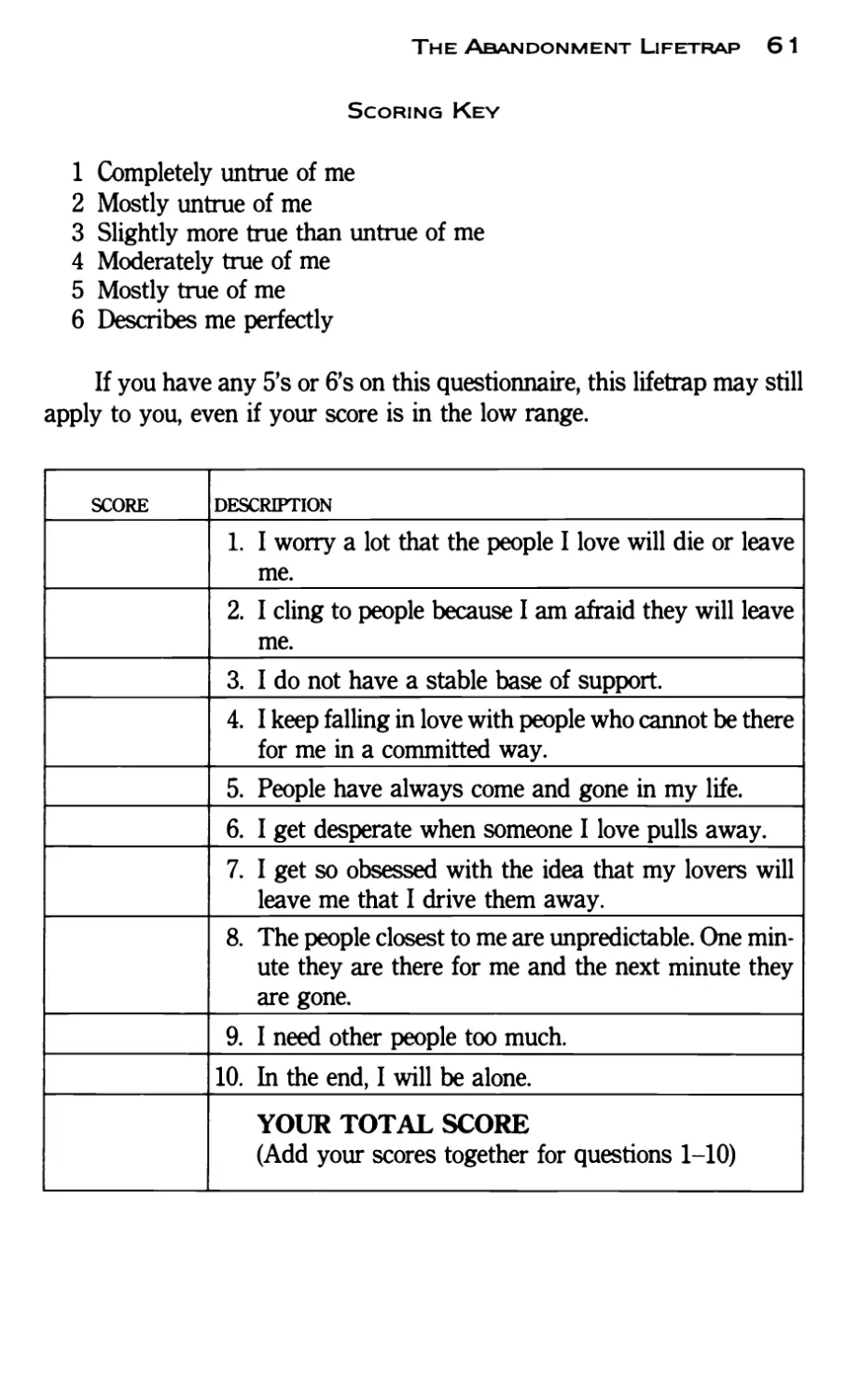
Scoring Key
1 Completely untrue of me
2 Mostly untrue of me
3 Slightly more true than untrue of me
4 Moderately true of me
5 Mostly true of me
6 Describes me perfectly
First, rate how true the statement was of you as a child. If your answer
would be different for various times in your childhood, choose the rating
that best fits the way you felt in general up until the age of twelve. Then,
rate how true each item is of you now, as an adult. If your answer would
be different for various periods Of your adult life, choose the rating that best
applies to you in the past six months.
14

Which Lifetraps Do You Have? 1 5
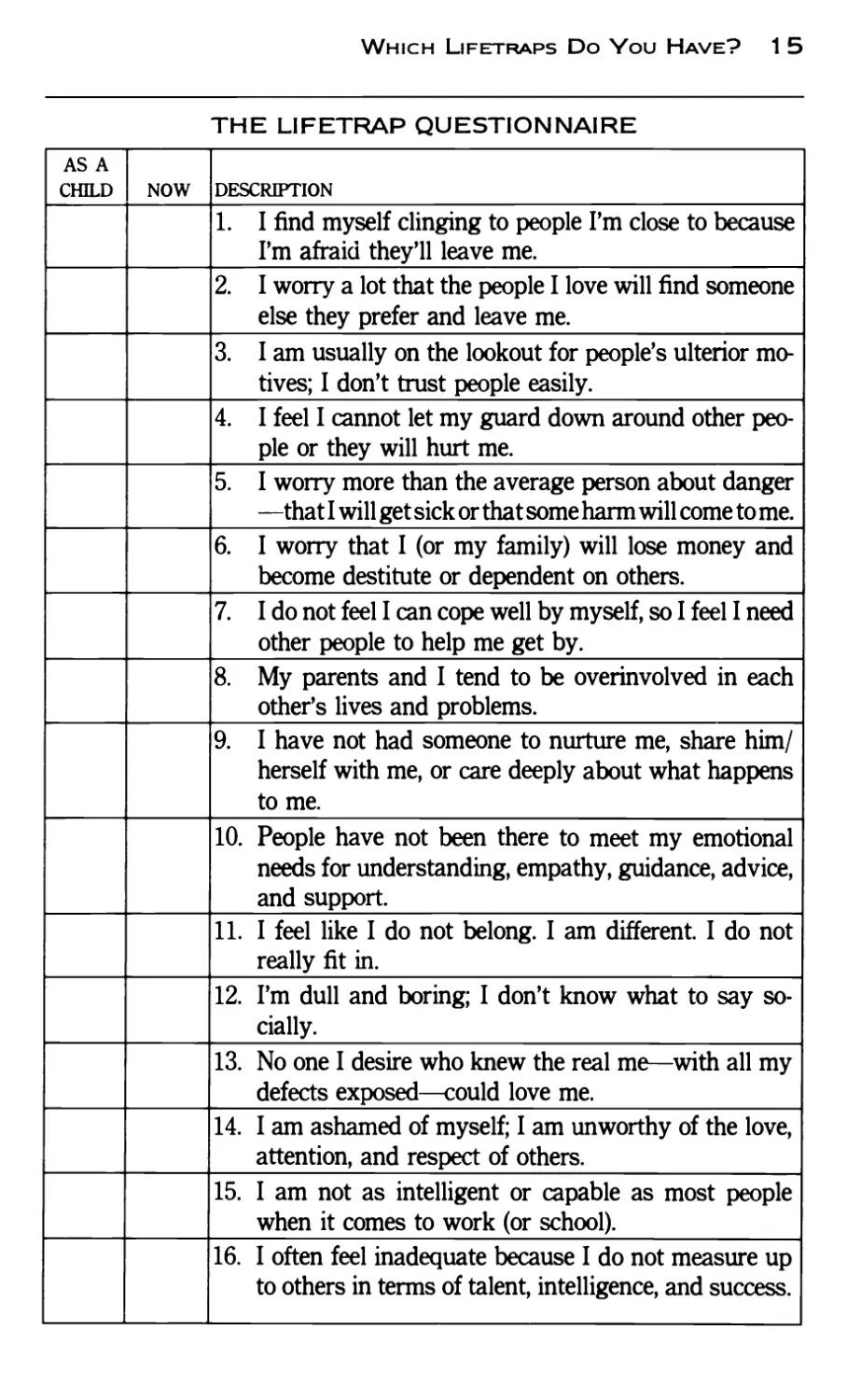
THE LIFETRAP QUESTIONNAIRE
1 ASA
CHILD
NOW
DESCRIPTION
1. I find myself clinging to people I'm close to because
I'm afraid they'll leave me.
2. I worry a lot that the people I love will find someone
else they prefer and leave me.
3. I am usually on the lookout for people's ulterior
motives; I don't trust people easily.
4. I feel I cannot let my guard down around other
people or they will hurt me.
5. I worry more than the average person about danger
—that I will get sick or that some harm will come to me.
6. I worry that I (or my family) will lose money and
become destitute or dependent on others.
7. I do not feel I can cope well by myself, so I feel I need
other people to help me get by.
8. My parents and I tend to be overinvolved in each
other's lives and problems.
9. I have not had someone to nurture me, share him/
herself with me, or care deeply about what happens
to me.
10. People have not been there to meet my emotional
needs for understanding, empathy, guidance, advice,
and support.
11. I feel like I do not belong. I am different. I do not
really fit in.
12. I'm dull and boring; I don't know what to say
socially. |
13. No one I desire who knew the real me—with all my 1
defects exposed—could love me. |
14. I am ashamed of myself; I am unworthy of the love, 1
attention, and respect of others. |
15. I am not as intelligent or capable as most people]
when it comes to work (or school). |
16. I often feel inadequate because I do not measure up 1
to others in terms of talent, intelligence, and success.

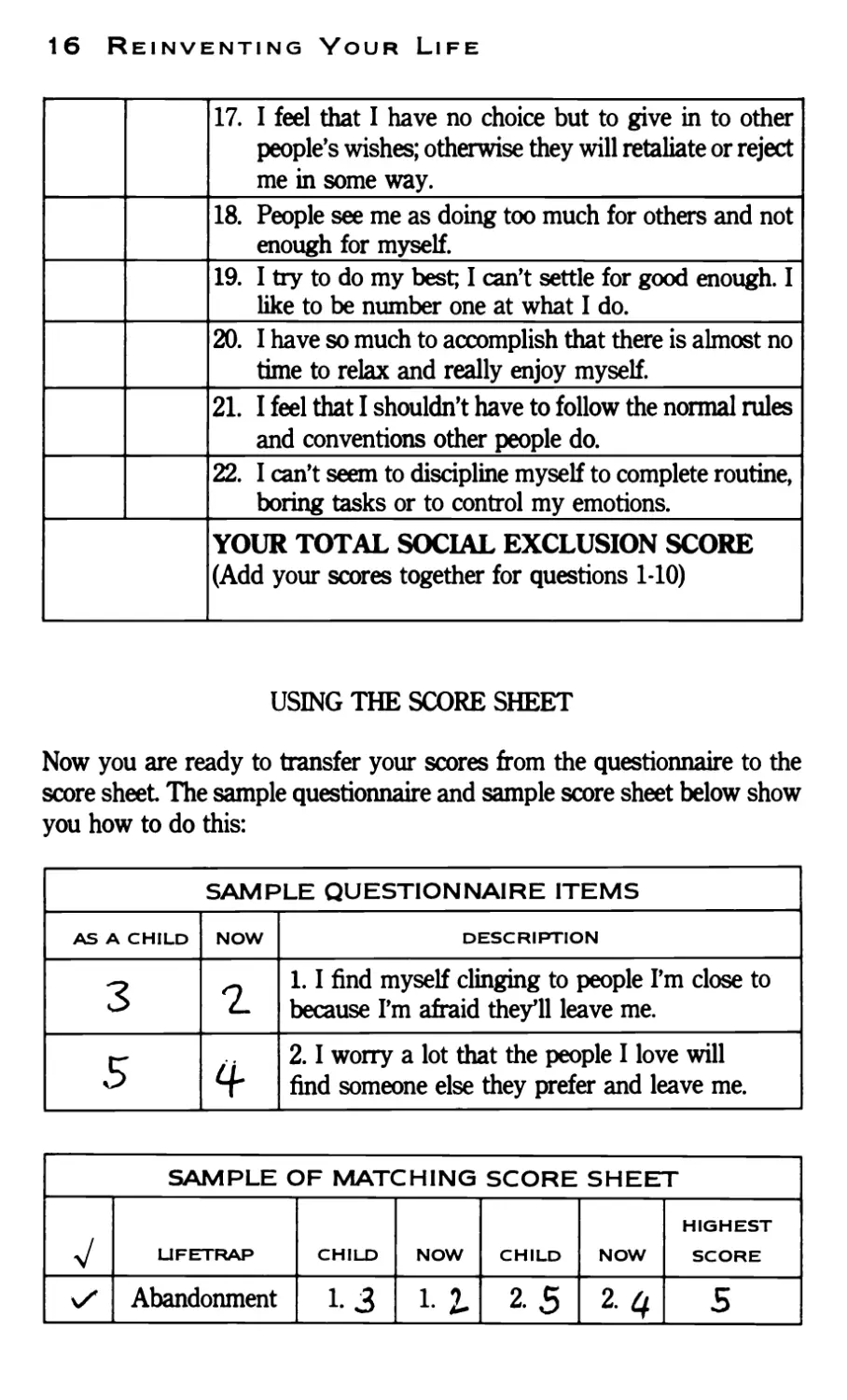
16 Reinventing Your Life
17. I feel that I have no choice but to give in to other
people's wishes; otherwise they will retaliate or reject
me in some way.
18. People see me as doing too much for others and not
enough for myself.
19. I try to do my best, I can't settle for good enough. I
like to be number one at what I do.
20. I have so much to accomplish that there is almost no
time to relax and really enjoy myself.
21. I feel that I shouldn't have to follow the normal rules
and conventions other people do.
22. I can't seem to discipline myself to complete routine,
boring tasks or to control my emotions.
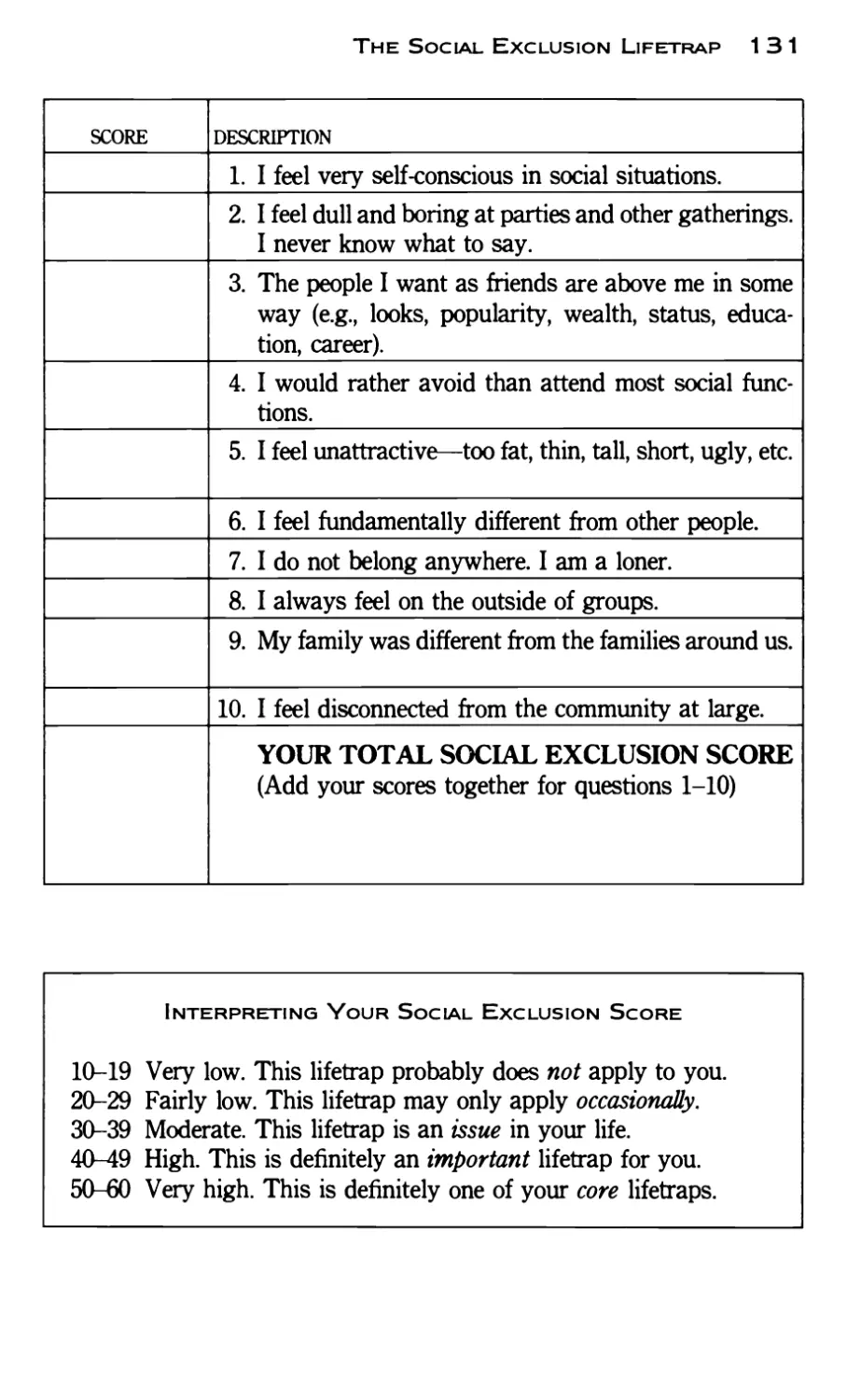
YOUR TOTAL SOCIAL EXCLUSION SCORE
(Add your scores together for questions 1-10)
USING THE SCORE SHEET
Now you are ready to transfer your scores from the questionnaire to the
score sheet The sample questionnaire and sample score sheet below show
you how to do this:
SAMPLE QUESTIONNAIRE ITEMS
AS A CHILD
3
5
NOW
1
4-
DESCRIPTION
1.1 find myself clinging to people I'm close to
because I'm afraid they'll leave me.
2.1 worry a lot that the people I love will
find someone else they prefer and leave me.
SAMPLE OF MATCHING SCORE SHEET
V
n/
UFETRAP
Abandonment
CHILD
1.3
NOW
1.2.
CHILD
2-5
NOW
2-4
HIGHEST
SCORE
5

Which Lifetraps Do You Have? 1 7
Questions 1 and 2 are both part of the Abandonment lifetrap. Lefs start
with Question 1. Take your score for this item as a child and transfer it to
the box just to the right of the word ABANDONMENT on the score sheet,
next to the number 1 (under the Child column). Now take your score for this
item now (as an adult) and transfer it to the next box 1 (under the Now
column).
Next, look at your score for question 2 as a child. Transfer it to box
2, under the Child column. Then take your score for question 2 now and
transfer it to the next box 2, under the Now column.
Look at all four of your scores for the Abandonment lifetrap. Which
one is highest? Transfer your highest score (1, 2, 3, 4, 5, or 6) into the last
box on the Abandonment row. If your highest score is 4,5, or 6, put a check
mark in the first column. This >/ means that Abandonment is probably one
of your schemas. If your highest score is 1,2, or 3, leave the box blank. This
means Abandonment is probably not one of your schemas.
Now go ahead and fill in the rest of the score sheet in the same way.
LIFETRAPS SCORE SHEET
V
LIFETRAP
Abandonment
Mistrust and abuse
Vulnerability
Dependence
Emotional
deprivation
Social exclusion
Defectiveness
Failure
Subjugation
Unrelenting
standards
Entitlement
CHILD
1.
3.
5.
7.
9.
11.
13.
15.
17.
19.
21.
NOW
1.
3.
5.
7.
9.
11.
13.
15.
17.
19.
21.
CHILD
2.
4.
6.
8.
10.
12.
14.
16.
18.
20.
22.
NOW
2.
4.
6.
8.
10.
12.
14.
16.
18.
20.
22.
HIGHEST
SCORE

18 Reinventing Your Life
INTERPRETING YOUR SCORES
We will now describe each of the eleven lifetraps briefly, just enough to
acquaint you with each one. Refer to your score sheet: each lifetrap with a
\/ next to it is likely to apply to you. Naturally, the higher your scores for
each lifetrap, the more powerful it probably is for you, and the more impact
it probably has had on your life. You will want to read more about each
of the relevant lifetraps later, after you have finished the introductory
chapters.
If you are unsure about whether a lifetrap applies to you or someone
close to you, do not worry about trying to be sure now. When you get to
the chapter devoted to each lifetrap, we will give you a much more detailed
test you can take to be sure that it fits.
THE ELEVEN LIFETRAPS, BRIEFLY
Two lifetraps relate to a lack of safety or security in your childhood family.
These are Abandonment and Mistrust.
• Abandonment •
The Abandonment lifetrap is the feeling that the people you love will leave
you, and you will end up emotionally isolated forever. Whether you feel
people close to you will die, leave home forever, or abandon you because
they prefer someone else, somehow you feel that you will be left alone.
Because of this belief, you may cling to people close to you too much.
Ironically, you end up pushing them away. You may get very upset or
angry about even normal separations.
• Mistrust and Abuse •
The Mistrust and Abuse lifetrap is the expectation that people will hurt or
abuse you in some way—that they will cheat, lie to, manipulate, humiliate,
physically harm, or otherwise take advantage of you. If you have this
lifetrap, you hide behind a wall of mistrust to protect yourself. You never
let people get too close. You are suspicious of other people's intentions, and
tend to assume the worst. You expect that the people you love will betray
you. Either you avoid relationships altogether, form superficial
relationships in which you do not really open up to others, or you form
relationships with people who treat you badly and then feel angry and vengeful
toward them.

Which Lifetraps Do You Have? 1 9
Two lifetraps relate to your ability to function independently in the world.
These lifetraps are Dependence and Vulnerability.
• Dependence •
If you are caught in the Dependence lifetrap, you feel unable to handle
everyday life in a competent manner without considerable help from
others. You depend on others to act as a crutch and need constant support. As
a child you were made to feel incompetent when you tried to assert your
independence. As an adult, you seek out strong figures upon whom to
become dependent and allow them to rule your life. At work, you shrink
from acting on your own. Needless to say, this holds you back.
• Vulnerability •
With Vulnerability, you live in fear that disaster is about to strike—
whether natural, criminal, medical, or financial. You do not feel safe in the
world. If you have this lifetrap, as a child you were made to feel that the
world is a dangerous place. You were probably overprotected by your
parents, who worried too much about your safety. Your fears are excessive
and unrealistic, yet you let them control your life, and pour your energy
into making sure that you are safe. Your fears may revolve around illness:
having an anxiety attack, getting AIDS, or going crazy. They may be
focused around financial vulnerability: going broke and ending up on the
streets. Your vulnerability may revolve around other phobic situations,
such as a fear of flying, being mugged, or earthquakes.
Two lifetraps relate to the strength of your emotional connections to others:
Emotional Deprivation and Social Exclusion.
• Emotional Deprivation •
Emotional Deprivation is the belief that your need for love will never be met
adequately by other people. You feel that no one truly cares for you or
understands how you feel. You find yourself attracted to cold and ungiving
people, or you are cold and ungiving yourself, leading you to form
relationships that inevitably prove unsatisfying. You feel cheated, and you
alternate between being angry about it and feeling hurt and alone. Ironically,
your anger just drives people further away, ensuring your continued
deprivation.

20 Reinventing Your Life
When patients with emotional deprivation come to see us for therapy
sessions, there is a loneliness about them that stays with us even after they
have left the office. It is a quality of emptiness, of emotional disconnection.
These are people who do not know what love is.
• Social Exclusion •
Social Exclusion involves your connection to friends and groups. It has to
do with feeling isolated from the rest of the world, with feeling different
If you have this lifetrap, as a child you felt excluded by peers. You did not
belong to a group of friends. Perhaps you had some unusual characteristic
that made you feel different in some way. As an adult, you maintain your
lifetrap mainly through avoidance. You avoid socializing in groups and
making friends.
You may have felt excluded because there was something about you
that other children rejected. Hence you felt socially undesirable. As an adult
you may feel that you are ugly, sexually undesirable, low in status, poor
in conversational skills, boring, or otherwise deficient. You reenact your
childhood rejection—you feel and act inferior in social situations.
It is not always apparent that someone has a Social Exclusion lifetrap.
Many people with this lifetrap are quite comfortable in intimate settings
and are quite socially skilled. Their lifetrap may not show in one-to-one
relationships. It sometimes surprises us to realize how anxious and aloof
they may feel at parties, in classes, at meetings, or at work. They have a
restless quality, a quality of looking for a place to belong.
The two lifetraps that relate to your self-esteem are Defectiveness and
Failure.
• Defectiveness •
With Defectiveness, you feel inwardly flawed and defective. You believe
that you would be fundamentally unlovable to anyone who got close
enough to really know you. Your defectiveness would be exposed. As
a child, you did not feel respected for who you were in your family.
Instead, you were criticized for your "flaws." You blamed yourself—you
felt unworthy of love. As an adult, you are afraid of love. You find
it difficult to believe that people close to you value you, so you expect
rejection.

Which Lifetraps Do You Have? 2 1
• Failure •
Failure is the belief that you are inadequate in areas of achievement, such
as school, work, and sports. You believe you have failed relative to your
peers. As a child, you were made to feel inferior in terms of achievement.
You may have had a learning disability, or you may never have learned
enough discipline to master important skills, such as reading. Other
children were always better than you. You were called "stupid," "untalented,"
or "lazy." As an adult, you maintain your lifetrap by exaggerating the
degree of your failure and by acting in ways that ensure your continued
failure.
Two lifetraps deal with Self-Expression—your ability to express what you
want and get your true needs met: Subjugation and Unrelenting Standards.
• Subjugation •
With Subjugation, you sacrifice your own needs and desires for the sake
of pleasing others or meeting their needs. You allow others to control you.
You do this either out of guilt—that you hurt other people by putting
yourself first—or fear that you will be punished or abandoned if you
disobey. As a child, someone close to you, probably a parent, subjugated
you. As an adult, you repeatedly enter relationships with dominant,
controlling people and subjugate yourself to them or you enter relationships
with needy people who are too damaged to give back to you in return.
• Unrelenting Standards •
If you are in the Unrelenting Standards lifetrap, you strive relentlessly to
meet extremely high expectations of yourself. You place excessive
emphasis on status, money, achievement, beauty, order, or recognition at the
expense of happiness, pleasure, health, a sense of accomplishment, and
satisfying relationships. You probably apply your rigid standards to other
people as well and are very judgmental. When you were a child, you were
expected to be the best, and you were taught that anything else was failure.
You learned that nothing you did was quite good enough.
• Entitlement •
The final lifetrap, Entitlement, is associated with the ability to accept
realistic limits in life. People who have this lifetrap feel special. They insist

22 Reinventing Your Life
that they be able to do, say, or have whatever they want immediately. They
disregard what others consider reasonable, what is actually feasible, the
time or patience usually required, and the cost to others. They have
difficulty with self-discipline.
Many of the people with this lifetrap were spoiled as children. They
were not required to show self-control or to accept the restrictions placed
on other children. As adults, they still get very angry when they do not get
what they want.
Now you have an idea of which lifetraps apply to you. The next chapter
will tell you about where lifetraps come from—how we develop them as
children.

3
Understanding Lifetraps
Lifetraps have three central features that allow us to recognize them.
Recognizing Lifetraps
1. They are lifelong patterns or themes.
2. They are self-destructive.
3. They struggle for survival.
As we said in the first chapter, a lifetrap is a pattern or theme that starts
in childhood and repeats throughout life. The theme might be
Abandonment or Mistrust or Emotional Deprivation or any of the others we
described. The end result is that, as an adult, we manage to recreate the
conditions of our childhood that were most harmful to us.
A lifetrap is self-destructive. This self-defeating quality is what makes
lifetraps so poignant for us as therapists to watch. We see someone like
Patrick get abandoned again, or someone like Madeline get abused.
Patients are drawn to situations that trigger their lifetraps, like moths to
flame. A lifetrap damages our sense of self, our health, our relationships
with others, our work, our happiness, our moods—it touches every aspect
of our lives.
23

24 Reinventing Your Life
A lifetrap struggles hard for survival. We feel a strong push to
maintain it. This is part of the human drive for consistency. The lifetrap
is what we know. Although it is painful, it is comfortable and familiar. It
is therefore very difficult to change. Furthermore, our lifetraps were usually
developed when we were children as appropriate adaptations to the family
we lived in. These patterns were realistic when we were children; the
problem is that we continue to repeat them when they no longer serve a
useful purpose.
HOW LIFETRAPS DEVELOP
A number of factors contribute to the development of lifetraps. The first is
temperament. Temperament is inborn. It is our emotional makeup, the way
we are wired to respond to events.
Like other inborn traits, temperament varies. It also covers a range of
emotions. Here are some examples of traits we believe may be largely
inherited.
Possible Dimensions
Shy
Passive
Emotionally Flat
Anxious
Sensitive
«—►
«—►
«—►
«—►
«—►
of Temperament
Outgoing
Aggressive
Emotionally Intense
Fearless
Invulnerable
You might think of your temperament as the combination of your locations
on all of these dimensions, and others we do not yet know of or understand.
Of course, behavior is influenced by environment as well. A safe and
nurturing environment may make even a shy child relatively outgoing;
and, if things get bad enough, even a relatively invulnerable child can be
beaten down.
Heredity and environment shape and influence us. This is true
(although to a lesser degree) even of traits that seem purely physical, such as
height. We are born with a potential for a certain height, and whether we
reach that potential depends in part on our environment—whether we are
well fed, have a healthy environment, etc.

Understanding Lifetraps 25
The most important early influence in our environment is our family.
To a large extent, the dynamics of our family were the dynamics of our
early world. When we reenact a lifetrap, what we are reenacting is almost
always a drama from our childhood family. For example, Patrick reenacts
what happened to him, his abandonment by his mother, and Madeline
reenacts being abused.
In most cases the influence of family is strongest at birth and
progressively declines as the child grows up. Other influences become important—
peers, school, etc.—but the family remains the primal situation. Lifetraps
develop when early childhood environments are destructive. Here are some
examples:
Examples of Destructive Early Environments
1. One of your parents was abusive, and the other was passive and
helpless.
2. Your parents were emotionally distant and had high expectations
for achievement.
3. Your parents fought all the time. You were caught in the middle.
4. One parent was sick or depressed and the other was absent. You
became the caretaker.
5. You became enmeshed with a parent. You were expected to act as
a substitute spouse.
6. A parent was phobic and overprotected you. This parent was
afraid to be alone and clung to you.
7. Your parents criticized you. Nothing was ever good enough.
8. Your parents overindulged you. They did not set limits.
9. You were rejected by peers, or felt different.
Heredity and environment interact. The destructive influences of our
childhood interacted with our specific temperament in the formation of our
lifetraps. Our temperament may partially determine how we were treated
by our parents. For example, often only one child in a family is singled out
for abuse. And our temperament partially determines how we responded
to that treatment. Given the same environment, two children can react very
differently. Both might be abused, but one becomes passive and the other
fights back.

26 Reinventing Your Life
WHAT A CHILD NEEDS TO THRIVE
Our childhood does not have to be perfect for us to be reasonably well-
adjusted adults. It just has to be, as D. W. Winnicott said, "good enough."
A child has certain core needs for basic safety, connection to others,
autonomy, self-esteem, self-expression, and realistic limits. If these are met,
then the child will usually thrive psychologically. It is when there are
serious shortfalls in meeting the child's needs that problems develop. These
shortfalls are what we mean by lifetraps.
What We Need to Thrive
1. Basic Safety 4. Self-Esteem
2. Connection to Others 5. Self-Expression
3. Autonomy 6. Realistic Limits
• Basic Safety (Lifetraps: Abandonment and Mistrust and Abuse) •
Some lifetraps are more core than others. Basic Safety lifetraps are the most
core. They begin early. Even an infant can have them. To an infant, feeling
safe is absolutely central. It is a matter of life and death.
Basic Safety lifetraps involve a child's treatment by his or her own
family. The threat of abandonment or abuse comes from those who are
most intimate—from those who are supposed to love us, take care of us,
and protect us.
People who were abused or abandoned as children are the most
damaged. There is nowhere they feel safe. They feel that at any moment
something terrible might happen—someone they love might hurt them or
leave them. They feel vulnerable and fragile. It takes very little to disrupt
their equilibrium. Their moods are intense and erratic, and they are
impulsive and self-destructive.
A child needs a secure, stable family environment. In a safe home,
parents are predictably available. They are physically and emotionally
there for the child. No one is being mistreated. Fighting is within normal
bounds. No one dies or leaves the child alone for long periods.
Patrick, the man whose wife kept having affairs, did not have a stable
home as a child. His mother was an alcoholic.

Understanding Lifetraps 27
PATRICK: Some nights she didn 't even come home. She just wouldn Y show
up. And we'd all know where she was, though no one would talk about
it. And when she was home, it didn't matter. She was either drunk,
hung over, or getting drunk
If you had a parent who was a severe alcoholic, then your need for safety
was almost certainly not fully met.
We might say that Patrick, as an adult, is addicted to instability.
Unstable situations draw him like a magnet. Particularly, he feels a lot of
attraction to unstable women. He feels a lot of chemistry. These are the
women with whom he falls in love.
A child who feels safe can relax and trust. A core feeling of safety
underlies everything. Without that feeling, little else is possible. We cannot
proceed to other developmental tasks. So much energy is taken up with
worrying about safety issues that there is little left.
Unsafe childhood situations are the most dangerous to repeat. You
end up rushing headlong from one self-destructive relationship to another.
Or you avoid relationships altogether, like Madeline did in her post-college
years.
• Connection to Others (Lifetraps: Emotional Deprivation and
Social Exclusion) •
To develop a sense of connection, we need love, attention, empathy, respect,
affection, understanding, and guidance. We need these things from both
our family and our peers.
There are two forms of connection to others. The first involves
intimacy. Usually intimate relationships are those with family, lovers, and very
good friends. They are our closest emotional ties. In our most intimate
relationships, we feel the kind of connection that one feels with a mother
or father. The second form involves our social connections. This is a sense
of belonging, of fitting into the larger social world. Social relationships are
those with circles of friends and with groups in the community.
Connection problems can be subtle. You can look like you fit in
perfectly well. You might have a family, loved ones, or be part of the
community. Yet, deep down you feel disconnected. You feel alone, and long
for a kind of relationship that you do not have. Only someone astute would
notice that you are not really connecting with the people around you. You
keep people at a little bit of a distance. You do not let anyone come too

28 Reinventing Your Life
close. Or your problems may be more extreme. You may be a loner—a
person who has always been alone.
Jed, the man described in the first chapter who is dissatisfied with one
woman after another, has serious intimacy problems. He recoils from
intimacy. He keeps even his closest relationships superficial. When he first
started therapy, he could not name a single person to whom he felt close.
Jed grew up in an emotional vacuum. He barely knew his father, and
his mother was cold and distant. There was no communication of feelings
and no physical affection. We say there are three types of childhood
deprivation: nurturance, empathy, and guidance. Jed was deprived of all
three.
If you have connection problems, then loneliness is an issue for you.
You may feel that no one really knows you deeply and cares about you (the
Emotional Deprivation lifetrap). Or you may feel isolated from the world,
that you do not fit in anywhere (the Social Exclusion lifetrap). It is a feeling
of emptiness—a hunger for connection.
• Autonomy: Independent Functioning (Lifetraps: Dependence and
Vulnerability) •
Autonomy is the ability to separate from our parents and function
independently in the world, comparable to other people our own age. It is the ability
to leave the house, have a life, an identity, and goals and directions of our
own that are not solely dependent on the support or direction of our
parents. It is the ability to act as an individual—to have a self.
If you grew up in a family that fostered autonomy, then your parents
taught you self-sufficiency skills, encouraged you to accept responsibility,
and taught you to exercise good judgment. They encouraged you to
venture into the outside world and interact with peers. Rather than over-
protecting you, they taught you that the world is safe and how to keep
yourself safe in it. They encouraged you to develop a separate identity.
However, you may have had a more unhealthy childhood
environment, one that fostered dependence and fusion. Your parents may not have
taught you self-reliance skills. Instead, they may have done everything for
you, and undermined your attempts to do things on your own. They may
have taught you that the world is dangerous, and constantly warned you
about danger and possible illness. They may have kept you from pursuing
your natural inclinations. They may have taught you that you cannot rely
on your own judgment or decisions to get by in the world.
Heather, the woman in Chapter 1 with numerous phobias, was over-

Understanding Lifetraps 29
protected as a child. Her parents constantly warned her about danger
because they were constantly worried about danger themselves. They
taught her to feel vulnerable in the world.
Heather's parents were not ill-intentioned. Rather, they were fearful
themselves and were trying to protect her. This is often the case. Parents
who overprotect their children can be quite loving. Heather has the
Vulnerability lifetrap. Her ability to be autonomous in the world is impaired
because she is too afraid to go out into the world and do things.
Feeling safe enough to venture into the world is one aspect of
autonomy. Feeling competent to cope with everyday tasks and having a separate
sense of self are other aspects. These last two have more to do with the
Dependence lifetrap.
With Dependence, you fail to develop a sense of competence about
your ability to function in the world. Perhaps your parents were overpro-
tective: they made your decisions for you, and handled your
responsibilities. They may even have subtly undermined you, criticizing you whenever
you struck out on your own. As a consequence, as an adult you feel unable
to cope effectively on your own without the guidance, advice, and financial
support of people who you feel are stronger and wiser than you. Even if
you leave your parents—and many never leave their parents—you just get
into a relationship with another parental figure. You find a partner or boss
who can serve as a parent substitute.
Dependent people often have an undeveloped or enmeshed sense of
self. Their identities merge with the identities of their parents or spouses.
The stereotype is the wife who becomes completely absorbed in her
husband's life and loses the sense of her own identity. She does everything her
husband wants her to do. She does not have friends of her own, interests
of her own, or opinions of her own. When she talks, she talks about her
husband's life.
Feeling safe enough to venture into the world, feeling competent,
developing a strong sense of self—these are the components of autonomy.
• Self-Esteem (Lifetraps: Defectiveness and Failure) •
Self-esteem is the feeling that we are worthwhile in our personal, social, and
work lives. It comes from feeling loved and respected as a child in our
family, by friends, and at school.
Ideally we would all have had childhoods that support our self-esteem.
We would have felt loved and appreciated by our family, accepted by peers,

30 Reinventing Your Life
and successful at school. We would have received praise and
encouragement without excessive criticism or rejection.
But this may not have been what happened to you. Perhaps you had
a parent or sibling who constantly criticized you, so that nothing you did
was acceptable. You felt unlovable. Perhaps you were rejected by peers.
They made you feel undesirable. Or maybe you felt like a failure in school
or sports.
As an adult, you may feel insecure about certain aspects of your life.
You lack self-confidence in the areas where you feel vulnerable—intimate
relationships, social situations, or work. Within your vulnerable areas, you
feel inferior to other people. You are hypersensitive to criticism and
rejection. Challenges make you very anxious. You either avoid challenges or
handle them poorly.
The two lifetraps in the Self-Esteem realm are Defectiveness and
Failure. They correspond to feelings of unworthiness in the personal and
work realms. The Failure lifetrap involves a feeling of inadequacy in the
realm of achievement and work. It is the sense that you are less successful,
talented, or intelligent than your peers.
The Defectiveness lifetrap involves the sense that you are inherently
flawed—that the more deeply someone knows you, the less lovable you are.
The Defectiveness lifetrap often accompanies other lifetraps. Of the five
patients we listed in the first chapter, three—Madeline, Jed, and Carlton—
had the Defectiveness lifetrap in addition to their primary lifetraps.
Madeline is the patient who was sexually abused by her stepfather. It
is very common for Mistrust and Abuse and Defectiveness to go hand in
hand. Children almost always blame themselves for abuse, feeling that they
must be very bad, or unworthy of love, to deserve the abuse.
Jed, the man who becomes involved with one woman after another,
has profound feelings of defectiveness. He covers up these feelings by
adopting a superior, aloof attitude. And Carlton, the people-pleaser, feels
defective as well. Part of the reason Carlton denies his own needs is that
he feels he is not worth more.
Injuries to our self-esteem cause us to feel shame. Shame is the
predominant emotion in this realm. If you have the Defectiveness or Failure
lifetrap, then you live a life filled with shame about who you are.
• Self-Expression (Lifetraps: Subjugation and Unrelenting
Standards) •
Self-expression is the freedom to express ourselves—our needs, feelings
(including anger), and natural inclinations. It implies the belief that our

Understanding Lifetraps 3 1
needs count as much as other people's needs. We are free to act
spontaneously without inordinate inhibition. We feel free to pursue activities and
interests that make us happy, not just those around us. We are allowed time
to have fun and play, not just encouraged to work and compete nonstop.
In an early environment that encourages self-expression, we are
encouraged to discover our own natural interests and preferences. Our needs
and desires are taken into account in making decisions. We are permitted
to express emotions, such as sadness and anger, as long as they do not
seriously harm other people. We are regularly allowed to be playful,
uninhibited, and enthusiastic. We are encouraged to balance play and work.
Standards are reasonable.
If you grow up in a family that discourages self-expression, you are
punished or made to feel guilty when you express your needs, preferences,
or feelings. Your parents' needs and feelings take precedence over yours.
You are made to feel powerless. You are shamed when you act in a playful
or uninhibited manner. Work and achievement are overemphasized at the
expense of fun and pleasure. Your parents are not satisfied unless you
perform perfectly.
Carlton, the people-pleaser, grew up in an environment that damaged
his self-expression. His father was critical and controlling, and his mother
was frequently depressed and ill.
CARLTON: My father was never happy with who I was. He was always
trying to change me, to tell me what I should be. My mother was in bed
a lot. She was always sick and in bed. I tried to take care of her as best
I could.
Carlton's identity did not matter much. His parents used him for their own
ends. He learned to push his own needs back lest he make a parent angry
or depressed. His childhood was grim and selfless. "I feel like I never was
a child," he says.
There are three signs that your self-expression is restricted. The first
is that you are extremely accommodating to other people. You are always
pleasing everybody else, always taking care of everybody. You are self-
effacing, almost like a martyr. You do not seem concerned with your own
needs. You cannot stand to see those around you in pain and will
repeatedly sacrifice your own desires to help them. You may do so much for
people that it makes them feel guilty to be with you. Inside, you may feel
weak and passive, or resentful when all your giving is not appreciated. You
are too much at the mercy of other people's needs.
A second sign that you have problems in this realm is that you are

32 Reinventing Your Life
overly inhibited and controlled. You may be a workaholic—your whole life
revolves around your work. Your work may be a career or it may be other
things. You may work to look perfectly beautiful at all times, or to keep
everything perfectly neat and clean, or to always do things in the perfectly
proper, correct way.
You may be emotionally./^. There is no spontaneity in your life. You
suppress your natural reactions to events. Whether it is because you feel
you have to do what other people want (the Subjugation lifetrap) or because
you have to live up to some impossibly high standard (the Unrelenting
Standards lifetrap), you have the sense that you are not really enjoying
your life. Your life is somber and joyless. You somehow rob yourself of fun,
relaxation, and pleasure.
A third indication of problems in Self-Expression is having a great
deal of unexpressed anger. Chronic resentment may simmer underneath,
occasionally erupting unexpectedly, almost out of your control. And you
may feel depressed. You are trapped in an unrewarding routine. Your life
seems empty. You are doing everything you should, yet there is no pleasure
in it.
• Realistic Limits (Lifetrap: Entitlement) •
Realistic Limits problems are, in many respects, the opposite of Self-
Expression problems. When you are not permitted Self-Expression, you are
overly controlled. You suppress your own needs and attend to the needs of
others. With Limits problems, you attend so much to your own needs that
you disregard other people. You may do so to such an extent that others
see you as selfish, demanding, controlling, self-centered, and narcissistic.
And you may have problems with self-control. You are so impulsive or
emotional that you have difficulty meeting your long-term goals. You
always go for immediate gratification. You cannot tolerate routine or
boring tasks. You learn that you are special, entitled to do everything your
own way.
To have realistic limits means to accept realistic internal and external
Emits on our own behavior. This includes the capacity to understand and
take the needs of others into account in our actions—to balance fairly our
own needs with those of others. It is also the capacity to exercise enough
self-control and self-discipline to reach our goals and to avoid punishment
from society.
When we are raised in a childhood environment that sets realistic
limits, our parents set up consequences for our behavior that reward

Understanding Lifetraps 33
realistic self-control and self-discipline. We are not excessively indulged or
permitted excessive freedom. We are taught to be responsible. We have to
do schoolwork and carry through on chores. Our parents help us learn to
take the perspective of others and to be sensitive to other people's needs.
We are taught not to hurt people unnecessarily. We learn to respect other
people's rights and freedom.
But perhaps your childhood did not foster realistic limits. Your
parents may have been overly indulgent and permissive. They gave you
whatever you wanted. They rewarded you for manipulative behavior—
whenever you threw a temper tantrum you got your way. They did not
adequately supervise you. They permitted you to express anger without
restriction. You never learned the notion of reciprocity. You were not
encouraged to understand the feelings of others, nor to take the feelings of
others into account. You were not taught self-discipline and self-control. All
of these errors can lead to an Entitlement lifetrap.
In an alternative scenario, perhaps your parents were emotionally cold
and depriving. You were constantly criticized and devalued. You developed
a sense of Entitlement later in life to make up for, or escape, the deprivation
and devaluation.
Entitlement can be damaging to your life. Eventually people get fed
up with you. They either leave you or retaliate. Your partner breaks up
with you, your friends stop spending time with you, you are fired from
your job. If your Limits problems include difficulty with self-discipline and
self-control, even your health can be affected. You might smoke too much,
become addicted to drugs, get too little exercise, overeat. You might even
commit criminal acts, such as losing your temper and assaulting someone
or getting arrested for drunken driving. Self-discipline problems may also
cause you to fail to reach your goals in life. You may have too much trouble
disciplining yourself to do the necessary work.
People with Limits problems tend to be very blaming. Instead of
recognizing themselves as the source of their problems, they blame others.
Therefore it is unlikely that someone with Limits problems would be
reading this book. They believe that other people have problems, not them.
However, it is likely that many people reading this book are involved with
someone who has Limits problems. None of the five patients in Chapter 1
had Limits problems. However, many were in self-destructive relationships
with people who had Limits issues.

34 Reinventing Your Life
SUMMARY
To summarize, here is a chart of all the lifetraps in their appropriate
categories:
The Eleven Lifetraps
I. Basic Safety
1. Abandonment
2. Mistrust & Abuse
II. Connection to Others
3. Emotional Deprivation
4. Social Exclusion
HI. Autonomy
5. Dependence
6. Vulnerability
IV. Self-Esteem
7. Defectiveness
8. Failure
V. Self-Expression
9. Subjugation
10. Unrelenting Standards
VI. Realistic Limits
11. Entitlement
In the next chapter, we explain how lifetraps work, and how different
people cope with their lifetraps.

4
Surrender, Escape,
and Counterattack
Lifetraps actively organize our experience. They operate in overt and subtle
ways to influence how we think, feel, and act.
Different people cope with lifetraps in different ways. This explains
why children raised in the same environment can appear to be so different.
For example, two children with abusive parents may respond to abuse very
differently. One becomes a passive, frightened victim and remains that way
throughout life. The other child becomes openly rebellious and defiant and
may even leave home early to survive as a teenager on the streets.
This is partly because we have different temperaments at birth—we
tend to be more frightened, active, outgoing, or shy. Our temperaments
push us in certain directions. And it is partly because we may choose
different parents to copy or model ourselves after. Since an abuser often
marries a victim, their children have both serving as models. The child can
copy the abusive parent or the victimized parent.
35

36 Reinventing Your Life
THREE LIFETRAP COPING STYLES: SURRENDER, ESCAPE, AND
COUNTERATTACK*
Let us look at three different individuals: Alex, Brandon, and Max. Each
one has the Defectiveness lifetrap. Deep down, all three feel flawed,
unlovable, and ashamed. Yet they cope with their feelings of defectiveness in
entirely different ways. We call these three styles Surrender, Escape, and
Counterattack.
Alex: He surrenders to his sense of defectiveness.
Alex is a nineteen-year-old college student. When you meet him, he does
not look you in the eye. He keeps his head down. When he speaks, you can
barely hear him. He blushes and stammers, puts himself down in front of
other people, and is constantly apologizing. He always takes the blame for
things that go wrong, even if they are not really his fault.
Alex always feels "one down"—inferior to others, and he constantly
compares himself to others unfavorably. He feels that other people are
somehow better. Social events are invariably painful for this reason. In his
first year of college, he went to parties but was too anxious to talk to
anyone. "I couldn't think of anything to say," he explains. So far, in his
second year, he has not attended a single college party.
Alex has begun dating a woman who lives in his dorm. She criticizes
him all the time. His best friend is very critical of him as well. His
expectation that people are going to be critical is often borne out.
THERAPIST: Why do you criticize yourself so much?
ALEX: I guess I want to do it first, before other people do it for me.
Alex has a lot of feelings of shame. He blushes and walks around with his
head down because he feels ashamed of himself. He interprets events in his
life as continual proof of his defectiveness, unlovability, and worthlessness.
ALEX: I feel like such a social reject. We're halfway through the semester
and I still don't know anyone in any of my classes. Other people sit
around and talk, but I just sit there like a bump on a log. No one talks
to me.
♦In schema therapy, these correspond to the coping styles of maintenance, avoidance, and
compensation.

Surrender, Escape, and Counterattack 37
THERAPIST: Do you ever talk to anyone?
ALEX: Nah. Who would want to talk to me?
Alex thinks, feels, and acts as though he were defective. The lifetrap
permeates his experience of life. This is how it is with Surrender as a
coping style. The lifetrap is very much with us. Alex is well aware of his
feelings of defectiveness.
When we Surrender, we distort our view of situations to confirm our
lifetrap. We react with strong feelings whenever our lifetrap is activated.
We select partners and enter situations that reinforce our lifetrap. We keep
the lifetrap going.
Alex consistently distorts or misperceives situations so that they
reinforce his lifetrap. His view of situations is inaccurate: he feels people are
attacking and humiliating him even when they are not. He has a strong
bias to interpret events as proving he is defective, exaggerating the
negative and minimizing the positive. He is illogical. When we surrender, we
continually misinterpret and misconstrue people and events in ways that
maintain our lifetraps.
We grow up accustomed to certain roles and certain ways of being
perceived. If we grow up in a family in which we are abused, neglected,
yelled at, constantly criticized, or dominated, then that is the environment
that feels most comfortable to us. Unhealthy as it may be, most people seek
and create environments that feel familiar and similar to the ones where
they grew up. The whole essence of surrendering is somehow managing to
arrange your life so that you continue to repeat the patterns of your
childhood.
Alex grew up in a family that criticized and demeaned him, a typical
origin for the Defectiveness lifetrap. As an adult, he behaves in ways that
ensure he will end up being criticized and demeaned. He chooses partners
and friends who are very critical of him. He acts ashamed and apologetic.
He criticizes himself in front of others. When people are nice to him, he
distances or somehow undermines the relationship. Alex tries to maintain
the status quo. When the environment becomes too supportive, he alters the
situation so he can go back to that comfortable state of shame and
dejection. If he feels superior or equal for a moment, he somehow manages to
return to a lesser position.
Surrender includes all the self-destructive patterns we keep repeating
over and over. It is all the ways we replicate our childhood lives. We are
still that child, going through that same old pain. Surrender extends our
childhood situation into our adult life. For this reason it often leads us to

38 Reinventing Your Life
feel hopeless about changing. All we know is the lifetrap, which we never
escape. It is a self-perpetuating loop.
Brandon: He escapes his feelings of defectiveness.
Brandon is forty years old and has never had a close relationship. He
spends most of his spare time yakking with his buddies at the
neighborhood bar. Brandon is most comfortable with casual, friendly relationships
where nothing very personal is discussed.
Brandon is married to a woman who is out of touch with her feelings.
She is very concerned with keeping up appearances. She is more interested
in being married than in being married to Brandon particularly. She has
close female friends, but does not expect closeness from Brandon. She
wants a man just so she can fulfill the conventional role of wife. Their
relationship is based on traditional roles, not on real intimacy. They rarely
confide in each other.
Brandon has been an alcoholic his entire adult life. Although his
family and friends have suggested Alcoholics Anonymous, he ignores
them. He insists that he is not an alcoholic—he says he only drinks for
recreation, and that he has control over his drinking. Besides drinking in
his neighborhood bar, he tends to drink in social settings when he is around
people he feels are better than he is.
Brandon became depressed, which is what originally brought him to
therapy. But in contrast to Alex, he was not in touch with his lifetrap. He
spent much of his life making sure that he was not in touch. When he first
started therapy, he was only dimly aware of his feelings of defectiveness.
When we asked him how he felt about himself, he denied having feelings
of low self-esteem or shame. (Later in treatment these feelings came out
very strongly.)
We had to battle his Escape on every front. When we asked him to
write down his negative thoughts for homework, he did not do it. He
claimed, "Why think about things? They only make me feel worse." When
we asked him to close his eyes and picture himself as a child, he said, "I
can't see anything. My mind is blank." Or he saw an image of a photograph
of himself as a child, devoid of emotion. When we asked him how he felt
about his abusive father, he insisted that he felt no anger. "My father was
a good man," he said.
Brandon tries to escape his feelings of defectiveness. With Escape, we
avoid thinking about our lifetrap. We push it out of our minds. We also
escape feeling our lifetrap. When feelings are generated, we dampen them
down. We take drugs, or overeat, or compulsively clean, or become a

Surrender, Escape, and Counterattack 39
workaholic. And we avoid entering situations that might activate our
lifetrap. In fact, our thoughts, feelings, and behaviors work as if the lifetrap
never existed.
Many people escape whole areas of life where they feel vulnerable or
sensitive. If you have the Defectiveness lifetrap, like Brandon you may
avoid intimate relationships altogether, never letting anybody get too
close. If you have the Failure lifetrap, you may avoid work, school tasks,
promotions, or taking on new projects. If you have the Social Exclusion
lifetrap, you may avoid groups, parties, meetings, conventions. If
you have the Dependence lifetrap, you may avoid all situations that
require you to be independent. You may be phobic about going into public
places alone.
It is natural that Escape becomes one of the ways we cope with
lifetraps. When a lifetrap is triggered, we are flooded with negative
feelings—sadness, shame, anxiety, and anger. We are moved to escape from
that pain. We do not want to face what we really feel because it is too
upsetting to feel it.
The disadvantage of Escape is that we never overcome the lifetrap.
Since we never confront the truth, we are stuck. We cannot change things
that we do not admit are problems. Instead, we continue the same self-
defeating behaviors, the same destructive relationships. In trying to coast
through life without feeling pain, we rob ourselves of the chance to change
the things that are causing us pain.
When we escape, we strike a bargain with ourselves. We will not feel
pain in the short run, but in the long run we will suffer the consequences
of having avoided the issue year after year. As long as he escapes, Brandon
will never get what he wants most—to love and be loved by another
human being who really knows him. Love is what Brandon was denied
in childhood.
With Escape we give up our emotional life. We do not feel We walk
around numb—unable to experience real pleasure and pain. Because we
avoid confronting problems, we often end up hurting those around us.
We are also prone to the terrible consequences of addictions like alcohol
and drugs.
Max: He counterattacks to cope with his feelings of
defectiveness.
Max is a thirty-two-year-old stockbroker. On the surface he is self-confident
and assured. In fact, he is a snob. He has an air of superiority. He is very
critical of others while rarely acknowledging any faults in himself.

40 Reinventing Your Life
Max came to therapy because his wife was threatening to leave him.
He insisted their problems were all her fault.
THERAPIST: So your wife is pretty angry with you?
MAX: If you ask me, she's the one who's causing all the problems. She blows
things out of proportion, and she demands too much from me. She's
the one who needs to be in therapy.
In fact, Max chose a very passive, self-sacrificing wife who worshiped him.
Through the years, he had become so verbally abusive and selfish that she
had finally insisted that either they start therapy or she would leave.
Max creates situations where he is one up. He chooses friends and
employees who will flatter him, rather than challenge and confront him. He
enjoys feeling superior. He devotes most of his energy to gaining prestige
and status. He manipulates and uses people in any way necessary to
achieve these ends.
He tried to stay one up in therapy as well. He questioned our
credentials, approach, competence, level of success, and age. And he kept
reminding us how successful he was. When we told him we thought he was
treating his wife badly, he became infuriated. He insisted we did not
understand his feelings. He insisted that we should be willing to give him
appointments whenever he wanted them because he is an important
person. When we refused, he again became angry. He felt he was not getting
the special treatment he deserved.
Max is not in touch with his lifetrap yet it is very much with him. In
feeling superior, Max experiences the opposite of what he felt as a child. He
is trying to be as different as possible from the worthless child that his
parents made him feel he was. We might say he spends his whole life trying
to keep that child at bay and to fight off the attacks of those he expects to
criticize and abuse him.
When we Counterattack, we try to make up for the lifetrap by
convincing ourselves and others that the opposite is true. We feel, act, and think
as if we are special, superior, perfect, infallible. We cling to this persona
desperately.
Counterattack develops because it offers an alternative to being
devalued, criticized, and humiliated. It is a way out of that terrible
vulnerability. Our counterattacks help us cope. But when these counterattacks
become too extreme, they often backfire and end up hurting us.
Counterattackers can appear healthy. In fact, some of the people we
admire most in society are counterattackers—some movie stars, rock stars,

Surrender, Escape, and Counterattack 4 1
and political leaders. But although they fit in well with society and are
successful in the eyes of other people, they are usually not at peace with
themselves. They frequently feel defective underneath.
They deal with these feelings of inadequacy by putting themselves in
situations where they will get the applause of an audience. Winning this
applause is actually an attempt to compensate for a deep sense that they
are worthless. They can counterattack by masking their flaws with success
before they are discovered and put down.
Our counterattacks isolate us. We become so invested in appearing to
be perfect that we stop caring who gets hurt in the process. We continue
to counterattack, no matter how much it costs other people. There are
bound to be some negative effects. Eventually people leave us or retaliate
in some way.
Our counterattacks also get in the way of real intimacy. We lose the
ability to trust, become vulnerable, and connect at a deeper level. We have
met some patients who would rather lose everything—including their
marriage, a relationship with someone they love—than risk becoming
vulnerable.
Eventually, no matter how perfect we try to be, we are going to fail
at something. Counterattackers never really learn to cope with defeat. They
do not take responsibility for their failures or acknowledge their
limitations. However, when there is a major setback, the counterattack collapses.
When this happens, they often fall apart and become very depressed.
Underneath, counterattackers are usually very fragile. Their
superiority is easily deflated. Eventually there is a crack in the armor, and the whole
world feels as if it is collapsing. At these times, the lifetrap reasserts itself
with enormous strength, and the original feelings of defectiveness,
deprivation, exclusion, or abuse return.
All three men—Alex, Brandon, and Max—have Defectiveness as a
core lifetrap. Deep down, all three feel worthless, unlovable, and defective.
Yet they cope with their feelings of defectiveness in completely different
ways.
Alex, Brandon, and Max are relatively pure types. Each one uses one
primary coping style. In fact such pure types are rare. Most of us use a
combination of Surrender, Escape, and Counterattack. We must learn to
change these coping styles in order to overcome our lifetraps and become
healthy again.
The next chapter shows you how to confront your lifetraps effectively
without surrender, without escape, and without counterattack.

5
How Lifetraps Change
Lifetraps are long-term patterns. They are deeply ingrained, and like
addictions or bad habits, they are hard to change. Change requires willingness
to experience pain. You have to face the lifetrap head-on and understand
it. Change also requires discipline. You have to systematically observe and
change behaviors every day. Change cannot be hit-or-miss. It requires
constant practice.
GENERAL STEPS IN LIFETRAP CHANGE
We will walk you through the steps of change using Danielle as an
example. Danielle has the Abandonment lifetrap. She is thirty-one years old. She
is in a relationship with a man, Robert, who will not make a commitment
to her. They have been together for eleven years, and, although she has
asked him many times, he will not marry her.
Every once in a while, Robert breaks up with her. When that happens,
Danielle is devastated. She started therapy during one such breakup.
DANIELLE: I just want to stopfeeting this way. I can't take it anymore. All
I can think about is Robert. Vm obsessed with him. Yve got to get him
back.
42

How Lifetraps Change 43
This obsessiveness is characteristic of the Abandonment lifetrap. During
breakups, Danielle occasionally dates other men, but she never becomes
interested in anyone other than Robert. The stable, steady types bore her.
These are the steps Danielle followed in order to change her pattern,
and that we recommend for our patients:
• 1. Label and Identify Your Lifetraps. •
The first step is to recognize what your lifetraps are. This can be
accomplished by taking the Lifetrap Questionnaire in Chapter 2. Once you can
identify a lifetrap and see how it affects your life, you will be in a better
position to change it. By having a name for your lifetrap, like Defectiveness
or Dependence, and reading about it in the second half of this book, you
will understand yourself better. You will gain clarity about your life. This
insight is the first step.
Danielle recognized her Abandonment lifetrap in a number of different
ways. When she started therapy, we gave her the Lifetrap Questionnaire.
She scored high on items in the Abandonment section.
DANIELLE: I guess on some level I've always been aware that I have an
issue about people abandoning me. I've always been afraid of it, I've
always been worried it's bound to happen.
Patients often have this sensation when they identify a lifetrap. It is a sense
of becoming clear about something they have vaguely known all along.
Danielle could easily see how the theme of abandonment played itself
out in her current life. She was in a long-term relationship in which
abandonment was the main theme. She also learned about her lifetrap
through imagery of the past. When we asked her to close her eyes and let
images come of her childhood, the predominant theme was abandonment.
DANIELLE: I see myself I'm standing by the living room couch. I'm trying
to get my mother to pay attention to me, but she's drunk. I can't get her
to pay attention to me.
Danielle's mother was an alcoholic as far back as she could remember.
When Danielle was seven, her father left the family to marry another

44 Reinventing Your Life
woman. He gradually drifted further away from the family as he had
children with his new wife. He left Danielle and her sister with a mother
who clearly could not take care of them adequately.
Danielle was abandoned by both parents. Her mother abandoned her
through alcoholism, and her father abandoned her literally—by leaving the
family. Their abandonment of her was the central truth of her childhood.
Eventually Danielle came to see the theme of abandonment weaving
through her life from the past to the present. The idea of the lifetrap
organized her experience for her in a way she could clearly understand.
Your lifetrap is your enemy. We want you to know your enemy.
• 2. Understand the Childhood Origins of Your Lifetrap. Feel the
Wounded Child Inside You. •
The second step is to feel your lifetrap. We have found that it is very
difficult to change deep pain without first reliving it. We all have some
mechanisms for blocking this pain. Unfortunately, by blocking the pain, we
cannot get fully in touch with our lifetraps.
To feel your lifetrap, you will need to remember your childhood. We
will ask you to close your eyes and let the images come. Do not force the
images—just let one rise to the top of your mind. Get into each one as
deeply as you can. Try to picture these early memories as vividly as
possible. If you do this a few times, you will begin to remember what you
felt as a child. You will feel the pain or emotions connected with your
lifetrap.
This kind of imagery is painful. If you feel completely overwhelmed
or frightened by the experience, that is a sign you need therapy. Your
childhood was so painful that you should not remember it alone. You need
a guide, an ally. A therapist can be this for you.
Once you have reconnected with your childhood self, we will ask you
to open a dialogue with this child. This inner child is frozen. We want to
bring it back to life, where growth and change are possible. We want this
child to heal.
We will ask you to talk to your inner child. You can do this by actually
talking aloud, or you can do it through writing. You can write a letter to
this child in your dominant hand (the hand you usually write with), and
have the child write a response in your non-dominant hand. We have found
that your child-self can come out in the handwriting of your non-dominant
hand.
The idea of talking to your inner child may sound strange at first.

How Lifetraps Change 45
You will understand more about it as the book proceeds. Here is an
example of Danielle talking to her inner child. It is during the same scene
we described above, when she is trying to get her drunk mother to pay
attention to her.
THERAPIST: / want you to talk to your inner child. Help her.
DANIELLE: Well... (pause) I come into the image and take tittle Danielle
onto my lap. I say, "I'm so sorry this is happening to you. Your parents
aren't able to be there for you the way you need. But I tvill be here for
you. I will help you get through this and make sure you come out all
right."
Giving comfort to your inner child, offering guidance and advice, and
empathizing with how the child feels are some of the things we will ask
you to do. Even though these exercises may seem silly or uncomfortable
to you at first, we have found that most people benefit enormously from
them.
• 3. The Third Step is to Build a Case Against Your Lifetrap.
Disprove its Validity at a Rational Level. •
Your life has utterly convinced you of the truth of your lifetrap. Danielle
believes with her whole being that anyone she loves will abandon her. She
accepts her lifetrap emotionally and intellectually.
This change step involves attacking your lifetrap on an intellectual
level. In order to do this, you must prove that it is not true, or at least that
it can be changed. You must cast doubt on the validity of your lifetrap.
As long as you believe that your lifetrap is valid, you will not be able to
change it.
To disprove your lifetrap, you will first list all the evidence pro and con
regarding the lifetrap throughout your life. For example, if you feel Socially
Undesirable, first you will list all the evidence that supports your lifetrap—
that you are undesirable. Then you will make a separate list of all the
evidence against your lifetrap—that you are socially desirable.
In most cases, the evidence will show that your lifetrap is false. You
are not, in fact, defective, incompetent, a failure, doomed to be abused, etc.
But sometimes the lifetrap is true. For example, you may have been so
rejected and shunned all your life that you have failed to develop social
skills, and thus really are socially undesirable in certain ways. Or you may

46 Reinventing Your Life
have avoided so many school and career challenges that you have failed in
your chosen field.
Look at your list of pros. Is any evidence supporting the lifetrap
inherently true of you, or were you brainwashed into thinking this way by
your family or peers during childhood? For example, were you born
incompetent, or was your incompetence so drummed into you by a critical parent
that you came to believe it was true (Dependence)? Were you really special
as a child, or did your parents spoil and pamper you, and teach you to feel
entitled to more than everyone else (Entitlement)? And ask yourself, is any
evidence supporting the lifetrap still true of you? Or was it only true in your
childhood?
If, after all this analysis, you still feel the lifetrap is true, then ask
yourself, "How could I change this aspect of myself?" Explore what you
could do to remedy the situation.
Here is a sample from Danielle's list of evidence supporting her
Abandonment lifetrap:
Evidence That Everyone I Love Wi
evidence
1. Unless I cling to
Robert, he will leave
me.
IS THIS
INHERENTLY TRUE
OR WAS 1
BRAINWASHED?
This isn't true. The
truth is, when I
cling to Robert, it
turns him off. He
gets mad at me and
wants to get away
from me. I think this
way because I
couldn't make my
father stay with me
as a child, no matter
how I tried.
ll Abandon Me
HOW COULD /
CHANGE?
I could stop clinging
to Robert and give
him some space. I
could learn to relax
while I'm alone and
not dwell on the
possibility of
abandonment.

How Lifetraps Change 47
Here is part of Danielle's list of evidence that her lifetrap is false:
Evidence That Not Everyone Abandons Me
1. My sister and I have been close all my life.
2. I've had several boyfriends who wanted to be with me, but I've
been so obsessed with Robert that I never gave any of them
a chance.
3. My therapist is there for me.
4. I have an aunt who has always taken an interest in me and tried
to help.
5. I have friends who have been around for years and years.
6. Robert and I have stuck together for eleven years, even if it's been
up and down.
After making your list, summarize the case against your lifetrap on a
flashcard. This is a sample flashcard Danielle wrote:
Abandonment Flashcard
Even though I feel that everyone I get close to will abandon me, it isn't
true. I feel this way because when I was a child both my parents
abandoned me.
Even though I have experienced a lot of abandonment in my life,
in a lot of ways this is because I've been most attracted to men and
friends who have trouble making commitments.
But the people in my life don't have to be like that. I can
eliminate the people who really are like that from my life. And I can
choose to associate with people who are able to be there for me and
make a commitment.
A lot of times when I feel abandoned by someone, I should ask
myself if I'm just being oversensitive. Even though I feel like the
person's abandoning me, it may just be my Abandonment lifetrap
being triggered. Something is reminding me of what happened when
I was a child. People have a right to some space. I have to allow people
some space.

48 Reinventing Your Life
Read this flashcard every day. Carry it with you. Keep a copy near your
bed or some other place where you will see it every day.
• 4. Write Letters to the Parent, Sibling, or Peer Who Helped
Cause Your Lifetrap. •
It is important to ventilate your anger and sadness about what happened
to you. One thing that keeps your inner child frozen is all your strangled
feelings. We want you to give your inner child a voice—to allow your inner
child to express his or her pain.
We will ask you to write letters to all the people who hurt you. We
realize you will probably have to overcome a lot of guilt to do this,
particularly in regard to your parents. It is not easy to attack our parents. They
may not have been malicious. They may have had good intentions. But we
want you to put aside such considerations for a time, and just tell the truth.
Express your feelings in the letter. Tell them what they did that was
hurtful, and how it made you feel Tell them they were wrong to behave
as they did. Tell them how you wished it could have been instead.
You will probably decide not to send the letter. It is the writing and
expressing of your feelings that is most important. It is often not possible
to change the feelings or behavior of your parents, anyway. You should
know this from the start. The purpose of the letter is not to change your
parents. It is to make you a whole person again.
Here is the letter Danielle wrote to her mother:
Dear Mom,
You have been an alcoholic for all my life. I need to tell you
what it's done to me.
I feel like I never got to be a child. Instead, I had to worry all
the time about stuff other kids never even dream of. I couldn't be
sure that we would have food on the table. I had to do everything
myself While other kids were outplaying and having fun, I was
cooking dinner and cleaning the house.
You don't know how much humiliation I went through
because of you. I remember learning to iron when I was six so the
other kids wouldn't laugh at my wrinkled clothes. And I could
never bring anybody to the house.
And you were never around like the other mothers. You never
came to watch me at school. I couldn't talk to you about my
problems. Instead you lay on the couch, drinking yourself senseless.

How Lifetraps Change 49
/ would try so hard to get you to get up and be my mother. But you
never did.
I feel so sad about what I missed. There were a few times that
you were therefor me, and those were special. Like the time I was
upset about my high school boyfriend, and you got up and talked
to me. I wish we could have had more of those times.
But instead I had to grow up with a big hole where there
should have been a mother. And Vm still living with that big hole
inside me. It wasn't right for you to do this to me. What you did
was wrong.
A letter like this can set the record straight. It can tell your story aloud,
perhaps for the first time.
• 5. Examine Your Lifetrap Pattern in Careful Detail. •
We want you to make explicit how your lifetrap plays itself out in your
current life. The chapters on individual lifetraps will help you identify the
self-defeating habits that reinforce your lifetrap.
We will ask you to write down the ways you surrender to your
lifetrap, and how you can change them. On page 50 is a sample from one
of Danielle's tables.
• 6. The Next Step is Pattern-breaking. •
After you have taken the Lifetrap Questionnaire in Chapter 2 and have
identified your lifetraps, we want you to choose one lifetrap to work on
first. Choose the one that has the most impact on your life now. If that
seems too difficult, choose one that seems more manageable. We always
want you to take manageable steps.
Danielle had more than one lifetrap. In addition to Abandonment, she
had Defectiveness. She thought it was her fault that she could not make her
father stay and did not have a better mother. As we mentioned earlier, it
is very common for children to blame themselves when they are abused or
neglected.
But Abandonment was Danielle's core lifetrap. It was the one she
chose to work on first. She felt she needed a stable base from which to
challenge her other lifetraps. We agreed.
Using the charts you filled out in Step 5, select two or three ways you

50 Reinventing Your Life
WAYS 1 REINFORCE MY
ABANDONMENT
LIFETRAP DAY-TO-DAY
1.1 cling to Robert and try to
control him.
2. I get really angry when one
of my friends doesn't return a
call right away.
3.1 get obsessed with Robert's
life and forget about my own.
HOW 1 CAN CHANGE
I could give Robert more free
time without asking him a
million questions about where
he's going and what he's going
to do. I could let him tell me
when he's unhappy or angry
about something in our
relationship, instead of falling
apart or arguing with him. I
could stop asking him every
five minutes if he loves me and
wants to stay with me. I can
stop getting so angry when he
wants some space. I can stop
feeling so threatened when
something good happens in his
life.
I can give my friends more
space without getting so
threatened when they're busy
with their own lives.
I can turn my attention from
his life to my own, and do the
things that are important to me.
I can see my friends, and paint,
read, write letters. I can go do
something fun. I can treat
myself to something.
reinforce your lifetrap. Try to carry out the ways you can change. Select
steps you feel able to do. We want you to have successful experiences.
Danielle started by trying to change her behavior toward her friends.
She tried to stop alternating between clinging and anger with them. If they
failed to return a call or invitation, she waited for a period and called again

How Lifetraps Change 51
instead of calling them right away and getting angry, or getting
excessively upset. She also worked on enhancing her relationships with her more
committed friends and downplaying her relationships with her less
committed ones. She decided to drop some friends who were particularly
unsteady (and usually alcoholic) from her life. This was a loss, but at least
it was she who was doing the deciding.
Use the techniques we describe in subsequent chapters to help you
change your particular lifetrap. Work your way down your list of
reinforcing behaviors. Once you have a reasonable degree of mastery with a
lifetrap, move to the next one.
• 7. Keep Trying. •
Do not give up or get discouraged easily. Lifetraps can change, but it takes
a long time and a lot of work. Persevere. Confront yourself over and over
again.
Danielle has been in therapy with us for more than a year.
Occasionally, events in her life still trigger her Abandonment lifetrap, but it happens
less frequently, her feelings are less intense, and the whole thing is over
more quickly. In addition, the triggering event has to be much more
serious, such as the breakup of a relationship. Her life has changed.
The most dramatic changes have been in her relationship with Robert.
She has learned to allow Robert a more normal amount of separation. He
had been feeling smothered by her, and spent a lot of time trying to get
away from her. Some of his lack of commitment was an attempt to resist
her clinging. In addition, when she is angry, she tells him, but in a calm
rather than a rageful way. She tries to listen when he tells her about his
anger or his life. She tries to let him make his own decisions.
A few months ago, Danielle told Robert that either he had to marry
her or she was going to end the relationship. He chose to marry her. Of
course, things do not always work out this way. Sometimes relationships
end. But we believe it is better to end a truly hopeless relationship than to
stay caught in the Abandonment lifetrap.
• 8. Forgiving Your Parents. •
Forgiving your parents is not required. Particularly if there was severe
abuse or neglect, you may never be able to forgive them. This is totally
your choice. But we have found that, in most cases, forgiving one's parents
is something that happens naturally, as the healing process progresses.

52 Reinventing Your Life
Patients gradually come to see their parents less and less as giant, negative
figures in their mind, and more and more as just people with problems and
concerns of their own. They see that their parents were caught within their
own lifetraps, and were in fact more like children than giants. They become
able to forgive them.
Again, this does not always happen. It may or may not happen to you.
Depending upon what happened in your childhood, you may decide never
to forgive them. In fact, you may even decide the opposite—to cut off all
contact. At the end of your path there may or may not lie forgiveness, but
you have to do what is right for you. We will support you either way.
OBSTACLES TO CHANGE
After working with many patients, we have made a list of the most
common obstacles to change. We have also listed some possible solutions.
• Obstacle #1: You are Counterattacking Instead of
Acknowledging and Taking Responsibility for the Lifetrap. •
If you are having trouble changing, you may still be blaming others for
your problems or your lack of progress. You may still be having trouble
admitting your mistakes or taking responsibility for changing. Or you may
still be overcompensating by working harder, impressing people more,
making more money, pleasing people more, and so on. (For more about
Counterattacking, see Chapter 4.)
Jed, the man who moved from woman to woman, had to struggle hard
to stop Counterattacking. His criticalness of women, his demand that they
meet his impossibly high standards for beauty and status, and his need for
constant excitement were ways he made himself feel better about his
loneliness. He had to get beyond his Counterattacks to connect at a human
level with a woman without criticizing her or trying to impress her. He had
to get close enough to see beyond the lifetrap.
Here are some solutions to this obstacle:
Solution 1: Do an experiment. Make a list of all the choices you have
regretted in your life. What if they were your fault? How would you feel?
What if the criticisms others have of you have some validity? What would
that mean about you?
Try to feel the pain of your flaws. Try to acknowledge the pain of your
childhood—what you wanted but did not get.

How Ufetraps Change 53
Solution 2: Gradually start working less or making a little less money.
Try to refrain from deliberately impressing others. Feel what it is like to
be the same as everyone else rather than special or superior. Unless you
can allow these feelings in, you will not make yourself vulnerable enough
to change.
• Obstacle #2: You Escape from Experiencing Your Lifetrap. •
Escape is a common problem. Many patients have trouble giving up their
escape routes. You may find that you have a similar difficulty. You do not
allow yourself to think about your problems, your past, your family, or
your life patterns. You keep cutting off feelings or dulling them by drinking
or taking drugs.
We understand why you want to Escape. To stop avoiding means to
lay yourself open to intense anxiety and pain. All five of the patients in
Chapter 1 had to struggle with this issue. Patrick had to stop avoiding the
problems in his life by obsessing about Francine. Madeline had to stop
escaping the pain that sexual intimacy evoked for her. Heather had to stop
avoiding activities that she considered dangerous. Jed had to stop escaping
from emotional closeness. And Carlton had to stop running away from his
own needs and preferences.
It takes motivation to overcome Escape as a coping style. You have
to see the rest of your life before you—either stuck in the lifetrap or finally
free of it.
Solution 1: You must allow yourself to think through your problems and
feel your childhood pain before you can change.
Force yourself to try some of the childhood memory exercises we
describe in your lifetrap chapter. Write down some criticisms of your
parents or some of your flaws and vulnerabilities.
Keep doing this every day.
Solution 2: Make a list of the advantages and disadvantages of avoiding
your feelings. Reread the list every day to remind yourself of why you are
doing this.
Solution 3: Stop escaping through drinking, overeating, using drugs,
overworking, etc., for a few days. Keep a diary in which you write down what
you feel. Try some of the imagery exercises in your lifetrap chapter during
these days. Go to a twelve-step program.

54 Reinventing Your Life
• Obstacle #3: You Have Not Disproved the Lifetrap to Yourself.
You Still Accept It on a Rational Level. •
Another obstacle is continuing to believe the lifetrap is true. If you accept
your lifetrap on a rational level, you are not going to try to change it. You
have to cast enough doubt on the validity of your lifetrap for you to do
some of the experiments to change.
For example, for a long time Heather felt extremely anxious in the
situations she was entering. This was because she still believed the
situations were dangerous and that catastrophe could strike at any moment. She
maintained a hypervigilant state, ever alert for possible harm.
Heather still believed her lifetrap. She believed that she was
excessively vulnerable to harm. She had to change her beliefs. She did this in a
number of different ways: she educated herself about realistic appraisals of
danger, worked continually to lower the odds she assigned to danger, and
took reasonable precautions. She learned to relax her body in these
situations. Her beliefs gradually yielded.
A lifetrap does not give way all at once. Rather, you must continually
chip away at it, bit by bit, gradually weakening its pull.
Solution 1: Return to the exercises in your lifetrap chapter on disproving
your lifetrap. Go through them again. Make a commitment to fighting your
beliefs.
You may find it helpful to ask someone you trust to help you with the
exercises. This person can provide a more objective point of view.
Solution 2: Look very carefully through your life for any evidence that
challenges your lifetrap. Look for any possible avenues of change. Were
there extenuating circumstances that invalidate the lifetrap? Were you
abused? Did you avoid trying harder because you were afraid of rejection
and failure? Did you choose friends, lovers, bosses, etc., who confirmed
your lifetrap? Try to play devil's advocate in arguing against your lifetrap.
Solution 3: Write your flashcard and read it several times a day.
• Obstacle #4: You Started with a Lifetrap or Task That Was
Too Difficult. •
Perhaps you have several lifetraps, and you started with the one that is
most upsetting for you. If this lifetrap is too overwhelming, you may not
be able to make progress.

How Lifetraps Change 55
Or, perhaps you have chosen an appropriate lifetrap, but your plan is
too ambitious. You may have started with a change strategy that is too
difficult. Carlton, the people-pleaser, is an example of this. When Carlton
first started doing assertiveness exercises, he began by attempting to be
assertive with his father. This was a mistake: it was too hard. Carlton
would become very fearful and unable to express himself. Trying to
confront his father right off the bat was setting himself up for failure.
Carlton eventually mastered assertiveness with his father. But he had
to sharpen his skills and his confidence on less threatening people first. He
started with strangers, such as salespeople and waitresses, gradually
moved up to acquaintances and coworkers, and then began focusing on
more intimate relationships.
This is one of the most important rules: Always attempt manageable
tasks.
Solution 1: Break your plan into smaller steps.
Solution 2: Start with the easier steps. Slowly build a sense of mastery.
Work your way up to the difficult steps.
• Obstacle #5: You Realize Your Lifetrap Is Wrong on a Rational
Level, but Emotionally You Still Feel It Is Valid. •
This happens a lot. Most patients tell us that for many months they still
feel deep down that the lifetrap is true, regardless of what logic and
evidence tell them.
Patrick—the man whose wife kept having affairs—would say this.
Even when he was in a healthy relationship with a stable woman who
could be there for him, he would still feel like she was going to abandon
him. If she seemed momentarily preoccupied or withdrawn, he became
alarmed and began desperately trying to get her back. He would not allow
the woman any space.
Patrick finally had to experiment by letting go. He had to learn to give
her some space. He was not going to lose her. He had to learn that it was
safe to let her go.
Solution 1: Remind yourself that insight comes quickly, but change comes
slowly. Your healthy side will become stronger and stronger, and your
lifetrap side will become weaker. Be patient. Your feelings will change.

56 Reinventing Your Life
Solution 2: You can speed up the process somewhat by doing more
experiential exercises. Write dialogues between your healthy side and your life-
trap. Get angry at your lifetrap. Cry about the way you were treated as a
child. Let yourself feel the injustice.
Solution 3: You can also speed up the process by working harder to change
the behaviors that reinforce your lifetrap. As you change old patterns, you
will see new evidence that contradicts your lifetrap. This new evidence will
have a powerful effect on the way that you feel.
Solution 4: Finally, ask friends for help and support. Your friends can help
you see that your lifetrap is invalid.
• Obstacle #6: You Have Not Been Systematic and Disciplined
About Changing. •
You may approach change in a hit-or-miss fashion. Perhaps you only work
on it once in a while. You miss steps. You skip from lifetrap to lifetrap. You
resist doing all the writing that is required.
In this we are advocates of the cliche, "Slow and steady wins the race."
Your lifetrap is like a rock which you must chip away with a hammer. If
you only hammer it sporadically, sometimes on one part and sometimes on
another, with half-hearted taps, the rock is going to be there for a long time.
It is much more efficient and effective to hammer away systematically with
hard, decisive taps.
Solution 1: Go back through the chapter on the lifetrap and make sure you
have completed all the exercises. Did you do imagery? Did you list the
evidence pro and con? Did you write a flashcard? Write a letter to your
parents? Make a plan for behavior change? Do all the exercises in writing,
not just in your head?
Solution 2: Set aside a few minutes every day to review your progress.
Reread your flashcards. Was your lifetrap activated today? Did you do
anything to surrender to your pattern? Push yourself to think, feel, or act
differently each day.
• Obstacle #7: Your Plan Is Missing an Important Element. •
Perhaps you do not fully understand all the thoughts, feelings, and
behaviors that reinforce your lifetrap. You are missing a change step that is
necessary to making progress.

How Lifetraps Change 57
Carlton illustrates this. Despite becoming more assertive with his wife
and children, he remained quite angry and unhappy. He would calmly tell
them when he was angry, he would say "no" to unreasonable requests, he
would ask them to change their behavior when it disturbed him. But he still
felt subjugated and angry.
We realized what the problem was. It was really quite simple. He was
not communicating what he wanted—his opinions and preferences. He was
not telling other people what he wanted from them, and then was angry he
was not getting it. Communicating his needs was an important element for
Carlton.
Solution 1: Ask someone you trust to review your lifetrap and plan with
you. Perhaps this person will notice something in your life pattern that you
have missed.
Solution 2: Review the list of behaviors that are typical of your lifetrap
more carefully. (See the chapter devoted to your lifetrap to find this list.)
Did you overlook part of the pattern that really does apply to you?
• Obstacle #8: Your Problem Is Too Entrenched or Deep-rooted to
Correct on Your Own. •
Before they come to us, many patients try very hard to change on their
own. It is when they have little success at self-help that they start therapy.
This may happen to you. Even if you follow all the steps outlined in
this book, you may still be unable to change. Despite all your efforts, the
lifetrap still rules your life.
It may be that you cannot change alone. If this happens, seek out
therapy. A close relationship with someone you trust may well be what you
need. A therapist can reparent you, or confront you, or be more objective
in pointing out problems.
Solution: Seek professional help from a therapist or group.
Now that you have an idea of our general plan of action, let us turn to the
chapters on individual lifetraps. In this way, the change process can begin.

6
''Please Don't Leave Me!"
The Abandonment Lifetrap
Abby: Twenty-eight years old. She lives in fear that
she is going to lose her husband.
The very first thing Abby told me about herself was that her father had
died when she was a child.
ABBY: / was seven years old when it happened. He had a heart attack at
work.
It really hurts me to admit this, but I have only vague memories
of him left. And pictures, of course. He was big and warm. He hugged
me a lot.
After he was gone, I used to stand by the window and wait for him
to come home. (Starts to cry.) I guess I just couldn't accept that it had
happened.
I'll never forget the feeling I had waiting for him by the window.
THERAPIST: Is that feeling with you anywhere in your Ufe now?
ABBY: Yes, it's a feeling that's with me now. It's the way I feel when my
husband goes away.
Abby and Kurt, her husband, are having problems about Kurt's frequent
business trips. Each time he leaves on a trip, Abby becomes very upset.
58

The Abandonment Ufetrap 59
ABBY: There is always a scene. I start to cry, and he tries to reassure me,
but it doesn't work. While he's away, half the time I'm terrified and half
the time I'm crying. I feel so alone.
When he gets back I'm so angry at him for what he put me
through. That's the irony of the whole thing. When he finally gets home,
I'm so mad that I don't even want to see him.
Kurt has begun to dread coming home. Abby also calls him on the
telephone too often when he is away. She once had him paged away from an
important business meeting just because she wanted to hear his voice.
Patrick: Thirty-five years old. He is married to a
woman who has affairs with other men.
Patrick did not face such dramatic losses in his life. His story was more one
of constant loss, day by day. Until Patrick was eight years old, his mother
was an alcoholic.
PATRICK: At her worst, she went on binges. She'd be gone for two or three
days. I was never sure if she was coming back.
Even at her best, when she was drinking at home, she wasn 't there
for me. Whether she was gone or home, if she was drinking, I was
alone.
Patrick is married to Francine, a woman who has had a series of affairs
with other men. She keeps promising that she will stop and be faithful to
Patrick, but she does not stop. She leaves the house, with one of numerous
explanations and protestations of innocence, and Patrick knows she is
lying.
Even before he started therapy, Patrick had been struck by the
similarity between how he feels now, waiting for his wife to come home,
and how he felt as a child waiting for his mother.
PATRICK: / wonder about it. Even though Francine doesn't drink, I'm
going through the whole thing with my mother again. I don't
understand it. I wait for Francine to come home, and it's that same lonely
feeling.
Lindsay: Thirty-two years old. She has one
relationship AFTER ANOTHER AND NEVER SETTLES DOWN.

60 Reinventing Your Life
Our first impression of Lindsay was that she was likable and intense. Most
people take a while to warm up to us, but not Lindsay. She very quickly
became emotionally involved with us. Within a few sessions we felt like we
had been her therapists for years.
In the first session, Lindsay told us why she had come:
LINDSAY: / wish I could find that right man, the one who will marry me and
we'll stay together forever, but it never seems to happen.
THERAPIST: What happens instead?
LINDSAY: I go from one man to another.
Lindsay's relationships are turbulent. She gets involved very intensely,
very fast. She feels frightened but swept away. Sometimes even in the first
weeks of a relationship, she is saying "I love you," wanting to be with the
man every minute, and talking about being together forever. In fact, she
scares most men away because she is too much too soon.
Lindsay is passionate. She has always had more intense feelings than
the average person. In romantic relationships, she seems to lose all sense
of reason and to get lost in her emotions. As soon as the man pulls away
slightly, she begins accusing him of wanting to leave her. And she tests
him, seeing how far she can go before he will leave her, sometimes doing
outlandish things. For example, she once attended her boyfriend's birthday
party and left with another man.
When a relationship ends and she is alone, she feels bored and empty.
Negative feelings start to overwhelm her, and she rushes into another
relationship. Her relationships are short, and they always end with the man
abandoning her. In the end, all her boyfriends have left her.
THE ABANDONMENT QUESTIONNAIRE
This questionnaire will measure the strength of your Abandonment life-
trap. Answer the items using the scale below. Rate each item based on the
way you have felt or behaved in general during your adult life. If there has
been a lot of variation during different periods of your adult years, focus
more on the most recent year or two in rating an item.

The Abandonment Lifetrap 6 1
Scoring Key
1 Completely untrue of me
2 Mostly untrue of me
3 Slightly more true than untrue of me
4 Moderately true of me
5 Mostly true of me
6 Describes me perfectly
If you have any 5's or 6's on this questionnaire, this lifetrap may still
apply to you, even if your score is in the low range.
SCORE
DESCRIPTION
1. I worry a lot that the people I love will die or leave
me.
2. I cling to people because I am afraid they will leave
me.
3. I do not have a stable base of support.
4. I keep falling in love with people who cannot be there
for me in a committed way.
5. People have always come and gone in my life.
6. I get desperate when someone I love pulls away.
7. I get so obsessed with the idea that my lovers will
leave me that I drive them away.
8. The people closest to me are unpredictable. One
minute they are there for me and the next minute they
are gone.
9. I need other people too much.
10. In the end, I will be alone.
YOUR TOTAL SCORE
(Add your scores together for questions 1-10)

62 Reinventing Your Life
Interpreting Your Abandonment Score
10-19 Very low. This lifetrap probably does not apply to you.
20-29 Fairly low. This lifetrap may only apply occasionally.
30-39 Moderate. This lifetrap is an issue in your life.
40-49 High. This is definitely an important lifetrap for you.
50-60 Very high. This is definitely one of your core lifetraps.
THE FEELING OF ABANDONMENT
You have a fundamental belief that you will lose the people you love and
be left emotionally isolated forever. Whether people will die, send you away,
or leave you, somehow you feel that you will be left alone. You expect to
be abandoned, and you expect it to last forever. You believe you will never
regain the person you have lost. In your heart, you feel it is your destiny
to live your life completely alone.
PATRICK: There are times, when I'm driving or something, when it comes
to me. I know Francine 's eventually going to leave me. She '11 fall in love
with one of these guys, and that'll be it. And all I'll have left is missing
her.
The lifetrap gives you a sense of despair about love. You believe that no
matter how good things seem, in the end your relationships are doomed.
It is difficult for you to believe that people will be there for you—and
that they are still there for you in some way even when they are absent.
Most people are not upset by short separations from their loved ones. They
know the relationship will survive the separation intact. But with the
Abandonment lifetrap there is no such security. As Abby says, "Whenever
I see Kurt walking out the door, I feel like he is never coming back." You
want to cling to people too much, and you become inappropriately angry
or frightened at the possibility of any separation, no matter how slight.
Particularly in romantic relationships, you feel emotionally dependent on
the other person, and you fear the loss of that intimate connection.
Abandonment is usually a preverbal lifetrap: it begins in the first
years of life, before the child knows language. (Abby is an exception. Her
lifetrap began later, at seven, when her father died. Correspondingly, her
lifetrap is slightly less severe than it might be otherwise.) In most cases, the
abandonment starts early, before the child has words to describe what is

The Abandonment Ufetrap 63
happening. For this reason, even in adulthood there may be no thoughts
connected to the experience of the lifetrap. However, if you try to talk about
the experience, the words are something like, "I'm all alone," "No one is
there for me." Because the lifetrap begins so early, it has tremendous
emotional force. A person with a severe Abandonment lifetrap responds to
even brief separations with the feelings of a small child who has been
abandoned.
The Abandonment lifetrap is triggered primarily by intimate
relationships. It may not be apparent in groups or in casual relationships.
Separations from a loved one are the most powerful triggers. However,
separations do not have to be real to trigger the lifetrap, nor do they have
to occur on a physical level. If you have the lifetrap, you are overly sensitive
and often read the intent to abandon you into innocent remarks. The most
powerful triggers are real loss or separation—divorce, someone moving or
going away, death—but often triggers are much more subtle events.
You often feel emotionally abandoned. Perhaps your spouse or lover
acts bored, distant, momentarily distracted, or more attentive to another
person. Or perhaps your spouse or lover suggests a plan that involves
spending a brief time apart. Anything that feels disconnected can trigger
the lifetrap, even if it has nothing to do with real loss or abandonment.
Lindsay, for example, once abruptly left a dinner party because her
boyfriend ignored a remark she had made.
LINDSAY: Greg and I were at a dinner party, and he was talking to the
woman sitting next to him, and he didn 't hear what I was saying to him.
I got up and left. I felt totally crushed. When he called me the next day,
I flew into a rage about it.
THERAPIST: What was it that upset you so much?
LINDSAY: / had seen him looking at this woman earlier. I was sure he was
attracted to her.
Greg, who had not even heard her remark, was naturally confused by her
extreme reaction. This episode further convinced him that Lindsay was not
the right person for him. In the end (as Lindsay had always known he
would), he left her.
THE CYCLE OF ABANDONMENT
Once the lifetrap is triggered, provided the separation lasts long enough,
the experience progresses through a cycle of negative emotions: fear, grief,

64 Reinventing Your Life
and anger. This is the cycle of abandonment. If you have the lifetrap, you
will recognize it.
First, you have a panicky feeling, as though you are a small child left
alone, perhaps in a supermarket, and you cannot find your mother
temporarily. You have a frantic, "Where is she, I'm all alone, I'm lost," kind of
feeling. Your anxiety can build to the level of panic, and can last for hours,
even days. But if the anxiety goes on long enough, it passes. Eventually it
subsides, and yields to acceptance that the person is gone. Then you
experience grief about your loneliness, as though you never will recover the
lost person. This grief can evolve into depressioa And finally, particularly
when the person returns, you experience anger at the person for leaving
you and at yourself for needing so much.
• Two Types of Abandonment •
There are two types of abandonment, and they come from two types of
early childhood environments. The first type comes from an environment
that is too secure and overprotected. This type represents a combination of
the Abandonment and Dependence lifetraps. The second type comes from
an environment that is emotionally unstable. No one is consistently there
for the child.
Two Types of Abandonment
1. Abandonment based upon dependence
2. Abandonment based upon instability or loss
Many people who have the Dependence lifetrap also have the
Abandonment lifetrap. In fact, it is difficult to imagine a person having the
Dependence lifetrap and not having the Abandonment lifetrap. People who have
the Dependence lifetrap believe that they cannot survive alone. They need
a strong figure to guide and direct them through the activities of day-to-day
life. They need help. Abby is an example of a person who has both lifetraps.
THERAPIST: What do you imagine would happen to you if you actually lost
Kurt?
ABBY: / don 9t know. I just couldn 9t cope without him. I couldn 9t live. / can't
imagine my life unthout him.
THERAPIST: Would you be able to survive—to eat, clothe yourselft keep
yourself sheltered?

The Abandonment Lifetrap 65
ABBY: No. I can't function in the world alone. (Pause.) I guess I believe I
would die without him.
If you believe your life depends on another person, then the possibility of
losing that person is terrifying. Certainly, anyone who has a strong
Dependence lifetrap will also have an issue with abandonment.
However, the reverse is not true. Many people have a strong
Abandonment lifetrap and do not have an issue with dependence. They belong to
the second type, whose lifetrap arose from the instability of the child's
emotional connections to the people who are most intimate—the mother,
the father, sisters and brothers, and close friends. Both Patrick and Lindsay
are afraid of being abandoned by the people they love, but they can
function independently. They have a dependence of sorts on their partners,
but it is an emotional, rather than afunctional, dependence.
If your lifetrap arose from instability, then what happened was you
experienced an emotional connection, and then it was lost. You cannot bear
to be apart from the people you love because of the way you feel without
them. It is a matter of feeling connected to the rest of humanity. When the
connection is lost, you are thrown into nothingness.
LINDSAY: After Greg left me, I was totally alone. I could feel it around me,
like an ache. There was just nothing at all.
You need other people to feel soothed. This differs from abandonment
based upon dependence, in which you need someone to take care of you as
a child needs a parent. In one case, you are looking for guidance, direction,
and help; and in the other case, you are looking for nurturance, love, and
a sense of emotional connection.
There is another difference: Dependent people often have a number of
people lined up as backups in case their main person leaves. They have
someone immediately available to take the person's place, or they find
someone new, and quickly form another dependent relationship. Few
lonely people have dependence underneath. Dependent people do not
tolerate the loneliness. Most dependent people are quite talented at finding
someone to take care of them. They go from one person to another, with
rarely more than a month between.
This is not necessarily true of people who fear emotional
abandonment. They can be alone for long periods of time. They might withdraw
from close relationships out of hurt and out of fear of being hurt again.
They have already faced the loneliness as children, and they know they can
survive. That is not the issue. It is the process of loss that is devastating.

66 Reinventing Your Life
It is having that connection, and then losing it, and being thrown back into
the loneliness one more time.
THE ORIGINS OF THE ABANDONMENT LIFETRAP
When we talk about the origins of lifetraps, we focus primarily on features
of the child's environment. We know quite a bit about the dysfunctional
family environments—such as abuse, neglect, and alcoholism—that seem
to promote individual lifetraps. We downplay the contribution of heredity,
in part because researchers know so little about the role of biology in
determining our long-term personality patterns. We assume that heredity
must make its mark in terms of our temperament, which in turn influences
how we are treated as children and how we respond to that treatment. But
we rarely have any way of guessing how a child's temperament influences
the development of specific lifetraps.
Abandonment is an exception to this general rule. Researchers who
study infants have observed that some babies react far more intensely to
separation than do others. This suggests that some people may be
biologically predisposed to develop the Abandonment lifetrap.
The way we respond to separation from a person who takes care of
us seems at least partly innate. Separation from the mother is a vital issue
in a newborn's life. Throughout the animal world, infants are totally
dependent on their mothers for survival, and if an infant loses its mother,
it usually dies. Infants are born prepared to behave in ways designed to end
separations from their mothers. They cry and show signs of distress. They
"protest," as John Bowlby called it in his classic book, Separation.
Bowlby wrote about infants and young children who were
temporarily separated from their mothers. The babies were placed in nurseries along
with other children. Observation of these children revealed three phases of
the separation process, displayed by all the babies.
Bowlby's Three Phases of Separation
1. Anxiety
2. Despair
3. Detachment
First the babies "protested," as we have noted, and exhibited great
anxiety. They searched for their mothers. If another person tried to comfort

The Abandonment Lifetrap 67
them, they were inconsolable. They showed flashes of anger at their
mothers. But as time passed and their mothers did not come, they grew resigned
and settled into a period of depression. In this phase they were apathetic
and withdrawn. They were indifferent to attempts to connect with them
emotionally by the staff. If enough time passed, however, the babies came
out of this depression and formed other attachments.
If the mother then returned, a baby entered the third phase,
detachment. The baby was cold to the mother and did not approach or show
interest in her. As time passed, however, the baby's detachment broke, and
the baby became attached to the mother once again. This baby was likely
to be clingy and anxious when the mother was out of sight—to have what
Bowlby calls "anxious attachment" to the mother.
Bowlby says this pattern of anxiety, despair, and detachment is
universal. It is the response that all young children have to separation from
their mothers. Furthermore, the response occurs across the animal
kingdom. Not only human infants but infants of all animal species generally
display the same pattern. Such universality of behavior strongly suggests
a biological predisposition.
You might recognize the similarity between Bowlby's separation
process and what we have called the cycle of abandonment: anxiety, grief, and
anger. Some people, like Lindsay, seem born with the capacity to
experience this cycle of emotions to an uncommonly strong degree. When a
separation occurs, the anxiety, grief, and anger that they feel are so intense
that they are unable to soothe themselves, and they feel totally
disconnected and desperate. They can distract themselves from the feeling for
only a short time. Without the person there, they cannot make themselves
feel calm and secure. Such people are extremely sensitive to losing the ones
they love. They connect deeply to other people—this is one of their gifts—
but they cannot tolerate being alone.
People who are born with a tendency to respond to separation so
intensely and who are unable to soothe themselves in the absence of a loved
person are probably more likely to develop the Abandonment lifetrap.
But this does not mean that everyone who has the biological
predisposition develops the lifetrap. It depends in part on the early childhood
environment.
If you had stable emotional connections as an infant, particularly to
your mother but also to other important people, then even if you are
biologically predisposed you may not develop the lifetrap. And certain
environments are so unstable or filled with such loss that even if you are
not at all predisposed you may develop the lifetrap.
Nevertheless, it is likely that the more a person has the biological

68 Reinventing Your Life
predisposition, the less trauma is needed to activate the lifetrap, and we
might look in vain through the past for the reasons that justify its intensity.
The Origins of the Abandonment Lifetrap
1. You may have a biological predisposition to separation anxiety—
difficulty being alone.
2. A parent died or left home when you were young.
3. Your mother was hospitalized or separated from you for a
prolonged period of time when you were a child.
4. You were raised by nannies or in an institution by a succession of
mother figures, or you were sent away to boarding school at
a very young age.
5. Your mother was unstable. She became depressed, angry, drunk,
or in some other way withdrew from you on a regular basis.
6. Your parents divorced when you were young or fought so much
that you worried the family would fall apart.
7. You lost the attention of a parent in a significant way. For example,
a brother or sister was born or your parent remarried.
8. Your family was excessively close and you were overprotected.
You never learned to deal with life's difficulties as a child.
Certainly, loss of a parent at an early age is the most dramatic origin of the
lifetrap. This was the origin for Abby. Perhaps a parent became ill and had
to be away from you for a long time. Perhaps your parents divorced, and
one parent moved away and gradually forgot you. Death of a parent,
illness, separation, and divorce are all in the same category of important
relationships that end in separation. Loss of a parent is particularly
devastating in die first years of life. Generally, the earlier the loss, the more
vulnerable the child, and the more potent the lifetrap is going to be.
How deeply the loss of a parent affects you depends upon a number
of other factors. Of course, the quality of your other intimate connections
is important. Abby, for example, had a loving and stable relationship with
her mother that helped sustain her and worked against the strength of her
lifetrap. Her lifetrap is circumscribed. She reenacts it only in her romantic
relationships with men. If you are able to establish a connection with a
substitute for the lost parent, such as with a stepparent, that can help as
well. And it can help if the lost parent is restored to you in some way, such

The Abandonment Ufetrap 69
as when an ill parent recovers and comes home, or separated parents
reunite, or an alcoholic parent becomes sober. Many kinds of experiences
can help heal your lifetrap. However, the memory of being abandoned still
remains. If you have had a large amount of healing experience, it might
require dramatic events to trigger your lifetrap, such as the actual loss of
a loved person. If you lost a parent at a young age, you are acutely aware
of what it can mean to suffer loss, and the prospect of being thrown back
into that pain is frightening.
This is the crux of the difference between the Abandonment lifetrap
and the Emotional Deprivation lifetrap. With Emotional Deprivation, the
parent was always physically there, but the quality of the emotional
relationship was consistently inadequate. The parents did not know how to
love, nurture, and empathize well enough. The connection with parents was
stable, but not close enough. With Abandonment, the connection once
existed and it was lost. Or the parent would come and go unpredictably.
Unfortunately, for some children, their parents were both emotionally
inadequate and unpredictable. In this environment, which is quite common,
children will usually develop both the Emotional Deprivation and
Abandonment lifetraps.
Aside from the loss of a parent, another origin for Abandonment is the
absence of one person who consistently serves as a maternal figure for the
child. Children whose parents have no time for them, who are raised by a
succession of nannies or in a succession of day-care centers, or who are
raised in institutions where the staff constantly changes are examples of
this origin. Particularly during the first years, the child needs the stable
presence of one caretaker. The caretaker does not necessarily have to be the
parent. However, if there is constant turnover in who serves as that person,
it creates disruption. To the child, it can seem like living in a world of strangers.
The next origin is more subtle. You may have a stable mother figure,
but there may be instability in the way she relates to you. For example,
Patrick's alcoholic mother could be very loving and connected one moment,
and then totally indifferent within a matter of a few hours. And Lindsay's
mother, perhaps reflecting the same biological predisposition as Lindsay
herself, was subject to intense mood swings. She was physically there, but
the way she related to Lindsay was unpredictable.
LINDSAY: My mother was therefor me, or I should say she was present.
Sometimes she was happy and excited and interested in me. Other
times she was deep in depression, laying in bed all day and not
responding, no matter what I did.

70 Reinventing Your Life
This origin reflects the moment-to-moment interactions that pass between
mother and child. If these interactions are unstable, then the child can
develop the Abandonment lifetrap.
Patricks mother was not abusive when she drank. She was
indifferent. It is not necessarily abusive parents who give rise to the Abandonment
lifetrap. If you have a parent who, because of drug abuse or temper
problems, was alternately loving and abusive, you may or may not have
developed the Abandonment lifetrap. It depends on whether you
experienced the abuse as a loss of emotional connection. To a child who can get
little else from a parent, even punishment can be experienced as a
connection. Abusive parents can be either connected or withdrawn. This explains
why Abuse and Abandonment are not necessarily the same issue.
There are other childhood situations that foster the development of the
Abandonment lifetrap. Perhaps your parents were continually fighting,
and you felt the family was unstable and might dissolve. Or perhaps your
parents divorced and one or both remarried into families with other
children. You may have experienced your parent's involvement with the new
family members as an abandonment. Or perhaps your parent withdrew
attention and nurturing from you to give it to a younger sibling. Of course,
not all new births in a family are traumatic for the older child. These events
do not always create the lifetrap. It depends upon the degree of
disconnection. To create the lifetrap, the events must trigger powerful feelings of
abandonment.
Often, a child who feels abandoned by a parent will follow that parent
around. The child will shadow the parent, watch the parent, stay near the
parent at all times. To an outside observer, it might seem as though the
parent and child have a strong connection. In fact, the connection is not
strong enough, so the child must always keep the parent in view to make
sure the connection is still there. Maintaining the connection with the
parent can become the most important thing in the child's life and can sap
the attention the child has for other people in the world.
Finally, as we noted before, the Abandonment lifetrap can arise from
an overprotective environment and become mixed with Dependence. The
dependent child fears abandonment. This is what happened to Abby with
her mother.
ABBY: After my father died, my mother didn't want me to leave her side.
She was afraid something would happen to me, that she would lose
me, too. I always wanted to be near my mother. I remember I didn't
want to go to school, and I'd rather be home than out playing with
friends.

The Abandonment Lifetrap 7 1
Abby's need to be close to her mother undermined her autonomy. She was
not free to explore the world and develop confidence in her ability to take
care of herself. She stayed dependent on her mother for guidance and
direction. In truth, this was probably what her mother wanted as well. Her
mother could not face another loss.
Other children respond to the loss of a parent by becoming more
autonomous. Since no one is taking care of them, they learn how to take
care of themselves.
ABANDONMENT AND INTIMATE RELATIONSHIPS
If you have the Abandonment lifetrap, your romantic relationships are
seldom calm and steady. Rather, they often feel like roller coaster rides.
This is because you experience the relationship as perpetually on the
brink of catastrophe. Lindsay expressed what it was like for her in an
image in therapy. She was talking about a fight she had had with Greg,
which had ended in typical fashion—with her pleading and him being cold
and aloof.
THERAPIST: Close your eyes and give me an image of how you feel
LINDSAY: I see myself falling backwards. It's like falling backwards into this
dark cellar, where I'll be all alone forever. Greg is pushing me backwards
into the cellar, and the door is going to shut, and Vm going to be
all alone.
THERAPIST: What are you feeling?
LINDSAY: Terrified.
If your lifetrap is severe, this is how you experience even minor disruptions
in your intimate relationship. You feel that if your connection to the loved
person were lost, you would be plunged into utter aloneness.
Some people who have the Abandonment lifetrap cope by avoiding
intimate relationships altogether. They would rather remain alone than go
through the process of loss again. Patrick was this way for many years
before he married Francine.
THERAPIST: You were alone a long time.
KURT: I just couldn't keep going through it. It was too painful. I could never
find someone who would be therefor me. I was better off alone. At least
I had some peace.

72 Reinventing Your Life
If you are willing to engage in intimate relationships, then you probably do
not have peace. Your relationships feel unstable. The sense that you might
lose them is always there.
You have difficulty tolerating any withdrawal in a relationship. You
worry about even relatively small changes, exaggerating the probability
the relationship will end. Lindsay interprets the slightest sign of
dissatisfaction from her boyfriends as evidence that they want to end the
relationship. Anytime a boyfriend is angry with her, upset with her, feeling
disconnected—anything relevant to the possibility that he might
abandon her—she feels certain it is the end. Jealousy and possessiveness are
common themes. She perpetually accuses her boyfriends of wanting to
leave her, a habit that can become quite irritating. In a self-fulfilling
prophecy, her relationships are marked by frequent breakups and
tumultuous reconciliations.
Similarly, every time her husband leaves on a business trip, Abby
worries obsessively that his plane will crash and he will die. Other times
she gets caught up in worrying that her mother will become sick and die
or that her children will die. She goes through periods of thinking only
about death and about how she will not be able to manage alone.
Early in your relationships, you become excessively clingy.
Clinging reinforces your lifetrap because it reinforces the idea that you are
going to lose the person. It keeps the possibility of abandonment alive in the
relationship.
Your clinging has a desperate quality. Lindsay illustrates this well. As
with her mother, her connection with her boyfriend never feels strong
enough. She feels lonely and lost, so she pours her whole life into the
relationship. Her absorption is total. As she says, she becomes obsessed,
forgetting about the outside world. All her energy becomes invested in
keeping the connection because it is so important.
DANGER SIGNALS IN THE EARLY STAGES OF DATING
You probably feel drawn to lovers who hold some potential for abandoning
you. Here are some early warning signs. They are signs that your
relationship is triggering your Abandonment lifetrap.

The Abandonment Lifetrap 73
Danger Signals in Potential Partners
1. Your partner is unlikely to make a long-term commitment because
he/she is married or involved in another relationship.
2. Your partner is not consistently available for you to spend time
together (e.g., he/she travels a lot, lives far away, is a
workaholic).
3. Your partner is emotionally unstable (e.g., he/she drinks, uses
drugs, is depressed, cannot hold down a regular job) and
cannot be there for you emotionally on a consistent basis.
4. Your partner is a Peter Pan, who insists on his/her freedom to come
and go, does not want to settle down, or wants the freedom to
have many lovers.
5. Your partner is ambivalent about you—he/she wants you but
holds back emotionally; or one moment acts deeply in love
with you and the next moment acts as though you do not
exist.
You are not looking for partners who present no hope of a stable
relationship, rather you are attracted to partners who present some hope for
stability, but not complete hope—who present a mixture of hope and
doubt. You feel as if there is a possibility that you might win the person
permanently, or at least get the person to relate to you in a more stable
fashion.
You are attracted most to partners who show some degree of
commitment and connection, but not so much that you are absolutely sure that
they will stay. Living in an unstable love relationship feels comfortable and
familiar to you. It is what you have always known. And the instability
keeps activating your lifetrap, generating a steady flow of chemistry. You
stay passionately in love. Choosing partners who are not really there for
you ensures that you will continue to reenact your childhood abandonment.
UNDERMINING GOOD RELATIONSHIPS
Even if you choose a partner who is stable, there are still pitfalls to avoid.
There are still ways for you to reinforce your Abandonment lifetrap.

74 Reinventing Your Life
Abandonment Lifetraps in a Relationship
1. You avoid intimate relationships even with appropriate partners
because you are afraid of losing the person or getting too close
and being hurt.
2. You worry excessively about the possibility that your partner will
die or otherwise be lost, and what you would do. .
3. You overreact to minor things your partner says or does, and
interpret them as signs that he/she wants to leave you.
4. You are excessively jealous and possessive.
5. You cling to your partner. Your whole life becomes obsessed with
keeping him/her.
6. You cannot stand to be away from your partner, even for a few
days.
7. You are never fully convinced that your partner will stay with you.
8. You get angry and accuse your partner of not being loyal or
faithful.
9. You sometimes detach, leave, or withdraw to punish your partner
for leaving you alone.
It is possible that you are in a stable, healthy relationship, yet continue
to feel that the relationship is unstable. This is the case with Abby. We
have met with Kurt several times, and believe he is fully committed to the
marriage. Objectively, there is no evidence that he intends to leave Abby.
On the contrary, he seems very much in love. But Abby somehow can
never be reassured of this. This frustrates Kurt, because he cannot win her
trust.
KURT: No matter what I do she doubts me. She drives me crazy. She is
especially suspicious about my business trips. For absolutely no reason,
she thinks Vm having affairs with other women. Sometimes I wonder
if she's the one who wants to be with other men. Why does she talk
about it so much?
You might also fall into another Abandonment lifetrap—behaving in ways
that tend to drive your partner away. Lindsay, for example, blows up even
minor arguments to such proportions that they threaten to end the relation-

The Abandonment Lifetrap 75
ship. She exaggerates the meaning of fights just as Abby exaggerates the
meaning of separations from her husband during his business trips.
Lindsay and Abby constantly say such things to their partners as:
"You don't really love me," "I know you are going to leave me," "You don't
miss me," "You are glad that we have to be apart." We know that Lindsay
and Abby say these things to their partners, because they also say them
to us; they keep waiting for us to throw them out of treatment or move
away. Their accusations constantly suggest to their partners that they do
not care, that they will eventually leave. Lindsay and Abby push the people
they love away with one hand, while clinging desperately to them with the
other.
Whenever the relationship feels threatened in any way, you have a
strong emotional reaction. It could be anything that breaks the connection
with your partner—a momentary separation, the mention of someone who
incites your jealousy, an argument, or a change in your partner's mood.
Your partner almost invariably feels you are overreacting, and might well
express bewilderment. It seems like such a drastic response to a minor
disruption. Kurt described what it is like:
KURT: We get to the airport and suddenly Abby is all upset She's crying like
someone has died or something. I feel so confused by it all. Here I am,
going on a two-day trip, and she's acting like our marriage is over.
It feels like a tremendous overreaction to a partner who does not share the
lifetrap.
You usually do not feel good when you are alone: you probably feel
anxious, depressed, or detached. You need the feeling of connection to your
partner. As soon as your partner leaves, you feel disconnected. Usually this
feeling of abandonment does not go away until your partner returns. You
can distract yourself from it, but the feeling of being disconnected is always
there. It lurks in the background waiting to engulf you. Almost everyone
who has the lifetrap has a limit to the amount of time they can distract
themselves, and then they cannot do it anymore.
The better you are at distraction, the longer you can be alone. The
worse you are at distraction, the quicker you experience the wanting, the
sense of loss, and the need to reconnect.
ABBY: / was gardening, trying to forget about Kurt being gone, and my
neighbor came by. Talking to her, it occurred to me that from the
outside, it looked as though I was enjoying myself, like I was a person

76 Reinventing Your Life
who was really enjoying my solitude. But I warn't enjoying myself. I felt
more tike someone who was running and running, and when I was too
tired to run anymore, the bad feelings would catch up with me again.
Detachment is the Counterattack for Abandonment. When you are
detached, you are denying the need for connection. It is a defiant, "I don't need
you." There is usually some anger mixed in with your detachment, and it
is partly punitive. You punish your partner for withdrawing from you, for
not giving you what you need. Although this helps you cope with your
feelings of abandonment, you pay a price: you give up your feelings and
exist in a chilly emotional numbness.
A real loss, such as the breakup of a relationship, is devastating to
you. It confirms your sense that no matter where you turn, you will never
find a stable connection. You might feel ambivalent about starting new
relationships. Part of you wants to connect, and another part anticipates
abandonment. Part of you wants the closeness, and another part is angry,
usually before anything has happened to warrant it. The relationship may
be just beginning, and at times you feel like the person is already gone.
FRIENDS
If your Abandonment lifetrap is strong, it probably affects other intimate
relationships such as close friendships. The same issues come up in a close
friendship as in a romantic relationship, although not as intensely.
You have an underlying view of friendships as unstable. You cannot
count on them to last. People come and go in your life. You are
hypersensitive to anything that might threaten the connection with a friend—the
person moving away, separations, the person not returning phone calls or
invitations, disagreements, or the person developing other interests or
preferring someone else.
LINDSAY: I'm really mad at my friend Valerie. I called her Monday, and
it's Wednesday, and she still hasn't called me back. Vm thinking of
calling her and telling her off. She has no right to treat me this way!
CHANGING YOUR ABANDONMENT LIFETRAP
Here are the steps to changing your Abandonment lifetrap:

The Abandonment Lifetrap 77
Changing Abandonment
1. Understand your childhood abandonment.
2. Monitor your feelings of abandonment. Identify your
hypersensitivity to losing close people; your desperate fears of being
alone; your need to cling to people.
3. Review past relationships, and clarify the patterns that recur. List
the pitfalls of abandonment.
4. Avoid uncommitted, unstable, or ambivalent partners even though
they generate high chemistry.
5. When you find a partner who is stable and committed, trust him/
her. Believe that he/she is there for you forever, and will not
leave.
6. Do not cling, become jealous, or overreact to the normal
separations of a healthy relationship.
1. Understand Your Childhood Abandonment First, consider whether you
have a biological predisposition to develop the lifetrap. Have you always
been an emotional person? Did you have difficulty as a child separating
from the people you love? Was it hard for you to start school or sleep at
a friend's house? Did you become overly upset when your parents went out
for the evening or away for short trips? Did you cling to your mother in new
places more than the other children? Do you still have a lot of trouble
coping with the intensity of your feelings?
If you answered "yes" to many of these questions, it may be that you
can be helped by medication. We have seen many patients helped to
contain their feelings through the use of medication. If you have a therapist,
you might speak to him or her about this possibility, or make an
appointment with a psychiatrist to be evaluated.
Whether or not you have a biological predisposition, it is important to
understand the situations in your childhood that contributed to your life-
trap. When you have some quiet, peaceful time, let images of your
childhood float to the top of your mind. When you first start, do not force your
images in any direction. Let images emerge undisturbed.
The best place to start is with a feeling of abandonment in your
current life. When something happens now in your life that triggers your
feelings of abandonment, close your eyes and remember when you felt that
way before.

78 Reinventing Your Life
LINDSAY: Ever since Greg told me he was thinking of breaking up, I've
been so upset I can't think about anything else. I've been snapping at
people, even at work. Ym so angry. I can't believe he's doing this to me.
And I keep calling him. I can't help it. He's starting to get really mad
at me, but I can't help it.
THERAPIST: Close your eyes and get an image of Greg. What do you see?
LINDSAY: I see his face, looking at me like he's disgusted, like he thinks I'm
so pathetic for trying to hold on to him.
THERAPIST: What are you feeling?
LINDSAY: Like I hate him and I want him at the same time.
THERAPIST: Give me an image of when you felt this way before, as far
back as you can.
LINDSAY: (Pause.) What comes is visiting my mother in the hospital. lam
eight years old, and my father is taking me to visit my mother in the
hospital. My father tells me she took too many pills by mistake. But I
know something more is going on. And I walk in the room and I see my
mother, and I hate her so much, but at the same time I want her to come
home so badly.
Forge these links between the present and the past with imagery. Try to
remember the beginnings of your feelings of abandonment.
2. Monitor Your Feelings of Abandonment. Become aware of your feelings
of abandonment now in your life. Hone your ability to recognize when your
lifetrap is triggered. Perhaps you are undergoing a loss somewhere in your
life. You may have a parent who is ill, a spouse who is going away, a
relationship that is ending, a lover who is unsteady—who keeps jerking
you around—or you may be so sealed off from the possibility of loss that
you are totally alone.
See if you can recognize the cycle of abandonment in your life. Abby,
Patrick, and Lindsay all saw this cycle clearly once they looked for it.
PATRICK: It really is the same thing every time. First, I realize Francine
isn't coming home and I'm frantic. One minute, I'm terrified that
something has happened to her, that she's had a car accident. The next
minute, I'm so angry at her for doing this to me again that I feel I could
kill her when she walks in the door.
I go on like this for hours until I'm too tired to keep doing it. Then
I He down, and I feel so depressed. I just try to sleep.
When she finally gets home, most of the time I just don't care. But

The Abandonment Lifetrap 79
sometimes I get angry again when I see her, and it's hard for me not
to hit her.
Allow yourself to experience all the feelings in the cycle. Become aware of
the cycle whenever you ride it.
It is important for you to start spending time alone if you are not doing
so. Choose to spend time alone instead of running away. This was
something Abby learned to do. When Abby first came to therapy, she spent
much of her time in a frantic effort to avoid being alone. She always had
someone standing by, in person or by phone, who could take care of her
if she needed it. Abby had to learn to tolerate being alone. Later she learned
to appreciate solitude.
ABBY: It feels good to stop scheming all the time about how to keep people
near me. It took a lot out of me. I tell myself that I can function on my
own, that I can take care of myself that I can be okay alone.
You can start a little at a time. Spend time alone. Make it special. Do things
you enjoy. Your fears will pass. If you do it often enough, you can pass
through the fears into a space of peace.
3. Review Past Romantic Relationships and Clarify the Patterns That Recur.
List the Pitfalls of Abandonment. Make a list of the romantic relationships
in your life. What went wrong with each one? Was the person overprotec-
tive, and did you hold on at all costs? Was the person unstable? Did you
leave each person because you were too afraid the person would leave you?
Do you keep picking people who are likely to leave you? Were you so
jealous and possessive that you drove the person away? What pattern
emerges? What are the pitfalls for you to avoid?
When Lindsay made her list, she saw that she had been through one
unstable relationship after another. In fact, her relationship with us was the
first time that someone was there for her on a consistent basis who would
not go away. And we felt that our relationship stabilized Lindsay. It
showed us once again how important a solid relationship can be, how
the person can really settle down, become centered, more able to focus on
living life.
4. Avoid Uncommitted, Unstable, or Ambivalent Partners Even Though
They Generate High Chemistry. Try to form relationships with stable
people. Avoid people who are going to take you on a roller coaster ride,

80 Reinventing Your Life
even though these are the exact people to whom you are most attracted.
Remember that we are not saying that you should go out with people
you find unattractive, but an intense sexual attraction may be a sign that
your partner is triggering your Abandonment lifetrap. If this is so, the
relationship means trouble, and you should probably think twice about
pursuing it.
In the middle of her second year of therapy, Lindsay started going out
with a man she met at work (she is a high school art teacher). His name was
Richard, and he was another teacher at her school. With Richard, Lindsay
had her first stable relationship with a man. Richard was clear about his
commitment to Lindsay. Near the end of our second year of therapy, he
asked her to marry him. He was an alcoholic, but he had been in recovery
for twelve years. He was consistently there for Lindsay emotionally. In fact,
he was the unruffled type who seldom became moody or lost his cool.
Emotional people and calm, rational people often form relationships with
one another. Richard's steady love for Lindsay helped contain her intense
emotions, just as her relationship with us did.
When Lindsay began the relationship with Richard, she only felt
moderately attracted to him, but her attraction grew. Unlike most of her
other relationships with men, Lindsay stayed friends with Richard for
several months before they became lovers. This had the effect of stabilizing
the relationship as well. Lindsay felt less vulnerable, and she did not cling
as much nor make her usual accusations of infidelity.
Patrick ended his marriage to Francine. He finally understood that she
was never going to change, no matter how much he tried to improve
himself for her. Although he predicted he would never become interested
in any other women, he is dating other women now. He is learning about
himself in relationships. More importantly, he is learning to keep himself
in relationships. Patrick has always given himself entirely away, so that he
had nothing and the other person had everything. If you give everything
to the other person, it is a catastrophe to lose that person. Patrick is
learning to hold on to his power in relationships.
PATRICK: I always thought the whole point of a relationship was to hold on
to the other person. I would do anything to keep her. But now I see that
I can let people go and survive. I can let people go and walk away, and
eventually I'll be fine.
5. When You Find a Partner Who is Stable and Committed, Trust Him/Her.
Believe That He/She is Therefor You Forever, and Will Not Leave. After

The Abandonment Ufetrap 8 1
so much experience with abandonment, it is hard to learn to trust. But this
is the only way to finally step out of the cycle and find fulfillment in love.
Get off the roller coaster. Give up the wild, unstable love in favor of the
strong and steady.
All three of our patients had to learn to trust. Abby had to learn that
Kurt was really there for her, even when he was away.
ABBY: It's funny, but I feel like the end of the Wizard of Oz. What I was
looking for the whole time was in my own backyard. I already have with
Kurt what I have always wanted most, someone who is therefor me but
who wants me to stand on my own.
Similarly, Patrick and Lindsay had to learn to trust their partners in
healthy, committed relationships.
6. Do Not Cling, Become Jealous, or Overreact to the Normal Separations
of a Healthy Relationship. If you are in a good relationship with a stable,
committed partner, learn to control your tendency to overreact to emotional
slights. The best way is by working on yourself. Explore your own
resources, and learn that you can be alone and flourish. To get by day-to-day,
remember that you can make flashcards. Using a flashcard each time your
lifetrap is triggered chips away at the lifetrap, weakening it.
We helped Lindsay write a flashcard (see the next page) to deal better
with her relationship with Richard. She used it to stop clinging and making
accusations, and to reaffirm her trust in him and in herself whenever that
trust felt shaken.

82 Reinventing Your Life
An Abandonment Flashcard
Right now I feel devastated because Richard is withdrawing from me,
and I am about to become angry and needy.
However, I know that this is my Abandonment lifetrap, and that
my lifetrap is triggered by just the slightest evidence of withdrawal.
I need to remember that people in good relationships withdraw, and
that withdrawal is part of the natural rhythm of good relationships.
If I start behaving in an angry and clingy way, I will push
Richard even further away. Richard has a right to pull away at times.
What I should do instead is work with my thoughts to try to take
a longer view of the relationship as a whole. My feelings are way out
of proportion to reality. I can tolerate my feelings and remember that
in the big picture Richard and I are still connected, and the
relationship is good.
To best help myself, I should turn my attention to my own life,
and ways of developing myself. The better able I am to be on my own,
the better I will be in relationships.
If your lifetrap is severe, and you cannot seem to form a good relationship,
consider therapy. A therapy relationship can help get you to the place
where you can bring good relationships into your life.

7
"1 Can't Trust You"
The Mistrust and Abuse Lifetrap
Frank: Thirty-two years old. He is mistrustful in his
personal and work life.
Frank comes to therapy with his wife, Adrienne. They have been having
marital problems.
FRANK: Even though I know she loves me, I have trouble trusting her. It's
like I keep expecting the whole thing to be a big trick. Like she's gonna
turn around and say, "Okay, it's over, I never really loved you, I've been
tricking you all along."
ADRIENNE: Like the other day. I went out to the grocery store. While I was
there I ran into my friend Melinda. We went out for coffee for about
half an hour.
When I got home Frank was beside himself. "Where was I, who
was I with, what was I doing. "At one point he grabbed me and started
shaking me. He was shouting at the top of his lungs. I felt really scared
of him.
FRANK: Yeah. I know. I don't want this to get out of control.
Frank has a similar problem with us. He does not trust us. It took us a long
time to gain his trust. Even after months of therapy, he was capable of
great mistrust.
83

84 Reinventing Your Life
FRANK: You know, I was at work yesterday, talking to my boss. And he
started telling me that I come across too strong with customers. I don't
want to sound paranoid or anything, but it sounded an awful lot like
what we were talking about in our last session.
I started wondering, "Is there any way you could know my boss?
Is there any way you could have discussed me with him?"
THERAPIST: We don't know your boss. And you know we would never
speak to anyone about you without your written permission.
FRANK: It just seemed like such a coincidence. It seemed like my boss knew
about our discussion when he was talking to me.
THERAPIST: We would never do that to you. We're on your side,
remember?
Frank and Adrienne have two children. In that first session we ask if he
has any problem controlling his anger with his children. "No," they both
tell us. Frank is wonderful with the children.
FRANK: No. That's one thing. I had a really lousy childhood. My father used
to beat me. I've always vowed that my children would have it better. I've
never laid a hand on my children, and I never will.
In fact, since he became an adult, Frank has only lost his temper once, and
that was while he was drinking four years ago. He has not had a drink
since.
We feel immediately sympathetic toward Frank. He is struggling hard
to be a finer person than his childhood set him up to be.
Madeline: Twenty-nine years old. She has never had a
long-term romantic relationship.
Madeline comes to therapy because of problems with men.
MADELINE: I guess Vm here because Vm worried if Til ever have a normal
relationship with a guy.
In my early twenties I used to drink a lot and have sex with guys
I barely knew. I was really promiscuous. But two years ago I stopped
drinking. I haven't had a boyfriend since.
The other night I was at a party. I was talking to this guy. He
seemed really nice. But later we were dancing, and he grabbed me and
gave me a little kiss. I got really angry at him and left the party. That
was the night I decided to come to therapy.

The Mistrust and Abuse Lifetrap 85
Madeline tells us that she always thinks men are out to use her or take
advantage of her.
THERAPIST: When did these feelings about men begin?
MADELINE: Oh, I know where they began. When I was nine and my
mother married my stepfather. He sexually abused me for the entire
three years they were married. (Starts to cry.) I'm sorry. This is
something I don't usually talk about.
THERAPIST: Where was your mother?
MADELINE: Oh, she was too zoned out on tranquilizers to know what was
going on.
Madeline wants to marry and have children, but she is afraid that she will
never let a man get close enough to make that happen.
THE MISTRUST AND ABUSE QUESTIONNAIRE
This questionnaire will measure the strength of your Mistrust and Abuse
lifetrap. Answer the items using the following scale:
Scoring Key
1 Completely untrue of me
2 Mostly untrue of me
3 Slightly more true than untrue of me
4 Moderately true of me
5 Mostly true of me
6 Describes me perfectly
If you have any 5's or 6's on this questionnaire, this lifetrap may still apply
to you, even if your score is in the low range.
SCORE
DESCRIPTION
1. I expect people to hurt or use me.
2. Throughout my life people close to me have abused
me.
3. It is only a matter of time before the people I love will
betray me.

86 Reinventing Your Life
4. I have to protect myself and stay on my guard.
5. If I am not careful, people will take advantage of
me.
6. I set up tests for people to see if they are really on my
side.
7. I try to hurt people before they hurt me.
8. I am afraid to let people get close to me because I
expect them to hurt me.
9. I am angry about what people have done to me.
10. I have been physically, verbally, or sexually abused
by people I should have been able to trust.
YOUR TOTAL MISTRUST AND ABUSE
SCORE
(Add your scores together for questions 1-10)
Interpreting Your Mistrust and Abuse Score
10-19 Very low. This lifetrap probably does not apply to you.
20-29 Fairly low. This lifetrap may only apply occasionally.
30-39 Moderate. This lifetrap is an issue in your life.
40-49 High. This is definitely an important lifetrap for you.
50-60 Very high. This is definitely one of your core lifetraps.
THE EXPERIENCE OF ABUSE
Abuse is a complex mixture of feelings—pain, fear, rage, and grief. The
feelings are intense, and they simmer near the surface. When we are with
patients who have been abused, we are conscious of these strong feelings.
Even if they appear calm, we can feel them in the room. They seem about
to burst like water through a dam.
You may have volatile moods. You suddenly become very upset—
either crying or enraged. It often surprises other people. Frank's fits of rage
at his wife and Madeline's sudden bursting into tears are examples of this.

The Mistrust and Abuse Lifetrap 87
At other times you may be spaced out—what we call dissociated. You
seem to be somewhere else. Things seem unreal to you. Your emotions are
numb. This is a habit you developed as a kind of psychological escape from
the abuse.
ADRIENNE: When Frank doesn 't want to talk about something, it's like he
can click off. Like snap, he's gone. I don't even exist.
FRANK: / know what she means. I know I do that. I don't really mean to,
it just happens. It's like I just don't want to deal with something and my
feelings shut off.
Your experience of relationships is a painful one. Relationships are not
places to relax and become vulnerable. Rather, they are dangerous and
unpredictable. People hurt you, betray you, and use you. You have to stay
on your guard. It is hard for you to trust people, even the ones closest to
you. In fact, it may be particularly the ones closest to you that you are most
unable to trust.
You assume people secretly mean you harm. When someone does
something nice for you, your mind searches for the ulterior motive. You
expect people to lie to you and to try to take advantage of you.
MADELINE: Usually I figure, no matter how nice a guy is, I know what he's
really after.
THERAPIST: What's that?
MADELINE: Sex. Only sex.
Mistrust and abuse bring about a state of hypervigilance. You are
constantly on your guard. The threat can emerge at any time: you must
be alert for the moment when the person turns on you. You watch and
you wait.
This stance may be directed at the whole world or only at specific
types of people. For example, while Frank tended to be suspicious of
everyone, Madeline's suspiciousness was limited fairly well to men. (She
had issues about women as well, but these centered more on abandonment.)
The way you remember your childhood abuse is important. You may
remember everything, and your memories may haunt you. Things remind
you of the abuse.
MADELINE: Lots of times I hate having sex. Images keep popping into my
head of my stepfather. And I get these waves of revulsion.

88 Reinventing Your Life
On the other hand, you may have no clear memories of the abuse. There
may be whole patches of your childhood that seem vague and foggy.
MADELINE: There's a lot of things I don't know about those years. Like
how long it went on. I have no idea. I say it was for the whole time, but
I don't really know. I just have the feeling that it was for a long time.
You may not remember anything directly. But you remember in other
ways—dreams or nightmares, violent fantasies, intrusive images,
suddenly feeling upset when something reminds you of the abuse. Your body
can remember, even when you yourself do not.
FRANK: Something funny happened the other day. I went into the storage
closet I built, and when I switched on the light, the bulb was dead. I was
standing there in the dark and all of a sudden I broke out into this cold
sweat. I was petrified.
THERAPIST: Can you close your eyes and get an image of that moment?
FRANK: Okay.
THERAPIST: Now give me an image of when you felt that way before.
FRANK: I get an image of me as a kidf standing in the closet in the dark,
shaking.
THERAPIST: Why are you afraid?
FRANK: My father's out there looking for me. It's funny. I didn't make the
connection. That's why I was so scared.
You may even have flashbacks—memories so strong that you feel as
though the abuse were recurring. But perhaps the most dangerous way you
remember is through your current relationships. You reenact your
childhood abuse.
Anxiety and depression are common. You may have a deep sense of
despair about your life. Certainly you have low self-esteem and feelings of
defectiveness.
ORIGINS OF THE MISTRUST AND ABUSE LIFETRAP
The origins of this lifetrap are in childhood experiences of being abused,
manipulated, humiliated, or betrayed.

The Mistrust and Abuse Ufetrap 89
Origins of the Mistrust and Abuse Lifetrap
1. Someone in your family physically abused you as a child.
2. Someone in your family sexually abused you as a child, or
repeatedly touched you in a sexually provocative way.
3. Someone in your family repeatedly humiliated you, teased you, or
put you down (verbal abuse).
4. People in your family could not be trusted. (They betrayed
confidences, exploited your weaknesses to their advantage,
manipulated you, made promises they had no intention of
keeping, or lied to you.)
5. Someone in your family seemed to get pleasure from seeing you
suffer.
6. You were made to do things as a child by the threat of severe
punishment or retaliation.
7. One of your parents repeatedly warned you not to trust people
outside of the family.
8. The people in your family were against you.
9. One of your parents turned to you for physical affection as a child,
in a way that was inappropriate or made you uncomfortable.
10. People used to call you names that really hurt.
All forms of abuse are violations of your boundaries. Your physical, sexual,
or psychological boundaries were not respected. Someone in your family
who was supposed to protect you willfully started to hurt you. And, being
a child, you were largely defenseless.
With Madeline it was her sexual boundaries. Her mother and her
stepfather had become estranged, and her mother was abusing
tranquilizers. (Drugs and alcohol are often implicated somewhere in the abuse
situation.) Her stepfather turned to her as a source of affection.
MADELINE: It started as just normal stuff, hugging and kissing. At first I
really liked my stepfather. He seemed to really care about me. At first
I liked it when he hugged and kissed me.
This is a common scenario. The parents have conflicts or drift apart, and
a parent uses the child as a replacement. The child may welcome the
attention—which can become a source of guilt later on.

90 Reinventing Your Life
Her stepfather's affection progressed to sexual abuse. At first
Madeline was not sure that abuse was occurring.
MADELINE: But there came a time when I knew it was wrong. I remember
he started falling asleep on the couch with me. He'd have his arms
around me, and he'd start accidently touching me or rubbing against
me.
It is important to note that the extent of abuse can range widely. With some
people there is intensive sexual abuse, and with others it is limited to
touching or fondling. The most important point is how you felt about it. If
you felt very uncomfortable about the touching, then it was almost
certainly sexual abuse.
Another source of guilt later is that the child believes that he or she
allowed, encouraged, or even enjoyed the abuse. Madeline let her stepfather
touch her.
MADELINE: / would just lie there. Like I couldn't move.
THERAPIST: You had no sense of being able to protect yourself and that
was very frightening.
The abuse also stirred sexual feelings in Madeline. This confused her, and
made her feel bad and ashamed.
It is important to understand that you bear none of the responsibility.
The fact that you may have allowed the abuse or even responded sexually
to it in no way implies your guilt. The fact that you were a child absolves
you. If there are people in your family who are bigger and stronger than
you, and they want to violate your boundaries, there is little you can do.
The situation is too complex. You were not expected to protect yourself.
Rather, your family was supposed to be protecting you.
The fact that no one protected her is one of the greatest sources of pain
for Madeline.
MADELINE: They didn't care enough what happened to me. Neither one of
them. They were my mother and my stepfather, and they didn't care
what happened to me.
Sexual abuse is a violation of your spirit as well as your body. No matter
how you feel, you were innocent. Your innocence and your trust were
betrayed.

The Mistrust and Abuse Lifetrap 91
The secrecy was another source of guilt and shame. Her stepfather
would tell her it was their little secret.
THERAPIST: Why didn't you teUyour mother?
MADELINE: Well, first, because he told me not to. But I was also too
ashamed to tell her. I mean, to this day, you We the first person Vve ever
really talked about it with. I couldn't talk about it with her. And also I
was worried that it would break up the family.
I would try to get her to take fewer pills, though. He used to do it
most when she was passed out on pills. I used to beg her not to take
those pills. She should have seen that something was wrong. But she
couldn't stop taking those pills.
The feeling of not being protected is part of most forms of abuse. One
parent abused you, and the other failed to prevent or stop it. They both let
you down.
We all know what we should do when a stranger attempts to abuse
us. We should fight back, we should get help, we should escape. All of these
options become problematic when you are a child and the abuser is
someone you love. At bottom, you tolerated the abuse because you needed the
connection with the person. It was your parent or brother or sister. Indeed,
it may have been the only connection you were able to get. Without it you
would have been alone. To most children, some connection, even an
abusive one, is better than no connection at all.
In terms of the three types of abuse—physical, sexual, and verbal—
the similarities are more important than the differences. They all involve
that same strange mixture of love and hurt. Frank's psychological
experience of abuse was similar to Madeline's. But because it was his natural
father who abused him from an earlier age, and because it was more
prolonged, Frank's lifetrap is more severe.
Frank remembers living in a constant state of fear. His father's rages
were unpredictable.
FRANK: You never knew when he'd go off. One minute we'd be having a
normal conversation, and the next he'd be shouting at the top of his
lungs, or swinging his fists. Sometimes he'd yell at my brother and
sometimes at me. It was like living in the house with a crazy giant.
Even when things seemed okay, they weren't. There were no real
safety zones.

92 Reinventing Your Life
To this day, it is hard for Frank to feel safe. Safety issues absorb his
attention and keep him from concentrating on other things. There is always
part of him searching for that threat.
It is hard to convey how chaotic and dangerous the world seems when
you are a child and someone close to you can invade you and hurt you.
A basic sense of security that most people take for granted is simply
not there.
In every instance of abuse we have rencountered as therapists, the
abuser makes the child feel worthless. The abuser blames the child, and the
child accepts that blame.
FRANK: At the time I thought it was happening because I was so bad. / was
clumsy and would get into trouble. My father used to tell me I would rot
in hell. I believed him. I just thought it was happening because I was
such a busy person.
Abuse CTeates powerful feelings of defectiveness. It makes you ashamed of
who you are. You are unworthy. You are not entitled to have any rights or
to stand up for yourself. You have to let the person use you and take
advantage of you. It feels to you as if abuse is all you deserve.
The last defense a child has is psychological. When reality is too
terrible, there is the possibility of psychological escape. Depending upon
the severity of your abuse, you may have spent portions of your childhood
in a dissociated state. Particularly while the abuse was happening, you
may have learned to dissociate. This was an adaptive response, as a child.
MADELINE: While he was doing it I would pretend I was this orange
balloon, floating up into space. Nothing was real and nothing could
bother me.
Dissociating may have been a way for you to remove yourself from the
situation emotionally and just get through it.
Dissociating also gives an air of separateness to an event—it seems
to be happening separately from the rest of your life. Thus you may have
been able to relate to your abuser relatively normally in other situations.
MADELINE: It was so strange, although I didn *t think about it at the time.
I would have sex with him at night, then get up and go downstairs and
chat with him and my mother over breakfast. It was like the night before
had happened in another world.

The Mistrust and Abuse Lifetrap 93
In situations where the abuse is extreme, dissociating can lead to the
formation of multiple personalities.
Frank's outbursts of anger are Counterattacks to cope with his
expectations of abuse. Sometimes he becomes tike his father. The child imitates
the behavior of the abuser. This is a way for the child to feel more powerful.
FRANK: / used to beat up on my younger brother. Man, I feel so bad about
it now. I would beat up on him just tike my father beat up on me.
One of the most common Counterattacks for the Mistrust and Abuse
lifetrap is to abuse somebody else. This is what perpetuates the chain of
abuse. The abused sometimes become the abusers. In fact, most child
abusers were abused themselves as children. Frank's father is a case in
point:
FRANK: / know why my dad did it to me. He was an abused child himself.
His own dad used to beat up on him.
It is important to realize that the reverse is not necessarily true. Most
victims of child abuse do not grow up to become child abusers. Although
he has outbursts of anger, Frank himself is not a child abuser. He has
broken the chain.
Many victims of abuse who do not actually behave abusively do have
fantasies of abusing or hurting people.
FRANK: / remember when I was a kid, I had this teacher who was giving
me a hard time. He would put me down in front of the whole class. Man,
I hated him. I used to sit in his class and daydream about tying him up
and hitting him in the stomach again and again until he begged for
mercy.
You may lash out at other people sporadically. You may enjoy seeing other
people hurt. You may be manipulative or insulting. What we are describing
is a sadistic part of you. It is a part you may find appalling—the part that
Counterattacks by becoming like the one who hurt you.
Frank's father was also verbally abusive. The criticalness that gives
rise to the Defectiveness lifetrap shades into verbal abuse when there is an
intent to hurt. The person deliberately humiliates you and beats you down.
FRANK: He loved to make me cry. He thought it was funny. I would try so
hard not to cry, but he'd keep at me.
THERAPIST: What would he say to you?

94 Reinventing Your Life
FRANK: He'd call me names, call me a wimp, spastic, a loser. He'd do it in
front of my brothers and in front of my friends. He really enjoyed
making me squirm. I swear, he really did.
Frank's father seemed to hate him. It is hard to understand how a parent
could hate a child in this way. Frank's vulnerability was somehow
unbearable to him. He needed to destroy that vulnerability, to stamp it out.
Frank's father was under the sway of his own Mistrust and Abuse lifetrap.
He had learned to compensate for his own childhood abuse by becoming
the aggressor.
A child who has a sadistic parent is in serious trouble. It is difficult
to emerge from this situation without significant scars. There are parents
who can coldly use and hurt their children. Such a parent will almost
always strike when the child is very young—below five, for example. The
parent does not have to worry as much that the child will tell or that other
people will find out.
Although it is not as severe a form of the lifetrap, it is possible to learn
to be abusive and mistrustful by example. You may have had a parent who
was unethical and manipulative in dealings with friends or in business. Or
your parent may have manipulated you or betrayed your confidences. You
learned that this is how people are, and therefore expect most people to be
this way.
DANGER SIGNALS IN RELATIONSHIPS
The danger is that you will be attracted to abusive partners or to partners
who do not deserve to be trusted. These are the signs.
Danger Signals in Partners
1. He/She has an explosive temper that scares you.
2. He/She loses control when he/she drinks too much.
3. He/She puts you down in front of your friends and family.
4. He/She repeatedly demeans you, criticizes you, and makes you
feel worthless.
5. He/She has no respect for your needs.
6. He/She will do anything—lie or manipulate—to get his/her way.
7. He/She is somewhat of a con artist in business dealings.
8. He/She is sadistic or cruel—seems to get pleasure when you or
other people suffer.

The Mistrust and Abuse Lifetrap 95
9. He/She hits you or threatens you when you do not do as he/she
wants.
10. He/She forces you to have sex, even when you do not want to.
11. He/She exploits your weaknesses to his/her advantage.
12. He/She cheats on you (has other lovers behind your back).
13. He/She is very unreliable, and takes advantage of your
generosity.
It is one of the most puzzling facts of life that we seem to keep repeating
the same self-destructive patterns over and over. This is what Freud called
the repetition compulsion. Why would someone who was abused as a child
willingly become involved in another abusive relationship? It does not
make sense. Yet that is what happens.
You may find that you are most attracted to abusive partners. People
who use, hit, rape, or insult and demean you—are the lovers who generate
the most chemistry. This is one of the most devastating consequences of
your childhood abuse. It turned you into a person who is drawn to abusive
relationships in adulthood—so you can never escape, even when you grow
up—unless you get treatment.
Madeline's relationships with men in her early twenties were
examples. Since she was taking a lot of drugs herself, several of her boyfriends
were drug addicts.
MADELINE: My longest relationship was with Richie. I still see him from
time to time. He was hooked on coke and really strung out. He used to
steal money from me, and once he tried to get me to sleep with this guy
so he could get some coke.
There are few people more likely than a drug addict to use you and take
advantage of you. But even her straight boyfriends were sexually abusive
in some way. The most common scenario was that "they used me for sex
and then dumped me." For a period of years, Madeline became involved in
one abusive relationship after another.
When we asked Madeline why she allowed this to happen, she said,
"These were the guys I fell in love with. Besides, it was better than being
alone." But we do not agree that it is better than being alone. At least alone
you have the chance to heal and rebuild your sense of self-esteem, to find
a partner who will treat you differently.
The chart on the next page lists your lifetraps in long-term intimate
relationships. There are a lot of them because abuse is such a serious
problem:

96 Reinventing Your Life
Lifetraps in Relationships
1. You often feel people are taking advantage of you, even when
there is little concrete proof.
2. You allow other people to mistreat you because you are afraid of
them or because you feel it is all you deserve.
3. You are quick to attack other people because you expect them to
hurt you or put you down.
4. You have a very hard time enjoying sex—it feels like an
obligation or you cannot derive pleasure.
5. You are reluctant to reveal personal information because you
worry that people will use it against you.
6. You are reluctant to show your weaknesses because you expect
people to take advantage of them.
7. You feel nervous around people because you worry that they will
humiliate you.
8. You give in too easily to other people because you are afraid of
them.
9. You feel that other people seem to enjoy your suffering.
10. You have a definite sadistic or cruel side, even though you may
not show it.
11. You allow other people to take advantage of you because "it is
better than being alone."
12. You feel that men/women cannot be trusted.
13. You do not remember large portions of your childhood.
14. When you are frightened of someone, you "tune out," as if part of
you is not really there.
15. You often feel people have hidden motives or bad intentions, even
when you have little proof.
16. You often have sado-masochistic fantasies.
17. You avoid getting close to men/women because you cannot trust
them.
18. You feel frightened around men/women and you do not
understand why.
19. You have sometimes been abusive or cruel to other people,
especially the ones to whom you are closest.
20. You often feel helpless in relation to other people.

The Mistrust and Abuse Lifetrap 97
Even when you are in a good relationship, you may do things to turn it into
an abusive one. You may become the abuser or the abused. Either way you
reenact your childhood abuse.
There are a lot of things you can do to make good partners seem like
abusers. You can twist the things they say, so innocent remarks take on the
cast of cuts and insults. You can set up tests that fail to convince you, even
when your partner passes. You can accuse them of trying to hurt you when
they are not. You can magnify their disloyalties and minimize their acts of
love. Even when they truly treat you well, you can feel as though you are
being abused.
Frank's attitude toward his wife is a perfect illustration. From
everything we could gather, Adrienne was worthy of his trust.
THERAPIST: Can you name times she deliberately set out to hurt you?
FRANK: Right before we got married she went out with this guy Joe behind
my back
ADRIENNE: Oh, this gets me so mad! We've gone through this a thousand
times! Before we got married my ex-boyfriend Joe called me and asked
me to meet him for lunch. He said it was important. I said I would go,
and I didn 't tell Frank because I knew he wouldn 't understand. It meant
nothing to me!
THERAPIST: What did Joe want?
ADRIENNE: He wanted to know if there was any chance we could get back
together. There wasn 't any chance at all and I told him so. And that was
it! I didn't do anything! I was just trying to let Joe down easy. I loved
Frank and I still do.
THERAPIST: So this is an incident you two have discussed many times.
ADRIENNE: You can't believe how many times he's brought it up and
thrown it in my face.
THERAPIST: (to Frank) Can you name any other times she set out to hurt
you?
FRANK: Nah. I mean, I know she's right. But still I can't take that chance.
I can't trust her. I can't believe she won't let me down.
Perhaps it hurt Frank too much as a child to hope and be disappointed. It
was a long time before he was willing to take that risk again.
Depending upon the pervasiveness of your abuse, your whole world
view may be based upon the idea that people cannot be trusted. Your basic
sense of people is that they are out to hurt you and secretly enjoy your

98 Reinventing Your Life
suffering. It is the emotional tone of your relationships—the feeling that
surrounds you when somebody gets close.
You may also do things that encourage partners who might otherwise
be good to treat you badly. You do this by lowering your value in the
relationship: you give in too easily to whatever the person wants, put
yourself down, allow your partner to take advantage of you, send out
messages that you are not worth treating well.
MADELINE: A lot of times with guys, they would sleep with me and then
feel too good for me. I remember there was this one guy, Alan, that I
really liked a lot. In that whole period where I was really sleeping
around, he was the one guy I really cared about.
I used to always tell him, "You just think you 're too good for me
because I slept with you the first night we met." Or I would tell him,
"You think you're too good for me because I've slept around."
THERAPIST: What happened?
MADELINE: I guess eventually he started to believe it because he ended up
leaving me.
It was not only that Madeline put herself down, but she also felt helpless
to defend herself. When men behaved sadistically toward her, she had that
old childhood feeling of not being able to move. She was not able to stand
up for herself. As she says, "No matter what they did, I couldn't say no."
You may swing to the opposite end and have a problem with
aggressiveness. This is an example of Counterattack as a coping style. This is
when you believe the saying, "The best defense is a good offense." Since
you expect the other person to attack, you make sure you attack first. You
do not notice that time passes and you are the only one attacking.
ADRIENNE: He's always accusing me, but meanwhile he's the one who's
always on me. He says I put him down, and I'm not, I'm really careful
not to put him down. I know it really upsets him.
The other night he tripped on the ice and almost fell down. When
I asked him if he was all right, he yelled at me. He thought I was making
fun of him. I swear, I wasn 't! I just wanted to know if he was all right.
I get so frustrated. He acts like I'm his enemy.
Sometimes when you are aggressive, the other person retaliates and
becomes aggressive back. Your outbursts of anger paradoxically bring about
the very situation you fear. Or they slowly drive the other person away.
You have a lot of anger at people for the way they have treated you.

The Mistrust and Abuse Lifetrap 99
Even in good relationships, this anger is bound to become an issue. Your
anger comes out in destructive ways. It may be that you have been abusive
or cruel to the people you love. This is the first thing that has to stop. It
damages you almost as much as it damages them.
If you were sexually abused, the damage to your sexuality is bound
to be an issue in romantic relationships. You are prone to feeling angry or
emotionally dead during sex.
MADELINE: Sometimes I think I wouldn 't mind if sex weren *t a part of life.
I don't look forward to sleeping with men again. I just feel so shut-down
during sex it makes me upset.
Madeline also had sado-masochistic sexual fantasies that disturbed her.
The whole issue of sex was fraught with negative emotions.
CHANGING YOUR MISTRUST AND ABUSE LIFETRAP
These are the steps to changing your Mistrust and Abuse lifetrap.
Changing Your Mistrust and Abuse Lifetrap
1. If at all possible, see a therapist to help you with this lifetrap,
particularly if you have been sexually or physically abused.
2. Find a friend you trust (or your therapist). Do imagery. Try to
recall memories of abuse. Relive each incident in detail.
3. While doing imagery, vent your anger at your abusers). Stop
feeling helpless in the image.
4. Stop blaming yourself. You did not deserve the abuse.
5. Consider reducing or stopping contact with your abusers) while
you work on this lifetrap.
6. If it is possible, when you are ready, confront your abuser face-to-
face, or send a letter.
7. Stop tolerating abuse in your current relationships.
8. Try to trust and get closer to people who deserve it.
9. Try to become involved with a partner who respects your rights
and does not want to hurt you.
10. Do not abuse the people close to you.

100 Reinventing Your Life
1. If At All Possible, See a Therapist to Help You with This Lifetrap,
Particularly if You Have Been Sexually or Physically Abused. If your lifetrap
is severe, we do not want you to tackle it alone. Mistrust and Abuse is one
of the most powerful lifetraps. It leads to extreme symptoms and problems
in relationships. It is also one of the most difficult to change.
An attempt to change through a self-help book will probably not be
enough. Perhaps if you have a milder strain of the lifetrap, you can make
headway just by reading this chapter. But if you were seriously abused as
a child, you should seek help from a therapist.
In addition, if possible, join a self-help group for adult survivors of
incest or abuse. There are groups like this all over the country. There are
also some excellent books that are tailored specifically for survivors of
abuse. One well-known book is Courage To Heal, by Ellen Bass and Laura
Davis.
You need a safe place to remember. A therapist can give you that safe
place.
2. Find a Friend You Trust (Or Your Therapist). Do Imagery. Try to Recall
Memories of Abuse. Relive Each Incident in Detail. Remembering is the
most painful part. It is the part for which you particularly need the support
of a therapist or someone you trust. The images of being physically,
verbally, and sexually abused are frightening. The feelings that come up
can be overwhelming. A therapist or friend can contain your feelings and
help make the experience a healing one.
You have powerful reasons for not wanting to remember. One is what
it will mean about your parent.
FRANK: It's so hard for me to accept that my dad was such a lousy parent.
I always figured he had reasons for what he did. He was overworked,
my mother was a nag, I kept getting into trouble.
THERAPIST: Your desire to believe you had a good father is very strong.
FRANK: Yeah. I mean, if I thought he did all this to me for no reason, how
could I have anything more to do with him?
For Frank to admit he had a bad parent was very upsetting. Viewing his
father as good allowed him to maintain the relationship and was one of the
things that enabled him to tolerate the abuse in the first place.
Another reason you do not want to remember is that the feelings are
so painful. You may have gone to enormous lengths to tune out and numb
yourself to your memories. It was emotional protection to keep yourself
sane. To let that go is very scary.

The Mistrust and Abuse Ufetrap 101
It took Frank months of therapy to get to the point where he was
willing to explore his abuse through imagery. But once he was willing, the
images came right away.
THERAPIST: Close your eyes and give us an image from your childhood.
FRANK: I see myself and my father. My father looks huge. I'm about seven
years old. I'm standing there shaking. My father is yelling at me.
(Imitates father's voice) "I'll teachyou, you little brat!" He's got the belt
out, and I'm so scared that I pee in my pants.
At first Frank could not believe all his memories. "Maybe I made it
up," he would say, or "Maybe they're just fantasies." It was a battle to get
him to accept that his memories were true.
You will find that, once you feel safe, the images will come. You will
remember it all, and experience that pain. And in experiencing the pain,
you will start to heal.
3. While Doing Imagery, Vent Your Anger at Your Abuser(s). Stop Feeling
Helpless in the Image. Strike back at your abuser. Imagine yourself
stronger, older, or well-armed, so you can express your anger. Stop being
that helpless child. Bang on a pillow or telephone books while you do this.
THERAPIST: What do you see in the image?
FRANK: We're in the kitchen. My father is beating up on my younger
brother. He's really out of control. My mother is standing in the corner
screaming.
THERAPIST: I want you to freeze the image for a moment.
FRANK: Okay.
THERAPIST: Now turn to your father and tell him what he's doing that's
wrong.
FRANK: / can't. It's too dangerous. (Seems to collapse into his chair.)
THERAPIST: / understand. You're not powerful enough. Let's do
something to help you. I want you to grow up in the image, until you are as
big as you are now.
FRANK: Okay.
THERAPIST: Now tell him. Tell him what he's doing wrong. You can hit
the couch with your fists as you talk.
FRANK: Okay. I step between him and my little brother, and shove him back
against the wall. I look down into his face. He looks nervous. (Punches
the couch.)
I tell him, "Hey, big man, beating up a five-year-old. You must be

102 Reinventing Your Life
a worm inside to get your kicks like this. A sleazy worm. You're vile. I
hate you. (Punches the couch.) If you ever touch my brother again VU
beat you within an inch of your life"
THERAPIST: How did that feel?
FRANK: (smiles) Great.
This exercise is one of empowering yourself. It will help free you from the
domination of your abuser. At some level you are still operating in the
world as a frightened child. We want you to claim the power of an adult.
You no longer have to submit to your abuser.
4. Stop Blaming Yourself You Did Not Deserve the Abuse. Stop making
excuses for your abuser. You were not at fault. You were a helpless child.
You did the best you could under the circumstances. It is important to be
crystal-clear on this issue. No child deserves to be abused.
MADELINE: / know I shouldn 't sleep with guys right away. It makes me feel
dirty. But I feel dirty anyway, like Vm damaged goods. Who could really
want me, except for a one-night stand?
THERAPIST: It upsets us to see you blame yourself this way. It was your
stepfather who was dirty, not you.
No matter what you were made to feel, the abuse did not happen because
you were bad. That was just a convenient excuse. Victimizers always
devalue their victims. Awake from your feelings of defectiveness. Find the
good child within you. Feel sympathy for this wounded child.
THERAPIST: I want you to bring yourself into the image as an adult, and
help the child.
MADELINE: (sighs) I bring myself in. The child Madeline is lying on the
couch with him. Her eyes look dead. I pick her up and carry her out of
the room. I take her outside, far away. I sit down with her in my arms,
and I just rock her.
Get angry at the parent who did not protect you. This is part of the picture
too. Direct the anger away from yourself. Stop dealing with your anger in
self-destructive ways—by eating, or becoming addicted, or by feeling
depressed and empty. Use your anger to make you stronger.
5. Consider Reducing or Stopping Contact with Your Abuser(s) While You
Work on This Lifetrap. We find that patients generally make better prog-

The Mistrust and Abuse Lifetrap 103
ress when they cut off contact with their abusers. Some patients cut contact
off temporarily, and others cut it off forever. The eventual relationship you
want with your abuser is wholly your decision. It is also your decision
whether you tell your abuser why you are stopping contact.
But, at least for a while, in the beginning stages of healing, it is often
best to sever contact. Your abuser is a powerful reinforcer of your lifetrap.
He or she gives you all the wrong messages—that you are helpless, a
victim, defective, at fault.
FRANK: When Adrienne and I had dinner with my parents, I felt tike such
a jerk. Right away. We sat down at the table, and I immediately knocked
over my glass of water. My pants got soaked. My father started calling
me spastic and laughing at me. I felt tike a worm.
THERAPIST: What did you do when he said that?
FRANK: Nothing. I got kind of quiet. I was quiet for the rest of the meal.
It is hard to heal in that toxic environment.
6. If It is Possible, When You Are Ready, Confront Your Abuser Face-to-
Face, or Send a Letter. This exercise is also about empowering yourself.
Until you confront your abuser, some part of you will remain a helpless
child—unable to protect yourself in a world of malevolent adults. Part of
you will still be afraid. But you are not a helpless child anymore. You can
stand up to your abuser.
FRANK: / did it Saturday. I invited my father over to my apartment.
I figured it would go better on my turf. As soon as he got there, I
started in.
I told him that he had abused me and my brother, and that his
behavior showed him to be a bully and a coward. I told him that I hated
him for what he had done, and did not want to speak to him again until
I said so, maybe never. I told him he was a selfish, infantile, weak man.
I told him it was a tie that I in any way deserved his abuse. I told him
everything.
THERAPIST: How did it feel?
FRANK: / never felt better in my life.
State what the abuser did to you. Bring it out in the open. You will feel
relief. Stand up and say, "You did this to me," "I won't permit it anymore,"
and "I'm furious at you."

104 Reinventing Your Life
Madeline was no longer in contact with her stepfather, but she wrote
him a letter:
Dad,
When I was a child you took advantage of my normal need
for love and affection. I was especially vulnerable. My own father
had died and my mother was hooked on drugs. There was no one
to protect me.
The thing that hurts me the most is that I really loved you.
At first you were so wonderful to me. You gave me love and I was
thirsty for love.
It was so hard for me to believe that it was allfake, but it was.
You were using me. If you cared about me, you could never have
done what you did.
Now I hate you. You have damaged my ability to love and
robbed me of the joy of my sexuality. These are things that were
rightfully mine and you took them. You made me hate myself.
I don't ever want you to contact me again.
Madeline
Whether you intend to send it or not, writing such a letter is a good
exercise. It can be a cleansing process. For one thing, it states your vision
of the truth. This is an important validation of yourself. It can also be a
rehearsal for a later face-to-face confrontation. In the letter, tell the person
what they did that was wrong. Tell how it made you feel, and how you
wished it could have been instead.
Madeline confronted her mother in person. Her mother was still
addicted to drugs.
MADELINE: / told her I considered her use of drugs a selfish act that had
hurt me deeply. It had left me without a mother. I told her she had
abandoned me when I was too young to take care of myself. And
because of this I had been sexually abused by one of her husbands for
many years.
THERAPIST: How did it feel?
MADELINE: It was upsetting but it was good. It made me feel better.
Of course she just started making her usual excuses and denials.
But I wasn't going to let her get to me. I just turned around and left
the room.
I don't know when I'll call her again.

The Mistrust and Abuse Lifetrap 105
Get support from someone you can trust as you do this. This is most
important, since in all likelihood your abuser will deny responsibility. In
our experience, most of the time when there has been serious abuse, the
parent denies it. You must be prepared for this possibility.
The important thing is that you are stating the truth. The success of
the confrontation does not depend on how your abuser responds. Rather,
the success is in what the confrontation does for you—how it makes you
feel strong and good about yourself.
7. Stop Tolerating Abuse in Your Current Relationships. We have to combat
your fatal attraction to abusive partners.
MADELINE: / spent my whole early twenties going out with psychopaths,
creeps, drug addicts, and liars.
Look at your current relationships. Write down the ways in which you still
permit yourself to be abused—hit, manipulated, put down, humiliated,
raped. This all must stop. You cannot heal while your lifetrap is being
reinforced. Starting this moment, we do not want you to allow anyone to
abuse you ever again.
If your abuser is a partner or friend, there is a small chance he or she
can change. You can give the person one chance. Stand up for your rights.
Protect yourself. Stop blocking your anger—express it. Confront the
person. Do not become aggressive yourself. Stay assertive and controlled.
But do not get sucked into denial. If your abuser will not change, you
have to leave the relationship. We know this may be difficult for you, and
again we emphasize that you should be in therapy. You need support for
the hard decisions that lie ahead.
8. Try to Trust and Get Closer to People Who Deserve It You may have
difficulty trusting people, even when they are well-intentioned. This is one
of the main ways you maintain the lifetrap. Take an objective look at your
relationships. Focus on intimate ones—family, close friends, lovers,
spouses, children.
For each person in your life that is not obviously abusive, write down
all the evidence that he/she can be trusted. Next write down all the
evidence that he/she cannot be trusted. If you do not really have much
evidence of bad treatment, try trusting more. Let down your guard
gradually. Try to get closer, and trust people who deserve it.

106 Reinventing Your Life
Patients are often surprised at how little objective evidence they have
that various people are worthy of mistrust. This was certainly the case
with Frank.
FRANK: Seeing as how the only evidence I really have is that old-boyfriend
episode years ago, I've decided to try to give Adrienne the benefit of the
doubt. I've stopped checking up on her wherever she goes. I've stopped
accusing her of cheating on me. (pause) I'm just so frightened to be
wrong. It's frightening to me, but I'm doing it.
THERAPIST: What's the effect been on your relationship?
FRANK: It's definitely better. For one thing I don 'tfeel on the verge of losing
it all the time anymore. I'm not getting as angry. And Adrienne's
definitely happier. She's getting more relaxed.
I mean I still get flare-ups. Like the other day, she got this call from
this guy Bill, whom she works with. I could hear her laughing on the
phone, and it really started to bother me. I got into wanting to sneak
and listen on the extension. I started getting all worked up, thinking I
would hear some clue that Adrienne's messing around with him. But
I stopped myself from doing it. And once I decided not to do it, I felt
much better.
In the old days that would have been a fight for sure.
Unless you have surrounded yourself completely with abusive people,
there are bound to be some people in your life that you can trust.
A therapy relationship may be the best place for you to begin. You can
learn to trust in a safe place.
9. Try to Become Involved with a Partner Who Respects Your Rights and
Does Not Want to Hurt You. Examine your intimate partners, past and
present, for evidence of abuse. If you are in an abusive relationship, get
help to stop the abuse or end the relationship. It is most devastating of all
to remain with an abusive romantic partner.
Try to recognize the danger signals in choosing future partners.
Knowing the danger signals can help you feel confident that you can pick
a trustworthy partner. Even if the chemistry is weaker, get involved with
men/women who respect your rights and do not want to hurt you.
The greatest stumbling block for Madeline was overcoming her
avoidance of romantic relationships. Her conviction that men are untrustworthy
was profound.

The Mistrust and Abuse Lifetrap 107
MADELINE: I'd rather be alone than go through another bad relationship.
THERAPIST: So you don't believe a relationship with a man can be good.
MADELINE: No. It's how men are. Deep inside they all want to use you
and then throw you away. They just pretend to care to get what they
want.
THERAPIST: You sound very angry.
MADELINE: Yeah, I'm angry. I'm angry, I'm stuck, and I'm angry about
being stuck.
Madeline believed that the best she could hope for was another painful
relationship. With that logic, it made sense to avoid relationships
altogether. This is an example of Escape as a coping style.
However, the truth is that there are many people in the world who are
kinder than the people in your family. You expect the whole world to be
like your family, and you are wrong. You are over-generalizing.
Go through a period of just dating first. Work your way into
relationships slowly. Keep a feeling of control. As you get into relationships, make
sure you stand up for your rights. Protect yourself. Value yourself highly.
It will encourage your partner to do the same.
10. Do Not Abuse the People Close to You. Do not act out the abusive
behavior you experienced as a child on your partner, children, friends, or
employees. There is no excuse for abuse.
FRANK: The thing that made me change toward Adrienne most of all was
realizing that even though I don't ever hit Adrienne or anything, my
constant haranguing of her and outbursts really were a form of abuse.
If you have been abusing someone you love, stop right now. If you cannot
stop, get help right away. More than getting caught up in guilt and
continuing the cycle, stopping will help you.
We want you to make amends to the people you have hurt. Tell them
you realize you have been wrong, and ask their forgiveness. Outline
specific ways you are going to change.
Remember your own inner child. It is the best way to keep yourself
from becoming an abuser.

108 Reinventing Your Life
SOME FINAL WORDS
The road out of the Mistrust and Abuse lifetrap is long and difficult. But
for that reason it can be one of the most rewarding. The road can bring you
to what you have always wanted—to love and be loved. Do not live your
whole life caught in the lifetrap. Get help to get out. The lifetrap arises from
child abuse. You should have no shame about needing help. Reclaim the
things that, as Madeline says, are rightfully yours—all the joys that are
possible in supportive human relationships.

8
"I'll Never Get the Love I Need"
The Emotional Deprivation Lifetrap
Jed: Thirty-nine years old. Women always disappoint
him emotionally.
Two things struck us about Jed as he walked into our office for the first
time. One was how handsome he looked, and the other was how cold. There
was a remote quality to him that was difficult to pierce in therapy. But in
that first session he sat down and told us why he was there.
He had been through a series of relationships with women, starting
when he was a teenager, but none had lasted longer than six months. The
pattern was always the same. Each time he started a relationship, he felt
a sense of hope and excitement. He believed that, at last, this was the
woman for whom he had been looking so long. Despite his initial strong
attraction, inevitably the relationship ended in disappointment. Jed
expressed his frustration:
JED: And now, it's happened again with Elaine. I was sure it was going to
be different this time. It was so good at first. But just like with all the
others, after a while I started to get bored and dissatisfied. She began
to irritate me.
THERAPIST: What did Elaine do that made you angry?
JED: Everything she did made me angry. She didn't return my phone
109

110 Reinventing Your Life
calls fast enough, she talked to other people too much at parties, she
spent too much time with her friends, she spent too much time at work,
she didn't give me an expensive enough birthday present. But mainly
she just wasn't exciting enough. You know, I know she loved me. But
she just wasn't enough. I needed more.
At the beginning of Jed's love relationships, the chemistry he feels is
strong. But he gradually loses his passionate feelings until only a sense of
disappointment remains. It is soon after this that the relationship ends.
Dustin: Twenty-eight years old. He falls in love with
unavailable women.
Dustin described his predicament:
DUSTIN: The same thing keeps happening. I fall madly in love with
someone. For some reason, it can't work out. Like this. (He begins to list on
his fingers.) Anne was married, Jessica and Melinda both had other
boyfriends who didn 't know about me, Lisa lived too far away, and Gail
had just broken up with someone else and wasn't ready to jump into
another serious relationship.
Dustin's lovers are usually a certain personality type. He is attracted to
women who are cold and aloof: "When I meet a woman who is warm and
giving, I seem to lose interest quickly." The women who keep Dustin's
interest, indeed the women with whom he becomes obsessed, are
narcissistic, self-centered, and expect much but give little in return. Although they
might find it gratifying to be with Dustin because he is so attentive, they
seldom want to form a close relationship, and never make a commitment.
Dustin's relationships are stormy. He goes through ecstasies and
agonies. As he grows more angry and frustrated, gradually the woman
begins to dislike spending time with him. Finally the relationship ends.
Dustin goes through a period of dejection until the whole process starts
again with the next woman.
Elizabeth: Forty years old. Emotionally giving to
others, BUT MARRIED TO A MAN WHO CANNOT GIVE TO HER.
Elizabeth and Josh have been married for five years. They have a baby boy.
Elizabeth is a warm and nurturant mother. In fact, she tends to spoil her

The Emotional Deprivation Lifetrap 111
son. She finds it painful to hear the sound of his crying, and rushes to fill
even his slightest demands.
ELIZABETH: Before the baby was born, I worked as a social worker. But
I gave it up to stay home with Danny. My life revolves around that baby.
My time with him is blissful.
But I am so unhappy with Josh. He is so cold. It is like trying to
get water from a stone. I knew he was like this when we got married,
but I hoped he would change. But really it has just gotten worse.
Josh is an executive in a large corporation. He works long hours and travels
all over the world. Elizabeth spends many nights and weekends home
alone with the baby: "Even when Josh is home, it is not much better. He's
preoccupied with his work and seems uninterested in spending time with
me." Elizabeth suspects that he is unfaithful to her on his business trips.
She is in a constant state of anger. On the rare occasions that they are
together, she spends most of the time complaining and reproaching him.
Ironically, her anger just serves to push Josh further away.
Jed, Dustin, and Elizabeth all have the Emotional Deprivation lifetrap.
If you have this lifetrap, you have a deep and fixed belief that your needs
for love will never be met.
THE EMOTIONAL DEPRIVATION QUESTIONNAIRE
The questionnaire below will help you decide how strongly you have this
lifetrap. Rate each item using the following scale:
Scoring Key
1 Completely untrue of me
2 Mostly untrue of me
3 Slightly more true than untrue of me
4 Moderately true of me
5 Mostly true of me
6 Describes me perfectly
If you have any 5's or 6's on this questionnaire, this lifetrap may still
apply to you even if your score is in the low range.

112 Reinventing Your Life
SCORE
DESCRIPTION
1. I need more love than I get.
2. No one really understands me.
3. I am often attracted to cold partners who can't meet
my needs.
4. I feel disconnected, even from the people who are
closest to me.
5. I have not had one special person I love who wants
to share him/herself with me and cares deeply about
what happens to me.
6. No one is there to give me warmth, holding, and
affection.
7. I do not have someone who really listens and is tuned
into my true needs and feelings.
8. It is hard for me to let people guide or protect me,
even though it is what I want inside.
9. It is hard for me to let people love me.
10. I am lonely a lot of the time.
YOUR TOTAL EMOTIONAL DEPRIVATION
SCORE
(Add your scores together for questions 1-10)
Interpreting Your Emotional Deprivation Score
10-19 Very low. This lifetrap probably does not apply to you.
20-29 Fairly low. This lifetrap may only apply occasionally.
30-39 Moderate. This lifetrap is an issue in your life.
40-49 High. This is definitely an important lifetrap for you.
50-60 Very high. This is definitely one of your core lifetraps.

The Emotional Deprivation Lifetrap 113
THE EXPERIENCE OF EMOTIONAL DEPRIVATION
The experience of emotional deprivation is harder to define than some
of the other lifetraps. Often it is not crystallized into thoughts. This is
because the original deprivation began so early, before you had the words
to describe it. Your experience of emotional deprivation is much more the
sense that you are going to be lonely forever, that certain things are never
going to be fulfilled for you, that you will never be heard, never be
understood.
Emotional deprivation feels like something is missing. It is a feeling
of emptiness. Perhaps the image that most captures its meaning is that of
a neglected child. Emotional deprivation is what a neglected child feels. It
is a feeling of aloneness, of nobody there. It is a sad and heavy sense of
knowledge that you are destined to be alone.
When Jed first came into therapy, he could not really tell us what was
disturbing him. At first he said things like, "I feel alone," "I feel detached."
Later he told us that he has experienced such intense feelings of loneliness
and disconnection that he has considered suicide.
JED: / am emotionally dead. My lack of intimacy with women applies to all
my relationships. Vm not close to anyone, not to any family
members, not to friends.
For Jed the world is an emotional desert. His only respite from isolation is
in the very early stages of his relationships with women. And, as we have
noted, these are short-lived.
Some people with this lifetrap show a tendency to be demanding in
relationships. There is an insatiable quality to the lifetrap. No matter how
much people give you, it never feels like enough. Ask yourself, "Do people
keep telling me that I am too needy, or that I ask for too much?"
Jed is an example. Elaine arranged an elaborate birthday party for him
at great effort and expense. Nevertheless, when he opened her present at
the party, Jed felt a sharp pang of disappointment: "The one I gave her was
much more expensive." It is this persistent feeling of deprivation in the face
of clear evidence of caring that marks the person with an Emotional
Deprivation lifetrap.
One way Elizabeth expressed her lifetrap was by choosing a field of
work that involved meeting the needs of other people. She became a social
worker. Perhaps you are in one of the healing or helping professions.
Giving nurturance to others may be a way for you to compensate for your

114 Reinventing Your Life
own feelings of unmet emotional needs. Similarly, you might exert great
effort toward meeting the needs of your friends. Elizabeth said:
ELIZABETH: lam always the listener. Other people tell me their problems,
and I help them as best I can, but I don't tell anyone my problems. I
guess that's why I came to see you. I understand people better than they
understand me, or care to understand.
Finally, it is a sign of the Emotional Deprivation lifetrap to feel
chronically disappointed in other people. People let you down. We are not
speaking about a single case of disappointment, but rather a pattern of
experiences over a long period of time. If your conclusion as a result of all
your relationships is that you cannot count on people to be there for you
emotionally—that is a sign that you have the lifetrap.
THE ORIGINS OF EMOTIONAL DEPRIVATION
The origins of emotional deprivation lie in the person who serves as the
maternal figure for the child—the person who is chiefly responsible for
giving the child emotional nurturance. In some families this figure is a man,
but in our culture it is usually a woman. The father figure is important also,
but in the first years of life, it is usually the mother who forms the center
of the child's world. That first relationship becomes the prototype for those
that follow. For the rest of the individual's life, most close relationships will
bear the stamp of that first experience with mother.
With emotional deprivation, the child received a less than average
amount of maternal nurturance. The term nurturance has a number of
dimensions, as you can see from the table below outlining the origins of this
lifetrap. We use the word mother to refer to the maternal figure.
The Origins of Emotional Deprivation
1. Mother is cold and unaffectionate. She does not hold and rock the
child enough.
2. The child does not have a sense of being loved and valued—of
being someone who is precious and special.
3. Mother does not give the child enough time and attention.
4. The mother is not really tuned into the child's needs. She has
difficulty empathizing with the child's world. She does not
really connect with the child.

The Emotional Deprivation Lifetrap 115
5. Mother does not soothe the child adequately. The child, then, may I
not learn to soothe him/herself or to accept soothing from
others.
6. The parents do not adequately guide the child or provide a
sense of direction. There is no one solid for the child to rely
upon.
Jed's deprivation was severe. He was almost totally neglected. Jed's mother
was seventeen when she became pregnant. His father was much older and
married, and refused to acknowledge Jed as his son. His mother had hoped
that once Jed was born, his father would relent and assume his place beside
her. This is not what happened, however.
JED: My father showed no more interest in her after I was born than he had
shown before. As soon as she realized I was useless as bait to win him
back, she lost all interest in me. She expected her life to return
immediately to normal, so she could resume dating rich older men. She really
never should have had me.
We often hear phrases like these from patients with Emotional Deprivation:
"I don't know why she had me," or "They never should have had me." Jed
remembers from the time he was very young, having no one to take care
of him.
JED: Most of the time she wasn't around. But even when she was with me
it was no different. Whenever J wanted something from her, she would
say, "Be quiet, go to sleep, you need a nap," and go on with what she
was doing as if I wasn't there.
For Elizabeth, the deprivation was more subtle. Her mother was a
responsible person and would not neglect her child. However, like Jed's mother, she
was narcissistic. Instead of viewing her child as a separate person with
needs of her own, she viewed her child as an extension of herself. She saw
Elizabeth as an object, to be used for her own gratification.
What Elizabeth's mother wanted, what she had failed to achieve in her
own life, was to be rich. She wanted Elizabeth to marry a rich man.
ELIZABETH: She taught me to be pretty and charming. It was the price of
her love. She taught me to perform for company. She took me shopping.
She dressed me up like a doll. But when we were done shopping and the
company was gone, she ignored me. I just wasn't relevant anymore.

116 Reinventing Your Life
As we know, Elizabeth grew up to fulfill her mother's wishes. She married
a rich man. Now she is the executive's wife. He expects her to be pretty and
charming for company. When the company is gone, he ignores her.
Dustin, the man who keeps falling in love with unavailable women,
seemingly had a good mother. She did all the right things. She gave Dustin
the best toys, the best clothes, the best schools, the best vacations. Yet there
was a sense of coldness. Dustin's mother was a successful lawyer. She had
built a career at a time when it was a rarity to find women working in the
professions. She focused her attention almost exclusively on her work. At
home she was self-absorbed and withdrawn.
Although she did not admit it to herself, in her heart she regarded
Dustin as a nuisance, as a demanding child who distracted her from
matters of true importance. And she was simply not a warm woman. She
had difficulty showing affection, even to people whom she appreciated
more than Dustin. Secretly, she blamed Dustin for the low intensity of her
feelings toward him. It was not her fault that he aroused so little love.
Dustin grew up with a core of grief over the absence of a nurturing
mother. He covered his grief with a hard shell of anger. This is an example
of the Counterattacking coping style we discussed in Chapter 4. On the
surface, he seemed very much the spoiled, petulant boy.
Now, as an adult, Dustin reenacts his Emotional Deprivation lifetrap
in his numerous romantic relationships with unavailable women. He
pursues one doomed relationship after another. Inevitably, each woman
frustrates him and he becomes increasingly demanding. It always ends with
the woman breaking his heart.
DUSTIN: Before I started therapy I really had no idea I was caught in this
process. Each time I thought I just happened to fall in love with a
woman who just happened to be unavailable.
Although his mother was emotionally depriving, Dustin was fortunate in
one respect. He had a loving father. If not for the relationship with his
father, Dustin might have sealed himself off forever from intimate human
contact. The love Dustin's father gave him partly healed the damage done
by his mother, so that the lifetrap developed in a more limited way. He was
able to form other healthy relationships outside the family.
Dustin's lifetrap has a restricted range in his adult life. He does not
view everyone as depriving—only the women with whom he falls in love.
Dustin has satisfying relationships with many people. He has many good
friends, both male and female, to whom he pours out the misery of his
stormy love affairs.

The Emotional Deprivation Lifetrap 117
Dustin's case illustrates the important role the father plays in the
child's early life. If a child has an emotionally depriving mother, but a
father who is not depriving, the father can become a bright spot in the
child's otherwise dark psychic life. The father's love can serve as partial
remediation of the child's emotional deprivation. If the child is lucky, the
father will sense the inadequacy of the mother and assume a greater
portion of responsibility for providing nurturance. As Dustin said, "My
father helped me keep hope in the world." Similarly, children who have a
depriving father but a mother who is not depriving, may reenact their
emotional deprivation as adults in certain relationships but not in others.
For example, girls with depriving fathers may reenact this lifetrap in love
affairs with men, but not so much in other types of relationships.
It sometimes takes us a while to realize that a patient has the
Emotional Deprivation lifetrap. Unlike most of the other lifetraps, where the
parent does something active that damages the child, emotional deprivation
results from the absmce of certain mothering behaviors. Behaviors of the
parent such as the cnHcalness that gives rise to the Defectiveness lifetrap,
or the domination that gives rise to Subjugation, are highly visible. The
parent commits actions the child can remember. But emotional deprivation
is not always like this. Emotional deprivation is something missing,
something the child never knew.
Emotional deprivation, therefore, can be a difficult lifetrap for you to
recognize. Unless you experienced extreme neglect, it might take some
exploration to determine whether you were deprived as a child. You might
recognize the lifetrap in yourself only after you have asked yourself specific
questions: "Did I feel close to my mother, did I feel she understood me, did
I feel loved, did I love her, was she warm and affectionate, could I tell her
what I felt, could she give me what I needed?"
In therapy, many people with the Emotional Deprivation lifetrap at
first say things like, "Oh, I had a normal childhood. My mother was always
there." Dustin began therapy saying, "My mother gave me everything. I
had everything I wanted." However, when people with this lifetrap describe
their past and current relationships, something is wrong. A disturbing
pattern emerges. There is a feeling of disconnection. Perhaps the person is
hypersensitive to being deprived or is chronically angry. It is only when we
work our way backwards that we understand the origin. Although
Emotional Deprivation is one of the most common lifetraps, it is often one of the
hardest to detect.

118 Reinventing Your Life
ROMANTIC RELATIONSHIPS
In our culture, it is romantic relationships that are usually the most
intimate. For this reason, some people who have the Emotional Deprivation
lifetrap avoid romantic relationships altogether, or only get into them for
a short time. This is typical of the Escape coping style. However, if you are
willing to become involved in romantic relationships and do not simply
remain alone, it is probably in these relationships that your lifetrap is most
visible.
Perhaps you, like Jed, have a history of breaking off relationships
when the person starts to get too close. You conveniently find reasons to
end the relationship. Or, like Dustin, you protect yourself from closeness by
choosing partners who are unavailable. Or, like Elizabeth, you choose
someone who is there, but is cold and ungiving. No matter what path you
take, the final outcome is the same. You wind up in a situation that is
emotionally depriving, thus replicating your childhood deprivation.
The next table lists some of the danger signals to avoid in the early
stages of dating. They are signals that you are about to repeat the pattern
again and become involved with someone who is emotionally depriving.
Danger Signals in the Early Stages of Dating
1. He/She doesn't listen to me.
2. He/She does all the talking.
3. He/She is not comfortable touching or kissing me.
4. He/She is only sporadically available.
5. He/She is cold and aloof.
6. You are much more interested in getting close than he/she is.
7. The person is not there for you when you feel vulnerable.
8. The less available he/she is, the more obsessed you become.
9. He/She does not understand your feelings.
10. You are giving much more than you are getting.
When several of these signals are occurring at once, run—particularly if
the chemistry is very strong. Your lifetrap has been triggered full force.
We know it will be hard for you to take this advice. All your yearning
will be directed toward staying in the relationship. This is what happened
to Dustin. Dustin began dating Christine in the course of therapy. Christine

The Emotional Deprivation Lifetrap 119
was beautiful; she was a successful model in New York City. Dustin was
just one of a throng of men who pursued her. Although he knew the affair
was doomed, he could not stop himself. His lifetrap fought for the
relationship's survival. We watched the whole process spin itself out, from the
height of Christine spending the weekend with him at his country house,
to the depth of her final refusal to see him or to return his increasingly
desperate phone calls.
Even if you choose an appropriate partner who is emotionally giving,
there are still pitfalls to avoid as your relationship progresses.
Emotional Deprivation Lifetraps in a Relationship
1. You don't tell your partner what you need, then feel disappointed
when your needs are not met.
2. You don't tell your partner how you feel, and then feel disappointed
when you are not understood.
3. You don't allow yourself to be vulnerable, so that your partner can
protect or guide you.
4. You feel deprived, but you don't say anything. You harbor
resentment.
5. You become angry and demanding.
6. You constantly accuse your partner of not caring enough about
you.
7. You become distant and unreachable.
You might reinforce your deprivation by sabotaging the relationship. You
might become hypersensitive to signs of neglect. You might expect your
lover to read your mind and almost magically to fill your needs. Although,
as we will discuss next, some people who have the lifetrap Counterattack
by becoming demanding in relationships, most do not ask for what they
want. It probably does not occur to you to spell out your needs. Most likely
you do not ask for what you want, and then become very hurt, withdrawn,
or angry when your emotional needs are not met.
DEMANDINGNESS IN RELATIONSHIPS
Some people with the Emotional Deprivation lifetrap counterattack; they
compensate for their feelings of deprivation by becoming hostile and de-

120 Reinventing Your Life
manding. These people are narcissistic. They act as if they are entitled to
get all their needs met. They demand a lot, and often get a lot, from the
people who become their lovers.
Jed is like this. Regardless of how much nurturing he receives from a
woman, he still feels that his needs are not being met. However, instead of
acting hurt or rejected about not getting enough, he becomes angry. This
is very different from Elizabeth, who is also hypersensitive to emotional
slights, but instead remains silent about her needs. Jed and Elizabeth
illustrate two different styles of coping with Emotional Deprivation: Jed's
anger and demandingness are typical of the Counterattack coping style,
while Elizabeth's silence is characteristic of Surrender as a way of coping.
Why do some people react to Emotional Deprivation by becoming
narcissistic? The answer lies in a combination of the Emotional
Deprivation lifetrap and the Entitlement lifetrap. Although as children their
emotional needs were not met in important ways, narcissists have learned to
fight the feelings of deprivation by becoming very demanding about other,
more superficial needs.
For example, you might be very demanding about what you eat, or
how you dress, or whom you are with, or where you go. You might be very
demanding about material things. You might be demanding about
anything except the true object of your craving, which is emotional nurturance.
Unfortunately, these material demands are ultimately a poor substitute for
love and understanding, and so you are not satisfied. You go on craving
tangible rewards, never addressing the underlying issue, and are never
satisfied.
As a child, you were not allowed to be demanding about emotional
needs. Your mother (probably) did not respond. But if she allowed you to
be demanding about other needs, it was at least a way for you to get
something. This is what happened to Dustin. Although Dustin's mother
was cold, she was excellent at filling other types of needs. She was lavish
with material gifts, so Dustin developed a sense of entitlement about
material things. Unlike Dustin, some children are neglected in both
domains, emotionally and materially. No matter where they turn, they
encounter deprivation. These children usually just give up and learn to expect
nothing (the Surrender coping style).
There is an inauthentic quality to a relationship with a narcissist.
Intimate encounters, even with the people they are closest to, remain
superficial. If this is you, at some level you feel a sense of despair at the
shallowness of your relationships. It is because you are so seldom
demanding about the needs that are most pressing, the primary emotional needs,
that your encounters strike a note of falseness.

The Emotional Deprivation Lifetrap 121
The following list outlines the steps to change the Emotional
Deprivation lifetrap:
Changing Emotional Deprivation
1. Understand your childhood deprivation. Feel the deprived child
inside of you.
2. Monitor your feelings of deprivation in your current relationships.
Get in touch with your needs for nurturance, empathy, and
guidance.
3. Review past relationships, and clarify the patterns that recur. List
the pitfalls to avoid from now on.
4. Avoid cold partners who generate high chemistry.
5. When you find a partner who is emotionally generous, give the
relationship a chance to work. Ask for what you want. Share
your vulnerability with your partner.
6. Stop blaming your partner and demanding that your needs be met.
Let us explore each step in more detail.
1. Understand Your Childhood Deprivation. Feel the Deprived ChM Inside
of You. Understanding is always the first step. You must come to terms
with the truth of what happened to you as a child. As we have noted, with
Emotional Deprivation this can be more difficult than with some of the
other lifetraps. You may not even know that you were deprived.
Jed knew when he came to therapy that he had been deprived. Such
blatant deprivation is easily recognized. Even early in therapy Jed was able
to generate images of his neglect—of being the only child without a mother
present at countless occasions, from receiving a Cub Scout medal all the
way to his high school and college graduations. He remembered forging his
mother's signature on his report cards because she could not bother to sign
them.
Jed could easily access his anger about the deprivation, but he had
difficulty accessing the pain (typical of Counterattackers). Elizabeth, on the
other hand, was in touch with the pain, with how lonely she felt as a child
(typical of Surrenderers). It was harder for her to access the anger. You
have both anger and grief about your deprivation. As we shall see, it is
important to try to feel both.

122 Reinventing Your Life
For Dustin and Elizabeth, understanding the past was more difficult.
They were uncovering a more subtle process. Actually, we believe that
there are three distinct types of emotional deprivation. Breaking it down
this way may help you to clarify exactly what it was that happened to you
as a child. You may have been deprived in one or two of these areas but
not the others.
Three Kinds of Emotional Deprivation
1. Deprivation of Nurturance
2. Deprivation of Empathy
3. Deprivation of Protection
Each kind of deprivation refers to a different aspect of love. Nurturance
refers to warmth, attention, and physical affection. Did your parents hold
and rock you? Did they comfort and soothe you? Did they spend time with
you? Do they hug and kiss you when you see them now?
Empathy refers to having someone who understands your world and
validates your feelings. Did your parents understand you? Were they in
sync with your feelings? Could you confide in them when you had
problems? Were they interested in listening to what you had to say? Would they
discuss their own feelings with you if you asked them to? Could they
communicate with you?
Finally, Protection refers to providing strength, direction, and
guidance. Did you have someone you could go to as a child when you needed
advice, and who was a source of refuge and strength? Was there someone
who looked out for you, who made you feel safe?
Jed experienced severe deprivation in all three areas. He was so
damaged that, as an adult, he could neither give nor receive any of the three—
nurturance, empathy, or protection. For Elizabeth and Dustin, the situation
was more complex.
Dustin felt protected by his mother, and she was a good person to go
to when he needed sensible, unemotional advice. And Dustin had an almost
magical belief that his family's name and wealth could shelter him from all
adversity. But Dustin's mother was neither nurturing nor empathic.
However, he had a nurturing and empathic father who healed some of the
damage done by his mother and acted to weaken his lifetrap.
Elizabeth seemingly got a lot of love and affection as a child. She
generated a number of images of her mother hugging and kissing her. Here

The Emotional Deprivation Lifetrap 123
is a typical memory: "I am sitting on my mother's lap. We are at a party.
I'm wearing a pretty dress. I feel pretty and special." As the superficiality
of this image suggests, her mother's love was a false love. It happened only
when company was there to witness it. At bottom, Elizabeth had
deprivation of nurturance. But, like Dustin, she did feel protected as a child; in fact,
she probably took too much advice and guidance from her mother.
However, Elizabeth clearly experienced deprivation of empathy. For example,
she generated this image in therapy:
THERAPIST: What's happening?
ELIZABETH (eyes closed): I am at a birthday party with my mother. My
mother is telling me to go over and kiss this other little girl. I tell my
mother I don 't like that little girl. But my mother wants me to like her,
and she says to me, "That's nonsense, of course you like her."
THERAPIST: How do you feel?
ELIZABETH: Invisible.
Her mother did not mirror Elizabeth's feelings back to her. Her mother
neither knew nor seemed to care how she felt.
The first step toward understanding your childhood deprivation is to
create images. Go to a quiet, private place and allow images of your
childhood to float to the top of your mind. Experience the memories fully,
with all the emotions that you felt at the time. Experience the images, then
study them. Generate images for each parent. As with Dustin, one parent
can offset the damage done by the other. And include all other close
members of your family to get a full picture.
2. Monitor Your Feelings of Deprivation Now. Get in Touch with Your
Needs for Nurturance, Empathy, and Guidance. Become more aware of
your feelings of deprivation in your current life. Teach yourself to notice
when your lifetrap is triggered. It might be a time that you feel slighted,
lonely, or empty, or that no one understands how you feel. You might feel
sad that your lover is unavailable, or cold and ungiving. You might feel
angry that you always have to be the strong one, that you are always the
one who takes care of your partner, and it is never the other way around.
Any strong feeling of deprivation can serve as a cue that your lifetrap is
triggered and that you should pay attention to what is going on.
It is important that you allow yourself to feel all the emotions that get
triggered along with your lifetrap. Try not to block any feelings. Explore
the whole spectrum of emotions, as fully as you can.
You can use imagery to connect even further with your feelings. When

124 Reinventing Your Life
some event in your current life provokes strong feelings of deprivation,
relive the experience again through imagery. Allow all your feelings to
emerge. Get in touch with your needs for nurturance, empathy, and
protection. Then connect the image to an image in the past when you were a child
and felt the same way. If you repeatedly alternate between the present and
the past in this manner, you will be able to deepen your awareness of the
ways you reenact your childhood deprivation in your current relationships.
Dustin did this imagery exercise in a therapy session with us. He was
describing an incident with Christine that had upset him greatly. They had
already broken up and had run into each other at a party. We asked Dustin
to get an image of Christine.
THERAPIST: What do you see?
DUSTIN: I see Christine. She's there in the middle of the image, dressed in
white—like she was in that magazine ad. She looks frozen and perfect.
She's surrounded by glass.
THERAPIST: Where are you?
DUSTIN: I'm outside the glass. I'm trying to tell her something, but she can't
hear me through the glass. I can 'tget her to look at me. I'm waving my
arms and I'm yelling, but she can't hear me through the glass.
THERAPIST: Tell me what you're feeling.
DUSTIN: Vm alone.
We then asked Dustin to get an image of when he felt this way before, as
a child. The memory that came was of his mother: "I see her sitting on the
couch reading, and I'm walking on the other side of the room very quietly
because I know she'd be annoyed if I disturbed her while she was reading
her book."
3. Review Your Past Relationships. Clarify the Patterns That Keep
Repeating. List the Pitfalls to Avoid from Now On. Make a list of the most
important relationships in your life. You may want to focus on romantic
relationships, or you may want to focus on family or close friends. Think
about what went wrong with each relationship. Was the person unable or
unwilling to meet your needs? Did you drive him/her away with your
incessant demands, which, when filled, never made a difference anyway?
Did you grow bored with someone who was treating you well? Were you
in fact getting more from the relationship than you acknowledged at the
time?
It was in making this list that Dustin's pattern became glaringly

The Emotional Deprivation Lifetrap 125
obvious to him. He clearly saw that, with each woman that he had been
attracted to, there were clues from the beginning that she was emotionally
unavailable in some important way. Of course, in each case, he had ignored
these early warning signs. It was painful for him to recognize in therapy
that his most powerful love relationships had been doomed from the start.
The pattern that emerged from the list Elizabeth made was that she
gave a lot to each person, but got little in return. And for Jed, it was that
he had been dissatisfied with every woman, regardless of what she gave
him. In his characteristic blaming way, he said, "Ifs a list of women who
were one disappointment after another." What is the unifying principle of
your list? What are the pitfalls for you to avoid?
4. Avoid Cold Partners Who Generate High Chemistry. This is that simple
rule that is so hard to follow. Do not get involved with depriving partners.
The rule is so hard to follow because these are precisely the partners who
attract you the most. We often give patients this rule-of-thumb: If you meet
someone for whom you feel a high degree of chemistry, rate how much
chemistry on a 0 to 10 scale. If you rate the person a 9 or 10, then think twice
about becoming involved with this person. Occasionally, such relationships
work out, after a great deal of turmoil. But, more often, the strong
chemistry you feel will be based on lifetraps that they trigger in you, rather than
positive qualities that will make the relationship last.
We are not saying that you have to settle for spending the rest of your
life with a partner who only generates a response of 0-5 in you. We feel
that there has to be some chemistry for the relationship to work. But, if
there is only romantic chemistry, it almost certainly will not work in the
long run. There are plenty of 6's, 7's, and 8's out there. One of them might
bring you the deep fulfillment of an intimate, loving relationship, perhaps
for the first time in your life.
5. When You Find a Partner Who is Emotionally Generous, Give the
Relationship a Chance to Work. Ask for What You Want. Share Your
Vulnerability with Your Partner. When you get into a healthy relationship,
give it a chance. Many times people with this lifetrap feel bored and
dissatisfied in healthy relationships, and they want to walk away. Do not
walk away so fast, even if the relationship seems unexciting. Maybe you
just need to get used to the strange sensation of having your emotional
needs met.
After the fiasco with Christine, Dustin became involved with a woman
named Michelle, who was warm and caring. Dustin was very attracted to

126 Reinventing Your Life
her at first, but this changed. As they got deeper into the relationship, the
chemistry he felt for her faded. He began coming to sessions saying he was
bored with Michelle, that he was not attracted to her anymore, and that
maybe the relationship was a big mistake. However, we were still hopeful.
Good things were happening between them at the same time. Dustin was
allowing Michelle to care for him. Despite Dustin's feelings that he might
want to end the relationship, we thought it was possible that it still might
work out.
There were many good signs about Dustin's relationship with
Michelle that kept us hopeful. First of all, he was once attracted to her. We
do not believe that you can create chemistry when there was never any
there. But, if there is at least a moderate degree of chemistry at the start,
it is worth an attempt to recapture it if it fades. It is worth trying to address
your problems in the relationship in the hope that you can get some of the
chemistry back. It may be more a matter of allowing yourself to connect
with the person, of your making yourself vulnerable and asking for what
you want.
As we talked in our sessions, Dustin realized that most of the time, in
fact, he was not really bored with Michelle but irritated. He was angry that
she was not giving him what he needed. Of course, Dustin was not telling
Michelle what he needed. This is a common pattern with Emotional
Deprivation. You keep what you want a secret, then get angry when you do not
get it. Keeping your needs secret is a way of surrendering to your lifetrap.
You make sure that even though your partner is a warm person, your needs
still will not get met. If you are with a loving partner, tell the person what
you need. Allow your partner to take care of you, protect you, and
understand you.
We realize that this can be frightening. It means making yourself
vulnerable to your partner. You have become very invested in doing the
opposite, keeping yourself invulnerable to protect yourself from
disappointment. As a child you had a good reason for this. You have probably
had good reason to keep up this wall in many relationships since childhood.
But ask yourself, "This time, is it different? Can I trust this person?" If the
answer is "yes," perhaps you should take a chance.
6. Stop Blaming Your Partner and Demanding That Your Needs Be Met
As Dustin said: "My anger builds. I get to the point that all I feel is
resentment, and all I'm doing is telling Michelle off." Do not harbor
resentment. Express your needs directly to your partner. When you are angry,
tell your partner how you feel. Do it calmly, without blame. Below the

The Emotional Deprivation Lifetrap 127
anger is a feeling of hurt, of vulnerability. Share that with your partner. If
you show only the angry, demanding surface, you will drive your partner
away and make it less likely that he or she can meet your needs. Becoming
angry and demanding is self-defeating. It rarely works. You almost never
end up feeling better—things just get worse and worse.
Much of what we are saying comes down to communication. If you
want a relationship to work, you have to be willing to communicate your
thoughts and feelings to your partner. You have to share yourself. You
have to connect.
THE OUTLOOK FOR CHANGE
It is not easy to change. As we have said before, it is in your hands. To a
large extent, how much you change is a function of how hard you work and
persist. Your Emotional Deprivation lifetrap will not fall away suddenly.
It is a matter of slowly chipping away at the lifetrap—of countering the
lifetrap each time it is triggered. You must throw your whole being against
the lifetrap—your thoughts, feelings, and behavior.
It is sad that the more you were damaged as a child, the harder you
will have to work. This is one more unfairness in the string of unfairnesses
against you. If you were seriously damaged as a child, you may need
professional help. The last chapter in this book tells you how to begin to
find the help you need.
It took a long time for Jed to begin to change in therapy. He had a great
deal of difficulty making himself vulnerable to the people in his life and to
us. His stance had always been that he would rather lose everything than
take that risk. The armor that protected him best in childhood as an adult
had become his enemy, sealing him off from connection and intimacy.
Jed could easily access his anger about his past, but it was very
difficult for him to feel the pain. He felt anger rather than pain, and anger
was what he expressed. Jed never saw himself as responsible for creating
relationships. He always focused on how the other person was
disappointing him, how the other person was letting him down.
At first this was the theme of therapy. We discussed how we were
letting him down, we were not helping him, how there must be other kinds
of therapy that are better. But something kept him in therapy. At some
level he knew that, if he left, he would just move on to another empty,
short-lived relationship. He started to express the pain of his loneliness.

128 Reinventing Your Life
JED: / was having a cup of coffee in a sidewalk cafe, and this couple walked
by. The man had his arm around the woman and was looking at her.
It's hard to describe, but aU of a sudden I remembered a time my
mother picked me up and hugged me, and I felt like crying.
Jed began to share his vulnerability and pain with others. Recently, for the
first time, he passed the six-month mark in a romantic relationship. He is
engaged to marry a woman named Nicole.
Elizabeth left her husband Josh in the course of our therapy. Although
we did not attempt to sway her decision, we supported her in this. We
believe a person should leave a hopelessly unsatisfying relationship.
Elizabeth tried very hard for a long time to improve the relationship with Josh,
but to no avail. If she stayed, she would probably have remained frustrated
and dissatisfied for the rest of her life. Josh did not love her enough to
change.
Once divorced, Elizabeth immediately repeated the pattern twice
more, with two other cold, ungiving men. "Ifs almost as though I had to
live the pattern again in order to recognize it," she said. She still finds
herself attracted to narcissistic men but now she resists them. Recently
Elizabeth has become involved with Mark. It is the first time in a
relationship with a man that she not only gives love, but gets love in return. As
she says: "I let Mark take care of me. I guess it seems funny that I would
have to learn how to take, but that's exactly whafs happening. I'm learning
how to take."
Dustin stayed with Michelle. They got married and have a child. He
described his life in one of our last sessions:
DUSTIN: / still have times when I feel discontent, like it isn't enough. But
more of the time I feel connected. It's like I look up, and Michelle and
the baby are there, and I suddenly remember that I'm not alone
anymore.

9
"I Don't Fit In"
The Social Exclusion Lifetrap
Debra: Twenty-five years old. She feels anxious and
inferior in social situations.
In our first session, Debra tells us that she is unhappy with her social life.
Ever since college ended, she has had trouble meeting people.
DEBRA: / haven't had a date in seven months. I haven't really met anybody
who wants to date me.
THERAPIST: Where do you usually meet people?
DEBRA: That's part of the problem. I really hate going to a lot of the places
to meet people. I'm really shy. I can't talk to people. I don't expect them
to like me.
It surprises us that Debra feels this way, because we find her very
personable. Once again we are reminded that a person is not necessarily the same
with us as they are in social situations. People can be infinitely more shy
and awkward in a group.
As we explore further, it turns out that Debra avoids most social
situations: "They make me too anxious." When she is so anxious, she "can't
think of what to say" and says "stupid things." She considers herself
unattractive and does not expect men to be sexually attracted to her. (Once
again we are surprised, because Debra is quite pretty.)
129

130 Reinventing Your Life
With tears springing to her eyes, Debra tells us that sometimes she
feels "like a failure in adult socializing."
Adam: Thirty-five years old. He has problems with
loneliness.
From the beginning we sense a quality of apartness in Adam. He seems to
hold himself back, to stay detached. He is less able than Debra to say what
is wrong, but his problem, too, is loneliness.
Adam feels different from other people. "I don't seem to fit in
anywhere," he tells me. He has a few close friends he sees occasionally, but less
frequently through the years.
ADAM: / am afraid I am going to end up entirely alone. I don't really fit in
with the people at work, and my personal life is getting sparser and
sparser. I just don't feel like I belong anywhere. I'm always on the
outside, looking in.
Adam is able to connect on an intimate level. In the past he has had
intimate relationships with lovers and friends. However, he has stopped
meeting people, and, aside from work, is not attached to any organization.
Like Debra, he avoids most social and group situations.
THE SOCIAL EXCLUSION QUESTIONNAIRE
This questionnaire will measure your Social Exclusion lifetrap. Answer the
questions using the following scale:
Scoring Key
1 Completely untrue of me
2 Mostly untrue of me
3 Slightly more true than untrue of me
4 Moderately true of me
5 Mostly true of me
6 Describes me perfectly
If you have any 5's or 6's on this questionnaire, this lifetrap may still
apply to you, even if your score is in the low range.

The Social Exclusion Lifetrap 131
SCORE
DESCRIPTION
1. I feel very self-conscious in social situations.
2. I feel dull and boring at parties and other gatherings.
I never know what to say.
3. The people I want as friends are above me in some
way (e.g., looks, popularity, wealth, status,
education, career).
4. I would rather avoid than attend most social
functions.
5. I feel unattractive—too fat, thin, tall, short, ugly, etc.
6. I feel fundamentally different from other people.
7. I do not belong anywhere. I am a loner.
8. I always feel on the outside of groups.
9. My family was different from the families around us.
10. I feel disconnected from the community at large.
YOUR TOTAL SOCIAL EXCLUSION SCORE
(Add your scores together for questions 1-10)
Interpreting Your Social Exclusion Score
Very low. This lifetrap probably does not apply to you.
Fairly low. This lifetrap may only apply occasionally.
Moderate. This lifetrap is an issue in your life.
High. This is definitely an important lifetrap for you.
Very high. This is definitely one of your core lifetraps.
10-19
20-29
30-39
40-49
50-60

132 Reinventing Your Life
THE EXPERIENCE OF SOCIAL EXCLUSION
The primary feeling is loneliness. You feel excluded from the rest of the
world because you feel either undesirable or different. These are the two
types of social exclusion. Of course, they often come mixed together, and
you may well have both.
Debra is the first type. She feels inferior in social situations, and
consequently experiences a great deal of social anxiety.
DEBRA: / was invited to a party last Saturday night, and I dreaded it all
week. What is it with me? Other people look forward to a party, but all
week I couldn 't get it off my mind. I couldn 't relax. I was always on the
verge of tears.
THERAPIST: What were you imagining would happen?
DEBRA: Oh, you know, I would get there and be so nervous, and not know
what to say. I would act like a jerk. And everyone would seem better
than me, better looking or smarter or more successful, and Yd have
nothing to offer.
And you know, that's exactly what happened. The party was like
a nightmare. I couldn't wait to leave, and when I got home, I cried and
cried.
Debra feels excluded because of surface qualities. Something about the way
she presents herself does not feel good enough. However, Debra does not
have the Defectiveness lifetrap. Once she breaks through, meets people,
and begins to get close, she is fine. She is comfortable in intimate
relationships, and although she has no boyfriend she has many close friends.
Debra's friendships offer her some relief from her feelings of inferiority and
loneliness. Social Exclusion is about outward, or external, qualities;
Defectiveness is about inner, or internal, qualities.
It may be that you have both Social Exclusion and Defectiveness, with
Defectiveness the more core lifetrap. If this is so, things are more difficult
for you. You may have no connections at all. Right down the line, you are
alone. As difficult as Social Exclusion is, Social Exclusion plus
Defectiveness is much worse.
In a circular way, a prime characteristic that makes Debra feel inferior
is her anxiety itself.
DEBRA: / know when I walk in that Vm going to be anxious. IVs
embarrassing to be so anxious. Vm uncomfortable, and I make other people feel

The Social Exclusion Lifetrap 133
uncomfortable. As soon as I get in, I know I'm going to screw up
somehow. I'll say the wrong thing or do the wrong thing. I just want to
crawl into a hole.
Debra constantly compares herself to other people. This one is better
looking, that one is smarter and more interesting. One large focus of her
anxiety is her inability to carry on a conversation. She wants to respond
appropriately—to speak freely, smile, laugh, and ask questions. But she is
too inhibited to do so.
DEBRA: It's so frustrating, because as soon as I know the person, I can
carry on normal conversations. But when I meet a stranger, I can't do
it. I freeze up.
THERAPIST: It's almost like stage fright.
This kind of performance anxiety is a fundamental part of your experience.
You fear being scrutinized, evaluated, judged negatively. You are obsessed
with what other people think of you. Depending upon where your
sensitivity lies—your looks, career, status, intelligence, or conversational ability—
you fear being exposed as inadequate.
Debra's anxiety makes her socially awkward. Although she has good
social skills when she is comfortable, in most social situations she is too
nervous to use them. She loses her poise. She becomes shy and withdrawn.
It is not that she feels particularly different from other people. It is that she
feels socially inept.
In contrast, Adam's problems are not related to social skills. In fact,
he can have very good social skills. Adam feels fundamentally different
from other people. His primary feeling is one of detachment. He comes
across as aloof rather than anxious. He has an aura of being "untouchable."
ADAM: It's like I'm alone even when I'm in a crowd. In fact, I feel most
alone when I'm in a crowd.
THERAPIST: Your loneliness becomes more glaring.
Adam experiences his life as though he were walking through a crowd of
strangers. There is no place where he belongs.
For most people this feeling of being different is painful. Although
some see themselves as better, or feel good about being different, most see
it as a source of unhappiness. Most of us want to fit in, and we feel pain,
hurt, and loneliness when we do not.

134 Reinventing Your Life
Unlike Debra, who feels rejected in social situations, Adam feels a kind
of nothingness, a disconnection. For him, social situations trigger a feeling
of isolation.
THERAPIST: So if you didn 't really talk to people at the party, what did you
do?
ADAM: I just went off into my own little world.
Adam is not angry at the world for rejecting him. Rather, he just feels like
an outsider. He is different. He does not fit in.
Social exclusion has many faces. You may be the person everyone
teases or bullies. Or you may be the one who is an outsider—the loner or
social outcast. You stay on the sidelines, not quite a member of any club
or group. Or you may be someone whose lifetrap is largely invisible. It is
hard to spot. You go through the motions of social interchange, but inside
you feel alone.
Whatever your type, you are probably prone to a whole range of
psychosomatic symptoms. Loneliness is often linked to heart and stomach
problems, sleep problems, headaches, and depression.
These are some of the reasons you may have felt undesirable or
different as a child:
The Origins of Social Exclusion
1. You felt inferior to other children, because of some observable
quality (e.g., looks, height, stuttering). You were teased,
rejected, or humiliated by other children.
2. Your family was different from neighbors and people around you.
3. You felt different from other children, even within your own family.
4. You were passive as a child; you did what was expected, but you
never developed strong interests or preferences of your own.
Now you feel you have nothing to offer in a conversation.
One origin is growing up in a family that is different from other people.
Your family may have been different in many ways—race, ethnic
background, religion, social status, educational level, material possessions.
Perhaps your family's daily habits were different, their manners and customs.
Or perhaps there was a language barrier. Or there may have been mental
illness in your family, such as alcoholism or schizophrenia. Your family

The Social Exclusion Lifetrap 135
may have moved from place to place, never staying long enough to form
roots, such as with military "brats."
Another origin may have been something about you that may have set
you apart, so that you felt different even from the children in your own
family. Gifted children sometimes experience this. Their interests are
different from other children their age. They enjoy reading or listening to
music more than playing with other children. You also may have had
interests that were atypical for your gender, such as a boy who likes to play
with dolls, or a girl who likes rougher, boy games. Your sexual identity
may have isolated you—gay men and women often have the Social
Exclusion lifetrap. Your personality may have been different—shy, emotional,
introspective, intellectual, or inhibited. Or you may have developed faster
or slower than other children, physically, sexually, or in your level of
independence, intelligence, or social skills.
Something about you may have caused you to feel inferior to other
children. You may have been teased or humiliated. Patients have told us
many reasons they became the targets of such attacks:
Sources of Childhood and Adolescent Undesirability
Physical
Fat, thin, short, tall, weak, ugly, acne, physical handicap, small
breasts, big breasts, late puberty, poor at sports, uncoordinated,
not sexy.
Mental
Slow at school, learning disabilities, bookworm, stuttering,
emotional problems.
Social
Awkward, socially inappropriate, immature, unable to carry on
conversations, weird, dull, uncool.
As a result of appearing different or undesirable, other children excluded
you from their groups. They would not play with you. They teased and
humiliated you. You withdrew into the background to avoid being teased.
Whenever you went into a social situation, you felt self-conscious. You

136 Reinventing Your Life
stopped trying to make friends in order to avoid rejection. You may have
associated with other children who were different, but longed to be part of
the in-group. You became increasingly lonely and isolated. You developed
solitary interests, such as reading or computer games. You may have
developed expertise in non-social arenas to compensate for your feelings of
inferiority.
Any and all of these things may have happened to you. Most of them
happened to Debra.
DEBRA: / was fat as a child. I was disgusting. In the playground other kids
made fun of me. They would chase me and try to get me to fall down.
When I got older, none of the boys wanted to go out with me. It wasn't
till I lost weight before college that I had my first date.
Debra's social exclusion involved a lot of shame. Her shame about her
weight kept her from wanting to be near other children. She felt that as
soon as they saw that shameful part of her, they would exclude her.
To compensate for her lack of social success, Debra excelled at school.
In fact, she developed Unrelenting Standards in regard to her school
performance. It is fairly common for children who feel socially undesirable to
develop Unrelenting Standards as a compensation. Part of Debra's problem
is that she has such high standards for how she must come across in a
social situation—how poised, how intelligent, how attractive—that she
feels that anything less is going to be unacceptable to other people. She
anticipates criticism. This is one reason she feels so anxious.
As we noted above, you may have developed Social Exclusion as part
of a more core Defectiveness lifetrap. You had such a global sense of being
unlovable in your own family that it naturally transferred to your social
life. You were uncomfortable in intimate situations and social situations.
Now, whenever you interact with another person, you expect your personal
unacceptability to become an issue, and you either feel anxious or avoid the
situation. You do not expect to be loved or valued. Your lifetrap is part of
a more fundamental sense of being defective.
Adam grew up in an alcoholic household. Both parents drank. He was
the oldest son, and took over management of the house. By the age of
twelve he was effectively functioning as both father and mother to his four
younger brothers and sisters.
ADAM: My home life made my life at school seem unreal. Other kids would
be worrying about what to wear to a party, or making some team, or

The Social Exclusion Lifetrap 137
who to ask to the prom, and Vd be worrying about paying the monthly
bills and keeping us off the street.
Although Adam acted normal at school, he felt far from normal inside—"I
felt like another species of life entirely." He never felt he could bring friends
to his house, and became very anxious whenever a friend had contact with
either of his parents. He tried to keep his school and home lives separate.
His family was like a secret he kept from the other children.
Throughout Adam's childhood, the financial status of the family
progressively declined. This made matters worse for Adam. Not only did
they move a lot, but they also lived in neighborhoods where they felt they
did not fit in.
ADAM: My parents always considered us above everyone around us. They
acted as though we were really different—as though we still belonged in
a fancy house in a fancy neighborhood. In fact they would make it seem
like our neighbors were kind of bad to be around, a bad influence, so
I was encouraged to be kind of different and to stay away from the other
kids.
Adam's parents made him reluctant to get involved with the people around
them.
Sometimes overly critical parents can foster social exclusion. We had
one patient whose parents constantly criticized him for social
imperfections—the way he looked, the way he talked, the way he carried himself.
They led him to feel he was socially inadequate. He became inhibited in
social situations. He was afraid of being criticized, and therefore avoided
connecting with other people.
Another origin of Social Exclusion is related to the Dependence and
Subjugation lifetraps. An important aspect of learning to socialize is
developing a sense of ourselves as active and self-directed: we are encouraged
by our parents to develop our own unique identity, interests, and
preferences. We have a unique personality. This personality provides us with the
energy and ideas to carry on conversations with other people.
Some children are either passive by nature or their parents discourage
the development of their children's individuality. When your uniqueness is
squashed, you do what is expected by other people. You take their lead and
become a conventional follower. But you fail to develop ideas, interests, or
preferences of your own. When you are in a conversation, you then feel that
you have nothing to say. Your passivity makes you feel as if you have

138 Reinventing Your Life
nothing of your own to offer other people. Carrying on conversations
becomes a burden. You are very comfortable listening, but you cannot
initiate a topic. You cannot contribute your own opinions. You do not have
suggestions about what to do or where to go. After a while, you may decide
to avoid socializing altogether rather than be with others and have nothing
to contribute. This pattern, like the other origins we have already
discussed, leads you to feel socially anxious and isolated.
Almost everyone has a certain degree of the Social Exclusion lifetrap.
We have a certain part of ourselves that is insecure, unsure of being
accepted. Who has not experienced some social rejection? It is a question
of how pervasive it was, and how traumatic. Similarly, the earlier the social
exclusion started, the more powerful the lifetrap.
Many people develop the lifetrap during the adolescent years.
Adolescence is the time when peer pressure is at its height. It is easy not to fit into
a peer group. Many teenagers feel different, isolated, alienated. In fact, it is
so common, it is almost normal. However, most of us come out of this
alienation when we reach college and thereafter. We find a relationship, or
a group of friends who are more like us, or we just become less concerned
about being part of the most popular group.
But, for some people, the sense of Social Exclusion continues through
the rest of their lives. These are usually the people whose lifetrap
originated earlier, in childhood. As far back as the person remembers, there was
always a sense of being excluded by peers.
LIFETRAPS IN WORK AND LOVE
These are the ways you maintain your Social Exclusion lifetrap.
Social Exclusion Lifetraps
1. You feel different or inferior to the people around you. You
exaggerate differences and minimize similarities. You feel lonely,
even when you are with people.
2. At work you are on the periphery. You keep to yourself. You do
not get promoted or included in projects because you do not
fit in.
3. You are nervous and self-conscious around groups of people. You
cannot just relax and be yourself. You worry about doing or
saying the wrong thing. You try to plan what to say next.

The Social Exclusion Lifetrap 139
You are very uncomfortable talking to strangers. You feel
you have nothing unique to offer other people.
4. Socially, you avoid joining groups or being part of the
community. You only spend time with your immediate family or
with one or two close friends.
5. You feel embarrassed if people meet your family or know a lot
about them. You keep secrets about your family from other
people.
6. You pretend to be like other people just to fit in. You do not let
most people see the unconventional parts of yourself. You
have a secret life or feelings that you believe would lead
other people to humiliate you or reject you.
7. You put a lot of emphasis on overcoming your own family's
deficiencies: to gain status, have material possessions, sound
highly educated, obscure ethnic differences, etc.
8. You have never accepted certain parts of your nature because you
believe other people would think less of you for them (e.g.,
you are shy, intellectual, emotional, too feminine, weak,
dependent).
9. You are very self-conscious about your physical appearance. You
feel less attractive than other people say you are. You may
work inordinately hard to be physically attractive, and are
especially sensitive to your physical flaws (e.g., weight,
physique, figure, height, complexion, features).
10. You avoid situations where you might seem dumb, slow, or
awkward (e.g., going to college, public speaking).
11. You compare yourself a lot to other people who have the
hallmarks of popularity that you lack (e.g., looks, money, athletic
ability, success, clothing).
12. You put too much emphasis on compensating for what you feel
are your social inadequacies: trying to prove your popularity
or social skills, win people over, be part of the right social
group, have success in your career, or raise children who are
popular.
You may feel a lot of romantic chemistry with many types of people. You
may be drawn to people who are the opposite of you—who have the
outward signs of belonging that you lack. Depending on what your particu-

140 Reinventing Your Life
lar Social Exclusion issues are, you may pursue partners who are good-
looking, high status, popular or part of the in-group, comfortable in social
situations, or normal and conventional. In this way, you can feel as though
you belong.
There are advantages and disadvantages to choosing a sociable
partner. It might act as a force that keeps you socializing. Eventually you might
learn to feel more comfortable and connected. On the other hand, there is
a danger that you might become excessively dependent on such a partner
to smooth the way for you in social situations. You may even become more
shy than before, and rely totally on your partner to carry on conversations
and to conduct social encounters. In this way selecting such a partner can
reinforce your view of yourself as socially incompetent.
You might also feel attracted to other outsiders. You might feel a
special bond with other socially excluded people. You can bolster one
another in feeling different.
ADAM: My girlfriend Susan was an outcast also. She was this arty type who
always wore black and painted these weird pictures. When we were
together, we made fun of everyone else. We felt sorry for everyone else
for being so pathetically and boringly normal.
This kind of partner can comfort you about feeling different and make you
value your uniqueness more. Instead of feeling alone and different, you can
feel together and different—that you are both better than people who are
conventional.
People who feel different often band together in groups: the arty types,
the nerds, the punks, the greasers. In unity there is strength. A group of
outcasts can often elevate their status and feel quite superior and special.
Cult groups display this phenomenon. The members consider themselves
as having a secret, which only they possess. This fact puts them above
outsiders. They are now the insiders, and the rest of the world are the ones
left out.
However, some people with this lifetrap do not even feel part of a
significant subculture. You may be alienated from all groups.
ADAM: I don't fit in anywhere. I'm athletic, but I'm not a jock. But I'm not
an intellectual either. I'm not a bohemian, but I'm not a yuppie. I'm torn
between all these worlds, and I don't really identify with any of them.
Even if you overcome your Social Exclusion in adulthood, you may at
times still feel undesirable or different. The old feelings persist. You mag-

The Social Exclusion Lifetrap 141
nify the differences between yourself and others, making it hard for you to
connect. These differences set up a barrier. As soon as you start to get close,
you become highly sensitive to areas of dissimilarity.
The lifetrap can have a profound effect on your choice of career. You
are probably drawn to activities that do not involve much meaningful
social interplay. In fact, becoming good at some solitary activity that can
be later turned into a career is often a side-benefit of the lifetrap. You might
be an artist. You might be a scientist or a freelance writer. You might be
a reporter. You might choose a job that involves a lot of travel, or allows
you to work at home. Computers is a common field for people with this
lifetrap. You might even start your own company, so that you can have
relationships on your own terms. You do not have to worry about other
people accepting you. But the last thing you are likely to choose is a job
in which your upward mobility depends on having to make contacts and
connections with other people. You are not the corporate type who works
your way up the ladder through political expertise.
If you do work within a corporation or other organization, you
probably feel inferior, or that you do not fit in. You may be excellent at your
work, but your lifetrap holds you back.
DEBRA: / have the kind of work where I'm supposed to be entertaining
clients, taking them out to dinner and for cocktails, but I avoid it It's
really hurting me. I don't keep my clients.
You might even present yourself as odd, eccentric, or aloof.
Escape is your primary means for coping with your lifetrap. It is the
rock upon which your Social Exclusion is built. Your avoidance of social
situations ensures that nothing can change for you. Your skills cannot
improve. Your beliefs cannot be disconfirmed. You are more comfortable,
but you are stuck. Changing requires a basic shift from a stance of Escape
to one of confrontation and mastery. The people who overcome social
exclusion are the ones who make this shift.
On the following page are the steps to overcoming social exclusion.

142 Reinventing Your Life
Changing Social Exclusion
1. Understand your childhood social exclusion. Feel the isolated or
inferior child inside of you.
2. List everyday social situations in which you feel anxious or
uncomfortable.
3. List group situations that you avoid.
4. List ways that you Counterattack or overcompensate, for feeling
different or inferior.
5. Drawing on steps 1-4, above, list the qualities in yourself that
make you feel alienated, vulnerable, or inferior.
6. If you are convinced that a flaw is real, write down steps you
could take to overcome it. Follow through gradually with
your plans of change.
7. Reevaluate the importance of flaws that you cannot change.
8. Make a flashcard for each flaw.
9. Make a hierarchy of social and work groups you have been
avoiding. Gradually move up the hierarchy.
10. When you are in groups, make a concerted effort to initiate
conversations.
11. Be yourself in groups.
12. Stop trying so hard to compensate for your perceived areas of
undesirability.
I. Understand Your Childhood Social Exclusion. Feel the Isolated or Inferior
Child Inside of You. The first thing to do is to remember. Let the memories
come of yourself as a child, feeling different or excluded by other children.
When you have some time alone, darken the room and sit back in a
comfortable place. Remember not to force the images. Just close your eyes
and let them come. Remember when you felt different or inferior. You can
start with an image of a current situation that triggers feelings of Social
Exclusion.
Often the memories that come are of being laughed at, humiliated,
teased, or bullied, or of being alone, apart from the others, not fitting in.
Here is an illustration of Debra's imagery. In one session she was telling
us about another miserable party. We asked her to close her eyes and get
an image of it.

The Social Exclusion Lifetrap 143
DEBRA: Vm standing next to this guy, who's talking to me. Vm so relieved
that someone is talking to me, that I don't have to stand there alone,
but Vm so nervous I can't talk to the guy. I'm talking really fast, and
I know my eyes look really anxious. I just feel really pressured. He starts
to look uncomfortable, and then he finishes the conversation and walks
away.
I left right after that. I haven't gone to a party since.
THERAPIST: Stay with it, and let an image come of when you felt the same
way as a child.
DEBRA: Okay. I'm at my friend Gina's house. There are a bunch of kids
there. We're picking sides for a game ofkickball, and no one is picking
me. I'm the last kid to be picked, and, when the team gets me, they all
start to groan.
Adam's images focused more on being on the outside of groups. One
session he told us about a camping trip he took as a child. They swam in
a waterfall.
ADAM: There were about five of us swimming right near the falls. At one
point I dove into the falls and stood there, letting them fall right on top
of me. I could see the other kids sort of blurry, and I could hear them
muffled through the roar of the falls All of a sudden I felt so alone. I had
the thought that it was always like this, with everyone coming at me
from far away. And I'm watching, like through a window. Everyone else
is out there playing and being normal with each other, and I'm outside
looking in.
Memories of social exclusion are painful. We want you to comfort that
excluded child. Imagine yourself as an adult, comforting the child you
were. Social exclusion is a cold, lonely feeling. Do not leave your inner child
in that cold place. Before you leave the image, bring yourself in as an adult,
and give support to your inner child.
ADAM: / bring myself in, and I dive into the falls where my childhood self
is standing, and I tell him that he is not alone anymore. lam here, and
I will help him connect with other people.
2. List Everyday Social Situations in Which You Feel Anxious or
Uncomfortable. Write down the situations that make you uncomfortable, but which
you do not avoid. Your list might include parties, meetings, eating in

144 Reinventing Your Life
public, talking in front of a group, dating, talking to people in authority,
being assertive, or having a conversation. Here is Debra's list.
Social Situations That Make Me Anxious but That I Do
Not Escape From
1. Greeting my doorman.
2. Calling prospective clients.
3. Lunch at the cafeteria at work.
4. The coffee-hour at church.
5. Meetings with coworkers.
6. Talking to people I don't know well.
7. Getting to know the people in my apartment building.
Now make two more columns on the chart. In the second column, for each
situation, write down the ways you feel undesirable, different, or inferior.
For example, for parties, Debra wrote, "not good-looking, bad
conversationalist, look anxious." For meetings at work, she wrote, "say stupid things
when put on the spot, can't relax and chat before and after, don't have the
professional look of the others."
Finally, in the last column, write down your worst-case scenario of
what could go wrong. Let yourself get a vivid image. What is the
catastrophe you fear? Will people laugh at you, or reject you? Will you be exposed
as inferior? Or will you fail to fit in, again?
3. List Social Situations That You Avoid. Here list the situations that you
avoid. These are the activities that you would rather, and usually do, avoid.
Here is Debra's list.
Social Situations I Avoid
1. Most parties.
2. Taking clients out to dinner.
3. Dates.
4. Asking my boss for favors.
5. Inviting people I don't know well to get together with me.
6. Going out after work with coworkers.
7. Giving presentations at work.

The Social Exclusion Lifetrap 145
When you have completed your list, make two more columns and go
through the same steps as in 3, for each situation. In the second column,
write down the ways you feel different or inferior. In the last column, write
your worst-case scenario.
4. List Ways That You Overcompensate for Feeling Different or Inferior.
These are the ways you try to prove that the opposite of the lifetrap is true.
This is a form of Counterattack. You try to combat the lifetrap by doing
everything possible to show that you are not different. You are not
undesirable. Here is Adam's list:
Ways I Overcompensate -for Feeling Different
1.1 pretend to be like whoever I'm with, just to fit in. I keep my
thoughts to myself.
2.1 don't let people see the strange parts of me (liking foreign films,
my short stories, my family).
3. When I have a girlfriend, I don't let my friends or family spend
time with her. I try to keep my worlds separate.
4. I dress more conservatively than I would like to.
5.1 try to impress people with how popular I am.
6.1 try to have friends who are popular.
Similarly, you might overcompensate for feelings of inferiority by
becoming inordinately focused on your appearance, or becoming successful in
your career, or struggling to be in, or hiding your flaws.
Overcompensations like these are fragile. They easily collapse. We
want you to build a more solid base. We want you to become open to
experiencing social situations anew. You will find they can be quite
different from the nightmare experiences of your childhood. Adults are generally
more accepting of differences than children and adolescents. They are
much less likely to humiliate or reject you.
5. Drawing on Steps 1-4, Above, List the Qualities in Yourself That Make
You Feel Alienated, Vulnerable, or Inferior. Take one sheet of paper for
each quality. Make up a title for each sheet (e.g., "The Fat Child," "The
Dumb Child"). Then, on each sheet do the following:

146 Reinventing Your Life
1. Define the quality in specific terms (e.g., fat = over 200 pounds).
2. List all the evidence in your adult life that substantiates your feeling that
this is a real flaw.
3. List any evidence that refutes your feeling.
4. Ask friends and family for their opinions about how you fare on each
quality.
5. Write a paragraph summarizing the objective evidence. How valid is
your self-criticism?
The qualities Margaret listed included "not good-looking," "can't carry on
an interesting conversation at parties," "not successful enough," "anxious
at social occasions," "I get flippant and say stupid things," and "I make a
terrible first impression." Here is the sheet she drew up for "I make a
terrible first impression."
"I Make a Terrible First Impression"
1. Definition
People don't like me when they first meet me.
2. Evidence in My Adult Life That This is a Real Flaw
I never meet guys at parties. People who don't know me lose
interest in talking to me fast at parties. I don't do well at job
interviews. People have made fun of the first impression I made
on them (for example, Ellen, Bill). I have a lot of trouble meeting
new people. People in my apartment building don't seem to like
me. They are much friendlier to other people.
3. Evidence from My Adult Life That Refutes the Feeling
I have made some new friends since I've been an adult. In fact
I have a lot of good friends. When I was in college, the mothers
of my boyfriends seemed to like me.
4. Ask My Friends and Family
I asked my sister, mother, and two friends. All of them pretty
much agreed except my mother. My sister said that I come off
as uptight at first. My friends said pretty much the same
thing.

The Social Exclusion Lifetrap 147
5. Summary of the Objective Evidence
Although there is evidence that I can sometimes make a good
first impression, the majority of the evidence is that this is a real
flaw.
Doing this for her other qualities, Margaret admitted that she was probably
good-looking and successful enough, but that the other flaws were real.
The qualities Adam listed included:
Ways I Am Different from Most People
1.1 don't talk about the same things other people talk about.
2. I'm strange.
3. People don't want to get to know me.
4. I'm too serious. I can't seem to lighten up.
5.1 dress differently from other people.
6.1 have unusual interests that other people don't seem to have.
7. I act so aloof that it puts people off.
After doing his sheets, he decided that "I don't talk about the same things
that other people talk about," "I'm too serious. I can't seem to lighten up,"
and "I act so aloof that it puts people off," were real flaws.
One thing became clear as we evaluated whether Adam's flaws were
real or imagined. This was that Adam exaggerated differences between
himself and other people. This was one important way he reinforced his
lifetrap. He constantly maximized differences and minimized similarities.
THERAPIST: Why didn't you feel you could talk to that new manager at
work?
ADAM: I just felt like we had nothing in common.
THERAPIST: But you are in the same field. That is something already.
ADAM: But we're different in so many other important ways.
THERAPIST: Like what?
ADAM: Oh, he dresses different, and drives an expensive car,
THERAPIST: But didn't you hear that he's a foreign film buff too?
ADAM: Yeah. But that car of his really put me off. I just figured he's a really
materialistic person. And I'm not like that.

148 Reinventing Your Life
The very way he saw the world—in terms of differences rather than
similarities—reinforced Adam's lifetrap.
6. If You Are Convinced That a Flaw or Difference Is Real, Write Down
Steps You Could Take to Overcome It, Follow Through Gradually with Your
Plan of Change. You might write things like working to improve your
social skills, becoming warmer and more friendly to people, losing or
gaining weight, taking a class in public speaking, going back to school,
learning to look your best, or any number of other self-improvement
strategies. Gradually do these things. Sometimes when we have a flaw, we shrink
from overcoming it. We feel so ashamed that we do not even want to think
about it. Resist falling into this trap. Attack your deficiencies head-on.
Debra developed a plan to deal with her "terrible first impression."
First, she tried to get direct feedback about what aspects of her behavior
were problematic. She did this by observing herself when meeting people,
asking friends and family, and doing role-plays of first meetings with us
in sessions.
THERAPIST: So what can we conclude from all this?
DEBRA: I guess I have two main problems with making a good first
impression. The first is that, because I'm so anxious, I make flippant
comments that the other person doesn't know are meant as jokes. And the
second is that, when people ask me about myself, I don't know what to
say.
Once Debra identified her tendency to be flippant, it was fairly easy for her
to stop doing it. She stopped herself from making jokes, at least until she
knew the person a little better. In terms of the second problem, knowing
what to say when asked about herself, we practiced this in sessions. We
prepared Debra to talk about herself in various areas—her work, her
family, her interests. Many social skills can be learned through preparation.
Planning in advance how to handle various scenarios will reduce your
anxiety.
Imagery can also play a large role in your preparation. Instead of
spending time before an event imagining catastrophic situations and
making yourself even more afraid—spend time imagining yourself performing
well. Imagine yourself performing exactly as you wish. Have dress
rehearsals of success rather than failure.
DEBRA: Before I went to the company Christmas party, I lay down and
relaxed myself, and I imagined the party going very well. I pictured

The Social Exclusion Lifetrap 149
myself walking in and looking around, smiling, and picking one person
to go up to and talk to. I imagined walking up and saying, "hi," and
feeling composed. I imagined starting to talk, the things I would say.
7. Reevaluate the Importance of Flaws That You Cannot Change. Alcoholics
Anonymous has a saying: "God grant me the serenity to accept the things
I cannot change, courage to change the things I can, and wisdom to know
the difference." There are some things you can change about yourself, and
some things you cannot. Beyond self-improvement lies acceptance of
yourself.
You may have flaws that you can never change, or never change
enough. You will always be too short or tall, you may always be too fat,
you may never be successful enough, or tell great stories at parties.
However, people with this lifetrap almost always exaggerate the importance of
their flaws. Consider this. How significant really are your flaws relative to
your other good qualities?
List your good qualities and your flaws. Do the same for people you
know. Are you really that much worse, or different, overall? Try to put your
flaws in perspective. Debra may be awkward in social situations, but she
is also an intelligent, sensitive, and sweet human being. The same for
Adam. He is a funny, interesting person whose differences often make him
quite charismatic. Our experience of patients with this lifetrap is
overwhelmingly that their flaws pale against the backdrop of the person as a
whole.
You probably believe that other adults regard your flaws in the same
light as the children who made fun of you in childhood. But you are wrong.
Adults are usually much more tolerant of differences than children. Adults
appreciate differences more. It is only children—or immature adults—who
feel that pressure to be exactly the same.
DEBRA: When Vm at a party I feel the same as back on the playground at
school. I feel like it's recess, and everybody's making fun of me. I half
expect people to start ganging up on me and start chanting songs about
how fat I am.
Finally, you may have flaws that you do not want to change. Some of your
so-called flaws may be valued parts of yourself. This is how Adam finally
felt about the way he dressed. He enjoyed buying clothes and creating
outfits. He was not about to give it up. The way he dressed was distinctive
but not outrageous. Debra had a similar issue about makeup. She was not
willing to wear it, even if it would enhance her chances of meeting a man.

150 Reinventing Your Life
How much you are willing to change yourself is ultimately your
decision. But you must be aware of the consequences of what you do. If
fitting in is your goal, then flaunting your uniqueness is not going to help
you reach it. One of the most challenging tasks in life is finding a balance
between fitting in or being normal, and expressing our unique, individual
natures. If we go too far toward conformity, we lose a sense of who we
really are; if we go to the extreme of individual expression and uniqueness,
we cannot fit in with the rest of the community.
8. Make a Flashcard for Each Flaw. Make flashcards to carry around with
you. Read them each time your lifetrap is triggered. In this way you can
chip away at the lifetrap.
When you are writing a flashcard, emphasize ways you are
exaggerating the flaw. Mention your good qualities. Include ways you can improve.
We will give you some examples. Here is the card Debra wrote for the
flaw, "I am anxious at social occasions."
Social Exclusion Flashcard #1
I know that right now I feel anxious, as if everyone is looking at me.
I feel like I can't talk to anyone. But it is just my lifetrap being
triggered. If I look around, I will see that people are not looking at me.
And even if someone is, it is probably a friendly look. If I start talking
to people, in a little while my anxiety will grow less. People can't
really tell I'm anxious. Besides, other people are anxious too.
Everyone is a little anxious in social situations. I can start by relaxing my
body, looking around the room, and finding one person to talk to.
Here is the card Adam wrote for the flaw, "I act so aloof that it puts people
off."
Social Exclusion Flashcard #2
I'm starting to feel different from the people I'm with. I'm feeling like
an outsider, alone in the crowd. I am holding myself back, becoming
aloof. But this is my lifetrap kicking in. In fact I'm exaggerating how
different I am. If I become friendlier, I will find that we have tilings
in common. I just have to give myself a chance to connect.

The Social Exclusion Lifetrap 151
A flashcard can help break the spell of the lifetrap, and get you back on
the right track.
9. Make a Hierarchy of Social and Work Groups You Have Been Escaping.
Gradually Move Up the Hierarchy. This is the most crucial step. Stop
escaping! Of all the factors that maintain your lifetrap, avoidance is the
most important. As long as you keep running away, your lifetrap cannot
change.
By the time we reach adulthood, the likelihood of people rejecting us
is lower than it was in childhood. As most people get older, they become
more tolerant and accepting. But you do not see this. You are frozen in
childhood, unaware that the world has changed around you. You ascribe
the mentality of a child to the adults around you. So you avoid situations
where you might get exactly the positive feedback that you need. You
never find out that you might actually be accepted.
We realize this step will be difficult for you. We will make it as
easy as we can. The reason you try to escape is that you experience such
high anxiety in social situations. You will do almost anything to avoid
experiencing this anxiety. And what is more, with the Social Exclusion
lifetrap, it is possible to live your life avoiding almost all social situations.
You can still get by, even though your life lacks an important dimension
of gratification.
Take the list you made in step 3, of group situations that you avoid.
Rate how difficult it would be to complete each item, using the following
scale. (Use any number from 0 to 8.)
Scale of Difficulty
0 Very Easy
2 Mildly Difficult
4 Moderately Difficult
6 Very Difficult
8 Feels Almost Impossible
For example, Debra rated the items on her list as shown on the following
page.

152 Reinventing Your Life
SOCIAL SITUATIONS I AVOID DIFFICULTY
RATING
1. Most parties. 8
2. Taking clients out to dinner. 5
3. Dates. 6
4. Asking my boss for favors. 4
5. Inviting people I don't know well to get together with
me. Z
Going out after work with coworkers.
7. Giving presentations at work. 8
Start with the least difficult item. (Make sure you have included some
relatively easy items—some l's, 2's, and 3's.) Do this item over and over
until you have achieved a sense of mastery over that level of difficulty.
Debra's easiest item was "going out after work with coworkers." She did
this several times a month for five months before she moved up to her next
hierarchy item.
Debra made up other items at level 3 difficulty, and did those too. She
chatted with people she knew in passing, such as doormen and store clerks.
She struck up conversations with men she found moderately attractive. By
the time she got to level 4, she felt ready. We want you to do the same. At
each level of difficulty, make up other items and do those. And plan
carefully how you will complete each item. Think everything through in
advance. Work out solutions to many possible eventualities. Use positive
imagery to practice performing well.
Gradually move up your hierarchy. Your successes will sustain you
as you go. The hardest part is getting started. Take a chance and start
growing socially again. You might even find that you enjoy it.
10. When You Are in Groups, Make a Concerted Effort to Initiate
Conversations. When you attend a social event, set yourself a goal of starting a
certain number of conversations to initiate, then try to meet your target.
Orient yourself toward the outside world. People with this lifetrap spend
too much social time staying in their own head. They do not connect. Even
though they have entered the social situation, they are still escaping real
contact. They are there, yet not really there. You have to overcome this
more subtle form of Escape as well.
When Debra and Adam practiced their hierarchy items, they would
agree to talk to a specific number of people. Going to a party, they would
say something like, "I'll talk to at least two people that I don't know." This

The Social Exclusion Lifetrap 1 53
is what we want you to do. You will be surprised to find out that setting
a specific goal will often reduce your anxiety rather than increase it. Once
the anticipatory anxiety has passed, you will probably find that walking
up and talking to people greatly decreases your anxiety. This is how it
usually works with avoidance. You predict that you will be much more
anxious than you actually are.
DEBRA: It really wasn't bad at all. I talked to two people during the coffee
break, and it wasn 't that bad. And next time I go, it will be much better,
because now I have some people I can talk to.
Try to make friends with one person in the group, then expand to other
group members gradually. This is a strategy which we have found helpful.
Focusing on the group as a whole is too overwhelming. You feel the group's
eyes on you. Break the group down into manageable units. Conquer it one
or two people at a time.
11. Be Yourself in Groups. There is another more subtle form of avoidance.
This is to hide parts of yourself. You talk to people, but you are secretive
or careful to avoid certain topics, so that your defect or difference will not
be exposed. Perhaps it is that you are gay, or unsuccessful, or from a
certain family background. Or maybe it is a physical characteristic, or
some aspect of your status—such as education or income.
You pay too high a price for keeping these secrets. Meeting people
becomes fraught with tension and loneliness. As one of our patients once
said, "Having a secret is isolating." Try, as much as possible, not to hide
your flaws or perceived differences. We are not saying to be outrageously
different. We are simply saying to be yourself. Let people know that you
are gay or from a certain family background. Stop hiding it. As you get to
know people better, share some of your vulnerabilities and insecurities. It
is the only way for you to find out that you are acceptable nevertheless.
12. Stop Trying So Hard to Overcompensate for Your Perceived Areas of
Undesirability. Allow yourself to see that most people will accept you for
who you are—not for trying to impress them with your accomplishments
or possessions. Resist that pressure. You will find that it is a relief to give
up this pressure.
ADAM: Having to prove all the time that I was a popular guy was a burden.
I was always lying about who I was. I really don't want to have to do
it anymore.

154 Reinventing Your Life
Debra had a similar issue about her lack of success. Because she was
ashamed of her work situation, she constantly tried to prove to people how
smart she was. If the subject of work came up at all, her conversation would
grow strained and artificial.
DEBRA: / would almost start bragging really. No matter what we were
talking about, Vd manage to drop in some comment about how I won
an award in college or something. Maybe start talking about some
complicated theory. Or all of a sudden become really condescending. It
would sound really hollow. I mean the other person would know exactly
how I really felt.
Not only is counterattacking like this a burden, but your behavior is
transparent as well. Other people see right through you. They know you
feel ashamed inside. The showing off is false. You know it, and they know
it too. Replace the person that you pretend to be with the person you really
are. People will like you better, and you will like yourself better as well.
We are not saying that you should start talking yourself down.
Rather, we are saying to calm down, to stop trying so hard to impress
people.
SOME FINAL WORDS
The journey out of Social Exclusion is a journey from loneliness to
connection. Try to see it in this positive light. If you are willing to apply these
change strategies, you will find that there are many rewards. Debra is now
dating, enjoying herself at parties, going out several nights a week. She
comes to her sessions happy. Adam has made some new close friends with
whom he shares the truth about himself. The ultimate reward is a
satisfying social life. You can feel part of a group or the community. This is a vital
part of life, of which you are now deprived. Why miss out in this way?

10
"I Can't Make It on My Own"
The Dependence Lifetrap
Margaret: Twenty-eight years old, feels trapped in
her marriage to an abusive husband.
When Margaret first walks into our office there is a frightened look in her
eyes. It raises a protective impulse in us and we move to take care of her.
When we tell her she seems frightened, she tells us that she does not even
like to think about her problems, let alone talk about them.
Margaret feels trapped in a relationship that she is too afraid to leave.
She is afraid to be alone. Anthony, her husband, is verbally abusive. He has
been unemployed for two years and blames her. In fact, he blames her for
all his problems. Margaret is agoraphobic: she has panic attacks and
avoids many situations for fear that she will have an attack—trains,
restaurants, grocery stores, shopping malls, crowds, movie theaters. On
some days she is so anxious that she is afraid to leave her home. She has
come to therapy because coping with her marriage and her phobias has
become too much for her.
As you might imagine, aside from making day-to-day functioning
difficult, Margaret's agoraphobia sharply decreases her pleasure from her
leisure time. Activities that other people find enjoyable, she experiences as
onerous tasks.
155

156 Reinventing Your Life
MARGARET: Anthony is mad at me. He wants me to meet him at the
restaurant tomorrow night. He doesn't want to have to come home first
and get me. But I just can't do it. I can't get on the train.
THERAPIST: What are you afraid of?
MARGARET: What if something happens to me and there is no one to take
care of me?
THERAPIST: What might happen to you?
MARGARET: What might happen to me? My panic might get so bad that
I'd collapse on the street.
When Margaret is home, if Anthony has to leave for some reason, she, too,
finds herself rushing out of the house. Or she starts to make telephone calls:
"My telephone is my lifeline to the world." Although Anthony complains
angrily about the cost to him of baby-sitting her, whenever she strikes out
on her own, he seems to discourage her. In a strange way, Margaret feels
he wants to keep her dependent.
William: Thirty-four years old, is still dependent on
his parents to take care of him.
William, too, has a frightened look when he walks into our office. He seems
to be a shy, quiet man. He has an air of timidity. And he also moves us to
take care of him, to try to make him comfortable. We find we are gentle with
him.
William is still living with his parents. He had left home for an
extended period of time only once, when he went to college. It lasted one
year: after that, he transferred to a small school close enough that he could
live at home and commute. William became an accountant like his father,
and he works in his father's firm. He is extremely anxious about his work.
He has been dating a woman named Carol for a long time, but somehow
finds it hard to make a commitment. He cannot decide if she is the right
person for him.
WILLIAM: / keep thinking, "What if I'm making a mistake, what if she's
not the one? What if there's someone better? How do I know if she's the
right one, or if I'm just settling for less?"
We get along, but there just aren't fireworks. And what if I can't
support her? She wants to have a lot of kids. How do I know that I can
support a wife and kids? I can barely support myself. Sometimes I think
I should just break up with her now, and get it over with.

The Dependence Lifetrap 1 57
William has been trying to make up his mind about Carol for two years.
He has come to therapy because she has finally given him an ultimatum—
either marry her or end the relationship. William feels paralyzed.
Christine: Twenty-four years old, is so independent
that she cannot accept help, even when she needs it.
Christine does not look frightened when she walks into our office. On the
contrary, she looks very capable of taking care of herself. Her manner is
assured and competent.
Christine prides herself on her independence. She is self-reliant: "I do
not need anyone," she tells us. She has been supporting herself and living
on her own since she started college. For the past year she has worked as
a social worker in a drug treatment center. She walks through the most
dangerous city neighborhoods without fear.
Eight months before she came to see us, Christine broke her leg in a
skiing accident. She is still using a cane to walk. Right after the accident,
she had to return temporarily to her parents' home. Her parents and two
younger sisters had to bring her meals, help her wash, and dress her. They
had to take care of her. The stress of having people take care of her,
particularly family members, was so intense that she entered therapy.
CHRISTINE: I'm just not the kind of person who likes to be taken care of.
I just don't like it. I found myself getting really depressed and upset
about it.
I guess I realized that I shouldn't get so upset about it. And now
I'm back in my apartment, and Vm having a hard time letting my
friends do the things I need to have done for me. And the funny thing
is, I know I would do the same for them in a flash, without even thinking
about it.
Why can't I accept help from people?
THE DEPENDENCE QUESTIONNAIRE
Take this test, rating each item using the scale on the following page.

158 Reinventing Your Life
Scoring Key
1 Completely untrue of me
2 Mostly untrue of me
3 Slightly more true than untrue of me
4 Moderately true of me
5 Mostly true of me
6 Describes me perfectly
If you have any 5's or 6's on this questionnaire, this lifetrap may still
apply to you, even if your score is in the low range.
SCORE
DESCRIPTION
1. I feel more like a child than an adult when it comes
to handling the responsibilities of daily life.
2. I am not capable of getting by on my own.
3. I cannot cope well by myself.
4. Other people can take care of me better than I can
take care of myself.
5. I have trouble tackling new tasks unless I have
someone to guide me.
6. I can't do anything right.
7. I am inept.
8. I lack common sense.
9. I cannot trust my own judgment.
10. I find everyday life overwhelming.
YOUR TOTAL DEPENDENCE SCORE
(Add your scores together for questions 1-10)
Interpreting Your Dependence Score
10-19 Very low. This lifetrap probably does not apply to you.
20-29 Fairly low. This lifetrap may only apply occasionally.
30-39 Moderate. This lifetrap is an issue in your life.

The Dependence Lifetrap 1 59
40-49 High. This is definitely an important lifetrap for you.
50-60 Very high. This is definitely one of your core lifetraps.
THE EXPERIENCE OF DEPENDENCE
If you have the Dependence lifetrap, life itself seems overwhelming. You
feel that you cannot cope. You believe that you are incapable of taking care
of yourself in the world, and that therefore you have to turn to other people
for help. It is only with such help that you can possibly survive. At the core
of your experience of dependence is the sense that it is a constant struggle
to fulfill the normal responsibilities of adult living. You simply do not have
what it takes. It is a feeling of something lacking, of inadequacy. An image
that captures the essence of dependence is that of a small child who feels
that suddenly the world is too much and starts crying for mommy. It is a
feeling of being a small child in a world of adults. Without an adult to take
care of you, you feel lost.
Your typical thoughts reflect your sense of incompetence: "This is too
much for me," "I can't handle this," "I'm going to fall apart," "I'm not going
to be able to handle my responsibilities." Other typical thoughts reflect
your fear of abandonment—your fear that you will lose the people upon
whom you are most dependent: "What would I do without this person?,"
"How will I get by on my own?" These thoughts are usually accompanied
by a sense of desperation and panic. As Margaret says, "There are so
many things I can't do. I have to have someone there to do them for
me." You dwell on this necessity. It drains a great deal of your mental
energy. You plot and scheme to be sure someone will be there. Left on your
own, you have a global sense of everything being overwhelming.
You often betray a complete lack of trust in your own judgment. You
have little sense of your ability to make good judgments. Difficulty trusting
your judgment is a core feature of dependence. You are indecisive.
WILLIAM: / wish I could make up my mind about Carol I don't know why
I waver back and forth so much. It's like I believe that I can't possibly
make the right choice.
When you have a decision to make, you solicit the opinions of others. In
fact, you probably rush from person to person seeking advice. You change
your mind a hundred times. The whole process just leaves you confused
and exhausted. If you finally manage to make a decision, you have to keep
asking for reassurance that your decision was right.

160 Reinventing Your Life
Alternately, you might seek the advice of one person in whom you
have great confidence, and rely solely on that. That person is often a
therapist. In the beginning of therapy, our dependent patients always try
to get us to make their decisions for them. This is not always easy to resist.
Because it can be so painful for us to watch a patient vacillating endlessly,
it is tempting to jump in and make the decision. We have to try hard to
resist this temptation because it really does not help these patients. It
increases their dependence on us, when the goal of therapy is their eventual
independence.
Dependent people do not like change. They like everything to stay the
same.
MARGARET: When I first met Anthony at school, I used to tell him that I
unshed we could stay in school forever, that it never had to end. He
couldn't wait to get out, for school to end, but I wanted it to go on and
on.
THERAPIST: What was it that you were going to lose?
MARGARET: I guess it was that I felt so safe there. I knew what to expect.
It is your lack of faith in your judgment that makes you so afraid of change.
Your confidence is low in new situations, because you have to rely on your
own judgment. In situations that are familiar to you, you have already
gotten the judgments of other people and you have already established
some knowledge of the best approach to take. But when you confront a new
situation, unless you have someone to advise you, you have to rely on your
own opinions, and you do not trust those.
We would like to say that your sense of incompetence is more
imagined than real, but unfortunately this is often not the case. Often dependent
people lack competence exactly because they have so successfully avoided
the tasks of adulthood. They have gotten other people to do these tasks for
them. This avoidance leads to some realistic deficits in skills and judgment.
However, most dependent patients exaggerate their incompetence. They
doubt themselves more than the situation warrants.
When you consistently act in ways designed to keep people doing
things for you, you are surrendering to your lifetrap. Having people
do things for you reinforces the idea that you are not capable of doing these
things on your own and keeps you from developing a sense of competence.
However, it is almost certainly true that, if you were living on your own,
you would eventually be able to learn the things that are required for
competence in daily living. Your dependence is one large untested
hypothesis. You have never found out that you actually can function alone.

The Dependence Lifetrap 161
Escape is another way of reinforcing your lifetrap. You avoid the tasks
you believe are too difficult for you. There are certain tasks dependent
people commonly avoid. These include driving, attending to financial
matters, making decisions, taking on new responsibilities, and learning new
areas of expertise. You avoid breaking apart from a parent or partner. You
rarely live alone or travel alone. You rarely go to a movie alone or out to
eat alone. By continually running away from these tasks, you confirm your
sense that you cannot accomplish them on your own. Margaret says,
"Anthony takes care of all the money. I could never keep our checkbook
balanced." William says, "I could never get a job with another firm. What
if I was a miserable failure? Other bosses wouldn't be as lenient with me
as my dad."
DEPENDENCE AND ANGER
Although you find change frightening and resist it, you often feel trapped
even as you feel secure. This is the negative side of the Dependence lifetrap.
This is the price you pay. Dependent people often allow themselves to be
abused, subjugated, or deprived in order to maintain the dependence. They
will do almost anything to keep the person with them.
You probably accept a subordinate role in your relationships with
family members, lovers, and friends. Undoubtedly this gives rise to anger
(although you may not be aware of it). You like the security of these
relationships, but you feel angry toward the people who provide it. And
usually you do not dare express your anger openly. That might drive
people away, and you need them too much. The dark side of this lifetrap
is that you feel trapped in your dependent role.
THERAPIST: Close your eyes and give me an image of your marriage.
MARGARET: I'm in a dark place that I can ftget out of, and there is no air,
and I can't breathe. It's claustrophobic. Anthony is yelHng at me about
something. I hear him going on and on, and I hate him so much that
I feel like I'm going to explode.
THERAPIST: What do you do?
MARGARET: / apologize to Mm, and I promise I'll never do it again.
Many of Margaret's panic attacks occur when she is angry at Anthony and
trying to keep it inside. Dependence exacts a high price in terms of freedom
and self-expression.
Some dependent people do express their anger more openly. These are
people who have what we call "dependent entitlement." Some dependent

162 Reinventing Your Life
people feel entitled to have their dependence needs met. Carol expressed
this about William in one of our sessions (at William's request, Carol
attended some of our sessions).
CAROL: Yesterday, William was really nasty and critical. He gets that
attitude. I was cooking dinner, and he starts hovering over me and
correcting me. It's like I can't do anything right.
THERAPIST (to William): What was happening with you?
WILLIAM: It really started after I got home from the doctor. I was really
mad that she didn't want to go to the doctor with me for my allergy
shots. She made me go by myself
CAROL: / had an economics test!
WILLIAM: You could have made it up later.
It may be that you have a combination of the Dependence and Entitlement
lifetraps. In this case you get angry when people do not meet your needs.
You punish them by sulking, acting irritated, or getting overtly angry.
DEPENDENCE AND ANXIETY
Panic attacks and agoraphobia are common. In many ways agoraphobia is
a drama of dependence. The core feature of autonomy is the ability to
venture into the world and have the resources to function independently.
Agoraphobia is the exact opposite. Margaret feels helpless. When she
ventures into the world, she has no confidence that she can handle what
happens. She would rather avoid the world altogether. She wants to stay
home where she feels safe.
Margaret feels like a child in the world—as if she can no more survive
alone than a child. Her only hope is to latch onto someone who will take
care of her. Ultimately what she fears is death, insanity, poverty, homeless-
ness—the extremes of helplessness. Each time she has a panic attack, she
becomes convinced that she is having a heart attack or losing her mind.
Like most agoraphobics, she also has Vulnerability, the other lifetrap in the
Autonomy realm.
Even if you do not have panic attacks, you undoubtedly have
tremendous anxiety. All the natural changes of life seem overwhelming, even the
positive changes. A promotion at work, the birth of a child, graduation,
marriage—any new responsibility can trigger anxiety. Occasions most
people regard as causes for celebration throw you into a state of dread.

The Dependence Lifetrap 1 63
You may also feel a chronic sense of depression along with the
anxiety. At heart you may despise yourself for your dependence on others.
As William says, "I feel like an inadequate person." Low self-esteem is an
integral and painful part of the Dependence lifetrap.
COUNTERDEPENDENCE
Christine, the social worker who broke her leg, is an example of a
counterattacked She copes with her Dependence lifetrap by putting all her energy
into achieving at a high level and being completely independent. She over-
compensates by constantly fighting against her core feelings of
incompetence. She must continually prove to herself and to others that she can get
by on her own. She suffers from hidden dependence.
Christine is competent. Her competence is one of her most salient
features. But underneath she feels a tremendous amount of anxiety. She is
constantly afraid that she will not perform adequately. Each time she gets
a promotion, which is often, she fears she will be unable to handle the job.
When her friends put her into leadership positions, which they often do, she
fills the role competently but with great trepidation. Christine's fears
pressure her to ever higher levels of competence, as she drives herself to master
every task. But she never gives herself credit. She believes she is fooling
people. She always discounts her accomplishments and magnifies her
errors or deficiencies.
Christine overcompensates for her feelings of dependence by
behaving as though she does not need help from anybody. Christine is too
independent. No matter how anxious she feels, she forces herself to face
things alone. This tendency to go to the other extreme—to act as though
she does not need anybody for anything—is called counterdependence, and
is a strong indication of the presence of the Dependence lifetrap. Counter-
dependent people refuse to turn to others for help, even when it is
reasonable to do so. They refuse to ask for advice, assistance, or guidance. They
cannot allow themselves to get a normal amount of help from other people,
because it makes them feel too vulnerable.
CHRISTINE: It is like if I turn to anyone at all I might become totally
dependent. Right after the accident, when I was at home, it really scared
me to become dependent on my parents again.
If you are counterdependent, even though you do not acknowledge your
feelings of dependence, at your core you feel the same as other dependent

164 Reinventing Your Life
people. You may appear to be functioning well, but you do so at a high level
of anxiety. It is the feeling underneath that gives you away.
THE ORIGINS OF THE DEPENDENCE LIFETRAP
The Dependence lifetrap can originate either in parents who are over-
protective or parents who are underprotective.
Overprotective parents keep their children dependent. They reinforce
dependent behaviors and discourage independent behaviors, smother their
children, and do not give their children the freedom or support to learn to
be self-sufficient.
Underprotective parents fail to take care of their children. From a very
young age, their children are on their own in the world and have to function
at a level beyond their years. Such children can give the illusion of being
autonomous, but in fact have strong dependence needs.
We are born totally dependent upon our parents. When our parents
meet our physical needs—when they feed us, clothe us, and keep us
warm—they establish a safe base from which we can venture into the
world. There is a clear developmental process with two steps.
The Steps Toward Independence
1. Establishing a safe base.
2. Moving away from this base to become autonomous.
If either of these two steps is missing, the person may develop a
Dependence lifetrap.
If you never had a safe base, if you never were allowed to rest securely
in that dependent state, then it is hard for you to move toward
independence. You always long for that dependent state. As Christine says, "I feel
like a child who is acting as if I am an adult." Your competence and
independence do not feel real to you—you are waiting for the base to
collapse.
Aside from providing a safe base, our parents must gradually allow
us to move away from them toward independence. They must provide us
with just enough help. It is a delicate balance; there cannot be too little or
too much. Fortunately, most parents fall somewhere in the middle, and

The Dependence Lifetrap 165
most children develop a normal degree of autonomy. But parents on either
extreme often produce children who develop Dependence lifetraps.
In the best of all possible worlds, our parents give us the freedom to
explore the world, communicate that they are there if we need them,
provide help when we truly need it, and convey trust in our ability to
succeed on our own. They give us the safety and protection to feel secure,
and the freedom and encouragement to go out on our own.
The Dependence lifetrap is formed early. Parents who fail to meet the
child's dependence needs or who suppress the child's independence will
probably start doing so early in the child's life—usually by the time the
child begins to walk. By the time a child starts school, the lifetrap is
probably firmly in place. What we see later, for example in adolescence, is
simply the continuation of a process that started long before.
ORIGINS IN OVERPROTECTIVENESS
The most common origin of Dependence is parents who are overprotective.
This was the origin for both Margaret and William.
The Origins of Dependence in Overprotectiveness
1. Your parents are overprotective and treat you as if you are
younger than you are.
2. Your parents make your decisions for you.
3. Your parents take care of all the details of your life so you never
learn how to take care of them yourself.
4. Your parents do your schoolwork for you.
5. You are given little or no responsibility.
6. You are rarely apart from your parents and have little sense of
yourself as a separate person.
7. Your parents criticize your opinions and competence in everyday
tasks.
8. When you undertake new tasks, your parents interfere by giving
excessive advice and instructions.
9. Your parents make you feel so safe that you never have a serious
rejection or failure until you leave home.
10. Your parents have many fears and always warn you of dangers.

166 Reinventing Your Life
Overprotectiveness usually involves two dimensions. The first is intrusive-
ness. The parent jumps in and does things for the child before the child has
a chance to try alone. The parent might well have good intentions; he or
she may want to make life easier for the child or spare the child the pain
of making mistakes. But when the parent does everything, the child never
has the chance to learn to function competently. When we try and fail and
try again, we learn to master aspects of our world. This is learning, and,
without firsthand experience, little learning occurs. All we learn is that we
must have our parent there.
William's childhood provides a typical example. His father was over-
involved.
WILLIAM: It was very important to my father that I do well in school
Whenever I had trouble with a problem or assignment, he would do it
for me. He wrote my papers and did my science projects.
You know, I can't remember a single aspect of my schoolwork that
I handled alone. Over and over again, my father did the bulk of my
work.
Despite all his father's attention, by the time he entered junior high school,
William was only an average student. He did well on work done at home,
such as papers and projects, but he did not do well on tests. He had
tremendous test anxiety. Tests were the one thing that he had to face alone.
Even though his father spent hours with him the night before, coaching
him, and even though he was intelligent, he did poorly on tests. His poor
test-taking ability was probably the result of being so anxious. As time
went on, his grades suffered. William developed a view of himself as a poor
student who only did as well as he did because of his father's help.
WILLIAM: / secretly thought of myself as lazy. Why else would I let my
father do so much of my work?
His father was deeply involved in far more than his schoolwork. He was
involved in William's social life, athletics, leisure time, and day-to-day
activities. His father's presence permeated William's life. He made
William's decisions. He gave guidance and direction. In almost every area of
life, William's ability to function on his own was impaired.
The second dimension of overprotectiveness occurs when the parent
undermines the child's efforts to act independently. The parent is critical
of the child's judgment and belittles the decisions the child makes.

The Dependence Lifetrap 1 67
MARGARET: The statement I heard most often from my mother was, "If
only you had listened to me." She was really into, "I told you so's." To
this day I still feel that if I don't take her advice, Vm going to fail.
William remembers telling his father once that he wanted to write a history
essay alone. His father pushed his chair back abruptly from the table and
said, "Fine. Just don't come crying to me when you can't think of anything
good to say."
William's father blatantly undermined him. This was painful for
William; even today, he is hypersensitive to any hint of criticism,
particularly from authority figures. However, with most parents who foster
dependence, the undermining process is more subtle. Margaret's mother rarely
criticized her. On the contrary, she was supportive and loving. But she
herself was a fearful woman and became anxious whenever Margaret left
her side. Margaret would sense her mother's anxiety and become anxious
herself. Like her mother, she became afraid of the world.
Many of our dependent patients view the world as unsafe because a
parent was excessively worried about danger. In forming her daughter's
dependence, Margaret's mother also passed down her Vulnerability life-
trap. "Don't go!" she would say. "Don't go out, it's too cold. You'll get sick.
Don't go out, it's too dangerous. Don't go out, it's too dark."
As Margaret's mother illustrates, parents who foster dependence in
their children are not usually emotionally depriving. Their problem is not
providing too little love or affection. Quite the opposite, overprotective
parents are often very loving and affectionate. But typically they are also
frightened, nervous, anxious, or agoraphobic. They may keep the child
near them as protection from their own fears of abandonment; in doing so,
they undermine the child's autonomy. They are frequently too insecure to
give their children a sense of security. They often give love, but not the
specific kind of support and freedom that is necessary for a child to become
independent.
We have found that Dependence differs from other lifetraps in an
interesting way when the origin is overprotectiveness. Generally, over-
protected patients do not have painful memories. Often, their images are of
an extremely safe, secure family environment. Many dependent people
were fine as children, until they had to leave that secure family
environment and deal with the adversity, rejection, and loneliness of the real world.
Sometimes these patients' early memories are of being held back,
particularly if the Dependence was combined with the Vulnerability life-
trap.

168 Reinventing Your Life
MARGARET: / remember once going to the beach at Ocean City, and I
wanted to stay out and swim. I was swimming in the ocean in water
over my head, and suddenly my mother was there, looking really scared
and saying, "Come on back, it's too deep."
I remember telling her, "No, I'm having fun, let me swim," but she
kept insisting, "You're going to drown, it's too deep," until finally I got
scared too and swam back in. Afterwards, I remember I felt depressed.
This memory conveys the sense of what Margaret felt as a child. She felt
constricted, with her mother always looming to protect her: "There were so
many times that I wanted to do something on my own, but my mom
wouldn't let me, so I gave up and felt depressed afterwards."
When patients who were overprotected as children generate images in
therapy, often they are images of a small child in a big world of adults.
Margaret saw an image of herself as "little, surrounded by all these tall
people, all these grown-ups." William generated an image of himself as a
child, "sitting on a tiny chair, with my father pacing back and forth with
giant steps."
Often the images convey a sense of passivity. In William's image of
himself in the chair, he is writing down what his father is saying. Another
prominent theme is the anxiety of trying new things. These images convey
more pain, as each time the person starts something new, he or she feels
dependent and incompetent.
Often the Dependence and Subjugation lifetraps go together.
Subjugation is an effective way to keep a person dependent. William's father
subjugated him. The parent who is overprotective is often overcontrolling.
WILLIAM: Sometimes I feel like I never should have been an accountant. It
was my father who wanted it, not me. He wanted me to be like him.
William's father forced his own image onto his child, and forced William
to fit it, no matter what his natural inclinations might have been. What
William wanted was of no importance, and he gradually lost his sense of
self. He once described himself as an empty hole inside. If you have no
sense of self, you are totally dependent. There is an emptiness inside, and
the only way to fill it is to rely on someone else, someone who has a sense
of self.
Enmeshment often accompanies overprotectiveness. "Enmeshment"
and "fusion" refer to the sense that you and another person have become
like one. It is hard to tell where your identity starts and the other person's

The Dependence Lifetrap 1 69
begins. Both William and Margaret are enmeshed in their families of origin,
with William the more dramatic example. Because William believes that he
cannot function in the world, he has trouble separating from his family for
even short periods of time. He cannot grow up and leave home. He has, a
fused self.
There are many dependent people, most in their twenties, who are at
the point in their lives when they should be breaking away from home. But
they are still too enmeshed and dependent on their mother and father to
leave. Their friends have all gone off into separate lives, and they are still
at home. Their situation is usually more difficult because their parents
continue to encourage their dependence. Their parents still give advice
about everything, still improve upon all their decisions, still undermine
their judgment. One might expect more women than men to have this kind
of dependence. In our culture, women are protected more as children. But,
in our experiences with patients, this has not been true. We see as many
dependent men as women.
ORIGINS IN UNDERPROTECTIVENESS
Underprotectiveness is the other origin of the lifetrap. This is the origin of
the Counterdependent person. Because these parents are so weak and
ineffectual, beset with their own problems, or simply absent and neglectful,
they fail to provide adequate guidance or protection for their children.
These patients have a combination of the Dependence and Emotional
Deprivation lifetraps. From very early, the child senses the lack of
protection and feels unsafe. The child never stops longing for that dependent role.
The Origins of Dependence in Underprotectiveness
1. You do not get enough practical guidance or direction from your
parents.
2. You have to make decisions alone beyond your years.
3. You have to be like an adult in your family, even when underneath
you still feel like a child.
4. You are expected to do things and know things that are over your
head.

170 Reinventing Your Life
This was the origin for Christine.
CHRISTINE: My mother was addicted to alcohol and prescription
tranquilizers. She could not take care of herself, let alone take care of me. And
my father was never around. He had his buddies, his clubs.
There was no one to give Christine the sense of guidance and protection
that she needed. Her mother was not strong enough to take care of her, and
her father did not care enough.
Christine's mother was anxious, lacked confidence, and was very
dependent herself. She made her child into her parent. Christine was a
"parentified child." She had to become self-sufficient to take care of herself
and her mother, so she became competent and independent. But
underneath she did not feel secure and wished for the normal dependence of a
child.
Christine grew up making decisions that were too much for a child to
handle. She did not have the judgment or experience that were necessary.
CHRISTINE: / always had the feeling that I was swimming out of my depth.
I always had the feeling that my decisions weren't good ones, that I
unshed there was someone I could ask.
Children such as this long for someone upon whom they can depend, to
relieve the weight of responsibility. They question their decisions, feel a lot
of anxiety about their competence, and yet have no choice but to continue
making them.
Often this yearning is totally out of awareness. The child is only
aware of chronic anxiety, pressure, or fatigue—when the number of
responsibilities gets too great or when the child feels fraudulent while
undertaking a difficult new task.
DEPENDENCE AND INTIMATE RELATIONSHIPS
The people upon whom you depend can include parents, brothers, sisters,
friends, lovers, spouses, mentors, bosses, therapists, or others. The person
upon whom you depend might even be a child. You might be the dependent
parent who makes your child into your parent. Margaret is this way with
her five-year-old daughter, Jill.
MARGARET: / know it sounds strange, but my daughter is one of my safe
people. I can do a lot of things with Jill that I can't do alone, like go to

The Dependence Lifetrap 171
the supermarket. I don Y know what it is I think Jill could do if something
happened, but I still feel safer with her there.
One reason Margaret started therapy is that Jill started kindergarten,
leaving Margaret stranded at home.
DANGER SIGNALS IN THE EARLY STAGES OF DATING
Your Dependence lifetrap is bound to appear in your romantic
relationships. You are drawn to lovers who foster your dependence. This ensures
that you will continue reenacting your childhood situation. Here are some
warning signs that your partner is triggering your Dependence lifetrap:
Danger Signals in Potential Partners
Your partner is like a father/mother figure, who seems strong and
protective.
He/She seems to enjoy taking care of you and treats you like a
child.
You trust his/her judgment much more than your own. He/She
makes most of the decisions.
You find that you lose your sense of self around him/her—and that
your life goes on hold when he/she is not around.
He/She pays for almost everything, and takes care of most
financial records.
He/She criticizes your opinions, taste, and competence in everyday
tasks.
When you have a new task to undertake, you almost always ask
his/her advice, even if he/she has no special expertise in that
realm.
He/She does almost everything for you—you have almost no
responsibility.
He/She almost never seems frightened, insecure, or vulnerable
about him/herself.
If this list describes your relationship, then you are still living in the
dependent state of your childhood. You might note that all the
characteristics of your partner, listed above, are characteristics of your parents also.

172 Reinventing Your Life
Nothing has changed for you. You have managed to prolong your
dependence into your adult life. You have few responsibilities, few worries, few
challenges. Although this may seem to be a satisfactory arrangement for
you, it is time for you to consider the price you pay to maintain your
dependence. It costs you your will, your freedom, and your pride. It costs
you your very self.
SURRENDERING TO YOUR DEPENDENCE LIFETRAP
Even if you find a partner who would like to support your autonomy, there
are pitfalls to avoid. You can twist a healthy partner until he or she fits the
shape of your Dependence lifetrap.
In fact, you tend to twist almost all your relationships to fit your
lifetrap. To a lesser extent, are you not also dependent on your friends? Do
you not make yourself dependent on strangers in certain situations, where
strangers are all that are available?
THERAPIST: Tell me what happened once you got to the grocery store.
MARGARET: Well, the first thing I did was look for someone I could turn
to if I needed help. There was this woman shopping a tittle ahead of me,
and I thought she looked nice, and would maybe take care of me if
things got really bad.
THERAPIST: Is that usually the first thing you do, look for someone to take
care of you?
MARGARET: Yes. I make sure someone is there who might help me.
THERAPIST: Have you ever used such a person to help you?
MARGARET: No. Never. I have never had to yet. But you never know.
The Dependence lifetrap can also influence the way you approach your job.
It leads you to avoid taking the responsibility and initiative you need to get
ahead.
Here are the ways you maintain your Dependence lifetrap in work and
in love.

The Dependence Lifetrap 1 73
Dependence Lifetraps
1. You turn to wiser or stronger people all the time for advice and
guidance.
2. You minimize your successes and magnify your shortcomings.
3. You avoid new challenges on your own.
4. You do not make your own decisions.
5. You do not take care of your own financial records or decisions.
6. You live through your parents/partner.
7. You are much more dependent on your parents than most people
your age.
8. You avoid being alone or traveling alone.
9. You have fears and phobias that you do not confront.
10. You are quite ignorant when it comes to many areas of practical
functioning and daily survival skills.
11. You have not lived on your own for any significant period of time.
If you are counterdependent, like Christine, you reinforce your lifetrap in
other ways. You shape things so that you are always swimming out of your
depth.
The Signs of Counterdependence
1. You never seem to be able to turn to anyone for guidance or advice.
You have to do everything on your own.
2. You are always taking on new challenges and confronting your
fears, but you feel under constant pressure while doing it
3. Your partner is very dependent on you, and you end up doing
everything and making all the decisions.
You ignore the part of you that wants a little healthy dependence, that just
wants to stop coping for a while and rest. Christine's imagery expresses
this yearning for normal dependence:
THERAPIST: What image do you see?
CHRISTINE: I see myself as a child. My mother's sitting on the couch, and

174 Reinventing Your Life
all I want to do is go across the room, sit down, and lay my head in my
mother's lap.
CHANGING YOUR DEPENDENCE LIFETRAP
Here are the steps to changing your lifetrap:
Changing Dependence
1. Understand your childhood dependence. Feel the incompetent/
dependent child inside of you.
2. List everyday situations, tasks, responsibilities, and decisions for
which you depend on other people.
3. List challenges, changes, or phobias that you have avoided
because you are afraid of them.
4. Systematically force yourself to tackle everyday tasks and
decisions without asking for help. Take on challenges or make
changes you have been avoiding. Start with the easy tasks
first.
5. When you succeed at a task on your own, take credit for it. Do not
minimize it. When you fail, do not give up. Keep trying until
you master the task.
6. Review past relationships and clarify the patterns of dependence
that recur. List the lifetraps to avoid.
7. Avoid strong, overprotective partners who generate high
chemistry.
8. When you find a partner who will treat you as an equal, give the
relationship a chance to work. Take on your share of
responsibilities and decision-making.
9. Do not complain when your partner/boss refuses to help you
enough. Do not turn to him/her for constant advice and
reassurance.
10. Take on new challenges and responsibilities at work, but do it
gradually.
11. If you are counterdependent, acknowledge your need for
guidance. Ask others for help. Do not take on more challenges
than you can handle. Use your anxiety level as a gauge of
how much you are comfortable taking on.

The Dependence Lifetrap 175
1. Understand Your Childhood Dependence. Feel the Incompetent I
Dependent Child Inside of You. You must first understand how you got this way.
Who fostered your dependence in childhood? Was it your mother, who was
afraid to let you try things on your own? Was it your father, who criticized
the things you did without him? Or perhaps you were the youngest in the
family and were babied by the rest. What was it that happened to you?
Explore your images of childhood. Remember, a good place to start is
with a feeling of dependence. Any time that you feel your Dependence
lifetrap in your current life can serve as an opportunity for an imagery
exercise. Find a quiet place to summon that feeling back.
MARGARET: / went to the mall with Anthony to practice controlling my
panic, and he left me. We were sitting on a bench, and I wanted to
practice walking around the mall alone, and I told him to wait at the
bench. I walked across to the drug store and came back, and he was
gone. Right away I started to panic, and I was running around looking
for him. When I found him, he was standing behind a column, laughing
at me. He was watching me the whole time and laughing. He thought
it was funny, just a joke. I could have killed him.
THERAPIST: Qose your eyes and bring that moment back with imagery.
MARGARET: Okay (cbses eyes). Okay, I can see him, behind the column,
looking at me.
THERAPIST: What are you feeling?
MARGARET: Like I always do. Like I hate him, but at the same time I'm
so relieved he's there.
THERAPIST: Now give me an image of when you felt this way before, as
a child.
MARGARET: (Pause.) Okay. I can remember standing at the door of my
house. My mother and father are about to go out for the night, and they
are leaving me with Lisa, the baby-sitter. I'm watching them leave,
crying, and begging them not to go. Lisa is trying to pull me back into
the house, and my parents are going out the front door and down the
steps. My mother turns back and gives me this worried look.
This image reflects how the Dependence and Abandonment lifetraps work
together.
Other events can serve as sources of imagery. William told us about
a dream he had that captured the dependence of his childhood. He was
talking about how frightened it made him to think of breaking up with
Carol, and he remembered this dream.

176 Reinventing Your Life
WILLIAM: / was walking up the stairs with my parents. My parents were
walking, holding my hand on either side of me. I was a tittle boy. But
then they were letting go of my hand and moving away, and the stairs
started getting steeper and steeper, and I was having trouble climbing
them abne.
When you have an image, try to remember what you felt as a child. That
child is still alive in you. It is a frightened child. Try to comfort that child.
Encourage that child. Support that child's efforts to tackle things alone.
The dependent child within you needs a certain type of help that you can
give. Learn to support your own efforts to move toward independence.
2. List Everyday Situations, Tasks, Responsibilities, and Decisions for
Which You Depend on Other People. Make explicit the extent of your
dependence. This will give you a more objective view. For example, here
is a list William made in reference to his dependence on his parents.
Ways I Depend on My Parents
1. Provide me with a place
2. Provide me with a job.
3. Get my car fixed.
4. Meals.
5. Laundry.
6. Investing my money.
7. Planning vacations.
8. Planning holidays.
to live.
Your list is a blueprint of what you have to master. These are the tasks of
life, and almost everyone can do them.
3. List Challenges, Changes, or Phobias That You Have Avoided Because
You Are Afraid of Them. List challenges you have avoided. Some will be
relatively easy, while others will be difficult. Here is a list Margaret
composed with us.

The Dependence Lifetrap 177
Tasks I Have Avoided
1. Being more assertive with Anthony.
2. Riding the subway.
3. Going shopping alone.
4. Staying home alone.
5. Driving on the highway.
6. Going to a movie with Anthony.
7. Going out dancing with Anthony.
8. Going out to lunch with girlfriends.
9. Going to see a lawyer about options for ending the marriage.
10. Talking to Anthony about marriage counseling.
Try to include items from all spheres of your life. Margaret did not have
a job when she first came into therapy—this was something she tackled
much later. But your list should include items about work. For example,
one aspect of William's job that we addressed in therapy was his tendency
to run to his father whenever he had even the slightest question or doubt
about how to do something. (As you will remember, his father is his boss
at the accounting firm.) William had to learn to tolerate the anxiety and
solve problems himself. He made mistakes at first, but he improved and
gradually took on more responsibility. After about a year, he left his
father's firm and took a job elsewhere. This was after considerable struggle
and effort on his part that slowly built his confidence.
4. Systematically Force Yourself to Tackle Everyday Tasks and Decisions
Without Asking for Help. Take on Challenges or Make Changes You Have
Been Avoiding. Start with the Easy Tasks First. Use the two lists you have
just constructed to map out a plan for yourself. Sit down and rate how
difficult each item would be for you to complete, using the following scale:
Scale of Difficulty
0 Very Easy
2 Mildly Difficult
4 Moderately Difficult
6 Very Difficult
8 Feels Almost Impossible

178 Reinventing Your Life
For example, Margaret rated the items on her list as follows:
TASKS I AVOID DIFFICULTY
LEVEL
1. Being more assertive with Anthony.
2. Riding the subway.
3. Going shopping alone.
4. Staying home alone.
5. Driving on the highway.
6. Going to a movie with Anthony.
7. Going out dancing with Anthony.
8. Going out to lunch with girlfriends.
9. Going to see a lawyer about options for ending the
marriage.
10. Talking to Anthony about marriage counseling.
Begin with the easy items. Make sure that you have included items that
will be relatively easy for you to complete. In addition, it is important to
do a lot of planning before you actually attempt an item, even an easy one.
We want you to be ready.
The first item Margaret chose was going shopping alone. She decided
to go to the grocery store. We spent a long time talking about how she
would handle different scenarios. If she started to panic, she would do
deep-breathing exercises to control her physical symptoms. If she started
having catastrophic thoughts, she would challenge and correct them. If she
wanted to run out, she would tell herself that she could handle the situation
without running, and she would stay. Examine every possibility, and plan
what you would do if it occurred.
You might want to do several items at the same level of difficulty
before you move on to a more difficult item. If you need to, add to your list.
Margaret added a number of level 3 items to her list before moving to level
4—going to an uncrowded department store alone, exercising, balancing
the checkbook. We want you to feel that you have attained a level of
mastery before going onto more difficult tasks. We want you to feel that
you are building mastery and competence in a systematic fashion. We want
you to feel a sense of control.
5. When You Succeed at a Task on Your Own, Take Credit for It. Do Not
Minimize It. When You Fail, Do Not Give Up. Keep Trying Until You
5_
1
6_
5_
]_
3
7

The Dependence Lifetrap 179
Master the Task. It is important to give yourself credit when you have
earned it. You may have a tendency to feel that you do not deserve credit
because you should be able to do these things already. When Margaret
successfully completed her first item, going to the grocery store alone, she
expressed this feeling:
MARGARET: / didn 'tfeel too good about it really. After all, everyone goes
to the grocery store. What's the big deal really?
THERAPIST: But to someone with panic attacks, going to the grocery store
is a big deal.
Be realistic when you appraise how competently you completed an item.
There will be some things you did well, and some things you did not do
well. Try to recognize your achievements and learn from your mistakes.
You may have the tendency to criticize yourself if you had a critical
parent. If you start to disparage yourself, stop. Support yourself instead.
This is part of the nurturing of yourself that you must learn to do. It
enables you to move on, even if you are not perfect, to keep strengthening
yourself and to build your competence.
6. Review Past Relationships and Clarify the Patterns of Dependence That
Recur. List the Lifetraps to Avoid. Make a list of the people who have been
most important in your life. Include your family, friends, lovers, teachers,
bosses, and coworkers. Look at each relationship in turn. Look at your
dependence. What was it about that person, and what was it in your
behavior, that fostered your dependence? What are the lifetraps for you to
avoid?
Here is the list that Margaret made:
Dependence Lifetraps
1. Acting like a child instead of an adult.
2. Staying with people no matter how they treat me.
3. Acting clingy.
4. Picking people who like to take over my life and take care of me.
5. Giving up my old life to be with somebody. Living their life instead
of my own.
6. Not making my own decisions.
7. Not making my own money.
8. Not pushing myself to see what I can achieve.

180 Reinventing Your Life
This is a list of what may have gone wrong in your relationships. By being
aware of your lifetraps, you can start to correct them.
Margaret did this in her relationship with us. With our support, she
was able to become stronger in our relationship and assert herself. It
showed us once again how one relationship can help heal a person.
Asserting herself with us mobilized Margaret to assert herself with Anthony.
Once she saw what it was like to be autonomous in a relationship, she did
not want to go back. You will not want to go back either. It is a relief and
a pleasure to give up the desperation of dependence for the calm and
strength of independent functioning. As Margaret said, "It feels good not
to need him so badly."
7. Avoid Strong, Overprotective Partners Who Generate High Chemistry,
This is that tricky principle—avoid the very partners to whom you are
most attracted. Remember, the chemistry is usually highest with partners
who trigger your lifetrap. You are undoubtedly prone to falling for partners
who like to dominate and protect you. You are probably most attracted to
partners who encourage you to collapse into your dependent role.
There was a high degree of chemistry in the relationship between
Margaret and Anthony. They were perfectly matched for triggering life-
traps. Through therapy, Margaret dared to become more assertive in the
relationship. She became more able to stand on her own, and so no longer
feared losing him more than anything else.
MARGARET: The only way I'll stay with Anthony now is if he changes, I
can't just allow him to treat me badly. Vd rather be alone than continue
being abused by him.
When Anthony saw that he really might lose Margaret, he agreed to enter
therapy. As is typical of most narcissists, the threat of abandonment
motivated him to change. As of this writing, they are working in therapy
to create their relationship anew in a way that satisfies both of them.
Whether or not they are successful as a couple, Margaret has chosen to give
up the trap of Dependence.
8. When You Find a Partner Who Will Treat You as an Equal, Give the
Relationship a Chance to Work. Take on Your Share of Responsibilities and
Decision-Making. You may find there is little chemistry with partners who
foster independence and autonomy, or that the chemistry fades with time.
We were convinced that the reason William felt so few fireworks in his

The Dependence Lifetrap 181
relationship with Carol was that she challenged his dependence. You might
find that it is worth trying to give such relationships a chance. If you once
felt chemistry with this partner—if there was some period, maybe at the
beginning, when you were attracted—the chemistry might come back as
you grow more confident.
When you find a partner who wants you to stand on your own, try to
make the relationship work. Resist undermining the relationship. When
William first started dating Carol, he was attracted to her. But it soon
became apparent that Carol was resisting William's efforts to turn himself
into a child in the relationship, and to turn her into a parent. She wanted
him to be strong. She wanted a peer, a companion. She refused to take over
his life. As time went on, William's attraction faded. He began telling us
that she just was not right for him, that he was not in love with her and
was more interested in other women.
With our encouragement, William stayed with Carol. He gradually
took on more responsibility for his life. He moved into his own apartment,
took a job at another firm, started managing his own money, buying his
meals, and planning his time. As he grew more comfortable with these new
roles, his attraction to Carol returned. He was able to restore much of the
chemistry he had lost.
9. Do Not Complain When Your Partner/Boss Refuses to Help You Enough.
Do Not Turn to HimlHer for Constant Advice and Reassurance. This
advice is for entitled Dependents. You must realize that people do not owe
it to you to take care of you. People have a right to expect you to take care
of yourself. Right now, your first impulse at work when you face a problem
is to run for help. You probably do not even try to solve the problem
yourself. We want your response to be to try it on your own first. If you
try hard, if you truly do your best to solve the problem, and you still cannot
do it, then ask for help.
WILLIAM: When I was learning the computer system that handled our
accounts, I would go to my father every time I had a question. He would
get mad at me, but he would tell me the answer. I never even tried to
use the manual.
But once I started trying to learn it, once I started trying to
understand the manual, I found I could do it. I rarely go to him with
questions anymore, and when I do, he often has trouble answering
them himself

182 Reinventing Your Life
When you try things on your own, you will have the urge to seek
reassurance that your approach is right. Seeking reassurance is like a drug for
you—it tranquilizes your anxiety about functioning alone. You need to
withdraw from this drug. You need to tolerate the anxiety of functioning
alone. The anxiety will pass. Have faith—there will come a time when you
will function alone with minimal anxiety.
10. Take On New Challenges and Responsibilities at Work, but Do It
Gradually. Expand your skills at work systematically. Do not set yourself up to
fail—do not take on too much at once. Stay in control of the process of your
growth.
You can use an approach like the one we described above, which
Margaret used to overcome her fears. Make a list of the responsibilities at
work that you have been avoiding. Include both solitary tasks and inter-
personally oriented items, ranging from easy to difficult. Rate the
difficulty of each task on a 0 to 8 scale, with 0 being not at all difficult, and
8 being as difficult as you can imagine. Start with the tasks you rated
lowest. Do these tasks again and again until you are comfortable with
that level of difficulty. Attain a sense of mastery before you move to
higher items on the list.
If you find that you cannot complete even the items you rated lowest,
it is because even the lowest items are too hard. Come up with easier items.
We have found that even the most dependent people can come up with
some items they feel they can complete easily.
11. If You Are Counterdependent, Acknowledge Your Need for Guidance.
Ask Others for Help. Do Not Take On More Challenges Than You Can
Handle. Use Your Anxiety Level as a Gauge of How Much You Are
Comfortable Taking On. There is a saying in psychotherapy: "It is the relationship
that heals." With Christine, this seemed to be the case. Our relationship
helped heal her. We became the first people from whom she accepted help.
She allowed herself to be vulnerable with us. She shared the part of herself
that is weak and uncertain, the damaged and overtaxed child within. This
made her extremely anxious at first. But after assessing that she could
trust us, she took a risk and made herself dependent. We nurtured and
supported that healthy, dependent part of her, and Christine learned to
nurture that part of herself with imagery exercises.
THERAPIST: What image do you see?
CHRISTINE: I see myself as a child, maybe eight years old. Vm in my living
room. My mother is lying on the couch, half passed out watching soaps.

The Dependence Lifetrap 1 83
Vm trying to iron the clothes I'm wearing to school because one of the
kids made fun of me because my clothes were wrinkled.
THERAPIST: / want you to bring yourself into the image as an adult and
intercede to help that child.
CHRISTINE: That's hard for me to do. I don't know what to say. I guess I
would say, ''Here, I'll show you how to iron, it's not so hard. I'm sorry
that you have to do everything yourself. I know it's too much for you.
But I'm here for you when the going gets tough. You can come to me
when you need help."
Christine gradually allowed herself to turn to other people for help. If there
is someone in your life that you would like to trust in this way, make sure
it is a person who is worthy of your trust. Do not pick your partners
foolishly. Do not pick people unless you are confident they will be there for
you when you need them. Christine had to change the type of man she
typically pursued. She had been drawn to weak, fragile men who often
were substance abusers. Changing your Dependence lifetrap may require
a profound shift in the way you choose romantic partners.
The other aspect of changing your lifetrap is gaining control over how
much you take on in life. We want you to regulate how much you take on
at home, at work, in the community, and with friends. Use your anxiety
level as a gauge. When your anxiety climbs above comfortable levels, you
have taken on too much, and you must let go of some responsibilities. For
example, when Christine feels overly anxious with a friend or coworker,
she views it as a sign that she is too involved in trying to help and give
advice to that person. She steps back and focuses on her own life.
Christine expressed what she gained from treatment:
CHRISTINE: I feel like it was a matter of bringing some balance into my life,
so that I take care of other people and they take care of me. I never had
that before. I feel calmer now, like I'm not always struggling out of my
depth
SOME FINAL WORDS
The journey out of the Dependence lifetrap is a movement from childhood
to adulthood. It is a trading of fear and avoidance for a sense of mastery—
for the sense you can function independently in the world. Give up the
exhausting struggle to get people to take care of you. Learn to take care of
yourself. Learn to believe in your own ability to cope by mastering the
tasks of life.

11
4'Catastrophe Is About to Strike"
The Vulnerability Lifetrap
Robert: Thirty-one years old. Suffers from panic
attacks.
Robert is visibly upset when he walks into our office. He can barely sit still
to tell us what is wrong.
ROBERT: / really don't know if this is where I belong, but I've been told to
come here. I've been going from doctor to doctor, and no one can find
what's wrong with me. They keep telling me it's anxiety, that I need to
see a shrink.
THERAPIST: What do you think?
ROBERT: / think there really is something physically wrong with me. They
just haven't found it yet.
Robert has been having panic attacks.
ROBERT: Usually how it goes is that all of a sudden, out of the blue, this
feeling comes over me. It's like a feeling of doom. I get dizzy and
light-headed and feel like I can't breathe. My heart starts pounding. And
everything feels unreal.
THERAPIST: What does it feel like to you? What do you think is happening?
184

The Vulnerability Lifetrap 185
ROBERT: It feels like I'm having a nervous breakdown, like I'm going to
go crazy on the spot.
Other times Robert believes that he has a brain tumor or a heart problem.
ROBERT: For a long time I would run to the emergency room every time
it happened. I thought I was having a heart attack or brain aneurysm
or something. Those were the worst ones. I really thought I was dying.
THERAPIST: So you don't think that anymore?
ROBERT: Well, sometimes I still do. Sometimes I get this funny pressure in
my head and I get scared that it's an aneurysm. But I've pretty much
learned that I'm going to be all right, that I'm not going to die. I mean,
it's happened so many times. It has to be a really bad one now for me
to believe I'm dying. Mostly I worry now about losing my mind.
THERAPIST: What do you mean by "losing my mind"?
ROBERT: Suddenly I'll start screaming or raving or hearing voices, and it
will never stop.
When we ask Robert if any of these things have ever happened, he tells us
"no." He is just afraid that they are going to happen.
Heather: Forty-two years old. Her fears are causing
her marital problems.
Heather comes to therapy with her husband, Walt. When we ask them
what the problem is, they tell us Heather has phobias.
WALT: She won't do anything. We can't go on vacation because she won't
get on the plane, and she won't go in the water, and she won't get in
the elevator. We can't go into the city on a weekend night because it's
too dangerous. And besides, we can't spend the money because we have
to save every cent. Living with her is like living in prison. It's driving me
crazy!
Heather agrees that her phobias place a lot of restrictions on their activities.
But she resents being pushed to do things.
HEATHER: I prefer to spend my time around the house. It won't be fun for
me to do the things he wants. What kind of vacation would it be for me
if I had to spend the whole time worrying about the plane trip back or

186 Reinventing Your Life
the trips up in the elevator? Or if I had to spend the whole evening in
the city worrying about getting mugged? I would rather not go!
Over the years Heather's fears have grown worse, and they have become
an increasing source of conflict in her marriage.
THE VULNERABILITY QUESTIONNAIRE
This questionnaire will measure the strength of your Vulnerability lifetrap.
Answer the items using the following scale:
Scoring Key
1 Completely untrue of me
2 Mostly untrue of me
3 Slightly more true than untrue of me
4 Moderately true of me
5 Mostly true of me
6 Describes me perfectly
If you have any 5's or 6's on this questionnaire, this lifetrap may still
apply to you, even if your score is in the low range.
SCORE
DESCRIPTION
1. I cannot escape the feeling that something bad is
about to happen.
2. I feel that catastrophe can strike at any moment.
3. I worry about becoming a street person or vagrant.
4. I worry a lot about being attacked by a criminal,
mugger, thief, etc.
5. I worry about getting a serious illness, even though
nothing has been diagnosed by a physician.
6. I am too anxious to travel alone on planes, trains, etc.
7. I have anxiety attacks.
8. I am very aware of physical sensations in my body,
and I worry about what they mean.

The Vulnerability Lifetrap 187
9. I worry I will lose control of myself in public or go
crazy.
10. I worry a lot about losing all my money or going
broke.
YOUR TOTAL VULNERABILITY SCORE
(Add your scores together for questions 1-10)
Interpreting Your Vulnerability Score
10-19 Very low. This lifetrap probably does not apply to you.
20-29 Fairly low. This lifetrap may only apply occasionally.
30-39 Moderate. This lifetrap is an issue in your life.
40-49 High. This is definitely an important lifetrap for you.
50-60 Very high. This is definitely one of your core lifetraps.
THE EXPERIENCE OF VULNERABILITY
The primary feeling associated with the Vulnerability lifetrap is anxiety.
Catastrophe is about to strike, and you lack the resources to deal with it.
This lifetrap is two-pronged: You both exaggerate the risk of danger and
minimize your own capacity to cope.
What you fear varies depending upon the type of the lifetrap. There
are four types of Vulnerability. You can be more than one type.
Types of Vulnerability
1. Health and Illness
2. Danger
3. Poverty
4. Losing Control
• Health and Illness •
If you belong to the Health and Illness type of Vulnerability you may be
a hypochondriac. You worry obsessively about your health. Despite the

188 Reinventing Your Life
fact that physicians keep telling you nothing is seriously wrong, you are
convinced you are ill, that you have AIDS, cancer, multiple sclerosis, or
some other dread disease.
Most people who have panic attacks belong to this type. You
constantly scan your body for signs that something is wrong. You are
sensitized to your body. Any strange sensation, no matter how naturally caused,
can trigger panic. Hot weather, cold weather, exercise, anger, excitement,
caffeine, alcohol, medication, sex, heights, motion—all can cause
sensations that trigger a panic attack.
ROBERT: / had a bad panic yesterday, out of the blue. I was on the train,
just sitting there reading a magazine.
THERAPIST: What were you reading about?
ROBERT: Just this article. I don't remember.
THERAPIST: What exactly were you thinking about when the attack began?
ROBERT: Actually I was thinking about Parkinson's disease. I was noticing
that my hand was trembling holding the magazine, and I was thinking,
"What if I had Parkinson's disease?"
These are the famous words of a panicker: "What if."
You are hypervigilant to anything in your environment that is
relevant to the possibility of illness. You may read everything you can get on
the subject, or you may avoid any mention of illness entirely. Similarly, you
may run to the doctor continuously, or you may avoid doctors altogether
because you are afraid of finding out that something is wrong. Either way,
you are constantly preoccupied with thoughts of illness.
You may avoid activities that give rise to panic. Robert was avoiding
all forms of exercise, including sex, when he first came to therapy. The
sensations made him too anxious—they were too similar to panic. He had
given up playing tennis, which he loves. By trying to Escape his
Vulnerability lifetrap, Robert was putting a serious dent in his lifestyle.
It is possible that you have this lifetrap because you actually are
physically frail. Perhaps you were sick a lot as a child, so now you have
an exaggerated fear of sickness. Or perhaps you had a parent who was
sick. However, in order to qualify for this lifetrap, your fears must be
excessive and unrealistic in the present.
• Danger •
If you fit this type, you have an exaggerated concern for your personal
safety and the safety of your loved ones. You see the world as fraught with
danger at every turn.

The Vulnerability Lifetrap 1 89
WALT: She sits home at night reading all the crime stories in the
newspaper. She won't even go out onto our own driveway at night.
HEATHER: It's really dark on our driveway. I don't like to go out at night.
WALT: We have this really expensive burglar alarm system, which she
made me get, but she still worries about people breaking in.
HEATHER: People who know what they're doing can get by burglar alarms.
I keep telling him to put window bars on all the downstairs windows but
he won't listen to me.
WALT: It's ridiculous! We live in a safe neighborhood. We don't need
window bars!
You have a general feeling of unsafety when you are out in the world that
is out of proportion to the real level of danger. You are alert to anyone who
looks suspicious or dangerous. At any moment you feel that someone
might attack you.
You are also afraid of disasters such as car accidents and plane
crashes. These are things beyond your control that can happen suddenly.
Hence, like Heather, you may avoid traveling. You are afraid of natural
catastrophes such as floods and earthquakes. Despite all reasonable odds,
you believe something will happen to you.
WALT: During the Gulf War she wouldn't even go into the city during the
day because site was afraid of a terrorist attack.
HEATHER: They said New York was a prime target!
WALT: Right. So, of all the millions of places and times, they were going to
hit us.
This lifetrap is very draining. You are continually tense and vigilant. You
believe that if you relax your guard, something bad will happen.
• Poverty •
This is the so-called depression mentality, named for people who were
children during the Great Depression of the 1930s. You are always worried
about money. You are unrealistically afraid you will go broke and end up
on the street.
HEATHER: / know I worry a lot about money. It's just that I can see us
getting older and losing everything. Sometimes I worry that I'll end up
like some bag lady.

190 Reinventing Your Life
No matter how financially secure you become, it still seems like a small
step from your current financial situation to utter ruin.
You often think in terms of safety cushions. You feel that you have
to have a certain amount of money to be safe. This gives you the assurance
that you are not going to collapse below a certain point. You are likely to
save a certain amount, and to become extremely anxious if it drops below
that amount.
You find it difficult to spend money and you go to extreme lengths to
save even a few dollars.
HEATHER: / have to laugh at myself. The other day I went all the way out
on Long Island to buy pants because I had a coupon for ten dollars off.
Of course I got there and they didn't have my size. Meanwhile, I had
taken a bus and a cab to get there, costing four dollars each way.
You worry needlessly about having enough money to pay your bills (even
when you have more than enough money available). You anxiously scan
the news for signs of economic recession (even when the economic climate
is excellent). These signs serve as evidence that you are right to feel as you
do. You worry about people in your family losing their jobs (even when
there is no logical reason). Perhaps you buy excessive amounts of disability
and other insurance.
Controlling money is a big issue for you. You believe that if you relax
your grip you will lose control and spend everything. Your financial
practices are very conservative. You do not like buying things on credit.
You are unwilling to take any risks with money because you are afraid of
losing it.
You need the money in case something happens. Some catastrophe
might wipe out everything you have and leave you with nothing. You have
to be prepared.
• Losing Control •
This type fears a catastrophe of a more psychological nature—having a
nervous breakdown. You fear going crazy or losing control. It also includes
many panic attacks.
ROBERT: When I get that unreal feeling, I get afraid that I'll just keep
drifting further and further away, that I'll never come back, and I'll
turn into one of those people who talk to themselves and hear voices. It
terrifies me. And I feel totally out of control. I might do anything. I
might start running, screaming through the streets, or something.

The Vulnerability Lifetrap 191
Perhaps you fear losing control of your body in some way—fainting or
getting sick. Whatever you fear, the mechanism is basically the same as in
all panic attacks. You seize upon an internal sensation and interpret it in
a catastrophic way.
Catastrophic thinking is at the core of all types of the Vulnerability lifetrap.
You immediately jump to the worst possible case, and you feel as
powerless to cope as a weak, helpless child.
For those of you who suffer from panic disorder, catastrophic thinking
drives your panic attacks. A panic attack in itself should only last one or
two minutes. Your catastrophic thinking makes it last much longer. "What
if I am dying, going crazy, losing control?"—anyone who thinks that these
things are happening is going to have a panic attack.
Escape is of crucial importance in reinforcing this lifetrap. Almost
everyone with the Vulnerability lifetrap avoids many situations. Most
likely, your avoidance robs you of many of life's most enjoyable activities.
These are the possible origins of the lifetrap:
Origins of Vulnerability
1. You learned your sense of vulnerability from observing and living
with parents with the same lifetrap. Your parent was phobic
or frightened about specific areas of vulnerability (such as
losing control, getting sick, going broke, etc.).
2. Your parent was overprotective of you, particularly around issues
of danger or illness. Your parent continuously warned you of
specific dangers. You were made to feel that you were too
fragile or incompetent to handle these everyday issues. (This
is usually combined with Dependence.)
3. Your parent did not adequately protect you. Your childhood
environment did not seem safe physically, emotionally, or
financially. (This is usually combined with Emotional Deprivation
or with Mistrust and Abuse.)
4. You were sick as a child or experienced a serious traumatic event
(e.g., a car crash) that led you to feel vulnerable.
5. One of your parents experienced a serious traumatic event and
perhaps died. You came to view the world as dangerous.

192 Reinventing Your Life
The most common origin is having a parent with the same lifetrap. You
learn through modeling.
ROBERT: My mother was a hypochondriac herself. She was always running
to the doctor with this complaint or that complaint. I think she had panic
attacks also. There were a lot of times she wanted to leave places
suddenly, and there were a lot of times she wouldn't go. I know she
didn't like crowds. She was always warning me about everything: "It's
cold, put a sweater on, don't go out, you'll catch your death." She was
always checking me, checking my temperature, looking at my throat.
And she was always dragging us to the doctor.
THERAPIST: What about the "going crazy" stuff? Did you learn that from
her also?
ROBERT: I guess so in the sense that she was very superstitious. She used
to talk about evil eyes and that kind of stuff. I remember when I was a
teenager, I was going to the planetarium. You know, to the laser light
show. And she told me not to go, that she had heard about a girl who
went into a hypnotic trance at the light show and never came out of it.
I remember I ended up not going. She freaked me out.
This is a kind of direct transmission of the lifetrap. You learn to feel
vulnerable from a parent who feels that way.
A related origin is parental overprotectiveness. Parents who have the
Vulnerability lifetrap are likely to be overprotective as well. They see
danger everywhere. They give the child the message that the world is a
dangerous place.
ROBERT: My mother thought that the world was teeming with germs. She
was always cleaning and disinfecting. She would give me dire warnings
about sharing food with my friends. Once she found me and my friend
Mikey about to become blood brothers. She really flipped out! You would
have thought Mikey had the bubonic plague.
This message was compounded by the idea that Robert was not equipped
to handle the danger. He was too fragile and he needed his mother to
protect him. Without her there to guide him, he was convinced that
something bad would happen. He could catch some dread disease or accidentally
go into a trance from which he would never return.
Heather had a more unusual pathway to her lifetrap. Both her parents

The Vulnerability Lifetrap 193
were Holocaust survivors. In their teens, they had been in a concentration
camp together.
HEATHER: I grew up in a world in which the Holocaust was a possibility,
you know what I mean? It could always happen again. I used to lie
awake in my bed and worry that the Nazis were going to break into the
house.
Almost everyone in both my parents'families was killed. They had
an album of pictures, and almost everyone in it was dead. I used to look
at the pictures. There were pictures in it of children just my age.
As you might imagine, Heather's parents were very protective of her. They
taught her to fear people, particularly non-Jews.
HEATHER They would always tell me not to trust people who weren't
Jewish, even friends and neighbors. I remember when I was in sixth
grade, my best friend wasn't Jewish. My mother used to tell me not to
trust her, not to get too close. She told me that when she was a girl in
Germany, she saw neighbors turn against her family and suddenly
become enemies.
Heather is unable to feel safe. The world is too dangerous, people are too
dangerous. She walks through the world hypervigilant to danger.
Vulnerability can attach to a number of other lifetraps. If your parents
abused you, deprived you, or abandoned you, certainly you felt vulnerable.
These events were an assault on your basic sense of safety. Underneath,
you are always worried about the bad thing happening again.
DANGER SIGNALS IN RELATIONSHIPS
You are most attracted to people who can take care of you. By selecting a
partner who protects you, you Surrender to your Vulnerability lifetrap and
thus reinforce it. On the following page are the signs that your choice of
partner is lifetrap-driven:

194 Reinventing Your Life
Danger Signals in Relationships
1. You tend to select partners who are willing and eager to protect
you from danger or illness. Your partner is strong, and you
are weak and needy.
2. Your prime concern is that your partner is fearless, physically
strong, very successful financially, a doctor, or otherwise
specifically equipped to protect you from your fears.
3. You seek people who are willing to listen to your fears and reassure
you.
You want someone strong who is solicitous of your problems. You want
someone who will pamper and overprotect you. You want someone who
will make you feel safe.
Vulnerability Lifetraps
1. You feel anxious much of the time as you go about daily life
because of your exaggerated fears. You may have
generalized anxiety.
2. You worry so much about your health and possible illnesses that
you: (a) get unnecessary medical evaluations, (b) become a
burden to your family with your constant need for
reassurance, and (c) cannot enjoy other aspects of life.
3. You experience panic attacks as a result of your preoccupation
with bodily sensations and possible illness.
4. You are unrealistically worried about going broke. This leads you
to be unnecessarily tight with money and unwilling to make
any financial or career changes. You are preoccupied with
keeping what you have at the expense of new investments or
projects. You cannot take risks.
5. You go to exorbitant lengths to avoid criminal danger. For
example, you avoid going out at night, visiting large cities,
traveling on public transportation. Therefore, your life is very
restricted.
6. You avoid everyday situations that entail even a slight degree of
risk. For example, you avoid elevators, subways, or living in
a city where there could be an earthquake.

The Vulnerability Lifetrap 195
7. You allow your partner to protect you from your fears. You need
a lot of reassurance. Your partner helps you avoid feared
situations. You become overly dependent on your partner.
You may even resent this dependence.
8. Your chronic anxiety may, in fact, make you more prone to some
kinds of psychosomatic illnesses (e.g., eczema, asthma,
colitis, ulcers, flu).
9. You limit your social life because, as a result of your fears, you
cannot do many of the things other people do.
10. You restrict the lives of your partner and family, who have to
adapt to your fears.
11. You are likely to pass on your fears to your own children.
12. You may use a variety of coping mechanisms to an exaggerated
degree to ward off danger. You may have
obsessive-compulsive symptoms or superstitious thinking.
13. You may rely excessively on medication, alcohol, food, etc., to
reduce your chronic anxiety.
Escape from Vulnerability is one of the greatest dangers. You avoid so
many activities that it damages the quality of your life—and the lives of
your partner and family. The lifetrap limits and restricts you.
tv
HEATHER: Sometimes I feel like Vm living inside of this dark cloud, and
outside the world is going on bright and sunny. And Vm missing it all.
You experience so much anxiety that it is hard for you to feel other things.
HEATHER: / was at my son Robby's school concert, and there was one
moment when I was sitting there with Walt and looking at Robby play,
and I just felt so happy. It just struck me that I am so seldom happy.
It was just a moment when the happiness broke through and the anxiety
was blessedly gone.
You can be in such a protective mode that you become closed to life.
Robert felt trapped in a job he did not like because he was afraid to
take risks. He worked as a computer programmer.
ROBERT: My job is really dull and boring, way below my level. I really could
be an analyst. It's really depressing for me to go to work. All day, I sit
there and do the same repetitive things.
THERAPIST: Why don't you look for another job?

196 Reinventing Your Life
ROBERT: I know. I think about that myself. It's just that the money's good
and the job is really secure. I mean, they're not about to fire me.
When you weigh the costs and benefits of taking a risk, the overwhelming
factors you consider are safety and security. They are more important than
any possible gain. Life for you is not a process of seeking fulfillment and
joy. Rather, life is a process of trying to contain danger.
The Vulnerability lifetrap damages you socially as well. Your
constant need for reassurance is a drain on the people you love. Trying to
reassure you is exhausting. (We know. Before we learned better, we went
this route with a number of Vulnerability patients.) You can never be
reassured enough. It is a bottomless pit.
The Vulnerability lifetrap also drains you of time and energy you
might otherwise devote to social activities. Instead of socializing, you are
running to the doctor or installing burglar alarms. You are beset with
symptoms, such as panic attacks and psychosomatic disorders, that further
distract and debilitate you. And, of course, there are many places socially
that you just cannot go. You might get attacked or spend too much money.
And you require the people you love to restrict their lives as well.
Dependence often goes along with Vulnerability. If you deal with the
Vulnerability lifetrap by picking a strong partner and constantly asking for
reassurance, you never learn that you can cope on your own. Alone, you
feel completely exposed to that feeling of vulnerability. You need your
partner there. Obviously, this situation can create anger on both sides.
WALT: She gets angry at me when I won 'tgo places with her. Angry at me.
It boggles my mind. Like I'm supposed to go trotting after her wherever
she goes.
You are prone to superstitious thinking. You may use magic rituals to ward
off perceived dangers.
HEATHER: Before I go to sleep I have to go around the house and check
everything five times. I check the iron, the stove, the microwave, the
toaster oven, the hair dryer, the children's room, the car, and the
garage.
THERAPIST: That sounds pretty tedious. Why five times?
HEATHER: It's what I have to do to be able to relax and go to sleep.
THERAPIST: What happens if you don't do the checking?
HEATHER: I lie in bed and worry. I just can't go to sleep until I've checked
everything five times.

The Vulnerability Lifetrap 1 97
Counting, checking, washing, cleaning—these are all examples of
obsessive-compulsive rituals you may engage in to make life magically safe.
Such rituals are a further drain on your life energy.
All of these patterns reinforce your exaggerated sense of the world as
dangerous. You never learn that with reasonable precautions, the world can
be a safe place.
These are the steps to changing your lifetrap:
Changing Your Vulnerability Lifetrap
1. Try to understand the origins of your lifetrap.
2. Make a list of your specific fears.
3. Develop a hierarchy of feared situations.
4. Meet with the people you love—your spouse, lover, family,
friends—and enlist their support in helping you face your
fears.
5. Examine the probability of your feared events occurring.
6. Write a flashcard for each fear.
7. Talk to your inner child. Be a strong, brave parent to your child.
8. Practice techniques for relaxation.
9. Begin to tackle each of your fears in imagery.
10. Tackle each fear in real life.
11. Reward yourself for each step you take.
1. Try to Understand the Origins of Your Lifetrap. Were your parents
phobic? Overprotective? Underprotective? In what areas did you learn to
feel vulnerable? Was it illness? Traveling? Money? Dangers in your
environment? Losing control?
The origin of the lifetrap is usually obvious. You may know it already.
Insight into the origin is important. However, it does not usually have as
powerful an effect on this lifetrap as it does on some others. It is a good
place to start, but it will not get you far in terms of change.
2. Make a List of Your Specific Fears. We want you to take an objective look
at your fears. Look at the ways you Surrender to your Vulnerability (by
overprotecting yourself) and the ways that you Escape (through avoiding
situations).
Use the following chart. List the situations that you fear—the subway,

198 Reinventing Your Life
the streets at night, spending money, places where there are germs, etc.
Now rate each fear along a number of dimensions. Use a scale from 0 to
100, with 0 meaning "not at all" and 100 meaning "as much as you can
imagine." How strong is the fear? How much do you Escape, or avoid, the
situation? Finally, how do you and your family overprotect yourself?
Here is the chart, filled out by Robert, for "Being alone in my house
at night." Robert feared this because "something bad might happen. I'll be
alone without distractions, and my mind will start going off on a track."
Ultimately, what Robert feared was having a panic attack and losing his
mind.
FEARED
SITUATION
Being alone
in my
apartment at
night.
LEVEL OF
FEAR
75%
DEGREE OF
AVOIDANCE
80%
HOW 1
OVERPROTECT
MYSELF
Invite
friends over,
call friends,
go out at
night all the
time, work
late, get
girlfriends to
stay over.
HOW I ALLOW
MY FAMILY TO
OVERPROTECT
ME
Talk on the
phone with
me
constantly.
Do this for all your feared situations. Become aware of how the
Vulnerability lifetrap manifests itself in your life.
3. Develop a Hierarchy of Feared Situations. We want you to develop a
hierarchy for each feared situation on your chart. Break each fear into small
steps you could take to overcome it. Next, rate the steps from 1 to 100 in
terms of how anxious you are about each one. Finally, arrange the steps in
order, listing the easiest step first and working your way up to the most
difficult step. For example, here is Heather's list of hierarchies:

The Vulnerability Lifetrap 1 99
FEARED SITUATION
1. SWIMMING
1. Swimming in shallow water
2. Swimming in water over my head
2. ELEVATOR
1. Going on elevator five floors or less with
someone
2. Going on elevator five floors or less
alone
3. Going on elevator more than five floors
with someone
4. Going on elevator more than five floors
alone
3. GOING TO THE CITY
1. Going to the city for a day activity with
someone
2. Going to the city for a day activity alone
3. Going to the city for a night activity
with someone
4. Going to the city for a night activity
alone
4. ALONE IN THE HOUSE
1. Alone in the house during the day with
phone calls
2. Alone in the house during the day, no
phone calling
3. Going onto the driveway at night alone
4. Alone in the house during early evening
ANXIETY RATING
20
65
25
40
60
80
30
50
75
100
30
45
50
55

200 Reinventing Your Life
FEARED SITUATION
5. Alone in the house at night with phone
calls
6. Alone in the house at night, no phone
calling
5. SPENDING MONEY
1. Spending some money from savings on
fun activity
2. Looking for a bigger house
3. Selling some insurance policies
4. Spending money on fancy family
vacation
6. GOING PLACES ALONE
1. Going to the supermarket without Walt
or the children
2. Driving to visit friends alone
3. Going to the mall alone
7. TRAVELING
1. Planning trips
2. Going on a day trip with family
3. Going on a day trip by train alone
4. Going away overnight with family
5. Getting on an airplane
ANXIETY RATING
80
95
35
55
75 I
85
40
60
85
30 |
50
85
95 |
100 1
List as many steps for each situation as you like. The crucial factor
is that the hierarchy be do-able. There should always be an item easy
enough to do at the top of your list.
The hierarchies involve gradually stopping both your escapes (e.g.,
going places you usually avoid) and your overprotections (e.g., taking more
risks alone). Be sure to include both. Use the first chart you made as a
reference.

The Vulnerability Ufetrap 201
4. Meet with the People You Love—Your Spouse, Lover, Family, Friends—
and EnUst Their Support in Helping You Face Your Fears. Let the people
around you know what you are doing. Tell them you are trying to
overcome your feelings of vulnerability. Ask them to start protecting you
less and reassuring you less. You can ask them to gradually phase these
things out.
Encourage people to express more of their own vulnerability to you.
Most likely, they will be relieved.
WALT: It's nice not to have to be the strong one all the time. It was wearing
on me. I mean, I have problems too. I'd like to discuss them with
Heather without her falling apart. I have some problems at work
especially that I really would like to talk out.
Most partners will jump at the opportunity to give up such an overprotec-
tive role. Usually partners are weary of being so solicitous. Besides, they
do not have to give up the role entirely. They just have to reduce it to a
normal level.
You have chosen many of the people around you because they
reinforce your lifetrap. You have to get them to stop if you want to overcome
your Vulnerability lifetrap.
5. Examine the Probability of Your Feared Events Occurring. Many people
with the Vulnerability lifetrap exaggerate the probability that feared
events will occur.
THERAPIST: What do you think the odds are of your airplane crashing?
HEATHER: / don't know. I guess about one in a thousand.
THERAPIST: And when you are on an airplane, what do you think the odds
are then?
HEATHER: When I'm on the plane, the odds seem higher. Maybe six out
of ten.
THERAPIST: Do you know that the odds really are closer to one in a
million?
Right now you use intuition to judge the odds of feared events occurring.
You feel that the likelihood of danger is high. The problem is that your
intuition is simply wrong because it is under the sway of your lifetrap.
We want you to conduct a more objective assessment of the odds.
Start gathering information. Solicit the opinions of other people. Read
about the subject. Educate yourself. Greater accuracy will decrease your
anxiety.

202 Reinventing Your Life
For each feared situation, write down the odds of each fear happening
as it feels to you when you confront it. Then write down the realistic odds
of your fear happening, based on the opinions of the people close to you
who do not share your Vulnerability lifetrap.
Use this chart. This is a sample entry filled out by Robert.
FEARED SITUATION
Losing my mind
during a panic
attack
HOW LIKELY 1 FEEL
THIS IS
TO HAPPEN WHEN l'M
IN THE SITUATION
99%
more realistic odds
of my fear
happening
(based on other
people's opinions)
25%
In fact, the 25 percent figure Robert wrote here is too high. The odds
of someone losing their mind while having a panic attack are practically
zero. This is because, as far as we know, it has never happened. Panic
Disorder is a vastly studied subject, but there is not one reported case of
a person going crazy during a panic attack. The same is true of dying and
losing control. These things do not happen during panic attacks. You are
just afraid they will happen.
To put it another way, the odds that you will die, go crazy, or lose
control during a panic attack are no higher than they are at any other time,
when you are not having a panic attack. The panic attack does not make
it any more likely.
Exaggerating the odds is part of your tendency to catastrophize. You
jump to the worst possible conclusion and consider it to be the most likely
one. In fact, the likelihood of most catastrophic events happening to you is
extremely low.
6. Write a Flashcard for Each Fear. Write a flashcard for each one of your
fears. Remind yourself of how the lifetrap leads you to catastrophize.
Encourage yourself to face what you are escaping, and give up your
overprotectiveness.
Here is a card Heather wrote for her fear, riding the elevator.

The Vulnerability Lifetrap 203
A Vulnerability Flashcard
I know that right now I am afraid to ride the elevator. I am afraid of
some catastrophe, like the building catching fire, and the elevator
getting stuck. I feel this is very likely to happen.
But what really is happening is that my Vulnerability lifetrap is
getting triggered. I'm probably exaggerating the degree of risk.
Therefore, I will force myself to go into this situation anyway, in spite
of my fears, to see that it's not really dangerous.
I know I want to count the floors five times before I get on
the elevator. I feel that the checking will make me feel safer. But I
don't need to do the checking. I am safe enough without it. The
checking is just a superstition. Besides, it's a burden and I want to
give it up.
Use the flashcards whenever your lifetrap is triggered. It can counter your
tendency to catastrophize. Keep reassessing the odds. Enter the situation.
Eventually, your anxiety will pass and you will feel comfortable.
7. Talk to Your Inner Child. Be a Strong, Brave Parent to Your Child. The
feelings connected to your lifetrap are child feelings. They are the feelings
of your vulnerable inner child. You need to develop an inner parent to help
this inner child. You can use imagery.
THERAPIST: Get an image of a time as a child that you felt vulnerable.
Don't force it. Just tell me the first one that comes into your mind.
HEATHER: lam in the kitchen with my mother and our new neighbor. Her
name is Blanche and she's very nice.
I'm about six. I was almost six when Blanche moved into the
neighborhood. I'm sitting at the table eating a sandwich, and I hear
Blanche ask my mother about the numbers on her arm. She has just
noticed my mother's tattoo. My mother starts to tell Blanche that she
was in a concentration camp. "A long time ago," she says, "when I was
a child."
This is the first time I have really heard of it. I mean, I already
know something terrible happened, but this is the first time I start to
understand what it was.

204 Reinventing Your Life
THERAPIST: How do you fed?
HEATHER: I feel this chill rush over me. I'm scared, very scared.
Once you are in touch with the image and the feeling of vulnerability, bring
yourself into the image as an adult to comfort your frightened child. Try
to make the vulnerable child feel safer.
HEATHER: / bring myself into the image as an adult I sit down at the table
with the child Heather. I say: "You don't have to be afraid. You're safe.
You're in your own house and I am here and you're safe. No one will
hurt you. There are no Nazis here. If you want to go out and play, I will
come with you. VII protect you. I'll help you face what you fear."
We want you to bring in this adult whenever your lifetrap is triggered.
Reassure yourself that there is nothing to fear. Help your inner child feel
safe enough to confront the situation.
8. Practice Techniques for Relaxation. Relaxation techniques can help
center both your body and your mind. They can control the physical
symptoms of anxiety and keep your mind from galloping away into
catastrophizing.
Here is a simple meditation. It has two parts: a breathing part and a
meditation part. Breathe slowly and from your diaphragm. That is, you
should breathe no more than eight breaths a minute, and when you breathe,
only your stomach should move. Your chest should be totally still.
Breathing this way will prevent you from hyperventilating, the major cause of
most physical anxiety symptoms, particularly panic attacks.
The meditation part follows the rhythm of your breathing. As you
breathe in, slowly think the word relax. As you breathe out, think the word
breathe. Just keep mentally repeating these words, slowly in time to your
breaths.
Use this relaxation technique whenever your Vulnerability lifetrap is
triggered. You will find it can help immeasurably.
ROBERT: At first, when I started using the breathing meditation, it made
me nervous. It took me a while to really get going with it. I didn't like
focusing on my breathing.
THERAPIST: / know, you have to get through that with this technique.
ROBERT: But I did get through it and now it really helps. Whenever I start
getting panicky I use it, and it calms me down and helps me stay in the
situation.

The Vulnerability Lifetrap 205
9. Begin to Tackle Each of Your Fears in Imagery. Imagery plays a major
role in the triggering of this lifetrap. If you pay attention, you will realize
that you are not only having catastrophic thoughts, but you are also having
catastrophic images. You are vividly picturing the worst possible outcome.
Naturally, this scares you.
We want you to start using imagery to make things better, not worse.
We want you to rehearse good outcomes—in which you give up your
overprotections, enter situations, and cope well.
Use the hierarchies you developed. Start with the easier steps first. Sit
down in a comfortable chair, and relax yourself with your breathing
meditation. Once you are relaxed, get an image of the feared situation. Imagine
yourself going through the situation exactly as you would wish.
THERAPIST: What are you imagining?
HEATHER: Vm standing at the elevator. Walt is with me, and the adult
Heather is there too. It makes me feel safe to have them there.
I want to count all the floors five times, but I resist Once I decide
not to do the counting, I get this wave of anxiety, but it passes through
me and leaves. I feel fine. I feel strong and confident.
The elevator comes and the doors open. We get in. I stand calmly
and do my relaxation. Before you know it, the elevator stops and we get
out. We have gone five floors and I feel fine.
Gradually work your way up your hierarchies. Use imagery to gain a sense
of mastery over all your fears. You have had many imagery rehearsals of
bad outcomes. It is time to have some imagery rehearsals of success and
safety.
10. Tackle Each Fear in Real Life. Behavioral change is the culmination of
everything you have done so far. It is the most powerful way to change
your lifetrap. Once you actually experiment with overcoming avoidance
and start proving to yourself you were distorting, then it becomes like a
loop. The more you enter situations and see that the bad thing does not
happen, the safer you feel, and the safer you feel, the more you enter
situations.
Again, use your hierarchies and start with the easier steps. Keep doing
a step until you can do it comfortably. Gain a sense of mastery over one
step before you move to the next one. Gradually work your way up until
you are doing everything. Use the flashcards, breathing meditation, and
reparenting techniques to help you confront each situation.

206 Reinventing Your Life
11. Reward Yourself for Each Step You Take. Remembering to reward
yourself will cement the gains you have made. After you complete a
hierarchy step, take a moment to congratulate yourself. Give your inner
child credit for confronting these fears. You deserve praise—what you did
took courage. It is not easy for you to confront your fears.
Point out to yourself how each fear does not actually come true. This
will reinforce the sense that your feelings of vulnerability are greatly
exaggerated.
SOME FINAL WORDS
The real reward for overcoming your Vulnerability lifetrap is the
expansion of your life. There is so much that you miss because of your fears.
After using the steps described here, both Heather and Robert found their
lives vastly improved.
ROBERT: / think the thing that really got me moving was realizing how
much I was missing out. I mean, I was really depriving myself of so
much. It was a life devoted to anxiety.
If you find you cannot overcome the lifetrap alone, consider therapy. Why
continue to restrict your activities and deny yourself? The journey out of
the Vulnerability lifetrap is a journey back to life.

12
"I'm Worthless"
The Defectiveness Lifetrap
Alison: Thirty years old. She feels unworthy of love.
Alison looks frightened when she walks into our office. It is obvious she is
uncomfortable talking about herself. We try to put her at ease. After a
while, we ask her why she has come. She tells us she is depressed.
ALISON: / guess I get down on myself a lot. Vm always thinking, "Why
would anyone want to be with me?" Like there's this guy I've gone out
with for a few months. Almost a year actually. His name is Matthew.
The other day I called him and left a message on his machine. Waiting
for him to call back, I kept thinking, "I know he won't call, he doesn't
want to see me anymore. "Like he's found me out or something. It's like
I keep waiting for the moment that he finds me out.
And even when he called back, the whole time I kept thinking, "He
doesn't want to talk to me, he wants to get off the phone."
THERAPIST: It's hard for you to believe that he really cares.
As we talk more, we realize that Alison is considering marrying Matthew:
"He asked me to marry him a few weeks ago. He's really good to me. I know
I'd be crazy not to marry him." But for some unaccountable reason she
finds herself frightened at the idea of marriage.
207

208 Reinventing Your Life
ALISON: Maybe I just haven't had too many good relationships. The last
guy I thought about marrying was not exactly the nicest guy in the
world. In fact he was emotionally abusive. He was on my back about
something all the time.
THERAPIST: But it doesn't sound like Matthew is tike that. Just the
opposite.
ALISON: No, I know. It's something different. I think I'm just afraid to let
anyone get close to me. And Matthew's a person who is trying to get
close to me.
And that is why Alison has come to therapy. She is having a "crisis of
intimacy."
Eliot: Forty-three years old. He comes to therapy
with his wife for marital problems.
Our first impression of Eliot is one of tight self-control. Throughout the
session, we glimpse a kind of cold anger underneath. Eliot has come to
therapy with his wife, Maria, to focus on marital problems.
Eliot and Maria have been married for seven years and have one child.
Maria has just found out that Eliot has been having an affair. She
threatened to leave the marriage unless he agreed to come to therapy. In that first
session, he told us, "I really don't think that / need to be here," and "If you
ask me, she's the one who has problems." It is almost as if he expected us
to work with him to solve her problems.
Throughout the session, Eliot is critical of Maria and critical of us. It
is difficult to connect with him. He keeps a distance. After we explain
lifetrap therapy to them, he says, "It sounds incredibly simple-minded,"
and "Is that all there is to this therapy?" We know he is testing us, and we
tell him so. "You want to make sure we can handle you." He wants to see
if he can put us one-down—if he can make us defensive. When he sees that
he cannot, we gain some of his respect.
Although we are feeling irritated, we remain empathic. We know that,
underneath, Eliot is frightened of us. He is afraid we can see through him.
THE DEFECTIVENESS QUESTIONNAIRE
This questionnaire will measure the strength of your Defectiveness lifetrap.
Use this scale to answer each of the items:

The Defectiveness Lifetrap 209
Scoring Key
1 Completely untrue of me
2 Mostly untrue of me
3 Slightly more true than untrue of me
4 Moderately true of me
5 Mostly true of me
6 Describes me perfectly
If you have any 5's or 6's on this questionnaire, this lifetrap may still
apply to you, even if your score is in the low range.
SCORE
DESCRIPTION
1. No man or woman could love me if he/she really
'knew me.
2. I am inherently flawed and defective. I am unworthy
of love.
3. I have secrets that I do not want to share, even with
the people closest to me.
4. It was my fault that my parents could not love me.
5. I hide the real me. The real me is unacceptable. The
self I show is a false self.
6. I am often drawn to people—parents, friends, and
lovers—who are critical and reject me.
7. I am often critical and rejecting myself, especially of
people who seem to*love me.
8. I devalue my positive qualities.
9. I live with a great deal of shame about myself.
10. One of my greatest fears is that my faults will be
exposed.
YOUR TOTAL DEFECTIVENESS SCORE
(Add your scores together for questions 1-10)

210 Reinventing Your Life
Interpreting Your Defectiveness Score
10-19 Very low. This lifetrap probably does not apply to you.
20-29 Fairly low. This lifetrap may only apply occasionally.
30-39 Moderate. This lifetrap is an issue in your life.
40-49 High. This is definitely an important lifetrap for you.
50-60 Very high. This is definitely one of your core lifetraps.
THE EXPERIENCE OF DEFECTIVENESS
The emotion that is most connected to the Defectiveness lifetrap is shame.
Shame is what you feel when your defects are exposed. You will do almost
anything to avoid this feeling of shame. Consequently you go to great
lengths to keep your defectiveness hidden.
You feel that your defectiveness is inside you. It is not immediately
observable. Rather, it is something in the essence of your being—you feel
completely unworthy of love. In contrast to the Social Exclusion lifetrap,
which concerns superficial or observable characteristics, Defectiveness is
an inner state. While we usually know fairly quickly whether someone has
a Social Exclusion lifetrap, Defectiveness is not so obvious. Certainly it is
one of the most common lifetraps, but it is often hard to detect. Because
your imagined defect is internal—unseen—you suffer even more from the
terror of being exposed.
Almost half our patients have Defectiveness as one of their primary
lifetraps. However, on the surface, these patients look very different. Each
copes with feelings of shame in different ways. Some lack confidence and
look insecure (Surrender). Some look normal (Escape). And some look so
good you would never believe they had the lifetrap (Counterattack).
Alison is an example of someone who surrenders to her sense of
defectiveness. She is in touch with feelings of being inherently flawed.
ALISON: / have always felt there is something wrong with me, deep inside
where no one can see. And that I would live my whole life without
anyone loving me.
THERAPIST: When you think of someone loving you, how does it feel?
ALISON: It makes me cringe.

The Defectiveness Lifetrap 211
Alison feels that there is something about her—some secret—which, if
known, would make her utterly unacceptable. She cannot say what that
secret is.
There is a strong sense that, whatever Alison's secret is, she believes
she cannot change it. It is what she is, her very being. The best she can do
is hide it, and try to postpone the inevitable moment when someone gets
close enough to find out.
Alison believes strongly that no one could possibly care about her.
She constantly discounts evidence that people like her and want to be
with her.
ALISON: / told Matthew that I didn't want to go to his brother's wedding.
THERAPIST: Why did you do that? I thought you wanted to go.
ALISON: Yes, but I knew Matthew didn't really want me to go.
THERAPIST: Didn't he ask you?
ALISON: Yes, but I just knew he really didn't want me there.
She also magnifies evidence that people dislike and reject her, even with us;
she tries to twist what we say to imply we do not really care about her.
THERAPIST: We wanted to ask you if we could switch your session time
next week to an hour earlier.
ALISON: Do you mean you don't want to have our session? If you don't, it's
okay. I mean, if there's something you have to do.
THERAPIST: No, not at all. Of course we want to have our session. We just
want to know if it's possible for you to move it back an hour.
Alison is very self-punitive. At various times we have heard her say, "I'm
no good," "I'm a jerk," "I'm worthless," "I'm good-for-nothing," "I have
nothing to offer." At the beginning of therapy, her thinking was filled with
put-downs of herself. And there were a few extremely painful moments in
therapy when her self-criticism rose to self-hatred. At these moments, she
experienced herself as "a vile, disgusting person."
Alison's Defectiveness lifetrap makes her much too vulnerable in
relationships. The other person has so much power to hurt her. She does
not protect herself or defend herself. Eliot is at the opposite end of the
spectrum. He has a quality of invulnerability. No one can touch him. He has
developed the Counterattacking style of coping so effectively that most
people never suspect; in fact, Eliot himself is largely unaware of his own
deep feelings of shame.

212 Reinventing Your Life
Eliot is an example of a fragile narcissist. A narcissist is someone who
lacks empathy, blames others for problems, and has a strong sense of
entitlement. People like Eliot have developed this narcissism to fight back
against their underlying feelings that no one will ever love or respect them.
It is as if they are saying to the world: "I will be so demanding, act so
superior, and become so special that you will never be able to ignore or
criticize me again." (This is an example of the Counterattack coping style
we describe in Chapter 4. You can read more about narcissism and how it
can be changed, in the chapter on Entitlement.)
Narcissists will hold onto their self-centeredness at almost all costs.
Eliot was watching his marriage to a woman he loved deeply disintegrate,
yet he was unable to admit that he had problems. He would rather lose
everything than risk making himself vulnerable. This is often the case.
Until their backs are against the wall, narcissists will not change. As with
Eliot, the threat of abandonment is one thing that can sometimes motivate
a narcissist to change.
MARIA: No matter how much he hurt me, no matter how much pain I was
in, it didn't make any difference. I could cry a thousand tears, and he
would keep seeing that woman. It was only when he saw I was really
leaving that he agreed to stop seeing her.
Eliot and Maria both have the Defectiveness lifetrap. He counterattacks his
underlying shame through narcissism, while she surrenders to her sense of
worthlessness. He rejects her, and she is the victim of rejection. Together
they reenact their original drama of rejection by the parent.
If you have the Defectiveness lifetrap, you probably lie somewhere
between the two extremes represented by Alison and Eliot. Perhaps you
allow yourself to be quite vulnerable in some areas but not in others. We
have many patients like this. They come in very willing to talk about their
lives, but when certain topics arise, they skirt the issue. These topics make
them feel ashamed or defective.
It is relatively unusual for patients to come in knowing that they feel
defective. Most patients mask or avoid these feelings in some way because
it is so painful to experience the extraordinary self-hatred and shame
connected with this lifetrap. Without realizing it, people strive to keep
themselves unaware of their feelings of shame. They come to therapy
complaining of other things, of relationship problems or depression.
You may experience a chronic, vague unhappiness without being able
to explain why. You do not realize that your depression is a function of
your negative view of yourself. Feeling unworthy and angry at yourself is

The Defectiveness Lifetrap 213
a large part of depression. You may feel that you have been depressed your
whole life—a kind of low-level depression lurking in the background.
If your primary coping style is Escape, you may have addictions or
compulsions. Drinking, drugs, overworking, and overeating are all ways of
numbing yourself to avoid the pain of feeling worthless.
The Origins of the Defectiveness Lifetrap
1. Someone in your family was extremely critical, demeaning, or
punitive toward you. You were repeatedly criticized or
punished for how you looked, how you behaved, or what you said.
2. You were made to feel like a disappointment by a parent.
3. You were rejected or unloved by one or both of your parents.
4. You were sexually, physically, or emotionally abused by a family
member.
5. You were blamed all the time for things that went wrong in your
family.
6. Your parent told you repeatedly that you were bad, worthless, or
good-for-nothing.
7. You were repeatedly compared in an unfavorable way with your
brothers or sisters, or they were preferred over you.
8. One of your parents left home, and you blamed yourself.
The Defectiveness lifetrap comes from feeling unlovable or not respected as
a child. You were repeatedly rejected or criticized by one or both of your
parents.
ALISON: / once read this book that said that the purpose of a woman's life
was to inspire fove. It always struck me that that's what I've been unable
to do. Inspire fove.
Defectiveness is a global feeling. It is the sense of being unworthy of love.
You felt so flawed or inadequate that even your parent could not love you
or value you for who you are.
You almost certainly felt that your parent was right to criticize you,
devalue you, reject you, or not give you love. You felt that you deserved
it. As a child, you blamed yourself. Everything happened because you were
so worthless, inadequate, flawed, and defective. For this reason, you
probably did not feel angry about the way you were treated. Rather, you felt
ashamed and sad.

214 Reinventing Your Life
Alison's lifetrap is largely the result of her father's criticalness. He
made it clear very early that she was a disappointment.
ALISON: I just wasn't what he wanted in any way, really. I felt that
everything about me was wrong. We used to sit at the dinner table, and,
when I was quiet, he would criticize me for not talking; when I talked,
he would tell me how boring I was.
She incorporated her father's criticalness. Her father's view of her became
her view of herself.
ALISON: I just keep thinking, why would Matthew want to marry me? I have
nothing to offer. I'm so immature. I just don't have what it takes to keep
a man interested. I'm not particularly special in any way. My looks are
mediocre, my mind is mediocre. I don't have a great personality.
THERAPIST: Whose voice is this? Whose voice is it in your head that's
saying all this?
ALISON: Well, it's Eric. My old boyfriend.
THERAPIST: Is it anyone else?
ALISON: (Pause.) It's my father's voice.
Like Alison, you internalized the voice of your critical parent and it became
part of you. In a sense, the voice of your critical parent is your lifetrap—this
voice that constantly criticizes, punishes, and rejects you in your mind.
Shame may have dominated your childhood. Each time your
defectiveness was exposed, you felt ashamed. This shame cut deep. It was not
about superficial things. Rather it was about who you were.
ALISON: / remember when I was a teenager, I once spent the whole
afternoon reading up on this political event, it was Watergate I think, just
so I could talk about it at dinner. And, when I opened my mouth, he
said, "Is that all you can think to say about it?"
THERAPIST: What did you feel?
ALISON: I felt so ashamed that I tried to be interesting, and that I failed so
abysmally.
THERAPIST: Yes, like you were exposed as wanting to be something you
could never be.
ALISON: What was that?
THERAPIST: Loved by him.
We might ask why Alison's father was so cold and rejecting. One strong
possibility is that he had a Defectiveness lifetrap himself. However, he
coped with his lifetrap by Counterattacking. He made himself feel better by

The Defectiveness Lifetrap 215
putting Alison down and making her feel that she was the defective one.
He scapegoated her. Perhaps in Alison he saw a reflection of his own
defectiveness. We feel this is often the case. Many times it seems that the
parents have defectiveness issues themselves, which they pass along to
their children. This is how the lifetrap is passed down through the
generations.
Parents who give rise to the Defectiveness lifetrap are usually punitive
and critical. There may be physical, emotional, or sexual abuse.
Defectiveness and Abuse often go hand-in-hand. While it is possible for a child v/ho
is abused to feel that it is unfair and to be angry without feeling defective,
this is seldom the case. Far more often, the child accepts responsibility. The
child feels guilt and shame.
Many children find some way to make up for their feelings of
defectiveness. This is where the lifetrap starts to blend with Entitlement and
Unrelenting Standards. Many people who have grown up being criticized
and made to feel defective compensate by trying to be superior in some
area. They set high standards and strive for success and status. They may
act arrogant and entitled. With money and recognition, they try to allay
that inner feeling of defectiveness.
This is what happened to Eliot. On the surface, he looks very much
like a success. He is the owner of a popular nightclub frequented by stars.
Each night he walks through the club bestowing favors on important
people. He decides who gets a table, who gets free drinks, who gets an
invitation to the V.I.P. room. He tells stories with obvious glee about
denying special favors to celebrities. However, the defective feeling is still
there underneath.
ELIOT: Only one person has ever made me squirm at my club. That was [a
popular male movie star]. He pranced in, acting like he owned the place,
and I decided to put him in his place. I showed him to this really
mediocre table. As I walked away, I looked at him, and he was giving
me this look. Man, it was a withering glance.
THERAPIST: What did you feel at that moment?
ELIOT: I felt like he could see right through me. Like I wasn't fooling him
one bit. Like I was an impostor.
The sense that it all might collapse is always with Eliot. This is the fragility
of his narcissism. His persona can collapse, suddenly exposing the
worthless person he believes he is underneath.

216 Reinventing Your Life
Both of Eliofs parents were consistently critical and demeaning.
What made it more difficult was that his parents adored his older brother.
ELIOT: My problem was that my brother was such a hard act to follow. He
was better looking, smarter, funnier. And he treated me like dirt. Just
tike my parents did. He'd pick on me and they'd laugh. He always got
the best of everything and I was left with hand-me-downs. Well, he
doesn 't have the best of everything now. I have it now, and he's nothing.
Defectiveness is often formed through comparisons with a favored sibling.
Older siblings often foster this lifetrap. It is easy for them to be better at
everything because they are older. They are smarter, faster, stronger, or
more competent. Older siblings are often critical of their younger, less
talented siblings.
Humiliation was a prominent theme in Eliot's childhood. Again and
again, his shortcomings were the object of ridicule.
ELIOT: / remember one time my dad was going to take me and my brother
to a ball game. Then my brother got sick and couldn't go. The day we
were supposed to go, I got dressed and was waiting by the door. I was
all excited. My father came down and looked at me, and asked me where
I thought I was going. I said the bail game, and he said he 'd have to be
crazy to go all the way to the game just for me.
I never let him know I wanted anything from him again.
Eliot learned to hide his true thoughts and feelings. His true self became
a secret, known only to him. This way, he felt less vulnerable. He could
maintain a sense of pride. It was too dangerous to reveal himself. Anything
he offered was met with a critical eye. Revealing himself meant risking
exposure to shame, and the worst shame was being exposed as wanting
love.
We pay a high price for burying our true self in the way Eliot did. It
is a great loss, like a death. Spontaneity, joy, trust, and intimacy are all lost,
and they are replaced by a guarded, shut-down shell. The person
constructs a false self. This false self is harder, less easily wounded. But no
matter how hard the exterior, deep inside there is pain about losing one's
true self.
The advantage of building this protective shell is that you often feel
better day-to-day. At least on the surface, you seem to be doing well. But
it is an illusion. Inside you still feel defective and unloved. The problem

The Defectiveness Lifetrap 217
with the shell is that you never really address the core issue. A true self that
stays hidden cannot heal. You have to stop settling for illusion and start
going for the real thing.
It is very important to realize that the Defectiveness lifetrap is not
usually based on a real defect. Even people who have serious physical or
mental handicaps do not necessarily develop this lifetrap. The crucial
factor is not the presence of a defect, but rather how you are made to feel
about yourself by your parents and the other members of your family. If
you are loved, valued, and respected by your family members—regardless
of your actual strengths and weaknesses—you will almost certainly not
feel worthless, ashamed, or defective.
Danger Signals While Dating
1. You avoid dating altogether.
2. You tend to have a series of short, intense affairs, or several affairs
simultaneously.
3. You are drawn to partners who are critical of you and put you
down all the time.
4. You are drawn to partners who are physically or emotionally
abusive toward you.
5. You are most attracted to partners who are not that interested in
you, hoping you can win their love.
6. You are only drawn to the most attractive and desirable partners,
even when it is obvious that you will not be able to attain
them.
7. You are most comfortable with partners who do not want to know
you very deeply.
8. You only date people you feel are below you, whom you do not
really love.
9. You are drawn to partners who are unable to commit to you or
to spend time with you on a regular basis. They may be
married, insist on simultaneously dating other people, travel
regularly, or live in another city.
10. You get into relationships in which you put down, abuse, or
neglect your partners.
You may cope with your Defectiveness lifetrap by avoiding long-term,
intimate relationships altogether. You may have no relationships at all,

218 Reinventing Your Life
only short relationships, or multiple relationships. By avoiding long-term
commitment, you make certain that no one gets close enough to see your
inner flaws.
Another way you might avoid intimacy is by becoming involved with
someone else who does not want to be intimate. Even though you are
dating, you lead parallel lives where you never get too close.
Eliot had a series of affairs throughout his marriage; he was always
involved with at least one other woman, sometimes two. However, only
once did he ever meet a woman that he thought he could love. Interestingly,
he did not ask her out. Like Eliot, you might avoid dating people who really
interest you. You only date people you know you could never love.
You might have a relationship with a person who lives at a distance,
or who is traveling all the time. You can only see the person on weekends.
There are many ways you can set up relationships to escape the intimate
contact you fear.
Alison is more willing than Eliot to become intimate; she gets involved
with men and falls in love. But she is most attracted to men who criticize
and reject her. Her previous boyfriend was this way. She stayed with him
for years even though he was nasty and insulting the entire time.
Many people who get into masochistic relationships—in which they
tolerate being badly mistreated—have Defectiveness lifetraps. They
basically feel that this is all they deserve. When we asked Alison why she
stayed with her previous boyfriend for so long, she said, "I felt I was lucky
to have someone who wanted to be with me at all."
If you have the Defectiveness lifetrap, be careful when there is very
strong chemistry. You probably have the most powerful attraction to
partners who criticize and reject you. They reinforce your feelings of
defectiveness. Critical partners will feel familiar because they echo your
childhood environment. We strongly recommend that you stop dating
partners who do not treat you well rather than try to win them over and
gain their love.
Defectiveness Lifetraps
1. You become very critical of your partner once you feel accepted,
and your romantic feelings disappear. You then act in a
demeaning or critical manner.
2. You hide your true self so you never really feel that your partner
knows you.

The Defectiveness Lifetrap 219
3. You are jealous and possessive of your partner.
4. You constantly compare yourself unfavorably with other people
and feel envious and inadequate.
5. You constantly need or demand reassurance that your partner
still values you.
6. You put yourself down around your partner.
7. You allow your partner to criticize you, put you down, or mistreat
you.
8. You have difficulty accepting valid criticism; you become
defensive or hostile.
9. You are extremely critical of your children.
10. You feel like an impostor when you are successful. You feel
extremely anxious that you cannot maintain your success.
11. You become despondent or deeply depressed over career setbacks
or rejections in relationships.
12. You feel extremely nervous when speaking in public.
If you do form a relationship with a partner who loves you and whom you
could love, there are many ways you can reinforce your Defectiveness
lifetrap within the relationship.
Your criticalness can be a major problem. If you are narcissistic, you
may be more comfortable with a partner you can see as one-down. Then
you do not have to worry so much about being found out, judged, or
rejected. Eliot illustrated this pattern in his marriage to Maria:
MARIA: Eliot picks apart everything I do. When I'm with him, I feel like I'm
always doing something wrong.
In sessions alone with us, Eliot would recount his sexual exploits. And, as
he described each woman, there was always something wrong. This one
had the wrong texture of hair, that one had legs that were too short, this
one had too menial a job. In fact, Eliot had exact specifications for his
perfect woman.
THERAPIST: What is it that you want from a relationship?
ELIOT: What I want most is a woman with blonde hair, tall but not too tall,
like not above 37', tan skin. Slim and athletic. Not too big breasts. I
want her to dress kind of preppy. You know, that clean look, but with

220 Reinventing Your Life
an arty edge. And I want her to be successful, but not too successful. Not
more successful than I am (laughs).
THERAPIST: Have you ever found her?
ELIOT: Not even close.
Eliot criticizes his partners for failing to meet his specifications. In this
way, he keeps himself from caring too much about how they feel toward
him. If you have the Defectiveness lifetrap, you may also try to devalue
your partners. You believe that a truly desirable partner will see your flaws
and ultimately reject you.
The person Eliot criticizes most is the person he loves most—his wife
Maria. In feet, the vehemence with which he criticizes her is one of the signs
of his love. When Eliot feels his love for her, it increases her value, and
almost reflexively he lashes out at her.
You may feel that anyone who could love you must be low in value
anyway. This is the old Groucho Marx line, "I never would want to belong
to a club that would have me as a member." It is as if, in loving you, your
partner does something wrong.
ELIOT: Each of my relationships is a conquest for me. I get all excited about
the pursuit, but when I finally win her, I lose interest.
THERAPIST: At what point do you win her?
ELIOT: (Pause.) I guess it's when she starts to care about me.
Romantic relationships are the most intimate, so your false self moves
into full gear. As Alison puts it, "I always feel like I'm putting on an act
with Matthew." The failure to be genuine is a common pattern with this
lifetrap. You believe that only your false self is worthy of love. By hiding
your true self, you never believe that your partner loves the real you. By
not being completely open, you reinforce your sense that the real self is
shameful and unlovable. Your greatest terror may be of being exposed:
that eventually your partner will see through your act to the defective
person beneath.
ALISON: I just know that I'll marry him and one day he'll turn around and
tell me that it's all been a mistake, that he doesn 't really love me. I don't
really understand why he hasn't done it yet. But he's gonna do it
sometime.
THERAPIST: And you're just waiting.
ALISON: Yes. It's only a matter of time.

The Defectiveness Lifetrap 221
You may even, like Alison, consider ending the relationship. The situation
is so fraught with anxiety that you feel that you cannot stand it anymore.
Envy and jealousy are almost always facets of the Defectiveness
lifetrap. You are constantly comparing yourself unfavorably to other
people.
ALISON: Whenever we go out, like to a bar or a party, I always feel like he
wants to be with the other women more than with me. He tells me Vm
crazy, and in a way I think I am. I mean he doesn't flirt or anything.
It's just that I start thinking that the other women are prettier or sexier
or more interesting. I would rather be with them if I were him. If he even
so much as talks to another woman, I get very upset.
Alison idealizes other women and exaggerates her own flaws. When she
makes comparisons, it is hard for her to win. She spends much of the time
feeling that other women are more desirable than she.
To reassure herself that Matthew still cares, Alison barrages him with
questions: "You want to be with her, don't you?" "Don't you think that
girl's prettier than me?" She hangs onto Matthew, afraid to leave him alone.
Her attempts to insulate him from her rivals usually backfire. She comes
across as needy and insecure, which drives Matthew away. This tends to
lower her value in his eyes.
Matthew described this process in one of our couples sessions.
MATTHEW: The other night we went out dancing with my friend, Kevin,
and his new girlfriend, Elyssa. Alison got all sulky, and started saying
that Vd rather be with Elyssa. For no reason. It was a real drag.
I really love Alison, but I don't want to be with someone where I
can't even go to the bathroom for five minutes without being accused
of trying to play around.
You may not be as obvious as Alison. Like Eliot, you may have learned to
hide your feelings of jealousy, but inside you probably feel as they do: that
the world is filled with more desirable competitors for your lover.
You may also find it difficult to tolerate criticism. You are probably
hypersensitive to it. Even a slight criticism can lead you to feel enormous
shame. You may vehemently deny that you have done anything wrong, or
put down the person who is criticizing you. This is because to acknowledge
any flaw is to let in a flood of painful feelings related to Defectiveness.
Thus, you protect yourself by denying any flaw, mistake, or error. Your
defensiveness and inability to take criticism can be a serious problem.

222 Reinventing Your Life
As we have noted, you are likely to feel the most chemistry toward
partners who trigger your Defectiveness lifetrap. The flip side is that you
tend to get bored with people who treat you well. This is your paradox: you
want love so much, but the more your partner gives you love, the less
attracted you feel. This is exactly what happened with Eliot and Maria.
ELIOT: When we first met, I was madly in love with her. I really thought this
was it for me, I would never need anybody else. But, after we got
married, I just lost it for her. I stopped wanting to sleep with her. We
haven Y slept together in over a year.
You have the most chemistry in situations that reinforce your
defectiveness. It is consistent with your self-image. It somehow feels alien to have
someone you value value you.
These are the two sides of the swing for you. At one extreme you
pursue someone you desire highly. You feel one-down. The chemistry is
high and the fear is high. At the other extreme, you pursue someone who
loves and accepts you. You are less afraid, but you soon devalue your
partner and lose the chemistry.
Defectiveness is present in other close relationships as well. One
danger we mentioned earlier is that you may try to allay your own feelings
of shame by becoming critical and rejecting of your own children. You do
to them what was done to you. You scapegoat them. They are vulnerable
and innocent and cannot stop you.
MARIA: Mot picks on the children all the time. He harps on every possible
little flaw. Every little thing. He doesn't realize how much it hurts them.
Putting down your children makes you feel better about yourself, at least
temporarily.
Many people who attain quick success and then become
self-destructive (for example, through drugs or alcohol) have underlying Defectiveness
lifetraps. This is often true of celebrities, actors, and entrepreneurs: success
is so discrepant from what they really feel that they are unable to maintain
it. The pressure to maintain the success when they feel so bad about
themselves becomes overwhelming, and many fall apart.
If you use success in your career to make up or compensate for
feelings of defectiveness, then your sense of well-being may be quite
fragile. Your whole sense of worth becomes built on your success. Any
small deflation or failure may be enough to make you nervous. If some-

The Defectiveness Lifetrap 223
thing serious happens—if you get fired, go bankrupt, have a business
reversal, or get snubbed by a higher-up—it throws you back into that
shameful feeling. You may operate only at extremes: either you are
successful and feel wonderful about yourself, or you fail and collapse utterly into
feelings of worthlessness.
Jobs that require public speaking may be a particular problem for you.
You feel exposed. Public speaking anxiety is particularly common among
people with Defectiveness lifetraps. The sense is that somehow people will
see through you. Perhaps, through your anxiety symptoms—sweating,
shaking, your voice cracking—they will sense your defectiveness.
Changing Your Defectiveness Lifetrap
1. Understand your childhood feelings of defectiveness and shame.
Feel the wounded child within you.
2. List signs that you might be coping with Defectiveness through
Escape or Counterattack (i.e., avoiding or compensating).
3. Try to stop these behaviors designed to Escape or Counterattack.
4. Monitor your feelings of defectiveness and shame.
5. List the men/women who have attracted you most and the ones
who have attracted you least.
6. List your defects and assets as a child and teenager. Then list
your current defects and assets.
7. Evaluate the seriousness of your current defects.
8. Start a program to change the defects that are changeable.
9. Write a letter to your critical parent(s).
10. Write a flashcard for yourself.
11. Try to be more genuine in close relationships.
12. Accept love from the people close to you.
13. Stop allowing people to treat you badly.
14. If you are in a relationship where you are the critical partner, try
to stop putting your partner down. Do the same in other
close relationships.
1. Understand Your Childhood Defectiveness and Shame. Feel the Wounded
Child Within You. The first step is to re-experience your early feelings of
defectiveness and shame. Where did the lifetrap come from? Who criticized
and shamed you? Who made you feel invalid and unloved? Was it your

224 Reinventing Your Life
mother? father? brother? sister? The answer almost certainly lies in your
early family life.
Try to remember as much as possible about specific events. You can
use photographs to help you. You can return to familiar places from your
childhood, and you can utilize imagery.
When you have some time to yourself, sit in a darkened room in a
comfortable chair. Close your eyes and let images of your childhood come.
Do not force them. Just let them float to the surface of your mind. If you
need somewhere to begin, start with something in your current life that
triggers a feeling of defectiveness.
ALISON: / remember when I was little, maybe about seven, my uncle put a
$50,000 bond in my name. Of course, he really did it for my mother,
but somehow at the time I was confused and thought he did it for me.
Because he liked me or something. I remember being really
embarrassed to see him after I found out,
THERAPIST: Can you get an image of it?
ALISON: (Closes eyes.) I see myself in my room. Vm getting dressed. My
mother has just told me that we're going to my uncle's house. Vm
getting dressed really carefully. I want to look good for my uncle.
When I finally come out, I ask my father how I look. He tells me
I might as well get undressed, Vm not going to my uncle's. He and my
mother are going without me. He says that's just what my uncle wants,
a whining brat hanging around.
I get mad and I tell him my uncle does so want to see me, or else
why would he give me so much money?
My father laughs, saying do I actually think the gift has anything
to do with me.
THERAPIST: How do you feeP
ALISON: I feel that same way. Exposed. Like all of a sudden I realize the gift
wasn 't really for me. I'm embarrassed that I got all dressed up, and the
gift wasn't really for me. I'm standing in the hall, and I feel so exposed.
I'm trying really hard not to cry.
We want you to feel that child who wanted love but instead got
disapproval and rejection. Picture yourself as a child wanting those things. And
picture the people you love not giving them to you. Allow yourself to relive
that original pain.
Bring yourself in as an adult and comfort that child in the images.
Comfort, love, praise, and support can heal shame.

The Defectiveness Lifetrap 225
ALISON: / bring myself into the image. I take that little girl's hand, and lead
her away from her father. We go outside the house and far away. I take
her on my lap and rock and kiss her. I tell her that I love her, that it will
be okay, that if she wants to cry she can.
Link these early feelings with your Defectiveness lifetrap today. Can you
feel the wounded child who wanted approval and validation?
2. List Signs That You Might Be Coping with Defectiveness Through Escape
or Counterattack (i.e., by avoiding or overcompensating). Are you
hypercritical of other people? Are you defensive about criticism? Do you devalue the
people you love? Do you overemphasize status or success? Do you try to
impress people? Do you ask for reassurance incessantly? These are the
ways you Counterattack or overcompensate.
Do you abuse alcohol or drugs? Do you overeat or overwork? Do you
avoid getting close to people? Are you very closed about discussing
personal feelings? Are you hypervigilant about rejection? These are the ways
you Escape or avoid.
Make explicit the ways you Escape or Counterattack to cope with your
feelings of defectiveness. Watch yourself and write them down.
3. Try to Stop These Behaviors Designed to Escape or Counterattack. This
will allow your feelings of defectiveness to surface more readily. You
cannot deal with your lifetrap until you are in touch with it.
For example, you may place too much emphasis on success as a way
of compensating for your feelings of worthlessness. You try to disprove
your defectiveness by proving you are of value. But the problem is, you
overdo it. It becomes your sole focus, and your life starts to revolve around
success. Eliot displayed this pattern:
ELIOT: / always maintain that the main reason I don't spend more time
with my family is time. I don't have the time. I'm at the club from eleven
in the morning till three or four in the morning at least five nights a
week.
MARIA: And he spends the days he is home recovering. He really doesn't
want to do much but lie in bed or watch television.
THERAPIST: All you do is work or recover from work.
Eliot's life is devoted to gaining success and status. He does it to impress
people. When he is with a woman, it is all he talks about. This is his way

226 Reinventing Your Life
of proving himself worthy of love. The end result, though, is that he has
status and success, but he still does not have love. He is looking for love
but settling for admiration. His success never touches his core feeling of
defectiveness. It just provides temporary relief.
Success and status often become addictions. You try to get more and
more, but you can never get enough to make you feel good. Success is a pale
substitute for finding one person who really knows and loves you.
Similarly, if you are always running away from your feelings of
defectiveness—if you are always drinking, avoiding close relationships, or
hiding your real thoughts and feelings—your lifetrap cannot change. Your
feelings of defectiveness remain frozen.
Eliot avoided intimacy with his family in many ways. On days that
he was home, he smoked marijuana and drank beer. Most of the time, he
stayed isolated in his bedroom watching television. At dinner he spent
most of the time bragging about his success or criticizing his children.
Some evenings he made excuses to leave so he could meet one of his lovers.
We made an agreement that he would stop trying to escape in these
ways for one month. We want you to do the same. We want you to stop
engaging in patterns that keep you from facing your feelings of
defectiveness. We want you to get in touch with your defectiveness feelings so that
we can begin to work on them.
4. Monitor Your Feelings of Defectiveness and Shame. Observe situations
that trigger your lifetrap. Become aware. List situations in which you feel
defective or ashamed. These feelings are cues that your lifetrap has been
triggered. Here is Alison's list:
Situations That Trigger My Defectiveness
1. Alone on a Saturday night with nothing to do. Matthew is away.
I feel that no one wants to be with me.
2. Out to lunch with my best friend, Sarah. I feel that she is better
than I am—smarter, prettier, more interesting. Instead of
talking about myself, I fade.
3. Talking to my mother on the phone. She gets down on me for not
being able to make up my mind about getting married. She
sounds desperate, like if I don't say "yes" now, no one will
ever ask me again.

The Defectiveness Lifetrap 227
List all the ways your lifetrap manifests itself: when you feel insecure,
inadequate, or worried about rejection; when you compare yourself to
others or feel jealous; when you feel sensitive to slights or defensive about
criticism; when you allow yourself to be mistreated because you believe
you do not deserve anything better. List all the situations that trigger
Defectiveness for you.
We realize that this will be hard. We all devote considerable energy
in life trying not to feel painful things. Try to maintain hope throughout
this process by reminding yourself that acknowledging these feelings is the
first step toward overcoming a problem that is bringing you great unhappi-
ness.
In addition, write down the complaints various partners have made
about you. See if there are patterns. Have you been accused repeatedly of
being too jealous, insecure, or oversensitive? Have you been told that you
need too much reassurance, or that your feelings are too easily hurt? These
complaints may provide important clues about how you reinforce your
lifetrap.
5. List the Men/ Women Who Have Attracted You Most, and the Ones Who
Have Attracted You Least. We want you to take a look at your choice of
partners. List all the lovers you have had. Group them into the ones that
excited you most and the ones that excited you least. Compare the two
groups. Were you most excited by partners who were more critical of you?
More rejecting? More aloof or ambivalent toward you? Are you most
attracted to partners before you have won them over? Does your interest
drop off afterward? Were you bored by partners who loved you?
6. List Your Defects and Assets as a Child and Teenager. Then List Your
Current Defects and Assets. We want you to get a more objective view of
yourself. The view you have now is not objective. It is biased against you.
Your cognitive style is to exaggerate your flaws and discount your positive
features. Take a more scientific approach. List your defects and assets,
both when you were a child and teenager, and now.

228 Reinventing Your Life
Here is Alison's list:
Assets as a Child or Teenager
1. I was smart.
2. I was sensitive.
3. I was pretty good to other people.
4. I could sing.
5.1 had leadership qualities. (I was head cheerleader and class
representative of my junior and senior class.)
6. I was good to my younger brother and sister.
7. I was popular with other girls.
Defects as a Child or Teenager
1. Ifs hard for me to say what my defects were. I just didn't have
much to offer anyone. No one really wanted to be with me. I
have always felt that there is something about me that people
don't like. I can't really say what it is. It is something about
me that other people can see. Boys in particular didn't like me.
When I was a teenager, boys didn't ask me out.
It was interesting for Alison to see how much trouble she had writing
this list.
ALISON: It's funny, but writing the positive parts made me upset. It was
hard for me to just say what was good about me.
THERAPIST: It's so alien to you.
ALISON: And writing the negative part was hard too. At first it surprised
me that I couldn Y think of any defects. But then I realized it wasn Y any
one thing about me. It was who I was.
Alison had a similar experience writing the list for herself now. Although
it was not easy, she was able to generate many positive qualities. But she
had difficulty listing any significant defects. Her only evidence was that
she felt defective.
These lists represent the evidence that you are defective versus the
evidence that you have value. Examine the evidence. Writing the lists

The Defectiveness Lifetrap 229
helped Alison to see that there were positive things about her that she
tended to discount.
You can also turn to family and close friends for help developing your
lists. (Of course, do not ask the people in your family who gave you the
lifetrap in the first place.) At first Alison could not generate any positive
qualities at all. She was just unaccustomed to thinking that way.
ALISON: You know, each positive quality that people told me about, my first
reaction was that I knew that, but I just didn't think it was very
important I mean, I know Vm a nice person, I know there were good
things about me. I just didn 't think that it mattered in terms of my total
worth.
THERAPIST: You automatically devalue everything you do well.
When you think of good qualities, do not minimize them and leave them
off the list. If people give you positive feedback that you find hard to
believe, include it anyway. Include everything, without passing judgment.
Play down qualities that are success-oriented—assets that may be
part of your false self. And when you ask people what they value about
you, be sure to get specifics. Do not settle for general comments like
"You're great," or "I like you." Unless they specify what they like, you will
assume they are describing only your false self and not the real you.
You will be surprised to find that people are happy to give you
feedback. We have seen amazing changes in patients' feelings about
themselves just by being willing to ask for positive feedback from their friends
and loved ones.
7. Evaluate the Seriousness of Your Current Defects. When your list is
finished, ask yourself how you would feel about someone else who had
these assets and liabilities. Keep in mind that everyone has flaws. Everyone
has both good and bad qualities.
ALISON: / have to admit I would think this was an okay person. Maybe
someone who has problems with men, but an okay person. But I still
feel that Vm not okay. I mean I know Vm okay, but I still feel like
Vm not.
Like Alison, you may not feel better at this point. But we want you to
recognize, intellectually at least, that you are a worthwhile person. And we
want you to be able to say why.

230 Reinventing Your Life
Review your assets list daily. Try not to discount them anymore. Chip
away at the lifetrap. This will help you make the gradual transition from
intellectual knowledge to emotional acceptance.
8. Start a Program to Correct the Flaws That Are Changeable. Which of
your limitations could you change? Many people find that their defects are
situational or changeable, not inherent or immutable. Start a program to
correct the limitations you can change.
We often find that the defects patients list are the result of their
lifetrap, not the cause. That is, they are the manifestations of the lifetrap
itself. Both Alison and Eliot found that a lot of their flaws were actually
mechanisms they had developed to cope with their feelings of
defectiveness.
For example, we tried to piece together Alison's defect, that "boys
didn't like me" (which translated into "Men don't find me attractive" on her
adult list). She asked some of her male friends, and they confirmed she had
some attributes that might be unattractive to men. Basically, she came
across as too eager and too insecure. We could confirm this as well, based
on her relationship with us. But, all of these behaviors are lifetrap-driven.
In fact, Alison could not name a single defect that was independent of her
lifetrap. Clearly, her defectiveness reflected how she had been treated as a
child, and not anything about who she was.
Once Alison became aware of these lifetrap-driven behaviors, it was
fairly easy for her to stop them.
ALISON: When I'm with Matthew, and I feel all needy and jealous, I tell
myself it won't help at all to start bugging him about it. I tell myself it
will just make me feel worse.
THERAPIST: How urill it make you feeP
ALISON: Weak and kind of worthless. Plus it gets him mad at me. It just
doesn 't help. I do the same thing when I'm at work, and I get the urge
to call him to make sure he still cares. I stop myself. I tell myself it won't
help at all. I feel much better since I've stopped making those frantic
phone calls.
THERAPIST: So, if you don't start acting needy, what do you do instead?
ALISON: / talk to myself I tell myself it's okay, he loves me. I tell myself I'm
worthy of his love.
THERAPIST: Good. You comfort yourself.
Similarly, Eliot's flaws were mostly forms of counterattack or ways he
overcompensated: his criticalness, his need to impress people, his worka-

The Defectiveness Lifetrap 231
holism, his infidelity. As we noted before, Eliot agreed to stop these
behaviors for one month.
ELIOT: The odd thing is that I feel more relaxed and more in control
Especially at work. Nobody's throwing me off at all.
THERAPIST: It's a feeling of being more centered.
What was hard for Eliot was spending time with his wife and children
being himself. Suddenly he was face-to-face with them, with his mask off.
ELIOT: I feel nervous around them. Like I don't quite know what to talk
about. And I feel ashamed of how I treated them. Especially the kids.
THERAPIST: The important thing is that you're treating them well now.
ELIOT: It's true. Maria and the kids seem happier.
THERAPIST: What about you?
ELIOT: Yes. At some level I'm happier too. Like the other day, my younger
daughter threw her arms around me and gave me a kiss. It startled me.
She hadn't done that in a long time.
9. Write a Letter to Your Critical Parentis). We want you to write letters
to the people in your family who criticized you when you were a child. You
are under no pressure to send these letters. In fact, you probably will not
want to send them. The important thing is for you to feel totally free to
express your feelings in the letters. We want you to vent the anger and the
sadness in response to the people who treated you badly. We want you to
talk back.
Tell them what they did to you when you were a child. Tell them how
it felt to be criticized and invalidated. Explain why you did not deserve to
be treated this way. Stress the good qualities you had that they overlooked
or downplayed.
Tell them how you wished it could have been. Tell them about the
support and approval you needed—what it would have meant to you and
how it would have changed your life. And tell them what you want from
them now.
Do not make excuses for these family members, or rationalize their
criticisms. You can do that laterf if you choose. The road to healing is long;
at the end, you may forgive them, when you do not feel defective anymore.
But first you must stand up for yourself and vent the feelings you have
buried.
We understand that you may have a strong impulse to defend your
parents, even if they were the ones who hurt you. You want to see your

232 Reinventing Your Life
parents as good people. So you say things like, "They didn't know any
better," or "They had problems themselves," or "They were doing it for my
own good." In this letter, try to stop defending them and just focus on being
honest about what happened and how it made you feel.
Here is the letter Eliot wrote to his father:
Dear Dad,
You were cruel to me when I was a child. You acted as though
I had nothing worthwhile about me, nothing special or great. I just
didn't matter to you. You didn't care that I had feelings, that I
could feel pain or get hurt. You couldn't be bothered to give me
love.
What hurt most was how you always compared me to [my
brother]Rick. You made me feel like nothing next to him. When
you were around Rick, you 'd act all happy and excited. But when
you were around me, you were mean and disgusted. Like I was
such a disappointment.
You criticized everything about me. I had no part of me I felt
safe to show you. Anything I loved, I kept hidden from you. When
I remember my childhood, the thing that stands out most is feeling
ashamed.
Despite how you treated me, I had some great qualities as a
kid. I was smart. I could wheel and deal. By the time I was sixteen,
I had a little business going in baseball cards. I had my own
interests (not that you cared), different from Rick's. Maybe I
wasn't perfect, but it was wrong to treat me the way you did.
I hate you for what you did to me. My wife is threatening
to leave me, my kids are miserable, and I'm working myself
sick trying to just feel like a worthwhile person. I've shut out
the ones I love, and instead I spend all my time boosting my
ego with cocaine or trying to pick up chicks I couldn't care less
about. And all these things are happening because I have such low
self-esteem, because you and the rest of the family were so crummy
to me.
All of you let me down. Did you ever think what it would have
meant for me to have you once seem happy about me, once seem
proud or pleased with who I was? It made me shut down. It made
it so I didn't want to show anyone who I was.
I am trying now to grope towards a more meaningful life.
Part of this is that it's no longer acceptable for you to insult me in

The Defectiveness Lifetrap 233
any way. If you want to maintain a relationship, you are going to
have to change how you treat me. And if you can't, our
relationship is over.
Eliot
It was not easy by any means for Eliot to get to the point where he could
write this letter. It took courage and strength on his part. But one thing was
certain. He felt markedly better afterwards.
You will find the same. Writing a letter like this can be a healing
process. It is a statement of what happened to you. "Your truth shall set
you free."
10. Write a Flashcard for Yourself. Make a flashcard that you can take out
and read whenever your Defectiveness lifetrap is triggered—whenever, as
Alison says, "the voice of my father starts yammering in my head." We
want you to chip away at the critical parent within you.
ALISON: / want to be better to myself, but getting down on myself is a hard
habit to break. I keep deciding not to do it, but then find myself doing
it a minute later.
THERAPIST: Yes. And, like every habit, the way to stop is to catch yourself,
and to stop yourself every time.
The flashcard is a weapon against the voice of the lifetrap. It keeps you
aware that there are two sides. There is the critical or unloving parent
you have internalized, who is always putting you down, ignoring you,
and making you feel defective and ashamed. But there is also the
vulnerable child inside, who wants love, acceptance, approval, and validation.
The flashcard helps you push the critical parent out, so your healthy side
can give the child what he or she wants. Ultimately this healing process
is about self-love. The flashcard helps you remember to give yourself
love.
The flashcard should have on it all of the qualities in you that are
good. It should invalidate your parents' criticisms—why the things they
said were either wrong or less important than they made them out to be.
Use objective evidence. Tell yourself to use a constructive tone with
yourself, not a punitive tone.

234 Reinventing Your Life
Here is the card Alison wrote:
A Defectiveness Flashcard
Right now I feel humiliated and inadequate. I feel surrounded by
people, especially women, who seem superior to me in every way—
looks, brains, personality. I feel their presence diminishes me totally.
But this is not true. What is really going on is that my lifetrap
is being triggered. The truth is that I am worthy too. I am sensitive,
intelligent, loving, and good. The truth is that many people have
found me to be worthy of love: [lists their names]. Generally I have
not given people a chance to get close enough to really know and
appreciate me. But believing what I say on this card will help me
move in this direction.
Carry the card around. Use it to review your good points. Refute your
constant put-downs of yourself. It is another way to fight the feeling of
shame and unlovability.
11. Try to Be More Genuine in Close Relationships. Alison and Eliot are at
opposite extremes of the lifetrap. Alison is too vulnerable, while Eliot is not
vulnerable enough. Alison had to learn to protect herself better, and Eliot
had to learn to reveal more of who he was.
If you are more like Eliot, try to be more genuine in close relationships.
Stop trying to give the impression that you are perfect. Be vulnerable.
Share some of your secrets. Acknowledge some of your flaws. Let other
people inside more. You will find that your secrets are not as humiliating
as they feel to you. Everyone has flaws.
ELIOT: / did something that surprised me. The other night Maria and I
went to a party. One of her friends from college, this guy Richard, was
there.
They were talking and I got jealous. I always get jealous when
they're together, because they seem so into talking to each other. They
look so happy. Like Maria and I never are.
My usual maneuver would have been to start hitting on some
chick. But I didn 't do that. Instead I told Maria. I told her I felt jealous.
THERAPIST: What happened?
ELIOT: Her reaction was, "So you care? I didn't think you caredl"

The Defectiveness Lifetrap 235
Because he was so afraid of looking insecure, Eliot withheld from Maria the
signs of his caring. He was afraid to show her he loved her. In this case,
showing a normal and appropriate amount of jealousy was actually
helpful.
You can pace how much you reveal of yourself. Reveal yourself little
by little. Keep a sense of control. In the early stages of a relationship,
exposing too much insecurity can, in fact, turn the other partner off. There
is an inevitable strategic element during the first few months. However, as
you become more intimate and you sense that your partner seems
genuinely to care for you, you can disclose more and more. It can be a risk to
expose everything all at once.
Sometimes patients say, "But I don't know what a normal rate of
showing vulnerability is." If this is the case, one solution is to pace yourself
according to your partner. As your partner shows more vulnerability, you
show more. Try to keep a balance in the relationship.
If you have secrets—humiliating things that happened to you, for
example—gradually tell them to people close to you. There is an
expression, "You are only as sick as your worst secret." Many things that we hide
from people are not as bad as we think. Once we share them with someone,
we see that they are not so shameful. We see that the person still loves us,
and we feel better about ourselves.
You may have so much shame that you have always hidden yourself.
You need to find out that you can actually be yourself and be loved for that.
12. Accept Love from the People Close to You. One of the hardest things for
you is to let people love you. You are very uncomfortable being treated
well. It is so alien. You are much more comfortable being mistreated or
ignored. It is hard for you to tolerate situations where people take care of
you, praise you, and support you. You try to push it away or discount it.
ALISON: It's funny, but one of the hardest things for me has been to let
Matthew give me compliments. To just accept them without denying
them. Like the other night, we were going out to dinner, and he told me
I looked beautiful. I started to say, "No, I don't," and then I stopped
myself
THERAPIST: What did you say?
ALISON: "Thankyou."
Both Alison and Eliot had to learn to accept love. Surprisingly, the
experience brought up a lot of grief for both of them.

236 Reinventing Your Life
MARIA: Something strange happened the other night. Eliot came home
from the club and he was all upset. He had had a bad night.
I lay down in bed with him, held him in my arms, and just
comforted him. I was stroking his face.
All of a sudden he started to cry. These deep sobs.
THERAPIST: It put him in touch with what he'd been missing for so long.
MARIA: / never felt closer to him or loved him so much.
We want you to accept love as well. Stop pushing away the people who love
you.
13. Stop Allowing People to Treat You Badly. As we have noted, there is a
tendency for you to choose partners, and perhaps close friends, who are
critical or rejecting. Examine your close relationships today. Do you allow
people to put you down or criticize you unfairly?
ALISON: Well, you know Matthew isn't a problem that way. But there is
someone who is a problem. That's my best friend Lynn. She's been my
best friend since we were little. She lived next door to me.
She was always mean to me when we were little. She would say she
didn 't want to play with me, or she would make fun of me.
To this day she puts me down. Like the other day she said to me,
"You better let Matthew get you that ring before he changes his mind."
That was such a bitchy thing to say.
THERAPIST: What did you do when she said it?
ALISON: Nothing. I got upset.
Start standing up for yourself. Assert your rights. Tell the person that you
will no longer tolerate abusive criticism. Demand that you be accepted as
you are. Remember the principles of assertiveness. Do not talk to the
person in an angry and aggressive manner. You will be much more
effective if you remain calm. Stand up straight and look the person in the eye.
Be direct. Be specific. And above all, do not get into defending yourself. Just
keep restating your point in a calm and controlled manner.
ALISON: / invited Lynn to dinner and she came two hours late. We had
finally started eating, so it meant I had to get up and start getting her
courses. All the food was either cold or overcooked. I was really annoyed.
At one point we were alone at the table. I told her that I was angry
she had come so late, that it had made it hard for me and ruined my
dinner. I told her I had worked hard on the dinner.

The Defectiveness Lifetrap 237
She started saying I had some nerve to get down on her when she
was so upset about Lenny. Lenny is her boyfriend. They had had a fight
and that was why she was late.
I didn't fall for it. I started to defend myself but I stopped
myself. I just told her again that it wasn't right for her to be so late for
dinner.
Be careful not to go too far in the other direction. Try to accept occasional
criticism that is not demeaning. Recognize the difference between fair
criticism and excessive or unreasonable criticism.
If your friend or partner will not change after a while, you must
consider ending the relationship. You can try everything; you can give the
person every opportunity to change. If it is a romantic partner, you might
consider couples therapy. Perhaps through therapy you can solve the
problem. But ultimately you must stand up for yourself and either get the
person to change or leave the relationship. It is going to be almost
impossible for you to heal the Defectiveness lifetrap without ending unhealthy
relationships. It is too difficult to fight this lifetrap when the people closest
to you are continually reinforcing it.
We have found that the majority of patients with this lifetrap are in
relationships that can be saved. They can stand up to their partners and
get their partners to change. The partners are often able to stop being so
critical. In fact, some partners welcome the change. They prefer to be with
a person who has some backbone.
Occasionally we run up against partners who cannot tolerate being in
a relationship on an equal basis. Most often this is because the partner's
issue is Defectiveness as well. They put down other people as a form of
Counterattack, to ward off their own feelings of worthlessness and shame.
Such partners are not healthy enough to work on their own insecurities and
change.
Some patients continue as adults to live or work with the critical or
unloving parents who were responsible for the lifetrap developing in the
first place. We have found this to be extremely destructive to the change
process, and strongly advise you not to continue such close contact with
a critical parent.
14. If You Are in a Relationship Where You Are the Critical Partner, Stop
Putting Your Partner Down. Do the Same in Other Close Relationships. Stop
criticizing your partner. Your partner does not deserve it. Remember, you
cannot feel basically better about yourself by putting others down.
This is equally true with your children. They are innocent and vulner-

238 Reinventing Your Life
able, and you are betraying them. Break the chain. Do not pass on your own
Defectiveness lifetrap to them.
At some level you feel guilty about what you have done to your
spouse or children. Resist getting lost in that guilt. The important thing is
to change now.
ELIOT: When I let myself think about it, I get very upset about things I've
said to the children. But I know I didn't choose my lifetrap; I know I
didn 't bring it on myself Now I have to get out of the lifetrap for the
sake of my children.
THERAPIST: If you can fight your own feelings of defectiveness, you won't
have to keep venting them on your children.
You have to face what you have done, forgive yourself, and change,
starting right now.
Try praising the ones you love. You love them for a reason. They have
qualities that are valuable and deserve credit. Aim for a relationship of
equals—beyond the see-saw of one-up, one-down.
SOME FINAL WORDS
How quickly you can change your Defectiveness lifetrap depends in part
on how punitive your parent was. The more punishing and dramatic your
parent's rejection was, and the more hatred and violence there was
connected to it, the harder it is to change. You may need help from a therapist.
Get help if you need it; there is no shame involved in getting help to treat
your problem.
Changing your lifetrap involves gradually improving how you treat
yourself, how you treat others, and how you allow others to treat you. With
the exception of patients who are in truly abusive relationships, changing
does not usually involve sudden, dramatic shifts. Rather it is an
incremental process. Patients gradually feel better about themselves. They become
less defensive and more able to take in love. They feel closer to people.
They feel more valued and more loved.
Keep in mind that this is not a short-term issue. You will be working
on it for years to come but there will be progress all along the way.
Gradually you will come to accept that your defectiveness was something
that was taught to you, and not something inherently true about you. Once
you can open yourself up to the idea that your defectiveness is not a fact,
the healing process can begin to work.

13
"I Feel Like Such a Failure"
The Failure Lifetrap
Kathleen: Thirty-eight years old. Considers herself a
failure in her professional life.
When Kathleen first walks into our office, she has a tense, crestfallen
appearance. She tells us that she has considered coming to therapy for
quite some time, but has put it off.
KATHLEEN: Lately I've been feeling really depressed.
THERAPIST: How did it start?
KATHLEEN: Well, I've really been depressed for a long time. Sometimes I
think I've been depressed my whole life.
But something happened a few weeks ago that really upset me. My
husband and I were out to dinner and we ran into my friend Ronnie.
We went to college together. We got to talking, you know, and I found
out that she just had been made a partner in her law firm.
THERAPIST: And that bothered you?
KATHLEEN: Yeah, it bothered me. I mean, look at me. Thirty-eight years
old and all I have to show for it is a job as a production assistant. I
mean, I'm basically a go-fer, and have been for fifteen years.
Kathleen works as a production assistant in television. It is basically an
entry-level job, which she has held since she started in the business after
239

240 Reinventing Your Life
graduating from college. She has made almost no progress up the ranks.
"I feel like such a failure," she says.
Brian: Fifty years old. Feels like a failure even
though he is a success.
Brian has the impostor syndrome. People with this problem do not feel that
their successes are justified. They believe that they fool people into seeing
them as more competent than they really are. Although Brian has a good
job as a press secretary for a prominent politician, he sti\\ feels like a failure.
BRIAN: I'm not crazy. I know I have a great job, that people think I'm great
People think I'm doing well. But still I feel worried constantly. It's like
I'm an approval junkie. If my boss tells me 1 did a great job, Vm on cloud
nine, but if he makes one tiny correction 1 start worrying that he doesn 't
like me anymore, he's gonna fire me.
THERAPIST: Like he's found you out.
BRIAN: Yeah, like I've just been faking it all along, and he's finally found
me out.
Brian's sense of success is fragile. He is afraid he will be exposed as
fraudulent and his entire career will collapse.
THE FAILURE QUESTIONNAIRE
This questionnaire will measure the strength of your Failure lifetrap. Use
the following scale to answer the items. Rate what you feel more than what
you think intellectually.
Scoring Key
1 Completely untrue of me
2 Mostly untrue of me
3 Slightly more true than untrue of me
4 Moderately true of me
5 Mostly true of me
6 Describes me perfectly

The Failure Lifetrap 24 1
If you have any 5's or 6's on this questionnaire, this lifetrap may still
apply to you, even if your score is in the low range.
SCORE
DESCRIPTION
1. I feel I am less competent than other people in areas
of achievement.
2. I feel that I am a failure when it comes to
achievement.
3. Most people my age are more successful in their
work than I am.
4. I was a failure as a student.
5. I feel I am not as intelligent as most of the people I
associate with.
6. I feel humiliated by my failures in the work sphere.
7. I feel embarrassed around other people because I do
not measure up in terms of my accomplishments.
8. I often feel that people believe I am more competent
than I really am.
9. I feel that I do not have any special talents that really
count in life.
10. I am working below my potential.
YOUR TOTAL FAILURE SCORE
(Add your scores together for questions 1-10)
Interpreting Your Failure Score
Very low. This lifetrap probably does not apply to you.
Fairly low. This lifetrap may only apply occasionally.
Moderate. This lifetrap is an issue in your life.
High. This is definitely an important lifetrap for you.
Very high. This is definitely one of your core lifetraps.
10-19
20-29
30-39
40-49
50-60

242 Reinventing Your Life
THE EXPERIENCE OF FAILURE
You feel like a failure relative to other people you consider your peers. Most
of the time, you are probably in touch with your lifetrap, and your sense
of failure is close to the surface.
KATHLEEN: I'm just a stupid person. I don't have what it takes to get
ahead. Over and over, I watch younger people get jobs at my level and
then pass by me.
I mean, I'm thirty-eight years old and I'm competing for
promotions with twenty-two and twenty-three-year-olds. It's humiliating. You
can't get much worse than that.
As with Kathleen, your feelings of failure are painful.
Most of the people with this lifetrap are more like Kathleen than Brian.
That is, their actual level of achievement is lower than their potential. Their
outward status generally matches their inner sense of failure. Occasionally,
we see people like Brian, who have achieved a great deal but feel
fraudulent.
BRIAN: I feel really out of place where I work. I feel like everyone around me
is top-shelf I don't belong there. Somehow I've deceived everyone into
thinking I'm more intelligent and competent than I am. And it's only
a matter of time before they all discover the truth.
In any case, no matter what your actual status or degree of
accomplishment, the inner world is the same. Whether you appear to be a success or
not, most of the time you experience yourself as a failure. Both Kathleen
and Brian feel that because of their own shortcomings, they are doomed to
fail.
You reinforce the Failure lifetrap primarily through Escape. Your
avoidance is what holds you back. You avoid taking the steps necessary
to widen your knowledge and advance your career. You let opportunities
for success pass you by. You are afraid that if you try you will fail.
KATHLEEN: A few weeks ago I went and talked to my boss about letting
me be in charge of scheduling for this one project. It's really rare for me
to make that kind of move, but I just felt like I had to do it.
Anyway, my boss told me to write up a proposal. You know, a
plan, whatever. Well, three weeks have gone by and I still haven't done
it. The project is starting tomorrow and now it's really too late.

The Failure Lifetrap 243
With the Failure lifetrap, the degree to which you use Escape as a
coping style is often massive. People avoid developing skills, tackling new
tasks, taking on responsibility—all the challenges that might enable them
to succeed. Often the attitude is, "What's the use?" You feel there is no point
in making the effort when you are doomed to fail anyway.
Your avoidance may be subtle. You may appear to tackle your work
but still do things to avoid. You procrastinate, you get distracted, you do
the work improperly, or you mishandle the tasks you take on. These are
all forms of self sabotage.
BRIAN: This last project my boss gave me to do, Vve been so anxious about
it that I didn 'tget started until this week. Vm really underpressure now.
I can't possibly do the job the way it should be done at this point. The
whole thing has got me so frazzled.
Your tendency to run away from the possibility of failure undermines
your ability to do a good job. You may suffer real penalties, such as getting
demoted or fired.
Another way you surrender to your lifetrap is by constantly twisting
events and circumstances to reinforce your view of yourself as a failure.
You exaggerate the negative and minimize the positive.
BRIAN: I know I blow things out of proportion. Like yesterday, my boss gave
me this really positive feedback about a press release I had written. But
he criticized one tiny detail about it. And of course I went home and
fretted about that detail all night.
You may also have feelings of depression.
KATHLEEN: I just feel like Tm at a certain point in my life, and I haven't
gotten to where I want to be. And I feel like Tm never gonna get there.
You feel depressed about your failures, and see little hope for change.
The Failure lifetrap is usually an easy lifetrap to assess. You are
probably well aware of your painful feelings of failure.
The origin of this lifetrap lies in feelings of failure in childhood. This
can happen a number of different ways:

244 Reinventing Your Life
Origins of the Failure Lifetrap
1. You had a parent (often your father) who was very critical of your
performance in school, sports, etc. He/She often called you
stupid, dumb, inept, a failure, etc. He/She may have been
abusive. (Your lifetrap may be linked to Defectiveness or
Abuse.)
2. One or both parents were very successful, and you came to believe
you could never live up to their high standards. So you
stopped trying. (Your lifetrap may be linked to Unrelenting
Standards.)
3. You sensed that one or both of your parents either did not care
about whether you were successful, or, worse, felt threatened
when you did well. Your parent may have been competitive
with you—or afraid of losing your companionship if you were
too successful in the world. (Your lifetrap may be linked to
Emotional Deprivation or Dependence.)
4. You were not as good as other children either in school or at sports,
and felt inferior. You may have had a learning disability, poor
attention span, or been very uncoordinated. After that, you
stopped trying in order to avoid humiliation by them. (This
may be linked to Social Exclusion.)
5. You had brothers or sisters to whom you were often compared
unfavorably. You came to believe you could never measure
up, so you stopped trying.
6. You came from a foreign country, your parents were immigrants,
or your family was poorer or less educated than your
schoolmates. You felt inferior to your peers and never felt you could
measure up.
7. Your parents did not set enough limits for you. You did not learn
self-discipline or responsibility. Therefore you failed to do
homework regularly or learn study skills. This led to failure
eventually. (Your lifetrap may be linked to Entitlement.)
As you can see, the Failure lifetrap may be associated with other
lifetraps—Defectiveness, Abuse, Unrelenting Standards, Emotional
Deprivation, Dependence, Social Exclusion, or Entitlement.
Kathleen had a number of forces propelling her toward failure as a
child.

The Failure Lifetrap 245
KATHLEEN: One thing that hurt me was that my parents didn Y really care
about school. It was part of their general not caring about me really. I
mean, other kids would be scared to death to bring their report cards
home. I never worried about it because they just didn Y care. My problem
was getting them to look at it long enough to sign it.
It's weird, but I used to be jealous of kids who were scared to bring
their report cards home. I remember once being in the girls* room at
school with my friend Meg. She was in the stall, crying and carrying on,
"I can 'tgo home, my father's gonna kill me," on and on. And as upset
as she was, I felt jealous of her. Isn't that weird?
THERAPIST: She had someone who cared.
KATHLEEN: Yeah. But the other thing that happened was that I was sick
a lot. I had asthma. I missed a lot of school in those early years. I fell
behind and just never caught up. It's a miracle, really, that I ever made
it through college.
There was no one to help Kathleen when she fell behind. Nobody pushed
her to catch up. Instead she began her lifelong pattern of escape.
KATHLEEN: / would try to get out of going to school by playing sick. If there
was a test or a paper due, I would get sick that day. I just couldn't face
the humiliation of failing again.
THERAPIST: Would you try to learn the stuff?
KATHLEEN: Nah. I would just watch television. I spent my childhood
watching television.
Kathleen failed to develop the skills and discipline necessary to get ahead.
Her approach was to try to do as little as possible and hide it as best as
she could.
Kathleen's lifetrap was an outgrowth of Emotional Deprivation. For
Brian the issue was more one of Defectiveness.
BRIAN: My father was always criticizing me about everything, not just
about school. Actually achievement was the one area where I could sort
of do okay. But I never trusted it, I never trusted that I really knew what
I was doing.
Brian had been feeling fraudulent about success for a long time. As a child,
he did well in school, but he felt so defective generally that he could not
believe in himself.

246 Reinventing Your Life
Upon reflection it seemed that his father felt competitive with him. He
put Brian down as a way of feeling better about himself.
BRIAN: Particularly after he lost his job and we had to move to a smaller
house, when I was eight, he would really light into me. He would boost
himself up by humiliating me.
His father was threatened by Brian's success at school. He was afraid that
Brian would surpass him, so he punished Brian for succeeding. His father
undermined his self-confidence and damaged Brian's ability to believe in
himself.
The Failure lifetrap feeds on itself in such a way that the entire arena
of work becomes a disaster for you. Your expectation of failure becomes a
self-fulfilling prophesy. Here are many of the ways you sabotage yourself
and make sure that you remain a failure.
Failure Lifetraps
1. You do not take the steps necessary to develop solid skills in your
career (e.g., finish schooling, read latest developments,
apprentice to an expert). You coast or try to fool people.
2. You choose a career below your potential (e.g., you finished
college and have excellent mathematical ability, but are
currently driving a taxicab).
3. You avoid taking the steps necessary to get promotions in your
chosen career; your advancement has been unnecessarily
halted (e.g., you fail to accept promotions or to ask for them;
you do not promote yourself or make your abilities widely
known to the people who count; you stay in a safe, dead-end
job).
4. You do not want to tolerate working for other people, or working
at entry-level jobs, so you end up on the periphery of your
field, failing to work your way up the ladder. (Note the
overlap with Entitlement and Subjugation.)
5. You take jobs but repeatedly get fired because of lateness,
procrastination, poor job performance, bad attitude, etc.
6. You cannot commit to one career, so you float from job to job,
never developing expertise in one area. You are a generalist
in a job world that rewards specialists. You therefore never
progress very far in any one career.

The Failure Lifetrap 247
7. You selected a career in which it is extraordinarily hard to
succeed, and you do not know when to give up (e.g., acting,
professional sports, music).
8. You have been afraid to take initiative or make decisions
independently at work, so you were never promoted to more
responsible positions.
9. You feel that you are basically stupid or untalented, and therefore
feel fraudulent, even though objectively you have been quite
successful.
10. You minimize your abilities and accomplishments, and
exaggerate your weaknesses and mistakes. You end wp feeling like
a failure, even though you have been as successful as your
peers.
11. You have chosen successful men/women as partners in
relationships. You live vicariously through their success while not
accomplishing much yourself.
12. You try to compensate for your lack of achievement or work skills
by focusing on other assets (e.g., your looks, charm, youth-
fulness, sacrificing for others). But underneath you still feel
like a failure.
Many of these patterns boil down to the issue of Escape: you avoid
taking the steps necessary to advance yourself. Through your avoidance,
you constantly twist events to reinforce your view of yourself as stupid,
untalented, and incompetent.
Excelling in other roles is a way of compensating for the lifetrap.
Men might excel in sports or seducing women; women might excel in their
looks or ability to give to others. But, particularly for men, it is hard to
develop an effective compensation. What does society value more in a
man than achievement? A man who feels like a failure in his career is
likely to feel like a failure as a person. Of course, this difference between
men and women is changing as careers become more central to women's
lives.
As a teenager Brian compensated for his lifetrap by adopting the
image of a rebel. He dressed outlandishly and rode motorcycles. He became
skilled at chasing women. He found a way to feel good about himself
without tackling the prime issue. He compensated for his feelings of failure
by carving out an area of success.
One way Kathleen compensates is by choosing a partner who is
successful. Wayne, her husband, is the head writer on a top-rated television

248 Reinventing Your Life
show. When she goes to job functions, such as cocktail parties and
conventions, she moves in the highest circles.
You may be drawn to other roles or to partners who are successful to
compensate for your feelings of failure. This is really another avoidance
strategy on your part. It is another way for you to escape facing the
challenges of achievement.
These compensations are fragile. They easily collapse, and yield to the
feeling of failure. You need to deal with the issue of achievement more
directly.
These are the steps to changing your lifetrap:
Changing Your Failure Lifetrap
1. Assess whether your feeling of failure is accurate or distorted.
2. Get in touch with the child inside of you who felt, and still feels,
like a failure.
3. Help your inner child see that you were treated unfairly.
4. Become aware of your talents, skills, abilities, and
accomplishments in the area of achievement.
If you have, in fact, failed relative to your peers:
5. Try to see the pattern in your failures.
6. Once you see your pattern, make a plan to change it.
7. Make a flashcard to overcome your blueprint for failure. Follow
your plan, step-by-step.
8. Involve your loved ones in the process.
1. Assess Whether Your Feeling of Failure Is Accurate or Distorted. The
first thing to do is assess the accuracy of your feeling of failure. As we have
noted, most of the time, like Kathleen, you will have a lot of realistic
evidence. You have in fact failed relative to your peers. But sometimes, like
Brian, your perception of failure is inaccurate, and you will find little
evidence to support your view.
List a range of people with whom you went to high school, college, or
graduate school. Be sure to choose people from the bottom, middle, and top
of your class. Write down what each person has accomplished within their
chosen fields. How far have they progressed? How much are they paid?

The Failure Lifetrap 249
How much responsibility do they have at work? Where do you stand in
comparison?
2. Get in Touch with the Child Inside of You Who Felt, and Still Feels, Like
a Failure. Try to recall memories of being criticized, humiliated, compared,
or discouraged by your family or peers. Understand the origins of your
lifetrap.
When something happens in your current life to trigger your Failure
lifetrap, take some time to explore the event through imagery. Sit in a dark,
quiet room and close your eyes. Get an image of the current event. Make
the image as vivid and emotional as possible. Then let an image come of
when you felt the same way as a child. Do not force the image. Just let it
float to the top of your mind.
Here is an example from a session with Kathleen.
KATHLEEN: Oh, I really messed up. I feel so bad. I can't believe it. I told
my boss the wrong time the moving men were coming with the set
pieces. He hired all these guys to come in and work overtime to help
move the stuff, and they all came at the wrong time. My boss had to pay
them anyway. He was really mad at me. Oh my God, I feel so bad about
it. I can't stop thinking about it. (Starts to cry.)
THERAPIST: Do you want to do imagery about this?
KATHLEEN: Okay. (Cries.)
THERAPIST: Then close your eyes and get an image of this situation that
just happened with your boss.
KATHLEEN: All right. I see myself in my boss's office. He's about to come
in to talk to me about what happened.
THERAPIST: How do you feeP
KATHLEEN: Oh, I feel frantic, really panic-stricken. I'm pacing around, I
don't know what to do with myself My heart is pounding. Oh, man. Vm
so scared.
THERAPIST: Okay. Now give me another image of when you felt that way
before, as a child.
KATHLEEN: All right. I'm in my sixth-grade classroom. My teacher's there,
and she's going around the room, and each person's presenting this
book report. We had all had to read part of this book on Africa the night
before and make up a little presentation. Only of course I didn 't do it.
I didn't do it, and now she's going around the room and she's gonna
come to me, and I'm gonna have nothing to say.

250 Reinventing Your Life
Your images can help you understand the origins of your lifetrap. That
child who felt like a failure is still very much alive in you.
3. Help Your Inner Child See That You Were Treated Unfairly. Many times
when we fail as a child, it is because we are being pushed in a direction that
is not naturally ours. Some parents have their own agendas, and want a
child to excel in certain areas regardless of what the child's particular
talents and inclinations might be.
Brian's father was a first-generation immigrant who worked hard to
give his children a good education. He wanted Brian to be a doctor. Even
when Brian was quite small, his father would tell people that he was going
to be a doctor.
BRIAN: The trouble was that science and math were not my thing. I was
into more creative things—art and writing. My father always looked
down on my interest in art. "That and fifty cents will get you a ride on
the subway," he used to say.
I mean, I did try going pre-med at college. But I just couldn 't cut
it. That was a really bad time for me. No matter how I tried, I couldn't
get more than a "C" in any of my courses. I almost had a nervous
breakdown.
When I switched to creative writing, my father was furious at me.
He stopped paying for my education. I had to take out loans. He was
really mad. (Imitates his father's voice:) "It's so impractical, you '11 never
make a living."
To this day my father criticizes my job. Even though I have a good
job, I'm respected, I'm mentioned in the newspapers, I make a lot of
money, he still gets down on what I do. He'll talk about our neighbor's
son, who became a surgeon, and makes some real money.
What were some of your strengths and talents as a child? Were people's
expectations of you realistic? How well could you have done if you had
been praised, supported, and guided in areas of achievement where you
had potential?
Get angry at the people who made you feel like a failure. Talk back
to your lifetrap. Stand up for yourself. You can do this by writing letters,
talking to people directly, or through imagery.
THERAPIST: Tell your father how you feel in the image. Tell him how his
attitude affects you.
BRIAN: Okay. Dad, when you put me down for my career and talk about

The Failure Lifetrap 251
how successful doctors are all the time, it really bothers me. First, it's
really frustrating for me to be a success in everyone else's eyes but
yours. Every time I see you, I end up feeling like a failure. And this is
crazy! Vm doing well! Can't you understand that?
Get an image of a parent or a peer, and tell the person how you feel.
It is up to you whether you confront the person directly, in real life.
But if you decide to confront someone, make sure you are emotionally
prepared for the person to respond by denying your accusations. Do not
have false hope that the person is suddenly going to change because of
what you say. If this is what happens, great—but do not count on it.
The important thing is for you to confront the person in a way that
makes you proud of yourself. Behave well. Stay calm and composed. State
your points simply and briefly. If the person argues, just keep restating
your position until you have had your say. Tell the person how they make
you feel, and how you wish they could be instead.
THERAPIST: What did you say to your father?
BRIAN: / told him that his criticism of me was unfair, that I was really far
more talented and competent than I was given credit for as a child. I
told him that he did a lot of damage to me by making me feel
incompetent. He kept trying to interrupt me, but I just kept asking him politely
to let me finish. I told him I wanted him to be more supportive in terms
of my work from now on. I wanted him to give me some credit for what
I've accomplished.
THERAPIST: How did itfeeP
BRIAN: Well, it was hard to do, but it felt good afterwards. I still feel good
when I think about it.
You will find that it feels good to confront people if you can do it in this
controlled, assertive way.
Regardless of whether you confront people directly, it is vital for you
to confront them in your own heart. Write letters that you do not plan to
send, or do imagery exercises. Give a voice to the strong part of you that
can reject the label of failure.
4. Become Aware of Your Talents, Skills, Abilities, and Accomplishments in
the Area of Achievement. Remember an important principle: there are
many kinds of intelligence. The intelligence you need to do well in school
is not the only kind. There is verbal intelligence, mathematical intelligence,

252 Reinventing Your Life
visual-spatial intelligence, musical intelligence, physical intelligence,
mechanical intelligence, interpersonal intelligence, etc. All kinds are valid.
What are your special abilities? Do you have a flair for drawing? Are
you mechanical or logical? Do you have a gift for sports or dance? Are you
creative in some way? Do you get along well with people? It is the rare
person who truly has no talents.
Review what you have achieved in each of your talented areas. Try
as much as possible to view yourself objectively. We know this will be hard
for you—you have a strong tendency to minimize your achievements and
maximize your failures. Resist doing this. Stop accentuating the ne^tive.
Recognize your own value as accurately as possible.
We need an accurate picture to see whether you have been capitalizing
on your own talents. We believe that the people who are most successful
are those who can find their natural talents and capitalize on them.
Make a list of your talents, skills, abilities, and accomplishments in the
area of achievement, especially your natural talents. Review this list each
day to remind yourself of your potential. Get help from friends or
significant others in making this list.
Here is the list Brian made:
My Talents and Accomplishments
1. I am a good writer.
2.1 have good ideas. I am creative.
3.1 can argue persuasively.
4. I am highly self-educated about politics.
5.1 have a good sense of humor, especially about politics.
6. When my anxiety isn't too high, I accomplish a lot at work.
7. I am a prominent figure in the New York political scene.
For those of you like Brian who have an inaccurate sense of failure, steps
one to four should be sufficient. These steps should bring about a change
in the way you think and feel about yourself.
But this will not be true of most of you. Most of you have a more
accurate sense of failure. You will go through steps one through four,
and your cumulative conclusion after everything will still be that you are
a failure. You can recognize your talents and abilities, you can confront
the people who hurt you, you can learn compassion for your inner child,
and you can accurately assess what you have achieved thus far. But the

The Failure Lifetrap 253
conclusion from it all may still be that you feel overwhelmingly like
a failure.
Most of you need more. You need behavior change. You have to
change your fundamental stance of escape and avoidance into one of
confrontation and mastery. Even Brian had areas that he had not
developed—he liked to write fiction and never pursued it because of his fathers
attitude. And even Brian procrastinated and delayed when faced with
anxiety-provoking tasks.
If you have, in fact, failed relative to your peers, continue with the
following steps.
5. Try to See the Pattern in Your Failures. Take a focused life history. Start
from the very beginning. Go through your school and career life. Were you
a failure from the start? Or were there indications of potential at the
beginning that faded from lack of support?
How did your parents deal with your success and failure? Were they
critical, supportive, reinforcing? As a child, did you avoid tasks or did you
follow through on them? Did you avoid taking on challenges?
Try to see what your pattern has been in your career. Have you chosen
an impossible career? Have you failed to commit to one career? Are you in
a career that vastly underutilizes your potential? Have you been afraid to
take responsibility, show initiative, or ask for a promotion? Have you
procrastinated, shown a poor attitude, performed poorly at jobs? Have you
avoided the discipline necessary to develop skills, get credentials, or receive
adequate training?
Most likely, your pattern will boil down to the issue of Escape. You
will find that your failure is the direct consequence of your tendency to
avoid—rather than the result of some innate deficiency, lack of talent, or
ineptness.
Kathleen found a lot of evidence of Escape in her history. Because she
was sick a lot, she fell behind at school and never caught up. School became
a humiliating experience for her.
KATHLEEN: / remember so many times being called on by the teacher and
not knowing the answer. I would get so embarrassed. Kids made fun
of me. They used to call me "dumb" in the playground.
The more aversive school became, the more Kathleen avoided it. Her
frequent sicknesses and her failure at school were like the chicken and the
eggs. Each one caused the other in a spiraling vicious cycle.
Kathleen's natural talent was for art. She had a good visual sense and

254 Reinventing Your Life
a good sense of design. As a child, for example, she used to redecorate her
room, and draw and paint. But she was unable to capitalize on this ability
at school. School was too fraught with anxiety.
KATHLEEN: / remember once, in high school, this teacher asked me to
design the sets for this school play they were doing. We had had a
homework assignment to design something, and he liked the job I did.
But I told him, "No." I wanted to, but I was really just too scared
to do it.
It is true that there were subjects at school for which Kathleen had little
aptitude. But she could have worked around her weaknesses and played on
her strengths, and she did not. The trauma of failure at school led her to
avoid everything.
6. Once You See Your Pattern, Make a Plan to Change It. At its most basic
level, this will involve taking steps to overcome your avoidance. You must
start to face challenges instead of running away. Acknowledge your real
talents, accept your limitations, and pursue areas that play on your
strengths.
Think through how you can begin to pursue the areas where you are
most competent. You may have to start a new career to do this. Or you may
merely have to change direction slightly in your current career.
What do you have to do to meet your goal? List the behaviors to
change in the future. Develop a timeline for change. What is the first step?
Stop making excuses and commit yourself to stop Escaping. Risk failure.
It is the only way to succeed.
Set up small tasks for yourself. We believe the old cliche, "A journey
of ten thousand miles begins with a single step." Develop a manageable
hierarchy. Make each step reasonable and achievable one after the other.
Start with a task you can do; if you start with a task that is too
overwhelming, you are unlikely to succeed.
You have potential, but you have not actually developed it. Because
you have avoided so much, you may have some real gaps in your learning.
You may have to start at the beginning of your field and develop basic
skills. You may even have to go back to school.
Take credit for the progress you make. Reward yourself. Reinforce
yourself. Acknowledge the progress you make.
Since Kathleen's strengths are her visual and design abilities, she set
a goal to become a television set designer. Oddly enough, she had never

The Failure Lifetrap 255
pursued this field, even though that was where her interests most lay.
Instead she pursued administrative roles, such as scheduling and personnel
management. These areas drew upon her weak organizational and
administrative skills. She would mishandle her administrative tasks as she
jealously watched the set designers proceed with their work.
Kathleen began by observing set designers. She stayed extra hours in
order to do this. She slowly developed relationships with the design staff
and became a volunteer. She supplemented this by taking some design
courses to build basic skills. Eventually she was hired as an apprentice to
a designer. This process involved a loss of pay in the short-term, but
Kathleen knew she was working her way up.
She made a concerted effort to focus on tasks that used her visual
aptitude. She allowed others to perform administrative functions. She
stopped setting herself up to fail.
We know this is a hard part of the change process. You will have to
push yourself. As your career starts to improve, the positive effects will
sustain you. The process will become self-perpetuating. Confronting
avoidance almost always has a marked beneficial effect on a person's life.
Starting is the hardest part. After that it will become easier.
7. Make a Flashcard to Overcome Your Blueprint for Failure. Acknowledge
your Failure lifetrap and your history of escape. But list the evidence that
you have the potential to succeed. Instruct yourself to take the next small
step toward success. Remind yourself of the consequences of continuing to
avoid.
On the following page is a flashcard we wrote with Kathleen.

256 Reinventing Your Life
A Failure Flashcard
Right now I am filled with feelings of failure. This is a familiar feeling.
I have felt it all my life. All my life I have avoided taking chances to
become a success. All my life I have ignored my design potential,
even though teachers pointed it out and I did well in these kinds of
classes and enjoyed them. Instead I kept setting myself up to fail by
going after things I wasn't good at.
My avoidance developed when I was sick and lonely as a child.
When I fell behind, no one helped me to catch up. No one noticed.
Running away helped me cope as a child, but it isn't helping me now.
But now I'm on track. I'm trying to become a set designer. I have
a good chance to succeed. I just have to keep myself focused on my
path and on the fact that I'm making progress.
Don't start avoiding again. That leads only back to failure. What
is my next step? This is what I should be doing. Working on taking
my next step.
As you begin to make changes, take credit for each small success. Add it
to your flashcard.
S. Involve Your Loved Ones in the Process. Try to create an interpersonal
environment that counters, rather than supports, your Failure lifetrap. If
your parent or partner discourages and criticizes you, fight back. Ask for
support and encouragement as you take steps to change. If your partner is
highly successful, emphasize the importance of succeeding for yourself—
even if you do not need a career for financial reasons.
SOME FINAL WORDS
As we have noted, the Failure lifetrap is often connected to other lifetraps.
To truly fight the Failure lifetrap, you will probably have to deal with these
other issues as well. Brian had to work on his Defectiveness lifetrap, and

The Failure Lifetrap 257
Pamela had to work on her Emotional Deprivation. Read the chapters on
any linked lifetraps. Work to overcome them as well.
The Failure lifetrap is one of the most rewarding to overcome. A
whole area of life that is now fraught with shame and tension can become
a source of self-esteem. But you have to be willing to fight. You have to be
willing to close off your escapes and capitalize on your strengths.

14
"I Always Do It Your Way\"
The Subjugation Lifetrap
Carlton: Thirty years old, puts everyone's needs
before his own.
The first thing that struck us about Carlton is that he seemed anxious and
eager to please. He had a way of jumping to agree with whatever we said.
Most patients spend at least some part of the first session sizing us
up—trying to decide if we are what they want in therapists. But not
Carlton: he seemed much more concerned with what we thought of him,
with whether he was what we wanted in a patient.
Carlton is married and has two small children. He is what you might
call henpecked. Erica, his wife, is very demanding. He tries to make her
happy but seldom seems to succeed. She makes all the decisions about the
family. He has difficulty setting limits with his children. Whenever he tries
to discipline them, he feels guilty. He works in the textile business started
by his father. Although he never wanted to work in his father's business,
he is resigned that it is what he has to do. He does not enjoy his work.
Carlton feels trapped in his life. He has started therapy because he is
depressed. Sometimes he dreams of running away to a different place and
becoming whatever he wants to be.
Mary Ellen: Twenty-four years old, feels trapped in
her marriage to a domineering husband.
258

The Subjugation Lifetrap 259
The first impression Mary Ellen gave us was of surface cheerfulness with
a hint of resentment simmering underneath. She was immediately on the
defensive, and seemed to expect us to try to dominate her.
THERAPIST: It sounds like you're pretty unhappy in your marriage.
MARY ELLEN: Are you telling me that I should end it?
We found ourselves becoming careful about making any statements she
might construe as controlling.
Mary Ellen was still a teenager when she married and had her first
child. She has been married seven years and has two children.
MARY ELLEN: My biggest problem is Dennis, my husband. He's very picky.
I'm always running around waiting on him. I feel like a slave. When he
wants something, he expects me to jump. And it's not only that. He
wants everything done a certain way. If it's not exactly right, he throws
a fit. He can get pretty nasty. He just goes on and on. Yesterday he yelled
at me for hours because I woke him up ten minutes late.
Mary Ellen feels that living with Dennis is intolerable. To make matters
worse, he forbids her to spend time away from the family with her own
friends. Once, he caught her sneaking out to see friends and hit her. Soon
afterward, she decided to start therapy.
Mary Ellen feels desperately unhappy, but she is afraid of what
Dennis might do if she left. She also believes she should stay for the sake
of the children. The relationship is even more appalling to Mary Ellen
because it mirrors so closely her relationship with her father. In fact, the
primary reason she married in the first place was to escape from the house
where she lived with her father. Now, living with her husband seems even
worse.
Both Carlton and Mary Ellen have the Subjugation lifetrap. They
allow other people to control them.
THE SUBJUGATION QUESTIONNAIRE
This questionnaire will measure how strongly you have the Subjugation
lifetrap. Use the scale on the following page.

260 Reinventing Your Life
Scoring Key
1 Completely untrue of me
2 Mostly untrue of me
3 Slightly more true than untrue of me
4 Moderately true of me
5 Mostly true of me
6 Describes me perfectly
If you have any 5's or 6's on this questionnaire, this lifetrap may still
apply to you, even if your score is in the low range.
SCORE
DESCRIPTION
1. I let other people control me.
2. I am afraid that if I do not give in to other people's
wishes they will retaliate, get angry, or reject me.
3. I feel the major decisions in my life were not really
my own.
4. I have a lot of trouble demanding that other people
respect my rights.
5. I worry a lot about pleasing people and getting their
approval.
6. I go to great lengths to avoid confrontations.
7. I give more to other people than I get back in return.
8. I feel the pain of other people deeply, so I usually end
up taking care of the people I'm close to.
9. I feel guilty when I put myself first.
10. I am a good person because I think of others more
than of myself.
YOUR TOTAL SUBJUGATION SCORE
(Add your scores together for questions 1-10)

The Subjugation Lifetrap 261
Interpreting Your Subjugation Score
10-19 Very low. This lifetrap probably does not apply to you.
20-29 Fairly low. This lifetrap may only apply occasionally.
30-39 Moderate. This lifetrap is an issue in your life.
40-49 High. This is definitely an important lifetrap for you.
50-60 Very high. This is definitely one of your core lifetraps.
THE EXPERIENCE OF SUBJUGATION
To a large degree, you experience the world in terms of control issues.
Other people in your life always seem to be in control—you feel controlled
by the people around you. At the core of your subjugation is the conviction
that you must please others, that you must please parents, brothers, sisters,
friends, teachers, lovers, spouses, bosses, coworkers, children, and even
strangers. In all likelihood, the only exception to this rule of pleasing
people—the only person you do not feel obliged to please—is yourself. It
is what the other person wants that comes first.
One common theme in the lives of Carlton and Mary Ellen is the
feeling of being trapped in their lives. The feeling of subjugation is
oppressive. It is a burden to live life under the weight of that feeling. Constantly
meeting the needs of other people is so much responsibility. It is
exhausting. Life loses much of its joy and freedom. Subjugation deprives you of
your freedom because the choices you make are dictated by their effects on
other people. Your focus is not on yourself. It is not, "What I want and
feel," but rather, "What you want and what I can do to make you happy
with me."
Subjugation robs you of a clear sense of what you want and need—of
who you are. Carlton, who was hounded by his father since childhood to
go into the family business and who obeyed, knows inside that he does not
want to be a businessman, but has no idea of what he does want to be. He
has never taken the appropriate steps to find out. You are passive. Life
happens to you.
CARLTON: I just feel like I can't get what I want in life. I don't know how
to get it.

262 Reinventing Your Life
THERAPIST: You feel like all you can get is what other people deign to give
you. You don't go after what you want.
You feel that you cannot shape the course of events in your life. You feel
trapped by circumstances or swept along by fate. Rather than an actor, you
are a reactor. You feel there is little you can do to solve your problems.
You merely wait and hope that suddenly, miraculously, everything will
get better.
You probably think of yourself as the kind of person with whom it is
easy to get along. Since you are so agreeable and eager to please, and tend
to avert conflict, naturally you get along with others. You see yourself as
someone who is willing to accommodate. You even might consider this one
of your assets: that you are flexible and able to adjust to many types of
people. But you have difficulty setting limits on the demands other people
make of you. When people ask you to do things that are unreasonable, such
as more than your share of the work, you say "yes." And you find it
extremely difficult to ask other people to change their behavior, no matter
how much their behavior disturbs you.
Similarly, you might feel proud that you are able to serve others—that
you are able to help other people and be attentive to other people's needs.
And you are right. The ability to be there for other people is a strength of
self-sacrificing people. You probably have developed exemplary skills in
helping others, and may be in one of the helping professions. However, one
of your weaknesses is that what you want often gets lost. Too often you
are unassertive and silent about your needs.
Your subjugation lowers your self-esteem. You do not feel entitled
to the legitimate rights of all people in relationships. Everyone has
rights except you. Erica expressed this about Carlton in one of our marital
sessions.
ERICA: / was so mad at Carlton the other night.
THERAPIST: What happened?
ERICA: We went out to eat, and when Carlton got his food, it was cold.
But he wouldn't tell the waitress to take it back. He kept the food, and
he ate it. And meanwhile he complained about it to me the whole
night.
CARLTON: It just seemed like such a trivial thing to make a big fuss over.
We hear this argument often from subjugated patients: that they do not
fight for what they want because their desires seem so trivial. But in the

The Subjugation Lifetrap 263
end, when you add all the trivial desires together, you are left with a life
in which few of your needs are met.
When we first pointed out his subjugation to Carlton, he argued that
he was not subjugated, he was simply easygoing. However, Carlton was
passive more than easygoing. Easygoing people have some areas in which
they have strong feelings, and will assert what they feel. In minor matters,
they will not express opinions, but in major matters they usually will
express themselves. They will stand up for certain things. In subjugation,
there are almost no strong opinions across the board. Whether the issues
are big or small—no matter what is at stake—in subjugation there is no
strong sense of self. Unexpressed anger is another clue that you are
subjugated rather than easygoing.
Because you lack a strong sense of self, of who you are, there is the
danger that you might lose yourself in your subjugator. You can become
so immersed in trying to meet the needs of other people that you begin to
blend or merge into these people. The boundary between who you are and
who they are becomes blurred. You might adopt other people's goals and
opinions as your own. You might adopt other people's values. You might
lose yourself in the other. There is a chance that you might subjugate
yourself to a group, particularly a group with a charismatic leader. You
might even find some attraction to cult groups.
In our work, we have identified two major reasons why subjugated
patients allow other people to control them. The first is that they subjugate
themselves out of guilt, or because they want to relieve the pain of others;
and the second is that they subjugate because they anticipate rejection,
retaliation, or abandonment. These reasons correspond to two types of
subjugation.
Two Types of Subjugation
1. Self-Sacrifice (subjugation out of guilt)
2. Submissiveness (subjugation out of fear)
Carlton subjugates himself out of guilt. He wants to gain approval. He
wants everyone to like him. Gaining approval is his primary motivation. In
addition, Carlton feels the pain of others very deeply. When he feels that
another person is suffering, he is moved to take care of that person. He tries
to meet other people's needs. Whenever he believes he has failed, he feels

264 Reinventing Your Life
guilty. He finds the experience of guilt very uncomfortable, and his self-
sacrifice helps him avoid this guilt.
Mary Ellen, on the other hand, subjugates herself out of fear. She
submits because she is afraid of being punished. This fear is certainly
realistic: Dennis is cruel and domineering. However, one wonders what it
is about Mary Ellen that caused her to flee from one subjugated
relationship with her father into another one with her husband. In her marriage,
Mary Ellen reenacts her childhood subjugation.
• Self-Sacrifice •
Self-sacrificers feel responsible for the well-being of others. As a child, you
may have experienced too much responsibility for the physical or
emotional welfare of a parent, sister, brother, or of some other close person. For
example, you may have had a parent who was chronically ill or depressed.
As an adult, you believe it is your responsibility to take care of others. In
doing so, you neglect yourself.
Your self-sacrifice is a virtue that has become excessive. Taking care
of others has many admirable qualities:
CARLTON: / may be self-sacrificing, but I do a lot of good. All my friends
come to me to discuss their problems. When my mother is sick, it's me
she calls. Vm the one who takes her to the doctor, who gets her what she
needs.
Plus, I volunteer at a men's homeless shelter. I belong to
Greenpeace and Amnesty International. People like me make the world a
better place.
You are empathic; perhaps this is part of your innate temperament. You
feel the pain of others and want to ease their pain. You try to fix things,
to make everything better.
It is important to note that your subjugation is mostly voluntary.
Whoever subjugated you as a child did not force you to do what he or she
wanted. Rather, because they were in pain or especially weak, you felt that
their needs took precedence over yours.
Although self-sacrificers are somewhat less angry than other
subjugated types, you are bound to have some anger. The give-get ratio is out
of balance in your life—you are giving much more than you are getting.
Although the people you give to may not be to blame for taking more from
you than they give back, you are almost certain to have some anger, even
though you may not acknowledge any resentment.

The Subjugation Lifetrap 265
Your lifetrap gets its strength primarily from the emotion of guilt. You
feel guilty whenever you put yourself first. You feel guilty whenever you
become angry about having to subjugate yourself. You feel guilty
whenever you assert yourself. You feel guilty whenever you fail to alleviate pain.
Guilt drives your subjugation lifetrap.
Whenever you step out of your subjugated role, you feel guilty. Each
time you feel guilty, you revert back to self-sacrifice. Largely to relieve
guilt, you subjugate yourself with renewed vigor and bury your anger one
more time. You are going to have to learn to tolerate this guilt in order to
change.
Carlton displays this pattern of anger and guilt in his relationship
with his wife. He constantly tries to please her, yet, the more he tries, the
more she seems to demand. Of course, her demands make him angry. But,
whenever Carlton feels angry, he immediately feels guilty and tries to
please his wife twice as hard. In this way, he alternates between anger at
his wife and guilt about his anger.
• SUBMISSIVENESS •
Submission is the second form of the Subjugation lifetrap. You submit to
the subjugation process involuntarily. Whether you actually have a choice
or not, you feel as though you have no choice. As a child, you subjugated
yourself in order to avoid punishment or abandonment, probably by a
parent. Your parent threatened to hurt you or to withdraw love or attention.
There was coercion in the subjugation process. You are almost always
angry, even if you do not recognize your anger.
Mary Ellen is the submissive type of subjugator. Throughout her
childhood and adolescence, Mary Ellen's father was strict.
MARY ELLEN: When I left the house, he had to know where I was going.
When I got back, he had to know where Vd been. He didn't let me date
until I was seventeen, much later than everyone else. I was not allowed
to wear makeup or tight clothes. I wasn't allowed out on weeknights,
and had to be home early on weekends. It was a drag.
THERAPIST: What happened when you disobeyed?
MARY ELLEN: He grounded me, or yelled. Sometimes he hit me. I hated
him.
She felt that her house was a prison. Outwardly, she obeyed her father
because she was afraid. Inwardly, she was filled with rage.
If you have this type of subjugation, you have a false belief: you

266 Reinventing Your Life
attribute more power to the people who currently subjugate you than they
actually have. Whoever subjugates you now—a husband, wife, or parent—
in truth has little power over you. You have the power to end your
subjugation. There may be exceptions, such as your boss, but even there
you have more control than you think. You may have to be willing to leave
the person, but, one way or another, your subjugation can end. You do not
have to stay with someone who is dominating or abusing you.
At one time, your subjugation really was involuntary: as a child. In
relation to the adults who subjugated you, you were dependent and
helpless. A child cannot withstand the threat of punishment or abandonment.
Your subjugation was adaptive. But as an adult, you are no longer
dependent and helpless. As an adult, you have a choice. This is something you
must realize before you can begin to change.
THE ROLE OF ANGER
Although you probably have an easygoing manner, many strong feelings
press upon you. Anger in particular builds up from having to surrender
your own needs to the needs of others, time after time. When your needs
constantly are frustrated, anger is inevitable. You might feel that you are
being used or controlled, or that people are taking advantage of you, or you
might feel that your needs do not count.
Although you may be chronically angry, you are probably only dimly
aware of your anger. You probably would not use the word angry to
describe yourself.
CARLTON: / was a little annoyed that Erica insisted I pick her up on the way
to dinner. I had to go so far out of my way, and she was right near the
train.
You believe that it is dangerous and wrong to express your anger to others,
so you deny and suppress these feelings.
You may be surprised to hear this, but anger is a vital part of healthy
relationships. It is a signal that something is wrong—that the other person
may be doing something unfair. Ideally, anger motivates us to become
more assertive and correct the situation. When anger produces this effect,
it is adaptive and helpful. However, since you typically hold back your
anger and refrain from self-assertion, you ignore your body's natural
signals and fail to correct situations.
Often, you are unaware of the ways in which you express your anger

The Subjugation Lifetrap 267
to others. You might blow up at some seemingly minor incident in a
manner that is markedly disproportionate. Mary Ellen, whose usual
manner is one of quiet passivity, suddenly became enraged when her daughter,
Kathy, was ten minutes late for dinner. She unleashed an angry outburst
that surprised her and her daughter equally.
MARY ELLEN: / was standing by the door when Kathy walked in. All of a
sudden, I started yelling at her. I had never yelled at her like that before.
I couldn Y believe it. She looked at me like she was shocked, and then she
started to cry. I rushed over to her and told her I was sorry. I remember
thinking then that I really needed to go into therapy.
It is not unusual for such sudden, strong outbursts of anger to surprise the
subjugated person as much as the recipient. This type of pent-up anger
almost always seems excessive in light of the circumstance that set it off.
Although there may be times when you display your anger directly,
it is more common for you to express it indirectly, in a disguised fashion—
passive-aggressively. You get back at people in subtle ways, like
procrastinating, being late, or talking about them behind their backs. You may do
this unknowingly. When pressed, you deny that you meant to express
anger. For example, when she had that angry outburst at her daughter,
Mary Ellen was, on more careful analysis, actually mad at her boss.
THERAPIST: Why did you get so angry at Kathy right then?
MARY ELLEN: It was just that I had gotten home late from work, and I was
rushing to get dinner ready before Dennis got home, and Kathy was
supposed to help me and she was late. I was in a really bad mood when
I got home from work. My boss made me stay late again.
It turned out that Mary Ellen's boss was requiring her to work excessively
long hours. She never expressed anger directly toward her boss, nor did she
assert herself appropriately. Instead, she was chronically late for work and
chronically missed work deadlines. In this manner she got revenge on her
boss, but indirectly. Her boss could not be sure about what was happening,
that the lateness was hostile.
Passive-aggressive behaviors—procrastinating, talking behind other
people's backs, agreeing to do something and not following through,
making excuses—all share the feature that they irritate other people, but it is
difficult for other people to know whether the passive-aggressive person
intends the irritation.
Whether through therapy or for other reasons, subjugated people

268 Reinventing Your Life
sometimes begin to become more assertive. When this happens, they often
experience intense guilt. It is part of the subjugation lifetrap for you to
believe it is somehow wrong for you to express your needs. It is best for
you to learn to tolerate the guilt and continue the assertiveness
nevertheless. Until you become more assertive, anger will continue to be a
significant problem for you, even if you are not always aware of its harmful
consequences.
TLL NEVER GIVE IN": THE REBEL
Subjugated people are generally most comfortable in a passive role.
However, some people with Subjugation lifetraps learned to cope through
Counterattack. Instead of submitting, they take on the opposite role. They
become aggressive and domineering. By rebelling, they overcompensate for
their feelings of subjugation.
Unlike Carlton and Mary Ellen, rebels tend to act as though only they
are important and only they have needs. If you fit here, you deal with
subjugation issues by adopting the role of someone who is aggressive,
defiant, and self-centered. You rebel Even so, inside you feel the same as
other subjugated people: that you are less important and that other people
are actually in control. Your aggression is just a mask, and you wear it with
a sense of falseness. You feel driven to extremes of assertiveness. You
might even seem insolent. People may accuse you of being bossy and
overly controlling. Underneath your bravado exterior, you actually feel
intimidated by other people.
Anger is close to the surface with rebels. In fact, you may be irritable
much of the time, and you are probably prone to angry outbursts. As a
child or teenager, you responded to attempts by your parents to subjugate
you by becoming disobedient and unruly. You may have had temper
tantrums or have been a behavior problem at school. You probably still
have problems with authority figures. You tend to lose your poise too
easily and to express your anger inappropriately. You constantly battle
authority: you have great difficulty tolerating anything you perceive as
external control—any suggestion, order, pressure, or command.
Rebels typically have lifelong battles with their parents. They never
seem to leave these conflicts behind and settle into an adult role. In some
ways, they remain rebellious adolescents, pursuing career interests or
relationships that are the opposite of what their parents have wanted for
them.

The Subjugation Lifetrap 269
Rebels are not actually any more free than other subjugated people.
They do not freely choose their interests or relationships; choices are made
for them by the people they are rebelling against. Through an insistence
on disregarding the rules, they are just as bound to them as the person who
obeys them. They fit the punch line of that joke, "Why did the teenagers
cross the road?"—"Because somebody told them not to."
Rose: Nineteen years old, exerts such tight control
over her eating that she is anorexic.
Some people make up for their feelings of subjugation by engaging in
excessive self-control Because they feel out of control of most areas of their
lives, they seize control of some aspect of themselves. This is what
happened to Rose, who has the eating disorder known as anorexia nervosa.
Rose has starved herself until she has become excessively thin, all the while
insisting that she is still too fat.
When we look at her family, we see that her mother has always
dominated her and treated her like a child. Rose has learned to ignore her
own needs and to conform to the wishes of her mother.
ROSE: I've always been a "goodgirl." I've always been obedient. No one in
my family can believe I'm causing problems.
FATHER: It's really true. If anything, she's always been too perfect.
Rose has suppressed her own needs so often that she is no longer aware
of what they are. She has great difficulty identifying her feelings and finds
many of her inner states confusing.
The one area in which Rose feels in charge—the one area in which she
exerts control—is her weight. She controls her weight with a vengeance.
She and her mother are locked in battle constantly about how much food
she eats. Rose is Counterattacking against her mother's control of her life
by maintaining rigid control over her intake of food. Food becomes the
battleground for control between Rose and her mother. Through the
symptoms of anorexia, she rebels against her mother, and unknowingly reenacts
her Subjugation lifetrap.

270 Reinventing Your Life
Origins of the Subjugation Lifetrap
1. Your parents tried to dominate or control almost every aspect of
your life.
2. Your parents) punished, threatened, or got angry at you when
you would not do things their way.
3. Your parents) withdrew emotionally or cut off contact with you
if you disagreed with them about how to do things.
4. Your parent(s) did not allow you to make your own choices as a
child.
5. Because your mother/father was not around enough, or was not
capable enough, you ended up taking care of the rest of the
family.
6. Your parents) always talked to you about their personal
problems, so that you were always in the role of listener.
7. Your parent(s) made you feel guilty or selfish if you would not do
what they wanted.
8. Your parents) were like martyrs or saints—they selflessly took
care of everyone else and denied their own needs.
9. You did not feel that your rights, needs, or opinions were
respected when you were a child.
10. You had to be very careful about what you did or said as a child,
because you worried about your mother's/father's tendency
to become worried or depressed.
11. You often felt angry at your parent(s) for not giving you the
freedom that other children had.
When you were a child, the people close to you subjugated you. They might
have been parents, siblings, peers, or others. However, if Subjugation is one
of your primary lifetraps, it was probably your mother or father, since
parents are the most important figures in a young child's life.
As a child, you may only have had a vague awareness of your
subjugation. You may have sensed that you were resentful toward one or
both your parents, or that you felt oppressed. Even as an adult you may
not fully realize the extent of your childhood subjugation. Sometimes,
through therapy, patients with this lifetrap begin to understand the
subjugation process, and gain insight into how much they were subjugated as

The Subjugation Lifetrap 271
children. They often become very angry. If this happens to you, it is
important to realize that there is a great deal of variation in the motivations
of parents who subjugate their children.
At the extreme negative end, there is the abusive parent who
subjugates the child out of selfishness, such as Mary Ellen's father. Such parents
try to maintain total control of their children through punishment or
withdrawal of love. The child must subjugate in order to survive.
MARY ELLEN: The other night, I was watching [my father] with my
daughter. I was watching and knowing that he had done the same exact
thing to me. He was making her ask to be excused from the table over
and over. He didn 't like the way she had asked to be excused. And she
was only four! My daughter was crying, and the more she cried, the
more he yelled at her.
If you were brought up by a parent who was abusive, used drugs or
alcohol, was mentally ill, or had other serious problems, you may have been
subjugated in this extreme fashion. Such parents place their needs first,
above the needs of their children, and lack empathy. They do great damage
to their children. If you were a child of such a parent, it is almost certain
that you have a strong Subjugation lifetrap. You might consider therapy
as a way to overcome it.
Near the middle of the Subjugation continuum, one of your parents
may have criticized or reprimanded you whenever you expressed any
individuality. This is what happened to Carlton. Whenever Carlton made
demands, his father called him weak and selfish.
CARLTON: / really don't know what I would like to do if I left my father's
business and went out on my own.
THERAPIST: Was there anything you liked as a child, something that was
special to you?
CARLTON: There was something. As a child I loved to play the piano. But
my father didn't like it. He thought it wasn't macho enough. He made
fun of me. He wouldn 't let me take lessons. What he wanted was for me
to play sports. He used to force me to try out for the teams. I never made
any. He used to get so mad at me for being such a lousy athlete.
Carlton's father wanted a son formed in his own image. When Carlton
resisted, he criticized him. After a while, Carlton learned that he was bad
to have needs of his own. He carried this feeling with him so that later, as

272 Reinventing Your Life
an adult, he became intensely self-critical whenever he wanted to assert
himself.
Carlton married a woman similar to his father. Erica also has her ideas
about what he should be. She scolds him whenever he deviates. In a
familiar vein, she complains if he sits down to play the piano and pushes
him to be more aggressive at work. Although Carlton is angry at her, he
does not display it. Instead, he acts apologetic all the time and meekly
submits. He does the same with other people. Carlton allows other people
to subjugate him, and thus continues the process started by his father long
ago.
Carlton's self-sacrifice originated in his relationship with his mother
as well. Throughout much of Carlton's childhood, his mother was sick and
confined to bed. She was depressed and needy.
CARLTON: / tried to keep her company, keep her happy. She was so down
all the time. I would stay with her instead of going outside to play. I
remember I could hear the other kids playing outside as I sat in her
room.
THERAPIST: What would you do for her?
CARLTON: Oh, read to her, or talk. Bring her food and try to get her to eat.
THERAPIST: It must have been hard for you to give up playing with your
friends.
CARLTON: Oh, I donft remember minding it that much.
Carlton did not develop a tremendous amount of anger at his mother
because she did not force him to sacrifice for her. He did it because she
needed him. But underneath he had a strong sense of deprivation.
The histories of Carlton and Mary Ellen express just a few of the
forms subjugation can take in childhood. Since this is such a common
lifetrap, we will tell you about a few more.
Shannon: Twenty-four years old. She is a "good girl"
who does what her mother and husband tell her.
Shannon's parents seemed to mean well, but were overprotective. Her
mother wanted to shield her from the consequences of making any wrong
decisions.
SHANNON: My mother made all my decisions for me. And, like a good girl,
I went along. She decided who my friends were, who I dated, where I

The Subjugation Lifetrap 273
went to school, what I wore, what games I played, everything you could
think of.
Her mother controlled her, but in a subtle way. When Shannon rebelled and
asserted herself, her mother undermined her confidence by implying that
she was not capable of making her own choices.
In addition to Subjugation, she also developed a Dependence lifetrap
(see Chapter 10). Her inability to make decisions reflects both Dependence
and Subjugation. As an adult, Shannon still allows others to make all her
decisions. Anthony, her husband, complains:
ANTHONY: She has no initiative. Vm always the one who decides where to
go for dinner, what show to watch, where to go on vacation, and what
projects to do in the house. When we sit around with a bunch of friends
trying to decide what to do for the evening, it's never Shannon who
finally says, "Let's go to the movies." And when I ask her what she
wants to do, she always says, "I don't care, whatever you want is fine."
SHANNON: Well, I really don't care. I really have no preference.
As in her relationship with her mother, when Shannon does make a
suggestion, her husband ridicules her. When this happens, she collapses back into
her subjugation.
William: Thirty-seven years old. As a child, he served
as a parent to his own alcoholic mother.
In an all-too-common scenario in cases of children of alcoholics, William
devoted much of his life to taking care of his alcoholic mother. As a very
young child, he developed self-sacrifice as a means of preserving an
attachment to his mother—by keeping her intact, he could insure that she would
be available to him. He took care of his mother. He was the parentified
child.
WILLIAM: I did the shopping. I cooked the meals. I called her boss and made
up lies to cover for her when she was too hung over to go to work. There
were a lot of times that I told them I was sick at school, when I was just
staying home to nurse my mother. I tried so hard to get her to stop
drinking. I hid her scotch. I measured how much she was drinking. I
used to mark the bottles before I went to bed. I begged her to get help.
THERAPIST: Didn't anyone try to help you?

274 Reinventing Your Life
WILLIAM: No. Once in a while my aunts and uncles would ask what was
going on, but I would lie and tell them everything was fine. I knew they
didn 't really want to know.
As an adult, William still tries to save other people. He is a doctor. He has
learned to channel his talent for self-sacrifice productively into his work.
In his personal life, William has more trouble. He is co-dependent. His
pattern is to seek out needy people, particularly alcoholic women, and form
self-sacrificing relationships with them. He has helped himself to overcome
this self-destructive pattern by joining a support group for children of
alcoholics. His relationship with his current girlfriend is healthier. He is
able to assert his needs, and, when he does, his girlfriend is responsive.
William is learning that it is healthier for him to form relationships in
which his needs have a chance of being met.
Perhaps you have seen yourself in one of these stories. Perhaps your
story is somewhat different. There are many childhood paths that lead to
the development of a Subjugation lifetrap. The crucial factor is that, for
reasons that were beyond your control at the time, you were subjugated.
And now in adulthood, though your circumstances have changed, you
continue to subjugate yourself to the people in your life, either through
submission or self-sacrifice.
Danger Signals in Potential Partners
1. Your partner is domineering and expects to have things his/her
way.
2. Your partner has a very strong sense of self and knows exactly
what he/she wants in most situations.
3. Your partner becomes irritated or angry when you disagree or
attend to your own needs.
4. Your partner does not respect your opinions, needs, or rights.
5. Your partner pouts or pulls away from you when you do things
your way.
6. Your partner is easily hurt or upset, so you feel you have to take
care of him/her.
7. You have to watch what you do or say carefully because your
partner drinks a lot or has a bad temper.
8. Your partner is not very competent or together, so you end up
having to do a lot of the work.

The Subjugation Lifetrap 275
9. Your partner is irresponsible or unreliable, so you have to be
overly responsible and reliable.
10. You let your partner make most of the choices because most of the
time you do not feel strongly one way or the other.
11. Your partner makes you feel guilty or accuses you of being selfish
when you ask to do something your way.
12. Your partner becomes sad, worried, or depressed easily, so you
end up doing most of the listening.
13. Your partner is very needy and dependent on you.
You have the strongest feelings of attraction and attachment to
partners who trigger your lifetrap. These relationships become intense for you
because they unlock the emotions of your childhood subjugation. Again
and again, you turn relationships into reenactments of your childhood
subjugation. Even if you are the rebel type and have selected a passive
partner to dominate and control, the process is still one of subjugation.
One common pattern among subjugated people who are submissive is
to seek out relationships with aggressive, dominant figures—with leaders.
In your passivity you require a strong figure. You need someone to tell you
what to do and how to feel about things. You may become dependent on
others to make decisions for you. This is what happened to Shannon,
whose mother made all her decisions for her. She was always "the good
girl," exactly the daughter her parents wanted: she was polite and obedient,
did well at school, and was the perfect daughter. Shannon married just the
kind of man her parents wanted. Now she is the perfect wife.
SHANNON: I guess I'm not really that happy about everything, but Anthony
gets mad if I say anything. He gets really annoyed.
THERAPIST: What is so bad about Anthony getting mad at you?
SHANNON: Oh, the thought of him getting mad really scares me. What if
he decided he didn't want to be with me anymore?
Shannon feels totally dependent upon her husband. She feels anxious if
they are apart even for a few hours. She does everything right to avoid his
anger. What she fears most is that in his anger he might abandon her; she
feels certain that she could never survive on her own. She subjugates
herself totally. Her dependence maintains her subjugation, and her
subjugation maintains her dependence.
If you are self-sacrificing, you may be drawn to needy and dependent

276 Reinventing Your Life
partners. You rush to fill their needs. You might try to save or rescue them.
Sometimes subjugated people choose narcissistic partners, who are
demanding but give little in return, and who really do not care about others'
feelings. You are comfortable in the role of the one who is giving all the
time. If you are a rebel, you might pick someone who is even more
subjugated than you, so you can be the one in control.
Subjugation Lifetraps
1. You let other people have their own way most of the time.
2. You are too eager to please—you will do almost anything to be
liked or accepted.
3. You do not like to disagree openly with other people's opinions.
4. You are more comfortable when other people are in positions of
control.
5. You will do almost anything to avoid confrontation or anger. You
always accommodate.
6. You do not know what you want or prefer in many situations.
7. You are not clear about your career decisions.
8. You always end up taking care of everyone else—almost no one
listens to or takes care of you.
9. You are rebellious—you automatically say "no" when other
people tell you what to do.
10. You cannot stand to say or do anything that hurts other people's
feelings.
11. You often stay in situations where you feel trapped or where your
needs are not met.
12. You do not want other people to see you as selfish so you go to
the other extreme.
13. You often sacrifice yourself for the sake of other people.
14. You often take on more than your share of responsibilities at
home and/or at work.
15. When other people are troubled or in pain, you try very hard to
make them feel better, even at your own expense.
16. You often feel angry at other people for telling you what to do.
17. You often feel cheated—that you are giving more than you are
getting back.
18. You feel guilty when you ask for what you want.
19. You do not stand up for your rights.

The Subjugation Lifetrap 277
20. You resist doing what other people want you to do in an indirect
way. You procrastinate, make mistakes, and make excuses.
21. You cannot get along with authority figures.
22. You cannot ask for promotions or raises at work.
23. You feel that you lack integrity—you accommodate too much.
24. People tell you that you are not aggressive or ambitious enough.
25. You play down your accomplishments.
26. You have trouble being strong in negotiations.
These are pitfalls for you to avoid in love and work. Even if you find a
partner who wants a relationship based on equality, you may still find
ways to reinforce your lifetrap. And even if you have a job that offers you
the opportunity to become a major participant, you can twist it until it
conforms to your subjugated role.
Whatever relationship you form, you are bound to have anger
simmering below the surface. The build-up of anger is something that threatens
the stability of subjugated relationships. Early in relationships, you
suppress anger and avoid conflict. This helps keep the relationship intact, but
it is hard to keep up. After a period of years, your anger may build up to
such a point that you rebel, completely upsetting the balance of the
relationship, or you may withdraw or retaliate. Often there are sexual
difficulties. In addition, as the years pass, you may grow and develop a stronger
sense of identity. If you become more assertive and no longer willing to
stay in a subjugated relationship, your relationship must either change to
adapt to your greater maturity or it must end.
WORK
Since the Subjugation lifetrap can have such a powerful effect upon your
life at work, we will spend some time discussing this aspect.
Subjugated people often work in one of the helping professions,
particularly if they are self-sacrificing. You may be a doctor, nurse, homemaker,
teacher, minister, therapist, or other kind of healer. It is natural that you
would gravitate toward a career of service to others; the Subjugation
lifetrap takes a lot away from you, but one of its gifts is acute sensitivity
to the needs and pain of others. In all likelihood, you are in a profession that
exploits your ability to be there for others.
Although you probably shun the limelight, it is possible that you are

278 Reinventing Your Life
the right hand of a more powerful person to whom you are devoted and
who finds you very useful. In many ways, you are just the type of person
a boss wants to hire. You are obedient, loyal, and demand little. It is
probably a rare event for you to ask for a raise. You try hard to please
everyone, especially your superiors, and you have trouble setting limits on
the amount of sacrifice you will make. Here is an example from one of
Carlton and Erica's marital sessions.
ERICA: Another thing I'm mad about is that Carlton won't take a vacation
with me. He won't ask his father for the time. We haven't gone on a
vacation together in six years!
CARLTON: You just don't understand. They need me too much at the
office. I know Dad would be disappointed. I just can't let him down that
way.
Although Carlton wants a vacation and feels torn that he cannot spend
more time with his family, his work is always a higher priority than his
own desires.
You might be too much of a yes person. You might agree with your
boss or coworkers just to please them, rather than because you think they
are right. Helen is this way.
Helen: Thirty-four years old. Her subjugation
prevents HER FROM FULFILLING HER POTENTIAL AT WORK.
Helen has a middle-management position in a large corporation. She did
extremely well in business school, but has not advanced as quickly in the
business world as her peers.
Helen tends to say what people at work want to hear, rather than what
she views as the truth, especially when she deals with authority figures.
She refrains from making suggestions or disagreeing, even when she has
something important to offer. Many of her valuable opinions and ideas
remain hidden because she is silent when she should speak.
When her superiors ask her about the status of her projects, she
presents an overly optimistic view of things because she wants to please
them. She also accepts too much work. It is not surprising that she keeps
winding up in the position of being unable to deliver what she has
promised.
Unlike Helen, who has strong opinions but does not express them
aloud, many subjugated people feel that they lack strong opinions about

The Subjugation Lifetrap 279
work-related issues. When asked to comment on issues, they feel confused
about where they stand. Shannon, who has both the Dependence and
Subjugation lifetraps, is this way. Rather than thinking for herself, she
simply conforms to whatever the group seems to want. Although she is a
hard worker, her work does not bear the stamp of her individuality.
SHANNON: / was a mess the other day at work. I had to decide whether to
include these certain figures in my report to the Safety committee, and
my boss was out for the day. I almost had a panic attack.
THERAPIST: How did you go about making the decision?
SHANNON: / went around to everyone I could find and got advice. It made
me crazy, really. I would talk to one person, and they would make sense,
but the next person would say something completely different, and they
would make sense too.
THERAPIST: It sounds like the whole process just left you more confused.
Shannon lacks a clear sense of her identity as a professional in her
company. This detracts from the quality of her work. She is resentful that other
people in her company who work less have risen faster on the promotional
ladder.
You probably are too passive at work, and this damages your chances
for advancement. You lack the initiative and ambition it takes to get ahead.
You avoid leadership roles that require you to take independent action. You
are most comfortable with an authority figure to direct and guide you.
Katherine: Thirty years old. She did well in school,
but cannot function independently in the workplace.
Katherine is a lawyer working in a small firm. She had an excellent record
as a student in law school, where she was closely tied to the professor who
served as her mentor. Once she left school, she began to have problems. Her
job demanded more autonomy and self-direction than she was able to
supply.
KATHERINE: / know Vm supposed to take on my oum cases, but I find
myself avoiding it. I really better get it together. Vm under so much
pressure to produce.
Accustomed as she is to the passivity of subjugation, Katherine is
uncomfortable with her newfound independence.

280 Reinventing Your Life
Elizabeth: Twenty-eight years old, undersells
herself at work.
Elizabeth illustrates another characteristic of subjugation that can hurt
your chances to get ahead. She works for an advertising agency as part of
a team of six people that creates proposals for advertising campaigns. She
is very bright and imaginative. However, she has the marked tendency to
play down her importance.
ELIZABETH: / work hard. I contribute a lot to the team. But Vm not
confident enough. I don't like being the center of attention. Like the
other day, when Greg took credit for my cake mix idea, I had trouble
speaking up, setting the record straight.
THERAPIST: / thought you were going to present your cake mix idea.
ELIZABETH: At the last minute, I let Greg do it. And he ended up taking
the credit.
Furthermore, Elizabeth is not a strong negotiator; she backs down too
easily. She even has assertiveness problems with subordinates because she
tries too hard to please them and has difficulty exerting the proper
authority. She praises their work when it is not up to par and allows them too
many liberties. She does tedious work herself that she should delegate.
When her subordinates make unreasonable requests, she finds it hard to
say "no." Naturally, people take advantage of the situation.
It is inevitable that you will become angry about your subjugation at
work. But you rarely express your anger directly. You keep your anger
bottled up inside. By suppressing it, you increase rather than decrease your
anger, and make it more likely that you will express your anger in self-
defeating ways.
You might find that you restrain your anger for long periods, then
suddenly erupt in what is usually an inappropriate expression of anger.
Perhaps you have difficulty setting limits on the amount of work you
accept from your boss. You might simmer with anger below the surface for
a while, and then have an angry outburst at a meeting, or be overly
aggressive in your dealings with a client or subordinate. Such behavior is
unprofessional and damages your image.
However, the most likely scenario is that you express your anger
passive-aggressively. This is what Carlton does.

The Subjugation Lifetrap 281
CARLTON: My father makes way too many demands on me. He takes
advantage of my willingness to go the extra mile.
THERAPIST: Do you ever tell your father that the work is too much?
CARLTON: No. He should know. To his face I say it's just fine, but he
should know from the way that I say it that I don't mean it.
Carlton causes trouble in hidden ways. He acts out his anger rather than
expressing it directly. He walks through the office with a sullen expression
on his face. He complains to the other employees behind his father's back
and encourages others to complain. He procrastinates, and then apologizes
or makes excuses for not having his work done.
THE REBEL AT WORK
Rebels display the opposite pattern: they are domineering and controlling.
Timothy: Forty-three years old. He is servile to his
boss, but acts like a bully with his subordinates.
You might subjugate yourself to some people at work, and then take it out
on others. Timothy does this. He manages the men's clothing department
of a large store. He subjugates himself to the general manager, trying
ceaselessly to gain this manager's approval, but to no avail.
TIMOTHY: The general manager seems to dislike me for some reason. He
sometimes embarrasses me. The other day he scolded me in front of
some customers and employees. He ordered me to stand there and fold
clothes, like a menial clerk.
THERAPIST: What did you do?
TIMOTHY: / did it. I stood there and folded the clothes.
Naturally, this state of affairs kindles anger. Timothy takes out his anger
on the salespeople and other employees below him.
TIMOTHY: Vm like a tyrant in the department. I snap out commands, and
people better step to. And if they mess up, they are going to hear it from
me, bud and clear all through the department.
THERAPIST: That's revenge. You treat them even worse than your boss
treats you.

282 Reinventing Your Life
Timothy has two extremes. At one extreme, he is servile and eager to
please. At the other, he is demanding and furious. At one extreme, he
appears anger-less; at the other, his anger is completely out of control.
Here are the steps to changing your Subjugation lifetrap:
Changing Your Subjugation Lifetrap
1. Understand your childhood subjugation. Feel the subjugated
child inside of you.
2. List everyday situations at home and at work in which you
subjugate or sacrifice your own needs to others.
3. Start forming your own preferences and opinions in many aspects
of your life: movies, foods, leisure time, politics, current
controversial issues, time usage, etc. Learn about yourself and
your needs.
4. Make a list of what you do or give to others, and what they do
or give to you. How much of the time do you listen to others?
How much of the time do they listen to you?
5. Stop behaving passive-aggressively. Push yourself
systematically to assert yourself—express what you need or want.
Start with easy requests first.
6. Practice asking other people to take care of you. Ask for help.
Discuss your problems. Try to achieve a balance between
what you give and get.
7. Pull back from relationships with people who are too self-centered
or selfish to take your needs into account. Avoid one-sided
relationships. Change or get out of relationships where you
feel trapped.
8. Practice confronting people instead of accommodating so much.
Express your anger appropriately, as soon as you feel it.
Learn to feel more comfortable when someone is upset, hurt,
or angry at you.
9. Do not rationalize your tendency to please others so much. Stop
telling yourself that it doesn't really matter.
10. Review past relationships and clarify your pattern of choosing
controlling or needy partners. List the danger signals for you
to avoid. If possible, avoid selfish, irresponsible, or
dependent partners who generate very high chemistry for you.
11. When you find a partner who cares about your needs, asks your

The Subjugation Lifetrap 283
opinions and values them, and who is strong enough to do
50 percent of the work, give the relationship a chance.
12. Be more aggressive at work. Take credit for what you do. Do not
let other people take advantage of you. Ask for any
promotions or raises you might be entitled to get. Delegate
responsibilities to other people.
13. (To the Rebel.) Try to resist doing the opposite of what others tell
you to do. Try to figure out what you want, and do it even
if it is consistent with what authority figures tell you.
14. Make flashcards. Use them to keep you on track.
1. Understand Your Childhood Subjugation. Feel the Subjugated Child
Inside of You. Your Subjugation lifetrap has great emotional strength. In
part, this is because the emotions of childhood are strong. Children are less
able than adults to modulate their emotions with their intelligence, so
childhood emotions have a primitive force. When your Subjugation lifetrap
is activated, these emotions are unleashed, and you are filled with negative
feelings—anger, guilt, fear.
Ordinarily, you try to escape this kind of intense activation of your
lifetrap. You try to avoid experiencing these painful feelings. You deny and
suppress your feelings. Then, without knowing what you are doing, you
blindly act out your subjugation. You repeatedly play a subjugated role in
your relationships. In order to change, you must be willing to acknowledge
and tolerate some painful feelings.
The best way to feel the subjugated child inside of you is through
imagery. Start with an instance of subjugation in your current life. Take
a moment to close your eyes, and let an image come into your mind of when
you felt the same way before. Try to remember far back into childhood. Do
not force the image to come. Simply allow it to float to the top of your mind.
Who were you with? Was it your mother or father? Was it your brother,
sister, or a friend?
MARY ELLEN: / was giving Dennis the silent treatment the other night,
and he didn't even notice.
THERAPIST: Were you mad at him?
MARY ELLEN: Mad?I kept trying to tell him something, and he wouldn't
listen. He kept interrupting me and talking about himself. So I decided
not to talk to him at all. And he didn't even notice.

284 Reinventing Your Life
THERAPIST: Let's do an imagery exercise about this. Close your eyes and
bring back what happened the other night, when Dennis wouldn 't listen.
Can you do that?
MARY ELLEN: Yes. I'm back there, trying to get Dennis to listen to me.
THERAPIST: Okay. Now let an image come of when you felt that way
before, as a child.
MARY ELLEN: Well (pause). I get an image of my father. I'm trying to tell
him that all the girls are staying out late the night of the prom, but he
won't listen to me. He just keeps yelling at me, telling me that no
daughter of his is going to stay out until all hours. I am so frustrated
I could scream.
Imagery exercises such as these are capable of stirring up a great deal of
emotion. What happens might surprise you. Try to accept your feelings,
and to learn what they have to teach you. You might find that you
experience intense anger at the ones who subjugated you. Try to tolerate this
experience of anger. Your anger is part of your healthy side. It is serving
a useful purpose, telling you that you need to change the way you relate
to other people. Your anger can help you to get in touch with the part of
yourself that wants something different—that wants to change and grow.
One powerful way to get in touch with this sense of yourself is through
your anger. Your anger may be your only clue that there is something else
that you want.
Through imagery, you can trace the history of your Subjugation
lifetrap. Follow the path of its development through your childhood. Note
how your experiences reinforced your lifetrap and made it somehow
inevitable that you would adopt a subjugated style of relating. Continue until
you shift to a more realistic perspective of your early family life. By the end,
we hope you will experience sadness or anger about what happened to you
in your childhood, but stop viewing these early experiences as proof of
your need to subjugate yourself.
2. List Everyday Situations at Home and at Work in Which You Subjugate
or Sacrifice Your Own Needs to Others. Begin to watch yourself. Become
an observer of yourself, standing outside of yourself and maintaining a
detached view. Observe each instance of your subjugation. Make a list of
the situations that tend to be difficult for you. They should be situations
that you want to master.
Here is an example of a list constructed by Mary Ellen.

The Subjugation Lifetrap 285
Steps to "Un-Subjugate"
1. Tell the paper boy to bring the paper to the door when ifs raining.
2. Tell a salesperson I don't want help.
3. Don't give my children any more money than their allowances.
4. Ask Dennis to drive the children to school on mornings of my
class.
5. Tell Dad he can't criticize the kids anymore in my presence.
6. Take a full day for myself. Do things / enjoy, like shopping,
reading in the park, seeing my friends, etc.
7. Tell Dorothy (friend) I am angry she is not pulling her share of
the kids' carpool.
8. Tell Dennis how I feel when he criticizes me in front of other
people.
9. Tell Dennis it is not acceptable for him to criticize me when I
haven't done anything wrong or in front of other people.
10. When Dennis and I go shopping for the couch, state my
preferences instead of just giving in to his.
3. Start Forming Your Own Preferences and Opinions in Many Aspects
of Your Life: Movies, Foods, Leisure Time, Politics, Current
Controversial Issues, Time Usage, etc. Learn About Yourself and Your Needs.
This involves a shift in your focus of attention. Instead of pouring your
mental energy into figuring out what the other person wants and feels,
start paying attention to what you want and feel. Think about what you
prefer.
THERAPIST: What movie did you two see the other night?
CARLTON: Presumed Innocent.
THERAPIST: Did you like it?
CARLTON: Uh, I don't know. It was okay. Erica liked it. I hadn't really
thought about it.
THERAPIST: Well, try to think about it now.
CARLTON: Well, it was a little far-fetched.
THERAPIST: So much that you didn't like it?
CARLTON: No. Hiked it. It kept me interested. It kept me guessing who the
murderer was.

286 Reinventing Your Life
Make yourself the source of your opinions, not the people around you.
4. Make a List of What You Do or Give to Others, and What They Do or
Give to You. How Much of the Time Do You Listen to Others? How Much
of the Time Do They Listen to You? Look at the give-get ratio in your
relationships. Pick the most important ones: your lover, spouse, children,
best friend, parents, or boss. Make a list for each one with two columns:
"What I give the person" and "What the person gives me." Making these
lists can help you see immediately how the relationship is off-balance.
MARY ELLEN: / made a list about Dennis and me. (She gives me the list.)
THERAPIST (reads list): That's interesting. The list of what you give
Dennis has thirty-two items—"Listen to his problems about work/*
"Buy his clothes," "Cook his food," "Take in his dry-cleaning," "Buy
his gifts," "Wash his clothes," and so on. And the list of what Dennis
gives you has one—"Financial security."
MARY ELLEN: Right. I know. No wonder I'm pissed off.
Our eventual goal is for you to achieve a balance in your relationships. We
do not want you to stop giving, but you need to stop giving so much,
beyond what you would wish if you were more in control. And we want
you to start getting the things you give—being cared for, listened to,
supported, and respected.
5. Stop Behaving Passive-Aggressively. Push Yourself Systematically to
Assert Yourself—Express What You Need or Want. Start with Easy Requests
First. In order to change, you must be willing to experiment with new ways
of behaving that are more assertive and expressive of your needs. You
must be willing to make changes in the way you relate to people.
Changing the way you behave with someone changes the way you
feel about them. For example, it is hard to remain intimidated after you
have dealt with someone assertively. Most important, changing your
behavior changes the way you think and feel about yourself. Positive
behavior change creates self-confidence and self-esteem. It builds a sense
of mastery.
The next step is for you to begin to behave in a more assertive fashion.
We know this will not be easy for you. For this reason you should work
gradually. Start by behaving assertively in situations that are relatively
easy for you, and slowly work up to more difficult situations.
Take the list you constructed, of situations in which you subjugate

The Subjugation Lifetrap 287
yourself. Rate how difficult each item would be for you using the following
scale:
Scale of Difficulty
0 Very Easy
2 Mildly Difficult
4 Moderately Difficult
6 Very Difficult
8 Feels Almost Impossible
Here is how Mary Ellen rated the items on her list:
STEPS I COULD TAKE TO "UN-SUBJUGATE" DIFFICULTY
1. Tell the paper boy to bring the paper to the door when
it's raining. 2
2. Tell a salesperson I don't want help. 3
3. Don't give children any more money than their
allowances. 5
4. Ask Dennis to drive the children to school on
mornings of my class. 4
5. Tell Dad he can't criticize the kids anymore in my
presence. 1
6. Take a full day for myself. Do things / enjoy, like
shopping for wool, reading in the park, seeing my
friends, etc. 4
7. Tell Dorothy I am angry she is not pulling her share
of the kids' carpool. 5
8. Tell Dennis how I feel when he criticizes me in front
of other people. Z
9. Tell Dennis it is not acceptable for him to criticize me
when I haven't done anything wrong, or in front of
others. 8
10. When Dennis and I go shopping for the couch, state
my preferences instead of just giving in to his. 4
Work on each item from your list, starting with the easier ones and
progressing to the more difficult ones. Here are some guidelines for you to
follow.

288 Reinventing Your Life
Keep in mind that your goal is to complete the item. Do not let the pull
of your Subjugation lifetrap lead you astray. For example, when Mary
Ellen completed item #7 on her list, telling her friend Dorothy that she is
angry about the carpool situation, she had to keep reminding herself that
her goal was to express her anger, not to make Dorothy like her. Do not get
distracted by what is always a subjugated person's hidden agenda:
pleasing the other person.
Whatever the other person does, calmly keep restating your position.
If the person attacks you, do not get defensive. Do not get lost in defending
yourself. Stick to your point. For example, here is part of a role-play we did
with Mary Ellen so she could practice confronting Dorothy about the
carpool. We played the part of Dorothy.
MARY ELLEN: Dorothy, there's something I've been meaning to talk to you
about. I have been feeling angry about the whole carpool situation. For
the past five Tuesdays, you've asked me to drive for you. It really is too
hard for me to drive twice a week.
THERAPIST (playing Dorothy): I can't believe you're being so petty as to
bring this up!
MARY ELLEN: Call me petty if you like, Dorothy, but it is really too hard
for me to drive twice a week.
Be direct. Do not make a speech. You have a much greater chance of being
heard if what you say is short and to the point. Use the word "I" and speak
in terms of your own feelings. (Interestingly, many subjugated people
avoid the word T' whenever they talk about their feelings. Instead of
saying, "I felt angry when you cut me off," they say such things as "People
feel angry when they are cut off that way.") Speaking in terms of your own
feelings is an important component of assertiveness. This is, in part, a
practical matter. No one can argue with your feelings. If you say, "I was
right, you were wrong," a person can argue; but if you say, "I felt angry
when you did that," no one can argue. No one can say, "No, you didn't feel
angry." By expressing what you feel, you make a statement that how you
feel matters.
Take at least a week to complete a hierarchy item. Do each item again
and again, until you have mastered that level of difficulty. If the item can
only be done once, substitute other items at the same level of difficulty from
elsewhere in your life.
To help the exercises generalize into all the areas of your life, begin
to behave assertively in a more spontaneous way, as relevant situations

The Subjugation Lifetrap 289
arise. Try to regard each situation that calls for assertive behavior as a cue
for you to practice refining your assertiveness skills.
6. Practice Asking Other People to Take Care of You. Ask for Help.
Discuss Your Problems. Try to Achieve a Balance Between What You Give
and Get. Ask people to give you more. Talk about yourself. Many
subjugated patients tell us that when they talk about themselves for "too long,"
they start to get anxious, and they switch back to the other person. When
you feel anxious in this way, understand that it is okay to talk about
yourself. It is okay to talk about your problems and ask for help. You will
find that it brings you closer to people. And if there are people who
simply do not want to listen, then it is time to reevaluate their
importance in your life.
7. Pull Back from Relationships with People Who Are Too Self Centered or
Selfish to Take Your Needs Into Account. Avoid One-Sided Relationships.
Change or Get Out of Relationships Where You Feel Trapped. When we first
started as therapists, our tendency was to try to preserve every relationship
in the patient's life. If the patient was married, our impulse was to try to
preserve the marriage. If the patient was having a love affair, our impulse
was to try to preserve the affair. But we no longer feel that relationships
should be preserved at all costs. Some relationships are simply too
damaging, and have too few prospects for change.
There will be some people in your life who will refuse to adjust to your
attempt to balance the relationship. If you are married or if they are part
of your family, you can give them every opportunity to change. But if, in
the final analysis, they will not change, then you have to pull back from
the relationship. You may even have to end it.
Carlton's marriage survived. As he became more assertive, Erica at
first fought it tooth and nail. But at some level she also welcomed it. In her
heart she was glad to have him become stronger. And at some level it was
a relief for her to have limits set on her demandingness. She felt more
secure, more contained.
However, Mary Ellen's marriage did not survive. Dennis could not
accept her growth. He was too invested in being the one in control.
Eventually Mary Ellen left him. She is working and putting herself through school.
She is starting to date other men.
8. Practice Confronting People Instead of Accommodating So Much.
Express Your Anger Appropriately, as Soon as You Feel It. Learn to Feel More

290 Reinventing Your Life
Comfortable When Someone Is Upset, Hurt, or Angry at You. You must
learn to express your anger appropriately and constructively. Instead of
continuing to let your anger control you, you must learn to use your anger
to improve the relationships in your life.
There are guidelines for you to follow. The basic principle is:
Whatever the other person does, keep calmly restating your position. Do not let the
other person trick you into becoming defensive. Stick to your point.
Stay calm. Do not yell and scream. You are much more powerful when
you are calm than when you are screaming. Screaming is a sign of
psychological defeat. Try not to attack the person. Simply state what they have
done that has upset you.
If you have a basically good relationship but want to say something
negative or critical to a person, start by saying something positive. Try to
instill an attitude in the person of openness to what you are about to say.
People can only listen when they are in a receptive state. If you make people
angry, they will become defensive and shut you off. Starting on a positive
note enhances the receptivity of the listener.
For example, Carlton began one of his more difficult items ("Tell Erica
not to reprimand me in front of other people") with the statement, "Erica,
I know you love me." Say something that is positive and true; do not just
make something up. Next, direct your criticism not at the person, but at the
person's behavior. Carlton did not tell Erica, "You are an insensitive
person." Rather he told her that there is something she does that he wishes she
would stop: "You criticize me at times in front of other people." It is
important to request specific behavior change. The person is more likely to
comply when you have given a clear description of the specific behavior
change you would like to see. Finally, end on a positive note. Carlton
concluded his request by saying, "I really appreciate that you were able to
stand here and listen to me."
Use good timing. Do not choose a time in which either of you is in a
highly emotional state. Wait until the matter can be discussed in a calm
atmosphere. In addition, be assertive not only in your words, but in your
body language and tone of voice. Look the person directly in the eyes. If
it will help you, practice assertiveness exercises in front of the mirror
before you try them out in the world.
9. Do Not Rationalize Your Tendency to Please Others So Much. Stop
Telling Yourself That It Doesn 't Really Matter. It is time for you to express
your preferences in relationships with other people. Try to do this at every
opportunity. Begin with seemingly trivial matters and progress to more
important ones.

The Subjugation Lifetrap 291
CARLTON: This may sound strange, but I really believe that the moment
I started to change in therapy was one night when Erica asked me what
I wanted for dinner, steak or hamburger. I started to tell her that I
didn't really care, and I stopped. And I picked steak.
Weigh the positives and negatives to decide which you prefer. Make a
choice and communicate that choice.
10. Review Past Relationships and Clarify Your Pattern of Choosing Con-
trolling or Needy Partners. List the Danger Signals for You to Avoid. If
Possible, Avoid Selfish or Irresponsible Partners Who Generate Very High
Chemistry for You. Make a list of the most important relationships in your
life. What are the common patterns? What are the danger signals for you
to avoid? Are you drawn to domineering partners? Do you melt into the
lives of your partners so that you have no separate sense of self? Are you
drawn to people who bully you with threats, or guilt-trip you? Or are you
drawn to helpless, dependent people who need you to take care of them?
The patterns you identify are the ones for you to avoid. We know this
will be hard for you because you tend to be most attracted to exactly these
types of partners. The chemistry is high, but you cannot sustain these
relationships. The cost to you is too great. In the long run, you become
angry and unhappy. It is better to choose relationships in which you have
equality, even if the chemistry is slightly lower.
11. When You Find a Partner Who Cares About Your Needs, Asks Your
Opinions and Values Them, and Who Is Strong Enough to Do 50 Percent
of the Work, Give the Relationship a Chance. If you find yourself in a good
relationship with a partner who believes in equality, give the relationship
a chance to work. Do this even though it feels strange to you. Subjugated
people frequently give up too soon on good relationships, claiming they
just are not interested, the relationship does not feel right, something is
missing, or there is not enough chemistry. As long as you feel some
chemistry—even a moderate amount—give the relationship a chance. As
you become more accustomed to your new role, the chemistry might
increase.
12. Be More Aggressive at Work. Take Credit for What You Do. Do Not Let
Other People Take Advantage of You. Ask for Any Promotions or Raises
You Might Be Entitled To. Delegate Responsibilities to Other People. Apply
all your assertiveness techniques at work. Correct situations where you
subjugate yourself. Are you indirect with your boss and then passive-

292 Reinventing Your Life
aggressive later? Do you sacrifice your interests to those of your
subordinates? Do you let coworkers and adversaries walk all over you? Correct
these situations. It may be scary at first, but you will find that it feels good
to be assertive, and this will motivate you to continue. Do not become
overly aggressive, but get your fair share.
13. (To the Rebel) Try to Resist Doing the Opposite of What Others Tell You
to Do. Try to Figure Out What You Want, and Do It Even If It Is Consistent
with What Authority Figures Tell You. For those of you who are rebels,
liberate yourself from outside influence—from those you rebel against.
Look to yourself for your opinions and direction. You do not know yourself
any better than other subjugated people, and you are not any freer. As long
as your decisions are dictated by other people, you are as oppressed—and
as angry. Give yourself the freedom to agree with authority figures.
Follow all the other steps of change. You, too, need to learn to become
more assertive, rather than overly aggressive. Try to even out the give-get
ratio in your life, so you are giving as much as you are getting.
14. Make Flashcards. Use Them to Keep You on Track. When you find that
you are having trouble, use flashcards. A flashcard can remind you of your
right to be assertive. Here is an example of a flashcard written by Carlton.
The subject was refusing unreasonable requests.
A Self-Sacrifice Flashcard
I have the right to say "no" when people ask me to do unreasonable
things. If I say "yes," I will only get angry at the other person and at
myself. I can live with the guilt of saying "no." Even if I cause the
other person a little pain, it will only be temporary. People will respect
me if I say "no" to them. And I will respect myself.
And here is one written by Mary Ellen, about her relationship with Dennis.

The Subjugation Lifetrap 293
A Submission Flashcard
What I want is important. I deserve to be treated with respect. I don't
have to let Dennis treat me badly. I deserve better than that. I can
stand up for myself. I can calmly demand that he treat me with
respect or the discussion is over. If he can't grow enough to give me
my equal rights in this relationship, then I can leave the relationship
and find one that better suits my needs.
Carry the flashcard with you. When your lifetrap is triggered, and it is time
for you to be assertive, take out the card and read it. Flashcards are
valuable in making the slow transition from intellectual understanding to
emotional acceptance.
SOME FINAL WORDS
As you work to change, it is important to give some recognition to each bit
of progress. Give yourself credit where it is due. Change is much harder
when you forget to reward yourself for the steps along the way. Try to keep
looking back at how far you have come, rather than looking forward to how
far you have to go. When you make any change, no matter how slight, take
a moment to feel good about it. As you take a step out of your subjugation,
give yourself the acknowledgment you deserve.
Remember that your Subjugation lifetrap has the strength of a lifetime
of memories and of a multitude of repetitions and confirmations that it is
right. Subjugation feels right to you. Your lifetrap is central to your entire
self-image and view of the world. Naturally, it is going to fight very hard
for survival. You find comfort and reassurance in holding onto your life-
trap, regardless of its negative consequences for your life. You should not
become discouraged because change is slow.
It is tempting to berate yourself for your subjugation. Mary Ellen
says, "I am such a wimp. It makes me hate myself." But this attitude can
only hinder your efforts to change. Try to respect the reasons your lifetrap
developed in the first place. In your childhood, it was essential for your
emotional survival. But what was once a help to you is now hurting you,
and it is time to give it up. It is time for you to begin the slow journey out
of self-denial and self-defeat, and to reclaim your life for yourself.

15
"It's Never Quite Good Enough"
The Unrelenting Standards Lifetrap
Pamela: Forty years old. She is stressed by the need
to be perfect in both her private and professional
LIVES.
Pamela is the so-called superwoman. She does it all. She is a doctor and
is director of the anesthesiology department at an Ivy League university.
She not only excels in the practice of administering anesthesia, one of the
most difficult areas in medicine, but she also heads a large-scale research
program. She has won grants from federal and private organizations,
publishes in top journals, and travels all over the world to present at
professional meetings. She earns over two hundred thousand dollars a
year.
At the same time she is a perfect wife and mother. Her husband, Craig,
is an executive in a large corporation, and practically every week she either
attends or throws some business-related social function. Through it all, she
insists on being there for her children, and makes sure to schedule time
each day to spend with them. She also schedules time each day to exercise
and is an excellent tennis player. Her house is immaculate, and the grounds
around it are gardened perfectly. Pamela tells me that she regrets that she
cannot do all of the gardening herself.
294

The Unrelenting Standards Lifetrap 295
THERAPIST: So you're a person in life who tries to do it all.
PAMELA: That's right, and I guess I do do it all. The only problem is that
I'm doing so many different things that I'm a mess. It's go, go, go all
the time.
THERAPIST: It sounds like it's too much for you.
PAMELA: I'll say it's too much. I'm not enjoying life. You would think, with
all I have, I would enjoy it a little. But I don't. In fact, I've been feeling
really depressed. Overwhelmed and depressed. That's why I've come to
therapy. It's getting so that I don't want to get out of bed.
THERAPIST: Have you actually stopped doing things?
PAMELA: Of course not. I still do it all. I still get out of bed. Nothing has
changed. But maybe it's that I just turned forty. I want something more
out of life. I want some time for myself.
Keith: Forty-two years old. His relentless quest for
success is destroying him physically.
Keith is also successful at what he does. He is a television newscaster for
a major New York station. He is good-looking and exudes a faint air of
superiority. He is careful to tell me in an offhand way about all his
achievements. He is famous, knows famous people, is powerful at the station, is
rich, and dates beautiful models and actresses. But through it all, Keith is
still dissatisfied. He wants more. He is driven.
THERAPIST: Why have you come to therapy?
KEITH: I'll be honest with you. I don't want to be here. The only reason I've
come is that my doctors tell me that my irritable bowel and headaches
are caused by stress. I have to learn to relax.
THERAPIST: So you want to get rid of the irritable bowel and headaches,
but leave everything else the same?
KEITH: Yeah. I'm not about to stop pushing to get ahead.
THE UNRELENTING STANDARDS QUESTIONNAIRE
Fill out this questionnaire to measure the strength of your Unrelenting
Standards lifetrap. Use the scale on the following page.

296 Reinventing Your Life
Scoring Key
1 Completely untrue of me
2 Mostly untrue of me
3 Slightly more true than untrue of me
4 Moderately true of me
5 Mostly true of me
6 Describes me perfectly
If you have any 5's or 6's on this questionnaire, this lifetrap may still
apply to you, even if your score is in the low range.
SCORE
DESCRIPTION
1. I cannot accept second best. I have to be the best at
most of what I do.
2. Nothing I do is quite good enough.
3. I strive to keep everything in perfect order.
4. I must look my best at all times.
5. I have so much to accomplish that I have no time to
relax.
6. My personal relationships suffer because I push
myself so hard.
7. My health suffers because I put myself under so
much pressure.
8. I deserve strong criticism when I make a mistake.
9. I am very competitive.
10. Wealth and status are very important to me.
YOUR TOTAL UNRELENTING
STANDARDS SCORE
(Add your scores together for questions 1-10)

The Unrelenting Standards Lifetrap 297
Interpreting Your Unrelenting Standards Score
10-19 Very low. This lifetrap probably does not apply to you.
20-29 Fairly low. This lifetrap may only apply occasionally.
30-39 Moderate. This lifetrap is an issue in your life.
40-49 High. This is definitely an important lifetrap for you.
50-60 Very high. This is definitely one of your core lifetraps.
THE EXPERIENCE OF UNRELENTING STANDARDS
The primary feeling is pressure. You can never relax and enjoy life. You
are always pushing, pushing, pushing, to get ahead. You fight to be the
best at whatever you do, whether it is school, work, sports, hobbies, dating,
or sex. You have to have the best house, the best car, the best job, make
the most money, and look the most handsome or beautiful. You have to be
perfectly creative and perfectly organized.
The name of the lifetrap is from the point of view of the outside
observer. It was we, not Pamela and Keith, who felt their standards were
unrelenting. To Pamela and Keith, it was just a normal level of trying to
achieve. People who have the Unrelenting Standards lifetrap are usually
successful at whatever they do, but this success is from the point of view
of other people. Other people think that you have achieved a lot, but you
take your achievements for granted. They are only what you have expected
of yourself.
Physical stress symptoms, such as the irritable bowel and headaches
experienced by Keith, are common. You might have high blood pressure,
ulcers, colitis, insomnia, fatigue, panic attacks, heart arrhythmias, obesity,
back pain, skin problems, arthritis, asthma, or any number of other
physical problems.
KEITH: It is as though my body is telling me I can't do this, I can 'tpush this
hard.
THERAPIST: Something has to give.
For you, life is only doing. Life is having to work or achieve all the time.
You are always straining at the edge of your limits. There is never a chance
to take a break, to stop and enjoy things. Everything, including activities

298 Reinventing Your Life
that could be enjoyable, such as games or swimming, becomes an ordeal.
Pamela and Craig discussed this in one of our marital sessions.
PAMELA: / can't really relax when I play tennis. It's like I'm watching my
game and worrying about perfecting every shot. And I get really pissed
off when I can't get it right.
THERAPIST: So even your play is work.
CRAIG: It's true. I really don't like playing with her for that reason. She
takes the game so seriously, and gets so tense. Each game is a life-and-
death matter. And she gets upset when she loses. She's really not a good
sport.
Unrelenting Standards can create the full gamut of negative emotions. You
feel constantly frustrated and irritated with yourself for not meeting your
standards. You may feel chronically angry, and certainly you feel high
levels of anxiety. You obsess about the next thing you have to do right. A
major focus of your anxiety is time: You have so much to do and so little
time. You are always aware of time and feel a constant sense of time
pressure. And you can feel depressed at the grimness of your life and at the
emptiness of what you have achieved.
You might ask why you continue to push yourself this way. As
exhausted as you are, instead of slowing down, you accelerate, taking on
more and more responsibility. It is as though you believe that one of the
things you do is finally going to bring you satisfaction. You do not realize
that the way you approach everything makes genuine pleasure impossible.
Inevitably, whatever you try to accomplish takes on that same cast, that
same heavy feeling of pressure.
KEITH: / keep thinking that if I could get to where I want to be, I could be
satisfied.
THERAPIST: But no matter what you get, whether it's a new job, a new
girlfriend, a new car, or a new trip, you always apply those same
relentless standards. It's really those standards that have to change.
You believe in the possibility of success—that if you keep striving you can
actually achieve that wonderful state of perfection. Although you probably
do not consider yourself truly successful, you feel that you are improving,
getting closer to your goal. This sense of progress keeps you going. You
imagine an end to the road, when you can finally relax and enjoy life. You
fantasize about some future time when you will be released.

The Unrelenting Standards Lifetrap 299
THERAPIST: What is it that keeps you going at this frantic pace? Why
don't you just stop?
PAMELA: / think about that a lot myself. I think it's that I always see the
light at the end of the tunnel when I can relax and have what I want
I feel like I'm getting there.
But that state of peace that you hope to find at the end of your striving
never comes. Even if it did, you would just find something else, some other
relentless standard to meet. This is how your lifetrap reinforces itself. At
your core, you are not comfortable unless you are striving. It may not make
you happy, but it is familiar. It is the devil you know.
There are at least three common variants of the Unrelenting
Standards lifetrap. You may be more than one type—you may be all three,
in fact.
Three Types of Unrelenting Standards
1. Compulsivity
2. Achievement Orientation
3. Status Orientation
• Compulsivity •
The compulsive is the person who keeps everything in perfect order. You
are the type who attends to every detail no matter how slight, who fears
making any mistake no matter how minor. You feel frustrated and upset
when things are not just right.
KEITH: My date with Sharon was a disaster. When we got to the theater,
we were off center by at least six seats. I was so irritated, I could barely
pay attention to the play.
THERAPIST: That's a shame. I know making time to see this play meant
a lot to you. Too bad you couldn't enjoy it.
When Keith goes somewhere, no detail escapes him. The seat has to be
perfect, the food has to be flawless, and the room temperature has to be
exactly right. Of course, something is wrong every time, and he just cannot
settle down and enjoy himself.
Keith gets angry at his surroundings for disappointing him. But not
all compulsive people get angry at their surroundings. Some get angry at

300 Reinventing Your Life
themselves. It may be that you blame yourself more than your
surroundings. Pamela is this way. Like Keith, she is the compulsive type, but most
of her anger is directed at herself.
THERAPIST: How did your dinner party go?
PAMELA: It went okay, except the rice was a trifle overcooked. I was really
mad at myself about that rice.
When Pamela thinks about her dinner party, her mind fastens on the one
detail that did not go quite right. She reproaches herself for not getting this
detail right.
Obsessive se^-control is common. In fact, the whole issue of control is
central to this type. When you feel out of control in other aspects of your
life (because of Vulnerability or Subjugation, for example), compulsivity
can be a way to cope so you feel in control.
• Achievement Orientation •
This is the so-called workaholic. You are the person who works sixteen-
hour days, seven days a week. You place an excessive value on a high level
of achievement at the expense of your other needs. You have to be the best.
PAMELA: When I was in college I remember I once couldn't sleep all night
because I was worrying that I was going to get a "B" in my calculus
course. I was thinking I wouldn'tget to be valedictorian with that "B."
I was just so mad at myself for blowing that course.
It is important to distinguish Unrelenting Standards from the Failure
lifetrap. Failure is the sense that you have failed relative to your peers, that
you are below average. Unrelenting Standards is the sense that you are at
least average, but that you are constantly striving to meet very high,
perfectionistic standards. The person with the Failure lifetrap will attempt
a task and then think, "I can't do anything right, I messed it up." The
person with Unrelenting Standards will attempt that task and think, "I did
okay, but I could do better."
PAMELA: It's not that I think I'm going to fail. I know I'll do a good job.
My fear is not of failing, but of being merely mediocre, of not standing
out from the crowd.
The Unrelenting Standards lifetrap can sometimes lead to a sense of
failure. If your unrelenting standards are so high that you cannot come
close to meeting them, then you may begin to feel incompetent, a failure.

The Unrelenting Standards Lifetrap 30 1
It may be that you fall so far short of your goals that you feel you have not
achieved anything at all.
Many workaholics exist in a state of chronic irritability or hostility.
This is the Type-A personality. Type-A's get angry at anyone who outdoes
them or who blocks their ambitions. Or, if the blocks are internal, they get
angry at themselves. They are not pushing hard enough, or doing well
enough at something. They feel a constant sense of internal irritation.
You may have a less severe form of Achievement Orientation. Perhaps
the balance between work and play is slightly off in your life. You cannot
really relax, but at least your life is not totally consumed with work. And
you may be a workaholic about things other than your job. It may be
decorating your house, shopping for clothes or sales, or hobbies and sports.
It could be anything—any form of activity that you turn into work and that
enslaves you.
• Status Orientation •
Status orientation is an excessive emphasis on gaining recognition, status,
wealth, beauty—a false self. It is often a form of Counterattack, to
compensate for core feelings of Defectiveness or Social Exclusion.
If you have an excessive Status Orientation, you never feel good
enough, no matter what you do. You tend to be self-punitive, or to feel
ashamed, when you fail to meet your high expectations. You are caught in
an endless struggle to amass more and more power, money, or prestige, yet
it is never enough to make you feel good about yourself.
THERAPIST: It's funny, but even though you managed to get invited to
such an exclusive party, and you brought, as you said, "the most
beautiful woman there," it still sounds like you were unhappy the whole
time.
KEITH: / was upset about where they sat us at dinner. It made it obvious
that we weren't really part of the inner circle.
Keith is never satisfied. It is never demonstrated to his heart's content that
he is worthwhile. He feels driven to ever higher levels of success. But no
matter what he gains, deep inside he still feels ashamed of who he is.
The status-orientation can be a way of making up for feelings of
Emotional Deprivation as well. You may try to fill your emotional
emptiness with power, fame, success, money—substituting status for genuine
emotional connection. Yet the status is never enough. One patient like this,
Nancy, married a rich, unloving man and spent most of her time buying

302 Reinventing Your Life
things. She had the best of everything. She would sit alone in her big house,
surrounded by all her things, and wonder what was missing.
There are four common origins:
The Origins of Unrelenting Standards
1. Your parents' love for you was conditional on your meeting high
standards.
2. One or both parents were models of high, unbalanced standards.
3. Your Unrelenting Standards developed as a way to compensate for
feelings of defectiveness, social exclusion, deprivation, or
failure.
4. One or both parents used shame or criticism when you failed to
meet high expectations.
Growing up in an atmosphere of conditional love is the first common
origin. Your parents may have only given you affection, approval, or
attention when you were successful or perfect. This is what happened to
Pamela.
PAMELA: It was as though I didn 't exist for them except when I won some
award or got the highest grade. I remember when they told me I was
valedictorian, my first thought was rushing home to tell my parents,
that they would be happy with me. Most of the time they just didn V seem
to care.
With conditional love, your childhood is spent running a race to win your
parents' love. The race is endless, with few points of reinforcement along
the way. One time we asked Pamela to give us an image of her childhood:
PAMELA: I'm running and running toward my house, but the house keeps
receding, and the faster I run, the further away the house becomes.
Alternately, you may have had loving parents who gave you lavish love
and approval when you met their high expectations. The important thing
is that meeting some standard of school achievement, beauty, status,
popularity, or sports became the most effective way for you to win your parents'
love, respect, or perhaps even adulation. Your parents may have placed you
on a pedestal because of your success.
Your parents may have been models of unrelenting standards. They
themselves were perfectionistic, orderly, status oriented, or high achieving.

The Unrelenting Standards Lifetrap 303
You learned their attitudes and behavior. Often this origin is striking
because no one in the family knows that the standards are so high. They
feel normal to everybody.
PAMELA: Until I started therapy, I never really thought of my standards
as unrealistic. I never used to think of my parents as perfectionistic. I
always thought of them as just normal average people with normal
average standards.
It wasn yt until I started looking at it more closely that I realized my
mother had to have the house perfect. There was never a trace of mess.
If I walked in and left a piece of paper on the table, within five minutes
my mother would be asking me to put it away where it belongs.
And my father was completely perfectionistic about his work. He
owned his own business, and whatever it was, even hanging up a sign,
he had to do it himself and do it perfectly. He was always working.
No one ever said to Pamela, "You must do very well." She learned it purely
through modeling, by observing her parents. If you have parents who
themselves have high standards, they have, either subtly or directly,
communicated those high standards to you.
High parental expectations are particularly common in affluent
suburbs where many professionals live. The more professional the parent is,
the more likely it is that the child is going to be subjected to these
pressures. The whole culture supports high expectations of achievement.
However, we have also had many patients with Unrelenting Standards from
working-class families. You can have parents with Unrelenting Standards
who are mechanics, cashiers, painters, or musicians—they come from all
rungs of the social ladder.
We have some patients whose Unrelenting Standards resulted from
trying to rise above their childhood environments. You may have felt
inferior relative to your peers, or felt that your parents were inferior, and
tried to compensate through high achievement or status. This was true of
Keith. Keith grew up in a working-class neighborhood and was ashamed
of it. He went to a school that was mostly working-class, but Keith envied
the rich students from the wealthy part of town.
KEITH: I felt like where I came from wasn't good enough. I wanted to get
to where the rich kids were. I wanted the things they had. I decided early
on I was going to get the things the rich kids had.
Keith planned his whole life around advancing his social class. His
Unrelenting Standards were a reaction to shame regarding his family's Social
Exclusion.

304 Reinventing Your Life
Unrelenting Standards can also tie in to other lifetraps. For example,
you may have the Emotional Deprivation lifetrap. As a child, you found
that praise for your accomplishments could make up somewhat for too little
love. Success can be a strategy for making a connection to others.
Unfortunately, it is usually a pale substitute for real nurturance and understanding.
A parent may have spurred you on. Keith's mother felt that she
belonged in a higher class and had married beneath her. She fulfilled her
desire for status vicariously through Keith. Consequently Keith could never
relax. She was always in the background. He once gave us this image of
his mother:
KEITH: I'm in bed trying to sleep, and I hear her voice going on and on.
She's saying, "You better get going, there are things you should be
doing. Have you finished your homework, don't you need to practice
your tennis, don't you have friends to call?"
Although people with Unrelenting Standards are usually remarkably
successful as adults, their childhood memories rarely focus on feelings of
success. In fact, they are much more likely to remember feeling defective,
excluded, or lonely. Regardless of how hard they tried, they rarely got the
respect, admiration, attention, or love they wanted.
PAMELA: / have so many memories of coming home from school with a top
grade and not even getting any attention for it. It had to be something
extraordinary for me to get attention.
In Pamela's family, doing very well was treated as just average. Praise was
rare. When we ask these patients if they are perfectionistic, they say "no."
When we ask if their parents were perfectionistic they say "no" as well. By
their standards, they are far from perfection.
Parents can either fail to give praise when a child does well or actually
withdraw love when the child falls short of their expectations.
KEITH: In my freshman year of college, I didn't get asked to pledge the top
fraternity. My mother wouldn't talk to me for a week.
Another patient told us that her mother would suddenly stop hugging and
kissing her whenever she got less than an "A" in school.
You may have vivid memories of failures. We had one patient whose
father used to mock him when he played sports with his brothers and lost.
The whole emphasis in the family was on competition, on having to be the
best. He and his brothers would fight to see who was the toughest. Though

The Unrelenting Standards Lifetrap 305
he became an excellent athlete, all he remembers is disappointment and
pressure. There can be memories of striving very hard, yet failing to meet
that impossibly high standard.
If your parents used shame or criticism when you fell short of their
expectations, you almost certainly have a Defectiveness lifetrap as well.
Unrelenting Standards Lifetraps
1. Your health is suffering because of daily stresses, such as
overwork—not only because of unavoidable life events.
2. The balance between work and pleasure feels lopsided. Life feels
like constant pressure and work without fun.
3. Your whole life seems to revolve around success, status, and
material things. You seem to have lost touch with your
basic self and no longer know what really makes you
happy.
4. Too much of your energy goes into keeping your life in order. You
spend too much time keeping lists, organizing your life,
planning, cleaning, and repairing, and not enough time being
creative or letting go.
5. Your relationships with other people are suffering because so
much time goes into meeting your own standards—working,
being successful, etc.
6. You make other people feel inadequate or nervous around you
because they worry about not being able to meet your high
expectations of them.
7. You rarely stop and enjoy successes. You rarely savor a sense of
accomplishment. Rather, you simply go on to the next task
waiting for you.
8. You feel overwhelmed because you are trying to accomplish so
much; there never seems to be enough time to complete what
you have started.
9. Your standards are so high that you view many activities as
obligations or ordeals to get through, instead of enjoying the
process itself.
10. You procrastinate a lot. Because your standards make many
tasks feel overwhelming, you avoid them.
11. You feel irritated or frustrated a lot because things and people
around you do not meet your high standards.

306 Reinventing Your Life
The basic problem with Unrelenting Standards is that you lose touch with
your natural self. You are so focused on order, achievement, or status that
you do not attend to your basic physical, emotional, and social needs.
PAMELA: Sometimes I feel like a machine, like Vm not really alive. Like Ym
running on automatic.
Things like love, family, friendship, creativity, and fun—the things that
make life worth living—take a back seat to your obsessive quest for
perfection.
CRAIG: We went up to our summer house, and the kids and I changed into
our bathing suits and went swimming in the lake. We were laughing
and splashing and having a great time. Meanwhile Pamela was in the
house cleaning, unpacking all our bags, and doing I don't know what.
We kept yelling to her to come out and swim. She kept saying, "Just a
minute, just a minute," and she never came out.
Your Unrelenting Standards are costing you a great deal. You are
foregoing many opportunities for happiness and fulfillment in your life.
Your reward is a measure of success. In whatever arena you have
chosen to perfect yourself, you are probably one of the best. If we go to the
top of any organization, the chances are good of finding someone with
Unrelenting Standards. Who else would put in the time and energy
necessary to reach the top? Who else would be willing to sacrifice so many other
parts of their life? If you read interviews with famous people, you
constantly hear about their perfectionism, their dedication, their attention to
detail, how they drive themselves and other people.
However, you do not stop to enjoy your success. When one thing is
accomplished, you simply shift focus to the next thing, rendering the thing
you just accomplished meaningless. And sometimes your success is
meaningless. This is when you are perfectionistic about trivial things. Does it
really matter in the larger scheme that your kitchen drawers are perfectly
organized or that your children's rooms are perfectly neat? Does it matter
that your date is the best-looking person in the room, or that you are the
best-dressed? Does it matter that you got a 99 instead of a 100?
Your intimate relationships almost certainly suffer. You may want the
perfect partner and be unable to settle for less. The one woman Keith
considers perfect for him is so beautiful, talented, and successful that
dozens of other men pursue her as well; she has no interest in Keith.
Once you are in a relationship, you can be extremely critical and

The Unrelenting Standards Lifetrap 307
demanding. You expect other people (especially those closest to you, like
your spouse or children) to live up to your standards. And without realizing
it, you probably devalue them for not meeting the standards you set. Of
course, because these standards do not seem high to you, you feel that your
expectations are normal and justified.
You may be attracted to perfectionistic partners who have their own
Unrelenting Standards, or you may be attracted to partners who are the
opposite, relaxed and easygoing. You might choose someone who offsets
your pressured life—who brings to your life all the things you have lost.
This kind of relationship can become your one avenue of relief and
enjoyment.
You probably have little time left to spend with the people you love.
If you are single, you neglect your friends and lovers; if you are married,
you neglect your family. You just do not have the time. You are too busy
working, or putting the house in order, or advancing your status. You keep
thinking that the time will come when you can relax and find a partner or
spend time with your spouse and children. Meanwhile life slips by, and
your emotional life is empty.
When you do spend time with the people you love, you are apt to do
so in that same pressured, relentless way. Pamela schedules time each day
to spend with her children, but she does not enjoy it, and neither do her
children.
CRAIG: Pamela is always on the kids' backs about something. I think she
puts too much pressure on them. Look at our daughter, Kate. She has
headaches and stomachaches. She's only in third grade, and already
she's worried about how she's doing at school.
Unrelenting Standards are passed down through generations in this way.
Your parents give them to you, and you give them to your children. Even
your time with your children is spent pushing. You do not stop to
appreciate them. This deprives you of pleasure and contributes to their unhap-
piness.
It is not unusual for someone with this lifetrap to take on a large
project, then become paralyzed and unable to get started. The procrastina-
tor is often someone with Unrelenting Standards. The level at which you
expect to perform is so high that it is overwhelming. The more invested
you are in a project, the more likely it is that you will put it off. At some
point, you may even collapse and stop functioning. You just cannot stand
the thought of having to meet those expectations again.
Because of your Unrelenting Standards, you rarely feel content. The

308 Reinventing Your Life
dogged pursuit of your standards destroys your chances for positive
feelings like love, peace, happiness, pride, or relaxation. Instead you feel
irritation, frustration, disappointment, and, of course, pressure. It is time
for you to wake up to what your standards are costing you. Is it really
worth it?
Here are the steps to changing your lifetrap:
Changing Unrelenting Standards
1. List the areas in which your standards may be unbalanced or
unrelenting.
2. List the advantages of trying to meet these standards on a daily
basis.
3. List the disadvantages of pushing so hard in these areas.
4. Try to conjure an image of what your life would be like without
these pressures.
5. Understand the origins of your lifetrap.
6. Consider what the effects would be if you lowered your standards
about 25 percent.
7. Try to quantify the time you devote to maintaining your standards.
8. Try to determine what reasonable standards are by getting a
consensus or objective opinion from people who seem more
balanced.
9. Gradually try to change your schedule or alter your behavior in
order to get your deeper needs met.
1. List the Areas in Which Your Standards May Be Unbalanced or
Unrelenting. Depending on whether you are Compulsive, Achievement Oriented, or
Status Oriented, your list might include keeping things in order,
cleanliness, work, money, creature comforts, beauty, athletic performance,
popularity, status, or fame. It could be any area of your life where you feel a
sense of constant pressure.
2. List the Advantages of Trying to Meet These Standards on a Daily Basis.
The advantages will almost certainly have to do with your level of success.
They are the benefits that accrue from having order, achievement, status.
These benefits can be impressive. Our culture provides a great deal of
reinforcement for people with Unrelenting Standards. Here is Keith's list:

The Unrelenting Standards Lifetrap 309
Advantages of My Unrelenting Standards
1. I can buy what I want.
2. I feel special.
3. People are jealous of me and want what I have.
4. I can have almost any woman I want.
5. I move in desirable social circles.
On the surface, Keith seems to have a lot. However, what he has does not
make him happy. He does not enjoy any of it. He is perpetually discontent.
Keith is always looking toward the next purchase, the next woman, the
next step up the social ladder. Nothing he has satisfies him.
Here is Pamela's list of advantages.
Advantages of My Unrelenting Standards
1. I make a lot of money.
2. I am almost at the top of my field.
3. I have won awards and prizes.
4. My house looks almost perfect most of the time.
5. My house runs in an orderly way.
6. My performance level as an anesthesiologist is high.
Once again, the advantages are powerful. Pamela has achieved a great deal
and deserves to be proud. But still, the fact remains that she is not happy.
Instead, she feels a constant pressure to keep performing.
This is probably true of you as well. You may seem to benefit a great
deal from your high standards, but in truth you are unhappy. What good
is having a spotless and perfect house when you are running yourself
ragged to keep it that way and resenting everyone who gets in your way?
What good is a top-level job when it leaves no time in your life for pleasure
and love? What good are your creature comforts when you are too
exhausted to enjoy them?
3. List the Disadvantages of Pushing So Hard in These Areas. The
disadvantages are all the negative consequences, all the things you sacrifice

310 Reinventing Your Life
along the way. They may include your health, happiness, desire to relax,
and mood. As you make your list, consider the quality of your emotional
life—how your Unrelenting Standards affect your relationships with
family, loved ones, and friends.
This is Pamela's list of disadvantages:
Disadvantages of My Unrelenting
1.1 am physically exhausted.
2. I don't have any fun.
3. My marriage is suffering.
Standards
4. I put too much pressure on my children. I don't enjoy being with
my children. They seem afraid of me.
5. I've let a lot of close friendships go.
6. I don't have any time for myself.
Keith's list of disadvantages had two items.
Disadvantages of My Unrelenting Standards
1. My health is suffering.
2. I'm not happy.
Now you have to weigh the advantages and disadvantages, and decide
what makes the most sense. Do the advantages make it all worthwhile? Or
do the disadvantages clearly outweigh the advantages?
4. Try to Conjure an Image of What Your Life Would Be without These
Pressures. Sometime when you are under pressure, when you feel that
familiar drive, stop and imagine what it could mean to your life to let
some of that pressure go. Sit back and close your eyes, and let an image
come. What else might you be doing that is really more important in life?
When Keith did this exercise, he realized that being seen with the perfect
woman (Sheila) was not as gratifying as the fun he could have been
having with Beth:
KEITH: / was at a dinner party with Sheila the other night, and I kept
thinking of Beth. I knew it made more sense to be there with Sheila,

The Unrelenting Standards Lifetrap 311
she's better looking than Beth, she's richer. It's better to be seen with
Sheila. But I kept wishing I was there with Beth anyway. It would have
been more fun.
This exercise can help you understand that the disadvantages of your life
are directly linked to your Unrelenting Standards. If you lowered your
standards, you could eliminate many of these disadvantages.
5. Understand the Origins of Your Lifetrap. How did your Unrelenting
Standards originate? Did you have a parent who gave you conditional love?
Were your parents models of Unrelenting Standards? As we have noted,
this lifetrap might well be tied to others in your childhood. Your
Unrelenting Standards might be part of another lifetrap which is closer to the core,
such as Defectiveness, Social Exclusion, or Emotional Deprivation.
6. Consider What the Effects Would Be If You Lowered Your Standards
about 25 Percent. First, we have to attack the all-or-nothing thinking that
goes along with Unrelenting Standards. You believe that something is
either perfect or a failure. You cannot imagine just doing something well.
On a scale from 0 to 100, if your performance is not 100, or maybe 98 or
99, then it might as well be 0, the way it feels to you. You have to learn that
it is possible to do something 80 percent or 70 percent and still do a very
good job. You can still take pride in your work. Between perfection and
failure there is a whole gray area.
PAMELA: I was making lasagnafor a dinnerparty the other night. Craig's
parents were coming over. Well, I used a store-bought sauce. It was
really hard for me to do that. I kept feeling guilty all night, like whenever
someone complimented me on the lasagna, I felt guilty, like I didn't
really deserve it.
I really worked with myself about it. I kept telling myself that the
dinner party was beautiful, that it didn't matter in the whole picture
that I had used a store-bought sauce.
If you could settle for this lower level instead of insisting on perfection, you
would still get a lot of the same rewards in terms of career advancement,
financial success, praise, or status without having to pay such a heavy
price. You would have to make some sacrifice in terms of these rewards,
but the sacrifice would be greatly outweighed by the advantages of less
stress, a healthier body, more time to relax, a happier mood, and better
relationships.

312 Reinventing Your Life
7. Try to Quantify the Time You Devote to Maintaining Your Standards.
One technique you can use is time management. Make a time chart, in
which you allot time for each project that you have to do during the day.
You are not allowed to spend any more time than is allotted for the project
and must tolerate whatever level of success you have achieved when the
time period is over.
Pamela used this technique to write a journal article. She allotted six
hours to write the paper.
PAMELA: And at the end of the six hours, that was it. The paper had to
stay as it was, with no more perfecting of it. It was hard for me. There
was so much I still wanted to do. But what stopped me was
remembering my children. It was more important that I spend time with them.
When you are deciding how much time to allocate for each project, be sure
to consider how important the goal is to your overall happiness; then,
allocate the most time to the areas of your life that are most important.
People with Unrelenting Standards often lose their sense of perspective; all
tasks become equally important. You may devote as much time to making
a plane reservation as you do to writing an important report. You may
apportion your time based on how long it takes you to finish a task
perfectly, regardless of how much impact the task has on your quality of
life.
Pamela had estimated it would take twenty hours to do her paper
perfectly. But her family is more important to her than her paper, so she
decided to allot more time to her family and less to the paper.
Through this process, we hope you will learn that perfection is not
worth any price. You can stop before the point of perfection, and your life
can go on much as before, only better. Allot a reasonable amount of time
to complete each task; then accept whatever level of achievement you have
attained at the end of that time period. Otherwise, the time you take to do
things constantly expands, and your life spins rapidly out of control.
8. Try to Determine What Reasonable Standards Are by Getting a
Consensus or Objective Opinion from People Who Seem More Balanced. This is one
function we serve for our patients with Unrelenting Standards. We can
offer a more objective opinion about reasonable standards, or help the
patient think through how to get more objective opinions. It is important
that you do this as well, because unbalanced standards do not feel
unbalanced to you. You cannot trust yourself in this matter. Ask other people

The Unrelenting Standards Lifetrap 313
what they feel is reasonable. If there are people in your life who seem to
lead balanced lives, who seem to have high standards but still manage to
enjoy life, ask them how much time they spend working, relaxing, with
family, with friends, exercising, vacationing, and sleeping. Try to map out
the structure of a more balanced life.
9. Gradually Try to Change Your Schedule or Alter Your Behavior in Order
to Get Your Deeper Needs Met. Gradually change your life until it matches
this more balanced structure. This is what Pamela and Keith both tried to
do. Pamela made excellent use of time management techniques. She
restricted the time she spent working at the hospital and turned over
responsibility for some of her research projects to an assistant professor in her
department. She learned how to delegate. She began spending more time
with her husband and children. She started hiking and spending more time
outdoors—although, as you might imagine, she had to resist becoming
perfectionistic about this.
PAMELA: Once I started to let go a little in my career, I immediately saw
that my life was better. I just became a much happier person. Everyone
is happier. And that's what keeps me going. That's what helps me keep
letting go.
Pamela carries this flashcard around to remind her: "I can lower my
standards without having to feel like a failure. I can do things moderately
well, feel good about them, and not have to keep trying to perfect them."
For Keith, changing meant something different. It meant shifting his
perspective entirely about what was really important to him. Meeting Beth
was one of the primary catalysts. Keith surprised himself and actually fell
in love with Beth.
KEITH: Spending time with Beth feels like the lifting of a weight. I just find
myself wanting to spend a quiet evening with Beth, just cooking dinner
or going to a movie. That whole social scene, I just don't care as much
about it anymore.
Both Pamela and Keith illustrate the trade-off. Let go of your need for
perfect order, achievement, or status in exchange for a higher quality of life
and more fulfilling emotional relationships with the people you love.

16
"I Can Have Whatever I Want"
The Entitlement Lifetrap
Mel: Forty-three years old. His wife is threatening to
leave him.
Before we had even met Mel, we found ourselves growing irritated with
him. In our first phone contact, he asked if we had an opening on Thursday
evenings. We told him that we only worked Monday and Wednesday
evenings. "So there's no chance I can come in on a Thursday?" he asked.
We told him again that we did not work on Thursday evenings. We made
an appointment for the following Monday. Twice more before we met that
Monday, he called. "Isn't there any way I could come in on a Thursday?"
he wanted to know. "It would really be much better for me."
Mel was twenty minutes late for our first appointment. When he
walked into our office, the first thing he did was comment on how
inconvenient it was for him to come on a Monday. "I have to come all the way
across town," he said. He sat down on the couch and noted that it was
uncomfortable. "Can I move it a bit?" he asked.
We asked him why he had come to therapy.
MEL: It's my wife Katie. She's threatening to leave me unless I go into
therapy. I don't want her to go.
THERAPIST: Why is she threatening to leave?
MEL: She found out I was having an affair again.
314

The Entitlement Lifetrap 315
THERAPIST: So it's happened before?
MEL: Yeah. It's the second time she's found out.
THERAPIST: Is it your second affair?
MEL: Nah (laughs). It's a little quirk of mine. I just can't be satisfied with
one woman.
As time went on, we found that there were other reasons Katie was
threatening to leave Mel. Katie talked about it in one of our marital
sessions.
KATIE: I just can't take it anymore. He just always has to have everything
his way, and I'm sick of it. He's like a spoiled child. Everything has to
be his way.
Mel seemed baffled by Katie's behavior. "She makes such a big deal about
everything!" he complained.
Nina: Thirty years old. She cannot hold down a job.
Nina also was late for our first appointment. "I'm sorry," she said, "lateness
is a problem for me."
THERAPIST: Well, why don't we start with you telling me why you 've come
to therapy.
NINA: Well, my husband Raymond wants me to get a job. We're having
money problems.
THERAPIST: Do you want to get a job?
NINA: No. Really, I think it's very unfair after all these years for him to start
making me work. It really bothers me.
THERAPIST: But it sounds like you're looking for a job nevertheless.
NINA: Yeah. I've been looking. I mean, I have no choice. We're really having
money problems. The problem is I'm having trouble finding a job. And
to tell the truth, when I did work, I really had trouble holding on to a
job.
THERAPIST: Wliat was the problem?
NINA: I guess it's that I find working boring. I really can't be bothered to do
everything they want.
Nina strikes us as childish. It seems her true purpose in coming is to get
us to ally with her against her husband and convince him she should not
have to work.

316 Reinventing Your Life
THERAPIST: Do you think your husband might be wilHng to come to
therapy with you?
NINA: Yeah. That would be great. I wish you would talk to him and get him
to see reason. Vm really not cut out for work.
THERAPIST: Well, if you want him to know that, you'll have to tell him
yourself.
When it becomes apparent we will not intervene in the way that she wants,
Nina becomes petulant. "Why are you doing this to me?" she asks.
THE ENTITLEMENT QUESTIONNAIRE
Use this questionnaire to measure the strength of your Entitlement lifetrap.
Answer the items based on the following scale:
Scoring Key
1 Completely untrue of me
2 Mostly untrue of me
3 Slightly more true than untrue of me
4 Moderately true of me
5 Mostly true of me
6 Describes me perfectly
If you have any 5's or 6's on this questionnaire, this lifetrap may still
apply to you, even if your score is in the low range.
SCORE
DESCRIPTION
1. I have trouble accepting "no" for an answer.
2. I get angry when I cannot get what I want.
3. I am special and should not have to accept normal
constraints.
4. I put my needs first.
5. I have a lot of difficulty getting myself to stop
drinking, smoking, overeating, or other problem
behaviors.
6. I cannot discipline myself to complete boring or
routine tasks.

The Entitlement Lifetrap 317
7. I act on impulses and emotions that get me into
trouble later.
8. If I cannot reach a goal, I become easily frustrated
and give up.
9. I insist that people do things my way.
10. I have trouble giving up immediate gratification to
reach a long-range goal.
YOUR TOTAL ENTITLEMENT SCORE
(Add your scores together for questions 1-10)
Interpreting Your Entitlement Score
10-19 Very low. This lifetrap probably does not apply to you.
20-29 Fairly low. This lifetrap may only apply occasionally.
30-39 Moderate. This lifetrap is an issue in your life.
40-49 High. This is definitely an important lifetrap for you.
50-60 Very high. This is definitely one of your core lifetraps.
THE EXPERIENCE OF ENTITLEMENT
There are three types of Entitlement, each with its own characteristic
experience. The types overlap—you can be more than one.
Three Types of Entitlement
1. Spoiled Entitlement
2. Dependent Entitlement
3. Impulsivity
• Spoiled Entitlement •
You see yourself as special. You are demanding and controlling, and want
everything your way. When other people balk, you get angry.
KATIE: We've been fighting because I want to take this course, and he
doesn't want me to.

318 Reinventing Your Life
MEL: She won't be there when I get home from work.
KATIE: I'll be home within a half-hour of when you get home.
MEL: But you won't be able to make my dinner.
KATIE: Mel it's only one night a week. We can order our dinner or go out.
MEL: You don't understand. I work hard. It's a matter of my comforts.
(Yells) And my comforts are important to me!
You have little empathy or concern for the feelings of others. This leads
you to be inconsiderate and perhaps even abusive.
You are indifferent to normal social expectations and conventions.
You consider yourself above the law. You believe that although other
people should be punished when they violate social norms, you should not
be punished. You do not expect to have to pay the normal consequences for
your actions.
MEL: Sorry I'm late. I was waiting for this bastard to pull out of the
tow-away zone so I could park there.
THERAPIST: You parked in a tow-away zone?
MEL: Yeah. But it's okay. I borrowed my brother-in-law's car. He has "MD"
license plates. Even if I got a ticket, I could talk my way out of it.
You take what you want without guilt because you feel entitled. You expect
that you will somehow manage to escape the negative consequences other
people would incur for acting similarly. You will get away with it or
manipulate the situation so you do not have to pay the consequences.
• Dependent Entitlement •
If you are the dependent type, you feel entitled to depend on other people.
You place yourself in the weak, incompetent, needy role, and expect other
people to be strong and take care of you.
You feel entitled much in the same way as a child feels toward a
parent. It is your right. People owe it to you.
NINA: Raymond is really mad at me 'cause he found out I was stealing from
the food money to buy clothes.
THERAPIST: Why were you doing that?
NINA: Well, he cut my clothing allowance. It really bothers me. What am I
supposed to do? Just keep wearing the same old crappy clothes?
THERAPIST: / know. He cut your clothes allowance because you two are
having such money problems.
NINA: Well, he's supposed to be taking care of things better! It's not
supposed to come to this!

The Entitlement Lifetrap 319
Like Nina, you may expect to be supported financially. You let other people
assume responsibility for your everyday affairs and for much of your
decision-making.
You are more likely to be passively than actively aggressive. When
someone fails to take care of you, you feel like a victim. You are angry, but
you probably restrain yourself. You express your resentment in other
ways—through pouting, passive-aggressive behaviors, hypochondriacal
complaints, whining, and occasionally a childlike temper tantrum.
You do not necessarily feel that you are special. In fact, you may try
very hard to please and be accommodating. Yet you feel entitled to be
dependent. Your entitlement comes from the fact that you feel weak and
vulnerable. You need help, and people must give it to you.
• Impulsivity •
This is a lifelong pattern of difficulty controlling your behavior and
feelings. You have problems with impulse control. You act on your desires and
feelings without regard for the consequences.
You have trouble tolerating frustration enough to complete long-term
tasks, especially boring or routine ones. You have a general lack of
organization and structure. You are undisciplined.
NINA: Well, I didn't get the travel agency job.
THERAPIST: Oh. So you finally went down there. What happened?
NINA: Actually I couldn't get through the application. They wanted me to fill
out all these long forms I didn't understand, and to do all this
paperwork. I couldn 'tfind anyone who would really help me go through it step
by step. I thought that if this was what the application process was like,
I definitely wouldn't like the job. It's just not the kind of place I want to
work in.
Like Nina, you may have a tendency to procrastinate. When you finally do
the task, you do it half-heartedly or passive-aggressively. You just cannot
get yourself to focus and persevere. Even when you want to stick to
something it is hard for you. You have a problem with short-term versus
long-term gratification.
Your difficulty postponing short-term gratification may also take the
form of addictions such as overeating, smoking, drinking, drugs, or
compulsive sex. However, problems with addictions do not necessarily indicate
that you have this lifetrap. Addictions are only one of several indicators.
For you to have the Entitlement lifetrap, the addictions must be part of a
more general pattern of problems with self-control and self-discipline.

320 Reinventing Your Life
You may have trouble controlling your emotions, particularly anger.
Although you may have some depression, anger is your predominant
emotion. You are not able to express your anger in a mature way. Rather,
you are like an enraged child. You get impatient, irritable, angry.
KATIE: The way he yells, it's so embarrassing. He doesn't care where we
are or who's listening. All of a sudden he'll start screaming. We can be
in public, at a friend's house, anyplace.
MEL: That's right. When I'm angry, I want people to know it.
KATIE: And I'll tell you, it works. I give him whatever he wants just to shut
him up. Everybody does.
You are self-indulgent about expressing your anger. You feel you should
be free to vent any emotion. You do not consider the impact on other people.
Your problems with anger and impulse control put you at risk. At the
extreme, your problem controlling your impulses could lead to criminal
behavior. More typically, they occur as explosiveness, temper tantrums, or
inappropriate behavior.
NINA: I got this great new dress for the party Friday.
THERAPIST: How did you swing that? I thought Raymond wasn't giving
you any more money for clothes.
NINA: Well, if you swear not to tell him, actually I stole it. It was really easy.
I just sneaked it into the dressing room and slipped it into my bag.
THERAPIST: How are you going to explain it to Raymond?
NINA: Oh, he won't notice. It's really his fault anyway, because he won 'tgive
me the money.
Raymond did find out about the dress. He was so angry that he told Nina
he wanted a trial separation. This was the last thing Nina wanted. She had
acted impulsively, without considering the consequences. Between the
impulse and the action, she had to learn to place thought.
Unlike many of the other lifetraps—which cause you to suppress your
needs—the Entitlement lifetrap involves the excessive expression of your
needs. You lack a normal degree of restraint. Whereas other people inhibit
and discipline themselves appropriately, you do not.
Most patients with Entitlement do not feel any real distress about
their pattern. This sets Entitlement apart from all the other lifetraps in this
book. We have never had a patient come to us saying that he or she was
in pain as a result of feeling entitled or special.
However, many of our patients have partners with serious
Entitlement issues. This is how an entitled person shows up most often in

The Entitlement Lifetrap 32 1
therapy—as the partner of one of our patients. (We often ask the partners
of our patients to come to some sessions as well.) To put it bluntly, rather
than seeking therapy yourself, more often you are the person who drives
others to seek therapy.
Your life becomes painful only when you are no longer able to avoid
the serious negative consequences that result from your Entitlement—for
example, when you actually lose your job because you cannot complete the
work properly, or when your spouse threatens to leave you. Only then will
you acknowledge that other people are not happy with your behavior and
that your entitlement is a problem. You finally realize that the lifetrap has
a cost—that it can really damage your life.
ORIGINS OF ENTITLEMENT
Entitlement can develop in three quite different ways. The first involves
weak parental limits:
Origin 1 : Weak Limits
Weak limits is the most obvious origin for Entitlement. These parents
fail to exercise sufficient discipline and control over their children.
Such parents spoil or indulge their children in a variety of ways.
(A) Spoiled Entitlement:
Children are given whatever they want, whenever they want it.
This may include material desires or having their own way. The
child controls the parents.
(B) Impulsivity:
Children are not taught frustration tolerance. They are not forced
to take responsibility and complete assigned tasks. This may
include chores around the house or schoolwork. The parent
allows the child to get away with irresponsibility by not
Allowing through with aversive consequences.
They are also not taught impulse control The parents allow
children to act out impulses, such as anger, without imposing
sufficient negative consequences. One or both parents may
themselves have difficulty controlling emotions and impulses.

322 Reinventing Your Life
When we discuss limits, we mean reasonable rules and consequences. Both
Mel and Nina had weak parental limits as children. In a sense, they were
brought up by their parents to be entitled. Both were raised in permissive,
laissez-faire environments where they were spoiled and indulged. They
never learned appropriate limits.
Parents serve as models for self-control and self-discipline. Parents
who are out of control produce children who are out of control.
MEL: Yeah, I guess my father used to storm around the house in the same
way. He was always losing his temper and yelling at us. I'm a lot like
him.
KATIE: And what about your mother? His mother is a total pushover who
just takes whatever his father dishes out.
MEL: Yeah. I guess neither one was a paragon of good behavior.
It was acceptable in Mel's household for his father to behave like a child.
When adults cannot control themselves, they are unlikely to control their
children. It is through parental self-control that we learn to control
ourselves. We do to ourselves what was done to us. When we have parents
who provide clear, consistent, and appropriate limits, then we learn to
apply these limits to ourselves.
Patients brought up with weak limits usually do not learn the notion
of reciprocity as a child. Your parents did not teach you that, in order to get
something, you have to give something back. Rather, the message they
gave you was that they would take care of you, and you did not have to
do anything in return.
Mel and Nina had an interesting commonality: Mel was the only boy
and Nina the only girl in their families.
NINA: / was the baby and I was the only girl. My mother really wanted a girl.
She went through three boys to get me. I got everything I wanted as a
child. I was just like a little princess. And everyone took care of me, my
parents and my brothers.
It is possible that certain children—only children, the youngest child in the
family, the only child of that sex—are more apt to develop the lifetrap. This
is because they may be more likely to be indulged.

The Entitlement Lifetrap 323
Origin 2: Dependent Overindulgence
The origin of Dependent Entitlement is parents who overindulge their
children in ways that make the children dependent on them. The
parents take on everyday responsibilities, decisions, and difficult
tasks for the child. The environment is so safe and protected and so
little is expected of the child that the child comes to demand this level
of care.
The difference between the Dependence lifetrap and "Dependent
Entitlement" is one of degree. The more dependent you are allowed to be—the
more you are overprotected and given everything—the more you will tend
toward Dependent Entitlement. If you belong to this type, you should read
the chapter on Dependence as well.
Origin 3: Entitlement as Counterattack for Other
Lifetraps
For the majority of our patients, Entitlement is a form of
Counterattack, or overcompensation, for other core lifetraps—usually
Defectiveness, Emotional Deprivation, or Social Exclusion. For the origin
of these Entitlement cases, see the chapter relevant to the underlying
core lifetrap.
If you developed Entitlement as a means for coping with early Emotional
Deprivation, then you were probably cheated or deprived as a child in some
significant way. Perhaps your parents were cold and non-nurturing, so you
were emotionally deprived. You Counterattacked by becoming entitled. Or
perhaps you were materially deprived. The families around you had
money, but you were relatively poor. You wanted things that you could not
get. Now, as an adult, you make sure that you get everything.
Your Entitlement may have been an adaptive, healthy means of
coping when you were young. Entitlement may have offered you a way out of
the loneliness, the lack of loving, caring, and attention that you experienced
as a child. Or it offered you a way out of the material deprivation. The
problem is that you went too far. As an adult, you were so afraid of being

324 Reinventing Your Life
deprived or cheated again that you became demanding, narcissistic, and
controlling. You began to alienate the people closest to you. In trying to
make sure that your needs got met, you began to push away the very
people who could most meet them.
It is an interesting question why some children who are deprived
develop Entitlement as a coping style. How do they come upon this
strategy? We believe a number of factors come into play. First, there is the
child's temperament. Some children are more aggressive. Their disposition
pushes them to respond in an active way, rather than Surrender to feelings
of deprivation.
Another factor is whether the family allows the child to Counterattack.
An emotionally depriving parent might allow a child to be demanding in
other ways. A third factor is whether the child is gifted in some way—
whether the child is particularly bright, beautiful, or talented. A child can
compensate by getting attention for such a gift. In that one area, at least,
the child gets some needs met.
Anger is another factor that can drive a person to develop Entitlement
as a coping mechanism for deprivation. Extreme anger can be a strong
motivating force for people to overcome the conditions of their childhood.
It gives them the will to set right something they see as unfair.
Although Entitlement is most often a reaction against feelings of
emotional deprivation, it can also be a response to other lifetraps. Certainly
someone who feels defective or socially undesirable may compensate by
feeling special. If your underlying feeling is, "I'm inferior," you can
counterattack by saying, "No, I'm special, Fm better than everyone else."
Problems with frustration tolerance and impulse control may also be
forms of Counterattack for feeling subjugated (although this is not usually
the origin of impulsivity). In these cases, the child was inordinately
disciplined and controlled and later acts out by rebelling against discipline and
emotional control.
DANGER SIGNALS IN PARTNERS
These are signs that your choice of partner is lifetrap-driven. That is, you
have chosen someone who reinforces your sense of entitlement.

The Entitlement Lifetrap 325
Spoiled Entitlement
You are attracted to partners who:
1. Sacrifice their own needs for yours.
2. Allow you to control them.
3. Are afraid to express their own needs and feelings.
4. Are willing to tolerate abuse, criticism, etc.
5. Allow you to take advantage of them.
6. Do not have a strong sense of self, and allow themselves to live
through you.
7. Are dependent on you, and accept domination as the price of being
dependent.
Dependent Entitlement
You are drawn to strong partners who are competent and willing to
take care of you (see the chapter on Dependence).
Impulsivity
You may be drawn to partners who are organized, disciplined,
compulsive, etc., and who thus offset your own tendency toward chaos
and disorganization.
In sum, you are drawn to partners who support, rather than challenge, your
sense of Entitlement. Both Mel and Nina had been in many relationships
that bore this out. Before getting married, Mel had been involved with other
warm, giving women whom he had bullied and treated badly, and Nina had
been involved with other strong men.
Probably, if you look at your life, this will be true of you too. Most of
your relationships will follow the pattern. They allow you to reenact the
Entitlement of your childhood.

326 Reinventing Your Life
Of course, we also say that people who accept a relationship with you
are acting out lifetraps of their own. It takes two to do the dance.
The tables that follow list the most common life patterns into which
people with each type of Entitlement fall:
Spoiled Entitlement Lifetraps
1. You do not care about the needs of the people around you. You get
your needs met at their expense. You hurt them.
2. You may abuse, humiliate, or demean the people around you.
3. You have difficulty empathizing with the feelings of those around
you. They feel you do not understand or care about their
feelings.
4. You may take more from society than you give. This results in an
inequity and is unfair to other people.
5. At work, you may be fired, demoted, etc., for failing to consider the
needs and feelings of others, or for failing to follow rules.
6. Your partner, family, friends, or children may leave you, resent
you, or cut off contact with you because you treat them
abusively, unfairly, or selfishly.
7. You may get into legal or criminal trouble if you cheat or break
laws, such as tax evasion or business fraud.
8. You never have a chance to experience the joy of giving to other
people unselfishly—or of having a truly equal, reciprocal
relationship.
9. If your Entitlement is a form of Counterattack, you never allow
yourself to face and solve your underlying lifetraps. Your real
needs are never addressed. You may continue to feel
emotionally deprived, defective, or socially undesirable.
Dependent Entitlement Lifetraps
1. You never learn to take care of yourself, because you insist that
others take care of you.
2. You unfairly impinge on the rights of people close to you to use
their own time for themselves. Your demands become a drain
on the people around you.

The Entitlement Lifetrap 327
3. People you depend on may eventually become fed up or angry with
your dependence and demands, and will leave you, fire you,
or refuse to continue helping you.
4. The people you depend on may die or leave, and you will be unable
to take care of yourself.
Impulsivity Lifetraps
1. You never complete tasks necessary to make progress in your
career. You are a chronic underachiever, and eventually feel
inadequate as a result of your failures.
2. The people around you may eventually get fed up with your
irresponsibility and cut off their relationships with you.
3. Your life is in chaos. You cannot discipline yourself sufficiently
well to have direction and organization. You are therefore
stuck.
4. You may have difficulty with addictions, such as drugs, alcohol, or
overeating.
5. In almost every area of your life, your lack of discipline prevents
you from achieving your goals.
6. You may not have enough money to get what you want in life.
7. You may have gotten into trouble with authorities at school, with
police, or at work because you cannot control your impulses.
8. You may have alienated your friends, spouse, children, or bosses,
through your anger and explosiveness.
It is important for you to consider these lifetraps carefully because your
motivation to change may be low.
The issue of motivation to change is a big one with the Entitlement
lifetrap. Unlike the other lifetraps, your entitlement does not feel painful.
Rather, it seems to feel good. It is the people around you who are in pain.
THERAPIST: Mel, you're going to have to let Katie pursue a career. What
you're doing isn't fair.
MEL: Why should P Why should I do the things you say I should? I like
things the way they are. I like Katie centered on me.
It is easy to see Mel's point of view. Indeed, why should he change? On the
surface, his lifetrap only seems to benefit him. Similarly, why should Nina

328 Reinventing Your Life
bother learning to do things for herself when she can get other people to
do them for her?
When we work with Entitled patients, we are always looking for the
leverage. Why should they change? How is the lifetrap hurting them in their
personal and work lives?
Consider carefully what the lifetrap is costing you.
CHANGING ENTITLEMENT
As we were writing this chapter, we kept commenting upon a certain sense
of futility. We recognize that few people with the Entitlement lifetrap will
ever read this chapter. People with this lifetrap rarely want to change. They
usually do not read self-help books. They resist going to therapy. Instead,
they blame others for their problems and fight to stay the same.
If you are an exception—a person with an Entitlement lifetrap who is
reading this chapter—it is probably because your lifetrap is proving so
costly to you that you cannot ignore the issue anymore. Your spouse has
asked for a divorce, your lover is about to abandon you, or you are about
to lose your job. Something has happened to throw you into crisis.
We realize that many of the patterns associated with Entitlement that
we discussed earlier in this chapter do not really matter to you. You
probably do not care, for example, that your Entitlement is unfair to other
people. You do not care that you are bringing other people pain. You are
self-centered. You care only about yourself. This is a great drawback in
terms of building motivation.
We have divided this change section into two parts. The first part is
directed toward those of you who have the lifetrap and want to change.
However, we believe that the majority of people reading this chapter
are victims of entitled people. That is, you are not entitled yourself. You are
reading this to try to understand an entitled person—your lover, spouse,
or parent.
We have included a section for you too.
HELPING YOURSELF OVERCOME ENTITLEMENT PROBLEMS
These are the steps to changing your lifetrap.

The Entitlement Lifetrap 329
Helping Yourself Overcome Entitlement Problems
1. List the advantages and disadvantages of not accepting limits.
This is crucial to motivate yourself to change.
2. Confront the excuses you use to avoid accepting limits.
3. List the various ways that your Limits problem manifests itself
in everyday life. Fill out the Limits Chart.
4. Make flashcards to help you fight your Entitlement and self-
discipline problems in each situation.
5. Ask for feedback as you try to change.
6. Try to empathize with the people around you.
7. If your lifetrap is a form of Counterattack, try to understand the
core lifetraps underlying it. Follow the relevant change
techniques.
8. If you have self-discipline problems, make a hierarchy of tasks,
graded in terms of boredom or frustration level. Gradually
work your way up the hierarchy.
9. If you have difficulty controlling your emotions, develop a
"timeout" technique.
10. If you have Dependent Entitlement, make a hierarchy of tasks,
graded in terms of difficulty. Gradually start doing the
things you allow other people to do for you. Start proving to
yourself that you are competent.
1. List the Advantages and Disadvantages of Not Accepting Limits. This Is
Crucial to Motivate Yourself to Change. In terms of the disadvantages, be
sure to list: the harm you are causing others; the possibility that friends and
family will withdraw from you; the possibility of being fired or not being
promoted; the possibility of legal action against you; etc. If you have
impulsivity problems, be sure to consider the likelihood that you will never
reach your life goals if you fail to tolerate frustration better. Be sure to
include any negative consequences you have already experienced.

330 Reinventing Your Life
Here is the list Mel composed:
Advantages and Disadvantages of My Entitlement
Advantages
1. I get things my own way and I like that.
2. I take what I want—money, women, my comforts.
3. By getting angry, I can usually get people to do what I want.
4. I can control most people and I like that.
5.1 feel special.
6. I am special and shouldn't have to follow the rules.
DISADVANTAG ES
1. Katie is threatening to leave me.
2. People get angry at me a lot or avoid me.
3. People are afraid of me at work; they don't like me.
4. I don't have many close friends. A lot of people get mad at me after
a while and stop associating with me.
You might note that, predictably, Mel did not include any items in the
"Disadvantages" list about the pain he causes others or the injustice of his
Entitlement. This would be the fruit of future work in therapy.
Get images of these bad events occurring, to make the consequences
feel more real. Imagine your loved one abandoning you, your job lost. For
example, one of Nina's items on her "Disadvantages" list was, "Raymond
might leave me and I won't know how to take care of myself."
THERAPIST: Close your eyes and get an image of what that would be like.
NINA: (Pause.) I see myself on the phone, calling my mother, calling my
friends, trying to get them to do things for me. It's humiliating. I feel
like I'm begging. It makes me angry, angry at Raymond. But no matter
how angry I am, I can't get him back.
Try to comprehend the cost of your Entitlement before the negative
consequences occur. Between the impulse and the action, insert thought.

The Entitlement Lifetrap 331
2. Confront the Excuses You Use to Avoid Accepting Limits. Make a list of
your excuses. For each excuse, write down why it is only a rationalization,
and not really valid. Start to counter the thoughts that maintain your
Entitlement.
Here are some excuses Mel collected in the course of our therapy:
Excuses for Entitlement
People should accept me for who I am.
I'm not hurting anyone.
Everyone's making a big deal out of nothing.
I'm special and deserve it.
I'll never get caught.
I look after myself, and other people can take care of themselves.
It's healthy to get all my anger out.
If I'm clever enough at manipulating, I'll be able to get my own way.
Nina's excuses focused more on her lack of self-discipline:
Excuses for Impulsivity
If it's boring, why do it?
I can always catch up later.
I'll work on it tomorrow.
I can get by with my natural talent.
Someone could do this for me better.
Raymond will never really leave me.
Life is more fun when I do what I want.
I can't help it, it's just the way I am.
Your excuses help you deny the reality of the situation. If you continue the
way you are, you are going to pay some penalty for your Entitlement and
Impulsivity. The fact that you are reading this shows that something has
gone wrong already. Do not let your excuses cloud the negative
consequences of your lifetrap.

332 Reinventing Your Life
3. List the Various Ways That Your Limits Problem Manifests Itself in
Everyday Life. Fill Out the Limits Chart. We want you to develop a very
specific list of the ways your lifetrap is manifested in your life. Ask friends
and family members to help. They will be more than happy for an
opportunity to point them out to you.
Consider various areas of life: At home—with your spouse—with
your children—at work—in the car—at restaurants or hotels—with
friends. For each area, fill out a Limits chart. This will give you an
opportunity to compare your expectations to the norm.
The basic principle behind the norm is reciprocity, or reciprocal
interchange. This is best expressed in the Golden Rule: "Do unto others as you
would have them do unto you."
Here is a sample Limits chart, filled out by Mel for the situation,
"Selecting a movie with Katie."
LIFE AREA
Selecting a
movie with
Katie.
MY
ENTITLEMENT
Bully Katie
into seeing my
choice.
NORMAL
EXPECTATIONS
Reciprocity—
Find a
compromise
movie we both
like.
NEGATIVE
CONSEQUENCES OF
MY WAY
Katie won't go
with me as
often; she'll be
mad at me all
night.
We expect this step to take a long time. This is because we want you to
fill out the chart for every area in your life where your Entitlement is an
issue. The areas can be subtle; they may not be immediately apparent. For
example, when Mel went to a restaurant, the room had to be the right
temperature, the table had to be in the right spot, etc. His Entitlement had
seeped into every aspect of his life.
If you are in therapy, your therapist can help you make this
assessment. As we have stated, family and friends can help. It is important to ask
others, because you will be unaware yourself of the many ways you act
entitled.
4. Make Flashcards to Help You Fight Your Entitlement and Impulsivity
Problems in Each Situation. Now we want you to struggle against your
lifetrap. Whenever you come across a situation you have listed on your
Limits chart, behave according to the norm rather than in an entitled,
impulsive, or undisciplined way.

The Entitlement Lifetrap 333
Flashcards can help. Make a flashcard for each situation. Use it before
the situation to prepare yourself, and during the situation (if possible) to
remind yourself.
As you write the flashcard, remember the following points:
Writing an Entitlement Flashcard
1. Tune into the needs of the people around you. Try to understand
how they are feeling. Empathize.
2. Aim toward reciprocity, fairness, and equity as principles to guide
your actions with others.
3. Ask yourself if your immediate need is important enough to risk
the negative consequences (e.g., alienating friends, losing your
job).
4. Learn to tolerate frustration as a means to achieving your long-
range goals. As the saying goes, "No pain, no gain."
Here is an example of a flashcard Mel wrote, for the situation "Feeling
attracted to another woman."
An Entitlement Flashcard
I know that right now I am attracted to this woman, and I'm starting
to plan how to go to bed with her. But doing this will make Katie very
angry and very hurt. I don't want Katie sleeping around, so I
shouldn't either. Having sex with this woman is not as important as
my marriage to Katie. If I keep sleeping around, I'll lose her for sure.
I love Katie and want to be with her for the rest of my life.
Mel had come to the verge of losing Katie. The possibility was very real
and using the flashcard helped keep it real. Mel's love for Katie was the
leverage that moved him to change.
Keep a checklist for each situation of how often you behave according
to the norm versus how often you behave according to the lifetrap. The
checklist can serve as an objective record of your progress.
5. Ask for Feedback as You Try to Change. It is important for you to get
the people you trust involved in your efforts to change. Ask friends,

334 Reinventing Your Life
colleagues, and loved ones how you are doing. Have they observed any
change? What areas do they still feel need improvement?
Entitlement is so much a part of your existence that it is hard for you
to see it. Other people can see it more easily. Getting feedback will help
sharpen your vision of yourself.
It will also help you gradually understand normal expectations for
behavior. What do people typically do for other people? What does it mean
to be fair, to have equality in relationships? What are the conventions that
people normally follow? Keep exploring these issues. Make explicit to
yourself what most people understand already—the implicit rules of
society.
6. Try to Empathize with the People Around You. Your lack of empathy is
important in reinforcing your Entitlement lifetrap.
KATIE: It's like Mel has no understanding of how it hurts me. He thinks he
can have affairs and it's no big deal. No matter how much I cry, it
doesn't seem to make a difference.
THERAPIST: Your pain does not stop him.
MEL: I just don't understand why it's such a big deal. Why do you make
such a big deal about it?
Mel had a real ignorance of other people's feelings. This is true of most
people with Spoiled Entitlement. Being self-centered is such a lifelong
pattern that they are largely unaware of how they are affecting others. A
whole aspect of human relatedness is missing for them.
Other people's reactions are important cues in social situations. They
help us decide how to act. Mel interacted without these cues. He was
operating in a vacuum. He could not recognize when he was stepping
beyond reasonable bounds. He just assumed that if it felt good to him, it
was all right.
In couples therapy we do mirroring exercises to help people learn to
empathize. Mirroring is a form of active listening. It has two parts. First,
you reflect back what you heard the other person say. Next, you say how
the person seems to feel.
KATIE: I'm starting to get really mad about the way he orders me around
the house. If we're watching television and he wants something to eat,
he tells me to go and get it. And, if I tell him to wait until the
commercial, he gets snippy.

The Entitlement Lifetrap 335
THERAPIST (to Mel): Can you mirror that and then respond?
MEL: You're saying that I order you around the house too much, that I
make you get me something to eat when we 're watching television. And
how do you feel? You're mad.
Start paying attention to other people. Practice listening to their complaints
and problems. Try to understand how they feel when you do not take their
needs into account. Work on empathizing without getting defensive.
7. If Your Lifetrap Is a Form of Counterattack, Try to Understand the Core
Lifetraps Underlying It. Follow the Relevant Change Techniques. If your
Entitlement is a way of coping with another lifetrap—like Emotional
Deprivation, Defectiveness, or Social Exclusion—follow the change
techniques we recommend in the relevant chapters of this book. Unless you
deal with the underlying lifetrap, it is going to be very hard for you to
change.
One of the primary aspects of changing for you is getting in touch
with your vulnerability. Your Entitlement is a drastic attempt to
Counterattack so that you will not have to experience the pain of your
vulnerability. Unless you experience that underlying feeling of deprivation,
defectiveness, or social exclusion, you will not be able to change.
Your Entitlement is all-or-nothing. Either you get everything you
want or you are deprived; either you are perfect or you are defective; either
you are adored or you are rejected. You need to learn that there is a middle
ground, that you can get your needs met in a normal way.
Find more appropriate ways of getting your core needs met—ways
that respect the rights and needs of others. You do not have to be so
demanding, controlling, and entitled to get what you want. Give up your
Counterattacks. Start placing emphasis on intimate relationships, on trying
to get your needs met through closeness with other people. Learn to ask for
what you want without demanding it. Try being more honest with
yourself. Be more open about who you are. Learn to say who you are, without
trying to cover up, conceal, or impress.
We know this will be hard for you. You are afraid that you will be left
vulnerable, helpless, and exposed, with no way of getting your needs met
or feeling accepted by other people. But you will find that this does not
have to be the case. In fact, your life can become much more rewarding.
Following the change techniques presented in the chapters on your
underlying lifetraps will help you stay in control of the process.

336 Reinventing Your Life
8. If You Have Self-Discipline Problems, Make a Hierarchy of Tasks Graded
in Terms of Boredom or Frustration Level. Gradually Work Your Way Up
the Hierarchy. This is a way for you to learn self-discipline. We want you
to set tasks for yourself and force yourself to do them.
We know it is going to be difficult for you. Sometimes it will be boring,
other times it will be frustrating. But think of yourself as in training. You
are building your frustration tolerance. To keep yourself going, remind
yourself of the long-term benefits.
Make a list of tasks to do, ranging from mildly difficult to extremely
difficult. Use the following scale to rate the difficulty of the items on your
list. Rate how difficult the item would be for you. For example, filling out
a job application may not be difficult for most people, but it is very difficult
for Nina.
Scale of Difficulty
0 Very Easy
2 Mildly Difficult
4 Moderately Difficult
6 Very Difficult
8 Feels Almost Impossible
For example, here is the hierarchy Nina made.
TASKS THAT REQUIRE SELF-DISCIPLINE
Do the dishes.
Do the grocery shopping once a week.
Exercise twice a week.
Go through the want ads each day.
Draw up a household budget.
Make phone calls to set up job interviews.
Go to a job interview.
Fill out a job application.
Spend all the household money on the household,
and not any on me, for the week.
Go through a job training program.
Try to complete at least one hierarchy item per week. You may choose
to make some items part of your routine. After you have completed all the
DIFFICULTY
RATING
2
3
4
5
5
6
7
7
1
8

The Entitlement Lifetrap 337
items, make it a general practice to sit down each week and set goals.
Maintain your gains. Do not slip back into your old, undisciplined ways.
9. If You Have Difficulty Controlling Your Emotions, Develop a Time-Out
Technique. Time-out techniques are particularly helpful for controlling
anger. When you are about to act out in anger, they help you stop yourself
and get out of the situation before you vent your feelings. Once you have
regained control, you can make a rational decision about whether to
express your anger.
What we want you to do is learn to use your rising anger as a cue to
institute the control strategy. Use the following scale to rate your anger.
Anger Scale
0 Not at all Angry
2 Mildly Angry
4 Moderately Angry
6 Very Angry
8 Extremely Angry
Whenever your anger is 4 or higher on the 0-8 scale, use the time-out
procedure. We want you to excuse yourself and leave the situation. (You
can tell the other person something like, "I'm sorry, but I need to be alone
to think for a moment. Lefs finish this discussion in a few minutes.") If
leaving the situation is impossible, start counting to yourself instead. Count
to yourself until your anger goes below 4 on the scale.
Once your anger is manageable, spend some time pondering how you
want to respond in the situation. You may find that you decide to express
your anger to the person. But do it appropriately, assertively. Be calm and
controlled in your presentation. Do not attack the person. State what the
person has done that upsets you.
On the other hand, you may decide, upon reflection, not to express the
anger. After all—how many times have you exploded in anger and then
regretted it later?
10. If You Have Dependent Entitlement, Make a Hierarchy of Tasks Graded
in Terms of Difficulty. Gradually Start Doing the Things You Allow Other
People to Do for You. Start Proving to Yourself That You Are Competent.
We want you to build your competence. That is, we want you to address
the underlying Dependence lifetrap.
Make a list of the advantages and disadvantages of manipulating the

338 Reinventing Your Life
people around you to take care of you. How does it affect your sense of self?
How does it affect the lives of the people around you?
It was easy for Nina to list the advantages. She got things done for her,
other people did them better, and she got what she wanted. It was harder
for her to face the disadvantages.
NINA: I feel behind everybody. I still can't do things people half my age can
do. I mean, teenagers manage to get jobs and learn things.
There is a tremendous loss of self-respect as a consequence of this lifetrap.
You just cannot make progress in line with your peers. Your dependence
is a drain on others and damaging to yourself.
Enlist the help of people close to you to gradually stop doing
everything for you. It is important to get those reinforcing your lifetrap involved
and to assume gradual responsibility for your own life.
Work out a hierarchy of tasks, and slowly move up the hierarchy. Do
the easier tasks first, and work your way up to the most difficult ones. Build
a sense of mastery and competence.
You have two lifetraps, Dependence and Entitlement. You need to
address both. Follow the change techniques outlined in the Dependence
chapter as well.
Here are some guidelines for helping other people overcome
Entitlement.
Helping Someone You Know Overcome Limits Problems
1. Identify your sources of leverage. What do you have that he/she
values? Your respect? Money? A job? Love?
2. How far you are willing to go to get change? Would you be willing
to leave your partner? Fire an employee?
3. Approach the entitled person and express your complaints in a
non-attacking way. Ask if he/she is aware of how you feel. Is
he/she willing to work on changing?
4. If he/she is willing, go through the other steps in this chapter
together.
5. If he/she is unreceptive, tell him/her the consequences if he/she
will not try to change. Try to set up a hierarchy of negative
consequences. Begin to implement them one at a time, until

The Entitlement Lifetrap 339
the entitled person is willing to work with you. Try to
empathize with how hard it is for him/her to change, but remain
firm.
6. Remember that it is often impossible to get someone with this
lifetrap to change. If you do not have enough leverage, you
will probably be unsuccessful. Be prepared to accept the price
of carrying through on your decision to push for change.
Make a list of advantages and disadvantages of pushing for
change by risking conflict and possibly ending your
relationship. Make an informed choice.
Both Mel and Nina are among the unusual people with the Entitlement
lifetrap who are able to change. What made them different? Their partners
were certainly one factor. Both had partners who were willing to leave
them, and both had partners whom they loved. Love is leverage.
Stop waiting for your entitled partner to change. You have to change.
You have to learn to manage your partner. Learning to manage an entitled
partner is a skill which you can probably master. Basically, the skill is
setting limits. Entitled people are narcissistic. They lack empathy, they are
blaming, they feel entitled to more than they give. They will never set their
own limits. You have to set limits for them.
When Katie first started treatment, she believed that if only Mel could
see how much his affairs hurt her, he would stop. She kept showing him
her pain.
KATIE: / couldn't understand it. I would never hurt him like that. I wouldn't
be able to stand it, seeing him hurt like that. I mean, there were times
I was almost suicidal. I just couldn't understand how he could see he
was hurting me and keep right on having affairs.
Katie had to learn that her hurt was never going to stop Mel. You have to
learn this too. Demonstrations of hurt are almost always useless with an
entitled person.
What you have to do instead is to set limits. Use whatever leverage
you have. When Katie told Mel that she would leave the marriage unless
he entered therapy, she was using leverage to set limits. Of course, Katie's
job was not done. It was just beginning. Throughout therapy, Mel tried to
avoid changing any way he could. He kept trying to blame Katie, to get her
to be the one to give in.

340 Reinventing Your Life
Katie had to assert herself constantly. She had to learn to say, "Your
behavior is unacceptable," and mean it. She had to set limits in every aspect
of their life—from telling him, "If you have another affair I will leave you,"
to "If you leave your dirty clothes on the floor instead of putting them in
the hamper, I won't wash them." Katie had to stop letting Mel manipulate
her with guilt. She had to stop asking him for permission to live her own
life. When she wanted to go out with friends or take a night class, she had
to go ahead and do it, regardless of what Mel said.
This is not to say that Katie became mean to Mel. Rather, she learned
to address him in a calm, controlled manner. In fact, Katie became much
nicer. This was because what she was giving and getting began to even out
in the relationship, so she felt less angry.
Deep inside, Mel wanted limits from Katie. They made him feel
safer and more secure. And he began to respect Katie, which he wanted as
well.
SOME FINAL WORDS
Studies have shown that the more distress patients display when they
come for therapy, the more likely they are to change. For your sake, we
hope you are in some distress. We hope you find some reason to overcome
your Entitlement. Until you do, you will never fulfill your potential for love
and work.

17
A Philosophy of Change
SEVEN BASIC ASSUMPTIONS
The process of change is a difficult one. We watch patients every day
struggling to overcome deeply ingrained patterns. We also go through this
same process of growth ourselves, and we observe how frustrating it can
be to our friends and family members.
We know that self-help books, including this one, probably make
change seem easier than it actually is. We wish there were some way to
fully prepare you for the ups and downs of growing. We want you to expect
change to be an erratic process. Patients always tell us that it's "one step
forward and two steps back." There are many obstacles you can expect to
encounter in trying to change. Chapter 5 describes many of them and offers
solutions.
We have a philosophy underlying our approach to change that
includes several basic assumptions. We have no way to prove these beliefs,
except to say that we have found change easier when we assume these
beliefs to be true. First, we believe that we all have a part of ourselves that
wants to be happy and fulfilled. Sometimes this process is called self-
actualization. We assume that this healthy self has somehow been buried
under years of neglect, subjugation, abuse, criticism, and other destructive
forces. The process of change involves reawakening this healthy side and
giving it hope.
341

342 Reinventing Your Life
Second, we assume that there are several basic "needs" or desires that
will lead most of us to be happier if they are satisfied: the need to relate and
feel connected to other people; the need for independence, for autonomy; the
need to feel desirable, competent, successful, attractive, worthwhile—to be
"good" people among our peers; the need to express what we want and feel
to others, to assert ourselves; the need for pleasure, fun, creativity—to
pursue interests, hobbies, and activities that gratify us; and the need to help
others, to show concern and love. We will discuss these needs in more
detail later in this chapter.
A third core assumption in the lifetraps approach is that people can
change in very basic ways. Some people are skeptical about this process.
They believe that our basic personality is determined by the end of
childhood, or even earlier by our genetic makeup, and that major personality
change in adulthood is impossible or unlikely. We firmly reject this idea.
We see people change every day in very fundamental ways. However, we
acknowledge that changing core patterns is extremely difficult. Our
inherited temperament, along with our early family and peer experiences, create
very powerful forces that act against change. However, while our childhood
histories create strong obstacles to change, they do not make change
impossible. The more destructive these early forces, the harder we will
have to work to change lifetraps, and the more support we will need from
others.
A fourth assumption is that we all have strong tendencies to resist
core change. This belief has important implications. It implies that it is
highly unlikely that we will change basic lifetraps without making a conscious
decision to do so. Most of us operate on automatic pilot, repeating habits
of thinking, feeling, relating, and doing what we have practiced over our
lifetime. These patterns are comfortable and familiar, and we are very
unlikely to change them unless we make a concerted, deliberate, and
sustained effort to do so; if we wait for fundamental change to happen on
its own, it almost certainly will not. We are doomed to repeat the mistakes
of the past and legacy of our parents and grandparents unless we make
intentional and prolonged efforts to alter them.
A fifth assumption is that most of us have strong inclinations to avoid
pain. This is good and bad. The good news is that most of us gravitate
toward experiences that bring us pleasure and gratification. The bad news
is that we avoid facing situations and feelings that cause us pain, even wlien
confronting them might lead to growth. This desire to avoid pain is one of
the most difficult roadblocks to change. In order to modify core lifetraps,
we must be willing to face painful memories that stir up emotions like

A Philosophy of Change 343
sadness, anger, anxiety, guilt, shame, and embarrassment. We must be
willing to face situations we have avoided much of our lives because we
fear they will result in failure, rejection, or humiliation. Unless we face
these painful memories and threatening situations, we are doomed to
repeat patterns that hurt us. Most of us shy away from painful feelings;
many patients leave therapy rather than face these emotions. People
become addicted to alcohol and drugs to avoid these feelings. We must
commit ourselves to facing pain in order to change.
Sixth, we do not believe that any one technique or approach to change
will be successful for all people. We believe that the most effective change
approaches will be those that integrate and pull together a variety of
different strategies. In the lifetrap approach, we draw on cognitive,
behavioral, experiential, inner-child, psychoanalytic, and interpersonal
techniques to help you change. Because we are combining several powerful
change agents, we believe that more people will be helped with this therapy
than by other therapies that only utilize one or two of these interventions.
We strongly urge you to seek out approaches and therapists that combine
several models, instead of just one or two. Although we do not expect to
help everybody with our lifetrap approach, we hope to be more successful
than single-technique treatments.
CREATING A PERSONAL VISION
Our final assumption about change involves the need to create a personal
vision. Change is not just the absence of lifetraps. We must each discover
who we want to be and what we want from life. We feel that it is vital to
have this direction before going too far along the change process. We want
you to look beyond the elimination of your individual lifetraps to an image
of what will lead you finally to feel fulfilled, happy, and self-actualized.
Many of us go through life with only a fuzzy sense of where we are
going. This explains why many of us reach middle-age or retirement
feeling disappointed and disillusioned. We have never had a broad set of
overriding goals to guide us. It would be like playing football without
knowing where the goal posts are, or getting on a plane without knowing
its destination. It is crucial for each of us to have such a blueprint. The
eleven Ufetraps are obstacles to reaching our goals; they do not tell us what
each of us uniquely needs to be happy. Once you develop a set of life goals,
you can begin to plan specific steps to get there. We urge you to approach
change in a strategic way, not haphazardly.

344 Reinventing Your Life
To create a personal vision, you must discover your natural
inclinations, which include those interests, relationships, and activities that
inherently lead us to feel fulfilled. We believe that each person has an innate set
of personal preferences. Perhaps the most vital task we can undertake in
our lives is to discover what these inborn desires are. Our best clues to
recognizing natural inclinations are our emotions and our bodily
sensations. When we engage in activities or relationships that fulfill our natural
inclinations, we feel good. Our body is content and we experience pleasure
or joy.
Unfortunately, many of us are trained as children to disregard our
natural inclinations and to do what is expected of us: We are forced to be
tough when by nature we are sensitive; we are forced to pursue medicine,
when our natural preference is for outdoor activities; we are forced to be
conventional when by nature we are unconventional; we are forced to act
in routine ways when by nature we prefer stimulation.
We could go on and on with examples of how parents and teachers,
with the best intentions, encourage us to disregard our basic natures.
Naturally, we cannot selfishly pursue only what we want to be happy. We
must find a balance between the needs of society and our own personal
fulfillment. We are not advocating a narcissistic philosophy of living.
However, many of us have been overtrained, oversocialized. We have been
pushed too far in the direction of doing what others expect.
Many of us must reverse this process in order to change. We must
discover who we are. We must find out what makes us happy, without
relying solely on what makes the people around us happy. Although we
cannot, of course, develop this vision for you, we can guide you through the
questions you have to ask yourself. We have already discussed the core
needs that can lead us to happiness. (This was the second assumption in
our philosophy.) Now we will go through them in greater detail with you.
The first area of change involves relationships. What is your vision of
the relationships that you want in your life? Clarify the ways you want to
connect to other people. Consider intimate relationships. What kind of
intimate relationship do you want? What is most important to you—
passion and romance, a companion, a family? What are your goals in
finding a partner? How important is emotional closeness to you compared
to sexual excitement?
Relationships are almost always a trade-off. Making intelligent
tradeoffs is a problem for many of us, because we are out of touch with our
natural inclinations. Very few of us ever find a partner who provides us
with everything we need, so we have to make choices. What is most
important to you in choosing a partner? What are the less important

A Philosophy of Change 345
qualities that would be nice, but which you would do without if you had
to? For example, you might find yourself with someone you love and feel
close to, but feel less passion for. We do not believe in a concept of the ideal
relationship that should be right for everyone; you must decide what feels
best to you.
What kind of social relationships do you want? What kind of friends?
How involved do you want to be in a social "scene"? How committed do
you want to be to groups in the community? Do you want to participate in
a church or synagogue? Do you want to be involved in the running of
schools or in local government? Do you want to participate in support
groups? How much do you want to socialize with people at work? These
are decisions you will have to make, using your natural inclinations as
guides.
The Emotional Deprivation, Mistrust and Abuse, Abandonment, and
Social Exclusion lifetraps are the biggest blocks to developing the kind of
relationships you want in your life. Conquering these lifetraps will allow
you to connect to people on a deeper and more satisfying level. Your
relationship vision will guide you in fighting these lifetraps.
The second core area of change is autonomy. What is the optimal level
of independence for you? Naturally, you want to operate in the world with
a sense of independence and competence, with a strong sense of self. But
what relative balance of autonomy and connection will make you happiest?
For some people, spending most of their time in solitary pursuits is very
fulfilling. Other people are happier spending a greater portion of their time
socializing and relating than being alone.
Autonomy gives you the freedom to seek out healthy relationships,
and to avoid or leave unhealthy ones. You are free to stay in a relationship
because you want to stay, not because you need to. Many people with
Dependence or Vulnerability lifetraps feel trapped in destructive
relationships. They are afraid to leave and face the world on their own. These two
lifetraps are the greatest blocks to developing a healthy level of autonomy.
Autonomy is a vital component in the pursuit of your natural
inclinations. It involves developing a sense of identity. You are free to be who you
uniquely are. Whether you prefer to be a musician, an artist, a writer, an
athlete, a mechanic, a performer, a homemaker, a traveler, a nature lover,
a caretaker, or a leader, you will feel free to pursue it. You are not too afraid
to venture out into the world. You will not lose yourself in relationships,
living your partner's life instead of your own.
The third component of change is self-esteem. Like autonomy, self-
esteem provides a context of freedom. Instead of being blocked, you are
free. The Defectiveness and Failure lifetraps are blocks to attaining self-

346 Reinventing Your Life
esteem. Feelings of inferiority and shame weigh you down, causing you to
avoid or mishandle opportunities. Your shame is like a heavy black cloud
that surrounds you and leaves you unable to move—unable to connect, to
express yourself, to get your needs met, to excel.
You want to choose a life that enhances your self-esteem. How can you
strive to feel good about yourself, to accept yourself without being overly
self-punitive or insecure? What are your strengths and how can you
develop them? What are the weaknesses that you can correct?
The fourth area of change is self-assertion and self-expression. This
involves asking to have your own needs met and expressing your feelings.
Asserting yourself enables you to follow your natural inclinations and get
pleasure out of life. In what ways can you express who you are?
Subjugation and Unrelenting Standards are blocks to self-assertion.
With Subjugation, you give up your own inherent needs and pleasures in
order to help others or avoid retaliation. With Unrelenting Standards, you
give up your needs and pleasures in order to gain approval and recognition,
and to avoid shame. Achievement and perfection become your goals in life,
at the expense of happiness and gratification.
Passion, creativity, playfulness, and fun can help make life worth
living. It is important to be able to let go sometimes, to include excitement
and pleasure in your life. If you neglect self-assertion and self-expression,
life feels heavy and you can begin to feel desperate. Your needs and those
of the people around you are out of balance. Change involves allowing
yourself to fulfill your own basic needs and inclinations, without
unnecessarily hurting those around you.
The fifth area of growth, no less important than the other four, is
concern for others. One of the most gratifying aspects of life is learning to
give to other people and to empathize with them. Entitlement may keep you
from showing concern for the people around you. It feels good to make a
contribution. Social involvement, charity, having children and giving to
children, helping your friends—these involve a connection to something
greater than yourself and your individual life. How can you contribute to
the world at large?
Spirituality and religious belief can be important components of
feeling part of the world at large. Most religious and spiritual approaches share
an emphasis on expanding beyond the narrow concerns of self and family,
to the universe as a whole. Many forms of religious experience provide this
added dimension and fulfillment.
Consider the areas we have mapped out as you develop your vision
of life. The goals of life are probably universal: love, self-expression, plea-

A Philosophy of Change 347
sure, freedom, spirituality, giving to others—this is what most of us want.
However, these goals often collide. For example, passion may conflict with
stability, autonomy with intimacy, self-expression with concern for others.
You will have to set priorities and choose the balance that feels right for
you. We urge you to incorporate elements of these broader goals in your
own unique way, in accord with your own unique needs and priorities.
EMPATHIC SELF-CONFRONTATION
We have developed a term to describe what we consider to be a healthy
attitude toward change: empathic self-confrontation. Show compassion for
yourself, while continually pushing yourself to change. Many people either
criticize themselves too harshly when they do not feel they have changed
enough, or they are too lenient and make excuses to let themselves off the
hook.
The process of change is very difficult, as we have stated repeatedly.
Above all, be compassionate with yourself. You are struggling to do your
best. Be understanding of your limitations and flaws. Remember that
lifetraps are hard to change. It is vital that you remember how you became
the way you are. Remember the origins of your lifetraps, and try to
empathize with yourself when you were a child.
However, it is also important to take responsibility for changing.
Many self-help groups have been criticized for encouraging members to
feel like victims of their parents without teaching them to take
responsibility for changing. We think this is a serious risk. It is vital that you keep
confronting yourself. Be persistent. Do not keep putting off change, waiting
for a more convenient time. The best time to begin changing is now. No
matter how damaged you were as a child, this does not excuse you from
taking responsibility for change. Childhood pain explains why change is so
difficult and takes so long; it does not explain why someone allows destructive
patterns to continue without working hard to alter them.
Be honest with yourself. Place a high value on facing reality. So many
people delude themselves, holding on to illusions of what they would like
themselves to be or what they would like other people to be. They are
unwilling to face the reality of what they are like—of their coldness, their
sadness, their anger, their anxieties. Look at the reality of your situation.
Self-delusion will only lead you to continue acting in self-defeating ways,
and keep you from having genuine relationships.
Confront yourself to change at the speed and level you can handle. We

348 Reinventing Your Life
cannot face everything all at once, so we usually have to confront lifetraps
in gradual increments. Have faith that you can reach the place you want
to go. Faith will help you ride out failure and disappointments in between
your successes. Be patient. If you persist, you will eventually achieve your
vision.
Unfortunately, some changes cannot be accomplished in small steps.
They require a leap of faith, a high level of risk. Sometimes we must make
major changes in order to grow; these include leaving a relationship,
switching careers, or moving to another city. As we become more aware of
our natural inclinations and overcome our lifetraps, we may have to make
major breaks with the past. You may have to surrender the security of
childhood patterns in order to grow into the adult you want to be.
ENLISTING THE HELP OF OTHERS
It is hard to change alone. Change is easier when you have support. Reach
out for help to the people who love you. Let friends and supportive family
members get involved. Tell them what you are trying to do and enlist their
assistance.
Sometimes friends or supportive family members can serve as
mentors or role models for reaching your personal goals. They can provide
advice, guidance, and inspiration. Knowing someone well who has already
met some of your goals can make the process more real to you, and can give
you faith that change is possible.
Friends and supportive family members are often more objective than
you are. They can help you to analyze the evidence, and push you to
confront the tasks you are avoiding. It is going to be difficult for you to
change without the help of some person who can see you clearly and
realistically, because you will have trouble seeing your own distortions.
Unfortunately, turning to family and friends may not be an option for
you. You may not have close family and friends, or they may be too
disturbed themselves to be of much help to you. Often family members
reinforce your lifetraps, rather than help you change. If this is the case,
consider seeking professional help.
There are other times to consider seeing a professional. When your
symptoms are so severe that they interfere with your functioning; when
you have been stuck for a long time and do not know how to change; when
change feels hopeless—these are times to consider getting professional
help. Consider it when you are going through a life crisis, such as the

A Philosophy of Change 349
break-up of a long-term relationship or the loss of a job; at these times, you
need support and may be more receptive to change. Consider help if you
had a traumatic childhood that included emotional, physical, or sexual
abuse. Finally, if you are hurting other people because of your problems,
then professional help is clearly indicated.
If your symptoms are very serious, psychiatric medication might help
you. For example, you might be seriously depressed: you feel worthless,
your eating and sleeping are disturbed, you feel slowed down, you cannot
concentrate, you have lost interest in things that used to give you pleasure,
or you are actually doing less. You may even be considering suicide. If you
have symptoms of depression, especially if you feel suicidal, seek
professional help immediately.
You may have serious symptoms of anxiety, such as panic attacks,
multiple phobias, obsessive-compulsive symptoms, or intense generalized
anxiety. You may be so fearful of social situations that you avoid them,
wreaking havoc on your social and work lives. If these symptoms of
anxiety characterize you, getting professional help is advisable.
You may be addicted to alcohol or drugs. You may have "post
traumatic stress disorder," in which something from your past is haunting you.
You may have flashbacks or nightmares, or you may feel numb and
detached. Or you may have a serious eating disorder, such as bulimia or
anorexia. Your desire to lose weight is so intense that you binge on foods
and then somehow purge them, or you eat less and less, becoming
dangerously thin. By all means, seek out a professional if you suffer from these
serious disorders.
SELECTING A THERAPIST
Once you have decided to seek professional help, you have to grapple with
the question of what type of therapist to see. There is no single answer that
is right for everybody. Rather, selecting a therapist is another example of
following your natural inclinations.
It is important to select a therapist with adequate credentials. In
general, we believe it is better to see a professional therapist than a
nonprofessional. After all, you are entrusting your well-being to another
person. You want someone well trained and bound by a code of ethical
standards. Although we are psychologists ourselves, we also recommend
social workers, psychiatrists, and psychiatric nurses, if they have had

350 Reinventing Your Life
experience with your kind of problem. All of these professions require at
least a university degree and a state license. By selecting one of these
professions, you are more likely to find a therapist with adequate
knowledge, clinical training, connection to professional associations with high
standards and codes of ethics, and accountability to the public. The more
serious your symptoms, the more crucial it is that you select one of these
professionals.
There are also many different schools of therapy. As we stated earlier
in this chapter, we believe that it is usually a mistake to select a
therapist committed to only one approach or model. We feel that the best
therapists can blend a variety of techniques and strategies, depending on
the needs of the patient. That is why we have a preference for integrative
therapists.
It is extremely important that you find a therapist with whom you
"mesh" emotionally. You want someone who is warm and accepting of you,
who makes you feel safe. You want someone who is empathic and
understands you. You want someone who seems genuine, whom you can trust.
And you want someone who can handle you—who sets clear limits and
confronts you when you get off track. Be skeptical of a therapist who
always agrees with you and makes you feel good, who seems cold or
distant, who is too critical of you, or who seems to have ulterior motives
for working with you.
Avoid inappropriate "chemistry" in therapy that might be generated
by your lifetraps. For example, if you have a Defectiveness lifetrap, you
might feel a lot of attraction to a critical, "superior" therapist, even
though this is destructive to you. You would do better with a therapist
who seems to like and respect you. If your problem is disconnection, a
therapist who is cold and remote is not the one for you. You need
someone who will push you to relate. You do not want a therapist who
generates chemistry, but someone who will provide a healing environment for
your particular problem.
In some respects you want a therapist who can be the parent you
never had. We call this "limited reparenting" in therapy. One aspect of
therapy involves providing a partial antidote to problems in your
childhood. If you did not get enough nurturing, your therapist nurtures you. If
you were overly criticized, your therapist supports and validates you.
If you had a parent who was too intrusive, your therapist respects
your boundaries. If you were abused, the therapist contains and protects
you.
Naturally, you cannot expect a therapist to substitute completely for

A Philosophy of Change 35 1
the parenting you lacked. This is unrealistic. There is only so much repar-
enting you can receive in one or two therapy hours a week. In fact, we urge
you to be wary of therapists who encourage you to be too dependent on
them, or who promise a level of support that is unprofessional and goes
beyond the limits of psychotherapy.
Your therapist can also be a role model in a domain where you are
having difficulty. For example, your therapist can be assertive where you
are timid, or demonstrative where you are closed. Your therapist can model
effective ways of resolving problems.
We also encourage you to join reputable self-help groups. Twelve-step
programs such as AA (Alcoholics Anonymous), ACOA (Adult Children of
Alcoholics), AL-ANON (relatives of alcoholics), CODA (Codependents
Anonymous), NA (Narcotics Anonymous), and OA (Overeaters
Anonymous), are well established and nationally recognized. These groups have
programs designed to help you change in specific ways.
Beware of "cult" groups. These are groups that have charismatic
leaders, require you to recruit new members (proselytizing), and generally
cost large sums of money to join or complete. Cult groups foster
dependency and subjugation. Members are made to feel special, that they have
a secret that no one else does. In reality, cult members are encouraged to
remain children rather than come to grips with the demands of adulthood.
They are encouraged to follow the rules of the leader, instead of
discovering their own natural inclinations. If you are considering joining a group
and are not sure whether it is reputable, you can consult with one of the
mental health professionals mentioned above or call their respective
professional associations.
If you would like a referral to a therapist in your area trained in the
lifetrap approach, feel free to contact us. Furthermore, if you would like to
share your experience using our approach (positive or negative), we
welcome your feedback. Tell us your personal story. Although we cannot
provide direct psychological assistance by mail, we would genuinely like
to hear from you as you go through the process of change. You can write
or call us at:
Jeffrey Young, Ph.D. Janet Klosko, Ph.D.
Cognitive Therapy Center of New Cognitive Therapy Center of Long
York Island
3 East 80th Street, Penthouse 11 Middleneck Road
New York, New York 10021 Great Neck, New York 11021
(Phone: 212-472-1706) (Phone: 516-466-8485)

352 Reinventing Your Life
We would like to conclude with a quotation from T. S. Eliofs Little
Gidding:
We shall not cease from exploration
And the end of all our exploring
Will be to arrive where we started
And know the place for the first time.

References
beck, aaron t. (1988). Love Is Never Enough. New York: Harper & Row.
beck, aaron t. (1976). Cognitive Therapy and the Emotional Disorders. New
York: International Universities Press. Paperbound edition published by
New American Library, New York, 1979.
bowlby, john (1973). Separation: Anxiety and Anger. (Vol. II of Attachment
and Loss). New York: Basic Books.
bradshaw, john (1988). Healing the Shame That Binds You. Deerfield
Beach, Fla: Health Communications, Inc.
burns, david d. (1980). Feeling Good. New York: William Morrow &
Company, Inc.
freud, sigmund (1920). Beyond the Pleasure Principle: The Standard Edition
of the Complete Psychological Works of Sigmund Freud. (Volume XVIII:
1955). New York: Basic Books, Inc.
hendrdc, harville (1988). Getting the Love You Want. New York: Henry
Holt & Company.
353

354 Reinventing Your Life
PERLS, FREDERICK S., HEFFERLDSfE, R. F., and GOODMAN, P. (1969). In W. S.
Sahakian, Psychotherapy and Counseling. New York: Rand McNally.
wiNNicoTT, d. w. (1986). Home Is Where We Start From. Reading, Mass.:
Addison-Wesley Publishing Company, Inc.
young, Jeffrey e. (1990). Cognitive Therapy for Personality Disorders: A
Schema-Focused Approach. Sarasota, Fla: Professional Resource
Exchange, Inc.

Index
AA (Alcoholics Anonymous), 38, 149, 351
Abandonment lifetrap, 6-8, 58-82
absence of one stable maternal figure and,
6^-70
based on dependence, 64-65
based on instability or loss, 64, 65
basic safety and, 26-27
case histories, 58-60
changing, 76-81
avoid clinging, jealousy, and overreaction
to separations, 82
avoid the wrong partners, 79-80
pitfalls of abandonment, 79
monitoring your feelings, 78-79
review past romantic relationships and
clarify patterns, 79
trust a committed partner, 80-81
understanding your childhood
abandonment, 77-78
cycle of abandonment, 63-65
divorce and, 70
feeling of, 62-63
fighting parents and, 70
intimate relationships and, see Intimate
relationships, Abandonment lifetrap
and
loss of parent and, 68-69
new family member, withdrawal of
attention to, 70
origins of, 66-71
overprotective parent and, 70-71
overview, 16-17
as preverbal trap, 62
questionnaire, 60-62
temperament and, 67-68, 77
triggers of, 62-63
unstable mother and, 69-70
Abusive person:
Mistrust and Abuse lifetrap and. See
Mistrust and Abuse lifetrap
Subjugation by, 271
Acceptance of lifetrap on rational level, 54
Accomplishments, listing your, 252
Achievement orientation, 300-01
ACOA (Adult Children of Alcoholics), 351
Adolescence, Social Exclusion lifetrap in, 138
Adult Children of Alcoholics (ACOA), 351
Agoraphobia, 162
AL-ANON, 351
Alcohol, 319
abuse and, 89
Defectiveness lifetrap and, 222
as Escape, 53, 213, 226
Subjugation lifetrap and, 271
Alcoholics Anonymous (AA), 38, 149, 351
Alcoholism, 38, 134
parent with, 25, 136, 271, 273-74
self-help groups, 351
Anger:
in abandonment cycle, 63
355

356 Index
Anger (cont.)
emotional deprivation lifetrap and, 120
Entitlement lifetrap and, 320, 324, 337-38
Subjugation lifetrap and, 263, 264, 265,
266-68, 277, 280^81
learning to handle anger appropriately,
289-90
unexpressed, 32
venting, during imagery, 101-02
Anorexia nervosa, 269
Anxiety, 11
in abandonment cycle, 63
Dependence and, 162-63
separation and, 66
in social situations, 129,131-33
Vulnerability and, 187
Anxious attachment, 67
Assertiveness, 236
Subjugation lifetrap and, 280, 286-88, 292
Assumption about change. See Philosophy of
change, assumptions
Ativan, 4-5
Autonomy, 2S-29, 345
Basic Safety, 26-27
Bass, Ellen, 100
Beck, Dr. Aaron, xiv, 10-11
Behavior change, 252-53
Behavior therapy, xiv
Believing lifetrap is true, 53-54
Biological predisposition to lifetraps. See
Temperament
Blame:
placing blame on others, 33, 39-40
stop blaming partner for emotional
deprivation, 127
stop blaming yourself for abuse, 102
Boarding school, 69
Bowlby, John, 66
Career. See Work
Catastrophic thinking, 191
Changing lifetraps:
dislike for change, 160
obstacles and their solutions, 52-57
accepting lifetrap on rational level, 54
Counterattacking instead of
acknowledging and taking
responsibility, 52-53
emotional validity of lifetrap, 55-56
Escaping from experiencing lifetrap, 53
lack of systematic, disciplined approach,
56
plan is missing an important element,
56-57
problem is too entrenched to correct on
your own, 57
starting with a lifetrap or task that was
too difficult, 54-55
philosophy of change. See Philosophy of
change
steps in:
build a case against your lifetrap, 45-47
examine lifetrap patterns in careful
detail, 49
feeling your lifetrap, 44-45
forgiving your parents, 51-52
keep trying, 51
label and identify your lifetraps, 43-44
pattern-breaking, 49-51
understand the childhood origins, 44-45
write letters to the person who helped
cause your lifetrap, 48-49
See also specific lifetraps
Childhood:
autonomy in, 28-29
basic safety in, 26-27
connection to others in, 27-28
destructive early environment, 25
lifetraps originating in. See specific lifetraps
needs to thrive in, 26-33
realistic limits in, 32-33
self-esteem in, 29-30
self-expression in, 30-32
understanding origins of lifetrap in, 44-45
Cleaning, compulsive, 38
Clinging in a relationship, 72, 81
Co-dependency, 274
Cognitive therapy:
development of, 10
premise of, 10
Cognitive Therapy and Emotional Disorders
(Beck), xiv
Competition between parent and child, 244,
245-46
Compulsivity, 29&-300
Concern for others, 346
Conditional love of parent, 302
Confronting oneself, 51
continually, 3
empathy in, 347-48
Confronting the person who makes you feel
like a failure, 251
Confronting your abuser, 103-05
Control. See Subjugation lifetrap
Conversation, initiating, 152-53
Coping styles, 35-41
Counterattack, 39-41
Escape, 38-39
Surrender, 36-38
Counterattack:
as coping style, 39-41
Defectiveness lifetrap and, 39-41, 210, 211,
226-26

Index 357
to Dependence, 163-64
Entitlement as Counterattack for other
lifetraps, 323-25, 334-35
instead of acknowledging and taking
responsibility, 52-53
of Mistrust and Abuse lifetrap, 93
of Social Deprivation lifetrap, 144-45
Subjugation lifetrap and, 268-69
Counterdependence, 163-64, 173-74, 182-33
Courage to Heal (Bass and David), 100
Criticism:
from parent or sibling, 30, 37
Defectiveness lifetrap and, 213-14, 215,
216, 231-33, 237-38
Failure lifetrap and, 243-44
Social Exclusion lifetrap and, 137
Subjugation lifetrap and, 271-72
Unrelenting Standards lifetrap and,
304-05
from partner, Defectiveness lifetrap and,
221
sensitivity to, 221-22
Cult groups, 140, 351
Danger, exaggerated fear of, 188-89, 193,
194-95, 196-97
Davis, Laura, 100
Day-care centers, 69
Defectiveness lifetrap, 207-38
career and, 222-23
case histories, 207-08
changing, 223-38
accept love from people close to you,
235-36
evaluate seriousness of current defects,
229-30
if you're the critical partner, stop putting
down your partner and others, 237-38
list partners who have attracted you
most and least, 227
list signs of negative coping style, 225
list your defects and assets as child and
teenager, and your current defects and
assets, 227-29
monitor your feelings of defectiveness
and shame, 226-27
start a program to correct changeable
flaws, 230-31
stop allowing people to treat you badly,
236-37
try to be more genuine in close
relationships, 234-35
try to stop behaviors designed to Escape
or Counterattack, 225 26
understanding your childhood
defectiveness and shame, 223-25
write a flashcard, 233-34
write a letter to your critical parent(s),
231-33
coping styles, 36-41
Counterattack, 39-41, 210, 211-12,
225-26
Escape, 38-39, 210, 213, 225-26
Surrender, 36-38
critical parent and, 213-14, 215, 216,
231-33
criticism and, 213-14, 215, 216, 218,
231-33, 237
experience of defectiveness, 210-11
flashcard, 233-34
humiliation and, 216
intimate relationships and. See Intimate
relationships, Defectiveness lifetrap
and
narcissism and, 211-12, 215
origins of, 213-17
overview, 21
protective shell, 216-17
public speaking and, 223
questionnaire, 208-10
real defect, not based on, 217
self-esteem and, 29-30
self-hatred, 211, 212
shame and, 210, 211, 212, 214, 223, 226-27
siblings, comparison to, 216
Social Exclusion lifetrap and, 132, 136
Dependence, Abandonment lifetrap based on,
64
Dependence lifetrap, 155-83
anger and, 161-62
anxiety and, 162-63
autonomy and, 28-29
case histories, 155-57
change, dislike for, 160
changing, 174-83
avoid strong, overprotective partners,
180
counterdependence, acknowledging,
182-83
don't complain when your partner/boss
refuses to help enough, 181-82
upon failure, don't give until mastering
the task, 17&-79
give a healthy relationship a chance to
work, 180-81
give yourself credit when you succeed,
17^-80
list challenges, changes, or phobias
you've avoided, 176-77
list everyday situations in which you
depend on others, 176
list lifetraps to avoid, 179-80
review past relationships and clarify
patterns of dependence, 179-80

358 Index
Dependence lifetrap (cont.)
systematically force yourself to tackle
everyday tasks without help, starting
with easy tasks first, 177-79
take on new challenges at work,
gradually, 182
understanding your childhood
dependence, 175-76
Counterattackers, 163-64
counterdependence, 163-64, 173-74, 182-83
dependent entitlement, 161-62
depression and, 163
Escape to reinforce, 161
experience of dependence, 159—61
imagery to understand, 175-76
inadequacy, feelings of, 159
incompetence, sense of, 159, 160
indecisiveness, 159-60
independence, 164-65
intimate relationships and. See Intimate
relationships, Dependence lifetrap and
origins of, 164-65
overprotective parents, 164, 165--69
underprotective parents, 164, 169-71
overcompensating, 163
overprotective parents and. See
Overprotective parents, Dependence
lifetrap and
questionnaire, 157-58
subordinating role, taking a, 161
Surrendering to, 160, 172-74
underprotective parents and, 164, 169-71
at work, 172-73
Dependent entitlement, 161-62, 318-19, 323,
325, 326-27, 337-38
Depression, 11
in abandonment cycle, 63-64
Dependence and, 163
Failure lifetrap and, 243
Despair, separation and, 66- 67
Detachment, separation and, 67
Different, feeling, 130, 133, 134-35
overcompensation for, 145
Disappointment in other people, 114
Disciplined approach to changing lifetrap,
56
Disproving your lifetrap, 45-47
Dissociation:
Mistrust and Abuse lifetrap and. 86-87,
92
multiple personalities, 93
Divorce, abandonment lifetrap and, 70
Drug abuse, 319
abusive situation and, 89, 95
Defectiveness lifetrap and, 222
as Escape, 38, 52. 53, 213, 226
Subjugation resulting from parent's, 271
Emotional Deprivation lifetrap, 2-3,109-28
case histories, 109-11
changing, 121-28
avoid cold partners, 124-25
give healthy relationship a chance,
125-27
list pitfalls to avoid now, 125
monitor your feelings of deprivation
now, 123-24
outlook for change, 127-28
review past relationships and clarify
patterns, 124-25
stop blaming your partner and
demanding your needs be met, 127
understanding your childhood
deprivation, 121-23
chronic disappointment in other people,
114
connection to others and, 27-28
coping styles, 120
demandingness in relationships, 120-21
empathy deprivation, 122
experience of deprivation, 113-14
father's protective role, 116-17
imagery to understand, 123, 124
intimate relationships and. See Intimate
relationships, emotional deprivation
lifetrap and
maternal nurturance, insufficient, 114-17
nurturance and, 113, 114-17, 122, 123-24
origins of, 114 17
overview, 20
protection, deprivation of, 122
questionnaire, 111 12
Empathic self-confrontation, 347-48
Empathy, 264
deprivation, 122
Entitlement lifetrap and, 318, 334
Enmeshment, 169
Entitlement lifetrap, 314 40
anger and, 320, 324. 337
case histories, 314 16
changing, 328-29
ask for feedback as you try to change,
333-34
confront the excuses you use to avoid
accepting limits, 331
develop time-out technique, 337
fill out limits chart, 332
if lifetrap is form of Counterattack, try to
understand core lifetrap, 335
list advantages and disadvantages of not
accepting limits, 330
list various ways your limits problem
manifests itself in everyday life, 332
make and work up hierarchv of tasks,
336, 337 38

Index 359
make flashcards, 333, 338-39
try to empathize with others, 334
as Counterattack for other lifestyles, 323-25
dependent entitlement, 161-62, 318-19, 323,
325, 326-27, 337-38
empathy and, 318, 333-34
experience of entitlement, 316-21
flashcards, 333, 338-39
impulsivity and, 31&-22, 325, 329
intimate relationships and. See Intimate
relationships, Entitlement lifetrap and
origins of, 321-24
overindulgence of parents, 323
overview, 21-22
patterns of, 326-27, 328-29
questionnaire, 316-17
realistic limits and, 32-33
setting limits on partner with, 339
spoiled entitlement, 317-18, 321, 325, 326
weak parental limits, 321-23
Environment:
destructive early, 25
heredity and, 24-25
Envy, 221
Escape:
as coping style, 38-39
Defectiveness lifetrap and, 38-39, 210, 212,
225-26
Dependence reinforced by, 161
Failure lifetrap and, 242-43, 245, 247, 253
instead of experiencing lifetrap, 53
Social Exclusion lifetrap and, 141
hierarchy of groups, 151-52
Experiential therapies, 10
Failure lifetrap, 23^-57
case histories, 239-40
changing, 248-56
assess whether your feeling of failure is
accurate or distorted, 24& 49
become aware of your abilities, 251-53
flashcards, 255-56
get in touch with inner child, 248-49
help inner child understand you were
treated unfairly, 250-51
involve loved ones, 256
plan to change your patterns, 254-55
try to understand pattern in your
failures, 253 54
competitive parent, 244, 24S-46
critical parent and, 244
depression and, 243
Escape to reinforce, 242 43, 245, 247, 253
experience of failure, 242 43
flashcards, 255- 56
impostor syndrome, 240
inferior feelings as child and, 244
intimate relationships and, 247-48
origins of, 244-46
overview, 21
parents who didn't care if you were
successful, 244-45
patterns of failure, 246-48
questionnaire, 240-41
self-discipline, failure to learn, 244, 245
self-esteem and, 29-30
as self-fulfilling prophesy, 246
self-sabotage, 243, 246
siblings, comparison to, 244
very successful parent and, 244
Family:
destructive early environments and, 25
enlisting help from, 348
lifetraps and adaptation to, 24
Social Deprivation lifetrap and, 134,
13&-37, 139
Unrelenting Standards and feeling ashamed
of, 303-04
see also Childhood
Fathers, lifetraps related to behavior of. See
specific lifetraps
Feeling your lifetrap, 44-45
Fighting parents, Abandonment lifetrap,
70
Financial ruin, exaggerated fear of, 189-90,
194
Flashcards:
Abandonment, 46, 82
Defectiveness, 233-34
Failure, 255-56
Social Exclusion, 150
Subjugation, 292-93
Vulnerability, 202-03
Forgiving, 51-52
Freud, Sigmund, 5, 95
Friendships, Abandonment lifetrap and, 76
Frustration tolerance, 322, 324
Gays, Social Exclusion lifetrap and, 135
Gestalt therapy, 9
Gifted children, 135
Grief in abandonment cycle, 63-64
Groups, joining, 140
Guilt:
over sexual abuse, 90-91
Subjugation out of, 263-66, 272, 273- 74,
275-76
Heredity:
environment and, 24-25
temperament and. See Temperament
Hierarchy:
of groups escaped in Social Deprivation
lifetrap, 15a-52

360 Index
Hierarchy (cont.)
of situations in which you subjugate
yourself, 286-88
of tasks for person with Entitlement
lifetrap, 337-38, 339
Humiliation, 135, 142, 216
Hypervigilance, Mistrust and Abuse lifetrap
and, 87
Hypochondriacs, 187-88, 192, 194, 319
Identifying your lifetraps, 43-44
Illness type of Vulnerability lifetrap, 187-88,
192, 194
Imagery:
to change Failure lifetrap, 249, 250-51
to change Subjugation lifetrap, 283-84
in overcoming Social Deprivation lifestyle,
148
in overcoming Vulnerability, 203-05
to remember abuse, 100
to understand childhood dependence,
175-76
to understand Emotional Deprivation,
123-24
venting anger during, 101-02
Immediate gratification, 32
Impostor syndrome, 240
Impulse control, 322, 324
Impulsivity, 319-22, 325, 329
Inadequacy, feelings of, 159
Incompetence, sense of, 159, 160
Indecisiveness, 159-60
Independence, 164-65
steps toward, 164
See also Dependence lifetrap
Independent functioning, 28-29
Inferiority, feelings of, 131, 135, 244
Inner-child:
talking to your, 44-45, 203-04, 249-51
therapy, 10
Instability, Abandonment lifetrap based on,
64,65
Intimate relationships, 27, 28
Abandonment lifetrap and, 71-72
avoiding clinging, jealousy, and
overreaction to separations, 82
danger signals in early stages of dating,
72-73
partners to avoid, 79-80
trusting a committed partner, 80-82
undermining good relationships, 73-76
Defectiveness lifetrap and:
accept love from people close to you,
235-36
chemistry, 222
critical partner, 218
danger signals while dating, 217
devaluing of partner, 220
envy, 221
jealousy, 221
masochistic relationships, 218
patterns of behavior, 218-23
putting-down partner, 219, 220
sensitivity to criticism, 221-22
stop allowing people to treat you badly,
236-37
Dependence lifetrap and, 171, 173
danger signals in early stages of dating,
171-72
give a healthy relationship a chance to
work, 180-81
high chemistry partners, avoiding, 180
strong, overprotective partners, avoiding,
180-81
Emotional Deprivation lifetrap and, 116-17,
118-19
danger signals in early stages of dating,
118
giving healthy relationships a chance,
125-27
partners to avoid, 125
sabotaging the relationship, 119
stop blaming your partner and
demanding your needs to be met, 127
Entitlement lifetrap and, 325-26
danger signals in choice of partner,
325-26
setting limits, 339-40
Failure lifetrap and, 247^t8
Mistrust and Abuse lifetrap and, 94-99
changing choice of partners, 106-07
danger signals in partners, 94-95
lifetraps in relationships, 96
of sexually abused, 99
personal vision of, 344-45
Social Exclusion lifetrap and, 138-40
Subjugation lifetrap and:
avoiding one-sided relationships or one
where you feel trapped, 289
avoid selfish or irresponsible partners,
291
choice of partners, 275-77
danger signals in potential partners,
274-75
give healthy relationship a chance, 291
review past relationships and identify
patterns, 291
Vulnerability lifetrap and, 193-94
Jealousy, 72, 81, 221
Klosko, Janet, 351
Labeling your lifetraps, 43-44
Letters, writing, 48-49
confronting abuser by, 103, 104

Index 361
to critical parent, 231-33
to person who makes you feel like a
failure, 251
Lifetraps:
as adaptations to family life, 24
changing. See Changing lifetraps
coping styles, 35-41
Counterattack, 39-41
Escape, 38-39
Surrender, 3&-38
defined, 1-2
development of, 24-34
feelings triggered by, 2
questionnaire, 15-17
recognition of, 23
sample score sheet, 16-17
scores, interpretation of, 18
summary, 18-22
See also individual lifetraps
Lifetrap therapy as outgrowth of cognitive
therapy, 10
Loneliness, 2, 28
Social Exclusion lifetrap and, 130, 131,
133
Losing control, fear of, 190-91, 202
Loss:
Abandonment lifetrap based on, 64, 65-66
of parent, 68-69
Manageable tasks, only attempting, 54-55
Masochistic relationships, 218
Materialism, 120
Meditation, 204
Memories:
of abuse, 87
imagery, 100-02
unclear, 87-88
of social exclusion, 142-43
Mental illness, 134, 271
Mistrust and Abuse lifetrap, 11-13, 83-108
abused as abuser, 93-94, 107
basic safety and, 26-27
case histories, 83-85
changing, 99-107
become involved with partner who
respects your rights, 106-07
confronting your abuser, 103-05
cutting off contact with abusers), 103
do not abuse people close to you, 107
imagery to remember abuse, 100-02
stop blaming yourself, 102
stop tolerating abuse in current
relationship, 105
therapist, seeing a, 100
try trusting people who deserve it,
105-06
venting anger, 101-02
Counterattacks, 93
dissociation and, 87, 92
drug and alcohol abuse and, 89, 95
experience of abuse, 86-88
hypervigilance, 87
inability to trust, 87
intimate relationships and. See Intimate
relationships, Mistrust and Abuse
lifetrap and
lack of protection, feeling, 90, 91
learned by example, 94
memories of abuse, 9
imagery, 100-02
unclear, 87-88
origins of, 88-94
overview, 18
physical abuse. See Physical abuse
questionnaire, 85-86
self-help groups, 100
sexual abuse. See Sexual abuse
verbal abuse. See Verbal abuse
volatile moods and, 86
Modeling, learning through, 192
Money, exaggerated fear of not having,
189-90, 194
Mothers, lifetraps related to behavior of. See
specific lifetraps
Moving frequently in childhood, 134-35
Multiple personalities, 93
NA (Narcotics Anonymous), 351
Nannies, being raised by succession of, 68
Narcissism, 3, 115, 120, 324, 339
Defectiveness lifetrap and, 212, 215
Narcotics Anonymous (NA), 351
Natural inclinations, 344
Nurturance, 113-14
Emotional Deprivation lifetrap and, 113-14,
116, 122, 123-24
OA (Overeaters Anonymous), 351
Obsessive-compulsive behavior, Vulnerability
lifetrap and, 196-97
Obstacles to change. See Changing lifetraps,
obstacles and their solutions
Overcompensating:
Dependency lifetrap and, 163
Social Deprivation lifetrap and, 153-54
Overeaters Anonymous (OA), 351
Overeating, 319
as Escape, 38, 53, 213
Overindulgence of parents, 33, 323
Overprotective parent, 4, 28-29
Abandonment lifetrap and, 70-72
Dependence lifetrap and, 164, 165-69
enmeshment, 169
intrusiveness, 166
undermining of child's efforts, 167

362 Index
Panic attacks, 162, 190-91, 192, 194, 196, 202
Parents, lifetraps related to behavior of. See
specific lifetraps
Passive-aggression, 267, 280-81, 286, 319
Passivity, 137
Subjugation lifetrap and, 261-62, 263, 275
Patterns:
in Abandonment lifetrap, 79
breaking, 49
in Dependency lifetrap, 179
in Emotional Deprivation lifetrap, 124-25
in Entitlement lifetrap, 326-27, 32S-29
in Failure lifetrap, 246-48, 253-54
in Subjugation lifetrap, 291
in Unrelenting Standards lifetrap, 30&-08
in Vulnerability lifetrap, 194-97
Perfectionism, 32, 306
Permissive parents, 33
Personality, 137
Personal vision, creating a, 343-47
Philosophy of change, 341-52
assumptions:
need to create a personal vision, 343-47
no one technique will be successful for
all people, 343
people can change in very basic ways,
342
self-actualization, 341-42
there are basic needs that will lead us to
be happier if they are satisfied, 342
we have strong inclinations to avoid
pain, 342^3
we have strong tendencies to resist core
change, 342
empathic self-confrontation, 347-48
enlisting help of others, 348-49
selecting a therapist, 349-51
Physical abuse, 91-92
Physical characteristics, Social Deprivation
lifetrap and, 134, 135, 136, 139
Possessiveness, 72
Poverty, exaggerated fear of, 189-90
Pressure from Unrelenting Standards lifetrap,
297, 298, 310-11
Protection, deprivation of, 122
Psychosomatic illnesses, Vulnerability lifetrap
and, 195, 196
Public speaking, 223
Questionnaires:
Abandonment, 60-62
Defectiveness, 20&-10
Dependence, 157-59
Emotional Deprivation, 111-12
Entitlement, 316-17
Failure, 24041
lifetrap, 14-17
Mistrust and Abuse, 85-86
Social Exclusion, 130-31
Subjugation, 259-31
Unrelenting Standards, 295-97
Vulnerability, 186-87
Realistic limits, 32-33
Rebels, 268-69
resist doing opposite of what others tell
you, 292
at work, 281-82
Reciprocity, 33, 322
Rejection by peers, 30
Relaxation techniques, 204
Religious beliefs, 346
Repetition compulsion, 5, 95
Rogerian therapy, xiv
Sabotaging the relationship, 119
Sadism, 93, 94
Safety, exaggerated concern for, 188-89, 193,
194-95, 196-97
Schema, 6
Secrecy:
sexual abuse and, 90-91
Social Deprivation lifetrap and, 153
Self, undeveloped sense of, 29
Self-assertion, 346
Self-confrontation, 51
continually, 3
empathic, 347-48
Self-control:
excessive, 269, 300
inadequate, 322
Self-discipline problems, 33, 244, 245
Self-effacement, 31
Self-esteem, 346
Subjugation lifetrap and, 262
Self-expression, 30-32, 346
symptoms of problems with, 31-32
Self-hatred, 210, 211
Self-help groups, 100, 351
Self-sabotage, 243, 246
Self-sacrifice, 263, 264-65, 272, 273-74,
275-76
Separation, 66
controlling overreactions to, 81
phases of, 66-67
Separation (Bowlby), 66
Setting limits on partner with Entitlement
lifetrap, 339-40
Sex, compulsive, 319
Sexual abuse, 89-91
adult intimate relationships and, 99
dissociation, 92
extent of, 89-90
feeling of not being protected, 90, 91

Index 363
guilt over, 90
secrecy of, 91
shame and, 91
Shame, 30
Defectiveness lifetrap and, 210, 212, 214,
223, 226-27
over sexual abuse, 91
Unrelenting Standards and, 301, 302,
303-04
Siblings, comparison to, 216, 244
Sickness, fear of, 187-88, 192, 194
Smoking, 319
Social connections, 27
Social Exclusion lifetrap, 129-54
adolescence, developed in, 138
anxiety in social situations, 129, 132-33
case histories, 129-30
changing, 141-54
be yourself in groups, 153
initiate conversation in groups, 152-53
list everyday social situations in which
you feel uncomfortable, 143-44
list qualities in yourself that make you
feel alienated, vulnerable, or inferior,
145-47
list social situations you avoid, 144
list ways you overcompensate, 145
make flashcard for each flaw, 150
make hierarchy of groups you've been
escaping, 151-52
reevaluate importance of flaws you
cannot change, 149-50
stop trying so hard to overcompensate,
153-54
understanding childhood social
exclusion, 142-43
write down steps to overcome real flaw,
148-49
connection to others and, 27-28
Defectiveness lifetrap and, 132, 136
Escape as means of coping with, 141
experience of social exclusion, 131-34
feeling different, 130,133, 134-36, 138
overcompensation for, 145
flashcards, 150
groups, joining, 140
imagery in overcoming, 148
inferiority, feelings of, 131, 134, 135, 138
loneliness, 130, 131, 133
maintaining, ways of, 138-40
career and, 138, 141
in social relationships, 139-40
origins of, 134-38
overcompensating, 153-54
overview, 20
partner, choice of, 140
passivity and, 137
psychosomatic symptoms related to, 134
questionnaire, 130-31
secrecy and, 153
stress and, 134
Unrelenting Standards lifetrap and, 136
Spirituality, 346
Spoiled entitlement, 318-19, 322, 326, 327
Spontaneity, lack of, 32
Status:
Failure lifetrap and, 242
overemphasizing, 225-26
Unrelenting Standards lifetrap and, 301
Steps in changing lifetrap. See Lifetraps,
steps in changing
Stress:
Social Exclusion lifetrap and, 134
Unrelenting Standards lifetrap and, 297
Subjugation lifetrap, 8-10, 258-93
alcoholic parent, 271, 273-74
anger and, 263, 264, 265, 266-68, 277
learning to handle anger appropriately,
289-90
assertiveness and, 280, 286-88, 291-92
case histories, 26-57, 272-74
changing, 282-83
assert yourself, 285
avoid one-sided relationships, 289
avoid relationships where you feel
trapped, 289
avoid selfish or irresponsible patterns,
291
do not rationalize your tendency to
please others so much, 290-91
feeling the subjugated child inside of
you, 283-84
flashcards, 292-93
give healthy relationship a chance, 291
learn to confront people, 289
learn to handle anger appropriately,
289-90
list everyday situations in which you
subjugate or sacrifice your own needs,
284^85
look at get-give ratio in your
relationships, 286
practice asking others to care for or help
you, 289
rebel, advice for the, 292
review past relationships and clarify
patterns, 291
start forming your own preferences and
opinions, 285
stop passive-aggressive behavior, 286
understanding your childhood
subjugation, 283-84
at work, 291-92
co-dependency, 274

364 Index
Subjugation lifetrap (cont.)
Counterattacking, 268-69
criticism and, 271-72
description of patterns of, 276-77
experience of subjugation, 261-69
feeling trapped, 261, 262
flashcards, 292-93
imagery to change, 283-84
intimate relationships and. See Intimate
relationships, Subjugation lifetrap and
origins of, 270-74
out of fear (submissiveness), 263-64,
265-66,275
out of guilt (self-sacrifice), 263, 264-65, 272,
273-74, 275-76, 280-81
overview, 21
passive-aggression, 267-68, 270-71, 280-81,
286
passivity, 261-62, 263, 275
questionnaire, 259-61
rebels, 268-69
advice for, 292-93
work and, 281-33
self-control, excessive, 269
self-esteem and, 262
self-expression and, 30-32
self-sacrifice, 263, 264-65, 272, 273-74,
275-76, 280-81
submissiveness, 263-64, 265-66, 275
work and, 277-32
becoming more assertive, 291-92
the rebel, 281-83
Submissiveness, 263-64, 265-66, 275
Subordination, self-, 161
Success:
Failure lifetrap. See Failure lifetrap
overemphasizing, 225-26
Superiority, attitude of, 39-41, 215
Surrender
as coping style, 36-38
Defectiveness lifetrap and, 36-38, 210
to dependence, 160,173-74
in Emotional Deprivation lifetrap, 120
Talents, listing your, 252
Teasing, 135,142
Temperament, 24, 35, 65
Abandonment lifetrap and, 66-67, 76
reaction to abuse and, 24-25
Temper tantrums, 319, 320
Therapy:
for the abused, 99-100
selecting a therapist, 349-51
times to consider, 348-49
when to seek, 57
Time management, 312-13
Time-out technique, 337
Trust:
in intimate relationship, 80-81
Mistrust and Abuse lifetrap and, 87
trying to trust people who deserve it,
105-06
Type-A personality, 301
Underprotective parent, Dependence lifetrap
and, 164,169-71
Understanding the childhood origins of your
lifetrap, 44-45
Abandonment lifetrap, 77-78
Defectiveness lifetrap, 223-25
Dependence lifetrap, 175-76
Emotional Deprivation lifetrap, 121-23
Social Exclusion lifetrap, 142-43
Vulnerability lifetrap, 197
Unrelenting Standards lifetrap, 294-313
achievement orientation, 300-01
case histories, 294-95
changing, 308-13
consider effects if you lowered your
standards 25 percent, 311
gradually try to change your schedule or
behavior to meet your deeper needs,
313
list advantages of trying to meet
standards, 308-9
list areas in which your standards may
be unbalanced or unrelenting, 308
list disadvantages of pushing so hard,
309-10
try to determine what reasonable
standards are, 312-13
try to imagine life without these
pressures, 310-11
try to quantify the time devoted to
maintaining your standards, 312
understand origins of your lifetrap, 311
as compensation for feelings of inferiority,
303-04
compulsivity, 299-300
conditional love of parent and, 302
criticism from parents when railing short of
their expectations, 304-05
experience of, 297-301
origins of, 302-05
parent as model of, 302-03
patterns of, 305-08
perfectionism, 306-07
physical stress symptoms, 297
pressure, feeling of, 297, 298, 310-11
questionnaire, 295-97
shame and, 301, 302, 303-05
status orientation, 301-02
Unstable mother, Abandonment lifetrap and,
69-70

Index 365
Unstable partners, Abandonment lifetrap and
attraction to, 79-80
Verbal abuse. 91-92, 93-94
Vision, creating a personal, 343-47
Volatile moods, Mistrust and Abuse lifetrap
and, 86
Vulnerability, getting in touch with your, 336
Vulnerability lifetrap, 4, 184-206
anxiety and, 186, 195
autonomy and, 28-29
case histories, 184-86
changing, 197-206
begin to tackle each of your fears in
imagery, 205
develop hierarchy of feared situations,
198
enlist loved ones' support in helping you
face your fears, 197-98
examine probability of feared events
occurring, 201-02
list specific fears, 197 98
practice relaxation techniques, 204
reward yourself for each step you take,
206
tackle each fear in real life, 205
talk to your inner child, 203 04
understanding the origins of the lifetrap,
197
write flashcard for each fear, 202-03
danger, 188-89, 192-93, 194-95, 196-97
danger signals in relationships, 193-94
experience of vulnerability, 187-91
flashcards, 202-03
health and illness, 187-^88, 192, 194
imagery in overcoming, 203-05
losing control, 190-91, 202
obsessive-compulsive behavior and, 196-97
origins of, 191-93
overview, 19
panic attacks and, 190-91, 192, 194, 196,
202
patterns of, 194-97
poverty, 189-90, 194
psychoanalytic illnesses and, 195, 196
questionnaire, 186-87
relaxation techniques, 204
types of vulnerability, 187-91
Winnicott, D. W., 26
Work:
Defectiveness lifetrap and, 222-23
Dependence lifetrap and, 173
don't complain when your boss refuses
to help enough, 181-82
take on new challenges gradually, 182
Failure lifetrap and. See Failure lifetrap
Social Exclusion lifetrap and, 138, 141
Subjugation lifetrap and, 277-83
becoming more assertive, 291-92
the rebel, 281-33
Workaholics:
Escaping by becoming, 3&-39, 53, 213
Unrelenting Standards lifetrap, 200-01
Young, Jeffrey, 351

I* • Put the needs of others above your own
| I so that your needs are never met?
•Start to panic when someone you love
leaves—or threatens to?
•Often feel anxious about natural disasters, losing all your money, getting
seriously ill, or being in a plane crash?
•Find that no matter how successful you are, you still feel unhappy, unfulfilled,
or undeserving?
Unsatisfactory relationships, irrational lack of self-esteem, feelings of being
unfulfilled—these are all problems that can be solved by changing the types of
messages that people internalize. These self-defeating behavior patterns are called
"lifetraps," and Reinventing Your Life shows you how to stop the cycle that keeps you
from attaining happiness.
Highly respected psychologists Jeffrey E. Young and Janet S. Klosko draw on the
breakthrough principles of cognitive therapy to help you recognize and change
negative thought patterns, without the aid of drugs or long-term traditional therapy.
They describe eleven of the most common lifetraps, provide a diagnostic test for
each, and offer step-by-step suggestions to help you break free of the traps.
Thousands of men and women have seen the immediate and long-term results of the
extraordinary program outlined in this clear, compassionate, liberating book. Its
innovative approach to solving ongoing emotional problems will help you create a
more fulfilling, productive life.
"Young and Klosko have done pioneering work in developing a set of tools for making
significant life changes, in relationships and at work. The book reflects the tremendous
sensitivity, compassion, and clinical insight of its authors/7
—Aaron Beck, M.D.
A Selection of the Book-of-the-Month Club,
Newbridge Book Club, : nd Quality Paperback Book Club
A PLUME BOOK
Psychology/Self-help
http://www.penguinputnam.com
U.S.A. $15.00
CAN. $22.50
ISBN 0-452-27204-1
5 1 500>
780452"272040
A