/
Автор: Morrison H.
Теги: geography china local history chinese culture
ISBN: 0-19-584177-8
Год: 1987
Похожие


Текст
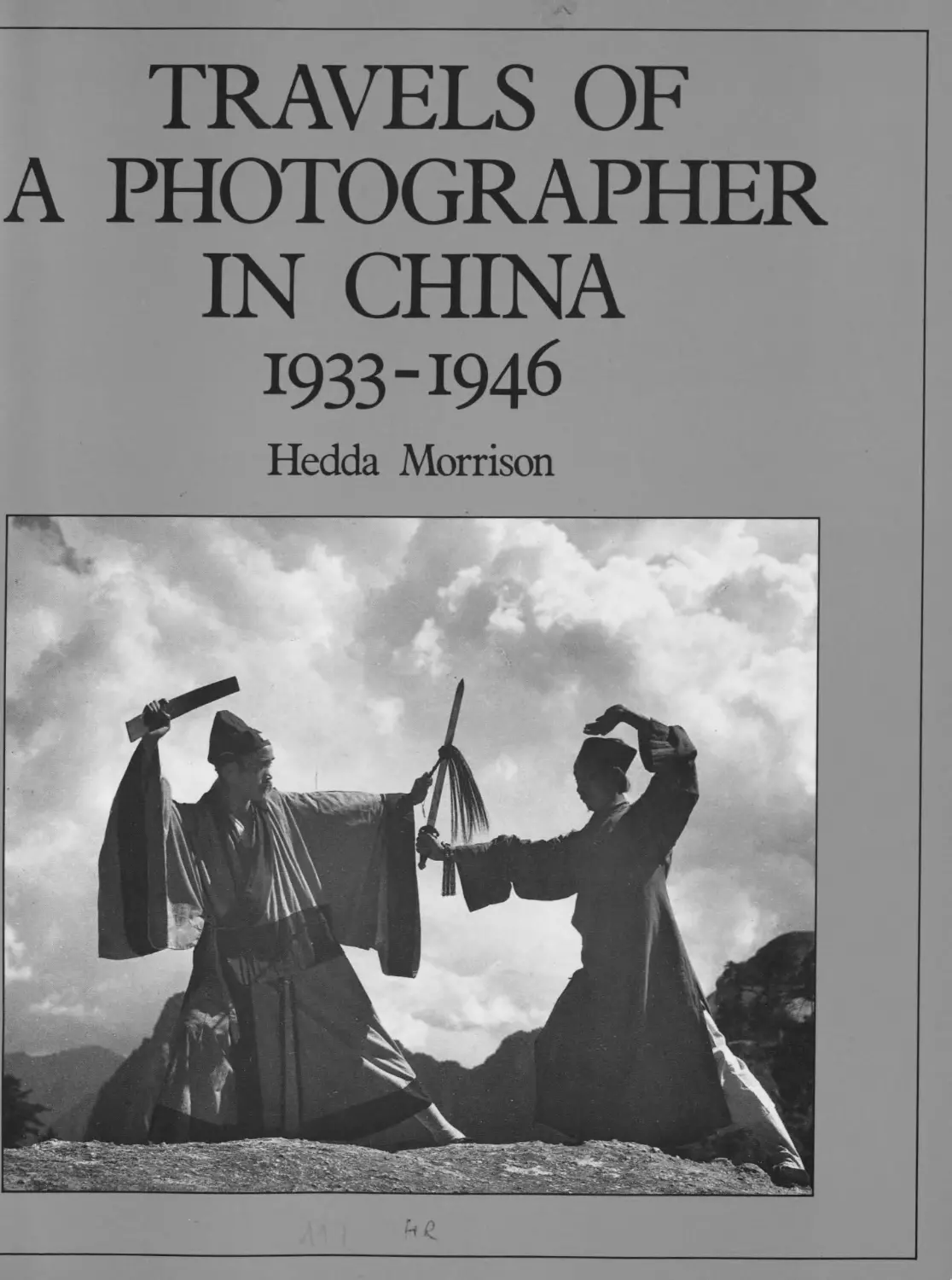
                    TRAVELS OF
PHOTOGRAPHER
IN CHINA
1933-1946
Hedda Morrison


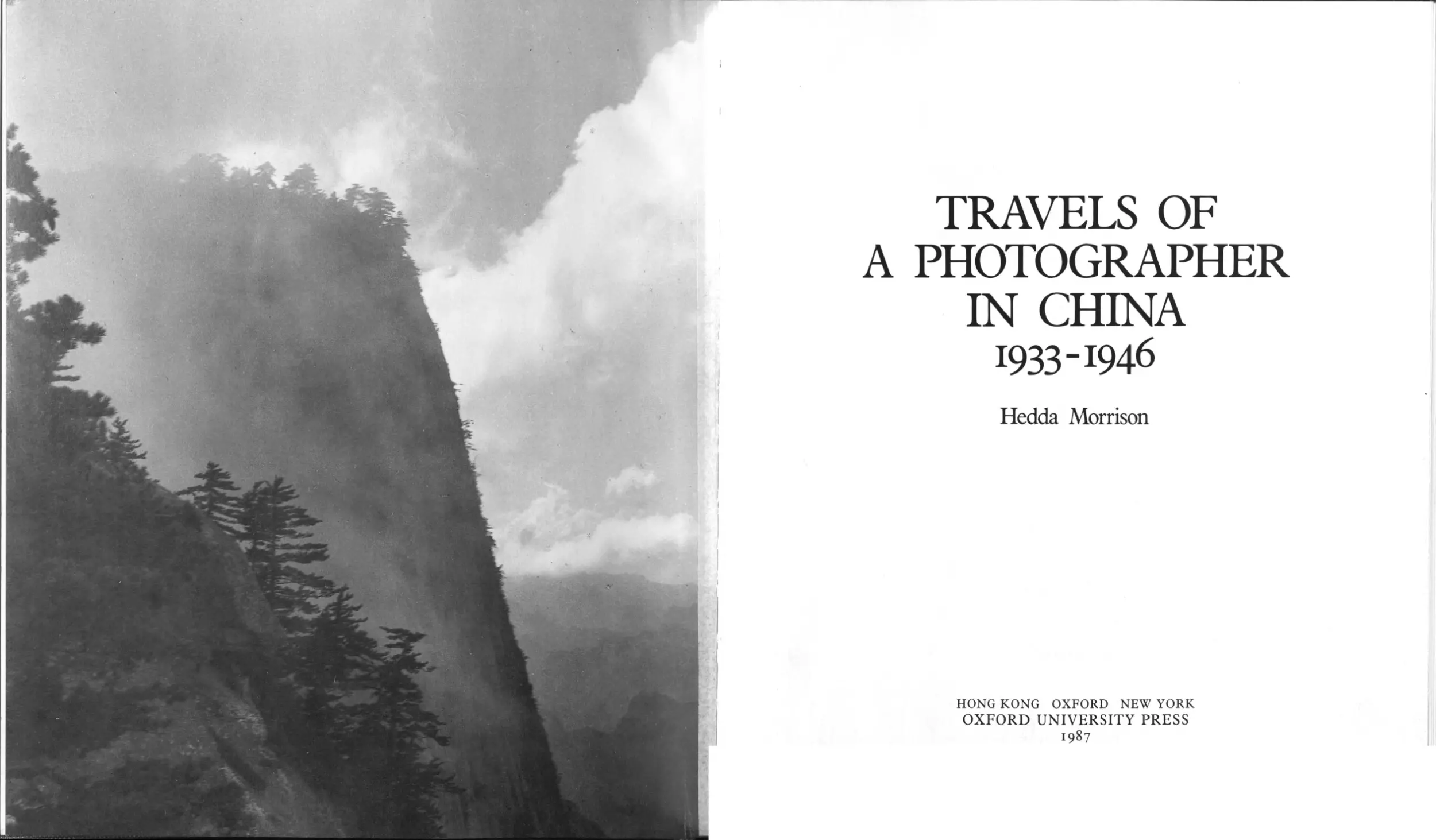
TRAVELS OF
A PHOTOGRAPHER
IN CHINA
ОЗЗ-1946
Hedda Morrison
HONG KONG OXFORD NEW YORK
OXFORD UNIVERSITY PRESS
1987
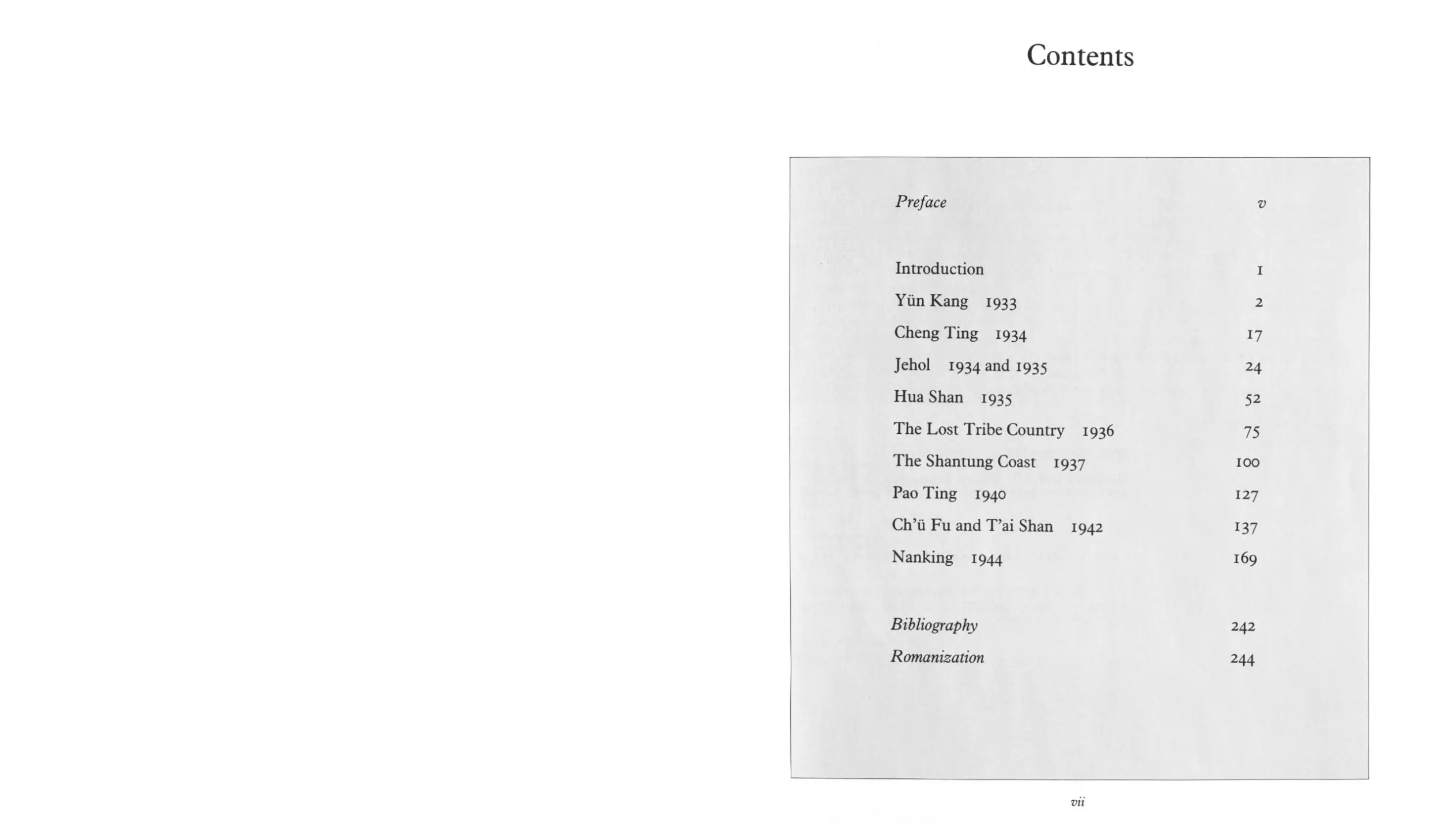
Contents
Preface	v
Introduction	i
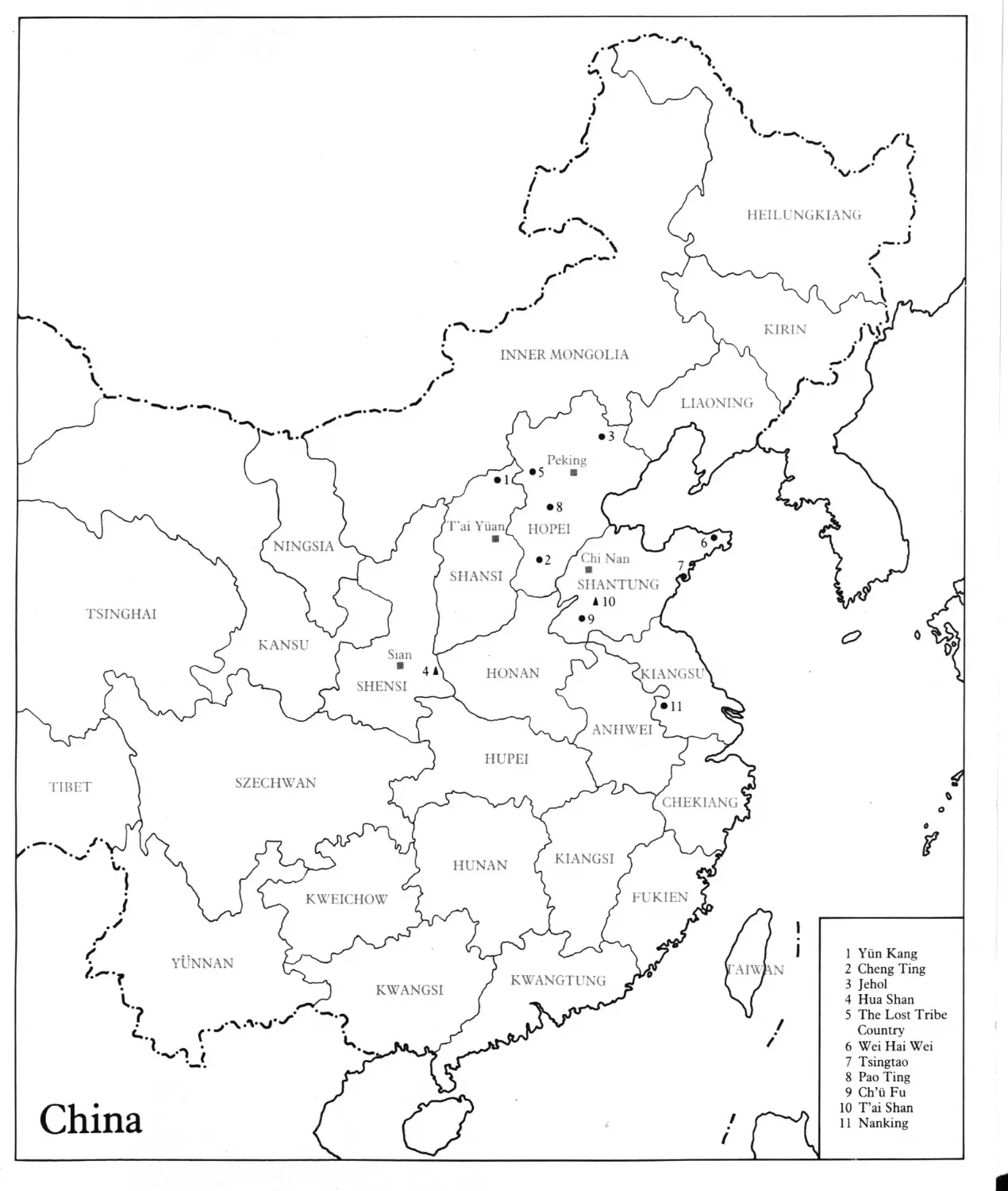
Yiin Kang 1933	2
Cheng Ting	1934	17
Jehol 1934 and 1935	24
Hua Shan 1935	52
The Lost Tribe Country	1936	75
The Shantung Coast 1937	too
Pao Ting 1940	127
Ch’ii Fu and T’ai Shan	1942	137
Nanking 1944	169
Bibliography	242
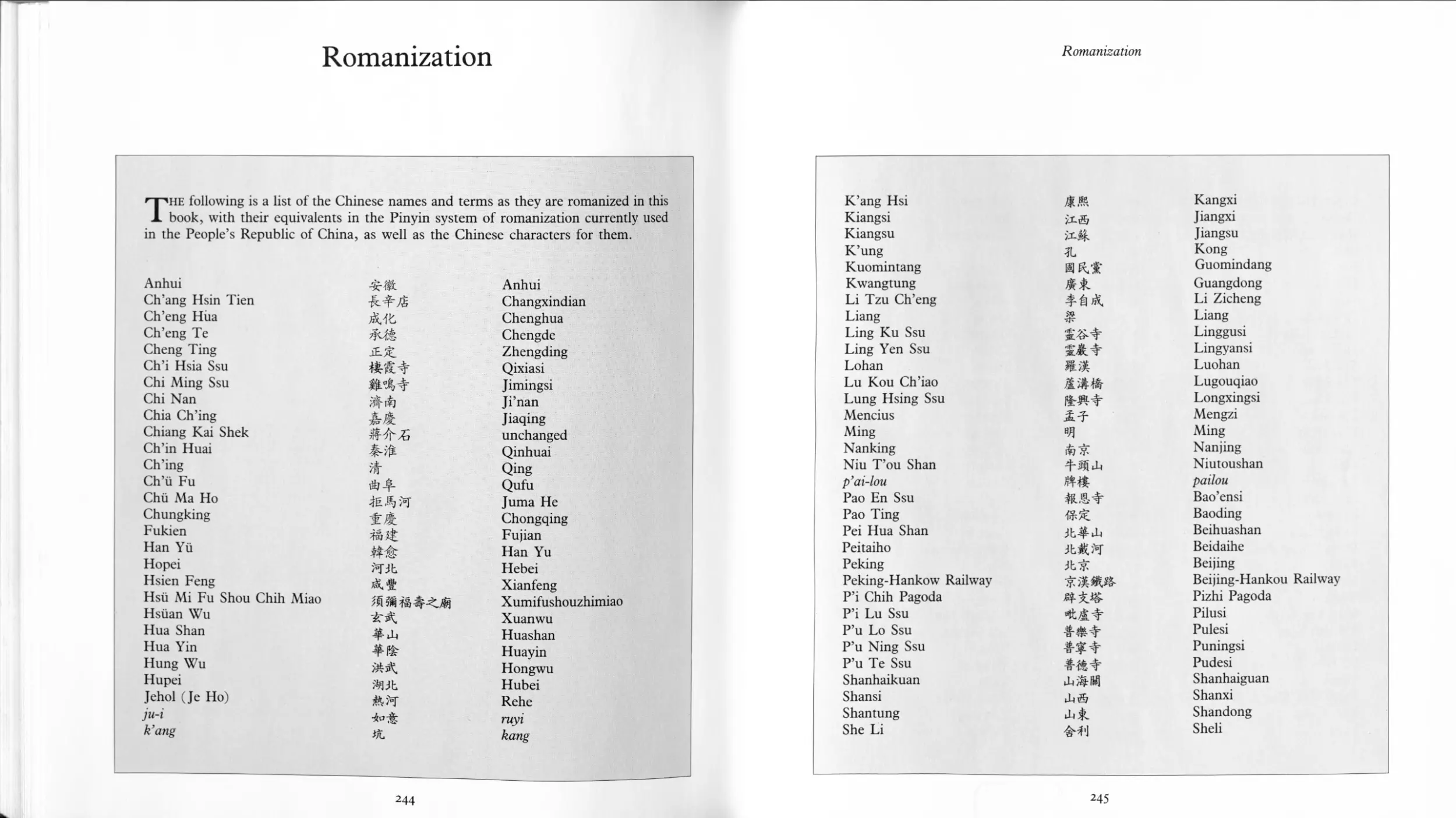
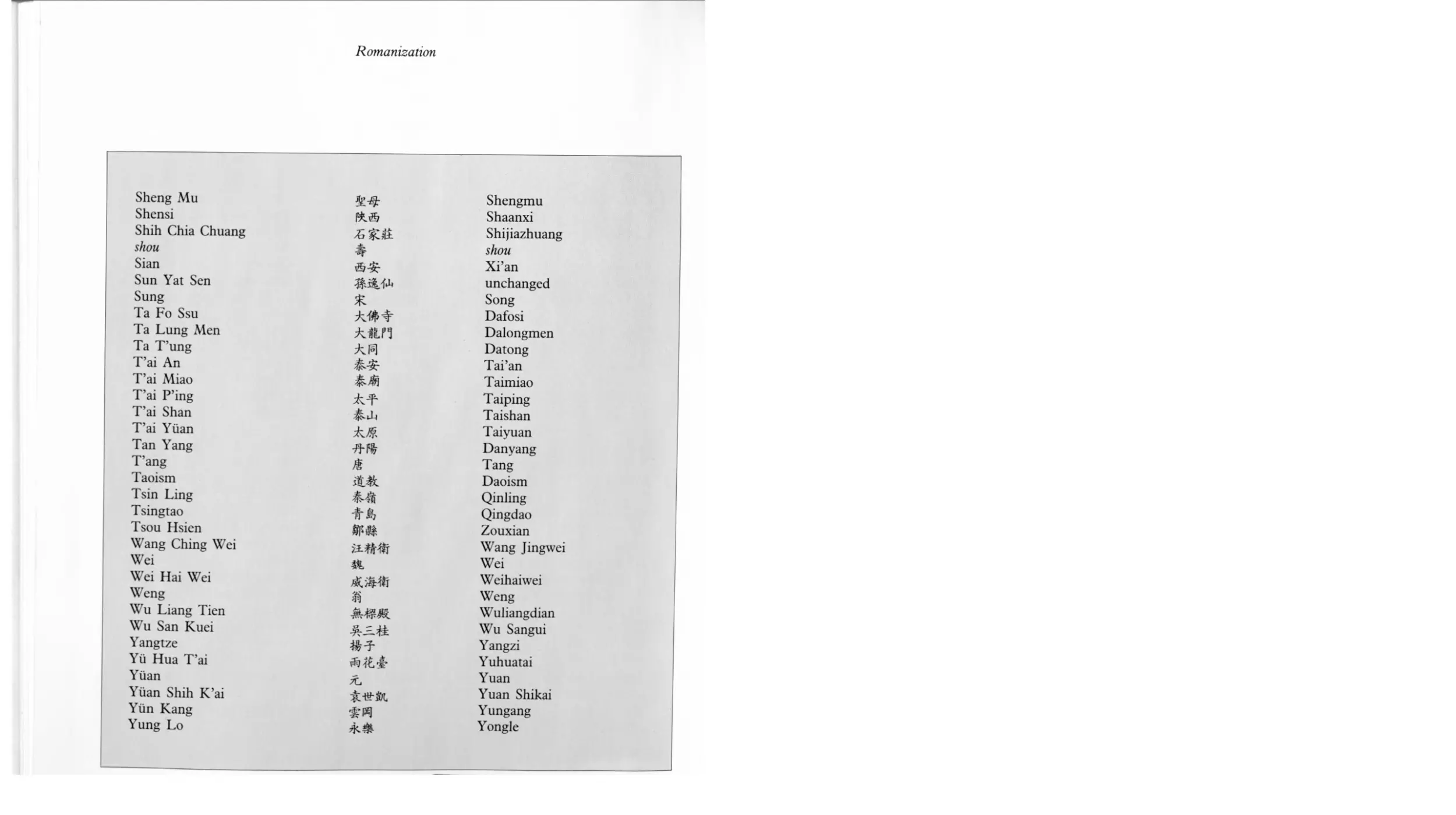
Romanization	244
vii

Introduction
For anyone who was reasonably adaptable travel in China in the 1930s presented
few problems. The road system was limited but reliable train services existed and
provided access to take-off points for explorations further afield. Third-class travel was
very cheap though liable to be rather crowded. There was always food to be had at
railway stops, while plentiful supplies of tea provided safe drinking. Fellow travellers
were friendly and obliging.
Arrived at your railway destination you walked or hired donkeys or a rickshaw. In
the countryside accommodation was widely available in temples; even quite small
villages had their own temple. Often it would be sited picturesquely in a grove of trees.
Temples acted as resthouses and you could usually obtain the use of a room in which
to unroll your sleeping bag. The Christian missionaries were also kind to travellers.
Many of them had long been resident in the area where they worked and were well
informed about its antiquities and the life of the people. Security was generally of a
high order. If an area was subject to banditry the fact was generally well known, but in
north China at any rate the then Kuomintang government had by the early thirties
imposed a degree of law and order.
1
Yim Kang 1933
My first venture outside the Peking area after my arrival from Germany in the
summer of 1933 was to the Yiin Kang caves at Christmas the same year. The
caves are in northern Shansi, about 370 kilometres west of Peking and about 15
kilometres from the important provincial centre of Ta T’ung. From the late fourth to
the mid-sixth century the region was the stronghold of the Wei dynasty of the Toba, a
non-Chinese people from the north-west who dominated north China.
Wei power coincided with the growth, and contributed significantly to the flower-
ing, of Buddhism in China, a religion that had been brought overland from India in
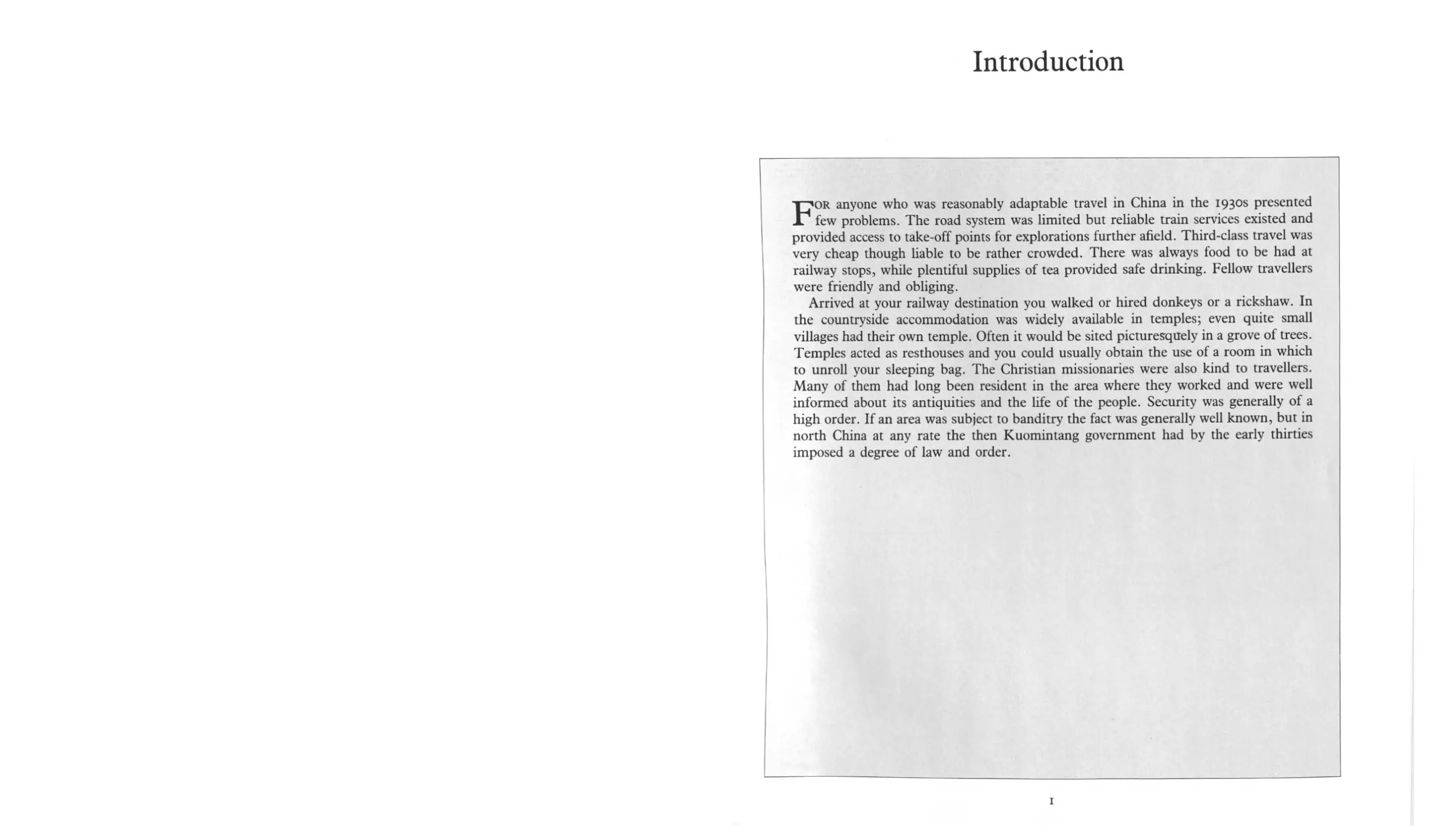
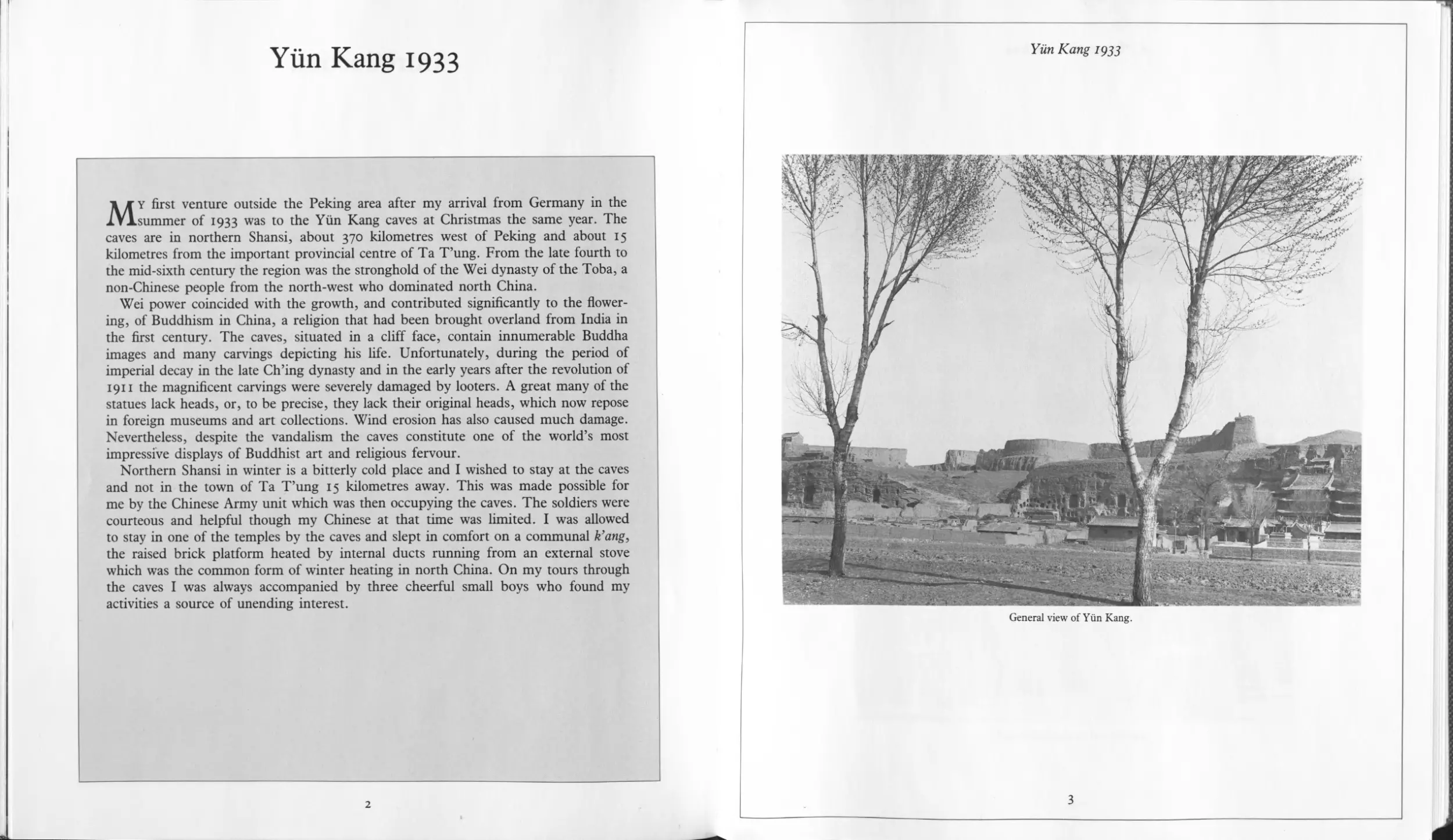
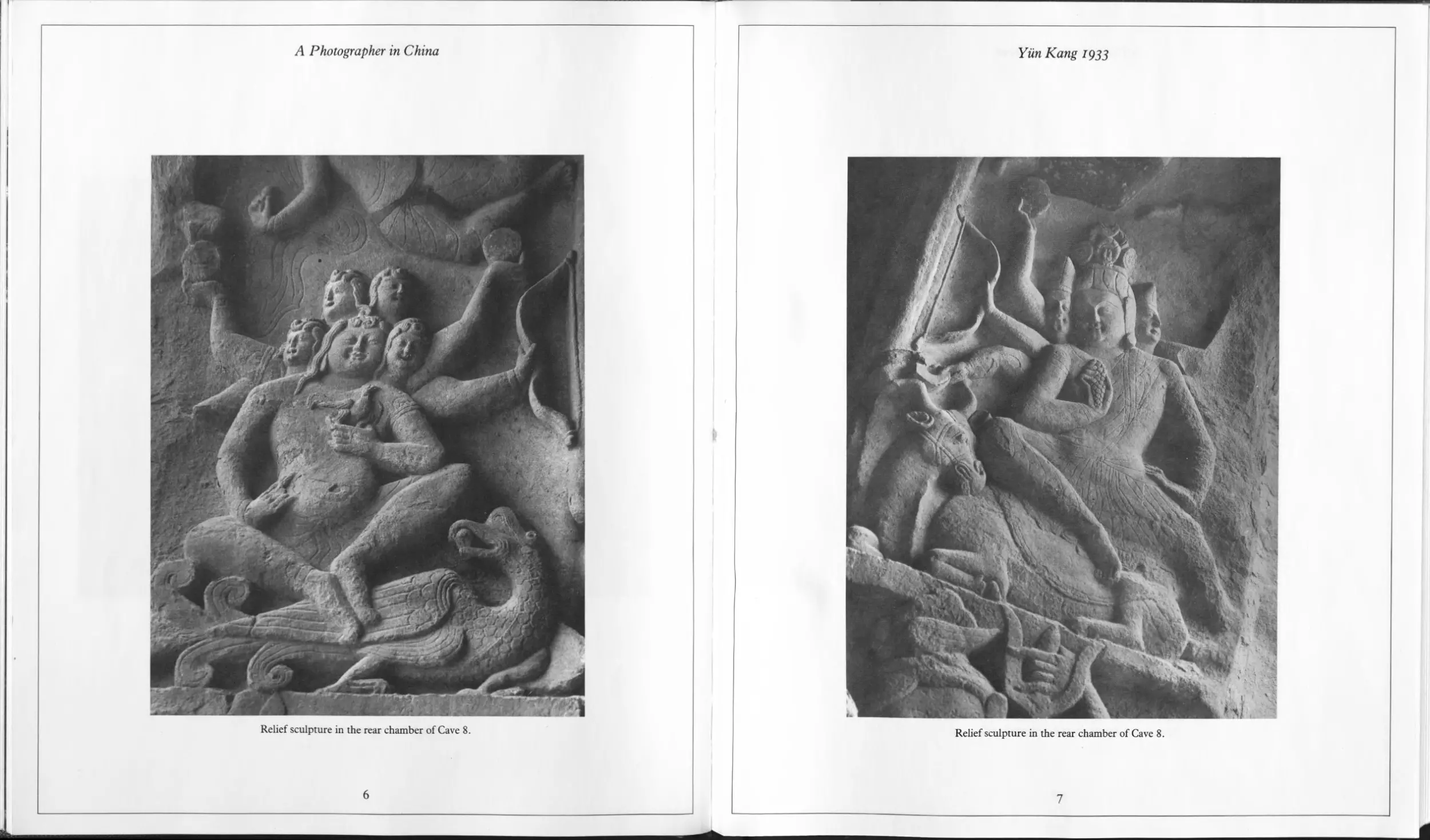
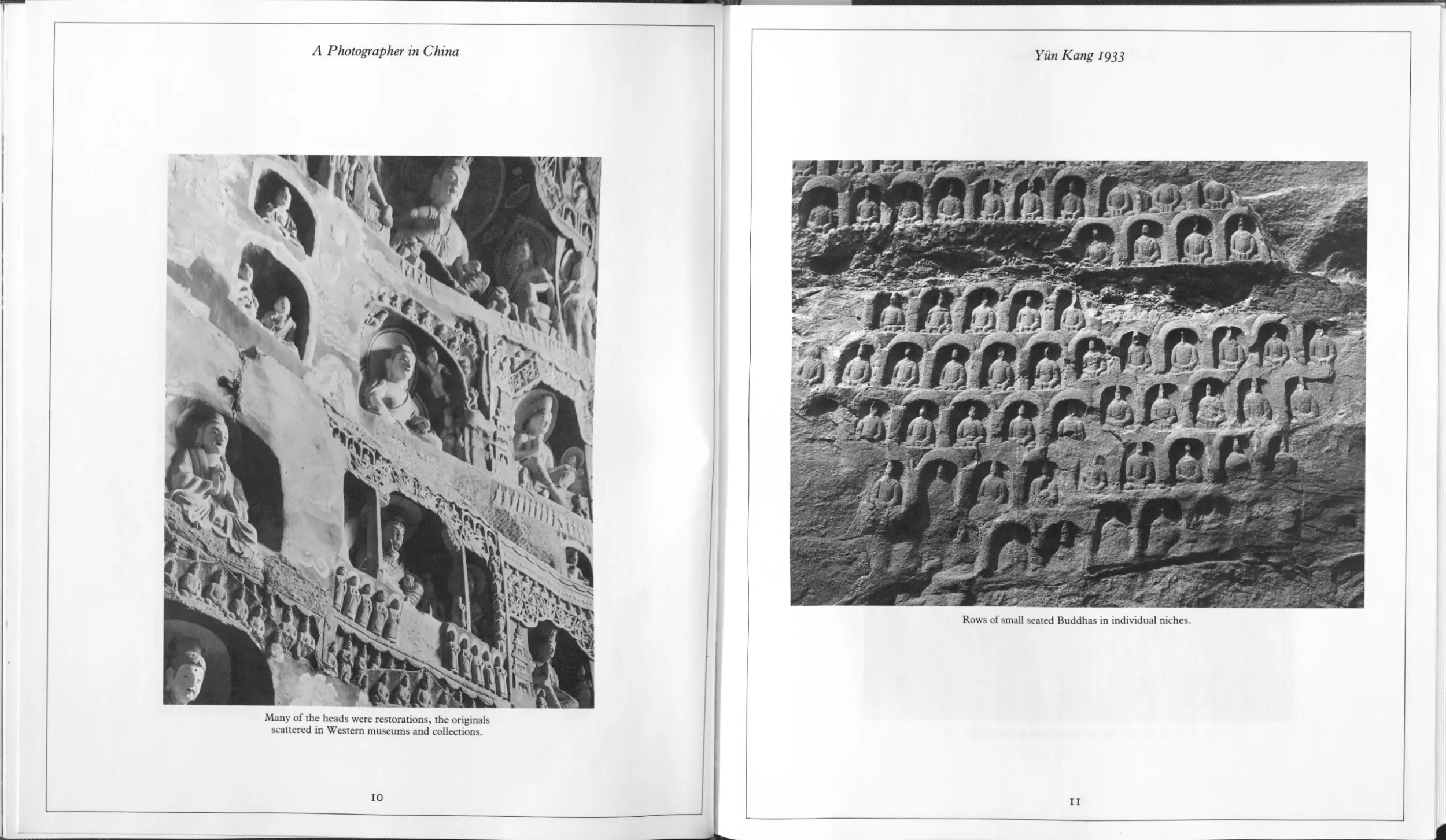
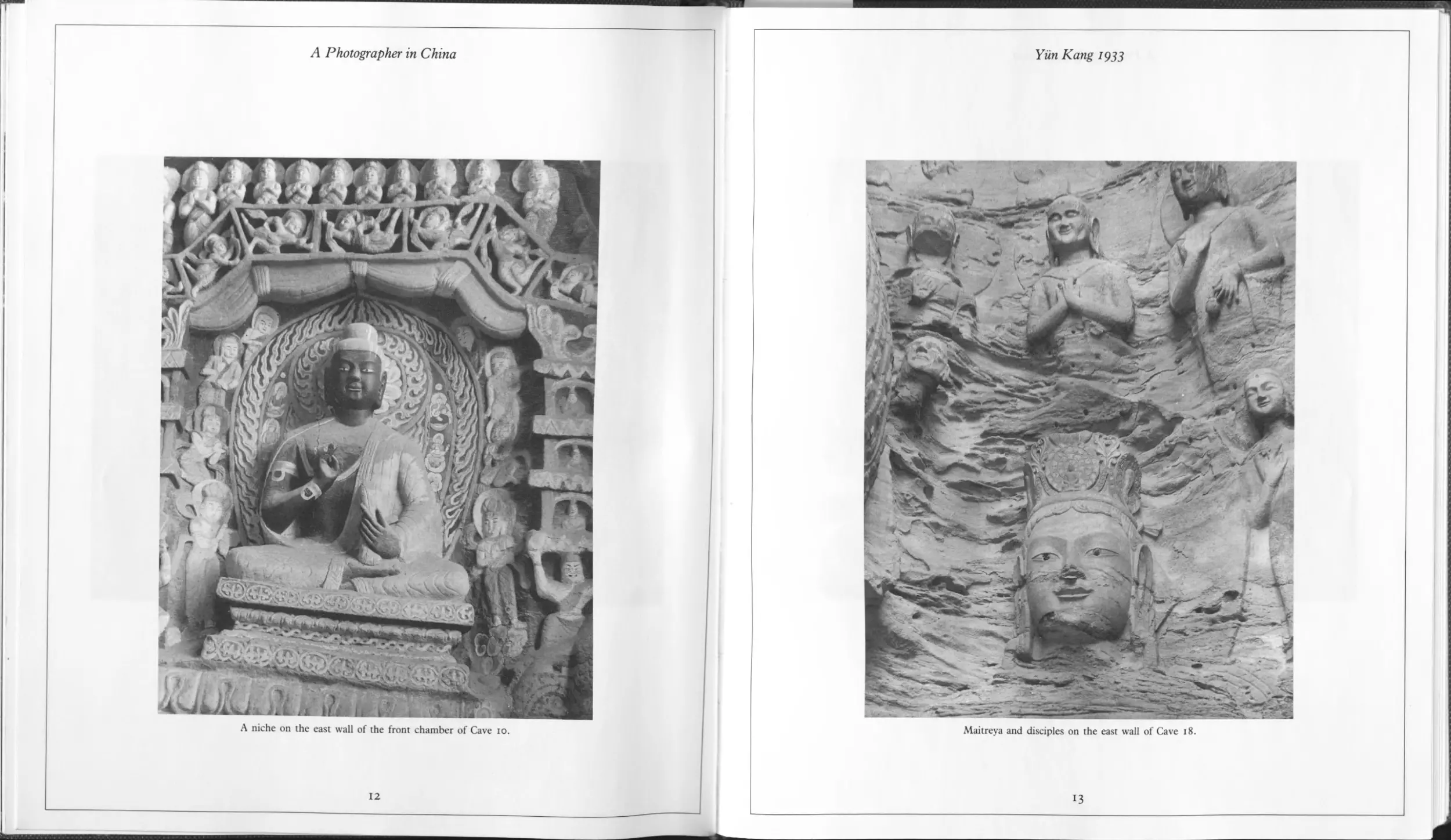
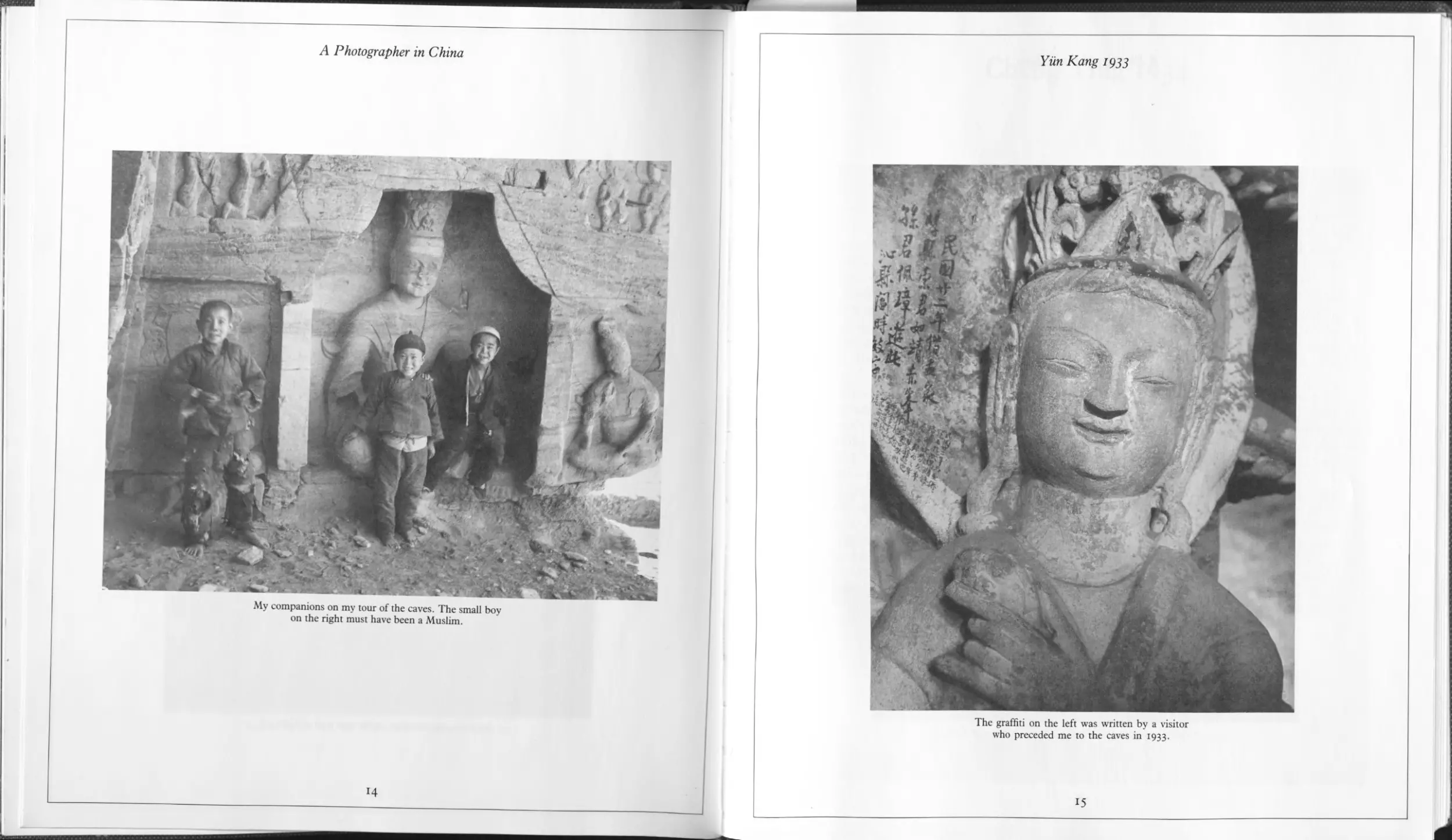
the first century. The caves, situated in a cliff face, contain innumerable Buddha
images and many carvings depicting his life. Unfortunately, during the period of
imperial decay in the late Ch’ing dynasty and in the early years after the revolution of
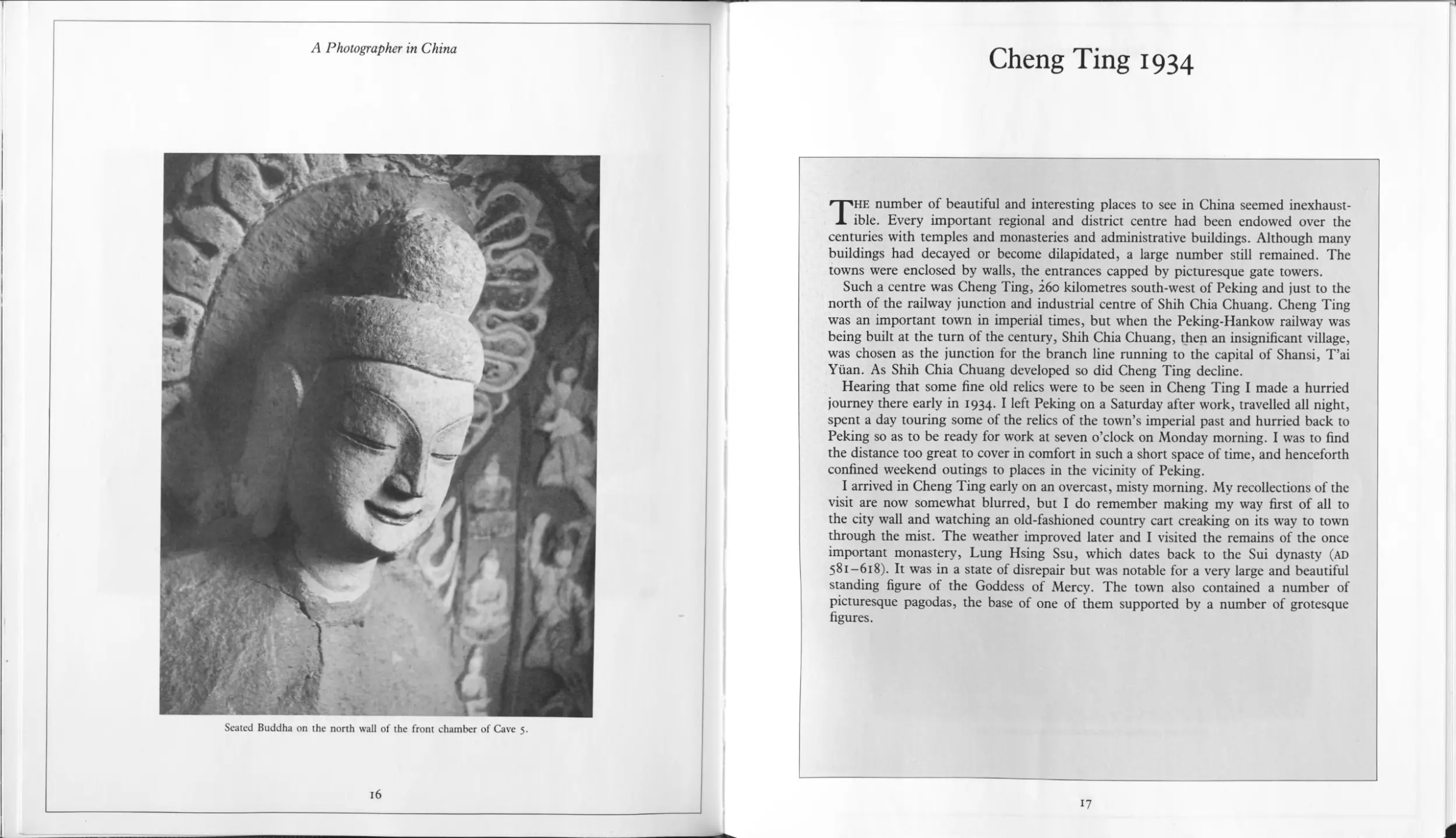
1911 the magnificent carvings were severely damaged by looters. A great many of the
statues lack heads, or, to be precise, they lack their original heads, which now repose
in foreign museums and art collections. Wind erosion has also caused much damage.
Nevertheless, despite the vandalism the caves constitute one of the world’s most
impressive displays of Buddhist art and religious fervour.
Northern Shansi in winter is a bitterly cold place and I wished to stay at the caves
and not in the town of Ta T’ung 15 kilometres away. This was made possible for
me by the Chinese Army unit which was then occupying the caves. The soldiers were
courteous and helpful though my Chinese at that time was limited. I was allowed
to stay in one of the temples by the caves and slept in comfort on a communal k’ang,
the raised brick platform heated by internal ducts running from an external stove
which was the common form of winter heating in north China. On my tours through
the caves I was always accompanied by three cheerful small boys who found my
activities a source of unending interest.
2
Yiin Kang 1933
General view of Yiin Kang.
3
A Photographer in China
The cliff face housing the caves.

Yun Kang 1933
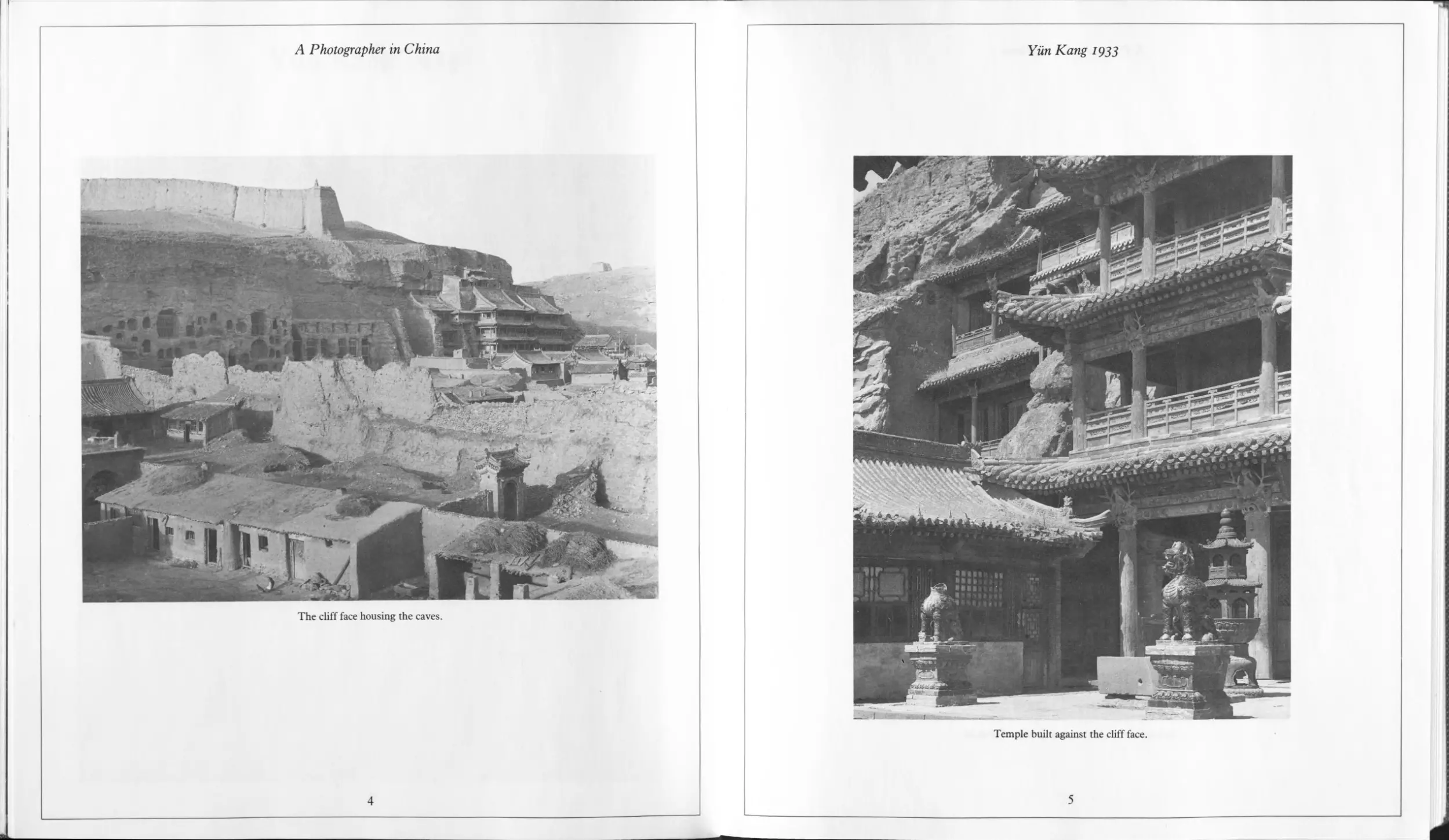
Temple built against the cliff face.
5
A Photographer in China
Relief sculpture in the rear chamber of Cave 8.
6
Yun Kang 1933
Relief sculpture in the rear chamber of Cave 8.
A Photographer in China
Many of the heads were restorations, the originals
scattered in Western museums and collections.
10
Yiin Kang 1933
Rows of small seated Buddhas in individual niches.
A Photographer in China
A niche on the east wall of the front chamber of Cave io.
12

Yun Kang 1933
Maitreya and disciples on the east wall of Cave 18.
13
A Photographer in China
My companions on my tour of the caves. The small boy
on the right must have been a Muslim.
14
Yun Kang 1933
The graffiti on the left was written by a visitor
who preceded me to the caves in 1933.
15
A Photographer in China
Seated Buddha on the north wall of the front chamber of Cave 5.
Cheng Ting 1934
THE number of beautiful and interesting places to see in China seemed inexhaust-
ible. Every important regional and district centre had been endowed over the
centuries with temples and monasteries and administrative buildings. Although many
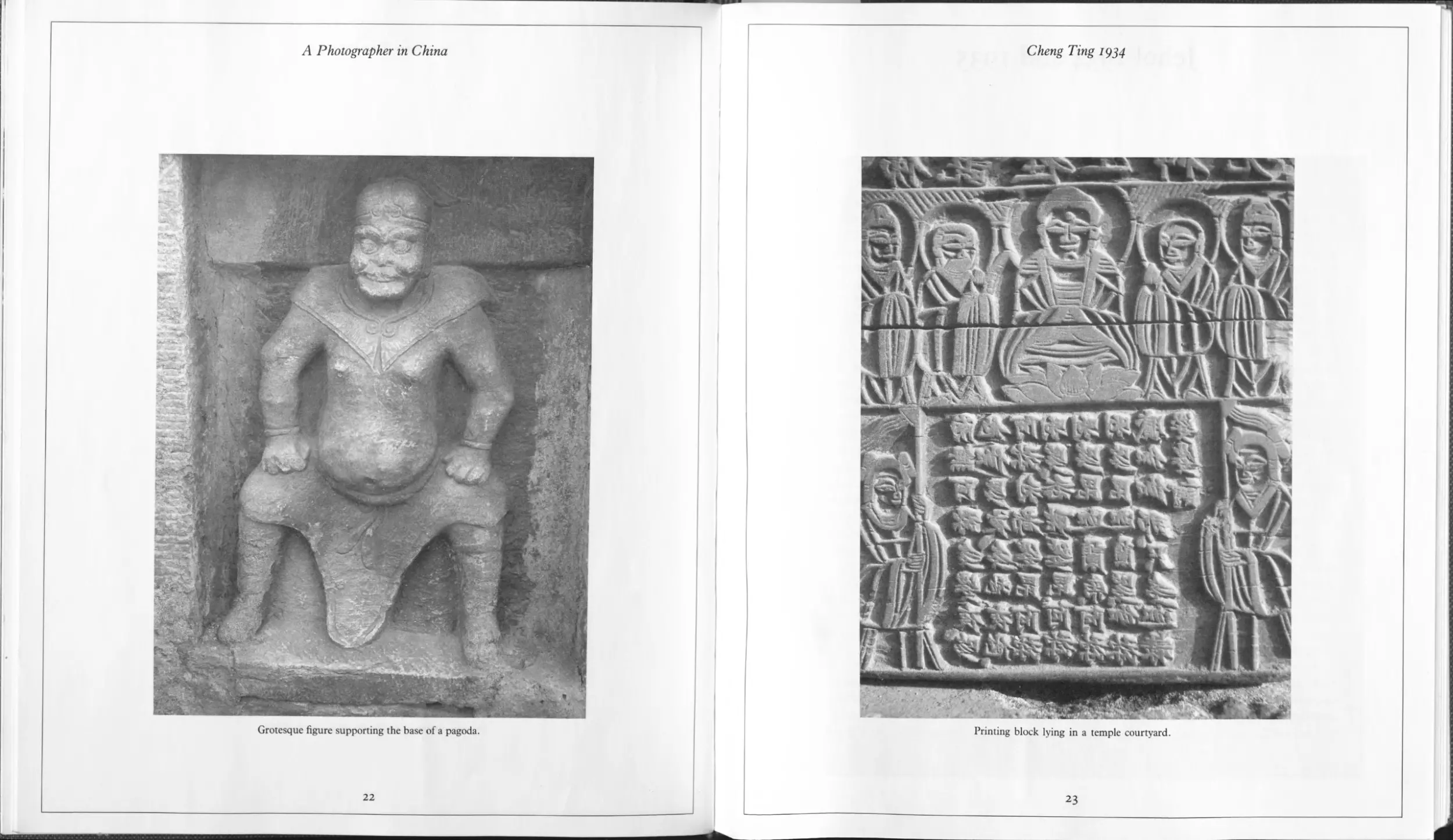
buildings had decayed or become dilapidated, a large number still remained. The
towns were enclosed by walls, the entrances capped by picturesque gate towers.
Such a centre was Cheng Ting, 260 kilometres south-west of Peking and just to the
north of the railway junction and industrial centre of Shih Chia Chuang. Cheng Ting
was an important town in imperial times, but when the Peking-Hankow railway was
being built at the turn of the century, Shih Chia Chuang, then an insignificant village,
was chosen as the junction for the branch line running to the capital of Shansi, T’ai
Yuan. As Shih Chia Chuang developed so did Cheng Ting decline.
Hearing that some fine old relics were to be seen in Cheng Ting I made a hurried
journey there early in 1934. I left Peking on a Saturday after work, travelled all night,
spent a day touring some of the relics of the town’s imperial past and hurried back to
Peking so as to be ready for work at seven o’clock on Monday morning. I was to find
the distance too great to cover in comfort in such a short space of time, and henceforth
confined weekend outings to places in the vicinity of Peking.
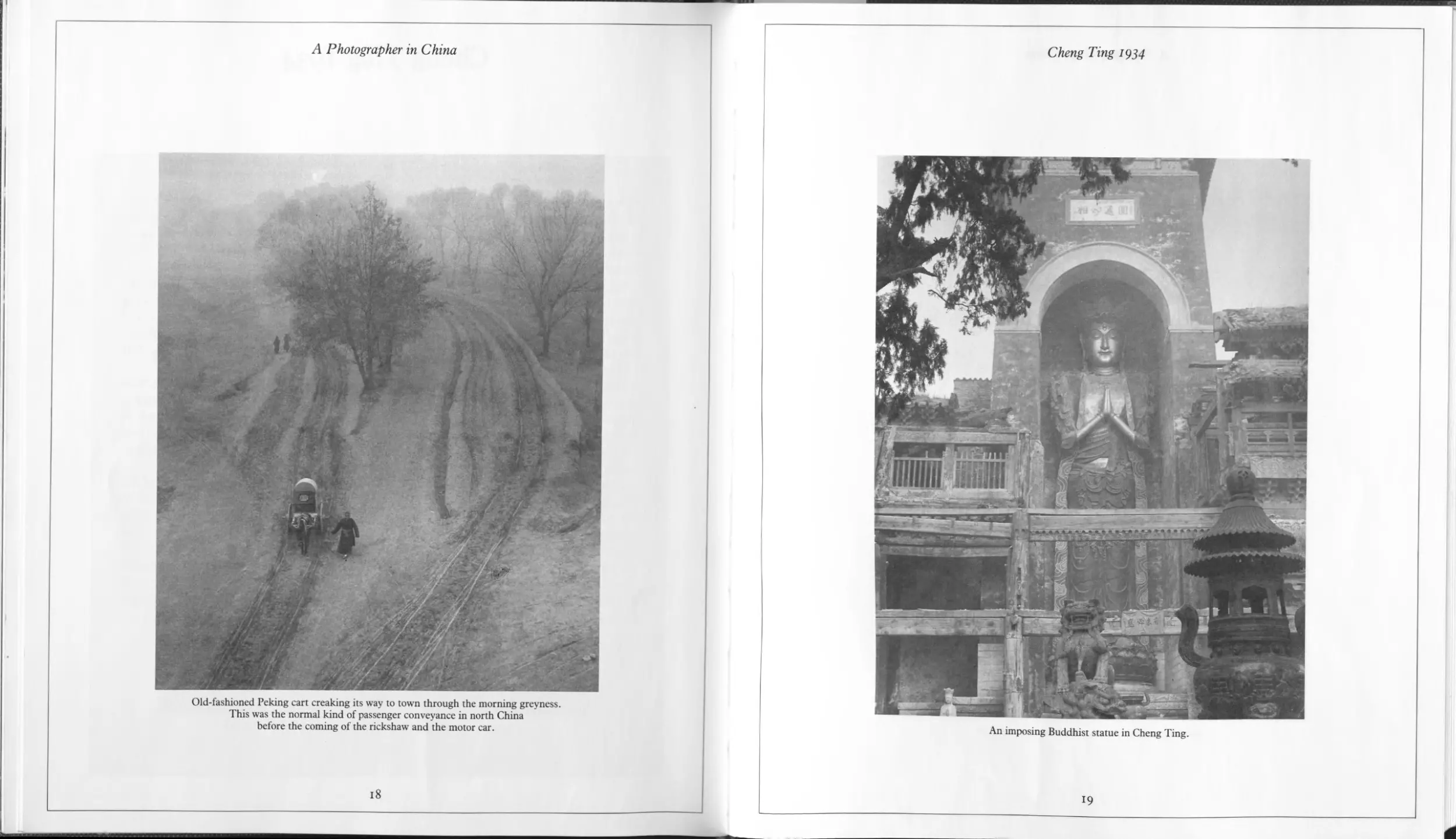
I arrived in Cheng Ting early on an overcast, misty morning. My recollections of the
visit are now somewhat blurred, but I do remember making my way first of all to
the city wall and watching an old-fashioned country cart creaking on its way to town
through the mist. The weather improved later and I visited the remains of the once
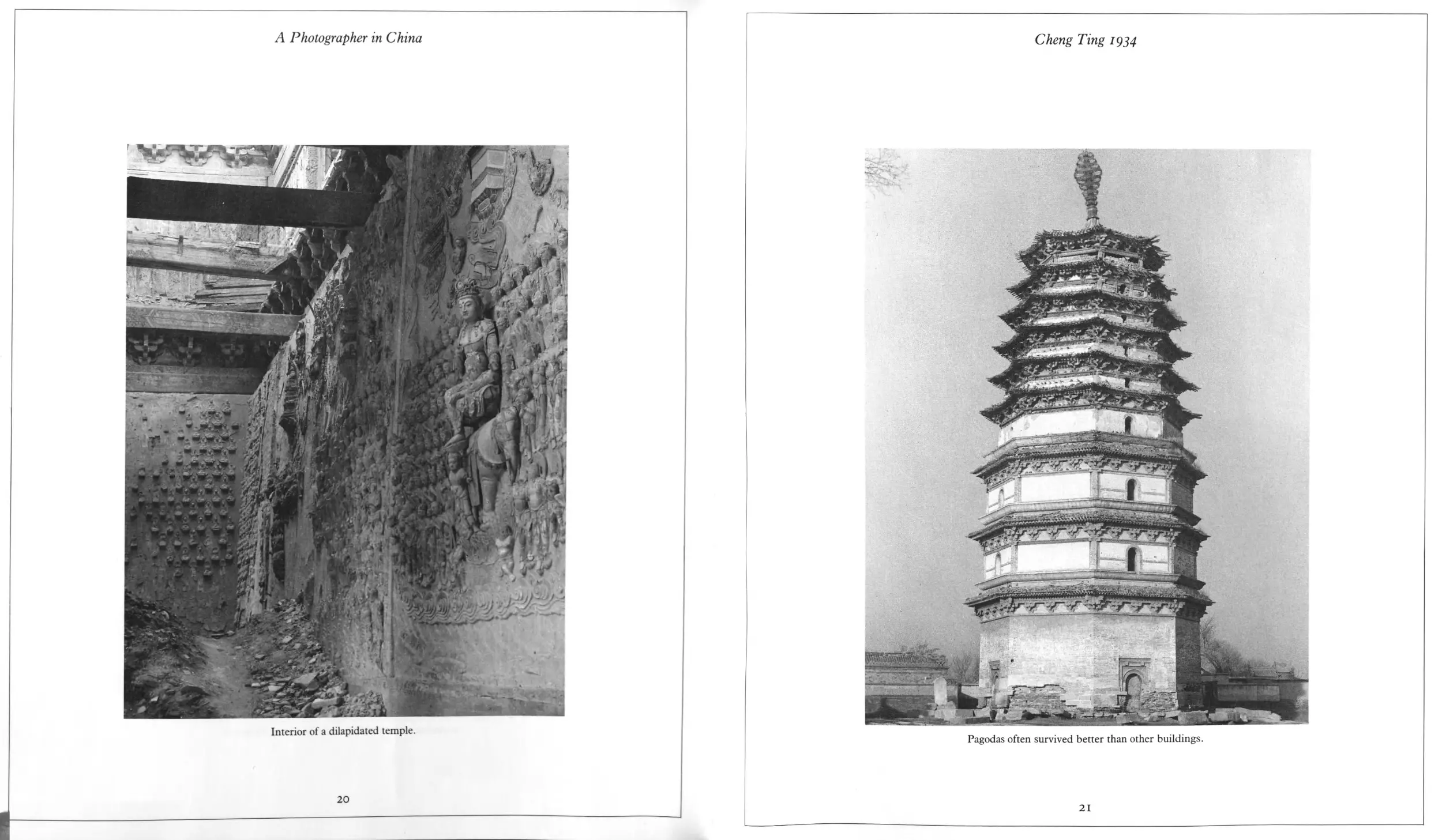
important monastery, Lung Hsing Ssu, which dates back to the Sui dynasty (AD
581-618). It was in a state of disrepair but was notable for a very large and beautiful
standing figure of the Goddess of Mercy. The town also contained a number of
picturesque pagodas, the base of one of them supported by a number of grotesque
figures.
17
A Photographer in China
Old-fashioned Peking cart creaking its way to town through the morning greyness.
This was the normal kind of passenger conveyance in north China
before the coming of the rickshaw and the motor car.
18
Cheng Ting 1934
An imposing Buddhist statue in Cheng Ting.
19
A Photographer in China
Interior of a dilapidated temple.
20
Cheng Ting 1934
Pagodas often survived better than other buildings.
21
A Photographer in China
Grotesque figure supporting the base of a pagoda.
22
Cheng Ting 1934
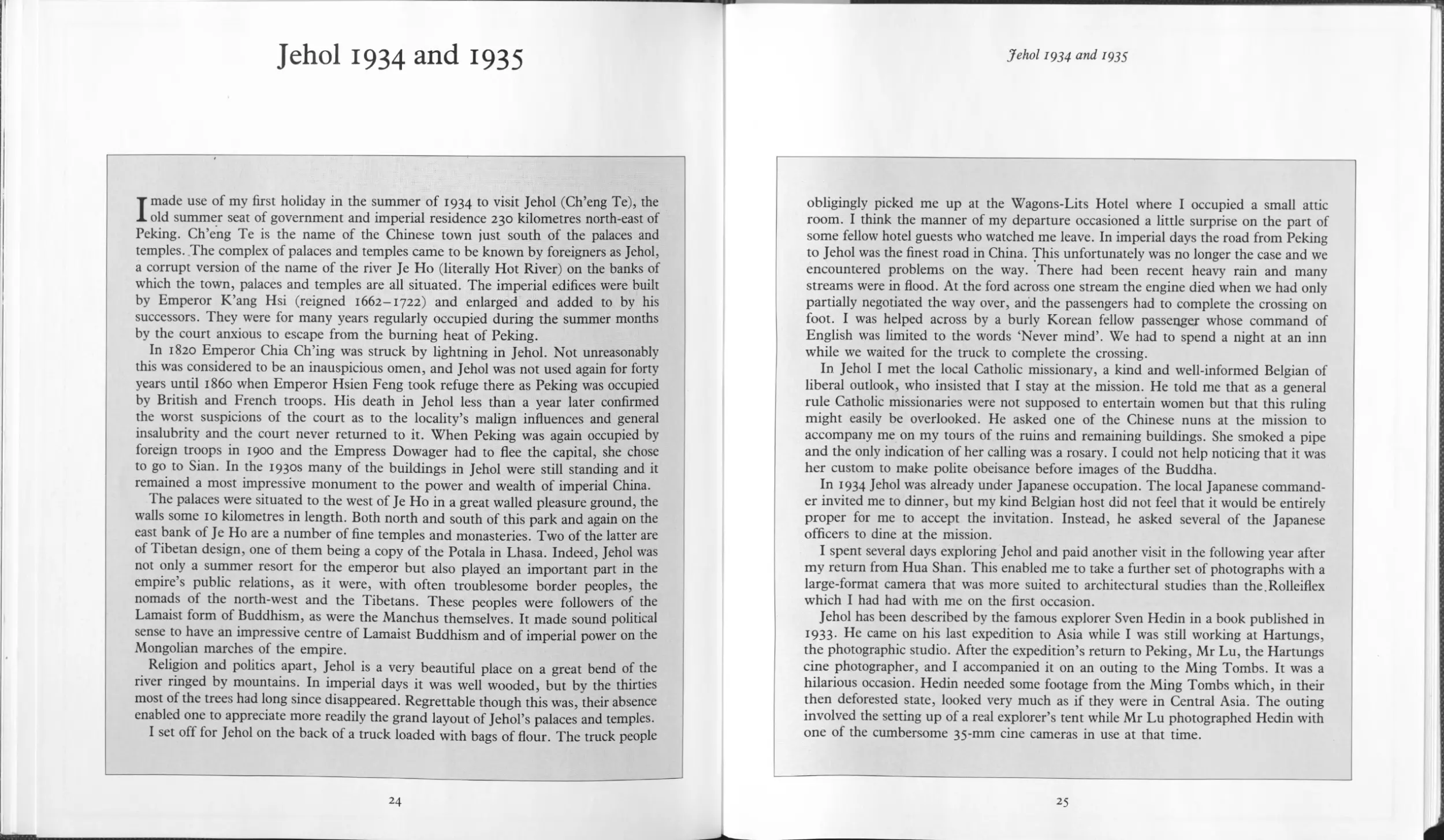
Printing block lying in a temple courtyard.
23
Jehol 1934 and 1935
I made use of my first holiday in the summer of 1934 to visit Jehol (Ch’eng Те), the
old summer seat of government and imperial residence 230 kilometres north-east of
Peking. Ch’eng Те is the name of the Chinese town just south of the palaces and
temples. The complex of palaces and temples came to be known by foreigners as Jehol,
a corrupt version of the name of the river Je Ho (literally Hot River) on the banks of
which the town, palaces and temples are all situated. The imperial edifices were built
by Emperor K’ang Hsi (reigned 1662-1722) and enlarged and added to by his
successors. They were for many years regularly occupied during the summer months
by the court anxious to escape from the burning heat of Peking.
In 1820 Emperor Chia Ch’ing was struck by lightning in Jehol. Not unreasonably
this was considered to be an inauspicious omen, and Jehol was not used again for forty
years until i860 when Emperor Hsien Feng took refuge there as Peking was occupied
by British and French troops. His death in Jehol less than a year later confirmed
the worst suspicions of the court as to the locality’s malign influences and general
insalubrity and the court never returned to it. When Peking was again occupied by
foreign troops in 1900 and the Empress Dowager had to flee the capital, she chose
to go to Sian. In the 1930s many of the buildings in Jehol were still standing and it
remained a most impressive monument to the power and wealth of imperial China.
The palaces were situated to the west of Je Ho in a great walled pleasure ground, the
walls some 10 kilometres in length. Both north and south of this park and again on the
east bank of Je Ho are a number of fine temples and monasteries. Two of the latter are
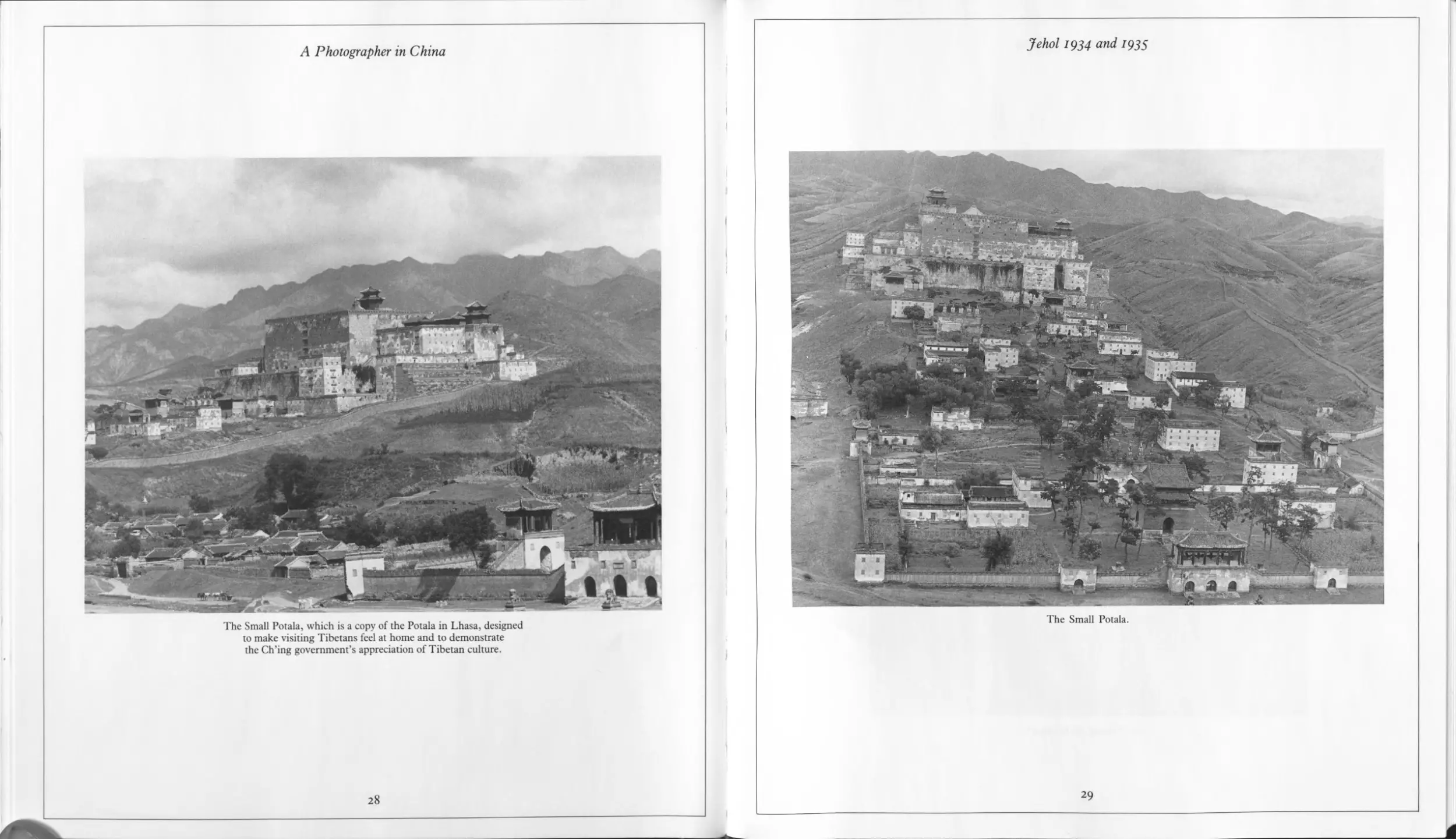
of Tibetan design, one of them being a copy of the Potala in Lhasa. Indeed, Jehol was
not only a summer resort for the emperor but also played an important part in the
empire’s public relations, as it were, with often troublesome border peoples, the
nomads of the north-west and the Tibetans. These peoples were followers of the
Lamaist form of Buddhism, as were the Manchus themselves. It made sound political
sense to have an impressive centre of Lamaist Buddhism and of imperial power on the
Mongolian marches of the empire.
Religion and politics apart, Jehol is a very beautiful place on a great bend of the
river ringed by mountains. In imperial days it was well wooded, but by the thirties
most of the trees had long since disappeared. Regrettable though this was, their absence
enabled one to appreciate more readily the grand layout of Jehol’s palaces and temples.
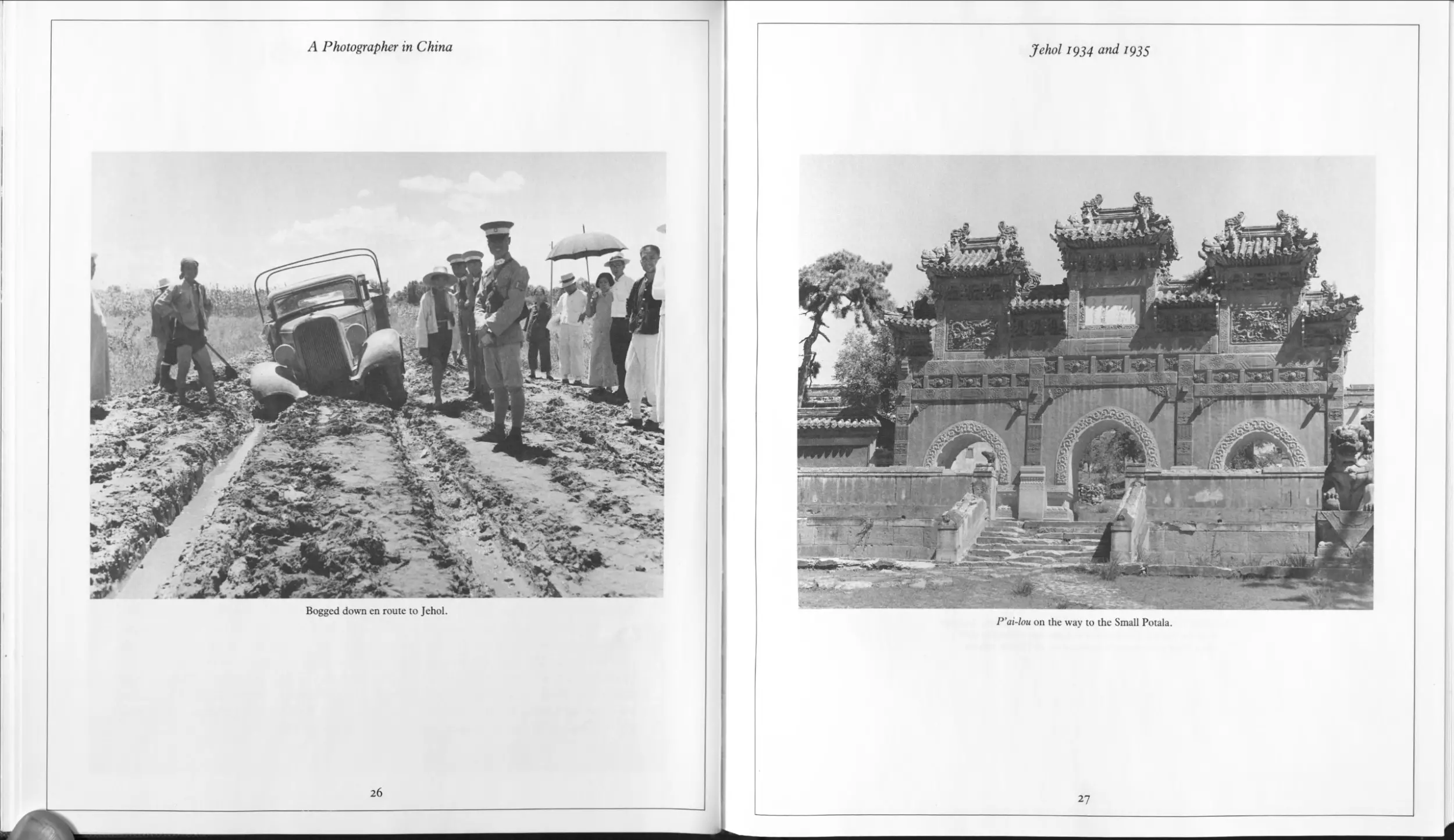
I set off for Jehol on the back of a truck loaded with bags of flour. The truck people
24
Jehol 1934 and 1935
obligingly picked me up at the Wagons-Lits Hotel where I occupied a small attic
room. I think the manner of my departure occasioned a little surprise on the part of
some fellow hotel guests who watched me leave. In imperial days the road from Peking
to Jehol was the finest road in China. This unfortunately was no longer the case and we
encountered problems on the way. There had been recent heavy rain and many
streams were in flood. At the ford across one stream the engine died when we had only
partially negotiated the way over, and the passengers had to complete the crossing on
foot. I was helped across by a burly Korean fellow passenger whose command of
English was limited to the words ‘Never mind’. We had to spend a night at an inn
while we waited for the truck to complete the crossing.
In Jehol I met the local Catholic missionary, a kind and well-informed Belgian of
liberal outlook, who insisted that I stay at the mission. He told me that as a general
rule Catholic missionaries were not supposed to entertain women but that this ruling
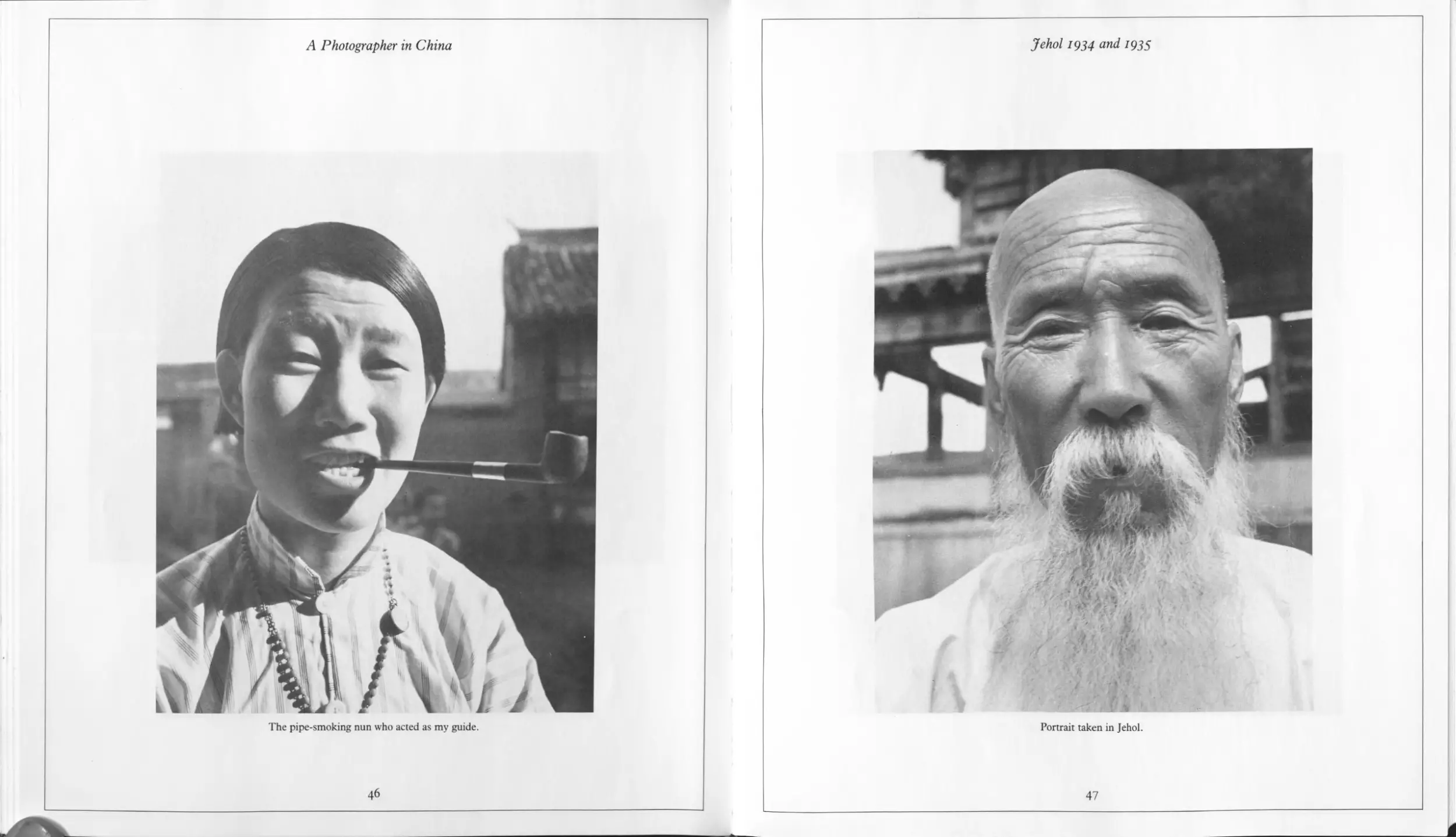
might easily be overlooked. He asked one of the Chinese nuns at the mission to
accompany me on my tours of the ruins and remaining buildings. She smoked a pipe
and the only indication of her calling was a rosary. I could not help noticing that it was
her custom to make polite obeisance before images of the Buddha.
In 1934 Jehol was already under Japanese occupation. The local Japanese command-
er invited me to dinner, but my kind Belgian host did not feel that it would be entirely
proper for me to accept the invitation. Instead, he asked several of the Japanese
officers to dine at the mission.
I spent several days exploring Jehol and paid another visit in the following year after
my return from Hua Shan. This enabled me to take a further set of photographs with a
large-format camera that was more suited to architectural studies than the.Rolleiflex
which I had had with me on the first occasion.
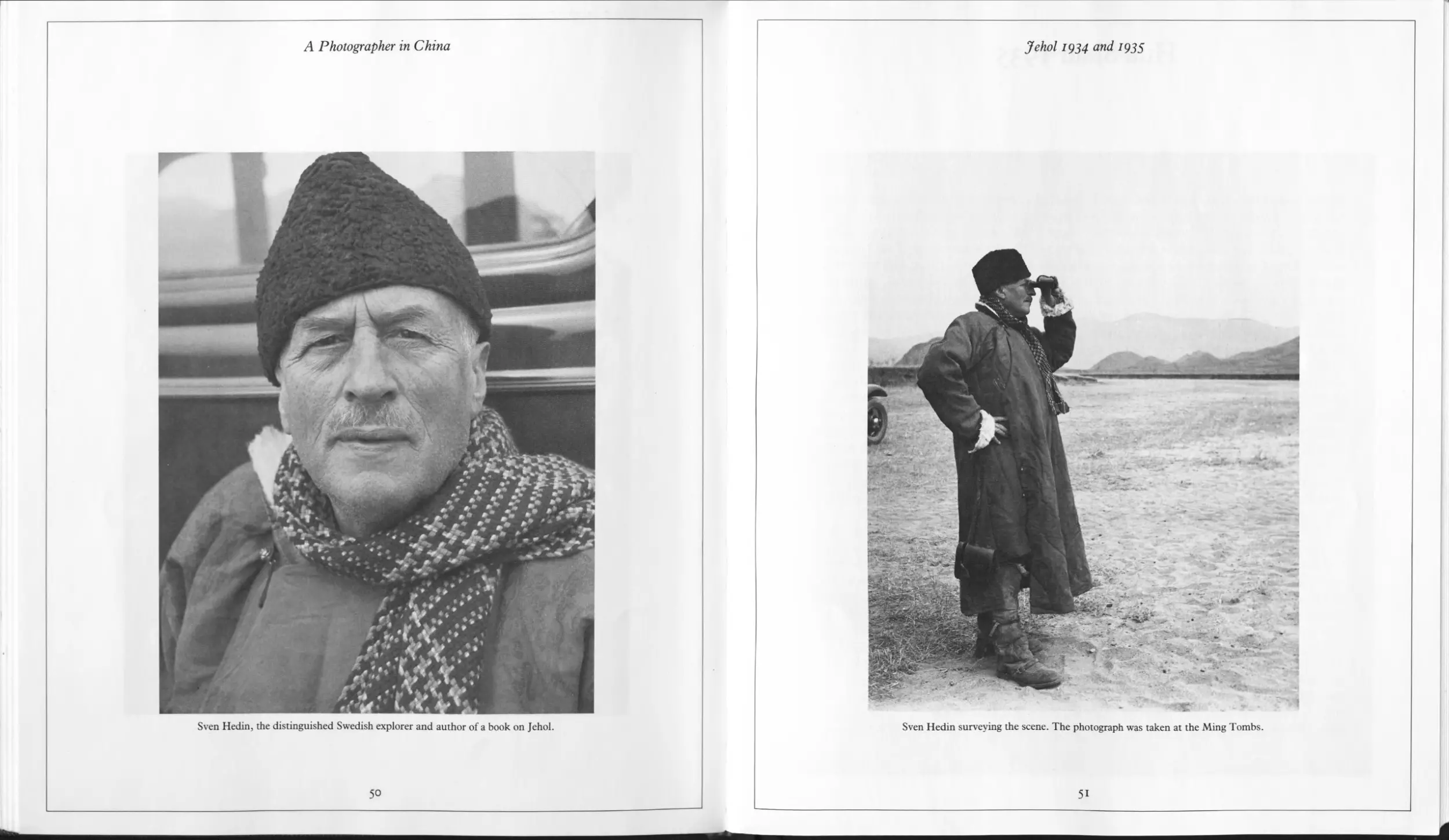
Jehol has been described by the famous explorer Sven Hedin in a book published in
1933. He came on his last expedition to Asia while I was still working at Hartungs,
the photographic studio. After the expedition’s return to Peking, Mr Lu, the Hartungs
cine photographer, and I accompanied it on an outing to the Ming Tombs. It was a
hilarious occasion. Hedin needed some footage from the Ming Tombs which, in their
then deforested state, looked very much as if they were in Central Asia. The outing
involved the setting up of a real explorer’s tent while Mr Lu photographed Hedin with
one of the cumbersome 35-mm cine cameras in use at that time.
25
A Photographer in China
Bogged down en route to Jehol.
26
Jehol 1934 and 1935
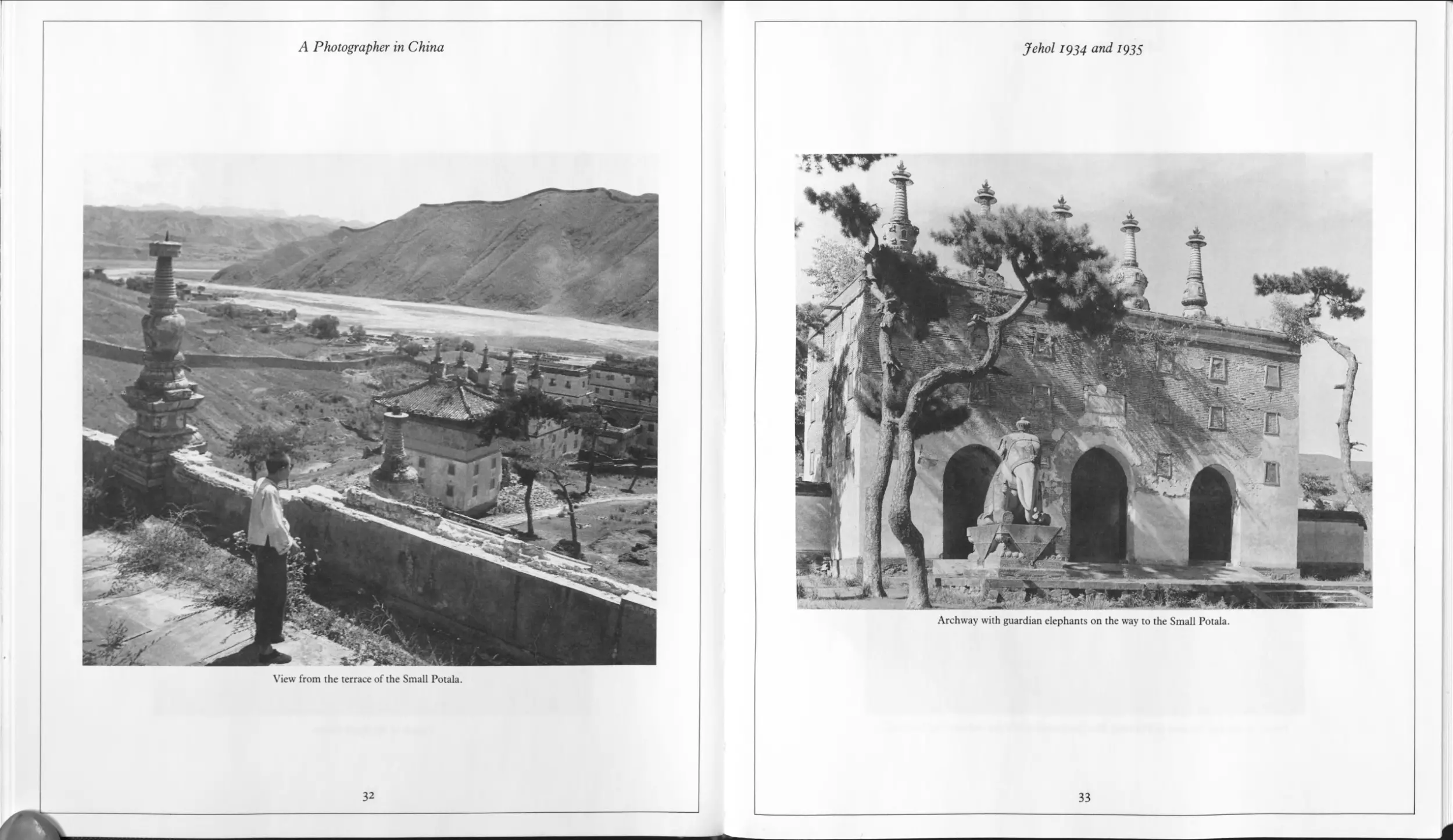
P’ai-lou on the way to the Small Potala.
27
A Photographer in China
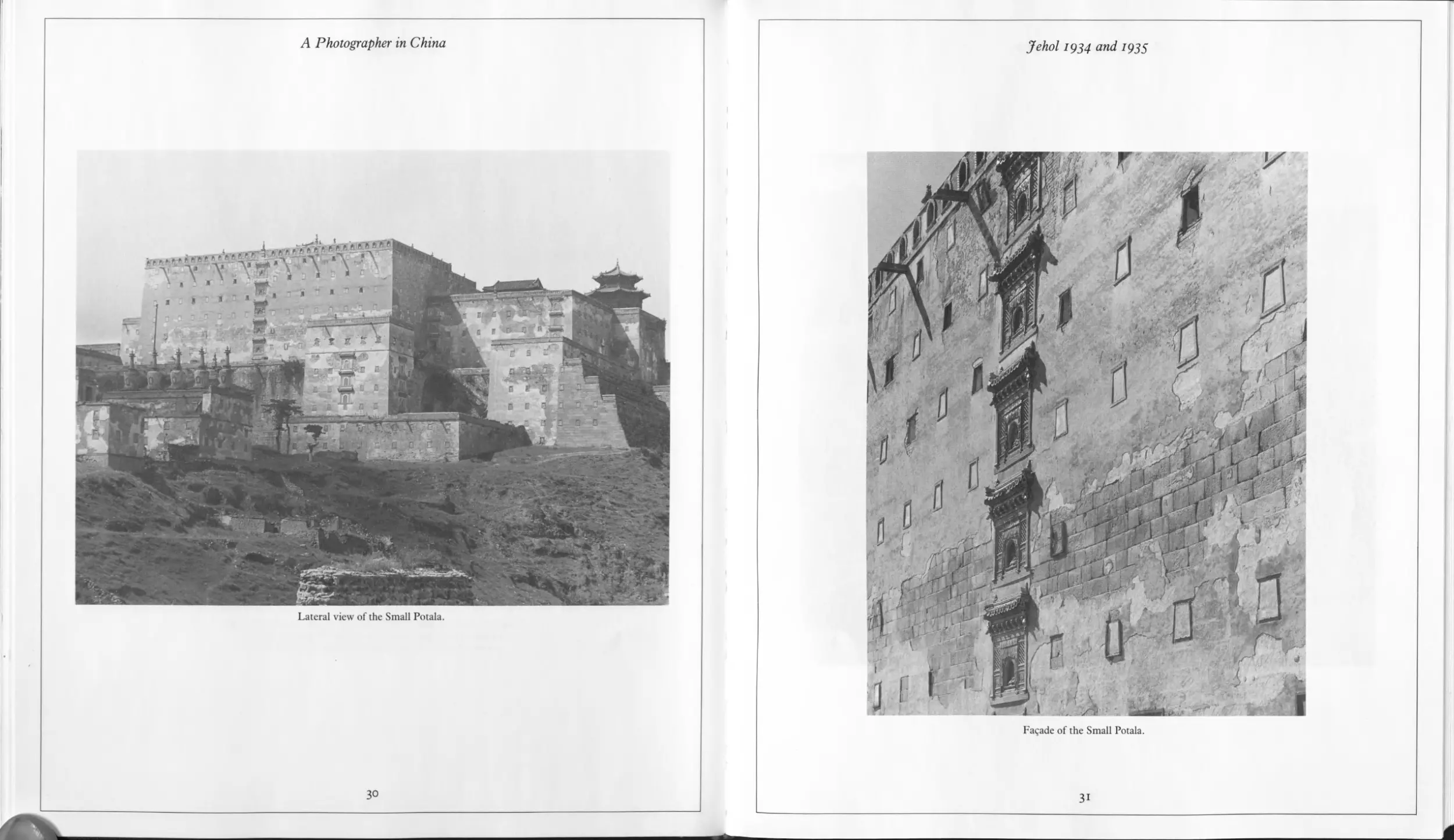
The Small Potala, which is a copy of the Potala in Lhasa, designed
to make visiting Tibetans feel at home and to demonstrate
the Ch’ing government’s appreciation of Tibetan culture.
28
Jehol 1934 and 1935
The Small Potala.
A Photographer in China
Lateral view of the Small Potala.
30
Jehol 1934 and 1935
Facade of the Small Potala.
31
A Photographer in China
View from the terrace of the Small Potala.
Jehol 1934 and 1935
^»s X
>

A Photographer in China
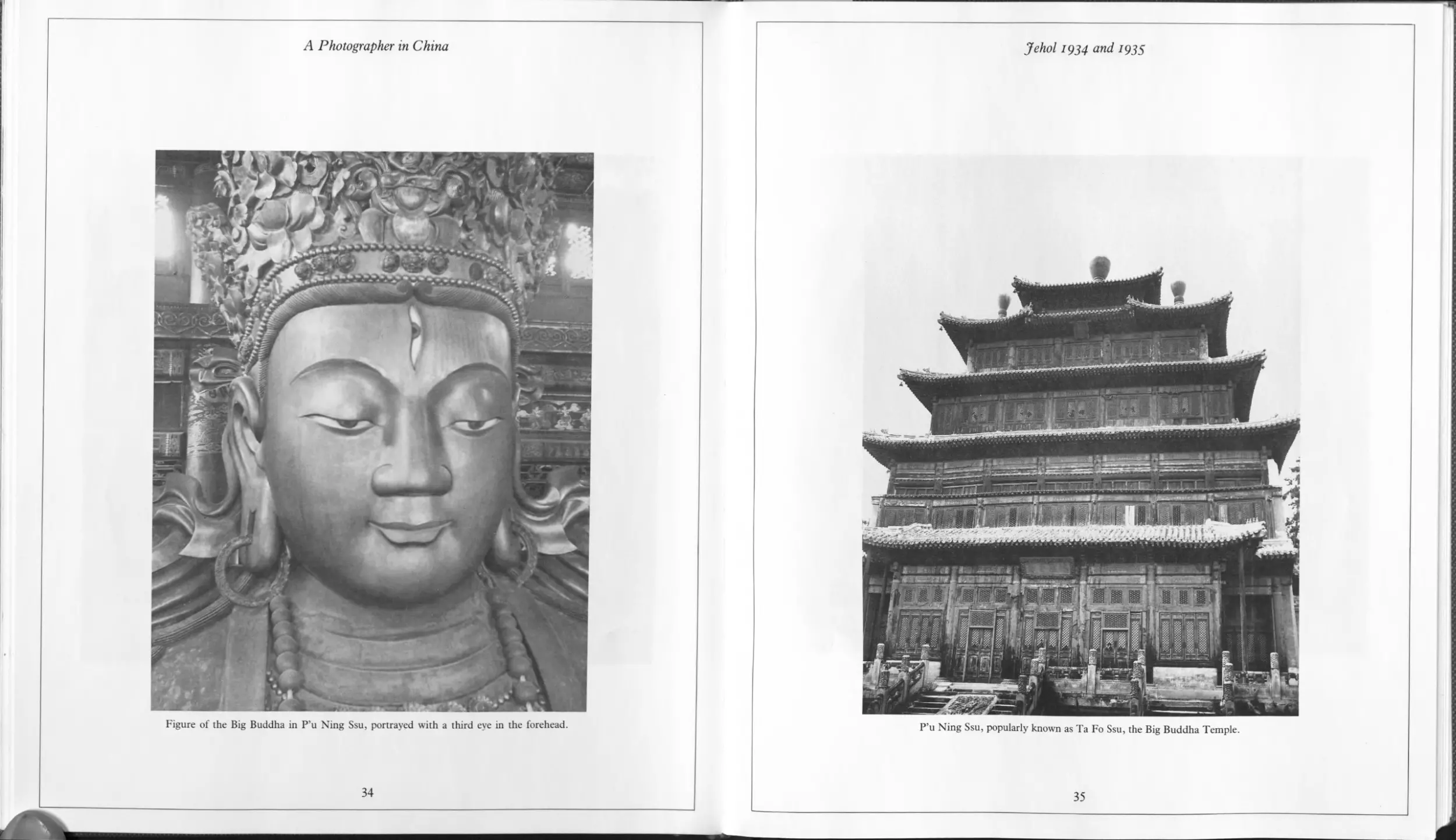
Figure of the Big Buddha in P’u Ning Ssu, portrayed with a third eye in the forehead.
Jehol 1934 and 1935
P’u Ning Ssu, popularly known as Ta Fo Ssu, the Big Buddha Temple.
A Photographer in China
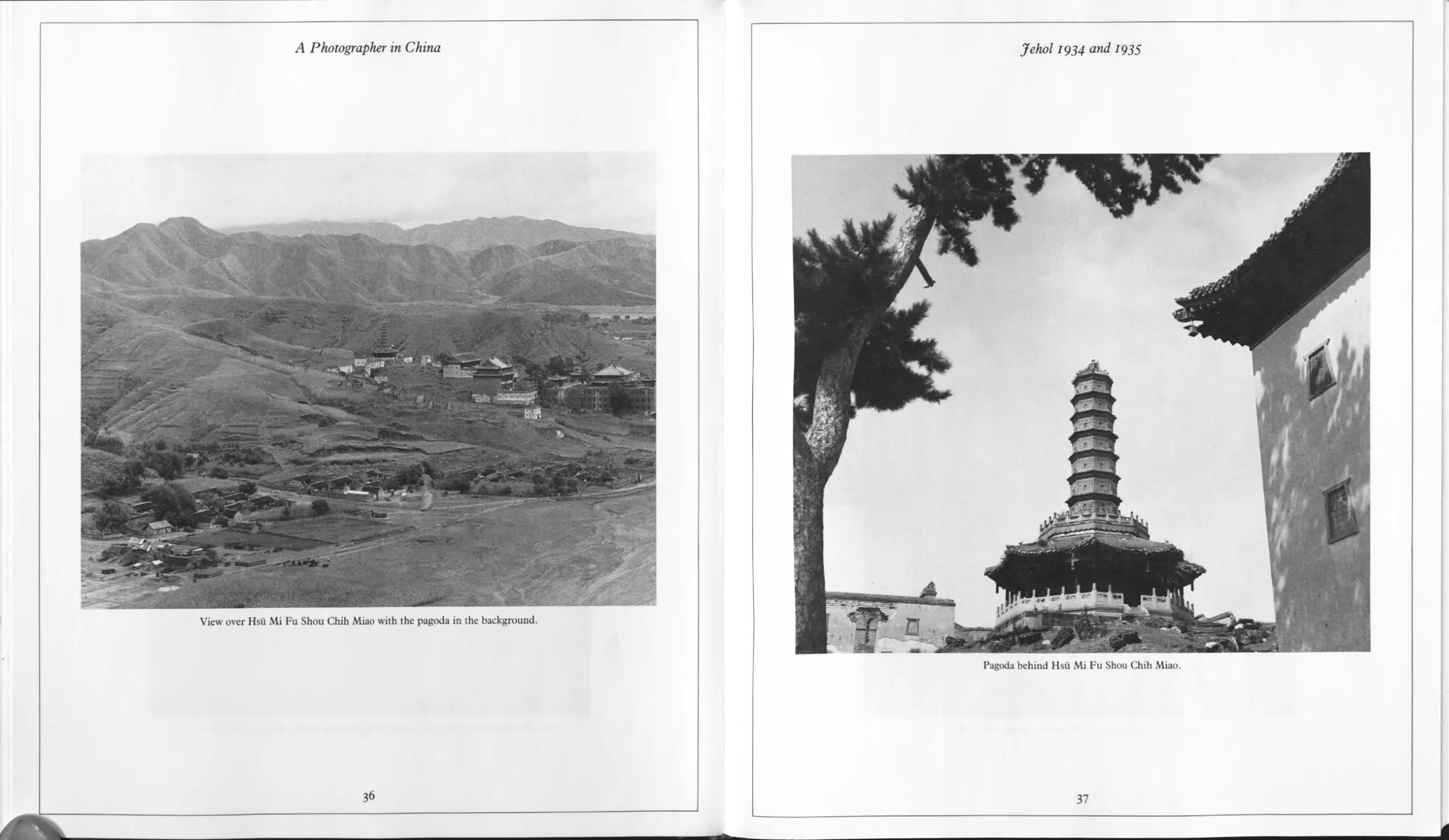
View over Hsu Mi Fu Shou Chih Miao with the pagoda in the background.
36
Jehol 1934 and 1935
Pagoda behind Hsu Mi Fu Shou Chih Miao.
37
A Photographer in China
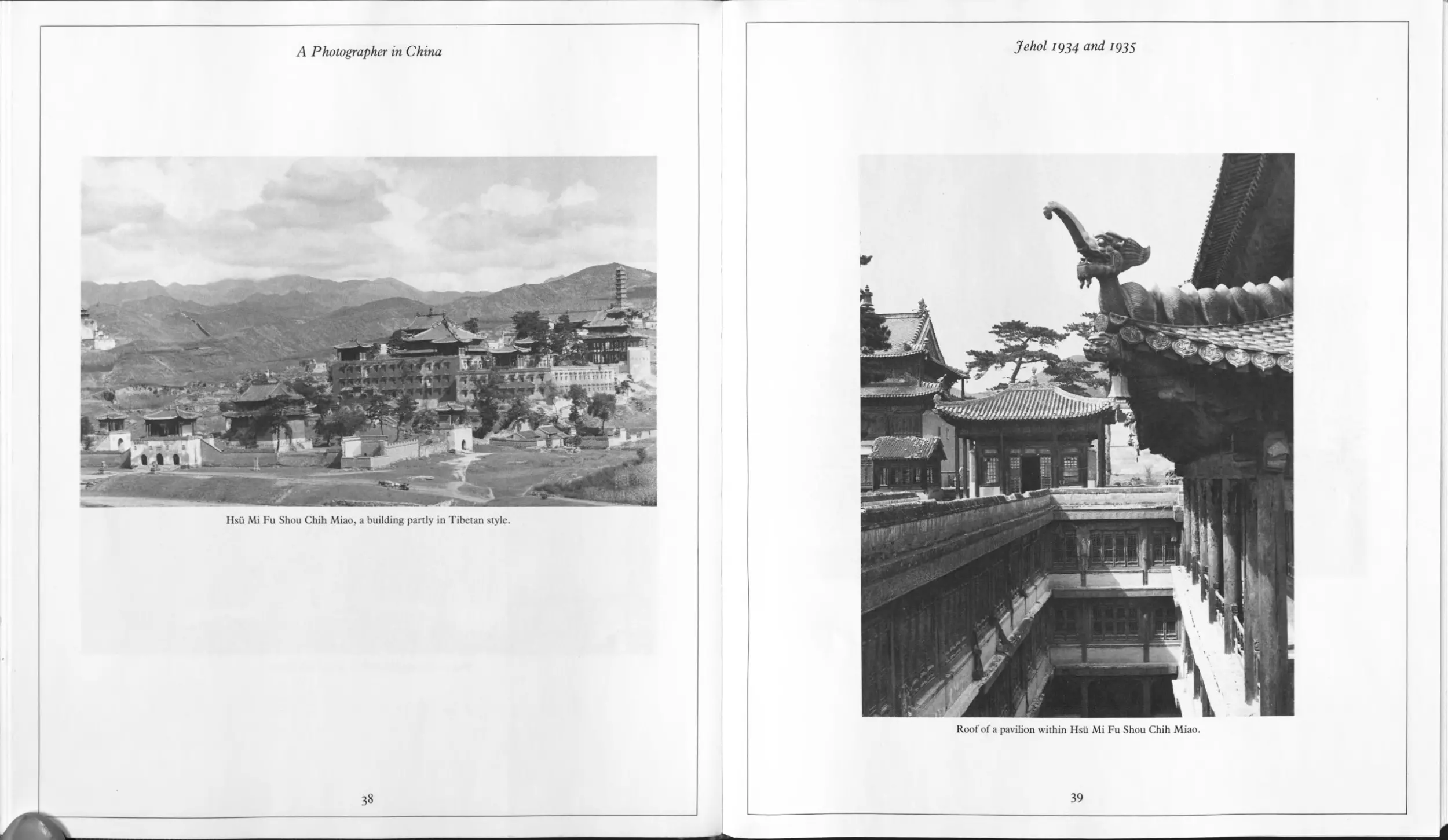
Hsil Mi Fu Shou Chih Miao, a building partly in Tibetan style.
38
Jehol 1934 and 1933
Roof of a pavilion within Hsli Mi Fu Shou Chih Miao.
A Photographer in China
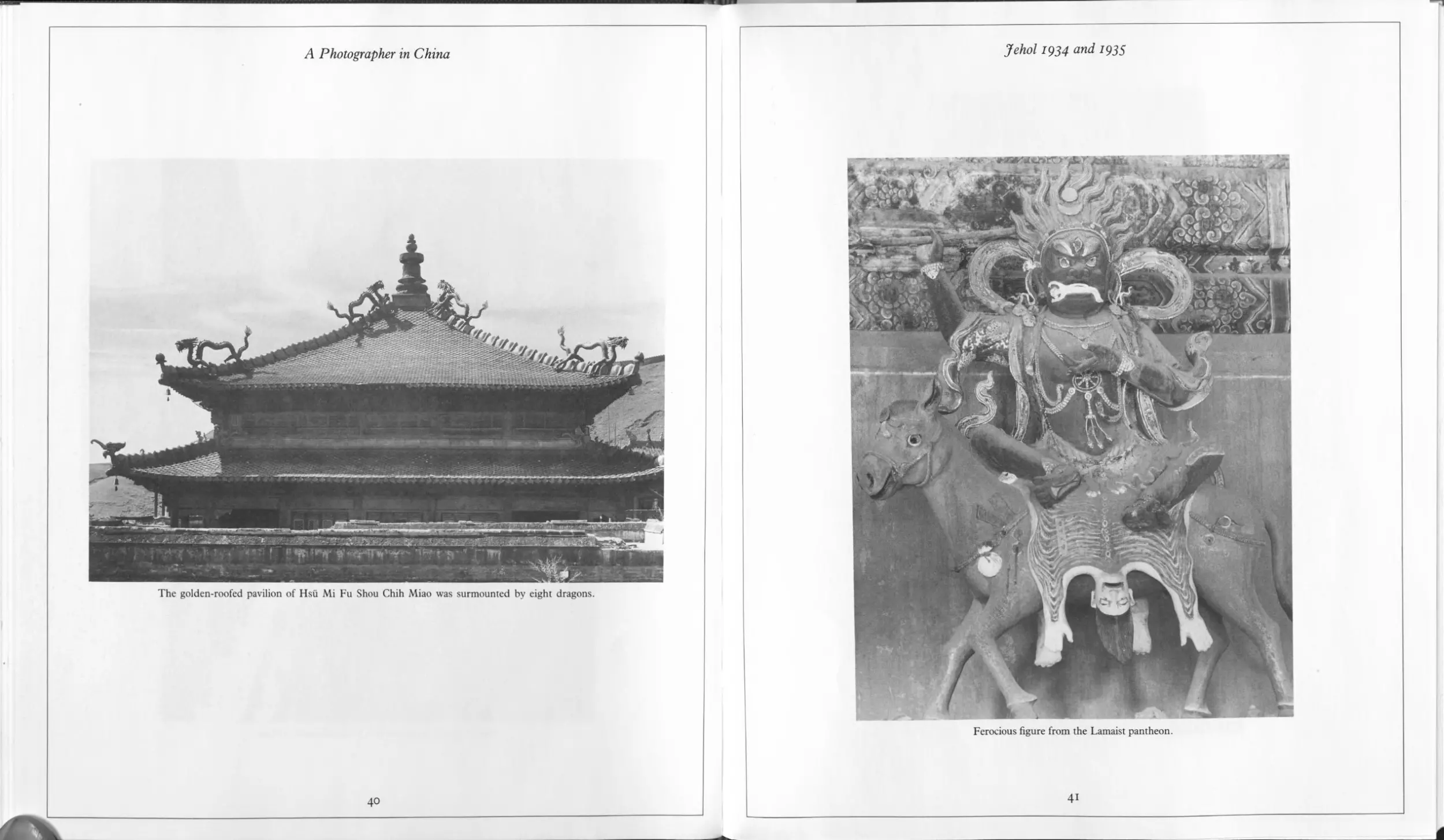
The golden-roofed pavilion of Hsu Mi Fu Shou Chih Miao was surmounted by eight dragons.
40
Jehol 1934 and 1935
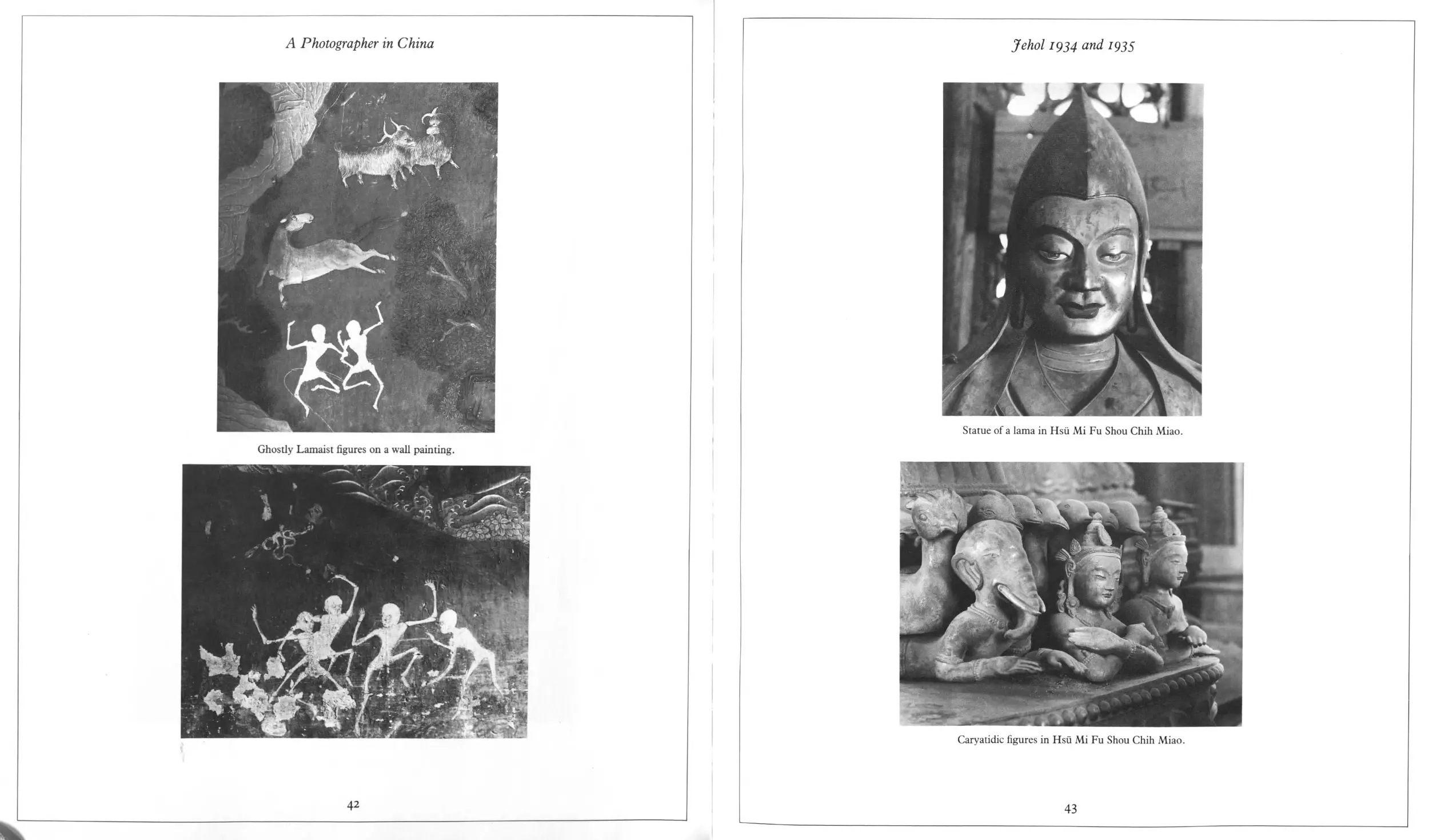
Ferocious figure from the Lamaist pantheon.
A Photographer in China
Ghostly Lamaist figures on a wall painting.
Jehol 1934 and 1933
Statue of a lama in Hsu Mi Fu Shou Chih Miao.
Caryatidic figures in Hsii Mi Fu Shou Chih Miao.
43
A Photographer in China
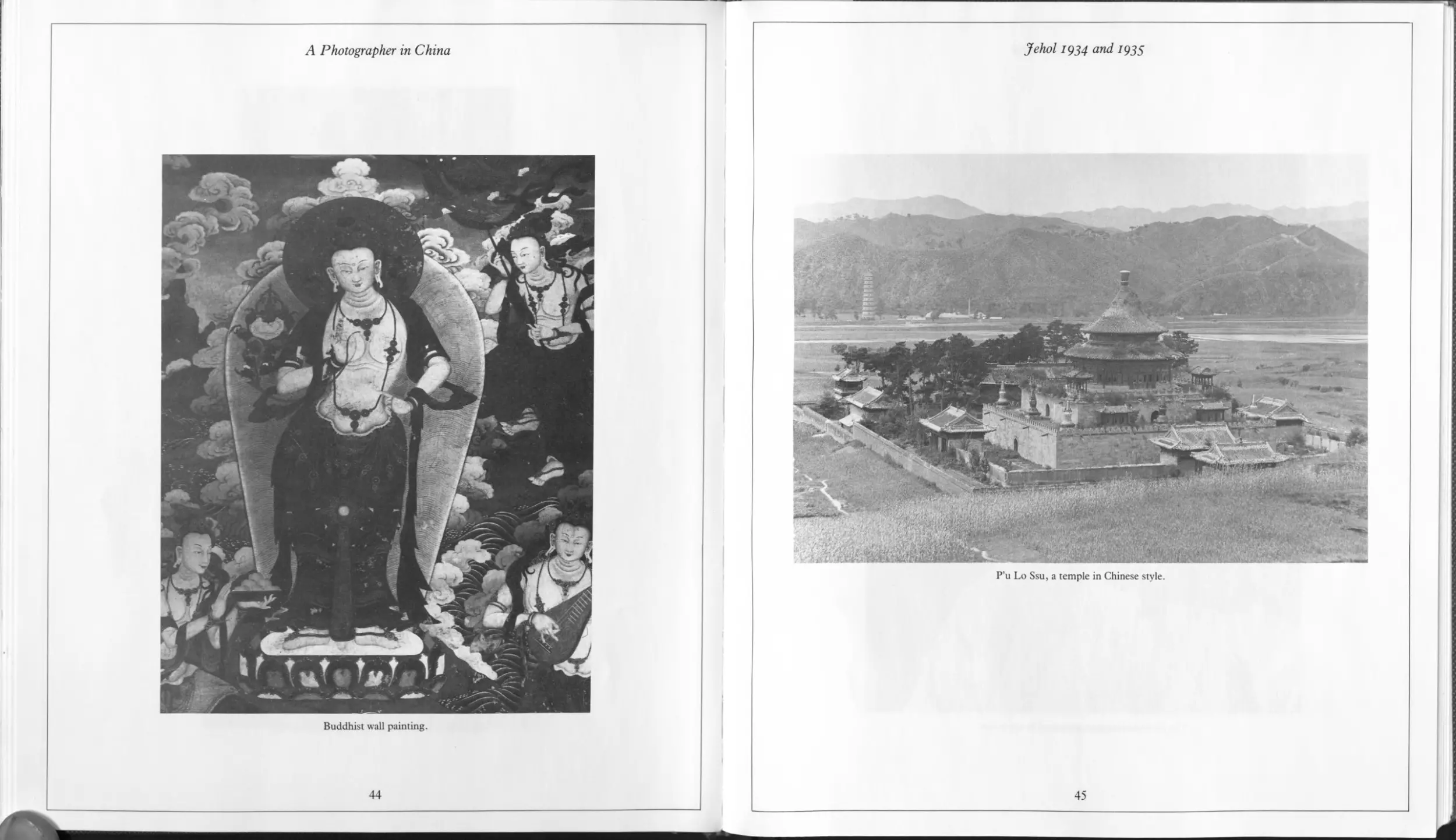
Buddhist wall painting.
44
Jehol 1934 and 1935
P’u Lo Ssu, a temple in Chinese style.
45
A Photographer in China
The pipe-smoking nun who acted as my guide.
46
Jehol 1934 and 1935
Portrait taken in Jehol.
47
A Photographer in China
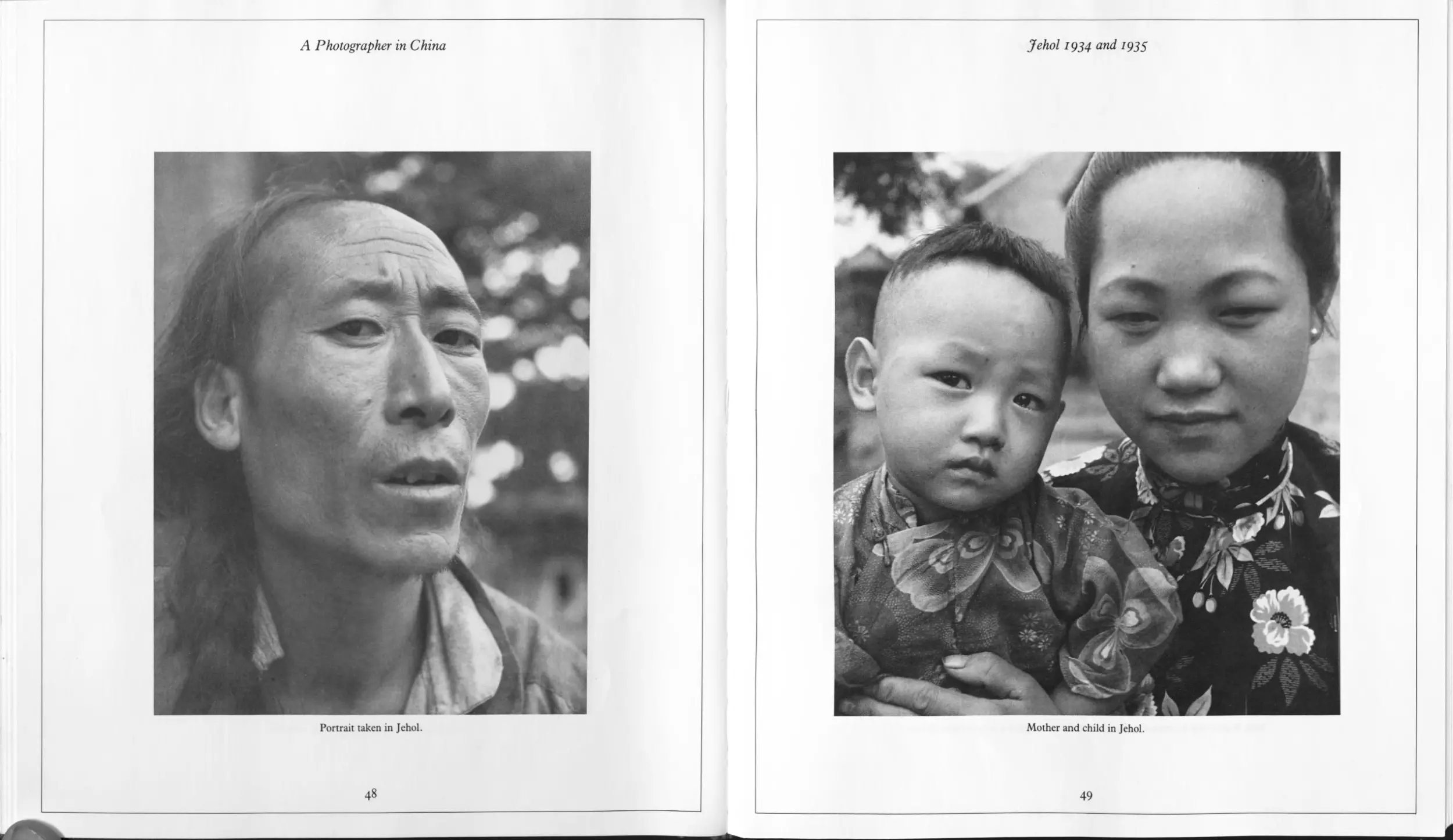
Portrait taken in Jehol.
48
Jehol 1934 and 1935
Mother and child in Jehol.
49
A Photographer in China
Sven Hedin, the distinguished Swedish explorer and author of a book on Jehol.
50
Jehol 1934 and 1935
Sven Hedin surveying the scene. The photograph was taken at the Ming Tombs.
51
Hua Shan 1935
THE suggestion that I visit the sacred Taoist mountain of Hua Shan came from
Henri Vetch, the proprietor of the French Book Store in Peking. Vetch, who was
extremely interested in Taoism, had never been to Hua Shan himself but knew of its
beauty. Hua Shan is a most spectacular outlier of the range known as Tsin Ling in
eastern Shensi province. It lies to the east of the ancient city of Sian and overlooks the
narrow plain through which flows the Yellow River, bounded by the Tsin Ling range
and to the north the mountains of Shansi. Hua Shan consists of a ring of precipitous
peaks rising to 2,500 metres in height, enclosed in the centre of which are small
patches of relatively flat land. The peaks are separated from the main Tsin Ling range
by awe-inspiring chasms.
The mountain has been held sacred in China from very early times, and religious
observances are said to have been held here from as far back as 1760 вс. It was
therefore natural that it should become a Taoist centre when that religion was founded
about 2,000 years ago. The importance of Hua Shan lay partly in its proximity to the
early centres of Chinese civilization, and partly in its being a supreme example of the
type of landscape so appreciated by Chinese artists. There was, however, much more
to Hua Shan than its spectacular mountain forms. The solitary, cloud-capped peaks
were endowed with mysticism in the Chinese mind, and this, together with the allied
philosophical concept of man as an insignificant creature in cosmic nature, found
expression in the works of the landscape painters of the Sung dynasty.
I visited Hua Shan in the summer of 1935. It was an easy place to reach because the
train to Sian stopped conveniently at a little place called Hua Yin, which means ‘under
the shadow of Hua Shan’. The Hua Shan massif did indeed dominate Hua Yin. I took
a rickshaw from the station to the fine Jade Spring Temple picturesquely situated at
the start of the ascent to the mountain. The temple extended hospitality to the many
pilgrims who visited Hua Shan and I spent a comfortable night there after an
appetizing vegetarian meal.
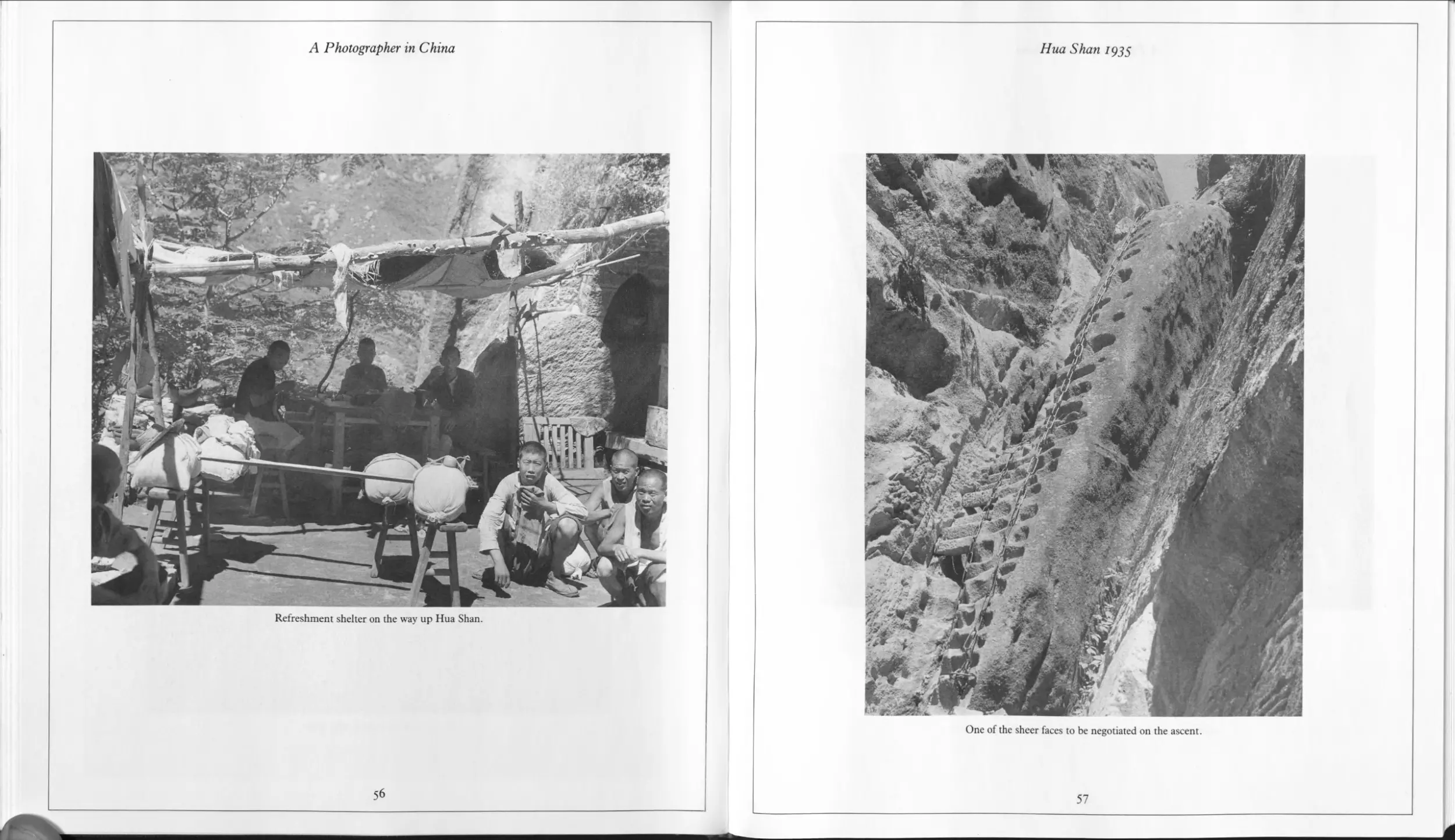
The next day I hired a porter to carry my rucksack and set off for the mountain.
The way lay up a narrow defile between rock faces hundreds of metres high. At
convenient intervals there were small temples providing hot tea for visitors. I noticed
that my porter, apart from taking breaks for tea, stopped several times for a quiet
smoke, not of tobacco, but of opium. At midday we reached the end of the defile and
from there the real climb began. It was very steep. In places the track led up almost
52
Hua Shan 193s
perpendicular rock faces in which steps had been hewn and iron chains of uncertain
reliability set in the rock to provide hand-holds. Some of these sheer stretches were for
one-way traffic only, and when we reached them we would call out so as to ensure that
we did not meet some descending pilgrim half way. I did indeed meet a number of
other visitors as pilgrimage to the mountain continued throughout the year.
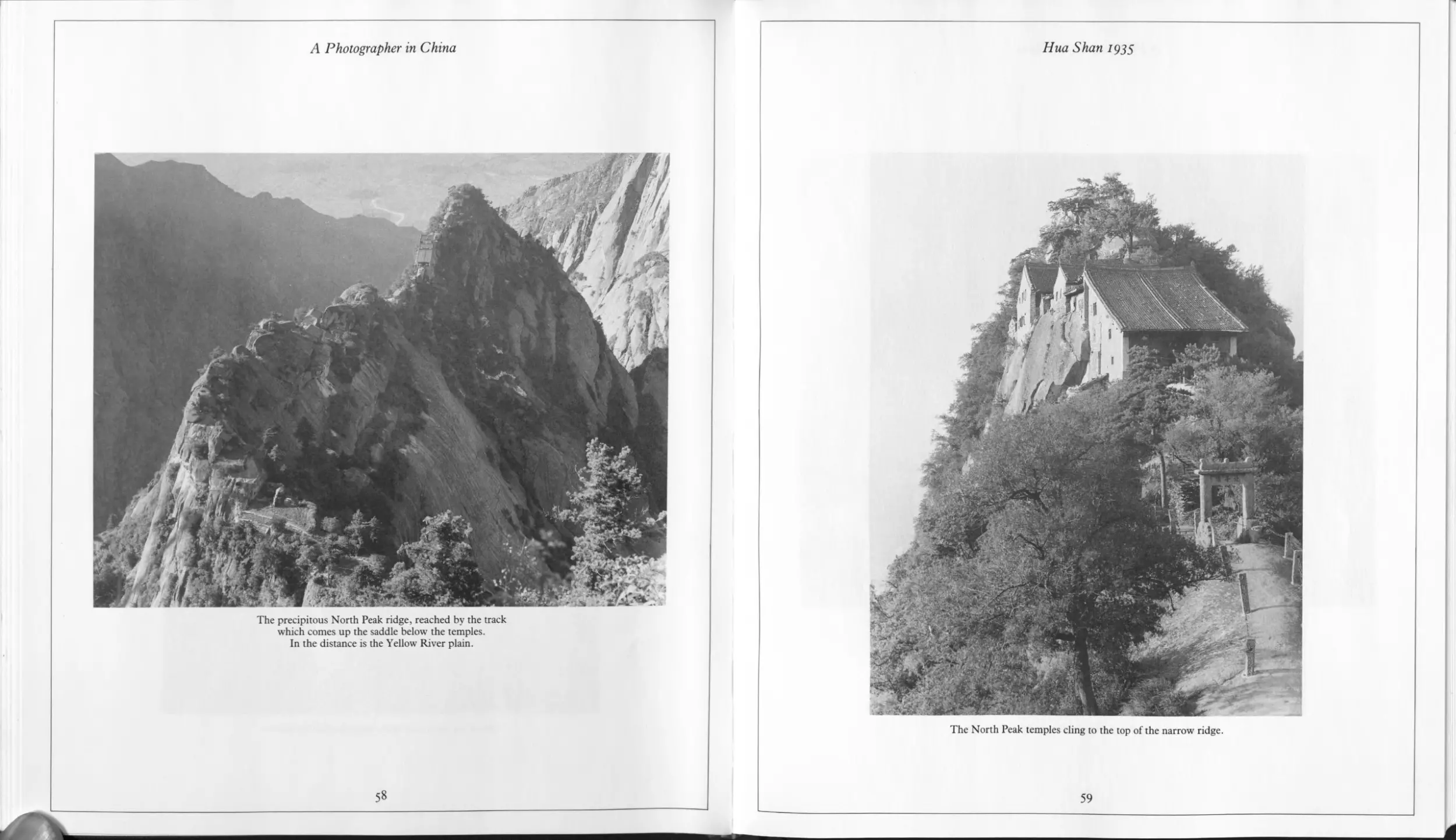
Eventually we emerged on the North Peak, in reality a knife-edged ridge on which
are perched various temple buildings and a monastery. The ridge is so narrow that the
track has to pass through the buildings, with no room on either side. From the ridge I
gained my first full view to the plain below, the mountains of Shansi in the back-
ground and the great Yellow River flowing in between.
There were five Taoist priests on the North Peak and a boy who had been sent there
from Shanghai by his parents for the benefit of his health. Here I was very kindly
entertained as indeed I was everywhere on the mountain. Two days after my arrival
Wolfram Eberhard, the distinguished German scholar, followed me up to the North
Peak where he collected Taoist inscriptions and had long discussions with the priests.
They were delighted to have with them someone who was so interested in their religion
and had such a fine command of their language.
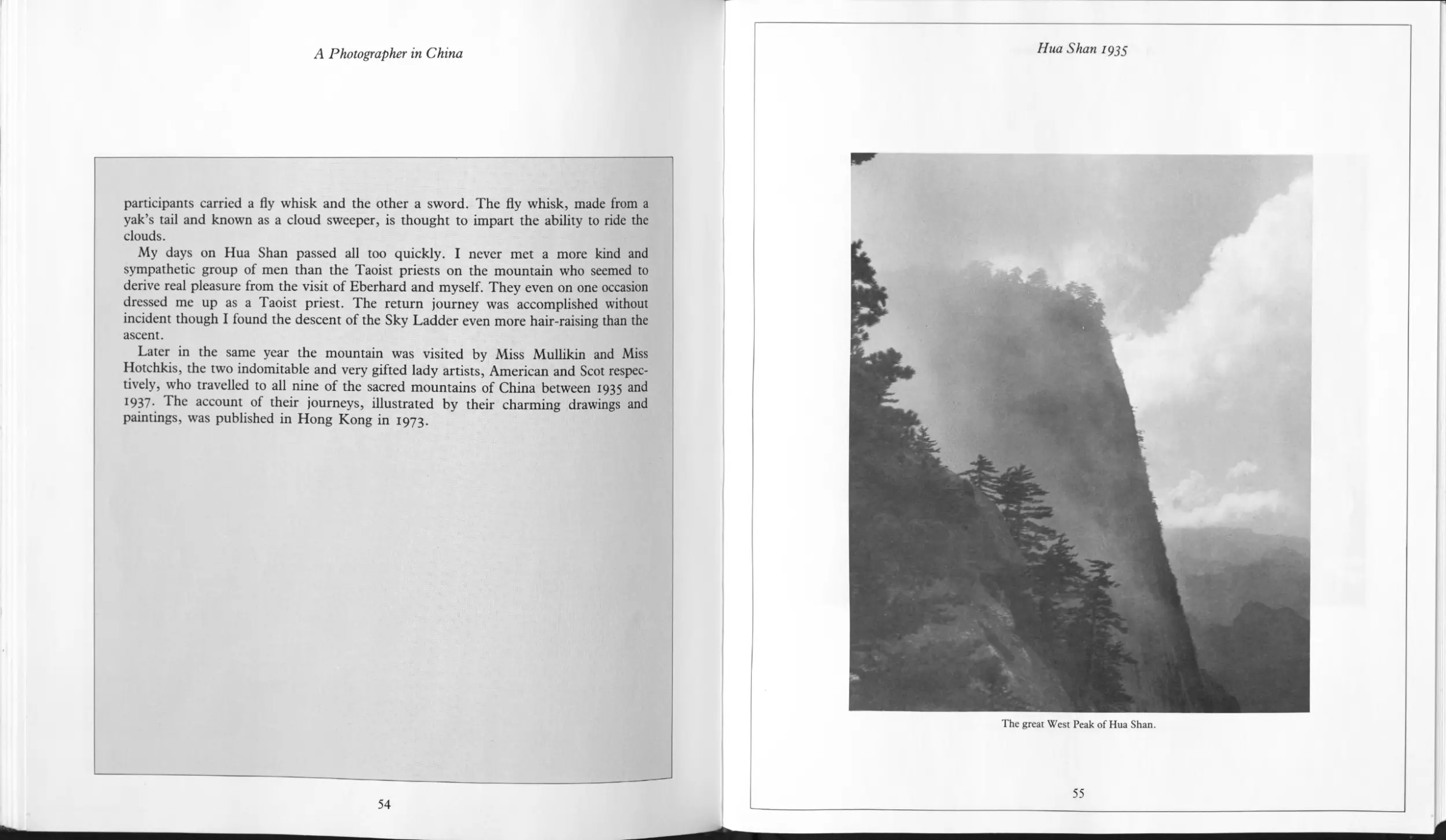
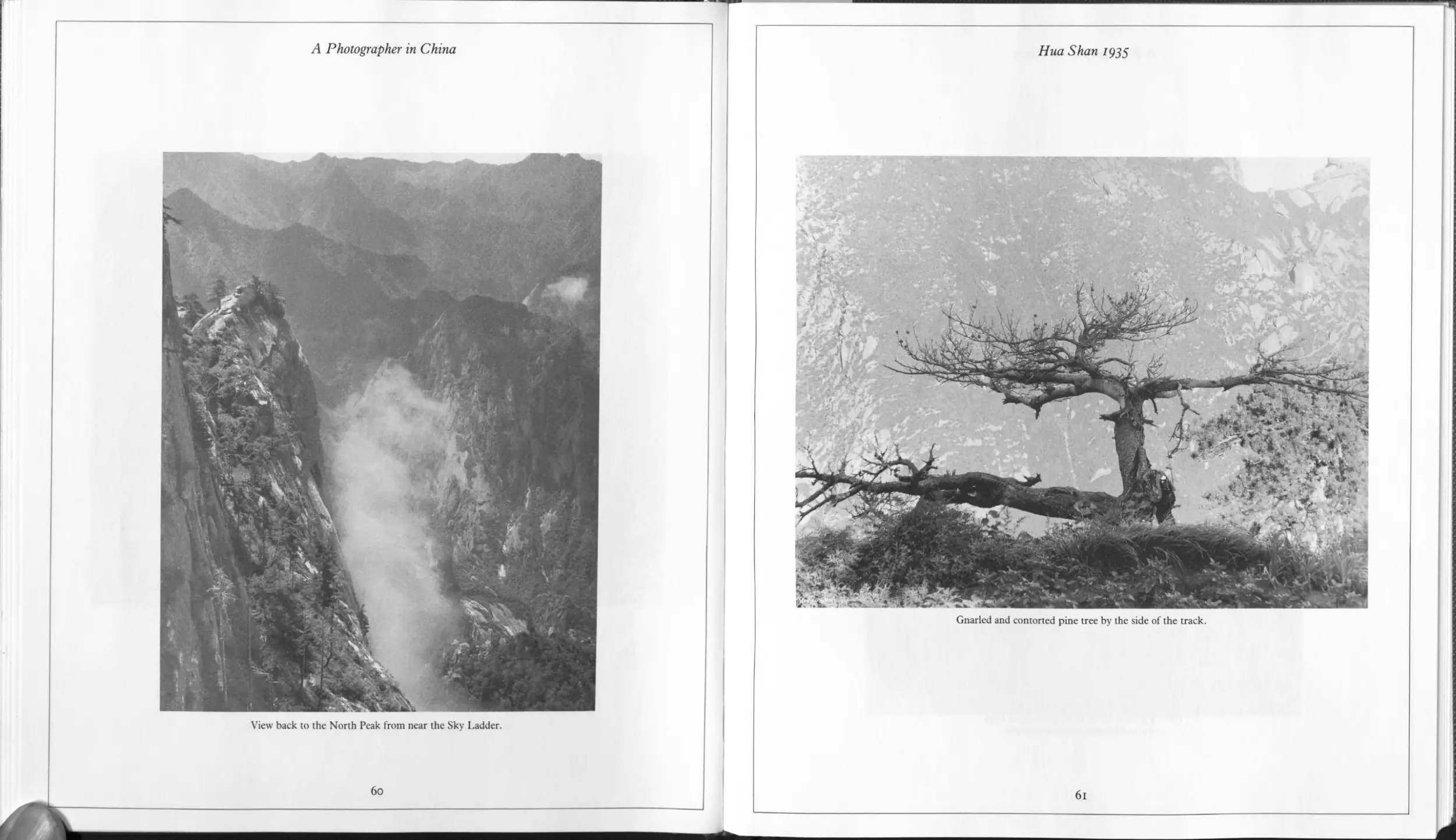
From the North Peak I went on to visit the other peaks of Hua Shan, the first being
the West Peak, lying in a grove of pine trees and reached by a hair-raising track which
in one place goes over what is known as the Sky Ladder. This was the end of the road
for many pilgrims, including a famous T’ang personality called Han Yii. All around
were spectacular pinnacles and rock walls, the scene continually changing through the
interplay of sunlight and drifting mist. At the West Peak I met a priest whom I had
known at the White Cloud Temple in Peking, and who took it upon himself to act as
my guide and mentor from then on. Unlike me he had made the pilgrimage to Hua
Shan on foot, having walked the whole way through the mountains of Shansi to Sian
and then on to Hua Shan.
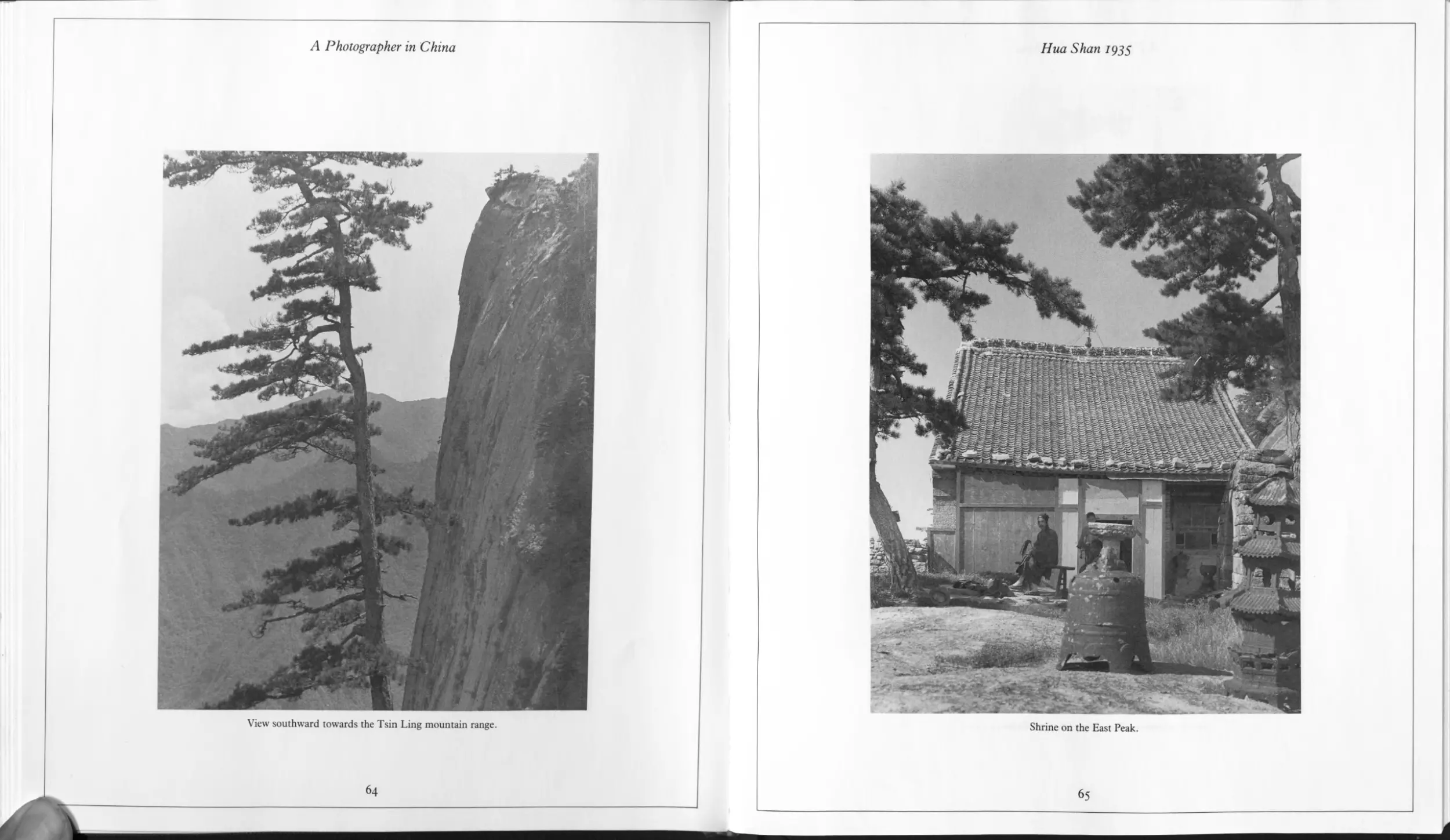
The South Peak is not really a peak at all but a gentle slope which was probably the
area originally settled by hermits as it would have been possible to carry out a little
cultivation there. The South Peak temple is the largest on the mountain, and the path
from it to the East Peak is an easy one. Below the East Peak is a sheltered bowl in the
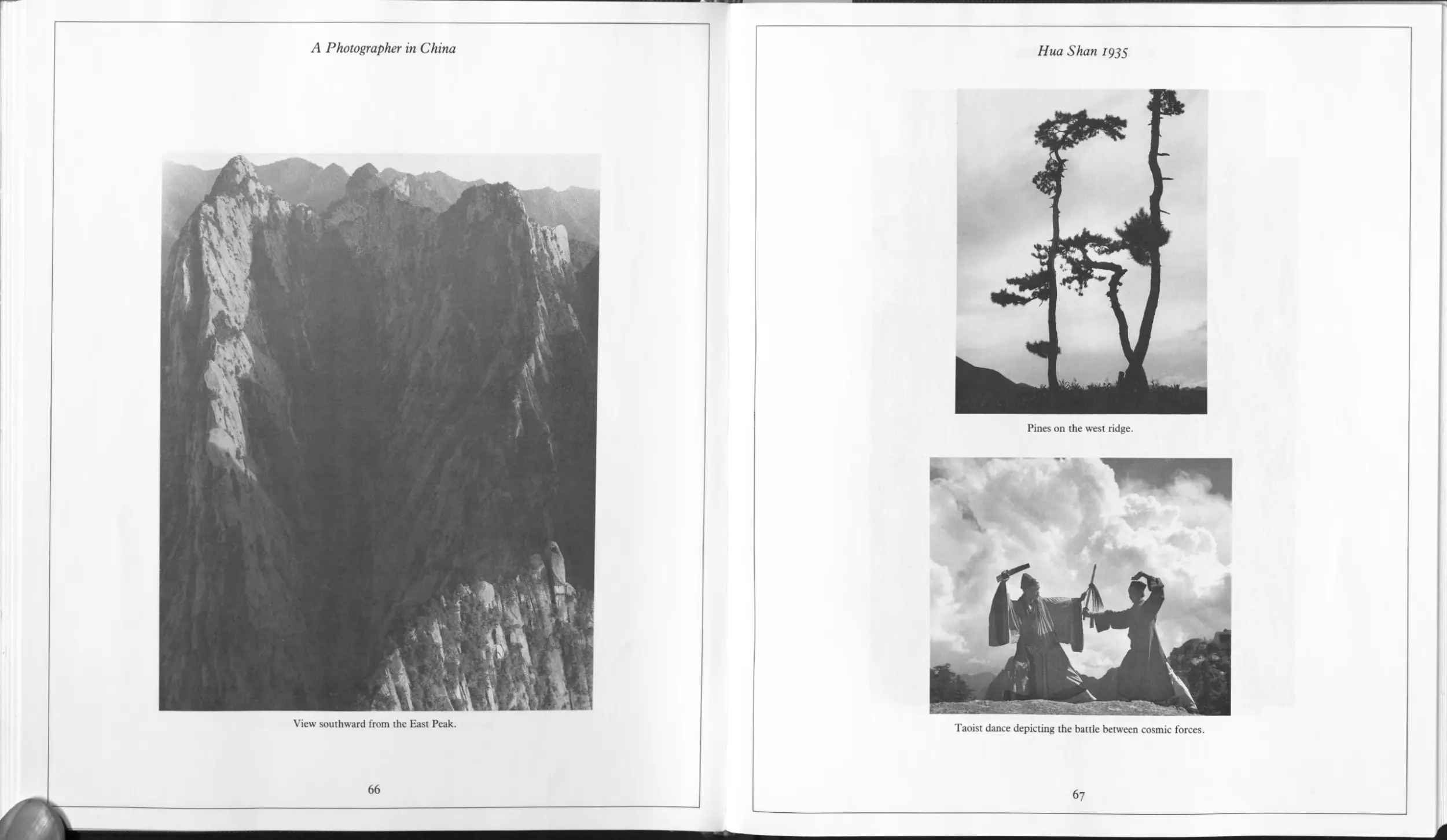
mountain top. I was fortunate on the East Peak to witness a ceremonial Taoist dance
carried out in slow time, said to represent the play of cosmic forces. One of the
53
A Photographer in China
participants carried a fly whisk and the other a sword. The fly whisk, made from a
yak’s tail and known as a cloud sweeper, is thought to impart the ability to ride the
clouds.
My days on Hua Shan passed all too quickly. I never met a more kind and
sympathetic group of men than the Taoist priests on the mountain who seemed to
derive real pleasure from the visit of Eberhard and myself. They even on one occasion
dressed me up as a Taoist priest. The return journey was accomplished without
incident though I found the descent of the Sky Ladder even more hair-raising than the
ascent.
Later in the same year the mountain was visited by Miss Mullikin and Miss
Hotchkis, the two indomitable and very gifted lady artists, American and Scot respec-
tively, who travelled to all nine of the sacred mountains of China between 1935 and
1937. The account of their journeys, illustrated by their charming drawings and
paintings, was published in Hong Kong in 1973.
54
Hua Shan 1935
The great West Peak of Hua Shan.
55
A Photographer in China
Refreshment shelter on the way up Hua Shan.
56
Hua Shan 1935
One of the sheer faces to be negotiated on the ascent.
57
A Photographer in China
The precipitous North Peak ridge, reached by the track
which comes up the saddle below the temples.
In the distance is the Yellow River plain.
58
Hua Shan 1935
The North Peak temples cling to the top of the narrow ridge.
59
A Photographer in China
View back to the North Peak from near the Sky Ladder.
6o
Hua Shan 193$
Gnarled and contorted pine tree by the side of the track.
A Photographer in China
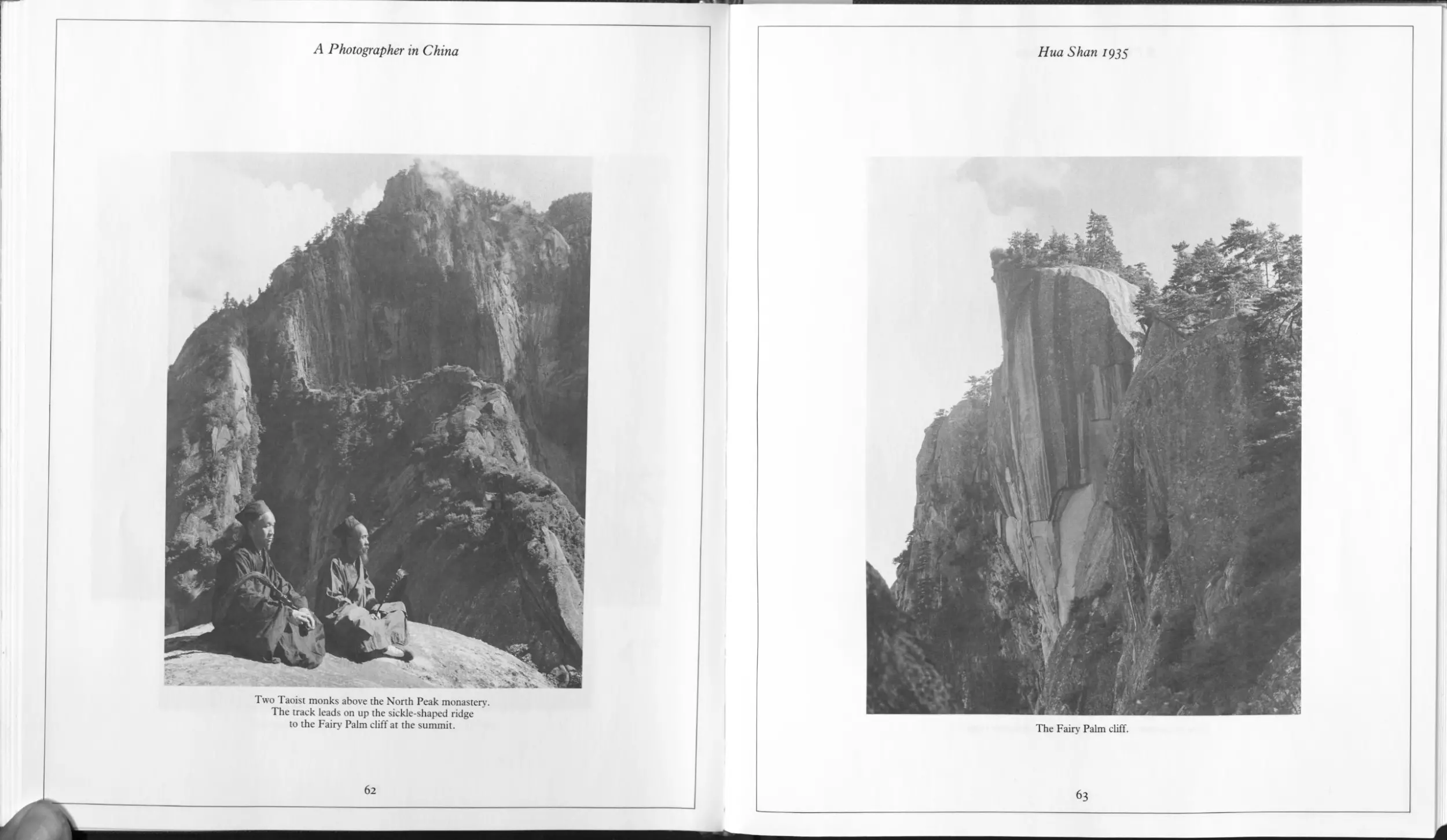
Two Taoist monks above the North Peak monastery.
The track leads on up the sickle-shaped ridge
to the Fairy Palm cliff at the summit.
62
Hua Shan 193s
The Fairy Palm cliff.
63
A Photographer in China
View southward towards the Tsin Ling mountain range.
64
Hua Shan 1935
Shrine on the East Peak.
65
A Photographer in China
View southward from the East Peak.
Hua Shan 1935
Pines on the west ridge.
Taoist dance depicting the battle between cosmic forces.
67
A Photographer in China
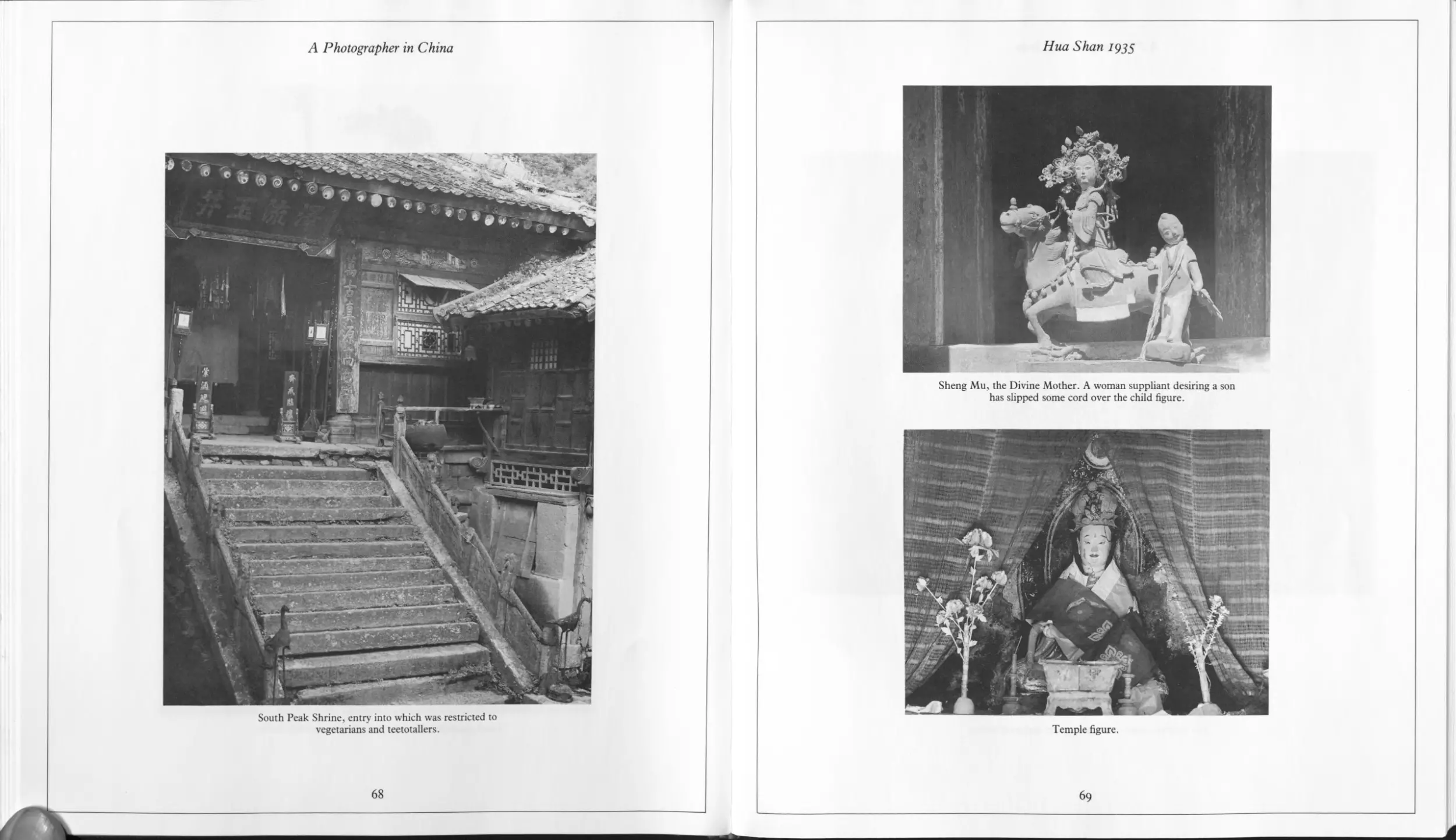
South Peak Shrine, entry into which was restricted to
vegetarians and teetotallers.
68
Hua Shan 1935
Sheng Mu, the Divine Mother. A woman suppliant desiring a son
has slipped some cord over the child figure.
Temple figure.
69
A Photographer in China
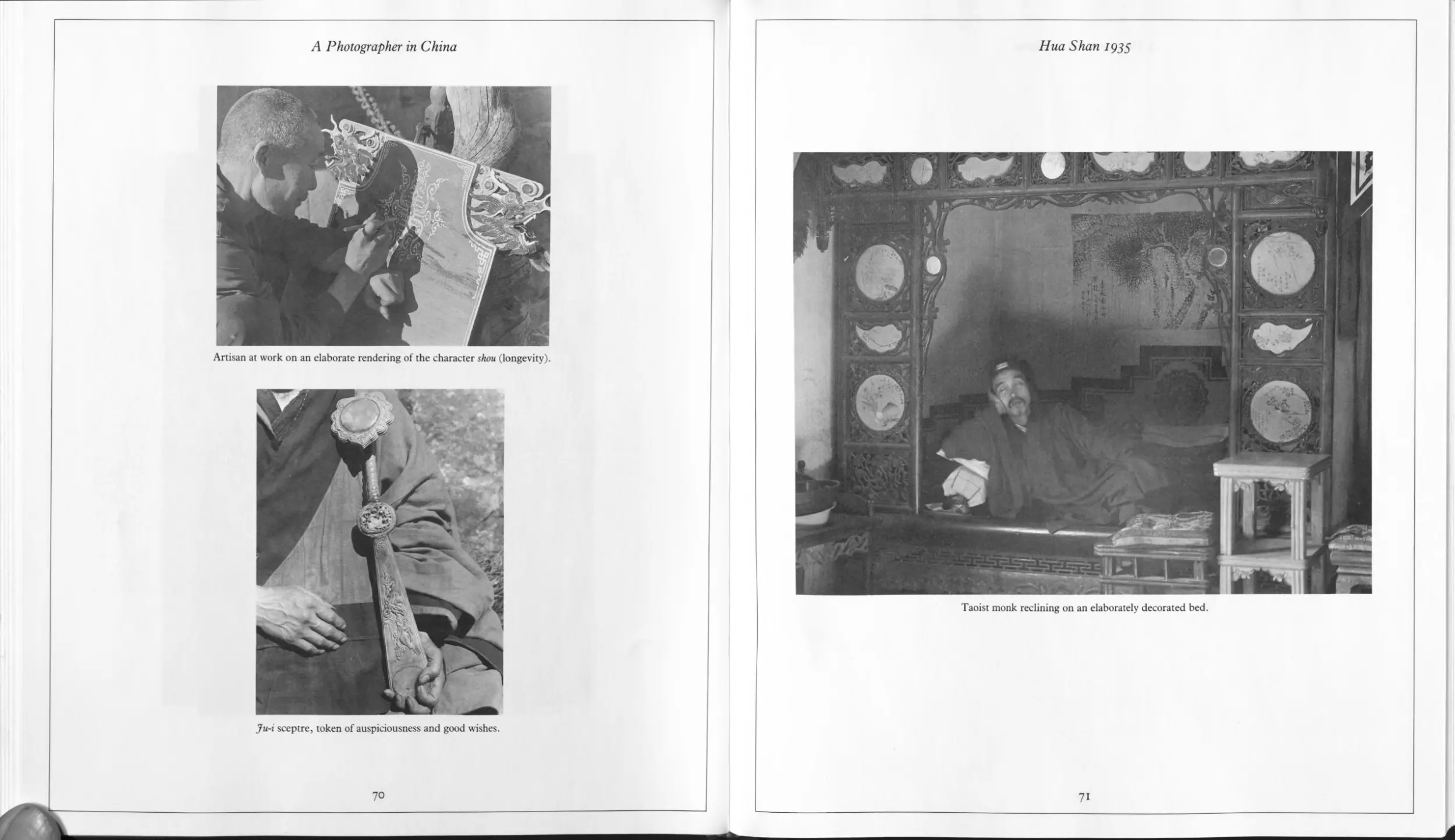
Artisan at work on an elaborate rendering of the character shou (longevity).
Ju-i sceptre, token of auspiciousness and good wishes.
Hua Shan 1935
Taoist monk reclining on an elaborately decorated bed.
71
A Photographer in China
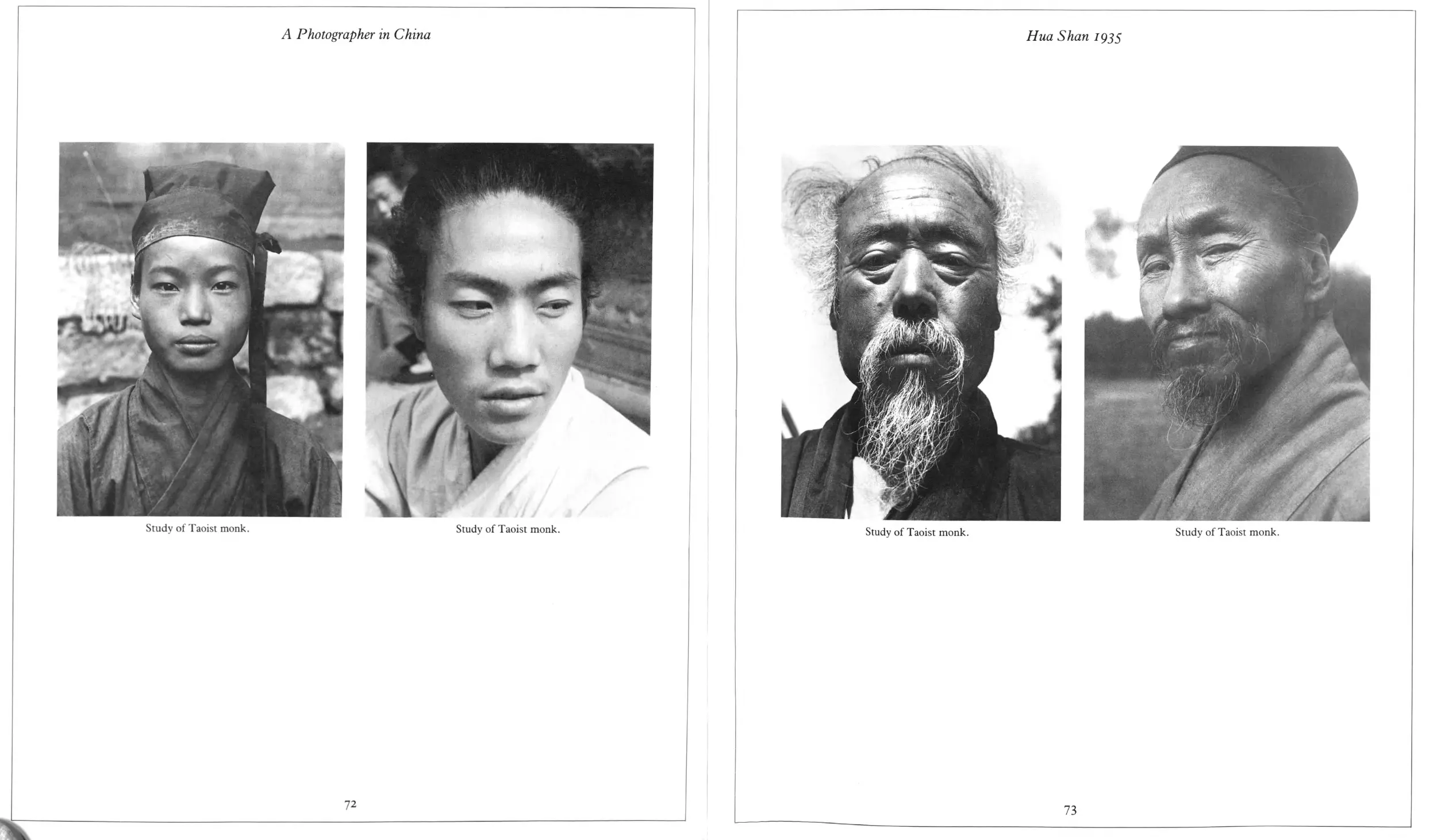
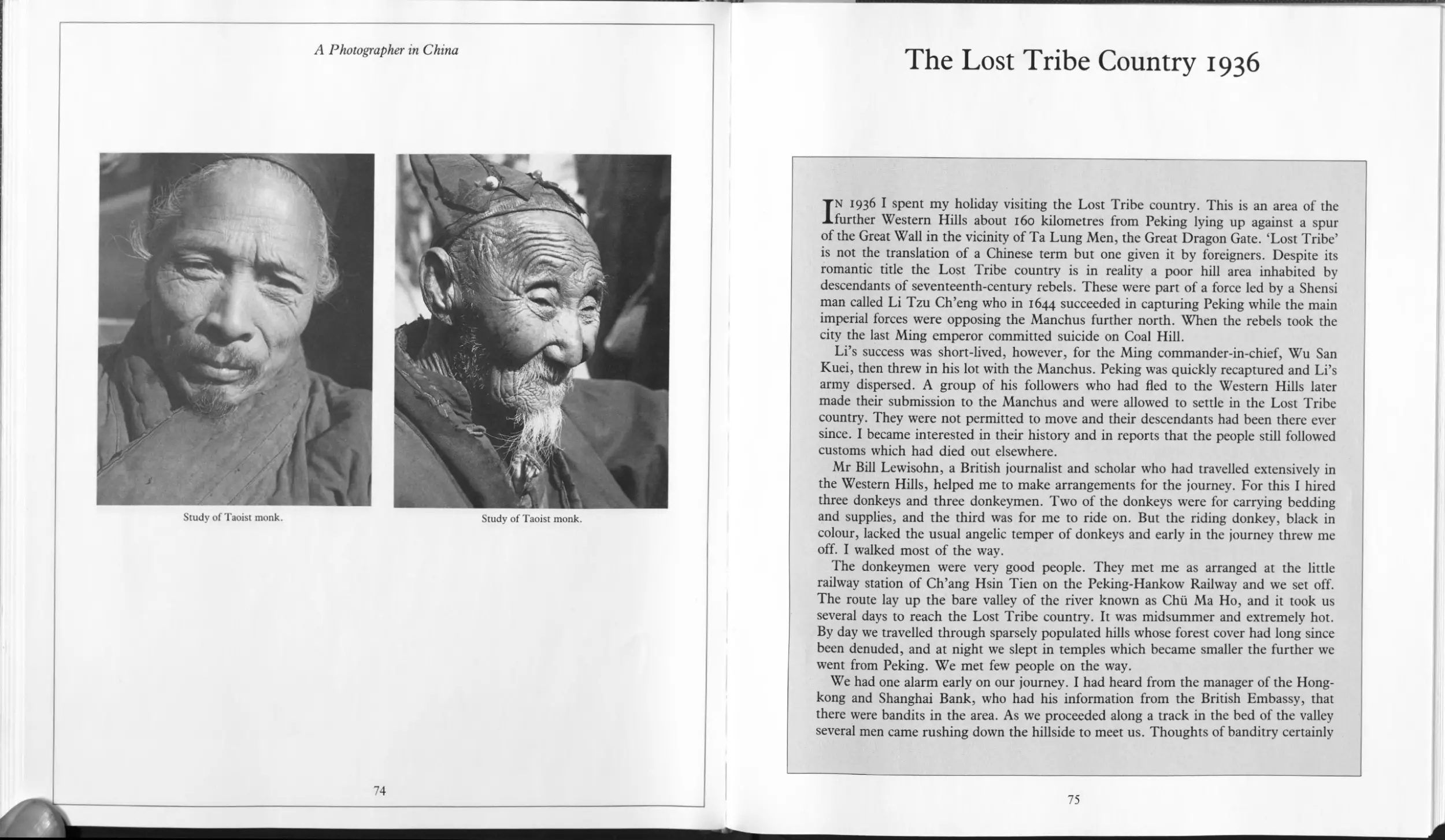
Study of Taoist monk.
Study of Taoist monk.
Hua Shan 1935
Study of Taoist monk.	Study of Taoist monk.
73
A Photographer in China
Study of Taoist monk.	Study of Taoist monk.
74
The Lost Tribe Country 1936
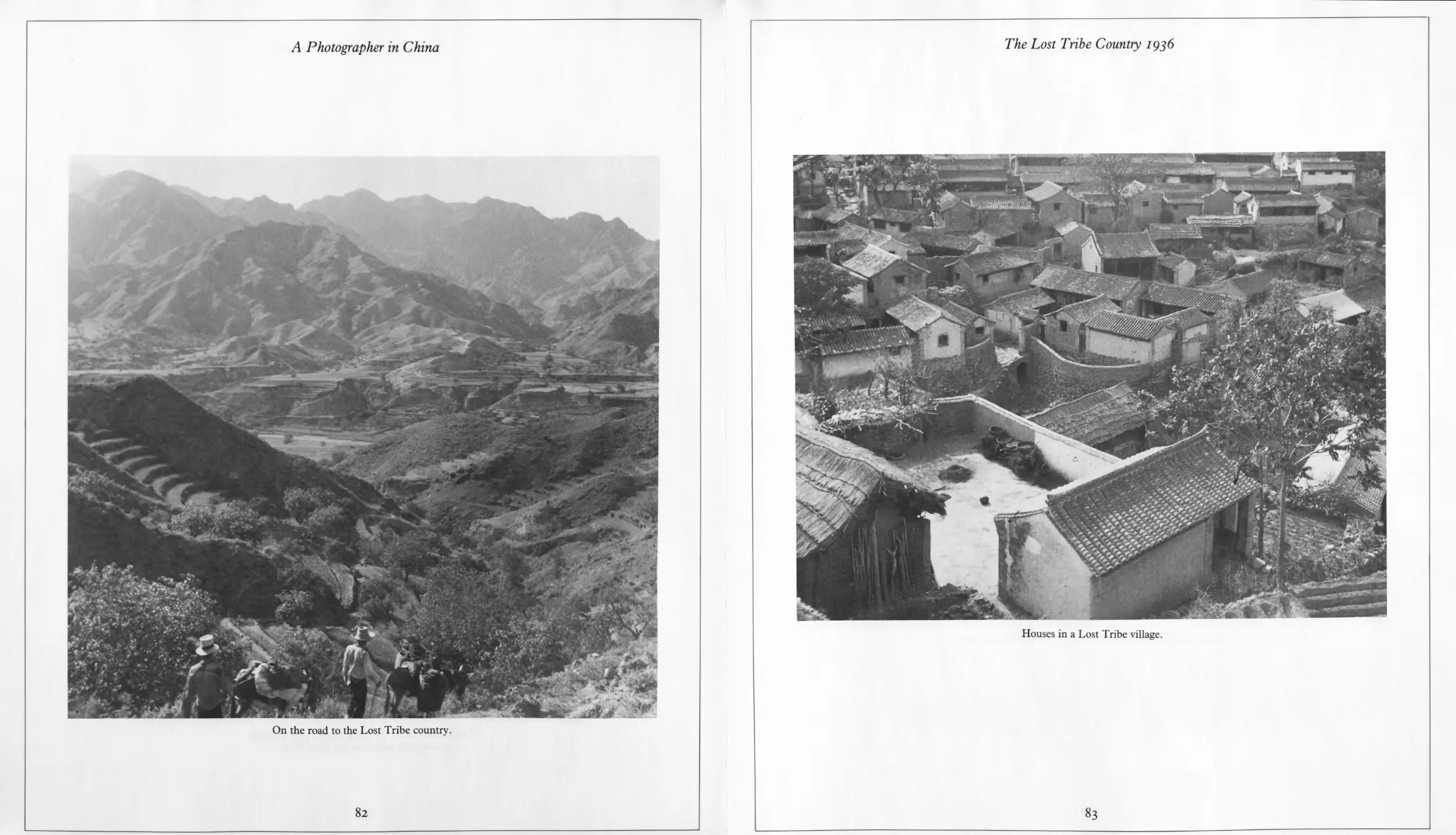
IN 1936 I spent my holiday visiting the Lost Tribe country. This is an area of the
further Western Hills about 160 kilometres from Peking lying up against a spur
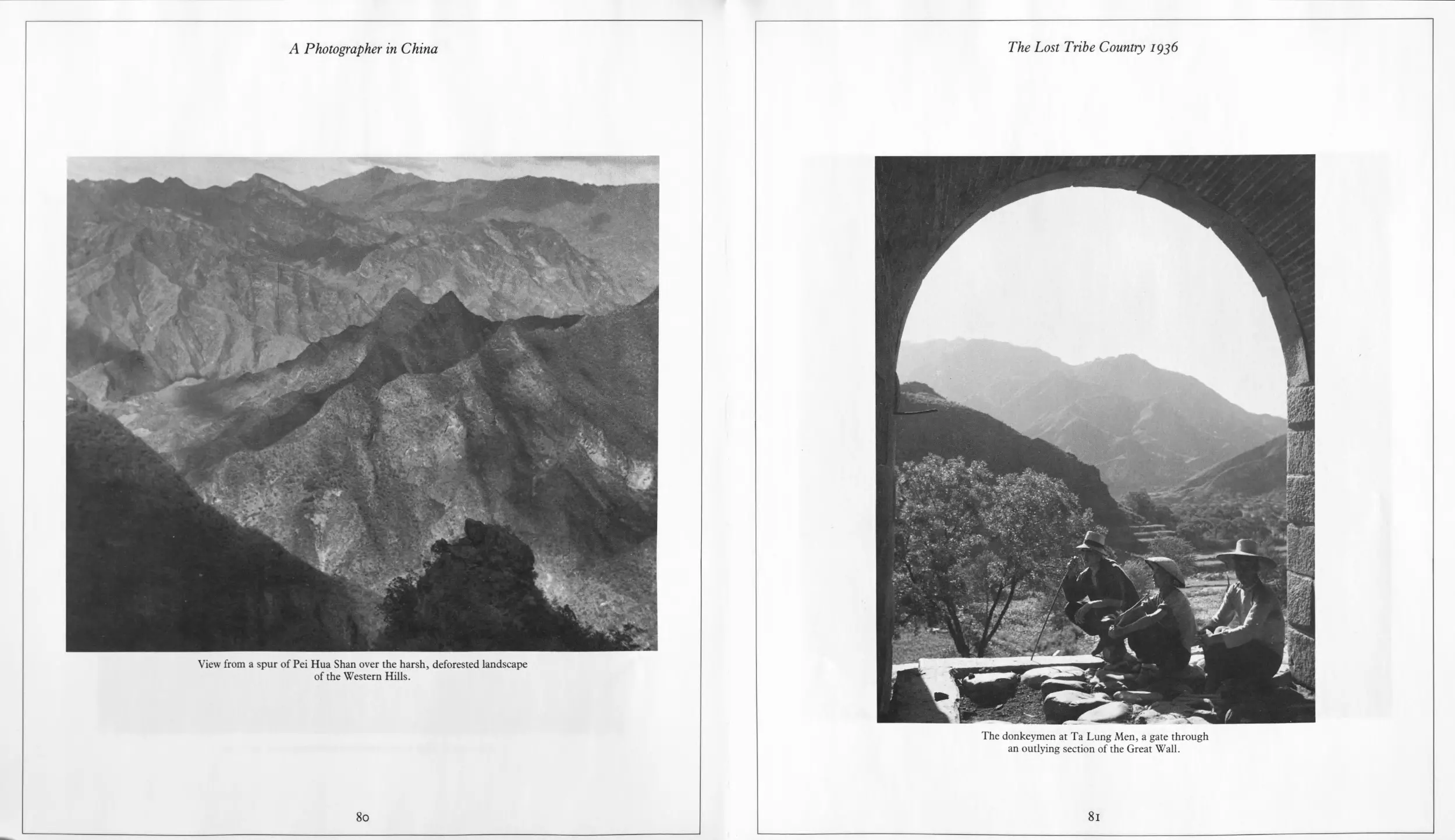
of the Great Wall in the vicinity of Ta Lung Men, the Great Dragon Gate. ‘Lost Tribe’
is not the translation of a Chinese term but one given it by foreigners. Despite its
romantic title the Lost Tribe country is in reality a poor hill area inhabited by
descendants of seventeenth-century rebels. These were part of a force led by a Shensi
man called Li Tzu Ch’eng who in 1644 succeeded in capturing Peking while the main
imperial forces were opposing the Manchus further north. When the rebels took the
city the last Ming emperor committed suicide on Coal Hill.
Li’s success was short-lived, however, for the Ming commander-in-chief, Wu San
Kuei, then threw in his lot with the Manchus. Peking was quickly recaptured and Li’s
army dispersed. A group of his followers who had fled to the Western Hills later
made their submission to the Manchus and were allowed to settle in the Lost Tribe
country. They were not permitted to move and their descendants had been there ever
since. I became interested in their history and in reports that the people still followed
customs which had died out elsewhere.
Mr Bill Lewisohn, a British journalist and scholar who had travelled extensively in
the Western Hills, helped me to make arrangements for the journey. For this I hired
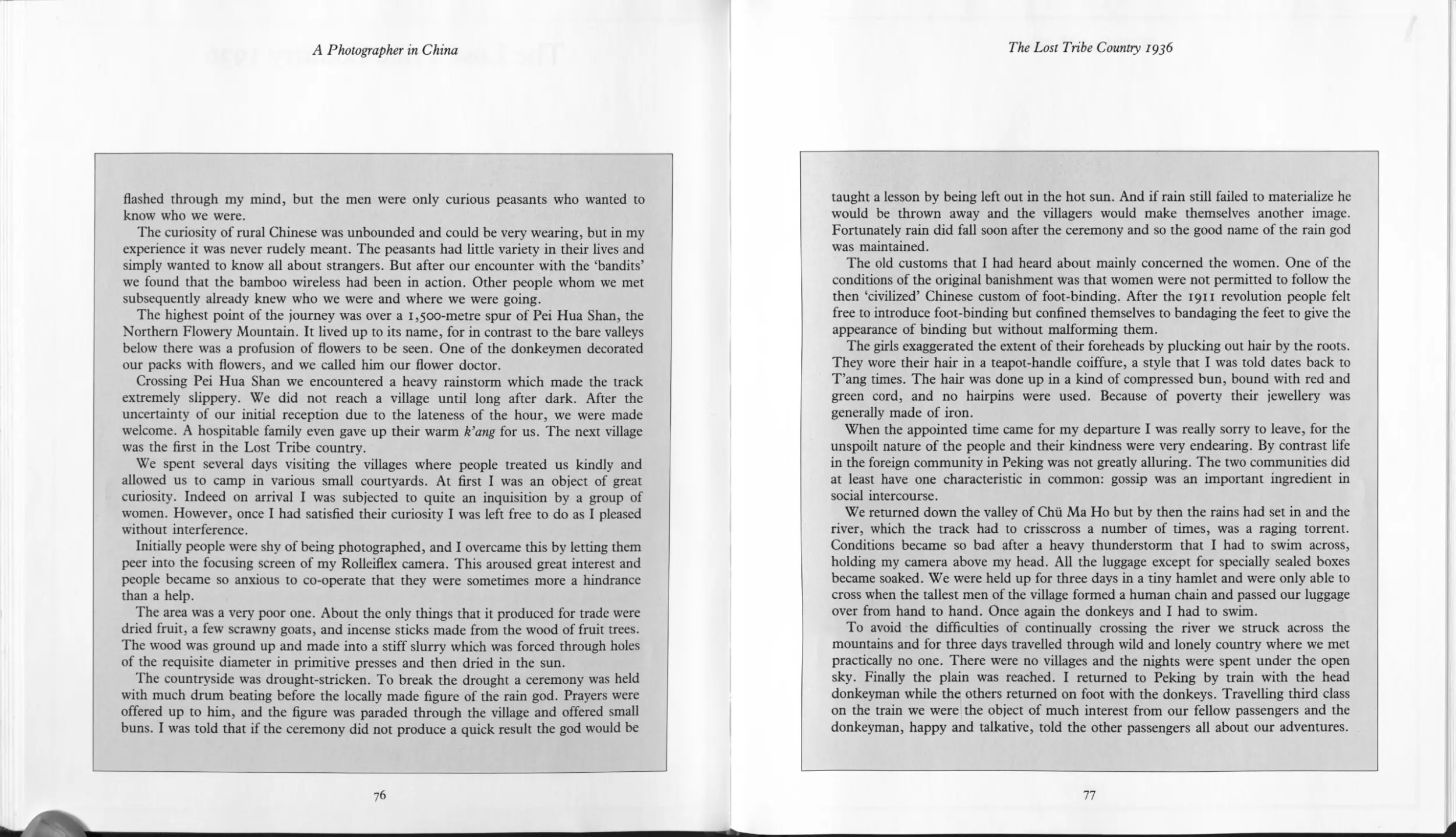
three donkeys and three donkeymen. Two of the donkeys were for carrying bedding
and supplies, and the third was for me to ride on. But the riding donkey, black in
colour, lacked the usual angelic temper of donkeys and early in the journey threw me
off. I walked most of the way.
The donkeymen were very good people. They met me as arranged at the little
railway station of Ch’ang Hsin Tien on the Peking-Hankow Railway and we set off.
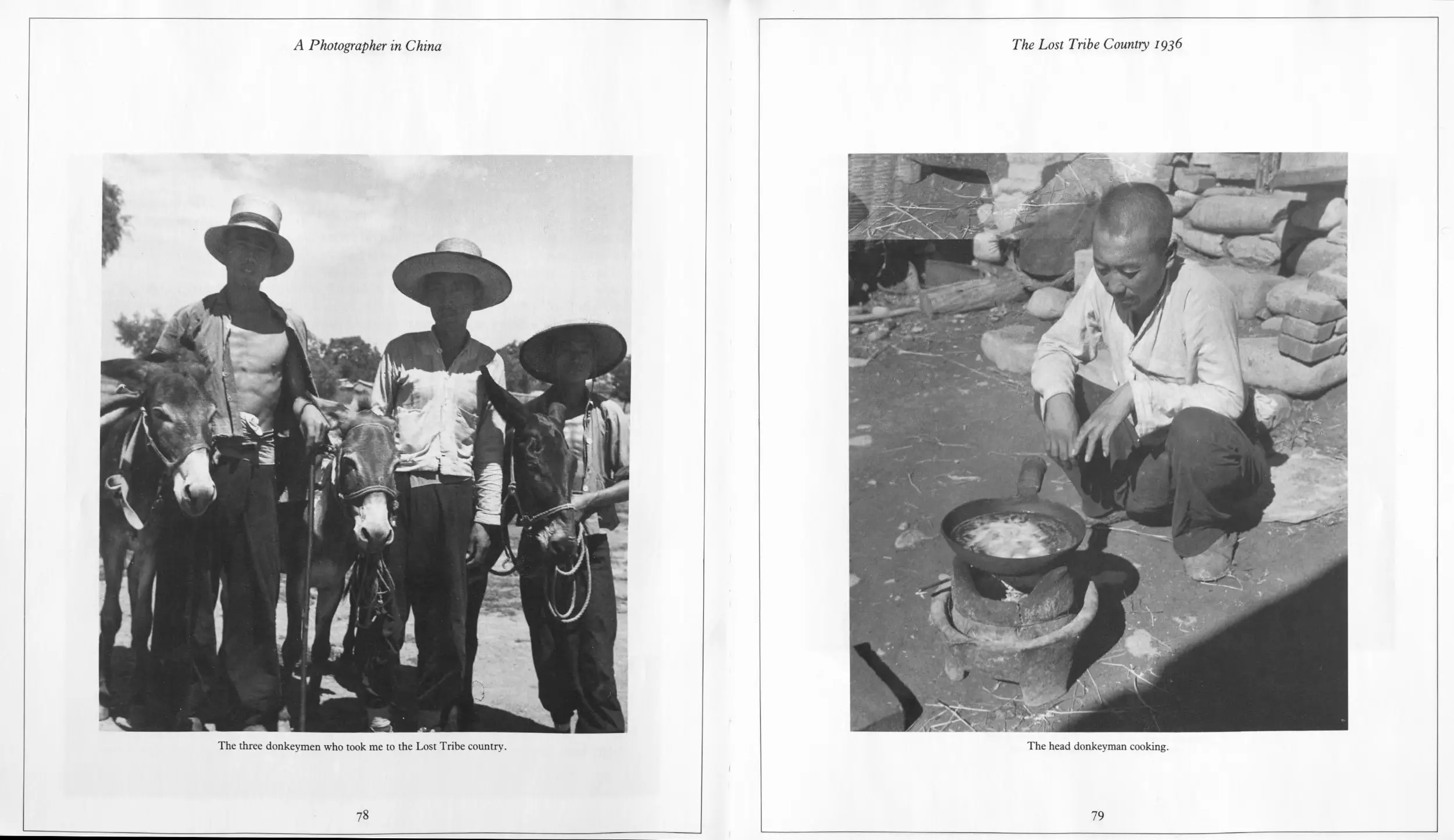
The route lay up the bare valley of the river known as Chii Ma Ho, and it took us
several days to reach the Lost Tribe country. It was midsummer and extremely hot.
By day we travelled through sparsely populated hills whose forest cover had long since
been denuded, and at night we slept in temples which became smaller the further we
went from Peking. We met few people on the way.
We had one alarm early on our journey. I had heard from the manager of the Hong-
kong and Shanghai Bank, who had his information from the British Embassy, that
there were bandits in the area. As we proceeded along a track in the bed of the valley
several men came rushing down the hillside to meet us. Thoughts of banditry certainly
75
A Photographer in China
flashed through my mind, but the men were only curious peasants who wanted to
know who we were.
The curiosity of rural Chinese was unbounded and could be very wearing, but in my
experience it was never rudely meant. The peasants had little variety in their lives and
simply wanted to know all about strangers. But after our encounter with the ‘bandits’
we found that the bamboo wireless had been in action. Other people whom we met
subsequently already knew who we were and where we were going.
The highest point of the journey was over a 1,500-metre spur of Pei Hua Shan, the
Northern Flowery Mountain. It lived up to its name, for in contrast to the bare valleys
below there was a profusion of flowers to be seen. One of the donkeymen decorated
our packs with flowers, and we called him our flower doctor.
Crossing Pei Hua Shan we encountered a heavy rainstorm which made the track
extremely slippery. We did not reach a village until long after dark. After the
uncertainty of our initial reception due to the lateness of the hour, we were made
welcome. A hospitable family even gave up their warm k’ang for us. The next village
was the first in the Lost Tribe country.
We spent several days visiting the villages where people treated us kindly and
allowed us to camp in various small courtyards. At first I was an object of great
curiosity. Indeed on arrival I was subjected to quite an inquisition by a group of
women. However, once I had satisfied their curiosity I was left free to do as I pleased
without interference.
Initially people were shy of being photographed, and I overcame this by letting them
peer into the focusing screen of my Rolleiflex camera. This aroused great interest and
people became so anxious to co-operate that they were sometimes more a hindrance
than a help.
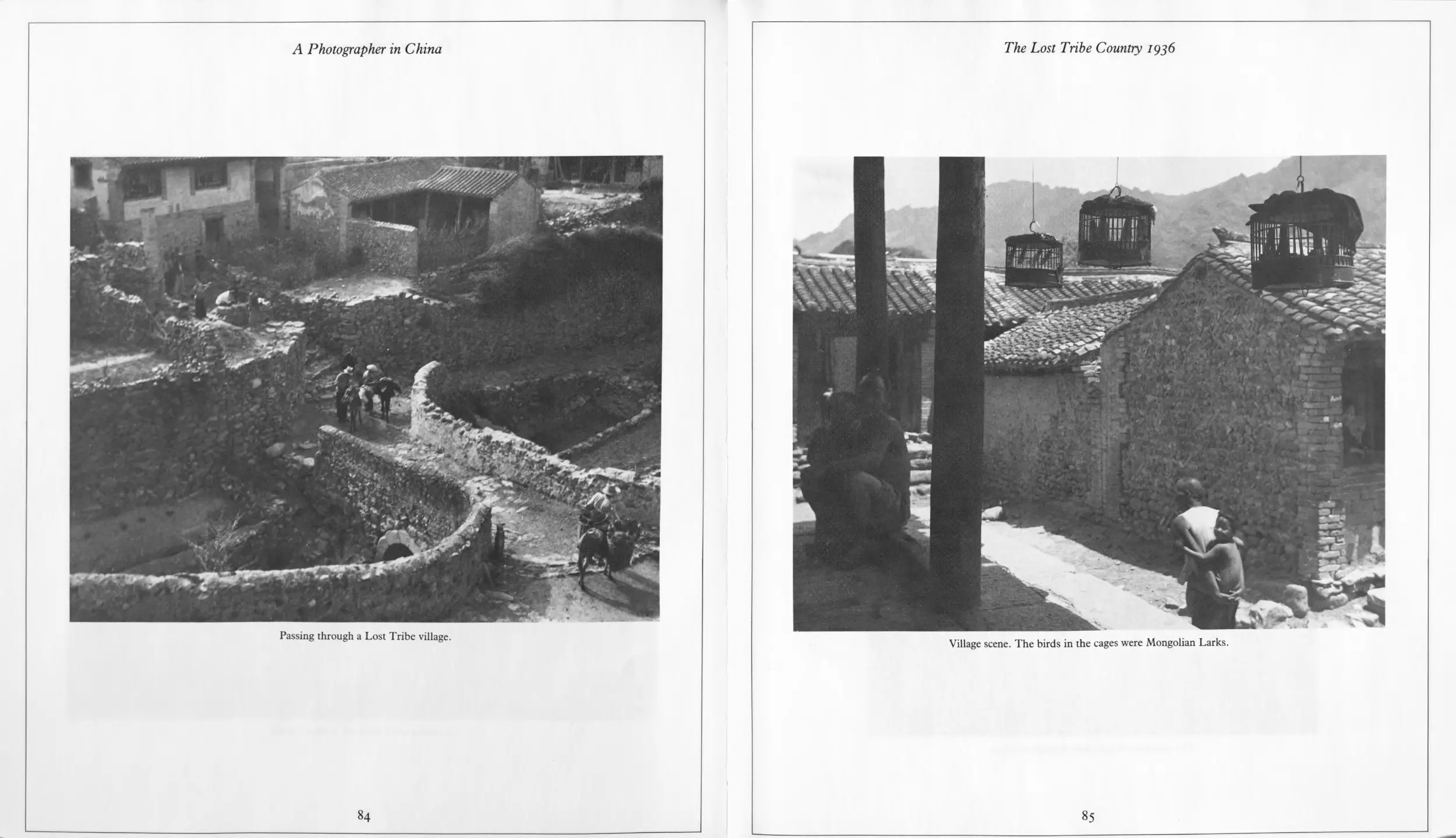
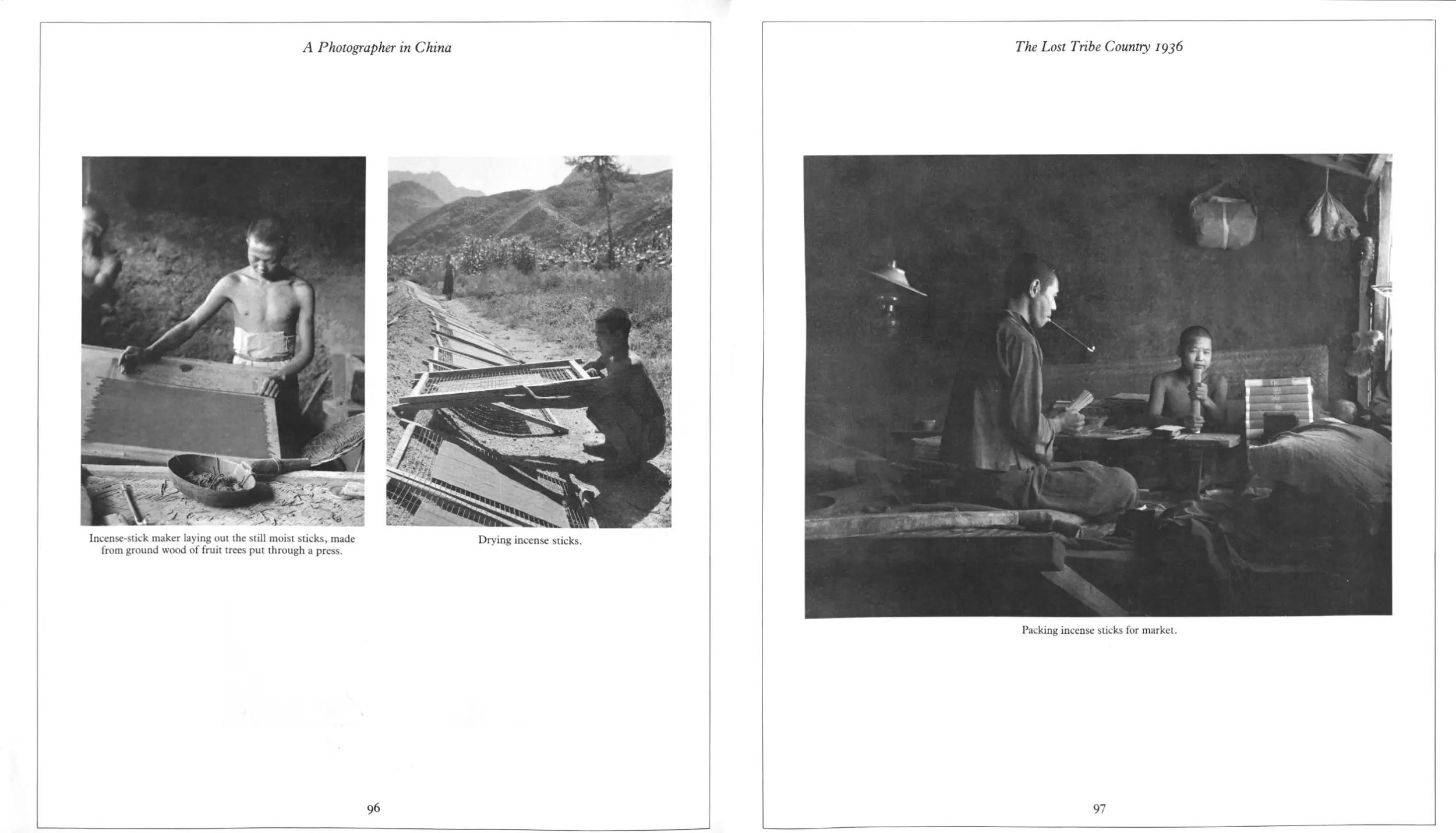
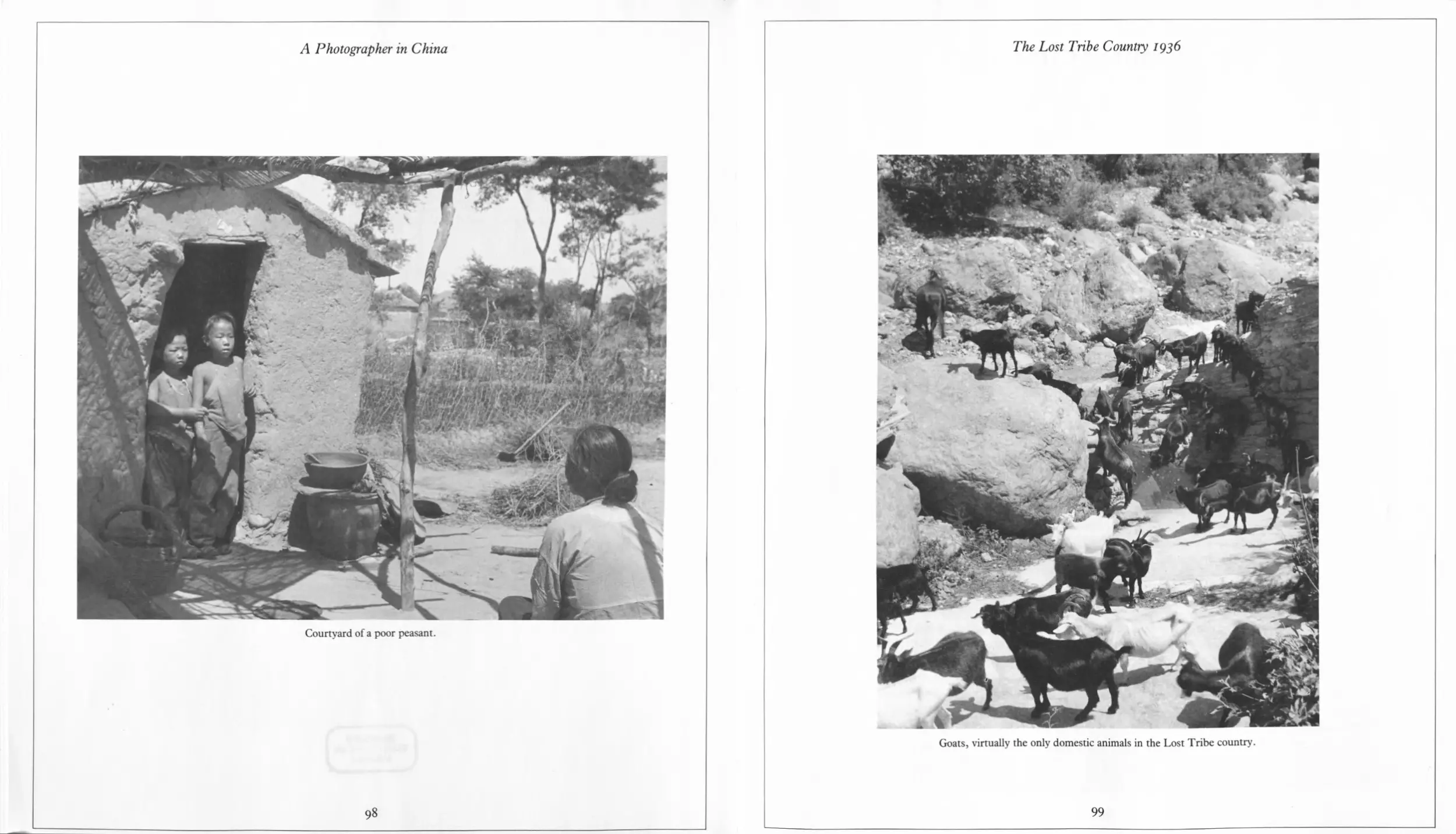
The area was a very poor one. About the only things that it produced for trade were
dried fruit, a few scrawny goats, and incense sticks made from the wood of fruit trees.
The wood was ground up and made into a stiff slurry which was forced through holes
of the requisite diameter in primitive presses and then dried in the sun.
The countryside was drought-stricken. To break the drought a ceremony was held
with much drum beating before the locally made figure of the rain god. Prayers were
offered up to him, and the figure was paraded through the village and offered small
buns. I was told that if the ceremony did not produce a quick result the god would be
76
The Lost Tribe Country 1936
taught a lesson by being left out in the hot sun. And if rain still failed to materialize he
would be thrown away and the villagers would make themselves another image.
Fortunately rain did fall soon after the ceremony and so the good name of the rain god
was maintained.
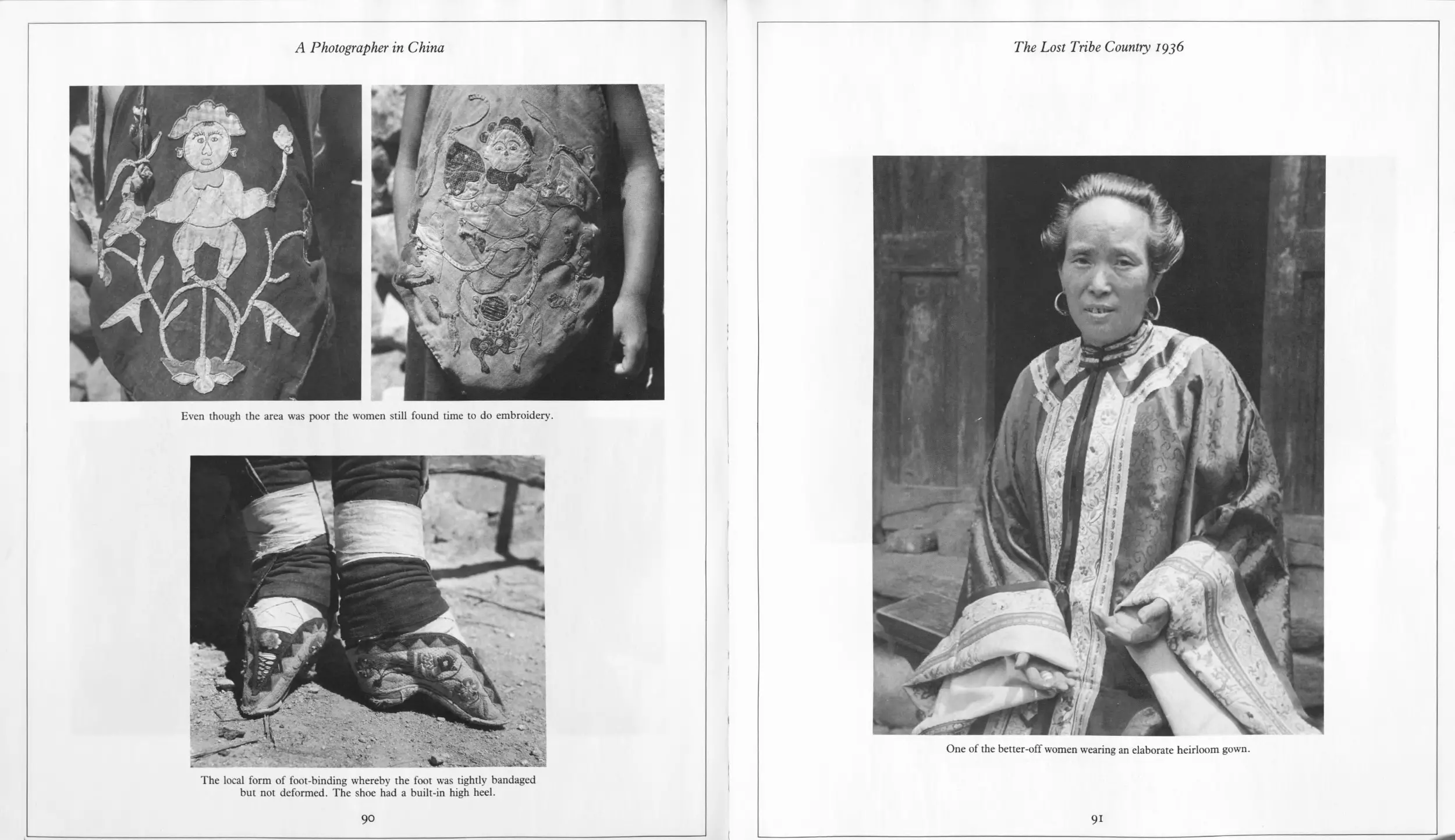
The old customs that I had heard about mainly concerned the women. One of the
conditions of the original banishment was that women were not permitted to follow the
then ‘civilized’ Chinese custom of foot-binding. After the 1911 revolution people felt
free to introduce foot-binding but confined themselves to bandaging the feet to give the
appearance of binding but without malforming them.
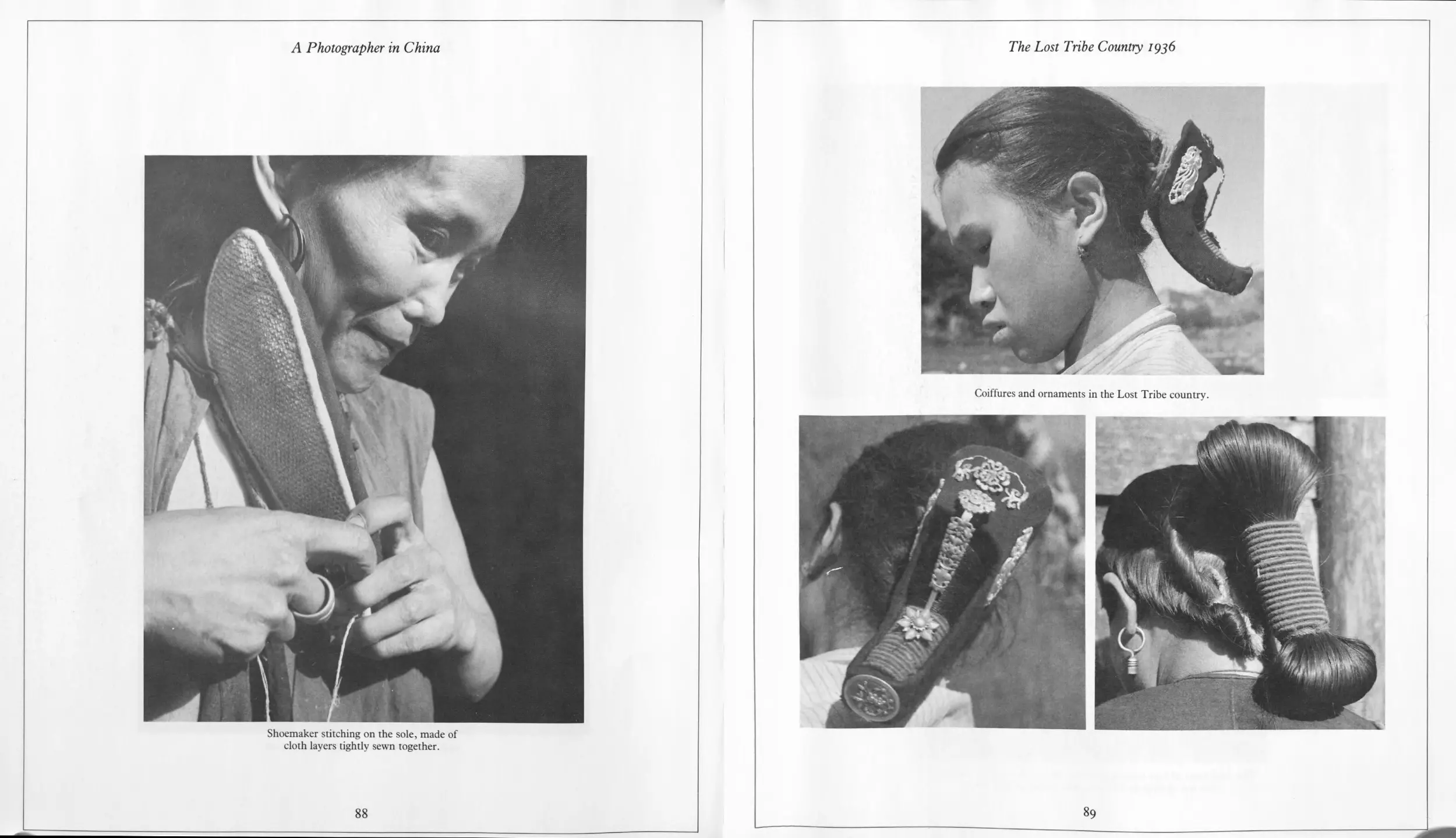
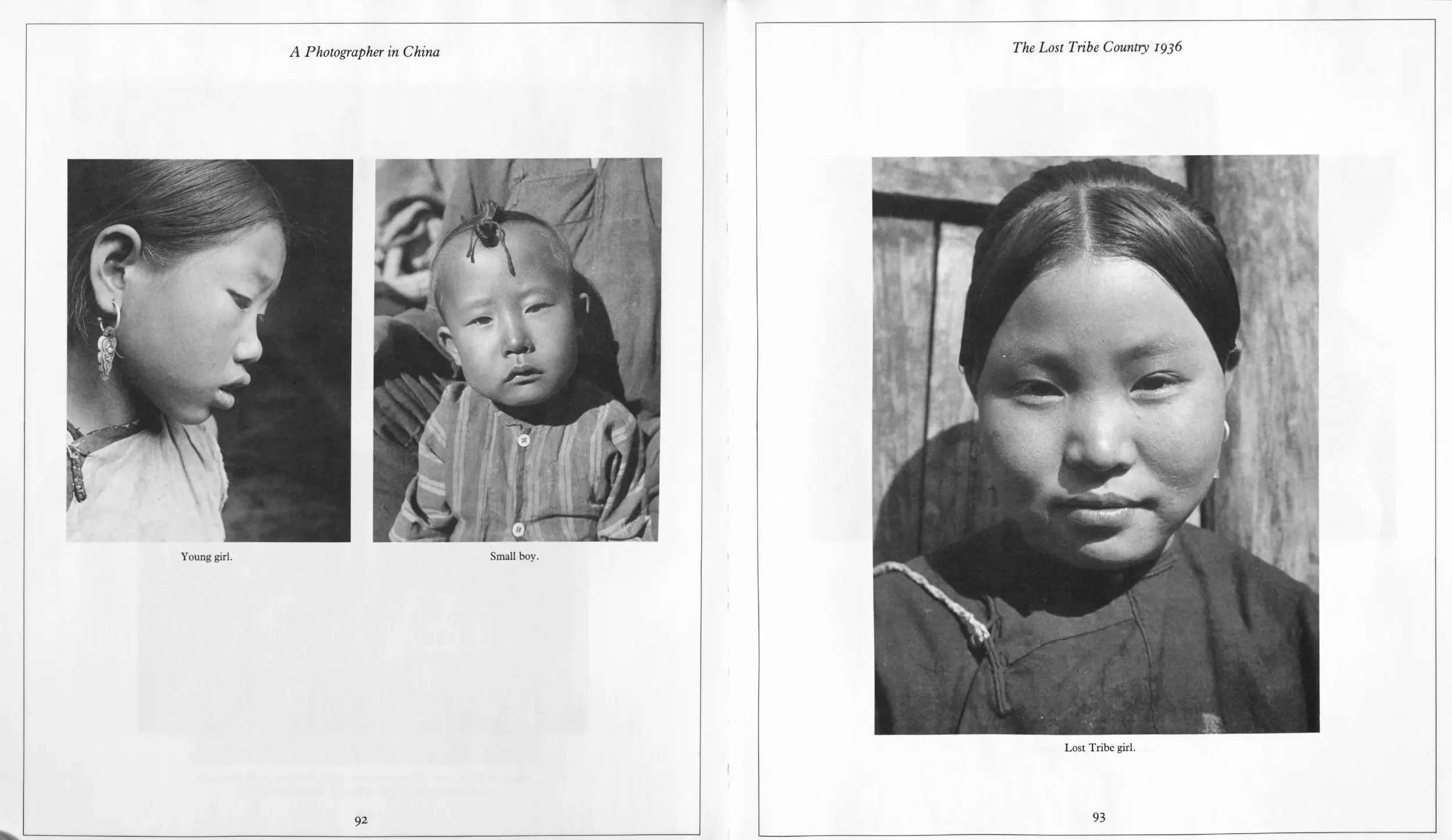
The girls exaggerated the extent of their foreheads by plucking out hair by the roots.
They wore their hair in a teapot-handle coiffure, a style that I was told dates back to
T’ang times. The hair was done up in a kind of compressed bun, bound with red and
green cord, and no hairpins were used. Because of poverty their jewellery was
generally made of iron.
When the appointed time came for my departure I was really sorry to leave, for the
unspoilt nature of the people and their kindness were very endearing. By contrast life
in the foreign community in Peking was not greatly alluring. The two communities did
at least have one characteristic in common: gossip was an important ingredient in
social intercourse.
We returned down the valley of Chii Ma Ho but by then the rains had set in and the
river, which the track had to crisscross a number of times, was a raging torrent.
Conditions became so bad after a heavy thunderstorm that I had to swim across,
holding my camera above my head. All the luggage except for specially sealed boxes
became soaked. We were held up for three days in a tiny hamlet and were only able to
cross when the tallest men of the village formed a human chain and passed our luggage
over from hand to hand. Once again the donkeys and I had to swim.
To avoid the difficulties of continually crossing the river we struck across the
mountains and for three days travelled through wild and lonely country where we met
practically no one. There were no villages and the nights were spent under the open
sky. Finally the plain was reached. I returned to Peking by train with the head
donkeyman while the others returned on foot with the donkeys. Travelling third class
on the train we were the object of much interest from our fellow passengers and the
donkeyman, happy and talkative, told the other passengers all about our adventures.
77
A Photographer in China
The three donkeymen who took me to the Lost Tribe country.
The Lost Tribe Country 1936
The head donkeyman cooking.
A Photographer in China
View from a spur of Pei Hua Shan over the harsh, deforested landscape
of the Western Hills.
8o
The Lost Tribe Country 1936
The donkeymen at Ta Lung Men, a gate through
an outlying section of the Great Wall.
8l
A Photographer in China
On the road to the Lost Tribe country.
82
The Lost Tribe Country 1936
Houses in a Lost Tribe village.
83
A Photographer in China
Passing through a Lost Tribe village.
84
The Lost Tribe Country 1936
Village scene. The birds in the cages were Mongolian Larks.
85
A Photographer in China
Shoemaker stitching on the sole, made of
cloth layers tightly sewn together.
88
The Lost Tribe Country 1936
Coiffures and ornaments in the Lost Tribe country.
89
A Photographer in China
Even though the area was poor the women still found time to do embroidery.
The local form of foot-binding whereby the foot was tightly bandaged
but not deformed. The shoe had a built-in high heel.
90
The Lost Tribe Country 1936
One of the better-off women wearing an elaborate heirloom gown.
91
A Photographer in China
Young girl.
Small boy.
The Lost Tribe Country 1936
Lost Tribe girl.
93
A Photographer in China
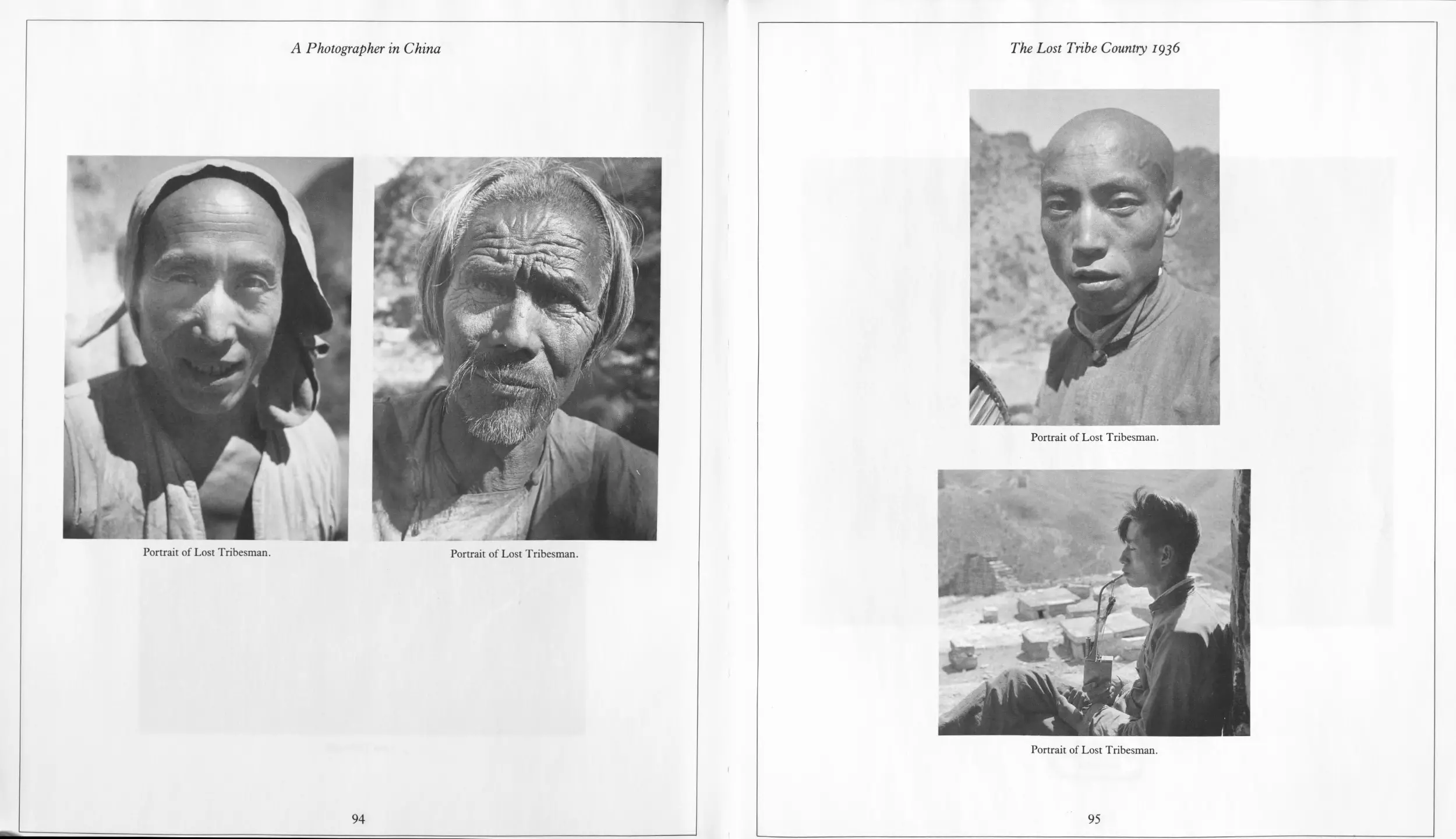
Portrait of Lost Tribesman.	Portrait of Lost Tribesman.
94
The Lost Tribe Country 1936
Portrait of Lost Tribesman.
Portrait of Lost Tribesman.

95
A Photographer in China
Drying incense sticks.
Incense-stick maker laying out the still moist sticks, made
from ground wood of fruit trees put through a press.
96
The Lost Tribe Country 1936
Packing incense sticks for market.
97
A Photographer in China
Courtyard of a poor peasant.
The Lost Tribe Country 1936
Goats, virtually the only domestic animals in the Lost Tribe country.
99
The Shantung Coast 1937
The last journey that I made before the Japanese invasion rendered carefree travel
in the north China countryside impossible was to the Shantung coast in the
summer of 1937. Unfortunately, I no longer have any notes on the tour and the
photographs must largely speak for themselves. I cannot give the precise locations
where they were taken, and the section begins with several photographs taken near
Shanhaikuan and in Peitaiho in Hopei province.
Shantung is a large and densely populated province. Like the southern provinces of
Kwangtung and Fukien its bursting population had been an important source of
migration to other areas. But whereas the southern Chinese migrated to South-east
Asia, Shantung people generally moved northward, especially into Manchuria. The
coastal area that I wanted to visit was poor and barren and produced little save dried
fish and salt. It was, however, very picturesque and notable for its stone buildings,
quite unlike anything that I saw elsewhere in China.
The coastal tour started in Wei Hai Wei, reached by train and bus. Wei Hai Wei has
a fine harbour and used to be the summer base of the once-important China squadron
of the British Royal Navy. Leased to Britain in 1898 for as long as Russia should hold
Port Arthur, it was belatedly returned to Chinese sovereignty in 1930. Many British
residents of Shanghai used to spend their summer holidays there.
On arrival in Wei Hai Wei I secured a berth on a trading junk bound for Tsingtao, a
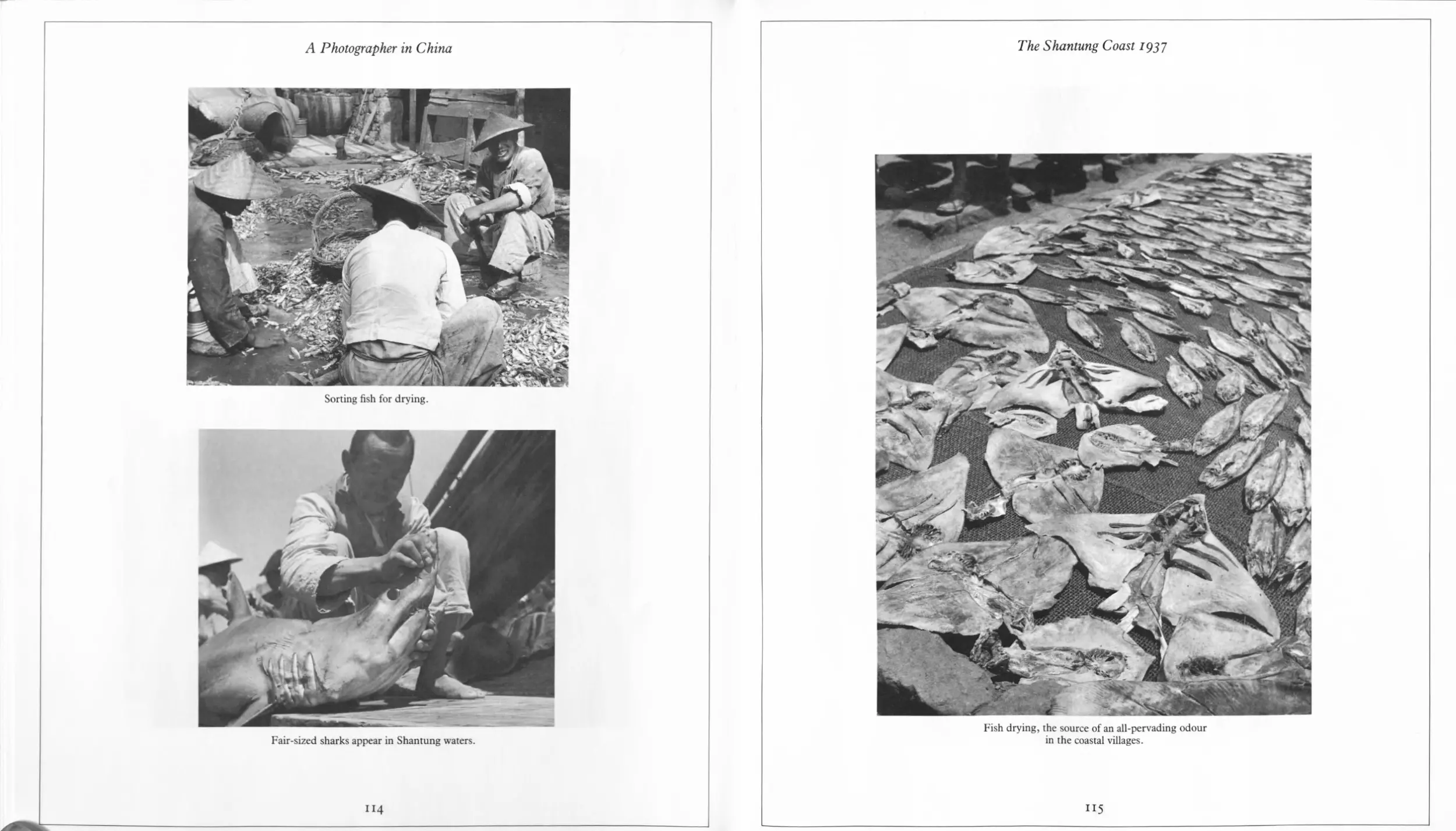
roomy and spotlessly clean sailing craft smelling strongly of dried fish; the same smell
pervaded all the fishing villages at which the junk called to pick up cargo. The fish
aroma did not appeal to my companion on the trip, a young globe-trotting Englishman
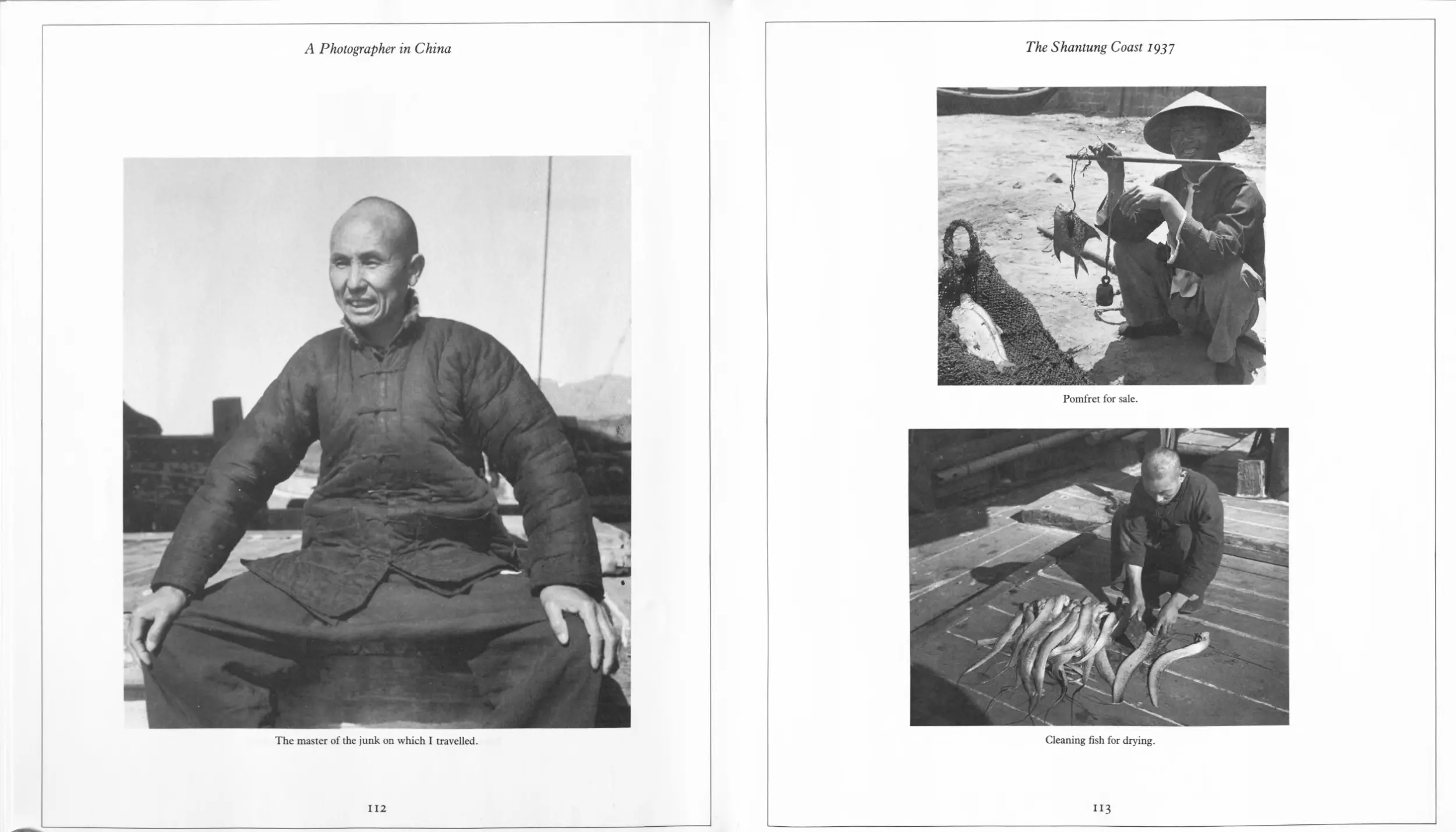
who wanted to see something of China off the beaten track. The junk people treated us
kindly and there was never any lack of dried fish to eat.
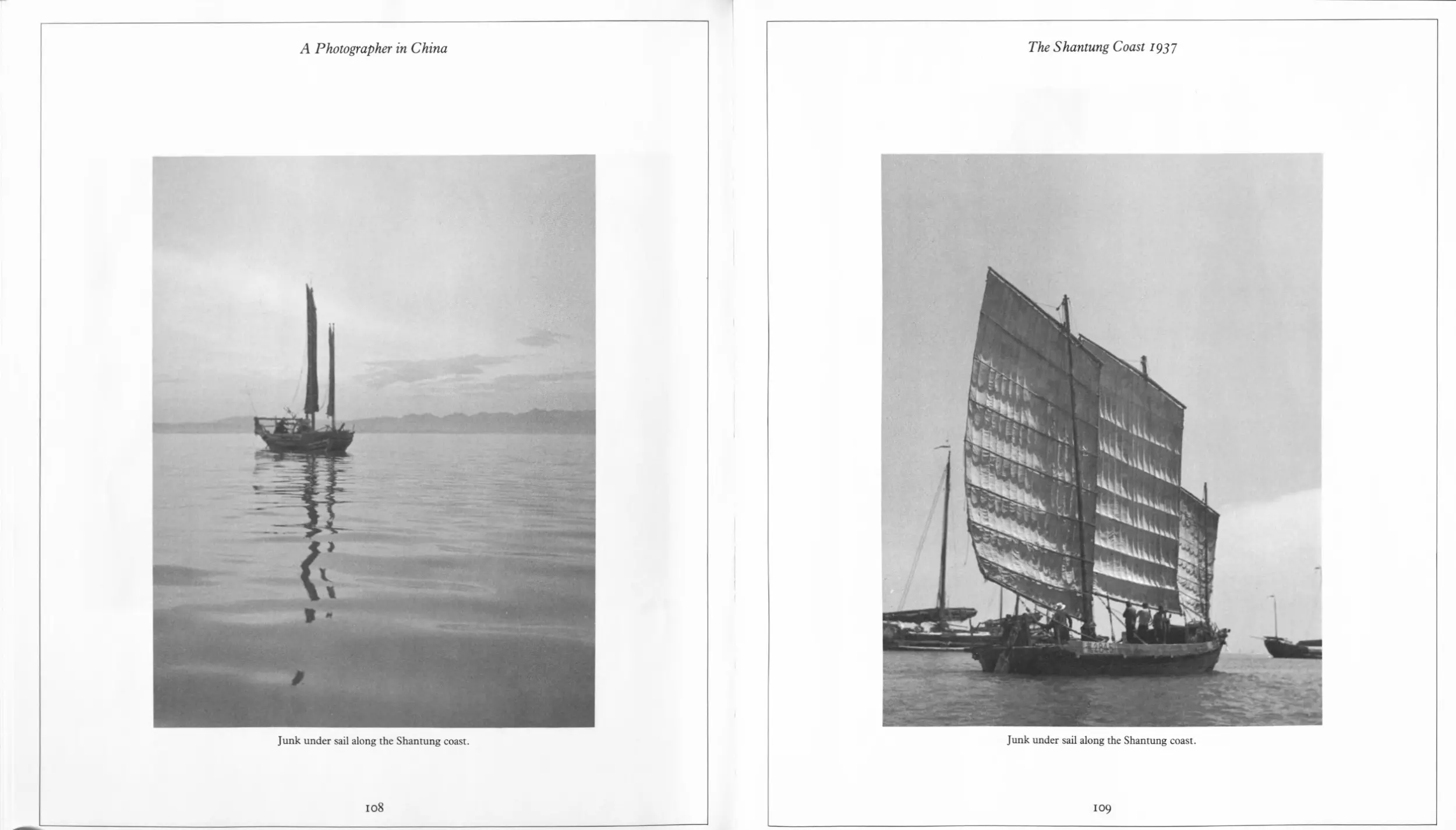
In those days nearly all coastal vessels and fishing boats were sailing junks which,
though they appeared cumbersome, were seaworthy and efficient if rather slow. In
the Middle Ages the Chinese were far ahead of the Western world in marine techno-
logy, but such development came to an end in the fifteenth century. Thereafter junks
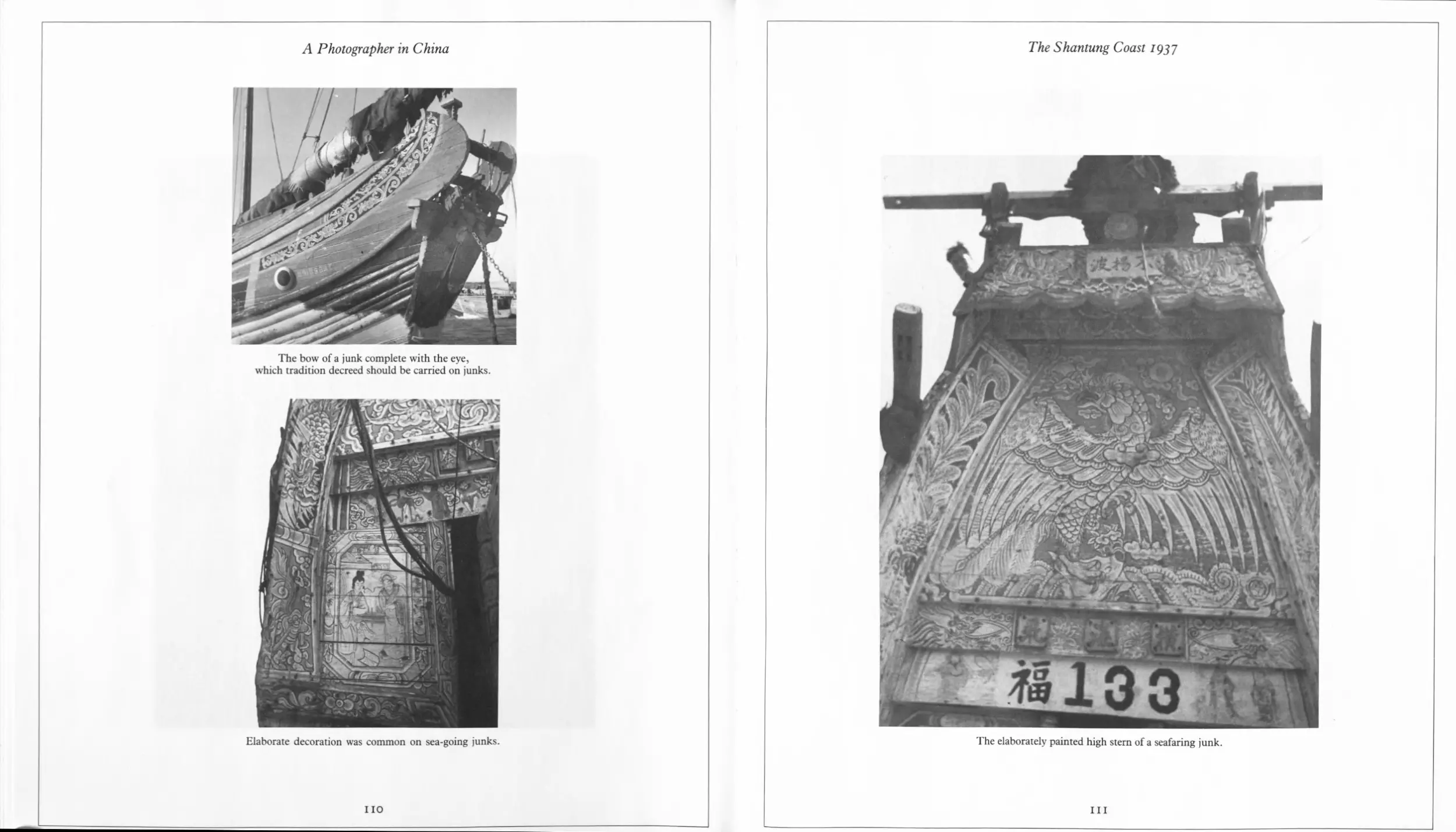
remained essentially unchanged. Our own junk, like all the ones that we saw, was
adorned with the traditional eyes low down in the bows; the high sterns were often
elaborately painted. Like all wind-powered vessels, junks under sail are extremely
picturesque.
The weather was fine and we called at a number of villages to pick up cargo. The
100
The Shantung Coast 1937
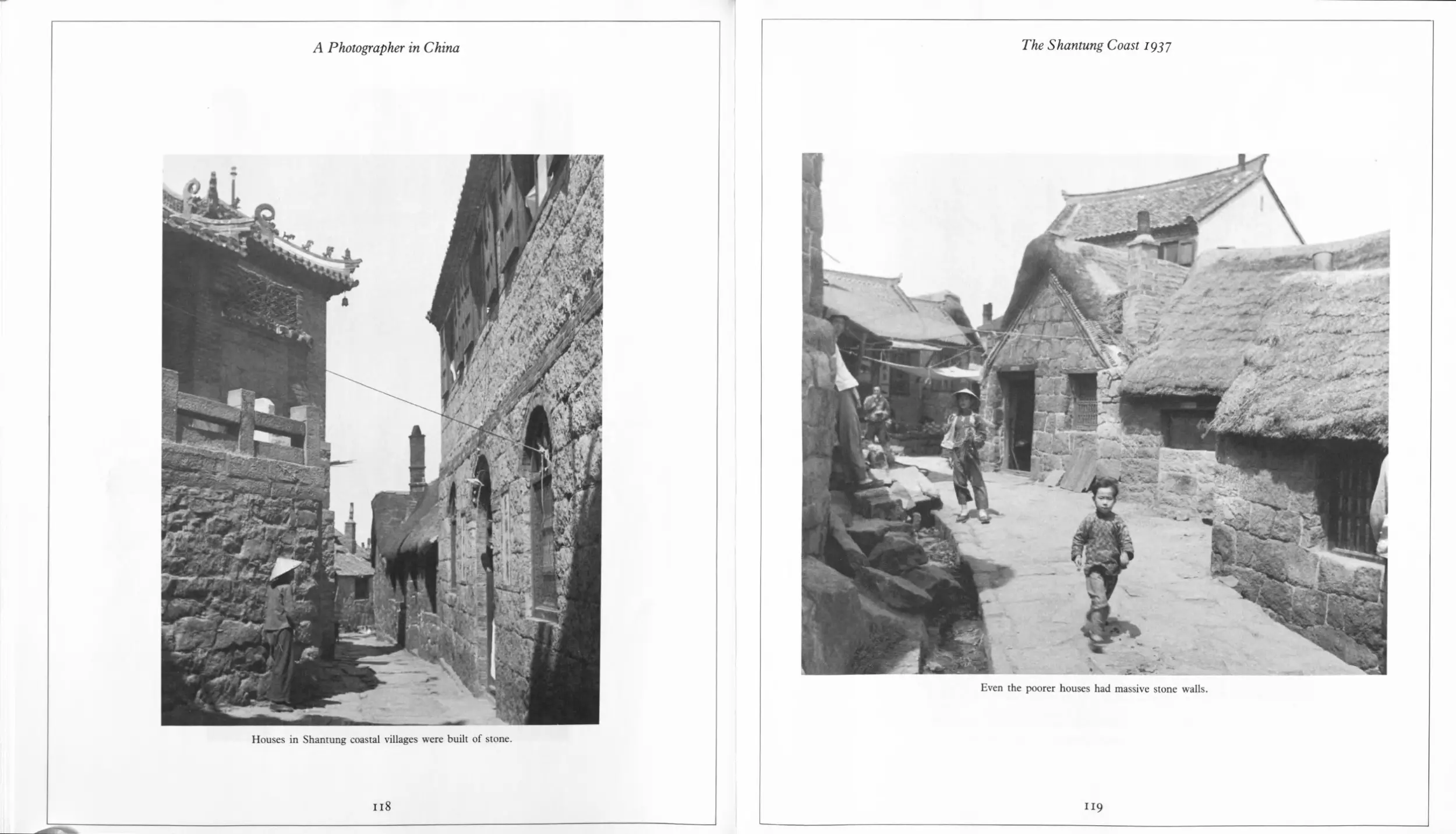
village people were friendly though inquisitive. Many of their stone-built houses
looked like European buildings with gables and chimneys, the result, not of European
influence, but of building in stone. In most parts of China the weight of the roof is
borne by wooden pillars, the brick walls being merely filled in and carrying no
structural load. But in Shantung walls of buildings are weight-bearing and so are
substantially built. The poorer houses were constructed of rough hewn stone but larger
and more important buildings had excellent masonry.
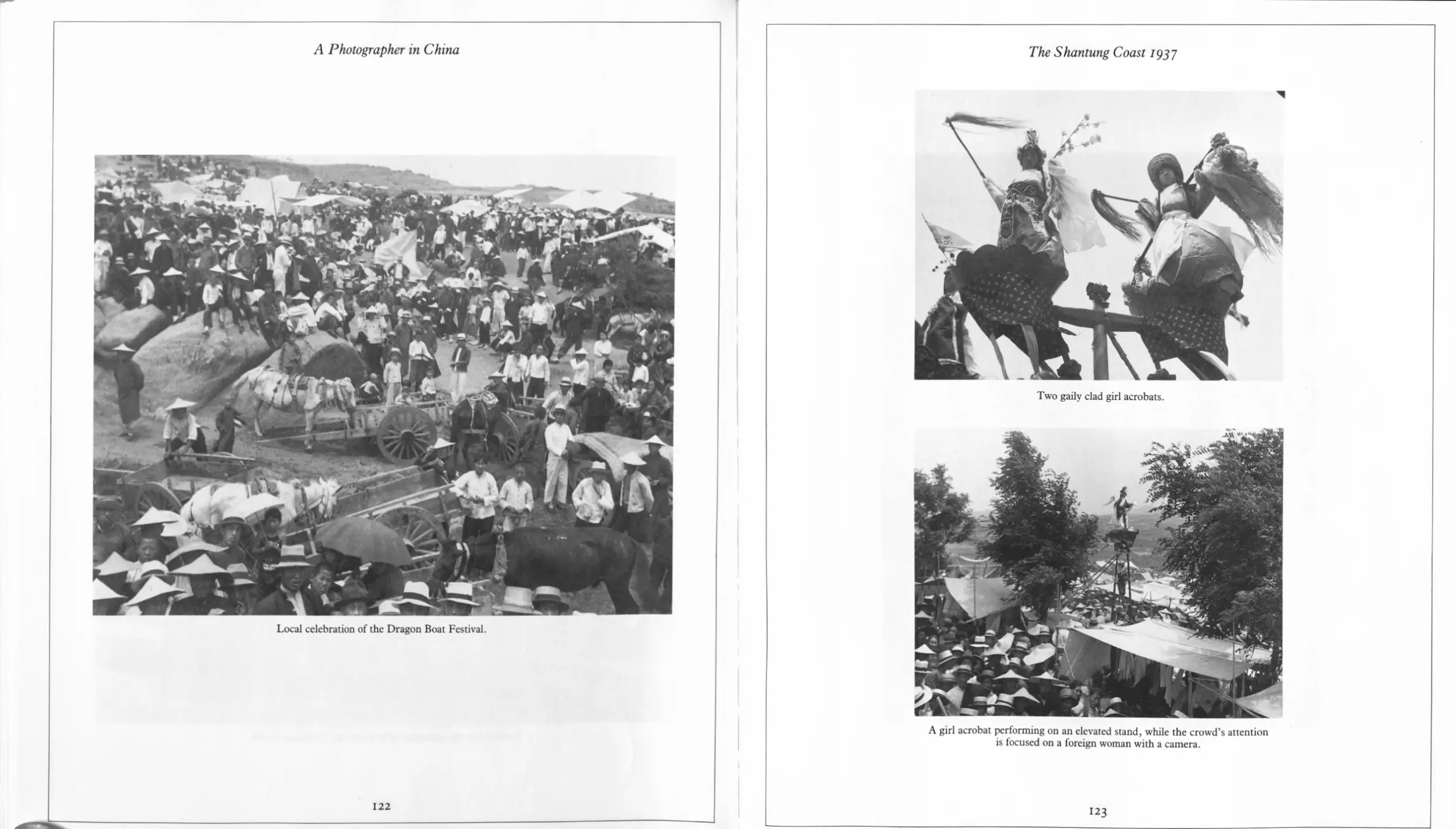
One large settlement was celebrating the Double Fifth Festival which is generally
known to Europeans as the Dragon Boat Festival. It is a rain-seeking festival calling
for the help of dragons, beneficent beasts whose movements cause the rain to fall. The
Dragon Boat races of the great port cities are designed to simulate the clash of
heavenly dragons which will bring rain to the earth below. The festival I saw had no
boat races but consisted of a market fair with much jollity and entertainment. It was
difficult to take photographs because of the curiosity from the public who regarded me
as a novel part of the show.
The journey ended in Tsingtao, the major port city in the south-east of the
Shantung Peninsula, and, before the First World War, the hub of German expansion
in China. In 1897 Germany obtained a 99-year lease of the port and its environs
together with various other concessions such as the right to build a railway from
Tsingtao to Chi Nan. As a result of the German occupation the town was very
European in appearance. It was captured by a combined British and Japanese force in
1914 and held by the Japanese until its return to Chinese sovereignty in 1922.
Here we said goodbye to our junk crew and returned to Peking. A few days later
there occurred the Lu Kou Ch’iao incident which sparked off the Japanese attempt to
subjugate China.
The year 1938 was a difficult one for me. My contract with Hartungs Photo Shop in
Peking came to an end and my employers tried unsuccessfully to make me return to
Germany. I also had health problems and had to undergo surgery. During my
convalescence I spent some time in Japan, at Beppu on the southern island of Kyushu,
staying in a Japanese inn and enjoying some of the hot springs and thermal sands. I
also climbed the fine volcano of Mount Aso.
I had not previously realized the extent of the differences between the Chinese and
Japanese cultures and ways of life or how very much more agreeable the Japanese were
at home than they were abroad. I bathed in the hot baths and had myself covered in
101
A Photographer in China
hot sand on the beach. There were few European visitors to Beppu in those days and
the Japanese custom of naked mixed bathing was the rule. I especially remember once
sharing a thermal swimming pool with several huge sumo wrestlers swimming up and
down the pool like a school of baby whales and all of us as naked as the day we were
born.
After my return to Peking I was employed by an English lady, Miss Bieber, but
opportunities for travel in the way to which I had become accustomed were gone. One
could still visit the nearer Western Hills and the seaside resort of Peitaiho, but
elsewhere the requirement of Japanese permits, which were not easy to obtain because
of Japanese suspicions, severely restricted individual travel.
102
The Shantung Coast 1937
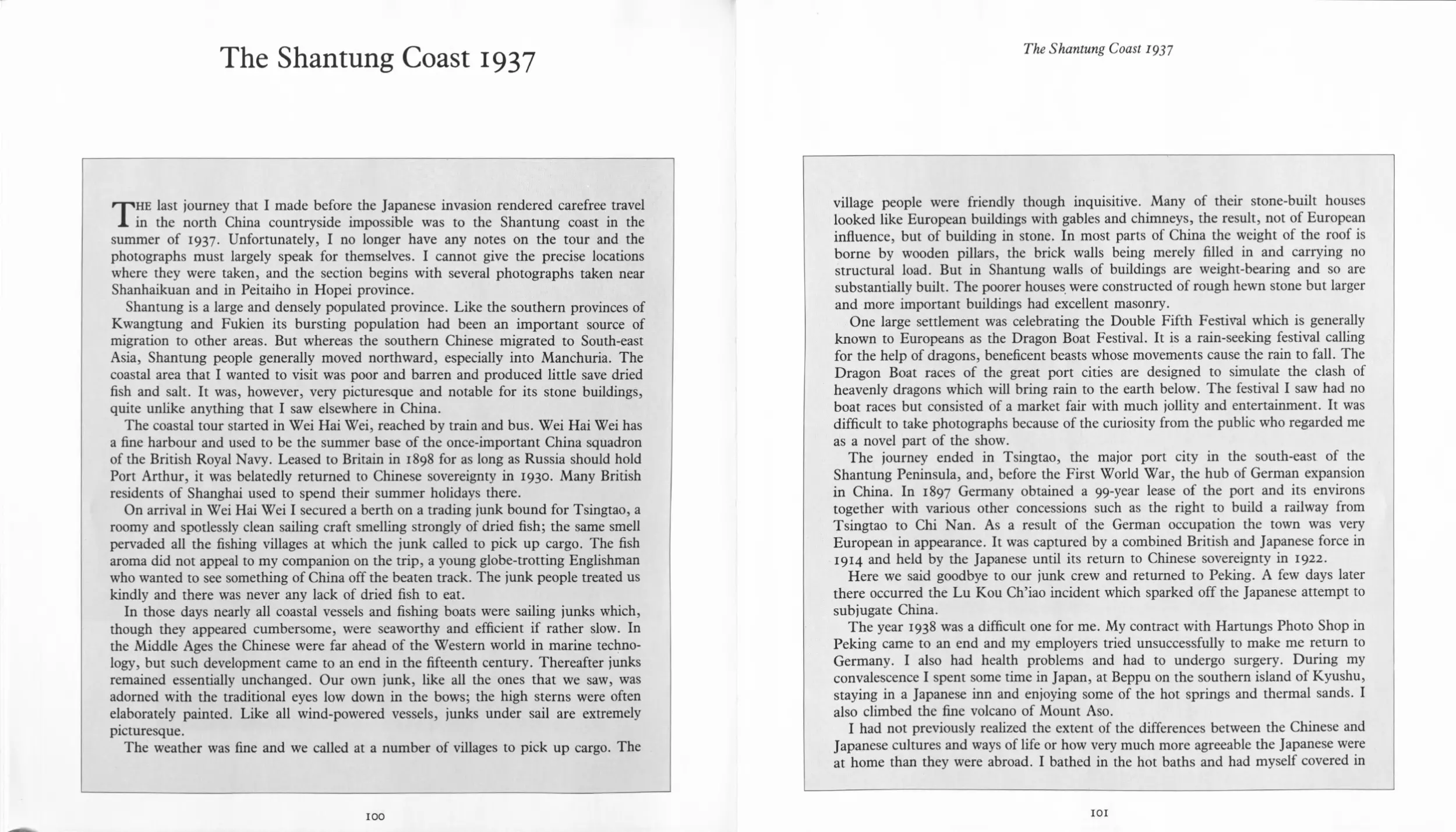
The eastern end of the Great Wall, where it descends from the hills
behind Shanhaikuan and runs down to the narrow coastal plain.
103
A Photographer in China
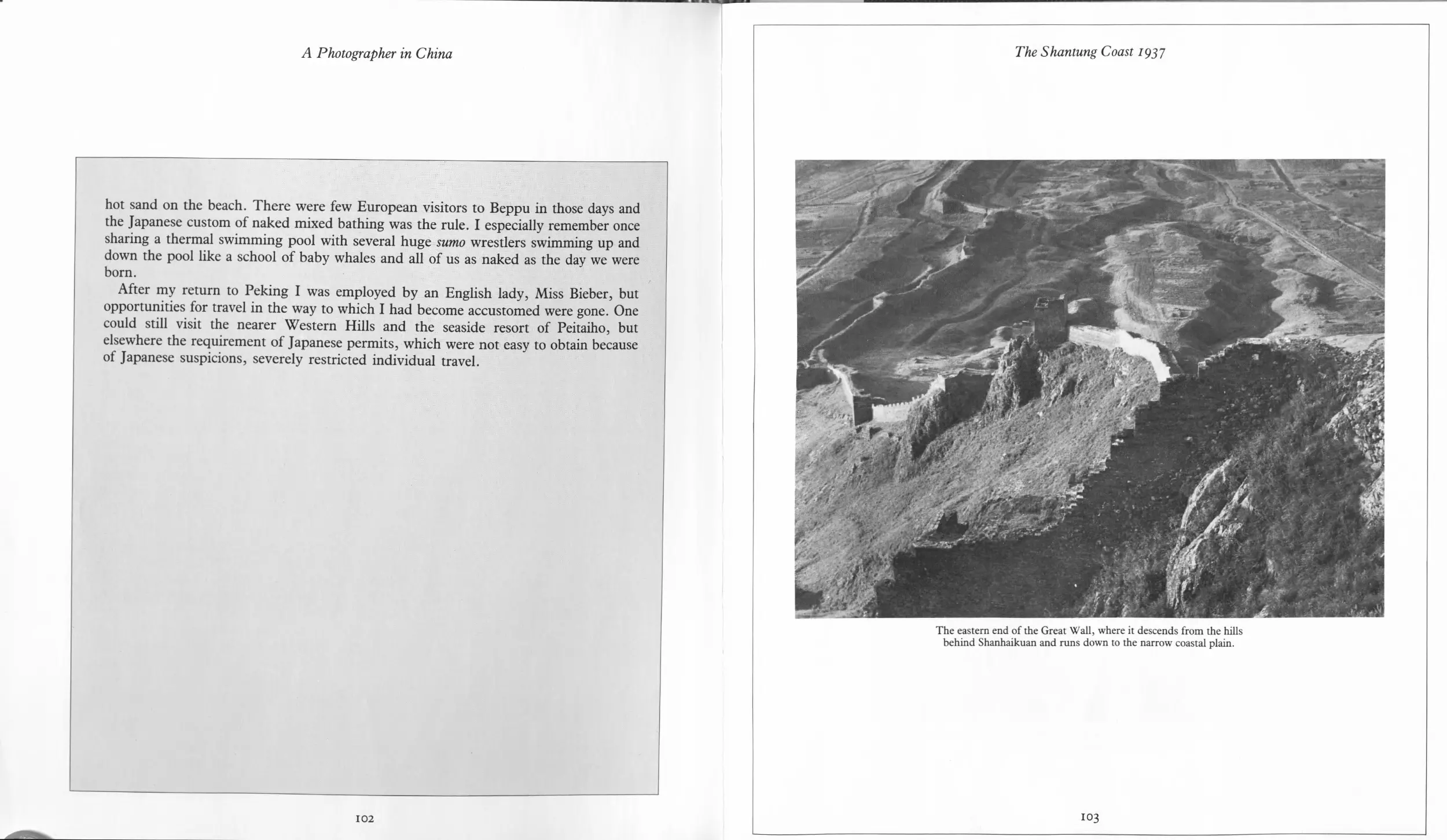
View from the Great Wall towards the coastal plain at Shanhaikuan.
104
The Shantung Coast 1937
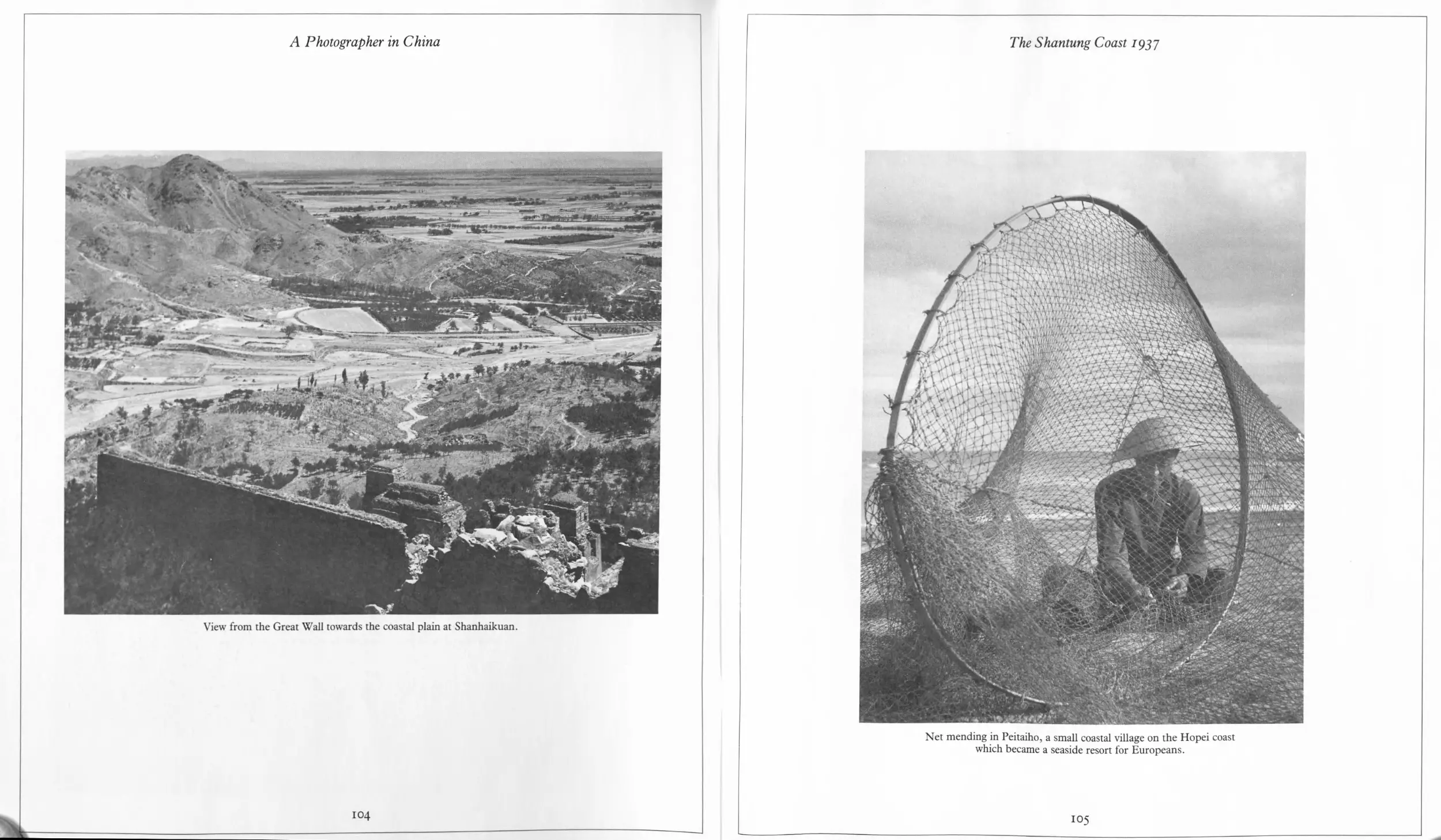
Net mending in Peitaiho, a small coastal village on the Hopei coast
which became a seaside resort for Europeans.
105
A Photographer in China
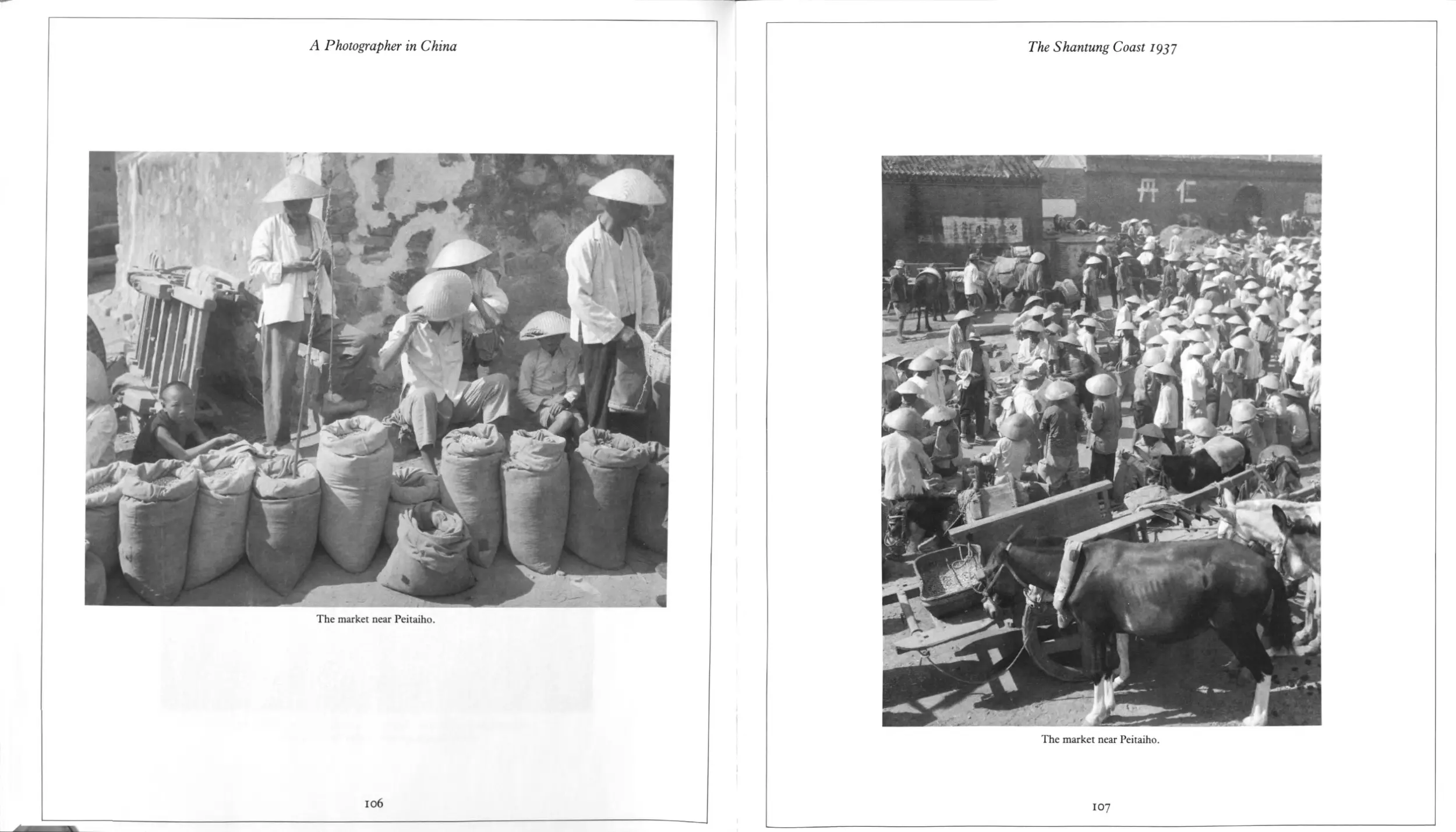
The market near Peitaiho.
106
The Shantung Coast 1^31
The market near Peitaiho.
107
A Photographer in China
Junk under sail along the Shantung coast.
108
The Shantung Coast 1937
Junk under sail along the Shantung coast.
109
A Photographer in China
The bow of a junk complete with the eye,
which tradition decreed should be carried on junks.
Elaborate decoration was common on sea-going junks.
IIO
The Shantung Coast 1937
The elaborately painted high stern of a seafaring junk.
Ill
A Photographer in China
The master of the junk on which I travelled.
112
The Shantung Coast 1937
Pomfret for sale.
Cleaning fish for drying.
ИЗ
A Photographer in China
Sorting fish for drying.
Fair-sized sharks appear in Shantung waters.
114

The Shantung Coast 1937
Fish drying, the source of an all-pervading odour
in the coastal villages.
115
A Photographer in China
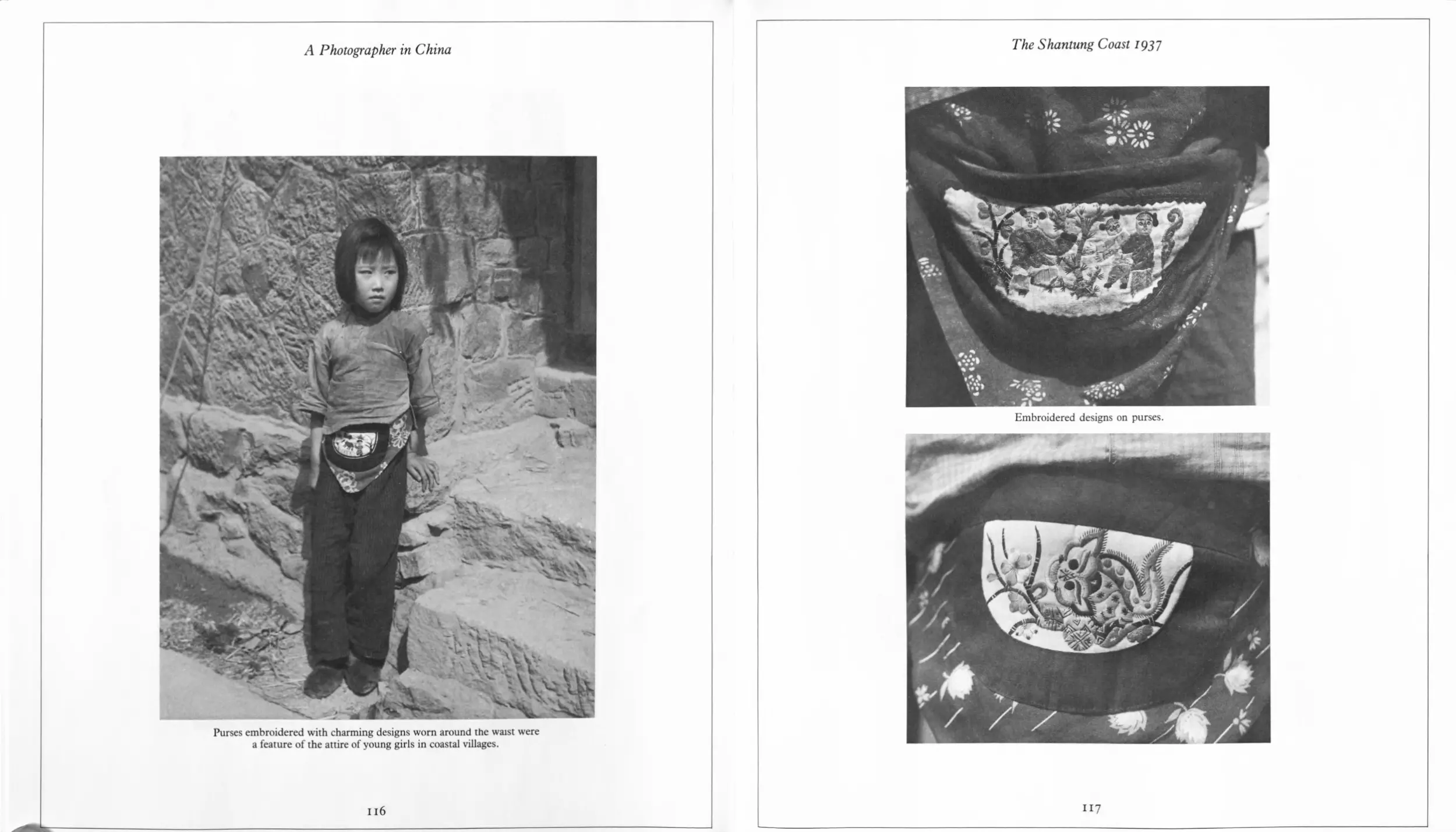
Purses embroidered with charming designs worn around the waist were
a feature of the attire of young girls in coastal villages.
116
The Shantung Coast 1937
Embroidered designs on purses.
117
A Photographer in China
Houses in Shantung coastal villages were built of stone.
118
The Shantung Coast 1937
Even the poorer houses had massive stone walls.
119
A Photographer in China
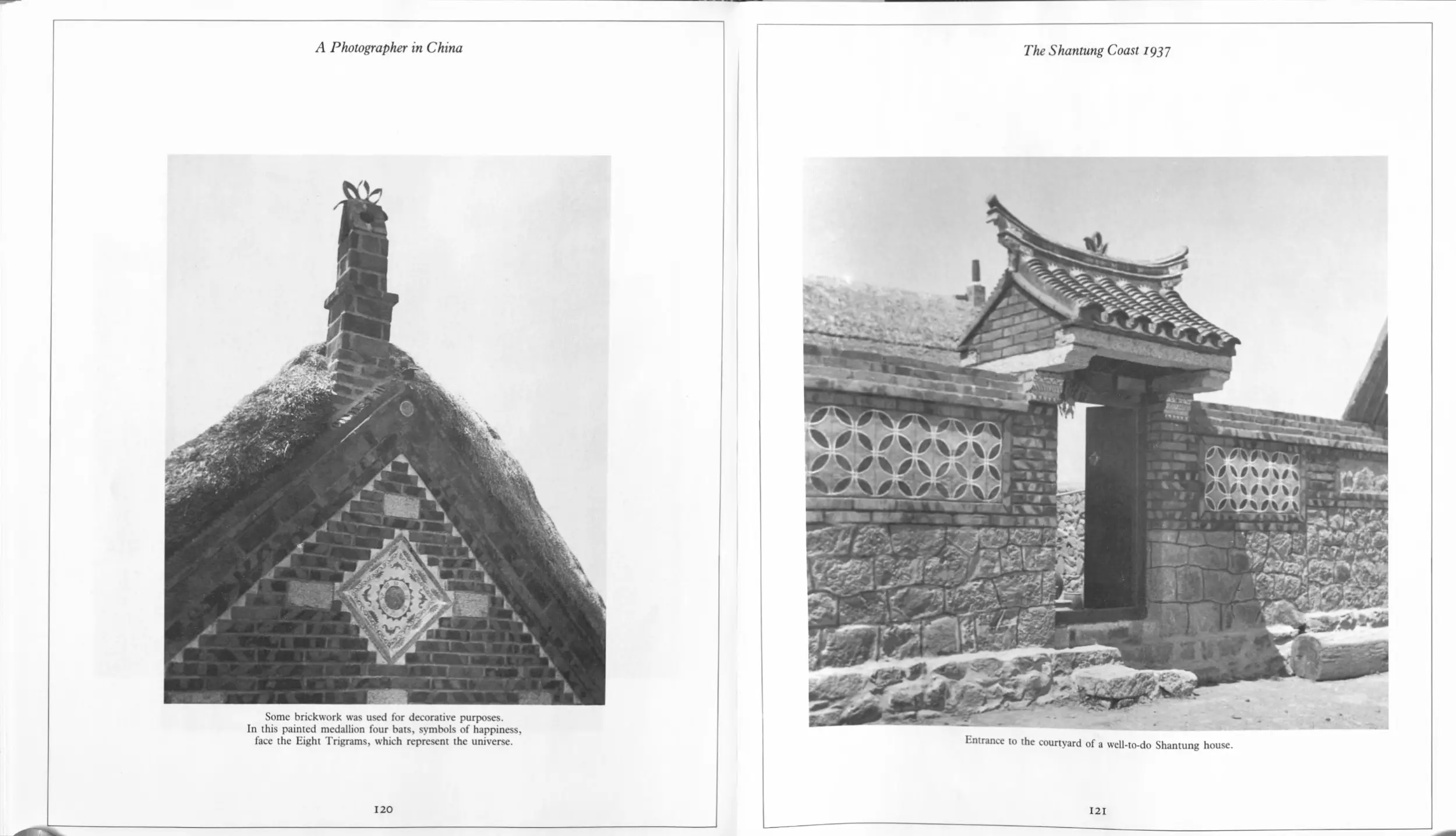
Some brickwork was used for decorative purposes.
In this painted medallion four bats, symbols of happiness,
face the Eight Trigrams, which represent the universe.
120

The Shantung Coast 1937
Entrance to the courtyard of a well-to-do Shantung house.
121
A Photographer in China
Local celebration of the Dragon Boat Festival.
122
The Shantung Coast 1937
Two gaily clad girl acrobats.
A girl acrobat performing on an elevated stand, while the crowd’s attention
is focused on a foreign woman with a camera.
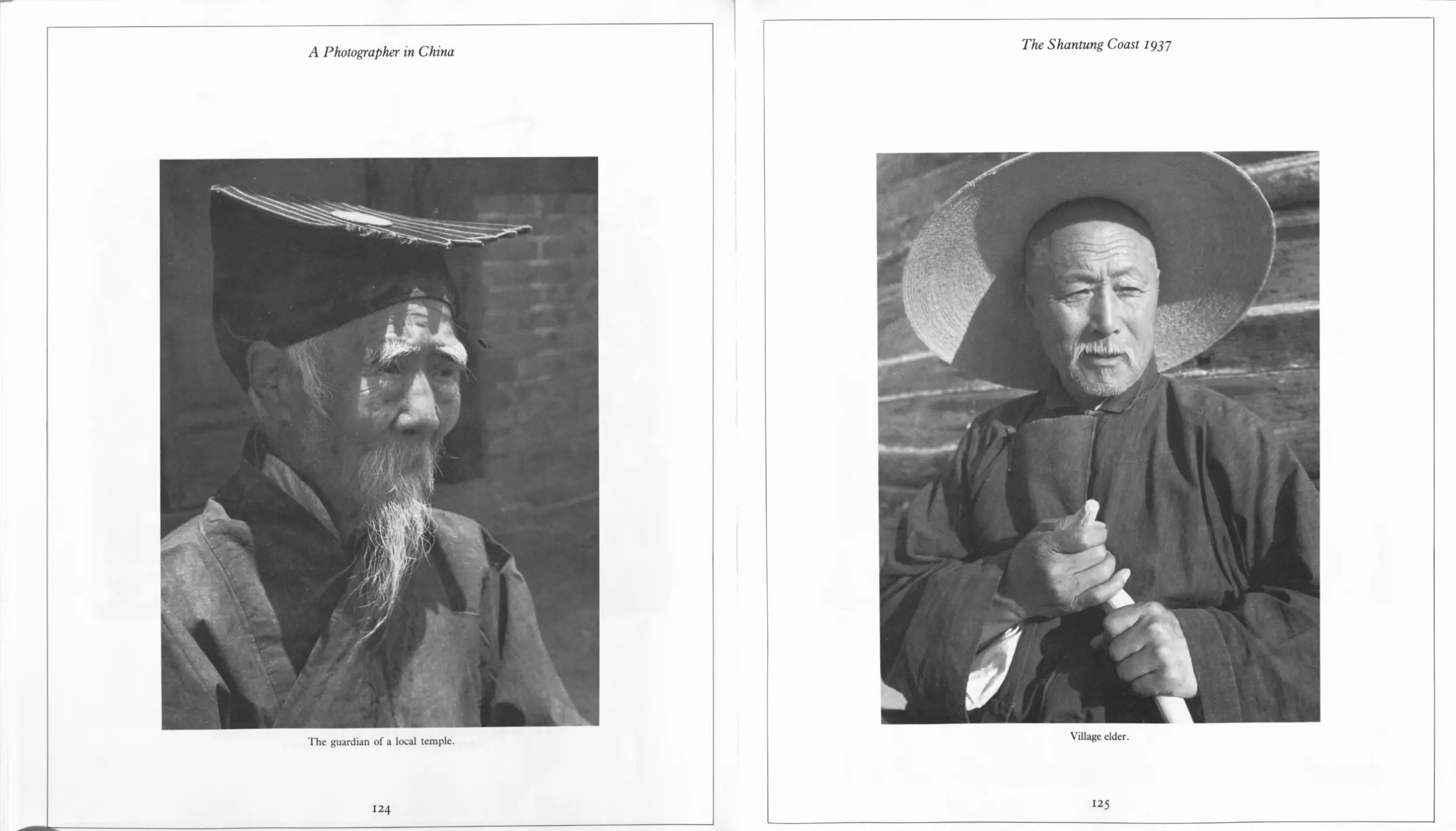
A Photographer in China
The guardian of a local temple.
124
The Shantung Coast 1937
Village elder.
125
A Photographer in China
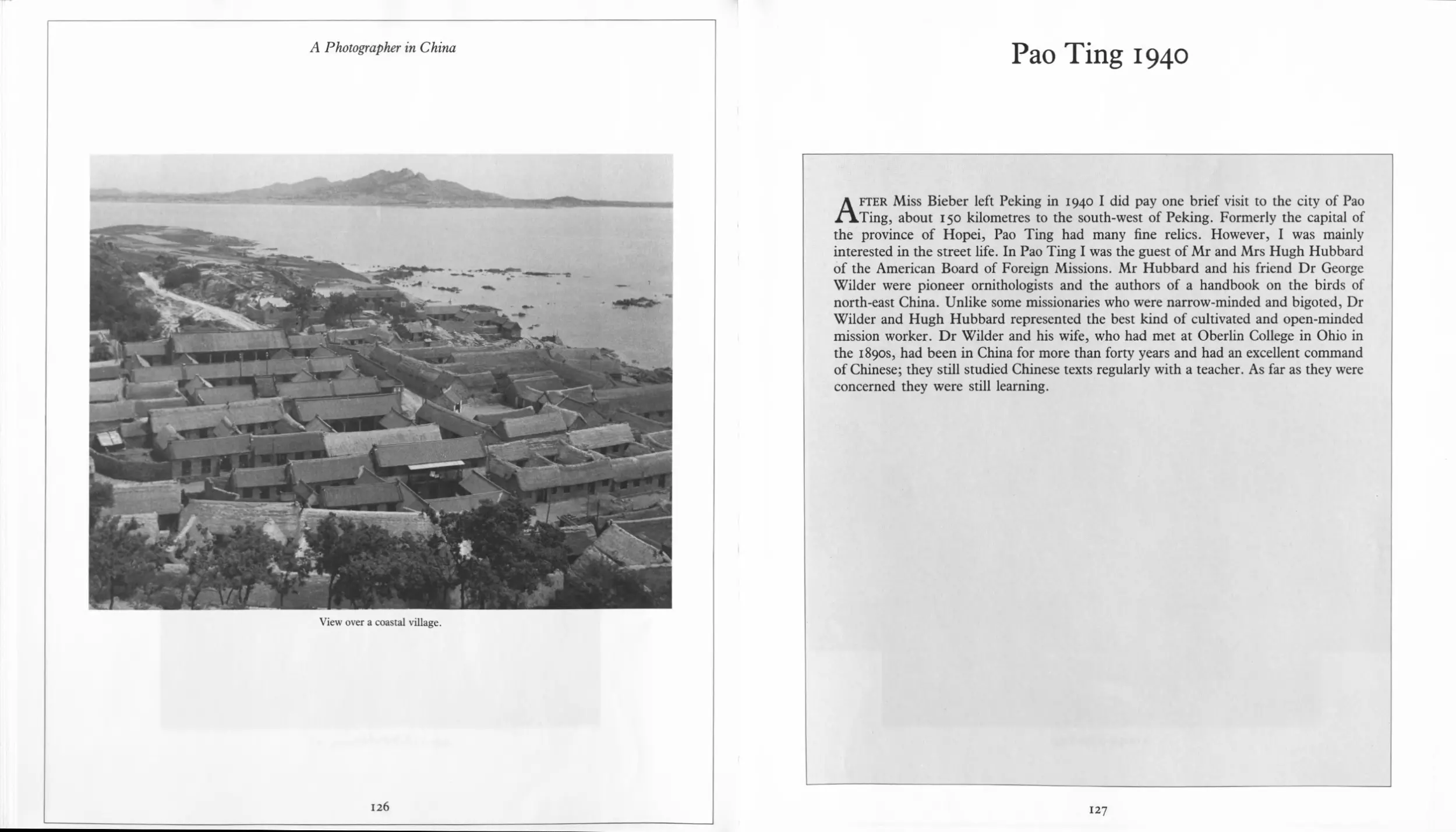
View over a coastal village.
126
Рао Ting 1940
After Miss Bieber left Peking in 1940 I did pay one brief visit to the city of Pao
Ting, about 150 kilometres to the south-west of Peking. Formerly the capital of
the province of Hopei, Pao Ting had many fine relics. However, I was mainly
interested in the street life. In Pao Ting I was the guest of Mr and Mrs Hugh Hubbard
of the American Board of Foreign Missions. Mr Hubbard and his friend Dr George
Wilder were pioneer ornithologists and the authors of a handbook on the birds of
north-east China. Unlike some missionaries who were narrow-minded and bigoted, Dr
Wilder and Hugh Hubbard represented the best kind of cultivated and open-minded
mission worker. Dr Wilder and his wife, who had met at Oberlin College in Ohio in
the 1890s, had been in China for more than forty years and had an excellent command
of Chinese; they still studied Chinese texts regularly with a teacher. As far as they were
concerned they were still learning.
127
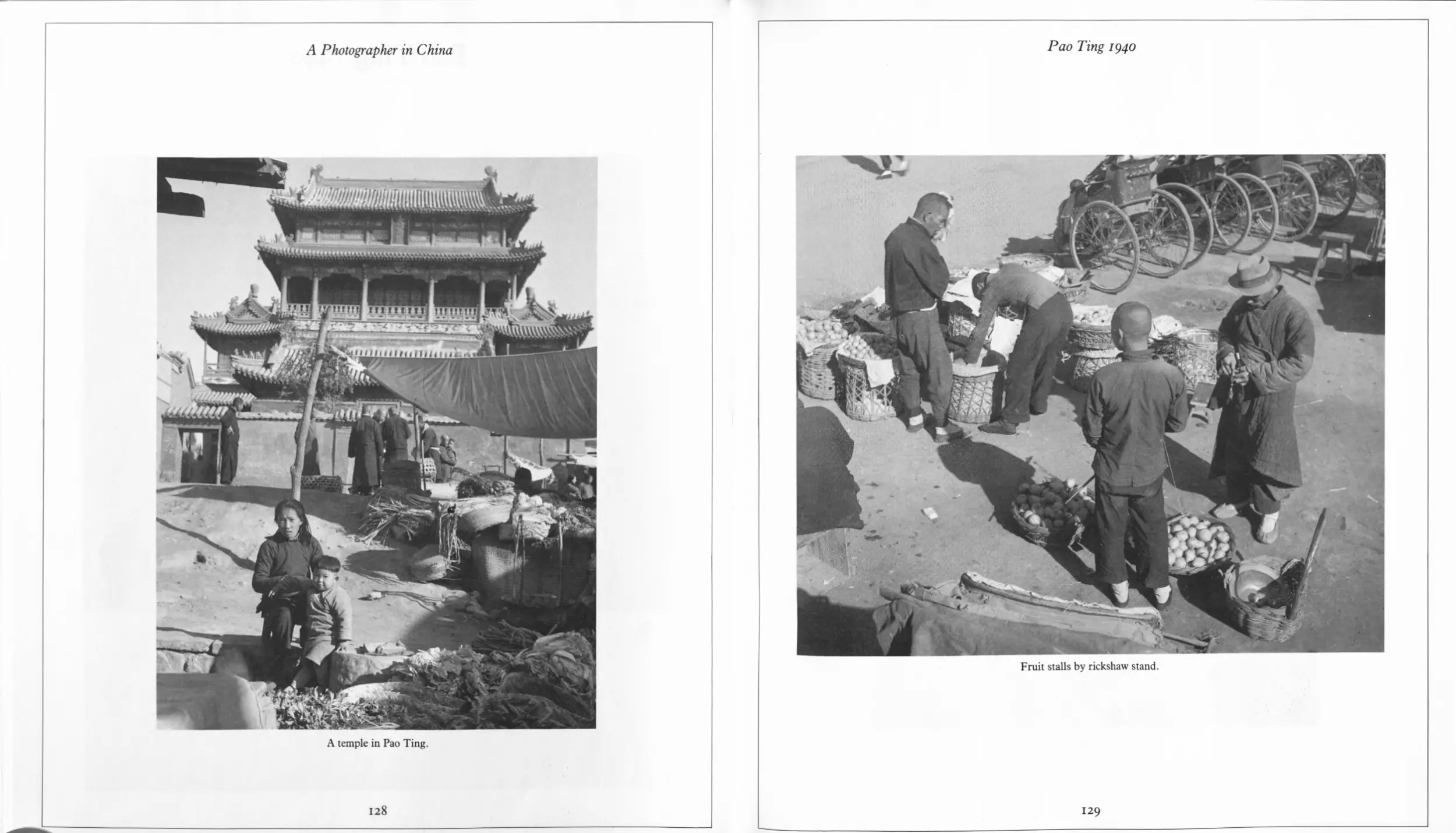
A Photographer in China
A temple in Pao Ting.
128
Рао Ting 1940
Fruit stalls by rickshaw stand.
129
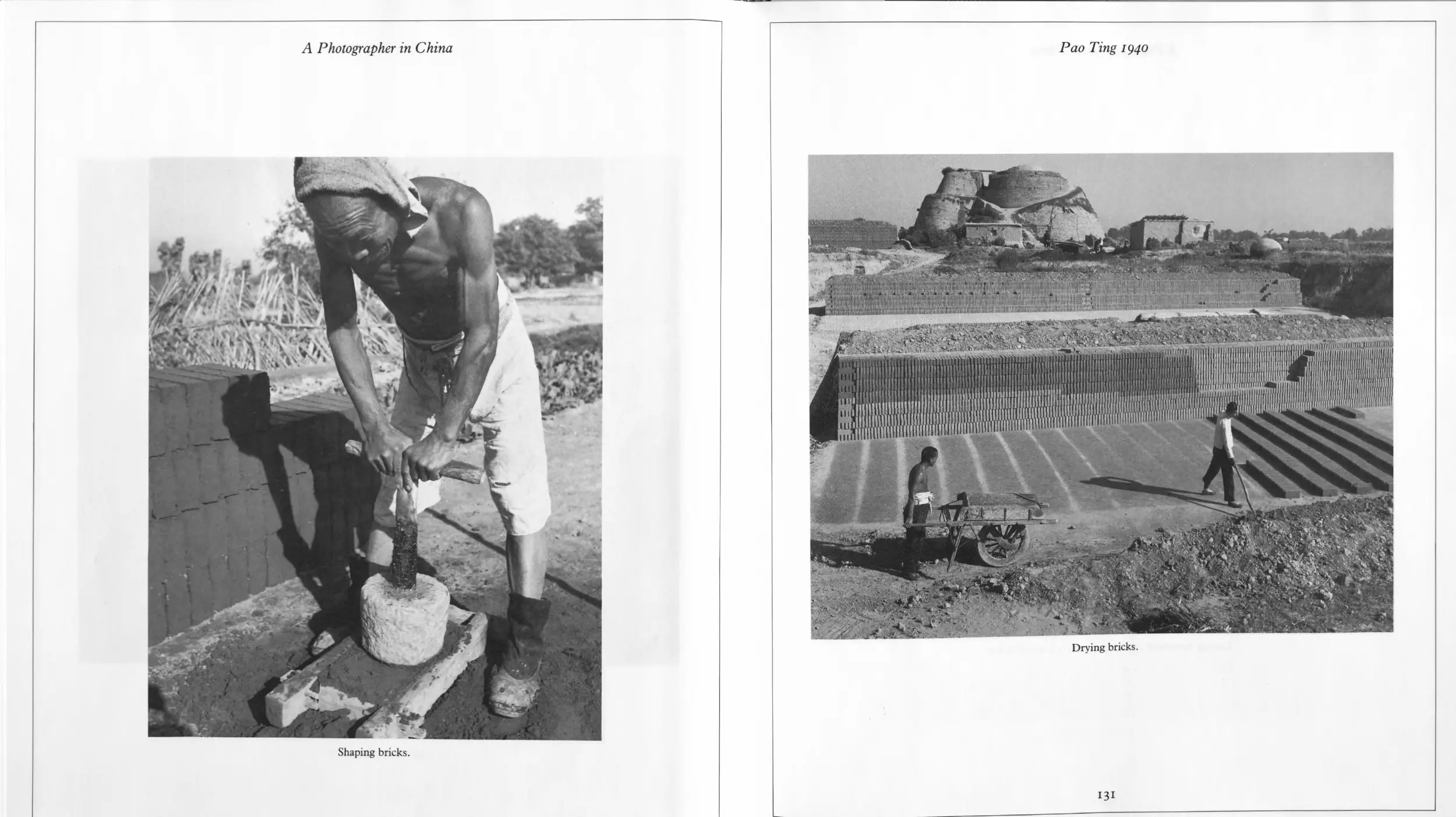
A Photographer in China
Shaping bricks.
Рао Ting 1940
Drying bricks.
131
A Photographer in China
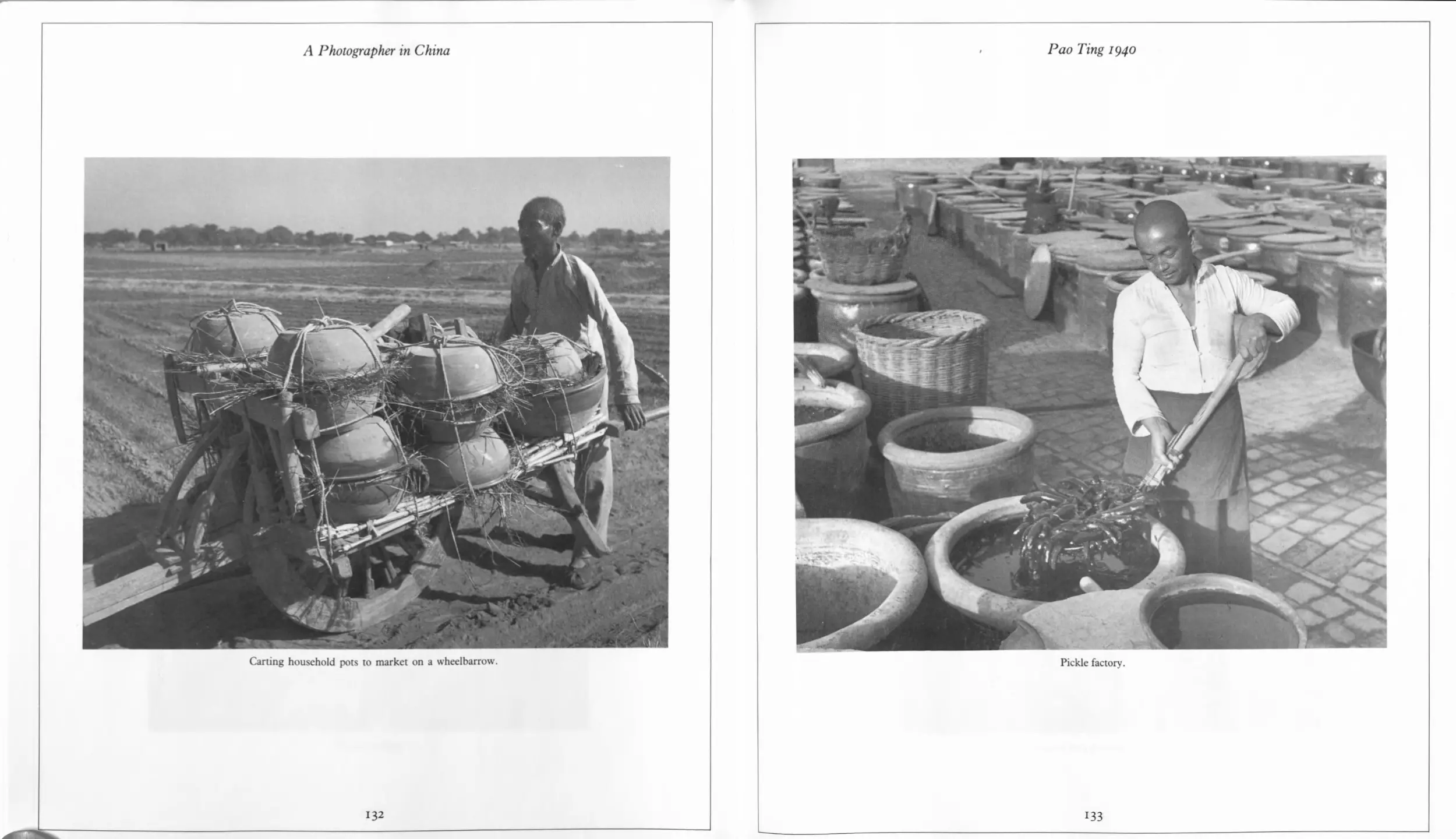
Caning household pots to market on a wheelbarrow.
Pao Ting 1940
Pickle factory.
133
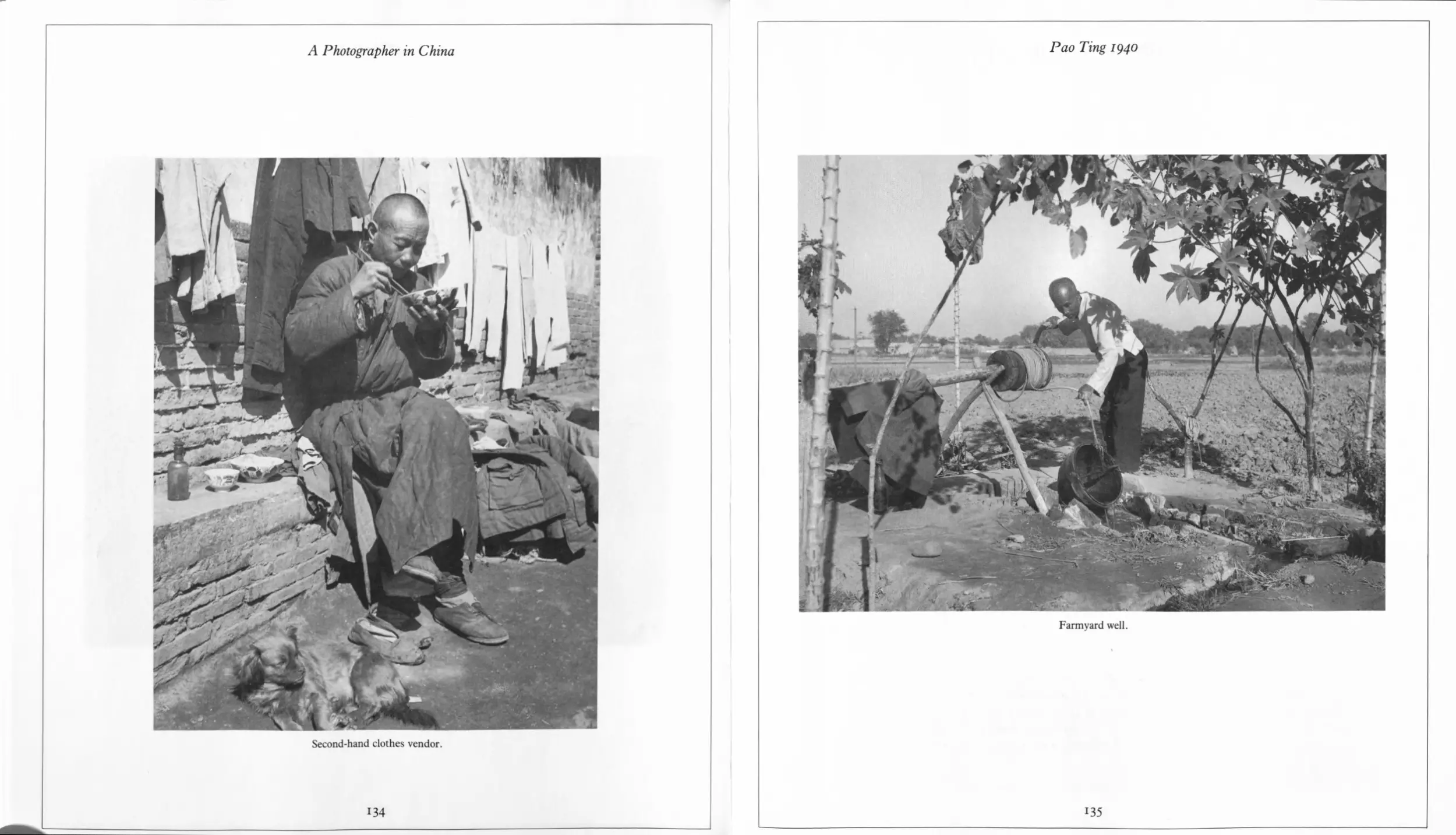
A Photographer in China
Second-hand clothes vendor.
134
Рао Ting 1940
Farmyard well.
135
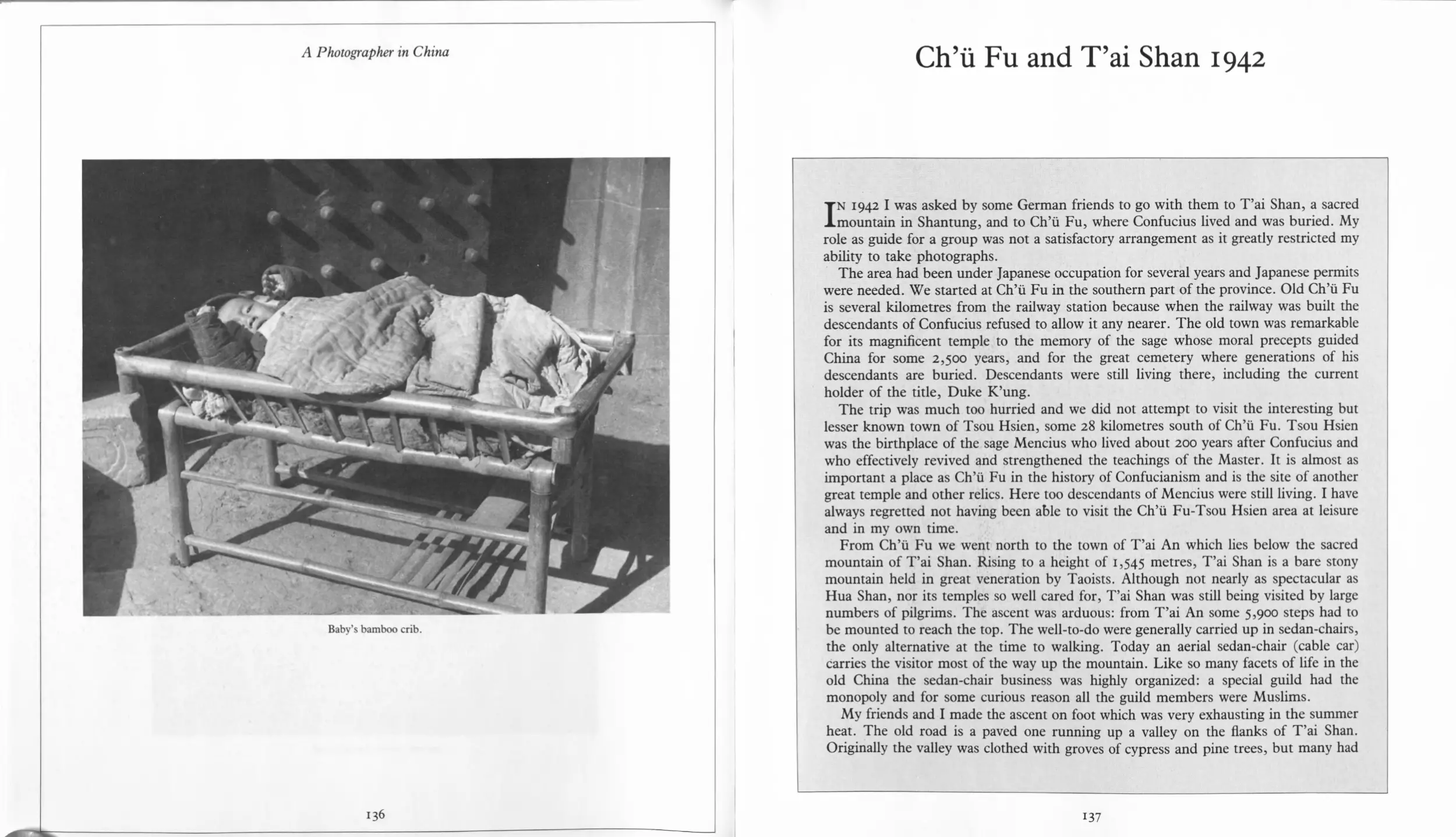
A Photographer in China
Baby’s bamboo crib.
136
Ch’ii Fu and T’ai Shan 1942
In 1942 I was asked by some German friends to go with them to T’ai Shan, a sacred
mountain in Shantung, and to Ch’ii Fu, where Confucius lived and was buried. My
role as guide for a group was not a satisfactory arrangement as it greatly restricted my
ability to take photographs.
The area had been under Japanese occupation for several years and Japanese permits
were needed. We started at Ch’ii Fu in the southern part of the province. Old Ch’ii Fu
is several kilometres from the railway station because when the railway was built the
descendants of Confucius refused to allow it any nearer. The old town was remarkable
for its magnificent temple to the memory of the sage whose moral precepts guided
China for some 2,500 years, and for the great cemetery where generations of his
descendants are buried. Descendants were still living there, including the current
holder of the title, Duke K’ung.
The trip was much too hurried and we did not attempt to visit the interesting but
lesser known town of Tsou Hsien, some 28 kilometres south of Ch’ii Fu. Tsou Hsien
was the birthplace of the sage Mencius who lived about 200 years after Confucius and
who effectively revived and strengthened the teachings of the Master. It is almost as
important a place as Ch’ii Fu in the history of Confucianism and is the site of another
great temple and other relics. Here too descendants of Mencius were still living. I have
always regretted not having been able to visit the Ch’ii Fu-Tsou Hsien area at leisure
and in my own time.
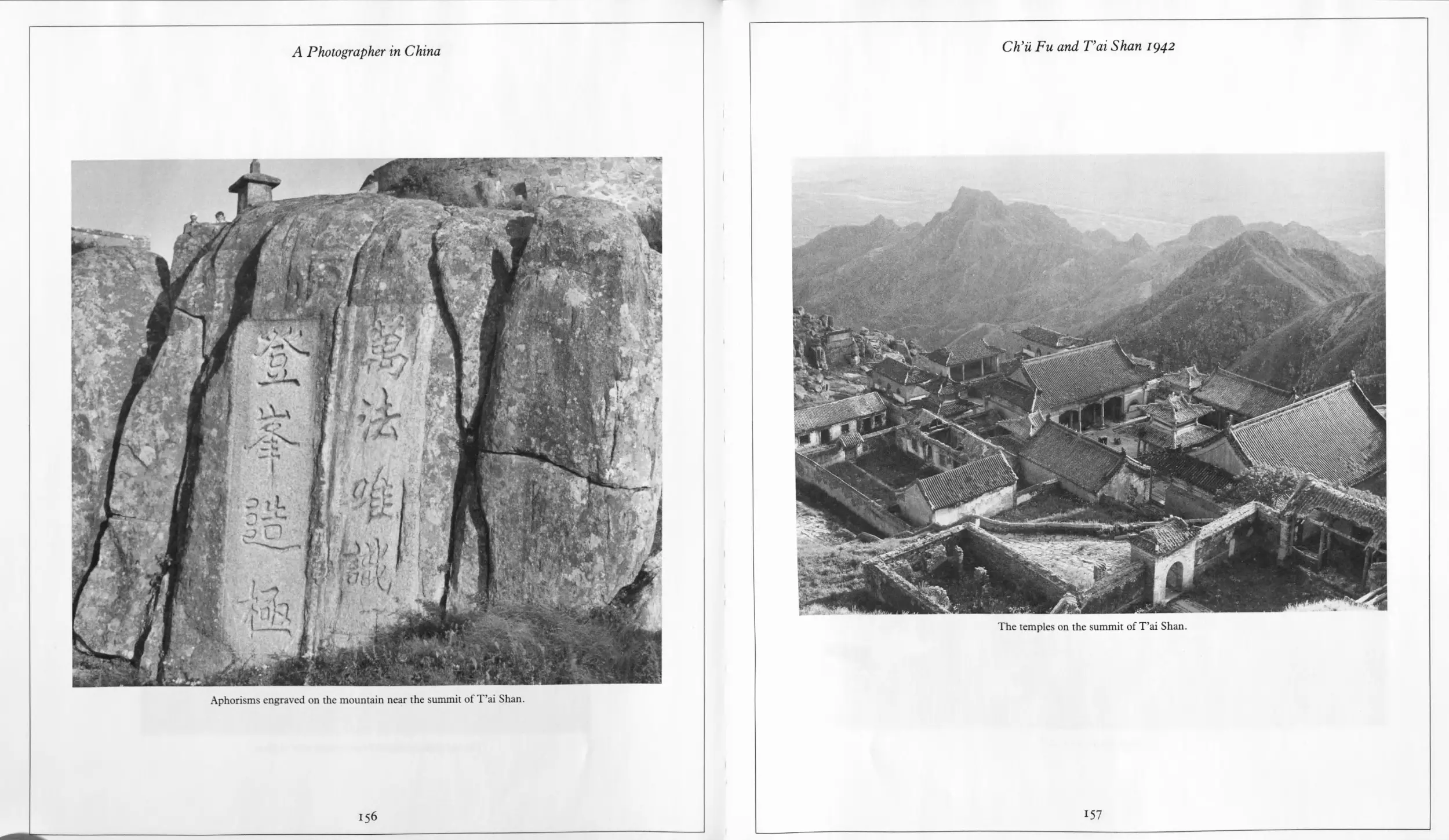
From Ch’ii Fu we went north to the town of T’ai An which lies below the sacred
mountain of T’ai Shan. Rising to a height of 1,545 metres, T’ai Shan is a bare stony
mountain held in great veneration by Taoists. Although not nearly as spectacular as
Hua Shan, nor its temples so well cared for, T’ai Shan was still being visited by large
numbers of pilgrims. The ascent was arduous: from T’ai An some 5,900 steps had to
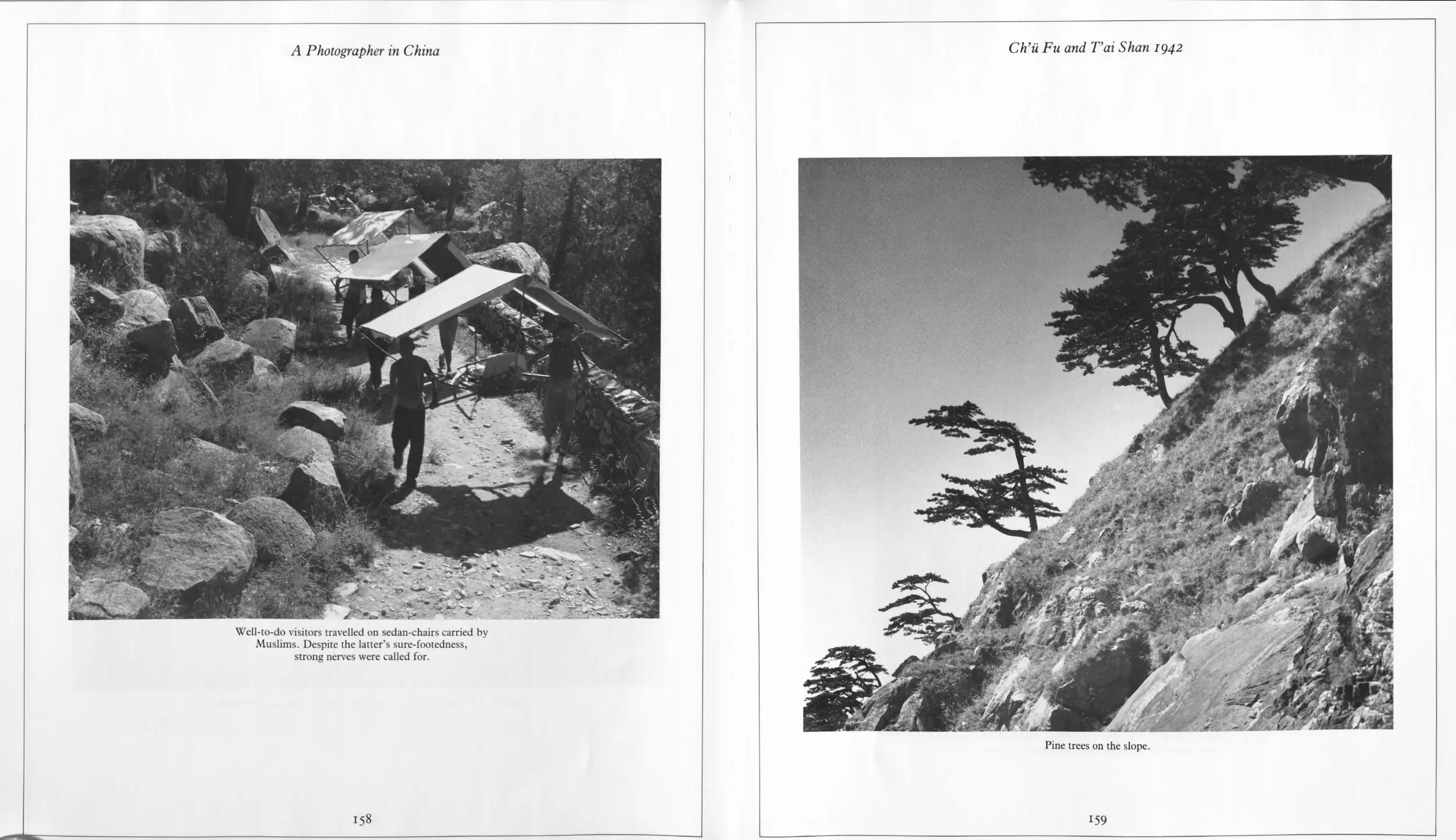
be mounted to reach the top. The well-to-do were generally carried up in sedan-chairs,
the only alternative at the time to walking. Today an aerial sedan-chair (cable car)
carries the visitor most of the way up the mountain. Like so many facets of life in the
old China the sedan-chair business was highly organized: a special guild had the
monopoly and for some curious reason all the guild members were Muslims.
My friends and I made the ascent on foot which was very exhausting in the summer
heat. The old road is a paved one running up a valley on the flanks of T’ai Shan.
Originally the valley was clothed with groves of cypress and pine trees, but many had
07
A Photographer in China
been felled. About half way up there was an important temple, the Middle Gate of
Heaven, which, after a fairly level stretch, led to the great stairway of some 2,000 steps
to the summit. In clear weather the site commanded a spectacular view over southern
Shantung. On the summit were a number of fine temples and we spent the night in one
of these. I was so busy looking after my companions that I kept no notes, and
unfortunately my recollections of the trip are dim.
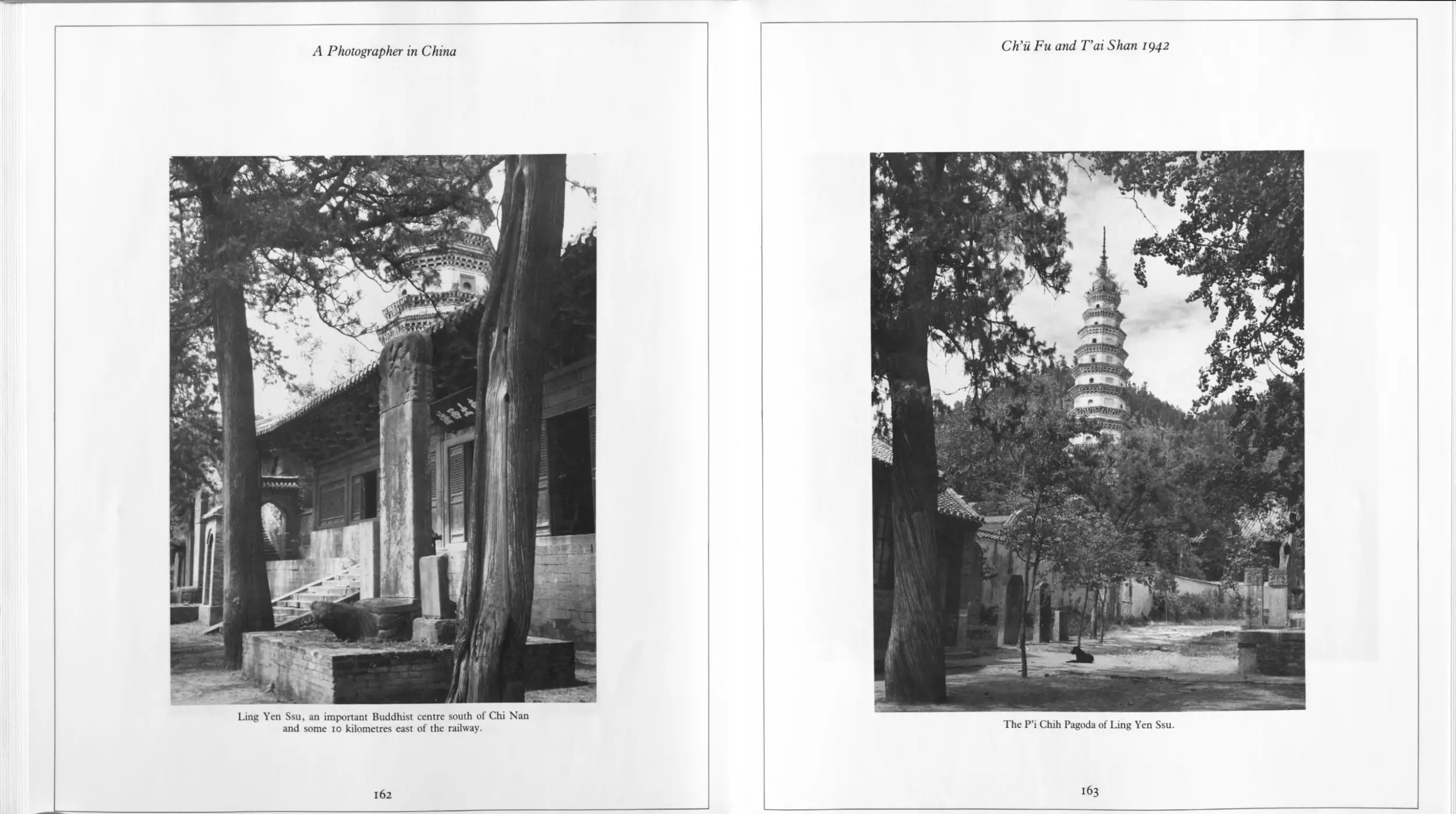
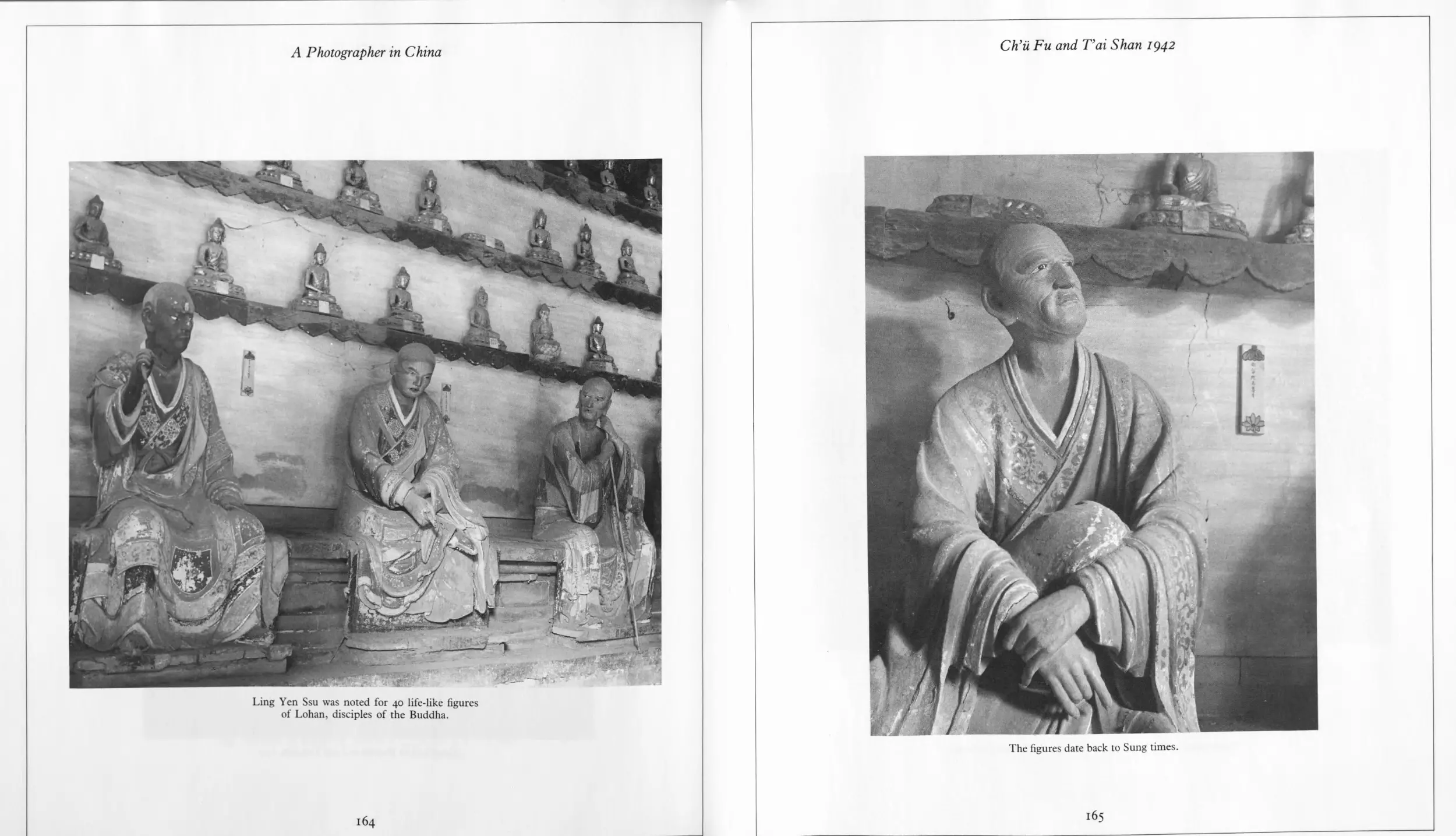
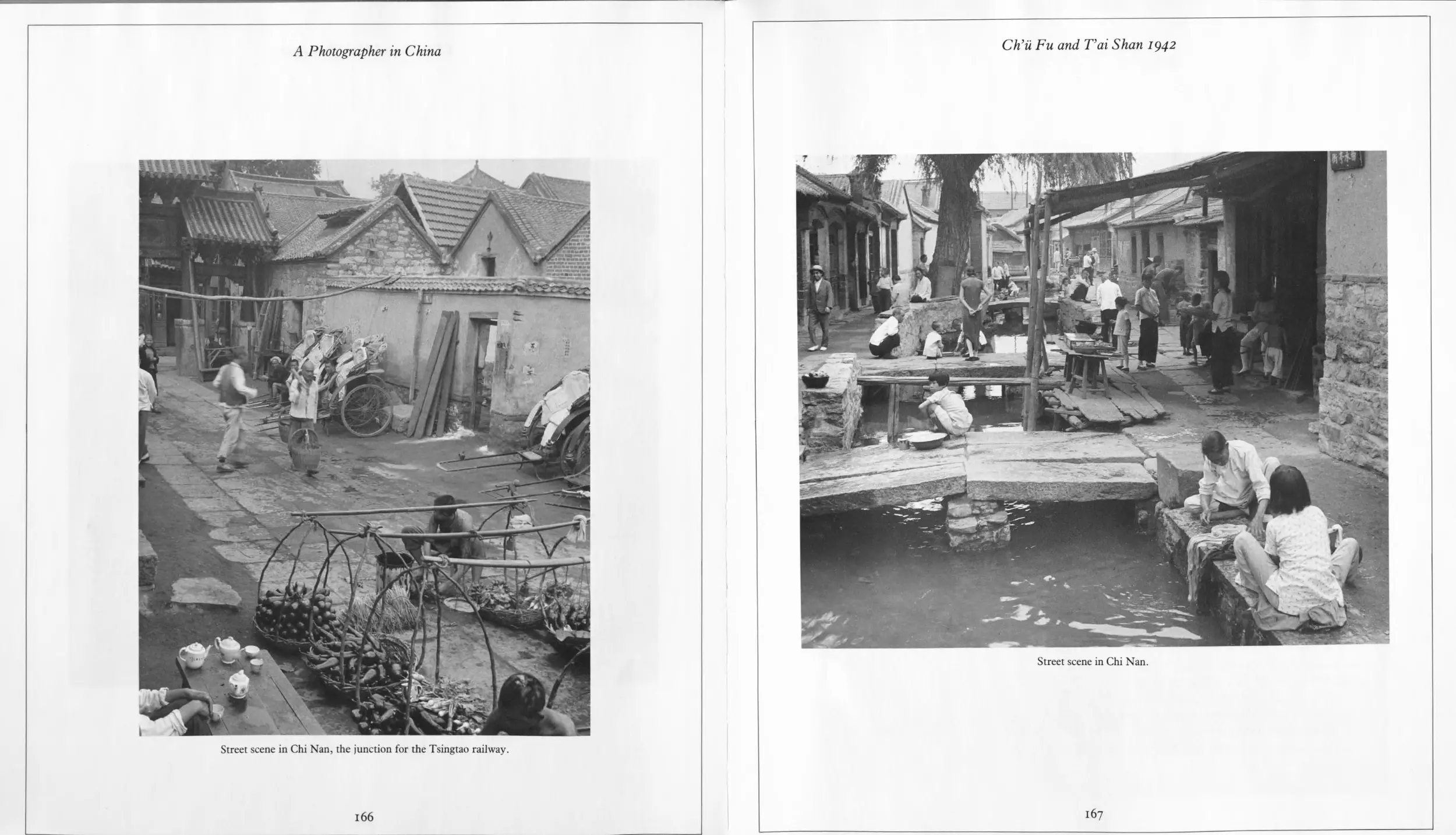
After T’ai Shan we visited one unusual temple reached from a stop on the railway
between T’ai An and Chi Nan. This was Ling Yen Ssu. It had some fine old buildings,
including a pagoda, and was notable for some life-size figures clad in the Chinese style
but with European facial characteristics. I have never found a full description of the
temple in the works I have been able to consult.
I accompanied my friends to Tsingtao where I had the misfortune of coming down
with scarlet fever. I had been feeling unwell during much of the trip. There was a
well-established German hospital in Tsingtao but it refused to admit me. A good
Samaritan, a Mrs Boetcher who ran a small guesthouse, quietly took me in and kindly
took care of me without alarming the other guests. I was treated by a German
missionary doctor, Dr Eitel, a good and liberal man. With their help I made a quick
recovery and was able to return to Peking. Dr Eitel was later recalled to Germany on
one of the blockade-breakers, merchant navy ships which essayed the journey back to
Europe. Some of these blockade-runners got through but I heard that Dr Eitel’s ship
was not so lucky and that he was lost on the journey.
138
Ch’ii Fu and T’ai Shan 1942
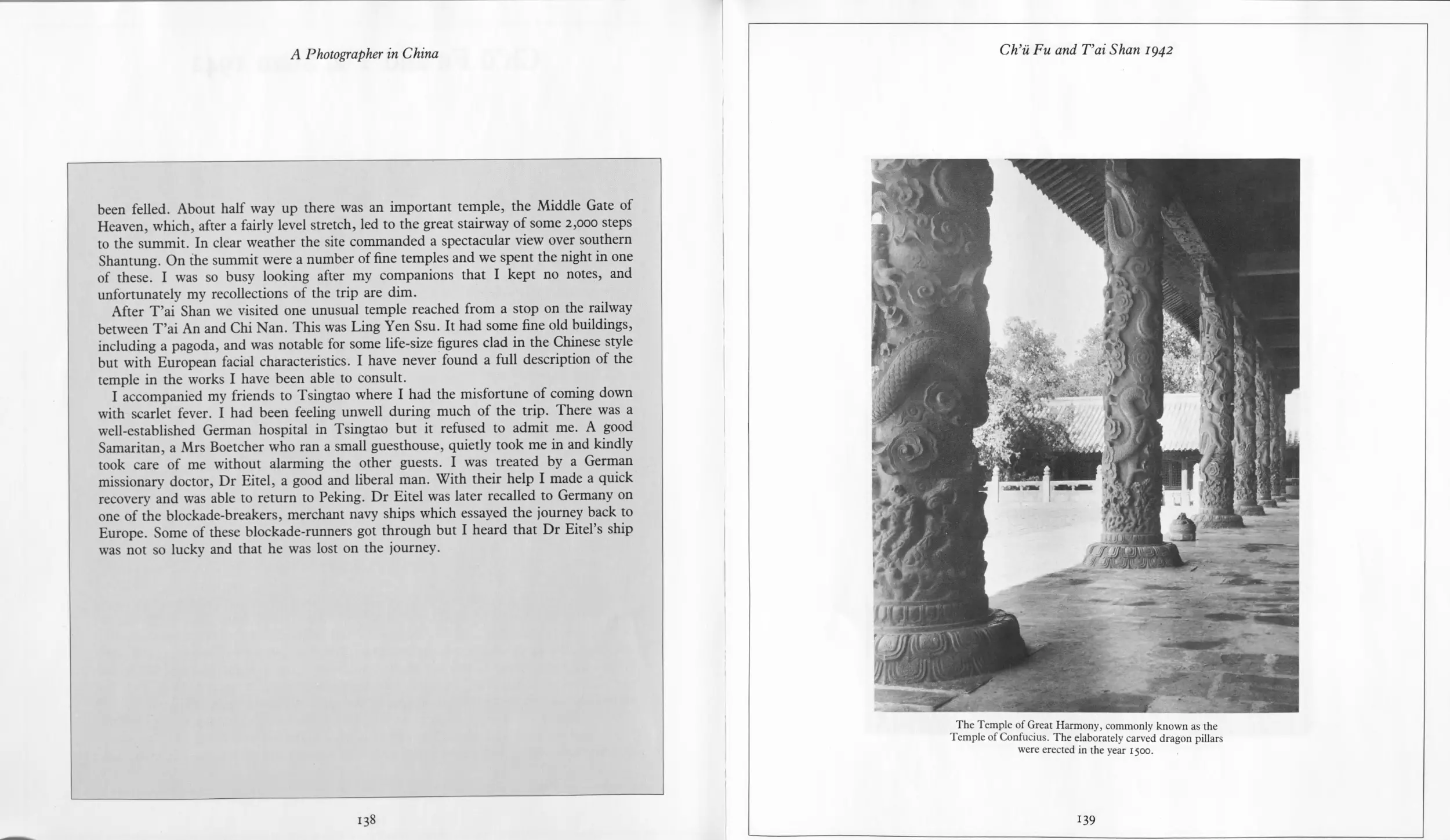
The Temple of Great Harmony, commonly known as the
Temple of Confucius. The elaborately carved dragon pillars
were erected in the year 1500.
139
A Photographer in China
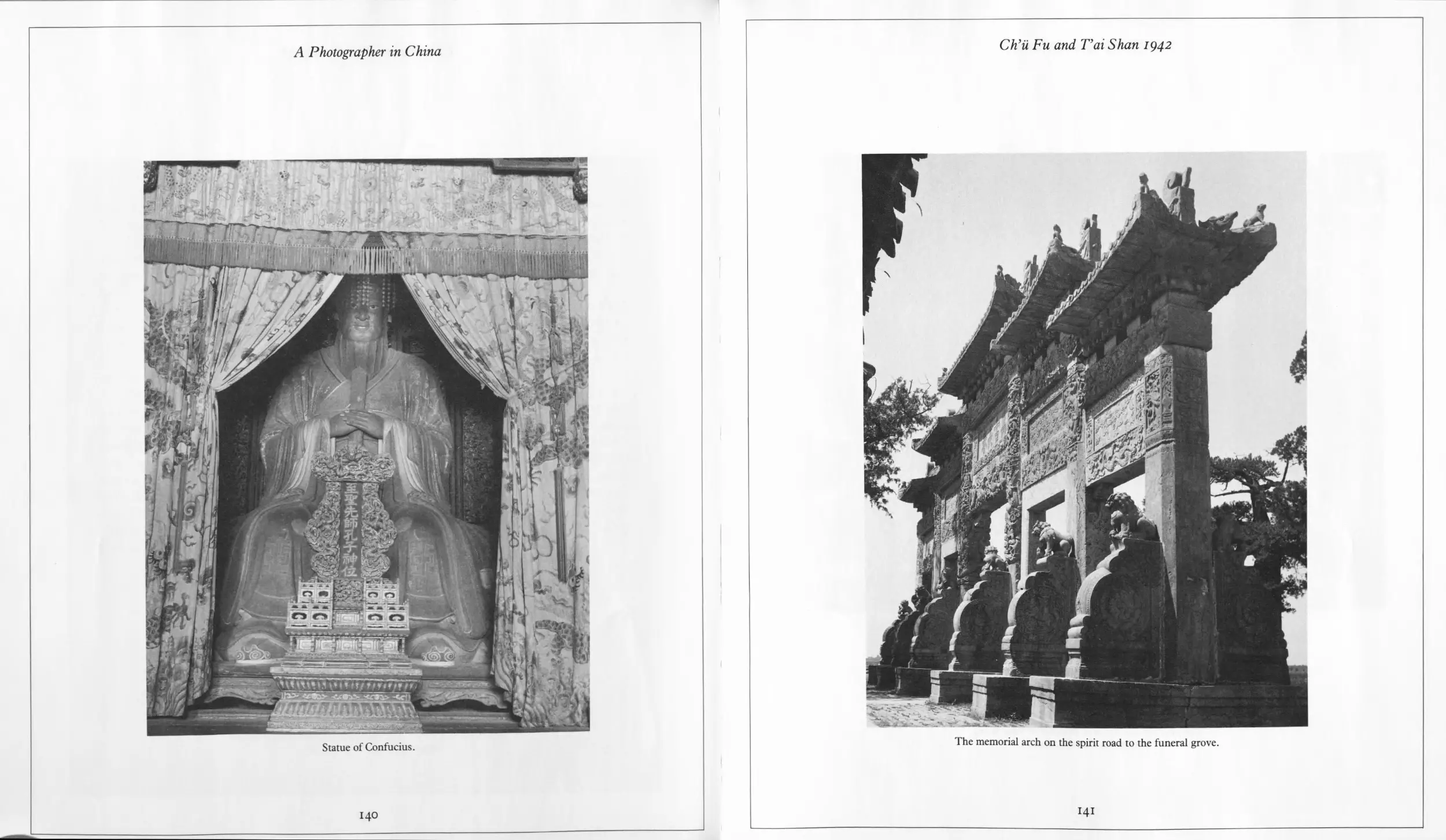
Statue of Confucius.
140
Ch’ti Fu and T’ai Shan 1942
The memorial arch on the spirit road to the funeral grove.
141
A Photographer in China
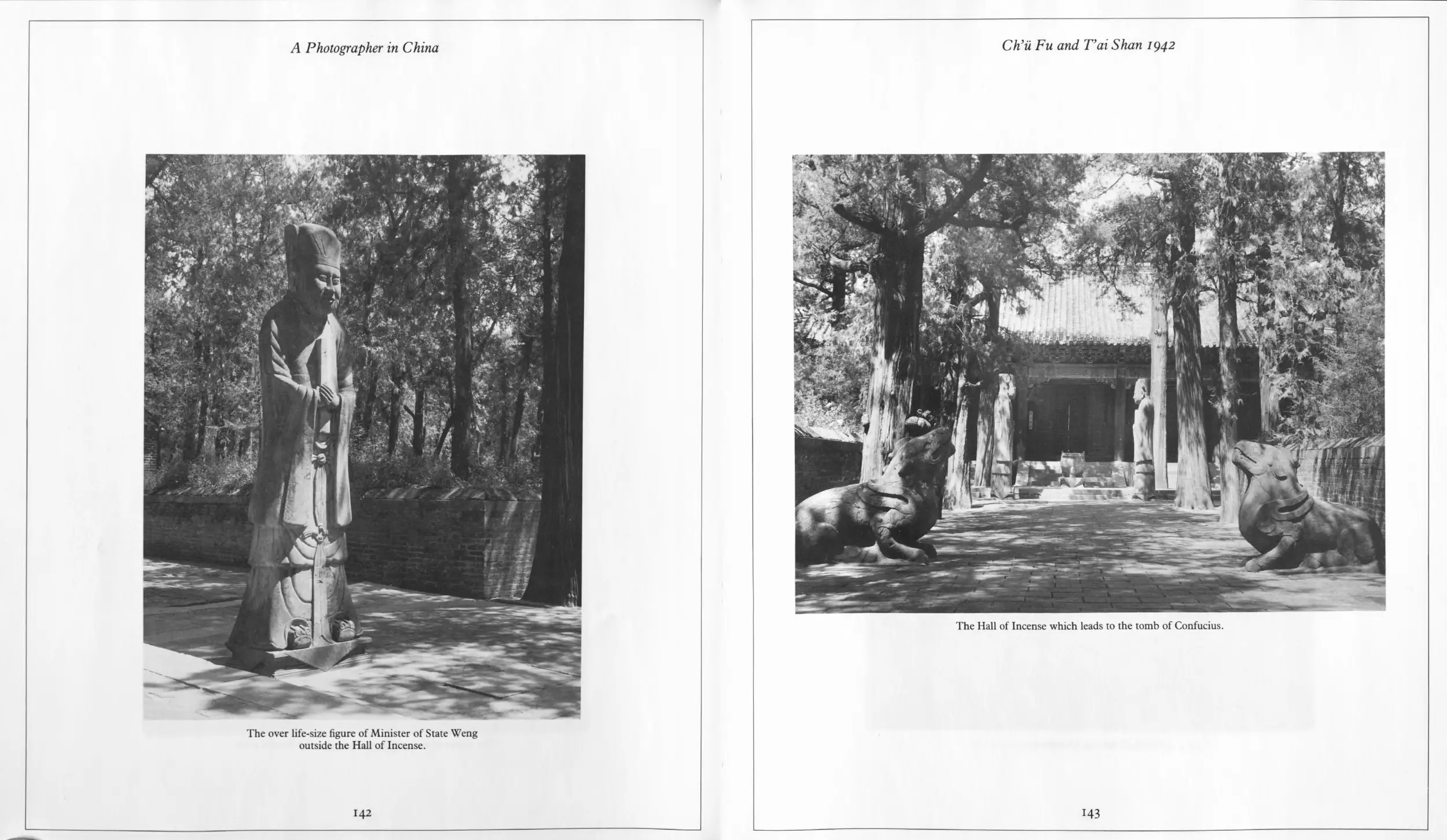
The over life-size figure of Minister of State Weng
outside the Hall of Incense.
142
Ch’ii Fu and T’ai Shan 1942
The Hall of Incense which leads to the tomb of Confucius.
М3
A Photographer in China
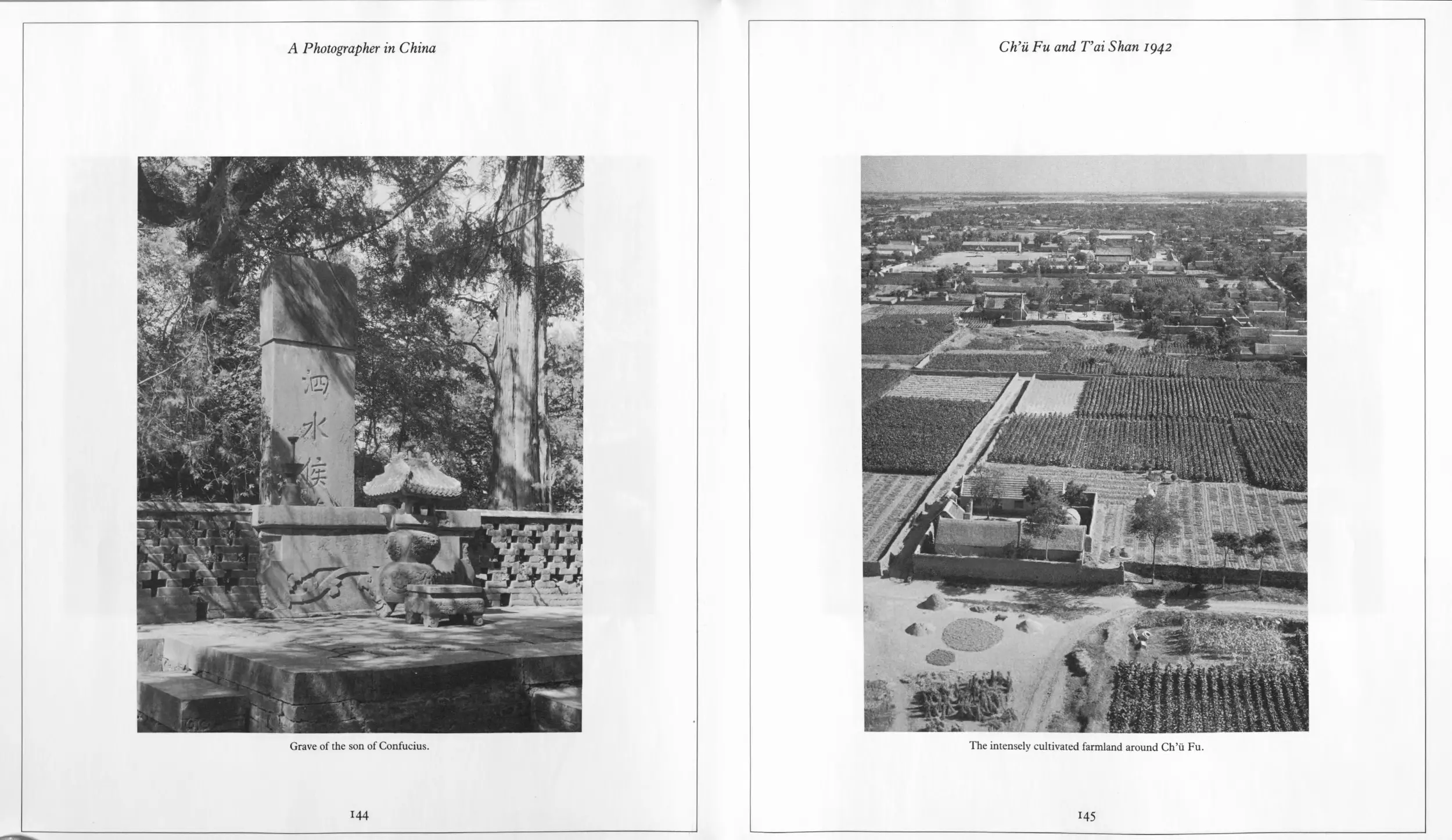
Grave of the son of Confucius.
144
Ch’ii Fu and T’ai Shan 1942
The intensely cultivated farmland around Ch’ii Fu.
45
A Photographer in China
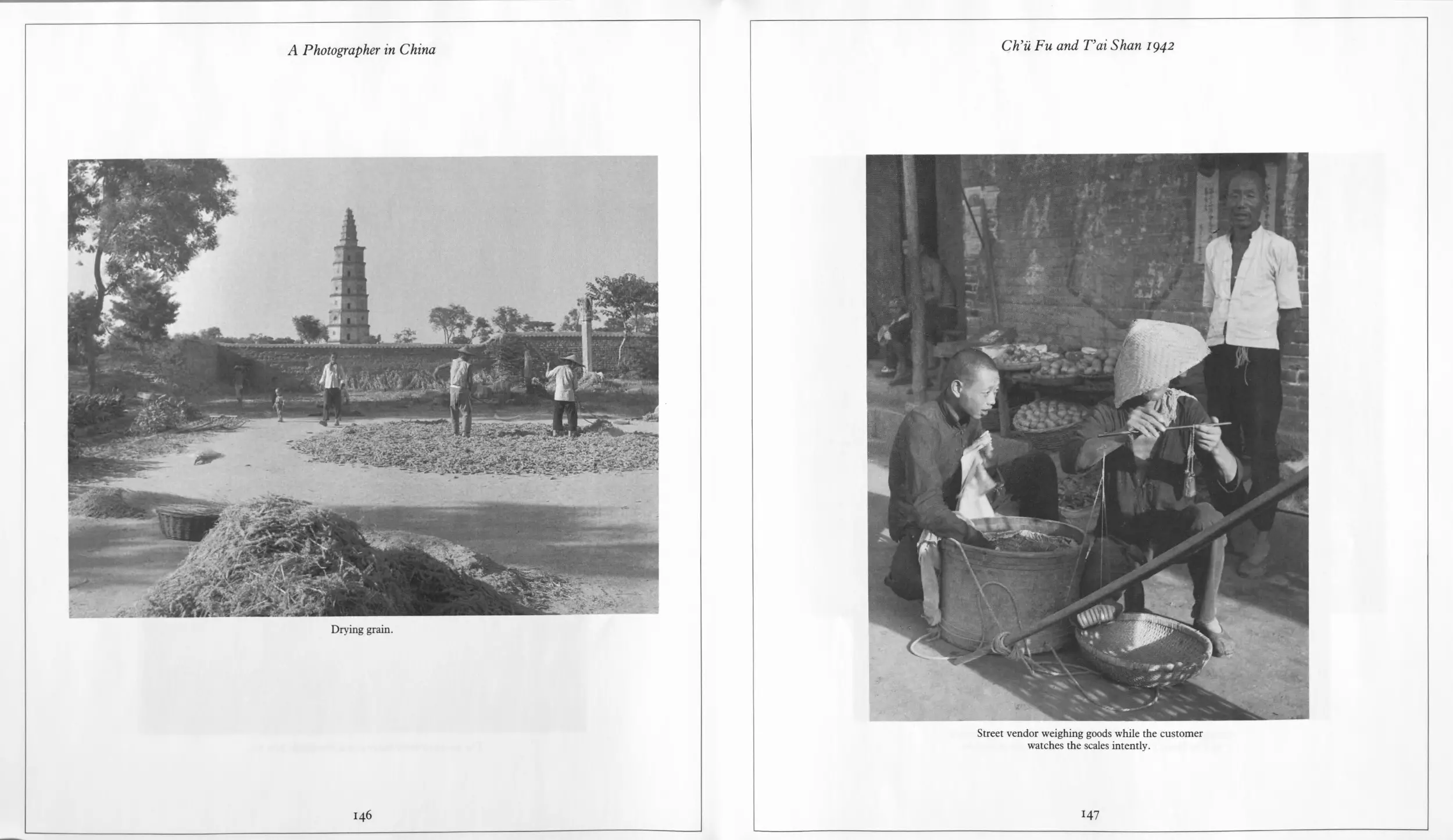
Drying grain.
146
Ch’ii Fu and T’ai Shan 1942
Street vendor weighing goods while the customer
watches the scales intently.
147
A Photographer in China
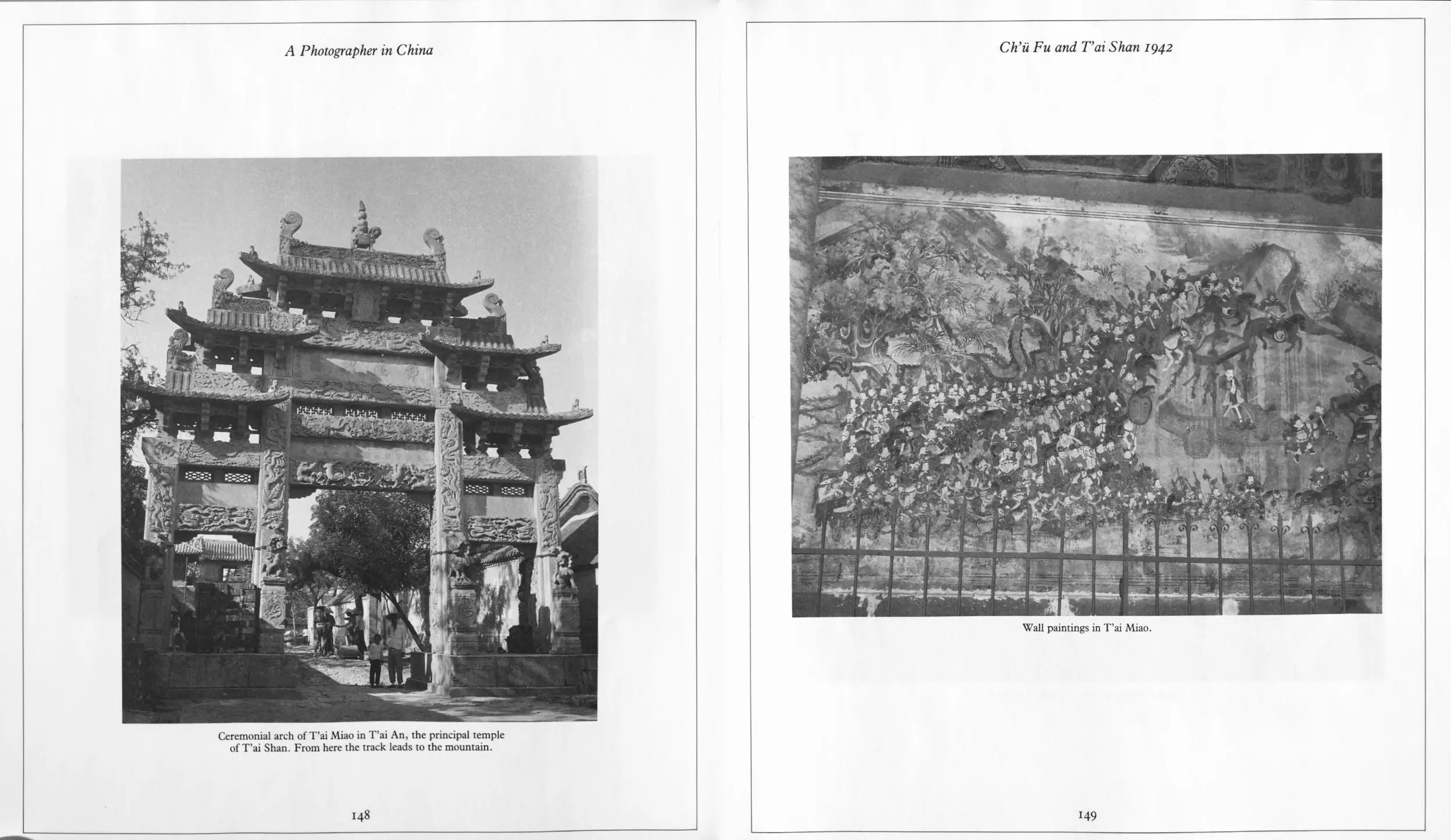
Ceremonial arch of T’ai Miao in T’ai An, the principal temple
of T’ai Shan. From here the track leads to the mountain.
148
Ch’ii. Fu and T’ai Shan 1942
Wall paintings in T’ai Miao.
49
A Photographer in China
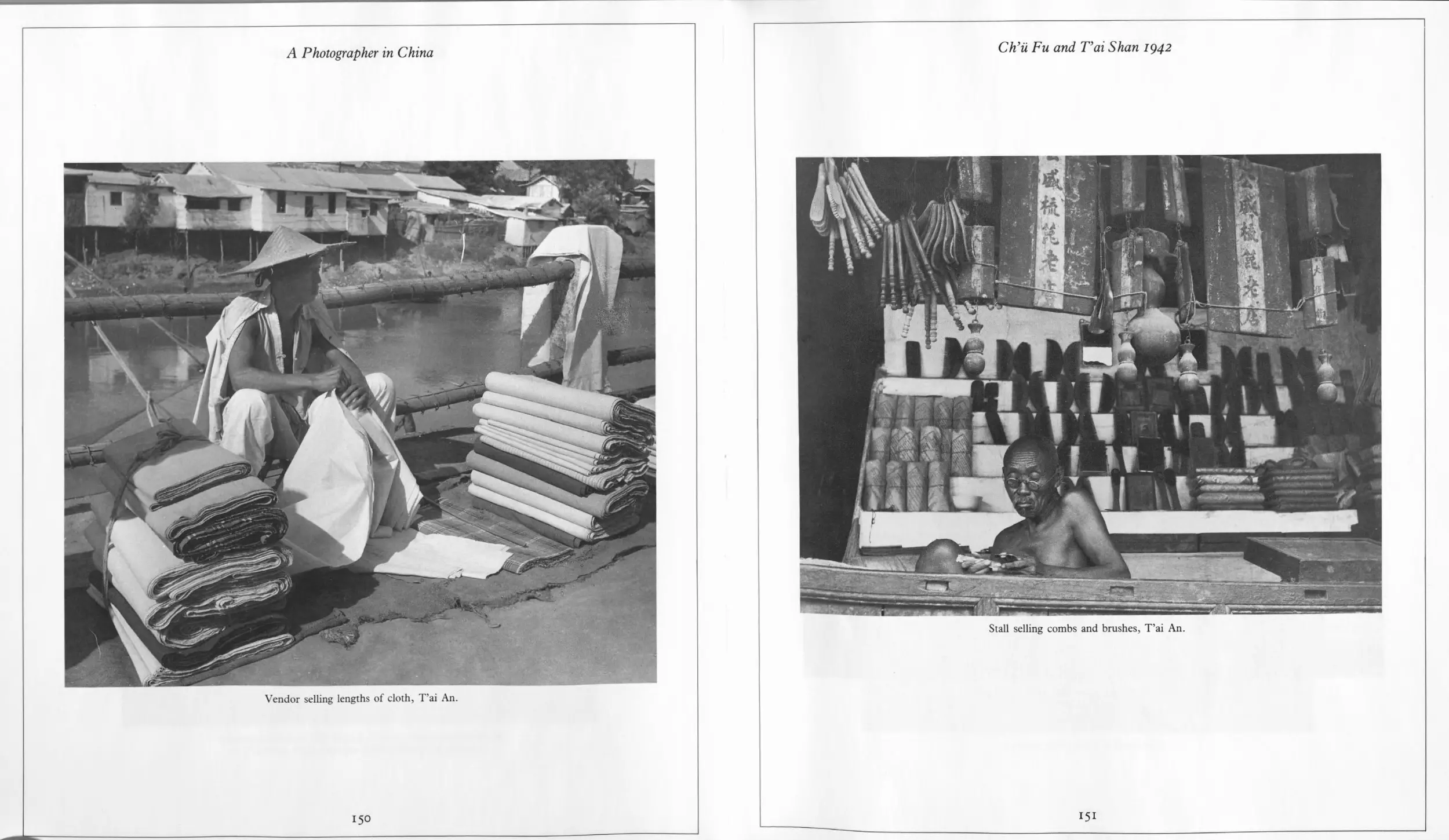
Vendor selling lengths of cloth, T’ai An.
150
Ch’ii Fu and T’ai Shan 1942
Stall selling combs and brushes, T’ai An.
A Photographer in China
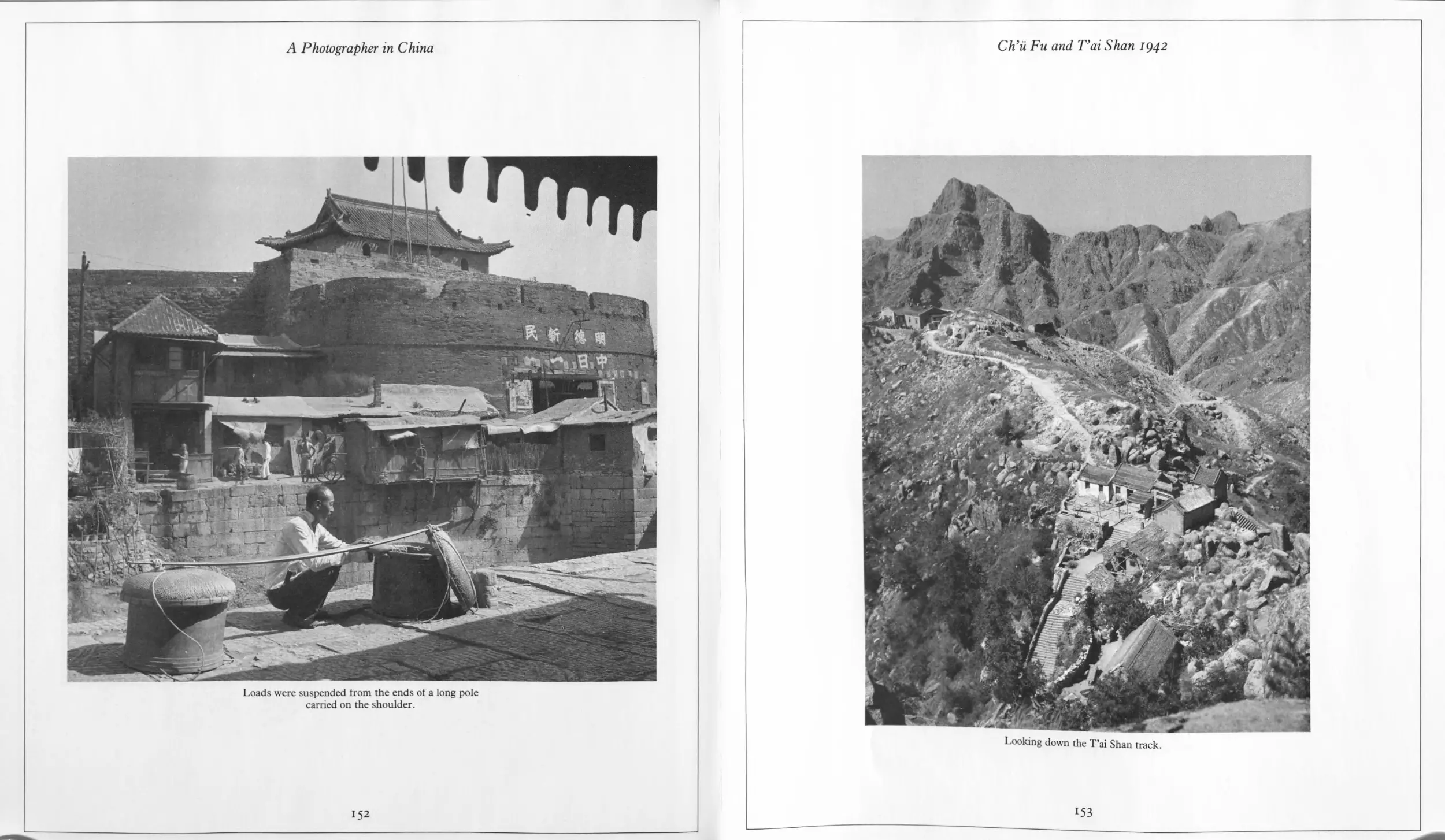
Loads were suspended from the ends of a long pole
carried on the shoulder.
152
Ch’ii Fu and T’ai Shan 1942
Looking down the T’ai Shan track.
153
A Photographer in China
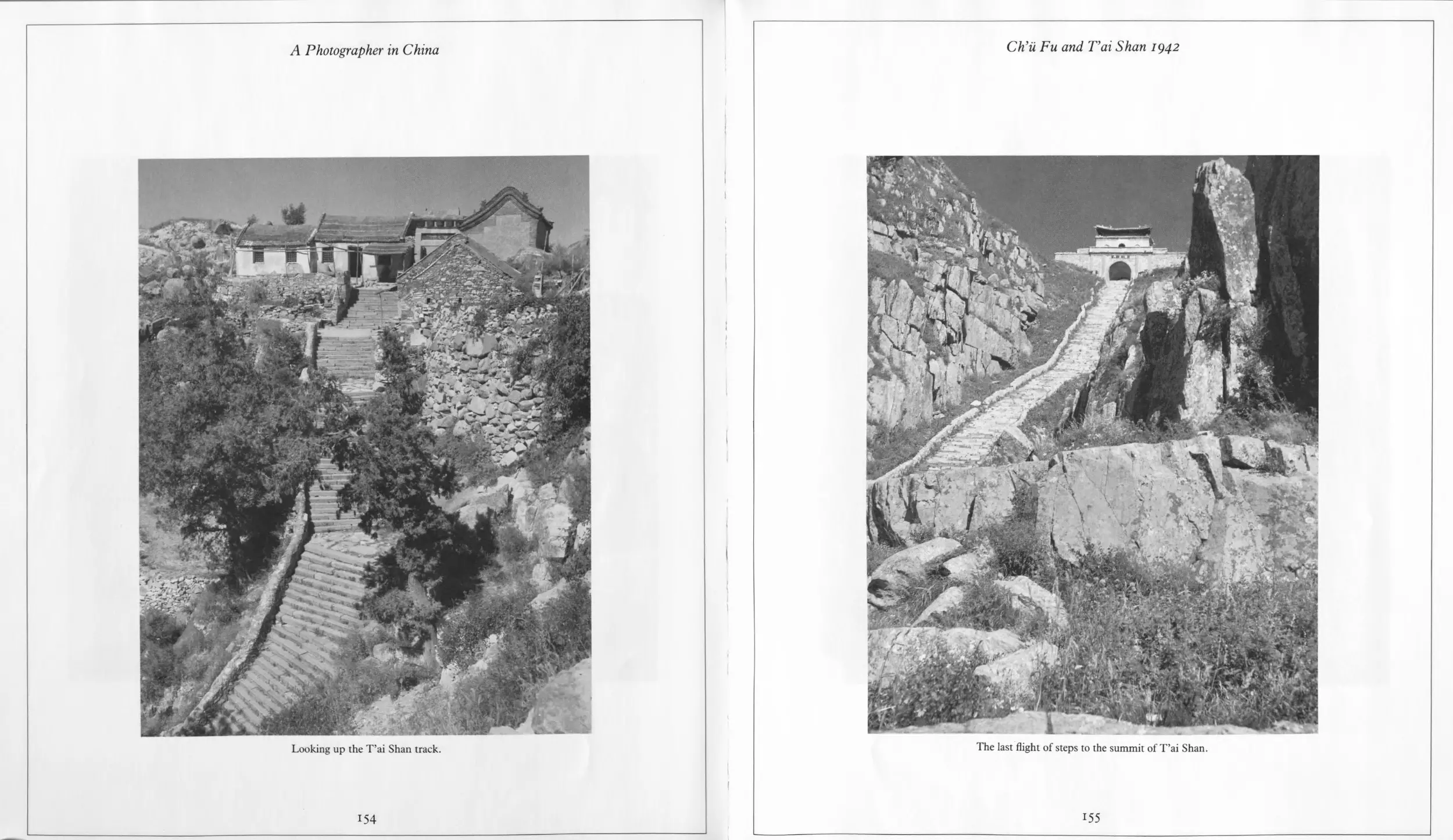
Looking up the T’ai Shan track.
154
Ch’ii Fu and T’ai Shan 1942
The last flight of steps to the summit of T’ai Shan.
155
A Photographer in China
Aphorisms engraved on the mountain near the summit of T’ai Shan.
156
Ch’U Fu and T’ai Shan 1942
The temples on the summit of T’ai Shan.
157
A Photographer in China
Well-to-do visitors travelled on sedan-chairs carried by
Muslims. Despite the latter’s sure-footedness,
strong nerves were called for.
158
Ch’U Fu and T’ai Shan 1942
Pine trees on the slope.
159
A Photographer in China
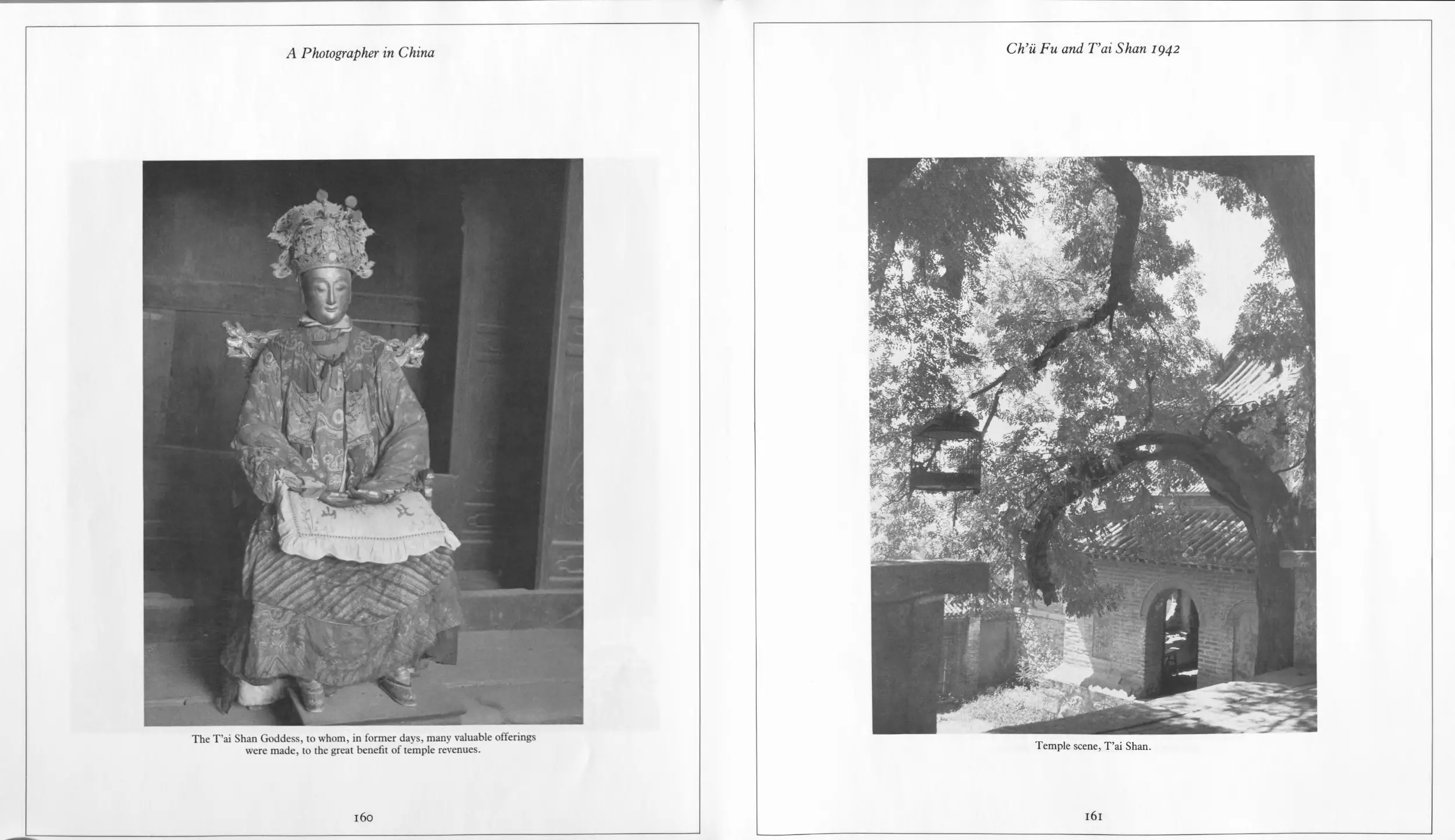
The T’ai Shan Goddess, to whom, in former days, many valuable offerings
were made, to the great benefit of temple revenues.
160
Ch’ii Fu and T’ai Shan 1942
Temple scene, T’ai Shan.
l6l
A Photographer in China
Ling Yen Ssu, an important Buddhist centre south of Chi Nan
and some io kilometres east of the railway.
l62
Ch’ii Fu and T’ai Shan 1942
The P’i Chih Pagoda of Ling Yen Ssu.
A Photographer in China
Ling Yen Ssu was noted for 40 life-like figures
of Lohan, disciples of the Buddha.
164
Ch’u Fu and T’ai Shan 1942
The figures date back to Sung times.

165
A Photographer in China
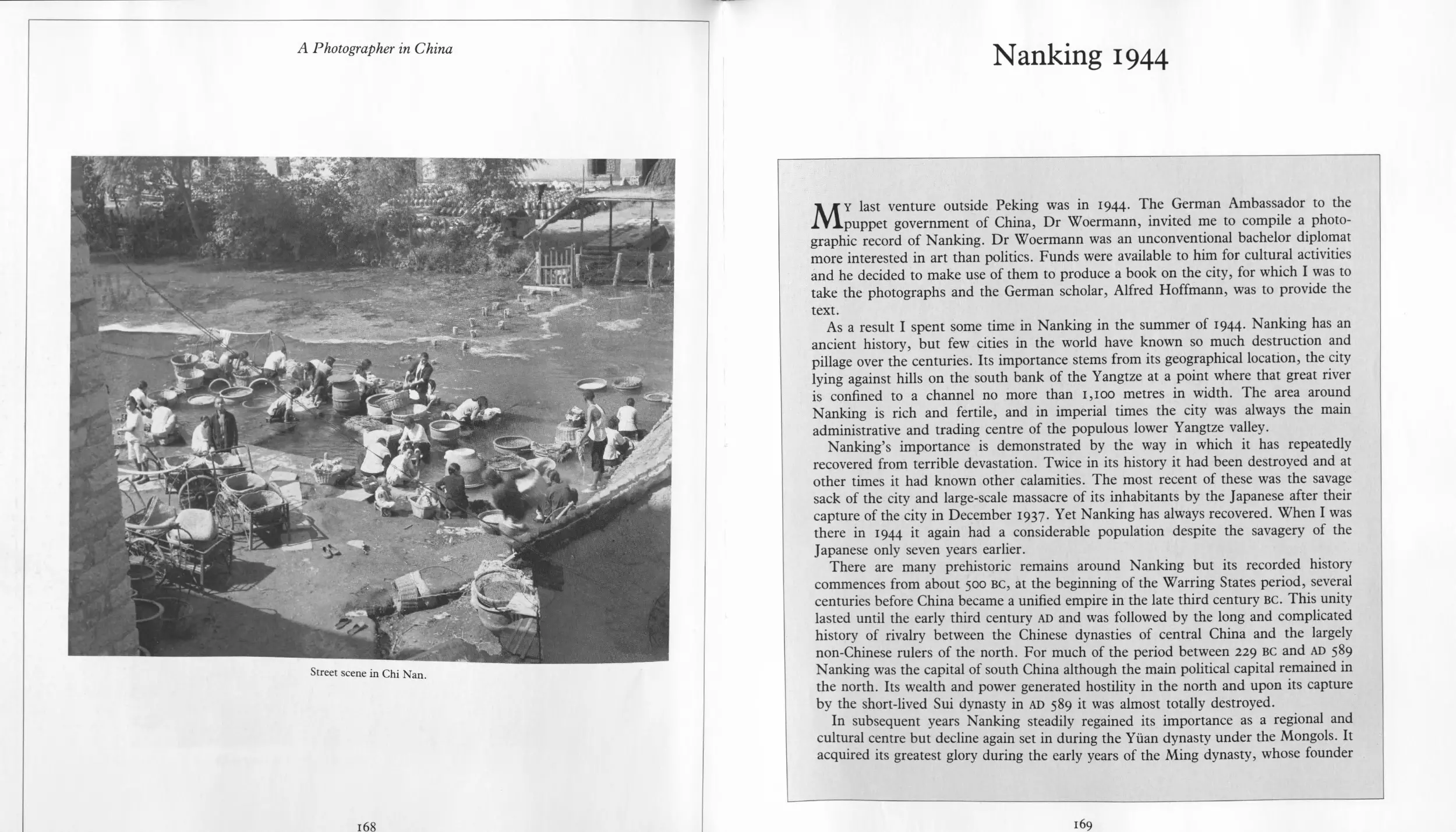
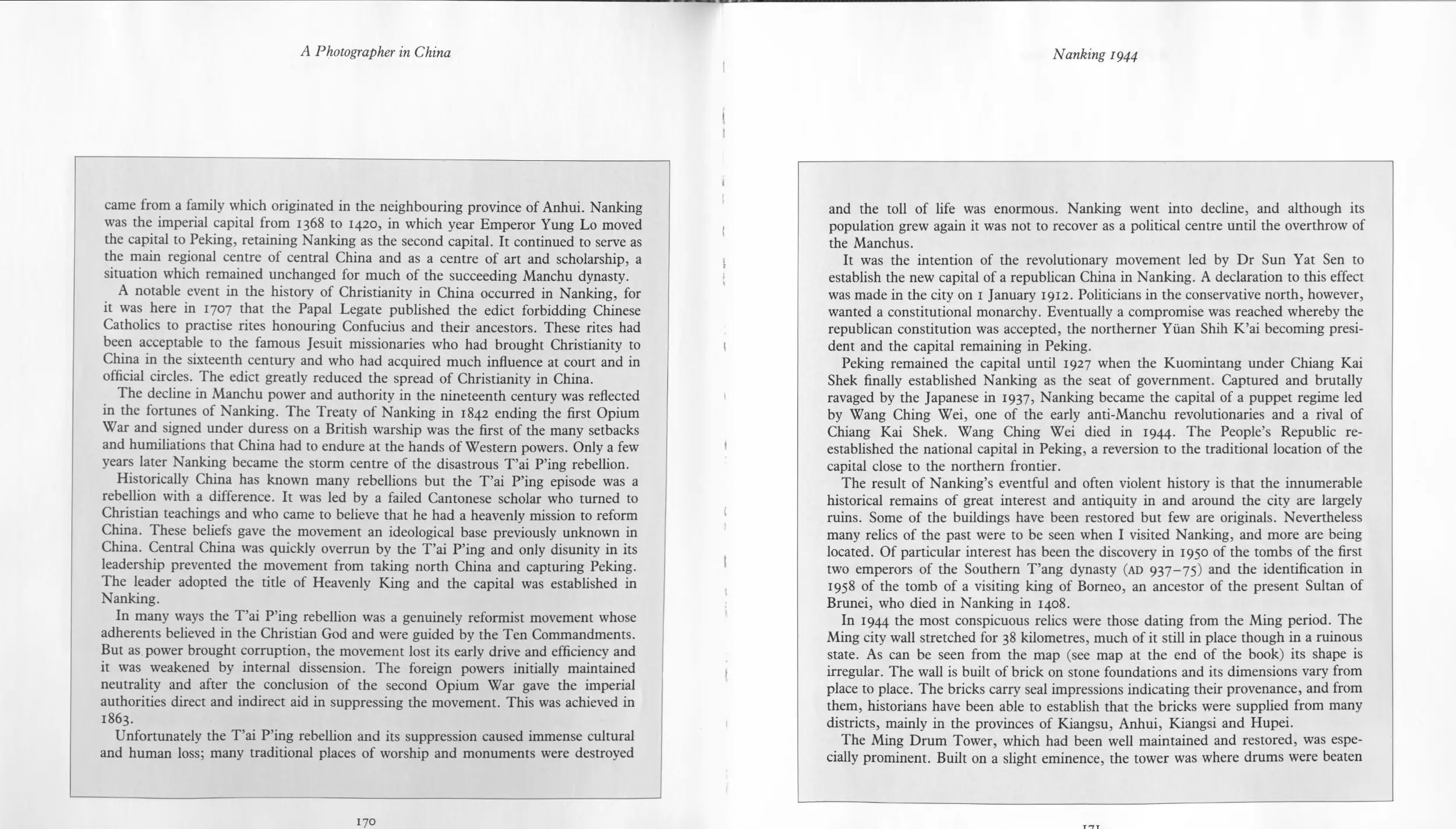
Street scene in Chi Nan, the junction for the Tsingtao railway.
166
Ch’ii Fu and T’ai Shan 1942
Street scene in Chi Nan.
167
A Photographer in China
Street scene in Chi Nan.
168
Nanking 1944
MY last venture outside Peking was in 1944. The German Ambassador to the
puppet government of China, Dr Woermann, invited me to compile a photo-
graphic record of Nanking. Dr Woermann was an unconventional bachelor diplomat
more interested in art than politics. Funds were available to him for cultural activities
and he decided to make use of them to produce a book on the city, for which I was to
take the photographs and the German scholar, Alfred Hoffmann, was to provide the
text.
As a result I spent some time in Nanking in the summer of 1944. Nanking has an
ancient history, but few cities in the world have known so much destruction and
pillage over the centuries. Its importance stems from its geographical location, the city
lying against hills on the south bank of the Yangtze at a point where that great river
is confined to a channel no more than 1,100 metres in width. The area around
Nanking is rich and fertile, and in imperial times the city was always the main
administrative and trading centre of the populous lower Yangtze valley.
Nanking’s importance is demonstrated by the way in which it has repeatedly
recovered from terrible devastation. Twice in its history it had been destroyed and at
other times it had known other calamities. The most recent of these was the savage
sack of the city and large-scale massacre of its inhabitants by the Japanese after their
capture of the city in December 1937. Yet Nanking has always recovered. When I was
there in 1944 it again had a considerable population despite the savagery of the
Japanese only seven years earlier.
There are many prehistoric remains around Nanking but its recorded history
commences from about 500 BC, at the beginning of the Warring States period, several
centuries before China became a unified empire in the late third century BC. This unity
lasted until the early third century AD and was followed by the long and complicated
history of rivalry between the Chinese dynasties of central China and the largely
non-Chinese rulers of the north. For much of the period between 229 BC and AD 589
Nanking was the capital of south China although the main political capital remained in
the north. Its wealth and power generated hostility in the north and upon its capture
by the short-lived Sui dynasty in ad 589 it was almost totally destroyed.
In subsequent years Nanking steadily regained its importance as a regional and
cultural centre but decline again set in during the Yuan dynasty under the Mongols. It
acquired its greatest glory during the early years of the Ming dynasty, whose founder
169
A Photographer in China
came from a family which originated in the neighbouring province of Anhui. Nanking
was the imperial capital from 1368 to 1420, in which year Emperor Yung Lo moved
the capital to Peking, retaining Nanking as the second capital. It continued to serve as
the main regional centre of central China and as a centre of art and scholarship, a
situation which remained unchanged for much of the succeeding Manchu dynasty.
A notable event in the history of Christianity in China occurred in Nanking, for
it was here in 1707 that the Papal Legate published the edict forbidding Chinese
Catholics to practise rites honouring Confucius and their ancestors. These rites had
been acceptable to the famous Jesuit missionaries who had brought Christianity to
China in the sixteenth century and who had acquired much influence at court and in
official circles. The edict greatly reduced the spread of Christianity in China.
The decline in Manchu power and authority in the nineteenth century was reflected
in the fortunes of Nanking. The Treaty of Nanking in 1842 ending the first Opium
War and signed under duress on a British warship was the first of the many setbacks
and humiliations that China had to endure at the hands of Western powers. Only a few
years later Nanking became the storm centre of the disastrous T’ai P’ing rebellion.
Historically China has known many rebellions but the T’ai P’ing episode was a
rebellion with a difference. It was led by a failed Cantonese scholar who turned to
Christian teachings and who came to believe that he had a heavenly mission to reform
China. These beliefs gave the movement an ideological base previously unknown in
China. Central China was quickly overrun by the T’ai P’ing and only disunity in its
leadership prevented the movement from taking north China and capturing Peking.
The leader adopted the title of Heavenly King and the capital was established in
Nanking.
In many ways the T’ai P’ing rebellion was a genuinely reformist movement whose
adherents believed in the Christian God and were guided by the Ten Commandments.
But as power brought corruption, the movement lost its early drive and efficiency and
it was weakened by internal dissension. The foreign powers initially maintained
neutrality and after the conclusion of the second Opium War gave the imperial
authorities direct and indirect aid in suppressing the movement. This was achieved in
1863.
Unfortunately the T’ai P’ing rebellion and its suppression caused immense cultural
and human loss; many traditional places of worship and monuments were destroyed
170
Nanking 1944
and the toll of life was enormous. Nanking went into decline, and although its
population grew again it was not to recover as a political centre until the overthrow of
the Manchus.
It was the intention of the revolutionary movement led by Dr Sun Yat Sen to
establish the new capital of a republican China in Nanking. A declaration to this effect
was made in the city on 1 January 1912. Politicians in the conservative north, however,
wanted a constitutional monarchy. Eventually a compromise was reached whereby the
republican constitution was accepted, the northerner Yiian Shih K’ai becoming presi-
dent and the capital remaining in Peking.
Peking remained the capital until 1927 when the Kuomintang under Chiang Kai
Shek finally established Nanking as the seat of government. Captured and brutally
ravaged by the Japanese in 1937, Nanking became the capital of a puppet regime led
by Wang Ching Wei, one of the early anti-Manchu revolutionaries and a rival of
Chiang Kai Shek. Wang Ching Wei died in 1944. The People’s Republic re-
established the national capital in Peking, a reversion to the traditional location of the
capital close to the northern frontier.
The result of Nanking’s eventful and often violent history is that the innumerable
historical remains of great interest and antiquity in and around the city are largely
ruins. Some of the buildings have been restored but few are originals. Nevertheless
many relics of the past were to be seen when I visited Nanking, and more are being
located. Of particular interest has been the discovery in 1950 of the tombs of the first
two emperors of the Southern T’ang dynasty (ad 937-75) and the identification in
1958 of the tomb of a visiting king of Borneo, an ancestor of the present Sultan of
Brunei, who died in Nanking in 1408.
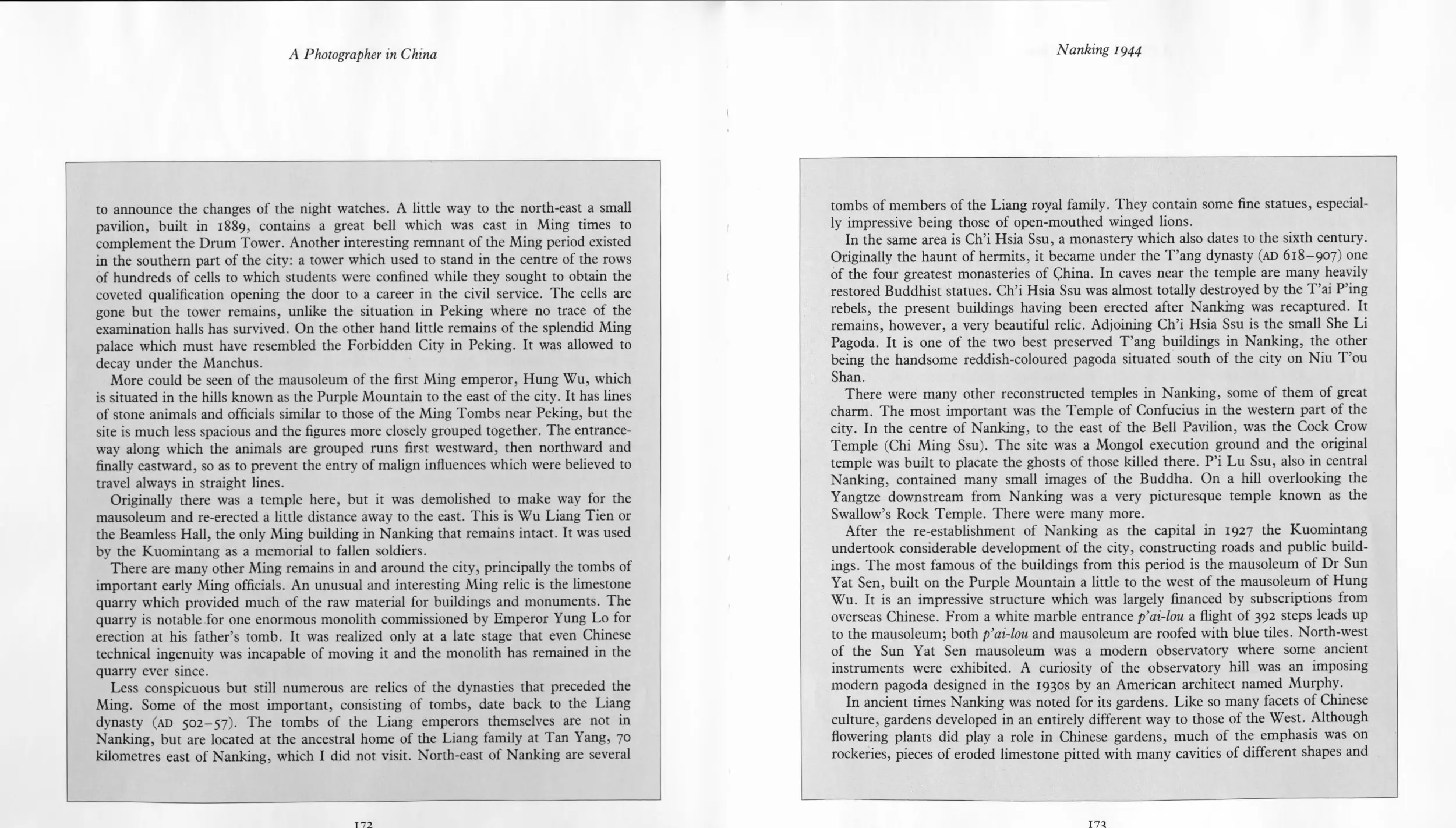
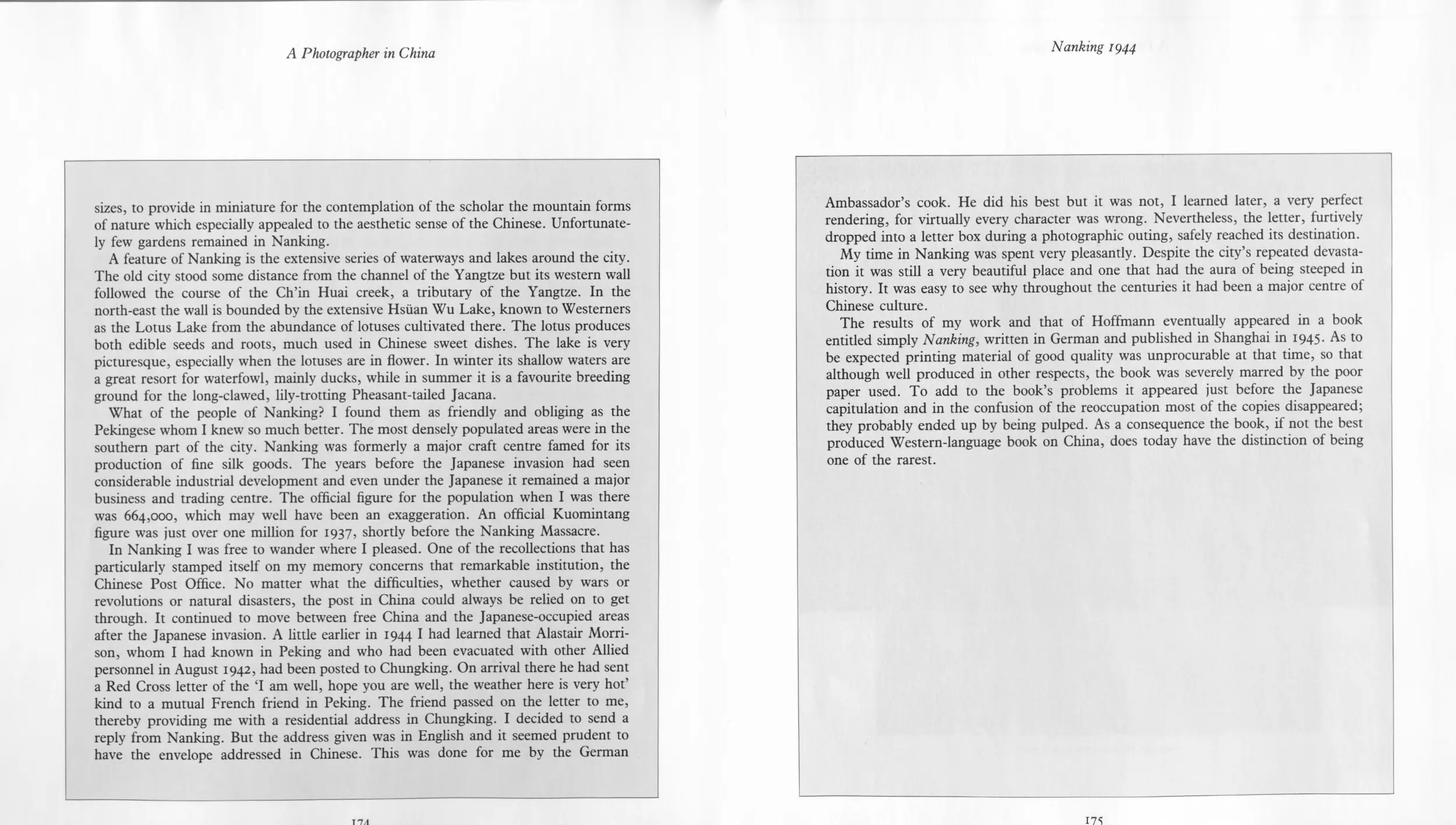
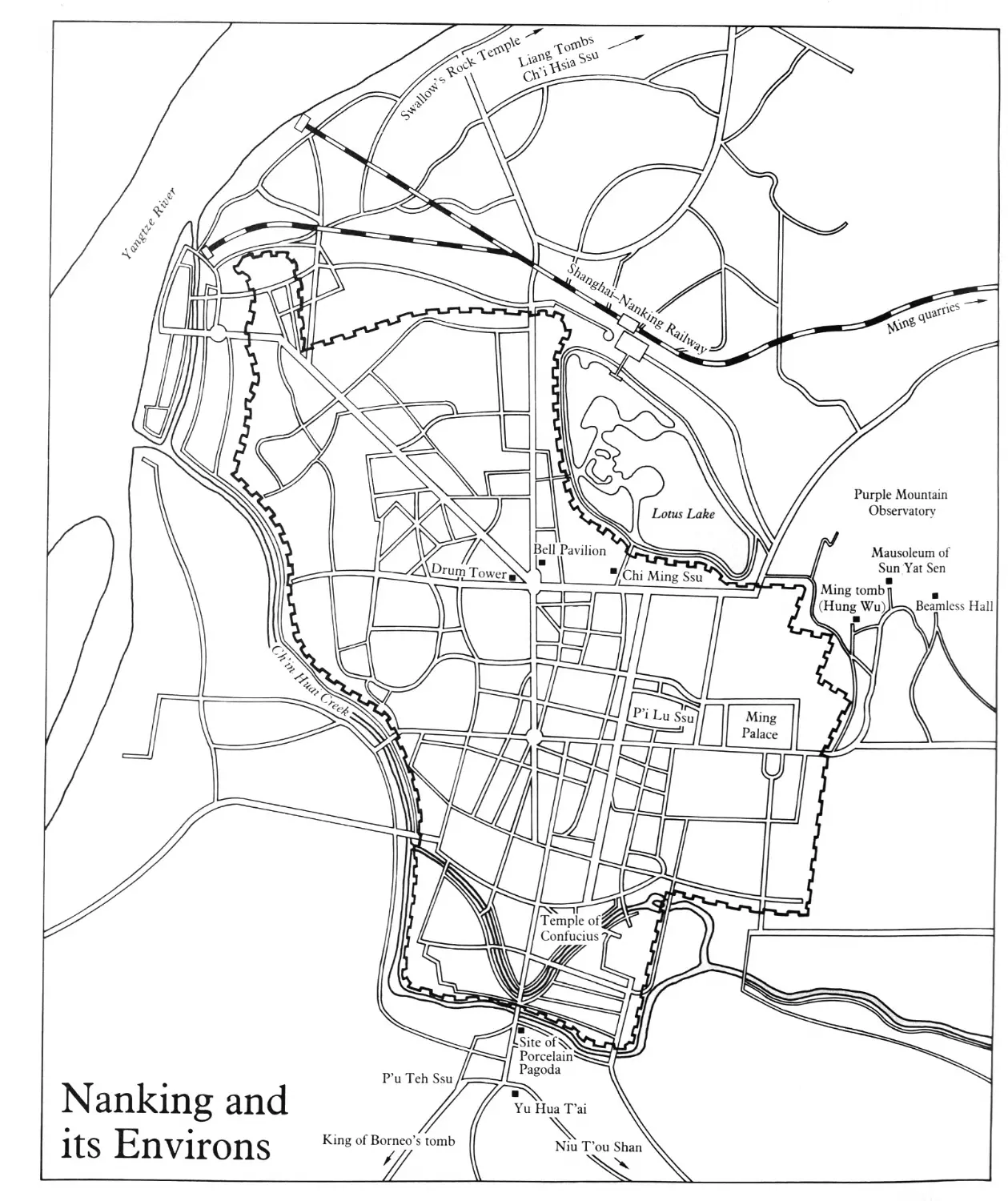
In 1944 the most conspicuous relics were those dating from the Ming period. The
Ming city wall stretched for 38 kilometres, much of it still in place though in a ruinous
state. As can be seen from the map (see map at the end of the book) its shape is
irregular. The wall is built of brick on stone foundations and its dimensions vary from
place to place. The bricks carry seal impressions indicating their provenance, and from
them, historians have been able to establish that the bricks were supplied from many
districts, mainly in the provinces of Kiangsu, Anhui, Kiangsi and Hupei.
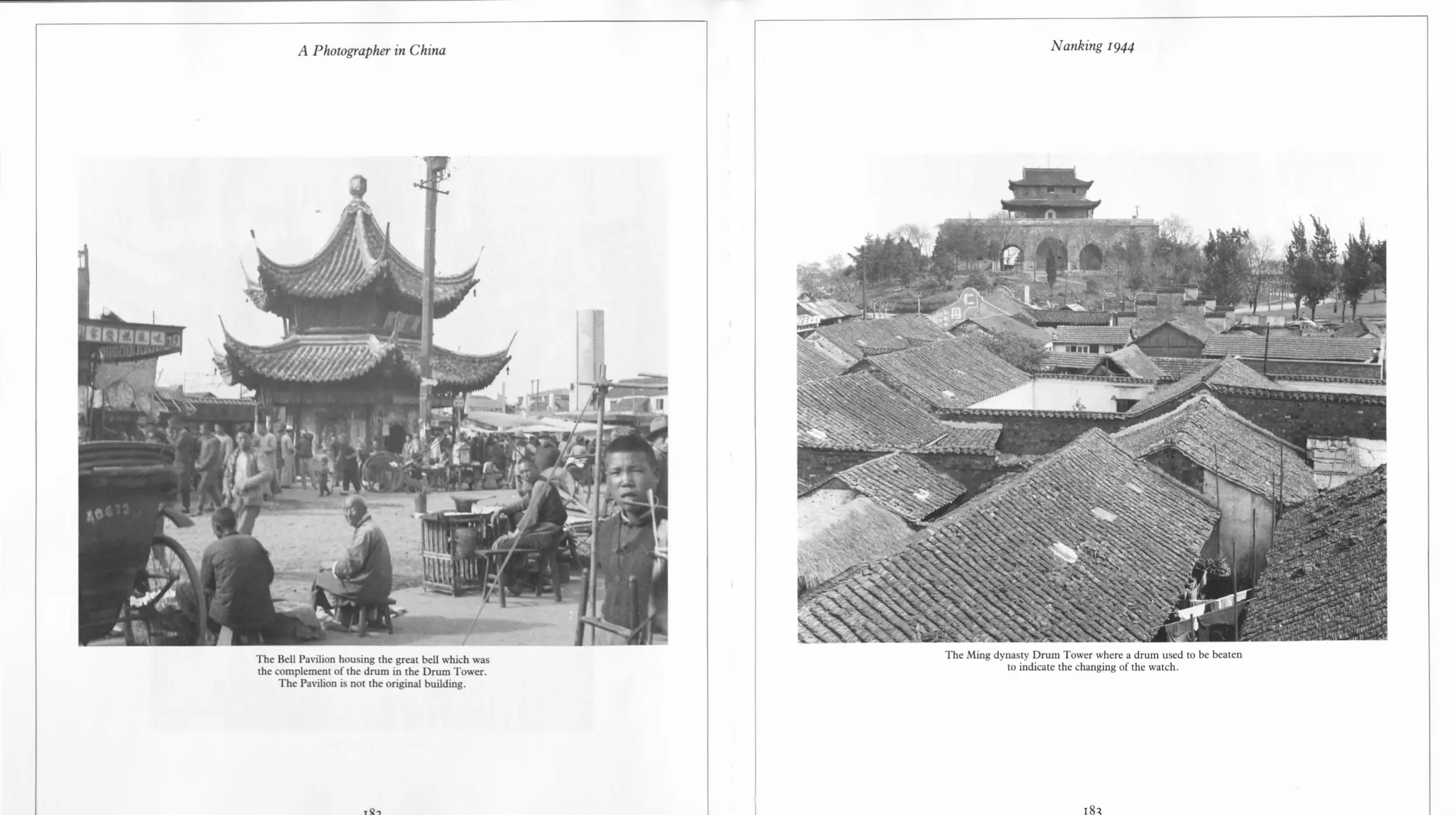
The Ming Drum Tower, which had been well maintained and restored, was espe-
cially prominent. Built on a slight eminence, the tower was where drums were beaten
A Photographer in China
to announce the changes of the night watches. A little way to the north-east a small
pavilion, built in 1889, contains a great bell which was cast in Ming times to
complement the Drum Tower. Another interesting remnant of the Ming period existed
in the southern part of the city: a tower which used to stand in the centre of the rows
of hundreds of cells to which students were confined while they sought to obtain the
coveted qualification opening the door to a career in the civil service. The cells are
gone but the tower remains, unlike the situation in Peking where no trace of the
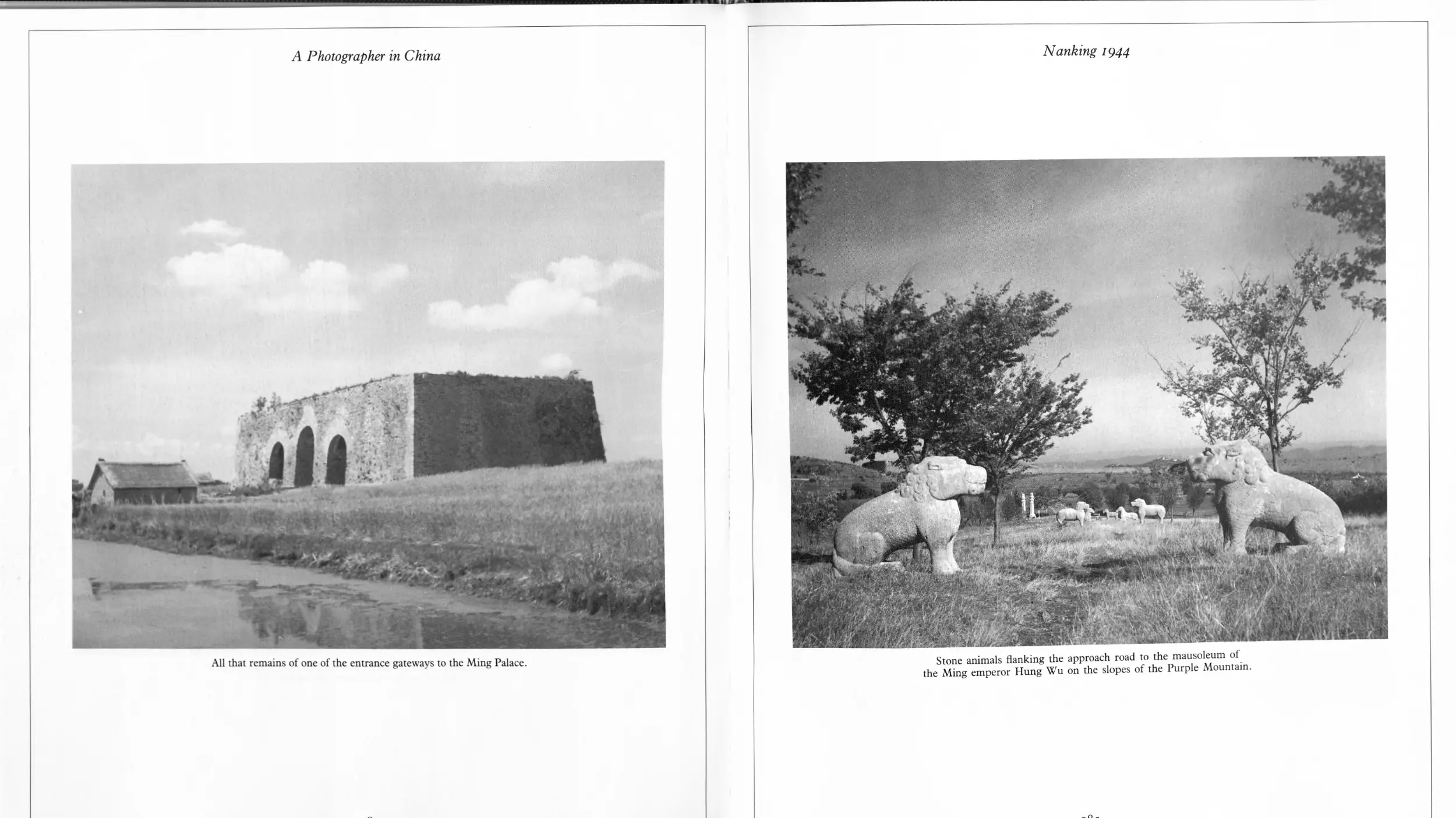
examination halls has survived. On the other hand little remains of the splendid Ming
palace which must have resembled the Forbidden City in Peking. It was allowed to
decay under the Manchus.
More could be seen of the mausoleum of the first Ming emperor, Hung Wu, which
is situated in the hills known as the Purple Mountain to the east of the city. It has lines
of stone animals and officials similar to those of the Ming Tombs near Peking, but the
site is much less spacious and the figures more closely grouped together. The entrance-
way along which the animals are grouped runs first westward, then northward and
finally eastward, so as to prevent the entry of malign influences which were believed to
travel always in straight lines.
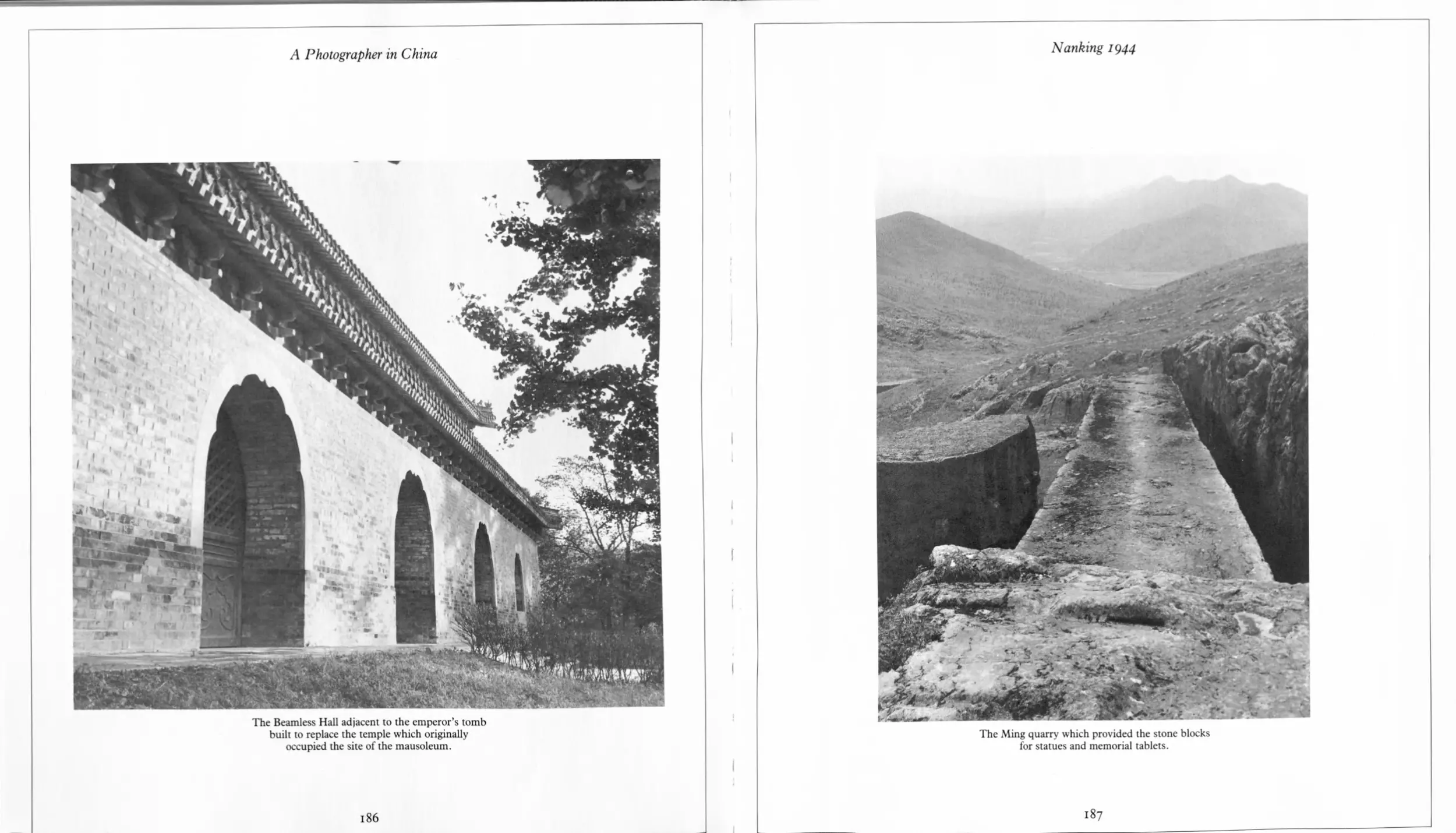
Originally there was a temple here, but it was demolished to make way for the
mausoleum and re-erected a little distance away to the east. This is Wu Liang Tien or
the Beamless Hall, the only Ming building in Nanking that remains intact. It was used
by the Kuomintang as a memorial to fallen soldiers.
There are many other Ming remains in and around the city, principally the tombs of
important early Ming officials. An unusual and interesting Ming relic is the limestone
quarry which provided much of the raw material for buildings and monuments. The
quarry is notable for one enormous monolith commissioned by Emperor Yung Lo for
erection at his father’s tomb. It was realized only at a late stage that even Chinese
technical ingenuity was incapable of moving it and the monolith has remained in the
quarry ever since.
Less conspicuous but still numerous are relics of the dynasties that preceded the
Ming. Some of the most important, consisting of tombs, date back to the Liang
dynasty (ad 502-57). The tombs of the Liang emperors themselves are not in
Nanking, but are located at the ancestral home of the Liang family at Tan Yang, 70
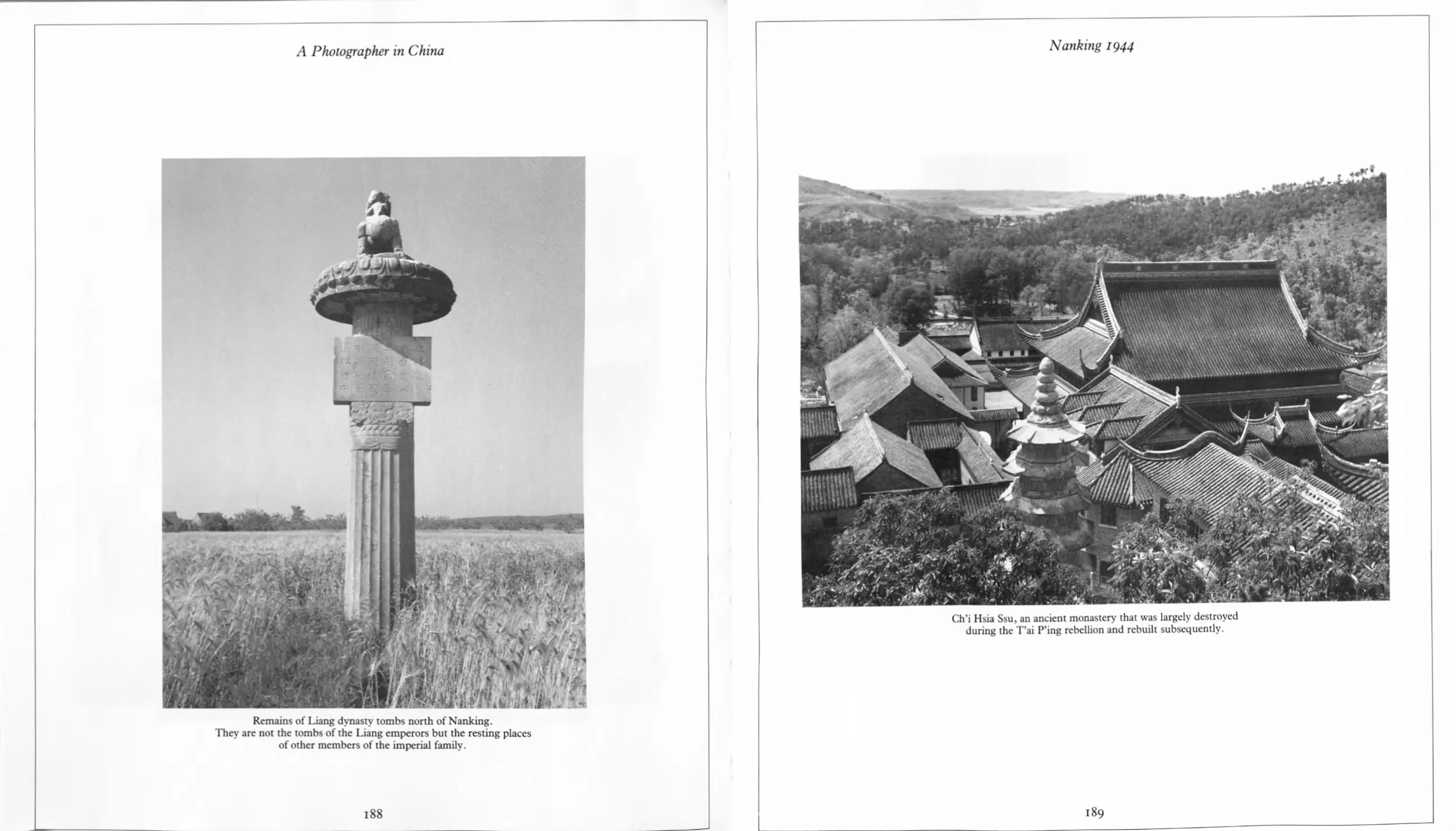
kilometres east of Nanking, which I did not visit. North-east of Nanking are several
Nanking 1944
tombs of members of the Liang royal family. They contain some fine statues, especial-
ly impressive being those of open-mouthed winged lions.
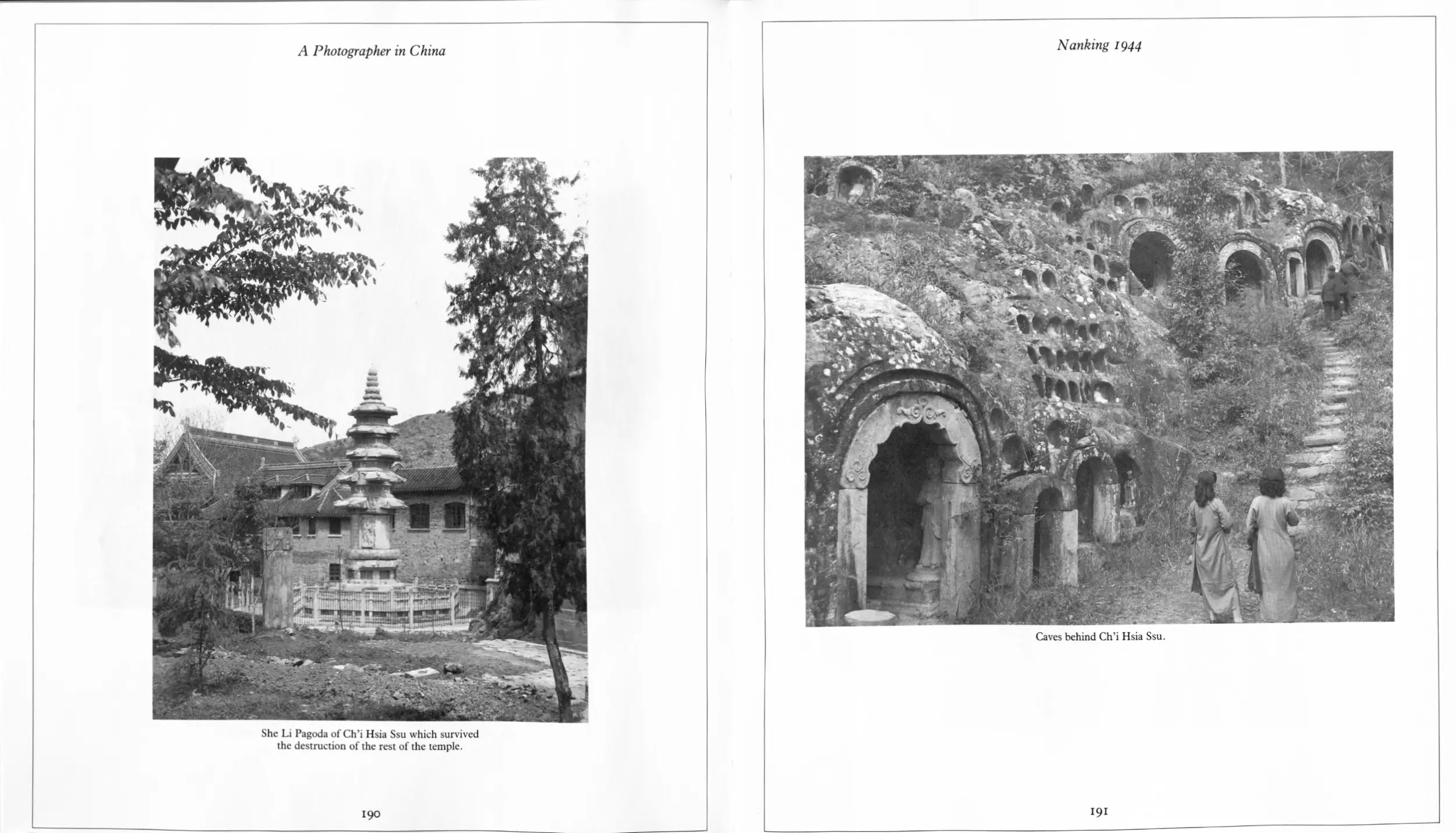
In the same area is Ch’i Hsia Ssu, a monastery which also dates to the sixth century.
Originally the haunt of hermits, it became under the T’ang dynasty (ad 618-907) one
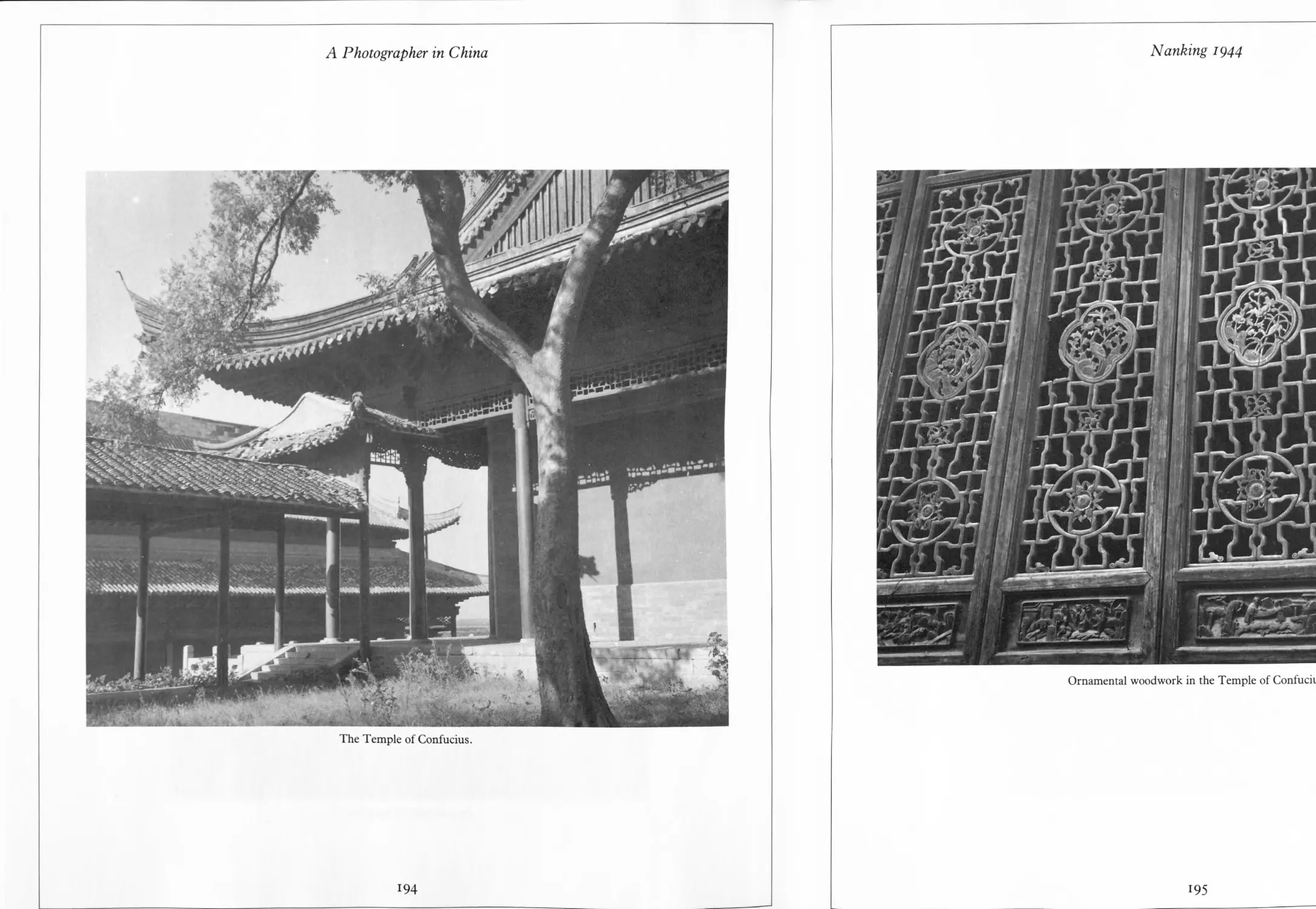
of the four greatest monasteries of China. In caves near the temple are many heavily
restored Buddhist statues. Ch’i Hsia Ssu was almost totally destroyed by the T’ai P’ing
rebels, the present buildings having been erected after Nanking was recaptured. It
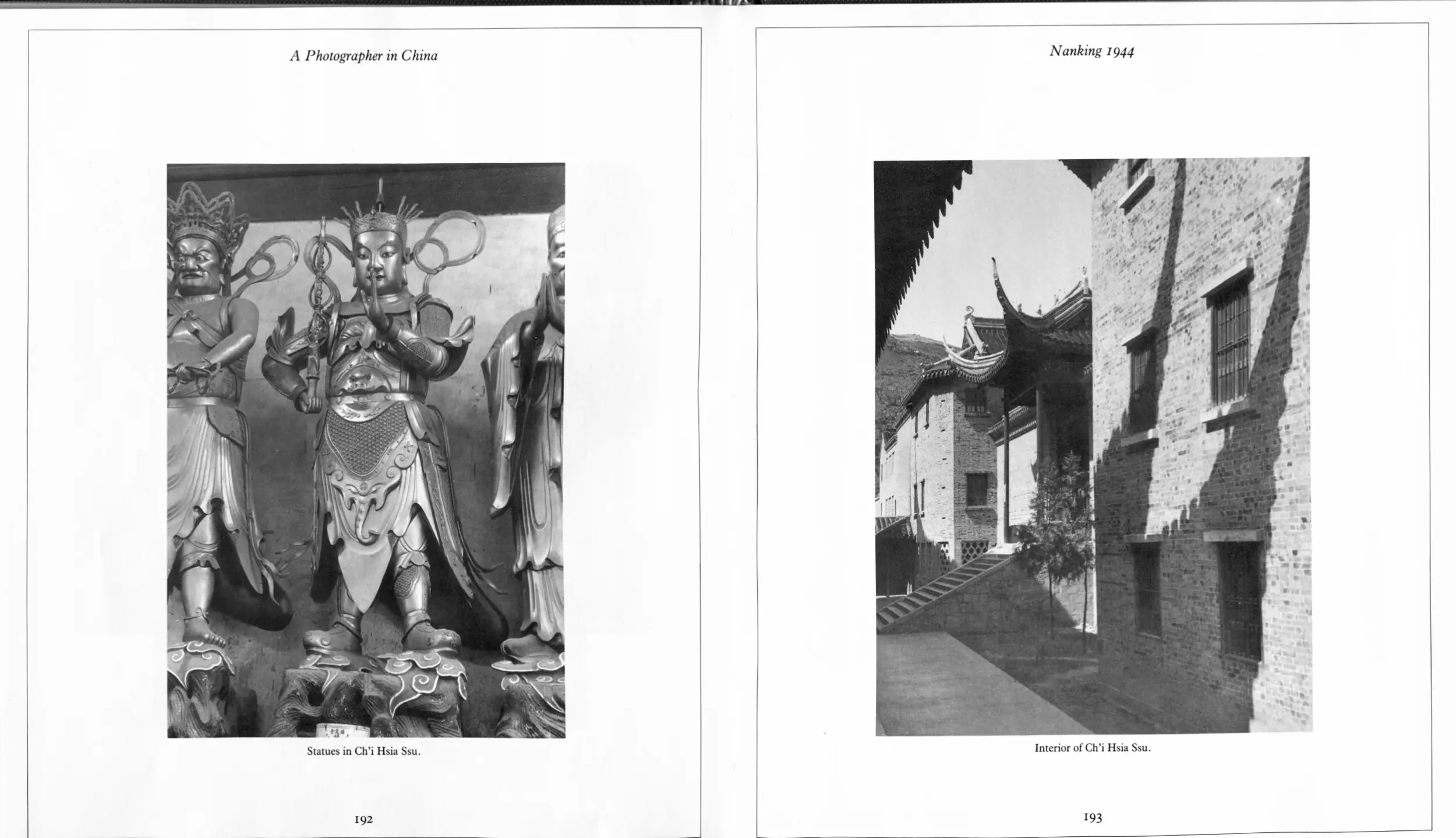
remains, however, a very beautiful relic. Adjoining Ch’i Hsia Ssu is the small She Li
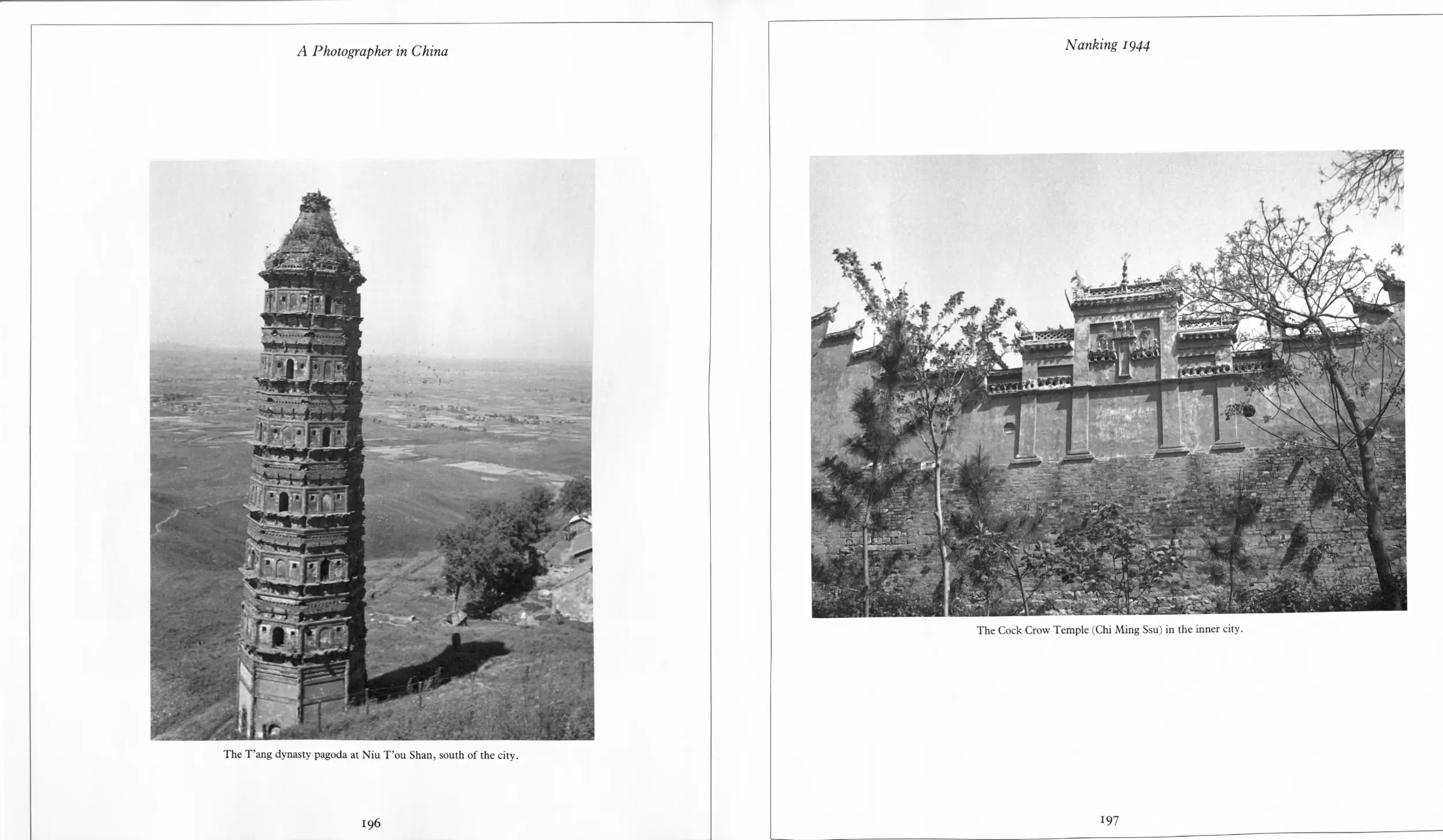
Pagoda. It is one of the two best preserved T’ang buildings in Nanking, the other
being the handsome reddish-coloured pagoda situated south of the city on Niu T’ou
Shan.
There were many other reconstructed temples in Nanking, some of them of great
charm. The most important was the Temple of Confucius in the western part of the
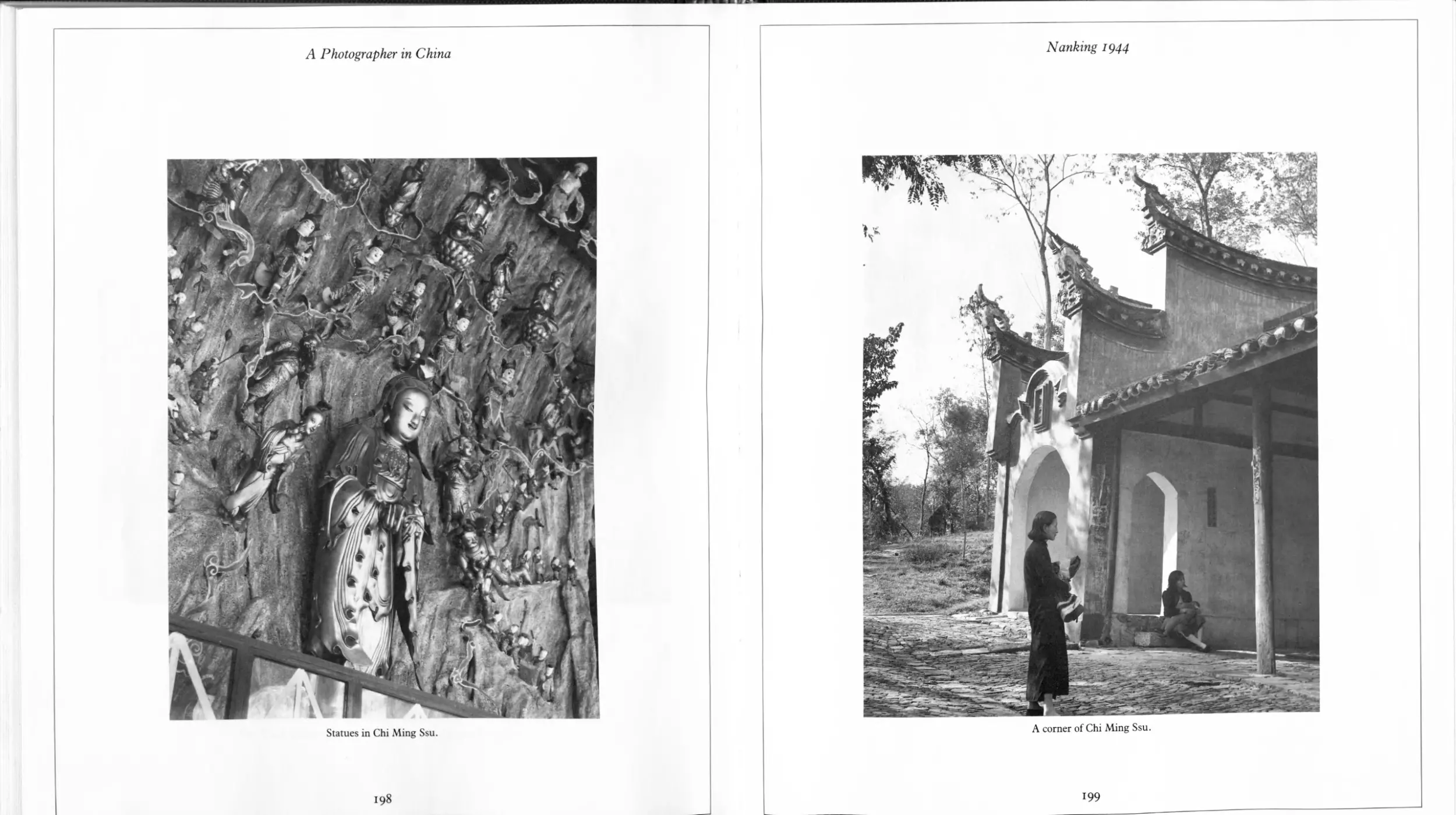
city. In the centre of Nanking, to the east of the Bell Pavilion, was the Cock Crow
Temple (Chi Ming Ssu). The site was a Mongol execution ground and the original
temple was built to placate the ghosts of those killed there. P’i Lu Ssu, also in central
Nanking, contained many small images of the Buddha. On a hill overlooking the
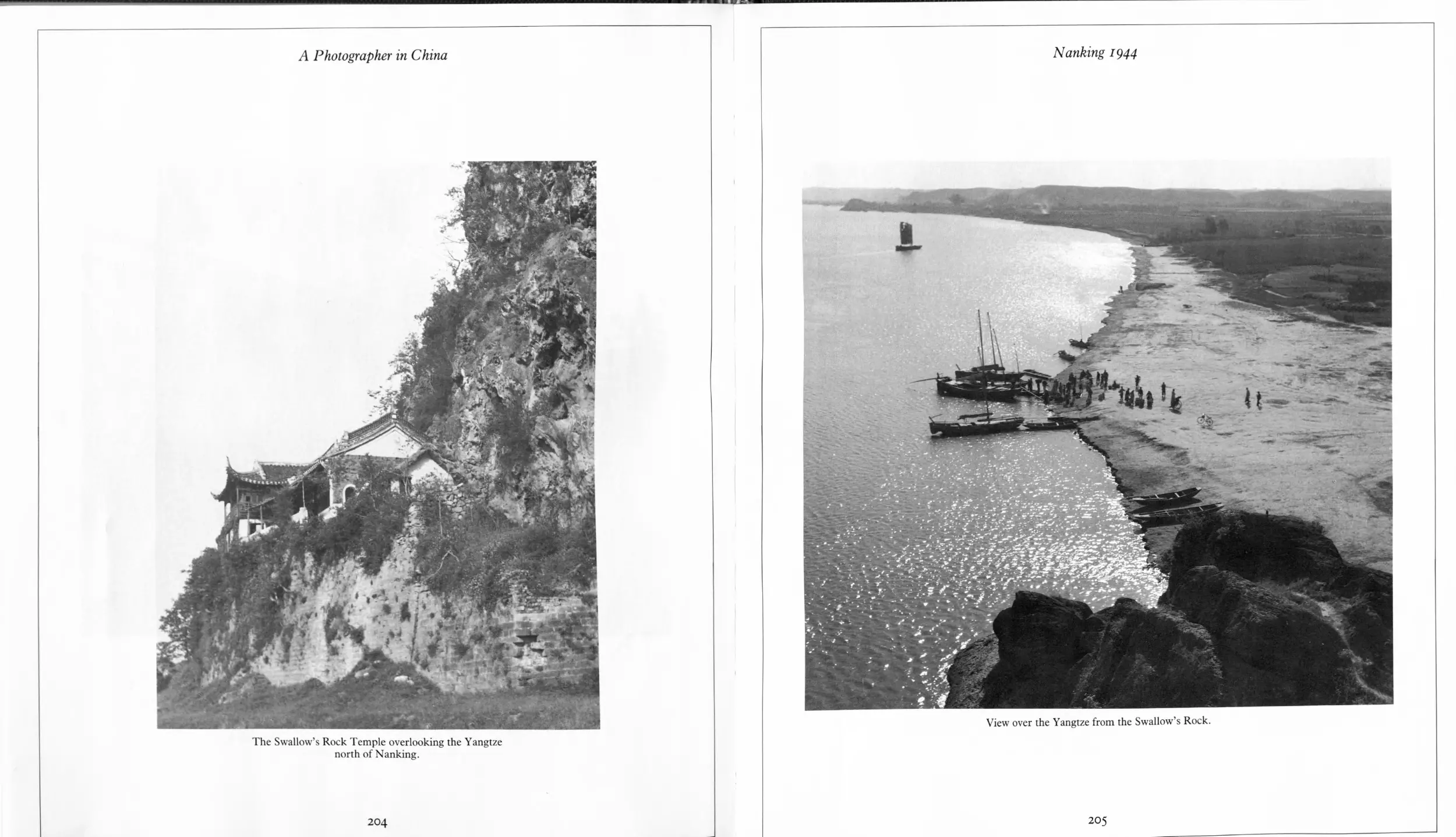
Yangtze downstream from Nanking was a very picturesque temple known as the
Swallow’s Rock Temple. There were many more.
After the re-establishment of Nanking as the capital in 1927 the Kuomintang
undertook considerable development of the city, constructing roads and public build-
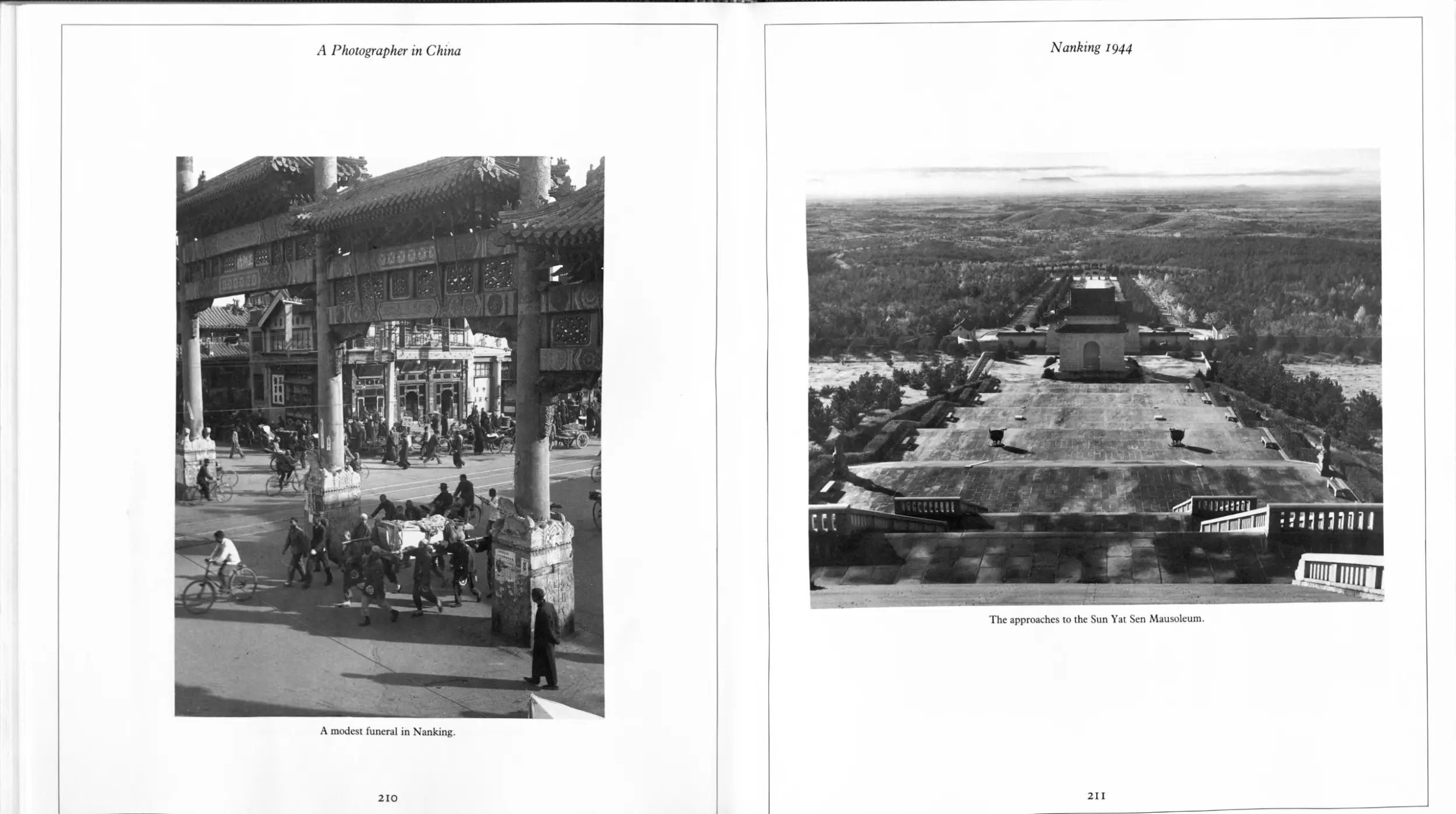
ings. The most famous of the buildings from this period is the mausoleum of Dr Sun
Yat Sen, built on the Purple Mountain a little to the west of the mausoleum of Hung
Wu. It is an impressive structure which was largely financed by subscriptions from
overseas Chinese. From a white marble entrance p’ai-lou a flight of 392 steps leads up
to the mausoleum; both p’ai-lou and mausoleum are roofed with blue tiles. North-west
of the Sun Yat Sen mausoleum was a modern observatory where some ancient
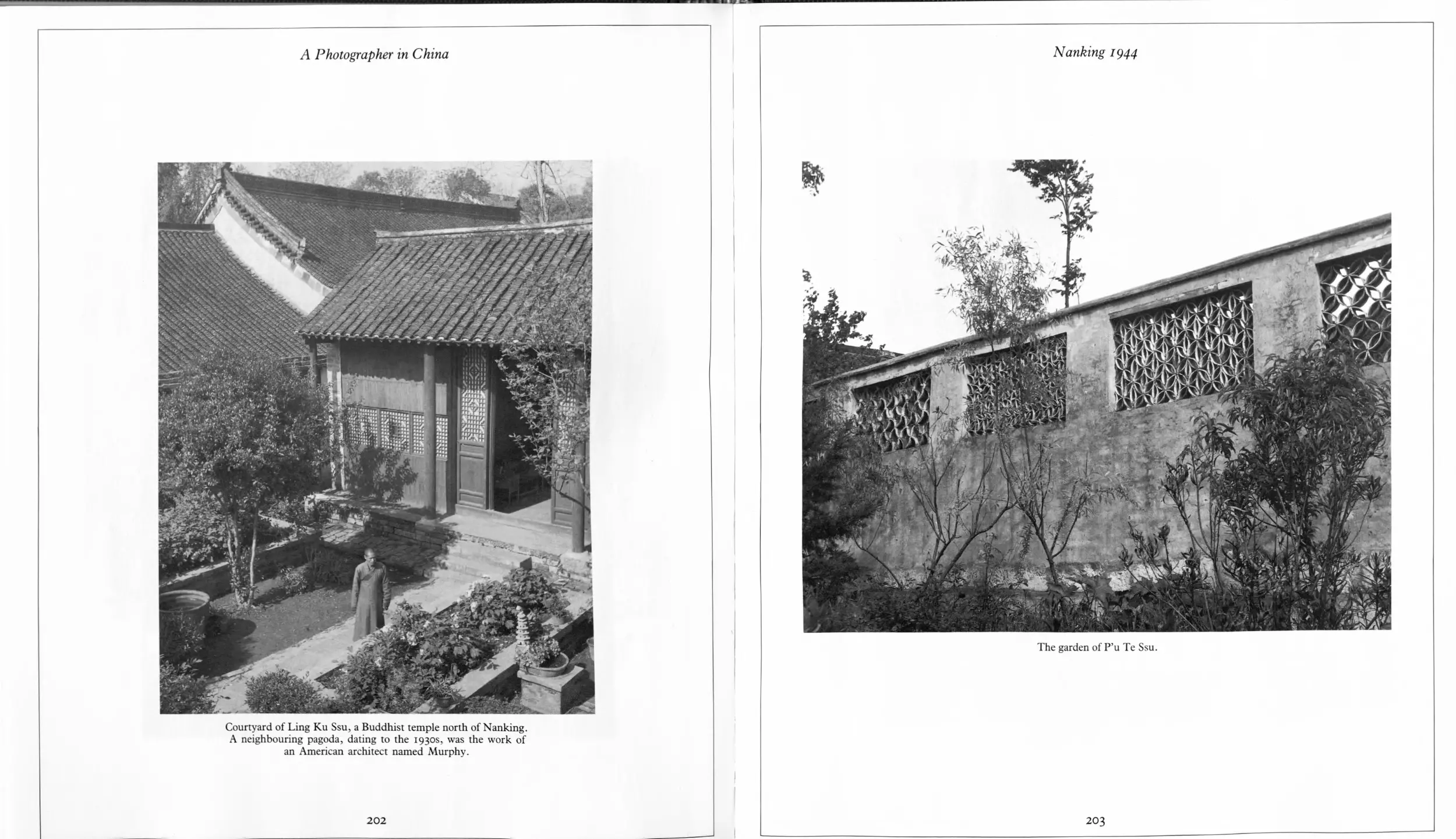
instruments were exhibited. A curiosity of the observatory hill was an imposing
modern pagoda designed in the 1930s by an American architect named Murphy.
In ancient times Nanking was noted for its gardens. Like so many facets of Chinese
culture, gardens developed in an entirely different way to those of the West. Although
flowering plants did play a role in Chinese gardens, much of the emphasis was on
rockeries, pieces of eroded limestone pitted with many cavities of different shapes and
17?
A Photographer in China
sizes, to provide in miniature for the contemplation of the scholar the mountain forms
of nature which especially appealed to the aesthetic sense of the Chinese. Unfortunate-
ly few gardens remained in Nanking.
A feature of Nanking is the extensive series of waterways and lakes around the city.
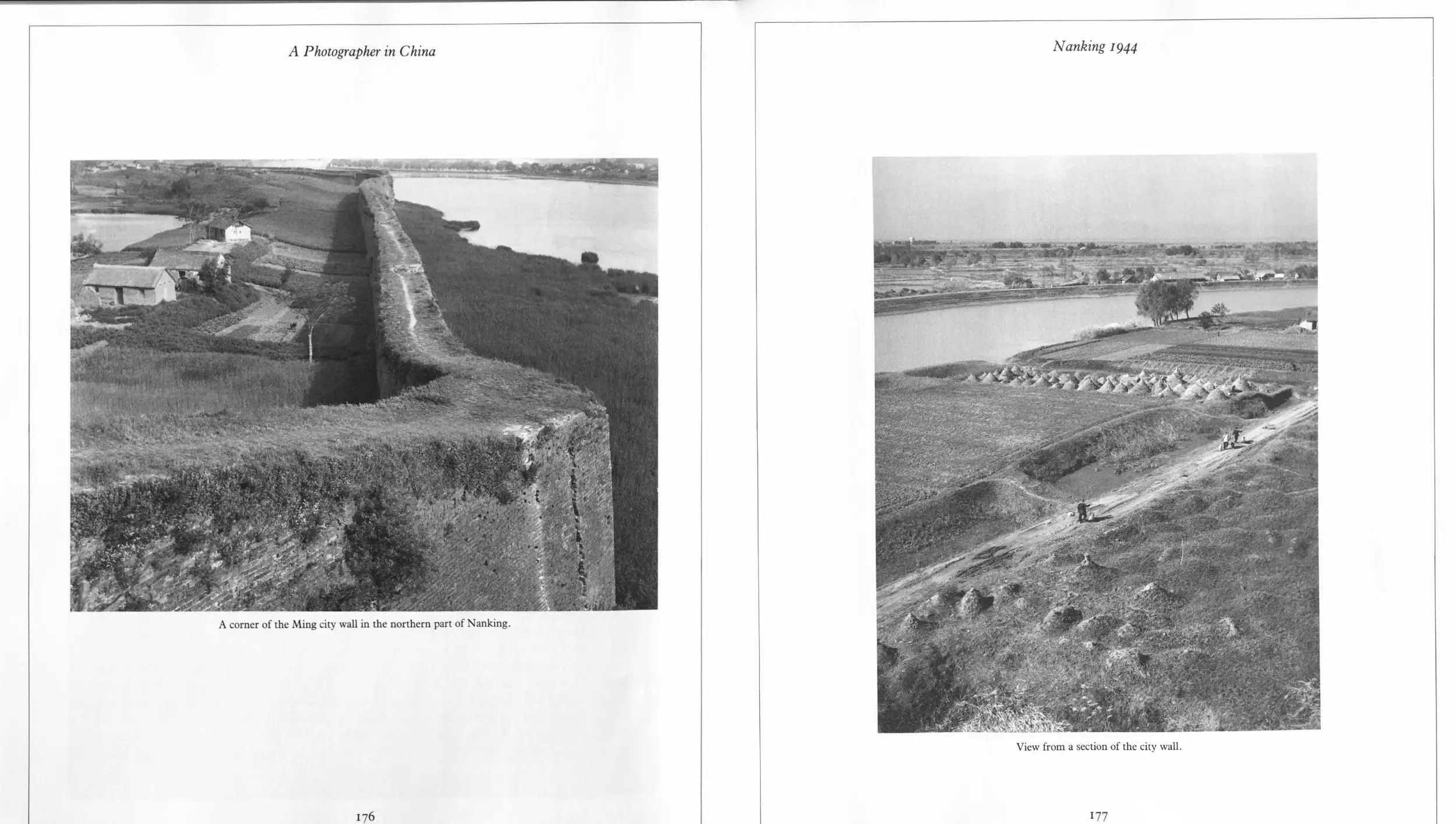
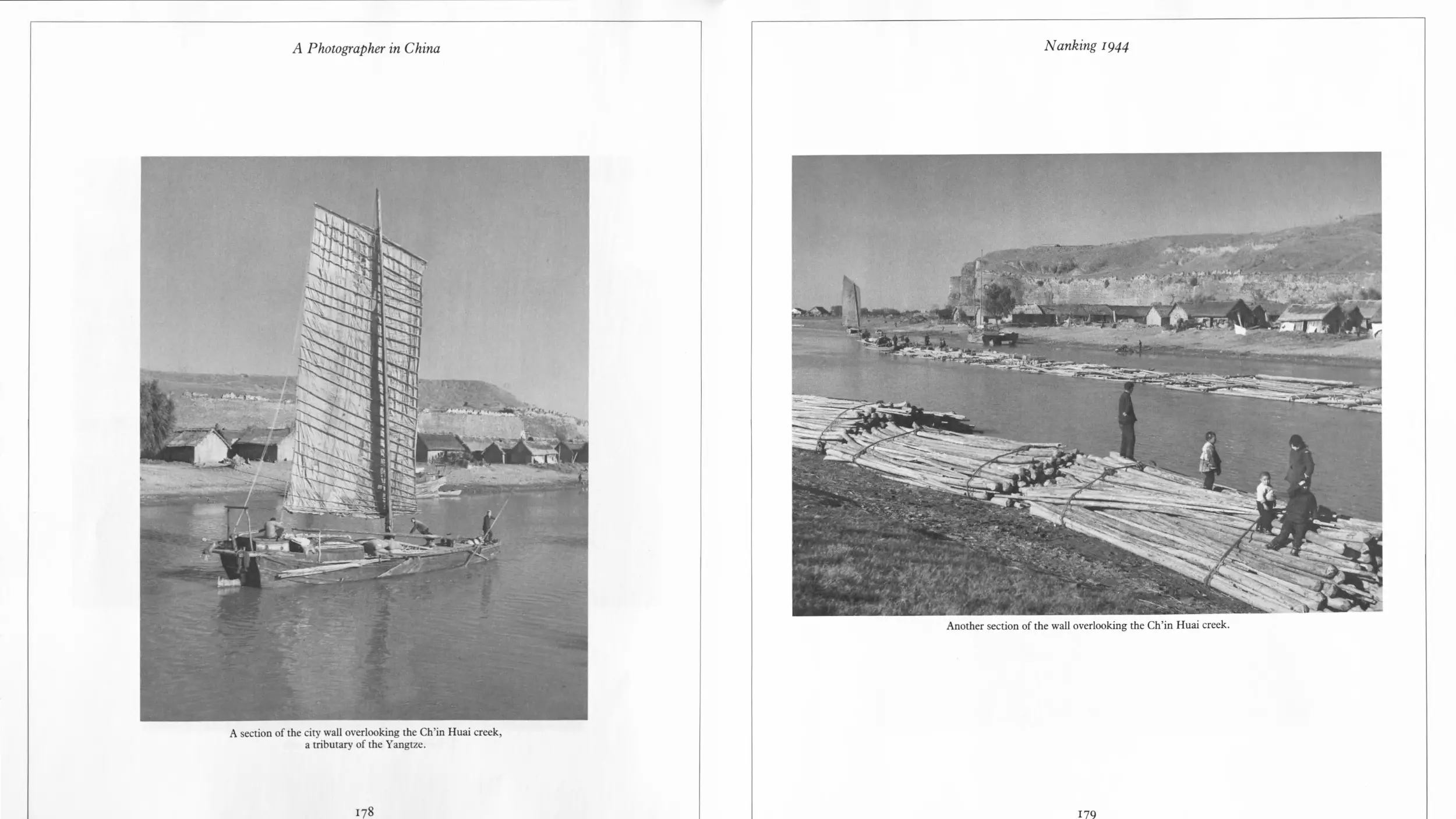
The old city stood some distance from the channel of the Yangtze but its western wall
followed the course of the Ch’in Huai creek, a tributary of the Yangtze. In the
north-east the wall is bounded by the extensive Hsiian Wu Lake, known to Westerners
as the Lotus Lake from the abundance of lotuses cultivated there. The lotus produces
both edible seeds and roots, much used in Chinese sweet dishes. The lake is very
picturesque, especially when the lotuses are in flower. In winter its shallow waters are
a great resort for waterfowl, mainly ducks, while in summer it is a favourite breeding
ground for the long-clawed, lily-trotting Pheasant-tailed Jacana.
What of the people of Nanking? I found them as friendly and obliging as the
Pekingese whom I knew so much better. The most densely populated areas were in the
southern part of the city. Nanking was formerly a major craft centre famed for its
production of fine silk goods. The years before the Japanese invasion had seen
considerable industrial development and even under the Japanese it remained a major
business and trading centre. The official figure for the population when I was there
was 664,000, which may well have been an exaggeration. An official Kuomintang
figure was just over one million for 1937, shortly before the Nanking Massacre.
In Nanking I was free to wander where I pleased. One of the recollections that has
particularly stamped itself on my memory concerns that remarkable institution, the
Chinese Post Office. No matter what the difficulties, whether caused by wars or
revolutions or natural disasters, the post in China could always be relied on to get
through. It continued to move between free China and the Japanese-occupied areas
after the Japanese invasion. A little earlier in 1944 I had learned that Alastair Morri-
son, whom I had known in Peking and who had been evacuated with other Allied
personnel in August 1942, had been posted to Chungking. On arrival there he had sent
a Red Cross letter of the ‘I am well, hope you are well, the weather here is very hot’
kind to a mutual French friend in Peking. The friend passed on the letter to me,
thereby providing me with a residential address in Chungking. I decided to send a
reply from Nanking. But the address given was in English and it seemed prudent to
have the envelope addressed in Chinese. This was done for me by the German
Nanking 1944
Ambassador’s cook. He did his best but it was not, I learned later, a very perfect
rendering, for virtually every character was wrong. Nevertheless, the letter, furtively
dropped into a letter box during a photographic outing, safely reached its destination.
My time in Nanking was spent very pleasantly. Despite the city’s repeated devasta-
tion it was still a very beautiful place and one that had the aura of being steeped in
history. It was easy to see why throughout the centuries it had been a major centre of
Chinese culture.
The results of my work and that of Hoffmann eventually appeared in a book
entitled simply Nanking, written in German and published in Shanghai in 1945. As to
be expected printing material of good quality was unprocurable at that time, so that
although well produced in other respects, the book was severely marred by the poor
paper used. To add to the book’s problems it appeared just before the Japanese
capitulation and in the confusion of the reoccupation most of the copies disappeared;
they probably ended up by being pulped. As a consequence the book, if not the best
produced Western-language book on China, does today have the distinction of being
one of the rarest.
I7S
A Photographer in China
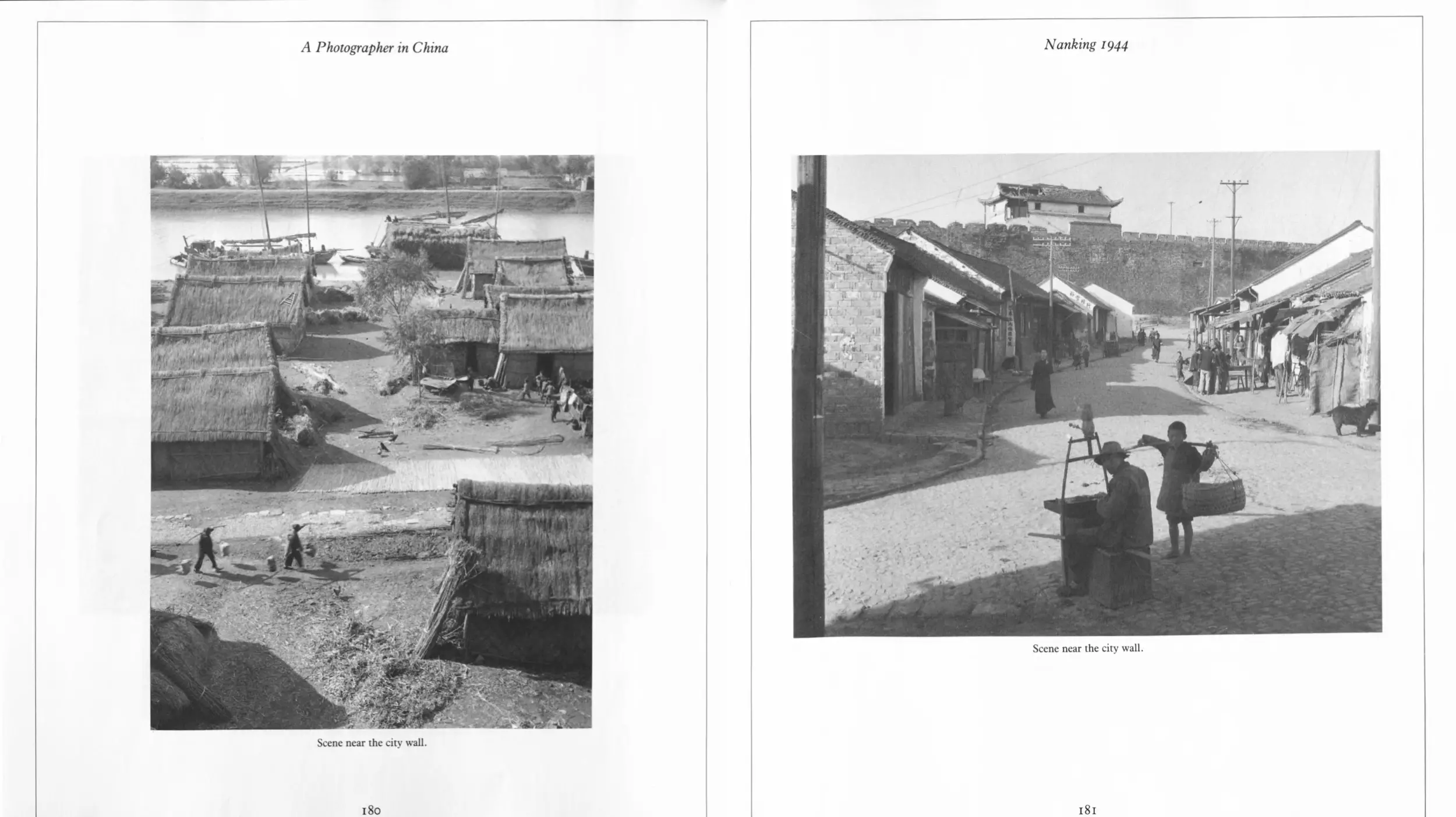
A corner of the Ming city wall in the northern part of Nanking.
176
Nanking 1944
View from a section of the city wall.
177
A Photographer in China
A section of the city wall overlooking the Ch’in Huai creek,
a tributary of the Yangtze.
178
Nanking 1944
Another section of the wall overlooking the Ch’in Huai creek.
179
A Photographer in China
Scene near the city wall.
180
Nanking 1944
Scene near the city wall.
I8l
A Photographer in China
The Bell Pavilion housing the great bell which was
the complement of the drum in the Drum Tower.
The Pavilion is not the original building.
тЙо
Nanking 1944
The Ming dynasty Drum Tower where a drum used to be beaten
to indicate the changing of the watch.
18ч
A Photographer in China
All that remains of one of the entrance gateways to the Ming Palace.
Nanking 1944
Stone animals flanking the approach road to the mausoleum of
the Ming emperor Hung Wu on the slopes of the Purple Mountain.
_ n _
A Photographer in China
The Beamless Hall adjacent to the emperor’s tomb
built to replace the temple which originally
occupied the site of the mausoleum.
186
Nanking 1944
The Ming quarry which provided the stone blocks
for statues and memorial tablets.
187
A Photographer in China
Remains of Liang dynasty tombs north of Nanking.
They are not the tombs of the Liang emperors but the resting places
of other members of the imperial family.
188
Nanking 1944
Ch’i Hsia Ssu, an ancient monastery that was largely destroyed
during the T’ai P’ing rebellion and rebuilt subsequently.
189
A Photographer in China
She Li Pagoda of Ch’i Hsia Ssu which survived
the destruction of the rest of the temple.
190
Nanking 1944
Caves behind Ch’i Hsia Ssu.
191
A Photographer in China
Statues in Ch’i Hsia Ssu.
192
Nanking 1944
Interior of Ch’i Hsia Ssu.
193
A Photographer in China
Nanking 1944
The Temple of Confucius.
Ornamental woodwork in the Temple of Confucit
194
195
A Photographer in China
The T’ang dynasty pagoda at Niu T’ou Shan, south of the city.
196
Nanking 1944
The Cock Crow Temple (Chi Ming Ssu) in the inner city.

197
A Photographer in China
Statues in Chi Ming Ssu.
198
Nanking 1944
A corner of Chi Ming Ssu.
199
A Photographer in China
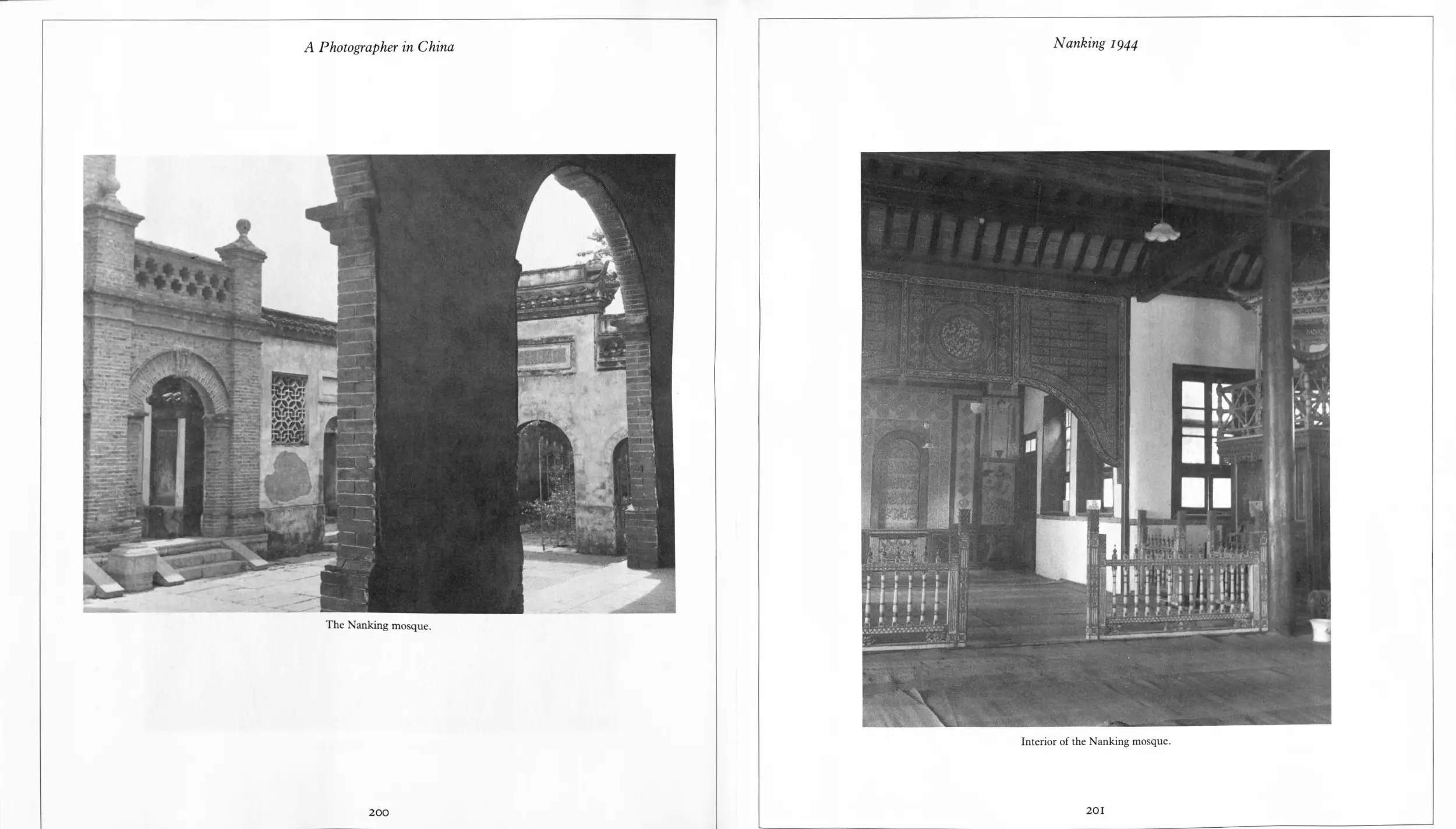
The Nanking mosque.
200
Nanking 1944
Interior of the Nanking mosque.
201
A Photographer in China
Courtyard of Ling Ku Ssu, a Buddhist temple north of Nanking.
A neighbouring pagoda, dating to the 1930s, was the work of
an American architect named Murphy.
202
Nanking 1944
The garden of P’u Те Ssu.
203
A Photographer in China
Nanking 1944
View over the Yangtze from the Swallow’s Rock.
The Swallow’s Rock Temple overlooking the Yangtze
north of Nanking.
204
205
A Photographer in China
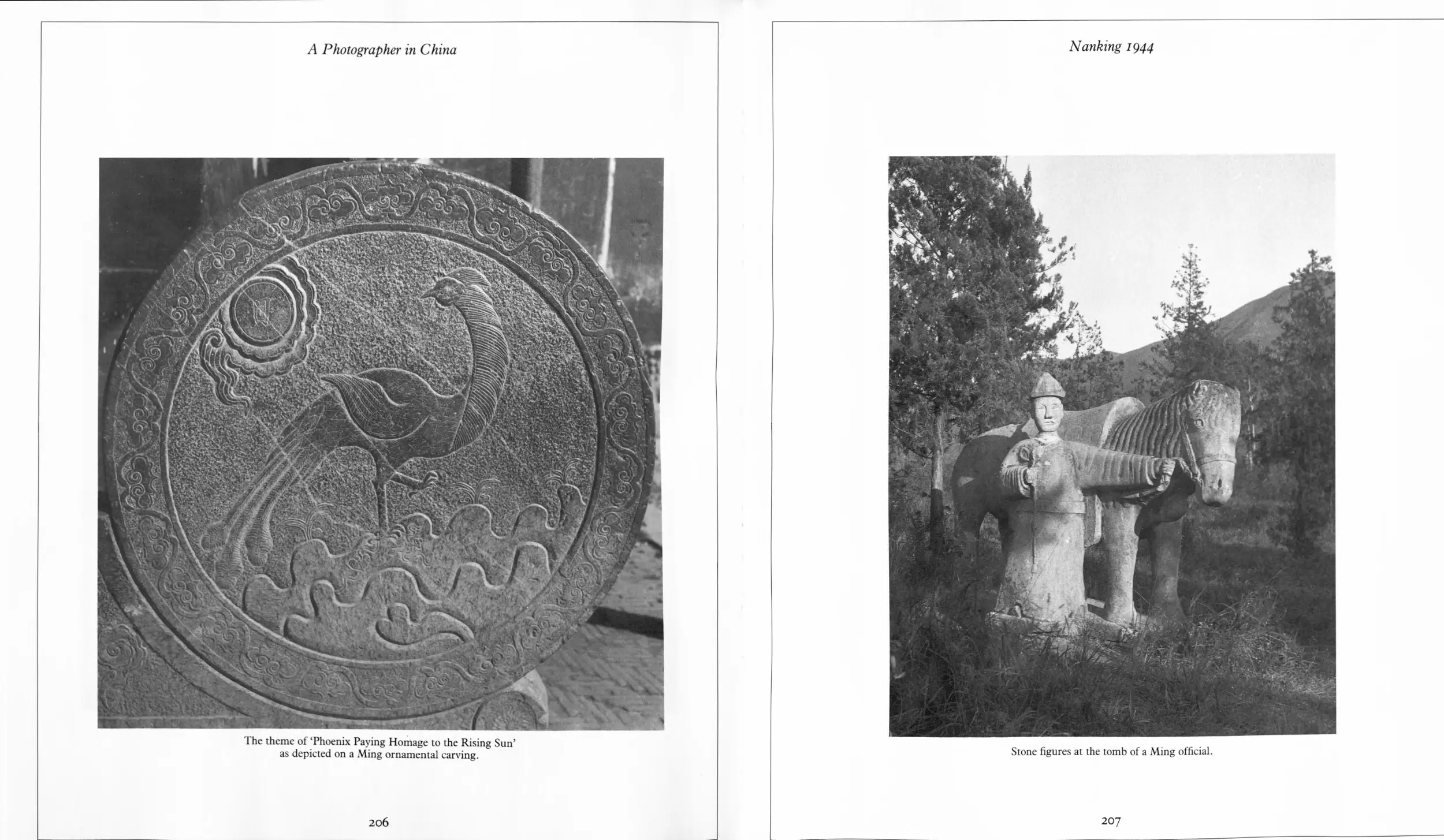
The theme of ‘Phoenix Paying Homage to the Rising Sun’
as depicted on a Ming ornamental carving.
206
Nanking 1944
Stone figures at the tomb of a Ming official.
207
A Photographer in China
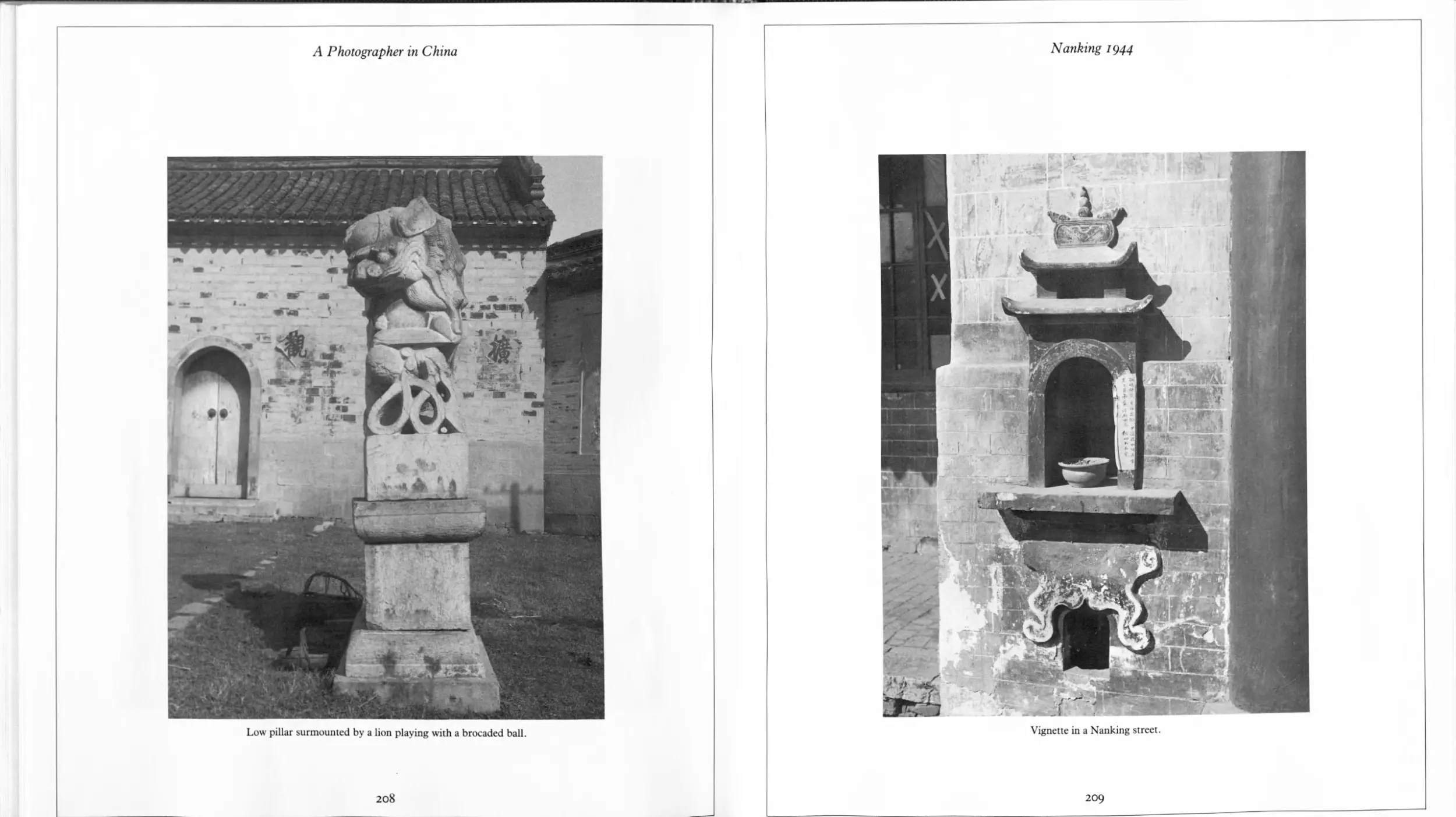
Low pillar surmounted by a lion playing with a brocaded ball.
208
Nanking 1944
Vignette in a Nanking street.
209
A Photographer in China
A modest funeral in Nanking.
210
Nanking 1944
The approaches to the Sun Yat Sen Mausoleum.
211
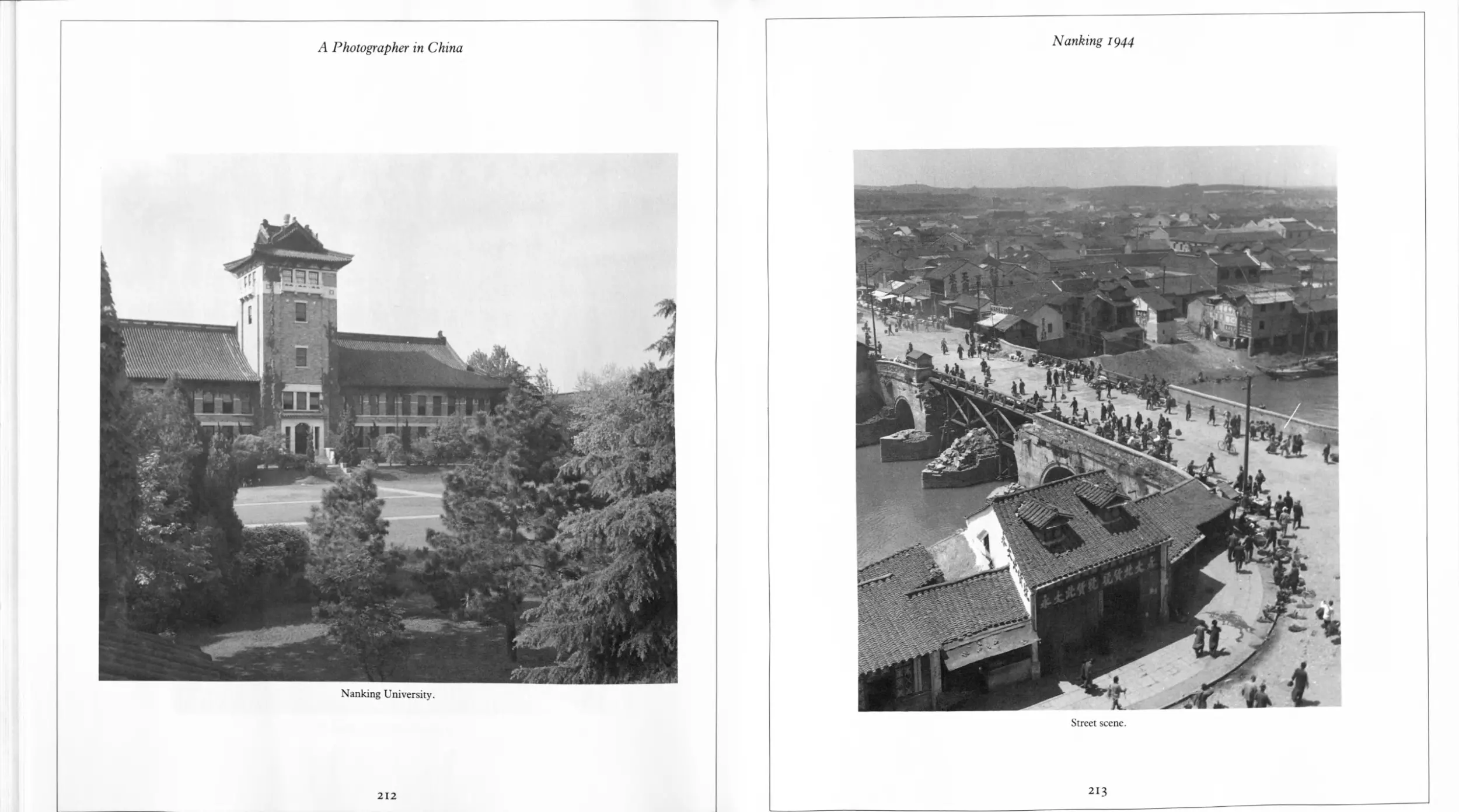
A Photographer in China
Nanking University.
212
Nanking 1944
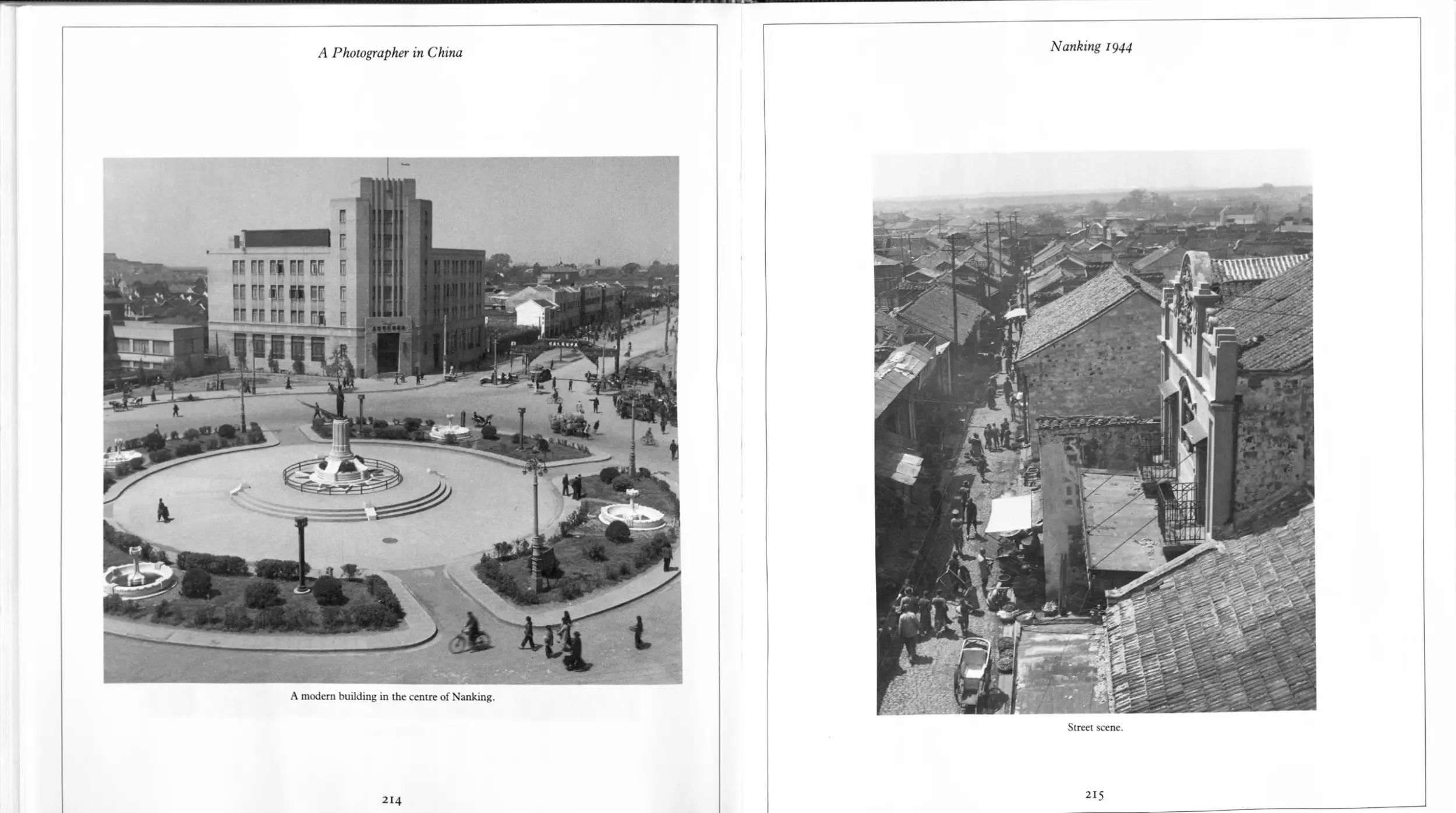
Street scene.
213
A Photographer in China
A modern building in the centre of Nanking.
214
Nanking 1944
Street scene.
215
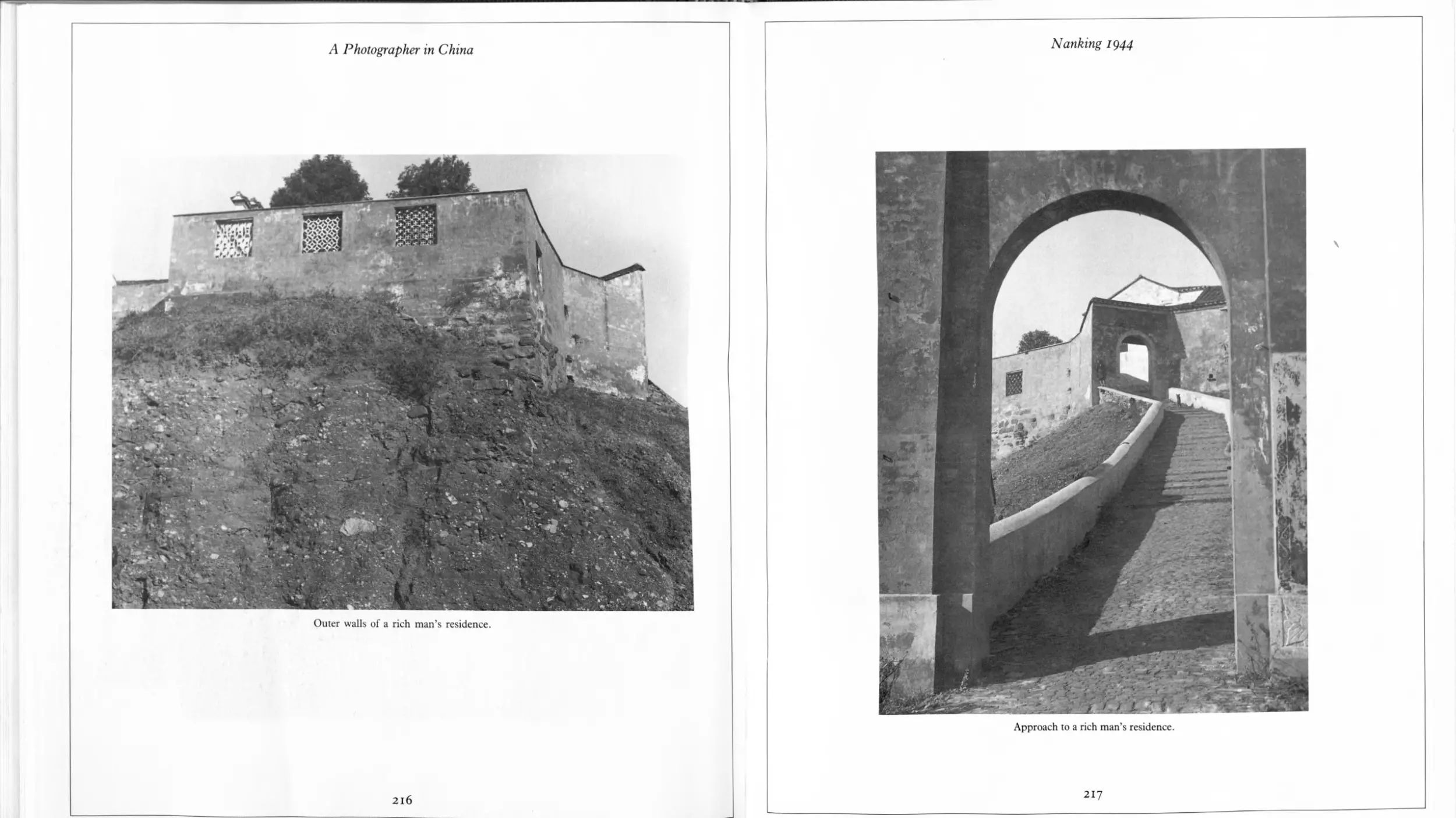
A Photographer in China
Outer walls of a rich man’s residence.
2l6
Nanking 1944
Approach to a rich man’s residence.
A Photographer in China
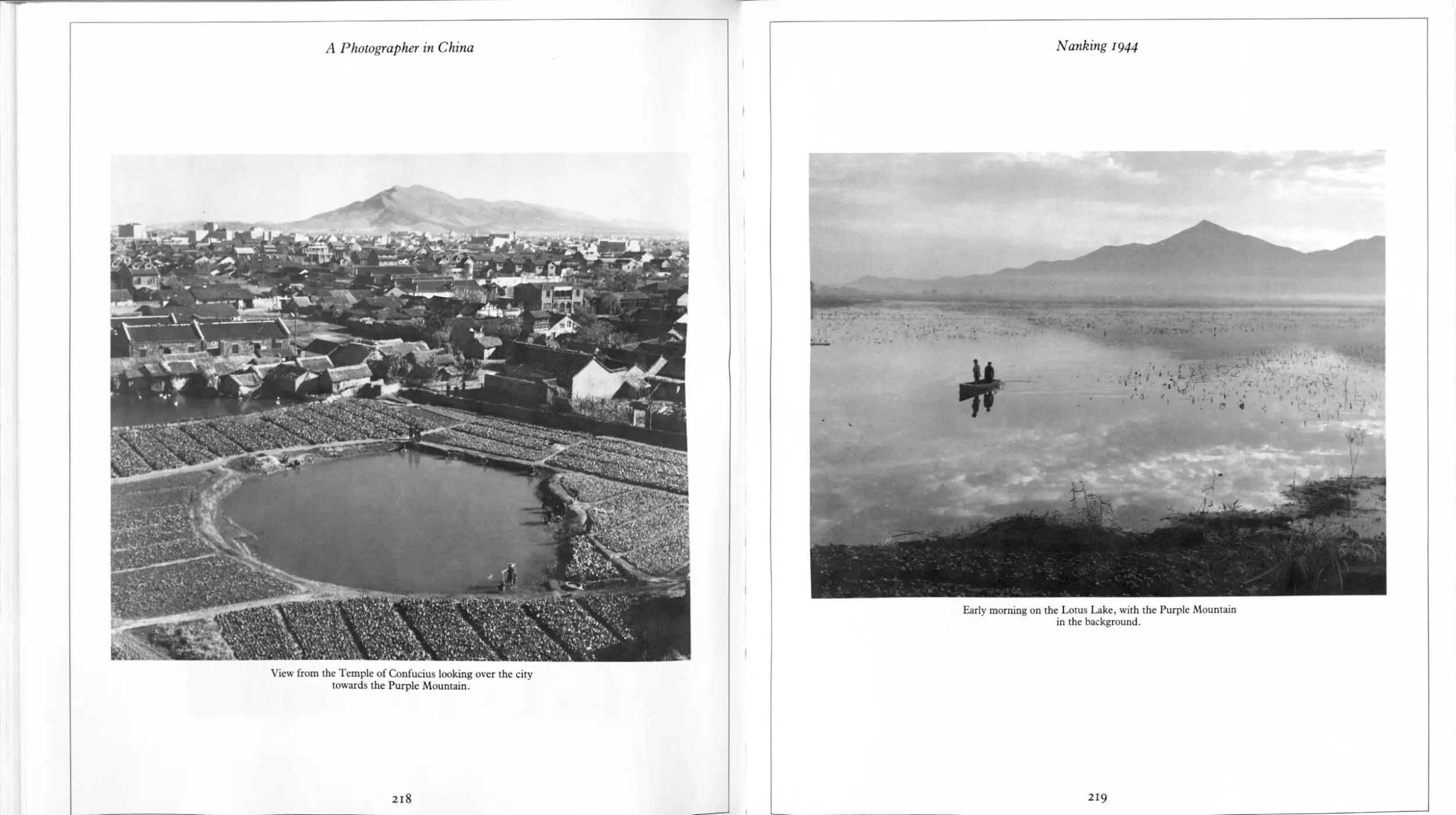
View from the Temple of Confucius looking over the city
towards the Purple Mountain.
218
Nanking 1944
Early morning on the Lotus Lake, with the Purple Mountain
in the background.
219
A Photographer in China
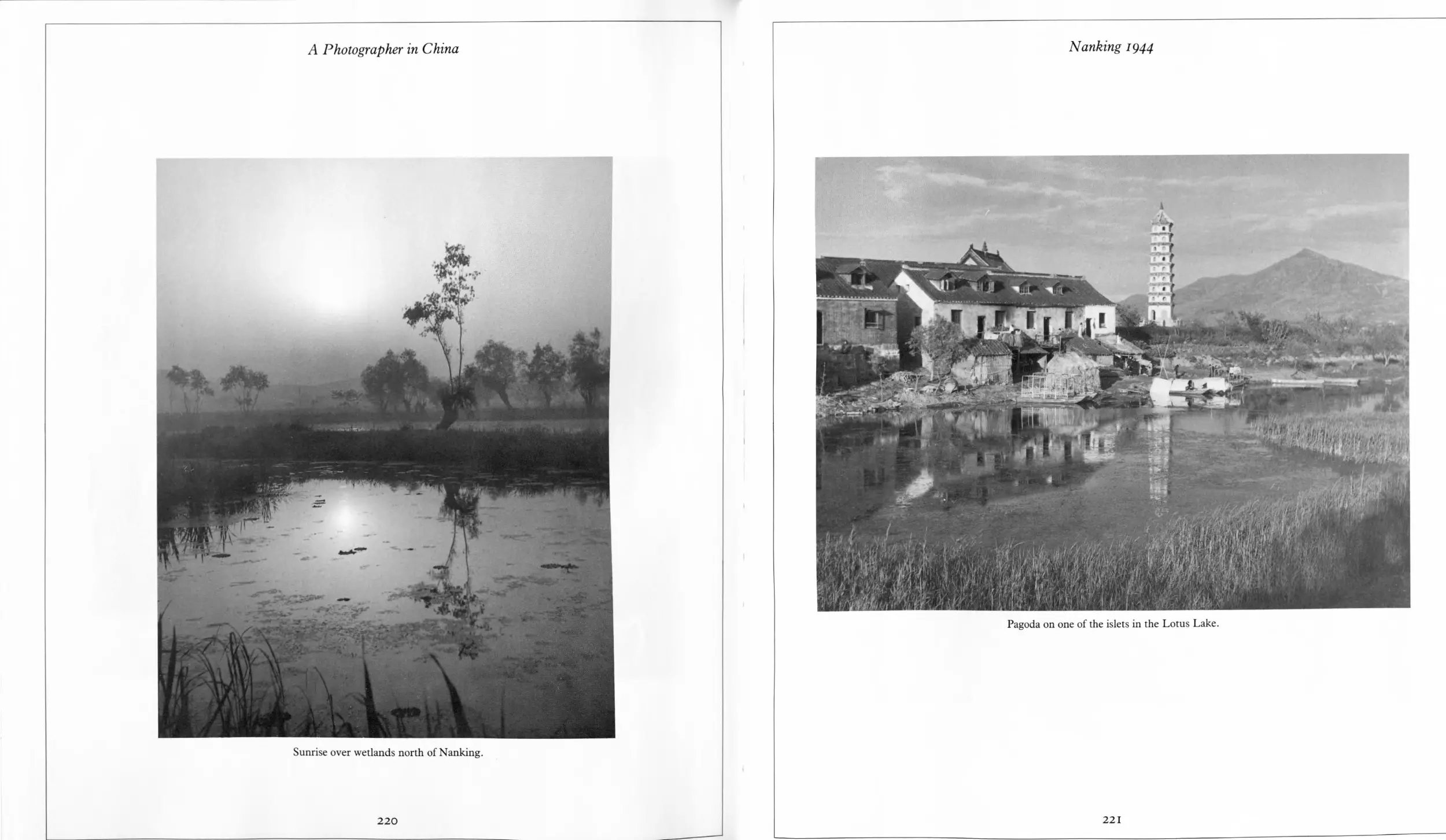
Sunrise over wetlands north of Nanking.
220
Nanking 1944
Pagoda on one of the islets in the Lotus Lake.
221
A Photographer in China

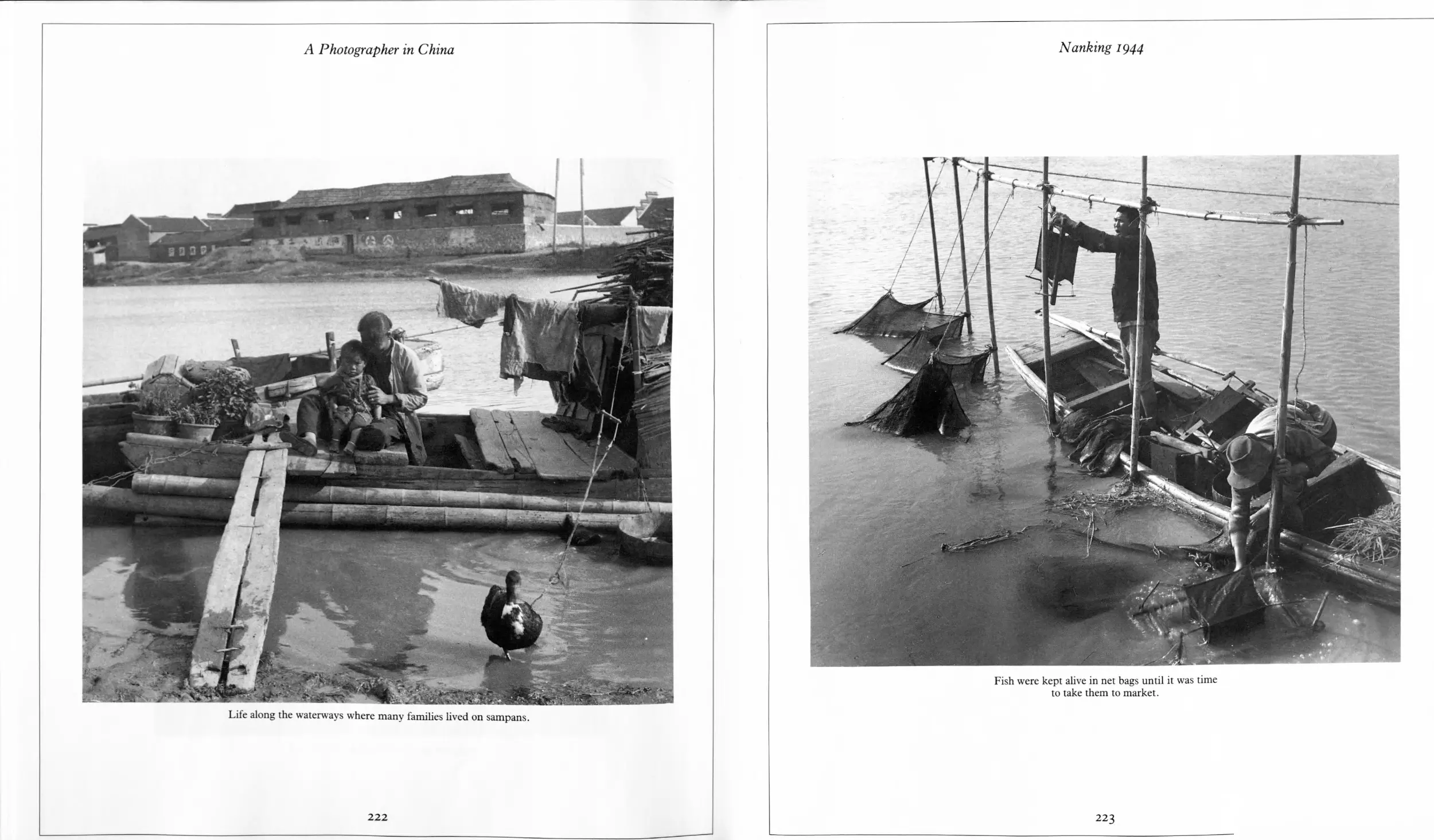
Life along the waterways where many families lived on sampans.
222
Nanking 1944
Fish were kept alive in net bags until it was time
to take them to market.
223
A Photographer in China
Nanking 1944
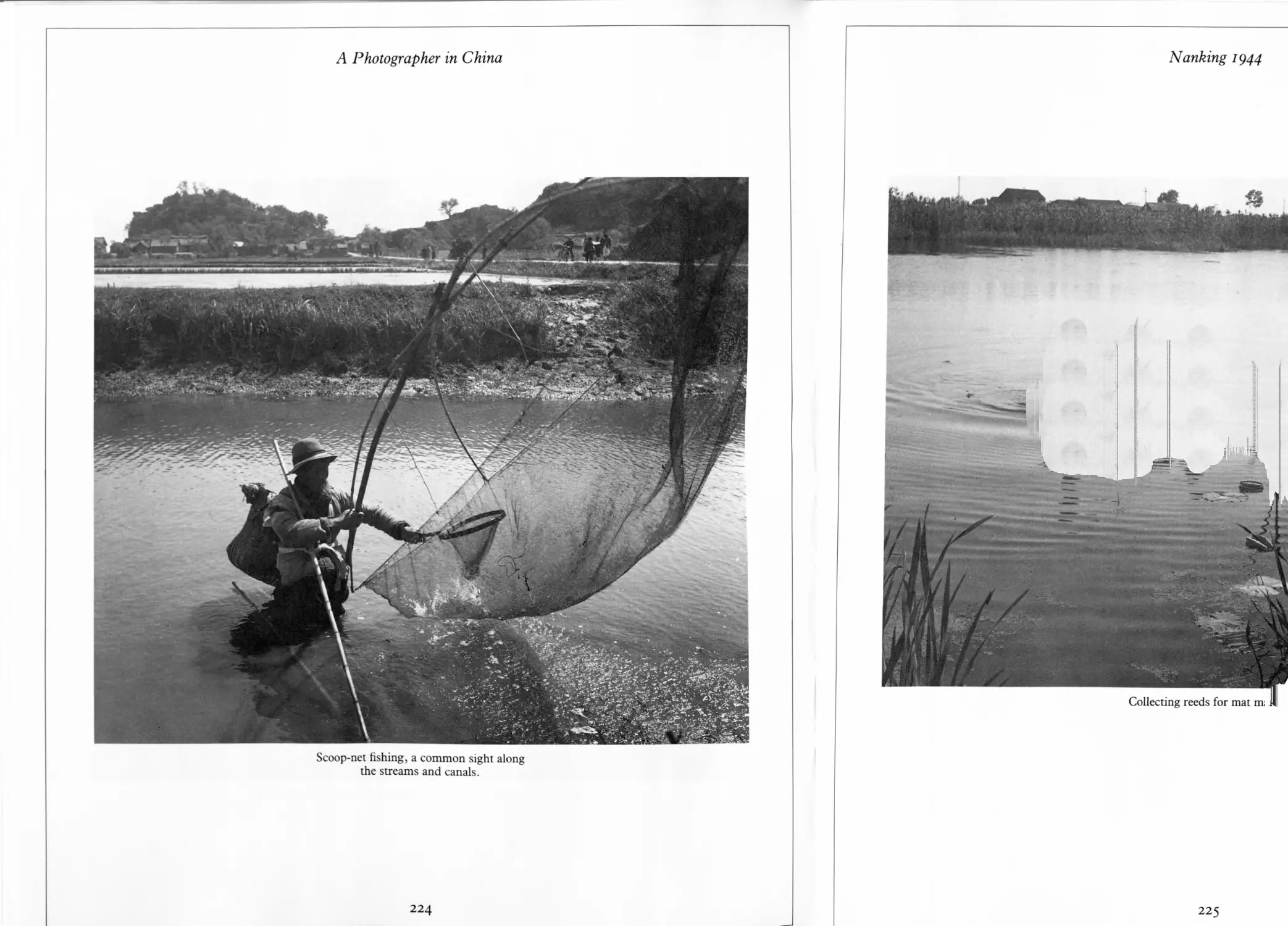
Scoop-net fishing, a common sight along
the streams and canals.
224
225
A Photographer in China
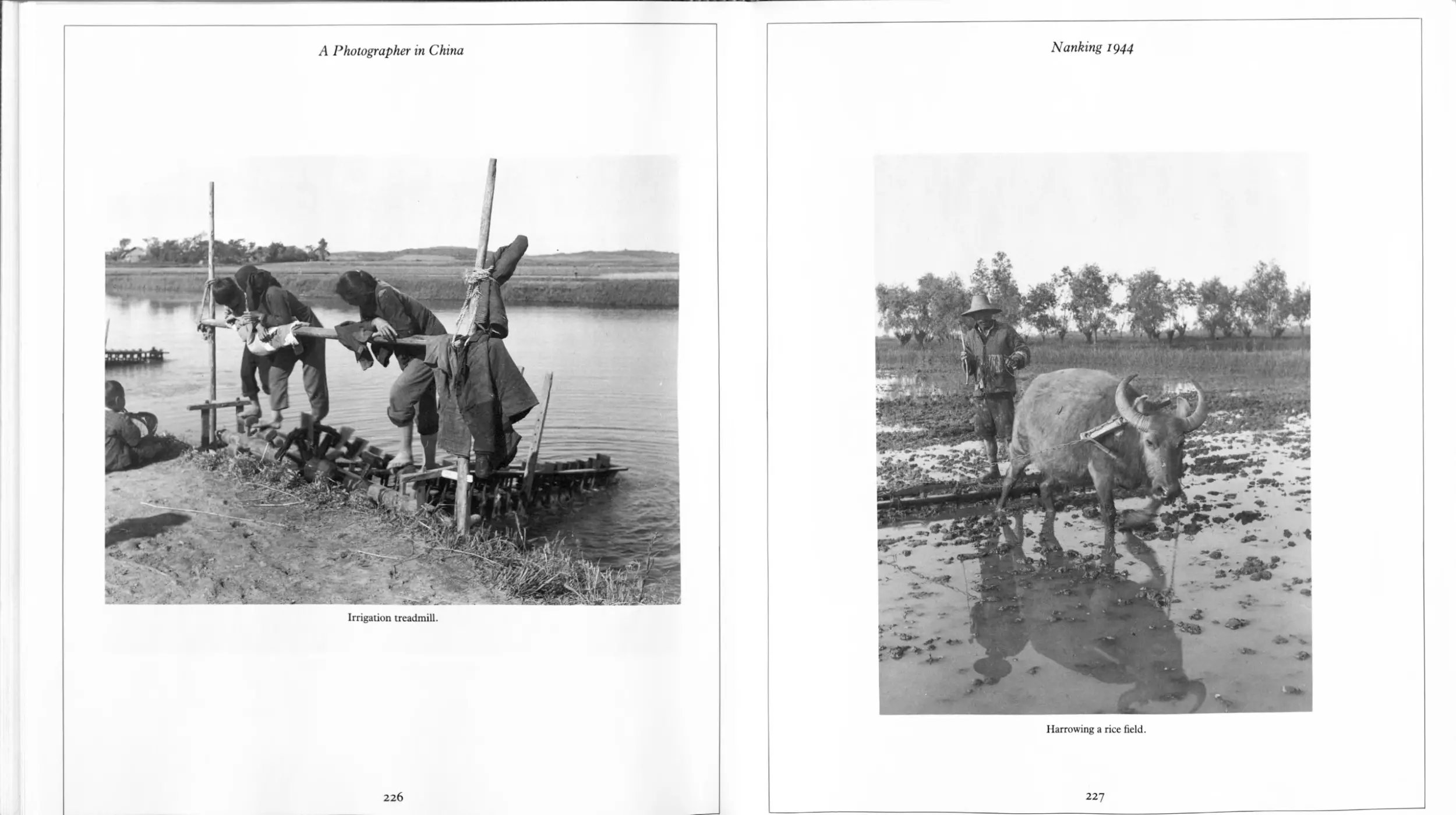
Irrigation treadmill.
226
Nanking 1944
Harrowing a rice field.
227
A Photographer in China
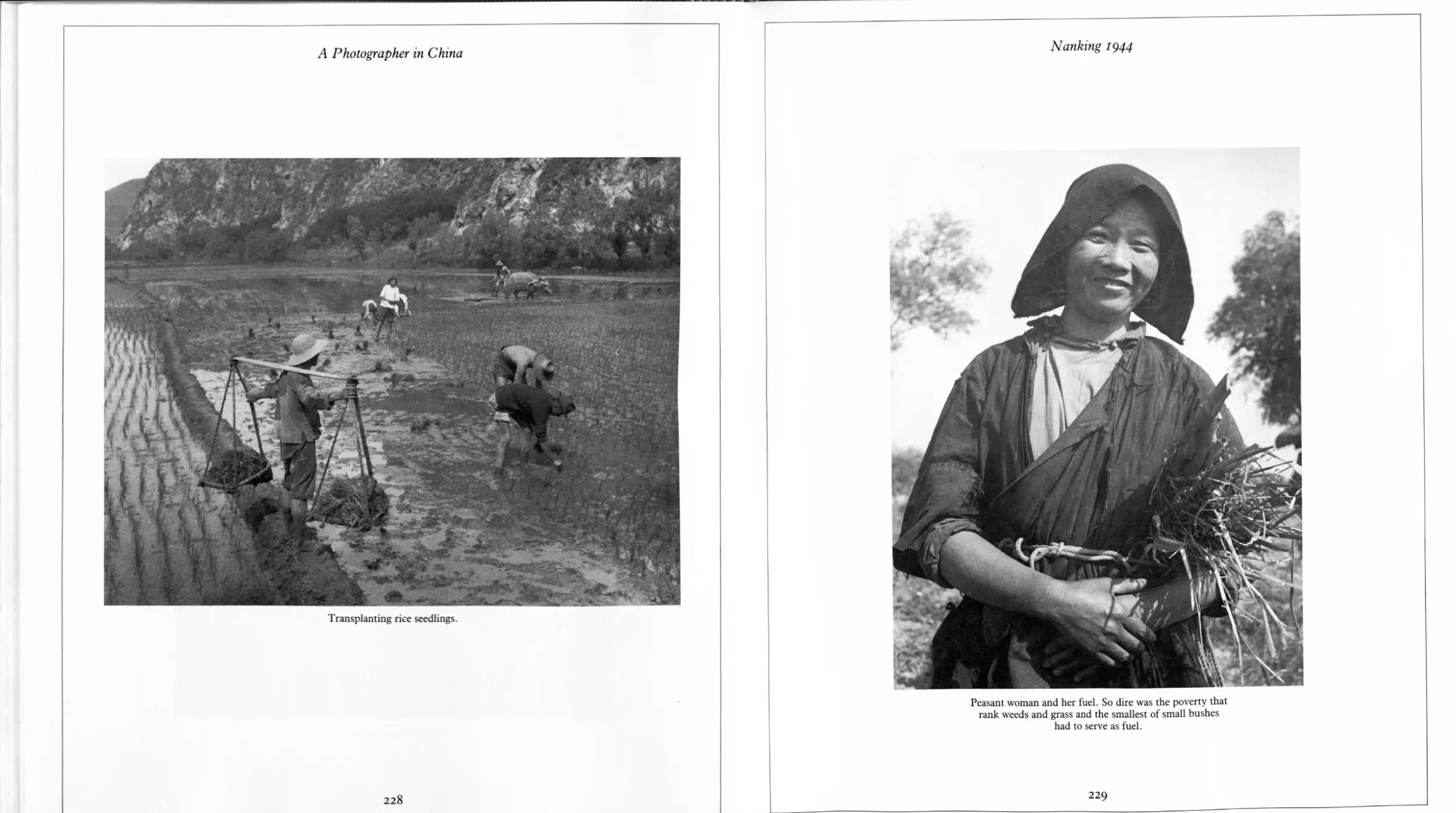
Transplanting rice seedlings.
228
Nanking 1944
SM
Peasant woman and her fuel. So dire was the poverty that
rank weeds and grass and the smallest of small bushes
had to serve as fuel.
229
A Photographer in China
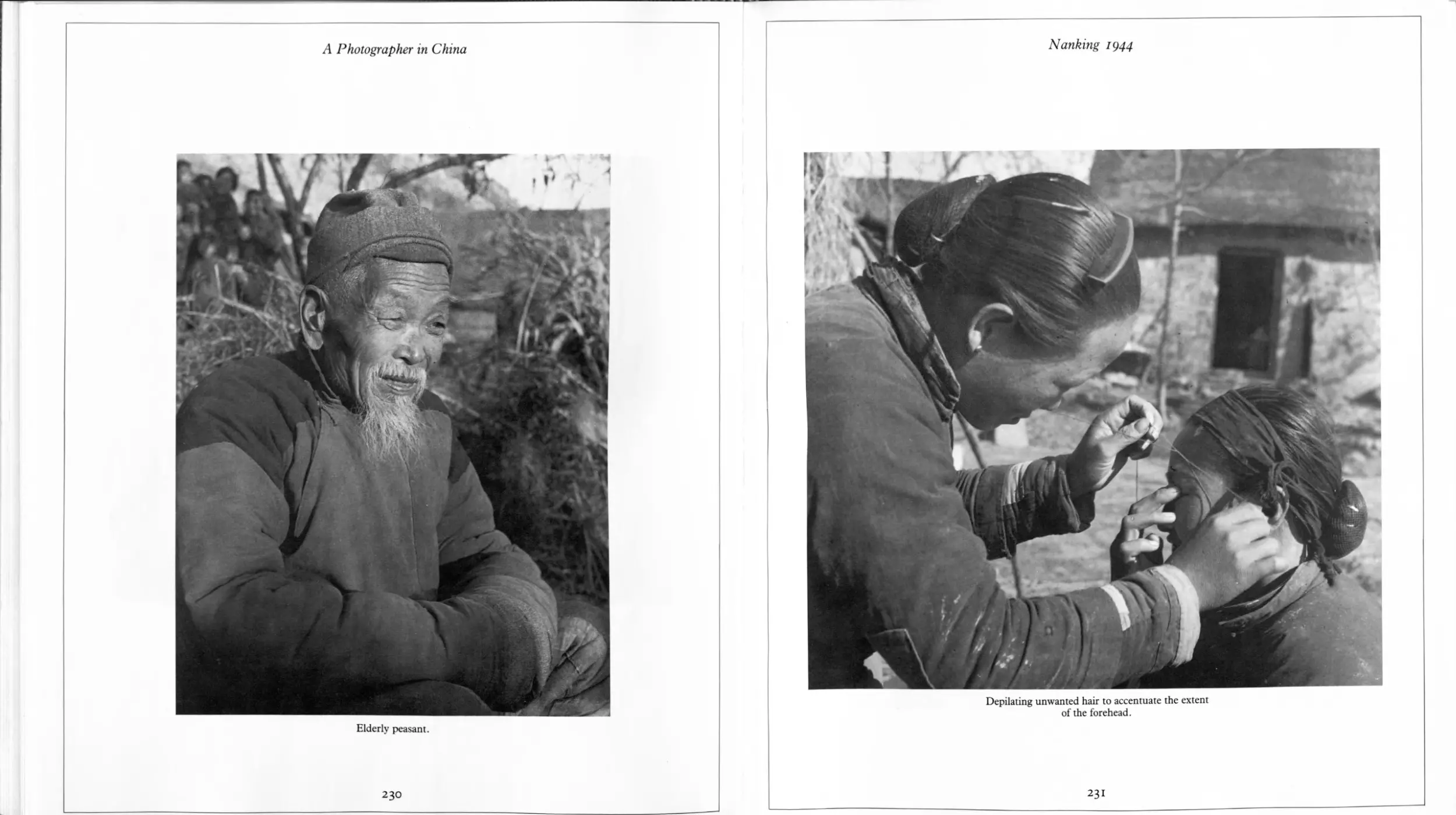
Elderly peasant.
230
Nanking 1944
Depilating unwanted hair to accentuate the extent
of the forehead.
231
A Photographer in China
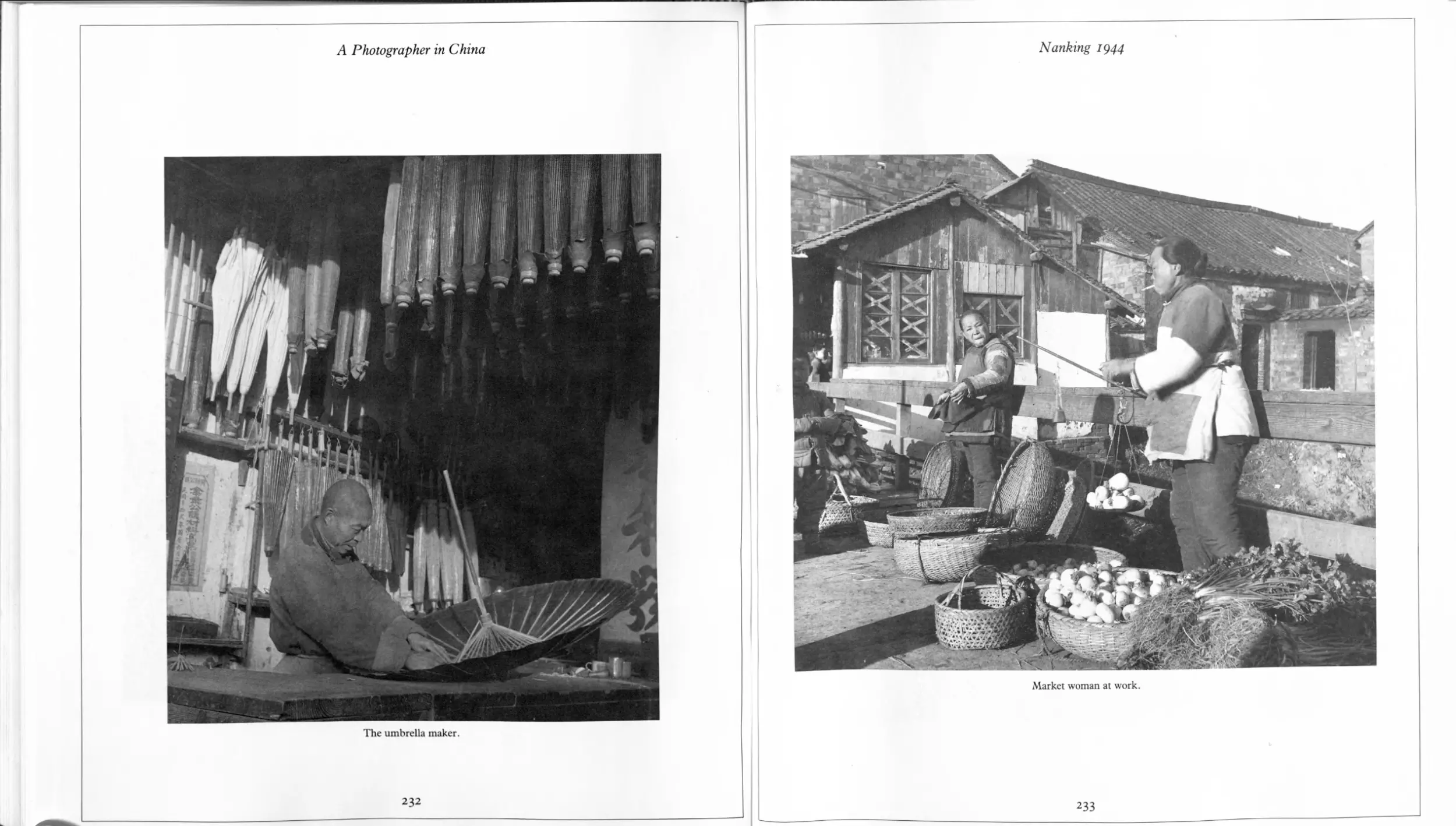
The umbrella maker.
232
Nanking 1944
Market woman at work.
233
A Photographer in China
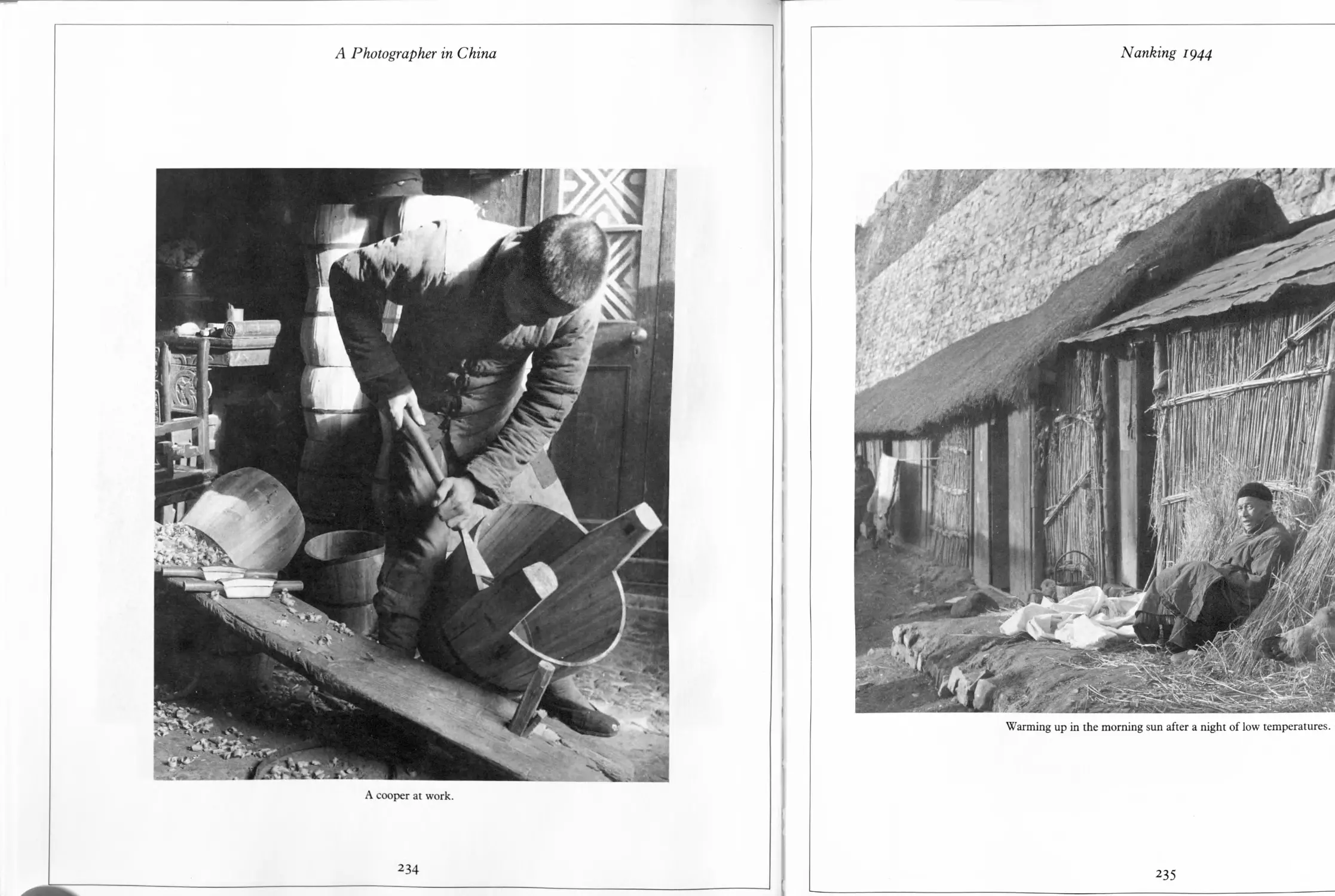
A cooper at work.
234
A Photographer in China
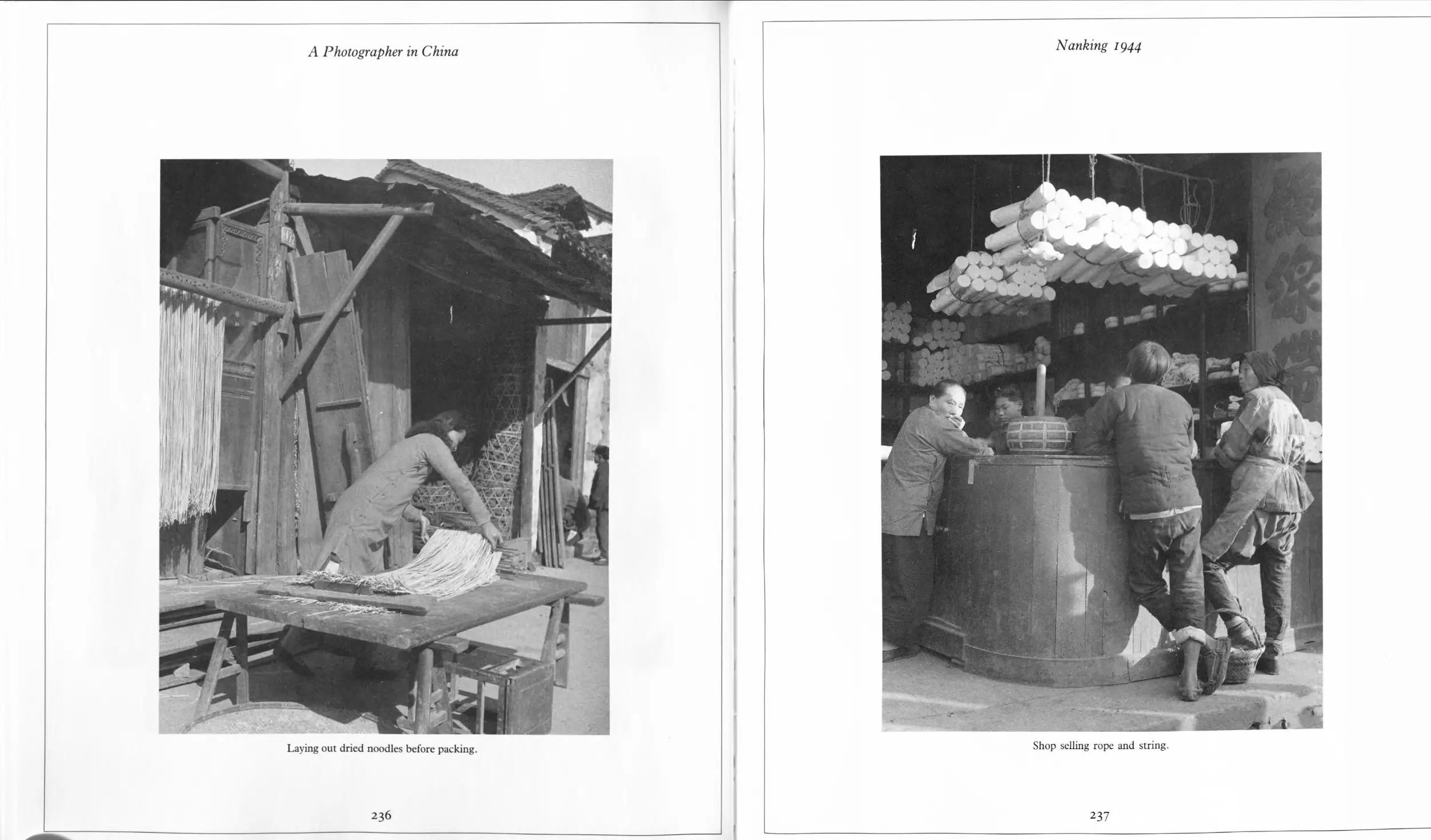
Laying out dried noodles before packing.
236
Nanking 1944
Shop selling rope and string.
237
A Photographer in China
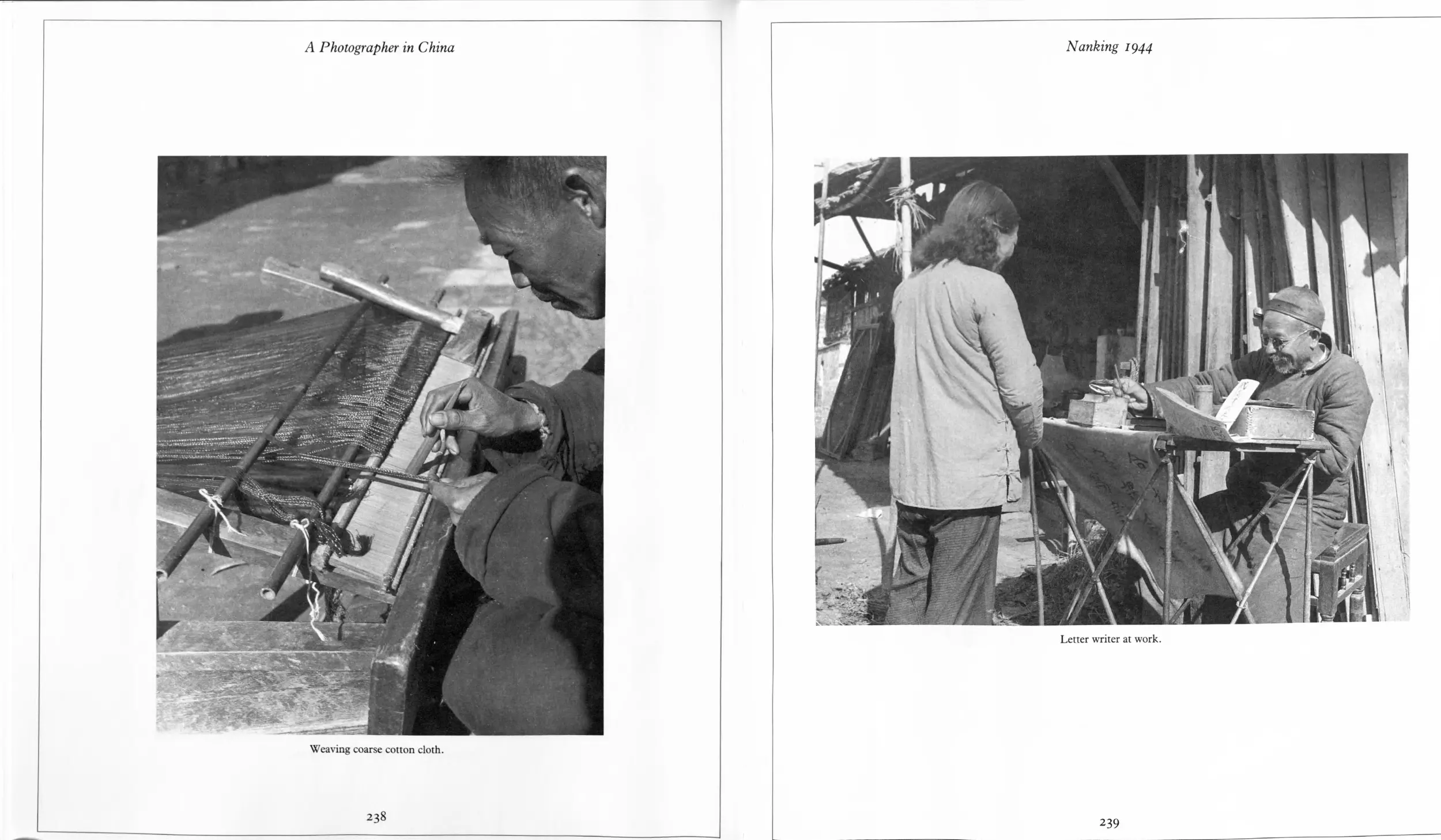
Weaving coarse cotton cloth.
238
Nanking 1944
Letter writer at work.
239
A Photographer in China
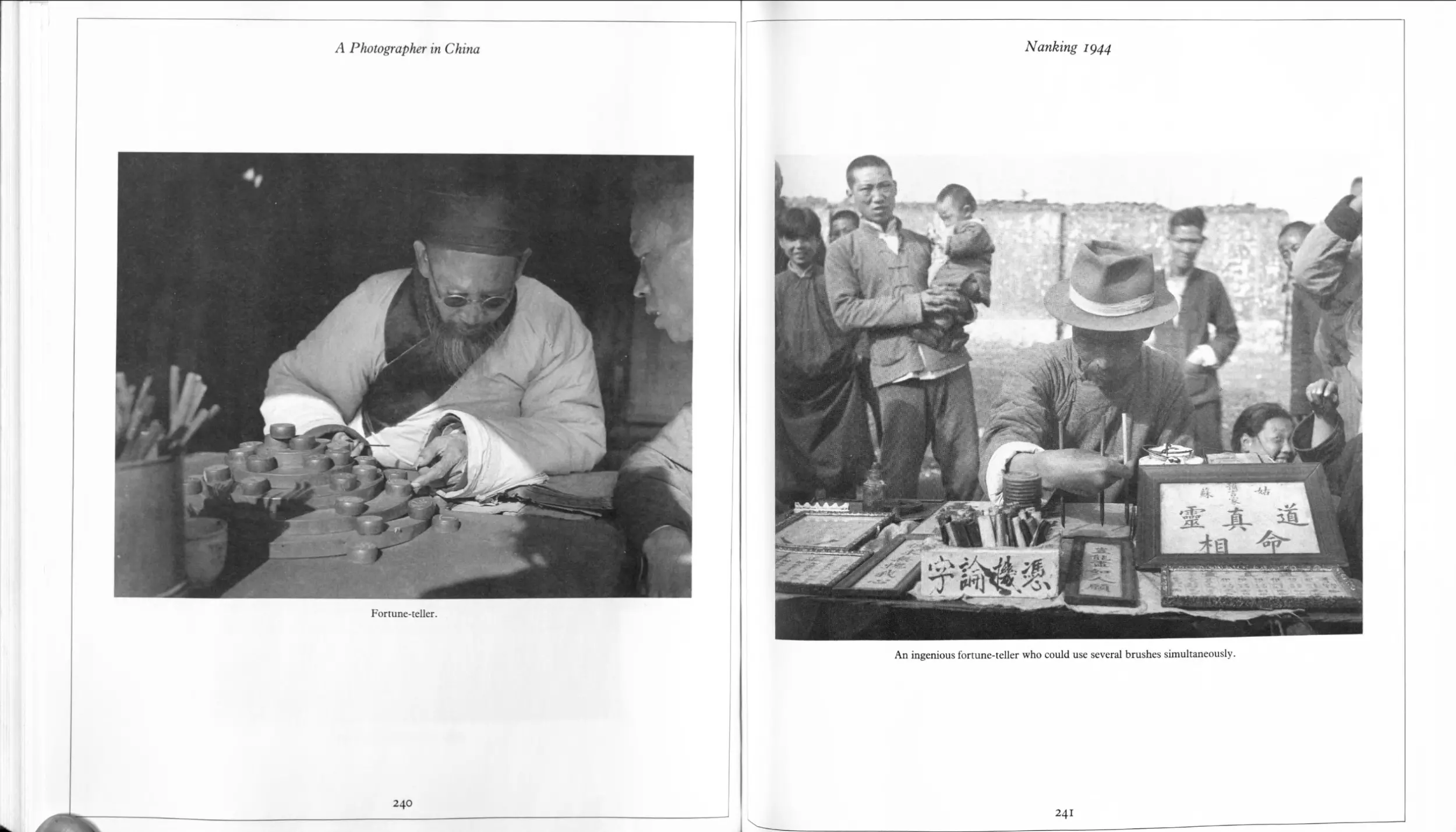
Fortune-teller.
240
Nanking 1944
An ingenious fortune-teller who could use several brushes simultaneously.
241
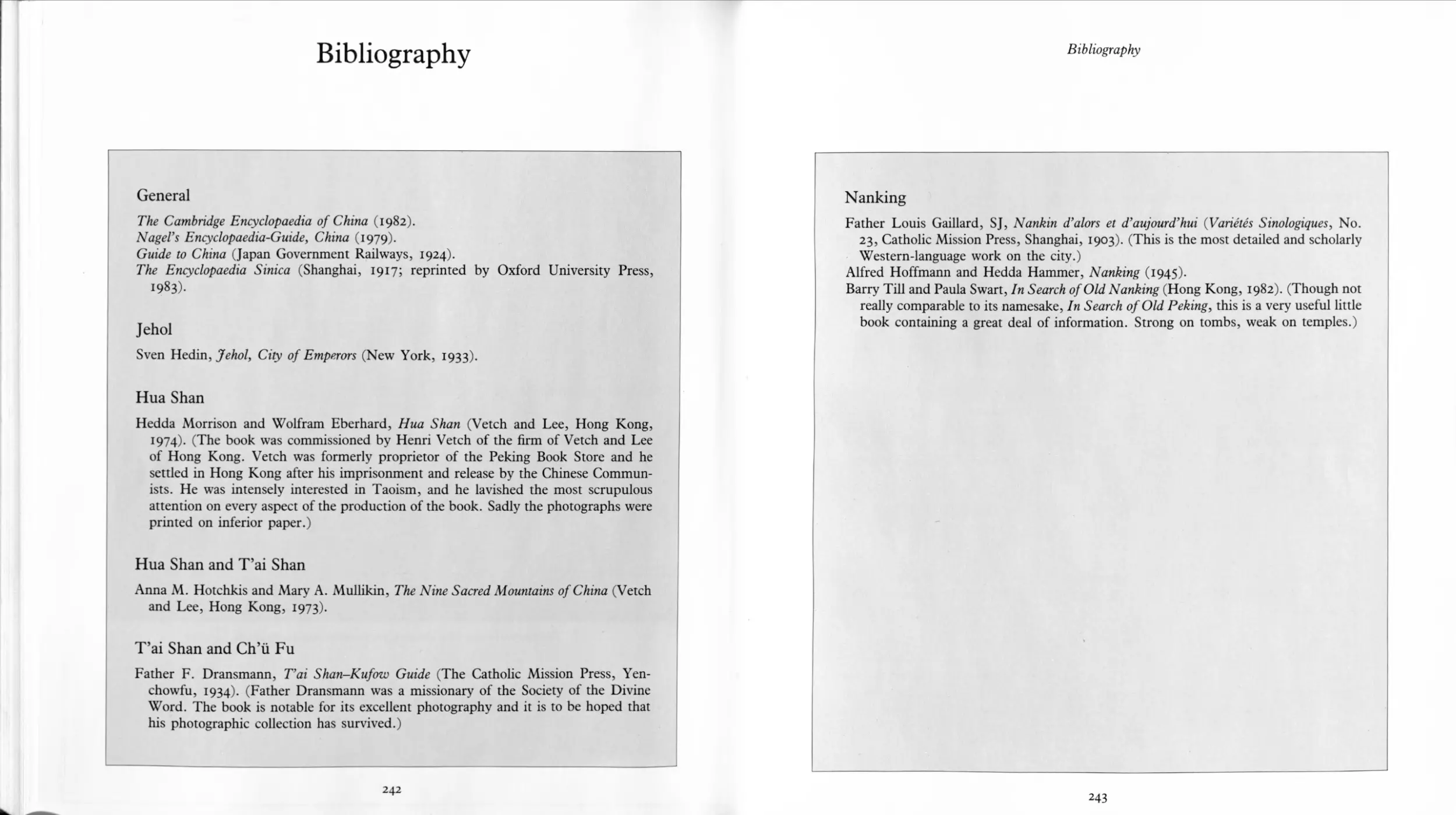
Bibliography
General
The Cambridge Encyclopaedia of China (1982).
Nagel’s Encyclopaedia-Guide, China (1979).
Guide to China (Japan Government Railways, 1924).
The Encyclopaedia Sinica (Shanghai, 1917; reprinted by Oxford University Press,
1983).
Jehol
Sven Hedin, Jehol, City of Emperors (New York, 1933).
Hua Shan
Hedda Morrison and Wolfram Eberhard, Hua Shan (Vetch and Lee, Hong Kong,
1974). (The book was commissioned by Henri Vetch of the firm of Vetch and Lee
of Hong Kong. Vetch was formerly proprietor of the Peking Book Store and he
settled in Hong Kong after his imprisonment and release by the Chinese Commun-
ists. He was intensely interested in Taoism, and he lavished the most scrupulous
attention on every aspect of the production of the book. Sadly the photographs were
printed on inferior paper.)
Hua Shan and T’ai Shan
Anna M. Hotchkis and Mary A. Mullikin, The Nine Sacred Mountains of China (Vetch
and Lee, Hong Kong, 1973).
T’ai Shan and Ch’ii Fu
Father F. Dransmann, T’ai Shan-Kufow Guide (The Catholic Mission Press, Yen-
chowfu, 1934). (Father Dransmann was a missionary of the Society of the Divine
Word. The book is notable for its excellent photography and it is to be hoped that
his photographic collection has survived.)
242
Bibliography
Nanking
Father Louis Gaillard, SJ, Nankin d’alors et d’aujourd’hui (Varietes Sinologiques, No.
23, Catholic Mission Press, Shanghai, 1903). (This is the most detailed and scholarly
Western-language work on the city.)
Alfred Hoffmann and Hedda Hammer, Nanking (1945).
Barry Till and Paula Swart, In Search of Old Nanking (Hong Kong, 1982). (Though not
really comparable to its namesake, In Search of Old Peking, this is a very useful little
book containing a great deal of information. Strong on tombs, weak on temples.)
243
Romanization
'T*HE following is a list of the Chinese names and terms as they are romanized in this J. book, with their equivalents in the Pinyin system of romanization currently used
in the People’s Republic of China, as well as the Chines		e characters for them.
Anhui		Anhui
Ch’ang Hsin Tien		Changxindian
Ch’eng Hiia		Chenghua
Ch’eng Те		Chengde
Cheng Ting	fF	Zhengding
Ch’i Hsia Ssu		Qixiasi
Chi Ming Ssu		Jimingsi
Chi Nan		Ji’nan
Chia Ch’ing		Jiaqing
Chiang Kai Shek		unchanged
Ch’in Huai		Qinhuai
Ch’ing	%	Qing
Ch’ii Fu		Qufu
Chii Ma Ho		Juma He
Chungking		Chongqing
Fukien	^4	Fujian
Han Yu		Han Yu
Hopei		Hebei
Hsien Feng		Xianfeng
Hsu Mi Fu Shou Chih Miao		Xumifushouzhimiao
Hsiian Wu		Xuanwu
Hua Shan		Huashan
Hua Yin		Huayin
Hung Wu		Hongwu
Hupei		Hubei
Jehol (Je Ho)		Rehe
ju-i		ruyi
k’ang		kang
244
Romanization
K’ang Hsi		Kangxi
Kiangsi	/X®	Jiangxi
Kiangsu		Jiangsu
K’ung		Kong
Kuomintang		Guomindang
Kwangtung		Guangdong
Li Tzu Ch’eng		Li Zicheng
Liang		Liang
Ling Ku Ssu		Linggusi
Ling Yen Ssu	ЗсЖФ	Lingyansi
Lohan	Ж/М	Luohan
Lu Kou Ch’iao		Lugouqiao
Lung Hsing Ssu		Longxingsi
Mencius		Mengzi
Ming	8Л	Ming
Nanking		Nanjing
Niu T’ou Shan		Niutoushan
p’ai-lou		pailou
Pao En Ssu		Bao’ensi
Pao Ting		Baoding
Pei Hua Shan	JL# J4	Beihuashan
Peitaiho	ЗЬЗЬ’Г	Beidaihe
Peking	ЗЬЖ	Beijing
Peking-Hankow Railway		Beijing-Hankou Railway
P’i Chih Pagoda		Pizhi Pagoda
P’i Lu Ssu		Pilusi
P’u Lo Ssu		Pulesi
P’u Ning Ssu		Puningsi
P’u Те Ssu		Pudesi
Shanhaikuan		Shanhaiguan
Shansi	J-J®	Shanxi
Shantung		Shandong
She Li	^•1	Sheli
245
Romanization
Sheng Mu		Shengmu
Shensi		Shaanxi
Shih Chia Chuang	Лэ	Shijiazhuang
shou		shou
Sian		Xi’an
Sun Yat Sen		unchanged
Sung	£	Song
Ta Fo Ssu		Dafosi
Ta Lung Men		Dalongmen
Ta T’ung	Л15]	Datong
T’ai An		Tai’an
T’ai Miao		Taimiao
T’ai P’ing		Taiping
T’ai Shan	J-l	Taishan
T’ai Yuan		Taiyuan
Tan Yang		Danyang
T’ang	£	Tang
Taoism		Daoism
Tsin Ling		Qinling
Tsingtao	-frft	Qingdao
Tsou Hsien		Zouxian
Wang Ching Wei	Z1M	Wang Jingwei
Wei	it	Wei
Wei Hai Wei		Weihaiwei
Weng		Weng
Wu Liang Tien		Wuliangdian
Wu San Kuei		Wu Sangui
Yangtze		Yangzi
Yii Hua T’ai		Yuhuatai
Yuan	zt	Yuan
Yuan Shih K’ai		Yuan Shikai
Yim Kang		Yungang
Yung Lo	4^	Yongle


Between 1933 and 1946, Hedda Morrison (nee Hammer)
worked as a photographer in Peking. During those years,
she availed herself of every opportunity to travel out of the
city to see other parts of China: Yiin Kang, one of the
most important Buddhist sites; Cheng Ting; Jehol, the old
Imperial summer seat, many of whose edifices were built
by the Emperor K’ang Hsi; Hua Shan, the awesome
mountain sacred to Taoists; the Lost Tribe country; the
Shantung coast, where houses were built of stone, unlike
elsewhere in China; Pao Ting; Ch’ii Fu and T’ai Shan; and
Nanking, a city rich in history and culture in the lush
lower Yangtze valley.
This collection of photographs, taken during her travels
with the same keenness of observation and sympathy for
her subjects as those published in A Photographer in Old
Peking, records a China wider in geographic scope and
more varied in interest. It is a fitting sequel to the earlier
collection and a worthy volume in its own right.
Hedda Morrison, author of A Photographer in Old Peking
(Oxford University Press, 1985), is married to Alastair
Morrison, the son of G. E. Morrison (Morrison of Peking).
After leaving China in 1946, they lived for almost twenty
years in Sarawak, Borneo, before moving to Canberra,
Australia.
Oxford University Press
ISBN о 19 584177 8