/
















































Похожие

Текст
                    THE CAMBRIDGE
HISTORY OF
CHINA
VOLUME 3
SUI AND T’ANG CHINA
589-906
PARTI

THE CAMBRIDGE HISTORY
OF CHINA
General editors
Denis Twitchett and John K. Fairbank
Volume 3
Sui and T’ang China, 589-906, Part 1
Cambridge Histories Online © Cambridge University Press, 2008

Cambridge Histories Online © Cambridge University Press, 2008

THE CAMBRIDGE
HISTORY OF
CHINA
Volume 3
Sui and T’ang China, 589-906, Part I
edited by
DENIS TWITCHETT
CAMBRIDGE
UNIVERSITY PRESS
Cambridge Histories Online © Cambridge University Press, 2008

CAMBRIDGE UNIVERSITY PRESS
Cambridge, New York, Melbourne, Madrid, Cape Town, Singapore, Sao Paulo, Delhi
Cambridge University Press
32 Avenue of the Americas, New York, NY 10013-2473, USA
www.cambridge.org
Information on this title: www.cambridge.org/978052I214469
© Cambridge University Press 1979
This publication is in copyright. Subject to statutory exception
and to the provisions of relevant collective licensing agreements,
no reproduction of any part may take place without
the written permission of Cambridge University Press.
First published 1979
Reprinted 1993, 1997. 2006. 2007
Printed in the United States of America
A catalog record for this publication is available from the British Library.
ISBN 978-0-521-21446-9 hardback
Cambridge University Press has no responsibility for
the persistence or accuracy of URLs for external or
third-party Internet Web sites referred to in this publication
and does not guarantee that any content on such
Web sites is, or will remain, accurate or appropriate.
Cambridge Histories Online © Cambridge University Press, 2008

GENERAL EDITORS’ PREFACE
In the English-speaking world, the Cambridge Histories have since the
beginning of the century set the pattern for multi-volume works of
history, with chapters written by experts on a particular topic, and unified
by the guiding hand of volume editors of senior standing. The Cambridge
modem history, planned by Lord Acton, appeared in sixteen volumes
between 1902 and 1912. It was followed by The Cambridge ancient history,
The Cambridge medieval history, The Cambridge history 0/ English literature,
and Cambridge Histories of India, of Poland, and of the British Empire.
The original Modem history has now been replaced by The new Cambridge
modem history in twelve volumes, and The Cambridge economic history of
Europe is now being completed. Other Cambridge Histories recently
undertaken include a history of Islam, of Arabic literature, of the Bible
treated as a central document of and influence on Western civilization,
and of Iran and China.
In the case of China, Western historians face a special problem. The
history of Chinese civilization is more extensive and complex than that
of any single Western nation, and only slightly less ramified than the
history of European civilization as a whole. The Chinese historical record
is immensely detailed and extensive, and Chinese historical scholarship
has been highly developed and sophisticated for many centuries. Yet
until recent decades the study of China in the West, despite the important
pioneer work of European sinologists, had hardly progressed beyond the
translation of some few classical historical texts, and the outline history
of the major dynasties and their institutions.
Recently Western scholars have drawn more fully upon the rich
traditions of historical scholarship in China and also in Japan, and greatly
advanced both our detailed knowledge of past events and institutions,
and also our critical understanding of traditional historiography. In
addition, the present generation of Western historians of China can also
draw upon the new outlooks and techniques of modem Western historical
scholarship, and upon recent developments in the social sciences, while
continuing to build upon the solid foundations of rapidly progressing
Cambridge Histories Online © Cambridge University Press, 2008

vi	GENERAL EDITORS* PREFACE
European, Japanese and Chinese sinological studies. Recent historical
events, too, have given prominence to new problems, while throwing
into question many older conceptions. Under these multiple impacts the
Western revolution in Chinese studies is steadily gathering momentum.
When The Cambridge history of China was first planned in 1966, the
aim was to provide a substantial account of the history of China as a
bench mark for the Western history-reading public: an account of the
current state of knowledge in six volumes. Since then the out-pouring of
current research, the application of new methods, and the extension of
scholarship into new fields, have further stimulated Chinese historical
studies. This growth is indicated by the fact that the History has now
become a planned fourteen volumes, which exclude the earliest pre¬
dynastic period, and must still leave aside such topics as the history of
art and of literature, many aspects of economics and technology, and
all the riches of local history.
The striking advances in our knowledge of China’s past over the last
decade will continue and accelerate. Western historians of this great and
complex subject are justified in their efforts by the needs of their own
peoples for greater and deeper understanding of China. Chinese history
belongs to the world, not only as a right and necessity, but also as a
subject of compelling interest.
JOHN K. FAIRBANK
DENIS TWITCHETT
June 1976
Cambridge Histories Online © Cambridge University Press, 2008

CONTENTS
General editors' preface	page v
.List of maps and tables	x
Preface to volume }	xii
List of abbreviations	xiv
1	Introduction	i
by Denis Twitchett, Professor of Chinese, University of Cambridge
The establishment of national unity	2
Institutional change	8
Economic and social change	22
Sui and T’ang China and the wider world	32
The problem of sources	38
2	The Sui dynasty (581-617)	48
by the late Arthur F. Wright, formerly Charles Stymour
Professor of History, Yak University
Sixth-century China	49
Wen-ti (reign 581-604): the founder and	his advisers	57
Major problems of the Sui	73
Yang-ti (reign 604-17): personality and	life style	115
Problems of Yang-ti’s reign	128
3	The founding of the T’ang dynasty: Kao-tsu
(reign 618-26)	150
by Howard J. Wechsler, Associate Professor of History and
Asian Studies, University of Illinois Urbana-Champaign
The seizure of power	15 3
Extension of dynastic control throughout	China	160
Internal policies	168
Relations with the Eastern Turks	181
The Hsiian-wu Gate incident and the transfer of power	182
Cambridge Histories Online © Cambridge University Press, 2008

CONTENTS
viii
4	T’ai-tsung (reign 626-49) the consolidator	188
by Howard J. Wechsler
T’ai-tsung’s ministers	193
‘Regional politics’at the court	200
Domestic policies and reforms	203
Policies designed to strengthen central authority	210
Foreign relations	219
The struggle over the succession	236
5	Kao-tsung (reign 649-83) and the empress Wu: the
inheritor and the usurper	242
by Denis Twitchett and Howard J. Wechsler
Rise of the empress Wu	244
The empress Wu in power	251
Kao-tsung’s internal policies	273
Foreign relations	279
6	The reigns of the empress Wu, Chung-tsung and Jui-
tsung (684-712)	290
by Richard W. L. Guisso, Assistant Professor of History,
University of Waterloo, Ontario
The period of preparation (684-90)	290
The Chou dynasty (690-705)	306
Chung-tsung and Jui-tsung (reigns 705-12)	321
The period in retrospect	329
7	Hsiian-tsung (reign 712-56)	333
by Denis Twitchett
The early reign (713-20): Yao Ch’ung and Sung Ching	345
The middle reign (720-36)	374
Li Lin-fu’s regime (736-52)	409
Yang Kuo-chung’s regime (752-6)	447
The end of the reign	453
8	Court and province in mid- and late	T’ang	464
by C. A. Peterson, Professor of History, Cornell University
The north-eastern frontier	468
Te-tsung (reign 779-805)	497
The provinces at the beginning of the	ninth century	514
Hsien-tsung (reign 805-20) and the provinces	522
Cambridge Histories Online © Cambridge University Press, 2008

CONTENTS	ix
The provinces under Hsien-tsung’s successors	538
Decline of the provincial system	j 52
9	Court politics in late T’ang times	561
by Michael T. Dalbv, Assistant Professor of Chinese History,
University of Chicago
The rebellion of An Lu-shan and its aftermath (75 5—86)	561
Development of the inner court (786-805)	586
Centralization under Hsien-tsung (805-20)	611
Mid-ninth-century court (820-59)	635
10	The end of the T’ang	682
by Robert M. Somers, Assistant Professor of History,
University of Missouri-Columbia
Fiscal problems, rural unrest and popular rebellion	682
The court under I-tsung (reign 859-73)	700
Hsi-tsung (reign 873-88)	714
New structure of power in late T’ang China	762
Glossary - index	790
Cambridge Histories Online © Cambridge University Press, 2008

MAPS AND TABLES
Maps
1	Sui China, 609
2	Sui and T’ang canal system
3	Late Sui rebellions, 613-16
4	Late Sui rebellions, 617
5	T’ang conquest
6	T’ang China, 639
7	T’ai-tsung’s advance into central Asia
8	Kao-tsung’s protectorates in central Asia
9	Kao-tsung’s interventions in Korea
10	Military establishment under Hsiian-tsung
11	T’ang China, 742
12	An Lu-shan’s rebellion
13	T’ang provinces, 763
14	Ho-pei'rebellions, 781-6
15	T’ang provinces, 785
16	Fiscal divisions of the empire, 810
17	T’ang provinces, 822
18	Banditry in the 830s and 840s
19	Ch’iu Fu and P’ang Hsiin rebellions
20	Wang Hsien-chih’s bandit confederation, 874-8
21	Huang Ch’ao’s movements, 878-80
22	Distribution of power after Huang Ch’ao’s rebellion, 885
page
129
136
145
147
164
204
227
281
283
368.
403
454
488
502
508
520
539
686
698
728
738
7б5
Cambridge Histories Online © Cambridge University Press, 2008

MAPS AND TABLES	xi
Tables	page
1	Sui emperors and their reign periods	xvi
2	Outline genealogy of the T’ang imperial family	xvii
3	T’ang emperors and their reign periods	xviii
4	Marriage connections of the T’ang royal house	xx
5	T’ang weights and measures	xx
6	Land distribution under the Sui dynasty	94
7	Location of Hsuan-tsung’s court	3 5 8
8	Frontier commands under Hsiian-tsung	367
9	High leadership of ninth-century political factions	643
10	Summary of-data on identifiable members of mid-ninth-century
political factions	633
11	Distribution of power after Huang Ch’ao’s rebellion	764
Cambridge Histories Online © Cambridge University Press, 2008

PREFACE TO VOLUME 3
The Chinese is transliterated according to the Wade-Giles system, which
for all its imperfections is employed almost universally in the serious
literature on China written in English. For Japanese, the Hepburn system
of romanization is followed.
Chinese personal names follow their native form, that is with the
surname preceding the given name.
Place names present a complex problem, as many of them underwent
changes during the course of the period covered by this volume, some
of them several times. In general we have used the names in use in the
period until 741 and employed as the head-entries in the monographs
on geography in the two Dynastic Histories of the T’ang, even when
(as for example from 742 to 758) this is strictly speaking an anachronism.
In some cases there is possible confusion between modem provincial
names, used as a regional description, and the names of T’ang provinces.
The convention is adopted of hyphenating the syllables of T’ang place
names, and not hyphenating modem names. For example Hopei represents
the modem province, Ho-pei the T’ang province. For modem place
names some non-standard spellings which have become customary, for
example Nanking for Nanching, Sian for Hsian, are retained.
For dates the Chinese and Western years do not exactly coincide. The
Western year which nearly coincides with the Chinese year is used as
the equivalent of the Chinese year. For example 716 is used as equivalent
to the fourth year K’at-yiian, which in fact ran from 29 January 716 until
1 5 February 7x7 (it included an intercalary month). Dates, where given,
are expressed in Chinese lunar months and days, since this makes reference
to the Chinese sources simpler than if they were expressed in the Western
calendar. Western equivalents may easily be found for the T’ang period
in Hiraoka Takeo, Todai no kqyomi (Kyoto, 1954!.
Cambridge Histories Online © Cambridge University Press, 2008

PREFACE TO VOLUME }	хШ
ACKNOWLEDGMENTS
We wish to thank the American Council of Learned Societies for two
grants which have enabled us to support the editorial assistance of Robert
Somers and Stephen Jones in the preparation of this volume. Mr Somers
undertook preliminary editing on chapters i to 5. Mr Jones, in co¬
operation with Cambridge University Press, has edited the text of the
entire volume. The maps were prepared by the editor and drawn by
Ken Jordan FRGS and Reg Piggott.
We would also like to acknowledge the generous support given by
the American Council of Learned Societies to the Conference on T’ang
Studies held at Cambridge in 1969. That conference, in which all but
one of the contributors to this volume took part, gave a new impetus
to the study of the period, and proved invaluable in formulating the
basic outline of Sui and T’ang history, and in establishing the major
problems to which this volume and its successor attempt to provide
answers.
My co-chairman at that conference, and the co-editor of the symposium
volume, Perspectives on the T’ang, in which the papers were published,
was the late Arthur F. Wright, who died while this volume was being
prepared for press. I and my fellow contributors, several of whom have
been his pupils, and all of whom were his personal friends, would wish
to record our tribute to the great contribution he made to the study of
medieval Chinese history, and our sadness that he did not live to see the
completion and publication of this volume, in the progress of which he
had been so deeply involved.
DCT
Cambridge Histories Online © Cambridge University Press, 2008

ABBREVIATIONS
AM
BEFEO
BSOAS
CTS
CTW
CYYY
HJAS
HTS
JA
JAOS
JAS
LSYC
MSOS
SGZS
SPPY
SPTK
SS
TCTC
TD
TFYK
THGH
THY
TLT
TP
TSCC
TT
TTCLC
TYGH
тггк
WYYH
Asia Major (new series)
Bulletin de I’Ecole Franfaise d’Extreme-Orient
Bulletin of the School of Oriental and African Studies
Chiu T’ang shu
Ch’Uan T’ang-wen
Kuo-li chung-yang yen-chiu-yiian Li-shih yu-yen yen-chiu-so chi-k’an
(Academia Sinica)
Harvard journal of Asiatic Studies
Hsin T’ang shu
Journal Asiatique
Journal of the American Oriental Society
Journal of Asian Studies
Li-shihyen-chiu
Mitteilungen des Seminars fiir Orientalische Sprachen %u Berlin
Shigaku % asshi
Ssu-pu pei-yao edn
Ssu-pu ts’ung-k’an edn
Sui shu
T^u-chih t’ung-chien
Taisho shinshii Dai^okyo edn of the Buddhist Tripitaka
Ts’e-fuyiian-kuei
Toho gakuho; refers to the journal of this name published in
Kyoto unless specified THGH (Tokyo).
T’ang hui-yao
T’ang liu-tien
T’oung pao
Ts’ung-shu chi-ch’eng edn
T’ung tien
T’ang ta chao-ling chi
Toy6 gakuho
Wen-hsien t’ung-k’ao
Wen-yuan у ing-hua
Cambridge Histories Online © Cambridge University Press, 2008

ABBREVIATIONS
XV
EDITIONS EMPLOYED FOR MAIN PRIMARY SOURCES
The Standard Dynastic Histories are cited in the punctuated critical texts
published by the Chung-hua shu-chii, Peking. This edition is also available
in a reprint published in Taipei. Works from this series to which reference
is made are:
Ch’enshu, z vols., 1972
Chiu T’angshu (abbreviated as CTS), 16 vols., 1975
Choushu, 3 vols., 1971
Hsin T’angshu (abbreviated as HTS), 20 vols., 1975
Hsin Wu tai shih, 3 vols., 1974
Nan shih, 6 vols., 1975
Pei Ch’i shu, 2 vols., 1972
Pei shih, 10 vols., 1974
Sui shu (abbreviated as SS), 6 vols., 1973
Wei shu, 8 vols., 1974
Collected works of individual authors, unless otherwise specified, are
cited from the editions reprinted in the Ssu-pu ts’ung-k’an.
Buddhist works, unless otherwise specified, are cited from the Taisho
shinshu Dai^okyo edition of the Buddhist canon.
The editions of other frequently cited primary sources are as follows:
Ch’uan T’ang-wen, imperial edn, 1814; reprinted in facsimile, Hua-wen
shu-chii, Taipei, 1961; Hua-wen shu-chii, Taipei, 1961. (Abbreviated
as CTW)
T^u-chih t’ung-chien, Ku-chi ch’u-pan-she edn, Peking, 1956. (Abbreviated
as TCTQ
Ts’e-fuyiian-kuei, edn of Li Ssu-ching, 1642; reprinted in facsimile Chung-
hua shu-chii, Peking, i960; Ching-hua shu-chii, Taipei, 1965. (Abbre¬
viated as TFYK)
T’ang bui-yao, Kuo-hsiieh chi-pen tsiing-shu edn, Shanghai, 1935; reprinted
Chung-hua shu-chii, Peking, 1957. (Abbreviated as THY)
T’ang liu-tien, edn of Konoe Iehiro, 1724; reprinted in facsimile Wen-hai
ch’u-pan-she, Taipei, 1962. (Abbreviated as TLT)
T’ung tien, Shih T’ung edn, Shanghai, 1936. (Abbreviated as TT)
T’ang ta chao-ling chi, Shang-wu yin-shu-kuan edn, Shanghai, 1959.
(Abbreviated as TTCLC)
Wtn-hsien t’ung-k’ao, Shih-t’ung edn, Shanghai, 1936. (Abbreviated as
WHTK)
Wen-yuan ying-hua, edn of 1567 with prefaces by T’u Tse-min and Hu
Wei-hsin; reprinted in facsimile, Chung-hua shu-chii, Peking, 1966.
(Abbreviated as WYYH)
Cambridge Histories Online © Cambridge University Press, 2008

Xvi	TABLES
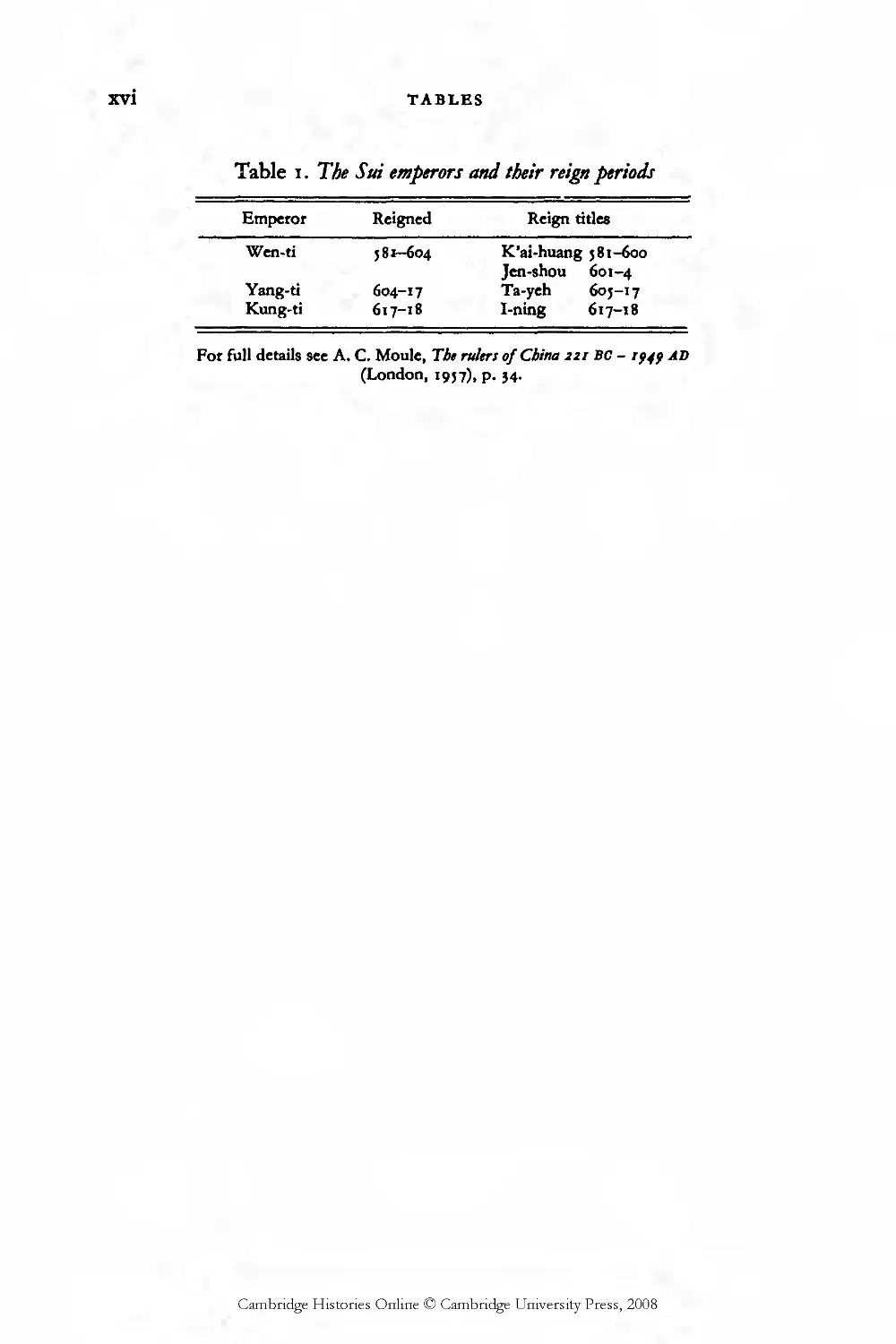
Table i. The Sui emperors and their reign periods
Emperor
Reigned
Reign titles
Wen-ti
381-604
K’ai-huang 581-600
Jen-shou 601-4
Yang-ti
604-17
Ta-yeh
605-17
Kung-ti
617-18
I-ning
617-18
For full details see A. C. Moule, The rulers of China 221 BC - 1949 AD
(London, 1957), p. 34.
Cambridge Histories Online © Cambridge University Press, 2008

TABLES
XVU
Table z. Outline genealogy of the T'ang imperial family
Kao-tcu j66-6j5
reigned 618-26
1 1 1 1 1 1 И 1 1 I 1 1 1 1 I I I I
LJ Chieo-cb’eng
HA 619-26
Tai-tsung $99-649
reigned 626-49
>«i
Li Ch’eng-ch’ien
HA 673-47
1 Г
1	1	Г-Д~"1—1	г
1—I
Kao-tsung 628-8)
НЛ 64), reigned 649-8)
>1 1 1
Li Chung
HA 6)2-6
I jib I
Li Hung
HA 6)6-75
6thl
Li Hsien
HA 67J-80
7«h|
IZ
Empress Wu Tse-t’ien
7 reigned 690-70)
3rd i
li Ch'ung-chQn
HA 706-7
4th
8th|
Chung-tsung 656-710
HA 68o, reigned 684
r
jui-tsung 662-716
reigned 684-90
under empress Wu
Imperial heir 698
restored 705-10
restored 710-12
Li Ch’ung-mao
reigned as Wen-wang
under empress Wei 710
I
HsQan-tsung 685-762
HA 710, reigned 7is-)6
I I I I II I I I I I II I I li
)0 I sons
T
ПТТТП
and|
Li King
HA 713-37
и I
Su-tsung 711-62
HA 738, reigned 756-62
1	1	1	r
14 I «one
T	г
Tai-tsung 717-79
HA 7j8„ reigned 761-79
1—I—Г
"I—I—I—I—I—I—I—I—I—I—I
Tc-tsung 741-807
HA 764, reigned 779-80]
1	1	1	1	1	1	1	1
Shun-taung 761-806
НЛ 779, reigned 8oj
T—I—I—I—I—I—Г
i—I—I—I—I—Г
Hticn-tsung 778-810
HA 807, reigned 807-10
"I—Г
~l—I—I
ж Г
LlNin;
3rd
Ning
HA 809-11
1 I 1 I I I I I li)tbl II I I I I I
Mu-tsung 795-824
HA 812, reigned 820-4
Hsiuan-tsung 810-59
reigned 846-59
,„l
2nd | 1 1
5lh|
Ching-tsung 809-27
Wen-tsung 809-40
Wu-tsung 8(4-46
HA 822, reigned 824-7
reigned 827-40
reigned 840-6
1—1—г
1 !'h|
Lt Ch’cng-mcl
HA 839-40
n—1—1
Li Yung
HA 832-6
i—i—1—1—1—1—г
I-tsung 833-77
reigned 839-73
Ж
Hsi-tsung 862-88
reigned 873-88
7'Ь I
Chao>tsung 867-904
reigned 888-904
10 I sons
„,1 I 'll I I l9th|
Li Yil	Ai-ti 892-908
HA 897-904	reigned 904-7
HA: heir apparent
This chart shows the
line of succession;
also those heirs apparent
who did not succeed to
the throne.
Other royal princes
were given the tith of
heir apparent as a
posthumous honour, but
did not actually serve
as heir apparent.
Cambridge Histories Online © Cambridge University Press, 2008

TABLES
xviii
Table 5. The T’ang emperors and their reign periods
Emperor
Reigned
Reign titles
Kao-tsu
618-26*
Wu-te
618-26
T’ai-tsung
626-49
Chen-kuan
627-49
Kao-tsung
649-83
Yung-hui
650-5
Hsien-ch’ing
6j6—6O
Lung-shuo
661-3
Lin-te
664-5
Ch’ien-feng
666-7
Tsung-chang
668—9
Hsien-heng
670-3
Shang-yiian
674-3
I-feng
676-9
T’iao-lu
679
Yung-lung
680-1
K’ai-yao
681-2
Yung-ch’un
682-5
Hung-tao
683
Chung-tsung
684+
Ssu-shcng
684
(court under control
of empress Wu)
Jui-tsung
684-90!
Wen-ming
684
(court under control
Kuang-chai
684
of empress Wu)
Ch’ui-kung
685-8
Yung-ch’ang
689
Tsai-ch’u
689-90
Empress Wu Tse-t’ien
690-705
T’ien-shou
690-2
Chou ‘dynasty’
Ju-i
692
Ch’ang-shou
692-4
Yen-tsai
694
Cheng-sheng
694-5
T’ien-ts’e wan-sui 695
Wan-sui teng-
696
feng
Wan-sui t’ung-
696-7
t’ien
Shen-kung
697
Sheng-li
697-700
Chiu-shih
700-Х
Ta-tsu
701
Ch’ang-an
701-4
Chung-tsung restored
705-10
Shen-Iung
705-7
Ching-lung
707-10
Shao-ti
7I0t
T’ang-lung
710
(court under control
of empress Wei)
Jui-tsung restored
710-12*
Ching-yiin
710-iz
T’ai-chi
712
Yen-ho
71*
Hsuan-tsung
7x2-56*
Hsien-t’ien
712-13
K’ai-yfian
7»3-4*
Tien-pao
742-56
Cambridge Histories Online © Cambridge University Press, 2008

TABLES
xix
Table 3 (coni.).
Emperor
Reigned
Reign titles
Su-tsung
756-62
Chih-te
756-8
Ch’ien-yiian
758-60
Shang-yiian
760-1
Yiian
761-2
Tai-tsung
762-79
Pao-ying
762-5
Kuang-te
765-4
Yung-t’ai
765-6
Ta-li
766-79
Te-tsung
779-805
Ta-li
779
Chien-chung
780-5
Hsing-yiian
785-4
Chen-yiian
785-805
Shun-tsung
00
0
Wl
*
Chen-yuan
805
Yung-chen
805
Hsien-tsung
805-20
Yung-chen
805
Yiian-ho
806-20
Mu-tsung
820-4
Ch’ang-ch’ing
821-4
Ching-tsung
824-7
Pao-li
825-7
Wen-tsung
827-40
T’ai-ho
827-56
K’ai-ch’eng
856-40
Wu-tsung
840-6
Hui-ch’ang
841-6
Hsiuan-tsungi
846-59
Ta-chung
847-59
I-tsung
859-75
Heien-t’ung
860-75
Hsi-tsung
875-88
Ch’ien-fu
874-80
Kuang-ming
880-1
Chung-ho
881-5
Kuang-ch’i
885-8
Wen-te
888
Chao-tsung
888-904
Wcn-tc
888
Lung-chi
889
Ta-shun
890-2
Ching-fu
892-5
Ch’ien-ning
894-8
Kuang-hua
898-901
T’ien-fu
901-4
T’ien-yu
9°4
Ai-ti
904-7
T’ien-yu
904-7
* abdicated % correctly transliterated Hsiian-tsung. We have used this irregular form
to avoid confusion with Hsiian-tsung (reign 712-56)
f deposed
For full details see A. C. Moule, The rulers of Cbitut 221BO -1949 AD (London, 1957),
pp. 54-62. For detailed calendar see Hiraoka Takeo, Todai no kqyomi (Kyoto, 1954).
Cambridge Histories Online © Cambridge University Press, 2008

XX
TABLES
Table 4. Marriage connections of the T'ang royal house
Yang Chung
Li Hu
Tu-ku Hsin Yii-wen T’ai
Yang Chien => 7th d. Li Ping = 4th d.
(SuiWen-ti) 1
1
1
1
Li Yiian
i
i
(T’ang Kao-tsu)
i
Yang Kuang
(Sui Yang-ti)
' 1
ist d. >=
I	I
Yii-wen Yung	Yii-wen Yil
(N. Chou Wu-ti) (N. Chou Ming-ti)
Yii-wen YOn
(N. Chou Hsiian-ti)
1st d.
Yii-wen Yen
(N. Chou Ching-ti)
	 Tu-ku dan	= Li dan (T’ang royal house)
	 Yang dan (Sui royal house)	Yu-wen dan (Northern Chou royal house)
Yang Chung, Li Hu and Yii-wen T’ai, the founders of the Sui, T’ang and Northern Chou
royal houses, all served as high-ranking generals during the Western Wei, together with
Tu-ku Hsin, to whose daughters all three married their sons.
Table 5. T'ang weights and measures
(a) Length
io ttun = i cb'ib (slightly less than i English foot)
5 cb'ib = i pu (double pace)
io cb’ib «= i cbang
1800 cb'ib = i // (approx. | English mile)
(b) Area
i той = a strip i pu wide by 240 pu long (approx. 0-14 acre)
100 той =• i ch’ing (approx. 14 acres)
(<•) Capacity
3 tbeng = 1 ta-shtng (the standard pint)
10 ta-sbeng = 1 tou
10 tou — 1 bu
1 bu == 1 sbib (approx. 1} bushels)
(4) Weight
3 Hang = 1 ta-liang (the standard ounce)
16 ta-liang = 1 cbin (approx. 1} English lb)
(a) Cloth
1 p’i of silk = a length 1-8 cb'ib in width, 40 cb’ib long
i
tuan of hemp => a length i-8 cb’ib in width, 50 cb'ib long
Further details are given in S. Balazs, ‘BeitrSge zur Wittschaftsgeschichte der T’ang-Zeit’,
MSOS, 36 (1933) 49 ft
Cambridge Histories Online © Cambridge University Press, 2008

CHAPTER 1
INTRODUCTION
This volume is the first of two devoted to the Sui and T’ang dynasties
(581-907). It is designed to provide the reader with a narrative account of
this complex period, during which China underwent far-reaching changes
in political institutions, in her relations with the neighbouring countries,
in social organization, in the economy and in every sphere of intellectual,
religious and artistic life. The broader issues in institutions, social and
economic change and in intellectual developments are dealt with in
detail in Volume 4 which also contains a bibliography for both volumes.
A glance at this bibliography will show that a wealth of modern scholar¬
ship has been devoted to the T’ang. Chinese scholars have been attracted
to the period as one of the high points of Chinese political power and
influence, and as one of extraordinary achievements in every field of
culture and the arts. Japanese scholars have been drawn to the Sui
and T’ang not simply because of the intrinsic interest of the period, but
also because it was during these dynasties that Japan was most deeply
influenced by Chinese institutions. Consequently Japanese scholars have
had a deep and instinctive understanding of Sui and T’ang China which
provided so much of the fabric of their own state structure, laws and
institutions, art, literature and even of their written language. Western
scholars too have long been fascinated by the period — the first full scale
political history of the T’ang in a European language was completed by
Father Antoine Gaubil SJ in 1753* - and in recent decades have begun
to make their own distinctive contribution to the understanding of T’ang
China.
However, although the Sui and T’ang periods have been subjected to
more rigorous scrutiny by modern historians than any other period of
Chinese history prior to the nineteenth century, political history in the
1 Le P. Antoine Gaubil, SJ, Abrlgl de I’bistoire (binoise de la grande dynastic des T’ang in Mlmoires
eontemant les Cbinois, tome 15 (1791) pp. 399-516 and tome 16 (1814) pp. 1-365. In spite of
its dates of publication, this monumental work was completed in Peking in the mid¬
eighteenth century, and sent back to Paris by Gaubil in 1753. Tome 16 of the Mlmoires
eoneemant les Cbinois also includes articles by Gaubil on the Muslims under the T’ang
(pp. 373-5); on the T’ang population (pp. 375-8); on the Nestorian stele at Sian (pp. 378-83)
and on the countries of the western regions in T’ang times (pp. 383-95).
[ x 1
Cambridge Histories Online © Cambridge University Press, 2008

2
INTRODUCTION
broadest sense has been neglected and taken for granted. Surprisingly,
much of the ground covered in this volume has not previously been
examined in detail, even by modern Chinese historians. Only the Sui,
the first years of the T’ang, the reign of the empress Wu, the latter years
of Hsiian-tsung and the first decades of the ninth century have been
subjected to reasonably close analysis. For the rest, the best summary often
remains the amazingly lucid, critical and judicious account written by
Ssu-ma Kuang and his collaborators in the T^u-chih t'ung-chien completed
in 1085.2 As work on this volume has progressed, so our admiration for
this prince among historians has grown. The original aim of The Cambridge
history of China was to producie a summary of the current state of know¬
ledge, but in the event all the chapters in these volumes represent much
new research into previously neglected topics. Some of the results are
therefore tentative. But the placing of the results of many isolated studies
of specialized topics into the context provided by a detailed chronological
account has thrown into relief many unsuspected relationships between
developments in very different fields, and we feel confident that this
volume will provide the reader with a historical context which will add
new significance to the more specialized studies in volume 4.
By way of introduction I shall now outline some of the main themes
which run through the period and have attracted previous scholars’
attention, and also draw attention to the complex underlying problems
raised by the nature of our primary source material, which to a surprising
extent prescribes the limits of what the modern historian can accomplish.
The uneven coverage of the different periods in this volume reflects very
closely the uneven documentation at our disposal.
THE ESTABLISHMENT OF NATIONAL UNITY
The single most important long term development during these centuries
was the final re-establishment of Chinese national unity. In the preceding
period the unified empire set up by the Ch’in and the Han had been
shattered. The progressive breakdown of central authority in the latter
half of the second century was accompanied by the growth of many local
power structures. The Yellow Turbans and other popular rebellions of
the 180s and the decades of civil conflict and near anarchy which followed
them finally destroyed both the effective power and the authority of the
Han government. Military force became the sole source of authority, and
1 On Ssu-ma Kuang see Edwin G. Pulleyblank, ‘Chinese historical criticism: Liu Chih-chi
and Ssu-ma Kuang’, in W. G. Beasley and Edwin G. Pulleyblank, eds. Historians of China
and Japan (London, 1961), pp. 155-66. See also Edwin G. Pulleyblank, ‘The Tzyhjyh
Tongjiann Kaoyih and the sources for the period 730-763’, BSOAS, 13.2 (1950) 448-73.
Cambridge Histories Online © Cambridge University Press, 2008

ESTABLISHMENT OF NATIONAL UNITY
3
the emperor became a puppet controlled by the generals. The maintenance
of some degree of local stability and law and order lay in the hands of
powerful local magnates with personal control over extensive lands and
numerous client families of cultivators and military retainers. When the
last powerless Han emperor finally abdicated in favour of one of his great
generals in ad 220 China was split into three regional states, in none of
which did the central government have the unquestioned authority the
Han had enjoyed in its prime. Although the whole country was briefly
reunited under the Chin in 280, the new regime had little effective power
and soon fell victim to serious internal disorders. Almost immediately
afterwards, at the beginning of the fourth century, the north was overrun
by waves of non-Chinese nomadic peoples, and the Chin survived only as
a regional regime in the south. The invaders, the Tibetan Ch’iang and Ti
in the north-west, and the Hsiung-nu and various Turkish, proto-Mongol
and Tungusic peoples in the north, overran what had been the most
advanced, richest and most populous areas of China, establishing a
bewildering succession of petty shortlived dynasties. Northern China
suffered more than a century of constant warfare, anarchy, disruption and
physical devastation before the establishment of a stable unified northern
regime by the Toba Turks (the Northern Wei dynasty) in 440.
Although they attempted for decades to preserve their cultural identity,
the Toba, like their predecessors, found themselves forced to adopt
Chinese institutions and to collaborate with the Chinese elite. Their
traditionalist tribal aristocracy, feeling itself about to be absorbed by its
Chinese subjects, reacted violently and the ensuing tensions brought about
the division of the Northern Wei empire into two states, the Western Wei
(which became the Northern Chou in 557) in which the non-Chinese
elements remained strongest, and the Eastern Wei (which became the
Northern Ch’i in 550) in the north-east. Finally in 577 the Northern Chou
conquered the Northern Ch’i, reunifying northern China and reasserting
the political and military dominance of the north-west.
These centuries of political and social dominance by non-Chinese
peoples left deep marks on the society and institutions of northern China.
The nobility of the various foreign ruling houses constantly intermarried
with the Chinese elite. This was particularly the case in the north-west,
where two aristocractic groups emerged to form an elite very different
from the traditional Chinese ruling class. These groups, the Tai-pei
aristocracy of central and northern Shansi, and the far more powerful
Kuan-lung aristocracy with its power bases in south-west Shansi, Shensi
and Kansu, were not only of mixed blood. They had a life style strongly
influenced by nomadic customs; even well into the T’ang period many
Cambridge Histories Online © Cambridge University Press, 2008

4
INTRODUCTION
of them still spoke Turkish as well as Chinese; they were essentially a
military group rather than a civilian elite, living a hard, active outdoor
life; arid, as among the nomads, their womenfolk were far more indepen¬
dent and powerful than in traditional Chinese society.
In the north-eastern plain the great aristocratic clans of Shan-tung (the
area east of the T’ai-hang ranges, that is modern Hopei, Honan and
Shantung) had gone to great lengths to preserve their social and cultural
identity as the true heirs of the culture of the Han period. They scrupu¬
lously avoided intermarriage with the alien nobility, and had to an extent
remained aloof from court politics, remaining powerful in their regional
bases.
The Sui first came to power as the successor of the Northern Chou.
Like the ruling house of the Northern Chou, the family of its founder
Yang Chien (the future Wen-ti) was from the north-western Kuan-lung
aristocracy. Its members had served in succession the Northern Wei and
Western Wei and had then been one of a small group of powerful families
who had been involved in the founding of the Northern Chou. This group
also included the Tu-ku (the family of Yang Chien’s wife) and the Li, the
future royal house of the T’ang, and all were connected with one another
and with the Northern Chou imperial house by complex marriage ties.3
Although the Sui, seen in the light of subsequent events, marks a major
break in the continuity of Chinese history, its succession and the founda¬
tion of its empire was at the time simply a court coup which placed on the
throne one noble north-western family in place of another. The succession
of the T’ang, in its turn, simply transferred the throne to yet another of
this close-knit group of families, and throughout the seventh and early
eighth centuries the Sui royal family of Yang, the Tu-ku, and members of
the Northern Chou royal family of Yii-wen remained ubiquitous and
extremely influential.
The Sui court did not merely perpetuate the political dominance of this
small group of great north-western aristocratic clans; it also continued to
organize its empire by means of tried institutions that had been employed
under the northern dynasties for the past century. In this respect, too, the
T’ang continued along almost identical lines. There was thus a powerful
continuity, both in terms of the dominant social group, and of political
institutions, running from the Northern Wei through into the early
T’ang.
Sui Wen-ti spent the first years of his reign in consolidating in the north
the regime that he had taken over from the Northern Chou. Within a few
3 See table 4, p. xx above. See also Ch’en Yin-k’o, ‘Chi T’ang-tai chih Li, Wu, Wei, Yang
hun-yin chi-t’uan’, LSYC, 1 (1954) 33-51.
Cambridge Histories Online © Cambridge University Press, 2008

ESTABLISHMENT OF NATIONAL UNITY
5
years the Sui had produced a new legal code, reformed and rationalized
the chaotic system of local government, combined metropolitan offices
and local posts into a unified bureaucracy under strong central control,
revived the financial structure of the state, and strengthened the defences
against the Turks along the northern frontier. Like the Northern Wei and
other northern dynasties, the Sui claimed to be the legitimate rulers of all
China. Wen-ti now set about making this reality.
The conquest of the south posed quite new problems. Southern China,
at first under the Chin and later under a series of shortlived dynasties, the
Sung (420-79), Southern Ch’i (479-502), Liang (502-57) and Ch’en
(557-89), had gone its own way for two centuries. Ruling from their
splendid and luxurious capital Chien-k’ang (modern Nanking) all of these
dynasties were dominated by a small group of powerful aristocratic
families and by their generals. They were politically unstable, their regimes
a constant succession of court intrigue, coups and usurpation. They had
from time to time attempted to reconquer the north, but with disastrous
results. The centre of the southern dynasties was in the lower Yangtze
region, but during these centuries their main achievement was the
beginning of Chinese colonization in the area south of the Yangtze, and
the pacification and assimilation of its aboriginal population.
Although the political regimes were weaker than those in the north,
the south was in some ways more advanced than northern China. Its great
families, mostly ёп^гёв who had fled from the disorders in the north,
felt themselves to have a quite separate identity from the northerners,
whom they despised as crude, boorish and semi-barbarian. They con¬
sidered themselves to be the pure heirs of Han culture, and developed a
distinctive highly refined literary style, their own schools of philosophy
and of Buddhism, and their own sophisticated social mores.4 But the
differences were more fundamental than those of life-styles and rival
pretensions to be the bearers of a superior culture.
The dislocations of the third and fourth centuries had had deep and
lasting social and economic consequences in the north. Great numbers of
people had fled, especially fiom the north-west, to seek refuge and a new
life in the comparatively peaceful regions of Szechwan and the Huai and
Yangtze valleys. Millions more had perished in the constant warfare of
the fourth century. Large areas of the north were devastated and de¬
populated, and had fallen out of cultivation, so that the northern regimes
were constantly attempting to encourage their population to keep land
4 On the cultural differences between the southern and northern elites, see Moriya Mitsuo,
‘Nanjin to Hokujin’, Toa Romo, 6 (1948) 36-60, republished in his Chiigoku kodai ka%pku to
кокка (Kyoto, 1968), pp. 4:6-60.
Cambridge Histories Online © Cambridge University Press, 2008

6
INTRODUCTION
in profitable use. Slavery had re-emerged on a large scale under the Toba,
again causing social dislocation. Much of the north had reverted to self¬
sufficient farming, and society tended to cluster in small local units domi7
nated by one or more large clans. Trade and commerce had languished
and the use of money fell away. The northern regimes designed their
institutions for this type of situation; they collected revenue in kind,
and most of the minor functions of government were performed as labour
services.
The south, once the land had been cleared, was far more fertile and
productive than the north, and the transplanting method of rice cultiva¬
tion widely in use in southern agriculture enabled it to produce considerable
surpluses. Trade continued to flourish, as did the use of money. The
southern regimes taxed commerce, and money played a comparatively
important role in their financial systems.
The actual conquest of the south by the Sui was comparatively easy.
At this time there were two southern regimes. The Later Liang, in
modern Hupei province, had been a client state of the Northern Chou
and was easily overwhelmed in 5 87. The rest of the south and south-east
was the territory of the Ch’en, based on Chien-k’ang. This too was
conquered in 589 after a short campaign, and the reunification of the
empire was complete. The actual conquest was achieved with the minimum
of bloodshed and destruction. It was consolidated by liberal and imagin¬
ative policies which achieved the allegiance of the southern ruling class,
and their incorporation into the Sui bureaucracy, while the ordinary
people were not saddled with excessive burdens, or brought fully under
the northern land and tax systems. By the early seventh century the south
had become an important source of wealth and of reserves. Under the
second Sui emperor, Yang-ti, a canal network was constructed linking
the Yangtze valley with the Huang-ho and with the area near modern
Peking, which allowed the Sui to use supplies from the south to provision
its great capital Ta-hsing ch’eng (modern Sian), and to send strategic
supplies to the northern frontier. This gave a physical form to the union
of north and south.
The reunification of China proved a solid and lasting achievement, but
the Sui itself soon fell from power. The internal stresses caused by the
establishment of its strong centralized state, the cost and loss of life
involved in its grandiose schemes of public works, the rebuilding of the
Great Wall, and the construction of canals, caused widespread suffering
and discontent. Yang-ti made matters worse by his ambitions to extend
Chinese power into the old Han territories of the north-west and into
northern Korea, now the territory of a powerful and well-organized
Cambridge Histories Online © Cambridge University Press, 2008

ESTABLISHMENT OF NATION A L UNITY
7
native kingdom, Kogury5. A series of costly and abortive expeditions
against Kogury6 produced widespread disorders, which destroyed Sui
power. Nevertheless, after the Sui fell, although there were many con¬
tenders for power there was never any real threat that China would again
be split into a number of regional states. The question after the final Sui
collapse in 617 was which of the rebel forces would replace it as master
of the whole empire.
Events under the victors, the T’ang, confirmed this. When, after more
than a century of internal stability the rebellion of An Lu-shan in 75 j
nearly brought the dynasty to its knees, the strong highly centralized
regime founded in the seventh century proved unable to survive, except
by compromising with the powerful forces of local autonomy released by
the rebellion. Some of the richest and most vital areas of China became
virtually independent of central control. But they made no attempt to
assert their independence by setting up regional states, and were content
to remain within the framework of a united Chinese polity.
Eventually in the late ninth century massive discontent led to the
disastrous Huang Ch’ao rebellion, and the consequent fragmentation of the
country among ten or so regional regimes. These were the successors of
the provincial divisions of late T’ang times, and became independent as
much because of the total breakdown of central power as by any conscious
will of their own. Most of them were perfectly viable states, and the final
reunification of the last of them under Sung did not come about for
seventy years. Yet it was taken for granted that the empire would eventu¬
ally be reunited. In the same way, some parts of north China fell into
the hands of neighbouring alien regimes in the early tenth century, and
were to remain under foreign domination for more than four centuries.
Yet they would always be considered terra irredenta, that would be
recovered.
Political division, in short, now came to be thought of as a temporary
disturbance of the natural order of things, that would in due time be
brought to an end by the rise of a new centralized regime. After An Lu-
shan’s rebellion, when men were very conscious of the collapse of central
authority, the historical analogy which sprang to mind was not the recent
period of division, but the later stages of the Chou period when the ruler’s
authority was diminished and challenged by the power of the feudal lords.
The situation was seen in terms offeng-chien - that is decentralization and
the devolution of authority to local governors - rather than in the context
of a simple partition of the empire.
The Sui and T’ang thus finally established the idea of the integrity of
China as the territory of a single unified empire. They also, as we shall see
Cambridge Histories Online © Cambridge University Press, 2008

8
INTRODUCTION
below, established an outer zone of territory in which Chinese military
and political influence would remain paramount, and perhaps more im¬
portantly a quite separate zone of independent states dominated by
Chinese culture, Chinese systems of thought, literature, art, law and
political institutions, and using the Chinese written language.
INSTITUTIONAL CHANGE
The second major long-term change which came about during the Sui
and T’ang was the complete transformation of the patterns of political
life. The period from the late sixth to the eleventh century saw a complete
transformation of Chinese society and of life at every level, which is
comparable only with the earlier period of fundamental change from
500 вс to the early Han. Even historians writing in the ninth century
realized that there had been a complete change in the composition of the
governing class, and in the eleventh century Shen Kua, seeking a parallel
to the social order of the pre-Sui period, was forced to look to the alien
society of India, so different was it from the China of his own time.
In terms of modern historiography the broad problem was first set out
by Naito Torajiro on the eve of the First World War, when the Ch’ing
dynasty had fallen and China’s traditional order was finally crumbling.
To Naito the T’ang and early Sung represented the end of China’s
‘medieval’ period, and the beginning of‘modern’ China - modem in the
sense that the patterns of government, of administration and of social
organization which had then begun to take their final form were essentially
those that had survived until his own days.*
Very broadly, he characterized the changes as follows. During the long
period of division following the collapse of the Han, China had been
dominated by aristocratic groups whose social position and political
dominance at both local and national levels was unassailable. They not
only monopolized high office, but also enforced a system of selection for
officials which placed great stress on descent and social standing, and thus
entrenched their influence deeply at every level of government. They
remained a closed group, practising endogamy and marrying outside their
own group only to obtain political advantage. Some sections of this
> On Naito’s theories see H. Miyakawa, ‘An outline of the Naito hypothesis and its effects on
Japanese studies of China’, Far	14.4 (1915) 535-52; Chou I-liang, ‘Jih-pen
Naito Konan hsien-sheng tsai Chung-kuo shih-hsiieh shang chih kung-heien’, Sbib-bsueb
men-pao, 2.1 (1934) 155-72; Edwin G. Pulleyblank, Chinese history and world history,
inaugural lecture (Cambridge, 1955). Naito’s theory was first published in his Sbina Ron,
(Tokyo, 1914). It was more fully developed in his'Gaikatsu-tekiTdSdjidai kan’, Rekisbi to
ebiri, 9.5 (1922) 1-12, and in the posthumously published notes of his lectures given at
Kyoto University 1920-5, CbSgoku kinseishi (Tokyo 1947).
Cambridge Histories Online © Cambridge University Press, 2008

INSTITUTIONAL CHANGE
9
aristocracy had intermarried with the non-Chinese conquerors of northern
China, and from this group emerged the ruling houses of the northern
dynasties of the sixth century, of the Sui and of the T’ang. Until this period
the ruling dynastic house had been little more than the particular aristo¬
cratic clan which happened to occupy the throne for the time being. The
other great aristocratic clans, which remained immensely wealthy and
powerful, treated the imperial family merely as primus inter pares. The
emperor was on close terms wijth his highest officials, who came from the
same social background and much important business was decided at
informal meetings with them. The ruler was thus forced to rule through
his fellow aristocrats, and in their mutual interest.
Under the Sui, and more particularly under the T’ang, with the whole
empire reunified a change came over this situation. The aristocracy
gradually declined in power, and its place in government was taken by
professional bureaucrats recruited by examination on the basis of their
personal talent and education, who became the agents of the ruling
dynasty rather than the representatives of their own social group. This
widened the social base of the ruling group and made office accessible to
men from lesser families. The old aristocracy gradually disappeared.
With this change in the personnel of government the position of the
emperor was also transformed. He was no longer merely first among an
aristocratic elite some of whom, as in T’ang times, might even look down
upon the royal family as social upstarts. With no aristocracy to challenge
them, and with a bureaucracy whose members were dependent upon the
dynasty for their office, power and influence, the royal clans were set
apart from ordinary society in quite a new way, while the emperor began
the gradual accretion of despotic powers which were to reach their apogee
under the Ming. The result was a growing gulf both between the emperor
and society, and between the emperor and the officials through whom he
ruled.
Naito’s theory was stated in very general terms. He was not originally
an academic historian, but a journalist and publicist who had been
involved in the study of China since the 1890s. He was writing, moreover,
when the application of modern western historical science to China’s past
had barely begun. His views have been much modified and refined by
later scholars. We now know far more than was known in his time both
about the composition of T’ang society, and about the precise nature of
political and institutional change. We know that the ‘aristocracy’ was
a far more complex social stratum than Naito imagined, and that the
changes he outlined took effect only very gradually, with their final
results becoming apparent only during the eleventh century. But the
Cambridge Histories Online © Cambridge University Press, 2008

IO
INTRODUCTION
general outline which Naito perceived - largely by intuitive understanding
- has stood up remarkably well to the progress of modern research.
His theory was essentially a political analysis, although he placed
political change in a broad context of social, economic and cultural
developments. His successors, particularly Miyazaki Ichisada who suc¬
ceeded to his chair at Kyoto University, tended not so much to concentrate
on political developments, but to pursue research into the broad
underlying issues of economic and social history.6 They also were at
pains to fit China’s history into a general pattern of development em¬
bracing world history. The same was true of the early generation of
Marxists, an important group which took the view that although the
late T’ang period was a major turning point in Chinese history, it was
rather the transition between a stage of slave society and one of feudalism.
To these issues I shall return later.
The next major contribution to the interpretation of the political and
institutional history of the period was the work of the great Chinese
historian Ch’en Yin-k’o.7 In two major books, published in wartime
Chungking, and in a long series of articles published in the 1940s and
195os, Professor Ch’en put forward a view of T’ang politics and institu¬
tions far more carefully researched, more closely argued and considerably
more persuasive than anything published before. His major contribution
to our understanding of the period was his analysis of the various rival
groupings and interests which provided the dynamics of T’ang court
politics. He saw the T’ang as a period of transition during which the
ruling house, itself a member of the close-knit north-western aristocracy,
presided over a court which was at first dominated by men from the same
social group, then polarized around rival regional groupings within the
aristocracy, and later divided by a constant tension between the old
aristocracy and a new class of professional bureaucrats recruited through
the examination system. The examination system was in his view a means
of providing the dynasty with a bureaucratic elite dependent upon the
dynasty for its position and authority rather than upon their noble lineage
and hereditary privilege. Both Professor Ch’en and some of his followers
attribute a large part of the rise of the examination-recruited bureaucracy
to deliberate policy on the part of the empress Wu, whom he saw as an
* For example, see Miyazaki Ichisada, Toyoteki kinsei (Kyoto, 1950).
7	The theories of Ch’en Yin-k’o were first published in two books that appeared in Chung¬
king in 1944, T’emg-toi cbeng-cbib sbibshu-lm kao and Sees T'ang cbib-tu yuan-yuan liieb-lun kao.
These have been through several later edns and are available in two recent collections of
Professor Ch’en’s writings. The extremely well-edited Cb’en Yin-k'o bsien-sbeng lun cbi (Taipei,
1971) includes only his writings published prior to 1949. A more complete, but less
thoroughly edited collection is Cb’en Yin-k’o bsien-sbeng lun-wen cbi (2 vols., Hong Kong,
1974; supplementary volume, pu-pien, Hong Kong, 1977).
Cambridge Histories Online © Cambridge University Press, 2008

INSTITUTIONAL CHANGE
II
‘outsider’ intent upon breaking the monopoly of political power held by
the north-western aristocrats. Some very unconvincing attempts have
been made to identify these ‘new bureaucrats’ as members of a newly
emergent class of merchants and landlords.
His views have been challenged in detail: the role of the empress Wu
in the emergence of the examination stream within the bureaucracy was
certainly exaggerated, and perhaps misconceived; the new bureaucrats
were mostly recruited from the lower levels of an aristocracy far more
complex in its composition than he imagined; the factional rivalries at
court were only occasionally polarized around tensions between aristo¬
cratic groups and examination graduates and factions were for the most
part ephemeral groupings caused by a specific issue rather than the perma¬
nent alignments he envisaged; and the aristocrats maintained a greater
degree of dominance for longer than he believed to be the case.8 Neverthe¬
less, his analysis has proved an immensely fruitful starting point for later
research. In a much refined form it underlies the most important single
work on T’ang political history, Edwin G. Pulleyblank’s study of the last
years of Hsiian-tsung’s reign,9 and every chapter in this volume is deeply
indebted to his work, even when his precise views on specific issues are
challenged.
Ch’en Yin-k’o was not only concerned with the struggles between rival
aristocratic groups and court factions. He put forward equally original
and perceptive views on the development of institutions.10 Here he
identified another form of deep-rooted tension in T’ang government, the
tension arising between the institutions inherited by the Sui and the T’ang
from the northern dynasties going back to the Northern Wei, which had
as we have seen been devised for a relatively primitive and simple society,
and the demands arising from their application to the far more complex
situation of the newly reunified empire. He showed how in every field of
government the T’ang was a period of dynamic change, in which these
inherited institutions were modified or replaced by more advanced
systems more appropriate to the new circumstances.
During the past forty years a large amount of literature devoted to
such institutional changes has appeared, and it is now clear that, as in so
many other respects, the Sui and T’ang straddle two very different periods
and that very radical changes occurred in the eighth century, which are
often obscured by the continuity of nomenclature and by the survival in
8	For a survey of some of this literature see Denis Twitchett, ‘The composition of the T’ang
ruling class: new evidence from Tun-huang’, in A. F. Wright and Denis Twitchett, eds.
Perspectives on tbe T’ang (New Haven, 197}), pp. 83-5.
9	Edwin G. Pulleyblank, Tbe background of tbe rebellion of An Lu-shan (London, 1953).
10	Ch’en Yin-k’o, Sui T’ang cbib-tu уйап-ушт ШеЬ-lm kao.
Cambridge Histories Online © Cambridge University Press, 2008

12
INTRODUCTION
name of institutions which had ceased to function and had become
sinecures. Much research still needs to be done on individual institutions
before we can confidently arrive at a general synthesis, but the main lines
that emerge are as follows.
As has been suggested above, the Sui and early T’ang were not periods
of radical institutional change or innovation. Their real achievement was
the adaptation of existing methods of administration to meet the needs of
a greatly expanded empire, and to a changed and changing social order.
It was a period of rationalization, simplification and streamlining of
procedures; of elimination of surplus posts, for example in local govern¬
ment; and of irrelevant laws. The Sui Code of 583 was a third of the size
of that in force in the Northern Chou, and a fifth of that promulgated by
the southern Liang in 503. It was also a period of codification and formal¬
ization of practice, when confidence in the permanence of strong central
government inclined statesmen to think in terms of uniform institutions
applicable to the whole empire, and of everlasting norms of social be¬
haviour, rather than to deal empirically with specific issues as they arose.
It has been conventional to consider the reign of T’ai-tsung (626-49) as
the period in which the ‘ideal institutions’ of the T’ang were formed, and
as a reign famed for its good and orderly government. Certainly T’ang
writers of the late eighth and ninth centuries looked back upon it as a
golden age. But in reality during T’ai-tsung’s reign no new institutions
emerged, nor was there any major change of government policy. The
basic structure of government, the details of administration, and the all¬
important question of the limits of government intervention had been
established under the Sui, reintroduced with comparatively minor modifi¬
cations under T’ai-tsung’s father, Kao-tsu, and embodied in the complex
of codified laws promulgated in 624.
T’ai-tsung’s real achievement was much more the further consolidation
of dynastic power, and his own very personal ‘style’ in government which
enabled him to establish a firm ascendancy over the various powerful
aristocratic groups among his high-ranking officials. His earliest historians
acclaimed him not only for his unquestioned achievement in consolidating
T’ang power both at home and abroad, but even more as a forceful and
decisive, yet fundamentally wise and benevolent sovereign always willing
to heed the counsel of his gifted group of close advisers. He was praised,
in fact, as an emperor whose exercise of power conformed to the ethical-
moral and anti-institutional ideals of conventional Confucianism, which
were shared by the members of the bureaucracy and the traditional
historians alike. His government, too, gave ample opportunities for
consultation, in daily meetings with his large group of chief ministers, to
Cambridge Histories Online © Cambridge University Press, 2008

INSTITUTIONAL CHANGE
*3
the upper echelons of the bureaucracy, and did much to secure their firm
allegiance to the dynasty, and also to strengthen their esprit de corps.11
The early T’ang government was simple and economical. As late as
657 there were only 13,465 ranking officials to control a population per¬
haps in excess of 50,000,000. The military establishment was kept at a
minimum by the militia, whose troops were self-sufficient farmers per¬
forming only an annual tour of duty. As many of the routine tasks of
government as possible were entrusted to selected taxpayers, who
performed them as a form of labour service. The control of the central
administration over local government, whose officials were now incorp¬
orated in a single bureaucratic service, was firmly established, and
prefectural and county posts were no longer dominated, as in the period
of division, by prominent local clans. But while central control down to the
county level was firmly maintained, it was accepted that central
policies and central intervention were practicable only in very limited areas
of activity: in the maintenance of law and order, the administration
of justice, tax collection and the allied problems of population registration
and land allocation; and the mobilization of labour for military service
and for corvde. Local implementation of government policy, since local
officials had no forces at their disposal to coerce the local population,
depended very much on compromises between the county officials and the
large sub-bureaucracy of clerks and village headmen who were both minor
employees of the state, and also representatives of the local society. The aim
was accommodation between the policies decreed in the capital and what
was feasible and acceptable locally. Too ruthless interventionist policies
were just impossible, and officials who imposed the law with undue
rigour were more likely to be censured or punished than commended.
Accommodation was thus the keynote throughout the administrative
system. In central government, the emperor was just as constrained by
the entrenched interests of the powerful aristocratic group which still
provided almost the entire upper echelon of the administration, as were
his local officials by the circumstances in which they operated.
This equilibrium did not last very long. The military ambitions of
T’ai-tsung began T’ang expansion into central Asia, and renewed attempts
to reconquer the Han colonies in Manchuria and Korea. His successor
Kao-tsung continued with these conquests, and by the 670s T’ang pro¬
tectorates had been established up to the borders of Persia, the Chinese
had occupied the Tarim and Zungharia, and destroyed Kogury6 in
Korea, although attempts to incorporate it into the empire failed. A large
11	This aspect of his administration is exemplified in H. J. Wechsler, Mirror to tbe Son of
Heaven: Wei Cbeng at tbe court of T’ang T'ai-lsung (New Haven, 1974).
Cambridge Histories Online © Cambridge University Press, 2008

14
INTRODUCTION
and expensive defence establishment was imperative because of these
conquests, and the necessity of permanent border garrisons to protect
the empire against the traditional enemies - the Turks in the north, and
also against the newly risen and aggressive expansionist kingdom of Tibet.
At home, the bureaucracy steadily increased in size and complexity.
Expenditure increased rapidly and constantly threatened to outstrip
revenue. The tax system came under pressure and new levies had to be
introduced.
The political equilibrium at court was also shattered. T’ai-tsung’s very
personal style of administration, and the sense of common purpose that
he achieved with his bureaucracy, did not long survive him. His successor,
Kao-tsung, was a sick man who came increasingly under the dominance
of his ruthless consort, the empress Wu, who after his death controlled
the court, eventually, from 691-705 establishing herself as the sovereign-
empress (the only woman ruler in all of Chinese history) of a new dynasty.
Her regime was perhaps less disruptive of institutions than traditional
historians claimed. But her period of dominance caused very great
changes in politics. She practised a tyrannical and repressive style of
government, using secret agents and constant purges. She attempted to
eliminate the power of the imperial clan, many of whom were killed, and
she deliberately attempted to curb the power of the north-western aristo¬
cratic clans who were the dynasty’s principal supporters. By her capricious
and ruthless methods of government she destroyed the confidence of the
official class, and gave undue powers to a succession of worthless
favourites. Yet two very important developments took place. First,
officials from the great clans of the eastern plain, who had played little
part in court life in earlier reigns, began to be appointed to high office,
and the factional rivalries between different regional groups of aristocrats
ceased to be a major factor in politics. Second, and more significantly in
the long term, a bureaucratic elite who had entered service through the
examinations began to be appointed to the highest court offices.11
The examination system was not her creation. It had begun under the
Sui, and had been in use since the early years of the T’ang on a small scale.
The empress herself recruited comparatively few men through the exam¬
inations. The new situation arose partly because there was now at last a
body of officials recruited by examination who had reached the advanced
age and seniority required for high office. Moreover, she herself seems to
have deliberately chosen examination graduates for the court’s ‘pure
11 For a rather superficial account other reign, see С. P. Fitzgerald, Tbe empress ^«(London,
1956; 2nd edn 1968). See also Toyama Gunji, Sokuten Buko (Tokyo, 1966); R. W. L. Guisso,
‘ The Life and Times of the empress Wu Tse-t’ien of the T’ang dynasty’, unpublished D.Phi).
dissertation, Oxford, 1975.
Cambridge Histories Online © Cambridge University Press, 2008

INSTITUTIONAL CHANGE
4
offices ’ (the sensitive advisory and deliberative posts), some filled by very
junior men. The examination graduates began to be employed as an elite
stream within the bureaucracy, who could expect accelerated promotion
and would spend most of their careers in central government. Most of
them came from aristocratic backgrounds, some from the great families
of the ‘national aristocracy* that had always dominated the court, others
from the equally old-established lesser ‘provincial aristocracy’ of locally
prominent clans (wang-tsu). The resulting tensions within the bureaucracy
were not so much the result of differences of class background, as Ch’en
Yin-k’o suggested, but of differences of rival functional groups within the
official structure.
When the empress Wu fell in 705 and the T’ang was restored, signs of
strain were apparent everywhere in the administration. But nothing was
done immediately, for her successor Chung-tsung proved an ineffectual
ruler, dominated by his empress who with her relatives embarked upon
an orgy of corruption, swelling the bureaucracy by the open sale of office
and of noble titles.
Under Hsiian-tsung (713-55) the dynasty was once again under firm
leadership, and reached a peak of prosperity and cultural brilliance which
marks his reign as one of the high points of Chinese history. But during
his reign the reforms necessitated by the crisis of the preceding decades
set in motion a whole complex of far-reaching changes which were to alter
radically the course of Chinese history.13
In the central administration the careful balance of powers and division
of function between the three central ministries, the Chancellery, Secre¬
tariat and Department of State Affairs, that had survived since Sui times
was destroyed. The large group of chief ministers who had served as a
rather informal advisory council to the emperor in previous reigns was
reduced to four or even less, holding broad powers both in policy-making
and as chief executives. The Chancellery and Secretariat were merged to
form a single organization formulating policy and drafting legislation on
their behalf. The Department of State Affairs became simply the executive
arm of government, and its head no longer ranked as chief minister or
participated in consultations on policy. The way was open for powerful
chief ministers to exercise almost dictatorial powers.14
The emperor ceased to discuss policy regularly with a large group of
ministers, and began to rely increasingly upon groups of young and low-
ranking secretaries drawn from the academies of scholars such as the
13	Pulleyblank, Background.
14	See Sun Kuo-tung, ‘T’ang-tai san-sheng-chih chih fa-chan yen-chiu’, Hsinya btileb-pao, j.i
(1960) 19-120; Yen Keng-wang, T'ang-sbibyen-chiu ts’ung-kao (Hong Kong, 1969), pp. 1-101;
Chou Tao-chi, Han T’ang tsai-hsiang cbib-tu (Taipei, 1964).
Cambridge Histories Online © Cambridge University Press, 2008

INTRODUCTION
l6
Chi-hsien yuan and Han-lin yuan to help him draft documents and to plan
policy. He also began to use members of the eunuch staff of the palace as
personal agents, to circumvent the normal procedures of government.
These developments began to undermine the power and the influence of
the regular bureaucratic establishment, to break down the orderly routine
of government business, and to create a gulf between the emperor and his
officials, a gap that widened as Hstian-tsung withdrew increasingly from
public life and turned his attention to religion and the pursuit of pleasure.
Another major change came with the creation of special commissions to
deal with pressing administrative problems, especially in the financial
field. These commissions stood outside the regular bureaucratic structure;
their heads held very wide powers, and they employed large staffs, many
of them specialists. The result was a growth of specialization and pro¬
fessionalism within the bureaucracy, which eroded the ideal of a bureau¬
cracy sharing a common training as generalists who could fill any vacancy
in the official establishment, leaving specialist skills to their subordinates.15
Extensive changes in the financial system also went against the estab¬
lished ideas of uniform administration. New taxes were graduated
according to the wealth of the taxpayer, and took account of their prop¬
erty in addition to their possession of a state allocation of land. Quotas
were established for local revenues to avoid the complicated centralized
accountancy procedures of the old system. The currency was reformed, and
the transport system which brought revenues from central and southern
China was reorganized. These changes undermined the basic principles
of the simple financial system inherited from the past.16
At the same time the needs of defence against powerful and mobile
enemies led to the abandonment of the old militia system, under which
the army was mostly self-supporting, and its replacement by a professional
army of long-service troops. These were mostly stationed in the various
permanent armies on the frontier which were grouped into powerful
regional commands under military governors (cbieb-tu shih). The latter
were given overall responsibility for a strategic sector of the frontier so
that it would be possible to respond to foreign attacks more quickly and
effectively than under the old centralized system of command. In this re¬
spect the new system was successful, but it concentrated almost all
military power in the hands of a few frontier generals. Meanwhile, the
decay of the militias left the central government with little armed force
at its immediate disposal.
15	See Denis Twitchett, ‘The salt commissioners after An Lu-shan’s rebellion’, AM (ns), 4.1
(1954) 60-89; Tonami Mamoru, ‘San-shi-shi no seiritsu ni tsuite’, Shir in, 44.4 (1961).
16	See Denis Twitchett, Financial administration under the T’ang dynasty, 2nd edn (Cambridge,
1970).
Cambridge Histories Online © Cambridge University Press, 2008

INSTITUTIONAL CHANGE
17
In 75 5 An Lu-shan, a part-Turkish part-Soghdian general who controlled
three of the north-eastern commands, rebelled. The rebellion continued
after his own death and was finally suppressed only in 76}. Great areas
of Ho-pei and Но-nan, the richest and most productive provinces in
China, were left devastated and depopulated. The fighting spread into the
lower Yangtze and the Han river valleys. By the time the rebellion was
over the Chinese had abandoned their foothold in southern Manchuria,
and the entire north-west (modern Kansu) had fallen to the Tibetans, their
garrisons having been withdrawn to defend the capital. However, the
most important long-term damage caused by the rebellion arose from
the serious loss of authority suffered by the central government.17
In their efforts to suppress the rebels the system of provincial commands
had been extended throughout the empire, producing a new level of
local administration. Unlike the old prefectures, these provinces were
often viable independent units, capable of seriously threatening central
power. In the north some were heavily armed, and a group of provinces
in Ho-pei were commanded by surrendered rebel commanders, and
remained semi-autonomous paying no revenues to the capital, appointing
their own officials, and claiming the right of hereditary succession for
their governors. These were extreme cases, but everywhere the forces of
local autonomy and of particularism had grown markedly. The central
government, which had barely survived the rebellion, was forced to
delegate a great measure of responsibility to the provinces in order to
preserve intact the integrity of the empire.
The result was a series of institutional changes that mark the end of an
era in Chinese government. The settlement with the provinces was an
extremely complex matter, since there was very great regional variation
in their power, independence, and internal organization. Until 780 the
central government, demoralized and dominated by powerful eunuchs,
a dictatorial chief minister, and a series of financial commissioners of
great influence, did little to redress the situation. Then the new emperor
Te-tsung (780-805) attempted to rationalize the situation, in the all¬
important spheres of revenue and military matters, by arriving at a modus
vivendi by which each province agreed an overall quota of taxes to be paid
to the central government, but leaving the details of how the taxes were
to be raised in the hands of the local authorities. The result was a be¬
wildering diversity. Tax rates varied from one district to the next, so that
17	See C. A. Peterson, Tbe autonomy of tbe north-eastern provinces in the period following the An Lu¬
shun rebellion, unpublished Ph.D. dissertation, University of Washington, 1966; Edwin G.
Pulleyblank, ‘The An Lu-shan rebellion and the origins of chronic militarism in late T’ang
China’, in J. C. Perry and Bardwell L. Smith, eds. Essays on T’ang society (Leiden, 1976),
pp. 33-60.
Cambridge Histories Online © Cambridge University Press, 2008

i8
INTRODUCTION
it is no longer possible to speak of a ‘Chinese’ level of taxation. Similar
diversity developed in other fields.
Te-tsung’s policies, and the attempt made at the same time to induce
the provinces to reduce their armies, led to a new rebellion in the north¬
east (781-5) which again almost destroyed the dynasty and ended in
stalemate.18 However, under Hsien-tsung (805-21) the central power
eventually regained its authority to a very large degree, and assimilated
the provincial system, with the exception of the two or three most
autonomous provinces in Ho-pei, into the bureaucratic framework.19
However, the diversity of administrative practice that had arisen in the
late eighth century, and been given formal expression in the financial arrange¬
ments of 780, remained. This tacit acceptance of a wide variety of local
government practice led to a radical change in the status and importance
of codified law, which has been singled out by some Japanese scholars as
a major turning point in political history.20 Until 737 the entire body of
codified law, the criminal Code ('Lit), the administrative Statutes (Ling),
the codified amendments and amplifications to these in the Regulations
(Ко) and the detailed provisions covering their enforcement by different
government departments, the Ordinances (Shift) were regularly up-dated
and revised, at intervals of roughly fifteen years. After the outbreak of
the rebellion many of the rules in the Statutes covering the law relating
to population registration, land, taxation, labour services, the military
system and the details of local administration were rendered obsolete,
since these systems had either fallen into disuse or had had to be abandoned
with the massive movements of population coupled with the breakdown
of the regular registration of households. The rules remained in the statute
book - those on the land allocation, for example, were reproduced in the
Sung criminal code Sung hsing-t'ung two centuries later - but these ceased
to have any connection with the real situation. Yet there was no attempt
at a general revision of the whole body of codified law. Even when the
central government recovered a real measure of authority in its struggle
with the provinces, first in the 780s and then under Hsien-tsung, it
did not mark its new power by the promulgation of a new revised set of
codified laws, an action used by earlier T’ang emperors as a formal claim
to legitimacy for a new political regime. The only attempt to rationalize
the legislation which piled up in the form of edicts was the intermittent
18	See Peterson, Autonomy of the nortb-easlem provinces; Denis Twitchett, ‘Lu Chih (754-805):
imperial adviser and court official’, in A. F. Wright and Denis Twitchett, eds. Confucian
personalities (Stanford, 1962), pp. 84-122.
19	C. A. Peterson, ‘The restoration completed: Hsien-tsung and the provinces’, in A. F.
Wright and Denis Twitchett, eds. Perspectives on the T’ang (New Haven, 1973), pp. 151-91.
20	See for example Tonami Mamoru, ‘ Ritsuryo-taisei to sono hokai’, in Cbiigoku cbSseisbi
кепкуй (Tokyo, 1970), pp. 404-16.
Cambridge Histories Online © Cambridge University Press, 2008

INSTITUTIONAL CHANGE
*9
compilation of collections of Edicts subsequent to the regulations (Ko-hou
ch'ih) relating back to the main body of law as codified in 737.21
Thus not only did the T’ang government after 75 5 abandon the ideal
of uniform rules and practice covering its entire empire, and accept wide
variations and diversity in administration. It also abandoned the principle
that such a uniform and universal system of rules and procedures should
be embodied in a centrally codified corpus of statute law applicable
throughout the empire. There was no longer a body of codified adminis¬
trative law with the unquestioned authority of that in force under the early
T’ang, and the central government accepted that such uniform norms
were no longer attainable.
The regional separatism and provincial autonomy of the years following
An Lu-shan’s rebellion had widespread effects going far beyond the new
diversity of practice in local government and the decreased status of
centrally codified law. The more independent of the northern provinces
began to develop a new style of administration, with military personnel
undertaking many of the functions previously performed by civil officials.
This change also marked the beginning of the employment of many
specialist officers. Thus the pattern was provided for the division of
powers in the early Sung administration between the regular civil officials,
the military and the financial branch of the bureaucracy.
The central government, too, was forced to innovate. No longer able
to collect direct taxes from a large part of its empire, nor able to depend
upon labour services as before, the government began to raise revenue
through state monopoly taxes, first upon salt, and later on tea, wine and
ferments. This enabled it to levy taxes indirectly through the merchants
dealing in these commodities, from areas outside its control. It began to tax
mineral production and to levy taxes on trade, abandoning the traditional
principle that a stable state ought to raise its revenues from uniform taxes
on the peasantry. These innovations, like the tax quotas we have
already mentioned, were to remain permanent features of administrative
policy for centuries to come.
These changes were accompanied by major institutional developments.
In the aftermath of the rebellion many of the established organs of
government simply lapsed, their premises left derelict, and the posts on
their official establishment becoming sinecure appointments. This
situation was in constant flux, and more research is needed before we can
clearly distinguish which offices continued to function normally and
which did not.
11 See Denis Twitchett, ‘A note on the Tun-huang fragments of the T’ang regulations {ko)\
BSOASt 30.2 (1967) 369-81.
Cambridge Histories Online © Cambridge University Press, 2008

20
INTRODUCTION
What is quite certain is that the rival sources of political power, the
groups of informal advisers like the Han-lin scholars, and the eunuchs
grew steadily in authority at the expense of the regular official hierarchy.
In the late eighth and ninth centuries the power of the eunuchs was greatly
strengthened and took a new form when they were given control of the
Shen-ts’e armies - the elite troops which provided the main force by
which the emperor could counterbalance the provincial armies. The
eunuchs also sometimes gained control of the palace treasuries, and
began to play a major role in the handling of official documents and the
transmission of the emperor’s orders. This function was formalized in the
Eunuch Palace Council (Shu-mi yuan) whose senior eunuchs also acted
as an advisory group in much the same way as the chief ministers of the
outer court. The traditional historians were always hostile to the eunuchs,
and it is difficult to get a clear picture of their activities since they never
operated overtly as did the court officials, but exercised power indirectly
by exerting influence on the emperor or by acting through their allies
among the officials. However, during the early ninth century they were
so powerful that members of the court were forced to involve powerful
eunuchs in their factional intrigues. The eunuchs determined almost
every succession to the throne in the ninth century, and probably
murdered more than one emperor.22
As the real power of the court officials declined - undermined by the
activities of eunuchs, Han-lin secretaries, and independent finance com¬
missioners, and challenged from without by provincial governors
exerting pressure upon them - the court was divided by violent factional¬
ism. Ch’en Yin-k’o believed that this was the result of resurgent tension
between the old aristocrats and the examination graduates, but Tonami
Mamoru has conclusively disposed of this theory.22 The violent antagon¬
isms and personal bitterness which characterize the politics of the period
are, however, real enough. The plight of the court was made still worse by
the efforts of the emperor Wen-tsung to eliminate eunuch influence. In
83 5 an attempt to purge the eunuchs failed. The eunuchs turned the tables
on their enemies, decimated the highest ranks of the bureaucracy, and
emerged more powerful than ever.
The commissions which administered the new financial measures were
another rival source of power. These were far more powerful than their
22 See J. K. Rideout, ‘The rise of the eunuchs during the Tang dynasty’, AM (ns), i (1949—
jo) 53-72 and 3 (1953) 42-58; Yano Chikara, ‘Todai kangen kensei kakutoku in *уй ko’,
SGZS, 63, 10(1954) 34-48; Liu Yat-wing, ‘The Shen-ts’e armies and the palace com¬
missions in China, 755-875 a.d.’, unpublished Ph.D. dissertation, University of London
1970; Wang Shou-nan, T'ang-taibuan-kuan cb’Uan-sbih chibyen-cbiu (Taipei, 1971).
2J Tonami Mamoru, ‘Chusei kizokusei no hokai to heki-shosei - Gyu-Ri no toso о tegakari
ni’, Toyosbi кткуй, 21.3 (1962) 1-26.
Cambridge Histories Online © Cambridge University Press, 2008

INSTITUTIONAL CHANGE
21
predecessors in Hsiian-tsung’s reign. The Salt and Iron Commission came
to control the entire fiscal system of southern China, and became almost
entirely autonomous beyond the court’s control. The Public Revenue
Commission was almost equally powerful in the north. These and other
commissions employed vast numbers of minor employees, and as in the
case of the provincial administrations their subordinate staff was not
appointed according to the regular bureaucratic procedures by the Board
of Civil Office at the capital, but was recruited directly by personal
recommendation (pi-chao) by the commissioners themselves. A great
many of the members of the late T’ang bureaucracy entered service in
this way, either in provincial administration or in one of the commissions.
Such irregular recruitment offered a totally new means of entry into
government service, for many of these recruits were later confirmed by
central government as full-ranking members of the regular bureaucracy.
The men recruited through this system sometimes came from backgrounds
unheard of in civil servants before the rebellion, and the lesser officers in
the provinces had often been soldiers from very humble families, and
many were non-Chinese. The financial commissions also drew staff from
the world of commerce, men whose merchant background would nor¬
mally have debarred them automatically from official service.
These developments did far more than the examination system had done
to open up to a wider segment of the population the opportunity of
government service and the avenue to social advancement that this
represented. During the T’ang the examinations never produced more
than an elite stream of officials, probably little more than io per cent of
the total bureaucracy. The great majority of these came, in any case, from
the old aristocratic families and all from the conventionally educated
elite. This continued to be the case until the end of the dynasty. The
examinations did not open up a career to anyone with talent under the
T’ang. What they did achieve was to make it possible for men from lesser
provincial aristocratic families to attain the very highest offices, and to
challenge the monopoly of political power at court previously enjoyed
by the small ‘national aristocracy’ of pre-eminent clans. The widespread
use of personal recommendation for office, on the other hand, broke the
central government’s rigid control over entry into official service, and
made a career in bureaucratic service possible for a whole new class of
people, whose origins and lack of a conventional education would have
previously debarred them.
This change, although it had very broad social consequences, should not
be exaggerated. Just as many of the examination candidates were aristo¬
crats, many of those who entered service by recommendation were equally
Cambridge Histories Online © Cambridge University Press, 2008

22
INTRODUCTION
members of the educated elite. The old aristocratic families too con¬
tinued to produce officials and candidates for the highest office until the
very end of T’ang. Indeed in the late ninth century they had a resurgence
of influence at court. But in the meantime they had themselves been
transformed. They had successfully survived the vicissitudes and social
disorders of the pre-Sui period and the transition to the T’ang, largely
because they could fall back upon their regional bases where they retained
extensive estates and numerous dependent families. These local bases
were the foundation of their economic stability and their social standing.
During the early T’ang, however, a great change had taken .place. Secure
in their position of unrivalled political power under a dynasty with appar¬
ently unassailable authority, they had allowed themselves to become a
metropolitan elite, closely identified with the dynasty and with the court,
and increasingly dependent upon their continued membership of the
bureaucracy. In doing so they had abandoned their provincial bases of
power. So long as the dynasty with whose fortunes their own were so
closely identified survived, all was well, and to all outward appearances
they remained as powerful and influential as ever. But when the dynastic
power collapsed they could survive only as members of the broad edu¬
cated elite. Their corporate identity as an ‘aristocracy* had been de¬
stroyed.24 When the T’ang fell, not a single one of the regimes of the
succeeding Five Dynasties period, even among the southern kingdoms
that closely followed T’ang models, was ruled by one of the great clans
of the early T’ang ‘national aristocracy’.
ECONOMIC AND SOCIAL CHANGE
The decentralization of power after the An Lu-shan rising did not only
have deep effects upon the political system and the pattern of adminis¬
tration. It also accelerated complex economic and social changes that had
already begun during the conditions of peace and prosperity of Sui and
early T’ang.
Ever since the Sui period the population of the Huai and Yangtze
valleys had been steadily growing at the expense of the older settled areas in
the great plain of the east and north-east. It is impossible to quantify this
precisely, since the Sui population statistics for southern China are certainly
defective. But there can be no doubt that the change was considerable.
In 609 the T’ang provinces ofHuai-nan, Chiang-nan and Ling-nan contained
14 See Sun Kuo-tung, ‘T’ang-Sung chih chi she-hui men-ti chih hsiao jung - Tang-Sung
chi chi she-hui yen-chiu chih-i Hsin-ya bsileb-pao, 4.1 (1959) 211-504; David G. Johnson,
The medieval Chinese oligarchy (New York, 1977); Patricia Buckley Ebrey, The aristocratic
families of early imperial China; a case study of the Po-ling Ts’ui family (Cambridge, 1978).
Cambridge Histories Online © Cambridge University Press, 2008

ECONOMIC AND SOCIAL CHANGE
2}
only 12-4 pet cent of the registered population. By 742 they accounted
for 27-7 per cent. This trend continued and quickened. By the eleventh
century the same region had well over half the entire Chinese population.
During this same period Ho-pei and Ho-nan (the modern provinces of
Hopei, Shantung and Honan) which had more than half of the whole
population in Sui times, declined seriously. Ho-pei bore the brunt of the
civil wars following the Sui collapse, and as late as 726 still had less than
a half of its 609 population. Ho-nan lost almost as many people, and in
742 the whole north-east had only about 70 per cent of its Sui population.
The region was devastated severely during the An Lu-shan rebellion from
75 5 to 765 and again during the rising of the Ho-pei governors in 781-5.
In the rebellions and constant civil conflict of the late ninth century, the
great plain once more became a battle-ground. As late as the end of the
eleventh century Ho-pei had less than a half of the households it had in
609. Ho-nan had roughly the same number as under the Sui, but this was
largely because it now contained the Sung capital, the teeming metropolis
of K’ai-feng and its surrounding commercial and industrial complex. Its
rural population was certainly much below that of Sui times. The relative
decline of the north-east is emphasized by the fact that during this same
period the total population of China had almost doubled.
The north-west, the oldest settled centre of Chinese civilization and
the political centre of the empire since Han times, also underwent a relative
decline. The population of Ho-tung (modern Shansi) fell by 20 per cent
between 609 and 742, and by the end of the eleventh century had fallen
to little more than half of its Sui time level. Kuan-chung (modern Shensi)
also suffered a 10 per cent loss of population between 609 and 742, but
remained more or less stationary until the eleventh century. Szechwan’s
population more than doubled between 609 and 742, after which it
remained almost stationary.25
Throughout this period then, there was a steady redistribution of
China’s population in favour of the centre and south. However, the
economic effects of this were greater than the simple figures suggest, since
the south, after the initial work of land clearance, reclamation and irri¬
gation had been completed, was far more productive than the north. The
climate was kinder, with a much longer growing season, and was far more
dependable than in the north which was subject to frequent droughts, floods
and other natural disasters. In the north, traditional agriculture, in spite
of the development of sophisticated dry-farming techniques, and a
и Hans Biclenstein, ‘The census of China during the period 2-742 a.d.’, bulletin of the Museum
of Far Eastern Antiquities, 19 (1947) 125-63; Pulleyblank, Background, 172-7; Edwin G.
Pulleyblank, ‘Registration of population in China in the Sui and T’ang periods’, Journal of
the Economic and Social History of the Orient, 4 (1961) 289-301.
Cambridge Histories Online © Cambridge University Press, 2008

24
INTRODUCTION
system of cropping which permitted three grain crops to be taken off the
land in two years, had never been sufficient to create really large surpluses
of grain. The generally low level of productivity had laid strict constraints
on the activities of the early T’ang state, whose political centre remained
in the north-west both for strategic reasons and because it was the home
of the dominant group in politics. By the early eighth century the govern¬
ment began to depend increasingly on grain supplies brought from the
Huai and Yangtze valleys by the Sui canal network. By this time the south
was already producing a considerable grain surplus.
After An Lu-shan’s rebellion, with the new influx of people fleeing the
troubles in northern China, the south produced an ever-increasing pro¬
portion of China’s agricultural production. This became crucial for the
central government, for the semi-autonomous status of Ho-pei and parts
of Но-nan, previously the main sources of revenue, meant that the central
government was cut off from this source of supply. By the early ninth
century the only parts of China from which taxes regularly reached
central government were the Yangtze valley and the south, and the
government became increasingly dependent upon the shipment of southern
grain and supplies by the canal to support the capital and the imperial
armies. The area around the capital, Ch’ang-an, found itself in great
economic difficulties during the late T’ang, owing to the neglect of the
irrigation system upon which it had depended since the third century вс.
The result of these developments was a major tension, between the
economic centre of the empire, which had begun inexorably to move to
the south-east, and the strategic demands and the pull of sheer adminis¬
trative inertia, which kept the capital at Ch’ang-an until the dynasty’s final
collapse. The empress Wu had already made her main capital Lo-yang,
nearer to the centres of production, but her successors had returned to
Ch’ang-an on purely political grounds. During the Five Dynasties and the
Sung, K’ai-feng - already a vital commercial city and centre of the canal
network under the T’ang - became the capital, and the north-west, the
seat of the imperial power since the Western Chou period, gradually
declined into a backwater.
Another major economic change came about in the system of land
ownership. The collapse after 755 of the household registration system
and the state land allocation which depended upon it led to a complete
change in the nature of tenure, with important economic consequences.
Since the third century successive dynasties had repeatedly attempted to
impose systems of state land allocation. The last of these, the ‘equal land
allocation system’ {chun-fieri) first enacted by the Northern Wei and
inherited with modifications by the Sui and T’ang, had originally been
Cambridge Histories Online © Cambridge University Press, 2008

ECONOMIC AND SOCIAL CHANGE
*5
aimed at the maximum use of land and the highest level of peasant pro¬
ductivity by making generous grants of land to the peasants, while at the
same time imposing limits on the excessive accumulation of property in
individual hands. Under this system land was allocated to the individual
male for his productive adult lifetime, and he in return had to produce
taxes and perform labour services for the state. The tenure granted under
the system was limited to the lifetime of the holder, and granted only the
right of use. Disposal of land granted under the system was rigidly
restricted.
The system never worked perfectly. The law contained many loop¬
holes which permitted official households and members of the nobility
to accumulate very large holdings quite legally. Parts of the ordinary
allocations could be inherited by the holder’s heirs as long as they were
eligible to receive an allocation, and a large proportion of land passed
into this hereditary category with the passage of time. It is not at all clear
how far, if at all, the system was ever enforced in southern China, even
at the zenith of T’ang power, and in many parts of the north there was
insufficient land to allocate the full entitlement of individuals. Nevertheless,
the cbun-t’ien system was taken very seriously as the legal basis for all
tenure of land, and every household’s landed possessions were registered
in accordance with its legal entitlement. Moreover, under the system
most peasant households were granted some land of their own.26
Following the An Lu-shan rebellion the collapse of the household
registration system on which the land allocation depended made it quite
impossible to reimpose such a system on a nation-wide scale, although the
government made spasmodic efforts to distribute vacant lands among
dispossessed households, and to limit the accumulation of lands. These
efforts to preserve the state’s right to control the tenure and distribution
of land proved to be fruitless, and by degrees de facto recognition was
given to the rights of individual land-holders to the possession and free
disposal of their lands. Lip-service was still paid to the Confucian maxim
that ‘all lands remained the emperor’s lands’, but in practice a free market
in land grew up, and no future dynasty succeeded ever again in imposing
a system of state land allocation, until the land reform carried out under
the Communist regime.
This had wide repercussions. The An Lu-shan rebellion had caused
massive displacement of population, and had devastated and depopulated
great areas of Ho-pei and Но-nan. Much land was abandoned and could
16 There is an enormous literature on the T’ang land system. The more important items pub¬
lished down to 1969 are listed in Twitchett, Financial administration. A comprehensive
bibliography is included in the excellent recent study Hori Toshikazu, Kindenseino ktnkyH-
CbSfpku kodai кокка no tocbi seisaku to tocbi sboyu-sei (Tokyo, 1975).
Cambridge Histories Online © Cambridge University Press, 2008

z6
INTRODUCTION
simply be occupied by predatory landowners, or could be bought cheaply
from households anxious to move to more settled areas. As law and order
collapsed farmers could be driven from their land by simple intimidation.
Estates built up in this way could be worked by employing dispossessed
farmers, who provided an ample pool of labour. Such people could either
be employed as tenant farmers, or simply as labourers.
Great estates (chuang or chuang-yiian) had always existed, even under the
chun-t'ien allocation system, but their ownership had been strictly limited
to certain groups: the state and the imperial clan; the great aristocratic
clans, the families of the nobility and of high-ranking officials whose status
entitled them to the possession of large properties; and the Buddhist and
Taoist religious communities, which held special privileges and entitle¬
ments within the system. Now, however, a complete free-for-all ensued,
in which all sorts of wealthy and powerful people joined, free of any
effective legal restraints. Not only was there a great deal of land available,
but there were many people from humble backgrounds employed in
provincial government and in the financial commissions, who not only
enjoyed new opportunities for self-enrichment, but who needed land to
give their families a stable economic foundation, and to enable themselves
to claim the status of a land-owning gentleman. Another wave of estate
building followed the suppression of the majority of the Buddhist
monastic communites under Wu-tsung in 843-5, when vast quantities of
land formerly in the possession of the monasteries were sold off by the
state.
The great landed estate now became a normal and widespread feature
of the rural economy. They were for the most part worked by tenant
cultivators, and tenancy itself began to take a new form. There had always
been tenancy, not only on the large estates of the early T’ang, but even
on lands allocated under the chun-t’ien system, where farmers might rent
out lands situated far from their homestead to another cultivator, while
taking up a tenancy of other land more conveniently situated. Apart from
the special case of monastic lands, which were often worked by house¬
holds of dependants (ssu-hu), tenancy in early T’ang times normally
involved a purely economic short-term contract between equal parties.
By the late ninth century very long-term agreements, under which the
tenant accepted a degree of personal subordination towards the landlord,
were normal, and this development led to the growth under the Sung of
a type of semi-servile tenancy in some parts of China. It is quite impossible
to quantify the level of tenancy in late T’ang China, but it was certainly
widespread. Combined with the accumulation of land into fewer hands
it helped widen the gulf between the rich and poor, and between land¬
Cambridge Histories Online © Cambridge University Press, 2008

ECONOMIC AND SOCIAL CHANGE
27
owners and cultivators, and tended to produce a new social structure in
rural areas.27
This problem reached its extreme only under the Sung, but the changes
were well under way in the ninth century. The transformation of society
which it brought about has been studied perhaps more intensively than
any other issue in Chinese medieval history, and has produced a huge
polemical literature. Some authors have postulated the emergence of a
‘manorial economy’, parallel either to the growth of the shoen system in
Japan, or of the manor in Europe. Others have suggested that the late T’ang
saw the end of a slave society (defined in terms of the ‘servile’ relationship
of the individual to the state embodied in the legal institutions of the
early T’ang) and the beginnings of ‘feudalism’ or ‘medieval serfdom’.
Others still believe that it is wrong to over-emphasize the servile aspects
of tenancy, and hold that the implications of the estates and their system
of tenancy were essentially capitalist.
This bitter controversy is as much bound up with rival attempts to fit
China into some model of universal historical development as it is with
the realities of history. But it has served to focus attention upon a crucial
period of change in Chinese economic history. There can be no doubt that,
although tenancy was by no means universal, the existence of large estates
on a wide scale made possible important economic developments. The
large landowner could undertake clearance and reclamation, using his
tenants as a labour force, as the monastic communities had done with the
aid of their dependants in pre-T’ang China. Large landlords could invest
in new implements and milling machinery. Even the pressures of share¬
cropping on the tenant helped to bring about the growth of double¬
cropping, since share-cropping agreements covered only the main
cereal crop. These developments further accelerated the growth of agrarian
productivity, and the consequent economic expansion of the late T’ang
and early Sung periods.
Moreover, tenancy was not merely a one-sided system of exploitation
of the peasantry. Peasant farmers did not become tenants of a powerful
neighbouring landlord purely out of economic desperation. A powerful
landlord could shield his tenants from the rapacity of the tax collectors,
while the large estate as an economic unit provided some measure of
security and a chance of surviving hard times, which might be denied a
small farmer just above the subsistence level. In addition, these changes
took place in the context of a general collapse of authority and the break-
27 See Denis Twitchett, Land /enure and /be social order in T’ang and Smg China, inaugural lecture,
28 Nov. 1961, School of Oriental and African Studies (London, 1962). For additional
documentation see Twitchett, Financial adminis/ra/ion, and Hori Toshikazu, Kindensei no
kenkyii.
Cambridge Histories Online © Cambridge University Press, 2008

28
INTRODUCTION
down of law and order. During the ninth and tenth centuries a peasant
found it greatly to his advantage to sacrifice some measure of personal
freedom in return for the protection of a powerful patron.
Tenancy, in fact, was only one aspect of a general emergence of per¬
sonal dependency and semi-servile relationships during the late T’ang, a
tendency which parallels closely what had happened in the period of
division following the collapse of the Han dynasty. There was a general
tendency towards the emergence of small-scale close-knit social units, and
of highly personalized relationships throughout the social fabric. The
re-emergence of personal recommendation as a method of recruitment
in the bureaucracy, which established a lasting client-patron relationship
between the bureau head and the men whom he had sponsored was one
aspect of this. In the military provincial administrations it took a more
extreme form, with the informal relationships of master and retainer,
patron and client, often cutting across the hierarchy of established ranks.
In the ninth century some military governors even adopted their subordinate
commanders as fictitious sons, thus strengthening the relationship of rank
with the far stronger and more personal demands of filial obedience. In
some provinces hereditary succession to office, the complete negation of
all Sui and T’ang policies on recruitment, reappeared.
Every one of these developments illustrates a trend towards the
formation of small local units as the basis of social cohesion, and towards
close-knit, semi-familial social groupings which would replace the lost
stability formerly provided by a strong and effective central power, with
orderly standardized methods of administration and an established
national hierarchy of rank.
In this same context of a crumbling social order there was also a last
flurry of activity amongst the old aristocracy who vainly attempted to
define themselves as a generally accepted social elite, in a last futile
effort to sustain the tottering hierarchical order of the upper ranks of
society against the overwhelming tide of social change, and to reassert
the role of the aristocratic elite as an alternative source of social stability
in place of the lost powers of central government. Their attempt failed -
although they enjoyed a brief resurgence of power at court - simply
because they were now so thoroughly identified with the dynasty, and
no longer had any real local power bases to which they could retreat.
The loss of central authority and the consequent decentralization and
localization of power had important social and economic consequences.
The decentralization of political power to the various provincial capitals
meant that many of these cities became regional metropolises - large-scale
administrative cities with great numbers of wealthy official families and
Cambridge Histories Online © Cambridge University Press, 2008

ECONOMIC AND SOCIAL CHANGE
29
great numbers of people engaged in service industries. At the same time,
the new freedom granted to the provinces in the financial sphere meant
that much of a province’s revenues was disbursed locally, rather than sent
to the capital. Although Ch’ang-an, with its population of more than a
million, remained by far the largest city in T’ang China - for that matter
in the world - and the centre of high level commerce until its eventual
destruction during the Huang Ch’ao rebellion and the ensuing warfare,
several other provincial centres grew into major cities. Prominent among
these were Ch’eng-tu, Chiang-ling in the middle Yangtze, Yang-chou,
Kuang-chou (Canton) and Pien-chou (K’ai-feng) which after the fall of
the T’ang was to become the first great commercial city to be chosen as
the national capital. These great cities with their flourishing trade and
varied industries, became the regional centres of a growing network of
small market towns and local markets in the countryside, many of which
grew up around the garrison outposts (chen) of provincial military power.
By the ninth century a new economic hierarchy of settlements based on
the regional marketing system was beginning to emerge alongside the
existing hierarchy of administrative centres, adding a totally new dimen¬
sion to the process of urban growth.28
This general process of urbanization was founded on the all-round
growth in productivity. Not only did the general movement of people to
the south increase the level of agrarian production, but industry and
handicrafts too began to grow in the Yangtze valley. As a result, trade
and the circulation of commodities also rapidly increased. The late
eighth and ninth centuries were an era of burgeoning prosperity for the
merchant class who had until this time suffered under the rigid controls
dictated by the anti-mercantile theories of conventional Confucianism
that had been enforced by successive dynasties since Han times. The
government had attempted to restrict trade to closely regulated official
markets, in which the local authorities regulated the prices of commodi¬
ties and rigorously controlled all the activities of the merchants. Com¬
merce in some goods was restricted, even forbidden. The associations of
merchants (hang) were closely supervised and used as a means of controlling
their individual members. The travel of merchants was carefully con¬
trolled, and they were subjected to constant inspections and tolls. In
addition, deliberate attempts were made to depress the merchants’
standard of life by registering them as a special group, subjecting them
to severe sumptuary laws, and by excluding merchants and artisans and
their immediate descendants from entry into the official class.
28 On the growth of urban markets see Denis Twitchctt, ‘The T’ang market system’, AM
(ns), 12.2 (1966) 202-48, and the secondary literature quoted there.
Cambridge Histories Online © Cambridge University Press, 2008

30
INTRODUCTION
With the decline of central power, all these restrictions rapidly dis¬
appeared. The official market system gradually collapsed and the con¬
ventionally hostile attitude that regarded the merchant as a necessary evil
whose calling imposed a moral stigma upon him began to break down.
Even the rigid exclusion of merchants’ sons from entry into government
service and into the schools at the capital was somewhat relaxed. Freed
from the severe institutional checks imposed on them in early T’ang times
the merchant community slowly began the development which by the
late Sung had created a wealthy, self-conscious urban middle class with
a strong sense of its separate identity and its own special sub-culture. At
the same time the hitherto impassable social barriers between the rich
merchant and the scholar-official elite began to break down, as merchant
took official service, and official invested and participated in trade.29
Another change came over the commercial scene during the late T’ang.
During the Sui and early T’ang, merchants, both large-scale traders and the
local shopkeepers (even the pedlars in the capital city), were very often
foreigners - Soghdians, Persians and later Uighurs. These were part of
a vast trade network stretching to central Asia and the Middle East. The
foreigners lived in their own communities, controlled by their own
headmen and subject to their own laws, unless they came into conflict
with the Chinese. The loss of the Chinese north-west to the Tibetans
after 763 disrupted this trade, and foreign dominance of internal commerce
slowly ebbed.
The ever-accelerating growth of trade, the increasing prosperity of
merchants and the overall growth in productivity led gradually to a
fundamental change of official attitudes towards the economy, which yet
again marks off the eighth and ninth centuries as the end of an era. Super¬
ficially, at least in the public pronouncements of policy, the traditional
stress upon agriculture as the ‘fundamental profession’ and upon the
peasantry as the primary source of revenue remained unaltered. But from
this time onwards, whatever their professions of faith in this classical
orthodoxy, Chinese governments would always be closely involved with
commerce, by the management of state monopolies, by direct intervention
in profitable sectors of industry, by their increasing dependence upon
taxes levied on trade, and by policies designed to derive revenue from
urban populations.
The single most important change in government economic policy,
however, was the abandonment of the primitive currency system under
which silk cloth, collected as tax in kind, had been used as a sort of
1(1 See Denis Twitchett, ‘Merchant, trade and government in late T’ang’, AM (ns) 14.1
(1968) 63-93.
Cambridge Histories Online © Cambridge University Press, 2008

ECONOMIC AND SOCIAL CHANGE
31
commodity money fot large payments, in conjunction with a copper
coinage. This system, yet another relic of the period of division, was very
important under the early T’ang, since the copper coinage always re¬
mained insufficient for the needs of commerce. Once again the An Lu-
shan rebellion and its aftermath exerted an influence here. The main
source of tax silk used for this purpose had been Ho-pei and Ho-nan,
provinces which now became largely autonomous, and paid no revenue
to the capital.30 Not only was the dynasty cut off from its main supply of
silk cloth, but in the late eighth century there were important discoveries
of silver in southern China, and silver gradually began to replace silk as
the medium for large transactions. At the same time, the supply of copper
coinage was also improved, and there was a steady development of a
money economy not only in the cities, but throughout the countryside.
The government neither minted a silver currency, nor regulated the use
of silver bullion. This was left in the hands of silversmiths, who began to
develop primitive forms of banking and credit institutions.31 Here, once
again, although governments continued to claim that control of the
currency was an essential part of the state’s power, in actual practice an
important part of the currency was left in the hands of private merchants,
and it was from private sources rather than from government that the
most important change in currency policy, the beginnings of paper money,
was to come in the ensuing period.
Attempts by the government to control the economy according to a
long-outmoded ideal model of society were breaking down at every level.
State land-allocation as a means of centralized control over the rural
population, the strict state supervision of commerce and of the merchant
community, and the strict control over the currency - all cardinal features
of traditional political theory - were abandoned in the late T’ang and none
of them was ever successfully reimposed by any later dynasty. Freed of
these restraints, and fuelled by the increasing productivity of agriculture
and the opening up of new territories in the south, the Chinese economy
began to grow at such a rate that some historians have seriously suggested
that by late Sung times the conditions were ripe for the emergence of a
modern capitalist society. Whether or not we accept such a view, the
late T’ang was the beginning of a major transformation of the economy
which continued until the Mongol invasion.
10 See Ch’uan Han-sheng, ‘Chung-ku tzu-jan ching-chi’, CYYY, 10 (1948) 75-176. See also
Denis Twitchett, ‘Provincial autonomy and central finance in late T’ang’, AM (ns) 11.2
(1965) 211-32; Michel Cartier, ‘Sapfeques et tissus к l’6poque des T’ang (618-906)’,
Journal of tbe Economic and Social History of the Orient, 19.3 (1976) 323-44.
31 See Kato Shigeshi, To So jidai ni okeru kingin no кепкуй (2 vols., Tokyo, 1924).
Cambridge Histories Online © Cambridge University Press, 2008

J2
INTRODUCTION
SUI AND T’ANG CHINA AND THE WIDER WORLD
Both the Sui and T’ang, as masters of a reunified Chinese empire, felt very
conscious of their being the heirs of the Han. During the sixth and
seventh centuries the recovery of territories formerly under Han rule
provided a motive for Chinese expansion in northern Vietnam, for re¬
peated campaigns aimed at the restoration of Chinese control over the
former Han colonies in southern Manchuria and Korea, and for the occu¬
pation of the oasis kingdoms on the Silk Road to central Asia and the west.
In the south, the Sui met little resistance, and after an abortive attempt
under Sui Wen-ti to expand still further into Champa, the southern
border of Chinese territory was established in the region of modern
Ha-tinh. The part of Vietnam north of this, where Chinese influence had
continued since Han times, was now fully incorporated into the Chinese
administration. Apart from scattered risings of its aboriginal peoples, it
remained a prosperous and peaceful part of the T’ang empire. When in
939 Vietnam finally became independent, the area was firmly incorporated
as part of the Chinese cultural area, ruled under Chinese institutions and
Chinese laws, its ruling elite imbued with Chinese literary culture and
using the Chinese written language.
In Korea the Chinese met with more powerful resistance. Unlike
northern Vietnam, where Chinese dominance had continued at some level
since Han times, northern Korea and southern Manchuria were controlled
by the powerful and well-organized state of Koguryo. This kingdom put
up such a fierce resistance to Sui attempts to reconquer the former Han
territories that the Sui destroyed its dynasty in the attempt. The T’ang,
under Kao-tsung, finally succeeded in conquering Kogury6, and for a
few years incorporated most of Korea under a Chinese protectorate. But
in the face of continued resistance their position proved untenable.
Their withdrawal led to the unification of all Korea, for the first time,
under the kingdom of Silla, while the former Kogury5 territories in
Manchuria and the adjacent coastal region became the nucleus of another
powerful state, Parhae (Po-hai). Both Silla and Parhae were stable well-
organized kingdoms, closely modelled on the T’ang pattern. In both
kingdoms the ruling class used the Chinese written language, copied
Chinese literary models, and practised Chinese-style Buddhism and Con¬
fucianism. Although, unlike Vietnam, this area remained politically
independent of the T’ang, it too was nevertheless permanently incor¬
porated into the Chinese cultural sphere.
The case of Japan was somewhat different. On the periphery of the
world known to the Han, Japan formed no part of the territorial am¬
Cambridge Histories Online © Cambridge University Press, 2008

THE WIDER WORLD
53
bitions of the Sui and T’ang. But Chinese cultural influences had already
been imported through Korea, and in the seventh century the Japanese
began deliberately to organize their state upon the model of the T’ang,
adopting the Chinese script and literary language, Chinese artistic forms,
religion, philosophy, law and institutions wholesale. During the T’ang
period Chinese influence was at its peak in Japan. Although it was
challenged in later centuries by the emergence of native forms, by the
end of the T’ang Chinese influence had firmly and permanently incor¬
porated Japan within its cultural sphere.
A last area of cultural assimilation was in the south-west, another area
over which the Han had exercised some degree of control. During the
T’ang a powerful native kingdom, Nan-chao, replaced the confused tribal
groupings in the modem province of Yunnan. Nan-chao remained inde¬
pendent of, and for long periods actively hostile to the T’ang. The area
was not formally incorporated into China until the Mongol period. But
in spite of this mutual hostility, and the relative backwardness of the
region, Nan-chao too adopted the Chinese language and copied many
T’ang institutions. It too became a marginal part of the Chinese cultural
sphere.
During the Sui and T’ang, China thus established a close cultural
influence over a broad area of east Asia which was to form, until modern
times, a region dominated by Chinese civilization. The states which occu¬
pied this region were quite unlike any of China’s earlier neighbours. Until
this time the Chinese had been bordered by peoples with totally different
cultures, languages, systems of organization, and life styles. Such tribal
peoples had sometimes grown extremely powerful, and had invaded and
temporarily occupied large parts of China. But they were politically
unstable, incapable of administering a settled agrarian population, and in
respect of their culture the Chinese had every justification in looking
down upon them as ‘barbarians’. The new states that emerged in T’ang
times were something quite new in the Chinese experience, states
organized on the same lines as China itself, albeit on a much smaller
scale; their rulers embraced the same ideologies, their government
business was conducted in Chinese, using Chinese laws and procedures.
Although they accepted tributary status, they were in fact completely
independent of Chinese control, and in dealing with them the Chinese
were forced to treat them on a level more equal than ever before. This set
the scene for the new pattern of foreign relations pursued by the Sung
with their northern neighbours.
In the north and west the T’ang faced more familiar challenges. Here
the basic aims of Chinese policy remained two-fold: first, the protection
Cambridge Histories Online © Cambridge University Press, 2008

34
INTRODUCTION
of the areas of Chinese settlement against the incursions of the nomads
living beyond the permanent environmental frontier in the steppe; and
second, the control and protection of the trade routes through the modem
provinces of Kansu and Sinkiang to central Asia, Iran and the West.
The Sui were fortunate in that their powerful northern neighbours, the
Turks, who had controlled the whole steppe zone from the borders of
the Sassanian empire in Iran to Manchuria since the mid-sixth century,
had been divided into two separate empires the eastern of which, neigh¬
bouring China, was constantly divided by factional and tribal rivalries.
They remained, none the less, formidable and their downfall in 630 was a
major step in the final consolidation of T’ang authority. Their revival in
the 680s once more posed grave problems for the Chinese, and they were
kept in check only by an extremely costly defensive system along the
northern frontier. Eventually they fell prey to internal dissension, and in
744 were eclipsed by the Uighurs, their former vassals.
The Uighurs proved much less troublesome neighbours, even willing
to provide mercenary troops who rescued the T’ang in a number of crises.
In general they were more interested in trade, and when in the 840s they
in their turn were replaced as the dominant people of the northern steppe
by the Kirghiz many of them settled in the oases of Kansu and modern
Sinkiang giving up their nomadic life to become sedentary agriculturalists.
Another troublesome nomadic neighbour was the proto-Mongol
Khitan people who with their Turkish vassals the Hsi (Tatabi) inhabited
the mountainous borderlands of northern Ho-pei and the west of modern
Liaotung. In the late seventh century they became very powerful and
invaded north-eastern China, and thereafter necessitated the maintenance
of a formidable defensive system in northern Ho-pei and Ho-tung.
The routes to central Asia and the west were of great importance to the
Sui and T’ang. They were of course important trade routes by which the
Chinese exported silk textiles and imported in return a great variety of
exotic goods. But they were also vital cultural links in a period when
China was at its most cosmopolitan, and open as never before or since to
influences from abroad. By these routes many Chinese ideas and tech¬
niques flowed to the west, but during the Sui and early T’ang much more
of the traffic was in the opposite direction. Northern India and the king¬
doms of central Asia remained sources from which Chinese Buddhism,
by far the most lively, influential and advanced system of thought of its
period, received new stimuli. From Iran and central Asia came other new
religions, Zoroastrianism, Manichaeism, Nestorian Christianity and later
Islam. Together with these intellectual influences came many new de¬
velopments in the arts, ranging from music and the dance to metal-work
Cambridge Histories Online © Cambridge University Press, 2008

THE WIDER WORLD
35
and cuisine, and important technical and scientific influences, in math¬
ematics and linguistics for example. Foreigners, from Indian monks to
Persian eye-doctors and Soghdian entertainers and merchants, moved
freely into China.
To secure the central Asian routes upon which these things depended,
the Sui and T’ang expanded westward, their armies conquering and
establishing Chinese protectorates in one small oasis kingdom after
another. By the 66os Chinese power had been firmly established in the
Tarim basin, in Zungharia and in the Hi valley, while Chinese protectorates
had been established to control the western Turkish tribes in what is now
Russian Turkestan, and the numerous city states of Transoxiana, Tukhari-
stan and Afghanistan that had formerly been under Turkish rule. The
Chinese even intervened militarily, if on a very small scale, in northern
India. Under Kao-tsung Chinese political power reached further west
than ever before or since.
However, this expansion was to prove transitory. The Chinese protec¬
torates on the borders of Iran and in Afghanistan had to be abandoned
after a few years, and although Chinese armies operated far into the Ili
valley and the region west of the Issyk-Kul, and deep into the Pamirs
and in Gilgit until the 750s, while the Chinese maintained a firm control
of the Tarim basin and Zungharia, their influence in central Asia was
challenged by the emergence in the mid-seventh century of two powerful
and aggressive rival powers.
The first of these was Tibet. Until the seventh century, although Ch’iang
tribesmen had created havoc during the Later Han, and later the T’u-yii-
hun people living around Lake Kokonor had threatened what is now
western Kansu, the western frontier had never been of crucial strategic
importance to the Chinese. The environment of Tibet was too hostile to
attract Chinese settlement, while Tibet was only sparsely inhabited by
ill-organized and backward tribes.
During the seventh century this situation was transformed. Tibet
suddenly grew into a powerful united kingdom and embarked on a
career of aggressive expansion. From their original centre in southern
Tibet the Tibetans expanded westward towards the Pamirs, eastward
towards Yunnan, and northward to impinge upon China’s fresh conquests
in the Tarim, where they threatened China’s trade routes to the west.
Then, during Kao-tsung’s reign, the Tibetans destroyed the T’u-yti-hun
kingdom in modern Ch’ing-hai province, which had previously formed
a buffer between them and the Chinese territories in Kansu. From this
time onwards the Tibetans constantly threatened the Chinese both in the
Kansu corridor and in the region around Lan-chou, in which regions the
Cambridge Histories Online © Cambridge University Press, 2008

зб
INTRODUCTION
T’ang was forced to maintain huge permanent armies. When, after 755, the
An Lu-shan rebellion forced the government to withdraw these garrisons
for the defence of the capital, the Tibetans occupied most of modern
Kansu province where they remained from 763 until the 840s. The
Chinese outposts in the Tarim and Zungharia were cut off from metropoli¬
tan China, and they too were later overrun by the Tibetans.
After 842 the Tibetan kingdom collapsed and disintegrated and in the
following years the Tibetans gradually withdrew from their conquered
territories, and ceased to be a major factor in Chinese foreign relations.
But it was no longer an inhospitable wilderness inhabited by a few
nomadic tribesmen. The last king had fallen after attempting to destroy
the Buddhist temples and secularize their monks. After the fall of the
kingdom, it was the great monasteries who provided political authority,
and helped preserve the cultural identity of the Tibetans.
This culture was one totally alien to the Chinese. There had been a
period from about 650 to 750 when it had seemed possible that Tibet,
for all its hostility to China, might still have become a part of the Chinese
cultural sphere. Sons of the nobility were sent to study in China, dynastic
marriages arranged with the T’ang royal house, and Chinese books and
craftsmen brought to Lhasa. But this hope proved shortlived. During the
eighth century Tibet was culturally united by a native culture using a
script derived from an Indian model, and with cultural ties far stronger
with Nepal and India than with the Chinese. It remained little influenced
by China until our own times, in spite of the Manchu conquest in the
eighteenth century.
The second major new power that challenged Chinese supremacy in
central Asia was that of the Arabs and of Islam. During the seventh
century, just as the Chinese achieved the furthest westward expansion of
their power, the Arabs destroyed the Sassanian empire, and then gradually
swallowed up the fragmented city-kingdoms of Tukharistanand Transoxi-
ana which had formerly been dependencies of the Turks and then briefly
under Chinese protectorate. In spite of some set-backs, by the mid-eighth
century Arab political dominance and Islam were firmly established in
Tukharistan, Transoxiana and the Farghana region. Here, in 751, Arab
troops finally clashed with a Chinese army on the Talas River, and
soundly defeated it. This battle was not in itself decisive, for both the
Chinese and Arab forces involved were gravely over-extended. What did
prove decisive in central Asia was the An Lu-shan rebellion, far away in
China. This led to the withdrawal of the Chinese troops from Kansu,
and the abandonment of the Chinese garrison forces in the Tarim basin
and Zungharia, who were cut off by the Tibetan occupation of the Kansu
Cambridge Histories Online © Cambridge University Press, 2008

THE WIDER WORLD
37
corridor. The Chinese were no longer able to intervene in central Asia,
and the Arabs were able to consolidate their conquests without fear of
Chinese rivalry.
When after 842 the Tibetan kingdom collapsed the Chinese court took
the wise, but in the long term momentous, decision not to attempt the
recovery of their former dominions in the far west. In the event this meant
the end of effective Chinese control west of Tun-huang and Hami until
the Manchu conquests of the eighteenth century. It also meant the per¬
manent loss of central Asia as a part of the Chinese cultural area. The old
oasis cities of the Tarim and Zungharia, abandoned by the Tibetans, were
occupied by the Uighurs, who had been driven from their steppe home¬
land by the Kirghiz. The rich and complex cultures of the area, an amalgam
of Indo-European, Iranian, Indian and Chinese influences, were destroyed
during the successive onslaughts of Turks, Chinese, Tibetans, Arabs and
Uighurs, and during the succeeding centuries the whole region from Iran
to the border of Kansu gradually became an outlying section of the
Islamic world rather than an outpost of Chinese culture and Chinese
political influence.
During the Sui and the T’ang, China’s external relations thus under¬
went a complete transformation. In 5 81 China had faced only one neigh¬
bour, KoguryS, that could be described as a stable well-organized state
with a sedentary population. Otherwise she was surrounded by loosely
organized, mostly nomadic and illiterate tribal peoples at a stage of
cultural development markedly inferior to that of China. These peoples,
as for example the Turks in the sixth and seventh centuries, could some¬
times form powerful confederations that posed a formidable threat to the
Chinese state. But such tribal confederations were always ephemeral and
unstable and the Chinese could counter them by well-tried means, by
strengthening the frontier defences, and by exploiting their internal
divisions to destroy their unity. It was upon this type of situation, and this
type of neighbouring people, that the entire traditional Chinese theory of
foreign relations rested.
By the late T’ang the situation was completely reversed. The old-style
frontier continued to exist only in the north, where the environmental
division between settled Chinese territory and the steppes determined that
the cultural distinction between China and her neighbours should be
sharp cut. Even here, the nomadic neighbours were now far more stable,
and had since the seventh century at least been literate. In the north-east,
the south and the south-west, China was ringed by stable agrarian states
on her own model, with well-developed literary cultures deeply in¬
fluenced by Chinese. The Chinese-dominated east Asian cultural sphere
Cambridge Histories Online © Cambridge University Press, 2008

38
INTRODUCTION
had taken shape. In the west Chinese influence, political and cultural
alike, had been excluded from Tibet and from central Asia which de¬
veloped literate high cultures owing more to India in the case of Tibet,
and to Islam in the case of central Asia, than they did to China.
The Chinese responded pragmatically to the very different relationships
that grew up with each of their neighbours; sometimes attempting simple
conquest, sometimes establishing a Chinese protectorate giving the native
chieftain a Chinese title and Chinese advisers, sometimes attempting to
ensure friendly relations by a dynastic marriage with a Chinese ‘royal
princess ’ (usually some obscure relative by marriage of the royal family),
or by giving a hostage prince a post as an officer in the emperor’s body¬
guard, or enrolling him in the State University. From the Chinese side the
relationship was always represented as one of Chinese suzerainty over
‘vassal’ peoples, who came to Ch’ang-an to pay tribute as a mark of their
status, and of course received far richer gifts in return. It is quite clear,
however, that this basic conception embraced a wide spectrum of
actual relationships ranging from total subjugation to virtual equality.
Unfortunately this variety was not reflected in Chinese thinking
about their external relations. Nevertheless a foundation was already
being laid for the more realistic system which later emerged - largely
as a result of force majeure - between the Sung and their powerful
northern neighbours.32
THE PROBLEM OF SOURCES
Compared with any earlier period of Chinese history the surviving record
from Sui and T’ang times is very comprehensive. There is a full-scale
dynastic history of the Sui, the Sui shu, and two for the T’ang, the Chiu
T’ang shu and Hsin T’ang shu. The very detailed account of the period in
Ssu-ma Kuang’s T^u-chih t'ung-chien which draws heavily upon these and
31 There is a very extensive literature dealing with the Chinese sources on the surrounding
peoples during the T’ang period, details of which may be found in the bibliography to
The Cambridge history of China, vol. 4. Much of this secondary literature attempts to use
Chinese evidence to supplement native sources for the history of neighbouring peoples.
Such studies provided the great bulk of western writing on the Sui-T’ang period before
1945. Since then the focus of interest among historians has concentrated upon Chinese
internal developments, and foreign affairs have been comparatively neglected, though some
excellent studies along traditional lines have continued to appear. There is no overall
study of foreign relations, or of the concepts underlying T’ang relationships with the rest
of the world. There is, however, a rich body of studies on China’s cultural relation¬
ships with the rest of Asia in the works of E. H. Schafer, particularly The golden peaches of
Samarkand: a study of exotics (Berkeley, 196}); The vermilion bird: T’ang images of the south
(Berkeley, 1967). For some very general but important remarks on broader political issues,
see. Yang Lien-sheng, ‘Historical notes on the Chinese world order’, in John K. Fairbank,
ed. The Chinese world order (Cambridge, Mass., 1968).
Cambridge Histories Online © Cambridge University Press, 2008

THE PROBLEM OF SOURCES
39
upon a great number of other works, many of them now lost, is one of the
finest achievements of traditional Chinese historiography. We have in
addition three of the earliest and best of the encyclopaedic works on
administration, Tu Yu’s T'ung-tien, the T'ang-hui-yao and the Ts'e-fuytian-
kuei which provide an orderly picture of the operation of government
based on material drawn largely, like the dynastic histories, from accounts
originally compiled by the official historians.33 In spite of this wealth of
information available to us, the T’ang remains the last major period of
Chinese history for the study of which the modern historian is almost
wholly dependent upon officially compiled histories and works deriving
from them. It is therefore essential to give the reader some account of
the limitations inherent in these sources, and of the ways in which they
are responsible for the patchy and uneven record of the period which this
volume provides.
The methods by which the official histories were produced is described
in detail in volume 4, as are the basic intellectual premises in the light of
which the historians wrote. Very briefly, history was conceived of as
essentially a political record of the way in which a royal dynasty and its
individual emperors governed their empire and fulfilled the mandate
granted them by heaven to do so. It was also necessarily the record of the
actions of the ministers and the administrative machine through which
the emperor ruled. The resulting history was a court-centred record,
absorbed for the most part with the activities of the ruler and those of his
highest ministers who advised him on policy. It was designed to provide
an approved ‘Veritable Record’ of events, a ‘mirror of government’ in
which rulers and ministers of future generations could read the lessons of
the past, and find examples with which their own actions might be com¬
pared. The whole discourse of politics was backward looking, seeking
ideal forms of government and points of comparison in the past, and his¬
tory was thus a form of writing with potent political implications. The
compilation of official histories was moreover almost always undertaken as
a conscious political act, and it was sometimes carried out under extreme
political pressures, in an attempt to record for posterity an account of
recent events which would provide legitimation and justification for the
acts of the regime in power.
The writing of history was an official activity entrusted to a complex
bureaucratic organization that was first set up in a formal way in the
53 For succinct and accurate descriptions of the major sources for the period, see the intro¬
ductory sections of R. des Rotours, Le Traili des txamms (Paris, 193a) and Traill its font-
liamtaires el traiti it Tarmie (Leiden, 1948). Although somewhat dated in detail, these notes
remain generally excellent and reliable. For a detailed discussion of the sources of the
Tzu-ebih Tmg-cbien see Pulleyblank, ‘The Tzyhjyh Tongjiann Kaoyih’.
Cambridge Histories Online © Cambridge University Press, 2008

40
INTRODUCTION
seventh century. з* It began with the daily compilation of a Court Diary
(Ch’i-chii cbu), sometimes supplemented by a record of the deliberations
of the emperor and his chief ministers, known as the Administrative
Record (Shih-cheng chi). These piecemeal records were edited at the end of
each year, and at the end of a reign used as the basic chronological frame¬
work for a Veritable Record (Shih-lu). This also incorporated biographies
of prominent men who had died during the reign, and was meant to
provide a verdict upon the reign and its administration. The judgment
was made explicitly in the ‘ historian’s comment ’ appended to each chapter,
but was also expressed more subtly by the selection of material for in¬
clusion. The Veritable Records, which were a T’ang innovation, were
perhaps the most important stage in the compilation of official history,
and it should be borne in mind that they were usually written very
shortly after the emperor’s death (in a few cases they were prepared while
he was still reigning), while many of the dramatis personae were still
politically active and while many of the issues of the former reign were
very much alive. At various times- during the dynasty the Veritable
Records were used to prepare a full scale National History (Kuo shih) of
the reigning dynasty, including Basic Annals (Pen-chi), monographs (chib)
on specific fields of administrative activity, and biographies (lieh-chuan).
At the end of a dynasty, the new ruling house would use these materials
as the basis of a standard Dynastic History (Cheng-shih) of the period.
The actual writing of history in this context was not so much a matter
of literary composition as a continual process of selecting, abstracting and
editing source material. Documents, although truncated and edited, were
normally left to speak in their own words. Generally speaking the record
was full, systematic and, considering the circumstances under which it
was written, remarkably objective in its reporting of events. The personal
opinions of the historians were clearly labelled as such, and bias mostly
took the form of what was deemed worthy of mention, and what was
excluded. But for all its very real merits, official historiography imposes
great problems on the modern historian.
The objective of producing an official record of events having once
been achieved, the material upon which it had been based was either
deliberately destroyed or at best left to fall into oblivion. We can only
retrieve the original documentation in full if by chance it is preserved
elsewhere. The archives have long since disappeared, and with two excep-
34	See Charles S. Gardner, Chinese traditional historiography (Cambridge, Mass., 1938); Yang
Lien-sheng, "The organization of Chinese official historiography: principles and methods
of the Standard Histories from the T’ang through the Ming dynasty’, in W. G. Beasley and
Edwin G. Pulleyblank, eds. Historians of China and Japan (London, 1961), pp. 44-59; William
Hung, ‘The T’ang Bureau of Historiography before 708’ HJAS, 23 (1960-1) 93-107.
Cambridge Histories Online © Cambridge University Press, 2008

THE PROBLEM OF SOURCES
41
tions mentioned below we have no surviving primary materials of the
sort we take for granted in most periods of European history. What we
have is history written ‘for the record’ to give an interpretation valid for
the times in which it was compiled. The modern historian needs to look
at that material from his own, totally different viewpoint. But on many
matters of crucial concern to the twentieth century historian the tra¬
ditional historians are silent.
The histories tell us very little about affairs outside the capital, or about
routine administration. One of the great contrasts between the his¬
toriography of the T’ang and the Sung is that it is quite impossible to
write a convincing history of any single region of China in Sui and T’ang
times. It is equally impossible to differentiate clearly the widely varied
pace of development in the individual regions, and to write the period’s
history with any secure sense of regional factors. Under the Sung, the
first dynasty from which local histories (fang-chih) have survived, it is
possible to achieve a level of actuality in the description of limited areas
of China which is quite out of the question for the T’ang, with the excep¬
tion of the extremely special case of the border region of Tun-huang.35
The histories, being a record of government, tell us very little about the
governed. The common people - the whole complex society of peasant
farmers, landlords, tenants, merchants, artisans and ordinary townsfolk
over whom the court exercised its control through its local officials -
appear in the histories only when they disturb the established order and
become the objects of government action. The complex hierarchies of the
Buddhist and Taoist clergy, who played a major role in society at every
level and represented a vast concentration of wealth and influence, are
barely mentioned except when they become the subject of legislation.
Even in their account of central government and court politics, the
histories tend to give a great deal of detail about the members of the
established bureaucracy, of which the historians themselves were a part,
but very little about other groups active in government whose activities
seemed to them either insignificant or hostile to their own interests. These
groups are of major interest to the modern historian. Specialist adminis¬
trators, who were generally looked down upon by the scholarly elite within
the civil service, are given little attention, although it was often upon them
that the smooth functioning of the empire depended. Even though the
complete gulf between military and civil officials that developed in later
centuries had not yet formed, the military also receive comparatively little
35	On the unique value to the historian of the Tun-huang documents see Denis Twitchett,
‘Chinese social history from the seventh to the tenth centuries’, Past and Present, 35 (1966)
28-53.
Cambridge Histories Online © Cambridge University Press, 2008

42
INTRODUCTION
attention and are generally presented in a negative light. The eunuchs,
who ran the imperial palace and played a major role in court politics and
in military matters during the latter half of the T’ang, are given extremely
hostile treatment, for the historians, themselves bureaucrats, were keenly
aware of the threat they posed to the influence and power of the civil
officials at court.
These general limitations apply to the whole of the official record for
the entire period covered by this volume, and indeed to most of traditional
Chinese historiography. It is also important to realize that even within
these limitations imposed by the very nature of the official court-based
record the quality and detail provided by the histories varies greatly from
one reign to another.36
The surviving record of the Sui, the Sui shu, was compiled in 629-36,
and its monographs added in 656. It was thus written during the reign
of T’ai-tsung, when the new dynasty was anxious to establish its claim
to legitimacy. To do so, the work is generally hostile, and gives a very
negative account of the events of Yang-ti’s reign. The shortcomings of
Yang-ti were underlined not simply because his mis-government provided
the T’ang founder with the pretext to take the throne, but also because
its authors tried to use Yang-ti’s example to dissuade T’ai-tsung from
following similar policies. In addition to these in-built biases, the
authors of the Sui shu worked under grave disadvantages, since a
great part of the Sui archives had been destroyed during the disorders at
the end of the dynasty, and in the accidental destruction of a great
part of the Sui Imperial Library in 624, while it was being shipped to
Ch’ang-an.
Under the T’ang the system, briefly described above, by which the
official record was compiled, and the bureaucratic apparatus of the
Bureau of Historiography (Shih-kuan), was only gradually formalized.
The regular and orderly sequence of stages in the compilation of the final
record, which became standard under later dynasties, gives a somewhat
misleading picture of what happened in T’ang times. The only stage of
compilation that continued throughout the dynasty was the production of
the Court Diary. This was made up annually into a Court Calendar
(Jih-li) only after 805. The Administrative Record of the confidential
deliberations of the emperor and chief ministers was kept only during the
reign of T’ai-tsung, for a brief period after 693, and very spasmodically
from 796 to 852. The regular production of returns of specific items of
36	Much of the following is based on two unpublished papers prepared for the Seminar on
Chinese and Comparative Historiography held at Yale Uni versity in 1970-1: Denis Twitchctt,
‘Liu Fang, a forgotten T’ang historian’ and ‘Some notes on the compilation of the T’ang
Dynastic Record’.
Cambridge Histories Online © Cambridge University Press, 2008

THE PROBLEM OF SOURCES
43
information from various government offices, for which there were
detailed rules, was allowed to lapse after the An Lu-shan rebellion.
The all-important Veritable Records were never compiled at all for
the reigns following 847. For several reigns or parts of reigns there was
more than one Veritable Record, and there was bitter controversy about
several of them, in particular about that for the reign of Shun-tsung. The
National History is also a complicated story, but the final version was
that completed in 759-60 by Liu Fang.
All these early stages in the compilation of the record are lost to us,
except for a version of one of the Veritable Records of Shun-tsung’s reign,
written by Han Yu. But what is perhaps more important is that the whole
of the records for the early years of the dynasty down to 756 were de¬
stroyed in that year, when the premises of the Bureau of Historiography
were burnt down during An Lu-shan’s occupation of Ch’ang-an. The
sole record which survived was a private draft of the National History
made by one of the official historians, Wei Shu, and preserved in his home.
This was completed to the end of Hsiian-tsung’s reign by Liu Fang, and
provided the only major source on early T’ang history, not only for the
compilers of Chiu T’ang shu when they began work in 941, but also for the
compilers of the various administrative encyclopaedias from the T’ung tien
(completed 801) onwards. The Chiu T’ang shu in fact seems to have in¬
corporated most of the National History of Liu Fang as the basis of its
account of the first half of the dynasty.
The record provided by Liu Fang’s National History was itself very
patchy and uneven, the end of several attempts to produce a dynastic
record, going back to 656. Each of these earlier National Histories, like
that of Liu Fang, had been undertaken at a period of political crisis. The
record they provide is quite full for the first two reigns and for the first
years of Kao-tsung, to about 660. The latter years of this reign when the
empress Wu was in the ascendant, and in particular the following years
when she was virtual ruler and then, from 691-705, sovereign in her own
right, are very sketchily covered. The attitude of the history to the
empress Wu is uniformly hostile and negative. The record of the long
reign of Hsiian-tsung is also affected by factors connected with its com¬
pilation. Two separate sets of Veritable Records of the early years of his
reign were compiled while he was still on the throne, one covering the
period to about 725, the other to 741, and these were certainly favourable
to the emperor. They were probably used in the compilation of the
National History. For the last years of Hsiian-tsung’s reign, leading up to
the disaster of An Lu-shan’s rebellion, the account was put together
hurriedly by Liu Fang in 759-60, without the benefit either of a Veritable
Cambridge Histories Online © Cambridge University Press, 2008

44
INTRODUCTION
Record or a Court Diary of the period to guide him. Liu Fang was writing
at the order of Su-tsung, who had usurped his father’s throne, and needed
moral justification for his act. In addition, he had himself been hastily
pardoned from a charge of treasonable collaboration with the rebels in
order to write the history. Undoubtedly the result is blatantly biased
against the ministers who had dominated the court during the 740s and
750s and against Hsiian-tsung himself. It is also very incomplete for this
crucial period, and attempts to produce a fuller account in the 760s
proved abortive because of the lack of essential documentation.
The compilers of the Chiu T’ang shu and other major surviving sources
had at their disposal much more documentation for the subsequent
period, from 763 to 847, for they had the Veritable Records to work with.
Not only do the Dynastic Histories provide far more detail than on the
earlier reigns, but much additional documentation from the Veritable
Records was incorporated into the administrative encyclopaedias, par¬
ticularly the T’ang Hui-jao and Ts’e-fu jiian-kuei produced in the ninth
and tenth centuries. Although the Veritable Records of these reigns
provided the basis for a comparatively full record of events, they raise other
problems, for we know that in several instances they were strongly biased
and provoked violent controversy at the time when they were completed.
For the last sixty years of the T’ang the situation again deteriorated.
No Veritable Record was compiled for the reigns after Wu-tsung, and
for the period from 847 to the end of the dynasty the main source available
to the compilers of Chiu T’ang shu in 941 was the Court Calendar. This was
probably itself inferior to the Court Diaries of earlier reigns, since the
later T’ang emperors no longer held court regularly every day, and a great
deal of official business was conducted behind the scenes, not in the open
court sessions of which the Court Diaries were a record. To make matters
worse most of the additional documentation and the archives for the
period were destroyed during the Huang Ch’ao rebellion and the subse¬
quent fighting during which Ch’ang-an was virtually destroyed. The
historians had to fall back on meagre private records to fill out the pic¬
ture. As a result the record of the last reigns is very poor and defective,
and many biographies, which were inserted in the record only at the
Veritable Record stage, are simply lacking.
The uneven coverage outlined above shows up most clearly in the
Chiu T’ang shu, which derives directly and almost exclusively from earlier
official records. But the compilers of the new dynastic history of the
period Hsin T’ang shu, and Ssu-ma Kuang who, with his collaborators,
systematically combed all the surviving historical material during the
production of the T^u-chih t’ung-chien and its critical supplement, the
Cambridge Histories Online © Cambridge University Press, 2008

THE PROBLEM OF SOURCES
45
k’ao-i, found themselves unable to break away from the basic pattern of
information which the Chiu T’ang shu had used. The modern historian is
even less able to do so, for much of the supplementary source material
still extant in the eleventh century and available to Ssu-ma Kuang and his
contempories has since been lost. The-level of detail at which we can
describe the various periods within the T’ang remains dictated for us by
the sort of historiographical factors I have described.
The unevenness of the historical record embodied in the major T’ang
histories is, unfortunately, paralleled by the uneven distribution of the
surviving writings of private individuals which might be used to supple¬
ment it. Comparatively few collected works of individual authors survive
from the Sui and early T’ang, and there is a truly remarkable lack of
surviving writings by scholars and statesmen active under Kao-tsung and
the empress Wu. We know that many of these men wrote voluminously
but so very little survives from the latter half of the seventh century that
it is tempting to conjecture that there may have been a deliberate attempt
to suppress their writings. Comparatively more survives after 700. For
the period from 760 to 850 there are a large number of extensive collec¬
tions of private writings. Considerably more than a half of all the prose
pieces in the Complete T’ang prose writings {Chtian T’ang wen) date from the
eighty years from 760 to 840, and an even higher proportion of the major
political writings of value to the historian date from the same years. These
writings enable us to fill out and supplement the official historical record
for this short period to an extent quite impossible for any earlier period
of Chinese history. During the last years of the T’ang, for which as we
have seen the official record is very deficient, there are comparatively few
surviving private writings, although those that do exist are particularly
important in view of the poor quality of the historical record.
This very uneven level of information about different periods within
the Sui and T’ang may well give a false perspective to our general picture
of developments over these crucial three-and-a-half centuries. Detailed
studies of almost every aspect of change, economic, demographic, social,
political and intellectual alike show the late eighth and early ninth cen¬
turies as a crucial period of radical change and growth. It may be that the
relative wealth of source material from this period, and the relative
paucity of information about the periods immediately preceding and
following focuses our attention unduly upon these years. The patchy
nature of our information also makes it extremely difficult to apply any
form of statistical analysis to the T’ang period as a whole, unless this is
done in conjunction with a meticulous examination of the nature of the
sources.
Cambridge Histories Online © Cambridge University Press, 2008

46
INTRODUCTION
There are two other major sources of information surviving from the
T’ang which enable us to fill out the official record. The first of these is
epigraphic evidence. A very large number of stone inscriptions survives
from the T’arig period. Many important inscriptions were included in
the collected works of their authors; others were published in collections
of epigraphy from the Sung period onwards; many unpublished items
exist in the form of rubbings in collections in China, in Japan and
elsewhere. Many more inscriptions have been discovered in archaeological
investigations in China in recent years. Systematic work on this evidence
has not yet begun. However, this evidence is not novel in its contents.
Most of the inscriptions ate funerary texts, similar to those well known
from the writings of T’ang authors. They provide biographical detail
about many figures who are otherwise unknown, but most of their sub¬
jects were important members of the elite, and they are written in the
context of the same set of ideas and beliefs that were shared by the T’ang
historians. They do, however, occasionally provide information that can
be checked against the historical record, providing testimony quite
independent of the historical process. When this has been the case,
they have almost invariably confirmed that the histories are factually
reliable.
The second independent source of additional information is the great
hoard of contemporary documents discovered at Tun-huang and else¬
where in the north-west and central Asia during the present century. The
most important of these finds was the ‘monastic library’ walled up in one
of the many cave-temples at Tun-huang about ad iooo, and rediscovered
in 1902, or possibly earlier. These manuscripts, the dates of which range
from ad 406 to 995, and the related documents of similar date which have
been recovered in excavations of various sites in the arid north-west,
notably in Turfan, include many official documents as well as a wide range
of Buddhist and secular literature. This material is invaluable to the
historian, since it is primary documentation which has survived intact
completely by accident, and which is totally independent of the historian
or of the processes of official historiography. The Tun-huang documents
are invaluable for our understanding of T’ang local society and on the
levels of activity which fell completely outside the scope of central
government directives. Much of our knowledge of the function and nature
of local society, of the social functions of the monasteries, of the operation
of local government, of family structure and of the nature of land tenure
and tenancy derive from this material. Constant reference to evidence
from Tun-huang will be found in volume 4. The evidence, invaluable and
unique as it is, needs to be used with care, since the far north-west was not
Cambridge Histories Online © Cambridge University Press, 2008

THE PROBLEM OF SOURCES
47
at all typical of China as a whole and it would often be dangerous to base
generalizations covering the whole empire on the situation there.
In the present volume, evidence from Tun-huang is comparatively
little used, though it is the basis for our understanding of the composition
of the Tang aristocracy, and for our detailed knowledge of defence
matters. However, it is important in one other respect. A quite surprising
proportion of the material from Tun-huang and central Asia can be
related to the information provided in the Dynastic Histories and the
other compilations of official documents. Where it does so, the Tun-
huang evidence provides totally independent testimony to the accuracy
and precision with which the dynastic record was compiled and has been
preserved. Dates, titles, personal relationships, and the workings of
government down to the smallest details, correlate exactly, and when we
do occasionally have copies of documents that have been transmitted in
other sources, we can see that this has been done faithfully and accurately.
The Tun-huang archive tells us in fact that the official record is generally
reliable and accurate, which is remarkable considering the many phases
of compilation that the texts preserved in the dynastic histories have
passed through. The historians slanted the record by the selection of what
to include, and even more by what they chose to omit. For all the political
pressures under which they worked, and for all the straight-jacket of
orthodoxy to which they were forced to conform, they were scrupulously
accurate regarding those things they chose to record.
This should not, however, blind us to the fact that there were episodes
in the history of the period which have clearly been recorded in a partial
and biased way. The fact that not only the Chiu T’ang shu but the other
major histories and the encyclopaedic collections of official documents
all derive ultimately from the same sources, sources prepared by pro¬
fessional historians writing for the record as government servants, means
that it is extremely difficult to disentangle ourselves from the historians’
judgments. And finally the sheer wealth of information we have, com¬
pared with what we know about the parallel period in Europe for example,
should not lead us to forget that there must have been many episodes
that the historians have simply suppressed, in addition to the many areas
of human conduct that are of crucial importance to the modern western-
trained historian but which the contemporary official historiographer
either took for granted or felt to be irrelevant to the accepted conventions
of history, and simply passed over in silence.
Cambridge Histories Online © Cambridge University Press, 2008

CHAPTER 2
THE SUI DYNASTY (581-617)
In the last quarter of the sixth century, China had been politically frag¬
mented for nearly three hundred years - the longest period of disunion
in Chinese history. The Sui dynasty brought this period to an end, swept
away much of the institutional detritus that was the legacy of disunion
and laid the foundations of a new unified state and society. All later
empires were indebted to the Sui’s accomplishments, but the immediate
beneficiary was the great dynasty of T’ang (618-907) which built on Sui
foundations and dominated the culture and politics of all eastern Asia
for nearly three hundred years.
The problem before us in this chapter is to assess the accomplishments
of the Sui and come to an estimate of the significance of this period in
Chinese history. It is not enough to say, as many historians have, that the
Sui was like the Ch’in (221-207 BC) *n bringing to an end an older order,
sweeping away the accumulated rubble of the centuries and building a
new kind of empire. This is no doubt true as far as it goes, but only when
we consider the vastly greater extent and complexity of China in the sixth
century and measure in a tentative way the new forces - the legacy of
steppe invaders, of Buddhism and religious Taoism, for example - shall
we understand the character of the Sui’s accomplishments.
I propose therefore to divide this chapter into five parts. First, an
account of China as it was in the sixth century which will suggest some of the
colour, the cultural variation and the contrasting patterns of life that were
the legacy of centuries of disunion. Second, a sketch of Sui Wen-ti, the re¬
unifier and founder of a new order - his personality, life style, political philo¬
sophy and mode of governing; this will be accompanied by brief accounts of
his principal advisers. Third, a discussion of the major problems faced by the
Sui in establishing a new unified institutional order and of the measures
taken. Fourth, a sketch of the second emperor, Yang-ti, similar to that given
of his father. Fifth, an account of the second reign, its steps towards the
consolidation of power, its innovations and its final and dramatic collapse.
[48]
Cambridge Histories Online © Cambridge University Press, 2008

SUI DYNASTY
49
SIXTH-CENTURY CHINA
The most striking feature of sixth-century China was its cultural diversity,
its regional and racial differences and antipathies. In the Yangtze valley
and further south a distinctive civilization had developed in the centuries
following the Chinese loss of the north to the Hunnish peoples in 317.
Immediately following that humiliating catastrophe which left ‘bar¬
barians’ in control of the homeland and heartland of Chinese culture,
many Chinese - particularly of the upper class - fled south. There, in a
sub-tropical climate, in a wholly different landscape, in a region still
colonial, Chinese from the north felt ill at ease. At first they.were called
‘immigrants’ by the established families of the south, and they recipro¬
cated by contemptuously referring to the southerners as ‘ natives’ despite
the fact that these ‘natives’ were heir to much of the distinctive cultures
of the pre-dynastic states of Ch’u or Wu. Many of the northerners behaved
like 6migr6s, full of nostalgia, Weltschmerz and dreams of returning to
their homes. But attempts at reconquest failed, and as decades and cen¬
turies passed, the northern immigrants became assimilated and partici¬
pated in the evolution of a distinctive southern civilization.
Cultural conservatism, sometimes shading into chauvinism, was
typical of the south in this period. (In this chapter, ‘south’ refers to the
civilized areas along the middle and lower Yangtze and its tributaries,
plus the eastern coastal area as far as Hangchow Bay.) This took many
forms: explicit claims to be the heirs and preservers of the legacy of the
great Han dynasty (206 вс-ad 220), its classical tradition, its institu¬
tions, its literary modes, its rituals, music and customs. In fact, many of
these traditions were subtly but deeply changed in the southern environ¬
ment. The emperors at Chien-k’ang (the modern Nanking) despite their
political weakness, went through the ritual-symbolic performances of a
Han Son of Heaven, the scholars prided themselves on their classical
orthodoxy and the writers on their refinement. The upper class as a whole
attempted to preserve, for formal and literary purposes, the dialect of
Lo-yang, which their ancestors had once spoken in the capital of a united
empire.1 Beyond the main centres of civilization in the south-in the
lower Yangtze area around Yang-chou and Chien-k’ang - the work of
colonization went on: aborigines were exterminated, assimilated or driven
back; Chinese agriculture was established; villages and towns, temples
and monastic communities grew up in the wilderness. This is the often
1 Richard Mather, ‘A note on the dialects of Loyang and Nanking during the six dynasties’,
in Chow Tse-tsung, ed. Wen-lin: studies in the Chinese humanities (Madison, Wisconsin, 1968),
pp. 247-56.
Cambridge Histories Online © Cambridge University Press, 2008

5°
SOI DYNASTY
unnoticed background to the scenes which we find described in the
official histories. And in these centuries the slowly expanding area of
Chinese agriculture, administration and taxation in an environment far
richer than the northern homeland brought wealth to the major centres
of setdement and made possible an elite life of luxury and elegance.
By the mid-sixth century a ‘southern’ style of life had emerged, and
here we mention only a few of its characteristics. Some of the festivals
that punctuated the northern year had been transplanted; other annual
observances had sprung from ancient southern traditions. The immigrants
by this time had found rice substitutes for their favourite millet-flour
dishes. Modes of address, ways of greeting others, had become sharply
different from northern ways. Southern women were kept in greater
seclusion, and concubinage was more widespread than in the north.
Southern funerals, marriages and ceremonial observances generally were
far more elaborate than those in the north. While northerners valued the
multi-generation household, the southerners favoured a separate estab¬
lishment for each conjugal family. Food and dress, as well as manners,
likewise had their distinctive southern styles.
No more than a century after the division of China, the term
‘southerner’ had ceased being used contemptuously for ‘natives’ and
had come to be a synonym for ‘Chinese’.2 Southerners, including the
immigrants, had become attached to their style, their softer ways, the
green hills and abundant waters of the south. They had come to feel that
the northerners were crude, and expressed contempt for northern man¬
ners, classical scholarship and literary productions. One southern literary
figure said that northern literature was ‘like the braying of donkeys and
the barking of dogs’. Something of the soft and sensuous quality of the
south may be seen in the ballads of the time. Here is an example:3
Set out in the morning from cassia and
orchid isle,
Stopped to rest at noon under the
mulberries and elms
Gathering rushes, you and I
Less than a handful all day.
In the years after 317, the drier plains of the north had seen the evolu¬
tion of a different civilization. For a century or more the north was
repeatedly ravaged by the violent struggles among non-Chinese peoples
for control of the land. Conscription of the peasants for army and labour
3	Moriya Mitsuo, ‘Nanjin to Hokujin’, Toa Route, 6 (1948) 36-60; republished in his Cbitgoku
kodai каурки to кокка (Kyoto, 1968), pp. 416-60.
J Unpublished translation, quoted by courtesy of the translator, Peter Bear; a second is quoted
on p. 53.
Cambridge Histories Online © Cambridge University Press, 2008

SIXTH-CENTURY CHINA
service was incessant, the sack of populated centres and massacres of their
inhabitants were commonplace, inter-racial violence and hatred were
endemic. In this terrible time some Chinese gentry families survived by
their political and literary skills which they offered to one would-be
conqueror after another; often they supported their tenuous status by
intermarriage with the alien ruling elite, by learning their language and
adopting some of their ways. The Chinese peasantry, many reduced to
a semi-servile condition, endured the burden of outrageous exactions.
All classes alike lived in a situation of total insecurity.
Under the Northern Wei, which began its rise , to regional power in
3 8 6, a measure of stability was gradually introduced. The early Wei rulers of
Hsien-pei stock were tough horsemen who slowly, over the years, adopted
more and more of China’s civilized ways. It was symbolic of their long¬
term goal that as early as 398 the Wei ruler ordered the establishment of
a Chinese-style capital at their old settlement near the modern Ta-t’ung,
in northern Shansi-a capital whose layout was symbolic of Chinese
dynastic pretensions. It was rectangular, walled, oriented to the four
points of the compass, had the traditional ancestral hall, great earth
mound, etc. These recently nomadic horsemen thus signalized their in¬
tention to become Chinese type rulers and to ‘pacify all within the four
seas’.4 Yet the road to such a goal was not smooth nor was it unmarked
by periods of Hsien-pei atavism. Their first institutional arrangements
were a compromise between their own tribal ways and the requirements
of an agricultural empire. From this they moved towards a Chinese-type
bureaucratic state, although within this structure most high positions
and many special privileges were still reserved for the Hsien-pei aristo¬
cracy. And, reflecting in part their own heritage and in part the require¬
ments of the time, military prowess and military rank far outweighed civil
rank or literary accomplishment.
Sweeping measures of sinicization were introduced under the reign of
the emperor Hsiao-wen (471-99): abolition of Hsien-pei cults and the
introduction of Chinese observances in their stead; adoption of the
characteristic Chinese selection system; encouragement of intermarriage
with Chinese; agrarian reform-the introduction of the so-called equal-
field system (chtin-t’ien); revival of the state cult of Confucius; prohibition
of the use of the Hsien-pei language at court; adoption of Chinese sur¬
names; and perhaps most important, the move from their ancient hotne on
the border of the steppe to a capital site at Lo-yang - a place filled with
the resonance of Chinese dynastic power.
This sequence of sinicizing measures created a formidable reaction:
4	Wei shu 2, pp. 33-4.
Cambridge Histories Online © Cambridge University Press, 2008

5*
SUI DYNASTY
the rebellion of a coalition of angry and vengeful groups in the north
(the ‘Revolt of the Six Garrisons’). Led by Hsien-pei nobles who clung
to their ancient lands and ways and deeply resented the sinicized regime
in Lo-yang, it was made up of professional soldiers, a motley group of
convict-frontier-guards along the Great Wall and Hsien-pei tribesmen
who shared some of their masters’ resentments. This group, moved by
its grievances and by Hsien-pei chauvinism, exploded into the central
plain in 523. A vast bloodletting ensued: the massacre by one of the
Hsien-pei leaders of more than a thousand Chinese dignitaries of the Lo-
yang court, including an empress dowager. We need not follow the
kaleidoscope of alliances and intrigues which followed. In 5 34 the Hsien-
pei empire broke into two parts; one, the Eastern Wei (the more sinicized),
with its seat at the city of Yeh (Но-nan), and the other, the Western Wei
(the less sinicized), with its capital at Ch’ang-an in the Kuan-chung
plain of southern Shensi. In 550 the Eastern Wei became the Northern
Ch’i, and in 5 5 6 the Western Wei was succeeded by the Northern Chou.
The two states were in deadly competition for the control of the whole of
north China, and in 5 77 the Northern Chou defeated its eastern rival and
incorporated its territory, which included the whole rich and densely
populated plain stretching from the Great Wall to the Huai River valley.
Racial antagonisms, intensified by differences of class and wealth, were
particularly marked in the two northern states in the last decades before
the Sui reunification. War, endemic unrest, massacres and pogroms
made anyone, Chinese or Hsien-pei, fear for his life and fortune. The
founder of the Northern Wei successor state in the east spoke in 537 of
the dilemmas that racial and class antagonisms posed for him. He remarked
that many of his officers’ families were in the state of his Western rival
(which went on to restore their Hsien-pei surnames in 549) and that the
ruler was bent on seducing these officers to join him. On the other hand,
he added sarcastically, ‘Beyond the Yangtze there is still the southerner,
the aged Hsiao Yen [Liang Wu-ti, ruled 502-49] who concerns himself
solely with ritually approved clothes and caps, with rites and liturgical
music. Yet the Chinese nobility of the central plain regard him with
veneration and consider him the incarnation of legitimacy.’ He went on
to say that if Hsiao Yen did not behave with great circumspection, his
officers would all go to his Western rival, and his Chinese gentry would
all rush to adhere to Wu-ti in the south. With such a dispersal of talent,
he asked, how would he be able to run a state ?s
With all the tensions and turmoil, the civilization of the north, and
especially the north-west, had evolved with certain definite charac-
5	Pei-Cb’ishu 24, pp. 347-8; Б. Balazs, Le Trai/e konomique de ‘Souei-cbon’ (Leiden, 1953), p. 258.
Cambridge Histories Online © Cambridge University Press, 2008

SIXTH-CENTURY CHINA
53
teristics. Its tone was distinctly martial, and the esteem for military
prowess, the cult of the hunt, of fine horses, hunting dogs and falcons
was shared by Chinese and ‘barbarian’ alike. It had been and continued
to be far more open to central and west Asiatic influences than was the
south, and reflections of this were to be seen in its sculpture, architecture,
dance, music and dress. Women of the north, perhaps under the influence
of steppe traditions, were given work and responsibilities. Indeed a
southern observer describes them as busybodies, managing all manner of
family business and influencing the political process for their families’
benefit. The family was generally monogamous, and the extended family
was the norm. Chinese gentry families took very seriously their guardian¬
ship of the classical tradition, not only for its own sake but as insurance
against a fall into the defenceless status of the peasantry. Under the
circumstances, refinements of classical interpretation were out of the
question; it sufficed to preserve the tradition. It is said that northerners
were more open and frank than their cousins in the south, that their
manners and rituals were simpler, as were their clothes and modes of
address. Life was harder than it was for southerners, and this is suggested
by the following northern ballad of the time:
The quick horses are always so terribly thin,
The young hands always so terribly poor
It takes yellow grain to get a weak horse going,
And a man needs money to be a man.
To reinforce the differences in recent history and culture in south and
north there was the ecological line which separated the two regions: the
line between millet and wheat culture, flocks and herds in the north and
the rice cultivating areas of the south, with their plentiful supplies of fish
from the sea, the rivers and the lakes. The population of the two areas
was also vastly different. The south, after the empire was reunited, had
only about 16 per cent of the total population, and this was almost
entirely concentrated in the major centres along the Yangtze; behind lay
a largely untamed wilderness where hostile aborigines, formidable
natural barriers, malaria and other diseases were to make the progress of
Chinese colonization slow and arduous for centuries to come.
Cultural diversity did not end with the two broad areas of north and
south. The south, as we have noted, consisted of certain centres and bands
of Chinese settlement, beyond which lay a hinterland of aboriginal occu¬
pation: the various groups which the sources call the ‘Man’; the Tibeto-
Burman-speaking tribes which inhabited most of the modern provinces
of Yunnan and Kweichow, and the T’ai-speaking peoples inhabiting the
south coastal area stretching into modern Vietnam. To the west in far
Cambridge Histories Online © Cambridge University Press, 2008

54
SUI DYNASTY
Szechwan, the fertile plain around Ch’eng-tu was the principal centre of
Chinese settlement. In the surrounding' highlands lived aboriginal tribes,
and along the mountainous western frontier were the Tibetan tribal
peoples. The Chinese were in a long-term struggle with all these peoples,
now slaughtering them, now enslaving them, slowly converting them to
the Chinese mode of life. A few Chinese administrators sent out to abori¬
ginal areas ‘went native’, but most of them persevered in their Herculean
labours, developing a great variety of colonial techniques. Yet in the sixth
century the centres of Chinese culture were seldom far from aboriginal
setdements, and intermarriage was common, and though the sources
for an historical ethnography of this period have not been fully exploited,
we may assume considerable aboriginal influence on Chinese culture.
North China in this period was characterized by a complex racial and
cultural mixture: peoples of various racial stocks who had come in
successive waves since the late third century. They had intermarried with
Chinese and with other invading peoples. Despite the sinicizing policies
of the emperor Hsiao-wen, there were, as we have seen, strong counter¬
forces seeking to reassert some of the distinctive features of steppe culture.
Along the land frontiers the mixed culture of north China faded into the
cultures of the steppe peoples. In the garrison towns along the western and
northern frontiers, at the famous horse-trading centres, one would indeed
notice the tangible signs of the power of the northern dynasty which
controlled them, but the people - soldiers, horse dealers, merchants and
local farmers - were probably all of a common and very mixed type.
We have alluded to the break-up of the Northern Wei empire into
western and eastern successor states. The border between them was not
merely a political dividing line but a cultural watershed which had
existed for nearly two thousand years. The capital of the Western Wei
was in the centre of the plateau, flanked on three sides by mountains,
which the Chinese call Kuan-chung (lit., ‘within the passes’). It was, seen
from the east, a natural fortress, and it had been the launching pad for
several conquests of the rest of China. To the west, the Western Wei
territory stretched out along the Kansu corridor which was flanked by
steppe lands on the north and mountainous areas on the south. The culture
of this western part of north China was closest to the steppe culture; its
people were great horsemen and warriors, and there was little to be seen
of traditional Chinese culture.
Contrasting in many respects was the Eastern Wei empire which
occupied the great plain stretching northward from the Huai River valley
to the Great Wall. This area, watered by the Huang-ho, the Huai River
and their tributaries was, in the sixth century, by far the most productive
Cambridge Histories Online © Cambridge University Press, 2008

SIXTH-CENTURY CHINA
55
and densely settled area of China; it then contained almost two-thirds
of China’s population. Though it was strongly marked by the centuries of
invasion and foreign domination, this area preserved somewhat more of
the ancient Chinese culture than did the west. Being far richer and more
stable, life for the elite was often luxurious, the cities more bustling and
opulent than those of the west and south.
Buddhism had by this time - some five hundred years after it first
appeared in China - become an all-pervasive feature of life at all levels of
society. Its shrines and monasteries dotted the landscape, its temples and
pagodas enlivened city skylines. One could probably never travel far
without meeting parties of monks or pilgrims making their way to one
or another of the great shrines. Rulers and elite of north and south alike
were ardent patrons of the faith, making rich gifts of lands and treasure
to the monasteries, often donating their own mansions to be used for
religious purposes. The religious life became an alternative for those of
contemplative bent or those who were world-weary and seeking a place
of retreat. The nunneries, some of them of extraordinary opulence, be¬
came the usual places of retirement for high-born widows or for whole
harems of a dead prince. But Buddhism, in its popular forms, had also
made its way into the peasant villages where cult organizations of all kinds
proliferated. A whole range of immemorial peasant observances had been
taken over and given a Buddhist cast, so that both peasant and elite life
were punctuated with Buddhist holidays and festivals. Thus Buddhism,
in addition to Chinese traditions, served as a powerful common bond
among these diverse areas and cultures.
During the half century preceding the rise of the Sui, the areas bordering
the Yangtze and the Huai rivers had been the battleground of rival
forces. The outcome of countless diplomatic intrigues and years of warfare
was the steady aggrandizement of north-western power. On the upper
reaches of the Yangtze the area of the modern Szechwan fell in 5 5 2 to the
armies of the Western Wei as a result of an ill-starred effort by one of the
Liang imperial princes to set up a separate state there. Another Liang
prince had set up a temporary capital at Chiang-ling on the central
Yangtze where he reigned briefly as Yiian-ti of the Liang (552-4), and
his courtiers discussed whether and when they could return down river
to the old Liang capital at Chien-k’ang, then in the hands of the rebel
Hou Ching. In 554 a strong military force from the north-west descended
on Chiang-ling, defeated the imperial armies, captured and killed Ytian-ti
and his courtiers, massacred most of the city’s elite and carried the
remainder in bondage to their capital at Ch’ang-an. The Western Wei
Cambridge Histories Online © Cambridge University Press, 2008

56
SUI DYNASTY
then established a puppet state in the central Yangtze area, with its capital
at Chiang-ling. This was the kingdom of ‘ Later Liang ’ which lasted until
the Sui chose to destroy it in 587. Thus, by 554, the north-western power
controlled Szechwan and much of the central Yangtze area, including the
rich plains of Hupeh.
During the same half century, the power struggle in the areas south of
the Yangtze had been prolonged and complex. The massive and savage
rebellion of Hou Ching against the Liang (548-52) had devastated whole
provinces. His army had captured and sacked the capital at Chien-k’ang,
and in that sack many of the rich and powerful families of the south had
been virtually extinguished. Furious fighting followed, and in the course
of the struggle Hou Ching was killed (552) by the forces of a general of
humble origin named Ch’en Pa-hsien. Ch’en was at first content to share
power with another successful general; to preserve a semblance of legiti¬
macy they enthroned a last Liang emperor. But by 5 5 7 Ch’en had disposed
of his rival, dethroned the emperor and set himself up as first emperor of
the Ch’en dynasty.
However, Ch’en Pa-hsien and his successors were able to assert real
control over far less of the south than their predecessors at Chien-k’ang.
Szechwan and the central Yangtze area had been lost. The Hou Ching
rebellion had driven many local leaders to fortify their towns or villages,
assemble their own troops, attract adherents from nearby areas and in the
end to become local satraps great and small. The Ch’en eliminated some
of them, but the most powerful they simply confirmed in their de facto
local power by conferring upon them appropriate titles.
Despite the limitations upon his power, the fourth Ch’en emperor
(reign 569-82) was tempted by an apparent opportunity to recapture some
of the rich lands to the north of the Yangtze that had long been in northern
hands. From Ch’ang-an the Northern Chou sent an embassy to the Ch’en
ruler proposing that they join forces to attack the eastern empire of
Northern Ch’i, which then controlled the great plain from the Yangtze
north to the Great Wall, and that, if the combined effort proved successful,
they should divide the empire between them. The Ch’en ruler agreed to
this disingenuous proposal, moved his armies north and in 575 defeated
the armies of Northern Ch’i, which was under simultaneous attack by the
Chou. The Ch’en then incorporated the rich territory between the Huai
and the Yangtze. But their territorial gains were shortlived, for in 577
the Chou - having finally extinguished the Ch’i - turned their formidable
war machine against their erstwhile allies and totally defeated them. The
Ch’en armies were routed or captured, vast quantities of war material
were lost, and the dynasty at Chien-k’ang was greatly enfeebled. The
Cambridge Histories Online © Cambridge University Press, 2008

SIXTH-CENTURY CHINA
57
Chou now controlled all of north China, Hupeh and the central Yangtze
plus the western province of Szechwan. The Ch’en, with its western flank
occupied, with its internal control and productivity weakened in the
aftermath of the Hou Ching rebellion, and with its army almost destroyed
by the Northern Chou, then had only a fraction of the power of their pre¬
decessors. To compound their troubles, in 583 there came to the Ch’en
throne a man notorious in Chinese history for his extravagance, addiction
to pleasure and general inconsequence. Even if we discount as exag¬
gerated, which we must, the descriptions of his follies appearing in the
dynastic histories, he was a feckless nincompoop. As seen from the north
any time in the 5 80s, Ch’en must have seemed an easy conquest. It was
spared for a time, first by the instability of the Northern Chou court and
then by the preoccupation of the Sui founder (who had overturned the
Northern Chou in 581) with overcoming resistance and consolidating his
government. It was not until 588-9 that he was finally ready to move
against the south and begin the long process of restoring political and
cultural unity to the empire.
WEN-TI (REIGN 581-601): THE FOUNDER AND
HIS ADVISERS
Yang Chien, who was to found the Sui and reign as Wen-ti, was a typical
north-western aristocrat of the sixth century. His family, with its seat
midway between the ancient capitals of Ch’ang-an and Lo-yang, had
served the non-Chinese dynasties of the north for at least two centuries,
and the Yangs made sure of their continuity and prestige by strategic
marriages with well-placed families of the non-Chinese elite. Yang
Chien’s father had been ennobled by the Northern Wei emperor Hsiao-wu
(reign 5 32—4) and re-enforced by the founder of the Western Wei, Yu-wen
T’ai, for military services in his seizure of power. Yang Chien was born
in 541 in a Buddhist temple. Until the age of twelve he was brought up
by a Buddhist nun whom he afterwards fondly recalled as his preceptor
(a-che-li, Sanskrit acaryd)\ he also attended the imperial college, the
T’ai-hsueh, for the sons of nobles and high officials. He is said to have
been long-waisted and short-legged and to have been reserved and heavy
in manner. When he first went to school, it is said, he was stand-offish,
and even his close kinsmen did not dare treat him familiarly.
Like other young men of his class, he was at a very early age trained
in horsemanship and in the arts of war. At the age of fourteen he received
his first military appointment under Yu-wen T’ai and rose rapidly under
T’ai and his successors. In 566 he married the daughter of one of the
Cambridge Histories Online © Cambridge University Press, 2008

5»
SUI DYNASTY
most powerful non-Chinese families in the north, the Tu-ku. Thus, in his
mid-thirties, Yang Chien was a successful, well-connected military man
who had held a command in the conquest of the Ch’i, who had also seen
service as a civil official and had been repeatedly rewarded by grateful
rulers. One of their marks of favour had been to select Yang Chien’s
daughter as the wife of the heir apparent, Yti-wen Pin. This act of grace
was to pull Yang Chien from the comfortable periphery to the troubled
vortex of power.
In the summer of 578, the Northern Chou emperor, Wu-ti (Yii-wen
Yung), who had recently crushed the Northern Ch’i and thus unified
north China, was about to lead his seasoned troops to curb Turkish
depredations in the vicinity of modern Peking. At the age of thirty-six,
he seemed likely to go on from victory to victory and to succeed, in the
end, in the great enterprise of reuniting all of China under one rule. But,
suddenly, he fell ill, and in the sixth month of that year, his death was
announced. Yii-wen Pin, the heir apparent and son-in-law of Yang Chien,
succeeded. In the second month of 579, he went through the ritual of
abdication in favour of his six-year-old son, but still held the real power.
It was soon obvious that he was in the tradition of pathological autocrats
who had been the curse of the northern regimes for three hundred years.
Whatever Yang Chien thought of this monster, we do not know, but
events at court in the early summer of 580 forced his hand. The ‘retired’
emperor had violated the wife of an imperial prince, had driven the latter
to rebellion and death and taken the unhappy widow as his fifth consort.
It then appeared that he was determined to eliminate Yang Chien’s
daughter in order to raise the position of his new consort. The daughter’s
life was saved for the moment by the impassioned pleas of her mother,
but it soon became clear that Yii-wen Pin would have his way, even if it
meant exterminating the whole Yang family. At this juncture Pin fell ill,
and friends of Yang Chien forged an edict ordering him to Pin’s bedside.
Pin died within the next few days, and his death was kept secret until
Yang Chien’s friends had persuaded him to assume the regency for the
young emperor. This was an open challenge to the dynasty and its sup¬
porters ; while not a usurpation in itself, a regency was an important step
along one of the standard routes to the establishment of a new dynasty.
Yang Chien and his friends were in no doubt as to the stakes, and his wife
counselled him that it was too late to turn back, using the old proverb:
‘astride a tiger, unable to get off’.6
6 SS 36, p. 1108; Peter A. Boodberg, ‘Marginalia to the histories of the northern dynasties’,
HJAS, 3 (1939) 260; A. F. Wright, ‘The Formation of Sui Ideology’, in John K. Fairbank,
ed. Chinese Thought and Institutions (Chicago, 1957), p. 79.
Cambridge Histories Online © Cambridge University Press, 2008

WEN-TI
59
Yang Chien began immediately to take further steps towards the found¬
ing of a new dynasty. He moved with great ruthlessness. Late in the fifth
month, the five senior princes of the Yii-wen family were summoned to
the capital, ostensibly to take part in the wedding ceremony of a daughter
of one of them, who was to be married to the Turkish qaghan. Three
days later most of Yii-wen Pin’s women were forced to become Buddhist
nuns. The empress dowager and Yang Chien’s daughter were exempted.
The latter approved of her father’s seizure of power as far as a regency but
openly disapproved of his dynastic ambitions. Early in the sixth month,
the Yii-wen princes - one of them under duress - arrived at the capital
where they were kept under constant watch; when they attended the
funeral of Yii-wen Pin the next month, they were ‘escorted’ by six
thousand cavalry commanded by a Yang kinsman. This was evidence
that by then Yang Chien had won over to his cause the commanders of
the crack military units of the capital area. But the Yii-wen too were
experienced in the murderous intrigues of the northern courts, and they
fought back in their accustomed ways. In the sixth month, one imperial
prince was apprehended plotting against the regent and was immediately
executed. Late the next month, Yang Chien barely escaped assassination
by two of the senior princes, who were caught and executed.
More serious by far was the open military opposition of partisans of
the Yii-wen which now broke out in many parts of north China. In the
sixth month, the first of these partisans, Yii-ch’ih Chiung, announced to
his troops at Yeh, the old Ch’i capital, that he, as a relative and loyal
servant of the Yii-wen, would rescue that dynasty from the ambitions of
Yang Chien. Chiung was an aged but formidable warrior who in 5 5 2 had
conquered Szechwan for the Western Wei. Moreover, the geographical
centre of his power was the heart of the North China Plain where he
could command formidable resources and, potentially, a strong following
among the powerful local clans of the area. In the middle of the seventh
month, another group of Northern Chou loyalists joined the armed
opposition to Yang Chien. Later that same month, Ssu-ma Hsiao-nan,
the father-in-law of the child emperor, proclaimed common cause with
Yii-ch’ih Chiung and found a following in nine prefectures (chon) north
of the middle Yangtze, where he had the backing of the enfeebled southern
state of Ch’en. Early in the eighth month, Wang Ch’ien, the governor of
Szechwan, also came out against Yang Chien. In the far north-east, a
former Ch’i official, with Turkish allies, prepared to join the others.
Yang Chien was hard-pressed indeed, but he had some substantial advan¬
tages: he had his base in the Kuan-chung plain, perennial springboard
for conquest, and he had, for as long as he showed signs of succeeding,
Cambridge Histories Online © Cambridge University Press, 2008

6о
SUI DYNASTY
the loyalties of the powerful military machine inherited from the
Northern Chou; he also had the advantage of a unified command against
his scattered opponents with their local followings, their conflicting
private ambitions and lack of a coordinated strategy.
There was, none the less, a period of great uncertainty during the
seventh month of 5 80, when important local and regional leaders remained
undecided, and a vigorous move by one of Yang Chien’s rivals might have
brought defeat. But the adherence of the great Kao Chiung, whom we
shall discuss later, was crucial. When Yang Chien’s other supporters
found excuses not to take the field, Kao Chiung led the north-western
forces from Kuan-chung on to the North China Plain. There he moved
eastward to strike at the most formidable opponents of the Yang cause:
Yii-ch’ih Chiung and his allies. Kao, using many of the ruses and tricks
of traditional strategy, won some preliminary skirmishes and soon faced
the main force of the enemy deployed outside the south wall of the city
of Yeh. There, using the classic stratagem of ‘stampeding the spectators’
to disrupt his adversaries’ battle plan, he alarmed and then routed Yii-
ch’ih’s army. The aged general took refuge in Yeh, where he was finally
cornered and forced to commit suicide. Historians usually place the blame
for Yii-ch’ih Chiung’s defeat on his incompetent chief of staff and on his
use of former Ch’i officers. However that may be, Kao Chiung had de¬
stroyed the only significant rallying point for the opposition, and the
lesser dissidents proceeded to ‘bet on the winner’. Between Kao Chiung’s
victory at Yeh in the middle of the eighth month, and the collapse of
Wang Ch’ien’s power in Szechwan towards the end of November, major
opposition crumbled. A month later, the remaining contestants had been
crushed.7 Yang Chien had been well served by Kao Chiung, his enemies
had lacked imagination and charisma, and his luck had held.
Early in 5 81, Yang Chien assumed the title of ‘ prince ’ and in the middle
of the second month, he took over the imperial insignia, wore the im¬
perial robes, held his first dawn audience, declared a general amnesty and
proclaimed the first era-name of the dynasty of Sui - the dynastic name
derived from the fief his father had been given by the Northern Chou.
With these and other ceremonial acts of great antiquity, he let it be known
that he now legitimately held the Mandate of Heaven. By the end of the
following summer the last of the Northern Chou princes-a total of
fifty-nine - had been murdered and the possibility of a counter-coup from
Chou loyalists had been greatly reduced. Yang Chien’s bid for power had
7 Chousbu 21, passim (biographies of Yii-ch’ih Chiung, Wang Ch’icn and Ssu-ma Hsiao-nan);
TCTC(Ku-chi ch’u-pan she edn, Peking, 1956), pp. 5407-31; Boodberg, ‘Marginalia to the
histories of the northern dynasties’, pp. 258-65.
Cambridge Histories Online © Cambridge University Press, 2008

WEN-TI
6l
succeeded quickly against heavy odds. But if the Sui was to become any¬
thing more than another ephemeral regime, if it was to evolve into a
stable, effective government, there were Herculean tasks ahead-tasks
to which Yang Chien was to devote the rest of his life (see pages 73-115).
Here we turn to the character of Yang Chien and of his closest advisers.
There are many sides to the personality of Yang Chien. There are those
that can be related to a traditional Chinese value or behaviour pattern,
those that can be explained by the time and milieu in which he lived, still
others which are related to the pathology of supreme power - something
quite universal, and finally those which are peculiar to his own character.
He was, as we noted earlier, a rather harsh and forbidding person of no
great magnetism or warmth, much less magnanimity. As Boodberg
observes, his sudden and violent rise to power left him wracked through¬
out his life by feelings of insecurity, of hubris, and led him to search for
every form of reassurance and every sign of Heaven’s favour. The
current characteristic of credulousness and the pervasiveness of Buddhist
belief in his family and his immediate circle led him to focus much of his
search for legitimacy and personal reassurance on Buddhism; services
were held each evening in the palace with Yang Chien, his empress and
all the court in attendance. His insecurity led him to be suspicious of all
but a few intimates, and he appears to have regarded his sons mostly as
potential rivals - an attitude that was common among the Turkish
qaghans. He was parsimonious, a characteristic which he shared with his
wife and one which grew on him as he aged. Confucian historians delight
in telling stories of his rationing of cosmetics for his palace women, of
his needing a medicine which the palace did not stock, of the empress
wanting to make a quite ordinary gift of woven collars only to find tha:
they were not to be had in the palace.8
Yang Chien was subject to violent rages sometimes followed by bitter
remorse. This is obviously related to the personal insecurity he felt and,
later in life, to what I have referred to as the pathology of supreme power.
He once beat someone in the throne hall and then assented to the remon¬
strance that this was inappropriate for the Son of Heaven, and that his
bastinado should be removed. A short time later, again in a rage, he beat
a man to death with a horse whip. At times he seemed deaf to appeals
for imperial clemency, and the cruel punishments thatwere common¬
place at the time would be duly administered.
Along with these personal traits went a number of others which formed
the style of his administration. Yang Chien was, in his approach to prob¬
lems, in his preferred solutions - as well as in his dislikes and hatreds -
8 TCTC 175, p. 5447-
Cambridge Histories Online © Cambridge University Press, 2008

6г
SUI DYNASTY
close to the authoritarian or Hsiin-tzu wing of Confucianism or indeed
to Legalism itself. He is said not to have esteemed the Shih ching (Book of
poetry) or the Shu ching {Book of history), and late in his reign he shut down
most of the schools of the empire because the students were too numerous,
idle and poorly trained. He was impatient of the standard Confucian
moral remonstrances and, when his principal Confucian adviser urged
him not to execute the remaining princes of the Northern Chou house,
he shouted at him, ‘You bookworm. You are not fit to discuss this
matter! ’9 He was, like all Chinese monarchs, constrained by history and
precedent. He said, at one critical juncture, that he was far inferior to the
great Duke of Chou, but that he was at one with him in the even-handed
application of punishment.10 Again, when he was urged not to change the
laws too soon after their enactment and thus introduce uncertainty among
the people, he was quick to take offence at what he took to be the hint
of comparison with the usurper of the Han. He swore a great oath and, in
a fury, asked his minister, ‘Would you make of me a Wang Mang?’11
And, finally, he acknowledged - if only obliquely - that the historians
would sit in final judgment on his performance; when his third son Chun,
Prince of Ch’in, died (under suspicious circumstances), his retinue asked
to erect a stele in his memory. Yang Chien replied, ‘If one wants to seek
fame, one chapter in the history books will suffice. What is the use of a
stele?’12
For all his limitations, and his moods, Yang Chien was a strong and
successful ruler. He was a glutton for work and carried back from
audience hall to living quarters an enormous load of paper work. He
seems to have intervened constantly at all levels of government: intruding,
sometimes violently, into the work of the judicial bodies; reviewing, as
was his duty, all serious sentences every quarter; receiving the provincial
representatives {ch'ao-chi shih) and exhorting them to assiduity and virtue;
examining candidates for office and officials on their performance; praising
the successful officials, condemning the slack and the corrupt; presiding
at the dawn audiences and discussing foreign and domestic policy with
his high officials; making progresses across the land. In his style of work,
in his attitude towards the law, towards the Confucians and his officials
generally, we see strong influences of the Legalist tradition combined, as
it often was at this time, with a private belief in Buddhism.
Typically Legalist was his drive for a centralized and rational govern¬
ment. This we shall see in detail in the next section, but here we should
note that Yang Chien was little disposed to settle for customary, heredi-
• TCTC 175, p. 5436.	10 TCTC 178, p. 5558.
" TCTC 177, p. 5527.	12 SS 45, p. 1240.
Cambridge Histories Online © Cambridge University Press, 2008

WEN-TI
бЗ
tary or archaic formulas for the solution of the gigantic problems he
faced. Perhaps I read too much into the preamble to the edict which
promulgated the new law code of 581, but this is what it says: ‘The
legislation of emperors and kings maintains or reforms the laws in dif¬
ferent ways, choosing what is suitable to the times?13 The italicized phrase
represents a typical Legalist position. In an edict of 601, twenty years
later, yet another Legalist principle is made explicit, ‘The teaching
established by former kings is to replace mercy with justice. To cut off
all feelings of affection for one’s kin is to realize in full the principle of
service to one’s prince.’14 In the intervening years he had certainly
followed the basic Legalist policy of generous rewards and harsh punish¬
ments, but there is another and crucial Legalist principle to which he
generally adhered - equality before the law. This is revealed nowhere
more clearly than in Yang Chien’s responses to his officials’ pleas for
clemency for his son, the Prince of Ch’in, who was guilty at the most of
theft of public funds and was then (597) a dying man. Yang Chien’s first
reply was simply: ‘The law may not be violated.’ When he was appealed
to again, he replied, T am the father of five sons and not the father of the
masses of people. If I were to follow your idea, would I not be wrongly
establishing a separate law for the children of the Son of Heaven?’ And
he denied the petition.15
There is then much evidence - of which the above is only a sample -
of stern authoritarian and Legalist principles. At the same time Yang
Chieh was capable of great generosity to old and faithful servitors, and
I introduce only one example. One of his earliest adherents, a fellow-
official of the Northern Chou, was, in the course of time, appointed a
governor; in a time of stringency he speculated in grain, for which the
penalty was removal from the official rolls and reduction to the rank of
commoner (or whatever the emperor thought appropriate). Yang Chien
remarked on their old friendship and said, ‘When you came to hold the
rank of governor, why did you not think of repaying my kindness, but
let things come to this? I cannot bear to put you to death. But this is
simply twisting the law to favour one’s private feelings.’ Whereupon he
restored him to his governorship.16
Yang Chien’s wife, who was to become the empress Wen-hsien, was born
into a powerful and long sinicized Hsiung-nu clan which had inter¬
married for centuries with the great families of Northern Wei. Her father,
13	SS 25, p. 711. My italics.
14	SS 50, p. 1324, and T’ang Ch’eng-yeh, Sui Wm-ti cheng-cbih shih-kimg chib yen-cbiu (Taipei,
1967), p. 60.
15	SS 4j, p. 1240; TCTC 178, p. 3Jj8.	16 SS 38, p. 1143.
Cambridge Histories Online © Cambridge University Press, 2008

<ч
SUI DYNASTY
Tu-ku Hsin, had gone to the west with Yu-wen T’ai and helped him
found the Western Wei, later the Northern Chou. Hsin was obliged to
commit suicide in 5 5 7, but the family was shortly after rehabilitated. Yang
Chien’s future wife was born in 544 and given the name of Ch’ieh-lo
(Sanskrit Kala, possibly an abbreviation of Kalaguru). In 566 she was
married, and at the time extracted a solemn oath from Yang Chien that
he would have no children by other women. This was consistent with
her upbringing as a northern woman with their strong feelings about
monogamy and marked managerial propensities. She was no harem
beauty but a literate and cultivated woman with strong political instincts.
Yang Chien and his wife were very close, and the palace attendants called
them ‘ the two sage-emperors ’ (erh sheng). At the time of an audience the
empress rode with the emperor in the carriage of state. She would wait
in the vestibule of the audience chamber and send one of her eunuchs in
to observe and report. When the emperor’s policy decisions seemed to
her mistaken, she would admonish him, and when the audience was over,
they would go back together to their 'palace quarters.
The Tu-ku’s had long been a Buddhist family, and the empress Wen-
hsien was a particularly devout and busy lay patron. It was she, we may
be sure, who arranged the evening sutra readings at the palace. She it was
who saw to the Buddhist training of the imperial princes; one, rather
sadly, was very pious and wanted to become a monk but was denied his
father’s permission. She combined with her piety a harsh puritanical
quality, and in this she was not unlike her husband. Yet we see in the
records evidence of the steady good sense which informed her advice to
the emperor, at least during the first ten years or so of the dynasty. For
example, some officials cited the prestigious Rituals of Cbou to the effect
that the wives of officialdom should be under the orders of the queen
and urged that she follow this alleged ancient practice. She replied, ‘If
you get women involved in government, some are going to be tainted
by this. It is inappropriate to open up this source of trouble.’17 She shared
with Yang Chien a determination to keep her family out of positions of
great power, so that the familiar configuration known as ‘the wat-ch'i
problem’ - the erosion of dynastic power by the usurpations of empresses’
relatives - would not bring down the house of Yang (which, it will not
have escaped the reader, had itself risen by this route). When a maternal
relative of hers committed a crime which required the death penalty,
Yang Chien wanted, on her behalf, to pardon him, but the empress said,
‘This is purely a matter of state. Why should you consider personal
factors?’ And the man was duly executed. Yet the sources also say that
17 TCTC 175, p. 5446; SS 36, p. 1x08.
Cambridge Histories Online © Cambridge University Press, 2008

WEN-TI	65
she was so soft-hearted that she never heard about the High Court
executing a prisoner without weeping.18
The evidence is unfortunately too slight to prove the hypothesis that
the pathological jealousy and vindictiveness which came to dominate this
woman were restricted to her later life. I believe they were, but here I am
drawing on a recent Western notion - quite strange to traditional Chinese
and Western chroniclers - that personality is not a bundle of traits with
which one is endowed at birth, but something shaped in large measure
by circumstances and by the process of maturing and ageing. One clue
supports my hypothesis. The first datable incident showing truly patho¬
logical jealousy occurred in 593 when she would have been approaching
fifty.19 The incident is worth noting because it foreshadows the baneful
influence she was to have on the court from about that time until her
death in 602. The emperor had been attracted by the charms of the grand¬
daughter of his old rival Yu-ch’ih Ch’iung who was then a palace woman,
and began paying her visits. The empress chose a time when he was at
audience and secretly killed the girl. When he found out, the emperor
was furious; ‘He rode out alone, leaving the palace grounds and, without
following the roads, went deep into the mountain valleys, more than
twenty leagues. His confidants Kao Chiung and Yang Su went in pursuit,
and when they caught up with him and reined in his horse, they earnestly
admonished him (regarding the risk he was taking). The emperor, with
a great sigh, said, “I may be honoured as Son of Heaven, but I haven’t
any freedom.” ’20 Later the imperial couple made up, but the texts agree
that it was from this time on that her insane jealousy distorted her judg¬
ment and began to warp the advice her husband had long found useful.
For example whenever the concubine of a prince or of a minister became
pregnant, the empress invariably urged that the husband be dismissed
from his rank or office. Even the faithful Kao Chiung came under attack
when, after his wife’s death, he had a child by a concubine.21 One may
suspect the empress’s influence in the steady deterioration of relations
between Yang Chien and his most resourceful and brilliant minister. But
when in 599 the ministers asked that he be put to death, the emperor
recalled the recent executions of important officials and, in a rare reference
to public opinion, said, ‘If, in addition, we execute Kao Chiung, what will
the empire say of us?’22 As time went on she became more and more
18	TCTC 175, p. 5447; SS 36, pp. 1108-9.
19	This incident occured at the Jen-shou palace, which was not completed until this date;
TCTC 178, p. 5539.
10 TCTC 178, p. 5565. The date given for this of 599 seems to me late.
81 SS 36, p. 1109.
81 SS 41, p. 1183; TCTC 178, p. 5568; Pei Mb 72, p. 2491.
Cambridge Histories Online © Cambridge University Press, 2008

66
SUI DYNASTY
suspicious of everyone’s intentions, and her reactions added to Yang
Chien’s naturally suspicious nature. She pried into the lives - particularly
the sexual habits - of her sons, and gradually she and Yang Chien together
found grounds to degrade, execute or dispose of all but her favourite
Yang Kuang, the future Yang-ti.
As the imperial couple grew older, their Buddhist observances grew
more frequent and more elaborate. Services, vegetarian feasts for the
monks, munificent gifts to the clergy, the endowment of temples grew
more frequent. The climax of Buddhist activity came in 601. In this year,
in conscious imitation of the pious act of the great Indian emperor, Asoka,
Yang Chien carried through an elaborate programme of simultaneously
enshrining holy relics in specially built reliquaries throughout the empire.
Delegations of eminent monks, with appropriate entourages, proceeded
to each of thirty prefectural capitals, carrying the relics which had been
placed in costly jars by the emperor himself. At the time of the simul¬
taneous enshrinement, the emperor, in the capital, received 367 monks
for Buddhist services followed by a great vegetarian banquet for them
and for the civil and military officials. The empress no doubt participated
in the elaborate observances of this great occasion. In 602 she died, and
was promptly declared by a court historian to have become a Bodhisattva.
The emperor missed her sorely, suspected the motives of his ranking
concubines, and when he fell ill, said, plaintively, ‘If the empress were
alive, I would not have come to this.’23 The relationship between Yang
Chien and his empress may well be unique in Chinese history. Seldom has
a single consort had such a strong and continuous influence on her
emperor husband throughout most of his reign. We turn now to the
inner circle of high officials who, for lesser periods, influenced the decisions
the Sui ruler made.
Kao Chiung (5 5 5 ?-6o7) appears to have been from an undistinguished
family whose seat was in the north-eastern part of the North China Plain.
His father entered the service of Tu-ku Hsin, father of the future Sui
empress. When the Northern Chou, in a burst of ethnic atavism, decreed
Hsien-pei surnames for all the elite, Tu-ku Hsin conferred his own sur¬
name on Kao Chiung’s father. During their long and intimate relation¬
ship, Yang Chien always addressed Kao Chiung as ‘Tu-ku’. Kao Chiung
was appointed to his first post by the Northern Chou at the age of sixteen
and in 5 76 he was promoted because of his part in the conquest of the
Ch’i. He was not among the conspirators who urged Yang Chien to seize
the throne, but the latter knew of his military and other skills and managed
to win him over. This was a crucial move, for Kao Chiung offered to
23 SS 36, p. 1109; Peishih 14, pp. 533-4.
Cambridge Histories Online © Cambridge University Press, 2008

WEN-TI
б7
attack enemies of the Yang cause at a moment when Yang Chien’s other
adherents held back. As we noted above, Chiung was dramatically success¬
ful in this, and his standing at the court of the new dynasty was accord¬
ingly high. He was given a succession of difficult assignments and per¬
formed all with distinction. He led a successful campaign against the
Turks, supervised the building of the new capital (see pages 78 ff.), devised
the grand strategy for the conquest of Ch’en and led the armies to victory
(with the Prince of Chin in nominal command).
His greatest contributions to Sui success during his nearly twenty
years in power may well have been in the realm of financial administration.
He devised the new standard form of tax registration and the machinery
to make it work, and probably had a hand in all the fiscal measures the
Sui took in those years. Tu Yu, writing in the early ninth century and
using Legalist standards of judgment, placed Kao Chiung in the same
class as Kuan Chung, usually credited with the state of Ch’i’s hegemony
in the early seventh century b.c., and with Shang Yang, who, as chief
minister, had laid the groundwork for the rise of the state of Ch’in. And
Tu Yu’s measure of Kao Chiung’s greatness is that despite the legacy of
the years of war and disunion, he succeeded, by his registration system,
currency reform and other measures in raising the taxable population of
the Sui empire from about 4,000,000 households in 589 to 8,900,000
households in боб.24
In 627 T’ang T’ai-tsung, the second T’ang emperor, had been struck
by the fact that surviving officials of the Sui all praised Kao Chiung’s
performance as chief minister. This prompted him to read Kao’s bio¬
graphy which he felt confirmed their judgment. He remarked, ‘It would
be fair to say that he was just and equable, upright and straight-spoken
with an extraordinary knowledge of the essentials of government.’25 It is
clear from the record that he was a talented strategist, a hard-headed and
effective administrator, a wise counsellor who had a major role in shaping
Sui policies and wide responsibilities for implementing them. He was,
like his master, a devout Buddhist. As a Buddhist layman, warrior and
man of action, he stands in sharp contrast to the literary Confucian official
exemplified at the Sui court by Li Te-lin, who was another of Yang Chien’s
advisers (see pages 71-2).
It was inevitable that one who enjoyed such favour would sooner or
later arouse the jealousy of the empress. It appears that Kao Chiutig did
so, perhaps as early as 589, when he thwarted the desire of the Prince of
Chin (Yang Kuang, later Yang-ti) for the favoured consort of the Ch’en
M TT (Shih T’ung cdn, Shanghai, 1936), 7, p. 42b.
15 Cbm-kiian cbeng-yao, edn of Harada Tancshigc (Tokyo, 1962), 5, p. 152.
Cambridge Histories Online © Cambridge University Press, 2008

68
SUI DYNASTY
ruler. But, in 598, after arguing against a campaign in Liao-tung, he was
placed in de facto command of the expedition, with the Prince of Han in
nominal charge. The army encountered floods and plague and returned
without a victory; thereupon the Prince of Han told his mother that
Kao Chiung had tried to kill him - an obvious slander which the emperor
overheard. Gradually a net of slanders closed around the great minister,
and when five ranking figures of the court assured Yang Chien that Kao
Chiung was guilty of no crime, the response was to consign all of them
to minor posts. As Yang Chien’s sixtieth birthday approached, it was all
too easy to prey on his dreads, and this was done by tales of evil prog¬
nostications that Kao Chiung had allegedly listened to. In the end, and on
the eve of her death, the empress got her way, and Kao Chiung’s name
was removed from the rolls of officialdom - but not before a maudlin
banquet scene with everyone (including the empress!) in tears, at the
end of which Yang Chien said to Kao Chiung, ‘We have not turned our
back on you; you have yourself failed us.’26 Kao Chiung was restored to
office by Yang-ti, but soon displeased him and was put to death.
Yang Su (d. 606), who, with Kao Chiung and Su Wei, shared the major
power under Wen-ti, was a man with a background similar to Yang
Chien’s. They came from the same place and were distant relatives; both
were typical northern aristocrats with much ‘barbarian’ culture in their
backgrounds. His sister had married into a non-Chinese family. In his
youth Yang Su was tireless in his studies and fond of women. His hand¬
some beard gave him a martial and heroic air. Indeed it is in warfare
that he contributed the most to the Sui consolidation of power. He began
his career with military service under the Northern Chou and performed
with valour in the conquest of the Northern Ch’i. He was closely asso¬
ciated with Yang Chien in the seizure of power and in that critical summer
of 580, helped to crush the supporters of the reigning dynasty. His first
post under the new Sui government was as head of the Censorate. He was
active in planning the campaign against Ch’en, was successful as com¬
mander of the Sui naval forces and was rewarded with vast amounts of
treasure and the gift of fourteen women - sisters and concubines of the
defeated Ch’en ruler. In the years immediately following the conquest,
Yang Su put down southern rebellions against the Sui with great ferocity
and effectiveness. Yang Su’s armies, it is said, always won, and this was
insured by the simple and barbarous expedient of putting to death on the
spot any of his troops who broke ranks in the face of an enemy attack.
He was as successful against the Turks as he was in China itself; charac¬
teristically, he discarded traditional - somewhat defensive - tactics in
26 Peisbib 72, p. 2491; TCTC 178, pp. 5567-8.
Cambridge Histories Online © Cambridge University Press, 2008

WEN-TI
69
favour of the aggressive cavalry charge and constant harrying of the
enemy force. He insisted that when recording a campaign the scribes
should always emphasize his role, even if it deprived other generals of
proper recognition.
As a figure in the central government, Yang Su was harsh and ruthless,
a calculating and nimble opportunist who could always be found on the
winning side. We shall note in our section below on laws and ordinances
that he used the legal process to get rid of his enemies and better his
position. The Sui shu tells us that he worked with the empress on the
series of plots for the ruin of the other imperial princes and the elevation
of Yang Kuang, Prince of Chin, as heir apparent. According to the same
source he was a party to the dark plot that may have hastened Yang Chien’s
death and frustrated his belated attempt to reinstate the former heir
apparent in place of Yang Kuang.27 Despite his having previously been
guilty of financial misappropriations and gross abuse of labourers, Yang
Su was put in charge of building the new capital at Lo-yang. By the time
of his death in боб he and his sons and grandsons had accumulated
treasure, silk, houses, fiefs, women and grand titles in great quantities.
His last military service to the dynasty was in crushing the revolt of the
Prince of Han against Yang Kuang’s succession in 604. Yang Su was the
‘hatchet man’ of the first Sui reign. His name is not associated with any
of the sweeping measures of reform, but almost exclusively with military
campaigns and military occupations. He was a man without scruple or
compassion, arrogant and contentious, but, according to the standards of
that violent age, a loyal servant of the Sui house.
Su Wei (540-621) is the third member of the triumvirate which wielded
most influence at the court of the first Sui emperor. He was recommended
to Yang Chien by Kao Chiung. Su Wei was the son of a famous father,
Su Ch’o, who had served the founder of the Western Wei, Yii-wen T’ai,
as principal civil adviser. It appears from the fragmentary record that
any rationality which public administration attained under the Northern
Chou is to be credited to Su Ch’o whose master, after all, was a rough and
illiterate warrior from the northern frontier. Su Ch’o had pursued an
unusual pattern of cultural borrowing. Knowing that the Wei dynasty
had split into two in the conflict that resulted from the emperor Hsiao-
wen’s headlong sinicization, he could not propose to his Hsien-pei
master that he do likewise. Yet all the available models for orderly civil
administration, centralized and stable government were locked away in
the Chinese tradition. What could he draw on that would not antagonize
his monarch ? He introduced him first to the practical Legalist teachings
” SS 48, p. 1288.
Cambridge Histories Online © Cambridge University Press, 2008

7°
SUI DYNASTY
of Shen Pu-hai and Han Fei-tzu - the staple for hard-headed politicians
for many centuries. This won Su Ch’o immediate favour. Thereafter he
must have worked to persuade his master that there was a Chinese model
for centralization untainted by the failures and improvisations of the Han
successor states. This was the model provided by the Cbou-li, a text which
defined a model hierarchy of state and society, and in this case linked
Yii-wen T’ai’s aspirations to the idealized Chou order of antiquity. In 5 56
Ch’o’s successor, Lu Pien, saw to the implementation of this in the re¬
naming of all the Northern Chou offices.28 It was in this same year that
the last of the Liang rulers was crushed by Northern Chou forces, to be
replaced by Northern Chou puppet states. This was a bitter blow to the
‘successor to the Han’ legitimists, even to the Eastern Wei which was the
heir of Hsiao-wen’s institutional borrowings from the Han successor
states. At the same time Su Ch’o formulated and published as an imperial
edict (in 544) his ‘Six Articles’-a kind of epitome of statecraft and
administration. This was written in response to Yii-wen T’ai’s desire ‘to
reform contemporary government and to concentrate on a way that would
greatly strengthen the state and enrich the people.’29 This was a catechism
or handbook of practical government which Yii-wen T’ai required his
officials to memorize or be deprived of their posts. It is, in its ideas,
Confucian morality tempered by practical experience and by the teachings
of the administrative science branch of the Legalists.
Yang Chien and all his leading advisers had worked as Northern Chou
officials, and they all were exposed to Su Ch’o’s reforms and his ‘Six
Articles ’. Kao Chiung said that he himself was continuing this tradition,
and paid special deference to Su Wei simply because he was Su Ch’o’s
son. Su Wei carried a heavy load of work in a long series of important
offices, and he had a hand in the institutional reforms of the early Sui.
But he was in and out of favour rather frequently. He foiled Yang Chien
when he was bent on killing someone who displeased him, and was
thanked when the emperor had become calmer. He was incorruptible,
but in discussions of state policy, he could not bear anyone to have
a different opinion, and even on the smallest matters, when he was
crossed, he invariably put up a stubborn fight. He lived to serve Yang-ti
and to hold office under several of the rebel regimes which followed the
Sui. He died in his eighty-eighth year. The Sui shu remarks that he was
the author of many legal rulings, but these were considered to be harsh
and full of petty details, lacking the quality of conciseness that made for
28	Chou sbu 2, p. 36, and 24, pp. 404-7; Chauncey Goodrich, Biography of Su Ch’o (Berkeley,
>9»)-
29	Chou shu 23, p. 382.
Cambridge Histories Online © Cambridge University Press, 2008

WEN-TI
71
enduring law. The same source says that ‘his contemporaries believed
that he lacked the stature of a truly great minister’.30 His role as a living
reminder at the Sui court of the heritage of Su Ch’o was probably more
important than his influence as adviser and ranking minister.
The other high officials of Wen-ti’s court had far less power than the
triumvirate just discussed. Many were kinsmen of Yang Chien, and, as
we shall see below, the overwhelming majority were men of his own class,
region and cultural background. One man alone among his top advisers
had a full command of the Confucian heritage and was from the eastern
plain, where he had served the Northern Ch’i. This was Li Te-lin (530-90).
Li came from a learned family, and he is said to have shown a talent for
the classics very early. He won a hsiu-ts'ai degree in the examination
system which the Northern Ch’i set up alongside the ancient and corrupt
system of recommending legates. He then served the dynasty in a variety
of posts, the most responsible being those concerned with the drafting of
edicts and with the compilation of the dynastic history. When, in 5 66-7,
the Northern Chou conquered and incorporated the territory of Ch’i,
Li Te-lin was taken west to the Northern Chou capital at Ch’ang-an.
There he was put in charge of drafting edicts and ordinances which
required an easterner’s polished style - documents, one suspects, that
were aimed at the consolidation of Chou power over the population of
the conquered domains of Ch’i.
He was won over to Yang Chien’s cause, and had a major hand in
forging the edicts, issued in the name of the child emperor, which urged
Yang Chien to assume a regency, with broad civil and military authority.
He gave Yang Chien excellent advice during the tense summer of 580,
and he next put his classical learning to work writing the formal and
ritual documents that pronounced step by step, in ancient and acceptable
form, the end of the Chou and the advent of the Sui. Shortly thereafter
Li Te-lin stood in lonely opposition to the proposed murder of all the
princes of the previous ruling house. For this Yang Chien called him a
bookworm and unfit to make such decisions. The Sui shu remarks that
thereafter his advancement was slower, and he continued to rank lower
than the inner circle of advisers.31 He was, however, on the commission
which drew up new laws and ordinances for the Sui. In 589 he found
himself in opposition to Kao Chiung and Su Wei on a scheme for local
control which he felt reintroduced some of the abuses corrected by the
abolition of the hsiang-kuan, on which see page 96. Again he lost, the
scheme was put into effect, and a year later abandoned as unworkable.
He suspected certain Sui officials of treasonous intent and selfish plans
50 SS 41, p. 1190.	3' SS 42, pp. 1199-200.
Cambridge Histories Online © Cambridge University Press, 2008

72
SUI DYNASTY
to thwart the imminent conquest of the Ch’en. To this he responded with
his T'ien-ming lun, ‘Discourse on the Heavenly Mandate’ in which he drew
on his vast knowledge of the classics, of lore and precedent to argue that
the Sui emperor now rightfully held the mandate, and that to oppose him
was to go against the wisdom of the ancient sages, historical precedent
and indeed against nature itself which had vouchsafed unmistakable signs
of heaven’s favour. This discourse, like those which verbalized the transfer
of power and the founding of the Sui, shows his virtuosity in using the
materials of the Confucian and other traditions to rationalize and justify
a power position. This talent was unique among Wen-ti’s advisers and
set him apart from the others.
From the time of the establishment of the Sui onwards, Li Te-lin urged
on his master plans for conquering the south. His biography gives him
much of the credit for the successful plan, but it provides no details on
its substance. Wen-ti, in an expansive mood, is said to have promised
that once the Ch’en was conquered, he would load Li Te-lin with honours
and riches so that ‘from the mountains east, there would be no one to
equal him’.32 Notice that the emperor did not promise to reward him on
the scale he would use for his own north-western followers; and, in fact,
when Ch’en was conquered, Li Te-lin received a title, a fief of eight
hundred families and three thousand lengths of cloth - niggardly indeed I
After further disagreements with the emperor, he was sent in 591 to
provincial posts where he continued to serve until his death in 5 99.
Li Te-lin was clearly a man of great ability, and Yang Chien used his
special talents to the limit in devising the crucial procedures and docu¬
ments of legitimation. But he was also a stubborn and tactless man, and,
as a former Ch’i subject and a Confucian literatus, he had no natural allies
among the hard-riding, practical north-westerners who surrounded Wen-
ti. Thus, when he irritated the emperor once too often, he was consigned
to the provinces for the rest of his career.
Such were the principal advisers of the first Sui emperor: in his empress,
a devoted if jealously meddlesome confidante; in Kao Chiung, a man of
great capacity and versatility who could develop civil and military policies
and see to their execution in the offices of the capital or in the field; in
Yang Su, the hatchet man every autocrat needs, always at the ready to
carry out his master’s orders, no matter what the human cost; in Su Wei,
the son of a renowned father and, for all his faults, a loyal and effective
court official; in Li Te-lin, a Confucian literatus who was used only as
long as his learning in rituals and in classical and historical precedents
was needed to provide the articles of legitimation for the usurping Sui.
32 SS 42, p. 1207.
Cambridge Histories Online © Cambridge University Press, 2008

WEN-TI
73
Beyond this inner group was a wide variety of talent which the emperor
made use of for long terms or short, in formal offices or ad hoc assign¬
ments. All his energies, and all the abilities he could find and employ,
were needed to deal with the great array of formidable problems which
faced the new dynasty.
MAJOR PROBLEMS OF THE SUI
The formation of a syncretic ideology
To deal first with the subject of ideology is not to imply that it is more
important than the practical problems discussed later in this section, but
rather that it is more general, at once more pervasive and more amorphous
than the other problems of the first Sui reign. State ideology colours and
subtly affects all other measures while seldom appearing as the decisive
factor in any given outcome. It is at once part of the assumptions and the
mental sets of the decision makers and part of the climate of opinion in
which they operate. Here, as in other aspects of the Sui achievement, we
must take account of the immediate historical background.
The Confucian elements in the syncretic ideology of the Sui were the
ideas, values, practices and rituals which reverted to Han Confucianism
and which had survived the three centuries of political instability and
disunion that followed the fall of Han. These elements fall into several
sub-traditions. The most obvious is the very elaborate ritual-symbolic
sequence which legitimized imperial power. This sub-tradition was
called upon, as we have seen in the sketch of Li Te-lin’s career, to eliminate
the Chou and usher in the Sui with the least possible disruption of the
cosmic order. It was further elaborated and perpetuated by the Board of
Ritual and in repeated ritual codifications. The outward and visible
signs were the ritual observances of the Son of Heaven, of which the
spring sacrifice in the south suburb, and worship of the imperial ancestors
in the canonically ordered T’ai-miao were obvious examples. In this same
sub-tradition the Sui adopted the colour red and the element fire; the
emperor accordingly worshipped the Fire Emperor in the south suburb.
This was another symbolic link with the great Han, for it too had ruled
by the ‘virtue’ of fire. These links and the meticulous performance of all
the ritual-symbolic acts appropriate for the Son of Heaven were important
in establishing the Sui emperor’s right to rule, and especially to extend
his rule to include the area of the Ch’en state where Han traditions had
been zealously preserved.
A second sub-tradition of Confucianism was that concerned with
morality and the moral order. Much of the legacy of Su Ch’o was con-
Cambridge Histories Online © Cambridge University Press, 2008

74
SUI DYNASTY
cerned with the moral health of the body politic and the body social.
Yang Chien quickly discarded the archaic official titles which the Northern
Chou had instituted, but he strongly supported the moral principles and
the hierarchical ordering of society which were enjoined by Confucianism.
Very early in the dynasty, incentives were offered to those whose conduct
exemplified Confucian virtue: filial sons, obedient grandsons, widows
and widowers who did not remarry were exempted from taxes and labour
service. The principle of hsiao, filial submission - the basis of hierarchy -
had particular appeal for Yang Chien. He agreed with Su Wei when he
quoted his father Su Ch’o to the effect that reading the one roll of the
Classic of filial submission (Hsiao ching) was sufficient to establish one’s
character and to govern a state.33 A short time later we are told that Yang
Chien prescribed a reading of this classic for one of his old supporters
who had strayed into black magic and unfilial behaviour. In the argument
that preceded his final break with Li Te-lin, Yang Chien was, as so often,
in a towering rage. He exclaimed: ‘We now govern the empire according
to the principle of filial submission. But no doubt because this doctrine
was full of gaps, they established the five moral teachings in order to
amplify it. [The five as taught in the classics are: the righteousness of
the father, the loving kindness of the mother, the friendliness of the elder
brother, the respect of the younger brother, the filial submission of sons.]
You say that filial submission comes from man’s natural disposition.
What need would there then be for the five moral teachings ? If this were so
then Confucius need not have pronounced the Classic of filial submission. ’34
A third sub-tradition was classical learning. Yang Chien, as we have
noted, was inclined to be anti-intellectual and had little use for Confucian
scholarship that did not apply directly to the social and moral health of
the empire, to the ritual duties of the Son of Heaven, or to the training of
efficient administrators. He was in urgent need of literate and dedicated
officials for his new centralized bureaucracy, and the Confucian curriculum
was the standard way to literacy. The Confucian classics were also the
cornerstone of political thought; they contained the basic store of posi¬
tions and of argument in policy discussions. Throughout the 5 80s and
5 90s Yang Chien issued decree after decree aimed at recruiting literate
men of good character into his bureaucracy: offering rewards to those
with knowledge of a classic; ordering the prefectures to select three
men each (artisans and merchants excluded) for further training in the
capital, examination and appointment; asking the prefectures and the
counties to recommend men ‘who have clearly understood the modern
and the ancient, fully comprehended the configurations of order and
33 TCTC 175, pp. 5459-40.	34 SS 42, p. 1208.
Cambridge Histories Online © Cambridge University Press, 2008

MAJOR PROBLEMS OF THE SUI
75
disorder, who have inquired deeply into the basis of political doctrines’.35
Yet he seems to have been deeply disappointed with the results. In the
sixth moon of 601 he ordered the closing of most of the schools teaching
the Confucian curriculum. Parts of the edict are revealing of his attitude
towards Confucianism: ‘The principles of Confucian learning are to train
and instruct the people, to bring them to understand the righteousness
which informs the relationship of father to son and prince to minister,
to make known the gradations of honourable and mean, of age and
youth... Since we came to govern the empire, we have given thought
to spreading virtuous teaching. We have for a long time assembled
students and carefully established village schools. We have opened the
way to official advancement and we have waited for men of wisdom and
high quality. But though scholars in the state academy number almost a
thousand, and the students in the prefectural and county schools are by
no means few, they simply have their names enrolled and vainly waste
their time. They have not the virtue to be exemplars for their time nor
the talent to serve the needs of the state.’36 This very day, says the Sui sbu,
he distributed the holy Buddhist relics to the various prefectures of the
empire.
In earlier parts of this chapter I have shown how pervasive Buddhism
had become among all classes of society, and I have pointed to the strong
Buddhist influence in Yang Chien’s life and in the lives of his intimates.
Inevitably Buddhism became a strong if not the dominant strain in the
syncretic ideology of the Sui. Yang Chien had served as a Northern Chou
official and had witnessed the emperor Wu-ti’s efforts, beginning in 5 74,
to extirpate both Buddhism and Taoism, indeed all religious practices
not sanctioned in the ritual canons of Confucianism. Clergy of both
religions were returned to lay life, while their temples, their scriptures and
images were destroyed. Yang Chien and his wife gave shelter to the
Buddhist nun who had been his childhood mentor, and he may well
have been at an official post in the conquered Ch’i area when the edict of
suppression was ordered to be enforced there. He may have observed
the growth of resentment among the groups affected by the suppression:
the secularized clergy whose mode of life had been legislated out of
existence; lay adherents for whom support of the clergy, endowment of
temples, pilgrimage, etc. had become part of life and their hope for
salvation (many powerful civil and military officials were among these);
and finally the large number of artists, artisans, copyists, provisioned
and others whose livelihood had depended on Buddhist establishments.
35 SS 2, p. 51.	36 SS 2, pp. 46-7.
Cambridge Histories Online © Cambridge University Press, 2008

7<S
SUI DYNASTY
After the death of the emperor Wu-ti in the sixth month of 578, the pro¬
scription of Buddhism was somewhat relaxed, but it was not ended until
Yang Chien founded the Sui, and Buddhism was finally rehabilitated.
Buddhism was for Yang Chien and most of his court a personal faith,
but the question here is what roles it could play in a syncretic ideology.
One such role is that of supplementary legitimation. It was Confucian
tradition, with all its rituals and symbolism, that could make Yang Chien
the Son of Heaven, but Buddhism had a vast lore which created the
image of the ideal ruler, beloved and blessed by superior beings. Here is
one passage among many which associated Yang Chien with that ideal
image: ‘The Emperor is a great Danapati. Although he personally attends
to a myriad affairs, he rejoices in the Way to the end of the day. Bringing
to renewed prosperity the Three Treasures (Triratna), he is indeed a
Cakravartin king.’37 Many of Wen-d’s public acts relating to Buddhism
were meant to emphasize his role as an ideal monarch and defender of the
faith (Cakravartin-raja) and as munificent donor (Maha-danapati) making
generous gifts to the Buddhist religion and setting an example for all his
subjects to follow. As Wen-ti said in 5 8 5, his role makes him the surrogate
of the Buddha: ‘Buddha takes the true dharma and entrusts it to the
princes of states. We, being honoured among men, accept Buddha’s
trust.’38 His founding of temples known as Ta-hsing kuo ssu in all the
forty-five prefectures through which he had travelled on his way to
supreme power was a reminder at the local level that there ruled in the
city of Ta-hsing ch’eng a ‘Bodhisattva Son of Heaven’. This was im¬
portant for consolidating his hold in eastern China and in his preparations
for the conquest of Ch’en.
Immediately on his accession he also began to rehabilitate the Buddhist
clergy, but he made sure that the candidates were properly qualified, that
they were placed under strong central control from the Metropolitan
Temple (Ta-hsing shan ssu) with a Master of the Vinaya (monastic
discipline) as abbot. The contributions of a trained and disciplined clergy to
the state were many: the carrying out of charitable projects; saying masses
for the welfare of the state; and for many specific purposes, e.g. seeking
rain or an end to it, stopping an epidemic, seeking spiritual felicity for
imperial ancestors. Generally such activities brought into play a host of
powerful unseen forces on the side of the state and its ruling house.
A third role of Buddhism in the Sui state was as a common faith of the
people of all regions and classes, and thus as a unifying force, after the
37	From the presentation in 594 of a newly commissioned catalogue of the scriptures by the
monk Fa-ching; TD 55, p. 149a.
38	Pien-cljcng lun, by the monk Fa-lin, ch. 3, in TD 32, p. 509a.
Cambridge Histories Online © Cambridge University Press, 2008

MAJOR PROBLEMS OF THE SUI
77
long period of disunion. Early in his reign Wen-ti strikes this note which
is reiterated throughout his reign: ‘With the armed might of a Cakravartin
king We spread the ideals of the ultimately benevolent one (Buddha).
With a hundred victories in a hundred battles We promote the practice of
the ten Buddhist virtues.’30 And in another edict of the early years, ‘To
value life and hate death is the basis of kingly government. In the teach¬
ings handed down in the Buddhist tradition good acts are what one should
put his faith in... It is proper that We encourage the empire with one
mind to seek salvation.’40 This theme is especially stressed during and
after the conquest of the south, when southern clergy and -laity had to be
persuaded to submit to their conquerors. In an edict of 601, at the time
of his great relic distribution in the manner of King ASoka, he made the
point with particular fervour:
We give our adherence to the Three Treasures and bring to new prosperity the
holy teachings. It is our thought and concern that all the people within the four
seas may, without exception, develop bodhi (enlightenment) and together
cultivate fortunate karma, bringing it to pass that present existences will lead
to happy future lives, that the sustained creation of good causation will carry
us one and all up to wondrous enlightenment.41
These three roles or themes of Sui imperial Buddhism give to the ideology
as a whole a distinctive colour - one that is unique in the annals of the
Chinese empire.
The crypto-Buddhist religion of Taoism had taken shape in the fifth
century ad, perhaps earlier, and by the time of the Northern Chou
suppression of religion in 574, it had apotheosized Lao-tzu into its chief
divinity and his avatars or emanations into an accompanying pantheon.
This Taoist religion had developed temples, male and female monastic
orders, holy places, scriptures and a theology in the Buddhist manner.
Yang Chien, when he came into power, took steps to remove the Chou
proscription. Although, as emperor, Yang Chien is reported to have had
little use for Taoist adepts, he used the skills of a Taoist specialist in
making the first calendar of Sui. I suspect that same specialist of influenc¬
ing the choice of the first Sui era-name, K’ai-huang. In 5 86 he ordered his
favourite writer of public documents to compose a stele inscription to be
set up at Lao-tzu’s ‘birth-place’ in Anhwei, and about the same time
he ordered a high official to investigate the historic remains at the site
and build a new hall of worship there. Imperial veneration of Lao-tzu and
35 Li-tai san-pao cbi, by Fei Ch’ang-fang, ch. iz, in TD 49, p. 107c.
40	TD 49, p. 108a.
41	Kuang-btmg-ming cbi, comp, by the monk Tao-hsiian, ch. 17, in TD 52, p. 213b.
Cambridge Histories Online © Cambridge University Press, 2008

7»
SUI DYNASTY
care of his shrine dated back at least to ad 165, so that Wen-ti was not
only winning the approval of Taoist believers but also demonstrating his
right to resume one of the lapsed ritual functions of the Han emperors.
There is also, in his few public statements relating to Taoism, the same
stress on unity and harmony in the empire which we found in the Buddhist
records. In his early edict establishing Buddhist monasteries at the five
sacred mountains of China (where the Taoists would normally have prior
claim), he said, ‘We make humble obeisance to the transforming power
of Tao and concentrate our mind on pure tranquillity. We revere the
one and indivisible truth of Sakyamuni. We honour Lao-tzu’s ideal of
attaining one-ness.’42 But such references are relatively few, and there
are many more which deal with his awareness of the subversive potential
of the Taoist teaching and measures to curb it. Illegal manipulation of the
prognostic texts, alleged black magic, etc. met with stern repression. It
may be significant that at the end of Wen-ti’s reign, there were in his new
capital izo Buddhist establishments to only 10 Taoist.
In the development of a syncretic ideology, Wen-ti made selective use
of the values, the ritual and the symbolism of the three traditions, with
the themes and emphases we have described. If any theme is dominant
it is the basic Chinese value of organic harmony - something the Sui had
to strive to approach against a background of centuries of war and
disunion.
building a new capital
For the Sui founder, as for Chinese of many centuries, the decision to
build a new capital was a particularly solemn one. For a capital was an
ideological symbol - the ordered centre of the ordered space over which
the Son of Heaven presided. The location and design had to respond not
only to historical precedent, but also to the various symbol systems by
which the Chinese had come to measure the disposition of Heaven and
the unseen forces. Yang Chien had seized power in the ancient capital of
the Han dynasty, which, in the centuries of disunion, had been repeatedly
sacked, burnt and rebuilt. In this long period, it had served as the capital
of many ephemeral dynasties, most of them, like the Northern Chou,
dynasties with a non-Chinese ruling house and elite. The city, which had
never been very spacious or symmetrical, was old, run down, its water
supply was brackish, and it was filled with the ghosts of murdered men,
tainted with memories of repeated political failures. Yang Chien and his
close advisers began discussing the desirability of a move in the second
year of his reign, and an edict of the sixth moon summed up the argu-
42 Pim-cbeng lurt, ch. in TD 52, p. 509b.
Cambridge Histories Online © Cambridge University Press, 2008

MAJOR PROBLEMS OF THE SUI
79
ments that had been submitted in favour of a new capital. The new
emperor assured his subjects that historical precedent had been consulted,
that he had made divinations with favourable results, that he had taken
account of astronomical dispositions and taken special divinations as to
the productivity of the proposed site. He asked his people to take on the
burden of work in these terms: ‘Planning the new and getting rid of the
old is like the farmer looking forward to autumn; although for the time
being the work may be arduous he knows that at the end he will be peace¬
fully at ease.’43
He placed in charge of planning the new city Yii-wen K’ai, one of the
most brilliant architects and engineers of the age. He and all those
associated with him in building the city were northerners of mixed de¬
scent; some were descended from fairly recent immigrants from central
Asia, and one had a Zoroastrian personal name. All felt free to innovate,
to take only what they pleased from the prescriptions of the Chinese
classics. The result was a capital that was unprecedented in scale and novel
in design.
The city was located south and east of the old Ch’ang-an. Its outer
walls of pounded earth made a rectangle, laid out to the points of the
compass but ‘facing south’, 5.92 miles east and west, 5-27 miles north
and south. Inside, the city was divided into four functional areas. In the
centre and backed up against the north wall was the walled palace city,
which contained the imperial residences, the main audience hall called
T’ai-chi tien: ‘Palace of the Cosmic Ultimate’, the courts and lesser
audience halls and quarters for palace servants. South of this and separated
by a wide glads was another walled enclosure which was the administra¬
tive city, with government bureaux laid out along internal streets. The
administrative city was an innovation because previous capitals, like
Paris and London in recent times, had scattered government buildings
throughout other functional quarters of the city. Between these two com¬
pounds and the outer walls were ranged 108 rectangular walled com¬
pounds (symbolically important: nine, the number of ordered space
multiplied by twelve, the number of ordered time); 106 of these were
residential wards ranged along eleven north-south and fourteen east-
west avenues. Each ward was served by two internal streets in the shape
of a cross, with a gate centred in each of the four sides. The other two
walled compounds were the markets, one in the west city and one in
the east. These were the government-supervised centres of the city’s
commerce.
The main axis of the city was the great south-north street which led
« SS 1, p. 17; TCTC 175, p. 5457.
Cambridge Histories Online © Cambridge University Press, 2008

8о
SUI DYNASTY
from the five-portalled main gate of the city due north to the central
south gate of the administrative city. If one had the rank to gain thorough¬
fare, one could pass through the administrative city and arrive at the
great south gate of the palace city, called in Sui times the Kuang-yang
Gate. It was from the top of this gate that Wen-ti looked down on the
defeated Ch’en grandees. The city itself, and the imperial palace were
named, in Sui times, after the fief the Sui founder had been given before
he became emperor, hence Ta-hsing ch’eng and Ta-hsing tien. (As a name
for the dynastic capital, Ta-hsing was freighted with felicity, meaning
‘great revival’ or ‘great prosperous revival’ probably thought of as
‘great and momentous revival’ of the glories of the long vanished Han
dynasty.)
When the villages had been cleared away, the walls laid out and the city
in its bare outline constructed, the Sui ruler moved in (his palace had been
completed first). This was in the third month of 583. The vast skeleton of
a city must have seemed to some a grandiose gesture on the part of a
monarch not yet three years in power, Yang Chien was conscious of its
emptiness, and he took various measures to attract population. He ordered
his sons, the imperial princes, to build their mansions in the south¬
western sector of the city in the hope that this would stimulate other
building. He offered free imperial name-plaques to anyone who would
endow and build a Buddhist temple. We read of one man who dismantled
his house in the old Ch’ang-an and used the timbers to build a temple in
the new city. The emperor himself gave prime space to the metropolitan
temples of the religions of his subjects: on the east side of the main north-
south avenue the Buddhist Ta-hsing shan ssu occupied an entire ward.
Across the street, on the less auspicious west side and occupying much
less than a ward, was the Taoist Hsuan-tu kuan. By the end of his reign
the Sui founder could look out upon his capital and see over a hundred
Buddhist and Taoist temples. No doubt, with the fall of Ch’en and the
mass removal of the elite from their capital to Ta-hsing ch’eng, more of
the city was occupied. But there was much that was unoccupied and un¬
finished at the end of the first reign, indeed at the fall of Sui. Modern
excavators have identified what they take to be a run of the Sui outer wall,
and they find that its construction shows signs of haste.44 It was not
until the great T’ang succeeded the Sui and improved communications
with their vast and relatively stable empire that the capital city was fully
developed.
The building of the capital on such a scale early in the dynasty was an
act of faith expressing the confidence of the Sui founder and his advisers
44 See the preliminary archaeological survey of the site in Y?ao-ku hsueh-pao> 3 (1958) 79-94.
Cambridge Histories Online © Cambridge University Press, 2008

MAJOR PROBLEMS OF THE SUI
8l
that their dynasty would have a wider sway and a longer life than the
regimes which preceded them. About the former, at least, they proved
correct, for the T’ang succeeded them in the city, and from it dominated
China and all of eastern Asia for nearly three hundred years.
Reform of the central government and elite recruitment
When he took over the Northern Chou, the Sui founder inherited a
central government in which titles and functions had been deliberately
archaized on the model of the ancient ritual compendium, the Chou-li. But
behind this classical facade, real power was held by members of an
oligarchy of military aristocrats, mostly of Hsien-pei or mixed descent.
It has been estimated that about 65 per cent of top-ranking Northern
Chou officials were of non-Chinese origin.-*® Wen-ti had himself grown
up within this system, and most of his friends and chief advisers came
from this group. Yet he seems from the outset to have decided on a new
structure of central government and on recruitment of a ruling elite
from among the many groups and regions of the new empire.
In the second moon of the first year of his reign, he abolished the
Northern Chou official names and proclaimed his intention of following
the precedents of the last great Chinese empires, the Han and the Wei
(220-65). In fact much of his official structure and nomenclature followed
that of Northern Ch’i which itself reflected the radical sinicization carried
out by the Northern Wei in the late fifth century. None the less, the order
to follow Han and Wei precedents was further evidence that the Sui
had ambitions to become something greater and more enduring than a
regional successor state.
The structure of the central government, as it emerged during the first
years of the dynasty, contained many offices with Han dynasty names, but
the structure was new in many respects and in broad outline prefigures
the T’ang central government. At the top of the imperial service were the
three preceptors (san sbih) and the three dukes (san kung) who were sup¬
posed to be, after the model of the early Chou, supreme advisers of the
emperor. In fact these were not functional offices, and they were often
unfilled for long periods; at other times the lofty title and stipend was
given to someone the emperor wanted removed from actual power;
again, they were from time to time conferred on imperial princes. The
greatest concentration of real power lay at the next level: the three central
ministries (san sheng), the Department of State Affairs (Shang-shu sheng),
45 Yamazaki Hiroshi, ‘Zuicho kanryo no seikaku’, Tokyo Kyoiku Daigaku bmgakubu kiyo, 6
(1956) 17.
Cambridge Histories Online © Cambridge University Press, 2008

82
SUI DYNASTY
the Chancellery (Men-hsia sheng) and the Secretariat (Nei-shih sheng,
later Nei-shu sheng). By far the most important was the first of these, for
under its jurisdiction were the six boards: Civil Office (Li-pu), Finance
(Min-pu), Rites (LI-pu), Army (Ping-pu), Justice (Hsing-pu), and Public
Works (Kung-pu). Beyond the structure of the three central ministries
and the six boards, the Sui established other offices: the Censorate (Yii-
shih t’ai), the Inspectorate General of Water Works (Tu-shui t’ai, later
Tu-shui chien), and the nine courts (chiu ssu), among which were the
Court of Imperial Sacrifices, the Court of Imperial Banquets, the Court
of the Imperial Family, etc. Further, they set up the supervisory office for
the State University (Kuo-tzu ssu, later Kuo-tzu chien) and inspectorates
general for imperial works and for imperial ateliers. All the principal officers
of these bureaux had prescribed titles and a set number of subordinates at all
levels, and the regulations specified the rank (/>’/«) required for each office.
This was an impressive formal structure, but one office that had been
the summit and pivot of the Han bureaucratic apparatus was missing, the
office of chancellor ('ch'eng-hsiang). Wen-ti chose not to establish this
position, and, as we shall see, dealt personally with the ranking officials
of the three central ministries. He was, in effect, his own chancellor, and,
while lacking an all-powerful chief of government, officialdom, on its
side, lacked a supreme arbiter and spokesman for bureaucratic interests
as a whole. Yang-ti followed the same practice and, if anything, gathered
to himself even more administrative powers than his father.
A symmetrical table of organization, with the names of offices suitably
redolent of Han and earlier traditions and with much of it familiar from
the practices of the recently defunct Northern Ch’i, was relatively easy to
construct. The real problem for the Sui lay in the recruitment of a new
elite, of people who would staff the offices, share in the major tasks facing
the new dynasty and link their own destinies with that of the Sui. In the
process of recruitment, the new regime had to take account of a great
variety of factors. Regional interests and antipathies were particularly
strong after a long period of partition and war. Great entrenched families
often represented their own and regional interests. Some kind of balance
had to be reached between the interests of civil government and those of
the long dominant military. Pervading all the other conflicting interests
was the cleavage between Chinese and those of steppe ancestry - amelior¬
ated by the long practice of intermarriage and by the sinicization of insti¬
tutions, but still a latent tension that could burst into active hostility.
Finally, among those with government experience there was the question
of loyalty. Some had served the Northern Ch’i until its conquest by the
Northern Chou, and, after 589, southern loyalties had to be considered
Cambridge Histories Online © Cambridge University Press, 2008

MAJOR PROBLEMS OF THE SUI
85
when an office was to be filled. The question, ‘ How loyal is the candidate
to the Sui?’ was of obsessive concern to Wen-ti, and was especially
critical in the years before the Sui had consolidated its power.
The core group, whose members helped the Sui founder in his seizure
of power or rallied early to him, took part in the design of Sui policy
and institutions and was the active agent for the recruitment of a broader
governing elite. This group included the four close advisers discussed on
pages 66-72. All were ranking officials of the three central ministries and all
were eligible to participate in the audiences and less formal gatherings
devoted to major affairs of state. If one eliminates temporary carry-overs
from the Northern Chou and those who took office briefly in the turmoil
at the end of the Sui, there remained eighteen men in this group, of whom
five were princes of the blood. It may be helpful to consider briefly the
make-up of the group.
Of those who had held office under a previous dynasty, eleven had
been - like the founder himself - officials of the Northern Chou. The
fathers of fourteen of them had served under the Northern Wei or one
of its successor states - a very high proportion under the Northern Chou;
the average level of their fathers’ offices was well below their sons’. Only
one was a southerner, and he was appointed because he was the elder
brother of Yang-ti’s empress. In geographic origins fifteen came from a
relatively narrow west-east band of territory running from T’ien-shui in
the west through the capital region and terminating at Lo-yang in the
east. Five of these came from Wen-ti’s birthplace near the centre of this
west-east band. A total of eight out of the eighteen were related by blood
or marriage to the ruling house.46
In culture most of these men, like their imperial master, were Chinese,
but Chinese of a special northern type. In general this core group was
made up of tough, ruthless men of action skilled in horsemanship and
shooting, resourceful military leaders, experienced administrators. Their
Confucian learning was, in general, rudimentary, and their knowledge of
Chinese literature and philosophy thin. Only one of them - Li Te-lin -
was a fully-fledged literatus from the eastern plain with a rich background
of Chinese learning and precedent. The long dominance of the steppe
people was reflected in their personal culture even though those from
‘Chinese’ families outnumbered those from non-Chinese families in a
ratio of eight to one. This was in sharp contrast to the comparable
Northern Chou power group in which non-Chinese families predominated
in a ratio of two to one.47
How were the rest of the central government officials selected and
46 Ibid. pp. 15-25.	47 Ibid. pp. 17-23.
Cambridge Histories Online © Cambridge University Press, 2008

84
SUI DYNASTY
appointed ? From the beginning of his reign Wen-ti had been determined
on centralization of power, and this policy is reflected in the machinery he
set up. For appointments to offices of the fifth rank or higher, a council of
ranking ministers was to select a candidate and report its recommendation
to the emperor, who would, if he approved, send down an order making
the appointment.48 Persons selected in this manner staffed the whole
upper echelon of government, the three central ministries, the six boards,
the Censorate, the nine courts, etc., though subordinate officials in the
various boards were probably chosen by the Board of Civil Office. This
board was the principal mechanism for the appointment of rank and file
officials - those of the sixth rank and below, and its president and vice¬
presidents were consequently men of great influence in the government.
If we consider for a moment the presidents of the six boards, we shall
have a better idea of the character of Sui central government at its working
level. Of the forty-six presidents of the six boards, 65-2 per cent were
from Chinese families and 28-2 per cent from non-Chinese families. Forty-
two of these men were sons or grandsons of officials who had served the
Northern Wei (thirteen) or the Northern Chou (twenty-nine). Only three
had Northern Ch’i backgrounds, and all of these were in the Board of
Finance, which was in charge of taxation and land allotment for the em¬
pire. The highest proportion of non-Chinese was in the Board of Works
where 45-5 per cent of the board presidents were non-Chinese. This is
usually explained by the strong traditions of innovation in building
techniques in certain of the non-Chinese families. The next highest pro¬
portion was in the Board of War where the military traditions of the
non-Chinese peoples may account for their strength. In the Board of
Civil Office which, we have seen, was by far the most important of the
ministries, only 12-5 per cent of the presidents were non-Chinese. The
geographic origins of the presidents were similar to those of the highest
government officials; thirty of the forty-six came from the same narrow
west-east band stretching from T’ien-shui to Lo-yang; the next highest
concentration was Shansi with seven, and the balance was scattered
across the North China Plain.
The Sui government at its two highest levels obviously was not
representative of the various regions of north China, much less of the
south. While its composition reversed the proportion of non-Chinese to
Chinese that had prevailed in the Northern Chou, it strongly favoured
people and families of the same region and class as the two emperors.
Although neither Wen-ti nor his successor filled offices with the families
of their empresses, they tended to favour blood relatives whenever
48 thy(Kuo-hsiieh chi-pen ts'ung-shu edn, Peking, 1955), 74, p. 1333.
Cambridge Histories Online © Cambridge University Press, 2008

MAJOR PROBLEMS OF THE SUX
85
possible, and there was a high concentration of the Yangs of Hua-yin
in the upper echelons of government; imperial relatives were also favoured
for posts of regional military governor. Given the rather restricted
character of the upper levels of the central government, what measures
did the Sui take to broaden the base of the governing class ?
First of all, the Sui rulers removed from the prefects and other local
officials the right to make appointments and vested this power in the
Board of Civil Office. Then they gradually introduced other measures to
make this centralization of the power of appointment effective. One was
the ‘rule of avoidance’ which meant that prefectural and county officials
could not serve in their place of origin. This was supplemented by two
decrees, one forbidding subordinate officials to occupy any post in local
government which they had already held, and the other fixing the terms
for principal local government officials at three (later four) years, and for
subordinate officials at four years. In 5 94 officials assigned to local posts
were forbidden to be accompanied by their fathers, mothers or sons
fifteen and over, lest they became ‘conductors’ of undue influence on his
exercise of power. To these measures was added the requirement of
end-of-year appraisals of the records of performance of local officials
with promotions, demotions, rewards and punishments meted out
according to the results of the evaluations. To police the new official
organization, the Sui emperors used several devices. One was the im¬
perial progress during which Wen-ti spent much of his time investigating
the effectiveness of local officials; on one occasion he dismissed a mere
county magistrate because of a verbal impropriety of the local elders.
Another device was his practice of appointing itinerant inspectors of the
local governments of the prefectures and counties, men who served as the
‘eyes and ears of the emperor in distant places’ and brought back their
ratings of the local officials."*» A third device was that of the special
inspector sent out to report on a specific situation. A fourth was, of
course, the Censorate which had wide powers to ferret out wrong-doing,
not only in official business but in the private lives of officials, and to
make impeachments. The Sui censors, it is said, ‘made their investigations
and recommendations without fear or favour, their impeachment memo¬
rials without bending or flinching’.*0 We learn from the biographies of
censors that this was not hyperbole.
There was in the entire new system a tone of severe rationality, reflecting
a most determined effort to end the reign of hereditary privilege in official
life and to enforce new standards of official performance. To do this
40 SS 66, p. 1562; T’ang Ch’eng-ych, Sui Wen-ti cbeng-chib shib-kung chib yen-chiu, p. 105.
so Pei-t'ang ibu-cb'ao (1888 edn, Taipei reprint 1962), 62, p. 2b.
Cambridge Histories Online © Cambridge University Press, 2008

86
SUI DYNASTY
successfully meant devising ways to recruit new men beyond the limits
of the privileged families which had monopolized office for so long.
Wen-ti may indeed have adopted the policy advocated by the Western
Wei statesman, Su Ch’o, which declared that ‘the selection and promotion
of officials should not be constrained by hereditary privilege but should
consist simply in getting good men’.51 It was only with such a policy that
the Sui could get a pool of talent relatively free of old ties, malleable to
new standards and able to adjust to the new centralized autocracy. The
. need for such a talent pool brought into being the Sui examination system
which was the precursor of the imperial selection system that lasted until
1905. Details of the Sui system are unfortunately few, but some of the
broad outlines may be sketched.
Early in 582, Wen-ti ordered the nomination for offices of ‘the worthy
and the good’. In 587 he ordered that all the prefectures should send
three men annually to the capital for possible appointment (merchants
and artisans were disqualified). This would mean, after the conquest of
the south in 589, an annual quota of nine hundred from the empire. It
is to be noted that the Sui, unlike the Han, set a standard quota for each
prefecture, regardless of its size and population. In 587 he further ordered
the capital officials of the fifth rank and above and the prefects to examine
the candidates and rank them in two groups according to their personal
qualities.52 The first mention of a degree and of a written examination is,
I believe, for 595 when the examination of candidates for the hsiu-ts’ai
degree is mentioned.53 Miyazaki believes that this was the name of the
examination and of the degree given to the candidates sent up annually
from the provinces. The conduct and content of the examination is
nowhere specified in detail, but from one biography we get a glimpse of
how it was conducted. A certain Tu Cheng-hsiian ‘was nominated as a
hsiu-ts’ai. The president [presumably of the Board of Civil Office] ex¬
amined him on modes of action to be taken in certain situations. Cheng-
hsuan’s responses were quick as an echo. He no sooner put his brush to
the paper than his essay was complete.’51*
Two other examinations were also administered by the central govern¬
ment, the ming-ching and the chiti-shib, to candidates who presented them¬
selves. The hsiu-ts’ai apparently required broad general learning, the ming-
ching tested the candidates’ mastery of a specific classical work, while the
chin-shih was primarily a test of literary ability. Miyazaki’s opinion is that
the ranking of the three examination degrees was first hsiu-ts’ai, then
51	Cboushu 23, p. 386; Balazs, Le Traiti icommiqut, p. 291.
52	TT 13, p. 81a.
53	Yii-hai(Hua-wen shu-chih edn, Taipei, 1964), 115, pp. 9b-ioa.
54	dT 76, p. 1747; Miyazaki Ichisada, Kyiibin ktmjinbo no кепкуй(Kyoto, 1956), p. 521.
Cambridge Histories Online © Cambridge University Press, 2008

MAJOR PROBLEMS OF THE SUI
87
ming-ching and then chin-shih.5* Initial appointments based on examination
results may well have been made, as they were in T’ang times, on a
descending scale from the top of the eighth rank to the bottom of the
ninth. The Board of Civil Office conducted the examinations at fixed
intervals, possibly triennially, in the capital. There were, further, special
examinations ordered by the throne for which the degree of hsiu-i, even
more prestigious than the bsiu-ts'ai, was awarded. These were apparently
conducted in the provincial capitals at irregular intervals, for example, in
589, 603, 609 and 614.
This in rough outline was the complex institution established by the
Sui to ensure the flow of new talent into government. There is every
evidence that both rulers took strong personal interest in its functioning,
appointed men of probity and talent to the Board of Civil Office and
repeatedly insisted in imperial edicts on the strict application of the merit
standard to appointments and promotions. Tight administration, policing
and exhortation were all needed continuously because the principle of
impersonal selection - though it had its beginnings in Han institutions -
ran counter to the familial and personal linkages that are built into the
Confucian ethic. In the Sui period, the principle had also to be enforced
against the resistance of deeply rooted aristocratic privilege. We shall
examine this further in the section which follows.
The reform of local government
The Sui, when it came to power, fell heir to an antiquated and ineffective
system of local administration, the result of centuries of proliferating
abuses in north and south alike. According to some scholars part of the
problem goes back to 106 вс when the Former Han modified the highly
centralized system of local government it had inherited from the Ch’in.
That system had provided for two levels of local government (chiin and
hsien), both directly responsible to the capital. The Han now superimposed
an upper level, that of the tcfu-shih, often translated ‘inspector’. Each
was in charge of the inspection of a number of commanderies. Serious
difficulties might have been avoided if the governments of Eastern Han
and its successor states had retained strong central power. But weakness
at the centre, plus the endemic tendency for power to devolve upon
regions, led to the establishment of the prefecture (chou) as a formal
administrative level interposed between the commandery and capital.
Under the conditions of incessant war that prevailed for most of the
period of disunion, the ttfu-shih acquired military as well as civil responsi-
55	Miyazaki Ichisada, Kyiibin kanjinho no kenkyii, pp. 520-4.
Cambridge Histories Online © Cambridge University Press, 2008

88
SUI DYNASTY
bilities for their prefectures. In addition to the chou or civil staff for the
prefecture an elaborate fu or headquarters staff evolved. At the beginning
of the Sui, the governor of a chou of the highest grade (according to
population) was entitled to a total of 323 officials in both categories.56 In
the course of the evolution of the system of dual staffs, the power of the
civil officials was slowly taken over by the military. The main reason was
that in this period of constant warfare, the prefect’s main responsibilities
were to maintain peace and lead his troops in battle; consequently his
military staff became increasingly important. And as the power of the
military staff waxed, it took over more of the functions of the civil
officials, and the power of civil officials gradually atrophied.57 The
tv£u-sbih had wide de facto powers of appointment. They would appoint
officials of the commanderies and counties under them with a pro forma
request to the court for approval. Many of their military staff held con¬
current posts as prefects or magistrates, and most of them were friends,
clients or relatives of the tifu-shih. Thus the Sui inherited an expensive
and redundant system of local government which had perpetuated the
diffusion of military and civil power and the consequent endemic weak¬
ness of the central government.
A further abuse had developed along parallel lines in the north and in
the south. This was the creation, without regard to local needs or ad¬
ministrative rationality, of local governmental units to which officials
were appointed with stipends, lands, perquisites and immunities, most of
which were to be exacted from the local population. In 5 5 6 the Northern
Ch’i emperor, bent on reforming the system, described how the prolifera¬
tion of local units had occurred. He noted that powerful families and great
clans abused their positions in the central government to set up prefec¬
tures and commanderies, and that imperial princesses, palace women and
eunuchs, out of cupidity, took bribes to get them established. The result,
the edict says, was that a town of a hundred houses was proclaimed a
prefecture and the people of three households were proclaimed a
commandery.58
In the south, a different sequence of events had produced similar
abuses. The Chinese who fled from the North China Plain to the semi¬
colonial areas of the Yangtze valley and below from ad 312 onwards
transplanted - as immigrants will - many of the names from their original
homeland. An example was the prefecture of Cho-chou, with five com¬
manderies subordinate to it, transplanted to the south in an area of less than
56	SS 28, p. 783.
57	Hamaguchi Shigekuni, * Iwayuru Zui no kyokan haishi ni tsuite in his collection Shin Kan
Zui To shi no кепкуй(Tokyo, 1966), vol. 2, p. 778.
5* Pei-Ch'i shu 4, pp. 62-3.
Cambridge Histories Online © Cambridge University Press, 2008

MAJOR PROBLEMS OF THE SUI
89
eight hundred square miIes!S9 It has been calculated that the number of
prefectures in north and south increased twenty-two fold from the end
of Han to the beginning of Sui, while the number of commanderies in¬
creased six-and-a-half fold.60 Obviously such entities served less as units
of local administration than as satrapies great and small existing for the
benefit of a swollen body of office-holders bent on exploiting the people
for their own or their patron’s advantage.
In 583 Yang Shang-hsi, in a cogent memorial, analysed the administra¬
tive chaos which the new Sui emperor had inherited: the multiplication
of local government units, the proliferation of officials, the pitiful tax
yield of these units, the oppression of the peasants, etc. He remarked that
the number of officials appointed in relation to population was like using
nine shepherds for ten sheep.61 Wen-ti, in an initial reform decree,
ordered the abolition of all commanderies - more than five hundred - in
the area he then controlled. He thus moved towards the restoration of the
two-level system of field administration that had been originated by the
Ch’in. After the conquest of the south, the same reform was carried out.
In Yang-ti’s reign the number of prefectures (by then called chun) was
reduced to 190; the counties subordinate to them numbered 1,255, or an
average of more than six counties per prefecture. The territorial jurisdic¬
tion of the average prefecture and of the average county was thus much
extended, with, the resulting reduction of administrative costs and in¬
creased net tax yield.
The initial reform decree of 583 had also ordered the appointment of
officials of the nine official ranks to posts in the prefectures and counties.
Appointments were to be made by the Board of Civil Office in the capital .
The performance of these officials was subject to annual examination,
governors and county magistrates were to be transferred every three (later
four) years, subordinate officials every four. Prefectures and counties were
established in nine grades according to their populations; each had its
salary scale in bushels, payable twice yearly, plus rights to the income
from official fields for public and private expenses connected with the
office. The population of the local unit determined its grade in the scale.
Finally, the first reform decree consolidated under the prefect the long-
separated civil and military staffs at the top level of local government;
the term fu was eliminated, and all its functionaries, including the military,
were now regarded as part of the prefect’s civil and administrative staff.
The second reform measure in 595 ordered that the old residual chou
i9 Shang-sbu ku-wcn su-cheng (Huang-Ch’ing ching-chieh hsii-pien edn, 1888), 6B, p. 30a; Ts’en
Chung-mien, Sui T’angsbib (Peking, 1957), pp. 3-4.
60	Yen Keng-wang, Chung-kuo ti-fang hsing-cheng cbib-iushib (Taipei, 1961-3), vol. 4, p. 896.
61	SS 46, p. 1253.
Cambridge Histories Online © Cambridge University Press, 2008

9°
SUI DYNASTY
offices, whose functions had long since been taken over by the military,
should now be abolished. This reform brought to completion similar, if
less sweeping, measures taken by the Northern Ch’i and Northern Chou.
The continued use in the Sui and later dynasties of many local government
titles that derive from the military bureaux of the period of disunion can
be traced to this measure. But though the titles which survived were
military, the functions were, under Sui regulations, purely civil.62 These
were the steps by which the Sui sought to rationalize the system of field
administration, reduce the number of officials, and subject them to the
central power. Yet much of this would have proved abortive if the Sui
had not centralized the military power which had long been diffused
among the governors. This is discussed under the section dealing with
military reform.
The success of the reform of field administration ultimately lay with
the people appointed, and the quality of appointees depended on the
criteria and methods of official appointment. Here again the Sui fell heir
to an antiquated and corrupt system. The system of provincial and sub¬
provincial Recommending Legates (chung-cheng) had its origin in the
chaos of the end of the Han, when both the educational system and the
system of official selection had broken down. These Legates were then
appointed - usually while holding other offices - to recommend and rank
candidates from a given area for posts in the imperial bureaucracy on the
basis of their local reputation, family status, intelligence, moral worth
and social conformity. Within a few years, the posts of Recommending
Legate were virtually monopolized by the great aristocratic clans. The
basis of their recommendations tended to become first of all the genealogy
(as validated by official genealogical records) and power connections of
the candidates, and second the personal likes and dislikes of the Legates.
Both south and north were saddled with this system, though in the north
it did not come into use until the sinicization measures of the Northern
Wei in the late fifth century, and it was weakened by Northern Chou insti¬
tutional changes. Here is an interchange between two sixth century
officials in the north, both wanting to be named Grand Recommending
Legate of the province of Yen: Contestant A, boasting of his lineage,
says, ‘My family for successive generations have been governors
[t^u-shib] of this province. Yours for generations have been old servitors
of my house.’ Contestant В replied, ‘From the time your ancestor Pi
Kuei was executed (in the third century ad) your family has been inactive
and has produced no notable personalities. In recent times, the governor¬
ship of this province has been awarded on the basis of military accomplish-
62	SS 28, pp 792-5; Hamaguchi Shigckuni, ‘Iwayuru Zui no kyokan haishi ni tsuitc*, p. 781.
Cambridge Histories Online © Cambridge University Press, 2008

MAJOR PROBLEMS OF THE SUI
91
ments. Then and now, what have you to boast about ? How can you match
our Han Dynasty Metropolitan Prefect, our Chin Dynasty Grand Pre¬
ceptor of the Heir Apparent, our moral and scholarly achievements
spreading excellence for one hundred generations.’63 This interchange
illustrates the overriding influence of genealogy on appointments that
derived, in part, from the operation of the system of Recommending
Legates.
The Sui abolished this system in 583, eliminating the positions of the
various Recommending Legates and, we may assume, the staff positions
that had grown up under them. They substituted for it central appoint¬
ment by the Board of Civil Office, as noted above, with the added safe¬
guards of annual reviews by a special bureau of the Board of Civil Office
(or, at his pleasure, by the emperor himself). The T’ung-tien sums up the
change in Legalist terms: ‘From this time on, all within the four seas was
under a single rule; thereby... the prefectures and counties did not again
have corrupt officials.’64 As usual our sources take action decreed for
action completed, and give us few details on implementation. Six years
after the reform decree the official Li Te-lin was arguing against a proposal
to create a new echelon of local officials: ‘Moreover, at present, people
chosen at large by the Board of Civil Office cannot staff more than a few
hundred counties out of the whole empire. If, out of a population of six
or seven million families it is only possible to select a few hundred county
magistrates-and still without being able to say much for their abilities, then
.. .etc.’65 This gives us a glimpse of recruitment difficulties which prob¬
ably took a decade or more to overcome.
There was a further problem which the Sui central government had to
deal with: how to keep in close touch on policy matters and administrative
performance with officials sent to the various local government posts for
three-year terms. To deal with this, the Sui established the institution of
cb'ao-chi sbib, ‘delegates to the court assembly’. Each prefecture (chou)
sent a representative to a special assembly held in the presence of the
emperor. While in the capital they were lodged in special quarters in the
south-east part of the city. The assemblies were held on the fifteenth of
the second, seventh and tenth moons. We know more about the function¬
ing of the system under the T’ang, which held such assemblies annually.
The T’ang delegates were generally prefects or other ranking officials
who were expected to bring to the capital their candidates for the official
examinations plus tribute gifts for the emperor. An examination into the
performance of the local officials in each local unit was held, and this was
61 Pei-Ch’isbu 43, p. 576.	04 ТГ 14, p. 8in.
65 .i'T 42, p. 1200.
Cambridge Histories Online © Cambridge University Press, 2008

92
SUI DYNASTY
followed by an audience. In the Sui, the procedure was perhaps less
elaborate, at least at the beginning of the dynasty. On one occasion, the
emperor addressed the assembled representatives of the provinces and
held before them the model of a certain county magistrate whose ad¬
ministration had been judged the best in the areas near the capital. The
imperial speech, in well-worn Confucian phrases, was as follows:
Fang Kuang-i’s will is fixed on maintaining the integrity of the dynasty, and
he loves and cherishes my people. These indeed are the qualities which high
Heaven and the spirits of my ancestral temple cherish. If We should ignore him
and fail to reward him, high Heaven and the ancestral spirits would certainly
punish me. All of you should take him as your master and model.66
Whereupon, we are told, the emperor promoted him to be governor of
a province. As a result of such recognition and rewards for exemplary
conduct the local officials are said to have been kept up to the mark and
the people became more numerous and more prosperous. Confucian
interpretation aside, it is obvious that these thrice-yearly assemblies
provided a useful check on the administration of the provinces, on the
performance of the officials and an occasion for reindoctrinating local
officialdom on what was expected of them, with a public distribution of
rewards and punishments to drive home the message.
Estimates of the significance of the Sui reforms differ, but on a number
of points the record is clear. First, placing the appointment of local
officials under the Board of Civil Office - a step anticipated in part by the
Northern Ch’i - brought to an end the centuries-old diffusion of the
appointment power among provincial and local governments and intro¬
duced a new era of centralization. Second, the re-establishment of a two-
level, rather than a three-level system of local administration and the
fixing of a standard by which the central government determined the size
and character of the regional units, brought to a timely end the chaotic
and abusive practices of the age of disunion. Third, appointment of local
officials by the central government was a serious blow to the interests of
entrenched aristocratic families which had been accustomed to controlling
the officials in their locality; the abolition of the system of Recommending
Legates and the elimination of genealogical criteria in the selection of
officials further strengthened the power of the central government.
Miyazaki regards these reforms as ‘revolutionary’, productive in the end
of such hostility from entrenched interests as to destroy the dynasty.67
Whether one agrees with this or not, the effects of these reforms cast a
long shadow on the subsequent history of imperial China. Fourth, the
66	TCTC 175, p. 5448.
67	Miyazaki Ichisada, Kyiihin kanjinho no kenkyit, pp. 542-3.
Cambridge Histories Online © Cambridge University Press, 2008

MAJOR PROBLEMS OF THE SUI
93
introduction of an examination system, rudimentary as it was, was the
beginning of an institution for selecting candidates for office on the
basis of merit that again was to have fat-reaching effects on the subsequent
evolution of imperial China. Fifth, this system worked as a counter¬
weight to the ‘in-group’ character of the Sui central government and
began a practice of recruiting an elite from all corners of the great empire.
Sixth, the disentanglement of the military and civil functions of the pre¬
fects, completed in the reign of Yang-ti, represented the final steps in the
rationalization of function and the consolidation of power in the hands
of the central government.
Land distribution and land tax
No Chinese empire could prosper without adequate arrangements for the
distribution of agricultural land and for collecting the taxes based on
agricultural production. The Sui was no exception. As early as 582, when
the consolidation of north China was far from complete, the emperor
proclaimed a new set of ordinances. These are said to have been based in
large part on the regulations of the Northern Ch’i dynasty, and those in
turn derived from the chiin-t'ien (equal field system) introduced in 486 by
the Northern Wei emperor, Hsiao-wen. The Sui ordinances provided for
periodic distributions of land to the common people. Such land was
divided into the following categories: (a) arable land (lu-t'ien) which was
to be held and worked by the recipient during late adolescent and adult
years (seventeen to fifty-nine were the outside limits for the Sui) and then
returned to the authorities for redistribution; (b) inheritable land (jung-
jeb t'ieri), usually that planted in mulberry or hemp; (c) land for a house and
garden (yuan-chai t'ien), also inheritable. The basic allotments decreed in
these ordinances were as set out in table 6.68
Further land was allotted to those holding noble ranks and/or offices,
and this land was divided into two categories: (a) inheritable plots,
ranging in size from ten thousand той for the highest, ranging to forty
той for the lowest; these were not outright grants, but were quotas of
land which individuals were permitted to hold; (b) lands attached to
specific offices, the income to be used for part of the salary of the incum¬
bent and for public administration, buildings, etc. How did this fixed and
rather rigid system actually work ? Something is now known of the work¬
ing of the chiin-t'ien system under the T’ang, but little about the Sui. It
seems reasonable to suppose that the system worked far less equitably
than the provisions of the ordinances would lead one to think. There is
68 BaJazs, Le Trails cconomique, p. 2 ij.
Cambridge Histories Online © Cambridge University Press, 2008

94
SUI DYNASTY
Table 6. Land distribution under the Sui dynasty
Yung- Yiian-
yeh t’ien chai t'ien
Lu-l'ien (Figures in той)	Total
Males
8O
20
033
10033
Females
40
40
Married couples
120
20
0-33
140-33
Male household dependants (nu-pi)
80
0-20
80-20
(i той — o-i4 acres; the average family holding in China in 1932 was
estimated at 21 той)
evidence that in densely populated areas, the amount of land available for
lifetime allotments often did not approach the amount specified in the
ordinances, and we have no evidence on the application of the popular
allotment system in the south after that area was incorporated in the
empire. Furthermore, the officials responsible for the equal apportion¬
ment system and for the land and family registers that provided the
statistical base for its operation were often themselves land-hungry and
avaricious. For the most part they were more likely to subvert the system
than maintain it.
Such systems generally work best at the beginning of any regime when
land confiscated from rival pretenders and from the ruined elite of the
previous regime, give the emperor a large supply of land available for
distribution. The Sui was no exception to this rule. But difficulties in
maintaining the initially generous scale of allotment (designed to get
vacant land into cultivation) in the more populated regions cropped up
as early as 592. The emperor in that year, having taken note of the over¬
population and shortages of grain and textiles in the central provinces,
and having rejected a plan for mass resettlement, sent out officials to
equalize land holdings. In the more populous rural areas the land available
for an adult male was only twenty той, as opposed to eighty specified in
the ordinances of 582. We may guess that the lands accumulated by great
magnates and by the Buddhist temples had already begun to absorb the
surplus available for perennial allotments. This was one of the major
economic problems of the T’ang empire and eventually contributed to the
abandonment of the chiiti-t'ien system.
However the Sui system may have worked in detail, the ordinances of
582 make it clear that taxes and labour services were to be exacted from
the common people on the basis of their ownership or occupancy of land.
The standard Sui tax then was of three varieties: (1) land tax at the rate of
Cambridge Histories Online © Cambridge University Press, 2008

MAJOR PROBLEMS OF THE SUI
95
three bushels (shiti) of grain per family per annum; (2) contribution of
twenty (earlier forty) feet of silk or linen cloth of a prescribed width plus
three ounces of silk floss or three pounds of hempen thread; (3) labour
service of twenty days per annum levied on all adult males. The first two
of these were levies on the arable lands worked by the men and on the
labour of the women respectively. The third was a levy on the male
labour force. Exempted from these levies were all those under seventeen
or over fifty-nine or those of official rank, those with titles, and exemplars
of the various Confucian virtues.69
Most of the loopholes in the tax system involved the falsification of
records, e.g. falsely recording adult males as ‘infants’ or ‘old men’,
forming fictitious ‘families’, many of whose members could as ‘de¬
pendants’ thereby escape taxes and corvee service. In 585 the emperor
ordered the local officials to investigate the registers of households and
persons. If they found cases where the registers did not accord with the
facts, the responsible local headmen were to be punished by deportation
to a distant place. This same group of measures also prescribed the
separate entry on the registers as heads of families of those of relatively
distant kinship who had been hiding their tax and labour liabilities under
a single family head. By these measures, it is said, some 1,641,000 persons
were added to the tax rolls.70
At about this time Kao Chiung recommended, and the emperor
approved, measures to correct the falsification of registers by local head¬
men who, Kao maintained, were making it impossible to get an accurate
list of taxable subjects. He proposed that a standard form be developed
and used for keeping the tax records and that inspectors should proceed
to the local areas on the fifth of the first lunar month to bring together
in a single unit (t'uan) three or five associations of 12 5 families (tang) and
classify the families and their tax obligations according to the standardized
form.71
Sui fiscal policy was based on grain and textile taxes drawn from a
peasantry which the state sought, by the equal field system, to settle pro¬
ductively on a workable amount of land. By the reform of field administra¬
tion they sought to get efficient and relatively cheap administration down
to the county (hsien) level. Yet the working of the whole system depended
on the sort of control that could be maintained over the rural population
which, by its natural inclinations, would, for example, seek to avoid
taxes and labour service whenever possible, disguise unauthorized acqui-
69	These exemptions were continued under the T’ang; see Denis Twitchett, Financial administra¬
tion under tbe T’ang dynasty, 2nd edn (Cambridge, 1970), pp. 26, 146.
70	SS 24, p. 681; Balazs, Le Traitikonomique, p. 154. The figure is in doubt; see Balazs, p. 218.
71	SS 24, p. 681; Balazs, Le Traiti konomique, pp. 154-5.
Cambridge Histories Online © Cambridge University Press, 2008

9б
SUI DYNASTY
sitions of land, and hoard and hide surplus grain supplies. The new ordi¬
nances, promulgated in 582, dealt with this problem along time-tested
lines by establishing local groups, each with a responsible head, ranging
from the smallest unit of 5 families (poo) to the largest of 125 families
(tang). A still larger unit of 500 families (hsiang) was introduced in 589 to
make up for the abolition of many small counties. The purpose of these
groups was mutual surveillance under the threat of group sanctions for
infractions of the law and particularly for tax and corvee evasion. The Sui
tried briefly to give the heads of the largest groupings the authority to
decide disputes and law suits arising among their constituent families.
This was abandoned in 590 when it was shown to produce favouritism and
bribery. We do not have data on the precise working of the system of
mutual surveillance, but we should note that local responsibility for the
various tax registers and tax allotments discussed above rested squarely
on the headmen of the various groups of families, and that punishments
were decreed for malfeasance. It is perhaps safe to assume that the system
proved effective - at great human cost - and contributed to the fiscal
strength of the first Sui reign.
In addition to this elaborate system, the Sui ordered in 585 and 596
a network of relief granaries (i-ts'ang) to be built and peasant families to
pay into them an average of 0-7 bushels of grain per annum. The size of
the local unit (she, in Han times 25 families), the nature and function of the
controllers of these granaries (she-ssu) and the extent of the effective work¬
ing of the system is not known. We do know that they were meant to
provide local relief grain in bad years and that they were subsequently
used for this purpose. In general they provided a vital network of food
reserves supplementing the five major granaries in which the government
stored its tax grain for subsequent disbursement; the contents during the
height of the Sui fluctuated between ten million and ‘several’ million
bushels. Tu Yu, commenting on these reserves and on the storage of tax
cloth and other commodities, remarks ‘From Wei and Chin times down
there was never such abundance.’72
The military heritage and military reforms
The Sui owed much of its military heritage, like so many other things, to
the Northern dynasties which preceded it. The Northern Wei (386-534),
we should recall, had been overthrown after a great upheaval which
resulted in the establishment of two separate regimes, called Eastern and
Western Wei, in north China. These regimes were succeeded by the
71 TT 7, p. 42c.
Cambridge Histories Online © Cambridge University Press, 2008

MAJOR PROBLEMS OF THE SUI
97
Northern Ch’i and Northern Chou which became deadly rivals for hege¬
mony over north China until the Chou’s triumph over its eastern enemy
in 577; this forcibly reunified north China and left the usurper of the
Chou’s power, the founder of the Sui, four years later with a legacy of
successful reunification and a well-organized military machine. The Sui
built on these foundations, used the military force to crush the enfeebled
Ch’en in 589, and thereafter, as the country was pacified, introduced
reforms that gradually demilitarized the government and reduced the size
of existing forces. At the end of the dynasty the trend was reversed by the
demands of the Koguryo campaigns, whose failure spelt the end of the Sui.
One of the most debated institutions of the sixth and seventh centuries
is the fu-ptng system, often translated as a ‘militia’ system. In the period
with which we are concerned the fu-ptng were not ‘militia’ but ‘terri¬
torially administered soldiery’ of a rather special kind. We must make a
brief detour into the history of the Northern Wei and the Northern Chou
to understand how this system had developed. In the early decades of the
Northern Wei, army units had been set up along the northern frontiers to
ensure the defence of the Wei empire against the incursions of their
nomadic enemies. In consonance with the military tradition of the
Northern Wei, the various units along this frontier were drawn from
respected tribes and the officers of these units often from Hsien-pei
nobility. These more or less elite units of hereditary soldiers were often
linked to their commanders by tribal or pseudo-tribal bonds. What hap¬
pened to these units with the sinicization of the Northern Wei can be
easily imagined. The once proud units became, in the Chinese manner,
the dumping grounds for criminals, fertile fields for exploiting func¬
tionaries, and social classes at once dklassi and rebellious. The rebellion
of those people of the marches against their favoured cousins at the new
Northern Wei capital at Lo-yang (from 494) was, in its origins, a social
revolt which historians have labelled ‘the Revolt of the Six Garrisons’.
Beginning in 524, it ravaged the North China Plain, rent the fabric of
Northern Wei society and produced in the end two rival successor states.
One of these, called Western Wei, was established in 554 in the ancient
plain of Kuan-chung (southern Shensi) - traditional springboard for the
conquest of China.
The founder of the Western Wei dynasty, Yii-wen T’ai (505-56),
meant to use Kuan-chung for this purpose, and quickly took steps to
organize his forces. At the outset he followed the Northern Wei military
patterns. His imperial army (chin-wei chiin), of unknown size but probably
mostly Hsien-pei troops, was stationed at his capital (Ch’ang-an) and was
the central force under the ruler’s immediate command. These troops
Cambridge Histories Online © Cambridge University Press, 2008

98
SUI DYNASTY
were intended as the major striking force of the Western Wei. They soon
proved inadequate, however, especially after the dynasty suffered a major
defeat at the hands of the Eastern Wei in 543, resulting in losses estimated
at four hundred commanding officers and sixty thousand troops. This
forced the Western Wei to turn to Chinese manpower, and that same
year the dynasty began the recruitment of local contingents of Chinese
soldiers (hsiang-ping), mainly from Shensi and Kansu, to supplement their
own depleted forces. These were not simply peasant conscripts, but men
already formed into local units by the native Chinese military elite (hao-yu),
though with strictly local responsibilities. With the new recruitment they
became part of the Western Wei military system, under the control of the
ninety-six territorial military bureaux (i-t'ung-fu); these local military
bureaux were in turn organized into forty-eight regiments (fuari) and
twenty-four armies (chun), with an appropriate hierarchical command
structure.73 Scholars as far back as the T’ang have regarded this organiza¬
tion as the beginning of the fu-ping system, which we translate as ‘terri¬
torially administered soldiery \74 There is some justification in this asser¬
tion, since the soldiers of the territorial military bureaux were indeed
under local control, though ultimately forming part of a centralized
command structure. But as we shall see, the character of this fu-ping
system changed rapidly, so that any generalizations about its nature must
be treated cautiously.
The Western Wei continued the enlistment of local Chinese troops,
with major recruitment efforts in 546 and 550. The predominance of
these Chinese troops in the Western Wei army became so great that the
non-sinicized Hsien-pei leaders were forced to take dramatic steps to help
Hsien-pei officers maintain their status. In 549 the non-Chinese elite from
the border peoples, who had adopted Chinese surnames during the period
of intense sinicization at the end of the fifth century, had been ordered to
resume their original tribal surnames. In 5 54 the dynasty ordered that all
military officers whose families had been given Chinese surnames under
the Northern Wei sinicization were to resume their Hsien-pei surnames;
even Chinese officers were to take Hsien-pei surnames. Furthermore, all
soldiers serving under a particular officer were to adopt the surname of
that officer.75 This attempt to restore traditional Hsien-pei tribal relation-
73	Kikuchi Hideo, ‘Hokucho gunsei ni okeru iwayuru gohei ni tsuite’, Sbigematsu sensei koki
kinen KyUshU Daigaku Toyoshi ronso (Fukuoka, 1957), pp. 108-9; Hamaguchi Shigckuni,
‘Sei-Gi no nijiiyongun to gidofu’, in Shin Kan Zui To 3hi no кепкуй (Tokyo, 1966), p. 205.
74	See Li Fan (d. 827), Yeh-hou chia-chuan, quoted in Ts’en Chung-mien, Fu-ping chih-tu yen-
chiu (Shanghai, 1957), pp. 16-20.
75	See Ku Chi-kuang, Fu-ping chih-tu k’ao-sbib (Shanghai, 1962), pp. 34-7, and Hamaguchi
Shigekuni, ‘Sei-Gi ni okeru ryosei saiko no jijo’, in Shin Kan Zui To shi no kenkyii(Tokyo,
1966), vol. 2, pp. 737-59.
Cambridge Histories Online © Cambridge University Press, 2008

MAJOR PROBLEMS OF THE SUI
99
ships shows the concern of the alien dynasty over the dangers inherent
in losing their self-sufficiency and being forced to draw on Chinese re¬
sources.76 This was of course a predicament with which any conquest
dynasty had to deal.
One year after the death of Yii-wen T’ai in 556, the Western Wei
dynasty was succeeded by the Northern Chou, which, as we have seen,
restored traditional Chinese forms of government. The restoration of
tribalism was terminated, and the armies were brought even more firmly
under central control. The army was expanded, mainly by the establish¬
ment of greater numbers of territorial military bureaux (i-t’ung-fu). In
addition, a defensive network of fortresses was built around the capital.
Control of this formidable military establishment was not in the hands of
the emperor Yu-wen Yung, who had only a small imperial guard. The
real head of the army was the emperor’s cousin, Yii-wen Hu, who as
Chancellor (ch’eng-hsiang) also dominated the civil administration. As
superintendent of army affairs {tu-tu chmg-wai chu-cbun sbih), Yii-wen
Hu made all military decisions for the dynasty. He even stationed the bulk
of the troops from the imperial guard in his own residence. In 573 the
emperor finally regained control of the government by ordering the
assassination of Yii-wen Hu. Two years later, in preparation for an
imminent campaign against the Northern Ch’i, he ordered a major mobil¬
ization of his forces. Chinese soldiers were again drafted from local areas.
But this time, rather than bringing in established Chinese military con¬
tingents, the dynasty conscripted common peasants.77 The emperor
ordered the names of new recruits to be removed from the registers of
the civil authorities, and, to emphasize his personal control over his forces,
he ordered that henceforth all soldiers were to be known as ‘attendant
officers’ (shih-kuan). These soldiers were exempt from all regular taxes
and corvde, and, anticipating the T’ang system, were made liable to
periodic duty in the capital. Recruitment was successful, for, as the
sources say (no doubt with some exaggeration), ‘Half the Chinese became
soldiers.’78 Territorial soldiery recruited in this way manned the twenty-
four armies and played a role in the Northern Chou’s forcible unification
of north China in 577. I say ‘played a role’ advisedly, for the men of
these twenty-four armies - that is the fu-pitig - formed only a part, though
probably the best-trained and disciplined part, of the huge 200,000-man
army of unification. The rest were troops of many kinds, including units
76	Hamaguchi Shigekuni, ‘Sei-Gi no nijiiyongun to gidofu’, p. 250; Ku Chi-kuang, Fu-ping
cbib-tu k'ao-sbih, p. 57.
77	Kikuchi Hideo, ‘Fuhei seido no tenkai’, in Iwanami ko^a: Sekai Rekisbi (Tokyo, 1970),
vol. 5, p. 414.
78	SS 24, p. 680.
Cambridge Histories Online © Cambridge University Press, 2008

IOO
SUI DYNASTY
of steppe peoples who had recently submitted to the Northern Chou,
and additional contingents drawn from Shensi, Kansu and Szechwan.
One of the fruits of victory was the forced settlement in Kuan-chung of
forty thousand hereditary military families from the Eastern Plain.
Four years after this victory, the Sui founder took over the Northern
Chou and its military institutions. Quite early in his reign, however, he
ordered a major re-organization of the troops under imperial command.
Their numbers had of course been tremendously increased when Yti-wen
Yung ordered in 575 that all soldiers in the twenty-four armies be called
‘attendant officers’ and placed directly under the emperor’s personal
command. He had, however, made no attempt to integrate these troops
into his regular imperial guard. Yang Chien now rationalized this awkward
duplicating system by reorganizing all of these troops into twelve units
- four guards (mi) and eight army headquarters offices (fu).79 In addition
to his central command structure, regional military commands (tsung-
kuati fu), which had overall control of an area, sometimes of a few pre¬
fectures (chou) and in other cases of more than ten, were established in
areas of major strategic importance. These districts were officered by
ranked military officials appointed from the capital; in some cases the
generals appointed were made concurrently civil governors of the regions
in which they were to serve.
Like their predecessors, the twelve capital guards and military head¬
quarters were commanded by officers from the upper strata of Hsien-pei
society and from militarized Chinese families. Yamazaki Hiroshi has
studied the composition of the Sui central military elite, and we should
pause to consider his findings. Examining only the sixty top officers
(ta-chiang-cbiin) of the twelve guards whose official ranking was equal to
that of the presidents of the six boards, he finds that for the whole Sui
period, Chinese (probably from families strongly influenced by Hsien-pei
military traditions) accounted for 53-3 per cent, non-Chinese for 40 per
cent and the balance unknown. Of these sixty generals no less than fifty-
two had previously served under the Northern Chou, while the fathers
or grandfathers of forty-six of them had served either the Northern Wei
(seven) or the Northern Chou (thirty-nine). These figures attest the over¬
whelming influence of the Northern Chou military elite on the Sui
establishment. When we turn to the geographical origins of these generals,
we find a wider distribution than that of the high-ranking civil officials.
Twenty-six came from the Shensi-Kansu area, twenty-four from north¬
east China, five from south China, and the rest unknown. The generals
from the south appeared late in the dynasty; they were not from southern
70 Kikuchi Hideo, ‘Fuhei seido no tenkai*, pp. 416-17.
Cambridge Histories Online © Cambridge University Press, 2008

MAJOR PROBLEMS OF THE SUI
IOI
military families but achieved their high rank by merit. They were needed,
in the final years of the dynasty, for the command of southern units which
Yang-ti called up for his Kogury6 campaigns: it is also worth noting that
the relatively even distribution between Kuan-chung and east China
probably reflects the need to have generals who ‘knew the men’ from
the various units scattered across the land.80 This brings us to the question
of manpower.
The fu-ping recruits for the central military machine of the Sui were
drawn initially from two sources: ‘military families’ with hereditary
vocations such as we found in the Northern Chou fu-ping system, and
secondly, certain ordinary families which were chosen to furnish soldiers
as a special duty in lieu of their сопгёе obligation. The length and fre¬
quency of service for the various sorts of recruits are not altogether clear,
but it is clear that the capital armies drew recruits from territorially
administered units of military manpower and did not use raw corvde
manpower when either a regular or an extraordinary mobilization
occurred. This early Sui system is linked by its use of hereditary families
and local military administrations to the earlier fu-ping system, but these
links to the past were weakened by a decree of 590 which marks a water¬
shed in Sui military history.
Some points in this decree have been much debated by specialists, but
the important section of it seems clear. After speaking of the ills of the
recent period of civil war, the emperor goes on to deplore the evils of
arbitrary mobilization of forces and the consequent suffering and in¬
security of life for men conscripted into the army and for their families.
He then says: ‘Now let all military men without exception be subject to
the prefectural and county authorities; let their land allotments and
registration be the same as the common people’s.’81 The emperor’s objec¬
tives in this decree, which followed by a few months the reunification of
the empire, were several. The most general was to advance the gradual
demilitarization of the country and strengthen the social control powers
of the civil officials. A second, made explicit in the edict, was to demili¬
tarize the entire North China Plain, always a centre of possible dissidence,
while leaving intact the military command structure in Kuan-chung and
Ho-tung. The third was obviously to eliminate the instability which had
arisen from the chaotic military conditions of the preceding decades.
A fourth was more subtle, and we must infer it from other Sui measures:
that was to get rid of hereditary privilege in the military as he was trying
to do in officialdom. Finally, the original fu-ping system was in its origins
80	Yamazaki Hiroshi, ‘Zuicho kanryo no seikaku’, pp. 44-58.
81	SS 2, pp. 34-5.
Cambridge Histories Online © Cambridge University Press, 2008

102
SUI DYNASTY
peculiar to the north under alien dynasties; it was thus inappropriate for
a dynasty bent on restoring the glories of Han. After this edict, the twelve
guards and army commands drew their men from those selected, trained
and administered locally for such service throughout their adult lives.
This prefigured the fu-ping' militia’ system of T’ang times.
Besides the demilitarization of the North China Plain the dynasty
sought in other ways to pacify the country. In 595, Wen-ti ordered the
confiscation of all weapons in the empire and decreed that those who
attempted to manufacture them privately would be punished; the Kuan-
chung area, the staging area for all the Sui’s military operations, was once
again exempted. In 598, to prevent water-borne rebellion, Wen-ti ordered
the confiscation in the south of all boats which were thirty feet long and
over.
A second major reform of the military system was ordered by Yang-ti
in 605. This reform aimed at the further centralization of forces under the
central command structure. Its main feature was to order that all units
under the regional military commands (tsung-kuan fu) were henceforth to
come under the direct control of the twelve guards and army commands
in the capital. After the pacification of the south, the number of these
regional military commands had already been reduced, but in 604 approxi¬
mately thirty-six remained, with the most heavily garrisoned of these
concentrated along the northern and north-western frontiers. Together
with the incorporation of these units in the central army administration,
Yang-ti ordered that the names of the territorial military bureaux be
standardized; henceforth, all local units were to be known asying-yangfu.%1
After the second reform of the military system, the Sui had firm control
over all military units in the interior of China. The major military problem
that remained for the dynasty was the threat of foreign incursions from
the north. The northern frontier was subject to severe T’u-chiieh and
T’u-yu-hun raids in the early years of the dynasty, and the troops required
in that area were very numerous. Wen-ti, to reduce the supply problem,
ordered the establishment of military agricultural colonies (t’un-t’ien)
beyond the Great Wall to provide their provisions. He placed in charge
a ranking general of notorious severity, and the colonies are said to have
worked successfully. Wen-ti was less fortunate in his effort to use fortified
hamlets along the north-western frontier as a counter to inroads by
border nomads. He settled instead for another time-honoured frontier
policy: dispersal of the pastoral population and the maintenance of a
network of military posts. The classic defence line against the nomadic
threat to China was, of course, the Great Wall. Following considerable
82	Kikuchi Hideo, ‘Fuhei seido no tcnkai’, p. 418.
Cambridge Histories Online © Cambridge University Press, 2008

MAJOR PROBLEMS OF THE SUI
103
activity by their predecessors, the Sui rulers made efforts to repair, extend
and man it. The work began in the year of Wen-ti’s accession to the
throne, when local ‘barbarians’ were mobilized to work on the wall for
the twenty days’ annual requirement for corvee labour. In the same year
the emperor ordered one of his trusted officials to mobilize 30,000 согуёе
workers to build (or rebuild) a section of the Wall. This was only the
beginning, for in 586, 110,000 workers were mobilized; in 587, 100,000;
in 607 more than 1,000,000 for a new north-south section between the
Ordos region and the modern Shensi province; in 608 more than 200,000.
In most of these cases the labourers worked only the twenty days of
forced labour required annually, and much of the Wall was rebuilt on
foundations surviving from earlier times. The building materials were
the traditional ones of pounded earth and sun-dried mud bricks.
The military establishment of the Sui was impressive. It was able to
cope easily with minor incursions and disturbances and to field effective
armies for larger campaigns. The capacity to assemble arms and supply
a force of more than a million against Koguryb in 612 testifies to the
efficiency of the system, even though the outcome was disastrous. The
key to this efficiency was the centralization of power, both military and
civil, in the capital and in the person of the emperor. The Sui emperors
had learned well the lessons of history from the preceding centuries of
disunion, and this is nowhere more clearly seen than in their military
policies.
Tbe Sui Codes and Statutes
No dynast with ambitions for the permanence of his house came to the
throne in China without taking steps towards the re-codification of the
laws and ordinances. The Confucians, from early times, had argued that
laws were superfluous if virtue in the ruler and his surrogates was assured.
But finding few such situations, they agreed with those of other persua¬
sions that codified law was necessary to the orderly exercise of power. The
Sui dynasty, when it came to power, adopted this time-worn compromise
between the ideal and the actual. But the Sui codification of the laws and
ordinances had effects that were to be felt down the centuries which
followed.
Early in the first year of the dynasty an imperial order was given to a
commission of ranking officials, jurists and ritualists to revise existing
laws and fix a new code. Their report was presented to the throne, and
in the tenth month of that year, the New Code {Hsin-lu) in 1,735 articles
was duly promulgated. This Code ameliorated many of the most severe
punishments of earlier codes - for example, exposure of the severed
Cambridge Histories Online © Cambridge University Press, 2008

104
SUI DYNASTY
head of the criminal, dismemberment of the body, and use of the whip.
The imperial edict of promulgation closed on a lofty and hopeful note:
‘The unusually severe penalties established on the basis of the Miscella¬
neous Regulations are to be eliminated entirely. Preliminary to publishing
laws and ordinances, it is Our wish that men should have no disposition
to trespass and that, the state having regular punishments, they be ad¬
ministered in accordance with the lofty principle of no animus. Perhaps
the time is not far distant when, though they have been promulgated, they
are not used. Let the ten thousand regions and the myriad princes know
these Our intentions.’83
Two years later the emperor ordered that the Code be drastically sim¬
plified, and members of the same commission reduced the laws to 500
articles. This was the K’ai-huang Code. The most learned and influential
figure on the commission was P’ei Cheng, who had served in judicial
offices under the Liang in the south and, after his capture in the sack of
Chiang-ling, under the Northern Chou. In Balazs’s view, his broad
knowledge and experience were vital in making the K’ai-huang Code a
workable synthesis of northern and southern legal traditions: basic
structure from the Northern Ch’i Code, elements from the Codes of the
Wei and the Chin, the Southern Ch’i and - most importantly - the Liang.8*
It was thus, in its new and simplified form and in its derivation, well
suited to become the legal basis for a reunified China.
The K’ai-huang Code retained four main types of punishment: (1) the
death penalty; (2) deportation, usually with a term of forced labour
(sometimes specified as military service on the frontier); (3) a term of
forced labour without deportation; and (4) the bastinado. For all officials
the Code provided a scale of commutation of these penalties into fines
calculated formally in pounds of copper. Officials also could have their
salaries used to pay the fine or could commute the sentence into an official
demotion. A most drastic penalty for an official was to have his name
struck from the official rolls and his status reduced to that of a commoner
subject to normal taxes and сопгёе duty. The Code thus preserved the
ancient distinction - going back at least to the Chou-li (systematized in
Han times) - in legal treatment of officialdom and plebs.
Emperor Wen, characteristically, was not satisfied with merely promul¬
gating the New Code. In 586 he summoned ranking provincial officials
to the capital, where they were examined on whether they understood
the provisions of the New Code or not. For local administrators had the
judicial as well as the executive power in their areas, and routine trial and
83	SS 25, pp. 711-12; E. Balazs, Le Traitijuriiiqut du ‘Souei-chou’ (Leiden, 1954), p. 77.
83 Balazs, Le Traiti jttridique, p. 149.
Cambridge Histories Online © Cambridge University Press, 2008

MAJOR PROBLEMS OF THE SUI
105
punishment were part of their regular duties. This autonomy did not
extend to certain categories of serious crime specified in the Code. These
fall under the jurisdiction of the Censorate (Yu-shih t’ai) whose chief was
charged not only with the investigation and prosecution of very serious
crimes but also with the general supervision of all officials in the empire.85
The Supreme Court of Justice (Ta-li ssu), including both high officials
and legal experts, considered the written evidence regarding a serious
crime, determined the character of the crime and recommended the final
sentence, which was pronounced by the emperor. It is probable that the
Supreme Court was primarily a court of appeal or referral while the Board
of Justice of the Department of State Affairs gave judgments in many
cases where the law was clear.
For all the speed of codification and the instruction of officials on how
to apply the Code, bureaucrats remained attached to their old and fre¬
quently corrupt ways. Emperor Wen-ti tried many expedients. In a rage
at malfeasance, he abolished all the posts of legal specialists at the pro¬
vincial and capital levels. Again and again he tried exhortation and pro¬
cedural legislation. He also tried his own type of retributive justice against
robbers in the capital, ordering that anyone committing robbery of
articles valued at one cash or more should be subject to public execution.
He executed officials for minor derelictions, other officials for failing to
denounce a crime, still others for accepting minor gifts. Quite characteris¬
tically he personally reviewed the status of all prisoners each quarter,
and before the autumn equinox (the time for executions) reviewed all the
provincial reports on pending criminal cases. The K’ai-huang Code,
despite its simplification and amelioration of earlier laws, failed to compel
automatic compliance among officialdom, much less to constrain the
vagaries of the supreme autocrat. Indeed the whole enforcement process
was constantly abused. The Sui shu, referring to two sycophantic officials
of the Supreme Court of Justice, says, ‘If the Emperor was displeased with
someone, they manipulated the procedure so that he was severely con¬
demned.’ They also knew how to please Yang Su, the eminence grise of the
Sui court. One of them, each time he met Yang Su in the street, ‘announced
to him the names of those who had been given light or heavy punishments
according to Yang Su’s wishes. Among those who were approaching
their end and being taken to the market for execution, there was none who
did not cry out against injustice, and, weeping, call upon heaven as his
witness.’86
The K’ai-huang Code exists only in fragments, but enough is known
85	Balazs, Le Trailljuridique, p. 25.
86	SS 25, p. 716; Balazs, Le Traill juridique, p. 89.
Cambridge Histories Online © Cambridge University Press, 2008

SUI DYNASTY
I об
of its contents to show that it was a remarkable synthesis of the legal
traditions of the age of disunity, and that it was the direct model for the
T’ang Code and through it for all the subsequent legal Codes of imperial
China. Wang Fu-chih, writing in the seventeenth century, made an
extraordinary comment on the Sui Code: ‘ The law of today in its broad
outlines was all established by P’ei Cheng of the Sui. Cheng’s contribu¬
tions are indeed far back in time. For a period of a thousand years, though
we were not without tyrannical rulers and harsh officials, still they were
not able to work at will their foul oppressions. The reason was that the
law had been established.’87
Of equal importance for the governance of the realm was the body of
codified Statutes (Ling), promulgated probably in the seventh moon of
582. This included provisions relating to officialdom, bureaucratic pro¬
cedure, the rules on land, tax levies and many other subjects of concern in
day to day administration. Although the K’ai-huang Statutes have dis¬
appeared, substantial quotations survive in other works. Again, in scope,
length and topical divisions, this compilation appears to be ancestral to
the first set of T’ang codified statutes, issued in 624. The K’ai-huang
Statutes, like all such compilations, were subject to additions and amend¬
ments as the emperor decreed. We have referred to their specific pro¬
visions in discussion of the administration of the equal fields system, the
tax system and the military establishment.
Although the emperor Yang ordered the compilation of a law Code
and Statutes for his reign, which were promulgated in 607, these seem to
have followed closely the K’ai-huang models, and indeed the principal
compiler had also been prominent in the earlier codifications. Emperor
Yang is credited, however, with a general reduction of penalties in two
hundred out of the five hundred articles of the Code. This amelioration of
sanctions was, we are told, reversed as the dynasty had to deal with the
crises accompanying its unsuccessful campaigns against Koguryo.88
Frontier defence and territorial expansion
An eighth century chronicler lists the arenas in which Sui military power
prevailed over its enemies: in the south, the conquest of the Ch’en
empire; in the north, successful strikes against the T’u-chueh (Turks);
in the west, the conquest of the T’u-yii-hun; in the far south, the seizure
of Champa (see page 109); in the east, the conquest of Liu-ch’iu
•7 Wang Fu-chih, Tu T’ung-chien tun, 19, p. 2a, in Cb'uan-sban ch'iian-cbi (Taipei reprint, 1965),
vol. 10, p. 7991.
88 SS 25, p. 717; Balazs, Le Traiiijtiridique, pp. 92-3.
Cambridge Histories Online © Cambridge University Press, 2008

MAJOR PROBLEMS OF THE SUI
107
(see pages 13 8-9).89 He might have added relentless pressure on the
aborigines of the south and south-west and the final effort to force
Koguryo into submission - the one military operation that failed cata¬
strophically. The only one of these which does not represent the assertion
of Chinese power beyond China proper is the conquest of Ch’en which
we shall consider separately. The other major arenas in which Sui military
power was deployed were places and peoples over whom the policy
makers, from early times, had considered Chinese control vital for the
empire’s security, and which had at times of great dynastic power been
under Chinese control. Geography dictated many of these areas of con¬
cern, but history too was a powerful influence. Here, as in so many other
policies, the Sui attempted to re-enact the triumphs of the long-dead
Han and to reassert Chinese centrality and omnipotence in eastern Asia.
The Sui succeeded remarkably well with this reassertion of regional
power on the Han model. They had striking military successes on many
fronts, and they revived and developed the tributary system, which should
be viewed as a flexible set of policies and stratagems for the ordering of
China’s relations with its diverse neighbours. Let us consider how the
Sui dealt with some of the more critical areas and peoples on China’s
periphery.
When the future Wen-ti was still an official of the Northern Chou, the
T’u-chueh to the north loomed as a serious threat. They had emerged
out of the kaleidoscopic pattern of tribal warfare in the steppe-land and
by the 550s had attained loose but formidable control of a vast area
stretching from the Liao River in Manchuria across to the borders of
Persia. They grew strong and rich from successful raids on agricultural
peoples and from their control of the silk routes between China and the
West. Politically they were divided into two qaghanates, an eastern and
a western, with the western subordinate to the eastern. The eastern
qaghanate had its centre in the Orkhon region of what is now Outer
Mongolia, and the western had its summer and winter encampments at
seasonally favourable sites in Western Turkestan.
The western qaghanate increased its power and wealth by a series of
complex moves involving the Ephthalites, Byzantium and Sassanid
Persia, while the eastern looked down upon a divided north China which
it could manipulate to its advantage. The Northern Chou emperor humbly
asked for a daughter of the eastern qaghan, and was granted this favour
in 565; each year the Chou gave to the T’u-chiieh a hundred thousand
pieces of silk, and Turkish residents at Ch’ang-an were lavishly feted and
carefully courted. The Northern Ch’i state in the east nervously poured
89 Li Fan, Yeh-bou chia-chuan, quoted in Ts’en Chung-mien, Fu-ping chih-tuyen-chiut p, 43.
Cambridge Histories Online © Cambridge University Press, 2008

ю8
SUI DYNASTY
out treasure for fear the T’u-chueh would side with its enemy, the Northern
Chou. From his tents in the Orkhon, the T’u-chiieh ruler could contem¬
plate the Chinese world with some complacency. He is alleged to have
said to his entourage on several occasions, ‘My two children to the south
(the emperors of the Northern Chou and Northern Ch’i) are always filial
and obedient, so why should I fear poverty?’90 In 582, after a large-scale
T’u-chiieh raid into parts of the modern Shensi and Kansu, Wen-ti, in his
usual trenchant manner, analysed the situation:
In days gone by the Wei’s course declined, and disasters came thick and fast.
The Chou and Ch’i contended and divided the land of China. The T’u-chiieh
caitiffs trafficked equally with the two states. The Chou looked anxiously east¬
ward, fearing that the Ch’i would get on better terms with the T’u-chiieh, while
the Ch’i looked anxiously westward, fearing that the Chou would get on more
intimate terms with them. This is what is called: the caitiffs’ opinion tipping
this way or that, and the country as a consequence having peace or war.91
If the power of this great Turkish empire had continued to dominate
the northern marches and all of central Asia, the Sui could not have re¬
asserted Chinese power in those areas and might well have had to take
a defensive position such as that later taken by the Sung in the face of the
Khitan. But fortune favoured the Sui. The qaghanate of the Western
Turks fell to an impulsive and quarrelsome man called Tardu, and some¬
time between 5 82 and 5 84, he pre-empted the title of qaghan (Great Khan,
in Chinese, K’o-han), previously reserved for the ruler of the Eastern
Turks. Thereafter the two Turkish empires were no longer united and
were often at war. More than this, the Eastern empire, with the contested
accession of a new qaghan in 5 82, offered the sort of opportunity Chinese
statesmen were long accustomed to exploit. They backed sometimes a
qaghan, sometimes an anti-qaghan so that the political unity of the
Eastern Turks was destroyed. At the same time, they saw to it that the
Eastern empire did not so far disintegrate as to make possible the forcible
reunification of the two empires by Tardu. This, Tardu attempted to do
when in 601 he threatened the Sui capital and in 602 attacked the Chinese
puppet qaghan in the Ordos region. But suddenly, while he was far from
his base, his empire was riven by a revolt of one of its principal tribal com¬
ponents: the Tolos. We may suppose that the agents of the Chinese had
done their work well; Tardu disappeared from the scene in 603. His
grandson was able to assert power over only the extreme western portion
of his empire. For the rest of the Sui the Chinese had to deal mainly with
the qaghans of the Eastern Turks. Grousset sums up the Sui success:
‘In Mongolia as in Western Turkestan, the Sui had, without major
90 SS 84, p. 1865.	91 SS 84, p. 1866.
Cambridge Histories Online © Cambridge University Press, 2008

MAJOR PROBLEMS OF THE SUI
I09
military action but solely by traditional intrigue, broken Turkish power,
eliminating all recalcitrant qaghans and bringing to power only those
qaghans resigned to their suzerainty.’92
Nevertheless, despite the Sui’s early successes, the T’u-chueh remained
the principal nomadic power on the north and north-west frontiers. We
shall discuss Yang-ti’s handling of this problem later in this chapter.
1Vietnam
In Han times Chiao-chou, the modern Hanoi-Haiphong area, had been
a bustling port and an outpost of Chinese culture in the far south. But in
the sixth century, the weak dynasties at Chien-k’ang no longer controlled
the area, and a local satrap of mixed Annamese-Chinese stock set up his
own dynasty. Wen-ti appointed the tough and experienced general Liu
Fang to retake Chiao-chou, and the last ruler of the local dynasty sur¬
rendered in 602. The Kingdom of Champa (Lin-i) stretched along the
coastal lands of what has in more recent times been called Annam. Its
capital was south of the modern Danang. It too had discontinued any
tribute relations with the enfeebled Ch’en state at Chien-k’ang, but its
king, (^ambhuvarman, prudently sent tribute to the Sui in 595. But un¬
fortunately for him, there was a myth, fostered by a successful Chinese
raid in the fifth century, that Champa was a kind of El Dorado where
fabulous riches were to be had for the taking. Wen-ti’s well-known
avarice overcame his accustomed caution, and he authorized an attack
on Champa by Liu Fang with experienced officers, a land force and a naval
squadron. Cambhuvarman deployed war elephants, but the Chinese force
broke through to the capital, and managed to get away with the golden
ancestral tablets of the royal house. On the route back to China, the in¬
vading force was hit by an epidemic which carried off large numbers of
the officers and men, including Liu Fang. The Sui effort to administer
parts of Champa directly was shortlived, Qambhuvarman reasserted his
power, sent an embassy to the Sui to ‘acknowledge his fault’, and there¬
after, we are told, ‘the tribute missions were uninterrupted’.93 But the
whole effort south of Chiao-chou was a costly failure, and all the Chinese
remnants had to show were the stolen ancestral tablets, some cases of
Buddhist scriptures, and a troupe of captured musicians.94
91 Ren£ Grousset, L’Empire its steppes (Paris, 1948), p. 13j; see also the translation by Naomi
Walford, The empire of ibt steppes (New Brunswick, NJ, 1970), p. 89.
•» SS 82, p. 1833.
94 Georges Maspero, Le Royaume ie Champa (Paris and Brussels, 1928), pp. 82-j.
Cambridge Histories Online © Cambridge University Press, 2008

no
SUI DYNASTY
The conquest of the Ch'en and the consolidation of Sui power
in the south
Earlier in this chapter I described the reduced territory and the enfeebled
state of the Ch’en regime at Chien-k’ang. Wen-ti fell heir to the greatly
expanded territories of the Northern Chou, so that from 581 onwards the
dynasty at Chien-k’ang - outflanked by the loss of Szechwan and stripped
of all territory to the north of the Yangtze - could hope for little more
than a postponement of its inevitable fate. For six or seven years Yang
Chien was preoccupied with the threat of the Eastern Turks (see above)
and by problems of reform and the consolidation of power. But he had
been on the throne barely a month when he appointed two of his most
successful and most feared generals to governorships along the lower
Yangtze frontier with the Ch’en, where they are said to have begun pre¬
parations for the eventual attack. Yang Su was later appointed governor
in the area of the Yangtze on the Hupeh-Szechwan border and began the
building of a fleet to take part in the campaign. Meanwhile the granary
system was being put into operation, and work on the first section of the
canal system had begun. In 5 87 Wen-ti extinguished the puppet state of
Later Liang and took direct control of the central Yangtze area. During
this period he entertained a number of proposals from his ministers as
how best to conquer the Ch’en. Although Wen-ti appears to have listened
attentively to all of them, it was the scheme of an old school friend, Ts’ui
Chung-fang, which was finally adopted.
One suspects that this plan appealed to Yang Chien because it was very
carefully detailed and provided for many contingencies. In 588 the em¬
peror sent an imperially sealed letter to the Ch’en ruler listing the twenty
crimes of an oppressive ruler which made it not a crime but a heaven-
imposed obligation to relieve him of his territory. At the same time Wen-
ti issued an edict justifying the coming attack on moral and political
grounds. In it he accused the Ch’en regime of bad faith, wastefulness,
licentiousness, oppression of the people, execution of upright remon-
strators and other crimes and took note of the unnatural occurrences
which gave clear signs of the withdrawal of heaven’s favour. He had
500,000 copies of this edict made and distributed throughout the south
in the hope of softening up tesistance. This may well be an early use of the
‘pamphlet’ in psychological warfare.
Early in 5 89 the campaign began. Everything proceeded according to
the elaborate plan which had been so long in preparation. From Szechwan
to the sea well-equipped forces struck the Ch’en. The most dramatic
moment was the struggle in the Yangtze gorges between the fleet com¬
Cambridge Histories Online © Cambridge University Press, 2008

MAJOR PROBLEMS OF THE SUI
III
manded by Yang Su and the defending Ch’en fleet. Yang Su, in command
of a flotilla of several thousand vessels called ‘Yellow Dragons’, stole by
the Ch’en fleet in the night, and when dawn came the Ch’en fleet was
surprised by land forces attacking from both the north and the south
bank and was utterly defeated. Further downstream the Ch’en general
put chains across the river in the hope of destroying the Sui fleet. But
Yang Su and another Sui general took to the land and destroyed the
stockades that guarded the chains’ moorings. In a final engagement four
of Yang Su’s large ramming ships known as ‘Five Toothed’ and manned
by Szechwan aborigines destroyed the Ch’en defensive fleet. Yang Su
sailed on to Wu-han where he joined forces with a large army commanded
by Chun, Prince of Ch’in, which had descended the Han River valley
from Hsiang-yang. Smaller forces crossed the Yangtze to the south and
to the east of Chien-k’ang and moved on the capital. The main army,
under Kuang, Prince of Chin, and Kao Chiung, moved east from Shou-
yang, just south of the Huai River, and crossed the Yangtze east of Chien-
k’ang. The Ch’en armies strongly defended the approaches to their capital,
but they lacked a unified strategy, and their supreme commander, the
Ch’en ruler, continued to behave - if we can believe the sources - with
remarkable silliness. There was some fighting in defence of the north
gate of the capital, but the main south gate was opened to the Sui forces
by the Ch’en general who said to his troops, ‘Your elders have already
given up; what is the use of fighting ? ’’5 While many of the Ch’en grandees
received the victors with appropriate dignity, the ruler and his two
favourite concubines were found in a dry well. They were ignominiously
hauled out, and the Ch’en ruler was eventually taken to the Sui capital
where he lived until his death in 604.
With the capture of the Ch’en ruler, his local governors all along the
Yangtze were surrendering to the Sui forces. Only the coastal provinces
east and south of Chien-k’ang held out, and these were finally subdued
by Sui water-borne forces which had come down the coast from a port
near the modern Tung-hai to land near the site of modern Shanghai.
The pacification of the far south meant dealing with groups of aboriginal
tribes and scattered Chinese settlements. In one case, the Prince of Chin
ordered the captive Ch’en ruler to write to one of the tribal leaders, saying
that the Ch’en was extinguished and the chief should give allegiance to
the Sui. In the end all the southern tribal chiefs made their submission,
and were duly recognized and rewarded. The Sui had taken over a total
of thirty prefectures, one hundred commanderies and four hundred
counties-the whole of eastern China south of the Yangtze. An edict
м ТСГС177, p. 5508.
Cambridge Histories Online © Cambridge University Press, 2008

112
SUI DYNASTY
ordered the destruction of the entire city of Chien-k’ang - the capital of
southern dynasties for 282 years; its walls, palaces, temples and houses
were to be destroyed and the land returned to agriculture. The Ch’en
ruler, his sons, nobility and high officials were all taken to the Sui capital.
There, the ranking Ch’en nobles and their prized possessions were first
presented to the Sui ancestors in the imperial ancestral hall. A few days
later the Ch’en ruler and two hundred nobles and ministers were brought
before the great gate of the palace city. Wen-ti looked down from the
gate tower above. After preliminaries an official of his palace secretariat
proclaimed an edict which accused the Ch’en ruler and officials of failing
to help each other, thus bringing their state to ruin. ‘They prostrated
themselves on the ground in shame and... could not reply.’96 This having
been done, the Sui emperor forgave them. The final ceremony was the
grand feast given by the emperor to his victorious army. On this occasion
he gave out rewards to all, a total of thirty million lengths of cloth!
The leniency towards the Ch’en elite was part of the Sui strategy aimed
at the gradual amelioration of southern hostility. Some Ch’en officials at
central government level were taken into the Sui system, the Ch’en ruler
was shown great consideration and his sons were given grants of land in
various locations in the northern border areas. More directly affecting the
general populace was a Sui remission of taxes in the old Ch’en areas for
ten years. One wonders how much Sui officials could have collected
anyway. The old Ch’en administrative units were in most cases replaced
by Sui prefectures and counties, and Ch’en officials by Sui appointees.
In Ts’en Chung-mien’s exhaustive study of prefectural officials under the
Sui, I could find no case of a former Ch’en prefect being reappointed by
the Sui. In that study I noted thirty cases of the renaming or establishment
of a prefecture by the Sui in the years 5 89 and 5 90 (the total number of
prefectures in the Ch’en domain had been forty-two); where anything is
known of the prefects, they were all northerners.97 If we also recall the
cultural differences which had developed during the period of disunion
and the linguistic differences (which even made conversation between
Wen-ti and the captured Ch’en ruler impossible), we see that conflict
between the victors and the vanquished was almost inevitable. Two
things provided the spark. One was a minor punishment devised by Su
Wei for those whose behaviour deviated from the Confucian norms; this
was to memorize the ‘Five Teachings’ (Wu chiao) which I take to be a
moral catechism on the proper gradations of respect to be shown to one’s
betters. The second was the rumour that the Sui were planning to trans¬
* TCTC 177, p. 5516.
97 Ts’en Chung-mien, Sui-shtt cb'tu-shib (Peking, 1958), pp. 134-532.
Cambridge Histories Online © Cambridge University Press, 2008

MAJOR PROBLEMS OF THE Sill
”3
port all the people of Ch’en to the north-west. Revolts broke out in many
places, Sui officials were attacked; some were dismembered and eaten,
others were disembowelled; the natives are supposed to have said to
their victims: ‘This will make you more able to memorize the Five
Teachings! ’98 The revolts ranged in size from a few thousand to several
tens of thousands, and disorder fed on disorder.
Once again the ruthless Yang Su was called into service. After many
bitter battles in difficult terrain Yang Su managed to subdue the rebels in
the lower Yangtze valley and the south-eastern coastal region. P’ei Chii
(of whom more later in this chapter) was successful against the rebel
tribal groups in the far south. Yang-chou was given special status as
‘Yangtze capital’ (Chiang-tu), and Kuang, Prince of Chin, was made
governor of Yang-chou with military responsibility for the whole south¬
east. For nearly a decade Yang Kuang was virtually viceroy of the south¬
east, and was undoubtedly responsible for the measures of consolidation
which were taken. About many of these measures we know little or
nothing, but for his policies towards southern Buddhism there is con¬
siderable material.
The ruined city of Chien-k’ang had been the centre, for centuries, of
a royal and aristocratic Buddhism. Even after its sack by the Hou Ching
rebels, many great Buddhist establishments had been rebuilt within the
city, and in the Ch’en realm as a whole, 1,232 temples are said to have
been built during the thirty-four-year life of the dynasty. Now, the
munificent donors - royal, aristocratic and official - had been taken off
to the north, monasteries and temples had been destroyed, and the
numerous clergy in Chien-k’ang and in the provinces were in dire straits.
But, as we noted in the section devoted to ideology, the Sui sought to
use Buddhism to break down regional and cultural barriers. As early as
590 a Sui edict ordered the re-ordination of southern clergy. An aged
Master of the Discipline (Vinaya) who had mobilized the clergy for
military transport duties under the Ch’en, began to ‘purify’ the clergy,
i.e. to root out those with known anti-Sui or rebellious sentiments as well
as those who were lax in their religious duties. In 592 the founder of the
T’ien-t’ai school, Chih-i (who had preached at the Ch’en court), wrote to
the Prince of Chin protesting against the destruction or secularization of
temples in Chien-k’ang. Chih-i received a mollifying reply, but the patrons
who had supported many of these temples had gone, and there is evidence
that the Sui put many southern Buddhist temples to official use.
Gradually, however, the Prince of Chin emerged as a pious and con¬
siderate patron of the southern clergy and southern establishments. He
,8 TCTC 177, p. 5530.
Cambridge Histories Online © Cambridge University Press, 2008

SUI DYNASTY
114
ordered his troops to collect the sacred books which were scattered in the
invasion and by the civil war which followed; a special building was
erected in the compound of the vice-regal residence at Yang-chou to
house a choice collection; the rest - augmented by hand copies to the
number of 903,580 rolls-were distributed to deserving temples in
Yang-chou and elsewhere. He established at Yang-chou four religious
centres (tao-ch'ang) to which he summoned learned clerics, both Buddhist
and Taoist, to serve for a time as monks in the vice-regal household. He
continued, after the death of Chih-i, his role as regular patron of the
principal temple of the T’ien-t’ai school. Perhaps of greatest importance
was the building programme at Yang-chou which began to give it some
of the colour and the glory it was to have in later times, but meanwhile
gave it some of the opulence and magnetism as a cultural centre that
Chien-k’ang had long possessed. Gradually, with the coming and going
of clergy, with the special favour shown to southern Buddhists, and with
official patronage of the faith, anti-Sui sentiment lessened, and finally
dwindled to almost nothing.”
The beginning of an empire-wide communication system
Although the second Sui emperor is usually associated with canal build¬
ing, it was his father, Wen-ti, who began construction of the network. In
584, when he had barely occupied his new capital, he ordered Yti-wen
K’ai to design a canal from the capital eastward to the vital T’ung-kuan Pass,
near the confluence of the Wei River and the Huang-ho.100 The building
of this canal, known as the Kuang-t’ung ch’ii (‘Canal for expanded
communication’), was made necessary by two pressures. One was that
the capital region was a food-deficit area (and was to become more so as
the population increased), and grain had to be shipped in regularly from
the fertile plain to the east. Secondly the Wei River, which flowed east¬
ward just north of the capital and joined the Huang-ho near its great
bend, was subject to silting and was seasonally shallow. The new canal
provided a more reliable waterway. The emperor’s edict, like that pro¬
claiming the plan for a new capital, promised that the fatigue of the corvde
labourers in the short run would be more than rewarded by the great
convenience of the new canal which he promised would be available for
private, as well as official, transport. He also expressed the hope that the
resources of Tai-pei (the modern Shansi province) could be sent by water
M Tsukamoto Zenryu, ‘Zui no konan seifuku to Bukkyo’, Bukkyo bunka kmkyS, 3 (1955) 1-24.
100 Chang K’un-ho, ‘Sui yiin-ho k’ao’, Yii-knng, 7 (1937) 201-т 1; Balazs, Le Trails iconomiqut,
pp. 159-61.
Cambridge Histories Online © Cambridge University Press, 2008

MAJOR PROBLEMS OF THE SUI
”5
down the Fen River, then down the upper course of the Huang-ho, and
finally by canal to the capital. The Kuang-t’ung Canal was rapidly com¬
pleted, probably because it followed, for the most part, the route of a
Han dynasty canal that had been built for the same purpose seven hundred
years before. When the canal, which was a little under a hundred miles in
length, was completed in 5 89, the emperor went out from the capital to
inspect the work, and gave suitable rewards of silk to the supervisors of
corvde labour. At the eastern end of the canal a granary of the same name
was built which served as a major grain storage place whence supplies
could be sent on to the capital area or to other regions when there was a
crop failure.
This was the beginning of Sui canal building; it was the second em¬
peror who moved from the building of regionally important canals to
the creation of an empire-wide system of water transport. We shall discuss
this on pages 134-8.
YANG-TI (reign 604-17): PERSONALITY AND LIFE STYLE
Yang Kuang, known to history as Yang-ti, was born in 569, the second
son of Yang Chien and his non-Chinese wife. The first twelve years of the
young man’s life were, we may suppose, devoted to the pursuits common
to his class and time: the rudiments of Chinese, regular Buddhist obser¬
vances (he and his brothers had Buddhist childhood names, one aspired
to become a monk), training in horsemanship and the arts of warfare and
the chase. His biography says that he was studious and gifted in literary
composition. It also tells us that he was deeply serious and of dignified
bearing. His father’s usurpation altered completely the life of Yang Kuang
and his four brothers. From their comfortable, perhaps humdrum child¬
hood as sons of a ranking official, they were catapulted into the life of
a sixth century court. They became imperial princes, were given fiefs and
high-sounding titles, but they also became pawns in the insidious intrigues
around the centre of power, where officials, palace favourites, soothsayers,
monks and charlatans jockeyed for advantage. As we have seen earlier,
Yang Kuang’s parents were uneasy and fearful in their sudden eminence
- attained, as they knew, by usurpation, violent warfare and wholesale
murder. Their suspicions were easily aroused- and played upon. The
empress was puritanical and insanely jealous, and she meddled constantly
in the lives of her sons, censuring the slightest deviation from her strict
standards. The emperor had an obsessive fear that one of his sons, as he
grew to manhood, would emerge as the centre of a clique or cabal bent
on replacing him. Of the five sons, Yang Kuang was the only one who
Cambridge Histories Online © Cambridge University Press, 2008

пб
SUI DYNASTY
consistently escaped the hostility of both parents. We shall see that this
was not wholly accidental.
Yang Kuang’s first official post was as nominal head of a newly estab¬
lished inspectorate in the north of the North China Plain. He was then
only thirteen and the emperor sent with him seasoned civil and military
chiefs of staff to assist him - men who also had, and used, the authority to
discipline their young charge. About the same time the emperor - perhaps
as a stratagem in his unification plans - sought a bride for his second son
in the kingdom of Later Liang which was in effect a satellite of the Sui on
the central Yangtze. Oracles were taken, and they pointed to a daughter
of the former ruling house, a girl descended from the emperors of the
older Liang dynasty at Chien-k’ang. The young lady had been well
brought up; she was fond of study, highly intelligent and had literary
abilities. Yang Kuang loved and respected her. As empress Hsiao, she
was his consort and confidante throughout his life. It may well be that
she introduced him to southern ways and encouraged his fondness for the
south that grew to be almost obsessive.101
We have discussed already the Sui conquest of the Ch’en which
occurred in 589. Yang Kuang was nominally the commander in chief of
the expeditionary force, but the planning of the complex military and
naval operation was largely the work of Kao Chiung and other seasoned
officers. Kao Chiung is said to have refused Kuang the favourite concu¬
bine of the captured Ch’en ruler, and we are told that this was how
Kuang’s hatred of his father’s chief counsellor began. On the other hand,
Kuang’s behaviour in the conquered capital is said to have been exem¬
plary: he publicly executed some notoriously oppressive officials of the
conquered Ch’en and sealed up the state storehouses so that nothing was
stolen. He was richly rewarded for his part in the conquest and returned
briefly to a northern post. When serious disorders broke out in the old
Ch’en domains, Yang Kuang was assigned to replace his brother as
viceroy of the south-east with headquarters at Chiang-tu (the modem
Yangchow). The next nine years were spent in this post, with only one
trip each year to report to his father in the capital and one brief period in
600 as commander of an army sent against the Turks.
His tasks in the south were many and complex: to reduce southern
hatred and suspicion, to introduce rational administration in the wake of
military occupation, to break down the many political and cultural barriers
that prevented southerners from becoming loyal subjects of the Sui. The
measures he took to these ends complemented the general orders con-
101 SS j6, pp. ini—13; A. F. Wright, ‘Sui Yang-ti: personality and stereotype’, in A. F.
Wright, ed. Tbe Confucian persuasion (Stanford, 1960), pp. 49-56.
Cambridge Histories Online © Cambridge University Press, 2008

YANG-TI
rI7
cerning the conquered south which emanated from the imperial capital,
for example, the order of 589 remitting all taxes in the former Ch’en
domain for ten years, and the order of 598 restricting the size of boats that
could be built in the south to about thirty feet so as to prevent water¬
borne dissidence. Yang Kuang concentrated on what might be called a
cultural strategy meant to persuade southerners that their new rulers
were not barbarians but civilized men sharing and appreciating the same
heritage. In this strategy his personal cultivation was an asset; so no
doubt were his increasing fluency in the principal southern dialect (Wu)
and his high-born southern wife.
He moved into his post after widespread armed revolt against the Sui
conquerors had been put down with great savagery by Yang Su, and
anti-Sui feeling was running high. The Ch’en dynasty and aristocracy
had long been generous patrons of Buddhism, and now the monks - many
of whom had taken up arms in the anti-Sui uprisings - found themselves
without patrons, eking out an existence in the ruined and half-empty
temples at Chien-k’ang and elsewhere. Yang Kuang set about immediately
to build a capital to replace Chien-k’ang which for nearly three centuries
had been the cultural and political hub of the south. It was from this
new capital, Chiang-tu, that he issued orders for the collection and re¬
copying of Buddhist scriptures scattered in the war and subsequent civil
disorder. There he built Buddhist temples and a library to house the
holy books. And to his capital he summoned eminent southern monks
to live in his temples and carry on religious and scholarly work.
Perhaps the most noted among them was Chih-i, founder of the T’ien-
t’ai school, who had long enjoyed the patronage of the Ch’en imperial
house.
In Chiang-tu, late in the year 591, Yang Kuang gave a lavish vegetarian
feast for a thousand southern monks. After the banquet the young prince
knelt to receive from Chih-i the ‘Bodhisattva vows’ for lay Buddhists
and the religious sobriquet of tsung-ch'ihp'u-sa, ‘Bodhisattva of absolute
control’. After Chih-i’s return to his monastery at Mount T’ien-t’ai,
Yang Kuang continued his patronage of the community there and corre¬
sponded regularly with the great prelate. Chih-i sent on to his patron
petitions from southern clerics: one that begged him to stop the razing of
Buddhist temples in the former Ch’en capital, to which Yang Kuang
replied ambiguously; one which requested that two local temples con¬
taining the holy remains of saintly monks be spared from noisy post¬
house traffic - a request that was granted; one a report by Chih-i himself
on Sui officials’ dispersing - presumably on ‘security’ grounds-a
gathering of a thousand monks who had come to hear him speak. When
Cambridge Histories Online © Cambridge University Press, 2008

118
SUI DYNASTY
Chih-i sent him a Bodhisattva chaplet, the prince wrote in his letter of
thanks:
The chaplet seems in its conception to be the work of a divine will, and its
design comparable to something made by Maudgalyayana (Buddha’s disciple
famed for his supernatural powers).... This chaplet does honour to its wearer.
With formal solemnity I knelt and had it fitted to my head. As I looked in a
hand mirror and walked back and forth, it seemed to flatter my homely face;
adding grace, it altered my appearance.102
In his considerable exchange of letters with Chih-i we see something of
Yang Kuang’s character at this time: a wide acquaintance with Buddhist
scriptures and what appears to be genuine religious feeling; strong political
instincts - the skilled mixture of flattery, cajolery and patronage to win over
the leading southern monks - a mixture also likely to please his pious
parents.
Yang Kuang’s cultural strategy in the south was by no means limited
to Buddhism. Although this was by far the most influential tradition he
invoked, he also built at his capital two Taoist monasteries to which he
invited learned southern adepts. He issued invitations to noted Confucian
scholars, who had formerly served the Ch’en, to come to his capital to
teach and write under his patronage, and one of them compiled a huge
collection of ritual texts in 120 rolls under the prince’s patronage. In
addition to ‘representatives’ of the two religions and of Confucianism,
Yang Kuang assembled more than a hundred noted literary men of the
south. It is obvious that this was not only a shrewd further move to allay
anti-Sui sentiment among the southern elite, but something very close
to his own heart. He enjoyed literary companionship, and perhaps his
favourite among these men was Liu Pien, sometime official of the Later
Liang. Liu polished the young prince’s prose and influenced him to
move away from Yii Hsin (513-81) as a literary model. Liu was a much-
favoured drinking companion, and his talk was said to have been slan¬
derous and hilarious. This relationship - which lasted the rest of his
life - may also be viewed as part of Yang Kuang’s conversion to southern
culture.
Although there is no comprehensive account of Sui administration of
the south, the absence of further rebellions and his long tenure at Chiang-
tu suggest that it was a considerable success, and that the credit for many
measures of cultural reunification should be his.
When, in the year 600, he was about to return to his Yangtze capital
after a visit to the court, Yang Kuang paid a farewell visit to his mother
the empress. He found her in a towering rage about the behaviour of her
101 Kuo-ch’ing pai-lu, ch. 2, in TD 46, p. 807b.
Cambridge Histories Online © Cambridge University Press, 2008

YANG-TI
”9
eldest son, Yung, the heir apparent; his principal consort had died with
mysterious suddenness in 591, and he continued to be infatuated with
his favourite concubine by whom he had four sons. His mother had set
people spying on him, and their reports further outraged her puritanical
and monogamous sentiments. The Sui shu tells us that Yang Kuang saw
in this growing estrangement his chance and that he returned to Chiang-tu
to plot with his intimates for his brother’s downfall. Such plotting meant
secrecy and subterfuge; it involved great risks and also the chance of
great rewards both for the principal and his confederates. One of the
more blunt-spoken of the men who joined Yang Kuang’s group said, in
effect, ‘ what have we got to lose ? If the plot succeeds, you become heir
apparent; if not we can always fall back on the Huai valley and the sea-
coast and return to the old pattern of a southern dynasty like the Liang
and Ch’en.’103
It is impossible to know what credence to give the account of what
followed, but it is plain that the wily and ruthless Yang Su was a principal
conspirator. Sufficient ‘evidence’ was eventually concocted to mislead
the ever-suspicious emperor, and he finally proclaimed the edict deposing
Yung as heir apparent to an assemblage of ranking officials and imperial
kinsmen gathered in one of the palace halls. Yang Kuang, who, it is said,
had carefully engineered his ‘image’ with his ageing parents as a hard¬
working, pious, loyal and monogamous young man - easier to manage at
a considerable distance from their capital - now won the coveted prize.
In the eleventh month of the year 600 he was proclaimed heir apparent
and shortly thereafter moved his household to the imperial capital.
By this time his father was completing the fifty-ninth year of his life -
a particularly solemn anniversary in China where the sexagenary cycle
was the most usual measure of time - and he was preparing the empire¬
wide enshrinement of holy Buddhist relics on the model of the great
emperor ASoka of Mauryas, which was carried out simultaneously in
thirty prefectural capitals on his birthday in the sixth month of 601. The
newly elevated heir apparent showed himself to be appropriately pious
and in 601 built a spacious temple in the south-eastern sector of the city;
to it he invited learned monks - one third of them from his own temple
at Chiang-tu and all but three from the Huai and Yangtze valleys.104 He
thus contributed to the introduction to the north of southern traditions
of Buddhism. When his mother died in 602, the eminent monks from the
prince’s temple figured largely in the funerary observances.
After the empress’s death, the emperor gradually handed over the
101 SS 61, p. 1470.
104 Yamazaki Hiroshi, ‘Yotei no shidocho’, TYGH, 54 (1952) 22-35.
Cambridge Histories Online © Cambridge University Press, 2008

120
SUI DYNASTY
management of state affairs to the heir apparent. When he spent the
summer at the Jen-shou palace, a hundred miles or so north-west of the
capital, he left everything to Yang Kuang. In 603, the emperor was
persuaded by alleged evidence of black magic to degrade his fourth son;
the evidence was so presented as also to raise suspicions about the
loyalty of the fifth son, Liang, Prince of Han. In the summer of 604, the
emperor fell ill. There is textual evidence that the heir apparent and his
confederates, Yang Su and Chang Heng, hastened Wen-ti’s end, and that
they intercepted his death-bed message reinstating Yung as heir apparent.
There are grounds for doubting some of these texts, but although much
of the evidence is tendentious, it seems possible that Yang Kuang or one
of his confederates hastened his father’s death. Eight days later Yang
Kuang ascended the throne as the second emperor of the Sui. His youngest
brother Liang, Prince of Han, rose in revolt in the east, and advisers
urged him to carve out a hegemony for himself in the rich North China
Plain - the former territory of the Northern Ch’i. But he was indecisive,
and proved no match for Yang Su, who crushed his armies and took him
prisoner. The new emperor graciously did not impose the death penalty
but Liang shortly afterwards ‘died in prison’.
Characterization of the man known to history as Sui Yang-ti is exceed¬
ingly difficult, and one cannot hope for more than glimpses of the human
reality behind the mass of doctored history and mythology that has
gathered around him as a classic ‘bad-last’ emperor. The historical texts
contrast his father’s prudence with Yang-ti’s profligacy, but - as we shall
see in the sections on building the eastern capital and on the completion
of the canal system - the starkness of the contrast is overdrawn. The
image of Yang-ti in popular literature paints him as licentious - as indulg¬
ing his lusts in fantastic ways. But then one finds that even the hostile
historians do not disguise the fact that his principal consort, a sensitive
and educated woman, was never put aside for some palace favourite, but
was honoured and, apparently, loved until the bitter end. Sui Yang-ti
who was, after all, a connoisseur of beautiful things, an accomplished poet
and prose stylist, may have been something of a political aesthete who, as a
type, has been characterized thus: ‘Indeed, self-deception is perhaps the
rule, for the political personality with a strong artistic component possesses
a florid imagination which dramatizes his personal history and subordi¬
nates all reality to ambitious plans.’I0S He did indeed inherit a newly
unified and prosperous empire from his hard-working father. And he
planned and executed the armed expansion of its territory and of its
influence. But these dreams and these expeditions were neither fantastic
105 Harold D. Lasswell, Psychopathology and politics (Chicago, 1930), p. 50.
Cambridge Histories Online © Cambridge University Press, 2008

YANG-TI
I 21
nor unprecedented. They were rather a filling out of the Han model of
a Chinese empire which his father had adopted and Yang-ti sought to
complete. It was only the disastrous failure of his last adventure that casts
a ghastly light backwards and colours all the chronicles of his reign.
Perhaps we can glimpse more of his complex character as we consider his
political style and the men who were his ranking officials and close advisers.
We should note at the outset that his empress, though obviously in his
confidence, did not assume-as his mother had done - an active political role.
If one looks at the tables of the upper officialdom of the Sui - both
civil and military-as presented by Yamazaki, Yang-ti’s appointments
seem very similar to his father’s. There was the same inclination, it would
seem, to appoint kinsmen, people from their native place and, in general,
north-western aristocrats of mixed ancestry. A few of the same men
served both father and son in high office. Yti-wen K’ai, for example, was
a great engineer. He worked on the planning and construction of the new
Sui capital and was continuously engaged in building projects: canals,
palaces, tombs, sections of the Great Wall, the mobile audience hall and
the vast tent palace with which Yang-ti impressed the Turks. He designed
the bridge over the Liao River used in the first campaign against Koguryo,
and at the time of his death in 612 he was serving as president of the Board
of Works. Another faithful minister under both father and son was Niu
Hung - an imperturbable north-westerner with a long beard and a speech
impediment. He had an extraordinary career. At the beginning of the
Sui he had persuaded Wen-ti to embark (as the Han had done so long
before) on the systematic collection of the Chinese literary heritage, the
books scattered in the upheavals of the centuries of disunion. He recom¬
mended getting works from private collections by purchase or by con¬
fiscation; the imperial library became in turn the basis of the ‘Biblio¬
graphy’ chapter of the Sui shu, our prime guide to the literature of the age
of disunion. Niu was the chief voice in developing the Sui ritual code and
served as president of the Board of Rites for at least three years. Balazs
believes he had a major hand in compiling the Sui law Codes.106 From
599 until his death in 610 he was president of the prestigious Board of
Civil Office to which the Sui emperors delegated great powers over the
selection, appointment and promotion of officials. During Niu Hung’s
management of the selection system, the T’ung-tien tells us, personal
character was favoured over literary ability.107 We shall see that the
powers of this office were somewhat eroded under Yang-ti. The stolid,
apparently incorruptible minister and Yang-ti were fast friends. They had
exchanged poems when Yang-ti was heir apparent, and Niu is said to have
106 Balazs, Le Traite ji{ridique> pp. 162-3.	107 TT 14, p. 81a.
Cambridge Histories Online © Cambridge University Press, 2008

122
SUI DYNASTY
been invited to feast and drink in the inner palace in the presence of the
empress - a mark of special esteem. When he died at the Yangtze capital,
the emperor mourned him deeply and had his corpse sent back to Niu’s
native place far in the west.
We could continue with a portrait gallery of those who served Yang-ti
in posts of high rank and prestige, but from about 609 the locus of power,
of critical decision making, shifted away from the formal organs of
government and the men who staffed them. It was characteristic of Yang-ti
to be always on the move. He had three capitals: the principal, Ta-hsing
ch’eng in the west, Lo-yang in the southern part of the North China
Plain, and Chiang-tu, his beloved ‘Yangtze Capital’ where he had spent
nine years as viceroy of the south. He moved frequently by canal boat
between the three capitals, taking a considerable entourage with him. At
other times, and often, he travelled north to the Great Wall to inspect
defences or negotiate with the T’u-chiieh qaghans; in 608 he proceeded
with an impressive entourage to Heng-shan, Ho-pei, one of the five
sacred mountains of China, where he performed the imperial sacrifices.
In 609 he personally led an expedition out from the Kansu corridor
against the T’u-yii-hun. Yang-ti was a restless man; he apparently
abhorred routine and enjoyed travel. More significantly, he believed in
showing the wealth and power of the dynasty to his subjects and in
looking into local conditions himself. In 609 he is reported to have said:
‘From ancient times the Sons of Heaven have carried out the ritual of
imperial tours of inspection. But the emperors in the south (during the
period of disunion) mostly perpetuated womanly ways. They sat in the
innermost palaces without ever meeting their people face to face. How
would you interpret this ? ’ A courtier present replied, ‘ This is precisely
why their hold on power could not be prolonged.’108 For Yang-ti, then,
the imperial progress was almost a way of life, and he built a number of
detached palaces around the country where he might relax for a day or
a week in the course of his tours.
This style of life meant that he could not conduct the business of govern¬
ment in the closely scheduled and orderly way so characteristic of his
father - a style suited to the functionally-zoned areas of the principal
Sui capital. Indeed he is reported to have been advised by one of his
courtiers to hold formal audiences only once every five days and to avoid
‘imitating Kao-tsu [his father] who wore himself out in toilsome labour’.
Yang-ti is said to have agreed with this advice.109 Whether we accept
this account or not, the physical circumstances just noted, his own
personality, and the connivance of skilled courtiers combined to make
108 TCTC 180, p. 5644.	,M SS 61, p. 1470.
Cambridge Histories Online © Cambridge University Press, 2008

YANG-TI
123
him increasingly dependent on a diminishing circle of intimate advisers.
This group, of course, ultimately made him their captive, and meanwhile
they fed his ego, catered to his prejudices and ‘took care of’ the indepen¬
dent spirits who sought to offer advice. We must deal with this latter
process before we turn to the functioning of the inner group itself.
One case lies somewhat outside this pattern. Yang Su - whom I called
the tmineme grise and the hatchet man of the first Sui reign - was richly
rewarded by the second emperor for his part in crushing the revolt of
Liang, Prince of Han, the only serious challenge to Yang-ti’s accession.
Yang Su was given high office and exalted feudal rank and income, but -
if we are to believe the texts-he ‘knew too much’ about the series of
plots which got Yang-ti the throne. When, in боб, he fell ill, the emperor
sent the imperial physician with, we are told, instructions to see to it that
Yang Su did not survive. The old warrior knew what he was in for and
downed his ‘medicine’ saying to a relative with a belated burst of Bud¬
dhist piety, ‘Shall I not be reborn in a moment?’110 He left an estate of
immense proportions, testimony to his cupidity no doubt but also to the
recognition given him by two emperors who, when they wanted a par¬
ticularly difficult or dirty job done, knew his value and his price.
Kao Chiung, the master statesman and general of the first Sui reign,
had been rusticated by the jealous counsels of Wen-ti’s empress. Yang-ti,
at the beginning of his reign, restored the old man to office and gave him
a high-sounding title. But in 607 Kao Chiung and others of his generation
became vocally critical of the new emperor’s policies and of the atmosphere
of his court. The criticism was duly reported, and as a result Kao Chiung
was condemned to death and his sons exiled to the frontiers. Ho-jo Pi,
one of the Sui’s most gifted and successful generals, who, like Kao
Chiung, had played a major role in the conquest of Ch’en, was indicted
at the same time. He was executed, and his wives and children were made
slaves of the state and transported to the frontier. Yu-wen Pi, another
singularly talented and high-ranking official of the previous reign and,
at the time, president of the Board of Rites was also implicated and suf¬
fered a similar fate. The Sui shu’s comment on his case may be applicable
to other senior statesmen: ‘Having become famous for his talent and
ability and having held a succession of exalted ranks and offices, his
reputation was weighty indeed. In policy discussions his remarks were
nearly always praised by others. As a result the Emperor conceived an
envious dislike for him.’111 The aged Hsiieh Tao-heng, probably the
greatest Confucian scholar of his time, was recalled from a provincial
post early in Yang-ti’s reign and given an important office. But he
1,0 SS 48, p. 1292.	1,1 XT 56, p. 1391.
Cambridge Histories Online © Cambridge University Press, 2008

124
SUI DYNASTY
proved tactless in praising the previous reign and even invoked the name
of Kao Chiung. Yang-ti went into a rage and turned Hsiieh over to the
judicial authorities. After hoping against hope for either imperial justice
or mercy, the old Confucian was ordered to be strangled and his wives
and children banished to central Asia. All these men, whether for their
intimate association with his father, or for their independent reputations
combined with outspokenness, or for unknown personal reasons, in¬
curred Yang-ti’s disfavour and suffered accordingly. All, except possibly
Yang Su, were the type of officials who were skilled in the traditional style
of remonstrance and discussion in open audience. Yang-ti, as we have
suggested, favoured another mode of reaching decisions, and this mode
dictated the kind of official who shared the emperor’s secrets and his
power. Let us look at Yang-ti’s inner circle more closely.
It is significant that those who became the most powerful of the inner
circle were both southerners. Yu Shih-chi was the son of a Ch’en official
and had served that dynasty before its conquest by the Sui. The rise to
power of this unimpressive man began with the accession of Yang-ti, and
in a short time he became something like a confidential secretary - a role
which someone had to fill, given Yang-ti’s style of government. The Sui
shu speaks of this style and of Yii’s role: ‘With Su Wei, Yii-wen Shu,
P’ei Chti and P’ei Yiin, he managed the court administration. Whereupon,
as the affairs of the empire multiplied, the memorials coming in from all
quarters reached a daily total of more than a hundred. The emperor was
then solemn and preoccupied, and matters were not subject to audience
decision. Rather, after the emperor had reached his council-chamber, he
would first of all summon Shih-chi and orally indicate the disposition he
wanted made of them. When Shih-chi reached his own office, he would
turn these instructions into imperial orders. Although his daily output
came to one hundred pages, they were without omissions or errors.’112
From such an intimate relationship with the supreme autocrat, Yu Shih-
chi’s power spread. The Тци-chih t’ung-cbien tells us that, although the
Board of Civil Office was headed by Niu Hung who was assisted by seven
other ranking officials, ‘the brush that granted or took away was held by
Yu Shih-chi alone; when he received a bribe, the candidate jumped in
tank; when he did not, the candidate’s name was simply entered on the
official roster.’113 That he took bribes is not confirmed by any other source,
but his power was built into the arrangement. He was not incapable of
giving good advice. The Sui shu tells us, in one of the versions of the siege
of the emperor by the Turks at Yen-men in 615, that after the military
112 SS 67, p. 1572. The composition of the inner circle is confirmed in SS 41, p. 1188.
"3 TCTC 180, p. 5624.
Cambridge Histories Online © Cambridge University Press, 2008

YANG-TI
125
had failed to break out, Yu Shih-chi urged his master to encourage the
troops and to offer them bounties; he drafted an edict for the emperor
announcing an end to the campaigns against Koguryo. The emperor went
along with these measures. But when the soldiers broke the siege, Yang-ti
went back on his word, failed to distribute the promised bounties and
again proclaimed an invasion of the Liao valley. This, the text tells,
marked the end of the emperor’s ‘credibility’ in court and countryside;
his confidential secretary stayed with him to the end and died at the hands
of the same assassins.
Yang-ti’s style of government also required a chief of intelligence, and
the emperor found him in P’ei Yiin, grandson of a Liang official, son of
a Ch’en official who had been taken prisoner by the Sui and saw service
under the Sui founder. Yiin ‘because his father was in the north’ secretly
petitioned Wen-ti to serve as a Sui agent in the Ch’en domain, and, when
the Ch’en fell, was rewarded by a succession of high offices. Yang-ti
tested him in a series of assignments and eventually made him part of his
inner circle. Yiin was utterly ruthless and, as his power increased, was
made chief censor and encroached increasingly on the powers of the
judiciary. In 613, when Yang Hsiian-kan, the son of Yang Su, revolted, the
rising was quickly crushed, but the emperor’s confidence was severely
shaken. So he ordered Yiin to ferret out all those in any way implicated,
and Yiin hunted them down savagely. The Sui shu says that tens of thou¬
sands were executed and their property confiscated. He is said to have
connived at the execution of the aged Hsiieh Tao-heng, and he engineered
the dismissal of a long-time member of the inner circle, Su Wei, when that
venerable statesman tried indirectly to tell Yang-ti about the extent of
rebellion in the empire.
Yii-wen Shu was a northerner of non-Chinese origin. He had achieved
military recognition under the Northern Chou and helped the Sui founder
in the consolidation of power. He commanded a unit of thirty thousand
men in the campaign against Ch’en, saw some hard fighting and achieved
notable success. During the campaign he met Yang Kuang, then Prince
of Chin, and the latter was much taken with this warrior whose back¬
ground was so similar to his own. Yang Kuang petitioned and had
Yii-wen Shu appointed to a post near the vice-regal capital at Chiang-
tu and later involved him in the plot to get the succession changed to his
own favour. When this succeeded Yii-wen Shu was richly rewarded, and
rewarded again when Yang Kuang came to the throne. In 608 Yii-wen
Shu drove the T’u-yii-hun from their ancestral lands, took their leaders
and some four thousand captives who were enslaved. From 609 on, he
1,4 ss 67, pp. 1572-3.
Cambridge Histories Online © Cambridge University Press, 2008

126
SUI DYNASTY
and the others we are discussing became part of the emperor’s inner circle.
Yii-wen Shu is said to have shamelessly abused his position; his avarice
was unlimited, and he was the terror of the court. He never heard of a
rare or costly object without trying to get it for himself. As is often the
case in the Chinese histories, his greed was linked to a total sycophancy;
from a look on his master’s face, he knew what advice he wanted (not
what might be best for the monarch or the empire), and he would then
proffer it. How much of this we should believe is debatable. But Yii-wen
Shu took on some difficult assignments. After a military disaster to his
armies in the first campaign against Koguryo, he was briefly cashiered and
reduced to the rank of commoner. But a year later, while en route to the
north-east, he was ordered to proceed against the first of the rebels, Yang
Hsuan-kan. He crushed Yang’s armies, captured Yang and sent his head
to the emperor. After the emperor had withdrawn to his southern capital
late in 616, on Yii-wen Shu’s advice, Shu fell ill and died. He had
previously begged his imperial master for clemency for his two sons,
then under house arrest. One of them shortly thereafter led the band
which assassinated Yang-ti. Yii-wen Shu was, first and last, a military man,
perhaps less of a master strategist - P’ei Chii had that role - than a tough,
relentless field commander. Such people often get an undeservedly
negative biography from bureaucratic historians.
Su Wei was discussed as a member of Wen-ti’s group of advisers. We
find him under Yang-ti, sometimes in favour, sometimes under heavy
censure, wily, ambitious, corrupt, carrying out a succession of difficult
civil and military assignments, but probably considerably less influential
than other members of the inner circle. It is not untypical of him that,
having served both Sui emperors, he took service under Yang-ti’s assassin,
later under other contenders for power, and died in his mansion in Ch’ang-
an at the age of eighty-seven.
P’ei Chii, the member of the inner circle most concerned with foreign
and barbarian affairs, has been the subject of a detailed study.115 He appears
to us, through the cloudy glass of the sources, to be a relatively honest
official, somewhat less of a hatchet man than Yang Su or P’ei Yun, some¬
what less of the bloodless alter ego than Yii Shih-chi. He was a native of
modern Shansi and grew up under the Northern Ch’i; he met the future
Sui founder when the latter arrived to take over a prefecture after the
Northern Chou conquest of the Ch’i. After the establishment of the Sui
he held a series of lesser posts until Wen-ti sent him south to relieve
Kuang-chou (the modern Canton), then under pressure from aboriginal
1,5 Fritz Jaeger, ‘Leben und Werk des P’ei Kii’, Ostasiatische Zeitscbrift, 9 (1920-2) 81-nj,
216—51.
Cambridge Histories Online © Cambridge University Press, 2008

YANG TI
127
rebels; he was successful, executed the leaders, and, in the time-honoured
manner, settled the aborigines of ‘twenty-odd prefectures’ under their
own chiefs. When he returned north he was rewarded and promoted.
From that time on his concern was mainly with the T’u-chiieh and the
northern and western frontiers generally. He was used in planning and
executing both military and diplomatic moves to check the Turks, and
he seems to have been quite successful. He was rewarded with important
civil posts at the end of Wen-ti’s reign.
When Yang-ti succeeded to the throne, P’ei Chii soon became his
principal adviser on frontier problems and foreign peoples. In carrying
out his duties, P’ei went out to the border trading posts in modern Kansu
and there gathered intelligence regarding Inner Asia. He was an inde¬
fatigable geographer and ethnographer, and presented to his imperial
master an Illustrated account of the western regions (Hsi-ju t’u-chi) in which he
described the characteristics of some forty-four ‘states’ to the west of
China and sketched the principal trade routes to the ‘Western Ocean’
as well. His account was accompanied by a detailed map. His policy
recommendations were to use peaceful means - mainly the wealth and
prestige of China - to win over as many of these people as could be
reached, or whose representatives could be impressed. But P’ei Chii also
encouraged Yang-ti to establish garrison and trading towns further out
and force the submission of certain ethnic groups. For example in 608
territories of the T’u-yii-hun, to the south of the Kansu corridor, were
seized by the forces of Yti-wen Shu, divided into Chinese administrative
units and colonized with Chinese ‘convicted of minor crimes’ and thus
condemned to exile. Whether P’ei Chii was the principal advocate of
foreign adventures, or whether Yang-ti would have embarked on them
without his advice is an insoluble problem. The T^u-chih t'ung-chien, in a
particularly blatant piece of editorializing, says that in 607 Yang-ti, having
listened to P’ei Chii, impulsively dreamed of emulating the achievements
of Ch’in Shih-huang and Han Wu-ti and of conquering the whole of
central Asia. And, after making much of the exactions upon the local
populace of missions going to and fro from the Sui capital to Inner Asia,
Ssu-ma Kuang delivers the ultimate indictment: ‘That, in the end the
Central Kingdom was weakened and thereby brought to ruin was entirely
because of the siren songs of P’ei Chii.’116 That this is absurd seems beyond
doubt. We shall return to P’ei Chii’s career in the closing section of this
chapter.
These sketches, brief as they are, must suffice as characterizations of
Yang-ti’s inner circle of advisers. These men enabled him to deal with the
h6 TCTC i8o, p. 5653.
Cambridge Histories Online © Cambridge University Press, 2008

128
SUI DYNASTY
business of government in his own style, and nearly all of them accom¬
panied him on his endless journeying up and down the land. It should be
noted that, with the exception of P’ei Chii and possibly Su Wei, they were
expediting officials, not policy advisers with any of the function of
‘remonstrance’ so necessary for Confucians in the balancing of imperial
and bureaucratic powers over affairs of state. It is this configuration which
may indeed have brought the empire to ruin, but certainly brought upon
Yang-ti the harsh judgments of subsequent (invariably Confucian)
historians.
PROBLEMS OF YANG-Tl’s REIGN
Before turning to the problems and policies of Yang-ti’s reign, we might
see whether there is any division during the span of years we are con¬
sidering, from his accession in 605 to his deposition in 617. There are
grounds for thinking that there is such a point of change, and that it
should be placed about 609. Ssu-ma Kuang singles out this year as the
‘height of the Sui’, and he points to orderly and stable administrative
units - 190 prefectures and 1,225 counties; to the vast extent of the empire
which he estimated as 3,100 miles east and west and 4,938 miles north
and south (taking a Chinese li as equivalent to one-third of a mile); and,
most significant of all, to its large population - approximately nine million
registered households, or about fifty million people.117
But there are other grounds for believing that approximately this year
marked a change in the political tone of the reign. Prior to 609, Yang-ti
seems to have concentrated on such measures as would further solidify
the empire inherited from his father, increase its power and prosperity
and elicit the consent of the governed. After 609 there is a growing pre¬
occupation with foreign expansion developing into an obsession with the
conquest of Koguryo, a relative neglect of domestic problems, and a grow¬
ing dependence on his inner circle of advisers. Let us look briefly at some
of the measures which, perhaps, reflect the mood of the first period of his
reign.
Many of the actions of the first years of his reign were the standard and
expected performances of a new ruler: elevation of his wife to the status
of empress, selection of an heir apparent, an empire-wide amnesty, the
choice of appropriate ceremonial colours, costumes, etc. But other early
measures were far from standardized. He remitted taxes for ten years to
47 rCTCi8i, p. 5645. The interpretation of these population figures has been much discussed.
See Hans Bielenstein, ‘The census of China during the period 2-742 a.d.’, Bulletin of the
Museum of Far Eastern Antiquities, 19(1947) 160-1; Edwin G. Pulleyblank,‘The registration
of population in China in the Sui and T’ang periods’, Journal of the Economic and Social
History of the Orient, 4 (1961) 289-301.
Cambridge Histories Online © Cambridge University Press, 2008

PROBLEMS OF YANG-TI S REIGN
129
кос~иж7}
-Ж1:""
Q Principal capital
•	Secondary capital
.... Boundaries of provinces (chou)
ичлпллл Creat Walt	Canals
Gommanderies (chOn)
0 over 100,000 households
О ••	50,000	»
о «	20,000	"
•	under	20.000	«
200	300	400	500 km
Map 1. Sui China, 609
Cambridge Histories Online © Cambridge University Press, 2008

IJO
SUI DYNASTY
families who had members killed in the brief but sharp war against his
brother, the Prince of Han. He ordered the abolition of the office of
regional commander (tsung-kuan) which had existed in many of the pre¬
fectures of the empire. He announced his intention to sponsor on a large
scale the revival of traditional Confucian learning (of which more below).
He ordered the making of a new law Code far less severe than his father’s,
and while it was being prepared, he ordered the suspension of the articles
dealing with the ‘ten odious crimes’ (of insubordination). The grandilo¬
quent phrases of the.edict ordering the recodification may catch something
of the feelings of the new emperor as he first saw himself as supreme
autocrat, wise ruler and cosmic pivot.
We shall, with total abnegation of self, devote Ourselves to good government,
and in Our thinking We shall follow the ancient standards. We shall renounce
Our personal feelings the better to serve others, and We shall always follow a
policy of leniency	That, in Our judgments, inadvertent errors would ever
be allowed to obscure true virtue is utterly unthinkable.118
In the second year of his reign he proclaimed from atop the south
central gate of his eastern capital a general amnesty and a remission of
taxes for the whole empire. Later in the year he issued an ordinance that
all officials who did not attain their rank by examination had to be of
outstanding ability to be proposed for promotion. In the same year he
continued building on the granaries begun by his father, and huge
installations were completed in the vicinity of Lo-yang. At the end of the
year he issued an edict saluting the rulers of the past who were worthy of
posterity’s respect and deploring the poor state of their tombs; he allo¬
cated the labour service of ten nearby families to the repair and protection
of each and every tomb. This was also the year for a massive effort,
carried through by P’ei Ytin, to collect the music, instruments and per¬
formers in the several musical traditions of the period of disunion. These
traditions were lodged in hereditary families who had been supported by
the several states; P’ei winnowed out the incompetents, selected the best
performers and gave them ranks and positions in the Court of Imperial
Sacrifices (T’ai-ch’ang ssu). The emperor was greatly pleased because, of
course, music was not only pleasurable but also had its part in the organic
harmony of the cosmos which, as Son of Heaven, he was obliged to main¬
tain. In the eighth moon of 608, an imperial progress made its way north
from T’ai-yvian to Heng-shan, the northernmost of the sacred mountains
of China, mentioned in the most ancient classics and taken into the im¬
perial cosmology during the Han. There, in the presence of the prefects
of the area north of the Huang-ho and of representatives of ten or so king-
118 SS 25, p. 717; Balazs, Le Treitijuridiqm, p. 91.
Cambridge Histories Online © Cambridge University Press, 2008

PROBLEMS OF YANG-Tl’s REIGN
doms of central Asia assembled by P’ei Chu, Yang-ti made the solemn
sacrifices for the welfare of the realm - sacrifices whose traditions reached
back to the mythological sage emperor Shun. Having performed the
sacrifices, he declared a general amnesty and on his return to the capital
issued an order remitting one year’s taxes in the districts through which
the imperial progress had passed.
In these same early years the sources make much of his penchant for
extravagance, pomp and display. I am inclined to discount this, but not
his violent action against his three senior critics and their execution which
occurred in 607, the year of the promulgation of the new Code with its
generally lighter scale of punishments. These harsh measures prefigure a
pattern of action which unhappily increases in subsequent years. But if,
for a moment, we suppose that there may have been some substance to the
charges that led to the execution of the three leading statesmen of the
previous reign, the judicial murder of the aged Htieh Tao-heng in 609
for mild criticism of the status quo surely ushers in the second and darker
phase of Yang-ti’s reign.
Confucianism and the revival of schools
The first emperor, in his later years, had become disillusioned with the
schools established by his government for training young men for pos¬
sible appointment to government posts. On his birthday in the sixth
month of 601 - the day he announced empire-wide Buddhist celebrations
echoing King ASoka’s - he issued an edict greatly curtailing the Confucian
schools (see page 119). While reviewing his high hopes for such schools
and the value of Confucianism for moral and practical training, he com¬
plained of the proliferation of students at the capital and local levels, of
their idleness and their failure to develop either into moral exemplars or
potential officials. He therefore abolished the schools in the prefectures
and counties. Of the three higher schools in the capital, he retained only
one, and he cut the number of state-supported scholars from one thousand
to seventy. There was also a decline, in Wen-ti’s later years, in support for
Confucian projects of all kinds.
Yang-ti came to the throne with something of a reputation as a literary
man and with a record of patronage of Confucian scholars during his
years at Yang-chou. He was far too shrewd not to recognize the value of
the Confucian tradition as the basis of a public morality of subservience
to one’s elders and betters, and as the nexus of all the ramifying symbolism
of the imperial order - seasonal sacrifices, prayers and invocations of
ancestors and deities, and all the ritual procedures by which the Son of
Cambridge Histories Online © Cambridge University Press, 2008

132
SUI DYNASTY
Heaven was to maintain harmony in the cosmos. In the first year of his
reign he signalled the reversal of his father’s policies in a grandiloquent
edict which began: ‘For governing the people and building an enduring
dynasty, teaching and learning have first place. Changing customs and
altering traditional ways must all begin from this.’ He then reviewed the
disruption of scholarly traditions in the period of disunion and contrasted
the period of peace, prosperity and unity over which he presided. He went
on to order the appropriate commissioners throughout the empire to
search out learned and talented people, select some suited for office and
provide other scholarly specialists with state stipends, ‘equitably according
to the profundity of their professional skill and their family’s standing’.
Finally he ordered the resumption of instruction in the capital schools
(elsewhere we learn that the local schools were also re-opened). ‘Let the
students be instructed and drilled to prepare them for the procedure of
examination which will complete the process of “grinding and polishing”
(an old metaphor for education).’1,9 Earlier in the same year his com¬
missioners of inspection sent to the provinces were ordered, among their
other duties, to search out men of noteworthy conduct, scholarly skills or
specialized competence, examine them and send them to the capital. As
a result, the Sui shu tells us, Confucian scholars came from far and near
and were put to debating with one another on learned points. A high
official established their rank order and reported this to the throne.
Whereupon many a destitute scholar was rehabilitated, and classical
studies throve and encompassed both northern and southern traditions.
Commentaries were written to all the classics. But, the text continues, this
rehabilitation was shortlived with the shifting of emphasis to foreign
affairs and military concerns.120 The T^u-chih t'ung-chien, in one of its
few passages favourable to Yang-ti, says that late in his reign, he enlarged
the palace library secretariat by 120 posts and filled them all with scholars.
This occasions a retrospective account of Yang-ti’s scholarly projects.
Ssu-ma Kuang says that Yang-ti was devoted to reading and to literary
composition throughout his adult life. He had a hundred compilers work¬
ing in his vice-regal office at Chiang-tu, and this interest continued
throughout his reign. Great libraries were built in Ta-hsing ch’eng and
Lo-yang, and the final result was a superb central imperial library, with
the best editions kept in Lo-yang and amounting to more than 370,000
rolls. For use in the various palaces, ministries and offices of the two
capitals, he ordered abridged reference libraries to be prepared.121
Yang-ti was frequently concerned with the ritual aspects of imperial
119 SS 3, pp. 64-5.	,J0 SS 75, p. 1707.
M* TCTC 182, p. 5694.
Cambridge Histories Online © Cambridge University Press, 2008

PROBLEMS OF YANG-Tl’s REIGN
45
Confucianism, the stately ceremonies which dramatized supreme power.
On these the scholars were the recognized authorities. For example, the
choosing of appropriate times for imperial sacrifices, the conferment in
608 of a new title on Confucius accompanied by an order to search out
and list the descendants of the great sage, the proper performance of the
Heng-shan sacrifice and many other rituals. On the eve of the first
advance against Koguryo, at his base camp near the modern Peking the
emperor performed three of the ancient sacrifices traditionally made by
a ruler before setting out on a campaign.
The record of the second reign is thus one of far greater interest in all
aspects of Confucian ritual, scholarship and education than characterized
Wen-ti’s rule. Perhaps this was only natural, for it has long been observed
that Confucians are not useful in the forcible seizure of power but find
their ideal role in helping a ruler hold on to what he has. For a time
Yang-ti’s Confucians assumed that role to some degree, but violent events,
beginning in 612, were to drive them from their projects and their posts
to wait out once again a period of dynastic transition.
Establishing a new capital at Lo-jang
A month after Wen-ti’s death, his youngest son Liang, Prince of Han,
who by his father’s favour had accumulated great power in the eastern
plain, rose in revolt. He was crushed by the formidable Yang Su. At the
end of the same year Yang-ti announced his intention of establishing his
eastern capital at Lo-yang which dominated the eastern plain. Early in the
following year, 605, he appointed Yu-wen K’ai, working with Yang Su
and Yang Та (Yang-ti’s cousin), to rebuild the city. Labour was recruited
from among the people of the eastern plain, and work went on apace, and
when it was finished the emperor moved the residents of the former pre-
fectural capital and ‘several tens of thousands’ of families of rich mer¬
chants and traders into the rebuilt city to fill it up. In 607 he ordered the
prefectures of the Но-nan area to send artisan families to reside in Lo-
yang, thus doubling the available complement of skilled workers. He set
up twelve special wards to accommodate them.
Yang-ti is condemned by moralists for his unconscionable extravagance
in rebuilding this capital, but if one looks at his own arguments for it and
at the geo-political rationale, one finds ample justification. In his two
edicts ordering the construction, he refers to the notable precedents for
building at this site: the Duke of Chou’s building of an eastern capital
there (c. 1100 вс) and Han Kao-tsu’s strong praise for the site. He might
have mentioned that the Eastern Chou and Later Han had their main
Cambridge Histories Online © Cambridge University Press, 2008

44
SUI DYNASTY
capitals there, as did the principal successors of the Han until the fall of
the city to ‘ barbarians ’ in 312. It had also been the site chosen for his new-
capital by the sinicizing emperor of the Northern Wei in 494. He mentions
the Chou’s need for a second base in the east from which to control the
conquered Shang (c. 1100 вс), and refers to the recent example of his
brother the Prince of Han’s rising in the eastern plain as showing a parallel
need; the Kuan-chung area was too distant a base from which to check
dissidence in the east. Moreover Lo-yang was a natural hub of land and
water transport and a key point in the storage and transshipment of grain
tribute. The same factors were to influence the T’ang to keep Lo-yang
as an eastern capital for nearly three hundred years.
We know little in detail about the Sui’s second capital. In size - as
reflected in the newly excavated outer walls - Sui and T’ang Lo-yang was
roughly half the size of the western capital. It had the same division into
three walled complexes: the palace city in the north, the administrative
city to the south of the palace compound, and the rest of the city forming
an uneven U-shaped area divided into wards and crossed about half way
to the south wall by the Lo River as it flowed eastward to its confluence
with the Huang-ho. The city was similar in general plan to its predecessor,
the Northern Wei capital at Lo-yang. It was not built de novo as was the
western capital of Ta-hsing ch’eng. It seems to have been a ‘capital’ only
when the emperor chose to take his personal entourage and reside there
for a time; there is no sign of the double staffing of the upper bureaucracy
that was characteristic of the dual capital system of the Ming. But it was
an important city, strategically and economically; more than this it was
an important symbol of imperial authority for the elite of the eastern plain
at a site hallowed by myth and by history.
Completion of an empire-wide communication system
Although Yang-ti is roundly condemned for extravagance in city and
palace building, it is his canal budding that became the object of the
Confucian historians’ most heated fulminations. The writers of fiction of
many centuries have taken the already biased work of the historians and
added layer upon layer of extravagant embroidery. We must somehow
read through these layers and describe the canal building in more sober
terms and account for its scale by reference to the economic and political
strategies Yang-ti was pursuing.
The first edict ordering the building of a canal was issued in the first
year of Yang-ti’s reign, 605. This was for the T’ung-chi ch’ti which linked
Lo-yang with Ssu-chou on the Huai River and connected with a very old
Cambridge Histories Online © Cambridge University Press, 2008

PROBLEMS OF YANG-Tl’s REIGN
*35
canal route from Huai-yin south to the Yangtze at Yang-chou. Nearly all
the links in this long canal followed the courses of earlier canals and it
should be noted that the building of this and the rest of the system occurred
in flat alluvial plains. No doubt a great deal of dredging and new con¬
struction was needed, and if the canals were indeed bordered by imperial
roads shaded by planted trees, as the sources tell us, the labour exactions
must have been heavy. The Sui shu tells us that for the northern and
longer stretch of this canal Yang-ti mobilized a million or more workers
and that later in the same year, for the stretch from the Huai to the Yangtze,
he mobilized a hundred thousand or more workers. These figures become
somewhat more credible if they count not the people engaged at any one
time but the total number of согуёе labour periods of twenty days each.122
There was yet another southern extension. In 610 Yang-ti ordered a
canal from the Yangtze opposite Yang-chou south to the head of Hang¬
chou bay. This was about 270 miles in length. But here again, many
stretches followed the courses of existing rivers or earlier canals.
By far the longest of all the canals was the Yung-chi ch’ti which also
began not far from the confluence of the Lo River and the Huang-ho and
flowed in a north-easterly direction. The Ch’in River which rose in Shansi
was redirected to provide water for the canal, and it was fed along its
course from other rivers, normally tributaries of the Huang-ho. It ended,
where late Grand Canals were to end, in the vicinity of modern Peking.
Work was begun in 608 when ‘a hundred odd tens of thousands’ were
mobilized for the work. The T^u-chih t'ung-chien says that adult males were
insufficient to supply the labour and so, for the first time, they conscripted
women.1 The southern sections of this canal also followed the routes of
ancient canals.
If one looks at a relief map of China and envisages the area of settled
agriculture it is clear that these canals, plus the natural waterways, assured
for the Sui the resources of all the most productive land with the exception
of Szechwan (which was linked to the capital by a well-established road).
We have no figures on tax, grain or cloth shipments in Sui times, but the
great granaries were well stocked, and several became important prizes
in the struggle for power at the end of the Sui. Much of the prosperity of
the T’ang can be attributed to this network which they inherited and
improved. The Yung-chi ch’ii to the north-east was built not only to bring
in the tax revenues of Ho-pei, but also partly with an important strategic
purpose, namely to supply the armies which, it was assumed, might be
1,1 Lien-sheng Yang, ’Economic aspects of public works in imperial China’, in his collection
Excursions in sinolog/ (Cambridge, Mass., 1969), pp. 203-4.
•*» ТСГС 181, p. 5636.
Cambridge Histories Online © Cambridge University Press, 2008

Map 2. The Sui and T’ang canal system
For full details see Dennis Twitchett, Financial administration under the T’ang dynasty (Cambridge, 1970), pp. 182-9.
Cambridge Histories Online © Cambridge University Press, 2008
SUI DYNASTY

PROBLEMS OF YANG-Tl’s REIGN
157
needed to defend the northern and north-eastern regions. The canals also
had a political use. China, as we have noted, had only recently been
forcibly reunified after a long period of disunion. The ability to display
the wealth and majesty of the new monarch throughout the empire was an
important advantage; obviously the capacity to get armed men and sup¬
plies by boat to areas of potential dissidence was even more important.
South-eastern China below the Yangtze was already in the process of
settlement, and the extension of the canal system to Hang-chou, for example,
greatly stimulated its growth from a frontier outpost to a thriving com¬
mercial city.124
If these strike us as the solid advantages of the canal system, such views
are not reflected in Chinese historical writings. Here is a passage from the
‘Treatise on economics’ in the Sui shu describing Yang-ti’s progress from
Lo-yang to Yang-chou in 605, the year of the building of the T’ung-chi
ch’ii.
Moreover the emperor caused to be built dragon boats, phoenix vessels, war
boats of the ‘Yellow Dragon’ style, red battle cruisers, multi-decked transports,
lesser vessels of bamboo slats. Boatmen hired from all the waterways.. .pulled
the vessels by ropes of green silk on the imperial progress to Chiang-tu (Yang-
chou). The emperor rode in the dragon boat, and civil and military officials of
the fifth grade and above rode in the multi-decked transports; those of the
ninth grade and above were given the vessels of yellow bamboo. The boats
followed one another poop to prow for more than 200 leagues [about 65 miles].
The prefectures and counties through which they passed were ordered to
prepare to offer provisions. Those who made bountiful arrangements were
given an additional office or title; those who fell short were given punishments
up to the death penalty.
There follows a catalogue of the goods requisitioned from the whole
empire and then this flight of hyperbole:
Requisitioning was hurried and relentless; the morning’s order had to be
carried out by evening. The common people sought out food with snare and
net to such an extent that on land and waters, the birds and the beasts were
almost extinguished, and still they could not give what was demanded but
found themselves buying from rich and powerful families which had amassed
provisions. Prices leapt up, and in this year the tail of a pheasant cost ten rolls
of fine silk.125
How shall we explain the discrepancy between such passages as these
and the solid advantages of a canal network seen by some contemporaries
and by modern historians ? Confucian officials who kept the records and
wrote the histories in general did not favour great increases in central
,u Henri Maspero, ‘Rapport sommaire sur une mission arch£ologique au Tcho-kiang’,
BEFEO, 14(1914) 5.
125 SS 24, pp. 686-7; Balazs, Le Traiti ecommiqut, pp. 54-5.
Cambridge Histories Online © Cambridge University Press, 2008

i38
SUI DYNASTY
power and frowned on its flamboyant use by a reigning monarch; their
physiocratic economic view saw no advantage in economic growth;
their counsels as statesmen and their records as historians emphasized the
high cost and the disadvantages of foreign military adventures. All em¬
perors were, however covertly, the natural opponents as well as the
necessary allies of all officials. In the case of Yang-ti, who came to a bad
end, this latent hostility expresses itself in the terms we have just sampled.
The continuing expansion of Chinese power
Since there is no sharp break in the foreign policies of the two Sui em¬
perors I have given a general account of Sui relations with some foreign,
peoples on pages 106-9. There I discussed the invasion of Champa which
in fact began in the first reign and ended in the second, and the successes
of the Sui against the Eastern Turks who none the less continued to be a
problem during the second reign. On the other hand expansion westward,
including conquest and dispossession of the T’u-yii-hun from their
ancestral grazing lands, the expedition into the East China Sea, and the
establishment of relations with Japan are part of the history of the second
reign. Although Wen-ti, in 5 98, launched a brief and disastrous land and
sea campaign against Koguryo, he was satisfied with the pro-forma sub¬
mission of its ruler and declined to intervene further. Yang-ti, as we shall
see, was more ambitious and persistent in that quarter - to his ultimate
undoing. The conventional judgment in Chinese histories has generally
been that Wen-ti was prudent and wise in the conduct of foreign relations
while Yang-ti was impetuous and profligate. Yet in both emperors’ reigns
there were two kinds of operations beyond the borders: those aimed at
assuring the geo-political dominance of the new empire in eastern Asia,
and those that started out of a desire for loot or personal curiosity. The
former were justified in terms of the old Han tradition of a central political
and cultural order whose superiority in all realms justified not only its
defence but its bringing lesser people under its sway. The latter - lesser
in scale and cost - are likewise in an old tradition, going back to Ch’in
Shih-huang, of an imperial autocrat indulging his curiosity or his taste for
the exotic by state-financed expeditions. Let us consider both types of
foreign involvements.
Liu-ch’iu
The identification of the islands called Liu-ch’iu has been much debated.
One can take the view, generally held by Japanese scholars, that the term
refers to Formosa; orthereisthe alternative view of Haguenauer and several
Cambridge Histories Online © Cambridge University Press, 2008

PROBLEMS OF YANG-TI’S REIGN
49
Chinese scholars that it is in Sui times a vague term for all the islands in
the East China Sea from the Philippines as far as Japan. In 610 Yang-ti,
having first sent an expedition which failed to ‘pacify’ Liu-ch’iu,
appointed generals to recruit a new assault force in the area of modern
Chekiang. The Sui force met stubborn resistance. In the texts there are
two outcomes of the expedition: (i) the usual success story, the triumph
of Chinese arms, the defeat and execution of the King of Liu-ch’iu, return
of the Chinese generals with numerous captured slaves, rewards and pro¬
motions for the successful generals; (2) a story of failure, in which the
capture of prisoners is followed by an over-extension of Chinese power in
the country, the onset of disease and the death of 80 or 90 per cent of the
officers and men of the invading force. Whichever outcome one chooses,
the sources in general do not indicate a significant or permanent establish¬
ment of Sui power in the islands of the East China Sea.
Japan
__ - /
Japan was a very different case. She had been receiving cultural influences
from China since Han times, mostly by way of Korea where she had con¬
siderable influence. During the period of disunion, Japanese principalities
paid at least nominal tribute to the major north China dynasties. When they
learned of the reunification of China, the Japanese were naturally inter¬
ested in finding out more about the new order on the continent. There
may have been a mission from Japan to China during the K’ai-huang
period (5 81-600), but the first full embassy arrived in 607. The ambassador
referred to Yang-ti as ‘the Bodhisattva Son of Heaven who gives the full
weight of his support to the Buddhist teaching’, and went on to say that
he had brought with him a number of monks who wanted to study
Buddhism. The envoy then produced a written communication from his
monarch which began, * The Son of Heaven in the land of the rising sun
sends this letter to the Son of Heaven of the land where the sun sets.’ The
emperor was displeased at this piece of unintentioned effrontery and said
that the letter from these barbarians was discourteous, and that such letters
should not again be brought to his august attention. Despite this gaffe,
the Chinese sent a fairly low-ranking emissary to Japan the next year
who brought back a fuller and more accurate account of Japan than had
previously been available. The embassy apparently went off without a
hitch, and the opening of relations at this time had highly important effects
on the cultural history of Japan.126
126 SS 81, pp. 1825-8; R. Tsunoda and L. C. Goodrich, Japan in the Cbineie Dynastic Histories
(Pasadena, 1951), pp. 28-36.
Cambridge Histories Online © Cambridge University Press, 2008

140
SUI DYNASTY
T’u-yu-hun
The T’u-yii-hun had long been vassals of the Turks during the great days
of the Eastern Turkish empire. They had their grazing lands around
Kokonor, south of the string of garrison towns along the route to the
Jade Gate - towns which they had harassed for centuries. When, in 608,
they came under attack by the Tolos, their qaghan sent an emissary asking
to submit to China and asking for China’s help. Yang-ti sent out an army
under the redoubtable Yfl-wen Shu to ‘ welcome ’ them. Seeing the size of the
welcoming army, the T’u-yii-hun fled. The Chinese attacked, took several
thousand heads, captured their leaders and made slaves of some four
thousand men and women. Thus, as the T%u-chih t'ung-chien says, their
old lands were emptied, and an area approximately 1,300 miles east-west
and 660 miles north-south became a Sui possession; it was divided into
Chinese administrative districts and setded with Chinese criminals con¬
victed of ‘light’ crimes.127 This ‘conquest’, like others, did not survive
the Sui’s downfall, and the T’u-yii-hun had to be dealt with afresh by the
next dynasty of T’ang.
T’u-chiieh
We have noted earlier how the dual empire of the Western and Eastern
Turks - fortunately for the Sui - split into two separate and often hostile
empires.
The Western Turks, in the days of Yang-ti’s prosperity, seem to have
been a minor problem, a nuisance to be manipulated at little cost for
the benefit of the Central Kingdom. They then occupied territories
immediately to the west of China but the far-flung empire of their ancestors
was no more. Their qaghan, Ch’u-lo, had a Chinese mother who remained
in the Sui capital where she served both as hostage and as intermediary
between the Chinese and the Western Turks. When, in 610, Ch’u-lo
showed signs of independence, the emperor, acting on the advice of P’ei
Chii, set up an anti-qaghan, Shih-kuei, who succeeded in driving Ch’u-lo,
accompanied by some of his cavalry, from his lands. Ch’u-lo’s Chinese
mother was sent out to his place of refuge in the west and persuaded him
to come to the capital, where he was received by the emperor with fulsome
honours. He remained there, with his own entourage, until 612, kept as
a kind of potential rival qaghan in reserve to be used, possibly, against the
Eastern Turks or as a challenge to the waxing power of Shih-kuei. Ch’u-lo
and his cavalry accompanied the emperor on the first campaign against
Koguryo and was richly rewarded for his accomplishments. Yang-ti
127 TCTC 181, p. 5641.
Cambridge Histories Online © Cambridge University Press, 2008

PROBLEMS OF YANG-Tl’S REIGN
141
hoped to restore him to his ancestral lands, but the fall of the Sui
intervened.
But it was the empire of the Eastern Turks, occupying steppe territories
roughly the same as modern Mongolia, which posed a threat to the
central sector of China’s northern frontier. As we have noted, the Sui
began early to repair and extend the Great Wall, and Yang-ti in 607
built or reconstructed a long L-shaped section; the longer part paralleled
the north-south course of the Huang-ho, along the border between the
modern provinces of Shansi and Shensi; the shorter ran from west to
east roughly along the northern border of Shansi, and was joined with
long-existing parts of the Great Wall. But to keep the Turks in check
required more than walls, and the second Sui emperor resorted periodic¬
ally to one or several of the traditional Chinese stratagems: keeping sons
and nephews of the Turkish qaghans resident in the Sui capitals (for
‘education’), settlement of tribes in Chinese territory, marriage diplomacy,
investiture and deposition of qaghans, tribute missions and return gifts
from China, barter at fixed places and times along the frontier (usually
Chinese silk for Turkish horses) and political intrigue of all kinds. The
frontier policy specialist on whom Yang-ti relied was P’ei Chii who, as
we have seen, used his assignments to the far western towns of Chang-yeh
(Kan-chou) and Tun-huang to gather intelligence for his imperial master,
to intrigue successfully among the tribes and to bribe and awe them into
becoming subjects of the Chinese. Yang-ti’s tours of the north-western
and western frontiers in 607-8 must here serve to illustrate the
complexity of the Sui’s relations with frontier peoples and P’ei Chii’s
role.
Early in the year 607, the emperor sent P’ei Chii ahead to Tun-huang
while the emperor began the first, north-western, stage of his tour. This
took him to Yti-lin inside the north-west elbow of the Great Wall. There
the emperor in his sumptuous travelling palace received the homage of
the qaghan, Ch’i-min - previously won to China’s side by P’ei Chii - and
his consort the Chinese princess I-ch’eng. The qaghan presented the
emperor with three thousand head of horses and received in return
thirteen thousand lengths of silk. This high level barter was accompanied
by an exchange of courtesy visits - the Chinese emperor proceeded to
Ch’i-min’s tent capital - gifts and appropriate sentiments. Yang-ti, in
608, was ready for his trip to the far west, and P’ei Chii had made careful
preparations. The imperial tour was a triumphal progress. At one point,
still in Shensi province, he received the king of Turfan (long under
T’u-chiieh influence), the Tudum-shad of Hami and the representatives
of twenty-seven ‘barbarian’ tribes. According to the biography of P’ei
Cambridge Histories Online © Cambridge University Press, 2008

42
SUI DYNASTY
Chii, all these properly submissive people ‘received decorations of gold
and nephrite as well as garments of brocade and other fabrics. There were
musical performances, noisy feasts with singing and dancing, burning of
incense.’ Then the whole male and female population of two garrison and
trading towns ‘was ordered to dress up in splendid clothes and show
themselves to the barbarians. Horsemen and carts were ordered to crowd
together in a space several tens of li in circumference, so as to display the
prosperity of the Central Kingdom.’128 P’ei Chii was, of course, the success¬
ful stage manager of this and other shows of Chinese opulence, and the
foolish herdsmen, we are told, were suitably impressed, the emperor
greatly pleased.
Behind all these measures lay one of the solid objectives of Sui Real-
politik. This was further to weaken the Turks, to prevent their forming
alliances with other tribal groups to the east or west of them and, when
possible, to use them as a striking force against the Sui’s other potential
enemies. For example in 605, after the Khitan had raided into China, the
emperor sent a Chinese general to lead a cavalry force of 20,000 Eastern
Turks against them. The Khitan were badly defeated, and their women
and livestock were given to the Turks as a reward. In 608 the Turks were
to join forces with the Chinese in an attack on the central Asian oasis of
Hami, at one time a Han garrison town on the northern route across Inner
Asia. In this case the Turkish allies apparently did not appear, but the Sui
army captured the place, built a new fortress and left troops to defend
it. The bland rationale given for this expedition was to save the Inner
Asian peoples from travelling great distances to trade with the Chinese.
During the emperor’s visit to Ch’i-min Qaghan’s capital in 607, the
qaghan had been greatly embarrassed by the presence of an embassy from
the state of Koguryo and had tried to make the best of it by formally
presenting the emissary to his imperial visitor. Such evidence of what
was intended to be secret intercourse between potential enemies always
alarmed the Chinese. P’ei Chii advised his master to instruct the Koguryo
ambassador: he was to return to his country and tell his king to present
himself forthwith to pay homage at the Sui court; if he did not do so, he
was to be told, the Chinese would lead a Turkish army to chastise his
contemptible country. Niu Hung was promptly ordered to make this
plain to the ambassador. The ambassador returned with the message, but
his king refused to make the appropriate gestures of submission. The
authority of the Central Kingdom had been flouted, and sooner or later
the response would have to be the application of overwhelming force
against the miscreant.
128	SS 67, p. 1580; Jaeger, ‘Leben und Werk des P’ei Kii’, p. 97.
Cambridge Histories Online © Cambridge University Press, 2008

PROBLEMS OF YANG-Tl’s REIGN
М3
P’ei Chii’s advice to his mastet is susceptible of two interpretations.
One is that he thought Kogury5 would quickly submit and thus allow an
entire civilized area to return to its appropriate tributary status. The other
is that he expected resistance which could however be quickly overcome
by the use of Turkish mercenaries; then Kogury6 could be made an
integral part of the empire. He noted that the Han had conquered this
same area and had divided it into three prefectures. He reminded the
emperor that his father had attempted a conquest but had failed because
of the incompetence of his field commander. He pointed out that
Kogury6 was ‘ civilized’ and thus ready for incorporation into the empire,
but here were their representatives paying court to the wretched nomad
Ch’i-min Qaghan! What he did not say because his experience, wide as it
had been, included no first-hand knowledge of the north-east, was that
victory might not be easy. P’ei Chii was intelligent, steeped in the accepted
values, deeply knowledgeable about some areas of tension and conflict but
totally uninformed about the one area where, none the less, he promised
cheap and easy victory.
The first thing to go wrong with his scheme was the failure of the
Eastern Turkish mercenaries to materialize. The submissive Ch’i-min
Qaghan died in 609 while paying court at Lo-yang. His son Shih-pi was
elevated to succeed him, loaded with gifts and given a Chinese princess
to wed. But Shih-pi was far more shrewd than his father, and when P’ei
Chii began the oft-repeated game of building up his younger brother as
rival qaghan, so as to weaken the Eastern Turks, Shih-pi turned hostile
and soon stopped coming to the Sui court. Thus the chastisement of
Koguryo fell to the Chinese alone at the moment when uncertainties were
developing about the security of their north and north-west frontiers.
Koguryd
In the early seventh century, the kingdom of Koguryo occupied the
modern Manchuria east of the Liao River plus the northern part of the
Korean peninsula; its capital was on the site of the modern P’yongyang.
Most of the peninsula was divided between the state of Paekche in the
south-west and Silla in the south-east. The northern kingdom had paid
tribute to the Northern Wei and its successor states in north China. But it
was in response to Koguryo incursions to the west of the Liao that Wen-ti
had launched his ill-fated attack by land and sea in 598. Kogury6 was
militarily strong at this time, but its potential threat to China was multiplied
and complicated by other elements (in addition to the threat of its alliance
with the Eastern Turks). North of them was a militant coalition of
Tungusic tribes called the Malgal (Mo-ho in Chinese), who joined with
Cambridge Histories Online © Cambridge University Press, 2008

144
SUI DYNASTY
Kogury5 in territorial incursions across the Liao River. In the lower
reaches of the Liao valley were the Khitan who in 605 had invaded Ho-pei
but, as we have seen, were then defeated by an Eastern Turkish force under
Chinese command. They remained a threat, alone or in alliance with one
of their restive neighbours. Further the hypothesis has been advanced
that the court in its distant capital in the west feared the possible influence
of a militarily strong Koguryo in the Ho-pei area where separatist senti¬
ments dating from the Northern Ch’i period were far from dead.129
It may have been Yang-ti’s intention to wait for the completion of the
long Yung-chi ch’ti - the great length of the Grand Canal linking the
heart of China to Peking - before launching a ‘punitive expedition’
against Koguryo. However that may be, this canal was completed in
609. In 610 special war taxes were levied on the rich, and military pre¬
parations went on apace; a large force (said by the Sui shu to be the largest
in history) with massive logistic support was assembled at Cho-chtin in
the area of the modern Peking. A flood of the Huang-ho plain, which
inundated forty prefectures, disrupted planning and caused desertions
among the conscripts. None the less in the first month of 612, the emperor,
his generals and a sizeable force were ready to strike by land while a naval
force was to strike by sea. Sacrifices were duly performed (as described
earlier), and a grandiloquent edict appropriate for the occasion was
issued. In it the emperor insisted on the virtue, the cosmic ordering force,
and the great accomplishments of the Sui, with appropriate allusions to
sage rulers and great emperors of the past. He castigated the king of
Koguryo for his failure to submit, for his cunning, and his nefarious col¬
lusion with the Khitan and the Malgal in violating Sui territory, etc.12»
P’ei Chii was with him as strategic adviser, the great engineer Yii-wen
K’ai bridged the Liao River, and the enormous force advanced. The plan
had been for a quick thrust to the Koguryo capital, but the walled cities
along the east bank of the Liao resisted until the late summer rains made
military operations impossible. Yang-ti withdrew at the end of August
with, we are told, heavy losses and returned to Lo-yang. There he disci¬
plined several of his defeated generals and tightened up his
administration.
In the first month of 613 he announced a second mobilization, and moved
north in the early summer for a second attempt against Koguryo. Bing¬
ham has noticed the ominous increase in the number of domestic rebellions
during the early part of this year; he notes seven of them heavily concen-
129	John C. Jamieson, ‘The Samguk Sagiand the unification wars’, unpublished Ph.D. disser¬
tation, University of California, 1969, pp. 20-52; Edwin G. Pulleyblank, The background of
the rebellion of An Lu-shan (London, 1955), p. 77.
130	SS 4, pp. 79-81.
Cambridge Histories Online © Cambridge University Press, 2008

PROBLEMS OF YANG-Tl’s REIGN
45
trated in the areas affected by the Huang-ho flood of 6ii.331 The emperor
again crossed the Liao River, but in the midst of the campaign word
reached him of the serious revolt of Yang Su’s son, Yang Hsiian-kan,
then president of the Board of Rites and in charge of the supply centre at
the southern end of the Yung-chi ch’ti. Hsiian-kan’s revolt was the first
defection of a major political figure and it occurred near the very heart of
the empire, not far from Lo-yang. Yang-ti sent his best general Yu-wen
Shu back from the north-eastern campaign to crush the rebellion. A short
sharp civil war ensued, and Yang Hsiian-kan’s forces were defeated, his
head sent as evidence to the emperor in the field; but the social fabric,
the tax, militia and supply systems had been badly disrupted. In view of
this and of the outbreak of eight widely distributed rebellions in the second
half of the year, it is strange to find the emperor announcing a third cam¬
paign for 614. He did so after asking his officialdom to present their views,
but, the Sui shu tells us, ‘for several days, no one dared speak out’.132
131	Woodbridge Bingham, The founding of /be T’ang dynasty: the fall of Sui and the rise of T’ang
(Baltimore, 1941), p. 43.	132 SS 4, p. 86.
Cambridge Histories Online © Cambridge University Press, 2008

146
SUI DYNASTY
So, in the second month, he issued an edict, this time in a self-justifying
tone. He said he had always devoted himself whole-heartedly to his
kingly task and to military matters; he invoked the precedent of the fifty-
two battles of (the mythical) founder of the Shang. To these he added the
military exploits of the founder of the second Han. He spoke of his
hatred of war, of his distress at the loss of life in the previous campaigns,
and ordered that the remains of the war dead be collected and properly
buried and that a Buddhist shrine be erected where masses would be
performed to confer grace on the souls of the departed, and allay the
suffering of the unhappy ghosts.133 Preparations were begun, and despite
shortages of supplies and horses, and the failure of many conscripts to
report for duty, the Sui armies again crossed the Liao. Again the strong-
points along the rivet held, but the Sui forces penetrated the outskirts of
Pyongyang. Later in 614, the king of Koguryo, sorely beset, sent an
emissary with his offer of submission, and the emissary brought with him
a Sui general who had defected to Koguryo. The Sui vanguard wanted to
take Pyongyang, and capture the king, but they were summoned back by
imperial order. Yang-ti once again ordered the king of Kogury6 to
appear at the imperial court to pay homage. When he did not come, the
emperor ordered the armies to stand by for a fourth expedition, but by
this time the country was seething with rebellion, and foreign adventures
were at an end.
Yang-ti was driven to these repeated campaigns, ruinously expensive
in manpower and material, by his conception of the majesty and cosmic
centrality of the empire, by his urge to restore the glory of the Han, by
his image of himself as destined to great victories against all who resisted
the benevolent transforming influence of the Central Kingdom, and by
considerations of Realpolitik persuasively put to him by P’ei Chii and
his other military men. Why he persisted in the face of repeated disaster
seems clear. Why he failed has long been a matter of speculation. Recently
John Jamieson has summarized his own, Ch’en Yin-k’o’s and others’
explanations. These may be briefly stated as follows. (1) The terrain and
climate favoured the defenders. The area attacked was forbidding, densely
forested in parts, where heavy summer rains were quickly followed by
long severe winters; the fighting season for invaders was only from April
to the beginning of the rains in July. (2) Koguryo strategists, knowing
their terrain and having most of the year to prepare themselves, were
formidable in defence. The nodes of their defence were the walled towns
stretching north from An-shih near the mouth of the Liao all the way up
133 SS 4, pp. 86-7; Yamazaki Hiroshi, ‘Zui no KoguryS ensci to Bukkyo*, Shichoy 59 (1955)
1-10.
Cambridge Histories Online © Cambridge University Press, 2008

PROBLEMS OF YANG-Tl’s REIGN
47
the east bank. Time after time they tied down the besieging armies until
the onset of winter forced withdrawal. (3) The distance of the campaign
base from the capital of the Chinese empire was formidable, close to a
thousand miles; it took nearly a month, for example, for the news of Yang
Hsiian-kan’s revolt to reach Yang-ti in the field. Koguryo enjoyed a
compensating advantage. (4) The Sui use of naval forces was costly but
inept, and Koguryo’s coastal defences were good.1^ These factors con¬
tinued to be decisive in the disastrous campaign of T’ang T’ai-tsung, and
the balance was changed only when the Chinese persuaded and ‘assisted’
Koguryo’s southern neighbour, Silla, to open a second front.
Dinouement
When the emperor returned first to Lo-yang and then to the capital in
the west in the tenth month of 614, he ordered the general who had de¬
fected to Koguryo to be dismembered outside the west central gate of the
city. Thereafter an attempt was made to conduct imperial business as
w Jamieson, ‘The Samguk Sagiand the unification wars*, pp. 32-4.
Cambridge Histories Online © Cambridge University Press, 2008

148
SUI DYNASTY
usual. At the new year, 615, Yang-ti feasted his officials, and, the Sui sbu
tells us, received tributary emissaries from the Turks, Silla, the Malgal,
the Khitan and a number of Inner Asian states. Later in the same month
he entertained representatives of the southern and eastern aborigines and
made them gifts. In the second month he reviewed in an edict the strains
and disruptions of the campaigns but urged his people back to their
settled peacetime pursuits. He told them that after all their troubles ‘the
empire is pacified and united, all within the four seas quiescent’.I3S In
fact, however, all sections of the empire were in turmoil, and the imperial
troops were engaged on a dozen fronts in an effort to contain or exter¬
minate the rebels. The emperor spent the summer season at the Fen-yang
Palace which he had built near T’ai-yuan. Late in the summer while on
a progress to the north, he was almost captured by a force of Eastern
Turks under Shih-pi Qaghan and took refuge in the walled city of Yen-men.
There are various accounts of panic and disaffection among the defenders,
of brash proposals to escape or drive off the enemy. But an order was
apparendy got out to prefects in the vicinity to bring troops to their
emperor’s aid. The siege was lifted, but the emperor had been severely
alarmed, his confidence badly shaken; later he became more and more
depressed.
We do not know how much he knew at this dme about the state of the
empire which was increasingly in the grip of numerous local rebels. His
particular style of governing made it inevitable that his inner circle would
try to keep the whole bitter truth from him. According to one account
his advisers indulged in delphic utterance, double talk and outright lying
to do so. One man who spoke out was beaten to death in the audience
hall. In the autumn of 6x6, at the urging of Yti-wen Shu, the emperor
sailed with his newly built canal fleet for the Yangtze capital. He left
officials in charge of the north, the centre of empire, but he himself never
returned. His last days in Chiang-tu were melancholy. He was wracked
by fear and self-doubt, unable to tolerate news of the empire much less
take any action upon it. By 617 two of his grandsons had been enthroned
as his successors by rival rebels in the north, and he had been given by
one of them the exalted but empty title of Retired Emperor (t’ai-shang-
buatig). In 618, he was murdered in his bathhouse by Yii-wen Hua-chi,
descendant of the house his father had so ruthlessly displaced and the son
of his most trusted general Yii-wen Shu.
The moral judgments on Yang-ti by the Confucian historians have
been harsh indeed for they made of him a minatory stereotype of the
‘bad last’ emperor. His popular image in folklore, theatre and story is
133 SS 4, pp. 88-9.
Cambridge Histories Online © Cambridge University Press, 2008

PROBLEMS OF YANG-Tl’S REIGN	149
extravagantly coloured by the wish-fulfilment fantasies of writers and
audiences alike - people who could live only vicariously in a world of
unlimited power, magnificent palaces, and boundless opportunities for
sensual indulgence. Among Chinese emperors he was by no means the
worst, and in the context of his own time he was no more tyrannical
than others. He was a very gifted man, well suited to consolidate - as he
first intended - the great work his father had begun. Yet his visions of
what the history of his reign would say of him, and his taste for pomp and
glory soon came to outweigh his judgment. Such extravagances could
only thrive in the hothouse of a sycophantic circle and this, fatally for him,
is what he had. The conquest of Kogury6 - attempted, I believe, with a
rational if traditional end in mind - became after each defeat a greater
obsession, and obsessions tend to be fatal for supreme autocrats and for
the people they govern.
Despite this tragic d6bacle and the period of civil war which followed,
the Sui reunification of China after its longest period of disunion was a
formidable achievement. So was the Sui elimination of the outworn
and ineffective institutions of their predecessors, the creation of the fabric
of a centralized empire, and the development of a sense of common culture
in areas long politically separated. No one studying any aspect of the struc¬
ture and life of the great T’ang empire which followed can fail to see at
every turn one or another dimension of the Sui’s achievement - surely
one of the most impressive in China’s history.
Cambridge Histories Online © Cambridge University Press, 2008

CHAPTER 3
THE FOUNDING OF THE
T’ANG DYNASTY:
KAO-TSU (REIGN 618-26)
In 617 Li Yuan (566-635), the Duke of T’ang and one of the most
powerful Sui generals, joined the scores of rebels who had arisen in the
waning years of the Sui dynasty. His armies marched on the Sui capital,
overwhelmed its defences, and took the city. There, six months later, he
founded a new dynasty which was to endure for almost three centuries,
and would rank alongside the Han as one of China’s two golden ages of
empire. As Li Yuan went on to impose firm central authority throughout
the country, he was fortunate in being the heir to the great achievements
of the Sui, who, barely three decades before, had brought centuries of
disunion to an end. The institutions of his new dynasty were established
on the solid foundations left by his predecessors.
Like the majority of rebel leaders throughout Chinese history who
succeeded in founding dynasties of their own, Li Yuan was not a com¬
moner but a nobleman of distinguished lineage. His ancestry can be traced
with certainty as far as his grandfather, Li Hu, one of the ‘Eight Pillars
of State’ (Pa Kuo-cbu), the chief commanders associated with Yii-wen T’ai
in the foundation of the Northern Chou state in the 550s. At that time
the Li clan was centred on Wu-ch’uan chen, a garrison established by
the Toba state of Northern Wei inside the Great Wall near modern Ta-
t’ung, which was also the home of Yii-wen T’ai. Li Hu’s ancestry is not
absolutely clear. The T’ang royal house claimed that his grandfather was
Li Hsi and his father Li T’ien-hsi, both prominent military commanders
under the Northern Wei (386-535), and that Li Hu’s family was thus
descended from the prominent north-western Li clan of Lung-hsi, and
from the ruling house of the petty kingdom of Western Liang which had
controlled western Kansu during the early fifth century, until it was
extinguished by the Hsiung-nu in 420. The founder of the Western Liang,
Li Ping, was the head of a distinguished local clan descended from a Han
general, Li Kuang, who had commanded part of the defence line against
the Hsiung-nu, and whose descendants had become hereditary governors
of Tun-huang commandery. After the fall of the Western Liang, the son
of its last king, named Li Ch’ung-erh, fled to southern China, and later
[ no]
Cambridge Histories Online © Cambridge University Press, 2008

FOUNDING OF THE T’ANG DYNASTY
1J1
took service under the Toba Northern Wei, rising to become a prefect.
Li Hsi was said to have been his son.
This genealogy claimed by the T’ang royal house established its claim
to be descended from a notable Han clan and to be members of a promi¬
nent north-western lineage. However, there is some reason to believe
that this line of descent, presented as solid fact by the T’ang histories, was
in fact a deliberate fabrication. It has been suggested that the Li clan was
not connected with the royal house of Western Liang, or with the presti¬
gious Li clan of Lung-hsi, but was a minor offshoot of an eastern lineage,
the Li clan of Chao-chiin in Ho-pei, who had settled in the north-west
under the Toba Northern Wei, and had intermarried widely with the
non-Chinese tribal aristocracy. Two of the men who, it has been suggested,
were among the ancestors of Li Hu were the generals Li Ch’u-ku-pa and
Li Mai-te, whose names show that they had either adopted or been granted
the Chinese surname Li, but retained alien, perhaps Hsien-pei, personal
names.1
Whatever its ultimate origins, however, the Li clan was an extremely
important one in the nobility in the latter half of the sixth century. Among
Yii-wen T’ai’s other associates in the founding of the Northern Chou
state were Tu-ku Hsin, a member of a very prominent Turkish clan, and
Yang Chung, the father of Sui Wen-ti, whose families were linked by a
series of marriages. Tu-ku Hsin had several daughters. The eldest was
married to Yii-wen T’ai’s son who became the first Northern Chou
emperor, Ming-ti (reign 557-61). His seventh daughter was married to
Yang Chung’s son Yang Chien, the future Sui emperor Wen-ti (reign
581-605). The fourth was married to Li Hu’s son, Li Ping, and from this
union was born Li Yuan, in 5 66.2 Li Yuan was thus not only descended
from a line of prominent military men and a member of the mixed
Chinese/Hsien-pei/Turkish aristocracy which dominated north-western
China, lie was also closely related through his mother with the royal
families both of the Northern Chou and of the Sui.
The family was also among the highest ranking hereditary nobility.
Li Hu was ennobled as the Duke of T’ang at the beginning of the Northern
Chou in 5 5 8. The tide passed to his son Li Ping, and on the latter’s death
in 572 was inherited by Li Yiian, then a child of six.
When the Sui came to power, Li Yuan became a special favourite of
• See Ch’en Yin-k’o, T'ang-tai cbeng-cbib sbib sbu-lun kao, first published 1944, reprinted with
some corrections in Cb’en Yin-k’o bsien-sbeng hm-cbi (Taipei, 1971), pp. 109-17. Ch’en’s
evidence is not absolutely conclusive, but he makes an extremely powerful case, which has
never been convincingly refuted.
a For a study of the interrelationships of these great families based upon recently excavated
epigraphical evidence, see Okazaki Takashi, ‘ Zui Chokoku Кб Dokuko Ro no boshimei no
kosho’, Sbien, 83 (i960) 31-62. There is a clear family tree on p. 40.
Cambridge Histories Online © Cambridge University Press, 2008

152
FOUNDING OF THE T’ANG DYNASTY
Wen-tl, and his dose relationship with the empress Wen-hsien assisted
him to a distinguished career in official service. Beginning his career as
a member of Wen-ti’s personal bodyguard (ch’ien-niu pei-sben) in 581, he
served as prefect or governor of a succession of important strategic pre¬
fectures in the metropolitan area and in the north-west. Under Yang-ti
he continued to serve as governor of important commanderies, and was
later called to the capital, appointed vice-president of the Imperial House¬
hold Department, and given other important court posts.
In 613, at the age of forty-seven, he was vice-president of the Court of
Imperial Insignia (n>ei-wei shao-ch'ing), the office in charge of arms and
arsenals in the capital, and was given the task of supervising the transporta¬
tion of military supplies to the far north-east (modern Liaoning pro¬
vince) for Yang-ti’s second Korean campaign.
Later in that same year, after some three years of sporadic civil disorder
and banditry, the first serious uprising against the Sui, led by Yang Hsiian-
kan, the disaffected son of Wen-ti’s great adviser Yang Su, erupted at
Li-yang in northern Ho-nan.3
Yang Hsiian-kan, cultured patron of literature and like Li Yuan a
member of the empire’s social elite distantly related to the royal house,
had risen to the high rank of president of the Board of Rites, and had
been posted to Li-yang, a major supply base for the Sui armies at the
beginning of the Korean campaign. In spite of his privileged aristocratic
background, Yang Hsiian-kan inherited the suspicion and ill-feeling which
had grown up between his father and the two successive Sui emperors,
and may well have believed, as did many of his contemporaries, that
Yang-ti had Yang Su poisoned in 606. He had already once been dissuaded
from rebellion in 609, during the disastrous expedition against the T’u-
yti-hun. He now found himself in an area seething with discontent re¬
sulting from the disastrous floods of the Huang-ho in 611, from the hard¬
ships caused by labour levies employed in the construction of the northern
section of the imperial canal (Yung-chi ch’ii) in 609, and from the con¬
scription of vast numbers of peasants from the stricken areas for Yang-ti’s
Korean campaigns. Early in 613 a series of peasant insurrections had
broken out to the east of Li-yang in modem Shantung. Yang Hsiian-kan,
taking advantage of the widespread opposition to the Korean expedition
and resentment against Yang-ti, raised a rebel army, marched on the Sui
Eastern Capital at Lo-yang, and placed it under siege.
Yang-ti was forced to abandon the Korean campaign, and to concen¬
trate his army against the rebels, who were speedily routed by vastly
superior loyal forces. Yang Hsiian-kan was captured and slain, his family
3 See Nunome Chofu, ‘ Yd Genkan no hanran’, Kitsumeikan bungaku> 236 (1965) 91-5.
Cambridge Histories Online © Cambridge University Press, 2008

FOUNDING OF THE T*ANG DYNASTY	I5J
and followers ruthlessly extirpated. His rebellion had lasted less than two
months.
However, during the same year rebellion became widespread. No less
than eight other armed uprisings were reported, from widely separated
regions. Li Yuan was sent from the north-east to command an army in
Shensi protecting the western approaches to the capital. In the north¬
west a rebel named Pai Yii-wang had caused chaos in Kansu, disrupting
the state horse pastures on which the Sui cavalry depended for mounts,
and in 613 and 614 risings had also broken out in Fu-feng commandery,
immediately to the west of the capital. These minor risings were soon put
down, but remnants of the various rebel forces continued at large, and
the progressive breakdown of authority and order was accompanied by
numerous minor disorders and ever more serious uprisings (see map 3).
In 615 and 616 Li Yuan was given another important military assign¬
ment, this time in Ho-tung, the northern part of modern Shansi province,
where he destroyed more local ‘bandit’ groups, and successfully opposed
Turkish incursions across the border. In recognition of Li Yuan’s vic¬
tories in the field, early in 617 Yang-ti promoted him to the post of
garrison commander of T’ai-yiian fu, where he had been stationed since
615. His headquarters were established at Chin-yang.
By this time Yang-ti had himself withdrawn to his Southern Capital at
Chiang-tu, and had no effective administrative or military control over
most of the north. Li Yuan’s new appointment merely confirmed the
de facto military power which he already wielded over the region of modern
Shansi.4 But nevertheless, until this time Li Yiian had remained a loyal
and extremely valuable supporter of the Sui royal house.
THE SEIZURE OF POWER
By the time of Li Ytian’s appointment at Chin-yang, years of natural
calamities compounded by Yang-ti’s lavish spending, burdensome сопгёе
impositions, and the great human costs of the repeated military cam¬
paigns against Korea and defence against the resurgent power of the
Turks, had created deep discontent among the general populace and
among many Sui officials. Banditry and rebellion soon spread across the
country (see map 4). Reports of the mounting violence poured into
T’ai-yiian fu, where Li Ytian’s friends and military advisers, realizing that
the Sui regime was in a desperate plight, encouraged him to seize the
opportunity to found a new dynasty.
4 See Woodbfidge Bingham, The founding of the T’ang dynasty: the fall of Sui and the rise of T’ang
(Baltimore, 1941), pp. 79-80.
Cambridge Histories Online © Cambridge University Press, 2008

FOUNDING OF THE t’ANG DYNASTY
*54
Li Yuan was in an almost ideal position to lead a successful revolt. His
family and personal credentials were impeccable: he was an aristocrat,
related to the imperial house, and at the age of fifty-one, he was at the
peak of a long and successful career that had spanned the reigns of both
Sui emperors. He was a member of the social elite which had provided
the rulers of one dynasty after another in northern China. As commander
of the T’ai-yiian garrison, he was in a strong military and tactical position,
for he was in control of an area which has been considered virtually
impregnable throughout Chinese history, from which an attack on the
traditional centres of political power at Ch’ang-an (the SuiTa-hsing ch’eng)
and Lo-yang could easily be mounted.
Li Yuan was also in a position to gain widespread popular acceptance
as a result of the fact that, since about the year 614, a ballad of enigmatic
wording, prophesying that the next person to occupy the throne would
be surnamed Li, had become popular among the people. The career of at
least one other rebel against the Sui, Li Mi, had already been affected by
the prophecy. Li Yuan also knew of the ballad, which had spread among
the people of Chin-yang.5
As bearer of the Li surname, Li Ytian was naturally suspect in the eyes
of the Sui emperor. In 615, a soothsayer also warned the emperor that
someone named Li would soon become emperor, and led Yang-ti to
execute people of that surname throughout the country; the purge in¬
cluded one of his highest generals, the powerful and well-connected Li
Hun, and thirty-two members of his clan; other more distant relatives
were banished to the frontier. Li Yuan must have realized that his position
under the Sui was precarious, and that since its power was obviously on
the wane, he might be in a strong position to replace it with a dynasty of
his own.
Men of Li Ytian’s generation were unaffected by the later Confucian
conception of ‘loyalty’ (chung), which forbade a man who had served one
royal house from serving its successor. He and his contemporaries felt
far more of a sense of loyalty towards the social order than towards any
particular reigning dynasty. Thus, in the fifth month of 617, he mobilized
his army in T’ai-yiian fu and began a march on the capital.
Somewhat surprisingly, the full extent and nature of Li Yuan’s role in
the T’ai-yiian uprising has been revealed only recently. In the traditional
accounts found in the two Dynastic Histories of the T’ang and in Ssu-ma
Kuang’s T^u-chib t'ung-chien, he was portrayed as a mediocre and lack¬
lustre man, devoid of ambition and burdened by the weight of years.
s TCTC 183, p. 5709. See Woodbridge Bingham, ‘The fisc of Li in a ballad prophecy\JAOS,
61 (1941) 272-3.
Cambridge Histories Online © Cambridge University Press, 2008

SEIZURE OF POWER
155
By contrast, his second son, Li Shih-min, who was seventeen years old in
617, was portrayed as a superb military leader, forceful, ambitious and
charismatic. Thus Li Shih-min, who later became the second T’ang
emperor (T’ai-tsung), was in these accounts given full credit for founding
the T’ang.
According to the traditional interpretation in the Standard Histories,
in 617, when Li Yuan was appointed garrison commander of T’ai-yiian fu,
Li Shih-min made his first plans for a rebellion with Liu Wen-ching, an
official who had been in charge of the city of Chin-yang, but had been
imprisoned on Yang-ti’s order because he was related by marriage to the
rebel Li Mi. Visiting Liu in jail, Li Shih-min proposed a campaign which
would unite popular discontent and sweep away the already moribund
Sui dynasty. When Li Yuan was first told of this idea, he would have
nothing of it; he was, after all, related to the Sui ruling family and one of
the dynasty’s principal defenders. But Shih-min forced his father’s hand
by bribing P’ei Chi, the assistant director of the emperor’s detached
palace at Chin-yang, to take women from Yang-ti’s harem there and
present them to Li Yuan without informing him of their origin. When Li
Ytian discovered his complicity in this crime against the emperor - which
would be punished by death - he was forced to consent to his son’s plans
and reluctantly raised his troops in rebellion. The traditional narrative
stresses, too, that in the subsequent campaign leading to the capture of
the Sui capital, Shih-min more than any other person contributed to the
military strategy and leadership which led to the T’ang triumph.
In recent years historians have begun to re-examine the evidence for
this account of events contained in the Standard Histories and have con¬
cluded that important elements were probably fabricated during the reign
of T’ai-tsung at the emperor’s own insistence. On the basis of other
material, most importantly a previously neglected early T’ang dynasty
source, the Diary of the founding of the Great T’ang (Ta-T’ang ch’uang-yeh
ch'i-chii chu), they have been able to correct some of the bias and distortions
of this traditional account of the T’ang’s founding.6
The author of the Diary, Wen Ta-ya, was a native of T’ai-yiian fu and
an eyewitness to the founding of the T’ang dynasty. His detailed narrative
emphasizes that it was Li Ytian who masterminded the T’ai-yiian revolt
and ably guided the T’ang army to victory in its campaign to take the Sui
capital. Wen Ta-ya’s Li Ytian is a very different personality from that of
the traditional histories - a bold and courageous leader, a fierce adversary
6 See Woodbridge Bingham, ‘Wen Ta-ya: the first recorder of T’ang history’, JAOS, 57
(i937) 368-74; Lo Hsiang-lin, T’ang-tai am-hua shih (Taipei, 1955), pp. 1-29; Li Shu-t’ung,
T’angsbib k’ao-pien(Taipei, 1965), pp. 1-98, 276-309; and Fukui Shigemasa, ‘Dai To sogyo
kikyo-chu ko’, Sbikan, 63.4 (1961) 83-8.
Cambridge Histories Online © Cambridge University Press, 2008

I56	FOUNDING OF THE T’ANG DYNASTY
and a cunning strategist. According to the Diary, not only did Shih-min,
who was still in his teens, play a secondary role in these events, but he
contributed no more to the founding of the dynasty than did his elder
brother, Li Chien-ch’eng, who later became the T’ang heir apparent. Wen
Ta-ya’s Diary shows that even before the T’ai-yuan revolt in the middle of
617, Li Yuan had already begun to have designs on the Sui throne. The
events which stirred his ambition are, moreover, clearly discernible. One
of the earliest of these occurred in the year 616 when Li Yiian was appointed
to combat banditry in the T’ai-yuan region. T’ai-yuan was an area tra¬
ditionally associated with the legendary sage ruler Yao, also known as
‘T’ang Yao’ (Yao of T’ang) because he had once resided there at a place
called T’ang. T’ang was also the seat of Li Yuan’s dukedom, although like
similar noble titles, this gave him no territorial authority. When Li Yuan,
Duke of T’ang, received his new appointment, he viewed the coincidence
of his noble title and place of duty as a propitious sign from heaven.7
The following year, when he became garrison commander of T’ai-yuan fu,
Li Yuan said to Shih-min: ‘T’ang is certainly our country, and T’ai-yuan
is its territory. My coming here now is Heaven’s conferment. If we do not
take what is conferred, calamity will befall us.’8 The Diary also suggests the
effect which the ‘Li Ballad’ - and its prophecy that the next man to rule
China would be surnamed Li-had on Li Yuan, for it quotes him as
saying: ‘I ought to rise up [and march] a thousand li to fulfil that
prophecy! ’«
Early in the fifth month of 617, Li Yuan sent word to his eldest and
fourth sons, Li Chien-ch’eng and Li Ytian-chi, who were serving in
southern Shansi, to raise additional troops in their area, and ordered his
second son Li Shih-min, Liu Wen-ching and others to do the same in
T’ai-yuan. Within ten days almost ten thousand troops were recruited and
encamped at the Hsing-kuo Temple in Chin-yang.
Having come this far, Li Yuan decided to purge his staff of men whose
loyalty was doubtful. When Li had been posted as garrison commander
of T’ai-yuan fu, Yang-ti had personally appointed two deputies, Wang
Wei and Kao Chiin-ya, to assist and, no doubt, to spy upon him. Li
Yuan had taken advantage of their temporary absence from T’ai-yiian to
recruit additional troops for his army, but he realized that they would
soon become suspicious of the build-up of his forces and inform Yang-ti.
Thus, on the fifteenth day of the fifth month, after summoning both Chien-
ch’eng and Yiian-chi to T’ai-yuan, Li Yuan had the two deputies seized
1 Wen Ta-ya, Та T’ang cb’uang-yeb eb’i-cbH ebu, Chin-tai mi-shu edn of Mao Chin (hereafter
Ch’i-cbii ebu), 1, pp. ta-b.
8 Cb'i-cbii ebu 1, p. jb.	* Cb’i-chii ebu 1, p. 15b.
Cambridge Histories Online © Cambridge University Press, 2008

SEIZURE OF POWER
157
and executed on the pretext that they had called in the Turks, who had
at that moment raided the T’ai-yiian area.10
Before Li Yuan could safely begin a campaign, however, he had to
deal with the Eastern Turks, the extremely powerful coalition of tribes
that lived both north and south of the Gobi, and at this time dominated
central Asia, controlling the territory north of the Great Wall from
Liao-ning to Mongolia. At the end of the Sui the Eastern Turks were the
dominant power in northern Asia, and many of the rebels who had
appeared in north-west China since 613 had declared themselves their
subjects in order to secure Turkish support. The qaghan, or great khan,
of the Eastern Turks, Shih-pi, variously bestowed the insignia and tides
of emperor or qaghan on these rebels. He had also supplied them with
soldiers, arms and horses in the hope of profiting by the collapse of the
Sui.11 The Eastern Turks in late 615 had besieged Yang-ti himself for a
month in the Shansi border city of Yen-men during one of his periodic
tours of inspection along the Great Wall,12 and had recently mounted
several invasions of Shansi and of the T’ai-yiian area. In 617 they renewed
their pressure, this time in collaboration with the rebel Liu Wu-chou, who
had proclaimed himself emperor in Northern Shansi early in 617, and
been invested as qaghan by the Turkish leaders. At the time that Li Yuan
seized his two deputies the Turks had advanced as far as the walls of
Chin-yang before retreating.
It was evident that Li Yuan would have to remove the threat of an
attack by the Eastern Turks and their allies on his rear before he could
proceed with his revolt. He thus sent a letter to Shih-pi Qaghan, falsely
claiming that he had raised troops only to restore order in the empire,
which he said would permit the re-establishment of friendly relations
between the Chinese and the Turks. This he argued would be to everyone’s
benefit. He then came to an agreement with the qaghan in which he
promised that Shih-pi would receive all the booty from the T’ang cam¬
paign if he would aid their cause. This agreement was negotiated by Liu
Wen-ching.13
,0 The traditional accounts in the Dynastic Histories and in TCTC give credit for this move
to Li Shih-min. Wen Ta-ya, however, indicates that the troops involved in seizing the two
deputies were actually led by another general, although they were nominally under Li
Shih-min’s command. See Cb'i-cbii cbu i, p. 9b.
11 The following are merely the major rebels who received support from the Turks; Hsiieh
Chii, Li Kuei, Liu Wu-chou, Tou Chien-te, Liang Shih-tu and Kao K’ai-tao. There were
many minor rebels in addition.
11 This incident too is coupled with the name of Li Shih-min by the Dynastic Histories. But
Shih-min was only a boy of fifteen at the time, and according to Wen Ta-ya it was Li Yuan
who led the forces which relieved Yang-ti. See Cb’i-cbii cbu 1, p. ib. See also Bingham, Tbe
founding of tbe T’ang, p. 49, n. 82.
,J See Bingham, Tbe founding of tbe T’ang, pp. 99-100; Li Shu-t’ung, T’ang ibib k’ao-pien, p. 217.
Cambridge Histories Online © Cambridge University Press, 2008

I58	FOUNDING OF THE T’ANG DYNASTY
The letter was worded very respectfully, and against the counsel of his
advisers, Li Yuan affixed the character ch'i, which was used by an inferior
writing to his superior, suggesting that he, like some of the other rebels,
may have decided to become a nominal Turkish vassal. But when Shih-pi
demanded that Li Yuan renounce his allegiance to Yang-ti and declare
himself emperor, Li Yuan refused. Instead, he informed the qaghan that
he would place Yang-ti’s grandson, Yang Yu, Prince of Tai, who was then
in the Sui capital, on the throne. Whether Li Ytian actually declared him¬
self a subject of the Eastern Turks or not, some form of rapprochement was
certainly made, for on the eve of his departure from T’ai-yuan, Shih-pi
Qaghan sent him a thousand horses, and later supplied him with several
hundred soldiers and thousands of additional mounts.
Once the problem of the Eastern Turks had been dealt with, Li Yuan
formally established his military campaign organization, the Administra¬
tion of the Grand General (Ta-chiang-chiin fu). This was composed
predominantly of Sui military and civil officials from the vicinity of
T’ai-ytian. Large elements of Li Yuan’s army were initially recruited and
supplied thanks to the support of these officials, many of whom had served
as officers in the Sui militia {jing-yangfu) in T’ai-yuan and who now simply
transferred their troops to Li Yuan’s command.14 P’ei Chi, the assistant
director of the detached Sui palace at Chin-yang, likewise provided the
T’ang army with abundant supplies of grain, weapons and armour from
the palace storehouses.
Early in the seventh month of 617, Li Yuan and his sons Shih-min and
Chien-ch’eng led thirty thousand troops out of T’ai-yuan, while the other
son Ytian-chi remained behind to guard the area. Their objective was the
Sui capital city Ta-hsing ch’eng, immemorial political capital of the empire,
and centre of the strategically vital Kuan-chung area of southern Shensi.
After meeting strong resistance from Sui forces and encountering
heavy summer rains midway down the Fen River valley, which led towards
the vitally strategic T’ung Pass, the gateway to Shensi, Li Yuan called
a temporary halt to the T’ang advance.15 He now received a message from
Li Mi,16 a powerful rebel leader in the vicinity of Lo-yang in Ho-nan,
'♦ See Nunome Chofu, ‘Ri En shudan no kozo’, Ritsumtikan bmgaku, 243 (1963) 27-9. This
is reprinted in Nunome’s Zui Tosbi кепкуй (Tokyo, 1968), pp. 112-49.
15	According to Wen Ta-ya (Ch'i-chti chu 2, pp. I2b-i3a) Li Yuan, his army bogged down by
the rains, awaiting the horses promised him by the Turks, and apprehensive about rumours
that Liu Wu-chou was planning to attack his base at T’ai-yuan, was on the point of abandon¬
ing his campaign and was only dissuaded from ordering a retreat by his sons.
16	Li Mi’s biography is in CTS 53, pp. 2207-25; HTS 84, pp. 3677-87; SS 70, pp. 1624-33. On
his regime see Nunome Chofu, ‘ Zuimatsu no hanranki ni okeru Ri Mitsu no doko’, SGZS,
74.10(1965) 1-44; also Zui To sbi кепкуй, pp. 53-100, which is a revised and supplemented
version of the same study.
Cambridge Histories Online © Cambridge University Press, 2008

SEIZURE OF POWER
49
proposing an alliance. Li Mi, a member of the north-western aristocracy
and previously a minor Sui official, was one of the strongest of Li Yuan’s
rivals. In early life a prot£g6 of Yang Su, he had left the Sui capital in 613
to join the rebellion of the latter’s son Yang Hsuan-kan. He had escaped
at the time of Yang Hsuan-kan’s defeat and from 616 onwards became
the leader of a coalition of rebel groups which dominated the region
surrounding Lo-yang after Yang-ti withdrew to his southern capital.
When he made his offer of an alliance to Li Yiian, he was already in con¬
trol of a large part of Но-nan and southern Ho-pei.
Li Yuan was afraid that if Li Mi discovered his plans, he would intercept
the march on Ta-hsing ch’eng. He therefore wrote a polite but deceptive
letter in which he described himself as a loyal subject of the Sui who had
raised an army only to re-establish order, and disclaimed any ambition
greater than being left with his noble title, Duke of T’ang. At the same
time, he disingenuously encouraged Li Mi in his own efforts to win the
empire: ‘Heaven has created the common people who need a shepherd.
And now, who else is that shepherd if not you! ’ Li Mi was flattered and
reassured by the letter and allowed Li Yuan to march on the Sui capital
without attempting to hinder him, a decision which he was subsequently
to regret.17
When the rains stopped in the eighth month of 617, the T’ang army,
with the aid of two thousand horses and five hundred warriors sent by
the Turkish qaghan, quickly overcame Sui resistance at Huo-i and
continued its advance southward.18 In the ninth month the T’ang army
reached the Huang-ho, leaving a part of the force to invest the Sui
garrison in P’u-chou city, which dominated the route from Shansi and
the Fen valley into the plain of southern Shensi, while the rest of the
army crossed the Huang-ho. As they crossed they were engaged by a
large Sui force, which they routed. Li Yuan was now joined by the Sui
magistrate of Hua-chou, the crucial city inside the T’ung Pass, who
surrendered the great granary at Yung-feng to the T’ang armies. The
way was now open to Ta-hsing ch’eng.
As Li Yiian moved into the capital region, he was joined by several
thousand troops who had been raised in the area around the capital by
his daughter, the Lady Li (the wife of Ch’ai Shao, later Princess P’ing-
yang), and by his cousin, Li Shen-t’ung. His daughter had brought to¬
gether a sizeable army by distributing the property of her estates near
" ТСГС 184, p. 5745.
18 Cb’i-cbS cbu г, pp. ijb-i4a. Wen Ta-ya reveals that in the battle of Huo-i and throughout
the T’ang campaign to take Ta-hsing ch’eng, both Chien-ch’eng and Shih-min were placed
in command of T’ang military units. Accounts in the T’ang Standard Histories, on the
other hand, emphasize Shih-min’s role at the expense of his elder brother.
Cambridge Histories Online © Cambridge University Press, 2008

160	FOUNDING OF THE T’ANG DYNASTY
Ta-hsing ch’eng to buy the allegiance of people who had recently fled to
the area from more disturbed parts of China, and by making alliances with
rebel and bandit groups in the region of the capital. In the tenth month
the combined T’ang forces, said to have numbered more than two hundred
thousand, were encamped outside Ta-hsing ch’eng.1’
A siege was mounted against the capital, while Li Yuan made elaborate
military preparations for the final assault. When the attack was finally
begun some five weeks later the population was already beginning to
suffer from starvation. On the ninth day of the eleventh month of 617,
troops under the command of Lei Yung-chi, one of Li Chien-ch’eng’s
subordinates, breached the walls and the city was overrun.20 Li Ytian
had given strict orders guaranteeing the safety of the Sui imperial family.
Then, as previously planned, Yang-ti’s young grandson Yang Yu was
made a puppet emperor (with the title Kung-ti), although the T’ang
generals clamoured for Li Ytian to ascend the throne himself. Yang-ti,who
had long since fled to his southern capital Chiang-tu on the Yangtze, was
given the empty title of Retired Emperor (t*ai-shang-huang).
Early in the next year Li Ytian mounted a major campaign against the
Sui eastern capital, Lo-yang.21 Then, on the twentieth day of the fifth
month of 618 - the first anniversary of the seizure of his deputies and the
effective beginning of the T’ai-ytian revolt - Li Ytian deposed the puppet
Sui child-emperor, and ascended the throne himself as the first emperor
of a new dynasty. Li Ytian, whom we shall hereafter call by his posthumous
temple name, Kao-tsu, named the dynasty he founded after his hereditary
fief, T’ang. As was customary, he also selected a name for his own reign;
it was Wu-te, or ‘Military Virtue’. Although Kao-tsu established his
capital at Ta-hsing ch’eng, he renamed it Ch’ang-an, the name of the old
capital of the Han and of many of the dynasties during the period of
disunion which had been located nearby. Kao-tsu’s eldest son, Chien-
ch’eng, was appointed heir apparent; Shih-min, the second son, was
made Prince of Ch’in; and Ytian-chi became Prince of Ch’i.
EXTENSION OF DYNASTIC CONTROL THROUGHOUT CHINA
The T’ang now occupied the Sui capital, and parts of Shensi (Kuan-chung)
and Shansi (Ho-tung) provinces. But they remained only one of many
regional regimes. They were not even the only claimants to the title of
emperor. More than two hundred rebel organizations were involved in the
■« Cb’i-chiichu 2, pp. 2ja-b.
20	Cb’i-ehii cbu 2, p. 27a. See also Lo Hsiang-lin, T’ang-tai rvtn-hua shih, p. 19; Li Shu-t’ung,
T’ang-sbih k'ao-pien, pp. 279-80.
21	See Nunome Chofu, Zui To shi kenkyii, p. 265.
Cambridge Histories Online © Cambridge University Press, 2008

EXTENSION OF DYNASTIC CONTROL	l6l
fighting at the end of the Sui and during the early T’ang, although only
about ten of these had any chance of establishing a stable regime and
conquering the empire. The rest occupied small towns, waiting to gain at
least some local influence by surrendering to a likely victor at the most
advantageous time. Many areas remained under the control of Sui civil
and military officials who remained loyal to Yang-ti or who were simply
trying to hold on to their local position. In other areas local gentry raised
armies to oppose banditry and civil strife, and were ready to give their
support to anyone who would bring peace and stability to their region.
Kao-tsu’s tasks were on the one hand to secure the support of as many as
possible of these petty rebels, Sui officials and gentry leaders and on the
other to destroy the power of his major rivals. He accomplished the first
end by astutely administered policies of amnesty, appointment and reward
and the second by skilful deployment of his own ever increasing military
strength.
On the whole, the T’ang pacification effort was marked by considerable
restraint. Those who surrendered voluntarily with their armies and
territory, and many of those defeated on the battlefield as well, were given
amnesty. Even in cases where rebel leaders were executed, their followers
were generally pardoned. Defeated troops were absorbed into the T’ang
army, and the armies of important rebel leaders were often incorporated
as whole units under the same commanders,22 a situation which no doubt
contributed to the willingness of rebel leaders to transfer their allegiance
to the T’ang. Sui local officials were often reappointed to the posts they
already held, while the de facto authority of bandit or rebel leaders over
given localities was frequently legitimized by appointing them as prefects
under the T’ang.23 Thus, while Kao-tsu was attempting to ensure the
loyalty of former rebel leaders, he was at the same time providing for
general continuity in local administration and for the maintenance of law
and order.
Besides appointments to the provincial bureaucracy, the emperor
offered other inducements to those who gave him allegiance. He was
scrupulously attentive in rewarding his own troops after battle.24 He also
liberally rewarded surrendered rebels and often granted them noble titles.
He even bestowed the imperial surname Li on some important rebel
leaders, thus conferring very high prestige upon them and giving them
right of precedence at court over other officials of equal rank.25' Most
important, once former enemies became part of the T’ang administration
22	See for example Ch'i-cbii chu 2, pp. 16a and 23a.
23	See for example CTS 69, p. 2521; CTS 57, pp. 2301-2; Ch'i-cbiicbu 2, p. 19b.
24	Ch’i-cbii dm 2, pp. I5b-i6a.
25	TCTC 187, p. 5840.
Cambridge Histories Online © Cambridge University Press, 2008

FOUNDING OF THE t’ANG DYNASTY
162
Kao-tsu exhibited a remarkable lack of suspicion towards them. The
resulting large number of voluntary surrenders to the T’ang was a con¬
sequence not only of their overwhelming military power, but also of
Kao-tsu’s successful efforts to create an image of himself as a forgiving,
generous and trusting ruler, who wished only to forgive and forget in an
effort to restore peace to the empire.
Military efforts to conquer the rest of China were begun by the T’ang
almost immediately after the capture of Ta-hsing ch’eng late in 617. They
were not fully completed for more than ten years, although the major
sources of resistance were overcome by early 624. The T’ang armies sent
out to do battle with rebel forces were known as armies-on-campaign
(hsing-chiin). They were not permanent forces but were created ad hoc as
the situation required; their troops were raised by conscription on a local
or regional scale from among the general population, by incorporating
defeated enemy forces, and, later, by mobilizing T’ang militia units.
At the time when the T’ang set up its regime in Ch’ang-an the principal
rival powers in China were the following. To the north-west of the capital,
within easy striking distance of the T’ang base, were the forces of the
Kansu rebel Hsiieh Chii26 (617-18). To the north of Ch’ang-an on the
borders of the Ordos was Liang Shih-tu27 (617-28), vassal of the Turks.
In the north of Shansi was Liu Wu-chou28 (617-22), who had been given
a patent as qaghan from Shih-pi and had proclaimed himself emperor.
The area around present-day Peking was under the control of Kao K’ai-
tao2» (617-20 and 621-4), self-styled ‘Prince of Yen’. Central and southern
Ho-pei was in the hands of Tou Chien-te30 (611-21), the rival emperor of
the Hsia dynasty proclaimed in 617. Li Mi ‘the Duke of Wei’ (617-18),
the former follower of Yang Hsiian-kan, whom we have already en¬
countered, controlled southern Ho-pei and Но-nan to the east of Lo-yang.
Lo-yang itself was held by a Sui general, Wang Shih-ch’ung,31 ruling after
the fifth month of 618 in the name of a Sui puppet emperor. The remnants
of the Sui empire around Yang-chou and in the Huai and Yangtze valleys
were controlled after Yang-ti’s murder early in 618 by his regicide,
Yii-wen Hua-chi,32 ruling in the name of yet another Sui puppet. On the
coast of Kiangsu and in Chekiang was the territory of Li Tzu-t’ung33
26	Biographies in CTS 55, pp. 2245-7; HTS 86, pp. 3705-7.
27	Biographies in CTS 56, pp. 2280-1; HTS 87, pp. 3730-2.
28	Biographies in CTS 55, pp. 2252-5; HTS 86, pp. 3711-13.
29	Biographies in CTS 55, pp. 2256-7; HTS 86, pp. 3714-15.
30	Biographies in CTS 54, pp. 2234-42; HTS 85, pp. 3696-703.
31	Biographies in Peishib 79, pp. 2660-4; SS 85, pp. 1894-8; CTS 54, pp. 2227-34; HTS 85,
pp. 3689-96.
32	Biographies in Pei shih 79, pp. 2654-8; SS 85, pp. 1888-92.
33	Biographies in CTS 56, pp. 2273-5; HTS 87, pp. 3726-8.
Cambridge Histories Online © Cambridge University Press, 2008

EXTENSION OF DYNASTIC CONTROL	163
(615-21), and in the Yangtze valley in the Nanking area the regimes
of Tu Fu-wei34 (613-21) and Fu Kung-shih3s (613-24). Most substantial
of the southern regimes was that of Hsiao Hsien, self-styled emperor of
Liang36 (617-21) who controlled the whole middle Yangtze and much of
southern China. Each of these leaders exercised some measure of stable
control over a considerable area and had military forces of some size.
The first military challenge to the T’ang came out of the north-west,
from the rebel Hsueh Chii, who had controlled large parts of Kansu since
the middle of 617 and had proclaimed himself emperor. He had planned to
take the capital himself, but had been diverted by a further rebellion,
backed by the Turks, in this year. When the capital was captured by the
T’ang forces, his army was already advancing down the Wei valley and
had occupied the nearby city of Fu-feng, which had been the site of two
early rebellions against the Sui. At the beginning of 618 Li Shih-min was
dispatched with an army to drive Hsueh Chu’s forces out of Fu-feng. He
easily defeated the army, which was led by Hsiieh’s son Jen-kao, and drove
them west to the Kansu border, but returned to the capital without
following up his victory. Hsueh Chii then planned to ally himself with
Turkish forces and with another rebel Liang Shih-tu, whose power base
was on the border of the Ordos desert in northern Shensi, to march on
Ta-hsing ch’eng, but Kao-tsu foiled the plan by secretly bribing Mo-ho-to,
the leader of the Turks (who was later to win fame as the qaghan Hsieh-li).
Later in that same year, Hsueh advanced alone on Ch’ang-an from the
north-west and, after disastrously defeating the T’ang forces sent to
oppose him under Liu Wen-ching, moved to take the capital. Fortunately
for the T’ang, Hsueh Chii fell ill and died on the eve of his planned attack
in the eighth month of 618. He was succeeded by his son Hsueh Jen-kao,
whose relations with his father’s generals were very strained, and as a
result morale in the rebel army was very low. He retreated from the Ch’ang-
an area to consolidate his position in the territories to the west. In the
eleventh month of 618, Shih-min invested Jen-kao’s camp, which was
now located at Ching-chou, to the north-west of the capital on the border
of Kansu. After suffering had induced many of his officers to defect with
their troops to the T’ang, Jen-kao was soon forced to surrender to Shih-
min. He was sent to Ch’ang-an and executed. The major threat to the
T’ang from the west was removed. The capture in 619 of another Kansu
rebel leader, Li Kuei,37 finally consolidated T’ang control in the north-west.
It was the military situation on the north-eastern plain, in the Ho-pei-
34 Biographies in CTS 56, pp. 2266-8; HTS 92, pp. 3799-801.
33 Biographies in CTS 56, pp. 2269-70; HTS 87, pp. 3724-3.
36	Biographies in CTS 36, pp. 2263-6; HTS 87, pp. 3721-4.
37	Biographies in CTS 55, pp. 2248-52; HTS 86, pp. 3708-11.
Cambridge Histories Online © Cambridge University Press, 2008

164
FOUNDING OF THE T ANG DYNASTY
Cambridge Histories Online © Cambridge University Press, 2008

EXTENSION OF DYNASTIC CONTROL	l6j
Ho-nan region, however, which was ultimately to decide whether the
T’ang would remain a regional regime or whether they would succeed
in uniting the country under its control. The T’ang still controlled only
Kansu, Shensi and most of Shansi - comprising the politically and strate¬
gically vital north-western section of the Sui empire, but containing less
than a quarter of its people. During the Sui, Ho-pei and Ho-nan, the
provinces of the Great Plain, were by far the most productive area of
China, supporting well over half of the entire Chinese population. At the
same time the valleys of the Huai and Yangtze in central China had be¬
come increasingly important centres of food production, and canals had
been built linking these regions to the capitals. Along the canal routes,
in both Ho-nan and southern Ho-pei, several large granaries were
constructed for grain storage and transshipment. These had been the
object of several of the early rebellions. Gaining firm control of the wealth
and productive power of the Eastern Plain was indispensable if a dynasty
was to reunify the empire. Occupying key areas within this region were
four of Kao-tsu’s most powerful rivals: Li Mi, Wang Shih-ch’ung, Yii-
wen Hua-chi and Tou Chien-te.
The Sui general Wang Shih-ch’ung had been sent by Yang-ti to defend
his eastern capital, Lo-yang, in the middle of 617. When news of Yang-ti’s
assassination by his general Yu-wen Hua-chi at Chiang-tu in early 618
reached Lo-yang in the fifth month of that year, Wang placed Yang T’ung,
another young grandson of Yang-ti, on the throne as a puppet Sui em¬
peror with the same title as Li Yuan’s puppet emperor (see page 160).
Although the rebel Li Mi had failed to capture the city of Lo-yang after
prolonged efforts, he had gained control of much of the surrounding
region, including the important base at Li-yang, and continued to
threaten the city itself. When Yii-wen Hua-chi, who had set yet another
Sui prince on the throne in the south as a puppet emperor, led an army
northward from Chiang-tu towards Li-yang, the city in northern
Ho-nan which was Li Mi’s principal base, Wang Shih-ch’ung devised a
scheme which would simultaneously weaken both Li Mi and Yii-wen
Hua-chi, and so enable him to destroy them. The Lo-yang administration
of Wang Shih-ch’ung offered to pardon Li Mi in return for his cooperation
in opposing Yang-ti’s assassin. Li Mi had to protect his base at Li-yang,
and moreover, he believed that he could turn this ditente to good advantage
and eventually remove Wang Shih-ch’ung, thus gaining control of Lo-
yang and the whole Ho-nan-Ho-pei plain. Accordingly, he accepted the
offer of amnesty, and following a period of conciliation in Lo-yang, led his
armies in several victorious battles against the Sui regicide, destroyed a
large part of his forces, and compelled him to retreat north to Ta-ming fu.
Cambridge Histories Online © Cambridge University Press, 2008

l66	FOUNDING OF THE T’ANG DYNASTY
Wang Shih-ch’ung then became increasingly concerned over the grow¬
ing power of Li Mi, who at his own instigation had been pardoned and
appointed to high office in Lo-yang and who had been victorious over
Yti-wen Hua-chi on the battlefield. In the seventh month of 618, using as
a pretext reports of a plot against him, he launched a counter coup in
Lo-yang which liquidated his own political opponents and closed the city
to Li Mi. Although Li Mi had been able to rout Yii-wen Hua-chi and
force him to retreat from the Li-yang area into southern Ho-pei, he had
seriously depleted his own military strength in the process, as Wang Shih-
ch’ung had hoped. Wang had meanwhile carefully built up his own
military strength in Lo-yang, and seizing his opportunity launched a
sharp assault against Li’s weakened forces. According to one account,
one of Wang’s soldiers greatly resembled Li Mi; Wang had this soldier
trussed and bound, and at the height of the fighting displayed him to Li’s
troops, who were thrown into a rout. Li Mi, completely defeated, was now
compelled to flee to Ch’ang-an and throw himself on the mercy of the
T’ang. Kao-tsu accepted his surrender with the remnants of his army in
the tenth month of 618.38
Elated by his victory over Li Mi, Wang’s ambitions soared. Now fully
in control at Lo-yang, he appointed a top echelon of officials, which
included the powerful Sui minister Su Wei. In the fourth month of 619
he deposed the Sui puppet ruler Kung-ti and set himself up as emperor
in his stead, and proclaimed a new dynasty of Cheng and a reign tide. At
first, successes in the field made Wang the master of virtually all of Ho¬
nan, but later internal dissent caused by his own cruel and repressive
administration and constantly increasing pressure from the T’ang armies
caused him steadily to lose ground. By early 621 he had been pushed back
to the walls of Lo-yang, and Li Shih-min mounted a siege of the city
which was soon reduced to famine conditions. Realizing the gravity of
the situation Wang now proposed an alliance with his fellow rebel Tou
Chien-te.
Tou had been one of the earliest rebels against the Sui dynasty, having
taken up arms in 611. By this time he had succeeded in occupying extensive
territory in northern Ho-pei and Shan-tung where, in 617, he had pro¬
claimed himself emperor of Hsia with his capital at Ming-chou in southern
Ho-pei. His regime was noted for its good order, deference to the literati,
and for his own personal austerity. Early in 619 he captured and beheaded
the Sui regicide Yii-wen Hua-chi, who had fled first from Li Mi and then
from the T’ang forces. Later in that year Tou drove through south¬
western Ho-pei, defeated a T’ang army under the leadership of Kao-tsu’s
38 теге 186, pp. 5815-17.
Cambridge Histories Online © Cambridge University Press, 2008

EXTENSION OF DYNASTIC CONTROL	167
cousin, Li Shen-t’ung, and occupied the granary town of Li-yang, Li
Mi’s former stronghold in northern Но-nan. He had been attacked by the
forces of Wang Shih-ch’ung, who saw his occupation of Li-yang as a
threat to his own territory, but the two sides saw the need for at least
a temporary alliance. Tou realized that a Tang conquest of Lo-yang
would give it such a great military advantage in the north-eastern plain
as to threaten his own existence. He therefore agreed to lead a force to
relieve the beleaguered city.
Li Shih-min’s strategy was first to attack Tou Chien-te, whose army
was the stronger but exhausted from long marches, and to deal with
Wang Shih-ch’ung after Tou had been defeated. In the fifth month of
621 Shih-min led his men to a great victory against Tou Chien-te’s army;
Tou was himself wounded and captured in battle. When Tou was brought
beneath the walls of Lo-yang four days later, Wang had no other recourse
than to capitulate to the T’ang. Contrary to Kao-tsu’s general policy of
leniency towards his surrendered rivals, Tou was sent to Ch’ang-an where
he was beheaded, while Wang was killed on the way to his place of exile.
In the last analysis, Kao-tsu held a great advantage over his adversaries
in the struggle for the north-eastern plain. Relatively isolated and mili¬
tarily secure in Shansi and Shensi, he was able to preserve his strength,
build up resources, and await the exhaustion of his rivals. The rebels of
the Ho-pei-Ho-nan region, on the other hand, occupied regions with
no natural defences and were under continuous military pressure both
from each other and from the increasingly powerful T’ang campaigns
mounted against them. They were forced to divert much of their strength
into defensive operations and to divide their forces along several fronts.
Consequently they were hindered in mounting effective offensives against
each other and, especially, against the T’ang.
The conquest of Lo-yang and of the north-eastern plain finally tipped
the balance of power in China in Kao-tsu’s favour, removing his strongest
and best organized opponents. Yet powerful rebel forces still remained
active both in the north and the south, and these were joined from time to
time by new groups who rebelled against the T’ang’s new authority. In
northern Shansi, the very homeland of the T’ang regime, Liu Wu-chou
maintained a rebel regime which until 622 caused constant trouble in the
area of T’ai-yiian fu which he repeatedly invaded with Turkish support.
But it was in the eastern plain that the most serious new challenge to the
authority of the T’ang arose. Fearing that they would suffer the same fate
as their former leader, in late 621 partisans of Tou Chien-te rose in revolt
in Ho-pei under the leadership of Liu Hei-t’a, a former commander under
Tou Chien-te. The revolt was quelled early in 623, but only after Liu
Cambridge Histories Online © Cambridge University Press, 2008

i68
FOUNDING OF THE t’ANG DYNASTY
had recaptured huge areas of the north-eastern plain from the T’ang
forces.39 Even after its suppression the north of Ho-pei remained under
the control of yet another rebel, Kao K’ai-tao, who having once sur¬
rendered to the T’ang in 620, again rebelled in 621 and was finally re¬
moved only in 624, murdered by one of his own officers.
However, gradually the empire was falling under permanent T’ang
control. Late in 621 Hsiao Hsien - a member of the former imperial house
of the Liang, and self-styled ‘ emperor of Liang ’ who since 617 had controlled
most of Hupei, Hunan, Kiangsi and Kwangtung and was by far the
strongest ruler in southern China - capitulated to the T’ang forces at his
capital Yueh-chou on the middle Yangtze.*0 Soon afterwards Li Tzu-
t’ung who had controlled extensive territories in Chekiang and southern
Kiangsu surrendered, brought to ruin by another rebel Tu Fu-wei, who
was himself preparing to go over to the T’ang. In 622 Liu Wu-chou,
who had occupied much of northern Shansi, was killed by his erstwhile
protectors, the Eastern Turks. With the death of Kao K’ai-tao in
Ho-pei, and the final suppression of Fu Kung-shih’s regime in the Chien-
k’ang area in 624, large scale opposition to the T’ang regime came to an
end. Kao-tsu then proclaimed a formal amnesty and issued new laws to
his united and pacified empire.41
INTERNAL POLICIES
The first T’ang emperor has sometimes been portrayed as a mediocre
ruler and an unwilling administrator who preferred the frivolous joys of
the hunt to the more burdensome tasks of everyday administration. Kao-
tsu, like most members of his class, was an expert horseman and bowman
and was certainly fond of hunting, and enjoyed an active life. He was also
criticized by puritanical Confucians at his court for his love of lavish
musical entertainments. As emperor he sometimes allowed personal fac¬
tors to influence appointments to office; on one occasion he outraged the
court by awarding an official post to one of his favourite entertainers.42
Later commentators sometimes criticized him for partiality, and for his
being too easily influenced by court gossip or by the ladies of his harem.
He was certainly quick-tempered, sometimes arbitrary and over-hasty in
meting out punishment. In 619, for example, Liu Wen-ching, one of his
veteran supporters from T’ai-yiian, was executed without hesitation on
the suspicion that he was planning to revolt.43 3434 Biographies in CTS 55, pp. 2258-60; HTS 86, pp. 5715-18.
40 TCTC 189, pp. 5954 ff.	41 Text in TFYK 85, pp. 5oa-3ib.
« TCTC t86, p. 5834.	43 CTS 57, pp. 2293-4; TCTC 187, pp. 5861-2.
Cambridge Histories Online © Cambridge University Press, 2008

INTERNAL POLICIES
169
These character traits, however, should not be allowed to obscure his
solid and impressive achievement: the re-establishment of a strong and
highly centralized state which endured for almost three centuries. Under
Kao-tsu the T’ang successfully established political, economic and military
institutions which became hallmarks of the T’ang age, which in many cases
continued to influence deeply Chinese civilization down to the present
century, and which provided the basic institutional models for the newly
emergent states of Chinese-dominated east Asia - Japan, Korea and
Vietnam.
Formation of the central government and bureaucracy
Kao-tsu must have encountered very considerable difficulties in rebuild¬
ing a viable central government in the midst of an extensive civil war.
When the T’ang occupied the Sui capital in 617, for example, there was
little paper available for its use, and officials were forced to use the
reverse sides of earlier Sui and Northern Chou documents.44 The Sui
treasury and storehouses were almost empty and became further depleted
because of the generous rewards Kao-tsu gave to his supporters. At first
it proved difficult to attract suitable personnel to government service, an
indication that many people suspected that the T’ang would not long
survive and preferred to wait until the outcome of the civil war was more
clear. But problems such as these were gradually overcome as the dynasty
expanded its territorial authority, demonstrated its military power, re¬
cuperated its financial position, and gradually regained the people’s
confidence in its future.
The basic structure of the T’ang central government was inherited
from the system of the three central ministries (san sheng) used by the Sui.
This system comprised the Chancellery (Men-hsia sheng) and Secretariat
(Nei-shu sheng, the name of which then became Chung-shu sheng) which
acted as policy formulating and advisory organs, and the Department of
State Affairs (Shang-shu sheng), which was the chief organ of the execu¬
tive. When the Sui fell from power the operation of the three department
system had not yet developed the formal precision which it later acquired
and the responsibilities of its various offices often overlapped or were
ill-defined. During the early part of Kao-tsu’s reign, the system continued
to experience growing pains, and in the resulting administrative confusion
Kao-tsu would sometimes personally issue edicts instead of having them
processed and promulgated through the correct bureaucratic channels.
However, the system of the three central ministries was gradually rational¬
ized, and by the middle of T’ai-tsung’s reign the functions of each of the
44 THY 56, p. 961.
Cambridge Histories Online © Cambridge University Press, 2008

170	FOUNDING OF THE T’ANG DYNASTY
departments had become fixed: The Secretariat drafted edicts, the Chan¬
cellery reviewed and commented on them, and the Department of State
Affairs with its six subordinate boards put them into effect.45
The civil central bureaucracy of Kao-tsu’s reign was very small com¬
pared to the size it reached later in the dynasty, and was relatively informal
at the highest level, reflecting the common backgrounds of the emperor
and the men he appointed as his officials. Because Kao-tsu felt insecure in
his enterprise of founding a new dynasty, he staffed his administration
with those persons he could trust most: close friends, veterans of the
T’ai-yiian uprising and the campaign to take the Sui capital, and relatives.
No fewer than eight of Kao-tsu’s twelve chief ministers (tsai-hsiang) were
related by marriage to the Sui and T’ang imperial families.46 A great
many of the highest civil and military posts in his administration were
filled by former members of Kao-tsu’s military staff in T’ai-yiian.4?
Virtually all high-ranking members of Kao-tsu’s central bureaucracy fell
into one or more of three categories: they had prior experience as Sui
officials; or were sons or grandsons of officials of the Northern Chou,
Northern Ch’i or Sui dynasties; or were descended from former imperial
houses. The coming to power of the T’ang dynasty thus brought with it
no significant challenge to the ruling elite of the preceding dynasties,
much less a social revolution.48
Kao-tsu’s court was dominated by a comparatively small number of
high-ranking advisers, most of whom shared the dynastic founder’s
background and had been involved with him in the early stages of his
rebellion. Undoubtedly the most powerful figure at his court was P’ei
Chi (569-628).49 The son of a prefect under an earlier dynasty, P’ei Chi
had been orphaned as a small child and brought up by an elder brother.
Under Yang-ti he had held a number of posts, eventually becoming
deputy director of the Sui palace at Chin-yang, where Kao-tsu began his
rebellion. P’ei Chi rendered valuable assistance to the T’ang cause in its
earliest stages and was handsomely rewarded. After Kao-tsu took the
45 See Sun Kuo-tung, ‘T’ang-tai san-sheng-chih chih fa-chan yen-chiu’, Hsin-ya bsiltb-pao, 3.1
(i957) 39-41¬
46 See Tsukiyama Chisaburo, Todai seiji seido no kenkyii (Osaka 1967), p. 29. See also the
extremely detailed study of the marriage relationships of Kao-tsu and his children in Nunome
Chofii, Zui To shi kenkyii, pp. 314-67.
47	See Nunome Chofii, ‘Tocho sogyoki no ichi kosatsu’, Toyoshi kenkyii, 23.1 (1966) 3-15,
reprinted in Zui To shi kenkyii, pp. 154-67.
48	See Nunome Chofii, ‘Tocho sogyoki no ichi kosatsu’; Tsukiyama Chisaburo, Todai seiji
seido no kenkyii, pp. 15-33. See also the ch. by Ikeda On in The Cambridge history of China,
vol. 4; Denis Twitchett, ‘The composition of the T’ang ruling class’, in A. F. Wright and
Denis Twitchett, eds. Perspectives on the T'ang (New Haven, 1973), pp. 47-84; and H. J.
Wechsler, ‘Factionalism in early T’ang government’, in Perspectives on the T'ang, p. 105.
Biographies in CTS 57, pp. 2285-9; HTT 88, pp. 3736-9.
Cambridge Histories Online © Cambridge University Press, 2008

INTERNAL POLICIES
171
throne, he was appointed head of the Department of State Affairs and chief
minister, which posts he retained throughout the whole reign. He had
litde aptitude as a commander, and during the wars of pacification his
troops were often badly defeated.50 But Kao-tsu treated him as a personal
friend with great deference, constantly giving him gifts of all kinds and
inviting him to share his throne at court. This personal link was cemented
by the marriage of Kao-tsu’s sixth son to P’ei Chi’s daughter.
A second great power at court was Hsiao Yii (575-648).51 The son of
the emperor Ming of the Later Liang dynasty and younger brother of
Sui Yang-ti’s empress, Hsiao Yii had held a variety of posts under the
Sui, including the tutorship of the future Yang-ti when he was heir
apparent. At the end of the Sui he was serving in the provinces in the
north-west, where he resisted the Kansu rebel Hsvieh Chii. After Kao-tsu
occupied the capital, Hsiao Yii submitted with his territories and was
rewarded with high honours. From 618 to 623 he was president of the
Secretariat, and thereafter vice-president of the Department of State
Affairs together with P’ei Chi. Hsiao Yii was a dedicated administrator,
highly critical of his colleagues, constantly carping, and disliked and
feared by many of his fellow courtiers. But Kao-tsu valued him highly,
and gave him an important part, with P’ei Chi, in the formulation of the
administrative laws promulgated in 624.
A third outstanding official, who might perhaps have had an equally
distinguished career under Kao-tsu, was the ill-fated Liu Wen-ching
(568-619).52 A staunch supporter and one of the planners of the campaign
from T’ai-yuan, Liu Wen-ching was appointed president of the Chancellery
and chief minister when Kao-tsu first formed an administration. However,
during the pacification campaigns of 618-19, Liu Wen-ching proved a
successful commander, and as a result a bitter personal animosity arose
between him and P’ei Chi. The emperor, believing this to be a sign of
disaffection with the regime, took the advice of P’ei Chi that he should
be removed as a possible danger to the dynasty. Liu was executed in the
ninth month of 619, an episode which has led almost all historians from
the earliest times to criticize Kao-tsu for his unbalanced reaction to un¬
proven hearsay, and his biased treatment of personal favourites.
Ch’en Shu-ta (d. 63 5)53 was the sixteenth son of the emperor Hsuan-ti
of the southern dynasty of Ch’en (reign 569-82), who had served as a
chief secretary in the Chancellery in Yang-ti’s reign, later being appointed
50	See TCTC 187, p. 5867; Ssu-ma Kuang bluntly calls him a coward.
51	Biographies in CTS 63, pp. 2398-404; HTS 101, pp. 3949-52.
51 Biographies in CTS 57, pp. 2289-94; HTS 88, pp. 3733-6.
53 Biographies in Cb’ensbii 28, p. 372; Nan sbih 65, p. 1589; CTS 6i, p. 2363; HTS ioo,
pp. 3925-6.
Cambridge Histories Online © Cambridge University Press, 2008

172
FOUNDING OF THE t’ANG DYNASTY
to a provincial post. He joined the T’ang during the campaign against
the capital and became a secretary on Kao-tsu’s staff. From 619 to 626 he
served as president of the Chancellery and as chief minister, and although
little is known of his role in politics, he is an obvious example of Kao-tsu’s
deliberate policy of giving representation to all the major regions at the
highest level of government. Ch’en seems to have exercised considerable
patronage for southern scholars wishing to join the T’ang administration.
Yang Kung-jen,®4 a member of the Sui imperial family, had led Sui troops
in suppressing the rebellion of Yang Hsiian-kan. A scrupulously honest
and upright official, he had fallen foul of the highest officials of Yang-ti’s
court, and as a consequence had been sent out to Но-nan to suppress
banditry. Defeated, he fled to Chiang-tu, where he accepted appointment
to office by the regicide Yii-wen Hua-chi. On his campaign into Ho-pei,
Yang Kung-jen was captured by a rival rebel leader, who sent him to
Ch’ang-an as a gesture of goodwill. Kao-tsu treated him extremely well,
ennobling him as a duke and appointing him president of the Chancellery
from 619 to 623, after which he was transferred to be president of the
Secretariat until 626. He was thus an ex-officio chief minister from 619 to
626. At court he was notable as a moderating influence, a good-natured,
incorruptible and scrupulously proper figure. But above all he represented
continuity with the Sui regime. This is underlined by the fact that he
was succeeded as president of the Chancellery by two great ministers of
Yang-ti’s court, P’ei Chii (from 624 to 625)55 and Yii-wen Shih-chi
(from 625 to 626), 56 the son of Yang-ti’s famous adviser Yii-wen Shu.
In complete contrast to the upright and honourable Yang Kung-jen
was the last of Kao-tsu’s principal advisers, Feng Lun (Feng Te-i)
(568-627)57. The son of a Sui prefect, and descendant of high officials of
the Northern Ch’i, Feng Lun was a north-easterner from Ho-pei. At the
end of Sui Wen-ti’s reign he became a protege of Yang Su, who had him
appointed chief secretary in the Secretariat. Under Yang-ti he attached
himself to Yu Shih-chi, and the historians blame Feng Lun for the de¬
terioration of government under Yang-ti, for the increasing severity of
the laws, and for the concealment of the true state of affairs from the
emperor. Retiring with Yang-ti to the south, Feng Lun became a party
to the emperor’s assassination by Yii-wen Hua-chi. The latter appointed
him president of the Secretariat under his own regime. But when Hua-chi
suffered defeat at the hands of Li Mi, he and Hua-chi’s brother, Yii-wen
54	Biographies in CTS 62, pp. 2381-2; HTS 100, pp. 3926-7.
55	Biographies in SS 67, pp. 1577-84; Peisbib 38, pp. 1387-93; CTS 63, pp. 2406-9; HTS 100,
pp. 3931-4.
56	Biographies in CTS 63, pp. 2409-11; HTS 100, pp. 3934-6.
57	Biographies in CTS 63, pp. 2395-8; HTS 100, pp. 3929-31.
Cambridge Histories Online © Cambridge University Press, 2008

INTERNAL POLICIES
I7J
Shi-chi, fled to Ch’ang-an and surrendered to the T’ang. Although Kao-
tsu at first proved hostile, Feng Lun managed to win his favour by pre¬
senting him with ‘secret stratagems’, and he was made vice-president of
the Secretariat. Later he became president (620-1, and again in 623-4)
with the status of chief minister. From 621 to 623 he served in the crucial
office of president of the Board of Civil Office.
Feng Lun became an adviser to the future T’ai-tsung during the cam¬
paign against Wang Shih-ch’ung, after which he continued to support him
outwardly. However, he was a complete opportunist and during the
succession struggle he seems to have secretly aided T’ai-tsung’s opponents.
Nobody knew of this, however, until after his death in 627. So well was
it concealed that on his accession to the throne T’ai-tsung appointed him
vice-president of the Department of State Affairs (626-7).
Reviled by later Confucian moralist historians, and contrasted to his
disadvantage with such ministers as Wei Cheng, Feng Lun none the less
clearly had very considerable gifts. He was long experienced in the
advisory and policy making organs of government before he joined the
T’ang, and we are told that his conduct as president of the Board of Civil
Office was greatly praised by his contemporaries.
Such were the principal figures among the small group of advisers
which surrounded Kao-tsu and participated in the highest level decisions.
When we examine the broader group of high-ranking ministers during the
reign it is clear that the majority had backgrounds very similar to that
of the imperial house. Most were descended from families prominent under
the northern dynasties and under the Sui. Of the forty-five men who held
the highest civil offices under Kao-tsu, twenty-seven had served under the
Sui, often in high positions. Most of the rest had a father or grandfather
who had served either the Sui or their predecessors, while only four had
ancestors who had served the southern dynasties.58 Roughly the same
proportions were to be found in the household of the future T’ai-tsung.59
Some attempt was also clearly made to bring into the government
some sort of balance of the various regional groups within the ruling
elite, particularly to avoid the preponderance of men from the north¬
western aristocracy which had characterized the Sui court.60
This striking continuity in personnel was matched, as we shall see, by
an equal continuity in basic policies.
58 See Nunome Chofu, Zui To M kenkyii, pp. 153-97 for a penetrating and well-documented
analysis of the ruling group.
58 There was, however, a large group of southerners in his College of Literary Studies (Wen-
hsiieh kuan). See Fukuzawa Sokichi, ‘Bungaku kan gakushi ni tsuite’, Kumamoto Daigoku
Kydikugakubu kiyo, 1 (195}) 40-4.
60	See Wechsler, ‘Factionalism in early T’ang government’, pp. 87-120.
Cambridge Histories Online © Cambridge University Press, 2008

174
FOUNDING OF THE T’ANG DYNASTY
The composition of this bureaucracy was a source of strength for the
T’ang. Its members were for the most part experienced in government.
The large number of high level officials with relationships to the imperial
house served to strengthen T’ang control, and the broad range of dynastic
affiliations they represented reassured disparate elements throughout the
country and eventually facilitated its reunification.
Extension of centralized control to the countryside
For his provincial administration, Kao-tsu established prefectures (chou)
to replace the Sui commanderies (chiin). This change was chiefly one of
nomenclature, for the Sui had itself employed the term chou during the
period 589-607. Counties (hsien) remained the next level of administration
under the jurisdiction of the prefectures. These two provincial administra¬
tive levels were governed by prefects (tfu-shih) and county magistrates
(hsien-ling), respectively. We do not know precisely how many prefectures
there were during Wu-te, but it is said that because Kao-tsu wished to
reward former rebels, Sui officials, and veterans of the T’ang campaigns
with offices, he created more than twice the number (190) of prefectures
existing during the Sui and also greatly increased the number of counties.61
The emperor, however, continued the Sui practice of placing provincial
appointments under the control of the Board of Civil Office in the central
government.
The establishment of local administrative units did not mean that the
country could at once return t© normal civilian rule. Kao-tsu’s reign was
one of constant military activity, and the emperor kept the country under
strict military control for most of his reign. He not only maintained
twelve large standing armies to protect the approaches to the capital,
but also established local regional commands (tsung-kuan fu, after 624
called governments-general (tu-tu fu))62 in all parts of China. This was no
innovation, for the Sui had also established such commands, and many
rebels had styled themselves regional commanders (tsung-kuan) during the
fighting at the end of the Sui. These regional commands, forty-three in
61	THY 70, p. 1232 mentions a total of 360 prefectures in 627. TCTC192, p. 6033 gives a list
of prefectures under the same date, but this is full of anomalies, including several prefectures
which were established only in the late seventh century, and does not reflect the position in
627 as claimed. In fact there were even more prefectures and counties created under Kao-tsu,
totalling far more than twice the number under the Sui. There is a wealth of detail on the
changes in local administration under Kao-tsu in the Geographical Monograph of CTS
(CTS 38-41), although no scholar has yet attempted to reconstruct the complex and fluid
situation. It seems clear that very many new units were set up after 618, which were
gradually eliminated from about 624 and radically reduced by T’ai-tsung in 627.
62	THY68, p. 1192; CTS 38, p. 1384. The latter says that they were established on the frontiers
and in areas of strategic importance.
Cambridge Histories Online © Cambridge University Press, 2008

INTERNAL POLICIES
175
number, were placed over the civilian administration of the area and had
full authority over all military affairs in that region. They were quite large,
each having several prefectures under its command; the largest, called
superior regional commands (ta-tsung-kuan fu) had control over as many
as thirty-nine prefectures.
Besides these regional commands, during the early years of the dynasty
the government also set up regional mobile administrations (hsing-t'ai),
located at strategic points in eastern Shensi, Shan-tung and Szechwan, as
well as in the middle and lower Yangtze areas. These were essentially
governments in-the-field, established on a temporary basis to coordinate
local administration and implement government policies. These mobile
administrations were placed under the command of the dynasty’s most
trusted supporters; Li Shih-min himself had command of two or three
of them. These units were abolished within a few years, once the normal
administrative units had begun to function smoothly.
The T’ang also lost no time in establishing local military units to
provide a reliable, locally-based source of manpower for the military
needs of the dynasty. In this they were following a policy which went
back to the Western Wei’s decision in 543 to draw on local military man¬
power to supplement its depleted forces. In the capital region of Kuan-
chung 261 local units (fu) were created.63 For the first few years of the
dynasty, while fighting was still intense, these Kuan-chung units were
put under the command of the twelve armies (cbiin) which protected the
capital region. These fu were maintained after the twelve armies were dis¬
solved late in Kao-tsu’s reign, but were then put under the control of
the capital guards (wet).6* Although Kuan-chung was by far the most
heavily militarized area in China, with some places reporting nine-tenths
of available men doing military service, local military units were established
in other parts of China as well, the total eventually coming to 633.
Each of these local units had a full complement of officers, and was
organized on strict military lines. They were established in three sizes,
with 800, 1,000 or 1,200 men per unit. Unlike the Sui dynasty, which had
in 590 explicidy ordered that all locally-based soldiers be placed directly
under the local civilian authorities, the T’ang maintained the fu as separate
military units, although the soldiers were also registered on the civilian
registers. But the T’ang followed the Sui policy by placing these local
forces under direct control from the capital. To ensure their control, the
T’ang ordered that the local fu send soldiers on a rotating basis for military
service in Ch’ang-an. In 636 these local military units were renamed
63	The total is given as 261 in HTS jo, p. 1525; as 361 in THY 72, p. 1298.
64	HTS 50, p. 1324.
Cambridge Histories Online © Cambridge University Press, 2008

FOUNDING OF THE T’ANG DYNASTY
176
che-ch’ung fu. By that time the central government had established firm
control over the entire country, and could rely on these local, self-sufficient
units, individually too small to pose any threat to the dynasty, as a ready
and reliable source of manpower. 6$
The effort to attain fiscal authority and solvency
One of the most pressing problems in the early years of the dynasty was
the securing of funds to pay for T’ang military campaigns and for the
salaries of the growing number of bureaucrats as T’ang administrative
control was extended over the country. At first, loot seized by T’ang
armies-on-campaign and the reserves from the captured Sui government
granaries and treasuries provided Kao-tsu with the major source of his
revenue, but it was obvious that more permanent methods of financing
the government would be required.
In 618 the emperor instituted a system whereby offices in the capital
and prefectures were endowed with a fixed amount of capital which
could be invested in trade or lent out at interest. The management of these
funds was placed in the hands of special ‘clerks’, often from merchant
backgrounds, and the profits thus obtained were used by the government
to pay its officials. In the same year the emperor began the establish¬
ment of ‘lands pertaining to office’ (chih-fen fieri) for offices both in the
capital and the provinces, the rents from which formed a portion of their
incumbents’ salaries, and of ‘lands of the public administration’ (kung-
chieh fieri) to provide office overheads. This system of providing for
salaries and office expenses by specific endowments of land was adopted
from the practice of the southern dynasties.65 66
As the basic means of securing government revenue, under laws of
619 and 624 Kao-tsu re-established the ‘equal-field’ {chiin-fieri) system, a
state controlled system of land tenure and land allocation which had been
first established under the Northern Wei dynasty and employed by the
subsequent northern dynasties and by the Sui. This system, the details of
which are dealt with in a later chapter, was designed both to guarantee
a fixed amount of land to every adult male taxpayer according to age and
status, and to limit the amounts of land in individuals’ hands and restrict
their rights of free disposal of landed property.67 At the same time, a
65	See Tu Ch’ia, ‘T’ang-tai fu-ping k’ao’, Shih-bsiieh nien-pao, 5.1 (1939) 9-10.
66	See Kikuchi Hideo, * Nancho densei ni kansuru ichi kosatsu’, Yamanasbi Daigaku Kyoikubu
kiyo, 4 (1969) 1-44.
67	On the land system see Denis Twitchett, Financial administration under the T’ang dynasty, 2nd
edn (Cambridge, 1970), pp. 1-6. The extensive literature on the subject is listed in the
bibliography.
Cambridge Histories Online © Cambridge University Press, 2008

INTERNAL POLICIES
*77
system of direct taxation known as the tsu-yung-tiao was instituted, under
which fixed taxes in grain, cloth and labour service were paid by each
registered taxpayer. To what extent these systems actually functioned
throughout China in Kao-tsu’s reign, and the stages by which they were
implemented, have not been fully determined, however. It is to be noted
that Kao-tsu’s basic financial policies followed northern practice very
closely and paid little attention to the non-agricultural sector of the
economy. Nor did money taxation, which had been commonplace in
south China, play any role. The whole system also assumed a uniform,
identical tax-load on all taxpayers, irrespective of their actual circum¬
stances or the region in which they lived.68
Although the Sui had attempted to provide China with a viable cur¬
rency in the north for the first time since the fall of the Han, this had
proved insufficient and in the late Sui, with the breakdown of public order,
counterfeiting had become prevalent. As a result people were employing
all kinds of commodities in place of coinage. In 621 the emperor began
minting a new coinage of a uniform size, weight and metal content. The
new money, known as K’aiyiian t’ung pao, remained the standard coin
throughout the T’ang.67
Although the T’ang made no systematic effort to tax commerce until
the eighth century, from the very beginning of the dynasty they exercised
strict control over trade, especially in the major markets of the capital and
the prefectural cities. In addition to the three great metropolitan markets
in Ch’ang-an, which had continued from Sui times, the emperor ordered
all prefectures and governments-general to establish official markets.
Controlling the markets in the capital and large towns in the provinces
was an official market director (shih-ling) who was charged with keeping
order, registering all market shops, inspecting weights and measures,
fixing approved schedules of prices, and ensuring the quality of goods
being sold.70
Kao-tsu also continued the Sui policy of developing irrigation and
canal systems. A waterworks system constructed in Shensi in 624 irrigated
more than eighty thousand acres of land by diverting water from the
Huang-ho, and the following year a grain transport canal was built, also
in Shensi, to help supply the capital.71
68	See Twitchett, Financial administration, pp. 24-8.
69	See Twitchett, Financial administration, pp. 66-70.
70	See Denis Twitchett, ‘The T’ang market system’, AM (ns), 12.2 (1966) 202-48.
71	THY 89, p. 1619; TFYK 497, p. 7b.
Cambridge Histories Online © Cambridge University Press, 2008

FOUNDING OF THE t’ANG DYNASTY
I?8
The codification of the law
When Kao-tsu first rebelled at T’ai-yuan, he issued a series of lenient
laws relaxing the rigours of Sui Yang-ti’s system, and upon the capture
of Ta-hsing ch’eng in 617, in an attempt to win the allegiance of the city’s
population, he immediately promulgated a simplified set of laws in only
twelve articles, probably modelled on Han Kao-tsu’s establishment of a
simplified system of law (yuih-fa), as an act of clemency to inaugurate his
new dynasty. These laws reduced the number of crimes punishable by
the death penalty to murder, violent robbery, desertion and rebellion.’2
As soon as the dynasty was formally established in 618, he issued an
additional group of fifty-three ordinances which adopted rules from Sui
Wen-ti’s K’ai-huang administrative and penal Code to replace the harsh
and complex laws subsequently introduced under Yang-ti.72 73 The Sui
Code, which was a revision of the ‘New Code’ of 581 completed in 583,
had itself been made up of elements taken from the Northern Wei, Chin,
Northern Ch’i and Liang Codes. In the same year, 618, a high-ranking
imperial commission was appointed to compile a comprehensive code of
penal and administrative law for the T’ang. Presented to the throne in the
third month of 624 and promulgated in the next month, the new Wu-te
Code (Lu) was closely modelled on that of K’ai-huang and contained the
identical number of articles - five hundred. The early T’ang Code was
thus largely a product of the law of the Period of Disunion, as this had
been rationalized under the Sui, and contained comparatively little new.
However, the commission included not only the former president of the
Sui Supreme Court of Justice (Ta-li ssu), but also at least two prominent
southerners, and some effort was made to incorporate some features of
southern administrative practice.74
Together with the Code the commission presented a new set of ad¬
ministrative Statutes {Ting) in thirty chapters, and detailed administrative
Ordinances (Shih) in fourteen chapters, which gave legal force and a stan¬
dard codified form to the new types of government and institutions which
Kao-tsu had set up. As the edict to proclaim their promulgation said, they
were ‘To provide for ever legal norms; to hand down a grand design to
our posterity.’73 In this Kao-tsu certainly succeeded: with modifications,
the Code drawn up by his commission remained authoritative until the
fourteenth century, and provided a model for the first legal Codes in
Vietnam, Korea and Japan. In China, too, the careful regulation of
72 CTS 50, p. 2133; TCTC 184, p. 5762.	73 CTS jo, pp. 2133-4.
74	See Niid.i Noboru, Tory о sbiU (Tokyo, 1933), pp. 12-13.
75	TTCLC 82, p. 470.
Cambridge Histories Online © Cambridge University Press, 2008

INTERNAL POLICIES	I79
administrative procedures by codified law, regularly updated, was to
remain a major preoccupation during the next century of T’ang rule.
Establishment of the examination and school systems
Just when Kao-tsu reintroduced the Sui government examination system
is not clear, but by 621 candidates for various degrees were already com¬
peting in examinations held at the capital.76 However, it would be a mis¬
take to think that the examination system exerted much influence at the
early T’ang court. First, the number of examination graduates at this time
was extremely small in terms of the total number of T’ang officials. Second,
although a few senior officials of Kao-tsu’s reign had received examination
degrees under the Sui, those who had passed the examinations held under
the T’ang were still very young and in junior posts at the very beginning
of their careers. The men at the top of Kao-tsu’s bureaucracy generally
owed their position either to their relationship with the imperial house or
to the role they had played in the founding of the dynasty. If they held a
degree, this was merely coincidental. Lastly, aristocratic influence was
still very strong, and many officials were able to reach office through
hereditary (jin) privilege.
For those who intended to take the examinations, Kao-tsu re-opened
three Sui schools in Ch’ang-an; the School of the Sons of State (Kuo-tzu
hsiieh), the Superior School (T’ai-hsueh), and the School of the Four
Gates (Ssu-men hsvieh), all of which emphasized the teaching of the
classics. These schools eventually came under the control of the Direc¬
torate of the State University (Kuo-tzu chien) created in 627. In 626 they
had only 542 students altogether, drawn almost exclusively from the sons
of the imperial family, the nobility and the highest ranking officials. Only
in the lowest ranking school of the Four Gates was this exclusiveness
slightly relaxed.77 In 624 Kao-tsu ordered the establishment of schools in
all prefectures and counties.78
Efforts to regulate the religious orders
During the Period of Disunion, Taoism and Buddhism had become the
major religious and philosophical interests of a demoralized official class.
The two religions also gathered huge followings among the common
76	HTS 44, p. 1165; T’ang chib-yen (TSCC edn), 15, p. 159. See Fukushima Shigejiro, ‘Todai
no kokyosei’, in Cbiigoku Nambokucbo shi кепкуй(Tokyo, 1962), pp. 58—6j; R. des Rotours,
Le Trai/t des examtns (Paris, 1952), p. 160.
77	THY 66, p. 1157; TCTC 185, p. 5792.
78	HTS 49В, p. 1514; TCTC 185, p. 5792; TTCLC 105, p. 557; СТПr 3, pp. ia-2a.
Cambridge Histories Online © Cambridge University Press, 2008

l8o	FOUNDING OF THE T’ANG DYNASTY
people and created great religious communities of priests, monks’ and
nuns. They presented a growing challenge to the central power of succes¬
sive dynasties by their enormous material wealth, lands, temples, monas¬
teries and relics made of precious metals; by the great loss of manpower to
the state represented by the members of religious communities who had
virtually opted out of all their responsibilities towards the state, their
families and society; and by the immense numbers of dependent families,
men and women who toiled as serfs on monastic lands.
With the reunification of the country under the Sui and especially under
the T’ang, Confucianism again became an important concern of officials
who were now preoccupied with consolidating their own power within
the new highly centralized regime. A keen rivalry developed among
Buddhism, Taoism and Confucianism for the allegiance of the educated
elite, and during the early T’ang, representatives of these three schools
often participated in heated debates at court, presided over by the emperor.
In 621 and 624 the court astrologer (fai-shih ling) and conservative
Chinese spokesman Fu I presented memorials to the throne attacking
Buddhism as a foreign and unwholesome religion which removed tens
of thousands of men and women from participation in the regular activities
of society, and called on the emperor to expunge it from China.7’ Kao-tsu
was naturally reluctant to interfere with a religion which had such a
strong popular following, yet the increasing economic power wielded by
both that religion and Taoism must have concerned him as much as it had
his predecessors.
It was not until the fifth month of 626 that the emperor took any effec¬
tive measures against Buddhism, and on this occasion he sought to exert
greater state control over the Taoist religious establishment as well. He
placed a limit on the number of Buddhist temples and Taoist monasteries
allowed in the capital and the prefectures; at the capital the number of
Buddhist temples was to be cut from over 120 to a mere 3; those of the
Taoists from about 10 to 1. Each prefecture was to be allowed only one
temple for each faith. All monks and nuns not genuinely attached to
religious institutions were to be returned to lay life.80 These directives
can barely have had time to be carried out, for they were reversed three
months later, on the day that Li Shih-min usurped control of government.
This raises the possibility that Kao-tsu’s removal from power might in
some way have been related to his repressive measures against Buddhism
and Taoism. We at least know that members of Shih-min’s retinue had
w THY 47, p. 855; TCTC 191, pp. 6001-2. See A. F. Wright, ‘Fu I and the rejection of
Buddhism Journal of the History of Ideas, 12(1951) 33-47.
80 THY47, p. 836; CVS 1, pp. 16-17; Chiku-cbinfo-tao hm-beng 3, in TD 52, p. 381a.
Cambridge Histories Online © Cambridge University Press, 2008

INTERNAL POLICIES
181
made both written and verbal defences of Buddhism prior to his rise to
power, which suggests that Shih-min and his men were bidding for the
support of the Buddhist faithful throughout the empire.81
RELATIONS WITH THE EASTERN TURKS
Domestic affairs and the establishment of the institutions of a new dynasty
preoccupied Kao-tsu for most of his reign. Yet by far the greatest threat
to the T’ang during its first years came not from any domestic adversary
but from a foreign power, the Eastern Turks. Fully aware that the T’ang
was still in a weak military position, Kao-tsu regularly bribed the Eastern
Turks not to invade T’ang territory or to assist those rebels who had
declared themselves Turkish vassals. The giving of large gifts to the
Turkish qaghan was a common practice during his reign. But Kao-tsu’s
buying-off policy was not very successful, for the Turks demanded more
and more. Their envoys to Ch’ang-an showed little respect for the
emperor and caused havoc throughout the capital. In one such instance,
Kao-tsu was forced to permit the Eastern Turk envoys to assassinate their
enemy, Ho-sa-na Qaghan of the Western Turks, who had previously sent
tribute to the T’ang and was at that time in Ch’ang-an. Moreover, the
Eastern Turks resumed their invasions of China in alliance with various
northern rebels.
On the eve of a planned invasion of China early in 619, Shih-pi Qaghan
died. His son was not yet of age, so his brother succeeded him and ruled
as Ch’u-lo Qaghan for a short time before his own death in 620. Ch’u-lo
was succeeded by another brother, Hsieh-li Qaghan (Illig Qaghan, reign
620-30), who was to prove to be a major menace to the T’ang throughout
the reign of Kao-tsu and the early years of T’ai-tsung.
In 622 Hsieh-li led a force said to have numbered 150,000 men in an
invasion of T’ai-yiian, the old T’ang base, but was repulsed by armies led
by the heir apparent Chien-ch’eng and Li Shih-min. Turkish incursions
into the area around the capital Ch’ang-an became so serious that late in
624 the city itself had to be placed under martial law. According to tradi¬
tional accounts Kao-tsu seriously considered moving the capital to an
area more secure from the Turks, and sent an official to examine various
possible locations for a new capital.82 The following year the twelve
imperial standing armies that had been disbanded in 622 were re-estab¬
lished to deal with the Turkish threat. In the middle of 625 Hsieh-li
81 See A. F. Wright, ‘T’ang T’ai-tsung and Buddhism’, in Wright and Twitchett, eds. Per¬
spectives on the T’ang, pp. 245-6.
81 The traditional historians suggest that Li Shih-min dissuaded him from following this
course. On this see Li Shu-t’ung, T’ang shih k’ao-pien, pp. 55-60.
Cambridge Histories Online © Cambridge University Press, 2008

182
FOUNDING OF THE T’ANG DYNASTY
Qaghan led a great force to attack T’ai-ytian yet again, and the T’ang
suffered heavy losses. Even during the last months of Kao-tsu’s reign,
the Eastern Turks were still attacking the northern frontier, and the
emperor was forced to order the local authorities to fortify their cities
against them and to construct moats around their towns.
Although Kao-tsu has been heavily criticized over the ages by ethno¬
centric Chinese historians for his subservience to the Turks at the begin¬
ning of the dynasty, and although his buying-off policy failed to stem the
tide of successive Turkish invasions, he succeeded in purchasing security
for the T’ang during a critical period. This breathing space allowed the
T’ang army first to enter the Sui capital without fear of attacks on its rear,
and then to consolidate its military power in Shensi. It also enabled the
T’ang to begin making defensive preparations on its northern border
under the direction of the heir apparent, Li Chien-ch’eng, which, while
unable completely to prevent Turkish incursions, laid the foundation for
strong Chinese resistance to the Turks during the remainder of Kao-tsu’s
reign.
THE HSUAN-WU GATE INCIDENT AND THE
TRANSFER OF POWER
As Kao-tsu’s rivals for the throne were defeated on the battlefield and
an atmosphere of relative stability and calm was built up at court, a grow¬
ing enmity between the heir apparent Chien-ch’eng and his younger
brother and supporter Li Ytian-chi on the one hand, and his brother Li
Shih-min on the other, which had been submerged during wartime,
finally surfaced and developed into a fierce struggle for power.
Both Chien-ch’eng and Yiian-chi are portrayed in the Standard His¬
tories as unsavoury types. According to these accounts, Ytian-chi was
addicted to the hunt, treacherous in battle, lascivious and sadistic; the
heir apparent was wild, unruly and a drunkard. These unflattering por¬
traits are at least in part the result of the deliberate distortions introduced
into the record of the period in the traditional sources. The great Sung
historian Ssu-ma Kuang (1019-86), for example, was well aware that the
Veritable Records of the period were biased against Chien-ch’eng and
Ytian-chi.83
By 621, as the result of his victories over Tou Chien-te and Wang Shih-
ch’ung, Shih-min had gained immense prestige, while the heir apparent,
who had for the most part commanded the garrison on the northern
frontier against the Turks, had been unable to build a similar reputation.
In that same year 621, Kao-tsu raised Shih-min’s position above all the
83 TCTC 184, p. 5738, k'ao-i; TCTC 190, p. 5960, k'ao-i.
Cambridge Histories Online © Cambridge University Press, 2008

THE HSUAN-WU GATE INCIDENT
I83
other nobles of the empire and placed him in charge of both the civil and
military administration of the eastern plain with his headquarters at
Lo-yang. Shih-min soon built up under his command a formidable en¬
tourage of some fifty civil and military officials, many of whom he had
recruited from the officer corps of his vanquished enemies on the north¬
eastern plain, and began to challenge the heir apparent’s pre-eminence.84
Shih-min may also have intimidated Chien-ch’eng in other ways. In
621 he created his own College of Literary Studies (Wen-hsiieh kuan),
in which he maintained a staff of eighteen scholars who served as his
advisers on state affairs. The establishment of such a body may well have
suggested to the heir apparent that Shih-min had aspirations to succeed
to the throne.85
From this time onwards Chien-ch’eng sought to undermine the
effectiveness of Shih-min’s staff by having several of its members trans¬
ferred to other posts.86 At the same time he increased his own power in
Ch’ang-an by recruiting more than two thousand young men, who became
known as the Ch’ang-lin Troops because they were stationed in the
vicinity of the Ch’ang-lin Gates inside the heir apparent’s residence, the
Eastern Palace. Chien-ch’eng and his ally in the struggle against Shih-min,
Yiian-chi, also won the support of many of the ladies in Kao-tsu’s harem,
who interceded with the emperor on their behalf in constant court
intrigues. Shih-min, on the other hand, often out of the capital on military
missions, was not as successful in gaining support in Ch’ang-an or within
the palace. Instead, he built a base of support among military and civil
officials in the Lo-yang region in order to counter his brothers’ advantage
in Ch’ang-an.87
At first, the heir apparent’s strategy worked well. However, in the
sixth month of 624, the Regional Commander of Ch’ing-chou (in Kansu),
Yang Wen-kan, who had previously been a guard at the heir apparent’s
Eastern Palace, rebelled. It was alleged that Yang Wen-kan had
been persuaded to raise troops on behalf of the heir apparent, who had
been left in command of the capital while Kao-tsu was at his summer
palace, and place him on the throne. The plot was disclosed, the heir
apparent summoned from Ch’ang-an, and Yang Wen-kan from his garri¬
son post. When the emperor’s envoys arrived, the heir apparent refused
14 Nunome Chofu, Zui Totbi кепкуй, pp. 189-256, esp. pp. 218-49.
85	Ibid, pp. 217 ff.; Fukuzawa Sokichi, ‘Bungaku kan gakushi ni tsuite’.
86	See Nunome ChofO, Zui To sbi кепкуй, pp. 296 ff., who discusses the following built up by
Chien-ch’eng.
•2 CTS 69, p. 2515. The question of the supporters of the rival princes is discussed in Ch’en
Yin-k’o, ‘Lun Sui-mo T’ang-ch’u so-wei “Shan-tung hao-chieh” ’, Ling-nan hsilth-pao, 12.6
(1952) 1—14; Chang Ch’iin, ‘Lun T’ang K’ai-yiian ch’ien ti cheng-chih chi-t’uan’, Hsin-ya
bsiieb-pao, 1.2 (1956) 290; Li Shu-t’ung, T’angsbib к’ао-pien, pp. 134-5.
Cambridge Histories Online © Cambridge University Press, 2008

184	founding of the t’ang dynasty
the advice of a subordinate to seize the throne and instead went to beg
the emperor’s forgiveness. Yang Wen-kan, however, raised his troops in
rebellion. Kao-tsu, according to some accounts promising Li Shih-min to
appoint him heir apparent, sent forces under Li Shih-min and other
generals against Yang Wen-kan, whose own troops killed him as soon as
the imperial forces arrived.
Meanwhile, the heir apparent’s supporters, Li Yiian-chi, the palace
ladies and the chief minister, Feng Te-i, had succeeded in white-washing
the whole affair; and although some of the heir apparent’s advisers and
at least one of Li Shih-min’s staff were banished, Li Chien-ch’eng was sent
back to Ch’ang-an, still heir apparent. Some historians have doubted
whether Li Chien-ch’eng was ever actually involved and at least one
modern scholar believes that the charge was fabricated by Li Shih-min
and his supporters.88
The emperor made some efforts to reduce the growing tension between
his sons. He attempted to keep Chien-ch’eng and Shih-min out of direct
contact with one another, and made some feeble, unsuccessful attempts to
heal their rift. But he was caught in a crossfire of calculated duplicity in
the palace and at court as each side tried to discredit the other, and his
attitude towards Chien-ch’eng and Shih-min fluctuated wildly, depending,
it would seem, on how successfully he was manipulated by either side.
Meanwhile, events rushed towards a violent conclusion.
By 626 Shih-min had become increasingly alarmed at the success of
manoeuvres by Chien-ch’eng and Yiian-chi designed to turn the emperor
against him and to deplete his staff. Not long after the Yang Wen-kan
incident, Kao-tsu, on being told of Li Shih-min’s growing pretensions,
summoned him to the palace and told him plainly that he could expect
no assistance from him.8’ Fang Hsiian-ling and Tu Ju-hui, two of Shih-
min’s most important advisers, had been dismissed from his service
through the machinations of his brothers. His general, Yti-ch’ih Ching-
te, had narrowly escaped death at the hands of assassins hired by Chien-
ch’eng and Ytian-chi, and when he was subsequently slandered by them
at court, he was saved from execution only through Shih-min’s interces¬
sion. When the Turks invaded the border in early 626, Yuan-chi, at the
88 There is some evidence to suggest that the heir apparent was falsely implicated. See TCTC
191, p. 5986, k'ao-i. Li Shu-t’ung goes further and suggests that the traditional account was
deliberately fabricated by T’ai-tsung’s supporters and later historians, notably Hsii Ching-
tsung. However, in Zui To sbiкепкуй, pp. 276-81 and ‘Genmu Mon no hen’, Osaka Daigaku
Kyoyobu shieroku, 16 (1968) 29-52, Nunome Chofu rejects this view, though without giving
specific reasons.
85 TCTC 191, p. 5990. Kao-tsu told Shih-min ‘An emperor receives Heaven’s Mandate natur¬
ally. It cannot be sought, either by mere cleverness or strength. Yet how eagerly you are
seeking it Г
Cambridge Histories Online © Cambridge University Press, 2008

THE HSUAN-WU GATE INCIDENT
l85
suggestion of Chien-ch’eng, was assigned to oppose them, and took many
of Shih-min’s best generals and crack troops with him. The two brothers
also offered lavish bribes to Shih-min’s key men in the hope of subverting
their allegiance to him. The emperor seems to have made no attempt to
oppose these stratagems. Finally, although the date and even the fact is
disputed, it is said that Chien-ch’eng tried to poison Shih-min.
For some time, Shih-min’s most influential officials had been urging
him to take strong action against his brothers. Yet he was slow to formu¬
late an offensive strategy. He had, however, prudently consolidated his
influence among the local military elite (hao-chieh) of the Lo-yang region
by the generous use of bribes, and had garrisoned the city with one
thousand of his own troops. It is probable that he planned to utilize Lo-
yang as a safe haven and as a base for operations against Chien-ch’eng
and Yuan-chi in case he was forced from the capital.
The event which finally spurred Shih-min into action against his
brothers was a report by one of his spies that they planned to murder
him when, as was customary, he went to see Yuan-chi off at the beginning
of his campaign against the Eastern Turks. Now he secretly summoned
Fang Hsiian-ling and Tu Ju-hui, disguised as Taoist priests, to his camp
to aid in the planning of strategy, and also bribed Ch’ang Ho, the com¬
mander of the imperial guards at the Hsuan-wu Gate, into following his
orders. The Hsuan-wu Gate was located at the centre of the north wall
of Ch’ang-an, and gave access to the palace city. Because of the strategic
importance of this gate, imperial guards were quartered in its immediate
vicinity, charged with the duty of resisting any attempt at a coup d’etat.’0
On the third day of the sixth month, Shih-min falsely accused his
brothers of having had illicit relations with members of the imperial
harem. Kao-tsu responded by calling for an investigation of the matter.
Early the following day, Chien-ch’eng and Ytian-chi, informed by one of
Kao-tsu’s concubines of Shih-min’s accusation, decided not to go to
court but to intercede personally with the emperor, and rode to the palace
to defend themselves against the charges.
In the meantime, however, Shih-min had led twelve91 of his most
trusted followers to take up positions at the Hsiian-wu Gate, which he
now controlled. As the brothers approached the entrance to the palace,
the Hstian-wu Gate, they were attacked by the waiting men. Chien-ch’eng
was cut down by Shih-min; and Yuan-chi was killed by Yu-ch’ih Ching-
te, one of Shih-min’s officers. The followers of the brothers then mounted •••• See Ch’en Yin-k’o, T'ang-tai cbeng-cbib tbih shu-lrn kao, pp. 140-3.
*' According to Nunome Chofu, ‘Genmu Mon no hen’, there were twelve followers, not nine
as in the traditional accounts of the coup.
Cambridge Histories Online © Cambridge University Press, 2008

186
FOUNDING OF THE t’ANG DYNASTY
an attack on the gate, but when the severed heads of their slain masters
were exhibited to them, their efforts abruptly collapsed.
In the period immediately preceding the Hsiian-wu Gate incident,
Kao-tsu had betrayed an unfavourable attitude towards Shih-min: he had
allowed the transfer of several key men from Shih-min’s staff and had
watched silently as Chien-ch’eng’s forces in the capital grew to a clear
numerical superiority over Shih-min’s.»2 Immediately after the incident,
then, Shih-min sent his trusted general Yii-ch’ih Ching-te, whom Kao-tsu
had lately sentenced to death, to announce the result of the coup to the
emperor. During the events at the Hsiian-wu Gate, it is said that Kao-tsu
had been sailing on a lake inside the palace compound. Now, entering
the palace in full armour and armed with a spear - an act normally
punishable by death - Yii-ch’ih Ching-te confronted the visibly startled
emperor with the news of the deaths of his two sons. It was Li Shih-
min’s dramatic way of announcing to his father that the tide of events at
court had turned and that he was now in full command.»3
Just three days after the Hsiian-wu Gate incident, Li Shih-min was
proclaimed heir apparent and took over the actual control of the ad¬
ministration from his father. On the ninth day of the eighth month,
probably under duress, Kao-tsu relinquished the throne and Li Shih-min
became the second T’ang emperor (known posthumously in Chinese
history as T’ai-tsung). Meanwhile Kao-tsu was given the tide of Retired
Emperor (t'ai-shang-huang).
Following his abdication, Kao-tsu became a retired emperor in fact
as well as in name, emerging only briefly from time to time to attend
ceremonial functions at court. We know little of the relationship between
father and son in the years after 626, but the scars of the recent past
seem not to have healed. In 632 the examining censor {chien-ctia yii-shih)
Ma Chou charged that the ageing Kao-tsu was living in the cramped Ta-
an palace in the western part of the palace city, and that although it was
close to T’ai-tsung’s palace, the latter had not visited his father for a long
time. Ma further charged that when T’ai-tsung moved his summer
residence to the countryside, Kao-tsu was left behind to suffer the heat in
Ch’ang-an.»4 When T’ai-tsung did extend invitations to his father to spend
the summer with him sometime later, however, Kao-tsu declined. T’ai-
tsung then built the Ta-ming Palace to the north-east of the palace city
as his father’s summer residence, but Kao-tsu grew ill while it was under
construction, and died in the fifth month of 63 5 without ever having lived
»2 See Fu Lo-ch’eng, ‘Hsiian-wu Men shih-pien chih yiin-niang’, W'en-sbih-cht hsiieh-pao, 8
(1958) 174-5-
»3 ТСГС 191, p. 6011.	»4 CTS 74, p. 2613.
Cambridge Histories Online © Cambridge University Press, 2008

THE HSUAN-WU GATE INCIDENT	187
there. It is also certainly significant that the tomb which T’ai-tsung con¬
structed for his father was conspicuously smaller than the grandiose one
he built for his own wife, and which he intended to be his own final
resting place. The meaning of this action was certainly not lost upon one
of T’ai-tsung’s officials, who ridiculed him for his unfilial behaviour.
It would not be an exaggeration to say that T’ang Kao-tsu has been one
of the most underestimated monarchs in all Chinese history. His reputa¬
tion has suffered first from the fact that his short reign came between
those of two of the most striking figures in Chinese history, the arch¬
villain Sui Yang-ti and T’ai-tsung whom later historians saw as a political
paragon, and second because his own role in the founding of the T’ang
was deliberately obscured by his successor, as we have already seen. In
reality, despite his age - he was over fifty years old when he raised arms
against the Sui - Kao-tsu was an ambitious, vigorous and able leader. It
is well attested that he had great ambitions, and it was undoubtedly he
who masterminded the T’ai-yuan revolt and led the victorious T’ang
march on the Sui capital. His diplomatic offensive against Li Mi and the
Eastern Turks enabled the T’ang to capture Ta-hsing ch’eng and to
organize and consolidate its power in Shensi without obstruction from
enemy forces. Later, his policies of amnesty, appointment and reward,
complemented by Li Shih-min’s victories in the field, helped to attract
much needed support for the dynasty and facilitated the reunification of
the country. It was Kao-tsu, too, who set up the institutional and political
framework of the early T’ang. By any realistic criteria the Wu-te reign
was eminently successful, and by its conclusion the T’ang had been placed
on solid administrative, economic and military foundations. In short, it
was Kao-tsu who laid the essential groundwork for the brilliant reign of
his son.
91 HTS 97, p. 5871; see H. J. Wechsler, Mirror to tbt Son of Heaven: Wei Cbeng at the court of
T’ang T’ai-tsung (New Haven, 1974), pp. 156-7.
Cambridge Histories Online © Cambridge University Press, 2008

CHAPTER 4
T’AI-TSUNG (REIGN 626-49)
THE CONSOLIDATOR
The future T’ai-tsung, Li Shih-min, the second son of Kao-tsu, was bom
in the year 6001 in Wu-kung county in modern Shensi. His mother was
a member of an extremely powerful clan, the Tou. Her elder sister was
the consort of Yang Kuang, the future Sui emperor Yang-ti. Their clan,
which like the Sui and T’ang imperial houses was of partially alien
origin (their original surname was Ho-tou-ling),2 continued to be very
influential throughout the early T’ang, producing two empresses, six
consorts of royal princes, eight husbands of royal princesses, and a great
number of officials of the highest ranks.3 T’ai-tsung’s mother had been
brought up at the court of her uncle, the emperor Wu-ti of the Northern
Chou (whose younger sister was her mother), where Li Yuan is said to
have won her hand in an archery contest. She died in 614.4
During his childhood Li Shih-min was, of course, simply a son of a
nobleman, and thus would not have received any special preparation as
a potential ruler. He certainly received the upper-class Confucian educa¬
tion typical of the time: later, as emperor he proved to be well versed in
classical and historical learning and was a calligrapher of note. The Li
clan, bearer of a strong northern tradition, was naturally Buddhist, and
several of Kao-tsu’s sons bore Buddhist childhood names. But, as with
most noblemen of mixed Chinese and Turkish blood, the emphasis of
T’ai-tsung’s early education was upon the martial arts - particularly
archery and horsemanship. Tales of his bravery and military genius fill the
histories of the period. He was a great horseman, and the bas-reliefs of
six of his favourite steeds, which decorated his tomb, are still preserved.
Like his brothers, he had his first experience of war when very young.
When still in his early teens he accompanied his father on numerous cam¬
paigns against various rebel groups in present-day Shansi and against
the Eastern Turks. According to traditional accounts T’ai-tsung when
only fifteen had led a military party that rescued Sui Yang-ti from the
1 There are several theories about the date of T’ai-tsung’s birth, which is variously given as
597, 598, 599 and 600.
*	See Yao Wei-yiian, Pei-cb’ao bu-bsing k'ao (Peking, 1955), p. 175.
*	CTS 61, p. 2569.	4 CTS 51, pp. 2163-4.
[t88]
Cambridge Histories Online © Cambridge University Press, 2008

t’ai-tsung
189
Eastern Turks who had surrounded him at Yen-men on the Great Wall
in northern Shansi. This story, which has traditionally marked T’ai-
tsung’s first emergence in the historical record, may well, however, be
apocryphal.s
After the beginning of the T’ang rising, Li Shih-min’s career remained
essentially a military one. A dashing and successful commander, his
character had been formed by the time he seized the throne by years of
arduous fighting in the field. He had a truly imperial bearing and cut an
intimidating and magnificent figure at court. Highly emotional and easily
provoked, his face would turn purple with rage and strike fear into those
around him. Much of his success in dealing with the Turks derived from
his forceful personality and his heroic presence.
T’ai-tsung believed that men, rather than heaven, shape human destiny,
and adopted a rationalism that went against the conventional beliefs of
the age. Shordy after taking the throne, for example, when officials from
various parts of the empire began to report lucky and unlucky omens to
the throne, he retorted that whether the dynasty prospered or declined
depended on the quality of its government and on the actions of man,
not on heaven or its portents.6 Later he ordered the elaborate capping
ceremonies, marking the majority of his son the heir apparent, to be held
at a time when they would not interfere with agricultural labour, although
he was advised that this date was inauspicious.7 He ridiculed the many
past sovereigns who had attempted to prolong their lives by magical
elixirs.
The emperor was a very self-conscious monarch, deeply concerned over
the historical image he would bequeath to posterity. We have seen that
he attempted to improve his historical image by changing the Veritable
Record narrating the founding of the dynasty, and its account of the
Hsiian-wu Gate coup. Much of the emperor’s public behaviour seems to
have been dictated less by his own personal convictions than by a desire
to gain the approbation of his court officials - in particular the diarists
responsible for its historical record.
T’ai-tsung had an unquestioned flair for the dramatic, flamboyant
gesture. As an example of his penchant for histrionics, we might take an
episode that occurred in the year 628, when swarms of locusts descended
upon the metropolitan area. He went out into the Imperial Park north
of the palace to see for himself the damage they had caused. He picked
up a handful of the insects and cursed them crying, ‘The people regard
5 See Woodbridge Bingham, Tie founding of the T’ang dynasty: the fall of Sui and the rise of T’ang
(Baltimore, 1941), p. 49, n. 82.
« THY 28, p. 531.
7 Cben-kuan cheng-yao, edn of Harada Taneshige (Tokyo, 1962), 8, pp. 242-3.
Cambridge Histories Online © Cambridge University Press, 2008

190
t’ai-tsung
grain the same as life itself, yet you devour it. Better that you devour my
own lungs and bowels!’ He then lifted his hand to his mouth and was
about to eat them, when his attendants restrained him, warning him that
he might become ill. ‘ Since we will suffer this calamity for the sake of the
people,’ he calmly replied, ‘how can we try to avoid illness!’ So saying,
he ate them.8
In the early part of his reign T’ai-tsung constantly attempted to demon¬
strate both his empathy with the people and his respect for the opinions
of his court advisers. He was constantly expressing his fears that he lacked
the talent to rule wisely, claiming that the military career he had led in
his youth had left him ill-prepared for his role as emperor. He once
remarked:
When we were young and fond of archery, we obtained ten excellent bows, and
thought none could be better. Recently we showed them to a bow-maker, who
said; ‘All are of poor quality.’ When we asked the reason, he replied: ‘The
hearts of the wood are not straight, so their arteries and veins are all bad.
Although the bows are strong, when you shoot the arrows they will not fly
true.’ We began to realize that we were not yet good at discriminating. We
pacified the empire with bows and arrows, but our understanding even of these
was still insufficient. How much the less can we know everything concerning
the affairs of the empire!9
The emperor thus adopted the humble pose of a student before his
ministers, eager to learn, anxious for their advice and frank criticism.
In spite of this outward show of modesty, after his formal accession to
the throne on the ninth day of the eighth month of 626, T’ai-tsung proved
to be a vigorous and successful administrator as well as a superb military
leader. Although, unlike his father Kao-tsu, he was relatively inexperienced
in civil administration, he soon imparted a fresh, highly personal and
attractive style to T’ang government, largely based on his own keen
intelligence, boundless energy, diligence and reliable judgment of men.
The sheer energy which he devoted to affairs of state was prodigious,
and he demanded equal exertions from his officials. His chief officials
slept in shifts in the Chancellery and Secretariat so that he could summon
and question them at any time, night or day, about the affairs of the
empire. When memorials became numerous, he had them posted on the
walls of his bedchamber so that he could examine and consider them well
into the night.
He scrupulously followed the Confucian precepts which called for
scholar-official participation and authority in government, and proved
8	TCTC 192, pp. 6055-4; Cbm-kuan cheng-yao, 8, p. 241.
9	ТСГС 192, p. 6034.
Cambridge Histories Online © Cambridge University Press, 2008

T AX-TSUNG
I9I
unusually sensitive and responsive to literati advice and pressure. He
deliberately sought the frank criticisms of his ministers and advisers, and
made honest attempts to employ their criticism to improve his administra¬
tion. Soon after taking the throne he ordered the remonstrating officials
(ehien-kuan) to follow the great ministers of the Chancellery and Secre¬
tariat into their formal discussions of affairs, so that any short-comings
could be immediately rectified.10 He also commanded that all officials
should comment on his administration without fear, and made it easier
for them to present memorials and petitions directly to the throne.
The emperor went further than these general exhortations to the
bureaucracy at large and established a deep personal rapport with the
officials of his court, who were made to feel that they shared to a signifi¬
cant degree in the formulation of policy and in the general governance
of the state. If we find that T’ai-tsung’s portrait in traditional historical
sources is often idealized, this is to be attributed not only to his own
attempts to influence the historical record, but to the historians who,
influenced by their own role as scholar-officials, naturally idolized an
emperor who had shown such marked consideration towards their own
class, and whose conduct approached the Confucian ideal.
Another Confucian virtue which T’ai-tsung observed conscientiously
in the early years of his reign was frugality. He severely curtailed the
construction of large public works in order to reduce the loads of corvde
labour and taxation on the people. A few months after coming to power he
remarked to the court: ‘The ruler depends on the state, and the state
depends on its people. Oppressing the people to make them serve the
ruler, is like someone cutting off his own flesh to fill his stomach. The
stomach is filled but the body is injured: the ruler is wealthy but the state
is destroyed.’11 Such declarations of frugality and concern with the welfare
of the people naturally delighted the Confucians at court, and brought him
wide popularity.
On the first day of 627 T’ai-tsung took as the title of his reign ‘True
vision’ (Chen-kuan) and the idealized picture of his administration has
been referred to reverently by later Chinese historians as the ‘good
government of the Chen-kuan period’ (Chen-kuan cbih chih). It proved a
potent model which inspired later rulers as varied as the Ch’ien-lung
emperor, Kubilai Khan and Tokugawa Ieyasu.
Nevertheless this ideal image is appropriate only to the first years of
T’ai-tsung’s reign. By the mid-63os, as dynastic power was consolidated
and the frontiers of empire extended, and T’ai-tsung became more and
more confident in his own administrative skill, he began to become
10 TCTC 192, p. 6031.	11 TCTC 192, p. 6026.
Cambridge Histories Online © Cambridge University Press, 2008

I92
t’ai-tsung
increasingly arbitrary and self-willed. His earlier policies of economy,
frugality and restriction on the use of сопгёе labour gave way to a spate
of palace building and extensive public works.
Persuaded by his advisers in 6z9 and again in 630 not to undertake
large-scale rebuilding of the old Sui palace at Lo-yang, on the grounds
that the events of the late Sui might too easily be repeated, in 631 T’ai-
tsung nevertheless ordered its refurbishment, but the new work was
destroyed soon after its completion because T’ai-tsung felt it was unduly
ostentatious.12 In the same year, 631, the emperor rebuilt the Sui Jen-shou
palace at Feng-hsiang fu,13 and subsequendy no fewer than four new
palaces were built: the Ta-ming palace, later to become the emperor’s
principal permanent residence, was built in 634,14 the Fei-shan palace in
637,15 the Hsiang-ch’eng palace in 640,16 and the Yii-hua palace in 647.'7
To give some idea of the scale of these works, the building of the Hsiang-
ch’eng palace alone involved nearly two million man-days of labour. In
spite of this, when it was completed in 641 T’ai-tsung found that it had
been built on a hot and unpleasant site, and had it razed to the ground and
its architect demoted.18 In 647, the cost of extensive public works was
given as one of the reasons for postponing the celebration of the feng
and shan sacrifices, scheduled for the following year.19
T’ai-tsung’s restraint and frugality broke down in other respects. In the
early years of his reign he seldom held the great formal hunts to which
his father and brother Li Ytian-chi had been devoted. These hunts, which
were massive affairs more like large-scale military manoeuvres than a
simple hunting party, were extremely expensive and burdensome for the
local people. During the second half of T’ai-tsung’s reign, however, they
again became a frequent event, keeping the emperor away from court for
long periods. In 637 one of the imperial princes, who had been over¬
indulging in hunting, was demoted. T’ai-tsung observed to the court
‘The official Ch’tian Wan-chi [the prince’s tutor] served my son and was
not able to reform him. For such a crime he deserves death.’ The censor
Liu Fan coolly replied ‘ [Your chief minister] Fang Hsuan-ling serves your
majesty yet cannot prevent you from hunting: surely it is not only
[Ch’iian] Wan-chi who is guilty.’ The emperor then withdrew in a great
huff.20
12	THY 30, pp. 551-2; TCTC 193, pp. 6079-80; ibid. p. 6088.
13	TCTC 193, p. 6088.
14	THY 30, p. 553. Its name, originally the Yung-an palace, was changed to Ta-ming kung in
635.
15	THY 30, p. 560.	16 THY 30, p. 560.
17 THY 30, p. 555; TCTC 198, p. 6248.
THY 30, p. 560.
19 TCTC 198, p. 6248.	10 CTS 77, p. 2681.
Cambridge Histories Online © Cambridge University Press, 2008

t’ai-tsung
*93
The first signs of dissatisfaction among T’ai-tsung’s officials concerning
his abandonment of the principles of behaviour that had characterized the
early years of his reign began to appear in the early 630s. By 637 concern
was being voiced loud and publicly. In that year Ma Chou complained
about the rising burden of labour services and about T’ai-tsung’s growing
disregard for the people, and advocated a return to the policies of his
early years.21 In the next year Wei Cheng also complained of the changes
in the emperor’s style of administration since 627, of his increasing
arrogance, self-satisfaction and wasteful expenditure.22
As his power grew more secure, T’ai-tsung began increasingly to make
policy himself and to disregard the opinions of his court. Some of the
rapport he had developed with his bureaucracy broke down; he began to
chafe under criticism and to intimidate those who disagreed with him.
On his death-bed in 648 his great minister Fang Hsiian-ling sadly observed
that by this time no one at court dared to remonstrate with the emperor.23
The humility which the emperor had once showed to his court advisers
was replaced by an imperious assertiveness. In his later years T’ai-tsung
constantly dwelled on his own former military achievements. He believed
that he had surpassed the other great rulers of China, and his ministers
sought to feed his pride with lavish praise.
Nevertheless, despite his failure to live up to the high ideals of his early
years on the throne, the larger-than-life figure of T’ai-tsung and the
concept of the ‘Good government of the Chen-kuan period’ were to
remain potent political symbols, not only for the rest of the T’ang period
but throughout Chinese history.
t’ai-tsung’s ministers
In the highest offices of his administration, T’ai-tsung gathered around
himself a remarkable group of ministers. Most of them had been his
subordinates in the various military and civilian organizations which he
had headed as Prince of Ch’in during his father’s reign. But two of his
most eminent officials, Wei Cheng and Wang Kuei, had formerly been
advisers to the murdered heir apparent Chien-ch’eng, eloquent testimony
that T’ai-tsung was concerned with obtaining men of ability, regardless
of their backgrounds. He himself once wrote:
The enlightened ruler employs men in the manner of a skilled carpenter. If the
wood is straight, he uses it for a shaft of a cart; if it is crooked, he uses it for
aI CTS 74, pp. 2615-18.
11 Wei Chtng-kung chitn-lu, cdn of Wang Hsien-kung (Changsha, 1885), 1, p. 25a.
13 TCTC 199, p. 6260.
Cambridge Histories Online © Cambridge University Press, 2008

194
t’ai-tsung
a wheel. If it is long, he uses it as a roof-beam; if it is short, he uses it as a rafter.
No matter whether crooked or straight, long or short, each has something which
can be utilized. The enlightened ruler’s employment of men is also like this.
From the wise man he takes his plans; from the stupid man he takes his strength;
from the brave man he takes his courage; from the coward he takes his caution.
No matter whether wise, stupid, brave or cowardly, each can be employed
[according to his abilities]. Therefore the skilled carpenter has no rejected
materials, and the enlightened ruler has no rejected officials.24
The young emperor did, however, generally choose ministers who were
congenial to him. He gradually dismissed those men who had served
under Kao-tsu in favour of his own younger supporters, and greatly
reduced the proportion of relatives of the imperial family among those
holding the highest offices, the only notable exception being his brother-
in-law Chang-sun Wu-chi. His highest ranking ministers were almost
entirely men who had considerable previous experience as officials, and
were the sons and grandsons of officials under previous dynasties. With
the advent of T’ai-tsung there was a change of personnel in high court
offices, but no new class of official came into power.2*
Throughout his reign one of T’ai-tsung’s closest and most trusted
advisers was his brother-in-law Chang-sun Wu-chi (c. 600-59). Descended
from a Northern Wei noble family, Chang-sun was born in Lo-yang about
the same time as T’ai-tsung and had been on close terms with the emperor
since childhood. He had joined the T’ang army on its march against the
Sui capital, proved to be an able military strategist, and later accompanied
T’ai-tsung on many of his campaigns of pacification in the eastern plain.
As a completely trusted and loyal supporter, he had helped plan T’ai-
tsung’s coup against his brothers, and was among the small group of men
who had cut them down at the Hsiian-wu Gate.
Upon T’ai-tsung’s succession, Chang-sun Wu-chi was appointed vice¬
president of the Department of State Affairs, with the title of chief
minister. His younger sister also became the principal imperial consort,
bearing the posthumous title of the empress Wen-te. Chang-sun Wu-chi
was the most highly honoured of all T’ai-tsung’s ministers, and by a
special edict permitted unrestricted access to the imperial apartments.
He became so influential that a memorialist accused him of wielding
excessive power and he was forced to give up his post, though he con¬
tinued to be an imperial adviser. From 633 he held the highest ranking
(though essentially honorary) offices in the bureaucracy (ssu-k’ung and
ssu-t’u), and his influence on the emperor remained undiminished. In 643
24	Ti-fan (TSCC edn), 2, pp. 15-16.
25	Tsukiyama Chisaburo, Todaiseijiseido no kenkyii(Osaka, 1967), pp. 33-42, p. 123; Nunome
Chofii, Zui To sbi kenkyii (Tokyo, 1968), pp. 231-50.
Cambridge Histories Online © Cambridge University Press, 2008

t’ai-tsung’s ministers
*95
his immense personal influence enabled him to settle the succession dispute
in favour of the future Kao-tsung. From 645 until the end of the reign
he again held the highest offices in the Chancellery and Department of
State Affairs, and undertook the revision of the T’ang law Code, com¬
pleted under his direction after T’ai-tsung’s death. He, together with
Ch’u Sui-liang, was chosen to receive T’ai-tsung’s last will and formal
testament. Just before his death T’ai-tsung generously praised Chang-sun
Wu-chi and asked Ch’u Sui-liang to protect him from slander and harm.
Chang-sun’s life-long friendship and collaboration with the emperor,
and his relationship by marriage, gave him a special place in the emperor’s
esteem and marked him off as the most influential of T’ai-tsung’s ministers
and advisers.26
The second of T’ai-tsung’s great ministers was Fang Hsiian-ling (578¬
648). A member of a clan from Ch’i-chou in modern Shantung, his father
had been a prefect (t^u-shih) under the Sui and he himself had passed the
chin-shih examination under the Sui, at the precocious age of seventeen.
Under the Sui he had held a series of high offices both in the provinces
and in the capital, where he became vice-president of the Board of Civil
Office. It was therefore as an experienced and successful official that Fang
Hsiian-ling joined T’ai-tsung’s retinue, shortly after the T’ang occupation
of Ch’ang-an. He became the future emperor’s constant companion and
accompanied him on all his campaigns, acting as adviser and secretary.
While the future T’ai-tsung was Prince of Ch’in, Fang Hsiian-ling
recruited many men into his personal administration and retinue: a great
many were fellow easterners and often were former officers of Li Shih-
min’s vanquished opponents in the north-eastern plain. Together with
Chang-sun Wu-chi, Fang Hsiian-ling helped plan the Hsiian-wu Gate
coup, and after T’ai-tsung ascended the throne continued to act as his
adviser and personal secretary, drafting edicts for the emperor which
were said to have been perfectly composed, even in their first draft.
Where Chang-sun Wu-chi was essentially a personal influence, an
iminence grise with an intimate rapport with the emperor, Fang Hsiian-
ling was an eminently practical, pragmatic man of affairs. Together with
Tu Ju-hui (see below) he recruited top-ranking officials, and together
with Tu perfected the basic system of executive administration (they were
joint heads of the Department of State Affairs from 629 to 630). The names
of Fang Hsiian-ling and Tu Ju-hui became synonymous with fair yet
efficient administration. Fang’s thirteen years (629-42) as vice-president
of the Department of State Affairs was the longest tenure in a single
office of any of T’ai-tsung’s chief ministers.
26	Biographies in CTS 65, pp. 2446-56; HTS 105, pp. 4017-22.
Cambridge Histories Online © Cambridge University Press, 2008

196
t’ai-tsung
Fang was an extremely practical and straightforward adviser, and more
influential than the puritanical Wei Cheng (see below) whose incessant
moralizing and admonitions were often in the end ignored. Fang was
willing to give in when necessary and is sometimes shown as over sub¬
missive to the emperor. However, he was a pragmatic and popular figure,
fair, generous in his judgments, moderate in his views, and completely
trusted and liked by the emperor and his junior colleagues alike. He
was a vital source of stability and moderation at court, particularly during
T’ai-tsung’s increasingly imperious later years. Though pliant, and not
over ambitious, he was second only to Chang-sun Wu-chi in his power
and influence throughout the reign.27
Tu Ju-hui (585-630), whose name is intimately coupled with that of
Fang Hsiian-ling, was a member of a famous north-western clan, and
like T’ai-tsung’s other high ministers had been born into an official
family. His grandfather had served both the Northern Chou and the Sui.
Tu Ju-hui had himself held a minor provincial post under the Sui, but
had resigned. He had joined Li Shih-min’s personal staff shortly after the
establishment of the T’ang, and like Chang-sun Wu-chi and Fang Hsiian-
ling had accompanied Li Shih-min on his pacification campaigns in the
north-eastern plain. He had also helped plan the Hsiian-wu Gate coup;
he may, indeed, have taken part in the assassination of Li Shih-min’s
brothers. T’ai-tsung had complete confidence in Tu Ju-hui’s judgment
and powers of decision; so much so that he told Fang Hsiian-ling that
Tu’s support was necessary in all major government decisions. Tu Ju-hui
and Fang Hsiian-ling were complementary characters and worked
smoothly together. Between them they staffed and set in operation the
whole executive side of government. Unfortunately Tu died of an un¬
specified illness in 630, at the very peak of his power.28
In sharp contrast to these decisive and effective practical statesmen, the
dry and humourless Wei Cheng (580-643) represented the Confucian
moralist end of the spectrum of politics at T’ai-tsung’s court. Wei was
descended from a minor official family from southern Ho-pei; his an¬
cestors had served as petty officials under the Northern Wei and Northern
Ch’i dynasties. At the end of the Sui, Wei Cheng was serving as a secretary
on the staff of the rebel Li Mi. When Li Mi surrendered to the T’ang at
the end of 618, Wei accompanied him to Ch’ang-an. He was then ap¬
pointed to the staff of the heir apparent Li Chien-ch’eng, whom he sup¬
ported and advised in his struggle against Li Shih-min. Shortly after Li
Chien-ch’eng was murdered at the Hsiian-wu Gate, Wei Cheng had a
27	Biographies in CTS 66, pp. 2459-67; HTS 96, pp. 5855-7.
28	Biographies in CTS 66, pp. 2467-9; HTS 96, pp. 5858-60.
Cambridge Histories Online © Cambridge University Press, 2008

t’ai-tsung’s ministers
197
conversation with Li Shih-min in which he displayed his extraordinary
directness. When asked by Li Shih-min why he had quarrelled with
Li Chien-ch’eng and Li Yuan-chi, Wei replied that they had rejected his
advice on how to deal with their ambitious (and now victorious) brother:
‘If they had followed my advice, they would never have met this disaster.’
Li Shih-min decided that he could make good use of a man of such un¬
compromising forthrightness, and appointed him to his staff.
When Li Shih-min ascended the throne a month later, Wei Cheng was
appointed imperial counsellor and given a noble title. Soon afterwards
he was sent as T’ai-tsung’s personal emissary to the north-eastern plain,
where he was to try and make peace with remaining disaffected groups.
Wei was an excellent choice for such a mission, for he was himself a one¬
time supporter of a major rebel. He could thus show from his own
experience that former opponents of Li Shih-min or of the dynasty itself
were not barred from service under the new regime. In addition to this
sort of ‘diplomatic’ mission, Wei Cheng was involved in other court
activities. He was connected with several scholarly projects, participating
in the compilation of a new code of ritual, the ‘New Ritual’ (Hsin-li; also
known as the Cben-kuan La), which he and Fang Hsiian-ling presented to
the throne in 636; and acting as co-editor of the histories of the preceding
dynasties compiled between 629 and 636. (See page 216.)
But Wei Cheng was rarely involved in real administrative and policy
decisions, and it was not as a practical statesman that he became a symbol
both for his contemporaries and for those in later times. It is as an
unbending moralist and fearless remonstrator that Wei Cheng has always
been known - and indeed the Chinese have always regarded him as the
most outstanding of T’ai-tsung’s ministers. A memorial of 637 exemplifies
the kind of blunt criticism that Wei Cheng often delivered. It was sub¬
mitted in response to T’ai-tsung’s inquiry as to how his present rule com¬
pared with that of his first years on the throne. Wei Cheng comes straight
to the point: ‘Long ago, before the empire was pacified, you always
made righteousness and virtue your central concern. Now, thinking that
the empire is without troubles, you have gradually become increasingly
arrogant, wasteful, and self-satisfied.’29
Wei Cheng’s function at court was that of the incorruptible, unrelenting
conscience, a restraint on imperial power. He was a symbol of the deep
mutual trust between ruler and minister and the frank exchange of blunt
advice which came to characterize the political climate of T’ai-tsung’s
court. His great reputation among scholars and officials of later ages
19 See H. J. Wechsler, Mirror to the Son of Heaven: Wei Cheng at the court of T'ang T'ai-tsung (New
Haven, 1974), p. I47.
Cambridge Histories Online © Cambridge University Press, 2008

198
t’ai-tsung
surely derives from this role, so compatible with their own interests and
values.30
Another minister who played a primary role as a moral censor, although
he has not shared Wei Cheng’s posthumous reputation, was one of the few
great ministers of Kao-tsu’s court who continued in office under T’ai-
tsung, the unyielding and cantankerous Hsiao Yii (575-648). His constant
carping and quarrelling with other ministers finally provoked the emperor
to dismiss him at the end of 627 from his post as chief minister. However,
he remained in high court office. Head of the Censorate in 630, he was
again briefly a chief minister in 630, and also in 635-6. T’ai-tsung seems
to have valued him for his administrative experience but above all for his
utter incorruptibility and unbending morality, in spite of his abrasive
character and his bad relations with colleagues. In 643, following the
moral crisis of the succession dispute (see below) he was once again
appointed chief minister and concurrently tutor to the new heir apparent
(the future Kao-tsung). He retained these posts until 646, when he re¬
quested to retire to become a Buddhist monk, quarrelled publicly with
T’ai-tsung and was sent out to the provinces. During the whole reign he
remained a powerful, if often negative force in politics: an irritant, but
a force whose moral stature and absolute integrity could never be
ignored.31
In the last years of T’ai-tsung’s reign other figures began to achieve
prominence at court. After Wei Cheng’s death, his role as the embodiment
of the ‘imperial conscience’ was taken over by Ch’u Sui-liang (596-658).
Ch’u was a southerner, whose father had held office both under the Ch’en
and under the Sui. His father, Ch’u Liang, had been involved in the
abortive rebellion of Yang Hstian-kan, and was sent in disgrace to a pro¬
vincial post in the north-west, where he defected to join the rebel Hstieh
Chii. After the defeat of Hsiieh Chii in 619 both father and son joined the
T’ang and the father became a member of Li Shih-min’s personal College
of Literary Studies (Wen-hsiieh kuan). Ch’u Sui-liang was a gifted scholar,
a famous calligrapher and a historian. His career under T’ai-tsung was
spent in ‘pure’ offices of a literary type, in the Imperial Library, as court
diarist and as imperial counsellor. As a diarist he was notable for his
resistance to T’ai-tsung’s attempts to influence the contents of the court
record. In the succession dispute of 643 he supported the future Kao-
tsung as the new heir apparent and subsequently became his preceptor.
He began to play an active role as imperial adviser, advocating moderate
domestic policies and opposing activist foreign policies. In 647 he became
30	Biographies in CTS 71, pp. 2545-62; HTS 97, pp. 3867-82. See also Wechsler, IVet Cheng.
31	Biographies CTS 63, pp. 2398-404; HTS 101, pp. 3949-52.
Cambridge Histories Online © Cambridge University Press, 2008

t’ai-tsung’s ministers
x99
a chief minister and was given high office in the Chancellery and Secre¬
tariat. When T’ai-tsung was on his death-bed, it was Ch’u Sui-liang who
was chosen together with Chang-sun Wu-chi to receive the emperor’s
dying testament.
Ch’u was certainly a great power in the last years of the reign. He was
unfortunate in that by the time he achieved high office T’ai-tsung was no
longer responsive to moral exhortations. Yet he clearly maintained good
relations and considerable influence with the emperor, and established a
great personal authority at court which lasted well into the next reign.32
So far, we have discussed officials who, although they had briefly acted
as military commanders during the consolidation period of Kao-tsu’s
reign, were essentially civilian statesmen. Two further powerful figures at
T’ai-tsung’s court were primarily military men.
The first was Li Ching (571-649). A native of the metropolitan area in
the north-west, his grandfather and father were provincial officials under
the Northern Wei and Sui. He himself had a long career in office under
the Sui - he was the oldest of T’ai-tsung’s close associates. Joining the
T’ang after their capture of Ch’ang-an, Li Ching spent the first years of
the dynasty as a major commander in the pacification of the various rebel
regimes in southern China. In 625-6 he was engaged in fighting the
Eastern Turks. After T’ai-tsung came to the throne he was appointed to
various high court offices, but was sent out on campaigns against the
Hsiieh-yen-t’o and the Eastern Turks. From 630 to 634 he was appointed
a chief minister and was clearly influential with the emperor, replacing
Tu Ju-hui as Fang Hsuan-ling’s partner in control of the Department of
State Affairs. Although he was retired with high honorary office in late 634,
in the next year he led a successful campaign against the T’u-yii-hun in the
Kokonor area. In the following years he continued to be a powerful
personal influence with the emperor, until his death in 649.33
The other military man who played a dual role at court was the much
younger Li Shih-chi (594-669). Descended from a family of provincial
officials in modern Shantung, Li Shih-chi, whose original surname was
Hsii, had as a very young man joined a rebel band led by Chai Jang which
was active near Lo-yang. Later he became a commander under Li Mi,
and was persuaded by Wei Cheng to submit to the T’ang after Li Mi’s
surrender. This he did in 619, and became a major commander in the T’ang
suppression of Ho-pei and Shan-tung, second only to Li Shih-min. At the
end of Kao-tsu’s reign he became military commander of the original
T’ang base at T’ai-yiian in northern Shansi, where he was placed in charge
32	Biographies in CTS 80, pp. 2729-39; HTS 105, pp. 4024-9.
33	Biographies in CTS 67, pp. 2475-82; HTS 93, pp. 3811-15.
Cambridge Histories Online © Cambridge University Press, 2008

200
t’ai-tsung
of defence against the Turks. T’ai-tsung confirmed him in this post, and
he remained the chief commander of the crucial T’ai-yiian area until 641,
playing a key part both in the campaigns which crushed the Eastern Turks
in 629-30 and in their subsequent resettlement. T’ai-tsung once com¬
mented that Li Shih-chi was better than the Great Wall for holding back
the Turks.
In 641 he was appointed president of the Board of War and called to
court. After leading a brief campaign against the Hsiieh-yen-t’o in 641
(see below), he settled down to life at court. In 643 he became a chief
minister, which post he held until the end of the reign. For much of this
period he was away from court on campaign, first in Kogury5 in 644,
then against the Hsiieh-yen-t’o in 646. However, in spite of his long
absences in these last years he was also a powerful influence in court
politics, being not only a chief minister but also a preceptor in the new
heir apparent’s household after 643. T’ai-tsung, at the end of his reign,
was deeply concerned that Li Shih-chi should continue to be a loyal
servant of his successor.34
Li Ching and Li Shih-chi were examples of a type of official which re¬
mained common throughout the seventh century, the man who was
equally at home as a court official or as a commander-in-the-field, charac¬
terized by the phrase ju-hsiang, ch'u-chiang. These officials are a reminder
that the new T’ang ruling group still came from a society in which a
leader needed not only to be adept as an administrator and a scholar, but
also to be trained in the martial arts, as was the emperor himself.
‘regional politics’ at the court
Traditionally Chinese historians have portrayed T’ai-tsung’s reign as an
ideal age of politics, characterized by excellent relations between the
emperor and his officials and by a good esprit de corps within the bureau¬
cracy. On only one occasion, that of the succession dispute in 643, did the
court show signs of strong factional alignments. Yet, like all administra¬
tive systems, T’ai-tsung’s bureaucracy was susceptible to tensions and
internal conflicts.
One source of tension, which has been greatly emphasized by modern
Chinese and Japanese scholars, was the rivalry between regional groups
within the ruling class. Ch’en Yin-k’o and Ku Chi-kuang35 made much
of the idea that north-eastern China, in particular Ho-pei province, was
34	Biographies in CTS 67, pp. 2483-9; HTS 93, pp. 3817-22.
35	Edwin G. Pulleyblank, The background of the rebellion of An Lu-sban (London, 195 5), pp. 73-8;
Ch’en Yin-k’o, T’ang-tai cbeng-chih sbih shu-lun kao (Chungking, 1944), pp. 19 ff.; Ku Chi-
kuang, ‘An-Shih luan-ch’ien chih Ho-pei tao’, Yen-cbing bsiieb-pao, 19 (1936) 197-209.
Cambridge Histories Online © Cambridge University Press, 2008

‘regional politics’ at the court
201
estranged from the T’ang ruling house. This estrangement, which they
traced back to the division of the Northern Wei empire between the
Northern Chou and Northern Ch’i, has certainly been exaggerated. But
nevertheless, Ho-pei had resisted the T’ang conquest for several years,
and it was almost certainly suspicion of the local leadership in this, the
most densely peopled region of China, which prevented T’ai-tsung from
establishing more than a few militias (che-ch'ung-fu) in the province.36
T’ai-tsung himself knew the area well, since he had been responsible for
pacifying Ho-pei, and distrusted the potentially rebellious population. In
addition, many of the confederates of his murdered brothers, Li Chien-
ch’eng and Li-Yuan-chi, had been from the north-east.
On the other hand, T’ai-tsung had prevented his father from carrying
out unduly harsh measures against the area. And, whatever their suspicions
and public attitudes, both Kao-tsu and T’ai-tsung employed many high
officials from north-eastern families. Even among the military staff of
Kao-tsu when he began his rebellion at T’ai-yiian, about a quarter were
from the eastern provinces of Ho-pei and Но-nan.37 One member of the
exclusive north-eastern aristocratic elite (Shan-tung ssu hsing), Ts’ui Min-
kan, served as vice-president of the Chancellery under Kao-tsu; and there
seems to have been a quite deliberate attempt to balance high officials
from the north-west (Kuan-lung) with men from other regions, including
people from the eastern plain. Further evidence that Kao-tsu had no over¬
riding prejudice against the north-east is the pattern of marriages arranged
for his daughters. Before his accession his elder daughters were all married
to members of the north-western elite, whereas after his ascent to the
throne, two of his younger daughters were married to members of one of
the most prestigious families from the Ho-tung area, where Kao-tsu had
begun his rise to power.38
T’ai-tsung, who spent the early years of the dynasty on campaign in
eastern China and was centred for a long period in Lo-yang, recruited
many of his followers from the north-eastern plain. Before his coup in
626, when Kao-tsu had planned to send him back to Lo-yang to separate
him from his brothers, the heir apparent had objected on the grounds that
his associates were all Shan-tung people and that if he were sent back to
Lo-yang he would never return to the court.39 Wei Cheng was sent to the
area to patch things up with the north-eastern leaders in 627. After his
accession to the throne, the emperor continued to recruit his highest
36	See below pp. 207-8; Tu Ch’ia, ‘ T’ang-tai fu-ping k’ao’, Shih-hsiiehnien-pao, 3.1 (1939) 1-27;
Ku Chi-kuang, Fu-ping cbib-tu k’ao-shib (Peking, 1962), p. 142-58; Kikuchi Hideo, ‘To
setsushofu no bumpu mondai ni kansuru ichi kaishaku’, Toydshi kenkyii, 27.2 (1968).
37	See the table in Nunome Chofu, Zui TSsbi kenkyii, pp. 114-15.
38	See ibid. pp. 317-41.	м ТСГС 191, p. 6004.
Cambridge Histories Online © Cambridge University Press, 2008

202
t’ai-tsung
officials from all parts of the empire and to prevent any one regional group
from dominating the principal ministries.40
The well known antipathy of T’ai-tsung to the exalted aristocratic
clans of Shan-tung (the ‘ssuhsing’) was a quite separate issue. The objection
was not to their regional affiliation - most of these families were already
in the process of becoming a metropolitan social elite in any case - but
to their pretensions and social exclusiveness and their assumption that
their clans were the social superiors of the royal house. There is no real
evidence that T’ai-tsung’s dislike of this small - if extremely powerful and
influential - group was extended to all men from the region in which they
had had their traditional power bases.
Lastly, not only is it clear that under T’ai-tsung the complete political
predominance of the old north-western aristocracy at court had been
broken and that the highest officials were recruited from all parts of the
empire; it is also clear that the regional origins of ministers and regional
groupings played no important part in the formulation of policies. In none
of the issues which sharply divided opinion at court did the regional
affiliations of the ministers concerned play any role; indeed in issues which
vitally concerned the eastern provinces, north-eastern ministers were
found arguing against the interests of their native region. It seems
clear nevertheless that T’ai-tsung was well aware of the implications of
such regional groupings. The pattern of his appointments of men to
high office shows that he was sensitive to the problem, and he
generally seems to have deliberately avoided policies directed against any
specific area.
But such regional interests seem not to have provided a basis for any
permanent polarization of politics, nor to have generated ‘regional
cliques’.41 Nor, during most of T’ai-tsung’s reign, was there any political
issue which divided the court into durable factional groups; rather, it
appears that during this period political lines were not rigid, and political
allegiances were in a highly fluid state and essentially personal. It was only
with the bitter divisions at court resulting from the succession dispute of
643 that factionalism became overt. But even so, until the end of the
reign it remained a comparatively minor problem and did not seriously
interrupt the political process.
40	See H. J. Wechsler, ‘Factionalism in early T’ang government’, in A. F. Wright and Denis
Twitchett, eds. Perspectives on the T’ang (New Haven, 1973), pp. 87-120.
41	See ibid, for greater detail on this issue.
Cambridge Histories Online © Cambridge University Press, 2008

t’ai-tsung
20}
DOMESTIC POLICIES AND REFORMS
When T’ai-tsung ascended the throne on the ninth day of the eighth
month of 626, China had already been unified, and the basic institutions
and policies of the new dynasty had been formulated and set in operation.
The young emperor’s task was then to consolidate and extend the achieve¬
ments of his father. During the twenty-three years of his reign T’ai-tsung
re-examined, rationalized and improved where necessary the administra¬
tive and institutional structure he had inherited, and devised new policies
to meet the exigencies of an expanding empire.
Administrative reorganisation
By the time T’ai-tsung succeeded to the throne the actual administrative
structure of the country had become out of balance. Kao-tsu had ennobled
most members of the imperial clan and many of their relatives by mar¬
riage, as well as many of those who had supported him in his rise to power.
He had also rewarded many of those who had aided in the founding of
his dynasty, by creating great numbers of new prefectures and counties
for them to administer. By the end of his reign in 626 there was a swollen
nobility, and the number of prefectures and counties was more than
double that under the Sui.
T’ai-tsung made a systematic attempt to halt this runaway growth of
he bureaucracy. In 627 he ordered Fang Hsiian-ling to reduce the number
of military and civil posts at the capital on the grounds that ‘employing
the right men was far more important than the sheer numbers of estab¬
lished posts’.42 In the provinces, during the first years of his reign, T’ai-
tsung radically reduced the number of administrative subdivisions by
combining prefectures and counties on a wide scale.
The control of local administrations through the higher level ‘govern¬
ments-general’ (tu-tu fu), which had replaced the regional commands
(tsung-kuan fu) in 624, continued, in theory at least. In 639 there was a
total of 43 of these governments-general, which controlled the frontier
areas and the strategic areas of the interior. In all they were established
over some 272 of the empire’s 358 prefectures; the system, whose pri¬
mary function was military coordination, did not include the metro¬
politan areas, the region between the Huang-ho and the Huai, central
Ho-pei, south-western Ho-tung (i.e., modern Shansi) the Yangtze Delta, 4141 TCTC 192, p. 6043, gives the new figure of 643 posts; HTS 46, p. 1181 gives the figure 730
for both the capital and provinces; cf. R. des Rotours, Traiti des fonctiormaires et traiti de
I'armie (Leiden, 1947), p. 2, n. 1.
Cambridge Histories Online © Cambridge University Press, 2008

• Seal of governor-genera
__ Areas administered by governments-general
—“Canals	Main post-roads
Map 6. T’ang China, 639
Based on Yen Keng-wang, T’ang-sbibyen-tbiu ts'ung-kao (Hong Kong, 1969), pp. 237-84,
and map on p. 284.
Cambridge Histories Online © Cambridge University Press, 2008

DOMESTIC POLICIES AND REFORMS
20J
and eastern Szechwan. The overall control of the governments-general
over their subordinate prefectures was however largely nominal. After
some decades of peace their powers had become a dead letter, and they
remained only slightly more important divisions on the same level as the
prefecture.43
T’ai-tsung divided the empire afresh, into administrative regions called
‘too’ (lit. ‘routes’, ‘circuits’); Kuan-nei and Lung-yu in the north-west;
Ho-tung in the north and Ho-pei in the north-east; Но-nan, Huai-nan,
Shan-nan and Chien-nan in central China; and the two huge regions of
Chiang-nan and Ling-nan in the still relatively sparsely peopled south.
No permanent administration and no permanent officials were set up to
govern these regions. They were not new administrative divisions but
convenient circuits of inspection for imperial commissioners (shih) sent
out at irregular intervals to inspect the operation of local government in
the prefectures within the ‘circuit’.44
Reform of the provincial bureaucracy
For a long while prior to the T’ang dynasty, appointments to metro¬
politan offices had been esteemed far above those of equal rank and
formal status in the provinces, and this had continued during Kao-tsu’s
reign. Military men were often appointed prefects or county magistrates;
local subaltern functionaries were frequently appointed to provincial
offices when they qualified for transfer to a post ‘within the current’, and
metropolitan officials who had committed some offence were often trans¬
ferred to provincial appointments as a punishment. Office in the pro¬
vinces, even when it carried high rank and great responsibilities, was
thought of as banishment, and an ambitious man saw provincial service
as a set-back in his career.
T’ai-tsung attempted to change this pattern, to increase the esteem in
which provincial office was held, and to improve the conduct of provincial
administration. He personally scrutinized the careers of individual
officials; the names of officials were pasted on screens in his own chambers,
and he determined their promotions and demotions according to the
merits and shortcomings indicated beside each one. In 637, after receiving
a memorial on the persisting deficiencies of provincial administration
T’ai-tsung began to select personally all candidates for appointment as
prefects, and charged the officials in his central administration with the
41 See Yen Keng-wang, T’ang-sbib ym-cbiu ts'mg-kao (Hong Kong, 1969), pp. 237-84. This also
gives a map of the governments-general as in 639.
44 R. des Rotours, ‘Les grands fonctionnaires des provinces en Chine sous la dynastie des
T’ang’, TP, 25 (1927) 222.
Cambridge Histories Online © Cambridge University Press, 2008

2о6
t’ai-tsung
duty of recommending new men to become county magistrates.45 Twice,
in 63446 and again in 646, investigating commissioners were sent out on
circuit throughout the empire to scrutinize the conduct of local administra¬
tion and to recommend the promotion or demotion of local officials. In the
inquisition of 646 many thousand local officials were punished for poor
administration, including seven who were executed for their misdeeds.47
Corruption was not limited to provincial government. It appears that
the taking of bribes even by high court officials had become a flagrant
abuse under Kao-tsu. T’ai-tsung deplored this, and attempted to curb
corruption by sending officials with bribes to test the probity of his
courtiers. Not unnaturally this produced a storm of protest. The emperor
then began to shame corrupt officials before the whole court by rewarding
those guilty of taking bribes. By this means, corruption and even the
acceptance of customary gifts in return for favours was discouraged
during his reign.
Revision of codified law
T’ai-tsung was constantly preoccupied with the operation of penal law
and punishments, particularly during the first years of his reign. Upon
ascending the throne he is said to have felt that many of the T’ang laws
enacted under his father were too strict and he ordered that the severity
of the penalties for certain crimes should be reduced. There were frequent
court discussions concerning law and ethics, the philosophy of punish¬
ment, and the relative advantages of harsh or lenient laws. The emperor
seems in general to have favoured lenient policies, and some harsh punish¬
ments were abolished. Strict regulations were placed on corporal punish¬
ment, and limits imposed on judicial torture in 630,48 and in 632 the
amputation of the feet, the last of the ancient mutilatory punishments, was
abolished and replaced by penal banishment.49 In the following year, in
order to prevent hasty executions and miscarriages of justice, T’ai-tsung
ordered that men condemned to death were to be executed only after the
officials had memorialized the throne about their case on three separate
occasions.50
The codification of the law also continued. As early as 627 P’ei Hung-
hsien drew the emperor’s attention to a large number of sections in
Kao-tsu’s Code and Statutes of 624 which needed amendment.51 T’ai-
tsung ordered Fang Hstian-ling, P’ei Hung-hsien and various legal officers
45 THY 68, p. 1197.	46 THY 77, pp. 1411-12.
47 ТСГС 198, p. 6234; THY 77, p. 1412.	48 CTS 50, p. 2139; HTS 56, p. 14ц.
49	Debate on the mutilatory punishments went on for several years, from 627 onwards. See
THY 39, pp. 707-8; CTS 50, pp. 2135-6.
50	CTS 50, pp. 2139-40.	51 CTS 50, pp. 2135-6; THY 39, p. 707.
Cambridge Histories Online © Cambridge University Press, 2008

DOMESTIC POLICIES AND REFORMS
207
to revise the codified law. Ten years went by, however, before the com¬
mission headed by Fang Hsiian-ling completed its task. Presented to the
throne at the beginning of 637 the new Code, known as the Cben-kuan Lu,
substantially reduced the number of offences carrying the penalties of
death or banishment and decreased the penalties for many lesser crimes.
At the same time the administrative law in the Statutes (Ling) was revised
and expanded into thirty chapters and 1,390 articles, and the supplemen¬
tary Ordinances (Shih) were augmented. Lastly the first series of Regula¬
tions (Ко) were completed. These codified the legislation which had
originally been promulgated in edicts and individual decrees. Rationalized,
revised and collected together in eighteen chapters and 700 articles, they
incorporated the substantive changes in law and procedure embodied in
some 3,000 edicts issued since 618.52 T’ai-tsung’s interest in law con¬
tinued, and his dying testament enjoined his heir to revise the system of
codified law yet again.53
Reorganisation of the military system
The development of military institutions under Kao-tsu is dealt with
above. Here again T’ai-tsung further rationalized existing organizations.
In 636 the existing militia organizations were reorganized into ‘intrepid
militia’ (cbe-ch’mg fu) units, and their troops became known as ‘militia
troops’ (fu-ping). These militias, which numbered some 633 in all, were
heavily concentrated in the metropolitan area. In the province of Kuan-
chung alone there were 261 militias; the rest were almost entirely
quartered in Ho-tung and in western Но-nan around Lo-yang. In these
areas the militias must have included a large proportion of the adult male
population. Few militias were established in the populous provinces of
Ho-pei and Но-nan in the Great Plain, and very few were established in
central or southern China.
Each militia comprised 800, 1,000 or 1,200 men, with a cadre of officers
and administrators. The commander of each militia was an official of
quite high rank. The militia was organized in battalions (t'uan) of 200 men,
platoons (tui) of 50 men, and sections (huo) of 10 men. These men included
both cavalry and mounted archers, and foot soldiers; they also had
their own pack animals. The soldiers were expected to provide and
maintain their own weapons and equipment, and their own rations.
Armour and the more sophisticated weapons were supplied from the
militia’s armoury.
SJ See THY 59, p. 707; CTS 50, pp. 2136-8 on the promulgation of Ordinances and Regula¬
tions.	53 TTCLC 11, p. 67.
Cambridge Histories Online © Cambridge University Press, 2008

208
t’ai-tsung
The militias of the area dose to the capital were each attached to one of
the twelve guards (wet), which formed the central government’s principal
force, and their men served periodic turns of duty in their guard at the
capital.
Besides their turns of duty at the capital in the guard, the militia was
supposed to train during the slack season for agriculture, and to con¬
duct formal manoeuvres followed by a grand hunt at the end of every
winter. Guardsmen served from the age of twenty to sixty. In return for
thtir service they received exemption from tax and сопгёе.
Smaller numbers of militias were also established along the frontiers,
but it seems clear that from very early in the dynasty there were also
professional long-service garrison troops quartered on the frontiers.
Among these, and particularly among the cavalry, were many Turks who
had taken service with the T’ang armies after the defeat of the Eastern
Turks in 630 and the consequent resettlement of many Turks along the
northern frontier.
However, in case of a major expedition these forces were insufficient,
and not only were militia forces mobilized and hastily organized into
‘armies on campaign’ (hsing-chun), but troops were conscripted from among
the common people.54
The militia system is usually assumed to have been officered by members
of the old aristocratic families. It is clear that, although the dominance of
the martial north-western elites had been broken in the highest civil
offices, the bulk of the militias (at least two-thirds of the total) was
quartered in the same areas where the Kuan-lung and Tai-pei aristocratic
groups had been dominant and had their home bases, in modern Shensi
and Kansu, and northern and central Shansi. Soldiers both for the militias
and those conscripted for campaigns were supposed to be chosen from
among the better-off families, and thanks to tax and сопгёе exemption,
service was considered a privilege rather than a serious imposition.
Economic policies
One major failure of T’ai-tsung’s administration was in the imposition of
the T’ang fiscal system throughout the empire. Where the Sui had
registered almost nine million households in 609, this figure had dropped
to less than two million under Kao-tsu, and by the end of T’ai-tsung’s
reign was still below three million - less than a third of the Sui total. This
54 See Pulleyblank, Background, pp. 61-3, and nn. on pp. 140-1; des Rotours, Traiti des fonc-
tiormairts, pp. xxx-xlv, 761-73, passim; also the classic study of Hamaguchi Shigekuni,
‘Fuhei-seido yori shinhei-sei e’ first published in SGZS, 41 (1930) and reprinted in the
author’s collected essays Shin Kan Zui Toshi no kcnkyii(Tokyo, 1967), vol. t, pp. 3-83.
Cambridge Histories Online © Cambridge University Press, 2008

DOMESTIC POLICIES AND REFORMS
209
difference did not represent a catastrophic decline in actual population,
but lax and inefficient registration - upon which all collection of revenue
was based. This under-registration was most extreme in the richest and
the most populous provinces of China, Ho-pei and Но-nan, where only
a tiny proportion, 17 and 10 per cent respectively, of the Sui population
remained registered. It was thus fortunate that T’ai-tsung’s administration
was comparatively economical, since about two-thirds of the empire’s
potential taxpayers were escaping scot-free.5S
However, by T’ai-tsung’s time the economic dislocation which had
accompanied the widespread civil disorders of the late Sui and the first
years of the T’ang reunification was beginning to improve. The years
immediately following the foundation of the dynasty had been marked by
high prices, and a shortage of grain which had led to a ban on the brewing
of wine. Even after T’ai-tsung’s accession grain remained expensive and
in short supply, so that high officials working outside the capital were
ordered to send back home the portion of their salaries paid in grain.
Conservative officials, such as Wei Cheng, for some years continued to
use arguments concerning the lingering economic effects of the chaos of
the last years of the Sui to prevent the emperor from embarking on
extravagant policies, such as performing the elaborate and costly feng
and short sacrifices, and from undertaking a full-scale policy of imperial
military expansion.
By about 630, however, as a result of several years of internal peace and
good harvests coupled with sound administrative policies, the situation
had markedly improved. An important new measure which gave the
population some insurance against natural disasters was the establishment
in 628 of prefectural ‘relief granaries’ (i-ts'attg), which stored up grain in
anticipation of famine or crop failures.56 Price regulating granaries
(ch’ang-p’ing ts'ang) designed to obviate excessive fluctuations of grain
prices were also set up in some major cities in 639.57
With this general stabilization and improvement of the economy the
state grew prosperous, and began to build up large reserves. On the basis
of this new prosperity, T’ai-tsung was able to undertake a far more activist
and interventionist foreign policy, and to mount campaigns which ranged
over much of central Asia and into Korea.
In spite of these campaigns, however, the economy continued to pros¬
per, and low prices remained normal until well into the reign of T’ai-
ss See Edwin G. Pulleyblank, ‘The registration of population in China in the Sui and T’ang
periods’, Journal of tbe Economic and Social History of the Orient, 4.3 (1962) 290 ff.; Denis
Twitchett, ‘Provincial autonomy and central finance in late T’ang’, AM (ns), 11.2 (1965)
211-32, esp. p. 213.
56 CTS 49, pp. 2122-3; THY 88, pp. 1611-12.	57 THY 88, p. 1612.
Cambridge Histories Online © Cambridge University Press, 2008

210
t’ai-tsung
tsung’s successor. The comparative economy of government, and the fact
that the military establishment was virtually self-supporting through the
militia system (fu-ping - see above), minimized the effects of the capital
being located in a relatively poor and unproductive area. In contrast to
later reigns, when the supply of Ch’ang-an became a major logistic
problem, only comparatively small quantities of grain, some 200,000
bushels (shih) per annum, had to be shipped to Ch’ang-an mostly from the
great plain in Но-nan. Tax grain from southern China, so important in
later reigns, was not transported to the capital under T’ai-tsung, but was
converted into cloth or cash to reduce the cost of transportation.
POLICIES DESIGNED TO STRENGTHEN CENTRAL AUTHORITY
T’ai-tsung’s most urgent concern was to ensure the long life of his dynasty
and to enable it to escape the fate of those shortlived dynasties which had
been the rule since the collapse of the Later Han empire. He concluded
that in order to do this, central power, and above all the authority of
the imperial house, had to be increased in relation to other rival groups
in the empire.
The debate on the establishment of a feudal’ system
In the latter part of 627, T’ai-tsung asked the counsel of his ministers
about ways in which the life of the dynasty might be lengthened. The
aged Hsiao Yii suggested the re-establishment of the ancient feng-chien
system, on the basis of which the three dynasties of high antiquity (Hsia,
Shang and Chou) had established their long-lasting regimes.58
The feng-chien system, as it was conceived by T’ang scholars, was in
essence a system of decentralized government, in which authority over
specific territories was devolved upon hereditary lords who were enfeoffed
as vassals of the ruler. It was the antithesis of the system of prefectures
and counties (chiin-hsien) by means of which central government exercised
direct territorial control through centrally appointed career officials.
A lengthy and heated discussion followed Hsiao Yu’s proposal. Most
of the court advisers were completely opposed to the revival of a ‘feudal’
system. Some, like Li Pai-yao, vice-president of the Board of Rites,
pointed out that the Chou had endured because of fate, not because of its
‘feudal’ institutions, and that in its later stages it had been extremely weak.
Others pointed out the practical consequences: Wei Cheng opposed it on
the grounds that such a system would reduce the royal domain and
s» THY 46, p. 824.
Cambridge Histories Online © Cambridge University Press, 2008

CENTRAL AUTHORITY
211
curtail government revenue so drastically that the officials would have
no means to subsist; both he and Ma Chou pointed out the dangers of
misrule by feudatory lords and the defence problems which might arise.59
For the time being the plan was shelved. But the whole idea had clearly
made a powerful impression on T’ai-tsung, and feng-chien reappeared as a
political issue on several occasions during his reign. In 631 an edict
ordered the officials to draw up a set of detailed regulations by which
members of the imperial house and outstanding officials might be ap¬
pointed as hereditary protectors of the frontiers.60 Perhaps because of
opposition among all parties at court the proposed system remained in
abeyance. In 637, however, the plan was renewed. Twenty-one imperial
princes were to be enfeoffed as hereditary governors-general or hereditary
prefects and dispatched to various prefectures as ‘officers protecting the
frontiers’ (fan-ban), although many of the places to which they were
assigned were in the north-eastern plain and elsewhere in the interior.
Fourteen prominent ministers, including a majority of the most notable
court advisers, were also appointed hereditary prefects. It is not at all
clear what this involved in practical terms. It was certainly a much
attenuated form of the feng-chien system, which amounted to little more
than establishing a limited number of hereditary offices within the normal
structure of the bureaucracy.
Opposition even to this attenuated form of ‘feudalism’ continued to
be vociferous.61 The great court ministers could hardly leave their duties
to go to their ‘fiefs’, and did not wish to do so. In 639 Chang-sun Wu-chi
and Fang Hsiian-ling presented memorials seeking to decline their
appointments on the grounds that the Han had replaced the feudal
system with centrally-controlled commanderies and there was no point
in reverting to the earlier system; that the members of the royal house
and those who had played a role in the dynastic founding were not
necessarily the most capable of fulfilling these important administrative
duties; that their descendants might well prove to be unworthy of such
offices, or might succeed when still too young to prevent outsiders from
usurping their power.62
In the face of this opposition, T’ai-tsung gave in, and issued an edict
suspending the hereditary enfeoffment of prefects.63 But it seems that
the enfeoffment of imperial princes continued,64 and that T’ai-tsung
remained attracted to the idea of ‘feudal’ institutions. At the very end
54 THY 46, pp. 824-7.	60 TCTC 193, p. 6089.
61	TCTC 195, pp. 6145-6; THY 47, pp. 829-30.
62	CTS 65, pp. 2450-1; THY 47, pp. 829-30.
62 TCTC 195, p. 6146.
64	See the remonstrance presented by Ch’u Sui-liang in 642; THY 47, p. 831.
Cambridge Histories Online © Cambridge University Press, 2008

212
t’ai-tsung
of his life, in the Ti-fan (Plan for an emperor) written in 648 as a sort of
political testament for his heir, he again reverted to the question, con¬
cluding that if members of the imperial family were not enfeoffed, the
royal house would not possess enough land. But this had to be balanced
against excessive enfeoffment which would weaken central power.6s
‘Feudalism’ was frequently discussed later in the dynasty as an alterna¬
tive form of political authority, or as a possible cure for the ills of the age,
but the actual implementation of territorial enfeoffment, involving the
parcelling out of territorial authority rather than the mere granting of
nominal titles, was never again seriously contemplated.
The prominent clans
A far more important problem facing T’ai-tsung in his attempts to con¬
solidate his dynasty’s authority was the establishment of the royal house’s
predominance in the face of the great aristocratic clans, in particular the
group known as the ‘four surnames ’ (ssu hsing). This was a group of clans,
mostly from north-eastern China, which had attained pre-eminent social
status during the fifth century as a result of the high court ranks their
members had occupied over a period of several generations. Afterwards
these clans were able to reinforce and perpetuate their privileged position
by exercising both political and economic influence at the local level, by
their preservation of what they considered the ‘true’ tradition of literate
culture, by their punctilious observance of all the niceties of Confudan
ritual observance, and above all by entering into endogamous marriage
alliances. Their sodal pretensions were such that they looked down upon
the semi-alien north-western royal houses of the sixth century as sodal
upstarts, and the T’ang royal family came into the same category.66
In 6} 2, T’ai-tsung ordered several of his highest officials to compile a
general survey of the genealogies of the empire’s most prominent clans.
During the early years of the dynasty, very few members of the ‘four
surnames’ clans had taken offidal posts, and their economic position had
declined to a point where they were forced to marry outsiders - for a
suitable price. Although they still held immense prestige and authority at
a local level, where they competed for influence with the central government,
T’ai-tsung fully expected that when the clans were ranked according to thdr
political position and social standing, the imperial clan and those of its prin-
dpal supporters would be found to rank well above the ‘four surnames’.
65	Ti-fan 1, pp. 3-8.
66	On this problem see Denis Twitchett, ‘The composition of the T’ang ruling class: new
evidence from Tun-huang’, in A. F. Wright and Denis Twitchett, eds. Perspectives on the T’ang
(New Haven, 1973), pp. 47-85, and the bibliography on pp. 83-5.
Cambridge Histories Online © Cambridge University Press, 2008

CENTRAL AUTHORIYT
213
The compilation was entrusted to some of his senior officials - none
of them from the highest aristocracy - and involved careful scrutiny of
documentation supporting each clan’s claims.
However, when it was completed, and Kao Shih-lien, its chief com¬
piler, presented it to the throne, T’ai-tsung was infuriated to see that the
lineage of Kao-tsu’s minister Ts’ui Min-kan, a member of one of the
‘four surnames’ clans of Shan-tung (that is modern Hopei, Honan and
Shantung), had been ranked first, while the imperial clan was placed in
the third category, a clear indication that during the early T’ang social
prestige remained independent of political power. T’ai-tsung therefore
rejected the work and ordered a new compilation, in which the ranking of
a clan was to be linked directly to the position attained by its members in
the T’ang bureaucracy.
This revised version, entitled the Chen-kmn shih-tsu cbih (Compendium of
clans and lineages of the Chen-kuan period) was completed and submitted to
the throne in 6}8. It placed the imperial family and the clans of the very
highest officials in the first rank; those of the maternal relatives of Kao-tsu
and T’ai-tsung in the second, and the Ts’ui clan in the third.67
This was a deliberate political act; an attempt to deflate the status and
social pretensions of the north-eastern elite families, and a public assertion
of the pre-eminence of the Li clan and its supporters. However, the ‘four
surnames ’ clans seem to have suffered little in prestige. Three of T’ai-
tsung’s most eminent ministers, Fang Hsiian-ling, Wei Cheng and Li
Shih-chi, contracted marriages with members of these families, in spite
of the emperor’s attempts to reduce their status.68 Even as late as the
ninth century the emperor Wen-tsung lamented the fact that although the
Li-T’ang clan had been on the throne for more than two hundred years,
it was still less sought after for marriage alliances than some of the old
‘four surnames’ clans.69
The examination system
The T’ang government under T’ai-tsung continued to encourage the
scholar class by providing a means of entry to the ranks of officials via
the examinations and by the support of scholarship.
After T’ai-tsung’s accession the number and frequency of official exami¬
nations increased. In almost every year candidates were sent up from the
provinces to take the examinations and were personally interviewed by
the emperor.70 T’ai-tsung ordered that clothes and food be furnished to
67	For more detail see the ch. by Ikeda On in The Cambridge history of China, vol. 4; also Takeda
Ryuji, ‘ Jogan shizokushi no hensan ni kansuru ichi kosatsu’, Sbigaku, 25.4 (1952) 23-41.
68	HTS 9J, p. 3842.
69	HTS 172, pp. 5205-6.	70 (P7JTK 29, p. 276c; T’ai-p'ingyU-lan 629, p. ia.
Cambridge Histories Online © Cambridge University Press, 2008

214
t’ai-tsung
candidates in both the capital and the provinces, and issued edicts relating
to the establishment of definitive curricula for the examinations.
Yet, for all this, the number of examination candidates remained very-
modest, with an average of just over ten graduates a year. To provide a
training for examination candidates, the system of state schools at the
capital was placed under the Directorate of the State University (Kuo-
tzu chien).71 This was given control of the curricula taught in the five
schools which it controlled. Three of these, the Kuo-tzu hsiieh, T’ai-
hsvieh and Ssu-men hsiieh had been founded in Kao-tsu’s time. These
schools were expanded and provided with extensive new buildings, so
that the number of students could be increased to more than 2,ooo.72 Two
more schools were added under T’ai-tsung; the School for Calligraphy
(Shu-hstieh) founded in 628 and the School of Law (Lti-hsueh) founded
in 632.73 Because of their specialized instruction, these two schools were
opened to the sons of low-ranking officials and commoners, who could
not hope to rise to very high ranks.
Yet another special college was also set up, the Hung-wen kuan, which
was specially limited to members of the imperial family and the children
of the highest ranking officials.74 The Hung-wen kuan was a continuation
of the College of Literary Studies (Wen-hsiieh kuan) which T’ai-tsung
had founded during his father’s reign, and like its predecessor had the
additional function of acting as a private council and secretariat at the
disposal of T’ai-tsung. It was thus a direct predecessor of other similar
bodies which fulfilled the same _ functions under later T’ang emperors;
the Pei-men bsueh-shih under the empress Wu, the Chi-hsien yuan under
Hstian-tsung and above all the Han-lin academy, whose members became
important political advisers from the last decades of the eighth century.73
With this expansion of the school system, thousands of scholars and
students streamed into Ch’ang-an from the provinces, and lectures on the
classics and histories were held everywhere in the capital. Instructors in
classical learning were even provided for those young members of the
elite who entered government service as members of the emperor’s
personal guard (Jei-ch'i), and if they proved capable they too were per¬
mitted to sit for the examinations.76
Inevitably such activity in this field of education led to the emergence
of many conflicting interpretations of the classics, and T’ai-tsung was
eventually compelled to order the compilation of orthodox standard
71 THY 66, p. 1157.	72 THY 35, p. 633; TCTC 195, p. 6153.
73	CTS 3, p. 42; HIT48, pp. 1267-8; Liu Po-chi, T’mg-taicheng-chiaoshih(Taipei, 1958), p. 93.
74	THY 64, pp. 1114-15.
75	On the Han-lin academy see F. A. Bischoff, Le Foret des pittceaux (Paris, 1964).
76	TCTC 195, p. 6153.
Cambridge Histories Online © Cambridge University Press, 2008

CENTRAL AUTHORITY
2IJ
commentaries on the canonical books. Tai-tsung commissioned the great
scholar Yen Shih-ku to establish definitive texts of the canonical books,
and in 638 ordered K’ung Ying-ta and other scholars to write detailed
sub-commentaries upon them. A first draft of these was completed in 642,
but further work was necessary, and revision continued until well into the
6 5 os. These texts and sub-commentaries known as the Wu-ching cbeng-i
have remained authoritative, and provided the foundation for classical
Confucian education throughout the T’ang.77
Historical scholarship
The production of standard texts and sub-commentaries for the classics
was only one of the forms of state-sponsored scholarship. Perhaps an
equal achievement was the compilation of Standard Histories for the
dynasties preceding the T’ang and the foundation of the system of official
historiography.78 The writing of official history had been sadly neglected
for centuries prior to the T’ang, both in northern and southern China.
As a basis for legitimizing their new dynasty, the record of the dynasties
which preceded the T’ang as holders of heaven’s mandate was essential
evidence. Moreover, Kao-tsu, and even more T’ai-tsung, were deeply
aware of the force of historical models and precedents; historical examples
and analogies were the common coin of political discourse at the time.
The task of compiling the histories of the Northern Wei, Liang, Ch’en,
Northern Ch’i, Northern Chou and the Sui was first begun in 622, but
owing to the court’s preoccupation with more urgent matters, coupled
with poor direction, the work was discontinued and remained incomplete.
In 629 T’ai-tsung set up a new commission with Fang Hsuan-ling in
general charge and Wei Cheng as chief editor, which completed the his¬
tories of Liang, Ch’en, Ch’i, Chou and Sui in 636. The work on the
Northern Wei, for which a draft history had been compiled in the middle
of the sixth century, was abandoned. The work continued after 636 how¬
ever. A new history of the Chin was completed in 644-6. The monographs
(chih) on topics concerning the dynasties of disunion had not been
included in the histories presented in 636, but were finally completed and
presented to the throne in 656, under T’ai-tsung’s successor.
This work of compilation presented many difficulties. In compiling the
new Chin history for instance, the historians had to take into account at
least eighteen extant histories of the period. In writing on the more recent
77	For details on this activity in the field of classical scholarship, see the ch. by D. M. McMullen
in The Cambridge bistory of China, vol. 4.
78	For details on early T’ang historiography, see ibid.
Cambridge Histories Online © Cambridge University Press, 2008

216
t’ai-tsung
past, although there were adequate records for the Liang, Ch’en and
Northern Ch’i, those for the more important Northern Chou and Sui
regimes were in complete disorder. Much of the Sui archives had been
destroyed by the rebel Wang Shih-ch’ung in Lo-yang, and more was lost
when several boats transporting the Sui Imperial Library and records
from Lo-yang to Ch’ang-an capsized in the Huang-ho. T’ai-tsung’s
historians tried to fill these gaps by the use of private libraries and the
records kept by the former imperial families. They personally interviewed
members of these families,79 and collected recollections from other
people, including a physician famed for his powers of memory.80
This work of historical compilation was undertaken by imperial com¬
missions working with a totally new government organization, the Bureau
of Historiography (Shih-kuan), which was established in 629. This office
was responsible not only for the compilation of the histories of previous
reigns, but also for the on-going compilation of the historical record of
the T’ang itself.	•
The official machinery for state-controlled historiography was to be¬
come a permanent feature of the Chinese state until our own century, and
the essential procedures for compiling the dynastic record81 were also
established firmly in the early T’ang. It is, however, often forgotten how
novel a development this was. Although earlier dynastic histories had
been written by officials working under imperial sponsorship and em¬
ploying state archives, they had been the work of individual scholars.
Under T’ai-tsung, history - or rather the compilation of official histories -
became a bureaucratic undertaking. The histories became projects for
corporate scholarship, undertaken as routine by civil servants working
under ministerial direction. Equally novel were the new procedures for
the compilation of the dynasty’s own record. The T’ang was the first
dynasty to compile Veritable Records (Shih-lu) of each reign, again largely
at the urging of T’ai-tsung, obsessed as he was with the historical image
which he himself would leave to posterity.
This new official historiography soon developed an ideal of integrity
and independence from imperial interference, and already in T’ai-tsung’s
own reign there were clashes of will between the emperor and his his¬
torians over the content of the record. But official control also gave the
state the power to slant the record. For example, we have seen how the
official record misrepresented T’ai-tsung’s role in the founding of the
dynasty and obscured the events leading up to the Hsiian-wu Gate coup.
n IVei Cbmg-hmg cbien-lu 4, pp. 4a-b.	80 CIS 191, p. 5096.
*' For details see the ch. on governmental institutions by Denis Twitchett in The Cambridge
history of China, vol. 4.
Cambridge Histories Online © Cambridge University Press, 2008

CENTRAL AUTHORITY
217
Uterary collections and libraries
In 622 between 80 and 90 per cent of the great Sui Imperial Library from
Lo-yang was lost in a disastrous accident on the Huang-ho while it was
being transported to Ch’ang-an. Only 14,000 titles, totalling some
90,000	scrolls, remained. Both under Kao-tsu and T’ai-tsung serious
efforts were made to repair this disastrous loss. In 622 Kao-tsu authorized
the government to purchase the libraries of deceased scholars to supple¬
ment the collection. By the time of T’ai-tsung’s accession a collection of
more than 200,000 scrolls was deposited in the Hung-wen kuan, where
scholars spent several years classifying them into the four traditional
divisions of literature: canonical works, history, philosophy and writings
of individuals. Attempts were made to establish definitive texts of rare
works, and the search for rare and ancient books continued throughout
T’ai-tsung’s reign. When later in his reign T’ai-tsung purchased the library
of a famous Chin period scholar, literati from all over the empire were
encouraged to donate books to the imperial collections.82
These literary projects involved a large number of the scholarly elite
among the officials. A great many of the ministers who rose to prominence
after T’ai-tsung’s death had been involved in the compilation of the
histories or the canonical commentaries and had served in the offices
devoted to literary and scholarly matters. Such projects ensured for the
dynasty the support of the literary elite.
Relations with the Buddhist clergy83
Perhaps the most powerful single group, outside the official class, was the
Buddhist clergy, and T’ai-tsung was forced to confront the threat which
they posed to a powerful centralized regime.
T’ai-tsung’s personal attitude towards Buddhism appears to have been
largely negative, and he never provided the lavish support and patronage
that the Buddhists had received from the devout Sui emperors, Wen-ti and
Yang-ti. However T’ai-tsung was well aware of the danger of alienating
the Buddhist community, particularly before he had consolidated his own
regime. Therefore one of his first acts as emperor was to rescind the
severe anti-Buddhist measures proposed by his father in the last year of
his reign. Beyond this he gave a limited patronage to Buddhism, con¬
ducting Buddhist services in the Imperial Palace, and permitting the
ordination of several thousand priests and nuns. T’ai-tsung dedicated
Buddhist temples to offer prayers for those who had died fighting for the
CTS 8o, p. 2729.
81 For further details see the ch. by S. Weinstein in The Cambridge history of China, vol. 4.
Cambridge Histories Online © Cambridge University Press, 2008

218
t’ai-tsung
T’ang, and sought divine assistance to protect the state and ensure its
prosperity. But these were measures whose ultimate objectives were secular
and material. The emperor’s interest in the spiritual goals of Buddhism
was limited to those areas in which they coincided with state interests.
Even from early in his reign T’ai-tsung gave clear indications that he
was determined to control the activities of the Buddhist church. In 627
he acted against a perennial abuse, the practice of illegal ordination as a
means of tax evasion: in 629 he ordered that illegally ordained monks
were to be executed. Gradually T’ai-tsung’s measures against Buddhism
became even more sweeping. In at least one case his measures were un¬
precedented. In 631 he became the first Chinese ruler to forbid monks
and nuns to receive homage from their own parents, a practice which
offended against the basic mores of secular society. Even though he was
persuaded to rescind this edict in 633, in the face of pressure from the
Buddhists and their influential supporters, this act showed the emperor’s
concern with the social consequences of Buddhist religious practices. In
637 another edict ordered that Taoist monks and nuns should have
precedence over Buddhists in all imperially sponsored ceremonies. Another
edict issued in the same year attacked Buddhism as a foreign religion
which deluded the credulous masses with tricks and curiosities, and went
on to say that the crude doctrines of Buddhism did not compare with the
profundity of the native Taoism tradition. A third measure of the same
year was the promulgation of the ‘Regulations concerning the Taoist
and Buddhist clergy’ (Tao-seng ko), which provided an official system of
secular laws controlling the conduct of the clergy, who had previously
been controlled only by the religious discipline embodied in the Vinaya.
In 639 T’ai-tsung ordered the clergy to observe the strict standards of
conduct for the clergy laid down in the Fo I-chiao ching, which claimed to
set forth the Buddha’s dying instructions. This severely restricted their
participation in secular and political affairs, and supplemented the ‘Regu¬
lations concerning the Taoist and Buddhist clergy’ with religious injunc¬
tions which were given the force of law by the emperor.
However, in spite of these formal measures to control the clergy and
curb their secular activities, he had no intention of extirpating Buddhism.
He continued to order Buddhist ceremonies to celebrate the anniversaries
of the deaths of the Sui emperors, both of whom had been devout Bud¬
dhists, and in 634 he ordered that a great Ch’ang-an temple, the Hung-fu
ssu, be dedicated to the memory of his own mother. He personally took
part in services at the temple, and tried to assure the monks that the favour
he showed to the Taoists was unavoidable, since the Li royal family
claimed to be descended from the Taoist sage Lao-tzu.
Cambridge Histories Online © Cambridge University Press, 2008

CENTRAL AUTHORITY
2I9
But these gestures of conciliation were superficial, and T’ai-tsung con¬
tinued to be fundamentally hostile towards both the Buddhist clergy and
the Buddhist religion. As late as 646 he denounced Buddhism as a vulgar
and futile faith which had misled emperors in the past, and held out false
hopes for the people.
The closest relationship T’ai-tsung ever established with a Buddhist
monk was with the great pilgrim-traveller Hsiian-tsang (600-64). Hsuan-
tsang had left China in 629, and returned in 645 after living for fifteen
years in India. On his return Hsiian-tsang became one of the great figures
in the history of Chinese Buddhism, undertaking the translation of the
major scriptures of the Yogacara school (known in China as the Fa-hsiang
sect) into Chinese. Buddhist sources stress T’ai-tsung’s enormous interest
in Hsiian-tsang, and suggest that it derived from the emperor’s personal
devotion.
However, there is no indication that T’ai-tsung was interested in Hsiian-
tsang as an exponent of a new doctrine. His interest was in the Buddhist
pilgrim as a man with a unique knowledge of the geography, customs,
products and politics of India and central Asia. Indeed the emperor tried
to persuade Hsiian-tsang to renounce his vows and become a court
official. He failed in this, but Hsiian-tsang was persuaded to stay in the
Hung-fu ssu temple in Ch’ang-an, where he proceeded with his great
translation project, supported by lavish imperial subsidies.
Hsiian-tsang did not see the emperor again for three years. In 649,
shordy before T’ai-tsung’s death, he accompanied the emperor to his
summer residence. T’ai-tsung is said to have regretted not having met
Hsiian-tsang earlier so that he could have encouraged the spread of
Buddhism. Whether he ever made such a statement is doubtful; if he did
it must have been a death-bed conversion, totally at variance with his
life-long hostility towards the Buddhist church and Buddhist doctrine.84
FOREIGN RELATIONS
Ever since the fall of the Han dynasty, which had briefly controlled
territories from northern Korea to the western edge of the Tarim Basin,
and south to northern Vietnam, successive dynasties had dreamed of
re-establishing the grandeur of its vast empire. The Sui had begun the
task of rebuilding the Han dominions after centuries of disunion, only to
have its efforts cut short by internal rebellion. For T’ai-tsung, once the
14 See also S. Weinstein, ‘Imperial patronage in the formation of T’ang Buddhism’, in Wright
and Twitchett, eds. Perspectives an the T’ang, pp. 265-J06; A. F. Wright, ‘T’ang T’ai-tsung
and Buddhism’, in Perspectives on the T’ang, pp. 239-63.
Cambridge Histories Online © Cambridge University Press, 2008

220
t’ai-tsung
pacification of China was accomplished, the next stage was to carry on
the activist Sui foreign policy by subjugating the states surrounding
China.
During the early years of his reign, when the T’ang economy was still
weak, T’ai-tsung was persuaded by his advisers to use T’ang military
power conservatively. He therefore pursued a policy of ditente with many
of China’s neighbours, sometimes forming marriage alliances by offering
them the hands of T’ang ‘princesses’ (who were, in fact, not his own
daughters),85 sometimes subverting their internal unity by diplomatic
means. All this, however, soon changed. In 650 the destruction of the
qaghanate of the Eastern Turks, the former hegemons of northern Asia,
created a great power vacuum on the northern frontier and removed the
greatest external threat to the Chinese borders. This new situation,
coupled with a substantial improvement in the economy within the empire,
gave T’ai-tsung the opportunity to pursue a policy of wide-scale foreign •
The Eastern and Western Turks
By far the most imposing of T’ai-tsung’s military achievements was the
pacification of the Eastern Turks, which so completely destroyed their
forces that the whole balance of power in northern Asia was altered for
half-a-century thereafter. T’ai-tsung succeeded in completely reversing
the T’ang relationship with the Turks. Kao-tsu, who in his time had
acknowledged himself a Turkish vassal, would live to see his son become
heavenly qaghan (t’ien к’о-ban), suzerain of all the Turks.
However, T’ai-tsung’s first encounter with the Eastern Turks after his
accession was not particularly auspicious. Late in the eighth month of 626,
just a few weeks after T’ai-tsung had seized the throne, Liang Shih-tu, the
last rebel surviving from the late Sui period, advised the Turks to invade
China, doubtless hoping to take advantage of the internal dissension
created between the supporters of T’ai-tsung and those of his two
murdered brothers, following the Hsiian-wu Gate coup. The Eastern
Turkish leader Hsieh-li Qaghan (Illig Qaghan, reign 620-30) and his
nephew T’u-li (Tolis Qaghan) thereupon combined their forces and led
an army said to number 100,000 men to invade the modern province of
Shensi, advancing by way of Ching-chou (about seventy-five miles north¬
west of Ch’ang-an) to the banks of the Wei River, a little more than ten
miles west of the capital. The commander at Ching-chou was Lo I, who
had been on good terms with Li Chien-ch’eng, the murdered heir appa-
85	See Paul Demieville, Le Comte it Lhasa (Paris, 1952), p. i, n. 2; Kuang P’ing-chang,
‘T’ang-tai kung-chu ho-ch’in k’ao’, Shib-bsiieb nien-pao, 2.2 (1935) 28, n. 19.
Cambridge Histories Online © Cambridge University Press, 2008

FOREIGN RELATIONS
221
rent, and the fact that the Turks were able to advance so rapidly upon the
T’ang capital suggests that he may have put up only a token resistance.86 87According to the traditional account, at this point T’ai-tsung employed
a stratagem to separate Hsieh-li from his main force, surround him with
a small band of his men, and convince him to sue for peace. After con¬
cluding a treaty, with the traditional sacrifice of a white horse, on the
Pien Bridge spanning the Wei River, the Turks supposedly withdrew.
However, there is evidence that in fact T’ai-tsung not only failed to
capture the Turkish qaghan but also that he was forced to part with a
great deal of treasure to secure a Turkish withdrawal. One source reports
that the emperor followed the advice of his general Li Ching to ‘empty
out the storehouses ’ to persuade the Turks to retreat, and later in his reign
the emperor alluded sadly to the ‘shame he had suffered at the Wei
River’.8’
Soon afterwards, however, the power of the Eastern Turks was drasti¬
cally reduced. In 627 some of their subject peoples, the Hsiieh-yen-t’o,
the Pa-yeh-ku and the Hui-ho (Uighurs) revolted against Turkish control.
Later in the same year the territories of the Eastern Turks suffered deep
snowfalls in which most of their livestock perished, causing a terrible
famine. Then, in 628, when T’u-li failed to suppress the revolts of the
subject peoples, Hsieh-li angrily imprisoned him and had him flogged.
The personal split which arose between the two leaders further eroded
Turkish strength. Internal dissension was also aroused by the heavy
reliance of the qaghan on Soghdians and other central Asians as admini¬
strators, and the subsequent trend for the Turkish court to remain
stationary. This provoked a reaction among the more traditional elements
of the Turks who saw it as a threat to their traditional nomadic life.
After T’u-li was released from prison, he secretly planned to rebel
against the qaghan, and sent a letter to T’ai-tsung requesting permission
to come to the T’ang court. In the fourth month of 628, T’u-li was
attacked by Hsieh-li and asked for military assistance from the T’ang.
T’ai-tsung decided not to intervene, believing that if he waited the Turks
would be torn apart by internal strife. He did, however, take the oppor¬
tunity to settle an old score with Liang Shih-tu, who held territory inside
the loop of the Huang-ho in the northern part of modern Shensi, and
whom the Turks were no longer in a position to protect. In the spring of
628 a T’ang army invested his camp, and Liang was killed by one of his
own subordinates.
86	See Li Shu-t’ung, T’ang-sbib k’ao-pien (Taipei, 1965), p. 257.
87	See HTS 93, p. 3814; TCTC 191, pp. 6019-26; Wang T’ang, comp. T’ang Yti-iin (Shanghai,
1957), 5, p. 152; Li Shu-t’ung, T’ang-sbib k’ao-pim, ch, 8.
Cambridge Histories Online © Cambridge University Press, 2008

222
t’ai-tsung
T’ai-tsung further weakened Hsieh-li’s power by recognizing the
legitimacy of a new leader elected by those tribes which had recently
revolted against Eastern Turkish control. This new qaghan, P’i-chia
(Bilga Qaghan) in turn sent tribute to Ch’ang-an, acknowledging T’ang
suzerainty. Many other tribes formerly subject to Hsieh-li threw in their
lot with the new leader P’i-chia.
By 629 Hsieh-li was reduced to such straits that late in the year he went
so far as publicly to proclaim himself a vassal of the T’ang. T’ai-tsung
ignored the gesture and, now confident of total victory, sent more than
a hundred thousand troops under the command of his generals Li Shih-
chi and Li Ching against Hsieh-li. Hsieh-li’s camp, at this time located to
the south of the Gobi, was taken with a great slaughter of men and live¬
stock. The qaghan himself at first eluded capture, but was overtaken by
T’ang forces early in 630 and sent to Ch’ang-an to live out the remainder
of his days as a political hostage.
In the spring of 630 the leaders of the north-western peoples came to
court requesting that T’ai-tsung assume the title heavenly qaghan
(t'ien k’o-hari), with the implication of supreme suzerainty and the right
to mediate in disputes between them. Although some scholars believe
that a formal political system emerged as a result,88 this is highly dubious.
Yet the ceremonies exalting the Heavenly Qaghan in Ch’ang-an were very
impressive, and much was made of the title by the Chinese, to whom it
symbolized - however ephemeral its practical implications - the complete
reversal of their fortunes with the Turks.
A long and acrimonious debate then took place at court over what
policy should be adopted towards the remnants of the vanquished Eastern
Turks. T’ai-tsung, accepting a policy proposed by Wen Yen-po, the presi¬
dent of the Secretariat, decided that the conquered Eastern Turks should
be resettled in Chinese territory to the south of the great loop of the
Huang-ho. Here their tribes were to be broken up, and the Turks scattered
within various Chinese prefectures and counties, where they were to
take up agriculture, and absorb the ‘civilizing influences’ of Chinese
culture, so that eventually they would lose their cultural identity and
cease to be a menace to China.
Many prominent courtiers, among them Yen Shih-ku, Wei Cheng and
Li Pai-yao, all of them prominent Confucian scholars, objected that the
Turks ought not to be brought into China, particularly not into a region
close to the capital, since the character of the Turks was such that they
could never be assimilated into the Chinese way of life, and they were
88	See for example Lo Hsiang-lin, ‘T’ang-tai T’ien-k’o-han chih-tu k’ao’, included in his
T’ang-tai wen-hua sbib (Taipei, 1963), pp. 54-87.
Cambridge Histories Online © Cambridge University Press, 2008

FOREIGN RELATIONS
223
impervious to the values of Chinese culture. They suggested instead that
they be kept in their steppe homeland, but politically fragmented to the
point where they would be impotent to pose any military threat to the
T’ang.89
The emperor’s view finally prevailed; it was decided that the Turks
would be resettled in Chinese territory, and about a hundred thousand
were placed along the Chinese frontier from Ho-pei to Shensi. About ten
thousand eventually came to live in Ch’ang-an, and several of their tribal
leaders received commissions as generals in the T’ang army.
The eighth-century Turkish inscription of Kocho-Tsaidam eloquently
relates the fate suffered by the conquered Turks.90
The sons of the Turkish nobles became slaves to the Chinese people, and their
innocent daughters were reduced to serfdom. The nobles, discarding their
Turkish titles, accepted those of China, and made submission to the Chinese
Qaghan, devoting their labour and their strength to his service for fifty years.
For him, both toward the rising sun and westward to the Iron Gates, they
launched their expeditions. But to the Chinese Qaghan they surrendered their
empire and their institutions.
T’ai-tsung was greatly encouraged by the stroke of good fortune that
had enabled him to destroy the Eastern Turkish qaghanate. After estab¬
lishing firm control over the frontier region in the Ordos and modern
Inner Mongolia, he began to employ a similar policy of divide and conquer
against the Western Turks. Here he was greatly assisted by the serious
internal divisions that had recently destroyed their political unity. During
the Sui and early T’ang period, while the Eastern Turks had repeatedly
menaced China, the Western Turks had been preoccupied with the west,
and had allied themselves with Byzantium to exert pressure upon Persia.
Kao-tsu had sought friendly relations with the Western Turks in order to
intimidate the Eastern Turkish qaghans by the threat of simultaneous
attacks from both east and west. The more the Eastern Turks declined,
however, the more the Western Turks had flourished. By the early years
of T’ai-tsung’s reign, under their chieftain T’ung Yeh-hu (Ton-yabghu
Qaghan) the Western Turks had come to control much of the vast region
from the Jade Gate (Yti-men) at the western extremity of the Great Wall
in modern Kansu, to Sassanid Persia in the west, and from Kashmir in the
south to the Altai mountains in the north.
/
In 630, one of Ton-yabghu’s subject tribes revolted and put him to
death. This brought about the breakdown of the Western Turkish empire.
80 See THY 73, pp. 1312-14; Chm-kuan cbmg-yao 9, pp. 284-7; Cbmg-kmg chien-lu, 2,
pp. 8b-i2b.
90 RencGrousset, The empire of the steppes {it. Naomi Walford;New Brunswick, 1970), pp. 92-3.
Cambridge Histories Online © Cambridge University Press, 2008

224
t’ai-tsung
In 634 it was divided along the line of the Issyk-Kul and the Hi River into
western and eastern confederations controlled by rival groups of tribes,
the Nu-shih-pi and Tu-lu respectively.
T’ai-tsung deftly employed the traditional policy of ‘using barbarians
to control the barbarians’ (/' / chih i) to maintain discord among the
Western Turks, by recognizing in 641 the legitimacy of Sha-po-lo Yeh-hu
(Isbara yabghu Qaghan), ruler of the western confederation. In response,
Tu-lu Qaghan (reign 638-51), ruler of the eastern portion of the Western
Turkish empire, quickly invaded several central Asian oases under his
rival’s control and soon afterwards engineered his assassination. After
reuniting the old qaghanate of the Western Turks, Tu-lu began detaining
T’ang envoys and raiding the Chinese border in Kansu.
In 642 several tribes among the Western Turks that were discontented
under Tu-lu’s regime sent envoys to Ch’ang-an seeking the establishment
of another qaghan as their overlord. The emperor seized the opportunity
to recognize yet another new qaghan, I-p’i shih-kuei. As a result Tu-lu
Qaghan soon lost the support of many of his subject tribes and was forced
to flee to Tokhara (T’u-huo-lo). I-p’i she-kuei then sent a tribute mission
to the T’ang court and requested a marriage with a T’ang princess to
cement his ties with the Chinese court. T’ai-tsung acquiesced, asking in
return that as a betrothal gift I-p’i she-kuei cede to China five oases in the
Tarim basin, among them Kucha (Ch’iu-tz’u), Khotan (Yii-t’ien) and
Kashgar (Su-le) - oases which were probably not the qaghan’s to give.’1
In any case, T’ai-tsung had already commenced his conquest of the region
by force of arms.
The oases of central Asia
As the Turkish empires were weakened and destroyed, T’ai-tsung was
able to establish Chinese suzerainty over the oasis kingdoms, some in¬
habited by Indo-European-speaking peoples, of the Tarim basin. Nourish¬
ing thriving cultures in which influences from Iran, India, Afghanistan
and China were intermingled, these oases were important to the T’ang
because of the ‘Silk Road’ which passed through them. It was along this
road that merchants from central Asia, Persia and the Eastern Roman
empire travelled to China, and control of the route was thus an important
objective for T’ang imperial policy.
The first large oasis to fall to the T’ang was that closest to China, the
warm and fertile country of Karakhoja (Kao-ch’ang), located near modern
Turfan in eastern Sinkiang province. More deeply influenced by Chinese
o' CTS 194B, p. 5185; William Samolin, East Turkistan to the twelfth century (The Hague, 1964),
p. 59.
Cambridge Histories Online © Cambridge University Press, 2008

FOREIGN RELATIONS
225
culture than the other oasis-states, since 498 Karakhoja had been ruled by
the royal house of Ch’ti, perhaps Chinese or partly Chinese in origin, but
in any case highly sinicized by the early seventh century. During the Sui
and Kao-tsu’s reign Karakhoja had come under the control of the Western
Turks, but following the death of Ton-yabghu Qaghan in 630 it had come
increasingly under the influence of A-shih-na She-erh, the second son of
Ch’u-lo Qaghan of the Eastern Turks. In 630 Ch’ti Wen-t’ai, the king of
Karakhoja, visited T’ai-tsung’s court together with his queen and was
lavishly entertained.
However, some years after returning to his kingdom, Ch’ti Wen-t’ai
began to block the silk route from China. This resulted from a further
political change in the Tarim region. In 636 A-shih-na She-erh decided
to take up service at Ch’ang-an as a T’ang general. From 638 he was
replaced as the predominant power in the area of Karakhoja by Tu-lu
Qaghan, ruler of the eastern confederation of the Western Turks. It was
the support of Tu-lu Qaghan which encouraged the king of Karakhoja
to defy the T’ang. Merchants from the west were prevented from pro¬
ceeding to the T’ang capital with their wares, and tribute gifts from states
to the west of Karakhoja were also held up.92
As a result of these troubles T’ai-tsung in 638 gave permission to
Karashahr (Yen-ch’i), another small oasis-state located south-west of
Karakhoja, to open up an alternative southern route across the desert to
the Chinese border. Ch’ti Wen-t’ai thereupon allied himself with the
Western Turks to attack Karashahr and the other small oasis of Hami
(I-wu), which lay east of Karakhoja on the route to Ch’ang-an and which
had recently transferred its allegiance from the Western Turks to the T’ang.
T’ai-tsung summoned Ch’ti Wen-t’ai to appear personally at the T’ang
court as an imperial vassal, but the Karakhoja king ignored the order.
In the last month of 638 the emperor appointed Hou Chiin-chi as com¬
mander of an expeditionary force against Karakhoja. Ch’ti Wen-t’ai at
first scoffed at the idea of a T’ang army coming to invade his kingdom
across such an expanse of desert. But he had not counted upon the per¬
severance of Hou Chun-chi, and when he heard that the Chinese troops
were close at hand, he is said to have died of fright. The Western Turks,
who had promised to assist Karakhoja in case of an attack, sent a relief
force, but this turned tail and fled upon the arrival of the T’ang troops. In
the eighth month of 640 Ch’ti Wen-t’ai’s son, the new Karakhoja king,
surrendered his country to Hou Chtin-chi.
The emperor then decided to annex Karakhoja as a part of China.93 Both
5J See Shimazaki Akira, ‘To no Koshokoku no genin ni tsuite’, Cbiio Daifakn ll/mgakiibn kiyo,
14.4(1958)62-83.	43 THY 95, p.1702.
Cambridge Histories Online © Cambridge University Press, 2008

Zl6
t’ai-tsung
Wei Cheng and Ch’u Sui-liang bitterly opposed the extension of direct
Chinese control over the oasis kingdom because of its great distance from
China, the great number of Chinese troops which would be required to
garrison it, and the difficulties that would be encountered in conscripting
men for such a posting, and in supplying them. Wei Cheng vehemently
denied that China would gain any tangible benefit from incorporating
the area under direct rule.’4 But T’ai-tsung ignored the advice of his
ministers. Karakhoja itself became a Chinese prefecture, Hsi-chou (the
‘western prefecture’) and shortly afterwards a protectorate-general with
the title ‘Pacify the West’ (An-hsi tu-hu-fu) was established there to
administer the surrounding region. The protectorate-general was a com¬
bined civil and military administration employing Chinese civil officials
backed by a standing army. The An-hsi protectorate-general was the first
of several such administrations established under T’ai-tsung and his
successor to govern foreign peoples who had recognized Chinese author¬
ity.’s It controlled the region stretching from Tun-huang (Sha-chou) in
the far west of Kansu to the borders of Karashahr in the west.
The Indo-European-influenced state of Karashahr, which had been a
T’ang tributary state since 632, soon became anxious about the proximity
of the new Chinese administration and army in Hsi-chou, less than a
hundred miles away. It thus allied itself with the Western Turks and ceased
sending tribute to the Chinese court. As a consequence, late in 644 the
commander of the An-hsi protectorate-general, Kuo Hsiao-k’o, marched
against Karashahr, captured its king, and defeated a Western Turkish
army which was sent to rescue him. Karashahr then resumed its tributary
relationship with the T’ang court. In 648, when this king was overthrown
by a cousin, a T’ang army led by A-shih-na She-erh, the Turkish leader
then in the service of the T’ang court, again invaded the country and
placed another member of the royal family upon the throne. The latter
prudently declared himself a loyal T’ang vassal.
It was not only Karashahr which felt menaced by the increasing Chinese
presence in central Asia. To the west lay the oasis of Kucha, which of all
the kingdoms of the Tarim basin was most strongly influenced by Indo-
European culture. Its king, Su-fa (Swarnatep ?), although nominally a
vassal of the T’ang, aided Karashahr in its rebellion against Chinese
domination in 644 and also ceased to pay tribute to the Chinese court.
In 648 A-shih-na She-erh, having dealt with Karashahr, marched on and
took the Kuchean capital, placing it under the control of the protector-
Wti Chtng-kmg chien-lu, 2, pp. ijb-i4a.
»s On the An-hsi protectorate see des Rotours, ‘Les grands fonctionnaires dcs provinces’,
pp. }I-2.
Cambridge Histories Online © Cambridge University Press, 2008

300 km
L.Batkftasft
200 miles
ЯВ Land over 3000m
ЭВ Land over 1500m
fbi-nor
T'ing-chou. established 643;
JjPeHLing Protectorate 702) 4*«-
Jr-chou,
*rtarakB&(Turfan>
(IndeperwSent Kao-cti’angV
\ kingdom 493~-&40.
' HI si-chou prefecture 640.	-v
\ Seal oi An-hsi Protectorate 640-0) л
tasytaKtif.
mTcha
CTakenby T'ang 643.seat
of Arvhsi Protectorate
from 649)
Aksu
* Aii-hsi
(Kua-chouj
Takla Makan Desert
Yarkand
(So-cfi’e; Chinese
vassal 635)
— — Western limll oF area under direct Chi nese civil administration
ttote Kho-tan, Yarkand, Kashgar, Kucha a*Kl Karashahr retainedthe«r
nj-ling families afthoogh garrisoned by Chinese troops and controlled
by Protector-General o4 An-hsi
■ The 'Four Garrisons' From 649 until the Ti betan invasion ctf 670, iv
When the'Four Garrisons'were revwed in 693dx. they were Kucha,
Kho-tan, Kashgar and Tokmak
Kholan
{Yu-fien; Chinese
.vassal 532}
Map 7. T’ai-tsung’s advance into central Asia
Cambridge Histories Online © Cambridge University Press, 2008

228
t’ai-tsung
general of An-hsi, Kuo Hsiao-k’o. Shortly afterwards, the remnants pf the
Kuchean forces, allied with Western Turkish tribes, recaptured the city
and killed Kuo. But A-shih-na She-erh’s army soon regained the capital,
and after five more of Kucha’s larger cities had fallen to him, the rest
surrendered. Eleven thousand of the conquered inhabitants were put to
the sword as a reprisal for Kuo Hsiao-k’o’s death. The conquest of
Karashahr and Kucha was a mortal blow to the Indo-European culture
and civilization of central Asia, which was never to recover.96
The subjugation of these kingdoms meant that the T’ang now con¬
trolled almost all of the Tarim basin, for the three western oasis states
had submitted voluntarily to Chinese suzerainty some years before,
Kashgar and Khotan in 632, and Yarkand (So-ch’e) in 635. Early in 649
the administrative seat of the An-hsi protectorate-general was moved
from Karakhoja westward to Kucha, and the ‘Four Garrisons’ (ssu chen)
of Kucha, Kashgar, Khotan and Karashahr were established under its
supervision to control the Chinese dominions in the Tarim basin and the
area around the Issyk-Kul in what is now the Soviet Kirghiz Republic.97
The Т’и-уй-hm and the Tibetans
The area around the Kokonor Lake and the sources of the Huang-ho in
modern Tsinghai province was the homeland of a Tibetanized Hsien-pi
people known as the T’u-yii-hun. Yang-ti had driven them from their
homeland in 608, but during the civil strife of the last years of the Sui the
T’u-yii-hun had taken advantage of China’s weakness by re-occupying
their old territories and had begun once again to raid Chinese prefectures
along the north-western border. After the rise of the T'ang the T’u-yii-
hun qaghan, Fu-yiin, had raised troops to assist Kao-tsu against the Kansu
‘rebel’ Li Kuei, and Kao-tsu in return had allowed Fu-yiin’s son, Shun,
who had been held in China as a hostage by Yang-ti, to return to his
people. Thereafter the T’u-yii-hun remained on relatively cordial terms
with the new dynasty until 634, when their envoys, after having presented
tribute in Ch’ang-an, plundered Chinese territory on their way home.
T’ai-tsung summoned the aged Fu-yiin Qaghan to appear at court in
person. But this summons went unheeded. When, as a result, the marriage
of one of the qaghan’s sons to a T’ang ‘princess’ was cancelled, the T’u-
yii-hun invaded the Chinese north-western border by way of reprisal.
Late in 634, therefore, T’ai-tsung mounted a large-scale punitive expedi-
«6 See Grousset, The empire of the steppes, pp. 100-1.
97 See Ise Sentaro, ChUgoku seiiki keieishi kenkyii(Tokyo, 1955), pp. 187-201, 243-6. See also
des Rotours, ‘Les grands fonctionnaires des provinces’, pp. 31-2.
Cambridge Histories Online © Cambridge University Press, 2008

FOREIGN RELATIONS
229
tion against the T’u-yii-hun led by the generals Li Ching and Hou Chiin-
chi. Five months later, after a multi-pronged advance westward through
hundreds of miles of uninhabited wasteland, the T’ang armies caught up
with the T’u-yii-hun near the sources of the Huang-ho north-east of
Kokonor, and defeated them in several battles, seizing many members of
the T’u-yu-hun nobility and hundreds of thousand head of livestock.
Fu-yiin Qaghan escaped, however, and fled across the desert towards
Khotan. The T’ang forces pursued him, but he eluded capture and was
eventually either killed by his own men or committed suicide.
Shun, Fu-yiin Qaghan’s son by his principal wife, had been passed over
for the succession while he had been detained at the Chinese court as
a hostage. He now removed the heir who had been appointed in his place,
established himself as ruler, and surrendered his country to the T’ang.
T’ai-tsung, who believed that Shun’s Chinese upbringing would make
him easily susceptible to political pressure from the T’ang court, happily
bestowed upon him a patent recognizing him as the new qaghan.
However, the political situation among the T’u-yii-hun remained un¬
stable. Shun, who was highly sinicized, failed to gain the support of his
people and required the continued support of T’ang troops to bolster
his shaky regime. Despite this Chinese aid, Shun was killed by his own
subordinates at the end of 635, and for the remainder of T’ai-tsung’s
reign T’ang forces were repeatedly sent out to T’u-yu-hun territory in
futile attempts to stabilize the political situation.’8
Although the Chinese were clearly not aware of the fact, one of the
principal reasons for the instability of the T’u-yu-hun was the increasing
political pressure from the expanding confederation of the Tibetans
(T’u-fan) who had been absorbing T’u-yii-hun ‘vassal’ tribes since the
630s.
Until Sui times Tibet seems to have been occupied by numerous fierce
and warlike tribes, known to the Chinese as the T’u-po, T’u-lu-po or
most commonly as the T’u-fan, who were engaged in constant strife
among themselves. However, at the turn of the sixth and seventh cen¬
turies the tribes of southern and central Tibet (in the region around
Lhasa) were united under a single chieftain, Gnam-ri-srong-btsan, whose
son, Srong-btsan-sgam-po (reign 605 ?—649) succeeded in uniting all of
Tibet into a close-knit confederation.
By early T’ang times Tibetan territory extended from the Himalayas
in the south to the Nan-shan range, and from the borders of Kashmir to
the frontier of Szechwan. During Kao-tsu’s time the Tibetans had already
°8 See Gabriella Mote, The Т'и-уй-bm from /he Northern Wei to the time of the Five Dynasties
(Rome, 1970).
Cambridge Histories Online © Cambridge University Press, 2008

230
t’ai-tsung
begun to exert some pressure on China’s north-western frontier, over¬
running a border prefecture in Lung-yu province (Kansu) in 623. In 634
they opened diplomatic relations with the Tang court, sending envoys
and tribute. This was the first of a hundred or so similar missions, both
official and unofficial, during the course of the dynasty.
A few years later the Tibetan king Srong-btsan-sgam-po, hearing that
T’ang ‘princesses’ had been given in marriage to the rulers of the Eastern
Turks and of the T’u-yii-hun, demanded that he be granted a similar
honour. T’ai-tsung, unfortunately underestimating both the strength and
the aggressiveness of the Tibetans, refused. The Tibetans then attacked the
prefectural city of Sung-chou on the western border of Szechwan, which
they besieged with a huge force for some days before a T’ang army drove
them off with heavy casualties. Although the attack was beaten off, the
Chinese realized that they had to contend with a new and formidable neigh¬
bour, and when in 641 Srong-btsan-sgam-po repeated his request for a
marriage alliance, it was readily conceded."
The marriage alliance was followed by twenty years of peace between
the Tibetans and the Chinese, during which period the Tibetans gradually
consolidated their hold over what remained the Tibetan culture area, and
developed into a powerful state which would remain China’s most prob¬
lematical neighbour until the mid-ninth century. T’ai-tsung’s court, in
spite of the events of 640-1, was unaware of the scale of this new threat to
their western borders.
The Hsiieh-yen-fo
The Hsueh-yen-t’o was the most powerful of the fifteen tribes belonging
to the T’ieh-le, a Turkish people whose homeland was situated in the
region of the Urungu and Tarbagatai rivers in the northern (Zungharia)
region of modem Sinkiang province.100 Early in T’ai-tsung’s reign the
Hstieh-yen-t’o and another T’ieh-le tribe, the Uighurs, revolted against
their masters, the Eastern Turks, and gathered the remaining T’ieh-le
tribes under their joint control. This rebellion, as we have already seen,
was a contributory factor in the T’ang conquest of the Eastern Turks.
Following the settlement of the Eastern Turks inside China’s northern
border, the Hsueh-yen-t’o occupied the former Eastern Turkish territories
from the Ordos to the Orkhon River.
m THY 97, p. 1750; TCTC 196, pp. 6164-5. The Tibetan king not only requested a marriage.
He also asked for men who could read and write Chinese, and members of the Tibetan
royal family were sent to study in the State University. Early in Kao-tsung’s reign the
Tibetans also asked for technicians who could teach sericulture, wine-brewing and paper¬
making, and construct grain mills.
100 The old identifications of Hsueh-yen-t’o with Syr Tardush, and of T’ich-le with Tolos, are
now discredited. There is no consensus of opinion on their original Turkish forms.
Cambridge Histories Online © Cambridge University Press, 2008

FOREIGN RELATIONS
2}I
In 641 a brother of T’u-li Qaghan made an attempt on the emperor’s
life, and the Chinese attempted to resettle the Turks in their old nomadic
homeland. But the Hsueh-yen-t’o fiercely resisted their return and drove
them back into China. Later T’ai-tsung again moved the Eastern Turks
beyond the Great Wall, only to have the Hsueh-yen-t’o attack them and
begin raiding the Chinese border frequently.
The Hsiieh-yen-t’o qaghan was a tyrant, much hated by his subjects.
In 645 there was an uprising against him, led by the Uighurs, and T’ai-
tsung decided to take the opportunity of launching an offensive that
would crush the power not only of the Hsiieh-yen-t’o themselves, but of
all the T’ieh-le tribes. Upon the arrival of a large combined force of
Chinese, Turkish and other non-Chinese troops, the qaghan fled, and was
later killed by Uighur tribesmen. Once the new qaghan of the Hsueh-
yen-t’o declared himself a T’ang vassal, the other T’ieh-le tribes were
forced to follow suit. In the autumn of 646 T’ai-tsung journeyed to the
west of Ch’ang-an to receive their submission and tribute, and a memorial
stele inscribed with a poem he had written to celebrate the occasion was
erected to commemorate his triumph.
Kogurjd
Three times Sui Yang-ti had attempted and failed to conquer the Korean
kingdom of Kogury5, and in the process had ruined his great dynasty.
The cost of the wars was also crippling to Kogury6, and the scars of the
campaigns were still not yet healed when in 618 the Koguryo king, Y6ng-
yang wang (reign 590-618) died, and was succeeded by a stepbrother
Sung-yu wang (reign 618-42). This transfer of power in Koguryo, coming
at the same time that a new dynasty was established in China, allowed the
two countries to resume friendly relations. In 619 Koguryo again recog¬
nized Chinese suzerainty and dutifully sent tribute to court. Three years
later Sung-yu wang acceded to Kao-tsu’s suggestion that the two sides
exchange prisoners taken during the Sui campaigns. In all Koguryd re¬
patriated about ten thousand Chinese captives.101 Many Chinese, however,
had taken refuge in Korea during the upheavals of the late Sui, and con¬
siderable numbers remained in Kogury6 after the repatriations. During the
620s, moreover, Kogury6 prudently began the construction of massive
fortifications along the western bank of the Liao River to guard against
the possibility of renewed Chinese invasions of their territories. This
defence line took some ten years to complete.
Both sides had good reason to act cautiously. Kao-tsu was concerned
101 See CTS 199A, p. 5321.
Cambridge Histories Online © Cambridge University Press, 2008

t’ai-tsung
232
for most of his reign with internal wars of pacification, China’s economy
had not yet recovered from the chaos resulting from a decade of civil
wars, and the dynasty was not yet in any condition to engage in foreign
adventures. On its side Koguryo hoped to use a sustained period of peace
with China to recover the territories lost to its southern neighbours in the
Korean peninsula, Silla and Paekche, while it had been preoccupied with
defence against the Sui invasions.
However, as T’ai-tsung grew more confident of T’ang military power,
and as the Chinese economy recovered, the memory of Sui Yang-ti’s
disastrous failures in Koguryo gradually became an obsession and a
challenge to him. By 641 he openly observed to his court that Koguryd
had been a part of the Chinese empire under Han Wu-ti, and speculated
that if the T’ang were to launch a combined land and sea operation
against it, Koguryo could once again be conquered.102 In the same year
he appears to have begun practical steps towards this end, by sending Ch’en
Ta-te, chief secretary of the Department of Regional Military Organiza¬
tion (Chih-fang pu), the central body charged with collecting intelligence
and mapping the frontier regions and with the maintenance of fortifica¬
tions and defence installations on the frontiers, to reconnoitre the Koguryd
military situation and defences as a preliminary to a T’ang offensive
against them.
An excuse to begin military operations against Koguryd presented
itself late in 642, when news was received in Ch’ang-an that Yon Kae-so-
mun, who had been in charge of the construction of the Koguryo fortifi¬
cations along the Liao River, and who was known to take a very hard
line on relations with China, had emerged victorious in a factional
struggle at the Koguryo court, and had staged a coup in which the king,
Sung-yu wang (who had been nominally a T’ang vassal) and more than
a hundred of his supporters had been massacred. Yon Kae-so-mun had
placed on the throne a new king, Po-jang wang (reign 642-68), the son of
Sung-yu’s younger brother Tae-yang wang, and had set himself up as
military dictator or Taemangniji. He had begun to pursue a general
policy of greater independence from Chinese influence.
However, T’ai-tsung, although presented with a sufficient pretext for
intervention, did not act immediately, and reminded his court that the
north-eastern plain, the necessary base for any operations against
Kogury5, was still suffering from the economic dislocation resulting from
the civil wars some twenty years before.
Soon, however, events in Korea forced the issue. The tension between
the three Korean kingdoms grew more intense, and Koguryo became
102 ТСГС196, pp. 6169-70.
Cambridge Histories Online © Cambridge University Press, 2008

FOREIGN RELATIONS
*33
increasingly belligerent towards China. Late in 643 Silla, a professed
vassal state of the T’ang, reported that Koguryb, in alliance with Paekche,
was attacking on several fronts and cutting the route by which Silla’s
tribute missions travelled to Ch’ang-an. T’ai-tsung failed to halt Kogury6’s
aggression against Silla by diplomatic means; Yon Kae-so-mun went so
far as to imprison one of the Chinese envoys. The emperor then decided
that he would lead in person an expeditionary force against the offending
country.
The projected campaign against Koguryo was overwhelmingly un¬
popular among T’ai-tsung’s ministers, in whom it provoked memories of
Yang-ti’s disastrous Korean wars. Chang-sun Wu-chi, the emperor’s
closest adviser, was vehemently opposed to any expedition, while Ch’u
Sui-liang remonstrated violently against the emperor assuming personal
command of the army. The only chief minister who appears to have
favoured the invasion was Li Shih-chi, T’ai-tsung’s most powerful
general, who reminded the court that when previously the T’ang had not
taken strong steps against their adversaries, they had later regretted it.
In spite of the opposition of his ministers, T’ai-tsung was determined to
go ahead with his plan, and in the autumn of 644 began elaborate pre¬
parations for his expedition. Large numbers of troops were sent to the
north-east, and forces were sent to probe the Koguryo defences in Liao¬
tung. Four hundred ships were built to transport grain to the border areas
in the north-east. A few months later T’ai-tsung travelled to Lo-yang,
the first stop on his way to the front. There he summoned Cheng Yiian-
shou, a former Sui official who had taken part in Yang-ti’s attacks on
Kogury6, and questioned him. Although Cheng warned the emperor of
the difficulties which the T’ang would face in provisioning its armies and
of Koguryo’s proven ability to defend its cities, T’ai-tsung remained con¬
fident of victory.103
From Lo-yang he issued an edict announcing to the empire the moral
justification for his punitive expedition against Koguryo: Y6n Kae-so-
mun was a regicide and a tyrant, and his attack upon Silla, China’s loyal
vassal, had to be punished. But in fact other factors were probably far
more important in producing his obsession with Kogury5. Simple dynastic
ambition, to succeed where Yang-ti had failed, and to restore what had
once been Chinese territory, played a part. So too did strategic considera¬
tions, for there was a risk of Koguryo unifying the whole Korean penin¬
sula, and it was in China’s interest to keep Korea divided and prevent any
alliance with the Malgal of eastern Manchuria or with Japan. Moreover,
T’ai-tsung had suffered a severe personal crisis following the succession-
103 ТСГС 197, p. 6213.
Cambridge Histories Online © Cambridge University Press, 2008

234
т’а i-t sung
dispute of 643 (see below) and perhaps felt the need for personal action
to take him away from the court.
In the spring of 645 the emperor had reached the front and the invasion
began. A large army led by T’ai-tsung and his great general Li Shih-chi
marched on Liao-tung,104 while a naval force said to number 43,000 men
in five hundred ships sailed to attack the Koguryo capital P’yongyang
from the sea, under General Chang Liang. At first all went well. Encourag¬
ing progress was made in Liao-tung, crowned by the fall in the fifth
month of its principal fortress, Liao-yang (Liao-tung ch’eng), which had
held out against all Yang-ti’s campaigns. The city was taken after a cause¬
way was constructed by the Chinese across the marshes of the Liao
River. IQ5 But T’ai-tsung seems to have made a strategic blunder in not
bypassing less important objectives in Liao-tung to drive deep into the
Korean peninsula and seize P’yongyang. It may be that T’ai-tsung was
depending upon his sea-borne invasion to secure this objective. This seems
to have failed, and the Chinese sources remain almost silent about its
outcome.
In Liao-tung, T’ai-tsung’s army was halted before the fortress city of
An-shih, south-west of Liao-yang. After two months of futile attempts to
take the city, the emperor, concerned about the imminent onset of the
bitter Korean winter, reluctantly ordered a withdrawal. Even so, on their
return march the T’ang armies were caught in a terrible blizzard and
thousands perished. The whole expedition had ended in disaster.
T’ai-tsung’s failure to punish Yon Kae-so-mun made the latter even
more arrogant towards the Chinese. He began to detain T’ang envoys,
and renewed his invasion of Silla. Early in 647 T’ai-tsung once again
attacked Koguryo. As before the T’ang armies, under Niu Chin-ta and
Li Hai-an, made some progress, and even defeated the Koguryo army in
a large-scale engagement, but again the results were inconclusive.
The emperor was still determined to force an outcome with Kogury5.
Late in 647 he ordered the construction of a huge armada of ships for a
large scale invasion, in Szechwan and the far southern provinces. The
sources for the last year of T’ai-tsung’s reign eloquently describe the
sufferings of the people in these regions, who were heavily burdened
with corvee labour and grinding taxes to finance this naval construction.
In 648 this even provoked a minor rebellion in Szechwan.106
But in the sixth month of 648 T’ai-tsung announced that in the next
year he was going to raise a huge army of 300,000 men to crush Kogury5
completely. Even a fervent death-bed plea by his old friend and adviser,
ю4 TCTC 197, p. 6214.	105 TCTC 197, p. 6220.
106 TCTC 199, pp. 6261-2.
Cambridge Histories Online © Cambridge University Press, 2008

FOREIGN RELATIONS
235
the chief minister Fang Hsuan-ling, asking that the costly campaign be
called off since there was no adequate justification for it, went unheeded.107
When T’ai-tsung died in the following year, still not having launched
the decisive campaign against his detested enemy, the bitter taste of his
only major defeat still lingered in his mouth.
The disastrous campaigns against Koguryo, for all the shadow they
cast on T’ai-tsung himself, did little to reduce the growing power of the
T’ang in Asia. As the frontiers of the empire expanded and its prestige
soared, tribute began to pour into Ch’ang-an from remote peoples like the
Ku-li-kan, living far to the north of China, perhaps in central Siberia, and
the Kirghiz (Chieh-ku or Hsia-chia-ssu), a Caucasian people with red hair,
blue eyes and tall stature living in the area east of the Urals. Embassies
arrived as well from countries far to the west of China. In 638 Yazdgard
III, the last ruler of the Sassanid dynasty in Persia, sent his son Firuz to
the T’ang capital, presumably to request Chinese aid against the Arabs,
who were then attacking his kingdom. T’ai-tsung refused, and Yazdgard
and his dynasty perished. In 643 T’ai-tsung received an embassy from the
king of Fu-lin (the Byzantine province of Syria), which is believed to have
been sent to China by the Eastern Roman Emperor Constans II. By T’ai-
tsung’s time Ch’ang-an had become a truly international metropolis. It
received diplomats from all over Asia, housed considerable minorities of
peoples of many races, while its schools and monasteries provided educa¬
tion for the sons of the royal families of such varied countries as Koguryo,
Silla, Paekche, Tibet and Karakhoja.108
Along with the influx of foreign peoples came foreign goods, foreign
entertainments, foreign customs and foreign religions. Buddhism was, of
course, by this time so long established in China as to be no longer a
foreign religion, but in T’ai-tsung’s reign its links with its Indian and
central Asian origins were renewed and strengthened with the return in
645 to Ch’ang-an of the most renowned of all Chinese Buddhist pilgrims,
Hsiian-tsang. Somewhat earlier, according to a stele erected in Ch’ang-an
in 781 and rediscovered only in the seventeenth century, a Nestorian monk
named A-lo-pen (perhaps Reuben) had arrived at the T’ang court in 635,
and was welcomed by T’ai-tsung. The emperor seems to have been
favourably impressed, and ordered the translation into Chinese of the
Nestorian Christian texts which the monk had brought with him.
107	CTS 66, pp. 2464-6; TCTC 199, p. 6260.
108	ГНУ 35, p. 633.
Cambridge Histories Online © Cambridge University Press, 2008

236
t’ai-tsung
THE STRUGGLE OVER THE SUCCESSION
During the first half of his reign, the family life of T’ai-tsung was rela¬
tively tranquil, marred only by the death of his wife and devoted confi¬
dante, the Wen-te empress {nee Chang-sun) in 636. Early in the 640s how¬
ever, as his sons grew to maturity, a bitter struggle over the succession
developed between two of the royal princes, a conflict which T’ai-tsung
himself unwittingly helped to generate. The rivals were the heir appa¬
rent, Li Ch’eng-ch’ien the eldest son of the Wen-te empress, and Li T’ai
the Prince of Wei. The Standard Histories of the period list Li T’ai as the
fourth son of the Wen-te empress, but other evidence suggests that he
may have been older than his ‘elder brother’, and he may possibly have
been a son by another of T’ai-tsung’s consorts.109
Despite the fact that he was lame, suffering from a serious leg ailment,
perhaps gout or clubfoot, Ch’eng-ch’ien had been appointed heir apparent
in the tenth month of 626, almost immediately after T’ai-tsung’s accession
to the throne.1,0 The prince apparendy was intelligent and capable, and
once he came of age his father began assigning routine business to him
and leaving him in charge at the capital during his own absence. As he
grew older, however, the heir apparent began to behave in ways which
seemed both abnormal and scandalous to the Chinese courtiers, and he
may well have been mentally unbalanced. He began to reject his Chinese
identity and heritage, used the Turkish language, and dressed himself and
his entourage in Turkish costume. When officials of the court criticized
his wild and scandalous behaviour and his open flouting of Chinese
decorum, he made attempts on their lives which, because they were
unsuccessful, were concealed at the time.111
Even before 639, when Ch’eng-ch’ien’s excesses finally became a public
scandal, T’ai-tsung had already begun to show a marked preference for
Li T’ai, the Prince of Wei, above all his other sons.112 Li T’ai was clever
and charming, and had inherited many of his father’s best qualities. The
emperor showed him favour in many ways. In 636, when the other im¬
perial princes were made hereditary governors-general and sent out to
the provinces, T’ai-tsung made an exception for Li T’ai and permitted
him not to take up his post, but instead to establish a College of Literary
Studies (Wen-hsiieh kuan) at the capital, similar to the one which he had
109 See С. P. Fitzgerald, Tbeempress Wu(London, 1955), p. 215, n. 9; MatsuiShiiichi, ‘Sokuten
Buko no yoritsu wo megutte’, Hokudai Sbigaku 9 (1966) 16, n. 48; Ts’en Chung-mien,
T'tmg-sbibуй-sben (Peking, i960), pp. io-n.
1,0 CTS 2, p. 31; HTS 2, p. 27.
111 On Ch’eng-ch’ien’s misconduct see CTS 76, pp. 2648-9; ТСГС 196, pp. 6189-90.
in TCTC 194, p. 6119.
Cambridge Histories Online © Cambridge University Press, 2008

STRUGGLE OVER THE SUCCESSION
237
himself set up years earlier in Lo-yang. In 642 Li T’ai opened a very large
school in his newly constructed mansion at the capital, and was soon
incurring monthly expenditure even greater than that of the heir
apparent.113
Not unnaturally, Li T’ai took the emperor’s increasing favour as a sign
that he might himself hope for the succession, and surrounded himself
with a group of young and discontented officials who hoped to follow
him into power in the event that he was made heir in place of Ch’eng-
ch’ien, whose increasingly strange behaviour seemed likely to eliminate
him from the succession. This group included Fang I-ai, a son of Fang
Hsuan-ling, and Tu Ch’u-k’o, a younger brother of Tu Ju-hui.
Thus, for the first time during T’ai-tsung’s reign powerful factional
alignments arose at court over the issue of the succession, with one party
backing Li Ch’eng-ch’ien, and the other supporting Li T’ai. In an attempt
to prevent the polarization of officials into rival parties supporting one or
other of his two sons, the emperor announced that if the heir apparent
were to be removed for any reason, he would be replaced by Ch’eng-
ch’ien’s own son, then a mere infant.
In the meantime, T’ai-tsung tried various methods to improve the heir
apparent’s behaviour, among them assigning the stern and moralistic Wei
Cheng to be his tutor early in 643. But there was little hope that Ch’eng-
ch’ien could be reformed, and T’ai-tsung finally resolved to free the heir
apparent from the evil influence of his close associates. Early in 643 he
proceeded to execute three of his intimates, including a singing boy with
whom the heir apparent had a homosexual liaison, and two Taoists who
had been influencing him with heterodox teachings.
Ch’eng-ch’ien suspected that Li T’ai had informed the emperor about
his affair with the boy, and had grown alarmed at the increasing severity of
the emperor towards him. He therefore planned to kill Li T’ai and also to
remove his father. He was joined in this plot by Tu Ho, the second son
of Tu Ju-hui, long one of his intimates, by a disgruntled general Hou
Chiin-chi who had been involved in misconduct during the campaign
against Karakhoja, and by T’ai-tsung’s younger half-brother Li Yuan-
ch’ang, the Prince of Han, a wild character who had grown weary of the
emperor’s constant reproaches.
Luckily the failure of an attempted revolt by yet another of the em¬
peror’s sons, Li Yu, the Prince of Ch’i, accidentally brought Ch’eng-
ch’ien’s plot to light before it could be carried out. One of the participants
in Li Yu’s attempted rising was Ho-kan Ch’eng-chi, the very man the
heir apparent had deputed to kill the emperor; to the added shock of the
,,J TCTC 196, p. 6174.
Cambridge Histories Online © Cambridge University Press, 2008

238
t’ai-tsung
court, Ho-kan Ch’eng-chi revealed the details of the heir apparent’s plot.
In the fourth month of 643, Ch’eng-ch’ien was degraded to the status of
commoner and incarcerated in a frontier district in modern Kweichow,
where he died at the end of 644.114 His supporters fared worse. The Prince
of Han was ordered to take his own life, Tu Ho and Hou Chiin-chi were
beheaded.11*
Despite the emperor’s previous avowal not to remove Ch’eng-ch’ien’s
heirs from the succession, he was extremely fond of Li T’ai, and with
Ch’eng-ch’ien out of the way now announced his intention of nominating
T’ai as heir apparent. Li T’ai’s followers naturally voiced their strong
support, but Chang-sun Wu-chi, the most powerful and influential of
T’ai-tsung’s elder statesmen, was adamantly opposed to the plan, and
proposed instead the appointment of Li Chih, Prince of Chin, then aged
nearly fifteen years. The court was divided into three rival camps; the
original supporters of Ch’eng-ch’ien, now in disarray, the supporters of
Li T’ai, and the supporters of Li Chih, led by Chang-sun Wu-chi and other
powerful ministers.116
This difficult situation, with the emperor opposed by his most influen¬
tial advisers, and the threat to political stability which it posed, was,
however, quickly resolved. Li T’ai himself began making dark threats
against Li Chih on the grounds that he had been on friendly terms with
the recently executed Prince of Han. Following the disclosure of this new
intrigue the emperor had no choice but to strip Li T’ai of his titles and
exile him also from the capital. The strain of these family troubles reduced
the emperor to the brink of a breakdown. Complaining that he had
been betrayed by three of his sons and a brother, he had to be restrained
by his counsellor Ch’u Sui-liang from stabbing himself.
On the succession issue, however, T’ai-tsung was left little choice.
Since Li Chih had the solid backing of the most influential ministers,
Chang-sun Wu-chi, Ch’u Sui-liang and Fang Hsiian-ling, the emperor
formally appointed him heir apparent in the fourth month of 643. At the
same time, to ensure that he was kept under close supervision, a very
high-powered group of ministers was appointed as his tutors and pre¬
ceptors, including Chang-sun Wu-chi, Fang Hsiian-ling, the aged and
crusty Hsiao Yxi and Li Shih-chi, while a very talented group of lesser
officials was appointed to serve Li Chih in his heir apparent’s administra¬
tion, so as to unite the whole court behind him.
However, T’ai-tsung remained convinced that the wrong choice had
1,4 CTS 3, pp. J3, 37; HTS 2, pp. 42, 43.	"s TCTC 197, pp. 6193-4.
1,6 See Sun Kuo-tung, ‘T’ang Chen-kuan Yung-hui chien tang-cheng shih-shih’, Hsin-yasbu-
уйап hiiieb-sbu nien-k’an, 7 (1965) 39-49.
Cambridge Histories Online © Cambridge University Press, 2008

STRUGGLE OVER THE SUCCESSION	239
been forced upon him, and suspected that Li Chih was too weak-willed
ever to rule effectively. At the end of 643 he raised the question of re¬
placing him with yet another of his sons Li K’o, Prince of Wu, whose
mother was a daughter of Sui Yang-ti.117 Li K’o was bold and martial
like his father, and the emperor was naturally attracted to him. But once
again Chang-sun Wu-chi intervened, criticizing the emperor for his
fickleness, and maintaining that Li Chih would make an excellent ruler. It
seems altogether likely, as Chinese historians have suggested from very
early times, that Chang-sun Wu-chi was not disinterested in his sponsor¬
ship of Li Chih, but supported him in the hope that he would be enabled
to continue to dominate the court in the event of his succession.118
The succession therefore remained unchanged, and when T’ai-tsung
died in the fifth month of 649 still not yet fifty years old, after suffering a
prolonged illness, it was Li Chih who ascended the throne as the third
T’ang ruler, Kao-tsung.
T’ai-tsung’s last years were a sad ending to a great reign. During the
disastrous Liao-tung campaign of 645 which cast the shadow of defeat
and failure over his last years, he had contracted some form of incapacitat¬
ing disease, which exhausted his strength, so that much of the day-to-day
business had to be conducted on his behalf by the heir apparent. In a
desperate attempt to obtain relief T’ai-tsung, who in his earlier years had
repeatedly heaped scorn on earlier rulers who had been obsessed with
longevity and elixirs, called in an Indian magician Na-lo-erh-so-p’o-mei.119
T’ai-tsung dwelt increasingly upon his past achievements, and continued
to be concerned about the sort of emperor his son would prove to be. To
this end he wrote for him a sort of political testament in four chapters,
the Ti-fan (Plan for an emperor) laying out his ideals for a monarch.
In spite of its ending on a low key, T’ai-tsung’s reign was the first high
point of the T’ang, and in some ways a high-water mark for all Chinese
history. He bequeathed his successor a mighty heritage: a rationalized
and smoothly functioning administrative structure, a healthy economy,
and a vastly broadened empire. In spite of the shadow cast by his failure
in Koguryo, there was a degree of national well-being unparalleled since
the greatest days of the Han dynasty, a widespread mood of self-confidence,
stability and prosperity. Certainly the halcyon days of T’ai-tsung’s reign
1,7 CTS 65, p. 2453; TCTC 197, p. 6206.
n* Sun Kuo-tung, ‘T’ang Chen-kuan Yung-hui chien tang-cheng shih-shih’, pp. 46-50; CTS
76, p. 2666.
не TCTC 200, p. 6303; THY 82, p. 1522; CTS 3, p. 61; cf. Ch’en Tsu-lung, ‘On the “Hot-
spring inscription” preserved by a rubbing in the Biblioth^que Nationale at Paris’, TP,
46 (1958) 376-96.
Cambridge Histories Online © Cambridge University Press, 2008

240
t’ai-tsung
must have been recalled with a profound wistfulness by those of his
officials who continued to serve in the uncertain and even dangerous
years which followed his death.
The prestige and glory of his reign grew with the passage of time. To
educated Chinese of later ages, T’ai-tsung’s reign represented an ideal
combining exemplary civil government with unrivalled military strength,
a regime presided over by a forceful and vigorous, yet wise and conscien¬
tious emperor who firmly controlled his empire, yet always took careful
and patient heed of the counsel of his ministers, themselves men of great
standing. His style of government was esteemed not merely because
of its success, but because it approached the Confucian ideal of firm
rule based upon responsiveness to the advice and opinions of ministers
and concern for the welfare of the people, and because it showed a
real human empathy and intimate interplay between the ruler and his
advisers.
In the dark days of the empress Wu’s dominance, when the good and
straightforward relations between ruler and ministers were replaced by
fear, insecurity, purges and terror, the reign of T’ai-tsung presented an
ideal to be restored. In the period after the An Lu-shan rebellion, when a
greatly weakened central government was forced to resort to all sorts of
expedients merely to survive, when emperors placed the greatest re¬
sponsibilities in the hands of mere eunuchs or personal servants, the
reign of T’ai-tsung appeared by comparison incomparably strong and
successful.
In later periods the Chen-kuan cheng-yao, a famous volume embodying
T’ai-tsung’s discussions with his ministers on the basic and perennial
problems of government, compiled by Wu Ching in 705 in the hope that
T’ai-tsung’s style of government might be restored after half-a-century
dominated by the empress Wu, became an essential handbook on imperial
rule, ardently studied by emperors seeking insight into the art of govern¬
ment, and by ministers who wished to persuade their sovereign of the
folly of acting without ministerial advice. It was read eagerly, too, in
Korea and in Japan, and was later translated into Tangut for the rulers
of Hsi-hsia, into Khitan for the Liao emperors, into Jurchen for the
emperors of Chin, and later into Mongol and Manchu. The image of
T’ai-tsung’s style of government which it incorporated thus became a
potent ideal throughout east Asia.
It is interesting to note, too, that there was a military counterpart to
the Chen-kuan cheng-yao, a work called Li Wei-kung wen-tui. This work, in
its present form very likely a forgery from early Sung times, but con¬
taining some genuine elements, records T’ai-tsung’s discussions of various
Cambridge Histories Online © Cambridge University Press, 2008

STRUGGLE OVER THE SUCCESSION	241
points of military strategy with his most famous general Li Ching.120
That such a work should have been cast in the same form as the Chen-kuan
cheng-yao, showing T’ai-tsung as equally an exemplar in military matters,
underlines the special esteem in which he was held by later generations.
In their eyes his reign combined the dual virtues of wen and wu, civil order
and military might, as no reign before or after.
110 On this work see the unpublished Ph.D. dissertation by Peter A. Boodberg, ‘The art of
war in ancient China, a study based upon the dialogues of Li Duke of Wei’, Berkeley, 1931.
Cambridge Histories Online © Cambridge University Press, 2008

CHAPTER 5
KAO-TSUNG (REIGN 649-83) AND
THE EMPRESS WU:
THE INHERITOR AND THE USURPER
T’ai-tsung’s doubts about the ability of his heir apparent, Li Chih, to lead
the country effectively proved to be well founded. Chih, T’ai-tsung’s
ninth son, was the youngest son born to him by the empress Wen-te,
nie Chang-sun. Born on the thirteenth day of the sixth month of 628, he
had been enfeoffed as the Prince of Chin in 633, and had been heir apparent
since 643. When he ascended the throne before his father’s coffin on the
first day of the sixth month of 649, he was still not quite twenty-one years
old. He is known to history by his posthumous temple-name of Kao-
tsung.1
In spite of the systematic efforts which were made to prepare him for
the throne - the appointment of carefully selected tutors and preceptors
and the composition of imperial injunctions to guide his behaviour - he
proved to be a well-meaning but ineffectual and indecisive ruler.
At the beginning of his reign the new emperor conscientiously
attempted to emulate the style of government which his father had prac¬
tised so successfully. He diligently practised economy, eschewed the hunt
and lavish court entertainments, and sought the frank remonstrances and
counsel of his court advisers. But T’ai-tsung’s highly personal style of
leadership demanded qualities and a sheer force of personality which
Kao-tsung did not possess. The emperor’s ineffectiveness, at least later
in his reign, was in part due to recurrent illness, which brought on in¬
capacitating attacks of dizziness and impaired vision. But in any case,
even had he been fit and a strong, decisive and forceful personality, his
circumstances were very different from those of his father. Young and
inexperienced, he was surrounded at court by a large group of elder
statesmen who had for years been entrenched in power under his father.
Several of them had been among his preceptors as heir apparent. In the
sort of highly personal debates on high policy with the chief ministers,
which had become the established pattern of policy making under T’ai-
tsung, he was a very junior interloper in a group who had worked
together for years in close collaboration. It would have been exceedingly
* THY 1, p. 3.
[ *4* 1
Cambridge Histories Online © Cambridge University Press, 2008

KAO-TSUNG AND THE EMPRESS WU
243
difficult for him to have exercised real dominance over his ministers. As it
was, instead of providing leadership and inspiration for his officials, as
his father had done, he would simply ‘fold his hands and say nothing’.*
Shortly after his accession Kao-tsung installed his principal consort,
nie Wang, as his empress. The empress Wang was a member of the ex¬
tremely powerful Wang clan of T’ai-yiian, one of the very greatest aristo¬
cratic clans in China, and was related on her maternal side both to the
imperial house, and to another great clan from Shansi, the Liu family.
The empress Wang, however, was childless, and, influenced by her uncle
Liu Shih, she persuaded the emperor to appoint as heir • apparent Li
Chung, Prince of Ch’en (643-64), his eldest son by one of his lower-
ranking concubines. The empress hoped to be able to dominate Li Chung
because of the relatively low rank of his mother in the palace. Chang-sun
Wu-chi was persuaded to agree, and Li Chung was formally appointed
heir apparent in the seventh month of 652.*
The early years of Kao-tsung’s reign were dominated by a group of
chief ministers led by three powerful elder statesmen, Chang-sun Wu-chi,
Ch’u Sui-liang and Li Shih-chi. Kao-tsung’s maternal uncle, Chang-sun
Wu-chi, had resigned his post as head of the Department of State Affairs
upon the new emperor’s succession but retained the status of chief minister.
Ch’u Sui-liang filled the office of vice-president of the Department of
State Affairs, and also held the status of chief minister. At the time of
T’ai-tsung’s death Li Shih-chi, in accordance with a plan made by T’ai-
tsung before his death, had been sent out to the provinces as a governor-
general to test his loyalty to Kao-tsung and to the dynasty. He passed the
test faultlessly; when he received the order he immediately set out for
his new post without even returning home.4 Shortly afterwards, he was
recalled to court and appointed to the other vice-presidency of the
Department of State Affairs. Subsequently he asked to be relieved of the
duties of this post, but continued to act as a chief minister.
These three elder statesmen, all loyal servitors of T’ai-tsung, had been
strong supporters of Kao-tsung’s candidacy in the succession dispute of
643, as had the other chief ministers. Their regime continued the policies
enforced under T’ai-tsung, with few signs of innovation.
Kao-tsung had been on the throne for scarcely three years when the
court was shocked by the discovery of a plot against the emperor en¬
gineered by Fang I-ai, second son of the late minister Fang Hsiian-ling,
and a former supporter of T’ai-tsung’s son, Li T’ai, in the succession dispute
of 643. Fang I-ai was married to the Princess Kao-yang, a daughter of
1 THY 56, p. 961.	3 THY 4, p. 41; CTS 86, pp. 2823-5.
4 TCTC 199, p. 6267.
Cambridge Histories Online © Cambridge University Press, 2008

244
KAO-TSUNG AND THE EMPRESS WU
T’ai-tsung and a proud and demanding woman. After Fang Hsiian-ling’s
death in mid-648, his eldest son Fang I-chih had been made his sole heir.
The Princess Kao-yang had tried unsuccessfully to force I-chih to divide
his inheritance with her husband, as would have been the normal custom,
and after Kao-tsung ascended the throne she prodded I-ai into repeatedly
raising the dispute before the throne. Kao-tsung, angered by his per¬
sistence, ordered both brothers into exile in the provinces.
The Princess Kao-yang then provoked Fang I-ai into plotting a rebel¬
lion with other malcontents at court, among them Hstieh Wan-ch’e who
was married to one of Kao-tsu’s daughters, Li Yiian-ching, whose
daughter was married to I-ai’s younger brother, and Ch’ai Ling-wu, a
son-in-law of T’ai-tsung. The plot was revealed in the twelfth month of
652, when the Princess Kao-yang falsely accused Fang I-chih of commit¬
ting a crime; in the subsequent investigation, carried out by Chang-sun
Wu-chi, her own husband’s plot came to light. All the participants in the
conspiracy were executed or permitted to commit suicide. Even the un¬
fortunate Fang I-chih was demoted.
Among those implicated with Fang I-ai and executed shortly after was
Li K’o, the Prince of Wu, whom Chang-sun Wu-chi had once dissuaded
T’ai-tsung from making heir apparent in place of Kao-tsung. Many of
the others who were executed had earlier been supporters either of Li
Ch’eng-ch’ien or of Li T’ai as claimants for the succession, or had been
indirectly linked with them. It seems quite possible that the Fang I-ai
affair was not simply a conspiracy against the throne - if indeed there ever
was a real plot-but was rather a continuation of the factional stress
centred on the succession problem which had arisen in the latter years
of T’ai-tsung’s reign.5 The victor, in any case, was Chang-sun Wu-chi,
who succeeded in eliminating several political enemies he had made
during the days when he so ardently championed Kao-tsung as T’ai-tsung’s
successor. However, Chang-sun Wu-chi’s triumph over his political adver¬
saries was all too short. For he and the timid Kao-tsung were soon to
be faced by a far more powerftd, adroit and unscrupulous rival at court.
RISE OF THE EMPRESS WU
Casting her shadow over most of Kao-tsung’s thirty-four years on the
throne, and indeed over the rest of the seventh century, was the beautiful
and enticing Wu Chao.
Everything concerning this remarkable woman is surrounded by doubts,
for she stood for everything to which the ideals of the Confucian scholar¬
> Sun Kuo-tung, ‘Tang Chen-kuan Yung-hui chien tang-cheng shih-shih’, Htin-ya sbu-увап
bsUtb-sbu nien-k’an, 7 (1965) 39-49.
Cambridge Histories Online © Cambridge University Press, 2008

RISE OF THE EMPRESS WU
z45
official class was opposed - feminine interference in public affairs, govern¬
ment by arbitrary personal whim, the deliberate exploitation of factional¬
ism, ruthless personal vendettas, political manipulation in complete dis¬
regard of ethics and principles. From the very first the historical record
of her reign has been hostile, biased and curiously fragmentary and in¬
complete. Less is known of the details of political life during her half¬
century of dominance than of any comparable period of the T’ang.
However, in spite of the venom and hostility of the Confucian his¬
torians to this woman who dared to overthrow the Li-T’ang house and
had the effrontery to rule like a man, it is nevertheless apparent that she
was exceptionally gifted, with a natural genius for politics and brilliantly
adept at manipulating the power structure at court. Her phenomenal rise to
power resulted from her sharp intelligence, determination and ex¬
cellent judgment of men, combined with ruthlessness, unscrupulousness
and political opportunism. She also displayed a cruelty and vindictiveness
towards her enemies and rivals which has few parallels in Chinese history.
T’ang historians, writing after the event and with the benefit of hind¬
sight, recorded various occurrences during the reign of T’ai-tsung which
were thought already to presage the havoc Wu Chao would one day
wreak at the T’ang court.6 In the middle of 648 the planet Venus was
repeatedly visible during the daytime, an omen interpreted by the court
astrologers to mean that a woman would shortly ascend the throne. At the
same time a popular saying began to circulate among the common people
to the effect that after three generations of the Li-T’ang royal house a
woman ruler, the ‘Prince of Wu’, would replace them. T’ai-tsung’s
further enquiries addressed to the chief court astrologer revealed that the
woman in question had already entered the palace as an imperial relative,
and that within thirty years she would be ruler of all China and would
kill almost all of the imperial family. T’ai-tsung, in his forthright way,
suggested executing all those persons the astrologer suspected, but the
latter maintained that heaven-ordained fate could not be changed, and
the matter was dropped.
Wu Chao, to whom these prophecies were later linked, had come into
the palace about 640, when she was in her early teens, as a low-ranking
concubine (ts’ai-jen; consort of the fifth rank) of the emperor T’ai-tsung.
She was the daughter of Wu Shih-huo, one of the earliest supporters of
Kao-tsu at the time of his rebellion at T’ai-yiian fu. Wu Shih-huo was a
member of a locally prominent clan in T’ai-yiian, but as the fourth son
he had not entered an official career like his brothers, but had been
engaged in commerce as a lumber merchant. He also served as a minor
6 TCTC 199, pp. 6259-60; CTS 69, pp. 2524; HTS 94, p. 3837.
Cambridge Histories Online © Cambridge University Press, 2008

246
KAO-TSUNG AND THE EMPRESS WU
officer in the Sui militia organization in the area. The future Kao-tsu had
frequently visited his home in 617, and had been encouraged by him to
rebel against the Sui. Wu Shih-huo proved to be a gifted military strate¬
gist, and when Kao-tsu raised his rebellion, he was given a staff position
and played an important role in the campaign to take the Sui capital.7 8 As
a reward for his service, Kao-tsu appointed him president of the Board of
Works, a high-ranking post which he held for some four years, and sub-
sequendy promoted him to governor-general of two important prefec¬
tures. For his services to the dynasty he was given a dukedom, and Kao-
tsu showed him exceptional favour by selecting a second wife for him
from a collateral line of the Yang, the Sui royal family. Wu Chao was
born of this union in about 627.*
Much has been made by modern historians of Wu Chao’s origins. As
we shall see later some have stressed the fact that she was the daughter of
a ‘merchant’, and thus a representative of a ‘newly emergent commercial
class’. As we have seen, her father in fact came of a traditional scholar-
official family of high local standing, his brothers having held office under
the Sui, while he himself became a very high-ranking official under Kao-
tsu. Others have claimed that she was a representative of the eastern
(Shan-tung, i.e. Но-nan and Ho-pei) regional interest, against the north¬
western (Kuan-lung) aristocrats who had played such an important role
in early T’ang political life. As we have seen, she came in fact from a
T’ai-yiian family, from a region whose aristocracy had an identity of its
own (it was known in this period as the Tai-pei group) and who tended
to be more closely associated wifh the north-western group than with the
great clans of Но-nan and Ho-pei. Moreover, through her mother she
was descended from the Yangs, the Sui imperial house, members par
excellence of the north-western aristocracy. She herself, as we know from
events later in her life, was very conscious of her ‘aristocratic’ origins.
Kao-tsung had been a child of eight when his mother, the empress
Wen-te, had died in 636, and he continued to live in the Inner Palace. It is
quite likely that he came into contact with Wu Chao after her entrance
into T’ai-tsung’s harem, particularly after 646 when T’ai-tsung moved
the future Kao-tsung’s living quarters next to his own. The traditional
sources hint darkly that Kao-tsung and Wu Chao had been improperly
intimate even while T’ai-tsung was still alive.9
7	Nunome Chofu, Zui To sbi кепкуй (Kyoto, 1970), p. 307; Li Chiao, ‘ Pan-lung t’ai pei ’, CTW
249, pp. 7b-8b.
8	TCTC 193, pp. 6134-5; CTW 249, pp. ia-i7b; W'YYH 875, pp. iaff. On the relations of
Wu Chao and Kao-tsung, see R. W. L. Guisso, ‘The life and times of the empress Wu
Tse-t’ien of the T’ang dynasty’, unpublished D.Phil. dissertation, Oxford, 1975.
» CTW 199, pp. ia-2a.
Cambridge Histories Online © Cambridge University Press, 2008

RISE OF THE EMPRESS WU
247
Upon T’ai-tsung’s death, again according to the traditional accounts,
Wu Chao left the imperial harem, and as was the custom shaved her head
and entered a Buddhist temple as a nun, where, by tradition, she would
normally remain cloistered for the rest of her life. Later, on the anniver¬
sary of T’ai-tsung’s death, Kao-tsung visited the temple and saw Wu
Chao, for whom he conceived a deep passion. Previous to this the
emperor had been showing great favour to one of his secondary consorts,
Hsiao Shu-fei, who had already borne him a son. The empress Wang had
grown extremely jealous of her, and hoping to introduce a rival who would
supplant Hsiao in the emperor’s affections, ordered Wu Chao to let her
hair grow, and persuaded her husband to summon her back into the im¬
perial harem as a secondary concubine (cbao-i).
The date of these events is not clear. The Sung historian Ssu-ma Kuang
dates her return to the palace as 6 5 4,10 but this is certainly wrong since
Wu Chao had borne at least one and possibly two sons to Kao-tsung
before that date (see below). At least one modern historian has suggested
that she never became a nun at all, but that Kao-tsung summoned her into
his harem immediately after his father’s death, in total contravention of
all the rules of propriety.11 But evidence for the whole story is so suspect
that it seems unlikely the truth can ever be established.
Whether Wu Chao became a nun or not, and whatever the precise date
of her entry into the palace, it is clear that she bore a son (and possibly
two) to Kao-tsung in 65 2.12 As her charms first captivated and then com¬
pletely dominated Kao-tsung, she began to exert an increasingly strong
influence over him. The empress Wang, fearing for her own position
and realizing that Wu Chao was far more dangerous a rival than Hsiao
Shu-fei, turned against her, and together with her erstwhile rival began
a campaign of slander against Wu Chao. But unfortunately for her rivals,
Wu proved to be far superior in the art of intrigue. The haughty empress
had treafed many of the other palace ladies with ill-concealed disdain, and
since her enthronement had made numerous enemies both inside the
palace and at court. Wu Chao cooperated with these enemies, and bribed
the concubines to act as her spies and to inform her of all the activities of
the empress and Hsiao Shu-fei, so that she was able consistently to out¬
manoeuvre them. Meanwhile Kao-tsung promoted her in rank within the
palace.
However, despite the favour which he showed to Wu Chao, and despite
the empress’s continuing childlessness, Kao-tsung still had no intention
10	TCTC199, p. 6284.
11	Li Shu-t’ung, T’ang-sbib k'ao-pien (Taipei, 1965), pp. 315-35.
11 Li Shu-t’ung, T’ang-sbib k'ao-pien, pp. 311-13; Kuo Mo-jo, IVh Tse-t'ien (Peking, 1962),
p. 123.
Cambridge Histories Online © Cambridge University Press, 2008

248
KAO-TSUNG AND THE EMPRESS WU
of replacing the empress Wang. This would have been a weighty political
decision, for the Wang clan were both powerful and well-connected and
the empress had the backing of the most powerful elder statesmen. Wu
was therefore forced to contrive a suitable excuse for the emperor to set
his principal consort aside. Such an opportunity presented itself late in
654. Wu had recently given birth to a daughter, and the childless empress
frequently played with her. One day after the empress had left, Wu
secredy smothered the infant. When the emperor arrived Wu pretended
to be in good spirits, and went to show his daughter to him, feigning
surprise when it was discovered that she was dead. Servants informed the
emperor that the empress Wang had just been playing with the dead child,
and Kao-tsung was left to draw the obvious conclusion. It is doubtful
whether Kao-tsung himself was entirely convinced for the empress
Wang’s ‘crime’ was never made public. But whatever the truth of the
matter, Wu seems to have achieved her objective; the emperor decided
to demote the empress Wang and to elevate Wu to the position of his
principal consort, if possible with the acquiescence of his high officials.
He first attempted to win over the most powerful figure at court, his
uncle Chang-sun Wu-chi, by promoting three of the latter’s sons to office
and bestowing many gifts on him. But Chang-sun Wu-chi remained
adamant. Meanwhile Wu Chao began to consolidate her position. The
empress Wang’s uncle and chief political supporter Liu Shih, who since
652 had been one of the presidents of the Secretariat and a chief minister,
was demoted in the sixth month of 654 to be president of the Board of
Civil Office. In the next year another blow was struck at the empress when
her mother - a member of the same Liu clan - was banned from entering
the palace on the grounds that she and the empress had been employing
magic in an attempt to overcome Wu Chao. Shortly afterwards, in the
seventh month of 655, Liu Shih was sent out to be prefect of a minor
prefecture in Szechwan, and thus removed from the political scene.13
At the same time Li I-fu, a chief secretary in the Secretariat who was on
bad terms with Chang-sun Wu-chi, and for whom an order was being
processed for demotion to a minor post in exile in Szechwan, took the
opportunity of saving himself from exile by shrewdly memorializing the
emperor to remove the empress Wang and replace her by Wu Chao.
Li I-fu was reprieved, and promoted within the Secretariat, and other
supporters of Wu Chao also came out openly in favour of her enthrone¬
ment. Among them was Hsii Ching-tsung (592-672), president of the
Board of Rites.
The elder statesmen Chang-sun Wu-chi and Ch’u Sui-liang remained
11 TCTC 199, pp. 6285, 6288.
Cambridge Histories Online © Cambridge University Press, 2008

RISE OF THE EMPRESS WU
249
bitterly opposed to any attempt to remove the empress Wang, as did two
other officials who had recently reached the highest ranks - the president
of the Secretariat, Lai Chi, and the president of the Chancellery, Han
Yiian- both of whom had become chief ministers in 653. Another of the
men who had been chief ministers since the beginning of Kao-tsung’s
reign, the vice-president of the Department of State, Yii Chih-ning,
offered no opposition. The only senior adviser to encourage the emperor
was Li Shih-chi, who took the position that the establishment of an
empress was a family concern for the emperor, in which outsiders should
not be consulted. The elderly Li Shih-chi, who had been a great general
under both Kao-tsu and T’ai-tsung, and had been a chief minister since
643, was a man with immense influence among the people and especially
the military of the north-eastern plain, and his intervention may well have
tipped the balance at court in favour of Wu Chao.14
Delighted by this turn of events, Kao-tsung ordered Hsu Ching-tsung
to announce his intention to the court with the observation that ‘When
an old farmer has harvested an extra ten bushels of wheat he wishes to
change his wife. How much more when an emperor wishes to establish
a new empress! Why should he first seek the permission of others and
cause them to recklessly give counsel against it?’1® To underline his
dissatisfaction with the opponents of Wu Chao, the emperor demoted
Ch’u Sui-liang to be governor-general of a prefecture in modern Hunan,
far removed from the capital.
In the tenth month of 65 5 an edict was promulgated charging the em¬
press Wang and Hsiao Shu-fei with having plotted to poison the emperor.
They were demoted to commoner status, and members of their families
were stripped of all rank and titles and banished to the disease-ridden
southern province of Ling-nan. On the nineteenth day of the month,
Wu Chao was formally enthroned as empress,16 and on the first day of the
next year her position was finally cemented by the appointment of her
own son, Li Hung (652-75) as heir apparent in place of Li Chung, who
had been established heir at the suggestion of the empress Wang.17 To
proclaim the fact that a major change of dynastic policy had taken place,
a new reign-title Hsien-ch’ing (‘Manifest felicity’) was adopted.
A number of theories have been proposed to explain the division of
Kao-tsung’s court into pro- and anti-Wu factions. The modern historian
Ch’en Yin-k’o believed that the opposing parties represented different
14	Ch’en Yin-k’o, ‘Lun Sui-mo T’ang-ch’u suo-wei “Shan-tung hao-chieh” ’,L.ing-nanhsiieb-
pao, 12 (1956) 7-8.
15	TCTC 199, p. 6292.	16 THY 3, p. 27; CTW ii, p. 25b.
17 THY 4, p. 41; CTS 86, pp. 2824, 2828; TTCLC 27, p. 93; TTCLC 28, p. 98; W'YYH 443,
p. 8a; CTW 12, p. 2b.
Cambridge Histories Online © Cambridge University Press, 2008

250
KAO-TSUNG AND THE EMPRESS WU
regional aristocratic interest groups. According to his theory the Li-T’ang
family had, since its rise to prominence in the early sixth century, forged
marriage ties with many of the great aristocratic families centred in north¬
western China (Shensi and Kansu), the so-called ‘Kuan-lung bloc’, which
had formed the nucleus of the ruling class in the north since the Western
Wei dynasty. The complex marriage relationships within this ‘ Kuan-lung
bloc’ had created a network of loyalties which manifested itself when Kao-
tsung attempted to depose a member of this aristocratic group, the empress
Wang, and to replace her by an outsider, Wu Chao. Chang-sun Wu-chi,
Ch’u Sui-liang, Han Yuan and Lai Chi opposed Wu Chao, according to
Ch’en, because they were members of the Kuan-lung bloc. Men like Li
Shih-chi, the supporters of Wu Chao, came from different origins. They
were mostly from the north-eastern plain, and had in many cases entered
the bureaucracy through the examination system rather than by the
exercise of the aristocracy’s hereditary privilege. These were members of
what Ch’en calls the ‘Shan-tung bloc’. According to his theory the
struggle between the empress Wang and Wu Chao was thus not merely
an internal struggle confined to the palace and the court, but reflected a
political battle for supremacy between two political elite groups, the
Kuan-lung and Shan-tung blocs.18
More recently Marxist historians have viewed the conflict over Wu
Chao’s elevation as empress in terms of a struggle for power between an
entrenched aristocratic ruling class and a newly risen landlord class which
had emerged after the creation of the chiin-t’ien land allocation system at
the end of the fifth century. By Kao-tsung’s time, they maintain, enough
land had changed hands, both by means of the chun-t'ien system and by
circumvention of its provisions, to produce an independent landlord class
demanding to gain entrance into the bureaucracy. The only means by
which they could do so was the examination system, which was over¬
crowded with candidates. The Marxists claim that Wu Chao’s ‘humble
origins’ led her to oppose the aristocrats and to support the newly risen
landlords and merchants in their bid for power. They in turn backed her.19
As we have seen above, the evidence about Wu Chao’s actual origins
throws very serious doubts on these theories, both of which are based
on an extremely over-simplified view of the society of the period. Neither
the pro- nor the anti-Wu faction was nearly as homogenous as the above
theories assume. There was in fact considerable diversity in both the
regional origins and social backgrounds of their members. Li I-fu, for
18 Ch’en Yin-k’o, ‘Chi T’ang-tai chih Li, Wu, Wei, Yang hun-yin chi-t’uan’, LSYC, i (1954)
55-51, esp. pp. 58-9.
Ie Hu Ju-lei, ‘Lun Wu-Chou ti shc-hui chi-ch’u’, LSYC, 1 (1955) 85-96; Yokota Shigeru,
‘Buko seiken seiritsu no zentei’, Toyoshi kcnkyii, 14.4 (1956) 25-46.
Cambridge Histories Online © Cambridge University Press, 2008

RISE OF THE EMPRESS WU
2JI
example, a supporter of Wu Qiao, came not from the north-east or
‘Shan-tung’, but from Szechwan in the far west. Similarly Lai Chi, a
supporter of the empress Wang, was an examination graduate, while
Li Shih-chi, a partisan of Wu Chao, was probably from an old-established
and pre-eminent official family.20
It seems most likely in fact that these regional factors were far less
important than purely personal and political alignments. With the excep¬
tion of Li Shih-chi, Wu Chao’s supporters held offices of only moderate
rank in Kao-tsung’s administration, while the supporters of the empress
Wang occupied the chief positions of real power at court. In this respect
the struggle over Wu’s elevation may be viewed as a struggle between
those in power, with a vested interest in preserving the political status
quo, and the outsiders who saw in the promotion to empress of Wu Chao a
means of advancing their own careers. It is very doubtful indeed that
Wu desired to advance the interests of any power bloc, and even less
probable that she acted in the interests of any economic class, for it is clear
that she thought of herself as a member of the highest aristocracy. Rather
it would appear that she took advantage of the dissatisfaction and aspira¬
tions of a group of ambitious officials of middle rank to help her gain
power, and afterwards rewarded them for their support. As soon as
these individuals were no longer of any use to her she was quick to
abandon them, and had them disgraced and even executed without any
hesitation.
THE EMPRESS WU IN POWER
The newly enthroned empress lost little time in taking her revenge against
those who had opposed her elevation. A month after becoming empress she
brutally murdered the former empress Wang and the concubine Hsiao Shu-
fei by having their arms and legs cut off and leaving them to die in a wine
vat. In the spring of 65 7 she had Ch’u Sui-liang transferred to another pro¬
vincial post even further from the capital, in modern Kwangsi. Later in
the same year she ordered her devoted supporters, Hsu Ching-tsung and
Li I-fu, to lay a false accusation against the presidents of the Secretariat
and Chancellery, Lai Chi and Han Yuan, who had strongly opposed her
appointment, alleging that they had been conspiring with Ch’u Sui-liang
in Kwangsi.
The unfortunate Ch’u Sui-liang was transferred yet again, this time to
an area far beyond the boundaries of China proper, south-west of modern
20 Matsui Shuichi, ‘Sokuten Buko no yoritsu о megutte’, Hokudai sbigaku, 11 (1966) t—6;
Matsui Shuichi, ‘Todai zenki no kizoku’, Kekisbi kyoiku 14.5 {1966) 41-2.
Cambridge Histories Online © Cambridge University Press, 2008

2J2
KAO-TSUNG AND THE EMPRESS WU
Hanoi. Sui-liang pleaded with the emperor for compassion, reminding
him of his long service both to Kao-tsu and T’ai-tsung, and of his
championship of Kao-tsung’s claim to the succession in 643. But the
emperor did not even bother to read his memorial, and Ch’u Sui-liang
died in exile in 658. His alleged co-conspirators, Han Yuan and Lai Chi
were also demoted to distant provincial posts with the stipulation that
. they should never be recalled to court. In their place, Hsu Ching-tsung
was appointed chief minister in the eighth month of 657, a post which he
was to hold until his retirement in 670.
Hsii Ching-tsung (592-672) was not a simple opportunist, like the
empress’s other chief supporter Li I-fu, although the historians have
treated him equally harshly.21 A southerner from Hang-chou, his father
had been a prominent Sui official. Hsii Ching-tsung was a brilliant scholar,
one of the tiny handful of men who received the highest (hsiu-ts’ai) degree
under the Sui, which he briefly served in a minor office. His father was
killed by Yang-ti’s assassin, Yii-wen Hua-chi, and Ching-tsung took
service first with Li Mi, and then with the T’ang, becoming one of the
future T’ai-tsung’s personal group of scholars. Under T’ai-tsung he held
a succession of important posts in the Chancellery and Secretariat, and
acted as compiler of the national history. In 645 he became one of the heir
apparent’s tutors (Lai Chi had been another), and may then have estab¬
lished some measure of personal influence over the future emperor. In
649 he was appointed chief minister, but was soon transferred to a pro¬
vincial post as the result of scandal.
Hsii Ching-tsung was already sixty-five at the time of his reappointment
as chief minister in 657, and soon took over, as the chief supporter of the
empress, the role of elder statesman formerly played by Chang-sun Wu-
chi. He was immensely learned. He had participated in the compilation of
the histories of the preceding dynasties, in the records of the first two
reigns of the T’ang, in the compilation of a national list of genealogies
(see below), in the great Wen-ssu po-yao encyclopaedia, and many other
projects. He left a massive collection of his own writings in eighty
chapters. He became for the empress a vital source of historical precedent
and accumulated administrative experience, in addition to being an
efficient administrator.
After his appointment, the ranks of the chief ministers remained very
thin. Only Chang-sun Wu-chi and Yu Chih-ning remained of the large
group of ministers who had held office continuously since Kao-tsung’s
succession. Besides the empress’s supporters, Hsii Ching-tsung and Li
I-fu, there was only one other chief minister, Tu Cheng-lun, an elderly
21 CTS 82; HTS 223A. HTS classifies him among the 'evil ministers’.
Cambridge Histories Online © Cambridge University Press, 2008

THE EMPRESS WU IN POWER
253
scholar from a Ho-pei family who, like Hsu Ching-tsung, had been a
hsiu-ts'ai under the Sui and had a notable career in central government under
T’ai-tsung, but then had the misfortune to be made tutor to the heir
apparent, Ch’eng-ch’ien. Having quarrelled with T’ai-tsung over the
treatment of the heir apparent he had been most unjustly banished to the
far south in 642-3. Recalled to Ch’ang-an in 656 he was soon after
appointed chief minister and president of the Board of Finance.
The only chief minister remaining of those who had openly opposed the
appointment of the empress Wu was Chang-sun Wu-chi. But the empress’s
power was still not unlimited, and the opposition which survived at court
constantly sought means to bring her and her supporters down. The fall
from power of one of her main supporters, Li I-fu the president of the
Secretariat, late in 658 gave them some encouragement.
Li I-fu (614-66) was a man from an official family in Ho-pei who had
been an examination graduate early in T’ai-tsung’s reign, and had been
steadily promoted to chief secretary of the Secretariat. A skilled writer,
he had collaborated with Hsii Ching-tsung on the national history and in
the compilation of the Chin history. We have seen how in 656 he circum¬
vented Chang-sun Wu-chi’s attempt to have him banished to the provinces
by supporting Wu Chao’s usurpation. As a result, he had been made a
chief minister in the seventh month of 655. However, he proved to be
thoroughly corrupt, and relying on what he believed to be the unlimited
protection of the empress he soon began to abuse his high office. We are
told that he was totally dishonest in his recommendation and selection of
officials, that both he and his whole family openly sold offices to those
wishing to enter official service, and that he led a life of scandalous sexual
licence. In spite of this, however, he continued to receive the support of
the emperor, and was made president of the Secretariat in the third month
of 657.
However, by the end of 658 his conduct had become so openly scanda¬
lous that when in the eleventh month of that year he fell out with his
fellow chief minister, Tu Cheng-lun, resulting in a heated dispute between
them before the throne, Kao-tsung took the opportunity of dismissing
both of them to provincial appointments.
If Chang-sun Wu-chi and his party imagined that this strengthened their
position, however, they were soon proved wrong. In the fourth month of
659 the empress finally made her move against him. Two minor officials,
Wei Chi-fang and Li Ch’ao, were accused of forming a hostile clique, and
during the judicial investigation which followed, supervised by Hsii
Ching-tsung, it was alleged that one of the accused had conspired with
Chang-sun Wu-chi to rebel against the throne. Hsii suggested to the
Cambridge Histories Online © Cambridge University Press, 2008

254
KAO-TSUNG AND THE EMPRESS WU
emperor convincing reasons why his uncle should have planned rebellion,
and for good measure cited abundant historical precedents for demoting
such a powerful and widely venerated member of the court. Kao-tsung,
in spite of his initial disbelief in the charges, reluctantly banished Chang-
sun Wu-chi to a border region in modern Kweichow province, without
even summoning him for questioning.
The opportunity for a thorough purge of the empress’s opponents was
speedily taken. The other long-term chief minister, Yii Chih-ning, who
had refused to comment either way on Kao-tsung’s proposal to elevate
the new empress, was sent from the capital and appointed to a high-
ranking provincial post. In 664, at the age of seventy-six he was allowed
to retire, and died the next year. Others were not so lucky. Even officials
who had previously been banished to the provinces were not spared.
Liu Shih, Han Yuan (who, somewhat embarrassingly, proved to have died
some time before) and Chang-sun En, the nephew of Wu-chi, were
ordered to be brought back from their banishment for further investiga¬
tion of accusations of conspiracy, and were killed on the road. Finally
Chang-sun Wu-chi’s own case was re-opened and he was forced to commit
suicide in his place of exile.
With the last of the chief ministers who had served since T’ai-tsung’s
reign out of the way, Hsii Ching-tsung was left the sole chief minister.
Three men known not to be hostile to the empress, Lu Ch’eng-ch’ing,
Hsii Yii-shih and Jen Ya-hsiang, were appointed chief ministers in the
fifth month of 659. Lu Ch’eng-ch’ing (595-670) was a Ho-pei man with a
scholarly background who had served mostly in financial offices and was
appointed president of the Board of Finance in place of Tu Cheng-lun.
He was sent out to a provincial post in the next year because his Board
failed to produce enough revenue, and subsequently held a succession
of high posts without ever returning to the centres of power. Hsii Yii-
shih (P-679) was tbe youngest son of Hsii Shao, a childhood friend
of Kao-tsu who had been killed during the pacification of the Yangtze
valley in the early years of the dynasty. Hsii Yii-shih had passed the chin-
shih examination in early T’ang times, and had a distinguished career in
office. Jen Ya-hsiang seems to have been primarily a military man, who
had been president of the Board of War for some time, and continued to
hold this office. In the fourth month of 661 he was sent as commander of
the Korean campaign, and was killed in action early in 662. These new
appointees were joined in the eighth month of 659 by Li I-fu, who was
pardoned and recalled from banishment thanks to the intercession of the
empress, who still needed his support at court.
One important change in the administration was made at this point.
Cambridge Histories Online © Cambridge University Press, 2008

THE EMPRESS WU IN POWER
255
Both Ch’u Sui-liang and Yu Chih-ning had been ex officio chief ministers
as vice-presidents of the Department of State Affairs, the chief executive
organ of government. After their dismissal, no successors were appointed,
and the Department of State Affairs remained without any chief officials
for no less than sixteen years. The executive organs of government were
thus denied any direct part in the chief ministers’ deliberations on state
policy. The group of chief ministers through whom the emperor and
empress had to work at court was also kept very small. Whereas under
T’ai-tsung there had often been eight or more, there were now five,
reduced to four in 660 with Lu Ch’eng-ch’ing’s dismissal, and to three in
661 when Jen Ya-hsiang left on the Korean expedition. The three were
Hsii Ching-tsung, the corrupt Li I-fu and Hsu Yii-shih. The last named
was forced out of office by Li I-fu at the end of 662 for trying to conceal
the accidental killing of a man by his son during a hunt, and was replaced
by Shang-kuan I (?-664). The latter was the son of a high Sui court
official killed in Yang-chou at the end of Yang-ti’s reign. Shang-kuan I
took refuge by becoming a Buddhist monk, and gained a considerable
reputation as a scholar and a writer. Early in T’ai-tsung’s reign he was
recommended as a candidate for the chin-shih examination, and served
T’ai-tsung in a succession of scholarly posts, sometimes polishing the
emperor’s own compositions for him. Under Kao-tsung he was vice¬
president of the Imperial Library, and built up a great reputation both as
a prose writer and as a poet. He was presumably chosen for appointment
to the post of chief minister as an ineffectual man of high rank and un¬
blemished reputation.
With these changes, the empress’s supporters had established them¬
selves firmly in the positions of power. The emperor had been in poor
health for some time. In 657 he had been forced to retire to a summer
palace, and to hold court only on alternate days.22 The empress’s position
became virtually impregnable after the tenth month of 660, when Kao-
tsung apparently suffered a serious stroke, which left him for some time
partially paralysed and with seriously impaired vision.23 Although he
recovered, he had several serious relapses. The empress, aided by her
shrewdness and sharp political acumen, took easily to administering the
empire during his recurrent periods of incapacity. The emperor was in
any case too weak-willed a man, even when in good health, to prevent
his formidable consort from imposing her will upon both him and his
court. By the end of 660 the empress Wu was ruler of the empire in fact
if not in name.24
22 TCTC 200, p. 6505.	22 TCTC 200, p. 6303.
24 TCTC 200, p. 6322.
Cambridge Histories Online © Cambridge University Press, 2008

2j6
KAO-TSUNG AND THE EMPRESS WU
She did not have everything her own way, however. In the years
following his recall from banishment her supporter Li I-fu began once
again to lead the sort of scandalous and corrupt life which had made him
notorious before 658. His corruption and malfeasance reached such a pitch
that he became a political liability even for the empress. In 663, when the
excesses of his family once more became a subject for discussion before
the throne, and Li I-fu tried to brazen things out without even asking the
emperor’s pardon, he was banished to a pestilential area in southern
China where he died three years later. This time the empress, no longer
seriously dependent upon his support and her position far more secure
than it had been five years before, made no move whatever to rescue him.
The opposition to the empress, which at that time seems to have centred
around the demoted former heir apparent, Li Chung - since 656 enfeoffed
as the Prince of Liang - appears to have misinterpreted the fall of Li I-fu as
evidence that the emperor had finally decided to challenge the power of the
empress. They put in motion an audacious plan to get rid of her altogether.
Sometime previously the empress Wu, who throughout her life was
deeply influenced by religious and magical beliefs, had become attracted
to a Taoist sorcerer who was allowed free access to her in the imperial
palace. From early times in China participation by members of an em¬
peror’s household or of the court in witchcraft or sorcery had been held
in great horror, and considered adequate grounds for the severest punish¬
ment. In the T’ang Code it was one of the crimes considered so heinous
as to form one of the ‘ten abominations’, in respect of which none of the
legal privileges accorded to men of high status was operative, and which
were specifically excluded from the terms of amnesties.25 Thus when in
664 a eunuch, formerly a member of Li Chung’s own household, reported
the matter to the throne, it appears that Kao-tsung saw it as a convenient
pretext to free himself from his consort’s domination.
He summoned one of his chief ministers, Shang-kuan I, the vice¬
president of the Secretariat (who had formerly been an adviser to Li
Chung), to ‘ discuss ’ the matter. As Kao-tsung must have anticipated,
Shang-kuan I advocated demoting the empress for her offence, and the
emperor ordered him to draft an edict implementing the decision. In the
meantime, however, the empress had been informed by one of her many
palace spies of the moves being made against her and rushed to the
emperor’s apartments to prevent the matter going any further. The timid
Kao-tsung, unable to stand up to his consort face to face, sheepishly
claimed that the plan to remove her had been entirely engineered by
Shang-kuan I.
2S Code 1, art. 6, under sect. 5, ‘Pu-tao’ (Depravity).
Cambridge Histories Online © Cambridge University Press, 2008

THE EMPRESS WU IN POWER
257
The denouement to this sad affair was brief and bloody. The ever
faithful Hsu Ching-tsung drew up charges that Shang-kuan I, the ex-heir
apparent Li Chung and the eunuch who had reported the matter in the
first place, were all involved in a conspiracy against the throne. The
principals were executed, and once again there was a wholesale purge of
all those in government who had had any suspicious links with these
enemies of the empress. All of them were demoted or banished to distant
regions.
From this time onwards, the empress’s political dominance was abso¬
lute. It was also public. At the court sessions she always sat next to Kao-
tsung, hidden behind a screen, and supervised his handling of the most
petty matters. The great Sung historian Ssu-ma Kuang sums it up: ‘The
great powers of the empire all devolved on the empress. Promotion and
demotion, life or death, were settled by her word. The emperor sat with
folded hands.’26 Kao-tsung was almost powerless now that opposition
to the empress Wu had been so effectively eliminated.
The regime of the empress Wu was not, however, simply a matter of
court intrigues, and adroit political manoeuvring to dispose of those
opposed to her. Her dominance of the court also involved the formulation
of new policies. One of the first results was the designation late in 657 of
Lo-yang as the permanent Eastern Capital.27 The court had in fact already
been transferred to Lo-yang on three separate occasions under T’ai-
tsung. In 657, however, it was formally reinstated, not as the temporary
residence of the court, but as a second capital. Branches of every ministry
and government agency were set up there, and in 662 even an eastern
branch of the State University was established here. From this time
onwards the whole court would frequently move to the new capital to
meet and conduct official business as normal for long periods of time.
Although a small caretaker government was always left in the unoccupied
capital, not only the entire imperial household and its entourage, but also
the entire administration of the central government, was physically up¬
rooted on these occasions.
These transfers from one capital to another were immensely disruptive,
and extremely expensive. The vast cortege left a trail of impoverishment
in its wake; the places through which they passed en route were usually
permitted long periods of tax exemption to make up in some measure for
the devastation caused. The court moved to Lo-yang no less than seven
times during Kao-tsung’s reign, and the court was centred there for some
ten of the twenty-six years remaining of his reign after the establishment
of the new capital. At the end, in 682, the court was removed to Lo-yang
26 TCTC 201, p. 6343.	27 CTW 12, p. 6b.
Cambridge Histories Online © Cambridge University Press, 2008

258	kao-tsung and the empress wu
for the last time. After Kao-tsung’s death there late in 683, the empress
transferred the capital permanently to Lo-yang, where it remained until
701.
It was not only the constant transfer of the court between the two
capitals which imposed a great strain on the empire’s finances. Lo-yang
needed many new palace buildings and public offices to provide the
necessary amenities of a great capital. Expensive construction works
continued throughout the reign. There must, therefore, have been very
compelling reasons for this new and extremely expensive undertaking.
Various explanations have been put forward for the move to Lo-yang.
The first was political. Ch’ang-an was the natural focus of the north¬
western region - a natural political centre of gravity of the civil bureau¬
cracy while the north-western aristocratic group had remained dominant.
The designation of a new capital at a place which had been the eastern
alternative centre of imperial political power since early in the first
millennium вс, near to the eastern plain, was a symbolic affirmation that
the apogee of north-western political power was passed. It was also a
move designed to please the many officials from the north-east who had
risen to high office under Kao-tsung and who were numbered among the
empress Wu’s most ardent supporters.
The second explanation which has been proposed is a purely economic
one. Ch’ang-an was situated in a comparatively poor and unproductive
area, subject to severe and prolonged droughts. Supplying it with grain
from elsewhere was difficult and extremely costly. The court could be far
more easily supplied in Lo-yang, which had direct access to the complex
canal system constructed under the Sui.28
There is probably some truth in both these theories, but they do not
provide a complete answer. Sometimes during the court’s removal to
Lo-yang the area around Ch’ang-an was prosperous, and on other occa¬
sions the new Eastern Capital was itself in the grips of famine. It is
probable that a third factor often determined these moves, one emphasized
by the traditional historians - the mental and emotional state of the
empress. It is said that after her hideous murder of her rivals the empress
Wang and Hsiao Shu-fei, the superstitious empress was haunted by their
spectres, and found continued residence in Ch’ang-an intolerable.29
Her superstition and preoccupation with religion had other effects.
Under the influence of a succession of priests, sorcerers and wizards who
became her most intimate associates, the empress became obsessed with
28 Ch’iian Han-sheng, T’ang Sung ti-kuoyiiyiln-bo (Chungking, 1944); Denis Twitchett, Financial
administration under the T’ang dynasty, 2nd edn (Cambridge, 1970), pp. 84-7.
23 Ts’cn Chung-mien, Sui T’ang shib (Peking, 1957), pp. 142-4.
Cambridge Histories Online © Cambridge University Press, 2008

THE EMPRESS WU IN POWER
259
religious ritual, symbolism and nomenclature. She ransacked tradition and
created new emblems to lend supernatural authority to her position and
to the dynasty which she now virtually controlled. Whereas both Kao-tsu
and T’ai-tsung had used a single reign-title to designate their regimes,
after Wu became empress, Kao-tsung changed his reign title no less than
thirteen times. In 662 the names of many of the principal offices and posts
in the central bureaucracy were changed to archaic forms, only to revert
to their original forms in 670. In 674, for the first time in Chinese history,
the emperor and empress took the grandiose title heavenly emperor
(t’ien-buang) and heavenly empress (t’ien-hou), titles which the empress
hoped would set apart the reign of her husband and herself from those of
all preceding Chinese monarchs.
Another symbolic declaration of the supreme achievement of the reign
was the performance of the most profound and weighty of all archaic
ceremonials, the feng and shan sacrifices. These sacrifices, performed at the
foot and on the summit of T’ai-shan, China’s principal holy mountain, in
modern Shantung province, were a symbolic announcement to heaven
and earth that the emperor’s tasks on earth had been brought to a success¬
ful conclusion. Because of their profound significance, and the fear of
many emperors that undertaking them on insufficient grounds would be
an act of hubris, they had been celebrated only six times in all Chinese
history, the last time in ad 56.3° T’ai-tsung had planned three times to
carry out the ritual: in 632, when he had been dissuaded by Wei Cheng;
in 641, when he had got as far as Lo-yang but was dissuaded from con¬
tinuing by the appearance of a comet; and in 648, when an untimely flood
cancelled the ceremony.30 31
In 659 Hsu Ching-tsung, at the request of the empress, memorialized
the emperor suggesting that he perform the feng and shan sacrifices.32
After a long delay, during which the precise form of the sacrifices, largely
forgotten after so many centuries of disuse, was debated and determined,
Kao-tsung eventually began the complicated ritual at the foot of the
mountain on new year’s day 666, ascending T’ai-shan to complete the
ceremonies the following morning. Although there was no precedent
whatsoever for the participation of women in the ceremonies, the empress,
defying all tradition, planned to play a major role in order to lend legiti¬
macy to her status as equal partner with the emperor, and she led a second
procession of the imperial consorts and women related to the imperial
clan.33
30	E. Chavannes, Le T'ai shan (Paris, 19m), pp. 18-20.
31	THY 7, pp. 79-95.
33 THY 7, pp. 95-101; CTS 2j, pp. 886-7; TCTC 200, p. 6316.	33 THY 7, p. 98.
Cambridge Histories Online © Cambridge University Press, 2008

l6o	KAO-TSUNG AND THE EMPRESS WU
Later in Kao-tsung’s reign the empress encouraged him to perform
similar rites on Sung-shan, a holy mountain close to Lo-yang, and on
the other holy peaks. The rites on Sung-shan were arranged for the
winter of 676, but were cancelled because of a Tibetan invasion.
They were scheduled again for the end of 679, but cancelled because
of trouble with the Turks. The empress arranged them for yet a third
time in 683, but they had to be cancelled because of the emperor’s
ill health.34
Another instance of the empress’s infatuation with the ritual and
ceremonial of archaic times may be seen in the proposal in 668-9 to
revive the ancient practice of constructing a Ming-t’ang (‘Hall of Illumi¬
nation’). The Ming-t’ang, a building consecrated to Shang-ti the supreme
deity of heaven, was designed to be used on the most important cere¬
monial occasions, and as an audience hall. A ceremonial conducted in it
would have reflected the emperor’s (and of course the empress’s) temporal
power and harmonious relationship with heaven. But the scholars charged
with the discussion of how such an edifice should be constructed failed
to reach any agreement, and the project was abandoned. The empress Wu
did not succeed in having her Ming-t’ang built until after Kao-tsung’s
death when she became the supreme ruler.35
The empress, however obsessed she was with the dynasty’s rela¬
tions with the supernatural powers, also ensured that its temporal
relationships with the ruling class were strengthened in the dynasty’s
favour.
As we have seen above, an attempt was made under T’ai-tsung to list
and classify the prominent clans of the empire in the Sbib-tsu-cbib, com¬
pleted in 638. Because of its comparatively low social standing, the
empress’s own clan, the Wu, had been omitted from this list. This was
clearly an omission which had to be put right, and in late 659, probably at
the direct behest of the emperor, Hsii Ching-tsung presented a memorial
drawing attention to this grave shortcoming in the Shih-tsu-chih. A revision
was therefore ordered, and a new work, the Hsing-shih lu (Record of surnames
and clans) in two hundred chapters was compiled. Kao-tsung himself
wrote the preface and decided on the system of ranking which was to be
followed. The empress Wu’s clan, together with other families of imperial
consorts, was predictably placed in the first rank. But the new list intro¬
duced important changes. Inclusion was limited to the families of all
officials who had achieved the fifth rank under the T’ang. The old de¬
pendence on long-term ‘family standing’ and social acceptability was
34	THY 7, pp. 101-3.
35	THY i2, pp. 283-5.
Cambridge Histories Online © Cambridge University Press, 2008

THE EMPRESS WO IN POWER
261
abandoned, and the new list represented far more fully than its predecessor
the new broadened ruling official class which was then emerging.36
At the same time, the government again moved against the socially
prestigious ‘four surnames’ - the great clans of Shan-tung - against
whom T’ai-tsung’s Shih-tsu-chih had been aimed. This move did not
contradict the generally favoured position which many north-easterners
enjoyed under Kao-tsung. These men, although from the same regions,
were mostly from more modest social backgrounds. The social status of
the greatest Shan-tung clans had not noticeably declined since T’ai-
tsung’s attempt to cut down their pretensions by decree. They had con¬
tinued to enter into endogamous marriage alliances on a grand scale, to
demand exorbitant dowries from outsiders seeking to marry with them,
and to make outright refusals to requests for marriage. In addition, most
of them had moved to the capital where they formed a closed social
group within metropolitan society. In 659 the dissolute Li I-fu was
refused marriage by one of these clans, and thereupon persuaded Kao-
tsung to issue an edict prohibiting intermarriage among the eleven
lineages of the seven great clans who formed this charmed circle. This
group was not composed entirely of Shan-tung clans, but included others
whose pretensions required to be curbed. One of them was the clan of the
former empress Wang. At the same time a strict limit was placed on the
amount of dowry which was permissible, relating this not to the family’s
social standing, but to the official rank held by the parties to the marriage.37
However, the great clans seem easily to have evaded these restrictions,
and continued to flourish much as before.
These measures helped the empress to consolidate her position at court.
But there was no adequate precedent for the direct control of the govern¬
ment by the consort of an emperor during his lifetime, and there continued
to be a groundswell of muted opposition from officials loyal to the T’ang
imperial family. While this persisted, the empress’s position always
remained precarious, and she sought to attract the allegiance of groups
whose support would give her prestige and influence; in particular the
literati and the Buddhist and Taoist clergy.
In the early years of his reign, Kao-tsung had exerted large-scale
patronage towards the literati, by gathering scholars at the capital to
undertake a series of massive literary compilations. Several large scale
36 THY }6, pp. 664-5. See also the ch. by Ikeda On in The Cambridge history of China, vol. 4;
Ikeda On, ‘Tocho shizokushi no ichi kosatsu’, Hokkaido daigaku bmgakubu kiyo, tj (1965)
5-64; Denis Twitchett, ‘The composition of the T’ang ruling class: new evidence from
Tun-huang’, in A. F. Wright and Denis Twitchett, eds. Perspectives on the Т’ая^ (New Haven,
*973). PP- 47-85¬
37 THY 85, pp. 1528-9.
Cambridge Histories Online © Cambridge University Press, 2008

262	KAO-TSUNG AND THE EMPRESS WU
projects begun under T’ai-tsung were brought to completion: the
Monographs on the five preceding dynasties, which now form the monographs
(chih) of the Sui shu, had been in progress since 629 and were completed in
656;38 in the same year Li Yen-shou’s private histories of the northern
and southern dynasties (Nan shih and Pei shih), which later became standard
official histories, were presented to the throne,39 thus completing the
writing of the official record of the pre-T’ang period which had been first
commissioned in 622. 40 Work also continued on the historical record of
the T’ang dynasty itself. In 656 Chang-sun Wu-chi and Ling-hu Te-fen
completed a record of the reigns of Kao-tsu and T’ai-tsung in the form
of a regular dynastic history.41 This work was continued for the first
years of Kao-tsung’s reign by the indefatigable Hsii Ching-tsung, and
presented to the throne in 659.+*
Another major enterprise which lasted over into the first part of Kao-
tsung’s reign was the final revision of the standard sub-commentaries on
the Confucian canonical books (the Wu-ching cbeng-i). The bulk of this
work had been done in the 640s, but the final revision of the Book of
changes, Book of documents, Book of odes, Record of rites and the Spring and
autumn annals with its commentary, the Tso-chuan, was approved in 653,
and promulgated to the empire. The standard commentaries on the other
books were completed a few years later.43
As these projects were completed, the emperor sponsored a whole
series of new works, particularly during the first years when Hsu Ching-
tsung was the senior minister at court. The following is a selection of
works presented to the throne under his guidance between 656 and 663:
in 656, a discussion of politics and the duties of a ruler written by the
emperor with a very detailed commentary, in 130 chapters; in 658, a
large illustrated work on the western regions, incorporating material
from envoys sent toTukharistan andSamarqand.in 60 chapters; in the same
year, a vast literary anthology Wen-kuan ttfu-lin, in 1,000 chapters; in 661,
another very large literary collection entitled Lei-pi, in 630 chapters; in
the same year, Li Shan’s standard commentary on the great literary
anthology Wen-hsUan, a basic work universally used in literary education;
and in 663, yet another massive anthology of choice literary passages,
the Yao-shanyu-ts'ai, produced by the tutors of the heir apparent Li Hung,
38 THY 63, p. 1092. For a brief discussion of these monographs, see E. Balazs, Le Traiti
tconomique du ‘Souei-chou’ (Leiden, 1953), pp. 5-7.	.
>• THY 63, p. 1092.	40 THY 63, p. 1090.
41	THY 63, p. 1092.
42	Hsii Ching-tsung’s work contained numerous falsifications of history, relating to the reigns
of each of the first three emperors, which were discovered by Kao-tsung upon the presenta¬
tion of his work to the throne. See THY 63, pp. 1095-4.
42 See the ch. by D. M. McMullen in The Cambridge history of China, vol. 4, for details.
Cambridge Histories Online © Cambridge University Press, 2008

THE EMPRESS WU IN POWER
263
in 500 chapters.44 All this activity went on at the same time as the huge
imperially sponsored Buddhist translation project (on which see below).
This lavish imperial patronage of scholarship, both lay and Buddhist,
seems to have come to a sudden end in about 665. Around that time the
empress began to exercise literary patronage on her own account, and to
sponsor her own group of scholars, who were set to work on a series of
works designed essentially for her own political purposes. They produced
the Ueh-nii chuan, a collection of biographies of famous women; the
Ch’en kuei, the empress’s ‘model for ministers’ - a statement of her (very
conventional) views on the proper relations between a ruler and his
ministers which was later to become a prescribed text for all examination
candidates; another work of a similar type entitled Pai-liao hsin-chieh (New
admonitions for the hundred officials')-, and a large work on music and ritual
entitled Yiieh sbu.*s
The private group of scholars employed by the empress in these
scholarly projects also fulfilled a more sinister purpose. From the late 660s
they began to form a secret secretariat, known as the ‘Scholars of the
Northern Gate’ (Pei-men hsiieh-shih) which began to process for the
empress memorials addressed to the throne, and to make decisions on
the formulation of policy which were properly the functions of the chief
ministers.46
State patronage was not confined to the scholars. It was exercised also
in favour of a group which commanded a far broader social following, the
Buddhist and Taoist clergy.4?
We have already mentioned the use made by the empress of religious
symbolism and ceremonial as a means of legitimizing her regime, and we
shall revert to her superstitious involvement with a succession of religious
advisers, both genuine and spurious. It is worth making the point, how¬
ever, that both she and Kao-tsung were deeply religious, although their
religious convictions were very different.
In the first years of Kao-tsung’s reign, the emperor continued the some¬
what reluctant patronage of Buddhism established under his father.
Under his patronage, and with state support, the great pilgrim Hsiian-
tsang undertook an immensely important project of translating into
Chinese the mass of Sanskrit scriptures which he had brought back with
him from India.
But in spite of this, and other acts of public piety, Kao-tsung was him¬
self indifferent if not hostile to Buddhism. In 65 5 he issued an edict making
44 THY 36, pp. 656-7.	44 TCTC 202, p. 6576.
46	THY 57, p. 977.
47	See the ch. by S. Weinstein in The Cambridge history of China, vol. 4, for details of Kao-tsung’s
relations with Buddhism.
Cambridge Histories Online © Cambridge University Press, 2008

264
KAO-TSUNG AND THE EMPRESS WU
Buddhist priests answerable to ordinary law, instead of being tried accord¬
ing to the special Tao-seng ho (Regulations for priests and monks') promulgated
in 637. This move met with such a storm of protest from the clergy, in¬
cluding the venerable Hsiian-tsang for whom Kao-tsung felt deep personal
respect, that the emperor was forced to withdraw his edict. Hsiian-tsang
also raised the question of the precedence of Taoist priests over the
Buddhists, which had been established by T’ai-tsung, but the emperor
was unsympathetic. In 6 5 7 he also raised the perennial question of whether
Buddhist monks should acknowledge the normal hierarchical relation¬
ships of society, and do obeisance to their parents and to the throne. In
657 an edict forbade monks to receive homage from their parents or
seniors, a compromise arrived at after yet another public outcry. In 662
he asked the court to discuss the broader issue of monks offering re¬
verence to their parents and to the throne, a problem which had defeated
both Kao-tsu and T’ai-tsung before him. After violent protests from the
clergy, a court debate was held, in which opinion was almost equally
divided, and a compromise solution by which monks would do homage
to their parents but not to the throne raised such continued protests that
the edict was shelved.
Although Kao-tsung’s head-on collision with the clergy on this
essentially political issue was a failure, he did real and lasting damage to
Buddhism in 664 (after the death of Hsiian-tsang) when he discontinued
the vast translation project, which was still far from complete. Kao-tsung
gradually turned his attention away from Buddhism and began to show a
growing devotion to Taoism, which seems to have dated from about 660.
After Hsuan-tsang’s death several Taoist adepts achieved strong personal
influence over the emperor, and were given court positions.
The emperor’s support of Taoism took more positive forms than the
patronage of individual adepts. After the completion of the feng and shan
sacrifices in 666, for example, Lao-tzu was granted new and resplendent
titles,48 while the erection was ordered of both Buddhist and (for the
first time) also Taoist temples in every prefecture.49 The Taoists thus
acquired what the Buddhists had had for many years, a network of state-
sponsored monastic communities. In 675 the emperor ordered the com¬
pilation of the first collected version of the Taoist canonical scriptures.
In 678, he also placed the Taoist clergy under the control of the Court of
Imperial Clan Affairs (Tsung-cheng ssu) to acknowledge formally the
mythological identification of the royal house with Lao-tzu.50 At the
48	CTW' 12, p. 13b; TTCLC 78, p. 442.
49	THY48, p. 850; CTS 3, p. 90; Fa-yiian cbu-Hn 10, in TD 33, p. 1027c.
50	THY 49, p. 839; Fo-trn fmg-ebi 39, in TD 49, p. 369a.
Cambridge Histories Online © Cambridge University Press, 2008

THE EMPRESS WU IN POWER
265
same time the main Taoist scripture, the Tao-te ching, was made a compul¬
sory text for the state examinations, on the same footing as the Confucian
canonical works.
Nevertheless, after the abandonment of the translation project in 664,
Kao-tsung carefully avoided any step which would have antagonized the
immensely powerful and well-organized Buddhist clergy and laity. He
held debates in the palace between the proponents of the two faiths, and
in 668, following a particularly acrimonious exchange, ordered the
destruction of the Lao-t^u hua-hu ching, a forged sutra which claimed that
the Buddha was in fact the same person as Lao-tzu, and which had been
a constant source of irritation.
Meanwhile, the patronage of Buddhism passed into the hands of the
empress. She came from a very pious Buddhist family, and was clearly
seen as patron and protector by the Buddhists wishing to approach the
emperor. She was also a major patron of religious building, and respon¬
sible for great numbers of images carved at the great cave temples of
Lung-men during her period as empress.
In 674 she succeeded at last in revoking the edict issued by T’ai-tsung
giving the Taoists precedence over the Buddhists at all religious ceremonies.
Henceforth the two were to be on an equal footing. This was a first, but
all-important step towards the final establishment of Buddhism as the state
religion in 691, after the empress had achieved supreme power for herself.
All these measures were also important political moves. By them, the
emperor and empress established their standing as the patrons of the
two religions whose influence extended throughout the empire and at
every level of society.
The empress had need of such broad-based support, for after the com¬
pletion of the feng and shan sacrifices in 666, court politics underwent
changes which were not altogether in her favour.
About that time the empress went through a crisis involving some
members of her own clan who had been appointed to high office at court
following her own elevation as empress. By then, feeling secure in their
positions and personal influence, they began to deny their dependence upon
the empress Wu, and to treat with disrespect her maternal relatives - the still
extremely powerful former Sui royal house, the Yangs. In the eighth month
of 666 the empress was forced to move against them, and had her two half¬
brothers and an uncle put to death on fabricated charges of their having
poisoned the emperor’s current favourite, the lady Wei-kuo, the daughter
of her own elder sister who was married to a courtier named Ho-lan Yiieh-
shih. Rumour persisted that she had committed the murder herself.51
51 TCTC 201, p. 6350.
Cambridge Histories Online © Cambridge University Press, 2008

266
KAO-TSUNG AND THE EMPRESS WU
After the fall of Shang-kuan I in 664 the only surviving long-term chief
minister was Hsu Ching-tsung, who continued to exercise unchallenged
authority on the empress’s behalf. He was, however, by then an old man
of seventy-two, and the top levels of government clearly needed
strengthening in the face of the growing financial and military problems
facing the dynasty. In 665 a small group of new chief ministers had been
appointed, but these had all been dismissed after a year or two, to be
replaced by two of Kao-tsung’s most successful generals, Chiang K’o and
Liu Jen-kuei, who were frequently away from court on military expedi¬
tions. In 667, the emperor, feeling the lack of reliable advisers, appointed
a new group of strong chief ministers, who restored at least the semblance
of normality to the court’s proceedings.
These new chief ministers were certainly not representatives of a new
element in the ruling class, nor were they puppets subservient to the
empress. Yang Hung-wu was the son of a brother of the Sui-period
iminencegrise, Yang Su, and thus related to the empress through her mother.
Chao Jen-pen was a prominent official from Shan-chou in western Ho-nan,
who had had a distinguished career in the Censorate and Board of Civil
Office. Li An-ch’i, whose grandfather and father had held in turn the
highest office in the Secretariat under the Sui and the early T’ang, had
been an infant prodigy, and had served in a succession of high court
offices. He had also been engaged in the various state literary enterprises
of the 640s and 650s. He came from a prominent clan in northern Ho-pei.
Also from the same province were the last two members of the group,
Tai Chih-te (P-679), t^e nephew and adoptive heir of Tai Chou who had
been a notable chief minister under T’ai-tsung; and Chang Wen-chuan
(605-77), a protege of Li Shih-chi and a member of a Ho-pei clan which
produced a quite extraordinary crop of high officials in the late seventh
century. Although only Chang Wen-chuan among this new group is
known to have taken an examination, all of them were distinguished
scholars.
Later in 667 Li An-ch’i was sent out to a provincial post, and in the
next year Yang Hung-wu, already an elderly man, died. Chao Jen-pen fell
out with Hsii Ching-tsung and was dismissed as chief minister. But Tai
Chih-te and Chang Wen-chuan remained as chief ministers until their
deaths in 679 and 678 respectively, giving a continuity to the administra¬
tion which it had lacked for some years.
The appointment of this new group of ministers was probably con¬
nected with the serious internal problems which the dynasty began to
face as. the costs of the Korean campaign escalated. In 666 for example,
the entire revenues of Ho-pei, China’s richest and most populous province,
Cambridge Histories Online © Cambridge University Press, 2008

THE EMPRESS WO IN POWER
267
were sent to provide for the Korean expeditionary army in Liao-tung.52
The government’s attempt to solve its problems by debasing the currency
(see below) proved a disaster. The situation was made still worse by a
series of famines and natural disasters in 668, 669 and 670. The emperor
was forced to cut back on various extravagant projects, and in 670 the
problem had reached such proportions that the empress, in a gesture
which undoubtedly was not meant to be taken seriously, offered to resign
in order to appease the supernatural powers.53
At this time she underwent two more family crises. First, in the ninth
month her mother, who had been a very influential ally at court thanks
to her noble connections, died.54 Second, Ho-lan Min-chih,.the son of her
elder sister who had been murdered in 666, became involved in a serious
scandal. The empress had had his surname changed to Wu so that he
could succeed to her father’s titles after the killing of her half-brothers.
Min-chih, a notorious philanderer, had overstepped the bounds by abduct¬
ing and raping the daughter of Yang Ssu-chien, who had been chosen as
the bride for the heir apparent. The empress, as always quick to dispose
of embarrassing associates, had him exiled to the far south and killed, and
a purge of his known associates followed.55
In this same year, 670, the empress lost the support of her oldest and
staunchest ally, Hsu Ching-tsung, who retired aged seventy-eight, and
died two years later. There appears to have been an almost immediate
reaction against him. Some of the court wished to give him a disrespectful
posthumous title, ostensibly because of his callous behaviour in banishing
his own son to the far south, and in marrying his own daughter to the
son of a southern tribal chieftain in exchange for a huge dowry. His
biographers also mention his reputation for licentiousness and avarice,
and in 673 the national history which he had compiled was ordered to
be revised to eliminate the biased judgments and untruths which he had
included. The reaction was a natural revulsion against the man who had
dominated the T’ang court for fifteen years and who above all had made
possible the empress’s political supremacy.
However, just when it appeared that the empress’s influence might be
on the wane, the emperor’s health again took a turn for the worse. At the
end of 672 the heir apparent was forced to conduct court business in his
place, and after a brief improvement in the emperor’s health, again had
to resume these duties in the eighth month of 673. In 673 the emperor’s
health was so bad that the aged and eminent Taoist physician Sun Ssu-mo
was called in to treat him. Early in the next year 674 his condition was so
S2 TCTC 201, p. 6551.	53 TCTC 201, p. 6365.
55 TCTC 201, p. 6365.	55 TCTC 202, p. 6367.
Cambridge Histories Online © Cambridge University Press, 2008

268
KAO-TSUNG AND THE EMPRESS WU
serious that there was a formal court discussion as to whether the empress
should not provisionally take charge of the government.
This move was blocked thanks to the strong opposition of the courtiers
and the chief ministers, notably Ho Ch’u-chun and Li I-yen. The court
at this time was dominated by a fairly large and stable group of ex¬
perienced and competent chief ministers: Tai Chih-te, Chang Wen-chuan,
Li Ching-hsiian, Ho Ch’u-chiin and Liu Jen-kuei who was almost con¬
stantly in the field as a general. These ministers began to restore at least
the appearance of normality to the processes of government, although
the empress continued to influence affairs by means of her personal
secretariat.
Late in 674 she made a public bid for wide favour, with a memorial
suggesting a twelve point reform programme which made sweeping
concessions both towards the common people and towards the members
of the bureaucracy. The various recommendations probably expressed
pious hopes rather than real policy, but they showed a shrewd apprecia¬
tion of contemporary problems. The main provisions were as follows:56
(1)	To encourage agriculture and sericulture and reduce taxes and labour
services.
(2)	To grant remission of taxes to the metropolitan districts.
(3)	To cease military operations, and to transform the empire by the
virtue of the Way.
(4)	The departments of public works (Chung-shang) in charge of palace
buildings were forbidden to indulge in extravagantly fine workmanship.
(5)	To reduce wasteful employment of corvee labour.
(6)	To increase the opportunities for the expression of opinions to the
throne.
(7)	To suppress slander.
(8)	To ensure that everyone from the princes and dukes down were to
study the Tao-te ching.
(9)	To ensure that even when the father was still alive, mourning was to
be observed for the full three-year period in respect of the mother.
(10)	All honorific officials who had received their documents of appoint¬
ment before 674 were not to have their cases re-examined (and could
thus retain their titles, however earned).
(11)	The salaries of all metropolitan officials of the eighth rank and above
were to be increased.
(12)	All long-serving officials whose talent was greater than their rank
were to be promoted.
56	HTS 76, p. 3477; CTS 5, p. 99; TCTC 202, p. 6374.
Cambridge Histories Online © Cambridge University Press, 2008

THE EMPRESS WU IN POWER
269
These proposals were in the main incorporated in an edict and promul¬
gated. Dealing in very general terms with long-term problems, they were
calculated to win favour from the officials and the taxpayers. In addition
they showed signs both of the empress’s interest in improving the standing
of women, and of the emperor’s own devotion to Taoism. Further con¬
cessions were made in 675 with the abolition of some levies which had
been raised to pay for the wars in Korea and the north-west.
In 675 another move was made to restore the ‘normal’ pattern of
government, when Tai Chih-te and Liu Jen-kuei were appointed as the
vice-presidents of the Department of State Affairs, the main executive
ministry which had been without any chief officials since the late 650s.
With this move, the executive organs of government regained a voice in
the deliberations of high policy by the chief ministers.
The chief ministers themselves were joined in 676 by a new group. Lai
Heng was an elder brother of the former chief minister, Lai Chi, a man
from Yang-chou. Kao Chih-chou (602-83) was another southerner from
southern Kiangsu, who had passed the chiti-shih examination, and had had
a notable official career spent mostly in scholarly office. He had been
involved in the great literary compilations of the 650s and had been a
tutor to the heir apparent. Li I-yen (d. 688) was also a chin-shih graduate,
but from a very prominent Ho-pei clan. He had been a prot6gd of Li
Shih-chi in early life and had served mainly in the provinces until about
665 when he was promoted to high central office. An imposing and
learned figure, Kao-tsung held him in great respect. He had been one of
the chief opponents of the move to make the empress regent in 674.
Lastly there was Hsiieh Yiian-ch’ao, member of a prominent clan from
southern Shansi. He had been a precocious scholar as a young man, and
a favourite of T’ai-tsung who had married him to a minor royal princess.
He had been a member of Kao-tsung’s household when he was heir apparent
and a compiler of the Chin history. After Kao-tsung’s accession, Hsiieh
Yiian-ch’ao served in a succession of prestigious offices in the Chancellery
and Secretariat. Apparently destined for the highest office, he was disgraced
at the time of Shang-kuan I’s execution in 664 and banished to the far
south. He was reprieved by an amnesty in 674, and immediately appointed
to high central office. He too was a powerful influence on the emperor
until he was forced to retire through ill health in mid-683.
These men, all senior officials of unblemished reputation, helped to
provide a remarkably stable leadership at court until the 680s. But by then
the empress had established her own means of circumventing or influenc¬
ing court discussion, through her Scholars of the Northern Gate, chief of
whom were Liu Wei-chih and Yuan Wan-ch’ing, who acted as her own
Cambridge Histories Online © Cambridge University Press, 2008

270
KAO-TSUNG AND THE EMPRESS WU
agents and private secretariat, gradually encroaching on many matters
that were properly the concern of the chief ministers.
In 675 a major obstacle was removed from the empress’s way to power
with the sudden death of the heir apparent, Li Hung, who was not only
a great favourite of the emperor himself, but universally liked and admired
by the court.57 During the emperor’s recent illnesses he had conducted
affairs very ably, and shortly before his death he had begun frequently to
take the emperor’s side against the empress. Almost immediately prior to
his death he had a public dispute with her about the unjust treatment of
two of the daughters of the murdered Hsiao Shu-fei; they had been
immured in the palace for twenty years and left unmarried. It was widely
believed at the time that the empress had Li Hung poisoned. After his
death the emperor announced to the court that he had been prevented
only by illness from abdicating in his favour, and he took the unusual step
of giving Li Hung the posthumous title of hsiao-ching huang-ti, as though
he had actually been monarch.58
He was immediately replaced by Li Hsien, Prince of Yung, the em¬
peror’s sixth son by the empress Wu, to whom we shall revert shortly.59
The empress then began to remove other members of the royal family
who posed a potential threat to her. In 675 Li Shang-chin, the emperor’s
third son by one of his minor consorts, was banished to the wilds of
Hu-nan on trumped up charges.60 In the next year 676, the scholarly Li
Su-chieh, the emperor’s fourth son by Hsiao Shu-fei, showed signs of
trying to influence his father. The empress had already excluded him from
attending court since 666 on the false pretext that he was sick, and in 676 he
was promptly banished on false accusations of official corruption.61
In 677 a very strong group of notable senior officials was appointed to
posts in the new heir apparent’s entourage, and when in 679 the emperor
was once again incapacitated, the heir apparent took charge of court
affairs and dealt with matters wisely and promptly, winning great praise.
The empress having disposed of Li Hung was now faced with another
potential rival.
In the next year she moved against him. Some time before yet another
magician and sorcerer named Ming Ch’ung-yen had gained the favour of
both the emperor and herself, and had secretly prophesied that the heir
apparent was unsuited for the successsion, while the empress’s other
sons both had the physiognomy of future rulers. In the fifth month of 679
57	CIS 86, p. 2850.
58	JCTC 202, p. 6377; CIS 86, pp. 2829-30; Kuo Mo-jo, Wu Tse-t’ien, p. 125; Lu Ssu-micn,
SuiT’ang Wu-taishib (Shanghai, 1959), vol. 1, p. 137.
” THY4, pp. 42-3.	60 TCTC 202, p. 6377.
61 TCTC 202, pp. 6381-2.
Cambridge Histories Online © Cambridge University Press, 2008

THE EMPRESS WU IN POWER
271
Ming Ch’ung-yen was murdered by thieves who were never apprehended,
and the empress believed that Li Hsien had been responsible.62 She began
writing letters reprimanding the heir apparent, and her tame ‘Scholars
of the Northern Gate’ composed two works Biographies of filial sons
(Hsiao-t^u chuan) and Model of government for an heir apparent (Shao-jang
cheng-fan) as admonitions directed against him. Also, rumours began to be
circulated around the court and palace that the heir apparent was not
really the son of the empress, but of her elder sister the Lady Han-kuo,
who had entered the imperial harem with her in the 640s.
Li Hsien was a sensualist who was on terms of unacceptable intimacy
with some of his household slaves, and this had already aroused official
complaints. The empress then made a formal complaint to the throne,
and the emperor appointed three of his highest ministers, Hsiieh Yiian-
ch’ao, Kao Chih-chou and the newly-appointed chief minister, P’ei Yen
to investigate the allegations. In the course of the inquiry they discovered
several hundred suits of armour in the heir apparent’s stables, and came
to the conclusion that he was planning a coup. The prince’s favourite
slave also under interrogation accused him of murdering the magician
Ming Ch’ung-yen.
The emperor, who was very fond of Li Hsien and clearly dubious about
the charges, still wished to pardon him. But the empress imposed her
will on him and the heir apparent was reduced to commoner status and
sequestered in Ch’ang-an. He was later banished to Szechwan, where he
was forced to commit suicide some years later. There was clearly public
misgiving about this case, for the armour which had been found was
ordered by the empress to be publicly burned in Lo-yang so that the
populace and the officials could see the evidence of the prince’s guilt.63
Various prominent men were also implicated in Li Hsien’s fall. One of
the chief ministers, Chang Ta-an, was sent in disgrace to banishment in
Szechwan. Two more royal princes, Li Wei, Prince of Chiang, and Li
Ming, Prince of Ts’ao, were demoted and exiled to the far south-west.
Several of the other great ministers had been tutors to Li Hsien. Although
they were pardoned and reinstated the accusation undermined their
authority.64
The Prince of Ying, Li Che, the emperor’s seventh son, and his third
by the empress Wu, then became heir apparent, on the twenty-third day of
the eighth month, 680.65
In the following years the situation at court remained relatively stable. 6161 TCTC 202, pp. 6390, 6397.
65 CTS 86, pp. 2831-2; THY4, pp. 42-3; TCTC 202, p. 6397.
64 TCTC 202, p. 6398.	45 THY 1, p. 4.
Cambridge Histories Online © Cambridge University Press, 2008

272
KAO-TSUNG AND THE EMPRESS WU
The new heir apparent was a boy of fourteen and unable to play an active
political role. By that time the emperor’s health was so precarious that
he was no longer a threat to the indomitable empress and seems to have
been content with his nominal role as sovereign. In 681 Ho Ch’u-chiin,
who had publicly opposed the empress’s appointment as regent in 674,
was deftly removed from the rank of chief minister and appointed a tutor
to the heir apparent - a post holding perils which must have been self¬
evident.
The empire was by that time in the grip of a financial crisis, brought on
by decades of ruinously expensive wars, and latterly made more acute by
a new spate of construction of palaces and public buildings. Prices had
risen to unprecedented heights, vast numbers of peasants fled to under¬
developed areas of the empire in an attempt to seek relief from taxation,
and year after year reports came in of famine and drought. The court,
however, had little idea of how to solve these problems. Apart from the
disastrous decision to cut down on the minting of cash — already in short
supply - the only positive proposal put forward by the court to solve the
dynasty’s financial problems was a plan to sell off horse-dung from the
imperial stables.66
The emperor, when fit enough, occupied himself with such trivialities
as sending an expedition to the Yangtze to search for rare species of
bamboo. He had also, once again under the influence of the empress,
begun preparations for conducting a new series offeng and shan sacrifices,
this time on each of the five holy mountains (wuyiieh) in turn. The sacrifices
had been scheduled for both 676 and 679, but had to be cancelled because
of renewed trouble on the frontiers. The empress then planned the cere¬
monies for new year 684, to put the final seal of heaven’s approval on
Kao-tsung’s reign.	.
But late in 68 3 the emperor’s health became so bad that the ceremonies
had to be cancelled yet again.67 The emperor was suffering from dizziness
and loss of sight, and may have had yet another stroke. An attending
physician prescribed bleeding Kao-tsung. Although the empress opposed
this, Kao-tsung insisted, and as a result regained his sight.68 The empress’s
detractors have been fond of using this episode to prove that she did not
want Kao-tsung to recover, and that she hoped he would die. But by that
time her husband was no threat to her supremacy, and there was always
a risk that his successor would prove to be independent of her control.
Although Kao-tsung had obtained temporary relief, his condition soon
worsened. On the fourth day of the twelfth month, 683, he summoned
66 TCTC 202, pp. 6400-1.	67 THY 7, pp. 101-4.
68 TCTC 203, p. 6415.
Cambridge Histories Online © Cambridge University Press, 2008

THE EMPRESS WU IN POWER
273
P’ei Yen, the senior chief minister, and gave him his last will, commanding
that the heir apparent should ascend the throne in front of his coffin, and
that important affairs of state which could not be decided by the young
emperor alone should be setded in consultation with the empress Wu.69
He died the same day.
kao-tsong’s internal policies
Kao-tsung, who was on the throne longer than his father and grand¬
father combined, is usually dismissed as a sovereign who initiated very
few important institutional policies. However, there was little need for
administrative innovations: the basic machinery of government had been
established under Kao-tsu, and improved and rationalized by T’ai-tsung.
Kao-tsung inherited a stable state with a smoothly functioning set of
institutions, and with a system of administration governed by a cen¬
tralized system of statute law, in which the authority and responsibility of
each office was carefully restricted and defined by law. The military and
financial systems had been so devised that direct intervention of the central
administration was kept to a minimum. Active government policy was
kept within strictly drawn limits: the maintenance of order, military
matters, and the administration of the land and tax systems. This system
of government proved remarkably durable, and remarkably resilient in
the absence of strong direction from the top. It survived the strains of
Kao-tsung’s reign, the empress Wu’s usurpation, and the restoration of
the T’ang after her fall. It was calculated to continue functioning with the
minimum of active direction from the centre.
The basis of this institutional machinery was the system of codified
law and administrative regulations which kept the administration
functioning smoothly, and this was a continuing concern throughout
Kao-tsung’s reign.
One of T’ai-tsung’s deathbed instructions to his heir was to revise and
update the Code and administrative Statutes.70 This was done, and in
651 a large committee of high-ranking officials led by Chang-sun Wu-chi
presented to the throne the newly revised edition of all the categories of
codified law - Code, Statutes, Regulations and Ordinances, which the
emperor had ordered. The new laws were promulgated throughout the
empire by an edict of the ninth month of 6 51.71 They were a thorough¬
going revision, and became one of the most important and influential of
all T’ang series of laws, called the Yung-hui Code and Statutes. In the
69 Text in TTCLC 11, p. 67.	70 TTCLC n, p. 67.
71 THY }9, pp. 701-2; IT'YYH 464, pp. 5b—7a; TTCLC 82, pp. 470-1.
Cambridge Histories Online © Cambridge University Press, 2008

*74
KAO-TSUNG AND THE EMPRESS WU
next year, Kao-tsung appointed another large commission including
several legal experts to produce a detailed official commentary to the
penal Code, which could be used in legal education. This commentary,
which survives in somewhat modified form as the T’ang-lii shu-i, was
completed and presented to the throne in the ninth month of 653, and
was to remain, with minor revision, the authoritative commentary on
penal law for several centuries.72
These monumental works having been completed, systematic efforts were
made during Kao-tsung’s reign to update codified law. Such updating
involved the codification into Regulations (Ко) of legislation which had
originally been issued in edicts, and minor modification of the Ordinances
which embodied the detailed rules for the implementation of the law.
In 665, after all the titles of offices had been altered, Kao-tsung ordered
the chief officers of the Board of Justice to revise the Regulations and
Ordinances.73 Yet another, more far-reaching revision was ordered in
676 and completed in early 677, when not only the Regulations and
Ordinances, but also the Statutes - the main body of administrative law,
were revised.74 Yet another revision was carried out shortly after Kao-
tsung’s death, in 685.75
The reign of Kao-tsung was thus certainly not a period when the law
was neglected. On the contrary, codified law was carefully revised and
updated at roughly twelve-year intervals - more regularly than in any other
period during the T’ang.
It was also a period when there was considerable activity by individual
legal scholars and commentators. Two officials prominent at the court,
Chao Jen-pen (chief minister, 667-70) and Ts’ui Chih-t’i produced private
collections of precedents, Fa-li, which were commonly used in the law
school in the seventh century. Ts’ui Chih-t’i’s unofficial work became
such a convenient ready-made digest of law that its use in the courts had
to be banned in 6-jj.76
Another area of government where Kao-tsung’s achievement was far
greater than his predecessors’ was the reorganization of the examination
system, and the increasing use made of recruitment by examination during
his reign.77 The numbers of graduates in government, and the number
of candidates, began to grow rapidly, and the influence of examinations
began to be felt at the top levels of the bureaucracy. Several of Kao-tsung’s
72	THY 39, p. 702; CTS 50, p. 2141.	73 CTS jo, p. 2142; THY 39, p. 702.
74 TTCLC 82, p. 471; 1РТУН464, pp. 7a-8a; TLT 6, p. 18b; CTS jo, p. 2142; THY39, p.702.
73	CTS jo, p. 2143; THY 39, p. 702; WYYH 464, pp. 8b~9a.
76	Sec Denis Twitchett, ‘The fragment of the T’ang Ordinances of the Department of Water¬
ways discovered at Tun-huang’, AM (ns) 6.1 (1936) 2j.
77	WHTK 29, p. 276c.
Cambridge Histories Online © Cambridge University Press, 2008

kao-tsung’s internal policies
275
chief ministers held examination degrees, and a considerable number of
officials began to enter the service in this way. However, this trend should
not be exaggerated. Graduates remained a minority among officials, a
large proportion of whom still entered by hereditary privilege or by the
even more common means of transfer from the clerical service. In 656,
for example, no less than 1,400 clerical officers qualified for transfer, in
a year when only twenty-two men passed the chin-shih examination.78
It has often been said that the recruitment of men through the examina¬
tions was a conscious attempt to increase support for the empress Wu’s
new regime, by introducing a new social element into the ruling class.
But there is little evidence to support this view. Candidates could be
entered for the examinations in two ways: either from one of the state
schools at the capitals, admission to which was reserved almost exclusively
for the sons of the nobility or of high-ranking officials; or by being pre¬
sented as ‘tribute’ by their local prefectures. The latter route, the only
one by which a man from a lowly-esteemed family could hope to be
entered for the examinations, did not produce many successes. In 670, for
example, only one out of eleven successful chin-shih was a provincial
candidate; in 681 one out of fifty-one, and in 682 one out of fifty-five.79
Another interesting feature of the alleged deliberate use of the examina¬
tions by Kao-tsung and the empress to change the social composition of
the bureaucracy, is the fact that the examination system was suspended
on several occasions: in 652-3, in 663, 669, 671-2 and 676-9. Throughout
the rest of the dynasty, in contrast, the examinations were held annually
with very few exceptions. In other words, in the years following the
empress Wu’s complete dominance of the court in 660 - a period when
she is supposed to have been busily recruiting a new ruling elite through
the examinations - no examinations at all were held in ten years, while
in 665 all the candidates - at least for the chin-shih - were failed. Only in
670, 673-5 and 682-3 were large numbers of candidates passed. The
average number of chin-shih passed ahnually during ббс-83 was only
eighteen.80
The real achievement of Kao-tsung’s reign was not this dubious attempt
to alter the social balance of the ruling class, but the series of sweeping
changes in the examinations themselves. In 651 the hsiu-ts’ai, the top¬
ranking examination under the Sui and the early T’ang, was discontinued.
It had never been taken by more than a handful of candidates. In 656 a
new specialist examination in mathematics and a special school to train
students for it, was added to the existing specialist examinations in law
78	CTS 81, p. 2751; IVHTK 29, p. 276c.	77 T’ang chib-yen (TSCC edn), 1, p. 8.
87 W'HTK 29, p. 276c.
Cambridge Histories Online © Cambridge University Press, 2008

276
KAO-TSUNG AND THE EMPRESS WU
and ‘calligraphy’ (in reality philology and palaeography) which had been
established under T’ai-tsung. Like them, it was reserved for the sons of
low-ranking officials or commoners. However, in 658 all the specialist
schools and specialist examinations were discontinued. In 662 they were
revived under the control of the government departments which em¬
ployed their graduates, the law school being placed under the Supreme
Court of Justice (Ta-li ssu), the mathematical school under the Imperial
Observatory service (T’ai-shih chti) and the school of calligraphy under
the Imperial Library (Pi-shu sheng). The schools probably again became
part of the State University in 671.81
The examinations (chit) gave their graduates only the right of entry
(ch'u-shen) to official service, a right which many more persons acquired
in other ways. In 657, for example, it was estimated that there were three
times as many qualified persons as there were appointments available for
them. To select men for appointment to substantive posts from this pool
of qualified persons, a system of selection examinations (hsiian) was used.
As it existed under T’ai-tsung and early in Kao-tsung’s reign this system
was extremely haphazard. In 669 P’ei Hsing-chien drew up a detailed
set of rules governing the selection examinations, which determined
selection for office and for promotion for the rest of the dynasty.87 The
empress is said to have ensured that the objectivity of the selection exam¬
inations would be guaranteed by concealing the names of candidates
(1hu-ming), so that their identity and social origins could not affect the issue.
The examinations (chti) themselves also underwent a sweeping reform
in 681, which again established their pattern for the rest of the dynasty.
Until this time the ming-ching and chin-shih examinations had been very
similar. Both had examined candidates on the composition of dissertation
essays; only the subject matter (classical scholarship and interpretation
for the ming-ching, political affairs for the chin-shih) had differentiated them.
The reform of 681 completely changed both examinations. The ming-ching
then became an examination demanding close textual knowledge of the
canonical books (those since 678 had included the Taoist classic Tao-te
ching as well as the conventional Confucian canons), and their conven¬
tional interpretation. It became basically an examination stressing memory
and conformism. The new chin-shih also demanded a knowledge, somewhat
less detailed, of canonical literature, but required in addition that candi¬
dates compose literary pieces including verse in prescribed formal styles,
as well as writing dissertations on political or philosophical questions,
from this time onwards, the much more difficult chin-shih degree began
81	See R. des Rotours, Traiti ties fonetiomutires et traiti de Tarmie (Leiden, 1947), p. 4J4, n. 8.
82	THY 74, p.1547.
Cambridge Histories Online © Cambridge University Press, 2008

kao-tsung’s internal policies	277
to confer far greater prestige than the ming-ching, which had previously
been the more highly regarded qualification.83
Another innovation, which remained comparatively rare under Kao-
tsung but which was later to become extremely influential, was the holding
in 658 of the first palace examinations, organized at the emperor’s own
order for specified candidates.84 * In later reigns, such examinations came
to be regarded almost as highly as the chin-shih.
The all-important system for the examination and selection of officials
was thus radically reformed during Kao-tsung’s reign. The system as it
functioned at the height of T’ang power in the eighth century was essen¬
tially a legacy of his reign.
Kao-tsung’s policies, the building of a new capital, the constant in¬
crease in the size of the bureaucracy, and above all the constant large-scale
warfare which continued throughout the reign, placed a constant and
growing strain upon the empire’s finances.
The main financial problem under Kao-tsung was one which he had
inherited from T’ai-tsung’s reign. The basic taxation system of head
taxes, if it was to operate efficiently, required the detailed registration of
all households, so as to establish who was liable to tax. Under the Sui, in
609 over 9,000,000 households had been registered; in T’ai-tsung’s reign
less than 3,000,000.83 This sensational decline was not the result of
catastrophic loss of life during the civil warfare of late Sui and early
T’ang, but of simple failure by the local authorities to register the popula¬
tion in full. Even in the first years of Kao-tsung’s reign only 3,800,000
households - certainly far less than half of the actual population - were
registered.86 Considerably more than half of the population was thus
unregistered and paying no taxes. Kao-tsung was aware of this problem,
as his father had been, but although minor moves were made to improve
the registration system in 654 and 677, the basic problem remained.
No changes were made in the taxation system, although it appears that
certain parts of the empire were permitted to pay tax in commodities other
than grain, so as to reduce the costs of transporting tax grain to the
capitals. An attempt was made in 656, and again later, to eliminate the
traffic bottleneck caused by the San-men rapids on the Huang-ho, and
open up easier transport to Ch’ang-an for the tax grain from the north¬
eastern plain, but both failed.87 In 672 the canal to Ch’ang-an along the
Wei valley was improved,88 but the haulage of grain to the principal
capital remained costly and laborious.
83 For details see Cambridge history of China, vol. 4. 84 THY 76, p. 1386.
83 TFYK 486, p. 11b.	86 THY 85, p. 1557; TFYK 486, p. 12a.
87 THY 87, p. 1393; HTS J3, p. 1365.	88 TT 10, p. 56c; TFYK 497, p. 8a.
Cambridge Histories Online © Cambridge University Press, 2008

278	KAO-TSUNG AND THE EMPRESS WU
With the increasing costs of government and expanding official expen¬
diture, the economic situation of the country as a whole seemed to have
deteriorated. T’ai-tsung’s reign had in general been a period of prosperity
and low prices, and these continued until the early 660s. Before this, how¬
ever, it was clear that the supply of officially minted coin was completely
inadequate. Counterfeiting on a massive scale became a major problem,
especially in the Yangtze valley, where the money economy was most
firmly rooted. In 660 the government attempted to buy in counterfeit coin
at a discount,89 but neither this measure, nor the imposition of ever
harsher penalties for counterfeiting, succeeded in solving the problem.
The situation reached a crisis point in 666 when the government, in
a desperate effort to meet its overwhelming financial commitments,
deliberately debased the coinage by minting a new copper coin of much
the same metal content as the normal cash, but with a face value ten times
greater.90 Although the disruption of trade which followed was so serious
that the new coin had to be withdrawn at the beginning of the next year,
this ill-conceived measure seriously unsettled the economy.91
The last years of Kao-tsung’s reign were also marked by a long succes¬
sion of bad harvests. In 670 grain was so scarce that wine brewing had
to be prohibited.92 In the late 670s and 680s bad harvests, floods, droughts,
plagues of locusts and famines succeeded one another until a crisis point
was reached. About 680 the price of grain reached unprecedented levels,93
and the government, believing that the high prices were the result of too
much money in circulation, drastically reduced the minting of new cash,
and imposed harsher measures than ever against counterfeiting.94 Mean¬
while, the problem of households fleeing from the place where they were
registered, to settle as unregistered and untaxed squatters elsewhere,
began to assume serious proportions. Kao-tsung’s reign ended in a still
unresolved economic and financial crisis.
In spite of this general failure, under Kao-tsung the government did
establish measures to control prices which were partially successful and
continued in use throughout the T’ang period. Grain was periodically
released from the government’s central granaries and sold off at low
prices; on one occasion, in 679, it was even sold in exchange for counter¬
feit coin. Much more important, however, was the further development
of the price regulating granaries (cb’ang-p'ingts’ang) set up in some major
cities in 639. In 65 5 price regulating offices were set up in the capitals to
buy in goods at above current market prices in times of glut, and sell
89 CTS 48, p. 2095; THY 89, p. 1623.	90 CTS 48, p. 2095; THY 89, p. 1623.
91 TTCLC 112, p. 582.	92 TFYK 504, p. 5b.
93	TT 7, p. 40c; TCTC 203, p. 6410.
94	CTS 48, pp. 2093-6; TLT 22, p. 29a. See Twitchett, Financial administration, p. 290, n. 8.
Cambridge Histories Online © Cambridge University Press, 2008

kao-tsung’s internal policies
279
them off below market prices in times of shortage, in an attempt to keep
price fluctuations within limits. Later, such granaries were set up in every
prefecture.95 The relief granaries (i-ts’ang) established under T’ai-tsung were
also continued, as an insurance against local famine. After 651 the collection
of grain for their stocks was based on the assessment of each household’s
wealth, rather than as a levy on the acreage of cultivated land, probably
because of the insufficient land data included in the registers.96
FOREIGN RELATIONS
Whatever the verdict on internal politics during Kao-tsung’s reign, this
period saw the T’ang rise to a peak of military power and prestige, sur¬
passing even that of T’ai-tsung. For a few brief years the dynasty con¬
trolled greater territories than any Chinese empire before or since, and the
influence of Ch’ang-an was felt throughout most of central and eastern
Asia. However, given the increasingly serious financial difficulties be¬
setting their dynasty at home, Kao-tsung and the empress Wu strained
Chinese military capacity beyond reasonable limits in making these con¬
quests, and over-extended their defences. This, coupled with the rise of
powerful new states in central and northern Asia, eventually forced a
contraction of the Chinese frontiers. By the last years of Kao-tsung’s
reign, large portions of the T’ang empire had once again been surrendered,
in some cases permanently, to the ‘barbarians’.
The Western Turks
Largely as a result of T’ai-tsung’s shrewd diplomacy, at the time of his
death the Western Turks had been seriously weakened by internal strife,
and their qaghan, To-lu, had been replaced by I-p’i she-kuei, who was a
T’ang vassal. At the time of To-lu’s fall from power, one of his sub¬
ordinates, A-shih-na Ho-lu, fled to China where he was appointed a general
in the Chinese army, and made governor-general of a prefecture in Lung-
yu (Kansu). As soon as Ho-lu heard of T’ai-tsung’s death, however, he
rebelled against the T’ang, invaded I-p’i she-kuei’s territory to the west,
and overthrew him. Proclaiming himself Sha-po-lo Qaghan (reign 651-7)
he then went on to reunite the Western Turkish empire under his own
rule. Within a short time he was in control of the whole Tarim basin, and
of a vast territory stretching beyond the Pamirs to the borders of Persia.
Incessant Turkish incursions across the Chinese border compelled
« TLT 20, pp. i9b-22a; CTS 44, p. 1890; THY 88, p. 1612; TFYK J02, p. 22b.
95 THY 88, p. 1612.
Cambridge Histories Online © Cambridge University Press, 2008

г8о	kao-tsung and the empress wu
Kao-tsung to send an expeditionary force against Sha-po-lo Qaghan.
After some inconclusive fighting lasting several years, in 657 the T’ang
general, Su Ting-fang, finally broke the Western Turkish military power
in a battle fought near the Issyk-Kul. Sha-po-lo fled to Tashkent, whose
people turned him over to the Chinese.
Kao-tsung then divided the Western Turks once again into two
federations, the Tu-lu and the Nu-shih-pi, and placed rival qaghans, both
vassals of the T’ang court, at their heads. The home territory of the
Western Turks, in the region of the Ili valley and the Issyk-Kul, was put
under the control of two Chinese protectorates-general (tu-hu fu) whose
territories coincided roughly with the previous eastern and western
divisions of the Western Turkish empire. Other foreign people previously
under the suzerainty of the Western Turks in western Sinkiang, Russian
Turkestan and the valley of the Oxus, were also placed under formal
Chinese control in 659 and 661. The T’ang empire then stretched from
the China Sea all the way to the borders of Persia, and part of the new
territory under Chinese control was named the ‘Persian’ government-
general (Po-ssu tu-tufu). These new territories were, however, so vast, and
T’ang forces spread so thinly, that it is not surprising that this further
extension of T’ang authority lasted only briefly. At the beginning
of 665 both the Tu-lu and the Nu-shih-pi tribal federation rebelled
against their pro-T’ang qaghans, and regained their independence from
the Chinese.
This western expansion took place in the aftermath of sweeping political
changes in Persia. During T’ai-tsung’s reign the Sassanid dynasty had
been destroyed by the Arab invasion. The Persian king, Yazdgard III
had sent a mission to T’ai-tsung in 638 asking for aid in repelling the
Arabs. The king’s son Prince Firuz, who had led the mission, settled in
Ch’ang-an where he established a Persian court in exile during Kao-tsung's
reign. Kao-tsung allowed him to build a Zoroastrian temple in the capital.
According to one account, in 677 Kao-tsung sent a Chinese army to help
the prince regain his throne. However, the Chinese force escorted FlrGz
only as far as Kucha, and then turned back. His attempt at a restoration
proved a complete failure, and Firuz returned to Ch’ang-an where he died.
A large Persian minority remained in the Chinese capital
Under Kao-tsung, China first established contact with the Arab con¬
querors of the Sassanid kingdom. The first Arab embassy, sent by the
fourth caliph, ‘Uthman, is said to have presented tribute at the T’ang
court in 651.
Cambridge Histories Online © Cambridge University Press, 2008

Map 8. Kao-tsung’s protectorates in central Asia
The Prolestaraie System tstafcJsbed m
■CerCraJ As a unde* Kwtsung
The An-hsi Protect ixerte
The PtcfiectoratM cwenha Western
		 T_»rhs and dependent pecc-e*
ГГПл fin K'un-linfl Protedons!:*
cw the Tu-Iu tribes and deperdants
iT|j.L fo- Meng-eh’ih Protector*»
cmerth* Nu-sinh-p* tribes
-	. Protector*»*-c* SoeMiane
*ч\5 Protectorates o* TukhSns?tih
faMS-TnjiMS
•	Chi-ses# Gcwerrmenta-generar
в l ess«rCh.re-«sdn%r. si rarlirt-centres
■	— Мдо trade routes
	Present da* internaiюгл boundaries
("“* Westward iirod of T'ang cnU
"* "•■ acm г I Sim ion
s Ownese Prelect ones
■	The bur Gamsartsf of An-*hs*
*	Olti*rpia<«
5001«*
MC^.«
ь»
oo
Cambridge Histories Online © Cambridge University Press, 2008
FOREIGN RELATIONS

282
KAO-TSUNG AND THE EMPRESS WU
The Korean peninsula
T’ai-tsung had hoped that the great campaign of 649 would lead to the
final conquest of Koguryo, but it was cancelled at his own command
just before his death. This only intensified the aggressive ambitions of
Yon Kae-so-mun, the dictator of Koguryo. In 65 5 he attacked the Khitan
(Ch’i-tan) people in southern Manchuria, who had declared themselves
Chinese vassals in 648. In 656 he allied himself with the Paekche kingdom
in the south-west of the peninsula to invade northern Silla, seizing more
than thirty towns. In the meantime, Silla had attempted to persuade Kao-
tsung to join with her in eliminating the power of Kogury5. To Kao-
tsung this plan must have seemed very attractive, doubly so since Silla
was rapidly adopting many elements of Chinese culture, and modelling
her institutions on Chinese lines.
The two allies decided to attack the small state of Paekche from two
fronts, and then use it as a base for an invasion of Kogury6 itself. By
660 full preparations had been made, and the Chinese general Su Ting-
fang sailed across the Yellow Sea from the Shantung peninsula with a
force of troops said to have numbered 100,000, and landed near Sabi,
Paekche’s capital on the Kum River. Simultaneously, 50,000 troops from
Silla smashed Paekche’s western defences and laid seige to Sabi. Sur¬
rounded on all sides, the King of Paekche fled from his capital, and his
son surrendered the city and his country to the T’ang. The Paekche royal
family were taken as hostages to Ch’ang-an, and Chinese officials were
established throughout the conquered kingdom, backed up by 10,000
Chinese occupation troops.
With Paekche secured as a base, Kao-tsung (or perhaps the empress,
who had taken over the government during her husband’s recent illness)
planned a multi-pronged invasion of Kogury5 by Chinese forces advancing
both from Paekche, and from Liao-tung. An expeditionary force from the
north, under Su Ting-fang penetrated deep into Koguryo and laid siege
to P’yongyang. But the Chinese forces in Paekche were tied down by a
rebellion and were unable to join in the assault. An attempt by Silla to
assist Su Ting-fang arrived too late, and the Chinese army was forced to
withdraw. The resistance movement in Paekche, led by a general named
Poksin, who temporarily restored the royal house, was not finally sub¬
dued until late 663. The rebels were aided by the Japanese, who lost more
than four hundred ships in a great naval battle with the T’ang forces at
the mouth of the Kum River.
The situation changed in favour of the Chinese with the death in
mid-666 of Yon Kae-so-mun, which was followed by internal dissension
Cambridge Histories Online © Cambridge University Press, 2008

FOREIGN RELATIONS
28j
Cambridge Histories Online © Cambridge University Press, 2008

284	.KAO-TSUNG AND THE EMPRESS WU
between his successor and the latter’s two brothers. When the new dicta¬
tor asked for Chinese assistance against his rebellious brothers, the T’ang
responded by mounting a massive land and sea campaign against Koguryb
under the command of the aged Li Shih-chi. A large force from Silla
joined in the assault from the south. In the ninth month of 668, as the
climax to a series of T’ang victories, Li Shih-chi took the Kogury5 capital,
P’ydngyang, after a month-long siege, and took back to China with him
some 200,000 prisoners, including the KoguryS king who was cere¬
monially presented at the tomb of T’ai-tsung. A Chinese protectorate,
with a garrison of 20,000 Chinese troops, was set up at P’ydngyang to
govern the conquered kingdom.
It might seem surprising that the weak Kao-tsung thus succeeded in
a massive military venture which had brought disastrous failure both to
Sui Yang-ti and to T’ai-tsung. But Kao-tsung enjoyed two advantages
denied to his predecessors. The first was the internal disorder in Kogury5
which followed the death of Y6n Kae-so-mun, and which seriously
weakened her defences. The second was the acquisition of the land base
in Paekche which could be supplied by sea, enabling the army to strike
quickly at the heart of Koguryo and to open a second front. The T’ang
army was no longer entirely dependent on the long overland route through
Liao-tung, which became a quagmire during the summer rains and
suffered from the early onset of its bitterly cold winters.
The T’ang court was, however, unable to enjoy its military triumph for
long. In 670 a revolt in Kogury6 against the occupying forces succeeded
in restoring the royal house.” Although the revolt was suppressed four
years later, resistance to the Chinese occupation continued within Kogu-
ry5. This was aided by Silla, who was seeking to establish her dominance
over the peninsula, and had begun to overrun the former territory of
Paekche. In 676 the Chinese were forced to withdraw the seat of their
Korean protectorate-general from P’y5ngyang to a more secure location
in Liao-tung,98 and all Chinese officials were recalled from Koguryd.
In 678 the emperor was dissuaded from mounting a major campaign
against Silla, on the grounds that defence against the Tibetans was then
far more urgent a matter than control of Korea.99 Within a few years,
Silla had occupied all of Paekche and much of southern Kogury6.,0°
Meanwhile, the T’ang were increasingly preoccupied with much more
serious military matters nearer home. With the bulk of its forces tied
97 TCTC 201, p. 6363.	98 ГСТС 202, p. 6379.
«« TCTC 202, p. 6385. For an account of the Korean wars and the subsequent unification of
Korea under Silla, see John C. Jamieson, ‘The Samguk Sagi and the unification wars’,
unpublished Ph.D. dissertation, University of California, 1969.
100 THY 9j, p. 1711.
Cambridge Histories Online © Cambridge University Press, 2008

FOREIGN RELATIONS
28j
down in campaigns against the Tibetans in the west, the court was unable
to send any more troops to Korea in an attempt to contain the aggressive
expansion of its erstwhile ally, and the plan to conquer and administer
Korea was abandoned.
The Tibetans
A major development in central Asia was the spectacular expansion of the
Tibetans. Beginning under the great king Srong-btsan-sgam-po, this
expansion continued unchecked even after his death in 650. Tibetan
power pressed in all directions - into the west of the Tibetan plateau,
into the borderlands of Yunnan and Szechwan, into Nepal, and north¬
ward into the Tarim and the fertile pasturelands of modern Tsinghai
province, then occupied by the T’u-yu-hun people. Kao-tsung’s court,
largely preoccupied with its military problems in Korea during the 660s
and 670s, failed for some time to give sufficient attention to this growing
threat, with the result that a crucial strategic development was allowed to
occur on the western frontier.
In 660 the Tibetans attacked the T’u-yu-hun. In 663 their attacks were
renewed, and the Tibetans routed the T’u-yii-hun and drove them from
their homeland around the Kokonor. The T’u-yu-hun king had made
desperate entreaties for Chinese aid, but these had been refused. Kao-
tsung thus stood by while the Tibetans destroyed the only buffer state
between Tibet and Chinese territory. With the subjugation of the T’u-yu-
hun, the Tibetans gained free access to the borderlands of Kansu, and
also to the Tarim basin.
By 670 the Tibetans had begun to encroach upon the various border
prefectures which the T’ang had previously set up in the tribal territories
on the Szechwan border. Further west they had allied themselves with
the Kung-yiieh, one of the tribes of the resurgent Western Turks, and
had made great inroads on Chinese territory in the Tarim. In 665 they
had joined with the king of Kashgar in attacking Khotan, cutting
the southern route through the Tarim basin. In 670, with the aid of the
Khotanese king, they struck north, and took Kucha, the seat of the
Chinese protector-general of An-hsi, and Karashahr. The Chinese were
thus forced to withdraw from most of the Tarim basin west of Turfan,
and to abandon the An-hsi protectorate and the ‘Four Garrisons’ which
had controlled the native kingdoms of the Tarim.101
Tibetan control of the Tarim basin was, however, none too secure.
In 673-5 the kings of Kashgar, Khotan and Karashahr, who had quarrelled
with the Tibetans and their Western Turkish allies, reaffirmed their
101 Ise Sentaro, CbUgoku stiiki keiei sbi ktnkyii (Tokyo, 1955), pp. 245-6.
Cambridge Histories Online © Cambridge University Press, 2008

286
KAO-TSUNG AND THE EMPRESS WU
allegiance to the T’ang, and the An-hsi protectorate-general was re¬
established. Meanwhile, the Chinese had strengthened their hold on the
alternative route to the west which ran through Zungharia and the Ili
valley north of the T’ien-shan range. This hold they maintained when in
677 the Tibetans again invaded the Tarim, with the assistance of the
Western Turkish qaghan. In 679 the Chinese armies defeated the Western
Turks, capturing the qaghan, and advanced to take Tokmak, which they
made into a fortified base. In the same year the Tibetans were driven from
the Tarim kingdoms, and the ‘Four Garrisons’ (now including Tokmak
in place of Karashahr) were once more re-established.
The T’ang were, however, less successful in facing the far more
serious Tibetan threat posed against Kansu from the former T’u-yii-hun
territories around Kokonor. In 670 a major T’ang campaign led by the
general Hsiieh Jen-kuei, and aimed at recouping Chinese losses in this
crucial region, ended in disaster, with the loss of almost the entire T’ang
expeditionary force. The death of the Tibetan king in 676 led to a succes¬
sion dispute, and Kao-tsung wished to take advantage of the situation to
attack the Tibetans. He was dissuaded, but two years later another major
Chinese army numbering 80,000 men was sent under the command of
Li Ching-hsiian to attack the Kokonor region. It too came to grief, and
the Chinese army was severely mauled by the enemy. The Tibetans con¬
tinued to raid the borders and to consolidate their hold on the Kokonor
region. In 680 they also took An-jung, a strategic fortress in north¬
western Szechwan, enabling them to establish firm control over the tribal
peoples of the Szechwan and Yiin-nan border regions.
The T’ang court, by the end of Kao-tsung’s reign, were at a loss for
any positive policy towards Tibet. The defence of the nigged and in¬
accessible north-western borders in modern Kansu and Szechwan neces¬
sitated the establishment, from 677 onwards, of ever larger permanent
armies, whose logistical support, despite the setting up of military
colonies (t'un-t'ien) to make their troops in part self-sufficient, proved both
difficult and expensive. In the meantime Tibetan expansion accelerated at
a great pace.102
The revival of the Eastern Turks
In 679, almost half a century after the destruction of the Eastern Turkish
qaghanate by T’ai-tsung, Turkish tribes rebelled against T’ang control in
102 TCTC 202, p. 6396. The best account of the fall of the T’u-yii-hun is in Gabriella Мо1ё,
The T’u-yii-bm from the Northern Wei to the time of the Five Dynasties (Rome, 1970). On the
internal history of Tibet see Sato Hisashi, Kodai Cbibetto sbi kenkyii(2 vols., Kyoto, 1958-9);
J. Bacot, Introduction dThistoire du Tibet (Paris, 1962); R. A. Stein, Tibetan civilisation (London,
I972). PP- 56-64.
Cambridge Histories Online © Cambridge University Press, 2008

FOREIGN RELATIONS
287
the region beyond the Great Wall in the north of modern Shansi province.
The revolt was put down at the end of 681, after great loss of life on both
sides. However, at the end of 682 the remnants of the Eastern Turkish
forces were united by Qudugh Qaghan (A-shih-na Ku-to-lu, the ElteriS
Qaghan of the Orkhon inscriptions), a descendant of Hsieh-li. He suc¬
ceeded in re-establishing the Eastern Turkish state in its old home
territories on the upper waters of the Orkhon. Aiding him in his struggle
against the Chinese was Tonyuquq (A-shih-te Yuan-chen), a Turk whose
family had previously served under the T’ang, and who had received a
Chinese education. Under their combined leadership the Eastern Turks
proceeded to ravage areas along the border of the modern provinces of
Shansi, Shensi and Ning-hsia, throughout the remainder of Kao-tsung’s
reign. This border warfare was doubly damaging, since the area produced
a great proportion of the vast numbers of horses needed by the T’ang
cavalry.103
When Kao-tsung ordered in his testamentary edict that the empress
should be consulted by his heir on important state affairs, he must have
been consciously ensuring that the political dominance which the empress
Wu had established during his own reign would be continued. Perhaps he
had come to the conclusion that China, once again beset by serious
troubles on the borders, and by an internal financial crisis, would be
better off under her firm if ruthless hand than under a young and in¬
experienced ruler.
The coronation of the new emperor was delayed for some days, during
which the empress, with the aid of P’ei Yen, arranged that she would
conduct business through the Chancellery and Secretariat. When the new
emperor (known by his posthumous title, Chung-tsung) finally ascended
the throne, Wu became empress dowager (huang t'ai-hou) with undiminished
powers. As we shall see in the next chapter, within months of his succession
Chung-tsung had been forced to abdicate, his brother was enthroned in
his place, and a palace coup accomplished which reduced him to the status
of a puppet. The empress was at last unchallenged ruler of the empire,
and the seven decades of rule by the Li-T’ang royal house came to an end.
The empress, rather than her weak-willed and vacillating husband, was
the real inheritor of T’ai-tsung’s legacy. But later historians were unable
to look at Kao-tsung’s reign without seeing her dominance of the emperor
in the light of her behaviour after his death. She is often pictured as
having conducted, in the years between 660 and 683, the same type of
ruthless government by terror and intimidation which she exercised in
юз TCTC 202, p. 6388.
Cambridge Histories Online © Cambridge University Press, 2008

288
KAO-TSUNG AND THE EMPRESS WU
the 68os and 690s. But this was not in fact the case. She actively and openly
intervened in politics, by organizing palace coups or court plots, on only
four or five occasions during Kao-tsung’s life, and then only to establish
and later to preserve her position as the power behind the throne. She
may have been the real ruler of China, but she had to exercise her power
through the emperor and his court. Until his death, Kao-tsung retained
considerable personal authority, and he was backed by a powerful element
among the highest-ranking court officials who strongly opposed all the
empress’s attempts to formalize her position. The systematic purges of
the bureaucracy were yet to come. During Kao-tsung’s lifetime the
empress’s victims were confined to those who posed a threat to her
dominant influence over the emperor - either in the palace, among her
own relatives, among the imperial family, or among the court officials.
This is not to deny her undoubted power and influence over decisions,
or the sheer ruthlessness by which she achieved her ends when necessary.
The point is that she achieved her ends by very different means before
and after 683.
As we have seen, Kao-tsung’s reign was by no means devoid of institu¬
tional progress, and was a period of almost unbroken domestic peace, in
spite of the vast cost in taxes and manpower of his military adventures
and other policies. The population at large gave no sign of being dis¬
contented under his regime, and it was only in his last decade that un¬
limited military expenditure and the necessity of providing the expenses
of a swollen and ever-growing bureaucracy finally began to impose a very
heavy burden upon the masses. Militarily, the reign saw spectacular
successes, but these over-extended the empire’s forces, which were
finally pushed on to the defensive by the emergence of new foreign rivals.
By 68 3 the empire had even lost some of the border territories conquered
by T’ai-tsung and was passing through a major internal crisis.
However, it was not the crisis of the later years of his reign for which
traditional historians have attacked Kao-tsung and his domineering con¬
sort. The histories are essentially a court record of the central govern¬
ment’s activities written by historians who were members of the court,
and it was in the conduct of central government at the highest levels that
Kao-tsung’s reign appeared to them a disastrous turning point. The unity of
purpose of T’ai-tsung and his courtiers, the frank and open discussion of
issues among the chief ministers, the close personal relationships between
ruler and minister which had been the hall-mark of T’ai-tsung’s reign,
had long since disappeared. They were replaced by a court in which
strong leadership was lacking, where discussion was muted, where the
atmosphere was one of fear, insecurity, suspicion, mutual slander and
Cambridge Histories Online © Cambridge University Press, 2008

FOREIGN RELATIONS
289
continual intrigue among the officials. Policy was decided by the empress
and her personal entourage, and forced upon the emperor and the court
in defiance of the normal forms of government.
Yet even at court all was not totally negative. In the last half of his
reign Kao-tsung was served by a remarkably able group of ministers, and
some attempt was made to undo the damage which had been done during
the years when the empress was climbing to supreme power in 655-64.
Until late in the reign the empress’s position remained basically insecure,
dependent upon her manipulation of the court by indirect means. She
was always vulnerable, her position resting on her personal dominance,
not on any firm institutional basis. Nevertheless she clearly established
herself as a masterly and adroit political figure, and by the end of the
reign was so entrenched in her position of power that it was almost
inevitable that she should become the overt ruler of China after Kao-
tsung’s death.
Cambridge Histories Online © Cambridge University Press, 2008

CHAPTER 6
THE REIGNS OF THE EMPRESS WU,
CHUNG-TSUNG AND JUI-TSUNG
(684-712)
THE PERIOD OF PREPARATION (684-90)
The fourth T’ang emperor, who ascended the throne as Chung-tsung in
the twelfth month of 683, was only the third son of Kao-tsung and the
empress Wu. Since his chances for the succession had always seemed
remote, he had been prepared neither by upbringing nor by his brief
three years as heir apparent for his new dignity, and it was probably for
this reason that his father’s will had provided for the continuing political
influence of the experienced empress Wu. Her intervention, strictly
speaking, was to be permitted only ‘where matters could not be decided’,
but she lost no time in showing that an honoured but impotent retirement
as empress dowager was far from her mind. The first sign of this was her
contravention of the will’s provision that Chung-tsung should succeed
immediately ‘in front of the coffin’; and in delaying the coronation a full
week, she revealed both her own ambition, and the fact that she felt
certain misgivings about her son’s suitability. Too little is known of the
character of the new emperor to make judgments on the validity of his
mother’s suspicions, but it is clear even at this stage of his career, that he
had inherited at least one of his father’s weaknesses, and had fallen under
the domination of his own wife, the empress Wei. Within a month of his
accession, he promoted her father, Wei Hsiian-chen, to the rank of
chief minister.
The appointment created the first crisis of the new reign. It was un¬
welcome to the empress Wu, who resented the rivalry of her daughter-in¬
law, and also to the bureaucrats who had been anticipating a revival of
their traditional power with the removal of the empress Wu. Most hostile
of all the officials was P’ei Yen, a man from a notable gentry family of
Shansi, who had risen through the examination system to become para¬
mount minister as president of the Secretariat. Shortly before Kao-
tsung’s death, he had successfully asserted his leadership by transferring
all ministerial consultations from the Chancellery to his own department,
and had seen his prestige further enhanced when he was chosen to receive
129° 1
Cambridge Histories Online © Cambridge University Press, 2008

PERIOD OF PREPARATION
29I
the will of the dying emperor. The entrance into politics of the Wei clan,
one of the most extensive and powerful of the Kuan-chung elite, was
necessarily inimical to his interests, and he lodged a strong protest against
the appointment of the empress’s father. The emperor’s response to this
was singularly ill-considered: ‘What is to stop Us from handing over to
him the entire Empire? And of what concern to Us is your wretched
opinion?’1 Taken aback at so forceful a rebuke, Yen quickly reported it to
the empress Wu, and she chose to take the remark as a literal statement of
intent. Summoning the full court, she charged her son with treasonable
intent, and calmly read out a Decree of Deposition while the Yii-lin
Palace Guard dragged him from the throne. The next day, after a reign of
just six weeks, he was replaced by his more compliant 22-year-old brother,
Jui-tsung.
The validity of the deposition and also of the Chou dynasty the empress
was to found in 690, was not recognized by orthodox historians like Chu
Hsi, the great Sung Neo-Confucian whose Fundamental elements of the
comprehensive mirror (T’ung-chien kang-mu) has been the standard historical
text in China since the thirteenth century. They regarded Chung-tsung as
the legitimate sovereign until his death in 710. In spite of this historical
convention, however, there was no doubt in the minds of contemporaries
that power was in the hands of the empress Wu alone. In 684, the only
question was what further ambitions she harboured.
Nor did the empress seem concerned to allay suspicion. From the
beginning, she rejected the former conventions of female control, and
after banishing Chung-tsung and his pregnant empress Wei to Fang-chou
(Fang-ling) in Hupei, presided openly at the administrative and cere¬
monial functions of the court, disdaining even to ‘hang the curtain’.
Upon Wu Ch’eng-ssu, the eldest of her nephews and heir to her father,
she conferred the title of Emperor Expectant (huang-ssu), and in spite of
warnings from ministers like P’ei Yen that she was beginning to resemble
the usurping empress Lti of the Han, decided to establish at Lo-yang
seven temples to her appropriately-titled ancestors. This action was un¬
precedented. Arrogating, as it did, a prerogative of the imperial family, it
could only confirm apprehension that the empress would not long be
content to rule in the name of her puppet son. Together with the Act of
Grace of 684, it was the signal for the event which shaped the subsequent
era, the rebellion of Li Ching-yeh.
1 TCTC 203, p. 6417; CTS 87, p. 2843. The quotation is Chung-tsung’s reply when P’ei Yen
protested that the office he had conferred on his father-in-law was excessively high.
Cambridge Histories Online © Cambridge University Press, 2008

THE EMPRESS WU, CHONG-TSUNG AND JUI-TSUNG
292
Act of Grace, 684
Before passing on to the insurrection, it is useful to examine briefly the
text of the Act, for it is typical of many.2 Throughout the T’ang, docu¬
ments of the sort were used for the promulgation of important administra¬
tive measures, as well as for their original purpose of rewarding merit and
pardoning felons on auspicious occasions. Under the empress Wu, they
were issued with unusual frequency, for example, on each of the sixteen
changes of reign title between 684 and 705. They constitute a useful form
of source material, illustrating.not only ‘the state of the realm’, but
indicating some of the general policy lines of the empress’s government.
The Act begins by transforming the external symbolism of the regime:
banners henceforth would be gold with violet trim, and certain officials
would wear different robes and insignia. Lo-yang, which the empress had
always favoured above Ch’ang-an, was to become the ‘Sanctified Capital’
(Sben-tu), and its palace, the ‘Great Beginning’ (T’ai-ch’u). Reflecting the
empress’s deep concern with nomenclature, the Act goes on to claim that
the titles of some official posts were ‘defective’, and so must be changed.
Of the new names chosen, some harked back to the fabled days of the
first Chou dynasty, while others evoked a fairyland of Taoist mythology.
Several of the latter, for example the Phoenix Court (Feng-ko, Secretariat),
the Luan (a mythical bird) Terrace (Luan-t’ai, Chancellery), and the Terrace
of Circumspect Law (Su-cheng t’ai, Censorate), were created at that time
and have remained unique in Chinese history. Finally, the mother of the
empress Wu was to be canonized as empress dowager, a title whose clear
implication was that the empress herself was of imperial birth. It was these
measures, so closely akin to those usually preceding a new dynasty, which
aroused apprehension and opposition.
A second division of the proclamation praises ‘the measureless virtue
of the people’, and bestowing heavy rewards on the aged, also offers
relief to the poor, and pardon to certain categories of criminal. Admitting
that taxation, especially in the areas surrounding the two capitals, had
become overburdensome, the empress promised amelioration. To demon¬
strate her thrift, she dismissed numerous palace servants; to show her
respect for filial piety, she permitted much-needed garrison troops on the
borders to return home to continue their ancestral sacrifices. Provisions
like these, the most common feature of the Acts, were particularly lavish
under the empress, and are impugned by traditional historians as expedien¬
cies ‘to win the hearts of the people’. The Marxist school tends to view
them rather as instruments of class struggle against the aristocratic and
2 Full text is in CTW 96, pp. ua-i6a; WYYH 463, pp. 6b-iia.
Cambridge Histories Online © Cambridge University Press, 2008

PERIOD OF PREPARATION
293
large landlord elements of the population. With the ordinary people of
the time, they must have been highly popular.
A final section is that which tries to deal with current problems of
government. Rapid territorial expansion in recent years, the empress
explained, had caused a decline in the acceptable standards for provincial
administration, and outside the capitals corruption was rife. A new
branch of the Censorate was to be established to supervise closely the
provinces and to make frequent tours of inspection. Another serious
abuse was the evasion of taxes and сопгёе, a problem exacerbated by the
administrative confusion following the great increase of population in the
recent decades of internal peace. To combat false registration and manipu¬
lation of census figures, a close review of administrative units was to be
undertaken, and new counties and prefectures created wherever population
exceeded the former limits of ten thousand and thirty thousand households
respectively. Population growth and redistribution was a major problem
in the late seventh century, and though the empress devoted a good
deal of attention to it, and at one point attempted to carry out a large-
scale re-organization of the provincial (tao) system, hostile historiography
has denied her credit for this accomplishment. J In the Act, she also
recognized abuses in the military sphere. Chief among these were falling
morale which resulted from the careless distribution of promotions and
other rewards, and overlong tours of duty which were transforming the
basically defensive and temporary character of the fu-ping troops into that
of a semi-permanent and professional army. Numerous wealthy persons,
moreover, were simply purchasing commissions and never reporting for
duty. The empress ordered the officials concerned to punish offences, but
seems to have ignored the wider implications of the problem. Lastly, she
emphasized the Confucian panacea for solving governmental difficulties
— the recruitment to the civil service of ‘men of virtue’. All high officials
were to recommend one person qualified for bureaucratic appointment.
No T’ang ruler had placed such heavy reliance as the empress upon this
measure, and coupled with her frequent use of other recruitment methods
beyond the examination system, it had resulted in a massive numerical
increase of officials. Since 657, criticism had been growing, and in this
Act, she was forced to respond with the simple denial that the bureaucracy
had become too large.
The list of administrative problems presented in the Act is by no means
exhaustive, but is sufficient, perhaps, to illustrate the deterioration of
certain institutions of the early T’ang. There were several causes: a long
internal peace had fostered both population growth and economic and
1 CTS 94, pp. 2993-4; HTS 123, pp. 4367-70.
Cambridge Histories Online © Cambridge University Press, 2008

294 THE EMPRESS WU, CHDNG-TSUNG AND JUI-TSUNG
commercial development, and an expansionist foreign policy had necessi¬
tated new forms of border administration and defence. Other develop¬
ments, which, like the examination system, were essentially social in their
implications, had caused much ferment, especially in the form of ‘rising
expectations’ among those whose lack of lineage in the highly aristocratic
milieu of the early T’ang had closed the door to rapid advancement and
the highest official positions. In short, the ‘legacy’ of T’ai-tsung had
become outmoded, and the empress Wu was no innovator. The most
optimistic historian must admit that she failed to rationalize the system
she inherited: but on the other hand, the main policies she pursued-
enhancement of the imperial prerogative and the central power, conquest
of the ‘barbarians’, and ‘winning the hearts’ of the people - all combined
to expose the shortcomings of the system. And it was her legacy to
Hsiian-tsung, principally in the form of a new and highly competent type
of official working in a new context, which made genuine reform possible.
At the beginning of her own reign, she had lacked this advantage, and
throughout her period of power, was hampered, furthermore, by the
biological fact of her womanhood. The severity of Confucian injunctions
against female rule meant she could never be accepted in her position/
and she soon developed an obsession with security which made her put
self-protection and self-glorification before all else. The primary cause of
this was the rebellion of Li Ching-yeh.
Reign of terror
The rebel leader was the grandson of Li Chi, conqueror of Korea and an
early supporter of the empress. He had died in 669, his accumulated
honours assuring his descendants of great prestige and of privileged entry
into the civil service, and Ching-yeh had begun his career in the bureau¬
cracy. Recently, however, he had taken up residence in Yang-chou, at the
junction of the Yangtze and the Grand Canal.5 In the brash yet indolent
atmosphere of this commercial centre, most of his close companions were,
like himself, men of family and repute dismissed for various offences from
official posts. All of them naturally sought an opportunity to restore their
lost fortunes, and by mid-684, the general uncertainty about the empress’s
ambitions helped to create the ideal climate for a rising.
The aims of the rebels were ambiguous. Although the ostensible motive
♦ See Yang Lien-sheng, ‘Female rulers in imperial China’, HJAS, 23 (1960-1) 47-61; Ch’en
Yin-k’o, ‘Wu Chao yu Fo-chiao’, CYYY, 5.2 (1935) 137-48. The latter cites a number of
references drawn from the classical tradition.
5	On Yang-chou during the T’ang see Ch’iian Han-sheng, ‘T’ang Sung shih-tai Yang-chou
ching-chi ching-k’uang ti fan-jung yu shuai-lo’, CYYY, 11 (1947) 149-76.
Cambridge Histories Online © Cambridge University Press, 2008

PERIOD OF PREPARATION
295
was the restoration of Chung-tsung, they also produced and placed
nominally at their head a man whom they claimed to be (and who closely
resembled) his elder brother, the dead Li Hsien. It may well be, therefore,
that Ching-yeh had no intention of restoring Chung-tsung, and to mask
dynastic ambitions of his own borrowed the deposed ruler’s name to gain
support. For the same reason he attempted to blacken the empress, and
a follower, Lo Pin-wang, composed on his behalf a brilliant polemic6
which began:
The woman Wu, who has falsely usurped the throne, is by nature obdurate and
unyielding, by origin truly obscure. Formerly she was among the lower ranks
of T’ai-tsung’s servants, and served him by changing his clothes. When she
reached mature age, she brought disorder into the heir apparent’s palace, while
concealing her private relationship with the former emperor. She then plotted
to gain favour in the Inner Chambers	With her mouth concealed behind
her sleeve, she skilfully slandered the other women; with crafty flattery and
perverse talents she deluded the ruler. She then usurped the pheasant regalia of
empress and entrapped our ruler into an incestuous relationship.
And then with a heart like a serpent and a nature like that of a wolf, she
favoured evil sycophants while destroying her loyal and good officials. She has
killed her own children, butchered her elder brothers, murdered the ruler,
poisoned her mother. She is hated by the gods and by men alike; neither heaven
nor earth can bear her. Yet she still harbours disastrous intentions, and plans
to steal the sacred regalia of the ruler. The beloved sons of the ruler are se¬
questered in a separate palace, and she has given the most important offices
of state to her own alliance of bandits.
He continued with a series of historical allusions describing the baleful
effects of women dominating the politics of former regimes, and then
made a forceful plea to his fellow officials to join him in rebellion.
I Ching-yeh am a former minister of the imperial T’ang, the eldest son of a
noble family. I received the Will of our former emperor. I owe a debt of grati¬
tude for the liberal graciousness of our ruling dynasty	My spirit rises in
anger like the wind and clouds; my will is set upon restoring tranquillity to the
altars of the soil and grain. Because the whole world has lost hope, and the
people of the empire have put their faith in me, I therefore raise the standard of
righteous rebellion, in order to purify the empire of baleful omens of disaster....
You, my lords:.. .Some of you have been entrusted with weighty charges
by [the late emperor’s] words; others have received the dying command of the
late emperor in the audience chamber. His words are still in your ears. How
can loyalty have fled your hearts ? The earth covering his tomb is not yet dry.
Where are his orphan children, not yet grown to maturity ? We may yet change
misfortune to good fortune, show homage to the dead emperor and serve his
living successor. You should one and all arise and devote yourself to acting
6	CTS 19эА, pp. 5006-7. The full text of Lo Pin-wang’s manifesto is in CTW199, pp. ia-2a;
IVYYH 646, pp. nb-i2b.
Cambridge Histories Online © Cambridge University Press, 2008

296 THE EMPRESS WU, CHUNG-TSUNG AND JUI-TSUNG
for the ruler! Do not allow our former emperor’s orders to be brought to
nothing	I ask you: look at the world at the present time. Which house’s
empire is it?
The allegations of the manifesto are, of course, highly inaccurate,
though they probably reflect a good deal of contemporary belief. Hostile
historians have been only too ready to adopt it as a source, and some of
the charges have found their way into otherwise reputable histories. Its
circulation was both wide and rapid, and the empress is recorded as
having seen a copy in the early days of the rebellion. Her reaction was both
typical and revealing. What fools her ministers were, she said, to allow
a man of such literary talent as its author to languish in provincial obscu¬
rity without official appointment! In spite of its skill, however, the
manifesto failed to attract much sympathy for the rebel cause, and the
insurrection was crushed in less than three months. Part of the reason for
its failure was the empress’s policy of rewards for those who resisted the
rebels and amnesties for those coerced into joining them. More important
were Ching-yeh’s failings as a commander. On several occasions, a
lieutenant urged him to seek support in the Shantung-Hopei area where,
he said, were to be found the finest fighting men and the greatest dissatis¬
faction with the ‘dictatorship’ of the empress Wu.7 Recent studies have
tended to confirm this strategy, showing that throughout the T’ang, the
area in question possessed a traditional antipathy to rule from Ch’ang-an,
and that especially in times of economic difficulty and barbarian invasion,
this sentiment bordered on separatism. Ching-yeh, however, elected to
remain in his Kiangsu base, and here was unable to increase his forces
beyond the hundred thousand who had joined him in the first days of the
rebellion. When an imperial force three times the size of his own marched
against him, the outcome was not long in doubt; and had this been the
extent of the rebellion, its consequences would have been far less serious.
However, from the empress’s point of view, the real danger arose from
the rebel’s connections at court. In the ninth month of that year, when the
rising was at its height, P’ei Yen was arrested and charged with treason.
The indictment at the time was complicity with the rebels and the
planned seizure of the empress on a projected trip to the Cave Buddhas
of Lung-men, and in the absence of real proof, his guilt or innocence
has been the subject of much historical debate.8 Almost certainly, the
empress believed him guilty, and judging by her reaction, the effect was
7	TCTC 203, pp. 6426-7. The strategy was suggested by Wei Ssu-wen, who is otherwise
unknown.
8	TCTC 203, pp. 6425-6; the k'ao-i to this passage examines the conflicting evidence. Kuo
Mo-jo, who made P’ei Yen the villain of his play Wu Tse-t’ien (Peking, 1962), discusses the
problem in an appendix, ibid. pp. 144-5.
Cambridge Histories Online © Cambridge University Press, 2008

PERIOD OF PREPARATION
297
profound. Impatiently brushing aside the traditional defence of Yen’s
friends who offered to die in his place, with the words, ‘We know P’ei Yen
rebelled and you have not!’ she acted with speed and decision. Yen was
degradingly executed in the market-place, and the most prominent of those
rash enough to defend him, the ‘Terror of the Turks’, General Ch’eng
Wu-t’ing, was beheaded in the midst of his unprotesting troops. By this
time, Ching-yeh had been defeated and murdered by his own subordinates,
and the empress’s revenge on him took the form of desecrating his
grandfather’s tomb and stripping the family of all honours. Following
this, says one source, she assembled the full court, and reproached it
with her own unsparing labours on behalf of the state, and with the
gratitude each member owed her for his present position. Raising the
example of her three slain enemies, she concluded, ‘ They were regarded as
eminent, yes, but they were inimical to UsandWewere able to destroy them.
If any of you believe that you surpass these three, then make your move
straight away. If not, you must reform your hearts and serve Us, or else be¬
come a laughing stock for the entire Empire! ’« The ministers kowtowed.
Once betrayed, however, the empress was determined to ensure more
positively that it should never happen again. For this reason she instituted
a horrifying reign of terror which only the most abject of her Marxian
apologists have attempted to justify. Its origins are difficult to trace, most
sources seeing the beginning at Chung-tsung’s deposition when a member
of the ‘Flying Horsemen’ (Jei-ch'i) hunting attendants received a huge
reward for the denunciation of those of his fellows who complained of
the loss of their perquisites with the fall of the sport-loving emperor.
Although there were signs prior to this of the empress’s attempt to
surround herself with loyal men by frequent demotions and shifting of
posts, this was the first recorded instance of summary execution for
opposition outside the court. From the suppression of Li Ching-yeh’s
rebellion, there rose to power in the Censorate and the Board of Justice
certain officials whose biographies appear in the official dynastic history
under the special category ‘Evil’, Led by Chou Hsing and Lai Chiin-
ch’en, they set in operation a network of spies and informers, and in a
specially-constructed prison extracted ‘confessions’ from their victims
by forgery, torture and other methods later described by Lai in the grue¬
some handbook, Classic of entrapment (Lo-cbih ching).10 In early 686, the
activities of these evil officials were supplemented by the establishment of
officers-in-charge of the urn (kuei), an institution which endured to the •• ТСГС 203, p. 6432. The passage translated is quoted from an early source, the T’ang t'ung-
chi, in the k'ao-i. Ssu-ma Kuang rejects this story.
10 TCTC 203, pp. 6439-40; CTS 186A, p. 4838. On Lai and Chou sec CTS186A, pp. 4840-2.
Cambridge Histories Online © Cambridge University Press, 2008

298 THE EMPRESS WU, CHUNG-TSUNG AND JUI-TSUNG
end of the dynasty.11 For this department, a bronze urn was constructed,
and anyone who wished could place a message in one of its four
openings. The first was for self-recommendations and schemes to improve
agriculture or the people’s welfare, the second for criticisms of the govern¬
ment, the third for complaints of injustice, and the fourth for omens,
prophecies and secret plots. The original intention, probably, was to
compensate for the rigours of the terror and to propagandize the empress’s
concern for her people. Before long, however, the urn became little more
than a repository for anonymous and often false denunciations.
Little can be said in favour of the terror, but on the other hand, cen¬
turies of traditional historians may have gone too far in unremitting
condemnation.12 A balanced view might suggest that it was bom of well-
grounded fear. The empress allowed it to continue even after realizing
its evils, because she saw the use of intimidation to one fighting an in¬
flexible tradition against female rule, and because she knew she could
control its worst excesses. As an historical phenomenon, the terror had
implications which the indignation of chroniclers has led them to ignore.
One result, certainly, was the transformation of the political climate.
No minister could thwart the empress without fear of being handed over
to the secret police, and consequently, no minister ever gained over her
the degree of ascendancy which officials like Wei Cheng held over T’ai-
tsung. The latter is known more than once to have withdrawn edicts in
deference to ministerial protests. In 688, when Liu Wei-chih refused an
edict not ratified by his own department of the Secretariat, the empress
was so angered by the ingratitude of‘he to whom We have given employ¬
ment’ that she immediately ordered him to commit suicide, or else be
executed.13 And there are many other instances of this ‘style’ of rule
which traditional historians so love to contrast with ‘the good govern¬
ment of Chen-kuan’.1*
A second series of ramifications of the terror was social. Perhaps because
the empress remembered that the common people had refused to support
the rebellion, and that it was among the highest officials that she had
found her enemies, she directed her reprisals against the latter group.
" THY 53, pp. 956-9; TCTC 20), pp. 6437-8.
11 The most recent example is in Lin Yutang’s historical novel Lady Wu - A true story (London,
1957) where the author, in a signed footnote, gives the extraordinary opinion that the
empress Wu was a mass murderer comparable with Stalin or Chinggis Khan. Recent
Chinese communist historians have gone to the other extreme, excusing Wu’s terror as
simple self-preservation. See for example Lii Chen-yii, Shib-lun chi (Peking, 1962), pp. 174 ff.;
and Wu Han, Teng-hsia chi (Peking, 1961), pp. 140 ff.
ч CIS 57, p. 2296; TCTC 204, p. 6444.
14 See for example CTS 186A (Biographies of evil officials); also Lin Yutang, Lady Wu,
pp. 134-40-
Cambridge Histories Online © Cambridge University Press, 2008

PERIOD OF PREPARATION
299
One source, speaking of the final purge of 697, says the majority of her
victims were ‘virtuous scholar-officials and celebrated families of the
realm’, meaning, in effect, officials above the fifth rank, and especially high
officials in the central administration, rather than provincial officials.15
Because the charge against them was usually sedition, the penalty extended
to their families, who were banished or enslaved, and to their property,
which was confiscated. Even for less serious charges, their sons were
denied admission to the examinations, and recent studies have shown that
several hundreds of the proud aristocratic families who comprised the
bulk of the upper aristocracy in the early T’ang suffered a serious decline
during this period. In spite of amnesties before and after the restoration,
some took generations to recover and were weakened permanently in the
competition for high office with a lower stratum of society.16 A quite
different social implication resulted from decrees of the 680s, which
empowered informers to travel at public expense from every corner of the
empire to make denunciations. Thereafter, unprecedented incidents of
illiterate commoners rewarded with high posts for informing, and of
slaves denouncing their masters, became numerous. Officials warned the
empress that these measures ‘caused turmoil in the empire’ and ‘brought
disquiet and uncertainty to the lives of the people’, and the meaning must
also have included the ferment caused by special commissioners combing
the provinces for disloyal elements, and by the sad processions of the once-
mighty plodding the long road to exile in Ling-nan.17 For years, the empress
disregarded these protests, probably because she was aware of the com¬
pensating advantage of these policies. They served as tangible reminders
everywhere of the power of the central government, and of its head, herself.
Finally, it must be acknowledged that in the terror, the judicial system
survived a very severe test. Injustices did occur, but mainly where the
secret police acted upon confessions extracted either by torture or by
promises of clemency towards the family of their victim. The empress
often presided at trials or reviewed important cases, and when courageous
censors like Hsu Yu-kung confronted her with miscarriages of justice,
they were almost invariably upheld.18 It is quite possible that the empress
was sincere when, after having executed the last of her secret police in
697, she expressed regret that she had allowed herself to be misled by
her former chief ministers into imposing unduly harsh punishments.19
ч TCTC 206, pp. 6512-13; CTS 57, p. 7b; CTS 186A, p. 4849.
16	Among the victims were members of the T’ai-yiian Wang clan, the Li clan of Lung-hsi,
the Yii-wen and the celebrated genealogist Lu Ching-ch’un.
17	Hamaguchi Shigekuni, To oebo no sermin seido (Kyoto, 1966) pp. 218-44.
111 CTS 85, pp. 2817-20; HTS 113, pp. 4188-92; TT 169, pp. 894c-897b; TFYK 616, pp. ia-8b,
and 617, pp. 1за-х6а.	19 TCTC 206, p. 6523.
Cambridge Histories Online © Cambridge University Press, 2008

300 THE EMPRESS WU, CHUNG-TSUNG AND JUI-TSUNG
The initiation of the terror is sometimes taken as the definitive sign of
the empress’s intention to usurp the throne. On the other hand, there are
indications in the following years that she would have been content to
continue ruling in the name of Jui-tsung, thereby sparing herself at least
a part of history’s opprobrium. One of these is that in 685, she took her
first lover, a burly pedlar of cosmetics (and aphrodisiacs), introduced by
her daughter, the T’ai-p’ing Princess. The affair rapidly became a public
scandal, and in order that his uncastrated presence might be tolerated in
the palace, she had him ordained, and audaciously installed him as abbot
of China’s most prestigious monastery, the Pai-ma ssu. The new monk,
known to history as Hsiieh Huai-i, was soon lording it over the capital
with his band of ruffians, insulting officials and assaulting Taoists; and
the empress, who had remained faithful to her invalid husband while he
was alive, seemed to have fallen into a state of infatuation. More and more
she spent time with him alone, and was at pains constantly to excuse his
‘eccentricities’ to irate ministers. In early 686, she offered to return full
power to Jui-tsung, but, says the history, the latter ‘perceived her in¬
sincerity and declined’. Probably she was insincere, but it is a fact that
from that time, she was never to devote the same degree of attention to the
tedious details of day-to-day administration. The monk was to enjoy her
favour for almost a decade, and in return, he served her in such varied
capacities as general against the Turks, and more capably, as chief
architect, in 688, of that garish jewel of all T’ang buildings, the Ming-
t’ang.20
Administrative reform
It should not be concluded, however, that the empress became neglectful
because of her affaire with the monk. If her style of rule in this most
unsettled period of her career became more personal and her pleasures
became more open, her vigilance in administration was little relaxed.
Several campaigns were mounted against the escalating border threat of the
Turks and Tibetans, and the An-pei protectorate reorganized.21 In the
civil realm, she again revised the Code and Statutes in 685,22 deputed
censors to supervise the growing economic activity of monks in the
capitals, and throughout the period created new administrative units to
cope with demographic shift and growth, especially in Chiang-nan. The
bureaucracy was greatly expanded. Reflecting the empress’s concern that
no man of talent be overlooked, special ‘decree examinations’ supple-
20	On the Ming-t’ang see С. P. Fitzgerald, Tbe empress IVu (London, 1956), pp. 131-z. The
documentation on its development under the T’ang is in THY 11-12, pp. 271-300.
21	ГНУ 73, pp. 1309, 1315; TCTC 203, p. 6433.
22	THY 39, p. 702; CTS 50, p. 2143.
Cambridge Histories Online © Cambridge University Press, 2008

PERIOD OF PREPARATION
JOI
merited the regular ones in qualifying more men for service each year,
and gentry and commoners alike were permitted to recommend them¬
selves.23 New posts were created both in the capitals and the provinces:
market commissioners, registrars and correctors of the ruler’s oversights.
The personnel of the six boards was increased, and for a time, the quality
of administration improved. At the same time, the empress’s interest in
literature was demonstrated by the huge literary compilations issued
under her name. She is said to have helped plan a new translation of the
sacred book of her favoured Buddhist sect, the Hua-yen, and later to have
participated in the editorial work, when she installed the learned Kho-
tanese monk, Siksananda, at Lo-yang.24 In this period, the four capital
libraries were, for the first time, required to submit an annual catalogue
of holdings.25
The empress also showed awareness of growing economic difficulties,
though her solutions were piecemeal and largely ineffective. Ever since
the commercial dislocation caused by the failure of a new coinage in 666,
prices in China had been rising, and by Kao-tsung’s death, the cost of
rice was almost a hundred times that of the prosperous 630s. Furthermore,
a series of bad harvests, coupled with the growing costs of defence and
civil service expansion, and with the spread of tax evasion, was placing
ever-greater strain upon the government. By 677-8 fiscal problems had
reached almost crisis proportions. Precedents for dealing with such a
situation were not lacking, nor was ministerial advice, but the empress
preferred to rely upon expedients. In 684, when the government could not
pay the full salaries of the lower bureaucracy, she provided it instead with
extra servants.26 The year 687, in which most of north China was prostrate
with famine, saw in the remote southern province of Ling-nan an instance
of armed resistance to the collection of increased taxes.27 Suppression
was swift and efficient, but the source of the grievance ignored. It is
probably true to say that the greatest of the empress’s failures was
her lack of economic policies.
In spite of her numerous administrative activities in these years, the
empress devoted her major efforts to the search for support and security.
One aspect of this was the system of delation: another was the frequent
issue of measures designed to win popularity. Three times there were
Acts of Grace although the full text of only one, the last, in 689, has
« TFYK 639, p. 20a; IT ij, p. 83a; THY 7j, p. 1376; THY 76, p. 1390; IFHTK 29, p. 272a.
14	See Kamata Shigeo, CbSgoku Kegon shisosbi no кепкуй (Tokyo, 1965), pp. 107-49. Although
Kamata is concerned mainly with her attitude to the Hua-yen sect he provides much
information on her relations to Buddhism in general.
15	THY 35, pp. 643-4.	26 THY 91, p. 1652.
27 TCTC 204, p. 6445.
Cambridge Histories Online © Cambridge University Press, 2008

302 THE EMPRESS WU, CHUNG-TSUNG AND JUI-TSUNG
remained extant.28 In view of the fiscal problems of the time, it seems
extravagantly generous. Rewards of wine, silk, cattle and grain were
conferred throughout the empire on the poor, the filial and those families
who had lost a son in battle. Tax debts were remitted to coax back to the
land peasants who had fled from registration; and in those areas which
had suffered from the Turkish campaign of the Hsin-p’ing army, and in
those milked for the construction of the Ming-t’ang, there was to be a
year’s tax exemption. Local officials were to curb the growing ostentation
of the unpopular merchant class, and to protect from land-grabbers those
families weakened by the absence of a son in military service. And while
she engaged in the blatant ‘winning of hearts’, the empress also embarked
upon the creation of an imperial aura about herself. Temples, palaces and
public works arose everywhere in Lo-yang, and at the centre, the court
and entourage of the empress became more and more sumptuous. The
T’ang capital of Ch’ang-an soon paled in comparison. The empress herself
appeared frequently in public, leading magnificent ceremonies, and
attempting to associate herself in the public mind with glory and with
the golden Chou dynasty whose ritual she frequently evoked. The culmi¬
nating step in this process was to take place in 689, in the most brilliant
celebration China had ever seen - the veneration of the pao-t’u.29
The pao-t’u was a white stone, bearing the prophecy, ‘A Sage Mother
shall come to Rule Mankind; and her Imperium shall bring Eternal
Prosperity’. It was discovered in the Lo River in 688, and all sources agree
that it was fabricated by the empress’s nephew, Wu Ch’eng-ssu, the most
persistent advocate of her usurpation. Not even consistently hostile his¬
torians like Ssu-ma Kuang suggest that the empress herself had any part
in it, and it is entirely possible that the combination of her vanity and her
oft-demonstrated credulity in (favourable) omens convinced her that the
prophecy referred to herself. It was undoubtedly an important factor,
perhaps the decisive one, in her decision to usurp the throne, for her
actions from the time of its discovery allow no other interpretation. Lead¬
ing the entire court to the Altar of Heaven, she declared the Lo River
sacred, prohibiting fishing there, and she took for herself the title, ‘ Sage
Mother, Sovereign Divine’. The term ‘sovereign’ (huatig), free of sexual
connotation, was a significant choice. Then, she began planning a lavish
ceremony at which she would formally venerate the omen and change
the reign title to ‘Eternal Prosperity’ to accord with the prophecy. She
planned to combine these celebrations with the opening of the newly-
28 CTW 96, pp. i6a-22b; WYYH 463, pp. ib-6b.
25 See TCTC 204, pp. 6448-9. The empress regarded this omen so highly that she officially
entitled it T’ien-shou sheng-t’u (‘Heaven bestowed holy stone’), and adopted ‘Heaven
bestowed’ as the first reign title of her new dynasty.
Cambridge Histories Online © Cambridge University Press, 2008

PERIOD OF PREPARATION
303
completed Ming-t’ang, and decreed that all prominent people in the empire,
without exception, should assemble in Lo-yang for the festivities. This, of
course, included the collateral members of the imperial Li family, most of
whom were serving as prefects in widely scattered parts of the country.
For the T’ang princes, the invitation was not a welcome one. In the
last years, they had been driven more and more from any meaningful role
in politics, and lived, as one source puts it, ‘without an inch of land to
call their own’. Well informed of events at the capital, and clearly aware
of the danger of their position as barriers to the empress’s ambition, the
princes were probably plotting counter-moves even before receiving the
summons to the capital.30 They were precipitated into action, however,
by warnings that the empress was preparing a death-trap. Realizing that
mass refusal to attend the ceremony could also condemn them, they
decided upon rebellion. The moving spirit in the rising was Li Chuan,
grand-uncle of Jui-tsung, and prefect of T’ung-chou in Szechwan. He
forged edicts and sent secret messengers to his relatives in every direction,
working against time and difficulties of communication to coordinate the
insurrection. His plans, however, were ruined by an over-hasty levy of
troops in Po-chou in Ho-pei, where Li Ch’ung, a nephew of Kao-tsung,
was prefect. This area, as we have noted, possessed a strong warlike
tradition and separatist tendencies, and so was probably the most fertile
area for a venture of this sort, yet Ch’ung could raise no more than five
thousand men.31 Even these were less than enthusiastic, and melted away
at the first set-back. Before the main body of imperial troops arrived on
the scene, the rebellion there was over and Ch’ung dead, the victim of his
own subordinates. In Yii-chou, near Lo-yang, the prefect was Li Chen,
father of Ch’ung and brother-in-law of the empress. Realizing that his
son’s action had doomed him, he felt he could only rebel in his turn, and
using every means at his disposal, managed to recruit a few thousand men.
These also fled before the loyalist army, and with the defeat and suicide of
Li Chen, the so-called Princes’ rebellion came to a swift end.32
This rising constituted the last internal resistance to the empress Wu,
and though it was scarcely a genuine threat, punishments, horrifying in
their disproportion, continued well into 691. Until that time, the Li
family, guilty and innocent alike, was systematically decimated. Only a
few children, exiles in the far south, survived. Traditional historians are
jo CTS 76, p. 2661.
31 Edwin G. Pulleyblank, Tie background of the rebellion of An Lu-shan (London, 1955), pp. 75-81
reviews the special conditions in Ho-pei in the early T’ang, with full references.
31 ТСГС 204, pp. 6449-52. This account can be supplemented by the details given in the
various biographies of the princes in CTS 64, pp. 2431-2; CTS 76, pp. 2661 ff. On the after¬
math of the rebellion see ТСГС 204, p. 6457.
Cambridge Histories Online © Cambridge University Press, 2008

304 THE EMPRESS WU, CHUNG-TSUNG AND JUI-TSUNG
unanimous in condemning the empress’s brutality, but grudgingly admit
that in crushing the rebellion she had the support of the country.
The most prestigious members of the Li family, using edicts they
claimed were from the legitimate ruler, could raise no significant en¬
thusiasm for their cause. Even Ssu-ma Kuang, who is otherwise invariably
critical of the empress, states specifically that of the five hundred members
of Chen’s group who bore official rank, all but one had been coerced into
joining!”
The empress’s success in quelling the rising must have been, for her,
additional confirmation of heaven’s favour. In the twelfth month of 688,
she presided in imperial regalia over her delayed ceremony, which the
sources describe as the ‘most magnificent of the entire T’ang era’. In it,
the sacrifices to her father were those appropriate to the founder of a
dynasty, and the ritual, predictably, was that of the ancient Chou. For
years, the empress had been associating herself with this most-admired of
dynasties, imitating its official titles, its architecture, its ceremonial and
calendar. Just as the Li family had claimed Lao-tzu as its progenitor, she
had taken as her first ancestor, the celebrated duke Wu of Chou. It seems
likely, therefore, that she chose to call her own dynasty ‘Chou’, not
because her father had been awarded (posthumously) the fiefdom of
Chou, but rather for reasons of association. Ambitious rulers before her,
and not only usurpers like Wang Mang, had used the same tactic. Her
aim was the re-creation, at least symbolically, of that absolute perfection
which history taught had been achieved in the first Chou.*4
Two further steps paved the way to usurpation. The first, in what may
be seen as an implicit comparison of the empress Wu with the legendary
inventor of Chinese script, was the promulgation of a number of new
characters which were to be substituted for the older forms of such com¬
mon words as ‘day’ and ‘month’. In the Act creating the new forms, the
empress reviewed how, in the long history of the writing system, the
characters had become so complicated that many existed which even
scholars could not understand. Consequently, she had created, as the
start of a continuing reform, twelve new characters which preserved the
origin of the words, and also illustrated the real meaning. An example
was the new character for her own given name ‘ Chao ’, whose component
зз TCTC 204, p. 6451.
3'' The usual reason given for the choice of‘Chou’ as her dynastic name is that it was the name
of the first of the fiefdoms posthumously granted to the empress’s father. Several reasons
make this unlikely, and I am indebted to Tanigawa Michio, ‘ShO-Zui kakumei no keii
nitsuite: SbSri kokkano higeki\Kodai bunka, 18.5 (1967) 89-94, which first suggested this
alternative explanation and demonstrated the precedents. See R. W. L. Guisso, ‘The
legitimation of Wu Tse-t’ien’, unpublished paper prepared for the Conference on Legiti¬
mation in Chinese History, Asilomar, June 1975.
Cambridge Histories Online © Cambridge University Press, 2008

PERIOD OF PREPARATION
305
parts pictured the heavenly bodies illuminating the void below. It was a
symbol, she said, which ‘would make all men come [to submit] to Us,
and facilitate good government’.35 Evidence from Tun-huang, from con¬
temporary epigraphy, and even from Japan, shows that these characters
enjoyed wide currency in the Chinese world, and were, from time to
time, supplemented. Their fabrication, much criticized by historians,
reflects the empress’s abiding interest in symbolism, and may also be
regarded as an act of propaganda, though one restricted by necessity to the
literate classes. For the vast majority of the people, a different sort of
persuasion was required, and the answer was found in Buddhism.
It is only recently that historical scholarship has come to realize how
deeply the beliefs and practices of Mahayana Buddhism permeated the
lives of the ordinary people of the T’ang. Conveniently, there existed at
that time two translations of a minor sutra called Mahamegba, or ‘Great
Cloud’ (Ta-yiin).36 This sutra contained a prophecy of the imminent re¬
incarnation of Maitreya as a female deity, monarch of all the world. In
one version which has come down to us, the glittering promise of her
era is described: ‘Harvests will be bountiful, joy without limit. The people
will flourish, free of desolation and illness, of worry, fear, and disaster... the
rulers of neighbouring lands will all come to offer allegiance.... At that
time all her subjects will give their allegiance to this woman as the
successor to the imperial throne. Once she has taken the Right Way,
the world will be awed into submission.’37 According to most sources, the
monk-lover of the empress, Hsiieh Huai-i, discovered the text, provided
suitable annotation, and demonstrated that the long-awaited reincarnation
was none other than his patron!38 The empress professed surprise, but
was naturally gratified, and immediately took steps to promulgate the
teaching. In a staggering act of patronage to the Buddhist clergy, she
founded state-maintained Great Cloud Temples (Ta-yiin ssu) in every
prefecture of the empire, some of them new foundations, others existing
temples which were brought under imperial patronage. The nine eminent
33 The new characters are fully discussed in Tokiwa Daijo, ‘Bu-Shu shinji no ichi kenkyii’,
THGH (Tokyo), 6 (1936) 5-42. For a more succinct account see Naito Kenkichi, ‘Топко
hakken To shokusei kokon kyuko ritsu dankan’, in lsbihama senseikoki kinen Toyogaku ronso
(Osaka, 1958), pp. 339-42.
36	On the ‘Great Cloud Sutra’ see the definitive study of Yabuki Keiki, Sangaikyo no kenkyii
(Tokyo, 1927), pp. 685-761. On the temples see Tsukamoto Zenryu, NissbiBukkyd kosbosbi
kenkyii (Tokyo, 1944), pp. 25-31. A very detailed study with complete translations of all the
relevant texts is in Antonio Forte, Political propaganda and ideology in China at the end of the
seventh century (Naples, 1977). Sec also R. W. I.. Guisso, ‘The legitimation of VC'u Tse-
t’ien’, unpublished paper presented at the Conference on Legitimation in Chinese History,
Asilomar, June 1975.
37	Ta-feng-leng wtt-bsiang cbing 6, in TD 12, p. 1107a.
38	On the many discrepancies among the various Buddhist and non-Buddhist accounts of this
incident, see the ch. In’ S. Weinstein in The Cambridge history of China, vol. 4.
Cambridge Histories Online © Cambridge University Press, 2008

Jo6 THE EMPRESS WU, CHUNG-TSUNG AND JUI-TSUNG
monks who compiled the commentary were ennobled as dukes of counties
and given the insignia of high-ranking officials, and over a thousand
monks were ordained. The empress later incorporated the words
‘Maitreya the Peerless’ into her title.39
Preparations were now complete. In the eighth month of 690, the
empress refused pro forma three successive petitions, one bearing more
than sixty thousand names, which requested her to ascend the throne.
When, however, she was informed that her symbol, the phoenix,
had been seen above the palace, and that a flock of vermilion birds
had been fluttering about the throne room, she realized that heaven
could no longer be denied. Jui-tsung abdicated, and with imposing
pomp, the empress Wu became ‘Holy and Divine Emperor’ of the
Chou dynasty. For the first and only time in history, a woman
was emperor of China.
THE CHOU DYNASTY (69O-705)
The Chou dynasty was not regarded by contemporaries as a sharp break
in T’ang continuity. In the proclamation of the T’ang restoration in 705,
Chung-tsung spoke of the empress Wu in the following terms: ‘brilliant,
virtuous, and wise, she responded to the needs of the times. She employed
the splendid policies of the first beginnings, so as to formulate a grand
plan based on the Supreme Unity. ’40 He went on, in the same document,
to contend that nothing had really changed, that she had renewed the
basic policies of the T’ang and that she had simply been acting for the
Li family in fostering education, building schools and temples, choosing
officials on the basis of talent alone, sponsoring numerous literary and
historical compilations, and restoring to grace the victims of evil officials
who had temporarily deceived her. That such praise should come from
one whom the empress had for so long deprived of his heritage is striking
in itself, but more than that, it represents the ‘ official line ’ on the usurpa¬
tion. Only in this century, and more particularly since the hypothesis of
Ch’en Yin-k’o that the Chou dynasty represented not merely a political
change but a highly significant social revolution, have historians begun
to alter the traditional view.41 Current Chinese scholarship sees the em¬
press as champion of the exploited masses against aristocratic and landlord
elements in T’ang society, while in Japan, historians have sought recently
to define a ‘newly-rising’ class whose support the empress tried to
3« CTS 6, p. 121; CTS 18}, p. 4742.
« CTW17, p. 10b.
41 Ch’en Yin-k’o, T’ang-tai cheng-chib sbib sbu-hm kao (Shanghai, 1946), p. 14; reprinted in
Cb’en Yin-k’o bsien-sbeng Inn chi (Taipei, 1971), pp. 120 ff.
Cambridge Histories Online © Cambridge University Press, 2008

THE CHOU DYNASTY
3°7
substitute for that of the implacably traditionalist aristocracy.41 42 Until
major problems concerned with the nature of T’ang sources are overcome,
however, such statements about social classes and related subjects are
necessarily inconclusive.
After the failure of the Princes’ rebellion, the change-over to the Chou
was smooth and unopposed. The empress rapidly arranged the administra¬
tive details of her new dynasty, and settled into her capital, Lo-yang. As
early as the 66os, she and Kao-tsung had recognized in an edict the
advantages in communications and supply which Lo-yang enjoyed over
Ch’ang-an, and the gradual shift of China’s economic centre to the south
and east had since accentuated these advantages.43 The empress must
have been aware also of the usefulness of dissociating herself from the
T’ang capital and the loyalist clans who had been drawn there by their
official posts, when she chose Lo-yang. As an extra measure of insurance,
she is said to have moved there a hundred thousand households from the
area around Ch’ang-an in Kuan-chung to fill up the city.44 To the new
capital came also such talented officials as Hsu Yu-kung, Ti Jen-chieh
and Li Chao-te, because, as a rare passage of praise in the T^u-chih t’ung-
chien explains, ‘[the Empress] was brilliantly perceptive and skilled in
forming decisions, so that all the most brilliant and wise men of her time
strove to enter her service’.4S Partly because of the influence of these
officials, and partly because ‘the minds of the people were made up [in
her favour]’, the empress set out almost immediately to moderate the
terror.46 In 691, the secret service chief, Chou Hsing, was invited by his
more notorious deputy, Lai Chiin-ch’en, either to confess to complicity in
a recent plot, or else to step into one of his own cauldrons.47 His ‘con¬
fession’ extracted, he was murdered on the road to exile by the family of
a former victim, and the next year, no fewer than 850 of his minions were
tried, sentenced and disappeared from the scene. The empress had shown
she could dispose of the evil officials as nonchalantly as she had supported
them, but typically, she retained the services of Lai Chtin-ch’en and the
remnants of his spy network.
And it was not long before they were put to use, not by the empress, but
by the eldest of her nephews, Wu Ch’eng-ssu, who had been designated
41 A recent dispute among Chinese historians, in which there is disagreement among Wu Tse,
Yuan Ying-kuang and Ch’i Ch’eng-chiin, is discussed in Tonami Mamoru, ‘Zui no boetsu
to Tosho no shokujitsuho’, THGH (Kyoto), 37 (1966) 154-6.
45 This problem is discussed in detail in Ch’iian Han-sheng, T’ang Sung ti-kuo yii yiln-ho
(Shanghai, 1946).
44	TFYK 486, p. 33b.
45	TCTC 205, p. 6478.
46	TCTC 205, p. 6485.
47	TCTC 204, p. 6472; Fitzgerald, The impress Wu, pp. 137-8.
Cambridge Histories Online © Cambridge University Press, 2008

308 THE EMPRESS WU, CHUNG-TSUNG AND JUI-TSUNG
heir to her father.48 Together with his more devious cousin, Wu San-ssu, he
had appeared at the capital in about 670, and had remained inconspicuous
until the death of Kao-tsung. From that time, he had become the most
persistent of those urging usurpation, plainly seeing himself as his aunt’s
successor. The influence of the Wu family grew rapidly, and in the early
years of the new dynasty, with some members of the clan awarded high
posts in the civil and military hierarchy, and all of them granted princely
ranks and fiefs of maintenance,49 they were entrenched in a most powerful
position. In 691, in spite of the fact that Jui-tsung retained the title of
Emperor Expectant (huang-ssu), Wu Ch’eng-ssu was sufficiently confident
to sponsor a petition to have himself declared heir apparent.
The whole court was plunged into controversy. The empress appeared
surprised at her nephew’s request, and sought widely for opinion at court.
Some were courageous enough to speak against Ch’eng-ssu; most of them
suffered exile or even death at the hands of his henchman, Lai Chvin-ch’en.
The most important defender of the interests of the T’ang royal family
was Li Chao-te, another of the ‘new’ type of official who had risen from
the minor gentry through the examination system, and a man so un¬
compromising that he once had beaten to death an official whose em¬
broidered robes contravened the sumptuary regulations.50 In 692, he
succeeded in convincing the empress of the dangers of permitting her
family too much power, and within the week, she divested three of them,
including Ch’eng-ssu, of all political functions. When her nephew burst
angrily into her presence to protest and to slander Chao-te, he was calmly
informed, ‘ Since I employed Chao-te, I have for the first time been able
to sleep soundly at night. He has exerted himself greatly on Our behalf.
So do not speak of it l’51 This ended the matter, but only temporarily.
If the empress were hostile to her family on this occasion, she showed
quite a different attitude at other times, allowing them to second her at
public ceremonies, and placing them at the head of her grand armies. To
forestall the assumption that Jui-tsung was designated to succeed her,
she took care to punish those who associated too closely with him, and
in 693, wantonly murdered his two favourite consorts. One of these was
the mother of the future Hsiian-tsung.
48	CTS 18}, pp. 4727-9. The empress had exiled her half-brothers and their sons in 665-6, at
which time her sister’s son, Ho-lan Min-chih, was made the formal heir to her father’s fief.
After his disgrace and death in 670, Ch’eng-ssu, son of her half-brother Wu Yiian-shuang,
was summoned from exile in Ling-nan to take his place and continue the family cult for
her father.
49	See CTS 183, p. 4729; THY 90, pp. 1639-40.
so TCTC 205, p. 6491. The incident was the more remarkable since his victim, Hou Ssu-chih,
was a close associate of Lai Chiin-ch’en.
si TCTC 205, pp. 6483-4.
Cambridge Histories Online © Cambridge University Press, 2008

THE CHOU DYNASTY
309
Two explanations are possible for this conduct. One is that the empress
was genuinely torn between the claims of her own clan and those of her
sons. In the end, it seems to have been the arguments of Ti Jen-chieh
centring on the mother-son bond and on the ancestral sacrifices she
would one day require, which tipped the balance in favour of her elder
son. The second possibility, however, is just as likely. She delayed her
decision until 698 because the succession question was a valuable tool to
balance and divide ministerial interest groups.
If this is so, it may be regarded as just one aspect of the political
virtuosity the empress showed throughout her reign. Her major aim was
the expansion of the imperial prerogative vis-i-vis her chief ministers, or
tsai-hsiang, and she was highly successful. Tsai-hsiang was a status conferred
from the beginning of the dynasty upon the heads of the three central
ministries. Gradually it had come to be granted with other high posts, so
the number could vary from three to about fifteen.*2 The scope of their
functions, ‘to aid the Son of Heaven, to direct all the officials, and to
administer all government business’, made the tsai-hsiang the most
important of officials.53 Already by the mid-seventh century, there were
signs of strong group-consciousness, initiative and a willingness to con¬
travene imperial power - characteristics clearly evident in the controversy
surrounding the deposition of Kao-tsung’s first empress. T’ai-tsung did
little to oppose this trend, often seeming to regard his position only as
primus inter pares, and Confucian historians have since had little but praise
for ‘the good government of Chen-kuan’. The scorn these same historians
have for the empress Wu is as much a result of the authoritarianism she
employed to reverse the trend to greater ministerial power, as the fact that
she was a woman and a usurper. Her half-a-century of rule brought about
a new relationship between emperor and tsai-hsiang, and it is a measure of
her skill that she did it almost imperceptibly, generally employing methods
which lay within the traditional framework.
The power of appointment and dismissal, for example, was an un¬
questioned imperial prerogative, and the empress used it with single¬
minded purpose. In the twenty-three-year reign of T’ai-tsung, twenty-one
tsai-hsiang were appointed, serving an average of seven years each. In the
period 684-705, sixty-six men were appointed, and the average length of
service was only two years. Few under the age of sixty were appointed,
and posts were shifted with unprecedented frequency. Even Ti Jen-chieh,
the only minister to enjoy the empress’s full trust, held no fewer than seven
51 See R. des Rotours, Traiti ties fonctiormaircs el traiti de I'armle (Leiden, 1947), pp. 4 ff.
SJ An exhaustive study of the institution of tsai-hsiang is Chou Tao-chi, Han-T’ang tsai-hsiang
cbib-tu (Taipei, 1963).
Cambridge Histories Online © Cambridge University Press, 2008

310 THE EMPRESS WU, CHUNG-TSUNG AND JUI-TSUNG
different posts in his three years as tsai-hsiang. Provisional appointments
and lengthy commissions outside the capital became more frequent than
ever before; and the natural overlap of departmental function gave the
empress a chance to foster rivalry and dissension within the group. Often,
she placed brilliant men like Ti Jen-chieh and Li Chao-te in parallel posts
with pedestrian members of her own family and Taoist magicians. And
when Lai Chiin-ch’en was finally executed in 697, she permitted a trumped-
up charge to send his arch-enemy, Li Chao-te, to the same block. An
astounding 80 per cent of the empress Wu’s tsai-hsiang was removed
involuntarily from positions of high honour, sometimes to exile or death,
sometimes simply to a lower post. The corresponding figure for T’ai-
tsung is 33 per cent. Under her, uncertainty was always present in the
highest circles of the bureaucracy, and it is interesting that one of the
earliest literary efforts of the noted historian, Liu Chih-chi, was a fu of
696, warning those who would strive for high office of the dangers. He
entitled it Think it over (Ssu-chen fu).
Other traditional control methods were directed to the same end. The
empress developed an elaborate system of special rewards designed as
reminders that distinction was earned not merely by passing an exam or
gaining high office, but by pleasing the ruler while in office. She is some¬
times praised, as by the prolific Ch’ing historian, Chao I, for her receptivity
to ministerial remonstrance and criticism.54 On examination, however, it
becomes clear that she always distinguished between criticism of herself
and attempts to limit the imperial prerogative. Li Chao-te once ridiculed
the white stone she venerated as a favourable omen because she valued its
‘loyal heart’. When he observed, ‘I suppose, then, that all other stones
have disloyal hearts?’ she joined in the general laughter.55 On another
occasion, a favourite official, Chi Hsu, persisted in raising the matter of
the.succession though it was well-known she regarded it as a ‘household
matter’. She told him how T’ai-tsung once spoke to her of a new horse
he was unable to break. Looking coldly at Chi, she said, ‘I told him I
could do it if he would give me an iron whip and an iron mace; and if
these failed... ’ she paused, ‘ a dagger to cut its throat.’ The trembling
minister withdrew.56
There were times when the empress simply excluded the tsai-hsiang
from her counsel, preferring to rely upon her favourites, her daughter,
T’ai-p’ing and, most notably, a group of non-official advisers popularly
known as the ‘ Scholars of the Northern Gate’. This body, the predecessors
s< See Chao I, Nien-erhsbih cba-cbi, edn of Tu Wei-yun (Taipei, 1974), 19, pp. 415-17.
55	ТСГС 205, p. 6484; CTS 87, p. 2855.
56	TCTC 206, p. 6544.
Cambridge Histories Online © Cambridge University Press, 2008

THE CHOU DYNASTY
JII
of the later Han-lin academy, not only prepared most of the literary
works issued under the empress’s name, but also helped determine policy.
When the tsai-hsiang balked at her extravagant plan for the Ming-t’ang,
the empress simply bypassed them in favour of the scholars. The paradox
of the empress’s rule was the existence of a developing, expanding
bureaucracy which simultaneously was being weakened and restricted at
the top. In her, advancing officialdom met its match, and this may be the
reason why only one minister wept at her deposition.
The early years of the Chou were relatively calm, and the relaxation of
the terror brought a chance to deal with some of the old problems. On
the borders, the Turkish, Tibetan and south-western Man tribes were
suffering from a period of internecine strife, and between 690 and 694, more
than 350,000 ‘barbarians’ came to seek refuge in China. Two talented
generals, Wang Hsiao-chieh and T’ang Hsiu-ching, persuaded the empress
that the time was ripe to recover the ‘Four Garrisons’, lost in 678. In the
tenth month of 692, they crushed a Tibetan army in the west, and re¬
established the An-hsi protectorate at Kucha. 57 At court, though, the
empress showed little awareness of serious administrative problems, and
busied herself with literary compilation, the creation of new posts to fill
and overfill, and her Buddhism. To her title, she added ‘Maitreya the
Peerless, Golden Wheel’; she reversed the T’ang precedence of Taoism
over Buddhism, and even forbade the butchering of animals. Her patron¬
age of the Indian religion in this period shows the influence of her monk-
lover, whose tastes seem to have run to orgiastic and sometimes bloody
rites sponsored in the temple complex around the Ming-t’ang.58 These
were called ‘no barrier’ assemblies from the free mingling of social
classes present, but do not seem to have survived the monk’s death. After
this the empress returned to the patronage of the Hua-yen and Chan
sects, the latter of which now grew rapidly in popularity.59
Her patronage extended also to the examination system. The empress
had always favoured this over the various privileged means of entry into
officialdom, and in 689 had initiated the personal examination of candi¬
dates by the ruler.60 The empress clearly saw that the system could serve
the interests of the ruler, for in 693 she replaced the compulsory text in
the curriculum, Tao-te ching, with a ‘classic’ of her own composition, the
57 TCTC 211, pp. 6487-8. On the An-hsi protectorate-general see Otani Masanao, ‘Ansei no
shichin no kenchi to sono ido ni tsuite’, in Sbiralori Hakase kanreki kitten Toyosbi ronso (Tokyo,
1925), and Ise Sentaro, Cbiigokuseiiki keieishi kenkyii(Tokyo, 1955), pp. 190-204,passim.
s* These rites are described in Fitzgerald, The empress Wu, pp. 133-4.
59	See Kamata Shigeo,Cbiigoku Kegonsbisosbino kenkyii, p. 122; S. Weinstein, 'Imperial patron¬
age in the formation of T’ang Buddhism’ in A. F. Wright and Denis Twitchett, eds.
Perspectives on the T’ang (New Haven, 1973), pp. 297-306.
60	WHTK 29, p. 272a.
Cambridge Histories Online © Cambridge University Press, 2008

JI2 THE EMPRESS WU, CHUNG-TSUNG AND JUI-TSUNG
Rules for officials (Ch'en-kuei), which had been compiled some years earlier.
This document was modelled on the Plan for an emperor (Ti-fan) of T’ai-
tsung. It incorporated the empress’s political philosophy, and was largely
composed of carefully selected quotations from the Confucian and Taoist
classics, grouped under ten headings, such as ‘Utmost loyalty’, ‘Benefit
of the people’, etc.61 The preface at least was written by the empress
herself, and the body of the text comprises a highly structured view of
imperial policy, constantly repeating such maxims as ‘Although the
father-son relationship is extremely close, it still cannot compare with the
ruler and minister forming part of the same organism’, ‘the subject’s
relationship to his prince is like the four limbs supporting the head, or the
ears and eyes serving the mind’. It constantly stresses loyalty, and the
primacy of the claims of state over the individual. Until 705, every exami¬
nation candidate was required to memorize this work. Finally, in 695,
the empress abolished the hu-ming principle of anonymity that she bad
herself introduced into the selection examination procedure. The reasons
for this are unclear, but it is possible that the measure was connected with
certain problems which arose in that year, since allowing scope for
favouritism and corruption was an expedient means of stemming criticism.
And there was a good deal to criticize. For some time, the empress’s
relations with the monk had been cooling, partly as a result of his in¬
creasingly insane actions, and partly because she had found a satisfactory
substitute in her Confucian physician. The monk was a passionate man,
and after being openly snubbed at the new year’s celebration in 695, he
set fire to the Ming-t’ang. The blaze was spectacular, the destruction
complete; and though the empress publicly blamed careless workmen,
she knew who was responsible, and was determined to act. Rejecting an
open trial which would prejudice her decision to re-build, and might also
include some embarrassing testimony, she adopted a plan of the T’ai-
p’ing Princess. The monk was lured into the palace and secretly murdered.
With his death, the attitude of the empress towards Buddhism seems to
have changed. She dropped ‘Maitreya the Peerless’ from her title, ended
the ban on the slaughter of animals, and began to use Confucian terms
like heaven (t'ien) in her reign titles, and in her palaces and new buildings
like the reconstructed Ming-t’ang. The spirit of these constructions, how¬
ever, was anything but Confucian. Money, according to the histories, was
‘poured out like sand’, and censors warned constantly of the exhaustion
of the people and the treasury. There is no way to estimate precisely
whether the empress’s extravagance was so ruinous as the histories would
have us believe.
61	The Ch'en kuei is found in vol. 893 of TSCC.
Cambridge Histories Online © Cambridge University Press, 2008

THE CHOU DYNASTY
JIJ
Although the empire was still prosperous, and the people paid their
taxes, usually without protest, the later years of the empress Wu saw
growing concern over financial matters and some first attempts to face
the increasingly serious economic and financial problems confronting the
dynasty. In 695 Li Chiao presented a memorial drawing attention to the
growing numbers of vagrant households which for a variety of reasons
had fled from their place of registration and settled elsewhere as un¬
registered squatters. He suggested that such persons be given a time limit
within which to give themselves to the authorities. They were to be
offered the alternative of return to their original home, or registration in
the place where they were settled, but in either case were to become
regular registered taxpayers. The new policy was to be imposed not
simply by the local officials, but supervised by censors sent out to the
provinces from the central administration. The empress approved this
plan, and censors were actually appointed. But the scheme was obstructed
by some court ministers, and was finally shelved. It must, however, have
been revived at the beginning of the eighth century, for there are docu¬
ments from Tun-huang and Turfan connected with the implementation
of such a policy by special commissioners charged with re-registering
vagrant households (kua fou-t'ao shih). These documents date from a
period (702-3) when Li Chiao was again becoming a dominant figure at
court.62
During the first years of the eighth century some attention was also
given to the problems arising from the growing importance of commerce.
The currency problem was clearly worsening. In the mid-69os, counter¬
feiting was widespread, and the government was so short of metal that
farm implements had to be melted down to build a new obelisk at the
capital. In 701-4 the use of some forms of counterfeit coin was permitted
as a measure to deal with the chronic shortage of currency. In 703 an
attempt was made to institute taxes upon merchants and trade, but it was
defeated by the traditionalist element at court.63 The two factors which
were to constitute a really serious drain on the exchequer - the emoluments
of a rapidly expanding bureaucracy and the cost of defence, had not yet
reached serious proportions.
From 695 onwards, however, the latter began to be a major problem.
The preceding year had seen the first border raids of a new qaghan of the
Northern Turks, Qapaghan (in Chinese, Mo-ch’o), who was to plague
61 See T’ang Ch’ang-ju, ‘Kuan yii Wu Tse-t’ien t’ung-chih mo-nien ti fou-t’ao-hu’, LSYC, 6
(1961) 90-5; Naito Kenkichi, ‘Sai-iki hakken Todai Man-monjo no kenkyu’, Saiiki bunka
кепкуй, 3 (i960), reprinted in his Ощокн bostiibi kosho (Tokyo, 1963), pp. 223-345.
65 See Denis Twitchett, ‘A Confucian’s view of the taxation of commerce: Ts’ui Jung’s
memorial of 703’, R.TO.-l.V, 36.2 (1973) 429-45.
Cambridge Histories Online © Cambridge University Press, 2008

}I4 THE EMPRESS WU, CHUNG-TSUNG AND JUI-TSUNG
СЫпа for years, pillaging, asking to submit, rebelling, seeking marriage
alliances.64 * * In the initial stages of his career, he seemed amenable to
appeasement, and in 695 was bought off with the grant of a Chinese ducal
title, while the empress turned her attention to the more serious immediate
threat from the Tibetans. Tibet had continued its territorial expansion
since the 660s, but with the accession of an infant king (btsampo) in 676
real authority had fallen into the hands of ministers (blott) belonging to
a clan called mGar, over whom the ruler had little control.6® In the autumn
of 695 the most powerful of these ministers, mGar Khri-’bring led an
army into China, and the next spring, at a spot less than two hundred
miles from Ch’ang-an, defeated a huge Chinese army led by Wang
Hsiao-chieh and Lou Shih-te. The empress immediately demoted the two
generals, but was prevented from further retaliation by the great Khitan
rebellion which broke out that summer.
This rebellion was totally unexpected, since the Khitan had remained
quiescent since their incorporation by T’ai-tsung into the Sung-mo pro¬
tectorate-general in 648.66 Here they had enjoyed much self-government,
and two of them, Li Chin-chung and Sun Wan-jung, had risen to very high
posts. They were not, however, always fortunate in the Chinese officials
over them, and at this time, the Chinese protector-general was a hard and
arrogant man. During a recent famine in the area, he had given no relief
supplies and had ‘treated the Khitan chieftains like slaves’.67 Their
response was rebellion, and within a week, the two leaders had tens of
thousands under arms. Official response was swift. Twenty-eight generals
with an unspecified force were sent against them, but in the first major
battle, near present-day Peking, the imperial troops suffered near annihila¬
tion. The defeat was a shock, and its magnitude created a desperate situa¬
tion. The next month, an edict made the offer of amnesty and heavy
rewards to convicts and private slaves who would enrol in the army, an
offer so extraordinary that one of her officials gasped at this as ‘ damaging
the fundamental structure of the state’. That same month, while the
Khitan fortified the area around modern Peking, the Turks drove into
Liang-chou, in modern Kansu, and the Tibetans, still occupying Lung-yu,
took advantage of the situation to demand the withdrawal of Chinese
troops from the ‘ Four Garrisons ’.
The empress Wu is seldom given credit for her foreign policy, but in
64 On Qapaghan see Rene Giraud, L’Empire des Tures Celestes; les regnes d’Eltericb Qapghan et
Bilga {680-7)4) (Paris, i960), esp. pp. 49 ff.; Rene Grousset, L’Empire dessteppes (Paris,
1948), pp. 155-8. See also the English translation of the latter, The empire of the steppes, tr
Naomi Walford (New Brunswick, 1970), pp. 107-10.
6s See TCTC 206, p. 6539.	66 CTS 199B, p. 5350.
67 TCTC 205, p. 6505.
Cambridge Histories Online © Cambridge University Press, 2008

THE CHOU DYNASTY
ЗП
this crisis she showed a calm and decision that wholly admirable. Con¬
vinced by Kuo Yiian-chen of the growing unpopularity of the mGar
family among the Tibetans, she temporized, sending envoys to parley
about a marriage alliance and an exchange of territory, while their real
mission was to foment dissension. Qapaghan, because he was secure in
his position, required different treatment, and it was his ambition which
provided the key. The Turk must have been well-acquainted with the
politics of the Chinese court, for he had offered previously to attack the
Khitan if the empress would give him her daughter T’ai-p’ing in marriage
and adopt him as her son. Now, the empress promised to consider these
terms, and meanwhile sent him patents to confirm him'as qaghan and
make him an imperial general. Regarding these distinctions as a mark of
favour, Qapaghan took advantage of the death of Li Chin-chung to attack
the Khitan base and carry off the families and supplies of the absent leaders.
This had the unintended effect of stimulating the Khitan advance south¬
ward into China, and in the same month, their newly-combined forces
reached the borders of Ying-chou where they halted for the winter. ‘All
of Ho-pei,’ says the history, ‘was convulsed’,68 but even so, the people
refused to respond to the Khitan call to join them in a crusade to depose
the empress.
The year 697 opened gloomily. Qapaghan had become impatient, and
began once more to plunder Chinese border prefectures. At the same time,
a well-connected prefect called Liu Ssu-li was seduced by a fortune¬
teller’s prophecies of grandeur, and formed a conspiracy to seize the
throne. He recruited a number of capital officials, but before they could
act, word leaked out. The empress, preoccupied with the Khitan threat,
was in no mood to be tolerant, and unleashed the ubiquitous Lai ChOn-
ch’en on the plotters. Lai had been awaiting just such a chance, and
expanding the affair out of all proportion, involved the innocent with the
guilty. The victims totalled ‘ }6 men, all eminent officials of the Empire...
their families were executed, and more than 1,000 persons, convicted of
complicity, were exiled’.69 The atmosphere at court was again one of
suspicion and dread.
A new dimension was added about this time by the appearance of two
very important figures, the half-brothers Chang I-chih and Chang Ch’ang-
tsung. These beautiful youths, ‘painted and powdered, their robes of
rich brocade’,70 had sky-rocketed to favour through a sexual liaison with
the T’ai-p’ing Princess, and, reputedly, with the empress herself.71
«в TCTC 205, p. 6510.	*• TCTC 206, p. 651 j.
70	CTS 78, p. 7b.
71	For biographical accounts of the Chang brothers, see CTS 78, pp. 2706-8; HTS 104’
pp. 4014-16.
Cambridge Histories Online © Cambridge University Press, 2008

516 THE EMPRESS WU, CHUNG-TSUNG AND JUI-TSUNG
Although the latter was about seventy, she was so skilled with cosmetics,
say the sources, that ‘ she concealed her age, and even her closest attendants
could not tell’. Her natural vigour and the aphrodisiacs which were
probably responsible for the new teeth and eyebrows she grew about this
time lent credibility to the court rumours about the nature of the relation¬
ship.72 The influence of the Change rapidly surpassed all bounds; posts
and honours were showered upon their family, and even the scions of the
Wu clan, it was said, ‘contended to hold the bridle of their horses’.73 In
early 697, the Chou court presented the odd spectacle of Lai and the
Change both intimidating the other officials for their own ends, the em¬
press pondering the gilding of nine ceremonial tripods which had already
used up 870 tons of bronze, and the Khitan, meanwhile, marching un¬
opposed into the area of modern Peking.
The court was jolted into reality at this juncture by new demands from
Qapaghan: cession of the Shan-yii protectorate, and the return of all
Turks previously settled in six prefectures within the empire. In the great
debate which ensued at court, the empress inclined at first to the ‘hard
line ’ of Li Chiao and T’ien Kuei-tao, but the Khitan menace forced her
to the side of the appeasers.74 To Qapaghan she reluctantly sent massive
bribes and the promise of an imperial marriage, hoping to satisfy him at
least temporarily. As summer approached, she sent two more huge
armies, one 200,000 strong, against the Khitan, and then the tide turned.
Very few Chinese had joined the rebels, and the Khitan leader had alien¬
ated Qapaghan by a diplomatic blunder and again lost his base to the Turks.
This news reached the rebel forces just as they had engaged the Chinese in
battle, and when the non-Khitan tribesmen mutinied, the demoralized
army collapsed. Those who escaped slaughter in the rout fled to refuge
with the Tibetans. At enormous cost in men and money, and in the devasta¬
tion of much of Ho-pei, the Khitan rebellion was finally quelled.
Once again, the empress’s success brought a softening of the political
climate. Lai Chiin-ch’en was the first to go, and his downfall was of his
own making. Drunk with power, he had brought conspiracy charges
simultaneously against members of both imperial families, the Li and the
Wu. The T’ai-p’ing Princess, whose shrewdness was almost a match for
her mother’s, led the accused in a countersuit, and so well was it managed,
that the empress was forced, finally, to agree to Lai’s execution. The whole
capital celebrated his death, and even as the mob tore his corpse limb from
72	TCTC 205, p. 6487; TCTC 206, p. 6539. The precise nature of the relationship between the
empress and the Chang brothers is not made fully explicit in contemporary sources. How¬
ever, a memorial from Chu Ching-tse cited in CTS 78, pp. 2706-7 makes it clear that the
relationship was an open scandal.
73	CTS 78, p. 2706; TCTC 206, p. 6514.	74 TCTC 206, p. 6516.
Cambridge Histories Online © Cambridge University Press, 2008

THE CHOU DYNASTY
317
limb, officials began reporting his various injustices. The empress was
convinced at last, and before all, admitted she had been duped, humbly
promising the end of the terror. This time she meant it, and the great
ministers, led by Ti Jen-chieh and Chi Hsu, were swift to act, immediately
raising the delicate matter of the succession. In the third month of 698,
Chung-tsung and his empress Wei were summoned from their exile to
Lo-yang. The empress had decided the empire would once again become
the heritage of the Li family.
This decision was a profound disappointment to the Wu interests. Wu
Ch’eng-ssu soon died, it was said, of chagrin, but not before he witnessed
the ignominious sight of his son Yen-hsiu, sent out to marry the daughter
of Qapaghan. Orthodox officials protested in horror - ‘ Never since
ancient times has there been a case of an imperial prince being married
to a barbarian woman Г said the most outspoken of them. This critic,
Chang Chien-chih, was demoted to a distant frontier area, returning only
in 704, to take the lead in the restoration coup. Sending her grand-nephew
to the Turks turned out to be a serious miscalculation on the empress’s
part. The canny Qapaghan had by then realized she had no intention of
granting his major requests, and used the arrival of the prince as an excuse
to gain them by force. Bombarding the court with contemptuous missives,
he complained at the poor quality of the bribes, and scoffed at the idea of
marriage with the Wu clan which he considered to be inferior to his own.
He concluded, ‘The Li family, which always treated us with favour, has
been wiped out, and I hear that only two sons remain alive. I now lead
my troops to restore them!’75 In the autumn of 698, he invaded China,
following a route just to the west of the Khitan, through exhausted
Ho-pei. The empress managed to rouse the empire for yet another great
effort, recruiting a tripartite force estimated at 450,000. When even this
proved insufficient to pin down the mobile barbarians, the only solution
seemed more men. This time the people balked. Successive levies
yielded only a total of 1,000 men, and the empress was at last forced to
play her trump card. With impressive fanfare, Chung-tsung was declared
heir apparent, and commander-in-chief of the Ho-pei armies. The sources,
probably exaggerating, say that 50,000 men responded immediately to
the announcement, and late in the ninth month of that year, Ti Jen-chieh
was able to lead a force of 100,000 into the field. With their arrival,
Qapaghan retired, and with his huge army of 400,000 busied himself
extending his power over the steppe north of the Wall. Ssu-ma Kuang
remarks sadly, ‘the barbarians of the northwest all joined him, and great
was the contempt they showed for the Middle Kingdom.’76 Within a
75 TCTC 207, pp. 6550-1.	76 TCTC 206, p. 6555.
Cambridge Histories Online © Cambridge University Press, 2008

з18	THE EMPRESS wu, CHUNG-TSUNG AND JUI-TSUNG
decade he controlled all Inner Asia from the borders of Manchuria to the
valley of the Ili.
It had been a narrow escape, but apart from establishing special
permanent armies in Ho-pei and Но-nan the empress took no steps to
prevent a recurrence. There were several reasons for this; most notably
the unanimity of the court in urging the end of costly expeditions and
an interventionist foreign policy, and in supporting Ti Jen-chieh’s policy
of ‘ using barbarians to control barbarians ’. Secondly, the empress, after
a serious illness in early 699, seemed content to rest on her laurels and
enjoy her pleasures. Finally, the threat to the borders began to recede
rapidly. That summer, the young king {btsampo) of the Tibetans finally
asserted his royal power, struck at the mGar clan and their supporters
and defeated them, executing thousands. Although weakened by this
civil strife the Tibetans mounted a great offensive against China in the
next year. It proved a disaster, and general T’ang Hsiu-ching destroyed
their army, beating them in six great battles. The empress then put Kuo
Yiian-chen in charge of the strategic centre of Liang-chou in Lung-yu
province, where a decade of capable administration under him and his
successor T’ang Hsiu-ching extended and fortified Chinese territory, won
the respect of the Tibetans, and brought great prosperity to the area.
In 702, the Tibetans resumed their tribute payments to China and re¬
quested a marriage alliance. Shortly afterwards, internal troubles with
Tibet’s vassal peoples, the death of the young king and the accession of
a seven-year-old ruler insured a further period of peace.
Little was heard in China of Qapaghan, who was occupied with estab¬
lishing his control over the Western Turks, until the spring of 702 when
he led a large force by the traditional Turkish invasion route to the en¬
virons of the Northern Capital (Pei-tu, i.e., T’ai-yiian). While a counter¬
attack was being organized he again withdrew, and the next summer
requested the marriage of his daughter to a son of the heir apparent. This,
of course, was refused, but there are indications that some sort of marriage
was arranged, perhaps to a minor princess. In 703 the Chinese were forced
once again to reorganize the An-hsi protectorate after the loss of Tokmak
(Sui-yeh) to the Western Turks. But Qapaghan himself, after a final great
victory over the Chinese at Ming-sha (near modern Chung-wei in southern
Ninghsia), caused no more trouble in China. He remained continually
embroiled with risings among his subject tribes until his death in 716
during an expedition against the northern Bayirku people.
The last years of the Chou court were dominated by the Chang brothers,
and by the attempts of the bureaucracy to topple them. Especially after
the death of Ti Jen-chieh in 700, the empress was so besotted with her
Cambridge Histories Online © Cambridge University Press, 2008

THE CHOU DYNASTY
319
two lovers that she refused them nothing. Patronage and corruption,
which previously had been quite rare, then became widespread, and the
popularity of the empress declined in direct proportion. In 699, she had
legitimized the Change’ position by creating for them a new office called
the ‘Stork Institute’ (K’ung-ho fu) - the stork being the usual means of
conveyance for Taoist fairies. Although its ostensible purpose was the
provision of skilled drafting of documents and literary compilation, and
some well-known scholars had been recruited to it, it soon degenerated
into something like a male harem, if a memorial from Chu Ching-tse is to
be believed.77 By mid-700, it had become a scandal of carousing, gambling,
drinking, unnatural vice and fantastic pantomimes, a rich mine of source
material for the more imaginative novelists of later centuries. The empress,
in spite of declining health, was often present, though more and more she
sought less strenuous recreation at her new San-yang Palace about sixty
miles outside the capital.
She made no move to curb her favourites, even as complaints poured in
about their selling of posts, their ostentatious life style, and their dis¬
astrous political interventions. Abhorred by the entire bureaucracy, the
Changs also managed to alienate both the Wu and the Li families; the
former, by advocating the Li succession, the latter, by denouncing two
children of Chung-tsung, his elder daughter and his only son by the
empress Wei, whose criticism of the Changs cost them their lives. But it
also cost the Changs their only chance to survive their protectress.
Alliance with one of the paramount families could perhaps have saved
them; instead, they foolishly isolated themselves.
Shortly after this domestic tragedy, in the winter of 701, the empress
returned to Ch’ang-an where she was to remain for two years. No source
tells why; perhaps it was for reasons of health. More likely, it was a
symbolic move intended to demonstrate that the empire would return
soon to the T’ang. From here, she issued proclamations ending the
jeopardy of all those involved in rebellious movements against herself,
and restoring the political rights of families deprived by the criminal
conviction of one member. A final motive for the move may have been
the relief of pressures building up against her favourites at Lo-yang. In
this, she failed.
The arch-enemy of the Changs was an outspoken elder statesman called
Wei Yiian-chung, who had suffered numerous imprisonments and banish¬
ments in his eventful career. He had several times attacked the Changs,
77 ТСГС 206, pp. 6538, 6546-7; CTS 78, pp. 2706-7. The name may have derived from the
empress’s belief that Chang Ch’ang-tsung was the reincarnation of Wang Tzu-chin (or
Wang Tzu-chiao), a mythical Taoist immortal who was said to have ascended to heaven
riding on a white stork.
Cambridge Histories Online © Cambridge University Press, 2008

320 THE EMPRESS WB, CHUNG-TSUNG AND JUI-TSONG
through their servants, through a younger brother, and finally, through
direct complaints to the empress, and had accompanied the court to
Ch’ang-an. The Changs were rightly suspicious of his intentions, and
when their protectress fell seriously ill in mid-703, decided to strike first
at him.78 They falsely charged him with advocating the empress’s abdica¬
tion, and in the ninth month of that year there opened the most famous
trial of the T’ang period. The whole court strove to prove Wei’s inno¬
cence, but only when Chang Yiieh, who was later to become one of
Hsuan-tsung’s most eminent ministers, changed his mind about perjuring
himself, were the charges shown to be absolutely false.
To her discredit, however, the empress decided to override justice and
save the face of her favourites, by banishing both Wei and Chang Yiieh
to the south. This act, so uncharacteristic of her, probably determined her
fate. High officials now saw the extent of the Chang power, and realized
the need to destroy them lest their own fate be sealed by a real or a forged
deathbed edict. Some went further. If the unworthy favourites who
monopolized the empress’s love could not be brought down, the empress
herself must fall. Early in the tenth month, the court returned to Lo-yang.
Here, in a last display of energy, the empress regained some of her
ebbing popularity by abandoning the construction of an expensive
Buddha, by cashiering a number of corrupt officials, and by a belated
attempt to raise the level of provincial administration after a serious
protest in Ling-nan. Nothing she did, however, could obscure the issue
of the Changs. She was very often unwell, and they alone had access to
her chambers, rudely turning away the frustrated ministers. In the autumn,
Chang Ch’ang-tsung was implicated in a bribery charge brought against
some lesser members of his family, and in spite of his clear guilt, received
only a light fine. Again the court was shocked, and partly to conciliate
them, the empress promoted to tsai-hsiang the popular and capable T’ang
loyalist, Chang Chien-chih. Now eighty years old, he had spent much of
his long career in semi-disgrace outside the capital, and had for some time
been plotting the downfall of the empress. Only his closest confidants
knejv that his plans were already well-advanced, and most officials con¬
tinued to direct their attacks against the Changs, trying to destroy them
by legal means. In the twelfth month of 704, they brought charges of high
treason against Ch’ang-tsung, and when even the empress’s ‘rigged’
tribunal failed to acquit him, she resorted to an extraordinary pardon.
The opposition then realized that force was the only remaining option.
78 The basic account of Wei Yuan-chung’s trial is in TCTC 207, pp. 6563 ff. This is translated
by Fit2gerald, The empress Wu, pp. 174-7. Further details are contained in the biographies of
the participants.
Cambridge Histories Online © Cambridge University Press, 2008

THE CHOU DYNASTY
321
Late in the first month of 705, they acted. The main conspirators,
Chang Chien-chih, Ts’ui Hsiian-wei, Ching Hui, Huan Yen-fan, and
Yuan Shu-chi, coaxed the reluctant Chung-tsung from his residence,
and with five hundred of the Yii-lin Palace Guards79 entered the Hstian-
wu Gate. In the courtyard, they met the Chang brothers, and executed
them there. But before they could enter the palace, a dishevelled and
wrathful empress blocked their way. Rapidly comprehending the situa¬
tion, she addressed her trembling son and the other plotters in terms
of contempt. Then, her half a century of power at an end, she re¬
turned to bed.
CHUNG-TSUNG AND JUI-TSUNG (705-12)
The first decade of the T’ang restoration was, from almost every point
of view, a depressing one. The thorough-going reform called for by the
corruption and the general neglect of the administration in the last years
of the Chou simply did not occur. Instead, these years saw little but a
fierce power-struggle played out against a worsening financial and ad¬
ministrative situation. With the exception of those seeking an object
lesson in misrule, traditional historians have been universally unattracted
by the period.
Attempts have been made recently, however, to demonstrate a greater
degree of historical significance. One such study distinguishes three
groups contending with the emperor for power.80 These were the
favoured ministers, the imperial family, and the emperor’s relatives by
marriage (mi-ch'i). From the accession of Chung-tsung, the latter two
were particularly active, and their attempts at self-aggrandizement and
the building of factions was so opposed to governmental tradition in the
preceding century, that their activities threw the administration into
chaos. In their scramble for power, they established personal staffs (/«),
sold supernumerary posts and clerical ordinations, and greatly increased
the ‘ fief households ’ and revenues they controlled. Their actions resulted
in the compromising of a hitherto respected literati class who were forced
into nepotism and sycophantic self-advancement, and gave impetus to
the rise of the sbu or commoner class, who could buy their way into
7* This force, which dated from the early years of the dynasty, had been named the Yii-lin
Guard in 622; see TLT 25, p. 20b; des Rotours, Traiti desfonctionnaires, pp. 556, 833-5. I,s
members usually had some personal connection with the emperor, and from their social
exclusiveness the guards seem to have developed a degree of political awareness. Ch’en
Yin-k’o, T’ang-tai ebeng-ebib shib slm-hm kao, pp. 39ff. (reprint pp. 143 ff.) suggests reasons
why they were a deciding factor in every coup until the reign of Hsiian-tsung.
80 See Tanigawa Michio, ‘Bu-G6 cho matsunen yori Gen-So chii shonen ni itaru seiso ni
tsuite’, Toyosbi ktnkyii, 14.4(1956) 54-60.
Cambridge Histories Online © Cambridge University Press, 2008

322 THE EMPRESS WU, CHUNG-TSUNG AND JUI-TSUNG
officialdom instead of undergoing the lengthy examination process.
Merchants and landlords were the greatest beneficiaries.
The nature of the sources renders this type of analysis highly provisional,
but a brief chronology of the period will at least show the source of the
deductions.
At the restoration, the two dominant figures were Chung-tsung’s
empress Wei, and her lover, the cadet nephew of the deposed empress,
Wu San-ssu. The empress was a lewd and ambitious woman whose total
ascendancy over her husband was the result, according to one source, of
his gratitude for the support she offered during his exile; he is said to
have promised her complete authority in the event of his restoration.81
By becoming her lover, the unscrupulous Wu San-ssu had survived his
aunt’s downfall, and had further strengthened his position in the new
order by employing the same talent with the eminence grise of the regime,
Shang-kuan Wan-erh. Wan-erh was the grand-daughter of Shang-kuan I,
the poet-official whose part in the 664 plot to dethrone the empress Wu
had resulted not only in his own execution, but the enslavement of his
entire family. Wan-erh had thus begun life as a palace slave, but by sheer
talent had risen to a kind of private secretaryship to the empress Wu, and
from about 698 had drafted many of her official documents. Recommended
to the new rulers by both her experience and her acumen, she was nomin¬
ally installed as a Consort of the Second Grade, though her functions
were advisory and secretarial. The final member of this faction was the
21-year-old An-lo Princess. Because she had been born on the road to
Fang-chou, and because she was the only surviving child of the empress
Wei, Chung-tsung absolutely doted on her. In 705, she was married to
San-ssu’s son, Wu Ch’ung-hsun.
It was an important alliance, cementing the connection between the
two greatest families in the empire, and even more significant, advancing
San-ssu’s pet scheme. Ambitious for supreme power in his own right, he
had conceived the audacious plan of ruling initially through his daughter-
in-law, and immediately after the marriage, he began promoting her
appointment as heir apparent! Never before had such a suggestion been
made, and the court was stupefied. In spite of the recent tradition of
female rule, Wei Yuan-chung, ‘that pig-headed Shantung farmer’ as the
petulant princess called him,82 mustered ample support to block the plan,
temporarily securing the position of the present heir, Li Ch’ung-chun,
who was the emperor’s second son by a concubine. This set-back to his
plans did not deter San-ssu, but it taught him that strong ministers could
still be a danger. To forestall any further opposition, he decided upon
81 CTS 51, pp. 2171-2; TCTC 208, pp. 6584-5.	82 TCTC 208, p. 6608, k'ao-i.
Cambridge Histories Online © Cambridge University Press, 2008

CHUNG-TSUNG AND JUI-TSUNG
325
intimidation of the entire bureaucracy; and to accomplish this, he struck
hard at the most prestigious of the officials - the five leaders of the restora¬
tion coup. They were the natural targets not only because they were both
tsai-hsiang and national heroes, but also because they had already tried to
curtail the corruption and excessive enfeoffments of the Wu family.
Working through the empress, San-ssu first had all five elevated to the
exalted but powerless rank of prince (rvatig) in 705, and by the end of the
year, pretexts had been found to disgrace and to banish them all far from
the capital. It must have brought a smile to the lips of the old empress
Wu to see her nephew so quickly supreme, and turning to the re-enactment
of some of her former measures. She died, graciously pardoning her
enemies and renouncing the title of emperor, in the eleventh month of
705. Her posthumous name, Tse-t’ien, means ‘Emulator of heaven’.
San-ssu continued to press his intrigues. The only figures remaining at
court who could match his own prestige were the ex-emperor Jui-tsung,
and his sister, the T’ai-p’ing Princess. Both seemed content to remain aloof
from politics, and in order to guarantee their continued non-interference,
San-ssu rewarded each of them with the enormous revenues of ten thousand
households.83 Under the T’ang system, the recipient of such a shih-feng
enfeoffment received two thirds of the revenue himself, while the central
government received only one third.84 Throughout the period, San-ssu
and his friends and successors were to award themselves huge grants, so
that by the accession of Hsiian-tsung, a large proportion of state revenues,
especially in the wealthy areas of Ho-nan-Ho-pei, was in private hands.85
The majority of the grants were illegal in that they almost invariably
exceeded statutory limits, and in this case, though the legal limit for a
princess was three hundred households,86 no protest was made. Two
months later, T’ai-p’ing and six other princesses were permitted to
establish personal staffs (_/«), on the same scale as those of ‘Princes of
the Blood \87 By selling these posts to the highest bidder, the women not
only increased their own wealth, but also built up bodies of officials loyal
chiefly to them. San-ssu used similar methods, appointing over two
85 HTS 83, p. 3631. THY 90, p. 1638.
84	See Niida Noboru, ‘Todai no hoshaku oyobi shokuho-sei’, THGH (Tokyo), 10.1 (1939)
1-64.
85	See HTS 118, p. 4264; IVYYH 609, pp. 8b-9a. This problem, and its relation to other
current abuses such as the employment of large numbers of supernumerary officials, is
succinctly discussed in Tonami Mamoru, ‘Zui no boetsu to Tosho no shokujitsuho’,
165-78.
88 THYj.p. 51; HTJ 83, p. 3650.
87 A princess was entitled only to an administration to manage the revenues of her fief of
maintenance. A royal prince not only had a much larger fief administration, but a group of
preceptors, a large household administration, and large bodyguards and palace guards.
See des Rotours, Traitldes fondiormaries, pp. 629-45.
Cambridge Histories Online © Cambridge University Press, 2008

324 THE EMPRESS WU, CHUNG-TSUNG AND JUI-TSUNG
thousand supernumerary officials (ji uan-wai) in early 706; according to one
source, in addition a thousand eunuchs were appointed to office above
the seventh rank.88 The exact nature of these supernumerary officials
remains unclear, but among orthodox officials, their appointment was
highly unpopular. A letter to Wei Yuan-chung from a provincial colleague
about this time includes it in a list of ‘Ten Abuses’, and warns that the
present government was well advanced on the road to disaster, by virtue
of its bribery and corruption in the selection system, its eunuchs and in¬
competent officials, its failure to prevent the princesses from establishing
their own staffs of officials, and its inability to curb the extravagance of
the nobility.89 Wei was too disillusioned and too intimidated to mention
the letter to anyone.
The court returned in the winter of 706 to Ch’ang-an where San-ssu
and the empress Wei intensified their efforts to have the An-lo Princess
made heir apparent. The incumbent of that unlucky position was Li
Ch’ung-chun, the third son of Chung-tsung by another of his consorts.
The empress Wei and her supporters hated him and treated him with
disrespect. Needless to say he became more and more uneasy, and in the
autumn of 707, he decided to act. Enlisting the aid of the experienced
general Li To-tso and three hundred of the Yti-lin Palace Guard, he
marched on the Wu mansion and killed San-ssu and his son, the husband
of the An-lo Princess. He turned then to the palace, but was less successful
there. Chung-tsung, with his wife and daughter, had managed to barricade
himself in the tower of the Hsiian-wu Gate, and with the arrival of the
conspirators he showed a rare flash of courage. Appealing dramatically
to the soldiers, he persuaded them to turn on their leaders. Li To-tso
was killed immediately; the ex-heir apparent reached the Turkish border
before being slain.
The political climate was very little changed by the failure of the coup
and the death of San-ssu, except that the refinement of his touch dis¬
appeared from the intrigues of his faction. The entire court was scandal¬
ized when the widowed An-lo almost immediately began an unseemly and
incestuous affair with the recently-returned Wu Yen-hsiu. The princess,
it seems, was fascinated by the ‘barbaric’ appearance and customs he
affected after his sojourn with Qapaghan and the Northern Turks. Their
marriage in 708 was so lavish in ceremonial that most officials assumed the
succession had been decided in An-lo’s favour, and either retired into
secret opposition or competed to flatter her. The administration was in
88 TCTC 208, p. 6601. The exact nature of theseyiian-wai appointments is still something of a
problem. Tonami Mamoru, ‘Zui no boetsu to Tosho no shokujitsuho’, pp. 172 ff., has
a discussion of the various issues.
8» TCTC 208, p. 6601. The letter is from an otherwise unknown official, Yuan Ch’u-k’o.
Cambridge Histories Online © Cambridge University Press, 2008

CHUNG-TSUNG AND JUI-TSUNG
325
turmoil, and beneath the surface, a further source of tension had appeared
as a result of An-lo’s clumsy attempt to slander Jui-tsung and the T’ai-
p’ing Princess. In 707, they easily cleared themselves, but An-lo had
foolishly destroyed a keystone of San-ssu’s policy, non-alienation of the
T’ai-p’ing Princess.
From 707 to 710, an uneasy truce prevailed. The empress Wei and her
daughter enjoyed the spoils of power; the former with a succession of
lovers, and the latter joined with a coterie of like-minded women, en¬
riching herself by the sale of ordination certificates and so-called hsieh-
feng posts.90 For thirty thousand cash, persons of any social rank could be
ordained to the Buddhist clergy, and for ten times the price, could become
an official on the staff of one of the princesses. Demand was great, since
the privileges of both posts included exemption from сопгёе labour and
the main taxes, providing wealthy merchants and landlords with a golden
opportunity for advancement. The princesses and their friends made
themselves thoroughly unpopular by seizing land around the capital, and
competing in the construction of luxurious villas. They diverted streams,
disrupted agriculture, and took children of the poor for slaves. Shang-
kuan Wan-erh was conspicuous, the first woman to preside over the
selection of examination candidates. Predictably, those she favoured were,
like Ts’ui Shih, more distinguished for literary than administrative
ability. She also founded a new academy of literature and sponsored
extravagant soirees where gold and silk were awarded as prizes for com¬
position,91 and with the rest of the court, lavished money on Buddhist
foundations. One upright official, Wei Ssu-li, remonstrated that although
the people were exhausted and the granaries empty, new temples were
forever appearing, and the cost of smaller ones was some thirty thousand
or fifty thousand cash, while the larger ones ran into millions.92 His
protests, and others in the same vein, were all ignored. The expansion of
the bureaucracy, even without the sale of posts, must have been pheno¬
menal. The sources make no real estimate, saying only that ‘tens of
thousands ’ passed through the selection examinations at the two capitals.
One official, memorializing in disgust at the vast numbers of super¬
numerary officials appointed, complained that ‘there is not enough gold
and silver for their seals of office, nor silk to provide gifts for them’.”
90	These, and the other abuses which follow in the text are described in TCTC 209, pp. 6625-5.
The patents of appointment for the hsich-feng posts did not, it appears, pass through the
Chancellery and Secretariat; see TCTC 209, p. 6625. On the patronage of Buddhist founda¬
tions see Jacques Gernet, Les Aspects (conomiques du bouddhisme dans la sociltl chinoise du Vе au
x" slide (Saigon, 1956), p. 281.
91	TCTC 209, p. 6622.
92	CTS 88, p. 2870. The full text of this memorial, presented in the spring of 709, is in CTW'
256, pp. 6b-8b.	93 TCTC 209, p. 6624; CTS 101, p. 5155.
Cambridge Histories Online © Cambridge University Press, 2008

326 THE EMPRESS WU, CHUNG-TSUNG AND JUI-TSUNG
And so widespread was corruption in official circles, that when one
courageous minister dismissed 1,400 men who held irregular patents of
appointment, he was ostracized by his colleagues. Normal sources of
governmental authority had to share power with the numerous contending
political factions, while the crush of officials holding regular and extra¬
ordinary appointments alike reached scandalous proportions.94 And yet
some men waited years for posts to which bribery, outright purchase, or
occasionally, talent, had entitled them.
Political life seemed to have reached its nadir, but there was more to
come. The T’ai-p’ing Princess had never forgiven the treachery of the
Wei faction in trying to eliminate her, and had steadily been building
personal support, while simultaneously extending her influence over her
brother, Jui-tsung. From about mid-709, she also began to arouse the
suspicions of her other brother, the emperor, about the misbehaviour of
his wife and daughter, and by early 710, he was showing his displeasure
openly. The empress began to fear for her position, and in the sixth
month, the emperor suddenly died; the victim, say the historians, of a
poison administered by his wife or daughter in his favourite cakes.95
There is no real evidence for the charge, but it is a fact that the empress
concealed his death until she had appointed her own relatives to the key
military posts, and secured the throne for Chung-tsung’s last remaining
son, Ch’ung-mao, a youth of fifteen. He was to rule for two weeks.
The success of the coup which deposed him is usually ascribed to
Li Lung-chi, the future Hsuan-tsung, for reasons analogous to those
which give T’ai-tsung credit for foundation of the T’ang.96 And like his
grandfather, Hsuan-tsung took a personal hand in the history of his
period, ensuring that no source contradicted this official interpretation.
But the facts suggest something different. On the night of the twentieth
day of the sixth month, Lung-chi and a few followers, including T’ai-
p’ing’s son, once more won over the Palace Guards at the Hsiian-wu
Gate, beheaded the Wei leaders, and forced their way into the palace.
Inside, the empress Wei was slain as she fled, An-lo while still applying
her make-up, and the versatile Wan-erh as she tried to change sides. It was
a smooth operation, one which required both money and influence. The
25-year-old Lung-chi had neither; he held the post of vice-president of
the Court of Imperial Insignia, and as the third son of Jui-tsung by a
concubine, was without prospects. Clearly, the coup was engineered by
the T’ai-p’ing Princess; and if there were any doubts, they were dispelled
two days later. Haughtily interrupting an imperial audience, she dragged
94 TCTC 209, p. 6633.	о* ТСГС 209, pp. 6641-2; CTS 51, p. 2174.
96 See ch. 3 by H. J. Wechsler above.
Cambridge Histories Online © Cambridge University Press, 2008

CHUNG-TSUNG AND JUI-TSUNG
327
the young emperor from his throne and summoned Jui-tsung. With what
was probably genuine reluctance, he again took up the sceptre relegating
the real power to the daughter of the empress Wu. No one dared protest.
For a time, it seemed T’ai-p’ing would follow her mother’s example of
usurpation. Her minions were insinuated into the highest of state offices,
and Jui-tsung refused even to consider any measure she had not first
approved. ‘Whatever she wished, the Emperor granted. From the chief
ministers down, appointment and dismissal hung on one word from her...
The most powerful people in the land flocked to her doorway as if it was
the marketplace.’97
In only one matter did T’ai-p’ing fail. Expecting her weak brother to
have a long reign, she took no part in the designation of his heir. The
choice was between his eldest and legitimate son, Li Ch’eng-ch’i, and Li
Lung-chi, whose merit in leading the coup had made him a candidate.
Jui-tsung hesitated, but was spared a difficult decision by the unselfishness
of his eldest son who added his voice to that of certain ministers already
urging Lung-chi. In the sixth month of 710 the future Hsiian-tsung
became heir apparent. There is no record that T’ai-p’ing opposed the
appointment, but within a few months, she had mounted a vicious cam¬
paign of slander against him. The reasons for her hostility are not clear,
and it may be that he simply showed too much capacity. Almost from his
accession, the independent members of the upper bureaucracy seemed to
have gained confidence. The staffs of the princesses had been abolished,
and prestigious T’ang loyalists like T’ang Hsiu-ching and Chang Jen-yiian
had won back control of the key military offices. Sung Ching and Yao
Yvian-chih, two of the most admired figures of their time, were tackling
the Augean Stables of the examination system with such success that ‘all
were agreed in believing that the atmosphere of the Chen-kuan and
Yung-hui period (627—56) had been revived’.®8 Jui-tsung supported their
efforts as they dismissed thousands of the hsieh-feng officials, and reduced
by 80 per cent the number who passed through the examinations. The
heir apparent himself remained unobtrusive, but his popularity grew, and
in direct proportion, the attacks of T’ai-p’ing. His growing body of
supporters urged him to act against her, and though he was too aware
of the extent of her power to move rashly, the ardour of his friends almost
ruined him. Sung Ching and Yao Yiian-chih, acting on their own initia¬
tive, convinced the emperor he could end the familial strife by sending
T’ai-p’ing away from the capital. Reluctantly, he agreed to a temporary
exile, and she took up residence in nearby P’u-chou. Her influence was
little diminished, however, and the heir apparent, knowing she blamed
97 TCTC 209, p. 6651.	98 TCTC 209, p. 6652.
Cambridge Histories Online © Cambridge University Press, 2008

328 THE EMPRESS WU, CHUNG-TSUNG AND JUI-TSUNG
Ыш for her banishment, lived in constant fear of retaliation. In an attempt
to mollify her, he asked to have his allies, Sung and Yao, demoted to the
provinces. She immediately sei2ed the chance to replace them with her
own men, and the results are given succinct expression in the Тци-chih
t’ung-chien. The hsieb-feng posts were restored, and ‘the administration fell
into disorder. Once again it was just like the Ching-lung (707-10) period.’”
In the late spring of 711, Lung-chi, who had already tried to resign his
office, capitulated completely, and begged that his aunt be recalled to the
capital. She consented to come, and in a few months, five of the seven
tsai-hsiang were her men.
Jui-tsung was not blind to these developments, and became increasingly
disillusioned. Throughout 712 his failure to control the situation preyed
upon his mind until, in mid-summer, heaven intervened with a blazing
comet. The emperor suspected the meaning, and when his interpretation
was verified by the court astrologers, he announced his resolution to
abdicate in favour of his son. This time, T’ai-p’ing protested strongly, but
in vain. She managed to force a compromise by which Jui-tsung became
‘Retired Emperor’ {t'ai-shang-huang)^ retaining control of high appointments
and capital punishments, but in the eighth month of that year the emperor
Hsiian-tsung ascended the throne.
Now it was T’ai-p’ing’s turn to be uneasy. She was still extremely
powerful, controlling the majority of both civil and military officials,100
but she could hardly expect to maintain this favourable balance indefinitely
under the new emperor. Her supporters constantly urged her to take
action against him. At last, throwing aside the patience and caution which
had served her so well, she resorted to poison. Hsiian-tsung, however,
was well-guarded, and escaped, but he was well aware that it was T’ai-
p’ing alone who was responsible. Reconciliation, never more than
remote, was now impossible.
In the summer of 713, she was driven to attempt an armed coup. Her
plans were laid with customary care, and had she been a man, able to
carry them out in person, might have succeeded. Instead, she had to rely
on others, and through one of them the emperor was warned. Early in the
seventh month, just one day before the conspiracy was to take place, he
calmly seized the ringleaders, and had them beheaded before the Audience
Hall. Three days later, the princess herself was permitted a dignified
suicide at her mansion. Her death may suitably be seen as the end of an
era. Never again would so many women, for so long, influence the politi¬
cal life of the Chinese state.
99 TCTC 210, p. 6664.	100 TCTC 210, p. 6682.
Cambridge Histories Online © Cambridge University Press, 2008

THE EMPRESS WU, CHUNG-TSUNG AND JUI-TSUNG 329
THE PERIOD IN RETROSPECT
The attitude of traditional historiography in China to the period 684-705
is represented most succinctly by the Sung historian, Yiian Shu, who
describes it as ‘the calamity of the empresses Wu and Wei’.101 Some of
the reasons for this interpretation are suggested in the preceding survey,
and few modern historians would disagree that it is apposite in the era
of the empress Wei. As a description of the reign of the empress Wu,
however, it is less than just.
In the first place, it ignores the significance of her accomplishments prior
to the usurpation. The empress Wu came to power in a China where two
or three generations was the normal dynastic life-span, and by applying
and extending the instruments of control and centralization, she succeeded
in forging a viable and long-lasting unity. For most of her life, she re¬
spected the prestige of legitimate succession, and her seizure of the
throne, in terms of bloodshed and destruction, was one of the least
violent of all dynastic change-overs. Arguably, it saved the country from
something worse.
Secondly, Yuan Shu’s viewpoint is heavily biased. Like that of almost
all traditional historians, it suffers from its total identity with the views
and values of the scholar-official.102 To him, history was didactic, and his
aim was to convince future rulers that the authoritarianism of the empress
vis-i-vis her ministers was ‘calamitous’. There is little real evidence,
however, that until the last years of her reign, the administration suffered
from her style of rule. The particular esprit de corps of T’ai-tsung’s bureau¬
cracy was destroyed, but even this criticism is subject to qualification. The
upper ranks of officialdom were harshly curbed, and restricted in their
prerogatives; but in the lower ranks, there was a far wider range than
ever before of social and regional background among the officials, and a
greater scope for upward mobility. Throughout the T’ang period, the
examinations provided only about 10 per cent of the entire bureaucracy,
but it would be wrong to underestimate their importance on that basis
alone. The prestige, especially of the chitt-sbib examination, was great, and
possession of a degree was rapidly becoming a standard qualification for
the highest posts.103 One index of this is the fact that the proportion of
degree-holding tsai-bsiang rose steadily, from 7 per cent under Kao-tsu, to
101	See Yiian Shu, T’ung-cbien chi-sbihpen-то (Kuo-hsiieh chi-pen ts’ung-shu edn), 178.
102	For a lucid discussion of this problem see E. Balazs, ‘ L’Histoire comme guide de la pratique
bureaucratique’, in W. G. Beaseley and E. G. Pulleyblank, eds. Historians of China and
Japan (London, 1961), pp. 78-94; this is translated in A. F. Wright, ed. Chinese civilisation
and bureaucracy (New Haven, 1964), pp. 129-49.
103	See Ch’en Tcng-yiian, Kuo-shih chin-wen (Peking, 1958), pp. ipff.; Ts’cn Chung-micn,
Sui T’ang shib (Peking, 1957), pp. 181 ff. on the prestige of the various examinations.
Cambridge Histories Online © Cambridge University Press, 2008

3JO THE EMPRESS WU, CHUNG-TSUNG AND JUI-TSUNG
23	per cent under T’ai-tsung, to 35 per cent under Kao-tsung and the
empress Wu, to 40 per cent in the Chou dynasty. In addition, the exami¬
nation system served as an important symbol. To all those eligible, and
especially to the lower aristocracy who provided the bulk of the successful
candidates, it meant the key to upward social and economic mobility.104
To the higher aristocracy, it was the most important means of preserving
their status. It was a spur to the bureaucratization and urbanization of both
groups, and important, consequently, in the dilution of their former local,
centrifugal characteristics. Finally, the examinations were a stimulus to
literature and to education generally. Far more candidates prepared for
the examinations than passed, and far more became qualified for office
than were ever employed. In the years 686-9, a contemporary, Wei
Hsuan-t’ung, estimated that one-tenth of those qualified for office were
successful in gaining a post.10® This left a large pool of unemployed
candidates to be used in education and administration at the local level.
The numerous non-Confucian aspects of the empress Wu’s reign have
also contributed to her bad name in history. Classical Confucian philo¬
sophy contains many injunctions against female participation in politics,
and as many against usurpation. The empress is condemned not only on
these grounds, but also on the basis of her fondness for Buddhism, her
attempts to raise the status of women by such measures as extending the
mourning period for a mother to equal that of a father, and for sending
a male ‘bride’ to the Turks. Equally non-Confucian was her expansionist
foreign policy. Few contemporary remonstrances on the subject of her
military adventures fail to include classical admonitions against exhausting
the treasury and the people, or to blame the campaigns for such problems
as that of the so-called ‘fugitive households’. There is an element of
truth in this, but also a degree of exaggeration. Recent studies suggest
that the problem of families fleeing their registration to escape taxes and
corvee was confined to a few marginal areas under the empress Wu, not
becoming widespread in the interior of China until succeeding reigns.106
Furthermore, the cost of the campaigns must be measured against the less-
apparent long-term benefits. The stimulation of the domestic economy,
technical and artistic interchange, growth of trade, and the channelling
outwards of surplus energy, are only a few.
Finally, it must be borne in mind that the assessments of traditional
historians give little weight to the condition of the masses. Under the
104	By no means all of the ‘new’ officials, even those appointed to the most esteemed and
responsible ‘pure’ offices at court were of a superior moral character; see THY 67, p. 1181.
105	TT 17, p. 94b.
106	Sec, for cxampb, Nakagawa Manabu, ‘T6-S0 no kyakko ni kansuru shokenkyii’, TYGH,
46.2(1963) 97-no.
Cambridge Histories Online © Cambridge University Press, 2008

THE PERIOD IN RETROSPECT
33*
empress Wu, the areas of the countryside relatively free from the burden
of the fu-ping system and removed from the invasion routes, were both
peaceful and prosperous.107 The absence of any serious agrarian distur¬
bance and of support for the two rebellious movements, suggests that the
life of the peasantry was of a higher order than hostile historians often
assert. Anong the people, the empress may even have been popular.
A stele, probably of the tenth century, recently unearthed in Szechwan,
bears the words, ‘in time of [natural] disaster, flood, or drought, those of
the soldiers and the people who pray here, at this temple of the Celestial
Empress [Wu], cannot but be answered.’ And there can be few rulers of
China whose birthday, like that of the empress Wu, has been com¬
memorated to the present day by an annual agricultural festival 1108
On the debit side, the last years of the empress Wu were marked by
serious deterioration. Her rule was so highly personal that when she lost
her grip, cracks began to appear at once in the administrative structure.
Not only did she ignore them, but she failed to provide, with her accus¬
tomed ruthlessness, for what should follow her. Her deposition left a
vacuum with several incapable contenders seeking to fill it, and in the
ensuing conflict within the ruling group, decline was accelerated. The
conflict was not restricted to the emperor and the factions formed around
the members of his family and those of the wai-ch'i but existed also within
the bureaucracy.
Throughout the reign of the empress Wu, the iristocracy had success¬
fully preserved its social prestige by such devices as the exclusivity of its
marriage circle, and had also been fighting a rearguard action against the
growing bureaucratic encroachment of ‘new’ men rising through the
examinations. By maintaining a high degree of control in the Board of
Civil Office (Li-pu) and the Chancellery (Men-hsia), they had kept them¬
selves well-placed for the expected aristocratic revival at the T’ang
restoration.100 The empress Wu had been opposed to this group, patroniz¬
ing instead the lower, local elite, and aiding many of them to reach the
highest posts. It seems paradoxical, therefore, that it was mainly these
recipients of her favour who opposed her at the end, and led in her
deposition. There were several reasons, and one of the most important
was the existence of the bureaucratic conflict mentioned above. They were
107	On the distribution of fu-ping militia units, see Kikuchi Hideo, ‘To setsushofu no bumpu
mondai ni kansuru ichi kaishaku’, Toyoshi kenkyU 27.2 (1968) 1-37. Pulleyblank, Background,
has a map showing their distribution. In general, central and southern China, and parts of
the eastern plain were free of the burden of militias.
108	Both of these indications of the empress’s popularity are cited by Kuo Mo-jo, Wu Tjc-t’ien,
pp. 135-7, 154-5- Kuo is attempting, not very convincingly, to demonstrate that the
empress was bom in Szechwan, and probably a few years later than the traditional date.
■oo See Tsukiyama Chisaburo, Todai stiji seido no kenkyii (Osaka, 1967), pp. 78 ff.
Cambridge Histories Online © Cambridge University Press, 2008

3J2 THE EMPRESS WO, CHUNG-TSUNG AND JUI-TSUNG
themselves being challenged by the ‘evil’ officials of the empress and
those who entered the bureaucracy by irregular means in her last years.
The increase in the number of yiian-wai and hsieh-feng officials, and the
polarization into bureaucratic factions caused by the rise of women in
the succeeding two reigns, aggravated an already severe problem. The
fall of the empress Wei and the T’ai-p’ing Princess, and the reform of the
abuses they had sanctioned, won for Hstian-tsung the support of a
reunited officialdom. He was to use it well.
Cambridge Histories Online © Cambridge University Press, 2008

CHAPTER 7
HSUAN-TSUNG (REIGN 712-56)
The emperor Hsiian-tsung, longest-reigning of all the T’ang monarchs,
was an immensely capable ruler, who restored his dynasty to a new peak
of power after decades of usurpation, weakened authority and corruption.1
To the Chinese living through the troubled and disturbed decades which
followed his abdication, his reign represented a golden age of departed
glories, an era of good government, peace and prosperity, equally success¬
ful at home and abroad. Yet his reign ended in tragedy, and in disasters
largely resulting from his own actions and policies which almost de¬
stroyed the dynasty. To the historians who wrote the record of his reign
in the late 750s he was a tragic hero, whose reign had begun in splendour,
but who had later been led astray by ambition and hubris into over¬
straining his empire’s administration and resources, and who then com¬
pleted its ruin by withdrawal from active participation in its government.2
All were agreed, however, that he was a ruler out of the ordinary, who
left his indelible print upon the history of his times. He was, moreover,
a man of many parts, a skilled musician, a poet, a good calligrapher,
patron of many artists and writers. He was also deeply versed in Taoist
philosophy, of which he became a major patron, and - in spite of his
early measures against the Buddhist establishment - later became deeply
involved in Esoteric Buddhism. As a person he seems to have enjoyed
deep friendship with his brothers and family members, and even the
formal records of his reign portray a man of great personal warmth,
1 Throughout this chapter I have been constantly indebted to the work of two scholars. First
to the late Ch’en Yin-k’o, who in his various studies of T’ang politics, now available in a
collected edition of his works previous to 1948 Ch’en Yin-k’o bsien-sbeng lim (Taipei, 1971),
and in a more complete collection Cb’en Yin-k’o bsien-sbeng lun-wen thi (2 vols., Hong Kong,
1974), laid the foundations of all modem work on the period and its institutions. Second to
Edwin G. Pulleyblank, whose The background of tbe rebellion of An Lu-sban (London, 1955)
remains after twenty years the best account of detailed political history for any period of the
T’ang. In the latter half of the chapter I have drawn constantly upon this. For the middle
period of the reign I have also found useful Penelope A. Herbert, ‘ The life and works of
Chang Chiu-ling’, unpublished Ph.D. thesis, Cambridge, 197} (hereafter called Herbert,
‘Chang Chiu-ling’.)
1 Denis Twitchett, ‘Liu Fang, a forgotten T’ang historian’, unpublished paper presented to
the Yale Seminar on Chinese and Comparative Historiography, 1970.
I 333 1
Cambridge Histories Online © Cambridge University Press, 2008

334
HSUAN-TSUNG
close attachment to his advisers, directness and passion. Within a genera¬
tion of his death a wealth of semi-fictional tales and folk-lore had gathered
about his name, while the story of his ill-starred and disastrous passion
for his consort Yang Kuei-fei became one of the great tragic themes of
Chinese literature, the subject of innumerable poems, novels and dramas.
He was not, however, born with any expectation of ever ascending the
T’ang throne.3 Born in 685 at Lo-yang, Li Lung-chi was the third son of
Jui-tsung, the nominal emperor who was merely the figurehead of a
court dominated and conducted by the formidable empress Wu. His
mother, the Lady Tou, a member of a clan with immense power at the
T’ang court during the seventh century was Jui-tsung’s secondary con¬
sort. As was normal, Li Lung-chi was enfeoffed as Prince of Ch’u in 687,
and he became something of a favourite with the empress Wu on account
of his forthright character. But his situation soon changed for the worse.
The outbreak of a rebellion led by some of the princes of the Li royal
clan in 688 led to a series of purges directed against the imperial family.
In 690 the empress Wu induced her puppet emperor Jui-tsung to abdicate
in her favour, and assumed the throne as monarch of her own dynasty of
Chou.
Jui-tsung and his children were sequestered in the palace in virtual
imprisonment. Early in 693 two high officials who had privately visited
the deposed emperor were publicly executed for their temerity,4 and at
the end of the same year Jui-tsung’s principal consort the empress Liu
and Li Lung-chi’s mother the Lady Tou, both members of extremely
influential families, were summarily executed by the empress Wu on a
trumped-up charge of consulting fortune tellers and plotting her assassina¬
tion by black magic.5 Li Lung-chi and his royal brothers were reduced
in rank, and suffered harsh treatment. Li Shou-li, the oldest surviving
grandson of Kao-tsung who shared their imprisonment, still suffered
the effects of his repeated beatings half a century later.6
In 698 the empress Wu finally decided that after her death the throne
should revert to the Li family. Chung-tsung, the former emperor who had
been deposed to make way for Jui-tsung after a reign of less than two
months in 684, was appointed heir apparent, and Jui-tsung and his
children - now further removed than ever from the succession - were
released from their incarceration. At first they were granted a royal
J On Hsiian-tsung’s early life and accession to the throne see Howard S. Levy, ‘How a prince
became emperor: the accession of Hsiian-tsung (713-755)’, Sinologica, 6 (1958) 101-21. The
main source for his early years is CIS 8, pp. 165-71.
* CIS 6, p. 123; TCTC 205, p. 6490; CTS t86A, pp. 4839-40. These accounts differ in dating
and in detail.
5 CTS 51, p. 2176; TCTC 205, p. 6488.	6 CTS 86, p. 2833.
Cambridge Histories Online © Cambridge University Press, 2008

HSUAN-TSUNG
335
residence in Lo-yang, and then in 701 removed to a great mansion in the
Hsing-ch’ing ward in the east of Ch’ang-an. During the first years of the
eighth century Li Lung-chi served in posts in the imperial guards and
later in the department of the imperial household.
In 705 the aged empress Wu was finally deposed, and Chung-tsung
succeeded. Li Lung-chi was appointed vice-president of the Court of
Imperial Insignia, an office which controlled the arsenals of the capital
city. He retained this post, which must have given him considerable
influence with the military establishment in Ch’ang-an, after his appoint¬
ment in 708 as vice-prefect (pieb-chia) of Lu-chou, an important strategic
prefecture in south-eastern Shansi. The political situation under Chung-
tsung was extremely tense and unstable. The emperor had come to power
by a coup; there had been an unsuccessful uprising in 707 led by the heir
apparent, Chung-tsung’s third son Li Ch’ung-chiin; political authority
had again fallen into the hands of the imperial womenfolk, the empress
Wei and her daughter the Princess An-lo, under whom corruption,
nepotism and favouritism burgeoned. The administration was neglected
and disaffection was rife.
In 710 Li Lung-chi and his fellow princes were summoned to the capital
to participate in the grand sacrifice in the southern suburb, which was to
be the occasion of an Act of Grace embracing the whole empire. By this
time he seems to have begun attracting an entourage of scholars and
officials with a view to taking an active part in politics. Some of his
following, both in the capital and in Lu-chou, began to see in him a poss¬
ible future emperor.7
His opportunity came far sooner than he can have anticipated. In the
sixth month of 710 the empress Wei, fearing that her position was
threatened, poisoned Chung-tsung and forged a testamentary edict
appointing to. the throne his fourth and youngest son Li Ch’ung-mao.
The empress Wei was to preside over the court as empress dowager. To
ensure her position fifty thousand troops were ordered to be mobilized
for the defence of the capital under the command of her elder brother
Wei Wen, while some of her staunchest supporters were sent to take
control of the vital provinces of Kuan-chung, Ho-pei and Ho-nan.8
During Chung-tsung’s lifetime the main opposition to the empress Wei
had come from the former emperor Jui-tsung and his formidable sister
the Princess T’ai-p’ing, daughter of the empress Wu. The empress Wei
now attempted to win over Jui-tsung to her cause by appointing him a
chief minister. He was, in any case, a lethargic and unambitious man,
7	CTS 8, pp. 165-6.
8	CTS 7, p. 150; CTS 51, p. 2174; TCTC 209, pp. 6441-2.
Cambridge Histories Online © Cambridge University Press, 2008

HSUAN-TSUNG
ЗЗб
unlikely to act on his own initiative. The Princess T’ai-p’ing, however,
had inherited the forceful character of her mother, and now arranged a
plot from knowledge of which Jui-tsung was deliberately excluded, in
case it might fail. The coup was organized by Li Lung-chi, aided by the
Princess T’ai-p’ing’s son Hsiieh Ch’ung-chien, by a Buddhist monk
P’u-jun, an obscure official called Liu Yu-ch’iu, who was marshal of the
strategic county of Ch’ao-i outside the capital, and three middle-ranking
officers of the guards. On the night of the twentieth day of the sixth
month of 710, only sixteen days after the empress had enthroned her child
as emperor, Li Lung-chi and his guards officers led a detachment from
the Northern Palace Army into the palace through the Imperial Park,
whose director Chung Shao-ching joined in with a detachment of his
own workmen. Bursting in through the Hsuan-wu Gate the troops
executed the empress Wei, the Princess An-lo and the principal members
• of the Wei clique. Others were executed in the following days. Once the
coup was a fait accompli Jui-tsung was informed, and on the next day was
formally enthroned.9
Li Lung-chi was given a new princely title and appointed a chief
minister, together with his fellow conspirators Liu Yu-ch’iu and Chung
Shao-ching. The court now began the task of a political settlement.
Perhaps the most important feature of this was the establishment of an
heir apparent, and on the twenty-seventh day of the sixth month Li Lung-
chi was formally appointed, largely because of his leadership of the coup.
His elder brother Li Ch’eng-ch’i, who would have been the natural
legitimate heir, renounced his own claim in Li Lung-chi’s favour.10
Jui-tsung proved to be an ineffectual sovereign, presiding indecisively
over a court whose dominant figures were the heir apparent and the
Princess T’ai-p’ing. The emperor deferred to each of them, constantly
asking his ministers whether they had been consulted before he himself
was willing to take any decision. The princess, who had hoped to domi¬
nate the court as her mother had done, soon realized that the heir apparent
was a powerful rival, and constantly attempted to undermine his influence.
However, for the first months of the new reign the heir apparent
remained the more powerful. In the middle of the seventh month of 710
the remaining chief ministers of Chung-tsung, with the exception of Wei
An-shih and Su Kuei, were dismissed and sent out to provincial posts,
together with the ministers who had been appointed by the empress Wei
after her coup.” They were replaced by a new group, two of whom, ** CTS 8, pp. 166-7; HTS j, p. 116; TCTC 209, pp. 6645—8.
10	CTS 95, p. 3010; TCTC 209, p. 6650.
11	TCTC 209, p. 6652; CTS 7, pp. 154-5; HTS 5, p. 117.
Cambridge Histories Online © Cambridge University Press, 2008

hsDan-tsung
337
Hsiieh Chi12 and Ts’ui Jih-yung,13 were dismissed after a short while because
of their constant public disagreements at court. The other two, who became
the active leaders of the court were Yao Yuan-chih (whose name was later
changed to Yao Ch’ung, by which he is normally known) and Sung
Ching, who were to become the dominant ministers during the first years
of Hsuan-tsung’s reign.
Yao Ch’ung1 ^ (651-721) had entered official life through a palace
examination in 677, and had served in a series of military posts. He gained
the notice of the empress Wu for his actions during the Khitan invasions
of Ho-pei, and was appointed vice-president of the Board of War and
then made a chief minister in 698. He remained chief minister until the
empress’s fall from power in 705, apart from a brief period in 704 when
he had been made the head of the former Jui-tsung’s princely household
administration. Having been a party to the coup which removed the
Chang brothers, Yao bitterly regretted the deposition of the empress,
whom he had served loyally for so long. He had spent Chung-tsung’s
reign in various provincial appointments.
Sung Ching1 s (663-737) had had a characteristic career for a successful
Confucian scholar-official. Son of a minor official from Ho-pei, he passed
the chirt-shih examination in 679 or 680 at the very early age of sixteen,
and won a reputation as a fine scholar and writer. His career led him
through the Censorate to become one of the chief secretaries in the
Secretariat. He became known for his unflinching rectitude, and the
empress Wu thought very highly of his abilities. In the last years of her
reign he became vice-president of the Censorate, and was involved in the
attempts to impeach the Chang brothers, who in return attempted to have
him assassinated. At the beginning of Chung-tsung’s reign the emperor
favoured him, and he became vice-president of the Chancellery, but he
then fell foul of Wu San-ssu and was transferred to various important
posts in the provinces.
Yao Ch’ung and Sung Ching were thus complementary figures, the one
a pragmatic statesman adept at dealing with practical affairs, the other
a man of strict principle and integrity, with a real quality of moral leader¬
ship. Jui-tsung’s court was in need of both qualities, and the two ministers
began a reformist programme by attacking one of the most serious abuses
of the previous reign, and abrogating all the improper appointments to
12 Biographies in CTS 73, pp. 2591-2; HTS 98, pp. 2893-4.
,J Biographies in CTS 99, pp. 3087-9; HTS 121, pp. 4329-31.
'* Biographies in CTS 96, pp. 3021-9; HTS 124, pp. 4381-8; epitaph by Chang Yiich, CTW'
230, pp. 8a-na; iVYYH 884, pp. ia-за.
u Biographies in CTS 96, pp. 3029-36; HTS 124, pp. 4389-94; epitaph by Yen Chen-ch’ing,
CTW' 343, pp. ia-8a; supplementary inscription CTW 338, pp. 22b-24a.
Cambridge Histories Online © Cambridge University Press, 2008

358
HSUAN-TSUNG
office which had been made by the empress Wei and the Princess An-lo.
This caused an uproar, for several thousand officials, many of whom had
paid in hard cash for their promotion, found themselves deprived of their
posts. At the selection examinations at the end of the year, in which Sung
Ching presided over the selection of civil officials and Yao Ch’ung over
military appointments, their intention of purging the bureaucracy of its
unworthy members became still more evident when of a total of more
than ten thousand men eligible for appointment, all but two thousand
were rejected.
During their regime, Jui-tsung’s position on the throne was still not
entirely secure, and in the eighth month he had to suppress a rising in
Lo-yang led by Li Ch’ung-fu, the Prince of Ch’iao, second son of Chung-
tsung, who had himself been planning a rebellion against the empress Wei
at the time of Li Lung-chi’s successful coup. His rising attracted few
supporters and was quelled effortlessly, but he had had a good claim to
the succession as Chung-tsung’s legitimate heir.16 The incident underlined
the vulnerability of the imperial clan to succession disputes.
This insecurity was deliberately fostered by the Princess T’ai-p’ing, who
now began pressing the claims of the heir apparent’s brother Li Ch’eng-
ch’i. It was fortunate that the royal princes were extremely fond of one
another, for after Jui-tsung’s restoration the heir apparent’s four brothers
had all been appointed to the command of various palace guards, which
had been involved in almost every coup during the T’ang, and were thus
in a position to effect a change in the succession by force. Early in 711
Yao Ch’ung and Sung Ching, who realized that Li Ch’eng-ch’i as Jui-
tsung’s eldest son, and Li Shou-li, the oldest surviving grandson of Kao-
tsung, both had a better claim to the succession than the heir apparent,
memorialized the throne asking that they should be sent out to provincial
posts to bring the princess’s intrigues to an end, that two other princes
should be made commanders in the heir apparent’s own bodyguard, and
that the princess and her husband should be sent away from the court to
the Eastern Capital. The emperor agreed to transfer the royal princes from
their posts in the guards, but refused to banish his sister to Lo-yang.17
An even more extreme measure was now suggested. The emperor, always
a credulous and superstitious man, was alarmed by a fortune-teller’s
warning of an imminent armed coup, and asked his ministers what steps
he should take to forestall it. Chang Yiieh, supported by Yao Ch’ung,
suggested that he should install the heir apparent as regent. On the second
day of the second month this was done; the heir apparent was given power
ib TCTC 209, p. 665}, and 210, pp. 6654-5; CTS 86, pp. 2855-7; TITS 8i, pp. 5594-5.
17 TCTC 210, pp. 6662-5.
Cambridge Histories Online © Cambridge University Press, 2008

HSi)AN-TSUNG	339
to decide all appointments of officials up to the sixth rank and all punish¬
ments up to hard labour.18
The Princess T’ai-p’ing was now forced to act. Two officials - one of
them from the heir apparent’s own household - were induced to protest
against the abolition of the posts granted irregularly by the empress Wei
and the Princess An-lo, on the grounds that this cast a public slur on the
errors of the former emperor, and to draw attention to the unrest which
this had aroused. The princess added her own voice to their plea,
and Jui-tsung, weak-willed as ever, gave way. On the ninth day Yao
Ch’ung and Sung Ching were dismissed and sent out to provincial posts.
Their attempt at reform and the heir apparent’s dominance at court were
over.19
For most of 711 the court was dominated by Wei An-shih20 (651-714),
a member of the same noble clan as the empress Wei, who had graduated
as a ming-chtng, and had become chief minister under the empress Wu in
700, remaining in office until the end of her reign. Apart from a brief
dismissal following Chung-tsung’s accession he had continued as chief
minister until 706. He had then fallen out of favour, but was again made
president of the Chancellery in the eighth month of 709. He had survived in
office through the empress Wei’s coup, and had been retired to become
the heir apparent’s second guardian towards the end of 710. He resisted
staunchly all the Princess T’ai-p’ing’s attempts to win him over to her
support.
The second chief minister during these months was Li Jih-chih21
( ?—715) a chin-shih graduate from the Lo-yang area, who had spent much
of his career in legal offices, winning a reputation for fairness and humanity
during the worst days of the empress Wu’s purges. He had been vice¬
president of the Chancellery at the end of Chung-tsung’s reign, and was
created chief minister by the empress Wei. He retained that position
through 710, for most of the time as concurrent president of the Censorate.
Three adhominem chief ministers also served under them; Chang Yiieh22
(667-730) was a graduate of a palace examination in 689 who came from
a family of minor officials from Lo-yang. He had served in various court
posts under the empress Wu, rising to chief secretary of the Secretariat,
when he became involved in the cause cel^bre brought by the Chang
brothers against Wei Yiian-chung. Having refused to perjure himself
18 CTS 7, p. 156, and 8, p. 168; TCTC zio, p. 6663.
'• CTS 7, p. 156; TCTC no, pp. 6663-5.
i0 Biographies in CTS 92, pp. 2955-8; HTS 122, pp. 4349-51.
21 Biographies in CTS 188, pp. 4926-7; HTS 116, p. 4241.
12 Biographies in CTS 97, pp. 3049-57; HTS 125, pp. 4404-n: funerary inscription by Chang
Chiu-ling; CTW 292, pp. I3b-i6a.
Cambridge Histories Online © Cambridge University Press, 2008

340
HSttAN-TSUNG
against Wei, he was exiled to Ling-nan. Recalled to court by Chung-tsung
he rose to be vice-president of the Board of War concurrently serving as
a scholar in the Hsiu-wen kuan, the academy of literary experts maintained
under the Chancellery as draftsmen and editors of state documents. Kuo
Yiian-chen23 (656-713) was a native of Ho-pei, who graduated as a chin-
shih at eighteen after studying at the T’ai-hsiieh where two other future
chief ministers, Hstieh Chi and Chao Yen-chao, were his classmates. He
got into serious trouble in his first post, but the empress Wu was struck
by his fine presence and ability, and employed him as an ambassador to
Tibet. After this he had served as a governor on the Tibetan border and
in central Asia, where he won a great reputation. He had been recalled
after Jui-tsung’s accession, and employed in defence preparations against
the Turks. His appointment followed the practice under the empress Wu
and Chung-tsung of including one senior military commander among
their chief ministers. The last of the three was a very different person.
Tou Huai-chen24 (?-7i3) was the son of a chief minister, Tou Te-hsiian
(served 663-6), and came from one of the most noble of all clans. En¬
tering service by hereditary privilege he spent all of the empress Wu’s
reign as a provincial official, gaining a good reputation as an administrator.
In 705 he was called to court and appointed president of the Censorate.
He became notorious both as a sycophant and as the favourite of the
Princess An-lo. At the fall of the empress Wei’s clique he was exiled to
the provinces, but was soon recalled as director of the Imperial Household
Services. He now became a devoted sycophant of the Princess T’ai-p’ing,
and after his appointment as chief minister went directly from court to
her residence each day, to tell her what had been discussed and to discover
what she wished done.
This ministry, with the exception of Wei An-shih, acted generally in the
interests of the princess, and the reform of the bureaucracy effected by
Yao Ch’ung and Sung Ching was speedily undone, in spite of protests
from the court. Manoeuvres continued around the heir apparent and Li
Ch’eng-ch’i, whose daughter was created a princess in preparation for
a dynastic marriage with the Eastern Turkish qaghan, Qapaghan. In the
fourth month, Jui-tsung announced to his highest-ranking officials that
he wished to abdicate in favour of the heir apparent, but one of the
Princess T’ai-p’ing’s partisans persuaded him that this would be prema¬
ture. However, an edict was issued which formalized the heir apparent’s
participation in the discussion of all the highest affairs of state.
23	Biographies in CTS 97, pp. 3042-9; HTS 122, pp. 4360-6. Account of conduct (Hsing-cbuang)
by Chang Yueh, СГЖ 233, pp. ia-yb.
24	Biographies in CTS 183, pp. 4724-3; HTS 109, p. 4100.
Cambridge Histories Online © Cambridge University Press, 2008

HSUAN-TSUNG
341
The heir apparent, none the less, remained under great pressure from his
opponents, and in the fifth month even offered to resign his position in
favour of Li Ch’eng-ch’i, and asked Jui-tsung to summon the Princess
T’ai-p’ing back to Ch’ang-an.
Both the emperor and the princess were much concerned with religious
matters at this time. The princess was devoted to a Buddhist monk Hui-
fan who took advantage of her patronage to steal and misappropriate
property on a great scale. When the president of the Censorate denounced
Hui-fan, the princess had him demoted to a prefectural post.25 At the
same time the emperor’s two sisters, Princess Chin-hsien and Princess
Yii-chen (who like their brother were devout Taoists), became Taoist
priestesses, and the emperor began building for them two lavish temples
in the north-west of Ch’ang-an close to the imperial harem. Wei Chih-ku
a grand counsellor and Li I, vice-president of the Secretariat, protested
at the destruction of housing and the enormous waste of labour involved,
and all the ministers opposed the plan with the exception of the empress’s
minion Tou Huai-chen, who personally directed the workmen’s labours.
But Jui-tsung persisted and carried the works to completion.26
The only positive policy carried through at this period was a reform of
provincial government, the empire being divided into fifteen provinces
for civil inspecting commissioners instead of ten. A plan was also put
forward to introduce a new level of local administration by making all
prefectures (chou) subordinate to a governor-general (tu-tu) of which
twenty-four were established throughout the empire. These reforms how¬
ever were defeated on the grounds that the new governors-general would
have a dangerous degree of authority, and be impossible for the court to
control.27
By the ninth month of 711 even the emperor had become aware of the
deficiencies of his ministers. He called them together and upbraided them
for the state of the empire, stricken by flood and drought, with its store¬
houses exhausted, and the swollen bureaucracy again growing daily, and
then removed them all from their positions as chief ministers. They were,
however, all given important posts in the central administration.
Four new chief ministers were appointed. The new president of the
Chancellery was Liu Yu-ch’iu, who had been one of the conspirators in the
plot which overthrew the empress Wei. He had already had a brief term
as chief minister together with Yao Ch’ung and Sung Ching, and had
since been president first of the Board of Finance, and then of the Board
” TCTC 210, p. 6665; CTS 7, p. 157; HTS 5, p. 118.
16 HTS 83, pp. 3656-7; TCTC 210, p. 6665; CTS 98, pp. 3061-3; CTW 237, pp. i2b-i4a;
THY 50, pp. 871-5.
n TCTC 210, p. 6666; THY 68, pp. 1192-6; HTS 49B, p. 1311; CTS 38, p. 1385.
Cambridge Histories Online © Cambridge University Press, 2008

342
HSUAN-TSUNG
of Civil Office where he had been responsible for the new wave of
improper and unsuitable appointments. His colleagues were Wei Chih-ku,
Lu Hsiang-hsien and Ts’ui Shih, and these were joined in the new year,
after Jui-tsung had established a new reign-title to signify the change
of regime, by Ts’en Hsi and Tou Huai-chen who was presumably
reappointed on the Princess T’ai-p’ing’s insistence, to act as her agent.
Wei Chih-ku28 (647-715) came from Ho-pei and had graduated as a
chin-shih about 686. He had risen through court offices to become vice¬
president of the Chancellery under the empress Wu early in the eighth
century, and was then employed as vice-president of the Court of Imperial
Insignia (in which the future Hsiian-tsung was serving) and concurrently
an officer in Jui-tsung’s princely household. He had thus been connected
with both the emperor and the heir apparent earlier in his career. At the
beginning of Chung-tsung’s reign he was vice-president of the Board of
Civil Office, where he acquired a high reputation for the calibre of the
men he recommended for office. In 706 he retired to mourn his mother,
and was subsequently posted to a prefectural appointment. In 711 he had
become grand counsellor and had bitterly attacked Jui-tsung’s construction
of temples for his sisters in two trenchant memorials which drew atten¬
tion to the many pressing problems of the time, particularly the financial
plight of the empire. Jui-tsung had taken no heed of his attacks on temple
construction, but after appointing him a chief minister he was made con¬
currently president of the Board of Finance, and also president of the heir
apparent’s Personal Secretariat, (/J0 shu-t^u). He remained steadfastly the
heir apparent’s supporter in an administration packed with his opponents.
Lu Hsiang-hsien29 (665-736) was a member of a prominent southern
clan from Su-chou, whose father had served the empress Wu as chief
minister from 663 to 665. He had entered the service through a palace
examination under the empress Wu and followed an elite career in court
offices, rising to be vice-president of the Secretariat towards the end of
Chung-tsung’s reign. Ts’ui Shih30 (671-713) came from a prominent
family of Ho-pei and was the grandson of Ts’ui Jen-shih, a prominent
official at T’ai-tsung’s court, and briefly a chief minister in 648. A chin-shih
graduate in 699 he had earned a high reputation as a writer when a young
man, and early in Chung-tsung’s reign rose to be under-secretary of the
Department of Meritorious Services. He.then became involved in the plot
by Huan Yen-fan, Chang Chien-chih and other ministers to dispose of
Wu San-ssu. Ts’ui Shih, however, betrayed the plotters to their intended
28 Biographies in CTS 98, pp. 3061-4; HTS 126, p. 4413.
25	Biographies in CTS 98, pp. 3064-9; HTS n6, pp. 4236-7.
30 Biographies in CTS 74, pp. 2622-4; HTS 99, pp. 3921-3.
Cambridge Histories Online © Cambridge University Press, 2008

HSUAN-TSUNG
343
victim, and once they had been banished from the capital in 706 arranged
for their murder by his cousin Chou Li-chen. Ts’ui Shih now became the
scandalous lover of Shang-kuan Wan-erh, the empress’s female secretary,
and throughout the remainder of Chung-tsung’s reign was closely
associated with her and the Princess An-lo. Through their influence he
rose to become vice-president of the Secretariat and of the Board of
Civil Office, and he, together with his colleague Cheng Yin, openly took
bribes and made the appointments system a scandal. Eventually he was
impeached and banished for his offences, but was almost immediately
recalled to the capital as assistant of the Left in the Department of State.
After the empress Wei achieved power he was appointed chief minister,
but he was dismissed after Jui-tsung ascended the throne. He now
became an adherent of the Princess T’ai-p’ing, and his appointment as
chief minister in spite of his unsavoury background was her doing. He
now secretly informed the princess of all government matters.
The two ministers added in the first month of 712 were the equally
despicable Tou Huai-chen, and Ts’en Hsi.31 The latter was a grandson of
Ts’en Wen-pen, a prominent minister under T’ai-tsung. From a clan
based in south-western Но-nan, he was a chin-shih graduate who had
reached the post of chief secretary in the Secretariat by the end of the
empress Wu’s reign. Under Chung-tsung he had served in the Board of
Civil Office, in which hotbed of corruption he made a name for his utter
integrity. The empress Wei had appointed him a chief minister, but on
Jui-tsung’s coming to the throne he was sent out as a prefect and later
made president of the Board of Finance.
The Princess T’ai-p'ing was now in a powerful political position, but
the general situation at court was deteriorating. Foreign problems
threatened. Liu Yu-ch’iu disastrously replaced Hsiieh No, the general
who had maintained peace on the north-eastern frontier for twenty years,
with a new governor who immediately became embroiled in an unnecess¬
ary campaign against the Khitan and Hsi which ended in defeat and his
own death. A rebellion broke out among the aborigines of Szechwan.
The dynastic marriage alliance with the Turkish qaghan failed to material¬
ize. The emperor, whose reluctance to rule had been growing steadily
more apparent, finally decided to abdicate in favour of the heir apparent,
his mind made up by the appearance of an inauspicious comet in the
seventh month of 712.
Although the Princess T’ai-p’ing attempted to dissuade him, and the
heir apparent tried to make him reconsider, the decision was irrevocable.
His son, Hsiian-tsung, duly succeeded to the throne on the third day of
31 Biographies in CTS 70, p. 2540; HTS 102, pp. 3967-8.
Cambridge Histories Online © Cambridge University Press, 2008

344
HSUAN-TSUNG
the eighth month with all the due formality of a new reign title, Hsien-
t’ien, the enthronement of his consort nie Wang as empress, and a grand
Act of Grace. However, despite Jui-tsung’s formal abdication, the Princess
T’ai-p’ing induced him to retain power in a most unusual way. Although
Hsuan-tsung was now emperor and was to hold court daily, Jui-tsung
remained Retired Emperor (t'ai-shang-huang), himself holding court every
fifth day and retaining the authority to make all appointments to the
highest offices of the third rank and above, and to judge the most serious
criminal and administrative matters.32
The situation between the new emperor and the Princess T’ai-p’ing
was now serious. Most of the ministers were her adherents. Liu Yu-ch’iu,
with Hsiian-tsung’s approval now plotted with one of the generals of the
Palace Guards to asssassinate the princess. The plot, however, leaked out
and Liu Yu-ch’iu was arrested and banished to Ling-nan, where Ts’ui
Shih, who had been on bad terms with him in spite of Liu having saved
his life in 710, attempted to have him murdered.33
In the first month of 713 the military situation in the north-east flared
up again, and arrangements were made for Hsiian-tsung in person to
direct operations on the frontier, where very large forces had been
assembled. In the end, however, he did not go, perhaps because the politi¬
cal situation at court made it impossible for him to leave.34 * His position
was still further weakened in the same month with the appointment of
Hsiao Chih-chung as a chief minister. Hsiao Chih-chung33 (?—713) was
descended from a distinguished official family from south-eastern Shan¬
tung, and had served with distinction at court under the empress Wu.
Under Chung-tsung he enjoyed special favour because his family and that
of the empress Wei were closely linked by marriage. After serving as vice¬
president of the Board of Civil Office he became a chief minister in 707,
remaining in that position until the fall of the empress Wei’s regime in
710, when he had escaped punishment largely thanks to the intercession
of the Princess T’ai-p’ing. He now, to the surprise of his friends, became
a powerful partisan of the princess.
The princess was now able to manipulate important affairs and influence
major appointments through her brother the Retired Emperor, and had
the support of most of the great ministers and a large proportion of the
court. In the sixth month of 713 she, Tou Huai-chen, Ts’en Hsi, Ts’ui
Shih, Hsiao Chih-chung, Hsiieh Chi the former chief minister who was
now an official in Hsuan-tsung’s household, the vice-governor of the
33 TCTC 210, pp. 6673-4; CTS 8, pp. 168-70.
55 TCTC 210, pp. 6676-7; CTS 97, p. 3041.	34 TCTC 210, pp. 6696-7.
33 HTS 5, p. 120; CTS 92, p. 2971. Biographies in CTS 92, pp. 2968-71; HTS 122, pp. 4371-4.
Cambridge Histories Online © Cambridge University Press, 2008

HSUAN-TSUNG
345
capital, several generals of the Palace Guards and her favourite monk
Hui-fan hatched a plot to poison Hsuan-tsung and openly take power.
However, other officials, alarmed at her growing influence, persuaded
Hsuan-tsung that he must now take decisive action. When Wei Chih-ku
revealed that the princess was planning a rebellion, Hsuan-tsung with
his two younger brothers Li Fan and Li Yeh and a group of close associ¬
ates decided to strike first and kill the plotters. On the ninth day of the
eighth month a group of three hundred carefully-chosen troops led by
Wang Mao-chung, a general who had formerly been Hsiian-tsung’s
personal slave, arrested the conspirators. Hsiao Chih-chung, Ts’en Hsi
and the lesser conspirators were executed on the spot. Tou Huai-chen
killed himself. Hstieh Chi and Ts’ui Shih were ordered to commit suicide.
The princess escaped to a monastery, but gave herself up three days later
and was permitted to commit suicide. All her sons were executed except
Hsiieh Ch’ung-chien who had tried to counsel her against her plot on
several occasions. The confiscation of the immense wealth and property
she had accumulated during her years of influence took years to complete.36
On the next day, the fourth day of the seventh month of 713, Jui-tsung
formally divested himself of his remaining powers.37
Hstian-tsung was now ruler in fact as well as in name. He was still
only twenty-eight years old, and the three years of vicious political in¬
trigue and constant struggle which he had experienced since he led the
coup against the empress Wei form a prologue indivisible from the
political history of his reign and had a lasting effect upon his conduct of
the empire’s affairs.
THE EARLY REIGN (713-20):
YAO ch’ung AND SUNG CHING
With the death of the Princess T’ai-p’ing all but one of the chief ministers,
Wei Chih-ku, were either executed or forced to commit suicide. In their
place Hsiian-tsung appointed Kuo Yuan-chen who had been one of the
active conspirators, and Chang Yueh, one of the ministers who had
encouraged him to undertake the coup. In the ninth month Liu Yu-ch’iu
became a fourth chief minister. This ministry, however, was shortlived.
In the tenth month the emperor ordered large scale military manoeuvres,
which did not go according to plan. Kuo Yuan-chen was held responsible
and banished to Ling-nan, escaping summary execution only because of
the intercession of Chang Yueh and Liu Yu-ch’iu.38
36	TCTC 210, pp. 6681-6; CTS 8, p. 169; HTS 83, pp. 3631-2.
37	The abdication edict is in CTS 8, pp. 169-70.
38	CTS 97, p. 3048; CTS 96, p. 3023; TCTC 210, p. 6687.
Cambridge Histories Online © Cambridge University Press, 2008

346
HSUAN-TSUNG
Hsiian-tsung now summoned Yao Ch’ung, leader of the attempted
reforms of 710, who proposed an extensive programme of reforms (to
which we shall return below), and appointed him as chief minister and as
president of the Board of War in place of the luckless Kuo Yiian-chen.
Chang Yiieh had been on bad terms with Yao, and opposed his appoint¬
ment. To avoid inevitable discord the emperor therefore dismissed him
and sent him out to a provincial post at the end of 713, and also removed
Liu Yu-ch’iu to a sinecure post. They were replaced by Lu Huai-shen3’
(?-ji6) the vice-president of the Chancellery and a member of one of the
greatest clans of Ho-pei, who had graduated as a chin-shih and served as
a censor under both the empress Wu and Chung-tsung. Yao Ch’ung had
little opinion of the talents of the aged Wei Chih-ku, sole survivor of the
preceding regime, and in the fifth month of 714 managed to have him
relieved of his position and transferred to the Board of Works.40
There were now only two chief ministers, of whom Yao Ch’ung was
indisputably the dominant figure.41 Lu Huai-shen was completely over¬
shadowed by him. This set a new pattern, which was to last throughout
Hsiian-tsung’s reign, of employing a very small group of chief ministers,
usually only two or three men, one of whom was predominant in formu¬
lating policy. The chief ministers usually remained in office for some years,
and the constant changes and insecurity of tenure which had characterized
recent decades became a thing of the past. Yao Ch’ung and Lu Huai-shen
remained in power until the end of 716, when Lu fell sick and died. He
was briefly replaced by Yuan Ch’ien-yao42 (?-73i), a chin-shih graduate
from Ho-pei distantly descended from the royal family of the Toba Wei,
who had been a censor under Chung-tsung and since 710 had served in
important provincial posts. In 713 he had been recommended to Hsiian-
tsung by his favourite Chiang Chiao, and held a high office in the Depart¬
ment of State Affairs. However, almost immediately Yao Ch’ung himself
fell ill and was forced to retire in the twelfth month of 716.43 He remained
a powerful influence at court until his death in 721, and the emperor often
turned to him for advice, but he played no further active role in policy¬
making.44
He recommended as his successor Sung Ching, who had been his
colleague as chief minister in 710, and was currently governor-general of
Kuang-chou. Sung was a man who could be depended upon to pursue
39	Biographies in CTS 98, pp. 3064-9; HTS 126, pp. 44:5-18.
40	CTS 98, p. 3064; TCTC 211, p. 6700.
41	CTS 96, p. 3025; CTS 98, p. 3068.
42	Biographies in CTS 98, pp. 3070-2; HTS 127, pp. 4450-1.
43	CTS 96, p. 3025. Sung Ching was also named in Lu Huai-shen’s testamentary memorial,
CTS 98, p. 3068.
44	TCTC 212, p. 6739.
Cambridge Histories Online © Cambridge University Press, 2008

THE EARLY REIGN
347
much the same sort of policies, and in the last days of 716 Yao Ch’ung
and Yuan Ch’ien-yao were replaced as chief ministers by Sung Ching and
Su T’ing« (670-727) the vice-president of the Chancellery. The latter
was the son of Su Kuei, who had been a chief minister under Chung-tsung
and Jui-tsung. He had passed both the chin-shih and a palace examination
and was well-known as a fine writer and scholar. He had been a censor
under the empress Wu and later a chief secretary in both the Chancellery
and Secretariat. Hsiian-tsung had employed him in a succession of im¬
portant court posts, and entrusted him with the drafting and composition
of state documents. Sung Ching, like Yao Ch’ung before him, was the
dominant minister. A decisive determined man of strong principles, he
formulated policy, while Su T’ing had the skill and experience needed in
putting his plans into the most effective form. They remained in office
until 720, and their dismissal marked the end of the first phase of Hsuan-
tsung’s reign.45 46
Although these early years were very different from the unstable period
of Jui-tsung’s reign, and the first year under Hsiian-tsung when there had
been frequent changes of ministers and sharp factional divisions, they
nevertheless showed a strong continuity in terms of personnel. From 710
to 720 every chief minister of any consequence was an examination gradu¬
ate, usually from the chin-shih or a palace examination. Most of them came
from well-established official families, but not from the highest-ranking
aristocratic clans; many of them were from the Lo-yang region-the
centre of political power under the empress Wu, or from Ho-pei or
Но-nan. All had served their apprenticeship in office under the empress
Wu, most of them in court offices and particularly in the Censorate. The
only occasion when an outsider was appointed was immediately after the
coup in 710, when Chung Shao-ching, one of the conspirators was made
chief minister. But he was removed in a matter of days when his fellow
ministers protested that he was unfit for his office, having begun his
career in a clerical post.
They were mostly excellent scholars, and good administrators. Only
Ts’ui Shih and Tou Huai-chen were seriously tainted by the corruption
of the court under Chung-tsung. Most of Jui-tsung’s ministers were
estimable if limited men, who could accomplish little in a court where the
emperor had little authority and offered no leadership, where they them¬
selves had only insecure tenure in office, and where politics were subject
to constant interference by imperial relatives and favourites. Yao Ch’ung
and Sung Ching were men of precisely the same sortof experience and
45	CTS 96, pp. 3025-6; HTS 124, pp. 4385-6.
46	Biographies in CTS 88, pp. 2880-2; HTS 125, pp. 4399-403.
Cambridge Histories Online © Cambridge University Press, 2008

348
HSUAN-TSUNG
background, who had the good fortune to hold power under a strong and
decisive emperor who was willing to allow them far greater authority
and scope for action. The higher echelons of the bureaucracy in the early
reign of Hsiian-tsung reflect great credit upon the empress Wu as an
excellent judge of men, and show that her examination system had
identified a gifted elite within the official service. It was through these
men that Hsiian-tsung now undertook a series of major reforms.
Government policies (/14-20)
At the end of 713 Yao Ch’ung had been serving as prefect of T’ung-chou,
the important prefecture immediately east of Ch’ang-an. When the grand
military exercises were ordered that autumn, all the prefects serving
within three hundred // were expected to attend, by custom, and the
emperor specially summoned Yao Ch’ung. The emperor and Yao Ch’ung
hunted together on horseback and afterwards discussed politics. The
emperor then asked Yao whether he would serve as his chief minister.
Yao answered that he must decline unless the emperor was willing to
assent to a ten-point programme of reforms. This programme stated that
the emperor should: restore government by humanity rather than rely
on the deterrent power of harsh laws; refrain from military adventures;
apply the law in all its rigour to everyone alike, including those closest
to him; prevent eunuchs from taking any part in politics; prohibit the
levying of excessive taxes in the hope of achieving the emperor’s favour;
prohibit the appointment of imperial kinsmen to posts in the central
government; restore the personal authority of the emperor which had
been diminished by too intimate relationships with his ministers; allow
ministers free-spoken remonstration without fear of arbitrary punishment;
suspend the construction of Buddhist and Taoist temples; and eliminate
the excessive political power of the consort families. The emperor agreed,
and Yao accepted appointment.47
The major political problems which Hsiian-tsung faced after 714 had
already emerged clearly during the previous reign, and Yao Ch’ung’s
points had been anticipated by many other memorials during the past
decade, but he was now able to put them forcibly before Hsiian-tsung
when, for the first time, the emperor was in a strong enough personal
position to contemplate such a sweeping programme of change. Not every
point could be acted upon immediately, but in general the policies followed
during the years from 714-20 sprang from his proposals.
47 TCTC 210, pp. 6688-90; HTS 124, p. 4583. For Yao Ch’ung’s ten-point reform proposal
see CTW 206, pp. i4a-b.
Cambridge Histories Online © Cambridge University Press, 2008

THE EARLY REIGN
349
These suggested institutional reforms were designed to produce a
more healthy relationship between a powerful emperor and his court,
which was vital if his regime was to enjoy the support of the most
talented statesmen. The regime of the empress Wu, especially during the
late 68os and early 690s, had introduced into court politics a new degree
of arbitrary decision, insecurity of office, and fear. This had been followed
by the equally arbitrary and unstable court politics of Chung-tsung’s
time when the situation had deteriorated still further as a result of rampant
corruption and nepotism. There was now a general feeling of disenchant¬
ment, a desire for change, and a nostalgia for the better days of T’ai-tsung’s
court. This desire for a ‘restoration’ of the T’ang and a moral regeneration
of its policies, is a constant theme in memorials of the period and prompted
Wu Ching, an official historian frustrated in his task of compiling the
record of the empress Wu’s reign by the continual interference of politi¬
cians, to turn to the composition of the Chen-kuan cheng-yao, a somewhat
idealized account of T’ai-tsung’s actions as emperor which became a
celebrated utopian model of ideal government.48 There is litde doubt that
Wu Ching wrote it not so much as a simple celebration of T’ai-tsung’s
virtues as a monarch, but as a model for the restoration of a regime in
which imperial authority was to be unchallenged, but in which emperor
and ministers would work together in harmony, frank openness and
mutual trust.
In this respect the reforms of 714-20 closely followed Yao Ch’ung’s
suggestions. Imperial authority and administrative stability were restored.
The esprit de corps of the demoralized bureaucracy was rebuilt, and exten¬
sive institutional changes were put in hand.
The reform of central government
One of the major causes of instability at court under Hsiian-tsung’s pre¬
decessors had been the great number of chief ministers, and the very
short tenure which many of them enjoyed in office. Under the early T’ang
the chief ministers had been of two categories. The presidents of the
Chancellery and Secretariat and the vice-presidents of the Department of
State Sffairs, were chief ministers ex officio, six persons in all if all the
established posts were filled. In addition other high ranking ministers,
and occasionally prominent generals in time of war, might be appointed
chief ministers ad hominem. Under Chung-tsung and Jui-tsung there were
44 On Cbm-ktum cbeng-yao see Harada Taneshige, Jogan seiyo no kenkyu (Tokyo, 196;); Winston
G. Lewis, ‘The Cben-kuan cbeng-yao: a source for the study of early T’ang government’,
unpublished M.A. thesis, Hong Kong University, 1962.
Cambridge Histories Online © Cambridge University Press, 2008

35°
HSUAN-TSUNG
great numbers of such appointments, many of them lasting for only a few
months. During the empress Wei’s brief regime there were no fewer than
seventeen chief ministers serving simultaneously, a quite unwieldy
number for the effective conduct of business.
Already under Jui-tsung the first steps were taken to reduce the number.
By the end of 710 it was reduced to six, and at times during Jui-tsung’s
reign it fell to four. After Hsiian-tsung assumed full power at the end of
713, the number was soon cut further from four to two persons, only one
of whom held ex officio office.
This reduction in numbers was accompanied by an important formal
change. During the last quarter of the seventh century the standing of the
Department of State Affairs, the chief organ of the central executive, had
steadily declined. By the end of the empress Wu’s regime it had become
customary to appoint its vice-presidents to one or other of the titles held
by an ad hominem chief minister. In 711 this rule was formalized, and
henceforth the vice-presidents were no longer chief ministers unless
specially designated. At the end of 713 this rule was reaffirmed, and the
vice-presidents were now entitled deputy chief ministers (ch’eng-hsiang).49
Moreover, it became common to leave unfilled some of the high
offices whose incumbents were ex officio chief ministers. There were, for
example, no vice-presidents of the Department of State Affairs from 714 to
724, while from 714 to 720, presidents of both the Chancellery and the
Secretariat were never in office simultaneously, so that only the predomi¬
nant chief minister held his office ex officio, his colleague serving as vice¬
president of the other ministry.
This situation led to a gradual coalescence of the functions of the
Chancellery and Secretariat. These gradually became a coordinated
organization responsible both for the formulation and drafting of policy,
and for the scrutiny and review of legislation. It also served as the secre¬
tariat for the very small group of chief ministers responsible with the
emperor for major policy decisions. In short, there was a steady concentra¬
tion of authority around the chief ministers, and particularly around the
senior figure among them.
Another important measure, enacted at Sung Ching’s suggestion in the
tenth month of 717, attempted to restore the open and public conduct of
official court business. Under the empress Wu many matters had been
settled in private, and the censors in particular had been given great
M TCTC 210, p. 6692; THY 57, p. 990; CTS 8, p. 172; HTS 46, p. 1185. On the changes in
the system of chief ministers see Yen Keng-wang, T'tmg-sbibycn-cbiu ts'ung-kao (Hong Kong,
1969),pp. 1-101, which was first published in 1952; Sun Kuo-tung, ‘T’ang-tai san-sheng-chi
chih fa-chan yen-chiu’, Hsin-ya bsiieh-pao 3.1 (i960) 19-120; Chou Tao-chi, Han-T’ang tsai-
hsiang cbih-tu (Taipei, 1964).
Cambridge Histories Online © Cambridge University Press, 2008

THE EARLY REIGN
351
freedom to make secret impeachments, without the presence of the court
diarists to preserve a record. This was now banned, and all business apart
from matters which were by their nature secret was to be conducted in
open court and recorded by the diarists.50
A further important change came with the reorganization of the
Censorate. Since 684 the Censorate, the body responsible for the efficient
conduct of administration, had been divided into two sections, one with
responsibility for the personnel of central government, the other for
officials serving in provincial posts. This reflected the growing tendency
towards a division within the bureaucracy between an elite stream serving
almost exclusively at the capital - which included many who had entered
through the exams - and a second stream which served, often for very
long periods of duty, in the provinces. In 713 this division was ended, and
the Censorate reorganized as a single office, as under the early T’ang. The
reorganization of the Censorate signalled the beginning of a systematic
attempt to reunify the bureaucracy.51
The selection of officials
Any attempt to restore the efficiency and morale of the bureaucracy had
to deal with the problem of selection for office.52 There were in fact two
closely interrelated problems. The more immediate one was the undoing
of the damage done by the corrupt appointment during Chung-tsung’s
reign of great numbers of supernumerary officials. Apart from the fact
that many of these men were unsuitable for high office, their appointment,
mostly to high-ranking positions at the capital, had swollen the bureau¬
cracy of central government, placing a huge financial strain on the authori¬
ties who had to provide their salaries. These additional appointments also
affected the other, and perhaps more serious problem, the great and
growing gap between the metropolitan and provincial bureaucratic
service, and the consequent threat to the principle, established since Sui
times, of a single, interchangeable body of officials who could be posted
to any position of appropriate rank either at the capital or in the provinces.
Under the empress Wu the increasing favour shown to successful examina¬
tion candidates had led to the growth of a regular career pattern for
promising young men which, after appointment as a county marshal,
usually in the metropolitan area, kept them continually in office at court. It
is surprising, looking at the careers of the chief ministers under Jui-tsung,
50	TCTC 211, pp. 6728-9.
51	TCTC 203, p. 6421; THY 60, p. 1041; HTS 48, p. 1237; TLT 13, p. 3a.
5a Sec Penelope A. Herbert, ‘Civil service selection in China in the latter half of the seventh
century’, Papers on Par Eastern History (Canberra), 13 (1976) 1-40.
Cambridge Histories Online © Cambridge University Press, 2008

352
HSUAN-TSUNG
to see how little provincial service most of them had experienced. Pro¬
vincial posts, on the other hand, although well-paid and highly ranked,
were avoided by the cream of the bureaucracy and filled by seniority
from among those who had risen from the clerical service, or by men who
had failed or disgraced themselves in the ministries at the capital, or by
those in temporary political eclipse.
Even in the best times, promising young men would systematically
refuse appointments to provincial posts. With the advent of the empress
Wei it became possible to gain a metropolitan post, albeit a supernumerary
one, far more easily, and the staffing of the local administrations suffered
still further. There had been continuous complaints about this problem
since the 690s, and in 709 Wei Ssu-li had suggested, unsuccessfully, that
no man should be appointed to a high position in the central ministries
until he had served as a prefect or county magistrate.
We have seen how Yao Ch’ung and Sung Ching had attempted to
attack the problem of supernumerary posts in 710, only to have their
policies reversed in the next year. After 714 Yao Ch’ung began to tackle
the larger problem of selecting adequately talented recruits for provincial
posts. Almost immediately after his appointment as chief minister, at the
beginning of 714, an edict ordered that it should become a permanent
rule to select talented officials from the capital to serve in the provinces
as prefects and governors-general, and that prefects and governors-
general with good records in administration should be posted to the
capital.
Yao Ch’ung was pressed on this point by a talented young commissioner,
Chang Chiu-ling.53 The latter was a chitt-sbih graduate of 702 from the
remote southern city of Shao-chou north of Canton, who had only gained
a post thanks to the patronage of Chang Yiieh, and had subsequently
taken two palace examinations, one in 707, and another conducted by
Hsiian-tsung himself, in 712 during which he had raised the crucial
problem of selection in his answers. Chang raised the matter again in a
very circumstantial memorial to the emperor in the fifth month of 715,
laying special stress on selection for provincial posts, especially those posts
far distant from the capital, and urging that men should not be left in one
post for excessively long periods.54
In the sixth month of 715 the emperor issued another edict again
Biographies in CTS 99, pp. 3097-100; HTS 126, pp. 4424-30. These are translated, together
with Hsu Hao’s epitaph CTW 440, pp. 133-18a and the tomb inscription discovered in
i960, in Herbert, ‘Chang Chiu-ling’.
54 The letter is in WYYH 670, pp. ia~2a; Cb’ii-cbiang cbi(Ssu-pu Ts’ung-kan edn), 16 pp. 9b-
11a; Yao’s reply WYYH 689, pp. ia-b; Cb’ii-cbiang chi 16, pp. na-i2a. The memorial of
715 is in Cb’ii-cbiang cbi 16, pp. ja—9b; WYYH 676, pp. ia-5a.
Cambridge Histories Online © Cambridge University Press, 2008

THE EARLY REIGN
353
ordering the interchange of metropolitan and provincial officials and a
more thorough system of annual assessment of provincial officials by the
provincial inspecting commissioners (an-ch'a shih), to be confirmed by
the Boards of Civil Office and of Finance. Men with good assessments
were to be eligible for appointment to the capital, while no man was to
be appointed to an official post in central government before having
served in the provinces as a prefect or magistrate.55
But in spite of these edicts and the emperor’s determination to improve
the quality of those in provincial posts, the officials themselves remained
reluctant to serve outside the capital. Early in 716, after complaints about
the results of the latest selection examinations, Hsuan-tsung summoned
all those who had been newly appointed as county magistrates - the
standard among whom had been notoriously poor - to the palace where he
examined them personally on their plans for administration. Their
answers were so unsatisfactory that forty-five were sent home to study,
and the officials who had been in charge of the selection of civil officials
for some years were themselves sent out to the provinces as prefects,
in spite of their excellent reputations.56 Chang Chiu-ling, who had been
so deeply involved in these reforms, seems to have offended Yao Ch’ung,
perhaps because he was a protdgd of Chang Ytieh, who was on bad terms
with the chief minister. In spite of the reforms which had been carried
through partly at his instigation, Chang Chiu-ling retired, apparently out
of frustration, to his home province late in 716.
Selection of suitable officials was not the only problem facing pro¬
vincial government. The court at this time was also clearly aware of the
need for some level of administrative organization between the central
government and the prefecture, which could not only help assess the
conduct of local officials but also supervise their conduct of administration.
Early in the dynasty, China had been divided into ten ‘circuits’ (/ao) to
which censors were despatched periodically to inspect local government.
In 706 these censors were replaced by inspecting commissioners. In 711
an attempt had been made to reorganize the empire into fifteen circuits,
and to interpose a new permanent level of local administrative division
above the prefecture. This had, however, failed, and in 714 inspecting com¬
missioners (now entitled an-ch'a ts'ai-fang ch'u-chih shih) were again ap¬
pointed to each of the old ten circuits.57 However, in 716, in spite of the
55	THY 75, p. 1360; THY 8i, p. ijoi; TFYK 633, pp. 226-36; cf. an earlier order from 714
TCTC 211, p. 6694.
56	TCTC 211, p. 6716; HTS 45, p. 1176.
57	On the commissioners of 706, see THY 77, p. 1415; HTS 49B, p. 1311; TT 32, p. 184c;
TTCLC Ю3, pp. 324-3. The reform of 711, see ТС7ГС 210, p. 6666. The reappointment of
commissioners in 714, sec TCTC 211, p. 6697.
Cambridge Histories Online © Cambridge University Press, 2008

354
HSUAN-TSUNG
emperor’s drive to up-grade local administration and the role which had
been assigned to them in the selection process, the inspecting commis¬
sioners were abolished.
The re-codification of law
The reforms of government undertaken in the period to 720 consisted
almost entirely of restoring and enforcing the norms of administration
laid down in the seventh century before the empress Wu had established
her dominance. These had been embodied in a complex corpus of codified
law, the Code (Ui), Statutes ([Ung), Regulations (Ко) and Ordinances
(Shih) which had been regularly revised and re-promulgated until 685.
After that date the empress did not have any further revisions made,
although collections of ‘Permanently applicable edicts subsequent to the regula¬
tions' (Ko-hou ch’ang-hsing ch’ih) were compiled, embodying legislation
amending the codified law. A thorough revision of all codified law was
carried out in 705 after the fall of the empress Wu, under T’ang Hsiu-
ching, Wei An-shih and Su Kuei. After Jui-tsung’s accession in 710 a new
revision was ordered, and a commission of compilers appointed which
included an unusually large number of legal specialists. This new edition
of codified law was completed in the second month of 712 and
promulgated.®8
At the end of 713 Yao Ch’ung and Lu Huai-shen headed a commission
appointed to revise the Statutes, Regulations and Ordinances - that is the
sections of codified law relevant to administrative matters. This was
completed in the third month of 715 and promulgated. It was later known
as the First K'ai-yuan Statutes (K'aiyiian ch’ien-ling).
With the advent of Sung Ching and Su T’ing as chief ministers, yet
another revision was ordered, this time including the penal Code. Some
of the same legal specialists who had assisted Yao Ch’ung also took part,
and the compilation was completed in 719, presented to the throne in the
third month and promulgated. It is usually known as the Later K’ai-yuan
Statutes (K’ai-yiian hou-ling) and is of great historical importance, since a
large part of it was incorporated in the T’ang liu-tien, which provides much
of our detailed knowledge of T’ang administrative law.®»
The decade 710-19 was thus an important period in the formulation of
centrally codified administrative law designed to bring China once more 5858	THY 39, p. 702; CTS 50, p. 2149; TT 165, p. 871b; TFYK 612, pp. ioa-na. On the com¬
pilations of codified law during the reign, see the introduction to Niida Noboru, Toryo
shiii (Tokyo, 1933), pp. 17 ff.; Shiga Shuzo, ‘Kan To kan no hoten ni tsuite ni san no kosho’,
Tohogaku, 17 (1958) 27-43.
s’ THY 39, p. 7^3; TLT 6, p. 18b; CTS 50, pp. 2138, 2149-jo; HTS 36, p. 1413; TT 165,
p. 871b; TFYK 612, pp. i2a-b.
Cambridge Histories Online © Cambridge University Press, 2008

THE EARLY REIGN
355
under a carefully drawn-up system of uniform administrative rules and
uniform practice, as was essential for the restoration of a strongly cen-
trali2ed empire.
Financial problem
One recurrent refrain in all the memorials outlining the empire’s ills which
survive from the latter part of Chung-tsung’s reign and from Jui-tsung’s
time, is that of the state’s inadequate financial resources, failing revenues
and lack of accumulated reserves. In the last days of the empress Wu an
attempt had been made to re-register the population. New' forms of tax,
the household levy (hu-sbui) and land levy (ti-shui) had begun to provide
sizeable supplementary revenues, and there had been open discussion of
levying taxation from trade and the merchant community.60 However, in
general no close attention had been given to overall financial policy.
The empire’s financial problems had been considerably eased when the
empress had moved her capital to Lo-yang. The Eastern Capital was close
to the rich grain-producing plains of eastern China, and could be supplied
far more easily and cheaply than Ch’ang-an. The empress’s own return
to Ch’ang-an during the period 701-3 was dictated by political pressures,
as was the permanent removal of the capital to Ch’ang-an under Chung-
tsung, whose empress Wei had her political base in Kuan-chung. This
transfer of the government to the north-west renewed the vast logistic
problem of supplying a metropolis comprising nearly a million people,
situated in a province which was comparatively poor in resources and
which had a harsh and unpredictable climate, and a declining population,
a very large proportion of which formed households whose members
served in the militia forces and were thus in varying degrees tax exempt.61
The problem of transporting supplies to Ch’ang-an was a difficult one.
Although Sui Yang-ti’s canal systems had provided an excellent transport
network in the eastern plain, connecting the Yangtze to the Huai and the
Huang-ho, and the Huang-ho with the area near modern Tientsin, the
transport of grain and other goods up the Huang-ho and Wei River to
Ch’ang-an was impeded by the silt-laden channel of the Huang-ho and
above all by the great rapids at San-men. During Kao-tsung’s reign,
attempts had been made to build a road around these rapids, and to build
a tow-path for trackers along the cliffs so that boats could be hauled up
through the rapids, but neither scheme was a success. Although the canal
40 See Denis Twitchett, Financial administration under the T’ang dynasty, 2nd edn (Cambridge,
l97°), pp. 28-31; Denis Twitchett ‘A Confucian’s view of the taxation of commerce; Ts’ui
Jung’s memorial of 703 BSOAS, 36.2 (1973) 429; T’ang Ch’ang-ju, ‘ Kuan yii Wu Tse-t’ien
t’ung-chih mo-nien ti fou-t’ao hu’, LSYC, 6 (1961) 90-3.
61 See Ch’iian Han-sheng, T’ang Sung ti-kuoyiiyim-bo (Chungking, 1944).
Cambridge Histories Online © Cambridge University Press, 2008

356
HSUAN-TSUNG
parallel to the Wei River which gave access to the dock at Ch’ang-an was
dredged and improved in 672, transport from Lo-yang to Ch’ang-an
remained difficult and costly.62 Even during the peak in the early years of
Kao-tsung’s reign it seems that only about 200,000 bushels of tax grain
were shipped to Ch’ang-an each year,63 and after 657 famine conditions
in Kuan-chung had regularly resulted in the transfer of the court to
Lo-yang, an immensely costly undertaking.
The empress Wu’s permanent establishment of the court in Lo-yang
led to further neglect of the transport system, and even to the deteriora¬
tion of the main canal system serving the great plain. By the time of
Hstian-tsung’s accession, the great dam and sluice gates at the junction
of the canal with the Huang-ho had fallen into disrepair and were
impassable.
Meanwhile, the reign of Chung-tsung had been marked by repeated
famine. In 705 there was a great flood affecting seventeen prefectures in
Ho-pei, and flooding in the Wei valley. In 706 there was a terrible drought
lasting through the winter until the early summer of 707, and consequent
famine in Kuan-chung, Ho-pei and Но-nan. There were further serious
famines in 708 and 709 in which year grain had to be carted overland to
Ch’ang-an from the great plain and from the Huai and Yangtze regions.64
Early in Chung-tsung’s reign Li Chiao and Sung Chih-wen had urged
him to remove the capital permanently to Lo-yang, and now the ministers
renewed their pleas, but the empress Wei used her influence with the
emperor to prevent it. An attempt by Ts’ui Shih to open an alternative
route to the south across the mountains through Shang-chou was a
disastrous and costly fiasco.65
Chung-tsung’s death did nothing to solve the problem. The new
regime under Jui-tsung and Hstian-tsung was still too unstable to leave
Ch’ang-an, and the round of natural disasters continued. In 711 there
was a great earthquake in the Fen River valley in Ho-tung, with many
killed. In 712 there was a long drought in spring and another in early
summer. The winter of 712-13 saw a serious famine in the Wei River
valley and the metropolitan district of Ch’ang-an. There was another
serious drought in 714.
In 713 Hstian-tsung decided to move the capital to Lo-yang, but the
political crisis between himself and the Princess T’ai-p’ing made it im¬
possible to leave.66 However, something was at last done to improve the
61 TT 10, p. 56c; TFYK 497, p. 8a; TFYK 498, p. 15b.
HTS 53, p. 1365.
64	See CTS 37; HTS 35, 36, passim for information on natural disasters.
65	CIS 74, p. 2623.
66	TFYK X13, pp. :8a-2oa; TTCLC 79, p. 451.
Cambridge Histories Online © Cambridge University Press, 2008

THE EARLY REIGN
357
transport system. Li Chieh, prefect of Shan-chou, was appointed com¬
missioner for land and water transport (sbui-lu chuan-jun shih) and ordered
to reorganize the transport of grain between Lo-yang and Shan-chou
above the San-men rapids by overland haulage. This was done so success¬
fully that eventually it was possible to transport a million shih of grain
annually, five times as much as in Kao-tsung’s time. In 714 Li Chieh
also rebuilt the sluices at the junction of the Pien Canal and the Huang-
ho, thus restoring through traffic from the south to Lo-yang.67
In spite of Li Chieh’s achievements, the problems of supplying Ch’ang-
an continued to be severe, in part because of the growing military estab¬
lishment in Kuan-chung and the north-west, in part because of con¬
tinuing crop failures and shortages in the metropolitan area, which was
struck by a destructive hurricane in 714, again followed by a severe
drought.
The toll of natural disasters was not, however, confined to Kuan-chung.
The great plain, which produced much of the state’s revenue, was also
very badly hit during the first years of Hsuan-tsung’s reign. In 715 there
were major spring floods in Но-nan and Ho-pei followed in the summer
by a plague of locusts. An even more serious plague of locusts affected
the eastern plains in 716 consuming the entire crop over a wide area.
Но-nan was also badly affected by floods. There was serious flooding in
the valley of the river Lo in 716 and 717. In 717 much of central Ho-nan
was inundated, destroying great areas under crops and inundating the
city of Kung-hsien on the Pien Canal. These floods and natural disasters
in Ho-nan and Ho-pei were especially serious, since these were the most
densely peopled and productive regions of China, upon the revenues of
which the government depended most heavily.
At the beginning of 717 the inevitable happened, and Hsuan-tsung was
forced to move the court to Lo-yang. As usual this was difficult, costly
and long-drawn out; the imperial cortege took twenty-four days to reach
Lo-yang where the court remained until the winter of 718. During the
next twenty years Hsuan-tsimg spent nine years in all in Lo-yang, and
the court was uprooted, at great expense and with considerable dislocation
of government business, no less than ten times. These moves grew more
and more costly as the size and complexity of the administration grew,
and must have been a serious drain on the state’s resources.68
67	TT io, p. 57c; THY 87, pp. 1595-601; TFYK 497, p. 8b; CTS 100, p. 5111.
68	CTS 96, pp. 5023-4; TCTC 211, pp. 6726-7; TTCLC 79, p. 452. Detailed sources on
the changes of capital are given in Ch’iian Han-sheng, T’ang Swig li-kuo уй yiin-ho, pp.
25-31.
Cambridge Histories Online © Cambridge University Press, 2008

358
HSUAN-TSUNG
Table 7. Location of Hsiian-tsung's court
Until 717, i, 10
Ch’ang-an
717,	ii, 3 until 718, xi, 1
718,	xi, 1 until 722, i, 15
Lo-yang
Ch’ang-an
722, ii, 7 until 723, i, 3
Lo-yang
Progress to T’ai-yiian 723, i
i, 3 until iii, 5
723, iii, 5 until 724, xi, 14
Ch’ang-an
724, xi, 22 until 727, ix, 22
Lo-yang
Progress to T’ai-shan 723, x,
11 until xii, 20
727, x, 11 until 731, x, 21
Ch’ang-an
731, xi until 732, x, 12
Lo-yang
Progress to T’ai-yiian 732, x,
12 until xii, 2
732, xii, 2 until 734, i, 6
Ch’ang-an
734, i, 16 until 736, x, 2
Lo-yang
After 736, x, 21
Ch’ang-an
¥ amine relief
The government took serious measures to combat famine. In the ninth
month 714 an edict ordered the extension throughout the country of the
system of ‘price-regulating granaries (ch’ang-p’ing ts’ang) which had
operated in the capitals since 655. These granaries bought in grain in
times of glut at a price higher than the regular market price, and sold off
their stocks in times of famine at prices lower than those prevailing, as a
device to alleviate the hardships caused to the farmers by excessive
fluctuations of prices. In 719 a further edict ordered the establishment of
such granaries throughout the northern provinces, as well as in the major
cities of the Yangtze valley and Szechwan. Specified sums were allocated
to each prefecture for use as capital.
At the same time the old-established system of relief granaries (i-ts’ang)
by which prefectures were expected to maintain grain stocks, collected
through a land levy (ti-shui) was reformed. It had become the practice to
misappropriate this grain and send it to the capital as ordinary revenue.
In 716 this practice was prohibited, and the grain was ordered to be used
only for relief of famine.
This was a most important development. By the last years of Hsiian-
tsung’s reign there were enormous grain reserves built up in the relief
granaries, especially in the provinces of Kuan-nei, Ho-tung, Ho-pei and Ho¬
nan, which were most prone to famine. These stocks cushioned the impact
of the natural disasters of the 730s and 740s to a considerable degree.69
69	CTS 49, p. 2124; THY 88, pp. 1612-13; TFYK 502, pp. 22b-24b. Twitchett, Financial
administration, p. 193 gives the extent of these reserves.
Cambridge Histories Online © Cambridge University Press, 2008

THE EARLY REIGN
359
Taxation
The financial problems of Hsiian-tsung’s early years were not due solely
to the difficulty of transporting revenue collected in grain and cloth to
the capital. There continued to be a chronic shortage of revenue. The
major basic problem, the inadequate registration of the population, and
the consequent omission from the tax-registers of a very large proportion
of potential taxpayers, had become serious in the 690s, and had only been
partially alleviated by the empress Wu’s somewhat desultory effort at a
re-registration. In 711 Han Yuan (not the same man as the chief minister
under Kao-tsung) had raised this matter again,70 but nothing was done
during the first years of Hsiian-tsung’s reign, and indeed little could be
done until local administration had been made more effective.
Almost as important a form of lost revenues were the vast numbers of
wealthy households whose taxes, although duly paid, were earmarked as
income for the fiefs of maintenance (sbih-shih-feng) of the nobility, both
the members of the imperial family and the many families of officials who
had been granted noble titles and fiefs under the empress Wu and the
empress Wei. The precise extent of this problem is hard to quantify, but
in 709 Wei Ssu-li presented a memorial which estimated that more than
600,000	adult taxpayers (perhaps 8 per cent of the total at that time) were
assigned to the holders of fiefs, and that the fiefs received more tax silk
than the Court of Treasury. Another estimate of the same year gave a
figure of 140 noble families enjoying fiefs of maintenance, and drawing
revenues from fifty-four prefectures, in which the richest households
were always selected for the duty.71 These fief households were particu¬
larly a problem in the wealthiest parts of Но-nan. Designation as a ‘fief
household’ was commonly considered worse than conscription into the
army, since they were often deliberately excluded from any remittance or
reduction of taxes which might be granted in time of dearth. In some areas
this led to gross inequalities, and to many designated families absconding,
thus worsening the problem of unregistered population.72
Hsuan-tsung could do little about this immediately since fiefs of
maintenance were inherited together with the noble title, and could not
be extinguished at the stroke of a pen. He did however abandon the
indiscriminate granting of noble titles, and kept the fiefs of maintenance
70	THY 85, pp. i561-2; HTS 11z, pp. 4165-6.
71	Wei Ssu-li’s memorial CTB7 256, p. 6b; CTS 88, p. 2871; TCTC 209, p. 6634; THY 90,
pp. 1642-4. This also cites Sung Wu-kuang’s memorial, CTW' 268, pp. гга-гза.
71 On the problem of fiefs see Niida Noboru, ‘Todai no hoshaku oyobi shokuho-sei’, THGH
(Tokyo), 10.1 (1939) 1-64; Tonami Mamoru, ‘Zui no boetsu to Tosho no shokujitsuho’,
THGH (Kyoto), 37 (1966) 153-82.
Cambridge Histories Online © Cambridge University Press, 2008

}6о
HSUAN-TSUNG
as small as possible, often to only a token number of households far below
that laid down in the Statutes. However the system remained in force, and
Hsiian-tsung’s own fertility resulted in fifty-nine children, each of whom
had to be granted a noble title, a household administration and a fief,
placing a huge additional burden on the empire’s finances.
The emperor during these early years was also at some pains to demon¬
strate publicly that he was eschewing luxury and unnecessary expenditure.
In the seventh month of 714 strict sumptuary laws were issued, forbidding
the weaving of brocade and the wearing of embroidered clothes, pearl
or jade ornaments. Even the imperial consorts were included in this
edict, and the state manufactories for fine brocades (Chih-chin fang) which
had made goods for the palace, were shut down. Later in the same month,
to scotch a rumour which was circulating that Hsiian-tsung was selecting
girls to fill the imperial harem, he returned to their families large numbers
of palace women who were unemployed.73
One supplementary form of taxation which began to be exploited at
this time was salt. In 710 and again in 713 commissioners were appointed
to administer the salt pools in south-eastern Shansi. But this was purely
a local expedient.7*
The currency
A major problem since the seventh century had been a totally inadequate
supply of officially minted coin. The government had cut down on minting
from about 679, and throughout the empress Wu’s reign there was an
epidemic of large-scale counterfeiting in central and southern China, in
which even one future chief minister was involved. The imposition of the
death penalty for coining in 682 did little to halt the problem, and during
701-4 the government was forced to permit the open use of the better
sorts of counterfeit coin in order to supply the minimum needs of com¬
merce. In 705 the death penalty was replaced by the confiscation of the
property of offenders. In 713 an imperial counsellor complained that the
quality of coin current in the capital was debased to such an extent that
its standard was too low to use elsewhere. But the demand for money had
grown so great, and so exceeded the supply of official cash that the govern¬
ment was forced to allow the circulation of counterfeit so as not to bring
trade to a standstill.
With the rise to political dominance of Sung Ching, an attempt was
finally made in 717 to deal with the problem and to enforce the former
strict ban on counterfeit. The death penalty was re-imposed, and in 718
the ban was promulgated in an edict and a censor, Hsiao Yin-chih, was
73 ТСГС 211, pp. 6702-4.	7* THY 88, p. 1608.
Cambridge Histories Online © Cambridge University Press, 2008

THE EARLY REIGN
361
sent to the Huai and Yangtze valleys-the worst centres of coining-
to attempt to collect and destroy illicit coin. Both the ban and Hsiao’s
mission were failures, resulting in wild price fluctuations, the temporary
halting of commerce, popular resentment and Sung Ching’s fall from
power. In the end the prohibition had to be relaxed. The problem remained
unsolved.75
The measures against Buddhism
On the death of the empress Wei, Buddhism had enjoyed a long period
of unparalleled patronage both from the state and from the aristocracy,
and had grown immensely powerful and immensely wealthy. In 711 Hsin
T’i-p’i memorialized Jui-tsung drawing attention to the vast wealth of
the Buddhist church, and the ways in which wealthy men were able to
evade tax and other obligations by becoming ordained as priests or novices.
Jui-tsung, like his sisters, was a devout Taoist who had already given the
Taoist religion precedence over Buddhism76 and was much influenced by
a series of Taoist adepts. He consequently ordered an investigation into
the lands and watermills owned by Buddhist monasteries, ordering that
any lands illegally acquired were to be confiscated by the state.77 In 712
he also ordered the demolition of monasteries which had not received
official recognition.78
After his accession, Hsuan-tsung too quickly acted against the Bud¬
dhists, encouraged by Yao Ch’ung who had previously gained notoriety
for acting against monasteries when serving in Ho-pei.79 In 713 an edict
banned the foundation by the great families of private temples or ‘merit
cloisters’ [knng-te yuan) which had been a means of evading taxation and
various forms of service.80 In the fifth month of 714, after Yao Ch’ung
had drawn Hsuan-tsung’s attention to the flagrant abuse of illegal ordina¬
tions for the same purpose, a large-scale investigation of the Buddhist
clergy was undertaken, which resulted in more than thirty thousand
monks and nuns being returned to lay life. The next month a ban was
imposed on the building of new monasteries, and strict controls placed
upon new building for existing temples.81
Hsiian-tsung did not only attack the material foundation of the Buddhist
communities. He also attempted to limit the activities of monks to the
temples and to prohibit public preaching, a measure which may have been
connected with the various groups of religious rebels against whom edicts
75	Sec Twitchett, Financial administration, pp. 74-6.
76	CTIF 18, p. 9b-ioa.	77 CTW 19, p. jb.
78 Fo-tsu I’tmg-cbi 40, in TD 49, p. 573a.	79 CTS 96, p. 3022.
80	THY 50, p. 878.
81	THY 47, pp. 826-7; CTIF 26, p. 17b; TCTC 211, p. 6696.
Cambridge Histories Online © Cambridge University Press, 2008

}6г
HSUAN-TSUNG
were promulgated in the early years of the century.82 He also attempted
the time-honoured device of making monks offer obeisance to their
parents - in other words to acknowledge that they had not cut themselves
off entirely from normal social relationships and obligations towards the
sources of authority. In this he was no more successful than had been his
predecessors.83 The success of his other anti-Buddhist measures is difficult
to assess. Certainly Hsiian-tsung was still unsatisfied, since new measures
were imposed in the 720s, which will be dealt with later.
Military reorganisation 710-20
The major events in China’s foreign relations during Hsiian-tsung’s reign
are described fully below, and it is necessary here only to give sufficient
detail to explain the background to the considerable changes in defence
policy. At the beginning of Jui-tsung’s reign the T’ang faced several quite
distinct problems on their frontiers.
In the far west, the decision taken by the empress Wu in 692 to main¬
tain firm Chinese control over the kingdom-states of the Tarim basin and
over Zungharia had left the Chinese with a considerable military commit¬
ment. In the Tarim basin the Four Garrisons of An-hsi, with their head¬
quarters at Kucha, provided a ‘protective’ force quartered in the major
cities, which retained their native rulers. These forces defended the area
against pressures from the Tibetans in the south, the western Turks and
particularly their predominant tribal federation, the Turgesh, in the north,
and against the potential threat from the west posed by Arab expansion
into Transoxiana. The main object of this military presence was to control
the trade routes through the Tarim to central Asia, to Kashmir, northern
India and through modern Afghanistan to Iran.
Further north, Chinese armies and military detachments were strung
out along the route leading along the northern flank of the T’ien-shan
range through the Ili valley and Farghana to central Asia. Chinese garrison
armies were also established in the oases of Hami and Turfan, which had
been conquered under T’ai-tsung and incorporated under normal Chinese
civil administration. In these areas there were some Chinese settlers-
many of them criminals or families who had been forcibly deported to
the area, but a very large proportion of the population remained non-
82	CTW 26, p. 10a; CTW' 30, pp. ioa-na; CTIF 29, p. jb. On sectarian risings in Ho-pei in
715 see HTS 5, p. 124; CTS 8, p. 175; TCTC 211, pp. 6710-11; TTCLC 113, p. 588. These
mention sectarians wearing white and with long hair. The fragment of the Regulations of the
Board of Finance from Tun-huang (S.1344) cites similar edicts from 674, 693 and 702. These
suggest that some of the sectarians were highly educated.
83	CTS 8, p. f2. For further details on policies towards Buddhism see the ch. by S. Weinstein
in Tie Cambridge history of China, vol. 4.
Cambridge Histories Online © Cambridge University Press, 2008

THE EARLY REIGN
Збз
Chinese. This area, centred on the protectorate of Pei-t’ing, near modem
Urumchi, had to be defended against the Turgesh to the west, the Kirghiz
to the north and the Turks in the north-east.
The existence of these western garrison forces, which totalled about
fifty thousand men early in the eighth century, meant that the Chinese
had, at all costs, to keep firm control of the route through the oases of
north-western Kansu by which they were supplied. Here the T’ang faced
their most powerful and aggressive enemies, the Tibetans. During the
second half of the seventh century the Tibetan kingdom had conquered
and slowly absorbed the former territories of the T’u-yii-hun peoples in
modern Tsinghai province. From this region of rich pasturelands they
were able to exert direct pressure on the whole arc of the Chinese frontier
from Tun-huang in western Kansu to Szechwan. Against this threat the
Chinese had gradually established permanent defensive armies and smaller
detachments since the 670s, supported by military colonies to make the
forces at least partly self-supporting in this areaof difficult communications.
Direct Tibetan aggression had ended after a disastrous defeat in 700-2,
following which internal revolts and the accession of a child to the Tibetan
throne had for a time forced the Tibetans to concentrate on their own
internal affairs. From 707 to 710 there were long-drawn out negotiations
for a peace settlement with China which ended in a dynastic marriage
just before Jui-tsung’s accession. The Tibetans were able to extract very
favourable terms from the Chinese court, and part of the settlement
involved the transfer to Tibet of the territories on the upper course of
the Huang-ho, known as the ‘Nine Bends’, which was crucial to the
Chinese defence system built up under the empress Wu. From this area
the Tibetans could pose a direct threat to the metropolitan region around
Ch’ang-an, and its loss greatly weakened the Chinese strategic position.
In 714 the Tibetans asked for a solemn peace treaty, to which Hsiian-
tsung agreed. No sooner had the treaty been concluded, however, than
the Tibetans attacked the Lan-chou area in force, causing great devasta¬
tion. Although the Tibetans were decisively defeated late in 714, and the
Chinese thereafter were able to keep control of the frontier and again
build up their defences, their cynical treachery left Hsiian-tsung with a
rooted distrust and hatred for the Tibetans, and led him to resist making
any further peace settlement for many years.84
Along the northern frontier of Kuan-chung and Ho-tung provinces,
94 On Tibetan relations see P. Pelliot, Histoire ancienm du Tibet (Paris, 1961), which translates
the chapters on Tibet from CTS 196A-B; HTS 216A-B. The best critical study is in Sato
Hisashi, Kodai Chibetto sbi кепкуй(2 vols., Kyoto, 1960-1) which correlates the Chinese sources
with the Tibetan annals edited and translated in J. Bacot, F. W. Thomas and Ch. Toussaint,
Documents de Touen-houang relatifs A Vbistoire du Tibet (Paris, 1940).
Cambridge Histories Online © Cambridge University Press, 2008

HSUAN-TSUNG
364
the T’ang faced their nomadic enemy of longest standing, the Eastern
Turks. In the years after the accession of Qapaghan Qaghan in 691, the
Turks had again grown into a formidable power, by the early eighth
century exerting hegemony over the entire steppe zone from the borders
of Manchuria to Farghana in the west. They had repeatedly raided the
Chinese border under the empress Wu, but after a disastrous defeat at
their hands in 705 the Chinese had erected a costly and very heavily
manned defensive system of permanent armies and fortresses along the
northern course of the Huang-ho which had effectively deterred any
further large-scale invasion. At the same time Qapaghan’s ‘empire’,
which was largely based on his personal dominance, was increasingly
challenged by his vassal peoples in the west and north, and at Jui-tsung’s
accession he was preoccupied with campaigns in the far west. From 711 he
was continually in negotiation with the Chinese court to conclude a
dynastic marriage in order to bolster up his declining authority among his
subject peoples, and although in 714 he attacked the Chinese western
outposts of Pei-t’ing, he never seriously threatened the border of China
itself. His death in 716 further weakened the Turks, many of whose vassal
tribes submitted to China. Much of the subsequent trouble on the northern
border came not from the Turks themselves, but from various groups of
Turkish and other nomadic peoples who had been settled in Chinese
territory in northern Kuan-chung and Ho-tung (modern Shensi and
Shansi provinces), and the powerful garrison forces in this region had
the responsibility for dealing with outbreaks among them as well as for
raids from the steppe.85
In the north-east the two nomadic peoples living in the borderlands of
modern Ho-pei and Liaotung provinces, the Turkish Hsi and the proto-
Mongol Khitan, had emerged as a powerful threat in the period 696-7,
when they had driven the Chinese from southern Manchuria and invaded
Ho-pei. After they were driven back, with the aid of the Turks, they had
become Turkish vassals, as had the newly emergent state of Chen (later
Parhae, in Chinese Po-hai) formed by the remnants of Koguryo in southern
Manchuria. They were kept in check for many years by Hsiieh No, the
governor-general of Yu-chou (modem Peking). After he was transferred
in 71 x, the new governor foolishly attempted an offensive against them,
which sparked off a period of serious hostilities.86 However, by 714 both **** On the Turks, see the exhaustive collection of sources in Ts’en Chung-mien, T’u-tbiab cbi-
sbib (2 vols., Peking, 1958); Liu Mau-tsai Die Cbimsiscben Nacbtriebfen %ur Gescbicbte dtr
Ost-Tiirken (T'u-kue) (2 vols., Wiesbaden, 1958) translates the principal sources. An account
drawn largely from Turkish sources is Ren6 Giraud, L’Empire ties Turcs Cilestes; Us rlgpes
d’EItericb, Qapgban et BUga (680-714), (Paris, i960).
86 TCTC 210, pp. 6672-}. Hsiieh No had driven off a Hsi invasion in 710, TCTC 210, p. 6659.
Cambridge Histories Online © Cambridge University Press, 2008

THE EARLY REIGN
?б5
the Hsi and Khitan decided, in view of Qapaghan’s clearly waning power,
to accept vassal status under the T’ang. In 717 the Chinese position in the
north-east was firmly re-established with the restoration of a Chinese
administration at Ying-chou in modern Liaotung and the quartering
there, in 719, of a powerful army.87
The period was thus a comparatively peaceful and successful one for
Chinese defensive policy, partly because of the weakened condition of
the most aggressive neighbouring powers, partly because of the perma¬
nent frontier defences created under the empress Wu and Chung-tsung,
and partly because the T’ang court generally pursued a conciliatory foreign
policy of diplomacy and marriage alliances. Both Yao Ch’ung and Sung
Ching constantly urged caution in foreign relations upon Hsuan-tsung,
who perhaps needed restraint, since after the Tibetan invasion in 714 he
planned to lead in person a massive punitive expedition against them, and
was prevented only by the victories of his frontier commanders. In 717
Sung Ching even opposed the extension of Chinese administration into
Liaotung, on the grounds that it was an unnecessary commitment.
However, although the Chinese did not pursue any aggressive expan¬
sionist policies during this decade, they steadily continued building up
the defences along the vulnerable northern and north-western frontier.
By 722 the armies had increased to a total size estimated by Chang Yiieh
at more than 600,000.88 The areas which were most heavily reinforced
during the early years of Hsuan-tsung were Lung-yu (southern Kansu),
Ho-tung, and the north-east. These were the areas where there was a
foreign threat to crucial provinces within the Chinese frontier.
More important, however, than the simple build-up of frontier defence
forces were the changes made in their control and deployment. In all zones
of the frontier, in spite of their very different strategic situations, the
Chinese faced one common factor. Their potential enemies, Tibetans,
Turks, Khitan and Hsi alike were highly mobile nomadic or semi¬
nomadic peoples whose aims were not the permanent conquest of Chinese
territory, but quick raids on the frontier districts to steal grain and other
booty, capture people as slaves, and above all to drive off cattle and horses.
Only the Tibetans, and even then only to a very limited degree, attempted
the permanent conquest of Chinese border territory.
Such warfare, usually very limited in duration, demanded above all
flexibility of command, and the possibility of rapid response. It also
demanded quite large frontier garrisons, for all these peoples were
capable of fielding armies of skilled horsemen and archers running well
87	CTS 39, p. 1521; CTS 185B, p. 4814; HTS J9, p. 1025.
88	CTS 97, p. 3055; TCTC 2i2, p. 6733.
Cambridge Histories Online © Cambridge University Press, 2008

збб
HSUAN-TSUNG
into five figures. To meet this sort of challenge, the T’ang military system,
as established early in the dynasty, was quite inadequate and inappro¬
priate. The whole military organization was highly centralized. Numerous
small garrisons {chert or shu) of a few hundred men had been set up on the
frontier, under the control of local administrations. But in the case of
anything more than a very minor local clash, the central government had
to raise an expeditionary field army (hsing-chiin). Such armies were formed
partly by mobilizing troops from the militias (fa-ping) attached to the
various guards, partly by conscription on a wider scale. A commander-in¬
chief and his staff also had to be appointed for the duration of the cam¬
paign, usually from among the generals of the Palace Guards at the capital,
but sometimes from among the regular officials, many of whom freely
interchanged military and civil posts. This whole ad hoc organization
inevitably took some time to organize. Everything had to be extempor¬
ized; mobilization, training, transport of troops to the front, their pro¬
visions and equipment. It had proved adequate enough when a deliberately
planned counter-strike or a major punitive expedition was required. But
the system was far too slow and cumbersome to provide a quick defensive
response to raids by swift and mobile enemies with very limited objectives.
By the time such an army could reach the frontier, the enemy had usually
long since withdrawn deep into his own territory.
Under Kao-tsung and the empress Wu the defences had been
strengthened by the establishment of large permanent armies stationed
on the frontier. These were manned partly by militia troops on long
assignments, but increasingly by* long-service troops (chien-erh) some of
whom, particularly among the cavalry, were non-Chinese. These per¬
manent armies were first established in the north-west on the Tibetan
frontier and in central Asia, and from the 690s along the northern borders
of Ho-tung and Ho-pei. But even the largest and best-trained of these
armies were too small to withstand a major attack unaided.
With the accession of Jui-tsung the frontier defences were at last pro¬
vided not only with adequate forces, but also with a coordinated com¬
mand structure, which could deploy these forces quickly in case of an
attack, without the long delays inherent in the established system of
waiting for the appointment of a regional commander and the mobiliza¬
tion of a field army by the central government. Beginning in 710-11 it
gradually became the practice to appoint permanent military governors
(chieh-tu shih) to the command of the defence zones which had traditionally
been assigned to regional commanders (tsung-kuan) of expeditionary
armies. The system was not set up at once throughout the frontier areas,
but evolved gradually during the next decade. But by the early 720s the
Cambridge Histories Online © Cambridge University Press, 2008

THE EARLY REIGN
567
Table 8. "Frontier commands under Hsuan-tsung
Command
Headquarters
Date*
Strategic objective
P’ing-lu
Ying-chou
7i9t
Control of southern Manchuria. Defence
against Khitan, Hsi.
Fan-yang
Yu-chou
74
Defence of Ho-pei against Khitan, Hsi and
Turks.
Ho-tung
Tai-yuan
Before 72}
Defence of Ho-tung against Turks, Hsi
and Khitan. Control of Turks, etc. settled
within province.
Shuo-fang
Ling-wu
713 or 721
Defence of Kuan-chung against Turks.
Control of tribal peoples settled in Ordos
region.
Lung-yu
Shan-chou
714
Defence of western Kuan-chung against
Tibetans.
Ho-hsi
Liang-chou
711
Defence of Kansu Corridor against
Tibetans and Turks. Maintenance of
routes to central Asia.
Chien-nan
Ch’eng-tu
717 or 719
Defence of Szechwan border against
Tibetans. Control of minor border peoples.
Pei-t’ing
Ting-chou
727 or 733
Control of routes to central Asia against
Turks, Kirghiz, Turgesh.
An-hsi
Kucha
718
Control of Tarim oases.
* The dates given for the foundation of the different commands vary widely, and it is often
difficult to decide whether a given date refers to the title of military governor, or to the formal
establishment of the command organization.
t P’ing-lu, although a separate command, was under the general control of Fan-yang until
742.
northern and western frontiers had been organized into a series of nine
major command zones. These were as shown in table 8 and map 10.
In each of these ‘commands’ the military governor had a large staff
and a large headquarters army (usually called his defence army, ching-liieh
chiiri) under his direct command, and also had complete military jurisdic¬
tion over military matters in a specified number of border prefectures, with
command over all the separate armies, garrisons and detachments in the
region. The total manpower at a governor’s disposal was very large,
ranging from twenty thousand to more than ninety thousand troops. The
support of such numbers of men raised vast logistic problems, which
were made more serious by the sheer difficulty of transporting rations
and supplies to the frontier areas. These logistic problems were the re¬
sponsibility of provisioning commissioners chih-tu shih, who were given
the disposal of large central government funds to procure grain and to
clothe and equip the troops. Many of the armies depended heavily on
Cambridge Histories Online © Cambridge University Press, 2008

Map i о. The military establishment under Hsiian-tsung
Based in part on Edwin G. Pulleyblank, The background of the rebellion of An Lu-sban (London, 1955), map 2. This map does not show the
far western commands of Pei-t’ing and An-hsi, or the western extremity of Ho-hsi. The sources on the military organization of Chien-nan are
so confused and contradictory that it has proved impassible to map in detail.
Cambridge Histories Online © Cambridge University Press, 2008

THE EARLY REIGN
369
local military colonies (’t'un-t'ien), farmed by the troops themselves. These
lands were administered and managed by commissioners for state lands
(jing-t’ien shih). At first these posts were held by separate officials, but from
the early 720s they were held concurrently by the military governors, who
were given extra specialist staff to deal with these logistic and financial
problems. After 729 the governors of Fan-yang, whose forces were partly
supplied by sea, also held special responsibility for sea transport, while the
governors of Shuo-fang controlled river transport on the upper Huang-ho,
which linked their various armies, and also local salt production.
These were not the only non-military roles that the military governors
accumulated. The military governors of Shuo-fang acted concurrently as
civil inspecting commissioners (ts’ai-fang shih) for Kuan-nei province in
734 and again in 746, and thus exercised some control over civilian
administration in an area much more extensive than their actual frontier
command. The military governors of Chien-nan (Szechwan) even bore
the concurrent title of civil inspecting commissioner of the neighbouring
province of Western Shan-nan from 737 onwards. The formal incorpora¬
tion of the military governors’ commands into the administrative system
was recognized in 725, when the military governors were granted the
use of ‘wooden tallies ’ giving them formal authority to undertake major
financial transactions, and to exercise individual command over large
military forces. The governors were sometimes accompanied by an ‘army
supervisor’ (chien-chiin), usually a censor, but after 737 sometimes a eunuch,
to report on the governor’s actions, and protect the court’s interests. But
generally the governors were allowed great freedom of action, choice of
their subordinate staff, and were not unduly hampered by the detailed
administrative practices of civil government.
The organization of the frontier commands grew up piecemeal during
the early years of Hsuan-tsung’s reign, and was by no means uniform.
At least until 732 field armies continued to be mobilized, and commanders-
in-chief appointed to them, side by side with the new permanent com¬
mands. A fixed establishment of armies, smaller units and numbers of
troops and fixed financial allocations for their support were not finally
set up until 737 (this is discussed below).
During the early years, until the mid 730s or even later, most of the
military governors, except those in the western commands, were civilian
officials of high rank, holding high concurrent posts, and expecting to be
transferred after their tour of duty to posts in central government. All
the first five governors of Fan-yang, for example, served as chief minister
at one time in their careers. Many such officials, in spite of their civilian
status, might have spent almost their entire careers in military posts and
Cambridge Histories Online © Cambridge University Press, 2008

370
HSUAN-TSUNG
were almost as much professional commanders as many of the generals.
But their ambitions remained centred on high office in central government.
They were also normally appointed for comparatively short periods of
duty, seldom spending longer than four years in one command before
they returned to civil office. These extremely powerful military forces were
thus firmly maintained under the control of the court.
The only exceptions were the commands of An-hsi and Pei-t’ing in
central Asia, and Ho-hsi and Lung-yu on the Tibetan border, where the
risk of border warfare was continuous. Here civilian officials were very
rarely entrusted with command, and professional soldiers were the norm.
These generals normally held their commands for longer periods than
their civilian counterparts. They were usually transferred from one western
command to another as the need arose, and rarely employed in civil
office. Their subordinate officers too were almost all professional soldiers,
and from these emerged a cadre of experienced and battle hardened com¬
manders who spent their entire careers in frontier posts, and were to be
found by the 730s serving in all the commands along the northern frontier.
For the time being the new system proved a most valuable improvement
to the defensive system, and did much to protect China during the first
vital years of consolidation under Hsiian-tsung. It did, however, concen¬
trate overwhelming military power in the hands of a very few men. So
long as imperial authority remained unchallenged, and they remained
loyal servants of the dynasty, all was well. But they remained a potent
source of danger. Perhaps Hsiian-tsung had this in mind when, in 716
and again in 729 he appointed royal princes as nominal military governors.
The royal princes remained at the capital, and their duties were conducted
by deputies (/«ta-shib) with all the powers of a full governor. The actual
conduct of administration remained unchanged; but these formal appoint¬
ments symbolized the fact that the military governors were to remain the
servants of the throne, not semi-independent satraps.89
Hsiian-tsung and the imperialfamily
Perhaps the greatest problem that had faced Hsiian-tsung at the beginning
of his reign was that of ending the undue interference in court politics
by members of the imperial clan, the palace women, and members of the
8° The classical study of the reorganization of the military system was that of Hamaguchi
Shigekuni, ‘Fuhei-seido yori shinhei-sei e’, first published in 1930 and reprinted in his
Shin Kan ZuiToshi no kenkyii, vol. 1 (1966) pp. 3-81. There is extensive subsequent literature.
Pulleyblank, The background of the rebellion of An Lu-shan, pp. 61-74 gives a succinct summary
of earlier work. The excellent chapter by Kikuchi Hideo, ‘Fuhei seido no tenkai’, in
laanami koga: Sekai Kekishi, 3 (1970) 407-39 gives a more up-to-date account of the state
of the field.
Cambridge Histories Online © Cambridge University Press, 2008

THE EARLY REIGN
J71
consort families. He had ascended the throne after more than half a cen¬
tury during which the authority of the emperor, apparently so secure
under T’ai-tsung, had been compromised and eroded away. Three success¬
ive emperors had fallen completely under the dominance of their em¬
presses or female relatives, and had allowed the political process to be
disrupted by constant palace intrigues and by the intervention of personal
favourites and members of consort families. Every preceding reign had
been marred by bitter succession disputes, which sometimes divided the
court deeply, and in no case had the prince originally designated heir
apparent actually ascended the throne.
It was essential that no imperial consort should ever again be allowed
to dominate politics. Whenever this had occurred it had led not only to
an irretrievable loss of imperial authority, but to general political in¬
stability. This was inevitable, for the royal womenfolk had no accepted
political role, and they could only influence affairs by the exercise of
clandestine and indirect influence and pressure.
All sorts of external influences could be exerted indirectly on the
emperor through the women of his household, who enjoyed access to his
presence in his leisure time, free of the rigid protocol of court. All the
high-ranking consorts came from great aristocratic families, and their
close relatives were often deeply involved in court politics. The relatives
by marriage of the emperor’s children, sons and daughters alike, also
came from similar backgrounds, and the imperial family was thus en¬
meshed in a complex web of marriage alliances with the great aristocratic
families of the metropolitan area. Although the palace women lived in
seclusion in their own section of the palace, guarded and administered
by eunuchs, this seclusion was very lax compared with later times. Upper-
class women in T’ang times enjoyed a great degree of independence, and
there is no doubt that the palace ladies remained closely in touch with
their own relatives and with society outside the palace. Such links were
also a potential danger.
Two other groups enjoyed easy access to the members of the imperial
harem. First were the eunuchs, who also enjoyed the privileged position
as the emperor’s household servants, but at the beginning of the eighth
century they remained comparatively powerless apart from exceptional
individuals like the emperor’s favourite eunuch Kao Li-shih,90 who had
taken an important part in the coup against the empress Wei. Second were
the Buddhist and Taoist clergy. The palace ladies were traditionally pious,
and were lavish patrons of Buddhist and Taoist temples and individual
monks, several of whom gained great influence at court in this way.
90 Biographies in CTS 184, pp. 4757-9; HTS 207, pp. 5858-61.
Cambridge Histories Online © Cambridge University Press, 2008

372
HSUAN-TSUNG
Hsiian-tsung’s empress nfo Wang’1 was a member of the prominent
Wang clan of T’ai-ytian. Her father Wang Jen-chiao (651-719) had been
a minor guards officer and was promoted to high-ranking but unimportant
offices after Hsiian-tsung became heir apparent because of his kinship with
his consort. The empress’s twin brother, Wang Shou-i, was one of the
conspirators when Hsiian-tsung overthrew the Princess T’ai-p’ing and
her clique. The emperor had known him well in his own days in obscurity
and later he was married to Jui-tsung’s seventh daughter, the Princess
Ch’ing-yang. In spite of the very close links between the two families,
and the particular obligation which Hsiian-tsung had towards Wang
Shou-i, the Wangs were never given any office of consequence. Wang
Shou-i served as vice-president of the Imperial Household Department
and later as second protector of the heir apparent. Both father and son
were ennobled as dukes and amassed huge fortunes, but were carefully
kept from any position of influence.’2
The empress was barren. Since it was imperative to settle the succession
as soon as possible, at the beginning of 715 Hsiian-tsung’s second son
Li Ying, Prince of Ying, was appointed heir apparent.’3 Ying was born
of the emperor’s secondary consort Chao Li-fei. For some reason the
eldest son, Li Tsung born of the consort Liu Hua-fei was passed over. It
seems likely that the choice was made because the consort Chao who was
a highly skilled singer and dancer had been a special favourite of the
emperor since his days in Lu-chou in 708-9.
There still remained the emperor’s brothers and his uncle Li Shou-li,
whose claims to the succession had been promoted by the Princess T’ai-
p’ing during Jui-tsung’s reign.
We have already seen how Yao Ch’ung and Sung Ching in 711 had
tried to solve this problem by forbidding the royal princes to hold com¬
mands in the guards, which would have given them the military power to
attempt a coup. A similar ban was placed on the consorts of royal
princesses. Subsequently all Hsiian-tsung’s brothers and Li Shou-li were
appointed prefects or governors-general of important prefectures, usually
in the vicinity of Ch’ang-an, while holding very high ceremonial offices
with no real power at court. This measure was formalized in 714 when it
was arranged that two of the princes should attend court every three
months in rotation.’4
The object in removing them from the capital was not so much to
prevent them from attempting a coup themselves, but more importantly
»' Biographies in CTS 51, p. 2177; HTS 76, p. 5490.
91 CTS 183, p. 4745.
•J THY4, p. 43; CTS 8, p. 174; TCTC 211, p. 6707; CTS 107, p. 3258.
»♦ TCTC 211, p. 6703.
Cambridge Histories Online © Cambridge University Press, 2008

THE EARLY REIGN
373
to prevent their being manipulated by hostile factions at court seeking a
royal figurehead. They were placed in command of very important pre¬
fectures; Li Ch’eng-i for example was prefect of Yu-chou (Peking) at
a crucial moment in its defence against the Khitan. But it is doubtful how
far the royal princes actually participated in the administration of the
prefectures. Li Shou-li, at least, left all business in the hands of his deputies
while he spent his time in hunting, drinking, music and practical jokes.95
Whatever the unfortunate results of this policy on the government of
some of the empire’s most important regions, it did keep the princes
away from court intrigue. Fortunately Hsiian-tsung was on excellent
terms with his brothers. In 714 he had the mansion which they had shared
in Ch’ang-an enlarged and converted into a detached palace for himself
(the Southern or Hsing-ch’ing palace), presenting each of the brothers
with his own mansion nearby, so that they could easily visit one another.
The princes were an accomplished family, devoted to literature, music and
scholarship as well as to the upper-class sports so dear to the T’ang
nobility, and shared many of the emperor’s tastes.96
Closest to the emperor was Li Ch’eng-ch’i, who shared his devotion to
music and dramatic entertainment and frequently feasted, hunted, played
polo or attended cock-fights with him. Ch’eng-ch’i had a deep interest in
politics, and had special permission to present his own annual record of
events to the official historiographers every year. This was a serious work,
amounting to several hundred pages each year, but it was nevertheless
tacitly understood that he would never attempt to discuss current political
affairs with the emperor, or to form any political affiliations.97 The inti¬
macy between the brothers was a warm personal one, but it did not mean
that the princes shared in any way in Hsiian-tsung’s power.
The imperial family was meanwhile increasing at a staggering speed.
Hsvian-tsung had fifty-nine children, many of them born before his coming
to the throne. The next generation was even more numerous. There is no
record of the children of his thirty daughters, who naturally counted
among the families of their consorts. The genealogies of the imperial
clan in the Hsin T’ang shu list the sons of twenty of his twenty-nine sons,
giving a total of ninety-four grandsons. But these were only a small
fraction of the total, for the most part those who were either enfeoffed
or reached high office. We know that his fourth son had fifty-five children,
the sixth son fifty-eight and the twentieth thirty-six children. Of these
grandsons thirty-four were created Princes of Commanderies and twenty-
four Dukes of States, and if these had all received the full fief 10 which the
os CTS 86, p. 2833; CTS 8, p. 173 says they were to devolve their duties on their deputies.
o6 CTS 95, p. 3011.	07 Biography in CTS 93, pp. 3009-13.
Cambridge Histories Online © Cambridge University Press, 2008

374
HSUAN-TSUNG
Statutes of 719 entitled them, their revenues alone would have swallowed
up the taxes of almost a quarter of a million households. They certainly
did not receive this full allowance, often being granted only a token fief,
but it is clear that the support and maintenance of the princes became a
huge burden. After 726 the emperor set up a special residence for the
princes in the extreme north-east corner of the city. This special compound
for royal princes was known as the Residence of the Ten Princes (Shih-
wang chai), after those of his sons who were first settled there. The resi¬
dence later overflowed into the imperial park to the north, and some time
after 737 a further series of residences for the emperor’s grandchildren,
the Court of the Hundred Grandsons (Pai-sun yiian), was built in the same
area.’8
After this the royal children grew up in the palace, but upon receiving
their first noble title, instead of being given a residence outside the palace,
as previously, they were allotted a court of their own in this compound,
where they settled with their families, under central supervision and pro¬
visioned by the palace. This placed still further restrictions on the members
of the royal family, and made it easy for the emperor to keep a check on
their activities. As a sign of their decreased status the old custom that
each imperial prince founded a new branch (fang) of the royal clan, with
its own ritual observances, was also brought to an end.”
THE MIDDLE REIGN (72O-36)
In the first month of 720 Sung Ching and Su T’ing fell from power. Sung
Ching had aroused widespread resentment by the high-handed way in
which he had instructed the Censorate to handle a large backlog of cases.
This scandal was even satirized by the emperor’s entertainers, and the
emperor himself felt Sung Ching to have been seriously in the wrong. The
immediate cause of his dismissal, however, was not this scandal but the
disastrous failure of the measures to limit counterfeiting in the Huai and
Yangtze region, and the harsh and inhuman way in which these had been
enforced by his agent, the censor Hsiao Yin-chih. This caused such resent¬
ment that the emperor dismissed both Sung Ching and Su T’ing as chief
ministers and disgraced Hsiao Yin-chih. Both Sung Chng and Su T’ing
remained at court, the former with the highest possible titular rank, the
latter as president of the Board of Rites. Shortly afterwards Su T’ing was
sent as military governor and civil inspector of Chien-nan (Szechwan)
where he had a distinguished record in a notoriously difficult post. Sung
Ching remained at court and was treated as an elder statesman. He was
•® CTS 107, pp. 3271-2.	•» HTS 70В, p. 2147.
Cambridge Histories Online © Cambridge University Press, 2008

THE MIDDLE REIGN
375
left in charge of Ch’ang-an as the emperor’s viceroy (liu-shou) in 722, and
again in 724-5 during the court’s absence in Lo-yang.100
With the passing from power of Sung Ching, and the death shortly
afterwards of Yao Ch’ung, there came the end of an era, which was
characterized by Liu Fang, the author of the official history of the period,
as follows:
Yao Ch’ung, Sung Ching and Su T’ing were all great ministers who were
outspoken and unflinching. The provinces were governed purely and peace¬
fully. At court there were clearly established principles. The inferiors had
nothing which they craved for. When the barbarians came to plunder they were
simply driven away, and that was all. When the common people grew abun¬
dantly rich they were simply taxed, and that was all.101
It was an era of consolidation, imperial authority wisely exercised, of
restraint, and above all an era without costly and ambitious foreign
adventures - as Po Chti-i put it in a satirical poem early in the ninth
century.	Have you not heard, sir, how Sung Ching,
Chief Minister of the K’ai-yiian period,
Never rewarded victories on the frontier,
To avoid excessive use of force.
To writers of the later T’ang period, this had been the high point of
Hsiiah-tsung’s reign, if not of the whole dynasty. Yet in many respects
the following decade and more saw a continuation and further develop¬
ment of many of the policies of Yao Ch’ung and Sung Ching’s time.
The new chief ministers appointed in the first month of 720 were Yiian
Ch’ien-yao, who had served very briefly as Yao Ch’ung’s fellow chief
minister just before his resignation, and Chang Chia-chen (666-729).102
The latter was descended from an ancient family from the Peking region,
whose ancestors had settled during the Sui in P’u-chou, in south-western
Ho-tung (modern Shansi). He had graduated in the ming-ching examination
around 686, but had committed some offence in his first office and was
dismissed. Much later, early in the eighth century he was recommended
as an informal assistant to the censor sent to inspect Ho-tung circuit, who
employed him to draft memorials and recommended him to the empress
Wu. The empress was greatly impressed by him and made him a censor.
After serving in the Board of War and the Secretariat he held important
provincial governor-generalships and under Hsiian-tsung was administra¬
tor in chief of T’ai-yiian, where he gained a reputation for strict adminis-
100	CVS 96, p. 3034.
101	Liu Fang, ‘Shih-huo lun’, WYYH 747, pp. 106-12a; CVW 572, pp. 5b-7b. Cf. the ‘His¬
torian’s comment’ to the Basic Annals of Hsiian-tsung CTS 9, pp. 235-7, also certainly by
Liu Fang.
102	Biographies in CVS 99, pp. 3090-3; UTS 127, pp. 4441-4.
Cambridge Histories Online © Cambridge University Press, 2008

376
HSUAN-TSUNG
tration. He had also established a large army of j 0,000 men at T’ai-yiian
(the T’ien-ping Army) in 717, to supervise the many Turks who had
surrendered to the T’ang after the death of Qapaghan and were settled
in the north of Ho-tung, of which province he was made military governor
(chieh-tu sbib).
Although neither of the new chief ministers was of the stature of Yao
Ch’ung or Sung Ching, both gained a reputation for conscientious devo¬
tion to their duties and for sound administration. In the ninth month of
72 r, a few days after the death of his old adversary Yao Ch’ung, Chang
Ytieh was appointed as a third ad hominem chief minister and as president
of the Board of War. Since his dismissal as chief minister in 713, Chang
Yiieh had served with distinction in a series of important provincial
posts, finally succeeding Chang Chia-chen as military governor of the
T’ien-ping army in T’ai-yiian.103
For the time being Chang Yiieh remained for the most part involved in
military affairs. From the fourth month of 722 until the fourth month of
723 he held the all-important post of grand military governor of Shuo-
fang, the command controlling the borders of Kuan-chung immediately
to the north of Ch’ang-an, where, late in 722, he was engaged in military
operations against the rebellious Turks who had risen in the Ordos region
in the previous year, supported by the Tanguts, and had now revolted
again. Chang Yiieh put down the rising, and had the 50,000 remaining
non-Chinese living in the Ordos region inside the Chinese frontier
resettled far in the interior in the borderlands between modern Hupeh
and Honan provinces.104
With the border problem settled, Chang Yiieh proposed drastic cuts
in the frontier garrison armies, which he claimed now numbered more than
600,000	men. He proposed that 200,000 of these should be returned to
civilian life as peasants. The emperor, although dubious, was persuaded
by Chang Ytieh’s argument that the frontier generals were trying to keep
up their huge armies in their own self-interest, and agreed to his plan.
At the same time Chang Yiieh also set in motion a scheme to replace the
old system of guards units manned by militia troops on short terms of
duty. He asked to recruit tough and warlike troops, called the Mounted
Atchers (K’uo-ch’i) who were given exemption from all special duties and
assigned to the various guards and to the Northern Palace Armies, so as
to strengthen the capital’s defences.105
Early in 723 Chang Yiieh and Chang Chia-chen quarrelled seriously.
Many years previously Chia-chen had been Chang Ytieh’s subordinate in
">3 CTS 97, p. 3058.	,0« CTS 97, p. 3033; TCTC 212, pp. 6746, 6752.
■os CTS 97, p. 3053; TCTC 212, p. 6733.
Cambridge Histories Online © Cambridge University Press, 2008

THE MIDDLE REIGN
377
the Board of War, but now as senior chief minister refused to show him
any deference. Chang Yiieh was resentful, and when Chia-chen’s brother
was found guilty of malfeasance and Chia-chen himself refused to present
himself to the emperor for punishment as a sign of contrition, he was
dismissed as chief minister and sent out as a prefect, full of resentment at
his former colleagues. Chang Yiieh took his place as president of the
Secretariat.106
The man chosen to replace Chang Chia-chen was Wang Chun.107 This
appointment, as in Chang Yiieh’s case seems to have been a deliberate
move to include an experienced and powerful military leader among the
chief ministers. Like Chang Yiieh, Wang Chun was appointed president
of the Board of War and ad hominem chief minister, and a month later was
appointed military governor of Shuo-fang and sent to take up his duties
on the frontier and to inspect the military establishment of Ho-hsi,
Lung-yu, Ho-tung and Ho-pei, as well as his own command. He took no
part in court affairs, and in the twelfth month of 72} was degraded to
become a prefect in the Yangtze valley, on a charge of forming a faction
and of nepotism.108
From the dismissal of Chang Chia-chen until the beginning of 726 the
court was completely controlled by Chang Yiieh. This was the last
ministry during which politics were still dominated by ministers who had
already reached high office under the empress Wu, and who continued
many of the policies which she had begun. All Hsuan-tsung’s chief
ministers up to this time had been examination graduates, mostly from
the Lo-yang area or from the north-east.
During these years the centralizing policies which had been introduced
under Yao Ch’ung were continued, while the power and authority of the
chief ministers were firmly established by two important reforms effected
by Chang Yiieh. At the end of 722 it was ordered that the chief ministers
were to enjoy as a fief of maintenance the revenues from three hundred
households.100 This for the first time provided them with an income
additional to that which they enjoyed as a result of their substantive office
and recognized the fact that the post of chief minister was no longer a
part-time consultative appointment, as in the past, when the chief minister
was expected to complete his duties before noon, and spend the rest of
the day working in his ministry. In the next year this new situation was
institutionalized. The former meeting place of the chief ministers, the Hall
for Administrative Affairs (Cheng-shih t’ang) was transformed into a
106 TCTC 212, p. 6755.
'о? Biographies in CTS 93, pp. 2985-90; HTS hi, pp. 4153-7.
'o8 TCTC 212, pp. 6755-7.
к» THY 90, p. 1644; TCTC 212, p. 6753; НТГ 127, p. 4450.
Cambridge Histories Online © Cambridge University Press, 2008

578
HSUAN-TSUNG
regular chief ministers’ office, the Secretariat-Chancellery (Chung-shu
Men-hsia), in the name of which the policy suggestions of the chief
ministers were regularly presented to the throne. The chief ministers’
office was also, for the first time, provided with its own secretariat,
organized in five chambers (jvu fang) each responsible for a specific area
of administrative responsibility; the bureaucracy, political affairs, military,
financial and judicial affairs.110
The duties of the Chancellery and Secretariat, the demarcation between
which had become increasingly blurred for many years, now tended to
become more and more intertwined. Many of the duties of drafting and
review, formerly carried out by their own secretaries, were now taken over
by secretaries from the various academies, in particular by those from the
Chi-hsien yuan attached to the Secretariat.111 This had been founded in
718, and was reformed and renamed in 725 when it was placed under the
control of Chang Ytieh. Its personnel were gifted officials holding other
concurrent offices, who were at the disposal of the chief ministers, and of
the emperor, as draftsmen and scholarly advisers.112
These developments were of great importance. They provided the
chief ministers - and when there was only one powerful chief minister,
the emperor’s chief adviser - with the personal backing necessary for the
effective control of affairs. They also provided a means by which the
emperor himself could avoid the delays and obstruction of the regular
organs of the bureaucracy by employing scholars from the academies to
draft documents and formulate policy. Although at first the Chi-hsien
yuan scholars (who were under the administration, albeit a loose one, of
the Secretariat) were most commonly employed in this way, other imperial
personal secretaries were drawn from among the Han-lin academicians
in attendance (Han-lin kung-feng), who were attached personally to the
emperor. After 738 these were replaced by the Academy of Scholars
(Hsiieh-shih yuan), who began to draft more and more of the emperor’s
edicts. These developments laid the foundation for important changes in
the conduct of government affairs later in the dynasty.
Another policy of the earlier years which continued and was strengthened
under Yuan Ch’ien-yao and Chang Yiieh was the attempt to place more
talented officials in local government positions, and to ensure that
ministers in central government had had experience of administration in
the provinces. Because Yuan himself felt so strongly about this, after
appointment as chief minister in 720 he asked that two of his three sons
110	See TCTC 212, p. 6758. See studies cited in n. 49 of this ch.
111	On the Chi-hsien yuan see Ikeda On, ‘Sei To no Shuken’in , Hokkaidodaigaku Bungakubu
kiyo, 19.2 (1971) 45-98-
"J TCTC 212, pp. 6755-6.
Cambridge Histories Online © Cambridge University Press, 2008

THE MIDDLE REIGN
379
who held appointments at the capital should be reassigned to provincial
posts.113 This rule was extended to the families of all military and civil
officials serving at the capital, many of whose relatives were sent to serve
in the provinces.
In the fifth month of 720 the civil inspecting commissioners for the
circuits (att-ch'a shih) whose activities had been suspended in 717 were
re-established. In 721, each of the highest-ranking officials in the capital
and all the prefects were ordered to scrutinize the conduct in office of one
county magistrate, and to recommend whether he deserved to be rewarded
or penalized."4 In 722 measures were taken to ensure the more regular
payment of the salaries of provincial officials, while the additional
allowances for attendants paid to high-ranking metropolitan officials were
cut. Moreover, the emperor himself, during the progresses which took
place during these years, summoned local officials and sometimes degraded
them for their failings."5
Early in 725 the emperor selected eleven prominent officials from the
capital, including Yuan Ch’ien-yao’s nephew, the president of the Supreme
Court of Justice, for appointment as prefects. Their appointment was
accompanied by a grand banquet and entertainment for all the officials of
the court. Even in these very public circumstances, one of the chosen
examples was unwilling to go, to the great annoyance of Hsuan-tsung,
who degraded him. The attractions of a career at court continued to out¬
weigh the needs of the provinces for good administrators."6
Problems with the imperialfamily
There were now clear signs that the political equilibrium established at
the beginning of the reign was becoming unsteady. The first sign that
the emperor was determined to impose his will more firmly came in his
relations with his own family. In the tenth month of 720 Li Fan, the fourth
of the royal brothers, was involved in a curious incident. Li Fan was well-
known as a devoted scholar, calligrapher, antiquary and bibliophile, and
was the patron of many scholars with whom he was on terms of complete
familiarity. He was now involved, with his brother-in-law P’ei Hsii-chi,
the consort of Jui-tsung’s youngest daughter the Princess Huo-kuo, in
charges that they had been improperly consulting prophetic books -
usually a polite euphemism for hatching a palace plot to replace the
emperor. P’ei was divorced from his royal wife and banished to a distant
place in Ling-nan. At the same time two of Li Fan’s close literary associates
1,3 HTS 127, p. 4450; TCTC 212, p. 6740.	1,4 TCTC 212, pp. 6740, 6745.
45 THY 91, p. 1653; TCTC 212, p. 6755.	116 TCTC 212, p. 6763.
Cambridge Histories Online © Cambridge University Press, 2008

380
HSUAN-TSUNG
were demoted to minor provincial posts for breaking the emperor’s
recent prohibition against the royal princes, consorts of princesses and
the members of their families establishing close social contacts with any
but their closest kin. Moreover, all fortune tellers were banned from
visiting the homes of officials.117
Li Fan himself was not punished in any way and remained on good
terms with the emperor until his death in 726. But during 720 and 721 the
royal princes who had been serving in provincial posts for the last decade
were all recalled to the capital, where the eldest brother, Li Ch’eng-ch’i,
was made president of the Board of Imperial Sacrifices, Li Ch’eng-i was
given the extremely prestigious honorary post of ssu-t’u, and the younger
brothers appointments in the heir apparent’s household. It may be that
the princes’ lack of devotion to their duties in their prefectures, about
which Yuan Ch’ien-yao had complained in 716, was partly to blame. But
it is more likely that the emperor felt that they, like his own sons, should
be kept at the capital under his eye.
In 725 Li Yeh, his other younger brother, was implicated in a very
similar incident involving Huang-fu Hsiin the director of the Household
Services of the Palace, and his own brother-in-law Wei Pin, an important
official in the household of the heir apparent, who was married to another
of his sisters. They too were accused of improperly having recourse to
fortune tellers. The consequences this time were more serious. Wei Pin,
perhaps because he was the chief offender, perhaps because his close
involvement with the heir apparent made him a potentially very dangerous
person to be involved in a palace plot, was flogged to death, while
Huang-fu Hstin was banished to Ling-nan. However, once again the
royal prince Li Yeh and his wife went scot-free. Li Yeh continued to
serve as the second guardian of the heir apparent, and died, full of honours,
in 734.118
Even more serious than these problems with his brothers was the
position of the empress. During the early years of his reign the emperor
had two particular favourities among the palace ladies of high rank, the
Lady Yang and the Lady Wu. The Lady Yang was a great grand-daughter
of Yang Shih-ta, minister under the Sui, whose family had also produced
the empress Wu’s mother. She had entered the emperor’s harem in 710,
and bore him a son (who later became the emperor Su-tsung) and a
daughter. She was closely associated with Chang Yueh, to whose son her
daughter was married. However, some time soon after Hsiian-tsung came
to the throne she died.119 Hsiian-tsung later became particularly en-
117 ТСГС 212, p. 6751; CTS 9j, pp. 3016-17.
1,8 CTS 95, pp. 3018-19; ТСГС 212, pp. 6741-2.	1,9 CTS 52, p. 2184.
Cambridge Histories Online © Cambridge University Press, 2008

THE MIDDLE REIGN
38l
amoured of yet another of his secondary consorts, the Lady Wu who bore
him four sons and three daughters. The Lady Wu was the daughter of
Wu Yu-chih, a close relative of the empress Wu, and her mother was also
from the ubiquitous Yang clan.120
One of the empress Wang’s staunch supporters had been Chiang Chiao,
the emperor’s close and intimate favourite during the first decade of his
reign who was also related by marriage to Yuan Ch’ien-yao. In 722
relations between the emperor and the childless and increasingly neglected
empress Wang became strained. The emperor secretly discussed with
Chiang Chiao removing her on the grounds of her childlessness, but
Chiang leaked this out to the empress. The empress’s younger sister was
married to a minor member of the imperial clan, who reported Chiang’s
indiscretion. Hsuan-tsung had him flogged and exiled; he died upon the
road.121
The empress, now with more reason to fear for her position than ever,
grew desperate to produce a son, and thus ensure her position at court,
although the emperor had still not finally decided to replace her. However,
her brother Wang Shou-i now arranged for a monk to perform magical
ceremonies and write an amulet for her to ensure that she had a child.
When this was discovered in the seventh month of 724 the empress Wang
was degraded to commoner status. Wang Shou-i was exiled, divorced
from his royal wife, and ordered to commit suicide. The former empress
was not, however, otherwise punished, but allowed to live in separate
quarters in the palace, where she died in the tenth month. She was much
liked by the other palace ladies, and the emperor himself regretted having
degraded her, as he later repented of his punishment of Chiang Chiao.122
The former chief minister Chang Chia-chen, who had fallen foul of
Chang Ytieh and was now serving as president of the Board of Finance,
was also implicated with Wang Shou-i, and sent out as a prefect in Che¬
kiang. It is possible that the degradation of the empress Wang was politi¬
cally motivated, and it has been claimed that Chang Ytieh, who had a long
and close association with the Wu family, had been supporting the Lady
Wu against the empress, but this is largely conjectural. What is certain is
that the emperor did not appoint the Lady Wu as empress, but only as
hui-fei (favoured Consort of the first rank), although members of her family
were accorded the sort of honours and promotion appropriate to the
120 See Howard S. Levy, ‘Wu Hui-fei, a favoured consort of T’ang Hsuan-tsung’, TP, 46
(1958) 49-80.
1,1 ТСГС 212, p. 6751; CTS 59, pp. 2534-7; HTS 91, pp. 5793-4.
111 TCTC 212, pp. 6751, 6761; CTS 51, p. 2177. See Yu Ta-kang, ‘Liang T’ang shu Hsiian-
tsung YUan-hsien-huang-hou Yang shih chuan k’ao-i chien lun Chang Yen-kung shih-chi’,
CYYY, 6(1951)93-101.
Cambridge Histories Online © Cambridge University Press, 2008

382
HSUAN-TSUNG
family of an empress. Later in 726 he wished to confer the title of empress
upon her, but when he announced his intention there were protests that
this would be unwise because of her membership of a family which had
been the enemies of the Tang, and also because since she was not the
mother of the heir apparent, and yet had sons of her own, this might
place the succession in jeopardy - a prediction which proved accurate
enough. The emperor never created her empress in her lifetime, although
she remained unquestionably his premier consort.
Revival of the Kuan-chung aristocracy
Perhaps the most serious political change in these early 720s was the re¬
emergence of the old aristocratic clans of Kuan-chung as an active force
in politics. The first clear instance of this came with the rise of Yu-wen
Jung, which is dealt with below, and the emergence on the political scene
of Li Lin-fu. The challenge of the aristocrats to the old guard of examina¬
tion-selected easterners who had served their apprenticeship under the
empress Wu, was sharply to polarize politics during the next decade,
although the lines between the rival groups were by no means as clear cut
as has sometimes been suggested.
Quite apart from the re-emergence of the aristocrats on the national
scene in the 720s, there were other signs that the old idea of a closely de¬
limited aristocracy was enjoying a revival. In the early years of the century,
genealogy, which had been so important a preoccupation during the time
of T’ai-tsung, had undergone a revival, and throughout Hsiian-tsung’s
reign attracted many scholars - including several of the most noted
official historians. It was one of these, Liu Chung, who suggested, during
Chung-tsung’s reign, the compilation of a new officially sponsored com¬
pendium of the genealogies of the empire’s most prominent families. It is
significant that he suggested that this should be based not on the Hsitig-
shih lu of 659, which had taken official service under the T’ang as the basis
for inclusion, but on the Chen-kuan shih-tsu chih of 638, which had paid
more attention to traditional social status. Although allowance was to be
made for changes in the standing of families over the past century, it
seems likely that the new work was designed to be a reaffirmation of the
social status of the old-established clans in the face of the political chal¬
lenge posed by men of lesser origins recruited by the empress Wu.
Unlike the earlier compilations, this new work was entrusted to the
official historiographers, including Liu Ch’ung whose family had a long
tradition of genealogical expertise, and Liu Chih-chi. It was completed
and presented to the throne in 713 and ran to no less than two hundred
Cambridge Histories Online © Cambridge University Press, 2008

THE MIDDLE REIGN
383
chapters. It was clearly taken seriously, since in 714 its authors were
ordered to correct and update it, and it was then promulgated to the
whole empire. It was again supplemented, between 723 and 726, by the
notable historian Wei Shu, who produced a twenty-chapter supplement
entitled K'at-yuan p’u. It is not clear just what it was meant to accomplish
in practical terms. Liu Ch’ung’s memorial suggesting the undertaking
implies that it should differentiate the scholar-official from commoner
lineages, but it is nowhere stated in any Tang source that this distinction
should have any official sanction. However, there is a persistent tradition
preserved in a number of Chinese genealogical works from the sixteenth
century onwards that in 717 an edict was promulgated defining the pre¬
eminent status of twenty-six great families, and forbidding marriages
between their members and outsiders. The growth of the genealogical
studies continued throughout Hsiian-tsung’s reign, and in 749 when the
aristocracy had been in the ascendant for more than a decade Li Lin-fu
had promulgated a list of the empire’s pre-eminent families the T’ien-hsia
chUn-wang hsing-shib tsu-p'u, which seems to have stated that intermarriage
was to be restricted to within this group.123
The government thus seems to have given support to the social claims
of the older aristocratic clans from the early years of Hsiian-tsung’s reign,
and there was a steady increase of members of the older Kuan-chung
aristocracy among the holders of high office after the 720s, whose recruit¬
ment must of course date back to the beginning of the reign.
Another source of aristocratic political influence was undoubtedly the
complicated network of royal marriage relationships. Almost all of the
royal princes about whose marriages we have information were married
into a small number of prominent clans from the Kuan-chung and
southern Ho-tung areas. Some families were constantly in demand as
royal consorts. For example, the unfortunate P’ei Hsu-chi, the consort of
Jui-tsung’s ninth daughter who was exiled after involvement in the
scandal with Li Fan in 720, had a brother who was himself a royal consort
and whose son was also married into the imperial clan. Both the son and
grandson of yet another brother were also selected as consorts. His second
cousin P’ei Sun became the second husoand of the Princess Hsueh-kuo
(seventh daughter of Jui-tsung) after her consort Wang Shou-i was
executed following the degradation of his sister the empress Wang in 724,
and his grandson also became the consort of one of Hsiian-tsung’s
younger daughters.
■и See Denis Twitchett, ‘The composition of the T’ang ruling class, new evidence from
Tun-huang’, in A. F. Wright and Denis Twitchett, eds. Perspectives on the T’ang (New
Haven, 1973), pp. 47-85, and the secondary literature cited there.
Cambridge Histories Online © Cambridge University Press, 2008

HSUAN-TSUNG
384
Great numbers of consorts were also produced by the Yang, Tou and
Hsiieh clans, and by the Sui imperial family, one branch of which alone
produced consorts in three successive generations. Another example of the
web of imperial marriages is the family of Wei Chien who rose to promin¬
ence in the 740s. One of his sisters was married to Li Yeh (Hsiian-tsung’s
youngest brother), another to the heir apparent Li Ying, while he himself
was married to a daughter of the emperor’s favourite, Chiang Chiao.
It is noticeable that these families from which consorts were repeatedly
chosen also produced many members who held court offices either in the
emperor’s household, the heir apparent’s administration, or the ministries
providing services for the emperor. But there is no question of inter¬
marriage with only a tiny court elite centred on service to the palace;
imperial family connections had much broader political implications. No
less than nineteen of the thirty-two recorded husbands of Hsvian-tsung’s
daughters are known to have been related to Tang chief ministers. Three
of Hstian-tsung’s daughters were married to sons of his own chief
ministers, Yuan Ch’ien-yao, Chang Yiieh and Hsiao Sung. The mar¬
riage with Chang Yiieh’s son, who later became a great favourite of
Hsiian-tsung, shows that such alliances were not exclusively made with
the great aristocratic clans, since Chang Ytieh’s clan was an obscure one,
which the genealogists of the 750s refused to recognize. In the same way,
marriages were arranged late in his reign between imperial princesses
and members of the relatively obscure family of Hsuan-tsung’s favourite
consort, Yang Kuei-fei.
The rise of Yii-wen Jung
The traditional historians saw the early twenties of the eighth century as
a turning point in Hsiian-tsung’s reign: spurred on by the successes of
his armies to ambitions of foreign conquest and abandoning his earlier
frugality and restraint, he now came under the influence of a series of
ministers who gained favour by producing financial policies which enabled
him to pursue his aims. Yii-wen Jung124 was the first of these, and the
historians berate him mercilessly.
However, there is no doubt that when Yii-wen Jung came upon the
scene in 721, the court was confronted with inescapable financial problems
which had little to do with Hsiian-tsung’s grandiose ambitions. For decades
there had been complaints that the household registers, which listed those
of the population liable for the principal tsuyung-tiao taxes together with
their holdings of land under the chm-t’ien land allocation, had fallen into
a serious state of neglect. This was partly because the regular re-registra-
124 Biographies in CTS 105, pp. 3217-22; HTS 134, pp. 4557-9.
Cambridge Histories Online © Cambridge University Press, 2008

THE MIDDLE REIGN
385
tion of families and the revision of their entries had not been systematically
carried out; partly because the initial imposition of the whole tax and land
system had been imperfect in many parts of China; but most of all because
of the growing problem of vagrant households - people who had left
their native place to avoid tax and labour service and settled in other
areas where they remained unregistered, and hence untaxed. At the same
time there was considerable growth in the numbers of great estates, many
of them built up by the officials recruited from comparatively low-ranking
families who needed landed property to stabilize their economic position.
Chang Chia-chen’s biography, for instance, tells us that he was notable
among the high court officials for not acquiring extensive lands and real
estate. Not only the parvenus, but also members of the most ancient
families took advantage of the opportunities offered by the times. Lu
Ts’ung-yiian, for example, member of an ancient north-eastern family who
served in very high offices during the 720s, including that of president of
the Board of Justice, was notorious for accumulating vast land-holdings,
and was eventually refused appointment as chief minister because of his
reputation for this.
In 721 Yii-wen Jung first proposed a general registration of all vagrant
unregistered households. At this time Jung (who was descended from
the royal family of the Northern Chou and had entered official life by
hereditary privilege, not by examination) was serving as a censor, thanks
to the patronage of Yiian Ch’ien-yao. After some discussion at court, an
edict was issued which gave unregistered settlers a hundred days in which
to give themselves up to the authorities, and either return to their native
place, or submit to re-registration in the place where they were living.
Those who failed to do so were to be rounded up and transported to the
frontier. This measure seems not to have been seriously enforced, and
met with some opposition. In 723 Yii-wen Jung designed a new scheme
under which unregistered settlers who gave themselves up to the authori¬
ties were to receive six years’ tax exemption on payment of a special Tight
tax’, and the squatters were thus enabled to regularize their position on
very favourable terms. To enforce the measure, Yii-wen Jung was given
a special appointment as commissioner for encouraging agriculture
(ch'iian-nung sbih) and provided with a staff of specially talented executive
officers (p’an-kuan) who were made supernumerary censors and sent out
to every part of the empire to superintend the scheme’s enforcement.
The scheme was a resounding success, and was even popular with the
unregistered families themselves. In 724 additional executive officers
were added to Jung’s staff, and eventually no less than 800,000 unregis¬
tered households and a corresponding amount of unregistered land was
Cambridge Histories Online © Cambridge University Press, 2008

3 86
HSUAN-TSUNG
brought back onto the registers. The importance of the measure is clear;
these families represented about 12 per cent of the total population of
7,069,565 households registered in 726. It also greatly pleased the
emperor; in 725 Yu-wen Jung was promoted to vice-president of the
Board of Finance, and began to play an important role at court.12*
However, the scheme raised a great deal of opposition; memorials were
submitted by Huang-fu Ching and Yang Hsiang-ju objecting that it
would bring hardship on the people and would encourage local officials
to exaggerate the numbers of re-registered squatters to assure themselves
favour at court. But Yu-wen Jung had the strong backing of Yuan
Ch’ien-yao and Lu Chien the chief secretary of the Secretariat, and the
objectors were disgraced. Even after the scheme had been put into
operation protests continued until the emperor was forced to hold a
special court discussion on the subject, at which further objections were
raised.
It is difficult to see why the scheme - which was after all only a general
enforcement of a system which had been in use for more than two
centuries and was enshrined in detail in the statute law so carefully
revised earlier in Hstian-tsung’s reign - should have raised such a furore.
The reaction was partly economic: the officials who should have imposed
the system were the chief beneficiaries of its neglect, which allowed them
to buy up lands and recruit displaced families to work them. It was also
certainly in part political: Yti-wen Jung was an aristocrat, not a member
of the predominant graduate bureaucrat group who had controlled the
court since the empress Wu’s time. He was also proposing a rational
institutional solution to the court’s major financial problem, rather than
the approach through moral suasion and formal ritual policies so strongly
advocated by Chang Yiieh. At this time, too, tension was beginning to
arise between Chang Yiieh and his fellow chief minister Ytian Ch’ien-yao
who was, as we have seen, Jung’s supporter. But above all, it seems that
the real objection may not have been so much to re-registration itself as
to the irregular institutional methods used to enforce it, the special
appointment of Jung as a commissioner with his own staff of assistants
who were able to act independently of the regular bureaucratic hierarchy
through which such a reform might have been carried out. This type of
irregular organization was not new - special commissioners had been
employed locally to reform the transport system and to organize salt
production earlier in the reign - but Yti-wen Jung’s reform was a major
125 On Yu-wen Jung’s schemes see Pulleyblank, Background, pp. 30-2, 49-jo, 178-82; Suzuki
Shun, ‘Ubun Yo no kakko ni tsuite’, Wada Hakase Kanreki Kinen Toyoshi Ronto (Tokyo,
1951), pp. 329-44; Tonami Mamoru, ‘To no ritsuryd taisci to Ubun Yii no kakko’,
Tobogakubo (Kyoto), 41 (1970) 263-88.
Cambridge Histories Online © Cambridge University Press, 2008

THE MIDDLE REIGN	387
policy imposed on a national scale, and underlined the threat of such
special powers to the established organs of bureaucracy.
The success of Yii-wen Jung’s scheme enabled Hsiian-tsung to continue
to finance his state through the accepted orthodox means of the regular
land and head taxes (tsu-yung-tiao) and to shelve plans for the revival of
the salt and iron monopoly once imposed under the Han which had been
made following a memorial from the commissioner Liu T’ung in 721. In
that same year Chiang Shih-tu had set up military colonies to exploit the
salt pools in southern Ho-tung, while Su T’ing who had been sent as
governor of Szechwan was also ordered to exploit the salt wells of the
province as a source of revenue. The adoption of such policies on a
national scale would have been far more of a threat to the administrative
status quo, than Yii-wen Jung’s registration policy.126
The feng-shan sacrifices and Chang Yiieh's downfall
Chang Yiieh had encouraged Hsiian-tsung to revive a number of ritual
observances which symbolized the restoration of dynastic power. In the
second month of 722 the emperor was forced to transfer the court once
again to Lo-yang. On his return to Ch’ang-an, Chang Yiieh persuaded
the emperor to make a long detour through Lu-chou, where Hsiian-tsung
had served as a local official, and T’ai-yiian, whence Kao-tsu had set out
to found the dynasty, and finally to Fen-yin where he was to celebrate
the sacrifices at the shrine of the earth deity (hou-t'u) which had been
instituted by Wu-ti under the Han, but long discontinued. This having
been accomplished the emperor confirmed Chang Yiieh’s status by
appointing him president of the Secretariat and thus a senior chief
minister.127
In the eleventh month of the same year Hsiian-tsung celebrated the
great sacrificial ceremony at the southern suburban altar of Ch’ang-an,
and some alterations were made to the imperial ancestral cult, again at
Chang Yiieh’s suggestion. Both of these major ritual acts were accom¬
panied by general Acts of Grace, and the suburban sacrifice was also
marked by a p'u, a general public bacchanalia, lasting three days in pro¬
vincial centres and five days in the capital.128
In the eleventh month of 724 the court, led by Chang Yiieh, requested
that the emperor would undertake the most awesome and significant of all
state rites, the feng and shan sacrifices on Mount T’ai in Shan-tung, most
126 CTS 48, pp. 2106-7; THY 88, p. 1603; TFYK 493, pp. i4a-b; TT 10, pp. 59a-b.
47	THY 10A, p. 213.
48	THY 8, pp, 105-8; CTS 8, p, 186; HTS 5, p. 130.
Cambridge Histories Online © Cambridge University Press, 2008

3 88
HStfAN-TSUNG
holy of all China’s sacred peaks. Although this suggestion was opposed
by Yuan Ch’ien-yao, a difference of opinion which gradually led to an
open split between the two chief ministers, the emperor agreed and
announced that the ceremony would be performed in the eleventh month
of the next year, and Chang Yiieh was ordered to draw up the appropriate
ritual. To insure against the possibility that the Turks might take the
opportunity of the emperor’s absence from the capital to invade the
border while the court was in Shan-tung, it agreed to ask them and other
border peoples to send their representatives to participate.
The court had moved to Lo-yang once more late in 724. The emperor
and his enormous retinue of officials, relatives, foreign leaders and count¬
less attendants set out for T’ai-shan in the tenth month of 725 and arrived
after almost a month on the road.
The imperial cortege stretched for miles along the road and wherever
they halted laid waste the countryside for miles around. After accomplish¬
ing the sacrifices they visited the nearby home and shrine of Confucius,
where further sacrifices were made, and then progressed back to Lo-yang,
taking a different, more southerly route than that by which they had come,
since no place, however wealthy, could bear the expense of two halts by
the court within a few weeks.129
The sacrifices had been a great success, and were a triumph for Chang
Yiieh, who was ordered to compose a commemorative ode to be inscribed
on the mountain, and at the beginning of 726 began the compilation of a
new code of ritual. But events connected with the rites led to his downfall.
As we have seen, he had already quarrelled with Yiian Ch’ien-yao over the
celebration of the sacrifices. He had also opposed Yii-wen Jung over
the imposition of his re-registration of population in the provinces. During
the sacrifices he had caused offence to many of the court by giving the
best assignments to his own adherents, and by distributing real promo¬
tions to the civil officials taking part, but only honorific ranks to the
military men. Chang Yiieh had been urged to caution by his protdgd
Chang Chiu-ling who was the secretary under him in the Secretariat. But
he was obdurate, and his appointments aroused widespread resentment.
At the beginning of 726 Chang Yiieh objected to the emperor’s choice
of Ts’ui Yin-fu (?—736), a north-eastern aristocrat who had entered office
by hereditary privilege, to be president of the Censorate on the grounds
that he considered him lacking in literary skills. Chang Yiieh put forward
as his own candidate Ts’ui Jih-chih with whom he had been on good
terms for many years, and suggested that Yin-fu was more suitable for a
military post. The emperor, however, rebuffed Chang Yiieh; Ts’ui Yin-fu
119 THY 8, pp. 108-18; CTS 23, pp. 891-904; CTS 8, pp. 188-9.
Cambridge Histories Online © Cambridge University Press, 2008

THE MIDDLE REIGN	389
was made president of the Censorate, and Chang’s friend Ts’ui Jih-chih
was appointed a general in the guards.130
Chang Yiieh now faced a Censorate whose president and one vice¬
president, Yii-wen Jung, were his open enemies. A second vice-president
was Li Lin-fu131 (P-75 2), a distant member of the imperial clan who also
had not passed an examination and had entered official life by service in
the guards. He had received his post in the Censorate on the recommenda¬
tion of Yu-wen Jung. The control of the Censorate by a hostile faction
was a very serious matter, for they alone had the power to impeach freely
any minister, no matter how exalted. Chang Chiu-ling urged Chang Yiieh
to take some measures in his own defence, but he apparently felt secure;
‘What can those rats do to me?’ he replied.
He continued to oppose Yii-wen Jung and his colleagues. At the very
end of 725 the emperor acceded to Yii-wen Jung’s suggestion to reform
the selection procedures, making a large board of examiners responsible
for appointments in place of the three senior officials of the Board of
Civil Office. This presumably was a temporary measure to prevent Chang
Yiieh from making any more arbitrary appointments, for the old system
was restored next year after his fall. Chang Yiieh countered his enemies
by simply suppressing their memorials.
In the fourth month of 726 Chang Yiieh was impeached by Ts’ui Yin-fu,
Yii-wen Jung and Li Lin-fu on a variety of charges: taking bribes, con¬
sulting astrologers, extravagance and arbitrary use of authority in pursuit
of his private interests. An investigation was ordered under a committee
of the empire’s highest judicial officials led by his fellow chief minister
Yuan Ch’ien-yao, who had also recently been on bad terms with him. It
seems that the charges were proven, but the emperor, persuaded by his
faithful eunuch aide Kao Li-shih, decided that in view of his past great
services to the state Chang Yiieh should, only lose his position as chief
minister, retaining all his substantive offices.132
In his place was appointed Li Yiian-hung133 (?—733), descendant of a
north-western aristocratic family and the son of Li Tao-kuang who had
been a chief minister under the empress Wu from 696 to 698. He had
entered official service by hereditary privilege, and was the first chief
minister without a degree appointed under Hsiian-tsung. He had made
his name during Hsiian-tsung’s first year on the throne by standing up to
the Princess T’ai-p’ing and Tou Huai-chen when they had tried to take
possession of water-mills belonging to a Buddhist monastery. He later
по TCTC 21}, p. 6771; CTC 185B, pp. 4821-2; HTS i}0, pp. 4497-8.
131 Biographies in CTS 106, pp. 3235-41; HTS 22}A, pp. 6343-9.
133 CTS 97, pp. 3054-5; TCTC 213, pp. 6771-2.
133 Biographies in CTS 98, pp. 3073-5; HTS 126, pp. 4418-20.
Cambridge Histories Online © Cambridge University Press, 2008

390
HSUAN-TSUNG
gained a reputation as a good administrator, particularly skilled in financial
and economic matters. In 725 he had been appointed vice-president of the
Board of Finance, in place of Yang Ch’ang, who had protested against
Yii-wen Jung’s policies, and would have been made president but for
the opposition of Chang Yiieh. It is clear that he was a supporter of Yii-
wen Jung, and an advocate of similar rational financial policies. After his
appointment he made detailed memorials on contemporary problems,
which were warmly commended by Hsuan-tsung.
For the moment Yuan Ch’ien-yao and Li Yuan-hung were firmly in
control at court, Yii-wen Jung and his allies controlled the Censorate, and
the re-registration policy was in the course of completion.
In the ninth month, Tu Hsien134 (? before 680-740) was appointed as
a third chief minister. Although Tu Hsien was a ming-ching graduate from
a scholar-official family in Но-nan, his career, after a normal beginning in
the Supreme Court of Justice and the Censorate, had been spent since
716 in the far west, where he had successfully defended the An-hsi
protectorate (Kucha) against the Turgesh and the rebellious ruler of
Khotan, and established a great reputation among the tribes. He thus
came to the chief ministership, much as Chang Yiieh and Wang Chtin
had done before him, as a man with great military experience-something
which both Yuan Ch’ien-yao and Li Yuan-hung completely lacked.
Chang Yiieh, meanwhile, continued to be influential at court, consulted
by Hsuan-tsung on all major issues, and Yii-wen Jung and Ts’ui Yin-fu
went in constant fear that he would return to power. In 726 the emperor’s
plan to appoint Wu Hui-fei empress was successfully opposed on the
grounds that her supporter Chang Yiieh would claim credit for her
elevation and thus return to power. Yii-wen and Ts’ui returned to the
attack at the beginning of 727, denouncing him repeatedly. The emperor,
apparently having lost patience with both parties in this constant conflict
at court, ordered Chang Yiieh to retire from office; Ts’ui Yin-fu was
sent home to care for his aged mother, and Yii-wen Jung appointed to
a prefecture in Ho-pei, where he was put in charge of flood control and
land reclamation schemes.135
After his retirement Chang Yiieh was engaged in directing the compila¬
tion of a new ritual code, to replace those produced in the seventh
century. Assisted by a large team of ritual experts, led by Hsu Chien, who
had been associated with him in formulating the ceremonial for the feng
and shan sacrifices, Chang Yiieh continued this work until his death.
Responsibility for its completion was then passed to Hsiao Sung, and the
134 Biographies in CTS 98, pp. 5075-7; HTS 126, pp. 4420-2.
133 TCTC 212, pp. 6772, 6777; HTS 125, p. 4409.
Cambridge Histories .Online © Cambridge University Press, 2008

THE MIDDLE REIGN
391
enormous work, in 150 chapters, was completed in 732 under the name
K'ai-yiian li.1*6
Although one source of discord was removed, the court was still
disturbed by constant disagreements between Tu Hsien and Li Yiian-
hung. In the second month of 728 Chang Yiieh, although formally
retired, was given an appointment in the Chi-hsien yuan academy, where
he was engaged in writing the official history of the period. Hsiian-tsung
began, once again to consult him through his eunuch envoys on every
important issue.137 In the eleventh month of 728 another ad hominem
chief minister was appointed, Hsiao Sung138 (c. 669-749). A descendant
of the royal house of Liang, he too had entered service by hereditary
privilege and had little learning and few literary attainments but he had
been very highly thought of by Yao Ch’ung and eventually became
assistant of the left in the Department of State Affairs, and then president
of the Board of War. In 726 he had been appointed military governor of
Shuo-fang, and had successfully organized defences against serious
Tibetan incursions in the north-west.
In the fifth month of 729 the emperor, tired of the constant disagree¬
ments between Tu Hsien and Li Yuan-hung, dismissed them both and
made them prefects, and also dismissed Yuan Ch’ien-yao, who remained
at court only as the left vice-president of the Department of State Affairs,
but no longer with the standing of chief minister. Hsiao Sung became
president of the Chancellery - a post which had remained vacant since
Chang Yiieh’s retirement - and thus became senior chief minister. Yti-
wen Jung, who had been brought back to the capital as vice-president of
the Board of Finance, was now promoted vice-president of the Chancel¬
lery and ad hominem chief minister, while P’ei Kuang-t’ing139 (676-73 3) was
made vice-president of the Secretariat, and also ad hominem chief minister.
P’ei Kuang-t’ing came from a notable Kuan-chung clan and was married to
a daughter of Wu San-ssu; his father and grandfather were both renowned
generals, and he himself had passed the ming-ching examination in 705-6. He
had served in successive posts in the Board of War and also in the Court for
Diplomatic Relations (Hung-lu ssu), and had suggested the participa¬
tion of representatives of the Turks and other foreign nations at
the feng-shan sacrifices. Although he was an examination graduate as well
as an aristocrat, it is clear from his later policies on selection that he 156156 On the compilation of the K’ai-yiian li see the editorial note by Ikeda On to the edn Dai
To Kaigenrei(Tokyo, 1972), pp. 822-5.
47 ТСГС 215, p.6782.
■ з8 Biographies in CTS 99, pp. 5093-5; HTS ioi, pp. 3949-52.
'3« Biographies in CTS 84, pp. 2806-8; HTS 108, pp. 4089-91; epitaph by Chang Chiu-ling,
Cb'ii-chiang cbi, 19, p. 3 a.
Cambridge Histories Online © Cambridge University Press, 2008

HSUAN-TSUNG
392
was opposed to the accelerated promotion of a graduate elite within
the bureaucracy.140
The new ministry was thus entirely composed of aristocrats, for the
first time in Hsiian-tsung’s reign, and the eclipse of the dominant group
of the early years of the reign, signalled by the fall of Chang Yiieh three
years before, was now completed. Yii-wen Jung was the most powerful
of the three chief ministers. He had long enjoyed the emperor’s special
esteem, and his financial skills were greatly needed now that Li Ytian-
hung had been removed.
The court had been engaged in continual warfare for several years,
especially with the Tibetans, and military costs had soared. Moreover,
a spate of natural disasters had struck the empire. In 726 there were
terrible floods in the eastern plain, with many people drowned, especially
in Но-nan and southern Ho-pei. Even more extensive floods hit Ho-pei
in the autumn of 727 destroying the harvest before it could be gathered in
many places. Serious droughts also occurred in 726, 727 and 728. This
period of seriously unsettled climatic conditions continued until about
736. These disasters did not affect the capital region, usually so vulnerable
to drought-famines, but the richest revenue-producing areas of the eastern
plain. In the early winter of 727 the court was forced to leave Lo-yang
after disastrous flooding in the east, and return to Ch’ang-an.141
Although Yii-wen Jung’s position appeared secure, he was resented
by the officials, who had felt threatened by his employment of personal
assistants rather than regularly appointed functionaries to put his schemes
into effect. He was however, supremely confident that he could soon
settle the empire’s problems, and appointed some excellent men. The aged
Sung Ching was placed in charge of the Department of State Affairs
partly perhaps to placate the literati, and his prot6gd P’ei Yao-ch’ing
(about whom see below) became vice-president of the Board of Finance.
However, Jung, who had risen to power largely through the emperor’s
personal favour, now fell foul of another royal favourite, and fatally
overreached himself. This new favourite was Li I, Prince of Hsin-an,
a great-grandson of T’ai-tsung.142 He had served with distinction in
important prefectural posts early in Hsuan-tsung’s reign and then for a
time retired, but in 727 had been appointed to the all-important military
command of military governor of Shuo-fang, in succession to Hsiao
Sung, a post which he was to retain until 735 during which period he
won important victories over the Tibetans and later the Khitan. Yti-wen
140	HTS 108, p. 4090.
141	CTS 8, p. 191. On the disasters of 726-8 see CTS 37, HTS 35, 36, passim.
142	Biographies in CTS 76, pp. 2631-3.
Cambridge Histories Online © Cambridge University Press, 2008

THE MIDDLE REIGN
395
Jung feared both his great military power and his growing influence with
the emperor, and may also have feared that he would strengthen Hsiao
Sung’s political position to his own disadvantage. Therefore, as he had
done before in the case of Chang Yiieh, he arranged for one of the censors,
Li Yin, to impeach him. But the censor warned the prince, who im¬
mediately informed Hsuan-tsung. When Li Yin eventually presented his
impeachment the emperor rejected it in a fury. Instead of the prince
being arraigned, Jung was dismissed to become prefect of Ju-chou in
Но-nan. He had been chief minister for only a hundred days.143
Having dismissed him in the heat of anger, however, the emperor now
realized that he had no minister able to conduct the financial affairs of the
empire. He then summoned P’ei Kuang-t’ing and the other ministers and
asked them what measures they proposed now that he had dismissed Jung.
The remaining chief ministers were lost for an answer, but realizing that
Yvi-wen Jung, even in his provincial post, remained a threat to their
authority, hastily denounced him for forming a personal faction, and
because his son had allegedly taken bribes. He was again demoted to
a minor position in Ling-nan but even there his enemies hounded him.
After a year or more the Court of Agriculture accused him of massive
peculation while holding a prefectural office in 727. Deprived of office
he was exiled to a remote area in modern Kwangsi. He fell sick and died
on the road.144
The ministry of Hsiao Sung and P’ei Kuang-t’ing (729-3 3)
With Yti-wen Jung safely disposed of, Hsiao Sung and P’ei Kuang-t’ing
remained firmly in control of the court, although they were not har¬
monious. In 730 P’ei Kuang-t’ing introduced a measure to reform the
system of selection examinations ('hsiian). The complex rules then in force '
had been introduced by his own father P’ei Hsing-chien in 669. But for
many years individual talent - in particular literary talent - had been the
main consideration in making appointments to important posts, neglecting
seniority and long service. Moreover, the officials of the Board of Civil
Office had expended much time in making the crucial appointments to
higher metropolitan offices, while neglecting the far more numerous and
equally important appointments to minor and provincial posts. P’ei
Kuang-t’ing now introduced a system of appointment by seniority
(hsun-t^u ko) for all offices, and also ordered that clerical appointments to
offices ‘outside the current’ (liu-wai kuan) should come under careful
CTS 105, p. 3221; TCTC 213, pp. 6787-8.
144 ^стс 213, pp. 6787-8; CTS ioj, pp. 3221-2.
Cambridge Histories Online © Cambridge University Press, 2008

394
HSUAN-TSUNG
scrutiny by the central authorities.145 These measures seem to have been
in part a continuation of the attempts made since 713 to bring the pro¬
vincial officials under the same close control as those in the central
government. It also gave advantage to the very numerous men in routine
posts who had themselves risen from the clerical service. But the measure
also attacked the privileged position within the selection process of the
elite stream of examination entrants. Among these it caused a furore, and
their most senior spokesman, the retired Sung Ching, spoke out forcibly
against the new measures. But the protests were in vain; the measure
was enforced, and the position of the examination graduates was further
weakened.
In 731 the emperor’s own personal entourage also began to pose
problems. Hsiian-tsung was much influenced not only by his favourites
among the outer court officials, but also by various confidants. We have
already seen how the most prominent of these, Chiang Chiao, had been
ruined in 722. Latterly the emperor had showered rewards and favours
upon a man of a very different type, Wang Mao-chung.146 Unlike Chiang,
who had been a member of a prominent family, Wang Mao-chung was a
professional soldier of very humble origins. Of Korean descent, his
family had been enslaved after Kao-tsung’s expeditions in the seventh
century, and Mao-chung himself became Hsiian-tsung’s personal slave
while he was still a minor prince. Having assisted in the coup against
the Princess T’ai-p’ing, he was given rich rewards, the highest possible
nominal office, and a succession of appointments in the Palace Guards.
In the late 720s he was most successful in building up the supply of
cavalry mounts for the army. In 729 he married a daughter of another
prominent general in the guards. Several of the courtiers protested against
this, as giving Mao-chung far too much power over the palace guards and
the Northern Palace Armies (Pei-chiin), but the emperor paid no heed.
In 730 he became very intimate with a group of generals from the Northern
Palace Armies, who took advantage of his personal influence with the
emperor to indulge in all sorts of illegal activities. Mao-chung himself
now demanded that he be made president of the Board of War. The
emperor refused, much to Mao-chung’s resentment.
Mao-chung had, meanwhile, fallen foul of another group intimately
connected with Hsiian-tsung, the eunuchs. One of the latter, Kao Li-shih
now took the opportunity of reminding Hsiian-tsung of the threat
posed by Wang Mao-chung and his fellow generals, who between them
145	See R. des Rotours, Le Traite des examens (Paris, 1932), pp. 262-5; THY 74, p. 1348;
TTYK 630, p. 6b; TCTC 213, p. 6789.
146	Biographies in CTS 106, pp. 3252-5; HTS 121, pp. 4335-6.
Cambridge Histories Online © Cambridge University Press, 2008

THE MIDDLE REIGN
395
controlled the most powerful military force in the capital, the Northern
Palace Armies. Hsiian-tsung now acted; at the beginning of 731 Wang
Mao-chung, his sons, and several of his fellow generals were degraded
to minor provincial posts in the border provinces, and shortly after Mao-
chung himself was ordered to commit suicide.147
This action seems to have broken the power of the Northern Palace
Armies, which had played so important a political role during the earlier
years of the reign. It also led to a growth in the power and influence of
the eunuchs, who were increasingly employed as the emperor’s confiden¬
tial agents. But their most important representative Kao Li-shih remained
a loyal and trusted servant of the emperor for nearly half-a-century,148
and under Hsiian-tsung there was no question of their becoming a signifi¬
cant force in politics, as happened in later reigns.
P'ei Yao-ch'ing: reform of traniport and agricultural colonies
In 730 a new proponent of major economic policies, P’ei Yao-ch’ing149
(681-743), appeared upon the scene at court. A member of an old-estab¬
lished north-western clan, he had been an infant prodigy and passed a
special examination for talented boys held under the empress Wu. He
was a member of Jui-tsung’s princely household during Chung-tsung’s
reign, and later served with distinction in various provincial posts. In 729,
on the recommendation of Yti-wen Jung, he had been appointed vice¬
president of the Board of Finance, but appears not to have taken up the
post because of Jung’s subsequent disgrace. In 730, when prefect of
Hsuan-chou (in modern southern Anhwei) he sent in a lengthy memorial
suggesting a reform of the system of transportation of grain to Ch’ang-
an, by which the route to the capital would be divided into a number of
stages, so as to avoid the necessity of tax boats from distant prefectures
making the whole long voyage to the capital.1 so The emperor took no
action on this proposal, but in 731 the court was once again forced to
move to Lo-yang for a year, and it was becoming clear that a permanent
solution to the problem of supplying Ch’ang-an was becoming vitally
necessary.
In 730 P’ei also sent in a proposal to solve the problem of ‘vagrant’
households which had only been partially solved by Yii-wen Jung’s
re-registration, by settling such families in communities on vacant or
47 ГСГС213, pp. 6792-3; СТУ 106, pp. 3253-3; СГУ 190В, p. 5037; ЯГУ 121, p.4336.
148	On the honours accorded to Kao Li-shih and his family see TCTC 213, pp. 6793-4.
149	Biographies in CTS 98, pp. 3079-83; HTS 127, pp. 4452-4.
■ so TT to, pp. 56c-57a; TFYK 498, pp. i6a-i7a; CTS 49, pp. 2114-15 tr from Pulleyblank,
background, pp. 183-4.
Cambridge Histories Online © Cambridge University Press, 2008

HSUAN-TSUNG
396
unexploited lands where they would be organized in agricultural colonies
(ying-t'ien) on the model of the military colonies so common on the
frontiers. These colonies were to be established either in the area where
the vagrant households lived, or if there was no land locally available, the
vagrants were to be transported to areas with lands awaiting exploitation.
This scheme, like the proposed reform of transport, was not acted upon.1*1
However, both of these policies advocated by P’ei Yao-ch’ing were to
come to fruition a few years later.
Meanwhile Hsiao Sung and P’ei Kuang-t’ing continued in power until
the latter’s death in 733. Hsiao Sung, whose son was married to a royal
princess, recommended as P’ei’s replacement Wang Ch’iu, himself the
consort of one of Chung-tsung’s daughters and a member of another dis¬
tinguished Kuan-chung family. Wang Ch’iu, however, although he had
been on friendly terms with Hsiao Sung declined the post and suggested
that Han Hsiu should be appointed in his place. Han Hsiu151 152 (673-740),
like Wang Ch’iu, was both a member of a prominent north-western
aristocratic family, and an examination graduate with a literary reputa¬
tion. In the late 720s he had been responsible for drafting imperial edicts,
and had risen to be assistant of the right in the Department of State
Affairs.
Han Hsiu almost immediately proved to be aggressive and assertive
at court. Always insistent on points of principle and morality, he stood
up firmly to Hsuan-tsung, demanding the dismissal of one of his favourite
officers in the guards and constantly clashing with the more easy-going
Hsiao Sung. The emperor valued him for his selfless integrity, but the
constant quarrels between the two ministers at court eventually forced
him to put an end to a generally unhappy situation. In the tenth month
of 733, after Han Hsiu had been in office only seven months, both chief
ministers were dismissed; Han Hsiu to become president of the Board of
Works, and Hsiao Sung to become vice-president of the Department of
State Affairs.153
Their ministry achieved nothing spectacular, although it did see, in
the sixth month of 733, a relaxation of the rigid application of the rules
for the selection of officials imposed by P’ei Kuang-t’ing. His principle of
selection by seniority and service was permitted to be overlooked by the
Board of Civil Office as the circumstances might warrant, and the central
151 THY8],pp. 1563—4; TFYK49J, pp. 2oa-2ia. Elsewhere this scheme is attributed, wrongly,
to Yii-wen Jung. See Penelope A. Herbert, ‘Agricultural colonies in China in the early
eighth century’, Papers on Far Eastern History (Canberra), 11 (1975) 37-77. This issue is
discussed on pp. 68-71.
,s* Biographies in CTS 98, pp. 3077-9; HTS 126, pp. 4432-3.
153 TCTC 213, p. 6803.
Cambridge Histories Online © Cambridge University Press, 2008

THE MIDDLE REIGN
397
control over provincial clerical appointments was also relaxed. However,
since promotion by seniority was advantageous to all but the elite stream
among the bureaucrats, his system continued to be used widely and very
large numbers continued to be promoted from the clerical service into
full official ranks.
The year 733 also saw the final retirement from court of Sung Ching,
who since ceasing to be chief minister had continued to exert a powerful
influence upon Hsiian-tsung, and to give his support to the examination
elite in the metropolitan bureaucracy.154 Since Chang Yiieh had also died
in 730, this meant the end of the last remaining influence at court of the
old guard of scholar-officials who had already reached high rank under
the empress Wu.
The ‘compromise ministry': P’ei Yao-ch’ing, Chang Chiu-ling
and Li Lin-fu
In place of Han Hsiu and Hsiao Sung, the emperor appointed as his chief
ministers P’ei Yao-ch’ing and Chang Chiu-ling, who became vice-presi¬
dents of the Chancellery and Secretariat, and ad personem chief ministers.
P’ei Yao-ch’ing had recently renewed his proposals to reform the trans¬
port system and was probably appointed so that he could put them into
effect. This was now an urgent matter. Only weeks after the appointment
of the new ministers the court was once again forced to move to Lo-yang,
and P’ei Yao-ch’ing was now allowed to implement his schemes as we
shall see below. P’ei was both an aristocrat and a practical exponent of
financial policies who had been recommended by Yti-wen Jung, although
his own record as a graduate was impeccable. The new chief minister,
Chang Chiu-ling was the arch-representative of the opposite interests.
A man from an obscure official family from the backward province of
Ling-nan in the far south, he was an examination candidate who had
owed his advancement largely to the friendship and patronage of Chang
Yiieh. After the latter’s fall from power in 726 he had served in prefec-
tural posts, but in 731 Hsiian-tsung had given him a post in the Imperial
Library at the same time making use of his great literary talents by means
of an appointment to the Chi-hsien yiian academy. Here Chang had
written diplomatic correspondence and drafted many important edicts. In
the fifth month of 733 after P’ei Kuang-t’ing’s death he had been made
provisional vice-president of the Secretariat.
In the fifth month of 734, Chang Chiu-ling and P’ei Yao-ch’ing were
promoted to be presidents of the Secretariat and Chancellery, and thus
CTS 8, p. 200,
Cambridge Histories Online © Cambridge University Press, 2008

39®
HSUAN-TSUNG
full chief ministers. At the same time a third man was added to the ministry,
Li Lin-fu. Li Lin-fu was a distant relative of the imperial family, and a
nephew of the emperor’s personal confidant, Chiang Chiao, who had
entered the bureaucracy by hereditary privilege. He was on bad terms
with the scholarly elite; Yuan Ch’ien-yao, for example had a low opinion
of him as a young man, and the historians make a great deal of his short¬
comings as a scholar. Nevertheless he had held various ‘pure’ offices
normally reserved for scholarly men, deputy director of the Imperial
University, vice-president of the Censorate and later vice-president of the
Boards of Justice and Civil Office, where he won a reputation as a sup¬
remely efficient administrator.
Li Lin-fu had served as vice-president of the Board of Civil Office
under P’ei Kuang-t’ing while the latter was enforcing his controversial
methods of selecting men for office, and had been transferred to the
Secretariat immediately after P’ei’s death, when these measures were
suspended. He had thus been closely associated with two ministers,
Yii-wen Jung and P’ei Kuang-t’ing who were widely considered to be
the enemies of the literary elite.
There is, however, no real evidence either that Chang Chiu-ling and
Li Lin-fu were on bad terms before the latter became chief minister, or
that Chang actively opposed his promotion. Some later historians claim
that this was the case, and also attribute Li’s selection as chief minister
to the influence of the emperor’s favourite consort, Wu Hui-fei, and claim
that Li had been involved in an adulterous liaison with P’ei Kuang-t’ing’s
wife, who was her second cousin. These allegations, however, may well
be fabrications; all the historians of the period are very hostile to Li
Lin-fu, and are most anxious to show him in the worst possible light.155
Whether or not Chang Chiu-ling and Li Lin-fu were enemies before
754, their ministry soon developed into a bitter personal struggle. Their
colleague P’ei Yao-ch’ing sometimes supported one and sometimes the
other, but was in any case much preoccupied with the complex reform of
the grain transport system. Both Li Lin-fu and Chang Chiu-ling enjoyed
the emperor’s highest regard; Li as a skilled administrator and institu¬
tional expert, Chang as the successor to Chang Yiieh in the role of moral
counsellor and source of orthodox ritual and political wisdom. Li Lin-fu
was an adept political manipulator, skilled in intrigue and in handling
people; Chang Chiu-ling was a notoriously difficult colleague, unyielding,
intransigent, obstructive, obsessed with minor points of principle,
narrow-minded and violent in his prejudices. In particular he was pas-
155 On the complex court politics of these years see Pulleyblank, Background, pp. 54-9; Herbert,
‘Chang Chiu-ling’, pp. 165-90.
Cambridge Histories Online © Cambridge University Press, 2008

THE MIDDLE REIGN
399
sionately committed to the idea that literary values and scholarship were
essential for a high office, and openly despised those who did not share
his own literary background. His most bitter scorn was reserved for the
military.
With two such disparate chief ministers trouble was inevitable, and
their opposition was made the more severe since it epitomized the pro¬
tracted struggle which had been intensifying since the early 720s between
the literary elite recruited through the examinations and the older aristo¬
cratic elements and technical specialists in the bureaucracy. We shall see
later how bitterly they disagreed. What is more surprising is the great
number of important and valuable reforms which were carried out during
their ministry.
P’ei Yao-ctiing and the reform of grain transport
When P’ei Yao-ch’ing and Chang Chiu-ling became chief ministers late
in 7J3 the region around Ch’ang-an was in the grip of a famine caused by
continuous rains which had damaged the harvest. The early 730s seem
to have been a period of very severe natural disasters; widespread floods
had occurred in 730, 731 and 732. Earlier in 733 high officials had had to
be sent to the provinces to institute famine relief measures. Almost
immediately after P’ei and Chang came to power, at the beginning of 734,
the court had to be removed to Lo-yang, and ministers had to be sent
out to the ravaged prefectures of southern Ho-pei to distribute relief and
seed grain for the coming year.
P’ei Yao-ch’ing was now given a free hand to put into effect the
measures for improving grain supplies for the capital that he had sug¬
gested in 730. Appointed commissioner for transport from the Chiang-
Huai region and Ho-nan (Chiang-Huat Ho-пап chuan-jiin tu-shih), he was
given complete authority over the transport of grain from the point
where it reached the Huang-ho, overriding the authority of all local
officials. He was made head of a permanent commission with two deputy
commissioners and a large staff, who directly controlled a complex or¬
ganization of transit granaries, fleets of barges and carts for land haulage.
He was thus, as Yii-wen Jung had been, head of an organization outside
the normal bureaucratic apparatus, and, unlike Yii-wen, head of a huge
permanent organization with many personnel.
Under his reform, the responsibility for transport from the junction
of the canal with the Huang-ho to the granaries of the capital, was taken
out of the hands of the local authorities of the prefectures from which the
tax grain had been collected. This reduced the time spent in transporting
Cambridge Histories Online © Cambridge University Press, 2008

4оо
HSUAN-TSUNG
taxes by local tax boats, and cut down on the costs of transporting tax
grain to the local authorities. Grain was now unloaded into a huge new
granary complex at Но-yin, where the Pien Canal joined the Huang-ho,
from which it was shipped in stages to Ch’ang-an by water along the
Huang-ho and Wei River. At the end of each stage the grain was placed
in a transhipment granary where it could be stored until conditions were
right for the next stage of the journey. Large grain stocks were built up
at Но-yin, at Pei-chou in the northern plain, and at Lo-yang. But the
traffic for the supply of Ch’ang-an no longer went overland from Lo-yang
to Shan-chou on the Huang-ho above the San-men rapids. It went directly
up the river, with a short land haulage around the rapids, a mere five miles
compared with eighty miles on the old route. (See map 2.)
The new system was very successful and was further improved in the
following decade. The prefectural authorities were relieved of the un¬
predictable expenses and waste of manpower involved in the old system;
greatly increased quantities of grain - at least twice as much as had been
possible under the old regime - were transferred annually to the granaries
of Ch’ang-an, and the overall expenses of transport were drastically
reduced.156
These improvements in transport fortunately coincided with a series
of abundant harvests in Kuan-chung, where in 757 there was such a glut
of grain that edicts were issued allowing the local people to pay all their
taxes in grain, and authorizing the authorities to buy up grain by ‘har¬
monious procurement’, that is by purchasing at above the market price
as a relief measure. In 737 transport of grain to Ch’ang-an was temporarily
suspended, but the system remained in being and provided adequately for
the needs of the capital for the rest of Hsuan-tsung’s reign. When the
court returned to Ch’ang-an late in 736, in these new conditions of
abundance, it did so permanently. Lo-yang remained the Eastern Capital,
but it was never again to be the seat of government.
State ‘colonies' and land reclamation
As we have seen above, P’ei Yao-ch’ing had earlier advocated the estab¬
lishment of agricultural colonies under state management as a means of
settling the many remaining ‘vagrant’ households and of reclaiming land
for cultivation. Late in 734 Chang Chiu-ling was sent to south-western
Но-nan where he set up a number of large-scale agricultural colonies in
us On his reform of the transport system see Twitchett, Financial administration, pp. 87-9;
Pulleyblank, Background, pp. 54-5. P’ei Yao-ch’ing’s detailed memorial, THY 87, p. 1587;
TT io, pp. 57a-b; TFYK 498, pp. 17a—18b; Cl'S 98, pp. 5080-1 is translated in
Pulleyblank, pp. 185-7.
Cambridge Histories Online © Cambridge University Press, 2008

THE MIDDLE REIGN
401
the valleys of the northern tributaries of the Huai River, which were to
be devoted to the production of paddy rice. Several large reclamation
schemes had already been carried out in this area earlier in the century,
but Chang seems to have envisaged a development on a very grand scale.
The use of centrally managed ‘agricultural colonies’ was presumably
dictated by large-scale drainage and irrigation works being required
which were too large to be undertaken, as was normal, by the local
authorities. Chang Chiu-ling, like P’ei Yao-ch’ing, was made a special
commissioner (Ho-пап k'ai tao-t’ien shib) to supervise this scheme, which
was not covered by any established organ of government. Chang’s colonies
proved to be both unprofitable and troublesome to manage, and after his
fall from power in 737 they had to be abandoned, the lands divided up and
given to the peasants as their own land-holdings.157 However, the scheme
did succeed in irrigating and bringing into cultivation a large area of
fertile rice fields in a region where the population was rising especially
rapidly and from which the grain surplus could easily be transferred to
the capital cities.
Chang Cbiu-ling and the currency
After Sung Ching’s disastrous attempt to deal with the problem of
counterfeiting in 718-20, the currency situation had deteriorated still
further. In 732 the government attempted to remedy the problems caused
by the severe shortage of coin by ordering that all large sums were to be
paid in a mixture of cash and commodities.158 In the third month of 734
Chang Chiu-ling suggested that the emperor should abandon the state
monopoly of manufacturing coinage, and permit anyone freely to manu¬
facture coin. This radical suggestion provoked a storm of opposition.
Li Lin-fu, P’ei Yao-ch’ing and the latter’s deputy Hsiao Chiung sent in
a trenchant memorial stressing that the control of the coinage was one
of the emperor’s most important sources of authority and control of the
economy which should not on any pretext be abandoned. Other long
and carefully reasoned memorials from Ts’ui Mien and Liu Chih, made
the same point, and argued that such a measure would simply lead to the
proliferation of bad coin. Chang Chiu-ling was forced to abandon the
plan.15’ It was later resuscitated by Li I, Prince of Hsin-an, but again met
such strong opposition that it was immediately dropped.160
157	Sec Herbert, ‘Agricultural colonies*, pp. 71-5.
158	TT 9, pp. ija-b; TFYK joi, p. 4a.
159	THY 89, pp. 1625-6; TFYK 501, pp. 4a-sb; CIS 48, pp. 3097-9; HTS 54, p. 1385. On
this policy and the ensuing debate see Penelope A. Herbert, ‘A debate in T’ang China on
the state monopoly on casting coin’, T'omgpao, 62.4-5 0977) 253-92-
t«° HT.t 54, pp. 1385-6.
Cambridge Histories Online © Cambridge University Press, 2008

402
HSUAN-TSUNG
Rationalisation of the financial system
Li Lin-fu, as chief minister, also held the concurrent title of president of
the Board of Finance from late 73 5 until the seventh month of 736. During
this time, he turned his attention to the incredibly complicated and time¬
consuming procedures by which the taxes due, numbers of troops to be
conscripted, labour services, military expenses and miscellaneous expendi¬
tures of every individual prefecture and government department had to
be calculated and assessed afresh each year. The paper-work involved
was immense - Li Lin-fu claimed it occupied half-a-million sheets of
paper annually - and the complications of the system resulted in many
abuses, and in the people being unsure of their actual obligations.
Early in 736 Li Lin-fu discussed this problem with the delegates sent
to court from the prefectures (ch'ao-chi shih) and with the recently appointed
civil inspecting commissioners (ts’ai-fang shih) to the provinces, and re¬
quested a thorough revision of the whole system of taxation and provision
of local expenditures. A regular system of rules, apparently incorporating
tax quotas for each prefecture, was to be worked out and embodied in a
five-chapter compilation of Permanently Applicable Directives (Ch’ang-
hsing chih-fu). After this the Board of Finance - in effect its Department of
Public Revenue - had only to issue orders annually authori2ing the sums
which were to be expended by each local authority.1 я
The details of the reform are unknown - they must have varied greatly
from ond area to another - but it is clear that this was a major step in
administrative rationalization, bringing the empire’s financial system more
closely into touch with local realities. It was also a major innovation, in
that for the first time the government tacitly abandoned the general
principle of uniformity throughout the empire, both of the rates of tax
and labour service, and of the administrative details of the financial
administration.
Establishment of the civil provincial inspectorate
Li Lin-fu was not the only member of this ministry anxious to rationalize
and improve local administration. We have already seen that the improved
efficiency of local government, and the recruitment of better local officials
had preoccupied the court since Hsiian-tsung’s accession. One perennial
problem was the effective central supervision and control of local ad¬
ministration. Since 706 civil inspectors (hsun-ch'a shih or an-ch’a shih) had
i6' YT 23, p. 136;:; TLT 3, p. 43b; THY 39, p. 1020. Twitchett, Financial administration,
pp. 100—1, 332.
Cambridge Histories Online © Cambridge University Press, 2008

Map 11. T’ang China, 74a
Cambridge Histories Online © Cambridge University Press, 2008

4°4
HSUAN-TSUNG
been intermittently appointed to the empire’s ten provinces or rather
‘circuits of inspection’ (tao). In 733 the empire was redivided into fifteen
circuits, dividing some of the more unwieldy areas into more manageable
units for such inspections. Then in the second month of 734, following a
memorial by Chang Chiu-ling, a system of permanent civil inspecting
commissioners was established for the provinces, which continued in
existence until after Hsuan-tsung’s abdication.162
The immediate motive for this reform was the necessity to deal effec¬
tively with regional problems such as famine and relief measures, and to
control migrant families; the new inspectors were also to superintend
the work of local officials, to ensure that they distributed lands, enforced
the laws on tax and labour service efficiently, and did not abuse their
authority.
This new measure was important in that it established a permanent
level of authority intermediate between central government and the
individual prefectures. The new provincial commissions were, however,
purely an advisory, inspecting body responsible for overall standards of
administration. They were, indeed, expressly forbidden to intervene in
routine affairs and in the actual conduct of local government, and were
to have no executive powers, and no actual provincial civil jurisdiction.
They did sometimes overstep these limits on their authority. In 750
they had to be reminded that they were inspectors, not executive officials,
and that they should not become involved in the running of affairs, or act
as channels for the transmission of memorials to the court.l6*
They should not, therefore, be thought of as constituting an additional
provincial level of administration.
Control of the examinations
We have already seen how, after P’ei Kuang-t’ing’s death in 733 his
system of rules for the selection of candidates for office on the grounds
of seniority and experience had been abandoned. Hsiao Sung had been
responsible for this, supported by Chang Chiu-ling.
Considering how important examination entry had become and how
very conscious Chang Chiu-ling in particular was of its importance as
a criterion of acceptable scholarship and literary skill, it was only to be
expected that some reforms should also be made in this field. The first of
these, although nowhere associated with Chang Chiu-ling by name, must
162 TCTC 213, p. 6803; Yu Hat 18, p. 26b; THY 78, p. 1420; TTCLC 100, p. 310; TFYK 162,
p. ub; CTS 8, p. 200. See Herbert, ‘Chang Chiu-ling’, p. 278.
162 THY 78, p. 1420.
Cambridge Histories Online © Cambridge University Press, 2008

THE MIDDLE REIGN
405
surely have emanated from him. Shortly after P’ei Kuang-t’ing died, in the
fifth month of 733 an edict permitted, for the first time, the admission of
gifted students from prefectural schools, who were sons of low-ranking
officials, to the Ssu-men hsiieh school of the State University as fellow
commoners. Provincial candidates, like Chang Chiu-ling himself, had
always been under a great disadvantage in the examinations in competition
with metropolitan students who had received tuition from the first-rate
scholars of the State University. Although they had achieved somewhat
more success since the beginning of Hsuan-tsung’s reign, this measure
gave them more likelihood of competing on equal terms.164
Until this time the system of selection of qualified candidates for appoint¬
ment for office (Asuan), and the examinations (chu) which gave candidates
entry onto the roll of officials, had both been administered by the Board
of Gvil Office. This had, as a result, become a most influential ministry,
whose president and two vice-presidents wielded enormous influence,
both over those who gained entry into the ranks of officials, and over
those of the officials who were appointed to key posts. They were able to
influence the whole make-up of the bureaucracy, apart from the highest-
ranking appointments which were made by the emperor himself (or in
effect by the emperor with the advice of his chief ministers).
Another important reform was carried into effect in 736. Early in that
year there was a violent dispute between an unsuccessful candidate and
the official in charge of the examinations. These had normally been
administered by a low-ranking under-secretary (jiian-wai lang) of the Board
of Gvil Office. It was now decided that the examinations should be
entirely separated from the selection procedures of the Board of Gvil
Office. From this time onwards the vice-president of the Board of Rites
was given charge of the examinations for entry into the service.165 This
greatly diminished the power of the Board of Civil Office to monopolize
control both over the entry of officials and over the crucial early stages of
their careers.
The fall of Chang Chiu-ling
In spite of these very considerable positive achievements, the enmity
between Chang Chiu-ling and Li Lin-fu repeatedly broke out over specific
issues. The first of these occurred early in 735 and concerned one of the
traditional points at issue between ethical moralist Confucians, such as
Chang Chiu-ling, and the advocates of institutional and legal policies,
such as Li. The case arose from the murder of a censor by the two sons
164	T'angCbih-yen x, p. 6; HTS 44, p. 1164; des Rotours, Traiti des examens, p. 171.
165	TCTC 214, p. 6814; TTCLC 106, p. 549; THY 59, pp. 1024-5; TFYK 659, p. 246.
Cambridge Histories Online © Cambridge University Press, 2008

406
HSUAN-TSUNG
of a man for whose execution he had been responsible. The sons, con¬
sidering that their father had been wrongly punished, murdered the censor
as an act of vengeance, and were subsequently apprehended. Such cases
of vendetta which seem to have been far from uncommon, raised a very
complex issue, since sons acting to revenge their fathers’ deaths could
claim the justification of the canonical code of ritual behaviour (/;), but
were at the same time clearly infringing the criminal law. The conflict
between ethics and law implicit in cases of vendetta was so difficult to
resolve that in a famous case under the empress Wu it had been seriously
suggested that the offenders should be ordered both to receive public
marks of approbation for their filial devotion, and also be executed for
their offence against the Code. In the present instance, Chang Chiu-ling,
as might have been expected, urged that the offenders be released, since
they were under a moral obligation to avenge their father, while Li Lin-fu
and P’ei Yao-ch’ing both took the view that the preservation of law and
order and the criminal law had overriding importance. The emperor took
the same attitude, and the murderers were executed.166
Another constant source of friction was the problem of the succession.
Wu Hui-fei remained the most influential of the emperor’s consorts, but
had never succeeded either in herself being designated as empress, or in
having the heir apparent replaced by one of her own sons. In 736 she
claimed that the heir apparent and the other royal princes were planning
to kill her and her son Prince Mao, a particular favourite of Hsiian-tsung,
and then to depose the emperor. Hsiian-tsung wished to depose the heir
apparent and the other princes but since this was such a serious matter
first asked the counsel of his chief ministers. Li Lin-fu, who was rumoured
to have come to power thanks to Wu Hui-fei’s influence and to have
promised to support her efforts to have the heir apparent replaced,
encouraged the emperor through a eunuch intermediary, saying that this
was a family matter in which his own wishes were paramount. Wu Hui-
fei then sent word to Chang Chiu-ling that, if he would assist her, she
would give her support to his continuing in office as chief minister.
However, Chang had consistently advocated the importance of a stable
succession, and a systematic training for the future emperor. He gave his
advice against deposing the princes, and cast doubt on the possibility of
their having made any such plot, living as they did in the palace under
the emperor’s watch. He now rejected Hui-fei’s suggestion, and reported
it to Hsiian-tsung, who seems anyway to have been undecided about the
truth of the matter, and nothing was done.167
166	CTS 188, pp. 4933-4; TCTC 213, pp. 6796-7; TCTC 214, pp. 6811-12.
167	TCTC 214, pp. 6823-4; CTS 107, p. 3259; CTS 106, p 3236.
Cambridge Histories Online © Cambridge University Press, 2008

THE MIDDLE REIGN
407
Although in this case Chang Chiu-ling’s view prevailed, it seems that
by 736 his influence with the emperor was beginning to decline. He was
certainly a difficult counsellor; even his extremely eulogistic biography
admits that he was short-tempered, hasty and cantankerous, and disliked
by the emperor’s other courtiers. His constant insistence on moral issues
had also begun to take the form of direct political criticism. By this time
Hsuan-tsung’s earlier devotion to his political responsibilities had begun
to waver, and he became increasingly neglectful of his duties. In the
autumn of 736 Chang presented to the throne a lengthy homily on the
Confucian art of administration, entitled the Ch'ten-ch'iu chin-ching lu in an
attempt to revive his flagging interest in practical affairs, and to encourage
him to provide adequate moral leadership for the empire.168
Chang Chiu-ling was insistent that government should remain in the
hands of scholar-officials of his own sort. He was opposed to those who
had risen from the routine offices of the clerical service, but his passionate
scorn was reserved for the military and he quarrelled openly with Li Lin-fu
over a number of cases involving the advancement of military men. In
735 the emperor suggested that Chang Shou-kuei, a general who had
won important victories over the Tibetans some years before, and who
had just inflicted a serious defeat upon the Khitan, should be appointed
an ad hominem chief minister as Hsiieh No and Wang Chun had been,
earlier in his reign. Chang Chiu-ling, who had unsuccessfully opposed
the campaign against the Khitan in favour of a ‘diplomatic’ settlement,
now blocked Chang Shou-kuei’s appointment as chief minister.169
In 736, while Chang Shou-kuei was in Lo-yang reporting his victories,
the Khitan and Hsi again rose against the Chinese and one of his sub¬
ordinate generals, An Lu-shan, led a disastrous punitive expedition
against them. After returning to his headquarters Chang Shou-kuei at
first wished to execute An, and reported the case to the throne. But he
later changed his mind, and asked the court’s permission to pardon him.
Chang Chiu-ling strongly urged the emperor to order him to carry out
the execution - an act which earned him a posthumous reputation for
foresight, when An Lu-shan subsequently rebelled and threatened to
overturn the T’ang empire.170
Late in 736 another dispute arose over the proposed appointment as
president of one of the Six Boards of Niu Hsien-k’o, the military governor
of Shuo-fang, who had won a great reputation both as a soldier and as
a military administrator. Chang violently opposed this, averring that Niu
168 CTW 288, pp. ib-гЬ; TCTC 214, p. 6821. See Herbert, ‘Chang Chiu-ling’, p. 175-7.
ш TCTC 214, p. 6811.
no TCTC 214, pp. 6814-17; Pulleyblank, background, pp. 116-18, n. 68.
Cambridge Histories Online © Cambridge University Press, 2008

4<э8
HSUAN-TSUNG
had neither the necessary administrative experience nor the ability required
for high office. The emperor then proposed that Niu be enfeoffed with a
noble title. Chang still doggedly opposed giving any special reward to
Niu for what he considered no more than the routine performance of
his duties. The emperor lost his temper and accused Chang of hypocrisy
in opposing Niu on the grounds of his humble origins when Chang him¬
self came from an obscure clan. Chang now openly declared his prejudice:
Niu Hsien-k’o had been ‘a minor official on the distant frontier and has
no acquaintance with books’. The emperor was not convinced, and Niu
was given his fief. But Chang had successfully blocked his promotion to
high office in the central government. Chang was not a personal enemy of
Niu, and praised him warmly in the epitaph which he wrote for his
father about this same time. He opposed his promotion simply because
he was a military man, and thus had no place in the central councils of
the empire. There was however another dimension to this incident. Niu
Hsien-k’o’s promotion was supported by Li Lin-fu, on the grounds of his
skill as an administrator.171
Soon afterwards another dispute arose over the return of the court
from Lo-yang to Ch’ang-an. At the end of 735, encouraged by reports of
more favourable supplies of grain available in Kuan-chung, Hsuan-tsung
had decided to return to Ch’ang-an early in the new year of 736. However,
the move was delayed, at first until the tenth month of 736, when the
crops would have been safely gathered, and then further postponed until
the second month of 737. The emperor, who was obsessed with anxiety
to carry out certain ancestral rituals in Ch’ang-an, suddenly decided to
bring forward the move to early autumn of 736, before the harvest was
completed, because of unfavourable omens. Chang Chiu-ling andP’ei
Yao-ch’ing protested against this, as being likely to cause great hardship
to the people in those territories through which the imperial retinue
would pass. Li Lin-fu, however, once again supported the emperor,
saying that the two capitals were his alternative residences, between which
he was at liberty to move whenever he chose.172
The emperor accepted Li Lin-fu’s advice, and the court returned to
Ch’ang-an, for the last time, on the twenty-first of the tenth month of 736.
On the twenty-seventh of the next month Chang Chiu-ling fell from
power. His friend and protёgё Yen T’ing-chih, who was serving under
him as vice-president of the Secretariat, had earlier earned the hostility
of Li Lin-fu by bringing about the dismissal of Hsiao Chiung, P’ei Yao-
ch’ing’s former deputy in the transportation reform, who had just been
appointed president of the Board of Finance and who was closely con-
171 TCTC 214, pp. 6822-3.	172 TCTC 214, p. 6822.
Cambridge Histories Online © Cambridge University Press, 2008

THE MIDDLE REIGN
409
netted with Li Lin-fu. His dismissal was justified on the grounds of his
shortcomings as a scholar. Yen now exposed himself to Li Lin-fu’s
vengeance by attempting to intervene in the trial for corruption of Wang
Yuan-yen, the husband of his own divorced wife. Li Lin-fu accused Yen
of partiality, and when Chang came to his defence, he too became impli¬
cated in Yen’s disgrace.
The result of this affair was that both Chang Chiu-ling and P’ei Yao-
ch’ing were dismissed from their positions as chief ministers, and appointed
as the two vice-presidents of the Department of State Affairs, posts which
had long become high-ranking but powerless sinecures.173 P’ei Yao-
ch’ing remained at court until his death in 743, occasionally intervening
in affairs, but no longer with any real influence. With Chang Chiu-ling
things were quite different. Li Lin-fu clearly regarded his continued
presence at court as a potential threat to his own position. In the fourth
month of 737 a censor whom Chang had recommended for appointment
was disgraced for slandering Li Lin-fu’s fellow chief minister, Niu
Hsien-k’o, whose promotion Chang had earlier blocked. Li took this
opportunity to have Chang Chiu-ling demoted to a provincial post, as
chief administrator of Ching-chou on the central Yangtze.174 Although
his office was still of very high rank, and he was granted a noble title and
a fief in 739, Chang Chiu-ling never returned to the capital, and died in
740.
LI lin-fu’s regime (736-52)
Li Lin-fu was now undisputed master at court, and the aristocratic interest
which he represented was firmly in the ascendant. The second chief
minister, from late 736 until his death in 742, was Niu Hsien-k’o.173 Niu
was certainly no fellow aristocrat; he was from an obscure Kuan-chung
family which had not previously produced officials, and he had entered the
roll of officials in the least prestigious way, by transfer from the clerical
service. A county magistrate under whom he had been a clerk had taken
him as an aide when he was transferred to the military command of
Lung-yu. In Lung-yu he served on the military governor’s staff, both as
a military commander and as an administrator. He was outstandingly
successful in building up an adequate logistic system for the armies in
Lung-yu, and later in Ho-hsi, where he held the post of military governor
from 729 to 736, at first as deputy for the chief minister Hsiao Sung, who
held the governorship in absentia, and later on his own account. In 736 he
из TCTC 214, pp. 6824-5.
ил TCTC 214, pp. 6827-8.
,?s Biographies in Cl'S 103, pp. 5195-7; HTS 133, p. 4555.
Cambridge Histories Online © Cambridge University Press, 2008

4io
HSUAN-TSUNG
had been transferred as military governor of the all-important command
of Shuo-fang, to the north of Kuan-chung.
Niu Hsien-k’o was thus an entirely new type of chief minister. He was
not the first general to be promoted to the office: Hstieh No, Wang Chiin
and Hsiao Sung had all become chief ministers as a result of their military
achievements earlier in Hsiian-tsung’s reign. But unlike them Niu neither
came from a distinguished family, nor had any bureaucratic experience
in civil office, nor even any experience in the established military depart¬
ments of central government. He was the first man to reach the chief
ministership through the new system of frontier commands, and his
appointment marked the beginning of a period of ever-increasing involve¬
ment of the frontier generals in court politics.
After becoming chief minister Niu Hsien-k’o continued to hold his
post as military governor of Shuo-fang until late in 740 and during 739
he held in addition the governorship of the neighbouring command of
Ho-tung. In 738 Li Lin-fu also became concurrent military governor of
the north-western commands of Lung-yu and of Ho-hsi, continuing to
retain these titles until 742 and 740 respectively.176 Although the routine
administration of these commands was conducted by deputies, during the
early years of Li Lin-fu’s dominance, the military aspects of government
were thus a direct concern to the chief ministers, who retained personal
control over the crucial frontier commands protecting the metropolitan
province of Kuan-chung. During 739-40 the two chief ministers were
also personally in command of forces totalling over 300,000 men.
However, in spite of Niu Hsien-k’o’s military experience and influence
with the generals, at court he was in no position to pursue an independent
policy; he was Li Lin-fu’s man and no more. Unlike an ordinary chief
minister he had neither experience of court politics, nor the network of
connections within the bureaucracy which an ordinary civil official had
built up during his career. Neither had he the backing of an influential
family. Nevertheless, he proved an excellent and efficient administrator,
carefully working out and implementing Li Lin-fu’s policies and staying
clear of controversy at court.
The new regime was thus in one sense a reversion to the dominance of
single chief ministers during the early years of Hsiian-tsung’s reign. But
there was an important difference. Under Yao Ch’ung, Sung Ching and
Chang Yiieh the principal chief minister had served under an emperor
who was actively involved in the conduct of political affairs. But during
Li Lin-fu’s long tenure of office Hsiian-tsung became increasingly con¬
cerned with his own domestic affairs, more and more deeply involved in
1,6 THY 78, p. 1437.
Cambridge Histories Online © Cambridge University Press, 2008

LI LIN-FU’S REGIME
411
Taoism and Esoteric Buddhism, and gradually withdrew from an active
role in politics. Li Lin-fu’s personal dominance of the court was thus far
more complete than that of his predecessors, a situation which led Pulley-
blank to characterize the period from 736 to his death in 752 as the years
of Li Lin-fu’s ‘dictatorship’.
Hsiian-tsung's involvement with Taoism and Esoteric Buddhism
We have already seen how the first years of Hsiian-tsung’s reign saw the
enactment of various measures against the Buddhist church. These con¬
tinued through the 720s and 730s. In 722 an attempt was made to register
temple lands, and to limit the amount of property held in perpetuity by
each community of monks. In 727 an attempt was made to reduce the
number of small unregistered village shrines, and in 729 the Department
of Sacrifices (Tz’u-pu) of the Board of Rites began the regular compilation
of a comprehensive register of all the Buddhist clergy, in order to estab¬
lish the status of monks and prevent fraudulent ordinations. In 736 control
of the Buddhist clergy was transferred to the Court for Diplomatic
Relations (Hung-lu ssu), the government office responsible for foreign
affairs. This amounted to a public avowal of the inferior position of
Buddhism as a foreign faith.177
In the next year, in contrast, the Taoist church was honoured by being
placed under the Court of Imperial Clan Affairs (Tsung-cheng ssu), on the
grounds that the T’ang royal house claimed descent from Lao-tzu. Hsiian-
tsung had a long-standing interest in Taoism, as had his father and sisters.
Throughout his reign he honoured a number of eminent Taoist adepts.
In 726, every household was ordered to keep a copy of the Tao-te ching,178
the primary Taoist canonical work, to which Hsiian-tsung himself had
written a commentary.179 In 732 every prefecture was ordered to set up
a temple in honour of Lao-tzu. The study of the Tao-te ching as a canonical
book had been required of candidates for the chin-shih examination since
675, with the exception of one brief period under the empress Wu, and
it seems that candidates for the ming-ching degree were also examined on it.
Citations from Taoist texts are common in official documents of the
period.
In the early 740s Hsiian-tsung’s public encouragement of Taoism took
a new turn. In 741 the emperor set up special schools for Taoist studies,
177 On these and other measures see the ch. by S. Weinstein in The Cambridge history of China,
vol. 4.	178 HTS 44, p. 1164.
179	See THY 36, pp. 657-9. Hsiian-tsung first wrote a commentary in 722 (CTS 8, p. 183),
which was promulgated to the empire. In 735 an eight-chapter sub-commentary was
compiled (TFYK 53, p. i6b), and in 743 the imperial commentary was re-edited.
Cambridge Histories Online © Cambridge University Press, 2008

412
HSUAN-TSUNG
entitled Ch’ung-hsuan hsiieh, as a part of the State University, to prepare
candidates for a special examination on the Taoist canonical scriptures
(Tao-chu) modelled on the ming-ching examination.180 In 742 these canonical
books were all given grandiose new titles, and officially sponsored com¬
mentaries were prepared for them. In 747 the Tao-te ching was formally
declared the most important of all the canonical books. From 743 onwards
Lao-tzu was granted a series of progressively grander honorary titles.
In 742, moreover, the emperor adopted a new reign-title ‘Heavenly
Treasure’ (T’ien-pao), with Taoist connotations to symbolize the changed
nature of his divine mandate to rule.
Hsuan-tsung was also much interested in the Esoteric Buddhism which
was first introduced during his reign. The Indian Tantric master Subha-
karasimha worked at the capital from 716 to 735, translating many texts,
and performing Tantric rituals and incantations for the emperor. Another
Indian Tantric master, Vajrabodhi also stayed at the capital from 719 to
741, and greatly impressed Hsiian-tsung by his magical powers, being
given the title ‘National teacher’. Two famous Chinese exponents of the
new Esoteric Buddhism, I-hsing, who was also famous as an astronomer
and mathematician, and Pu-k’ung (Amoghavajra) were also generously
patronized by Hsiian-tsung.181
It was no accident that Esoteric Buddhism attracted Hsiian-tsung, in
spite of his attempts to limit Buddhist influence, for Tantrism made use
of magical spells, incantations and mystical techniques which were similar
in many ways to those of Taoism, and indeed the Tantric masters at court
were expected to compete with Taoist adepts in such skills as rain-making
and healing.
Neither Taoism nor Esoteric Buddhism encouraged the emperor to
become actively involved in public affairs. Both encouraged contemplation
and personal religious perfection. Under these influences Hsuan-tsung
began to pay less and less attention to his routine duties. But his with¬
drawal should be kept in proportion and should certainly not be blamed
entirely on his Taoism. Unlike some of his successors - and indeed unlike
his great predecessor T’ai-tsung - Hsuan-tsung continued his gruelling
round of daily audiences, except for periods of state mourning, until 755,
when he was already seventy years of age. No emperor, however super¬
human, could have kept up the pace of Hsuan-tsung’s early years for
more than forty years without slowing down. Where traditional his-
180	See THY77, pp. 1403-4; T'angChih-yen 1, p. 6;CTS9, p. 213; CTS 24, pp. 925-8; HTS44,
p. 1164.
181	See Chou I-liang, ‘Tantrism in China’, HJAS, 8(1945) 241-332. Most traditional historians
put all the blame for Hsuan-tsung’s withdrawal from active politics upon Taoism, but his
first historian, Liu Fang, blames Taoism and Buddhism equally. CTS 9, pp. 236-7.
Cambridge Histories Online © Cambridge University Press, 2008

LI LIN-FU’S REGIME
413
torians place much of the blame on his devotion to Taoism, perhaps we
should remember that by 742 Hsuan-tsung was already fifty-seven and
had spent thirty extremely active years on the throne.
The succession problem
Almost immediately after Chang Chiu-ling had been removed from the
court, Yang Hui, the husband of one of Wu Hui-fei’s daughters, renewed
the charge riiat the heir apparent and his fellow princes, Prince Yao and
Prince Chii, together with the heir apparent’s brother-in-law Hsiieh
Hsiu (who was also the consort of Hsuan-tsung’s third daughter) were
plotting a rebellion. Again the chief ministers were called upon to give
counsel, but Li Lin-fu told the emperor that the whole affair was a family
matter in which he and his colleagues should not intervene. The emperor
then reduced the princes to commoner status and banished Hsiieh Hsiu,
subsequently ordering them all to commit suicide. Many relatives of the
mothers and wives of the princes were also sent into banishment.182
Wu Hui-fei had now achieved her ambition, and the question of the
succession was open. But her victory proved a brief one. In the twelfth
month of 737 she died, haunted according to popular tradition by the
ghosts of the princes whose deaths she had encompassed, and was
posthumously given the title of empress. Hsiian-tsung was left with
neither empress nor heir apparent, for he did not raise Wu Hui-fei’s son
Prince Mao to the succession as she had planned, in spite of Li Lin-fu’s
urging him to do so.
For over a year the succession remained unresolved. The emperor was
inclined to appoint Li Yu, Prince Chung (711-62) his third son by his
consort Lady Yang, but for a long time he could not reach a decision. He
finally followed the advice of his favourite eunuch Kao Li-shih, who
suggested that Li Yu’s claim was by seniority, and thus could not easily
be challenged.183 The eldest son, Li Tsung, who had been passed over as
heir apparent early in the reign, was again not considered, probably be¬
cause he was childless. He adopted the infant sons of the former heir
apparent as his own successors. Li Yii was made heir apparent in the
sixth month of 738, and formally installed, to the accompaniment of a
General Act of Grace a month later. The succession was to remain un¬
changed for the rest of Hsuan-tsung’s reign, and Li Yii eventually suc¬
ceeded to the throne in 75 6, being generally known under his posthumous
temple name of Su-tsung.
182 lQjt ppi J259-60.	183 TCTC 214, pp. 6832-4.
Cambridge Histories Online © Cambridge University Press, 2008

44
HSUAN-TSUNG
Codification of the law
It was natural that a chief minister with such a concern for tidy and
systematic administration as Li Lin-fu would give immediate attention to
the up-dating and revision of the law - in particular of administrative
law. He had, in fact, already been engaged in this task for some years. The
codified law had not been re-edited or up-dated since 719, apart from the
promulgation by P’ei Kuang-t’ing and Hsiao Sung in 731 of a series of
Permanently applicable edicts subsequent to the regulations (Ko-hou ch’ang-hsing
ch'ih), with the avowed purpose of removing anomalies which had arisen
from legislative changes whose provisions had not been incorporated
into a revised code of administrative law. There had earlier been com¬
plaints that the provisions of codified law were being overridden by the
application of analogy and precedent.
In 734 Li Lin-fu was ordered to revise and edit the entire corpus of
codified law. Together with a group of legal specialists he carried out a
really rigorous re-editing of the law. No less than 1,324 provisions which
had become irrelevant were removed and another 2,180 articles amended.
The resulting codification was presented to the throne in 737; the Code
(Lu) in twelve chapters and its Commentary (Shu-i) in thirty chapters; the
Statutes (Ling) in thirty chapters, the Ordinances (Shih) in twenty chapters
and the New K’ai-yuan regulations (Hsin K’ai-yuan ko) in ten chapters. These
were promulgated to the empire in the autumn of 737.
This was to prove a momentous revision of the laws, for it was the last
time during the T’ang that a systematic attempt was made to re-edit the
whole body of codified legislation. The Code established at this time was
to have a particularly long life, for it remained authoritative, with com¬
paratively minor emendations, until the beginning of the fourteenth
century. But perhaps more important, this was the last time that the T’ang
attempted to produce standardized, uniform codified rules of administra¬
tive practice, embodied in Statutes and Ordinances. In later reigns, the
ever increasing diversity of local practice would make this impossible.
Together with the codified law, Li Lin-fu and his collaborators also
presented a digest of legislation arranged according to categories for
easy reference, the Ko-shih lie-ling shih-lei in forty chapters.
The importance of the newly codified laws was such that after their
promulgation Li Lin-fu specially requested an edict ordering that the
provisions of all edicts issued previously to the end of the fifth month of
737 which had not been embodied in the new laws should cease to have
any legal force.184 The whole codification of laws bears the clear imprint
i84 THY 39, pp. 703-6; CTS 50, p. 2150.
Cambridge Histories Online © Cambridge University Press, 2008

LI LIN-FUS REGIME
44
of Li Lin-fu’s tidy and precise approach to the problems of administration,
and to his determination to subject the procedures of government to a
thorough-going reform and rationalization.
Another legal compilation of great importance, the T’ang liu-tien, was
completed during the first years of Li Lin-fu’s regime. This work had
had a long and chequered career. The emperor had first ordered the
Chi-hsien yuan academy to compile a work under this title in 722;
originally the ‘Six Regulations’ of the title referred to the organization
of the subject matter on an analogy with the Chou-li and the original work
was probably connected in some way with Chang Yiieh’s efforts to codify
ritual in the late 720s. This work remained unfinished, and under Hsiao
Sung the book in its present form, a digest of administrative law de¬
scribed under the relevant organs of government, was begun. Later Chang
Chiu-ling had a hand in its compilation, and after his fall Li Lin-fu took
over responsibility for its completion. It was eventually finished in 738 and
presented to the throne in the second month of 739, after which it was
promulgated to the empire.185
It remained in use for well over a century, as the most convenient
authoritative digest of administrative law, even after many of the institu¬
tions it describes had undergone radical change, or had been replaced by
new offices.
Reform of the military system
The system of frontier commands headed by military governors had by
this time been fully established, and as we have seen Li Lin-fu and Niu
Hsien-k’o were both themselves in control, in absentia, of very important
border commands. In 737 two very important changes were made to the
military system. First, the military governors were ordered to consult
with the Secretariat-Chancellery to agree a fixed establishment of defensive
troops appropriate for the strategic needs of each command. This estab¬
lishment is preserved in some detail, in a form dating from about 742,
when the empire supported a total of 490,000 frontier troops with more
than 80,000 cavalry horses.186 At that time the overall military establish¬
ment of the empire, including the various militia forces and palace armies
(on which see below4) came to 574,733 men, slightly more than 1 per cent
of the entire population. These figures show that, although the empire
now had a truly formidable force under arms, no less than 85 per cent of
the empire’s troops - and almost all its battle experienced soldiers - were
"8s See R. des Rotours, ‘Le T’ang lieou-tien d6crit-il exactement les institutions en usage sous
la dynastic des T’ang’ Journal Asiatique, 26} (1975) 183-201.
is« TCTC 214, p. 6829; TCTC 213, p. 6837.
Cambridge Histories Online © Cambridge University Press, 2008

4i6
HSUAN-TSUNG
under the control of the military governors. There were no comparable
forces at the immediate disposal of central government, a fact which
explains why Li Lin-fu and Niu Hsien-k’o clung to their nominal com¬
mands as military governors.
The second and even more important change was the transformation of
the frontier forces into professional armies entirely composed of long-
service troops (chien-erb). This process had been developing for decades,
but in 737 an edict was promulgated ordering that all soldiers in the fron¬
tier commands should be permanently engaged from among former con¬
scripts and members of unregistered households, who were fit and willing
to serve. Those who volunteered were to be given higher allowances
than had been normal and were granted special tax exemptions for several
years. If they wished to take their families with them to the frontier, they
were to be granted lands and houses so that they could settle permanently.
This meant the final abandonment of the old system of conscription under
which men, some members offu-ping militias, some ordinary commoners,
were selected for service on the frontier for periods averaging three years.
Some of these had been induced to remain as long-service troops by the
offer of bounties, but the system had involved constant replacement of
hardened troops by untrained recruits, and had often been attended by
hardship.187 The reform seems to have been rapidly successful. Early in
738 an edict announced that the permanent engagement of long-service
troops on the frontier had produced sufficient men. Conscription for
frontier service was abolished, and those conscripts still serving in the
frontier commands were released and sent back to their homes.188
These huge frontier forces raised financial and logistic problems of a
totally new order. The costs of the frontier defence had increased five-fold
between 714 and 741. Vast sums were needed to provide clothing and
equipment for the troops, to procure grain and supplies. A large propor¬
tion of the country’s revenues in grain went to provision the armies and
to establish strategic reserves. Vast resources in manpower were employed
in transporting rations and supplies to the forces.
With the establishment of a permanent professional army further com¬
plications and expenses arose. The troops, who had formerly been re¬
warded for success in the field on a modest set scale, now began to demand
that they be granted offices and nominal ranks, entitling them to all sorts
of grants and privileges. The lavish bestowal of such rewards for vic¬
torious campaigns increased the costs of defence still further. Military
expenditures rose by a further 40 or 50 per cent between 742 and 755.
137 See R. des Rotours, Traits ties fonctiomaires et traiti de I’armie (Leiden, 1947), pp. 672-3.
■88 TCTC 214, p. 6832.
Cambridge Histories Online © Cambridge University Press, 2008

LI LIN-FU’S REGIME
417
The government continued to encourage the foundation of military
colonies {fun-fieri) on the frontiers, and Niu Hsien-k’o extended the
system of ‘harmonious procurement’ of grain which he had used in the
north-west to Kuan-chung, where it was also used to provide grain for
civilian needs.189 But these measures could not prevent the continued
increase of military expenditure.
The military organization at the capital, meanwhile, had also undergone
great changes. The old system of guards units drawing their officers and
men from the various militias by rotation had begun to decay during the
last decades of the seventh century. The status of guardsmen, which had
formerly been a high one, had been gradually degraded, and apart from
a few elite units the guards were by Hstian-tsung’s time undermanned,
ill-trained and largely officered by inexperienced civilians with connections
at court.
The place of the guards, as the main force at the emperor’s direct dis¬
posal, had been taken by the ‘Northern Armies’, known since 662 as the
Yii-lin Armies. These were a corps d’elite of permanent-in many cases
hereditary - troops who guarded the palace. They had been strengthened
under the empress Wu, and by the reign of Chung-tsung the Yii-lin troops
numbered over 10,000 and completely overshadowed the guards units.
The inadequacy of the guards became embarrassingly clear in 722 when
preparations were being planned for the progress to T’ai-shan for the feng
and shan sacrifices, and in 72 j, as we have seen above, Chang Yiieh had be¬
gun the enlistment of a large force of troops called the permanent body¬
guard of the emperor (ch'ang-tfung su-wei). This force was expanded to
a strength of 120,000 by recruiting former guardsmen and other fit men
who were willing to serve by turns of duty. In 725, renamed the Mounted
Archers (K’uo-ch’i), they were split up and allocated to the various guards
as an infusion of trained new blood. However, subsequently they were re¬
allocated to the Yii-lin Armies, and the guards, apart from a few special
units acting as bodyguards to the emperor and heir apparent, and provid¬
ing the police for the capital, ceased to exist as effective military units.
However, this did not mean that the Northern Armies now became
a very powerful force at the disposal of the emperor. After the crisis of
731 involving Wang Mao-chung and various generals of the guards, it
appears that the Northern Armies too were deliberately run down.
Although in 738 two new Northern Armies entitled the Lung-wu Armies
were added to the Yii-lin Armies, apparently bolstering their strength,
in fact their personnel were mostly wealthy traders and townsmen from
Ch’ang-an who had themselves formally enlisted since the troops of these
ifio tctc 214, p. 6850.
Cambridge Histories Online © Cambridge University Press, 2008

418
HSUAN-TSUNG
armies were not only tax-exempt, but also exempt from frontier service.
They then hired substitutes or sent their servants to take their place as
soldiers. As a military force the northern armies became more and more
negligible. By the end of Hstian-tsung’s reign, when they were most
urgently required, they were a farce.190
The fu-ping militias were not abolished after Chang Yiieh’s reform of
722-3. But as the frontier armies and the Northern Armies at the capital'
became more and more professionalized, their function disappeared and
they remained little more than paper units. In 749 Li Lin-fu issued an
edict which stopped their sending troops to serve at the capital. This
edict says that they had recently merely been nominal establishments
without organization, officers, arms, equipment or provisions.191
Their disappearance meant the abandonment of the idea, current since
the Northern Wei, that an effective army could be maintained cheaply by
the regular training of farmers who would be self-supporting but could
perform regular turns of duty with the guards and form ready-organized
military units in times of need. By Li Lin-fu’s time, not only the frontier
forces, but the Northern Armies at the capital too, were almost entirely
composed of professional troops, for whose support the state was directly
responsible.
There were, however, other local defence forces of a new type, known
as t'uan-lien or t'uan-chieh militias. These were not an organization on a
national scale, like the fu-ping, but were locally organized, for local
defence. They were purely part-time soldiers, working on the land and
drilling during the slack season. They did not have to serve either at the
capital or on the frontier, and simply formed a local security force under
the control of the local prefect. They first appeared in Ho-pei during the
Khitan invasion in 697, and later emerged in the other regions threatened
by foreign invasion, the north-west, the region around Ch’ang-an, and in
Szechwan, where they seem to have been organized on a larger scale and
to have formed a force of some 14,000 centred on Ch’eng-tu.192
The new military system provided China with an extremely effective
defence against external threats, and during the early years of Li Lin-fu’s
regime the Tibetans and Khitan - the most powerful neighbouring peoples
-were defeated and put on the defensive, while the Turkish qaghanate
collapsed in ruins. But it was extremely costly, and concentrated power
in the hands of military governors against whom the central government
could no longer pose any counter-force.
1,0 THY 72, p. ijoo.	1,1 THY 72, p. 1299.
1,2 Pulleyblank, background, pp. 69-70; des Rotours, Traili des fondionnaires, pp. iii-v; TCTC
215, p. 6850; TLT 5.
Cambridge Histories Online © Cambridge University Press, 2008

LI LIN-FU’S REGIME
419
Financial developments
The most important of Li Lin-fu’s financial reforms, the Permanently
Applicable Directives (see page 402), had been undertaken while he still
shared power with Chang Chiu-ling. By. the early 740s, the empire’s
financial situation, in spite of the burgeoning costs of military expansion,
was quite favourable. The registered population, only 7,069,565 house¬
holds in 726 reached 7,861,236 households (45,431,265 persons) in 732,
and 8,525,763 households (48,990,800 persons) in 742, an increase of
21 per cent in only sixteen years. This reflects partly the long-term effects
of Yu-wen Jung’s re-registration, partly natural growth, partly the im¬
proved efficiency of local administration. The government could thus
count upon markedly greater revenues than in earlier years. In addition
the terrible series of natural disasters of the 720s and 730s seems to have
come to an end, and the 740s were generally a more prosperous time for
the farmers.
During the 740s there was considerable relaxation of the tax system.1®3
Surviving household registers from Tun-huang give evidence of in¬
creasing laxity in the registration of the population, which perhaps re¬
sulted partly from the establishment of fixed local quotas of prefectural
tax under Li Lin-fu’s earlier reform. In 741 an edict abolished the strict
annual examination of the members of households, replacing it with a
triennial inspection. In 744 the age when a man became fully liable to tax
and labour service was raised from twenty-one to twenty-three.
Abuses crept into the system. In 742 and again in 744 edicts were
issued in an attempt to prevent families dividing their property to reduce
their assessment for the household levy, now an increasingly important
source of revenue. The procedures for making these household assess¬
ments had to be tightened up in 741 and again in 745.*94 The land system
was also subject to ever more abuse; the chiin-t'ien system was formally
re-imposed by an edict in 735 ‘to prevent the poor from losing their
livelihood while the rich and powerful accumulate their lands ’. But this
had little effect, and a similar attack on those building up vast estates was
made in 752.‘®s
The transport system was further improved, making transfers of grain
and supplies far easier. An attempt was made to cut a navigable channel
through the San-men rapids in 741, while other improvements were
carried out on the southern end of the Pien Canal near Yang-chou. In
1.3	See Ikeda On, ‘T’ang household registers and related documents’, in A. F. Wright and
Denis Twitchett, Perspectives on the T’ang (New Haven, 1973), pp. 121-50.
1.4	Twitchett, Financial administration, p. 32.	1,5 TFYK 495, pp. гзЬ-гба.
Cambridge Histories Online © Cambridge University Press, 2008

420
HSUAN-TSUNG
741-} Wei Chien became commissioner for land and water transport, knd
built a new canal parallel to the Wei River for tax boats travelling to
Ch’ang-an, where he constructed a new dock. The quantities of grain and
goods shipped to the capital again grew very large, in 744 reaching four
million shih. He also reorganized the local provision of transport, making
rich families act as sureties for tax boats and their cargoes.1’6
Wei Chien was the first of a new wave of aristocratic finance experts
who appeared at court during the next decade, and who, like Yii-wen
Jung, are harshly criticized by the historians for their part in the collapse
of Hsuan-tsung’s last years. In one area of finance aristocratic dominance
- indeed the dominance of a single family - had been continuous, since
the beginning of Hsiian-tsung’s reign. The Court of Treasury (T’ai-fu ssu)
had as its permanent president from 71} to 73} Yang Ch’ung-li, a de¬
scendant of the Sui imperial family, and on his retirement at the age of
ninety his sons Yang Shen-ch’in and Yang Shen-ming became presidents
respectively of the Court of Treasury which controlled all revenues in
cloth and money, and of the Court of Agriculture, which controlled all
revenues in grain.1’7 One of these brothers, Yang Shen-ch’in, was to
become deeply involved with Li Lin-fu in factional politics. When Li
Lin-fu came to power the Yangs controlled the disposition of all the
empire’s revenues.
Another question to which Li Lin-fu attempted an institutional solution
was the perennial question of the currency. In 737 the first commissioner
for casting coin {chu-tao chtt-ch'ien shih) was appointed, with overall re¬
sponsibility for all the empire’s mints. This position was usually filled by
a censor. In the early 740s Yang Shen-ch’in took over this commission,
further strengthening his grip on the financial administration.1’8 There
was a temporary improvement in the currency supply, but in the late
740s counterfeiting again grew rife, and in 752 another attempt was made
to take the worst coin out of circulation. It proved as unsuccessful as
earlier measures of the same kind.1”
The later years of Li Un-fu; aristocratic factionalism
In the seventh month of 742 Niu Hsien-k’o died. Up to this point Li
Lin-fu’s administration had been markedly successful. His administrative
reforms had made the empire’s government smoother and more efficient
1,6 Biographies in CTS 105, pp. 3222-5; HTS 134, pp. 4560-2. On his reforms see Twitchett,
Financial administration, p. 90; Pulleyblank, background, pp. 36-7.
•97 CTS 48, p. 2086; CTS 105, p. 3225; HTS 134, p. 4563.
19s JHY 59, p. 1022.
■m Twitchett, Financial administration, p. 76.
Cambridge Histories Online © Cambridge University Press, 2008

LI LIN-FU’S REGIME
421
than ever before. The regime was prosperous, and it had won a striking
series of victories over its foreign enemies. Moreover, this had been
accomplished without any purges of the bureaucracy. The aristocrats
were firmly in a position of power, the last of the grand old men of the
scholar-official interest, Sung Ching and Chang Chiu-ling, were already
dead; of the other former chief ministers P’ei Yao-ch’ing died in 745 and
Hsiao Sung had been demoted to the provinces. The Confucian scholars
in the bureaucracy were carefully kept away from the real seats of power
and influence, but nevertheless the six years of Li Lin-fu and Niu Hsien-
k’o had been a generally peaceful time at court.
With Niu’s death, the situation changed, and changed very much for
the worse. The new chief minister appointed to replace Niu Hsien-k’o was
Li Shih-chih (?-747).200 Like Li Lin-fu he was a member of the imperial
clan, belonging in fact to a senior line directly descended from T’ai-tsung.
He too had taken no examination, but had entered official service in 705
through an appointment in the guards. During Hsiian-tsung’s reign he
had held a succession of prefectural posts, winning a good reputation as
as administrator, and became governor of Lo-yang, where he completed
important flood control works. From 739 until 741 he was military
governor of Yu-chou, and was then brought to the capital and appointed
president of the Board of Justice. He was obviously a much more for¬
midable rival than Niu Hsien-k’o could ever have been, and it seems likely
either that Hsiian-tsung himself appointed him to counterbalance Li
Lin-fu’s ever growing power, or that he was induced to do so by rival
aristocratic groups. The details of his appointment, and indeed the details
of the last decade of Hsiian-tsung’s reign as a whole, are obscured by the
surprisingly scanty historical record of the period which is blatantly
hostile to Li Lin-fu. Whatever the motives behind the appointment of
Li Shih-chih, it led to a period of bitter factional politics ending in a
series of bloody purges.
Li Shih-chih soon became the leader of a group of talented and ambi¬
tious aristocrats who felt themselves frustrated by Li Lin-fu. Chief among
them were Wei Chien (?~747) who stood high in Hsiian-tsung’s personal
esteem thanks to the success of his policies on transportation and in the
financial field; P’ei K’uan who had succeeded Li Shih-chih as military
governor of Yu-chou (Fan-yang) from 742-4 and then became president
of the Board of Finance; P’ei Tun-fu who had suppressed an outbreak of
piracy on the coast of Chekiang in 743-4 and had then been appointed
president of the Board of Justice; and Huang-fu Wei-ming, the military
governor of Lung-yu, where he had won important victories over the
200 Biographies in CTS 99, pp. 3101-2; HTS 131, pp. 4503-4.
Cambridge Histories Online © Cambridge University Press, 2008

422
HSUAN-TSUNG
Tibetans.201 They formed a formidable group, with powerful interests in
the two crucial areas of finance and defence.
In 744 Li Lin-fu, who was president of the Board of Civil Office, a
post that gave him control of all routine appointments, was discredited
by a scandal in the selection examinations. By an act of blatant nepotism
the son of one of his close allies in the Censorate, who was notorious for
his lack of education, was given the highest marks. This caused bitter
comment, but no one at court dared speak out, since any protest would
have been construed as criticism of Li Lin-fu. However an official per¬
suaded An Lu-shan, who was now military governor of both Fan-yang
and P’ing-lu commands in the north-east, to inform the emperor what
had happened - the first time that a frontier general had actively inter¬
vened in court politics. The candidates were re-examined by the emperor
in person, and the man who had been placed first turned in a blank paper.
The two vice-presidents of the Board were sent out to the provinces in
disgrace, and although Li Lin-fu himself escaped punishment the incident
damaged his prestige.202
From 744 Li Lin-fu began seriously to undermine his rivals. He
attempted to discredit Li Shih-chih with the emperor, and then stirred up
discord between P’ei K’uan and P’ei Tun-fu, which led to their both being
sent out to provincial posts. In 745 he instigated a rigorous investigation
of the personnel of the Board of Justice, of which Li Shih-chih was head,
and in the ninth month of 745 promoted Wei Chien from his various
financial and transport commissions to the presidency of the Board of
Justice, thus robbing him of his source of influence with the emperor.203
His financial posts were given to Yang Shen-ch’in,204 son of the former
president of the Court of Treasury Yang Ch’ung-li, with whom Li Lin-fu
was for the moment on close terms.
So far, the factional battle had been conducted along accepted political
lines, with no blood spilt. At the beginning of 746, however, the situation
changed and a series of deadly purges began. In the first month of that
year Huang-fu Wei-ming, who now commanded both Lung-yu and Ho-
hsi as military governor came to the capital to report further victories over
the Tibetans. At court, he criticized Li Lin-fu before the emperor, and
praised Wei Chien. Li Lin-fu now induced Yang Shen-ch’in to report to
Hsiian-tsung that Huang-fu Wei-ming and Wei Chien were involved with
the heir apparent in a plot to carry out a coup and place him on the throne.
The true facts of the conspiracy are obscure. But the heir apparent had
101 Neither P’ei nor Huang-fu has a biography. For brief notices see Pulleyblank, Background,
pp. 163-4, nn. 22, 23.
101 See Pulleyblank, Background, p. 84.	105 TCTC 213, pp. 6864, 6868.
204 Biographies in CTS 105, pp. 3225-8; HTS 134, pp. 4562-4.
Cambridge Histories Online © Cambridge University Press, 2008

LI LIN-FU’S REGIME
42}
certainly been appointed in the face of Li Lin-fu’s opposition; Huang-fu
Wei-ming was a close friend of long-standing of the heir apparent; and
Wei Chien was the heir apparent’s brother-in-law, and well known as
a politically ambitious man. In addition, the threat of a coup backed by
a general commanding 140,000 crack troops in a region close to the
capital had to be taken seriously. In the event Wei Chien and Huang-fu
Wei-ming were arrested and interrogated, but the case against them was
not proven, and they were appointed as prefects away from the capital.
The heir apparent was not affected. Li Shih-chih was not personally
implicated in any way, but his close association with both Huang-fu
Wei-ming and Wei Chien made him so apprehensive that he asked to
retire from his post as chief minister. He was graciously permitted to do
so, and somewhat surprisingly, in view of the circumstances, given a
sinecure appointment in the heir apparent’s household establishment. He
withdrew from active participation in political affairs.20S
His replacement as chief minister was Ch’en Hsi-lieh,206 a man of an
obscure Но-nan family, who had apparently never taken an examination,
but had nevertheless a great reputation as a writer and as a scholar. He
was deeply versed in Taoist scholarship, and had greatly encouraged
Hsiian-tsung’s growing interest in Taoism. Since 731 he had been Chang
Yiieh’s successor as head of the Chi-hsien yuan academy, and had assisted
Hsiian-tsung in drafting state papers and in the composition of his
literary works. A weak and pliant man, with no practical experience of
politics, he remained absolutely subservient to Li Lin-fu until shortly
before his death in 752. Li Lin-fu began conducting much of his official
business from his own home, with Ch’en simply countersigning his
decisions. Ch’en Hsi-lieh also continued with his scholarly activities,
being appointed special commissioner for the imperial library.
Although Li Lin-fu was absolute master of the court, the brothers
of Wei Chien, themselves in high office, now in desperation appealed on
his behalf to the emperor and asked the heir apparent to support their plea.
Hsiian-tsung remained convinced of the heir apparent’s innocence and
loyalty, and did not punish him in any way, but he was furious with Wei
Chien and his colleagues, who might well have thought themselves lucky
to have escaped with their lives. Li Lin-fu now accused Wei Chien and
Li Shih-chih of having formed a factional cabal. Wei Chien, his brothers
and many other relatives were banished to the far south. Li Shih-chih
was sent out to a provincial post, and other of their supporters such as
P’ei K’uan and Li Ch’i-wu, the governor of Lo-yang, were also demoted
“5 Pulleyblank, Background, pp. 88-90.
106 Biographies in CTS 97, pp. 3059-60; HTS 223A, pp. 6349-50.
Cambridge Histories Online © Cambridge University Press, 2008

424
HSUAN-TSUNG
to provincial posts. The heir apparent, now himself thoroughly scared,
asked permission to divorce Wei Chien’s sister.207
Even then the purge was not over. At the end of 746 another alleged
plot involving the heir apparent shook the court. Tu Yu-lin, the father of
his senior concubine, was involved in a quarrel with his son-in-law Liu
Chi, who tried to discredit him (and perhaps indirectly to involve the heir
apparent) by accusing him of making false prophecies. His accusations
misfired, however. He and a friend were interrogated by the allies of
Li Lin-fu in the Censorate, and in the outcome Tu Yu-lin and his two
accusers were all put to death, and their families exiled to distant frontier
districts. Others were implicated: Li Yung, a royal prince who had been
Liu Chi’s patron, and P’ei Tun-fu who had recommended him for appoint¬
ment were flogged to death early in 747 for their association with him.
Finally a notorious censor, Lo Hsi-shih, was despatched to the provinces
to execute Wei Chien, Huang-fu Wei-ming and their followers. Li Shih-chih
poisoned himself; his son was killed and many of his associates degraded.
The only notable member of Li Shih-chih’s following who survived was
P’ei K’uan, who retired from official life to devote himself to religion.208
Throughout these conspiracies and purges one of Li Lin-fu’s most
loyal supporters was the financial expert Yang Shen-ch’in, who had been
able to rid himself of his professional rival Wei Chien, and establish him¬
self firmly in Hsiian-tsung’s favour by lavishly providing funds for his
increasingly extravagant private life. Li Lin-fu began to resent his
growing influence, and their relationship became increasingly hostile.
Yang Shen-ch’in had also made another enemy, Wang Hung200 who was
the illegitimate son of a high official descended from a noted lineage in the
T’ai-yiian area. Since 736 he had served in the Censorate and Board of
Finance, holding a succession of special financial commissions, in which
he had won a reputation for exacting the last penny from the taxpayers,
and for his harsh imposition of the system of ‘harmonious procurements ’.
Li Lin-fu had consistently given him his support, as he had earlier
supported Yang Shen-ch’in, who now repeatedly insulted and belittled
Wang Hung, in spite of the powerful position he held in the Censorate.210
At this time Yang Shen-ch’in consulted a soothsayer who advised him
to buy a country estate as a refuge from the political disorders which he
prophesied would soon arise. Wang Hung got to know of their dealings,
and denounced Yang Shen-ch’in for being involved in prophecies, and
more specifically for plotting a rebellion to restore to the throne the Sui
»07 TCTC 215, pp. 6873-4.	208 TCTC 215, pp. 6874-5.
205 Biographies in CTS 105, pp. 3228-32; HTS 134, pp. 4564-7.
210 TCTC 215, p. 6879.
Cambridge Histories Online © Cambridge University Press, 2008

LI LIN-Fu’s REGIME
425
royal house, of which he was a descendant. Yang was arrested, evidence
was planted in his house by Li Lin-fu’s agents in the Censorate, and Yang
Shen-ch’in and his two brothers, who also held high financial offices,
were forced to commit suicide. Once again dozens of their associates and
colleagues were implicated and punished.211 Wang Hung took over
Yang Shen-ch’in’s offices and now rose to a position of very great
influence with Hsuan-tsung. Controlling numerous special commissions
in the field of finance, he collected vast sums over and above the regular
quotas of revenue which Li Lin-fu had fixed with such care, and had these
paid into the emperor’s private purse, encouraging Hsiian-tsung’s
extravagance still further. Wang Hung, unlike the Yang family who had
had a reputation for personal honesty, shamelessly took advantage of his
position to build himself a vast fortune.
Li Lin-fu, having ruined one potential rival in the finance expert Yang
Shen-ch’in, now attempted to bring about the downfall of another, a
frontier general whose success and whose influence at the court, like
those of Huang-fu Wei-ming before him, had begun to threaten Li’s own
dominance. This was Wang Chung-ssu,212 who had controlled Shuo-fang
and Ho-tung commands from 742-6 and had then succeeded the luckless
Huang-fu Wei-ming as military governor of Ho-hsi and Lung-yu, where
he maintained a very successful defence against the Tibetans. He was,
however, a prudent commander, and when in 747 Hsiian-tsung ordered
an assault on the Tibetan fortress east of the Kokonor lake he advised
that it was impregnable. Another general was then ordered to attack the
fortress, but Wang refused to join in the assault, and when as was inevit¬
able the operation ended in disaster, the blame was laid on him. Wang
Chung-ssu had been brought up in the imperial palace, and was on very
close terms with various of the royal princes, in particular with the heir
apparent. Li Lin-fu now took advantage of Hstian-tsung’s displeasure to
attack the heir apparent, and charges were made that Wang Chung-ssu
had promised to assist him to the throne. Wang was arrested and in¬
terrogated, but this time the charges were far too flimsy to convince the
emperor. Wang Chung-ssu nevertheless was sent to a post in the south¬
west and replaced in his frontier command by his deputy, the Turkish
general Ko-shu Han.213
This period of bitter factional intrigue left Li Lin-fu the victor, but
weakened both his own position, and more importantly the position of
the central government and the emperor in several important jvays. The
211 ГСТС 215, pp. 6879-82.
2,2 Biographies in CTS 105, pp. 3197-201; HTS 135, pp. 4331-3.
21J YCTC 216, pp. 6877-83; CTS 103, pp. 3199-200.
Cambridge Histories Online © Cambridge University Press, 2008

426
HSUAN-TSUNG
central bureaucracy was staggered and to some degree cowed by the
violence of Li Lin-fu’s purges and great numbers of prominent men died
or were thrust into obscurity. The control of state finances remained in
the hands of an aristocratic specialist, Wang Hung, but he, unlike his
predecessors Yii-wen Jung, Wei-chien and Yang Shen-ch’in, was purely
concerned with exploitation for his own advantage at court, and with
corrupt self-enrichment.
Control of the frontier commands
The threat of powerful frontier generals intervening in politics was staved
off. But it was staved off at a great price. After the ‘plots’ involving
Huang-fu Wei-ming and Wang Chung-ssu, Li Lin-fu decided that it was
dangerous to allow high-ranking and talented officials, who might have
ambitions to intervene in court politics, to hold commands on the frontier.
From 748 he pressed upon Hsiian-tsung a quite deliberate policy of
placing the frontier commands under non-Chinese military governors.
They were considered better soldiers than the Chinese, and their ambitions
were thought to be purely military rather than political.2By 751 all the
commands except Chien-nan in Szechwan were under foreign generals -
An Lu-shan held Fan-yang and P’ing-lu as he had done since 744, and
from 751 commanded Ho-tung as well. His cousin An Ssu-shun com¬
manded Ho-hsi from the end of 747, and from 750 Shuo-fang in addition.
Ko-shu Han, a Turkish general, held Lung-yu from late 747, while in
the far west Kao Hsien-chih, a general of Korean origin held An-hsi.
Of these generals by far the most powerful and the most long-entrenched
in his command was An Lu-shan.215 Half Soghdian and half Turk, the
son of a Soghdian officer in the army of Qapaghan Qaghan, An Lu-shan
became a soldier in the north-western frontier army under Chang Shou-
kuei, and when Chang was transferred to Yu-chou in 733 went with him
as a commander. When in 739 Chang Shou-kuei was disgraced and re¬
placed by Li Shih-chih as military governor of Yu-chou, An Lu-shan
was second in command of P’ing-lu, under the general Wang Hu-ssu.
In 741 Li Shih-chih was recalled to Ch’ang-an; Wang Hu-ssu became
military governor of Yu-chou; and An Lu-shan promoted to command of
P’ing-lu which at this time remained subordinate to Yu-chou. In the next
year, 742, P’ing-lu became an independent command, with An as its
21 ♦ TCTC 216, pp. 6888-9.
2,5	Biographies in CTS zooA, pp. 5367-72; HTS 225A, pp. 6411-21. On his origins and career
see Pulleyblank, background, pp. 7-23, 82 ff.; R. des Rotours, Histoire de Ngan Lou-cban
(Paris, 1962), presents a copiously annotated integral translation of the An Lu-shan shih-chi,
an early ninth-century account of his career, by Yao Ju-neng.
Cambridge Histories Online © Cambridge University Press, 2008

LI LIN-FU’S REGIME
427
governor. At this time he had dose connections with P’ei K’uan, who
was governor at Yu-chou from 742 until the third month of 744. An
Lu-shan had thus had close links with two of Li Lin-fu’s rivals. After
P’ei’s recall to Ch’ang-an, An Lu-shan was appointed concurrent military
governor of Fan-yang (that is Yu-chou) as well. He had already attended
court in 743 and 744 and as we have seen, had been involved in one cause
cilibre. By 747 when he again came to the capital he was deeply entrenched
in his position in the north-east, and immensely powerful. He and his
wives had been given noble titles, and he had been given an honorary
post as president of the Censorate. In spite of his power he stood in deep
personal awe of Li Lin-fu, a relationship which played an important role
in the maintenance of stability at court during these troubled times.
The rise of the Yang family and Yang Kuei-fei
Another new factor was introduced into court affairs with the rise of
the Yang family, which resulted from harem politics.216 After the death
of Wu Hui-fei, Hsiian-tsung seems for a while to have had no steady
favourite among his consorts. Sometime in the early 740s he seems to
have become infatuated with Yang Yii-huan, the wife of Prince Shou,
Li Mao, the favourite son of Wu Hui-fei who had been passed over as
heir apparent in 738. In 741 she left her husband, and at her own request
was registered as a Taoist priestess, and took up residence in the palace.
In 745 Hsiian-tsung had her taken into his own harem with the title
Yang Kuei-fei (precious consort), after she had been formally separated
from Prince Shou, who was remarried. From this time onwards she com¬
pletely dominated the palace. Although she was expelled briefly on two
occasions, Hsiian-tsung was so infatuated with her that each time she was
immediately recalled.
Yang Kuei-fei was the daughter of a local official from Szechwan,
who came from the same Yang clan of Hua-yin as Hsiian-tsung’s earlier
favourite, the Lady Yang, and was distantly descended from the Sui
imperial clan. A member of a family of notable beauties, Kuei-fei was also
accomplished and witty, sharing Hsuan-tsung’s passion for music and the
dance, and was herself a skilled performer. She and her sisters, who also
stood high in Hsiian-tsung’s regard, proved adept manipulators of political
2,6	On Yang Kuei-fei and her family see Pulleyblank, Background, pp. 92 ff. See also Howard
S. Levy, ‘The career of Yang Kuei-fei’, TP, 45 (1957) 451-89, which includes translations
of her biographies in CTS 51, pp. 2178-81; HTS 76, pp. 3493-6; also by Levy;‘The family
background of Yang Kuei-fei’, Sinologica, 5.2 (1957) iot-18, Harem favourites of an illustrious
celestial (Taichung, 1958), Lament everlasting; tbe death of Yang Kuei-fei (Tokyo, Kenkyusha,
1962), and ‘The selection of Yang Kuei-Fei’, Oriens, 15 (1962) 411-12.
Cambridge Histories Online © Cambridge University Press, 2008

428
HSUAN-TSUNG
influence and several members of her family were given noble ranks and
high positions at court. In the late 740s she became a close friend of An
Lu-shan, and in 751 adopted the grotesquely fat and massive general as
her son. All sorts of scandalous stories circulated about them and her
sisters, and about general debauchery in the palace, to which An Lu-shan
apparently enjoyed free access. But these tales are in many respects im¬
probable, and may be later fabrications, part of the mass of semi-fictional
tradition which surrounded Hsuan-tsung and Yang Kuei-fei. The important
fact is that both she and the emperor remained on close terms of personal
friendship with An Lu-shan until shortly before his eventual rebellion.
Among Yang Kuei-fei’s more distant relatives one second cousin, Yang
Hsien, became president of the Court for Diplomatic Relations (Hung-lu
ssu), another, Yang Ch’i became a censor and was married to one of Wu
Hui-fei’s daughters, the Princess T’ai-hua. A third and far more sinister
figure was Yang Chao, to whom the emperor later gave the personal
name Kuo-chung by which he is usually known.217 Yang Kuo-chung was
the son of a minor official, who had spent his youth in riotous dissipation,
and despised by his relatives had gone to Szechwan where he served in
the army, and was later appointed as a minor local official. Here he re¬
ceived the patronage of a wealthy and talented local scholar Hsien-yii
Chung-t’ung, who later became an important administrative officer on
the staff of the military governor of Chien-nan, Chang-ch’iu Chien-
ch’iung (served as governor 739-46), and obtained for Yang a post as a
provincial judge (t’ui-kuan). During these years in Szechwan he also made
the acquaintance of his distant relatives, the family of Kuei-fei, and is
accused of having seduced one of her younger sisters.
When Kuei-fei was formally installed as the emperor’s favourite,
Chang-ch’iu Chien-ch’iung and Hsien-yii Chung-t’ung decided to use
him as an agent to secure their own position within the province, and sent
him as an envoy to court. When he arrived in the capital, he was appointed
as an examining censor thanks to his relationship with Yang Kuei-fei.
He now took part, as Li Lin-fu’s loyal and enthusiastic henchman, in the
purges of 746-8. Chang-ch’iu Chien-ch’iung, thanks to the influence of the
Yangs, was appointed president of the Board of Finance in the fifth
month of 746, and given various commissions. He was replaced in
Szechwan by Kuo Hsii-chi, formerly vice-president of the Board of
Finance, who remained governor until 748, with Hsien-yii Chung-t’ung
as his deputy. When Kuo returned to Ch’ang-an, Hsien-yii succeeded
him as military governor in 748.
1,7	Biographies in CTS106, pp. 5241-67; HTS 206, pp. 5846-52; on his origins, see ТСГС 215,
pp. 6867-8; Pulleyblank, Background, pp. 164-5, nn- 47» 48.
Cambridge Histories Online © Cambridge University Press, 2008

LX LIN-FU’S REGIME
4*9
Yang Kuo-chung was thus, in the years after 746, able to consolidate
his position at the capital rapidly, thanks to the influence of his cousins
and relatives, while maintaining strong links with the province of
Szechwan where he had spent his early career. It was thanks to this
special regional connection that Chien-nan (i.e., Szechwan) remained the
only border command where Li Lin-fu’s policy of appointing non¬
Chinese generals as governors was never applied.
There was no open break with Li Lin-fu, but from 749 onwards Yang
Kuo-chung like Wang Hung was in a position to challenge Li, depending
on the personal support he could count on from the emperor and Yang
Kuei-fei. In 749 Yang brought about the disgrace and removal from
court of Hsiao Chiung, the governor of the Metropolitan District and a
long-term ally first of P’ei Yao-ch’ing and then of Li Lin-fu, and of Sung
Hun, one of Li Lin-fu’s associates in the Censorate. Li Lin-fu found
himself powerless to save his friends. Yang Kuo-chung was appointed to
successive posts in the Department of Public Revenue of the Board of
Finance, and was granted more than fifteen special titles as commissioner,
mostly in various financial fields, soon rivalling the power of Wang Hung,
who became his political adherent.218
In 752 Wang Hung was eliminated from the scene. He and his brother
Wang Han consulted a fortune teller about their prospects of overturning
the dynasty, and then, fearing that this might become public had the
fortune teller and a son of one of the royal princesses who also knew the
matter judicially murdered. One of Wang Han’s friends now plotted
with him to seize control of the Lung-wu (Northern Palace) Army, and
to eliminate Li Lin-fu, Ch’en Hsi-lieh and Yang Kuo-chung. The plot
was revealed to the emperor, who ordered Wang Hung to arrest the
plotters. Wang Hung warned his brother of his imminent arrest, and the
conspirators escaped. Harried by soldiers led by Wang Hung and Yang
Kuo-chung, the rebels were eventually cornered and taken by a force of
eunuch cavalry, the Fei-lung Palace Army, led by Kao Li-shih.
Yang Kuo-chung now denounced Wang Hung as also having been
a party to the conspiracy. But the emperor could not be convinced of
Wang Hung’s treason, and Li Lin-fu spoke up in his defence. Wang Han
was therefore ordered to be exonerated and pardoned, but to save face
all round Hung was asked through Yang Kuo-chung formally to confess
his brother’s guilt and beg for a pardon for him. Wang Hung, however,
would not agree to this, which infuriated the emperor. Ch’en Hsi-lieh,
for once acting independently of Li Lin-fu, now openly accused Hung of
treason and asked for him to be executed. The two Wang brothers were
2,8	TCTC 216, p. 6896; CTS 106, p. 6a.
Cambridge Histories Online © Cambridge University Press, 2008

430
HSUAN-TSUNG
questioned by Yang Kuo-chung and Ch’en Hsi-lieh, and the interrogation
revealed not only the plot which had been foiled, but also the murders
in which the brothers had earlier been instrumental. In the fourth month
of 752 Wang Hung was ordered to commit suicide, and Wang Han was
flogged to death at court. Hung’s sons were banished to the far south,
and later put to death and the family’s huge fortune was confiscated.219
The result of this affair was a serious blow to Li Lin-fu’s position, for
he had recommended Wang Hung for office, and had defended him
against the charge of treason. He now faced the open enmity not only of
Yang Kuo-chung and Ch’en Hsi-lieh, who had attempted to implicate
him in their accusations against Wang Hung, but also that of the powerful
general Ko-shu Han.
Foreign relations 720-5 j
One of the main criticisms levelled against Hsiian-tsung by the traditional
historians is that after the initial period of his reign when the empire’s
defences were strengthened, and a passive defensive policy was followed,
his ambitions led him increasingly into an activist, interventionist foreign
policy that overtaxed the empire’s resources. Certainly, after the com¬
paratively peaceful years following the defeat of the Tibetans in 714 there
was considerably more military activity in the middle and late years of the
reign. But it was certainly not a period of deliberate territorial aggrandize¬
ment, as for example the later years of T’ai-tsung and the reign of Kao-
tsung had been. During these years the T’ang court responded to pres¬
sures from their two most powerful and aggressive neighbours - the
Khitan and the Tibetans - with both of whom there were prolonged
periods of large-scale warfare. At the same time the overall pattern of
China’s foreign relations was changed by the emergence of powerful and
stable states in Manchuria (Parhae) and Yunnan (Nan-chao), and by the
final disappearance of her traditional northern enemy, the Turks, and their
replacement as the masters of the Mongolian steppes by the Uighurs, who
remained basically well-disposed towards the T’ang.
Tibet
The Tibetans remained the most formidable of China’s neighbours. After
their defeat in 714 they steadily consolidated their kingdom, and in 721
there was a marked break in Tibetan court politics with the coming to
maturity of their young king, and the death of the chief minister and
dowager queen who had controlled Tibet since 705. In 722 the Tibetans
л» TCTC 215, pp. 6910-12; CTS 105, pp. 3250-2.
Cambridge Histories Online © Cambridge University Press, 2008

LI LIN-FU’S REGIME
431
renewed their expansion in a new direction, by invading Gilgit in the
west. Gilgit and its neighbour Baltistan were of great strategic importance
to the Chinese, since they provided the main route from Kashgar through
the Mintaka Pass to Kashmir and the Indus valley. They had been Chinese
tributaries since the empress Wu’s time. Their possession by Tibet would
have given the Tibetans control of the Pamir region, and made it possible
for the Tibetans to make direct contact with the Turgesh or the Arabs
and thus threaten the Chinese position in central Asia.
Faced with a Tibetan invasion, the king of Gilgit appealed to China for
assistance. A Chinese army was sent to his aid from Kashgar, and the
Tibetans were repelled. They remained, however, in control of Baltistan.
This clash seems to have had no immediate repercussions on China’s
western frontier, but shortly afterwards relations with Tibet became a
political issue at Hsiian-tsung’s court. After the completion of the feng
and shan sacrifices in 725, Chang Yiieh urged the emperor to make a
permanent peace settlement with Tibet in order to reduce the enormous
costs of the frontier defences in Lung-yu and Ho-hsi. The emperor, how¬
ever, referred this suggestion to general Wang Chiin-ch’o, the bellicose
military governor of Ho-hsi, who in 724 had advocated a strike deep into
Tibetan territory. Hsiian-tsung rejected Chang Yiieh’s peace proposal and
began to plan aggressive action against the Tibetans.
In 725 some Tibetans had joined in Turgesh raids on the Tarim oases.
Now from 726 to 729 hostilities again flared up on the Chinese border.
The Tibetans repeatedly raided Chinese territory in the Kansu corridor,
while Chinese armies repeatedly struck into the Kokonor region. From
the autumn of 728 the Chinese held the initiative, and their forces won a
series of notable victories, capturing several major Tibetan strongholds.
The Tibetans sued for peace, and Hsiian-tsung who still suspected the
Tibetans because of their treachery in the earlier years of his reign, was
finally persuaded to agree. A treaty was negotiated in 730. The Tibetan
king acknowledged Chinese suzerainty, the Tibetan frontier commanders
were ordered to cease their raids on Chinese territory, and a stele inscribed
with the terms of the treaty was erected on the border. Peace continued
for some years. Embassies were exchanged, the border demarcated and
a pallisade set up along the frontier. During these years, moreover, the
T’ang was preoccupied with the constant warfare with the Khitan in the
north-east.
In 736, however, the peace broke down. The Tibetans again attacked
Gilgit, and refused to call off their attack, despite Chinese protests. The
situation in the Pamir region was now more critical than in 722. For some
years Hsiian-tsung had been actively attempting to secure control of the
Cambridge Histories Online © Cambridge University Press, 2008

4J2
HSUAN-TSUNG
southern routes to Iran and the West through the Pamir region, since
Soghdiana was in complete turmoil as a result of intervention by the
Turgesh and renewed pressure from the Arabs, and the traditional
northern trade routes were threatened. There was a further aspect to this
confrontation. In 734-5 there had been an outbreak of fighting between
the T’ang forces in Pei-t’ing (Zungharia) and the Turgesh. The qaghan
of the Turgesh was married to a Tibetan princess, while one of the
Tibetan king’s consorts was a princess from Samarqand. Thus the old
fears of a Tibetan-Turgesh or worse still a Tibetan-Arab alliance in
central Asia were revived.
Unable to prevent the Tibetan attack on Gilgit, the Chinese attacked
them in the east, where the Tibetans, lulled by the peace settlement and
an oath-bound pact between the Chinese and Tibetan commanders, were
completely unprepared. A Chinese invasion of the Kokonor region was
launched in 737, a Tibetan counter-offensive in 738 was beaten off, and
the military governors of Ho-hsi, Lung-yu and Chien-nan were ordered
to begin general hostilities against the Tibetans. The Chinese made
considerable advances into modern Tsinghai province from Kansu. The
forces from Szechwan were at first less successful, but in 740 took the
crucial Tibetan fortress of An-jung, with the aid of local Ch’iang tribes¬
men, who were wearied of the exactions of their Tibetan governors. The
Chinese held on to their gains, despite determined counter-attacks, and
the T’ang thus regained control of a strategically important area lost to
it in 680.
In 739 the Tibetan king’s Chinese consort, the Princess Chin-ch’eng,
who had maintained some degree of Chinese cultural influence at Lhasa,
died, and the Tibetans took the opportunity of her funeral ceremony at
Ch’ang-an in 741 to attempt to make a new peace settlement. Hsuan-
tsung would not consent, and in the summer of 741 the Tibetans began
a series of determined offensives which regained control of the Kokonor
region. They recaptured the impregnable fortress of Shih-pao, and invaded
Chinese territory on the Kansu border.
In the following years Huang-fu Wei-ming and his successor Wang
Chung-ssu conducted a series of frontier campaigns, and steadily
strengthened the Chinese defences in the Lung-yu and Ho-hsi commands,
which by 742 already controlled seventeen armies and a total of 148,000
men. Both Huang-fu Wei-ming and Wang Chung-ssu were implicated in
the factional disputes at court, and in 747 Lung-yu was placed under a
Turkish general Ko-shu Han. In 749, leading a huge army drawn from
Lung-yu, Ho-hsi, Shuo-fang and Ho-tung commands, he finally assaulted
and took Shih-pao fortress, with enormous Chinese casualties. The place
Cambridge Histories Online © Cambridge University Press, 2008

LI LIN-Fu’s REGIME
435
became the seat of a new Chinese army, and in the next few years the
Chinese set up nine new permanent armies in the north-west, and opened
up military colonies to supply them. In 753 Ko-shu Han again inflicted
a major defeat on the Tibetans, regaining most of the area on the upper
Huang-ho known as the region of the Nine Bends.
While the Chinese were engaged in large-scale hostilities on the Tibetan
border throughout the 740s and early 750s, the situation on Tibet’s
western border again produced a direct confrontation with the T’ang.
After their attack on Gilgit in 736 the Tibetans had steadily consolidated
their position in the Pamir, and many of the mountain principalities cut
their links with Ch’ang-an to become Tibetan vassals. Chinese generals in
the Tarim had attacked the Tibetans from time to time, but inconclu¬
sively. In 746 Kao Hsien-chih, a Korean general serving in An-hsi,
carried out a spectacular punitive expedition against Gilgit, leading ten
thousand cavalry across the highest passes of the Pamirs. The Tibetans
were driven out, a Chinese army stationed in Gilgit, and Chinese influence
over the states of the Pamir region restored. The Tibetans now turned
their attention to the petty state of Kafivistan, and threatened to cut off
the supply lines of the Chinese troops in Gilgit. In 750 Kao Hsien-chih
sent another expedition which took Ghizar, and finally blocked the Tibetan
attempts to establish dominance over the Pamir.
In 755 the Tibetan king died, and the Tibetan court sent an embassy
seeking to establish friendly relations with the T’ang. A Chinese ambassa¬
dor was sent to Tibet to invest the new king with Chinese titles and to
convey the emperor’s condolences. For a moment it appeared that the
Tibetan threat was contained, both on the Chinese frontier and in the
west. The outbreak of An Lu-shan’s rebellion, and the consequent with¬
drawal of the Chinese armies from the Tibetan frontier, was, however,
to open a new and disastrous chapter in Sino-Tibetan relations.
Central Asia, the Turgesh and the Arabs
Since the early years of Hsiian-tsung’s reign the region between the
Issyk-Kul and Lake Balkhash, the territory inhabited by the various tribes
of the Western Turks, had been dominated by one tribe, the Turgesh
and their formidable qaghan, Su-lu. Although the latter had formally
submitted to the Chinese in 717, in the very same year he also raided the
borders and attacked Aksu and other places in the Tarim. By 719 the
T’ang forces had been driven back from their outpost in Tokmak and
had lost considerable territories in the area north of the T’ien-shan
range.
Cambridge Histories Online © Cambridge University Press, 2008

434
HSUAN-TSUNG
Fortunately Su-lu now began to advance westward into the rich city
states of Soghdiana. Su-lu’s rise to power had followed shortly after the
death of Qutayba, the great Arab general who had finally established
Arab dominance in Soghdiana. The inexorable advance of the Arabs was
temporarily halted, and the Turgesh now went to the aid of the Soghdians
to resist them. In 724 the Turgesh won a crushing victory over an Arab
expedition sent against Transoxiana in the battle known to the Arab
historians as the ‘Day of Thirst’. This set-back halted Arab expansion
eastward for some fifteen years, and from 724-7 the Turgesh penetrated
deep into Soghdiana, as far as Samarqand itself. By 726 the Turgesh were
fighting the Arabs in defence of Khuttal (to the west of the Pamir), and
it was not until 730 that the Arabs began to take the measure of the
Turgesh.
The T’ang court felt it wise to appease Su-lu, arranging a dynastic
marriage with a T’ang ‘princess’ (who was actually a daughter of the
nominal qaghan of the Western Turks) in 722. Meanwhile the defences
of the Chinese protectorates in An-hsi (the Tarim basin) and Pei-t’ing
(Zungharia) were steadily strengthened. An-hsi became the garrison of
a military governor (chteh-tu shih) in 718, and Pei-t’ing followed in 727.
By the 730s each command had some twenty thousand garrison troops
supported in part by military colonies, and by transit taxes levied on
merchants involved in trade with central Asia.
These defensive precautions were necessitated not only by Su-lu’s own
obvious military power, but by the fact that he had contracted marriage
alliances with China’s two most powerful traditional enemies, the Eastern
Turks and the Tibetans. In 725 he intervened in support of a rebellion
against the T’ang by the king of Khotan. This was speedily put down, but
Su-lu was involved in a personal vendetta with the Chinese deputy-
governor of An-hsi, and pillaged the Tarim basin together with his
Tibetan allies, besieging Kucha and attacking the Turfan region. The
Turgesh, however, remained primarily involved in central Asia, and in
730 Su-lu made his peace with the T’ang court.
Turgesh power was almost entirely dependent upon the leadership of
Su-lu himself, and upon his capacity to provide endless booty to his tribal
leaders. By the early 730s relations with his sons and his chieftains grew
more and more strained, while he suffered a stroke and lost the use of one
arm. He was forced, nonetheless, to continue his campaigns. In 731 he
undertook another invasion of Soghdiana in an attempt to defeat the
Arabs and to take the immensely wealthy city of Samarqand, and came
within an ace of success, inflicting huge losses on the Arabs before he
was forced to withdraw.
Cambridge Histories Online © Cambridge University Press, 2008

LI LIN-FU’S REGIME
435
Thwarted in the west, Su-lu again attacked the Chinese positions in
Pei-t’ing and the northern Tarim in 735-6. But this time he suffered a
crushing defeat, and was again forced to conclude a peace settlement. In
737, therefore, he returned to the west, where the Arabs had attacked
Khuttal, a key town on the southern route through the Pamirs. Su-lu,
together with forces from several of the principalities of Soghdiana and
Tukharistan crossed the Oxus and advanced on the main Arab forward
base at Balkh. Although Su-lu’s forces far outnumbered those of the
Arabs, they were utterly routed.
This was the beginning of the end both for Su-lu and for the power of
the Turgesh. Tribal rivalries reached a crisis, and in 738 Su-lu was
murdered by one of the contenders for power. In the ensuing chaos, one
party among the tribes called in the assistance of the Chinese, who
joined with the king of Farghana in a campaign to pacify the Turgesh.
A general political settlement in the area was reached, and the kings of
Farghana, Tashkent and Kish were invested with Chinese titles. A Chinese
attempt to impose a new qaghan upon the Western Turks, with control
over the Turgesh, led to renewed trouble, but in 744 another punitive
expedition finally crushed the Turgesh and re-established Chinese authority
in the Hi valley and the Tokmak area. By 750 this had become a powerful
Chinese base, from which Kao Hsien-chih was to mount his final attempt
to expand power further into central Asia, which brought him at last into
direct confrontation with the Arabs.
The Turgesh, split by internal strife, ceased to be a threat to the T’ang.
In the 750s they were increasingly under pressure from their northern
neighbours, the Qarluq, living south of Lake Balkhash. The Qarluq had
taken part in the overthrow of the Eastern Turks by the Uighurs, but had
then quarrelled with the victorious Uighurs, and now began to migrate
south-west into Turgesh territory.
The fall of the Eastern Turks and the rise of the Uighurs
The death of Qapaghan Qaghan in 716 led to a period of instability
among the Eastern Turks, already weakened by the defection of many of
their subject peoples. The new Qaghan, Bogu, was very shortly deposed
by Qapaghan’s nephew, the great general Kul-tegin, who killed all the
members of Qapaghan’s family and his counsellors, with the exception of
the aged Tonyuquq. Kul-tegin replaced Bogti by a new qaghan, Bilga
(Mo-chi-lien or P’i-chia in the Chinese sources) who ruled from 716-34. In
716-17 the Turkish territories were devastated by a pestilence, and a series
of bloody wars with the subject tribes in the north of Mongolia broke out,
Cambridge Histories Online © Cambridge University Press, 2008

hsOan-tsung
436
as a result of which in 717 the Oghuz tribes fled to take refuge in China.
Bilga, immediately after becoming qaghan, wished to launch an attack
on China, but was dissuaded by his advisers. He then formed the ambition
of settling his people and building himself a Chinese-style walled capital
city. This plan was thwarted by Tonyuquq, who believed this develop¬
ment would have destroyed the Turks’ ethnic identity and would have
robbed the Turks of their strength against the Chinese - their mobility.
At the same time Bilga proposed a peace settlement with the Chinese.
Hsiian-tsung refused and in 718 planned a concerted attack on the Turks,
aided by the Khitan and Hsi tribes from the east, the Basmil and Kirghiz
from the north-west, and by various groups of submitted Turks. In the
autumn of 720 the offensive was mounted under the command of the
Chinese general Wang Chiin. The plan for a simultaneous thrust against
the Turkish camp went wrong. The Basmil arrived before the main
Chinese force, and were destroyed. The Turks then proceeded to raid
Chinese settlements in the Kansu borders and the protectorate-general of
Pei-t’ing to the west.
In 721-2 a peace settlement was finally reached: the qaghan agreed to
serve Hsiian-tsung as his father, and Turkish tribute missions and embas¬
sies travelled regularly to the Chinese court. Bilga repeatedly asked for
a dynastic marriage with a Chinese princess, but this was never granted.
The Turks were approached by the Tibetans to join them in an attack on
the Chinese during the border troubles of the late 720s, but Bilga refused,
perhaps because the Chinese had opened a large-scale border market in
Shuo-fang, which brought vast quantities of Chinese silk to the Turks
and other border peoples.
In 731 Kul-tegin died, and Hsiian-tsung sent ambassadors to pay his
condolences, and also had a Chinese inscription added to Kul-tegin’s
memorial stele, sending Chinese craftsmen to do the work. Clearly a very
cordial modus vivendi had been arrived at, advantageous to Turk and
Chinese alike. Bilga was poisoned by one of his ministers in 734.
In the early 730s this political equilibrium was threatened by the rebel¬
lion of the Khitan and Hsi (see below), who, having rejected their status
as Chinese vassals, offered their allegiance to the Turks. The Turks seem
to have been unwilling to become directly involved, and to threaten their
good relations with the Chinese, although in 733 some Turkish troops did
fight alongside the Khitan forces. In 734, however, the Turks made
unsuccessful overtures to the king of Parhae, hoping to form an alliance
against the Khitan, and in 73 5 they themselves attacked the Hsi and Khitan,
but were beaten off. The Turks were certainly much involved in this
crisis in the north-east, and the T’ang court, which found the Khitans
Cambridge Histories Online © Cambridge University Press, 2008

LI LIN-FU’S REGIME
437
alone a powerful and determined enemy, trod very warily to avoid
bringing the Turks directly into the hostilities.
Bilga was succeeded by I-jan Qaghan, who died soon after and was
succeeded by a younger brother Tengri Qaghan, a child who was
dominated by Bilga’s widow. Both qaghans continued the tributary
relationship with Hsiian-tsung’s court. In 741 the stability of the situation
was shattered. Tengri Qaghan was assassinated by one of his commanders,
the shad of the east, who set up one of Bilga’s sons as qaghan. He was,
however, almost immediately murdered by Ku-t’u Yabgu; his younger
brother was set up as ruler, but murdered in his turn. The yabgu then
made himself qaghan, but the Basmil, Uighurs and Qarluq rose against
him and killed him. The Basmil attempted to make their own chief qaghan,
but the Turks set up as qaghan Ozmich, a son of the assassin of Tengri
Qaghan. The Chinese sent emissaries asking him to offer his allegiance,
but he refused. His courtiers disagreed, and Ozmich was attacked by the
Basmil and other tribes and fled, being killed in 744 by the Basmil, who
sent his head to Ch’ang-an.
The Turks were now in complete anarchy. Ozmich Qaghan’s younger
brother was set up as Pai-mei Qaghan, but others of the Turks set up the
Basmil chief as a rival qaghan. The Chinese took advantage of the chaos,
and the military governor of Shuo-fang led his troops into the steppe and
crushed the eastern tribes. Meanwhile the Qarluq and Uighur tribes killed
the Basmil qaghan, and the Uighur chieftain Ku-li P’ei-lo took control
of the country. In 745 the Uighurs killed the last Turkish qaghan, Pai-mei,
and sent his head to the Chinese court. Bilga’s formidable widow now
led her tribes and submitted to Hsuan-tsung. The Turkish empire was at
an end.
The tribal confederation which had brought about their downfall was
very shortlived. The Basmil, who had at first been the leading tribe
among the rebels, were eliminated by the other tribes in 744, their chief
fleeing to Pei-t’ing to seek Chinese protection. Shortly thereafter the
Qarluq too became subjects of the Uighurs, whose ruler Ku-li P’ei-lo
was now undisputed master of the entire steppe region formerly ruled by
the Turks. In 746 Hsuan-tsung conferred upon him the title Huai-jen
Qaghan, confirming him as ruler.
He was succeeded in 747 by his son Mo-yen-ch’o, who consolidated
the supremacy of the Uighur over their former allies, and founded their
capital city at Karabalghasun. The Uighurs had previously been a nomadic
people of herdsmen. Mo-yen-ch’o now took the step that Bilga Qaghan
had contemplated for the Turks in 716, by giving them a fixed capital.
Gradually, the Uighurs began to setde and engage in agriculture, while
Cambridge Histories Online © Cambridge University Press, 2008

HSUAN-TSUNG
43 8
their capital, and another city Mo-yen-ch’o had built on the Selenga
River by Chinese and Soghdians, became lively centres of trade and
handicraft industry. The Uighurs never became a sedentary people. Until
the end of their empire in 840 they remained pastoral nomads for the
most part. But they soon developed a social and economic order far more
complex and advanced than that of the Turks at their apogee.
Fortunately for the T’ang, they remained on friendly terms with China.
During the last years of Hsiian-tsung’s reign they established regular
tribute relations, and laid the foundations of the lucrative commercial
links which were to bind them to China for the next century.
The Khitan and Hsi
The re-establishment of Chinese control in southern Manchuria, the
establishment in 717 of the powerful P’ing-lu Army at Ying-chou and the
return to their allegiance of the kings of the Khitan and Hsi peoples in
714 had begun a period of comparative quiet in the north-east. This situa¬
tion was bolstered up by a series of dynastic marriages of T’ang ‘prin¬
cesses’ with the kings of both the Khitan and Hsi. Tribute missions
arrived regularly at the Chinese court, and trade flourished at Ying-chou.
In addition, the emergence of a powerful and stable state in eastern
Manchuria, Parhae (of which more below) helped further to stabilize the
north-east, while the generally passive attitude of the Turks obviated the
traditional strategic threat, posed by the foreign peoples of this region, of
a combined attack upon the whole length of the northern frontier. Finally
the T’ang defences in the north-east were extremely powerful. The five
armies established after the Khitan invasions of 696 had been sup¬
plemented by three more early in Hsuan-tsung’s reign, and two more were
added in 729. These came under the military governor of Fan-yang, who
by the late 730s had 91,000 troops directly at his disposal. In addition the
P’ing-lu Army and other forces in southern Manchuria were under his
control. Fan-yang was the most powerful of all the frontier commands, a
measure of the importance with which the court viewed the potential
threat posed by the Khitan and Hsi.
The outward equilibrium of the region in fact masked a highly volatile
political situation. This was true especially of the Khitan, where, after
the death of Li Shih-huo in 718, four kings rapidly succeeded one another
in the space of eight years. The real power at the Khitan court was a
great minister called K’o-t’u-yii, who enthroned and deposed several
kings and held great personal authority. In the late 720s he attended the
court in Ch’ang-an with a tribute mission, and was treated rudely by the
Cambridge Histories Online © Cambridge University Press, 2008

LI LIN-FU’S REGIME
4J9
chief minister Li Yuan-hung. He conceived a deep hatred of the Chinese,
and in 730 killed the Khitan king, forcing his Chinese ‘princess’ consort
to flee to the T’ang garrison at Ying-chou, and proclaimed himself ruler
of the Khitan. He then coerced his Hsi neighbours into joining his rebel¬
lion, and gave his allegiance to the Turkish qaghan, Bilga.
Although the Chinese court decided to launch a punitive expedition
against him, and ordered large levies of troops, it was not until 732 that
any effective action was taken. Li I, the Prince of Hsin-an, was given
overall command of a campaign in which K’o-t’u-yii was attacked
simultaneously from several directions. After some set-backs Li I finally
won a crushing victory, inflicting numerous casualties and taking many
prisoners. K’o-t’u-yii was totally routed and fled with the remnants of his
army into the mountains of Jehol, while his erstwhile Hsi allies surrendered
to the T’ang and resumed their vassal status.
The Khitan, however, were by no means finished. In the spring of 73 3
a large force of Khitan with some troops from their Turkish allies
camped beyond the Yii-kuan Pass. Hsvieh Ch’u-yii, the newly appointed
military governor of Fan-yang, sent a force to attack them, but was
decisively defeated. Later in the same year Hsiieh was replaced as governor
by Chang Shou-kuei, a general who had distinguished himself in the
recent hostilities with Tibet. K’o-t’u-yu, awed by his reputation, was
driven off, and tried to win time by a false offer of surrender while he
withdrew north-westward in the hope of joining up with the Turks. Chang
Shou-kuei now subverted Li Kuo-che, one of the Khitan commanders
who was on bad terms with K’o-t’u-yii. Li Kuo-che murdered K’o-t’u-yii
and many of his supporters, sending his head to the Chinese court.
Early in 73 5 Hsiian-tsung confirmed Li Kuo-che as leader of the Khitan,
and conferred various offices on him to symbolize his vassal status. It
appeared that the Khitan problem was settled. But hopes of peace were
soon dashed. Before the end of the year, surviving partisans of K’o-t’u-yu
lied by Nieh-li, murdered Li Kuo-che and most of his family. At the same
time the Turks attacked the Khitan and Hsi, but were repulsed. Nieh-li
was pardoned and confirmed as king of the Khitan by the Chinese court.
Nevertheless, early in 736 the Hsi and Khitan again rejected Chinese
control. Chang Shou-kuei’s commander, An Lu-shan, led a force to
attack them, but was defeated. The next year Chang Shou-kuei inflicted
a severe defeat on the Khitan. This was followed by a lull in hostilities
but by no definite peace.
In the autumn of 738 two of Chang Shou-kuei’s subordinate generals
forged an order purporting to come from him commanding the chief
general in Ying-chou to attack the Hsi in the valley of the Shira Muren.
Cambridge Histories Online © Cambridge University Press, 2008

440
HSUAN-TSUNG
The attack was a failure. Chang Shou-kuei attempted to covet up the
incident and reported a victory. The truth leaked out and in the scandal
that followed Chang was demoted, and replaced by Li Shih-chih, under
whom the Chinese forces defeated the Khitan and Hsi in the autumn of
740.
The situation now at last became more peaceful. The T’ang defence
system was strengthened. Two new armies were set up in Ho-pei and
another in P’ing-lu in 743, while in 742 P’ing-lu, which had formerly
been under the command of the military governor of Fan-yang, was made
into an independent command responsible for the security of the Chinese
position in southern Manchuria. In 743 both the Khitan and Hsi sent
embassies to Ch’ang-an and the T’ang court clearly decided to attempt
a peaceful settlement, since in 745 Chinese princesses were given as brides
to both the Khitan and Hsi kings.
At the end of 745, however, the two kings murdered their Chinese
consorts and rebelled. An Lu-shan, who had been military governor of
P’ing-lu since 742, and combined this with command of Fan-yang after
744, put down their rebellion, and in 746 the Chinese court invested new
kings of both the Hsi and Khitan. Peaceful relations were resumed: a Hsi
embassy came to Ch’ang-an in 749 and a Khitan embassy in 750.
To the end of Hsiian-tsung’s reign, then, the problem of the Hsi and
Khitan remained unresolved. Although the tribes had made no serious
incursions into Chinese territory, Chinese attempts to exercise control
over them had been inconclusive. They remained a powerful threat, and
fully justified the maintenance of a huge military establishment in the
north-east.
Parbae
During Hsiian-tsung’s reign the T’ang became involved in relations with
peoples in central and northern Manchuria with whom, previously, there
had been little direct contact. The T’ang court had received occasional
missions from a variety of shadowy peoples living in eastern Siberia,
Sakhalin and possibly Kamchatka, and had regular contacts with the
peoples of Manchuria and the Amur basin. In early T’ang times northern
Korea and the eastern parts of modern Liaoning and Kirin provinces
had formed the territory of the Koguryo kingdom. North of Koguryo the
western half of modern Heilungkiang was inhabited by the numerous
sub-tribes of the Shih-wei, a Mongol people related to the Khitan, while
the eastern part of Heilungkiang and the lower Amur was the territory of
the Malgal (Chinese Mo-ho) peoples of Tungusic stock. Much of the
population of northern Koguryo was also of Malgal stock.
Cambridge Histories Online © Cambridge University Press, 2008

LI LIN-FU'S REGIME
441
With the fall of Koguryo their former territory became a power vacuum.
In the south a weakly organized state of ‘Lesser Koguryo’ eked out an
existence in the area between the new unified state of Silla and the Chinese
settled zone in the lower Liao valley. Much of the ruling group of
Kogury5 had been transported by Kao-tsung, some of them to various
places in China, but most had been settled in the region of Ying-chou.
When the Khitan invasion of Ho-pei disrupted the Chinese administration
in the north-east in 696 a group of these peoples both from the Yemaek
ruling class and from the Malgal tribes from Koguryo rebelled and fled
under the leadership of a former Koguryo general, Tae Choyong, to the
upper Sungari valley in modern Kirin province where he proclaimed
himself king of the state of Chin (in Chinese Chen) and established himself
a vassal of the Turkish qaghan Qapaghan.
By 705 the Chinese court realized that he had succeeded in establishing
a powerful new state in eastern Manchuria, and it was decided to recog¬
nize it, in the hope that it might become an ally in case of future Chinese
hostilities with the Hsi and Khitan. Envoys were exchanged, but the out¬
break of fighting with the Khitan and Hsi cut off communications until
712, when the Chinese recognized Tae Choy5ng as king of Po-hai. The
new state of Parhae (the Korean pronunciation of Po-hai) began to
develop into a powerful prosperous kingdom, organized like Silla on a
strictly Chinese model. Regular tribute missions were sent to Ch’ang-an,
and special arrangements made to facilitate trade.
In 719 Tae Choyong died and was succeeded by his son Tae Muye who
ruled Parhae until 757. Although tribute relationships continued un¬
checked, in the 720s relations began to become strained. The Parhae king,
as a symbol of his independence of the T’ang, adopted his own reign-
title, rejecting the T’ang dating system, and the Parhae court was divided
between a pro-T’ang party and a royal faction led by the king which
sought to pursue a more independent line.
The T’ang court soon grew apprehensive about the growing power
of Parhae, and began to seek allies to counterbalance it. The Parhae kings •
had been sharply rebuffed by their northern neighbours, the Malgal
peoples of the Amur valley, and the T’ang court began to foster links
with these tribes, famous for their warlike spirit. In 726 the Malgal sent
envoys to court, and the Chinese set up a frontier administration in the
Amur region with Chinese officers to advise the tribal leaders and to organ¬
ize a tribal army.
Not unnaturally the Parhae king viewed these developments with
apprehension. In 726 he ordered his brother Tae Munye, who had served
as a hostage prince at the T’ang court from 705-12, to lead a pre-emptive
Cambridge Histories Online © Cambridge University Press, 2008

442
HSUAN-TSUNG
strike against the Amur valley Malgal, to prevent a concerted attack on
Parhae by the T’ang from the south and the Malgal from the north.
Munye opposed the plan, saying that it would be a betrayal of their
T’ang overlord, and fled to Hsiian-tsung’s court.
The Parhae king sent envoys demanding his execution. Hsuan-tsung
attempted to deceive the envoys by saying that Tae Munye had been
exiled to Ling-nan, when in fact he had been sent to a post in central Asia.
The truth leaked out, and the Parhae king was furious. In 732 he sent
a naval expedition which raided the important Chinese port of Teng-
chou on the Shantung peninsula, capturing the prefectural city and killing
the prefect before withdrawing.
Hstian-tsung now decided to take drastic action against Parhae. Plans
were made with the king of Silla, who also felt menaced by the rise of its
powerful northern neighbour, for a concerted attack by Chinese forces
from Ying-chou, and the Silla army striking north from the peninsula.
The campaign was a fiasco. The renewed trouble with the Khitan in 73 3
led to the abandonment of the Chinese campaign, while the Silla army
was caught in snowstorms in the northern mountains of Korea, and had
to be withdrawn having lost a large part of their men without ever having
encountered the Parhae forces. In 734 Hsiian-tsung wrote to the king of
Silla urging him to attack Parhae if the opportunity arose, and an agree¬
ment on the coordination of Silla and Chinese defences was made, which
amounted to a formal renunciation by the T’ang of its long-standing
claims to its former conquered territories in Korea. The Parhae king
continued his vendetta against Tae Munye, and attempted to have him
assassinated in Lo-yang, but the attempt on his life failed and the assassins
were captured.
However, more sober counsels eventually prevailed. In the troubles
with the Khitan in the 730s the Turks were repeatedly involved, and in
734 they approached Parhae with a view to an alliance against the Khitan
who had for the moment again acknowledged Chinese suzerainty. The
Parhae king, perhaps realizing that the Turks as masters of the Khitan
territory would be a far more aggressive neighbour than the T’ang,
turned the proposal down. In 73 5 Parhae sent a tribute mission to Ch’ang-
an, led by one of the royal princes, and made a formal act of submission.
After this missions were sent every year.
In 737 Tae Munye, whose policies had led to the breach with the T’ang,
died. He was succeeded by Tae Hummu (generally known by his post¬
humous title Munwang), the greatest of all the Parhae kings. He was to
reign for fifty-seven years, and during his reign Parhae reached the peak
of its power and attained a very high level of culture. Under his rule the
Cambridge Histories Online © Cambridge University Press, 2008

LI LIN-FU’S REGIME
445
Parhae state became a close copy of Tang China, in its institutions and
literary culture, much as Silla and Japan had become. It became a part of
the Chinese cultural sphere in the east, in which Chinese was the lingua
franca in government and in literature. Although, like Silla and Japan,
Parhae was fully independent, and the Tang government was incapable
of intervening in its domestic affairs, the forms of tributary relationship
were carefully preserved. The Parhae and Silla kings were formally
invested with their titles by the T’ang court, as were their queens and
heirs apparent. Embassies from both states regularly attended the New
Year celebrations at court, and their tribute gifts were repaid by still more
costly luxuries of Chinese manufacture.
After the rise of Parhae the T’ang was faced with a new situation in the
north-east. Silla and Parhae were neither tribal peoples at a notably lower
level of development than China, nor nomadic empires with a totally
alien life-style and social organization. They were sedentary societies
organized as centralized bureaucratic kingdoms just like China itself, and
with them the T’ang court had to devise a new style of relations accepting
a far greater degree of equality and of common culture than in the case of
any of its past neighbours.
Foreign developments 750-5
Until the end of the 740s, the conduct of affairs on the frontiers had been
largely successful. The Tibetan frontier had been stabilized, and the
strategically important areas, which had been lost in preceding times,
recovered. The routes to central Asia through the Tarim, the Hi valley
and the Pamir had been secured. The steppe was controlled by the com¬
paratively peaceful and friendly Uighurs, and the threat of the Khitan and
Hsi peoples successfully contained. The defence of the enormously long
frontiers was costly both in manpower and in support. But the T’ang
court was successful in securing its objectives, and few of the campaigns
of Hsiian-tsung’s time resulted from an aggressive policy towards China’s
neighbours or from expansionist ambitions.
About 750, however, China, after a decade of victorious foreign
campaigns, suffered a succession of serious military reverses. In 751 Kao
Hsien-chih, the military governor of An-hsi, who had had such spectacular
success in his campaigns in Gilgit and in the Farghana region, finally
came into conflict with the Arabs on the Talas River, and was routed.220
This battle was not in itself of great importance. But its implications for
the future were very serious, for it left the Arabs in a strong position from
220 TCTC 2l6, pp. 69O7-8.
Cambridge Histories Online © Cambridge University Press, 2008

444
HSUAN-TSUNG
which to extend their influence over central Asia when, after An Lu-Shan’s
rebellion the Chinese garrisons in Turkestan were first left isolated and
then overrun by the Tibetans. In 751 An Lu-shan also suffered a serious
defeat. In 750 war had again broken out on the north-east frontier between
his forces and the Hsi and Khitan. These hostilities, which the histories
suggest were deliberately provoked by An Lu-shan in the hope of
achieving an easy success and subsequent rewards from the emperor, had
ended in a Chinese victory. An Lu-shan returned to court late in 750
and was lavishly rewarded, being given the unique honour of being
allowed to mint cash on his own account. After his return to the north¬
east in 751 he prepared a major campaign against the Khitan, and led
sixty-thousand troops of his own and a force of Hsi cavalry against them.
This expedition ended in total disaster, and the loss of most of An Lu-
shan’s army.221 In spite of this complete fiasco, which was largely the
result of An Lu-shan’s over-confidence, Hsiian-tsung by now held him
in such great personal esteem that he was not punished.
An equally disastrous defeat took place in the same year in Yunnan.
Here the Chinese were faced with the newly emergent state of Nan-chao,
the rise of which they had encouraged in the hope that it would act as an
ally of the Chinese against the Tibetans. In the late 730s P’i-lo-ko, the
ruler of Meng-she (Nan-chao), gradually expanded his control over the
six native kingdoms (Liu Chao) of modern Yunnan, with the acquiescence
and assistance of the military governor of Chien-nan, Wang Yti. In 739 he
had established his capital near modern Ta-li, which was heavily fortified.
The king and his heir apparent were granted Chinese titles, and entered
into feudatory relations with the Chinese court.222
In 750 Chang Ch’ien-t’o, prefect of Yiin-nan, attempted to plunder the
Nan-chao envoys. The king, Ko-lo-feng would not submit to this treat¬
ment; upon which Chang denounced him in a secret memorial. Ko-lo-
feng, bitterly resentful, then attacked Yiin-nan fu in 750, killed Chang
Ch’ien-t’o and took possession of thirty-two native tribal prefectures
under Chinese protectorship in the area.
The governor of Chien-nan, Yang Kuo-chung’s protёgё Hsien-yii
Chung-t’ung, had been steadily building up a power base in Szechwan.
He now decided to lead a great punitive expedition against Nan-chao.
In early summer 751 he sent a force of 80,000 men to make a double¬
pronged assault on Ta-li. Ko-lo-feng offered to make restitution of the
TCTC 216, pp. 6908-9; CTS 200A, p. 5569; An Lu-sban ibih-cbi, (Ou-hsiang ling-shih edn,
1910) A, p. 11a; des Rotours, Histoire, pp. 111-15; Pulleyblank, Background, pp. 96-8.
221 On the rise of Nan-chao see Michael Blackmore, ‘The rise of Nanchaoin Yunnan’, Journal
of South East Asian History, 1.2 (i960) 47-61; Fujisawa Yoshimi, Sti-nan Cbiigoku minxpku
shi no ktnkyii (Tokyo, 1969).
Cambridge Histories Online © Cambridge University Press, 2008

LI LIN-FU’S REGIME
445
territories which he had occupied, but Hsien-yii refused to listen and
pressed on with his assault. The result was a catastrophe. Ko-lo-feng
inflicted a crushing defeat on the T’ang army; Hsien-yii Chung-t’ung
barely escaped with his life, and the T’ang army suffered 60,000 casualties
- many of them through disease. Yang Kuo-chung was able to conceal
the facts from Hsiian-tsung, and claimed a great victory. But this ill-
advised expedition left China with a very weak position in Szechwan.
Ko-lo-feng’s immediate response was to become a vassal of the Tibetans,
and the Tibetan/Nan-chao alliance threatened the south-western border for
the next forty years.223
This resurgence of frontier problems after more than a decade of steady
Chinese success led Li Lin-fu, early in 751, to have himself appointed
military governor of Shuo-fang in absentia, the actual command being in
the hands of a deputy, Li Wei. After the debacle in Szechwan, Yang Kuo-
chung in the eleventh month of 751 decided to consolidate his own
regional power base in Szechwan by being appointed military governor
of Chien-nan.224
Early in 75 2 Li Lin-fu was once again attacked by Yang Kuo-chung and
his allies, on account of his responsibility for Shuo-fang. In the spring of
752 An Lu-shan raised a huge force of 200,000 cavalry to avenge his
defeat by the Khitan. As part of his plan he had requested the aid of a
large force of cavalry from Shuo-fang province, under the general Li
Hsien-chung, Prince of Feng-hsin - in fact a surrendered Turk originally
named A-pu-ssu-who was unwilling to serve under An Lu-shan. An
Lu-shan bore a long-standing grudge against A-pu-ssu, who not un¬
naturally feared that An would try to have him killed. Instead of joining
the campaign against the Khitan, A-pu-ssu rebelled, raided the arsenals
and granaries of Shuo-fang and fled into the steppe.
An Lu-shan now cancelled the whole expedition. A-pu-ssu had been
Li Lin-fu’s deputy military governor in Shuo-fang, and Yang Kuo-chung,
Ch’en Hsi-lieh and Ko-shu Han attempted to have Li Lin-fu held re¬
sponsible for his rebellion. Although they failed, Li Lin-fu was forced to
resign the governorship of Shuo-fang, which passed to An Lu-shan’s
cousin, An Ssu-shun who was already governor of Ho-hsi.225 From now
until 7j 5 the whole northern border from the Ordos to Manchuria was
controlled by the Ans, who remained for the time supporters of Li Lin-fu.
Li Lin-fu shortly afterwards attempted to turn the tables on Yang
Kuo-chung. Since Hsien-yii Chung-t’ung’s abortive invasion of Yunnan,
«з CTS 197, pp. 5280-1; THY99, pp. 1763-4; TCTC 216, pp. 6901-2, 6906-7.
224 THY 78, p. 1437; TCTC 216, p. 6909.
22s TCTC 216, p. 6910; Pulleyblank, background, pp. ioi, 167, n. 87.
Cambridge Histories Online © Cambridge University Press, 2008

446
HSUAN-TSUNG
there had been continuous border trouble with Nan-chao. Li Lin-fu now
requested that Yang Kuo-chung should heed the urgent pleas of the
people of Szechwan for him to take up his post as military governor.
Yang Kuo-chung and Yang Kuei-fei pleaded with the emperor, but
Hsiian-tsung insisted that he should go, promising that he would soon
be recalled to court as chief minister.
This, however, was Li Lin-fu’s last throw. He was already mortally ill.
A soothsayer told him that if he could see the emperor once more he
might recover. In spite of the protests of his entourage Hsiian-tsung
agreed; but Li Lin-fu was now too sick even to make obeisance to his
sovereign. Yang Kuo-chung, on the verge of setting out for Szechwan,
was recalled, and Li Lin-fu on his death-bed entrusted him with the future
affairs of the empire. Almost immediately after, on the twenty-fourth day
of the eleventh month of 752 Li Lin-fu died, after nineteen years in
power.226
Yang Kuo-chung was immediately appointed chief minister. Early in
7 5 3 he revived the charge that Li Lin-fu had been involved in the rising
of A-pu-ssu. The latter had been defeated by the Uighurs, and the
remnants of his supporters had taken service with An Lu-shan, who sent
one of their leaders to court to report that Li Lin-fu had adopted A-pu-
ssu as a son. The emperor ordered an investigation. Li Lin-fu was still
unburied, but in the second month of 75 3 he was posthumously deprived
of all his ranks and offices; his descendants holding office were reduced
to commoner status and banished to the borders of the far south and
south-west, and fifty or more of his close kin and associates were involved
in his disgrace. His property was confiscated, his coffin opened and the
precious grave-goods removed, and he was given a commoner’s burial.227
Yang Kuo-chung and Ch’en Hsi-lieh were given new noble titles to
reward them for their part in this sordid act of revenge.
With Li Lin-fu’s passing the empire was left without a strong and
responsible leader. For two decades the court had been accustomed to his
unyielding control, and since the purges of 746-8 most of the alternative
leadership was either dead or serving in the provinces. Hsiian-tsung had
long since relinquished his active role as monarch, and now followed the
easiest path by acquiescing in the exercise of supreme political power by
Yang Kuo-chung, who, for all his skill as a manipulator of court politics,
and for all his personal influence on Hsiian-tsung, was in no way com¬
parable to Li Lin-fu as a practical statesman.
The political developments of the preceding forty years had concen-
226	TCTC 216, pp. 6912-14; CTS 106, pp. 3239-41,3243-4.
227	TCTC 216, pp. 6917-18; CTS 106, p. 3241.
Cambridge Histories Online © Cambridge University Press, 2008

LI LIN-FU’S REGIME
447
trated unprecedented power in the hands of the chief minister. But to
ensure that the system functioned well, the emperor had to retain both
the power and the will to replace his chief ministers. Abnormally long
tenures of office, such as Li Lin-fu and Ch’en Hsi-lieh had enjoyed, made
this increasingly difficult, since not only did the incumbents become more
and more firmly entrenched in office, but the orderly regular promotion
of men in high office, who could normally have expected to become their
successors, was blocked. Yang Kuo-chung thus inherited a position at
court that was virtually impregnable so long as he and Yang Kuei-fei
retained Hsiian-tsung’s favour.
YANG KUO-CHUNG’s REGIME (752-6)
From the end of 752 until the end of Hsuan-tsung’s reign, Yang Kuo-
chung thus remained the dominant figure at court. In addition to his
chief ministership and his substantive post of president of the Secretariat,
he was also, as Li Lin-fu had been since 739, concurrently president of
the Board of Gvil Office, which gave him control over civil appointments.
He also continued to hold the many special finance commissions that he
had accumulated under Li Lin-fu, and these gave him complete control
over the empire’s finances, since the Board of Finance was left without
either president or vice-presidents. The second chief minister continued
to be Qi’en Hsi-lieh, who had showed somewhat more independence in
Li Lin-fu’s last years, but was no serious political rival. Moreover, before
Li Lin-fu’s fall he had been removed from his concurrent post of president
of the Board of War, which had been customarily held by the second chief
minister.
However, the influence of the court was now plainly overshadowed
by the enormous power of the military governors on the frontiers, and
the final years before An Lu-shan’s rebellion were occupied with a
growing tension between An Lu-shan who posed a massive potential
threat to the empire thanks to his control of the northern and north¬
eastern border commands, and Yang Kuo-chung who firmly dominated
the capital and the court. He now desperately attempted to establish for
himself a territorial base and a military backing to counterbalance the
power of An Lu-shan.
Yang Kuo-chung’s attempts to consolidate his own position as military
governor of Qiien-nan were not particularly successful; Szechwan was
distant from the court and communication was not easy, its military
establishment was smaller and far less well-integrated than that of the
north-eastern commands, and the attempt of Yang’s protёgё Hsien-yii
Cambridge Histories Online © Cambridge University Press, 2008

44»
HSUAN-TSUNG
Chung-t’ung at territorial aggrandizement at the expense of Nan-chao
had ended in disaster. The establishment in 755 of a powerful overall
military command in Ling-nan under Ho Fu-kuang to threaten Nan-chao
from the south had little effect. A renewed invasion of Nan-chao from
Szechwan in the summer of 754 again ended in the loss of some three
quarters of the expeditionary army.228
Yang Kuo-chung most urgently needed a powerful military ally, and
his choice rested upon the only obvious rival of An Lu-shan, the Turkish
general Ko-shu Han,22’ who was military governor of the two north¬
western provinces of Lung-yu and Ho-hsi. Ko-shu Han had been ennobled
as a prince in the eighth month of 75 3. He had long since quarrelled with
An Lu-shan’s cousin An Ssu-shun, the governor of Shuo-fang, and
although towards the end of Li Lin-fu’s life the emperor had tried to
patch up the differences between them with the help of his chief eunuch
Kao Li-shih this had only exacerbated the situation, and An Lu-shan and
Ko-shu Han had quarrelled bitterly and publicly at court.
Ko-shu Han controlled very large forces-a total of 143,000 men, a
battle-hardened force which had been continually at war, and generally
victorious, on the Tibetan frontier for more than a decade. In 754 his
forces were greatly expanded. Eight new armies were established in
Lung-yu province, and another was founded in Ho-hsi early in 75 5.230
In the winter of 753-4 An Lu-shan came to court to attend the new
year audience anxious to strengthen his position with Hsiian-tsung.
Yang Kuo-chung told the emperor that An Lu-shan was sure to rebel and
suggested that he test his loyalty by summoning him to an audience.
When the summons was issued, Lu-shan complied - to the consternation
of Yang Kuo-chung - and assured the emperor of his undying loyalty.
Hsiian-tsung heaped rewards upon him, and trusted him more than ever
before, although the heir apparent joined Yang Kuo-chung in warning
him that An was likely to rebel. To make matters worse Hsiian-tsung even
suggested that An Lu-shan should be made an ad hominem chief minister,
and only Yang Kuo-chung’s urgent plea that An Lu-shan was illiterate
and unfit for such a high office prevented the appointment. In the end
An was given only the post of vice-president of the Department of State
Affairs, by now a high-ranking sinecure usually conferred upon former
chief ministers.231
An Lu-shan was, nevertheless, given another post which undermined
the power both of Yang Kuo-chung and of Ko-shu Han. He was created
«в TCTC 216, p. 6918; TCTC 217, pp. 6926-7; THY 99, p. 1754; CTS 9, p. 228.
229	Biographies in CTS 104, pp. 3211-15; HTS 135, pp. 4569-74.
230	TCTC 216, p. 6919.	231 TCTC 217, pp. 6922-3.
Cambridge Histories Online © Cambridge University Press, 2008

TANG KUO-CHUNG’S REGIME
449
commissioner of the Imperial Stables and for the Imperial Horse Pastures
of Lung-yu (the command controlled by Ko-shu Han). Although An
Lu-shan’s three commands outnumbered Ko-shu Han’s armies in man¬
power, the armies of Ho-hsi and Lung-yu were much better provided with
cavalry mounts, and in addition, the huge state pastures upon which all the
Chinese cavalry depended, were concentrated in Lung-yu and the region
of modem Shensi and Kansu provinces north-west of Ch’ang-an. An
Lu-shan through this new appointment was enabled to select for his own
armies many thousand first-rate cavalry horses, to redress the balance of
their forces.232
During An Lu-shan’s stay at the capital, the enmity of Yang Kuo-
chung became so apparent that when he left to return to his command at
Fan-yang in the third month of 754 he went post-haste by boat, travelling
night and day and never leaving his boat at any of the cities he passed, for
fear that Yang Kuo-chung would have him pursued and detained.233 It
was clear that the situation between the chief minister and the empire’s
most powerful general was now quite impossible. But the emperor
remained convinced of An Lu-shan’s personal loyalty, and no courtier
dared raise again the possibility that he might rebel.
As a result of An Lu-shan’s visit to court Yang Kuo-chung was able
to rid himself of a rival group of high-ranking officials who had become
very intimate and influential with the emperor. The Chang brothers,
Chang Chiin, president of the Board of Justice, and Chang Chi, president
of the Court of Imperial Sacrifices, were the sonsof Chang Ytieh.234 Chang
Chiin had had a distinguished career, both in metropolitan and provincial
office. A very able writer, he had long had ambitions to become chief
minister, but had been kept down by Li Lin-fu. After Li’s death he had
become a supporter of Ch’en Hsi-lieh, in the hope of succeeding him.
Chang Chi had also served in various prestigious court offices in the 720s,
and was a special favourite of Hsiian-tsung, who married him to his
daughter the Princess Ning-ch’in, and allowed him to live in a mansion
inside the palace. He was employed by the emperor both as a personal
secretary to draft edicts, and as a master of ceremonies for important
rituals. He too had hopes of becoming chief minister in place of Ch’en
Hsi-lieh when the latter asked permission to resign, indeed Hsiian-tsung
appears to have promised him the post. Yet another brother, Chang Shu
was chief secretary of the Chancellery. However, the power of the Chang
brothers depended not so much on their high offices as on the position
232	TCTC 217, pp. 6923-4.
233	TCTC 217, p. 6924.
234	Biographies in CT.V 97, pp. 3037-9; UTS 125, pp, 4411-12.
Cambridge Histories Online © Cambridge University Press, 2008

450
HSUAN-TSUNG
which both Chang Chun and Chang Chi held as Han-lin scholars-in-
waiting (Han-linyuan kungfeng).
We have already seen how, in the 720s, Hsiian-tsung had deliberately
developed the Chi-hsien yuan academy to provide himself with a group of
talented young men who could assist him in his various literary projects,
and in the preparation and drafting of important state documents. The
Chi-hsien yuan had been first headed by Chang Ytieh, and later by Ch’en
Hsi-lieh, and it still remained important. But late in Hsiian-tsung’s reign
it came to be challenged by another ‘academy’ of talented young men, the
Han-lin yuan. Unlike the Chi-hsien yuan the Han-lin yuan was a palace
organization directly attached to the emperor himself. It originally com¬
prised a large group of writers, poets, experts in geomancy, diviners,
Buddhist and Taoist clergy, artists, painters, calligraphers and even
masters of chess, who were at the emperor’s disposal in the palace
{Han-lin tai-chao) to make his life fuller and more agreeable. In 738 a new
section of the Han-lin academy was founded with the establishment of
the Academy of Scholars (Hsueh-shih yuan). This new academy, which
soon overshadowed the original Han-lin yuan in importance, was a private
confidential secretariat dealing with state business and drafting documents
for the emperor, and soon replaced the Chi-hsien yuan in this function.235
Chang Chi was one of its first members, and its premises were located in
his own mansion in the palace. By 754 Chang Chun was also a scholar-in¬
waiting. They were thus very influential, and very close to Hsiian-tsung.
Chang Chi had actually drafted the edict appointing An Lu-shan as
chief minister, which had never been put into effect thanks to Yang Kuo-
chung’s opposition. When An Lu-shan left the capital in the third month
of 754, he was seen off by the emperor’s chief eunuch, Kao Li-shih, who
reported to Hsiian-tsung that An had left very discontented since he knew
that the emperor had intended to make him a chief minister but had finally
failed to do so. Yang Kuo-chung surmised that this fact could only have
been leaked to An Lu-shan by Chang Chi or his brothers. The emperor
was furious, for complete confidentiality was required of the Han-lin
scholars, and Chang Chi and his brothers were all demoted to minor
provincial posts.236
Later in the year Yang Kuo-chung won another political victory. Ch’en
Hsi-lieh had repeatedly asked to retire from his chief ministership, and in
the seventh month of 754 the emperor agreed to this, with Yang Kuo-
chung’s approval, since he had been on bad terms with his colleague.
On the development of the Han-lin academy see F. A. Bischoff, La Forit des Pinceaux (Paris,
1963), pp. 6-9.
33* CTS 97, p. 3058; TCTC 217, p. 6925.
Cambridge Histories Online © Cambridge University Press, 2008

YANG KDO-CHUNG’s REGIME
45 I
The emperor wished to replace Ch’en Hsi-lieh with Qii Wen, a ruthless
and sinister man who had been one of Li Lin-fu’s chief agents during the
purges of 746-8, and had served for many years in the Censorate. Chi Wen
by this time had become a supporter of An Lu-shan, who had requested
his appointment as his own deputy commissioner for the state pastures
earlier in the year, and had also engineered his promotion to vice-president
of the Board of War. Yang Kuo-chung, alarmed at the thought of having
to contend with so dangerous a colleague, protested against the emperor’s
choice, and succeeded in having the elderly Wei Chien-su,-the vice-presi¬
dent of the Board of Civil Office, appointed as president of the Board of
War over Chi Wen’s head, and made ad hominem chief minister.237
Wei Chien-su238 (687-762) was both a chin-shih graduate and a member
of a prominent noble family, and had been a minor official in Jui-tsung’s
princely household before his accession, and had thus been known to
Hsiian-tsung all his adult life. He had held a long succession of high
offices at the capital, and was well known as an unaggressive and tractable
man. As Yang Kuo-chung had hoped, he proved to be little more than
a figurehead, countersigning the orders made by Yang Kuo-chung without
question.
Later in 754 Yang Kuo-chung rid himself of another enemy, the very
popular and capable governor of the Metropolitan District, Li Hsien, a
member of the imperial clan. He accomplished this, according to some
accounts, by blaming him for the continual rains that had affected Ch’ang-
an since 753. Other accounts suggest that Yang sent agents to expose a plot
involving An Lu-shan, forcing the officials of Li Hsien’s metropolitan
administration to raid An’s mansion in the capital, where evidence that
he was planning a rebellion was discovered. Two of An’s agents, An Tai
and Li Fang-lai were executed. An Lu-shan was furious, and com¬
plained to Hsiian-tsung, who then demoted Li Hsien-the official
theoretically responsible - in order to placate An Lu-shan.239
He also brought about the disgrace of Wei Chih, governor of T’ai-yiian
and civil inspector of Ho-tung province, a well-known scholar with a
high reputation as an official, whom he feared Hsiian-tsung might be
planning to bring to the capital as chief minister. Wei Chih was accused
of misappropriation of official funds, and censors were sent to investigate
him. Wei was foolish enough to bribe Chi Wen to intercede for him, and
also sent letters to An Lu-shan begging his assistance. This came to light,
and Yang Kuo-chung was able not only to have Wei Chih sent in disgrace
237	TCTC 217, pp. 6927-8.
238	Biographies in CTS 108, pp. 5275-8; HTS n8, pp. 4267-9.
2j« TCTC 217, p. 6932 and k'ao-i; CTS 112, p. 3343.
Cambridge Histories Online © Cambridge University Press, 2008

452
HSUAN-TSUNG
to the far south, but also to have Chi Wen removed from the capital and
subsequently executed. An Lu-shan thus lost his chief adherent in the
central government, and his pleas for a pardon for Chi Wen went
unheeded.240
Early in the next year An Lu-shan, who no longer dared attend court
in person sent a deputy commander to request permission to replace many
of his Chinese generals with non-Chinese officers. Yang Kuo-chung and
Wei Chien-su took this as clear evidence that he now planned to rebel, and
asked Hsiian-tsung to refuse his request.241 But Hsiian-tsung grew angry,
and issued an edict appointing the new officers as An Lu-shan had asked.
The chief ministers then suggested that An Lu-shan be brought to court
and appointed a chief minister, and that his commands should be divided
up and placed under Chinese officials so as to rob him of his power. At
first Hsiian-tsung was inclined to follow their suggestion, and the neces¬
sary edicts were drafted. But before they could be issued, the emperor
had second thoughts, and sent a eunuch envoy to An Lu-shan’s head¬
quarters, with orders to ascertain whether in fact he was planning to rebel.
The eunuch was heavily bribed by An Lu-shan, and reported back that
An remained totally loyal to the dynasty. Hsiian-tsung thereupon ordered
Yang Kuo-chung and Wei Chien-su not to trouble him again with such
accusations.
However, early in the spring of 755 one of the chief secretaries of the
Chancellery, P’ei Shih-yen was sent out to make a tour of Ho-pei, pre¬
sumably as a precaution.242 An Lu-shan, meanwhile, had again been at
war with the Khitan and Hsi, and reported a victory over them in the
fourth month.243 Whether he hoped to win back Hsiian-tsung’s favour,
or whether he hoped to neutralize his foreign enemies in preparation for
his own rebellion is not clear. An Lu-shan remained at his headquarters in
Fan-yang, repeatedly refusing to receive the emperor’s envoys, and claim¬
ing that he was sick. When P’ei Shih-yen arrived, he was kept waiting
for three weeks before An would agree to see him, and even then was
treated with scant courtesy.
Meanwhile, in the capital Yang Kuo-chung continued his harassment
of An Lu-shan’s known supporters, and tried constantly to produce proof
of his treasonable intentions. The new governor of the metropolitan
district had An’s mansion surrounded, and one of his agents was arrested,
questioned by the Censorate and then secretly murdered. One of An
Lu-shan’s sons, An Ch’ing-tsung, was married to a minor royal princess
and serving as an officer-in-attendance at court. He secretly informed An
24° ТСГС 217, p. 6929.	241 HTS 118, p. 4627; TCTC 217, p. 6929.
242 ТСГС 217, pp. 6929-34.	143 TCTC 217, p. 6932.
Cambridge Histories Online © Cambridge University Press, 2008

YANG KUO-CHUNG’S REGIME
453
Lu-shan of these happenings. An Lu-shan was now even more terrified,
and when the emperor sent an edict written in his own hand summoning
him to Ch’ang-an to attend the wedding ceremony for his son in the sixth
month, An Lu-shan pleaded that he was sick, and refused to come.
In the seventh month An Lu-shan sent in a memorial offering to pre¬
sent as tribute three thousand horses, each to be accompanied by two
grooms, and led by twenty-two of his non-Chinese generals. The governor
of Lo-yang, Ta-hsi Hsiin, warned Hsuan-tsung that he suspected these
men might take part in a coup, and suggested that An be asked to wait
until winter before sending the horses, and that the government would
itself provide grooms, so as not to trouble his army. By now even Hsuan-
tsung was aware that An Lu-shan might be intending to rebel, and just
at this time the facts of his having bribed the emperor’s eunuch envoy
earlier in the year came to light. The eunuch was executed, and another
eunuch envoy was sent to Fan-yang with an edict addressed to An Lu-
shan along the lines suggested by Ta-hsi Hsiin, and inviting him to visit
Hsuan-tsung during his customary stay in the hot springs during the late
autumn. When the emperor’s envoy arrived in Fan-yang, An Lu-shan
received him seated and refused even to make the customary obeisances.
After a few days the envoy was sent back to Ch’ang-an without having
another audience.244
It was now clear that a rebellion was only a matter of time. On the
ninth day of the eleventh month of 755, at the head of his own troops
and contingents of Tongra, Khitan, Hsi and Shih-wei tribesmen, An Lu-
shan rebelled, claiming that he had received an imperial edict ordering
him to subdue the rebellious bandit Yang Kuo-chung.
THE END OF THE REIGN
An Lu-shan’s initial campaign was a complete success.245 His main forces,
numbering over a hundred thousand men, struck rapidly southward
through Ho-pei, virtually unopposed, while subordinate commanders
were left in charge of the rebel bases in Yu-chou (Fan-yang), Ying-chou,
and Tai-chou in northern Shansi. In little more than a month they were
in Ho-nan.
It was some days before news of the rebellion reached the court. Even
144 TCTC 217, pp. 6932-4.
1,5 On An Lu-shan’s rebellion the most coherent account is in Edwin G. Pulleyblank, ‘The
An Lu-shan rebellion and the origins of chronic militarism in late T’ang China’, in J. C.
Perry and Bardwell L. Smith, eds. Essays on T’ang society (Leiden, 1976), pp. 33-60. The
basic sources on An Lu-shan are translated in des Rotours, Histoire, and in Howard S.
Levy, Biography of An Lu-sban, which translates his biography in CVS 100A. The following
account is largely drawn from TCTC 217-18.
Cambridge Histories Online © Cambridge University Press, 2008

Map 12. An Lu-shan’s rebellion
Cambridge Histories Online © Cambridge University Press, 2008

THE END OF THE REIGN
455
now Yang Kuo-chung advised the emperor that the rebellion would be
over within a few days, and that only An Lu-shan himself wished to rebel
while his troops followed him unwillingly. However, this blind under¬
estimate of the threat to the dynasty was immediately proved completely
false, and after an initial reaction of stunned disbelief Hsiian-tsung dis¬
patched loyal generals to Lo-yang and to southern Ho-tung to conscript
and train troops as best they could, while General Feng Ch’ang-ch’ing,
who had just returned from An-hsi in the Tarim basin, was sent to Lo-
yang to prepare its defences against the rebels. Feng hastily assembled a
force of sixty thousand men, and cut the main bridge over the Huang-ho
at Но-yang to halt the rebel advance. An Lu-shan, however, crossed the
river further downstream and advanced upon Pien-chou (modern K’ai-
feng), which fell to him early in the twelfth month. Just at this time news
reached An Lu-shan that Hsiian-tsung had executed his son, and forced his
wife to commit suicide. In his rage he massacred the entire garrison of
Pien-chou. The possession of the city, one of the main ports on the canal
system, cut off the court’s main supply route from the south, and An
Lu-shan, leaving one of his subordinate generals to garrison Pien-chou,
turned west to attack Lo-yang.
Feng Ch’ang-ch’ing’s army of raw levies proved no match for the
rebels, and was defeated in a series of encounters. Lo-yang’s governor
Ta-hsi Hsiin surrendered the city to An Lu-shan on the thirteenth day of
the twelfth month of 75 5. Feng Ch’ang-ch’ing meanwhile had fallen back
first to Shan-chou and then, after suffering yet another bloody rout,
retreated to the virtually impregnable pass at T’ung-kuan, the last
defensible position before the invaders reached Kuan-chung and the
capital city Ch’ang-an. Here he joined forces with Kao Hsien-chih, the
hero of so many campaigns in Inner Asia, who had already prepared the
defences. The rebel army was at last halted, and their main force encamped
at Shan-chou, some miles to the east.
An Lu-shan, having attained his first objective by taking the eastern
capital city of Lo-yang, now began preparations to establish a permanent
dynasty of his own. At the beginning of 756 he proclaimed himself
emperor of the new dynasty of Greater Yen, announced a new reign title,
and set about appointing ministers to form his central administration.
Quite a number of prominent T’ang officials gave him their support.
Meanwhile his forces moved out to occupy the surrounding areas of
northern Ho-nan.
Here, for the first time, they met determined resistance. P’u-chou and
Ts’ao-chou, east and north-east of Pien-chou, held out against his troops,
while the stubborn defence of Yung-ch’iu county by a resourceful local
Cambridge Histories Online © Cambridge University Press, 2008

45 6
HSUAN-TSUNG
commander prevented the rebels moving south to Ch’en-chou. To block
any advance of the rebel forces south-westward into the central Yangtze
region Lu Kuei, governor of Teng-chou, was put in command of a large
force mostly made up of non-Chinese troops from Ch’ien-chung (modem
Kweichow) and Ling-nan. Although An Lu-shan’s armies drove him
back and besieged him in Teng-chou by the fifth month of 756, he was
relieved by a force sent from the capital across the Lan-t’ien Pass, after
which the rebel troops were forced to withdraw northward.
It was not only in the south that the rebels suffered set-backs. In the
far north of Ho-tung a subsidiary rebel army had attempted to strike
westward to the northern bend of the Huang-ho. They suffered repeated
reverses at the hands of Kuo Tzu-i, whose loyalist troops recovered Tai-
chou and gained control of the vital strategic pass of Tung Hsing-kuan.
An Lu-shan’s major problem, however, was in Ho-pei. During the first
dash of the rebel troops to Lo-yang they had neither systematically sub¬
dued nor occupied the province, but had merely left a small garrison force
to control the Ching-hsing Pass across the T’ai-hang mountains and thus
prevent the movement of loyal forces into Ho-pei from Ho-tung. Almost
immediately a widespread, though loosely organized, loyalist resistance
movement grew up in Ho-pei, led by Yen Kao-ch’ing the prefect of
Heng-chou and his cousin Yen Chen-ch’ing, prefect of Te-chou. This
rising threatened to cut off the rebel armies in Lo-yang from their northern
base in Yu-chou. By the first month of 756 An Lu-shan, who had been
planning to lead a grand final assault on T’ung-kuan in person, found that
he had lost control of all of Ho-pei except for the rebel base around Yu-
chou in the far north, and the south-western corner of the province
immediately around Lo-yang. The seventeen prefectures of central and
eastern Ho-pei, with a population of some twelve million, hastily raised
some 200,000 troops and declared their loyalty to the T’ang.
Yen Kao-ch’ing sent agents to attempt to win over to the loyalist
cause the rebel commanders in the Yu-chou base area. But An Lu-shan
learned of the plot, and executed and replaced his commanders. The rebels
now mounted campaigns against Yen Kao-ch’ing’s stronghold of Heng-
chou simultaneously from the north and south. After fierce fighting,
Heng-chou fell, Yen Kao-ch’ing was captured, sent to Lo-yang and
executed, and the rebel forces recovered control of the prefectures on the
main north-south route along the foot of the T’ai-hang range, where they
carried out a campaign of bloody reprisals. An Lu-shan’s line of communi¬
cations with his northern base was thus restored, but loyalist forces
remained firmly in control of the densely peopled and wealthy prefectures
of the central and eastern plain of Ho-pei.
Cambridge Histories Online © Cambridge University Press, 2008

THE END OF THE REIGN
457
Meanwhile the court at Ch’ang-an, afforded a respite by the halt of the
rebel advance at T’ung-kuan and the containment of the rebel armies to
the south, had taken very drastic measures to assure the empire’s security,
which were to have the most serious long-term effects. Immediately news
of the rebellion was confirmed it was decided to withdraw the entire
military establishment of permanent armies from the north-west, leaving
only such small garrisons as were needed to maintain order locally. This
withdrawal had no immediate repercussions, as the Tibetans, whose king
had just died, were then anxious to keep the peace. But in the long term
the removal of the huge garrisons from Ho-hsi and Lung-yu left the
north-west and the Chinese dominations in central Asia at the mercy of
the Tibetans and of the Uighurs, and marked the end of Chinese control
over the Tarim and Zungharia for almost a millenium.
Hsuan-tsung, however, had no alternative. The armies at the capital
were small and ill-trained; to levy and train fresh troops in metropolitan
China would take time, and the first encounters around Lo-yang showed
that such hastily levied conscripts were no match for An Lu-shan’s
veterans. The north-western frontier armies were the only force of ex¬
perienced fighting troops in the empire capable of matching the rebel
armies. The large armies of Shuo-fang command, immediately to the
north of Ch’ang-an which had been under the command of An Ssu-shun,
had remained loyal and were placed under the command of Kuo Tzu-i,
one of An Ssu-shun’s subordinate commanders who, although a dis¬
tinguished professional soldier, was the son of a high-ranking official of
good family. Another of An Ssu-shun’s commanders, Li Kuang-pi, a
man of Khitan descent, was made acting military governor of Ho-tung.
The crucial command, however, was that of the forces assembled at
T’ung-kuan for the defence of the capital. Hsiian-tsung had been infuriated
by the failure of Feng Ch’ang-ch’ing and Kao Hsien-chih to defeat the
rebels, and had them both summarily executed. Ko-shu Han, until lately
governor of Lung-yu, and the only general whose prestige equalled An
Lu-shan’s, was appointed commander-in-chief of all the troops assembled
in Kuan-chung and of the armies of T’ung-kuan, while all the provinces
were ordered to levy troops in preparation for an all-out attack on Lo-
yang. Ko-shu Han, however, was seriously ill and incapable of effectively
exercising his command, while his deputy commanders were constantly
at loggerheads.
At the end of 755 and early in 756 the court, in order to facilitate the
organization of defence against further rebel advances, began to appoint
military governors (chieh-tu shih) to the command of provinces within the
empire, and defence commissioners (fang-yu shih) in areas threatened by the
Cambridge Histories Online © Cambridge University Press, 2008

458
HSUAN-TSUNG
rebels. Such appointments became more and more numerous, and the
establishment of these new provincial commands in the interior of China set
in train the devolution of central authority to the provinces which was to
prove one of the most important changes in the latter years of the dynasty.
By the second month of 756 the rebel forces still held the initiative in
Ho-pei, and had begun to attempt the recapture of the loyalist prefectures
in the central plain. Here the rebel general, Shih Ssu-ming, had begun a
siege of Shen-chou, and attempts by loyal commanders of neighbouring
prefectures to relieve the town were beaten off with heavy losses. To
relieve Shen-chou, Li Kuang-pi now invaded Ho-pei through the Ching-
hsing Pass, taking the key city of Heng-chou on the fourteenth day of the
second month. This gave the loyalist armies a foothold in Ho-pei with
control of the crucially important Ching-hsing Pass from Ho-tung, and
again cut the main rebel supply route from the north. Shih Ssu-ming
raised the siege of Shen-chou to confront this new and formidable enemy,
but was defeated and forced to withdraw north to Ting-chou.
Meanwhile in the east of Ho-pei, Yen Chen-ch’ing had gained control
of an extensive area including his own prefecture of Te-chou, Pei-chou
(a vital supply base with the main stores and arsenals for the north¬
eastern armies), and Po-chou. His forces now moved south-west to take
Wei-chou. Ho-lan Chin-ming, prefect of Ch’ing-chou in northern Shan¬
tung, who had also raised a loyalist army, now crossed the Huang-ho to
join forces with Yen Chen-ch’ing, and took over effective command of
operations. By the sixth month the loyalist provincial troops had also
taken Chi-chou and controlled the rich central area of the Ho-pei plain.
Shih Ssu-ming had counter-attacked strongly against Li Kuang-pi’s
forces in Heng-chou, and surrounded them closely. Li asked for Kuo
Tzu-i’s assistance, and early in the fourth month Kuo led his troops
through the Ching-hsing Pass and joined forces with Li Kuang-pi,
forming an army of more than a hundred thousand. On the tenth day the
loyal armies joined batde with the rebel forces, inflicted a crushing defeat
upon them, and forced Shih Ssu-ming to flee north to Ting-chou, and
Ts’ai Hsi-te, another rebel general, to retreat southward to Hsing-chou.
The loyal armies occupied Chao-chou.
Early in the fifth month An Lu-shan ordered reinforcements both from
the Lo-yang area and from the northern base at Yu-chou to join Shih
Ssu-ming in an attempt to dislodge Li Kuang-pi and Kuo Tzu-i from
Ho-pei. On the twenty-ninth day of the fifth month the two armies met
in a major set-piece battle at Chia-shan. The rebels were routed with huge
casualties, Shih Ssu-ming barely escaped with his life and fled to Ting-
chou where Li Kuang-pi followed and besieged him.
Cambridge Histories Online © Cambridge University Press, 2008

THE END OF THE REIGN
459
Following this, many of the prefectures of Ho-pei again rose against
their rebel prefects and went over to the loyalist side. An Lu-shan was
now in a most difficult position. Unable to advance into Kuan-chung, and
equally unable to break out to the south, he had lost a great part of his
forces, and was threatened once again by a loyalist occupation of Ho-pei
cutting him off from the north. He seriously contemplated abandoning
Lo-yang altogether and retreating to his old base area at Yu-chou.
The court was now in a strong position and there was an excellent
chance that the rebellion could be suppressed in a matter of months.
Court intrigues, however, decided otherwise. Yang Kuo-chung, whose
position was increasingly vulnerable, since opposition to him and his
faction was An Lu-shan’s overt justification for his rebellion and also the
reason for many defections to the rebels, had become increasingly appre¬
hensive of Ko-shu Han’s overwhelming military power as commander of
the main loyal armies at T’ung-kuan. Yang’s enemies had already
attempted to persuade Ko-shu Han either to demand Yang Kuo-chung’s
execution, or simply to have him assassinated. Ko-shu Han had refused
to countenance any such move, but Yang Kuo-chung arranged to mobilize
two armies in the rear of the main forces, ostensibly as a second line of
defence in case T’ung-kuan were to fall, but in reality to protect himself
against any coup launched by Ko-shu Han. Ko-shu Han, however, de¬
manded that these forces too should be placed under his overall command,
and early in the sixth month summoned their general to his headquarters
and beheaded him. Yang Kuo-chung was now in a more vulnerable
position than ever.
Reports now began to reach the court that the rebel forces facing the
royal armies at T’ung-kuan had been depleted, and were weakened and
exhausted. The emperor ordered Ko-shu Han to make a frontal assault to
take Shan-chou and advance to recapture Lo-yang. Ko-shu Han, quite
rightly, refused, saying that his army was in an impregnable defensive
position, and the rebels were being defeated and forced back on every
other front. He was backed up by the commanders in the field in Ho-pei,
Li Kuang-pi and Kuo Tzu-i, who were on the point of striking north
against the rebel base at Yu-chou. Yang Kuo-chung, however, urged the
emperor to force Ko-shu Han to take the offensive, and eunuch envoys
were sent with Hsiian-tsung’s personal orders to his headquarters. With
no alternative but to comply, Ko-shu Han reluctantly ordered his armies
to advance from their defensive positions. On the seventh day of the sixth
month they were ambushed by rebel forces in a narrow defile between the
banks of the Huang-ho and the mountains, and utterly destroyed. By the
ninth day, the rebel general Ts’ui Ch’ien-yu had taken T’ung-kuan and
Cambridge Histories Online © Cambridge University Press, 2008

460
HSUAN-TSUNG
nothing stood between his army and Ch’ang-an. Ko-shu Han, who had
escaped from the battle with a handful of men and attempted to organize
the remnants of his army for a last-ditch defence, was forced by his own
staff to surrender to An Lu-shan.
On the ninth day, members of Ko-shu Han’s staff arrived in Ch’ang-an,
and reported the desperate situation to Hsiian-tsung. The ministers were
consulted, and Yang Kuo-chung, who had ordered the deputy governor
in his own home province of Chien-nan (Szechwan) to prepare a refuge
there should events go badly for the court, suggested that the emperor
should retire to Szechwan, which was virtually impregnable against any
rebel attack. The emperor had little alternative but to agree. By the eleventh
and twelfth days most of the officials and many of the common people
had fled from Ch’ang-an into the mountains and the surrounding country¬
side. When a handful of officials appeared at the palace for the dawn
audience on the thirteenth day, they discovered that Hsiian-tsung had
fled secretly during the night with a carefully chosen cavalry escort
attended only by Yang Kuo-chung, a handful of high-ranking ministers,
Yang Kuei-fei and her relatives, some members of the imperial family and
some of the emperor’s personal eunuchs. Most of the high-ranking officials
and many of the imperial clan had been left behind.
The emperor’s flight from Ch’ang-an was carried out in conditions of
great hardship, and the escorting troops were mutinous and particularly
resentful of Yang Kuo-chung, the cause of the ddbacle at T’ung-kuan.
On the fourteenth day the royal party reached Ma-wei post station where
they encountered a group of Tibetan envoys, who blocked Yang Kuo-
chung’s way and began complaining to him that they were short of food.
Some of the soldiers in the escort accused Yang of plotting treason with
foreigners, and attacked and killed him and other members of his family.
After order had temporarily been restored, the commander of the escort
demanded that Hsiian-tsung should also execute Yang Kuei-fei. The
emperor, powerless and at the mercy of his mutinous troops, had no
choice, and reluctantly ordered his faithful chief eunuch Kao Li-shih to
strangle her, after which his escorting army was pacified.
With Yang Kuo-chung and his family dead, a dispute arose over
whether it was sensible for the emperor to proceed to Szechwan, which
was dominated by Yang Kuo-chung’s former supporters. Some suggested
that Hsiian-tsung should withdraw either to the north-west or to T’ai-
yiian to rally support, others that they should return to Ch’ang-an, which
was not taken by the rebels until the seventeenth day, and prepare for
a siege. Hsiian-tsung, however, had made up his mind to seek refuge in
Szechwan and decided to go on to Ch’eng-tu, while the heir apparent
Cambridge Histories Online © Cambridge University Press, 2008

THE END OF THE REIGN
461
was persuaded to remain behind in Kuan-chung to rally and organize
resistance in the north. With a small escort of two thousand troops, he
travelled by forced marches, first to Yiian-chou, in western Kuan-chung,
and then to Ling-wu (Ling-chou; modern Yin-ch’uan in Ning-hsia) the
headquarters of the Shuo-fang command, where he arrived on the ninth
day of the seventh month. Three days later he was persuaded by his
officers to usurp the throne. He is known in the histories by his posthum¬
ous temple name, Su-tsung.
Immediately he began to organize the loyal forces in Kuan-chung pro¬
vince, most of which, apart from the area of the Wei valley immediately
around Ch’ang-an, remained in loyal hands, and began to summon aid
from the Uighurs, the Tibetans and from the various client kingdoms in
the Tarim and as far afield as Farghana.
Hsiian-tsung, who was given the title retired emperor (shang-buang)
was meanwhile still on the road to Szechwan, unaware of these events.
He arrived in Ch’eng-tu, his entourage reduced to 1,300 persons, on the
twenty-eighth day of the seventh month, and went through the formalities
of establishing a court in exile. It was not until the twelfth day of the
eighth month that the envoys from Su-tsung, announcing his usurpation
of the throne, reached Ch’eng-tu. The emperor, old and exhausted and
racked with remorse for the death of Yang Kuei-fei, gave his assent with¬
out demur, and on the eighteenth day dispatched his own chief ministers
with the imperial regalia to Su-tsung’s headquarters. The T’ang’s longest
and most brilliant reign was at an end.
Hsiian-tsung remained in Ch’eng-tu until the tenth month of 757,
when, after Kuo Tzu-i had recovered the two capitals from the rebels,
Su-tsung summoned him back to Ch’ang-an, where he was received with
honour and allowed to reside at first in his favourite Hsing-ch’ing palace.
Later in the seventh month of 760, he was moved to quarters in the
imperial palace, probably because he still retained the loyalty of many of
the court and posed a potential political threat to his successor, as a pos¬
sible focus of factional intrigue. He died in the fourth month of 761 at the
age of seventy-seven.
The account given in this chapter depends very heavily upon the version
of events contained in the two Dynastic Histories, and in the Tyu-chih
t'ung-cbien, composed in the eleventh-century by Ssu-ma Kuang. It is im¬
portant to draw the reader’s attention to some of the ways in which the
historiography of the period materially affects our understanding of
events. The Chiu T’ang shu (completed in 945) provided almost all the
basic information on the period; it was supplemented in Hsin T’ang shu
Cambridge Histories Online © Cambridge University Press, 2008

462
HSUAN-TSUNG
(completed in 1060) by the use of some anecdotal material, and rearranged
and subjected to close critical scrutiny in the T^u-chih t'tmg-chien (com¬
pleted in 1085), the compilers of which had at their disposal some sources
which have since been lost.
However, for the period before 756 the compilers of the Chiu T’ang shu
merely reproduced integrally the last of the National Histories (Kuo-shih) of
the T’ang completed and presented to the throne by Liu Fang in 75 9. They
had little other resource, since the official archives of the Historiographers’
Office for the earlier reigns of the T’ang, including the Court Diaries, and
Veritable Records (Shih-lu), together with earlier National Histories, had
been destroyed by fire during An Lu-shan’s occupation of Ch’ang-an in 75 6.
The only major account of the early part of the dynasty to survive this
destruction was a draft National History (Kuo-shih) prepared by Wei Shu,
one of the official historiographers. It is not certain precisely what period
this history covered, but it almost certainly ceased with the end of the
K’ai-yuan period in 741, if not before. The early part of Hsiian-tsung’s
reign had been recorded while he was still on the throne in two separate
Veritable Records, a Chin-shang Shih-lu of twenty chapters compiled under
the direction of Chang Yiieh and T’ang Ying in the 720s, and a K’ai-
yiian Shih-lu in forty-seven chapters, compiled some time after 742. The
latter is specifically stated to have been destroyed in the fire of 756,246 but
since Wei Shu had been an employee of the Historiographers’ Office since
the 730s, he had presumably used these materials in compiling his draft
National History.
When Liu Fang was ordered to write a National History in 758 he thus
probably had an account of the early part of the reign based on earlier
Veritable Records which, since they were written while Hsiian-tsung was
still on the throne, must have presented him in a favourable light. For the
completion of the record down to 756 Liu Fang was in great difficulties.
Much material had been irretrievably lost - we know that when in the
760s an attempt was made to compile a new Veritable Record of Hsiian-
tsung’s reign, much of the documentation was missing. Moreover, Liu
Fang was writing under singularly difficult political conditions. He was
working at the command of the new emperor Su-tsung, who had deposed
Hsiian-tsung by a flagrant act of usurpation, and needed to present the
last years of his father’s reign as a period of misgovernment in order to
provide some moral justification for his act. Meanwhile, however, Hsiian-
tsung himself was still alive, and many of the leading figures of his latter
years were still active and in positions of power. The rebellion begun by
An Lu-shan was still unresolved; Liu Fang himself was in a very insecure
246 THY 65, p. 1095 (memorial of Yu Hsiu-lieh).
Cambridge Histories Online © Cambridge University Press, 2008

THE END OF THE REIGN
4бЗ
position since he had been hastily reprieved from a sentence of exile for
treasonable collaboration with the rebels in 756, specifically so that he
could work on the history.
We know that Liu Fang’s history was harshly criticized when it was
submitted to the throne. The draft was subjected to minor editing after
760 by Yii Hsiu-lieh who added Basic Annals for Su-tsung’s reign, and
by Ling-hu Huan. Liu Fang himself was dissatisfied and went over the
ground again in a privately compiled history T’ang-li, now lost, in which
he added further detail.
However, it was basically Liu Fang’s National History of 760 which
the compilers of Chiu T’ang shu incorporated, to a large extent verbatim,
in the early sections of their history. The resulting account of Hsiian-
tsung’s reign is thus a patchy one. It is well documented and generally
favourable until about 741, but comparatively slender and extremely
critical in tone for the last years of the reign. The imbalance is apparent
not only in the Basic Annals, but also in the biographies. Many of the
highest-ranking ministers of the 740s and 750s have very short and unin¬
formative biographies. Others have no biography at all. To compound
this lack of materials in the Dynastic Histories on the later years of Hsiian-
tsung, none of the major figures active at court has left extensive collec¬
tions of personal writings comparable with those of Chang Yueh and
Chang Chiu-ling, which enable us to fill out in great detail the history of
the 720s and 730s.
For any study of Hsiian-tsung’s reign, we are thus reduced to depen¬
dence upon inadequate material, the circumstances of whose compilation
render its reliability suspect. In this chapter, as all my predecessors have
done, I have reproduced the overall picture given by Liu Fang, of a reign
falling into three parts, a period of consolidation, a period of active
government increasingly marred by court tensions, and a last period of
Hsiian-tsung’s withdrawal from an active political role, and the dominance
of his court by Li Lin-fu and Yang Kuo-chung. The reader should remem¬
ber, however, that Liu Fang’s account was commissioned for compelling
political motives and written under very special and difficult circumstances.
We shall never get at the truth behind many of the events of the 740s and
7 5 os - the materials simply do not exist. But we should at least remain aware
of the problems of interpretation implicit in the sources at our disposal.247
147 On the sources for the reign of Hsiian-tsung detail is given in Edwin G. Pulleyblank, ‘The
Tzyhjyh Tongjiann Kaoyih and the sources for the period 750-765’, BSOAS, 15.2 (1950)
448-75, and Twitchett, ‘Liu Fang, a forgotten T’ang historian’. Pulleyblank believes that
Wei Shu’s National History draft ended with the beginning of Hsuan-tsung’s reign,
although he adduces some evidence that he worked on the later period. As an official
historian he would almost certainly have been involved in the compilation of the K’ai-yiian
tbib-lu.
Cambridge Histories Online © Cambridge University Press, 2008

CHAPTER 8
COURT AND PROVINCE IN
MID- AND LATE T’ANG
The powerful decentralized provincial order which emerged in China
after the middle of the eighth century was a direct result of the An Lu-shan
rebellion of 755-63. After the founding itself, the rebellion is without
doubt the most significant event in the history of the dynasty. It trans¬
formed a centralized, rich, stable and far-flung empire into a struggling,
insecure and divided one. It has long been treated by historians as a
turning-point in T’ang history; in recent decades it has even been treated
as a major turning point in Chinese history as a whole. Yet, there is a
striking disparity between the event and its consequences. Although such
a major internal upheaval was bound to have grave and far-reaching
effects, could what was essentially a military event have brought about
the profound changes which differentiate the second half of the dynasty
from the first so completely ?
In reality, the changed situation of China after An Lu-shan’s rising
resulted not merely from the rebellion alone, but had its roots in develop¬
ments long under way. As preceding chapters in this volume have shown,
T’ang political institutions had undergone significant modifications since
the beginning of the dynasty. These changes already anticipated the
emergence of forms of government quite different in character from those
of early T’ang. But it is imperative to distinguish these long-term changes
from the specific origins of the rebellion itself. There was nothing
inevitable about this event, even though when it came, it caused a tre¬
mendous disruption and acted as a powerful catalyst.
Of the changes which distinguish mid- from early T’ang, we need here
review only those intimately related to the crisis which emerged in 755
and to the resulting state of political fragmentation. The most important
were the steps undertaken in the first quarter of the eighth century to
consolidate China’s external position. Following the major set-backs
suffered in the final decades of the seventh and the beginning of the
eighth centuries, a new institutional framework was developed for the
maintenance of an expanded empire which now stretched from southern
Manchuria to the Pamirs and from Inner Mongolia to Vietnam. These
[464]
Cambridge Histories Online © Cambridge University Press, 2008

COURT AND PROVINCE IN MID- AND LATE t’ANG	465
changes put the empire on quite a different footing from that which T’ai-
tsung had bequeathed over half-a-century earlier, an empire created by
major (and generally successful) campaigns and preserved by the dynasty’s
unchallenged prestige, by diplomacy and by no more than a thin defensive
perimeter. They came about in response to increased foreign military
pressure, principally from the renascent Eastern Turks, the Khitan and
the Tibetans. In the face of recurrent conflicts with these powerful and
well-organized neighbours, the T’ang regime was gradually forced to
erect a permanent, large-scale defence system. The fact that this system in
time acquired significant offensive capabilities has tended to obscure its
defensive beginnings.
The extent to which this growth was justified by genuine national
interests, as distinguished from the personal ambitions of the emperor or
his military commanders, has been questioned.1 But critics have frequently
overlooked the basic strategic considerations which impelled the exten¬
sion of Chinese military power well beyond the limits of possible Chinese
settlement. It was only in this way that highly mobile nomadic neighbours
could be prevented from making rapid, destructive penetrations into the
interior. Maintenance of communications for foreign trade may have
provided an additional motive, even though the resulting trade could
hardly have offset the enormous expense of such policies. In any event
it is significant that this policy of maintaining a large military establishment
on the frontiers was not seriously questioned at the time.2 To contem¬
poraries it appeared to be a continued necessity, justified by its overall
success, and by the ability of the T’ang state to pay for it without undue
strain on its resources.
The adoption of this policy meant that the earlier reliance on a system
of small garrisons manned by troops of mixed provenance (militiamen,
professional soldiers and convicts) was no longer possible. The militia
(fu-ping) system, the effectiveness of which was already limited by the
turn of the seventh century, could never conceivably have sustained
large-scale permanent garrisons on the frontier. A new kind of army had
to be created to provide the larger and more permanent forces which
were then required. The early decades of the eighth century witnessed a
striking increase in the size of the standing armies on the border, which
1 For representative late T’ang and Sung views see TT 148, ia - trans. and discussed in Edwin
G. Pulleyblank, The background of the rebellion of An Lu-sban (London, 1955); TCTC 216,
pp. 6888-9; and Ku Tsu-yu, T’ang-cbien (Japan, 1839) 9, p. 14a, and, more recent western
ones, O. Franke, Gescbicble des chinesisches Reiches (Berlin, 1961) 3, pp. 437-51 passim, and
Pulleyblank, Background, pp. 70-2.
1 A single exception: Chang Yiieh’s proposal for troop reduction (from an obviously exag¬
gerated total) in 722. TCTC 212, p. 6753; R. des Rotours, Traitf desfonctionnaires el Iraile de
I'armie (Leiden, 1946), p. 774, n. 1.
Cambridge Histories Online © Cambridge University Press, 2008

466 COURT AND PROVINCE IN MID- AND LATE t’ANG
eventually attained a level at least five times greater than a century earlier.
The figure of nearly half-a-million troops given for the 740s3 was cer¬
tainly not overwhelming in relation to the enormous areas of operation,
but it did represent the largest number of troops ever regularly deployed
on the frontiers of China up to that time. A major change in the composi¬
tion of the armies was inevitable. Such massive armies could only be made
up of troops recruited on long-term enlistments. This meant the full
professionalization of the army, a process which was already far advanced
by the time the government proclaimed long-term service as standard
practice in 737.
Fundamental changes in the system of frontier administration accom¬
panied those in the military. It had been the practice to rely on the
appointment of temporary commanders for major campaigns and actions
on the frontiers. The regular frontier administration was in the hands of
offices with very carefully circumscribed powers. Now, the new standing
armies required a new command structure which provided for the rela¬
tively independent operation of these armies over broad, designated
frontier zones. Each such zone, or command {fan- or fang-cheri), was under
the control of a military governor {cbieh-tu shih) who succeeded such
officials as the temporarily appointed expeditionary commander-in-chief
(hsing-chtin ta-tsung-kuon) the protector-general {tu-hu), and the governor-
general {tu-tu), the latter of whose titles he usually accumulated.4 In addi¬
tion to his military responsibilities the new military governor also held
broad civil power over local administration, finance and supply. This
concentration of authority in a single man was a striking departure from
previous practice. However, anything less would not have permitted
adequate on-the-spot direction and logistic support for the frontier armies
which were frequently obliged to operate at great distances from the
Chinese heartland. In these circumstances, the central government clearly
had to exercise the greatest care in the selection of officials to fill these
powerful posts and also to maintain regular rotation among them, in
order to prevent the development of excessively strong personal ties
within a particular command.
Subsequent changes in the type of official employed in these posts should
have made the government even more sensitive to these issues. At the
outset, when no hard and fast division existed between civil and military
5	CIS 38, pp. 1385-9; TCTC 215, pp. 6847-51; also des Rotours, Traite its fonctiormaircj,
p. 786, n. 2; cf. low figures estimated for defence of north-west frontier in Former Han in
M. Loewe, ‘The campaigns of Han Wu-Ti’, in F. A. Kierman and John K. Fairbank, eds.
Chinese ways in warfare (Cambridge, Mass., 1974), p. 93.
4 Pulleyblank, Background, pp. 68-9, 149-52, n. 32; Hino Kaisaburo, Shina chiisei no gmbatsu
(Tokyo, 1942), pp. 16-21.
Cambridge Histories Online © Cambridge University Press, 2008

COURT AND PROVINCE IN MID- AND LATE t’ANG 467
officials in the highest echelons, appointees to the military governorships
were normally high civil officials who could expect to return to court
office after the completion of their service in their frontier command.
They were fully oriented towards the established structure of power at
court, and a part of the regular bureaucratic hierarchy. From about 730,
however, these court-oriented officials gradually gave way to a different
sort of man, professional military officers, frequently with extensive
personal experience of life on the border. Many had risen through the
ranks of the army, enjoying a degree of advancement which had not
previously been possible. Many too were non-Chinese, which is hardly
surprising in view of the large number of tribesmen always employed by
the T’ang in their frontier armies. This change in personnel occurred for
practical reasons, from the desire to obtain the best possible results by
employing professional military specialists.5
However, the very success of the new institutions bred indifference,
and the dangers inherent in the growth of such powers in the hands of
frontier commanders were forgotten.
The distribution of military strength which took shape under the
military governorships had two noteworthy results. First, the success of
the system in providing external defence coupled with the decline of the
militia institution led to the disappearance from the interior of any effec¬
tive military forces. An army continued to be maintained at the capital,
but its quality deteriorated to the point where it became an object of
ridicule. Second, the overwhelming bulk of Chinese military power was
now distributed among five commands stretched out along the long,
easily penetrable northern frontier. By order of size, these five commands
were: Fan-yang (northern Ho-pei), Lung-yu (southern Kansu), Ho-hsi
(northern Kansu-Ninghsia), Shuo-fang (eastern Kansu-Shensi), and Ho-
tung (northern Shansi) (see map 10). They were basically frontier com¬
mands but in two cases, Fan-yang and to a lesser degree Ho-tung, were
largely supplied on a local basis and required relatively less direct sup¬
port from the central government than the other northern commands.
This was also true of one other command, Chien-nan (Szechwan), but
prior to the rebellion it possessed forces of comparatively modest size.6
As new conditions on the periphery brought about changes in the
system of frontier administration, so did internal developments - popula¬
tion growth, increased incidence of migration and vagrancy, tax registers
falling out-of-date, a growing complexity of administrative procedures,
s However, Pulleyblank, Background, p. 95, and most other writers on the subject adopt the
traditional view that chief minister Li Lin-fu brought about this change to protect his own
position at court.
6	See references in n. 3 of this ch.
Cambridge Histories Online © Cambridge University Press, 2008

468 COURT AND PROVINCE IN MID- AND LATE t’aNG
occasional lawlessness (plus the perennial tendency of bureaucrats to
become lax) - induce modifications in the administration of the interior.
In part the solution was, here as on the frontier, to create a higher-level
administrative division, one which carried jurisdiction over an area com¬
prising many prefectures. Because of the reluctance of the court to dele¬
gate any effective authority on a regular basis to any such large local
administrative unit, the evolution of this type of office was uneven and
from the outset its functions were intended as supervisory rather than
executive. Finally in 733 civil inspecting commissioners (ts’ai-fang ch'u-
chih shih) were appointed in each of the fifteen new provinces (too) into
which the empire was divided.7 This provided no more than the skeleton
of a provincial system, but in the years down to the rebellion the pro¬
vincial inspectors tended to exercise more and more active authority over
the prefectures and counties under their jurisdiction.
The institutional changes made by the government during the first
half of the eighth century seem to have worked relatively well. They per¬
mitted the empire to attain its apogee in extent and power, to achieve a
high degree of internal stability and to maintain an acceptable degree of
centralization. There is good reason why the reign of Hsiian-tsung has
been remembered as the most resplendent period of the T’ang. But the
statesmen of the time failed to recognize the gradual relaxation of the
strong centralized control of local affairs on which the whole structure
of local government, land allocation, taxation, labour mobilization and
conscription depended, and were even more culpable in that most of them
remained unaware of the dangers inherent in the great military establish¬
ment which they had created on the frontiers.
THE NORTH-EASTERN FRONTIER
The growth of a powerful frontier command on the north-eastern border
was fully consonant with overall Chinese foreign and military policy.
Persistent pressure from the Khitan and the Hsi ever since their great
invasions of Ho-pei at the end of the seventh century required the main¬
tenance of substantial forces here. By about 742, with 130,000 men be¬
tween them, Fan-yang and its subordinate command P’ing-lu formed a
strong defensive bulwark and possessed considerable striking power as
well. Yet, this did not betoken any significant territorial expansion.
Though Chinese control was eventually re-asserted in the north-east as
far as the Liao River, this fell far short of the aims of Sui Yang-ti, T’ai-
7	R. des Rotours, ‘Les grands fonctionnaires des provinces en Chine sous la dynastie des
T’ang’, TP, 25 (1927) 279-86; Hino Kaisaburo, Sbina cbiiseinogmbatsu, pp. 13-16.
Cambridge Histories Online © Cambridge University Press, 2008

THE NORTH-EASTERN FRONTIER
469
tsung and Kao-tsung in the seventh century.8 Leadership at Fan-yang,
as in other frontier commands, fell increasingly into the hands of profes¬
sional soldiers. Where previously such men could rarely hope for pro¬
motion beyond middle and lower echelons, the ablest of them now found
it possible to rise to the highest ranks.
It is in this context that we must see the career of An Lu-shan.9 Of
mixed Soghdian-Turkish blood and in Chinese service since his youth, he
unquestionably owed his rise to merit. By his early forties he had attained
the highest and most powerful position open to a career officer, becoming
military governor of P’ing-lu in 742 and the neighbouring command of
Fan-yang as well in 744. There was good reason to give him this joint
appointment, since the two commands demanded the closest coordina¬
tion. However it was quite irregular to permit him to remain in these
posts for a dozen years and more (three years was the normal tenure of
office for a cbieh-tu shih) and in the meantime to confer on him further
concurrent posts - the civil inspectorate of Ho-pei in 750 and the military
governorship of Ho-tung in 7 51, which left him the unchallenged governor
of all north-eastern China. Clearly, by allowing one man to accumulate
such power the court had become imprudent in the basic task of delegating
authority, thereby giving An Lu-shan a remarkable opportunity for self¬
aggrandizement - and for a recalcitrant course should he choose to pursue
one.
Part of the explanation for this favoured treatment of An lies in his own
character and past career. Although the overwhelmingly hostile sources,
written largely while the rebellion was still in progress, portray him as a
gross buffoon, nevertheless he was a successful military commander who
had kept the north-eastern border secure throughout his lengthy period
of command. In addition he assiduously cultivated relations at court, so
successfully in fact that he remained safe in the favour of the all-powerful
chief minister Li Lin-fu down to his death in 752 and in that of Hsuan-
tsung virtually to the bitter end. In view of all the powers and honours
heaped upon him, it is likely that from the mid-74os he was considered
indispensable. None of this, seen against developments generally at court,
was fortuitous: An’s rise and the consolidation of his position coincided
with Hsiian-tsung’s withdrawal from active leadership and with the
growing involvement of the powerful military governors in court
politics.
*	See Hino Kaisaburd’s comprehensive (but in parts highly speculative) treatment of the history
of this frontier in his articles in Sbien, 87 (1962) 1-60, and 89 (1962) 1-26.
•	On An Lu-shan’s career see esp. Pullcyblank, Background (which covers up to 752); also
R. des Rotours, Histoirc de Ngan Lou-chan (Paris, 1962); and Howard S. Levy, Biography of
An Lu-shan (Berkeley, i960).
Cambridge Histories Online © Cambridge University Press, 2008

47° COURT AND PROVINCE IN MID- AND LATE T’ANG
How much positive direction Hsiian-tsung actually provided in his
final two decades on the throne is difficult to say. He came to rely in¬
creasingly on strong figures, both at court where Li Lin-fu served as
chief minister and virtual dictator for the exceptionally long period 734¬
52, to be succeeded by the almost equally dictatorial Yang Kuo-chung,
and also on the frontier where in the north-east An Lu-shan and in the
north-west Ko-shu Han held multiple commands for very long periods.
Moreover, reduced imperial involvement in the day-to-day management
of affairs is clear from the political wrangling and manoeuvring at court
during the 740s and 750s.
Under the circumstances the governorships, wielding more direct
territorial and military power than any other posts in the empire, could
hardly help becoming involved in political manipulation. But this involved
the risk of introducing the frontier generals into politics, or at least those
of them who were ambitious and astute enough to operate in a political
sphere. The demise of Li Lin-fu was the turning-point, for only he had
possessed the unquestioned authority and prestige necessary to maintain
an equilibrium among the other powerful figures in the empire. After his
death, the final years leading up to the rebellion saw a bitter struggle for
survival between An Lu-shan and Yang Kuo-chung, a struggle which
only strong action by the emperor could have resolved but which Hsuan-
tsung’s negative attitude effectively encouraged. In this context, attempts
to remove An were no longer simply to be seen as the mere rotation or
retirement of an officer who had long since completed his term of office.
Yang himself may well have stood for a general policy of increased central
control over the frontier commanders; but in An’s eyes success in replac¬
ing him would merely have placed even greater power in Yang’s own
hands.
However, court politics, despite the intense interest shown by his¬
torians, do not provide a complete or satisfying explanation of the origins
of the rebellion. Many observers, past and recent, have focused attention
on ..the non-Chinese origins of An and many of his followers, whom they
have held to be by nature (or training) recalcitrant and greedy. Only
superficially influenced by Chinese culture and thus unencumbered by
the traditional restraints, they were moved solely by lust for conquest and
loot. Hence, the An Lu-shan rebellion has been regarded as an ‘external
invasion carried out from within’.10 Though not entirely without founda¬
tion, this view does not offer a very convincing explanation either. It
assumes a common character among the various peoples from whom
10 This view underlies most of the traditional accounts; see Ts’en Chung-mien’s Sui T'angshib
(Peking, 1957), pp. 257-60 and 264-5, n* 8, for recent revisions of it.
Cambridge Histories Online © Cambridge University Press, 2008

THE NORTH-EASTERN FRONTIER
471
recruits into Chinese military service were drawn, without regard for the
important differences of language and culture which existed among them.
Second, it assumes that all ‘barbarians’ had a common low level of
exposure to Chinese civilization, whereas clearly the degree of accultura¬
tion varied widely according to length and quality of this contact. The
long-time resident of a border town, possibly married to a Chinese or a
second or third generation sinicized ‘barbarian’, would be unlikely to
have the same reactions as a fresh recruit from the steppes. Third, it
disregards the simple facts that An’s entourage included numerous
Chinese while, on the other hand, Uighur and other ‘barbarians’ later
proved to be among the dynasty’s stoutest defenders.
In recent years two major attempts have been made to explain the
rebellion by reference to specific regional features. The late Ch’en Yin-k’o
developed a sophisticated variation on the barbarian theme: an influx of
non-Chinese into Ho-pei from early in the eighth century had initiated a
process which, in the course of time, ‘barbarized’ society in the north-east.
The process had already gone so far by the 740s that the T’ang court, fully
aware of the situation, installed a ‘barbarian’, An Lu-shan, as the only
means whereby it could retain its hold over Ho-pei and the north-east.
The barbarian factor as seen by Ch’en Yin-k’o, therefore, involves not
merely An Lu-shan and the men under his command but the population
of an entire region.11 Apart from the highly subjective nature of such a
cultural definition, with its vague and emotive concept of‘barbarization’,
Ch’en’s intriguing hypothesis is not backed by adequate evidence. His
pre-rebellion evidence refers not to the Ho-pei region as a whole but
specifically to the frontier, while his use of post-rebellion material, which
forms the bulk of his evidence, mistakenly attributes a given set of effects
to presumed cultural changes rather than to the de facto political autonomy
which the region enjoyed.
The other major explanation following quite different lines has been
made by Ku Chi-kuang, and followed, with modifications, by E. G.
Pulleyblank. Both explain the rebellion in the context of the long-standing
alienation of Ho-pei (in the north-east) from the T’ang court (in the north¬
west), an alienation due essentially to a discriminatory policy on the part
of the court towards the region. According to this theory An Lu-shan
emerges as representative of regional sentiment and interests.12 However,
evidence of an abiding split between the court and Ho-pei is thin and
comes almost entirely from the seventh century. Moreover, the broad
11 See his T’ang-tai cbeng-cbih shib sbu-lun kao (Chungking, 1944; reissued Peking, 1956), pp. 25¬
48.
11 Ku Chi-kuang,‘An-Shih luan-ch’ien chih Ho-pei tao’, Yen-chinghsiieh-pao, 19(1936) 197-209;
Pulleyblank, Background, pp. 75-81.
Cambridge Histories Online © Cambridge University Press, 2008

472 COURT AND PROVINCE IN MID- AND LATE T’ANG
base of regional support for the rebellion which this view would pre¬
suppose is never apparent - before, during or after the event.
My own view is that the rebellion sprang from a relatively narrow set of
circumstances, basically political in character, which had no essential
connection with mass infiltration by the enemies of Chinese culture or
long-standing regional separatism. Nor, for that matter, did the rebellion
spring from any broad social crisis. At the outset the province of Ho-pei
itself was not involved beyond providing a base. The explanation for the
revolt is to be sought in the frontier situation, not in the province itself.
While the establishment and subsequent growth of the frontier commands
had obviously made possible a military challenge to the ruling house, the
crucial step was the gradual domination of the command structure by
men who could hardly be considered members of the T’ang ruling class.
Soldiers by profession, provincial in outlook, and frequently of humble
social origins, these men formed a group quite distinct from the regular
bureaucracy.13 This social and cultural gap between the court and its
frontier commanders did not necessarily nurture antagonism, nor did it
make rebellion inevitable. But it did permit a powerful commander, acting
purely out of his own personal interest, to collect support from his fellow
officers and declare war on a court with whom they felt little in common.
In this sense the rebellion is best explained by the dynamics of the T’ang
political-military structure as it had evolved by the end of Hsiian-tsung’s
reign.
It is most unlikely that An Lu-shan, as our sources claim, had long
nourished plans to revolt; in fact, his potentially hostile moves seem to
have begun only towards the end when after the death of Li Lin-fu he
first perceived the threat to his position posed by Yang Kuo-chung. It is,
however, clear that during his lengthy period of command he had taken
the opportunity to expand and consolidate his personal power and the
military strength of his command. He increased the size of his army, by
both authorized and unauthorized methods, and established an elite
corps of eight thousand ‘sons’, a precursor of the personal armies of the
Five Dynasties period, who owed him absolute personal loyalty. He is
also said to have drawn numbers of fresh recruits from across the border,
men hardly likely to feel any strong ties of loyalty to the throne, and
pursued a generous policy of promotions and bonuses, all for the purpose
of strengthening his ties with his men. By virtue of his favour with the
emperor, he even obtained direct authority over one of the chief centres
13 The biographies in both T’ang official histories of military figures who rose to prominence
during and after the rebellion make this point clear. Ch’en Yin-k’o, T’ang-tai cheng-cbib shib
tbu-Itm kao, pp. }} ff., has collected much material on such men.
Cambridge Histories Online © Cambridge University Press, 2008

THE NORTH-EASTERN FRONTIER
47 J
of horse-breeding in the north-west, which assured him of an adequate
supply of cavalry mounts. Finally, through his long service in the north¬
east and also in his concurrent capacity as civil inspector of Ho-pei, he
could exercise influence over appointments in the north-east, both
military and civil.14 Thus, by the time of his break with the court he
possessed a strong and wealthy territorial base and had built up a large,
well-trained army whose core was made up of a devoted personal follow¬
ing, far more An Lu-shan’s troops than the emperor’s. It is not too much
to say that by 75 5 in An Lu-shan’s commands the principal features of the
autonomous and semi-autonomous provinces of the post-rebellion period
had already appeared, though they had yet to penetrate into the interior
of the country.
An’s final break with the court occurred only when he became con¬
vinced that he had lost the support of Hsuan-tsung and that his disgrace
was certain and imminent; he was surely also convinced that he had
sufficient force at his disposal to overturn the dynasty. It was crucial to his
hopes that he struck quickly and decisively; hence his strategy was built
around the immediate seizure of the political heartland. This would dis¬
credit, and perhaps destroy, the reigning house, leaving An as the most
likely successor. An’s confidence was understandable, for the troops
under his command numbered some 200,000 at the outset, of whom
150,000	were mobilized for the main campaign. His overall strength was
soon reduced by the defection of units comprising perhaps 20,000 men
remaining in the P’ing-lu command and by the failure of some of the
Ho-tung units to join his revolt. When, due to An’s over-estimate both
of his hold on Ho-pei and of his offensive strength, this strategy failed,
a war of attrition ensued which thus raged from start to finish at the very
centre of the country.
Loyalist forces were numerically far superior, but for two reasons this
superiority was of little use. First of all, the distribution of almost all the
empire’s military forces along the frontier which we have noted above
left few trained troops available in the interior to impede An’s attack.
Hence, An’s army advanced right through Ho-pei and on past Lo-yang
before encountering any firm resistance. Furthermore, the best government
armies were engaged on the distant frontier and could be recalled only
after a costly interval; such a step would obviously weaken or force the
abandonment of frontier positions. Secondly, the strategy of the loyalist
forces throughout the first stages of the rebellion required an indiscrimi¬
nate use of manpower. Again and again they sought to overcome the
rebels in broad frontal attacks which not only failed but even severely
14 See biographical material cited in n. 9 of this ch.
Cambridge Histories Online © Cambridge University Press, 2008

474 COURT AND PROVINCE IN MID- AND LATE T’ANG
handicapped subsequent efforts by heavy loss of manpower. The seasoned
troops from the three great north-western commands, Lung-yu, Ho-hsi
and Shuo-fang, were drastically depleted as a consequence and only the
Shuo-fang troops survived as integral units to pursue the fight.
The course of An Lu-shan’s rebellion
The rebellion lasted over seven years, from December 75 5 to January 763.
In purely military terms it can be divided into five distinct phases, each
determined by decisive, or potentially decisive, battles. They are as
follows.
(1)	Dec. 755 - July 756: initial rebel success, ended by the halting of
the rebel advance at T’ung-kuan and loyalist uprisings in the rebels’
rear in Ho-pei.
(2)	July 756 -Nov. 757: period of rebel ascendancy and the high-water
mark of rebel military power and territorial control.
(3)	Nov. 757-April 759: government recovery of the capital and pro¬
gress towards the suppression of the revolt.
(4)	April 75 9 - Oct. 762: rebel resurgence followed by a lengthy stalemate.
(5)	Oct. 762 - Jan. 763: final government offensive and victory.
This was a long and bitter conflict, whose outcome remained in doubt
almost to the very end. Nevertheless, there were lengthy periods of
relative military inactivity, as for example the period from autumn 757
to autumn 758 after the government’s recovery of the two capitals;
virtually the whole of 760; and the eighteen months preceding the final
campaign. Strictly speaking, therefore, the rebellion should be thought of
not as seven years of uninterrupted fighting, but as a lengthy period during
which the empire remained on a full war footing.
Although there were various reasons for the lulls in battle - changes in
command, the need for further recruitment, and even the weather - no
doubt the overriding one was logistical. Each major shift of position
necessitated a new disposition of supply lines at a time when the financial
structure of the empire was completely disrupted. In this respect, the
rebels were probably better off than the central authorities, despite the
smaller territory under their control. Ho-pei was compact, defensible and
close to the main areas of conflict. By contrast, the government found
itself deprived of its principal sources of revenue: Ho-pei of course was
lost, Ho-nar partly occupied by rebels and ravaged by war, while the
Yangtze provinces were largely cut off because of rebel disruption of
Cambridge Histories Online © Cambridge University Press, 2008

THE NORTH-EASTERN FRONTIER
475
communications on the Pien Canal. Moreover, the enormous surpluses
of grain and goods built up under Hsiian-tsung had been largely destroyed
when the rebels occupied the two capitals. Under these circumstances,
the government was forced to depend on the modest regular revenues
from three sources: local production in Kuan-chung (but again only after
758), a trickle from the south brought up over the Chin-ling mountains
via the Han River, and whatever could be carried overland from Sxech-
wan. Otherwise they were led into short-term expedients, such as the sale
of offices and ordination certificates, manipulation of the currency, and
levies on trade and production. The central government had thus to fight
the rebellion in severely straitened circumstances, a factor which helps
account for the slow and spasmodic tempo of its operations.
Leadership also influenced the course of the conflict. In time, as we shall
see, the government came to suffer grievously from lack of control both
over its own troops in the field and over its representatives in positions of
local authority, yet at least from the autumn of 756 it enjoyed continuity
and stability of leadership at the centre. This was not true of the rebel
regime. Four men served successively as leaders of the rebel forces, each
of whom (excluding An Lu-shan himself) gained command by killing his
predecessor. Each went on to assume imperial pretensions, as an attempt
to make his power legitimate. An Lu-shan’s failure to exploit his initial
advantages, and the descriptions of him that have come down to us,
suggest that he may have been well past his prime in 755. Assassinated
early in 757, he was succeeded by his son An Ch’ing-hsii, who remained
in control until the spring of 759. An Ch’ing-hsii is treated as a mediocrity
in the sources, but owed much of his misfortune to the inadequate support
which his regime in Lo-yang received from the rebel-held territories in
Ho-pei, which were under the control of his eventual successor Shih
Ssu-ming. Shih in his turn proved to be an outstanding general and might
well have succeeded in destroying the T’ang dynasty, had he not been
murdered through the complicity of his own son Shih Ch’ao-i, in the
spring of 761. Although the latter held his own against larger loyalist
forces until well into 762, he was ultimately destroyed at the end of that
year by the final imperial assault. Whatever the personal qualities of these
four individuals, the constant and violent changes in leadership obviously
made it difficult for the rebel forces to maintain any strong sense of unity
and cohesion.
An Lu-shan’s initial campaign achieved considerable success. In the
space of a month he had occupied Ho-pei, portions of Ho-tung, and nor¬
thern Но-nan, including the Eastern Capital Lo-yang and the middle
course of the Huang-ho. At this point his drive was halted by a combina¬
Cambridge Histories Online © Cambridge University Press, 2008

476 COURT AND PROVINCE IN MID- AND LATE T’ANG
tion of loyalist resistance in Ho-pei and a hasty concentration of imperial
troops at the T’ung-kuan Pass, which blocked an advance on the Western
Capital Ch’ang-an. In spite of these set-backs, An Lu-shan proceeded to
proclaim himself emperor of a new dynasty, the ‘ Greater Yen ’, at Lo-yang
on the first day of the lunar new year in 7 5 6. The court was by then making
frantic efforts to mobilize resistance, recalling troops from the northern
and north-western frontiers, recruiting new manpower, and conferring
extraordinary military powers on local officials.
One of these emergency measures proved to have particularly long¬
term effects. In attempting to provide a command structure for its hastily
assembled troops, the court turned for its model to the military governor¬
ships (chieb-tu shih) previously developed for use on the frontier. The first
military governor in the interior was appointed in the province of Ho¬
nan, shortly after the rebellion broke out.IS Since the chieb-tu shih structure
had long been used for the active direction of operations, unlike the clumsy
military organization under court control, the reasons for its extension
to other regions are not hard to imagine. However, the military governor¬
ship had from the beginning been intended to function with a high degree
of independence and essentially represented a decentralization of military
authority. In important respects it was incompatible with the principle of
close central control. Though at first its extension to the interior of the
empire was simply a military expedient, the system was allowed to remain
permanently in force and provided the overall administrative and military
framework in the provinces for the next two centuries.
The loyalist risings in Ho-pei were a major blow to the rebels. Lasting
nearly a year from the end of 75 5 to late 756, they induced An Lu-shan to
halt his westward advance and might well have led to the early suppression
of the revolt. An Lu-shan had advanced rapidly through Ho-pei, taking
few systematic measures to bring the province under firm control. He
was evidently confident that the garrisons which he had left at Yu-chou
(modem Peking) and on the Manchurian border in the P’ing-lu command
could dominate the region, and in addition he had had good reason to be
confident of an early victory. However, within little more than a month of
his passage through Ho-pei loyalist revolts flared up and spread rapidly
from two main centres, Te-chou (Techow in modem Honan) in the east
and Chen-chou (Chengting) in the west. In some places they were led by
prefects whom An Lu-shan had not thought necessary to replace and in
others by lower officials and local leaders who killed or expelled the local
prefects appointed by An. Well over half the prefectures in Ho-pei rose
against the rebels, and, although very little coordination was ever achieved
15 CTS 9, p. 230; TCTC 217, p. 6937.
Cambridge Histories Online © Cambridge University Press, 2008

THE NORTH-EASTERN FRONTIER
477
among them-their forces were individually weak as well-they did
maintain close communications, which helped to spread the movement.
The loyalist objective was not merely to deny to the rebels control over
their own districts, but, more important, to cut the communications be¬
tween An Lu-shan’s main force at Lo-yang and the rebel home base at
Yu-chou. They of course realized that their chances for holding out for
any length of time against the rebels without aid from central government
forces were virtually non-existent.16
The fortunes of this loyalist movement fluctuated violendy. Following
the failure in early 756 of a first, feeble rebel effort at suppression, signifi¬
cant numbers of regulars were drawn from An’s armies in Но-nan and
in the north, and quickly recaptured most locations. However, the arrival
in Ho-pei of regular government forces led by Li Kuang-pi and Kuo
Tzu-i via passes in the T’ai-hang range from Ho-tung (modem Shansi)
stimulated a new wave of risings. Then, in early spring the rebel position
took another turn for the worse upon the unexpected reversal of allegiance
by the P’ing-lu units who went over to the government.17 This reduced
the rebel reserve in Ho-pei to the garrison at Yu-chou. Driving the rebels
back, the loyalist forces had by mid-756 gained control over a zone
stretching right across Ho-pei to the coast, and total recovery of the
region seemed possible. However, most people at court failed to perceive
the larger strategic possibilities, but instead were completely preoccupied
with the situation at the approaches to the capital, where government
forces and the main rebel army faced one another in a stalemate at the
T’ung-kuan Pass. There the largest government forces were making no
headway against the rebels. Political considerations dominated the views
of these courtiers. They were apprehensive lest the government’s apparent
inability, for months on end, to crush the rebellion outright undermine the
people’s confidence. There was also a sharp conflict over strategy, between
the officials of the court and the commanders of their armies at T’ung-
kuan, in which one may detect the same kind of rivalry and differing
interests between the civilian establishment and the military, between the
court and the frontier commanders, which had led up to the rebellion in
the first place.
In the end the civilian court interest led by Yang Kuo-chung, whose
hostility to An Lu-shan had unquestionably helped to bring about the
rebellion, predominated. In the sixth month of 756 a court order was
issued commanding the army to launch an all-out attack, a politically
16	The fullest account of the loyalist risings is found in C. A. Peterson, A fragment of empire:
northeastern China in middle and late T’ang, ch. 1 (in preparation); also see Tanigawa Michio,
*An-shi no ran no seikaku ni tsuite’, Nagoya daigaku bungakubu kenkyii ronso, 8 (1954) 86-91.
17	Hino Kaisaburo in Shien, 91 (196}) 5-17, carefully traces the history of these P’ing-lu forces.
Cambridge Histories Online © Cambridge University Press, 2008

478 COURT AND PROVINCE IN MID- AND LATE t’ANG
expedient but militarily foolhardy move which was bungled in its execu¬
tion.18 The result was a government defeat of major proportions: the
bulk of the 180,000 government troops participating in the attack was
ambushed, cut off and annihilated. Lacking any intact forces in reserve,
the government could place no further defences between the rebel armies
and the capital. Within a few days the emperor and his court were in
flight, and Ch’ang-an was occupied by the rebels. Hstian-tsung made his
way to safety in Szechwan, though, in a frequently dramatized episode,
Yang Kuo-chung and his cousin Yang Kuei-fei were killed along the road
by the disgruntled troops. Meanwhile, the heir apparent, the future Su-
tsung, withdrew to Ling-wu in the north-west, where he hoped to rally
support.
In the eyes of many, the old emperor’s leadership was now completely
discredited, so that the heir apparent’s usurpation of the throne and
assumption of power in the following month was widely accepted. Among
the troops summoned to Su-tsung’s court in exile were those on cam¬
paign in Ho-pei, an unavoidable move but one that ensured the collapse
of the loyalist resistance in that region. One by one the loyalist centres
were reduced, bringing about the virtual end there of any T’ang authority.
The loyalist garrison in the extreme north-east at P’ing-lu was isolated,
and eventually in 762 its forces were withdrawn by sea to Shantung. The
disastrous battle at T’ung-kuan must be regarded as a vital turning-point,
for it revived rebel fortunes, brought the dynasty to the point of collapse,
and prolonged the war far into the indefinite future.
Yet in the long run the crucial factor proved to be the continuing
attachment of most of the empire to the T’ang ruling house. This loyalty
was severely tested in the course of the following year when the court
under Su-tsung experienced a series of major failures offset by only minor
successes. All efforts were concentrated upon the single aim of recovering
Ch’ang-an. Attacks were mounted against the rebel forces occupying the
capital in the autumn of 756 and again in the spring of 757, but both were
repelled with crippling losses to the loyalist armies. To the south the
rebels crossed the Chin-ling mountains and descended as far as Hsiang-
yang on the Han River, though their south-eastward advance to the
Huai River was hindered by heroic resistance in Sung-chou (Shang-ch’iu),
which lasted until the autumn of 75 7.19
Trouble erupted further south as well. Faced with the possible break-
18	See des Rotours, Histoire, pp. 241-5 j; Lii Ssu-mien, Sui-T'ang Wu-tai shib (Peking, 1959),
vol. 1, pp. 217-18 (who, exceptionally among historians, exculpates Yang from blame and
attributes the decision to attack entirely to Hsiian-tsung’s military naiveti).
"> On the long seige of Sung-chou see Chang Chun, T’ang sbib (Hong Kong, 1971), pp. 105-4;
CTS 187B, pp. 4899-900; HTS 192, pp. 5534-41.
Cambridge Histories Online © Cambridge University Press, 2008

THE NORTH-EASTERN FRONTIER
479
down of authority following the defeat at T’ung-kuan, Hsuan-tsung had
placed large sections of the empire under the command of imperial princes,
a desperate attempt to rely on clan loyalty to maintain the dynasty. One
of his sons, Prince Lin, who had, exceptionally, actually gone out to his
post on the middle Yangtze, now early in 757 went into revolt. Anticipat¬
ing perhaps that he would successfully lead a T’ang restoration, he moved
downstream to seize the rich lower Yangtze region; however, he was
speedily defeated and killed. Meanwhile, on the borders, foreign nations
began exploiting China’s internal crisis by encroaching on lands till then
under T’ang control. The principal beneficiaries were the Tibetans, who
expanded into Lung-yu (Kansu), limiting T’ang contact with central Asia,
and Nan-chao which nibbled away at Szechwan. But even in the far south,
including Annam, non-Chinese tribes revolted and forced Chinese authori¬
ties to withdraw.
Despite the court’s weakness, the rebels, who temporarily held the
military advantage and controlled Ho-pei, the Huang-ho and Wei river
valleys as far as Ch’ang-an, and much of Но-nan (by far the richest and
most populous region of China), made little headway towards creating a
stable alternative regime to the T’ang. Though scarcity of information
makes it impossible to evaluate their policies, it is clear that they attracted
little support and were never seen as more than rude, frontier soldiers
with no claim to rule apart from the right of military conquest. Perhaps
An Lu-shan’s failure to achieve total victory at the outset was sufficient
to doom his hopes; once the struggle was protracted, the dynasty was
able to draw on enormous residual strength and support, much of it
intangible. This is itself testimony to the success of T’ang rule down to
755. But the limited political acumen of the rebels must also have played
a role. Another factor was dissension within the rebel leadership, which
came to a head with An Lu-shan’s assassination at the beginning of 757.20
The succession to command of his son An Ch’ing-hsii may have restored
harmony in the main camp at Lo-yang, but it alienated the officers of
An Lu-shan’s own generation remaining in command in Ho-pei, most
notably Shih Ssu-ming. The rift which was then opened between the
forces in Ho-pei and those in Lo-yang very nearly proved fatal to the
rebels. Finally, it is noteworthy that the rebels, having established Lo-yang
as their capital, never expressed more than a negative interest in Ch’ang-
an, namely to deny it to the T’ang. Apart from their origins in the north¬
east, did they perhaps also recognize the growing unsuitability of the Wei
river valley as a political centre ?
Events appeared to take a decisive turn with the success of the offensive
20 See des Rotours, His/oire, pp. 290-5, and his references.
Cambridge Histories Online © Cambridge University Press, 2008

480 COURT AND PROVINCE IN MID- AND LATE t’ANG
launched by the government forces in autumn 757. This began with the
recovery of Ch’ang-an in the ninth month following a massive attack
spearheaded by remarkably effective Uighur mercenaries, the first of two
such occasions during the rebellion when their contribution proved
decisive. It ended, after a series of victories, with the recovery of Lo-yang
in the tenth month. The rebel forces were obliged to give up the adjoining
areas, including southern and eastern Но-nan where they had at last
gained the upper hand, and to withdraw beyond the Huang-ho. The rebel
headquarters was pulled back to Hsiang-chou (Anyang) in south-western
Ho-pei. The government had certainly mounted an effective military
effort, but its success derived largely from the failure of the rebel units in
Ho-pei to provide adequate support for their armies in the west. These
defeats, and the loss of the two capital cities then openly split the rebels
into two opposing camps, An Ch’ing-hsii’s at Hsiang-chou and Shih
Ssu-ming’s at Yu-chou. Prospects appeared so bleak to the rebels by
early 7j 8 that Shih Ssu-ming himself declared his submission to the throne.
The court, which was in no position to crush him finally, had to content
itself with his nominal surrender and therefore confirmed him in his
current command.
Upon the recovery of Lo-yang the court virtually suspended active
military operations. Its own resources were momentarily exhausted, and
court politicians realized that the rebels, though now contained in Ho-pei,
were still too formidable to be crushed at a single blow. In any case, the
general expectation was that the worst was over, that the T’ang house had
been preserved, and that the necessary reconstruction might now get
under way. In an Act of Grace issued in 75 8 clemency was extended to all
of the rebel forces except for a few prominent leaders.21 This was a de¬
liberate attempt to heal the divisions within the empire, but it also served
the tactical purpose of weakening the enemy by causing defections among
the rebels’ rank and file.
The limited military initiative displayed by the government throughout
most of 758 is inexplicable save on grounds of its own continued weak¬
ness. Fresh attacks launched in the autumn drove the rebels from the
Huang-ho, but the main rebel army under An Ch’ing-hsii successfully
withdrew to safety in its strongly fortified headquarters at Hsiang-chou.
Government forces, pursuing an excessively cautious strategy and indif¬
ferent to gaining control of the rest of Ho-pei, then undertook to reduce
the city by siege. The siege lasted throughout the winter; by spring of
759 the besiegers were almost as weak as the besieged. Meanwhile, the
court’s inept treatment of the surrendered rebel Shih Ssu-ming in the
21 For assertion and reiteration of this policy, see TFYK 87, pp. ija-b, 14b, 17a.
Cambridge Histories Online © Cambridge University Press, 2008

THE NORTH-EASTERN FRONTIER	481
north, probably the fault of his old military rival Li Kuang-pi, again
alienated him from the government. Once again in revolt, he led his army
southward. For a long time he harassed the government forces besieging
An Ching-hsii in Hsiang-chou, and eventually engaged them in a pitched
battle in the third month. Although reportedly outnumbered by more
than ten to one, Shih’s forces utterly routed the loyalist armies of the so-
called ‘nine military governors’, who withdrew all the way to Lo-yang.
Shih then proceeded to eliminate An Ch’ing-hsii and his supporters, taking
the throne of the rebel Greater Yen dynasty for himself.22 At the time,
the disastrous defeat of overwhelmingly superior government forces was
attributed by stunned courtiers to the lack of a supreme commander
empowered to direct and coordinate the movements of the commanders
of the several armies. Although this does not entirely explain this defeat,
there were to be many more examples in the next few decades of the
disastrous results arising from the operational independence of the indivi¬
dual military governors in combined campaigns.
Thus the rebellion, which only a little more than a year earlier had
appeared to be almost over, entered another phase, with an end no longer
in sight. Government fortunes declined still further when Lo-yang and
Pien-chou fell in the autumn of 759. From that time onwards, hostile
initiatives were taken first by one side, then by the other, but without any
marked successs in either case. The long stalemate lasted until early 761.
It was probably at this stage in the rebellion that the effects most injurious
to the existing political and social order developed. Though the court
was fortunate in that no other serious claimants to the throne emerged, it
was itself in a poor position to recover strength. The loss of key areas at
the head of the Pien Canal and the disrepair of the canal itself ruled out the
possibility of drawing large revenues or transporting military supplies
from the Yangtze provinces. The areas from which it could draw revenue
and support, therefore, remained very limited and in those areas the
government was obliged to impose increasingly stringent measures.23
The rebel territory in Ho-pei must also have come under great strain as
a result of the prolonged war, but, having been spared serious fighting
since 756, it had presumably recovered from the initial results of the
rebellion by this time and once again become relatively productive.
With equally grave results in the long term, local control slipped more
and more from the hands of the centra) authorities. The record of these
years is filled with mutinies and petty revolts almost always stemming
M Des Rotours, Hisloire, pp. 307-21.
13 Wu Chang-ch’iian, T’ang-tai tumg-min wen-4 yen-cbiu (Taipei, 1963), pp. 94-101; Denis
Twitchett, Financial administration under the T’ang dynasty, 2nd edn (Cambridge, 1970),
pp. 34-5.
Cambridge Histories Online © Cambridge University Press, 2008

482 COURT AND PROVINCE IN MID- AND LATE T’ANG
from personal ambitions and rivalries, rather than attachments to larger
causes. Time and again the court was distracted and hindered in pursuit
of its main goals by such disorders, which had no connection whatever
with the main rebel efforts, or with the rebel regime. Revolts on a con¬
siderable scale broke out in the Han River valley and the middle Yangtze
late in 759 and again early in 760. Late in 760 there was a major rising in
the lower Yangtze, and there were risings in Szechwan in 761 and 762, but
this was far from the sum of disorder. Instances of local struggles for
power, assassinations and open defiance of orders were even more
frequent.
Such lawlessness often made it difficult to distinguish friend from foe.
For example, the only occasion when the cities in the lower Yangtze area
suffered serious war damage was during the suppression of the revolt
there led by Liu Chan in the winter of 760-1. Government forces brought
in to suppress the rebels ran amok in the immensely wealthy trading
cities of Yang-chou and Ch’u-chou, looting and killing indiscriminately
and with impunity. Thousands of foreign merchants were slaughtered.24
In 762 the lower Yangtze area was also swept by a popular rising pro¬
voked by harsh attempts to levy taxation. Led by Yuan Ch’ao, whose
army was said to total nearly 200,000, the rebels overran most of Chekiang
and were not finally put down until the fourth month of 763.
Even more serious than these rebellions from the point of view of the
central government was the increasing tendency of its local commanders
to act without reference to the capital. Often these local authorities had
received no guidance and very little real help from the court, and had
merely improvised to meet their local needs, as for example in the field
of finance. But in other cases they simply disregarded the court’s directives.
On the whole it seems clear that, as the war effort stumbled on with no
sign of an end to the conflict, a crisis of confidence in the regime de¬
veloped, which in turn inhibited the government from making a decisive
effort to crush the rebellion.
The rebels certainly must have continued to hope for a complete
breakdown of imperial authority. At the very least, Shih Ssu-ming’s
officers could have expected a compromise settlement, which would allow
them to retain their positions and local spheres of authority. But in any
event, the war of attrition was by now wearing down the rebels as well
as the central government. Probably in search of new sources of supply
Shih renewed his offensive against loyalist territory in early 761. In fact
the rebels rather than government forces very nearly made the decisive
breakthrough. In another of the war’s great battles, fought in April 761
24 HTS 144, p. 4702; TCTC 222, pp. 7101-4.
Cambridge Histories Online © Cambridge University Press, 2008

THE NORTH-EASTERN FRONTIER
483
near Lo-yang, they routed the government forces and threatened to start
another western offensive along the Huang-ho. However, shortly there¬
after Shih was assassinated by his own subordinates.25 This was a major
disaster for the rebels. His death cut short the prospect of a new offensive
snd probably doomed the rebels’ long-term hopes of victory. Like An
Ch’ing-hsii, Shih Ch’ao-i is given short shrift in our sources, but we should
recognize that for some time the rebels remained powerful under his
leadership. It was well into 762 before the tide turned against him, and
again like An Ch’ing-hsu, he was finally undone only by the desertion of
his senior military commanders, who, now serving undef their fourth
leader, found the claim of self-preservation superior to that of loyalty.
In the third month 762 a new emperor, Tai-tsung, came to the throne
in Ch’ang-an, but his accession had little immediate effect on the course
of the conflict. However, upon his accession Tai-tsung reasserted Su-
tsung’s policy of clemency by promulgating a general amnesty, a policy
that played a direct role in ending the rebellion.26 The end came abruptly.
It may be possible to date the final phase of the war from early or mid-762,
but whatever changes in relative strength may have occurred early in that
year, the government’s major victories and significant recovery of lost
territory took place only as a result of its autumn offensive. In the ninth
month an envoy to the Uighur qaghan discovered that Shih Ch’ao-i had
been attempting to persuade the Uighurs to intervene against the T’ang.
The emperor sent his general P’u-ku Huai-en, whose daughter was the
qaghan’s wife, to the Uighur court, where he persuaded the qaghan to
join in a concerted attack on Shih Ch’ao-i. For the court to turn once
again to the Uighurs for military assistance was surely a measure of
its weakness and desperation after six years of continual war and civil
disorder.27
The decisive engagement was the severe defeat inflicted on the rebels
outside Lo-yang in the eleventh month. Lo-yang was retaken, and then
pillaged and looted by the loyal armies and the Uighurs alike. The heavy
loss of manpower suffered by Shih Ch’ao-i in this battle left him at a
serious disadvantage. The impact of the defeat upon his major field com¬
manders was equally important because, despite the fact that the rebels
still had substantial forces in Ho-pei, the generals were now convinced
that their cause was lost. One by one they deserted Shih Ch’ao-i and sub¬
mitted to the throne. Shih Ch’ao-i was driven in successive battles north¬
ward through Ho-pei. When early in 763 he reached An Lu-shan’s
25	See des Rotours, Histoire, pp. 335-45, and his references.
26	jpYK 88, p. ia; TTCLC 8, p. 9.
27	On Uighur involvement in the rebellion, see C. Mackerras, The Uighur empire according to
the T’ang Dynastic Histories (Canberra, 1972), pp. 17-25, 55-77.
Cambridge Histories Online © Cambridge University Press, 2008

484 COURT AND PROVINCE IN MID- AND LATE T’ANG
original base at Fan-yang, the garrison commander closed the city gates
against him. Forced to flee northward into the border country of the
Khitan and Hsi tribes, he eventually met his death, according to one
account by his own hand, in the first month of 763. With his death, the
rebellion was over.
The way in which the rebellion came to an end without any final and
decisive military victory was reflected in the new structure of authority
now established in Ho-pei in 763. The throne, both under Su-tsung and
Tai-tsung, had for several years actively encouraged the voluntary sur¬
render of rebel leaders. In the post-rebellion settlement the entire re¬
sponsibility for the revolt was laid upon the An and Shih families and
their immediate supporters. All other rebels were accepted back into the
service of the T’ang, and in many cases rebel leaders were confirmed in
control of the territories that had been under their authority.28 The reason
why the court was willing to offer not only amnesty and guarantees of
safety, but also the assurance of authority and rank to the rebel com¬
manders was twofold: it was anxious to bring the hostilities to an end
almost regardless of cost; and it anticipated being able to control the
former rebel commanders once peace and the status quo had been estab¬
lished. Such a policy had worked excellently in the first decade of the
dynasty. But the results of its application at this point were not quite
what had been anticipated. Certainly the defections of major rebel com¬
manders eventually caused the rapid collapse of the rebellion. But Ho-pei,
one of the most populous and rich provinces of China, was now divided
into four provinces and left in the hands of ex-rebel generals who were
appointed military governors (chieh-tu shih) by Tai-tsung’s court. The
government did not so much suppress the rebellion as terminate it by a
compromise settlement. In Ho-pei, it was a compromise which was to
prove costly.
In the empire at large, the prevailing mood was relief rather than
jubilation. Hopes of victory had already been raised too often, only to
be disappointed. The ‘victory’, now that it had come, was a pale one,
achieved by the intervention of Uighur allies, at very great cost, and by a
blanket pardon for the rebels.
The whole empire was in disarray, troubled and disunited. The termina¬
tion of actual hostilities faced the government with a great array of critical
problems. The first inclination was to think of a re-establishment of the
status quo of 755, for few people can have realized, even though they
perceived the gravity of the situation, how far the events of the years of
18 C. A. Peterson, ‘P’u-kuHuai-enand the T’ang court: the limits ofJoyalty’, MS, 29(1970-1)
29-33.
Cambridge Histories Online © Cambridge University Press, 2008

THE NORTH-EASTERN FRONTIER
485
rebellion had transformed the state and society alike. These changes had
made a simple return to old institutions impossible. The most important
of them can be set out as follows.
(1)	Militarization had occurred on a large scale. Military officers wielded
enormous power, dominating local government and occupying all the
chief strategic places. Large numbers of men, probably over 750,000,
were under arms. For the next half a century and to a lesser degree for
the rest of the dynasty the military remained a major force in the life of
the empire.
(2)	Local government had been restructured. By 765 the provinces
controlled by military (chieb-tu shib) and civil (kuan-ch'a sbth) governors had
formed a permanent tier of authority throughout the empire, interposed
between central government and the old prefectures and counties. These
provinces developed forms of autonomy and semi-autonomy which are
the focus of the remainder of this chapter.
(5) New social elements were introduced into the political leadership.
Through successful military careers as soldiers or by service in the quasi¬
military provincial governments, many persons rose to high rank in the
official hierarchy or achieved wealth and social prestige who previously
would have had no such opportunities.
(4)	The state’s financial structure had collapsed, necessitating new
methods of raising revenue. Local tax records were destroyed, scattered
and rendered obsolete. By 763 the government totally lacked the tight
administrative control needed to re-impose the old highly centralized
system. New systems more suitable for the new situation had already begun
to evolve during the rebellion.
(5)	The disturbances consequent upon the rebellion gave the coup de
grace to the land allocation system, which could no longer restrict land¬
holdings, or control the transfer of property, and could no longer function
even as a system of land registration. Its final disappearance combined
with the general social dislocation brought about the large-scale move¬
ment of landed property into new hands.
(6)	Large scale shifts of population took place. Many of the war-
affected areas in Ho-pei and Но-nan were partially depopulated, and
many people migrated to the Huai and Yangtze valleys and to the
south.
(7)	The government lost effective control of Ho-pei and major portions
of Но-nan which, in the hands of former rebel provincial governors,
became a bloc of semi-autonomous provinces within the empire. This
resulted in the loss of control over 25 to 30 per cent of the empire’s
population, and massive loss of revenues.
Cambridge Histories Online © Cambridge University Press, 2008

486 COURT AND PROVINCE IN MID- AND LATE T’ANG
(8)	The provinces of the Yangtze and Huai valleys acquired a new and
critical importance. Because of the limited control exercised by central
government elsewhere, this region, with its increasing population and
great productivity, became the dynasty’s chief source of revenue. As a
result the canal system by which this revenue was transferred to the capi¬
tal, became the absolute life-line for the court, without which it was
starved of supplies and of funds.
(9)	Externally the empire suffered grievous losses of territory and
prestige. Borders on all sides contracted as troops and civil administrators
were withdrawn to meet the internal crisis. Central Asia was lost to
Chinese control, although isolated Chinese outposts there survived for
some years. More important, the modem provinces of Kansu and Ning-
hsia were occupied by the Tibetans. This made the political centre of the
empire more vulnerable than ever before to outside attack.
These changes were already being deeply felt by 763. Whatever lip
service statesmen might have given to ‘restoration’, they were irreversible,
and precluded any real return to the old policies and procedures of
government. Within a few years this fact had become apparent, and the
government was forced to feel its way towards new institutions. These
were often sharply at variance with traditional political models, which
were posited on the existence of a strong centralized state capable of
imposing uniform administrative practices throughout its empire. The
old order of the early T’ang was gone for good.
The post-rebellion structure of power
The immediately visible legacy of the rebellion was a general state of
instability presided over by a badly weakened central authority. Physical
damage was severe in some areas, especially in northern Но-nan which
suffered continual fighting, and where reconstruction promised to be
long and painful. In other regions where significant fighting had occurred
but only intermittently, such as Kuan-chung, southern Ho-tung and
Ho-pei, the most serious effects resulted from requisitions and levies of
manpower and hence were shorter-lived. What specific hardships faced
the general populace at this time is largely a matter for conjecture; but
there is abundant evidence of widespread destruction, desolation and
depopulation. The government was itself beset with difficulties of every
description - a serious shortage of funds, its bureaucratic apparatus in
disarray, communications disrupted, a grave external threat posed by the
Tibetans, a serious (and apparently popular) revolt in Chekiang. Yet,
events would show that the most intractable problem of all was posed by
Cambridge Histories Online © Cambridge University Press, 2008

THE NORTH-EASTERN FRONTIER
487
the very instruments which had assured the dynasty’s survival, the military
commands established in the interior to exercise decentralized authority,
to mobilize resources and to wage war.29
As we have seen, these commands had been created specifically to meet
the military emergency. But, having taken root during the course of the
rebellion, they now formed the principal nodes of authority beyond the
gates of the capital. On the one hand, military power unquestionably
enabled military governors to assert themselves against and even to defy
the court; it is in this guise, as unruly, power-hungry generals, that they
have normally been represented in the histories. On the other hand, cir¬
cumstances themselves - namely the breakdown of the old closely-knit,
highly centralized institutions of government - required far more devo¬
lution of authority to the local level than in the past. Therefore, the de¬
velopment of the new provincial regimes can also be seen as a positive
response to critical needs, a point confirmed by the creation of new
territorial units in the years following the rebellion where none had
previously existed. For example, the creation in 764 and 765 of the more
unified and compact provinces of Hu-nan and O-yiieh out of the large,
parent provinces of Ching-nan and Chiang-hsi surely resulted from the
inadequacy of existing administrative arrangements (rather than, as in
later cases, the desire to weaken militarily powerful provinces). The T’ang
regime survived only at the cost of becoming highly decentralized.
The administrative arrangements made at the close of the rebellion
established some thirty-four of these new provincial units (see map 13).
Their number grew in subsequent decades, later varying between forty-
five and fifty.30 Creation of new provinces and complex boundary changes
make of T’ang administrative geography after 763 a rather fluid affair.
Nevertheless, virtually all of the thirty provinces in existence in the first
post-rebeHion years survived in one form or another and by 785 all the
provinces of any significance had come into being. Differences in size
were considerable, some provinces comprising a mere two prefectures,
others a dozen and more. Differences in status and administrative structure
also complicate matters.
At first a majority of provinces, and almost all those in north China,
were under the direction of military governors {cbieh-tu shih) who in¬
variably held concurrent powers as civil governor (kuatt-ch'a sbih). The *•*• The most complete single treatment of the T’ang post-rebellion provincial structure,
though outdated at points, is Hino Kaisaburo, Shina cbiisei no gunbatsu. Very useful, esp. for
its tabular material, is Wang Shou-nan, T’ang-tai fan-chcnyii (bung-yang kuan-hsi (bib yen-chiu
(Taipei, 1969) which, however, by no means renders obsolete Wu T’ing-hsieh’s older
compilation, ‘T’ang fan-chen nien-piao’, in Erh-sbib-wu shib pu-pien, vol. 6.
10 Numbers and variations are taken up by Ts’en Chung-mien, Stti T’ang shih, pp. 272-}.
Cambridge Histories Online © Cambridge University Press, 2008

488 COURT AND PROVINCE IN MID- AND LATE t’ANG
Cambridge Histories Online © Cambridge University Press, 2008

THE NORTH-EASTERN FRONTIER
489
latter office was a direct successor to that of the civil inspectors of Hsiian-
tsung’s reign but now conferred wide administrative powers. By defini¬
tion, military governors had standing troops under their command,
theoretically for the fulfilment of military missions. Here again variations
were great, the armies in some provinces numbering but a few thousand,
in others as many as 75,000 to 100,000 men. Provinces headed by civil
governors had few troops of any sort; but such officials normally held
concurrent titles as general militia commissioners (tu-t'uan-lien shih) or as
general defence commissioners (tu-fang-yti shih), which gave them power
to mobilize troops for local action if necessary. The total number of men
under arms at the end of the rebellion (including frontier forces) can be
estimated at about 850,000, exclusive of the militia troops who were
disbanded at that time.31 Yet in such a highly militarized state there was
not one central army of any size at the disposition of the court. Militarily
the government was almost completely dependent on the armies of loyal
governors, armies not under its direct authority, whether those established
along the frontier or those distributed throughout north China.
From the very beginning, the continued presence, even after the return
of peace, of large concentrations of troops in the interior militated against
any strong and effective reassertion of central authority. This was true
for two reasons: local garrisons were often a source of disorder; and,
more importantly, they provided a source of power for ambitious pro¬
vincial leaders striving for independent status. Mutinies and disorders
among provincial troops were frequent, sometimes occasioned by
genuine grievances such as arbitrary or inhumane leadership, as in Ho-
chung province in 764 and in Но-yang in 775, but at least as often by
simple personal rivalries and a collapse of discipline as in Hu-nan in 770
and at Pien-chou in 774.32 33 Although they contributed to the general sense
of insecurity and there was always the danger of their escalating into a
major rising, such disorders had primarily local effects.
The emergence of essentially autonomous political authority in the
provinces which were sustained by such garrisons was another matter.
These forces soon challenged the central government for the effective
control, and eventually even the sovereignty, over important parts of the
empire. Military power not only supported their ambitions, but also
provided the means whereby their leaders achieved fully integrated con¬
trol within their territories. Thus, in those provinces which remained
outside central control for long periods, we discover a definite evolution
31 Revising slightly upwards the probable underestimate given in CTS 17B, p. 567; HTS 164,
p. 5057; TFYK 486, p. 21a.
33 See accounts in ТСГС 223, pp. 7166-7; 224, p. 7214; and 225, pp. 7225, 7229.
Cambridge Histories Online © Cambridge University Press, 2008

49° COURT AND PROVINCE IN MID- AND LATE t’ANG
from a narrow military authority, based on the army originally assigned
tp that area, to a genuine territorial control. This was true even in pro¬
vinces such as Wei-po and Chao-i (the former recalcitrant, the latter
loyalist) whose armies became formidable only after large-scale conscrip¬
tion and training of local inhabitants in the post-rebellion period.
The central government was only too aware of the dangers of this
diffusion of military power. However, it lacked the means either to dis¬
solve it or to superimpose any tight central control over provincial forces:
both the military leaders and the rank and file in the provinces bitterly
opposed any such policies. Thus, no attempt was made to implement
proposals such as that of the war hero Kuo Tzu-i to abolish the provincial
military commands, or that of the civil official Tu-ku Chi to reduce the
size of the armies of all the interior provinces.33 As the post-rebellion
situation became clear, it was recognized that the presence of large
garrisons was absolutely necessary in several of the provinces under
direct court control to counterbalance the power of those provinces
which were not. The bulk of the military forces readily available to the
central government was stationed along the north-western frontier. In
general these armies posed fewer problems than those in the interior
simply because the areas in which they were quartered were poor and
thinly peopled and they were heavily dependent on the central government
for supplies and funds. Nevertheless, the first major political-military crisis
of the post-rebellion era arose among the frontier armies, a crisis which
was shortlived but had far-reaching consequences.
A third illustrious hero of the rebellion whose exploits rivalled those of
Kuo Tzu-i and Li Kuang-pi, was P’u-ku Huai-en, a career officer of
Uighur blood who had commanded the final drive which brought the
rebellion to a close. As commander of the north-western Shuo-fang
Army, he remained the most powerful military figure in the country in
the months following the imperial victory. In the autumn of 763, as he
was conducting the Uighur qaghan and his court homeward following
their participation in suppressing the revolt, P’u-ku Huai-en and his
guests found themselves denied entrance into T’ai-yiian by the Ho-tung
governor. The pretext given was security precautions, but personal
rivalries were probably at the root of the difficulty. In the bitter dispute
which now broke out, P’u-ku felt, with no little justification, that the
court gave him insufficient backing. As a result, while awaiting the oppor¬
tunity to square accounts on his own, he kept his Shuo-fang troops inactive
in Ho-tung despite the threat of a Tibetan invasion to the west of the
capital. When in November the Tibetans actually crossed the frontier
33 TCTC 223, pp. 7165, 7173; С7Ж 384, pp. гоа-ггЬ.
Cambridge Histories Online © Cambridge University Press, 2008

THE NORTH-EASTERN FRONTIER
491
they swiftly overwhelmed the limited resistance which confronted them
and, as none of the governors from nearby provinces nor P’u-ku himself
responded to urgent appeals for aid, proceeded to occupy Ch’ang-an.
For the second time in seven years, the court was put to flight, on this
occasion fleeing to the east and taking- refuge in Shan-chou on the
Huang-ho. In no position either militarily or politically to hold the
capital, the Tibetans departed after only two weeks. There was some loss
of life and property but by far the greatest damage was that done to
imperial prestige which the return of peace had only just somewhat
restored.34
It became apparent, as a result, first that the government no longer had
any fully reliable military force at its disposal, and secondly that its
primary objective had to be defence against the foreign menace from the
Tibetans. P’u-ku Huai-en was driven by court-inspired intrigues from
his post as commander of the Shuo-fang garrison and replaced by Kuo
Tzu-i, and a new and more or less effective deployment of the frontier
forces was carried out. P’u-ku Huai-en fled to Ling-wu in modem
Ninghsia, and in the autumn of 764 allied himself with the Tibetans and
guided and led a renewed Tibetan invasion. This struck deep into Chinese
territory but achieved no lasting gains. In the next year he formed a broad
alliance of Tibetans, his own Uighurs, and other tribal peoples to invade
China. However, fortunately for the T’ang, he fell ill during the invasion,
and died shordy afterwards. For the whole of this decade the Tibetans
attacked the frontier every autumn, and these raids posed serious problems
of security, logistics and morale. The Tibetan threat was compounded by
the ambiguities and uncertainty of the nominally friendly Uighurs. This
external menace severely hampered the government in its efforts to
restore central control over the various regional centres of authority in
the interior of China.
At the outset the government had only an imperfect idea of which
provincial authorities would respond to its directives and which would
not. The relationship with each province became clear only in the course
of time and evolved by trial and error. The ultimate test in each case was
the ability of the central government to select and install the provincial
governor. In the Yangtze provinces and further south the government
steadily maintained this authority and, despite occasional mutinies or
disorders, there was no real military problem. In the north the pattern
was more irregular and, initially at least, completely unpredictable.
Although at any given time the government controlled the selection of
governors in the majority of provinces, it was usually unable to impose
34 Peterson, ‘P’u-ku Huai-en and the T’ang Court*, pp. 423—55.
Cambridge Histories Online © Cambridge University Press, 2008

492 COURT AND PROVINCE IN MID- AND LATE T’ANG
its candidate upon a province against strong local (military) opposition.
Nevertheless, in the decade following the rebellion it did succeed in
making changes in a number of difficult, or potentially difficult, situations.
In 764, for example, it managed to transfer without incident a former
rebel commander from the strategically vital command of Pien-chou on
the Pien Canal to a relatively insignificant province, replacing him with
a loyalist general. In 767 it used force to eliminate a recalcitrant governor
from Hua-chou in south-east Shensi, a command too close to the capital
for comfort, and in 773 it installed a governor of its own choice to com¬
mand the small but important I-ch’eng province on the Huang-ho in
Ho-pei despite pressure from the garrison to appoint one of its own
officers.
At the same time the central government made some progress in the
pursuit of a related policy, the return of provincial authority to civilian
officials. At the end of the rebellion approximately 75 per cent of all
governors of provinces, whatever their precise designation, were military
men. By the end of Tai-tsung’s reign (779) this proportion had been
reduced to about three-fifths. These gains came primarily in the south,
for in many northern provinces, where a powerful military presence was
necessary for strategic reasons, professional military leadership could not
be dispensed with without unacceptable risks to security.35
Yet, despite the government’s progress in some cases, in others it
simply lacked the power to assert its will over ambitious governors who
allied themselves with and exploited the local soldiery. In 763 at Hsiang-
chou (on the Han River), in 765 in P’ing-lu (then the title of an important
provincial command in Shan-tung to which the P’ing-lu army had been
transferred), and in 767 in Szechwan (all ‘loyal’ provinces), it was obliged
to observe passively the power struggles among local officers and then to
reward the winner with official appointment as governor. The first in¬
stance of this sort in former rebel territory occurred in 768 at Yu-chou,
when the governor was assassinated. The court felt confident enough of
its military strength and prestige to send one of its own high-ranking
ministers to take charge of the province. However, a show of force by
the local garrison sufficed to turn him back, after which the assassin
received legitimate confirmation as governor. When he in turn met a
violent end four years later, the court made no attempt to intervene,
simply permitting a respectable interval to pass before giving its formal
approval to the succession.
” These conclusions are based on Wu T’ing-hsieh’s tables. See C. A. Peterson, ‘Control of
appointments and the incidence of hereditary succession in the T’ang provinces, 763-875 ’,
unpublished paper prepared for the Conference on Tradition and Change in T’ang-Sung
China, Chicago, 1965.
Cambridge Histories Online © Cambridge University Press, 2008

THE NORTH-EASTERN FRONTIER
493
Until 775, the government did not undertake major military action
against a recalcitrant province, and even then only following the most
extreme provocation. Not surprisingly this crisis arose in Ho-pei where
Wei-po, under the shrewd and resourceful leadership of Tien Ch’eng-
ssu, a former lieutenant of An Lu-shan, had become the strongest of
the four provinces. In 775, Tien attempted to take over the neighbouring
province of Hsiang-wei where a change of governor had occurred. Had
this move been successful, and widely emulated, it could have unleashed
chaos in the empire. The government therefore ordered nine nearby
provinces to launch a campaign against Tien Ch’eng-ssu. Some of them
were only too willing to obtain a share of the spoils and all of them were
probably financed by the court. The central government’s primary aim
was to contain or even reduce Wei-po, but it must also have hoped that
the conflict would help weaken the less submissive provinces.
These aims were only partly achieved. Tien was able, through a com¬
bination of stratagems, diplomacy and timely victories, to maintain his
military position. Moreover, the governors of other strong provinces
eventually came to recognize that their long-term interests were far
closer to his than to the court’s. As a result, after winning modest terri¬
torial gains, Yu-chou, Ch’eng-te and P’ing-lu provinces temporized and
eventually abandoned the campaign. This led the court to suspend
operations altogether early in 776, without having reduced Wei-po, but at
least having restrained it. Wei-po, despite the overwhelming odds it had
faced, lost little territory in the aggregate, its acquisition of half of Hsiang-
wei province (which now ceased to exist) largely compensating for its
losses elsewhere. Moreover, it had convincingly demonstrated the
defensive viability of the individual, heavily-armed provincial regimes,
especially in Ho-pei, where the court could expect little support for any
action against an individual governor, з*
Later that year (776) the court did successfully utilize a combination of
provincial armies to eliminate a potentially dangerous provincial leader.
An obscure general named Li Ling-yao had seized control at Pien-chou
following the death of the governor there and had immediately begun to
pursue an arrogantly independent course. Such behaviour in a strategic
garrison on the Pien Canal simply could not be tolerated by the court.
A campaign was mounted to eliminate him and achieved immediate
success, despite aid provided to the rebel by the unrepentant governor of
Wei-po, and completely new administrative arrangements were made in
this Pien-chou area.
However, in such circumstances the provinces participating in the
j6 On this episode see Peteison, A fragment of empire, ch. 1.
Cambridge Histories Online © Cambridge University Press, 2008

494 COURT AND PROVINCE IN MID- AND LATE T’ANG
campaign tended to gain quite as much from the victory as did the
central government. This was clearly one of the great disadvantages of
its being forced to rely entirely on provincial forces rather than on
centrally controlled armies. On this occasion the already powerful pro¬
vince of P’ing-lu was the overall victor, acquiring five new prefectures at
the expense of the defeated province.
Throughout this period the court’s record in attempting to control the
more heavily garrisoned and advantageously located provinces was thus at
best uneven. By the end of Tai-tsung’s reign there were at least half-a-
dozen provinces which were beyond any meaningful degree of central
direction: Yu-chou, Wei-po, Ch’eng-te (northern and central Ho-pei),
P’ing-lu (Shan-tung), Hsiang-yang (north Hupeh) and Huai-hsi (south¬
west Но-nan). In these provinces, governors had been determined locally
with no more than ex post facto recognition by the court. (Ch’eng-te is no
real exception since the tenure there of Li Pao-ch’en dated from his rebel
command.) Perhaps Chien-nan West (western Szechwan), long in the
hands of a usurper, also ought to be included in this group despite the
fact that it adopted an anti-dynastic posture only much later and under
different leadership. All these provinces conducted their internal affairs
with no court interference and must properly be regarded as autono¬
mous units. As the Sung historian Ssu-ma Kuang remarks, ‘Though the
leaders of these provinces bore titles within the realm as protectors of the
throne, their conduct was in truth like that of barbarians in the remotest
of lands.’37
Clearly, nothing but the realities of power could have induced the T’ang
regime to accept such a situation. It is little short of remarkable that it
did so and yet preserved the unity of the empire and its own sole claim
to legitimacy. The explanation lies in its ability to maintain firm control
over four regions which were absolutely essential to its survival. The first
of these key regions was of course the metropolitan province of Kuan-
chung which, though an area of dwindling resources, was still unrivalled
as the political centre of the country. The second key area was the north¬
west frontier zone, the protective shield covering the capital against the
greatest external threat posed to the empire. The third was the Yangtze-
Huai basin, a region of rapidly expanding productivity, increasing
population and flourishing trade, which had become the government’s
chief source of revenue. The fourth was the canal zone, embracing those
provinces through which revenue from the south had to pass. (Szechwan
was arguably a fifth such region, but, despite its pivotal importance in
defending the western and south-western frontiers, it did not bear the
37 JQJQ 222j p_ -jt-jy
Cambridge Histories Online © Cambridge University Press, 2008

THE NORTH-EASTERN FRONTIER
495
same crucial relationship to the fortunes of the central government as the
four under discussion.) As two of these four areas were important pri¬
marily for strategic reasons, they required very substantial troop con¬
centrations, which compounded the problem of control. We have already
noted that the north-west frontier commands, lacking any adequate local
resource base, were in no position to seek separation from the central
government. With the heavily garrisoned provinces along the canal,
however, it was another matter. Becoming highly volatile, they required
the greatest delicacy in handling and evidently were largely exempted
from making central tax contributions.
Essentially, therefore, T’ang rule survived in the late eighth and ninth
centuries only, as Ch’en Yin-k’o has pointed out, by virtue of the north¬
west-south-east axis which it successfully sustained.38 It was a cause of
serious tension that the economic base of the dynasty’s prosperity in the
Yangtze valley lay so far removed from its political centre at Ch’ang-an,
but obviously there were good historical reasons for this. Such geo¬
political considerations also explain the specific shape assumed by state
finances in this and following periods. During the latter half of Tai-
tsung’s reign, approximately from 770 to 780, the salt monopoly, which
bypassed the provincial governors without challenging their collection
of direct taxes, supplied about one-half of central revenues. Further, the
two-tax system which was adopted in 780 emerged out of the conditions
of a decentralized empire and was implemented in a manner acknowledg¬
ing them.39
Along with the simple problems of military control, central authority
faced other specifically administrative problems in the provinces. These
were complicated by the ambiguity of the relationship of the provincial
governors to the central government, so that even in areas amenable to
central control these problems posed difficulties. Much, in fact, of the
achievement of Tai-tsung’s reign must be seen to lie in simply restoring
some degree of administrative order to most parts of the empire.
The years of disruption left many men in local posts who, by previous
standards, were not qualified to fill them but who could not now easily
be displaced. The standard procedures for appointment had been upset
and tacitly abandoned. They continued to be often disregarded as
governors advanced their own aides and personal favourites. The proper
rotation and routine promotion of officials had also been disrupted. Com¬
bined with cut-backs in staff and reductions in salary resulting from the
general shortage of funds, these conditions must have seriously lowered
38	Ch’en Yin-k’o, T'ang-tai cbeng-cbih shih shu-tun kao, p. 20.
39	Denis Twitchett, Financial administration, pp. 41, 52-3.
Cambridge Histories Online © Cambridge University Press, 2008

496 COURT AND PROVINCE IN MID- AND LATE T’ANG
the quality of administration as well as damaged the morale of the regular
corps of officials. Nor was strict supervision and regular assessment of
administrative performance possible, especially as greater latitude in the
conduct of affairs became accepted all along the line. The provincial
governors were assigned the explicit responsibility for grading officials
within their jurisdiction, but they were frequently more interested in
building up a loyal clientele than in making objective evaluations. In
addition, no systematic procedures existed for supervising the governors
themselves. For example, one of the scourges of the age was the illegal
tax levies arbitrarily imposed by the governors; yet, given the great
freedom of action permitted them in their local operations, it was not
easy to expose specific, clearly reprehensible cases.
Finances in general posed a difficult problem because of the drastic
decline in the state’s administrative control over the population. The loss,
destruction and obsolescence of the old census and tax records left the
number of registered households at less than three million-a mere
third of the pre-rebellion total.40 Revenue was consequently available
only at sharply reduced levels precisely at a time when the need for
positive administrative action was greater than ever before. Moreover,
the effort to re-register population and to bring the information on the
tax rolls up-to-date was probably the most exacting of any administrative
task. Even under the favourable conditions of the seventh century, it had
taken almost a century to re-register population fully after the fall of the
Sui.
The central government promulgated numerous edicts and pronounce¬
ments in an endeavour to meet these problems, but they either remained
dead letters or received only half-hearted enforcement. Throughout
most of Tai-tsung’s reign the central government was powerless to make
any major initiative and gradually a quite conscious laissez-faire policy to¬
wards administration in the provinces came to be accepted. This policy is
associated particularly with Yuan Tsai, who served as chief minister from
764 to 777.41 Yuan is strongly criticized in the histories of the period for
his dictatorial control over central administration during these years and
for his patronage of Buddhism, and his open venality and corruption is
implicitly treated as one reason for the lack of active policy towards the
provinces. However, the court enjoyed a welcome stability during his
ascendancy and for the time being at least, he successfully eliminated the
eunuch influence which had dominated the court since Su-tsung’s time.
Ytian Tsai’s policy towards the provinces was a pragmatic one. More
40	THY84, p. 1551; TFYK486, p. 19a.
41	See Lu Ssu-mien, Sui-T’ang Wu-tai shib, pp. 264-71; also ch. 9 below.
Cambridge Histories Online © Cambridge University Press, 2008

THE NORTH-EASTERN FRONTIER
497
conscious perhaps than anyone of the court’s limited options, he deter¬
mined on a course of caution and compromise, aimed at maintaining
internal peace and a gradual recovery of central power. Easily the most
urgent concern in his eyes was the defence of the country against foreign
enemies: the Tibetans who had recently invaded the capital and still
occupied large parts of the north-west, and to a lesser degree the nomin¬
ally friendly, but unruly Uighurs. This policy achieved its main goals, but
it did so only at a price. The provincial regimes, especially those with
substantial military forces, were given the opportunity to become firmly
entrenched and to normalize their relationship with the territories and
populace under their control. The decentralization which the rebellion
had brought about thus gradually became institutionalized during Tai-
tsung’s reign. This was true not only of the provincial regimes, but even
of institutions devoted to central interests such as the Salt and Iron
Commission which the gifted administrator, Liu Yen, built up in this
period to become one of the court’s financial mainstays while managing
it on a highly autonomous, and virtually regional, basis independent of
the court.
A brief flurry of legislation directed towards provincial problems
followed Yuan Tsai’s disgrace in 777. It was aimed at restoring the prefects
to a more fully civil role while yet protecting them from encroachments
by the provincial governors. They were now denied the possibility of
holding the concurrent office of militia commissioner (t’uan-lien shih), and
the numbers of troops in the individual prefectures were to be kept within
strict limits. At the same time governors were prohibited from suspending
prefects, authorizing their departure without reference to the court, or
installing their own men in any vacancies.42 This legislation may not
have had any great immediate impact, but coming as it did after active
intervention by the court against T’ien Ch’eng-ssu in 775 and Li Ling-yao
in 776, it did show a new confidence at court and a growing sentiment in
favour of pursuing stronger policies. Such policies were adopted almost
from the outset by Tai-tsung’s successor, the emperor Te-tsung.
TE-TSUNG (REIGN 779-805)
Te-tsung ascended the throne in mid-779 among high expectations for a
resurgence of T’ang power and glory. There were no problems to mar
the succession; mature but not yet forty, the new emperor was respected
for his intelligence and vigour; and conditions in the empire at large had
become relatively stable. But although no impending crisis faced him at
42	See relevant documents in THY 68, 69 and 78; HTS 142, pp. 4664-5.
Cambridge Histories Online © Cambridge University Press, 2008

498 COURT AND PROVINCE IN MID- AND LATE T*ANG
the beginning of his reign, he was fully aware of the state’s uncertain
financial base and of its shallow hold over the country as a whole. Judging
by the policies which he introduced almost immediately on coming to the
throne, he had probably long been convinced of the feasibility of pur¬
suing stronger policies. In many respects he was correct, a point which
has been obscured by subsequent events. His first priority was the issue
of financial reform.
The adoption early in 780 of the two-tax system (liang-shui fa) is norm¬
ally considered one of the major events in Chinese economic history.
Recent research has not reduced its significance by showing that the new
system was largely based upon the practices and policies which had
developed in the preceding decades and contained little real innovation.*3
We need mention only some of the better-known features of the reform:
unification of the multifarious existing taxes into one basic tax, paid
according to local conditions in either of two collections per annum
(hence the somewhat misleading designation); taxation levied on a gra¬
duated scale according to wealth and property rather than at a uniform
rate for all; partial assessment in cash, despite the continuing heavy
dominance of payment in kind; and the elimination of any distinction
between native and newly settled households in any given locality. These
features amply attested a response to the changed economic circumstances
of the times.
However, the new tax could only produce adequate revenues if a suit¬
able mechanism for procuring the revenue from the provinces was found.
It was in this respect that the new tax structure was really adapted to
existing conditions. It was to be imposed through a local quota system.
Under this system local authorities were given a great degree of free¬
dom in managing fiscal matters, but were required to produce tax quotas
which had been determined beforehand by mutual consultation between
the local authorities and central government. In effect, the central govern¬
ment abandoned any further pretence of close direct central control over
local financial administration throughout the empire in return for a fixed
and regular revenue. In establishing these quotas, which reflected widely
varying administrative practice and different social conditions, and in
giving up any pretence at uniformity, the government tacitly accepted
existing tax inequalities - a point which subsequently aroused vigorous
criticism. In the actual disposition of revenue collected in the provinces
the two-tax reform systematized procedures that were no doubt already in
use. There was to be a three-fold allotment of revenue at the prefectural 4343	On the principal features of this reform see Twitchctt, Financial administration, pp. 39 ff.,
and his references.
Cambridge Histories Online © Cambridge University Press, 2008

TE-TSUNG
499
level, specific portions of which were retained for local expenditures
(liu-choti), sent to the provincial administration (sung-shih), and dispatched
to the central treasury (shang-kung). Like other aspects of the new policy,
this remained the normal practice until the end of the dynasty. In order
to initiate the reform, the court deputed specially empowered officials
(the so-called ‘commissioners of advancement and disgrace’, ch'u-chih
sbih) to the eleven major regions of the empire where they made direct
contact with the local governors and negotiated quotas with them. As
normal bureaucratic channels were far from suitable for such a broad,
new innovative measure, Te-tsung thus employed specially appointed and
trusted agents.
Te-tsung’s fundamental aim of restoring central power required not
only an increase in central revenue per se but improved control over the
financial apparatus in general. However some historians, notably Hino
Kaisaburo, have gone further, and argued that virtually every feature of
the new system was conceived as a means of reducing provincial power.44
But it is doubtful whether it had such a specific, positive intention. For
example, it is no doubt true that, by the elimination of the distinction for
fiscal purposes between native and immigrant households, the pool of
potential taxpayers whom local authorities could tax and yet let go un¬
reported to the central government was significantly reduced. Yet, surely
the first motive of the central government was simply the enlargement of
its own tax base from this obvious source. Above all Te-tsung clearly
realized that to whatever extent the measure failed in its implementation
it was meaningless. Hence, the new system was a deliberate compromise
with current political realities, attacking provincial power, but only in
indirect ways. Moreover, since the full implementation of the policies in
the autonomous provinces could hardly have been anticipated, the real
target of the measure was that twilight zone of ostensibly obedient pro¬
vinces where the execution of central policies was little more than half¬
hearted and where the fiscal machinery was relatively unproductive.
Even with such reservations, however, the adoption of this new and
comprehensive system unquestionably established Te-tsung’s image as a
forceful, reformist monarch from the very beginning of his reign. The
consequences of the implementation of the two-tax reform led almost at
once to the first friction between the new regime in Ch’ang-an and the
forces of provincial autonomy. Early in 780 the special commissioner dis¬
patched to deal with the three Ho-pei provinces directed Wei-po to cut
its army from seventy to thirty thousand men, possibly because this was
the maximum authorized for the province. The commissioner may have
44	See esp. his ‘Rydzciho no kihonteki yon gensoku*, Hostisbi kenkyt7, n (1961) 40-77.
Cambridge Histories Online © Cambridge University Press, 2008

500 COURT AND PROVINCE IN MID- AND LATE T’ANG
exceeded his authority in Ho-pei, or he may, at the court’s bidding, have
been testing the reaction of the provincial regime; or indeed the mandate
of these commissioners may have been broader than extant documents
suggest. In the event, the order was not only rejected but also exploited
by the governor, T’ien Yiieh (successor to T’ien Ch’eng-ssu), who was
able to pose as the protector of the livelihood of the soldiers threatened
by the court with disbandment. Since rumours had already been circulating
about an impending government attempt to pare down the provincial
armies, this incident must have left a strong impression.
Te-tsung also sought to demonstrate unequivocally his attitude that
the autonomous provinces had their regular financial obligations towards
the court like any other. Shortly after his accession he had already rejected
a lavish personal gift offered by the governor of P’ing-lu. Then in the
spring of 780, when the governors of P’ing-lu (again) and Wei-po pre¬
sented large sums to the throne as ‘tribute’, the emperor ostentatiously
turned the money over to the state treasury as regular tax revenue. Te-
tsung also endeavoured from the outset to reassert control over the high
provincial officials themselves. Late in 779 he successfully recalled, and
then detained at court, a governor who had held sway in western Szech¬
wan for fourteen years and whose loyalty was in question. In the spring
of 780 he moved quickly to punish and replace a usurper in the north¬
western command of Ching-yiian rather than merely to recognize him
and confirm him in his command as Tai-tsung might have done. Even the
respected and remarkably effective Liu Yen, head of the salt and transport
commissions, proved dispensable: in the summer of that year he was
disgraced and executed, and his Yang-chou-based administration partially
dismanded.
The most powerful provincial leaders were surely (convinced by the
end of Te-tsung’s first year on the throne that it was only a matter of
time until he took some action against them. Their interest was of course
in preserving the status quo, which the emperor now threatened to
destroy. On the whole their aims were stricdy limited. Like the warlords
of modem times, they sought largely to be left alone to rule their respec¬
tive areas as they wished. In this respect it is never easy to say what legiti¬
macy they had in the eyes of the people they controlled. Occasionally we
do hear a few voices in these provinces urging compliance with the wishes
of the throne; but little actual resistance to local rule emerges. To pre¬
serve their special status through a common front, four of these provinces
had, late in Tai-tsung’s reign, entered into a defensive pact against the
court. These included Wei-po, P’ing-lu, Ch’eng-te and Hsiang-yang, the
latter a Han River province which, despite limited resources, had adopted
Cambridge Histories Online © Cambridge University Press, 2008

TE-TSUNG
501
independent pretensions under its usurper governor Liang Ch’ung-i.
During these years Yu-chou and Huai-hsi pursued a conciliatory course
towards the court but they were headed by usurpers, Chu T’ao in the
first, Li Hsi-lieh in the second, and thus should not be confused with
provinces genuinely responsive to central directives.
Under the circumstances, tensions could not help but mount as Te-tsung
adopted an increasingly stiff attitude, so much so that, when the fortifica¬
tions of Pien-chou were strengthened early in 781, rumours quickly
spread that the court was preparing a campaign against P’ing-lu, which
in turn mobilized its troops for the defence of the province. The real
casus belli, however, materialized shortly afterwards in Ch’eng-te following
the death of Li Pao-ch’en, the last of the old rebels who had been ap¬
pointed as governors of the territories they controlled at the end of An
Lu-shan’s rebellion, when the court refused to confirm Li’s son Wei-yiieh
as his successor. Despite pressure applied by Ch’eng-te’s allies, Te-tsung
remained firm in his denial, which left the younger Li in the position of
a usurper. Obviously, he could be removed only by force, and, as his
allies saw the writing on the wall, they prepared to support him in his
resistance to the court. This ignited a complex series of provincial revolts
in the north-east which lasted from 781 to 784 and secondary rebellions
which lingered on in Но-nan and in the north-west until 786.45
Since Te-tsung has often been condemned for his rashness in forcing a
military confrontation, it should be observed that his initial assessment of
the situation was by no means unsound. Though the bloc formed by
Ch’eng-te, Wei-po and P’ing-lu was imposing, it was faced on the west
by the three strong loyal provinces of Ho-tung, Chao-i and Hsuan-wu
(Pien-chou) and on the north by the still more powerful Yu-chou. The
easing of relations with the Tibetans from early 780 which eventually led
to the conclusion of a formal treaty in 783 also permitted the redeploy¬
ment of some troops from the north-west to the north-east. And, while
the court hoped by special treatment to keep Liang Ch’ung-i at Hsiang-
yang from joining the revolt, it assumed that, even if he should rebel, he
could be easily contained by the loyal provinces which surrounded him.
Te-tsung’s major error lay, then, not so much in pushing for action at this
point as in failing to recognize the necessity of pursuing only limited
objectives and at a deliberate pace. The goal of the rebel provinces was
simply self-preservation. At the worst, they hoped to preserve their terri¬
tories and military-political organizations intact; at best to make some
45	The revolts themselves and the steps leading up to them are treated in Denis Twitchett,
‘LuChih(7}4-8oj): imperial adviser and court official’, in A. F. Wrightand Denis Twitchett,
eds. Confut'an personalities (Stanford, 1962), pp. 91-103, and in greater detail in Peterson,
A fragment of empire, ch. 3.
Cambridge Histories Online © Cambridge University Press, 2008

N-Л
О
N
Cambridge Histories Online © Cambridge University Press, 2008
COURT AND PROVINCE IN MID- AND LATE TANG

TE-TSUNG
503
modest territorial gains. Wei-po had already shown how this could be
done in 775-6.
The first phase of the conflict went successfully for the court. Signifi¬
cantly, elements of the newly expanded Palace Armies (Shen-ts’e chun)
for the first time played an important role in this provincial campaign.
Though the alliance of rebel provinces held and some mutual aid was
given, the allies were obliged by and large to fight independently.
The weakest and most isolated among them, Hsiang-yang, offered little
real resistance and fell before the superior loyal forces of Huai-hsi pro¬
vince in the autumn of 781. In Ho-pei, T’ienYueh (of Wei-po), seeking to
reduce die few important loyalist towns in Chao-i province east of the
T’ai-hang mountains, was held up in besieging them and met with a major
defeat in mid-781. A further defeat at the beginning of 782 left him
besieged in his own provincial capital at Wei-chou. To the north the
defection of one of Ch’eng-te’s leading generals, Chang Hsiao-chung, in
the critical strategic city of I-chou severely weakened the province before
any fighting had even occurred. Chang then joined forces with the Yu-
chou army under its governor Chu T’ao to inflict a heavy defeat on Ch’eng-
te early in 782, jeopardizing the survival of the province and causing the
assassination of Li Wei-yiieh over whose succession the struggle had begun
in the first place. His assassin, the senior military commander Wang Wu-
chiin, usurped the governorship of Ch’eng-te and immediately submitted
to the throne. To the south, Li Na, the de facto but unconfirmed head of
P’ing-lu since the death of his father the year before, failed in his first aim,
to seize control of the canal, and thereafter found himself under stiff
military pressure. By spring of 782 he too was seeking an accommodation
with the court. Termination of the rebellion was thus well within reach,
only Wei-po remaining in open rebellion, and a settlement depended only
upon the terms which the court would offer.
Yet, Te-tsung and his advisers were confident that a forceful line could
be pursued further. It was ordered that Ch’eng-te be dismembered and
portions given to Wang Wu-chiin, to Chang Hsiao-chung, and to another
Ch’eng-te general who had defected. Wang was further directed to provide
logistic support for the armies of Ho-tung and Yu-chou who were to
continue the campaign against Wei-po. Yu-chou was to receive control
over the prefectures of Te-chou and Ti-chou, which had been under
P’ing-lu. Li Hsi-lieh, governor of Huai-hsi, whose forces had eliminated
Liang Ch’ung-i, was denied any territorial gain at all, and Li Na’s bid for
peace was bluntly rejected. In short, the court not only failed to reward
its allies adequately, as sometimes charged; it also sought to reduce and
permanently cripple the hostile provinces wthout unduly strengthening
Cambridge Histories Online © Cambridge University Press, 2008

COURT AND PROVINCE IN MID- AND LATE T’ANG
504
those whose armies had ensured its victory, thus ensuring that the power
of central government would be further increased.
Certainly it was recognition of these aims which led to the Yu-chou
governor Chu T’ao’s changing sides in the spring of 782. He was, it is true,
dissatisfied with his share of the spoils: he did not receive an extension
of his existing territory; the new prefectures he was offered lay at a distance
and represented no real increase in power. The fundamental issue emerged
in an argument which the beleaguered governor of Wei-po offered through
his emissaries to Chu T’ao: ‘martial, autocratic and possessing those same
gifts which enabled Ch’in Shih-huang and Han Wu-ti to exterminate
figures of any independence, the emperor intends to sweep clear Ho-pei
and deny to the provinces hereditary succession of command’.46 He also
pointed out how vital it was for the security of Yu-chou that Wei-po
should remain intact. Qearly it was in Chu’s interest to switch sides.
Wang Wu-chiin’s case is even more clear-cut. Following his submission
to the throne he was not appointed military governor of the old Ch’eng-te
province but, consequent on the division of the province, he became a
mere militia commissioner (t'uan-lien sbiti) with jurisdiction extending over
no more than two prefectures. In addition, he was required to turn over
a large quantity of rations to other armies. Hence, following a series of
negotiations, he decided to reject the court’s solution and to join Chu
T’ao in an effort to save Wei-po. For the first time since the An Lu-shan
rebellion the main forces of Ho-pei were united in a common defence of
the region. The war in the north-east now entered a new phase.
Forces on both sides grouped near Wei-chou where in mid-782 large
loyalist armies suffered a major defeat, a defeat which really marked the
end of the court’s chances of bringing the Ho-pei provinces under central
control. But at the time this could not be foreseen, and the court, retaining
control over a couple of prefectures in southern as well as four others in
central Ho-pei, persisted in its effort. The result was a long stalemate
which endured for the remainder of 782 and well into 783, punctuated
only by a few largely unproductive attacks launched into northern Ho-pei
through Ho-tung. Probably the court was hopeful of wearing down the
rebels. Although conditions at the capital deteriorated rapidly from mid-
782, canal transport from the south was adequate to supply the armies in
the field until early 783. Moreover, Te-tsung fully realized that he could
not now abandon his campaign without a severe loss of prestige. The
rebels themselves showed no new military initiatives, but late in 782 they
acted jointly with Li Na of P’ing-lu to assert their political independence.
In a formal ceremony celebrated east of Wei-chou they each assumed the
«6 CTS 141, p. 5843.
Cambridge Histories Online © Cambridge University Press, 2008

TE-TSUNG
5°5
attributes of kingship, styling themselves kings (ivatig) over their respec¬
tive domains: Chu T’ao as ‘King of Chi’, Wang Wu-chvin as ‘King of
Qiao’, T’ien Ytieh as ‘King of Wei’, and Li Na as ‘King of Ch’i’. Hark¬
ing back to China’s feudal past, they copied Chou dynasty usage in estab¬
lishing courts and hierarchies of their own and consciously posed as
equivalents of the Chou feudal kingdoms which had owed no more than
symbolic subservience to the Son of Heaven. Changing very little in
practice, this move was intended above all to provide for themselves some
kind of acceptable legitimacy within their provinces. It was quite natural
for them to go back to the Chou model. The idea that China had passed
into a period of fragmented sovereignty like the ‘ feudalism ’ (fettg-chien) of
the later Chou period was commonplace in the late eighth century/7 But
it does not mean that the Ho-pei governors took their titles literally.
Their preference for a more normal status within the empire is clearly
shown by subsequent events.
Though the military issue still hung in the balance in Ho-pei, the action
most critically affecting the central government developed elsewhere.
The model of successful resistance to the government and hardships
resulting from the war both served to extend the rebellion to areas where
the very survival of the dynasty was placed in jeopardy. In Но-nan, Li
Hsi-lieh had taken no part in the campaign against the north-eastern
rebels after his victory over Liang Ch’ung-i in Hsiang-yang. The news of
government reverses and the assumption of royal titles by the rebels - who
actively sought Li’s support in view of his strategic position between the
court and its main source of supplies in the Yangtze valley - finally drew
Li into the revolt at the beginning of 783. Subsequently, however, save
for occasional joint attacks upon the canal, he and his fellow rebels in
Ho-pei seem not to have achieved any coordination of policies. Li Hsi-
lieh pursued his own expansionary aims, and soon absorbed the attention
of all the provincial armies in Но-nan and the adjoining areas as well as
of units of the Palace Army dispatched against him. Checked temporarily
at the outset, he went on throughout the remainder of 783 to score a
series of successes, culminating in the capture of Pien-chou early in 784.
By this time his forces occupied a broad stretch of territory from the Han
River to the Pien Canal, had completely cut the supply routes from
the south, and threatened to push further south into the rich Yangtze
provinces.
In the meantime the government was confronted with an even more
urgent crisis. In the autumn of 783 frontier troops passing through the
47 See Edwin G. Pulleyblank, ‘Neo-Confucianism and neo-legalism in T’ang intellectual life,
755-805 in A. F. Wright, cd. The C.onfucian persuasion (Stanford, 1960), pp. 102-4.
Cambridge Histories Online © Cambridge University Press, 2008

506 COURT AND PROVINCE IN MID- AND LATE T’ANG
capital on theit way to the front in Но-nan mutinied over the inadequate
provision of rations and found a willing leader of their revolt in Chu Tz’u,
Chu T’ao’s brother and himself a former governor of Yu-chou. Wide¬
spread unrest at the capital, resulting from dwindling supplies and a series
of harsh emergency tax measures, hastened a rapid breakdown of order.
The court fled in haste to nearby Feng-t’ien where it was besieged by
Chu Tz’u, who already announced himself the founder of a new dynasty.
This period of exile at Feng-t’ien was a difficult period for an already
hard-pressed emperor, though the documents drafted at the time by able
adviser Lu Chih by no means reveal a court in disarray.48 Te-tsung had
no choice but to recall his armies from Ho-pei to deal with the rebels in
the metropolitan area, thus abandoning the objectives which had first led
to the current crisis. He could not, however, abandon the effort against
Li Hsi-lieh when he, like the others, turned down peace feelers from the
court. The central government had done without the north-east for over
two decades, but it could not even contemplate survival without the
resources of the Yangtze valley. It is hardly possible to imagine any
further decline in the government position that would not have led to
a total collapse. Yet, early in 784 another blow was to fall. The commander
of one of the main armies recalled from Ho-pei, Li Huai-kuang, now
revolted at his base at Ho-chung. The court took refuge in a more secure
location beyond the Chin-ling range in southern Shensi and adapted its
strategy accordingly. Li Huai-kuang’s revolt has always been something
of a mystery. Clearly, he felt that he and his army had been badly treated,
not least in the distribution of basic supplies which were by now generally
wanting in any case. Once having refused orders, he then evidently
hesitated to put himself again at the mercy of the court. Yet, he took litde
direct military action against the court and his failure to join forces in
any way with Chu Tz’u permitted the dynasty to survive this double
revolt in the metropolitan heartland. Chu Tz’u’s new regime at Ch’ang-an
attracted few adherents and declined throughout the year 784.
But, if the court recovered ground against the Kuan-chung rebels on its
own, it played only a secondary role in the decisive action which now
took place in Ho-pei and which proved decisive for the outcome of this
whole complex of revolts. It is true that the court’s offers of full pardon
and recognition of the political status quo provided an alternative to
those rebel leaders who all along had entertained only limited aims. But
even more important was their realization that they had almost as much
to fear from an ally grown too strong as from an emperor determined to
assert his full sovereignty. Thus, when Chu T’ao mounted a great offen-
48 See Twitchctt, ‘Lu Chih’, pp. 96-101,
Cambridge Histories Online © Cambridge University Press, 2008

TE-TSUNG
507
sive at the beginning of 784 which was designed to drive through Lo-yang
and western Но-nan to link up with his brother’s forces at the capital, he
found his erstwhile allies unwilling to cooperate and armed conflict soon
sprang up between them. Finally in the fifth month of 784 the ddnoue-
ment of the long and chequered nortlbeast revolt occurred as the armies
of the rebel province Ch’eng-te and the loyalist governor of Chao-i
province combined to inflict a decisive defeat upon Chu T’ao in Pei-
chou, forcing him to retire to his northern base and ending the fighting
in this region. Wang Wu-chiin, Tien Hsti - T’ien Ytieh’s assassin and the
new governor of Wei-po - and Li Na had by this time already come to
terms with the court and within months Chu T’ao did likewise. All the
surrendered rebels were confirmed in their commands and given high
court titles. Shortly afterwards Chu Tz’u was defeated and killed, per¬
mitting the court to make a return to the capital in the seventh month of
784, although Li Huai-kuang remained in rebellion though immobile in
Ho-chung until his assassination in the eighth month of 78 5.
The government situation had now greatly improved, though difficulties
persisted for some time to come. Li Hsi-lieh remained in revolt, having
by now announced himself the founder of a new ‘Greater Ch’u’ dynasty.
He continued to control central Но-nan, and maintained a stranglehold
on the vital Pien Canal throughout 784, although on one occasion in the
summer a heroic force under Han Huang achieved passage of a major
convoy of urgently needed supplies. Only late in 784 did the tide begin
to turn against him, as the settlement of the conflict in the north permitted
the government to divert more men and material to the southern front.
Nevertheless, for the whole of 785 Li continued to fight tenaciously,
spuming an offer of amnesty. Not until his assassination in the fourth
month of 786 did his subordinates in Huai-hsi surrender and come to
terms with the court. The spate of provincial revolts was at long last at
an end.
Consequences of the rebellions
What were the ultimate results of the court’s attempt to reassert central
control? Clearly, Te-tsung completely failed to achieve his principal
goal. Not only did he fail to bring the autonomous provinces back under
strong central control, but he was obliged to agree to a settlement which
officially confirmed their autonomy. There were some gains: Hsiang-
yang was eliminated as an autonomous area, and the political geography
of Ho-pei was significantly modified by the creation of two new splinter
provinces. These two, I-wu (made up of I and Ting prefectures) and
Heng-hai (the very large and rich Ts’ang prefecture), enjoyed virtual
Cambridge Histories Online © Cambridge University Press, 2008

J08 COURT AND PROVINCE IN MID- AND LATE t’ANG
Cambridge Histories Online © Cambridge University Press, 2008

TE-TSUNG
509
autonomy like the others, but being of moderate size, were obliged to
maintain close relations with the court, which could put them to good
tactical use in the region. The major provinces in the north-east remained
formidable, though Ch’eng-te in particular underwent considerable
territorial modification (see map 15). Huai-hsi too, despite the demise of
Li Hsi-lieh, remained beyond central control, under leaders no less
independent than Li Hsi-lieh had been.
The effect on the other court-controlled provinces throughout the
empire of this failure to impose central control by force was very signifi¬
cant. Bankrupt alike of funds and of prestige, the central government
was obliged to return to conservative policies which involved minimal
friction with key provincial forces and interests. Te-tsung’s government
thus came to accept such serious compromises as maintaining governors
in a single post for very long tenures (sometimes in order to avoid any
confrontation over the succession until death), conferring legitimate
office on all manner of usurpers and mutineers, and even sounding out
local garrisons on the acceptability of potential appointees for local posts.
Problems of local control, especially in the provinces with sizeable armies,
not only continued but, as the inability or unwillingness of the court to
take strong corrective action became clear, grew more frequent.^ The
state’s finances also suffered adverse effects. Though the two-tax system
was retained, its abuses became legion. This was partly the result of the
long period of deflation which began after the end of the rebellion. But
Te-tsung himself stimulated increasing fiscal autonomy and malpractice
on the part of provincial officials by encouraging extra-legal tribute con¬
tributions which were paid directly into his private treasury, unquestion¬
ably at the expense of the regular tax quotas destined for state coffers.
In addition, its basic weakness exposed, the government simply could not
enforce all the provisions of the reformed system, for example, the
prohibition against special or ‘supplementary’ levies. As the invaluable
financial report of 807, the Yiian-ho kuo-chi-pu, attests, effective central
control over finances was maintained in only eight provinces of the
Yangtze valley (though revenue in some form was surely forthcoming
from others as well) and the overall registration of taxpaying households
dropped at least 30 per cent from the first year of Te-tsung’s reign.s°
Overall, then, the revolts of 781-6 confirmed the results of the An
Lu-shan rebellion. The T’ang imperial house retained the throne over
a country which was in most respects actually and in all respects formally
unified and whose unchallenged political centre remained in the north-
45 Wang Shou-nan, T'ang-tai fan-cbenyil cbmg-yang kuan-bsi cbibyen-cbiu, pp. 206-7.
50 SeeTFYK486,pp. i9a-b;THY84,pp. 1553-4;map 16.
Cambridge Histories Online © Cambridge University Press, 2008

510 COURT AND PROVINCE IN MID- AND LATE T’ANG
west at Ch’ang-an. Second, with revenue in most provinces largely or
entirely disposed of by local authorities, the only dependable source of
revenue for the central government lay in the Yangtze provinces. Thus,
the critical importance of the canal system, and the need to protect it,
were confirmed. The provinces flanking the canal, Но-yang, Chung-wu
and Wu-ning (see map 15), which had emerged during this period, were
thereafter consciously maintained for the defence of the canal and all
played significant roles in years to come. Third, the north-eastern corner
of the empire remained beyond the effective control of the central govern¬
ment forming a bloc of provinces whose practically independent status
became increasingly accepted as time went on. But, by the same token, it
is precisely on the matter of continuity with previous circumstances that
the great rebellions of the second and third quarters of the century differ
from one another. Whereas the rebellion of An Lu-shan effected sweeping
changes which ushered in a new age, the revolts of 781-6, even though
comparable as military events, brought about changes in degree rather
than in kind. At least part of the explanation lies in the fact that by 781
a looser structure characterized the empire permitting it to absorb the
violent shocks of war and insurgency without fundamental modification,
even though royal authority was left prostrate by the experience. One
basic feature of this looser structure was that most of its major benefi¬
ciaries in the provinces had little interest in contending for the throne
and were satisfied to control their individual domains. Such an alternative
had earlier been unthinkable. The results of this series of revolts - a
further weakening of central control and solidification of provincial
authority - were grave but not irreversible, though many contemporaries
had good reason to think they were. Their major significance lay, in fact,
in setting back some thirty years central efforts to reassert control in the
provinces.
Later years of Te-tsmg’s reign
Te-tsung reigned for another twenty years, but never really recovered
from this initial failure. His supine policy towards the provinces was
notorious among traditional historians who, assuming he had other
options, condemned his ‘policy of indulgence’ (ku-hsi chih cheng). Whether
or not he was unnecessarily cautious, the long catalogue of disturbances
in provincial administrations and armies from this time does underline
continued central government weakness. Yet, during his twenty-five-year
reign the court made gradual but nonetheless steady progress in recovering
control over appointments to the highest provincial posts and in increas¬
ing the number of bureaucrats occupying them as opposed to professional
Cambridge Histories Online © Cambridge University Press, 2008

TE-TSUNG
5”
soldiers. By 804 half of the provincial governors were bureaucrats, not
military men.51 Moreover, if Te-tsung’s policy towards the provinces
after 78 5 appears weak, there is more to it than a weak and fearful monarch;
for from 786 Te-tsung adopted an altered conception of sovereignty,
which focused on the sector of state power and resources under the direct
control of the throne. Thus, his chief objective was to strengthen the
most immediate bases of the monarchy - its territorial centre, the armies
protecting it and court finances - and to increase his own personal control.
Since the safety of the capital depended directly on the security of the
north-western frontier, he expended considerable funds and effort to
expand and maintain the armies there, the only centrally supported external
armies in the empire. This improvement of the north-westefn defences
was associated with the strengthening of the Palace Armies (Shen-ts’e
chiin) which Te-tsung properly saw as the surest protection against any
repetition of his 785 trauma. As these armies were expanded several of
them were posted on the frontier (which meant that the court to this
degree assumed direct responsibility for external defence). It is not easy
to determine the size of the Palace Armies quartered around the capital.
But by the end of the reign the total number of Shen-ts’e troops both on
the frontier and near the capital appears to have reached 200,000.52 In
part because of these measures, this critical frontier remained secure, and,
by the end of his reign, there was a powerful and well-trained force
immediately at the disposal of the throne.
Te-tsung seems to have enjoyed some modest success in his search for
revenue. The somewhat unsympathetic sources present an image of him
as a grasping, avaricious ruler. Clearly he was determined never to lack
for funds again and was none too particular how they were to be pro¬
vided. But his success came at the expense of the long-term, normal
functioning of the fiscal administration. We have already called attention
to his encouragement of ‘tribute’ contributions, which were essentially
a means by which provincial governors bought off the emperor. He also
showed little inclination to remedy the shortcomings and abuses of the
two-tax system as it was now functioning, which were forcefully exposed
in Lu Chih’s comprehensive six-part memorial of 794.53 Most serious
among these abuses was the maintenance of old tax rates, set in cash
terms, under severe deflationary conditions - a situation which gave great
51 See references in n. 35 of this eh.
51 T’ang Ch’ang-ju, T’artg-sbu ping-r.bib cbien-cbtng (Peking, 1937), pp. 94-5; for a general treat¬
ment see Obata Tatsuo, ‘Shinsakugun no hattatsu’, in Tamura bahubi shoju toyosbi rtmsS
(Kyoto, 1968), pp. 205-20.
J1 Twitchett, ‘Lu Chih’, pp. 116-18; and for a complete translation see S. Balazs, ‘Beitrage
zur Wirtschaftsgeschichte der T’ang-Zeit (618-906)’, MSOS, 36 (Г933) 168-206.
Cambridge Histories Online © Cambridge University Press, 2008

512 COURT AND PROVINCE IN MID- AND LATE T’ANG
profit to the tax-levying authorities, whether central or provincial, and
imposed severe hardship on the taxpayer.
Te-tsung was also intensely preoccupied with day-to-day administration
at court, unwilling to delegate authority and distrustful of the bureaucracy.
Within the limits he had set himself he was determined to be undisputed
master. He turned increasingly to the use of eunuchs for important tasks,
since they possessed no status save by reference to the throne. During
his reign eunuchs acquired command over the Palace Armies at the capital
and were used with growing effectiveness as imperial representatives
attached to the provincial administrations under the title of army super¬
visors (chien-chim shih). Eunuch control over the armies at the capital, which
became all but permanent after 783 and which was a major factor in their
emergence as a dominant influence upon the central government, is
treated elsewhere in this volume. The system of army supervisors, on the
contrary, lies at the heart of our concerns.s4
The use of eunuch observers at army command headquarters had already
begun before the An Lu-shan rebellion, but such assignments were then
made purely on an ad hoc basis and exclusively to frontier armies. The
office as it subsequently developed was a product of the rebellion, for
eunuchs provided (or seemed to provide) the throne’s most trustworthy
liaison men with the military both during the rebellion itself and in the
turbulent years which followed. Under Tai-tsung it is clear that eunuch
army supervisors were regularly attached to provincial and frontier
military administrations as a matter of course. In line with Tai-tsung’s
relatively passive policy in the provinces, they seem not to have intervened
actively in provincial matters, but largely to have acted as sources of in¬
telligence for the throne, separate and distinct from the normal bureau¬
cratic channels. Even in this capacity their presence must have imposed
some constraint on the conduct of provincial officials, for the information
which they submitted surely influenced court policy towards individual
provinces and the subsequent assignments for their officials. Moreover,
since direct access to the emperor was itself a source of power, the poten¬
tial clearly existed both for an expanded role for the army supervisors and
for their coming into conflict with the governors under whom they served.
Te-tsung came to the throne quite convinced of the utility of this system
and, despite repeated warnings from bureaucrats about the adverse effects
of assigning such serious responsibilities to eunuchs, he gave the army
supervisors increasing scope during the course of his reign. In view of the
See primarily Yano Chikara, ‘Todai kangunshi-sei no kakuritsu ni tsuite’, Nisbi-Niboo
Shigaku, 14 (1953) 16-32, and ‘Tomatsu kangunshi-sei ni tsuite’, Shako) kagaku rouse, 7
('957) «7-25-
Cambridge Histories Online © Cambridge University Press, 2008

TE-TSUNG
54
near-fatal set-back which he suffered in his frontal attack on provincial
power, this is not surprising. Enlarging their sphere of activities beyond
that of mere observers, he made the supervisors the key liaison agents
between throne and province in all political matters and even in some
fields of administrative activity. Most significant was the part which they
played in the appointment of new governors, decisions on which were
taken only after consideration of the army supervisors’ reports on local
conditions and frequently following direct consultation between them
and the local garrisons. This obviously opened the way for abuses, and
cases of bribery or intimidation of army supervisors were far from un¬
known; but such abuses were probably less common than our sources,
which are violently biased against all eunuchs, would have us believe.
Supervisors were also employed to take temporary charge of a province
upon the death of a governor, to conduct negotiations with recalcitrant
governors, and to undertake relief measures in times of emergency. In
terms of routine administration they had considerable influence with
respect to appointments of personnel and they seem also to have acquired
specific logistic responsibilities. Enjoying such powers, which the emperor
either assigned to them or acquiesced in their taking, the supervisors were
not loath to assume others, including even the conduct of military opera¬
tions. Time and again bitter complaints were raised about this inter¬
ference. For example, during the court’s unhappy attempt to suppress the
rebellious province of Huai-hsi in 798-9, decisions on strategy in the
field were generally made by the army supervisors of the various partici¬
pating loyalist armies gathered in conference and only then passed on to
the nominal commander-in-chief. However, by intervening actively in
this way, as on this occasion, they invariably found themselves made the
scapegoats in the case of defeat.
However, Te-tsung was most reluctant to listen to any criticism of this
system. He not only continued to employ army supervisors on a large
scale but he even increased their number by assigning them to even
smaller military units. In 795 he conferred regular status on the post, by
issuing the supervisors with formal seals of office. Above all, when con¬
flicts arose between governor and supervisor, he supported the latter
whenever possible. The dramatic confrontation at I-ch’eng in 800 is an
example of the lengths which such conflicts could reach. Following a
steadily intensifying conflict between the governor Yao Nan-chung and
the supervisor Hsiieh Ying-chen, rival envoys bearing conflicting reports
were engaged at one point in a race to the capital, the dёnouement of
which was the murder of Hsvieh Ying-chen’s envoy by the governor’s
man who then wrote a memorial of protest before committing suicide.
Cambridge Histories Online © Cambridge University Press, 2008

COURT AND PROVINCE IN MID- AND LATE T’ANG
5H
Despite hostility to Hstieh Ying-chen at court, the emperor refused to do
more than recall him and give him a court post.
Te-tsung no doubt appreciated the flexibility which this system gave
him in dealing with provinces and governors individually as well as the
direct personal control over relations with the governors which it
afforded him. But the effectiveness of the army supervisors was in direct
proportion to the prestige of the sovereign which, as we know, was at
low ebb throughout the latter part of the reign. Moreover, the supervisors
can have had little effect in those provinces outside court control.
In these ways Te-tsung showed his almost exclusive concern with
strengthening the immediate powers of the throne. His conduct may
reflect merely limited ambitions, or perhaps he actually intended his work
to provide the foundation for a general recovery of central authority by
his successors. In fact, the only subsequent military offensive he mounted
against a province, forced upon him in 798 by the provocations of Huai-
hsi, resulted in failure, and did not bode well for imperial power in the
future. Moreover, he was foolish to maintain his disabled son, the future
Shun-tsung, as his heir. Yet it is true that when the architect of central
recovery, Hsien-tsung, ascended the throne in 805, he found the institu¬
tional means and the financial and military resources to pursue a vigorous
policy already largely at hand, thanks to Te-tsung’s quiet persistence.
THE PROVINCES AT THE BEGINNING OF
THE NINTH CENTURY
By the beginning of the ninth century the new provinces had been in
existence for some four decades and had become permanent features of
the T’ang landscape, although the boundaries of individual provinces
were subject to change.55 To Li Chi-fu in his geographical description of
the empire, the Yuan-ho chim-hsien t'u-chih written in 814, they are facts of
life, the major administrative units under which he arranges his informa¬
tion. During this period they had developed their own institutional struc¬
ture and methods of administration, a fuller description of which must
now be attempted. This description will concentrate upon the provinces
north of the Yangtze where these new institutions were found in their
most developed form. In the south the provincial administrations were
weaker and their relationship to the court more subservient.
The army remained the nucleus of the province.56 Essential for the **5 Commonly, though not universally, they are referred to by the old provincial appellation tao.
56 The most penetrating analysis of provincial military structure is Hori Toshikazu, ‘Hanchin
shineigun no kenryoku kozo’, Toyo bnnka kenkyiijo kiyo, 20 (i960) 75-149.
Cambridge Histories Online © Cambridge University Press, 2008

THE PROVINCES, EARLY NINTH CENTURY	5 15
security of the province, it usually absorbed the major share of local
revenue. Not only was its presence the raison d'etre for the appointment of
a military governor over a specific area in the first place, but it also pro¬
vided him with immediate physical backing in his relations both inside
and outside the province. The principal concentration of troops was at
the prefectural seat of the province where the garrison was called the
ya-chiin (‘headquarters garrison’). Theya-chiin, capable of overwhelming
any opposition within the province, was normally the only provincial
force which possessed significant striking power. Its nucleus was an elite
corps of guardsmen responsible for the governor’s safety and no doubt
used as a general security force at the provincial capital. Usually known
as theya-nei-chiin (the ‘inner army’) under the more militaristic or in¬
dependent governors, it frequently consisted of soldiers of special status:
‘private’ soldiers maintained out of the governor’s personal purse;
fictitiously adopted sons; ‘retainers’ who remained in the governor’s
service as he was transferred from one province to the next. Since the
elite guard was closest to the governor’s person, it often played a crucial
role in provincial politics and we find case upon case of usurpation
(attempted and accomplished) by its officers. The remaining military units
in the province were quartered in the administrative seats of prefectures
and counties and at other strategic locations.*7 Appropriately they were
known as ‘the outer garrisons’ (wai-chen). Their disposition was deter¬
mined by various considerations, defence of the province (especially in
the autonomous and frontier provinces), security within the province
and control over sources of revenue (such as trade centres and salt
pools). The size of these garrisons varied enormously, from a few
hundred to several thousand men, but garrisons of this great size were
quite exceptional.
Most if not all members of the units we have been discussing were
regular soldiers and spent their entire careers in the army. But there is
much evidence to suggest that local militia (t'uan-lien) were also widely
used in the provincial armies and may have formed a much larger com¬
ponent than is yet suspected. Local militia had the obvious advantage of
low cost and, even though they were not constantly under arms, they
could be mobilized with sufficient speed on the provincial scale. Although
not well-enough trained for campaigns outside the province, they could
be expected to fight tenaciously in defence of their homes. In fact, the
war records of provincial armies throughout this period seem to suggest
that the percentage of militiamen was substantial; these armies were
57 The fullest treatment of these is Hino Kaisaburo, ‘Todai hanchin no bakko to chinso’,
TYGH, 16 (1939) 503-59, and 27 (1939-40) 1-62, 153-212, 311-50.
Cambridge Histories Online © Cambridge University Press, 2008

5i6
COURT AND PROVINCE IN MID- AND LATE T’ANG
notoriously ineffective in campaigns waged outside their provinces but
fought doggedly in defence of their own territories.
In two other ways the army had a significant impact on the long-term
development of the province. First, it was in part through the army that
the provincial administration took on an increasingly local colouration.
As we have noted, once armies were stationed in specific areas, their per¬
sonnel inevitably became identified with those areas, an identification which
grew stronger with the passage of time. Eventually, they came largely
to represent local interests, a fact which often put them at odds with the
governors who were appointed to the province from the outside. A
second point partly qualifies the first. In most of the provinces the
military became an hereditary occupation, not because it conferred high
status but because it promised high material rewards. In a position to
demand higher pay and better treatment, the army frequendy did so.
In the course of time, therefore, its members, and principally those in the
ya-chim, became a new kind of lower-ranking privileged elite. This
naturally made them sharply opposed to any changes in the status quo,
whatever their loyalties to the throne or to their local governor. (In the
ninth century the armies of Wei-po and Wu-ning were notorious in this
respect.) In addition, as their demands had to be supplied by local tax¬
payers, they even set themselves off from the populace as a special interest
group. In view of these circumstances it becomes clear why some governors
developed special bodyguard units of their own which accompanied them
from post to post.
We may recall how the provincial framework was imposed upon the
original prefectural system which was left largely intact. Since the pre¬
fectures were never, in theory at least, made unequivocally subordinate
to the provincial authorities, the result was parallel structures which
threatened to, and often did, merge. Technically, each could have func¬
tioned almost independently of the other. The governor in this case
would have limited himself to maintaining security in the area and acting
in a purely supervisory capacity vis-4-vis the prefects and county magis¬
trates who would have continued to perform their established local
functions. In practice, the governor - usually enjoying the advantages of
higher nominal rank, greater prestige and better connections at court,
besides having command over military forces - was generally able to
impose his decisions on his prefects. Moreover, as he assumed the function
of handling communications between court and the prefectures and
counties, the transmission of court directives provided him with the
means for giving his own orders. His power of assessing the performance
of officials within his jurisdiction also clearly encouraged their personal
Cambridge Histories Online © Cambridge University Press, 2008

THE PROVINCES, EARLY NINTH CENTURY	517
subservience to him. Finally, the prefecture’s obligation to contribute to
the support of the provincial apparatus and army made it fiscally subordi¬
nate to the province. Since the province commonly took on the role of
receiving and disposing of both its own and the central government’s
shares of local revenue the financial subordination of the prefectures was
very nearly complete.
With respect to his own administrative staff (shih-fu) and military officers,
the governor had virtually full power of appointment. This meant that
such personnel had a means of access to official positions different and
separate from that administered by the central Board of Civil Office. The
pools of manpower drawn upon by the provincial administrations and by
the Board of Gvil Office overlapped to a considerable degree. However,
in contrast to the rather well-defined group regarded as officially qualified
(having ch’u-shen) by the board - men who gained official status through
noble birth or hereditary privilege, literati who had passed the examina¬
tions and those who had risen from the clerical service - the group which
fed the provincial administrations was far more amorphous and varied.
It included literati who either had not passed the examinations or had not
yet been able to obtain appointment to a substantive post (Han Yii’s case
being notable among many examples), military men who turned to
administrative specialization, and men generally of lowly social origins
who had acquired a degree of literacy sufficient to handle basic administra¬
tive tasks. Advancement under these provincial authorities became, in
fact, the most important avenue of social mobility during the second half
of the dynasty, as innumerable individuals achieved official status and
advanced up the administrative hierarchy who would previously have
had no such opportunities. Thus, the parallel county-prefectural and
provincial administrative organizations in the provinces differed markedly,
not only in their basic political and administrative affiliation but also in
their overall social composition. To be sure, where governors successfully
installed their own appointees in prefectural and county posts, these
differences tended to break down. From the central government’s point
of view, men who entered official service through the non-established
provincial employment were not altogether regular officials, and re¬
mained technically ‘outside the current’ (liu-wai). As a result, it placed
restrictions on their promotion and tenure of office, and attempted to
maintain a strict division between them and regularly qualified officials.
Virtually none of them, apart from the military officers, were permitted
to enter central government service. Nevertheless, as Po Chii-i, a regular
bureaucrat in the central administration, observed, officials serving in the
provincial apparatus were both more numerous and better paid than the
Cambridge Histories Online © Cambridge University Press, 2008

5X8 COURT AND PROVINCE IN MID- AND LATE t’ANG
regular local officials, a testimony to the financial resources available to
the provincial authorities.58
Hence, in the essentially court-controlled provinces governors enjoyed
direct authority over their provincial chain of command and were in a
position to exert powerful influence over the officers of their subordinate
prefectures and counties. In the period examined so far, most of them
operated comparatively freely, especially when they had remained in a
single post for many years at a time. Most of them, moreover, according
to their personal inclinations, strove either to consolidate and to expand
their personal power within their province like Wei Kao in Chien-nan
West, or to amass large personal fortunes like Wang О who served in
several provinces and became immensely rich. As these and other examples
attest, this did not necessarily entail antagonistic relations between the
governor and the court.
But, as we have seen, once an official became firmly entrenched as head
of a sizeable or rich or strategically located province, his conduct became
less predictable. Even in the normal course of events, since the sphere of
authority of the provinces and prefectural structures was not properly
demarcated, and since central and provincial authorities were always in
actual or potential competition for control over the prefectures, a distinct
tension pervaded central-provincial relations. Until the beginning of the
ninth century, with the exception of Te-tsung’s first years on the throne,
increases in tension resulted primarily from the actions of provincial
authorities. From 805 to 820, however, the central government itself
increased this tension by its new and vigorous efforts at recentralization.
In the autonomous provinces the problem was posed in entirely dif¬
ferent fashion, for here the lines of authority had merged into one. The
prefects and magistrates, like the military officers and members of the
provincial staff, were all appointees of the governor who were given
their positions of responsibility precisely because of their firm adherence
to him. In these provinces the court had no inner access, so to speak, to
affairs of the province through their prefects, and they were therefore
obliged to deal with it only through the governor and his provincial
administration. But, if control lay far more completely in the hands of
the governor in such a province, it was also a far more critical issue than
in the other, less independent provinces. Power there rested quite bluntly
on military force, and the governor alone bore the responsibility for its
effective employment. Since he had kept his province outside the control
of the court, he could not count on the court’s backing in case of the
58 Ch’en Yin-k’o, ‘Official salaries as revealed in T’ang poetry’, in E-tu Zen Sun and J. De
Francis, eds. Chinese Social History (Washington, 1956), pp. 192-j.
Cambridge Histories Online © Cambridge University Press, 2008

THE PROVINCES, EARLY NINTH CENTURY	519
failure of his regime. The penalty was assassination or expulsion. As a
result, a sophisticated system of controls was employed by the governors
of these provinces, which are described in part in a memorial offered to
the throne by minister Li Chiang in 812:
Your servant has observed that the law-breaking governors of Ho-pei and
Но-nan do not entrust their military power to any single man but rather
distribute it among several. It is their fear that power accumulated in the hands
of one man would lead him to revolt which lies behind this. Since power is
evenly distributed among all the commanders, they exert a mutual control
over each other. Should they wish to combine [to increase their strength], they
would risk encountering those not of like mind who would reveal the con¬
spiracy. But, should any one of them revolt entirely on his own, his strength
would not suffice and he would most certainly fail. Furthermore, just as the
rewards [for loyal behaviour] are great, punishment [for disloyalty] is heavy.
As a result, the military commanders can only look at each other in impotence,
and none dare take the first step. It is on this that the rebel governors count.”
In addition, such governors employed a hostage system, to deter
defection or rebellion, and relied heavily upon family members on whom
they could personally rely to fill critical posts. Promises of promotion and
the frequent distribution of bounties were positive inducements to loyalty.
Such features were also to be found in provinces under court control. But
the link with the court, which involved the governor in strict accounta¬
bility for his activities but which also guaranteed support in case of
difficulty, made for a qualitative difference in court-controlled provinces.
With respect to finances too, a clear distinction must be drawn between
the two types of province. This difference applied not so much to the
specific sources of revenue - for the revenue base remained essentially the
same despite changes in the political order-as to its disposition.
Evidence for both is scanty, but it is clear that far greater complexity
obtained in the court-controlled provinces. The autonomous provinces
simply collected their taxes and retained them, whether they made even
a nominal report to the court or not. The only form of revenue received
from them by the central government was ‘tribute’, offered irregularly
(if at all) and in amounts which were decided by the governor. Much the
same can be said of such loyal provinces as Chien-nan West under Wei
Kao whose complete fiscal autonomy, however, was probably rationalized
on the grounds of the critical need for defending Szechwan against Nan-
chao and the Tibetans. Still, the fact was that most provinces were account¬
able to the central authorities.
The amount of revenue to which the provincial administration was
entided was the sum of the provincial shares (sung-sbth) turned over by
59 TCTC 258, pp. 7692-5.
Cambridge Histories Online © Cambridge University Press, 2008

520
COURT AND PROVINCE IN MID- AND LATE TANG
Map 16. The fiscal divisions of the empire, 810
Cambridge Histories Online © Cambridge University Press, 2008

THE PROVINCES, EARLY NINTH CENTURY
521
each of the prefectures under its jurisdiction, in addition to the entire
revenue available from the home prefecture. If the governor and his staff
wished to go beyond these legal limits they had, therefore, to do so with
circumspection. One common way of raising extra revenue was to main¬
tain a separate list of households unreported to the central government
whose taxes would be earmarked exclusively for provincial revenue.
There was also the practice of ytng-pi, almost literally translatable as
‘tax shelter’. By this practice local, usually wealthy, landowners nominally
assigned their lands to tax-exempt individuals of official status, to whom
they paid money in return for the tax exemption their lands received.
The power of levying taxation opened up great possibilities for personal
profit. Whereas some of the other sources of power were available to
provincial officials at all levels, these financial powers lay uniquely in the
hands of the governor, for he was the highest financial official in the
province and alone in a position to levy taxes. His monopoly on com¬
munication with the court was of vital importance since none but himself
and his immediate aides could determine which levies had been centrally
authorized and which not. The illegal, supplementary levies (known by
a variety of names such as p’ei-shuai, chia-p’ei and chia-cheng) were applied
in two main ways: first, simply as an increase in rate of a tax already being
collected on a regular basis, and second, as an entirely new levy whether
intended as regular or not, justified by some presumed need. The two-
tax reform was devised to put an end to the plethora of such special levies
then in existence; but the eclipse of central power frustrated this hope.
Provincial officials also exploited the growth of trade in the late eighth
and ninth centuries by establishing internal customs, much like the im¬
position of likin in the nineteenth century. A location on the main lines of
communication offered great opportunities. Such provinces as Hsiian-wu
and Wu-ning capitalized without restraint on their positions on the Pien
Canal. In Hsiian-wu the long-time governor Han Hung had accumulated
a fortune running into millions (in cash, silk, grain and valuables) by the
time he retired in 819.60 It is also clear that provincial authorities operated
businesses of their own, despite prohibitions againsts such activities.
Finally, governors and their subordinates sometimes simply seized funds
and property from people under their jurisdiction, though normally
under a specific pretext. The best-documented case is that of Yen Li,
governor of Chien-nan East in the early years of the ninth century. On the
grounds that members of some eighty-eight households had been guilty
of collusion with rebels, Yen carried out a massive confiscation of 122
estates and domiciles which embraced all manner of property, com-
60 CTS 156, p. 4155; HTS 158, p. 4945.
Cambridge Histories Online © Cambridge University Press, 2008

522 COURT AND PROVINCE IN MID- AND LATE T’ANG
pletely ignoring an imperial pardon which had been granted to all such
individuals.61 However, such acts could not be repeated often and were
probably exceptional.
The aspect of provincial administration which is most difficult to
document is the precise relationship of the provincial authorities to the
local populace, and how far they enjoyed popular support in their pro¬
vinces. No doubt the new provincial organs and personnel came to be
accepted as integral parts of the normal administrative order. And, as we
have already suggested with respect to the army, much of the administra¬
tive and military substructure, at least at the lower- and middle-ranking
levels, must have become staffed with local personnel and deeply involved
with local interests. But did this, combined with other factors, produce
sectionally inspired pressure towards separatism ? We can only speculate.
We do know from court policy deliberations that the firm adherence of
the populace in the autonomous provinces to their provincial leaders was
taken seriously into account.62 As there was a high degree of continuity
in the composition of the provincial leadership, despite struggles at the
top, this ehcouraged the development of strong local ties. Absence of
any material commitments to the court may even have permitted the
governors of autonomous provinces to pursue tax policies more favour¬
able towards the average taxpayer than in the loyal provinces elsewhere.
The development of such popular support in a province came only in
the course of time, and cannot explain the emergence of autonomous
regimes in the first place. Similar possibilities existed in many other parts
of the empire where, as we have seen, there were ample means for the
emergence of a higher degree of separatism than actually developed. The
fact that separatism did not develop more widely must in large part result
from the continuing identification of the elite throughout the country
with the established order as they knew it, that is, with the court presided
over by the T’ang imperial house. This identification was not only
material, but equally cultural and moral. Such an attachment to the dynasty
may also have permeated the sentiments of the common people to a
greater extent than is realized.
HSIEN-TSUNG (REIGN 805-20) AND THE PROVINCES
The years between the aftermath of the An Lu-shan rebellion and the
accession of Hsien-tsung in 805 saw no basic changes in the provincial
61	C. A. Peterson, ‘Corruption unmasked: Yuan Chen’s investigations in Szechwan’, AM, 18
(1975), esp. 45-5.
62	TCI'C 257, p. 7659; 258, p. 7664; Cl’W 646, pp. 2a-6b.
Cambridge Histories Online © Cambridge University Press, 2008

HSIEN-TSUNG AND THE PROVINCES	523
structure, despite the major events which occurred. Similarly, the modified
provincial structure which resulted from Hsien-tsung’s reforms lasted
with little modification until the Tang collapse in the third quarter of the
ninth century. His reign, then, stands out as a second formative period
in the relationship between centre and provinces after 755.63
Hsien-tsung ascended the throne in May 805 upon the abdication of
his gravely ill father, Shun-tsung. Events were to prove him an activist,
forceful monarch who seized the opportunity to pursue interventionist
policies. But at the outset conditions could hardly have appeared favour¬
able. Harmony was yet to be restored at court following the dissensions
under Shun-tsung, and wide latitude in local government had become the
accepted norm throughout the empire. Hsien-tsung, under no illusions
about the possibility of a rapid restoration of central power, moved with
caution and sought to exploit opportunities as they arose rather than to
impose a sweeping master-plan of his own.
Nevertheless, Hsien-tsung tenaciously maintained his basic objectives
of recovering control over the autonomous provinces and of making all
provincial authorities fully responsive to central direction. He could
hardly have hoped to go further: the need for high-level authority in the
provinces precluded any return to the centralization of pre-rebellion days,
and the military establishment was both too large and too well-entrenched
to permit any substantial demilitarization. It is further characteristic of
Hsien-tsung that he did not see the provincial problem purely in military
terms. He recognized the equally great need for institutional changes
which would reduce the capacity of the provinces for independent action.
His reforms were, it is true, aimed at increasing central power rather than
improving the welfare of the populace. But they enabled the central
government to reassert decisive control over the entire empire except for
portions of Ho-pei until the final quarter of the ninth century and thus
ushered in an age of relative peace.
The new emperor was hardly seated upon the throne when he found
himself faced with a major political crisis in the crucial frontier region of
Chien-nan (Szechwan), which confronted the powerful kingdoms of
Tibet and Nan-chao. Chien-nan West, the larger and more powerful of
the two provinces into which the region had been divided since the An
Lu-shan rebellion, had by this time developed a tradition of relative in¬
dependence. For a decade and a half following the rebellion, its governor
was Ts’ui Ning, a usurper who had achieved power in a local civil war
63	This section is drawn from C. A. Peterson, ‘The restoration completed: Hsien-tsung and
the provinces’, in A. F. Wright and Denis Twitchett, eds. Perspectives on the T’tmg (New
Haven, 197}), pp. 151-91.
Cambridge Histories Online © Cambridge University Press, 2008

524 COURT AND PROVINCE IN MID- AND LATE T’ANG
against court-sponsored rivals but who had subsequently remained
essentially loyal to the T’ang. Following the civil wars of the early 780s,
the court in 784 appointed as governor a trusted bureaucrat, Wei Kao,
who succeeded superlatively both in maintaining control within the
province and in defending it against external attack. However, being left
in this office for life, he enjoyed an unrivalled opportunity to turn his
provincial administration into a highly autonomous one, not unlike the
north-eastern governors. The crucial difference was that he remained
steadfastly loyal to the throne and contributed huge sums to demonstrate
his attachment (even if as tribute rather than regular tax revenue).
Upon Wei’s death late in the summer of 805, after a twenty-one-year
tenure, one of his subordinates, Liu P’i, seized control of the province
and immediately began to put pressure on the court for formal confirma¬
tion as governor. The emperor at first adopted a tough stance but backed
down upon perceiving Liu’s readiness to resort to arms. A call for firmness
from his chief minister Tu Huang-shang, however, persuaded Hsien-tsung
to temporize no longer:
Once having passed through the grievous troubles [of his first years], Te-tsung
strove [only] to be accommodating. He would not seek to replace any governor
in his lifetime and then, upon his death, would send a palace official (i.e., a
eunuch) to learn the sentiments of the garrison before appointing a successor.
Occasionally, eunuchs accepted bribes from leading generals and returned to
court singing their praises. Thus, when the insignias of office were conferred
[on a new appointee], it was never a case of the court’s truly deciding the matter.
As Your Majesty most certainly wishes to restore to vigour the basic prin¬
ciples of our land, He must bring the provinces under the rule of law. Only then
can proper order be restored to the realm.6'*
It was not until the following spring (806) that a punitive campaign could
be mounted against Liu P’i. But then, although Liu P’i had achieved
some initial advantages by the occupation of the neighbouring province
of Chien-nan East, the campaign made steady progress. By autumn Liu
had been crushed. This was the first significant military success for the
central forces in the provinces for a quarter of a century. Characteristic¬
ally, the province itself was not held responsible for the revolt. Apart from
a minor reduction in territories, no official sanctions were imposed on the
area (though unofficially both Chien-nan provinces were plundered
egregiously by their new governors).
Having already earlier in the year quickly disposed of a usurper in the
north-western province of Hsia-Sui, Hsien-tsung’s new regime had now
passed its first military test and enjoyed vastly improved status. Neverthe-
64 CTS 147, p. 3974; TCTC 237, p. 7627.
Cambridge Histories Online © Cambridge University Press, 2008

HSIEN-TSUNG AND THE PROVINCES	525
less it was still obliged to compromise when the first north-eastern
governor sought official confirmation from the throne. In 806, the governor
of P’ing-lu died, and his step-brother, Li Shih-tao, assumed control and
appealed to the court for formal appointment with the proper credentials.
Hsien-tsung was most unwilling to accede and even considered opening
up a second front in the north-east while action was still under way in the
south-west. But more cautious counsel prevailed, leading the court to
accept a compromise: in return for the appointment, Li Shih-tao agreed
to accept court appointees to subordinate posts, to obey court directives
and to pay taxes on a regular basis. There are no indications that he sub-
sequendy did anything of the kind; but Hsien-tsung had at the least laid
down a firm line for dealing with the governors of autonomous provinces
and had set a precedent for negotiating terms rather than merely rubber¬
stamping any demands which they might make. Though his first steps
hardly transformed the political situation, they did alter the whole climate
of central-provincial relations. Governors, who had grown scornful of
emperor and court alike, now became more sensible of their obligations
and began to attend more regularly at court.
One of those who refused to do so was Li Ch’i, governor of Che-hsi
since 799 and a distant member of the royal clan. Li not only headed a
rich and important province, but up to 805 he had served concurrently
as commissioner for salt and iron, a post giving him access to enormous
additional revenues which he did not hesitate to use for personal pur¬
poses. But his military aspirations were probably even more troubling to
Hsien-tsung’s court. He had obtained from Shun-tsung appointment as
military as well as civil governor, and had made efforts to build up his
provincial army far beyond the needs of normal security. In China’s
most critical revenue-producing area, this simply could not be tolerated.
Fearful for his own safety in view of his past flagrant financial irregulari¬
ties, Li rejected repeated summons to attend court. Finally, late in 807,
the emperor ordered him to be forcibly removed. The armies of the
neighbouring provinces had hardly got beyond the stage of mobilization
when Li’s own commanders turned upon him and killed him, putting an
end to the crisis. The military prospects for an isolated rebel in Che-hsi,
a province with no defensible frontiers, had been poor from the outset,
and in this sense the result was no great military triumph for the emperor.
But it was a significant political victory, confirming his determination to
spare no means in bringing recalcitrant provinces to heel.
Yet, for any genuine restoration of central power such piecemeal
political victories left untouched the roots of provincial separatism. In
order to attack these, institutional changes were indispensable. This
Cambridge Histories Online © Cambridge University Press, 2008

526 COURT AND PROVINCE IN MID- AND LATE t’ANG
necessity was one of the fundamental motives for the important new
financial legislation proposed by the chief minister P’ei Chi and promul¬
gated in the spring of 809. The other was the need to restrain the severe
deflation which had been plaguing the country since the mid 780s and
which now threatened a major social crisis. Though the central govern¬
ment was primarily concerned with the effects of deflation on its tax-
producing peasantry, it was also sensitive to the manner in which the
provincial authorities were exploiting it. As a result of the cash accounting
prematurely introduced with the liang-shui tax reform of 780 and the
persistent inadequacy of the money supply, taxes assessed in cash were
paid in goods, at locally defined conversion rates. By using arbitrary
conversion rates officials beyond the control of the central government
reaped immense profits. This was one of the problems to which the 809
measure was addressed. Henceforth, conversion rates fixed at the capital
were to be employed throughout the country, arbitrarily increased rates
being strictly forbidden. In addition, in order to meet the problem of the
cash shortage the percentage of taxes to be paid in commodities was in¬
creased. This part of the new measure was addressed primarily to an
economic issue, but there were also important political implications in that
it deprived provincial officials of a major source of illegal revenue.
More clearly political in its import was that part of the legislation
which called for a reallocation of provincial tax revenues. We may recall
the disposition of revenue which was in use up until this time. After
collection on the county level and dispatch to the prefecture, tax revenues
were divided into three separate parts, one for use within the prefecture
of origin, another assigned to the provincial administration, and a third
sent to the central authorities. Though developed as a means to provide
for the needs of all administrative levels, this system resulted, as we have
seen, in considerable fiscal imbalance and tended to keep the prefecture
subordinate to the province. The 809 measure sought to change all of
this. First, provinces were henceforth to draw all their necessary revenues
from the prefecture in which the provincial administration was situated.
Only in cases where this was insufficient might they derive additional
revenue from their subordinate prefectures. In return for this reduction of
revenue the prefectures which formed the provincial seats were exempted
from making any tax contributions to the central government. Second,
all prefectures were required to pay to the central treasury all revenue
beyond what was necessary for local expenses or beyond any special
levies which the province had been authorized to make. The aim of this
measure was transparent: to weaken the link between the province and
its prefectures and to reduce the province in a fiscal sense to the status of
Cambridge Histories Online © Cambridge University Press, 2008

. HSXEN-TSUNG AND THE PROVINCES	527
little more than a privileged prefecture. This also, in effect, turned a
three-tier system (province-prefecture-county) into a two-tier one
(province/prefecture-county). In its attempt to restructure fiscal relations
throughout the provinces and to reduce the financial basis for regionalism,
the reform of 809 probably went further in political intent than any other
financial legislation issued in the entire course of T’ang history after 755.
Yet, it would be idle to pretend that this measure gained immediate
and universal application, especially in view of the subsequent military
confrontations to which we shall shortly turn. It is clear that in many
cases prefectures continued to make direct contributions to the pro¬
vinces ; but subsequent court decrees showed too the central government’s
determination to implement and maintain the new policy. Moreover, there
was some disagreement over the precise impact of the measure: some see
its effect as immediate, bringing about a relatively rapid increase in central
revenues; others believe that it was rapidly implemented precisely because,
at the outset, it did not seriously reduce provincial revenues, which were
only in the long run affected by the new constraints on their financial
independence. The disagreement, in short, depends upon whether the
emphasis is placed on the positive effects for the central government, or
upon the negative effects for the provinces.65 In any event, as could be
expected with any legislation which was potentially hostile to the interests
of a substantial number of the officials who would enforce it, only con¬
tinued insistence on its implementation and continued demonstration by
the central government that it had the means to back up its decrees could
effectively turn these decrees into law. After An Lu-shan’s rebellion it was
only from the reign of Hsien-tsung that this was the case, and develop¬
ments during this reign would strongly suggest that the reform was
effective.
In the meantime Hsien-tsung by no means slackened his efforts to
reassert the power of direct control over individual provinces, a course
which led inevitably to conflict with the powerful north-eastern provinces.
Early in 809 the governor of Ch’eng-te died, and the succession was
claimed by his son, the young and able Wang Ch’eng-tsung. Finding this
an opportune moment to reassert the royal prerogatives in this region,
the emperor withheld recognition of the transfer of power, clearly a
hostile response in view of the well-established precedent in Ho-pei. This
in turn touched off a protracted debate at court which is of especial in¬
terest since it reveals how these provinces were viewed from the capital.
65	See esp. Hino Kaisaburo, ‘Hanchin jidai no shuzei eanbunsei ni tsuite’, SGZS, 65.7 (1956)
650-2, 660-2; Matsui Shuichi, ‘Hai Ki no zcisei kaikaku ni tsuite’, SGZS, 76.75,1967)
10J9-61.
Cambridge Histories Online © Cambridge University Press, 2008

528 COURT AND PROVINCE IN MID- AND LATE T’ANG
Both at this time and later, Hsien-tsung showed himself absolutely de¬
termined to be emperor of all China in fact as well as in name. Of course
he was full of confidence following his early successes; but more than an
autocrat’s vanity underlay his determination to exercise his power, a
position which for that matter enjoyed considerable support at court. In
his eyes the empire, at least as a healthy polity, could not indefinitely
survive the continued presence of these autonomous pockets, standing
threats to order and models of resistance to the central government.
Equally significant, he was convinced that, through the proper military
and diplomatic measures, the recovery of control over these provinces
was quite possible. Hence, further temporizing only obstructed attainment
of the final goal;
But strong voices were raised against this proposed course, among
whom that of Li Chiang, then a Han-lin academician, seems to have been
the most persuasive. Li warned that powerful historical and geo-political
factors lay in the way of any central attempt to recover Ch’eng-te (or by
implication other north-eastern provinces). First of all, the several decades
of self-rule enjoyed by the province since the An Lu-shan rebellion had
tied the populace to the Ch’eng-te leadership and conferred on the latter
a de facto legitimacy. Any attempt to alter this state of things was sure to
stimulate broadly based resistance from the province itself. Second,
Ch’eng-te, unlike Chien-nan West under Liu P’i and Che-hsi under Li
Ch’i, was virtually surrounded by provinces of similar character which,
despite occasional rivalries, shared an overall identity of interests. This
made them unreliable allies for the court, even should they ostensibly
participate in forcible action against Ch’eng-te. In short, Ch’eng-te could
in no way be isolated and defeated. Finally, Li pointed out that state
finances were not in good enough shape for such an undertaking because
of the floods currently affecting the Huai and Yangtze provinces.66
The emperor did finally accept a compromise solution, recognizing
Wang Ch’eng-tsung as the head of his province in return for Wang’s
agreement to fulfil normal administrative commitments vis-a-vis the
throne and to give up the two prefectures of Te-chou and Ti-chou, which
had been acquired by the province comparatively recently. Evidently only
feigning acceptance of these terms, Wang moved immediately thereafter
to retain the two prefectures by force. This now gave the emperor the
opportunity - indeed he had no other real option - to intervene militarily.
Late in the autumn of 809 the armies of numerous provinces, including all
its immediate neighbours except Wei-po as well as units of the Palace
Army, were ordered to take the field in a full attack on Ch’eng-te. On
66	CTW 646, pp. 4a-6b; Eugene Feifel, Po Cbii-i as a censor (The Hague, 1961), pp. 117-19.
Cambridge Histories Online © Cambridge University Press, 2008

HSIEN-TSUNG AND THE PROVINCES
529
paper Ch’eng-te should have been overwhelmed. But from the outset
there were serious problems of coordination and individual commanders
proved reluctant to commit their forces before those of anyone else.
Ch’eng-te, on the other hand, had no command problems and its superb
army was fighting in the defence of its own homes. Eventually, the drain
on central finances became decisive, and in mid-8io Hsien-tsung, recogni¬
zing the half-hearted efforts of his armies, called off the campaign after
less than a year. Wang Ch’eng-tsung, having retained his two prefectures,
agreed to abide by the other terms of the original agreement in return for
formal appointment by the court. However, this was merely a face-saving
solution for the crown and led to no real change in the relationship as it
then existed.
Thus, with the failure of yet another attempt to reassert central power
in the north-east Hsien-tsung met his first defeat. The set-back had further
repercussions. During the course of the conflict the court was obliged to
accede without quibble to changes in the provincial leadership in Huai-hsi
and in Yu-chou which was a more or less active ally in the Ho-pei cam¬
paign. The most powerful autonomous provinces remained as yet un¬
affected in any serious way, save for the exertions forced upon Ch’eng-te.
However, subsequent developments showed that the government suf¬
fered no irreparable damage and that its prestige remained high. This is
borne out, for example, by the voluntary relinquishment of command
over the small but strategically located I-wu province late in 810 by its
governor Chang Mao-chao who had himself succeeded to its hereditary
command nineteen years before. Though disorders affected this province
occasionally in subsequent years, the number of autonomous provinces
was thus permanently reduced by one.
There was one other respect in which the conflict of 809-10 had a major
impact, namely, on state finances. The large-scale mobilization seems to
have quickly exhausted central reserves, so that, especially in view of the
lack of success by the armies in the field, continuation of the campaign
became impracticable. The reasons for the high cost of such military
efforts will already have become clear: the lack of immediate control
over participating provincial armies by the central government and the
separate interests which generally governed the conduct of provincial
leaders. Under the circumstances, the central government was obliged to
use a highly inefficient system of support for the armies mobilized for
offensive purposes, which put a severe strain on central resources. Quite
simply, direct subsidies, called ‘expeditionary rations’ (cb'u-chieb Hang),
were paid out to such armies at a fixed rate per man. Whereas provincial
armies normally drew all their support from within their province (save
Cambridge Histories Online © Cambridge University Press, 2008

5JO COURT AND PROVINCE IN MID- AND LATE t’ANG
for those in the north-west), they qualified for the central subsidy once
their troops had left their own provinces. From its inception in the period
following the An Lu-shan rebellion, this system was a frequent object of
criticism because of its inherent wastefulness and unaccountability. Pro¬
vincial commanders, we are told, did not hesitate to dispatch their armies
outside their borders and then suddenly, on one pretext or another,
become immobile. Already qualifying for financial support, they by no
means found it necessarily in their interest to engage in serious combat.
But there seemed to be no good alternative to this mode of financing. For
the first time in the conflict with Ch’eng-te of 809-10 Hsien-tsung ex¬
perienced the painfully high cost of a major internal campaign whose
gains in the field were not even remotely related to the outlay. Not only
was he obliged to cut the campaign short, but undoubtedly the attempt
to implement the fiscal reform of 809 was adversely affected. In addition,
it was years before the exhausted treasury recovered to the point where
significant military action could again be contemplated. Indeed, the four
years 810-14 were the longest period of peace in his entire reign.
Ironically, dissension in one key province provided Hsien-tsung with
his first opportunity to crack the Ho-pei bloc. The death of the governor
of Wei-po in mid-812 left as successor a mere boy whose aides and
servants soon alienated the majority of the garrison. It then required only
the uncertainty fostered by the court’s quite deliberate delay in recognizing
the successor to provoke a mutiny which deposed him. It is remarkable
that, despite the full autonomy in internal operations which these pro¬
vinces enjoyed, they still felt an acute need for recognition and formal
ties with the court. The absence of recognition was regarded as an
abnormal condition which reflected on the leadership, and, accordingly,
often had important consequences. The Wei-po mutineers soon installed
as governor a popular general, T’ien Hsing(also called T’ien Hung-cheng)
who, only too conscious of the instability of the situation, opened
negotiations with the court. Having secured his garrison’s consent to
normalize relations with the court, T’ien offered to make the province
genuinely subordinate to the central administration in return for official
recognition. There was considerable scepticism at court over the sincerity
of T’ien’s offer; but, having already rejected a proposal for armed inter¬
vention, Hsien-tsung finally decided to accept it. Conditions in the pro¬
vince quickly reverted to normal and an alliance of extraordinary impor¬
tance to the court was opened up.
It is questionable to what extent Wei-po ever became integrated into
the regular administrative fiscal framework of the empire. For the
following decade it did remain closely wedded to central policy but as an
Cambridge Histories Online © Cambridge University Press, 2008

HSIEN-TSUNG AND THE PROVINCES	531
ally rather than as a subordinate, a relationship supported more by T’ien’s
personal loyalty and the court’s occasional large grants to the army, than
by sentiment or formal means of control. But as an ally it proved an
enormous boon to Hsien-tsung’s further plans, neutralizing the other
north-eastern provinces, its troops participating direcdy in subsequent
campaigns, and increasing still further the prestige of the court. The re¬
maining achievements of Hsien-tsung’s reign would have been very
nearly unimaginable without Wei-po’s change of posture.
By 814 the emperor was once again prepared to undertake military inter¬
vention and late that year an opportunity presented itself in Huai-hsi
following a change of leadership and the accession of a new governor,
Wu Yuan-chi. Long a thorn in the side of the government (despite its
modest size of three prefectures) Huai-hsi was within striking range of
almost any point along the Pien Canal and could easily threaten several
of the rich Yangtze provinces as well. But, territorially isolated, it was the
most vulnerable of the autonomous provinces. The campaign mounted
against Huai-hsi early in 815 initiated a three-year period which was
perhaps the most critical of the entire reign.67 If Wei-po’s allegiance was
of incalculable importance, victory over Huai-hsi while holding other
potentially hostile forces in check formed the keystone to Hsien-tsung’s
final political accomplishments. Putting the prestige of his court to its
severest test, this arduous military effort strained central resources and the
unity of the ruling elite to the limit. But, unless it had succeeded, it is
doubtful whether the court could have recovered full control over Ho¬
nan. Ch’eng-te and P’ing-lu to the north, which had been on the verge of
hostilities with the court from the beginning of the reign, were keenly
aware of the likely consequences of a government victory. They attempted
to hinder its conduct of the war in numerous ways. P’ing-lu alone was
responsible for three spectacular acts of destruction and terrorism in the
course of 815: the burning of the huge tax entrepot at Но-yin (near
Lo-yang); the assassination at the capital of Wu Yuan-heng, a hard-line
chief minister; and an attempt to throw Lo-yang into chaos by the use of
armed terrorists. Strategic considerations made impracticable an immediate
campaign against P’ing-lu - the largest, richest and most populous of the
autonomous provinces, a point which the emperor subsequently did not
feel applied to Ch’eng-te.
The campaign against Huai-hsi moved slowly from the outset, the first
year showing almost no progress at all. It was certainly hoped that the
67	On this campaign, with special reference to its military aspects, see C. A. Peterson, * Regional
defense against central power: the Huai-hsi campaign of 815-817’, in F. A. Kierman Jr
and John K. Fairbank, eds. Chinese ways in warfare (Cambridge, Mass., 1974), pp. 123-50.
Cambridge Histories Online © Cambridge University Press, 2008

532 COURT AND PROVINCE IN MID- AND LATE T’ANG
array of troops collected on its borders could put a rapid end to resistance,
possibly by inducing internal dissension. When this hope was frustrated,
the court was obliged to wear down the province by maintaining inexor¬
able pressure. The campaign then became a war of attrition which did not
end until late 817.
The mediocre showing of the government forces was partly the result
of political considerations. To avoid dangerously altering the distribution
of military power within the empire and unduly strengthening any indivi¬
dual provinces, the court drew contingents from some do2en-and-a-half
provinces to form its attacking armies. But these armies never attained
any adequate degree of cohesion. Moreover there was great difficulty in
establishing a unified command, and the separate sectors encircling the
enemy seldom coordinated their movements.
But they were also faced by a determined and well-led defence, strongly
supported by the local population. This defence, which relied on local
militia or volunteer units, prevented any serious penetration by the
attackers for nearly three years, during which time Huai-hsi was able to
sustain itself through domestic production. Eventually, the unrelieved
pressure from the overwhelmingly superior imperial forces began to tell
on the morale and on the resources of the province. A decline in both
greatly facilitated the decisive military move, the imperial commander
Li Su’s brilliant surprise attack on the provincial capital of Ts’ai-chou
in the autumn of 817, which terminated the campaign.
To prevent any recurrence of trouble in this area, the government
simply abolished Huai-hsi, and assigned its territories to three adjoining
provinces.
From the beginning of 816 the court had simultaneously been engaged
in a campaign against Ch’eng-te, carried on by its Ho-pei and Ho-tung
forces and allies. This had broken out when, following a series of provo¬
cations and conflicts with neighbouring provinces, Ch’eng-te was held
responsible (mistakenly, it turned out) for the assassination of chief
minister Wu Yiian-heng in the summer of 815. Even though the limits
of court tolerance had been reached there were vociferous objections to
the opening of a second front, and some high officials resigned in protest.
However, Hsien-tsung overrode his opposition, probably anticipating an
early end to the Huai-hsi campaign. Several minor initial successes were
scored against Ch’eng-te, but the tide soon turned. Having less control
over the armies engaged in Ho-pei than over those fighting to the south,
the court did not even make a pretence of appointing an overall com¬
mander, and the few successes of individual armies were wasted by lack of
support from the others. The indecisive outcome, like that of 809-10,
Cambridge Histories Online © Cambridge University Press, 2008

HSIEN-TSUNG AND THE PROVINCES
533
is less surprising in view of two factors which facilitated defence of the
province: the impregnable natural line of defence which it enjoyed on the
west, along the T’ai-hang mountains; and the ambiguity of Yu-chou’s
conduct to the north. Again, large sums were expended to keep the
armies fighting, and the commitment of funds here no doubt prevented
a full-scale effort against Huai-hsi. Again, after meagre gains the campaign
was suspended.
But this time, when hostilities came to an end in mid-817, the usual
amenities were not resumed. On the contrary, Ch’eng-te had still received
no amnesty well into 818 and Wang Ch’eng-tsung remained, officially,
a rebel and an outlaw. In the meantime, of course, Huai-hsi was success¬
fully defeated and dismembered. Then early in 818 the governor of Heng-
hai, Cheng Ch’tian, who had succeeded his father in this post thirteen
years earlier, voluntarily resigned his command. For the first time the
court had an opportunity to install a man of its choice at the head of this
province. These developments together with the internal strains which
total lack of official status had evidently produced within his province
finally persuaded Wang to come to terms. In the spring of 818, in return
for pardon and re-investiture as governor, he agreed to the integration
of his province into the regular administrative structure of the empire
and to the surrender of the two disputed prefectures, Te-chou and Ti-
chou, which were subsequently assigned to Heng-hai. He also agreed to
send his two sons to the capital as hostages, a concession which meant
relinquishing any family claim to the governorship. This turnabout in
Ch’eng-te’s relationship with the court could well have been the first
step in the full recovery of the province, and it constituted a major shift
in the political situation at the time. On the one hand, the prestige and
strength which the court was progressively gathering certainly formed
the immediate background to these changes, but, on the other, the role
played by direct military intervention - even though this was indecisive
- was far from insignificant. Despite the central government’s inability to
subdue the province, these factors were instrumental in persuading its
leadership to compromise its special status voluntarily.
The obvious remaining target for the recovery of central control was
P’ing-lu, the largest of all the provinces in north China which had been
involved in almost every central-provincial conflict in the east since the
An Lu-shan rebellion. Yu-chou, the other remaining major autonomous
province, presented no urgent problem since it was located on the peri¬
phery of Ho-pei and had maintained friendly relations with the court
throughout Hsien-tsung’s reign. Following the liquidation of Huai-hsi
and the establishment of a new relationship between the court and Wei-po
Cambridge Histories Online © Cambridge University Press, 2008

COURT AND PROVINCE IN MID- AND LATE T’ANG
5 34
and Ch’eng-te, P’ing-lu could no longer count upon the support of any
other province, and the necessity of a new accommodation with the
central government became obvious. Concessions of the sort Wang
Ch’eng-tsung had found it necessary to make were urged upon the
governor Li Shih-tao by some of his followers. However, others believed
that time would remain for diplomatic compromise even if things went
badly on the battle-field, and prevailed upon him to follow a harder
line. The local tradition of autonomy and the successful maintenance
of P’ing-lu’s provincial hereditary leadership for over half a century
blinded this faction and Li Shih-tao himself from perceiving the new
realities.
Negotiations for a political settlement broke down, and the government
made careful preparations for military action. Late in 818 the campaign
was launched. The task proved far less arduous than expected, partly
because of P’ing-lu’s political isolation and the court’s generally improved
position and partly because of the difficulty experienced by P’ing-lu in
defending its extraordinarily long border. In the face of certain defeat,
Li was assassinated early in 819 by subordinates who immediately sur¬
rendered. The court had no intention of permitting a province of such
size to survive, especially in this strategic location. Therefore, following
a survey of its material and human resources, P’ing-lu was carved up into
three new provinces: the north-eastern portion retained the old name
but was reduced to five prefectures; the province of T’ien-p’ing, with
three prefectures, was created in the north-west; and the province of
Yen-hai, with four prefectures, was created in the south. However, these
new provinces were permitted to continue using their entire revenue for
local expenditure, and contributions to the central government were not
forthcoming till 832.
This was Hsien-tsung’s last major military success, one which removed
the only remaining threat in Но-nan and thereby secured for the court
firm control over this central part of the empire until the Huang Ch’ao
rebellion. It also left the governors of the three major Ho-pei provinces
(Wei-po, Ch’eng-te and Yu-chou) as the only provincial leaders who did
not owe their appointments entirely to the court. But even two of these
had acknowledged the court’s right to name their successors. With the
court’s prestige higher than at any time since An Lu-shan’s rebellion, the
last long-entrenched provincial satrap outside Ho-pei, Han Hung,
voluntarily gave up his command at Hsiian-wu soon afterwards and re¬
moved to the capital. Though apparently more interested in exploiting
his position astride the Pien Canal to make a personal fortune than to
build an independent power base, Han might, nevertheless, have proved
Cambridge Histories Online © Cambridge University Press, 2008

HSIEN-TSUNG AND THE PROVINCES
535
irremovable by court order. Hence, save in the few individual cases noted,
the T’ang court had by 820 consolidated its control over the appointment
and installation of the highest level provincial officials.
Throughout his reign Hsien-tsung attempted to strengthen control
from the centre by political and administrative, as well as by military,
means. One political tool which he put to extensive use was the network
of army supervisors. This was consistent with his heavy reliance on
eunuchs in general and, as a direct extension of the power of the throne,
with his own autocratic tendencies. Inevitably, objections by bureaucrats
to his conduct of affairs in this respect persisted throughout the reign.
But, sensitive to the need for high morale among his officials, Hsien-
tsung proved to be somewhat more flexible than Te-tsung had been.
When, for example, a chorus of protests challenged his appointment of
his favourite eunuch T’u-t’u Ch’eng-ts’ui as commander of the campaign
against Ch’eng-te in 809, he appointed him to a lesser post, although leav¬
ing him in a position to influence command decisions. Upon unsuccessful
termination of the campaign, he again heeded demands to demote
T’u-t’u.68 Later, during the interminable campaign against Huai-hsi, he
accepted the recommendation of his officials to withdraw the eunuch
supervisors from the war theatre because of their harmful interference.
What seems to have been involved, not only on this but on earlier and
later occasions as well, was an attempt to achieve virtually complete
direction of the campaign by the throne itself. If so, Hsien-tsung at least
in this instance acknowledged failure. It is difficult to pinpoint specific
changes which he introduced into the system of army supervisors, but
the strong leadership he provided made it vastly more effective. Another
effect of his policies, which Hsien-tsung’s own supreme confidence
probably prevented him from perceiving, was that a strong eunuch
presence was established in the provinces corresponding to the powerful
position which eunuchs had achieved at court.
As a consequence of the central government’s improved position, the
tempo of centralizing legislation picked up towards the end of the reign.
From this time we find measures aimed at eliminating agricultural colonies
as a supplementary source of revenue for provincial governors, at keeping
the governors from playing a direct part in the appointment of county
magistrates, and generally at strengthening the position of the prefect
vis-4-vis the governor. However, by far the most significant measure
was the reform carried out in the spring of 819 altering the lines
of military authority in the provinces. The circumstances which this
legislation was designed to eliminate were described by Wu Ch’ung-
68 Feifel, Po CbS-i, pp. 125-53, 153~4, 226-8.
Cambridge Histories Online © Cambridge University Press, 2008

536 COURT AND PROVINCE IN MID- AND LATE T’ANG
yin, a veteran official and newly appointed governor of Heng-hai,
as follows:
The reason that the Ho-pei provinces have been able to resist the orders of the
court over the last sixty years is that they place garrison commanders in charge
of affairs in all prefectures and counties, who, taking over the powers of the
prefects and magistrates, usurp the supreme authority (i.e., that of the emperor).
Were the prefects again to exercise their functions independently, it would be
impossible for any governor, even if he had the perverse ability of an An
Lu-shan or a Shih Ssu-ming, to revolt on the strength of the resources of a
single prefecture. In the three prefectures of Те, Ti and Ching, which are
under the direction of your servant, I have issued orders that the proper func¬
tions be returned to the prefects and also that they assume jurisdiction over the
military units in their areas.69
Wu was describing here the extreme form which this development had
taken in Ho-pei; but it was common elsewhere as well, and the danger of
the provincial administrations being able to dominate completely the local
civil authorities would remain as long as they had complete military
authority. This could hardly have been unknown to central officials at the
time that Wu submitted his report. But the initiative he took in his own
province apparently became the model for a general measure which was
now promulgated throughout the empire.
The measure contained two key provisions. First, it removed from the
governors authority over all military units outside their home prefectures;
second, it placed these units under the individual prefects in whose pre¬
fectures they were located. For this purpose prefects were given permanent
and explicit military powers for the first time since the Six Dynasties
period. For obvious reasons border regions were excluded from the
legislation. The aim of the measure was transparent, to cut back the
military potential of the provinces in the same way that the 809 measure
sought to reduce their financial potential. This was to be accomplished,
not by a direct reduction of manpower, which posed other problems, but
by fragmenting that concentration of provincial military power which till
this time had wreaked such havoc. Those governors with military re¬
sponsibilities (chieh-tu shih) were by no means rendered powerless. They
retained control over their headquarters garrisons which were invariably
their largest and best-trained military force; nor could local power
relations have changed overnight. But now the means for consolidating
control over a region, or simply exerting military influence over the civil
authorities, was largely lost to any governor inclined to take such steps.
It is likely that financial relations too between province and prefecture
were altered as a result, though explicit evidence on this point is lacking.
69 TCTC 241, p. 7768; TFYK 6o, pp. 2ib-22a.
Cambridge Histories Online © Cambridge University Press, 2008

HSIEN-TSUNG AND THE PROVINCES
537
The prefectures now bore a military burden which had not at all been
foreseen under the old system and which in large part invalidated the
rationale for the prefecture’s financial contribution to the province.
Probably the province could still call upon its constituent prefectures in
times of emergency or special need; in routine operations, however, it was
obliged to sustain itself from the limited revenue of the provincial seat.
Hence, in these closing years of the reign the provincial structure under¬
went another major modification. This change went far towards eliminat¬
ing the features which distinguished it from the older administrative
order based firmly on the prefectures and counties.
What action Hsien-tsung might have taken following these successes
and persistent new initiatives is a matter for conjecture. In February 820
he was murdered by two eunuch malcontents, putting an end to the last
reformist reign of T’ang times. Though dissatisfaction had begun to
simmer among officialdom over his autocratic ways and his unrelenting
search for revenue, his murder does not seem to have been the result of
any political opposition. It would be difficult to overestimate his achieve¬
ments. Hsien-tsung restored the authority and the strength of the
monarchy, in the process assuring vastly improved bureaucratic control
for the next half-century. Most significantly, his modification of the
provincial structure sharply reduced the possibility of any military threat
from the provinces. His political gains on behalf of the throne not only
secured far fuller implementation of central decrees in general but, as
Hino suggests, were also significant in extending the genuine application
of the two-tax system to virtually all parts of the realm.70
In making an assessment of his achievement, it is important to take as
a point of departure the preceding reigns rather than the impossible
standard of complete recentralization. By this standard Hsien-tsung
achieved his objectives to a remarkable degree and emerges as the only
really successful emperor of the second half of the dynasty. How can we
explain his achievement? There appear to be three broad reasons for it.
First of all, the citcumstances under which he launched his programme
were more favourable than the political failures of Te-tsung’s last years
would lead one to believe. From Te-tsung he inherited a replenished
treasury and a strong central army, so that, even though the throne still
could not command universal compliance with its laws, its position was
essentially secure. Another major resource was the bureaucracy which,
despite outbreaks of factionalism and signs of corruption, was in a
relatively healthy state and contained many brilliant officials such as Li
70	Hino Kaisaburo, ‘Hanchin taisei kani okeru Tocho no shinko to ryozei jokyo’, TYGH, 40
(«957) “7-8.
Cambridge Histories Online © Cambridge University Press, 2008

538 court and province in mid- and late t’ang
Chi-fu, Li Chiang, P’ei Tu and Yiian Chen. The court possessed, then, the
resources needed for strong central action. Second, Hsien-tsung had a
strong grasp of the political-military situation throughout the empire
which enabled him to fashion an effective strategy. Maintaining flexibility
of plan and above all avoiding overcommitment at any single point, he
moved against his targets one at a time (the only exception being his
second front against Ch’eng-te in 816-17). His administrative measures
too, though striking at the heart of provincial strength, never went
beyond the limits of what seemed practicable. Third, he knew well how
to employ the powers of the throne, providing the leadership himself and
remaining at the forefront in policy-making. He seems by and large to have
chosen his men well and in return to have inspired their confidence. Li
Ao’s paean of praise, ‘of all restoration monarchs since antiquity none
have come up to this’, may be immoderate, but it betrays the confident
sentiment of the times.
THE PROVINCES UNDER HSIEN-TSUNG’S SUCCESSORS
In the year following his death, under the new emperor Mu-tsung, the
momentum created by Hsien-tsung carried on to achieve even more
surprising gains. Late in 820 Wang Ch’eng-tsung of Ch’eng-te died,
leaving no obvious successor. Though the garrison prevailed upon his
brother to assume command, the latter, perhaps concerned whether he
could control the unruly garrison, immediately requested the court to
appoint another governor in his place and himself accepted transfer to
another province. The court replaced him with the trusted veteran T’ien
Hung-cheng in whose place as governor of Wei-po the hero of the Huai-
hsi campaign, Li Su, was now installed. This development left Yu-chou
as the only province remaining entirely outside court hands. Its governor,
Liu Tsung, becoming at this time preoccupied with his spiritual salvation
(indeed taking the cloth), forestalled the efforts of the garrison to interfere
and, upon his withdrawal from public life, turned the province over to
central authority. The court, detaching two prefectures in an effort to
divide the province into two parts, appointed two regular literati officials
to take charge of them. Hence, by the spring of 821 the court could gaze
with satisfaction upon an empire, whose highest-ranking provincial
administrators it had itself without exception selected and appointed.
However, these successes were shortlived. Within months, mutinies
led to the murder of T’ien Hung-cheng (together with numerous followers)
in Ch’eng-te, and the imprisonment of the governors appointed by the
court to both parts of Yu-chou. Local military officers took charge in both
Cambridge Histories Online © Cambridge University Press, 2008

THE PROVINCES UNDER HSIEN-TSUNG’S SUCCESSORS 539
Map 17. The T’ang provinces, 822
Cambridge Histories Online © Cambridge University Press, 2008

540 COURT AND PROVINCE IN MID- AND LATE T’ANG
provinces. The court launched a campaign against Ch’eng-te, where the
bloodshed had been most serious and which was also the more accessible
target. Hampered from the beginning by lack of funds, poor direction
from the centre, and highly uneven efforts from the participating pro¬
vincial armies, this campaign continued indecisively until early 822 when
it was suspended. In the meantime a mutiny by the Wei-po army resulted
in the death of T’ien’s son, who had been appointed governor in the vain
hope of securing the loyalty of that critical province. With a mutineer in
charge, Wei-po too now slipped out of the grasp of the central govern¬
ment. Shortly afterwards, the court, unable to sustain further direct
military action and anxious for peace, accepted the fait accompli, and con¬
ferred official appointments on the usurpers in all three provinces.
It is perfectly evident that Mu-tsung’s court, in spite of its apparent
success in bringing all Ho-pei under central authority, never came to
grips with the persistent factors which underlay the autonomy of these
provinces. In the cases of Yu-chou and Ch’eng-te in particular, it was
given little time to do so. It was an act of sheer folly to send civil officials
with no experience in the area, rather than professional soldiers, to ad¬
minister Yu-chou. Their careless, insensitive administration soon alienated
the garrisons which in the event showed considerable restraint before
finally resorting to violence. In Ch’eng-te too there was bitter enmity
between the army and the new governor who had in the past led a rival
province in war against it and who had exacerbated matters by sending
substantial sums out of the province for his own private purposes. Once
T’ien Hung-cheng relinquished his sizeable personal bodyguard of troops
from Wei-po, a move dictated by the court’s unwillingness to provide for
its support, he no longer possessed the means to maintain control in his
own provincial capital. The mutiny at Wei-po followed as part of a chain
reaction, when its soldiers were required to fight the recalcitrant pro¬
vinces. With better leadership and more adequate supplies this might have
been avoided; but in any event it shows how little change in the internal
power structure of the province had occurred since T’ien Hung-cheng’s
submission to the throne in 812.71
The court also failed to respond to the new crisis with the vigour it had
so recently shown under Hsien-tsung. There was a sense of let-down at
the centre following the massive expenditure of funds and energy under
Hsien-tsung, and a reluctance to demand the same sacrifices. Yet, it is
worth noting that central forces had never at any time been able decisively
to defeat these three Ho-pei provinces, either individually or collectively.
Hence, it is a moot point whether Hsien-tsung himself, who reversed the
71	These developments are treated in some detail in Peterson, A fragment of empire, ch. 5.
Cambridge Histories Online © Cambridge University Press, 2008

THE PROVINCES UNDER HSIEN-TSUNG’S SUCCESSORS 541
process of decentralization in important respects, could have kept them
genuinely within the fold, had he lived.
The other gains won under Hsien-tsung were, however, sufficiently
secure to keep at a minimum the repercussions of these set-backs in Ho-pei
on the rest of the empire. Under special circumstances a popular military
leader, Wang Chih-hsing, did seize control at Wu-ning immediately after¬
wards, in the spring of 822. In consideration of its recent exertions in
Ho-pei and of Wang’s sterling war record, the court granted him formal
appointment. But this was the only successful usurpation leading to
official recognition outside the north-east in the next half-century. Clearly
the reforms introduced by Hsien-tsung had significantly reduced the
potential for independent action on the part of individual provinces.
With the fiscal and military links between provincial centre and subordi¬
nate prefectures severely weakened, any governor entertaining separatist
designs found it difficult to build up adequate funds and military strength
to realize them. The reforms were effective primarily in preventing the
growth of new power centres, but they had a long-term effect on well-
established ones as well. The constriction of provincial finances, in parti¬
cular, may well have been a cause of the garrison mutinies and disorders
which continued to occur, though less frequently. Such problems were
inevitable under a system which quartered large garrisons in strategic
locations throughout the country, particularly when military service was
a career undertaken for purely mercenary reasons by the least favoured
members of the social order. Lacking any broader political aims, these
disorders normally had only limited consequences, however.
The number of troops in the empire declined unquestionably in the
decades following Hsien-tsung’s reign (despite suggestions to the con¬
trary by the few statistics which remain). Mu-tsung ascended the throne
in 820 to find an empty treasury and strong sentiments at court hostile
to the continuation of a strong military policy. He responded by issuing,
probably late that year, a secret edict ordering a general cut-back of all
provincial armies. This was to be accomplished by the simple expedient
of not replacing soldiers lost to service through the normal processes of
attrition (death, desertion, etc.) which were calculated at a rate of 8 per
cent per year. The concern not to provoke resistance from local garrisons
is evident both in the secrecy which surrounded this measure and in the
passive means adopted to achieve the objective. By definition, this order
could not have had a sudden or dramatic impact, but the efforts at speedy
implementation reported by two provinces, T’ien-p’ing and Che-tung,
shows that it was taken seriously. Possibly the threat which it posed to the
provincial forces contributed to the emergence of the new crisis in the
Cambridge Histories Online © Cambridge University Press, 2008

542 COURT AND PROVINCE IN MID- AND LATE t’ANG
north-east which led in turn to an apparent reversal of the policy. An
edict issued in the spring of 822 now forbade sudden, unwarranted
reductions of troops and prescribed the maintenance of military comple¬
ments at their old levels.72 Presumably, provincial budgets were readjusted
accordingly. The intention was surely to reassure the military throughout
the country that they stood in no danger of losing their livelihood.
However, some of the consequences of this measure, which in effect
re-opened the ranks, were quite unforeseen. Many provincial authorities,
rather than recruiting men for actual military service, sold the vacancies
to local men of means, including landlords, merchants and yamen person¬
nel, who sought the advantages which such an attachment to the local
provincial regime could give them. This was one of the means whereby
dominant local economic interests gradually penetrated the provincial
administrations, but it was a gradual process which continued throughout
the course of the ninth century. Another result, as the thirteenth-century
historian Ma Tuan-lin observed, was a serious weakening of the armies,
for although their rolls remained nominally filled, the number of true
effectives was much reduced. Moreover, the court had by no means
definitely abandoned the policy of reducing the numbers of men under
arms. On occasions it explicitly encouraged cut-backs of troop numbers
where this was feasible; it also pursued a personnel policy which, by
giving highest merit ratings to provincial officials who achieved an in¬
crease in revenue, encouraged reductions in the number of revenue¬
absorbing soldiers or even in their scale of remuneration. 7з Eventually, as
we shall see, when disturbances began to take on a menacing aspect after
the middle of the century, one factor in their rapid spread and duration
was the lack of adequate military forces to control them.
Such global figures for the number of troops as we do possess from
the ninth century require very careful interpretation. The figure of
8 jo,000 given for 807 by the Yiian-ho kuo-cht pu is certainly reliable, but it
is not clear whether the north-eastern provincial armies are included in the
total. Probably they are, but only according to their officially stipulated
strength as this appeared on the central administration’s books, rather
than according to their actual manpower. More difficult to explain is the
assertion by Wang Yen-wei in his financial report of 857 that there were
altogether 990,000 soldiers in the empire in the early 820s.74 Some overall
72	For both edicts see CIS 16, p. 486; TCTC 242, pp. 7808, 7811.
75	On these developments see TCTC 242, pp. 7811-12; \PHTK iji, p. 1521c; Matsu i Shiiichi’s
discussions in his ‘Todai kohanki no Кб-Wai ni tsuite kozoku oyobi K6 Zentai, Kyii Ho
no hanran о chusin to shite’, SGZS, 66.2 (1957) 95-8.
74 For these documents see n. 50 of this ch. and the following: CTS 157, p. 4157; HTS 164,
p. 5057; TFYK 486, pp. 2ta-b.
Cambridge Histories Online © Cambridge University Press, 2008

THE PROVINCES UNDER HSIEN-TSUNG’S SUCCESSORS 543
increase as a result of Hsien-tsung’s campaigns might have been expected;
but Mu-tsung’s early policies should have worked in the opposite direc¬
tion. This figure is not only greater than that for 807, but also far larger
than any figure we have for the eighth century. The explanation may be
that it refers to the short period (821-2) during which all the Ho-pei
provinces were in court hands and that it includes the actual sizes of their
armies. These may easily have been twice or more the officially authorized
numbers. If this explanation is correct, this would be the most complete
figure for the empire’s military strength that we have for the entire period
after 755, although there is no way of estimating what proportion repre¬
sented actual trained fighting men. Unfortunately Wang Yen-wei’s report,
as it has been retained by the sources, does not contain a global figure of
troops in the empire in 837 but only the number (400,000) maintained out
of central funds. But certainly when serious challenges to authority appear
in the provinces in the latter half of the ninth century, the number of men
under arms seems to have been much diminished.
Central-provincial relations continued to develop along lines which
we have seen emerge thus far, becoming in general increasingly bureau¬
cratized. Since the appointment of governors was no longer a predomi¬
nantly military problem, administrative criteria could be employed in
appointing officials to governorships. Purely military men were appointed
only to those provinces which had an important military function. As civil
administration continued to be far more important in most of the pro¬
vinces, the bureaucrat governors came to outnumber the military com¬
manders by an average of about two-to-one. Most of the higher military
officers were also appointed at one time or another to posts in the Palace
Armies, and thus lost the purely provincial identification which had once
characterized them. The unruly type of provincial governor who rose to
power through the backing of the local garrison gradually became rarer
and was all but eliminated, until the period of the final T’ang collapse.
The former distinction between central and provincial careers among
high-ranking official personnel disappeared. Rotation between court and
province became the rule, so much so that, by the end of his career,
any successful ninth-century official would perhaps have served as
governor in three or more provinces. Regular rotation also restricted
tenure in any given province. While no limit was ever officially pre¬
scribed, practice dictated a six-year maximum, and many tenures were
much shorter.75
Governors became subject to other bureaucratic restrictions as well,
и See references in n. 35 of this ch. and Wang Gungwu, The structure of power in north China
during tbeFive Dynasties (Kuala Lumpur, 1963), pp. 11-12.
Cambridge Histories Online © Cambridge University Press, 2008

544 COURT AND PROVINCE IN MID- AND LATE t’aNG
some of the most elaborate applying to the personnel at their disposal.
Numerous central directives issued in the course of the ninth century
attest to concern over the creation by governors of large personal en¬
tourages, and over the quality of provincial administrators in general.
These directives attempted to regulate the numbers of staff members,
especially of key administrators, the standards by which they were
appointed, and the procedures governing their promotion. The number
of aides that could be taken along by an outgoing chief minister to his
new provincial post was also limited, clearly in an effort to discourage the
formation or maintenance of personal factions out in the provinces in
a period when court politics were dominated by intense factionalism.
Upon the termination of his service in a province, the governor was
similarly obliged to discharge and disband his staff. No doubt, actual
practice departed significantly from these dictates which must have been
designed to prevent prevalent abuses. Moreover, the governor’s power to
nominate his own provincial staff was never questioned. But the fact that
attempts were made to restrict his freedom in employing subordinate
staff reveals the strengthened position of the central government and,
compared with the position in the late eighth century, shows a qualitative
change in the position of the provincial governor.76
Governors continued under the watchful eyes, and were often subject
to the meddlesome hands, of the eunuch army supervisors. The eunuchs’
role in the provincial administrations must have increased with the growth
of their power at court after 820. They now enjoyed the services of a
sizeable personal staff and a personal military escort, the latter in excep¬
tional cases numbering in thousands. Supervisors’ abuse of their position
became so flagrant during the military campaigns of 843-4 that the chief
minister Li Te-yii was able to obtain the assent of two high-ranking
members of the Eunuch Palace Council (Shu-mi yuan) to restrict their
authority and activities. Henceforth, they were prohibited from issuing
orders affecting the conduct of military affairs and from forming escort
units larger than a stipulated size. Subsequently, in 8 5 5, as a result of their
continued interference in routine administration, the supervisors were
even made co-responsible with the governors for serious short-comings
and derelictions in the administration of the provinces in which they
served. Designed to halt their arbitrary behaviour and to assure more
conscientious reporting, this measure tacitly confirmed on them joint
responsibility in running the province. Biased reporting, as we suggested
earlier, makes any balanced assessment of the supervisory system difficult.
Probably judged by the normal standards of bureaucratic efficiency, it left
76	For these various regulations sec ГНУ 79, pp. 1446-51.
Cambridge Histories Online © Cambridge University Press, 2008

THE PROVINCES UNDER HSIEN-TSUNG’S SUCCESSORS 545
much to be desired; but as a control mechanism it was evidently highly
effective.77
Easily the most intractable problem facing the central authorities in the
provinces, on higher and lower levels alike, was that of fiscal control. Of
derelictions of official duty, none was of greater concern than those
involving fiscal irregularities, which came under the category known as
tsang (‘unlawful acquisition’). This offence was frequendy singled out
and specifically excluded from the general amnesties issued on special
occasions. Another particularly stubborn abuse was the imposition of
unauthorized, supplementary levies, against which prohibitions were
repeatedly promulgated. The governorships continued to be lucrative
posts, worth a substantial investment in bribes (often to influential
eunuchs) to obtain. Indeed, it was said that such an investment would be
recouped three times over in the course of a single provincial tenure, but
the initial cost forced many officials into heavy debt. Probably not many
governors found it possible to lay their hands immediately on two million
strings of cash as Ling-hu Ch’u did upon taking over Hsiian-wu province
in 824; but indications are that only slightly more modest opportunities
were not lacking. The court prosecuted offenders on occasion, but it was
far more strict regarding misdemeanours by central officials than over
the offences of provincial officers. The repeated stress in legislation on the
responsibility of the governors for the conduct of officials falling within
their jurisdiction may have helped to reduce the incidence of such offences
at the lower administrative levels; but it is clear that few governors them¬
selves came under prosecution. The wide latitude initially introduced
into local fiscal operations after the An Lu-shan rebellion seems to have
remained a permanent feature and, norms of bureaucratic conduct evolv¬
ing accordingly, gave officials serving in the provinces the opportunity of
compensating themselves handsomely for the misfortune of being away
from the capital.
Yet, the administrative hold of the government over the populace
shows marked improvement in the ninth over the late eighth century.
The number of registered households which in 807 stood at only two-and-
a-half million rose to four million by the end of Hsien-tsung’s reign. By
839 it had reached a peak for the second half of the dynasty of five
million.78 This appears to fall far short of the high number of nine million
households in 755; but, in view of the total absence of any figures from
Ho-pei, it compares well for the country as a whole. The higher level of
registration surely meant increased revenue, both for the central govern¬
ment and for the local authorities, but the scanty financial figures which
77	See references in n. 54. of this ch.	78 THY 84, pp. 1551-2.
Cambridge Histories Online © Cambridge University Press, 2008

546 COURT AND PROVINCE IN MID- AND LATE T’ANG
have survived make it difficult to reach any firm conclusions. Of a total
revenue in 837 of thirty-five million units (of mixed media, cash and
goods), we are told that the central government received one-third; of
this portion two-thirds went on the maintenance of the central and north¬
western armies. These figures are not altogether implausible, but, as the
resourceful Hino has shown, they are misleading. Central revenue was
considerably higher when account is taken of indirect taxes and of the
reserves maintained throughout the provinces for special and emergency
purposes. A subsequent figure on central revenues alone shows that
approximately the same level of revenue was maintained at least into the
850s. The ratio of central to provincial income was certainly smaller than
in the years preceding the An Lu-shan rebellion. According to Tu Yu’s
figures, there was at that time nearly an exact equivalency (more strictly,
5:6), whereas for this later period the proportion was perhaps at best in
the order of 3:5. Hence, the sums at the immediate disposition of the
central government were, both absolutely and relatively, far less. Never¬
theless, since the system of finance had changed so completely and since
government operations had become so highly decentralized, the lower
figures are by no means an index of central weakness.
Now, to characterize central-provincial relations for the first three
quarters of the ninth century, we find a hybrid structure, contrasting
markedly not only with that of early T’ang but also with the system which
had arisen following the An Lu-shan rebellion. The basic administrative
units remained the prefectures and counties, pursuing their traditional
functions and headed by central appointees. The prefecture enjoyed a high
degree of direct communication with the central government, but in
important ways it also remained subject to the provincial governor. By
establishing a need, the governor could draw revenue from the prefecture;
in possession of the principal military force in the area, he could take a
free hand in responding to the needs of security; his responsibility for
the evaluation of local officials in the province gave him a powerful in¬
fluence over them; and he could himself punish any infractions on their
part, and even administer corporal punishment. Technically, the prefec¬
ture, not the province, was after 809 the main tax-contributing unit in
the empire. But whether or not a prefecture actually contributed revenue
to the central government depended on the function or status of the
province. In cases where a province absorbed all local revenue for the
maintenance of its army (as in the canal zone) or where a province actually
received central support (as in the north-west), the prefecture’s link with
the province was correspondingly stronger and that with the central
government weaker. So far as we can determine at present, the province,
Cambridge Histories Online © Cambridge University Press, 2008

THE PROVINCES UNDER HSIEN-TSUNG’S SUCCESSORS 547
absorbing the revenue of its home prefecture, was not expected to contri¬
bute to the central treasury. However, it was in return expected to perform
important services. Its army, as we have mentioned, maintained local
security; it contributed troops for the suppression of rebellions; and it
even contributed troops for external defence, as in the south-west in 849
and in the south in 862. In the civil sphere it was assigned a variety of
functions, such as the administration of emergency relief and the main¬
tenance of communications. And, as numerous central directives make
clear, the governor’s role as general overseer vis-i-vis the local administra¬
tions was repeatedly stressed. In this sense, perceived as occupying a posi¬
tion not so much superior as external to the prefectures, the governor still
reflected the essential character of the special commissioner, or shih -
offices which go back to the early days of the dynasty. Finally, the great
degree of variation from province to province bears repeating. We have
indicated at the outset some of the ways in which this was true. Of the
fifty discernible provincial units which had some kind of existence in the
ninth century, some, lacking in size and any true cohesive quality, were
hardly ‘provinces’ at all. But only a region-by-region analysis could
take such differences fully into account.
Ho-pei after 822
Little of what we have been saying on preceding pages applies to the three
autonomous provinces of Ho-pei. Until the Five Dynasties, Wei-po,
Ch’eng-te and Yu-chou pursued a separate existence, joined in hardly
more than ceremonial ways to the rest of the empire. After 822 the court
made no further attempts to recover control over these provinces, which,
under military leadership, conducted their affairs with virtually no outside
interference. A stable equilibrium characterized their relations both with
the court and with each other; nor is there any suggestion, though
materials are admittedly thin, of difficulties with regard to the local
population. However, their leadership remained comparatively unstable,
struggles for power being common in Wei-po and absolutely endemic in
Yu-chou. Only Ch’eng-te could boast significant continuity of rule and
a relative absence of violent changes in high bureaucratic positions,
apparently the result of the acceptance within the province of the right
of hereditary succession to the governorship. In the entire period from
782 down to 907, Ch’eng-te was ruled by two lines: one, founded by
Wang Wu-chiin, continued through three successors until 820, a total of
thirty-eight years; the other, founded in 821 by Wang T’ing-tsou, con¬
tinued through five successors for eighty-six years more. Hereditary
Cambridge Histories Online © Cambridge University Press, 2008

548 COURT AND PROVINCE IN MID- AND LATE t’ANG
succession was not unknown in the other north-eastern provinces: the
Liu line ruled for thirty-six years in Yu-chou (785-821); and in Wei-po
the T’ien and Ho lines ruled for forty-nine and forty-one years, respectively
(765-812 and 829-70). But it did not guarantee order and smooth succes¬
sion to the governorship as it did in Ch’eng-te.
As a practice, hereditary succession became known as a specifically
Ho-pei phenomenon, ‘the Ho-pei custom’ (Ho-pei chiu-sbih). The very
negation of the principle that all authority emanated from the emperor
and the ne plus ultra of provincial hubris, it was seen as the quintessence of
Ho-pei’s autonomy. The reasons for its emergence are not far to seek.
In a part of the empire where bureaucratic institutions had been terribly
weakened, it was only natural for the family to assume a major political
role. Hereditary right was, in a sense, the only remaining legitimacy.
Moreover, since in this region of highly personated rule a governor
surrounded himself with a strong personal clientele, these adherents often
found it both right and expedient to support his son upon the governor’s
death. The peculiar stability of the Ch’eng-te succession is perhaps ex¬
plicable mainly on the grounds of the cohesion and discipline of the elite
guard at the provincial centre. Yet mutiny and usurpation were as com¬
mon in Ho-pei as peaceful succession; and even in the latter case, the
ultimate source of power was the army. If a governor lost its support, he
had no hope of remaining in command. On the whole, hereditary succes¬
sion probably functioned less as a right than as a practical advantage which
an heir held over his potential competitors. Quite as much, therefore, as
establishing a claim for the heir of a governor to succeed him, ‘ the Ho-pei
custom’ signified the army’s power to choose its own commander, a
characteristic in short of garrison rule.
The court was at times tempted to exploit local divisions in order to
reassert its voice in the region. But, calling attention to past failures, the
high cost of uncertain recovery, and the genuine support of the populace
for these long-established local regimes, cooler heads always prevailed.
The argument offered by high minister Niu Seng-ju in 831, on the occasion
of a mutiny at Yu-chou, typifies this view:
Since the Rebellion of An Lu-shan, Fan-yang [i.e., Yu-chou] has not been part
of the empire. Liu Tsung once gave up this territory (in 821), but, though the
court expended 800,000 strings [to hold it], in the end it had nothing to show
for it. Today Yang Chih-ch’eng has taken over; yesterday Li Tsai-i was in
command. We should simply come to terms with him, regardless of whether
he is obedient or rebellious, and employ him as a shield against the northern
barbarians.79
79 TCTC 244, p. 7874; CTS 172, p. 4471.
Cambridge Histories Online © Cambridge University Press, 2008

THE PROVINCES UNDER HSIEN-TSUNG’S SUCCESSORS 549
The latter is a crucial point. As we have seen, the north-eastern frontier
was long a troublesome area for the T’ang, the cost of defending which
could only barely have been covered by its tax revenue. The T’ang court
lost little materially through the autonomy of Yu-chou. The same was
hardly true of the other two Ho-pei provinces which were located in far
richer and more populous areas and themselves required the presence of
strong garrisons counterpoised against them in the provinces to their
south and west.
Thus, after 822 the three Ho-pei provinces were written off, and such
realism, obviating any further crisis in the north-east, permitted the court
to concentrate its efforts in areas where the returns were more likely to
cover the investment. Yet, the court remained surprisingly able to in¬
fluence developments in these provinces, if only in indirect fashion. For,
despite their virtually independent status, they made no attempt to
sever their formal links with Ch’ang-an, and unfailingly sought legiti¬
mate appointment by the crown. As Li Te-yii remarked in 844, ‘In spite
of their great military power, the provinces of Ho-pei cannot stand alone.
In order to keep their armies under control, they require the titles and
the majesty of the court.’80 Events time and again revealed the truth of
this observation. Refusal by the court to grant official confirmation usually
brought about serious local instability. Clearly, the people of these areas
felt that, specific relationships aside, they continued to be part of a greater
political order under one legitimate ruler. Hence, the court was in a
position to arbitrate and to manipulate local political struggles at least to
some degree, throwing its weight behind the man likely to be the most
tractable. It could also offer refuge and further employment to a governor
who had been cooperative but who was now driven from his province,
while denying them to less acceptable former governors. Why then did
the court grant formal appointments to any of these governors at all?
Essentially because, keeping nominal ties intact, it ensured the governors’
recognition of the kind of peaceful coexistence which had been established.
Refusal of recognition was a sword which cut both ways: it was likely
not only to produce grave internal unrest in the province but also to pro¬
voke the province to aggressive behaviour externally.
The government’s control of the two splinter provinces, I-wu and
Heng-hai, gave it certain strategic advantages in Ho-pei. Though control
of these provinces broke down occasionally, court appointees were always
re-established at their head. This bridge-head in Ho-pei was a major con¬
cern for the court. In 826 Heng-hai threatened to revert to autonomous
status when one Li T’ung-chieh, supported by the garrison, sought to
,0 TCTC 248, p. 8010.
Cambridge Histories Online © Cambridge University Press, 2008

5 50 COURT AND PROVINCE IN MID- AND LATE T’ANG
succeed his father as governor. This coincided with the accession of a
new emperor, so that the court initiated no move against Li until well
into 827. What elsewhere in the empire would have been a comparatively
straightforward task, the reduction of this single, comparatively weak
province, became here in Ho-pei a long drawn-out and complicated one.
Of the three autonomous provinces, Yu-chou fought half-heartedly on
the side of the court, Wei-po played a rather unsuccessful double-game,
while Ch’eng-te was itself eventually declared an outlaw. Wei-po and
Ch’eng-te, moreover, themselves came to blows. Finally, after a dis¬
proportionately large expenditure of funds and effort, control of the
province was recovered in the spring of 829.
Clearly the court was determined not to lose this eastern base in Ho-pei,
primarily for its defensive value in affording greater protection to Ho-nan.
Having become larger since 822 by two prefectures and being in posses¬
sion of significant economic resources, Heng-hai dispensed with its central
military subsidy after 830. Conceivably, it even became a contributor of
revenue thereafter. I-wu, on the contrary, remained a small garrison
province, half of its military costs being borne by the court. Its garrison
too was an occasional source of trouble, the crisis it fomented in 838-9
in particular giving leaders in Ch’ang-an some anxious moments before
it was resolved. The precise impact of court control on the internal life
of these provinces cannot be known; but we can be sure that the central
government must have afforded some tangible incentives to the army
and to other powerful local elements to remain loyal.81
The greatest test for the equilibrium established between the court and
Ho-pei in 843-4 came with the attempt by Chao-i province to secure
confirmation by the central government of its de facto autonomous status
and thus the government’s assent to the hereditary succession to the
governorship, resulting in the last major revolt by an old-style provincial
regime. The history of Chao-i is inextricably connected with the special
status of Ho-pei, for from first to last it was regarded as the main bulwark
against the dangerous forces of that region. Its position astride the
T’ai-hang mountains, placing it in both Ho-pei and Ho-tung, conferred
advantages as well as disadvantages. Above all it could not hope to survive
as an independent unit without the backing of Ch’eng-te to the north
and Wei-po to the east. Manifestly, the consequences of its slipping com¬
pletely out of the hands of the court promised to be grave.
The Liu line had held command in Chao-i since 820 when it was
established by Liu Wu, who had served in autonomous P’ing-lu but
turned loyalist in 818 in time to receive grace and employment from the
81 On developments in Ho-pei c. 820-74 see Peterson, A fragment of empire, ch. 5.
Cambridge Histories Online © Cambridge University Press, 2008

THE PROVINCES UNDER HSIEN-TSUNG’S SUCCESSORS JJI
throne. Already the first hereditary succession in 825 had provoked sharp
debate at court, but the vacillating court leadership of the time eventually
agreed to the appointment of Liu Wu’s son, Liu Ts’ung-chien, who
governed the province for the next eighteen years, a long tenure which
could hardly but have attenuated the degree of court control over this
province. He was notorious in particular for the extent and variety of his
business enterprises, dealing in salt, horses, metals and general com¬
merce, and sharing his profits with merchants on whom he conferred
office in order to facilitate their movements. His willingness to take a
strong public stand against the eunuchs following the Sweet Dew affair
of 8}5 testifies to his independence and the strength of his position. It is
thus not surprising that when he died in 843 the court, now under far
more determined leadership than in 825, decided that the central govern¬
ment should exercise its right to choose his successor. The court was
however in some difficulty in devising a strategy to attack the province.
Knowing that the penetration of Ho-pei by central army troops would
induce the autonomous provinces to close ranks in support of Chao-i, the
court persuaded the governors of Ch’eng-te and Wei-po to join its cam¬
paign and attack Chao-i from the east. The governors were no doubt lured
by the promise of material rewards; but, equally important, they were
apprehensive lest this struggle on their doorstep should disturb their own
favourable modus vivendi with the central power. The campaign was hard
and long, occupying most of 843 and 844. Chao-i put up a tenacious defence
which bespoke not only its strong military tradition but also considerable
depth of popular support for the provincial regime. Though the usual
difficulties of conducting a campaign with diverse, divided and uncom¬
mitted government forces again appeared, and though the effort was
costly to the court, the main objective was achieved without any adverse
effects on the political situation. Authority over existing Chao-i military
units was then carefully transferred to the prefectures following the lines
laid down by the 819 reform.82
The peculiarity of Ho-pei’s status in the second half of the dynasty led
the Ch’ing historian Ku Yen-wu to advance the theory that by the ninth
century a genuine interdependence had evolved between the T’ang court
and the Ho-pei provinces. Ultimately, once one fell, the other was bound
to fall as well.82 Ku Yen-wu certainly overstates the positive aspects of
this relationship, for the position of the T’ang government throughout
the second half of the dynasty remained permanently weakened by the
loss of these provinces. Yet, there is no doubt that Ho-pei, despite its
»* Ibid.
81 Ku Yen-wu, Jib-tbib-lu (Shih-chich edn, Taipei, 1961), ch. 9, pp. 120-1.
Cambridge Histories Online © Cambridge University Press, 2008

552 COURT AND PROVINCE IN MID- AND LATE t’ANG
special situation, had a strong stake in the late T’ang political order and
in dynastic survival. The real, and ultimately successful, challenge to
T’ang rule eventually arose from a quite different quarter. Contem¬
poraries in the ninth century were fully conscious of the separatism of
Ho-pei. It became known as ‘rebel country ’(Jan-tsei chih ti) for its tradition
of stubborn resistance to the central government. Some scholars, reacting
against the coarser aspects of its military regimes, even likened it to a
land of barbarians. Interestingly, such dramatic contrasts with the rest of
the country escaped the keen eye of the Japanese monk Ennin who passed
through Ho-pei in 840. From his account, Ho-pei, to the traveller, was
just another part of China. He does, however, make one important excep¬
tion: in 845 he notes that the Buddhist persecution in the 840s was
unenforceable in Ho-pei - truly telling evidence of the political indepen¬
dence of its governors.84 85DECLINE OF THE PROVINCIAL SYSTEM
It would be futile to attempt to pinpoint a moment in the ninth century
when central authority in the provinces began to break down.8® Problems
of maintaining order appeared locally before the middle of the century,
but the rapid and complete collapse of central authority which took place
in the final decades of the dynasty did not begin until the Huang Ch’ao
rebellion. The decline of central power was not a purely political pheno¬
menon. It was closely linked with the deep social and economic crisis
which gradually affected rural life in the rich and productive agricultural
regions of the Huai and Yangtze valleys.
This crisis was not a product of economic decline, but the indirect
result of rapid development. There had been steady growth in agricul¬
tural productivity and trade and rapid population increase in these areas
since the early eighth century. But this growth was accompanied by the
progressive accumulation of land into fewer hands, a trend accelerated
after the abandonment of all semblance of state control of land allocation
after 755, an inequitable distribution of the tax load, and an increasing
disparity between rich and poor. By the mid-ninth century local brigand¬
age and vagrancy, the classic symptoms of rural distress, assumed serious
proportions, while at the capital the central authorities were faced with
84	Edwin O. Reischauer, Emin's diary (New York, 1955), pp. 205-15 passim, 388.
85	This section draws on the following studies: Matsui Shuichi, ‘Todai kohanki no Kd-Wai
ni tsuite’, pp. 94-121; Hino Kaisaburo, Shina chiisei no gimbals», pp. 208-15; Kurihara Matsuo,
*An-Shi no ran to hanchin taisei no tenkai’, Iwanami Ko%a sekai rekisbi, 6 (1971) 173-8;
Wu Chang-ch’iian T'ang-lai mmg-min mn-ti ym-chiu, pp. 137-209, passim', Hori Toshikazu,
‘Кб Cho no fan’, Toyo bunka kenkyUjo kiyo, 13 (1957) 1-108.
Cambridge Histories Online © Cambridge University Press, 2008

DECLINE OF THE PROVINCIAL SYSTEM
553
declining revenues from the area. The government and its policies were
in part responsible for this situation, but they were only a secondary
factor. The fundamental change, rapid growth and their broad social
impact were beyond the control of the government, which neither under¬
stood these changes nor had the power to affect them. Nevertheless, the
court’s insistence on obtaining increased revenues, or at least maintaining
the current levels, without any regard for local conditions encouraged
abuses on the part of its local officials, who were aware that this achieve¬
ment would be assessed by results alone without consideration of the
means by which they were obtained. Nor was the crisis accompanied by
any positive government policy to assist the distressed. Hence, although
the peasants probably suffered equally from the exactions of private
interests, the government’s public tax demands made it appear the chief
factor in their distress. Provincial officials also increased the burden on
the ordinary taxpayer by granting protection and privileges to wealthy
and influential local people and by other forms of corruption. Such cases
are best documented from the Yangtze valley region, not only because
central government interest was strongest there but also because the
opportunities for profit were greater. Not, to be sure, that all officials
were hopelessly corrupt; it was rather that the gradual accumulation of
individual favours and malpractices could not suddenly at any single point
be undone. Moreover, when a landowner of any size obtained tax-exempt
status, more often than not he extended it to cover the peasants whom he
had recruited to work his lands. The imbalance in tax burden among the
local population which resulted from this loss of taxpayers, to which were
added many other peasants who simply fled and emigrated to other
regions, was in turn a source of grief for the officials themselves, who were
still expected to meet their quotas. An example of what might happen
when the local official was put under such pressure is shown by one over¬
zealous prefect in Che-hsi in the 830s who himself determined who was
and who was not liable to taxation and then sent soldiers throughout the
villages and countryside of the prefecture directly to extract the taxes
due.86
The provincial administration underwent considerable evolution in the
course of the ninth century and this goes far towards explaining the
course of events within the empire from about 8 5 5 onwards. We have
already observed its recruitment of local elements, whose social origins
were notably different from those of most regular bureaucrats, and the
manner in which positions within provincial government were used to
provide tax protection through the fictitious assignment of property. The
86	TFYK 698, p. 17b.
Cambridge Histories Online © Cambridge University Press, 2008

554 COURT AND PROVINCE IN MID- AND LATE t’ANG
local organs of government in China always necessarily relied on local
personnel for a number of basic tasks and they were always subject to
strong local pressures. However in late Tang the local administrations
gradually lost much of their character as representatives of central govern¬
ment and became increasingly sectionalist. They became inextricably
involved in local webs of interest which by no means always regarded the
policies and directions of the central government in a favourable light.
As a result, the ever-present potential conflict of interests between the
court appointees - the governors, prefects and their staffs - and the local
personnel in provincial government, including the army, became a reality,
and the former increasingly came to be regarded as agents of an alien and
hostile interest. This situation reflects the extent to which the formal
provincial structure had been bureaucratized in the century since the
An Lu-shan rebellion; but it also underlines a growing gap between the
court at Ch’ang-an and the local communities in important sections of the
empire. One major reason for this may have been the lack of strong social
ties between the membership of the national bureaucracy and these
communities. The examination system which in theory opened access to
the bureaucracy still functioned only on a small scale. Another factor
was the scale and speed of growth of the private economic sector. How¬
ever, it would be going too far to suggest that there was a strong under¬
current of anti-dynastic sentiment either among the officials in provincial
government or among the local populace generally: their desire for less
central government interference need by no means have conflicted with
an abstract loyalty towards the throne.
At the same time provincial military capabilities declined seriously. The
reduction of military budgets and cut-backs of garrisons significantly
reduced the number of men under arms who could be immediately
mobilized in an emergency. Inevitably too, garrisons long accustomed to
nothing more than guard duty found it impossible to maintain either
their fighting skills or their morale. But there was a further reason for the
decline in military strength of the provincial forces, which became fully
evident only after the outbreak of revolts from the late 850s. The reforms
adopted by Hsien-tsung and implemented in his and succeeding reigns had
left the operational size of units quite small and authority over them broadly
distributed between the governors and the prefects. Designed to meet
another problem altogether, i.e. the excessive concentration of provincial
military power, these reforms (albeit combined with other factors) resulted
several decades later in reducing the military strength of the provincial
governments below the level necessary for local security. With the exception
of the provinces on the frontier, the recalcitrant provinces in the north¬
Cambridge Histories Online © Cambridge University Press, 2008

DECLINE OF THE PROVINCIAL STSTEM
555
east and one or two special cases in the interior, such as Wu-ning (from
870 Kan-hua), the provinces had become essentially civilian in character.
It is in the light of these changes that the gradual rise in incidence of
lawlessness and of resistance to authority must be seen. A report on river
piracy submitted to the throne by poet-essayist Tu Mu from his post on
the Yangtze in 845 relates in detail how bandits in bands up to a hundred
moved with impunity along the river attacking and sacking settlements and
markets.87 According to Tu, these settlements had long been subjected
to looting and banditry. Significantly, the bandits were said to have
descended upon the Yangtze area to make their raids from the Huai
River region. This suggests that by perpetrating their deeds elsewhere
they could avoid prosecution in their home districts. They would also
have needed a clandestine market for their loot. Tu, indeed, asserts that
they had wide connections with local residents in the Huai and Yangtze
areas and that they enjoyed the open and armed protection of a number of
villages (whether he had ever seen any of these places is not clear). He
also identifies the bandits as salt smugglers, and it is evident from many
other sources that this period saw a rise in salt and tea smuggling. The
latter was mainly a fiscal problem, but, as those engaged in it did so in
defiance of established authority and were not disinclined to use force in
their illegal operations, they posed a security problem as well. Tu Mu’s
proposed solution, which chief minister Li Te-yii supported, was to
establish a fifty-boat patrol to operate along the Yangtze and protect its
settlements. If actually implemented this might have successfully solved
the problem. But in general a serious level of lawlessness persisted, and it
is significant that in 852 the court ordered the appointment of com¬
missioners for training (chiao-lien shih) at all garrisons for the purpose of
conducting periodic training sessions.88 Bandit activity led in fact to the
first popular uprising of any scale in 8 5 9, but by then the garrisons them¬
selves were the main cause for concern.
Though trouble continued to occur in the traditionally difficult pro¬
vinces (the north-east, Wu-ning), mutinies and disturbances among the
provincial garrisons took on a new pattern at that time. They began
cropping up in the Yangtze provinces, where they had previously been
rare, and among the garrisons along the southern and south-western
border. The latter troubles were directly related to the mounting external
pressures from Nan-chao after the middle of the ninth century, both in
China proper and on Annam, and to the increasing insurgency among the
aboriginal tribes in these areas. The government found it difficult to
redirect its resources so as to provide stronger defences in the south;
87	CIW 7ji, pp. i6b-i9b.	88 TCTC 251, p. 8121.
Cambridge Histories Online © Cambridge University Press, 2008

556 COURT AND PROVINCE IN MID- AND LATE T’ANG
one of its solutions was to draft contingents of troops from various in¬
terior provinces for service there. This and other makeshift measures,
resulting in inadequate logistic arrangements and overdue terms of
service, led to discontentment and occasional violence among the troops
in the southern garrisons.
The disturbances in the Yangtze region, in the course of which gover¬
nors were driven out from Che-tung in 85 5 and from Hu-nan, Chiang-hsi
and Hsiian-She in 858, occurred in part for similar reasons. As court
official Chang Ch’ien observed to the throne in 858, governors sought to
build up fiscal surpluses in order to achieve favourable merit assessments.
When any increase in tax revenue was difficult the only alternative was
to cut expenditures, of which military supplies and wages for the troops
were the most vulnerable.89 Such mutinies were thus related, but only
indirectly, to distress among the peasantry in the countryside. In the case
of the Hsiian-She mutiny of 858 at least, a recent study has shown
that there was an added dimension.90 A reaction to the strict administra¬
tion of the then governor Cheng Hsiin, the mutiny was ostensibly led by
one K’ang Ch’iian-t’ai, a military officer. However, the real ringleader
was a staff official, Li Wei-chen, who was at the same time a wealthy
merchant who had used the protection and privileges of his position to
build up his fortune and who had a large number of people privately
organized in his service. Moreover, one of his collaborators owned
extensive lands, for the irrigation of which he had monopolized a water
supply formerly used for the benefit of 130 households. Such conflicts of
interest had no doubt become common throughout the provincial admini¬
strations, and attempts by court officials strictly to enforce laws and
central policies inimical to such persons’ private interests always threatened
to provoke dissidence and even forcible resistance.
The rising of Ch’iu Fu in Che-tung late in 859 was the first major
military disturbance in this area since Yuan Shu’s revolt a century earlier.
The south-east had been exceptionally peaceful throughout the dynasty,
and even Li Ch’i’s revolt in Che-hsi in 807 had occasioned little actual
fighting. Ch’iu Fu’s rising was something new under the T’ang, a genuine
popular peasant insurrection. Ch’iu Fu was himself a desperado of poverty-
stricken origins, who put together a band of a couple of hundred followers
and pursued a career of banditry, finally graduating to attacks on towns
and villages. He achieved several early successes with relative ease, cap¬
turing a few county seats, and soon found his ranks swollen with thousands
of recruits numbered, perhaps with some exaggeration, at 50,000 in our
sources. Described as criminals and good-for-nothings, a substantial
*» TCTC 249, p. 8071.	90 Matsui Shuichi, ‘Todai kohanki no Кб-Wai ni tsuitc’, pp. 116-17.
Cambridge Histories Online © Cambridge University Press, 2008

DECLINE OF THE PROVINCIAL SYSTEM
557
portion of these must nevertheless have been members of the distressed
rural poor. The movement was anti-dynastic from the beginning and
perhaps inspired by class hatred as well: officials and scholars were killed;
and Ch’iu assumed a grandiose title, changed the reign title, and created
a royal seal bearing the legend ‘Heavenly Peace’ (T'ien-p'ing).
Since the local military forces in Che-tung proved completely inade¬
quate to contain the rising, the court placed one of its top commanders,
Wang Shih, in charge of suppressing the rebels and sent in troops from
several neighbouring provinces and from Но-nan. Wang took the pre¬
caution of sealing off all escape routes for the main concentration of rebel
troops in Ming-chou and Yiieh-chou. He also reduced Ch’iu’s popular
support, or potential support, by opening up the state granaries to the
poor and needy. Nevertheless, the campaign lasted till late summer of
860, terminating only after bitter resistance by the rebels. Though its
effects were mainly local, the rebellion showed that social and economic
problems were approaching a critical stage in a region which was essential
to the dynasty’s survival. Not unjustly, it is often regarded as a forerunner
of the Huang Ch’ao rebellion as a first outbreak of popular revolt, or,
more accurately, a revolt fuelled and sustained by popular resentment and
suffering.
It is interesting to speculate on what possible courses of action the
government might have followed to prevent further erosion of its
power and control over the provinces. But probably too many of the
people who were politically significant, especially at the provincial level,
profited from the situation as it was, so that no real base of support for
fundamental change existed. In any event none was attempted under
I-tsung (reign 860-75), who devoted himself to his own pleasures, and
whose ministers betrayed little aptitude for new initiatives. At the same
time it would be misleading to portray conditions in such a light as to
suggest that the sharp decline in the fortunes of the dynasty must have
been widely perceptible. Ch’iu Fu’s revolt had been a fairly localized event,
and in the Yangtze region order had been quickly restored following the
mutinies by individual provincial garrisons. No major political threats
were apparent within the country, as, with good reason, the court became
preoccupied with defence problems in the southern regions. One of the
steps taken in this connection, however, was to have significant internal
implications.
Long one of the trouble spots in the empire, the garrison of Wu-ning
province expelled its governor in 862. In his place the court appointed
the tough veteran of the wars in Annam and of the rebellion in Che-tung,
Wang Shih. Despite punitive measures which had been taken against them
Cambridge Histories Online © Cambridge University Press, 2008

558 COURT AND PROVINCE IN MID- AND LATE T’ANG
in the past, the troops at Hsii-chou had never remained amenable to the
control of court-appointed governors for long. Wang Shih now entered
the city at the head of contingents of troops from other provinces and,
evidently with the court’s blessing for his projected action, proceeded to
execute a large number of the Wu-ning troops, running we are told into
thousands. (Though remarkable for its scale, this mass execution was
not unique, others having occurred at Shan-nan West in 831, Yen-hai in
819,1-wu in 840 and Chao-i in 845.) This stabilized the situation at Wu-
ning for the time being, although many Wu-ning soldiers managed to
flee, turning to other pursuits including banditry. Subsequently, in order
to weaken this army still further, some three thousand men were sent
for a tour of duty on the southern frontier where defence problems had
again become critical. In principle, they should have been returned home
after a tour of duty of three years, but one contingent of eight hundred
men was left at Kuei-chou through two tours and then ordered to remain
an additional year. This, combined with other grounds for dissatisfaction
with their leadership, proved too much. In the summer of 868 the garrison
force mutinied and, led by one of its own officers, P’ang Hsiin, began the
journey home on its own.91 The court gave its ex post facto approval to
their action, and were satisfied with merely disarming the mutinous
troops. However, they obtained new arms and continued their return
journey reaching Hsii-chou in less than two months’ time. Here, the
governor refused them admission to the town, since there were strong
grounds for doubting their loyalty. They then turned to force and their
mutiny was swiftly transformed into open rebellion. Once again a rebel
force rapidly collected large-scale popular support, the local origins of
the mutineers and the stormy past history of the province probably both
being contributing factors. The rebels captured Su-chou, Hsii-chou the
provincial capital itself, Hao-chou and several other important places.
They also carried out attacks into the modem provinces of Shantung,
Kiangsu, Honan and Anhwei. A major purpose for these raids into
neighbouring territories was to obtain the supplies necessary for the
large assemblage of people who went over to the rebels. The government
was obliged to mobilize massive forces, first to contain and then to sup¬
press the revolt, which took over a year. The rebellion was finally crushed
in late autumn of 868. During this period communication on the Pien
Canal was of course impossible, forcing the government to use alternative
(and certainly inadequate) routes for the shipment of goods from the
south to Ch’ang-an. Moreover, some of the government’s decisive victories
For a chronicle of this rebellion see R. des Rotours, ‘La rivolte de P’ang Hiun’, TP, j6
(1970) 229-40.
Cambridge Histories Online © Cambridge University Press, 2008

DECLINE OF THE PROVINCIAL SYSTEM
559
were won through the assistance of three thousand Sha-t’o Turkish
cavalry who were brought in from the frontier, the first time under the
T’ang that foreign auxiliaries had been brought south of the Huang-ho.
Some modern historians perceive in this event the makings of a popular
revolt which could have attained massive dimensions but which was
betrayed by the narrow, selfish aims of the rebel military leaders.92 How¬
ever that may be, it is clear that a large pool of potential rebels existed in
the heart of the empire - discontented soldiers, soldiers released from
duty, ex-rebels, brigands, smugglers and, most numerous of all, the
oppressed and the dispossessed of the countryside. The region affected
by the rebellion was seriously disrupted, and must have remained highly
unsettled, requiring no little time to become economically productive
again. Central finances suffered a serious blow, both through the direct
loss of revenue from a rich and productive region, and through the
massive expense of supporting the armies in the field. Central administra¬
tive control in the provinces must also have become looser, not least
through a decline of confidence in the imperial regime among officials
themselves. It says little for the leadership at court at the time that such a
minor incident should have been allowed to escalate into a major rebellion.
However, a major reason for the government’s difficulties in dealing
with incidents and crises as they arose lay in the weakness of the pro¬
vincial administrative and military structure which, by this time, lacked
both power and responsiveness as an extension of central authority.
Because of the diffusion of military control and inadequate funds for
military support, provincial officials could no longer provide adequate
security in their areas of responsibility; moreover, the quality of the
garrisons themselves had deteriorated seriously. Equally important, as
the provincial centres of administration came increasingly under the
influence of local wealthy groups, internal divisions threatened to under¬
mine them from within. A century earlier provincial confrontation with
the central government usually found the governor able to organize the
resources of his provinces behind him. Now a pattern began to emerge in
which the first level of confrontation occurred within the province, the
antagonism being directed against the court-appointed governor (or
prefects). The provincial centres, in other words, became sources of
internal instability in quite another sense than they had been after the
An Lu-shan rebellion. But through the third quarter of the ninth century
they had as yet not assumed an overtly anti-dynastic aspect. This occurred
only amid and following the chaos unleashed by the Huang Ch’ao
92 Matsui ShQichi, ‘Tdmatsu no minshu hanran to Godai no keisei’, Imanami KS^asekai rtkishi,
6 (1971) *46-7; Hori Toshikazu, ‘Кб Cho no ran’, p. 51.
Cambridge Histories Online © Cambridge University Press, 2008

560 COURT AND PROVINCE IN MID- AND LATE T’ANG
rebellion. They then fell prey to interests which had become accustomed
to exploiting them and to brigands who, as in the old days, first seized
power and then demanded official confirmation from a weakened, tem¬
porizing court. The provincial structure, it has been said, ended by pro¬
viding the means for the destruction of the dynasty, but this came about
only after a rapid and complete change in the composition of its leadership
and its remilitarization on a new basis.93
It is tempting to see in the shifts of power between court and province
in the period 755-906 a pendulous or even a cyclical action, movement
in one direction eventually giving way to movement in the other and so on.
But until our knowledge is sufficient to show that the interaction of
factors involved did in fact produce a pendulous or cyclical pattern, such
conceptions do little more than remind us that ‘there is a time and tide
in the affairs of men’. Moreover, as the chapters in this volume make
clear, T’ang China changed markedly throughout this period. The circum¬
stances attending the Huang Ch’ao rebellion and its aftermath bear little
resemblance to those surrounding the An Lu-shan rebellion and the
attenuation of central authority which resulted from it.
The T’ang court, it is no exaggeration to say, made a remarkable
recovery following the crises of 75 5-63 and 781-6 when rebellion severely
shook its hold on the country. In its efforts it was clearly grappling with
one of the key problems confronting any central regime in Chinese history,
the unity and cohesion of this vast territory we have come to know as
China. Government action was no doubt a precondition for the main¬
tenance of this unity and cohesion, but it could not long remain effective
without at least the tacit assent of important segments of the population.
Therefore, while we have necessarily been preoccupied with the methods
and policies employed by the government in its efforts to recentralize,
the resonance it found on the level of application must not be overlooked.
Identification with the political centre and acceptance of the established
order must have been strong throughout the country or else the T’ang
government could not have survived the deadly challenges it had had to
face in the eighth century. After the middle of the ninth, the discrepancy
for many of the people between institutional demands and prevailing
social conditions decisively weakened these sentiments. Thus, when
lawless elements seized power locally and confusion came to reign at the
centre, adequate support for restoration of a T’ang central government,
as in the preceding century, could not be found. The final dissolution of
T’ang authority, it is clear, admits of no simple explanation.
95 Cf. HTS 50, p. 1324 (des Rotours, Traite des fonctiomaires, pp. 751, 785) which ignores the
changes in the provincial administrations from one time to another.
Cambridge Histories Online © Cambridge University Press, 2008

CHAPTER 9
COURT POLITICS IN LATE
T’ANG TIMES
The sources for eighth and ninth century Chinese history, most of which
have been described in the scholarly literature, far outnumber those for
earlier periods, and so we can readily imagine what the general quality of
life in late T’ang Ch’ang-an must have been. Moreover, the subject of this
essay, high politics from 75 5 to about 860, is probably better represented
among the documents and in the histories than any other topic. Neverthe¬
less, to the particular frustration of the political historian, there are some
basic questions about the late T’ang court that we may never be able to
answer satisfactorily owing to the lack of sufficient reliable data. This is
not merely a matter of details, or of refinement of interpretation, for the
quantity and quality of ninth-century data represent a severe constraint.
We must therefore subject the extant Chinese records to the most pains¬
taking scrutiny, so that their preconceptions and omissions will mislead
us as little as possible. That procedure is not unusual in itself, of course,
but for some late T’ang topics (such as ninth-century political factionalism,
which has suffered from a thousand years of biased interpretation), the
lack of substantial new evidence makes it difficult to do more, in honesty,
than unravel inherited distortions. Occasionally we can glean bits of
information on such difficult questions from the general collections of
T’ang poetry and prose, but it should come as no surprise that corrob¬
orative material about events which took place so long ago frequently
proves thin, or untrustworthy. In any case, modem scholars have only
just begun to address themselves to many significant aspects of the history
of China during the eighth and ninth centuries, so the account that
follows ought to be regarded as a preliminary outline of late T’ang
politics.
THE REBELLION OF AN LU-SHAN AND ITS
AFTERMATH (75 5-86)
An Lu-shan (705-57) was a career military officer of partly Soghdian
stock.1 Under the patronage of the political strongman, chief minister
1 Edwin G. Pulleyblank, The background of Ibe rebellion of An Lu-sban (London, 1955), ch. 2.
l56i)
Cambridge Histories Online © Cambridge University Press, 2008

562
COURT POLITICS IN LATE t’ANG TIMES
Li Lin-fu (d. 75 2), An Lu-shan had risen through the ranks of professional
soldiery in the provinces to hold an exceedingly powerful post as military
governor (chieh-tu shih) of the Fan-yang defence region on the Manchurian
frontier.2 In the late 740s and 750s, assuming the role of a simple soldier
and rustic buffoon, he became Ch’ang-an’s newest curiosity and was even
adopted as a son by the famous concubine and imperial favourite, Yang
Kuei-fei. After the death of Li Lin-fu in 75 2, however, An Lu-shan found
himself to be a serious contender for power at the T’ang court, building
upon his strong base in the north-east. He became a threat to Yang Kuei-
fei and to her second cousin Yang Kuo-chung (d. 756), the new chief
minister. A battle of nerves ensued between these two political forces,
for although by mid-century the emperor Hsuan-tsung (reign 712-56)
had withdrawn from active participation in court business (the histories
blame this on his preoccupation with religion and over-indulgence in
high living) his favour and approval was still required for the conduct of
government affairs and the exercise of power. In such a struggle for
influence, the Yangs, in the capital, had a natural advantage over An
Lu-shan, who was eight hundred kilometres away in Fan-yang. He could
not risk a trip to Ch’ang-an to refute their accusations against him, but
neither could he permit a conspiracy to grow until he was forced from
his command and tried by his enemies. This atmosphere of suspense
doubtless hastened his decision to rise in rebellion against the dynasty.3
At An Lu-shan’s disposal was a seasoned force variously estimated at
100,000	to 200,000 men, including cavalry recruited from the border
tribes, with a secure base area around modern Peking. The government,
by contrast, was ill-prepared as a result of the decline of the central
army and other military organizations.4 It had no force under its direct
control except the small detachments making up the palace guards.
Within two months of the outbreak of the rebellion in late 755, conse¬
quently, An Lu-shan’s troops were able to move southward through
Ho-pei, take the T’ang Eastern Capital of Lo-yang and advance to the
eastern end of the T’ung-kuan Pass at the confluence of the Wei River
and the Huang-ho, a mere hundred kilometres from Ch’ang-an.5 (For a
more detailed account of the rebellion see pages 472-84.
The court had to rely on the armies of those chieh-tu shih still loyal to the
imperial house. The military governor Ko-shu Han (d. 756), who had
previously buttressed the dynasty’s defences against Tibet on the western
* Ibid. ch. 5; Hino Kaisaburo, Sbina cbSsei no gunbatsu (Tokyo, 194a), pp. 10-27.
3	See chs. 7 and 8 above.
4	Hamaguchi Shigekuni, ‘Fuhei seido yori shin heisei e’, Shin Kan Zui To shi no kenkyU (Tokyo,
1966), vol. 1, pp. 3-83; Ku Chi-kuang, Fu-ping chib-iu k'ao-sbib (Peking, 1962), pp. 215-46.
3 ГСТС 217-22.
Cambridge Histories Online © Cambridge University Press, 2008

an lu-shan’s rebellion
563
front, was put in charge of blocking An Lu-shan’s advance at the T’ung-
kuan Pass. An impasse followed his assumption of command, however,
and trouble erupted between him and the court. Pursuing a long-standing
grievance, Ko-shu Han persuaded the emperor to execute another
military governor early in 756. Yang Kuo-chung had no influence over
that event, and in his anger viewed Ko-shu’s vendetta as another thrust
by a provincial general to gain power at the expense of the court bureau¬
cracy. Yang therefore countered by suggesting to the emperor that
Ko-shu leave the safety of the stronghold at the Pass and charge the rebel
troops. Hsiian-tsung followed Yang’s advice, and despite his objections
Ko-shu Han had no choice but to obey the order. His army was promptly
defeated and scattered in all directions. Ko-shu Han then deserted to
An Lu-shan. The road to Ch’ang-an was open.
The flight of the terrified emperor and his retinue in mid-756 from the
capital south-west through precipitous mountains into Szechwan is one
of the best-known episodes in all of Chinese history. Hsiian-tsung’s
search for a refuge became the subject of many paintings and poems, the
most famous of which is the ‘ Song of everlasting remorse ’, (Ch'ang-hm
ko), a literary ballad by Po Chii-i (772-846), which describes the emperor’s
grief after being forced by his mutinous guards to consent to the execution
of Yang Kuei-fei.6 The soldiers also demanded the life of Yang Kuo-
chung as their price for conducting Hsiian-tsung onwards into an exile
that must have looked bleak indeed. In this and other sentimentalized
versions of the incident, the chief minister and the concubine generally
appear as symbols of the grandiose decadence of the preceding fifteen
years, and as corrupt figures condemned to a well-deserved fate. While
responsible to some extent, they were also scapegoats, victims of the
outrage of those whose comfortable lives had been upset. It was a terrific
shock for the political and social elite to see the government of the mighty
T’ang empire collapse so quickly, and even more to be deserted by their
emperor, who had slipped out of the capital by night with only a few of
his relatives and closest confidants. Many members of great families fled
in panic to the south, some of them never to return. The moods of pessi¬
mistic distrust and searching criticism, often found in late eighth century
politics and thought, began to emerge not long after the fall of Ch’ang-an.7
Having left the site of the executions at Ma-wei Post Station, the
6	Po Hsiang-sban ebi (Commercial Press edn), 12, pp. 47-8; cf. Cyril Birch, ed. Anthology of
Chinese literature (New York, 196;), vol. 1, pp. 266-9.
7	Edwin G. Pulleyblank, ‘Neo-Confucianism and neo-legalism in T’ang intellectual life,
7J5-8oj’, in A. F. Wright, ed. Tbe Confusion persuasion (Stanford, 1970), pp. 83-j; D. M.
McMullen, ‘Historical and literary theory in the mid-eighth century’, in A. F. Wright and
Denis Twitchett, eds. Perspectives on tbe T’ang (New Haven, 1973), pp. 307-42.
Cambridge Histories Online © Cambridge University Press, 2008

564	COURT POLITICS IN LATE T’ANG TIMES
imperial refugees split into two groups. Actually several different destina¬
tions - T’ai-yiian, Ling-wu, even a return to the capital-had been
proposed to the emperor at Ma-wei, but he insisted, despite considerable
opposition, upon Yang Kuo-chung’s original idea, namely that he should
retire to Szechwan while his subjects found the time to rally and drive
the rebels away. As he set out for Ch’eng-tu, Hsiian-tsung asked the
heir apparent to stay behind temporarily and to explain this strategic
retreat to representatives of the common people. They became quite
angry, and as a consequence the heir apparent’s closest advisers, including
his two sons, urged him to catalyse the dynasty’s efforts to defend itself.
They argued that the T’ang ruling house would be forgotten quickly if
both he and his father disappeared into the far-away south-west. The
sources tell us that after suitable misgivings, the heir apparent bowed to
the will of his counsellors and the people and proceeded north, by forced
marches with only a few hundred men, to Ling-wu, on the western course
of the great bend of the Huang-ho. At that well-fortified base he planned
to summon loyal generals and military governors, assemble and equip an
army, and launch the recapture of the capital, all in preparation for Hsiian-
tsung’s triumphal return. As the advisers pointed out, there could be no
greater act of filial piety.8
It soon became obvious that the heir apparent ought to have assumed
the throne himself, and the stories of his reluctance to do so were probably
rationalizations in the history books. In the summer of 756 Hsiian-tsung
was given the title of retired emperor (shang-huang t4en-t'i)\ although
he continued to hold court for a time, the imperial insignia were sent to
the 4 5-year-old prince, known by his temple name as Su-tsung (reign
756-62). Presumably there was some opposition to this act of usurpation,
but the old emperor, who after all had been treated with decorum and
who surely recalled the unusual circumstances of his own accession, did
not try to prevent it. In any case, almost no high officials supported a plan
put forward by a chief minister to divide the empire among Hsiian-tsung’s
sons, forming a kind of feudal polity.9 The consensus was that further
fragmentation would be disastrous.
Two months or so passed before loyal officials in the more distant
provinces learned of Su-tsung’s enthronement, but at least they had reason
to begin to hope for a restoration under his leadership. In spite of initial
resistance on the part of a few army officers in the north-west, the imperial
forces there had swelled in number as tens of thousands of troops arrived
in Ling-wu and T’ai-yiian from the eastern front. These units were led
by generals Kuo Tzu-i (697-781) and Li Kuang-pi (708-64), who, if not
• TCTC 217, pp. 6974-8, 6980-1.	* TCTC 219, p. 7004.
Cambridge Histories Online © Cambridge University Press, 2008

AN LU-SHAN’S REBELLION
5б5
consistently the military geniuses that later writers made them out to be,
were still able, experienced commanders. Furthermore, the absence of
the horde of bureaucrats that normally would have staffed the central
government was an advantage in itself. The army was able to meet much
of its need for food and horses out of local requisitions, and in addition
a modest flow of supplies was coming to Ling-wu from central China via
the Han River route. Su-tsung’s government in exile gained enough
strength by the beginning of 757 to beat down the challenge of Prince
Lin of Yung, one of the emperor’s brothers, who had tried to establish
a separate ‘feudal’ regime in the middle Yangtze region.
The decision to give absolute priority to the recovery of Ch’ang-an
was taken by Su-tsung in the spring of 75 7, after a number of encouraging
victories. With the help of Uighur Turkish cavalry from the northern
steppe, led by no less than the son of the qaghan, the campaign was
launched in the autumn. Ch’ang-an fell quickly, but difficulties arose when
the Uighurs were asked to continue on to Lo-yang. Claiming that no one
had told him of such plans beforehand, the Uighur prince publicly humi¬
liated the new heir apparent of the T’ang. After the recapture of the city,
furthermore, the government had to bribe the Uighurs handsomely over and
above their stipulated reward in order to soothe their feelings. Nevertheless,
that winter the ruling house savoured its triumph. The retired emperor
once again blessed his son’s accession to the throne, the officials enjoyed
their rewards, and the people at least were free from rebel looting and terror.
But was the hurried return to the capitals a strategic mistake? Quite
possibly, for all at once the court had thrown away its mobility, adopting
fixed positions and thus the responsibility for their supply and defence.
While the imperial forces had proven adequate to get as far as Lo-yang,
they were still heavily dependent on the foreign cavalry for their striking
power, and it was unlikely they could go much further by themselves.
And, most important, the sense of urgency ebbed away after it appeared
that the dynasty was going to survive. People’s thoughts turned to their
own futures; they no longer fought so hard; and so the war dragged on.
It was not as if alternatives had been unavailable to Su-tsung at Ling-wu,
or even later on the march towards Ch’ang-an. A first strike in the direc¬
tion of the rebel heartland in Fan-yang, for example, was proposed to the
emperor by the brilliant, if controversial, chief minister Li Mi (722-89).
Rebel lines of communication seemed to have been over-extended, and
a manoeuvre of that sort might have driven a wedge through enemy
territory, outflanking the armies stationed in Lo-yang and Ch’ang-an.
Links might have been established between the imperial forces and the
enclaves of loyalist resistance in Ho-pei. Yet Su-tsung insisted that
Cambridge Histories Online © Cambridge University Press, 2008

COURT POLITICS IN LATE t’ANG TIMES
566
possession of the palace signified restoration, and that defeat of the in¬
surgents was only a matter of time.
Time was precisely what the rebels needed most, however. They fell
back to re-group near modern Anyang, and to try to work out the
problems among their leaders. An Lu-shan had been murdered early in
757 at the instigation of his son, An Ch’ing-hsu, who was motivated, so
he said, solely by the desire to protect the high rebel officials from his
ailing father’s fits of temper. But much of the cohesion of the rebel
movement depended on personal ties between An Lu-shan and his
followers, which were not transferable to An Ch’ing-hsu. Serious dissen¬
sion arose between An Ch’ing-hsu and Shih Ssu-ming, the rebels’ ablest
general. In early 759 Shih Ssu-ming killed An Ch’ing-hsu, withdrew his
forces to Fan-yang, and assumed the throne of the rebel ‘Greater Yen’
dynasty. For a year or so rebel fortunes looked better, and they managed
to retake Lo-yang from imperial troops in the summer of 760. The
military situation in Ho-pei and Но-nan had essentially reached a stale¬
mate at that point, however, and Shih Ssu-ming’s thrust to the south,
which brought the war to the Huai and Yangtze river valleys for the first
time, was not notably successful. Perhaps for that reason, Shih Ssu-ming
in turn was killed by his son, Shih Ch’ao-i, although the circumstances and
excuses were remarkably similar to those of the first patricide. Three
murders and four emperors within five years must have weakened the
rebels terribly* but the movement persisted because the government did
not take effective action.10
In fact, the court’s prospects for winning the war diminished as time
passed. The straightforward field command structure," which had been
established at Ling-wu when the emergency was very grave and which
facilitated the recovery of Ch’ang-an, fell apart as the danger lessened.
The generals did not follow orders from the heir apparent, who was a
very ineffective commander-in-chief, nor did they cooperate readily with
one another. The government found it exceedingly difficult to inspire and
reward them; honours and titles had been dispensed too freely, and now
hard cash was getting scarce. The court could not force its generals to be
brave and resourceful, and active involvement in military affairs by civil
officials, or by influential eunuchs (whom we shall discuss later) made
matters worse. There were also many political intrigues in Ch’ang-an.
For all these reasons, government strategy after about the beginning of
759 was confined by and large to a static, debilitating defence. The two
biggest offensive manoeuvres in this period, led by Kuo Tzu-i (in 759)
and Li Kuang-pi (in 761), were utter fiascos.
10 TCTC 219-21.	" THY 78, pp. 1422-3.
Cambridge Histories Online © Cambridge University Press, 2008

an lu-shan’s rebellion
567
This pattern was not broken until after the deaths of Hsiian-tsung and
Su-tsung in the spring of 762. The heir apparent, then enthroned as Tai-
tsung (reign 762-79), was not the sort of man capable of producing a
dramatic improvement in the court’s position, but he did act wisely after
receiving a very important piece of information. An envoy sent on a
routine goodwill mission to the Uighurs reported that the nomads had
been in contact with Shih Ch’ao-i, the rebel emperor, and had been
persuaded to change sides; at that same moment, the envoy said, the
Uighurs were mobilizing a huge army. Tai-tsung quickly dispatched
the one man who had the ability to calm them, P’u-ku Huai-en (d. 765),
an important general of Turkish ancestry whose daughter had been
given in marriage to the Uighur qaghan several years earlier.12 With
the help of a large bribe, P’u-ku convinced his royal son-in-law not
to turn on the T’ang but instead to join him in an attack on the rebels at
Lo-yang.
Just as the expedition was getting under way, however, an incident
much like that of 757 arose between the new Chinese heir apparent - the
future Te-tsung (reign 779-805)-and the Uighur qaghan. The heir
apparent, commander of the Chinese forces, offended the qaghan by
neglecting to pay him what the nomads felt was proper homage. As a
result, several Chinese officials in the heir apparent’s retinue, who had
advised him to stand on his dignity as the imperial scion, were whipped
to death by the Uighurs as punishment. Naturally this was a severe
humiliation for T’ang dynastic prestige. The Uighurs, who had been
spoiling for a fight and saw this episode as a pretext for plunder, went on
a rampage of killing and looting after the recapture of Lo-yang, not against
imperial troops but against the defenceless common people. In fairness it
must be added that the Chinese armies thought of Lo-yang as rebel
territory and did their share of pillage as well. After three months the
violence finally died down, but not before extensive damage had been
done to the economy of the area.
Neverthless, the Sino-Uighur campaign put Shih Ch’ao-i to flight and
caused his generals to consider saving themselves by surrendering to the
T’ang. The government encouraged them to defect with offers of con¬
firmation in the positions of military leadership they currently held. After
a few more severe defeats had been inflicted on Shih Ch’ao-i, he was
betrayed and murdered as he tried to escape to safety among the border
peoples. The court then granted four of his chief lieutenants the title of
military governor, with jurisdictions - provinces, in fact - at Yu-chou,
Hsiang-chou, Ch’eng-te and Wei-po in modern Hopei and northern
11 CTS 121, pp. 5479-80; THY 6, p. 75.
Cambridge Histories Online © Cambridge University Press, 2008

568
COURT POLITICS IN LATE T’ANG TIMES
Honan.13 Thus without actually winning the war, or even con¬
clusively proving that it could be Won, the T’ang government stumbled
through its gravest crisis and arbitrarily declared the great rebellion at
an end.
As later events showed, however, the conflict between the court and
the north-east was not over. Notwithstanding the presentation of Shih
Ch’ao-i’s head in Ch’ang-an and the government’s other acts of conven¬
tional self-congratulation, the fact was that the north-east had become
autonomous. The post of military governor had always carried with it
extensive authority in the civil sphere, and as far as we know the newly-
recognized incumbents in Ho-pei simply extended their quite legal
prerogatives over the civilian population in the respective areas their
armies controlled at the end of 762, assuming de facto sovereign powers in
the process. In several ways Ch’ang-an was forced to treat these provinces
as important semi-foreign states, despite the damage to its prestige or,
more accurately, to its self-esteem. The emperors of the late eighth and
early ninth centuries never ceased to worry about how to reconcile their
own claims of empire-wide supremacy with the political reality of the
times, as we shall see in greater detail later in this chapter.
The court had very little leisure to celebrate anything in 763 before a
new menace appeared, this time from the west. Relations between China
and the kingdom of Tibet had never remained cordial for any extended
period, and by the mid-eighth century the temporary improvement caused
by the Sino-Tibetan dynastic marriage of 710 had been forgotten.14
Fighting along the border was endemic in the 730s and 740s. After the
outbreak of the An Lu-shan rebellion, the Tibetan king Khri-sron Ide-
brtsan (reign 754-97) decided to take advantage of China’s internal
troubles.15 He ordered his cavalry forward in a gradual advance through
the T’ang circuits of Lung-yu and Ho-hsi, which lay in what are now
eastern Kansu and Tsinghai provinces. Each year after about 760 the
Tibetans conquered a few more outlying prefectural towns, until by 763
they were entrenched within the western border of the Kuan-nei circuit
(modern Shensi). The T’ang court did not take the Tibetan threat seriously
enough, probably because China was also under foreign pressure from
border tribes in the Ordos area16 and, at least psychologically, from the
13	The term ‘provinces’ is used for the fifty or so sizeable local civilian and military-civilian
administrations (kuan-cb'a tbib, cbieb-tu sbib, etc.) of late T’ang times.
14	Yamaguchi Zuiho, ‘The matrimonial relationship between the T’u-fon and T’ang dynasties’,
АГГВ, 27-8 (1969-70).
13	Names and dates of the Tibetan kings follow Sato Hisashi, Kodai Cbibetto sbi кепкуй(2 vols.,
Kyoto, 1958-9).
14	Viz. the Tanguts; Okazaki Seiro, ‘Todai ni okeru Tangiito no hatten’, Tobotbi ronso (Nara),
«(1947) 57-205-
Cambridge Histories Online © Cambridge University Press, 2008

an lu-shan’s rebellion	569
Uighurs as well. As a consequence, during the early 760s nothing was
done to prepare for a Tibetan attack on Ch’ang-an.
In late 76}, the prefect of Pin-chou opened the gates of his city to the
Tibetans; they were thus only 125 kilometres from Ch’ang-an. Tai-tsung
was suddenly shocked into action. He and the court fled to the city of
Shan-chou, about halfway to Lo-yang, while once again the great families
and commoners scattered in search of safety. A defence force of local
troops, hastily organized under the direction of the heir apparent and
Kuo Tzu-i, also retreated in order to consolidate its position. The
Tibetans swept into Ch’ang-an in the eleventh month of 763 and remained
there for two weeks, looting and burning the city that had been rebuilt
so recently. As a puppet emperor, the Tibetans chose an aged brother of
the Chinese princess who had been married off to the Tibetan king fifty
years earlier.
T’ang forces soon re-entered the city, the Tibetans being quite content
to withdraw with their booty. Tai-tsung returned early in 764 and had
the pretender executed, but that must have been small comfort. Un¬
diminished in strength, the Tibetans retired only as far as their base camp
in western Shensi, the same place from which they had set out six months
before. For the next thirteen years, until 777, the Tibetans attacked almost
every autumn, which was the usual nomadic campaign season. The size
of their cavalry varied from one engagement to the next. Occasionally
they came with as few as five thousand men, and yet, as Kuo Tzu-i
lamented, against the might of the Tibetans the Chinese forces were
nothing but an easily frightened mob. Two feeble peace initiatives in 767
and 774 proved fruitless. Not only were the Tibetans aware of China’s
continued weakness, but in 768 their most bellicose general was recalled
from the battlefield and made blon chen (first minister), after which Tibet
pressed the Chinese still harder. It took years for the T’ang defence to
become effective. As late as 774, Kuo estimated his troops at only a quarter
of the number the Tibetans were able to deploy, and the horses at his
disposal a tiny fraction by comparison.17 We have no precise information
about how much the Tibetans stole in the 760s and 770s, but it would be
hard to exaggerate the disruptive effect of their raids on the halting process
of T’ang recovery. An especially hard blow was the loss of the empire’s
best horse pasturages in Lung-yu to the Tibetans, which made China
more dependent upon Uighur horses and cavalry support.
The ultimate indignity for the court in the aftermath of the An Lu-
shan rebellion was the revolt of one of its own generals, P’u-ku Huai-en,
the man who had rendered invaluable service to the dynasty by restraining
17 CTW 532, pp. I2a-i3a.
Cambridge Histories Online © Cambridge University Press, 2008

57°
COURT POLITICS IN LATE T’ANG TIMES
the Uighurs in 762. As part of the general demobilization of auxiliary
forces in 763, P’u-ku was ordered to escort the qaghan back to his home¬
land in the steppe. On the road north to rendezvous with the Uighurs,
however, he clashed with the governor of Ho-tung province, who re¬
fused to extend him the customary courtesy of rations for an army in
transit. The reasons for the governor’s refusal are not entirely cleat. Yet
the widespread fear of another plot led by a powerful military man with
foreign connections, in other words a second An Lu-shan, was surely in
the governor’s mind, leading him to accuse P’u-ku of intended treason.
Tai-tsung’s investigation of the matter, carried out by a eunuch, upheld
the governor’s charges. P’u-ku Huai-en sent in a long memorial of self¬
justification, to which the emperor did not reply.18 P’u-ku interpreted his
silence as rejection and, as An Lu-shan had done, decided to fight for his
life. Early in 764 he sent his son with an army to attack T’ai-yiian. The
son was defeated there and later killed by staff officers, but P’u-ku escaped
to Ling-wu, where he gathered a new army. His principal allies were the
Tibetans, who were ready to attack Ch’ang-an and needed only skilled
leadership with inside knowledge of China in order to sweep to a great
victory. Some Uighur mercenaries joined them as well. This nucleus grew
into an enormous army that in the autumn of 764 terrorized the people
living in the western approaches to the Chinese capital. The next year
P’u-ku Huai-en was about to lead his troops in an envelopment tactic
when he suddenly dropped dead in his camp. The attack disintegrated
and most of his army surrendered. The central government later attributed
those events to divine intervention. Kuo Tzu-i bribed the Uighur mercen¬
aries to turn on the Tibetans, who withdrew to the west.
This revolt was the most serious of a number of such episodes, in which
local officials and army commanders lost their positions or even their lives
because of a mutual lack of understanding between them and the be¬
leaguered T’ang court.19 The emperor and his advisers had become
justifiably wary of suspicious behaviour in the field, but at times their
concern approached paranoia. Indeed the central government helped to
cause problems of this sort, by allowing various private feuds to influence
state affairs, and by ignoring the need for consistent policies on collabora¬
tion and treason. Despite the elaborate channels established to investigate
and prosecute accused collaborators, it was quite clear that politics and
not law was the deciding factor in a great many cases. When high rebel
officials escaped prosecution and even received employment in the T’ang
bureaucracy, loyal servants of the dynasty must have asked themselves
18 ТСГС 223, pp. 7147-30.
15 E.g. the cases of Liu Chan (TCTC 221, pp. 7097-102) and Lai T’ien(CTT ii4,pp. 3364-8).
Cambridge Histories Online © Cambridge University Press, 2008

an lu-shan’s rebellion
J7I
why they had remained loyal. The vicious circle of rumour, intrigue and
precipitate action severely damaged morale and did as much as anything
else to impair the T’ang government’s capacity to rebuild after the
rebellion.
The political spectrum in Ch'ang-an under Tai-tsung (J62-79)
Eunuchs
The activity of eunuchs in court politics was undoubtedly one of the dis¬
tinguishing features of late T’ang history. Their rise to prominence was
gradual, however, and their role in the first half of the dynasty had been
very limited.20 Generally procured from among prisoners of war or
children of the southern frontier regions (Fukien and Kwangtung), early
T’ang eunuchs were assigned by the emperor T’ai-tsung to menial tasks
in the harem and palace. He decreed that their status should be restricted
in perpetuity to that of commoners and that they should not be permitted
to hold office at the highest levels of T’ang officialdom, namely the third
rank or above.21 Before too long, however, these stringent early rules
were under assault as the usefulness of the eunuchs became apparent to
the various emperors. The Department of the Inner Palace (Nei-shih
sheng), which eunuchs had staffed from the beginning of the dynasty but
which had been concerned originally only with routine palace management,
slowly expanded its sphere of authority until it became the biggest and
most important of the offices concerned with the imperial household as
a whole. The number of eunuchs increased to perhaps three thousand
during the era of widespread supernumerary appointments under the
empress Wu (reign 690-705).22 As they were the only court personnel
privileged with continuous access to the emperor, even in his private
apartments, eunuchs began the practice of serving as intermediaries be¬
tween him and the court bureaucracy. At first they simply looked after
documents and relayed oral imperial instructions, but later they occasion¬
ally participated in important discussions. They were responsible solely
to the emperor and totally dependent upon him. Hsiian-tsung used them
as confidential couriers and intelligence sources.
Kao Li-shih (d. 762), the best known early T’ang eunuch, played a key
role in securing the throne for Hsiian-tsung in the 710s and was personally
influential at court thereafter until Hsiian-tsung’s death during the rebel¬
lion. Kao was the first eUnuch to be awarded a post of the third rank, thus
10	J. K. Rideout, ‘The rise of the eunuchs during the T’ang dynasty’, AM (ns), t (1949-30)
53-72; 2 and 3(1952) 42-58.
11	THY 65, p. 1131.
11 THY 65, p. 1131; Wang Shou-nan, T'ang-laibuan-kuan сЬ'йап-shibсЫЬуеп-сЫм(Taipei, 1971),
ch. 2.
Cambridge Histories Online © Cambridge University Press, 2008

572	COURT POLITICS IN LATE T’ANG TIMES
shattering T’ai-tsung’s prohibition. From mid-century onwards, eunuchs
were awarded titles of nobility as well. The crisis of the An Lu-shan rebel¬
lion provided a natural opportunity for highly-placed eunuchs to advance
their own interests. The first of these, a keen-witted figure named Li
Fu-kuo (d. 762), was part of Su-tsung’s entourage when he was still heir
apparent. At Ling-wu the new emperor recognized Li’s considerable
talents by making him chief administrator of the armies on campaign
(juan-shuai [fu] bsing-chiin ssu-ma); under conditions of general mobilization,
his power in this post came to rival that of the regularly appointed chief
ministers. After the return of the court to Ch’ang-an, Li Fu-kuo was
appointed to a large number of commissionerships simultaneously, and
it appears that from this time forward the physical facilities, personnel and
supply of the forbidden precincts were entirely in the hands of eunuchs.
Li Fu-kuo’s personal status rose still further as he assumed the duties of
a secretarial chief-of-staff in the palace. Between 758 and 762, important
memorials and memoranda to and edicts from the emperor passed through
his office and needed his approval before being put into practice. In addi¬
tion, his staff apparently usurped some of the investigating functions of
the censorate and the Court of Justice.
Li Fu-kuo asserted himself in court politics far more vigorously and
more often than had his predecessor Kao Li-shih. Li regularly interfered
in the procedure for appointing provincial governors and generals, and
at one point he even carried on a campaign to denigrate the Retired
Emperor. With the help of his long-standing ally, Su-tsung’s empress
Chang, Li Fu-kuo was able to hold his own against courtiers of the most
distinguished pedigree. The high bureaucrats eventually thwarted his
desire to become a chief minister, but that rebuff was unusual. He was a
chronic plotter who did not hesitate to turn against his former friends.
After the death of Su-tsung, Li Fu-kuo foiled the empress Chang’s plan
to kill the future Tai-tsung and to replace him with her own son; alerted
by his subordinate, Ch’eng Yiian-chen, Li led a detachment from the
palace guards (chm-chun)23 to crush the conspiracy and kill the empress.24
Li Fu-kuo’s career set several important precedents: eunuch control of
personal access to the emperor, participation in the business of the central
government, involvement with provincial appointments, and intervention
with armed forces in a dispute over the imperial succession. It is no wonder
that literati historians, to whom eunuchs were anathema, castigated the
mid-century emperors for allowing their evil influence to spread. But it is
crucial to remember that at this time a eunuch’s power still depended on
his personal patronage by the reigning emperor, and that the institutional-
21 jphtk iji, pp. 1322-}.	24 TCTC 222, pp. 7123-j.
Cambridge Histories Online © Cambridge University Press, 2008

an lo-shan’s rebellion
573
ization of the authority of eunuchs was a prolonged process that lasted
into the ninth century. Li Fu-kuo himself, despite his role in the palace
struggle that led to the enthronement of Tai-tsung, was hated and feared
by the new emperor, who arranged for his execution in 762 by a band of
hired assassins. Another example of the derivative position of eunuchs is
to be found in the career of Ch’eng Yiian-chen (d. c. 764), who enjoyed
Tai-tsung’s favour in 763, but because he reportedly tried to keep the
emperor from learning of the imminent danger of the Tibetan attack,
was exiled as a traitor after Tai-tsung returned to Ch’ang-an in 764.
Although Ch’eng held many posts earlier filled by Li Fu-kuo, he did not
do so as a matter of right, nor was he able to bequeath his high political
status to a chosen successor.
Ultimately, as many scholars have pointed out, the acquisition of
independent military power was the foundation of the eunuchs’ great
strength in late T’ang times.2* Important first steps in this direction were
taken in the 760s. When Tai-tsung fled from the Tibetans to Shan-chou
in 763, he was received and protected there by the Shen-ts’e chiin, or
‘Army of Divine Strategy’, commanded at the time by a eunuch named
Yu Ch’ao-en (d. 770). The Shen-ts’e Army had been established by
Ko-shu Han in 754 as a frontier garrison in the north-west, but it was
sent east after the outbreak of the An Lu-shan rebellion. When its home
base was overrun by the Tibetans, the unit was reorganized and stationed
at Shan-chou to provide an inner line of defence during the Ho-pei
campaigns. By 763 it had been tested several times and was known as a
strong and reliable force.26 After his return to the capital, Tai-tsung showed
his gratitude and admiration by incorporating the Shen-ts’e Army into
the palace guards and by leaving Yii Ch’ao-en in place as its commander.
Inasmuch as the collapse of the fu-ping militia system, and the increasing
concentration of the armies on the frontiers had severely weakened the
palace guards in the first half of the eighth century, the addition of the
Shen-ts’e troops made a dramatic difference in their fighting strength.
Now for the first time in decades, the court could field a force under its
own control and no longer had to rely exclusively on the good will of the
loyal military governors. During the 760s Yii Ch’ao-en oversaw the
installation of the Shen-ts’e Army in permanent bases just to the west of
Ch’ang-an, where the troops would be immediately available to the
emperor. As we might expect, the presence of a eunuch in such a powerful
position aroused jealousy and apprehension among the courtiers from
the very beginning. Yii amply fulfilled their expectations, flaunting his
15 Wang Shou-nan, T'ang-lai buan-kuan tb'ihm-sbib ebib yen-tbiu, pp. 15-70.
*6 THY72, p. 1294; Obata Tatsuo/Shinsakugun nosatitsa' ,Toydsbi kenb/S, 18.2 (1959) 35-56.
Cambridge Histories Online © Cambridge University Press, 2008

574
COURT POLITICS IN LATE T’ANG TIMES
new-found wealth and pushing his way into sacrosanct areas of the
government, such as the Directorate of the State University, where his
presence was regarded by officials as a grotesque irregularity. In time Tai-
tsung too came to have misgivings about Yii Ch’ao-en’s conduct, and so
as the result of a complicated intrigue Yii was executed in 770. His
associates were either killed or dispersed. A bureaucrat was appointed
to head the Shen-ts’e Army, and it was not until 783, again in wartime,
that eunuchs were placed in positions of military responsibility.
Financial specialists
The chaos let loose in the economic life of the empire by the An Lu-shan
rebellion required urgent attention at the court of Tai-tsung. Government
reserves had been depleted by the expenses of the war and by the pecula¬
tion of corrupt officials. The fighting had devastated many parts of north
China, spurring mass migration of peasants, especially in Но-nan; the
transport and communications systems had been subjected to severe
strains; and the loss of Ho-pei had deprived the central government of its
largest single source of tax revenue.27 From the late 750s onwards, a
newly emerging group of financial officials addressed themselves to these
and other related problems. Although they were not completely successful
at their work, they managed to keep the quite dismal economic situation
from becoming disastrous, and at the same time they had considerable
impact upon politics.
To understand the financial officials we must look back a bit. Changes
in the characteristics of the T’ang empire had begun to occur in the late
seventh and early eighth centuries. The large and complicated state of
Hsuan-tsung’s time had already experienced great growth in government
expenditure and in the bureaucracy, along with constant evolution of
patterns of land-holding, which in turn were connected with substantial
social and economic dislocation at the local level in various parts of
China. The relatively simple institutional structure of early T’ang govern¬
ment was no longer adequate, and not merely in finance. Hsiian-tsung
did not, of course, reorganize his administration in general along more
rational lines. Instead, government attempts were made to deal with the
most pressing economic and political concerns one by one, through the
appointment of commissioners (sbib) on an ad hoc basis.28 These com¬
missioners, who became so important in late T’ang times, were not a part
of the regular bureaucracy, though they were given sinecure posts, fre-
27 Denis Twitchett, ‘Provincial autonomy and central finance in late T’ang’, AM (ns), 11.2
(1963) 211-32.
is ffJY 77-9; Kuo-sbibрн (Shanghai, 1936-7 edn) htia, p. 53.
Cambridge Histories Online © Cambridge University Press, 2008

AN LU-SHAN’S REBELLION
575
quently in the censorate, for rank and salary purposes. Unlike ordinary
officials, whose legal spheres of authority were circumscribed very closely,
commissioners were permitted to cut across the conventional depart¬
mental boundaries in order to coordinate government activity on a
functional basis. They were allowed to recruit staffs of clerks and
accountants. They were particularly useful for problems involving both
court and provinces, the sort of thing that was too technical for the
emperor’s chief advisers but also too far-reaching to be within the
discretion of an ordinary administrator. The best known among the early
commissioners were active in the registration of vagrants, the collection
and transportation of land taxes, and in frontier defence (the ten original
chieh-tu shib).29	•
The loss of land-tax revenue during the rebellion presented an especially
grave difficulty to the court. The registers of population and land allot¬
ment necessary for the proper functioning of the old tsuytmg-tiao system
were then out-of-date and useless. In 758 a plan was proposed to enforce
a monopoly on the marketing of salt, as a partial substitute for the land-
tax revenues. A new post, that of commissioner for salt and iron (yen-
t'ieh shih), was created to oversee the monopoly. (Note that the inclusion
of ‘iron’ in this title was an allusion to a Han precedent and had no
significance in T’ang practice.) The central government established
regional offices of the salt monopoly, to which all salt had to be sold by
licensed producers; from there the salt was resold with a huge tax to
merchants, who passed the costs on to the consumers. Because the
imperial regime controlled all the major salt-producing areas, and because
as a necessity of life salt was assured of a minimum market, it was possible
to create a relatively effective monopoly. Within a few years after its
establishment, the salt monopoly provided over 50 per cent of total
imperial cash revenue, which was a considerable supplement to the income
from direct land taxation.
The Salt and Iron Commission was the vehicle for the political emer¬
gence of the financial officials. As more and more economic functions were
integrated into the commission, lines of financial authority and titles of
personnel were refined and elaborated. After 765 two financial zones were
established: one (technically called the Salt and Iron Commission) based
in Yang-chou and in charge of the finances of central China and the
Yangtze valley, the other (under the Public Revenue Department of the
Board of Finance) in Ch’ang-an, responsible for the north and for Sze-
M Tonami Mamoru, ‘To no ritsuryo taisei to U-bun Yfl no kakko’, Tobogakubo(Kyoto), 41
(1970) 263-88; Denis Twitchett, Financial administration under tbe T'ang dynasty, 2nd edn
(Cambridge, 1970), pp. 107-9.
Cambridge Histories Online © Cambridge University Press, 2008

576	COURT POLITICS IN LATE T’ANG TIMES
chwan.30 The important point, however, is that after the first generation the
officials who manned these posts can be characterized as financial special¬
ists. Their employment as such was a major departure from the early
T’ang model of the unspecialized administrator-politician. In the post¬
rebellion period, they developed the rudiments of professional standards
and self-esteem, were permitted to recruit subordinates outside the regular
system, and introduced thereby a new career track into the administration,
one that remained in existence through northern Sung times.31
As the financial specialists expanded the scope of their activities to
include such complicated tasks as the preparation of an elementary budget
and the administration of taxes on property, it was inevitable that they
should encounter obstacles. Some, like the failure to stabilize the currency,
were a result of the inadequacy of contemporary economic theory and
continued to plague the dynasty throughout its existence.32 Others were
political. For instance, during the rebellion large amounts of government
revenue had been deposited into the emperor’s personal treasury for
safe-keeping, instead of into the state treasury, and this practice was con¬
tinued after the end of the war. But control over receipts and disburse¬
ments at the imperial treasury (nei-k’u) had fallen into the hands of the
emperor’s personal servants, the eunuchs.33 As a consequence, the finan¬
cial specialists were restrained in a fundamental way from exercising
full control over the economic affairs of the empire. They had no choice
but to cooperate with the eunuchs, at great risk of being accused of
corruption by their political enemies. The disrepute incurred by associa¬
tion with financial crimes, such as embezzlement, bribery, influence¬
peddling, usury or even consumption in excess of the sumptuary laws,
was quite severe in T’ang times. Financial officials therefore were es¬
pecially vulnerable to attacks from the substantial number of courtiers
who were appalled at both their rise and that of the eunuchs.
Politicians
After the death of Yang Kuo-chung in 756, no politician of comparable
stature appeared at court until Yuan Tsai (d. 777) became a chief minister
in 762. Unlike many of the prominent men of the decades before the
rebellion, Yuan Tsai was of undistinguished family background. Originally
his family name had been the common ‘Ching’, but was changed as a
30	Twitchett, Financial administration, pp. 109-20.
31	R. M. Hartwell, ‘Financial expertise, examinations, and the formulation of economic policy
in Northern Sung China’, JAS, 50.2 (1971) 281-314.
31 R. M. Hartwell, ‘Classical Chinese monetary analysis and economic policy in T’ang-
Northem Sung China’, Transactions of the International Conference of Orientalists in Japan, 13
(1968) 70-81.
33 Muronaga Yoshizo, ‘Tomatsu naiko no sonzai keitai ni tsuite’, Sbien, 101 (1969) 93-109.
Cambridge Histories Online © Cambridge University Press, 2008

an lu-shan’s rebellion
577
mark of favour to Yuan - the surname of the ruling family of the Northern
(T’o-pa) Wei dynasty - which was more acceptable socially. Yuan Tsai
first entered officialdom by an unusual route, the special examinations on
the Taoist classics held under Hsvian-tsung. Inasmuch as the senior
politicians of the old regime had been ruined by the rebellion, younger
men like Yuan had natural opportunities for rapid promotion. He had
presented an outstanding performance as transport commissioner
(chuan-yim sbih) in the early 760s, and through his connections with Li
Fu-kuo, came to the notice of Tai-tsung. In order to consolidate his
position after being made a chief minister, Yuan Tsai married the sister
of Wang Chin (700-81), a man of great wealth and impeccable lineage,
whom he later installed as his colleague.
Despite his transparent ambition, Yuan Tsai deeply impressed the
emperor. He was a shrewd judge of character and had a gift for using the
abilities of others. He protected the brilliant financial officials Ti-wu Ch’i
(c. 710-80) and Liu Yen (?715-80), advocated their innovations before
Tai-tsung, and almost surely had a hand in arranging a compromise
between them in the matter of jurisdiction. Yuan Tsai also looked at the
problem of north-western defence with a fresh eye. In 773, after years of
repeated attacks by the Tibetans, he proposed that while the Tibetans
were off their guard at Kokonor enjoying the summer pasture, China
should seize the walled town of Yiian-chou, an easily defended forward
position in western Shensi and the key to the invasion route through the
mountains. His daring plan had real merit, but at the time it was rejected
by the generals, who called it the foolish notion of an armchair warrior.
Another of Yuan’s suggestions was to move the T’ang capital from
Ch’ang-an eastward into Ho-chung province (the southern part of modern
Shansi), where it would be both better protected from the Tibetans and
more convenient to the grain supply route via the Pien Canal, yet not as
exposed as Lo-yang, which was the traditional alternate capital. Although
neither of these proposals was adopted, they suggest that Yuan Tsai had
powers of analysis and vision beyond those of the ordinary bureaucrat.
This is admittedly impossible to verify, since only a few of Yuan Tsai’s
writings are extant, but the frequency with which elements of these plans
reappear in the 780s and 790s argues for his perceptiveness as a strategist
and statesman.
At the same time it appears that Yuan Tsai was attempting to create
a strongman regime like those of Li Lin-fu and Yang Kuo-chung. He was
accused after his death of gross nepotism, stupendous greed, shameless
receipt of bribes and uncontrollable jealousy, especially towards the few
honoured elder statesmen who were beyond his reach. There is some
Cambridge Histories Online © Cambridge University Press, 2008

57»
COURT POLITICS IN LATE T’ANG TIMES
truth in all of these charges. A typical ploy was his request in 766 that
Tai-tsung allow his office to review the memorials and petitions of com¬
plaint that flowed from the bureaucracy, including the censorate, up to
the emperor. His intention of course was to intercept criticism of himself
and his policies, and he was successful for a time.34
Unfortunately we do not know much about the political opposition to
Yuan Tsai, other than the fact that it existed and grew steadily as his
exercise of power became more violent. After Ytian Tsai arranged for the
murder of the eunuch Yti Ch’ao-en in 770, clearly pursuing a still more
important role for himself, even Tai-tsung’s enthusiasm for him began
to wane. For years, however, the emperor was too afraid to move overtly
against him. Ytian Tsai’s eventual downfall was the result of a sudden
high conspiracy, the immediate causes of which are obscure. Early in 777,
Tai-tsung issued secret orders to his nephew, then in command of a
palace guard unit, for the arrest of Ytian Tsai, who was condemned to
death after a hurried trial. His corpse was mutilated, his opulent mansion
was destroyed, his family were massacred, and several months later even
his ancestral temple was razed to the ground. A ritual defilement of such
severity, amounting to the ultimate liquidation of Ytian Tsai’s personal
significance, is our best witness to the passions his career had aroused.
Of Ytian’s closest associates, the emperor spared only his aged brother-in¬
law Wang Chin, who died shortly afterwards in exile.
There is little doubt that Ytian Tsai was less powerful than the dominant
chief ministers of Hstian-tsung’s reign had been. Unlike them, he was
limited by the new forces we have described, the eunuchs and the financial
specialists, and even during his strongest period he had no personal access
to military forces. Most important, although he was pre-eminent at court,
his was a court whose effective power had been diminished markedly,
both because of the provincial situation and because of a general lack of
self-confidence in Ch’ang-an.3S
Tai-tsung himself was in part responsible for this malaise. He was never
a leader who could inspire his troops, and as emperor he never rose to
the occasion in a manner that convinced the shaken courtiers of his
strength, or of his hope for the future. On the contrary, all his wartime
experiences had taught him to be suspicious of his supporters beyond
reason; we have seen how the court barely survived his treatment of
P’u-ku Huai-en. Curiously he then turned to Ytian Tsai and permitted
him great latitude for fifteen years, but this may have been the result of
a conservative unwillingness to abandon the political patterns of his
grandfather’s reign. His sufferance of the eunuchs and financial specialists
34 TCYC 224, pp. 7189-90.	35 But cf. Pulleyblank, Background, p. 162, n. 21.
Cambridge Histories Online © Cambridge University Press, 2008

AN LU-SHAN’S REBELLION
579
also had the appearance of hedging his bets, in contrast to his son’s
conscious and decisive use of them as instruments of power for the
direction of the state.
On the other hand, it may well be that Tai-tsung, like Hsiian-tsung
before him, had shifted his true interests from politics to religion. He
was influenced profoundly by the monk Pu-k’ung (Amoghavajra, 705-74),
last of the three patriarchs of the Tantric school (Mi-tsung) in China, who
by the 760s was already famous as a scholar and transmitter of the scrip¬
tures of esoteric Buddhism. Tai-tsung followed both Hsiian-tsung and
Su-tsung in receiving from Pu-k’ung the baptismal rite 6f abhiseka, an
initiation into the mysteries and wisdom of Tantric practice that sym¬
bolically enrolled the emperor as the monk’s disciple. Pu-k’ung responded
to Tai-tsung’s piety with frequent efforts at spiritual intercession on
behalf of the imperial family and the state. These efforts included pre¬
paring translations of politically relevant texts like the Siitra of the humane
king, warding off natural disasters, and so on. Pu-k’ung was even given
credit for the collapse of P’u-ku Huai-en’s attack on the capital, since the
monk had prayed for relief from foreign threats. This coincidence made
Tai-tsung an even stronger believer in the value of Pu-k’ung’s doctrine.
Furthermore, the chief minister Wang Chin and the eunuch Yii Ch’ao-en,
each in his own circle a munificent lay patron of Buddhism, strongly
encouraged Tai-tsung’s religious inclinations, as did Yuan Tsai. Construc¬
tion of temples and support of Buddhist practice reached new heights
of expenditure and enthusiasm. The affairs of the Buddhist church became
tied more closely than ever to the T’ang government.36
It goes without saying that Tai-tsung was criticized for his spiritual
leanings by the champions of secular morality. After the death of Yuan
Tsai and the end of his pro-Buddhist ministry, the more conventional
Confucian statesmen became prominent in court politics. Ch’ang Kun
(729-85) was appointed a chief minister in 777; a chin-shih degree holder,
he had risen in the bureaucracy during the 760s and 770s through a
succession of important posts in which he was responsible for drafting
the texts of imperial decrees. He had a reputation as an upright official
and devoted himself to setting right some of Yuan Tsai’s worst abuses,
especially chaotic fiscal practices in the payment of official salaries. But
he was also a pedant and a contentious man who often quarrelled in court
audience with his colleague Ts’ui Yu-fu (721-80). Ts’ui came from a very
distinguished family. He is remembered primarily for his attempts at
giving official employment to a large number of his relatives and clients,
36 Kenneth Ch’en, The Chinese transformation of Buddhism (Princeton, 1975), ch. 5; see the eh. by
S. Weinstein in The Cambridge history of China, vol. 4.
Cambridge Histories Online © Cambridge University Press, 2008

j8o
COURT POLITICS IN LATE T’ANG TIMES
and for doing so in the name of good government. These two high
officials bickered interminably before the emperor over questions of pro¬
priety and ritual, which apparently interested Tai-tsung very little. Despite
the reformist air attributed to the court between 777 and 779, it is clear that,
without the active participation and support of the emperor, Confucian
sentiments alone were quite inadequate to produce fundamental changes in
politics.
Te-tsmg’s attempt at reform (J79-81)
The atmosphere in Ch’ang-an underwent a pronounced change when Te-
tsung ascended the throne in the summer of 779 as a vigorous man of
thirty-seven. He took charge of the government with the firm intention of
halting the steady decline experienced during his father’s seventeen-year
reign. In only a few months he issued dozens of decrees,37 demanding
economy in central government operations and setting limitations on the
luxuries allowed to high officials. He abolished taxes on alcohol. He
announced he would no longer accept ‘tribute gifts’ (chin-feng, kung-bsieti)3S
from the provincial governors in lieu of their regular tax payments. Te-
tsung pounced on insubordination among the eunuchs. He also decreed
the end of governmental sponsorship of the ordination of new Buddhist
monks and nuns, and of governmental participation in the building of
temples, practices that had led to substantial corruption under his father.
He installed his own men as chief ministers, the most prominent among
whom was Yang Yen (727-81), a well-known financial official. As part of
a general reorganization of personnel, Te-tsung forced the retirement of
the senior general and elder statesman Kuo Tzu-i, who, despite his
advanced age, was still posted to a large number of northern and north¬
western defence commissionerships. Here Te-tsung acted where Tai-tsung
had long hesitated, awarding Kuo additional high honours but distribut¬
ing his functional posts among several subordinates. Even though Kuo
had never given so much as a hint of disloyalty, his prestige was too great,
and he was too much a symbol of the old policies, to be permitted to
continue in active service. Kuo’s retirement was part of a deliberate
policy designed to remove or placate all possible sources of trouble within
the bureaucracy and high military establishment.39 Internal reforms such
as these were Te-tsung’s first steps towards a new regime, which aimed
at nothing less than the restoration of the initiative, authority and power
of the T’ang central government. 5757 CTS 12, pp. 319-24; ТСГС 225, pp. 7238, 7261-5.
38 HTS 52, p. 1359; Sogabe Shizuo, ‘To jidai no koken seido’, Banka, 36.1-2 (1972) 1-32.
» Cf. TFYK 89, pp. ia-3b.
Cambridge Histories Online © Cambridge University Press, 2008

AN LU SHAN’S REBELLION
J8i
The most significant change brought about in this period was the
administrative rationalization of taxation and fiscal accounting initiated
by Yang Yen in 780, under the name liang-shui fa, or ‘ two-tax system \40
This term is somewhat misleading, since the collection of taxes twice a
year according to the agricultural cycle was but one feature among
several procedural simplifications. In the first place, the liang-shui fa
supplanted the old system of tsu-jung-tiao head taxes, as well as the jumble
of special surtaxes that had accumulated during the first half of the dynasty.
The reform eliminated the male adult {ting) as the foundation of tax
computation, substituting instead a more efficient and equitable assessment
on property and cultivated land. The intermediate role of provincial units
in the tax collection process, an accomplished fact for some time past, was
acknowledged by the allocation of varying tax quotas to the provinces,
instead of the imposition of unwieldy uniform rates. At the same time,
the regular financial offices of the central government were revitalized.
Eunuch control of the palace treasury was temporarily curtailed, and
state revenue was received at the government treasury. The liang-shui
tax reform turned out to be an immediate practical success. In 780 more
tax revenue was collected through the new system alone than from all
sources in the previous year.
All these measures were promising, but they were still only a beginning.
The long-postponed tasks of adapting the political and economic structure
of the central government to the radically different post-rebellion condi¬
tions were not the sort of thing that could be accomplished solely by fiat.
The political impact of Te-tsung’s ministers, the ideas-men like Yang Yen
in particular, was in some ways too strong. While doubtless a near genius
at the technicalities of finance, Yang Yen was temperamentally unfit to
be a chief minister. He was not conciliatory by nature, but quarrelsome,
vengeful, even vicious to those who did not agree with him. He had
little sense of his own limitations. He ruined several government projects
with fits of pique, and he meddled disastrously in delicate provincial
negotiations.41 His worst altercation was with an old and implacable
enemy, the former salt and iron commissioner Liu Yen. This dispute
dated from 777, when Liu Yen had served on the panel of inquiry that
condemned Yuan Tsai, Yang’s old patron, and sent Yang Yen himself
into exile. In early 780, when Te-tsung removed Liu Yen from office,
Yang saw his chance. Not content to replace Liu’s financial policies with
his new liang-shui tax scheme, Yang Yen pressed home the attack and
drove Liu Yen to exile and eventually to his death. Yang then rather
40	Twitchett, Financial administration, ch. 2.
41	CTS 118, pp. 3422-3.
Cambridge Histories Online © Cambridge University Press, 2008

582
COURT POLITICS IN LATE T’ANG TIMES
stupidly tried to attribute the drastic persecution of his personal enemy
to the emperor. This act of lese-majesti brought about his demotion in
mid-781. In his turn Yang Yen was attacked fiercely by the newly-
appointed chief minister Lu Ch’i, and he too suffered exile and death.
This political turmoil was one of the costs of the attempt to make a new
beginning. Te-tsung’s powerful personality and openness to innovation
intensified his impatience for quick results and placed a great strain on
those who worked for him. As events soon showed, he did not allow
sufficient time for the process of internal reform to mature before tackling
his problems with the autonomous north-east.
The war with the Ho-pei governors (jSi-6)
The governors of the Ho-pei provinces took advantage of the period of
respite after the end of the An Lu-shan rebellion to consolidate their rule
and further enlarge their armies. The details of how they did this need not
concern us here,42 but it is significant that many of the prerogatives
formerly reserved for the central government, such as the imposition of
taxes, were then exercised by the autonomous provinces with little concern
for the reaction in Ch’ang-an. This sort of regime was found by 780 not
only in Ho-pei proper, but also in the large and important provinces of
P’ing-lu on the Shantung peninsula, Hsiang-yang in the lower Han River
valley, and Huai-hsi on the upper Huai River in the south of modern
Honan. There were occasional skirmishes among these governors,
especially over the location of borders, but most of them perceived the
strategic advantage of forming a loose alliance of mutual support against
the T’ang central government. The key point, on which they all agreed,
was that the right of succession to the governorships was theirs to deter¬
mine; the idea was to ensure hereditary succession, of course, but even
internal struggle for the post was preferred to court interference. Routine
confirmation of the locally-chosen candidate was the only role these
provinces permitted Ch’ang-an to play.
As we have seen, the central government under Tai-tsung was in no
position to force the issue with Ho-pei. The best it could do was to mount
defensive operations, such as preventing the governor of Wei-po from
enlarging his domain as much as he wanted in 775-6. Te-tsung’s internal
reforms, by contrast, signalled a new, aggressive posture on the part of
the court. In mid-781, the emperor rejected the pretensions of the son of
the recently deceased governor of Ch’eng-te, who wished to succeed his
father. The three provinces of Ch’eng-te, Wei-po and P’ing-lu construed
42 Hino Kaisaburo, Sbina chusei no gunbatsuy pp. 110-18.
Cambridge Histories Online © Cambridge University Press, 2008

AN LU-SHAN’S REBELLION
5»3
this as a clear challenge to their autonomy, and they commenced hostilities,
in which they were promptly supported by the governor of Hsiang-yang.
From the court’s point of view, the next five years were a nightmare,
as one military crisis after another threatened to overwhelm it.43 In spite
of the increase in strength of the palace armies, they were not adequate
for a campaign of empire-wide scale. The central government was still
dependent upon the armies of loyal military governors, as it was during
the An Lu-shan rebellion, and the same formidable difficulties of coordina¬
tion and supply still had to be surmounted. The initial successes against
the rebels, as the court termed them, were achieved largely with the help
of the governor of Yu-chou, whose army put pressure on the* separatists
on their northern front. The self-appointed governor of Ch’eng-te was
murdered in 781 by an officer in his own army, another hopeful sign.
But Te-tsung decided not to reward the two loyalists according to their
wishes, so they consequently declared themselves in rebellion too. In 782
a similar situation developed in the south when Li Hsi-lieh, governor of
Huai-hsi, subdued his neighbour in Hsiang-yang according to his orders
from the court, only to desert to the enemy himself a few months later.
Li Hsi-lieh raided the Pien Canal and cut the main grain-supply route to
the capital from the lower Yangtze valley. This economic blow was so
severe that the court was forced to resort to drastic measures, proposed
by the chief minister Lu Ch’i and others, to raise funds from the home
provinces, especially from the area in and around Ch’ang-an itself. Since
this was not primarily an agricultural region, the large urban population
had to bear an unexpectedly large share of the costs of the war. New taxes
calculated on the size of houses, exorbitant sales taxes, forced ‘loans’
from merchants, and a variety of commodity duties, led to considerable
hardship in the city and to a resentment among the people that the
government could scarcely afford.44
By this time the separatist governors had all assumed the title of king,
but an even more serious threat was the proclamation of a new dynasty
in mid-783 by Chu Tz’u (742-84). Chu Tz’u had been the commander of
an imperial garrison stationed in the north-west, but because his brother
Chu T’ao was already in revolt against the T’ang, Chu Tz’u had been
relieved of his command and was living in Ch’ang-an. In 783 his old unit
was called to the east to aid in the war, but the men erupted into riot when
they learned, at the capital, that the court could provide them with only
41 This account is drawn from TCTC 226-52, CTS 12, and biographies of the governors; cf.
also Denis Twitchett, ‘Lu Chih (754-805): imperial adviser and court official’, in A. F.
Wright and Denis Twitchett, eds. Confusion personalities (Stanford, 1962), pp. 84-122.
44 THY 84, pp. 1545-6; Chao I, Nien-erb sbib cba-cbi (Tu Wei-yiin edn, Taipei, 1974), 20,
pp. 452-4.
Cambridge Histories Online © Cambridge University Press, 2008

COURT POLITICS IN LATE T’ANG TIMES
584
bare subsistence rations. At that point Chu Tz’u came out of retirement to
lead them. He found support for his rebellion among the common people
of the city. Consequently, Te-tsung’s position in Ch’ang-an became un¬
tenable, and he took refuge in a small north-western town called Feng-
t’ien, and thus became the third mid-T’ang emperor to flee the capital in
disgrace. The only bright spot for the court in its misery was that the
Tibetans were temporarily neutral as a result of a truce negotiated in 78}.
In some ways, then, this state of affairs was far more demoralizing than
Su-tsung’s earlier exile at Ling-wu. Only a few officials accompanied
Te-tsung in his flight. He turned now to one of them, Lu Chih (754-805),
who was not a senior minister, but merely a young Han-lin academician
(Han-lin hstieh-shih). Lu was a remarkably capable man, however, and as
the emperor’s chief adviser he soon assumed effective direction of the
government. He showed uncommon skill at analysis of political and finan¬
cial issues, and great endurance under the tedious production of sta':e
documents. It was Lu Chih who persuaded Te-tsung to abandon his
plans to re-establish imperial control throughout the empire, and instead
to offer amnesty to the Ho-pei governors. By doing so, Lu argued, the
government would be free to concentrate its energies on crushing Chu
Tz’u, the unpardonable arch-traitor; later, imperial armies could try to
defeat the remaining rebels in detail. These suggestions were incorporated
in Lu Chih’s draft of an imperial Act of Grace ([ta-sbe), which Te-tsung
promulgated in 784 and which in fact became the basis for the eventual
settlement of the war.
Trouble lingered on, however, as Li Huai-kuang, an imperial general
in charge of troops from Ho-chung, became jealous of Te-tsung’s solici¬
tude towards Li Sheng (727-95). Li Sheng was a very distinguished
general who had taken charge of the palace armies in late 783 and was to
become the most stalwart of the imperial commanders. Together Li
Sheng and Li Huai-kuang relieved the immediate danger of a rebel attack
on the emperor at Feng-t’ien, but the ill will borne by Li Huai-kuang was
so evident that the court moved once again, to Liang-chou on the Sze¬
chwan border, in order to forestall any possibility of harm should Li Huai-
kuang act on his feelings. Shortly afterwards he did rebel, but because of
the precautions already taken, Li Sheng was able to launch a vigorous
offensive against him. Within a few months Li Sheng crushed both Li
Huai-kuang and Chu Tz’u, victories that allowed the emperor to return
to Ch’ang-an in mid-784. The rebel movement fell apart as the governors
began to quarrel among themselves, but it took until 786 before the final
defeat of the recalcitrant Li Hsi-lieh in Huai-hsi province brought a
formal end to the war.
Cambridge Histories Online © Cambridge University Press, 2008

AN LU-SHAN’S REBELLION
5«5
The revolt of the 780s in fact was the concluding phase of the separatist
movement begun thirty years earlier by An Lu-shan. The similarities
between the two hot war phases are striking: provoked by political pres¬
sure from Ch’ang-an, hostilities were protracted by the inadequacy of
government troops and resources, took decided turns for the worse
because of defections from the imperial ranks, and were ended not by
victory but by compromise. The big difference in the 780s was that the
intervening two decades of peace had made possible the consolidation and
entrenchment of separatist regimes over a much larger area than An Lu-
shan’s original territory in the far north-east. Apparently, too, the in¬
dependent provinces’ control over their own local populations was
firmer than in the 760s, when pockets of T’ang loyalism could be found
scattered throughout Ho-pei. In the interim, presumably, the new leader¬
ship intermarried to some extent with the pre-existing local elite, and the
assimilation of the Chinese population with the non-Chinese northern
border peoples living in the area probably continued as well. Unfortu¬
nately, the surviving information about the independent provinces is very
scanty, and with only a few exceptions, scholars have not yet attempted
the arduous task of coordinating the few pieces of evidence that do sur¬
vive, so our statements about the social history of that region must be
quite tentative.4® Still, it is clear enough that the provincial opposition to
the T’ang court in the 780s commanded sufficient respect among the
common people to sustain a protracted struggle very creditably.
We have noted the confusion and bitter rivalry that developed among
the generals in An Lu-shan’s unwieldy chain of command. In contrast,
by the 780s the various Ho-pei governors - self-styled kings, emperors
and so on - in each case had built up an army and the rudiments of legiti¬
macy in a given piece of territory. Although these new conditions did not
make large-scale coordinated military operations easy for the rebels to
undertake, they did prevent the rebel movement of the 780s from breaking
up because of internal dissension, at least not before the late stages of the
war. And when the movement finally did dissolve, the several provinces
still survived more or less intact. The central government, on the other
hand, could not be counted successful unless it put down the rebellion
and also reincorporated an enormous section of the old empire again
under Ch’ang-an’s control.
While the disastrous results of the An Lu-shan rebellion might be
attributed to perfidy, the imperial defeat in the 780s looked a lot more like
the consequence of incompetence. This is perhaps why, in the histories,
the revolt of the Ho-pei governors has been pictured as a humiliating
45 See Matsui ShOichi, ‘Roryii hanchin ко’, SGZS, 68 (1959).
Cambridge Histories Online © Cambridge University Press, 2008

586
COURT POLITICS IN LATE T’ANG TIMES
interlude between the mid-eighth-century cataclysm and the resurgence
of imperial pride during Hsien-tsung’s centralization campaigns of the
early ninth century. In any case, Te-tsung clearly had made a grave error
in stirring up the conflict before he was certain he could win on the field.
He had not found a solution to a number of basic strategic problems
evident as early as the late 750s-for example, the ability of the north¬
eastern rebels to operate on short, interior lines of supply and command,
as opposed to the central government’s long, vulnerable lifeline between
Ch’ang-an and the south-east. The more recent emergence of hostility
on the part of the southern province of Huai-hsi was not taken into account
at all, apparently. Ironically, once Te-tsung gave up the role of crusading
general and accepted the division of the realm, no matter how painful it
was, he proved quite adept at holding the line and extracting the maximum
advantage for himself from a highly complex, decentralized political
situation.
DEVELOPMENT OF THE INNER COURT (786-805)
Even before the exile at Feng-t’ien during the worst stages of the war of
the 780s, the T’ang court had been fragmented by political dissension.
The financial measures of Lu Ch’i and his associates were very unpopular,
and their unscrupulous methods of overcoming their political opponents
aroused deep antipathy against them, which is clearly reflected in the
orthodox histories and documents.46 Scores of officials summoned up the
courage to impeach them, and Lu was finally dismissed at Feng-t’ien.
Te-tsung was forced to turn to someone who could solve his immediate
problems, regardless of rank and age. As we have seen, he summoned
his young staff secretary Lu Chih to direct the affairs of the exiled govern¬
ment and to repair the disarray in finance. The chief ministers and the
regular bureaucratic apparatus were overshadowed by Lu Chih.
Similarly, the T’ang armies showed a poor performance during the war.
Far from sustaining the dynasty in its darkest moments, the military
establishment had produced traitors from within. Despite the presence of
a few outstanding generals, the overall record of the loyal units was noth¬
ing to take pride in. The lowest point was reached as the court was being
threatened by the popular revolt in Ch’ang-an late in 783. Te-tsung
desperately called for the aid of the Shen-ts’e Army’s capital detachments.
But it turned out that many of the Shen-ts’e officers and troops had been
killed earlier in the war, and that the bureaucrat then in command of the
Shen-ts’e Army had filled out its ranks with merchants and shopkeepers,
who disappeared at the first signs of real trouble. The only force that
46 E.g. HTS 52, pp. 1552-3.
Cambridge Histories Online © Cambridge University Press, 2008

THE INNER COURT
587
rallied to Te-tsung’s side immediately was a small band of men under the
leadership of two palace eunuchs, Tou Wen-ch’ang (d. c. 801) and Huo
Hsien-ming (d. 798). Although eventually rescued by larger armies,
Te-tsung was so thankful to these eunuchs that in 786 he rewarded them,
much as his father had rewarded Yii Ch’ao-en in 764, by giving them
supervisory posts in the newly reorganized left and right wings of the
Shen-ts’e Army.47 This time, however, eunuch influence in the Shen-ts’e
Army became permanent.
The appointment of Lu Chih and the two eunuchs to positions of great
responsibility marked the beginning of the most important political
development of the late eighth century, namely the growth in power of
what is known as the inner court (nei-t'ing). (The outer court, of course,
was the regular civil and military hierarchy.) The Han-lin secretaries and
eunuchs were not only literally permitted access to various ‘inner’
imperial apartments, they also were intimately associated with the
exercise of imperial power. At least initially, the inner court was controlled
directly and closely by the emperor himself, as part of his personal estab¬
lishment. The inner court proved to be useful in peacetime as well as in
war. It was a convenient mechanism through which to bypass the cumber¬
some inefficiency of the ordinary bureaucratic procedures, both in the
planning and execution of imperial policies, and as a source of confidential
information and counsel.
It will be recognized immediately that the inner court was not a tightly-
knit group having uniform interests. In many ways the eunuchs and the
Han-lin scholars stood at opposite poles of philosophical outlook and
social respectability. It was only natural that there were struggles for
influence within the inner court. One can also call into question, from
time to time, the usefulness of a distinction between inner and outer
courts. Han-lin scholars in particular had political and emotional bonds
with the outer court bureaucracy. The eunuchs too, though remaining
a class apart from the rest of society, emerged from the shadows and made
their presence felt in the outer court. Furthermore, the influence wielded
by the inner court was not constant, or necessarily even constantly grow¬
ing, throughout all of late T’ang history. Some emperors, such as Te-tsung
and the mid-ninth-century emperor Hsiuan-tsung, made extensive use
of the Han-lin scholars, but others did not. The eunuchs on the whole
became more and more powerful as time went on, but the real high points
of their political influence were reached in two separate periods: the 820s
and 8 jos, and the last quarter of the ninth century. We shall pursue all
these matters in detail below.
47 ПГЦТК 151, p. IJ22.
Cambridge Histories Online © Cambridge University Press, 2008

588
COURT POLITICS IN LATE t’aNG TIMES
Even with such reservations, however, the concept of the inner court
is useful in the analysis of late T’ang court politics. First, there is no
doubt that the regular, run-of-the-mill bureaucrats viewed the private
secretaries and eunuchs as an alien body, intruding itself between their
own chiefs and the emperor, and thus as a grave threat to their own
power. Second, and conversely, there is every indication that Te-tsung
and Hsien-tsung (reign 805-20), at various times and in various ways,
did not entirely trust the high officials of the bureaucracy. From the
imperial point of view, the two segments of the inner court had the com¬
mon property of greater reliability. Finally, the development of the late
T’ang inner court was an example of a recurrent phenomenon at the
imperial level in Chinese institutional history, namely the creation of
personal imperial staffs to expedite government work. After a time, these
staffs ossified and were absorbed into the bureaucracy, to be replaced in
their turn by a new personal staff. Much the same process can be seen in
the evolution of the three central ministries of the T’ang government,48
and in that of the Grand Secretariat under the Ming and Ch’ing dynasties.
The late T’ang inner court, as we might expect, caused controversy
right from the beginning. The intense hatred felt among the courtiers
of Te-tsung’s time for the eunuchs, in particular, was transferred to some
extent to the emperor himself; this theme was taken up by the literati
historians of later times and magnified enormously. For allowing the
inner court a place in court politics, Te-tsung has never been forgiven.
It is not surprising that much of the ad bominem criticism of Te-tsung
has been misleading. The conventional picture of him as an irascible,
unscrupulous, secretive and compulsively greedy despot49 is not easily
reconciled with the equally widespread assumptions as to his credulity
and weakness. Then too, the nonchalant indifference he is supposed to
have demonstrated during the 790s in permitting the eunuchs and the
separatist governors to act autonomously - a gross exaggeration of fact
- flatly contradicts the record of energetic reformism established by him
between 779 and 781, for which he has been praised. I believe, quite the
contrary to such views, that Te-tsung’s policies and behaviour in fact
showed a considerable degree of internal consistency. First of all, his
intentions to revive the power of the central government had always
implied a very prominent role for himself. Given the natural comparison
of such a huge task with those of the ‘restoration’ emperors of the past,
an attitude of self-importance was perfectly understandable and would
48 Sun Kuo-tung, ‘Tang-tai san-sheng-chih chih fa-chan yen-chiu\ Hsin-ya bsiltb-pao, j.i
(1957), PP- I7-«*L
44 E.g. Fan Tsu-yu, T'ang-cbien, chs. 12-16 passim.
Cambridge Histories Online © Cambridge University Press, 2008

THE INNER COURT
589
inevitably cast the bureaucracy, opinion-makers and all, somewhat into
the shadows. It is true that Te-tsung’s depression at the failure of his
grand design in the war turned him even further upon his own resources,
creating the impression of aloofness and distance. But this was because
his chief concern had become to retain as much as possible of the power
still remaining to the central government. This was far from easy and
required him to make necessary compromises with the provinces, even
while insisting, in the court at Ch’ang-an, upon his right to direct central
government affairs as he saw fit. Between about 786 and 794, he gave the
government establishment several chances to prove its usefulness to him.
The four prominent chief ministers whose careers we shall examine below
provide interesting case studies of the ways in which the emperor found
the bureaucracy unsatisfactory for his purposes. It should be remembered
that Te-tsung’s final disillusionment with the outer court, and the very
rapid increase in the power of the inner court, occurred only in the final
decade of his reign.
The bureaucracy loses ground {786-94)
The first of the post-war chief ministers was Ts’ui Tsao (737-87), who
was a member of the eminent Ts’ui clan of Po-ling. The family was noted
for its association with the highest standards of traditional Chinese culture,
and Ts’ui Tsao himself had become known during the An Lu-shan
rebellion for his philosophical interest in the ideals of government.
Because of his later association with Liu Yen, he was swept up in Yang
Yen’s vendetta and spent several years in exile at Hsin-chou in Chiang-
nan. During the 780s war, he raised a loyalist force of some two thousand
men, an act that brought him to the emperor’s attention and led to his
recall. Before long he was made a chief minister ahead of senior candidates
because, as the histories say, Te-tsung took his idealistic outspokenness to
be the ability to manage government affairs.
For one year Ts’ui Tsao along with a group of like-minded colleagues
attempted to put into practice a reaffirmation and consolidation of the
power of the central bureaucracy.50 During his residence in south-east
China, Ts’ui had observed at first hand the abuse of power and corruption
indulged in by the various financial commissioners. He persuaded the
emperor to abolish virtually all of the ad hoc commissionerships established
in the preceding thirty years, and to return their overall authority to the
regularly constituted Board of Finance in Ch’ang-an. At the local level
the functions of the commissionerships were to be taken over by the
и CTS ijo, pp. 5626-7; TCTC 252, pp. 7467-8.
Cambridge Histories Online © Cambridge University Press, 2008

COURT POLITICS IN LATE T’ANG TIMES
59°
civilian governors (kuan-ch'a shih, the one category of ‘ commissionership ’
he wished to retain) and the prefects (t^u-shih). The local officials were
to be permitted considerable freedom in the disbursement of funds for
local needs. Ts’ui Tsao’s intention, in accordance with his conservative
outlook, was to check the expanding power of the financial specialists
and their political hangers-on.
The most important of Ts’ui Tsao’s proposals concerned the nature
of the executive responsibility of the chief ministers at the capital. To
understand this, a bit of background information may be helpful. During
the early years of the dynasty, T’ai-tsung established an informal body
of advisers known as chief ministers (tsai-hsiang), drawn largely from those
who headed the three great ministries of the central government - the
Secretariat (Chung-shu sheng), Chancellery (Men-hsia sheng) and Depart¬
ment of State Affairs (Shang-shu sheng). The chief ministers were also
called collectively the Hall of Administrative Affairs (Cheng-shih t’ang),
after the hall in the Chancellery where they met daily to discuss important
matters of state. At this time, the post of tsai-bsiang was not in itself a
regular substantive office (chih-shih kuan) with line administrative duties.
Each of the chief ministers was seconded to this position and was ex¬
pected to discharge his statutory substantive obligations during the after¬
noon. Provision was made for the appointment of officials not holding
top ministry jobs by the use of the titles t’ung Chung-shu Men-hsia
san-p’in and t’ung Chung-shu Men-hsia p’ing-chang shih, which conferred the
privilege of attendance at the conferences with the other chief ministers,
and with the emperor. The number of chief ministers varied from time
to time but rarely exceeded five or six.
In 723, early in the reign of Hsiian-tsung, the prominent official Chang
Yiieh (667-730) took cognizance of the growth in importance of the body
of chief ministers. His proposal that their office be constituted as a formal
government organ in its own right, with a separate budget and seal, was
accepted. The chief ministers’ office was to be known as the Chung-shu
Men-hsia, after the Secretariat and the Chancellery, for by this time the
high officers of the Department of State Affairs (Shang-shu sheng) had
ceased to be chief ministers ex officio. The once informal advisory group
now had a status more appropriate to its power. However, the chief
ministers still were not charged with direct administrative responsibility.
The executive organs of government, namely the six boards (Jiu pu) of the
Department of State Affairs and the nine courts (chiu ssu), whose functions
overlapped to a confusing degree, were formally separate from the
purview of the chief ministers, except as the regular appointments of the
chief ministers happened to bring them into contact with executive duties.
Cambridge Histories Online © Cambridge University Press, 2008

THE INNER COURT
591
Moreover, after the An Lu-shan rebellion, many of the central govern¬
ment offices became moribund as their functions were transferred to new
ad hoc offices. By the 780s, therefore, the heads of the civilian government
faced formidable organizational difficulties in putting policies into action.
Ts’ui Tsao’s suggestion in 786 was that all executive power be cen¬
tralized in the office of the chief ministers, and that individual ministers
be given specific executive responsibilities - salt monopoly affairs; semi¬
annual tax affairs; military, documentary and miscellaneous affairs, for
example. We know rather little about the details of his plan, but it is almost
certain that he intended to amalgamate the small staff task forces (fang-
hou fang, or ‘back offices’), established in 723 to aid the members of the
Chung-shu Men-hsia, with the appropriate parts of the regular executive
departments. Presumably some rationalization of the central government
as a whole would have taken place as well. This was a most significant
proposal for planned structural change, and a distinct contrast to the slow
accretion of uncoordinated bureaux, characteristic of Chinese government
in the previous two centuries. Had policy-making and administration been
realigned as Ts’ui Tsao suggested, the regular bureaucracy might have
recovered enough power to direct routine affairs, and thereby the collec¬
tive self-confidence to merit the emperor’s respect.
This reform failed for several reasons. In the first place, it was a com¬
plex reorganization that involved a widespread shake-up of personnel.
It was certain to provoke the antagonism of many bureaucrats anxious to
cling to the privileges they already held. Furthermore, it may be doubted
that Te-tsung could support a plan that, if carried to its logical conclusion,
would have altered the formal structure of the government very sub¬
stantially. One is struck time and again by how conscious the late T’ang
emperors were of their debt to their ancestors in the imperial line. They
were extremely reluctant to do anything that could not somehow be
construed as fulfilling the mandate handed down to them from the past.
Tampering with the governmental heritage was to be avoided if at all
possible. For example, the use of commissioners was an ingenious way to
supplement the time-honoured structure of government without changing
it formally. In this sense Ts’ui Tsao’s proposals were much more radical.
In the precarious period just after the war of the 780s, sweeping changes
in government must have appeared very dangerous indeed.51
The final and decisive cause of Ts’ui’s failure was the opposition of
those with vested interests in the financial world of the lower Yangtze
valley. The prime mover was Han Huang (723-87), the powerful governor
of Che-hsi province in the Yangtze delta and a former commissioner for
»' Cf. TCTC 232, pp. 7490-1.
Cambridge Histories Online © Cambridge University Press, 2008

592	COURT POLITICS IN LATE t’ANG TIMES
salt and iron. Han had had long experience in the task of supplying the
capital with grain. He was someone Te-tsung could not afford to alienate,
especially because of his loyalty during the recent war. In the autumn of
786 there happened to be a bumper harvest in south-east China, and
Han Huang’s political fortunes soared. Han hated any interference in his
operations, and he doubdess wished to take this chance to attack Ts’ui
Tsao’s policy of strengthening the central bureaucracy. Han Huang soon
clashed with Yflan Hsiu, Ts’ui’s close colleague who was scheduled to
become the chief minister in charge of salt monopoly affairs under the
new system. Ts’ui Tsao’s regime collapsed very quickly as Te-tsung saw
the political drawbacks it entailed. Within a few months Ts’ui was trans¬
ferred from the chief ministership. Yuan Hsiu was sent into exile, and the
reforms of 786 were rescinded.
Having had his fill of planners, Te-tsung turned next to the venerated
former chief minister Li Mi (722-89). Li Mi was perhaps the most fascinat¬
ing, unconventional figure to hold high office in the late T’ang. He had
been a child prodigy in literature and at the age of seven had been ex¬
amined in the presence of Hsiian-tsung on his ability to compose erudite
rhymeprose. Later he spent years in the mountains, practising Taoist
self-cultivation and searching for immortality. His political career was
episodic. Recalled to court as a Han-lin academician and adviser when
Su-tsung was still heir apparent, Li Mi soon offended both Yang Kuo-
chung and An Lu-shan by his poems. For such indiscretions he was driven
back into retirement. He was much more wary of Su-tsung’s subsequent
call for help at Ling-wu, but, as we have seen, he did briefly accept a
position as a chief minister in the wartime court. He then retired once
again, in fear of the powerful eunuch Li Fu-kuo. Later, Tai-tsung
appointed him a second time to the Han-lin Academy, but he fell foul of
Yuan Tsai and was demoted.
Despite a strong rationalist bent, Te-tsung while heir apparent had
been a pupil of Li Mi at Li’s famous ‘Isles of the Blest Academy’, a Taoist
retreat in the country to the west of Ch’ang-an, and thus the new em¬
peror was even more susceptible than his predecessors to Li Mi’s great
reputation as a sage. Incidentally, the interest in Taoism and alchemy that
Te-tsung developed in his early years remained quite strong throughout
his life. In fact, Taoist lore and proto-science, especially immortality
drugs, were a family avocation for the imperial house, something that the
orthodox histories take great pains to conceal or to deplore.52 There is
no doubt that Li Mi, in many ways a secular counterpart to the monk
Pu-k’ung, was one of the most influential persons of his age. Very
52 Nathan Sivin, Chinese alchemy: preliminary studies (Cambridge, Mass., 1968), ch. 3.
Cambridge Histories Online © Cambridge University Press, 2008

THE INNER COURT
593
few politicians could boast that they had known four emperors and
advised three.
The strong identification of Li Mi with Taoism has concealed the fact
that he was also a truly capable and imaginative official. From 785 to 787
he had served as governor in the Shan-chou region east of the capital,
where he opened the road around the San-men rapids and put down a
revolt of garrison troops. As chief minister, Li Mi urged further security
measures in the Pien Canal area, including the establishment of a new
province, Wu-ning, as a first line of defence against the independent
province of P’ing-lu in Shan-tung. He was largely responsible for re¬
affirming the alliance with the Uighur Turks, discussed in detail below in
connection with foreign affairs. He was also a persuasive advocate of the
establishment of military-agricultural colonies (ying-t'ien) in substantial
numbers, so as to reduce the cost of maintaining frontier armies. This
idea was widely discussed at the time, but Li Mi’s skilful presentation of
the ying-t'ien colonies as an outgrowth of the old fu-ping militia system
provided the requisite historical context for the new institution.
Li Mi further addressed himself to finance, the emperor’s immediate
concern. He saved a great deal of money through technical adjustments
in taxation. He ended the practice of state support for upwards of four
thousand foreigners - primarily Persians and Soghdians - stranded in
Ch’ang-an by the Tibetan occupation of Kansu; this alone saved the
government half-a-million strings of cash annually. He sponsored
measures to raise the salaries of government officials, which had been
quite inadequate over the previous twenty years. For all of Li Mi’s
ingenuity, however, there were some aspects of the worsening financial
situation that he could not do anything about. The late 780s were the
beginning of a period of steep monetary deflation following upon an
inflationary wartime economy, which subjected the empire’s finances to
severe strain and confusion.*3 But in the meantime Te-tsung tended more
and more to focus his attention on the short-term successes and failures
in the affairs of the central government, exactly the wrong set of expecta¬
tions when it came to difficult economic problems. For example, although
in 787 Li Mi persuaded the emperor to refuse irregular ‘tribute’ gifts from
the provincial governors, pointing out the infringements of imperial
sovereignty they entailed, Te-tsung nevertheless resumed the practice
covertly only six months later. The financial necessity driving him to accept
these gifts, which in many cases were outright bribes for special favours,
contributed to Te-tsung’s reputation of corruption and double-dealing.54
51 Twitchett, Financial administration, pp. 76-9.
54 ТСГС 233, p. 7510; T'ang-cbien 15, pp. 141-z.
Cambridge Histories Online © Cambridge University Press, 2008

594
COURT POLITICS IN LATE T’ANG TIMES
A still more basic flaw in this regime was that it depended so much on
just one man, Li Mi himself. Li had always played the role of a lone sagely
adviser and apparently had never cultivated an extensive political follow¬
ing. There was no way for him to pass on his unique personal influence.
The continuity of his policies was impaired as a result. The trouble arising
out of the career of Tou Shen (733-92), the third of the important post¬
war chief ministers, is the best illustration of this. In the last months of
his life, Li Mi asked Te-tsung to appoint Tou to head the financial offices
of the government as a chief minister, Li being ill and no longer able to
discharge his heavy responsibilities single-handed. The sources are not
clear about what, if anything, the connections were between Li and Tou.
But the important point is that Te-tsung agreed to Li’s request only with
great reluctance, having his own candidate in mind for the job, and that
as a consequence Tou Shen’s chances for survival in the office of chief
minister were slim from the very beginning. There was a marked dif¬
ference in style between Li Mi and Tou Shen, in addition, one that made
it even less possible for Tou to take Li Mi’s place. Though of distinguished
lineage, Tou had made his name in the official world through a succession
of legal posts, and he seems never to have acquired the literary polish
associated with the more prestigious and seemly routes to high govern¬
mental office. He had risen to the top because he was a shrewd, tough-
minded politician, who undoubtedly had gathered a great deal of useful
information about the underside of court politics from his judicial in¬
vestigations. And yet he was more than a run-of-the-mill Ch’ang-an
bureaucrat. He had challenged influential south-eastern governors on
more than one occasion, and his appointment as chief minister was noted
with apprehension in those provinces.
For a time Tou Shen and Te-tsung were able to coexist. Tou fre¬
quently stayed behind after the chief ministers had finished their meetings
with the emperor, so as to discuss matters in confidence with Te-tsung.ss
Almost certainly he was the emperor’s willing partner in the drive to
build up the revenue reserves under personal imperial control. Otherwise
we know rather little about his three years at the head of the government,
with the exception of the issues that caused his downfall. Tou Shen made
a bad mistake in too openly appointing his relatives and clients to high
bureaucratic positions, and in living in far too ostentatious a manner.
This made Te-tsung suspicious, for he surely remembered the problems
a similarly rapacious Yuan Tsai had caused his father. Tou Shen’s enemies
accused him of forming a predatory political clique (tang), and shortly
afterwards some of its alleged members were implicated in bribery
55 CTS ij6, p. }747-
Cambridge Histories Online © Cambridge University Press, 2008

THE INNER COURT
595
schemes and a plot to discredit Lu Chih. Tou Shen was dismissed from
the chief ministership and exiled in 792. During his southward journey, he
was foolish enough to accept money from various governors along the
way, an act that Te-tsung interpreted as sedition. Only with great diffi¬
culty did Lu Chih, who was shortly to become chief minister himself,
persuade the emperor not to execute all of Tou Shen’s associates indis¬
criminately.56 Tou’s own fate was sealed, however, and after his death his
extensive property in Ch’ang-an was confiscated and deposited into the
emperor’s personal treasury.
This episode made Te-tsung more determined than ever to exercise
personal control over the government. His was a perfectly reasonable
reaction. Under Tou Shen, political infighting had made orderly adminis¬
tration practically impossible. To meet this difficulty, in 792 the empire
was once again split into two zones of financial authority, but the rivalry
between the chiefs of these offices persisted and indeed became so intense
that affairs simply ground to a halt. In the meantime, problems of supply
and of deflation continued unabated. Floods and famine in central China,
several mutinies in provincial army garrisons, and pressure from Tibetan
attacks on the south-west frontier further increased the need for funds and
for well-designed policies of recovery.
These were not auspicious times, consequently, for any bureaucrat to
take charge of the government - not even the talented Lu Chih. We have
seen how as a young personal confidant of Te-tsung he had been the
architect of the political settlement of the war of the 780s. But in 792, when
he was appointed chief minister, his past intimacy with the emperor was
no longer sufficient to enable him to set affairs straight and re-establish
the good name of officialdom. The reasons for this lay in the differences
between his earlier post and his new responsibilities as chief minister.
From modest beginnings in the seventh century, the Han-lin academy
had become a body of experts in various learned and practical arts, on
call to the emperor for specialized consultation.57 Under Hsiian-tsung,
the academy (formally known as the Han-lin hsiieh-shih yiian) changed its
character, dropping the purely technical staff in favour of men with
outstanding literary talent. At the same time, the Han-lin academicians
(hsiieh-shih) took part in drafting important state documents. According to
well-established practices, ordinary documents were drawn up by the
secretaries of the Secretariat, called Chung-shu she-jen, and by the several
secretaries of the six boards, as appropriate. But from the mid-eighth
56	Lu Chih, Lu HsBan-kmg Ьап-уйап cbi, 19, pp. i9b-2ia.
57	Yamamoto Tatsuyoshi, ‘To-So jidai ni okeru Kanrin gakushi ni tsuite’, Tobogaku, 4(1952)
28-38; Yano Chikara, ’Todai ni okeru Kanrin gakushiin ni tsuite’, Sbigaku kenkyii, 50(1953)
63-70.
Cambridge Histories Online © Cambridge University Press, 2008

596	COURT POLITICS IN LATE T’ANG TIMES
century, the academicians wrote many of the imperial edicts, brevets of
appointment to high office, responses to petition, communications with
foreign rulers, and so on. There was no fixed number of academicians,
although the average was about six at any one time.
Under Tai-tsung and Te-tsung certain individual Han-lin academicians
began to play roles in advising the emperor on policy. This was a natural
outgrowth of their position as private secretaries with access to confi¬
dential political information and state secrets. The influence of a few
academicians in time rivalled that of the chief ministers. Lu Chih, for
example, was spoken of as an ‘inner chief minister’ (nei-hsiang). Under
Te-tsung’s grandson Hsien-tsung (reign 805-20), a young man elected
to the Han-lin academy was singled out and could expect to have a very
distinguished official career. A middle-aged academician had an excellent
chance of being appointed chief minister directly.
But while there were obvious interconnections of class and intellectual
persuasion between the Han-lin academy and the top levels of the regular
bureaucracy, significant differences existed as well. An academician was
responsible solely to the emperor, whereas the chief ministers were
accountable publicly to one another and to the administrative bureaucracy
as a whole, whose interests they frequently had to represent against those
of the emperor. For anyone making the transition between the two offices,
many difficulties were likely to arise over matters of propriety and style.
In counselling the emperor, an academician could be candid, even blunt,
or on the other hand he could adopt the confident manner and sermoniz¬
ing tone of the Confucian advisers of antiquity, feeling free to speak his
mind because such proceedings took place in camera. By contrast, an out¬
spoken chief minister risked irritating the emperor in open court, putting
pressure on him too openly, or even exposing him to ridicule.
Lu Chih was an example of a former academician unable, or unwilling,
to make the necessary changes in his behaviour.s8 As chief minister, he
continued to be just as self-assured and exacting as he had been during his
long tenure (779-91) in the Han-lin academy. His remonstrances against
the emperor’s short-sightedness may have been well-founded, but the
way he put them was hardly tactful. After all, what looked like boundless
imperial greed and avarice from the point of view of the bureaucracy,
was to Te-tsung fully justifiable. Embarrassments of this kind, which
might have been avoided by a more pliable chief minister, nullified the
memories of friendship between Te-tsung and Lu Chih. Lu’s failure to
adapt his deportment ruined his own regime and led to a period of real
eclipse of the influence of the bureaucracy.
s8 Twitchett, ‘Lu Chih’, p. 106.
Cambridge Histories Online © Cambridge University Press, 2008

THE INNER COURT
597
Yet in no respect other than relations with the emperor was Lu Chih
unqualified for his job as chief minister. His surviving papers contain
many memorials which, while often long and complex, were addressed to
the fundamental problems of his time and contained analyses marked by
both skill and subtlety. The best known among them is the six-part
memorial on finance presented in 794, on the subject of the current status
of the two-tax system.59 Despite the fact that Lu Chih was opposed to the
tax system on theoretical grounds, feeling that it was not based on sound
physiocratic principles, he did not give in to the temptation to urge that
it be abolished altogether. Instead, he acknowledged it as an accomplished
fact and urged that it be improved, offering practical suggestions to
eliminate various technical inequalities in taxation. He argued further
that the real cause of the dynasty’s current economic troubles was the
decline of political fortunes during and after the war of the 780s, and that
without political recovery the current situation could not improve. This
of course was a very risky opinion to air, since it reflected directly upon
Te-tsung’s conduct of affairs. The combination of forthright presentation
of the issues and sensitivity to practical constraints was characteristic
of Lu Chih. Ironically, although he was not by any means a complete
success in politics during his lifetime, many of his suggestions were taken
up by various people in the next century, and his reputation continued to
grow under later dynasties.
At court Lu Chih found himself quite restricted. In financial affairs,
to carry through with our example, he was forced to recognize the division
of administration in 792, even though the authority of the central estab¬
lishment was diluted by it. Then, only a few months later, when a vacancy
suddenly appeared at the head of the Public Revenue Department, Te-
tsung passed over Lu’s prot£g£ Li Sun. Despite Lu Chih’s vehement
protests, the emperor reappointed another man, P’ei Yen-ling (728-96).
P’ei was an older man and a more experienced official who had also
served as an aide to the emperor in an informal, personal way, but as a
member of the Chi-hsien academy (imperial library and research bureau),
not as a Han-lin academician. There must have been a natural rivalry
between the men because of their backgrounds, but in any case the
appointment of P’ei to the Public Revenue Department proved to be a
real check on Lu Chih’s freedom of action, for he undercut everything
Lu tried to do. P’ei Yen-ling devoted himself to raising money for Te-
tsung, both by sophisticated manipulation of the account-books and by
blatant confiscation of goods belonging to the common people. He urged
even more extensive use of the mechanism of a separate imperial treasury.
59 Ibid. pp. 116-19; Lh HsiUm-kung han-yiian cbi, гг.
Cambridge Histories Online © Cambridge University Press, 2008

598	COURT POLITICS IN LATE T’ANG TIMES
Needless to say, P’ei Yen-ling was very controversial during his lifetime,
and he ultimately achieved a place among the blackest charlatans in the
historical rogues’ gallery. Thus Lu Chih was caught in a vicious circle:
hemmed in by a desperate fiscal situation, he was at the same time deprived
of the full authority he needed because of political circumstances; P’ei’s
elevation prevented him from working effectively with the authority he
did have, which in turn was the key to financial and political success.
Lu’s learned but somewhat long-winded proposals found no sympathy
with an emperor impatient for funds and disgusted with bureaucrats. In
the end, Lu Chih forced the issue by attacking P’ei in a long, point-by¬
point indictment. The emperor chose to retain P’ei Yen-ling as chief
minister, and in 795 Lu Chih was exiled to the far south. He escaped
execution, but the fact that the punishment of death was considered at all
for an official who had rendered such distinguished service was in itself
an indication of Te-tsung’s disenchantment with officialdom.
Te-tsung's last decade (79 /- So j)
As we have seen, Te-tsung discovered during the revolt of the 780s that
the Shen-ts’e Army had decayed under bureaucratic management. His
solution was to give Tou Wen-ch’ang and Huo Hsien-ming supervisory
jurisdiction over the two brigades of the Shen-ts’e Army in 786. A decade
later, in 796, he took the decisive step of installing them in direct line
command of the same units, with the titles of ‘ eunuch protectors of the
army’ (ibu-chim chung-mi).60 As a practical matter, this meant that Tou
and Huo had extended eunuch command over the palace armies’ entire
force of ten brigades, since the Shen-ts’e was by far the most powerful
contingent within the palace armies. Their control over these mobile
and strong units, close to the capital, was the foundation of the power
exercised by the eunuchs for the next hundred years.
It was in the interests of both Te-tsung and the eunuchs to secure the
loyalty of this army by whatever means were necessary. Consequently, the
troops were well and regularly paid-a contrast to the harsh terms of
service in many of the expeditionary and border armies-and they
received legal and financial exemptions on such generous terms that
wealthy residents of Ch’ang-an bribed eunuchs to enrol them as nominal
soldiers. The total muster of the palace armies accordingly soared into the
tens of thousands, of whom only a fraction were legitimate troops. Before
long, off-duty discipline became slack except in a few crack units quartered
away from the temptations of the capital. During the 790s Shen-ts’e
60 TCTC 255, pp. 7571-2; TFYK 667, pp. гЬ-за.
Cambridge Histories Online © Cambridge University Press, 2008

THE INNER COURT
599
troops often plundered the possessions of the common people. Mean¬
while, eunuchs in the service of the imperial household cheated the
merchants of Ch’ang-an in the so-called ‘palace market’ (kmg-shih)
system. The trouble-makers were secure from reprisal, even in the most
notorious cases of fraud and extortion, and for centuries historians have
used these episodes as illustrations of the evil of eunuch oppression
during the late T’ang.61 A few contemporary officials protested at court
but merely brought a jail term or exile upon themselves.
The new military role of the eunuchs naturally increased their political
influence. Quite commonly, for example, the court appointed governors
to the loyal provinces from among former Shen-ts’e Army officers. In
order to get these postings or to prolong them, the governors had to pay
off the eunuchs, and they were even charged interest on their bribes if
they did not have ready money to begin with. They were known as
‘generals in debt’ (cbai-shuai). Furthermore, eunuchs, instead of civil
officials, were now assigned to be army supervisors (chien-chun) on the
staffs of both the military and civil provincial governors. They now acted
as virtual political spies for the emperor. In 795 their status was raised
when the emperor granted one of them a seal of office for the first time.
For decades the institution of supervisorships had caused annoyance in
the provinces, but from this time onwards the supervisors were feared.
Te-tsung also used eunuchs as messengers. A eunuch courier was generally
able to extort gifts at his destination before delivering the imperial edict
of announcement, a practice known as hsuan-so. There were even a few
heavily criticized instances in which eunuchs were given full authority to
carry out missions of military pacification or civil administration in the
far south. It is interesting that for some time eunuchs in high positions
had attempted to perpetuate their individual political and economic in¬
fluence in a family context, by adopting other, younger eunuchs as their
sons. This practice gradually became quite elaborate and could include
wives, daughters, and normal males (notably military men) as sons. In 791
formal approval was given to such adoption, probably more in order to
try to limit it to one son per eunuch than to encourage its use, but adop¬
tion was by that time unstoppable. The families formed in this way played
an important role in court politics. Enterprising modern scholars have
reconstructed between two and three dozen eunuch families.6*
For all these reasons, officials throughout the empire were gradually
61 TCTC 235, pp. 7379-80; THY 72, p. 1293, and 86, p. 1382; Chao I, Nien-erb sbib cba-cbi,
20, pp. 420-3, 432-4; T’ang Ch’ang-ju, T’artg-sbu ping-tbib tbien-tbtng (Peking, 1962),
pp. 102-4.
61 Yano Chikara, ‘Todai kangan kensei kakutoku in’yu ko’, SGZS, 63.10 (1934) 34-48;
Wang Shou-nan, T'ang-tai buan-kutm cb'thn-sbib Mbyett-cbiu, pp. 117-43.
Cambridge Histories Online © Cambridge University Press, 2008

боо
COURT POLITICS IN LATE t’ANG TIMES
forced to learn to deal with the despised eunuch class. Eunuchs were no
longer shadowy figures in the background but were becoming regular
actors on the political scene.
What happened to the regular bureaucracy during Te-tsung’s last
decade on the throne? With the exception of Tu Yu (7J5-812), the com¬
piler of the famous institutional history encyclopedia T'tmg-tien, none of
the chief ministers appointed between 795 and 805 appears to have been
a man of the calibre of Li Mi or Lu Chih. It is difficult to pass a balanced
judgment, however, before further research is undertaken on the men
who staffed the high government offices during this little-known period.
Their reputations were almost certainly slighted unfairly because of their
willingness to subordinate themselves so completely to the emperor.
In fact it was Te-tsung’s quite conscious disregard of bureaucratic sensi¬
bilities, and his quite deliberate injection of his personal will into the
choice of men to head the bureaucracy, that aroused the anger of diarists
and historians and thus cast the whole period in an unfavourable light.
Te-tsung frequently closeted himself in his apartments during his last
ten years, remaining inaccessible to government officials for long periods
of time. Yet we know he was not idle because he also was criticized for
picayune concern with administrative trivia. The routine of ordinary
court activities was disrupted. The schedules of audiences and the duty-
hours of the chief ministers were no longer kept, although there is some
evidence that the bureaucrats as well as the emperor were responsible for
such lapses. It seems clear that eunuchs went on to assume key positions
within the palace handling the transmission of official documents and
receiving oral imperial instructions. Their presence in these posts enabled
them to influence much of the regular business of the central government
after about 795.63
Nevertheless, it would be wrong to judge Te-tsung guilty of the his¬
torians’ charges of abdication of responsibility and total surrender to the
eunuchs. In the first place, throughout this period Te-tsung remained the
supreme ruler. Eunuchs never harmed him, nor those whom he protected,
in contrast to the excesses committed by eunuchs against some of the
ninth-century emperors. Second, the depressed state of the outer court
made the deeds of the eunuchs more prominent by comparison, and this
probably exaggerated their influence in historical materials. Finally, it
must be remembered that Te-tsung used the eunuchs for his own pur¬
poses, not to gain the approval of the bureaucrats. In finance, for example,
Te-tsung’s re-employment of eunuchs as the custodians of his personal
palace treasury admittedly restored to them powers he had limited during
61 TCTC 235, p. 757j, but cf. THY 24, pp. 466-7.
Cambridge Histories Online © Cambridge University Press, 2008

THE INNER COURT
601
his early reign, but it was perfectly consistent with his general post-war
policy of bypassing red tape in order to spend money as he saw fit.64 In
particular, the association of eunuch servants with Te-tsung’s cautious
policy towards the independent provinces (a policy denigrated as ku-hsi,
or ‘lax’) unfairly tarnished the emperor’s reputation.
It is important to understand that while the advance of the eunuchs
under Te-tsung did lay the basis for their later political power, their
gains in the 790s were realized under an emperor who was no fool. On
the contrary, he acted boldly according to his own understanding, how¬
ever cramped this may have seemed to the bureaucrats who did not
benefit from it. Te-tsung did withdraw from conventional court politics,
but whenever the equilibrium of the empire was seriously threatened -
as for example by the mutinies and rebellions in Но-nan from 798 to
801 - he reacted quickly and sharply to restore order. No court figure and
no eunuch was ever powerful enough to challenge him.
A failed coup d’dtat under Shun-tsung (So j)
Some time around the turn of the ninth century, a small group of dis¬
affected officials began to gather within the retinue of the heir apparent
and future emperor Shun-tsung. Frequent discussions took place among
them about the recent social and political disturbances, the outrages
committed by eunuchs and the misery of the common people - in short,
criticisms of Te-tsung’s government and idealistic talk about how things
might be improved. We are told that Shun-tsung himself participated in
the interchange, being moved to sorrow by the disturbed state of the
empire. The leading figure in this group was a long-time acquaintance of
Shun-tsung, a minor official named Wang Shu-wen (d. 806), who was a
native of Yueh-chou in modern Chekiang and who first came to Ch’ang-
an on account of his skill at the Chinese board game of 1vei-ch'i. Wang
Shu-wen wisely cautioned his patron against speaking of his discontents
too freely because of the ever-present danger of being accused of treason.6®
Shun-tsung took his advice, but within his own palace he continued to
listen in fascination as Wang Shu-wen secretly laid out his plans for the
next government - so-and-so to be a chief minister, that one an important
general, and so on. Gradually Wang Shu-wen made contacts, some purely
political and some rather more ideological, with perhaps a dozen to twenty
men. The most important of these was Wang P’i, who like Wang Shu-
wen came from the south-east (Hang-chou), though as far as we know
64	Muronaga Yoshizo, ‘Tomatsu naiko no sonzai keitai ni tsuite’, pp. 100-2.
65	TCTC 233, pp. 7497-501-
Cambridge Histories Online © Cambridge University Press, 2008

б02
COURT POLITICS IN LATE T’ANG TIMES
they were not related. Wang P’i was a very ugly man who spoke not in
the refined manner of the Ch’ang-an elite but in the coarse Wu dialect of
his native region. Although only a scribe by profession and something of
a laughing-stock among the courtiers, Wang P’i nevertheless was appointed
a Han-lin academician in 805 because of his intimate friendship with
Shun-tsung. The clique also included a eunuch, Li Chung-yen, who was
a personal servant to the heir apparent, a few officials in middle-level
government posts, and, perhaps most interesting, the famous writers
Liu Tsung-yuan (773-819), Liu Yu-hsi (772-842) and Lii Wen (r. 774-814),
all of whom were at the time little-known young men in their thirties.
A few other men were sometimes mentioned as participants in this group,
but its core was quite small. These men were based in Ch’ang-an and did
not have extensive provincial connections. They reportedly swore an
oath of secrecy unto death with one another, which, along with the fact
that none of the group was really prominent politically, probably saved
them from being discovered and dispersed.66
Although the palace of the heir apparent had been the locus of intrigue
before in T’ang history and was to be again in the future, the episode of
805 was far more complicated than the ordinary squabbles between
factions of the imperial family over the right of succession. Upon Te-
tsung’s death and Shun-tsung’s accession to the throne, the Wang clique
set in motion their long-deliberated plot to take over the T’ang govern¬
ment. However, their prospects for success were dimmed from the outset
on account of Shun-tsung’s ill-health. He had suffered a mild stroke in
804, which had left him mute, or nearly so, and unable to conduct court
business in the normal fashion. Already at the time of his enthronement
there was concern about his suitability to become emperor, and it was
only due to a few strong-minded Han-lin academicians (probably acting
in the interests of his son, the future Hsien-tsung) that the testamentary
decree of the old emperor Te-tsung was not altered to depose Shun-tsung
and his line. Yet for a few months at least the Wangs actually turned
Shun-tsung’s disability into an advantage, by isolating him within his
apartments. Shun-tsung was attended solely by the eunuch Li Chung-yen
and a favourite concubine, Lady Niu. His orders and other communica¬
tions passed through them to Wang P’i, who even for an academician
had extraordinary freedom of movement into and out of the palace; the
next link in the chain was Wang Shu-wen, also an academician but chiefly
charged with control of state finance; and from him instructions were
given to the chief minister Wei Chih-i, and so on out to other members
65 One charge of clique politics against Wei Chih-i and Wang Shu-wen was beaten back in
803: CTS 135, pp. 3732-3.
Cambridge Histories Online © Cambridge University Press, 2008

THE INNER COURT
603
of the clique who had been placed in various key offices. This arrangement
permitted the Wang party to do almost anything it wanted, since the rest
of the court was excluded entirely from the conduct of state business. It
quickly became dangerous to voice opposition to the ruling clique in
public. The few older chief ministers who did so, resigning in reaction to
the Wangs’ heavy-handed methods, earned great respect for their courage.
It is significant, however, that for all their arbitrariness the Wang clique
did carry through at least some of their original intentions, with a zealous
attack on administrative problems during their first months in power.
They strictly enjoined the eunuchs from crimes of fraud, and abolished
the much-abused palace market in particular. No longer were the local
townspeople to suffer at the hands of bullies working for the eunuch
game supervisors (wu-fang hsiao-erh), who used to threaten inn-keepers and
default their bills in the course of their riotous expeditions to catch fowl
for the imperial table. The Wangs banished the notoriously corrupt
metropolitan governor of Ch*ang-an, a man so hated that he only
narrowly escaped being stoned to death as he left the city. Once again
irregular tribute practices were outlawed, including the donations of
‘surpluses’ from the salt and iron commissioners’ Yangtze valley offices.
Practically a thousand court ladies and musicians were sent out from the
palace either to Buddhist nunneries or to their homes. An enormous tax
remission was granted, along with a general amnesty and recall of many
of the court officials exiled for political transgressions under Te-tsung.
As early as the summer of 805, however, the political position of the
Wang clique had begun to crumble. Its members had been quarrelling
with one another for some time; Wei Chih-i, for example, grew to despise
Wang Shu-wen for all the arrogant slights Wang had inflicted upon him.
Shun-tsung’s health took an obvious turn for the worse, and the emerging
opposition to the Wangs demanded that Shun-tsung name his heir
apparent without delay, lest the regime be perpetuated under another
incompetent emperor. The Han-lin academician Cheng Yin (752-829)
smuggled a single sheet of paper into the palace, on which he had scrawled
a request for the establishment of the eldest son of the principal consort,
namely the Prince of Kuang-ling, as the heir apparent. The future Hsien-
tsung was known to be hostile to the Wang clique but, true to his father’s
example, he kept his own counsel, refusing to be sounded out by the spies
appointed as his tutors. The ultimate blow against the Wangs came from
outside the court. For several months Wang Shu-wen had been trying to
infiltrate and take over the command structure of the palace armies, thus
dislodging the eunuchs from their newly-won position of military power.
The border generals who owed their jobs to the eunuchs resisted this on
Cambridge Histories Online © Cambridge University Press, 2008

6o4	COURT POLITICS IN LATE T*ANG TIMES
their own initiative, however, and the overall commander appointed by
the Wangs was rebuffed at the main Shen-ts’e Army camp in Feng-t’ien,
Once it was clear that the Wangs had failed to win over the army, it was
all over. A temporary coalition, made up of most of the eunuchs, some
of the Han-lin academicians, and several powerful military governors,
successfully sought Shun-tsung’s abdication in favour of the heir appar¬
ent.67 Hsien-tsung, who was enthroned in the eighth month of 805, at
once removed the remnants of the Wang clique from their posts. Wang
P’i (bed of a cerebral haemorrhage, and Wang Shu-wen was executed the
next year. The others directly involved were sent into exile, and most of
them were kept there without pardon throughout the new emperor’s
reign.
The question of what lay behind this brief episode is exceedingly difficult
to answer. The primary sources that deal with these events are few in
number and full of problems.68 It is obvious that many documents have
been deliberately destroyed, and in almost everything that remains there
is an undertone of hostility towards the Wangs, which makes any analysis
of their motives necessarily a matter of conjecture. There are two con¬
ventional points of view about them. Most literati historians have felt
they were ‘small men’ (hsiao-jen), political scoundrels out for themselves
alone. A few writers, however, have given them a measure of credit as
reformers reacting against the atrocities of the previous reign, and daring
to try to destroy the hated eunuchs.69
There is some truth in both arguments. Disregarding moral judgments
on them, we can be sure that the Wang clique wanted power. The offices
they immediately moved to control - the Han-lin academy, the Salt and
Iron Commission, the Department of Public Revenue, and the chief
ministers’ office - clearly reflect their grasp of the essential changes in the
political power structure that had occurred in the previous half a century.
They were also skilled in the manipulation of the prestige of the outer
court, using figureheads where they could, so as to conceal their own
activities. The venerated Tu Yu, for example, was made commissioner for
salt and iron, while financial affairs were in fact under the control of Wang
Shu-wen, his nominal deputy. Inasmuch as the Wangs appear to have had
no previous power base other than their secret association under the heir
apparent, it must be admitted that they became remarkably strong in a
very short time. Their biggest blunders were those of inexperience. They
4’ ТСГС 236, pp. 7616-17; TTCLC jo, p. 113.
68 See Bernard S. Solomon, The Veritable Record of the T’ang emperor Sbun-tnmg (Cambridge,
Mass., 1955); Edwin G. Pulleyblank, 'The Shun-tsung shih-lu’, BSOAS, 19.2 (1957)
336-44.
4« Pulleyblank, 'Neo-Confucianism and neo-legalism’, nn. 139-42.
Cambridge Histories Online © Cambridge University Press, 2008

THE INNER COURT
605
did not control the Han-lin academy fully, nor did they placate truly
influential sections of the court with chief ministerships, nor did they
enlist adequate military support to their cause - even a small force of
guards might have tipped the balance and prevented their enemies from
regaining the initiative. Then there were the financial indiscretions, the
allegations of corruption and embezzlement. Wang P’i was so rich as a
result of taking bribes for his services that, it was said, for fear of robbers
he made his wives and concubines sleep on top of a huge chest containing
his gold and silk. Even if such charges directed against individuals may
be discounted as exaggerations, it is nevertheless likely that the clique
did use state funds to secure allies, as for example in promotions in rank
given to several influential independent governors, and the mass enfeoff¬
ment of the emperor’s brothers, sons and grandsons, which entailed
grants of real ‘fiefs of maintenance’ (shih-feng). Government posts were
given to supporters of the Wangs and probably sold as well, but we have
no way of telling how widespread the practice became.
The reformist elements in the attempted coup are still harder to
appraise.70 Nothing they did overtly was a radical reform, and measures
to control the eunuchs, prohibit unauthorized tribute and so forth had
precedents in the early reign of Te-tsung. Yet it can be argued that they
preferred to solve problems by institutional change rather than to indulge
in vague moralizing. They are supposed to have incited one another to
greater efforts by invoking the names of I-yin, the Duke of Chou, Kuan
Chung, and Chu-ko Liang, all of whom were regarded as ‘activist’
ministers of ancient times. In the T’ang intellectual spectrum, this is the
sort of attitude scholars have associated with Tu Yu, who in the T'mg-tien
(801) and the now-lost selection of essays from it, the Li-taoyao-chiieh (803),
had stressed the value of using antiquity as a source of principle rather
than as a rigid model for present society. He approved of an active, inter¬
ventionist role for government, appreciated the usefulness of law, and
saw the basis of a healthy society first and foremost in economic suf¬
ficiency. Tu Yu’s position in the affairs of the Wang clique is not clear, but
as Pulleyblank has said, ‘even if Tu Yu was never personally in the inti¬
mate cousels of the group, his ideas were influential among them and he
was looked upon as a source of leadership and inspiration.’71 This was
true particularly of Liu Yii-hsi, who had been a personal aide to Tu Yu,
and of Liu Tsung-yiian. On the whole, however, the personal inter¬
connections are too obscure and the relationship of this general outlook
to actual policies too tenuous, to permit any firm conclusions about the
ultimate goals of the Wang clique, at least until such time as we have
70 Ibid. pp. 107-1}.	71 Ibid. p. no.
Cambridge Histories Online © Cambridge University Press, 2008

боб
COURT POLITICS IN LATE t’ANG TIMES
a much more sophisticated knowledge of the intellectual history of
this period.72
In an interesting study of this problem from a Marxist perspective, the
Chinese historian Wang Yvin-sheng views the efforts of the Wang clique
as being genuinely reformist and as representing economic and social
differences within the landlord class.73 The Wangs, according to him,
were fighting for the interests of the ‘commoner-landlord group* (sbu-tsu
ti-chu chi-t’uan) against the eunuchs and other stalking-horses of the
‘aristocratic landlord group ’ (hao-tsu ti-chu chi-t'uan), which included Shun-
tsung’s strong-minded successor Hsien-tsung. I do not believe he has
proved his case for identifying the Wang clique’s socio-economic origins.
Nevertheless, he has brought together some significant material, and I feel
it is important to keep an open mind on the question of economic distinc¬
tions among the members of the ruling elite.
In any case, the reaction against the Wangs was primarily political. The
hostility of the eunuchs is easy to understand. So is that of the military
governors, especially in the west, south-west and north, since they had
an interest in seeing that their court connections (which often involved
eunuchs) remained undisturbed. But if the Wangs’ reforms meant any¬
thing at all, why did the vast majority of the bureaucrats fail to support
them? To begin with, the Wangs’ conspiratorial methods alienated much
of the favourable response they might otherwise have expected. Then too,
while the Wangs may have ostensibly aimed for a resuscitation of bureau¬
cratic authority, above all they intended any such revival to be on their
own terms and to reflect their own interests. Courtiers of the time knew
this very well. It is interesting that, despite the large amount of political
dogma that government bureaucrats had in common during the late T’ang,
they very rarely united in opposition against the imperial establishment
and its servants, such as the eunuchs. Obligations to friends and patrons
inside small groups within the bureaucracy, rather than the bureaucracy as
a whole, were the decisive elements in politics. As we shall see below in
our analysis of factionalism in the 820s and 830s, by and large it was easier
and more profitable for politicians to accommodate themselves to the
political status quo, even if they suffered somewhat reduced prestige, than
it was to attempt reform. For an individual official, the fear of falling
behind on the climb up the ladder of government advancement was very
great. After the failure of the Wang clique’s attempted coup, it was not
71 Esp. with respect to the elements of materialism discerned in the thought of Liu Tsung-yiian
and Liu Yil-hsi. See Hou Wai-lu, Chmg-kuo ssu-hsiang fmg-sbib (Peking, 1959), vol. 4.1,
ch. 7.
7J Wang Yiin-sheng, ‘Lun erh Wang pa ssu-ma cheng-chih ko-hsin ti li-shih i-i’, LSYC, 3
(1963) 105-30.
Cambridge Histories Online © Cambridge University Press, 2008

THE INNER COURT	607
until the Sweet Dew plot of 835 that bureaucrats again attempted to
change the political structure by force.
Foreign relations in the latter half of the eighth century
No aspect of T’ang life was changed more dramatically by the An Lu-shan
rebellion in the 750s than China’s relations with the other Asian powers of
the time. Hsiian-tsung’s armies had advanced into Mongolia in the north
and southern Manchuria in the north-east, while a thin line of Chinese
oasis outposts stretched around the Tarim basin and into Zungharia.
His expansionist policies were all based on formidable military strength,
and ultimately on a populace docile enough to supply the funds and a
court eager to hear about the latest exploits of the emperor’s forces in
distant lands. An Lu-shan’s revolt destroyed a great many ways of think¬
ing, and such conceptions of a far-away empire were among the quickest
to be abandoned. Suddenly the foreigners were on China’s doorstep: the
Tibetans seized Lung-yu circuit, and the Uighurs rushed in with offers
of help, but at a high price.
As we have seen, this post-An Lu-shan period of maximum tension in
external affairs lasted throughout the reign of Tai-tsung. Its economic
effects were profound. The cost of maintaining frontier armies at a level
adequate to slow if not to stop the Tibetan advance became a severe
burden on the economy, which already had been thrown into a state of
confusion by the rebellion and its aftermath. Supply expenses for the
protection of Ch’ang-an in this period ran in excess of a million-and-a-half
strings of cash annually, exclusive of the million lengths of silk required
each year to purchase war horses from the Uighurs, now that the Chinese
horse-breeding and pasture lands had been lost to Tibet. The system of
military-agricultural colonies also had been destroyed in the frontier
area, and efforts to adapt the system to new conditions took decades to
come to fruition.
By 779 the long series of Tibetan raids in the north-west had left the
forces of both sides debilitated. Te-tsung decided in 780-1 to approach
the Tibetans with offers of peace. At first meetings took place between
the parties on practical issues such as the return of T’ang ambassadors
held captive in Lhasa. The Tibetans were suspicious of Chinese intentions,
but the new Tibetan first minister Shan-rgyal-btsan (Chinese transcription
Shang-chieh-tsan) soon perceived that an agreement with China was far
more advantageous at that moment than continued fighting. A treaty,
negotiated in 783 and signed in 784, established a border and no-man’s-
land between the two states, following along the lines of current military
Cambridge Histories Online © Cambridge University Press, 2008

6о8
COURT POLITICS IN LATE T’ANG TIMES
control in Kansu and Shensi. It also provided for the exchange of prisoners
and refugees. The treaty included formal concessions to the Tibetans of
vast amounts of territory they already held. Te-tsung agreed to it pri¬
marily because of the outbreak of the revolt of the Ho-pei governors in
781. In fact, it was a substantial diplomatic achievement to have secured
the empire’s western border, releasing Chinese troops for service in the
east, at the cost of simply recognizing an accomplished fact.
After the war crisis of 783-4, however, the truce was broken by both
signatories. The Tibetans had pledged their help against the rebels, but in
784 one of their detachments sent to relieve the Chinese deserted to the
rebel emperor Chu Tz’u instead. The T’ang government for its part
abandoned an implicit promise to cede the Inner Asian colonies at An-hsi
and Pei-t’ing to Tibet. As a result hostilities broke out again. Well aware
of how internal war had weakened the T’ang, Shan-rgyal-btsan took the
offensive, pushing deep into Shensi in 785 and 786. He had a remarkable
understanding of T’ang court politics (which incidentally is an example of
how widespread the spying and interstate intrigue must have been at the
time), and he sent agents to assassinate the best generals in the Chinese
army. Twice his schemes were successful, and in 787 a third general
nearly died in a negotiating session that was really set up by Tibet as an
ambush. This incident, known later as the ‘false treaty of P’ing-liang’,
threw the Chinese court into an uproar. The incompatibility of Chinese
and Tibetan long-term interests was now obvious. With regret Te-tsung
was forced to abandon the idea of a Tibetan alliance, which he had
considered seriously for some eight years altogether.
The Uighurs were China’s natural alternative. Originally the Uighurs
(Hui-ho and later Hui-hu in Chinese transcription) had been subjects of
the great T’u-chiieh Turkish steppe empire of the mid-sixth to mid¬
seventh centuries, but from the 640s onwards, they themselves became
the leaders of a new confederation of Turkic-speaking nomads, known
formally as the Nine Clans (Toquz-oghuz in Turkish, Chiu hsing in
Chinese).74 The T’u-chtieh empire was revived in the east about the turn
of the eighth century, but in 744 the Nine Clans overthrew it and became
the dominant power in the northern Inner Asian steppe. Until 840 the
Uighurs (to return to the name commonly applied to the Nine Clans as
a whole) ruled from their capital, Ordu-bal'iq, on the Orkhon River in
modem Mongolia, which was near the future site of Chinggis Khan’s
headquarters. During the period of their supremacy in the north, the
74 Bertold Spuler, ‘Geschichte Mittelasiens seit dem Auftreten der Tflrken’, in Gmbicbu
Mittelasiens {Handbucb der Orientalislik), pt i, ch. 5.5, pp. 148-62; James R. Hamilton,
‘Toquz-oghuz et On-Uyghur’, JA, 250 (1962) 23-64.
Cambridge Histories Online © Cambridge University Press, 2008

THE INNER COURT
609
Uighurs gradually became semi-sedentarized. They were literate and
cultured, and they built a splendid tent city to house their court. The
Uighurs were converted to Manichaeism by Soghdian missionaries, who
in time achieved great secular influence in the Uighur state, acting as
political advisers and envoys for the qaghan and sponsoring the activities
of itinerant Soghdian merchants.7® The merchants attracted Uighur in¬
vestors with promises of great profits to be made from commerce,
especially the long-distance trade across Asia-from China north-west
through Uighur territory, and thence to the T’ien-shan mountains and
on to Samarqand, Bukhara and eventually Persia and the Mediterranean.
To support their new sedentary activities, the Uighurs took care to main¬
tain their indispensable nomadic cavalry, which remained the strongest
military force in east Asia well into the 830s.
As we have seen, Uighur cavalry detachments intervened on the side
of the imperial house during the An Lu-shan rebellion, but Te-tsung had
bitter memories of the insults inflicted upon him at that time by the over¬
bearing Uighur commanders, and during the 780s he was in no mood
to ally with them, regardless of the consequences. After the collapse of
the Tibetan treaties, it required a supreme effort by the chief minister Li
Mi in 787 and 788 to persuade him to put his personal feelings aside for
the good of the state. Li Mi’s plans for dealing with the Tibetan threat
were pan-Asiatic in scale and to some extent echoed the mood surrounding
the exploits of Hsiian-tsung’s generals in central Asia. China could isolate
and exhaust Tibet, Li argued, by forming an alliance with the Uighurs,
the Tibeto-Burman tribal confederacy of Nan-chao in modern Yunnan,
the ‘Abbasid Caliphate (Ta-shih, the ‘ strongest of the western countries ’)
and India (T’ien-chu). Li Mi insisted that the participation of the Uighurs
was fundamental to this proposal, and he overcame Te-tsung’s stubborn
unwillingness to discuss the matter by threatening to resign. The new
Uighur qaghan, for his own reasons, was disposed to improve his relations
with China. At length in 788 the Chinese and the Uighurs concluded the
second of their three major marriage alliances (ho-cb’iri). Te-tsung’s
daughter, the Princess of Hsien-an, was sent off to be the consort of the
Uighur qaghan with a huge dowry of silk and luxury goods, in return
for which the Uighurs promised to help China against Tibet. The pro¬
jected contacts with the Caliphate and India never came to anything, but
the reaffirmation of the Sino-Uighur alliance, which remained stable until
840, was of cardinal importance for late T’ang history. It was not a smooth
relationship, to be sure. There were many tense incidents arising over the
terms of the Uighur-initiated trade in horses for Chinese silk, and simply
75 See V. Minorksy, ‘Tamim ibn Bahr’s journey to the Uyghurs’, BSOAS, 12.2 (1948).
Cambridge Histories Online © Cambridge University Press, 2008

6lO	COURT POLITICS IN LATE T’ANG TIMES
at the level of human relations the Chinese took a strong dislike to the
barbarous behaviour of the Uighurs resident in Ch’ang-an and other cities.
The alliance constituted a large drain on the T’ang treasury, but at least
China was safe from a devastating nomadic attack in the north, in contrast
to the nearly constant T’u-chiieh and Khitan threats of early T’ang
times.
Yet in the late 780s it was not immediately clear that Li Mi’s overall
strategy would prove successful. In 790 the Tibetans launched a major
attack upon the Chinese military outposts at An-hsi (modern Turfan) and
Pei-t’ing (BeSbaliq), which were the remains of the protectorates-general
(tu-hu fu) set up by the T’ang in the seventh century to supervise the
southern and northern routes around the T’ien-shan mountains, re¬
spectively.76 For nearly thirty years those distant towns had been isolated
from China proper by the Tibetan incursions into Kansu, except for
infrequent reports from the few travellers who made their way north
across Uighur territory. In the meantime, for trade reasons the Uighurs
had assumed a proprietary interest in An-hsi and Pei-t’ing. In 790 they
joined the few remaining Chinese troops in a counter-attack against the
Tibetan army, but the following autumn Tibet decisively defeated a large
Uighur force. The year 791 saw the end of Chinese administration in
eastern Turkestan for almost a thousand years.
The strategic balance of power in Inner Asia was tipped in the 790s
in Chinese favour, with the return of the state of Nan-chao from the
Tibetan to the T’ang sphere of influence. Nan-chao was a confederation
of six large tribal groups, ethnically Tibeto-Burman, which ruled over
most of what is now Yunnan province from about 650 to 900. Although
Nan-chao had sent tribute to the T’ang from very early times, its ties to
China were strengthened in the second quarter of the eighth century,
when a patent of investiture was sent to the king of Nan-chao by Hsiian-
tsung. The state gradually became more centralized, and a capital city
was established called Ta-li on Lake Erh-hai north-west of modern
Kunming. The Nan-chao rulers of the early eighth century consciously
imitated Chinese political and cultural patterns. But not long before the
An Lu-shan rebellion, the king of Nan-chao, perhaps bridling at the
rapid growth of Chinese administrative units on his frontiers, attacked
the nearby T’ang protectorate-general’s yamen. The subsequent punitive
expedition from China was crushed by Nan-chao with Tibetan help, and
as the T’ang became more and more preoccupied with the revolt in Ho¬
pei, Nan-chao slipped into the Tibetan orbit. The Nan-chao ruler adopted
16 Hilda Ecsedy,* Uighurs and Tibetans in Pei-t’ing (790-791 k.v>.)', Acta'Orimtalia Acadimiat
Scimtiarum Htmgaricae (Budapest), 17(1964) 83-104.
Cambridge Histories Online © Cambridge University Press, 2008

THE INNER COURT
6ll
‘younger brother’ diplomatic status vis-i-vis Tibet, and some of his
forces were incorporated into the Tibetan army.77 Thereafter Nan-chao
was a real threat to the T’ang province of Chien-nan West, which was
located to the north of Nan-chao along the border between modern
Szechwan and the Hsi-k’ang region of Tibet. Two very able Chinese
generals, Ts’ui Ning (military governor from 767 to 779) and later Wei
Kao (governor from 785 to 805), fought battle after battle on the south¬
west front against the forces of Tibet and Nan-chao. If their efforts to
contain Nan-chao had failed, the T’ang dynasty would have been in grave
trouble, for there was little to prevent a pincers attack on Ch’ang-an
from the west and south-west once Chien-nan West had been overrun.
Fortunately for China, however, in the late 780s Nan-chao’s client relation¬
ship to Tibet began to weaken under the influence of its new king, I-mou-
hsiin (reign 779-808). Wei Kao sent a stream of messages to Ta-li, hoping
to exploit I-mou-hsun’s restiveness under the heavy Tibetan taxation and
military conscription. By about 792 the pressure started to show results,
and early in 794 Nan-chao formally renounced Tibetan sovereignty and
renewed its former ‘vassal’ relationship with China.78 The two states
jointly attacked Tibetan forces near Kunming in 795, and under the
leadership of Wei Kao, made a deep thrust into Tibet itself in 801. These
important victories, along with the deaths of the implacably anti-Chinese
Tibetan king arid his first minister in 796-7 and the solid alliance con¬
fronting Tibet’s northern and eastern frontiers, caused that country to
abandon the battlefield and thus brought an end to half-a-century of
foreign war for the T’ang. By 805 the new emperor Hsien-tsung was free
to fix his attention on the internal state of his empire.
CENTRALIZATION UNDER HSIEN-TSUNG (805-20)
The emperor Hsien-tsung had been an infant when the revolt of the
Ho-pei governors broke out, and was still a child when the fighting
stopped. But by the time of his accession to the throne in 805, he was a
mature young man of twenty-seven, who, while growing up, had observed
at close range his grandfather’s humiliation and his father’s helplessness.
As events in his reign amply demonstrate, Hsien-tsung combined a strong
resolve to restore the prestige of the imperial house with a detailed and
sophisticated knowledge of the political forces within his own court.
He was the strongest emperor in late T’ang times.
The essential task of recovery was to show the power of the central
77 Sato Hisashi, Kodai Cbibetto tbi kenkyii, vol. 2, pp. 67J-7.
7* Ibid. pp. 677-86; Fan Ch’o, Man-sbn, edn of Hsiang Та (Peking, 1962), Appendix 4.
Cambridge Histories Online © Cambridge University Press, 2008

6l2
COURT POLITICS IN LATE T’ANG TIMES
government on the battlefield.79 From 806 to 819 Hsien-tsung pushed
forward successfully in seven major military confrontations against six of
the most recalcitrant provinces in the empire. To supplement the terri¬
torial and political gains from war, the government put a variety of
institutional reforms into effect. The result was a remarkable resurgence
of Ch’ang-an’s authority within a mere fifteen years. To be sure, Hsien-
tsung failed to recreate the full empire as it had existed in Hsuan-tsung’s
day. In fact, three of the independent north-eastern provinces, subdued
for a time in the 810s, broke away again and for good in the early 820s.
A number of others were ruled by governors who, while loyal, had con¬
siderable freedom of action within their own areas. The important point,
however, is that there was no longer any immediate danger of a general
rebellion like those of the eighth century. Indeed, the revolt of Chao-i
province in 843-4 was the only significant interruption to four decades of
internal calm after Hsien-tsung’s death. He worked out a new modus
vivendi between court and provinces, which for all the qualifications we
shall make was one where the court clearly had the upper hand. Moreover,
the empire was reconstituted sufficiently so that the idea of it survived in
men’s minds through the great upheavals of the late ninth and early tenth
centuries, until the establishment of the Sung dynasty. By any reckoning
these were impressive deeds.
Hsien-tsung’s inidal confrontations with those who wielded provincial
power were very cautious, because he was determined not to repeat
Te-tsung’s mistake of acting rashly before his forces were ready. In early
806, Governor Wei Kao of Chien-nan West province died, and a subordi¬
nate general named Liu P’i demanded the right to succeed him.80 The
emperor granted his request, feeling unready to meet an ultimatum so
soon after his enthronement. A couple of months later, however, Liu
P’i laid claim to all three provinces into which the T’ang had divided the
area comprising the modern Szechwan. Chien-nan West had been a bul¬
wark against the incursions of Tibet and Nan-chao for some twenty-five
years, as we have seen above, and an arrogant challenge of this sort
threatened to add a huge region to the list of actively hostile provinces.
Hsien-tsung dug in his heels, rejected Liu P’i’s second request, and
launched a counter-attack with the palace armies. In the autumn of 806,
central government forces achieved an unexpectedly easy victory over
Liu P’i. Liu and his top aides were executed, and order was restored under
a new governor of the court’s choosing. There were sporadic troubles in
79 C. A.Peterson, ‘The restoration completed: Hsien-tsung and the provinces’, in A.F.
Wright and Denis Twitchett, eds. Perspectives on the T’artg (New Haven, 1973), pp. 151-91.
•° The accounts of the wars are drawn from TCTC 236-41, CTS 14-15, and Peterson, ‘The
restoration completed’.
Cambridge Histories Online © Cambridge University Press, 2008

CENTRALIZATION UNDER HSIEN-TSUNG
6lJ
dils area in ensuing decades, but they arose mostly from the difficulty of
applying Chinese administration over such an ethnically diverse region,
not from provincial defiance of Ch’ang-an.
By the spring of 807, provincial governors all over the empire were
beginning to see the signs of a new strength in the capital. Li Ch’i,
governor of the rich, rice-producing province of Che-hsi in the Yangtze
River delta, defied an order to attend a court levee, in an attempt to defy
the new emperor before he became too powerful. A campaign to chastise
him was organized swifdy under the direction of a neighbouring governor.
Within a few weeks Li Ch’i’s frightened underlings deposed him, and he
was executed later in Ch’ang-an. As we might expect, the court officials
were more than pleased, and there was talk of a real restoration of the
dynasty’s fortunes. In particular, the outstanding performance of the
Shen-ts’e Army and of expeditionary forces drawn from loyal Huai-nan
during these two engagements created a mood of general confidence to
match the emperor’s determination.
A far more difficult encounter occurred in 809-10, when the court
challenged Ch’eng-te, one of the three strong autonomous Ho-pei pro¬
vinces. This was the first time that Hsien-tsung himself provoked an
incident, and just as in Te-tsung’s challenge to the north-east in 781, the
issue was succession to the governorship. The old governor of Ch’eng-te
had died late in 8c8, and in the middle of 809 his son, Wang Ch’eng-tsung,
asked the court to confirm him as a full military governor. On earlier
occasions of transfer of power there after the war of the 780s, such con¬
firmation from Ch’ang-an, though granted reluctantly, had become a
routine procedure. This time Hsien-tsung, emboldened by his recent
successes, decided to strike out at the practice of locally-determined
succession before the opportunity was lost. He tried to extract concessions
from Wang in return for confirmation, including the surrender of two of
Ch’eng-te’s subordinate prefectures, but the compromise agreement soon
fell apart. War broke out in late 809. By the early spring of 810, however,
the imperial expedition against Ch’eng-te had run into trouble. It was a
very expensive operation, to begin with, and the problems of coordinating
the disparate units sent by loyal provinces into a single effective force
turned out to be insurmountable.81 A further complication was Hsien-
tsung’s designation of a eunuch, T’u-t’u Ch’eng-ts’ui (d. 820), to be
expedition commander, an act that while not unprecedented was regarded
at court as highly irregular, especially in a campaign of such scale and
11 Such problems were endemic in imperial military campaigns alter the An Lu-shan rebellion,
except during the 840s. See ТСГС 238, pp. 7671-3; Peterson, ‘The restoration completed*,
pp. 162-3.	.
Cambridge Histories Online © Cambridge University Press, 2008

614	COURT POLITICS IN LATE T’ANG TIMES
importance. The morale of the subordinate generals suffered because of
T’u-t’u’s incompetence. Eventually Hsien-tsung was persuaded that the
campaign against Ch’eng-te was premature, and in mid-810 both sides
backed away from the battle. Wang Ch’eng-tsung retained his position as
military governor.
For the next several years there was a hiatus in military operations as
Hsien-tsung and his chief advisers made various attempts to consolidate
their political and fiscal position, in anticipation of future campaigns.
T’u-t’u Ch’eng-ts’ui, implicated in a bribery case, was dismissed and
exiled, ‘as easily as I would pull a hair from my head’, according to the
emperor.82 In 809 a major series of financial measures was sponsored by
the chief minister P’ei Chi (d. 81 j), which we shall discuss in greater detail
below, and there was talk of increasing taxes in 811-12. The relation both
to one another and to court politics of Hsien-tsung’s decrees in the fields
of taxation, tax remission, regulation of the size and emoluments of
officialdom and so on, has not yet been demonstrated in detail, although
a good deal of information on these subjects is scattered throughout the
historical sources. It is probably safe to say, however, that the emperor’s
drive for military centralization pushed the T’ang state - government and
populace alike - near to the limit of its capacity. Certainly the court dis¬
cussions of state finance became more and more vehement from this
middle period of Hsien-tsung’s reign onwards. The issues were far too
complex to be solved quickly.
Any improvements in the economy realized between 810 and 814, then,
were most likely less important than the sense of political momentum that
had been achieved. In 812, for example, the new governor of Wei-po,
another of the long-independent provinces of the north-east, voluntarily
submitted to court authority, thus putting an end to a hereditary governor¬
ship, that had lasted for four generations. The possibility of marching
on Wei-po to subjugate it entirely on Ch’ang-an’s terms was discussed but
ultimately rejected. Hsien-tsung responded to the submission with a large
grant of money and with several acts of courtesy, such as permitting a
flattering change in the governor’s given name as a gesture of goodwill
to a prodigal subject now returned. This effortless triumph seems to have
been a turning point in the whole process of centralization, for all at once
a major strategic and psychological obstacle was removed at no military
cost to Ch’ang-an.
From 814 until 819, Hsien-tsung hit hard at the remaining recalcitrant
provinces. The chief victory during this aggressive second phase of
military action was the elimination of the sixty-year-old independence of
82 TCTC 238, p. 7686.
Cambridge Histories Online © Cambridge University Press, 2008

CENTRALIZATION UNDER HSIEN-TSUNG	6lJ
Huai-hsi province in the upper Huai River valley.83 Although Huai-hsi’s
antagonism towards Ch’ang-an is perhaps not as well known as that of
the Ho-pei provinces, it was quite important, because Huai-hsi posed a
threat to both communications and grain shipments along the canal, and
because its army was strong and tenacious. The imperial campaign against
Huai-hsi began characteristically when Wu Yuan-chi, the son of the
recently deceased governor, attempted to ensure his rights to succession.
The court, reasoning that Huai-hsi was isolated among loyal provinces,
turned him down quickly, and Wu opened the fighting. The Huai-hsi
operation turned out to be a long, difficult war, however, lasting from
814 until the autumn of 817. Contingents of the central government’s
expeditionary forces converged on Huai-hsi from four sides, but for some
time they were badly coordinated. None of the imperial generals wanted
to risk an all-out assault. In 816, moreover, they were stalled by the distrac¬
tion of a second front in the north-east, where the conflict with Ch'eng-te
province had broken out again. Still another diversion was the terror
instilled by guerrilla agents of the governor of P’ing-lu province (modern
Shantung). P’ing-lu was interested in preventing imperial victory over
Huai-hsi because it was itself an obvious future target for a central govern¬
ment attack. P’ing-lu terrorists assassinated an aggressive chief minister
in Ch’ang-an, sabotaged grain reserves, and more than once started fires
in the eastern capital of Lo-yang. The confusion and despair at court
might have undone a lesser emperor, but Hsien-tsung held firm. At last,
under the general direction of the emperor and of chief minister P’ei Tu
(765-839) in mid-817, imperial resources were concentrated in an attack
upon the single objective of Ts’ai-chou, the capital of Huai-hsi. The city
and the province fell three months later in one of late T’ang history’s
most crucial battles. Afterwards imperial troops were ordered to treat
the defeated population of Huai-hsi leniently, in line with Hsien-tsung’s
general policy towards subjugated provinces. Sentences of death were
passed only on the ring-leaders of the rebellion. Huai-hsi was legislated
out of existence in 818, and its people were peacefully ruled from neigh¬
bouring provinces thereafter.
After the defeat of Huai-hsi, Ch’eng-te province soon came to terms.
To forestall an attack, the worried governor sent two of his sons to
Ch’ang-an as hostages guaranteeing his good behaviour. Since Heng-hai,
the smallest Ho-pei province (created after the revolt of the 780s), had
also submitted to the court a few months earlier, there were now only two **J C. A. Peterson, ‘Regional defense against central power: the Huai-hsi campaign of 8x5—
817’ in F. A. Kierman Jr and John K. Fairbank, eds. Cbituse ways in warfare (Cambridge,
Mass., 1974).
Cambridge Histories Online © Cambridge University Press, 2008

6l6	COURT POLITICS IN LATE T’ANG TIMES
provinces still outside the control of Ch’ang-an: Yu-chou in the Peking
area, and P’ing-lu. Yu-chou was never touched - in this period it was not
among the most antagonistic provinces anyway. Hsien-tsung put down
P’ing-lu in 819 with a minimum of trouble. Li Shih-tao, the governor, was
killed by subordinates just as the carefully prepared expedition against
him was getting under way. The court then studied the local conditions
of P’ing-lu, and to ensure that rebellion would not recur there in the
future, divided it into three smaller provinces. After this victory, Hsien-
tsung could feel satisfied that he had returned almost the whole of China
proper to direct imperial rule.
Institutional support for centralisation
Three key, interrelated economic issues were brought out into the open
by Hsien-tsung’s policy of centralization: the marked monetary deflation,
which had begun in the late 780s; the malfeasance of many provincial
governors in the processes of tax collection; and the inadequacy of the
revenue available to the government for its campaigns. The tax and finance
decrees of 809, mentioned above, were the first important effort to deal
with such problems since the reforms of Yang Yen in 780, so it may be
helpful to say a word about them.
The initial impetus to deflation, namely the end of the wartime scarcities
and consequent high prices of the early 780s, and the greater supply of
grain following the resumption of shipments from the south-east, was
accelerated by the government’s difficulties in dealing with the chronic
shortage of copper. To be sure, the inner workings of the T’ang exchange
system, which for large-scale transactions had used mixed media - silk
cloth and silver in addition to copper - and the bulk transport of grain,
never had been fully controllable by the authorities, but the problem
became especially acute during this period. First, silk had become rela¬
tively scarce. Much of the government’s reserve stock had been destroyed
in the rebellions; the independence of the Ho-pei provinces and of P’ing-lu
had cut off the central government’s best source of currency-standard
silk.84 The forced export of silk to the Uighurs accounted for a large
percentage of the production of the lower Yangtze area. Furthermore,
silver production, assaying and minting were carried on largely in the
private sector, and the exchange ratios for it against copper and goods
fluctuated outside the close control of the government. Meanwhile the
demand for copper rose dramatically.8* Supply could not keep pace with
84	Twitchett, ‘Provincial autonomy’, pp. 224-5.
85	Denis Twitchett, ‘Merchant, trade and government in late Tang’, AM (ns), 14.1 (1968) 76.
Cambridge Histories Online © Cambridge University Press, 2008

CENTRALIZATION UNDER HSIEN-TSUNG
6l7
demand well into the ninth century, despite repeated efforts to stimulate
mining, prevent hoarding of coin, and prohibit counterfeiting of debased
coinage.86 It is likely that the expansion of the commercial economy in
the late eighth and ninth centuries increased the need for copper still
further. The resulting steep drop in commodity prices - in 820, rice, for
example, fetched as little as 10 per cent of its price at the height of the
inflation of the 780s - had a direct effect on taxation. The original liang-
shui tax quotas, although collected primarily in kind, had been assessed
in terms of cash. The conversion rate was and continued to be pegged to
copper cash at its 779 value, however, some time before the onset of
deflation. Many peasants suffered as the prices of basic agricultural goods,
used to pay taxes, fell in relation to the constant burden of the tax bill in cash.
The danger was that, without the introduction of some flexibility into the
system, more and more farmers would slip below the level of subsistence,
and from the government’s point of view, produce no tax revenue at all.
While deflation thus adversely affected the tax base, the tripartite
division of received revenue introduced irregularities into the next higher
step of the tax collection system. The tax quotas, which had been nego¬
tiated separately with each province by Yang Yen’s commissioners, were
divided up as follows. Counties and prefectures were allowed to keep a
small portion of the revenue they collected for local expenses (liu-chou);
a somewhat larger percentage was to be put at the disposal of the province
(stmg-shih or liu-shih); and the greatest share was supposed to be forwarded
from the province to the central government (sung-shang or shang-kung).
But it was easy for the provincial governors, who played the part of
middlemen in this process, to cheat the central government, either by
falsely reporting the current price levels of grain and cloth in their areas,
or even, in some cases, by flatly refusing to send their full quotas to the
court. Moreover, the prefectural and provincial officials, and especially
their yamen underlings, often manipulated the conversion rates between
in-kind receipts and cash tax quotas at the very outset, raking off extra
funds for themselves and adding to the burden on the peasants. In this
way the strongest governors accumulated great wealth, which was a major
source of funds for the ‘tribute gifts’, and a net loss to the regular official
system. This sort of abuse naturally went hand-in-hand with the increased
powers of the provincial governors after the middle of the eighth century,
as did the widespread imposition of totally illegal local taxes and duties
without the knowledge of the central authorities.87
,s Twitchett, Financial administration, pp. 77-8}.
,T Sogabc Shizuo,‘To jidai no koken seido’; Hino Kaisaburd, ‘Hanchin jidai no shflzei
sambunsei ni tsuite’, SGZS, 65.7 (1956) 646-66.
Cambridge Histories Online © Cambridge University Press, 2008

6l8
COURT POLITICS IN LATE T’ANG TIMES
It is no wonder, then, that the total revenue available to the central
government was inadequate. While Te-tsung’s frugality/miserliness is
supposed to have produced surpluses sufficient for Hsien-tsung to under¬
take his early campaigns, these reserves obviously were not unlimited.
This was the implication of the report of chief minister Li Chi-fu (758-814)
in 807 that a mere eight provinces were rendering taxes regularly to the
central government; compared to the last years of Hsiian-tsung’s reign,
only one household out of four could be counted as a reliable source of
revenue.88
P’ei Chi’s measures in 809 were an attempt to prevent the bad state of
the economy from becoming irretrievable, and of course thereby to
provide money for Hsien-tsung’s wars.8’ His first basic point was to set
and enforce a ‘medium’ price for silk, and to reintroduce silk as a medium
of exchange along with copper, so as to mount a counter-attack on
deflation. Certain fixed expenses, such as local officials’ salaries and medi¬
cinal supplies for local troops, were converted from an all-cash basis to
a mixed system of cash and in-kind payments, in response to the excep¬
tionally high value of copper. Manipulation of the currency at the local
level was strictly prohibited. His second basic idea was to bring the liang-
shui tax receipts under a uniform system of standard conversion rates
and reliable collection. This involved the significant political act of re¬
moving provincial units from their stranglehold on tax collection. Hence¬
forth, provinces were supposed to provide the income for their own
operating budgets from the resources of the capital prefecture (hui-fu)
alone, relying on the other prefectures under their jurisdiction only in
case of insufficiency. In return, the capital prefecture was excused entirely
from its tax obligation to the central government. The rest of the prefec¬
tures, meanwhile, were no longer required to send revenue to their
respective provinces, but were to return the former liu-shih portion directly
to Ch’ang-an along with their own quotas.
These court pronouncements were not enforced with complete success,
as the continued infractions mentioned in the supplementary decrees of
810 and 811 clearly show. The attempts at price stabili2ation were es¬
pecially difficult to put into practice, and in any case were directed more
at the symptoms than the causes of the rapid deflation, which continued
for about another decade.” Moreover, it is difficult to know for certain
whether total court income was increased substantially after P’ei Chi’s
reforms. Apparently, though, they at least temporarily lightened the
88 TCTC 237, pp. 7647-8.
8l> Matsui Shuichi, ‘Hai Ki no zeisei kaikaku ni tsuitc’, SGZS, (1967) 1-24.
*° TCTC 242, pp. 7799-800.
Cambridge Histories Online © Cambridge University Press, 2008

CENTRALIZATION UNDER HSIEN-TSUNG	619
actual tax load on the peasants of the Huai and Yangtze river valleys.
Inasmuch as these measures came shortly after the important victory
over Li Ch’i in 808, the subsequent tax relief gave the common people of
Che-hsi a tangible demonstration of the benefits of imperial rule and an
incentive to support it. Politically, while P’ei’s reforms reaffirmed the
emperor’s right to control his prefectures directly instead of being
separated from them by a hostile layer of provincial administrators, still
at the same time there were many ways in which the provincial governors
could continue to thwart the application of central laws.
A reform similar to that in finance was made in provincial military
administration at the suggestion of a loyal governor, Wu Ch’ung-yin,
upon the successful conclusion of Hsien-tsung’s series of campaigns in
819. Command of the provincial armies was broken up. The provincial
governors retained the right to control only the forts and troops of their
capital prefectures. The prefects were to assume command of the outlying
garrisons and troops located within the boundaries of their prefectures.
Only frontier fortifications and those manned by non-Chinese mercenaries
were excepted from this rule. The political significance of this decree was,
as in the earlier financial reform, to bring the central government and the
prefectures closer together at the expense of the provinces. In the late
eighth and early ninth centuries, the foundation of any military threat or
political feint on the part of a governor was his ability to mobilize the
entire armed force of his province, which could easily amount to tens of
thousands of men. Any prefect loyal to Ch’ang-an who balked at partici¬
pating in such an insurrection could be crushed quickly by the governor’s
other forces. After 819, however, it became far harder for a discontented
governor to coordinate the many prefectural units, each under separate
command, into a swift joint surprise action. Thus even though a single
prefect’s forces seem to have been relatively few, perhaps two or three
thousand men in exceptional circumstances and normally far less, still
taken together they were a great loss to the provinces while being a net
gain to the prefectures and, indirectly, the central government. We should
note that it was still perfectly possible for a provincial governor to muster
and lead the army of his whole province, provided he were under imperial
orders to do so. In other words, the legitimate functions of the military
governors were preserved in the reform, while their power to make trouble
was curtailed. Our knowledge of how the decree of 819 was put into practice
is sparse, unfortunately. It does appear that the restrictions were accepted
in the loyal provinces of central and south-east China, but met resistance
in the north and north-west, where there were large standing armies in
essentially military provinces. It probably had no effect at all in Ho-pei.
Cambridge Histories Online © Cambridge University Press, 2008

6zo
COURT POLITICS IN LATE T’ANG TIMES
The institutional measures of 810 and 819 are the best understood of
Hsien-tsung’s attempts to give permanent shape to his military triumphs.
There were a few others about which we know less. But while the central
regime attained somewhat closer control over local administrations in the
early and mid-ninth century, this process very likely was never carried
through to completion. After Hsien-tsung, the weak emperors of the
820s and 8 jos were unable to do more than hold the line, and in a number
of cases they could not do that. Different accommodations of power
between province and prefecture took place in all parts of the empire,
accommodations that will be difficult for us to reconstruct except in
isolated cases.
Political transition in Hsien-tsung’s early years
To some extent any enthronement in T’ang history was an occasion for
redress and change of personnel in the central government, but in 805
the issues faced by Hsien-tsung were out of the ordinary. Over the previous
ten years at one time or another, virtually every identifiable interest group
had been slighted or excluded at least temporarily from access to power:
the career bureaucrats were treated badly by Te-tsung, the eunuchs by
the Wang clique. The whole political world looked to Hsien-tsung for the
repair of eroded privileges. The claims upon him frequently contradicted
each other, and the mood was tense.’1
The obvious need for a reconciliation between the emperor and the
regular bureaucracy was the most pressing political problem he faced.
The new emperor made the expected gestures to demonstrate his probity
- discharging extra palace musicians, refusing the gift of fifty women for
the harem, and so forth. But while Te-tsung and Shun-tsung had been
rather more spectacular in showing their zeal initially, only to disappoint
the bureaucrats later, Hsien-tsung’s decrees were understated and modest,
laying emphasis on a return to proper, official procedures and the re¬
establishment of the moral climate at court. In refusing a gift of two
ancient tortoises sent from Ching-nan, for example, not only did Hsien-
tsung prohibit future presentation of exotic animal curiosities, but also
he ordered that all such ‘auspicious’ gifts be handled by the appropriate
bureaucratic authorities; he did not want to see them, to know about them,
or to do anything but to devote himself to the pursuit of kingly virtue.’2
As heartening as such acts must have been to straight-laced official
morale, the new emperor’s pronouncements on changes in the conditions
of service and rewards to the faithful were even more eagerly awaited.
In T’ang times these were contained in imperial Acts of Grace (ta-sbe,
n See ТСГС 256, pp. 7614-15; CTS 14, p. 411.	” CTS 14, p. 411.
Cambridge Histories Online © Cambridge University Press, 2008

CENTRALIZATION UNDER HSIEN-TSUNG	6zi
sbe-yu, etc.), promulgated on important state occasions such as accessions,
changes of reign-period, imperial birthdays and great military victories.
The Acts of Grace are a neglected historical source, and a comprehensive
study of them would be of great interest, for they frequendy include
general policy statements and summations of the state of the realm in
addidon to specific exemptions, amnesties, promotions and emoluments
granted to the nobility, to categories of officials, to the common people
and sometimes to individuals.93
The Act of Grace of 806 (on the change of the reign-name to Yiian-ho,
‘Fundamental harmony’) contained generous concessions indeed. It surely
accounted for some of the early enthusiasm for Hsien-tsung; Te-tsung
apparently had not issued an Act of Grace during the last thirteen years
of his reign, an interval that was much longer than normal. The Act of
806 provided that all civil and military officials on current service, includ¬
ing generals and officers of the Shen-ts’e Army and the provincial armies,
were given noble titles or honorific rank (cbiieh and hsim) as appropriate.94
The sons of those who had rendered especially meritorious military
service at any time after the An Lu-shan rebellion were given official
employment {hum), and their grandsons were given the right of entry
into officialdom (eb’u-sben). The deceased parents of high court and pro¬
vincial officials were to be awarded posthumous offices. Further special
honours were designated for all those who had held the office of chief
minister since the An Lu-shan rebellion, and for those who had rallied
to the side of Tai-tsung and Te-tsung in their periods of exile. All chief
ministers and provincial officials with the status of the chief ministership
{wai-shib tsai-hsiang or simply sbih-hsiang), along with all other great officials
of the third rank and above, were permitted to designate one of their sons
for an immediate official posting; this was an exception to the ordinary
requirement of success in a selection examination {bsikri). A hundred
posts as ‘scholar’ (hsueb-sbeng) were created to absorb unemployed literati
in the school establishment.
What all of this meant in practical terms is hard to say. Probably there
were many cases of overlapping, and, on the other hand, some categories
into which few people actually fell. But the important points are: (1) Hsien-
tsung accorded almost every official some sort of recognition; (2) poten¬
tially forgotten and dissatisfied elements - such as the descendants of
military heroes, who otherwise might not have held official posts - were
placated; (}) those at the top of the bureaucracy were given especially
favoured treatment; (4) hopes were raised for a resumption of the normal
frequency of Acts of Grace.
•J TTCLC 2-5, 9-10, 29, 68-74, 75, 79, 83—6,125; TFYK 85-91.	94 TTCLC 5, p. 29.
Cambridge Histories Online © Cambridge University Press, 2008

622
COURT POLITICS IN LATE T’ANG TIMES
This policy of reconciliation and reward was extended to specific
individuals as well. Cheng Yin (752-829) is a case in point. Cheng was a
Han-lin academician who had intervened in February of 805 to uphold
Shun-tsung’s right to inherit the throne, and later arranged for his
abdication in favour of his son, Hsien-tsung. As a reward for loyalty,
Hsien-tsung appointed Cheng Yin to a newly-created post of chief Han-lin
academician (ch’etig-chih), and then to chief minister. In the latter office
Cheng performed with no distinction whatever for three-and-a-half
years. His appointment was clearly political, and there is litde doubt that
research would uncover other similar cases among appointments to high
bureaucatic positions made at that time.95
Linked with these developments was Hsien-tsung’s shrewd policy of
controlled reprisals against the politically undesirable. The primary
targets of course were the members of the Wang Shu-wen clique, who
as we have mentioned were sent into distant exile. But it was significant
that with the exception of the two Wangs themselves, Hsien-tsung did
not execute anyone, as his grandfather Te-tsung probably would have.
The scope of the purge, furthermore, was restricted very carefully to
those who had actually taken part in the events of 805, and did not involve
the customary disgrace for family members or personal associates of the
guilty parties. Outside the Wangs’ circle, Hsien-tsung was even more
circumspect. He put a stop to some truly flagrant misbehaviour - such as
the corruption and debauchery associated with salt commissioner P’an
Meng-yang’s tour of duty in south-east China96 - but the emperor must
have realized that a vigorous prosecution of all recent wrongdoing would
have been unfair and divisive, as a result of the scores of personal grudges
and special cases.
The new relationship between the emperor and the bureaucracy was
developed still further during Tu Huang-shang’s term as chief minister
from late 805 to early 807. It is interesting to note that under ordinary
circumstances Tu (7)8-808), being the father-in-law of Wei Chih-i - the
former chief minister who was very closely associated with the Wang
clique - would have had only dim prospects of promotion to the chief
ministership: guilt by association was the usual rule. Tu Huang-shang
had avoided active involvement with the Wangs, however, and he even
encouraged his son-in-law’s misgivings about them. Tu’s appointment
to the top of the official establishment is clear proof of Hsien-tsung’s conci¬
liatory political stance. Moreover, in contrast to the aged Tu Yu (who
was retained in Ch’ang-an as a sort of honorary chief minister until his
** Data from Yen Keng-wang, T’tmgp'u shang ch'tng langpiao (4 vole., Taipei, 1956).
96 TCTC 2)6, p. 7621, and 2)7, p. 76)0.
Cambridge Histories Online © Cambridge University Press, 2008

CENTRALIZATION UNDER HSIEN-TSUNG	623
death in 812) Tu Huang-shang, though equally elderly, was given real
power. Tu Yu was well respected, but he seems to have been regarded as
an intellectual maverick, whereas Tu Huang-shang was a representative
of the mainstream of conventional statecraft. He was a chin-sbib, a former
protege of the war hero Kuo Tzu-i, and a veteran of many of the choicest
offices in the government, including that of vice-president of the Board of
Civil Office - which was one of the most powerful posts in the Department
of State Affairs during the late eighth century. He had directed the cbin-
shih examinations in 791. He had even had the right enemies. In the mid-
790s he had fallen foul of P’ei Yen-ling and held no posts at all during
Te-tsung’s period of semi-seclusion. No clearer symbol of the bureaucracy
could have been chosen.
Tu Huang-shang was the political catalyst of Hsien-tsung’s programme
of military centralization, the first official to ask in open court whether
the emperor would follow Te-tsung’s Tax policy’ or strike out in a new
direction.97 At this time Hsien-tsung was still wary of sudden military
action, feeling that any move against the rebellious general Liu P’i in
western Szechwan should be prepared with great care, but Tu insisted on
the importance of the precedent and the need to go ahead. He persuaded
Hsien-tsung to appoint Kao Ch’ung-wen, a subordinate Shen-ts’e Army
general, to command the entire Palace Army force, on the grounds that
the role of the eunuchs had been only to spread corruption throughout
the military and provincial structures and that they were unfit to lead
men into battle. However disingenuous these statements may have been
- after his death Tu Huang-shang himself was accused of receiving bribes
from Kao Ch’ung-wen - Tu was clearly risking his career on the outcome
of this campaign, for he had also taken the lead in planning tactics. As we
have seen, the Shen-ts’e Army’s expedition against Liu P’i was a great
success. Hsien-tsung was both grateful and impressed by Tu Huang-
shang’s courage.
These credentials earned Tu the right to be taken seriously in his more
theoretical discussions with the emperor, on the well-worn topics of wise
and just rule, and the proper functioning of government. His opinions
were orthodox: the emperor ought to act as the link between heaven and
earth, his ancestors and the present day, the people of the empire and
the barbarians; he should acknowledge the distinctions between high and
low, important and unimportant. Specifically this meant that Hsien-tsung
should delegate real power to carefully chosen subordinates, especially
his chief ministers, and should avoid the distractions of governmental
detail. Ordinarily we might dismiss these sentiments as just another set
97 TCTC 237, pp. 7626-7; CTS 147, P- J974-
Cambridge Histories Online © Cambridge University Press, 2008

624
COURT POLITICS IN LATE t’ANG TIMES
of banalities. But unlike many other T’ang emperors, Hsien-tsung was
sincerely interested in such questions, especially during the first decade
of his reign,’8 and in this instance he was speaking with a tested man of
action, not with an ineffectual Confucian remembrancer. All our sources
stress the deep effect these discussions had upon Hsien-tsung. Some
credence must be given to that interpretation. Hsien-tsung’s attitude of
political reconciliation with the bureaucracy was maintained well into the
next decade. Until at least the mid-8ios, the emperor consulted regularly
with the chief ministers and revitalized a number of outer court institu¬
tions. As we shall see, Hsien-tsung’s interests and those of the bureaucracy
did not coincide completely, so there were inevitable limits on the degree
of cooperation and harmony in the central government. But compared to
the impasse that had existed under Te-tsung only five years earlier, the
new atmosphere represented a great change for the better. There were
many in official Ch’ang-an who hoped that the restoration period (chtmg■
hsing) of the dynasty might finally be at hand.
Hsien-tsung’s court at its height
The high period at Hsien-tsung’s court lasted from the victories of
806-7 until 815 and the assassination of chief minister Wu Yvian-heng by
provincial terrorists. In 807 Tu Huang-shang was almost seventy and,
perhaps because a whiff of the later scandal over his finances had already
touched him, was sent off to an honourable retirement as governor of Ho-
chung province in southern Shansi, where he died the next year. To re¬
place him, Hsien-tsung promoted Wu Yuan-heng (758-815) from the
Censorate, and Li Chi-fu (758-814) from the Han-lin academy, to be chief
ministers. They were the first of a series of men of outstanding ability to
hold that office under Hsien-tsung - P’ei Chi, Li Chiang (764-830), and
P’ei Tu (765-839) are especially worthy of mention among the later in¬
cumbents - and demonstrate that the emperor truly did intend to employ
the best men he could find from the higher ranks of the bureaucracy.
Compared with their immediate predecessors, there was a marked shift
downwards in age among this group. They were for the most part in their
late forties or fifties, men who had grown to maturity in the last quarter of
the eighth century. While they were not exact contemporaries of the
young emperor, still we may assume they were more compatible with his
vigorous spirit than the older generation formerly in power, which had
lived all its years in the midst of war and political turmoil. The chief
ministers of Hsien-tsung’s reign played an essential role in the campaigns
,8 E.g. TCTC 238, p. 7683.
Cambridge Histories Online © Cambridge University Press, 2008

CENTRALIZATION UNDER HSIEN-TSUNG	625
of centralization, roles which in turn helped to restore some of the influence
lost by the outer court in the 790s. It will be convenient to give a brief
sketch here of the three key figures of Hsien-tsung’s court at its height:
Wu Ytian-heng, Li Chi-fu and Li Chiang.
Wu Yiian-heng was a member of the clan of the empress Wu (reign
684-705), and nearer at hand was a fourth-generation office-holder. He
took his chin-shih degree in 783. Thereafter he served in a wide variety of
posts, including those of provincial staff member, examining censor,
district magistrate, junior secretary in the Department of Judicial Control
and in 804 vice-president of the Censorate. Late in Te-tsung’s reign, he
had resigned one of his posts in protest against the uproar caused by the
Palace Army in the capital. Perhaps because of this he was solicited by the
literati members of the Wang clique to accept a protocol position in 805,
but he wisely turned them down. Hsien-tsung appointed him to the Cen¬
sorate and to the Board of Finance before his elevation to the chief
ministership in 807. During his brief first term as chief minister, having
established a relationship of mutual trust with the emperor, he was
charged with specific responsibilities in the crucial area of finance. In
concert with his close personal and political friend Li Chi-fu, Wu Ytian-
heng strongly urged the emperor to take a hard line against the recalcitrant
Che-hsi governor Li Ch’i. They are generally thought to have provided
the final spur to the successful campaign of 807. As a mark of real con¬
fidence, Hsien-tsung then appointed Wu to the difficult job of restoring
order in recently conquered western Szechwan. Kao Ch’ung-wen, the
Shen-ts’e general who had captured Liu P’i, was a good soldier but not an
administrator. Wu replaced him in late 807, and in about three years’ time
he managed to stabilize the area.
Wu Ytian-heng was reappointed chief minister in 813, just before the
beginning of the Huai-hsi campaign. By this time Hsien-tsung did not
require convincing about the need for military action, and so Wu’s new
problems were chiefly practical ones of gathering intelligence and mount¬
ing an expedition. (Li Chi-fu had been given responsibility for these tasks
initially but had died in the winter of 814-15, leaving Wu Ytian-heng to
carry on alone.) At this period the governors of Ch’eng-te and P’ing-lu
were beginning to discover that the imminent central government
operation against Huai-hsi would place their own independence in
jeopardy as well. In order to buy time, they sent a stream of contradictory
requests, demands and promises, hoping to keep the court off its guard.
In mid-815, however, Wu Ytian-heng flatly refused to grant the most
recent petition from the governor of Ch’eng-te, who was asking that the
court grant a pardon to the rebels in Huai-hsi. Wu’s refusal set off a com¬
Cambridge Histories Online © Cambridge University Press, 2008

бгб
COURT POLITICS IN LATE t’ANG TIMES
plex chain of events. A few days later, Wu Yiian-heng was assassinated by
a gang of mounted guerrillas, as he was leaving his mansion in Ch’ang-an
for the regular morning audience with the emperor. Some suspects,
military men from Ch’eng-te then staying in Ch’ang-an, were arrested and
charged with the crime on circumstantial evidence. The emperor was so
furious that he could not be dissuaded from attacking Ch’eng-te in 816."
Ironically, it was discovered later that the governor of P’ing-lu was the
real instigator of the assassination.100 Nevertheless, the daringly provoca¬
tive act of terror in the long run worked against provincial interests. To
calm the frightened capital in 815, Hsien-tsung made a great show of
rededication to the suppression of provincial separatism. Wu’s martyrdom
in that cause led directly to the appointment of his able deputy P’ei Tu as
chief minister, and eventually to the crucial victory over Huai-hsi.
Li Chi-fu, the second of the important chief ministers in this period, was
the son of a well-known official of Tai-tsung’s time. He entered the
bureaucracy through thej/я privilege in his twenties and rose high enough
in the hierarchy to attract some attention for his knowledge of ritual
and protocol. Although Li Mi and Tou Shen both thought highly of him,
he did not find favour with Lu Chih and was demoted in the 790s to be
a prefect in several Yangtze valley prefectures. (Lu Chih’s enemies were
able to appoint Li Chi-fu to be Lu’s superior, after the latter’s exile in 794,
expecting that Li Chi-fu would wreak revenge for all concerned, but noth¬
ing of the kind happened, and Li Chi-fu’s reputation for magnanimity
was enhanced greatly.) For some six years around the turn of the cen¬
tury, Li Chi-fu was sick and held no post at all. However, he spent this
prolonged period away from Ch’ang-an familiarizing himself with local
conditions and problems in the south, and when he eventually returned
to the capital he had become one of the empire’s most sensible and practi¬
cal administrators. Hsien-tsung appointed him to the Han-lin academy in
805 and to a high drafting post in the Secretariat the following year.
Li Chi-fu was soon involved with the most important issues of the day.
He was a learned military tactician, a rare accomplishment for a civil
official, and gave the emperor detailed advice on the conduct of the
campaigns in Szechwan and in Che-hsi. He was familiar with the intricacies
of the negotiations with the Tibetans. He presented the throne in 807
with a statistical abstract of the empire (the Yiian-ho kuo-cbi pu, of which
only fragments survive), and in 813 with a full-scale gazetteer and maps
(the Yiian-ho chiin-hsien t'u-chih, most of which is extant), along with books
on political history and a handbook of officialdom. Together with Wu
Yuan-heng he put forward several procedural reforms, dealing with both
*» TCTC 239, pp. 7713-15.	100 TCTC 239, p. 7717, and 241, p. 7767.
Cambridge Histories Online © Cambridge University Press, 2008

CENTRALIZATION UNDER HSIEN-TSUNG	627
central government and prefectures, the principle of which was to con¬
tinue building the prestige of the bureaucracy.
During his terms as chief minister (807-8 and 811 until his death in 814;
he held this post longer than anyone else under Hsien-tsung), Li Chi-fu
was well-known for advocating an aggres'sive military posture for the
central government, i.e. the policy loosely caMtdjtmg-ping (use of force) in
the historical sources. His basic position was really one of vigilant pre¬
paredness rather than indiscriminate belligerence, as we can see from his
proposals to reorganize northern frontier defence in 813,101 but the
distinction is sometimes difficult to maintain. He took an uncompromis¬
ingly hard line against Huai-hsi and, as mentioned above, was closely
connected with the actual planning of the imperial expedition before he
died. Li Chi-fu was allied with Wu Yiian-heng on these issues but came
into frequent conflict with Li Chiang, the third of the important chief
ministers of Hsien-tsung’s middle period.
Li Chiang was also a fourth-generation official, and a descendant of the
same eminent clan that had produced Li Chi-fu, but his immediate forbears
were somewhat less prominent. He had passed both the chin-shih and the
higher doctoral hung-h^u examinations, and apparently began his career
using these qualifications instead of attempting to secure jw-privileged
entry at a higher rank.102 We know rather little about his early employment
except that he made a special point of calling the practice of ‘rectifying
criticism’ his metier. From 807 until 811 he was a Han-lin academician,
and along with the young omissioner Po Chii-i, he ceaselessly exercised
his right of remonstrance on a wide variety of topics. While he was in the
Board of Finance, he pressed for an end to irregular fiscal practices and
for the return of full control to the legally constituted channels.
Li Chiang differed greatly in temperament and style from Li Chi-fu.
Hsien-tsung was well aware of this, but in order to encourage diversity of
opinion at court the emperor made Li Chiang a chief minister in 811, about
six months after reappointing Li Chi-fu to that position. In fact, on a
number of issues the views of these two men were not really far apart, but
their sharp conflict on the conduct of the provincial wars has over¬
shadowed everything else in the historical record. In 812 the question of
handling the voluntary submission proffered by the governor of Wei-po
came to a head. Li Chiang, who had already counselled against the use of
force in the Ho-pei area, feeling that it was too dangerous, offered the
opinion that Wei-po should be coaxed by a soft policy of rewards and
101	TCTC 239, pp. 7700-1.
102	See the ch. by Denis Twitchett on governmental institutions in The Cambridge history of
China, vol. 4; Ikeda On, ‘Chugoku ritsuryo to kanjin kiko’, in Niida Nohoru Hakushi
tsuito rombunsba, 1: Zenkindai Ajia no bS to shakai (Tokyo, 1967), pp. 151-71.
Cambridge Histories Online © Cambridge University Press, 2008

COURT POLITICS IN LATE t’ANG TIMES
628
forgiveness. Li Chi-fu, on the other hand, wanted to put pressure on
Wei-po with a show of force. In this case Li Chiang prevailed. Wei-po
authorities received the court envoy enthusiastically, not to mention the
large bonus from the palace treasury.103 The Huai-hsi crisis of 814 was a
different matter, however, and more suited to Li Chi-fu’s activist mentality.
By that time, moreover, Hsien-tsung himself had adopted a tougher atti¬
tude towards the independent provinces, and Li Chiang had been de¬
moted from the chief ministership to the Board of Rites, from which post
his protestations carried less weight. In 819 Li Chiang was made governor
of Ho-chung province. During the 820s, interestingly, he acquired a
reputation as something of a crank; he was killed eventually by mutineers
in western Szechwan after badly mishandling a riotous garrison there.
In spite of their various differences, the careers of these and other high
officials of the Ytian-ho period were much more regular and predictable
than those of bureaucrats during the reigns of Tai-tsung and Te-tsung.
The process of rebuilding official morale was not limited to the capital,
either. Hsien-tsung wanted to reintegrate the high provincial positions,
especially the governorships, into the normal course of political appoint¬
ment. This would not only break the grip of military men on such
strategic posts, but would also check the court politicians’ habit of
regarding posts in Ch’ang-an as the only worthwhile offices to occupy.
The details of how this was begun have not yet been .clarified, but the
effort must have involved the rotation of many provincial governorships
at fixed intervals, a statutory procedure that had fallen into disuse under
Te-tsung. At the very least, it is safe to say that from Hsien-tsung’s time
until perhaps the 870s, former chief ministers could expect to receive
appointments as governors on completion of their service in Ch’ang-an.
There were a few provinces - Ho-tung, Ho-chung and Shan-nan, for
example - whose governors were very likely to be recently-retired im¬
portant bureaucrats from the capital, or officials hoping for an early return
to Ch’ang-an.104 In this matter, the interests of centralization and bureau¬
cratic predictability converged and may well have contributed to the
period of political stability in the provinces in the mid-ninth century.
On the whole, Hsien-tsung deserves his reputation of having presided
over the nearest re-creation of the legend of T’ai-tsung’s court in late
T’ang times. The emperor took obvious pride in being the patron of an
exalted forum, saying that he wished he could spend more time in dis¬
cussion with his chief ministers instead of being absorbed so often in
•oi TCTC 258, pp. 7692-4, and 2J9, pp. 7695-6.
104	See Wang Shou-nan, T’ang-tai fan-cben yu cbmg-yang kuan-bsi (bib ym-cbiu (Taipei, 1969),
tables, pp. 658-69; 672-85; 730-40.
Cambridge Histories Online © Cambridge University Press, 2008

CENTRALIZATION UNDER HSIEN-TSUNG
629
workaday matters.105 He encouraged the courtiers to speak out and was
displeased if they shrank back from participation in important debates.
At its best, the atmosphere he tried to promote stimulated self-confidence
and a sense of participation among the courtiers. To those who had
experienced the turmoil of late eighth-century Ch’ang-an, the transforma¬
tion must have seemed incredible.
Disharmony at the end of Hsien-tsung's reign
There were limits upon the degree to which Hsien-tsung and his ministers
were able to cooperate, in spite of the great improvement we have just
described. We should not underestimate the strain under which the
emperor laboured. His flashes of moody petulance, discernible in the
records of court affairs, doubtless reminded the courtiers that no emperor,
least of all one preoccupied with such a grand political design, should be
trifled with. His personal life, including inner palace matters and his role
as leader of the imperial clan, was especially dangerous ground for mem¬
bers of the outer court to tread upon.106 But even in areas of proper
governmental concern, although Hsien-tsung repeatedly requested and
accepted frank criticism, there was a limit to what he would tolerate.
Already in the early part of his reign, this had resulted in a familiar
dilemma for the remonstrating officials - censors, remembrancers and
omissioners - whose responsibility it was to draw the emperor’s
attention to irregularities. They took grave risks if they carried out their
mandate faithfully in sensitive matters. The poet Yuan Chen (779-831),
for example, was praised and accorded an imperial audience for his
memorials of 806 on the need for more openness at court, which doubtless
encouraged him to undertake a very vigorous prosecution of scandals in
eastern Szechwan during his tour there in 8o9.107 Throughout this period
he accumulated a number of powerful enemies, and after the resignation
of his patron, the chief minister P’ei Chi, in 810, Yuan was banished for
exceeding his authority as inspecting censor in an incident involving the
influential mayor of Lo-yang.
This sort of tension began to enter the main political arena in the
mid-8ios. While Hsien-tsung on occasion still suffered one or another of
the chief ministers to play the tole of the honest man,108 it became clearer
that he wished to keep debate on key state issues well-controlled, and
105	TCTC 239, pp. 7697-8.
106	E.g. TCTC 239, pp. 7704-5; Li Chiang, U Hsiang-kuo lun-sbih cb! (i-wtn), 4.
,o7 TCTC 237, pp. 7650-3; C. A. Peterson, ‘Corruption unmasked: Yuan Chen’s investiga¬
tions in Szechwan’, AM, 18 (1972) 34-78.
,0* Li Fan, for example. Biographies in СТ.Г 148; HTS 169.
Cambridge Histories Online © Cambridge University Press, 2008

6jO	COURT POLITICS IN LATE T’ANG TIMES
within the cirde of the highest offidals. As his vision of centralization
took shape, ministerial dissent was more frequently construed as an insult
to his imperial will. After the assassination of Wu Yuan- heng, in particu¬
lar, Hsien-tsung could not be dissuaded from opening a second front in
the north-east against Ch’eng-te province, despite the military complica¬
tions this introduced into the fight against Huai-hsi in the south. Those
who questioned the effectiveness of the strong approach to the provinces
were well-advised to suppress their opinions; chief minister Chang Hung-
ching (760-824), for example, resigned his post in early 816, knowing
that Hsien-tsung would not listen to his counsel of moderation.
This strong-minded emperor came into conflict even with the most
talented, most loyal members of the high bureaucracy. A good example
may be found in the career of P’ei Tu (765—839). Some background on his
career will be useful.
P’ei was a third-generation official and a member of the great P’ei clan
of Ho-tung, which had been closely connected with the T’ang from the
very beginning, and which produced seventeen chief ministers over the
course of the dynasty, more than from any other but the imperial clan
itself.109 He was a graduate not only of the chin-shih examination of 789,
but also of two imperially-ordered higher examinations (chib-k’o) in 792
and 794. After holding various posts in Но-nan and in the Censorate, he
served on Wu Yiian-heng’s staff during the stabilization of western
Szechwan in 808-9. He was not tied irrevocably to any single point of
view on war policy at that time, however, and was responsible for the
delicate negotiations to implement Li Chiang’s plan in Wei-po in 812.
He again became an aide to Wu Y iian-heng and was at his side in the
assassination fracas of 815, during which he was wounded. Hsien-tsung
defiantly promoted P’ei Tu to the rank of chief minister shortly afterwards
(in spite of the cautious court officials who wished to avoid antagonizing
the provincial governors further) as a symbol of his determination to
press forward with the policy of centralization. P’ei Tu’s bravery in
refusing to seclude himself against another assassination attempt won
the emperor’s deep respect.
As the war against Huai-hsi and Ch’eng-te dragged on through 816 and
into 817, court opinion became increasingly fragmented as to what was
wrong and what to do about it. There was a constant reshuffling of
generals, but quite apart from the tenacious defence mounted by the
governor of Huai-hsi, mere changes in personnel were never likely to
improve an effort that was strategically questionable and very badly
coordinated from the imperial side. Many courtiers were deeply pessimis-
100 HTS 71A, pp. 2179-244. Sec also the Change in HTS 7}C.
Cambridge Histories Online © Cambridge University Press, 2008

CENTRALIZATION UNDER HSIEN-TSUNG
63I
tic, and there was a growing feeling that abandonment of the war was the
only way to prevent the central government’s utter ruin. The emperor
stubbornly clung to the hope that better tactics were the answer. He was
finally persuaded in 817 to give up the second front against Ch’eng-te
for the time being in order to concentrate on Huai-hsi. A few months
later, chief ministers Li Feng-chi (758-835) and Wang Ya (c. 760-835),
once again citing the immense cost of the war and the continued lack of
success, led one wing of the court to urge the cessation of all war activities.
At that point P’ei Tu persuaded Hsien-tsung to let him take personal
charge of imperial forces in the south and make a dramatic trip into the
war zone, in order to stop the bickering among the generals and organize
the troops for a final effort. This was desperately necessary, for the Huai-
hsi campaign had exhibited all the worst characteristics of disparate field
commands common in imperial operations ever since the An Lu-shan
rebellion. Much doubt remains as to how this mission was carried out
because the accounts written about it represent different vantage points.
The noted general Li Su (773-821), son of the hero of the 780s war,
Li Sheng, must be given credit for the decisive, sudden attack that took
the capital of Huai-hsi, but it is reasonable to assume that P’ei Tu had
prepared the way in the political and organizational spheres.110 He was
certainly responsible for applying Hsien-tsung’s customary policy of
leniency to the defeated population of Huai-hsi (as opposed to the leaders
of the rebellion, who were executed). This policy was responsible for
calming the area once the war was finally over. To Hsien-tsung, P’ei Tu
was the hero of the hour, and he was showered with honours. The less
aggressive chief ministers were in disgrace. Shortly afterwards, P’ei Tu
went on to coordinate the final campaign of the reign against P’ing-lu
province.
P’ei Tu’s well-deserved political eminence was the high point in this
period of the trend towards a stronger and more self-assertive bureaucratic
establishment. But, as we have suggested, there were limits beyond which
emperor and bureaucracy were likely to come into conflict. What was to
prevent P’ei Tu’s successors from emulating not his example, but that of
Yang Kuo-chung or Yuan Tsai? Hsien-tsung could not help but be
concerned that the high civil authorities would regard, say, the direction
of military operations on a large scale not as a special arrangement made
to cope with a specific situation, but as something they had a right to
undertake. His fears had been anticipated by his predecessors, who had
tried, with varying degrees of success, to separate and restrict the scope of
delegated authority. The object of this was precisely to prevent the
1,0 CTS 170, pp. 4416-18.
Cambridge Histories Online © Cambridge University Press, 2008

б52
COURT POLITICS IN LATE T’ANG TIMES
bureaucracy from combining powers in such a way as to challenge
imperial supremacy. Although Hsien-tsung was more willing than Tai-
tsungor Te-tsung to sponsor a revival of bureaucratic prestige and morale,
he was no less determined than they to retain ultimate control of the state.
The clash occurred very soon, in fact, in the civil sphere. Hsien-tsung
wished to appoint two men, Huang-fu Po (c. 755-820) and Ch’eng I
(d. 819) to the chief ministerships in 818. P’ei Tu and a number of other
high officials objected vigorously to his plan, even though it was the
common practice for the emperor personally to appoint bureaucrats of the
fifth rank and above, as distinguished from those of the sixth rank and
below. The lower-ranking officials, who constituted the vast majority of
those in the service, were routinely named by the Board of Civil Office. As
the power of the chief ministers grew, however, it was only natural that
they should want to influence the choice of men for the empire’s highest
posts as well.
Huang-fu Po and Ch’eng I presented an interesting case. Both men
were financial officials, or more precisely, had been associated with the
efforts of the government to raise money in the midst of the Huai-hsi
campaign, when it was very badly needed. Their revenue measures, under¬
taken quickly and expediently, were probably harsh, but the extreme bias
of the historical record against them makes such a characterization difficult
to evaluate.111 (Huang-fu Po was known primarily for his stringent
actions to improve the efficiency of grain transport, while Ch’eng I was
linked with a financial tour to the south-east in 817 that netted almost two
million strings of cash for the prosecution of the war.) But perhaps more
important were the facts of their social background. Unlike the dis¬
tinguished P’ei clan to which P’ei Tu belonged, the Huang-fu clan of
An-ting was not one of the very highest T’ang aristocratic lineages, but
was in the second rank of clans, commonly known as chun-wang.112 Ch’eng
I’s origins are less clear, but we know that he did not come from the
highest stratum of the upper class either. A further mark against Ch’eng
was his earlier association with the parvenus in the Wang Shu-wen clique.
The rapid elevation of these men to the summit of the bureaucracy
produced an uproar in the capital over their political and social qualifica¬
tions. P’ei Tu and his colleague Ts’ui Ch’iin (772-852), an equally high¬
born official, led the attack against them, saying that the court would be
made a laughing-stock by the presence of such low characters.1,3 P’ei
also charged them with incompetence and dishonesty, arguing that their
HTS 54, pp. 1579-80.
1,2 See Ikeda On, ‘Todai no gumbyo ho: куй-ju seiki no Топко shahon о chushin to shite’,
Toyo gakuho (Tokyo) 42.5-4 (1959-60), pp. 80, 88.
”3 ГСТС240, pp. 7752-5.
Cambridge Histories Online © Cambridge University Press, 2008

CENTRALIZATION UNDER HSIEN-TSUNG	633
schemes had already infuriated the campaign troops and would doubtless
stir up more trouble in the future.
Hsien-tsung no doubt understood the real reasons for P’ei’s antagonism,
and the objections voiced against Huang-fu and Ch’eng had no effect, in
the end, on the emperor’s determination to establish his own criteria for
appointing high officials. P’ei Tu unwisely forced the issue to a resolution,
however, linking the employment of Huang-fu and Ch’eng to the possi¬
bility that Hsien-tsung’s entire political achievement might collapse from
moral failings. He laid his own prestige against the emperor’s, a stand that
was very close to lise-majestS, and Hsien-tsung had no choice but to dismiss
him. As usual, the dismissal was to a provincial governorship, the im¬
portant province of Ho-tung in fact, and the affair was smoothed over for
public consumption. Yet this episode reveals much about the power
relationships at the late T’ang court.
The same holds true in the perennial struggle over the use of eunuchs.
It is true that Hsien-tsung made sure that there were fewer eunuch
scandals of the type that had been common under Te-tsung. Partly
because of various reforms of court procedure, furthermore, the eunuchs
must have seemed less prominent in court affairs for a time early in Hsien-
tsung’s reign. In short order, however, these concessions to the more
orthodox anti-eunuch sentiment were revealed as being largely symbolic.
For example, the private imperial treasury (nei-k'u), revitalized by P’ei
Yen-ling in the 790s and staffed by eunuchs, was nominally abolished in
805, to the delight of officialdom. But after much of Te-tsung’s accumu¬
lated reserve was spent on war needs by about 809, eunuchs again became
active in finance, despite repeated protests from outer court officials.
The involvement of eunuchs in military affairs was a supercharged issue
throughout Hsien-tsung’s reign. Their activities had gradually expanded
into a complex network of spying, influence-peddling and corruption,
not merely in the Shen-ts’e Army, but in many of the provincial armies
and among the would-be generals in Ch’ang-an as well. Occasionally
Hsien-tsung seemed willing to yield to political pressure, as when he
removed the eunuchs temporarily from the Shen-ts’e command during
the Liu P’i incident, but in other cases he proved to be extremely devious.
He fired T’u-t’u Ch’eng-ts’ui from the leadership of the Ch’eng-te
expedition and later sent him away from court, but soon afterwards,
T’u-t’u’s arch-enemy Li Chiang was dismissed from the chief ministership
in 813, and the eunuch was returned to an influential court position.114
We can only guess at the extent of eunuch political activity in the
capital under Hsien-tsung, but one indication of its growing power was
iu jcrc 239, p. 7703.
Cambridge Histories Online © Cambridge University Press, 2008

634	COURT POLITICS IN LATE T’ANG TIMES
the establishment of the position of commissioner of privy affairs (shu-mi
shih) in 8io.,,s The first occupant of this post was a eunuch named Liang
Shou-ch’ien. During most of the ninth century, there were two such
commissioners, and they headed an office called the Shu-mi yiian. The
Shu-mi yiian was not, as in Sung times, a military directorate, but was an
outgrowth of the role of eunuchs in the transmission of documents be¬
tween the outer court and the emperor.116 It became a coordinating body at
the palace for the various other activities in which the eunuchs were
engaged, and therefore it is perhaps suitable to translate the term Shu-mi
yuan as the Eunuchs’ Palace Council.117 This council may have been an
informal advisory body to the emperor as well. It certainly provided a
link between the imperial domestic household and the eunuchs in super¬
visory positions at the Shen-ts’e Army. The Palace Council commissioners
and the two protectors of the army became known collectively as the ‘four
dignitaries’ (ssu kuei). In short, this council, invested with insignia and
other perquisites to flatter its occupants and impress outsiders, became
the focus of eunuch interests. Later in the ninth century the council
commissioners acquired sufficient power to rival or dominate the chief
ministers, but, as always, their power was a function of the control
exercised over them by the emperor, and until the very end of his reign
Hsien-tsung seems to have kept a tight hold on most eunuch activities.
This is not the view that many of the traditional historians have taken.
They see an increase of all sorts of impiety in the period after about 818,
culminating in the death of the emperor early in 820. It has been thought
for many centuries that a palace eunuch named Ch’en Hung-chih mur¬
dered Hsien-tsung.118 This can never really be proved, or disproved
either, but the story raises some interesting questions. Was it in the
interests of the eunuchs to get rid of Hsien-tsung, still only in his forties,
before he turned from provincial battlefields to further reform in Ch’ang-
an? The very great power of the eunuchs in the matter of the imperial
succession, from that time until the end of the dynasty, obviously had
political ramifications in each case, so it would be reasonable to assume
that this violent incident was simply the first such political act. But on the
other hand, why should the eunuchs as a group harm an emperor who
had done so much for them already ? Is it not more likely that, as in many
of the later succession crises, the eunuchs had split among themselves and
were playing out their own rivalries with the lives of imperial princes ? We
TFYK 665, p. 8b.	"« IVHTK 58, p. 523.
1,7 Wang Shou-nan, T'ang-taibttan-kuan ch’Uan-sbib chihytn-cbiu, pp. 75-6. Translation proposed
by Liu Yat-wing in his ‘The Shen-ts’e armies and the palace commissions in China,
755-875 a.d.’, unpublished Ph.D. dissertation, University of London, 1970.
us tctc 241, pp. 7776-7-
Cambridge Histories Online © Cambridge University Press, 2008

CENTRALIZATION UNDER HSIEN-TSUNG
635
know that Liang Shou-ch’ien, the eunuch who was so important in the
reign of Hsien-tsung’s son Mu-tsung (reign 820-4), survived this episode
and that T’u-t’u Ch’eng-ts’ui did not; presumably T’u-t’u fell victim to
the internal power struggle. Liang also had an imperial prince killed to
settle the issue in Mu-tsung’s favour, and he distributed rewards to the
Shen-ts’e Army troops to cement their loyalties - circumstantial evidence
that appears fairly strong.
Still another hypothesis is that Hsien-tsung died of a drug overdose,
after which the eunuchs found they could not agree on the choice of a
new emperor. Like most of the late Tang emperors, Hsien-tsung delved
into alchemy and was intensely interested in long-life elixirs, many of
which contained poisons that produced precisely the opposite effect.
Near the end of his life, he was said to have shown symptoms of mental
instability, and the slow, cumulative effects of lethal substances might
explain why such signs of illness took so long to appear. The eunuchs
were undoubtedly involved in facilitating the emperor’s alchemical
experiments. But then again Huang-fu Po and other outer court figures
actively sponsored thaumaturges and other adepts at court in this period,
one of whom was even given an official post as the magistrate of the
district around the holy Mount T’ien-t’ai,119 an unprecedented act of
favour that infuriated proper bureaucrats. The widespread ‘Confucian’
explanation of Hsien-tsung’s bad end as the result of general moral decay
covers the most ground, of course, but it does not help us to get at the
more important political problems underlying the emperor’s death. The
later battles over imperial succession are not so hard to appraise, because
we can reason backwards from the results, especially the triumph of this
or that group of eunuchs, but ultimately the palace intrigues of T’ang
times will remain obscure to us. Ssu-ma Kuang admitted that when all
was said and done, it was impossible to distinguish truth from falsehood
in the accounts of Hsien-tsung’s death.
MID-NINTH-CENTURY COURT (820-59)
During the ninth century the palace eunuchs played a large part in almost
every transfer of imperial power. Mu-tsung’s accession after the death of
Hsien-tsung was the first of these instances.120 There are several reasons
why the eunuchs were able to interfere so easily in this crucial process:
the physical isolation of the imperial family within the two inner palaces
"* TCTC 240. pp. 7754-5¬
120 One can include Hsien-tsung’s accession also. See Wang Yiin-sheng, ‘Lun erh Wang pa
ssu-ma cheng-chih ko-hsin ti li-shih i-i’, pp. 112-15.
Cambridge Histories Online © Cambridge University Press, 2008

636	COURT POLITICS IN LATE T’ANG TIMES
(the main palace and the eastern palace, where the heir apparent lived);
the growing control of the eunuchs over the internal transmission of
documents, which enabled them to tamper with testamentary decrees
(i-chao); the increased political strength of the eunuchs and their connec¬
tion with the outer court factions, which are discussed in more detail
below; and, ultimately, the ability of the eunuchs to enforce their wishes
in the Ch’ang-an area by using the Shen-ts’e Army. There were also
ambiguities in the selection of the heir apparent which were manipulated
by the eunuchs. The upbringing and education of the heir apparent, not to
mention his investiture as such and participation in the various ceremonies
of state, were matters of the highest ritual importance and were regulated
in great detail. But the designation of a particular prince as heir apparent,
and his actual accession, were in the highest degree political. The general
rule that the eldest son of the principal consort be named heir apparent
was breached more often than it was honoured.
Obviously any emperor owing his throne to the intervention of eunuchs
was to some degree beholden to them. However, the dismal picture
painted of the ninth-century court in this respect by traditional historians
is overgeneralized. Eunuchs clearly influenced Ching-tsung (reign 824-7)
more than Wu-tsung (reign 840-6) or Hsiuan-tsung (reign 846-59). But
once one tries to go much beyond such general statements, a host of
difficulties arises. Mu-tsung’s relationship with the eunuch Liang Shou-
ch’ien, who secured the throne for him, is a good example. If the palace
struggle over his accession was of long standing, as some accounts
suggest, involving rival eunuch cliques that go back to the early 81 os,
then Liang Shou-ch’ien would have rendered a very great service indeed
by battling for Mu-tsung’s interest year in and year out.121 But if the
palace struggle was a flash in the pan, beginning only in 819 or so, Liang’s
efforts on Mu-tsung’s behalf might have been transparently opportunistic.
If basic facts such as these are unknown, how can we hope to understand
the post-enthronement relationship between them ? All we can say is that
Liang’s influence over Mu-tsung seems to have been considerable, and
that it increased towards the end of his reign, although Liang then began
to share his power with his colleague Wang Shou-ch’eng (d. 835). We
shall discuss eunuchs frequently in the following pages, and our general
approach will be to discount the time-worn charges of utter tyranny and
depravity levelled against the ninth-century eunuchs, which may be
found even in modern scholarly works on the subject.
In any case, the 24-year-old Mu-tsung faced other problems besides his
personal indebtedness to the eunuchs. Hsien-tsung’s sudden death had
in TCTC k’ao-i, p. 7691.
Cambridge Histories Online © Cambridge University Press, 2008

MID-NINTH-CENTURY COURT
б37
broken the continuity of the programme of military centralization before
the empire had been fully stabilized. As we have seen, the provinces of the
north-east had been conquered in the 81 os but not really reintegrated
under central control. In the absence of a firm imperial policy, all the
dissension and uncertainty at court over the proper handling of that
sensitive region once again came to the surface. For example, the governor
of Ch’eng-te, Wang Ch’eng-tsung, died in 820, after which his younger
brother Wang Ch’eng-yiian took over his post with the support of the
subordinate generals. This posed a familiar problem: should the court
accede to the local choice for governor, or attempt to impose a new
governor from without? Late in 820 the court made a bad compromise.
A wholesale shift of all the governors in the north-east was decreed - Wang
was sent off to I-ch’eng province, the governor of Wei-po packed off to
Ch’eng-te, the older imperial general Li Su placed in Wei-po, and so on.
Apparently the idea was to recognize the claims of the north-eastern
governors to participate in politics, but not to let them do it on their
home territory. Incredible as it may seem, there was little consideration
of the political dislocation these orders would inevitably cause.
In 821 Mu-tsung dispatched a civilian governor of his own choosing to
Yu-chou, the only north-eastern province that had remained neutral
during Hsien-tsung’s wars. For the better part of a hundred years, the
governors of Yu-chou had been local military people. Suddenly they had
to deal with an arrogant Ch’ang-an bureaucrat, who rode about in a sedan
chair, neglecting his official duties and permitting his subordinates to
abuse their prerogatives. This powder keg very soon blew up in the court’s
face. There was a mutiny in Ch’eng-te, and then a full-scale rebellion, in
821; the court campaign to suppress it was an expensive failure.122 Then
another mutiny in Yu-chou threw off the court-appointed governor, and
the province simply had to be written off by the central government.
Wei-po too rose against Ch’ang-an, allying itself with the regimes in
Yu-chou and Ch’eng-te. By the middle of 822, the situation in the north¬
east was much the same as it had been before Hsien-tsung undertook the
enormous trouble and expense of subduing the autonomous provinces in
the first place.
There are many reasons commonly advanced for the military failures
that contributed to this discouraging turn of events.123 First of all, the
campaigns against the Ho-pei provinces had been fought primarily with
provincial forces of inadequate size, badly coordinated and insufficiently
supplied. (Even the distinguished veteran commanders Li Kuang-yen
and P’ei Tu, called in at a rather late stage, were unable to pull things
ш TCTC 242, pp. 7796-9, 7807-9.	UJ TCTC 242, pp. 7805-6, 7808.
Cambridge Histories Online © Cambridge University Press, 2008

638	COURT POLITICS IN LATE T’ANG TIMES
together.) Furthermore, eunuchs had been appointed to lesser field com¬
mands through the influence of the eunuch army supervisors, an irregu¬
larity that supposedly disrupted the chain of command. Attempts had been
made to direct tactics from Ch’ang-an, where battle information was
frequently out-of-date. Many of the best troops were reserved by generals
as their bodyguards. This left the less skilled soldiers to bear the brunt of
the fighting. These weaknesses were familiar ones, of course, visible time
and again in the conduct of imperial expeditions ever since the An Lu-shan
rebellion. A political scapegoat was sought to atone for them: chief
minister Hsiao Mien (in office 820-1), who since the middle of Hsien-
tsung’s reign had been known for his reluctance to use force against the
provinces. Hsiao was accused of misleading Mu-tsung into the belief
that the empire was already at peace, and of having no long-range plans
to complete the process of stabili2ation. However, the problem was very
delicate indeed. Somehow the huge army establishment had to be placated
with rewards and yet reduced in size and influence lest the civil govern¬
ment be overwhelmed entirely; and at the same time adequate precautions
had to be maintained against the spread of provincial discontent, not only
in the north-east but also in the south-east, where smaller mutinies
occurred late in 822. Of course Hsiao Mien’s dismissal alone did not solve
this problem, and it was not long before the blame was transferred to the
emperor himself. Like Te-tsung, Mu-tsung was reported to favour a
‘lax’ {ku-bsi) stance towards the provinces, with all its overtones of lack
of moral courage.
In general, Mu-tsung was not accorded that mixture of fear and respect
essential to the functioning of the T’ang imperial system. Part of the
reason lay in his own personality. The heavy responsibilities of the
emperorship and the demanding model of his dynamic father were thrust
upon him before he was ready to undertake them. He seems to have been
a fairly ordinary young man, full of life and eager for good times with
his friends in the palace and the army. He loved hunting, wild games of
polo, and lavish banquets with entertainments of singing and dancing.
As the orthodox histories smugly report, he gave himself over to sexual
indulgence. True or not, such stories damaged his reputation, and he was
subjected to a barrage of criticism about his conduct.12* The moral
responsibility for correcting his behaviour was taken so seriously that
chief minister Hsiao Mien and one of his colleagues were downgraded for
dereliction of duty at the time of the annual assessment of performance in
office (k'ao). Matters became much worse early in 82) when Mu-tsung
fell from his horse during a polo match, an accident that left him an
124 e.g. TCTC141, pp. 7778, 7781-2, 778J-4. and 245, p. 7828.
Cambridge Histories Online © Cambridge University Press, 2008

MID-NINTH-CENTURY COURT
639
invalid. As a result he was unable to attend to state affairs, and many of his
responsibilities were taken over entirely by the eunuchs Liang Shou-
ch’ien and Wang Shou-ch’eng. Wang supplied Mu-tsung with a physician,
but to no avail. Mu-tsung died at the beginning of 824, and as the result
of a hurried decree of investiture promulgated just after his accidental
injury, his fifteen-year-old son Ching-tsung ascended the throne.
But part of the reason for Mu-tsung’s failure must be laid at the feet
of the bureaucracy. Before his final illness, the young emperor had made
some sincere efforts to perform his duties, but he did not receive whole¬
hearted cooperation from the high bureaucracy. Soon after assuming the
throne, for example, he asked his former tutors to take up chief minister¬
ships, only to be refused. Mu-tsung was forced to turn from one sort of
courtier to the next - young Han-lin academicians, old military heroes,
politicians who had made their names under his father - but he seems to
have been served only indifferently by most of them.125 Many bureaucrats
of the time were preoccupied with their own political rivalries, and to
understand them a bit better we must discuss the question of factionalism,
which is perhaps the thorniest topic in the history of the ninth-century
court.
Factionalism
A case of alleged corruption and favouritism in the chin-shih examination
of 821 marked the emergence of a lengthy, intra-class political struggle
for control of the middle and higher ranks of the Ch’ang-an bureaucracy.
Conventionally known as the ‘ Niu-Li factional strife ’ (Niu-U tang-cheng)126
after Niu Seng-ju (d. 847) and Li Te-yti (787-850), two of the protagonists,
this controversy had roots in personal animosity that dated back to the
reign of Hsien-tsung. During the 820s the animosity came out into the
open, drawing more and more people into political involvement with one
group of courtiers or the other. These groups were called ‘factions’ {tang),
both at that time and also in subsequent historical accounts, but they were
not what we think of as factions or parties in the modern sense. Rather
than being closely knit, well-defined and well-disciplined pressure groups
with a basis in common economic, political or ideological interest, the
ninth-century Chinese tang were loose associations among politicians,
arising from complex networks of personal relations that defy easy
characterization. A tang did not solicit members on grounds of policy
differences, as a political party might do today; it did not have a strong
cellular structure; and its membership was not fixed. One man was likely
115 See CTW 650, pp. $a-4a.
,j6 Also known as erb Li tang-cheng, after Li Tsung-min and Li Те-уй.
Cambridge Histories Online © Cambridge University Press, 2008

640	COURT POLITICS IN LATE T’ANG TIMES
to be linked to the next, in a never-ending chain of associations, for quite
personal reasons. These included family connections, common origins,
patronage relationships either in the examinations or in the course of an
official career, colleague relationships, and simple instances of friendship
and enmity.12’ Unfortunately, many of the details about the networks of
relationships that constituted the two tang of the mid-ninth century are
too obscure to be recovered. This is because our biographical information
for T’ang times is limited to a small segment of the ruling elite, and
because even in this material there are many contradictions and omissions
that make it difficult to trace factional alignments very far. When we
interpret ninth-century factionalism, then, we are really talking about
a few leaders on both sides - what they did, with whom they were allied,
and with whom they were at odds. As we shall see below, the poor quality
of the evidence severely constrains any effort to discover a deep signifi¬
cance in the Niu-Li controversy. It especially undercuts the various
attempts to identify ideological positions or sociological differentiation
as causes of the formation of the factions.
In my opinion, the ‘faction’ leaders were in pursuit of political power,
and they attracted followers who hoped to share in the spoils. This
should be evident from the story of the disputed examination of 821. In
the spring of that year, when the results of the tests held the previous
winter were posted, a former chief minister named Tuan Wen-ch’ang
(773-835) was quick to notice that the list of those who had passed con¬
tained a suspiciously large number of ‘sons and younger brothers’
(t^u-tf) of prominent court figures.128 One of the successful candidates
was the son-in-law of Tuan’s enemy Li Tsung-min (d. 846), another was
the younger brother of the assistant chief examiner, a third was the son
of the prominent former chief minister P’ei Tu, and so on. Tuan Wen-
ch’ang sent in an angry memorial, protesting that favouritism and
‘connections’ (kuan-cbieh) had prejudiced the outcome of the examination.
Han-lin academicians Yuan Chen, Li Shen (d. 846), and Li Te-yti joined
in the protest, since each of them had a special reason to be upset about
the way the examination had turned out. Mu-tsung could not ignore their
objections. He ordered Po Chvi-i and another courtier to conduct a
second examination. This time all but one of the previously successful
candidates were failed, and the original examiners fell into disgrace.
In fact, however, the chin-shih examination of 821 was not unusually
corrupt or subject to outside influences, except perhaps in the number of
candidates caught short. We must remember that the examination system
1,7 E.g. between the Li and Lii families. CTS 137, p. 3769.
us TFYK 337, p. 21b.
Cambridge Histories Online © Cambridge University Press, 2008

MID-NINTH-CENTURY COURT
641
was still at an early stage of development under the T’ang. It did not begin
to meet the standards of objectivity associated with the examination
system under the Ming and Ch’ing. By and large, a candidate’s success
depended as much on establishing a receptive mood in the examiner’s
mind as it did on his actual performance at the time of the written test.
It was a regular practice, for example, to send ‘warm-up compositions’
(rven-cbiian) ahead of time to the chief examiner, as a means of demon¬
strating one’s literary talent. The examiners were not indisposed to con¬
sider such self-advertisement, since one of their primary motivations in
conducting the tests was to pass an outstanding group of young men
whose career prospects were bright and who could be counted upon for
future political support. It was assumed, of course, that the officials who
were accorded the great honour of administering the examinations would
feel moral compunctions against flagrant abuse of their trust. In practice
this informal means of control worked fairly well. But, despite righteous
rhetoric to the contrary, the family and other connections of the examinees
were never ignored. On this occasion, Tuan Wen-ch’ang and Li Shen in
particular were disingenuous in complaining of the examiners’ favouri¬
tism, for each of them had approached the examiners earlier to urge the
merits of his own pet candidate.129
In 821 the young examinees were mere pawns. The men standing on
the sidelines transformed the examination into a political event. All of
them were in the crucial middle stages of their careers. Either they had
known power briefly and hungered for it again, or they were just at the
point where they might hope to attain it for the first time. We know that
there were two very important lines of demarcation on the long climb up
the ladder of T’ang officialdom: that between the fifth and sixth rank,
and that between the third and fourth rank. Those who had passed the
first dividing line, in other words those who had emerged from the faceless
bureaucracy to join the two thousand or so officials of the fourth and
fifth ranks, could congratulate themselves on their eminently respectable
success. They were admitted to the society of the capital, were permitted
to attend certain court audiences, and were given distinctive financial and
sumptuary privileges, the most important of which was to be allowed to
designate one son for entry into the officialdom (thej/я privilege). At the
same time, though, many of the fourth- and fifth-ranked posts were still
concerned largely with routine matters. Those who aspired to real power
in the T’ang state had two ways of getting it: they could try to become
close to the emperor in one of the special offices we have discussed before
- Han-lin academician or commissioner for salt and iron - and take their
1,9 TFYK 337, p. 21b; TCTC 241, pp. 7790-1.
Cambridge Histories Online © Cambridge University Press, 2008

COURT POLITICS IN LATE T’ANG TIMES
642
chances on length of tenure; or they could try to move up into the very
top ranks of the regular bureaucracy, the third rank and above. These
pre-eminent posts included the positions normally carrying chief ministers’
duties, and naturally they were far fewer in number. The effect of ambi¬
tious men ‘looking forward to a chief ministership’ (1vang-hsiang) was
brutal. It was just as important for these hopeful chief ministers to thwart
possible rivals as to draw attention to themselves. The recriminations over
the examination affair of 821 were designed to serve these purposes.
It is hard to imagine that a strong-minded emperor like Hsien-tsung
would have permitted such political abuse of an examination, or, for that
matter, allowed the courtiers to engage in blatant political infighting at
all. As many scholars have pointed out, the idea that a true gentleman
should not have a selfish motive for associating with others had great
authority in traditional China. It had solid backing in a variety of classical
texts of the pre-Ch’in period. Later it was generalized to construe any
alliance for political purposes as a violation of the all-important relations
between the ruler and his subject-officials. Chinese political theory
generally held that if ‘factions’ were allowed to form at court (factions
being the logical result of extensive political activities) then the desired
harmony of the moral and social order would be harmed grievously.
Strong emperors throughout Chinese history therefore took pains to
efface the stigma of factionalism from their courts, out of concern both for
the protection of their own political interests and also for the judgment
to be rendered upon them by future historians.130 Naturally, officials did
not stop building political alliances and did not stop contending with one
another, despite the sanitized descriptions of ideal, strife-free reigns held
up to them as models. What powerful emperors really accomplished was
to make it very dangerous to carry on ‘factional’ activities in public.
Under such circumstances it was foolish to reveal the extent of one’s
connections or influence, even while employing them to the full in the
upward scramble. It was disastrous to flaunt them, for the suspicion of
factionalism was easy to awaken. Frequently, officials tried to manipulate
the prejudice against factionalism to their own advantage, but this too
had its risks. The overtones of moral decay in the word tang were so
strong that accuser, as well as accused, might find himself on the road to
exile.
A very different situation took shape under the weaker emperors of the
820s and 8 jos. Mu-tsung, and his sons Ching-tsung and Wen-tsung in
no See David S. Nivison, ‘Ho-shen and his accusers: ideology and political behavior in the
eighteenth century’, in David S. Nivison and A. F. Wright, eds. Confucianism in action
(Stanford, 1959), pp. 220-32.
Cambridge Histories Online © Cambridge University Press, 2008

MID-NINTH-CENTURY COURT
643
their own ways too, were incapable of overawing the officials of the
capital. This lack of general control meant that they were unable to crush
factional behaviour as Hsien-tsung and Te-tsung had done countless times,
or, what is the same thing, to prevent the intense political struggle for
power in the upper strata of the post-Hsien-tsung court from coming out
into the open and from becoming increasingly acrimonious. Furthermore,
factionalism had an undeniably cumulative effect. It became progressively
harder for these emperors to suppress it. The one determined attempt to
put an end to factionalism before it had run its course - the so-called
Sweet Dew plot of 8 3 5 - was an utter fiasco, as we shall see: It is certainly
possible to speculate that had Hsiuan-tsung (reign 846-59), a man of iron
will and fierce jealousy, succeeded his father Hsien-tsung directly, the
factional strife of the mid-ninth century would have been far less intense,
perhaps unrecognizable to Chinese as factionalism at all.
Another reason for the unusual intensity, and subsequent notoriety,
of the Niu-Li controversy was the participation of eunuchs in factional
politics. The growth of eunuch power and the creation of the various
offices that were their special preserve, had on the whole been resisted by
literati officials in the latter half of the eighth century. But after the failure
of the Wangs to undermine the eunuchs in 805, a number of the shrewder
bureaucrats must have realized that eunuchs were, like it or not, part of
the political world of Ch’ang-an. To be sure, a dogmatic diatribe of the
familiar sort was prolonged throughout Hsien-tsung’s reign by some of
the less adaptable, more orthodox bureaucrats, and we have noted the
increased friction this caused between them and the emperor. But behind
the scenes, accommodation was taking place. While officials no doubt
detested T’u-t’u Ch’eng-ts’ui, for instance, they also had to collaborate
with him and other important eunuchs on practical matters. In the mean¬
time, the eunuchs had ceased to be a solid bloc; indeed the process of
dissolution had probably kept pace with each gain made by the eunuchs,
for as they achieved more power after the turn of the century, there was
more for them to fight about among themselves. The internal politics of
the eunuchs became quite complicated as eunuch ‘families’ proliferated.
Eunuch-official contacts multiplied. The participants in court intrigue
criss-crossed the line between the inner and outer courts, in search of the
strongest allies they could find. After 820, in the absence of an emperor of
Hsien-tsung’s stature, there was no one to stop them from doing so
freely and openly. By the mid-82os, then, the eunuchs were fully inte¬
grated into the highest T’ang political circles, and the entire court had
become the arena for factional struggle. From that time until the end of
the dynasty, it was virtually impossible for any politician (partisan or not)
Cambridge Histories Online © Cambridge University Press, 2008

644	COURT POLITICS IN LATE T’ANG TIMES
wishing to be effective in government affairs to avoid extensive contact
with eunuchs.
The coalescence of contending individuals into two distinct groups
took several years. Under Mu-tsung the Niu group, on balance, was more
successful than the Li group in attracting allies and subordinates, and in
moving to control the chief ministerships and appointments to the Han-
lin academy, which were the most important of the central government
offices. Here we shall look at just one stage of this exceedingly complicated
process, in the hope that it will serve as an example of how factional
politics worked in general at the highest level.
Through the early 820s the Niu faction was led primarily by a man
named Li Feng-chi (758-835), not by Niu Seng-ju directly. Li Feng-chi
was a member of a minor branch of the imperial clan and had had exten¬
sive experience in the T’ang diplomatic service early in the ninth century.
As we noted above, Hsien-tsung appointed him to be a chief minister in
816. Soon, however, he came into conflict with P’ei Tu, the senior chief
minister at that time, over the conduct of the Huai-hsi campaign. Their
disagreements became so heated that Hsien-tsung dismissed Li Feng-chi
from his position. This was the sort of long-standing animosity that came
to the surface under Mu-tsung. Because Mu-tsung needed militarily
experienced officials to deal with the Ho-pei problem, P’ei Tu’s fortunes
were again on the rise in the early 820s while the prospects for his by now
implacable enemy Li Feng-chi were correspondingly bleak. Just in the
nick of time, however, Li became the beneficiary, politically speaking, of
a quite separate personal rivalry - an example of the unexpected effects
caused by the intensification of political action under the new emperor.
The poet Yuan Chen hated P’ei Tu just as much as Li Feng-chi did. In the
early 820s Yuan was a Han-lin academician, highly regarded by Mu-tsung.
Some time in the autumn of 821, however, he foolishly let himself become
involved in a scheme to undercut P’ei Tu’s effective military authority in
the north-eastern campaigns. The following year their altercation turned
very ugly; P’ei accused Yuan of trying to arrange for his assassination.
Although a subsequent inquiry revealed no evidence of actual crimes,
both Yuan and P’ei were demoted anyway. This left Li Feng-chi as an
obvious candidate for promotion, and he received a chief ministership in
822. In turn Li used his influence to arrange for the elevation of his friend
Niu Seng-ju, then in the Censorate, to be his junior colleague. These
developments blocked Li Te-yii’s hopes for a chief ministership, since
already by this time he was on bad terms with Niu Seng-ju. Li Te-yii was
sent out to be the governor of Che-hsi in the autumn of 823, and he
remained outside the capital for some seven years. In 823 and 824 Li
Cambridge Histories Online © Cambridge University Press, 2008

MID-NINTH-CENTURY COURT
645
Table 9. High leadership of ninth-century political factions
Niu party
Niu Seng-ju (d. 847)
Li Tsung-min (d. 846)
Li Feng-chi (758-835)
Li party
Li Te-yii (787-850)
P’ei Tu (765-839)
Li Shen (d. 846)
Feng-chi wooed Mu-tsung and the influential eunuch Wang Shou-ch’eng,
proceeding steadily to outmanoeuvre the associates of P’ei Tu and Li
Te-yii over the course of the next several years. The result was a consolida¬
tion of power in the hands of the group we now call the Niu faction.
It would be tedious to recount all the details of such factional infighting,
not least because of the kaleidoscope of names and events spanning two
decades. Furthermore, the biographies in the T’ang histories, our primary
sources, are filled with inconsistencies on these matters. The fortunes of
many individuals are quite hard to follow, and at times one is not certain
which faction a man actually belonged to, if either. Nevertheless, we can
be fairly sure that the methods employed by Li Feng-chi were representa¬
tive of what the leaders of both factions were doing, even though Li
Feng-chi’s activities are castigated in the historical sources that are biased
in favour of Li Te-yii.131 In particular, there seems to be no reason to
accept the suggestions made by the modern scholar Ts’enChung-mien that
Li Te-yu did not have a faction, or the implication that he was a virtuous
man beleaguered by evil opponents.132 It is inconceivable that Li Te-yii,
a very shrewd politician, did not pay back his adversaries in the same coin.
One reason the reputation of the Niu party has taken a battering in the
history books is that it was in power under the dissipated boy-emperor
Ching-tsung (reign 824-7). Although one is always inclined to question
the evaluation of the several T’ang emperors as found in the standard
histories, there is little hope of redeeming this one. Apparently Ching-
tsung was nothing but an irresponsible adolescent with no interest in
affairs of state.133 While it is understandable that he should be under the
control of the eunuchs who had brought him to the throne, he did go
farther than any of his predecessors in catering for their more venal side.
131 Esp. CTS 174.
131 Ts’en Chung-mien, Sui T’ang shih (Peking, 1957), pp.. 397-423.
133 Note, however, that both Li Feng-chi and P’ei Tu had asked for him to be made heir
apparent. TFYK 257, p. 16a; TCTC 242, pp. 7822-3.
Cambridge Histories Online © Cambridge University Press, 2008

646	COURT POLITICS IN LATE T’ANG TIMES
Ch’ang-an’s eunuchs now numbered between four and five thousand,
upon whom Ching-tsung squandered money from the palace treasury.
The high life in the imperial apartments became scandalous, if we are to
believe the anecdotes handed down to us, and the civil turmoil reportedly
exceeded anything that had occurred before, even in Te-tsung’s later
reign. One famous case concerned a magistrate from a district near the
capital who was severely beaten and humiliated merely for trying to stop
the casual brutality of eunuch thugs. Security grew lax. In mid-824 an
armed insurrection occurred in Ch’ang-an, led by a canal workman and
a fortune-teller at the head of about a hundred common labourers.134
This ragtag force somehow succeeded in battling its way into the very
throne room of the palace. Ching-tsung managed to escape from their
clutches, and eventually the Shen-ts’e Army put down the tiny revolt, but
the eunuch guards in charge of the inner palace were punished only
lightly for their gross negligence. In fact the eunuch Left Protector of
the Shen-ts’e Army was rewarded richly for valour, and this strange incident
apparently was swept under the rug. Before long even chief minister
Niu Seng-ju had become wary of the reckless young emperor. He re¬
quested a governorship in the middle Yangtze region as a place of tem¬
porary refuge. When at last the more responsible high eunuchs had had
enough of Ching-tsung, they ordered their underlings to kill him on his
return from a drunken night-time excursion.
Ching-tsung was followed to the throne by his younger half-brother,
the seventeen-year-old Wen-tsung (reign 827-40). Wen-tsung’s enthrone¬
ment was the second break in the strictly father-to-son succession in the
T’ang imperial family, not counting the empress Wu, and, as we should
expect, he owed his position to the intervention of eunuchs.135 A group
of eunuchs led by Wang Shou-ch’eng succeeded in enthroning him over
two possible rivals. One of them, Ching-tsung’s infant son, was obviously
incapable of ruling, and the question of establishing a regency was never
discussed. The other rival was Ching-tsung’s uncle, Prince Han of Chiang,
but the eunuchs who supported him were too weak to prevail over the
well-entrenched Wang Shou-ch’eng.
After seven years of lack of leadership from the throne, many officials
were hoping against hope that Wen-tsung would live up to the high ideals
of the emperorship. And in fact, unlike his father and half-brother, the
new emperor was devoted to reading, study and other serious, solitary
pursuits. He began his reign by sending many palace ladies back to their
families, abjuring luxuries, and reviving daily audience-the sort of
frugal restraint that his great-great-grandfather Te-tsung had imposed
'34 TCTC 245, pp. 7856-7.	”s TCTC 245, pp. 7851-2; CTS 17A, pp. 522-5.
Cambridge Histories Online © Cambridge University Press, 2008

MID-NINTH-CENTURY COURT
647
half a century earlier.136 But the knowledge of people that had sustained
the canny Te-tsung in his darkest days was something Wen-tsung never
acquired. Wen-tsung had plenty of advice, of course, probably too much.
He was most influenced by the counsellor he had last talked to, and this
was reflected in his changing political enthusiasms. During his reign
there was an alternation of regimes between the Li and the Niu parties, at
intervals of two and three years. In 827 Li Feng-chi was dismissed from
the chief ministership and his power was assumed by P’ei Tu. In 830
P’ei was dismissed, and Li Tsung-min and Niu Seng-ju advanced to
office. Late in 832 Niu Seng-ju was discredited, and Li Te-yii became
chief minister for the first time.137
In each of these turnovers, a fair number of high-ranking officials rose
and fell along with the leaders of the two groups. And, quite significantly,
when men were demoted because their faction had lost power, as a rule
they did not suffer real punishment, such as exile to the far south. Instead,
Hsien-tsung’s practice of sending ex-ministers to provincial governor¬
ships if they were important people, prefectships or lesser posts if not, was
continued during the 820s and 830s. More than ever, provincial appoint¬
ments functioned as extensions of the political life of Ch’ang-an. Some
provincial appointments were prized, incidentally, because they offered
opportunities to make vast fortunes while in the political wilderness. The
governorship of Huai-nan province, perhaps the best-known case, often
carried with it a concurrent posting as commissioner for salt and iron,
which brought the incumbent substantial economic influence over the
area around the rich city of Yang-chou. The eunuchs were heavily involved
in the political traffic and continued to arrange specific appointments in
the provinces in return for large bribes. All of this amounted to a system
to provide for those out of power. It was understood, at least by the
cooler partisan combatants, that turns of fortune were temporary, and
that too vigorous persecution of a fallen adversary might invite far worse
retribution.
It would be of the greatest interest to know how extensive the factions
were during this period. There are many problems in trying to find an
answer, however. Stricdy speaking, we are justified in placing only a few
top political figures unambiguously into one group or the other. The
contemporary Japanese scholar Tonami Mamoru, in what is without
doubt the most sophisticated attempt to deal with both the details and
the larger implications of the Niu-Li struggle, compiled a list of some
sixty-three people involved in factionalism, forty-one in the Niu party
116 Cf. CTS 17A, pp. 5*3-4.
. чг TCTC 243, p. 7851, and 244, pp. 7866, 7869, 7871-2, 7880-2.
Cambridge Histories Online © Cambridge University Press, 2008

648	COURT POLITICS IN LATE T’ANG TIMES
and twenty-two in the Li party.”8 Even in his carefully drawn list, one
may question the criteria for inclusion and exclusion of several persons.
We simply do not have sufficient information to answer the very basic
questions about marriage relationships and friendships of the people at
the highest levels of government, let alone those lower down the scale.
By definition, a man’s connections, influence and loyalty to his patrons
and peers were the building blocks of factionalism, and we cannot describe
the make-up of the two factions at anything beyond a crude level of
generalization since we lack information on these matters.
But, all the same, what about an estimate of their numbers ? Occasion¬
ally we do have hints from the sources. We know of the existence of the
so-called ‘eight important figures and sixteen gentlemen’ (pa kuan, shih-
liu tsgi) in the retinue of Li Feng-chi, for example, but most references to
the men in the ranks of the factions are much vaguer. In 825 Yang Ssu-fu
(a fellow chin-shih graduate with Li Tsung-min and Niu Seng-ju and a
Niu-party chief minister in the late 830s) selected some sixty-eight
examination candidates, many of whom attained office thereafter, but we
do not know anything more about them, not even whether they had
Niu-party sympathies. In 833 Li Te-yii claimed that one out of three
courtiers was a member of a faction - a plausible figure, but at the same
time an estimate that was polemical in origin. It is unlikely that we shall
ever have a more precise idea from the standard sources of the total
number of people caught up in factional activity.
Tonami Mamoru has drawn attention to another important if unquanti¬
fiable factor, namely the acquisition of staff retinues by important political
figures through informal recruitment (pi-cbao), in their tours of duty in
the provinces.”9 Personal recruitment, unsupervised and unregulated by
the capital bureaucracy, had roots in the institutional history of the Age
of Disunion, when extensive private followings routinely attached them¬
selves to the rich and powerful. After a period of suppression during the
empire-building efforts of early T’ang, the practice of pi-chao reappeared
frequently in the wake of decentralization caused by the An Lu-shan
rebellion. It was quite important for the development of the independent
bureaucracies in the Ho-pei provinces and the growth of the corps of
financial experts. Conventional bureaucrats created staffs in this way to
handle their official paperwork, hiring able young examination graduates
who otherwise might have spent years in Ch’ang-an awaiting their first
official appointments. At the big provincial yamens, which sometimes
os Tonami Mamoru, ‘Chusei kizokusei no hokai to heki-shosei - Gyu-Ri no toso о tegakari
ni’, Toyosbi kenkyS, 21.3 (1962) 1-26.
138 Ibid. pp. 10-15.
Cambridge Histories Online © Cambridge University Press, 2008

MID-NINTH-CENTURY COURT
649
resembled miniature versions of the court, it was not unusual to find
crowds of clansmen of the governor, relatives of local magnates, and other
hangers-on eager for employment. These people were known informally
as ‘disciples and former subordinates’ (men-sheng ku-li), an apt allusion to
the phenomenon as found in the Age of Disunion. Tonami feels that the
political factions at court swelled in great numbers as more and more of
these subordinates attached themselves to high faction members. He also
feels that the influence of factional alignments spread downwards, in
pyramidal fashion, as former subordinates began to have subordinates of
their own.
There is almost certainly some truth in his hypothesis, but many ques¬
tions remain as to the ability of the lower-ranking staff officials to attract
large followings, about their freedom of movement, about the possibilities
of communication, and so on. To judge from the cases of high court
officials who were marginally identified with one faction but who straddled
the fence at times of crisis, we might well wonder about the loyalties of
the lesser fry. Furthermore, we must ask why the effects of large-scale
factionalism are not clearer in the sources. We ought to expect a total
uproar to have occurred in Ch’ang-an if there really were mobs of officials
and underlings coming and going at short intervals. At the very least,
upheavals on that sort of scale ought to be correlated with extensive
change-overs of personnel, or a rate of change that was out of the ordinary.
The only body of information we have on the bureaucracy of that time
which is large enough to test profitably is the tabulation of the occupants
of the highest posts in the Department of State Affairs (Shang-shu sheng),
compiled by Yen Keng-wang.140 It is possible to show with these data
that change-overs and fluctuations among Shang-shu sheng officials were
not extraordinarily frequent during these years, when factionalism was at
its height. In fact, with the single possible exception of the year 830, the
movement in and out of the executive department was far less marked
than at times of turbulence such as the An Lu-shan rebellion or the reign
of Shun-tsung. Although these posts are not necessarily a representative
sample of the capital officialdom as a whole, still at the present state of our
knowledge it behoves us to be sceptical of the existence of huge vertical
cliques dependent on the main actors in the Niu-Li struggle.
Several attempts have been made to discern an ideological basis for the
division into factions. The most promising of these traces Li Te-yu’s
ill-will towards Li Tsung-min and Niu Seng-ju back to an earlier examina¬
tion, held in 808.141 This first examination was not a test for the chin-shib
140	Yen Keng-wang, T’ang p’u sbang cb'eng tang piao.
141	TCTC 241, p. 7790; Tettg-k’o chi-k'aa 17, pp. nb-i2a.
Cambridge Histories Online © Cambridge University Press, 2008

650	COURT POLITICS IN LATE T’ANG TIMES
degree, but one of the imperially-ordered higher doctoral examinations,
of the category called ‘the wise, good, true and upright express their
searching criticisms [of government] ’. On that occasion, candidates Niu
Seng-ju, Li Tsung-min and another young man named Huang-fu Shih
(b. c. 777) went somewhat beyond the bounds of a conventional response
to the emperor’s stylized request for advice, offering opinions on what
they felt were the real defects of the current political scene. Their essays,
though initially approved by their examiners, were later held to be too
critical in tone. It has been assumed that the three had chosen this means
to impugn the policies and character of the chief minister Li Chi-fu.
Their attacks upon Li Chi-fu led his son, Li Te-yii, to retaliate against them
thirteen years later.
Special scholarly interest has been awakened by the paper written by
Huang-fu Shih in 808, which is the only answer to have survived.142
Much of it is taken up with the pompous rhetoric associated with exhorta¬
tions to imperial virtue and counsels of perfection, but from time to time
the essay descends to more concrete matters. Its general orientation,
within the Confucian tradition, is towards restraint and caution. Huang-fu
Shih urged Hsien-tsung not to become involved in the petty reformism
that was just then in vogue, but to allow the state to flourish naturally, by
concentrating on the correct alignment of rewards and punishments and
on the assiduous search for men of virtue to serve as his high ministers.
Despite the reputation of this essay as being a sharp attack on Li Chi-fu,
however, there is very little in it that is either doctrinaire or specifically
critical ad hominem. Much of its philosophical background, including its
borrowings from Hsiin-t^u, and many of the political issues alluded to in
it, such as the unchecked growth of militarism and pervasive economic
difficulties, were common currency in the intellectual world of those times.
Huang-fu mentioned no names, furthermore, and it has been pointed out
that some of his less subtle language refers to the eunuchs, who were a
perfectly ordinary target in such a context. Unfortunately, it is impossible
to tell what the other essays were like.
Since this examination answer is one of a very few papers on ‘ideologi¬
cal’ issues left by alleged associates of the Niu group, it has been regarded
as expressing a stance common to the party as a whole. In fact, though, its
usefulness is limited, not least because Huang-fu Shih himself faded from
the scene afterwards and never took part in the political action of the
820s and 830s. If we are correct in interpreting Huang-fu as being opposed
to collaboration between activist, pragmatic chief ministers and an equally
м2	YH489, pp. 8b—17b; Huang-fu Shih, Huang-fu Chih-cheng wen-chi, yTTCLCto6, p. 545;
Teng-k’o cbi-k'ao 17, pp. i4a-22b.
Cambridge Histories Online © Cambridge University Press, 2008

MID-NINTH-CENTURY COURT
65I
active, reformist emperor, we can probably see in his essay an appeal for
officials to adopt a more circumspect, morally-oriented attitude in general.
But this does not tell us anything about Li Chi-fu’s views, and, as the
contemporary scholar Feng Ch’eng-chi has pointed out, the confused
events after the writing of the essay call into question the identification of
Li Chi-fu as the target anyway.1« Most important, Huang-fu’s examina¬
tion answer had little predictive value; it is practically impossible to carry
distinctions derived from it through to the heated political battles of later
decades. It may reflect a difference in temperament more than in ideology.
The more reflective philosophical disquisitions (lun) written by several
of the most important factional leaders (Li Te-yii, Li Tsung-min and Niu
Seng-ju in particular) raise similar problems of interpretation.1 44 In the
light of our current understanding of T’ang intellectual history they
show far more of a set of common concerns, both in terms of the topics
addressed and the views expressed upon them, than they do any consistent
differences of political philosophy. Many of these disquisitions are pessi¬
mistic about the prospects for any far-reaching improvements in society,
taking the line that when the times are out of joint little can be done; yet
the scholar cannot simply evade his responsibility for making choices in
the hope of saving society. So models of behaviour culled from the past -
some appropriate, some unconvincing - are cited, and traditional concepts
such as that of ssu, ‘private interest’, are wrenched about in an effort to
relate them to then-current problems.14* The authors raise issues worth
thinking about in a time of factional struggle and political insecurity.
But nowhere is there any link established between philosophy and the
alignments of politics, or any concrete indication of what views and
attitudes divided Li partisan from Niu partisan.
The search for factional distinctions over actual issues of policy has
been concentrated on the war issue under Hsien-tsung. Li Chi-fu, as we
noted earlier, was a consistent advocate of firmness towards the separatist
provinces, and he did not hesitate to advise the use of force. Li Chiang,
on the other hand, argued against the idea of forcing Wei-po province to
come to terms in 812, and indeed the voluntary submission of that area
to court authority soon took place. The clash between these two chief
ministers in the 812-14 period had all the elements of a classic confronta¬
tion, which was dramatically appealing to later historians. This limited
series of incidents was generalized to picture the Niu faction as the party
of peace, the Li faction as the party of war. But why should we equate
141 Feng Ch’eng-chi, ‘Niu Li tang-cheng shih-yin chih-i’, IVen sbih cbe hsiieb-pao, 8 (1958)
Ч5-46-
144 E.g. I.i Te-yii, Li Wtn-jao t»en-chi(wai-chi). CTV' 708-10.	145 CTW682, pp. iob-i2a.
Cambridge Histories Online © Cambridge University Press, 2008

652
COURT POLITICS IN LATE T’ANG TIMES
the dispute of two men in the 81 os with the Niu-Li struggle of more than
a decade later? What grounds are there for calling Li Chiang even a
spiritual adherent of the Niu group, in any case ? So far as we know, he
never attacked Li Te-yii directly, and never participated actively in Niu
group affairs in the 820s. In fact, he was severely criticized by LiFeng-chi,
the Niu party chief minister under Mu-tsung and Ching-tsung. As for
the war-peace distinction, why should the involvement of Niu party
members in various military issues of the ninth century, e.g. Li Feng-chi’s
advocacy of force against the Hsiian-wu rebels in 822, be ignored? Per¬
haps one could say that Niu-party chief ministers were somewhat more
prudent in their approach to provincial opponents, but it would be an
oversimplification to view them as pacifists; likewise to see P’ei Tu and
Li Te-yii as being uniformly or unwarrantedly aggressive, just because
they were able military leaders, would only confuse the picture. Further¬
more, most of the really important military encounters with provincial
power had already taken place when the factional struggle started to
become intense in the mid-82os. It is hard to imagine that the differences
of conviction concerning the minor mutinies of the late 820s and 830s
were so deep as to bring forth full-blown factionalism. Probably all
Ch’ang-an politicians of this period had an interest in a strong central
government. Within this common concern, the shades of opinion on
specific military and defence policies are difficult to evaluate, and we
cannot dismiss the possibility of distortion created by special pleading
or by spurious material introduced into the historical record after the
fact.146
In recent years a sociological interpretation of the Niu-Li controversy
has been advanced, built on the work of the Chinese historian Ch’en
Yin-k’o.147 His interest in charting the changes in the social background
of the T’ang ruling elite, and especially the decline of the old aristocracy
in favour of a new stratum of bureaucrats without pedigree, has focused
attention on the role of the examination system as a means of upward
social mobility. The Niu party, according to this interpretation, based its
power on entrance to officialdom via the examinations, whereas the Li
party was the stronghold of aristocratic privilege and hereditary access to
the bureaucracy through the yin system. There are a number of superficial
reasons that make this hypothesis attractive. Niu Seng-ju and Li Tsung-
min, the most prominent Niu factional leaders, were both cbin-sbih
graduates, and their association was all the stronger because they were
146	See, for example, the Wei-chou incident of 831; TCTC 244, pp. 7878, 7880-1; and also
Li Wtn-jao mn-chi 4, pp. 6b~7a.
147	Ch’en Yin-k’o, T’ang-tai chtng-tbibsbibsbu-ltm kao (reissued Peking, 1956), pt 2.
Cambridge Histories Online © Cambridge University Press, 2008

MID-NINTH-CENTURY COURT
655
Table 10. Summary of data on identifiable members of
mid-ninth-century political factions
Niu faction: total 41
A.	Descendants of eminent clans (cbim-aang): 20
1.	Graduates of both cbin-sbib and cbib-k’o (imperially ordered examinations)^
2.	Graduates of cbin-sbib only: 12
j. Hereditary privilege(_y/7t): 1
B.	Not descendants of eminent clans: 5
1.	Graduates of both cbin-sbib and cbih-k'o: 2
2.	Graduates of cbin-sbib only: 2
3.	Clerk (bsU-li): 1
C.	Origins unclear: 16
1.	Graduates of both cbin-sbib and cbib-k’o-. 3
2.	Graduates of cbin-sbib only: 7
3.	Method of entry to officialdom unclear: 6
Li faction: total 22
A.	Descendants of eminent clans: 12
1.	Graduates of both cbin-sbib and cbih-k’o-. 4
2.	Graduates of cbin-sbib only: j
3.	Hereditary privilege (yin): 2
4.	Graduates of cbib-k’o only: 1
B.	Not descendants of eminent clans: 7
1.	Graduates of cbin-sbib: 4
2.	Military origins (wu-jcn)-. 1
3.	Method of entry to officialdom unclear: 2
C.	Origins unclear: 3
1. Graduates of cbin-sbib-. 3
Source: Tonami Mamoru, ‘Chiisei kizokusei no hdkai to heki-shosei’, Toyosbi кепку it, 21.3
(1962) 24-j.
‘same-year’ graduates; they and a number of their colleagues almost surely
had an emotional stake in the preservation of the examination system. On
the other hand, Li Te-yii, the blue-blooded son of a chief minister and
scion of an extremely eminent clan, was not a chin-shih; he derided the
examinations for their encouragement of florid nonsense in official prose
and their lack of attention to practical affairs; and he sponsored a tem¬
porary change in the character of the examination questions during his
first chief ministership in 833. However, here again we have a hypothesis
constructed on only scattered pieces of evidence, considering the views
of only a few of the important partisans, and yet purporting to represent
the interests held by the factions as a whole. Tonami Mamoru’s research,
summarized in Table io, has shown conclusively that the factions, as far
as they can be tabulated, were proportionately even both in numbers of
examination graduates and in numbers of descendants of eminent clans.
Cambridge Histories Online © Cambridge University Press, 2008

654	COURT POLITICS IN LATE t’ANG TIMES
This invalidates any distinction between the two factions as to clear
preference for or against the examination system. Serious doubt has been
cast, in any event, upon the notion that large numbers of lower-class
men rose to positions of very high political power through the examina¬
tions, and indeed upon the appropriateness of using the examination
system and jin privilege as markers of social origin.148 As a practical
matter, it is frequently impossible to determine an individual’s back¬
ground-place of birth, wealth of immediate family, status within the
clan, marriage connections - from the meagre information in T’ang
sources. There is no guarantee that an examination graduate came from
humble beginnings, or that use of the jin privilege necessarily identifies
a man of high and mighty family. What we know specifically about the
faction members does not permit an analysis of class or economic status.
In fact, the many shared attributes, experiences and goals of the faction
leaders argue that the highest levels of the struggle were essentially
intra-class. While the use ofpi-chao recruitment certainly made the rise of
lower-class men possible within the lower factional levels, the case for a
consistent sociological differentiation between the factions at the higher
levels thus far remains unproved.
The Sweet Dew incident of 83 j
We have seen what happened when Wang Shu-wen and his group tried
to change the course of T’ang politics in 805. A most interesting and
equally ill-fated sequel to that episode occurred during the 830s. This
attempt was initiated by the emperor Wen-tsung. In fact, he tried to
strike at the eunuchs and factions twice: first with the help of a chief
minister in 830-1, and then with the Sweet Dew conspirators themselves
in 835.
The eunuchs who dethroned Ching-tsung must have understood that
the government required an emperor of at least minimal competence,
even as they tried to maintain their control over his successor. They were
misled, however, if they believed that Wen-tsung was not sufficiently
clever to do them harm. With a few exceptions,14» the public outcry
against the eunuchs was muted in this period because of their great
power, and yet it is clear that Wen-tsung himself was much troubled
about the shortcomings of his reign. He is said to have been irked es-
141 The holding of a degree and the use of the у/я privilege were not mutually exclusive. See
Denis Twitchett, ‘The composition of the T’ang ruling class: new evidence from Tun-
huang’, in A. F. Wright and Denis Twitchett, eds. Perspectives on the T’ang (New Haven,
*97*)-
144 TCTC 243, pp. 7836-8.
Cambridge Histories Online © Cambridge University Press, 2008

MID-NINTH-CENTURY COURT
655
pecially at his inability to control the eunuch Wang Shou-ch’eng and the
physician who had treated Mu-tsung, a palace denizen named Cheng Chu
(d. 855). In the emperor’s mind, both these inner court magnates were
symbols of political corruption. In 830 Wen-tsung began to discuss this
problem in secret with Sung Shen-hsi (d. 833), who at the time was a
Han-lin academician unidentified with either the Niu or Li groups, and
thus one of the few officials the emperor felt he could trust. They decided
to try to undermine the eunuchs politically.
Sung was promoted to become a chief minister and proceeded to make
plans, but somehow word of what was afoot was leaked to the eunuchs.150
They in turn counter-attacked, claiming to have proof that Sung Shen-hsi
really wished to depose Wen-tsung on behalf of the emperor’s favourite
brother, the Prince of Chang. At the crucial moment Wen-tsung wavered,
unsure of himself, isolated from reliable advice, fearing for his life. He
ordered Sung Shen-hsi to be tried, along with some of the many suspects
the eunuchs had rounded up from among his acquaintances and relatives.
None of the Niu party chief ministers spoke up to rescue him save in the
weakest terms, and only with great difficulty did a handful of middle-level
government officials persuade Wen-tsung to move the investigation and
trial out of the inner palace - in other words, out of the control of the
eunuchs. Sung Shen-hsi was found guilty but was spared execution; he
died about a year later in exile.
Quite apart from the shock of the Sung Shen-hsi episode, Wen-tsung
was also becoming more frustrated with the behaviour of the factional
leaders. Unseemly backbiting and pettiness were displayed frequently in
his presence. He continued to vacillate between the two factions. After
a transparently political court dispute over a relatively minor border
incident in 831, Wen-tsung dismissed Niu Seng-ju and promoted Li
Te-yii to the chief ministership for the first time. But Li’s regime of 833-4
was as contention-ridden as any of its predecessors. To add to his troubles,
the young emperor fell ill that year, and if we can believe the rather
bizarre coincidence with Shun-tsung’s medical history, suffered a tem¬
porary speech impairment. Thanks to the ministrations of the physician
Cheng Chu, however, his condition improved slightly over the winter.
He brooded over the state of politics for about a year thereafter, watching,
almost as a bystander, Li Te-yii’s fall from power and the return of Li
Tsung-min. ‘Getting rid of the outlaws in Ho-pei would be easy com¬
pared to getting rid of the factions at court’, he complained in 8з4.151
By then Wen-tsung seems to have regretted his mistakes in the Sung
4° CTS 167, p. 4570; TCTC 244, pp. 7871-*. 7875-7¬
151 TCTC 24J, p. 7899.
Cambridge Histories Online © Cambridge University Press, 2008

6j6
COURT POLITICS IN LATE t’ANG TIMES
Shen-hsi case, and to have recognized that factionalism and excessive
eunuch power had to be defeated at the same time, or not at all. Despite
all the risks, therefore, he launched another intrigue, which culminated
in the ill-fated Sweet Dew plot of 835.
To build any kind of third force obviously required men who were not
under the control of either court faction or their respective eunuch allies.
This time, however, the emperor did not conspire with an official of
conspicuous moral rectitude like Sung Shen-hsi, but instead with two old
hands at palace politics, the physician Cheng Chu and newly appointed
Han-lin academician Li Hsiin (cbitt-shih 823, d. 835). Though a friend of
Wang Shou-ch’eng, Cheng Chu had fallen foul of many of the other
eunuchs, and an attempt had even been made on his life by a Shen-ts’e
general in 833. Li Hsiin was a younger clansman of the former Niu party
chief minister Li Feng-chi, but he had lost his enthusiasm for Niu group
politics after a period spent in exile during the 820s. Both of them were
ambitious, of course, but neither was an utter rogue, as their opponents
later charged; Cheng’s medical skills were much sought after, and Li
Hsiin was a classical scholar of some ability. To break the fifteen-year-old
pattern of factional dispute in court politics and replace it with a single
new regime under Cheng and Li may not have seemed ideal to Wen-tsung,
but because of the daring and resourcefulness of these two men, the em¬
peror saw at least a possibility for change.
After skilfully exploiting the animosity among the key leaders of the
Niu and Li groups, Cheng Chu and Li Hsiin were promoted by the
emperor within the official hierarchy and took over the power formerly
held by the factional chief ministers. We noted before that the Wang
Shu-wen clique had made a grave error in neglecting the role of military
force in the attempted coup of 8oj. In contrast, Cheng Chu covertly
assembled a reserve strike-force from among the troops he commanded
after his specially-contrived appointment as military governor in Feng-
hsiang, to the west of Ch’ang-an. Li Hsiin, then a chief minister, secured
the assistance of the various capital officials who were permitted to have
guard detachments of their own on call. Their basic idea was to lure the
eunuchs away from the protection of the Shen-ts’e Army and then to
annihilate them quickly, a strategy that remained a well-kept secret until
the last minute.
Cheng and Li stripped Wang Shou-ch’eng, their former patron, of his
power, cast him into prison, and arranged for his assassination there. To
do this, they had allied themselves temporarily with Wang’s rival among
the eunuchs, Ch’iu Shih-liang (781-843). Even as Wang met his death,
however, Li Hsiin and Cheng Chu were planning to close the net around
Cambridge Histories Online © Cambridge University Press, 2008

MID-NINTH-CENTURY COURT
657
Ch’iu as well. At a dawn court audience late in December of 835, the
chamberlain reported to the emperor by pre-arrangement that ‘sweet
dew’ (kan-lu), an auspicious heavenly portent, had descended upon a
pomegranate tree in the outer palace during the previous night.1 s 2 Fully
aware that an ambush had been readied for the eunuchs, Wen-tsung sent
Ch’iu Shih-liang and the other eunuchs out to investigate the miraculous
phenomenon. Just as they reached the courtyard where the trap was to be
sprung, however, a gust of wind blew aside a flap of the tent in which Li
Hsiin’s armed men were hiding. The clank of their weapons alerted the
eunuchs, most of whom were able to rush panic-stricken back into the
inner palace before the gates were closed against them. Inside they forced
Wen-tsung to return to the harem, beyond the reach of Li Hsiin and the
other government officials. Ch’iu Shih-liang and the other eunuchs im¬
mediately summoned the aid of the dreaded Shen-ts’e Army, whose de¬
tachments were sent to massacre suspected courtiers in the official pre¬
cincts. In the government quarter alone, the soldiers reportedly killed
more than a thousand people and destroyed many seals, documents and
records. For weeks afterwards the troops rounded up not merely the chief
conspirators and their underlings, but their entire families and many other
people who were wholly innocent. Confessions of treason were exacted
by torture. Three chief ministers and their families were executed publicly
in Ch’ang-an’s western market place. The eunuchs permitted the blood¬
bath to continue until an amnesty and limitation on further prosecution
was proclaimed early in 836.
The eunuchs then concentrated on the realities of maintaining their
power, which meant first and foremost exercising vigilance against palace
coups and searching out conspiracies within their own ranks. They decided
also to place troops from the Shen-ts’e Army as guards within the palace,
but soon discovered that this was not worth the trouble; putting their
forces in such a conspicuous position simply outraged conservative
opinion for very little concrete gain.153 The old ceremonial imperial guard
units (nan-ya wei) were moribund, in any case, and should another dan¬
gerous incident have arisen, the Shen-ts’e troops were close at hand.
Ch’iu Shih-liang and the other powerful eunuchs were able to achieve the
objective of increased security simply by confiscating all the lances and
swords owned by the skeleton staff of guards posted at the palace.
On the whole, once the uproar had died down, the eunuchs tended to
exercise their power in their accustomed way, that is, out of the public
u* TCTC 245, pp. 7910-22. Sec also Yokoyama Hiro, ‘To no kanryosei to kangan - chuseitcki
sokkin seiji no shuen josetsu’, in Chugoku chusei shi kenkyu kai, ed. Chiigoku cbiisei shi
кепкуй: Rikucbo Zui To no sbakai to btmka (Tokyo, 1970), pp. 417-42.
151 TCTC 24J, p. 7923.
Cambridge Histories Online © Cambridge University Press, 2008

658
COURT POLITICS IN LATE T’ANG TIMES
view. In part this was because provincial governors discouraged an out-
and-out eunuch dictatorship by hinting at military intervention.1 ^ But
also the eunuchs found it much more satisfactory to reinstate a working
relationship with the bureaucracy very much like the one that had existed
before Li Hsiin and Cheng Chu had come on the scene. One interesting
difference was that members of both factions acted as chief ministers at
the same time, whereas before, power had changed hands back and forth
between the two factions. Furthermore, lesser faction members were
actually appointed to the chief ministerships, while the better-known
faction leaders were rehabilitated only very slowly, returning towards
Ch’ang-an from their places of provincial service in carefully supervised
steps. This probably reflects the greater strength of eunuchs in the inner
councils of the government, as do the conditions of personal safety
affecting bureaucrats of the time. The eunuchs persuaded Wen-tsung to
remove the protection of bodyguards from the chief ministers (a practice
that had been in force since the assassination of Wu Yuan-heng in 815),
doubtless in order to make the chief ministers feel more vulnerable to
pressure. The eunuchs did not hesitate to use violence when individual
officials stepped too far out of line, as for example in the attempt on the
life of chief minister Li Shih (784-845) in 838.
The failure of the Sweet Dew plot seems to have broken Wen-tsung’s
spirit. After the intentions of the eunuchs became clear in 836, he took
less and less interest in political affairs. Listless and sullen, bored with
court debate, prevented even from enjoying his taste for poetry, he drank
heavily and regretted his past mistakes. He began to brood about his
place in history. In 839 he demanded access to the daily court record
(Ch'i-chii chu, the ‘Diary of Activity and Repose’) in order to see what was
being written about him, but the officials in charge of compiling it
rebuffed him. This confirmed his suspicions that he was destined for the
worst sort of historical reputation.1 ss In his cups the emperor sobbed to a
young academician that the most inept monarchs of ancient times had
been controlled by their feudal lords, but that he, far worse, was under
the thumb of his household slaves, the eunuchs. That same year his old
illness seized him again, and he died in the beginning of 840 at the age of
thirty.
The succession crisis brought on as Wen-tsung’s condition worsened
was among the more complicated ones in late T’ang history. The original
heir apparent, Wen-tsung’s only eligible son, had been killed in 838. The
circumstances of his death are obscure, but Wen-tsung was apparently
willing to permit his execution, having grown indifferent to the heir
TCTC 245, pp. 7923-4; CTS 161, p. 4232.	155 TCTC 246, pp. 7940-1.
Cambridge Histories Online © Cambridge University Press, 2008

MID-NINTH-CENTURY COURT	659
apparent’s mother and annoyed over some minor incidents caused by his
son’s youthful frivolity.1 s6 For a time after his death, a very young son of
Ching-tsung held the tide of heir apparent, but the situation was unstable
on account of his age and sickly disposition. Two other candidates for
the throne emerged in the palace, both of them younger brothers of
Wen-tsung. The Prince of An was the Son of a Lady Yang, a powerful
figure among the imperial women, and his claims were supported by his
mother’s clansman, the Niu-party chief minister Yang Ssu-fu, as well as
by a group of eunuchs. The other claimant, the Prince of Ying, was the
candidate of the eunuch protectors of the Shen-ts’e Army, however, and
they eventually carried the day. Wen-tsung himself had nothing to do with
the final choice, as usual being unable to make up his mind on such an
important matter; in any case, by 839 he was spending most of his time
tormenting himself with guilt over the death of his son. Protector Ch’iu
Shih-liang and his allies were able to forge a decree of regency on behalf
of the Prince of Ying. After Wen-tsung’s death, he ascended the throne,
the third of Mu-tsung’s sons to rule the T’ang empire. The victorious
eunuch group quickly arranged for the execution of the two other princes,
Lady Yang and their supporters within the imperial palace.157
Li Te-yii at the court of Wu-tsung {840-6)
The political reprisals after the enthronement of Wu-tsung spread from
the inner to the outer court. Among the first targets were the Niu-party
chief ministers Yang Ssu-fu and Li Chiieh (785-853), who had struggled
to the top of the bureaucracy in the last year of Wen-tsung’s reign.
Ch’iu Shih-liang wanted to deprive them of their heads as well as their
jobs, because of their support for Wu-tsung’s younger brother and rival.
Wu-tsung had no objection to this idea and would have let the executions
take place but for the intervention of a most unlikely advocate, Li Te-yii
himself. With no regard for partisan advantage, Li, who had been named
a chief minister in late 840, argued fiercely for the lives of his political
opponents, petitioning the emperor on their behalf not once but three
times and mobilizing court opinion to the cause. Finally Wu-tsung
growled to Li Te-yii, ‘I shall spare them, but only on your account.’158
There are few better examples of the extraordinary favour enjoyed by Li
Te-yii under this mercurial emperor and of Li’s effectiveness in exploiting
the role of chief minister.
In one sense Li Te-yii, then in his mid-fifties, had been preparing for
this opportunity all his life. His biographies and epitaphs speak in more
Мб TCTC 246, p. 7955.	157 TCTC 246, pp. 7943-5.	158 TCTC 246, pp. 7949-51.
Cambridge Histories Online © Cambridge University Press, 2008

ббо
COURT POLITICS IN LATE T’ANG TIMES
than conventional terms about the strength of his ambition, discipline
and drive. But quite apart from his personal dedication and self-reliance,
he was an extremely shrewd politician who sought out and used any
connection that seemed likely to advance his career. Of course he had
had a considerable head start as the son of Li Chi-fu, the prominent
courtier and chief minister under Hsien-tsung, but little else in his public
life was the result of chance. Li Te-yii spent most of his early career, during
the 81 os, in staff positions in the provinces, primarily to avoid charges of
favouritism being lodged against him because of his famous father. He
took care, however, to ingratiate himself with a eunuch he met while on
provincial duty, reportedly giving the eunuch a huge bribe to look after
his interests. After the eunuch’s return to Ch’ang-an, Li Te-yii was sum¬
moned by Mu-tsung to a position in the Han-lin academy, which was not
the sort of post a young man achieved by accident.
In the Han-lin academy Li Te-yii formed his association with Li Shen
and Yiian Chen, and as we have seen earlier, became involved in the
spread of factionalism. To what extent Li Te-yii actually coordinated the
political strategy of his group in this period is an open question. During
the 820s and 830s, he spent far more time away from Ch’ang-an than he
did in office at the capital. He was governor of Che-hsi twice, totalling
almost eight years in that lower Yangtze province, and he also served in
western Szechwan for three years, where he gained experience dealing
with foreign affairs. He did have a brief term as chief minister under Wen-
tsung in the early 830s, but he was banished to a prefectship in southern
Hu-nan after the Sweet Dew conspirators concocted a story implicating
him in a fictitious case of treason. He did not remain in exile for long,
however. After the failure of the Sweet Dew plot, he was rehabilitated in
a provincial governorship. Through his friendship with another eunuch,
a subordinate of Ch’iu Shih-liang, Li Te-yii was eventually recalled to
Ch’ang-an in 840 to become a chief minister under the new emperor.
From that time until the death of Wu-tsung in the spring of 846, he was
the dominant political figure in the T’ang capital.
Li Te-yii’s political style as chief minister definitely tended towards the
authoritarian pole within Confucian theory and practice. He admired both
Kuan-tzu and the strong prime ministers of the Former Han. The heritage
of his tough-minded, activist father and his long experience as the execu¬
tive of several provinces made it natural for him to transfer the principle
of one-man ministerial rule to the high administration. His role was
encouraged by the emperor, and in that sense it differed from the strong¬
man regime of Yiian Tsai during the latter part of the reign of Tai-tsung.
It was also a marked departure from the T’ang system, under which
Cambridge Histories Online © Cambridge University Press, 2008

MID-NINTH-CENTURY COURT
661
public issues were debated before the emperor by several chief ministers,
all theoretically with equal power. In pointed contrast to the partisan
bickering among the chief ministers in the last years of Wen-tsung’s
reign,159 Li Te-yii was now given the practical power to make almost all
important decisions on the government’s behalf. His method, so far as we
know, involved minimal consultation, a thorough review of pertinent
information and intelligence, and then a period of withdrawal in his
garden, where he produced his plans alone. This procedure was sufficiently
unusual to merit the comments of his contemporaries. Through the corpus
of his extant state papers, we know that Li Te-yii’s reputation as an ex¬
tremely capable administrator was more than just the product of sympa¬
thetic historians. His skill at comprehension of detail, use of other men
with due attention to their talents and weaknesses, coordination of large-
scale government actions, and presentation of complicated proposals to
the emperor is illustrated time and again in his memorials and draft edicts.
In these respects he rivalled Lu Chih, and in practical terms surpassed
him. Chiefly because of Li Te-yii’s efforts, the T’ang government was
able to weather the crises of threatened foreign invasion, provincial revolt
and domestic upheaval, which occurred frequently in the early 840s.
If Li Te-yii brought the Li party a victory when he returned to power
it was a muted one. His steady pressure against his personal enemies
Niu Seng-ju and Li Tsung-min did drive them out of high politics for
good, but otherwise he does not seem to have been interested in excessively
harsh partisan purges.160 Likewise, he rewarded a few of his long-time
associates with chief ministerships, notably the poet Li Shen (in office
842-4), yet these men were unquestionably in a subordinate status. Li
Te-yii could not direct the T’ang government completely by himself, of
course, but his choice of aides seems to have been designed more to rein¬
force his own prestige than to change the make-up of middle level
officialdom.
Similarly, the minor reforms of government practice instituted by Li
Te-yii were oriented to the convenience of a strong executive, in accord¬
ance with his principle that government directive should flow from a
single source (‘issue forth from a single gate’)-the chief minister’s
office.161 Procedural changes included the return of primary responsibility
for routine matters (ch'ang-wu) to the chief secretaries of the Secretariat
(Chung-sbu she-jen). They were under the direct control of the chief ministers,
and the reform thus attempted to exclude the Han-lin secretaries from
•>» CTS 176, p. 4557.
**° This can be demonstrated with the data in Yen Keng-wang, T’ang p’и thong cb’eng long pirn.
141 Li Wtn-jao tven-chi io, pp. 9b-na; CTS i8A, pp. 607-8.
Cambridge Histories Online © Cambridge University Press, 2008

662
COURT POLITICS IN LATE T’ANG TIMES
a function they had exercised independent of outer court supervision for
well over fifty years.162 There was a corresponding effort to involve the
chief ministers’ office in all important business, especially all issues of
state security and communications with provincial governors, and to
preserve records of such business in the separate files of that office.
Apparently this had been only a haphazard procedure up until that time,
dependent mainly on the issue in question.163 Li Te-yii also attempted to
control the basic record-keeping and history-writing process at court.
He revived the compilation of the Record of current administrative affairs
(Shih-cbeng cbi), a chronicle that was written daily by the chief minister
‘keeping the seal’ {chib-yin tsai-hsiang) but also со-signed by the other chief
ministers. This was to preserve an account of state business conducted
by the chief ministers in private, according to their particular point of
view, totally freed from the influence of the Han-lin academicians, eunuchs
or imperial favourites. He requested further that the Diary of activity and
repose {Ch’i-cbii chu), which was the basic record of the actions and decrees
of the emperor and the foundation-stone of the mass of documentation
that was eventually edited to form the Veritable Record (Sbih-lu) of the
reign, be subject to review and editorial change by the chief ministers,
‘in case of errors or questions about the great affairs of state’. This concern
about the court records was not entirely historical. Li was especially
interested in winning the privilege of designating some matters as ‘con¬
fidential’ {mi), i.e. too sensitive for public knowledge or for inclusion in
the court diary, and thus increasing his practical power to direct the govern¬
ment without interference.16,3 Some of these procedural modifications
appear to have been effective during Li Te-yu’s tenure of office, but others,
especially those attempting to place bureaucratically-inspired restrictions
upon the emperor’s use of the Han-lin secretaries, were resisted by Wu-
tsung and ignored by his successor Hsiuan-tsung. On balance, then, it
was Li Te-yti’s personal performance in office, and not major structural
changes in the administration, that shaped court politics in the 840s.
The relationship between Wu-tsung and Li Te-yii, which made possible
all of Li’s achievements, must have been fascinating. The chief minister
was a man of charm, quick-tongued, knowledgeable and yet calculating,
secretive and haughty as well - a fancier of rare plants who liked nothing
better than solitude in the splendid gardens of his estate, but at the same
time a man who could never tear himself from the excitement of politics.
Li Wen-jao wen-cbi n, pp. 6b~7a.
163	Li Wtn-jao wen-chi n, pp. jb-4a; T’ang Ch’eng-yeh, Lun T’emg-tai bsitmg-cbib hsiatiHui-
cb'ang cbeng-feng (Taipei, 197}), p. ioj.
164	Tang Ch’eng-yeh, Ltm T’ang-tai hsiang-cbib bsia ti Htd-cb’ang cbeng-feng, p. 105. See also THY
64, pp. III2-IJ.
Cambridge Histories Online © Cambridge University Press, 2008

MID-NINTH-CENTURY COURT
663
He scorned the pretensions of court poetry and the airs put on by examina¬
tion graduates, but he was a fair poet himself and a masterful essayist,
able to adopt conventional attitudes and feign emotion when the occasion
demanded. In contrast, the emperor was brash, quick-tempered and stub¬
born. But, unlike his elder brother Wen-tsung, he was also shrewd and
decisive. Like a number of his predecessors, religion gripped him as much
as politics. To the family weakness for alchemical experimentation in search
of immortality, he added a genuine interest in Taoism. In the last year or
so of his reign, though, the drugs he was taking caused him to lose full
control of his faculties. Our sources describe symptoms both of depression
and, in connection with the persecution of Buddhism, outright mania.16*
Nevertheless, there was never any confusion between Li Te-yii -and Wu-
tsung over their respective spheres of action. Although Li prepared his
proposals meticulously and urged them strongly in preference to other
suggestions, he was consistent in presenting them to Wu-tsung as real
decisions for him to make at his pleasure. Li never made the mistake of
patronizing the emperor. For his part, Wu-tsung did not neglect to exer¬
cise power independently of Li Te-yii from time to time, to reinforce the
general appreciation of the difference in status between them. Apparently
their relationship remained unimpaired in any significant way throughout
Wu-tsung’s reign.
Li Te-yii’s dealings with the eunuchs were no less delicate. On the one
hand, he had to pay attention to their wishes, especially to those of Ch’iu
Shih-liang,whowas still the most powerful eunuch in Ch’ang-an. In 840, for
example, to the disgust of many officials Li arranged for the demotion of
a Chancellery officer who had tried to prevent the use of thej/я privilege
on behalf of Ch’iu Shih-liang’s adopted son, another usurpation of bureau¬
cratic prerogatives by the eunuchs. And yet Li Te-yii was also interested
in restricting eunuch power relative to his own. Sometimes Wu-tsung
helped him to do so. In 842, for example, the courtiers proposed that
Wu-tsung adopt a new honorary title, which would of course be the
occasion for great celebrations and the promulgation of an imperial Act
of Grace. Ch’iu and the other high eunuchs began to suspect that Li Te-
yii was planning to use the Act of Grace to eliminate certain of their
privileges and sources of economic support. The eunuchs demonstrated
against this in the palace, but in a climactic scene Wu-tsung rebuked them,
thundering that he was the master of his own court and the sole author
of the Acts of Grace. Before long the emperor forced the humiliated
Ch’iu into retirement. After the death of this key eunuch in 843 and the
elimination of his chief henchmen, Li Te-yii chipped away at the eunuchs’
165 TCTC 248, p. 8020.
Cambridge Histories Online © Cambridge University Press, 2008

664
COURT POLITICS IN LATE T’ANG TIMES
various bases of power. He removed them from line military command
except in the Shen-ts’e Army, attempted to bypass their control of the
imperial treasury, and so on.166 It would be a mistake to see his moves as
a full-scale crusade against the eunuchs, however. They were intended to
achieve limited, practical gains. Yet during the latter part of Wu-tsung’s
reign, and through most of Hsiuan-tsung’s reign, the powerof the eunuchs
was at least less overt than it had been during the 820s and 830s.
An equally important reason for Li’s success as chief minister was the
rapid sequence of events after he assumed office, and the crisis atmosphere
that favoured a man of action.
Quite suddenly, in the autumn of 840, large advance parties of Uighur
Turks began to arrive in the T’ang borderlands along the great bend of
the Huang-ho in modern Inner Mongolia. The governors in that area
could only watch in the ensuing months as perhaps one hundred thousand
Uighurs congregated in the shelter of the low Yin-shan mountains - the
most spectacular nomadic movement seen in the north for several
centuries.167
Why were they there and what did they want ? After several diplomatic
missions were sent by Li Te-yii from Ch’ang-an, the Chinese learned the
details of the fierce internal dissension that had divided the Uighur leader¬
ship during the 830s. In mid-840, one of the Uighurs’ subject peoples,
the Qi'rqiz (Kirghiz), decided to take advantage of Uighur weakness.
Sweeping down from their base area in southern Siberia, the QlrqTz routed
the Uighurs out of their comfortable capital, killed the qaghan, and set
themselves up as the new masters of the steppe. The terrified Uighur
survivors fled in two large groups. One of these proceeded south-west,
and its members eventually settled at Qoio (modern Karakhoja) near
Turfan, where their descendants produced a distinguished sedentary
society lasting as an independent entity until the thirteenth century. The
other group moved directly south from their capital, Ordu-bal'iq, to con¬
front the Chinese. Li Te-yti’s messengers to this second Uighur refugee
horde discovered in 841 that their ruler, the self-proclaimed successor
to the title of qaghan, had no intention of trying to recapture their home¬
land, a plan Li had urged them to follow. Instead the qaghan demanded
a Chinese walled border fort to use as his headquarters. There the Uighurs
apparendy planned to continue in their semi-sedentary way of life as best
they could, trading and raiding and waiting for better days.
Such a notion was the antithesis of China’s traditional strategic interests,
166	TCTC 248, pp. 8009-10, 8020. Muronaga Yoshizo, ‘Tomatsu naiko no sonzai keitai ni
tsuite’.
167	TCTC 246-7; Li Wen-jao wen-chi 15-15; cf. Yamada Nobuo, ‘Yuboku Uiguru-koku no
metsubo’, in Ishimoda Sho et al., ed. Kodai shi ko%a (Tokyo, 1965), vol. 11, pp. 199-228.
Cambridge Histories Online © Cambridge University Press, 2008

MID-NINTH-CENTURY COURT
665
and a threat no government in Ch’ang-an could tolerate. Action was
necessary, but there were grave dangers in this situation. During the long
period of peace with the Uighurs after 788, border security in the north
had not been maintained consistently. In the beginning of 842, therefore,
Li Te-yu began an emergency programme of defence preparations, mean¬
while stalling off the Uighurs with gifts of food and clothing. Fortresses
had to be rebuilt, communications restored, and troops reinforced. Under
the circumstances, the Chinese made remarkably fast progress.
When war finally broke out between the Uighurs and the Chinese
forces, Li Te-yii assumed the position of commander-in-chief, combining
civil and military responsibilities more skilfully than any other late T’ang
chief minister. He supervised strategy, major tactical decisions, and supply
from Ch’ang-an, but he left the tactical details to his hand-picked generals
in the field. An ad hoc expeditionary command was formed in the custom¬
ary way, but in contrast to most other imperial campaigns of the post-
An Lu-shan period, it was well coordinated. Reinforcements for the
border troops were drawn from a number of interior provinces. The
independent province of Yu-chou also participated in the campaign, an
indication of Li Te-yii*s ability at political persuasion outside the sphere
of his direct control. The climax came early in 843, when a Chinese
detachment took the main Uighur camp by surprise. The Chinese pursued
the Uighurs relentlessly; ten thousand Uighurs died at a place in the south
Gobi known later as ‘Kill-the-Huns Mountain’ (Sha-hu shan), while
twice that number surrendered. The qaghan escaped the disastrous defeat,
but he was hunted down in the desert a few years later.
The foreign danger had scarcely eased when a serious domestic problem
arose over the governorship of Chao-i province.168 Chao-i lay astride the
T’ai-hang mountains of eastern Shansi. It was a home for merchants living
off the trade that passed from the independent provinces of Ho-pei
through to the T’ang heartland of Ho-tung and Kuan-nei. Unlike the
more familiar Ho-pei provinces, however, Chao-i had remained loyal to
the dynasty since its establishment in 757. In 825, Ching-tsung’s ministers
for the first time permitted the governorship to pass from father to son,
although loud objections were raised against this at court. Liu Ts’ung-
chien (803-43), the new governor, became more and more influential in
the 830s, playing an important role in preventing the eunuchs from exercis¬
ing power in public after the failure of the Sweet Dew plot. To no one’s
surprise, after his death in 843 his nephew Liu Chen signalled a wish to
inherit control of the province. Most of the officials urged that, because
of the still unresolved Uighur situation, Liu Chen be granted the status
168 TCTC 247-8; Li Wtn-jan weft-chi 15-17.
Cambridge Histories Online © Cambridge University Press, 2008

666
COURT POLITICS IN LATE T’ANG TIMES
of acting governor. Chief minister Li Te-yii felt that as a matter of prin¬
ciple Chao-i ought not to slip permanently away from Ch’ang-an’s
control.169 To chastise Chao-i, the government formed another expedi¬
tionary command, the most remarkable feature of which was the un¬
precedented cooperation of forces from Ch’eng-te and Wei-po, the hard
core of independent Ho-pei. Li Te-yii persuaded the governors of those
provinces to do this with promises of rewards and gains in territory. Their
participation, if less than whole-hearted, still served to cut off Liu Chen’s
retreat and to forestall any repetition of the disastrous spread of revolt
during the 780s. Liu Chen and his clan were murdered by their underlings
in the late summer of 844, after which the court appointed a new governor.
Wu-tsung thought so highly of Li Te-yti’s achievements in meeting this
second crisis, the gravest provincial threat of the mid-ninth century, that
he ennobled Li as Duke of Wei in 844.
The third major event of Wu-tsung’s reign was the ‘Hui-ch’ang perse¬
cution’ of Buddhism, so called because of the current reign title. As we
know from the diary kept by the Japanese monk Ennin (793-864), who
was travelling in China at that time, pressure against the Buddhist church
had been building up gradually, and this broadened into a full-scale
programme of repression by the government in 845.170 Wu-tsung issued
successive orders to shut down and destroy the tens of thousands of small
country retreats, shrines and monasteries, and then he turned his attack on
the enormous temples in the cities and the capitals. A mere handful of
exceptions were granted; the superior prefectures were to be allowed one
temple apiece, and Ch’ang-an and Lo-yang were each permitted to retain
two, manned by only thirty monks per temple.171 This shocking decree
forcibly returned to lay life perhaps as many as a quarter of a million
priests and nuns. Large numbers of them were killed or injured. The
devastation of Buddhist property, scriptures and sacred objects was
severe. Although the most violent phase of the persecution ended about
nine months after the death of Wu-tsung and the accession of his uncle
Hsiuan-tsung, the Buddhist church as an established institution had been
maimed just as it was experiencing one of its greatest periods of growth.
Never in later Chinese history was it in a position to challenge, or even to
rival, the power of the state.
The persecution of Buddhism was undertaken for mixed motives, the
most important of which were economic.172 After about 820, China’s
i69 TCTC 247, pp. 7980-1.
■ 7o Edwin O. Reischauer, Emin’s travels in T’ang China (New York, 1955), pp. 237-57.
,7* CTS t8A, pp. 604-5.
■77 Kenneth Ch’en, ‘The economic background of the Hui-ch’ang suppression of Buddhism’,
HJAS, 19 (1956) 67-105.
Cambridge Histories Online © Cambridge University Press, 2008

MID-NINTH-CENTURY COURT
бб7
drastic monetary deflation had eased somewhat, but financial stringency
was nevertheless prolonged by more direct claims on the state treasury:
the increased cost of harem luxury and the eunuch establishment, for
example, and later the expensive wars against the north-east, the Uighurs
and Chao-i province. No fundamental progress was made during the 820s
and 830s to encourage the mining of copper, either. In contrast to the
state of the empire’s finances, however, the Buddhist temples as a group
were thriving. The ancient prohibitions in the Vinaya rules against
economic activity by the clergy had been side-stepped in China for cen¬
turies, on the grounds that the religious community as a whole, rather
than any individual person, benefited from the circulation of goods.173
The temple wealth built up over hundreds of years was not confined to
. the splendid gold, silver and copper icons and Buddhist ritual implements,
though precious metal reserves of such size in themselves were a very
great strain upon the currency-starved economy, and a direct contraven¬
tion of the government’s anti-hoarding regulations. In addition, the
larger monasteries had acquired land (generally known as ‘temple
estates’, ssu-cbuang), much of it in practice exempt from taxation. Enter¬
prising abbots organized these lands so as to turn a profit on agricultural
and forest products.174 This development was parallel to the formation of
large private estates {chuangyuan) by the rich and influential in secular
society, and indeed the systems often interlocked as wealthy donors re¬
tained interests for their lifetimes in land nominally donated to the church.
Even the construction costs of Buddhist buildings were frequently sub¬
scribed out of government funds. Perhaps most irritating was the fact
that, having ‘left their family’ (ch’u-chia) and thus having escaped full civil
control, monks and nuns were no longer obliged to pay their personal
liabilities under the two-tax system. The resulting ioss of revenue
to the state had exercised civil officials for generations, and yet numerous
attempts at government supervision of ordination generally turned out
to be ineffective. The confiscations, laicization procedure and the other
punitive measures of the mid-84os won the approval of many officials as
being the only way to prevent the Buddhist church from securing a
stranglehold on the economic affairs of the empire.
The political dimension of the Buddhist persecution is more compli¬
cated. Wu-tsung apparendy was the main force sustaining the movement;
he was an ardent Taoist whose personal beliefs were tinged with fanati-
173	Jacques Gernet, Let Aspects (conomiques du Bouddhisme dans la sociiti [bitwise du Vе an Xе tilde
(Saigon, 1956).
174	Denis Twitchett, ‘The monasteries and China’s economy in mediaeval times’, BSOAS,
19.} (1957) 526-49; Denis Twitchett, ‘Monastic estates in T’ang China’, AM (ns), 5
(1956) 123-45.
Cambridge Histories Online © Cambridge University Press, 2008

668
COURT POLITICS IN LATE T’ANG TIMES
cism.175 But apart from a few of his favourite Taoist monks, he does not
seem to have fostered a true Taoist pressure group among the courtiers,
one that was hostile to Buddhism as a matter of dogma. On the contrary,
there is no evidence to suggest that the bulk of officialdom thought of
magical Taoism as anything other than political poison - an interesting
pastime, perhaps, but certainly no cause in which to enlist. Nor is it likely
that the persecution of Buddhism was launched by Confucian ideological
zealots. Han Yu’s famous denunciation of Buddhism in 819 represented
an extreme opinion, and it is important not to perpetuate the notion that
he ushered in a full-scale swing away from Buddhism towards Confucian¬
ism. On the contrary, the great majority of late T’ang high officials, includ¬
ing Li Te-yii and Wu-tsung’s other chief ministers, do not seem to have
shared Han Yu’s degree of personal outrage at the penetration of Bud¬
dhism into Chinese spiritual life. Of course the vulgar excesses of popular
Buddhist practice may have aroused upper class hostility,176 but, as is
obvious from an examination of the surviving corpus of T’ang prose
and poetry, the more elevated forms of philosophical Buddhist thought
and ritual held great attraction for many among the ruling elite. As we
have noted, furthermore, social intercourse between the higher clergy
and those holding secular power had become a matter of routine. The
caricature of Buddhism as a degenerate, alien cult was a purely polemical
conceit, and in this case an attempt to justify the violence of the mid-840S
rhetorically.
Buddhist historical writers have blamed Li Te-yii for carrying out the
persecution, and they may well be right even though they supply no
definite proof of his involvement.177 There were a number of good politi¬
cal reasons for Li to support the persecution, beginning with the benefits
it would bring to state finance. This was also an opportunity for Li Te-yii
to promote the development of a more elaborate state ceremonial in
support of his practical political activity, and especially to strengthen the
cult of the great emperors and statesmen of the early T’ang. He proposed,
for example, to establish a Shrine to Martial Glory (Chao-wu miao) in
recently conquered Chao-i province, using funds confiscated from
Buddhist temples, and he supported the use of former Buddhist buildings
near Lo-yang to restore important imperial shrines destroyed during the
An Lu-shan rebellion.178 Moreover, the persecution may have been
connected, particularly in its early stages, with Li Te-yii’s efforts to curb
,7» CTS 18A, pp. 6oj-6.
176	Ch’en, Transformation, pp. *54-5; Daniel Overmyer, Folk Buddhist religion (Cambridge,
Mass, and London, 1976), ch. }.
177	TD 49, pp. з8бЬ-с, 6j7b-c; Li Wen-jao wen-cbi ao, pp. ja-4b.
178	CTS 18A, pp. 606-7; TCTC 248, p. 8017; cf. CTS 18B, pp. 614-15.
Cambridge Histories Online © Cambridge University Press, 2008

MID-NINTH-CENTURY COURT
669
the power of the eunuch Ch’iu Shih-liang, who was both a pious Buddhist
and the person in the government responsible for overseeing the Buddhist
establishment {kung-ie shih, ‘commissioner of good works’). And finally,
although the evidence is purely circumstantial, it would seem likely that
the suppression of Manichaeism in China, which was carried out by Li
Te-yii in 84} after his defeat of the patrons of that religion, the Uighurs,
provided a model for the much more extensive attack on the Buddhist
church.
The relaxation of the persecution under Hsiuan-tsung stopped short of
permitting the Buddhists to regain their full former institutional strength.
Thus while the new emperor sponsored a spiritual revival, patronizing
Buddhist services and at one point forbidding the killing of cattle, his
initial order of 847 allowing temples to be rebuilt without government
interference was restricted subsequently in actual practice. At the urging
of the chief ministers, a more prudent policy was adopted in the early
850s to curb excessive expenditure and to permit further temple construc¬
tion only in heavily populated areas.179 Although monks and nuns no
longer had to fear for their lives and could in many cases return to their
religious vocation, the government nevertheless took pains to forestall
the resurgence of private ordination, decreeing that deficiences in the
clerical ranks should be filled only under the supervision of the Depart¬
ment of Sacrifices (Tz’u pu) in the Board of Rites. Even as the big temples
in Ch'ang-an were in the process of reconstruction, Hsiuan-tsung ordered
changes in the names of practically all of them.180 The Temple of En¬
lightenment (P’u-t’i ssu) became the Temple for the Preservation of the
Dynasty (Pao-T’ang ssu), the Dharma-cloud Nunnery (Fa-yiin ni-ssu) was
renamed the Temple of the T’ang Peace (T’ang-an ssu), and so on-
symbols of the new secular control over organized Buddhism, which
lasted for many centuries after Wu-tsung and Li Te-yii had passed from
the scene.
The reign of Hsiuan-tsung (846-jf)
Wu-tsung died in 846 at the age of thirty-three, presumably from the
effects of drugs. Hsiuan-tsung181 was elevated to the throne by a group
of palace eunuchs, like most of the other ninth-century emperors, but in
his case there was no struggle over the succession. He was the only
i?« ТСГС 249, pp. 8047-8.	1,0 CTS 18B, p. 6ij.
1,1 His posthumous title is written with the character meaning ‘all-embracing’, as opposed to
that used in the title of his eighth-century predecessor, which means ‘profound’. The
letter ‘i’ has been added to the Wade-Giles’ Hsiian to differentiate him from the eighth-
century ruler: though their names are romanized identically, the Chinese characters are
different.
Cambridge Histories Online © Cambridge University Press, 2008

6jO	COURT POLITICS IN LATE t’ANG TIMES
reasonable candidate. Wu-tsung’s sons were all too young to become
emperor, and as we have seen, Wu-tsung’s remaining brother had been
killed in the succession dispute of 840. The 37-year-old Hsiuan-tsung was
a member of the previous generation. He was the thirteenth son of Hsien-
tsung, half-brother to Mu-tsung, and uncle to the three emperors who
had reigned just before him.
Uncle Kuang, as the courtiers of the 830s and 840s had nicknamed him,
had been ignored politically and mocked in polite company before his
unexpected elevation to the throne. He had been sickly as a child and
susceptible to seeing strange visions. In his adult years he turned his
afflictions into a source of self-protection. He feigned gloomy disinterest
in anything that might draw him into the dangerous palace intrigues of the
time, suffering abuse in silence and hoping to be taken for a harmless
eccentric. After becoming emperor, however, he let loose his rage and
resentment, especially Over the mysterious circumstances of the death of
his father Hsien-tsung, a memory so painful as to throw him into fits of
uncontrollable weeping on his visits to Hsien-tsung’s grave.182 Hsiuan-
tsung was convinced that his half-brother Mu-tsung and Mu-tsung’s
mother, the empress dowager Kuo, were somehow responsible for Hsien-
tsung’s fatal illness. When the elderly Lady Kuo finally died in 848,
Hsiuan-tsung refused to bury her in a place of honour beside his father,
and there were rumours that he had hastened the old woman’s death.
For five years afterwards, Hsiuan-tsung hunted down all those he believed
to be accomplices in the affair. He even downgraded Mu-tsung and his
three sons in the rituals at the imperial shrine, at what cost to the carefully
cultivated prestige of the ruling house we can only guess. This preoccupa¬
tion with the court as it had been forty years earlier persisted into Hsiuan-
tsung’s calmer moments. He sought out those who could tell him stories
about his father’s reign, and he showed a decided preference for hiring
sons of high officials of the Yiian-ho era both for his personal staff and
for positions in the government.183
As if to make up for his own ill-treatment, Hsiuan-tsung was very care¬
ful to provide for the welfare of his own mother and of his brothers who
were still living. He also doted on his sister and his daughters, one of
whom was so confident of his affection as to smash her chopsticks and
soupspoon in his presence, forcing him to abandon plans to betroth her
to someone she hated. Yet it is interesting that Hsiuan-tsung never faced
up to the important issue of naming an heir apparent, despite constant
nagging from nervous officials. He is supposed to have favoured his
,Sl Wang Tang, comp. T'angy8-Im (Shanghai, 1957), 1, p. 7.
,8j Tmg-kuan tsou-cbi (TSCC edn), 1, p. 2.
Cambridge Histories Online © Cambridge University Press, 2008

MID-NINTH-CENTURY COURT
671
third son over his eldest son, but he never did anything about it; his
hesitation ultimately led to still another palace struggle, in which a eunuch
succeeded in enthroning Hsiuan-tsung’s firstborn.1 While he reigned,
Hsiuan-tsung apparently wanted his personal primacy to remain un¬
questioned, particularly in the family circles where he had been despised
for so long.
This curious, cranky man did more than simply nurse his grudges in
private, of course, for he also had to deal with the court officials, very
few of whom, one suspects, had come to his defence in earlier years. For
the most part Hsiuan-tsung insisted on the strictest formality in his inter¬
views with the high bureaucrats. He frequendy humiliated them with
acid personal comments, or with a display of detailed knowledge of the
issue under discussion. His information for such formal court sessions,
at which he grilled visiting governors and newly-appointed local officials
mercilessly, came from his study of important data about the empire and
from meticulous briefings prepared by his staff. His punctiliousness in
matters of decorum and substance was so notorious that after ten years
as a chief minister under Hsiuan-tsung, Ling-hu T’ao (c. 802-79) was on
one occasion so unnerved by the emperor’s questions that his clothes were
soaked through with sweat even though the weather was cold.185 At the
same time, however, Hsiuan-tsung had pretensions like those of his father
Hsien-tsung to recreate the spirit of T’ai-tsung’s court. His aides read to
him from the Cben-kuan cbeng-yao, an informal history of T’ai-tsung’s
relationship with his ministers, and he occasionally showed extreme
solicitude to a favoured official in the manner of the former emperors.
He was more sincere than some of his predecessors in encouraging frank
criticism from the appropriate offices of the bureaucracy. But the prevail¬
ing mood among the courtiers must have been one of uncertainty, respect
and awe.186
It came as no surprise that Hsiuan-tsung’s first important decision in
846 was to be rid of Li Te-yii, the powerful politician who was so closely
identified with his hated nephew Wu-tsung. Li Te-yvi was demoted in the
customary stages, each post being more junior and more southerly, but
the decisive stroke came as a result of a careful re-investigation of a dis¬
puted legal case in which Li had been peripherally involved. Hsiuan-tsung
incorporated the findings as the basis of a long and detailed denunciation
of Li’s misdeeds, and he sent Li off to the nadir of Chinese officialdom as
a district officer on Hainan Island in the South China Sea, where the
former chief minister died early in 850. Even after this degradation,
i>« TCTC149, pp. 8075-7.	1,5 TCTC 249, p. 8075.
1,6 Tmg-кшт tsou-cbi 1, p. 6.
Cambridge Histories Online © Cambridge University Press, 2008

COURT POLITICS IN LATE t’ANG TIMES
672
Li Te-yii’s memory was so strong as to trouble Ling-hu T’ao in His
dreams.187
In removing Li Te-yii from office, Hsiuan-tsung was supported by the
many enemies Li had made by his heavy-handed methods of administra¬
tion, and of course by the adherents of the Niu faction, who were eager
to see that Li and his key associates suffered the full humiliation inflicted
earlier on Niu Seng-ju and Li Tsung-min. To some extent, younger Niu
faction members like Po Min-chung (d. c. 862), nephew of the poet Po
Chii-i and chief minister from 846 to 851, fanned the old clique hatred.
It would be misleading, however, to characterize this period politically
as an unqualified final victory for the Niu faction. In the first place, many
of the prominent members of both factions belonging to the older
generation died in the late 840s. More important still was the emergence
of Hsiuan-tsung himself as the strongest single political force in the
empire, and the consequent decline of overt, large-scale factionalism in
general. Although Hsiuan-tsung did rehabilitate a few of the older Niu
partisans and did extend his favour to some of their younger relatives
(including the son of Niu Seng-ju), there was only a limited turnover of
high posts along strictly partisan lines, and even that phenomenon dis¬
appeared during the 850s. There was no change of regime in the manner
of Wen-tsung’s court. From this time onwards, the echoes of the great
Niu-Li controversy were primarily literary and historical.
Hsiuan-tsung’s reign appears to be divisible into three political phases.
The first, from his accession until about 850, was clearly devoted to
consolidation of his power, dismissal of Li-party members, resolution of
the Buddhist problem, and reintegration of prefectures in the north-west
that had surrendered after the break-up of the Tibetan kingdom, a subject
to which we shall return later. Po Min-chung was the only one of seven
chief ministers in this period to serve for more than about one year. The
second period, covering most of the 850s, was marked by longer terms
for fewer chief ministers, including Ling-hu T’ao and a well-known
financial official, P’ei Hsiu (?787~86o). The last period, from 857 to 859,
during which Hsiuan-tsung showed signs of increasing irritability (and,
uncharacteristically, became interested in Taoist long-life theories),
showed a rapid turnover of chief ministers, most of whom had been Han-
lin academicians in the past.
It is very difficult to appraise the later two periods of Hsiuan-tsung’s
reign in much detail, because of one of the deficiencies in the historical
sources mentioned at the beginning of this essay. As a result of the
destruction of basic court documents and disruption of government during
187 Tung-kuan 1 sou-chi 2, pp. 14-15.
Cambridge Histories Online © Cambridge University Press, 2008

MID-NINTH-CENTURY COURT
б73
the revolts of the last quarter of the ninth century, ‘not so much as one
character’ of a conventional Veritable Record for Hsiuan-tsung’s reign
could be compiled in the normal way, when the task was finally assigned
in the early 890s.188 One historian posted to that abortive project, P’ei
T’ing-yii, did compile a three-chapter work of anecdotes and reminiscences
of Hsiuan-tsung’s court, entitled Tung-kuan tsou-chi. This book is our
basic source for knowledge of the personal qualities of the emperor. It
has practically no information on important political issues, however.
The basic annals (pen-chi) and the few biographies of men of this period,
put together in the mid-tenth century as part of the Chiu T’ang shu, share
this defect, especially for the 850s, where as a rule they contain only bare
lists of official appointments. The two vitally important documentary
collections, the T’ang hui-yao and the Ts’e-fu yiian-kuei, show a similarly
precipitous drop in entries for the later part of Hsiuan-tsung’s reign. The
remarks made below about the court of the 840s and 850s are necessarily
tentative.
One has the strong impression that Hsiuan-tsung’s reign was a time of
stock-taking, reappraisal of the past, and organization of knowledge into
usable forms. The number of large compilations, both public and private,
undertaken during this period is strikingly high - a dozen or more. This
is a great contrast to the sporadic interest in such writings shown during
the preceding several decades. Among the administrative compilations
were several digests of data on the central government and the provinces,
made for the personal use of the emperor.18» In addition, Yang Shao-fu
presented a continuation of Su Mien’s Hui-yao (Essential regulations') to
the throne in 853, covering the decrees and memorials from after the
reign of Te-tsung until his own time, a book later incorporated into the
present text of the T’ang hui-yao.
Historical works included another continuation, the Hsu T’ang-li (com¬
piled under Ts’ui Kuei-ts’ung in 851), a chronological history that began
where the T’ang-li of the eighth-century genealogist Liu Fang had left off.
This work was a key source for Ssu-ma Kuang’s T^u-chih t’ung-chien. In 854
the history office presented the throne with the Veritable Record for the
reign of Wen-tsung, in forty chiton. Moreover, an attempt was made to
reinstate the original version of the Hsien-tsung Veritable Record, in
place of the second edition, which had been compiled under the influence
of Li Te-yii. Both an annalistic compendium on the administration of
former monarchs, in ten chiian, and a related Comprehensive History (T’ung-
shih), in three hundred chiian, were presented to Hsiuan-tsung in 851, the
1,8 Srn-k'u сЬ'йап-sbu tsung-mu 51, p. ijb.
Tung-kuan tsou-cbi 2, p. 12; TCTC 248, pp. 8032-3.
Cambridge Histories Online © Cambridge University Press, 2008

674	COURT POLITICS IN LATE t’ANG TIMES
object of which was to provide him with ‘all’ the notable decrees, laws,
and general policies from ancient times to the end of the Sui.
The examination system was treated in Yao K’ang’s Examination
graduates' roster (K'o-ti /и), which was still extant in Sung times and which
was an important source for later compilations. Chao Chuan assembled a
record of the set subjects for poetry composition on the chin-shih examina¬
tions, which had been culled laboriously from private sources. And finally,
two very important legal works were written in Hsiuan-tsung’s reign:
a topical compilation of edicts subsequent to the regulations entitled
Ta-cbung bsing-fa tsung-yao ko-hou ch'ih (8ji) which brought officials up-to-
date on imperial legislation since the reign of Wen-tsung, and a legal
encyclopedia (Ta-cbung hsing-lii t'ung-lei) in twelve chiian, following the
divisions in the Code.190 This list of books is probably not complete, but
it is sufficient to show strong indications of a rationalizing spirit.
The stress on law was carried through in practice. Attempts were
made to tighten definitions of criminal acts and to regularize legal pro¬
cedure. The emperor seems to have been inclined to mitigate criminal
punishments in general, both by statutory reduction of penalties and by
acts of amnesty, but in cases of clearly wilful violation of the law he could
be very harsh. Hsiuan-tsung also encouraged a more precise usage of
precedent in administrative decisions; memorials on many subjects fre¬
quently referred to earlier legislation, specifically by date.191 The em¬
peror’s attention to detail and the orderly conduct of public affairs, for
which he has been praised extensively by traditional historians, provoked
a favourable response from at least some of the central government
officials, especially those in the Boards of Justice and Rites. But, probably
because of Hsiuan-tsung’s clear rejection of Li Te-yti’s example of partner¬
ship between the emperor and a very strong chief minister, he had
difficulty in delegating authority to any of the nominal heads of the
bureaucracy. This actually may have discouraged officials from displaying
initiative.
Hsiuan-tsung’s reign is not noted for innovative economic or social
reform measures, although there were many problems to be addressed.
For example, by the 850s only about 30 per cent of the tax grain collected
in the lower Yangtze region was in fact delivered to the storage granaries
in the north. There was extensive pilferage and corruption along the Pien
Canal, and a general lack of maintenance resulted in frequent losses of
grain boats. In the early 850s the commissioner for salt and iron, P’ei
Hsiu, issued a series of procedures to combat the decay in transport, but
while grain receipts tripled for a time, the revival seems to have been
190 CVS 18B, p. 628.	,ei CTS 18B, pp. 627, 629.
Cambridge Histories Online © Cambridge University Press, 2008

MID-NINTH-CENTURY COURT
<>7J
shortlived. And despite attempts to reform the operation of the salt
monopoly under Hsiuan-tsung, much of the salt production was diverted
to the use of the provinces rather than the central government. Its yield
to Ch’ang-an was only just over half the amount that had been received
during Hsien-tsung’s reign.1’2
The relationship between court politics and the first sizeable stirrings
of popular discontent is a complicated subject, one that might not be fully
understood even if we knew these years in greater detail. On the one hand,
T’ang central authority had already lasted far longer than is suggested by
the traditional, and superficial, view of the dynasty’s decline after the
An Lu-shan rebellion. Ennin’s description of the extent of central control
in the countryside during the 840s, even in the semi-autonomous Ho-pei,
showed a remarkably stable and prosperous realm.1’3 In general, the
minimal amount of interference in local affairs by the district magistrates
(the lowest level of T’ang authority) was tolerated into the 870s before
explicidy and-dynasdc forces appeared to challenge the power of the
state. On the other hand, important changes in late T’ang economy and
society continued to take place, such as the growth of large landed estates
in the hands of private individuals, and the corresponding dislocation in
the lives of the peasants. Some of these changes the central government
chose to ignore, and others it was not equipped to understand and act
upon in more than a rudimentary way. The inherent weaknesses of central
institutions revealed themselves, during the mid-ninth century stability,
primarily at flashpoints - mutinies, tax-riots and so forth. Because these
were relatively infrequent and isolated events, at least until the mid-
850s, they could be suppressed by Ch’ang-an under the illusion that the
old remedies of force were still sufficient. Many fundamental problems
went undiagnosed and uncorrected.1’4
Late in Hsiuan-tsung’s reign there were armed revolts in modern
Kwangtung, North Vietnam, Kiangsi and Hunan, and two quite serious
mutinies, those of K’ang Ch’iian-t’ai in Hsiian-chou (Anhwei) and Ch’iu Fu
in Che-tung (Chekiang). They are conventionally seen as precursors of
the cataclysmic rebellion of Wang Hsien-chih and Huang Ch’ao (873-84),
which finally struck at the heart of the T’ang. This period, when the fate
of the dynasty began to slip away from the control of Ch’ang-an, marks
an appropriate end to our story of court politics. Although the T’ang
existed in name for somewhat more than four decades thereafter, the late
ninth century is properly regarded as the beginning of the Five Dynasties
period.
1,1 Twitchett, Financial administration, pp. 57-8.
1,3 Reischauer, Ennin’s travels, chs. 4-5.	1,4 See ch. 10 below.
Cambridge Histories Online © Cambridge University Press, 2008

676	COURT POLITICS IN LATE T’ANG TIMES
Foreign relations in early and mid-ninth century
As we noted above, Chinese victories in the south-west and the consolida¬
tion of the anti-Tibetan alliance with Nan-chao around the turn of the
ninth century relieved very great Tibetan pressure on China’s western
borders. Thereafter Tibet turned upon the Uighurs. With the capture of
the former Chinese outpost of Pei-t’ing in 791, Tibet began an attempt to
enlarge its sphere of influence along its northern marches. Besides in¬
creased security, an important goal of Tibet’s northward expansion was
the lure of seizing control over at least a segment of the long-distance
trade through central Asia, and of preying upon the Uighur-Chinese
trade. The sporadic Tibetan raids after 800 against oudying Chinese
walled towns in modern Shensi, although noted with alarm by the T’ang,
were most likely incidental to the main goal of attacking the Uighurs. The
Uighurs in turn were understandably upset. They responded to Tibetan
harassment of their trade and tribute caravans with a major counter¬
attack on Tibetan forces near Turfan in 813, but this battle does not seem
to have been decisive.1’5 In the late 81 os, consequently, the two Inner
Asian powers both extended diplomatic initiatives towards China, the
Uighurs seeking reaffirmation of their Chinese alliance in the form of a
third dynastic marriage, the Tibetans pressing for a tactical treaty of
armistice with the T’ang.
Why Tibet approached China at just that time is not clear, although a
plausible assumption would be that the T’ang under Hsien-tsung had
grown much stronger internally, and therefore could exert more influence
externally than it had in the late eighth century. Negotiations between
the two states had begun as early as 808 on a variety of issues, in any case,
and it is thought that the new Tibetan king, Khri-gtsug lde-brtsan
(reign c. 815-36), was especially eager for peace. The heavy Tibetan
attacks against the Chinese north-west in 819-20 were a pointed way of
putting pressure upon the T’ang emperor to sign an agreement. A full
treaty was negotiated at Ch’ang-an in 821, and made final at Lhasa the next
year, which provided for an end to warfare, a freeze on territorial encroach¬
ment by either side, regulations on the travel of envoys, and investigation
and repatriation of ‘suspicious persons’ apprehended near the border.1’6
Tibetan political history of the 820s was turbulent, marked by struggles
between the Buddhist royal family and the powerful vassal clans, many
of whom championed the indigenous Bon religion.1’7 Doubtless this
195 TCTC 239, pp. 7701-2.
•«б Sato Hisashi, KodaiCbibettosbi ktnkyii, vol.2,pp. 690-4; Li Fang-kuei, ‘The inscription of
the Sino-Tibetan Treaty of 821-822’, TP, 44.1-3 (1956) 1-99.
197 Sato Hisashi, Kodai Cbibetto sbi ktnkyii, vol. 2, pp. 696-9.
Cambridge Histories Online © Cambridge University Press, 2008

MID-NINTH-CENTURY COURT
677
debilitating internal -dissension was an important reason why the Sino-
Tibetan treaty of 821-2 was not breached soon after its establishment, as
had been the case with the treaty of 783. On the whole, peace prevailed
between Tibet and China in the 820s and 830s. Sometime around 840, the
Tibetan monarchy declined very rapidly in power and came to an end
with the death of king Dar-ma, who is portrayed in both Tibetan and
Chinese historiography as a wicked, dissolute, ‘bad last’ ruler, at least in
part on account of his antagonism towards Buddhism. The struggle
among the princes for the right to succeed him tore Tibet into pieces.
The military presence in the Kansu corridor collapsed. The Tibetan king¬
dom, which for so long had been the primary antagonistic foreign power
in late T’ang history, played no significant role in east Asian interstate
relations thereafter.
From about 795 to 835, the Uighurs were enjoying the height of their
power. During those decades, their alliance with China grew ever more
profitable, but became ruinously expensive for the Chinese to maintain.
Originally, T’ang merchants had traded silk for Uighur horses as a
normal economic transaction. But in the late eighth and early ninth
century, the Chinese government required large numbers of horses for its
provincial wars, and having lost its best breeding grounds in the north¬
west to Tibetan occupation, became dependent on the Uighurs as a
source of supply. The Uighurs took advantage of this situation, sending
inferior horses south to China in numbers far greater than the T’ang
needed. For these the Uighurs demanded a high price (generally reckoned
as forty lengths of silk per horse), under the implicit threat of reprisal.
There was nothing the Chinese could do except ‘count the carcasses, dead
or alive’ and pay up, or risk a sharp increase in border raids.198 China’s
state finances suffered under this burden. In several instances of forced
horse-purchase, as many as half-a-million lengths of silk changed hands.
Although some of this silk was consumed at the Uighur court, most of it
in fact constituted a subsidy for the Uighurs’ Inner Asian trade. As we
might expect, many Chinese officials greatly resented the spectacle of the
weaving women of the lower Yangtze slaving over their looms to provide
silk for government outlays to ‘barbarians’. Such humiliation was com¬
pounded by the arrogance of the Uighur envoys to China and of their
agents, the Manichaean priests and Soghdian merchants.
Nevertheless, friendly relations with the Uighurs were essential to
the success of late T’ang foreign policy. The marriage of the Princess
T’ai-ho to the Uighur qaghan in 821, however regrettable from the point
,s* Sechin Jagchid, ‘Tui Hui-ho ma wen-t’i ti i-ko k’an-fa’, Shib-huo yiith-k'an, i.t (1971)
21-8.
Cambridge Histories Online © Cambridge University Press, 2008

678
COURT POLITICS IN LATE T’ANG TIMES
of view of Chinese prestige, was the great symbol of the importance of the
alliance, and its significance was underlined by the mammoth dowry of the
princess and by her high personal status. In fact, among the foreign
powers in contact with the T’ang, only the Uighurs were granted true
imperial Chinese princesses, i.e. daughters of emperors, as consorts for
their rulers, and they on only three occasions. Other states received the
Chinese emperor’s more distant female relatives, if indeed they were
favoured with marriage relationships at all.1"
The Uighurs, like the Tibetans, were gready weakened by internal
power struggles during the 830s. It is an even more remarkable coinci¬
dence that in 840, as Tibet was in the process of collapse as a unified state,
the Qirqiz succeeded in overthrowing the Uighur empire. As we have
seen, by 843 Li Te-yii had dispersed the huge group of Uighur refugees
camping on China’s frontiers. Thus the interstate politics of Inner Asia
changed radically within a very short time. After the fall of Tibet and the
Uighur empire, the T’ang government was able to disengage itself from
extensive foreign involvement in the north and north-west, for the first
time since the founding of the dynasty.
The crucial decision not to try to retake the former Chinese colonies
in eastern Turkestan - An-hsi and Pei-t’ing - was arrived at by Wu-tsung
at the urging of Li Te-yii.200 Li argued that the expense and danger of
refortifying such distant areas, even if they could be retaken from the
native populations, were not offset by any potential gain. Already the
Qirqiz, the new rulers of the northern steppe, had shown their willingness
to coexist with China, and even to adopt the status of nominal vassals in
accordance with the conventions of T’ang ideology and diplomatic
protocol. The attitude of mutual forbearance between the Qirqiz and the
T’ang in fact preserved the peace in the far steppe for many decades.
Closer to home, the Chinese confined themselves after the early 840s
to the recovery of their former north-western territories and to the
re-establishment of a natural defence perimeter in the northern frontier
zone. This took place in several different ways, depending on the specific
military situation and ethnic composition of the populations in the several
outlying areas.
The Kansu corridor from Tun-huang in the west to Lan-chou in the
east became the scene of fierce armed struggles after 840 among Tibetan
leaders who no longer owed allegiance to the king in Lhasa. Before long
a Chinese adventurer named Chang I-ch’ao raised an army of his own and
enlisted the support of the ‘Chinese’ (many of whom were probably
people of mixed Sino-Tibetan-Turkish background) living in the various
THY 6, pp. 75-8.	200 CTS 174, pp. 4522-3; TFYK 994, pp. 7a-8a.
Cambridge Histories Online © Cambridge University Press, 2008

MID-NINTH-CENTURY COURT
679
towns along the trade route. By 851 he had driven the Tibetan overlords
out. He sent a messenger to Ch’ang-an to announce his voluntary sub¬
mission to T’ang authority, much to the delight of the court. He was
awarded the tide of military governor and leader of the ‘Return to
Allegiance Army’ (Kuei-i chtin). Chang I-ch’ao’s colourful exploits later
made him a cult figure in the Tun-huang area, of which he was a native,
and he became the subject of stirring martial ballads.201
A number of important towns, including Yiian-chou and Ch’in-chou,
located in the part of eastern Kansu that had been lost to Tibetan domina¬
tion for almost a hundred years, surrendered directly to the dynasty in the
late 840s. Imperial generals were able to reduce the remnants of Tibetan
cavalry in that region with relatively little trouble.
The government had far more difficulty, however, in pacifying the area
of steppeland skirting the Great Wall south of the Ordos Desert, some
three hundred kilometres due north of Ch’ang-an. Here, along the border
between modern Ninghsia and Shensi, lived the Tanguts (Tang-hsiang),
a fairly large semi-nomadic tribal confederation of Tibetan ethnic origin.
The Tanguts had been driven from their original homeland in north-east
Tibet (modern Tsinghai province) by the expansionist Tibetan kingdom
during the seventh and eighth centuries. They were buffeted about among
the three great powers for many years. They finally settled in the Hsia-
chou/Yin-chou area near the Wall, in the beginning of the ninth century.
This region was poorly suited for extensive agriculture but could be used
for horse-breeding, and it was also ideally situated for trade purposes
between Ch’ang-an and the Uighur capital. The Tanguts were political
subjects of the T’ang and were divided up among several chi-mi fu-chou
(‘loose-rein prefectures’) under Chinese-appointed governors. These
governors (themselves often of Sino-foreign stock) were the original
source of unrest in that area during the ninth century. They oppressed the
Tanguts, cheating them of a just price for their horses and camels and
profiteering at the expense of the travelling merchants. In the 820s and
83 os the Tanguts began to retaliate with weapons they had smuggled out
of China in defiance of a strict embargo. By Wu-tsung’s reign the inter¬
mittent Tangut raids had become a real revolt, and, because of the support
the Tanguts received from homeless Uighurs and Tibetans, a potential
source of danger to Ch’ang-an. As a conciliatory gesture, Hsiuan-tsung
removed the governors who had engaged in corruption, but because the
raids did not cease, he then set up a full expeditionary command under a
former chief minister to chastise the Tanguts. Hsiuan-tsung’s policy of
sending trusted civil officials into the field in the hope of instilling the
201 Wang Ch’ung-min et at. eds. Tun-huang pien-wen chi (Peking, 1957), vol. 1, pp. 114-20.
Cambridge Histories Online © Cambridge University Press, 2008

68o
COURT POLITICS IN LATE T’ANG TIMES
civil virtues among the nomads was not efficient militarily, however. It
took well over five years, and cost an enormous amount, before calm
was restored. The Tanguts remained strong after this defeat. Their
cavalry participated on the side of the T’ang imperial house in the fight
against the rebel Huang Ch’ao, and their merchants continued to grow
more prosperous from trade in the late ninth century. During the Five
Dynasties the Tanguts broke away from Chinese control and set up a
regime that became the basis of the Hsi-hsia kingdom of the eleventh
and twelfth centuries.
The affairs of China’s southern colonial outposts in Annam (modern
North Vietnam) became intertwined with the rising territorial ambitions
of the Yunnanese state of Nan-chao in the mid-ninth century. This
conjunction was a long time in the making. T’ang imperialist expansion
into Ling-nan circuit (modern Kwangtung and Kwangsi) and further
south into the Hanoi area had been pursued ever since the founding of
the dynasty. That large tropical region was divided by the government
into several military administrations and subdivided into prefectures, but
this did not prevent continual conflict between the northern rulers and
their native subjects; as Schafer remarks, ‘The triumph of the Hua
[Chinese] over the Man [southern barbarians] was never complete.’202
After the An Lu-shan rebellion, Ch’ang-an bureaucrats seem to have
viewed the far south still more as a backwater area, and for the most part
they permitted local officials to abuse the people as they pleased, much as
in the Tangut areas of the north. Imperial troops were sent to restore
order when indigenous revolts seemed to have a chance of success.203
In 858, following decades of inconclusive skirmishing, a large rebellion
broke out in Annam, and its leaders took the unprecedented step of
requesting help from Nan-chao.
Nan-chao, in turn, was then a much stronger state than it had been
when it allied itself with the T’ang just before the turn of the ninth
century. The Nan-chao rulers enthusiastically adopted many features of
T’ang government and culture in the early 800s, initially under the tutelage
of Wei Kao and other governors in Szechwan, who felt the traditional
responsibility to civilize foreign peoples by exposing them to Chinese
ways. The sons of Nan-chao dignitaries were sent to Ch’eng-tu to study,
for example, and they introduced T’ang administrative techniques into
their homeland upon their return. This peaceful interchange did not last
long, however. In the 820s the Chinese garrison troops in Szechwan,
restive because they were not supplied adequately by their military
202 E. H. Schafer, The vermilion bird: T’ang images of the south (Berkeley, 1967), p. 61.
201 Sec list, ibid. pp. 61-9. See also ch. 10 below.
Cambridge Histories Online © Cambridge University Press, 2008

MID-NrNTH-CENTURY COURT	68l
governor, turned to Nan-chao border tribes for their needs. Before long
the Nan-chao leaders knew the strengths and weaknesses of Szechwanese
defence better than their former teachers did. Nan-chao attacked Szechwan
a number of times in 829-30, driving as far as the outskirts of Ch’eng-tu,
ostensibly to save the Chinese population from their own officials. They
were in fact supported by mutinies in the garrison. Although a truce was
agreed upon and the discipline of the Chinese troops restored by subse¬
quent governors, the T’ang could no longer count on Nan-chao to be
a docile ally. The south-western border region remained tense for
several decades thereafter.
Against this background, the T’ang colonies in Annam became a natural
target for Nan-chao’s military adventures, via the Red and Black river
valleys, which drain the Yiin-nan plateau south-easterly into the Gulf
of Tonkin. The combined forces of the Annamese rebels and their Nan-
chao allies inflicted heavy losses on the Chinese garrisons in the late 850s
and early 860s, taking Chiao-chou, the administrative centre at modern
Hanoi, in 863. A celebrated T’ang general, Kao P’ien, was able to subdue
the large invasion force only after several years. After 868 the far south
was quiet, but this peace had been purchased at a high price.204 As we
have noted, the T’ang was beset by numerous internal revolts at this time
and was shortly to undergo the ravages of a mutiny, led by an army officer
named P’ang Hsiin, which severely disturbed much of the middle and
lower Yangtze area.20S Moreover, the beginnings of the great Wang
Hsien-chih/Huang Ch’ao rebellion were only five years in the future.
i°4 CVW 746, p. 17a.
205 R. des Rotours, ‘La rfvolte de P’ang Hiun, 868-869’, ГР, 56 (1970) 229-40.
Cambridge Histories Online © Cambridge University Press, 2008

CHAPTER 10
THE END OF THE T’ANG
FISCAL PROBLEMS, RURAL UNREST AND POPULAR REBELLION
It was only after 884, at the very end of the dynasty, that the T’ang
dynastic house finally abandoned its attempt to control all of China
proper, and until then it never really lost its sovereignty over any part,
however little actual authority it had in some areas. Even in the most
obdurately independent provinces, T’ang titles were inevitably adopted,
and formal court appointment to office was usually sought. Thus the
T’ang continued to maintain a presence even in places it could not govern.
But its frequent and costly efforts to reassert authority in ‘rebellious’
areas, the inescapable need to defend the empire from foreign invasions,
and the maintenance of a large bureaucracy even after the central govern¬
ment’s effective administrative power had been severely diminished, all
put serious pressures on the resources actually at the dynasty’s command.
Those pressures led to a series of cumulative developments, each more
serious and complex than the last: from 780 to 820 an increasing tax
burden was loaded upon the peasantry, to support campaigns to restore
dynastic unity; from 820 to 860 a growing pattern of disorder and local
banditry emerged; from 860 to 875 broadly supported garrison insurrec¬
tions broke out, coupled with a serious attempt to form an independent
regional state in the lower Yangtze valley; from 875 to 884 a popular
rebellion of immense proportions arose. The rebels captured the T’ang
capital and held it for more than two years. The dynasty was now virtually
destroyed and from 884 to 907 an array of regional states was established,
one of which provided the coup de grace to the T’ang dynasty.
Considering this series of developments the massive rebellions which
brought down the T’ang seem inevitable, and by the middle of the ninth
century well-informed officials were very aware of the seriousness of the
situation and of its causes, and expressed their fears to the emperor. Many
traditional Chinese scholars, and all serious modern historians of the period,
see the origins of the late T’ang rebellions in the economic situation that
had begun to take shape nearly a century before.
[ 682 ]
Cambridge Histories Online © Cambridge University Press, 2008

FISCAL PROBLEMS, UNREST AND REBELLION
683
Background of late T’ang financial polity
The two-tax (liang-shui) system, introduced in 780, did nothing to lighten
the burden of the tax-paying peasant. It was originally intended to
stabilize the peasant’s economic situation, by consolidating his numerous
tax obligations into two standard levies a year and abolishing all other
imposts, and by abandoning monopoly taxation. But even after the two-
tax system was implemented additional taxes continued to be collected.
More seriously, the method in which the basic taxes were levied also
worked to the great disadvantage of the peasant, for the regular taxes were
assessed (though not necessarily collected) in cash, and set at very high
levels, since the currency in 780 was seriously inflated. Unfortunately for
the peasant, a long period of serious deflation set in during the 780s, at
the end of which taxes paid in kind were in real terms three to four times
the original quota. No remissions were granted, and no effort was made
to reassess taxes in terms of commodities, for the simple reason that the
government needed the additional revenues to finance the extensive and
costly internal wars carried out under Te-tsung (780 to 805) and Hsien-
tsung (805 to 820). The salt monopoly was also reintroduced almost
immediately and continued to bring in a significant portion of central
government revenues; this imposed a further burden on the peasant.1
In addition, the government found another major source of revenue
in the tribute ‘offerings’ presented by regional officials to the emperor’s
personal treasury (nei-ts’ang-k’u) on fixed ceremonial occasions.2 Such
contributions had been abolished shortly before the institution of the
two-tax, but were soon restored and became a source of further illegal
tax obligations. These ‘ offerings ’ became a vital source of income for the
government, and also means by which regional officials could curry
favour with the emperor-one of the most assiduous sent ‘offerings’ to
the court daily. But like all other sources of revenue, they were ultimately
extracted from the hard-pressed peasantry.
These and other extraordinary impositions, together with the general
tax increases, provided funds for Hsien-tsung’s successful policy of
re-centralization. But his efforts left the government financially exhausted,
and his successor found it necessary to introduce a series of economies,
including a major reduction in the armies maintained by the government.
1	On these financial problems, see Hori Toshikazu,1 Кб So no hanran - Tomatsu henkakuki
noichi kosatsu’, TSyo bunka kenkyiijokiyo, 13 (1957) 28-9; TCTC242, p. 7799; Denis Twitchett,
Financial administration under the T’ang dynasty, 2nd edn (Cambridge, 1970), pp. 46-7; Denis
Twitchett, ‘The salt commissioners after An Lu-shan’s rebellion’, AM (ns), 4.1 (1954) 70 ff.
2	Nakamura Yiiichi has an excellent survey in ‘Todai naizoko no henyo-shinpo о chiishin
ni’, Macbikeneyama ronso, 4(1971) 137-68; see also Sogabe Shizuo, ‘To jidai no koken seido’,
Bunka, 36.1-2 (1972) 1-32.
Cambridge Histories Online © Cambridge University Press, 2008

684
THE END OF THE T’ANG
Growth of social unrest and resistance
Although Hsien-tsung’s successors incurred nothing like the military
expenditures of his reign, monopoly revenues continued to increase and
included taxes not only on salt, but also on tea, malt and liquor.3 Increas¬
ing numbers of peasants left their own lands to escape their tax obliga¬
tions, to become tenants on the rapidly increasing estates (chuang-yiian) of
rural landowners, who could protect them from government taxation,
thus posing a serious social and fiscal problem for the government. Rather
than reducing local quotas, however, the government simply followed a
policy of ‘apportionment’ (t'an-p’ei or chim-t'an) by which the tax obliga¬
tions of a peasant who had fled his land were assigned to his fellow
villagers, a crude application of mutual responsibility which aggravated
matters still further.
The 840s and 850s were relatively stable and peaceful, but there
were signs that the government was falling into serious economic diffi¬
culties. Wu-tsung’s suppression of Buddhism in 845 was in part an attempt
to solve these pressing financial problems. During Hsiuan-tsung’s reign (847
to 8 60) the government had average yearly revenues, including receipts from
the two-tax, and the salt, tea and wine monopoly taxes, of 9,220,000 strings
of cash. But that was a full 3,000,000 strings short of normal yearly ex¬
penditures - even during that generally peaceful period-so it became
necessary to collect taxes due in future years to make up the deficit.*
Monopoly taxes continued to be fully exploited, but abuse and organ¬
ized evasion led to an actual decline in government receipts.
During the first half of the ninth century, the tax burden had fallen most
heavily on the rich and economically advanced lower Yangtze provinces.
The result was ultimately disastrous, as that region, so wealthy and
secure, was exploited up to and finally beyond the breaking point. This
was a most serious development for the T’ang. The lower Yangtze valley
had normally been a ‘safe’ region secure from foreign enemies, rich in
natural wealth, and above all it was a region loyal to the dynasty, and had
enjoyed a long period of almost uninterrupted peace. The government’s
dependence on the region had increased in the post-An Lu-shan period,
owing to the dynasty’s loss of control of the productive North China
Plain. During Hsien-tsung’s reign it was the only area that contributed
taxes on a regular basis and it was a region from which the government
could always confidently extract extra revenues. It had suffered more 11 Hori Toshikazu, ‘Кб So no hanran’, pp. 40-1; Marugame Kinsaku, ‘Todai sake no sembai’,
Toyogakubo, 40.J (1957) 66-112.
* HTS 52, pp. 1362-3.
Cambridge Histories Online © Cambridge University Press, 2008

FISCAL PROBLEMS, UNREST AND REBELLION	685
special increases in the two-tax quotas than other areas. The fiscal exploita¬
tion of the south-east was further accelerated during Hsiuan-tsung’s reign.
The T’ang government had been given abundant warning that their
policies were leading to discontent and disaffection in the south-east. In
835 a proposal to transplant all tea-shrubs to official plantations had
provoked such strong resistance from the tea producers that the govern¬
ment was advised that to enforce its plan it would have to ‘exterminate
the population, or force them into resistance in the hills’.5 The proposal
had to be dropped. Civil disorder was already widespread by the early
years of Wen-tsung’s reign (827-40). In 831, the civil governor of O-Yiieh
in the middle Yangtze kept a special force to attack the river pirates active
in his territory. An Act of Grace of 842 drew attention to the alarming
bandit activity in the Yangtze region, and instructed officials there to
take strict precautions.6 Another Act of Grace in 843 associated the
bandits with the salt smugglers who operated throughout the region.7
The income from the illicit salt trade was used to finance a higher level of
illegal activity and to support the bandits, who were joined by many of
the over-taxed and exploited rural poor.
In 845 Tu Mu sent a letter to the chief minister Li Te-yii giving detailed
descriptions of the bandits and pirates operating in the Yangtze region,
of the terror brought to the inhabitants and to merchants doing business
there, and of the severe losses to national revenue which resulted from
their activities. The groups of bandits often comprised one hundred men,
including many who had come down from the north. Bandits from the
provinces of Hsiian-wu and Wu-ning (in Но-nan) raided the lower
Yangtze area, while bandits from Chung-wu and Huai-hsi operated in the
middle Yangtze basin. After collecting their loot, which it would have
been dangerous to transport over great distances, they waited until the
tea was harvested, then posed as merchants and exchanged the stolen
goods for tea; the tea was then transported to their home areas, where it
could easily be traded without arousing suspicion. Such bandit gangs
feature in many stories and poems from the period which vividly fill out
what little can be known from more formal, official sources.
The government instituted stringent measures in an attempt to contain
banditry and illicit trade. Punishments for black-market selling were
harsh, including the death penalty. The illicit merchants responded by.
arming themselves, and by the mid-83os were able to resist the govern¬
ment by force. A memorial of 840 from the Salt and Iron Commission,
which controlled revenue collection in the Yangtze valley, advised the
s TFYK jio, pp. ioa-b.	* CTW' 78, pp. 4a-b.
7 СПР	pp. 17b-! 8a.
Cambridge Histories Online © Cambridge University Press, 2008

686
THE END OF THE T’ANG
government that though the laws were strict, they would be hard to
enforce, partly because of the close connections between the smugglers
and the merchants and officials of the official markets (ch’ang-p’u).8 The
‘bandits’, now armed and with an economic base to support their activi¬
ties, were joined by increasing numbers of peasants. Nevertheless, the
policy of tax ‘apportionment’ remained in effect, and ruined whole
villages whose people swelled the ranks of existing bandit gangs or
created new ones.
Outbreak of garrison revolts in south China
In spite of the mounting unrest and banditry in the lower Yangtze, the
government intensified its efforts to extract all possible revenue from the
region. In the seventh month of 858, Chang Ch’ien, one of the emperor’s
personal aides, protested against the government’s policy of making the
annual merit assessments (k'o-chi) and future appointments of the pro-
8 CTB7 967, p. 8a.
Cambridge Histories Online © Cambridge University Press, 2008

FISCAL PROBLEMS, UNREST AND REBELLION	687
vincial governors serving in lower Yangtze region dependent upon their
building up large fiscal ‘surpluses’ (hsien-уй). Such ‘surpluses* were paid
into the emperor’s personal treasury and amounted to another form of the
‘tribute offerings’ that had become a regular source of revenue in the
late eighth century. The emperor’s personal treasury had in fact grown
so substantially by late T’ang that it was frequently necessary to divert
funds from it into the regular state treasury. Chang Ch’ien warned that
further open insistence on these additional revenues was bound to cause
great unrest, both among the provincial garrisons, which would have to
suffer cuts or reductions in salary, and among the common people, who
would be required to bear an even heavier tax burden.
Events soon proved Chang right. During 8 5 6, south China experienced
one insurrection after another and was transformed almost overnight
from one of the most stable areas in the country into the most volatile.
Between the fourth and seventh months of that year there were three
garrison revolts in the Yangtze region. Other areas were also unpeaceful;
in 858 there was a revolt in Annam, and the next year the Wu-ning
garrison, located along the vital Grand Canal route at P’eng-ch’eng and a
perennial centre of disaffection, revolted for the second time in ten years.
The garrison revolts were not the most dangerous element; they had
occurred before, and the government had well-tried ways of dealing with
them. More ominous were the signs of general social and economic unrest
threatening the whole fabric of society. The government was well aware
of banditry and piracy, but basic strategic problems made it very difficult
to develop any long-term solutions.
The T’ang had long followed a policy of maintaining only minimal
military forces in the south, fearing, with good reason, that larger forces
might become independent and take over the vital economic resources of
the region. Its basic strategy was still to concentrate its largest forces near
the capital region and in important locations along the Grand Canal route.
Large armies had several times been set up in the lower Yangtze to deal
with specific crises; during the rebellion of Hsiian-tsung’s son, Li Lin,
the Prince of Yung, in 756 to 757; during the provincial revolts of the
780s, and during Li Ch’i’s revolt of 807. But they had been disbanded as
soon as the situation had improved. Otherwise the southern civil governors
maintained only small forces to control minor disturbances. However, the
process of militarization began again during the most serious of the 858
revolts, that led by K’ang Ch’iian-t’ai at Hsiian-chou, when the govern¬
ment was forced to re-establish the Chen-hai (‘Garrison on the Sea’) Army
in neighbouring Che-hsi. This was the first military governorship estab¬
lished in the area for nearly fifty years.
Cambridge Histories Online © Cambridge University Press, 2008

688
THE END OF THE T’ANG
The rebellion of K’ang Ch’iian-t’ai is of special significance to the
historian, for it reveals important aspects of the evolution in the structure
of power at the regional level by late T’ang times.9 K’ang Ch’iian-t’ai
himself was a local petty criminal who had finally gained a position on the
military staff of the civil governor of Hsuan-She. His name is given to
the rebellion simply because he was coerced into leading it. The real
instigators were members of the newly-risen local elite, referred to
generally as ‘families of substance’ (bsing-sbih hu), who had developed a
close relationship with the local authorities. One was a wealthy and aged
merchant, Li Wei-chen, who had bought a military staff position in order
to gain immunity (jing-pi) from taxation and legal prosecution; purchase
of local office for such reasons was common in late T’ang. Li had a
stranglehold on local commerce, and had even ‘organized the common
people’, probably as some sort of personal force. The other instigator of
the revolt, a landowner, had been appointed a local punitive officer
(t'ao-chi shift); he used that position blatantly to benefit himself, as when
he sealed off a sluice gate to divert waters to his own lands, leaving one
hundred and thirty families without irrigation. His son had openly killed
someone, and though imprisoned had escaped execution. It was an attempt
to free him that sparked off the rebellion. There is a clear pattern of corrup¬
tion and abuse by which sub rosa payments could buy local military posi¬
tions and general immunity. When such immunities were threatened, the
links between influential members of local society and local military
forces could easily lead to a revolt, as it now did at Hsiian-chou, where
the civil governor was expelled. Order was restored at Hsiian-chou by
late 858 though only after much of the district had been plundered and
after troops had been brought in from the provinces of Huai-nan and
Che-tung.10 The general pattern underlying the troubles at Hsiian-chou
could hardly have been unique, and was clear evidence of the deteriorating
and delicate situation in which late T’ang local officials were forced to
function. There was certainly good reason for contemporary statesmen
to advocate reducing the numbers of provincial army officers.
The rebellion of Ch'iu Fu
K’ang Ch’iian-t’ai’s insurrection proved to be only a prelude to a far more
serious and complex revolt which followed in nearby Che-tung in 859.
That revolt, led by Ch’iu Fu, a bandit leader of obscure origins, was the
first in late T’ang times to weld, however briefly, a large number of rural
5 On this revolt, see Matsui Shuichi, ‘Todai kohanki no Кб-Wai ni tsuite - kozoku oyobi
Кб Zentai, Куй Ho no hanran о chushin to shite’, SGZS, 66.2 (1957) 25-4.
10 TCTC 249, pp. 8072, 8074; CTS 18B, p. 644.
Cambridge Histories Online © Cambridge University Press, 2008

FISCAL PROBLEMS, UNREST AND REBELLION	689
bandit gangs into a unified military and political force, and to organize the
oppressed rural peasantry into a fighting organization.11 Although it was
suppressed within a year of its outbreak, Ch’iu Fu’s revolt helped to lay
the basis for the Huang Ch’ao rebellion, which followed only fifteen
years later.
Ch’iu Fu’s name first appears in late 859, as the leader of a bandit gang
operating in central Che-tung. For several months, the bandits - they
could not yet be called rebels - raided over a large area of eastern Che-
tung, from Ming-chou in the north down to the T’ien-t’ai mountain
range of T’ai-chou in the south. By the first month of the next year they
had returned north and captured Shan-hsien, just south of Hangchow
Bay, and made it their headquarters; Shan-hsien was part of Yiieh-chou,
where the provincial capital was located. The local garrison, which had
itself mutinied about four years earlier, numbered less than three hundred
very ill-equipped men, and could not possibly have dealt with Ch’iu Fu’s
forces, which then numbered over a thousand men. The government
brought together all available forces in the region, including some from
the coastline fortresses which guarded against seaborne attacks from
Japan or Silla. But Ch’iu Fu’s officers proved good soldiers, and the
government troops were decimated in a single engagement. News of his
victory spread quickly, and Ch’iu Fu was soon joined by ‘bandits from
the mountains and waters, gangs of toughs and refugees from other
provinces; they came from all directions, gathering like clouds’. His
loosely organized forces, still a conglomeration of independent gangs
under Ch’iu Fu’s general leadership, numbered over thirty thousand men.
His movement became a focus for still more groups from other areas.
In the fifth month of 860, an imperial adviser explained to I-tsung, who
had been on the throne for only a few months, why the revolt had grown
so rapidly: ‘Since the fighting began, taxes have been collected indis¬
criminately; half the bandits are peasants who have abandoned their lands.’
Ch’iu Fu’s successes gave him the confidence to take early steps towards
establishing some sort of control over the region. He organized his thirty
thousand supporters into thirty-two battalions (tut), and took for himself
the title of grand generalissimo of the empire (t'ien-hsia tu-chih ping-ma
shih). To establish an air of legitimacy, he declared a new reign period and
issued seals, impressed with the words ‘Heavenly Peace’ (T'ien-p’tng). He
stockpiled provisions, and hired craftsmen to make weapons, causing
great alarm locally and even in northern China.
" Secondary studies of this rebellion include Wang Shou-nan, ‘Lun wan-T’ang Ch’iu Fu
chih luan’, Kuo-li Cheng-cbib ta-bsiieh bsiieb-pao, 19 (1969) 285—308; Matsui Shuichi, ‘Todai
kohanki Кб-Wai ni tsuite’, pp. 94-112; Hori Toshikazu, ‘Кб So no hanran’, pp. 25-50;
these accounts are ultimately based on TCTC 249-50.
Cambridge Histories Online © Cambridge University Press, 2008

690
THE END OF THE T’ANG
The government’s initial response was the same as that it had success¬
fully adopted during K’ang Ch’uan-t’ai’s revolt the previous year. Support
was sent from Che-hsi in the north and Hsiian-She in the west, but lack of
morale and discipline made it impossible to integrate the various pro¬
vincial forces, whose demands for money and for guarantees of promotion
only added to the general woe. The local civil governor, who had a well-
deserved reputation as a coward, was recalled to the capital and given
a sinecure on the heir apparent’s staff.
The early months of 860 were a period of uncertainty, as each side
planned its strategy. T’ang officials clearly understood the difficulties they
would face in defeating the rebels. The complex terrain of Chekiang pre¬
sented extreme problems: while its coastline, with endless coves and
inlets, was difficult to patrol, the offshore islands of the Chusan Archi¬
pelago would offer refuge if the bandits needed it. To take this difficult
region would require all the skills of an experienced military strategist.
Since there seemed to be no such man among the officer corps in the
capital, it was decided to appoint Wang Shih, at that time protector-
general of Annam (An-nan tu-hu).
Wang Shih was without doubt the most important T’ang military
commander during this period.12 He had already established a formidable
reputation both in the north, where his strict defensive arrangements at
Chin-chou (central Shansi) had protected the capital region from invasions
from Inner Mongolia, and in the far south, where he had been sent to
pacify the revolts which broke out in 858 in Annam. Wang was now
ordered to travel to Ch’ang-an to discuss how he would handle the situa¬
tion in Che-tung. When the emperor asked his strategy, Wang simply
replied: ‘I only need [enough] men, and the bandits can certainly be
crushed.’ It was pointed out that a major campaign would be expensive.
Wang’s reply was simple, and undoubtedly correct: the long-term costs
of not re-establishing control quickly would be far greater than any
campaign expenses, and the loss of the region would be an incalculable
set-back for the entire government, which would place in jeopardy even
the salaries of the officials and soldiers in the capital. The emperor was
convinced, and ordered that Wang be assigned troops from Chung-wu,
I-ch’eng and Huai-nan as his basic force. Since Wang knew that the rebels
had cavalry, he also had several hundred Tibetan and Uighur horsemen
transferred to his command, the first time that such foreign troops had
been employed so far south.
On the rebel side, one of Ch’iu Fu’s officers, Liu Yang, who knew that 1111 Biography in HTS 167, pp. 5119-21; there is also a short notice in CTS 164, p. 4282, appen¬
ded to the biography of his father, Wang Po.
Cambridge Histories Online © Cambridge University Press, 2008

FISCAL PROBLEMS, UNREST AND REBELLION	691
Wang Shih could arrive in as little as forty days, proposed a bold plan to
take over the entire south-east. Yiieh-chou, the provincial capital of
Che-tung, would first be captured; forts built along the Ch’ien-t’ang
River could stop the advance of government troops, and give time to
assemble a fleet of ships. They could then march across Che-hsi, cross
the Yangtze by ship, and plunder Yang-chou, capital of Huai-nan and
richest city in the entire region. The booty could be transported back to
Che-hsi, where they could await further support from the other southern
provinces. Meanwhile, their ships could move into Fukien. This was all
apparently too much for Ch’iu Fu, who told his brilliant strategist, ‘ You’re
drunk. We’ll talk about it tomorrow I’ A far more prudent plan was
offered by Wang Lu, one of the members of the local elite (he was a
chin-shih) who participated in the planning and guidance of the rebellion.
Wang insisted that since China was still generally peaceful it would be
very difficult to carry through Liu Yang’s ambitious plan; he defended
his caution by pointing out that Sun Ch’tian had been able to establish
the south-eastern state of Wu in the third century only because there had
already been a general breakdown of the central authority of the Han
dynasty. The safest plan, he argued, was to take a defensive position and
occupy some strategic area where they could support themselves by
farming and fishing, and retreat to the offshore islands when necessary.
As it turned out, Ch’iu Fu could not decide between the two plans, and
was ultimately defeated, though not before a great deal of hard fighting
had taken place. Wang Shih, as predicted, demonstrated great tactical
and organizational abilities and was prepared for all exigencies. He de¬
manded perfect discipline of his varied forces and punished infractions
with the utmost severity. He organized the people into militia units, and
decreed martial law for the provincial capital. Knowing that the rapid
growth of the rebellion was in part the result of starvation among the
peasantry, he opened up government storehouses in several counties to
supply them with food. His powerful army, by now consisting of regular
foot-soldiers and cavalry, as well as several thousand members of the
newly-formed local militia (t'u-t'uan), surrounded the rebel forces, while
his naval forces cut off their retreat to the sea. The rebel soldiers, and even
their women, resisted bitterly, but were finally smashed. Ch’iu Fu was
captured and sent to the capital in the sixth month of 860, no doubt for
public execution.
Ch’iu Fu’s rebellion grew out of a context of government exploitation
and popular resistance, but resistance of a complex nature; it was ob¬
viously not simply an incoherent eruption of peasant distress. Ch’iu Fu’s
supporters were of various social classes, ranging from members of the
Cambridge Histories Online © Cambridge University Press, 2008

692
THE END OF THE T’ANG
local educated elite to impoverished peasants, ne’er-do-wells and members
of his own gang. Basic strategy was carefully considered, the leaders of
the rebellion were politically astute, and several at least were quite well
educated. The rebellion is often cited as a precursor of that of Huang
Ch’ao, and perhapis in some ways it was. But one must also point out the
great differences between the two rebellions. Ch’iu Fu’s rebellion had
a clear geographical focus, and there is virtually no evidence that he or
his followers ever thought beyond the lower Yangtze. Huang Ch’ao,
following an entirely different pattern, took his forces on an epic march
of many thousands of miles and several years’ duration before setting his
sights on the capital. Ch’iu Fu’s rebellion was also a model of planning
and organization, when compared to the early stages of the Huang Ch’ao
rebellion. It is possible that an early decision to follow Liu Yang’s plan
might have led to success, though it is clear that Wang Shih was a formid¬
able adversary. It is perhaps worth noting too that little more than a
generation after Ch’iu Fu’s rebellion was quelled, the first independent
state of the late T’ang period was established in Chekiang, and took as its
name Lo-p’ing (the holy bird of the lower Yangtze), which Ch’iu Fu had
adopted as his ‘reign-title’. That state (for which see below, pp. 753-4), at
least as much as the Huang Ch’ao rebellion, had a genuine historical
connection with the rising of Ch’iu Fu.
Frontier problem: Szechwan and Annam
At the same time as the outbreak of trouble in the Yangtze valley, the
T’ang faced a serious external threat, nearly two thousand miles away on
their south-western frontier, from the expansionist state of Nan-chao.
Nan-chao was based in the Tali Plain, just east of the upper waters on the
Mekong River in western Yunnan. At an elevation of seven thousand
feet, that was an almost impregnable position, protected to the east and
west by precipitous mountains reaching fourteen thousand feet and to
the north and south by easily defended gorge entrances. The plain, which is
flanked by Lake Erh-hai, is intensely fertile, but not large - only thirty
miles long and never more than three miles wide. The area had been
occupied by non-Chinese peoples at an advanced state of cultural develop¬
ment since pre-Han times.13 By the T’ang period its population must
have been considerable.
13 There have been serious disputes over the ethnic identity of the Nan-chao peoples. Despite
claims that they were ancestors of the Thai, recent scholarship has shown that their ties
were if anything closer to the Tibeto-Burmese peoples; see F. W. Mote, * Problems of Thai
prehistory’, The Social Science Review (Bangkok), 2.2 (1964) 100-9; Hsu Yiin-ch’iao, ‘Was
Nan-chao a Thai kingdom?’, Journal of Southeast Asian Researches (Tung-nan-ya yen-ebiu), 4
(1968) 13—23. Michael Blackmore argues persuasively against attempts to identify the
Cambridge Histories Online © Cambridge University Press, 2008

FISCAL PROBLEMS, UNREST AND REBELLION	693
At the end of the seventh century, pressures from the newly-unified
and aggressive Tibetan kingdom had pushed the local chiefs into a vassal
relationship with the Chinese, and it was as a T’ang vassal that one of
these groups extended its control over the others during the 730s and
740s and rapidly developed the well-organized state of Nan-chao. The
T’ang attempted unsuccessfully to conquer the area during the early 750s.
During the second half of the eighth century Nan-chao allied itself with
the Tibetans, posing a serious threat to the T’ang frontiers until 794, when
Nan-chao was persuaded to resume its status as a vassal of the Chinese,
and this relationship was nominally maintained until the 850s. During the
early ninth century, however, Nan-chao had begun a period of active
expansion. By 800 it had reduced the Pyu state of upper Burma to vassal
status and in 832 captured the capital of Sriksetra, on the lower Irrawaddy.
It had also begun to mount invasions into Szechwan, the nearest area of
Chinese settlement.
Szechwan suffered repeatedly from foreign attacks during the first half
of the ninth century, first from the Tibetans, and then from Nan-chao
itself. In 829, the provincial capital of Ch’eng-tu was sacked and large
areas laid waste. The speed and scale of the attack alarmed the dynasty,
and troops were moved in from central and northern China, including
a major contingent from the capital, to prevent the ill-prepared and dis¬
loyal local garrisons from giving up the entire province. After this, the
local defences were strengthened by Li Te-yti and the border between
Yunnan and Szechwan remained stable for the next three decades.
Having been halted in Szechwan, and daunted by the powerful Tibetans
in the north, Nan-chao began to look south, not only into Burma, but
also south-east to the Chinese provinces of Annam and Ling-nan, though
they were separated from those regions by extremely rugged mountain
terrain. In spite of the difficulty of communications Nan-chao was able to
move large numbers of men against Annam, which posed a serious prob¬
lem for the T’ang. In Szechwan, the dynasty’s concern was over the pos¬
sible loss of a wealthy region which had close political ties with the ruling
dynasty. Their concern in Annam was of a very different sort, having
more to do with prestige and above all with trade - since the southern
ports were centres of international seaborne commerce linked by a
flourishing coastal trade with the lower Yangtze ports. Chinese control of
the overland route to the west through central Asia was still very un¬
certain, and any possibility of losing the south had to be taken very
Nan-chao peoples with any present-day ethnic group in ‘The ethnological problems con¬
nected with Nan-chao’, in Frederick S. Drake, ed. Symposium on historical, archaeological and
linguistic studies on southern China, southeast Asia, and the Hongkong region (Hong Kong, 1967),
pp.58-69.
Cambridge Histories Online © Cambridge University Press, 2008

THE END OF THE t’ANG
694
seriously. The main worry was the possible threat to Canton, the greatest
centre of seaborne trade.
There is a record of minor tribal attacks in Annam in 846, which origi¬
nated in Nan-chao. Local troubles became more serious after the mid-85os,
largely because of the exploitation and harsh treatment of the native
peoples by their Chinese administrators. As a result the Annamese actively
sought help from Nan-chao, which soon began to launch large raids into
the region.
By 859, Nan-chao’s formal dependency upon the Chinese was clearly
at an end. Its treatment of a Chinese envoy, sent to convey news of
Hsiuan-tsung’s death, showed that it was no longer willing to deal with
the Chinese on unequal terms. When required to observe a mourning
period for the deceased Chinese emperor, Nan-chao replied that it too had
recently suffered the loss of a ruler, but the Chinese had not declared
a mourning period on that account. After treating the Chinese envoy with
the minimum courtesy, it sent him back to Ch’ang-an. Soon afterwards,
the Nan-chao ruler declared himself emperor of the state of Ta-li.
The Nan-chao invasions came at a time when the Chinese defences in
the south were in poor shape. In 8 5 8 there was a successful garrison in¬
surrection in Ling-nan and the threat of a second. For the moment, how¬
ever, the main concern was further south, in Annam. The government
named Wang Shih as protector-general of Annam (this appointment of
course preceded Wang’s assignment in Chekiang mentioned above). Wang
Shih’s brief tenure in Annam (858-9) was completely successful, and he
contained the problem, for the time at least; his fortifications of the pro¬
vincial capital of Chiao-chou (modern Hanoi) proved so formidable that
the Nan-chao invaders ‘discreetly withdrew’. After Wang Shih was
transferred to Chekiang to deal with Ch’iu Fu’s rising, however, the Nan-
chao attacks in Annam achieved more success and in 861 the invaders
finally took Chiao-chou, which had foolishly been left undefended.
Chiao-chou was regained by Chinese forces in the next year, but in the
process the scale of fighting escalated alarmingly.
Large-scale warfare between T’ang China and Nan-chao continued for
several years at great cost in money and manpower before the Chinese
finally, if inconclusively, pacified their southern frontier. In 862, thirty
thousand troops, selected from eight of the largest commands in central
and northern China, were sent for a tour of duty in the south. These
troops were placed under the command of Ts’ai Hsi, civil governor of
Hu-nan, who had already had much experience of northern border
defence.
Nan-chao launched another major offensive at the end of the year-
Cambridge Histories Online © Cambridge University Press, 2008

FISCAL PROBLEMS, UNREST AND REBELLION	695
large-scale fighting in the region was normally confined to winter, when
the tropical climate was least oppressive - sending fifty thousand troops
deep into Annam. Early in the next year (86 j) they recaptured Chiao-chou
and forced the Chinese to withdraw into modern Kwangsi; the Nan-chao
troops in this campaign included many conscripts from their Burmese
vassal state of Pyu. The Chinese continued to send reinforcements drawn
from increasingly distant regions.14
The T’ang campaigns in Annam and the establishment of strong
defences in Ling-nan proved very cosdy to the Chinese but were in the
end successful, in spite of these initial failures in the early 8 60s. The turning
point came with the appointment in 864 of Kao P’ien to command the
Chinese forces in Annam. Like Wang Shih and Ts’ai Hsi before him, Kao
already had considerable experience in northern border defence. In 866
he scored a great victory over the Nan-chao forces and recaptured Chiao-
chou, around which he built a great defensive wall. After 866 the southern
borders were relatively quiet, though the T’ang garrison forces there
cannot have been very large and repeatedly suffered from desertion and
mutiny until the 880s. Nan-chao, thwarted in Annam, turned against
Szechwan, and continued its attacks there until the mid-870s, when the
defences of Szechwan were entrusted to Kao P’ien, who proved as effec¬
tive there as he had been in Annam. After 875 Nan-chao ceased to be a
serious threat to Chinese territory. In 880, after considerable acrimonious
debate at court, it was decided to accept a marriage alliance with Nan-
chao, though this was never actually carried out.15
The rebellion of P'ang Hsim
The near decade of wars between T’ang China and Nan-chao was very
costly to the Chinese, in several ways. The human costs in casualties were
obvious enough. But the economic costs were also serious, for the southern
armies required both constant reinforcements from the interior commands
and massive quantities of provisions if the border was to be held. The
ever-increasing demands for manpower and supplies could not have come
at a worse time, in view of the serious economic pressures and social
unrest which beset the government.
Supplies for the troops in Ling-nan and Annam were first sent down
by inland routes, mainly by the old ‘Holy Canal’ (Ling ch’ii).16 But those
inland routes were soon found to be inadequate, and in 862 the government
•« ТСГС 250, pp. 8101-9; CTS 19A, p. 6j6.
■i For the court arguments over this issue, see TCTC 255, pp. 8204-5, 8227-8. For a general
survey of Tang-Nan-chao relations during this period, see Jui I-fu, ‘Nan-ch’ao shih’, in
Ling Ch’un-sheng el al. eds. Pien-ebiang wen-bua lun-cbi, vol. 5 (Taipei, 1965), pp. 558-86.
16	E. H. Schafer, The vermilion bird: T’ang images of the south (Berkeley, 1967), p. 27.
Cambridge Histories Online © Cambridge University Press, 2008

696
THE END OF THE T’ANG
accepted a proposal to move supplies to Annam by sea. The Salt and Iron
Commission, which had general authority over revenue matters in the
south, chartered ships in the Yangtze region to carry the supplies south.
The grain needed was expropriated from the Huai and lower Yangtze
provinces, which were already suffering serious economic distress, and
also from the provinces of Но-nan lying along the Grand Canal route
further north.
These more northerly areas were certainly no wealthier than the Huai-
Yangtze provinces, and not only suffered very heavy taxation, but were
also particularly prone to devastating natural disasters. There had been
very serious flooding throughout the great plain in the autumn of 858;
Hsii-chou and Ssu-chou, two populous prefectures along the Grand Canal
route, were disastrously inundated, and tens of thousands of families
were drowned. In the summer of 862 there was widespread drought,
coupled with plagues of locusts over much of Huai-nan and Ho-nan,
resulting in extensive famine. Nevertheless, in that same year major re¬
quisitions for men and supplies to be sent south were made from those
very areas. The following year there was another major flood of the
Huang-ho, extending over an area of many thousands of square miles, from
Lo-yang down to Ssu-chou in the Huai region.17 These natural disasters,
and the ill-timed requisitions of foodstuffs to supply the southern armies,
undoubtedly combined to produce distress and unrest on a large scale.
Garrison troops sent from these regions to the south were also re¬
sponsible for the most serious uprising of the 860s, the P’ang Hstin
rebellion.18 Although the rebellion began in the far south, in Ling-nan,
its origins lay in Wu-ning province, a crucial strategic area located in the
region where the four modern provinces of Shantung, Honan, Kiangsu
and Anhwei come together. The Pien Canal, Ch’ang-an’s lifeline to the
much-needed wealth of the lower Yangtze valley, ran in a south-easterly
direction through this province. To defend this supply line the province
was heavily garrisoned.
Mutinies had broken out among the garrison periodically since the
early years of the ninth century. The government always managed to
restore order and continued to appoint Wu-ning’s military governors but
their authority over the local garrisons was not secure and the province
remained a problem area throughout the first half of the ninth century.
17	On these natural disasters, see TCTC 249, p. 8072; TFYK 498, p. 26b; CTS 19A, p. 654.
18	The best accounts of this rebellion are Tanigawa Michio, ,‘Ho Kun no ran ni tsuite’,
Nagoya Daigaku bmgakubu ktnkyil ronsbii, vol. 11 (Sbigaku, 4), pp. 27-42; Hori Toshikazu,
‘Кб So no hanran’, pp. 50-3; R. des Rotours, ‘La revolte de P’ang Hiun’, TP, 36 (1970)
229-40. P’ang Hsun has no biography in the Standard Histories, but a full account of the
rebellion can be found in the biography of K’ang Ch’eng-hsiln: HTS 148, pp. 4773-9.
Cambridge Histories Online © Cambridge University Press, 2008

FISCAL PROBLEMS, UNREST AND REBELLION	697
Wu-ning suffered renewed garrison revolts in 849, 859 and again in the
seventh month of 862. The government now decided that the only course
left was to demilitarize the province completely, and place it under a civil
governor. The army had already been reduced in 862 by the mobilization
of two thousand of its soldiers for border defence duty in Ling-nan, and
it seems possible that the remaining troops mutinied because of the deci¬
sion to send so many of their number to the south. To put down the
mutiny the government sent its strongest commander, Wang Shih, who
was still stationed in Chekiang two years after putting down the Ch’iu Fu
rebellion. Entering the provincial capital of P’eng-ch’eng with the same
formidable army that had crushed Ch’iu Fu, he took severe measures at
once, executing large numbers of the garrison troops and disbanding the
rest. In the fourth month of 863, an Imperial Edict ordered that P’eng-
ch’eng become a ‘ civilian city ’ (rven-tu), and placed it under the administra¬
tion of Yen-chou to the north.
Far from settling matters, this simply produced a new and more difficult
problem, for the soldiers who had fled or were banished from the city
began to terrorize the surrounding area as bandits. The next year, 864,
the court declared an amnesty in the region, and promised that all former
soldiers who willingly re-enrolled would be sent for a tour of duty in
Ling-nan, and then, presumably, returned to regular army service in the
north. It is not clear whether the plan was then to reconstitute the Wu-ning
army or to station the troops elsewhere. In the event three thousand men
surrendered and were sent to the south to join the two thousand Wu-ning
soldiers sent there two years before.
Any hopes that this would end the trouble proved over-optimistic.
In 868, two years after the termination of hostilities with Nan-chao, a
promise that the contingent from Wu-ning sent down in 862 would be
allowed to return north at the end of their three-year tour of duty was
broken for the second time. It was claimed that no funds were available
to send the soldiers back home. In the seventh month of 868, eight
hundred of the Wu-ning soldiers stationed at Kuei-kuan (north-western
Ling-nan) mutinied and, led by their provisions officer (liang-liao p'an-
kuari) P’ang Hstin, began to march back north.19
The court decided to pardon the revolt, and to allow the soldiers to
return home under escort, provided they surrendered their arms in
Hu-nan. Having done so, the soldiers, suspecting that the court’s pardon
was probably only a trick to get them off their guard and that they would
be attacked on the way back to Wu-ning or else killed when they returned,
took steps to re-arm themselves. They travelled by boat to the mouth of
19 TCTC 25т, pp. 8120-1.
Cambridge Histories Online © Cambridge University Press, 2008

698
THE END OF THE T ANG
Cambridge Histories Online © Cambridge University Press, 2008

FISCAL PROBLEMS, UNREST AND REBELLION
699
the Yangtze, and crossed into Huai-nan, which was then under the control
of the military governor Ling-hu T’ao. He was urged by his officers to
smash P’ang Hsiin’s band, which they thought would be fairly easy. But
Ling-hu refused to take any action, saying that as long as P’ang Hsiin
caused no trouble ‘south of the Great Huai’ he was not concerned with
what happened elsewhere; ‘the rest is not our affair,’ he claimed. He then
sent envoys to P’ang Hsiin to mollify the rebels, and even gave them food.
Ling-hu T’ao’s decision to let the P’ang Hsiin group pass peacefully
through his territory has been castigated by some later Chinese historians,
who considered it an almost inconceivable dereliction of responsibility on
the part of a former chief minister.20 But in the context of the general
unrest and tension in the lower Yangtze and Huai River region, and in
view of Ling-hu T’ao’s own strained relations with the court, his decision
seems perfectly understandable.
P’ang Hsiin moved into Wu-ning province in the ninth month of 868,
gathering support from former members of the garrison forces and meet¬
ing little resistance. His forces soon numbered over one thousand men,
but even now it remained a purely military revolt. P’ang Hsiin demanded
the removal of a group of hated officers, justifying his actions by reference
to Wang Chih-hsing, whose rebellion in Wu-ning in 822 had begun the
whole cycle of troubles in the province. The civil governor refused to have
the officers removed, and a military confrontation ensued. In the tenth
month, P’ang Hsiin took the prefectural city of Su-chou, which his men
proceeded to sack. Thousands of local peasants now joined the rebels.
When P’ang Hsiin reached the provincial capital of Hsii-chou, the peasants
living outside it burned down the city gates. The rebels captured the
civil governor, and killed the h^ted officers. After P’ang Hsiin entered
Hsii-chou he began to acquire a considerable following, and men rallied
to his support from a wide area. He was joined by bandit gangs from
modern Shantung, Huai-hsi, Huai-nan and even from as far south as
Chekiang, by local peasants, and by some members of the educated
gentry. One member of the local elite from a nearby area came to join
him with three thousand of his own men whom P’ang Hsiin referred to
as his ‘Righteous Army’ (J-chiin).21
The fighting extended into more than ten prefectures, north into
Shan-tung, and south to Huai-nan. Although there was now a real
possibility of a general rebellion, P’ang Hsiin continued to think in more
modest and conventional terms, hoping as a result of victory merely to
20	The most outspoken criticism is in Sun Fu, T'ang-sbib ltm-fu&n(TSCC edn, Shanghai, 1957),
vol. j, p. 65.
21	TCTC 2ji, pp. 8125-44 passim.
Cambridge Histories Online © Cambridge University Press, 2008

7оо
THE END OF THE T’ANG
be appointed military governor of Wu-ning. Even with these limited aims
it became necessary for him to press more and more peasants into his
army, and to confiscate the wealth of local gentry and merchants, often
with great brutality. His soldiers moreover were totally undisciplined,
and once the T’ang armies began to mount an effective campaign against
him the peasants quickly deserted the rebels, followed soon afterwards by
P’ang Hsiin’s own officers and his gentry supporters.
The P’ang Hsun rebellion was finally quelled in the ninth month of
869, after a year of fighting. An important feature of the campaign against
the rebels was the extent of government dependence on foreign military
support. The commander of the T’ang forces, K’ang Ch’eng-hsiin,
requested and received the emperor’s permission to employ foreign
troops from the T’u-yii-hun, Ta-ta, Ch’i-pi and the three Sha-t’o Turkish
tribes. Foreign leaders were also given important commands: Chu-yeh
Ch’ih-hsin, the Sha-t’o chief, who supplied three thousand cavalry of his
own, also led the troops of ten Chinese provinces which had contributed
expeditionary forces. The Sha-t’o Turks played a particularly important
role in the campaign, once even rescuing the T’ang commander, who had
been surrounded by rebel forces. After the suppression of the rebellion
Chu-yeh Ch’ih-hsin was honoured with the imperial surname, and given
the Chinese name of Li Kuo-ch’ang.22 His son, Li K’o-yung, later saved
the dynasty during the Huang Ch’ao rebellion and went on to establish
the Later T’ang dynasty.
The P’ang Hsun rebellion, much more than Ch’iu Fu’s rising in the
south, was the real precursor of the Huang Ch’ao rebellion. This is some¬
what obscured by the fact that it began as a garrison revolt in the remote
south of China. Many of the underlying problems and forces that com¬
bined finally to bring down the T’ang dynasty were, however, already
apparent in the P’ang Hsun rebellion, and were shordy to reappear in
a far more serious form in the massive popular rebellion led by Wang
Hsien-chih and Huang Ch’ao.
THE COURT UNDER I-TSUNG (REIGN 859—73)
In 859, in the midst of these sombre events, the emperor Hsiuan-tsung
died. This was generally regarded as a great misfortune for the dynasty, for,
in spite of his occasional severity and pettiness, Hsiuan-tsung had gained
a wide reputation for intelligence, even-handed administration, a willing¬
” On the employment of foreign troops to suppress this rebellion, see Gabriella Moli, Tbe
Т'и-ув-bm from tbe Northern Wei to tbe time of tbe Five Dynasties (Rome, 1970), p. 194 n; Liu
Shan-li, ‘Tang-tai fan-chen chih-huo k’o-wei wei ti-san-tz’u i-tsu luan-Hua’, Kuo-li Wu-ban
ta-bsiteb wen-che ebi-k’an, 1.1 U95°) 851-2.
Cambridge Histories Online © Cambridge University Press, 2008

THE COURT UNDER I-TSUNG
701
ness to accept ministerial advice, and for restraint and frugality. Many of
his court regarded him, especially in retrospect, as a great emperor, almost
a second T’ai-tsung, and as a man who might still have rescued the T’ang
from the problems that beset China.
His death, at the early age of forty-nine, came as the result of alchemical
poisoning caused by taking mineral elixirs prepared by the Taoist adepts
who surrounded him. He was the fourth emperor in four decades to
succumb in this way. His death was both sudden and unexpected, and
was especially unfortunate, as he had not named an heir apparent, and the
succession was left open.
The reason for this lay in Hsiuan-tsung’s personality and his complex
and even hostile relationships with his own family. He himself was
illegitimate and scorned by his relatives, and his father Hsien-tsung had
forced him to live in the ‘Sixteen Princely Residences’, a compound
housing a great number of minor imperial relatives and less favoured
princes, rather than in the palace.23 He was far from the succession, and
before he was himself enthroned, had been preceded as emperor by a half¬
brother and three nephews. During his long years in obscurity he was
married to his first wife, from the undistinguished Ch’ao family, who bore
him one son Li Wen, Prince of Yvin, and a daughter. When after ascending
the throne he married his daughter to a member of the influential Cheng
clan, he specifically ordered her to stay out of state affairs to avoid the
sort of disasters caused by the princesses T’ai-p’ing and An-lo in Chung-
tsung’s reign.
None of his wives was ever formally installed as empress, and he refused
to appoint an heir apparent, although his ministers pressed him to do so
as a matter of urgency. The reason he gave was that he feared to name an
heir lest he should be ‘made idle’ - that is, pushed out of power. He had
in all twelve sons, the eldest of whom, Li Wen, was the least favoured,
and was forced to live in the ‘ Sixteen Princely Residences ’ as Hsiuan-tsung
had done in his youth.
Towards the end of his life he became chronically ill from taking the
elixirs produced by his entourage of esoteric Taoist adepts. Tn the eighth
month of 859 he fell gravely ill, and remained in the palace inaccessible
to his ministers, attended by the physicians and Taoists who were
largely responsible for his condition, and accessible only to the palace
eunuchs.
During the first half of the ninth century the eunuchs had controlled
the succession. Four of the five emperors before I-tsung had been installed
by eunuchs, and at least one, and possibly two, had been murdered by
» TCTC 249, p. 8075.
Cambridge Histories Online © Cambridge University Press, 2008

702
THE END OF THE t’ANG
them. With the death of Hsiuan-tsung rival eunuch factions attempted
once more to engineer the enthronement of their candidates.
Shortly before he died, a group of three of Hsiuan-tsung’s most trusted
eunuchs claimed that he had communicated to them a secret order that
his third and favourite son, the Prince of K’uei, should succeed. The
eunuchs feared opposition to the Prince of K’uei from the officials of the
court and from yet another prominent eunuch, the Shen-ts’e general Wang
Tsung-shih, with whom they had long been at odds. Before Hsiuan-
tsung’s death was announced they emerged from the palace with an edict
appointing Wang as army supervisor in Huai-nan - an important com¬
mand, but far from the capital.
Wang was given the edict outside the palace to keep him from the
inner apartments, where Hsiuan-tsung already lay dead. But such deathbed
orders were naturally suspect. Hsiuan-tsung’s condition was well known,
and high officials would have remembered Wu-tsung’s irrational and un¬
predictable behaviour before his death in similar circumstances, little
more than a decade before. Wang Tsung-shih therefore realized that
without seeing the emperor he had no means of knowing whether his
appointment was valid. He secretly made his way into the palace and
discovered the truth. The three rival eunuchs who had attempted to
enthrone the Prince of K’uei were executed. Li Wen, eldest son of the
deceased emperor, was quickly summoned, and although his father was
dead, was formally installed as heir apparent, in preparation for his
immediate enthronement. He was twenty-six years old, and since he had
no experience of affairs Ling-hu T’ao, a respected senior chief minister,
who had played no part in his selection, was appointed regent.24
The succession could hardly have been less auspicious. The authenticity
of the ‘Testamentary Edict’, by virtue of which I-tsung came to the
throne, was extremely suspect, and it has even been claimed that he was
not really Hsiuan-tsung’s son.” His personal authority was thus insecure
from the outset. In addition he presided over an administration which was
divided and faction-ridden. No one could seriously assert that I-tsung
was an outstanding emperor. He was unstable, capricious, cruel and be¬
came senselessly extravagant. But, as we have seen, he inherited massive
and intractable problems.
Not the least of these was the political situation at court. He inherited
a long-standing problem in the bitter antagonism between the officials
of the outer court, the regular bureaucracy, the inner court, the emperor’s
personal entourage, and his palace staff and eunuchs. It was against the
TTCLC 12, p. 72.
15 Lii Ssu-mien, Sui T'ang Wu-taishih, vol. 1 (Shanghai, 1959), p. 449.
Cambridge Histories Online © Cambridge University Press, 2008

THE COURT UNDER I-TSUNG
7°3
eunuchs that the hatred and suspicion of the bureaucrats was focused.
Since the latter years of the eighth century they had come to be employed
in a wide range of posts.26 They not only cared for the emperor’s palaces,
gardens and estates, but supervised the postal service, the imperial guest
houses, and the Buddhist establishment at the capital. More importandy
they had acquired deliberative responsibilities as imperial secretaries
(commissioners of privy affairs: shu-mi shih), in the palace, and control of
the emperor’s privy purse. They acted as supervisors to the provincial
armies, and as a channel of communicadon between the emperor and his
provincial governors. But their supreme power was control of the Shen-
ts’e armies, which were not only the emperor’s personal troops, but also
the main force at the disposal of the central government.27
They were themselves divided into factions, as we have seen in the
succession itself, but the real tension in government lay in the hatred and
distrust felt for them by the officials of the outer court. An obscure prince
elevated to the throne by a eunuch faction was unlikely to win the
allegiance of his bureaucrats and ministers easily, and for the first year of
his reign I-tsung faced extremely stubborn resistance from his ministers
at court. In an attempt to resolve the situation, and ensure the overt support
of his highest ministers, in the second month of 861, the three most
important non-military eunuchs went to the Secretariat, where the chief
ministers met and conferred, and handed to their spokesman Tu Ts’ung
an order requiring that those men who had been serving as chief ministers
during Hsiuan-tsung’s final illness - nearly eighteen months before - were
now to concoct a back-dated memorial, requesting the Prince of Yiin
(I-tsung’s title before his accession) to supervise the country’s affairs
during his father’s illness. This would show publicly that the succession
had the approval of the most senior officials, not only the eunuchs. Anyone
who refused to sign would suffer severe consequences. The elderly Tu
Ts’ung told the eunuch delegation that such an order was inappropriate
at the beginning of a new reign, a time for hope and optimism, and said
that it was desirable that the eunuch imperial secretaries and the chief
ministers should ‘participate together in the administration of the
empire’s affairs ’. The order was soon rescinded, and when I-tsung met his 14 * * 1714 For general surveys of the extension of eunuch functions and general growth of eunuch
power during the late Tang, see Yano Chikara, ‘Todai kangan kensei kakutoku inyu кб',
SGZS, 63.10 (1954) 920-34; Yokohama Hiro, ‘To no kanryosei to kangan - chusei-
teki sokkin seiji no shuen josetsu’, in Chugoku chusei shi kenkyii kai, ed. Cbiigoku ibiiseisbi
кепкуQ -KikucbS Zui To no sbakai to bunka (Tokyo, 1970), pp. 417-42; Wang Shou-nan,
T’mg-tai bum-hum cb'Han-sbib ebibyen-tbiu (Taipei, 1971).
17 See Obata Tatsuo, ‘Shinsakugun no seiritsu’, TlyStbi кепкуй, 18.2 (1939) 131-67;
‘Shinsakumm no hatten’, Tamura hakusbi sboju Toyotbi roiuo (Kyoto, 1968), pp.
205-20.
Cambridge Histories Online © Cambridge University Press, 2008

7°4
THE END OF THE T’ANG
ministers in open court, he ‘was very pleased’.*8 This incident suggests
that opposition to the new regime was so strong that it became necessary
to elicit a formal show of support from officialdom. The back-dated
memorial would have given the seal of approval from the highest officials
for I-tsung’s succession, but would have provoked a major political
crisis if the former chief ministers had refused to sign it. Tu Ts’ung’s
response achieved the desired result in a more subtle way. By describing
I-tsung’s accession as ‘a time of hope and optimism’ he was clearly con¬
veying acceptance of the fait accompli. By stating that chief ministers and
eunuch imperial secretaries should participate together in the admini¬
stration he openly acknowledged the eunuchs’ overt political role in
government.
Tu Ts’ung had never been a dominant political figure, though he had
served briefly as chief minister late in Wu-tsung’s reign (841-7). Yet he
was in a unique position to act as spokesman for officialdom. He was
undeniably an elder statesman, having already served six emperors before
I-tsung, and had a well-established reputation for rectitude. He was also
a grandson of Tu Yu, a chief minister of enormous prestige under Hsien-
tsung, and was married to Hsien-tsung’s favourite grand-daughter.
Tu Ts’ung, from his long experience, clearly perceived what was at
issue, and his discreet and timely gesture of support for the new regime
avoided a dangerous crisis and probably averted a bloodbath similar to
that following the Sweet Dew incident of 835. But his open acknowledg¬
ment of the eunuchs’ role in government could not have been easy and
was bitterly resented by other officials. Half-a-century before, Hsien-
tsung bragged that he could remove his most powerful eunuch T’u-t’u
Ch’eng-ts’ui (who had helped put him on the throne) ‘as easily as plucking
a hair’.28 29 During the following reigns, in spite of the steady growth of
eunuch power, the ministers continually insisted on their own primacy in
the formulation and administration of policy. It was essential, as Li Te-yii
put it in 845, that all government policies should ‘issue forth from a single
gate’ - the chief ministers’ office.30 But now in the early 860s the eunuchs
were able openly to encroach upon this jealously guarded area of minis¬
terial responsibility, and henceforth the senior eunuchs could arrogandy
refer to themselves as ‘policy-making elder statesmen’ (ting-ts'e kuo-lao).
Soon the four chief advisory and executive eunuchs - i.e., the two imperial
secretaries (commissioners of privy affairs: shu-mi shih) and the two chiefs
of the imperial household (hsiian-hui shib) - were being called the four
28 TCTC 250, pp. 8092-3; Tu Ts’ung has biographies in CTS 147, pp. 3984-; and HTS 166,
pp. 5090-2.
30 TCTC 238, p. 7686.	30 See ch. 9 above.
Cambridge Histories Online © Cambridge University Press, 2008

THE COURT UNDER I-TSUNG
705
ministers (ssu hsiang), a public proclamation of their new powers as equals
of the outer court since the number of chief ministers had long been
stabilized at four.31
Relations between eunuchs and officials remained hostile throughout
I-tsung’s reign, though the two sides could occasionally act together to
prevent the rise of an imperial favourite who was from neither of their
groups. But the intensification of hatred and suspicion between them
sometimes led to tragic and bizarre results, as in the case of Yeh Ching of
Chien-chou (Fukien). Sometime in the early 8 60s Yeh met the eunuch
army supervisor of the Hsvian-wu Army at a banquet given by the military
governor. Yeh later passed the chin-shih examination and was out with
his fellow graduates on the streets of Ch’ang-an, when he met the same
eunuch. Yeh Ching and the eunuch merely exchanged greetings from
horseback, but that trivial exchange of civilities was enough to ruin Yeh’s
reputation and mar his career.32 What happened to Yeh Ching in the 860s
would not have occurred half a century before, when well-known scholar-
officials such as Han Yti and Yiian Chen enjoyed warm relationships with
prominent eunuchs of their day without any damage to their own careers.
The outer court officials holding high office under I-tsung seem at first
sight to have been a highly aristocratic group. Of the twenty chief
ministers during his reign fifteen were, or claimed to be, members of
‘famous clans’ (ming-tsu), while one was from a ‘ministerial’ (kung-ch'ing)
family; three belonged to the regional elite (shih-tsu), and only one was of
non-elite (han-tsu) origin, though he too appears to have been from a
family of some standing.33 Eighteen of the twenty had been recruited by
examination but that tells us little about their social standing since by this
time both relative newcomers and members of the establishment elite
alike tended to take the examinations for the sake of the prestige which
they conferred.
A more careful examination of I-tsung’s chief ministers shows, however,
that the first impression of a small and exclusive group of clans dominating
the highest levels of government is misleading. In fact, it seems to have
been a cardinal policy of I-tsung’s court that no influential family or
powerful bureaucratic faction from a previous reign should continue to
hold power. I-tsung’s chief ministers, whatever their claims to exalted
ancestry, were almost all men with limited political connections. A num- 1111 TCTC 263, p. 8597; Sun Kuang-hsien, comp. Pei-meng so-ytn (facsimile reproduction of Pai-
hai edn, Taipei, 1963), 6, p. 10b.
52 TCTC 250, pp. 8093-4.
32 These classifications are based on the groupings established by Sun Kuo-tung in ‘T’ang-
Sung chih chi she-hui men-ti chih hsiao-jung - T’ang-Sung chi chi she-hui yen-chiu chih-i’,
Hsin-ya hiiieb-pao, 4.1 (1959) 213-18, and his charts pp. 280 ff.
Cambridge Histories Online © Cambridge University Press, 2008

7<э6
THE END OF THE T’ANG
ber were from families newly-risen in the central government - six of his
twenty chief ministers were the only members of their clan ever to hold
that high office;34 another six claimed descent from great officials of the
Sui and early T’ang period, but were all members of lines that had long
since lost any significant political power ;33 the others were, almost without
exception, from politically insignificant branches of important clans.36
Clan organization and cohesion were relatively weak during the T’ang
period, and obscure relatives of a distinguished lineage could expect little
support from their distant connections. It was thus possible to recruit
members of prominent lineages without employing anybody who could
effectively oppose the power of the emperor or his household officials.
Members of the greatest aristocratic families, who had furnished a high
percentage of top-ranking officials during the course of the dynasty, were
almost totally excluded from high office at I-tsung’s court.
Not one member of the old Shan-tung elite - the Ts’ui clan of Po-ling
and Ch’ing-ho, the Chengs of Jung-yang, the Lu clan of Fan-yang, and
the Li clan of Chao-chiin - ever became a chief minister under I-tsung, nor
did any member of the P’ei clan of Wen-hsi (Shansi), which was perhaps
more closely associated with the T’ang dynasty than any other. Whether
this represents a deliberate policy of exclusion by the emperor or the
refusal of proud aristocrats to serve a suspect regime is not easy to decide;
no doubt both factors played some part. In any case, the result was a lack
of political continuity with the previous reign, which had deleterious
results on the administration.
The determination of I-tsung to remove recalcitrant officials from the
capital is unmistakable. At the very beginning of his reign the new
emperor, whose accession had come about so furtively, took firm measures
to consolidate his regime. He immediately dismissed one of Hsiuan-tsung’s
chief ministers, Hsiao Yeh, a mediocre man descended from a politically
obscure branch of the ruling house of the Liang dynasty (ad 502-57),
and replaced him with Tu Shen-ch’iian, a nephew of one of Mu-tsung’s
(reign 821-5) chief ministers, who had already given several decades of
government service, and had held high office under Hsiuan-tsung. His
appointment would have helped to gain acceptance for I-tsung’s regime
among the bureaucracy. In addition, I-tsung temporarily retained as chief
minister Ling-hu T’ao, who had already held that office for nearly a decade.
Once he had assisted in the transition to the new regime, however, it
14 These were Hsia-hou Tz’u, Chiang Shen, Pi Hsien, Ts’ao Ch’iieh, Lu Yen and Po Min-
chung.
33 These were Ling-hu T’ao, Tu Shen-ch’iian, Yang Shou, Kao Chii, Hsii Shang and Yii
Ts’ung.
36 Examples include Hsiao Yeh, Hsiao Chih, Liu Qian, Liu Yeh and Chao Yin.
Cambridge Histories Online © Cambridge University Press, 2008

THE COURT UNDER I-TSUNG
707
was inevitable that Ling-hu T’ao would be removed from his position.
Ling-hu had played no part in I-tsung’s succession and was much too
closely identified with the previous regime. Within a matter of months
he was sent out to the provinces as a military governor. Ling-hu’s dismis¬
sal from court was probably popular in some quarters, for he had aroused
considerable animosity during his ten years as chief minister under
Hsiuan-tsung, as had his corrupt son Ling-hu Hao. But the reason for his
removal was almost certainly that he had been involved late in Hsiuan-
tsung’s reign in a plan, instigated by the emperor, to liquidate the eunuchs;
the discovery of this plot had sharpened the distrust between ministers
and eunuchs, and the eunuchs who now controlled I-tsung had every
reason not to keep Ling-hu T’ao in office, once he had served his
purpose.
Following Ling-hu T’ao’s dismissal, his old political adversary Po
Min-chung was reappointed as chief minister. Po had been the first
important chief minister under Hsiuan-tsung (from 847-51), and his
reappointment was obviously an effort to gain his support and influence
for the new regime. Po was by this time too old and decrepit to pose any
real danger, but since he showed no signs of cooperating with the new
regime, he was dismissed in the second month of 861. He was replaced
by the pliant Tu Ts’ung, who immediately made the vital concessions
sought by the new emperor and his eunuch supporters.
For several years after Po Min-chung’s dismissal, the court was led
by a series of weak personalities, whose only common characteristics were
a lack of access to real political power, and their acquiescence in inner court
domination of the government. Typical of them was Yang Shou, whose
career epitomizes the politics of this period.” Yang claimed descent from
the great Sui minister Yang Su. He was a child prodigy educated by his
mother, of the once-important Chang-sun family, after the early death
of his father. As a young man he gained a reputation for absolute pro¬
priety and knowledge of ritual. He was the protege of three of I-tsung’s
early chief ministers, Tu Ts’ung, Ling-hu T’ao and Hsia-hou Tz’u, but
was eventually himself appointed chief minister not by the emperor or
by his ministers, but thanks to the influence of the eunuch Shen-ts’e
general Yang Hsuan-chieh, who had by this time replaced Wang Tsung-
shih as the real power at court. Yang Shou, in spite of his earlier reputation
for integrity, became one of I-tsung’s most corrupt chief ministers. How¬
ever rapid his rise, his career was abruptly ruined as soon as he attempted
to take an independent stand in the political struggles at court. He was
first sent out to the provinces as a civil governor, but was almost imme-
17 Biographies in CTS 177, p. 4595; HTS 184, pp. 5592-5.
Cambridge Histories Online © Cambridge University Press, 2008

7<э8
THE END OF THE t’ANG
diately thereafter demoted to be a minor functionary in Huan-chou, the
southernmost prefecture in Annam, and finally ordered to commit suicide.
If Yang Shou’s career characterizes the complex pattern of patronage
and the political insecurity of the period, the career of Lu Yen suggests
even more strikingly the instability of political life and the unrestrained
abuse of power during the middle years of I-tsung’s reign.38 39 Lu Yen was
descended from a family of successful officials. Using his father’s political
connection, he rose quickly to high office, and in 864 became chief minister
at the astoundingly early age of thirty-five, continuing in office until 871.
Taking advantage of the emperor’s lack of close attention to affairs, he
systematically abused his power and office, and he and some of his personal
supporters grew fabulously wealthy. When a magistrate boldly urged the
emperor to confiscate the wealth of Pien Hsien, one of Lu Yen’s circle,
saying that the man’s ill-gotten wealth would be enough to support the
government’s armies for two years, the emperor merely upbraided the
magistrate for his effrontery. Pien Hsien soon afterwards became a general
in the capital army, and only when rumours began to circulate that he
was planning a coup dYtat were he and Lu Yen finally banished from
court.
Lu Yen had clearly gone beyond Yang Shou in establishing a personal
circle of supporters. The rapid rise of such figures clearly had a disturbing
effect on court politics, although some degree of balance was maintained
between these newly risen individuals and members of the old established
clans. Although only comparatively obscure members of the older clans
were chosen for office, they still provided some representation of their
social group at court, even if they had no effective power.
Lu Yen’s political demise was pardy brought about by Wei Pao-heng,
who had become his principal political rival during his last year as chief
minister.3’ Wei’s ascendancy resulted from I-tsung taking a greater, if
hardly more responsible, hand in court affairs. From the late 860s the
emperor began to indulge a series of personal favourites, some of whom
were elevated to very high offices. The ministers were in no position to
oppose him, and even the eunuchs seemed to have lost much of their
previous hold over him. After years on the throne, it is hardly surprising
that I-tsung began to assert himself. However, the domination of the
court by irresponsible favourites like Wei Pao-heng had devastating
effects on the fragile stability achieved during the first years of the reign.
Wei Pao-heng’s ancestors, like those of Lu Yen, had passed the chitt-
shib examination, and served successfully as officials. Wei Pao-heng in his
38	Biographies in CTS 177, p. 4602; HTS 184, pp. 5396-7.
39	Biographies in CTS 177, p. 4602; HTS 184, p. 5398.
Cambridge Histories Online © Cambridge University Press, 2008

THE COURT UNDER I-TSUNG
709
turn became a cbin-shih in 864, though only by special imperial interven¬
tion; his examiner and fellow graduates held him in contempt and despised
his ability. Wei gained increasing influence over the emperor during the
next few years, and in 869 was married to his favourite daughter, the
T’ung-ch’ang Princess. They were given an extravagant wedding cere¬
mony, five million strings of cash, and a sumptuously decorated mansion
in an exclusive quarter of the capital.
Wei Pao-heng was only a low-ranking personal adviser to I-tsung at
the time of his marriage, but he now gained the emperor’s trust and rose
rapidly in rank; within litde more than a year he had become a chief
minister. Wei was not the first of I-tsung’s chief ministers to be connected
with the imperial house by marriage, but this was a very recent develop¬
ment, and not one very widely accepted. Until the 840s it was almost
unknown for an imperial son-in-law to become chief minister. Before
that time, the politically prominent aristocratic families had preferred to
marry within their own group, rather than with the royal family, largely
to maintain their political independence, but also because of a lingering
feeling that the T’ang ruling house was not their cultural equal. In the
previous reign Hsiuan-tsung had ordered his chief ministers to select
eligible young men from the great aristocratic clans as consorts for imperial
princesses, but this had been strongly resisted and led to some permanent
animosities, widening the rift between the old-established elite clans and
the dynasty that appears so clearly in the political history of I-tsung’s
reign. No doubt Wei Pao-heng’s domination of the government, based
as it was on his marriage into the imperial family, was doubly resented
for that reason.
Wei Pao-heng’s marriage to the emperor’s daughter proved to be
shortlived, however, as the princess died in the eighth month of 870. The
emperor was blinded with grief, and had her physicians savagely executed,
and members of their families thrown into jail. Protests against these
harsh acts only further infuriated the emperor, and Wei Pao-heng cynically
took advantage of the situation to carry out a purge of his political
opponents. The chief minister Liu Chan and eight other high-ranking and
distinguished officials were banished from court for their protests; the
mayor of Ch’ang-an committed suicide, and Liu Chan would have been
executed but for the intervention of the military governor of Yu-chou.
The victims of this politically motivated purge were almost all members
of the same great clans that I-tsung had excluded from the highest policy¬
making offices, and relatives of high-ranking officials of both I-tsung’s
and the previous reign; one of Yang Shou’s relatives was included.
Factionalism was as strong under I-tsung as it had ever been before.
Cambridge Histories Online © Cambridge University Press, 2008

7ю
THE END OF THE t’ANG
After this incident, the power and influence of the Wei family was at its
height, as was their greed and prodigality. Four months after the death of
the T’ung-ch’ang Princess, her body was cremated in the courtyard of the
Wei family mansion. The ceremony became notorious as one of I-tsung’s
most unbridled acts of imperial extravagance. The imperial storehouses
were opened, and jewels of all varieties brought out, to be used as hair
ornaments for the several hundred dancers; eight hundred lengths of cloth
covered the ground, and by the time the dancing was over they were buried
under pearls and jade pieces fallen out of the dancers’ hair. Every kind of
treasure was furnished for burial with the body, and it is said that when
the ceremony was completed the members of the Wei clan carefully sifted
through the ashes of the cremated princess, looking for precious ornaments.
Serving with Wei Pao-heng as chief minister was Yu Ts’ung, whose
career followed similar lines, though it was less spectacular.*0 Yu was
descended from some of the great ministers of the early T’ang period,
including Kao-tsu’s chief minister Yii Chih-ning and one of the empress
Wu’s senior ministers Yii Hsiu-lieh. Yii Ts’ung had hoped to use heredi¬
tary privilege to gain office, but no high official would appoint him. He
finally managed to become a chin-shib through the intervention of an
imperial son-in-law. Yii then responded to Hsiuan-tsung’s call for mem¬
bers of the elite to offer themselves for marriage to his daughters, and
subsequently rose to high office through his relationship with the royal
family, serving as chief minister from 867 to 872. Yii, however, seems to
have had no real power and was totally dominated by Wei Pao-heng. In
872 he and his supporters fell as victims of a major court purge.
The appointment in 869 of Wang To as chief minister is interesting
because Wang was a member of the Wangs of T’ai-yiian, a clan of great
prestige associated with the Shan-tung aristocracy.41 He was the only
member of that group to be appointed as chief minister during I-tsung’s
reign, and it seems likely that he was appointed at the insistence of his
cousin, the general Wang Shih, whose victories against Nan-chao, and
whose suppression of the Ch’iu Fu and P’ang Hstin rebellions, made him
too powerful a man to be ignored. Wang To was appointed soon after
the end of the P’ang Hstin revolt. His appointment could not have been
welcomed by Wei Pao-heng, whom Wang To despised; as Wei’s examiner
in 864 he had refused to pass him until the emperor personally intervened.
Wei treated Wang with considerable respect but he was unable to establish
any sort of personal power at court, and finally asked for reappointment
to the provinces.
40	Biographies inCTJ 149, pp. 4010-11; HTS 104, pp. 4009-10.
41	Biographies in CTS 164, pp. 4282-5; HTS 185, pp. 5406-7.
Cambridge Histories Online © Cambridge University Press, 2008

THE COURT UNDER I-TSUNG
7”
I-tsung’s last appointments of chief ministers were the sons of men
relatively newly risen in the government, and thus in no way representa¬
tive of the older aristocratic groups. But they nevertheless were well
connected with influential bureaucratic families, whose support was still
important to the government. No matter how much actual power was
monopolized by eunuchs, favourites or imperial relatives, these bureau¬
cratic groups were always represented among the chief ministers. Usually
two of the four chief ministers were chosen from such clans. They had
a certain amount of patronage to dispense, and this prevented the total
alienation of the dynasty’s former supporters. But they never held real
authority.
One indirect effect of the bitter political struggles at court became
apparent in the provinces. During this period the most common way of
removing a chief minister from office was to appoint him to a high pro¬
vincial office, usually as a civil or military governor. Many of these
appointments were of vital importance to the dynasty’s very survival;
yet in selecting for them men who bore the scars of vicious political
struggles, the court could hardly expect the highest standards of loyalty.
Ling-hu T’ao’s indifference to what happened north of Huai-nan when
he allowed the P’ang Hsiin rebels to pass peacefully through his territory
is an example of what might ensue. Hsia-hou Tz’u, after his dismissal as
chief minister in 867, was sent to Szechwan where he proved disastrously
inept at resisting incursions from Nan-chao. It was fortunate that more
areas were not involved in insurrection during I-tsung’s reign, for many
of the governors in provinces around the capital, in the middle and lower
Yangtze regions and in Szechwan, were former chief ministers whose
loyalties to the dynasty could not be taken for granted.
Besides the political fragmentation of the ruling elite, and its effects on
regional administration and on the morale of officialdom, it should be
emphasized that the operation of the administration also degenerated.
Years before I-tsung took the throne, there had been a flurry of reformist
activity under Hsiuan-tsung, much of it aimed at restoring the traditional
institutional structure. But the bureaucratic apparatus continued to break
down, as offices split apart and orderly relationships were lost, and as
some offices changed their functions, while others disappeared except in
name. Moreover, such important basic functions as the selection of
officials and the drafting of edicts no longer belonged to any specific
office but were more commonly entrusted to individual officials on a
temporary basis.42 This development was not new, but the result of a
41 See Sun Kuo-tung, ‘Structural changes of the central government in the late T’ang’,
Chinese Scholars {Chimg-ktto bsiieh-jen), 3(1971) 3.
Cambridge Histories Online © Cambridge University Press, 2008

712
THE END OF THE T’ANG
century or more of change. It seriously weakened the integrity, sense of
purpose and cohesiveness of the bureaucracy, and reduced the effective¬
ness of their administration, steadily undermining what had once been a
powerful and well-organized structure. The obvious signs of institutional
breakdown must have increased the officials’ sense of unease and
insecurity.
Historians of this period stress I-tsung’s personal extravagance, his
irrational cruelty and his capriciousness. Some of the emperor’s actions
were quite irrational. On one occasion he even provoked the eunuchs
and ministers to act together in an attempt to prevent the appointment of
his favourite musician as a general in the Palace Army. No official was safe
protesting against anyone close to the real centres of power. When one
minister presented a memorial which warned the emperor of plots in¬
volving the brother of a favourite consort, I-tsung ordered the minister’s
execution and the removal of his entire family from the official register.
Looking beyond the arbitrariness and excesses of the emperor, the
main feature of I-tsung’s reign was its sharp break with the politics of the
preceding reigns. In the emperor’s use of favourites, in the arbitrary
employment of power, his reign is reminiscent of that of the empress Wu,
and left as strong a legacy of bitterness and division. But there were
significant differences as well. The empress Wu rarely acted irrationally.
Moreover, her politics had diluted the power of the older aristocracy and
broadened the political base of the dynasty. I-tsung’s policies clearly
narrowed the political base of the central government, at least at its top
levels. By eliminating from the highest offices members of the clans that
had most strongly supported the dynasty in the past, and replacing them
with eunuchs, parvenus and minor members of a small section of the
aristocracy - mainly clans based in or near the capital, and sometimes
married into the imperial family - his regime destroyed much of that
flexibility and balance that had more than anything else preserved the
dynasty for so long. The deep and widespread unrest in the provinces
helped temporarily to reunite the dynasty’s supporters under the next
emperor, Hsi-tsung, but the relative political stability of earlier reigns
was never restored during the last four decades of T’ang rule.
I-tsung’s support of Buddhism
There is no indication that during his first few years as emperor, I-tsung
took any real part in the affairs of government, his functions being limited
to a constant routine of formal ceremonial. For the rest, he had little to
do but wile away his time in whatever amusements he could find. He
Cambridge Histories Online © Cambridge University Press, 2008

THE COURT UNDER I-TSUNG
74
appears to have found such a life entirely congenial. He entertained
lavishly, was tireless in listening to music and in watching his court
entertainers. He was a regular visitor to Ch’ang-an’s palaces and parks,
and went wherever he pleased among the scenic spots in the environs of
the capital, in the company of numerous imperial princes and a retinue
which often numbered more than ten thousand persons; the costs of his
extravagance were incalculable.
I-tsung’s patronage of Buddhism has often been regarded as just one
more facet of his extravagance and listed together with his various per¬
sonal excesses. The restoration of imperial support for Buddhism after
the severe suppression of 845 is, however, a matter of considerable his¬
torical interest.
Hsiuan-tsung’s almost immediate reversal of Wu-tsung’s far-ranging
suppression of the Buddhist church has often been overlooked. In the
third month of 847, an edict declared that all the temples destroyed during
the Hui-ch’ang suppression could be rebuilt and the officials were ordered
not to interfere with the restoration. This restoration was only one aspect
of a general effort by Hsiuan-tsung and his ministers to reverse the policies
of the previous reign.43 Among his other acts of restoration of the faith
was an edict of 848 ordering the building of new monasteries in Ch’ang-an,
Lo-yang, Ch’eng-tu, Ching-chou, Pien-chou and Yang-chou. Splendid
Buddhist festivities were once again held throughout the empire, and in
the capital the emperor revived the traditional debates among the advocates
of Buddhism, Taoism and Confucianism. In the province of Fukien there
was much new temple construction during the late T’ang and Five
Dynasties period; there is little doubt that it was the same in other areas.
Thus Hsiuan-tsung’s reign marked the restoration of Buddhism to its
traditional role in Chinese society.
I-tsung proved to be even more enthusiastic a patron of Buddhism than
his father. His lavish public support of Buddhism and personal devotion
to the faith were apparent almost from the beginning of his reign. In 862,
after the emperor had ordered large-scale ordination ceremonies, and new
facilities for monks and nuns to preach within the inner palace, there were
protests at court, reiterating the traditional arguments against Buddhism.
But the eloquence of his opponents was in vain.
During his later years, I-tsung’s patronage of Ch’ang-an’s Buddhist
establishment increased. On his birthday, monks from the major metro-
« For a survey of the main events of Hsiuan-tsung’s restoration of Buddhism, see Jan Yiin-
hua, A chronicle of Buddhism in China:	A.D. (Santiniketan, India, 1966), pp. 97-105;
for new temple construction in Fukien, Wei Ying-ch’i, ‘ Wu-tai Min-shih kao chih-i (hsii)’,
Kuo-li Cbung-shan ta-bsilch yii-yen li-shih-hsueh yen-cbiu-so chou-k'an (Wen-hai ch’u-pan-she
reprint edn, Taiwan) ser. 7, no. 76 (1929), pp. 5051-70.
Cambridge Histories Online © Cambridge University Press, 2008

74
THE END OF THE T’ANG
politan temples were invited to the palace to discourse on Buddhism. In
871 he visited the An-kuo Temple, located in the ward just west of the
princes’ compound where he had grown up, and made lavish gifts to the
monks. Late in this same year he held a great feast in the palace to which
ten thousand monks were invited.
I-tsung’s interest in Buddhism was matched by that of many of his
ministers, but above all by P’ei Hsiu, one of Hsiuan-tsung’s most eminent
chief ministers who continued to hold honoured office under I-tsung
until his death in 870. P’ei was a devout Buddhist layman, who did not
drink wine or eat meat. He wrote a number of scholarly works on Ch’an
Buddhism, much admired for their precision, which became part of the
Buddhist Tripitaka. Patronage of Buddhism was not limited to Ch’ang-an,
but remained immensely popular in the provinces. During the following
decades it received especially lavish support in Fukien, a great centre of
Ch’an Buddhism. As one final indication of the popularity of Buddhism
during this period, the oldest extant printed book in China, and one of the
oldest in the world, is the Diamond Sutra printed in 868, which was dis¬
covered early this century by Aurel Stein.
I-tsung’s last act of patronage of Buddhism was his most spectacular.
Early in 873 the emperor decided, against the strenuous protests of his
ministers, to revive the ceremony of venerating the Buddha’s Bone,
which had not been held since 819, when it had been so memorably de¬
nounced by Han Yu. The ceremony of 873 was conducted with the utmost
splendour and ceremony, even exceeding that of Hsien-tsung’s reign, and
was marked by a general Act of Grace covering the whole empire. The
wealthy families of the capital competed for the most lavish display, and
the members of the court all made huge charitable gifts.
Perhaps I-tsung’s desperate desire to carry out this ceremony resulted
from a feeling that his own end was near, for he fell seriously ill some
months later and died in the seventh month of 873. He was immediately
succeeded by his twelve-year-old son Li Yen, known to history as
Hsi-tsung.
HSI-TSUNG (REIGN 873-88)
The emperor and the eunuchs
The succession of the twelve-year-old Li Yen to the throne in 873 went
more smoothly than his father’s accession in 860. The fifth of I-tsung’s
eight sons, he owed his elevation to the two senior eunuch generals of
the Shen-ts’e Army, Liu Hang-shen and Han Wen-yueh.^ Liu was from
44 ТСГС 252, p. 8166; CTS 19В, pp. 689-90; HTS 9, p. 263.
Cambridge Histories Online © Cambridge University Press, 2008

HSI-TSUNG
715
a eunuch ‘family’ of long standing, several of whose members had won
the respect of high court officials, and his support for Li Yen would have
carried considerable weight. The new emperor took the throne on the
nineteenth day of the seventh month of 873, the day of his father’s death
and only one day after his own installation as heir apparent in charge of
military and state affairs. I-tsung’s Testamentary Edict named his favourite,
Wei Pao-heng, as regent, but in the event Wei was banished from the court
together with the late emperor’s other more notorious favourites, soon
after Hsi-tsung’s enthronement.
Hsi-tsung was still a boy and knew little of life outside the palace. He
loved sports and games, and he was good at archery, riding and sword¬
play. He was especially proud of his prowess at football - a favourite
T’ang sport. He also enjoyed mathematical computations, music and
gambling of all sorts, particularly with dice. He loved cock-fights, and
he and his brothers bet on matches between fighting geese. He seems to
have had a sense of humour, but was rather dull-witted.
As Hsi-tsung grew older his preoccupation with games and diversions
faded and he began to take a strong hand in court affairs. Unfortunately
he proved to be a harsh and capricious ruler, unduly concerned with forms
of punctilio, and liable to impose harsh punishments, even for justified
criticism of his government. Hsi-tsung is sometimes described as having
been utterly frivolous throughout the fifteen years of his reign, but it
seems clear that as he approached twenty he was becoming a strong-
willed, if decidedly capricious, inexperienced and ill-trained ruler. If there
was much to criticize in the conduct and leadership of the court during
his reign, it must be remembered that Hsi-tsung faced a crisis of such
complexity and danger that it would have tested to the limit the wisdom
and courage of any ruler, much less a young boy.
Even allowing for the historians’ bias against the eunuchs, it is probably
fair to put most of the blame for the failing of the court during his reign
on Hsi-tsung’s chief eunuch, T’ien Ling-tz’u, who quickly emerged as
the dominant figure at court and earned a reputation as one of the most
powerful and feared eunuchs of the late T’ang.4* T’ien and his eunuch
successors held such powerful control over the last T’ang emperors that
they virtually reduced the emperor to a puppet. Although the emperor
regained some measure of authority for short periods, during the last
decades of the T’ang, imperial authority fell to an almost unparalleled
low point.
T’ien Ling-t2’u had held only a minor post in the eunuch establishment
during I-tsung’s reign, and the key to his power lay in his very close
45 His biography is in CTS 184, pp. 4771-2; HTS 208, pp. 5884-9.
Cambridge Histories Online © Cambridge University Press, 2008

7i6
THE END OF THE T’ANG
personal relationship with Hsi-tsung, who regarded him as a foster father.
T’ien was well-educated and extremely clever, and managed to keep Hsi-
tsung occupied while he gathered power into his own hands. His ascend¬
ancy was signified by his appointment in 875 as head of the Shen-ts’e
Armies. He now began to make appointments and hand out rewards
without consulting the emperor, who apparently trusted implicitly his
capacity to handle court affairs. T’ien proposed various ways of raising
money for the imperial treasury, including a plan to confiscate the wealth
of merchants in the capital. Anybody protesting against his schemes faced
execution, and even the government’s highest ministers were afraid
openly to oppose the eunuchs.
In addition to satisfying his own personal ambitions, T’ien sought
generally to enhance the prestige of the eunuchs, and by 880 appointments
to high eunuch posts in both the capital and the provinces were being
made in solemn forms which had hitherto been reserved for the appoint¬
ments of chief ministers.46 T’ien’s utter ruthlessness and his firm control
over the emperor was of course profoundly resented by Hsi-tsung’s
outer court officials, and there is no doubt that his presence at court
helped to destroy any sense of common purpose among the ministers,
and to dash any remaining hopes for a recovery of T’ang imperial
authority.
The only figure strong enough to challenge T’ien Ling-tz’u was another
eunuch Yang Fu-kung, who, unlike T’ien, was a member of one of the
most powerful eunuch ‘families’, his predecessors having served as senior
generals in the Shen-ts’e Army for nearly a century.47 His career was very
similar to that of an ordinary court official. After his adoption by the
imperial secretary, Yang Hsuan-i, he held a series of provincial posts as an
army supervisor and had played a significant role in the suppression of the
P’ang Hsiin rebellion. He then returned to the capital where he first
became chief of the Imperial Household and then in 869 succeeded his
foster-father Yang Hsiian-i as imperial secretary. Yang Fu-kung repre¬
sented a segment of the eunuch establishment which had been completely
incorporated in the dynasty’s institutional structure, and was loyal to the
dynasty rather than to any single emperor. To him T’ien Ling-tz’u was as
much a parvenu as I-tsung’s favourites had been to the officials of that
reign. T’ien posed a direct threat to Yang’s position in the normal struc¬
ture of government, and it is not surprising that a struggle for power
began between them. T’ien Ling-tz’u’s personal ascendancy over the new
emperor and his command of the palace armies proved decisive, however,
46	TCTC 25},’pp. 8225-6.
47	Biographies in CTS 184, pp. 4774-5; HTS 208, pp. 5889-92.
Cambridge Histories Online © Cambridge University Press, 2008

HSI-TSUNG
717
and Yang was demoted and went into temporary retirement, returning to
his estates much as an official might have done. He was well-educated,
and seems to have had good relations with some outer court officials
during the last years of I-tsung’s reign, when eunuchs and officials joined
in their opposition to I-tsung’s favourites. Perhaps the loyal service to
the dynasty, rather than to an individual emperor, shown by the Yangs
and other great eunuch families helped ease the tensions between them
and the officials of the outer court.
Just as Yang Fu-kung’s career shows striking similarities with the
career pattern of a senior civilian official, his ‘cousin’ Yang Fu-kuang
held many of the responsibilities of a top military officer.*8 Like his
cousin, Yang was quite well-educated and is described in his biographies
as a man of great integrity and resolve. He had been driven from the
capital during I-tsung’s reign by the chief minister Yang Shou, who
suspected Yang Fu-kuang of plotting against him. During the Huang
Ch’ao rebellion, Yang Fu-kuang was entrusted with a series of extremely
important military and diplomatic missions; he also greatly influenced
government policy against the rebels and helped put it into action. His
achievements during these years earned him considerable respect.
In spite of Yang Fu-kuang’s services to the dynasty during the Huang
Ch’ao rebellion, tension persisted between eunuchs and officials. Although
the eunuchs’ participation in the government was an accepted fact, the
range of their power and influence had increased beyond tolerable limits.
T’ien Ling-tz’u, who continued to dominate Hsi-tsung even after the
government’s return from exile, became the object of bitter attacks from
officials in the capital and provinces alike, and his presence at court
remained a major obstacle to any efforts to regain control of areas outside
the capital. All three of the influential eunuchs of Hsi-tsung’s reign - T’ien
Ling-tz’u, Yang Fu-kung and Yang Fu-kuang - attempted to extend their
personal power to the provinces by placing adopted sons in important
regional posts. Yang Fu-kuang alone had more than ten adopted sons in
positions at the level of prefect, provincial general or higher.*’ T’ien
Ling-tz’u, whose experience outside the capital was considerably more
limited than that of the Yangs, also attempted to establish his regional power
base by the appointment of his brother Ch’en Ching-hsiian as governor
of their home province. The eunuchs were only following the lead of
the court ministers in establishing personal ties with provincial leaders,
but the substitution of such personal bonds and alliances for a sense of
loyalty to the government further undermined T’ang dynastic power.
48 Biographies in CTS 184, pp. 4772-4; UTS 207, pp. 5875-7.
44 ТСГС 258, p. 8419; CTS 184, p. 4775; HTS 186, p. 5428.
Cambridge Histories Online © Cambridge University Press, 2008

7i8
THE END OF THE T’ANG
The outer court under Hsi-tsung: restoration of the aristocracy
The first months of Hsi-tsung’s reign resembled the beginning of his
father’s reign, in that efforts were made to consolidate support for the
new regime by appointing to the highest offices only minor members of
great clans, or officials with litde personal power or influence. Hsiao Fang,
an elderly scion of the old Liang ruling house, was appointed chief
minister in the last month of 873, to replace the corrupt and hated Wei
Pao-heng, who was banished from the court.50 Hsiao was a man of great
integrity and frugality, who had constantly opposed I-tsung’s lavish
patronage of Buddhism. He had been a notable provincial governor and
in 865-8 had undertaken extensive repairs to the dikes of the Huang-ho.
His grandfather, uncle and nephew had all served as chief ministers, and
his appointment was both conservative and safe. Hsiao Fang was soon
joined as chief minister by a nonentity named P’ei T’an, a member of a
minor branch of the great P’ei clan which had been closely associated with
the T’ang ruling house throughout the dynasty. P’ei T’an died soon after
his appointment. He was replaced by one of I-tsung’s less prominent
chief ministers, Liu Chan, who had been banished from court in 870.
The next appointment, however, suggests an important political
change - a return to power of members of the established political and
social aristocracy, whose position had been systematically curtailed during
I-tsung’s reign. In the eighth month of 874, after the suspicious death of
the newly-appointed Liu Chan, the government appointed as chief
minister Ts’ui Yen-chao.51 Ts’ui, a nephew of Ts’ui Ch’vin who had been
a chief minister under Hsien-tsung, was representative par excellence of the
old ‘north-eastern’aristocracy, a member of the Ts’ui clan of Ch’ing-ho
and thus of the exclusive ‘seven surnames’ group of ‘Shan-tung’ (that is
Но-nan and Ho-pei). During the first half of the ninth century the political
importance of this group had been profound, and among them the Ts’uis
clearly had special importance. Their leading members had given leader¬
ship to officialdom during the bitter struggles between the eunuchs and
officials in the 830s.52 Three of Wu-tsung’s chief ministers were Ts’uis, as
were four of those who served under Hsiuan-tsung. The decision to
appoint Ts’ui Yen-chao in 874 was therefore of great significance, after
the deliberate eclipse of this group under I-tsung.
so TCTC 252, p. 8167; Hsiao Fang has biographies in CTS 172, pp. 4480-2; HTS 101,
pp. 5959-6°-
s« TCTC 252, p. 817:; Ts’ui Yen-chao has biographies in CTS 178, pp. 4628-30; HTS 183,
pp. 5380-1.
** See Wang T’ang, comp. T'angyit-ltn(Shanghai, 1957), 3, pp. 76-7; quoted in Wang Shou-
nan, T’ang-tai huan-kuan ch’iian-sbib chihyen-cbm, pp. 40-1.
Cambridge Histories Online © Cambridge University Press, 2008

HSI-TSUNG
7*9
Ts’ui Yen-chao not only had impressive family connections. He was
also an intelligent, scholarly man who had demonstrated great practical
ability in office, particularly as military governor of Ho-tung (from 870
to 873), which he had successfully defended against attacks by the Sha-t’o
Turks. For all these reasons, his was a more positive appointment than had
been made in many years. There is no way of knowing the predse motive
for his appointment as chief minister. A general awareness that the
dynasty faced crucial problems which demanded a strong and united
leadership must have been one factor. In addition, the eunuchs who
apparently controlled appointments during Hsi-tsung’s childhood were
perhaps more apprehensive of the rise of unpredictable imperial favourites
like those who had dominated the court under I-tsung, than they were of
the elevation of members of the older political elite.
The next appointment of a chief minister confirmed that the govern¬
ment had dedded not only to reverse the political policies of the previous
reign, but to restore to power some of the victims of those policies. In the
tenth month of 874, Cheng T’ien, a member of another pre-eminent clan,
was named chief minister.5 з Cheng, in spite of brilliant examination succes¬
ses several decades earlier, had been passed over during Hsiuan-tsung’s
reign owing to his father’s opposition to Po Min-chung and Ling-hu T’ao,
who then dominated the court. It was not until Liu Chan’s appointment as
chief minister in the late 8 60s, that Cheng was given his first significant
appointment as a Han-lin scholar. Cheng won a great reputation among his
colleagues for his quick wit, incisive mind and dazzling literary style. But he
had almost immediately suffered another set-back when in 870 Liu Chan and
his political allies, including himself, were banished from the capital. Cheng
was made prefect of an insignificant coastal prefecture in the far south.
Hsi-tsung’s first full ministry of four chief ministers, which continued
throughout the reign to be the standard number of chief ministers in the
capital, was completed with the appointment of Lu Hsi, also in the tenth
month of 8 74.54 Lu came from an obscure line of the noble Lu clan of Fan-
yang in Ho-pei. Lu was a very different figure from his colleague Cheng
T’ien, the only link between them being their common membership of the
north-eastern aristocracy. He had become a chin-shih in 85 5, and had served
in a succession of increasingly important and high-ranking posts under
Hsiuan-tsung and I-tsung. As a member of a minor line of a great clan he
was no different from many of the high officials of I-tsung’s court. But he
was clearly aware of the general crisis that had been building up during the
860s, and of the dire situation in the provinces.
55 Cheng has biographies in CTS 178, pp. 4630-8; HTS 185, pp. 5401-5.
54 Lu has biographies in CTS 178, pp. 4638-9; HTS 184, pp. 5398-9.
Cambridge Histories Online © Cambridge University Press, 2008

720
THE END OF THE T’ANG
With his appointment, the government had a full complement of four
chief ministers - Hsiao Fang, Ts’ui Yen-chao, Cheng T’ien and Lu Hsi -
all of high standing, considerable experience, capacity and personal
integrity. They formed a far more able group than any ministry under
I-tsung, who rarely appointed chief ministers of such high stature, and
never more than one or two at a given time. The immediate task of the
newly-appointed chief ministers was to end the corruption that had grown
rampant under I-tsung. Within a few months of their appointments the
government was already operating with gready increased honesty and
efficiency, while some of the elaborate formalities of the previous reign
were done away with.**
Social problems and the growth of banditry
The court’s new leadership faced a daunting situation. Shortly after Hsi-
tsung’s accession at the beginning of 874, Lu Hsi, then a Han-lin scholar,
addressed a moving memorial to the throne detailing the desperate situa¬
tion that had been building up since the 860s.56 It is a bleak picture indeed:
the previous year had been one of drought and famine, with only half
the crop harvested, almost no autumn sowing and few winter vegetables.
The famine areas faced mass starvation, the people were reduced to eating
berries and leaves. But even in the face of this catastrophe the government
had found it impossible to remit any but supplementary taxes, and the
peasants, to meet their regular taxes, were forced to sell the timbers from
their houses, to sell their children into slavery, and to hire their wives out
as servants.
Lu Hsi urged that relief measures be taken at once, and that the un¬
remitting collection of taxes should be stopped before the people ‘have
no way to live’. The court decided to follow his advice, but the officials
found it was impossible, and the imperial relief edict which was issued
was regarded as a meaningless piece of paper.
This underlines the basic situation which faced the new ministers in
dealing with the immense problems in the provinces; even the best-
considered policies stood little chance of implementation in the face of
such vast and intractable problems. But they certainly gave very careful
thought to the country’s condition.
In the first month of 875 a comprehensive policy edict was issued as
part of an imperial Act of Grace.57 This was by far the longest and most
detailed edict ever promulgated during the T’ang. It is thorough and 3333 HTS 185, p. 5581, and 185, p. 5402.
36 TCTC 252, pp. 8168-9; СТФ' 792, pp. ijb-i4a.	37 TTCLC 72, pp. 400-5.
Cambridge Histories Online © Cambridge University Press, 2008

HSI-TSUNG
72I
informed, discussing carefully many of the serious social, financial and
institutional problems of the day, and giving detailed prescriptions for
reform. It is strikingly optimistic, and might well have had a salutary
effect had it not been issued at such an inauspicious time. It shows a clear
awareness of the principal issues and problems confronting the dynasty,
and is evidence that the late T’ang decline is not attributable solely to
administrative incompetence. The government was, for the moment at
least, in the hands of intelligent, able men, all of them experienced, well-
informed and strongly loyal to the dynasty.
By the 870s brigandage was widespread. But its incidence was by far
the greatest in the densely populated plain between the Huang-ho and
Huai River, where incessant government exploitation, coupled with
frequent natural disasters, had caused severe social dislocation that drove
many into outlawry, taking refuge in the wild areas which offered a haven
to bandits. To the west and south of the great plain were hilly areas where
bandits could move freely but where government troops entered only at
great risk. Along the coast were numerous major salt-producing districts
in which an illicit salt trade had flourished as the cost of government
monopoly salt grew increasingly exorbitant. Armed bandit gangs
engaged in this illegal trade, and from time to time plundered merchants
and settlements in the Yangtze valley, which lay within easy reach.
During the early years of Hsi-tsung’s reign, bandit activity entered a
new phase. Banditry had been a problem before, serious enough for high-
level regional officials to address detailed memorials to the throne and to
devise elaborate prevention measures. But the bandits had been a threat
to commerce and government revenues rather than a danger to public
safety and administrative stability. By the early 870s, however, bandit
gangs, some as large as small armies, ravaged the countryside and even
attacked walled cities, bringing them into direct confrontation with the
government. Serious fighting between bandit groups and government
forces, and large-scale campaigns for the suppression of bandits began in
875 and lasted for nearly a decade, during which the structure of power
in nearly all parts of China was totally transformed. This conflict was not
simply the result of a sudden and total collapse of authority, though
demoralization among the officials made it difficult for the government to
respond effectively to disorder. The conflict was also the final stage of
a long period of social dislocation and widespread militarization that had
begun many decades before.
Apart from banditry, there were many signs in the late 860s and early
870s that authority was insecure, and was being challenged in ways that
a few years before would have been unthinkable. In 869 for example, the
Cambridge Histories Online © Cambridge University Press, 2008

722
THE END OF THE t’ANG
people of Shan-chou, only sixty miles east of Lo-yang, expelled and
humiliated an arrogant and cruel civil governor who had refused to
listen to their pleas for relief during a drought. The government, rather
than punishing the people, decided to banish the official. Its caution in
this instance was clearly dictated by the P’ang Hsiin rebellion, which had
been finally suppressed less than a month before, after a year of bitter
fighting. The next year, the people of Kuang-chou, in Huai-hsi, expelled
their prefect, and some officials urged that they should be punished
severely to prevent further occurrences of the same kind. In the last
month of 874, shortly after Hsi-tsung’s accession, the people of Shang-
chou, just south-east of the capital, took similar action against their
prefect, Wang Shu. When he set low prices for their grain payments they
beat him and killed two of his assistants. During ordinary times, such
events would have been regarded as astonishing outrages against autho¬
rity. By the late 860s and early 870s they were no longer uncommon.518
Incidents of this type, however embarrassing for the dynasty, were too
easily quelled to become the focus of a major revolt; the responsible
official could be replaced, a few companies of troops sent in, the ring¬
leaders isolated and executed. They were not so much dangerous in
themselves as indicative of deeper and far more widespread trouble. The
same desperation which found expression in such local urban riots trans¬
formed the bandit gangs, which in normal times were merely local groups
of criminals, into large well-organized, heavily armed confederations able
to act with relative impunity in the face of weakened authority.
The strength of the bandit forces and the suddenness with which they
were able to field substantial armies depended, like the earlier rebellions
led by Ch’iu Fu and P’ang Hsiin, on the widespread support of an
alienated population. The numbers of the dispossessed rural poor were
steadily increasing, and for many the easiest escape was to join one of the
ubiquitous bandit gangs.
Social composition and organisation of the bandit gangs
Of the mass of supporters of the bandit gangs we have no details and can
speak only in the broadest generalities. The histories refer to them as
wang-ming, literally people who had ‘abandoned their lot’ in regular
society, by leaving their family, if they had one, or their village. Such
displaced individuals could become either simple vagabonds or members
of a bandit gang. The bandit leaders ‘gladly supported’ these refugees
from society, who swelled the ranks of their followers.
58 For these incidents, see TCTC 2ji, pp. 8144-5, ar|d 252, pp. 8158, 8174.
Cambridge Histories Online © Cambridge University Press, 2008

HSI-TSUNG
723
There is no way of knowing what percentage of the bandits had ever
tilled the land for a living and how many came from the petty, marginal
or despised professions, or were without any regular livelihood. Social
fragmentation and vagrancy had a long history in the T’ang. Displaced
peasants had earlier often ‘squatted’ on vacant lands, or found employ¬
ment on the growing number of large estates (chuang-jiian), as tenant-
farmers or labourers. But really large-scale dislocation of the peasantry
began after An Lu-shan’s rebellion. For instance, in the late 770s, Tu-ku Chi
reported that 90 per cent of the peasants of Shu-chou (Anhwei) were living
from hand to mouth, ‘ without a penny to their name \S9 It was the members
of this landless, dispossessed rural population who were more likely to make
the transition into banditry than the normal hard-pressed peasants. Some
peasants, of course, were pushed into banditry, but the great majority,
having managed to hold on to a piece of land, dared risk no drastic change.
Whatever the social background of the individual gang member, by
joining a bandit gang he became a bandit, and we distort the nature of the
challenge to the T’ang if we insist on labelling the dynasty’s adversaries
as ‘peasant rebels’. This is not to say that the peasants were completely
passive. During those years there were frequent rural riots in which
peasants participated and then returned to their farming. But Wang Hsien-
chih and Huang Ch’ao led no such spontaneous peasant risings, nor were
they accepted as ‘peasant heroes’. Wang, Huang and their allies were at
the head of an interlocking confederation of bandit gangs, not a peasant
army; they terrorized the countryside, taking by force whatever could be
had and they must indeed have posed an ever-present and terrifying
threat to the ordinary peasant. They never sought to advance the interests
of the peasantry, and proved only too eager to accept positions from the
dynasty, once the terms were right.
Although we know very little about the rank and file of the bandit
gangs, there is a substantial amount of information about some of their
leaders, who came partly from the rural gentry and partly from the im¬
poverished classes. Some of them had a degree or formal education, and
had thus aspired to membership of the official class. Huang Ch’ao and
such important confederates as Chu Wen and Li Han-chih all had more
than a modicum of education and Huang Ch’ao himself had even been
selected as a local candidate for the chin-shih examination.60 Others of the
CTW386, p. i ib, quoted in Kurihara Masuo, ‘ Tomatsu Godai no henkaku - sono sokyuteki
kosatsu о fukumete’, Rekishi kyoiku, 12.5 (1964) 60.
60	For Huang Ch’ao, CTS 223C, p. 6451; Chu Wen came from a family of scholars, as described
in Wang Gungwu, The structure of power in north China during the Five Dyxaj7/f/(Kuala Lumpur.
•963). P- 27m; for Li Han-chih, see his biographies in HTS 187, pp. 5442-5; CWTS 15,
pp. 4a~7b, and HttTTS 42, pp. 454-6; also Pei-meng so-yen, 15, pp. 7a-b.
Cambridge Histories Online © Cambridge University Press, 2008

7*4
THE END OF THE T’ANG
bandit leaders came from what we might call the ‘strongman’ class of
rural society: individuals who had personal means and local power but
who had no close ties with local officialdom, and lacked the formal
education that could lead them towards an official career. Chu Ch’ing,
a formidable figure who lived by plunder in Sung-chou (Honan), was one
such strongman. All the bandit leaders, whether they were from the
relatively cultivated elite or from among such independent and lawless
local strongmen, shared one feature: all were skilled in the martial arts,
and to judge by their successes against government forces some of them
were clearly excellent military tacticians.
It was inevitable that such a local ‘counter-elite’ would emerge in the
late-T’ang period.61 Access to official employment had steadily decreased.
The government’s heavy reliance on monopoly taxation had produced
an extensive illicit trade in salt, which this counter-elite was quick to
exploit; many of them built up solid fortunes. Such individuals also
performed a crucial role as mediators between the individual villages and
the larger society, and it is not surprising that we find them at the head of
the largest bandit confederations.
To their own members, men who joined together to seize by force what
they could gain in no other way, these strongmen were neither terrorists
nor bandits, but exemplars of the code known as jen-hsia which stresses
the ideal of mutual loyalty and protection. They were not negligible
people, but could ‘exercise power in their village or prefecture, and were
strong enough to humble great lords’.62 Some of the bandit leaders
already had such local power before they entered into open conflict with
the government. Later, however, they usually cut their ties with their home
localities, and entered on a career of ‘roaming banditry’.
Another group of bandit leaders had arisen from the depths of society.
Although some were of peasant background, and most derived from
peasant stock, they were not themselves peasants.63 They are sometimes
described as ‘toughs’ or ‘riff-raff’, individuals without regular occupa¬
tions and with no part in the fabric of conventional society.64 Such village
61	The term ‘counter-elite’ is borrowed from Eric Wolf, ‘On peasant rebellions’, International
Social Science journal, 21 (1969) 288. For an excellent discussion of the formation and evolution
of a local elite class during the T’ang, see Kikuchi Kideo, ‘ Setsudoshi kenkryoku to iwayuru
dogoso’, Kekisbikyoiku, 14.J (1966) 46-58.
62	TCTC 251, p. 8129.
63	The term ‘peasant’ is used precisely to describe the majority of rural dwellers who subsist
through rural cultivation. According to this widely accepted definition, other rural dwellers
are not peasants, though they are part of peasant society; see Sidney W. Mintz, ‘A note on
the definition of peasantries’, Journal of Peasant Studies, 1.1 (197}) 91-106 and the literature
cited there.
64	For examples, seeCIFTT 153, p. i4b(Ch’ien Liu); HIPTS63, p. 783 (Wang Chien); Chiu-kuo
chib (TSCC edn, Shanghai, 1937), vol. 3, p. 39 (Hsii Wen).
Cambridge Histories Online © Cambridge University Press, 2008

HSI-TSUNG
725
toughs who organized their comrades into a sort of predatory army, ready
to be called into action at a moment’s notice, played a major role in the
bandit armies of the late T’ang.
Some of the bandit leaders who became confederates of Wang Hsien-
chih and later of Huang Ch’ao, or who operated independently elsewhere
in China, began as leaders of minor rural gangs; others appear to have
been simple criminals. Pi Shih-to, for example, came from the same locality
as Wang Hsien-chih and was one of Wang’s chief supporters. He led his
own band, however, which was known as * The Hawks ’. Ch’ien Liu, who
later established the state of Wu-Yueh, was characterized as ‘tough and
brave when young’, and was said to have been employed to ‘resolve feuds
and avenge grievances ’. Wang Chien began as an idler who ‘ slaughtered
cows, stole donkeys, and sold black-market salt for a living’. He even¬
tually founded the state of Former Shu in Szechwan, where his court was
filled with prominent former T’ang officials; however, people never
forgot his old nickname ‘Wang-pa the Thief’. Hsii Wen, who laid the
foundation for the state of Southern T’ang, ‘was an idler when young,
and joined up with bandits to sell salt for a living’. And it was said of
Chung Chuan, who established independent control over Chiang-hsi
during the Huang Ch’ao rebellion, that ‘ he had never worked as a farmer,
but always liked hunting’.6s
Many others of the outlaw elite of the late T’ang had similar back¬
grounds, men without a regular livelihood living on the borders of the
criminal world, and others who for one reason or another did not conform
to any conventional social pattern. Some had taken up marginal occupa¬
tions, becoming street entertainers, butchers or petty thieves. Others had
become soldiers and a few became monks, though one we know of was
rejected every time he attempted to enter the samgha.bb
The organization of the bandit gangs is difficult to determine precisely.
Chinese officials at the time may have had detailed knowledge of the
bandit gangs, but the accounts preserved in the official histories show little
comprehension of their internal structure, giving the impression of a
well-organized army. The Hsin T’ang shu, for example, states that at an
early stage in the fighting Wang Hsien-chih had more than ten ‘staff
commanders ’, seven of whom are named.6’ Several of these were, how¬
ever, major independent bandit leaders in their own right. Pi Shih-to, for
example, although choosing to support Wang Hsien-chih, had his own
following. Another of those named, Liu Yen-chang, was a bandit leader
65	CIS 182,pp. 4712-13 (Pi Shih-to); see Ch’ien Liu’s biographies in CWTS 135, pp. i4b-2oa
and HW'TS 67, pp. 835-841; for Wang Chien, HW'TS 63,p. 783 and TPKC 224, pp. 1723-4;
for Hsii Wen, Cbiu-kuo chib, 3, p. 39; for Chung Chuan, TPKC 192, pp. 1441-2.
« CITTS 15, p. 4a.	UTS 225C, p. 6451.
Cambridge Histories Online © Cambridge University Press, 2008

jz6
THE END OF THE T’ANG
operating in Chiang-hsi in 877, and there is no evidence that he was ever
part of Wang Hsien-chih’s group. A third, Liu Han-hung, actually took
part in the campaigns against Wang Hsien-chih, seized Wang’s supply
waggons, and acted as an independent bandit; again, apart from the Hsin
T’ang sbu reference, there is not the slightest evidence that he was even a
supporter of Wang Hsien-chih, much less one of his ‘staff commanders’.
Such confusion over the nature of the relationships among the bandit
leaders is not surprising in a period of intensive strife. But it suggests
that the T’ang government may well have misunderstood entirely the
unfamiliar organization of the bandit gangs.
Wang Hsien-chih led no highly organized military machine, but rather
a confederation of individual bandit gangs or clusters of gangs each with
its own leader, to whom the members were tied by bonds of personal
loyalty or mutual advantage. Wang Hsien-chih’s own bandit confederation
totalled three thousand men and was made up of smaller gangs, ranging
in size from twenty or thirty men upwards. A hundred men was either
an exceptionally large gang or a combination of several smaller groups
coming together for a single raid. Wang Hsien-chih, Shang Chtin-ch’ang
and Huang Ch’ao seem to have been such effective leaders that they could
extend their personal ascendancy over a cluster of individual gang leaders.
Such highly personal leadership and such personalized links between small
groups were characteristic of Chinese bandit or rebel confederations down
to the twentieth century.
One way of strengthening such personal bonds was by the bestowal of
the leader’s surname upon his followers thus conferring ‘paternal’
authority on the leader. Each of the eight leaders under Huang Ch’ao’s
control shared the same surname, and are referred to as his ‘brothers’.
There is no evidence that they were not genuine blood relations, but the
likelihood is that they were fellow bandit leaders who willingly accepted
his surname and also his ‘paternal’ leadership.68 Such Active relationships
were commonly used by the imperial clan, and more generally in rural
society during periods of stress. During the late T’ang, Active bestowal of
surnames was also very common among top military commanders and
their subordinates, not to mention the imperial family and its closest
supporters.69
68 Hori Toshikazu also questions the authenticity of the blood relationship in ‘Tomatsu
shohanran no seikaku - Chugoku ni okeru kizoku seiji no botsuraku ni tsuite’, Toyo bunka,
7(t95i) «3¬
68 See Yano Chikara, ‘Todai ni okeru kashiteki no hatten ni tsuite’, Nisbi Nihon sbigaku, 6
(1951) 86-97; Kurihara Masuo, ‘To Godai no kafushiteki ketsugo no seikaku-shu to shite
hanshiteki shihai kenkryoku to no kanren ni oite’, SGZS, 62.6(1953) 514-43; ‘To Godai no
kafushiteki ketsugo ni okeru seimei to nenrei’, TYGH, 38.4(1956) 430-57.
Cambridge Histories Online © Cambridge University Press, 2008

HSI-TSUNG
727
Early stages of conflict: Wang Hsien-cbih and Huang Ch'ao
In 874, the first full year of Hsi-tsung’s reign, there were clear signs that
the threat from bandit gangs was becoming ominous. Late in that year
the Kan-hua Army Command - the reconstituted Wu-ning Army in
Ho-nan - reported bandit activity so serious that outside help was needed;
the government ordered several commands in southern Shan-tung to
send assistance. The bandits causing so much trouble for the Kan-hua
Army seem to have been remnants of the forces that had supported P’ang
Hsiin.70 The military governors in Shan-tung cannot have been eager to
send troops to Kan-hua, for they too were at this time facing outbreaks
of bandit activity and local unrest. The trouble soon spread: by the fifth
or sixth month of 875 there was real danger not only to rural areas, but
prefectural cities in the province of T’ien-p’ing (in western Shan-tung),
which had been a centre of banditry for at least half-a-century. Bandit
gangs led by Wang Hsien-chih and Shang Chiin-ch’ang attacked P’u-chou
and Ts’ao-chou in the fifth month of 875; they were soon joined by Huang
Ch’ao, leading several thousand men of his own. The bandits kept well
away from Yim-chou, the provincial capital, where the T’ien-p’ing Army
was garrisoned, but bandit gangs from Yim-chou also joined them. The
government’s initial response was conventional. The bandit attacks were
considered a local problem, to be handled by local forces. The military
governor of T’ien-p’ing, Hsiieh Ch’ung, led his troops against the bandit
gangs but was defeated.
The fighting escalated during 875. The bandits not only attacked
prefectural cities, but they continued the process of confederation, and
began to pose an unprecedented threat to imperial control of the country.
Wang Hsien-chih now assumed the tide of supreme general and issued
a proclamation which was also sent to nearby provinces denouncing the
government for its inequitable policies and corrupt administration. This
proclamation was a declaration of intent similar to the ‘public memorial’
issued by P’ang Hsiin late in 868 which had been circulated to the villages
and fortresses in the rebellious areas with great success. It seems that
Wang Hsien-chih intended this call for support primarily for other leaders
of bandit gangs, rather than for the population at large. Later in 875 he
refused to accept mutinous soldiers into his ranks, feeling presumably
that their support was both unnecessary and dangerous. Gentry support,
which had come quickly to P’ang Hsiin after he occupied P’eng-ch’eng,
was not forthcoming for Wang Hsien-chih, or for Huang Ch’ao until very
much later when he had occupied Ch’ang-an. Few members of the settled
70 For this identification, see TCTC 252, p. 8172.
Cambridge Histories Online © Cambridge University Press, 2008

728
THE END OF THE T’ANG
local elite were likely to cut their own local ties to support bandit leaders
who raided one area after another, with no apparent intention either of
territorial occupation or of political consolidation. They waited until
there was hope of the emergence of a stable new regime.
As the year went on the situation rapidly deteriorated. Natural disasters
added to the peasants’ misery as further floods of the Huang-ho were
followed by a devastating plague of locusts, resulting in famine and
driving still more peasants to desperation and banditry.
By the second half of 875, major bandit raids had spread over an area
of more than ten prefectures, reaching as far south as the Huai River.
The bandits, most of them operating independendy of the principal
leaders, Wang Hsien-chih and Huang Ch’ao, attacked in large groups,
ranging from several hundred to a thousand men. The government
attempted to respond with overwhelming force, ordering the military
governors and army supervisors of five military provinces in Но-nan and
Huai-nan to pursue the bandits and pacify the affected region as quickly as
possible. But this proved ineffective, and in the twelfth month of 875 the
Cambridge Histories Online © Cambridge University Press, 2008

HSI-TSUNG
729
military governor of P’ing-lu, the Shen-ts’e general Sung Wei, urged that
a central command be established to coordinate all forces in the region
for a major assault on the bandits. The government agreed, and sent an
additional three thousand troops and five hundred cavalry from the Palace
Army as reinforcements. Although he was old and in ill-health Sung Wei
was appointed commander-in-chief. He was an experienced soldier who
had commanded Chinese troops against Nan-chao, and more recently
played a major role in the suppression of the P’ang Hstin rebellion.
The government took further steps beyond the creation of a central
command for their existing forces. In the first month of 876 all civil
governors and prefects in Fukien, Chiang-hsi and Hu-nan were ordered
to train soldiers, and all villages in the empire to ‘ ready archers, swords¬
men and drummers to guard against the bandits’.71 The emphasis on local
preparedness in south China is evidence of the government’s meagre
military presence in the region, and a sign that banditry was becoming
a universal danger. This was the first time during the T’ang that such
militia for local self-defence were established formally by the central
government. That it departed from its usual policy of keeping weapons
out of the hands of the peasant population is evidence of how seriously
the court viewed the crisis. With law and order and normal social controls
dissolving locally, some action had to be taken at the local level.
The government, however, remained determined to smash the bandit
armies in a decisive extermination campaign, led by Sung Wei. During
876, the bandits moved east, into Yen-hai, where they attacked the pre-
fectural city of I-chou. In the seventh month of that year, after a major
battle at I-chou, Sung Wei reported that the bandits had been destroyed
and Wang Hsien-chih killed. Apparently triumphant, Sung disbanded the
troops from other provinces under his command and himself returned to
P’ing-lu. The court was overjoyed, and the ministers offered congratula¬
tions. But within a matter of days, it became apparent that far from being
destroyed, the bandits were still as dangerous as before, raiding and
looting throughout the region. The campaign troops, now themselves in
a mutinous mood, were on the point of defecting to the bandits, but were
rebuffed. Control over the soldiers was re-established and they were sent
back into the field, reinforced with troops from Chung-wu. The court,
shocked by the failure of the first major campaign against the bandit
armies, now began to mobilize troops to protect the approaches to both
capitals, Lo-yang and Ch’ang-an.
Sung Wei may have intentionally falsified his initial battle report in
order to gain credit for Wang Hsien-chih’s death and the destruction of
71 TCTC 252, p. 8182.
Cambridge Histories Online © Cambridge University Press, 2008

73°
THE END OF THE T’ANG
the bandit army, neither of which had actually occurred; as we shall see,
he was capable of great deceit. But it is quite likely that Sung had simply
misjudged his enemy. The court had no clear idea of the internal com¬
position of the bandit army, or even of its size, which the court con¬
sistently exaggerated.
In the eighth month of 876 the bandits moved west, throwing the
eastern capital of Lo-yang into a panic. In the ninth month they won a
spectacular victory at Ju-chou, just forty-five miles south-east of Lo-yang
where they took captive the prefect Wang Liao, cousin of Wang To, the
senior chief minister. Wang Hsien-chih and his confederate Shang Chun-
ch’ang were offered an amnesty, but responded by going back north, where
they attacked Cheng-chou, and were repulsed only after reinforcements
were sent from Chao-i province. Still holding Wang Liao captive, they
began to move south, where the defences were weaker and the country
more prosperous.
By the twelfth month of 876 the bandit gangs had reached the middle
Yangtze valley, and launched a series of raids into O-Yueh, Huai-hsi and
Huai-nan. The garrison armies in this area were far more widely scattered
than they had been in the north, and the bandits were able to operate with
impunity. Liu Yeh, military governor of Huai-nan and a former chief
minister, urgendy requested additional forces; the government ordered
several thousand men from the recently reconstituted Hsii-chou garrison,
now called the Kan-hua Army, to move south to defend his province
against the bandits. The fact that the government was forced to employ
the very army that had caused it so many problems in the past and which
recently it had tried unsuccessfully to disband, indicated how much the
situation had deteriorated.
The sense of crisis was heightened by the unwillingness of Sung Wei,
commander of the expeditionary army, to move his main forces south of
Po-chou in central Hstian-wu, close to the Grand Canal and hundreds of
miles from the areas then under attack by Wang Hsien-chih. Sung may
have wished simply to husband his strength, and to concentrate upon the
defence of Но-nan in order to establish a strong regional base for himself
in the likely event of the dynasty’s collapse. But his expressed reason was
fear that he might suffer the same shabby treatment as the government
had given several years before to K’ang Ch’eng-hsiin, its top commander
against P’ang Hsun. After suppressing the P’ang Hsun revolt, K’ang
Ch’eng-hsun had been rewarded with an appointment as military governor
of Ho-tung, with the formal status of chief minister. Since Lu Yen and
I-tsung’s favourite, Wei Pao-heng, feared that he would attempt to exert
power at court, they accused K’ang of having wilfully avoided battle, and
Cambridge Histories Online © Cambridge University Press, 2008

HSI-TSUNG
73*
other irregularities. Although in 870 the dynasty was in no position to
take harsh action against its top military commander, especially for politi¬
cal motives, it nevertheless removed K’ang from his office and demoted
him to the post of tutor to the heir apparent, finally banishing him to the
far south.72 After this unwise humiliation of a successful general, the fear,
mistrust and insubordination commonplace among civil officials began
also, and more dangerously, to affect the dynasty’s top generals.
After Hsi-tsung’s accession in 873 K’ang was recalled to the capital, but
there was no way of erasing what had been done. Sung Wei had also led
campaigns against P’ang Hsiin, and he had clearly not forgotten what had
happened to K’ang, and feared a similar fate. He thus made an agreement
with his deputy commander Tseng Ytian-yii, to leave the bandits alone
so as to avoid being treated like K’ang and to ensure that if Wang Hsien-
chih should by some mischance become emperor, they could give him
their support. Tseng Yiian-yu then moved down to the middle Yangtze,
but refrained from any attack on the bandits and awaited developments.73
The harmony and common purpose among Hsi-tsung’s ministers, so
notable at the beginning of the reign, was now destroyed by violent
disagreements over the policy and strategy to be adopted against Wang
Hsien-chih. As Sung Wei’s treachery became apparent, Cheng T’ien
vehemently demanded his replacement as commander-in-chief, so that
a more aggressive campaign could be mounted against the rebels. He
wanted the command to be turned over to Ts’ui An-ch’ien, military
governor of Chung-wu. Ts’ui was the younger brother of a former chief
minister, and a member of the same social and political elite as Cheng. He
had already shown some military ability by vigorously attacking the
bandits when they passed through his territory in the eighth month of 876.
But others among the chief ministers were unwilling to put a civilian in
supreme command. Lu Hsi, who had close ties with the prominent
general Kao P’ien, violently opposed the appointment, and intense friction
arose between the two ministers. In the end the appointment of Ts’ui never
took effect, since Sung Wei simply refused to be replaced, and any attempt
to remove him would almost certainly have pushed him into open rebellion.
The future of the T’ang looked bleak indeed during that winter of 876.
Large parts of the north continued to be ravaged by growing bandit
gangs, which met with only ineffective opposition. Sung Wei, the chief
imperial commander, was unwilling to pursue the bandit armies and
appeared more concerned with establishing his own regional power, and
even serving a new dynasty established by a successful bandit leader.
The internal situation with the bandit gangs was critical enough, but to
77 TCTC 251, pp. 8051, 8054.	71 TCTC 252, p. 8186.
Cambridge Histories Online © Cambridge University Press, 2008

732
THE END OF THE t’ANG
make matters even worse there was now another mutiny of northern troops
sent to Ling-nan for border defence - the very situation that had pre¬
cipitated tne P’ang Hstin rebellion only a few years before. There was also
a major rebellion led by Wang Ying (see below, pp. 752-3) in Che-hsi,
the same region where Ch’iu Fu had revolted in 859-60.
Just when the situation looked blackest, the government received an
unexpected stroke of good fortune which briefly relieved the pressure.
In the twelfth month of 876 the bandits attacked Ch’i-chou, on the middle
Yangtze. Wang Liao, the cousin of the chief minister Wang To, who was
still a captive of the bandits, wrote a letter on Wang Hsien-chih’s behalf
to P’ei Wu, the prefect of Ch’i-chou. Wang To had been P’ei Wu’s
examiner when he took the chin-shih examination, which established a
strong bond between the two men. P’ei agreed to write to Wang To,
requesting that Wang Hsien-chih be offered a position in the government.
Astonishingly, when the chief ministers were called upon to discuss the
matter some expressed the opinion that Wang Hsien-chih was merely
‘a petty bandit’ who could still be easily crushed, and that he represented
less of a threat than P’ang Hstin, whose rising had been suppressed within
a year. It is true that not one of the bandit groups had yet reached anything
like the level of organization and broad support which P’ang Hstin had
achieved. But the ministers should have been aware that the bandits were
mobile, well-led and, most important, far more widespread than they were
in P’ang Hstin’s time. Split by internal dissension, they completely failed
to see how seriously dynastic survival was threatened. However, Wang
To’s persistent pleadings, which we may imagine were made as much from
concern for his cousin’s safety as from a sense of public danger, finally
succeeded, and Wang Hsien-chih was appointed as a staff officer in the
Shen-ts’e Army with a concurrent post as examining censor.
Neither Wang nor the government anticipated that this would be
inadequate to settle matters. The other main bandit leader, Huang Ch’ao,
was furious that the government had not offered him a post as well, and
attacked and wounded Wang Hsien-chih with his sword. The other gang
leaders, fearing the possible consequences fqr themselves of their chief’s
appointment as an official, threatened Wang’s life. In the end Wang Hsien-
chih was forced to reject the court’s offer of appointment and consoled
his men by letting them sack Ch’i-chou, which they razed to the ground
killing many of its people. P’ei Wu fled to O-chou, the nearest prefectural
city with a large government army; the imperial commissioner sent to
confer his posts on Wang Hsien-chih hurried back towards the capital;
the unfortunate Wang Liao remained in the hands of the bandits.74
TCTC 252, pp. 8187-8; НТ.У 22jC, p. 6452; for Wang Liao, CTS 164, p. 4285.
Cambridge Histories Online © Cambridge University Press, 2008

HSI-TSUNG
733
The most important result of Wang Hsien-chih’s failure to accept a
position from the government was that the main forces of the bandit
gang now split into two large groups. Three thousand men remained with
Wang Hsien-chih and Shang Chiin-ch’ang as they continued to plunder
the middle Yangtze, while two thousand more followed Huang Ch’ao
back to Shan-tung. The significance of this break should not be over¬
emphasized, since Huang Ch’ao was presumably withdrawing with only
his original personal following, and it remained possible that the bandit
leaders would reunite for large raids, which is precisely what happened
the next year. But the immediate threat to the dynasty was temporarily
averted.
The year 877 - the fourth of Hsi-tsung’s reign - saw an unprecedented
degree of rebel activity which spared few parts of China. Wang Hsien-
chih and Huang Ch’ao remained formidable. Confident that they could
now strike anywhere with impunity, they even attacked provincial capitals,
where the government’s regional armies were garrisoned. In the second
month of 877, Wang Hsien-chih attacked O-chou, the capital of O-Yiieh.
Huang Ch’ao meanwhile captured Yiin-chou, provincial capital of his own
base area T’ien-p’ing, killing its military governor. He then moved east
and attacked I-chou; when that city had been attacked litde more than a
year before, the government had mounted a full-scale punitive campaign
under Sung Wei, but this time no serious attempt was made to protect the
city.
In the fourth month of 877, the court issued an edict outlining the
policies by which they intended to deal with the massive unrest in the
provinces.75 It proceeds from expressions of concern about the severity of
the problem to confident assertions that all bandits would surely and
quickly be quelled. This assurance of certain victory is then mitigated
somewhat, as the edict goes on to offer surrendered rebels favourable terms
of surrender and official appointments. The edict shows how widespread
disorder then was: ‘In Chiang-hsi, Huai-nan, Sung-chou, in Po-chou [the
very prefecture where Sung Wei’s expeditionary army was garrisoned I]
and in Ts’ao-chou, the bandits have been plundering prefectures and
counties, resisting government forces, robbing merchant caravans, and
seizing tax shipments. They come and go just as they please.* The edict
repeats the inevitability of defeat for such malefactors, and expresses the
emperor’s loving paternal concern for the people, wishing that he could
‘equalize food and clothing, so that all might be prosperous’. But for
those who continued their disruptions, the emperor vowed to ‘use force,
without regret’.
75 TTCLC 120, pp. 658-9.
Cambridge Histories Online © Cambridge University Press, 2008

734
THE END OF THE t’ANG
The edict then focuses on its real object ‘Wang Hsien-chih and the
other chieftains of the rural bandits’. The government offered generous
terms of surrender. The leaders would receive, on a special basis, office,
tide and rewards. Of course this meant only the formal ranks and titular
offices which the court had conferred for nearly a century to maintain
nominal ties with provincial officials they could not directly appoint. The
surrendered bandit leaders would serve ‘in the provinces where each
would receive office and sustenance according to his ability ’. The rank and
file of the bandit gangs would be returned to the fields.
The last part of the edict instructs local officials on how to deal with
any bandit gangs which refused to surrender. They were to choose
valorous officers and troops and adopt flexible tactics against the enemy.
Each commander who captured a bandit leader and three hundred of his
men was promised a special appointment as a general, and a reward of one
thousand strings of cash. Those who attacked and killed bandits, and
recovered property and weapons or gathered information, would receive
office and rewards according to their achievements. The government
being all too aware of the lack of effort shown by its commanders, the
edict also includes a severe warning that any who avoided battle would be
‘investigated by the regional authorities and dealt with according to
military law’, which could only have meant execution.
One final section of this edict is perhaps the most significant for it
instructs the country and village authorities to seek out men of talent and
courage, who could lead the peasants to resist the bandits. They too were
offered offices and rewards, and the edict mentions two outstanding
examples of local militia leaders who had reached high provincial office.
The military situation was becoming so ominous that such a public
statement of policy was an essential first step towards any hope of recovery.
But its effect was minimal. The degree both of bandit confidence and of
government weakness can be seen from the bandit’s next target, Sung-
chou, where Sung Wei’s expeditionary army was garrisoned. Wang Hsien-
chih and Huang Ch’ao, now reunited, laid siege to the city, and withstood
all attempts of the beleaguered army to break out until Chang Tzu-mien,
a general sent from Ch’ang-an, led seven thousand soldiers from Chung-
wu province against the bandit army, which suffered a serious defeat and
heavy losses. But rather than using this victory to recover their sense of
unity and purpose the government’s chief ministers fell into bitter dis¬
agreement over how to proceed. Wang To and Lu Hsi wanted Chang
Tzu-mien’s troops to be transferred to Sung Wei’s command, in the hope
that Sung would at last begin to campaign actively against the bandits;
Cheng T’ien vehemently disagreed, insisting that relations between Chang
Cambridge Histories Online © Cambridge University Press, 2008

HSI-TSUNG
735
and Sung were so bad that Chang would be killed if he were forced to
take a position under Sung Wei’s command. Each of the chief ministers
submitted his resignation over the issue, but these were refused. The
debate continued throughout the year, growing increasingly acrimonious.
When Chang Tzu-mien’s victorious troops were put under the command
of one of Sung Wei’s generals, and Chang himself was slandered by Sung
Wei, Cheng T’ien argued that Chang was being made to ‘ suffer humiliation
because of his achievements ’, which had in fact enabled the government
to maintain control over the Grand Canal. Moreover, Ts’ui An-ch’ien,
whom he had unsuccessfully proposed the previous year to be commander
of the expeditionary forces instead of Sung Wei, was receiving no credit
for his numerous victories against the bandits. Cheng T’ien also asserted
that Wang Hsien-chih had offered to surrender on no less than seven
occasions, a fact that Sung Wei had concealed from the court. Cheng
T’ien’s charges against Sung Wei may have been well-founded, but the
practical difficulties of removing him from his command remained
insuperable.76
Late in 877 the bandits moved back into the middle Yangtze, where
they suffered several serious reverses at the hands of Tseng Yiian-yii,
Sung Wei’s deputy field commander. The government again offered
terms of surrender to Wang Hsien-chih. This time Wang’s allies were also
included in the amnesty offer, and some of his chief confederates, including
Shang Chiin-ch’ang, set off for the capital. Sung Wei, however, inter¬
cepted them and reported that he had taken them captive after a battle.
This report was disbelieved, and a censor was sent to investigate. But it
proved impossible to establish the truth, since Sung Wei had already had
the bandit leaders executed by the time he arrived.
The batdes of 877 were important in themselves, but equally important
was the exacerbation of political factionalism at court and the increased
tension and mistrust which arose between the political leaders in the
capital and their commanders in the field. The T’ang’s failure to reward
Chang Tzu-mien for his crucial victory at Sung-chou fell into the same
category as its humiliation of K’ang Ch’eng-hsiin after his suppression of
P’ang Hstin. Repeated failure to give proper credit to loyal and successful
commanders lost for the government the dwindling goodwill and loyalty
to the dynasty, which remained its most precious asset.
In the last month of 877 the T’ang court finally succeeded in mounting
a more aggressive campaign against the bandits. After Huang Ch’ao
sacked K’uang-ch’eng, the county where he had first risen four years
before, the government restored Chang Tzu-mien to his field command,
76 TCTC 255, pp. 8195-4.
Cambridge Histories Online © Cambridge University Press, 2008

73<>
THE END OF THE T’ANG
and sent him at the head of the north-eastern provincial armies in a major
assault on Huang Ch’ao’s forces. In that same month Wang Hsien-chih
attacked Chiang-ling, the provincial capital of Ching-nan, and the strategic
centre of the middle Yangtze. The government had foolishly put Ching-
nan under the command of the incompetent Yang Chih-wen, who con¬
tinued to compose poetry even after the bandits had reached the outer
walls of his city. Yang finally sent for help to Li Fu, military governor of
Shan-nan East province to the north. Li Fu moved quickly against the
bandits supported by five hundred Sha-t’o Turkish cavalry from his
command, destroying all he met. Wang Hsien-chih hastily sacked Chiang¬
ling, killing a third of the city’s population, and fled.
Escape this time proved difficult, however. As Wang headed back
towards Shan-tung, he was pursued by Tseng Yuan-yu, the deputy
campaign commander, who after a year of inaction finally moved decisively
against the bandits. In a major battle at Shen-chou, in southern Huai-hsi,
Wang Hsien-chih’s army suffered a terrible defeat with very heavy
casualties. Tseng’s victory enabled the government to appoint him in place
of Sung Wei as commander-in-chief of the expeditionary army; Chang
Tzu-mien was appointed his deputy commander. The government also
transferred the very experienced general Kao P’ien, their commander in
Szechwan, to Ching-nan, and he moved into the middle Yangtze region
with fifteen thousand fully equipped troops.
The early part of 878 saw a major recovery by the government forces.
Its most spectacular victory came after Wang Hsien-chih retreated south,
and was destroyed by Tseng Yiian-yu’s pursuing army at Huang-mei
county in Ch’i-cbou. Wang Hsien-chih himself was killed. Since Wang’s
principal confederate Shang Chiin-ch’ang had been killed shortly before,
there was no longer any leader capable of holding together the remains
of Wang Hsien-chih’s confederation. Shang Chiin-ch’ang’s younger
brother Shang Jang led many of the remaining bandits to join Huang
Ch’ao in Shan-tung, while the rest broke into small splinter gangs,
operating independently in the Yangtze valley.
Huang Ch'ao's drive to the south
Huang Ch’ao thus finally became undisputed leader of the major bandit
forces, albeit at a very low point in their fortunes. He now assumed
the title of ‘heaven-storming generalissimo’ (cb’ung-t’ten ta-chiang-chim),
perhaps to show his decision to wage all-out warfare against the dynasty.
This was a complete change of policy: until this time the bandits had
followed their old pattern of inter-regional raids, with seasonal move¬
ments from the Huang-ho plain down to the Huai and Yangtze valleys
Cambridge Histories Online © Cambridge University Press, 2008

HSI-TSUNG
737
and back again. The attacks on major cities, which are sometimes regarded
as the beginning of the ‘rebellion’ were not a serious attempt to over¬
throw the government. The bandits did not think in terms of establishing
territorial control, and Wang Hsien-chih’s repeated attempts to surrender
suggested that the bandits had no long-term political aims.
Huang Ch’ao’s initial skirmishes with government forces, after assum¬
ing general leadership of the bandit groups, all resulted in defeat, and any
plans he might have had for a direct confrontation were put aside. He
communicated with the military governor of T’ien-p’ing, asking him to
negotiate terms of surrender. The government appointed Huang Ch’ao
a general in the Imperial Guard, and ordered him to surrender at Yun-
chou. But perhaps remembering the capture and execution by treachery
of Wang Hsien-chih’s chief confederates when they attempted to surrender
to Sung Wei the year before, Huang decided not to risk surrender. The
increasingly confident government, which at last realized the necessity of
rewarding its generals adequately, awarded the status of chief minister to
Li Fu, the military governor of Shan-nan who had moved so decisively
against the bandits’ siege of Chiang-ling and had begun the defeat of Wang
Hsien-chih.
The government’s recovery enabled it to set up effective defences
against the bandit armies, beginning in the Huang-ho region. Chang
Tzu-mien was appointed campaign commissioner for the South-eastern
Front, and drove Huang Ch’ao westward through Но-nan towards Lo-
yang. Two years before, Lo-yang had been thrown into a panic by the
approach of the bandit armies, but this time formidable defences were
prepared, with an army of ten thousand soldiers and conscripts under a
specially appointed defence commissioner. These preparations put an end
to any thought the bandits may have had of attacking Lo-yang, and in
a radical change of tactics Huang Ch’ao moved south, not this time to the
middle Yangtze, but to the Yangtze delta. Even more surprisingly
Huang Ch’ao crossed the river into Che-hsi. This was the first time that
any major bandit group had penetrated south of the Yangtze, and the
government had reason to claim that they had driven them south. Its top
commander Tseng Yuan-yti moved his army into the lower Yangtze area
to attack some of Wang Hsien-chih’s erstwhile supporters still operating
there, while Kao P’ien moved into Che-hsi to prevent Huang Ch’ao from
returning north. The court must have felt with some justification that
the situation was almost back under control.
The bandit gangs remained generally on the defensive during the re¬
mainder of 878, though they won some minor victories in the undefended
area south of the Yangtze. However, they were now far from the capital
Cambridge Histories Online © Cambridge University Press, 2008

738
THE END OF THE T ANG
Map 2i. Huang Ch’ao’s movements, 878-80
Cambridge Histories Online © Cambridge University Press, 2008

HSI-TSUNG
739
and Huang Ch’ao seemed a fading threat. The chief ministers now fell into
bitter wrangles over foreign policy towards Nan-chao, which ended in
the dismissal of both Cheng T’ien and his rival Lu Hsi, and were faced
with a more immediate threat from the securely established and ex¬
pansionist Sha-t’o Turks in the north. Huang and his bandit army con¬
tinued to move away from areas of vital concern to the dynasty, passing
through several hundred miles of wild and sparsely peopled mountains,
towards the provincial capital of Fukien, Fu-chou. In the ninth month of
878 the government suspended its bandit-suppression campaign and
appointed General Tseng Yiian-yu as military governor of P’ing-lu, in
place of Sung Wei who had died shortly before.
Huang Ch’ao’s arduous march through the Fukienese mountains was
only the beginning of a much longer march through south China, which
led eventually to the great port of Canton (Kuang-chou). This almost
unchallenged movement appears impressive on a map, and has sometimes
been taken as evidence of Huang Ch’ao’s enormous power, which per¬
mitted him to move as he pleased over the length and breadth of China.
It is however altogether more likely that what caused his march to the
south was not the prospect of Canton’s riches, but rather the government’s
successful campaigns against him and the formidable defensive arrange¬
ments in the north.
It was during these last months of 878, as he moved through the south,
that Huang Ch’ao first began seriously to consider broadening his base
of support. While crossing Fukien, he made efforts to recruit support
from the local gentry, though with litde success.77 In the last month of
878 Fu-chou was sacked and the defenceless civil governor put to flight.
But major campaign armies sent in pursuit from Che-hsi by Kao P’ien
repeatedly defeated Huang Ch’ao’s forces and captured many of his top
confederates, driving him even further south.
Though clearly on the run, Huang Ch’ao still seemed a menace to the
court, and the chief minister Wang To volunteered to lead personally an
expeditionary army against the bandits. Wang was appointed military
governor of Ching-nan, and campaign commissioner for the Southern
Front. As his second-in-command he chose Li Hsi, an incompetent official
of notable family and unquestioned loyalty, who was appointed civil
governor of Hu-nan. Li was stationed at T’an-chou (Ch’ang-sha) to block
Huang Ch’ao’s anticipated return north from Ling-nan.
In the fifth month of 879, as he neared Canton, Huang Ch’ao continued
his efforts to negotiate a favourable surrender. He communicated with
Ts’ui Ch’iu, the civil governor of Che-tung, and Li T’iao, military
77 HTS 225C, p. 6454.
Cambridge Histories Online © Cambridge University Press, 2008

740
THE END OF THE T’ANG
governor of Ling-nan East, seeking their help as intermediaries to arrange
an appointment for him as military governor of T’ien-p’ing, his original
base area in Shan-tung.78 This request was refused, and Huang Ch’ao then
sought appointment as military governor of Canton. This request was
also refused, since the Canton trade was far too valuable to be turned over
to a bandit leader. The court proposed instead a minor staff position in the
Imperial Guard, an offer which Huang Ch’ao regarded as an insult. He
then furiously attacked Canton, which fell to his forces in a single day.
He seized the military governor Li T’iao, and attempted once more to
arrange a favourable settlement, but Li refused, displaying a fierce and
rare loyalty to the dynasty. Huang killed the brave Li T’iao and proceeded
to sack Canton with a fury that left the great port devastated. Some
estimates placed the number of dead - most of them foreign merchants
from south-east Asia, India, Persia and the Arab world - as high as 120,000,
out of a total population of some 200,000. Many of the Chinese people
fled towards Fukien.79 Contemporary Arab accounts, notably that of
Abu Zaid, a merchant from the Arab seaport of Siraf, describe the savage
destruction of Canton in lurid detail.80
It was clear to the court that Huang Ch’ao had no intention of remaining
in the tropics. The government anticipated his return north, and hoped
to trap and destroy him south of the Yangtze, far from his bases of sup¬
port. After the sack of Canton, a major confrontation was inevitable.
Huang Ch’ao returns north
While ravaging Ling-nan, many of Huang Ch’ao’s men died of malaria.
The survivors demanded that they return north, ‘to plan the great event’
and so the bandit army began a roundabout return northward, plundering
Hu-nan and Kiangsi as they went.81 Crossing the watershed of the Nan-
ling by the ‘Holy Canal’ they followed the valley of the Hsiang River, as
P’ang Hsiin had done a decade before. In the tenth month of 879 they
reached T’an-chou. However, Li Hsi, Wang To’s deputy commander
who was in control there, refused to fight, and Huang Ch’ao was able to
take T’an-chou in a single day. This disastrous cowardice by an incom¬
petent military commander chosen not for his ability but on the basis of
his family’s ties with the dynasty, was a major set-back to the efforts to
contain Huang Ch’ao. If Li Hsi had struck vigorously at Huang Ch’ao at
78	TCTC 253, p. 8213.
79	On the Chinese refugee communities, see Lo Hsiang-lin, ‘T’ang-tai Huang Ch’ao pien-
luan yii Ning-hua Shih-pi ts’un’, Sbuo-rvtnyiieb-k'an, 4 (1944) 265-8.
80	For a discussion of these Arab accounts, see Howard S. Levy, Biography of Huang Ch’ao
(Chinese Dynastic Histories Translations, no. 5, Berkeley, 1961), pp. 109-21.
81	CTS 200B, p. 5392.
Cambridge Histories Online © Cambridge University Press, 2008

HSI-TSUNG
741
this point when the bandit army was at its weakest, there would have been
a real chance of a final victory.
Even more serious, however, was the abandonment of Chiang-ling
(Ching-chou), the strategic centre of the middle Yangtze, by Li Hsi’s
superior, the campaign commander Wang To. Apparendy heavily out¬
numbered, Wang retreated north, claiming that he wanted to unite his forces
with those of Liu Chii-jung, the military governor of Shan-nan East province
who was stationed at Ching-men, thirty miles to the north; but Wang in
the event retreated all the way to Hsiang-chou, more than one hundred
miles away. The city of Chiang-ling, which had been left under the com¬
mand of Wang To’s subordinate general Liu Han-hung, was looted and
deserted by its government garrison well before Huang Ch’ao arrived.
Increasingly confident, Huang Ch’ao crossed the Yangtze and moved
directly towards Ching-men, where Liu Chii-jung was waiting. Liu sent
his own troops as well as five hundred Sha-t’o Turks against the bandits.
Many of Huang Ch’ao’s men were killed, but rather than pursue and
eliminate the remainder, as he was urged to do, Liu Chii-jung simply let
them go. His reasons reflect the loss of support for the dynasty in the
provinces. ‘The T’ang,’ he observed, ‘exploit people. In times of danger
it gives generous rewards, but when peace comes so do punishments. The
best plan is to let the bandits go and wait for later good fortune.’82
Complaints about the dynasty’s callous treatment of its military officers
were common enough as we have already seen, and other governors had
deliberately avoided confrontations with rebel forces. But this was the
first case of a court-appointed military governor actively hoping that the
dynasty would be destroyed - for that is clearly why Liu Chii-jung let the
bandits escape. Liu’s hostility towards the dynasty probably stemmed from
the same cause as that of Sung Wei, for Liu and Sung had both been on
the staff of K’ang Ch’eng-hsvin during the campaign against P’ang Hsiin,
and Liu undoubtedly shared Sung Wei’s fear that they could also become
political victims after a successful campaign against Huang Ch’ao. Once
the T’ang was destroyed, however, the military governors would simply
be able to consolidate their authority over the regions to which they had
been appointed, and either await the emergence of a new unifying dynasty
or continue to rule independently.
Blocked from a direct route to Ch’ang-an, Huang Ch’ao moved east
down the Yangtze valley, again following the route taken by P’ang Hsiin
a decade earlier, picking up strength from local bandit gangs, many of
them formerly allied with Wang Hsien-chih. For a time they were hard
pressed by Ts’ao Ch’iian-ching, a government commander stationed in
** HTS 2JjC, p. 6455.
Cambridge Histories Online © Cambridge University Press, 2008

742
THE END OF THE T’ANG
Chiang-hsi, but Ts’ao gave up his pursuit when the court decided, for
unexplained reasons, to replace him. This permitted Huang Ch’ao to
move unopposed down the Yangtze.
The lower Yangtze area, so long the government’s main source of
revenue, was now a crucial part of the dynasty’s defences, and its impor¬
tance was evident from the choice of Kao P’ien to defend it. Kao was
unquestionably the senior T’ang military commander, with a tremendous
reputation.8^ Members of his family, which had originated in Po-hai, had
served loyally in the Shen-ts’e Army for generations. Kao P’ien had served
on the northern border, as an outstanding commander against the Tan-
guts. He. had organized defences against Tibetan incursions in the west,
and conducted campaigns against Nan-chao invasions in the far south.
As military governor of T’ien-p’ing from 869 to 875 he had controlled
bandit activity in Shan-tung, which erupted on a serious scale only after
his transfer to Szechwan. He had moved into the middle Yangtze region
with powerful forces after Wang Hsien-chih’s successful campaigns there
in early 878, and his successful campaigns against Huang Ch’ao a year
later in Che-hsi had pushed the bandit army south to Canton.
Huang Ch’ao entered the lower Yangtze region late in 879, and for
a while raided over a large area of Hstian-She, Che-hsi and Chiang-nan.
But things changed early in the next year, when Kao P’ien finally moved in
earnest against the bandits. In the third month of 880, Kao sent his top
general Chang Lin south of the Yangtze, where he inflicted a major defeat
on the bandit army. The government, sensing total victory, reinforced
Kao P’ien’s forces with troops from several northern commands and
appointed him commander of the Joint Expeditionary Forces. Kao called
for additional support from nearby commands and conscripted large
numbers of local recruits, putting together an army of seventy thousand
men. Huang Ch’ao’s forces, though even larger, were no match for Kao
P’ien’s well-trained army, and by the fourth month of 880 the bandits
seemed on the verge of total defeat. Wang Ch’ung-pa, one of Wang
Hsien-chih’s original confederates, surrendered to Chang Lin, and Huang
Ch’ao lost another important confederate when Ch’ang Hung surrendered
with several tens of thousands of his own men. Huang Ch’ao fell back to
Jao-chou, in Chiang-hsi, and then to Hsin-chou, just north of the Fukien
border. Everything appeared to favour the government forces, whose
commanders repeatedly sent reports of victory to the capital.8*
The situation changed totally during the fifth month of 880. The events
of this crucial period have provoked intense speculation concerning the
83	Kao has biographies in CTS 182, pp. 4703-12; HTS 224B, pp. 6391-404.
84	TCTC 253, pp. 8219-25.
Cambridge Histories Online © Cambridge University Press, 2008

HSI-TSUNG
743
conduct of the entire campaign against Huang Ch’ao, and many points will
always remain obscure.85 What is certain, however, is that Huang Ch’ao
was able to escape what seemed almost certain defeat, to break through
the T’ang defences on the lower Yangtze, and to begin his march towards
the northern capitals. According to one account of these events Huang
Ch’ao offered a huge bribe to keep Chang Lin from attacking him, then
agreed to surrender to Kao P’ien on condition that an appointment to a
military governorship be arranged. Kao P’ien, according to this version
of the events, then accepted Huang Ch’ao’s offer of surrender but was
unwilling to share the credit with the commanders of other units taking
part in the campaign. He therefore sent those units back to their home
provinces. When Huang Ch’ao heard that those troops had been detached
and were already north of the Huai River, he broke off his relations with
Kao P’ien, and in a major batde which ensued Kao’s top general Chang
Lin was killed and his troops badly defeated. After this great victory,
which was an indisputable fact whatever doubts remain about the events
leading up to it, Huang Ch’ao and his remaining confederates launched
a series of successful attacks in Che-hsi and Hsuan-She, and finally crossed
the Yangtze at Ts’ai-shih in the seventh month of 88o.86 This was a major
and quite unexpected turning point.
Kao P’ien’s armies not only failed to prevent Huang Ch’ao from cross¬
ing the Yangtze, but also failed to send support north as Huang Ch’ao
advanced upon Lo-yang. Kao’s inaction quite naturally provoked the
most intense criticism. It was one thing for inexperienced civil officials
to desert their posts, as Li Hsi and Wang To had done. It was quite
another for the government’s most experienced general in command of
a huge army to allow a badly weakened enemy to make a vital crossing of
the Yangtze and then march unchallenged through his territory. Some
historical commentators put the entire blame on Lii Yung-chih, a
magician confidant who had enormous influence over Kao.87 But it is
unlikely that Kao’s inaction can be explained in terms so simple as
dereliction of duty.
Kao faced an extremely complex situation in his provincial base of
Huai-nan, which by this time was the worst centre of banditry in China.
Kao had to contend not only with local bands, but also with large bandit
gangs raiding from the north, and mutinous army units which had de¬
serted their posts further north than Huai-nan. Even before he arrived in
*> For a thorough discussion of the issues, see Chou Lien-k’uan, ‘Tang Kao P’ien chen-Huai
shih-chi k’ao\ Ung-nati bsileb-pao, 11.2 (1951) n-4j.
*6 This was a very important crossing. The T’ang had once established a garrison at Ts’ai-
shih, but disbanded it in 811; see TFYK 507, pp. 4a-b.
57 TCTC 254, pp. 8264-8.
Cambridge Histories Online © Cambridge University Press, 2008

744
THE END OF THE t’ANG
Huai-nan it had been necessary to grant official posts to bandit leaders,
and Kao had continued this policy, appointing several as prefects.88 These
bandit leaders now served as Kao’s commanders and helped him to
extend his power into neighbouring provinces. Because Huai-nan was
such a volatile area, Kao could easily have lost his position by campaigning
too vigorously against Huang Ch’ao. Yang-chou was critically important
to the dynasty, but had a long tradition as a base of independent power,
and it is hardly surprising that Kao was unwilling to endanger his position
there. Kao was also aware that he could no longer rely on firm support
at court, since his principal political ally, the chief minister Lu Hsi, had
fallen very ill. There were thus many reasons for him to consolidate his
own position in Huai-nan, and he therefore sent a series of self-justifying
memorials to the court, claiming that Huang Ch’ao had crossed the
Yangtze with 600,000 men, a preposterous figure.89
Once past the government’s defences on the lower Yangtze, Huang
Ch’ao had a clear path towards the eastern capital. The T’ang attempted
to establish a force strong enough to halt the bandit army at Yin-shui, in
Chung-wu, a location which controlled the south-eastern approaches to
Lo-yang. This failed miserably, not because of the strength of Huang
Ch’ao’s army, but rather because of the mistrust among the defending
armies and an almost universal desire to avoid actual fighting on behalf
of the faltering dynasty. The military governor of Kan-hua conscripted
three thousand men on the assurance that they would be stationed at his
provincial capital. When they were ordered to Yin-shui it nearly provoked
a mutiny. When they arrived, the ambitious local general Chou Chi,
fearing that these troops once stationed in his province would be a threat
to his power, infiltrated his own men into the city in which they were
quartered, and butchered them; the military governor from Kan-hua was
pursued to Hsiang-yang and killed. Chou Chi then assumed power as
military governor of Chung-wu. The other T’ang commander sent to join
in the defence of Lo-yang, Ch’i K’o-jang, abandoned his commission and
fled back to his own command in Shan-tung, rather than face the ruthless
Chou Chi. Thus all the forces sent to protect the eastern capital were
dispersed through mistrust and treachery among the generals, and Lo-yang
lay open to the bandit army.
After Huang Ch’ao crossed the Huai River he began to show signs
that he had ambitions to found a dynasty. He assumed the title of ‘ Heaven-
conferred Generalissimo’, and tried to discipline his troops and prevent
88 For the earlier appointment, see TTCLC120, p. 658. Kao Fien’s own appointments included
Li Han-chih(HTiy 187, p. 5442), Pi Shih-to and Ch’in Yen (TCTC 255, p. 8211; CTS 182,
p. 4715)-
s, 7’CTC 2J3, p. 8229.
Cambridge Histories Online © Cambridge University Press, 2008

HSI-TSUNG
745
them from plundering. When he entered Lo-yang in the eleventh month
of 880, he was received by the officials of the city who had made no attempt
to put up a defence. Ch’i K’o-jang notified the court that Lo-yang was
lost and advised immediate efforts to strengthen the defences of Ch’ang-an.
The dramatic progress of Huang Ch’ao’s army naturally attracts our
attention. Yet what really indicated the collapse of the T’ang order was
not so much the advance of the bandit army, but rather the desperate
scramble among ‘loyal’ forces in the provinces for advantageous local
positions. As long as the central government could deploy major armies
it had remained a force to be reckoned with. The events of 879-80 - the
failure of Wang To and Li Hsi to fight, the outright disloyalty of Liu
Chii-jung, and Kao P’ien’s defence of his own position - signalled the
end of any hope of a recovery of T’ang power.
The government’s efforts to extemporize effective defence of Ch’ang-an
were doomed from the start. The palace armies had long ceased to be an
effective fighting force, and service in the elite Shen-ts’e Army had become
a sinecure for young men of wealthy Ch’ang-an families.’0 Most of them
had no experience of fighting, apart from terrorizing the civilian popula¬
tion of the capital. When it became apparent that they might have to fight
the rebels many of them went into the poor sections of the city to hire
substitutes.
The defence of the capital had been entrusted to the emperor’s chief
eunuch and nominal head of the Shen-ts’e Army, T’ien Ling-tz’u, but
there is no evidence that he ever left the capital to take command of the
eastern passes, control of which was crucial to the defence of the capital.
One of T’ien’s lieutenants led several thousand totally untrained men
to hold the T’ung-kuan Pass, but failed to provision them for more than
a few days. When they saw the approaching rebel army they panicked and
ran; the rebels swarmed through the T’ung-kuan Pass into the capital
province Kuan-nei, where they were joined by mutinous soldiers of the
Po-yeh Army, which had been sent to defend the capital. With the imperial
forces totally routed and in disarray, the capital’s defences collapsed.
Huang Cb'ao in Ch*ang-an
Ch’ang-an fell to Huang Ch’ao’s forces on the fifth day of the twelfth
month of 880. Hsi-tsung, accompanied by only a small retinue, fled
furtively from the city with T’ien Ling-tz’u and five hundred Shen-ts’e
soldiers to take refuge in Szechwan. The entrance of Huang Ch’ao into
the city was by contrast extraordinarily impressive. General Chang Chih-
90 TCTC 254, p. 8237; see also Тц Mu’s essay from several decades earlier, describing the
declining quality of the government’s armies, in CTW 734, pp. I2b-i4b.
Cambridge Histories Online © Cambridge University Press, 2008

746
THE END OF THE t’ANG
fang, accompanied by many officials, came out to greet the rebel army.
Huang Ch’ao approached first, seated in a golden carriage. The army of
followers - by this time several hundred thousand in number - all wearing
brocade and with their hair uniformly tied with red silk bands, came
behind. His cavalry marched direcdy into the city, while baggage waggons
filled the roads for miles behind them. The residents of the capital,
passive but unafraid, crowded into the streets to watch the takeover.91
Shang Jang, who had the year before joined Huang Ch’ao at the head
of the remnants of Wang Hsien-chih’s forces, now emerged as Huang’s
chief lieutenant and spokesman, and issued a proclamation urging the
people to remain calm, saying that Huang Ch’ao had risen up on their
behalf to rescue them from the T’ang rulers, who cared nothing for the
people. This proclamation has been interpreted as evidence of Huang
Ch’ao’s ‘class solidarity’ with the common people, but in reality it was
merely the same sort of self-justificatory document issued by all claimants
to found a legitimate regime, regardless of their aims and background.92
Its real significance is as the first clear sign that Huang Ch’ao intended to
establish a permanent stable regime in Ch’ang-an. Such imperial aspira¬
tions, however, had no appeal for his men, who had followed him for
plunder, and who now held the richest prize of all. The population of
Ch’ang-an had itself begun looting days before Huang Ch’ao arrived.
Huang Ch’ao was totally unable to control his men, and for several days
they looted the world’s most prosperous city. The markets were set
ablaze and countless people were slaughtered in the streets.
Ch’ang-an’s elite were victims alike of the rebel troops and the common
people of the city. The most hated officials were dragged out and killed.
Many others took flight, abandoning their possessions. The destruction
which followed the occupation of the capital shows both the hatred that
had long simmered among the commoners against the privileged, and the
lack of common purpose between Huang Ch’ao and his own supporters.
The common aim of the rebels was, by this time, the overthrow of the
T’ang. But their different interests were becoming even more apparent -
Huang Ch’ao wishing to organize and discipline his supporters into a
stable army, while many of his supporters and the rank and file wished
only to plunder the capital, and were content with anarchy.
It was in such inauspicious circumstances that Huang Ch’ao took the
initial steps to establish his own dynasty. On the thirteenth day of the
twelfth month of 880, he ascended the throne in the Han-yiian Hall and
declared the establishment of the Great Ch’i dynasty (Ch’i being the ancient
name of his native region Shan-tung). He revived the imperial system in
91 TCTC 254, p. 8240.	,г See Hori Toshika2u, ‘Кб So no hanrnn’, p. 64.
Cambridge Histories Online © Cambridge University Press, 2008

HSX-TSUNG
747
all its complexity and appointed four chief ministers, who included
members of aristocratic families as well as his own lieutenants.93 Five
hundred of his ‘valorous officers’ were chosen to be ‘meritorious offi¬
cials’, the normal term given to the principal supporters of a dynastic
founder. His principal officers were given top military appointments.
Huang dismissed only the highest-ranking T’ang officials; those of the
fourth rank and below were allowed to retain their offices, as long as they
showed themselves Willing to collaborate with the rebels.
Huang Ch’ao’s attempt to establish a viable regime proved an utter
failure. It was one thing to make a public show of legitimation and to
imitate a sophisticated political system; it was quite another to make it
function. His basic problem lay with his own men who were neither able
nor willing to fill civil posts; while the former T’ang officials agreed to
serve the new regime only because they saw no alternative or because they
were coerced.
Huang Ch’ao’s regime proved appallingly harsh. In the spring of 882
someone wrote on the main gate of the Department of State Affairs a
poem ridiculing the regime. Shang Jang was furious, killed the officials
serving in that department, plucked out their eyes, and hung up their
bodies; he executed the soldiers who had guarded the gate, killed every¬
body in the capital who could compose poetry, and employed all other
literate people as menials. In all, more than three thousand people were
killed as a result of this incident. Apart from its sheer brutality, this
massacre signalled the end of any hope of stabilizing the new regime with
the support of the educated elite. It also ended all possibilities of gaining
support in the provinces, except from those few independent governors
who saw an alliance with Huang Ch’ao as a means of extending their own
regional power.
The years of Huang Ch’ao’s occupation had as devastating an effect on
the T’ang capital as it had on the political order represented by Ch’ang-an.
The city never recovered. Its tragic destruction is most vividly represented
in the famous ballad written by Wei Chuang, one of the foremost poets
of the day who was in the capital taking the examinations when the bandit
army took over. The ballad is called ‘ Lament of the Lady of Ch’in ’, and has
been characterized as ‘a tale of arson, pillage, rape and cannibalism, of
rustics masquerading as ministers, of aristocratic bodies sunk in mud
and blood.’9* Such was the ‘new order’ established by Huang Ch’ao.
®J HTS 225C, pp. 6458-9; ТСГС 254, p. 8241; according to TFYK 374, p. 14a, about one-
third of the officials in the capital accepted appointment under Huang Ch’ao.
94 E. H. Schafer, ‘The last years of Ch’ang-an’, Orient Extremus, io (1963) 137-79 (p. 157).
Cambridge Histories Online © Cambridge University Press, 2008

748
THE END OF THE t’ANG
Exile of Hsi-tsung to Szechwan; the rebellion of Ch'ien Neng
It was always a disaster for a Chinese emperor to be forced to abandon
his capital, but the circumstances of Hsi-tsung’s flight were especially
humiliating. When the bandit army came within striking distance of the
capital and all defence had collapsed, the panic-stricken officials fled the
capital in all directions. The chief eunuch T’ien Ling-tz’u, who was more
importantly commander of the imperial armies, abandoned the defence of
the capital and took, the emperor from the capital in the dead of night.
The entourage consisted of five hundred Shen-ts’e troops, four imperial
princes and several consorts and concubines. No officials were informed
of the decision to leave Ch’ang-an. Some cavalry soldiers of the Sha-yeh
Army encountered the entourage a few miles from Ch’ang-an and appealed
to the emperor to turn back to the capital. For their temerity, they were
cut down by T’ien Ling-tz’u’s troops.
As Hsi-tsung moved further west, he was met by Cheng T’ien, the
former chief minister then serving as military governor of Feng-hsiang.
Cheng urged the emperor to come to Feng-hsiang rather than take the
grave step of completely abandoning Kuan-chung, the north-western
plain that was the seat of Chinese government. Hsi-tsung replied that to
avoid the fighting he was determined to withdraw to the impregnable
region of Hsing-yiian, 250 miles to the south, beyond the Chin-ling
mountains, where he would recruit troops and prepare for the recovery
of the capital. The emperor urged Cheng to make an alliance with the
Tibetans in the west and coordinate all the loyal forces remaining in the
north-west. He was given permission to act independently, since it would
be extremely difficult to communicate with the court once it had crossed
the mountains into Shan-nan.
The emperor and T’ien Ling-tz’u were so anxious to get away from the
capital region as quickly as possible that they decided to cross the Chin-
ling mountains by the Lo Valley Road, a most difficult and arduous route
across passes approaching nine thousand feet’s it was a route to be used
only in emergencies, and this was beyond doubt an emergency. The
emperor reached Hsing-yiian in less than two weeks, travelling night
and day. But he stayed there for only a few days, and then decided to travel
on to Ch’eng-tu in Szechwan, four hundred miles further on beyond a
seccnd great chain of mountains, the Ta-pa-shan. This decision must have
represented to most people the end of any hope of a T’ang recovery, at
®5 On the routes between Kuan-chung and Szechwan, see esp. Yen Keng-wang, ‘ T’ang-tai
Ch’ang-an Nan-shan chu-ku tao-i ch’eng-shu’, in his T’ang-sbibyen-ebiu ts'mg-kao (Hong
Kong, 1969), pp. 611-26.
Cambridge Histories Online © Cambridge University Press, 2008

HSI-TSUNG
749
least under Hsi-tsung. Szechwan was the provincial power base of T’ien
Ling-tz’u, and by fleeing there Hsi-tsung showed himself totally dependent
on his despised eunuchs. Moreover Szechwan, which had been spared
many of the troubles and tensions that had spread over the rest of China,
was now experiencing serious internal disorders.
The problems in Szechwan had been brought to a crisis by the govern¬
ment’s appointment of Ch’en Ching-hsiian96 as military governor of
Hsi-ch’uan (Western Szechwan), the capital of which was the great city
of Ch’eng-tu. Ch’en had originally been a mere seller of wheat-cakes, but
had the good fortune of being the elder brother of the chief eunuch T’ien
Ling-tz’u, and had consequently been given a high military rank in the
Palace Army. Early in 880, anticipating that the government might well
be forced out of the capital, it was decided to appoint someone close to
the inner circle at court as military governor of Hsi-ch’uan, in place of
Ts’ui An-ch’ien, who had held the post since 878. Ts’ui had once earned the
hostility of T’ien Ling-tz’u by refusing to appoint his brother Ch’en
Ching-hsiian to his staff, and he was also an old adversary of the powerful
chief minister Lu Hsi. According to one account, the appointment in
Hsi-ch’uan was given to the winner of a football contest, who happened
to be Ch’en Ching-hsiian, but undoubtedly his relationship with T’ien
Ling-tz’u clinched the matter.”
Problems arose in Szechwan even before Ch’en took up his appointment.
Because he was an unknown figure of lowly background, a local holy
man arrived in Ch’eng-tu claiming to be Ch’en Ching-hsiian and was not
found out for some time. Once he took up his appointment, however,
Ch’en proved to be formidable. His regime in Szechwan was corrupt and
brutal and remained so, even after the arrival of the emperor and his
entourage. Within two years of his appointment he had provoked a major
rebellion. Part of the problem was caused by T’ien Ling-tz’u’s favoured
treatment of his own personal troops, to the disadvantage of the local
forces, who had been among the dynasty’s most loyal soldiers. The ten¬
sions became serious in the third month of 882, when Ch’en Ching-hsiian
sent subordinates to places throughout his territory, supposedly to inquire
about shortcomings among his officers, but in fact to collect bribes. The
commanding officer at Tzu-chou, Hsieh Hung-jang, became fearful and
joined a gang of bandits, but was finally enticed to surrender after all sorts
of assurances had been given to him. But he was in fact sent to Ch’en
Ching-hsiian, who had him tortured terribly.98
Ch’ien Neng was an officer serving in a neighbouring prefecture. When
96	Biography in HTS 224B, pp. 6406-9; for his appointment, see TCTC 253, p. 8221.
97	TCTC 253, p. 8222.	9* TCTC 2j4, pp. 8263-4.
Cambridge Histories Online © Cambridge University Press, 2008

75°
THE END OF THE T’ANG
he heard of Hsieh’s torture, he vowed vengeance against Ch’en Ching-
hsiian. In little more than a month, he had ten thousand followers
organized into military units. They carried out raids throughout Ch’iung-
chou and Ya-chou in south-western Szechwan, attacking and capturing
cities in that region.
Ch’en Ching-hsiian sent seven thousand troops to pacify the rebels.
His pampered troops avoided batde, however, and demanded extra
bonuses for any fighting they did. As the rebellion began to show signs
of success, Ch’ien Neng was joined by several other bandit leaders from
the region, each of whom brought several thousand more men with him.
More bandit leaders rose in other parts of Szechwan, at one point com¬
pletely cutting off communications between the province and central
China. Ch’ien Neng’s rebellion was finally pacified in the eleventh month
of 882. He and his chief supporters were executed but Szechwan con¬
tinued to swarm with bandit gangs.”
Coming at the height of the Huang Ch’ao rebellion, the rebellion of
Ch’ien Neng is much less known than it might be. Nevertheless, it de¬
serves attention for several reasons. First, it began as a consequence of the
extreme harshness and corruption of the agents of government in a pro¬
vince under direct imperial rule. But it also shows that banditry was by
this time ubiquitous in China even in comparatively peaceful regions,
and that the process of bandit confederation could take place anywhere
and could easily pose a serious threat at the provincial level, particularly
when allied with a military insurrection. Finally, however, we see that
such a rebellion could still be contained at the provincial level, whereas
the central government had been utterly unable to maintain order at the
national level. Events in other parts of China, to which we now return,
show this to be a standard pattern. Controls did not seriously break down
below the provincial level, and at that level a new order began to form.
Establishment of regional militias and the militarisation of the provinces
Ch’ien Neng’s rebellion was by no means the only major uprising in
Szechwan during the period when the court was at Ch’eng-tu. Late in 882
another substantial revolt broke out in Ch’ien-chou (in the north of
modern Kweichow) and spread rapidly into southern and central Szech¬
wan.100 This rising was suppressed by a new type of local military force,
the militia organization led by Wei Chun-ching.101 Wei was a member of
»• On Ch’ien Neng’s revolt, see ТСГС 254, pp. 8263 ff.	100 TCTC 255, p. 8275.
101 The important studies of Wei Chim-ching and his militia organization are Kurihara
Masuo, ‘Tomatsu no dogoteki zaichi seiryoku ni tsuite - Shisen no I Kunsei no baai’,
Kekisbigaku kenkyU, 243 (i960) 1-14, and Hino Kaisaburo, ‘ To I Kunsei hi no okan shochin
sai setsu kyu ni tsuite no ichi kosatsu’, Wada Hakase kokikitten TSjtoibiгош» (Tokyo, 1961),
Cambridge Histories Online © Cambridge University Press, 2008

HSI-TSUNG
751
the local elite in south-western Szechwan and in the late 870s he had
begun to organize and coordinate the village defences in the area south
of Tzu-chou, capital of Chien-nan East province. This organization was
a local one, designed to control local disorder and banditry, and formed
out of fear that Huang Ch’ao, or some of the substantial bandit gangs
formerly allied with Wang Hsien-chih who still roamed the Yangtze valley,
would strike into Szechwan.
In the uprising of 882 Wei Chiin-ching led his organized militia forces
to defeat the rebels, and he remained immensely powerful thereafter.
In 890, when a large-scale military revolt broke out in western Szechwan,
the military governor of Chien-nan East commissioned him to defend the
province against invasion by the rebels. He was able to mobilize an army
of twenty thousand militia and destroyed twenty-seven rebel strongholds.
After this the government made him commissioner for the four prefec¬
tures of P’u-chou, Ho-chou, Ch’ang-chou and Yu-chou and his forces
were incorporated as the Ching-nan Army. In 892 he built a massive
fortress in Ch’ang-chou, and by this time had an integrated army 40,000
or 50,000 strong, formed of thirty-four militia armies.
Such local militia forces had of course been established on an ad hoc
basis since the eighth century; for example in the wake of An Lu-shan’s
invasion of Ho-pei.102 The need for local militia grew rapidly during the
second half of the ninth century, as local communities were forced to
protect themselves from the growing threat of bandits and roving bands
of soldiers.103 In the reign of Hsi-tsung, the government finally gave its
approval for the formation of such militia on a large scale.
The nucleus of such a local defence system was normally a personal
force led by a member of the local elite, usually a prominent landowner.
Powerful landowners had great influence in local society, especially after
the large-scale growth of estates employing numerous tenants and
dependants in the eighth century, and were often able to defy the agents
of local government. In a period when order was breaking down, such
landowners had the most to lose in case of bandit attacks, and were also
the natural leaders to whom the countryside turned to organize their local
defences.
pp. 769-80. The latter essay is mainly a study of the commemorative inscription for the
completion of a major fortress by Wei Chiin-ching in 892; a facsimile reproduction of that
inscription can be found in Liu Hsi-hai (1793-1853), comp. Chin-shihyuan (based on 1846
edn, Taipei, 1966), fasc. 3, pp. 1892-1933.
101 See Tanigawa Michio, *An-Shi no ran no seikaku ni tsuite’, Nagoya daigaku bungakubu
kenkyiironso, 8 (1954) 86-91.
101 For discussions of the establishment of local militia organization in the late T’ang, see
Hino Kaisaburo, ‘Todai hanchin no bakko to chinsho’, TYCH, 27.3 (1940) 341-6, and
Sbina cbiisti no gtmbalsu (Tokyo, 1942), pp. 229-35; Kikuchi Kideo, ‘Setsudoshi kenryoku
to iwayuru dogoso’, pp. 50-8.
Cambridge Histories Online © Cambridge University Press, 2008

752
THE END OF THE t’ANG
Larger local defence systems emerged in some market towns, and even
larger systems, consolidating the self-defence forces of a substantial region,
grew up around some garrison towns {chert, or chen-shih). Regional militia
stationed in such garrison towns were known as i-chiin, a term signifying
a popular army as opposed to one officially organized by the province,
and remained separate from the provincial armies.
Many of these higher-level popular forces were gradually incorporated
into the command structure of the local military governor, their leaders
being given such titles as garrison commander {i-chiin chen-chtang), defence
commissioner {fang-jit shih) or militia commissioner {t'uan-lien shih). Such
titles gave the leaders of the regional militia not only military authority,
but also a degree of legal and financial authority. The chen garrison town
became an administrative centre at a lower level than the county, and its
commander became an officer in the provincial military system rather
than the head of the local defence organization.104
Significant numbers of militia troops had been used in 860 in the sup¬
pression of Ch’iu Fu’s revolt. Local defence units were employed on an
even larger scale during Hsi-tsung’s reign to control the serious military
insurrection of Wang Ying in the same region in 875-7.10s
Wang Ying was a staff officer under the military governor of Chen-hai
(Che-hsi). That post had been held since early 874 by Chao Yin, a former
chief minister who had been sent out to the provinces after Hsi-tsung’s
accession. Chao had neither experience nor ability as a military com¬
mander, and failed either to recompense his men adequately for their
loyal service or even grant them adequate basic provisions. Chao took
no heed of the requests of his officers, and Wang Ying then led a group of
them who broke into the storehouses, seizing weapons and provisions.
He soon had a following of some ten thousand men, who raided all the
northern prefectures of Che-hsi. The rebels also had a fleet and moved
down the coast raiding wherever they landed.
With the government’s top military commanders occupied north of the
Yangtze against Wang Hsien-chih and Huang Ch’ao, Kao Chieh, an
official whose most important previous post had been as prefect of an
obscure region of Kwangsi, was appointed commander of Coastal Forces
in the seventh month of 876 and sent to attack Wang Ying. He appears
to have had some success. At the end of 876 Wang tried to negotiate a
surrender, demanding a local appointment in Che-hsi. Protracted negotia¬
tions ended in failure and Wang took Wen-chou, in Che-tung. The govern¬
104 Kikuchi Kideo, ‘Setsudoshi kenryoku to iwayuru dogoso’, pp. 56—8.
,0> On Wang Ying’s rebellion, see Hino Kaisaburo, ‘Tomatsu konranshi ko’, Toyoshigaku, 10
(1954) 17-19, and TCTC 252—3, pp. 8178-90.
Cambridge Histories Online © Cambridge University Press, 2008

HSI-TSUNG
753
ment now put the campaign into the hands of one of its own generals
from the capital, Sung Hao, who led an army of some fifteen thousand
men against Wang Ying. Wang moved down the coast into Ming-chou
and T’ai-chou in Che-tung, territory plundered by Ch’iu Fu fifteen years
earlier. The rebellion was finally suppressed early in 877, after Wang
Ying had lost half of his forces through defection.
Although it was not a major rebellion in comparison with those of
Huang Ch’ao and Wang Hsien-chih, Wang Ying’s rising was none the less
a serious disturbance in an area important to the court. The most signifi¬
cant aspect of the campaign against him was the composition of the
government forces which suppressed the rising. A large part of the
government forces were conventional units, some local and others drawn
from northern commands, including those from Wu-ning, Hsiian-wu and
Chung-wu in Но-nan. But the government also received considerable
assistance from an organization of local militia units commanded by
members of the regional elite. The most prominent of these commanders
was Tung Ch’ang, from Hang-chou, who established himself as leader of
the entire militia organization.106
After the suppression of Wang Ying’s revolt, this militia organization
was neither disbanded nor returned to local self-defence, but was in¬
tegrated into the province’s military command structure. Tung was
appointed garrison commander of Shih-ching chen just south of Hang¬
chou. His second-in-command was Ch’ien Liu, formerly a young gang-
leader from the same area. Known as the Eight Battalions of Hang-chou,
they successfully defended the prefecture, and its major city of Lin-an,
against the bandit armies of Wang Hsien-chih and Huang Ch’ao.107 In 879
they prevented a major raid on Hang-chou, and Huang Ch’ao thereafter
avoided the area almost entirely. To begin with, Tung Ch’ang was com¬
pletely loyal to the dynasty and was employed in several campaigns against
independent military governors in Che-hsi in an effort to re-establish firm
imperial control in the region. In 887 he became civil governor of Che-
tung, his deputy Ch’ien Liu having taken over as prefect of Hang-chou.
The two now began a bitter struggle for control of Che-hsi, Tung de¬
claring himself emperor of the independent state of Lo-p’ing in 895.
After Tung was killed in 896 Ch’ien took power in Che-hsi, and in the
106	For Tung Ch’ang, see his biography in HTS 225C, pp. 6466-9; and also CWTS 133,
pp. i4b-i5b (biography of Ch’ien Liu).
107	For a discussion of the Eight Battalions of Hangchow, see Tanigawa Michio, ‘To no
hanchin ni tsuite-Setsusei no baai’, Sbirin, 35.3 (1952) pp. 297-8. There is some bio¬
graphical information in Wu-Yiiehpei-sbih, showing that the leaders of these battalions were
members of the local elite of the Hangchow area; see Wu-Yiieh pei-sbih (Hsueh-chin t’ao-
yiian ts’ung-snu edn), 4, p. 6a. On the later state of Wu-Yiieh, see Edouard Chavannes,
‘Le Royaume de Wou ef de Yue’, TP, 17 (1916) 129-264.
Cambridge Histories Online © Cambridge University Press, 2008

754
THE END OF THE t’ANG
early years of the tenth century was given the noble titles of king of Yueh
and king of Wu by the fading T’ang dynasty. By 921 he had established
the independent state of Wu-Yueh, one of the most prosperous and im¬
portant of the Ten Kingdoms. Thus within a period of fifty years, what
had begun as a local self-defence organization had been expanded and
transformed into a large regional state that remained independent until
978, when it was finally conquered by the Sung.
We know much more about Wei Chiin-ching’s militia organization and
the Eight Battalions of Hang-chou than we do about other comparable
militia organizations. However, they were certainly not unique and they
underline a fundamental feature of this period of collapsing authority.
Unlike the provincial governments, which however independent they
became were essentially the creation of government, these new militia
organizations were the products of local forces, and served as one of the
principal mechanisms by which an entirely new structure of power, rooted
in local society, grew out of the unsettled conditions of this period.
The court in Szechwan
After Hsi-tsung’s flight to Ch’eng-tu, he was practically a prisoner of his
chief eunuch T’ien Ling-tz’u, who commanded the imperial armies in
Szechwan, and controlled the province through his brother, the governor
Ch’en Ching-hsuan. However, by degrees more and more prominent
officials joined his court in exile, and tribute payments from the provinces
and various loyalist expressions of support continued to reach him, even
though few people can have still believed in the possibility of a real
dynastic recovery.
The ministers at the court in exile were as quarrelsome and faction-
ridden as they had been before Huang Ch’ao’s victories. Some of the
chief ministers, such as P’ei Ch’e, who served from 880-1 and again from
883-7, and Wei Chao-tu, who remained in office from 881 to 889, owed
their position to their alliance with the eunuchs; Wei Chao-tu being T’ien
Ling-tz’u’s constant supporter.108 The servile P’ei Ch’e had no real power,
and was treated with contempt by his colleagues. On the opposite side
were Wang To, who was sent as a field commander to Kuan-chung at
the end of 881, and Hsiao Kou.
Hsiao Kou, who served as chief minister from 881 to 886, was the most
effective of T’ien Ling-tz’u’s political adversaries.10’ A man of great
personal prestige, three of his direct ancestors, including his father Hsiao
Chih, had been chief ministers. He had all the confidence of one born into
'08 wei bas biographies in CTS 179, pp. 4655-4; HTS 185, pp. 5410-n.
,0‘> Hsiao has biographies in CTS 179, pp. 4645-48; HTS ют, pp. 3960-2.
Cambridge Histories Online © Cambridge University Press, 2008

HSI-TSUNG
755
a great family, and was fond of comparing himself with the great
aristocratic chief minister Li Te-yii. He had been one of the many political
victims of I-tsung’s favourite, Wei Pao-heng, whom he openly despised,
and spent most of I-tsung’s reign in the provinces, before his recall to
court under Hsi-tsung. Although he was adamantly opposed to T’ien
Ling-tz’u and later attempted to eliminate eunuch power by force, he was
helpless to take any positive action while the court remained in Szechwan.
Another influence hostile to the eunuchs was Cheng T’ien, who rejoined
the court in 882 after playing an important role in containing Huang Ch’ao
in the capital area. Cheng T’ien had been dismissed as chief minister in
878, together with his old adversary Lu Hsi, following bitter clashes at
court over the command of the imperial armies, and over policy towards
Nan-chao. There is no doubt that his strong views and acerbic character
generated much friction at court. When he arrived in Ch’eng-tu he re¬
opened old wounds by a heated exchange of letters with Kao P’ien, in
which he continued to.support the need for civilian leadership in the
campaigns against Huang Ch’ao. He was also hostile to T’ien Ling-tz’u,
who had been closely associated with his rival minister Lu Hsi. He had
much personal influence with Hsi-tsung, who clearly respected him, and
he had proved himself a loyal and capable commander. But he proved an
irritant, and when he retired after litde more than a year in 883, he was
replaced by the pliant nonentity P’ei Ch’e.
Two things are especially noticeable at court during these years of
exile. Firstly, hostility between the eunuchs and the court officials con¬
tinued to grow rapidly, and was particularly strong in 884-5. Secondly,
for all their internal discord, members of the same old aristocratic elite
(which had been systematically excluded from the highest office under
I-tsung) continued to monopolize the highest offices. Even in these days
of extreme crisis, every single chief minister was a member of the top level
of the political and social elite. However, although they were representa¬
tives of a long-established and prominent sector of officialdom, and helped
to some extent to give the court a degree of dignity and stability as the
dynasty passed through its unprecedented crisis, they remained politically
impotent while the eunuchs dominated Hsi-tsung.
Eunuch dominance at court also prevented the re-establishment of
imperial authority in the provinces, for the military governors outside the
capital were as staunchly opposed to eunuch control of government as
were most members of the political elite. The brief political recovery at the
beginning of Hsi-tsung’s reign had degenerated into a desperate political
situation, from which the dynasty could never recover.
Cambridge Histories Online © Cambridge University Press, 2008

75<>
THE END OF THE t’ANG
The collapse of the rebellion
The first test of Huang Ch’ao’s capacity to conduct large-scale campaigns
from a fixed base came some months after his occupation of the capital.
The principal threat to the capital was from loyal forces in nearby Feng-
hsiang, commanded by Cheng T’ien, the former chief minister who had
been given responsibility for coordinating the loyal forces in the north¬
west, after his appeals to the emperor to remain in Kuan-chung had
failed. Huang Ch’ao sent an envoy to Feng-hsiang, promising to spare
the area if it would submit to him. Cheng T’ien himself was determined to
fight, but some of his officers preferred to wait and see how the situation
in Ch’ang-an developed, and it appeared for a time that Huang Ch’ao
might neutralize Feng-hsiang, which would have been a great achieve¬
ment. But Cheng T’ien was finally able to rally support for the dynasty,
mainly by his own passionate display of loyalty. He sent a memorial
written in his own blood to the emperor in Szechwan, vowing to organize
loyal forces and recover the capital. In addition to the north-western
provincial garrison, there were still many government troops left in the
metropolitan region, and Cheng was soon able to assemble a substantial
army in Feng-hsiang. The emperor restored him to the rank of chief
minister, and named him Commander of the Joint Expeditionary Forces,
with authority to appoint his own deputy commanders.110
In the third month of 881 Huang Ch’ao sent his top generals Shang Jang
and Wang Po at the head of fifty thousand troops to attack the forces
assembled in Feng-hsiang. They were confident of an easy victory, since
Cheng T’ien was known to be a scholar, and was thought incapable of
putting up a real fight. Huang Ch’ao’s men, who had not met any real
opposition since moving north of the Yangtze, advanced almost casually
towards Feng-hsiang, not even bothering to move in ranks. Unexpectedly,
Cheng T’ien proved a skilful tactician, and positioned his deputy, T’ang
Hung-fu the military governor of Shuo-fang, to ambush the rebel army
as they moved in. In a crucial and decisive battle, Huang Ch’ao’s army
was smashed, the government claiming that twenty thousand were killed.
This was an immensely important victory. Besides taking its toll on
Huang Ch’ao’s strength, it was the first sign for well over a year (since
Kao P’ien’s victories in the lower Yangtze), that government forces could
defeat the bandits. The T’ang took advantage of its great victory to call
for further support in regaining the capital, and sent envoys to Huang
Ch’ao’s luke-warm provincial supporters, who now quickly deserted the
rebel cause. Chu-ko Shuang, who had surrendered to Huang Ch’ao at the
по TCTC 254, PP- 8242-7.
Cambridge Histories Online © Cambridge University Press, 2008

HSI-TSUNG
757
end of 880 and had been appointed to hold the region around Lo-yang,
now reaffirmed his loyalty to the dynasty, and was appointed military
governor of Но-yang. Two months later Chou Chi of Chung-wu was
also persuaded to abandon his support for Huang Ch’ao and return his
allegiance to the throne. Huang Ch’ao’s last provincial supporter, Wang
Ching-wu of P’ing-lu, continued to support Huang Ch’ao for the moment,
but he was only a minor figure.
The events of the first months of 881 were decisive in reversing the
momentum which had carried the rebels to their easy conquest of the
capital. The weakness of the rebel regime in Ch’ang-an was now only too
apparent. It had failed to establish a viable political structure, and had
thrown away its support among the officials by the brutal and poindess
reign of terror in the capital. It had now suffered a stunning military
defeat, and finally it had lost all support among the provincial governors.
In the fourth month of 881 the capital was briefly retaken by government
troops, and recaptured by Huang Ch’ao only after a bloody batde, follow¬
ing which he again savagely massacred many of the inhabitants of Ch’ang-
an for having welcomed the return of the government’s troops. To make
matters even worse, the capital began to suffer from a shortage of pro¬
visions, and Huang Ch’ao’s efforts to requisition supplies from Ho-chung,
whose military governor Wang Ch’ung-jung had been his erstwhile
supporter, were rebuffed. Wang killed Huang Ch’ao’s envoys, and formed
an alliance against Huang Ch’ao with Wang Ch’u-ts’un, the loyal military
governor of I-wu (then called I-Ting) province, in Ho-pei.
Deprived of revenues and with scant provincial support, Huang Ch’ao
could do litde more than continue his occupation of the capital, while
troops acting on behalf of the dynasty began to close in. The capital region
had never suffered such hardship during the T’ang. People abandoned
their lands and livelihoods, and took refuge in the mountains to avoid the
massing armies. The bandits sat in the empty city, cut off from all sources
of supplies, in a grim and desperate situation. The price of grain soared
to astronomical heights, and cannibalism became commonplace.111
In the tenth month of 881, Cheng T’ien lost control of Feng-hsiang
to Li Ch’ang-yen, one of his junior commanders, and headed towards
Szechwan to join the exiled emperor. The government replaced him with
Wang To, who had joined the emperor in Szechwan after the loss of the
capital. Wang was now named Supreme Field Commander for the T’ang
counter-attack, in spite of his dismal failure during Huang Ch’ao’s
march north from Canton two years earlier. Ts’ui An-ch’ien, the loyal
and able commander who had been repeatedly humiliated by the court,
1,1 CTS 200B, p. 5394; TCTC 254, p. 8268.
Cambridge Histories Online © Cambridge University Press, 2008

758
THE END OF THE T’ANG
■was appointed his deputy. The choice of Wang To and Ts’ui An-ch’ien to
lead the campaign to regain the capital showed that the dynasty could now
only depend upon those officials whose close political ties to the T’ang
royal house would ensure their loyalty. There were few others to turn to,
and nothing to lose.
As government forces began to consolidate their positions around the
capital, Huang Ch’ao made several attempts to extend his power east¬
wards. His lieutenant, Chu Wen, was named prefect of T’ung-chou,
north-east of Ch’ang-an within the passes, though Chu Wen had to capture
the prefectural city before he could take up his post. Chu Wen’s subse¬
quent efforts to move across the Huang-ho into Ho-chung were repulsed
by Wang Ch’ung-jung, and Huang Ch’ao was denied access to an area
that could have supplied the capital and from which campaigns to the
east might have been launched. By the fourth month of 882 the govern¬
ment had succeeded in establishing a semi-circle of allied forces, control¬
ling the northern and western approaches to the capital. The effect was to
cut Huang Ch’ao off from all sources of supply in the capital region.
Besieged from the north and west, with the impassable Chin-ling mountains
to the south and with access to Ho-chung denied to him, the government
forces clearly hoped and expected that Huang Ch’ao would abandon the
capital and move back to his old base in the east. No one was eager for a
great battle.
The siege of the capital has several interesting features, all of which
show clearly the extreme political and regional fragmentation of the
period. First, no support arrived from the middle or lower Yangtze
regions, particularly none from Kao P’ien, who continued to send repeated
expressions of loyal support for the dynasty, but no troops. Kao attempted
several times to persuade Hsi-tsung to move his court to the safety of his
provincial capital, the great city of Yang-chou, but there was no real
chance that the eunuchs controlling Hsi-tsung would put themselves in
the hands of as strong a figure as Kao P’ien.112
Another important feature was the regional groupings that emerged
among the loyal forces. While Wang To encamped government troops
from Szechwan and Hsing-yuan at Fu-p’ing, north of the capital, and
troops from Ching-yiian moved into the western approaches to the
capital, the other attacking forces formed a series of alliances. Two strong
military governors from the Ho-tung/Ho-pei region, Wang Ch’ung-jung
of Ho-chung and Wang Ch’u-ts’un of I-wu (I-Ting), joined forces at
Wei-pei; Chu Mei of Pin-Ning and Li Ch’ang-yen of Feng-hsiang moved
to Hsing-p’ing, north-west of Ch’ang-an; T’o-pa Ssu-kung the Tangut
1,2 Sec Ch’oe Chi-won, Kuei-yiian pi-keng-chi (SPTK edn), 2, pp. 11-12.
Cambridge Histories Online © Cambridge University Press, 2008

HSI-TSUNG
759
military governor of the Ting-nan Army (from Hsia-Sui), and Li Hsiao-
ch’ang’s Pao-ta Army (from Fu-Fang), who between them controlled
most of the eastern and northern Kuan-chung, joined forces at Wei-
ch’iao; finally, Chou Chi of Chung-wu and Ch’in Tsung-ch’tian of Ts’ai-
chou, both staff officers who had seized power in provinces in Ho-nan
during Huang Ch’ao’s march north in 879, sent troops to Wu-kung,
north-west of Ch’ang-an.
None of these forces showed any wish to engage Huang Ch’ao’s still
formidable army in battle. All hoped that Huang Ch’ao would move back
east, and no one was willing to lead an assault upon him. Wang To de¬
voted his efforts to digging a series of earthworks which would prevent
Huang Ch’ao from moving westward or southward, towards Szechwan.11 з
The defensive attitude of the government’s armies enabled Huang Ch’ao
to launch several successful local attacks around the capital, but with
little significant gain. Shang Jang led an attack upon Hua-chou, east of
Ch’ang-an, but lost many of his men in an unexpected summer snowstorm.
Huang Ch’ao suffered a major set-back in the ninth month of 882 when
the men he had made prefects of the key prefectures east of the capital,
Chu Wen at T’ung-chou and Li Hsiang at Hua-chou, both defected. Chu
Wen did so because of his failure to obtain support against Wang Ch’ung-
jung; when his request was denied he knew that Huang Ch’ao’s strength
was ebbing, and so decided to surrender to Wang Ch’ung-jung. When
Li Hsiang attempted to do the same Huang Ch’ao had him killed. But even
after these set-backs none of the commanders around the capital was
willing to move against Huang Ch’ao’s army. In this state of deadlock the
government finally agreed to call in the forces of the Sha-t’o leader Li
K’o-yung.114
This was not the first time that foreign troops had been used to help
suppress internal rebellion. Li K’o-yung’s father had played a major role
in the suppression of the P’ang Hstin rebellion, for which he had been
rewarded with the imperial surname and given an important border
command. But he had proved highly independent, and for much of the
previous decade had been engaged in endless border warfare, much of it
against a coalition of tribes supported by the T’ang."5 The T’ang had
established strong defences at T’ai-yuan to contain the Sha-t’o and to
prevent them from invading Ho-tung, from which province they could
easily have struck at the capital. But if the deadlock around the capital
was to be broken, there seemed to be no alternative to bringing in foreign
,,J HTS 223c, p. 6461.	114 TCTC 255, p. 8277.
1,5 See Liu Shan-li, ‘T’nng-tai fan-chen chih-huo k’o-wei wei ti-san-tz’u i-tsu luan-Hua’,
pp. 851 ff.
Cambridge Histories Online © Cambridge University Press, 2008

760
THE END OF THE T’ANG
troops. In the first month of 883 Wang To was relieved of his command
and the campaign was put in the hands of a coalition of commanders,
among whom Li K’o-yung was clearly the dominant figure.
By early 883 Li K’o-yung had moved into Kuan-chung with a formid¬
able army of some 35,000 men assembled from a number of border
peoples. Li K’o-yung moved into Sha-yiian, a horse-breeding range south
of T’ung-chou, where he defeated Huang Ch’ao’s brother Huang K’uei
in an initial battle. Huang Ch’ao decided to challenge Li K’o-yung in
one climactic battle, and moved 150,000 men against Li K’o-yung’s
army, which had now joined forces with provincial troops from Chung-
wu, I-Ting and Ho-chung. The opposing forces finally met on the fifteenth
day of the second month of 883 in a great batde at Liang-t’ien Hill.
Huang Ch’ao’s army was utterly defeated, with countless killed or taken
prisoner.116 After a further series of defeats, Huang Ch’ao finally with¬
drew from the capital in the fourth month of 883, having first secured
the road south across the mountains to Lan-t’ien. Huang Ch’ao’s retreat
from the capital was relatively orderly, in contrast to the rapid advance
of the undisciplined provincial troops who looted and destroyed the
remains of Ch’ang-an, reducing to ashes those palaces which were still
standing.
Although he had lost the capital and in spite of his defeats, Huang
Ch’ao’s army remained quite strong. In the fifth month of 883 he sent
his top general, Meng K’ai, to attack Ts’ai-chou, one of the few provinces
outside Kuan-chung which had joined in the campaign to recover the
capital. Its governor, Ch’in Tsung-ch’tian, surrendered as soon as the
attack began, and joined Huang Ch’ao. The next target was Ch’en-chou,
in central Ho-nan-part of the Chung-wu command - against which
Huang Ch’ao nursed a strong hatred because it had taken a prominent
part in many of the earlier campaigns against him, from those of Sung
Wei and Chang Tzu-mien during the early years of the rebellion right
down to the campaigns to recapture the capital. The prefect of Ch’en-
chou, Chao Ch’ou, knew that his city was a likely target and made
preparations. Fortifications were established all around the city, armour
and weapons produced, wheat and grain stockpiled. All persons within
a radius of twenty miles were moved inside the city walls. Large numbers
of able-bodied men were recruited, and placed under the command of
Chao’s son and younger brother.
Chao Ch’ou’s efforts were not wasted. Meng K’ai, who had won an
easy victory at Ts’ai-chou, began advancing upon Ch’en-chou. Chao
Ch’ou learned that Meng K’ai was weak and unprepared and sprang a
1,6 HTS 225c, p. 6461; TCTC 255, p. 8288.
Cambridge Histories Online © Cambridge University Press, 2008

HSI-TSUNG	761
surprise attack, killing or capturing nearly all of Meng K’ai’s troops.
Meng was himself captured and executed.
Meng K’ai’s defeat and death stunned Huang Ch’ao, who now moved
east with his entire army. He camped south-east of Ch’en-chou at Yin-
shui, where the government had attempted nearly four years earlier to
establish a defensive coalition to block his advance on Lo-yang. In the
sixth month of 883 Huang Ch’ao and Ch’in Tsung-ch’iian, from Ts’ai-
chou, joined forces and surrounded Ch’en-chou. Chao Ch’ou swore to
defend Ch’en-chou to the death, and announced that anyone suggesting
surrender to Huang Ch’ao would be executed. He selected his best troops,
went out of the city, and made a successful raid on the besieging army.
Huang Ch’ao was further enraged and committed his troops to a long¬
term siege of Ch’en-chou. He erected a headquarters and stockpiled
provisions.
The siege continued throughout the autumn and winter of 883,
interrupted only by constant skirmishes. Although each side had made
elaborate preparations, supplies soon ran low. Within Ch’en-chou many
of the citizens starved. Meanwhile Huang Ch’ao’s men ravaged a dozen
prefectures in Но-nan in a desperate search for provisions and supplies
for the besieging armies.
As the situation in Ch’en-chou grew desperate, Chao Ch’ou sent out
urgent pleas for help from neighbouring prefectures. The armies which
rallied to his aid were united not by any loyalty to the T’ang, but by
hostility to, and fear of, Huang Ch’ao. Chou Chi, military governor of
Chung-wu (which in ordinary times had included Ch’en-chou in its
command) sent troops from the east, Shih P’u sent support from Wu-ning
in the west, and Chu Wen, by this time military governor of Hsuan-wu,
arrived from the north. Ironically enough, all three owed their positions
to Huang Ch’ao, Chu Wen having risen to power as one of his officers,
Chou Chi and Shih P’u having seized power during the chaotic conditions
of Huang Ch’ao’s march north in 879. But by this time the only important
consideration was the maintenance of a local stronghold of one’s own,
and to these commanders - who were essentially local warlords - Huang
Ch’ao’s army posed a serious threat. Self-interest alone prompted them to
join forces against Huang Ch’ao.
In spite of the additional forces now brought to bear against him,
Huang Ch’ao’s army remained too strong for any single commander to
oppose, and no serious attempt was made to coordinate operations against
him. It was again felt necessary to call for the support of Li K’o-yung,
who moved east with an army of fifty thousand men. Li K’o-yung and
the military governors of the region now engaged Huang Ch’ao’s forces
Cambridge Histories Online © Cambridge University Press, 2008

762
THE END OF THE T’ANG
in a series of major engagements, most of which resulted in heavy losses for
the rebels. Huang Ch’ao was finally forced to lift the siege of Ch’en-chou in
the fourth month of 884, almost three hundred days after it had begun.117
In the fifth month, Huang Ch’ao suffered a series of serious defeats
following the inundation of his main camp by a flash flood. Chu Wen
won several decisive victories over the rebels, and a number of Huang
Ch’ao’s top commanders surrendered to him. Huang knew that the end
was near when Shang Jang, who had been his most important ally for
the last six years, surrendered with ten thousand of his men to Shih P’u
at Wu-ning. Huang responded violently to this news, killing several of
his other lieutenants. With scarcely a thousand men left he headed back
to his old base area in Shan-tung, with Li K’o-yung following him re¬
morselessly. But Huang Ch’ao knew this area well, and was able to elude
Li, though he lost many of his men and all his provisions.
Li K’o-yung gave up the pursuit of Huang Ch’ao in the fifth month
of 884 and turned back to Pien-chou. But Shih P’u sent several of his own
generals, one of them the recently surrendered Shang Jang, to exterminate
Huang Ch’ao’s remaining forces. In the sixth month of 884 Huang Ch’ao
was finally cornered in the Valley of Wolves and Tigers, about thirty miles
south-east of T’ai-shan and very close to where he had first risen nearly
a decade before. It is said that he cut his own throat rather than allow
Li K’o-yung to receive the credit for his capture. His oldest supporters
and his own family were killed by Huang Ch’ao’s ‘nephew’, who was
himself executed by the government troops. The heads of the rebel leaders
were sent, first to Shih P’u, and then to the emperor in Szechwan, who
ordered them to be presented in the Imperial Ancestral Temple.118
This was the end of the Huang Ch’ao rebellion, but the complex pattern
of intense local militarization that the rebellion had crystallized would
continue for many decades. Nor did large scale banditry cease with the
end of the rebellion. One of Huang Ch’ao’s adoptive ‘nephews’ continued
to lead a band of seven thousand men in raids throughout Hu-nan, until
they were finally smashed by a local strongman some time about 901.119
NEW STRUCTURE OF POWER IN LATE T’ANG CHINA
The last two decades of the T’ang were a time of decisive change which
took an independent course in every part of China. In the north-western
capital region of Kuan-chung, the complete break-up of what might be
For the siege of Ch’en-chou, see TCTC 255 passim4, Chao Ch’ou has biographies in HTS
189, pp. 5473-5; CWTS 14, pp. 5b-8a; HWTS 42, pp. 460-4.
us ifps 225C, pp. 6463-4; TCTC 256, p. 8311.	"o HTS 225C, p. 6464.
Cambridge Histories Online © Cambridge University Press, 2008

POWER IN LATE T*ANG CHINA
7бЗ
called the imperial coalition - the emperor and his personal supporters,
together with the dynasty’s closest provincial allies and its foreign
mercenaries - which had since 880 kept the tottering dynasty on its feet,
led to the overthrow of the Tang dynasty in 907. This was an event of
great historical significance, for the area would never regain the centrality
it had during the Tang and earlier periods, when it was for many centuries
the undisputed locus of political power and authority in China.
In central and eastern China south of the Huang-ho (modern Honan,
Shantung and northern Anhwei), a region which had once been the ful¬
crum from which the Tang extended its power over the eastern half of
China, a number of powerful and independent military governors fought
during these years to add to or to protect their territories. One of them,
Chu Wen (a former ally of Huang Ch’ao), who had been appointed by the
Tang in 883 as military governor at Pien-chou (Hsuan-wu), was able to
outlast and outfight the others and steadily expanded his territories in all
directions. In 907, he overthrew the Tang dynasty, completed the destruc¬
tion of Ch’ang-an, and established his own dynastic state of Later Liang,
which lasted from 907 to 923, during which years Chu Wen and his
successors contended with the Sha-t’o state of Later Tang for the control
of north China.
In north-central and north-east China (modern Shansi and Hopei),
long-standing Tang weakness permitted, and to a great extent encouraged,
the foreign occupation of extensive territories. An array of foreign peoples
from the north - Sha-t’o Turks, Uighurs, Hsien-pei, Tanguts, T’u-yii-hun
and others, some of them long-settled within the Great Wall, others more
recent and aggressive arrivals — occupied large parts of north China,
leaving little of the area north of the Huang-ho under purely Chinese
control. The dynasty of Later T’ang, established in 923 by the son of the
great Sha-t’o leader Li K’o-yung, was the most notable result of the great
power of these non-Chinese peoples. Most of the territory lost to foreign
control was eventually recovered under the Sung dynasty, but the
northernmost regions within the Great Wall, the so-called Sixteen Pre¬
fectures, were destined to remain under foreign domination for another
four centuries.
Finally, in areas removed from the power centres of north China - in
the south, the middle and lower Yangtze regions, Szechwan and the
north-eastern and north-western corners of China proper — this period
saw the growth of a number of independent and culturally diverse states,
known collectively as the Ten Kingdoms.
Below the major developments in each of these regions will be discussed
in turn. Map 22 and table 11 give a general idea of the distribution of
Cambridge Histories Online © Cambridge University Press, 2008

Table ii. The distribution of power after Huang Ch'ao's rebellion
(ad 885)
Governor
Period of
control
Imperial control
1 Ching-chao (Ch’ang-an) \
z T’ung-chou |
3 Hua-chou }
Direct imperial administration
Imperial suzerainty
4	Hsi-ch’uan
5	Tung-ch’uan
6	Shan-Kuo
7	Ch’ien-chung
8	Kuei-kuan
9	Yung-kuan
10	Jung-kuan
11	Ling-nan
iz An-nan
Ch’en Ching-hsuan
Kao Jen-hou
Wang Ch’ung-ying
Hsi Shih
Ch’en Huai
Ts’ui Ch’o (?)
Ho Ting (?)
Cheng Chi
Hsieh Chao
880-	9
884-	6
881-	7
885-	90
885-94
882-	?
883-	?
879-86
884-	?
Independent governors; T’ang allies
13	Ching-yiian
14	Fu-Fang
15	Ho-chung
16	O-Yiieh
Chang Chun
Tung-fang K’uei
Wang Ch’ung-jung
Lu Shen-chung
882-94
882-6
880-7
884-6
Independent governors; former T’ang generals
17	T’ien-te
18	Chen-wu
19	I-wu
20	Yen-Hai
21	Huai-nan
22	Che-hsi
Li Tang
Wang Pien
Wang Ch’u-ts’un
Ch’i K’o-jang
Kao P’ien
Chou Pao
875-?
885-8
879-95
879-86
879-87
879-87
Independent governors; former Huang Ch’ao commanders or bandit leaders
23	Но-yang Chu-ko Shuang
24	Tung-chi (Lo-yang) Li Han-chih
23 Hsiian-wu Chu Wen
26	Shan-nan East Chao Te-yin
27	Chiang-hsi Chung Chuan
28	Che-tung Liu Han-hung
881-	6
885-7
883-	907
884-	93
882-	907
880-6
Independent governors; non-allies
29	Feng-hsiang
30	Pin-Ning .
31	Wei-Po
32	I-ch’eng
33	. T’ien-p'ing
34	P’ing-lu
35	Chung-wu
36	Wu-ning
37	Shan-nan West
38	Ching-nan
39	Hu-nan
40	Huai-hsi (Feng-kuo)
41	Hsiian-She
42	Fu-chien
Li Ch’ang-fu
Chu Mei
Yiieh Yen-chen
An Shih-jo
Chu Hsiian
Wang Ching-wu
Lu Yen-hung
Shih P’u
Shih Chiin-she
Chiang Huai
Min Hsiang
Ch’in Tsung-ch’iian
Ch’in Yen
Ch’en Yen
884-	7
881-	6
883-	8
885-	6
882-	97
882-9
884-	6
881-93
885-	6
885-7
881-	6
882-	6
882-7
884-91
Independent governors; non-Chinese
43	Hsia-Sui
44	Lu-lung
45	Ch’eng-te
T’o-pa Ssu-kung
Li K’o-chii
Wang Jung
881-90
876-85
883-907
Non-Chinese occupation
46	Ta-t’ung
47	Tai-pei
48	Ho-tung
49	Chao-i
50	Nan-chao
Но-lien To
Li Kuo-ch’ang
Li K’o-yung
Li K’o-hsiu
880-91
883-7
883-907
883-90
Independent
Cambridge Histories Online © Cambridge University Press, 2008

POWER IN LATE T ANG CHINA
765
0) Direct imperial control
&) Under imperial suzerainty
c)	Independent governors (Tang allies)
d)	Independent governorstVxmerT’anggenerals) 1
0)	Independent governors (former Huang Chao commanders or bandit leaders
1)	Independent governors (non-allies)
tlHiiiljo) Independent governors
I л) Occupied by non-Chinese
Map. 22. The distribution of power after Huang Ch’ao’s rebellion, 885
Cambridge Histories Online © Cambridge University Press, 2008

7бб
THE END OF THE t’ANG
power in China after the end of the Huang Ch’ao rebellion. It should be
kept in mind, however, that by this time the normal pattern of regional
administration had broken down almost completely. The fifty or so
military governors shown on this map had drawn most of their strength
into their provincial capitals, a normal development in a time of intense
civil strife, and it is uncertain how far their authority extended. Neverthe¬
less, the great regional cities they controlled remained the major power
centres in China, and the areas around them remained under their
governors’ sway, if not within their absolute control. There is thus some
justification in retaining the province as a territorial division on map 22.
The imperial coalition and its break-up
Hsi-tsung returned to the capital in the third month of 885, after nearly
four years of exile in Szechwan. Ch’ang-an, which had suffered years of
fighting and looting, was utterly desolate: ‘Thorns and brambles filled
the city, foxes and hares ran everywhere.’120 The emperor issued an Act
of Grace and declared a new reign period (optimistically called Kuang-
ch’i, or ‘Radiant beginning’). The emperor brought into his devastated
capital a full-scale army, formed by T’ien Ling-tz’u in Szechwan, of more
than fifty thousand Shen-ts’e troops. This army was the sole hope for any
revival of imperial power. But the soldiers were essentially mercenaries,
their service depending entirely on the government’s ability to pay. This
posed an almost impossible dilemma for the court, whose reserves had
long since been exhausted. While Hsi-tsung was in Szechwan, nearly all
regions had gradually stopped sending any tax shipments either to the
capital, or to the exiled court. The emperor could now expect support
from no more than the handful of provinces closest to the capital, all of
them within the poor province of Kuan-chung; there was no reason to
believe that imperial proclamations would be heeded in the most produc¬
tive areas of China - the North China Plain and the Huai and Yangtze
valleys - and any attempt to re-establish some degree of control over
those areas would have to wait until pressing financial needs were met.
The problem of supporting the Shen-ts’e soldiers was complicated by
the fact that while they were the principal imperial force they were also
the mainstay of the authority of the eunuchs, and in particular of T’ien
Ling-tz’u, whose domination of the court was profoundly resented both
in the capital and in the provinces. To complicate matters even further,
many officials had returned to Ch’ang-an after its recapture, and their
claims for emoluments put further pressure on any revenues received.
120 ТСГС 256, p. 8320; Schafer, ‘The last years of Ch’ang-an’, p. 168.
Cambridge Histories Online © Cambridge University Press, 2008

POWER IN LATE T’ANG CHINA	767
It was an absolute necessity to obtain significant amounts of revenue as
quickly as possible, but to do so posed daunting problems.
With the entire financial structure completely disrupted, and with
minimal support from the provinces, the government attempted to resort
to the emergency monopoly taxation of salt, much as Su-tsung’s govern¬
ment had done a century earlier when the An Lu-shan rebellion had pro¬
duced a comparable financial crisis. The nearest major salt-producing
region was just across the Huang-ho in Ho-chung (the south-western
portion of modern Shansi province), which had since 880 been under the
control of the tough and independent military governor, Wang Ch’ung-
jung.121 The salt pools at An-i and Chieh-hsien in P’u-chou could easily
have provided the needed revenues if the government had taken control
of the region. That promised to be a formidable undertaking, however,
for Wang Ch’ung-jung was a bitter enemy of T’ien Ling-tz’u and had
repeatedly urged his execution. This produced the first major confronta¬
tion between the T’ang government and the military governors around
the capital.
The court knew that it was impossible simply to dismiss Wang Ch’ung-
jung, and decided instead on an elaborate series of reappointments in¬
volving Wang and two other military governors in north China, Wang
Ch’u-ts’un of I-wu (central Ho-pei) and Ch’i K’o-jang of Yen-Hai (Shan¬
tung). Wang Ch’u-ts’un was from a family of Shen-ts’e generals from the
capital, while Ch’i K’o-jang had been an imperial general commanding
forces against Huang Ch’ao. They were the only two military governors in
north China who would conceivably have heeded an edict ordering their
transfer. The plan was for Wang Ch’ung-jung to move to Yen-Hai and
be replaced in Ho-chung by Wang Ch’u-ts’un; the rotation would be
completed by Ch’i K’o-jang moving from Yen-Hai to I-wu. Meanwhile,
anticipating the recovery of imperial control in Ho-chung, T’ien Ling-tz’u
assumed the title of Monopoly Commissioner for the Two Salt Pools.122
Had it succeeded, this plan would have been a notable achievement,
for it would have confirmed the dynasty’s power to transfer senior officials
and would also have put three able and experienced T’ang appointees in
areas of considerable strategic importance in north China. Wang Ch’ung-
jung, however, refused the transfer, especially after T’ien’s envoy treated
him disrespectfully. Wang Ch’u-ts’un, who had earlier joined forces with
Wang Ch’ung-jung to recover the capital during its occupation by Huang
Ch’ao and who was wary of weakening his own position by taking any
action against him, also declined the transfer and urged the court
1,1 Wang’s biographies are in CTS 182, pp. 4695-9; UTS 187, pp. 5455-41.
in -fCTC 2$6, p. 8322; HTS 208, p. 5437.
Cambridge Histories Online © Cambridge University Press, 2008

THE END OF THE t’ANG
768
to reconsider its plan, lest it ‘disturb the hearts of the other military
governors’.123
Wang Ch’ung-jung’s refusal to abandon his control of Ho-chung led
T’ien Ling-tz’u to seek military support from other military governors
around the capital, in preparation for an attack upon Ho-chung. T’ien’s
first ally was Li Ch’ang-fu, whose father Li Ch’ang-yen had several years
earlier wrested power at Feng-hsiang from the former chief minister,
Cheng T’ien. A second important ally was Chu Mei, military governor
of Pin-Ning, just north of the capital. As a fortress commander in Pin¬
Ning, Chu Mei had killed one of Huang Ch’ao’s generals who had been
sent to take control of that province. This was an extremely important
victory for the allied forces which led eventually to the recapture of the
capital. Chu Mei afterwards assumed power as military governor of
Pin-Ning, with full court approval.
To counter T’ien Ling-tz’u’s alliances, Wang Ch’ung-jung joined forces
with Li K’o-yung, the Sha-t’o military governor of Ho-tung in northern
Shansi. Li K’o-yung was bitter over the court’s failure to support him in
a conflict with Chu Wen, and showed little hesitation in turning against
the dynasty. This pitted the major armies of Kuan-chung (modern Shensi)
against those of Ho-chung and Ho-tung (together forming modern
Shansi province). The armies from Ho-tung proved superior. In a major
batde fought at Sha-yiian, the site of Li K’o-yung’s great victory against
Huang Ch’ao in 883, the armies of Wang Ch’ung-jung and Li Ch’ang-fu
were driven back to their own capitals in Pin-Ning and Feng-hsiang, their
defeated troops causing havoc during the retreat.12*
Li K’o-yung, rather than returning to Ho-tung, now continued to
advance towards Ch’ang-an. The emperor and his terrified court
abandoned the capital once again, less than a year after their return from
the long exile in Szechwan. The capital, which had been partially restored
after Huang Ch’ao’s departure in 883, was now sacked more thoroughly
than ever by marauding soldiers.
The imperial entourage, in desperation, fled westward towards Feng-
hsiang. Li K’o-yung and Wang Ch’ung-jung, who were bitterly hostile
to T’ien Ling-tz’u’s domination of the government but still remained
essentially loyal to the dynasty, repeatedly requested that the emperor
execute T’ien and return to the capital. Hsi-tung attempted to return T’ien
Ling-tz’u’s old eunuch adversary Yang Fu-kung to power as an imperial
secretary, but this merely provoked T’ien to move with the emperor
further westward towards Pao-chi, almost the most westerly settlement in
Kuan-chung.
1,3 CTS 182, p. 4700; HTS 186, p. 5419.	114 TCTC 256, pp. 8326-8.
Cambridge Histories Online © Cambridge University Press, 2008

POWER IN LATE T’ANG CHINA
769
The situation changed after senior court officials, anxious to prevent
the emperor from leaving Kuan-chung once again, sought support from
Chu Mei and Li Ch’ang-fu to prevent the emperor from taking refuge
south of the Chin-ling mountains. The two military governors, although
they had recently been allied with T’ien Ling-tz’u and the court in its
attempt to invade Ho-chung, now turned against T’ien and began to
pursue the imperial entourage, which consisted of only a few hundred
officials and soldiers who had been coaxed or coerced into joining the
fleeing emperor.
Hsi-tsung and his eunuch-dominated entourage, now virtually without
supporters, continued the flight west in the most difficult circumstances
and then struck south across the mountains. The Imperial Guard, which
gained strength during the flight, had to fight its way forward, led by five
hundred swordsmen under Wang Chien, a Shen-ts’e general who was now
given command.12s
The crossing of the Chin-ling mountains was far more harrowing than
the trip of 881. The court took the Linked Cloud Road, one of the most
frightening of the routes across the mountains because a full one-third of
its 430 li went along the system of wooden tresdes pounded into the side
of cliffs, above the roaring mountain torrents.126 Li Ch’ang-fu had
attempted to destroy part of this route to prevent the emperor from
crossing, but Hsi-tsung just managed to get through. Wang Chien seems
to have had special responsibility for the emperor, who entrusted him
with the sacred imperial regalia, and slept exhausted with his head in
Wang Chien’s lap as they stopped for a rare moment of rest. The vital
Ta-san Pass was crossed just before Chu Mei’s pursuing soldiers arrived.
The journey was already beginning to take its toll; Li Yun, Prince of
Hsiang, a great-grandson of Su-tsung, became too ill to continue and was
captured by Chu Mei and taken back to Feng-hsiang.
It seemed hardly possible that the situation could grow worse but it
did so when Shih Chun-she, the military governor of Shan-nan West
province, into whose territory the emperor was heading, decided to assist
Chu Mei and Li Ch’ang-fu in their pursuit of Hsi-tsung. Shih sealed off
major passes leading across the mountains and burned down the post
stations where the emperor might have rested, forcing Hsi-tsung and his
guard to take a treacherous and little-used route across the mountains,
with the soldiers from Pin-Ning in close pursuit. Their desperate situation
was slightly relieved when Shih Chiin-she decided to move north to join
45 ТСГС 2j6, pp. 8330-1.
116 For details of this route, see Yen Keng-wang, ‘T’ang-tai Ch’ang-an Nan-shan chu-ku
tao-i ch’eng-shu’, pp. 612-13.
Cambridge Histories Online © Cambridge University Press, 2008

77°
THE END OF THE t’ANG
Chu Mei, who was now beginning to emerge as the dominant figure in
Kuan-chung. Hsi-tsung finally reached the Han-chung basin, and was met
some thirty miles to the west of Hsing-yiian by the court-appointed army
supervisor of Shan-nan West, who escorted the emperor to the relative
safety of Hsing-yiian.127
This time there was no thought of continuing south to Szechwan, and
during the following weeks Hsi-tsung attempted to improvise another
government-in-exile. He appointed as chief ministers two officials who
had followed him into exile, K’ung Wei and Tu Jang-neng, both of whom
were descended from eminent officials of the first half of the ninth century.
But these appointments did not solve the most immediate problem of the
court, which was to find provisions for the officials and soldiers who had
accompanied the emperor into exile; the Han-chung basin was sparsely
peopled and unproductive, which was the reason why Hsi-tsung had
abandoned it for the greater wealth of Szechwan five years earlier. To try
to get the needed provisions, the court now rather optimistically appointed
Wang Ch’ung-jung as Acting Commissioner for Provisions and ordered
him to send 150,000 bushels of grain on an emergency basis to Hsing-yiian.
This order was clearly a sign of desperation, for it had been the court’s
attempt to seize control of Wang Ch’ung-jung’s territory in Ho-chung
that had set in motion the events that had forced Hsi-tsung to flee his
capital. Wang was, of course, unwilling to give up freely what the court
had been unable to seize by force, and refused the emperor’s order, once
again giving as his reason T’ien Ling-tz’u’s continuing presence at court.
Chu Mei now decided formally to depose Hsi-tsung and install on the
throne in his place Su-tsung’s great-grandson Li Yiin, whom he had
captured shortly before.128 Hsiao Kou, who had originally sought Chu
Mei’s help to try to prevent T’ien Ling-tz’u from taking Hsi-tsung out of
Kuan-chung, at first resisted the plan to depose the emperor but was
unsuccessful, especially after Chu Mei announced that anyone opposing
his plan would immediately be executed. The vice-president of the Board
of War, Cheng Ch’ang-t’u, was ordered to compose an edict for Li Yiin’s
accession, and the civilian officials at Feng-hsiang were made to accom¬
pany Li Yiin to Ch’ang-an for the ceremony elevating him to the throne.
Meanwhile, Chu Mei appointed himself senior general of the Shen-ts’e
Army, thus assuming the most important of T’ien Ling-tz’u’s offices and
putting himself in a position to become the power behind the throne.
In spite of a certain initial resistance to the idea of installing a new
127	tcyc 256, pp
128	For a study of Chu Mei and his attempt to place a pretender on the throne, see Kurihafa
Masuo,‘Shu Bai no ran’, Wada Hakase kokikintn Toyosbironso (Tokyo, 1961), pp. 373-82;
Chu Mei has biographies in CTS 175, p. 4548; HTS 224B, pp. 6404-5.
Cambridge Histories Online © Cambridge University Press, 2008

POWER IN LATE t’ANG CHINA
771
emperor, it soon became apparent that there was much support for the
decision, especially among senior provincial officials and military
governors. In addition to the more specific aim of ending T’ien Ling-
tz’u’s stranglehold on the court, this was also the first time in more than
a century that the succession had been wrested from eunuch control.
Ts’ui An-ch’ien, one of the more notable victims of T’ien Ling-tz’u’s
domination of the government, sent a letter approving the deposition of
Hsi-tsung on behalf of the court officials who had fled to Ho-chung after
the emperor’s departure from the capital. Another vital gesture of support
came from Kao P’ien who accepted the new regime’s legitimacy and
urged Li Yun to take the throne. Chu Mei also sent envoys to the major
military governors elsewhere in the Yangtze region, and in Ho-pei. The
majority pledged themselves to accept the new court.129
Two critical developments in the fourth and fifth months of 886
changed matters decisively. The first was T’ien Ling-tz’u’s decision
voluntarily to give up his position in the exiled court. He appointed him¬
self army supervisor of the Hsi-ch’uan Army (western Szechwan), which
was still controlled by his brother Ch’en Ching-hstian, and left Hsing-
yiian. T’ien’s departure greatly relieved the situation, but did not mean
the end of eunuch domination at Hsi-tsung’s court. T’ien’s old rival Yang
Fu-kung now took over his offices and banished T’ien’s allies, including
the general Wang Chien, to locations in Szechwan and northern Kwei¬
chow. The second important development was a split between Chu Mei
and Li Ch’ang-fu, who had conspired together to put Li Yun on the
throne. When Li Ch’ang-fu realized that Chu Mei intended to monopolize
power for himself, Li withdrew his support and began negotiations with
the exiled emperor for appointment to high office, to which Hsi-tsung
of course had no hesitation in agreeing.
The court quickly capitalized on these developments. They sent envoys
to Ho-chung to secure the support of Wang Ch’ung-jung, now that his
bete noire T’ien I.ing-tz’u was gone from court. More importantly, Li
K’o-yung, the powerful Sha-t’o military governor of Ho-tung, refused to
support Chu Mei. Presumably the prospect of a weakened Hsi-tsung
returning to the capital to resume his ceremonial duties was more attrac¬
tive to him than having a strong military governor like Chu Mei con¬
trolling a puppet ruler. Li K’o-yung thus agreed to join forces with Wang
Ch’ung-jung and Yang Shou-liang, an adopted son of the eunuch Yang
Fu-kung who had recently been appointed military governor of Chin-
Shang (eastern Shan-nan). The alliance of these three governors made
possible Hsi-tsung’s eventual return to the capital.
120 TCTC 256, pp. 8334-5.
Cambridge Histories Online © Cambridge University Press, 2008

772
THE END OF THE T’ANG
In spite of the overwhelming forces now joined against them, Chu Mei
elevated Li Ytin to the throne in the tenth month of 886. Yang Fu-kung
responded on behalf of the emperor, sending a proclamation around the
capital region that anyone bringing in Chu Mei’s head would be appointed
a military governor. Wang Hsing-yii, one of Chu Mei’s commanders,
now brought his troops back from Feng-chou to the capital, where
after a brief battle he killed Chu Mei and several hundred of his men.
The victorious soldiers then ran wild, looting and killing every¬
where in the city, adding still further to the sufferings of the residents
of Ch’ang-an.
Many of the men who had accepted office under Chu Mei, together
with the usurper-emperor, now fled to the uncertain protection of Wang
Ch’ung-jung at Ho-chung. Wang immediately executed most of them,
including the unfortunate Li Ytin, whose head was sent to the exiled
T’ang court at Hsing-ytian. The emperor ordered that the men who had
served as chief ministers, and all others who had accepted office under
Chu Mei, should be punished with the utmost severity.'3°
After the death of Chu Mei and the eradication of his regime, Hsi-tsung
returned to the capital region, though not to Ch’ang-an itself, which had
been so devastated by successive occupations and sackings that it was now
in a state of virtual anarchy. In the third month of 887, Hsi-tsung travelled
to Feng-hsiang in western Kuan-chung, where he remained under the
‘protection’ of the military governor Li Ch’ang-fu, who had so recently
abandoned his support for Chu Mei in return for an imperial appointment.
Li hoped to use the opportunity of the court’s presence at Feng-hsiang to
strip it of its remaining wealth and power, but his ambitions quickly led
to his own undoing. In the sixth month of 887 fighting broke out between
Li Ch’ang-fu’s soldiers and the imperial troops. Li attacked and attempted
to burn down the emperor’s ‘temporary residence’ and there was bitter
fighting in the streets of Feng-hsiang between the local troops and the
emperor’s soldiers. Li was defeated, driven out of Feng-hsiang, and killed
two months later after a brief punitive campaign. He was at once replaced
as military governor of Feng-hsiang by Li Mao-chen, a former Shen-ts’e
officer who led the punitive expedition.
Hsi-tsung’s return to the capital region thus had important conse¬
quences both at Feng-hsiang and elsewhere in the capital region. Wang
Hsing-yti, who had killed Chu Mei, was appointed to the post of prefect
of Hua-chou, a position which now had far more than its normal im¬
portance in relation to the greatly weakened dynasty. He and Li Mao-chen
became figures of enormous importance during the reign of the next
i.io TCTC 236, pp. 8337-42.
Cambridge Histories Online © Cambridge University Press, 2008

POWER IN LATE t’ANG CHINA
773
emperor, Chao-tsung, though their power never reached far beyond
north-west China.
Elsewhere in China the political and military situation was in a state of
constant flux, and for those regions the emperor’s return from exile had
little meaning. The degree of provincial instability during these years is
apparent from the single fact that well over half of the military governors
in power in 885 had been replaced by 890 (see map 22 and the accompany¬
ing table). We will discuss the most important developments in the
provinces below.
Hsi-tsung remained at Feng-hsiang for the rest of 887, and returned to
Ch’ang-an in the first month of 888. He had, however, fallen gravely ill
at Feng-hsiang, and died in the third month of 888, still aged only twenty-
seven. 'h Hsi-tsung had reigned for fifteen troubled years, though it could
hardly be said that he had ever ruled. His years on the throne were a time
of overwhelming crises of every description - military, political, social
and institutional - which proved far beyond the capacity of the T’ang
dynasty to solve. Some have attributed the dynasty’s rapid collapse to
Hsi-tsung’s boyish frivolities or to his inattention to government, but it is
doubtful whether any ruler could have effectively checked the collapse of
T’ang power and authority.
Chao-tsung (reign 888-904) and Chao-hsuan-ti (reign 904-f)
The reign of Hsi-tsung’s successor, his younger brother Li Chieh - known
by his temple name of Chao-tsung - was a simple exercise in survival.
It was a time of precarious equilibrium, when the T’ang was sustained
beyond its natural life by a general apprehension over the consequences of
a dynastic overthrow. Any one of a number of people could have brought
down the dynasty almost at will. That this did not happen until 907 was
not from lack of strength or of opportunity, but from a fear that they, like
Chu Mei, lacked the stable foundations needed to sustain imperial
pretensions.
Chao-tsung, twenty-one years old when he ascended the throne, was an
intelligent and able young man. He was fully aware of the circumstances
that had prevented the recovery of T’ang dynastic power and authority,
and pledged himself to revive them. That he was completely unable to
do so is hardly surprising. Not only was Chao-tsung totally powerless to
reassert T’ang authority over the provinces, he was unable even to con¬
trol events at his own court, or in the area immediately surrounding the
capital.
u' теге 257, p. 8364.
Cambridge Histories Online © Cambridge University Press, 2008

774
THE END OF THE T’ANG
For the first years of his reign, Chao-tsung’s main political problem
was the familiar one of eunuch control over the court. The principal
villain in this case was Yang Fu-kung, who had succeeded T’ien Ling-tz’u
as the leader of the eunuch establishment and had arranged Chao-tsung’s
succession in 888.132 Chao-tsung, however, was never personally de¬
pendent on Yang Fu-kung in the way his brother Hsi-tsung had been on
T’ien Ling-tz’u. Soon after taking the throne, the new emperor made it
clear to his chief ministers that he wished them to have the predominant
political role at court. They responded by urging the emperor to curb
drastically the power of the eunuchs, as Hsiuan-tsung had attempted to do
half a century earlier. Chao-tsung grew even more determined to eliminate
Yang after the eunuch succeeded first in driving into exile and then
murdering the emperor’s uncle Wang Kuei, an influential political figure
at court. Chao-tsung’s inability to protect even his close relatives in¬
creased provincial contempt for the court, and greatly added to Chao-
tsung’s personal frustration."”
The emperor soon devised a successful scheme to undermine Yang’s
position at court, by the simple expedient of bestowing the imperial
surname, as well as high office and real power, on Yang Shou-li, another
of Yang Fu-kung’s adopted sons, who commanded the most important
imperial army near the capital. Yang Shou-li, renamed Li Shun-chieh,
was thus at once transformed from Yang Fu-kung’s main supporter to
his principal adversary.13 Yang Fu-kung subsequently fled from the
capital and rallied support from some of the powerful military governors
whom he had previously adopted as his sons, but they were defeated
(in 892) in a campaign mountedfromKuan-chungbythe military governors
Li Mao-chen and Wang Hsing-уй. Yang Fu-kung fled to an estate he
owned in T’ai-yuan (Shansi), but was captured by Wang Hsing-yii’s
soldiers who brought him back to the capital where he was executed. His
defeat and execution was the most serious set-back suffered by the
eunuchs in many decades.
As he struggled to regain control of his court, Chao-tsung also became
drawn into hostilities with Li K’o-yung, the Sha-t’o Turk whose family
had rendered such notable assistance to the dynasty during the P’ang Hsiin
and Huang Ch’ao rebellions. The motives for the campaign against Li
K’o-yung were complex. First, there was real apprehension both in the
provinces and at court about the ultimate aims of the Sha-t’o Turks. Their
П2 TCTC 257, p. 8376; Yang Fu-kung has biographies in CTS 184, pp. 4774-5; HTS 208,
pp. 5889-92.
133 CTS 174, p. 4775; TCTC 259, p. 8446 for an expression of provincial contempt for the
court.
"з< TCTC 258, p. 8391.
Cambridge Histories Online © Cambridge University Press, 2008

POWER IN LATE T’ANG CHINA
775
service to the dynasty had been gained only by permitting them to occupy
large parts of Shansi, from which they could threaten Kuan-chung, Ho¬
nan and Ho-pei. There was widespread fear of the Turks in many parts
of north China, and this presented the court with a unique opportunity to
take the initiative and organize a broadly supported campaign against them,
to give a display of imperial leadership and even to regain for the court
control of territory outside Kuan-chung. That Li K’o-yung was the T’ang’s
most powerful and dependable ally seems not to have mattered to the court.
The main proponents of the plan, the chief ministers Chang Chiin and
K’ung Wei, had a selfish political motive, for they hoped that a victory
would enhance their own strength and permit them to extirpate totally
the eunuchs at court and end eunuch control over the imperial armies.
The decision to mount a campaign against Li K’o-yung was reached only
after a meeting of all high-ranking officials, most of whom, including the
chief ministers Liu Ch’ung-wang and Tu Jang-neng, opposed the plan.1**
In spite of this opposition the emperor, although with considerable
trepidation, approved the scheme. Active provincial support for the cam¬
paign was assured from Li K’o-yung’s rival Chu Wen, the military
governor of Hsuan-wu (Но-nan), and from Li K’uang-wei, the military
governor of Lu-lung in the far north-east.
Mobilization began in the fourth month of 890, when nearly a hundred
thousand soldiers were recruited from the metropolitan area. In the next
month the chief minister Chang Chiin set out from Ch’ang-an with some
fifty thousand troops. In the sixth month the government army reached
Chin-chou in central Shansi, where it was joined by forces sent from
Hstian-wu by Chu Wen. Conflict broke out almost at once between Chu
Wen, who wanted to use the campaign to gain control of south-eastern
Shansi for himself, and the government troops, who wanted Chu Wen’s
military assistance against the Turks but were at the same time anxious to
prevent him from extending his own territory. The campaign got off to
a bad start. One of the T’ang commanders was captured by the Turks in
eastern Shansi, and killed after defiantly refusing Li K’o-yung’s offer of an
appointment in his own province of Ho-tung. Chu Wen’s forces suffered
a major defeat at Tse-chou, at the hands of one of Li K’o-yung’s allies.
The principal danger to Li K’o-yung came not from the forces from
Kuan-chung or Но-nan, but from the north, where Li K’uang-wei,
governor of Lu-lung, and the T’u-yu-hun leader Но-lien To, who con¬
trolled the northern border region of Shansi, were allied against him.136
us ТСГС 258, p. 8596.
ue TCTC 258, pp. 8404-j; on the T’u-yu-hun and their leader Но-lien To, see Mote, The
Т'11-yii-bim, pp. 191-219, passim.
Cambridge Histories Online © Cambridge University Press, 2008

776
THE END OF THE t’aNG
After an initial defeat, Li K’o-yung sent an army against them under his
son Li Ssu-yiian, and followed closely with relief forces. Within the month,
he had defeated Li K’uang-wei and Но-lien To and secured his northern
border. The T’ang forces had meanwhile suffered defeats in central
Shansi, and most of the contingents from Kuan-chung had fled. The re¬
mainder, still under the command of Chang Chun, were forced to take
refuge in the city of Chin-chou, and escaped only after the Sha-t’o com¬
mander voluntarily abandoned his siege of the city and retreated. The
government troops fled from Shansi in disarray, an'ignominious end to
an ill-fated and quite unnecessary campaign.
The 890 campaign against Li K’o-yung was the T’ang court’s last
active intervention outside the capital region. From that time until the
fall of the dynasty, the government was fully engaged in resisting the in¬
creasingly aggressive and hostile military governors who surrounded
Ch’ang-an. The court itself continued to be racked by internal struggles.
In the twelfth month of 891 the top eunuch generals of the Shen-ts’e
Army assassinated Li Shun-chieh, formerly the adoptive son of Yang
Fu-kung, out of fear that he was planning to take personal control of the
army, and possibly of the government itself. By the middle of 893 Chao-
tsung was considering circumventing his unreliable generals by giving
commands to the imperial princes.137
By 893 the court’s most immediate and formidable adversary was
Li Mao-chen, military governor of Feng-hsiang since 887, whose power
in western Kuan-chung was growing rapidly. He held the weakened
court in great contempt, both for the failure of its ill-conceived campaign
against Li K’o-yung, and for its inability to rid itself of eunuch influence.
In a letter to the emperor in the seventh month of 893, Li taunted him
with the court’s vulnerability to a military rising, ending by asking,
sarcastically, where the emperor would go into exile this time.138 The
emperor furiously organized a punitive force, under the command of the
heir apparent, to attack the arrogant Li Mao-chen, but the result was an
easy victory for the battle-hardened forces of Feng-hsiang over the govern¬
ment’s young and untrained recruits. To complete the court’s humiliation,
Li Mao-chen insisted on the execution of three of the senior eunuchs, and
of the chief minister Tu Jang-neng, whom he blamed for the decision to
attack Feng-hsiang. The emperor was powerless to refuse, and Tu Jang-
neng and his younger brother were forced to commit suicide. Li Mao-chen
was then formally confirmed as military governor of Shan-nan West,
official recognition of the fact that he now controlled more than fifteen
prefectures in western Kuan-chung and Shan-nan.
137 TCTC 258, p. 8409, and 259, p. 8445.	138 TCTC 259, p. 8446.
Cambridge Histories Online © Cambridge University Press, 2008

POWER IN LATE T’ANG CHINA
777
By 894 the T’ang dynasty was clearly living on borrowed time. Chao-
tsung continued to carry out his formal duties as emperor, but his
appointments of new chief ministers were no longer to be taken seriously,
to judge by his promotion of the bibulous poet Cheng Ch’i and the prose
master Li Hsi in 894. The military governors Li Mao-chen and Wang
Hsing-yu (military governor of Pin-Ning) constantly sought to destroy
the last vestiges of imperial independence, abetted by the chief minister
Ts’ui Chao-wei, who reported all the affairs of the court to them. There
was an attempt early in 895 to put imperial princes in command of troops
to suppress banditry around the capital, but even this was prevented by
the officials, who feared that such a step might lead to intervention by the
armies from Feng-hsiang and Pin-Ning.1«
Chao-tsung was very nearly deposed in 895 by an alliance of the three
most powerful military governors of Kuan-chung - Li Mao-chen, Wang
Hsing-yu and Han Chien - and survived only because of the intervention
of the Sha-t’o leader Li K’o-yung, who continued to fear the establishment
of a strong and united force in Kuan-chung. Turkish troops fought their
way into Kuan-chung as Li Mao-chen and Wang Hsing-yti argued over
which of them would take control of the emperor. To intensify the crisis,
fighting broke out among the remaining imperial forces, during which
Chao-tsung was nearly killed. He finally managed to get together a small
bodyguard, and fled towards the Chin-ling mountains, taking refuge first
in a Buddhist temple, then in a small garrison town. After narrowly
escaping capture by local troops, he was once again saved by Li K’o-yung,
who provided an escort back to the capital. The palaces of Ch’ang-an
were by this time so badly damaged that the emperor had to stay in the
Department of State Affairs, attended by only a few remaining officials.
Li K’o-yung was rewarded by the gift of the most exquisite beauty from
the imperial harem; and he himself, his allies and descendants were all
granted noble titles, one of the few functions remaining for the T’ang court.
In the twelfth month of 895, Li K’o-yung left the capital and returned
to Ho-tung, having been persuaded that his prolonged presence in Kuan-
chung might unduly alarm the people. His departure was also encouraged
by a ‘gift’ of some three million strings of cash for his troops. But Li was
far more concerned with Chu Wen’s possible expansion into Ho-tung
than he was with affairs in Kuan-chung and was therefore anxious to
return to his own capital; less than a month later he was engaged in bitter
fighting with Chu Wen.
As soon as Li K’o-yung left the capital region, Li Mao-chen continued
his expansion, taking three prefectures in Ho-hsi (Kansu) in the twelfth
*39 TCTC 260, pp. 8466-7.
Cambridge Histories Online © Cambridge University Press, 2008

778
THE END OF THE t’ANG
month of 895, and naming one of his own officers as military governor of
Ho-hsi, an unprecedented, but not surprising, usurpation of the imperial
prerogative.
Provincial interference in court affairs became even more intense after
895. Chu Wen sought to have Chang Chun, who had led the unsuccessful
campaign against Li K’o-yung in 890, appointed as chief minister, pre¬
sumably in the hope that he would again mobilize troops from Kuan-
chung against Li K’o-yung. But the idea was quickly abandoned when Li
K’o-yung threatened to attack Ch’ang-an if Chang Chun were appointed.
Further factional struggles led to the death of the chief minister Ts’ui
Chao-wei in the fifth month of 895, when eunuchs, who had formed close
alliances with the Kuan-chung military governors and in particular with
Li Mao-chen, arranged for his execution because of his constant efforts to
induce Chu Wen to intervene and rescue the court from the military
governors’ dominance. Chao-tsung was again forced to put imperial
princes in command of loyalist forces, but this at once caused Li Mao-chen
to move his troops towards the capital. The people at Ch’ang-an feared
the worst, and fled into the hills outside the city. The imperial troops were
easily defeated in a brief battle, and Chao-tsung, more desperate than ever,
decided to flee to Ho-tung and seek the protection of Li K’o-yung.140
As he set out for Ho-tung, Chao-tsung was intercepted by the son of
Han Chien, the prefect of Hua-chou, whose territory lay between the
capital and Ho-tung. Han attempted to persuade the emperor to accept
his father’s protection at Hua-chou. Chao-tsung was at first unwilling but
was finally persuaded by Han Chien himself, who met the emperor at
Fu-p’ing and warned him that if he went into ‘the border region’ of
Ho-tung and surrendered himself to the Turks he would never again
return to the capital; if he remained in Kuan-chung, there was still hope
of a dynastic recovery. The threat behind Han Chien’s advice to the em¬
peror was unmistakable, and Chao-tsung arrived in Hua-chou on the
seventeenth day of the seventh month of 896.
Those among Chao-tsung’s ministers who accompanied him there were
under no illusions about the real nature of Han Chien’s ‘protection’ of the
emperor, and were careful to consult Han before conducting any court
business. Han sent out a proclamation to the provinces ordering them, on
the emperor’s behalf, to send provisions to Hua-chou. This order was
received with scorn by the nearby governors, who regarded Han Chien’s
crude manipulation of the emperor with open contempt. Early in the
following year, Han took further steps to cripple the court, and to reduce
the emperor to a helpless puppet. In the first month of 897, he informed
mo TCTC 260, pp. 8489-91.
Cambridge Histories Online © Cambridge University Press, 2008

POWER IN LATE T’ANG CHINA
779
Chao-tsung that he had discovered an assassination plot directed against
himself by the imperial princes who still had troops under their command
and who, he claimed, planned to move the emperor east into Ho-chung;
it is of course quite likely that such a plan had been devised. Han ordered
the princes back to Ch’ang-an, placing their troops under his own com¬
mand. Furthermore, he prohibited Chao-tsung from having contact with
any outsider, lest he became ‘confused’.141
In the sixth month of 897 Li K’o-yung attempted to organize forces to
rescue the emperor from his virtual captivity, but could find little support.
The next month Han Chien decided to take even more drastic steps against
the imperial princes in Ch’ang-an. Blaming all the difficulties between the
emperor and the Kuan-chung military governors upon them and their
control of imperial troops, he decided to kill the princes. With the aid of the
eunuch Liu Chi-shu, who hoped to gain advantage for himself by assisting
Han Chien, in the eighth month of 897 Han’s troops surrounded the imperial
compound. Some of the princes shaved their heads pretending to be monks
and others tried desperately to escape, but eleven were captured and killed.
The situation changed significantly at the beginning of 898, as the
Kuan-chung governors grew increasingly apprehensive of the expanding
power of Chu Wen to the east, especially after Chu took Lo-yang and
invited the emperor to go there. This led to a temporary alliance between
Li Mao-chen, Han Chien and Li K’o-yung, who decided to move the
emperor back to Ch’ang-an rather than let him fall into the hands of Chu
Wen. Chao-tsung thus returned to Ch’ang-an in the eighth month of 898
and to celebrate the occasion declared a new reign period, called ‘ Radiant
Transformation’ (Kuang-hua).
Once back in Ch’ang-an, the old struggle between the eunuchs and
officials created yet another crisis. The chief minister Ts’ui Yin plotted
with the emperor to rid the court of eunuchs, especially their leaders, the
hated imperial secretaries Sung Tao-pi and Ching Wu-hsiu. The eunuchs
allied themselves with Kuan-chung governors, while Ts’ui Yin gained the
support of Chu Wen, whose influence was growing in Kuan-chung, after
he had extended his personal territory to the very border of that province
in 899. The atmosphere of intrigue at court that Ts’ui had done so much
to promote led to his own brief dismissal, but he was restored through
Chu Wen’s intervention and succeeded in the sixth month of 900 in
bringing about the banishment and forced suicide of a rival chief minister
and of the chief eunuchs Sung Tao-pi and Ching Wu-hsiu.142
141 TCTC 261, pp. 8497-8.
mi TCTC 262, p. 8550; for a survey of the alliances between eunuchs and military governors
during the late T’ang, see Wang Shou-nan, T'ang-tai huan-kuan ch'ium-sbib cbihyen-chitt, p. 47.
Cambridge Histories Online © Cambridge University Press, 2008

780
THE END OF THE T’ANG
The remaining eunuchs, realizing that their personal and political
positions were in great danger as long as Ts’ui Yin was able to exploit
Chao-tsung’s life-long hatred of them, now reacted by plotting to remove
Chao-tsung from the throne and to replace him with the heir apparent.
In the eleventh month of 900, the eunuchs carried out their plan, deposing
the emperor and confining him in the palace under the strictest guard.
The new eunuch-dominated regime carried out savage reprisals against
its real or suspected political opponents, who were systematically executed.
The only major figure spared was their principal adversary Ts’ui Yin, who
still enjoyed Chu Wen’s protection. Chu Wen seemed about to intervene
at court at the end of 900, and this induced the eunuchs to return control
of the court to Ts’ui. Chu was, however, wary of involving himself too
deeply in the brutal politics at the court, and refused to take any direct
action. The coup against Chao-tsung lasted only a short time, however,
as the new regime failed to gain any support. The eunuchs who had
carried out the coup were themselves assassinated in the first month of
90 x; Chao-tsung was freed and restored to the throne. A new reign period
was declared, and in celebration of the victory over the eunuchs, Chao-
tsung issued a major Act of Grace which included a posthumous pardon
for Wang Ya and the other officials executed more than half a century
earlier after their abortive attempt to extirpate the eunuchs in the ill-fated
Sweet Dew incident.143
After 901 court politics deteriorated still further. Hatred and intrigue
grew to grotesque proportions between the ministers (led by the chief
minister Ts’ui Yin) and the eunuchs, with each side willing to pay any
price to damage the other. The only beneficiaries of this situation were the
military governors who manipulated both parties. The real question was
which governor would prevail, and which court faction would be the last
to succumb.
This tragic situation was nearing an end by 903 when Chu Wen, whose
armies by then had taken control of most of Kuan-chung, established his
own domination over the court and capital. He stationed forces under
a nephew to guard the emperor, and appointed his own commissioners
to take charge of what was left of the capital. Urged by Ts’ui Yin to kill
the eunuchs, but no doubt following his own impulses as well, in the first
month of 903 Chu Wen ordered his soldiers to herd several hundred of
the remaining eunuchs into the Department of the Inner Palace (Nei-shih
sheng), where they were brutally executed.
In the first month of 904, having no reason to remain in Ch’ang-an,
wj TCTC 262, p. 8552; for the text of the Act of Grace, TTCLC 5, pp. 31-3. For the execution
of Wang Ya and the other ministers after the Sweet Dew incident, see TCTC245, p. 7916.
Cambridge Histories Online © Cambridge University Press, 2008

POWER IN LATE T’ANG CHINA
781
Chu Wen moved Chao-tsung to the newly rebuilt eastern capital of Lo-
yang, which he controlled. During the journey Chu killed all the em¬
peror’s remaining personal retainers. By the eighth month of 904 Chao-
tsung himself had been murdered by Chu Wen and replaced by his ninth
son, the twelve-year-old Li Chu. Li Chu, who is conventionally known
as Ai-ti or Chao-hstian-ti, was nominal ruler for three years, until in 907
Chu Wen deposed him and established his own Liang dynasty. This last
brief reign has no real meaning as a part of T’ang history, and is properly
seen as only a stage in the consolidation of power by Chu Wen, a process
which we will now describe.
Chu Wen and the beginning of the Five Dynasties
Chu Wen was nearing the peak of his power, which he had carefully and
systematically built up over the previous two decades, when he brought
Chao-tsung to Lo-yang in 904. Although Chu suffered set-backs on
several fronts during the next few years, he remained sufficiently strong
in 907 to proclaim the establishment of his own Liang state, after declaring
an end to the defunct T’ang dynasty.144 The Liang (907-23) was the first
of a series of shortlived dynasties which dominated north China between
the time of the T’ang overthrow in 907 and the founding of the Sung in
960.
In addition to Chu Wen’s historical role as the founder of the Liang
state, his early life and career illustrate with special clarity the means by
which the most important members of the newly-risen political and
military elite of the late T’ang period came to power. ,4$ Chu Wen was
born in 852 in Sung-chou (modern Kiangsu province), then part of the
Hstian-wu command. His father and grandfather had been scholars and
teachers, but had never received any official appointment. They were,
however, important enough in their own locality to have formed marriage
ties with one of the more prominent local official families. His father died
when Chu was still young, and his mother and brother were forced to
take employment on the estate of a landlord in his mother’s native county.
Even as a boy, Chu Wen displayed his lifelong traits of self-reliance and
calculating aggressiveness, and even after he grew up he had no regular
profession, but relied on his skill in fighting; he was disliked by many of
his fellow villagers.146
When the Huang Ch’ao rebellion broke out, Chu Wen and his brothers
144	TCTC 266, p. 8674.
145	For a discussion of the sources available for Chu Wen’s life, see Wang Gungwu, The struc¬
ture of power, p. 27П.
146	Pei-meng so-yen, 17, p. та; CtiTTS 1, p. 2a.
Cambridge Histories Online © Cambridge University Press, 2008

782
THE END OF THE T’ANG
joined the rebel forces. Chu was with Huang Ch’ao when the bandit army
swept into Ch’ang-an in 880, and was appointed prefect of T’ung-chou
during Huang’s occupation of the capital. Sensing Huang Ch’ao’s weak¬
ness, he surrendered to the loyal forces and was rewarded in 883 with
appointment as military governor of his home province in Hsiian-wu.
Chu showed great skill and determination in consolidating his personal
control over Hsiian-wu, a province which had a century-long history of
instability, mainly caused by the highly independent, and often un¬
manageable, local garrison. He placed his own personal followers in
command of those forces, retaining the hereditary officers only in subordi¬
nate positions. More importantly, he, like other military governors of the
period, built up a personal guard, or ja-chim, as his main force.147 These
ya-cbiin soldiers came from widely varying backgrounds, including regular
guardsmen, members of the local elite, peasants, traders, travelling
merchants, bandits, criminals and menials of all sorts.148 Some were
selected from the local garrison or conscripted locally, others were sur¬
rendered or captured troops. Many appear to have been semi-servile
personal retainers of the military governor, and all were personally loyal
to him, rather than to the garrison officers. Without them, Chu Wen
would have been unable to hold his own province of Hsiian-wu, much
less expand beyond its borders. In addition to the ya-chiin troops, Chu
Wen established a special cavalry unit, the military value of such forces
having been clearly demonstrated in the numerous successful campaigns
of the Sha-t’o Turks. These cavalry soldiers were an elite group, consisting
of members of wealthy families who supplied all their own arms, horses
and provisions.149
During his early years as military governor of Hsiian-wu, Chu Wen
faced numerous external threats. After Huang Ch’ao’s army had aban¬
doned Ch’ang-an early in 883, it threatened Chu Wen with a major assault,
from which he was saved only by the heroic defence of Ch’en-chou and
by Huang Ch’ao’s decision to commit the bulk of his army to an abortive
year-long siege of that city. At the end of 883, Chu Wen was involved in
a campaign against Huang’s forces at Po-chou, in central Hsiian-wu, and
used his victory there to consolidate his control of the area. Chu was,
147	Important studies of thtya-cbiin during the late T’ang-Five Dynasties period include Sudd
Yoshiyuki, ‘Godai setsudoshi no yagun ni kansuru ichi kosatsu -bukyoku to no kanren
ni oite’, Toyo bunka kenkyiijo kiyo, г (1951) 3-72; Hori Toshikazu, ‘Godai Sosho ni okeru
kingun no hatten’, Toyo bunka kenkyiijo kiyo, 4 (1955) 83-151; Kikuchi Kideo, ‘Godai
kingun ni okeru shingunsei no seiritsu’, Sbien, 70 (1956) 51-77.
148	See Sudo Yoshiyuki, ‘Godai no setsudoshi no shihai taisei’, in his Sodai kei^aishi кепкуй
(Tokyo, 1962), p. 576.
149	For a study of this cavalry regiment, see Hori Toshikazu, ‘Shu Zenchii no Choshito’, in
Wada Hakase koki kintn ToySsbi ronso (Tokyo, 1961), pp. 819-31.
Cambridge Histories Online © Cambridge University Press, 2008

POWER IN LATE T’ANG CHINA
783
however, wary of wasting too much of his strength fighting Huang Ch’ao.
In the first month of 884 he joined with other military governors of the
region in requesting the assistance of the Sha-t’o leader Li K’o-yung, who
had recently recovered Ch’ang-an from Huang Ch’ao. Huang Ch’ao, as
we have seen, was crushed in a final series of battles in the fourth and fifth
months of 884 and committed suicide in the sixth month of that year,
bringing the rebellion to an end.
Two important events preceding Huang Ch’ao’s death had a deep
influence on the structure of power in China over the next decades. The
first was Chu Wen’s cynical attempt to murder Li K’o-yung while the
Turkish leader was in Pien-chou. Li managed to escape and return to his
own capital in Ho-tung, but this act of treachery helped to harden the
mistrust between them.1*0 It also exacerbated the existing differences
between the Turks and the Chinese military governors. There was already
a long history of conflict between them, which was to continue during
much of the tenth century.
The second important event during the period just before the end of
the rebellion was the surrender of most of Huang Ch’ao’s remaining forces
to Chu Wen. These troops, the well-trained and battle-hardened core of
Huang Ch’ao’s otherwise casually organized forces, were integrated into
Chu Wen’s army and their commanders were appointed as officers under
him. They were an extremely important source of support for Chu Wen
during the difficult years that lay ahead.151
Chu Wen’s most formidable adversary during the years immediately
following the rebellion was another military governor, Ch’in Tsung-
ch’iian, whose career had certain parallels with his own.1” During the
early years of the Huang Ch’ao rebellion, Ch’in had been an officer on the
staff of the military governor of Chung-wu. In 880, when Huang Ch’ao
crossed to the north of the Yangtze, Ch’in was sent with a force of ten
thousand men to hold Ts’ai-chou (formerly the capital of Huai-hsi pro¬
vince), just south of the Chung-wu command and on the southern bank
of the Huai River. Because Ch’in carried out his duties so effectively, a
military governorship was established for him in Ts’ai-chou, where he
remained. Although he was one of the few provincial governors who had
sent troops to Ch’ang-an to help relieve the capital during Huang Ch’ao’s
occupation, he had no hesitation in going over to Huang Ch’ao when his
troops attacked Ts’ai-chou in 883. After that, Ch’in joined the bandit
gangs in pillaging the countryside and also took part in the siege of
mo TCTC 2J5, pp. 8306 ff.
151 Wang, The structure of power, pp. 56-7; for an important survey of Chu Wen’s power
structure, see Hori Toshikazu, ‘Shu Zenchu seiken no seikaku’, Sundaisbigaku, 11 (1961)
38-61.	4* His biographies are in CTS 200B, pp. 3398-9; HTS 225C, pp. 6464-6.
Cambridge Histories Online © Cambridge University Press, 2008

784
THE END OF THE T’ANG
Ch’en-chou. Ch’in earned a reputation as one of the most ruthless of all
the military and bandit leaders of the late T’ang.
After Huang Ch’ao was crushed, Ch’in attempted to establish a dynasty
of his own, and assumed the title of emperor. His troops attacked and
raided over an enormous territory in central China, but this probably did
more to weaken and fragment his regime than it did to strengthen or
consolidate it. Late in 88 j he captured Lo-yang and Cheng-chou, which
lay just between the eastern capital and Chu Wen’s base at Pien-chou.
Before the end of 886, Ch’in besieged Pien-chou. Chu Wen responded by
making alliances with the leaders of neighbouring prefectures, who feared
Ch’in Tsung-ch’iian’s forces as well as himself. In the last month of 888,
Ch’in was betrayed by one of his own generals who handed him over to
Chu Wen for execution, in return for his own appointment as military
governor of Ts’ai-chou.155
After his victory over Ch’in Tsung-ch’tian, Chu Wen faced no serious
adversaries anywhere near to his own territory. Over the next decade
and a half he steadily expanded his control over a large region of northern
China, and finally established his own Liang state in 907. His success
was due in great measure to the skill and determination with which
he had trained and moulded his powerful army. But it should also
be said that his success owed much to his ruthless cruelty and deviousness,
which were second to none even in that brutal time. With his own soldiers
he was savage - any unit that lost a battle faced execution. He was totally
treacherous and unscrupulous, as Li K’o-yung discovered after barely
escaping assassination at his hands. Even would-be allies found Chu
extraordinarily ruthless and devious. When Lo Hung-hsin, the military
governor of the strategically vital province of Wei-Ро, wavered between
supporting Li K’o-yung or Chu Wen, Chu settled the issue in 896 by
turning over Li K’o-yung’s captured son to him for execution.154 Willing
to use any tactic, and in control of a powerful army, Chu could not be
challenged by any Chinese governor, though some were able to avoid his
domination. The dynasty he founded lasted for less than two decades,
however, and was brought down in 923 by the superior strength of
China’s principal foreign enemy, the Sha-t’o Turks, whose remarkable
rise to power in north China must now be outlined.
Li K’o-yung and the foreign occupation of north China
Some Chinese scholars, seeking to explain the collapse of T’ang power,
have put great emphasis on the extent to which the T’ang permitted the
153 TCTC 257, p. 8382.	Ч4 TCTC 260, p. 8489.
Cambridge Histories Online © Cambridge University Press, 2008

POWER IN LATE T’ANG CHINA
7«5
occupation of north China by foreign peoples, mainly from Inner Mon¬
golia.1*5 It is, of course, absurd to single this out as the main cause of the
T’ang downfall, and it would indeed be easier to show that foreign inter¬
vention helped prolong the dynasty’s life. But the extent of foreign
presence in north China at the end of the T’ang period was still a very
significant development.
The situation along the northern border in the late T’ang was extremely
complex, and we have only a scanty knowledge of actual conditions and
of the patterns in which Chinese and non-Chinese peoples intermingled.
We do know, however, that some areas, including Kuan-chung itself, had
an extremely large non-Chinese population. Other areas of north China
within the Great Wall had come under the full or partial control of foreign
warriors, although we have no evidence that this was accompanied by the
movement of large numbers of non-Chinese settlers. In terms of sheer
ethnic variety, the range of foreign peoples in north China was remarkable.
There were resettled T’u-yii-hun and Tanguts, T’ieh-le and Ch’i-pi, Hsien-
pei and Uighurs. But most important by far at this time were the Sha-t’o
Turks, who had succeeded the Uighurs as the major power in the steppe-
lands of Inner Mongolia and had become a major factor within China
proper.
The Sha-t’o Turks first appear in the record during the first decades of
T’ang rule, when they were the easternmost tribe of the Western Turks,
living far to the west of China proper. Early in the eighth century,
Tibetan attacks pushed them north to the region near Lake Balkash. By
the mid-eighth century the Sha-t’o had become subjects of the Uighurs,
and sent troops with the Uighur forces which assisted the T’ang against
the An Lu-shan rebels. Late in the 780s they again changed their allegiance,
some 7,000 of their ‘tents’ moving over to Tibetan control. They often
joined in Tibetan forays into Chinese territory, and many of them settled
in central Kansu. However, serious discord developed with the Tibetans,
and in 808, 30,000 Sha-t’o decided to surrender to the Chinese. The
Tibetans pursued and killed many of them but nearly 10,000 were settled
in Yen-chou (central Kuan-chung) by Fan Hsi-ch’ao, the military governor
of Ling-chou, and a smaller group of 700 settled in Chen-wu, the Ordos
Desert region to the north of Kuan-chung. When in 809 Fan Hsi-ch’ao
was sent to garrison T’ai-yiian he took with him 1,200 Sha-t’o soldiers
who played a major role in his successful campaigns against Wang Ch’eng-
tsung, the military governor of Ch’eng-te, in 816. Another small group
was placed under the control of the military governor of Chung-wu, in
,ss See esp. Liu Shan-li, ‘T’ang-tai fan-chen chih-huo k’o-wei wei ti-san-tz’u i-tsu luan-Hua’,
pp. 821-58.
Cambridge Histories Online © Cambridge University Press, 2008

786
THE END OF THE T’ANG
Но-nan, and was used in the vital and successful Huai-hsi campaign of
817; its fate after that is obscure.156
The bulk of the Sha-t’o Turks, however, were not involved in these
early campaigns in the interior of China, but remained in northern Shansi.
In the campaigns against P’ang Hsiin in 869 they played a vital role, and
the T’ang subsequendy adopted their leader Chu-yeh Ch’ih-hsin into the
imperial family. Known afterwards as Li Kuo-ch’ang, the Sha-t’o leader
condnued to consolidate his control in northern Shansi during the 870s
and early 880s. The T’ang soon grew apprehensive over the possibility of
a Sha-t’o invasion, and strengthened their own defences in central Shansi,
using both regular troops and militia forces. From 878-80 they dispatched
six successive military governors to T’ai-yuan, none of whom had any
success in containing the Sha-t’o incursions. In 880 the dynasty finally
sent to T’ai-yuan a former chief minister with a hand-picked team of
officials as well as military reinforcements from Lo-yang, and by the
middle of 880 the Chinese succeeded in re-establishing control of the
Shansi border region. Within a short while, however, the court was forced
to grant pardons to the Turkish leaders in order to obtain their support
to recover the capital from Huang Ch’ao and to assist in the final campaign
against him.
The Sha-t’o leader in the campaigns against Huang Ch’ao was Li K’o-
yung, the son of Li Kuo-ch’ang. He had earlier taken part in the fighting
against P’ang Hsiin, had spent some time in the T’ang capital of Ch’ang-an
and in 887 was appointed deputy commander of his father’s Sha-t’o
forces.157 He soon tightened his control of the northern border until
the Chinese were forced to strengthen their defences against his
encroachments.
In spite of Li K’o-yung’s numerous successful campaigns against Huang
Ch’ao, he does not seem to have sought any territory beyond what he
already held. This is not surprising, since his base area in Ho-tung was
easily defensible, and an ideal base in which to establish an independent
regime during a period of political decentralization and endemic warfare.
Li easily staved off the campaign mounted against him by the government
in 890, and his power increased steadily over the next decade, keeping
pace with the growing power of his rival Chu Wen. In 895 he was able to
appoint his own candidate as military governor of Lu-lung province in
northern Ho-pei, and for a time regularly exacted taxes from that pro¬
ductive region.158 A decade later, in 905, Li K’o-yung made a very
156	For a good account of Sha-t’o movements during the early and middle T’ang, see Chang
Ch’iin, ‘T’ang-tai hsiang-hu an-chih k’ao’, Hsin-Ya HiHeh-pao, i.i (1955) 311-12.
157	For details, see Мо1ё, The T’u-yii-hun, p. 196 n.
>ss See TCTC 261, p. 8503.
Cambridge Histories Online © Cambridge University Press, 2008

POWER IN LATE t’ANG CHINA
787
important alliance with the Khitan leader A-pao-chi, who came from his
homeland in Manchuria to northern Shansi with an army of seventy
thousand horsemen, н» This alliance marked the beginning of the close
ties between the Sha-t’o Turks and the Khitan that lasted throughout the
Five Dynasties period, and led to an increasing involvement of the peoples
of southern Manchuria in Chinese affairs.
The strength of the Sha-t’o Turks continued to grow during the first
decades of the tenth century. After many years of fighting, they succeeded
in conquering Chu Wen’s state of Liang, and established their own Later
T’ang dynasty, which claimed legitimacy as a successor state to the T’ang,
many of whose policies they adopted. The Later T’ang ruled for only
little more than a decade, until 937, but during that time it succeeded in
establishing control over the whole of north and west China, conquering
the independent states of Ch’i (western Kuan-chung) and Shu (Szechwan),
which had remained independent of Chu Wen’s control. Its state thus
marks a particularly significant stage in the consolidation of power in
north China, and was an important step in the unification process com¬
pleted by the Sung. After the collapse of their Later T’ang dynasty, the
Sha-t’o continued to maintain an independent existence in Shansi as the
state of Northern Han, one of the Ten Kingdoms. This area was not
recovered by the Chinese until 979, after more than a century of Turkish
domination.
Independent states of the tenth century: the Ten Kingdom
Regional divisions and cultural variation, always an important part of
Chinese history, are never so apparent as in a period of extreme political
fragmentation such as the late T’ang. Lines of division in north China
appear with unusual clarity in the long decades of struggle between the
Turkish rulers of Shansi and the Chinese military governors of Ho-pei
and Но-nan. Though these two groups were the principal contenders for
power during the late ninth and early tenth centuries their struggles did
not take place in isolation. Elsewhere in China, the collapse of T’ang
authority led to the formation of regional states, each with its own
cultural and historical identity, all of which played an important role in
spanning the transition from the late T’ang to the Sung.
The best known and most enduring of these independent states
appeared in central and south China, and are known collectively as the
154 For a detailed study of the alliance between Li K’o-yung and A-pao-chi, see Ch’en Shu,
‘A-pao-chi yii Li K’o-yung meng-chieh hsiung-ti chih nien chi chi pei-meng hsiang-kung
chih t’ui-tsc’, CYYY, 7.1 (1956) 79-88.
Cambridge Histories Online © Cambridge University Press, 2008

788
THE END OF THE T’ANG
Ten Kingdoms. The first emerged in the Lower Yangtze delta and south¬
eastern coastal region, where the first major anti-dynastic rebellions had
broken out in the late 850s. Tung Ch’ang’s shortlived state of Lo-p’ing,
which rested on a consolidation of local militia forces organized to suppress
banditry in the region of Hang-chou (see above, pages 753-4), was the
first of these. It was succeeded in 921, as we have seen, by the state of
Wu-Yiieh, founded by the gang-leader turned militia commander Ch’ien
Liu, who consolidated control over most of Chekiang. To the north and
west was the rich and prosperous state of Wu, founded in 902 by Yang
Hsing-mi, ‘a man risen from nowhere’, based directly on the regime
established in Huai-nan by the T’ang general Kao P’ien. The state of Wu
eventually covered an immense territory, centred in the Lower Yangtze
delta but extending far to the north and south.160
The state of Min was given formal shape only in 926, but its rulers
already had de facto control of Fukien as early as 893, and Fukien enjoyed
a rich and varied culture under the Min during the first half of the tenth
century.161 Along the south China coast Liu Yin, a local warlord, took
control of Canton in 896. In 918, his son Liu Yen declared the establish¬
ment of the state of Southern Han, whose territory covered most of the
T’ang province of Ling-nan. For several decades the Southern Han state
grew increasingly wealthy and expansionist, but around mid-century it
was weakened by a series of brutal and corrupt rulers, and proved no
match for the Sung armies, which captured Canton in 971.162
These regional states of the south are important in the local histories of
the areas they ruled, and occupy a prominent place on the map of China
in the years preceding and following the formal termination of T’ang rule
in 907. One other state is, however, of greater immediate interest to this
study, as its history is even more directly related to the precise circum¬
stances of the T’ang collapse. This was the state of (Former) Shu, estab¬
lished in Szechwan in 907 by Wang Chien, whose career is surely one of
the most extraordinary of the period.163 A man of commanding appear¬
ance, Wang began as a village thief - a never-forgotten fact - then enlisted
as a soldier in one of the important military commands in northern China
160	See Robert J. Krompart, ‘The southern restoration of T’ang: counsel, policy and para-
history in the stabilization of the Chiang-Huai region, 887-94}’, unpublished Ph.D.
dissertation, University of California, Berkeley, 197}, p. 54, passim.
161	See E. H. Schafer, Tbe empire of Min (Rutland, Vermont, 19J4).
162	On the state of Southern Han, see E. H. Schafer, ‘The history of the empire of Southern
' Han, according to chapter 6} of the Wu Tai Sbib of Ou-yang Hsiu’, Silver Jubilee Volume
of tbe Zimbun-Kagaku-Kenkyiisyo (Kyoto, 1954), pp. 339-69.
163	For a useful sketch in English of his career, see Feng Han-i, ‘Discovery and excavation of
the Yung-ling, the royal tomb of Wang Chien (847-918 ad), Archives of tbe Chinese Arts
Society of America, 2 (1947) 11-20.
Cambridge Histories Online © Cambridge University Press, 2008

POWER IN LATE T’ANG CHINA
789
and was eventually adopted by the powerful eunuch T’ien Ling-tz’u. After
T’ien was dismissed during Hsi-tsung’s second exile, Wang was in 889
appointed military governor of Hsi-ch’uan (western Szechwan) and by
901 was virtually an independent ruler, with his capital at Ch’eng-tu. His
regime was in numerous ways an extension and continuation of T’ang
rule on a regional basis. He was assisted by many T’ang officials, most
notably the famous poet Wei Chuang, who devised a formal system of
administration and ritual based on that of T’ang.164 At Wang Chien’s
capital of Ch’eng-tu he attempted, on a small scale, to imitate the great
T’ang capital of Ch’ang-an, and many of the city wards were even given
the same names. Wang’s legitimist regime in Szechwan became a great
refuge for artists and poets, not to mention members of the T’ang official
class who were able to escape the brutal fighting taking place in the north.
His regime was one of the most stable and peaceful of these years.
The Ten Kingdoms forms the final part of our picture of the new
structure of power in late T’ang China. Though none of those states had
any chance of establishing a centralizing dynasty, all played an important
part in the process of political consolidation completed by the Sung.
Between 885 and 907 some fifty provincial regimes had been consolidated
into a dozen regional states.
The importance of the Ten Kingdoms goes beyond matters of political
consolidation, however. Much of the distinctive character of Sung China
- the accelerating economic progress of the Yangtze delta, the rich sea¬
going trade along the south China coast, the new class of literati so heavily
concentrated in the south-east - derived from the half-century of peace
and stability achieved by the rulers of the Ten Kingdoms.
If many of the distinctive features of Sung China are linked with the
Ten Kingdoms, others are tied to developments in north China, which we
have traced earlier. The eclipse of north-west China as a political centre,
which was at least partly due to the debilitating, endless conflict of the
last decades of T’ang rule, was never reversed under the Sung. The
political and military foundations of Sung imperial power were laid well
before the formal termination of T’ang rule, and were largely completed
by Chu Wen and his successors. Finally, the constant and ultimately over¬
whelming foreign threats that afflicted Sung rule clearly have their origin
in the military weakness of the late T’ang, which permitted large and
crucial areas of north China to be effectively lost to Chinese control for
many decades.
164	See Chang Ts’ung-p’ing, Wei Tuan-cbi sbib cbiao-cbu (Taipei, 1969), p. a.
Cambridge Histories Online © Cambridge University Press, 2008