/


Текст
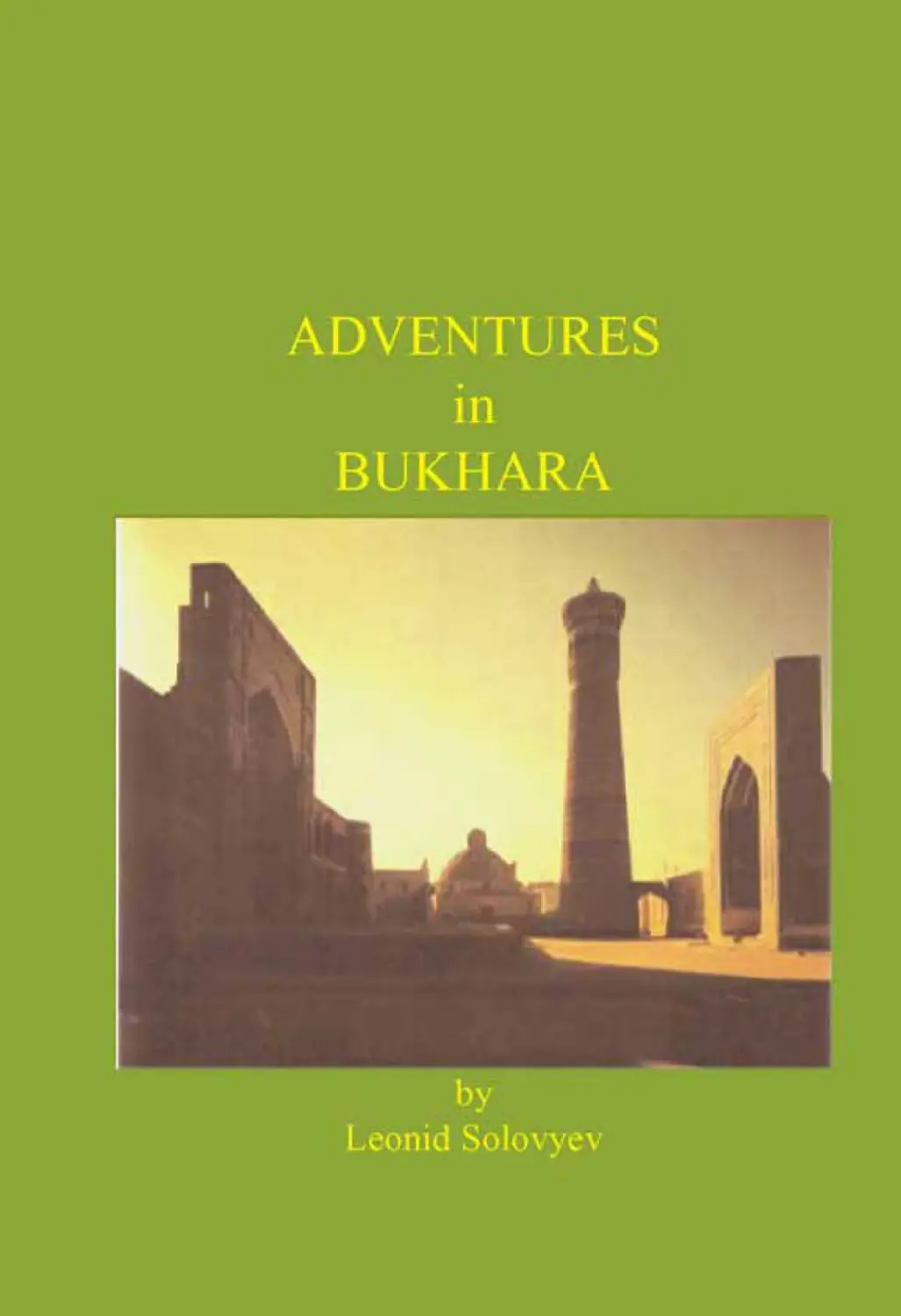
ADVENTURES
in
BUKHARA
by
Leonid Solovyev


ADVENTURES IN
BUKHARA
by
LEONID SOLOVYEV

Khoja Nasreddin (“Adventures in Bukhara”)
was first published in the U.S.S.R. in 1938.
English translation by Tatiana Shebunina.

Khoja Nasreddin, the central figure of this hilarious and intriguing story of the bazaars
and palaces of Old Bukhara, is one of those riotously lovable characters who appear
every now and again to tickle the ribs of th world.
To travel with him in his adventures through the pages of this book arouses that
affection we ll feel for the little man facing terrific odds. By the use of a ready tongue,
and the exercise of considerable impudence and ingenuity, he succeeds in turning the
most unfavourable situations to the advantage of himself and his fellow dwellers in the
tents of the lowly.
You will enjoy every moment of this remarkable and fascinating tale from the Soviet
Union, and you will regret parting company with Khoja Nasreddin when, having
rescued the lady of his choice from the Emir’s harem, he rides from the last pages still
thumbing his nose at authority.

ADVENTURES IN BUKHARA

Dedication
“…This story comes to us from Abu-Omar-Ahmad-ibnMullammad, who had it from Muhammad-ibn-AliibnRifaa, who quotes Ali-ibn-Abd-al-Aziz, who quotes AbuUbayd-al-Kasim-ibn-Selam, who took it down from the
mouth of his teachers the last of whom gives for his
authority Omar-ibn-al-Khattab and his son Abd-Allah,
may Allah’s favour abide with them both.”
IBN HAZM: The Turtledove’s Necklace.

I

dedicate this book to the pure and everlasting memory of my friend Mumin Adilov,
who perished from a dastardly bullet on 18 April 1930.
He had many of Khoja Nasreddin’s traits – selfless devotion to the people,
courage, noble shrewdness and honest astuteness. When I was writing this book, more
than once in the quiet of the night I seemed to feel his shade at my side guiding my pen.
He died in the mountain village of Nanay and lies buried in Kanibadam. A short
while ago I visited his grave. Children were playing round the mound covered with
spring grass and flowers, while he slept the sleep of eternity and did not respond to the
call of my heart… .
L.S

ADVENTURES IN BUKHARA

1
“They also relate that a simpleton was walking along
holding on to the bridle of his ass which followed behind.”
(Sheherazade’s three hundred and eighty-second night.)

1
KHOJA NASREDDIN’S thirty-fifth birthday found him on the road.
He had spent over ten years in exile, wandering from town to town, from country
to country, crossing seas and deserts, and sleeping where night overtook him: on the
bare earth by a shepherd’s meagre camp-fire, in a crowded caravanserai, where all night
long, in the dusty gloom, camels sigh and scratch themselves with a hollow tinkling of
bells, or in a smoky, sooty tea-house among sprawling water-carriers, beggars, drivers
and other poor folk, who at the break of dawn fill the bazaars and the narrow streets of
the town with their shrill cries.
Many a night he had spent too on the soft silk cushions of some Persian
dignitary’s harem, while the master of the house, accompanied by guards, would be
scouring the tea-houses and caravanserais for that impious vagabond whom he would
impale if he caught him.
A light streak appears in the sky through the latticed window, the stars pale, the
breeze heralding the dawn rustles gently and damply among the foliage, and on the
window-ledge gay turtle-doves begin to coo and to preen themselves. Khoja Nasreddin
says, kissing the languid beauty:
“It is time. Farewell, my matchless pearl. Do not forget me.”
“Stay,” she pleads, clasping her lovely arms round his neck. “Are you going away
for good? Listen, tonight, as soon as it is dark, I shall send the old woman to fetch you
again.”
“No. I have long forgotten what it is to spend two nights under the same roof. I
must be on my way. I am in a hurry.”
“On your way? Have you pressing business in some other town? Where are you
going?”
“I do not know. But it is light already: the city gates are open and the first
caravans are moving out. Do you hear the tinkle of camels’ bells? When I hear it jinns
seem to possess my feet and I cannot keep still.”
“Go, then!” petulantly exclaims the harem beauty, vainly trying to hide the tears
which glisten on her long eyelashes. “But at least tell me your name before you go.”
“My name? Listen then: you have spent the night with Khoja Nasreddin. I am
Khoja Nasreddin, the Disturber of the Peace and the Sower of Discord, a man with a
high price on his head: every day town-criers announce it in public places and bazaars.
Yesterday they were offering three thousand tomans, and I was tempted to sell my own
head at such a good price. You laugh, my little star? Well, give me your lips for the last
time. I wish I could give you an emerald, but as I have no emerald, take this little white
pebble to remember me by.”
He pulls on his ragged khalat (long coat), burnt through in many places by the
sparks of camp-fires, and steals away. At the door snores the lazy, stupid eunuch in
turban and soft slippers with turned-up toes – negligent guardian of the most precious
treasure of the palace. Further on, stretched out on rugs and felts snore the guards, their
heads pillowed on naked daggers. Khoja Nasreddin creeps past them on tiptoe, always

• 1 •

ADVENTURES IN BUKHARA

safely, as though for the time being rendered invisible.
And once more the stony road rings and smokes under the brisk hooves of his ass.
The sun shines upon the world out of a blue sky. Khoja Nasreddin can look up at it
without blinking. Dewy fields and barren deserts where camels’ bones gleam white
among the sand-drifts, green gardens and foaming rivers, bleak hills and smiling
pastures hear Khoja Nasreddin’s song. On and on he rides without a backward glance,
without regret for what he is leaving behind nor fear of what awaits him.
But in the town which he has just left memory of him survives for ever. Mullahs
and notables pale with rage at the mere mention of his name. Water-carriers, drivers,
weavers, coppersmiths and saddlers foregathering at night in the tea-houses entertain
each other with stories of his adventures which always end to his advantage. The
languorous harem beauty often gazes at the white pebble and hastens to slip it into a
mother-of-pearl casket at the sound of her lord’s footsteps.
“Ough!” says the fat dignitary panting and grunting as he struggles out of his
brocaded khalat. “This accursed vagabond Khoja Nasreddin has worn us all out. He has
stirred up and upset the whole country. Today I received a letter from my old friend, the
worthy governor of the province of Khorasan. What do you think? Hardly had this
tramp, this Khoja Nasreddin, appeared in his towns than all at once the blacksmiths
stopped paying the taxes and the inn-keepers refused to feed the guards without
payment. To crown all, this thief, this defiler of Islam, this son of sin, dared enter the
governor’s harem and seduce his favourite wife! Verily, the world has never yet seen
such a miscreant! Pity this worthless beggar did not try to make his way into my harem,
for then his head would have been already sticking on a pole in the main square.
The beauty remains silent, smiling wistfully to herself.
Meanwhile the road rings and smokes under the brisk hooves of the ass to the
sound of Khoja Nasreddin’s singing.
In these ten years he had been everywhere: in Baghdad, Stambul and Tehran, in
Bakhche-saray, Echmiadzin and Tiflis, in Damascus and Trebizond. He knew all these
cities and many others besides, and everywhere he left an unforgettable memory.
Now he was on his way back to his native town, Bukhara-yi Sherif, Noble
Bukhara, where he hoped to rest awhile from his endless wanderings under cover of an
assumed name.

• 2 •

ADVENTURES IN BUKHARA

2
HE CROSSED the frontier of Bukhara with a large merchant caravan to which he had
attached himself, and on the eighth day of the journey glimpsed far ahead in the dusty
haze the familiar minarets of the great and famous city.
The camel-drivers, exhausted by thirst and heat, raised a hoarse shout, and the
camels stepped out faster. The sun was setting and there was need to make haste to
enter Bukhara before the city gates were shut. Khoja Nasreddin rode at the tail-end of
the caravan, wrapped in a thick and heavy cloud of dust: this was his very own, sacred
dust which seemed to him to smell better than the dust of other distant lands. Sneezing
and coughing he kept saying to his ass:
“Well, here we are. Home at last! By Allah, success and happiness here.”
The caravan reached the town wall just as the guards were shutting the gates.
“Wait for us, for Allah’s sake!” shouted the chief of the caravan exhibiting from
afar a gold coin.
But the gates had already closed, the bolts fell with a clang, and the guards took
up their posts at the guns on the towers. A fresh breeze sprang up, the pink gleam died
away in the misty sky, the slender crescent of the young moon stood out sharply, and in
the twilit stillness there floated out from all the innumerable minarets the high, longdrawn, mournful voices of the muezzins, calling the faithful to evening prayer.
As the merchants and drivers sank to their knees, Khoja Nasreddin quietly drew
aside with his ass.
“These merchants have something to thank Allah for,” he said they have dined
today and now they expect to sup. You and I, my faithful ass, have not dined, nor shall
we sup. If Allah desires our thanks let him send me a bowl of pilau and you a bundle of
clover.”
He tethered his ass to a roadside tree and lay down by his side on the bare earth
with a stone for pillow. Looking up into the dark transparency of the sky he could see
the shining network of the stars. Every constellation was familiar to him. How often in
these ten years had he world: though the wealthy man may eat off gold dishes, yet he is
obliged to spend the night under a roof, and so is unable to savour in the midnight quiet
the feeling of the flight of the earth through the cool blue starry mist.
Meanwhile in the caravanserais and tea-houses clustering outside the crenellated
city wall fires had sprung up under huge cauldrons, and sheep set up a pitiful bleating as
they were dragged to the slaughter. Wise in experience, Khoja Nasreddin had selected
for his night’s rest a spot windward from the tantalising smell of food so that it should
not disturb him. Knowing well the customs of Bukhara he had resolved to save the last
of his money to pay the toll at the city gates on the morrow.
For a long time he kept tossing from side to side but sleep would not come. It was
not hunger that made him sleepless but the bitter thoughts which beset and tormented
him.
He loved his native land, it was his greatest love, this astute and merry fellow
with a little black beard on his copper-coloured, sun-tanned face and a roguish twinkle
in his clear eyes. And the farther away from Bukhara he wandered in his patched coat,
greasy skull-cap, and shabby boots, the more strongly he loved it and missed it. In his
exile he cherished the memory of the little streets, so narrow that the araba (native cart)
scrapes the mud walls on either side in its passage; of the tall minarets with their
patterned glazed-brick tops which catch the fiery reflection of sunrise and sunset; of the
ancient sacred plane-trees cradling among their branches the dark masses of storks’
nests.
He remembered the gay tea-houses over the irrigation ditches in the shade of
rustling poplars, the smoke and smell of cooking food in the over-heated cook shops,

• 3 •

ADVENTURES IN BUKHARA

the motley bustle of the bazaars; he remembered the hills and streams of his native land,
its villages, fields, pastures and deserts, and when in Baghdad or Damascus he
recognised a fellow-countryman by the pattern of his skull-cap or the peculiar cut of his
robe, Khoja Nasreddin’s heart missed a beat and his throat contracted.
On his return he found his country still more unhappy than when he had left it.
The old Emir had been buried long ago. Within the last eight years the new Emir had
managed to bring Bukhara to the verge of ruin. Khoja Nasreddin saw broken-down
bridges, meagre, sunparched roughly cultivated crops of wheat and barley, dry beds of
irrigation ditches cracked by the heat. Fields were going to waste overgrown with
weeds and thorns, gardens withered for lack of water; the peasants had neither bread
nor cattle; beggars lined the roads clamouring for alms from others as needy as
themselves.
The new Emir had posted detachments of guards in every village with orders to
the villagers to feed them at their own expense. He founded many mosques and then
ordered the people to finish building them. The new Emir was very pious and never
failed to perform a pilgrimage twice a year to the relics of the most holy and peerless
Shaikh Baha ed-din, whose tomb was situated in the neighbourhood of Bukhara. To the
existing four taxes he had added three more; he introduced tolls at every bridge, raised
the taxes on trade and legal dues, and had minted a quantity of debased coin. Crafts
were falling into decay, trade was on the decline.
It was a sorry homecoming for Khoja Nasreddin.
… Early in the morning the muezzins again sounded their call from all the
minarets. The gates opened and the caravan slowly entered the city with a hollow
tinkling of bells.
Once through the gates the caravan came to a standstill: the road was barred by
the guards. They were very numerous; some were shod and well dressed, others who
had not had time yet to fatten in the Emir’s service were bare-footed and half-naked.
They shouted and pushed each other, quarrelling over the loot that was going to be
theirs. At last the tax-collector emerged from a tea-house, obese and sleepy-looking,
clothed in a silk khalat with greasy sleeves, bare feet thrust into slippers, and his bloated
face bearing all the marks of self-indulgence and vice. He inspected the merchants with
a greedy eye and said:
“Welcome, o merchants! May you be successful in your business! And know you
that the Emir has ordered that any man who conceals the tiniest portion of his wares
shall die under the bastinado.”
The merchants, perplexed and alarmed, silently stroked their dyed beards. The
tax-collector turned to the guards who were prancing with impatience, and wiggled his
thick fingers. At this signal the men threw themselves with whoops and yells upon the
camels, jostling each other in their frantic haste, they slashed the hair-ropes with their
swords and noisily ripped open the bales, spilling on to the roadway brocades, silks and
velvets, cases of pepper, tea and amber, phials of precious attar of roses and Tibetan
drugs.
Horror kept the merchants tongue-tied.
Two minutes later the inspection was over. The guards lined up behind their chief,
their coats bulging and swelling. Then began the collection of taxes on the wares and on
the right of entry into the city. Khoja Nasreddin had no merchandise and was liable to
pay only the entrance tax.
“Where do you come from and for what purpose?” asked the tax-collector.
The scribe dipped a reed-pen into his ink-horn and prepared to take down Khoja
Nasreddin’s statement in a thick ledger.
“I come from Iran, Your Excellency. Here in Bukhara live some relatives of
mine.”

• 4 •

ADVENTURES IN BUKHARA

“So,” said the tax-collector, “You have come to visit your relations. In this case
you must pay the visitor’s tax."
“But I have not come to visit them”, retorted Khoja Nasreddin. “I have come on
important business.”
“On business!” cried the tax-collector, and his eyes lit up. “Then you have come
both on a visit and on business. Pay the visitor’s tax, the business tax and make a
donation towards the adornment of the mosques to the glory of Allah who has preserved
you from robbers on the way.”
“I had rather he preserved me now, for I would have found means to avoid the
robbers myself,” thought Khoja Nasreddin. But he held his tongue, having calculated
that every word of this conversation was costing him more than ten tangas. He undid his
sash, and under the greedily intent stare of the guards counted out the tax for entry into
the city, the guest-tax, the trade-tax and the donation towards the adornment of the
mosques. The tax-collector sternly eyed the guards who turned away. The scribe, his
nose in his ledger, scratched away with his reed-pen.
Having paid up, Khoja Nasreddin was on the point of leaving, when the taxcollector noticed that he still had some coins left in his sash.
“Stay!” he ordered. “And who is going to pay the tax for your ass? If you are
going to visit your relations, it means that your ass is also going to visit his relations.”
“You are right, o wise Master,” blandly retorted Khoja Nasreddin, undoing his
sash once more. “Indeed, must have a great number of relations Bukhara. Otherwise, by
the way things are run here, your Emir would long since have been pushed off his
throne, while you, o worthy one, would have been impaled for greed.”
Before the tax-collector could collect his wits, Khoja Nasreddin jumped on his
ass, set off at a gallop and disappeared down the nearest lane.
“Faster! Faster!” he kept saying. “Hurry, my faithful ass, hurry, or your master
will have to pay another tax with his head!”
Khoja Nasreddin’s ass was very, intelligent. He understood everything. His long
ears had caught the noise and outcry at the city gates and the shouting of the guards, so
he sped on, heedless of the road, and at such a pace that his master had to cling to the
saddle, his arms hugging the animal's neck and his feet tucked up high. Dogs raced after
them barking hoarsely, chickens scurried away in all directions, and passers-by pressed
against the walls, shaking their heads and staring after them.
In the meantime, at the city gates the guards searched among the crowd looking
for the bold freethinker. The merchants smiled and whispered to each other:
“That was an answer worthy of Khoja Nasreddin himself.”
Towards noon the whole town had heard the story. Traders in the bazaar
whispered it to their customers who passed it on, and all laughed, never failing to
remark:
“These words are worthy of Khoja Nasreddin. himself.”

• 5 •

ADVENTURES IN BUKHARA

3
NEITHER RELATIVES nor friends did he find in Bukhara. He did not even find his
father’s house where he had been born and grown to manhood, nor its shady garden
where in the clear autumn days yellowing leaves rustled in the wind and ripe fruit
thudded to the ground; where birds whistles in high pitched song and sun-flecks
trembled upon the fragrant grass; where busy bees hummed as they gathered the last
tribute of the fading flowers and the stream in the irrigation ditch murmured
mysteriously telling the boy its endless intelligible stories. … The site was now a plot of
waste land pitted and covered with mounds of rubble, thorny thistles, fire-stained bricks,
crumbling remnants of walls and scraps of rotting matting. Not a bird, not a bee did
Khoja Nasreddin glimpse. Only from under a heap of stones over which he stumbled
there suddenly oozed out a long oily streak which glistened dully in the sunlight and
disappeared again under the stones – a snake, lonely and fearsome dweller in deserted
places forever abandoned by man.
Khoja Nasreddin, stood for a long time silent, with downcast eyes. Grief clutched
at his heart.
The sound of a racking cough made him wheel round.
An old man bowed down by poverty and cares was coming along the path across
the waste ground. Khoja Nasreddin stopped him.
“Peace be with you, old man, and may Allah send you many years of health and
prosperity. Tell me, whose house stood here on this waste land?”
“It was the house of Shir-Mamed the saddler,” replied the old man. “I knew him
well once. This Shir-Mamed was the father of the famous Khoja Nasreddin, of whom,
you must have surely heard a good deal.”
“Yes, I have heard something about him But tell me, where has this saddler ShirMamed, father of the famous Khoja Nasreddin, gone to, and where is his family?”
'Not so loud, my son. There are thousands and thousands of spies in Bukhara. if
they were to hear us, we would have no end of trouble. You must have come from afar
not to know that in our town it is strictly forbidden to mention Khoja Nasreddin's name.
It is enough to get one sent to prison. Come closer and I shall tell you. ”
Concealing his agitation Khoja Nasreddin bent close.
“It happened in the old Emir’s time,” began the old man, coughing as he spoke.
“Eighteen months after Khoja Nasreddin had been sent into exile a rumour spread in the
bazaar that he had illegally and secretly returned and was staying in Bukhara
composing mocking songs about the Emir. This rumour reached the Emir’s palace. The
guards started a search for Khoja Nasreddin but could not find him. Then the Emir
ordered the seizure of his father, his two brothers, his uncle and all his distant relatives
and friends. They were to be tortured until they revealed the whereabouts of Khoja
Nasreddin. Allah be praised for giving them the courage and fortitude to keep silent, so
that our Khoja Nasreddin did not fall into the Emir’s hands. But his father, the saddler
Shir-Mamed, sickened from the torture and soon died. His relatives and friends left
Bukhara, fleeing the Emir’s wrath, and no one knows where they are. Then the Emir
ordered the destruction of their homes, and their gardens were uprooted so that the very
memory of Khoja Nasreddin should be blotted out.”
“But why were they tortured?” cried Khoja Nasreddin. Tears ran down his face,
but the old man did not see that for his sight was dim. “Why were they tortured? Khoja
Nasreddin was not in Bukhara at the time. I know it full well!”
“None can tell,” replied the old man. “Khoja Nasreddin comes and goes when and
how he pleases. He is everywhere and nowhere, our incomparable Khoja Nasreddin!”
With these words the old man trudged off groaning and coughing. Khoja
Nasreddin buried his face in his hands, and went off to his ass.

• 6 •

ADVENTURES IN BUKHARA

He threw his arms round the ass, pressing his wet face against the warm, smelly
neck.
“Ah, my good, my true friend,” said Khoja Nasreddin. “You see, I have nobody
left of my near and dear ones, only you, constant and faithful companion of my
wanderings.”
As though aware of his masters grief the ass stood still and even stopped chewing
a thistle, which remained suspended from his lip.
An hour later Khoja Nasreddin had mastered his grief and the tears had dried on
his face.
“Never mind!” he cried with a hearty slap on the ass’s back. “Never mind! I have
not been forgotten yet in Bukhara. They still know and remember me. We’ll manage to
find some friends! And we’ll compose such a song about the Emir that he’ll burst with
rage on his throne, and his filthy guts will spatter those finely decorated walls of his
palace! Come, my faithful ass, forward!”

• 7 •

ADVENTURES IN BUKHARA

4
IT WAS a quiet hour of the afternoon, and very close. A lazy heat came up from the
dusty road, the stones, the mud walls and fences, and the perspiration on Khoja
Nasreddin’s face dried before he had time to wipe it off.
He recognised with emotion the familiar streets, the tea-houses and minarets. In
ten years nothing had changed in Bukhara. just as always some mangy dogs were asleep
by the water-tanks, and a woman, bending gracefully and holding back her veil with a
dark-skinned hand tipped with painted nails, plunged a narrow, ringing jug into the dark
water.
Where and how to get a meal was the problem. Khoja Nasreddin tightened his
sash for the third time since yesterday.
“I must find a way,” he said. “Let’s stop, my faithful ass, and think. And here,
most opportunely, is a tea-house.”
Unbridling his ass he let him loose to feed on wisps of clover dropped beside the
tie-rail. Then, gathering up the skirts of his khalat he squatted down by the irrigation
ditch where the water, thick with clay, bubbled and foamed at the turnings.
“Whither, what for and whence does this water flow? it does not know and does
not think about it,” Khoja Nasreddin wistfully reflected. “I, too, know neither rest nor
home, nor whither I am going. Why did I come to Bukhara? Where shall 1 go
tomorrow? And where am I to get the half-tanga for my dinner? Am I still to be hungry?
That accursed tax-collector! He’s cleaned me out. What impudence to mention robbers
to me!”
At that very moment he caught sight of the man who was the cause of his
misfortunes. The tax-collector was riding up to the tea-house. Two guards were leading
by the bridle his Arab stallion, a handsome bay with a noble and flashing fire in its dark
eyes. Its neck was arched, and as it trod daintily and impatiently on its slender legs it
seemed loath to be carrying the bloated carcass of its master.
The guards respectfully helped their chief to dismount. He went into the teahouse. The flustered and obsequious owner showed him to some silk cushions on which
he seated himself. Then he brewed a special pot of his finest tea and offered his guest a
delicate tea-glass of Chinese workmanship.
“He’s getting a grand welcome and at my expense!” thought Khoja Nasreddin.
The tax-collector filled himself with tea and soon fell into a doze on the cushions.
The sound of his gurglings, snores and smacking of lips filled the tea-house. The other
guests lowered their conversation to a whisper for fear of disturbing his slumbers. The
guards sat on either side of him and chased away the pestering flies with leafy twigs.
When they were sure that he was fast asleep they exchanged a wink, unbridled the
stallion, threw a bundle of clover before it, and picking up a narghile, retired into the
dark interior of the tea-house. A moment later Khoja Nasreddin smelt the sweetish scent
of hashish. The guards were freely indulging in their favourite vice.
“Well, it is time I was off,” decided Khoja Nasreddin, recalling his morning
adventure at the city gates and fearing that the guards might recognise him. “But still,
where am I to get half a tanga? O almighty Fate, you who have so often come to Khoja
Nasreddin’s rescue, cast a benevolent eye upon him!”
Just then someone hailed him. “Hey, you there!”
Khoja Nasreddin wheeled round and saw a covered, richly decked wagon drawn
up in the road. A man in a large turban and expensive khalat was peering out from
between the curtains. Even before this stranger – a wealthy merchant or a dignitary-had
uttered his next words, Khoja Nasreddin knew that his prayer had not remained
unanswered: as usual, Fate had cast a benevolent eye upon him in his difficulty.
“I like this stallion,” said the rich stranger haughtily, looking over Khoja

• 8 •

ADVENTURES IN BUKHARA

Nasreddin’s head to admire the handsome Arab bay. “Tell me, is this stallion for sale?”
“There is no horse in the world which could not be sold,” Khoja Nasreddin
replied evasively.
“You have probably got a pretty empty pocket,” the stranger went on. “Listen to
me carefully. I do not know to whom this stallion belongs, from whence it comes nor
who was its former master. I am not asking you. Judging by the dust on your clothes
you must have come to Bukhara from afar. That is enough for me. Do you understand?”
Khoja Nasreddin nodded. He had understood immediately what the rich stranger
was driving at, and even more. What he hoped for now was that some silly fly should
not crawl into the tax-collector’s nostril or throat and so wake him up. He was less
concerned about the guards, for the clouds of thick green smoke which issued from the
dark interior showed that they were wholeheartedly indulging in their vice.
“You must realise,” the rich stranger continued patronisingly and importantly,
“that it is not for you in your tattered khalat to be riding such a horse. It would even be
dangerous, for everyone would wonder: ‘Where did this beggar get such a fine
stallion?’ You might easily land in prison.”
“You are right, noble master,” humbly agreed Khoja Nasreddin. “The horse is
certainly far too fine for me. In my tattered khalat I have been riding an ass all my life
and dare not even think of mounting such a steed.”
His answer met with the rich stranger’s approval.
“It is well that, poor as you are, you should not be blinded by pride. The poor man
must be humble and modest, for beautiful flowers are natural to the noble almond-tree
and not to the miserable thorn-bush of the steppe. Now answer me: do you want this
purse? It contains exactly three hundred tangas in silver.”
“Do I want it?” cried Khoja Nasreddin, now on tenterhooks because a stupid fly
had managed to crawl into the tax-collector’s nostril making him sneeze and stir. I
should think so! Who would refuse three hundred tangas in silver? Why, it is just like
finding a purse on the road!”
“It looks as though you had found something quite different on the road,” said the
rich stranger with a knowing smile, “but I am prepared to exchange this silver for what
you found on the road. Here are your three hundred tangas.”
He handed the heavy purse to Khoja Nasreddin and made a sign to his servant,
who stood scratching his back with his whip and silently taking in the conversation. As
the servant went up to the stallion Khoja Nasreddin noted from the grin on his flat pockmarked face and his shifty eyes that he must be as thorough a rascal as his master.
“Three rogues on one road are at least one too many. It is time I made myself
scarce,” he decided.
Extolling the piety and generosity of the rich stranger, he jumped on his ass and
gave him such a thump with his heels that the animal, for all its natural indolence,
started off at a gallop.
When Khoja Nasreddin looked back he saw the servant tying the bay Arab to the
wagon. When he looked again, the rich stranger and the tax-collector were clawing at
each other’s beards while the guards made vain efforts to separate them.
The wise man takes no part in other men’s quarrels. Khoja Nasreddin wove his
way in and out of by-streets until he felt safe from pursuit. He pulled in his ass to a
slower gait.
“Wait, wait,” he began, “there is no hurry now. …”
Suddenly he heard quite close the rapid and alarming beat of hooves. “Oho!
Forward, my faithful ass! Forward! Get me out of here!” he shouted, but too late: from
behind a corner a horseman sprang out into the road.
It was the pockmarked servant. He was riding a horse unharnessed from the
wagon. Swinging his legs he dashed past Khoja Nasreddin and brought his mount to a

• 9 •

ADVENTURES IN BUKHARA

sudden halt, setting it across the road.
“Let me pass, good fellow,” meekly pleaded Khoja Nasreddin. “On such narrow
roads one should ride lengthwise, not crosswise.”
“Aha!” replied the servant with malicious glee. “Now there will be no escaping
the dungeon for you! Do you know that this dignitary, the stallion’s owner, has pulled
out half my master’s beard and that my master has made his nose bleed? Tomorrow you
will be taken before the Emir’s tribunal. Truly, fellow, your lot is a bitter one!”
“What’s that you are saying?” exclaimed Khoja Nasreddin. “What has made these
respectable persons quarrel so bitterly? And why have you stopped me? I can be no
judge in their dispute. Let them settle it between themselves as best they can.”
“Hold your tongue!” said the servant. “Turn back. You will have to answer for
that stallion.”
“What stallion?”
“You dare to ask, Why, the one for which you received a purse of silver from my
master.”
“By Allah, you are mistaken,” replied Khoja Nasreddin. “The stallion does not
enter into this business. Judge for yourself. You heard the whole conversation. Your
master, a pious and generous man, wishing to help a poor fellow, asked me whether I
would like three hundred silver tangas, and I said that of course I would. Then he gave
me three hundred tangas, may Allah prolong the days of his life. But before he gave me
the money, he tested my modesty and humility in order to ascertain whether I deserved
the reward. He said: ‘I do not ask whose stallion this is nor where it comes from.’
“You see, he wished to know whether out of false pride I would claim to be its
owner. I kept silent, and the generous, pious man was pleased. Then he said that such a
stallion would be too good for me and I agreed with him, at which he was also pleased.
Then he said that I had found on the road that which could be exchanged for silver, thus
hinting at my zeal and firmness in Islam, which I have acquired in my travels to the
Holy Places. And after all this he rewarded me, intending by this pious deed to facilitate
his future entrance into paradise over the bridge which is lighter than a hair and
narrower than the edge of a sword, as the holy Koran tells us. In my very first prayer I
shall tell Allah of your master’s pious deed so that he may put up railings for him on
this bridge.”
The servant listened thoughtfully to this long speech, scratching his back with his
whip. At the end he said with a sly grin which disturbed Khoja Nasreddin:
“You are right, o traveller! How is it that I did not realise at once that your
conversation with my master had such a virtuous meaning? But as you have decided to
help my master to cross the bridge to the other world, it would be safer if it had railings
on both sides. I, too, would gladly pray for my master so that Allah should put up
railings on the other side.”
“Then pray!” cried Khoja Nasreddin. “Who hinders you? You are even bound in
duty to do so. Does not the Koran instruct slaves and servants to pray daily for their
masters without asking for any special reward?”
“Turn back your ass!” the servant shouted roughly, kneeing his mount and
pressing Khoja Nasreddin against the wall. “Now then, hurry up, do not make me lose
any more time.” “Wait,” Khoja Nasreddin interrupted hastily. “I have not finished. I was
going to recite a prayer of three hundred words according to the number of tangas
received. But now I think that a prayer of two hundred and fifty words might suffice.
The railings on my side will be only slightly thinner and shorter. As for you, you will
recite a prayer of fifty words, and the all-wise Allah will know how to make a railing
for your side out of the same wood.”
“What?” said the servant. “Why should my railing be five times shorter than
yours?”

• 10 •

ADVENTURES IN BUKHARA

“But it will be in the most dangerous part,” Khoja Nasreddin hastened to add.
“No,” the servant said firmly. “I don’t agree to such short railings. It would mean
that part of the bridge would be without railings. I tremble at the very thought of the
danger that would threaten my master. In my opinion we must each say a prayer of one
hundred and fifty words each so that the railings on both sides shall be of the same
length. Let them be thin, but at least both sides will be guarded. And if you do not
agree, then it means that you have evil designs upon my master and wish him to fall off
the bridge. Then I shall summon help and you will take the shortest cut to the dungeon.”
“Thin railings!” cried Khoja Nasreddin enraged and feeling as though the purse
was stirring in his sash. “From what you say it would be good enough to have railings
made of twigs! Don’t you understand that the railings must be thicker and stronger on
one side so that your master will have something to clutch if he loses his footing and
starts to fall?”
“Verily truth falls from your mouth!” cried the servant gleefully. “Let the railing
be thicker on my side and I shall not spare myself and will recite a prayer of two
hundred words.”
“Perhaps you would like to make it three hundred?” Khoja Nasreddin said with
venom.
When they finally parted Khoja Nasreddin’s purse was lighter by a half. They had
agreed at last that the bridge leading into paradise should be guarded for the man’s
master by railings of equal strength and thickness on both sides.
“Farewell, traveller,” said the servant. “You and I have indeed performed a pious
deed today.”
“Farewell, most kind, loyal and virtuous servant, so full of anxiety for the
salvation of your master’s soul. I should like to add that you will soon be a match for
Khoja Nasreddin himself.”
“What makes you mention him?” asked the servant, pricking up his ears.
“Nothing. … It just occurred to me,” replied Khoja Nasreddin, thinking to
himself: “Oho, this fellow is no ,simpleton.”
“Maybe you are a distant relative of his?” asked the servant. “Or perhaps you
know a member of his family?”
“No, I have never met him. And I do not know any of Khoja Nasreddin’s
relations.”
“Listen, I will tell you a secret.” The servant bent down from his saddle. “I am a
relation of his. His cousin, in fact. We spent our childhood together.”
Khoja Nasreddin’s suspicions became a certitude and he held his tongue. The
servant leaned still closer.
“His father, two brothers and an uncle have died. You have probably heard that,
eh, traveller?”
But Khoja Nasreddin still remained silent.
“Such cruelty on the part of the Emir!” hypocritically exclaimed the servant.
But Khoja Nasreddin still kept silent.
“All the viziers of Bukhara, are fools!” said the servant unexpectedly. He was
agog with impatience and greed, for the Treasury paid handsome rewards for the
apprehension of freethinkers. But Khoja Nasreddin remained stubbornly silent.
“And our illustrious Emir is also a fool!” said the man. “And it is not at all certain
that Allah even exists!”
But Khoja a Nasreddin did not open his mouth, although a stinging answer was
on the tip of his tongue. The servant, bitterly disappointed, shouted out an oath, struck
his horse and in two bounds disappeared round the corner. All grew quiet. Only the dust
raised by the horse’s hooves hung like a golden mist in the still air pierced by hot,
slanting rays.

• 11 •

ADVENTURES IN BUKHARA

“Well, so I have found myself a relative,” Khoja Nasreddin thought and smiled to
himself. “The old man did not lie to me. Spies are as thick as flies in Bukhara, and it
will pay to be careful. As the old proverb says: ‘the guilty tongue is chopped off with
the head’.”
Thus he rode on for a long time, alternately brooding over the loss of half the
contents of his purse, and grinning over the memory of the fight between the
taxcollector and the haughty stranger.

• 12 •

ADVENTURES IN BUKHARA

5
WHEN KHOJA Nasreddin reached the other end of the town he stopped, handed his ass
to the care of a tea-house owner and hurried without loss of time to an eating-house.
It was crowded, full of smoke and the smell of cooking food. The stoves glowed
hotly, and the flames lit up the sweating backs of the cooks who worked stripped to the
waist. They bustled, shouted, jostled each other and boxed the ears of the kitchen-boys
who dashed about wild-eyed, adding to the general crush, noise and confusion. Huge
kettles bubbled under dancing wooden lids; thick steam gathered near the ceiling where
clouds of flies were buzzing. In the smoky haze butter hissed and puttered furiously, the
sides of red-hot braziers shone and the fat which fell from the spits on to the coals
burned with a blue and smoky flame. Here they were cooking pilau, roasting shishliks,
boiling tripe and baking pies stuffed with onion, pepper, meat and sheep’s-tail fat which
melted in the oven and boiled in tiny bubbles as it seeped out of the pastry.
With great difficulty Khoja Nasreddin found himself a seat into which he had to
squeeze so tightly that those whom he pressed with his back and sides grunted audibly.
But no offence was taken, no one said a word to him, neither did he grumble. He had
always liked the hot crowding of these bazaar eating-houses, all this discordant din, the
jokes, the laughter, the shouting, the jostling, the vigorous snorting, chewing and
champing of hundreds of men who have no time after a day of heavy toll to pick and
choose among the dishes: powerful jaws grind anything – tendons and gristle alike –
while the tough-lined belly accepts anything, so long as it is cheap and plentiful!
Khoja Nasreddin could put away a good deal. He ate at one sitting three bowls of
noodles, three bowls of rice and two dozen samsa-pasties on top of it all. It took
something of an effort to finish the samsa, which he did, true to his rule never to leave
anything in the bowl when it had already been paid for.
At last he started towards the door, and when, after working hard with his elbows,
he finally emerged into the open air, he was bathed in sweat. His arms and legs felt
weak and soft as though he had just left the hands of a hefty bath-attendant. Heavy from
the food and heat he walked with dragging steps to the tea-house where he had left his
ass. He ordered tea and stretched out luxuriously on the felts. His eyelids drooped and
slow and pleasant thoughts floated through his mind:
“I have a pretty sum of money just now. It would be good idea to invest it in a
workshop – a saddlery or a pottery. I know both these trades. It is about time I stopped
wandering. Am I worse or more stupid than other men? Can’t I have a kind, beautiful
wife? Can’t I have a son whom I could dandle in my arms? By the beard of the Prophet,
the noisy little fellow will grow up into a famous rascal, and I shall not fail to pass on
my wisdom to him! Yes, my mind is made up. Khoja Nasreddin gives up his restless
life. To begin with I must buy a potter’s business or a saddler’s . … ”
He began to count. A good workshop would cost at least three hundred tangas
whereas he had only one hundred and fifty. He cursed the pock-marked servant. “May
Allah curse that robber with blindness. He took away from me just what I needed to
make a start!”
Once again Fate came to his rescue. “Twenty tangas!” somebody called out
suddenly. Then came the sound of dice falling on to a copper tray.
On the edge of the porch and quite close to the tie-rail where the ass was tethered
there sat a close circle of men. The owner of the tea-house stood behind them craning
over their heads.
“Gambling!” guessed Khoja Nasreddin, raising himself on his elbow. “As sure as
my name is Khoja Nasreddin, they’re gambling! I must have a look, if only from a
distance. I won’t gamble, I’m not such a fool. But why shouldn’t a wise man watch
fools?”

• 13 •

ADVENTURES IN BUKHARA

He rose and went up to the gamblers.
“Foolish men,” he whispered to the owner of the tea-house. “They risk their last
coin in the hope of gain. Has not the Prophet prohibited gambling for money? Allah be
praised, I am free from this fatal passion.... But what luck that red-haired gambler has!
He has won for the fourth time running. … Look, look – he has won for the fifth time!
O the senseless fool! He is lured by the false vision of wealth, whereas poverty has
already dug a pit in his path. What? He has won for the sixth time? I have never seen
such luck. Look, he is staking again. Truly, there is no limit to human folly! He cannot
possibly win without a break! This is how men perish who put their faith in false luck!
This red-haired fellow should be given a lesson. If he wins for the seventh time, I shall
stake against him, even though in my heart I am against all gambling. Were I the Emir, I
should long ago have forbidden it!”
The red-haired gambler threw the dice and won for the seventh time in
succession.
Khoja Nasreddin stepped resolutely forward, shouldered the players aside and
squatted down in the circle.
“1 want to play with you,” he said to the lucky winner, taking up the dice and
examining them on all sides with an experienced eye.
“How much?” asked the red-haired one hoarsely. Tremors passed over his body.
He was in a hurry to make the best of his ephemeral luck.
Khoja Nasreddin took out his purse, put back into his pocket twenty-five tangas
for emergencies, and emptied out the rest. The silver twinkled and rang on the copper
tray. The gamblers greeted the stake with an eager buzzing. A game for high stakes was
going to start.
The red-haired man took up the dice and shook them for a long time, hesitating
over his throw. Everyone held his breath, even the ass stretched out his muzzle and
cocked his cars. The only sound was the clicking of the dice in the gambler’s fist. This
dry clicking sent a yearning weakness through Khoja Nasreddin's limbs and belly. At
last the red-haired one made his cast. The other players craned forward, then fell back
as one man, heaving a great sigh as though with one breast. The gambler paled and
groaned through clenched teeth. The dice showed three spots – a certain loss, for the
deuce turns up as seldom as the double six. Any other number would be to Khoja
Nasreddin’s advantage.
Shaking the dice in his fist he mentally thanked Fate for being so kind to him on
this day. But he had forgotten that Fate is whimsical and fickle and easily betrays him who
importunes it. Now it decided to give Khoja Nasreddin a lesson for his self-assurance,
choosing for its weapon his ass, or rather the ass’s tail adorned at the end with prickles and
burrs. Turning his back upon the gamblers the ass swung his tail which brushed against
his master’s hand. The dice tumbled out, and instantly the red-haired gambler threw
himself upon the tray with a hoarse shout, covering the stakes with his body.
Khoja Nasreddin had thrown two ones.
He sat for a long time silently moving his lips. The world tottered and swam
before his staring eyes and a strange ringing filled his ears.
Suddenly he sprang up, seized a stick and began to belabour the ass, chasing him
round the tie-rail.
“Accursed ass! O son of sin! O stinking brute and disgrace of all living
creatures!” shouted Khoja a Nasreddin.
“Is it not enough that you should gamble with your master’s money, that you must
needs lose it? May your rascally hide peel! May almighty Allah put a pit in your path so
that you break your legs! When will you die and so let me be rid of the sight of such an
abominable face! ”
The ass brayed. The gamblers shouted with laughter, and loudest of all the red-

• 14 •

ADVENTURES IN BUKHARA

haired one who was now sure of his good luck.
“Let us play again,” he said when Khoja a Nasreddin, tired and out of breath, had
thrown away the stick. “Come, a few more throws. You still have twenty-five tangas.”
So saying, he thrust out his left foot and slightly waggled it, thus showing his
contempt for Khoja Nasreddin.
“Why not?” replied the latter, thinking that now the hundred and twenty-five
tangas had been lost it did not matter what happened to the last twenty-five.
He threw the dice carelessly and won.
“The whole lot!” proposed the red-haired one throwing down his lost stake on to
the tray.
Khoja Nasreddin won again.
The red-haired one could not believe that luck had turned its back upon him.
“The whole lot!”
Seven times in succession he said it, and every time he lost. The tray was full of
money. The gamblers sat very still, their flaming eyes alone betrayed the inner fire
which consumed them.
“You cannot win every time unless the devil is helping you!” cried the red-haired
one. “You must lose some time! Here on the tray are one thousand and six hundred
tangas of yours. Once more will you stake the whole lot? Here is the money I was going
to use tomorrow to buy goods in the bazaar for my shop. I stake this money against
yours.
He produced a small purse full of gold-rupees, tillas and tomans.
“Put your gold on the tray!” cried Khoja Nasreddin flushed with excitement.
Never had this tea-house seen such high stakes. The owner forgot all about his
boiling kettles. The gamblers panted heavily. The red-haired one threw the dice first,
screwing up his eyes because he was afraid to look.
“Eleven!” all cried in chorus. Khoja Nasreddin realised that he had as good as
lost: only a double six could save him.
“Eleven! Eleven!” repeated the red-haired gambler in unrestrained delight. “Look
– I have got eleven! You have lost! You have lost!”
Khoja Nasreddin went cold all over. He took up the dice and prepared to cast
them, when suddenly he stayed his hand.
“Turn round!” he said to his ass. “You have managed to lose against three pips.
Now try to win over eleven. Otherwise I’ll take you at once to the knacker’s.”
Seizing the ass’s tall with his left hand, he struck with it his right hand which held
the dice.
A great shout from all the men shook the tea-house. The owner clutched at his
heart and sank helplessly to the ground, unable to stand the strain.
The dice showed a double six.
The red-haired gambler'’ eyes popped out of their sockets and glazed in his blooddrained face. He got up slowly and tottered away crying: “Woe is me! Woe is me!”
It is said that since that day the red-haired one has been seen no more in the town.
He fled into the desert and there, all hairy and terrible to see, wandered among the sands
and thorn-bushes, ceaselessly crying: “O woe! Woe is me!” until at last the jackals
made an end of him. But no one lamented him, for he had been a cruel and an unjust
man, and had done much harm by ruining trusting simpletons.
As for Khoja Nasreddin, he stowed his newly won riches into his saddle-bags,
hugged his ass, giving him a hearty kiss on his warm muzzle, and treated him to some
nice fresh bread-cakes, greatly to the astonishment of the worthy animal, who only a
few minutes previously had been treated to something quite different.

• 15 •

ADVENTURES IN BUKHARA

6
MINDFUL OF the wise rule to keep away from people who know where you keep your
money, Khoja Nasreddin did not loiter at the tea-house and started off for the
marketplace. He kept looking back from time to time to see whether he was being
followed, for the faces of the gamblers and of the tea-house owner did not bear the stamp
of virtue.
It was a happy going. Now he would be able to buy any workshop, two
workshops, three workshops. This he made up his mind to do.
“I shall buy four workshops: a pottery, a saddlery, a tailor’s shop and a cobbler’s
shop. In each I shall set two workmen on the job, and all I shall have to do is to collect
the money. In two years’ time I shall become rich. I shall buy a house with fountains in
the garden. I shall hang up gold cages with singing birds everywhere, and I shall have
two, perhaps three, wives and three sons by each of them… .
He let himself be carried away by the sweet river of day-dreams. Meanwhile the
ass, no longer feeling the bridle, took advantage of his master’s reverie. As they came up
to a little bridge, instead of crossing over it like all other asses, he turned aside and taking
a run jumped straight over the ditch.
“… And when my children grow up I shall call them together and tell them…” ran
Khoja Nasreddin’s thoughts. “But why am I flying through the air? Has Allah turned me
into an angel and given me wings? ”
The next moment he saw so many stars that he realised he had no wings.
Catapulted out of his saddle he had landed on the road half a dozen yards ahead of his
mount.
When he had picked himself up, groaning and covered with dust, the ass came up
to him, pricking up his ears in friendly fashion and with the most innocent expression on
his face, as though inviting his master to get back into the saddle.
“O you, you who have been sent to me as a punishment not only for my own sins,
but for the sins of my father, grandfather and great-grandfather, for according to the
justice of Islam it would be unjust to punish a man so heavily for his own sins!” began
Khoja Nasreddin, his voice trembling with anger. “O you, you miserable offspring of a
spider and hyena! O you…”
But here he broke off on catching sight of a group of people sitting not far off in
the shade of a half-ruined wall.
The imprecations died on Khoja Nasreddin’s lips. He realised that a man who had
got himself into such a ridiculous and undignified position in the presence of onlookers
should himself laugh loudest at his own discomfiture. He winked at the seated group and
grinned broadly, showing all his white teeth.
“Oho!” he said gaily in a loud voice. “What a fine flight I made! Tell me, how
many somersaults did I turn? I had no time to count them myself. You old rascal!” he
went on, slapping the ass good-naturedly although he felt more like giving him a good
hiding. “He’s full of pranks! That’s the kind of fellow he is! No sooner do I look away
than he’s up to his tricks!”
Khoja Nasreddin broke into a merry laugh but to his surprise no one joined him.
The people sat still with bowed heads and gloomy faces, and the women who were
holding babies in their arms wept quietly.
“Something is amiss,” thought Khoja Nasreddin.
He approached the group and addressed a grey-haired man with an emaciated face.
“Tell me, venerable old man, what has happened? Why do I see no smiles and hear
no laughter, and why are these women weeping? Why are you sitting by the roadside in
the dust and heat? Would it not be better to sit in the cool shelter of your homes?”
“Sitting at home is good for the one who has a home,” replied the old man sadly.

• 16 •

ADVENTURES IN BUKHARA

“Do not question me, o passer-by. Great is our trouble, and in no way can you help us.
For myself, old and decrepit as I am, I pray God sends me death quickly.”
“How can you say such things?” Khoja Nasreddin said reproachfully. “Men
should never think like that. Tell me your trouble and do not judge by my poor
appearance. Perhaps I may be able to help you.”
“My tale will be brief. Only an hour ago Jafar the Usurer passed along our street
with two of the Emir’s guards. I owe him money and tomorrow the debt falls due. So
they have turned me out of the house where I have spent all my life. I have no family,
no place where I can rest my head. … And all my property-my house, garden, cattle and
vineyards will be sold tomorrow by Jafar.”
The old man's eyes filled with tears and his voice trembled.
“And do you owe him much?” asked Khoja Nasreddin.
“A great deal, o traveller! I owe him two hundred and fifty tangas!”
“Two hundred and fifty tangas!” exclaimed Khoja Nasreddin. “And a man desires
death because of a miserable two hundred and fifty tangas! There, there, quiet –you,” he
added, turning to the ass and untying the saddle-bags. “Now then, my venerable friend,
here are two hundred and fifty tangas. Give them back to the usurer, kick him out of
your house and spend the remainder of your days in peace and happiness.”
At -the sound of the clinking silver, the whole group came to life. The old man,
unable to utter a word, looked up gratefully at Khoja Nasreddin with tear-filled eyes.
“You see? And yet you would not tell me your troubles,” said Khoja Nasreddin,
counting out the last coin and thinking at the same time: “Never mind, instead of eight
workmen I shall hire only seven, and that will be plenty.”
Suddenly a woman seated next to the old man fell at Khoja Nasreddin’s feet and
weeping loudly held out her child to him.
“Look!” she said between sobs. “He is ill. His lips are parched and his face is
burning. My poor little boy will die on the road, for I too have been turned out of my
house.”
Khoja Nasreddin looked at the thin pale face of the child, at its transparent hands,
then at the faces of the group of seated people. And the sight of these faces seamed with
wrinkles, lined with suffering and with eyes dimmed by ceaseless weeping made him
feel as though a hot knife had been plunged into his heart. A sudden spasm clutched at
his throat. Pity and anger sent a hot wave of blood to his face. He turned away.
“I am a widow,” the woman continued. “My husband died six months ago. He
owed the usurer two hundred tangas. According to the law, the debt fell upon me.”
“Certainly the boy is sick,” said Khoja Nasreddin. “Here are two hundred tangas.
Go home quickly and put a cool bandage on his head. And here are fifty more tangas.
Go, call a physician and buy some medicine.”
To himself he thought: “I can very well manage with six workmen.”
But just then a great big stone-hewer fell at his feet. On the morrow his whole
family was to be sold into slavery for a debt to Jafar of four hundred tangas.
“Five workmen will be plenty,” thought Khoja Nasreddin as once more he began
untying his saddlebag. No sooner had he tied it up again than two other women fell on
their knees before him. The tales they told were so pitiful that Khoja Nasreddin did not
hesitate to give them enough to pay off the usurer. Then, realising that the money left
over would hardly suffice to keep three workmen, he decided it was no longer worth
while bothering about workshops, and generously shared out his money among the
other debtors of Jafar the Usurer.
No more than five hundred tangas were left in the saddle-bag. Only then did
Khoja Nasreddin catch sight of another man sitting by himself. He had not asked for
help but his distress was plain to see.
“Hey you, listen!” Khoja Nasreddin called out. “Why are you sitting here if you

• 17 •

ADVENTURES IN BUKHARA

are not in debt to the usurer?”
“I am in debt,” the man answered hoarsely. “Tomorrow I go in chains to the
slave-market.”
“Why have you kept silent?”
“O generous and kind traveller! I know not who you are. Maybe you are the saint
Baha ed-din arisen from his tomb to help the poor, or Harun ar-Rashid in person. I have
not sought your help because you have already spent a great deal and my debt is
heaviest of all – five hundred tangas. And I was afraid that if you gave me such a sum
there would not be sufficient for the old men and the women.”
“You are an upright and noble man, and you have a conscience,” said Khoja
Nasreddin greatly moved. “But I too am upright and noble. I too have a conscience, and
I swear you shall not go tomorrow to the slave-market. Hold out your coat.”
He emptied out his saddle-bag to the last coin. Then the man, holding up the skirt
of his khalat with his left hand, embraced Khoja Nasreddin with his right and pressed
his face wet with tears to his breast.
“You certainly flew off your ass in fine fashion,” said the great big bearded stonehewer suddenly bursting into a roar of laughter. At this, all the others burst out laughing
– the men in rough deep voices, the women in their high-pitched ones, while the
children smiled and stretched out their hands to Khoja Nasreddin who laughed louder
than any of them.
“Oh-ho-ho!” he laughed, doubled up with mirth. “You don’t know what sort of an
ass he is! He’s an accursed ass!”
“No! No!” said the woman with the sick child. “Do not speak like that of your
ass. He is the cleverest, the noblest, the most precious ass in the world. There never has
been and never will be another ass like him. I would like nothing better than to look
after him all my life, give him the choicest grain to eat, never burden him with work,
curry him and comb his tail. For if this incomparable ass, who like a rose has nought
but virtues, had not jumped over the ditch and thrown you from the saddle, you, O
traveller, who came to us like the sun in the darkness – you would have ridden past
without even seeing us and we would never have dared to stop you.”
“She is right,” said the old man importantly. “We owe much of our salvation to
this ass. Verily he is an ornament in the world and shines like a jewel among all other
asses.”
Then all of them loudly praised the ass and vied with each other in offering him
cakes, roasted corn, dried apricots and peaches. The ass swished his tail at the pestering
flies and serenely and gravely accepted the offerings, though not without an uneasy
glance at the whip which Khoja Nasreddin was stealthily shaking at him.
The day was wearing on, shadows lengthened. Red-legged storks, crying and
flapping their wings, were returning to their nests where the fledglings stretched their
greedy gaping beaks towards them.
Khoja Nasreddin took his leave. All bowed and thanked him.
“We thank you. You have understood our troubles.”
“How could I fail to understand?” he replied. “Only today I lost four workshops
where eight skilled workmen were working for me, and a house with a garden where
fountains played and song-birds in golden cages hung on the trees. How could I fail to
understand you!”
The old man said in his toothless mumble:
“I have nothing to offer you as a gift of thanks, o traveller. Here is the only thing
which I took with me when I left my house. It is a Koran, the holy book. Take it, and
may it be a guiding light for you in this world.”
Khoja Nasreddin had little use for holy books but, unwilling to hurt the old man’s
feelings, he took the Koran, put it away in his saddle-bag and jumped into the saddle.

• 18 •

ADVENTURES IN BUKHARA

“Your name? Your name?” cried the others in one voice. “Tell us your name so
that we may know whom to thank in our prayers.”
“Why do you need to know my name? True virtue needs no fame. As for prayers,
Allah has many angels to inform him of pious deeds. If the angels are lazy and careless
and sleep on soft clouds instead of counting the pious and impious deeds on earth, then
your prayers will be of no avail, for Allah would be foolish to believe people on their
word alone without demanding confirmation from trustworthy persons.”
While he was speaking one of the women suddenly let out a stifled gasp. So did
another woman. Then the old man started and stared at Khoja Nasreddin. But the latter
was in a hurry and took no notice.
“Good-bye! May peace and happiness abide with you.”
Followed by blessings he disappeared at the turn of the road.
The others remained silent. One single thought shone in their eyes. The silence
was broken by the old man. He said solemnly and with feeling:
“Only one man in the whole world could perform such a deed. Yes, and only one
man in the world can speak thus, and only one man in the world carries within him a
soul whose light and warmth light up and warm the poor and oppressed, and this man is
our–”
“Hold your tongue!” hastily interrupted another man.
“Have you forgotten that walls have ears, stones have eyes and hundreds of dogs
would take up his trail?”
“You are right,” added a third man. “We must hold our tongues, for at present it is
as though he were walking on a tight-rope. The slightest push might prove his
undoing.”
“I will let them tear out my tongue rather than say his name aloud,” said the
woman with the sick child.
“I too will be silent,” cried the second woman. “I would rather die than
unwittingly resent him with a rope.”
So spoke all save the mighty bearded stone-hewer, who was not quick-witted. He
could not understand from what he had heard why dogs should take up the traveller’s
trail if he was neither a butcher nor a seller of boiled tripe. Again, if the traveller was a
tight-rope walker, why could not his name be spoken aloud? And why was the woman
prepared to die rather than present her benefactor with a rope so necessary to his trade?
By this time the stone-hewer was completely bewildered. He snorted loudly, took a
deep breath and decided to think no more about it for fear of losing his reason.
Meanwhile Khoja a Nasreddin had covered quite a distance, but he still had
before his eyes the emaciated faces of those poor people. He kept recalling the sick
child, its feverish cheeks and parched lips. He thought of the grey-haired old man who
had been turned out of his house, and a great anger rose from the depth of his heart.
He could no longer stay in the saddle. He jumped down and walked beside his
ass, kicking the stones out of his way.
“Just you wait, master usurer, just wait!” he muttered, and a sinister glare burned
in his black eyes. “One of these days we shall meet and then your lot will be bitter. As
for you, Emir,” he went on, “tremble and grow pale, for I, Khoja Nasreddin, am in
Bukhara! O vile and monstrous leeches that suck the very life-blood of my unhappy
people! O grasping greedy hyenas! O stinking jackals! You will not prosper for ever,
nor will the people for ever suffer! And as for you, Jafar the Usurer, may my name be
eternally covered with shame if I do not settle accounts with you for all the sorrow
which you bring to the poor.”

• 19 •

ADVENTURES IN BUKHARA

7
EVEN KHOJA Nasreddin, who had gone through much in his life, found his first day in
his homeland too restless and too full of incident. He was weary and wished to find
some secluded spot where he could rest.
“No!” he sighed, catching sight of a multitude of people crowding round a pond.
“It looks as if there’ll be no rest for me today! Something seems to have happened
here.”
The pond was at some little distance from the road and Khoja Nasreddin could
easily have passed it, but he was not the man to miss an opportunity of mixing in a
dispute, a row or a tussle.
The ass, who during the long years of their association had become well
acquainted with his master’s ways, turned towards the pond of his own accord.
“What’s the matter?” shouted Khoja Nasreddin, steering his ass into the thick of
the crowd. “Has somebody been murdered? Anyone robbed? Make way there! Make
way!”
After pushing his way through the crowd to the edge of the pond, which was
covered with green slime, he came upon an extraordinary sight. A few feet from the
bank a man was drowning. From time to time he came up to the surface only to sink
again, sending up large bubbles.
A number of people kept bustling about on the bank stretching out their hands to
the drowning man and trying to seize him by his clothes, but he was just out of reach.
“Give us your hand they shouted. “Here! Give it here!”
The drowning man did not seem to hear what they were saying and did not stretch
out his hand, but went on alternately bobbing up and going down again. As he went
down to the bottom slow waves spread over the pond and gently lapped the bank.
“Strange!” thought Khoja Nasreddin observing the scene. “Very strange. What
can be the reason for this? Why doesn’t he stretch out his hand? Maybe he is an expert
diver and is doing it for a bet, but in that case why does he wear a khalat?”
He almost lost himself in speculation. Meanwhile the drowning man went down
at least four times, each time remaining a little longer under the surface.
“Very strange,” repeated Khoja Nasreddin to himself, dismounting. “Wait here, he
told his ass, while I go to take a closer look.”
By now the drowning man had gone down again. This time he did not reappear
for so long that some of the people on the bank began to recite prayers for the dead.
Suddenly he reappeared.
“Here! Here!” cried the men. “Give us your hand,” and they stretched out their
hands towards him, but he only gave them a blank stare and again went soundlessly,
smoothly to the bottom.
“Oh, you stupid fellows!” cried Khoja Nasreddin. “Surely you could see by his
expensive khalat and silk turban that this man is either a mullah or a wealthy dignitary?
And haven’t you learnt enough of the ways of mullahs and dignitaries to know how to
pull them out of the water?”
“Pull him out yourself and be quick about it, that is if you know how!” shouted
voices in the crowd. “Go on, save him! He has come up again! Go on, pull him out!”
“Wait,” answered Khoja Nasreddin. “I haven’t finished my speech yet. When,
may I ask, have you ever seen a mullah or a dignitary give anything to anyone?
Remember, o ignoramuses, that mullahs and dignitaries never, never give anything
away; they only take. Therefore, they should be rescued scientifically, that is according
to the peculiarities of their own nature. Now watch me.”
“But it is too late!” cried voices in the crowd. “He won’t come up again.”
“Do you think the water spirits will accept a mullah or a dignitary so easily? You

• 20 •

ADVENTURES IN BUKHARA

are wrong. The water spirits will do their utmost to be rid of him.”
Khoja Nasreddin squatted down and waited. patiently. He watched the bubbles
come up from the bottom and float to the bank, pushed forward by a light breeze.
At last a dark shape came up slowly from the depths. The drowning man appeared
on the surface – for the last time, had it not been for Khoja Nasreddin.
“Here, take this!” shouted Khoja Nasreddin. “Take this !”
The drowning man clutched convulsively at the outstretched hand. Khoja
Nasreddin winced at the pain of his grip.
It took a long time to unclasp the fingers of the rescued man.
For some moments he lay motionless, covered with weeds and evil-smelling
slime which concealed his features. Then water spouted from his mouth, his nose and
ears.
“My pouch! Where is my pouch?” he moaned, and would not rest until he felt the
pouch at his side. Then slowly he shook off the weeds and wiped his face with the skirt
of his khalat. Khoja Nasreddin recoiled. This face with its flat, broken nose, flaring
nostrils and one blind eye was hideous. Also, the man was hunch-backed.
“Who is my rescuer?” he asked in a grating voice looking around at the crowd
with his one good eye.
“Here he is!” roared the crowd, and pushed Khoja Nasreddin forward.
“Come here, I am going to reward you.” The man plunged his hand into his
squelching pouch and brought out a handful of wet silver. “Although there is nothing
very wonderful or extraordinary in your having pulled me out. I might have got out by
myself,” he added querulously.
While he was talking, and whether from weakness or some other reason, his hand
opened slowly and the coins slipped through his fingers back into the pouch with a
gentle clink. Only one solitary coin remained in his hand – half a tanga. Sighing deeply
he offered the coin to Khoja Nasreddin.
“Here, take this money and go buy yourself a bowl of pilau in the bazaar.”
“This isn’t enough to buy a bowl of pilau,” said Khoja Nasreddin.
“Never mind. Buy some rice without meat.”
“Now,” said Khoja Nasreddin to the bystanders, “you see, I rescued him in a truly
scientific manner.”
And he went off to his ass.
On the way he was stopped by a man-tall, lean, sinewy, of sullen and unfriendly
appearance. His arms were black with soot and coal and he had a blacksmith’s hammer
in his belt.
“What is it, blacksmith?” asked Khoja Nasreddin.
“Look here,” said the smith measuring him up and down with a hostile eye, “do
you realise what man that was you rescued? Yes, and at the last minute, after which no
one could have saved him? Do you know how many tears will be shed because of what
you have done? Do you know how many people will lose their homes, their fields and
their vineyards or will be sent to the slave-market, and from there in chains along the
Khiva high-road?”
Khoja Nasreddin stared at him in astonishment.
“I don’t understand you, blacksmith! Is it worthy of a man and a Muslim to pass
by a drowning man without giving him a helping hand?”
“So you think that one should rescue all the poisonous snakes, all the hyenas and
vipers? ” cried the smith. Then something seemed to dawn upon him, for he added:
“But are you a local man?”
“ No, I have come from afar.”
“Then you don’t know that the man you have rescued is an evil-doer and a bloodsucker, and that one man out of three in Bukhara groans and weeps because of him!”

• 21 •

ADVENTURES IN BUKHARA

A dreadful thought flashed through Khoja Nasreddin’s mind.
“Blacksmith!” he faltered, fearing to hear his guess confirmed. “Tell me the man’s
name.”
“You have saved Jafar the Usurer, may he be damned in this and in the future life,
and may festering sores plague his tribe to the fourteenth generation!” replied the smith.
“What?" cried Khoja Nasreddin. “What are you saying, blacksmith! O woe is me!
Woe! Woe! O shame on my head! Have my two hands dragged this snake out the
water? Truly, there is no atoning for such a sin! O woe! O shame! O calamity!”
His remorse touched the smith who unbent a little.
“Calm yourself, traveller, there is nothing to be done it now. Why did you ride up
to the pond just then? Why didn’t your ass baulk and linger on the road? The usurer
would have just had time to drown.”
“That ass!” said Khoja Nasreddin. “If he lingers on the road it is only to empty
the money out of my saddlebags. He finds they are too heavy when they are full. But
when it is a question of my disgracing myself by rescuing a usurer, you may be sure the
ass will bring me to the spot in good time!”
“Yes,” agreed the smith, “but the deed cannot be undone. One cannot push the
usurer back into the pond.”
Khoja Nasreddin’s spirits revived.
“I may have performed an evil deed, but I shall put it right! Listen, blacksmith, I
swear that Jafar the Usurer shall be drowned by me. I swear by my father’s beard. Yes,
he shall be drowned by me and in this very same pond! Remember my oath,
blacksmith, for I have never spoken in vain. The usurer is to drown! And when you hear
about it in the bazaar, then know I have atoned for my guilt before the citizens of Noble
Bukhara!”

• 22 •

ADVENTURES IN BUKHARA

8
TWILIGHT WAS falling gently on the town like a cool and fragrant mist when Khoja
Nasreddin reached the marketplace.
Cheerful fires were kindling in the tea-houses, and soon the entire market-place
was circled by lights. An important market was to be held on the morrow. One by one
caravans of camels came slowly padding by. As one of the caravans disappeared into
the darkness, the rhythmic, clear and melancholy tinkling of its bells lingered in the air.
And when at last the sound had faded into the distance, more bells would clang and
moan as another caravan came into the square.
This went on and on, as though the very night itself were ringing, quivering and
moaning softly, overflowing with sounds brought from the ends of the earth. Invisible
bells from India and Persia, Arabia, Afghanistan and Egypt rang out in wistful song.
Khoja Nasreddin listened, and felt that he could have listened for ever. In a near-by teahouse a tambourine was booming and humming and was answered by the strings of a
dutar. An invisible singer lifted his tense clear voice up to the very stars. He sang about
his beloved and complained of her.
To the accompaniment of this song Khoja Nasreddin went off in search of a
night’s lodging.
“I have half a tanga for myself and my ass,” he said to the owner of a tea-house.
“You may spend the night here for half a tanga,” said the man. “But you won’t get
a blanket.”
“And where can I tether my ass?”
“Why should I worry about your ass?”
There was no tie-rail near the tea-house. Khoja Nasreddin saw a hook which
protruded from beneath the raised porch, and without troubling to look to what the hook
was fixed, tied his ass to it. Once inside the tea-house he immediately lay down, for he
was very tired.
He was dozing when suddenly he heard his name. He half-opened his eyes.
Close by, seated in a little circle and drinking tea were some men who had come
to the market – a camel-driver, a shepherd and two artisans. One of them was saying in
a low voice:
“They also tell this of Khoja Nasreddin. One day in Baghdad, he was walking in a
bazaar. Suddenly he heard noise and shouting in a tavern. Our Khoja Nasreddin, as you
know, is very inquisitive, so he went to look inside. There he saw a fat, red-faced innkeeper holding a beggar by the scruff of his neck and shaking him. He was demanding
money from him but the beggar refused to pay. ‘What's all this noise?’ asked our Khoja
Nasreddin. ‘What are you quarrelling about?’ ‘This tramp,’ shouted the inn-keeper, ‘this
scurvy, cheating beggar, may his bowels rot, came into my eating-house, took a piece of
bread from the breast of his khalat, held it for a long time over the brazier where I was
roasting a succulent shishlik, and waited until the bread had absorbed the smell of the
roast meat and was doubly soft and tasty; then he devoured the bread. And now, may his
teeth fall out and his hide peel off, he refuses to pay!’ ‘Is it true?’ asked our Khoja
Nasreddin sternly. The beggar was too frightened to utter a word. ‘It is wrong, you
know,’ said Khoja Nasreddin ‘it is wrong to make use of other people’s property
without paying.’ ‘Do you hear, you wretch, do you hear what this respectable and
worthy man is saying?’ said the inn-keeper, very pleased. ‘Have you any money?’
Khoja Nasreddin asked the beggar. The beggar took his last coppers from his pocket
and handed them to Khoja Nasreddin. The inn-keeper stretched out his greasy paw for
the money. ‘Wait, o worthy one,’ said Khoja Nasreddin. ‘Lend me your ear first.’ And
for quite a while he jingled the coins in his fist at the inn-keeper’s ear. Then he handed
back the money to the beggar and said: ‘Go in peace, my poor fellow!’ ‘What!’ shouted

• 23 •

ADVENTURES IN BUKHARA

the inn-keeper. ‘But I haven’ t been paid!’ ‘He has paid you in full,’ replied Khoja
Nasreddin, ‘and now you are quits. He smelt your shishlik and you heard his money
ring.’ ”
The audience burst out laughing. One of the men hurriedly warned the others:
“Not so loud, or they will soon guess we are talking about Khoja Nasreddin.”
“How do they know?” thought Khoja Nasreddin smiling to himself. “True, this
did not happen in Baghdad but in Stambul. Still, how do they know?”
Then a second man, in shepherd’s dress and a coloured turban showing him to be
from Badakhshan, told his tale in a low voice.
“They also say that one day Khoja Nasreddin was passing a mullah’s kitchengarden. The mullah was gathering some pumpkins into a sack. From greed he had filled
the sack so full that he could not lift it, let alone carry it. So there he stood wondering
how to get the sack home. He saw a passer-by and was delighted. ‘Listen, my son, can
you carry this sack to my house?’ Khoja Nasreddin had no money at the time. ‘How
much will you pay me?’ he asked the mullah. ‘O my son, why do you ask for money?
While you are on the way and carrying the sack I will reveal three wisdoms to you and
this will bring you happiness for life.’ ‘I should very much like to know what those
wisdoms are,’ thought our Khoja Nasreddin.
“Curiosity seized him. He lifted the sack on to his shoulders and started off. The
path was up-hill and skirted a precipice. Khoja Nasreddin halted to take breath. The
mullah said, looking important and mysterious: ‘Listen to the first wisdom, for there has
been no greater wisdom in all the world since the time of Adam. If you come to
comprehend the full depth of its meaning, it will be as much as possessing the secret
meaning of the letters Alif, Lam, Mim with which Muhammad, our Prophet and teacher,
opens the second sura of the Koran.
“ ‘Listen carefully: if anyone tells you that it is better to walk than to ride, do not
believe him. Remember my words, o my son, and ponder over them ceaselessly by day
and by night, and then you will comprehend the wisdom they contain. But this wisdom
is nothing compared to the second which I will disclose to you over there by that tree.
Look, over there, ahead of us.’ ‘All right!’ thinks our Khoja Nasreddin. ‘You wait a bit,
my fine mullah.’ Dripping with sweat he dragged the sack up to the tree.
“The mullah raised a finger. ‘Open your ears and listen, for the second wisdom
contains the entire Koran and half of the Shariat and also a quarter of the Tarikat. He
who comprehends it will never err from the path of virtue and will never leave the road
of truth. Therefore, My son, endeavour to understand this wisdom and rejoice at
receiving it for nothing. The second wisdom says: if anyone tells you that the poor man
has an easier life than the rich man, do not believe him. But this second wisdom is
nothing compared with the third, the shining light of which can only be likened to the
blinding radiance of the sun and the depth of which can only be likened to the depth of
the Ocean. I shall disclose this third wisdom to you at the gate of my house. Let us
hasten, for I am already rested.’
“ ‘Wait, mullah!’ said Khoja Nasreddin. ‘I already know your third wisdom. You
are going to tell me at the gate of your house that a clever man can always make a
stupid man carry a heavy sackful of pumpkins for nothing.’ The astounded mullah
recoiled. Khoja Nasreddin had guessed right.
“ ‘Now, mullah, you listen to my one and only wisdom which is worth all of
yours,’ went on Khoja Nasreddin. ‘And my wisdom, I swear by the Prophet, is so
blinding and so profound that it contains the entire Islam with the Koran, the Shariat,
the Tarikat and all the other books, and also the entire Buddhist creed, and the entire
Christian creed, and the entire Jewish creed. There never was and never will be at any
time a more irrefutable wisdom than the one which I shall now disclose to you, O
mullah, my master and teacher in the true faith! But prepare yourself so that this

• 24 •

ADVENTURES IN BUKHARA

wisdom does not overcome you, for it may easily cause a man to lose his mind – so
amazing is it, so striking and so immeasurable. Steel your mind, mullah, and listen: if
anyone tells you that these pumpkins did not smash – spit in the face of that man, call
him a liar and turn him out of your house!’
“With these words Khoja Nasreddin lifted the sack and dropped it over the steep
precipice. The pumpkins tumbled out of the sack and went bounding and bursting
noisily over the stones. ‘Oh woe! Woe!’ wailed the mullah. ‘What a loss! What ruin!’
And he went on yelling and lamenting and scratching his face, and behaving like a
madman.
“ ‘You see,’ said Khoja Nasreddin, ‘I warned you! I told you my wisdom might
make you go out of your mind!’ ”
The audience rocked with laughter.
Lying in his corner on the dusty, flea-infested felt mat Khoja Nasreddin thought to
himself.
“So they have heard this one too? But how? There were only two of us on that
path – the mullah and myself, and I never told a soul. Perhaps the mullah told the story
when he found out who had been carrying his pumpkins.’
Then the third man started with his tale:
“One day Khoja Nasreddin was returning from the town to the Turkish village
where he was then living. Feeling tired, he lay down on the bank of a stream, and,
without being aware of it, fell asleep to the pleasant gurgle of the water, fanned by the
fragrant breath of the spring breeze. And he dreamt that he had died. ‘If I am dead,’ he
decided, ‘then I must neither move, nor open my eyes.’ So he remained lying quite still
on the soft grass. He found that being dead was after all not so bad. There you lie
without any of the fuss and worry which pursue us relentlessly throughout our mortal
earthly existence.
“Some travellers who were passing by caught sight of Khoja Nasreddin.
‘Look!’said one. ‘It is a Muslim.’ ‘He is dead,’ added another. ‘We must carry him to
the nearest village.’
“This was the village that Khoja a Nasreddin was going to. The men cut down
several saplings, made a stretcher out of them and laid Khoja Nasreddin upon it. They
carried him for a long time, while he lay motionless with closed eyes, as becomes a man
who is dead and whose soul is already knocking at the gates of Paradise.
“Suddenly the stretcher came to a halt. The wayfarers were arguing about the
ford. One suggested they should go to the right; another to the left; while a third
proposed going straight across the river. Khoja Nasreddin peeped out of one eye and
saw that the men were standing before the deepest, swiftest and most dangerous part of
the river, where many careless people had been drowned. ‘I don't care about myself,’
thought Khoja Nasreddin, ‘for I am dead and it doesn’t matter whether I lie in a grave
or at the bottom of the river. But these travellers must be warned because they might
lose their lives through being kind to me. Not to warn them would be sheer ingratitude
on my part.’
“He raised himself on the stretcher and pointing towards the ford said in a weak
voice: ‘When I was alive, O travellers, I always crossed the river near to those poplars
there.’ Then he closed his eyes again. The travellers thanked Khoja Nasreddin and went
on carrying the stretcher and loudly reciting prayers for the salvation of his soul.”
While the audience and the story-teller himself were laughing and digging their
elbows into each other’s sides, Khoja Nasreddin grumbled:
“They’ve got it all wrong. First of all, I never dreamt I had died. I’m not such a
fool as to be unable to distinguish between myself dead and myself alive. Why, I even
remember that a flea was biting me at the time and I fervently wished I could scratch
myself. Surely that is clear proof that I was alive? Had it been otherwise I would

• 25 •

ADVENTURES IN BUKHARA

certainly not have felt the flea-bites. It was only because I was tired and did not want to
walk, while the travellers were strong, and it meant nothing to them to go slightly out of
their way and carry me to the village. But when they decided to cross the river where its
depth is three times the height of a man, I stopped them, though of course I was
thinking of their families, and not of mine, for I do not possess one. And immediately I
tasted the bitter fruit of ingratitude; for instead of thanking me for my timely warning,
they tumbled me out of the stretcher and beat me with their fists. They would have
beaten me severely had it not been for my swift legs. Extraordinary how people manage
to distort the truth!”
Meanwhile a fourth man began his tale.
“They also tell this of Khoja Nasreddin. Once he lived for about half a year in a
village where he gained much fame by his ready tongue and quick wit—”
Khoja Nasreddin pricked up his cars. Where had he heard this voice – not loud,
but distinct and slightly hoarse. And quite recently too … Perhaps this very day …
However lie tried, he could not remember.
The man went on:
“One day the governor of the province sent one of his elephants to the village
where Khoja Nasreddin was living. It was to be fed and cared for by the inhabitants.
The elephant was a great eater. In twenty-four hours he ate fifty measures of barley,
fifty measures of sorghum, fifty measures of maize and one hundred bundles of hay.
within a fortnight the villagers had given to the elephant all their reserves. They were
utterly ruined and were filled with despair. Finally they decided to send Khoja
Nasreddin to the governor to beg that the elephant be taken away.
“So they sought out Khoja Nasreddin who agreed to do what they asked. He
saddled his ass, which, as the whole world knows, is comparable by its obstinacy, evil
temper and laziness to a jackal, a viper and a frog rolled into one, and having saddled it
he set off to find the governor, without neglecting to make an agreement with the
villagers about payment for his services. Actually he exacted such a large sum that
many of them were obliged to sell their houses and became beggars thanks to Khoja
Nasreddin.”
“Hm!” came from the corner where Khoja Nasreddin was tossing and turning on
his felt mat in an effort to hold back the fury which was choking him.
The man went on:
“And so Khoja Nasreddin arrived at the palace. He stood for a long time among
the crowd of servants and dependents waiting for the illustrious governor to deign to
turn upon him his luminous gaze which sheds happiness upon some and destruction
upon others. And when the governor deigned to favour Khoja Nasreddin by turning his
countenance towards him, such were Khoja Nasreddin’s fear and amazement on
beholding this magnificence that his knees trembled like a jackal’s tail and his blood ran
slow in his veins. He was bathed in sweat and became paler than chalk.”
“Hm!” came from the corner, but the story-teller went on without paying heed to
the interruption.
“ ‘What do you want?’ the governor asked in noble and resounding tones
resembling the roar of a lion. Fear rendered Khoja Nasreddin tongue-tied. His voice
squeaked like the yap of a stinking hyena. ‘O noble lord!’ said Khoja Nasreddin. ‘O
light of our province, its sun and its moon, dispenser of happiness and joy to all who
live in our province! Hear this your miserable slave, unworthy to wipe the threshold of
your palace with his beard. You have, o most resplendent one, conferred on our village
the favour of sending one of your elephants to be fed and cared for by the villagers. So
we are a little worried… .’
“The governor frowned ominously. Khoja Nasreddin bowed before him like a
reed before the storm. ‘What worries you?’ asked the governor. 'Speak up. Or has your

• 26 •

ADVENTURES IN BUKHARA

tongue dried up in your filthy and miserable throat?’ ‘A… we … we …’ mumbled the
cowardly Khoja Nasreddin. ‘We are worried, o most resplendent lord, that the elephant
is feeling lonely by himself. The poor creature is very unhappy, and all the villagers
have become woebegone and melancholy at the sight of its misery. So they have sent
me to you, o noblest of the noble, whose person adorns the earth, to ask you to confer
yet another favour upon us by sending a cow-elephant to keep him company.’ The
governor was greatly pleased by this request and ordered it to be immediately carried
out. To mark his pleasure he permitted Khoja Nasreddin to kiss his boot, which Khoja
Nasreddin did with such assiduity that the governor’s boot lost colour while Khoja
Nasreddin’s lips became black—”
Here the story-teller was interrupted by the thundering voice of Khoja Nasreddin
in person:
“You lie!” cried Khoja Nasreddin. “It is your lips, you dirty, mangy dog, and your
tongue, and all your inside which are black from the licking of the great ones’ boots!
Khoja Nasreddin has never and nowhere bowed before the great. You slander Khoja
Nasreddin. Do not listen to him, o Muslims! Turn him out!”
He rushed forward to deal with the calumniator, but was suddenly brought to a
standstill on recognising the flat, pock-marked face and the yellow shifty eyes. This was
the servant who had argued with him in the alley about the length of the rails on the
bridge to paradise.
“Aha!” cried Khoja Nasreddin. “I know you, you spy! Tell me, how much do they
pay you for informing, how much do they pay you a head for every man whom you
betray? I know you, Emir’s spy and informer!”
The spy who until then had remained motionless suddenly clapped his hands and
shouted in a high-pitched voice:
“Guard, here!”
Khoja Nasreddin heard the running footsteps of the guard, the rattle of spears and
the ringing of shields in the dark. Without losing an instant he jumped to one side and
knocked down the pock-marked spy who barred his way.
But now he heard the tramping of guards coming from the other side of the
square. In whichever direction he darted, he was brought up against the guards. For a
moment he thought escape was impossible.
“Woe is me! I am lost!” he cried loudly. “Farewell, my faithful ass!”
But here there occurred an unexpected and amazing event which to this day is
remembered in Bukhara and will never be forgotten, so great were the tumult and
destruction.
On hearing the sad cries of his master, the ass started out towards him but in his
wake an enormous drum came bumping from under the porch. Khoja Nasreddin had
unwittingly tethered his ass in the dark to the iron hook of this drum which the owner of
the tea-house used to beat to attract customers to his establishment on great festivals.
The drum hit a stone and boomed; the ass looked back and the drum boomed again.
Then the ass, imagining that evil spirits, having done away with his master, were now
after his own grey hide, brayed in terror, raised his tall and dashed across the square.
At this particular moment the last fifty camels of a caravan bringing a load of
crockery and sheet-copper were moving into the square. At sight of the terrible braying,
bounding and booming creature which charged at them in the dark, the terrified camels
scattered, shedding crockery and clanging copper.
A moment later the entire market-place and the adjoining streets were filled with
a great panic and unheard of confusion. The thundering, ringing, banging, yelling,
barking, howling, crashing and smashing merged into a hellish din. Everyone was
bewildered. Hundreds of camels, horses and asses tearing away from their tethers
dashed about in the dark, thundering among the scattered sheet-copper, while the

• 27 •

ADVENTURES IN BUKHARA

drivers shouted and ran about brandishing torches.
People awakened by the unholy noise jumped up and ran half-naked hither and
thither, crashing into each other and filling the night with cries of grief and despair, for
they thought that the end of the world had come. Cocks crowed and flapped their wings.
The tumult grew, and spread all over the great town to its very outskirts. Finally the
guns on the city-wall boomed out, for the town-guard imagined that enemies had
broken into Bukhara; and the guns in the palace grounds boomed too, for the palaceguard imagined that a revolt had broken out. From all the innumerable minarets came
the plaintive, alarmed calls of the muezzins. Confusion in the dark was complete, and
none knew whither to run or what to do.
And in the very centre of this dark chaos Khoja Nasreddin ran about, nimbly
avoiding, the maddened horses and camels, pursuing his ass by the sound of the drum.
He did not catch him until the rope at last broke and the drum rolled aside under the feet
of the camels who, in a mad rush to avoid it, tore down with a crash awnings, sheds,
tea-houses and booths.
It would have taken Khoja Nasreddin a long time to find his ass had they not
accidentally come face to face. The ass was covered with lather and trembling all over
“Come, come quickly, it is a bit too noisy for us here,” said Khoja Nasreddin
dragging his ass after him. “It is astonishing how much havoc one little ass can make in
a big town if a drum is tied to him. See what you have done! True, you have saved me
from the guards, but nevertheless I am sorry for the poor citizens of Bukhara. It will
take them till the morning to straighten out the mess. Where can we find a quiet and
peaceful spot?”
Khoja Nasreddin decided to spend the night in a cemetery, rightly arguing that
whatever the disturbance, the dead would certainly not be rushing about, shouting and
yelling, and brandishing torches.
Thus Khoja Nasreddin, the Disturber of the Peace and Sower of Discord, ended
the first day of his return to his native town in a manner worthy of his title. He tethered
his ass to a tombstone and making himself comfortable on a grave, soon dropped off to
sleep. Meanwhile in the town the din, noise, shouting, banging, ringing, booming of
guns and general confusion went on for a long time.

• 28 •

ADVENTURES IN BUKHARA

9
AT THE break of dawn when the stars dimmed and faint outlines began to stand out of
the darkness, many hundreds of sweepers, dustmen, carpenters and clay-treaders came
into the market-square and set to work with a will. They straightened out the fallen
awnings, mended the bridges, stopped up the gaps in the fences and cleared away all the
splinters and broken pots, so that the first rays of the sun found no trace of the night’s
disturbance in Bukhara.
The market opened.
After a good night’s rest beside the tombstone, Khoja Nasreddin rode into the
square. It was already humming with activity and movement and overflowed with a
colourful crowd of many tongues and races. “Make way! Make way!” cried Khoja
Nasreddin hardly able to hear himself among the general shouting of merchants,
watercarriers, barbers, wandering dervishes, beggars and bazaar tooth-drawers who
brandished the rusty and terrifying tools of their trade. Multi-coloured khalats, turbans,
horse-blankets and carpets; Chinese, Arabic, Mongolian and many other different
tongues mingled in a swaying, jostling and buzzing crowd.
Dust rose obscuring the sky, while an endless human stream kept pouring into the
square to spread out their wares and add their voices to the general din. Potters beat
ringing tattoos with little sticks on their pots, catching passers-by by the skirts of their
khalats and begging them to listen to the clearness of the tone and so be tempted to buy.
In the coppersmiths’ row the blaze of copper was blinding and the air rang out with the
tapping of tiny hammers with which the coppersmiths hammered out patterns on trays
and jugs, while they loudly extolled their own skill and decried that of their neighbours.
Jewellers melted silver in small crucibles, stretched gold and polished precious Indian
gems on leather discs.
At times the light breeze carried a heavy wave of fragrance from the perfumers’
row where attar of roses, ambergris, musk and various spices were being sold. On one
side there stretched the endless figured, flowered and motley carpet-row exhibiting
Persian, Damascus and Tekke rugs, Kashghar woven carpets, coloured horse blankets,
both cheap and high-priced for ordinary mounts or noble steeds. Khoja Nasreddin rode
past the silk row, the saddlers’, the armourers’ and dyers’ rows, the slave market and the
wool-carders’ yard.
And all this was only the beginning of the bazaar, for hundreds of other different
rows stretched ahead. The deeper Khoja Nasreddin on his ass penetrated into the crowd,
the more deafening became the shouting, arguing, yelling and bargaining around him.
Yes, this was the same bazaar, the famous and unmatched bazaar of Bukhara, such as
neither Damascus, nor even Baghdad itself possessed.
At last he came to the end of the rows and saw before him the Emir’s palace
surrounded by a high crenellated and embrasured wall. The four corner towers were
skillfully faced with coloured mosaic over which Arab and Persian craftsmen had toiled
for many years.
Outside the gates of the palace a motley camp was pitched. In the shade of
tattered awnings people, exhausted by the heat, sat or lay on reed mats – some alone,
others with their families. Women nursed babies, cooked food in pots, mended torn
khalats and quilts. Half-naked children scampered about shouting, fighting and
tumbling, and with utter disrespect turning towards the palace that part of their anatomy
which is not supposed to be exposed. The men slept or pottered about, or else talked
among themselves in groups seated around teapots.
“Oho! These people have been here for more than one day!” thought Khoja
Nasreddin.
Two men, one bald, the other bearded, attracted his attention. They lay on the bare

• 29 •

ADVENTURES IN BUKHARA

ground, each under his awning. A white goat, so thin that its ribs seemed about to burst
through its hide, was tethered to a poplar peg between the two. It bleated piteously and
nibbled at the peg which was already half eaten away.
Being naturally inquisitive Khoja Nasreddin could not refrain from asking a
question.
“Peace be with you, citizens of Noble Bukhara! Tell me, since when have you
joined the gypsy community?”
“Do not mock us, o traveller!” replied the bearded man. “We are no gypsies but as
good Muslims as yourself.”
“Then why do you not stay at home if you are good Muslims? What are you
waiting for at the palace gate?”
“We are waiting for the just and gracious judgment of the Emir, our sovereign
Lord and Master, whose radiance eclipses that of the sun.”
“So!” said Khoja Nasreddin with unconcealed irony. “And have you been waiting
long for the just and gracious judgement of the Emir, your sovereign Lord and Master,
whose radiance eclipses that of the sun?”
“We have been waiting more than five weeks, o traveller,” put in the bald man.
“This bearded quibbler, may Allah chastise him, may the devil spread his tail on his bed
– this bearded quibbler is my elder brother. Our father died and left us a small property.
We have divided everything except this goat. Let the Emir decide to whom it should
belong.”
“But where is the rest of the property which you have inherited?”
“We have turned everything into money. One has to pay the public scribes who
write the petitions and the clerks who receive them, and the guards, and many others.”
The bald man suddenly jumped up and ran to meet a dirty, bare-footed dervish in
a pointed cap with a black hollow gourd at his side.
“Pray for me, holy man! Pray that the judgment be given in my favour!”
The dervish took the money and started to pray. As soon as he had pronounced the
concluding words of the prayer the bald man threw another coin into his gourd to make
him start all over again.
The bearded man raised himself uneasily and ran his eyes over the crowd. After a
lengthy search he saw a second dervish, still more dirty and ragged and therefore more
holy. This dervish demanded an exorbitant sum. The bearded man wanted to bargain but
the dervish fumbled under his cap and brought out a handful of good-sized lice, at
which the bearded man, thus persuaded of his holiness accepted his price. With a
triumphant glance at his younger brother, he counted out the money.
The dervish knelt down and started to pray loudly, drowning with his bass the thin
tones of the first dervish. The bald man becoming uneasy added a few coins to his
dervish, the bearded one did the same with his, and the two dervishes in their efforts to
outdo each other set up such a yelling and shouting that Allah must have ordered the
angels to shut the windows of his heavenly abode for fear of going deaf. The goat,
nibbling at the wooden peg, bleated piteously and continuously.
The bald brother threw it half a bundle of clover, at which the bearded one yelled.
“Take your dirty stinking clover away from my goat!”
He kicked the clover away and set a pot of bran before the animal.
“No!” shouted the bald brother angrily. “My goat shall not eat your bran!”
The pot joined the clover; it broke and the bran mingled with the dust of the road,
while the brothers grappled furiously, rolling on the ground and exchanging blows and
curses.
“Two fools are fighting, two swindlers are praying and meanwhile the goat has
died of hunger,” said Khoja Nasreddin shaking his head. “Hey you, virtuous and loving
brothers, look here – Allah has settled your dispute in his own way by taking the goat

• 30 •

ADVENTURES IN BUKHARA

from you.”
The brothers, coming to their senses, let go of each other and stood with bloodstreaked faces gazing for a long time at the dead goat. At last the bald one said:
“It should be skinned.”
“I’ll do that!” quickly replied the bearded brother.
“Why you?” asked the other, his bald pate reddening with fury.
“The goat is mine and so is the hide.”
“No, it is mine!”
Before Khoja Nasreddin could put in a word the brothers were again rolling on
the ground in a shapeless grunting tangle. For an instant a heavy fist showed grasping a
tuft of black hair from which Khoja Nasreddin concluded that the elder brother had lost
a goodly portion of his beard.
With a hopeless gesture he rode on.
Coming towards him was a blacksmith with a pair of pincers thrust into his beltthe same blacksmith who had spoken to Khoja Nasreddin the day before at the pond.
“Good day, blacksmith,” cried Khoja Nasreddin joyfully. “Here we meet again,
though I have not had time yet to fulfil my promise. What are you doing here,
blacksmith? Have you also come to seek the Emir’s justice?”
“What good can come from such justice?” the smith said gloomily. “I have come
with a complaint from the blacksmiths’ row. We have been given fifteen guards whom
we were supposed to feed for three months. Now a year has passed and we are still
keeping them and suffering much loss in consequence.”
“And I have come from the dyers’ row,” put in a man with stains of dye on his
hands and whose face had taken on a greenish hue from the poisonous fumes which he
inhaled every day from sunrise till sunset. “I have come with a similar complaint. We
have been given twenty-five guards to feed. Our trade is ruined and our profits have
dwindled. Perhaps the Emir will take pity on us and deliver us from this unbearable
burden.”
“Why have you taken such a dislike to the poor guards?” cried Khoja Nasreddin.
“Truly they are not the worst or greediest inhabitants of Bukhara. You keep without
complaining the Emir, his viziers and dignitaries. You feed two thousand mullahs and
six thousand dervishes. Then why should the unfortunate guards go hungry? Don’t you
know the proverb: where one jackal has found food for himself, ten others immediately
assemble. I do not understand your dissatisfaction, o blacksmith and dyer!”
“Not so loud,” said the smith looking around.
The dyer threw Khoja Nasreddin a reproachful glance.
“You are a dangerous man, o traveller, and your words are deprived of virtue. But
our Emir is wise and generous—”
He broke off for suddenly there was a blaring of trumpets and a rolling of drums.
The whole motley camp came into movement, as the brass-bound palace gates opened
ponderously.
“The Emir! The Emir!” came from all sides and the people crowded towards the
palace to gaze at their ruler. Khoja Nasreddin took up a convenient position in the first
rows.
First came the heralds who ran out of the gates crying: “Make way for the Emir!
Make way for the Most Serene Emir! Make way for the Commander of the Faithful!”
These were followed by the guards who hit out with their sticks right and left at the
heads and backs of the curious who had crowded in too close. A broad passage opened
in the crowd, and out came the musicians with drums and flutes, tambourines and
karanay. Next came the suite clad in silk and gold, with curved sabres in velvet sheaths
studded with precious stones. Then two elephants with tall plumes on their heads were
led out. Finally there appeared a richly ornamented litter in which the great Emir

• 31 •

ADVENTURES IN BUKHARA

reposed under a heavy baldaquin of cloth of gold.
A subdued roar rose from the crowd at this sight as though a gust of wind had
swept the square, and the people prostrated themselves on the ground in conformity
with the Emir’s order, which commanded all loyal subjects to regard their ruler with
servility and not otherwise than with upturned gaze. In front of the litter ran servants
spreading out carpets in its path. To the right of the litter walked the palace fly-swatter
carrying a fan of horses’ tails on his shoulder, and to the left gravely and importantly
strode the Emir’s pipe-bearer carrying a golden Turkish narghile.
The rear of the procession was made up by the guard in brass helmets armed with
shields, spears, cross-bows and naked swords. Last of all came two small cannon. The
pageant was lit up by the bright noonday sun which sparkled in the jewels, shone on the
gold and silver ornaments, hotly mirrored itself in the brass shields and helmets and
glistened on the white steel of the bare blades. … But in the enormous prostrated crowd
there shone neither jewels, nor gold, nor silver, nor even copper – nothing gladdened
the heart by flaming and shining in the sun: there were only rags, poverty and hunger.
And when the sumptuous Emir’s procession moved through the sea of dirty, ignorant,
downtrodden and ragged people it was as though a thin golden thread was being drawn
through a sordid rag.
The high carpeted dais from which the Emir was to dispense his favours to his
devoted people was already surrounded on all sides by guards, while below on the
execution ground the executioners were busily making ready to carry out the Emir’s
will, testing the flexibility of rods and the strength of sticks, soaking in vats many-tailed
raw-hide whips, erecting gallows, sharpening axes and fixing pales into the ground. The
man in charge was the chief of the palace guard, Arslan-bek, whose ferocity had
rendered him notorious far beyond the frontiers of Bukhara. He was handsome, with a
thick body and black hair. His beard covered his chest and reached down to his belly,
and his voice was like the roar of a camel.
He was generously distributing blows and kicks, when all of a sudden he bent low
and quivered with servility.
Slowly swaying, the litter mounted the dais and the Emir, pushing aside the
curtains of the baldaquin, showed his countenance to the people.

• 32 •

ADVENTURES IN BUKHARA

10
THE MOST Serene Emir was not so very handsome after all. His face, which the court
poets always likened to a silver full moon, looked more like an over-ripe flabby melon.
Supported by his viziers he stepped out of the litter to take his seat on the gilded throne,
and Khoja Nasreddin saw that, contrary to the assertions of the court poets, the Emir’s
figure did not resemble a slender cypress. His body was fat and heavy, his arms were
short and his legs were so bowed that not even his khalat could hide their ugliness.
The viziers took up their positions on his right, the mullahs and dignitaries on his
left, the scribes settled lower down with their books and ink-horns, while the court poets
formed a semicircle behind the throne, fixing their devout gaze on the back of the
Emir’s neck. The palace fly-swatter waved his fan. The narghile-bearer placed the
golden mouthpiece between his master’s lips. The vast crowd surrounding the dais held
their breath.
Khoja Nasreddin raised himself in his stirrups, stretched out his neck and became
all ears.
The Emir sleepily nodded his head. The guard divided, making way for the two
brothers, the bald one and the bearded one, whose turn had at last come. They crawled
on their knees up to the dais and kissed the carpet which hung to the ground.
“Get up!” said the Grand Vizier Bakhtiyar.
The brothers rose without daring to shake the dust from their khalats. Fear tied
their tongues so that their speech was mumbling and incoherent. But being a vizier of
great experience Bakhtiyar understood the situation at a glance.
“Where is your goat?” he interrupted the brothers impatiently.
The bald brother replied:
“It is dead, o high-born Vizier! Allah has taken it to himself. But which of us is to
have the hide?”
Bakhtiyar turned to the Emir.
“What is to be the decision, o Wisest of Rulers?”
The Emir yawned and closed his eyes with an air of complete indifference.
Bakhtiyar respectfully bowed his head under its heavy white turban.
“O Master! I read the decision on your countenance. Listen,” he said, turning to
the brothers.
They sank to their knees ready to thank the Emir for his wisdom, justice and
mercy. Bakhtiyar pronounced the verdict and the scribes scratched away with their pens
as they wrote down his words in the huge registers.
“The Commander of the Faithful and Sun of the Universe, our Great Emir, may
Allah’s blessing rest upon him, has deigned to decide that if the goat has been taken to
Allah, then in all justice the hide should belong to Allah’s vice-regent on earth, that is to
the Great Emir himself, by reason of which the goat should be skinned, the hide dried
and tanned, brought to the palace and delivered to the Royal Treasury.”
The disconcerted brothers exchanged swift glances, a light murmur passed over
the crowd. Bakhtiyar went on in a loud and clear voice:
“Besides which, the suitors should be made to pay legal costs to the amount of
two hundred and fifty tangas, the tax for the upkeep of the scribes to the amount of fifty
tangas and also make a donation for the adornment of the mosques – all this to be
exacted immediately in cash, or in clothing, or in any other kind of property.”
Hardly had he finished speaking when on a sign from Arslan-bek, the guards
threw themselves upon the two brothers, unwound their sashes, turned their pockets
inside out, tore off their khalats, pulled off their boots and sent them away barefoot and
half-naked.
The whole affair took barely a minute. As soon as the verdict had been announced

• 33 •

ADVENTURES IN BUKHARA

the court sages and poets burst into a chorus of panegyrics:
“O wise Emir! O wisest of the wise! O wise with the wisdom of the wise! O Emir
wisest above all wise!”
They went on like this for a long time, craning their necks towards the throne,
each trying to make his voice reach the Emir above the others. Meanwhile the crowd
around the dais kept silent, eyeing the two brothers with compassion.
“Never mind,” said Khoja Nasreddin in pious tomes to the unfortunate brothers
who were loudly weeping in each other’s arms. “After all you haven’t been wasting
your time sitting in the square for six weeks. You have received a just and merciful
verdict, for everybody knows there is none so wise or more merciful in all the world
than our Emir, and if anyone doubts it…” here he looked round at his neighbours in the
crowd – “it wouldn’t take long to call the guards. And they? Why, they would deliver
the impious doubter into the hands of the executioners, who will easily show him the
error of his ways. O brothers, go home in peace. If ever you squabble over a fowl, come
again to the Emir’s tribunal, only first remember to sell your houses, your vineyards and
fields; otherwise you’ll be unable to pay the taxes and that will mean a loss to the
Emir’s treasury, the very thought of which ought to be unbearable to a loyal subject.”
“It would have been better for us to have died with our goat,” cried the brothers
shedding bitter tears.
“Do you think they haven’t enough fools in heaven?” asked Khoja Nasreddin.
Reliable men tell me that nowadays both heaven and hell are brimful of fools and won’t take
any more. Brothers, I foresee immortality for you… and be quick in getting away from here,
for the guards are beginning to look this way, and unlike yourselves I cannot count upon
remaining immortal.”
The brothers went away loudly sobbing, scratching their faces and sprinkling the
yellow road dust on to their heads.
Then the blacksmith came before the Emir. He stated his complaint in a hoarse and
sullen voice. The Grand Vizier Bakhtiyar turned towards the Emir:
“What is your decision, o Master?”
The Emir was asleep and snoring softly, with his mouth open. Bakhtiyar was quite
unabashed.
“O master! I read the decision on your noble countenance.”
He announced solemnly:
“In the name of Allah, the Merciful and Compassionate: the Commander of the
Faithful and our Master, the Emir, in his incessant concern for his subjects, has manifested
his great favour and kindness towards them by giving them the honour of keeping and
feeding the faithful guards in his service. By this privilege he has granted the citizens of
noble Bukhara the honourable opportunity of showing daily and hourly their gratitude to
their Emir. Such an honour is not bestowed upon the inhabitants of other countries
neighbouring on ours. Despite this, the blacksmiths have not distinguished themselves by
their piety. On the contrary, the blacksmith Yusuf, disregarding the torments of the other
world and hair-woven bridge reserved for sinners, has insolently opened his mouth to
express ingratitude. Further, he has had the temerity to bring his complaint to the feet of our
Lord and Master, the Most Serene Emir, whose radiance eclipses the very sun.
“Because of this our Most Serene Emir has graciously pronounced the following
judgement: the smith Yusuf is to receive two hundred lashes of the whip. This will no doubt
inspire him with penitence without which he would wait in vain for the gates of paradise to
open for him. As for the blacksmith’s row, the Serene Emir manifests anew his favour and
condescension by ordering that they be sent another twenty guards to be kept and fed. Thus
they will not be deprived of the happy opportunity of extolling daily and hourly the wisdom
and mercy of our Emir. Such is his decision and may Allah prolong his days for the good of
all his loyal subjects.”

• 34 •

ADVENTURES IN BUKHARA

The chorus of court flatterers again came to life and droned praises to the Emir.
Meanwhile the guards seized the smith Yusuf and dragged him to the place of execution
where the executioners, grinning hideously, were already testing the weight of their heavy
whips.
The smith stretched himself face down on the mat. The whip whistles and fell, and the
smith’s back was dyed with blood.
The executioners beat him cruelly. They tore his skin in strips and cut his flesh to the
bone. But never a cry, never a groan did he utter. When he stood up there was a black froth
on his lips: during the punishment he had bitten the earth so as not to scream.
“This smith is not one to forget,” said Khoja Nasreddin. “He will remember to the
end of his days the Emir’s kindness. What are you waiting for, dyer? Go, it is your turn
now.”
The dyer spat and left the crowd without a backward glance.
The Grand Vizier quickly dispatched other cases, out of each of which he never
failed to draw profit for the Emir’s treasury, an aptitude which distinguished him from
among the other dignitaries.
The executioners worked without respite. Screams and yells sounded from their
direction. The Grand Vizier sent many fresh sinners to the executioners. A long queue
waited: old men, women and even a ten-year-old boy who was convicted of insolently
and mutinously wetting the ground in front of the Emir’s palace. Khoja Nasreddin’s
heart was full of pity and indignation as he gazed at him.
“Truly this boy is a dangerous criminal,” he said aloud. “And one cannot praise
sufficiently the Emir’s foresight for guarding his throne against similar enemies. For
such are more dangerous since they hide potentially evil thoughts under the tenderness
of their years. Only today I saw another criminal, far worse and terrible even than this
one. This second criminal – would you believe it! – behaved worse than the first, and
what is more, right under the very wall of the palace! Any punishment would have been
too light for such impertinence. He ought to have been impaled! I fear, though, that the
pale would have passes through him like a spit through a chicken, for he was only four
years old. However, as I have said, his age cannot be taken as an excuse. My heart is
sorrowful at the thought of the terrible vices which have woven their nests in our
Bukhara. Nevertheless, let us trust that with the help of the Emir’s executioners and his
guards such vices will soon be uprooted and replaced by virtues.”
Thus be spoke in the manner of a mullah delivering a sermon. Both his tone and
his words sounded well-meaning, but those who had ears heard and understood, and
they smiled secretly and bitterly in their beards.

• 35 •

ADVENTURES IN BUKHARA

11
SUDDENLY KHOJA Nasreddin saw that the crowd had thinned out. Many had hurried
away, some even had taken to their heels.
“Are the guards coming after me?” he thought uneasily.
He understood the reason as soon as he saw the approaching usurer. Behind him,
surrounded by guards, walked a decrepit grey-bearded old man in an earth-stained
khalat, and a veiled woman, or rather a young girl, as Khoja Nasreddin’s practised eye
deduced from her gait.
“And where are Zakir, Jura, Said and Sadik?” croaked the usurer surveying the
people out of his one good eye. The other eye was dull and motionless and covered with
a white film. “They were here just now, I saw them from a distance. Their debts are due
soon, and it is useless for them to run away and hide.”
And he limped on under his sump.
People began to talk among themselves:
“Look, the old spider is dragging the potter Niyaz and his daughter before the
Emir.”
“He wouldn’t give the potter even a day’s grace.”
“Curse him! My debts fall due in a fortnight.”
“And mine in a week.”
“Look how everybody runs and hides when he comes as though he were bringing
leprosy or cholera!”
“The usurer is worse than a leper!”
Khoja Nasreddin’s soul was torn with remorse. He repeated his oath:
I shall drown him in that very same pond!”
Arslan-bek allowed the usurer to some up out of turn. After him came the potter and
his daughter. They fell on their knees and kissed the fringe of the carpet.
“Peace be unto you, worthy Jafar,” the Grand Vizier said affably. “What business
brings you here? State your business to the Great Emir.”
“O great Sovereign! My Lord!” said Jafar addressing himself to the Emir who nodded
somnolently only to resume his snores and snuffles. “I come to crave your justice. This man,
Niyaz by name and potter by trade, owes me one hundred tangas and another three hundred
tangas of interest on this debt. The debt fell due this morning, but the potter has paid me
nothing. Give us your judgement, o wise Emir, Sun of the Universe.”
The scribes entered the usurer’s complaint in their books. Then the Grand Vizier
turned to the potter:
“Potter, answer the Grand Emir. Do you recognise this debt? Perhaps you contest the
day and hour?”
“No,” replied the potter in a feeble voice. “No, most wise and just Vizier, I contest
nothing – neither the debt, nor the day, nor the hour. I ask only for one month’s respite and
throw myself upon the mercy and generosity of our Emir.”
“Allow me, o master, to announce the verdict which I have read on your
countenance,” said Bakhtiyar. “In the name of Allah the Merciful and Compassionate,
according to the law, whoever does not pay his debt in time becomes with his family the
slave of his creditor, and remains in slavery until he has paid his debt with interest for the
whole time, including the time spent in servitude.”
The potter’s head drooped lower and lower and suddenly began to tremble. Many in
the crowd turned away stifling heavy sighs. The girl’s shoulders quivered: she was weeping
under her veil. Khoja Nasreddin repeated to himself for the hundredth time:
“He shall drown, this merciless tormentor of the poor!”
“But our Master’s mercy and generosity are boundless,” continued Bakhtiyar
raising his voice.

• 36 •

ADVENTURES IN BUKHARA

A hush fell over the crowd. The old potter lifted his head and hope lit up his face.
“though the debt is now due, the Emir grants the potter Niyaz a respite – one hour. If
at the end of the hour Niyaz neglects the precepts of the faith and does not pay the entire
debt with interest, the law will be fulfilled, as already said. Go potter, and may the Emir’s
mercy abide with you henceforth.”
Bakhtiyar finished, and the chorus of flatterers thronging behind the throne took up its
drone:
“O just Emir, eclipsing with his justice, justice itself! O merciful and wise Emir! O
generous Emir! O adornment of the earth and glory of heaven, our serene Emir!”
This time the flatterers outdid themselves by singing their praises so loudly that the
Emir woke up and angrily ordered them to hold their tongues. They fell silent. The people in
the square were also silent. Suddenly a powerful, ear-splitting braying broke the general
silence.
It was Khoja Nasreddin’s ass. Whether he was tied of standing in one spot, or had
caught sight of a long-eared brother whom he wished to greet – the fact was that he brayed,
tail uplifted, muzzle stretched out, yellow teeth bared. He brayed deafeningly,
uncontrollably, and if he stopped for an instant it was only to take a breath, open his jaws
still wider and bray and screech still louder.
The Emir stopped his ears. The guards threw themselves into the crowd. But Khoja
Nasreddin was already far away. He pulled and tugged his balking ass and loudly
scolded him:
“What makes you so happy, accursed ass? Can’t you praise the mercy and
generosity of our Emir without so much noise? Perhaps you hope to become chief court
flatterer by such efforts?”
The crows roared with laughter at his words, made way to let him pass through
and again closed their ranks before the guards could overtake him. If they had caught
Khoja Nasreddin they would have lashed him for this insolent disturbance of the peace
and they would have confiscated his ass.

• 37 •

ADVENTURES IN BUKHARA

12
“JUDGMENT HAS been given and my power over you is now unbounded,” said Jafar
the Usurer to the potter Niyaz and his daughter Guljan after the three had left the place
where justice had been dispensed. “My beauty,ever since I saw you by chalice I have lost
all peace of mind. I cannot sleep. Show me your face quickly.Today, in exactly an hour’s
time you will enter my house. If you are kind to me, I shall give your father light work
and good food. If you are stubborn, then by the light of my eyes, I shall feed him on raw
beans, make him carry stones and sell him to the Khivans who, as you well know, treat
their slaves cruelly. Do not be stubborn, show me your face, o lovely Guljan!”
His crooked, sensual fingers slightly lifted her veil. She threw off his hand with an
angry gesture. Guljan’s face remained uncovered only for an instant but it wasenough for
Khoja Nasreddin who was passing by on his ass. The beauty of the girl was so
breathtaking thatKhoja Nasreddin nearly lost his senses. The world grew dim before his
eyes, his heart stopped beating, he paled,staggered in the saddle and covered his eyes
with his hand in utter confusion.
Love had struck him instantly, like a thunderbolt.
It took him some time to recover.
“And this lame, hunch-backed, one-eyed ape dares aspire to a beauty the like of
whom has never yet been seen in this world!” he cried to himself. “Why, o whydid I drag
him out of the water yesterday? Now mydeed has indeed turned against me! But we shall
see, we shall see, you dirty usurer! You are not yet master of the potter and his daughter.
They have still an hour’s grace,and Khoja Nasreddin can do more in an hour than
another man in a whole year.”
Meanwhile the usurer took a wooden sundial from hispocket and marked the hour.
“Wait for me, potter, here under this tree. I shall return ill an hour’s time. And do
not try to hide, for I shall find you even at the bottom of the sea and shall deal with you
as with a fugitive slave. And you, fair Guljan, think over my words: your father’s fate
depends on how you treat me.”
And with a satisfied smile on his hideous face he set off to the jewellers’ row to
buy ornaments for his new concubine.
The potter, bowed down with grief, remained withhis daughter in the shade of the
roadside tree.
Khoja Nasreddin approached them.
“Potter, I have heard the judgement. You are in great trouble, but perhaps I may be
able to help you.”
“No, kind man,” replied the potter hopelessly. “I see from your patched clothes
that you are not rich, and I have to find four hundred tangas! I have no wealthyfriends,
they are all poor, ruined by levies and taxes.”
“I, too, have no rich friends in Bukhara,” said Khoja Nasreddin, “but all the same
I’ll try to raise the money.”
“Raise four hundred tangas in one hour!” The oldman shook his head and smiled
bitterly. “Surely you mock me, stranger. Only Khoja Nasreddin could succeed in such an
undertaking.”
“O stranger, save us, save us!” cried Guljan throwing her arms round her father.
Khoja Nasreddin looked at her and saw that her hands were perfect. She gave him
a long glance and through her veil he could see the liquid radiance of her eyes filled with
prayer and hope. His blood raced, running through his veins like a flame, his love grew a
thousandfold. Hesaid to the potter:
“Stay here, old man, and wait for me. May I be the most despised and lowest of
men if I do not find four hundred tangas before the usurer’s return.”
He jumped on his ass and disappeared among thebazaar crowd.

• 38 •

ADVENTURES IN BUKHARA

13
IT WAS much quieter now and less crowded than in the morning, when during those
busiest hours everyone was running, shouting and hurrying for fear of missing his
chance. It was close upon noon and the people, seeking to avoid the heat, were going
off to the tea-houses quietly to take stock of their gains and losses. The sun flooded the
square with a hot light, the shadows lay short and sharp, as though etched on the hard
earth. Beggars sheltered in all the quiet corners, while sparrows hopped around them
picking up crumbs and chirping merrily.
“In Allah’s name, good man, give us something,” droned the beggars showing to
Khoja Nasreddin their deformities and ulcers.
He answered crossly:
“Keep your hands off I am as poor as you are and I am looking for someone who
will give me four hundred tangas.”
The beggars, thinking he was taunting them, showered curses on his head, but
Khoja Nasreddin was too busy with his thoughts to answer them.
In the row of the tea-houses his choice fell upon the largest and most crowded of
those where there were neither costly carpets, nor silk cushions. He entered and pulled
his ass up the steps behind him instead of leaving him at the tie-rail.
An astonished silence greeted him. This did not disturb him in the least. Out of
his saddle-bag he took the Koran, given him the day before by the old man. He opened
the book, and laid it in front of the ass.
He did this without haste and unsmilingly, as though it were the most natural
thing in the world. The men assembled in the tea-house began to exchange glances.
The ass stamped his hoof resoundingly on the wooden floor.
“Already?” asked Khoja Nasreddin turning over the leaf. “You are making
remarkable progress.”
At this point the paunchy, good-humoured owner rose from his seat and came
towards Khoja Nasreddin.
“See here, good man, is this the proper place for your ass? And why have you laid
the sacred book in front of him?”
“I am teaching this ass theology,” replied Khoja Nasreddin calmly. “We have
reached the end of the Koran and will soon pass on to the Shariat.”
Murmurs and whispers ran over the tea-house. Many stood up to see better. The
owner’s eyes opened wide, his mouth fell agape. Never in his life had he seen such a
wonder. At this moment the ass stamped again.
“Good,” approved Khoja Nasreddin turning over the leaf. “Very good. A little
more and you will be able to take the place of the chief doctor of law in the Mir-Arab
Madrasa. The only thing he can’t do is to turn over the pages for himself, and one has to
help him. Allah has given him a quick intelligence and a remarkable memory. But he
forgot to give him fingers,” added Khoja Nasreddin for the benefit of the tea-house
owner.
The guests left their tea-pots and gathered close. In a few moments a crowd had
collected around Khoja Nasreddin.
“This is no ordinary ass,” he explained. “He belongs to the Emir in person. One
day the Emir called me and asked: ‘Can you teach my favourite ass theology, so that he
should know as much as I do?’ They showed me the ass, I tested his abilities and
replied: ‘ÍO most Serene Emir! This remarkable ass possesses an intelligence not
inferior to that of any of your viziers, or even your own. I undertake to teach him
theology and he will know as much as you, and even more, but it will take twenty
years.’ The Emir ordered the treasury to pay me five thousand tangas in gold and said:
‘Take the ass and teach him, but I swear by Allah that if at the end of twenty years he

• 39 •

ADVENTURES IN BUKHARA

does not know theology and cannot recite the Koran by heart,I shall cut off your head.’”
“Then you had better say farewell to your head!”exclaimed the tea-house owner.
“Who ever saw an ass learn theology and recite the Koran!”
“There are quite a few such asses in Bukhara,” replied Khoja Nasreddin. “I must
add that five thousand tangas in gold and a good ass are not come by every day. And do
not deplore the loss of my head, for in twenty years’ time one of us is sure to die –
either myself, the Emir, or the ass. Then it will be too late to discover which of the three
is the best doctor of law!”
The tea-house rocked with a burst of thunderous laughter. The owner fell down
convulsed on the felts and laughed until his face streamed with tears. He was a very
merry, a very jolly man, this tea-house owner.
“Did you hear that?” he shouted, wheezing and choking. “Then it will be too late
to discover who is the best doctor of law!” And assuredly he would have burst with
mirth if a sudden thought had not struck him.
“Wait! Wait!” He waved his arms calling for attention. “Who are you? Where do
you come from, you who teach theology? Could you possibly be Khoja Nasreddin in
person?”
“Would that be so remarkable? You have guessed right, I am Khoja Nasreddin. I
greet you, citizens of Noble Bukhara!”
For a long minute all remained as though spellbound.Suddenly a triumphant voice
broke the silence:
“Khoja Nasreddin!”
“Khoja Nasreddin! Khoja Nasreddin!” the others caught up one by one. The cry
spread to the other tea-houses and then to the entire bazaar – all over the place it rang
out, boomed and echoed:
“Khoja Nasreddin! Khoja Nasreddin!”
Men came running to the tea-house from all sides – Uzbeks, Tajiks, Persians,
Turcomans, Turks, Georgians, Armenians, Tatars – and once there they welcomed with
loud cries their well-beloved Khoja Nasreddin, the famous gay-hearted and astute
Khoja Nasreddin.
The crowd swelled.
From somewhere there appeared a sack of oats, a bundle of clover and a pail of
clean water which were set before the ass.
“Welcome, Khoja Nasreddin!” came from the crowd.“Where have you been
wandering? Come, tell us, Khoja Nasreddin!”
He came forward to the edge of the porch and bowed low to the crowd.
“I greet you, citizens of Bukhara! For ten years I have been parted from you, and
now my heart rejoices at the reunion. You ask me to tell you something – I had rather
sing it!”
He caught up a large earthen pot, threw the water out of it and striking it with his
fist like a tambourine, loudly intoned:
Ring earthen pot, sing earthen pot,
Give worthy praise to the Emir!
And tell the world our happy lot
Under our generous Emir.
The earthen pot now hums and rings
And in an angry voice it sings.
It sends a hoarse and angry call
On every side to one and all.

• 40 •

ADVENTURES IN BUKHARA

Hear what the pot has got to tell:
“The potter Niyaz here does dwell.
He works the clay and pots he turns,
But little is it that he earns.
He could not save from what he got
Enough to fill a tiny pot.
“Jafar the Hunchback does not sleep
His brimming pots of gold to keep.
The Emir’s treasury too has gold
Hoarded in quantities untold.
The palace guards too do not sleep
Those large and brimming pots to keep.
“One day to old Niyaz came grief
Stealing upon him like a thief.
Guards came and seized him to be brought
For judgment to the Emir’s court.
Dragging his hump behind him came
Jafar of evil face and fame.”
How long injustice must we bear?
Tell, earthen pot, to all who hear!
For truthful is your tongue of clay –
The potter’s crime, what is it, say?
The earthen pot rings loud and high
And truthfully it does reply:
“It is the poor old potter’s fault
That in a net he has been caught.
The spider's web has got him fast,
The spider's slave he'll be at last."
Before the lord Niyaz appears
And to his feet he clings in tears.
He says: “ ’Tis known to all mankind
That our Emir is great and kind.
May he then graciously impart
Some solace to my humble heart.”
The Emir says: “Weep not, poor man,
I grant thee grace – a whole hour’s span!
For it is known to all mankind
That I am generous and kind.”
How long injustice must we bear?
Tell, earthen pot, to all who hear!
The earthen pot sings loud and high
And truthfully it does reply:
“Truly a madman he would be
Who justice would expect to see
From the Emir whose price, we know,
Is very low, is very low!

• 41 •

ADVENTURES IN BUKHARA

He’s but a sack of trash and rot
With for a head an earthen pot!”
Say, pot, how long have we to bear
With the misrule of our Emir?
When will the people sorely tried
At last in happiness abide?
The pot sings loud, the pot rings high,
And truthfully it does reply:
“The Emir’s power is strong withal,
And yet some day he’ll have to fall.
Your days of sorrow Will depart.
The years go by. There’ll come the day
When in due time he’ll break apart
And crumble like this pot of clay!”
Raising the pot over his head Khoja Nasreddin dashed it to the ground where it
shattered into hundreds of fragments. Straining to cover the noise of the crowd Khoja
Nasreddin shouted:
“Then let us all help to rescue the potter Niyaz from the usurer and the Emir’s
clemency! You know Khoja Nasreddin! Loans are never lost with him! Who will lend
me four hundred tangas for a short term,?”
A bare-footed water-carrier stepped forward:
“Khoja Nasreddin, how can we have money? We pay heavy taxes. But I have a
sash. It’s nearly new. It might bring in something.”
And he threw his sash at Khoja Nasreddin’s feet. The crowd buzzed and seethed.
Skull-caps, slippers, sashes, kerchiefs and even khalats came flying to Khoja
Nasreddin’s feet. Every man held it as an honour to help Khoja Nasreddin. The fat teahouse owner brought out his two best tea-pots and a copper tray, eyeing the others
proudly, for he had given generously. The pile of gifts kept growing. Khoja Nasreddin
shouted at the top of his voice:
“Enough! Enough, o generous citizens of Bukhara! Enough, do you hear me?
Saddler, take back your saddle – it is enough, I tell you! What? are you trying to turn
your Khoja Nasreddin into an old clothes man? Now I shall begin the sale. Here is the
water-carrier’s sash. He who buys it will never know thirst. Come along, I am selling
cheap! Here are some old patched slippers. They have certainly walked at least twice to
Mecca. He who wears them will feel as though he were making a pilgrimage! Here are
knives, khalats, slippers! Come on, I am selling cheaply without any bargaining. Time
is too precious!”
But the Grand Vizier Bakhtiyar in his incessant care for the loyal subjects had
taken great pains to order things in Bukhara so that not a copper should linger in the
inhabitants’ pockets, but should find its way immediately into the Emir’s treasury. In
vain did Khoja Nasreddin loudly extol the quality of his wares – there were no buyers.

• 42 •

ADVENTURES IN BUKHARA

14
JUST THEN Jafar the Usurer happened to be passing by. His pouch was weighed down
with gold and silver trinkets which he had bought for Guljan in the jewellers’ row.
Although the hour’s grace was nearly gone and the usurer was hurrying along,
spurred on by sensual impatience, greed took the upper hand when he heard Khoja
Nasreddin advertising a cheap sale.
At the sight of the usurer the crowd rapidly melted away, for out of every three
men one was in his debt.
Jafar recognised Khoja Nasreddin.
“So it is you, who pulled me out of the water yesterday? Are you trading here?
Where did you get so much stuff to sell?”
“Don’t you remember giving me half a tanga yesterday, worthy Jafar?” replied
Khoja Nasreddin. “I made the money work and luck has favoured my trade.”
“And you have managed to get all these goods in one morning ?” cried the usurer
in astonishment. “My money has benefited you indeed! How much do you want for the
whole lot?”
“Six hundred tangas.”
“You are mad! You ought to be ashamed to ask such a sum from your benefactor!
Don’t you owe your prosperity to me? Two hundred tangas – that is my price.”
“Five hundred , retorted Khoja Nasreddin. “Out of respect for you, worthy Jafar –
five hundred tangas!”
“O ungrateful one! Once again, is it not to me that you owe your prosperity?”
“And you, o usurer, don’t you owe your life to me?”countered Khoja Nasreddin
losing patience. “It is true that you gave me only half a tanga for rescuing you, but your
life isn’t worth more than that so I am not offended. If you are here to buy, name the
proper price.”
“Three hundred!”
Khoja Nasreddin said nothing.
The usurer paused, appraising the goods with an experienced eye, and having
satisfied himself that all these khalats, slippers and skullcaps would fetch at least seven
hundred tangas, decided to raise his offer.
“Three hundred and fifty.”
“Four hundred.”
“Three hundred and seventy-five.”
“Four hundred.”
Khoja Nasreddin was adamant. Several times the usurer made as though to leave,
returning again to add another tanga, until at last he gave in. They struck the bargain.
Groaning and complaining, the usurer counted out the money.
“By Allah, I am paying double what the stuff is worth. But such is my nature to
incur great losses out of sheer kindness.”
“This coin is counterfeit,” interrupted Khoja Nasreddin returning one of the coins.
“And there are not four hundred tangas here. There are only three hundred and eighty.
Your sight is poor, worthy Jafar.”
The usurer was obliged to add another twenty tangas and replace the false coin.
This done, he hired a porter for a quarter of a tanga, and having loaded him up,ordered
him to follow. The unfortunate porter nearly sank down under the weight of the load.
“We are going the same way,” said Khoja Nasreddin.
He could hardly wait for the sight of Guljan and kept hurrying ahead. The
usurer’s lameness hindered him and he trailed behind.
“Whither are you hurrying?” asked the usurer wiping the sweat away with his
sleeve.

• 43 •

ADVENTURES IN BUKHARA

“To the same spot as yourself,” replied Khoja Nasreddin with a sly twinkle in his
black eyes. “You and I,worthy Jafar, are going to the same spot on the same business.”
“But you do not know my business,” said the usurer. “If you did, you would envy
me.”
The hidden meaning of these words was not lost on Khoja Nasreddin and he
answered with a gay laugh:
“But if you, o usurer, knew my business, you would envy me ten times as much.”
Jafar frowned, sensing the impertinence of the reply.
“You make too free with your tongue. Men like you should stand in fear when
speaking with one like myself. There are few men in Bukhara whom I could envy. I am
rich, and my wishes know no obstacles. I have wished for the most beautiful maiden in
Bukhara and today she will be mine.”
Just then a man selling cherries from a flat basket which he carried on his head
came past them. Khoja Nasreddin picked a long-stalked cherry from the basket and
showed it to the usurer.
“Hear me out, worthy Jafar. They say that one day a jackal saw a cherry high up
in a tree. And he said to himself. ‘I shall not rest until I have eaten that cherry.’ So he
started to climb up the tree, and he climbed for two hours, tearing himself badly on the
twigs. Suddenly, just as he was preparing to enjoy himself and had opened his mouth
wide, a falcon flew up, seized the cherry and carried it off. After this the jackal climbed
back for another two hours, tearing himself still worse. He shed bitter tears and kept
saying: ‘Why ever did I climb to get that cherry, for it is well known that cherries do not
grow on trees for jackals.’ ’
“You are foolish,” said the usurer scornfully. “I see no sense in your fable.”
“Profound meaning is not realised all at once,” retorted Khoja Nasreddin.
The cherry hung behind his ear, its stalk tucked under his skull-cap.
The road turned. Beyond the turning the potter and his daughter sat on the stones.
The potter stood up. His eyes, in which the light of hope had lingered, dulled, for
he thought that the stranger had been unable to raise the money. Guljan turned away
with a little moan.
“Father, we are lost!” she said with such pain in her voice that even a stone would
have been moved to tears.But the usurer’s heart was harder than any stone. Only cruel
triumph and lust showed in his face as he said:
“The time is up, potter. Henceforth you are my slave,and your daughter is my
slave and concubine.”
Wishing to wound and humiliate Khoja Nasreddin he unveiled the girl’s face with
an air of ownership.
“See, is she not beautiful? Today I shall sleep with her.Tell me now who must
envy whom?”
“She is beautiful indeed,” said Khoja Nasreddin. “But have you got the potter’s
receipt?”
“Of course. How can one do business without receipts? All men are cheats and
thieves. Here is the receipt, with a record of the debt and the date of repayment. The
potter has printed his thumb at the bottom.”
He showed the receipt to Khoja Nasreddin.
“The receipt is in order,” confirmed the latter. “Now receive your money
according to this receipt. Stay awhile, o worthy ones, and be witnesses, he added,
turning to some passers-by.
He tore the receipt in two, then again four times across,scattering the pieces to the
wind. Then he untied his sash and returned to the usurer all the money which he had
just received from him.
The potter and his daughter seemed as though turned to stone with amazement

• 44 •

ADVENTURES IN BUKHARA

and joy, the usurer – with fury.The witnesses winked at one another, laughing and
enjoying the discomfiture of the hated usurer.
Khoja Nasreddin took the cherry from behind his ear, put it in his mouth and
winking at the usurer smacked his lips.
A slow shudder passed along the usurer’s ugly body; his hands clawed, his one
good eye bulged angrily, his hump trembled.
The potter and Guljan begged:
“O stranger! Tell us your name so that we may know whom to name in our
prayers.”
“Yes!” the usurer spluttered. “Tell us your name so that I may know whom to
curse!”
Khoja Nasreddin’s face shone. He replied in a clear and strong voice:
“In Baghdad and in Tehran, in Stambul and in Bukhara – everywhere I am known
by one name-Khoja Nasreddin!”
The usurer recoiled blanching:
“Khoja Nasreddin!”
And he darted away in terror hustling his porter before him.
As for the others, they welcomed him crying: “Khoja Nasreddin! Khoja
Nasreddin!” Guljan’s eyes shone under her veil. The potter only mumbled and
gesticulated, helplessly, still unable to recover himself.

• 45 •

ADVENTURES IN BUKHARA

15
THE EMIR’S court of justice was still busy. The executioners had been replaced
several times. The number of unfortunates waiting for the bastinado was still growing.
Two victims were squirming on pales, a third lay beheaded on the blood-soaked earth.
But the cries and groans did not reach the ears of the dozing Emir for they were
drowned by the chorus of court flatterers who had become quite hoarse with their
efforts. In their praises they were careful to include the Grand Vizier, the other ministers
and Arslan-bek. They even remembered the fly-swatter and the narghile-bearer, for they
rightly judged that it is safest to try to please everyone: some because they might be
useful, others so that they should not become dangerous.
For some time Arslan-bek had been listening uneasily to a strange hum of noises
that came from the distance.He called up two of his most able and experienced spies:
“Go and find out why the people are so excited. Go and report immediately to
me.”
The spies left, one disguised as a beggar, the other as a dervish. But before they
had time to return the usurer came running. He was pale and his feet stumbled. He kept
tripping over the skirts of his khalat.
“What has happened, worthy Jafar?” Arslan-bek inquired anxiously.
“Woe to us!” groaned the usurer through trembling lips. “O much respected
Arslan-bek, a great misfortune has befallen us. Khoja Nasreddin is in our town. I have
just seen him and spoken to him.”
Arslan-bek’s eyes bulged and stared. The dais steps sagged under his weight as he
ran up and bent down to the ear of his somnolent master.
The Emir started up on the throne as though he had been pricked.
“You lie!” he cried. His features contorted with fear and rage. “It isn’t true! The
Caliph of Baghdad wrote to me a short while ago that he had beheaded him! The Sultan
of Turkey wrote that he had impaled him! The Shah of Persia wrote to me in his own
hand that he had hanged him! The Khan of Khiva declared publicly last year that he had
skinned him alive! How could this accursed Khoja Nasreddin have escaped unharmed
from the hands of four monarchs?”
The viziers and dignitaries paled at the mention of Khoja Nasreddin’s name. The
fly-swatter started and dropped his swat; the narghile-bearer choked with the smoke and
started coughing; the flattering tongues of the poets clove to their palates from fear.
“He is here,” repeated Arslan-bek.
“You lie!” shouted the Emir, heavily striking him on the cheek with his royal
hand. “You lie! But if he is really here, how could he have entered Bukhara, and what is
the use of your guard and yourself? Then it is he who caused all that uproar in the
bazaar last night! He wanted to raise the people against me while you slept and heard
nothing!”
And the Emir struck Arslan-bek again. The latter bowed low, kissing the Emir’s
hand as it fell.
“O Master, he is here, in Bukhara. Do you not hear?”
The distant rumble grew and spread like an approaching earthquake. And then the
crowd surrounding the court of justice, caught up by the general excitement,began to
roar in its turn, at first indistinctly and low, then louder and stronger until the Emir felt
the dais and his gilded throne shake under him. Suddenly out of the buzz and roar of
voices there emerged a name, to be repeated and echoed many times from end to end:
“Khoja Nasreddin!”
“Khoja Nasreddin!”
The guards ran to the guns with smoking torches. The Emir’s face worked with
emotion.

• 46 •

ADVENTURES IN BUKHARA

“Put an end to this!” he screamed. “Back to the palace!”
And gathering up the skirts of his brocaded robe he scuttled back to the palace,
followed by the stumbling, running servants with the empty litter. Panic-stricken,
jostling in their efforts to get ahead of each other, losing their slippers and not bothering
to stop to pick them up, the viziers, executioners, musicians, guards, the fly-swatter and
the narghile-carrier ran for their lives. The elephants alone proceeded with their former
dignity, for although they too belonged to the Emir’s retinue they had no reason to fear
the people.
The ponderous brass-bound gates of the palace clanged shut behind the Emir and
his court.
In the meantime the market-place packed to over-flowing, buzzed, rumbled and
seethed, echoing and re-echoing the name of Khoja Nasreddin.

• 47 •

ADVENTURES IN BUKHARA

2
“These are curious happenings; some of them occurred in
my presence, while others were related to be by reliable
men.”
(USAMA BIN MUNQI’DH: The Book of Edification.)

1
FROM TIME immemorial the potters of Bukhara had settled down near the eastern
gates of the city, around a large clay hillock, and no better site could they have chosen:
clay was near at hand, while water was generously supplied by an irrigation ditch which
ran at the foot of the city wall. The grandfathers, great-grand-fathers and great-greatgrandfathers of the potters had reduced the hillock to half its size. They built their
dwellings of clay, they shaped their pots of clay and into the clay they themselves were
laid mourned by their relations. Often enough some potter, having shaped a pot or jug,
dried it in the sun and baked it in the fire, must have wondered at the clear, strong ring
of the vessel, never suspecting that some distant ancestor, anxious for the welfare of his
descendant and the sale of his wares, had ennobled the clay by a particle of his own
dust, so making it ring like pure silver.
Here, in the shade of mighty, ancient plane-trees, on the very brink of the
irrigation ditch stood the house of Niyaz the Potter. The leaves rustled in the wind, the
water murmured, and in the tiny garden the songs of the fair Guljan rang out from
morning to night.
Khoja Nasreddin refused to take up his abode in Niyaz’s house.
“No, Niyaz,” he said. “I might get caught in your house. I shall spend the nights
not far from here in a safe place which I have found. In the day-time I shall come here
and help you with your work.”
And he did as he had said. Every morning before sunrise he would come to Niyaz
and sit down next to the old man at the potter’s bench. There was no trade in the world
with which Khoja Nasreddin was not familiar. He knew the potter’s trade well, and the
pots he turned out were smooth, had a clear ring and would keep water ice-cold in the
hottest weather. Formerly the old man, whose eyesight had been failing lately, could
hardly manage to turn out five or six pots a day, whereas now long rows of pots – thirty,
forty and sometimes even fifty – were drying in the sunshine. On market days the old
man would bring home a full purse, and at nightfall the savoury smell of a meat pilau
spread from his house along the whole street. The neighbours were happy for the old
man's sake and said:
“At last good fortune has come to Niyaz and poverty has left him, please God, for
ever!”
“They say he has hired another workman to help him.They also say the workman
is the potter of potters.”
“Yes, I heard that too. One day I looked in on Niyaz to see his workman. But just
as I entered the garden gate the workman got up, went away, and did not show himself
again.”
“Yes, the old man hides his workman. He must be afraid that one of us will entice
such a skilled worker away from him, Queer fellow! As though we potters had no
conscience. As if we would try to spoil the luck of an old man who has at last found
happiness.”

• 48 •

ADVENTURES IN BUKHARA

Thus the neighbours settled the question among themselves. Not one of them
suspected that old Niyaz’s workman was none other than Khoja Nasreddin himself All
firmly believed that Khoja Nasreddin had long since left Bukhara. He himself had
started the rumour so as to baffle the spies and cool their zeal in the search. That he had
attained his aim was proved by the fact that some ten days later the supplementary
barriers were taken down at all the city gates and night rounds no longer disturbed the
inhabitants of Bukhara by the glare of torches and the clash of arms.
One day old Niyaz, after grunting uneasily for a long time with his eyes on Khoja
Nasreddin, ended by saying:
“You have saved me from slavery, Khoja Nasreddin, and my daughter from
dishonour. You work with me and turn out ten times as much as I do. Here are three
hundred and fifty tangas of clear profit which I have made from selling pots since you
began to help me. Take the money, it is yours by right.”
Khoja Nasreddin stopped his wheel and fixed his astonished gaze on the old man.
“Surely you must be ill, o worthy Niyaz! You make such strange speeches. You
are the master here and I am your workman. If you give me a tithe of the profit, say,
thirty-five tangas, I shall be more than satisfied.”
Taking Niyaz’s worn purse he counted out thirty-five tangas which he put in his
sash, returning the rest to the old man. But the latter stubbornly refused to take back the
money.
“That’s not right, Khoja Nasreddin. This money belongs to you! If you won’t take
all, at least take half of it.”
Khoja Nasreddin lost his temper.
“Put away your purse, worthy Niyaz, and please do not upset the usage of the
world. What would happen if all the masters were to go halves with their workmen?
There would be neither masters nor workmen in this world, neither rich nor poor,
neither guards nor Emirs. Just think: how could Allah put up with such disorder? He
would immediately send another Great Flood! Take your purse and hide it well,
otherwise your mad ideas may bring down Allah’s wrath upon mankind and thus
destroy the entire human race.”
Having spoken Khoja Nasreddin set his wheel spinning again.
“This will be an excellent pot!” he said slapping the wet clay with his hands. “It
rings like the head of our Emir! I shall have to take this pot to the palace. Let them keep
it there in case the Emir happens to lose his head.”
“Look out, Khoja Nasreddin. One day you may lose your own head for saying
such things.”
“Oho! Do you think it is so easy to chop off the head of Khoja Nasreddin?
"I, Khoja Nasreddin, ever free have I been,
And I say, ’tis no lie, that I never shall die:
Let the Emir prepare a sharp axe and declare
That I rob and I fleece and disturb the world’s peace!
I, Khoja Nasreddin, ever free have I been,
And I say, It is no lie, that I never shall die:
I shall live, I shall sing and the sunshine admire,
And shall shout to the world: ‘Let the Emir expire!’
Yes, the Sultan has said he will chop off my head,
’Tis a noose with the Shah, and the stake in Khiva!
I, Khoja Nasreddin, always free have I been,
And I say, ’tis no lie, that I never shall die!
Though a tramp poor and bare, I have never a care.
Well beloved by mankind, Fate to me has been kind.

• 49 •

ADVENTURES IN BUKHARA

Of Sultan or Emir, or the Khan I've no fear!
I, Khoja Nasreddin, ever free have I been
And I’ll say, ’tis no lie, that I never shall die!”
Guljan’s laughing face peeped out through the vine-leaves behind Niyaz’s back.
Khoja Nasreddin broke off in the middle of his song to exchange gay and mysterious
signs with her.
“What are you looking at?” asked Niyaz. “What do you see there?”
“I see a bird of paradise, the loveliest in the world!”
The old man turned round laboriously but Guljan had already disappeared among
the foliage and only her silvery laughter sounded in the distance. For a long time the old
man screwed up his feeble eyes, shading them with his hand from the bright sunshine,
but all he could see was a sparrow hopping from branch to branch.
“Do be sensible, Khoja Nasreddin! What kind of bird of paradise is that? It is only
a sparrow!”
Khoja Nasreddin laughed heartily while Niyaz shook his head, unable to
understand the reason for such gaiety.
At night after supper, when Khoja Nasreddin had left,Niyaz went up on the roof
and settled down for the night, fanned by a warm gentle breeze. Soon he was
snoring.Then a light cough came from behind the low fence. Khoja Nasreddin was back
again.
“He is asleep,” whispered Guljan.
In one leap he cleared the fence.
They moved into the shadow of the poplars. The trees seemed to be gently
dozing, wrapped in their long green robes. The moon stood high in the clear sky and its
light turned everything into a misty blue. The water-course murmured, lit up here and
there by spangles of light before it was lost in the shadows.
Guljan stood before Khoja Nasreddin in the full light of the moon, herself radiant
as a full moon, slender and supple and framed by her long plaits. He spoke very low:
“I love you, queen of my soul, you are my first and only love. I am your slave,
willing to carry out your slightest wish. My whole life has been just waiting for you.
And now I have found you, I shall never forget you. I cannot live without you!”
“I am sure you are not saying this for the first time,” she said jealously.
“I?” he cried indignantly. “Oh, Guljan! How can you say such a thing?”
He seemed so sincere that she believed him. Relenting she sat down beside him
on the bench of packed earth. He pressed his lips to hers for so long that she was
breathless.
“Listen,” she said after a pause. “It is our custom, you know, to give a present to a
girl you kiss, and here you have been kissing me every night for more than a week and
you haven’t even given me a pin.”
“Only because I hadn’t any money,” he replied. “But today your father paid me
and tomorrow, Guljan, I shall bring you a fine present. What would you like? Beads or a
kerchief? or perhaps a ring set with an amethyst?”
“I don’t really care,” she whispered. “I don’t really care, my dear Khoja
Nasreddin, so long as it is a present from you. I loved you since the moment when you
came up to us that day in the market place, and I loved you still more when you drove
away that wicked usurer Jafar. ”
The dark water murmured; the stars twinkled brightly in the clear sky. Khoja
Nasreddin pressed closer to the girl, stretched out his hand and covered her warm breast
with the palm of his hand. He held his breath,entranced. Suddenly he saw sparks and his
cheek tingled from a resounding slap. He recoiled, shielding himself with his elbow.
Guljan rose angrily.

• 50 •

ADVENTURES IN BUKHARA

“I thought I heard the sound of a slap,” he said mildly. “Must one fight when one
can talk?”
“Talk!” interrupted Guljan. “It is bad enough that I have been so lost to all shame
as to unveil before you.Why do you stretch out your long arms where you shouldn’t?”
“And who, pray, has decided where arms should be stretched or not?” retorted
Khoja a Nasreddin much abashed. “Now if you had read the books of the most wise Ibn
Tufayl – ”
“Thank God,” she interrupted heatedly, “thank God I haven’t read such lewd
writings! I guard my honour as a decent girl should!”
She turned from him and walked away. The steps creaked under her light tread,
and soon a light showed through the chinks of the balcony shutters.
“I have hurt her feelings,” thought Khoja Nasreddin. “I was a fool. Never mind, at
least I know what her temper is like. If she can slap me like that, it means she’ll slap
any other fellow’s face and will make a faithful wife. Yes, I’ll be content to be slapped
by her ten times ten before we are married if after the wedding she is as generous with
her slaps towards other men.”
He tiptoed up to the balcony and called softly:
“Guljan!”
No answer.
“Guljan!”
Fragrance and darkness and silence. Khoja Nasreddin was sad. In a low voice so
as not to wake up the old man,he started to sing:
“Your eye-lashes have stolen my heart.
You condemn me yet steal with your eye-lashes.
Now you ask payment for stealing my heart!
O wonder of wonders! Who ever has heard
Of thieves being paid by their victim?
Then make me a present of two or three kisses.
No, that is not enough.
There are kisses like bitter waters:
The more you drink of them, the greater your thirst.
You have shut the door in my face –
I had rather my blood had been spilt on the ground!
Where shall I now find sleep and solace?
Perhaps you will tell me?
So great is my yearning for your eyes
Which wound me with their arrows!
So great is my yearning for your locks
Fragrant like musk!”
Thus he sang, and though Guljan neither showed herself, nor made answer, he
knew that she was listening intently. He knew no woman could remain unmoved by
such a song. He was right. The shutter opened slightly.
“Come!” Guljan whispered. “Only come quietly so as not to waken my father.”
He mounted the steps and sat down at her side. The wick floating in the earthen
cup full of melted mutton fat sputtered and burnt until daybreak. They talked and could
not talk enough. In a word all was as it should be and as it is described by the most wise
Abu Muhammad Ali ibn Hazm in his book The Turtledove's Necklace, in the chapter on
the nature of love. “Love – may Allah glorify it! – starts by being a sport, but ends by
being an important matter. Its qualities are too exalted to be described and its true
substance can be comprehended only with difficulty. As for the reason why in most

• 51 •

ADVENTURES IN BUKHARA

cases love is inspired by a handsome appearance, this is easy to understand, for the soul
is beautiful, is attracted by everything beautiful and inclined towards perfect forms. On
seeing such a form the soul examines it, and if beyond the surface something akin to
itself is descried, a union takes place, and then true love is born. … Truly the external
form miraculously unites the remote particles of the soul!”

• 52 •

ADVENTURES IN BUKHARA

2
ON THE roof the old man stirred, wheezing and coughing, and called out sleepily to
Guljan to bring him a drink of water. She pushed Khoja Nasreddin towards the door. He
fled down the stairs hardly touching the steps with his feet and jumped over the fence. A
little later, having washed himself in the nearest irrigation ditch and wiped himself with
the skirt of his khalat he was knocking on the wicket gate.
“Good morning, Khoja Nasreddin,” the old man welcomed him from the roof.
“How early you have been getting up these last few days. When do you have time for
sleep? Now we shall drink our tea before settling down to work.”
At noon Khoja Nasreddin left the old man and set out for the bazaar to buy a
present for Guljan. He took his usual precaution of wearing a coloured Badakhshan
turban and a false beard. Thus disguised he was unrecognisable and could safely walk
about among the stalls and in the tea-houses without fear of spies.
He chose a coral necklace whose colour reminded him of the lips of his beloved.
The jeweller proved an amenable man and it took only an hour of noisy bargaining and
wrangling for the necklace to become Khoja Nasreddin’s property for the sum of thirty
tangas.
On his way back Khoja Nasreddin noticed a large crowd near the bazaar mosque.
People were pressing close and craning over each other’s shoulders. As he drew near
Khoja Nasreddin heard a harsh, strident voice saying:
“See for yourselves, o true believers! He is paralysed and has been lying without
moving for ten years. His limbs are cold and lifeless. See, he doesn’t even open his eyes.
He came from afar to our town. Kind relatives and friends brought him here to try out the
only remaining remedy. In a week’s time, on the day of the festival commemorating the
most holy and incomparable Baha ed-din he will be laid on the steps of the tomb. Thus
the blind, the halt and the bedridden have been cured, and more than once. Let us then
pray, o true believers, that the holy Shaikh may have mercy and grant recovery to this
unfortunate man.”
The assembled people recited a prayer, after which the same strident voice
resumed:
“See for yourselves, o true believers! He has lain without moving for ten years!”
Khoja Nasreddin pushed his way through the crowd, stood up on tiptoe and saw a
tall, raw-boned mullah with small evil eyes and a short sparse beard. He was shouting
and pointing his finger at a stretcher at his feet on which lay the paralysed man.
“Look, o Muslims! Look, how pitiful, how unfortunate he is! But in a week’s time
the holy Baha ed-din will grant him recovery and he will be restored to life!”
The paralysed man was lying there, his eyes closed, and a sad, piteous expression
on his face. Khoja Nasreddin gasped in surprise. He could recognise this pock-marked
face and flat nose among a thousand. The man had apparently been paralysed for a long
time for his face had become much plumper from idleness and inactivity.
From that day, whenever Khoja Nasreddin passed this particular mosque he always
found the same raw-boned mullah and the paralysed man whose doleful pock-marked
face grew fatter and greasier from day to day.
At last came the day of the festival commemorating the holy Shaikh. According to
tradition he had died in May at noon, and although the day had been clear without a cloud
in the sky, the sun had darkened at the hour of his death, the earth had trembled and many
houses where sinners lived were destroyed, burying the sinners under their ruins. This
was the story told by the mullahs in the mosques as they called upon the Muslims not to
fail to visit the Shaikh’s tomb and render honour to his remains so as not to be mistaken
for unbelievers and share the fate of those other sinners.
It was still dark when the pilgrims started on their way, and when the sun rose the

• 53 •

ADVENTURES IN BUKHARA

great place around the tomb was overflowing with people. More were still coming along
the roads. All walked barefoot according to ancient custom. Here, among others, were
men who had come from afar – particularly pious people and others who had committed
some heinous sin and hoped to gain1 forgiveness. Husbands brought their barren wives,
mothers carried sick children, old men hobbled along on crutches, lepers gathered at a
distance from where they hopefully gazed at the white dome of the tomb.
The service did not begin for a long time. They were waiting for the Emir. The
populace stood tightly pressed together in the scorching heat of the sun, not daring to sit
down. Their eyes burned with a greedy, hungry flame. Having lost faith in earthly
happiness they waited for a miracle to happen today, and started at every loudly spoken
word. The feeling of tense expectation had become intolerable, and already two
dervishes had been seized with convulsions, biting the earth and foaming at the mouth.
The crowd seethed, on all sides women shrieked and wept. Suddenly there came a low
roar from thousands of throats:
“The Emir! The Emir!”
The palace guards plied their sticks to clear a passage through the throng and along
this broad path came the Emir on his pilgrimage, barefoot, his head bowed, rapt in pious
meditation and impervious to earthly sounds.His retinue followed silently at his heels,
while the servants hurried to and fro rolling up carpets and carrying them forward.
Tears gathered in many eyes at this touching spectacle.
The Emir walked up the earthen mound at the foot of the tomb. A prayer-rug was
spread before him and, aided by his viziers who supported him on either side, he sank to
his knees. The white-robed mullahs formed themselves into a semicircle and began to
chant, raising their arms towards the heat-misted sky.
The service went on endlessly, interspersed by sermons. Khoja Nasreddin slipped
unnoticed out of the crowd and made his way towards a small isolated shed where the
blind, the halt and the bedridden, to whom recovery on this day had been promised,
awaited their turn.
The doors of the shed were wide open. The curious looked in and exchanged
remarks. The mullahs who were on duty here held large copper trays for offerings. The
senior mullah was saying:
“… and since then the blessing of the most holy Shaikh Baha ed-din dwells
eternally and immutably upon holy Bukhara and its sun-like Emirs. And every year on
this day holy Baha ed-din grants us, God’s humble servants, the power to perform
miracles. All these blind, halt, possessed and bedridden men await recovery, and we hope
with the aid of holy Baha ed-din to free them from their sufferings.”
As though in reply to these words, weeping, howling and gnashing of teeth came
from the shed. Raising his voice the mullah went on:
“Give generously, o true believers, for the adornment of the mosques, and your
gifts will be acknowledged by Allah!”
Khoja Nasreddin peeped into the shed. The pock-marked fat-faced servant lay on
his stretcher near to the door. Beyond him in the gloom a multitude of men could be seen
propped on crutches, swathed in bandages or lying on stretchers. Suddenly from the
direction of the tomb came the voice of the chief mullah who had just ended his sermon:
“The blind one! Bring the blind one to me!”
Pushing Khoja Nasreddin out of the way, the mullahs dived into the stuffy dark
interior of the shed and led out a blind man in beggar’s rags. He walked feeling before
him with his out-stretched hands and stumbling over the stones.
He approached the chief mullah, fell on his face before him and pressed his lips to
the steps of the tomb. The chief mullah laid his hands on his head – and instantly he was
cured.
“I can see! I can see!” he cried out in a high-pitched,quavering voice. “O most

• 54 •

ADVENTURES IN BUKHARA

holy Baha ed-din! I can see! I can see! O great and wonderful miracle!”
The crowd of worshippers pressed around him with a deep murmur of voices.
Many came up to him and asked:
“Tell me, which arm have I raised – the right or the left?”
He answered correctly and all were satisfied that he had indeed recovered his
sight. Then a whole army of mullahs carrying copper trays made its way into the crowd
calling out:
“O faithful believers! With your own eyes you have witnessed a miracle. Give
something towards the adornment of the mosques!”
The Emir was the first to throw a handful of gold coins on to the tray. He was
followed by the viziers and dignitaries who each threw a gold coin. Then the crowd
started to give generously of silver and copper. The trays were soon filled and the
mullahs were obliged to change them three times.
As soon as the flow of donations slackened, a lame man was brought out of the
shed. No sooner had he touched the steps of the tomb than he too was instantly cured
and discarding his crutches broke out into a dance, kicking up his legs. And again the
mullahs armed with empty trays moved among the crowd calling out:
“Give, o true believers!"
A white-bearded mullah came tip to Khoja Nasreddin who stood absorbed in
thought, his eyes fixed on the walls of the shed.
“0 true believer! You have witnessed a great miracle.Give and your gift will be
acknowledged by Allah!”
Loudly, so that all near him should hear, Khoja Nasreddin replied:
“You call this a miracle and ask me for money. To begin with I have no money,
and secondly, are you aware, o mullah, that I too am a great saint and can perform an
even greater miracle?”
“You are a blasphemer!” shouted the mullah angry.“Do not heed him, o Muslims!
The devil speaks through his mouth!”
Khoja Nasreddin turned to the crowd.
“The mullah does not believe that I can perform miracles. I shall give him proof
of what I have said. In this shed are assembled blind, lame, sick and bedridden men and
I undertake to cure them all at once without even touching them. I shall say but a few
words and they will all be cured. They will scatter abroad, running so fast that not even
the fleetest Arab steeds will be able to overtake them.”
The walls of the shed were thin and the earth of which they were built was deeply
cracked in many places. Khoja Nasreddin selected a place in the wall surrounded by
many cracks and pressed heavily against it with his shoulder. The earth gave way. There
was a slight but sinister rustle. He pushed harder and a large piece of the wall caved in
with a loud thud. Thick dust rose from the dark yawning opening.
“Earthquake! Run! Help!” wildly yelled Khoja Nasreddin, pushing in another
piece of the wall.
For a moment all was still within the hut. Then a hullabaloo broke out. The pockmarked paralysed servant was the first to lunge towards the door but his stretcher stuck
fast in the opening barring the way for the others. The blind, the halt and the bedridden
shoved each other, shouting and howling. When Khoja Nasreddin brought down a third
piece of the wall, in one mighty rush they pushed out the pock-marked man together
with the door and the jambs, and forgetful of their disablements scattered in all
directions.
The crowd hooted, whistled, laughed and booed. Khoja Nasreddin made himself
heard above the general din: “You see, Muslims, I was right in saying that they could be
cured with a few words!”
Losing interest in the sermons, people came running from all sides, and on

• 55 •

ADVENTURES IN BUKHARA

learning what had happened roared with laughter and passed the tale on. In less than no
time the whole crowd of worshippers had heard what had happened at the shed, and
when the chief mullah raised his hand to demand silence, the crowd replied by oaths,
shouts and whistles.
And again, as on that memorable day in the market-place, the crowd buzzed,
roared and echoed:
“Khoja Nasreddin! He has come back! He is here, our Khoja Nasreddin!”
Pursued by hoots and jeers the mullahs dropped their trays and hurriedly left the
crowd. By this time Khoja Nasreddin was far away. He concealed his coloured turban
and false beard under his khalat, for he had now no reason to fear meeting any spies,
who had work enough in the neighbourhood of the tomb.
He failed to observe, however, that he was being followed by Jafar the Usurer
who took cover behind corners of houses and roadside trees.
In a deserted alley Khoja Nasreddin came up to the wall, drew himself up with his
hands, coughed softly and immediately there came the sound of light footsteps and a
woman s voice.
“Is it you, my beloved?”
From his hiding-place behind a tree the usurer had no difficulty in recognising the
voice of the fair Guljan.Then he heard whispers, smothered laughter and the sound of
kissing.
“So you took her away from me for yourself!” thought the usurer, torn by cruel
jealousy.
After taking leave of Guljan, Khoja Nasreddin went off so fast that the usurer
could not keep up with him and soon lost him in a maze of narrow alleys.
“Now I shall not receive the reward for his capture,” thought Jafar the Usurer
disconsolately. “But never mind! Beware, Khoja Nasreddin, I shall have my revenge
yet!"

• 56 •

ADVENTURES IN BUKHARA

3
THE EMIR’S treasury had suffered a severe loss. Less than a tenth of the usual amount
collected in former years had been taken at the tomb of the holy Baha ed-din. And to
make things worse seeds of bold free thinking had again been sown in the minds of the
people. Spies reported that the news of what had happened at the tomb had reached the
remotest corners of the state and had already borne fruit. In three villages the
inhabitants had refused to complete the building of the mosques and in a fourth they
had ignominiously driven out their mullah.
The Emir ordered the Grand Vizier Bakhtiyar to convoke the divan or State
Council. The divan assembled in the palace garden, a wonderful garden, one of the
most beautiful in the world. Rare fruits ripened here on magnificent spreading trees:
apricots of many kinds, plums, figs, bitter oranges and many other varieties which it
would be impossible to enumerate. Roses,violets, stocks, lavender and anemones
blossomed in great clusters and filled the air with heavenly fragrance: enamoured
narcissi gazed at smiling daisies. Fountains splashed, schools of goldfish darted about
in marble basins, and everywhere hung silver cages in which exotic birds twittered,
whistled and sang.
But the viziers, dignitaries and sages passed by indifferently, deaf and blind to all
this magic beauty, for their thoughts were exclusively centred on their personal
aggrandisement, on warding off the blows of their enemies and on dealing blows to
them in their turn, so that there was no room for anything else in their hard,shrivelled
hearts. If all of a sudden all the flowers in the world had withered and all the birds of
creation stopped singing, they would not have noticed for they were too preoccupied
with their ambitious and greedy schemes.
They came with lack-lustre eyes and pursed bloodless lips, shuffling their leather
slippers along the sanded paths,and entered a summer-house smothered in the thick
dark foliage of sweet basil. Here, placing their turquoise-studded staffs against the wall,
they seated themselves on silk cushions. Bowing their heads burdened with enormous
white turbans they awaited their master in silence.
When he entered with heavy step, his brow clouded with gloomy thoughts, all
rose, bowed nearly to the ground and remained thus until he made a slight sign.Then
according to etiquette they fell on their knees and threw back the weight of their bodies
on to their heels,touching the carpet with their fingers. Each of them was trying to guess
upon whose head the wrath of the Emir would fall today and what advantage could be
gained therefrom.
The court poets ranged themselves in a semicircle in their accustomed order
behind the Emir, coughing gently to clear their throats.
The most able of these, who bore the title of “King of Poets”, was running
through in his mind the verses which he had composed that very morning and which he
proposed to recite to the Emir as though in a fit of super-natural inspiration.
The palace fly-swatter and the Emir’s narghile-bearer took up their appointed
positions.
“Who rules in Bukhara?” began the Emir in a low voice which sent a shudder
through his audience. “Who rules in Bukhara, we ask you – we or this accursed and
impious Khoja Nasreddin?” Here he almost choked. Then mastering his rage he ended
menacingly: “The Emir is listening to you! Speak!”
The horse-tail swat waved over his head. The courtiers were silent, terrorstricken. The viziers furtively nudged each other.
“He has wrought havoc in the entire state,” resumed the Emir. “Three times he
has contrived to disturb the peace of our capital. He has robbed us of sleep and rest and
has deprived our treasury of lawful revenue. He openly calls the people to rebellion and

• 57 •

ADVENTURES IN BUKHARA

mutiny! How should we deal with this evil-doer, we ask you?"
The viziers, dignitaries and sages replied in unison:
“Undoubtedly he deserves the most terrible punishment, o Centre of the Universe
and Asylum of Peace!”
“Then why is he still alive?” inquired the Emir. “Or is it for us, your ruler, whose
very name you ought to pronounce with awe and reverence and not otherwise than
prostrated on the ground – which I must say from laziness, impertinence and negligence
you fail to do – is it for us, I repeat, to go in person into the bazaar to catch him while
you indulge in gluttony and debauchery in your harems, recalling your duties towards
us only on pay days? What is your answer, o Bakhtiyar?”
On hearing Bakhtiyar’s name, the others heaved a sigh of relief and a malicious
smile touched the lips of Arslan-bek with whom he had a long-standing feud. Bakhtiyar
folded his hands on his stomach and bowed to the ground before the Emir.
“May Allah guard our great Emir from trials and misfortunes!” he began. “The
loyalty and services of this humble slave, who is but a mote in the rays of the Emir’s
greatness, are known to the Emir. Before my appointment to the dignity of Grand Vizier
the State Treasury was always empty. But I introduced a number of taxes, I instituted
the tax to be paid on securing appointments, I have taxed everything which could be
taxed, and now no man dares even sneeze without paying for it to the Treasury.
“Moreover I have reduced by half the salaries of the lesser government servants
and guards, charging the inhabitants of Bukhara with their keep, and thus saving, o
Master, quite an appreciable sum for the Treasury. But I have not mentioned all my
services yet: through my efforts miracles are again taking place at the tomb of the holy
Baha ed-din and attracting thousands of pilgrims to the tomb. Thus the Treasury of our
Sovereign, before whom the other monarchs of the world are nothing but dust, has
every year been filled to overflowing with donations, and the revenue has multiplied
many times …”
“Where is this revenue?” interrupted the Emir. “It has been taken away from us
by Khoja Nasreddin. We are not asking you about your services, we have heard all
about them more than once. Better tell us how to lay hands on Khoja Nasreddin.”
“O Master!” replied Bakhtiyar. “The duties of the Grand Vizier do not include the
apprehension of criminals. In our state this is the business of the worthy Arslan-bek,
chief of the palace guard and of the army.”
Having spoken he again made obeisance before the Emir with a triumphant and
malignant glance at Arslan-bek.
“Speak!” commanded the Emir.
Arslan-bek rose, giving Bakhtiyar an ugly look. He sighed deeply and his black
beard rose and fell on his paunch.
“May Allah guard our sun-like Sovereign from trials and misfortunes, and from
sickness and sorrow! My services are well known to the Emir. When the Khan of Khiva
made war upon Bukhara, the Emir, Centre of the Universe and Shadow of Allah upon
the earth, graciously entrusted to me the command of the army of Bukhara. I succeeded
in repulsing the foe without bloodshed so that it all ended to our advantage.
“What I did was to order the destruction of all the towns and villages from the
frontier of Khiva to a distance of many days’ march within our borders, to destroy all
the crops and gardens, all the roads and bridges. When the Khivans entered our land
and found only a desert devoid of gardens and lifeless, they said to themselves: “We
shall not go on to Bukhara for there is no food or loot to be found there.” They turned
back and left, tricked and dishonoured. And our Sovereign the Emir graciously
recognised that the devastation of the land by its own army was such a wise and useful
measure that he commanded nothing to be restored and ordered the towns, villages,
fields and roads to be left in their ruined state so that henceforth alien tribes would not

• 58 •

ADVENTURES IN BUKHARA

dare to set foot on our soil. Thus did I defeat the Khivans. Besides this I trained many
thousands of spies in Bukhara…”
“Hold your tongue, braggart!” cried the Emir. “Why then have your spies not
caught Khoja Nasreddin?”
Embarrassment kept Arslan-bek silent for a long time. Finally he was obliged to
admit:
“O Master, I have tried every means but my brain is helpless against this evil-doer
and infidel. I think, o Master, that advice should be sought from the sages.
“By our ancestors! You all deserve to hang from the city wall!” exploded the
Emir, in his irritation giving a sharp blow to his narghile-bearer who had chosen the
wrong moment to be within reach of the royal hand. “Speak,” he commanded the oldest
of the sages who was famous for the length of his beard which he could wind twice
round his waist.
The sage rose, recited a prayer and stroked his famous beard bit by bit, drawing it
with his right hand through the fingers of the left.
“May Allah prolong the lustrous days of the Monarch for the good and the
happiness of the people!” he said. “As the above-named malefactor and rebel Khoja
Nasreddin is nevertheless only human, it can be concluded that his body is built like
that of other human beings, that is, it consists of two hundred and forty bones and three
hundred and sixty sinews, which command the lungs, the liver, the heart, the pancreas
and the gall. The fundamental sinew is, as the wise teach us, the sinew of the heart from
which radiate all the others, and this is an incontrovertible and sacred truth opposed to
the heretical teaching of the godless Abu-Iskhak who dares falsely to affirm that the
foundation of man’s life is the sinew of the lungs.
“In accordance with the writings of the most wise Avicenna, the Greek doctor
Hippocrates, as well as of Averroes of Cordoba, on the fruit of whose meditations we
feed even now, and also in accordance with the teachings of al-Kindi, al-Farabi and
Fakhr ar-Razi, I say and dare to affirm that Allah created Adam by combining four
elements – water, earth, fire and air, ordering things thus: that yellow gall possesses the
nature of fire, which we actually observe, for it is hot and dry; black gall – the nature of
the earth, for it is cold and dry; saliva – the nature of water, for it is cold and moist, and
finally blood – the nature of air, for it is hot and moist. If a man be deprived of any of
these liquids contained in his body, this man inevitably dies, from which I deduce, O
Illustrious Master, that this impious disturber of the peace ,Khoja Nasreddin, should be
deprived of his blood, which should preferably be done by separating his head from his
body, for together with the blood which flows out, life evaporates from the body of the
man, never to return. Such is my advice, o Illustrious Sovereign and Asylum of the
World!”
The Emir heard him out attentively, and without making any comment made a
barely perceptible sign with his eyebrows to the second sage, whose beard was no
match to that of the first but whose turban was far greater in size and magnificence. The
weight of the turban had in the course of long years bent his neck sideways and
downwards which gave him the appearance of a man fixedly looking upwards through a
narrow slit. After making obeisance to the Emir he said:
“O Great Sovereign, matching the sun by his splendour! I cannot agree with this
method of disposing of Khoja Nasreddin, for it is well known that not only blood is
necessary for the life of man but also air, and if a man’s throat be compressed by a rope
and thus air be prevented from reaching his lungs, that man inevitably dies and cannot
again revive…”
“So!” said the Emir in an ominously low voice. “You are perfectly right, o wisest
of the wise, and your advice is undoubtedly precious to us. Indeed, how could we get
rid of Khoja Nasreddin if you had not given us such invaluable advice ?”

• 59 •

ADVENTURES IN BUKHARA

He stopped, unable to overcome the anger and rage which filled him. His cheeks
quivered, his nostrils flared and lightning blazed in his eyes. But the court flatterers –
philosophers and poets – who stood ranged in a semi-circle at the Emir’s back, could
not see the face of their lord and therefore missed the angry sarcasm with which he had
addressed the sages. Taking his words at their face value they thought that the sages had
indeed acquitted themselves well and would therefore enjoy the Emir’s favour and
generosity, so that their good will should be immediately sought for better advantage.
“O most wise! O pearls adorning the crown of our illustrious Sovereign! O wise
men excelling in wisdom,wisdom itself and endowed with the wisdom of the most
wise!”
So they poured out their eulogies, vying with each other in refinement and zeal
and unaware that the Emir had turned round and was eyeing them convulsed with rage,
while a sinister silence had fallen.
“O luminaries of science and vessels of wisdom!” they intoned, closing their eyes
in a rapture of passionate servility.
Suddenly the King of Poets caught the Emir’s glance and started as though he had
swallowed his own flattering tongue. After him all the others fell silent and quaked,
realising the mistake caused by their excessive zeal.
“O rascals! O knaves!” cried the enraged Emir. “Do you think we ourself do not
know that if a man’s head be cut off or if he be choked with a rope he will not come to
life again? But to do this one must first catch the man, whereas you, rascals, idlers,
rogues and fools, have not said one word of how it should be done! All the viziers,
dignitaries and poets here present will be deprived of their salaries until Khoja
Nasreddin is found. And let it be proclaimed that a reward of three thousand tangas
shall be given to the man who catches him! We also warn you that having realised your
slothfulness, stupidity and negligence we have invited into our service a new sage from
Baghdad whose name is Maulana Husain, and who until now has been in the service of
the Commander of the Faithful, the Caliph of Baghdad. He is on his way and will arrive
soon. Then woe to you, o flatteners of mattresses, devourers of food and fillers of
bottomless pockets! … Drive them out!” he shouted to the guards in mounting wrath.
“Drive them all out of here! Drive them out!”
Throwing themselves on the dumfounded courtiers the guards seized them
without regard or respect and dragged them to the door whence they sent them tumbling
down the steps. At the foot of the steps other guards caught hold of them, and beat,
thumped, slapped and kicked them on their way. The courtiers fled, trying to overtake
each other. The white-haired sage fell down entangled in his own beard; the second
sage stumbled over him and fell down, his head in a rose-bush. There he remained
lying, stunned by his fall, and still appearing because of his crooked neck to be looking
up through a narrow slit.

• 60 •

ADVENTURES IN BUKHARA

4
THE EMIR remained as black as thunder to the end of the day. On the following
morning the terror-stricken courtiers again observed the dark seal of anger on his
countenance.
Vain were all efforts to divert or amuse him. In vain did the dancers flourish their
tambourines as they swayed before him in a cloud of fragrant incense, swinging their
full hips, showing the pearly lustre of their teeth and baring, as though by accident, their
creamy breasts. He did not raise his eyes and his face worked angrily, driving fear into
the courtiers’ hearts. Vain were the tricks of the court fools, acrobats, jugglers and
Indian fakirs who charm snakes with the wail of reed pipes.
The courtiers whispered among themselves:
“O accursed Khoja Nasreddin! O son of sin! What calamities he has brought
down upon us!”
And they turned their hopeful gaze towards Arslan-bek.
He called the most able spies together in the guard-room, including the pockmarked one so miraculously cured by Khoja Nasreddin.
“Know you all,” said Arslan-bek, “that by command of our most illustrious Emir
your pay is stopped until that rascal Khoja Nasreddin is caught. If you don’t succeed in
tracing him, you are to lose not only your pay but also your heads. I shall see to that!
On the other hand, the one who shows the greatest zeal and captures Khoja Nasreddin
will receive a reward of three thousand tangas and promotion. He shall be appointed the
chief spy.”
The spies set out without loss of time disguised as dervishes, beggars, watercarriers and merchants. Meanwhile the pock-marked one, who was more cunning than
the others, armed himself with a rug, beans, a chaplet and some ancient books. He took
up his stand in the bazaar at the corner of the jewellers’ and perfumers’ rows. Here in
the guise of a fortune-teller he intended to worm out information from the women.
An hour later hundreds of criers appeared in the market square calling upon all
Muslims to harken to them. They proclaimed the Emir’s order: Khoja Nasreddin was
declared an enemy of the Emir and a defiler of the faith .All intercourse with him was
prohibited, especially giving him shelter, for which offence the penalty was instant
death. On the other hand, whoever handed him over to the Emir’s guard was promised a
reward of three thousand tangas and other favours.
The tea-house owners, copper-smiths, blacksmiths, weavers, water-carriers and
drivers whispered among themselves:
“The Emir will have long to wait!”
“Our Khoja Nasreddin is not one to be caught napping!”
“No money can tempt the people of Bukhara to betray their Khoja Nasreddin.”
But Jafar the Usurer, performing his daily round of the bazaar to torment his
debtors, thought otherwise.
“Three thousand tangas!” he reflected ruefully. “Yesterday this money was nearly
in my pocket! Khoja Nasreddin will visit the girl again, but I cannot catch him singlehanded. Also if I share the information with another, he will snatch the reward from me!
No, I must act otherwise.”
He made his way to the palace.
He knocked for a long time. The doors remained shut.The guards did not hear
him, for they were heatedly discussing plans for the capture of Khoja Nasreddin.
“O valiant warriors! Are you all asleep in there?” yelled the usurer in desperation.
He rattled the iron ring, but it was some time before there came a sound of footsteps
followed by the clang of drawn bolts. The wicket-gate opened.
After listening to the usurer Arslan-bek shook his head.

• 61 •

ADVENTURES IN BUKHARA

“Worthy Jafar, I do not advise you to show yourself to the Emir today. He is
wrathful and gloomy.”
“But I have a wonderful remedy to dispel his gloom,” retorted the usurer. “O
worthy Arslan-bek, support of the throne and subduer of enemies! My business brooks
no delay. Go tell the Emir that I have come to dispel his sorrow.”
The Emir received him ungraciously.
“Speak, Jafar, but if your news does not gladden my heart, you shall be given
forthwith two hundred sticks.”
“0 mighty Sovereign whose splendour eclipses all other monarchs, past, present
and future!” said the usurer. “It is known to me, your worthless slave, that in our town
there dwells a maiden whom I dare to proclaim in the face of truth the beauty of
beauties… .”
The Emir roused himself and raised his head.
“O Master!” the emboldened usurer continued. I have no words worthy to extol
her beauty. She is tall, lovely, slender and well proportioned. She has a luminous brow
and damask cheeks, her eyes are like those of a gazelle and her eyebrows like the
crescent moon! Her cheeks are like anemones, her mouth like the seal of Solomon, her
lips are like corals, her teeth like pearls, her breast is like marble adorned with twin
cherries and her shoulders –”
The Emir checked his flow of eloquence:
“If she is indeed such as you say, then she is worthy of entering our harem. Who
is she?”
“She is of humble extraction, o Master. She is the daughter of a potter whose
worthless name I would not dare to mention for fear of insulting the ears of my
Sovereign. I can show where she lives, but will there be a reward for the Emir’s devoted
slave?”
The Emir nodded to Bakhtiyar and a purse fell to the usurer’s feet. Jafar caught it
up with greedy haste.
“If she proves to be as your praises describe her, you will receive as much again,”
said the Emir.
“The generosity of our Worthy Lord be praised!” cried the usurer. “But let him
hasten, for I know this gentle doe is being hunted.”
The Emir’s brows met and a deep furrow appeared over the bridge of his nose.
“By whom?”
“By Khoja Nasreddin,” replied the usurer.
“Again Khoja Nasreddin! Khoja Nasreddin even in this! He is everywhere ...
while you” – here the Emir turned so abruptly towards his viziers that his throne rocked
– “you do nothing but bring disgrace upon Our Majesty. Hey, Arslan-bek! See to it. This
girl is to be brought at once to the palace. If you fail, the executioner will meet you on
your way back.”
Within a few minutes a large detachment of guards set out from the palace gates.
Their weapons clanged and their shields shone in the sun. At their head walked Arslanbek. A golden badge, sign of his high office, was pinned to his brocaded khalat. Beside
the guards, limping and hobbling grotesquely, walked the usurer. From time to time he
fell behind and had to catch up with them at a halting trot. The people stepped aside and
followed the procession with hostile glances, trying to guess what new villainy they
were up to.

• 62 •

ADVENTURES IN BUKHARA

5
KHOJA NASREDDIN had just finished his ninth pot. He set it in the sun and scooped
up a large lump of clay out of the trough for the next, the tenth pot.
Suddenly there came a loud and peremptory knocking at the gate. Neighbours,
who often called on Niyaz to borrow an onion or a pinch of salt, did not knock like that.
Khoja Nasreddin and Niyaz exchanged anxious glances as the gate rattled again under a
rain of heavy blows. This time Khoja Nasreddin’s keen ear caught the clang of metal.
“Guards,” he whispered to Niyaz.
“Run!” urged the old man.
Khoja a Nasreddin jumped over the garden wall while Niyaz took his time in
opening the gate to allow him to get farther away. As the old man threw back the latch
some thrushes rose out of the vineyard and scattered in all directions. But old Niyaz had
no wings. He could not fly away. He paled, trembled and bent low before Arslan-bek.
“A great honour has fallen on your house, potter,” said Arslan-bek. “The Centre
of the Universe and Shadow of Allah on earth, our Lord and Master, may his blessed
days be prolonged, the Great Emir in person has graciously deigned to remember your
humble name. It has come to his knowledge that a beautiful rose blossoms in your
garden and he wishes to adorn his palace with this rose.Where is your daughter?”
The potter’s grey head shook and the world went dark before his eyes. Dully he
heard his daughter’s brief cry as the guards dragged her out of the house into the yard.
The old man’s knees gave way. He fell to the ground on his face and neither saw nor
heard anything more.
“He has fainted from the excess of his joy,” said Arslan-bek to his guards. “Leave
him. When he recovers his senses he can come to the palace to pour out his boundless
gratitude before the Emir. On our way!”
Meanwhile Khoja Nasreddin had circled through back alleys and had returned to
the street from the other end. From the shelter of some bushes he could see Niyaz’s
gate, two guards and a third man whom he recognised as Jafar the Usurer.
“Aha, you lame cur! So it is you who brought the guards here to arrest me!”
thought Khoja Nasreddin not suspecting the true state of affairs. “Very good, search
carefully! But you’ll have to go away empty-handed.”
But they did not go away empty-handed! Khoja Nasreddin froze with horror
when he saw them bring his beloved out of the gate. She struggled and cried
heartbreakingly but the guards held her fast and surrounded her with a double circle of
shields.
It was noon on a hot June day but an icy shiver swept over Khoja Nasreddin. The
guards were approaching, for their way lay past his hiding-place. His mind clouded. He
drew a curved knife out of its sheath and hugged the ground. Arslan-bek with his
shining golden badge led the group. The knife would have struck deep into his fat neck
under his beard, had not a heavy hand suddenly fallen upon Khoja Nasreddin’s shoulder
and pinned him to the ground. He started up and recoiled, raising his armed hand to
strike, but let it drop on recognising the familiar soot-smudged face of Yusuf the
Blacksmith.
“Lie still!” muttered the blacksmith. “Lie still! You are mad. There are twenty of
them well armed, while you are alone and ill-armed. You will perish without helping
her. Lie still, I tell you!”
He held him down until the group had disappeared around the bend of the road.
“Why, o why did you hold me back?” cried Khoja Nasreddin. “Better far if I were
lying dead now!”
“To raise a hand against a lion or a fist against a sword are not the deeds of wise
men,” sternly retorted the blacksmith. “I followed the guards from the bazaar. I came

• 63 •

ADVENTURES IN BUKHARA

just in time to prevent your foolhardy action. You must not die for her but struggle and
save her. It is more worthy even if more difficult. Lose no time in sorrowful meditation.
Go and act. They have swords, shields and spears, but Allah has given you powerful
weapons – a sharp brain and cunning in which you are unequalled.”
Thus he spoke. His words were manly and as strong as the iron he had been
forging all his life. As Khoja Nasreddin listened his faltering heart became as hard as
iron.
“Thank you, blacksmith,” he said. “Never have I lived more bitter moments than
these, but it would be unworthy to give way to despair. I shall go, and I promise you I
shall use my weapons to good purpose.”
He stepped out from the bushes into the road. At this moment the usurer came out
of a nearby house. He had stayed behind to remind one of the potters of a debt which
was about to fall due. Khoja Nasreddin and he met face to face. The usurer blanched,
scuttled back, banged the door shut and shot the bolt.
“Beware, Jafar, o offspring of the echidna!” cried Khoja Nasreddin. “I saw, I
heard, I know everything!”
After a moment’s silence the usurer called out:
“The jackal did not get the cherry. Neither did the falcon. The cherry fell to the
lion!”
“That remains to be seen, retorted Khoja Nasreddin. “Mark my words, Jafar! I
dragged you from the water, but I swear I shall drown you in that very same pond. Slime
will cover your body. The weeds will choke you.”
Without waiting for an answer Khoja Nasreddin walked away. He passed Niyaz’s
house without stopping lest the usurer was spying and should later denounce the old
man. At the end of the street he made sure he was not being followed, then ran swiftly
across a piece of waste ground overgrown with weeds, jumped a wall and came back to
the house.
The old man was still lying face down on the ground. Near him a handful of silver
coins left by Arslan-bek shone dully. The old man lifted his tear-stained and dust-caked
face. His lips moved, but he could not speak. Then he caught sight of a kerchief dropped
by his daughter and beat his grey head against the hard earth and tore his beard.
It was some time before Khoja Nasreddin could somewhat quieten him. At last he
succeeded in making him get up. He helped him to a bench.
“Listen, old man, he said. “You are not alone in your grief. Perhaps you know I
loved her and that she loved me me? Did you know we had agreed to marry? I was only
waiting for a chance to collect enough money to pay you a rich dowry.”
“What do I care about dowries?” sobbed the old man. “Would I have crossed my
little dove in any of her wishes? Alas, it is too late now to speak of such things. She is
lost. By now she is in the harem… O woe! O dishonour!” he wailed. “I must go to the
palace. Yes, I shall fall at the Emir’s feet, and beg, and cry, and wail, and if only the heart
in his breast is not made of stone…”
He started up and tottered towards the gate.
“Stop!” said Khoja Nasreddin. “You forget that Emirs are not made like other men.
They have no hearts. It is useless to implore them. What one can do is to take things
away from them, and I, Khoja Nasreddin will take Guljan from the Emir!”
“He is too powerful. He has thousands of soldiers, thousands of guards and
thousands of spies! What can you do against him?”
“I don’t know yet what I shall do. But this I do know: he will not have her today!
And he will not have her tomorrow! And he will not have her the day after tomorrow!
Nor will he ever have or possess her, as true as my name from Bukhara to Baghdad is
Khoja Nasreddin! So dry your tears, old man, do not wail in my ears. Don’t disturb my
thinking."

• 64 •

ADVENTURES IN BUKHARA

Khoja Nasreddin spent little time in thinking.
“Tell me, old man, where do you keep your late wife’s clothes?”
“Over there, in the chest.”
Khoja Nasreddin took the key, disappeared into the house and a few moments
later came out dressed as a woman. His face was concealed under a veil of closely
woven horse-hair.
“Wait for me, old man and don’t attempt to do anything by yourself.”
He led his ass out of the barn, saddled him and left Niyaz’s house.

• 65 •

ADVENTURES IN BUKHARA

6
BEFORE BRINGING Guljan into the palace garden and introducing her into the Emir’s
presence Arslan-bek sent for the old women of the harem. He ordered them to dress and
adorn her fittingly so that the Emir might delight in the contemplation of her perfections.
The old women immediately set about the familiar task: they washed Guljan’s tearstained face in warm water, clothed her in diaphanous silks, darkened her eye-brows,
rouged her cheeks, poured attar of roses on her hair and dyed her fingernails red. Then
they summoned from the harem His Chastity the Chief Eunuch. At one time this man
had been famous in all Bukhara for his licentiousness. It was to his knowledge of and
experience in these matters that he owed his appointment to this high dignity, having
been duly prepared for it by the court surgeon. It was his duty to watch incessantly over
the Emir’s one hundred and sixty concubines and make sure they were sufficiently
alluring to rouse the Emir’s passion.
With every passing year this duty became more onerous, for the Emir became
more sated and his energy waned. More than once the Chief Eunuch’s reward in the
morning had consisted of a dozen lashes. This, however, was only a minor punishment
for him. A far greater one was having to prepare the lovely concubines before they met
the Emir, for then he experienced the most exquisite torment, similar to that which
awaits the libertine in hell. It is well known that the libertine in hell is condemned to
stand for ever chained to a pillar amid a bevy of naked houris.
When the Chief Eunuch saw Guljan he was startled by her beauty.
“Indeed, she is beautiful!” he exclaimed in his piping voice. “Lead her to the Emir.
Take her away! Take her out of my sight!”
And he hurried away, striking his head against the walls, gnashing his teeth and
wailing: “O bitterness! 0 unbearable bitterness!”
“That is a good sign,” said the old women. “It means our master will be pleased.”
The pale and silent Guljan was led into the palace garden.
The Emir rose, approached and lifted her veil.
All the viziers, dignitaries and sages screened their eyes with the sleeves of their
khalats. For a long time the Emir could not tear his eyes away from the lovely face.
“The usurer has not lied to us,” he said in a loud voice. “Give him as reward three
times the sum promised.”
Guljan was taken away. The Emir had brightened visibly.
“He has found diversion. He is gayer. The nightingale of his heart inclines towards
the roses of her countenance, whispered the courtiers among themselves. “In the morning
he will be in still better humour. Allah be praised, the storm has passed over without
thunder or lightning striking any of us down.”
The emboldened court poets stepped forward and in turns extolled the Emir in
their verses, comparing his face to the full moon, his stature to the slender cypress and
his reign to the Conjunction of two Planets.
At last, and as though suddenly inspired, the chief poet took occasion to recite the
poem which had been on the tip of his tongue since the morning of the previous day.
The Emir threw him a handful of small coins, and the king of poets crawled about
the carpet to collect them, not forgetting to press his lips to the Emir’s slipper.
Then the Emir said with a condescending laugh: “We too have composed a verse:
“When we went out into the garden in the evening
The moon, ashamed of her insignificance, hid behind a
cloud,
And all the birds became Silent, and the wind was lulled.
There we stood –great, famous, unconquerable, sun-like
and mighty.”

• 66 •

ADVENTURES IN BUKHARA

All the poets fell on their knees crying:
“O such greatness! He has eclipsed Rudaki himself!”
Some of them even lay face down on the carpet as though struck senseless in
admiration.
Dancers appeared, followed by buffoons, jugglers and fakirs, and the Emir
rewarded them all generously.
“My one regret,” he kept saying, “is that I can’t command the sun, otherwise I
would order it to go down faster today.”
And the courtiers responded with obsequious laughter.

• 67 •

ADVENTURES IN BUKHARA

7
THE BAZAAR hummed with activity. These were the busiest trading hours: selling,
buying and bartering went on while the sun rose higher and higher. The heat drove the
people into the thick, odorous shade of the covered rows. The bright noon rays of the sun
cut vertically through the round openings in the reed roofs and seemed to stand like
smoky pillars. In their soft radiance brocades sparkled, smooth silks shone and velvets
glowed with a gentle secret flame. Turbans, khalats and dyed beards, picked out by the
light, gleamed colourfully on all sides. Burnished copper flamed blindingly and in turn
was challenged and vanquished by the pure lustre of the noble gold scattered on the
leather carpets of the money-changers.
Khoja Nasreddin reined in his ass before the tea-house from the porch of which one
month ago he had appealed to the citizens of Bukhara to help save the potter Niyaz from
the Emir’s justice. In this short lapse of time Khoja Nasreddin had formed a strong
friendship with the jovial, paunchy owner Ali, a straightforward and honest man who
could be fully trusted.
Choosing a favourable moment Khoja Nasreddin called out to, him:
“Ali!”
The owner looked round. He was bewildered. A man’s voice called him yet what he
saw was a woman.
“It is I, Ali,” said Khoja a Nasreddin without lifting his veil. “Do you recognise me?
In the name of Allah, don’t stare like that. Have you forgotten the spies?”
Glancing round cautiously Ali took him into a back room where he stored firewood
and spare kettles. It was damp and cool here, and the noise of the bazaar could be heard
only faintly.
“Take my ass, Ali,” said Khoja Nasreddin. “Feed him and keep him ready, for I may
need him at any moment.And don’t say a word about me to anyone.”
“But why are you dressed as a woman, Khoja Nasreddin?” asked the other,
carefully shutting the door.
“I’m going to the palace.”
“You are out of your senses!” cried the tea-house owner. “You’ll be putting your
head into the tiger’s jaws.”
“It has to be done, Ali. You will soon learn why. Let us take leave of each other in
case. … I’m going on dangerous business.”
They embraced warmly. Tears came into the tea-house owner’s eyes and rolled
down his round, red cheeks. He saw Khoja Nasreddin off, after which, stifling the heavy
sighs which made his paunch heave, he went out to his customers.
His heart was heavy and torn with apprehension. He was sad and absent-minded.
His customers had to clink their teapot lids twice and thrice to remind him of their thirst.
In spirit he was away at the palace together with his irrepressible friend.
The guards stopped Khoja Nasreddin.
“I have brought incomparable ambergris, musk and attar of roses,” Khoja Nasreddin
said over and over again, cleverly disguising his voice to make it sound like a woman’s.
“Let me pass into the harem, o valiant warriors. I shall sell my wares and then share the
profit with you.”
“Go away, old woman! Go and trade in the bazaar!” the guards replied gruffly.
Thus thwarted of his purpose Khoja Nasreddin became thoughtful and downcast.
He had little time left, for the sun had already passed its zenith. He circled the palace
walls. Chinese mortar held the stones so closely together that not a chink, not a hole could
he discover. As for the orifices of the irrigation ditches, these were guarded by strong castiron grilles.
“I must get into the palace,” Khoja Nasreddin said to himself. “I mean to and I will.

• 68 •

ADVENTURES IN BUKHARA

If according to heavenly predestination the Emir has seized my betrothed, why should I
not be predestined to get her back? I already feel in my heart it will be so.”
He went back to the bazaar. He believed that if a man’s mind is firmly made up and
his courage inexhaustible, then Fate will come to his aid. Among a thousand meetings,
conversations and conflicts there is bound to occur one which will create a favourable
opportunity and by cleverly exploiting it a man can overcome all the obstacles on the way
to his goal, and thus fulfil predestination. Somewhere in the bazaar such an opportunity
was awaiting him. He believed this implicitly and set off to find it.
Nothing was lost upon Khoja Nasreddin – not a word, not a face in the noisy crowd
of many thousands. His mind, ears and sight were keyed up to that extraordinary pitch
when a man easily transcends the limits imposed upon him by nature. In that case victory
is his, for his opponents remain in the meantime within their usual human limitations.
At the point where the jewellers’ and perfumers’ rows crossed, Khoja Nasreddin
caught through the noise and buzz of the crowd an insinuating voice saying:
“You say your husband has ceased to love you and no longer shares your bed?
There is a remedy for your trouble but for this I must consult Khoja Nasreddin. You have,
no doubt, heard that he is here? Find out where he is and let me know. Together we will
bring your husband back to you.”
Khoja Nasreddin moved closer and saw the pock-marked fortune-telling spy. A
woman holding a silver coin stood before him. The fortune-teller had scattered his beans
on the rug and was turning the pages of an ancient book.
“But if you fail to find Khoja Nasreddin,” he said, “then woe betide you, woman,
for your husband will leave you for ever!”
Khoja Nasreddin decided to teach the fortune-teller a lesson. He squatted down in
front of the rug.
“Tell me my fortune, o wise seller of other people’s destinies.”
The man scattered his beans.
“O woman!” he exclaimed suddenly as though stricken with horror. “Woe to you,
woman! Death has already raised her black hand over your head!”
Several curious bystanders gathered around them.
“I could help you to parry the blow but I cannot do it alone,” the fortune-teller went
on. “I must consult Khoja Nasreddin. If you could find him and tell me where he is, then
your life would be saved.”
“Very good, I will bring Khoja Nasreddin to you.”
“You will bring him?” cried the other pleasantly startled. “When?”
“I could bring him this very instant. He is quite near.”
“Where is he?”
“Here, quite close.”
“But where is he? I don’t see him.”
“And you a fortune-teller! Can’t you guess? Here he is!”
With a swift gesture the woman before him threw back her veil. The fortune-teller
recoiled at the sight of Khoja Nasreddin’s face.
“Here he is!” repeated Khoja Nasreddin. “What did you want to consult me about?
You lie, you are no fortune-teller, but one of the Emir’s spies! Don’t believe him, o
Muslims! He is deceiving you! He is sitting here to try and track down Khoja Nasreddin.”
The spy’s eyes darted hither and thither but no guard was in sight. Nearly weeping
with disappointment he watched Khoja Nasreddin go. Around him the crowd gathered
threateningly.
“Emir’s spy! Dirty hound!” sounded on all sides.
The fortune-teller's hands trembled as he rolled up his rug. Then he ran back to the
palace as fast as his legs could carry him.

• 69 •

ADVENTURES IN BUKHARA

8
IN THE dirty, dusty, smelly and smoke-filled guard-room, the guards, seated on a wellworn felt which was a breeding ground for fleas, scratched themselves and speculated
on the chances of capturing Khoja Nasreddin.
“Three thousand tangas!” they said. “Think of that! Three thousand tangas and
the post of chief spy!”
“Someone is sure to be lucky!”
“If only I were that someone,” sighed a fat and lazy guard, the stupidest of the lot,
who had so far avoided dismissal only because he had mastered the art of swallowing
raw eggs whole without damaging the shell. He occasionally entertained the Emir by
doing this trick and received small tips from him, although he paid for it afterwards
with excruciating pain.
The pock-marked spy burst into the guard-room like a tornado.
“He is here! Khoja Nasreddin is in the bazaar! He is dressed as a woman!”
The guards rushed to the gates snatching up their arms on the way.
“The reward is mine! Do you hear? I saw him first! The reward is mine!”
At sight of the guards the people began hastily to scatter, and in the resulting
crush the bazaar became a scene of panic. The guards plunged into the thick of the
crowd. The most zealous of them who was in the lead caught hold of a woman and tore
off her veil exposing her face to the crowd.
The woman uttered a piercing scream. From another direction came another
scream. Then a third woman shrieked as she struggled in the hands of the guards. Then
a fourth and a fifth. …The whole bazaar was filled with women’s screams, wails,
shrieks and sobs.
The dumfounded crowd did not move. Such an outrage had never before been
witnessed in Bukhara. Some turned pale, others turned red. Every heart was disturbed.
The guards went on with their rough work seizing the women, pushing them about,
mauling them, hitting them and tearing off their clothes.
“Help!” cried the women. “Help!”
Yusuf the Blacksmith raised his voice, sternly dominating the crowd:
“Muslims! Why do you hesitate? Isn’t it enough that the guards rob us, that we
should let them insult our women in full daylight?”
“Help!” cried the women. “Help!”
The crowd growled and stirred. A water-carrier recognised his wife’s voice and
rushed to her rescue. The guards pushed him away, but two weavers and three
coppersmiths came to his aid and threw back the guards. Fighting began.
Gradually everybody joined in. The guards brandished their swords. From all
sides they were pelted with pots, trays, pitchers, kettles, horseshoes and pieces of wood.
They had no time to dodge. The fighting spread all over the bazaar.
Meanwhile the Emir was peacefully dozing in his palace. Suddenly he jumped up,
ran to the window, threw it open and banged it shut again in terror.
Bakhtiyar came running in, pale and his lips trembling.
“What is it?” muttered the Emir. “What is going on out there? Where are the
guns? Where is Arslan-bek?”
Arslan-bek rushed in and fell on his face.
“Let the Master order my head to be cut off!”
“What is this? What has happened?”
Without rising Arslan-bek replied:
“O Master! Sun-like and eclipsing –”
“Stop!” The Emir stamped in impatient rage. “Say the rest later! What is going on
out there?”

• 70 •

ADVENTURES IN BUKHARA

“Khoja Nasreddin! … He disguised himself as a woman. It is all his fault, it is all
because of Khoja Nasreddin! Order my head to be cut off!”
But the Emir had other worries.

• 71 •

ADVENTURES IN BUKHARA

9
ON THIS particular day Khoja Nasreddin treasured every minute of his time. Therefore
he did not loiter in the bazaar, but having smashed the jaw of one guard, broken the teeth
of another and flattened the nose of a third, he safely returned to his friend Ali’s teahouse. Here in the back room he divested himself of the female clothes and put on the
coloured Badakhshan turban and the false beard. Thus disguised he chose a convenient
seat from where he could survey the battlefield.
Pressed on all sides by the crowd the guards resisted furiously. A tussle started near
the tea-house at Khoja Nasreddin’s very feet. He could not resist the temptation of
emptying his teapot over the guards and did it so skillfully that the boiling liquid ran
down the neck of the fat swallower of eggs. The fellow set up a howl and fell on his back
waving his arms and legs in the air. Without deigning to look at him Khoja Nasreddin
returned to his meditations. Suddenly he heard an old quavering voice crying:
“Let me pass! Let me pass! In the name of Allah, what is going on here?”
Not far from the tea-house, in the very thick of the fighting, loomed the figure of a
white-bearded, hawk-nosed old man mounted on a camel. Judging by his appearance he
was an Arab. The end of his turban was tucked in showing him to be a man of learning.
He clung to the camel’s hump in mortal fear, while all around him the battle raged.
Someone was trying to drag him off his camel by the leg and the old man struggled
desperately.The din of yells, hoarse shouts and fierce howls was deafening.
In his frantic endeavour to reach safety the old man managed to steer his way to
the tea-house. Starting fitfully and glancing over his shoulder he tethered his camel by
the side of Khoja Nasreddin’s ass and climbed on to the porch.
“For the love of Allah! What is going on in your town?”
“Bazaar,” Khoja Nasreddin replied laconically.
“Have you always such bazaars in Bukhara? How can I ever reach the palace
through this mob?”
At the word “palace” Khoja Nasreddin realised at once that this meeting with the
old man was the opportunity for which he had been waiting and that it would allow him
to penetrate into the Emir’s harem and rescue Guljan.
But haste, as is well known, is of the devil. Has not the most wise Shaikh Sa’di of
Shiraz said: “Only he who is patient will bring the matter to its conclusion. He who is
hasty will fail.” Therefore Khoja Nasreddin rolled up the carpet of impatience and put it
away in the coffer of expectation.
The old man groaned and sighed:
“O almighty Allah! O Refuge of the faithful! How am I to make my way to the
palace?”
“Wait here until tomorrow,” replied Khoja Nasreddin.
“I cannot!” cried the old man. “I am expected at the palace.”
Khoja Nasreddin burst out laughing.
“O worthy and venerable Shaikh! I neither know your calling nor your business,
but are you so sure they cannot do without you at the palace until tomorrow? Many
worthy people in Bukhara wait weeks before being admitted to the palace. Why do you
think an exception will be made for you?”
“Be it known to you,” the old man replied haughtily, slightly stung by Khoja
Nasreddin’s words, “that I am a famous sage, astrologer and physician. I have come
from Baghdad on the Emir’s invitation to enter his service and help him in the
administration of his state.”
“Oh!” said Khoja Nasreddin with a respectful bow. “Welcome, o wise Shaikh. I
have visited Baghdad on occasion and I know the sages of that town. Tell me your name.
“If you have been to Baghdad you must have heard of the services which I

• 72 •

ADVENTURES IN BUKHARA

rendered to the Caliph. I saved the life of his favourite son and this was proclaimed
throughout the country. Maulana Husain is my name. ”
“Maulana Husain!” exclaimed Khoja Nasreddin. “Can it be that you are Maulana
Husain in person?”
The old man could not repress a satisfied smile at seeing that his fame had spread
so far beyond the confines of his native Baghdad.
“Why should you be surprised?” he said. “Yes, I am the famous Maulana Husain
in person, the great sage unequalled in wisdom, in the art of reading the stars and in
curing sickness. But I am entirely devoid of pride and vanity. Look how simply I
converse with you, a person of no consequence.”
The old man reached out his hand for a cushion and leaned his elbow on it,
preparing to extend his condescension towards his companion by giving him a detailed
account of his great wisdom. He hoped that the latter would out of vanity recount to all
and sundry his meeting with the famous sage Maulana Husain, extol his wisdom and
even exaggerate it in order to arouse in his listeners respect for the sage and thus for
himself, for that is the way in which men honoured by the attention of the great always
act.
“Thus he will contribute to the greatness of my fame among the common folk,”
thought Maulana Husain, “which is not to be despised. Talk among the common people
will come to the Emir’s ears through his spies and informers and will confirm my
wisdom. Confirmation from outside is without doubt the best confirmation, and thus in
the end I shall be the gainer.”
In order to impress his companion the sage began to tell him about the
constellations and their inter-relation,with many quotations from the great sages of old.
Khoja Nasreddin listened most attentively, trying to memorise every word.
“No!” he said at last. “I am still unable to believe it. Are you really Maulana
Husain?”
“Of course!” cried the old man. “Why should this be so strange?”
Khoja Nasreddin drew back as though in apprehension. Then he exclaimed in a
voice full of alarm and commiseration:
“O unfortunate one! You are lost!”
The old man choked and dropped his tea-glass. All his haughtiness and
importance vanished.
“How? Why? What is the matter?” he demanded anxiously.
“Don’t you know that all this trouble is on your account?” Khoja Nasreddin
pointed towards the market-place where the battle had not quite subsided. “It has come
to our Emir’s ears that when you were leaving Baghdad you publicly vowed you would
make your way into the Emir’s harem – o woe to you, Maulana Husain! – and seduce
the Emir’s wives.”
The old man’s jaw dropped, his eyes went blank and he hiccuped with fright.
“I?” he stammered. “I … into the harem?”
“You swore by the foot of Allah’s throne you would do so. This is what the criers
have been announcing today. And the Emir has ordered you to be seized as soon as you
set foot in the city. You are to be beheaded on the spot.”
The sage uttered a moan of despair. He could not think which of his enemies had
thus planned his undoing. He did not doubt the truth of the story. In the course of court
intrigues he had more than once used the same means to destroy his enemies and had
later derived much satisfaction from seeing their heads exposed on poles.
“And so today,” went on Khoja Nasreddin the spies reported to the Emir that you
had arrived. He gave orders to seize you, and the guards hurried off to the bazaar and
began to search for you everywhere. They looked round all the stalls. Trade came to a
standstill and there was no peace. By mistake the guards seized a man who resembles

• 73 •

ADVENTURES IN BUKHARA

you and in their haste they cut off his head. He happened to be a mullah, well known for
his virtue and piety, and the people belonging to his mosque were indignant. See what is
happening here, and all because of you!”
“O woe is me!” exclaimed the sage in horror and despair.
He kept on exclaiming, moaning and wailing, thus proving to Khoja Nasreddin
that his stratagem had succeeded.
Meanwhile the fighting had moved on towards the palace gates through which the
beaten and badly mauled guards were one by one escaping. They had by that time lost
their weapons. The bazaar was still humming and seething but things were becoming
quieter.
“I must return to Baghdad!” wailed the sage. “I must return to Baghdad!”
“You will be seized at the city gate,” retorted Khoja Nasreddin.
“Woe is me! O calamity! Allah sees I am innocent! Never have I made such an
insolent, such an impious vow! My enemies have calumniated me to the Emir! O, help
me, kind Muslim!”.
This was exactly what Khoja Nasreddin had been waiting for, because he did not
want to rouse the sage’s suspicions by offering his aid.
“Help you?” he said. “How can I help you? As a loyal and devoted slave of my
master I ought to deliver you into the hands of the guards without delay so as to avoid
being accused of complicity.”
Hiccuping and trembling the sage gazed imploringly at Khoja Nasreddin.
“Still, you say you are innocent and have been calumniated,” the latter hastened
to reassure him. “I am inclined to believe you, for at your venerable age you have
nothing to do in a harem.”
“Quite right!” cried the old man. “But what road of salvation is open to me?”
“There is one, replied Khoja Nasreddin. He led the old man into the dark back
room and there handed him the bundle of woman’s clothing. “I bought this today for my
wife and if you like I can exchange it for your robe and turban. Under a woman’s veil
you will be safe from spies and guards.”
With many signs of joy and gratitude the old man took the clothes and put them
on. Khoja Nasreddin put on his white robe, his turban with the tucked-in end and the
broad star-spangled belt. Then he helped the old man to climb on to his camel.
“May Allah guard you, o sage! Mind, do not forget to speak in a high voice, like a
woman.”
The old man set off on his mount at a swift lope.
Khoja Nasreddin’s eyes shone. The road to the palace was open.

• 74 •

ADVENTURES IN BUKHARA

10
ONCE THE serene Emir was calm again and had reassured himself that the fighting in
the bazaar was subsiding, he decided to go into the great hall and show himself to the
courtiers. He tried to assume a calm but slightly pained expression so that none of the
courtiers would dare to think his royal heart was open to fear.
As soon as the Emir appeared, the courtiers kept quite still, fearing lest their eyes
and faces should betray the fact that they were well aware of the true state of his
feelings.
The Emir was silent, so were the courtiers. At last this awe-inspiring silence was
broken by the Emir who said:
“What have you to say to us? What is your advice? This is not the first time we
have put such questions to you.”
Not one raised his head or gave answer. A lightning spasm contorted the Emir’s
features. How many heads might have been forced at that moment on to the
executioner’s block? How many flattering tongues might have been silenced for ever,
bitten through in the agony of death and protruding from bloodless lips as though
reminding the living of their illusory fortunes, their vain, unavailing ambitions,
struggles and hopes?
But the heads remained on the shoulders, the tongues remained ready to give
immediate flattery, for at that very moment the palace steward appeared and announced:
“Praise to the Centre of the Universe! A stranger has appeared at the palace gates
claiming that he is Maulana Husain, a sage from Baghdad. He declares he has important
business and must appear at once before the luminous gaze of the Refuge of the
Universe.”
“Maulana Husain!” cried the Emir eagerly. “Let him pass! Bring him here!”
The sage did not walk in, he rushed in, neglecting even to discard his dusty
slippers. He made deep obeisance before the throne.
“Greetings to the great and famous Emir, the Sun and Moon of the Universe, its
Welfare and Terror! I have hastened by day and by night to warn the Emir of a terrible
danger. Let the Emir say whether he has visited any woman today? Let the Emir, my
Master, answer his miserable slave … I implore him. …”
“A woman?” the Emir repeated in a puzzled voice. “Today? … No. … We had the
intention but have not yet done so.”
The sage rose to his feet. His face was pale. He had waited for the answer in the
greatest agitation. A deep long-drawn sigh escaped his lips. The colour returned slowly
to his cheeks.
“Praise to almighty Allah!” he cried. “Allah has saved the luminary of wisdom
and grace from being extinguished! Be it known to the great Emir that last night the
planets and stars were so disposed as to be most unfavourable for him. And I, wretch
that I am, unworthy even to kiss the dust beneath the Emir’s footsteps, I have studied, I
have calculated the position of the planets. I know that until they assume a favourable
and propitious position, the Emir must not touch a woman, otherwise his destruction
will be inevitable. Praise be to Allah that I was able to warn him in time.”
“Stop, Maulana Husain,” the Emir interrupted. “You are speaking of
incomprehensible things. …”
“Praise be to Allah, I am in time!” the sage kept saying. “To the end of my days I
shall be proud of having prevented the Emir from touching a woman this day. Thus
have I saved the universe from becoming bereaved.”
He spoke with such gladness and warmth that the Emir could not fall to believe
him.
“When I, worthless ant that I am, was illumined by the rays of the Greatness of

• 75 •

ADVENTURES IN BUKHARA

the Universe who had deigned to remember my unworthy name, and received the
command to come to Bukhara to enter the Emir’s service, it was as though I had been
plunged into an exquisite sea of ineffable happiness. Needless to say I obeyed the
command at once and set out on my journey.
“But first I devoted a few days to preparing the Emir’s horoscope. Thus I began
immediately to serve him by studying the movement of the planets and stars which
influence his destiny. Last night, on looking at the sky, I discovered that both the planets
and the stars were threatening the Emir most ominously. The star Ash-Shula, which
signifies the sting, stood in bad aspect to the star Al-Qalb, which signifies the heart.
Further, I saw the three stars Al-Ghafr, signifying the woman’s veil, the two stars AlIklil, signifying the crown and the two stars Ash-Sharatan which signify horns.
“All this was on a Tuesday – the day of the planet Mars – and this day, contrary to
Thursday, points to the death of great men and is extremely unfavourable to Emirs.
Having confronted all these signs I, worthless astrologer though I am, realised that the
sting of death threatened the heart of the bearer of a crown if he were to touch the veil
of a woman. Thus it was that I came in haste to warn the bearer of the crown. I hastened
by day and by night. I drove two camels to death and entered Bukhara on foot.”
“O, almighty Allah!” exclaimed the Emir, greatly impressed. “Is it possible that
we are threatened by so great a danger? Are you sure you are not mistaken, Maulana
Husain?”
“Mistaken? I?” cried the sage. “Let the Emir know that from Baghdad to Bukhara
there is none who equals me in wisdom, in the art of calculating the position of the stars
or ill curing sickness. I could not have made a mistake. Let the Master, the Sun of the
Universe, the great Emir, ask his sages whether I have correctly named the stars and
interpreted their positions in the horoscope.”
In obedience to a sign from the Emir the wry-necked sage stepped forward.
“Maulana Husain, my incomparable colleague in wisdom, has correctly named
the stars which proves his knowledge that no one would dare to dispute. But,
“continued the sage with what Khoja Nasreddin felt to be a note of malice, “why has
the most wise Maulana Husain not mentioned to the great Emir the sixteenth position of
the moon and the signs in which this position occurs, for without these designations it
would be groundless to affirm that Tuesday – the day of the planet Mars – definitely
indicates the death of great men, including crowned heads, for the planet Mars has its
house in one sign, its zenith in another, its nadir in a third and its waning in a fourth, in
correspondence with which the planet Mars has four different indications and not only
one, as the most worthy and most wise Maulana Husain has told us.”
The sage fell silent, smiling craftily. The courtiers exchanged approving whispers
at what they were pleased to think was the confusion of the newcomer: jealous of their
revenues and high position they tried to keep out all outsiders and regarded every
newcomer as a dangerous rival.
But when Khoja Nasreddin tackled something he never gave up. Besides he had
taken the measure of the sage, the courtiers and the Emir himself. He retorted
condescendingly and without the slightest embarrassment:
“My wise and worthy colleague may greatly surpass me in some other branch of
knowledge, but as far as stars are concerned, his words reveal his complete ignorance of
the teachings of Ibn Bajja, the wisest of the wise, who affirms that the planet Mars,
having its house in the signs of the Ram and Scorpio, its zenith in the sign of
Capricornus, its nadir in the sign of the Cancer and its waning in the sign of the Libra is
nevertheless inherent to Tuesday alone, on which it exercises its influence fatal to
crowned heads.”
In making this answer Khoja Nasreddin was not in the least afraid of being
convicted of ignorance for he well knew that victory in such disputes belongs to him

• 76 •

ADVENTURES IN BUKHARA

who has the glibbest tongue, and in this few could match him.
He stood waiting for the sage’s objections and making ready to answer them as
they deserved, but the latter did not take up the challenge and remained silent. He did
not dare to continue the dispute for, although he strongly suspected Khoja Nasreddin of
ignorance and trickery, he was only too well aware of his own ignorance. And thus his
attempt to confound the newcomer came to produce the opposite effect: the courtiers
hissed him.
With his eyes he conveyed to them that the opponent was too dangerous to be
tackled openly.
These manoeuvres did not escape Khoja Nasreddin’s notice.
“Just wait!” he thought. “I’ll show you!”
The Emir plunged into deep meditation. Everybody remained motionless, fearing
to disturb him.
“If you have correctly named and designated all the stars, Maulana Husain,” said
the Emir at last, then indeed your interpretation is correct. What we cannot understand
though is why the two Ash-Sharatan stars which denote horns have come into our
horoscope? Truly you are just in time, Maulana Husain, for only this morning a young
girl was brought into our harem and we were preparing —”.
Khoja Nasreddin waved his arms in simulated horror.
“Cast her out of your thoughts, o most serene Emir, cast her out!” he cried, as
though forgetting that the Emir should never be addressed otherwise than in the third
person. In doing thus he calculated that such infringement of etiquette, apparently
caused by strong emotion due to devotion to the Emir and fear for his life, would not
only not be held against him, but on the contrary would set him higher in the Emir’s
regard as a proof of the sincerity of his feelings.
He begged and implored the Emir with such vehemence not to touch the girl so
that he, Maulana Husain, should not have to shed floods of tears and assume the black
garments of sorrow, that the Emir was touched.
“Calm yourself, calm yourself, Maulana Husain. We are no enemy of our people
to leave it bereaved and plunged in sorrow. We promise you to safeguard our precious
life by not approaching this girl and in general by not entering the harem at all until the
stars become favourable, which you will let us know in good time. Come hither.”
Having spoken he made a sign to his narghile-bearer, inhaled deeply and with his
own hand passed the golden mouthpiece to the newly arrived sage – a great honour and
favour on his part. Kneeling with downcast eyes the sage accepted the Emir’s favour
while a shudder passed over him – from delight, thought the courtiers who were filled
with malicious envy.
“We declare our favour and goodwill towards the sage Maulana Husain,” said the
Emir, ” and appoint him Chief Sage of our kingdom. His erudition and wisdom, as well
as his great devotion to our person are an example to all.”
The court chronicler whose duty it was to register in panegyric style all the Emir’s
words and actions so that his greatness should not be lost to posterity (about which the
Emir was most anxious) began to scratch with his pen.
“As for you,” the Emir went on addressing himself to the courtiers, “on the
contrary, we declare our displeasure with you, for in addition to all the unpleasantness –
caused by Khoja Nasreddin, death itself was threatening your master, yet none of you
raised a finger to help! Look at them, Maulana Husain, look at these fools with their
silly faces. Do they not exactly resemble asses? Truly no sovereign has ever had such
stupid and negligent viziers!”
“The Most Serene Emir is quite right,” said Khoja Nasreddin eyeing the silent
courtiers as though taking aim for a first blow. “As I see them, the faces of these men do
not bear the seal of wisdom.”

• 77 •

ADVENTURES IN BUKHARA

“Quite right, quite right,” approved the Emir greatly pleased. “Quite right – they
do not bear the seal of wisdom. You hear that, you blockheads?”
“I should like to add,” Khoja Nasreddin continued, that neither do I see any face
bearing the seal of virtue and honesty.”
“They are thieves,” said the Emir with hearty conviction. “All of them are
thieves! They rob us day and night! We are obliged to guard every item in the palace.
Each time we check our property something is missing. Only this morning we left our
silk sash in the garden, and half an hour later it was gone! ... Which of them had the
time ... you understand me, Maulana Husain?”
While the Emir was speaking the wry-necked sage lowered his gaze in a
particularly sanctimonious manner. At any other time this slight movement would have
passed unnoticed, but just then all Khoja Nasreddin’s senses were on the alert: he
immediately saw how it was.
Confidently he approached the sage, slipped his hand into the bosom of his khalat
and extracted a richly embroidered silk sash.
“Was the great Emir deploring the loss of this sash?”
Amazement and terror held the courtiers spell-bound. The new sage was indeed
proving himself a dangerous rival, for the first among them to dare oppose him had
himself been exposed and crushed. The hearts of many of the sages, poets, dignitaries
and viziers were filled with fear.
“By Allah!” cried the Emir. “That is my sash. Indeed, Maulana Husain, you are
incomparably wise! Aha!” and he turned triumphantly towards the courtiers showing a
face expressing extreme satisfaction. “Aha! Caught in the act, at last! Now you won’t
dare to steal a single thread from us! We have suffered enough from your depredations!
As for this miserable thief who so insolently stole our sash, let all the hairs be plucked
from his head, chin and body. Give him a hundred strokes on the soles of his feet. Set
him naked on an ass back to front and drive him through the town denouncing him
publicly as a thief!”
At a sign from Arslan-bek the executioners seized the sage and hustled him
outside where they immediately fell upon him. A few moments later he was pushed
back into the hall, naked, hairless, incredibly obscene. It was evident to all that until
then his beard and enormous turban had been concealing his lack of intelligence and the
seal of depravity which marked his features, and that a man with such a thievish look
could only be an abandoned rascal and thief.
“Take him away,” ordered the Emir with a grimace of distaste.
The executioners dragged him away. A moment later from outside the window
came the sound of yells punctuated by the thwacking of sticks. Finally he was seated
naked on an ass facing its tall and driven off to the market-place to the accompaniment
of blaring trumpets and beating drums.
The Emir conversed at length with the new sage. The courtiers stood around
motionless, which was a veritable torture. The heat mounted and under the khalats their
backs itched unbearably.
The Grand Vizier Bakhtiyar, fearing the new sage more than anyone present, tried
to think of some plan to enlist the courtiers’ aid to destroy his rival. In their turn the
courtiers, foreseeing from numerous symptoms the outcome of the contest, cast about in
their minds how to betray Bakhtiyar at the decisive moment to their best advantage and
thus acquire the confidence and goodwill of the new sage.
The Emir plied Khoja Nasreddin with questions about the Caliph’s health, news
from Baghdad and events during the journey, which he had to answer as best he could.
All went well and the Emir, tired by the exertion of the conversation, had given orders
for his couch to be prepared so he might rest, when suddenly there was an uproar of
voices and a shriek outside. The palace steward hurried into the hall. His face shone as

• 78 •

ADVENTURES IN BUKHARA

he announced:
“May it be known to the great Lord that the blasphemer and disturber of the
peace, Khoja Nasreddin, has been caught and brought to the palace!”
No sooner had he made this announcement than the carved walnut doors were
thrown wide open. There was a triumphant clash of weapons and the guards led in a
hawk-nosed, grey-bearded old man dressed in woman’s clothes. They threw him down
on to the carpet at the foot of the throne.
Khoja Nasreddin froze. The walls of the hall seemed to totter before his eyes, and
the faces of the courtiers were shrouded in a greenish mist....

• 79 •

ADVENTURES IN BUKHARA

11
THE BAGHDAD sage, the genuine Maulana Husain, had been caught at the very gates
beyond which he could see through his veil the roads leading away in all directions.
Each road held the promise of escape from a terrible fate.
But the guards on sentry duty at the gates had challenged him:
“Where are you going to, woman?”
The sage replied in a voice which sounded like the crowing of a hoarse cockerel:
“I am hurrying home to my husband. Let me pass,valiant warriors.”
The guards exchanged glances, suspicious of the voice. One of them took hold of
the camel’s bridle.
“Where do you live?”
“Here, quite close,” answered the sage in still shriller tones. The effort made him
cough and wheeze. The guards tore off his veil. Their triumph was unbounded.
“It is he!” they shouted. “It is he! Hold him! Tie him up! Hold him!”
Thereupon they took the old man to the palace, discussing on the way the kind of
execution which awaited him and the reward of three thousand tangas which they hoped
to collect. Every word they uttered fell like a burning coal upon his heart.
He grovelled at the foot of the throne weeping bitterly and begging for mercy.
“Raise him,” ordered the Emir.
The guards set him upon his feet. Arslan-bek stepped out of the crowd of
courtiers.
“May the Emir deign to listen to the words of his devoted slave. This man is not
Khoja Nasreddin. Khoja Nasreddin is young. He is just over thirty, whereas this man is
very old.”
The guards were dismayed. The reward was slipping out of their hands.
Everybody remained silent and perplexed.
“Why did you disguise yourself as a woman?” asked the Emir in awesome tones.
“I was on my way to the palace of the great and gracious Emir,” quavered the old
man. “But I met a man, a complete stranger, who told me that even before I had arrived
in Bukhara the Emir had given orders to have me beheaded. Overcome by fear I
decided to escape in this disguise.”
The Emir laughed knowingly.
“You met a man. … A stranger. And you immediately believed him? … An
extraordinary tale! And why were we going to behead you?”
“Because it was alleged that I had publicly sworn to penetrate into the great
Emir’s harem. … But Allah is my witness that I never harboured such thoughts! I am
old and feeble, and have long renounced my own harem.”
“Penetrate into our harem?” repeated the Emir pursing his lips. The expression on
his face clearly showed that his suspicions of the old man were growing. “Who are you
and where do you come from?”
“I am Maulana Husain, sage, astrologer and physician, from Baghdad. I have
come to Bukhara at the order and wishes of the great Emir.”
“Maulana Husain?” repeated the Emir. “You are Maulana Husain! Your name is
Maulana Husain! That is a barefaced lie, you miserable old man!” he thundered so
loudly that the King of Poets fell on his knees at the wrong moment. “You lie! This is
Maulana Husain!”
In obedience to a sign from the Emir Khoja Nasreddin boldly stepped forward
and confronted the old man, openly and fearlessly looking him in the face.
The old man recoiled in amazement, but the next moment recovered himself and
shouted:
“Aha! Why, this is the very man who met me in the bazaar and told me that the

• 80 •

ADVENTURES IN BUKHARA

Emir intended to behead me!”
“What is he saying, Maulana Husain?” exclaimed the Emir completely
bewildered.
“He is not Maulana Husain!” yelled the old man. “I am Maulana Husain. He is an
impostor! He has usurped my name.”
Khoja Nasreddin bowed low to the Emir.
“May the great Sovereign pardon me for my bold speech, but the shamelessness
of this old man is truly boundless! He says that I have usurped his name. Perhaps he
will say that I have also appropriated this robe?”
“Yes, yes!” cried the old man. “It is my robe!”
“Maybe this turban is also yours?” derisively asked Khoja Nasreddin.
“Why, yes! It is my turban! You took my robe and my turban in exchange for the
woman’s clothes.”
“So,” said Khoja Nasreddin with still greater sarcasm. “And does this belt also
happen to be yours?”
“It is mine”, angrily asserted the old man.
Khoja Nasreddin turned towards the throne.
“His Serene Majesty the Emir has seen for himself what kind of a man this fellow
is. Today this lying and despicable old man says I have usurped his name, that this robe
is his, that this turban is his, and the belt is his. Tomorrow he will say the palace is his
and the whole kingdom is his, and the real Emir of Bukhara is not our great and sun-like
Sovereign who is now seated on the throne before us but he, this despicable liar! One
can expect anything from him! Why has he come to Bukhara? Is it not to enter the
Emir’s harem as though it were his own?”
“You are right, Maulana Husain,” said the Emir. “Yes, we are convinced. The old
man is a suspicious and dangerous character harbouring evil designs. We are of the
opinion that his head should immediately be separated from his body.”
The old man groaned and fell on his knees, covering his face with his hands.
However, Khoja Nasreddin could not allow the execution of a man innocent of
the crimes of which he was accused, even if the man was a court sage who had certainly
by his perfidy brought about the destruction of many. So he bowed low before the Emir:
“May the Great Emir deign to hear me. It will never be too late to cut off his head.
But first, would it not be as well to learn his true name and real intention in coming to
Bukhara? By this we may discover if he has accomplices. Perhaps he is an evil
magician wishing to avail himself of the unfavourable position of the stars. If so he
would take the dust from under the Great Emir’s foot-steps, mix it with the brains of a
bat, introduce it into the Emir's narghile, and thus bring harm to his health. For the
moment, let the Great Emir spare his life and give him to me. He is capable of
overcoming ordinary guards by his magic, whereas against me he would be powerless,
for in my wisdom I know all the stratagems of magicians and all the means of
destroying their magic. I shall lock him up and recite prayers known only to me over
the lock. Thus by the power of his magic alone he will be unable to open the lock. Then
by slow torture I shall force him to a full confession.”
“Well,” said the Emir, “what you say is quite reasonable, Maulana Husain. Take
him and do what you like with him, but be careful he does not escape.”
“I shall answer for him with my head.”
Half an hour later Khoja Nasreddin – now the Emir’s chief sage and astrologer –
retired to his new quarters which had been prepared for him in one of the towers of the
palace wall. Behind him, closely guarded and with drooping head came the criminal,
the genuine Maulana Husain.
In the tower above Khoja Nasreddin’s apartment there was a small round chamber
with a barred window. Khoja Nasreddin unlocked the discoloured brass lock with an

• 81 •

ADVENTURES IN BUKHARA

enormous key and opened the iron-bound door.The guards pushed in the old man and
left him without even giving him an armful of straw. Khoja Nasreddin locked the door
and for a long time mumbled over the brass lock so fast and so indistinctly that the
guards could only catch frequent invocations of the name of Allah.
Khoja Nasreddin was quite pleased with his quarters. The Emir sent him twelve
quilts, eight cushions, an assortment of crockery, a basket of white bread-cakes, a jug of
honey and many other delicacies from his table. Khoja Nasreddin was very tired and
hungry, but before sitting down to his meal, he took six quilts and four cushions and
carried them up to his prisoner.
The old man sat huddled in a corner, his eyes flashing like an angry cat’s.
“Well, Maulana Husain,” Khoja Nasreddin said blandly, “we shall be quite
comfortable in this tower: I below, you above – as becomes your years and wisdom.
How dusty it is in here! I’m going to tidy it up a little.”
He fetched from below a jug of water and a broom. Then he carefully washed the
stone floor, spread out the quilts and arranged the cushions. Finally he made another
journey downstairs to bring some bread-cakes, honey, halva and pistachios which he
honestly divided into two parts under the eyes of his prisoner.
“You will not starve, Maulana Husain,” he said. “We shall find a way to get
enough food. Here is a narghile and here is the tobacco.”
Having arranged everything in the little chamber so that it looked almost better
than his own, Khoja Nasreddin left, locking the door behind him.
The old man remained alone. He was utterly bewildered. For a long time he
pondered and puzzled but he could not understand what was happening to him.The
quilts were soft and the cushions comfortable; neither the bread-cakes, nor the honey,
nor yet the tobacco contained any poison. … Wearied by the exhausting experiences of
the day, the old man settled down to sleep entrusting his ultimate fate to Allah.
Meanwhile the man who was the cause of all his misfortunes sat at the window in
the lower chamber watching the twilight slowly deepen into night and meditating on his
extraordinary stormy existence and on his beloved who was here, quite close, but as yet
knew it not. Cool air stole through the window. The ringing mournful voices of the
muezzins spun out like silver threads over the town. Stars shone in the dark sky. They
sparkled, blazed and twinkled with a pure, cold and distant fire, and there was the star
Al-Qalb, which stood for the heart, and the three stars Al-Ghafr, which designate a
maiden’s veil, and the two stars Ash-Sharatan, which designate horns, and only the illomened star Ash-Shula, which designates the sting of death, was absent from the dark
blue heights.

• 82 •

ADVENTURES IN BUKHARA

3
“Glory to him who lives and does not die!.”
(Arabian Nights.)

1
KHOJA NASREDDIN won the confidence and favour of the Emir and became his
most intimate counsellor in all matters. Khoja Nasreddin made decisions, the Emir
signed them and the Grand Vizier Bakhtiyar had only to set upon them the seal of
chased brass.
“O merciful Allah, things have come to a pass indeed in our state!” he exclaimed
as he read the Emir’s orders abolishing taxes, allowing the free use of roads and bridges
and reducing the bazaar rates. “Before long the Treasury will be exhausted! This new
sage – may his entrails rot – has destroyed in one week what I have been building up for
ten years!”
One day he ventured to put his doubts before the Emir. The latter replied:
“What do you know, o worthless one, what do you understand? We are grieved no
less than you by these orders which empty our Treasury, but what can we do if the stars
command it? Take comfort, Bakhtiyar: it is only for a short time until the stars take up a
favourable position. Explain this to him, Maulana Husain.”
Khoja Nasreddin took the Grand Vizier aside, seated him on cushions and
explained at length why the additional tax on blacksmiths, coppersmiths and armourers
should be immediately abolished.
“The stars Al-Avva in the sign of Virgo and al-Balda in the sign of Sagittarius are
opposed to the stars Sa’d-Bula in the sign of Aquarius,” said Khoja Nasreddin. “You
understand, worthy and excellent Vizier, that they are opposed and are far from being in
conjunction.”
“Well, what of it? What if they are opposed?” retorted Bakhtiyar. “They have
been opposed before, and it never prevented us from regularly collecting the taxes.”
“But you have forgotten the star Al-Dabaran in the sign of the Taurus!” exclaimed
Khoja Nasreddin. “O Vizier! Look at the sky and you will see for yourself.”
“Why should I look at the sky?” persisted the obstinate vizier. “My duty is to see
to the safety and replenishment of the Treasury, and I see that since your arrival at the
palace the Treasury’s income has dwindled and the inflow of taxes has diminished. Now
is the time to collect the taxes from the town’s craftsmen. Tell me,why shouldn’t we
collect them?”
“Why?” cried Khoja Nasreddin. “And here have I been explaining it to you for
the last hour. Do you still fail to understand that to each of the signs of the Zodiac there
fall two positions of the moon with one third —”
“But I have to collect the taxes!” the vizier again interrupted. “The taxes, don’t
you understand?”
“Patience,” Khoja Nasreddin stopped him. “I have not yet explained that the
constellation Ath-Thurayya and the eight stars An-Na’alm. …”
Here Khoja Nasreddin launched into such confused and long-winded explanations
that the Grand Vizier’s ears buzzed and his sight dimmed. He got up and tottered out,
while Khoja Nasreddin turned to the Emir:
“Master, though age may have covered his head with silver, it has enriched it only
on the outside without turning to gold that which is within. He was unable to absorb my

• 83 •

ADVENTURES IN BUKHARA

wisdom. He understood nothing, o Master! If only he possessed one thousandth part of
the Emir’s intelligence which eclipses that of Loqman himself!”
The Emir smiled graciously and smugly. For days Khoja Nasreddin had been at
great pains to persuade him that his wisdom was unequalled and in this he had entirely
succeeded. So now when he set out to prove anything to the Emir, the latter listened
with an air of profound attention and without arguing for fear of disclosing the true
depth of his intelligence.
… On the following day Bakhtiyar unburdened himself to a group of courtiers:
“This new sage, Maulana Husain, will be the ruin of us all! The day when the
taxes are collected is the day when we enrich ourselves by dipping into the great and
brimming stream which flows into the Emir’s Treasury. But now when the time comes
for us to dip, this Maulana Husain thwarts us. He invokes the position of the stars. Has
anyone ever heard of the stars, governed as they are by Allah, disposing themselves
unfavourably for eminent and noble men, and simultaneously favouring some obscure
craftsmen who, I am sure, are at this moment shamelessly devouring their earnings
instead of handing them to us! Who has ever heard of such a disposition of the stars? It
cannot be written in any book, for a book of that kind would have been immediately
burnt and the man who wrote it cursed and executed as the greatest blasphemer, heretic
and criminal!”
The courtiers said nothing for they were not sure with whom it was more
profitable to side – with Bakhtiyar or the new sage.
“The return of taxes is dwindling every day,” Bakhtiyar went on. “What will
happen next? This Maulana Husain has hoodwinked the Emir by making him believe
that the taxes have been abolished only for a short time and that later they can be reestablished and increased. The Emir believes him, but we know that it is easy to abolish
a tax but very difficult to impose a new one. A man parts easily with money when he has
become accustomed to regard it as belonging to someone else, but once let him spend it
on himself and he will want to spend it on himself a second and a third time.
“The Treasury will become impoverished, and we, the Emir’s courtiers, will be
ruined. Instead of wearing robes of cloth of gold we shall have to wear plain coarse ones.
Instead of four wives we shall have to be content with only two. Instead of silver dishes
we shall be served on earthen ones, and instead of tender lamb we shall have to eat our
pilau with tough beef fit only for dogs and craftsmen. This is what the new sage Maulana
Husain has in store for us. He who does not realise this is blind, and woe betide him!”
Thus spoke Bakhtiyar in his endeavour to rouse the courtiers against the new sage.
Vain were his efforts. Maulana Husain scored success after success in his new
dignity.
He particularly distinguished himself on the “Day of Praise”. According to an
ancient custom all the viziers, dignitaries, sages and poets competed every month before
the Emir in the art of praising him. The winner of the contest received a reward.
Everyone had recited his panegyric, but the Emir still remained unsatisfied.
“You said the same things last time,” he said. “We find that you are not sufficiently
thorough in your praises. You do not wish to strain your minds, but we shall make you
work today. We shall ask you questions which you will have to answer in such a way as
to combine praise with verisimilitude. Listen carefully – here is our first question: if we,
the Great Emir of Bukhara, are, as you assert, powerful and invincible, why is it that the
rulers of the neighbouring Muslim countries have not yet sent us their ambassadors
bringing rich presents and expressions of their full submission to our sovereignty? We
await your answers.”
The courtiers were lost in perplexity. They mumbled incoherently trying to evade a
direct answer. Khoja Nasreddin alone remained perfectly calm. When his turn came he
said:

• 84 •

ADVENTURES IN BUKHARA

“May my poor words find favour in the hearing of the Great Emir. The answer to
our Sovereign’s question is an easy one. All the other monarchs ruling in the
neighbouring countries are in a constant state of fear and trepidation before the
omnipotence of our Lord. This is how they reason: ‘If we were to send rich presents to
the great, glorious and powerful Emir of Bukhara, he might think that our land is rich,
which would tempt him to come with his armies and possess himself of our country. If
on the contrary, we were to send him poor presents, he would take offence and send his
troops against us. The Emir of Bukhara is great, glorious and powerful, and it is safest
not to remind him of our existence.’
“These are the thoughts in the minds of the other sovereigns and the reason why
they do not sent their envoys with rich presents to Bukhara must be sought in their
perpetual state of fear before the omnipotence of our Monarch.”
“Hah!” cried the Emir carried away by the admiration for Khoja Nasreddin’s
answer. “That is how the Emir’s questions should be answered! Did you hear him?
Learn from him, o fools and blockheads! Truly Maulana Husain excels you all in
wisdom tenfold. We declare our royal thanks to him.”
Immediately the court cook ran up to Khoja Nasreddin and stuffed his mouth full
of halva and boiled sweets. Khoja Nasreddin’s cheeks bulged, he kept choking and
thick sweet saliva ran down his chin.
The Emir asked several other tricky questions and every time Khoja Nasreddin’s
answers were the best.
“What is a courtier’s first duty?” was one such question, to which Khoja
Nasreddin answered thus:
“O great and illustrious Sovereign! The first duty of the courtier is to exercise his
backbone daily so as to give it the necessary suppleness without which he cannot
worthily express his loyalty and reverence. The courtier’s backbone should possess the
faculty of bending as well as twisting in all directions, as distinct from the ossified
backbone of the common man who does not even know how to bow properly.”
“Quite right,” cried the delighted Emir. “Quite right! the daily exercise of his
backbone! For a second time we declare our royal thanks to the sage Maulana Husain.”
Once again Khoja Nasreddin’s mouth was crammed with halva and boiled sweets.
On that day many courtiers transferred their allegiance from Bakhtiyar to Khoja
Nasreddin.
That evening Bakhtiyar invited Arslan-bek back to hi house. The new sage was
equally dangerous to both of them, and in their desire to destroy him they had
temporarily shelved their old enmity.
“It might be a good plan to put something into his pilau,” suggested Arslan-bek
who was past master at such deeds.
“And after that the Emir would cut off our heads,” retorted Bakhtiyar. “No,
worthy Arslan-bek, we must proceed in a different manner. We must extol Maulana
Husain’s wisdom in every possible way until a doubt enters the Emir’s heart as to
whether the courtiers do not hold Maulana Husain’s wisdom above his own. Let us
continually praise and extol Maulana Husain, and the day is sure to come when the
Emir will become jealous. That day will be the last of Maulana Husain’s elevation and
the first of his downfall.”
But Fate was keeping a kindly watch over Khoja Nasreddin and turned even his
blunders to his advantage.
When Bakhtiyar and Arslan-bek by their constant exaggerated praise of the new
sage had nearly attained their goal and the Emir had begun to feel the first stirrings of
jealousy – secretly as yet – it so happened that Khoja Nasreddin made a blunder.
He was walking with the Emir in the garden, breathing the fragrance of the
flowers and enjoying the singing of the birds. The Emir was silent. Khoja Nasreddin felt

• 85 •

ADVENTURES IN BUKHARA

an undercurrent of hostility in this silence without understanding the reason for it.
“And how is that old man, your prisoner, doing?” the Emir asked. “Have you
found out his real name and the reasons why he came to Bukhara?”
Khoja Nasreddin’s thoughts were at the moment full of Guljan, so he answered
absently:
“May the Great Sovereign forgive his humble slave! I have been so far unable to
get a word out of the old man. He is as dumb as a fish.”
“But have you tried to torture him?”
“Oh yes, gracious Master! The day before yesterday I wrenched his joints.
Yesterday I spent the whole day loosening his teeth with hot pincers.”
“Loosening teeth is a good torture,” approved the Emir. “It is strange though that
he keeps silent. Shall I send a skilled and experienced executioner to help you?”
“Oh no, the Great Sovereign need not burden himself with such cares. Tomorrow
I shall try a new torture: I shall pierce the old man’s tongue and gums with a red-hot
bradawl.”
“Stay! Stay!” cried the Emir, his face suddenly lighting up with pleasure. “How
will he be able to tell you his name if you pierce his tongue with a red-hot bradawl? You
never thought of that, Maulana Husain did you? Now we, the Great Emir, have thought
of it at once and have thus prevented you from making a grave mistake. This proves
that though you are an incomparable sage, our wisdom greatly exceeds yours, as you
have just seen.”
Jubilant, his face radiating pleasure the Emir ordered the courtiers to be
summoned at once. When they had assembled he announced that on this day he had
exceeded Maulana Husain in wisdom by preventing a mistake which the sage had been
on the point of making.
The court chronicler painstakingly registered every one of the Emir’s words for
the benefit of posterity.
From that day the Emir’s heart no longer harboured any jealously.
Thus a chance slip permitted Khoja Nasreddin to baffle the crafty machinations of
his enemies.
Yet he suffered more and more from the long hours of intolerable suspense. The
full moon stood high above the city of Bukhara. The glazed tiles capping the
innumerable minarets gleamed softly, while the massive stone foundations were
shrouded in blue mist. A light breeze blew gently, cool on the roof-tops but stifling
down below where the earth and the sun-baked walls had not had time to cool in the
night air. All was plunged in slumber: the palace, the mosques and the hovels. Only the
owl disturbed the hot repose of the holy city with its shrill cries.
Khoja Nasreddin sat at the open window. He knew in his heart that Guljan was
not asleep either and was thinking of him. Perhaps at this very moment they were both
looking at the same minaret without being able to see each other, for they were
separated by walls, iron grilles, eunuchs, guards and old women. Khoja Nasreddin had
gained admission to the palace but the harem still remained inaccessible and only a
lucky chance could lead him to it. Tirelessly he sought such a chance, but in vain! He
had even been unable to send Guljan a message. He sat at the window kissing the
breeze and saying to it:
“It is so easy for you! Slip for a moment through her window and touch her lips
and her ears. Give Guljan my kiss and my message. Tell her I have not forgotten her.
Tell her I will come, I will rescue her.”
The breeze sped past leaving Khoja Nasreddin alone with his sorrow.
Another day would begin with its usual toil and cares. Again he would have to
appear in the great hall and there await the appearance of the Emir, listen to the
courtiers’ flatteries, see through the crafty intrigues of Bakhtiyar and catch his glances

• 86 •

ADVENTURES IN BUKHARA

charged with secret venom. Then he would have to prostrate himself before the Emir,
and sing his praises, after which there would be long hours alone with him looking with
concealed aversion at his bloated and dissipated face, listening attentively to his foolish
talk and explaining to him the position of the stars. Khoja Nasreddin was so sick and
tired of it all that he had ceased to invent new interpretations and explained everything
– the Emir’s headache, the drought in the fields and the rise in the price of grain – with
the same words and invoking the same constellations.
“The stars Sa’d adh-Dhabih,” he would drone, “are opposed to the sign of
Aquarius, while the planet Mercury stands now to the left of Scorpio. This explains the
Emir’s insomnia of last night.”
“The stars of Sa’d adh-Dhabih are opposed to the planet Mercury while … I must
remember this. … Say it again, Maulana Husain.”
The great Emir had no memory whatsoever.
On the following day the conversation would start all over again.
“The death of the cattle in the hill-country is to be explained by the fact, o Great
Emir, that the stars Sa’d adh-Dhabih are in conjunction with Aquarius, while the planet
Mercury is opposed to Scorpio.”
“Then the stars Sa’d adh-Dhabih” – the Emir would say, “I must remember this.”
“Almighty Allah, what a fool he is!” thought Khoja Nasreddin wearily. “He is
even a greater fool than my former master! I am sick of him. When, o when shall I be
able to get out of this palace!”
Meanwhile the Emir would start another topic.
“Peace and contentment are reigning in our state, Maulana Husain. No longer do
we hear of that rascal Khoja Nasreddin. Whither has he gone? Why is he silent? Explain
this to us?”
“O almighty Sovereign, Centre of the Universe! The stars S’ad adh-Dhabih,”
Khoja Nasreddin drawled wearily and then went on and on repeating over and over
again all he had said so many times before. “And besides, o Great Emir, the rascal
Khoja Nasreddin has visited Baghdad and has obviously heard of my wisdom. And
when he learnt I had come to Bukhara, he went into concealment overcome by fear and
trepidation, knowing how easily I can capture him.”
“Capture him? That would be well indeed! But how do you intend to do it?”
“For that I shall await a favourable conjunction of the stars Sa’d adh-Dhabih with
the planet Jupiter.”
“With the planet Jupiter,” repeated the Emir. “I must remember that. Do you
know, Maulana, an excellent idea came to us last night. We thought Bakhtiyar ought to
be dismissed and you appointed Grand Vizier in his place.”
At that he was obliged to prostrate himself before the Emir, extol and thank him,
and explain that for the present the stars Sa’d ad-Dhabih were unfavourable to any
change of viziers.
“Quickly, quickly away from here!” Khoja Nasreddin thought to himself.
Thus he dragged out a joyless and tedious existence in the palace, while awaiting
his chance.
He yearned for the bazaar, the crowds, the tea-houses, the smoky taverns. Gladly
would he have exchanged all the Emir’s delicacies for a bowl of sheep’s-feet broth with
onions, hot and peppery, or for the tough scraps of mutton in the cheap bazaar pilau; he
would have given his cloth of gold robe for any old rag just to hear simple talk and loud
hearty laughter instead of flattery and praise.
But Fate persisted in testing Khoja Nasreddin and failed to send him the longawaited favourable chance. Meanwhile the Emir constantly renewed his inquiries as to
when the stars would at last permit him to lift the veil of the new concubine.

• 87 •

ADVENTURES IN BUKHARA

2
ONE DAY the Emir sent for Khoja Nasreddin at an unusual hour. It was very early, the
palace slept, the fountains splashed, the doves cooed and rustled their wings.
“What can he want me for?” wondered Khoja Nasreddin mounting the jasper
steps which led to the royal chamber.
He met Bakhtiyar who slipped noiselessly like a shadow out of the bed-chamber.
They exchanged greetings without stopping. Khoja Nasreddin stepped warily sensing
some trick.
In the bed-chamber he found the Chief Eunuch. His Chastity lay prostrate and
piteously groaning before the royal couch. Pieces of a broken gold-mounted palm-wood
cane were strewn beside him on the carpet.
Heavy velvet curtains protected the bed-chamber from the fresh morning breeze,
the rays of the sun and the twitter of birds. The room was lit by the dull flame of a solid
lamp which smoked and smelt like any ordinary earthen lamp.
In a corner a carved incense-burner exhaled a sweet and spicy fragrance which
however could not prevail over the smell of sheep’s fat. The air in the bed-chamber was
so thick that it tickled Khoja Nasreddin’s nose and rasped his throat. The Emir sat with
his hairy legs sticking out from under the silk quilt. Khoja Nasreddin noticed that the
prince’s heels were dark yellow as though he had occasionally held them over his
Indian incense-burner.
“Maulana Husain, we are exceedingly distressed,” said the Emir. “Our Chief
Eunuch, whom you see here, is the cause of it all.”
“O Great Sovereign!” cried Khoja Nasreddin, growing cold inside. “Can he have
dared?”
“Oh no!” the Emir grimaced and waved his hand.
“How could he when with our usual wisdom we had foreseen everything and
made sure of everything before appointing him Chief Eunuch. No, no, nothing of the
kind. We learnt today that this scoundrel, our Chief Eunuch, forgetful of the great
favour which we showed him by appointing him to one of the highest dignities in the
state, has been criminally neglecting his duty.
“Taking advantage of the fact that we have not been visiting the concubines, he
dared to leave the harem for three days to indulge in the vice of hashish-smoking. Order
and peace were disturbed in the harem. Our concubines, left to themselves, have been
quarrelling, fighting, scratching each other’s faces and pulling out each other’s hair.
This has caused us considerable loss, for a woman with a scratched face or thin hair is
far from perfect in our eyes. Moreover, another matter has plunged us into sorrow: our
new concubine has fallen ill and has refused food for the last three days.”
Khoja Nasreddin started. The Emir kept him quiet with a gesture.
“Wait, we have not finished speaking. She has fallen ill and may depart this life.
Had we visited her just once,her illness, even her death, would not have grieved our
heart so much. But you can understand, Maulana Husain, how annoyed we are in the
present circumstances. Therefore we have decided,” the Emir raised his voice, “in order
to avoid any further afflictions and worries to dismiss this vicious hashish-smoking
rascal, deprive him of our favour and give him two hundred strokes of the whip. As for
you, Maulana Husain, we have, on the contrary, decided to show you our great favour
and appoint you to the vacant post of Chief Eunuch of our harem.”
Khoja Nasreddin felt his legs weaken, his breath stop in his throat and his entrails
grow cold.
The Emir frowned and asked in a voice charged with menace:
“You seem prepared to argue with us, Maulana Husain. Is it that you would prefer
vain and passing delights to the great happiness of serving our royal person?”

• 88 •

ADVENTURES IN BUKHARA

Khoja Nasreddin managed to recover his equanimity. He said with a low bow:
“May Allah preserve our gracious Monarch. The Emir’s favour towards my
unworthy person is boundless. The Great Sovereign possesses the magic gift of divining
the most secret and inner most desires of his subjects. This allows him to overwhelm
them with his ceaseless bounty. Many are the times when I, the unworthy one, have
craved to replace this lazy and stupid man who is now grovelling on the carpet and
wailing after having received the just punishment which he has brought upon himself.
How many times have I nursed this desire without daring to mention it to the Emir. But
now that the great Monarch himself —”
“Then why delay? interrupted the Emir amicably and with evident pleasure. “We
shall summon the physician. He will fetch his knives and you will retire with him to a
secluded spot. In the meantime we shall have Bakhtiyar write the order appointing you
Chief Eunuch. Hey!” he shouted, clapping his hands.
“Let the monarch lend his car to my unworthy words,” said Khoja Nasreddin
hurriedly and glancing uneasily towards the door. “I would at once and gladly
accompany the physician to a secluded spot, and it is only the anxiety for the
Sovereign’s well-being which prevents me from doing so. After this business I would
be obliged to spend a long time in bed, and meantime the new concubine might die and
the Emir’s heart would be shrouded in the dark mists of sorrow, the very thought of
which is unbearable and intolerable to his slave. Therefore, I suggest that the concubine
be first restored to health, after which I shall put myself into the hands of the physician
and prepare myself for the dignity of Chief Eunuch.”
“Hm,” murmured the Emir, eyeing Nasreddin mistrustfully.
“O Master! She has not taken food for three days.”
“Hm,” repeated the Emir. Then he turned to the grovelling eunuch: “You,
miserable progeny of a spider, answer: is our new concubine very ill and should we fear
for her life?”
A cold trickle of sweat ran down Khoja Nasreddin’s back as he anxiously awaited
the answer.
The eunuch said:
“O gracious Sovereign, she has become thin and pale like the new moon. Her face
is like wax and her fingers are cold. The old women say these are very unfavourable
symptoms. …”
The Emir remained thoughtful. Khoja Nasreddin moved away into the shadows,
grateful for the smoky half darkness which reigned in the bed-chamber and concealed
the paleness of his features.
“Yes!” the Emir said at last. “If that is so, then she may well die, and that would
grieve us deeply. But are you sure, Maulana Husain, that you can cure her?”
“The great Sovereign knows there is no physician more skilled than I between
Bukhara and Baghdad.”
“Go, Maulana, and prepare a potion for her.”
“Great Sovereign, I must first determine the nature of her sickness. To do this I
must examine her.”
“Examine her?” chuckled the Emir. “When you are Chief Eunuch, Maulana
Husain, you will have plenty of time to do your examining.”
“O Majesty!” Khoja Nasreddin bowed to the ground. “I must —”
“Worthless slave!” cried the Emir. “Do you not know that no mortal can see the
faces of our concubines under threat of painful death?”
“I do o Majesty,” replied Khoja Nasreddin, “but I did not mean her face. Never
would I dare to glance at her face. It is enough for me to see her hand, for I am
sufficiently skilled in my profession to determine any sickness by the colour of the
nails.”

• 89 •

ADVENTURES IN BUKHARA

“Her hand?” repeated the Emir. “Why did you not say so at first and so avoid
arousing our anger? Her hand? That, of course, can be done. We shall go with you to the
harem; we hope that the sight of a woman’s hand will cause us no prejudice.”
“The contemplation of her hand cannot cause any prejudice to the great Monarch,
Khoja Nasreddin answered. He had come to the conclusion that since he would never
be able to see Guljan alone and the presence of a witness was inevitable, it was as well
for the witness to be none other than the Emir in person, for thus he would remain
unsuspecting.

• 90 •

ADVENTURES IN BUKHARA

3
AT LAST, after so many days of fruitless expectation the doors of the harem opened
before Khoja Nasreddin.
The guards moved aside bowing low. Khoja Nasreddin followed the Emir up a
stone staircase through a wicket-gate into a beautiful garden. Here among masses of
roses, stocks and hyacinths fountains played in basins of white and black marble, over
which hung a fine vapour. The morning dew sparkled and shimmered on the flowers
and grass.
Khoja Nasreddin’s colour kept coming and going.
The eunuch threw open doors of carved walnut. A thick aroma of amber, musk
and attar of roses was wafted to them from the shady interior. This was the harem – the
sad dwelling of the Emir’s lovely captives.
Khoja Nasreddin took careful note of all the corners, passages and turnings so as
not to lose his way when the decisive moment came, and thus bring destruction upon
himself and Guljan.
“To the right,” he repeated to himself, “then to the left. Here is a staircase with an
old woman on guard. Now again to the right. …
The passages were poorly lit by the blue, green and pink light which filtered
through coloured Chinese glass. The eunuch stopped before a low doorway.
“She is here, o Master.”
Khoja Nasreddin followed the Emir across the fateful threshold.
The room was small, its walls and floor covered with carpets. In niches stood
caskets of mother of pearl filled with bracelets, earrings and necklaces, and a large
silver mirror hung on the wall. Poor Guljan had never seen such riches even in her
dreams! Khoja Nasreddin trembled on catching sight of her tiny pearl-embroidered
slippers. She had had the time to wear down the backs! He needed all his will-power to
stifle his emotion.
The eunuch pointed to a silk curtain in a corner of the room. Guljan lay there.
“She is asleep,” whispered the eunuch.
A tremor ran through Khoja Nasreddin. His beloved was quite close. “Steel
yourself, bear up, Khoja Nasreddin!” he admonished himself.
When he approached the curtain, heard the sighs of the sleeping Guljan and saw
the slight billowing of the silk at the head of the couch, his throat was constricted as
though seized in an iron grip. Tears sprang to his eyes and his breath was arrested.
“Why are you so slow, Maulana Husain?” asked the Emir.
“O Majesty, I am listening to her breathing. I am trying to catch through this
curtain the beating of the lady’s heart. What is her name?”
“Her name is Guljan,” said the Emir.
“Guljan!” softly called Khoja Nasreddin.
The rhythmical swaying of the curtain at the head of the couch stopped suddenly.
Guljan had awakened and lay motionless, not quite sure whether she was dreaming or
whether she was really hearing the voice of her beloved.
“Guljan!” called Khoja Nasreddin. She uttered a low cry. He said rapidly:
“My name is Maulana Husain. I am the new sage, astrologer and physician come
from Baghdad to enter the Emir’s service. You understand, Guljan. I am the news age,
astrologer and physician called Maulana Husain.”
Turning to the Emir, Khoja Nasreddin added:
“For some reason she was frightened on hearing my voice. Probably this eunuch
has been unkind to her in the absence of the Sovereign.”
The Emir glowered at the eunuch who trembled and bowed to the ground without
daring to raise his voice in self-justification.

• 91 •

ADVENTURES IN BUKHARA

“Guljan, danger threatens you,” said Khoja Nasreddin, “but I shall save you and
you must trust me, for my art overcomes everything.”
“I hear you, Maulana Husain, sage from Baghdad, I know you and trust you. And
this I say in the presence of the Monarch whose feet I see through the chink between
my curtains.”
Keeping in mind that it was imperative for him to preserve a dignified and
scholarly bearing in the Emir’s presence Khoja Nasreddin said sternly:
“Give me your hand so that I can determine the cause of your sickness by the
colour of your finger-nails.”
The silk billowed and parted. Khoja Nasreddin gently took Guljan’s slender little
hand. He could express his feelings only by pressing it. Guljan responded by a slight
pressure. He turned her hand over and for a long time attentively studied the palm.
“How thin she has grown,” he thought with a pang. The Emir peered over his shoulder,
breathing heavily into his car. Khoja Nasreddin showed him the nail oil Guljan’s little
finger and shook his head ominously. Although this particular nail was exactly like the
other nails, the Emir discerned something amiss, pursed his lips and gave Khoja
Nasreddin a meaning look.
“Where is your pain?” asked Khoja Nasreddin.
“In my heart,” she replied with a sigh. “My heartaches from sorrow and longing.”
“What is the reason of your sorrow?”
“I am separated from the one I love.”
Khoja Nasreddin whispered to the Emir:
“She is sick because she is separated from His Majesty.”
The Emir’s face lit up with pleasure. He breathed more heavily.
“I am separated from the one I love,” said Guljan “and now I feel that my beloved
is here close to me, but I call neither embrace him nor kiss him. Oh when will the day
come when he will embrace me and hold me close?”
“Almighty Allah!” exclaimed Khoja Nasreddin in feigned amazement. “What a
strong passion His Majesty has aroused in her in such a short time!”
The Emir was beside himself with delight. He could not keep still, but fidgeted
about and giggled stupidly behind his hand.
“Guljan!” said Khoja Nasreddin. “Be at rest. He whom you love hears you.”
“Yes, yes!” broke in the Emir unable to restrain himself. “He hears you, Guljan!
Your beloved hears you!”
Light laughter like the gurgling of water came from behind the curtain. Khoja
Nasreddin resumed:
“Danger threatens you, Guljan, but fear not, I, the famous sage, astrologer and
physician Maulana Husain,will save you.”
“He will save you!” echoed the delighted Emir. “He will save you without fail.”
“You hear what the Sovereign says?” went on Khoja Nasreddin. “You must trust
me, I shall deliver you from danger. The day of your happiness is near. For the present
the Sovereign cannot approach you for I have warned him that the stars command him
not to touch a woman’s veil. But the stars are altering their position, you understand me,
Guljan? Soon they will be in a favourable position and you shall embrace your beloved.
The day on which I shall send you a potion will precede the day of your happiness. Do
you understand me,Guljan? On receiving the potion you must be prepared.”
“Thank you, thank you, Maulana Husain,” she replied crying and laughing with
joy. “Thank you, incomparable and wise curer of sickness! My beloved is near and I
feel our hearts beating in unison.”
The Emir and Khoja Nasreddin went out. The Chief Eunuch overtook them at the
wicket-gate.
“O Master!” he cried falling on his knees. “Truly the world has never yet seen

• 92 •

ADVENTURES IN BUKHARA

such a skilled physician! For three days she has been lying without a movement, and
now of a sudden she has left her couch, she sings, laughs and dances and has even
deigned to box my ears when I approached her.”
“There I recognise my Guljan,” thought Khoja Nasreddin. “She was always quick
with her hands.”
At the morning meal the Emir showered favours on all the courtiers. To Khoja
Nasreddin he gave two purses: a large one full of silver and a smaller one full of gold.
“What a strong passion we have inspired!” he said chuckling. “You must admit,
Maulana, that you have not often witnessed such a passion. How her voice trembled,
how she cried and laughed! But it is nothing to what you shall see when you take up
your post of Chief Eunuch.”
A murmur passed along the rows of bowing courtiers. Bakhtiyar smiled wickedly.
Only then did Khoja Nasreddin realise who had suggested to the Emir the idea of
appointing him Chief Eunuch.
“She has recovered now,” said the Emir, “and there is no reason to put off your
appointment. You can retire with the physician. Hey you,” and he turned towards the
physician, “go and fetch your knives. Bakhtiyar, give me the decree.”
Khoja Nasreddin choked over the hot tea and coughed. Bakhtiyar stepped forward
with the prepared document, thrilled and joyfully vindictive. A pen was presented to the
Emir who signed the order and returned it to Bakhtiyar. The latter hastened to set upon
it the chased copper seal. The whole transaction took only a minute.
“The magnitude of your joy seems to have robbed you of speech, o worthy and
wise Maulana Husain,” said Bakhtiyar with a triumphant smile. “Nevertheless etiquette
demands that you express your gratitude to the Emir.”
Khoja Nasreddin knelt before the throne.
“At last my earnest wish has been granted,” he said. “I deeply deplore the delay
which will be caused by the necessity of preparing the potion for the Emir’s concubine.
We must make sure of the cure otherwise the sickness will re-enter her body.”
“Does the preparation of the potion demand so much time?” Bakhtiyar questioned
uneasily. “Surely it can be prepared in half an hour. …”
“Quite right,” approved the Emir. “Half an hour is ample time.”
“O Master! It depends on the stars Sa’d adh-Dhabih,” replied Khoja Nasreddin
using the last and most potent argument. “According to their position it will take me
from two to five days.”
“Five days!” cried Bakhtiyar. “O worthy Maulana Husain, I never heard of a
potion taking five days to be prepared.”
Khoja Nasreddin addressed himself to the Emir:
“Perhaps his Serene Majesty will be pleased to entrust the further treatment of the
new concubine not to me but to the Grand Vizier Bakhtiyar. Let him try to cure her, in
which case I will not answer for her life.”
“What’s that, Maulana? What are you saying?” cried the Emir in an alarmed
voice. ”Bakhtiyar understands nothing of medicine, nor is he too clever, as we told you
before when you were offered the post of Grand Vizier.”
A slow tremor shook the Grand Vizier’s body. He gave Khoja Nasreddin a
venomous look.
“Go and prepare the potion,” said the Emir. “But five days is too long, Maulana.
Can’t you get it ready quicker than that? We are anxious to have you take up your new
appointment.”
“O Great Sovereign, I too am anxious!” cried Khoja Nasreddin. “I shall do my
best to be quick.”
He took his leave walking backwards and making innumerable bows. Bakhtiyar
watched him go and his whole expression showed how furious he was at seeing his

• 93 •

ADVENTURES IN BUKHARA

enemy and rival depart unharmed.
“Snake! Perfidious hyena!” Khoja Nasreddin thought to himself and gnashed his
teeth in anger. “But you’ve missed your chance, Bakhtiyar. You won’t have time to
harm me, for now I know what I wanted to know: the entrances, passages and exits of
the Emir’s harem. Oh my precious Guljan, how clever of you to fall sick in the nick of
time to save Khoja Nasreddin from the court physician’s knives Though honestly, you
were thinking only of yourself!”
He went back to the tower, at the foot of which the guards were sitting in the
shade enjoying a game of dice. One of them who had lost everything was just taking off
his boots to shake them. It was very hot, but inside the tower and behind its thick walls
there was a cool, damp freshness. Khoja Nasreddin mounted the narrow stone staircase.
He passed his own door and went to the upper room to see the Baghdad sage.
The old man had a wild appearance, for during his captivity his hair and beard
had grown long and shaggy. His eyes glared from under bushy eyebrows. A flood of
vituperation poured out on to Khoja Nasreddin.
“You miserable son of sin, how much longer are you going to keep me locked up?
May a stone fall on your head and come out at the soles of your feet! O wretched
swindler and imposter! You stole my name, my robe, my turban and my belt! May
worms devour you in your life-time and destroy your stomach and liver!”
Khoja Nasreddin was quite accustomed to such outbursts and took no offence.
“Worthy Maulana Husain, I have invented a new torture for you today. It is to
squeeze your head with the aid of a looped rope and a stick. The guards are below – you
must scream so that they hear you.”
The old man approached the barred window and began to shout monotonously:
“Oh almighty Allah! My sufferings are boundless! oh, do not squeeze my head
with the loop and stick! Rather death than such torment!”
“Wait! Wait a minute, Maulana Husain,” interrupted Khoja Nasreddin. “You shout
too lazily and unconvincingly. Remember, the guards are experts in such matters. If
they think you are shamming, they will report you to Arslan-bek, and you will fall into
the hands of a real executioner. It is in your own interest to show more zeal. Here, I'll
show you how to do it.”
He went to the window, took a deep breath and suddenly let out such a yell that
the old man stopped his ears and recoiled.
“Child of an infidel brood!” moaned the old man. “Where am I to get such a
throat? How can I yell so that it is heard at the other end of the town?”
“It’s your only hope, unless you want to fall into the executioner’s hands,”
retorted Khoja Nasreddin.
The old man tried again: he did his best. He screamed and shouted so dismally
that the guards at the foot of the tower stopped their game to enjoy listening to him.
His efforts left the old man wheezing and coughing.
“Oh! Oh!” he wailed. “My poor throat! What a strain? Now are you satisfied, you
miserable vagabond? May Azrael take you!”
“I am satisfied,” Khoja Nasreddin replied. “And here, most wise Maulana Husain,
is the reward for your efforts.”
He produced the purses he had received from the Emir, emptied them on to a tray
and divided the money into two equal parts.
The old man went on cursing and grumbling.
“Why do you curse me so?” Khoja Nasreddin asked placidly. “Have I
dishonoured the name of Maulana Husain in any way? Have I debased his learning? Do
you see this money? The Emir gave it to Maulana Husain, the famous astrologer and
physician for curing a girl in his harem.”
“You have cured a girl?” The old man nearly choked. “What do you know about

• 94 •

ADVENTURES IN BUKHARA

diseases? You, an ignorant rogue and swindler!”
“I know nothing about diseases, but I do know something about girls,” replied
Khoja Nasreddin. “Therefore it is fair to divide the Emir’s reward into two parts: one
for you – for what you know, and one for me – for what I know. I ought to tell you,
Maulana, I did not treat the girl casually, but only after studying the position of the
stars. Last night I observed that the stars Sa’d as-Su’ud were in conjunction with the
stars Sa’d al-Akhbiya and that Scorpio had turned towards Cancer.”
“What?” shouted the old man, and he ran up and down the room in blind fury.
“Ignorant fellow, you are only fit to drive asses! You don’t even know that the stars
Sa’d as-Su’ud cannot come into conjunction with the stars Sa’d al-Akhbiya. They
belong to the same constellation! And how can you see the sign Scorpio at this time of
year? I spent the whole night looking at the sky. The stars Sa’d-Bula and As-Simak
were in conjunction, while Al-Jabha was in the descendant. Do you hear what I say, you
blockhead? Scorpio isn’t there now! You have mixed it all up. The driver of asses has
meddled with things he doesn’t understand! You have mistaken the stars Al-Haq’a
which are at present opposed to the stars Al-Butayn for Scorpio!”
In an angry desire to expose Khoja Nasreddin’s ignorance the old man spoke at
length about the true disposition of the stars. His listener was attentively trying to
memorise ever single word, so as to avoid mistakes when talking to the Emir in the
presence of the other sages.
“O ignoramus, son of an ignoramus, grandson and great-grandson of an
ignoramus!” stormed the old man. “You don’t even know that at present, during the
nineteenth mansion of the moon, which is called Ash-Shula and which falls on the sign
of the Archer, human destinies are determined only by the stars of this sign and none
other. This fact is stated quite clearly in the book by the most wise Shihab al-din
Mahmud al-Karaji.…
“Shihab al-din Mahmud al-Karaji,” Khoja Nasreddin noted. “Tomorrow in the
Emir’s presence I shall expose the long-bearded sage for his ignorance of this book.
And a salutary awe will fill his mind and heart before the greatness of my learning.”

• 95 •

ADVENTURES IN BUKHARA

4
IN THE house of Jafar the Usurer there stood twelve sealed jars full of gold, but his
ambition was to have no less than twenty. Fate had handicapped him by giving him an
appearance which exposed the greed and dishonesty of his nature. This served as a
warning to trusting and inexperienced simpletons and made it more difficult to inveigle
new prey. His jars were being filled therefore at a much slower rate than he liked.
“Ah, if only I could get rid of my deformities,” he sighed. “Then men would not
run at the sight of me.They would trust me without suspecting duplicity. How much
easier it would be to trick them! How much quicker my income would increase!”
When the rumour spread in the town that the Emir's new sage Maulana Husain
had shown great skill in curing diseases, Jafar the Usurer filled a basket with rich gifts
and presented himself at the palace.
After taking a look at the contents of the basket, Arslan-bek expressed complete
willingness to help him.
“You have come at the right moment, worthy Jafar. Our sovereign lord is in a
happy mood today and he will hardly refuse your request.”
The Emir listened to the Usurer, accepted his gift, a golden chess-board framed in
ivory, and ordered the sage to be summoned.
“Maulana Husain,” he said when Khoja Nasreddin came in and knelt before him,
“this man, Jafar the Usurer, our loyal slave, has rendered us some services. We order
you at once to cure him of his lameness, hump, blind eye and other defects.”
Having spoken the Emir turned away to show he was not going to listen to any
argument. Khoja Nasreddin could only bow and retire, followed by the usurer who
dragged his hump like a tortoise.
“Let us hurry, o most wise Maulana Husain,” he said ,not recognising Khoja
Nasreddin behind his false beard. “Let us hurry, for the sun has not set yet and I could
be cured before night falls. … As you have heard, the Emir ordered you to cure me at
once.”
In his heart Khoja Nasreddin was cursing the usurer, the Emir and himself for too
much zeal in advertising his learning. How could he extricate himself from such a
difficult business? The usurer kept pulling his sleeve to quicken his pace. The streets
were deserted. Khoja Nasreddin’s feet sank in the hot dust. As he strode along he kept
thinking: “How shall I get out of this?” Suddenly he stopped: “It looks as though the
time has come to fulfil my oath.” Swiftly he devised a plan and weighed every chance.
“Yes,” he thought, “the time has come! Usurer, you heartless tormentor of the poor, this
very day you shall be drowned.”
He turned away so that the usurer should not notice the gleam in his black eyes.
They turned into an alley where the wind was raising little whirlwinds of dust.
The usurer opened the wicket-gate of his house. At the far end of the courtyard, behind
a low fence which shut off the women’s quarters, Khoja Nasreddin saw and heard
through the screen of foliage vague movements, low murmurs and laughter. The
usurer’s wives and concubines were pleasantly excited at the visit of a stranger, for in
their captivity they knew no other entertainment. The usurer halted and sternly glanced
in their direction – all became quiet.
“I shall set you free today, fair captives,” thought Khoja Nasreddin.
The room into which the usurer ushered him had no windows, while the door was
secured by three locks and several bolts the secret of which was known only to the
master of the house. He had to work for quite a time before he got the door open. It was
in here that he kept his jars of gold and slept on the planks which covered up the
entrance to the cellar.
“Undress!” ordered Khoja Nasreddin.

• 96 •

ADVENTURES IN BUKHARA

The usurer threw off his clothes and in his nakedness looked incredibly repulsive.
Khoja Nasreddin shut the door and began his incantations.
Meanwhile Jafar’s numerous relations had assembled in the yard. Many of them
owed money to him and hoped he would mark the happy occasion by cancelling their
debts. Their hopes were ill-founded. On hearing his debtors’ voices through the closed
door, the usurer was filled with evil glee.
“Today I shall tell them I am letting them off,” he thought, “but I shall not give
back their receipts. Feeling reassured they will live carelessly. I shall say nothing and
secretly keep a record of their debts. Then when ten tangas interest has accumulated on
every tanga of their debt and the total is greater than the value of their houses, gardens
and vineyards, I shall summon the judge, repudiate my promise, produce the receipts,
sell them up, reduce them to beggary and fill another jar with gold!”
“Get up!” said Khoja Nasreddin. “We are going to the pond of the holy Turakhan
where you shall bathe in the sacred waters. This is indispensable for the cure.”
“The pond of the holy Turakhan!” cried the usurer in alarm. “I was nearly
drowned once in its waters. You must realize, o most wise Maulana Husain, that I
cannot swim.”
“On your way to the pond you must recite prayers without ceasing,” said Khoja
Nasreddin. “And you must not think of worldly things. You will also take a purse of
gold and give a golden piece to every person you meet on the way.”
The usurer groaned and sighed but carried out these instructions to the letter. They
met all kinds of people, craftsmen and beggars, and to each the usurer gave a gold coin
though the effort nearly broke his heart. The relations followed behind. Khoja
Nasreddin had purposely invited them to look on as a precaution against possible future
accusations of having intentionally drowned the usurer.
The sun was dipping behind the roofs, the trees spread their shade over the pond,
mosquitoes sang in the air, Jafar undressed and approached the water.
“It is very deep here,” he complained. “You haven't forgotten, Maulana, what I
said? I cannot swim.”
The relations looked on in silence. The usurer, modestly screening himself with
his hands, and shrinking apprehensively, circled the pond in search of a shallow place.
He squatted and holding on to some overhanging bushes put a timid toe into the
water.
“It is cold,” he grumbled; his eyes bulged uneasily.
“You are wasting time,” replied Khoja Nasreddin averting his eyes, for he was
steeling his heart against unmerited compassion. Then he called to mind the sufferings
of the poor people ruined by Jafar; the parched lips of the sick child; the tears of old
Niyaz. His face flamed angrily and he was able to look openly and boldly into the
usurer’s eyes.
“You are wasting time,” he repeated. “Get in if you want to be cured.”
The usurer began to move into the water. He moved so slowly that when he was
up to the knees in water, his belly was still on the bank. At last he stood up and the
water reached to his waist. The weeds stirred and their cold touch tickled him. His
shoulders trembled from the cold; he took a step forward and looked back. His eyes
were pleading like a dumb animal’s, but Khoja Nasreddin would not respond. To let off
the usurer now would mean condemning thousands of poor people to further suffering.
The water reached above the usurer’s hump but Khoja Nasreddin unrelentingly
forced him on.
“Go on… Go on… Let the water touch your ears. Otherwise I cannot answer for
your cure. Come along now! Be brave, worthy jafar! Take heart! One more step! Just a
little further."
“Ulp!” the usurer gurgled as he disappeared below the surface.

• 97 •

ADVENTURES IN BUKHARA

“Ulp!” he uttered again as he reappeared.
“He is drowning! He is drowning!” cried the relations.
A general commotion broke out. Branches and sticks were stretched out to the
drowning man. Some wanted to help him out of sheer kindness of heart, others only
made a pretence of it. Khoja Nasreddin could easily have told who owed Jafar money
and how much. He himself ran about, shouting and fussing more than anybody else.
“Here! Give us your hand, worthy Jafar! Listen, give us your hand!”
All the time he knew perfectly well that the usurer would never stretch out his
hand, for the word “give” was enough to paralyse him.
“Give us your hand!” called the relations in chorus.
The usurer was sinking and coming up again at ever longer intervals. And there, in
those sacred waters he would have ended his life had not a bare-footed water-carrier,
with an empty water-skin slung on his back, come running past.
“Well!” he exclaimed catching sight of the drowning man. “If that’s not Jafar the
Usurer!”
Without hesitating he jumped fully clothed into the water, stretched out his hand
and yelled:
“Here! Take hold of my hand!”
The usurer caught hold and was safely dragged out of the water.
While the usurer was recovering stretched out on the bank, his rescuer was volubly
explaining to the relations:
“You went the wrong way about helping him. You kept shouting ‘give’ instead of
‘take’. Didn’t you know the worthy Jafar was once before on the point of drowning in
this very pond and was saved by a stranger who was riding past on a grey ass? The
stranger used the same means to save Jafar, and I happened to remember. Today that
knowledge has come in useful.”
As Khoja Nasreddin listened, he bit his lips. So twice he had saved the usurer!
Once with his own hands and now through the hands of the water-carrier. “No matter,”
he thought, “I shall see that he drowns, even if it means spending a year in Bukhara.”
Meanwhile the usurer had recovered his breath and whined querulously:
“O Maulana Husain! You said you would cure me but you’ve nearly drowned me.
By Allah, I swear I shall never come within a hundred paces of this pond! What kind of a
sage are you if a simple water-carrier has to show you how to save a man from
drowning? Give me my khalat and turban. Come on, Maulana, it is growing dark and we
must finish what we have begun. And you,water-carrier,” said the usurer, rising to his
feet, “don’t forget your debt becomes due in a week’s time. But I want to reward you and
therefore I will forgive you half… I mean a quarter… No, a tenth of your debt. That is
sufficient, for I could easily have saved myself without your help.”
“O worthy Jafar, ” said the water-carrier timidly. “You couldn’t have saved
yourself without my help. Couldn’t you forgive me a quarter of what I owe you?”
“Ha! So you saved me out of self-interest!” cried the usurer. “You weren’t so much
moved by the feelings of a good Muslim, as by sheer greed! That merits punishment, o
water-carrier. I shall not forgive you the smallest part of your debt!”
The crestfallen water-carrier moved away and Khoja Nasreddin looked after him
with pity. Then he turned a look of hatred and contempt on Jafar.
“Come on, Maulana Husain,” hustled Jafar, what have you got to whisper about
with this greedy water-carrier?”
“Wait,” said Khoja Nasreddin “You have forgotten that you must give a gold coin
to everyone you happen to meet. Why haven’t you given one to the water-carrier?”
“0 woe is me! I shall be ruined!” wailed the usurer. “To think I should be forced to
give money to such a despicable and covetous man!” He untied his purse and threw out a
coin. “Let that be the last. It is dark now,and we shall not meet anyone on our way back.”

• 98 •

ADVENTURES IN BUKHARA

But it was not for nothing that Khoja Nasreddin had been whispering with the
water-carrier.
They started on their way back. The usurer walked in front, followed by Khoja
Nasreddin, and the relations brought up the rear. They had hardly covered fifty paces
when out of an alley came a water-carrier – the very same man they had just left on the
banks of the pond.
The usurer turned away intending to ignore him, but Khoja Nasreddin reproved
him:
“Remember, Jafar: to everyone you meet!”
An agonised groan sounded in the darkness – Jafar was untying his purse.
The water-carrier took the coin and disappeared into the night. Some fifty paces
further he again came out to meet them. The usurer paled and began to tremble.
“Maulana he said plaintively, “this is again the same—”.
“To everyone you meet,” repeated Khoja Nasreddin relentlessly.
Once more a groan rose in the still air: Jafar was untying his purse.
The same thing happened all along their way. The water-carrier reappeared every
fifty paces. He was panting heavily, sweat poured from his face. He could not
understand what was happening, but seized the coin, rushed away headlong, doubled
and again darted out of the bushes farther up the road.
To save his money the usurer quickened his pace and finally broke into a run. But
how could he, lame as he was, outstrip the water-carrier who in his frenzy sped like the
wind, hurling himself over the fences? He managed to meet the usurer no less than
fifteen times, and at the very last, quite close to the house, he jumped off a roof and
barred the way through the gate. On receiving the last coin he dropped exhausted to the
ground.
The usurer slipped into the yard followed by Khoja Nasreddin. He threw his
empty purse at Khoja Nasreddin’s feet shouting furiously:
“Maulana, my cure is too expensive! I have already spent over three thousand
tangas on presents, alms and this accursed water-carrier!”
“Calm yourself,” replied Khoja Nasreddin. “Within half an hour you shall have
your reward. Order a large bonfire to be lit in the middle of the yard.”
While the servants were bringing the fuel and lighting the fire Khoja Nasreddin
racked his brains trying to think of some way of outwitting the usurer and making him
bear the blame for failing to be cured. He thought of several plans only to reject them as
unsuitable. Meanwhile the bonfire had got well under way and the flames rose, fanned
by a slight breeze, lighting up the foliage of the vineyard with a crimson glow.
“Undress, Jafar, and walk three times round the fire, said Khoja Nasreddin, He
had not hit upon any satisfactory plan yet and was playing for time. He looked
preoccupied. The relations watched in silence. The usurer walked round the bonfire like
an ape on a chain, swinging his arms which reached nearly to his knees.
Khoja Nasreddin’s face cleared. He sighed with relief and threw back his
shoulders.
“Give me a blanket, he ordered in resounding tones. “Jafar and all the others,
come here.”
He placed the relations in a circle and made the usurer sit down on the ground in
the centre. Then he addressed them with the following words:
“I am now going to cover Jafar with this blanket and shall recite a prayer. All of
you, including Jafar, must close your eyes and repeat the prayer after me. Then, when I
remove the blanket Jafar will be found to have been cured. But I must warn you of an
extremely important condition: unless it is fulfilled, Jafar cannot be cured. Listen
carefully and remember what I tell you.”
The relations said nothing, preparing to listen and remember.

• 99 •

ADVENTURES IN BUKHARA

“While you are repeating after me the words of the prayer,” Khoja Nasreddin
went on very loudly and distinctly, “not one of you, and least of all Jafar, must let
himself think of a monkey! If any one of you were to think of it, or worse still see it in
hiss imagination – with its tail, its red behind, repulsive face and yellow fangs – then
there will be no cure, there cannot be a cure, for the accomplishment of a pious deed is
incompatible with thoughts about such an unclean creature as a monkey .Do you
understand?”
“We understand,” the relations replied.
“Prepare yourself, Jafar, and close your eyes,” Khoja Nasreddin said solemnly,
covering the usurer with the blanket. “Now you close your eyes,” he added, turning to
the relations, “and remember the conditions: don’t think of the monkey.”
Then he chanted the first words of the prayer:
“Wise Allah, the Omniscient, by virtue of the sacred signs of Alif, Lam, Mim and
Ra grant recovery to thy unworthy servant Jafar. …”
“Wise Allah, the Omniscient,” intoned the discordant chorus of the relations. At
this point Khoja Nasreddin noticed a certain confusion and anxiety appear on one of the
faces; another relation began to cough, a third stumbled over the words, a fourth shook
his head as though trying to drive away some vision. A moment later Jafar himself
moved restlessly under the blanket. A monkey, repellent and unutterably disgusting,
with along tail and yellow fangs obtruded upon his mental vision and taunted him,
showing at one moment its tongue and at another, its round red bottom, parts of the
body which are the most indecent for the contemplation of a Muslim.
Khoja Nasreddin continued to recite the prayer in aloud voice. Suddenly he broke
off as though listening to something. The relations also fell silent and some of them
drew back. Jafar gnashed his teeth under the blanket, for his particular monkey was
beginning to indulge in decidedly improper tricks.
“How!” Khoja Nasreddin shouted in a thunderous voice. “Miscreants!
Blasphemers! How dare you violate my interdiction! How dare you recite the prayer
while thinking of what I expressly forbade you to think of?” He tore off the blanket and
turned upon the usurer: “Why did you ask for my help? Now I see you never intended
to be cured! You wanted to humiliate me. You were working for my enemies! Take care,
Jafar! Tomorrow the Emir will know the whole story. I shall tell him how you recited
that prayer while deliberately and with blasphemous intent you thought of a monkey!
Beware, Jafar! All of you beware! You will not escape lightly. Surely you know the
punishment for blasphemy. …”
Since the punishment for blasphemy was always very severe, the relations were
numbed, they were terrified. The usurer mumbled incoherently in an attempt to justify
himself. Khoja Nasreddin did not stay to listen. He turned on his heel and strode away,
banging the gate. Soon the moon rose. The town was bathed in a mellow light. Long
into the night there was shouting and quarrelling in the usurer’s house. Everybody was
arguing heatedly, trying to discover who was the first to think of a monkey.

• 100 •

ADVENTURES IN BUKHARA

5
HAVING THUS fooled the usurer Khoja Nasreddin started on his way back to the
palace.
Bukhara was preparing for sleep after the day’s labours.The alleys were cool and
dark, and the water sang loudly under the bridges. There was a smell of damp earth and
every now and then Khoja Nasreddin’s feet slipped in the mud, where some particularly
zealous street-waterer had generously sprinkled water on the road so that no gust of the
night wind should raise the dust and thus disturb the slumbers of the weary people who
had lain down to rest in the courtyards and on the roofs. The gardens were wrapped in
darkness and spilled their cool fragrance over the walls. Distant stars winked at Khoja
Nasreddin and promised him success.
“Yes!” he grinned to himself. “The world isn’t such a bad place after all! At least
it isn’t for the fellow who has a head and not an empty pot on his shoulders.”
On his way he turned into the market-place and saw the bright hospitable lights in
the tea-house of his friend Ali.The owner opened the door to him. They embraced and
went into a dark room. From the other side of the thin partition came the sound of
voices, laughter and the chink of crockery. Ali fastened the door and lit a smoky oillamp.
“Everything is ready,” he reported in a whisper. “I shall wait for Guljan in the teahouse. The blacksmith Yusuf has prepared a safe hiding-place for her. Your ass is kept
saddled day and night. He is well, enjoys a good appetite and has grown very fat.”
“Thank you, Ali. I don’t know that I shall be ever able to repay you.”
“Oh yes,” said Ali. “You’re always able to do what you want, Khoja Nasreddin.
So don’t let us think about gratitude any more. Would you like some tea?”
He went out and came back a moment later bringing the teapot.
They sat down to a whispered conference. Ali produced a man’s khalat intended
for Guljan and a large white turban which would cover her plaits.
Everything was settled, down to the last detail. Khoja Nasreddin was on the point
of leaving when suddenly he heard a familiar voice coming from the other side of the
partition. Very slightly he opened the door leading into the tea-house and cocked his
ears. The voice belonged to the pock-marked spy. Khoja Nasreddin opened the door
wider and looked in.
The pock-marked spy, clad in a rich khalat, turban and false beard, sat surrounded
by some men and was holding forth importantly:
“The man who has been passing himself off as Khoja Nasreddin is an impostor. I
am the real Khoja Nasreddin! But I have long ago repented of my errors for I realised
how evil and impious they were. So now I, the genuine Khoja Nasreddin, advise you to
follow my example, and say with me that our great, sun-like Emir is truly Allah’s viceregent on this earth, sufficient proof of which are his unequalled wisdom, piety and
clemency. I, the real, the genuine Khoja Nasreddin, say this to you.”
“Oho!” said Khoja Nasreddin under his breath, nudging Ali with his elbow. “So
this is what they are up to now that they think I have left the town? I shall have to
remind them of myself. Ali, I am going to leave my beard, my brocaded khalat and
turban in this room. Lend me some old clothes.”
Ali handed him a dirty, ragged and flea-infested khalat which had long outworn
its service.
“Do you breed fleas?” asked Khoja Nasreddin pulling on the garment. “You must
be planning to open a flea-butcher’s business, but they will devour you before that, my
friend.”
Then he went out into the street. The owner of the tea-house returned to his
customers, where he impatiently awaited further developments. He did not have long to

• 101 •

ADVENTURES IN BUKHARA

wait. Khoja Nasreddin appeared coming out of an alley. He walked as wearily as a man
who has travelled all day. He climbed the steps leading into the tea-house, seated
himself in an ill-lit corner and asked for tea. Nobody paid the slightest attention to him:
all kinds of men travelled along the roads of Bukhara. The pock-marked spy was still
holding forth:
“My errors were countless, but now I, Khoja Nasreddin, have repented and have
sworn to be ever pious, to carry out all the prescriptions of Islam and to obey the Emir,
his viziers, governors and guards. Since I have done this I have acquired peace of mind
and happiness, and my worldly goods have multiplied. Formerly I used to be a despised
vagabond, whereas now I live in a manner befitting every good Muslim."
A driver with a whip thrust into his belt respectfully offered him a glass of tea.
“I have come to Bukhara from Khokand, o incomparable Khoja Nasreddin. I had
heard much of your wisdom but never thought that one day I should meet you, even talk
to you. Now I shall tell everyone about my having met you and I shall repeat what you
have been telling us.”
“That is good,” and the pock-marked spy nodded approvingly. “Tell everyone that
Khoja Nasreddin has reformed, renounced his errors and has become a pious Muslim
and loyal slave of the great Emir. Spread the good news to all you meet.”
“I have a question to ask you, o incomparable Khoja Nasreddin” resumed the
driver. “I am a pious Muslim and do not wish to break the law even out of ignorance.
What I would like to know is what I should do if I happened to be bathing and suddenly
heard the muezzin’s call to prayer. In what direction should I turn?”
The pock-marked spy smiled condescendingly:
“Of course in the direction of Mecca—”
Out of the dark corner a voice made itself heard:
“In the direction of your clothes. That is the safest way to avoid having to go
home naked.”
In spite of the respect inspired by the pock-marked spy the company bent their
heads to hide their smiles.
The spy looked intently towards Khoja Nasreddin but did not recognise him in the
shadows.
“Who is that croaking in the corner?” he inquired haughtily. “Hey you, you
beggar, are you trying to match your wits against Khoja Nasreddin’s?”
“I am too small a man for that,” replied Khoja Nasreddin applying himself to his
tea-drinking.
The next to speak was a peasant who asked:
“Tell me, o pious Khoja Nasreddin, when taking part in a funeral procession, what
is the best place recommended by Islam – in front or behind the bier?”
The spy raised a finger impressively preparing to give answer, but the voice from
the corner forestalled him:
“It does not matter in the least whether you are before or behind the bier so long
as you are not in it.”
The owner of the tea-house, who was easily moved to gaiety, held on to his
paunch with both hands and squatted down laughing uproariously. Nor could the others
resist laughing. The man in the corner had a ready tongue and seemed able to hold his
own even against Khoja Nasreddin.
The spy, whose anger was mounting, slowly turned his head.
Hey you, what’s your name? I observe that your tongue is running away with you.
Take care that you do not have to part with it altogether! I could easily crush him with
one witty word, he added, turning to his audience, “but at present we are holding pious
and salutary converse where wit is out of place. All in good time, and for the moment I
shall make no reply to the beggar. As I was saying, I, Khoja Nasreddin, call upon you, o

• 102 •

ADVENTURES IN BUKHARA

Muslims, to follow my example – respect the mullahs, obey the authorities and
prosperity will visit your homes. But above all do not listen to suspicious vagrants who
falsely claim to be Khoja Nasreddin, like the one who a short while ago caused all this
disturbance and disappeared without a trace on learning that the genuine Khoja
Nasreddin had arrived. Catch and hold all such impostors and hand them over to the
Emir’s guard.”
“Quite right!” cried Khoja Nasreddin stepping out of the shadows into the light.
All present immediately recognised him and were dumfounded by the suddenness
of it. The spy paled. Khoja Nasreddin came close up to him, while Ali unobtrusively
placed himself behind him ready to pounce upon the spy.
“So you are the real, the genuine Khoja Nasreddin?”
The spy looked over his shoulder in confusion, his cheeks quivered, his eyes
darted about. He found enough strength to answer:
“Yes, I am the true, the genuine Khoja Nasreddin. All the others are impostors,
and so are you.”
“Muslims, what are you waiting for?” yelled Khoja Nasreddin. “He has admitted
it himself! Seize him, hold him! Have you not heard the Emir’s order and don’t you
know what to do with Khoja Nasreddin? Seize him, or else you will have to answer for
shielding him!”
He tore off the spy’s false beard.
All the men in the tea-house recognised the hated pock-marked face with its flat
nose and shifty eyes.
“He has admitted it himself!” cried Khoja Nasreddin winking to the right. “Seize
Khoja Nasreddin!” And he winked to the left.
Ali, the tea-house owner, was the first to lay hands on the spy. The spy tried to
tear himself loose but water-carriers, peasants and artisans joined the fray. For a while
all that could be seen was rising and falling fists. Khoja Nasreddin pommelled hardest
of all.
“It was a joke!” cried the groaning spy. "O Muslims, it was a joke! I am not Khoja
Nasreddin! Let me go!”
“You lie!” Khoja Nasreddin shouted back, working with his fists as a baker works
his dough. “You confessed it yourself! We all heard it! O Muslims, we all present here
are boundlessly devoted to our Emir and must faithfully carry out his commands.
Therefore give this Khoja Nasreddin a good beating, o Muslims! Drag him to the palace
and deliver him into the hands of the guard! Beat him to the glory of Allah and of our
Emir!”
The crowd dragged the spy towards the palace, beating him soundly on the way
with unflagging zeal. Khoja Nasreddin sped him on the way with a well placed kick and
returned to the tea-house.
“Ough,” he said wiping his perspiring face. “We gave him a fine drubbing this
time. He is still getting it by the sound of it.”
The noise of excited voices and of the spy’s plaintive wails still sounded in the
distance. One and all had some debt to settle with him, and on the strength of the Emir's
order this was their grand opportunity.
The delighted tea-house owner grinned and stroked his paunch.
“This will be a lesson for him. He will never again set foot in my tea-house.”
Khoja Nasreddin changed his clothes in the back room, put on his false beard and
once again became Maulana Husain, the Baghdad sage.
When he reached the palace he heard groans issuing from the guard-room. He
looked in. The pock-marked spy, swollen, bruised and dishevelled lay on a felt. Arslanbek stood over him holding a lantern.
“What has happened, worthy Arslan-bek?" Khoja Nasreddin inquired blandly.

• 103 •

ADVENTURES IN BUKHARA

"“A bad business, Maulana. That rascal Khoja Nasreddin has again returned to the
town. He beat up our ablest spy, who on my orders had been giving himself out as
Khoja Nasreddin and making virtuous and loyal speeches to counteract the evil
influence of the real man.You see the result?”
“Oh! Oh!” groaned the spy raising his bruised and battered face. “Never again
shall I mix myself up with this accursed tramp. Next time, I know, he will kill me. I
won’t be a spy any more. Tomorrow I shall go far away where nobody knows me and
take some honest job.”
“My friends have certainly been thorough,” thought Khoja Nasreddin surveying
the spy by the light of the lantern and even feeling a little sorry for him. “Had the palace
been two hundred paces farther they would not have brought him in alive. It remains to
be seen whether he has learnt his lesson.”
At dawn Khoja Nasreddin saw from the window of his tower the pock-marked
spy walk out of the palace carrying a small bundle. He was limping and kept feeling
with his hands his chest, his shoulders, or his side. Every now and then he squatted
down to get his breath. He crossed the market-place that was being slowly lit up by the
first cool morning rays, and disappeared in the shadows of the covered rows of stalls.
The darkness of the night had fled before the morning, a morning pure,
transparent, serene, dew-washed and threaded with sunlight. Birds twittered, whistled
and chirped. Butterflies rose fluttering to bask in the first rays of the sun. A bee settled
on the window-sill in front of Khoja Nasreddin and crawled about in search of the
honey which it smelt in a jar that stood on the ledge.
The sun was Khoja Nasreddin’s old and faithful friend. Now it was rising. Every
morning they met, and every morning Khoja Nasreddin experienced the same joy as
though he had not seen the sun for a whole year. The sun was rising – a kind, generous
deity which shed its favours equally on all, and the whole world unfurled its beauty in
welcome, flaming, shining and sparkling in the morning rays: fleecy clouds, glazed
bricks on the minarets, wet leaves, water, grass and flowers; even the plain and severe
lump of rock, neglected stepchild of nature, acquired a strange beauty to greet the sun,
its broken surface glistening and sparkling as though sprinkled with diamond dust.
How could Khoja Nasreddin remain indifferent before the countenance of his
beaming friend? A tree shimmered in the bright sunbeams, and Khoja Nasreddin
shimmered with it, as though he too were clothed in green foliage. Pigeons on the
nearest minaret were cooing and preening their wings, and Khoja Nasreddin felt like
preening a wing. A couple of butterflies fluttered before the window, and he wished he
could make a third in their delicate play.
Khoja Nasreddin’s eyes were bright with happiness, and as he thought of the
pock-marked spy, he wished that this particular morning could be the morning of a new
clean and decent life for him. But no sooner had he thought this than he realised sadly
that too much evil had accumulated in the soul of this man for him to throw it off, and
that he would be back at his old tricks as soon as he had fully recovered.
Subsequent events proved that Khoja Nasreddin was not mistaken in his forecast.
He knew men too well to make mistakes about them, though he would have been happy
to be mistaken and would have welcomed the spiritual rebirth of the spy. However,
what is rotten can never again become fresh and blossoming; stench cannot turn into
fragrance. Khoja Nasreddin sighed regretfully.
His cherished dream was of a world where men would live like brothers, knowing
neither greed, nor envy, nor perfidy, nor anger, but helping each other in time of need
and sharing the joy of each as a common joy. Yet as he dreamt of such a happy world he
realised bitterly that men lived as they should not, oppressing and enslaving each other
and staining their souls with every kind of evil. How long would it take mankind to
realise at last the laws of a clean and honest existence?

• 104 •

ADVENTURES IN BUKHARA

That some day men would realise these laws Khoja Nasreddin never doubted. He
firmly believed that there were more good men than bad in this world: Jafar the Usurer
and the pock-marked spy with their rotten souls were but hideous exceptions. He firmly
believed that nature had endowed man with good alone, and that all the evil in him was
a scum brought from outside into his soul by an unfair and wrongly ordered system of
life. He firmly believed that the time would come when men would begin to reshape
and cleanse their lives, cleansing their own souls from all evil by this noble labour.
That this was the trend of Khoja Nasreddin’s thoughts is proved by the many tales
about him which bear the stamp of the temper of his soul. Although there have been
many attempts to blacken his memory – out of low envy or sheer malice – they have
never succeeded because lies can never triumph over truth. Khoja Nasreddin’s memory
will always remain noble and pure, like a diamond retaining forever its clear sparkle in
spite of all. To this day travellers in Turkey who stop before the modest tomb in AkShehir have a good word for the memory of Khoja Nasreddin, the gay wanderer from
Bukhara. In the words of the poet they say:
“He gave his heart to the earth, though he circled the world like the wind – the
wind which after his death carried all over the world the fragrance from roses that
blossomed in his heart. Beautiful is a life spent in seeing the entire beauty of the world.
Beautiful is that life which on departing leaves behind the pure temper of its soul.”
It is true that some say there is no body under the tombstone of Ak-Shehir and
that Khoja Nasreddin erected it on purpose to start the rumour of his death and then
resumed his wanderings. Is this true or is it not? Let us not engage in idle speculation.
All we know is that anything could be expected from Khoja Nasreddin.

• 105 •

ADVENTURES IN BUKHARA

6
THE EARLY morning hours fled and were soon followed by a sultry and breathless
noon.
Everything was ready for the escape. Khoja Nasreddin went up to his prisoner.
“The term of your captivity has come to an end, o wise Maulana Husain. Tonight
I shall leave your door unlocked on one condition: you are not to leave this palace for
another two days.
If you were to leave sooner, you might find me still in the palace and then I
should be obliged to accuse you of escaping and hand you over to the executioner.
Farewell, Maulana Husain, wise man of Baghdad. Do not think too unkindly of me. I
entrust you with the task of divulging the truth to the Emir and of telling him my name.
Listen carefully: my name is Khoja Nasreddin.”
“What!” exclaimed the old mail recoiling. He could not utter a single word. He
was dumfounded by the very sound of the name.
The door creaked as it closed. The echo of Khoja Nasreddin’s footsteps died away
on the stairs. The old man cautiously approached the door and tried it: it was not locked.
He peeped out – there was nobody in sight. He hurriedly slammed the door and bolted
it.
“No,” he muttered. “I prefer to stay here a whole week rather than have anything
more to do with Khoja Nasreddin.”
At nightfall, when the first stars gleamed in the greenish sky Khoja Nasreddin,
carrying an earthen jug, approached the guards posted at the doors of the Emir’s harem.
The guards had not seen him coming and carried on their conversation.
“There, another star has fallen,” said the fat and lazy consumer of raw eggs. “If,
as you say, they fall on the earth, why do people never find them?”
“They probably fall into the sea,” the second guard replied.
“Hey you, valiant warriors,” interrupted Khoja Nasreddin. “Call the Chief
Eunuch. I have brought the medicine for the sick concubine.”
The Chief Eunuch appeared, reverently held out both hands for the little jug
which contained nothing but chalk diluted in plain water, listened to the detailed
instructions about how the drug was to be taken and then went off.
“O most wise Maulana Husain,” said the fat guard in a wheedling voice. “You
know everything in the world.Your learning is unlimited. Tell us, where do the stars fall
from the sky and why do people never find them?”
Khoja Nasreddin could not deny himself a joke.
“Don’t you know?” he said with the utmost gravity. “When the stars fall they
break up into small silver coins which the beggars pick up. I have known men grow rich
in this way.”
The guards exchanged glances. Their faces expressed the greatest amazement.
Khoja Nasreddin went his way grinning at their stupidity. He had no inkling how
useful his joke was going to prove.
He remained in his tower till midnight. At last all was quiet in the town and in the
palace. There was no time to be lost. Summer nights fly on swift wings. Khoja
Nasreddin went down and made his way stealthily towards the Emir’s harem.
“The guards must be asleep by now,” he thought.
Great was his disappointment when on approaching he heard their low voices.
“If only one star would fall here,” the fat lazy guard was saying. “We could pick
up the silver and become instantly rich.”
“I don’t feel certain that stars do break up into silver coins,” his companion
replied.
“But the sage from Baghdad said so,” retorted the first.
“Of course his learning is great and it’s not likely he is mistaken.”

• 106 •

ADVENTURES IN BUKHARA

“Curse them!” swore Khoja Nasreddin hiding in the shadows. “Why did I tell them
about the stars? Now they will wrangle until the morning. Will the escape be delayed?”
Thousands of stars were shining in clear and serene light over Bukhara. One tiny
star suddenly dropped and took its fatal flight slantwise across the sky; another rushed
after it leaving a burning trail. It was the middle of summer and the time for falling stars
was approaching.
“If they really broke up into silver coins …” began the second guard.
Suddenly Khoja Nasreddin had an inspiration. He hastily pulled out his purse
which was bulging with silver. There was a long interval when no stars fell. At last one
fell. A silver coin tinkled on the flagstones. The guards were at first petrified, then they
rose staring at each other.
“Did you hear that?” asked the first in a voice that trembled.
“I did,” stammered the second.
Khoja Nasreddin threw another coin. It glinted in the moonlight. The lazy guard
fell upon it uttering a short cry.
“Have you f-f-found it?” The second guard could scarcely speak. Excitement had
nearly struck him dumb.
“G-g-got it!” stammered the fat one through trembling lips, getting up and
exhibiting the coin.
Several more stars suddenly shot down together. Khoja Nasreddin started throwing
silver by the handful. The silence of the night was shivered by the thin tinkling of the
coins. The guards, lost to all reason, dropped their lances and scrambled around on the
ground.
“Here!" came the hoarse stifled shout of one. “Here it is!”
The second one crawled silently, then gurgled as he came upon a whole scatter of
coins.
Khoja Nasreddin threw another handful and slipped through the wicket gate
unhindered.
The rest was easy. Soft Persian rugs stifled the sound of his footsteps. He
remembered all the twists and turns.The eunuchs slept.
Guljan welcomed him with a passionate kiss and clung to him trembling.
“Hurry,” he whispered.
No one stopped them. One of the eunuchs moved and groaned in his sleep. Khoja
Nasreddin bent over him, but the eunuch was not destined to die yet; he smacked his lips
and resumed his snoring. The moonlight struggled feebly through the coloured glass.
At the wicket gate Khoja Nasreddin stopped and took a cautious look. The guards
were standing on all fours in the middle of the courtyard craning their necks to look up
into the sky as they waited for another star to fall. He hurled another handful of coins
which fell beyond some trees. The guards rushed towards the sound with a clatter of
boots. In their frenzy they saw nothing around them and lunged ahead like bears, panting
loudly and shouting incoherently as they broke through the prickly hedge which plucked
at their clothes. On this particular night all the concubines, let alone one, could have been
easily stolen from the harem.
“Hurry! Hurry!” Khoja Nasreddin kept saying.
They ran to the tower and up the stairs. Khoja Nasreddin pulled out a rope from
under his bedding. He had prepared this beforehand.
“It is very high… I am frightened,” Guljan whispered, but he spoke sharply to her
and she controlled herself.
Khoja Nasreddin tied a loop round her and removed from the window the iron
grille which he had sawn through. Guljan sat on the sill. The height made her shudder.
“Out you go!” Khoja Nasreddin ordered resolutely, giving her a slight push in the
back.

• 107 •

ADVENTURES IN BUKHARA

She closed her eyes, slid along the smooth stone and hung in the air. She came to
herself on reaching the ground. “Run! Run!” came to her from above. Khoja Nasreddin
leaned out of the window waving his arms and pulling at the rope. Guljan hurriedly
untied herself and ran across the deserted market place.
She did not know that the whole palace was in an uproar. His unpleasant
experience had fired the Chief Eunuch with an untimely zeal and he had looked into the
new concubine’s room in the middle of the night only to find her bed empty. He rushed
to the Emir and woke him up. The Emir summoned Arslan-bek, Arslan-bek roused the
palace guard: torches flamed, shields and lances clanged.
The Baghdad sage was sent for. The Emir received him with shrill complaints.
“Maulana Husain! What state of affairs is this that we, the Great Emir, have no
peace in our own palace from that rascal Khoja Nasreddin! It is unheard of that a
concubine should have been stolen out of the Emir’s harem!”
“O Great Emir,” Bakhtiyar ventured to say. “Perhaps it was not Khoja Nasreddin’s
doing?”
“Who else?” the Emir shouted in a shrill voice. “In the morning they report to us
that he is back in Bukhara, and in the night our concubine disappears. Who else could it
have been but he? Look for him. Treble the number of guards everywhere. He cannot
have had time to sneak out of the palace. Arslan-bek, do not forget, your head is unsafe
on your shoulders!”
The search began. The guard ransacked every nook and cranny in the palace.
Torches flared all over the place shedding a flickering glare. Khoja Nasreddin exceeded
all the other searchers in zeal. He lifted up carpets, probed the marble basins with a stick,
shouted and bustled about, inspecting kettles and jugs, and even mouse-holes.
Back in the Emir’s bedchamber he reported:
“Great Sovereign, Khoja Nasreddin must have left the palace.”
“Maulana Husain!” the Emir replied wrathfully. “We are astonished at your
frivolity. Supposing he has found a hiding-place? Why, he may even penetrate into our
bedchamber! Call the guard! Here! Guard!” he shouted, terrified by his own imagination.
Outside a gun boomed. It was intended to intimidate the elusive Khoja Nasreddin.
The Emir huddled in a corner and kept on shouting:
“Call the guard! Call the guard!”
His fears were allayed only after Arslan-bek had posted thirty guards at the doors
of the bedchamber and ten guards under each of the windows. Then he crept out of his
corner and asked plaintively:
“Tell me, Maulana, do you think the rascal is hidden somewhere in our
bedchamber?”
“The doors and windows are guarded,” Khoja Nasreddin replied. “There are only
the two of us in the room. Where could Khoja Nasreddin be?"
“He must not be allowed to get away. He cannot abduct our concubine!” shouted
the Emir whose fear was now giving place to rage. His fingers worked jerkily as though
he were feeling for Khoja Nasreddin’s throat.“O Maulana Husain,” he went on. “Our
wrath and indignation are unbounded! We have not even visited her, not once. This
thought wrings our heart. It is all the fault of your stupid stars, Maulana. If we could we
would at once cut off all the stars’ heads for this affront! We have given our orders to
Arslan-bek. You, Maulana, must do your best to catch the rascal! Remember your
appointment to the dignity of Chief Eunuch depends on the success of this business.
Tomorrow you shall leave the palace and not return without Khoja Nasreddin.”
Khoja Nasreddin made deep obeisance, screwing up his roguish eyes.

• 108 •

ADVENTURES IN BUKHARA

7
DURING THE remainder of the night Khoja Nasreddin unfolded to the Emir his plans
for the capture of Khoja Nasreddin. These plans were exceedingly cunning and the
Emir was well pleased.
In the morning, supplied with a purse of gold for expenses, Khoja Nasreddin
mounted the steps leading to his tower for the last time. He put away the money in a
leather belt and looked around him. He sighed, for he felt suddenly sorry to leave. Many
a lonely sleepless night he had spent here and many had been his thoughts. Something
of his soul would remain forever behind these grim walls.
He slammed the door and ran lightly down the stairs – towards freedom. Once
more the whole world was open to him. Roads, mountain passes and tracks beckoned
him to distant travel. Green woods promised him the shelter of their shade on a soft
leafy carpet. Rivers waited to quench his thirst with cool water. Birds were ready to
welcome him with their best songs. The gay vagabond Khoja Nasreddin had been too
long shut up in a golden cage, and the world was missing him.
As he reached the gate he had a shock which smote him to the heart. He stopped.
The blood drained from his face. He pressed close to the wall.
A long line of his friends surrounded by numerous guards filed in through the
open gates. Their hands were bound and their heads drooped. Here came the old potter
Niyaz, the tea-house owner Ali, the blacksmith Yusuf and many others. All those whom
he had ever met, with whom he had talked, from whom he had accepted a drink of
water or taken a handful of hay for his ass – all were there. Arslan-bek brought up the
rear of this sorrowful procession.
By the time Khoja Nasreddin had recovered, the gates were shut and the
courtyard was empty. The prisoners had been taken to the dungeons. Khoja Nasreddin
hurried away in search of Arslan-bek.
“What has happened, worthy Arslan-bek? Where do these people come from?
What crime have they committed?”
“These men are harbourers and accomplices of Khoja Nasreddin,” Arslan-bek
replied triumphantly. “My spies have tracked them down and today they will be
publicly put to a cruel death unless they denounce Khoja Nasreddin. But why are you so
pale, Maulana? You seem upset,”
“Pale?” exclaimed Khoja Nasreddin. “I should think so! It means the reward will
go to you and not to me.”
Khoja Nasreddin was obliged to remain in the palace. He could not do otherwise
when innocent men were threatened with death.
At noon troops took up their position in the market-place, forming a circle three
deep round the dais. The crowd had been informed by the criers of the coming
executions and waited in silence. The brazen sky shed a scorching heat.
The palace gates opened and out came, in the accustomed order, first the running
heralds, then the guards followed by the musicians, the elephants and the courtiers.
Finally the Emir’s litter appeared advancing slowly.The crowd prostrated itself. The
litter was brought upon to the dais.
The Emir seated himself on the throne. The culprits were led out of the gate,
greeted by the low rumbling mutter of the crowd. Relatives and friends of the
condemned men stood in the front rows to have a better view.
The executioners busied themselves preparing axes, pales and ropes. Theirs was
going to be a full day, for one after another sixty men would have to be put to death.
Old Niyaz was the first in this fatal procession. The executioners gripped him by
the arms. To his right stood the gallows, to his left – the block, and in front of him a
sharp pale stuck out of the ground.

• 109 •

ADVENTURES IN BUKHARA

The Grand Vizier Bakhtiyar loudly and solemnly announced:
“In the name of Allah the Merciful and Compassionate, the Ruler of Bukhara and
the Sun of the Universe, the Emir of Bukhara having weighed in the balance of justice
the crimes committed by sixty of his subjects in harbouring the impious disturber of the
peace, sower of discord and miscreant Khoja Nasreddin, has ordered the following:
“The potter Niyaz, as chief harbourer in whose house the above-named vagabond
Khoja Nasreddin found shelter for a long time, is to be put to death by having his head
separated from his body. As for the other criminals their first punishment will be the
sight of the execution of Niyaz so that they may tremble in the expectation of a still
more terrible fate. The form of execution for each of them will be announced
separately.”
So complete was the silence reigning in the place that every word of Bakhtiyar’s
carried to the last rows of the crowd.
“And let it be known to all,” he proceeded raising his voice, “that henceforth the
same treatment will be meted out to anyone giving shelter to Khoja Nasreddin and not
one will escape the hands of the executioner. if, however, any one of the condemned
men will disclose the whereabouts of this impious blackguard, not only will he obtain
his reprieve together with the Emir’s reward and a heavenly blessing, but he will also
gain pardon for all the others. Potter Niyaz, will you redeem yourself and the others by
confessing to the whereabouts of Khoja Nasreddin?”
Niyaz remained silent for a long time without raising his bowed head. Bakhtiyar
repeated his question. Niyaz replied:
“No, I cannot tell where he is.”
The executioners dragged the old man towards the block. Someone in the crowd
cried out. The old man knelt down, stretched out his neck and laid his grey head on the
block.
At this moment Khoja Nasreddin elbowed his way through the group of courtiers
and stepped forward to face the Emir.
“O gracious Lord!” he said loudly so that the crowd should hear. “Order the
execution to be stayed. I shall capture Khoja Nasreddin here and now.”
The Emir stared at him in amazement. The crowd stirred. The executioner
lowered his axe to his feet in obedience to the Emir’s sign.
“O Sovereign!” said Khoja Nasreddin in a loud voice. “Would it be just to
execute these insignificant harbourers when the chief harbourer remains unpunished, he
in whose house Khoja Nasreddin has been living lately and lives even now, who has fed
him, rewarded him and given him every care?”
“You are right,” the Emir said ponderously. “If there is such a harbourer, in justice
he should be beheaded first .But show me that man, Maulana Husain.”
A low murmur ran through the crowd. Those in front repeated the Emir’s words
to those behind them.
“But if the Great Emir does not wish to execute this chief harbourer, if the Great
Emir allows him to live, would it be just in that case to execute the petty harbourers?”
Khoja a Nasreddin asked.
The Emir, more puzzled than ever, replied:
“If we do not desire to execute the chief harbourer, then of course we shall set the
others free. But we fail to understand this, Maulana: what reason can force us to abstain
from executing the chief harbourer? Where is he? Show him to us and we will
immediately separate his head from his body.”
Khoja Nasreddin turned to the crowd:
“You have heard the Emir’s words. The ruler of Bukhara has said that if he
abstains from executing the chief harbourer whom I shall name immediately, then all
the petty harbourers, who are now standing at the execution-block, are to be freed and

• 110 •

ADVENTURES IN BUKHARA

allowed to return to their families. Have I spoken the truth, o Sovereign?”
“You have spoken the truth, Maulana Husain,” the Emir confirmed. “We give our
word and so it shall be. But be quick and show us the chief harbourer.”
“You hear?” Khoja Nasreddin asked of the crowd. “The Emir gives his word.”
He sighed deeply. He felt that thousands of eyes were upon him.
“The chief harbourer …”
He faltered and looked around him. Many noticed the distress and mortal anguish
in his face. He was taking farewell of his beloved world, the people and the sun.
“Hurry!” cried the Emir impatiently. “Say it quickly, Maulana!”
Khoja Nasreddin said in resonant tones:
“The chief harbourer. … ‘Tis you, o Emir!”
And with these words he tore off his turban and false beard.
The crowd gasped, swayed and became very still. The Emir’s eyes bulged, his
lips moved but made no sound. The courtiers stood as though turned to stone.
The silence was brief.
“Khoja Nasreddin! Khoja Nasreddin!” shouted the crowd.
“Khoja Nasreddin!” whispered the courtiers.
“Khoja Nasreddin!” exclaimed Arslan-bek.
At last the monarch himself recovered enough to mumble indistinctly:
“Khoja Nasreddin.”
“Yes, in person! Well, Emir, order them to cut off your head for being the chief
harbourer! I lived in your palace. I shared your meals, and received rewards from you. I
was your chief and closest adviser in all affairs. You are the harbourer, Emir – order
them to cut off your head!”
Khoja Nasreddin was seized. His hands were tied. He did not resist. He shouted:
“The Emir promised to free the condemned men! You heard the Emir give his
word!”
The crowd murmured and surged forward. The triple chain of guards had all it
could do to hold it back.Louder and louder rose the cries:
“Free the condemned men!”
“The Emir gave his word!”
“Free! …” The noise mounted and grew. The lines of guards began to give way.
Bakhtiyar bent down to the Emir:
“O gracious Lord, they must be freed or the people will revolt.”
The Emir nodded.
“The Emir keeps his word!” shouted Bakhtiyar.
The guards opened their ranks. The condemned men immediately disappeared in
the crowd.
Khoja Nasreddin was led away to the palace. Many in the crowd wept and called
after him:
“Farewell, Khoja Nasreddin! Farewell, our beloved, noble-hearted Khoja
Nasreddin! You will live for ever in our hearts!”
He walked holding his head high. His expression was fearless. At the gate he
turned round. The crowd gave a mighty roar.
The Emir clambered hastily into his litter. The royal procession started on its way
back.

• 111 •

ADVENTURES IN BUKHARA

8
THE DIVAN assembled to judge Khoja Nasreddin.
When he entered, hands tied and closely guarded, the courtiers lowered their eyes.
They were ashamed to look at one another. The sages frowned and stroked their beards.
The Emir turned away, sighing and clearing his throat.
But Khoja Nasreddin’s gaze was clear and direct. If his hands had not been tied
behind his back, it would have seemed that the culprit was not he, but all these men
seated before him.
The genuine Maulana Husain, the Baghdad sage, finally freed from captivity,
made his appearance at the assembly together with the other courtiers. Khoja Nasreddin
gave him a friendly wink, at which the Baghdad sage started up on his cushions and
hissed angrily.
The judgment did not take long. Khoja Nasreddin was condemned to death. It
remained only to choose what kind of death.
“O great Sovereign,” said Arslan-bek. “In my opinion this criminal should be
impaled so as to end his life in the cruelest pain.”
Khoja Nasreddin did not turn a hair. He stood smiling happily and lifted up his
face towards a sunbeam which shone into the hall through an open top window.
“No!” said the Emir firmly. “The Turkish Sultan has already tried to impale this
blasphemer. He evidently knows some way of surviving that kind of execution without
harm to himself, otherwise he would never have escaped the Sultan’s hands alive.”
Bakhtiyar advised that he should be beheaded.
“True it is one of the easiest deaths,” he added, “but it is the surest.”
“No!” said the Emir. “The Caliph of Baghdad did behead him, yet he is still
alive.”
One after another the courtiers rose and suggested either hanging Khoja
Nasreddin or skinning him alive. The Emir rejected all these suggestions. He had been
watching Khoja Nasreddin. He saw no trace of fear in that face and he took this to be
proof of the inadequacy of the suggestions.
The courtiers fell into an embarrassed silence. The Emir was beginning to show
signs of impatient anger.
Then the Baghdad sage rose. As this was the first time he was going to speak in
the Emir’s presence, he had carefully considered his advice so as to exhibit his superior
wisdom. “O great Sovereign of the Universe! If until now this criminal has managed to
escape unharmed every kind of punishment, does it not prove that he is helped by evil
forces, by the spirit of darkness whom it is not proper to name here, in the Emir’s
presence?”
Saying so the sage blew on his shoulders, all those present following suit, except
Khoja Nasreddin.
“Having considered and weighed all the information concerning this criminal,”
resumed the sage, “our great Emir has rejected every suggested way of putting him to
death fearing that the forces of evil would once again aid the culprit to evade just
retribution. But there exists one more method of execution to which the said criminal
Khoja Nasreddin has not yet been subjected, and that is – drowning!”
The Baghdad sage threw back his head and triumphantly surveyed the assembly.
Khoja Nasreddin started slightly. The Emir detected his movement: “Aha! So that
was his secret!”
Meanwhile Khoja Nasreddin was thinking:
“It is a good sign that they have started to talk about the forces of evil. It means
all hope is not yet lost.”
“I know from what I have heard and read,” went on the sage, “that there is in

• 112 •

ADVENTURES IN BUKHARA

Bukhara a holy pond called the pond of Shaikh Turakhan. Naturally the forces of evil
dare not approach this pond. From this it follows, O Sovereign, that this is criminal
should be immersed for along period of time in the holy waters, after which he will
die.”
“That is wise advice worthy of a reward!” exclaimed the Emir.
Khoja Nasreddin said reproachfully, addressing himself to the sage:
“O Maulana Husain, did I treat you thus when you were in my power? After this
how call one rely, on the gratitude of men!”
It was decided that Khoja Nasreddin was to be publicly drowned in the sacred
pond of Shaikh Turakhan after sunset. To prevent his escaping on the way he was to
taken thither in a leather sack in which he would be drowned.
… The whole day long axes rang by the pond where carpenters were erecting a
platform. They knew why the Emir wanted a platform there, but what could they do
when a guard stood over each one of them?. They worked in silence. Their faces were
gloomy and sullen.
When the work was finished, they refused the scanty pay and went away with
downcast eyes.
The platform and the bank on which it stood were covered with carpets. The
opposite bank was left to the populace.
The spies reported that the town was in a turmoil. As a precaution Arslan-bek
posted soldiers and guns round the pond. Fearing that the people might set Khoja
Nasreddin free on the way, Arslan-bek had sacks filled with rags. These false sacks he
intended to send openly to the pond along the frequented streets, while the sack
containing Khoja Nasreddin was to be taken by lonely alleys. He elaborated his cunning
plan by appointing eight guards to accompany each false sack and only three to go with
the real one.
“I shall send you a messenger from the pond,” Arslan-bek said to the guards.
“You must bring the false sacks all at once, one after the other, and the fifth with the
criminal in it a little later without attracting attention, when the crowds at the gates are
following the false sacks. Do you understand? Remember you answer with your lives.
“In the evening a roll of drums in the market-place announced the end of the
bazaar. Crowds of people streamed from all sides towards the pond. Soon the Emir
arrived with his suite. Torches were lit on the platform and round it. The flames hissed
and fluttered in the wind throwing crimson streaks on to the rippling water. The
opposite bank was veiled in darkness. The crowd was invisible from the lighted
platform but its stirring and breathing could be heard, adding vague and uneasy noises
to the gusts of the night wind.
Bakhtiyar read out in a loud voice the Emir’s order for Khoja Nasreddin’s
execution. At this moment the wind fell and the ensuing silence was so complete that
shivers ran down the Serene Emir’s spine. The wind sighed, and the crowd with its
thousands of breasts sighed too.
“ “Arslan-bek,” I said the Emir shakily. “why this delay?”
“I have already sent the messenger, o Sovereign.”
Suddenly shouts rose out of the darkness and a clash of weapons: fighting had
broken out somewhere. The Emir started in alarm. A moment later eight guards entered
empty-handed into the circle of light in front of the platform.
“Where is the criminal?” shouted the Emir. “They have got him away from the
guards! He has escaped! You have allowed this to happen, Arslan-bek!”
“O Sovereign!” replied Arslan-bek. “Your unworthy slave foresaw it all. The sack
was filled with old rags.”
More sounds of fighting came from the opposite bank. Arslan-bek hastened to
reassure the Emir:

• 113 •

ADVENTURES IN BUKHARA

“Let them have the sack, O Master. This one is also full of old rags.”
The first sack was rescued from the guards by the tea-house owner Ali and his
friends, the second by the blacksmiths headed by Yusuf. Then the potters took the third
sack. The fourth was allowed to pass unmolested.The guards lifted the sack over the
torch-lit water in full sight of the crowd and emptied it. Rags fell out.
The perplexed and baffled crowd remained motionless.This was what Arslan-bek
had planned, for he knew that perplexity leads to inaction.
The time had come to deal with the fifth sack. Meanwhile the guards who were
bringing it had been delayed on the way and had not made their appearance.

• 114 •

ADVENTURES IN BUKHARA

9
WHEN THE guards brought him out of the dungeon Khoja Nasreddin said:
“So you are going to carry me on your backs? Pity my ass is not here, he would
have died of laughter.”
“Hold your tongue! You will be weeping soon yourself!” retorted the guards
viciously. They could not forgive him for having given himself up to the Emir and so
cheating them out of the reward.
They stretched out the narrow sack and began to push Khoja Nasreddin into it.
“O servants of the devil!” cried Khoja Nasreddin folded up in three. “Couldn’t
you find a larger sack?”
“Be quiet!" muttered the guards puffing and perspiring freely. “It won’t be for
long. Don’t spread yourself out so, you son of sin, or we’ll drive your knees into your
belly.”
A scuffle ensued which brought the palace servants to the spot. Finally, after a
great effort, the guards managed to stuff Khoja Nasreddin into the sack and tie it up
with a rope. Inside the sack it was close, dark and smelly. A black fog enveloped Khoja
Nasreddin’s soul. There seemed to be no hope of escape. He appealed to Fate and to allpowerful Chance:
“O Fate, you who have become as a mother to me, o all-powerful Chance, you
who until now have protected your child like a father, where are you? Why don’t you
hasten to the aid of Khoja Nasreddin? They have tied me up in a vile stinking sack and
are taking me to be drowned in a slimy pond! Me, whom the whole world has seen! Me,
to whom only the sea could give a fitting grave! Where is justice? Where is truth? No, it
can’t be true! I don’t believe it! Something must happen! A fire, an earthquake, a revolt!
O Fate! O almighty Chance!”
Meanwhile, the guards had covered half the distance to the pond and still nothing
had happened. They took turns in carrying the sack, replacing each other every two
hundred paces. Khoja Nasreddin sadly counted these short stops. They told him the
distance covered and how much remained.
He knew that Fate and Chance never come to aid a man who whines and moans
instead of acting. It is the man who presses on who reaches his destination. If his legs
weaken and give out, then he must crawl on his hands and knees. Then he will be sure
of seeing far in the night the bright flame of camp-fires, and the caravan will be going
in the right direction, and a spare camel will be found on which the traveller will reach
his destination.Whereas one who sits at the roadside and gives way to despair will
arouse no compassion in the heartless stones, however much he weeps or laments. He
will die of thirst in the desert, his dead body will become the prey of strong-smelling
hyenas and his bones will be buried under the hot sands. How many men have died
before their time simply because their will to live was not sufficiently strong! Khoja
Nasreddin thought such a death shameful for a true man.
“No!” he said to himself, and clenched his teeth repeating: “No, I shall not die
today! I don’t intend to die!”
But what could he do, folded in three and stuffed into a narrow sack where he had
no room to move? His knees and elbows were pressed to his body. Only his tongue was
free.
“O valiant warriors,” he said from the depths of the sack. “Stop for a moment. I
wish to recite a prayer before I die so that Allah may receive my soul in his serene
abode.”
The guards lowered the sack to the ground.
“Go on, recite your prayer, but we aren’t going to let you out. Recite your prayer
inside the sack.”

• 115 •

ADVENTURES IN BUKHARA

“Where are we?” inquired Khoja Nasreddin. “I must know, because you will have
to turn me towards the nearest mosque.
“We are near the Karshi gates. There are mosques all round and in all directions.
Hurry up and say your prayer. We cannot stay long.”
“Thank you, o pious warriors,” replied Khoja Nasreddin in sorrowful accents.
What did he expect? He himself did not know: “I shall gain a few minutes. Then
we shall see. Something may turn up. …”
He began to pray aloud, listening at the same time to the talk of the guards.
“How was it we didn’t guess at once that the new astrologer was Khoja
Nasreddin?” lamented the guards. “If only we had recognised and caught him we could
have had a big reward from the Emir.”
Their thoughts ran in accustomed channels, for greed was the very essence of
their existence. Khoja Nasreddin was quick to take advantage of this. “I must try to get
them to leave the sack even for a short while … I might then be able to break the rope,
or perhaps somebody will pass this way and free me.”
“Hurry up with your prayer,” said one of the guards kicking the sack. “D’you hear
me? We can’t wait any longer.”
“One more minute valiant warriors! I have one more request to make to Allah. O
almighty, most merciful Allah! Grant that the man who finds the ten thousand tangas
which I have buried should take one thousand to the mosque and give it to the mullah,
charging him to pray for me for a whole year.”
At the mention of ten thousand tangas the guards fell silent. Though Khoja
Nasreddin could not see out of his sack he could tell exactly what their faces expressed,
how they were exchanging glances and nudging each other.
“Take me up now,” he said meekly. “I deliver my spirit into the hands of Allah.”
The guards hesitated.
“We shall rest a little longer,” one of them said insinuatingly. “O Khoja
Nasreddin, do not think that we are heartless and evil men. Duty alone compels us to
treat you so harshly. If we were able to live with our families without the Emir’s salary
we wouldn’t hesitate to let you out—”
“What are you saying?” whispered another guard in alarm. “If we were to let him
out, the Emir would cut off our heads."
“Hold your tongue,” hissed the first guard. "All we want is to get hold of the
money.”
Khoja Nasreddin could not catch their whispering, but he knew what it was about.
“I hold no grudge against you, o warriors,” he said with a sanctimonious sigh. “I
am too great a sinner to condemn others. If Allah grants me forgiveness in the other
world, I promise to pray for you at the foot of his throne. You say that if it were not for
the Emir’s salary you would let me out of the sack? Think what you are saying! You
would be acting contrary to the Emir’s wishes, which is a great sin! No! I do not want
you to burden your souls with sin on my account. Pick up the sack and carry me to the
pond. Let the will of the Emir and the will of Allah be done!”
The guards exchanged perplexed glances, mentally cursing Khoja Nasreddin’s
sudden and untimely repentance.
The conversation was joined by the third guard who until then had remained
silent, working out a cunning scheme.
“It is distressing to see a man repent of his sins and errors only on the point of
death, he said at last, winking at his companions. “No, I am not thus. I repented a long
time ago and have been leading a pious life ever since. Yet piety unaccompanied by
deeds pleasing to Allah is not enough,” he went on while the other two pressed their
hands to their mouths to stifle their laughter, for they knew him for an incorrigible
gambler with dice and a loose liver. “And so I strengthen my piety with a righteous and

• 116 •

ADVENTURES IN BUKHARA

pious deed. I am building in my native village a large mosque, for which purpose I even
deny myself and my family the necessary food.”
One of the other guards could no longer contain himself and moved some
distance away choking with laughter.
“I save every copper,”continued the man, “yet the building of the mosque
advances so slowly that it fills my heart with sorrow. A short while ago I sold my cow. I
may have to sell my last pair of boots – I am prepared to walk barefoot if that would
help to complete what I have undertaken.”
Khoja Nasreddin let out a sob inside his sack. The guards exchanged knowing
looks. The scheme was working. They nudged their clever companion to hurry him up.
“If only I could find someone who would give eight or ten thousand tangas to
help finish the building of this mosque!” he exclaimed. “I would swear to him that for
five, or even ten years his name would daily rise wrapped in fragrant clouds of prayer
from under the vaults of the mosque towards the throne of Allah!”
The second guard said:
“O my pious comrade! I have not got ten thousand tangas, but will you accept all
my savings – five hundred tangas. Do not reject my modest gift, for I would also like to
take part in this pious deed.”
“And I,” added the third, stuttering and quivering with suppressed mirth, “have
three hundred tangas. …”
“O righteous man! O most pious man!” cried Khoja Nasreddin with tears in his
voice. “Could I but press the hem of your garment to my lips! I am a great sinner, but
look upon me with favour and do not reject my gift. I have ten thousand tangas. When
through impious deceit I became attached to the person of the Emir, I often received
from him purses of gold and silver. I saved ten thousand tangas and hid them away,
intending to pick them up when making my escape. As I had meant to go by way of the
Karshi gate, I buried this money in the Karshi cemetery under one of the old
tombstones.”
“In the Karshi cemetery!” cried the guards. “Then it is somewhere near here.”
“ Yes. We are now at the northern end of the cemetery, and if one goes —”
“We are at the eastern end! Where … where is your money buried?”
“It is buried at the western end of the cemetery,” said Khoja Nasreddin. “But first
swear to me, o pious guard, that my name will indeed be mentioned in the mosque daily
for ten years.”
“I swear!” cried the guard who was writhing with impatience. “I swear to you by
Allah and his Prophet! Now say quickly where is your money buried?”
Khoja Nasreddin took his time. “What if they decide to carry me to the pond first,
leaving the search for the money till tomorrow?” he thought. “No, this won’t happen.
They are consumed with greed and impatience; they will be afraid that someone might
forestall them; and finally, they don’t trust each other. What place shall I choose to keep
them digging as long as possible?”
The guards waited hanging over the sack. Khoja Nasreddin could hear them
breathing heavily as though they had come running from afar.
“At the western end of the cemetery there are three old tombstones disposed in a
triangle,” said Khoja Nasreddin.“Under each of these I have buried three thousand,
three hundred and thirty-three tangas and one-third.”
“Disposed in a triangle,” repeated the guards in chorus like good pupils repeating
the words of the Koran after their teacher. “Under each three thousand three hundred
and thirty-three tangas and one-third. …”
They agreed that two of them should go in search of the money leaving the third
on guard. At this Khoja Nasreddin might have lost heart had he not possessed the
faculty of foreseeing human actions. He knew for certain that the third guard would not

• 117 •

ADVENTURES IN BUKHARA

remain long at his post. He was not mistaken. Left by himself the guard sighed
restlessly, coughed and walked up and down the road with a clatter of weapons. These
sounds allowed Khoja Nasreddin to guess his thoughts. The guard was consumed with
anxiety over his three thousand, three hundred and thirty-three tangas and one-third.
Khoja Nasreddin waited patiently.
“They are taking a long time,” said the guard.
“They are probably burying the money in some other place, and tomorrow you
will all come together to fetch it,” said Khoja Nasreddin.
These words struck home. The guard breathed noisily, then pretended to yawn.
“I would very much like to hear some edifying story before I die,” said Khoja
Nasreddin out of his sack. “Perhaps you may remember one and tell it to me, o kind
guard!”
“No!” the guard replied angrily. “I know no edifying stories. Besides I am tired. I
shall go and stretch myself out on the grass.”
But he did not realise that on the hard ground the sound of his footsteps would
carry loud and far. At first he walked slowly, then Khoja Nasreddin heard a rapid beat –
the guard had broken into a run.
The time for action had come. But in vain Khoja Nasreddin rolled and tumbled
about – the rope would not break.
“A passer-by!” prayed Khoja Nasreddin. “O Fate, send me a passer-by!”
And Fate sent him a passer-by.
Fate and favourable Chance always come to the aid of him who is full of
determination and struggles to the last (we have mentioned this before but truth does
not lose by repetition). Khoja Nasreddin was struggling for his life with all his might
and main, and Fate could not refuse her aid.
The passer-by walked slowly. He was lame, as Khoja Nasreddin guessed from the
sound of his footsteps, and he was elderly, for he was short of breath.
The sack lay in the middle of the road. The passer-by stopped, looked at it for
some time and poked it several times with his foot.
“What can be in this sack? Where has it come from?” muttered the passer-by in a
grating voice.
Joy! Khoja Nasreddin recognised the voice of Jafar the Usurer. Now he had no
doubts that he would be saved. If only the guards would keep away and not return too
soon.
He coughed slightly so as not to alarm the usurer.
“Oho, there is a man inside!” cried Jafar backing away.
“Of course there is a man inside,” Khoja Nasreddin replied calmly, disguising his
voice. “Why should it be so strange?”
“Strange? Why did you get into the sack?”
“That’s my business. Go your way and don’t bother me with your questions.”
Khoja Nasreddin knew the usurer's curiosity was aroused and that he would not
go away.
“It is indeed a most extraordinary thing,” said the usurer, “to find a man tied up in
a sack and on the road. Were you forced to get into the sack?”
“Forced?” sneered Khoja Nasreddin. “Would I pay six hundred tangas to be
forced into a sack?”
“Six hundred tangas? Why did you pay such a sum?”
“O passer-by! I shall tell you the whole story if you promise to go your way after
hearing me out, and disturb my peace no more. This sack belongs to an Arab who lives
here, in Bukhara. It possesses the magic virtue of curing sickness and deformity. Its
owner lends it, but only for large sums and not to all and sundry. I was lame, humpbacked and blind in one eye. I intend to get married and the father of my bride, not

• 118 •

ADVENTURES IN BUKHARA

wishing to afflict her sight with the contemplation of my deformities, took me to this
Arab from whom I have received the loan of the sack for four hours after paying him
six hundred tangas.
“As the sack exercises its healing virtues only in the neighbourhood of
cemeteries, I came here after sunset, to this old Karshi cemetery. My bride’s father, who
accompanied me, tied up the sack with a rope and withdrew, for the presence of
anybody else may prevent the cure. The Arab who owns the sack warned me that as
soon as I remained alone three jinns would appear with great noise and a clanging of
their brass wings. They would ask me in human speech in what part of the cemetery
were buried ten thousand tangas, in answer to which I was to recite the magic
incantation: ‘Who has a copper shield has a copper forehead. The owl sits in the place
of the falcon. O jinns, you are seeking what you have not hidden, therefore kiss my
ass’s tail.’
“Everything happened as he had said. The jinns came and asked me where ten
thousand tangas were buried; on hearing my answer they became incensed and beat
me,while I, bearing in mind the Arab’s instructions kept crying: ‘Who has a copper
shield has a copper forehead. Kiss my ass’s tail’. Then the jinns picked up the sack and
carried it off… I remember no more. Two hours later I came to my senses in the same
place and found myself completely cured. My hump has disappeared, my leg is straight,
and my eye can see, of which I have assured myself by looking through a hole which
someone before me had made in the sack. Now I am remaining here only because
having paid the money it would be a pity to waste it. Of course I have made a mistake. I
should have made an agreement with some other man afflicted with the same
deformities. Then we could have hired the sack by halves, remaining in it two hours
each, and our cure would have cost us only three hundred tangas apiece. But it cannot
be helped. Let my money be wasted, the main point is that after all I am cured.
“Now, passer-by, you know the whole story. Keep your word and withdraw. I feel
weak after my cure and find speech difficult. Nine people before you have been asking
me the same questions and I am weary of repeating the same things over and over
again.”
The usurer had listened with the deepest attention, interrupting Khoja Nasreddin’s
recital by exclamations expressing his wonder.
“Listen, o sitter in the sack,” said the usurer. "We can both draw some advantage
from our meeting. You are sorry that you did not have the foresight to share the hire of
the sack with some man similarly afflicted, but it is not too late yet. I happen to be just
the man you need. I am hunchbacked, lame in the right foot and blind in one eye .I will
gladly give you three hundred tangas to be able to stay in the sack for the remaining two
hours.”
“Surely you must be mocking me!” replied Khoja Nasreddin. “Such a marvellous
coincidence is impossible! If you are telling me the truth, thank Allah for sending you
this happy opportunity. I consent, o passer-by, but I warn you that I paid in advance and
you too must pay in advance. I give no credit.”
“I shall pay in advance,” said the usurer untying the sack. “But let us lose no time,
for the minutes are passing and now they belong to me.”
Khoja Nasreddin covered up his face with his sleeve while he climbed out of the
sack. But the usurer did not even look at him: he was hurriedly counting out the money,
so jealous was he of the passing minutes.
With many a groan he crept into the sack and pulled in his head.
Khoja Nasreddin fastened the rope, then went a short distance away and hid in the
shade behind a tree. He was only just in time. From the direction of the cemetery
sounded the loud swearing of the guards. Through a breach in the wall he saw first their
long shadows, and then they appeared, their copper lances flashing in the moonlight.

• 119 •

ADVENTURES IN BUKHARA

10
“HEY YOU, trickster!” shouted the guards kicking the sack, their weapons clanging
and rattling as copper wings might very well have done. “We searched all over the
cemetery and have found nothing. Tell us, o son of sin, where are the ten thousand
tangas?”
The usurer had learnt his lesson well.
“Who has a copper shield has a copper forehead,” he replied from inside the sack.
“The owl sits in the place of the falcon. O jinns, you seek where you have not hidden.
Therefore kiss my ass’s tail."
On hearing such words the guards were roused to fury.
“You have tricked us, you stinking cur! And now you call us fools! Look, look –
the sack is covered with dust. He must have rolled and tumbled on the road hoping to
free himself while we were digging up the cemetery till our hands bled. You’ll pay
dearly for your trick, o infamous progeny of the fox!”
They belaboured the sack with their fists and in turn trampled it with their ironbound boots. Meanwhile the usurer, firmly adhering to Khoja Nasreddin’s instructions,
kept shouting” “Who has a copper shield has a copper forehead!” which drive the
guards to still greater fury.
They would have liked to finish off the culprit in their own way, but as to their
regret they could not, they picked up the sack and set off with it towards the sacred pond.
Khoja Nasreddin left his shelter, washed his face in the irrigation ditch and threw
off his khalat, baring his broad chest to the night wind. He felt unutterably light and
happy since the dark breath of death had rushed past without scorching him. He found a
sheltered spot, spread out his khalat and lay down, putting a stone under his head. He
was weary from the confinement of the tight and stuffy sack and needed rest. The wind
rustled in the leafy tree-tops. Golden swarms of stars swam in the heavenly ocean. The
water gurgled in the ditch. All this was now ten times more precious to Khoja
Nasreddin than it had ever been before.
“Yes, there is too much good in the world for me to consent to die even if I were
definitely promised a place in Paradise. A man would go mad with boredom up there
sitting eternally under the same tree surrounded by the same houris.”
So ran his thoughts as he lay under the stars on the warm earth listening keenly to
ever flowing, never slumbering life: his heart throbbed in his breast, the owl sent out its
night-call from the cemetery, a small creature was making its way stealthily through the
bushes – a hedgehog, probably. A spicy fragrance rose from the withering grass: it was
alive with mysterious movements, strange rustlings, creepings and crackles.
The world lived and breathed, the wide world equally open to all, extending the
same hospitality of its boundless spaces to ant, bird and man, and demanding in return
only that they should not misuse this welcome and trust. The host expels with ignominy
the guest who at a feast takes advantage of the general gaiety to rob the pockets of the
other guests. Such a thief was the infamous usurer who was being expelled from the gay
and happy world.
Khoja Nasreddin did not feel in the least sorry for him, for his disappearance
would lighten the lot of many thousands of others. What Khoja Nasreddin did regret
was that the usurer was not the last and only miscreant on earth. If only one could
gather into one sack all the Emirs, dignitaries, mullahs and usurers and drown them
together in the sacred pond of Shaikh Turakhan! Then their evil breath would no longer
wither the spring blossom on the trees. The clink of their money, their lying sermons
and the clash of their swords would no longer drown the twitter of birds. Men would be
free to enjoy the beauty of the world and to fulfil their most important duty – to be
happy at all times and in all things!

• 120 •

ADVENTURES IN BUKHARA

Meanwhile the guards, wishing to make up for the time lost, quickened their pace
and finally broke into a run. The usurer shaken and jolted in the sack patiently awaited
the end of his extraordinary journey. He heard the clash of arms and the clatter of stones
under the guard’s feet and wondered why the mighty jinns did not rise into the air
instead of running and scraping the earth with their copper wings like young cocks in
pursuit of a hen.
At last there sounded in the distance a strange roar like the growl of a mountain
torrent which made the usurer think at first that the jinns had brought him into some
mountains, perhaps to their retreat Khan-Tengri – the peak of the spirits. But soon he
began to distinguish voices and realised that there was a great concourse of people.
Judging by the noise there were many thousands here, as in the bazaar – but since when
had they started trading at night in Bukhara?
Suddenly he felt himself being lifted up. Aha, this meant that the jinns had at last
decided to rise into the air. How could he have known that the guards were bringing the
sack up the steps on to the platform? At the top they let the sack drop. It crashed on to
the planks which shook and clattered under its weight. The usurer let out a groan.
“Hey you, jinns!” he broke out. “If you start throwing this sack about like this,
you will only maim me instead of curing me!”
He was answered by a savage kick.
“You are going to get your cure fast enough, o son of sin, at the bottom of holy
Turakhan’s pond!”
The usurer felt a sudden alarm. What had the holy Turakhan’s pond to do with
this affair? His alarm changed to amazement when close by he heard the voice of his
old friend – he could have sworn it was he – Arslan-bek, chief of the palace guard and
army. His mind was in a whirl.Where had Arslan-bek suddenly come from? Why was
he cursing the jinns for loitering on the way and why did the jinns seem to tremble in
fear and servility as they answered him? It was impossible that Arslan-bek was also the
chief of the jinns. What should he do? Remain silent or call out to him? As the usurer
had received no instructions in this matter he thought it best to keep his own counsel.
Meanwhile the crowd was becoming noisier. One word sounded ever louder and
more frequently over the general din. It seemed as though the earth, the air and the wind
were charged with this word. It buzzed, roared and thundered, dying away in distant
echoes. The usurer held his breath to listen. At last he caught it:
“Khoja Nasreddin!" shouted the thousand throats of the crowd. “Khoja
Nasreddin! Khoja Nasreddln!”
A sudden silence fell, and in the dead quiet the usurer heard the hissing of the
flaming torches, the rustle of the wind and the splashing of the water. Shivers ran down
his crooked spine and black terror slowly crept upon him chilling him with its icy
breath.
Then another voice made itself heard and the usurer could have sworn that it
belonged to the Grand Vizier Bakhtiyar:
“In the name of Allah, the Merciful and Compassionate, by order of the great and
sun-like Emir of Bukhara, the criminal defiler of the faith, disturber of the peace and
sower of discord Khoja Nasreddin is going to be put to death by means of drowning in a
sack.”
Hands laid hold of the sack and lifted it up. Now at last the usurer realised his
deadly plight.
“Wait! Wait!” he yelled. “What are you going to do to me? Wait! I am not Khoja
Nasreddin, I am Jafar the Usurer! Let me go! I am Jafar the Usurer, I am not Khoja
Nasreddin! Where are you taking me? I tell you, I am Jafar the Usurer!”
The Emir and his suite silently listened to his wails. Maulana Husain, the
Baghdad sage, who was seated nearest to the Emir said ruefully shaking his head:

• 121 •

ADVENTURES IN BUKHARA

“The shamelessness of this criminal is immeasurable. Indeed, at one time he
called himself Maulana Husain, the sage from Baghdad, and now he tries to make us
believe that he is Jafar the Usurer!”
“He must think that there are fools here who would believe him,” added Arslanbek. “Listen how cleverly he disguises his voice.”
“Let me go! I am not Khoja Nasreddin, I am Jafar!” wailed the usurer as a couple
of guards standing on the edge of the platform swung the sack to and fro in a rhythmic
movement. “I am not Khoja Nasreddin! I am not …”
At this instant Arslan-bek gave the sign and the sack flew out, turning over
awkwardly in the air. It landed with a loud splash sending up a shower of spray which
glittered in the crimson light of the torches, and then the waters closed heavily over the
sinful body and sinful soul of Jafar the Usurer.
A great sigh rose from the crowd and lingered in the night. For a few moments an
awe-inspiring silence reigned, when suddenly it was shattered by a wild, heart-rending
scream. It was the fair Guljan who screamed and struggled in the arms of her old father.
Ali, the tea-house owner, buried his head in his hands. The blacksmith Yusuf
shivered as though in a fit of ague.

• 122 •

ADVENTURES IN BUKHARA

11
AFTER THE execution the Emir left for his palace with his suite.
Fearing that the culprit might be rescued before he was quite dead, Arslan-bek
posted guards round the pond with orders to let no one approach it. The pressing crowd
wavered, gave way before the guards, then halted in a great black silent mass. Arslanbek tried to disperse them, but the people moved to another place or hid in the dark,
only to return after a while to the same spot.
Great rejoicings began at the palace. The Emir celebrated his victory over his
enemy. Gold and silver glittered, kettles boiled, braziers smoked, tambourines throbbed,
trumpets roared, drums thundered, rending the air, and so many bonfires lit up the feast
that a red glow illumined the palace as though it were on fire.
But the town round the palace was still and bathed in darkness and melancholy
quiet.
The Emir distributed gifts with a generous hand. Many were thus favoured on that
day. The poets grew hoarse from singing ceaseless praises and their backs ached
pleasantly from too frequent stooping to pick up silver and gold coins.
“Call the scribe,” ordered the Emir.
The scribe came running and set his reed-pen scratching swiftly.
“From the Great and Splendid and Sun-eclipsing Ruler, Commander and Lawgiver of Bukhara, the Emir of Bukhara to the Great, Splendid and Sun-eclipsing Ruler,
Commander and Law-giver of Khiva, come roses of greetings and lilies of goodwill.
We impart to you, our beloved and royal Brother certain information which may warm
your heart in the fire of rapture and deliciously ease your spleen.
“It is that today, on the seventeenth day of the month of Safar, We, the Great Emir
of Bukhara, have publicly executed Khoja Nasreddin, the criminal known throughout
the world for his impious and ungodly deeds – may the curse of Allah be upon him – by
having him drowned in a sack, which drowning took place in Our presence and under
Our eyes, for which reason We bear witness to you with Our royal word that the abovementioned scoundrel, disturber of the peace, defiler of the faith and sower of discord is
now no longer among the living and will no longer be able to trouble you, our beloved
Brother, with his godless actions.”
Similar letters were dictated to the Caliph of Baghdad, the Sultan of Turkey, the
Shah of Persia, the Khan of Khokand, the Emir of Afghanistan and many other
monarchs of neighbouring and more distant countries.The Grand Vizier Bakhtiyar
rolled up the letters, appended seals and handed them to messengers with orders to
proceed immediately on their way. That night all eleven gates of Bukhara opened with a
loud creaking and screeching of hinges, and along the highways the messengers sped in
all directions, scattering the ringing stones and striking sparks from under the hooves of
their horses – to Khiva, Tehran, Stambul, Baghdad, Kabul,and many other cities.
… In the dead of night, four hours after the execution, Arslan-bek withdrew the
guard from round the pond.
“Whoever he may have been, be it the devil himself, he cannot have remained
alive after staying four hours under water,” said Arslan-bek. “No need to fish him out.
Let anyone who wants to do it have his stinking carcass.
As soon as the last guard had disappeared into the night the crowd surged towards
the bank shouting noisily. Torches, which had been prepared beforehand and left nearby
in the bushes, were lit. The women set up a sorrowful wailing, bemoaning the fate of
Khoja Nasreddin.
“We must give him an honest Muslim burial,” said old Niyaz. Guljan stood
motionless and silent, supporting herself on his shoulder.
The tea-house owner Ali and the blacksmith Yusuf plunged into the water armed

• 123 •

ADVENTURES IN BUKHARA

with boat-hooks. They prodded about for a long time until at last they caught hold of
the sack and dragged it to the bank. When it appeared on the surface – black, shining in
the torchlight and entangled with water-weeds – the women wailed still louder,
drowning the sounds of revelry which came from the palace.
Dozens of hands took hold of the sack.
“Follow me,” said Yusuf, lighting the way with his torch.
The sack was laid on the grass under a spreading tree. The people crowded
silently round it. Yusuf produced a knife, carefully slit the sack lengthwise, took a look
at the dead man’s face and recoiled. He stood as though turned to stone, his eyes
bulging, unable to utter a word.
All rushed to Yusuf’s aid only to be similarly overcome. He squatted down, took a
look, yelped and suddenly fell over on his back, his fat paunch turned up to the sky.
“What's the matter?” muttered the crowd. “Let us see! Show us!”
Guljan knelt down weeping, bent over the lifeless body, but as someone stretched
a torch towards her, she started back in fear and amazement.
Then men armed with torches crowded in from all sides. The bank was brightly lit
up and a great, many-voiced cry shook the silence of the night.
“Jafar!”
“It’s the usurer Jafar!”
“It’s not Khoja Nasreddin! It’s Jafar the Usurer!”
After the first moments of stupor and confusion everyone suddenly began to
shout, shoving and jostling and climbing over each other’s shoulders to see for
themselves. Guljan was in such a state that old Niyaz hastened to take her farther away
from the bank, fearing for her reason. She cried and laughed, torn between doubt and
belief, and struggled to take another look.
“Jafar! Jafar!" resounded the joyous cries which entirely drowned the distant
noise of the palace festivities. “It is Jafar the Usurer! It is he! Here is his pouch with the
receipts.”
Some time passed until one of them recovered sufficiently to ask the crowd at
large:
“But where then is Khoja Nasreddin?”
The question was taken up by the crowd which set up the cry:
“Then where is Khoja Nasreddin? Where is our Khoja Nasreddin?”
“He is here!” replied the familiar calm voice, and all turned round to behold in
amazement the live Khoja Nasreddin, unaccompanied by any guards, who walked
towards them yawning and lazily stretching himself. He had dropped asleep near the
cemetery and that was why he was so late in coming.
“I am here,” he repeated. “Whoever wants me – come here. O worthy inhabitants
of Bukhara, why have you assembled at the pond and what are you doing here?”
“Why? Why are we here?” repeated hundreds of voices. “We came here, o Khoja
Nasreddin, to take farewell of thee, to mourn thee and to bury thee.”
“Me?” he said. “Mourn me? O noble inhabitants of Bukhara, little do you know
Khoja Nasreddin if you think that he ever intends to die! I only lay down for a rest near
a cemetery, and already you imagined I was dead!”
That was all he managed to say before the tea-house owner Ali and the
blacksmith Yusuf fell upon him with happy shouts and nearly hugged him to death.
Niyaz hobbled up but the old man was soon elbowed aside. Khoja Nasreddin found
himself the centre of a large crowd where each wished to embrace and welcome him,
while he, passing from one embrace to another, strained towards the place where he
could hear the impatient and angry voice of Guljan, who was vainly trying to reach him
through the press. When at last they came face to face Guljan flung her arms round his
neck. Khoja Nasreddin threw back her veil and kissed her in front of the crowd, and not

• 124 •

ADVENTURES IN BUKHARA

one of those present, even the most zealous upholders of the canons and proprieties,
could see anything unseemly in this.
Khoja Nasreddin raised his arm calling for silence and attention.
“You had assembled to mourn me, o inhabitants of Noble Bukhara! Don’t you
know I am immortal?
“I, Khoja Nasreddin,
Ever free have I been!
And I say, ’tis no lie,
That I never shall die!”
He stood in the glare of the hissing torches, and the crowd took up the refrain
which rang and boomed joyously over night – enveloped Bukhara:
“I, Khoja Nasreddin,
Ever free have I been!
And I say, ’tis no lie,
That I never shall die!”
How could the rejoicings in the palace compare with these?
“Tell us,” shouted someone, tell us how you managed to get Jafar the Usurer
drowned instead of you?”
“Ah!” suddenly remembered Khoja Nasreddin. “Yusuf, do you remember my
oath?”
“I do” replied Yusuf. “And you have kept it, Khoja Nasreddin!”
“Where is he?” asked Khoja Nasreddin. “Where is the usurer? Have you got his
pouch?”
“No, we didn’t touch it.”
“Ay-ay-ay!” said Khoja Nasreddin reproachfully. “Don’t you realise, o inhabitants
of Bukhara, most generously provided with nobility of mind but somewhat deficient in
commonsense, that if this pouch were to fall into the hands of the usurer’s heirs, they
would squeeze the debts out of you to the last copper? Give me his pouch.”
Scores of jostling and shouting men rushed to obey Khoja Nasreddin’s order.
They brought the pouch and gave it to him.
He pulled out a receipt at random.
“Saddler Mamed!” he called. “Who is saddler Mamed?”
“I,” answered a thin quavering voice. Out of the crowd stepped a little old man
with a sparse beard, dressed in a colourful, incredibly ragged khalat.
“You, saddler Mamed, must pay tomorrow five hundred tangas according to this
receipt. But I, Khoja Nasreddin, cancel your debt. Use this money for your own needs
and buy yourself a new khalat. Yours looks like a ripe cotton-field: the cotton sticks out
all over it.”
With these words he took up a torch and held the paper in the flame.
Khoja Nasreddin proceeded in the same way with al the other receipts, and the
tiny flame of these scraps of paper warmed the men’s hearts better than the largest
bonfire. Now these men were free for the first time in their lives, for many of them had
inherited the debts of their fathers and grandfathers and had been in Jafar's bondage
from their early youth for twenty years and more.
When the last receipt had been burnt Khoja Nasreddin flung the pouch far out
into the pond.
“Let it lie on the bottom now and forever!” he cried. “And let no one ever hang it
over his shoulder. O noble citizens of Bukhara, there is no greater infamy for a man
than to carry such a pouch. Whatever may happen to you, even if one of you becomes
rich – which is hardly to be hoped for while our sun-like Emir and his watchful viziers
live – but if it ever happens and one of you becomes rich, he must never carry such a
pouch lest he cover himself and his descendants down to the fourteenth generation with

• 125 •

ADVENTURES IN BUKHARA

everlasting infamy! He should remember, too, that there is in this world one Khoja
Nasreddin who has a heavy hand. You have seen what punishment he has meted out to
the usurer Jafar. Now I shall say farewell to you, o citizens of noble Bukhara. The time
has come for me to start on a long journey. Guljan, you are coming with me.”
“I will go with you wherever you wish,” she said.
The inhabitants of Bukhara gave a fitting send-off to Khoja Nasreddin. The
caravanserai owners brought for his bride an ass as white as cotton. There was not a
single dark mark on its hide and it shone proudly by the side of its grey brother, the old
and loyal companion of Khoja Nasreddin’s wanderings. The grey ass was not in the
least embarrassed by its splendid companion and calmly munched juicy clover, even
pushing the white ass away with its muzzle as though to show it that for all its
undisputed superiority of colouring the white ass had no services to its credit equal to
its own.
The blacksmiths brought up a portable smithy and there and then shod both asses.
The saddlers made a gift of two rich saddles: one ornamented with velvet for Khoja
Nasreddin, and a silver-mounted one for Guljan.The tea-house owner brought two
teapots and two Chinese cups of the finest quality. The armourers gave a sword of
famous gurda steel, so that Khoja Nasreddin should have a weapon to protect himself
against highwaymen. The carpet-makers brought saddle-cloths, the lasso-makers a lasso
of horse-hair which when stretched round a sleeping traveller preserves him from the
bite of venomous snakes, for the snake does not dare to crawl over its prickly hairs.
Weavers, coppersmiths, tailors and shoe-makers – all brought their gifts. The
whole of Bukhara, with the sole exception of the mullahs, dignitaries and men of
property, fitted out Khoja Nasreddin for his journey.
The potters stood glumly aloof. They had nothing to give. What would a man do
with an earthen pot when he had the copper one given by the coppersmiths?
Suddenly the oldest of the potters, who was more than a hundred years old, raised
his voice:
“Who says that we, potters, have given nothing to Khoja Nasreddin? Does not his
bride, this fair maiden, belong to the famous and worthy corporation of potters?"
The delighted potters raised a noisy shout. Then they sternly exhorted Guljan to
be a loyal and devoted companion to Khoja Nasreddin so as not to betray the fame and
honour of her people.
“Dawn is near,” said Khoja Nasreddin. “Soon the city gates will be opened. My
bride and I must leave unobserved. If you come to watch us go, the guards will think
that the whole population of Bukhara is leaving the city to settle elsewhere and will shut
the gates letting no one pass. Therefore go back to your homes, o citizens of noble
Bukhara, may your slumbers be peaceful and may the black wings of misfortune never
cast their shadow over you. Success accompany your deeds! Khoja Nasreddin takes
leave of you. For how long? I do not know.”
A narrow, barely perceptible streak was breaking through in the east. A slight mist
rose from the pond.The crowd began to disperse. Men were putting out the torches and
calling out:
“Happy journey, Khoja Nasreddin! Don’t forget your native town!”
The leave-taking of the blacksmith Yusuf and the tea-house owner Ali was
particularly touching. Fat Ali could not hold back his tears and they ran down his round
red cheeks.
Khoja Nasreddin remained in Niyaz’s house until the gates were due to open. As
soon as the first muezzin spun out the melancholy ringing thread of his call over the
town, Khoja Nasreddin and Guljan started on their way. Old Niyaz went with them to
the nearest corner – Khoja Nasreddin would not let him come any further – and the old
man stood looking after them through a film of tears until they disappeared round the

• 126 •

ADVENTURES IN BUKHARA

bend. A gentle morning breeze sprang up and busied itself on the road, carefully wiping
out all traces.
Niyaz ran back to the house and hurried on to the roof. From there one could see
far beyond the city wall, and he gazed long – straining his old eyes and wiping away the
unbidden tears – at the brown, sun-scorched hills among which wound the grey ribbon
of the road leading into the distance. He waited so long that anxiety crept into his heart.
Could Khoja Nasreddin and Guljan have fallen into the hands of the guards?
But at last he discerned in the distance two specks, a white and a grey one. They
gradually receded and dwindled. Soon the grey speck vanished melting into the hillside,
but the white speck showed for a long time, disappearing in the dips and folds and
coming into sight again. Then it, too, dissolved at last in the rising heat-mist.
The day was beginning and with it came the heat. The old man remained sitting
on the roof sadly brooding and heedless of the heat. His grey head trembled and a
choking lump came into his throat. He bore Khoja Nasreddin and his daughter no
grudge, he wished them lasting happiness, but he was sorry for himself. The house was
now empty and there was no one to enliven lonely old age with happy song and
laughter. A hot wind rose, rustling the leaves of the vineyard and whipping up the dust.
Its wing struck the pots drying on the roof, and they gave out a thin and plaintive
ringing as though grieving for those who had left the house.
A vague noise behind him brought Niyaz to himself. He turned round and saw
coming up the stairs one after the other three brothers who lived nearby, big handsome
fellows, and all potters. They approached and bowed low with every sign of respect.
“O worthy Niyaz,” said the eldest. “Your daughter has left you with Khoja
Nasreddin, but you must not grieve and complain, for such is the eternal law of the
world. The doe cannot live without the deer. The cow cannot live without the bull and
the duck cannot live without the drake. Can then a maiden spend her life without a true
and devoted companion? Has not Allah created in couples all that lives on the earth, as
he has separated even the shoots of the cotton bush into male and female?
“However, in order that your old age should not be darkened, o worthy Niyaz, the
three of us have decided to tell you this: he who has become related to Khoja Nasreddin
has become related to all the inhabitants of Bukhara, and you, o Niyaz, have now
become our relative. You know that last year we buried with sorrow and weeping our
father and your friend, the most worthy Mamed-Ali, and now at our fireside there is an
empty place reserved for the head of the family, and we are deprived of the daily
happiness of gazing respectfully at a white beard without which, as also without an
infant’s cry, a home is half-empty. For a man’s soul is only then at peace and contented
when he is between the owner of the beard, who has given him life, and the one who
lies in the cradle, to whom he himself has given life.
“Therefore, o worthy Niyaz, we beg you to lend your ear to our tears and not
refuse our request. Enter our house, take at our hearth the place reserved for the head
and be a father to the three of us and a grandfather to our children.”
The brothers insisted so much that Niyaz could not refuse. He entered their house
and was received with the greatest respect. Thus in his old age he was rewarded for his
honest, virtuous life by the greatest reward which a Muslim can obtain on earth. He
became Niyaz-baba, that is Grandfather Niyaz, head of a large family in which he had
fourteen grandchildren. His eyes were constantly gladdened as they passed from the
contemplation of one pair of pink cheeks smeared with the juice of grapes and
mulberries, to another no less grubby. From then onwards his ear was never oppressed
by silence, so that at times he was somewhat overpowered, and would then retire into
his old home to rest and grieve a little for the two so near his heart and now so far away
and gone no one knew where.
On market-days he would go to the market-place and question caravan-drivers

• 127 •

ADVENTURES IN BUKHARA

who come to Bukhara from all the ends of the earth: had they met on the road two
travellers – a man on a grey ass and a woman on a white ass without the tiniest dark
mark? The drivers creased their sunburnt foreheads and shook their heads: no, they had
met no such people.
Khoja Nasreddin had disappeared as usual without trace, only to reappear
suddenly where he was least expected.

• 128 •

ADVENTURES IN BUKHARA

Last Chapter

which could serve for the beginning of a new book
“I made seven journeys and about each
journey there is an extraordinary tale which
troubles the mind”
Sinbad the Sailor.
AND HE did reappear where he was least expected.
He reappeared in Stambul.
This occurred on the third day after the Sultan had received the Emir’s letter.
Thousands of criers rode through the towns and villages of the Sublime Porte telling the
people of Khoja Nasreddin’s death. The delighted mullahs read out the Emir’s letter in
the mosques and gave thanks to Allah twice daily, morning and evening.
The Sultan was feasting in the palace garden, in the cool shade of poplars
sprinkled by the moist dust of the fountains. All round him pressed the crowd of viziers,
sages, poets and other palace retainers avidly awaiting bounty. Black slaves moved
among the groups carrying steaming trays, narghiles and jugs. The Sultan was in a
happy and jocose mood.
“Why is it that today, in spite of the heat, there is a delicious lightness and
fragrance in the air?” he asked the sages and poets, slyly screwing up his eyes.
To which they, wistfully eyeing the leather purse in his hands, replied:
“The breath of our lustrous Sovereign has permeated the air with a delicious
lightness, and the fragrance has spread because the soul of the impious Khoja Nasreddin
has at last ceased to exude its vile stench which used to poison the world.”
Some what apart, watching that order was kept, stood the Chief of the Palace
Guard, preserver of peace and piety in Stambul. He differed from his Bukharan
colleague Arslan-bek only by a still greater cruelty and an extraordinary leanness. These
two qualities were so linked together that the citizens of Stambul had long since noticed
it, and every week anxiously inquired from the palace bath-attendants whether the Chief
had lost or put on weight: if the news was unfavourable, all the inhabitants who lived in
the vicinity of the palace kept to their houses and did not issue forth till the next bathday unless driven by necessity. So now this awe-inspiring personage stood somewhat
apart. His turbaned head stuck out at the end of a long and scraggy neck as though on a
pole (many Stambul citizens would have sighed wistfully on hearing this comparison).
All was going well, the festivities were untroubled and there was no premonition
of disaster. Nobody noticed the palace steward slip with his accustomed dexterity
through the crowd of courtiers towards the Chief of the Palace Guard and whisper into
his ear. The Chief started, changed colour and hurriedly followed the steward out. In a
few minutes he returned, pale, his mouth working. Elbowing aside the courtiers he
made his way to the Sultan’s side and bent double before him in a low bow.
“O great Sovereign!…
“Well, what is it?” the Sultan asked irritably. "“Can't you keep your prison and
bastinado news to yourself even on such a day? Well? Speak up!"
“O Serene and Great Sultan, my tongue refuses to speak.”
The Sultan frowned, strangely disturbed. The Chief of the Guard added in a low
murmur:
“He is in Stambul!"
“Who?” asked the Sultan in a hard voice, though he had immediately understood
who was meant.
“Khoja Nasreddin!”

• 129 •

ADVENTURES IN BUKHARA

The Chief of the Guard had uttered the name very low but courtiers have sharp
cars. A buzzing and babbling spread through the palace grounds:
“Khoja Nasreddin is in Stambul.”
“How do you know?” asked the Sultan in a voice suddenly become hoarse. “Who
told you? How can this be when we have here the Emir of Bukhara’s letter in which he
assures us on his royal word that Khoja Nasreddin is no longer among the living?”
The Chief of the Guard made a sign to the palace steward who led up to the
Sultan man with a flat nose on a pock-marked face, and yellow shifty eyes.
“O Sovereign,” explained the Chief of the Guard. “This fellow has long served as
a spy at the court of the Emir of Bukhara and knows Khoja Nasreddin well. When this
man came to Stambul I engaged him in the capacity of spy, which post he occupies at
the present moment—”
“Did you see him?” interrupted the Sultan turning to the spy. “Did you see him
with your own eyes?”
The spy replied in the affirmative.
“Perhaps you were mistaken?”
The spy denied this. No, he could not have made a mistake. Khoja Nasreddin was
accompanied by a woman riding a white ass.
“Why did you not seize him on the spot?” cried the Sultan. “Why didn’t you hand
him over to the guards?”
“O Serene Sovereign,” replied the spy trembling and falling on his knees. “In
Bukhara I once fell into the hands of Khoja Nasreddin and only through the mercy of
Allah did I escape with my life. This morning when I saw him in the streets of Stambul
my sight was dimmed by fear, and when I recovered my senses he was already gone.”
“So that’s what your spies are like!” exclaimed the Sultan glaring at the bowing
Chief of the Guard. “The mere sight of a criminal is enough to frighten them out of their
wits!”
He pushed the pock-marked spy contemptuously away with his foot, rose and
retired into his apartments, followed by a long file of black slaves.
The viziers, poets and sages pressed towards the exit in an anxiously buzzing
crowd. A few minutes later not a soul remained in the garden but the Chief of the
Guard. Staring blankly into the emptiness before him he dropped down helplessly on to
the marble brim of a fountain. He sat there for a long time listening to the gently
splashing and laughing water. He seemed to have suddenly shrunk and shrivelled to
such an extent that if the citizens of Stambul could have seen him they would have
scattered in all directions, losing their slippers and not bothering to pick them up.
Meanwhile the pock-marked spy sped breathlessly through the hot streets towards
the sea. There he found an Arab ship ready to sail. The master of the ship did not doubt
for an instant that he was dealing with an escaped convict and demanded an extortionate
price. Without stopping to bargain the spy rushed on deck and huddled down in a dark
filthy corner. Later, when the slender minarets of Stambul had melted away in the blue
mist and a fresh breeze filled the sails, he crept out of his shelter, visited the whole of
the ship, closely scrutinising every face, and only then calmed down, reassured that
Khoja Nasreddin was not on board.
From then onwards the pock-marked spy spent the rest of his days in constant and
ceaseless fear. Whatever town he came to, Baghdad, Cairo, Tehran or Damascus, he
never succeeded in staying there in peace longer than three months at a time, for Khoja
Nasreddin was sure to appear in that town, and the pock-marked spy, dreading the
meeting, fled ever farther. It would be most appropriate here to compare Khoja
Nasreddin to a mighty hurricane whose breath ceaselessly chases before it a withered
leaf which it sweeps out of the grass and blows out of cracks and crevices. Thus the
pock-marked spy was punished for all the evil which he had brought upon others.

• 130 •

ADVENTURES IN BUKHARA

On the next day extraordinary and amazing events began to happen in Stambul…
But one should not speak of things which one has not witnessed personally and describe
lands which one has not seen. So with these words we shall conclude the last chapter of
our story. A wise and industrious man could use it for the beginning of a new book on
the further adventures of Khoja Nasreddin in Stambul, Baghdad, Tehran, Damascus and
many other famous cities.

• 131 •

ADVENTURES IN BUKHARA

• 132 •