/


Автор: Hirsch J.
Теги: electrical engineering sound reproduction audio equipment record player
Год: 1985


Текст
PEST REPORTS
".'pP~ !'g['>'':,;, (" "" -' ""'".',g' ,c !,, „~ " "' "' "' ';,.i,", ' ' ', , ' ' ' ", ' ' '' ;, '''.i ' ~ .' ~:"','q'~":.<goer'h'i,'/i'q
~
,pI ."j~a,'."~& t; „" ")',.:l.',";,"."', "; ',::."'"."." .: :i ',.: .. ". ,' ';- . ' '.:,'-,:,-;.; ' ' ",;;'.„",'".',"....g'"'-"-;;„.',.'~J '; f
7plt,wr ~ .'i, „. -F „, i',-,t '' - . ' ",-,i'. ~ « ', l "i '.' ~ .'w'i ~
I
(... '' ~ ~ ~ . n. F ...„~ n4,,
~,:lt,,s Pd,l~l,„.Awe,,;,)g$y,Pg j;jg($f.."+~,gp„P,
r i
V'
C
4
rfj~t n~
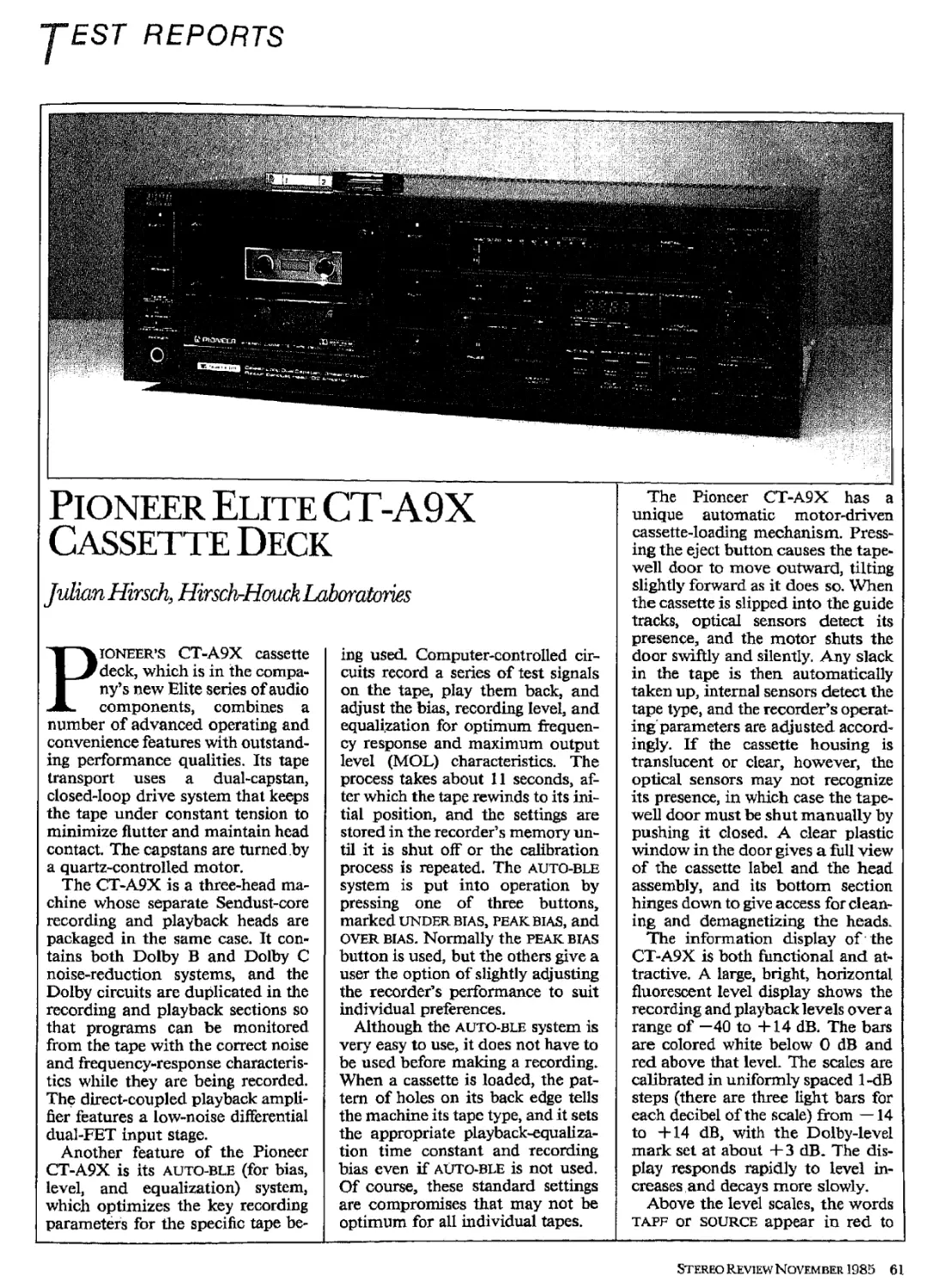
PIONEER ELITE CT-AQX
CASSETTE DE~K
JulnnHirsch,Hirsch H~ALa'~-<
S>E Eo RRv Ew NoVEM K J / ~A
IONEER'S CT-A9X
deck, which is in the compa-
ny's new p]jte seGes of auto
components, combines
number of advanced operating and
convenience features with outs&
jng performance qualities. Its ~pe
iransport uses a dual-capstan,
closed-loop drive system &am ;at k
the tape under constant tension to
minimize fiutter and maintain head
contact. The capstans are turned. by
a quartz-controlled motor.
The CT-A9X is a three-head ma-
chine whose separate Sendust-core
recording and playback heads are
packaged in the same case. It con-
tains both Dolby B and Dolby C
noise-reduction systems, and the
Dolby circuits are duplicated. in the
recording and playback sections so
that programs can be monitored
from the tape wjth the correct noise
and frequency-response characteris-
tics while they are being recorded.
The direct-coupled playback ampli-
Ger features a low-noise differential
dual-FET input stage.
Another feature of the Pioneer
CT-A9X is its AUTo-BLE (for bias,
level, and equpljzatjon) system,
which optimizes the key recording
parameters for the specific tape 'be-
jng use@ Computer-controlled cir-
cuits record a series of test signals
on the tape, play them back, and
adjust the bias, recorcHng level, and
equalization for optimum. frequen-
cy response and maximum output
level (MQL) characteristics. The
process takes about 11 seconds, af-
ter which the tape rewinds to its ini-
tial position, and the settings are
stored in the recorder's memory un-
til it is shut off or the calibration
process is repeated. The AUTO-BLE
system is put into operation by
pressing one of three buttons,
marked tJNDER.BIAS, PEAK BIAS, and
OVER BIAS. Normally the PEAK BIAS
'button is used, but the others give a
user the option of slightly adjusting
the recorder's performance to suit
individual preferences.
Although the AUTO-BI.E syStem is
very easy to use, it does not have to
be used before making a recording.
When a cassette is loaded, the pat-
tern of holes on its back edge tells
the machine its tape type, and it sets
the appropriate playbackwqualiza-
tion time constant and recording
bias even if AUTo-BI.E is not used.
Of course, these standard settings
are comproauses that may not be
optimum for all individual tapes.
The pioneer CT-A9X has
unjque automatic motor-drive&
cassette-loading mechanism. Press
ing the eject button causes the tape-
weii door to move QutwRIcl~ ~lting
slightly forward as it does so. ~en
the cassette is slipped into the guide
opt'cal sensors detect its
presence, and the motor shuts the
door swiftly and silently. Any slack
in the tape h then automat cally
taken up, jnte~g sensors d bxt the
tape type, and. the recorder's operat-
ing parameters are adjusted accord-
jngly If the cassette housmg
translucent or clear, however, the
optics]. sensors may not recognize
its presence, in which case %«ap~
weil door must be shut manually bY
pushing it closed. A clear plastic
endow in the door gives a full view
of the cassette label and the head
assembly, and it' bottom section
hinges down to g ve access for clean-
ing and dezllagnetizing the heads-
The information displaY of'&l
CT-A9X is both functional and at-
tractive. A large, bright, honzo»I
uorescent level djsplay shows the
recording and playback levels ov«a
range of — 40 to +14 dB The b~s
are colored w~t' below 0 dB and
red above that leveL The scales are
cahbrated m uniformly spaced 1%&
steps (there are three light bms for
each decibel of the scale)»m — 14
to +14 dB, w'th the Dolby-level
mark set at about +3 dB. The dis-
play responds rapidly to level in-
creases and decays more slo wly.
Above the level scales, the words
TAPP Or SpURCE appear in red to
TEST REPORTS
znd eqUa/ization for speci f c tape
Used
$qr go-actuated, logic-mn trolIed
transport fUnctions
Music-s<a ch j «
Q E~tgrmg[-timer functloA in
record or play mode (including
Auto-BLE operation)
Q S~itd able auto-monitor selects
tape during recording, switches
to ~ounce program fm. listening
D Tape sIack is taken up
autoxnaeicaIly aa loading
CI Switchable tape-counter/
remaining-time display
C7 Separate record and playback
heads
0 Dolby 8 aud Dolby C z,ouse
red oction
O Peak-iodicating AUorescent level
display
CI Separate level controls for line
and headphone outputs
Cordless d.q. motor drives reel
hubs
Cl Quartz-controlled capstan motor
G C/osed-loop dual-capstav drive
0 Automatic cassette-loading
mechanism
0 Agto-BLE system sets bias, Ieyel,
.t
' PloNEER'.:c TA'pg
CORD'PMYBACK'RE$~ONSE$,-
--- 70ys(TYPES ll AND IVJ
12O ps (TYPE /)
S
C
'('
'I,
HIRSCH-HOUCK LAB MEASURKMKNTS
Rewind time (C-60): 75 seconds
Sp~ed error;+0.&g
Dolb trackin error: DQiby
~ 5 dB; Do by C, ~0.5 dB
Wow-and-flutter: O.N)g. IS(wrms)
at start of tape, O.O'28% IS at end;
+'0.04%%uo D~N (weighted peak)
I.ine outyut for indicated Q dB:
0.5 volt
Line t'nput for indicated 0 dB:
50 mv
Meter indication at IEC-standard
QdB:+4.5dB
G Tape used: TDK SA (Type II,
chrome equivalent)
Indicated 0-dB distortion: 0.8%
Meter indication at 5% third-
harroonkc distortio~: +5 c%
Signal-to-noise ratios (decibels):
Unary. A-zr)td. CCIR ARM
NR og 5S 56.5 4 .5
Dolby 8 59 65 5'7.5
Dolby C 62 75 6'7
G Tape used: TDK MA(Type IV,
metal)
Indicated 0-dB distortion: 0.8'
Meter indication at 5'%% third-
harmenic distortion: +'7 dB
Signal-to-noise ratios (decibels):
Unxotd. A-w«L. CCIR ARM
NR og 58.5 56.5 4 .5
Dolby 8 60 65.5 57.5
Bothy C 62.5 73.5 66.5
U Tape used: TDK AD (Type I,
ferric)
Indicated G-dB distartion: 0.5%
Meter mdication at 5% third-
haI,gaoaie distortion: +6 d9
Signal-to-noise ratios (decibels):
Un~td. A~td. CCIR ARM
NR of 55.5 57 4 .7
a~lb& t B OO 66
Dolby C 62 75 6'7
62 STEREO REvlaw NovKh ABER 1985
show the status of the monitor sys-
tem. The tape type sensed by the
loading system is aIso shown in the
display window. In a smaller win-
d.ow below the level display are the
large, red LED numerals of the four-
digit tape counter. Next to the
Counter's reSet buttOn iS a TAPE
R.ETURN button tha.t automatically
rewinds the tape to the point where
the counter reads 0000.
The CT-A9X also has a useful
remaining-time display. The overall
tape capacity (in minutes) is set at
the start with one of four small but-
tons under the counter window.
The selected time appears next to
the counter reading-in contrasting
yellow numerals, and when the
TME/TAPE button next to the count-
er is pressed, the display shows the
time left on the tape side in nunutes
and seconds.
The other operational features of
the CT-A9X are more conventional-
Large rectangular buttons control
the stop, play, and record functions,
and smaller buttons select the
pause, fast-forward, and rewind
modes. When record is selected,
pause is automatically activated
and must be released before the
according starts. Record can only be
engaged when the tape is stopped,
which prevents "flying starts" but
keeps you from accidentally erasing
a tape by touching the record button
unintentionally (the buttons work
with very little pressure).
The CT-A9X has a music-search
capability to locate portions of a
recording preceded by at least 4sec-
onls of silence. The ters buttons,
located just below the fast-forward
and rewind buttons, advance the
tape at high speed to the beginning
of the next selection or return it to
the beginning of the current selec-
tion (a second touch will back it up
to the start of the preceding selec-
tion, and so forth). To insert the
requisite 4-second silent intervals in
your own. recordings, you need only
press the record-mute button while
recording. The deck immediately
switches out the incoming progra~,
and after 4 seconds the tape stops
and the machine goes into pause.
The CT-A9X has three recording-
level controls: a master control that
affects both chanaels and two srnall-
er knobs that set the levels individu-
ally for each channel. The small
knobs have center detents, and the
tnaster knob has a concentric indi-
cator ring that can be set to any
desi~ed point as a reference. Anoth-
er pair of small knobs is used to con-
trol the playback level for the line
outputs (a convenience not often
found on cassette decks) and the
TESr REF OFITS
volume at the front-panel head-
phone jack. Successive operations
of the Dolby button toggle the se-
lected noise-reduction system on
and off A smaller button toggles
between the Dolby B and Dolby C
systems, and a separate button
switches the MPX filter.
Finally, the Pioneer CT-A9X is
equipped for unattended recording
or playback under the control of an
external timer connected in the a.c.
power Line. The deck's timer switch
selects either record or play, and a
BLE PRESET switch can be set to go
through the BLE calibration cycle
before an unattended recording.
The Pioneer CT-A9X is finished
in black; accessory wood-grain side
panels are available. It measures
1602 inches wide, 1474 inches deep,
and SI/a inches high, and it weighs
22 pounds. Price: $799.95. Pioneer
Electronics (USA), Inc., Dept. SR,
P.O. Box 1540, Long Beach, CA
90801.
To confirm that the AUTo-BLE
system would produce very similar
performance from almost any tape,
we measured the record-playback
frequency response of the CT-A9X
with a number of Type I, Type II,
and Type IV tapes (" normal,"
"high-bias" or chrome-equivalent,
and metal-particle coated). The dif-
ferences between brands were so
small that we selected TDK AD
(Type I), TDK SA (Type II), and
TDK MA (Type IV) for the full test
program, as representative of better-
grade cassette tapes.
With TDK AD tape, we obtained
the flattest reponse at a — 20-dB lev-
el (referred. to the standard 250-
nWb/m flux level) using the PEAK
BIAs setting of the AUTQ-BLE system.
From 80 to 20,000 Hz the response
varied only +0.5 dB, including a
couple of minor low-frequency head
ripples. The low-frequency response
dropped off to about — 3.5 dB be-
tween 20 and 30 Hz, resulting in an
overall response of +1, — 3.5 dB
from 20 to 20,000 Hz. The response
at the 0-dB level was the same up to
about 4,000 Hz and dropped off
smoothly to — 3 dB at 10,000 Hz
and — 6 dB at 20,000 Hz.
To see the range of response ad-
justment provided by the AUTo-BLE
system, we repeated the — 20-dB
64 STEREo RKvlEw NovEMBFR 1985
measurement using the UNDER MAS
and OvER BIAs settings. To our sur-
prise, the differences were barely
detectable, with the extreme condi-
tions differing by only 1 db at
20,000 Hz!
The response with TDK SA and
MA was much like that with TDK
AD, with the same low-frequency
behavior and a variation of less
than ~L dB from about 100 to
20,000 Hz. As expected,'the 0-dB
high-frequency response was slight-
ly better with SA and MA than with
AD tape; the response of the metal
MA tape, for example, was down 6
dB at 17,000 Hz.
Given the exceptional response
flatness of the CT-A9X, we would
expect it to show very good Dolby
tracking, and it did not disappoint
us. Over the full 20- to 20,000-Hz
range, the response at levels of — 20
dB or lower changed by less than 1
dB with either Dolby B or Dolby C
in use, and over most of that range
the change was less than 0.5 dB. At
— 10 dB, tape saturation began to
affect the high-frequency response,
but even there the response varied
less than 1 dB up to 15,000 Hz. The
fixed high-frequency boost and cut
incorporated into Dolby C has a
strong effect on the high-frequency
response at levels of 0 dB and high-
er. At 0 dB the output was about 15
dB greater at 1S,000 Hz with Dolby
C'than with Dolby B.
The playback frequency response,
measured with IEC standard tapes
over a range of 31.5 to 18,000 Hz,
was again extremely fiat (see graph).
The recording input level needed to
make an IEC standard 250-nWb/m
recording at 315 Hz was 50 milli-
volts, and the resulting playback
leveL was 0.7S volt. The same signal
produced a +4.5-dB indication on
the recorder's level scales. Referred
to this level, the A-weighted play-
back signal-to-noise ratio was about
56 to 57 dB without noise reduc-
tion, improving to 65 to 66 dB with
Dolby 8 and to 73 dB with Dolby C.
The 1,000-Hz crosstalk between
channels was a low — 65 dB.
The flutter readings of the CT-
A9X were among the lowest we
have seen. Although the deck did
not quite match Pioneer's specifica-
tion of 0.018 percent JIS-weighted
rins, it surpassed the ~0.048-per-
cent DIN-weighted-peak specifica-
tion. In any event, both the JIS
reading of 0.022 to 0.028 percent
and the +0.04-percent DIN meas-
urement are exceptionaL
The playback distortion from an
indicated 0-dB recording at 1,000
Hz was 0.5 percent with the AD
tape, 0.8 percent with the SA and
MA tapes. The standard reference
distortion level of 3 percent was
reached at respective recording lev-
els of +6.2, +4.7, and +6.8 dB.
The headphone volume, using me-
dium-impedance 600-ohm phones,
was only moderate, but the specifi-
cations indicate that 8-ohm phones
are recommended.
Comments
To say that we were impressed
with the Pioneer CT-A9X would be
an understatement. Outstanding as
its measured performance was, it
did just as well in actual use. It
passed such difficult tests as copy-
ing high-quality "audiophile" LP
records, CD's, and interstation FM
tuner hiss with virtually no detect-
able changes in direct A/B compari-
sons with the original signals. The
controls operate effortlessly, and the
mechanism is exceptionally quiet in
all its modes of operation.
Some of the human-engineering
aspects of the CT-A9X could stand
improvement, however. All the
controls are black like the front pan-
el, and the very delicate silver-
colored markings are often difficult
to read. The three major controls
(stop, play, and record) are close
together and all the same size and
shape, making it much too easy to
hit the wrong one (even a sLight
touch is sufficient for activation).
Finally — yes, the list of criticisms is
short — we should mention that we
found an inoperative tape-type indi-
cator on our initial test sample, but
we were reassured when the indica-
tor on a second sample functioned.
The surprisingly small difference
in response using the three settings
Of the AUTO-BLE systen (PEAK BIAS,
UNDER BIAS, and OVER BIAS) makes
us question the usefulness of these
options, but the system worked so
well regardless of the setting select-
ed that we can hardly fault the deck
in that respect. The Pioneer CT-
A9X is an impressive machine by
any measure.
Circle 145 on reader service card