/


Теги: electrical engineering sound reproduction audio equipment record player
Год: 1984

Текст
AUD[0 New Equipment Reports
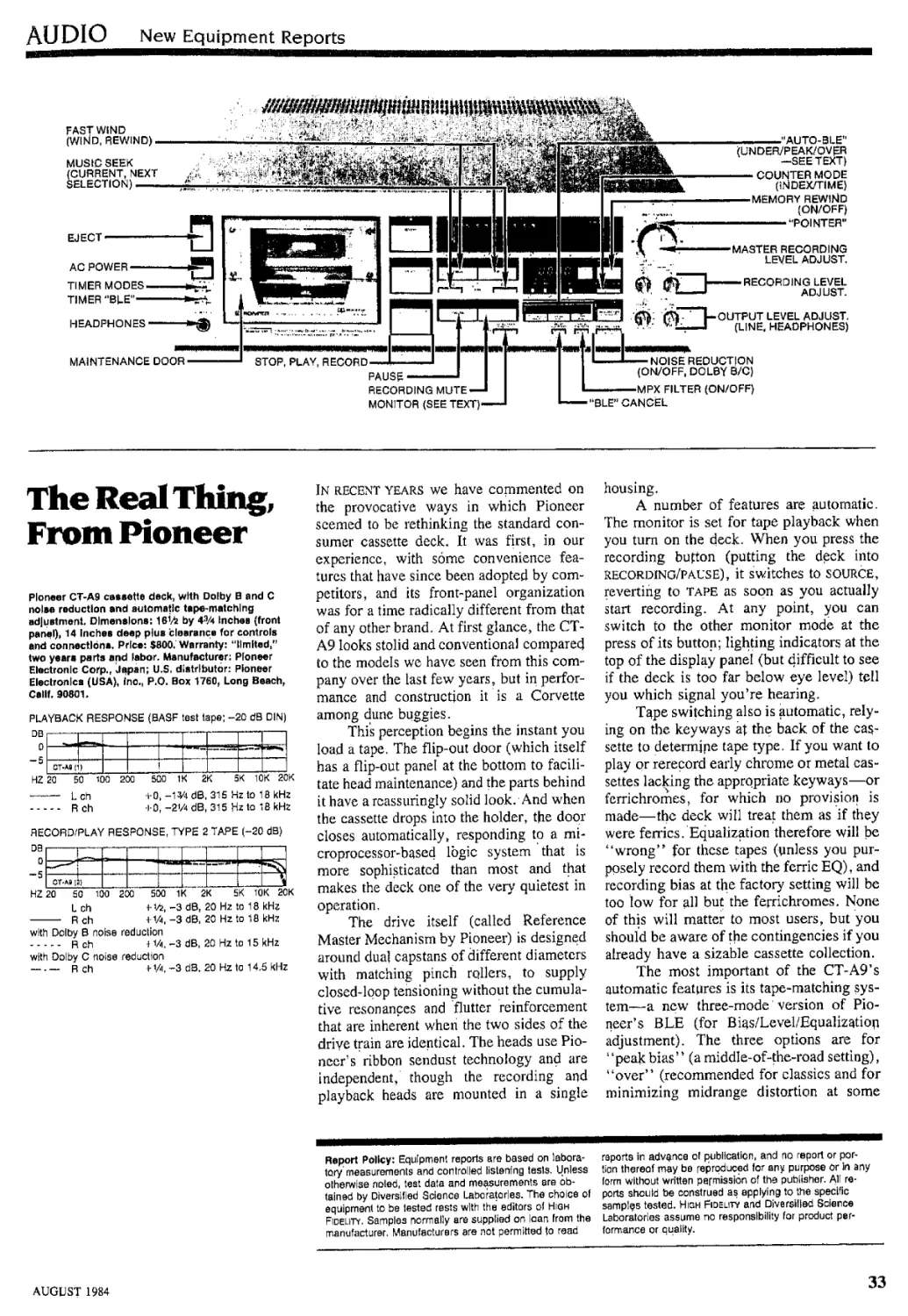
FAST WiND
(WIND, REWf
"AUTO- B LE"
JP EAK(QV gR
— SEE TEXT)
< ER M
NDEXrriME)
ORY RiEWIQD
(ON(Oi= F j
"Paig TER"
MUSIC SEEK
(CURRENT, N
SELECTiON)
EFFECT
AC POWER
R EGO RD ING
V EL AD J UST.
RDlNG LEVEL
ADJ UST.
< EL ADJU
EADPHQNES)
TlNIER MOOE
TIMER "Bi En
HEADPHQN
MAINTENAN
AUGUST 1 984
The Real Thing,
From Pioneer
Pioneer CT-Ae caaeette deck, with Dofby' 8 and C
noise redUction end automatic tape-matching
ad]ustment. Dimensions: 16M by 4~/4 Inchel (front
panful), 34 Inchee deep Plus clearance for controls
and conpectlana. Prfce: $800. Warranty: "limited,"
two yearg parti and labor, Manufacturer.' Pfaneer
Electronic Cafp., Japan, 'U.S, dIItrlbljtor: Pioneer
Electranlca (UBAj, fno., P.o. Box $760, Long Beach,
Calif. 90801.
PLAYBACK RESPONSE i,'HASF test tape; -20 dB t3INj
DB
0
-5
&l ;Z 2 K & t;0 ) 2 X GG 1K 2 5 1
Lch -i-o, -1W dB, 315 Hz to l8 kHz
Rch I 0, -2V& t; B, 3 5 Qz to fB
RECORD(PLAY RESPGNSE, TYPE 2 TAPE ( — 20 dH)
ve
0
HZ 20 SP ioo 200 5M iK 2K 5K ~OK 20K
L ch &l ;- h, -3 g, 20 Mz t 8
R ch &l ;- ~ 4, -3 B, 20 Wz ta ' 8
with Dalby 8 noise reduction
R ch f ~ j4, -3 dB, 20 Hz ta 15 kHz
with Dolby C rloIse reduction
Rch I- i j&l ;, -3 B, 20 Hz ta 'I .5
IN RECEYT YEARS %C l|RVC COIT)IIlCAted On
the provocative ways in which Pioneer
seemed to be rethinking the stmdard con-
sumer cassette deck. It was first, in OUr
experience, wjth sornc convenience fea-
tures that have since been adopted by com-
petitars, aad its front-panel OIgavizatioi|
was for a time radically different from that
of any ather brand. At first glance, the CT-
A9 looks stolid and conventional compared
to the models we have seen from this com-
pany over the last few years, but in perfor-
man.ce and constroctj.on it is a Corvette
among dune buggies.
This perception begins the instant you
load a tape. The flip-out door (which itself
has a fIip-out parte) at the bottom to fa.cili-
tate head maintenance) and the parts behind
it have a reassuringly solid look. A~d when
the cassette drops into the holder, the door
closes autoiTiaticalIy, responding to a mi-
croprocessor-bgsed logic system that Is
mare sophisticated thm, most arid that
makes the deck one of the very quietest in
operation.
The drive itself (called Reference
Master Mechanism by Pioneer) is designed
around dual capstans of different diameters
with matchiog pinch r<Ile s, cj sup
closed-loop tensioning withaUt the comU]a-
tivc resonances and flutter reiri.forcemeat
that. are inherent whee the hvo sides of the
drive train are identiCal. The headS LiSe PiO-
river'S ribbon Seediest techrloIogy and are
independent, though the recording and
playback heads are mounted in a single
Report Policy: Equipment reports are based on labora-
tory measurements and controlled listening tests, Unless
otherwise noted, test data and rpegsUrernents are ob-
tained by Diversified Scierlce LaboIatorles, The choice Of
8qljipment to be tested rests with the editors of HITCH
FiDELITY. Samples normally are supplied On loan from the
manufacturer. Ma.nufacturars are not permitted to read
hoo sing.
A number Of features are automatic.
The monitor is set for tape pla.yback where
you turn on the deck. When you press the
recording button (putting the deck into
RECORDING/PAI;SE), it switCheS tO SOURCE,
reverting to TApE as soon as you actually
start recording. At any point, yoU can
s~itch to ihc other monitor mode B.t the
press of its bUtton; lighting iadicgtorg at the
top of the display panel (but difficult to see
if the deck is too far below eye level) tell
yoU e'hich sig',pal you' re hearing.
Tpye switching also is automatic, rely-
ing on the keyways a& t; he b ck of he c
sette to detcrmjpe tape type. If you want to
play or rerecord early chrome Or metal cas-
settes lacking the appropriate keyways — or
ferrichromes, for whicl| oo provision is
made — the deck wiI.l treat them as if they
were ferries. Equalization therefore will be
"wrong" for these tapes (Itnless you pur-
posely record them with the ferric EQ), and
recording bias at the factory setting will be
too low for all but the ferrichromes, None
of this will matter to most users, but yoU
should be aware of the contingencies if yoU
aIready have a sizable cassette collection.
The most important of the CT-A9's
g.utomatic features is its ta,pc-matchiog sys-
tem — a, m,ew' three-mode' versi,on of Pio-
neer's BLE (for Bigs/Level/EqualizgtioII
adjustment). The three options are for
"peak bias" (a middle-of-the-road setting),
"over" (recommended for classics and for
minimizing midrangt'. distortion, af, some
reports in advance of pUbficatian, and no report or por-
tion thereOf may be <epradu ed ar ny ptlrpe se Or in
for+ without written pef'mission af the publisher. All re-
ports should be eanstrIjed as applying to the specific
sarnplys tested. HiaH F~Dzimv and Diversified Bcierlce
Laboratories assume na responsibility for prodUct per-
forma.face or quality.
AUDIO New Equipment Reports
E (-20 de) expense in high-frequency headroom), and
"under" (for the zingiest highs on music
demanding extra high-frequency headroom
CT-AQ gl at the cost of some increase in rnidrange
distortion). Before you start recording, you
must decide which of the three options you
want and press the appropriate "Auto™
BLE" button, The deck fast-'winds into the
tape, records arId evaluates a series of test
tones, sets bias, sensitivity, and recording
equalization accordingly, and rewinds the
tape to the point at which you started. It all
happens very rapidly (in only about ten sec-
onds), So there should be little reason not to
Lch
use the feature. However, the factory set-
Rch +1, -3 dB, 20 Mr to 20 kHz
with Dolby B noise reduction tings that apply when you turn on the
R ch +Vs, — 3 dB, 20 Hz tc 20 kHz machine shnuld be fine fOr many tapes (par
with Dolby C noise reduction
3 da 2Q Hz tc 2Q kHz ticularly premium formulat>on ), nd
can revert to them at the touch of a button if
you' re in doubt about the properties of the
Igst tape for which yoIj ran the BLE.
S/N RATIO (re DIN 0 dB; R/P; A-weighted) Because the BLE memory is canceled
Type 2 tape Type 4 tape Type 1 tape
without noise reduction every time you turn off the deck, Pioneer
57iA d8 56 dB has included a second tape-matching switch
with Dolby'8 noise reduction
66V4 dS 65 dB 64 dB for recording with a timer. This switch
with Dolby C noise reduction offers the same three options; when the tim-
er turns on the deck, it first goes through thc
S/N RATIO (re DIN 0 dB; R/P; GCIR/ARM-weighted) AutO-BLE rOutine, inCluding the reWind
ype 2 tape Type 4 tape Type " ta and reCue, and then beginS reCOrding. There
without noise reduction
551rh dB 53+4 dB is no OFF on this switch, so the deck always
with Dolby 8 noise reduction will attempt to optimize itself for the tape in
651k dB 63%4 dB 62@4 dB
with Oolby C noise reduction timer recording. Only if the tape you' ve
74 dB 73 dB chosen turns out to be beyond the BLE's
range will the machine revert to its factory
settings.
Diversified Science Laboratories test-
ed the CT-A9 with Maxell UDXL-II ferri-
7o DlsTGRTIoN (315 M') cobalt as the Type 2 "chrome," MX as the
(for +114 dB DIN)
(for +3 dB DIN) Type 4 metal, and UDXL-I as the Type 1
(for +21' dB DIN) ferric. In each case, the "peak" option of
the Auto-BLE was employed to fine-tune
the deck, though results with these particu-
lar tapes probably would have been quite
similar at the factory settings. (Habitual use
of the automatic matching system probably
is a good idea with such a deck, no matter
what tapes you use.) As you can see from
4.4 rrlsec the accompanying graphs and data, re-
sponse is very flat and extended under these
circumstances.
When the lab tried the "over" and
"under" options of the Auto-BLE, the
results remained very good, with some
small reservations. The very slight tenden-
> 10 vo ts cy tow rd sway-bac ed respo se (
exceedingly shallow depressions visible in
the 2-kHz region) was marginally increased
6,600 ohms in the "over" setting, which also shaved a
little off the top end of the response. The
"under" setting generally yielded the flat-
test curves with the most extended high
end — though the sr@all peak near 19 kHz in
the Type 4 response is somewhat exagger-
ated, apd the resulting loss in tTIidrange
headroom discourages regular use.
Of particular note among the remain-
ing data are the extremely low wow and
flutter and the excellent erasure, (Results in
the latter test are identical for both the old
and new EIA methods, incidentally.) Out-
RECORD/PLAY RESPONSE, TYPE 4 TAP
DB
0
-5
HZ 20 50 100 200 500 1K 2K 5K 10K 20K
Lch a 1, -3 dB, 20 Hz to 20 kHz
Rch + Vz, -3 dB, 20 Hz to 20 kHz
with Oolby B noise reduction
R eh +14, -3 dB, 20 Hz to 20 kHz
with Dolby C noise reduction
Rch +114, -3 dB, 20 Hz to 20 kHz
RECORD/PLAY RESPONSE, TYPE 1 TAPE (-20 dB)
DS
0
— 5
MULTIPLEX FILTER (defeatable)
— 1A d8 at 15 kHz; -331/4 dB at 19 kHz
5PV4 dB
69V4 dB
52iih dB
72 dB
INDICATOR READINGS FOR DIN 0 DB (315 Hz)
Type 2 tape +5 dB (with 2.18% THD)
Type 4 tape +5 dB (with 1.35% THD)
Type 1 tape +5 dB (with 1.02% THD)
IGATOR READINGS FOR 3
e 2 tape +7 dB
e 4 tape +9 dB
e 1 tape +8 dB
IND
Typ
Typ
Typ
DISTORTION (THD at -10 dB DIN; 50 Hz to 5 kHz)
Type 2 tape 0.67%
Type 4 tape ~ 0.50%
Type 1 tape ~ 0.38%
ERASURE (at 100 Hz)
CMANNEL SEPARATION (at 315 Hz) 52~eh dB
INDICATOR "BALLISTICS"
Response time
Decay time
Overshoot
SPEED ACCURACY 0.5% fast, 105 to 127 VAC
FLUTTER (ANSI weighted peak; R/P) ~0.029%
SENSITIVITY (re DIN 0 dB; 315 Mz) 68 rnV
INPUT OVERLOAD (at 1 kHz)
INPUT IMPEDANCE
OUTPUT IMPEDANCE
MAX. OUTPUT (from DIN 0 dB)
100k ohms
1.15 volts
put impedance (which can drop into the
4,000-ohrn range, depending on the setting
of the output level control) is on the high
side, but it should present no practical
matching probIerns with typical preamps
and receivers, whose tape-jack input im-
pedances usually are 50,000 (50k) ohms or
more. The A-weighted noise figures don' t
demonstrate the full subjective noise reduc-
tion of the Dolby circ> ts he ay he C
figures do, but that is an expected by-prod-
uct of the testing method,
The metering has a wide dynamic
range: from -40 to +14 dB relative to the
marked 0 dB — which, as the data show, is
placed S dB below DIN 0. More important,
the bar-graph indicators can resolve I-dB
differences from — 10 up, which provides a
clear picture of signal levels over an excep-
tionally braad "critical range." There is no
peak hold as such; the mett ring responds
quickly and decays fairly slowly, giving
you a fair chance to read peaks before they
arc gone. For Type 2 and 1 tapes, an "over-
load" region is shown above +5 dB (DIN 0
dB); when you insert a Type 4 tape, the
indicators automatically drop the bottom 2
dB of this range, suggesting "safe" record-
ing to +7 (DIN +2). The data show that
these suggestions leave a little headroom
before actual 3-percent midrange distortion
is reached.
The level-setting system involves a
pair of level controls, one for each channel,
plus a master fader on which an outer point-
er is used to preset the fade point. Once
balance and approximate level (to get the
master somewhere near the middle of its
range) have been set on the individual con-
troIs, they are left as-is. The' master and the
pointer are then fine-tuned for precise level
and the master backed off to maximum
attenuation, ready for fade-in — which will
restore it to the pointer setting. The pointer
is very loasely clutched, however, and can
easily be knocked away from its setting—
our only out-and-out complaint about the
CT-A9 (and a minor one, at that).
Among the CT-A9's strictly conve-
nience features are seek controls (which
fast-wind either forward to the beginning of
the next selection or back to the beginning
of the current one and start playing it auto-
matically) and a tin1er/counter option, in
which the remaining time on the tape can bc
displayed in place of the usual arbitrary
numbers. To make this feature work, Pio-
neer gives you pushbuttons for tape size;
C-90, C-60, C-45 with standard hubs, and
C-4S with large hubs.
At fast-wind speeds, the timing» are
only approximate, but they' re close enough
to be useful. When you stop the wind and
resume play, the readout hesitates fo«
moment before locking onto a more exact
reading, If you use C-30s, the standard C-
45 setting will give you reasonable approx-
imations of remaining time as you approach
the end of the side. (Like most other man-
ufacturers, Pioneer discourages the use of
HIGH FIDELtTY
C-> 0s nd C-lgO
All in all, thy CT-A9 is a significant
achievement in bringing new techno/ogy to
the casual recordist as well as the dyed-i@-
the-wool hobbyist. The latter should be bet-
ter served by it than by any past Pioneer
modeI, whiIe the former shouM derive far
rebore enjoymeot from it thari from the fussy
"semipro" models beloved Of serious
a,n.diopMIes. There aren't may modeIs that
offer so mocb to botb groups Bt face, Or that
do it a3.1 so well.