/

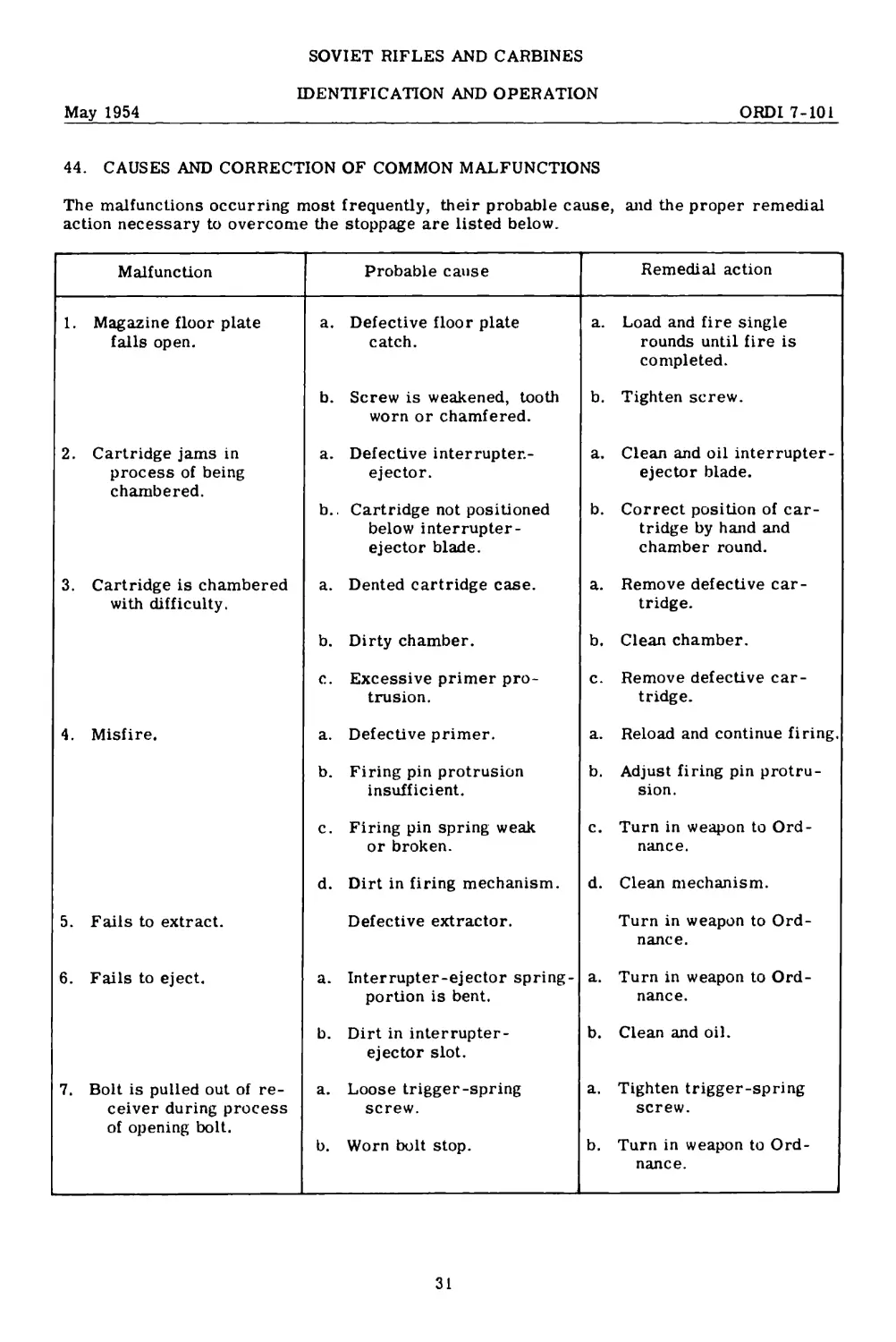

Теги: weapons military affairs
Год: 1954


Текст
                    ORDI7-101
SOVIET RIFLES AND CARBINES
IDENTIFICATION AND OPERATION
ORDNANCE CORPS
MAY 1954
OROI7101
SOVIET RIFLES AND CARBINES
IDENTIFICATION AND OPERATION
ORDNANCE CORPS
MAY 1954
OFFICE OF THE CHIEF OF ORDNANCE
Washington 25, D. C., 1 May 1954
ORDI 7-101, Soviet Rifles and Carbines — Identification and Operation, is published
for the information and guidance of all concerned.
2^O/4UO-15683 (14 April 195427
E. L. CUMMINGS
Major General, USA
Chief of Ordnance
OFFICIAL:
F.. J. McMORROW
Colonel, Ord Corps
Executive OfficeF
DISTRIBUTION: Special
SOVIET RIFLES AND CARBINES
IDENTIFICATION AND OPERATION
May 1954
ORDI 7-101
CONTENTS
Paragraph Page
CHAPTER 1.
CHAPTER 2.
SECTION I.
GENERAL
Purpose----------------------------------------------- 1	1
Scope--------------------------------------------- 2	1
References---------------------------------------- 3	1
Corrections and additions------------------------- 4	1
BOLT ACTION RIFLES AND CARBINES
П.
Ш.
IV.
V.
VI.
VII.
GENERAL
Origin and basic qualities---------------------------- 5	2
Bolt action rifles-------------------------------- 6	2
Bolt action carbines------------------------------ 7	3
Characteristics of 7.62-mm bolt action rifles
and carbines-------------------------------------- 8	4
DIFFERENCES BETWEEN MODELS
Rifle M1891------------------------------------------- 9	6
Dragoon rifle M1891------------------------------ 10	7
Carbine M1910------------------------------------ 11	8
Rifle M1891/30----------------------------------- 12	9
Sniper rifle M1891/30---------------------------- 13	12
Carbine M1938 ----------------------------------- 14	16
Carbine M1944 ----------------------------------- 15	16
INTERCHANGEABILITY
Components interchangeable between all models —	16	17
Components interchangeable bettfeed specified
models--------------------------------------- 17	17
AMMUNITION
Description-------------------------------------- 18	18
Packaging---------------------------------------- 19	19
SIGHTING EQUIPMENT
Rifle M1891 ----------------------------------------- 20	20
Dragoon rifle M1891------------------------------ 21	20
Carbine Ml910 ----------------------------------- 22	20
Rifle M1891/30 ---------------------------------- 23	20
Sniper rifle M1891/30---------------------------- 24	21
Carbine Ml938 ----------------------------------- 25	21
Carbine Ml944 ----------------------------------- 26	22
OPERATING INSTRUCTIONS
Rifle M1891 ----------------------------------------- 27	22
Dragoon rifle M1891 ----------------------------- 28	23
Carbine Ml910 ----------------------------------- 29	23
Rifle M1891/30----------------------------------- 30	24
Sniper rifle M1891/30---------------------------- 31	24
Carbine M1938 ----------------------------------- 32	24
Carbine M1944 ----------------------------------- 33	24
MAINTENANCE
Accessories------------------------------------------ 34	24
Care and cleaning-------------------------------- 35	26
Rifle M1891 ------------------------------------- 36	26
iii
SOVIET RIFLES AND CARBINES
IDENTIFICATION AND OPERATION
ORDI 7-101 May 1954
Paragraph Page
SECTION VII. MAINTENANCE — Continued
Dragoon rifle M1891 ----------------------------------------- 37	30
Carbine M1910 ----------------------------------- 38	30
Rifle M1891/30----------------------------------- 39	30
Sniper rifle M1891/30-------------------------- 40	30
Carbine M1938 ----------------------------------- 41	30
Carbine Ml944 ----------------------------------- 42	30
VIII. MALFUNCTIONS AFFECTING OPERATIONS
General ---------------------------------------------- 43	30
Causes and correction of common malfunctions---	44	31
CHAPTER 3. AUTOMATIC AND SEMIAUTOMATIC RIFLES AND
CARBINES
SECTION I. GENERAL
Simonov rifle-------------------------------------------------- 45	33
Tokarev rifles and carbines-------------------- 46	33
Basic characteristics of automatic and semiautomatic
rifles------------------------------------------- 47	35
П. DIFFERENCES BETWEEN MODELS
Automatic rifle M1936 (AVS)----------------------------- 48	35
Semiautomatic rifle M1938 (SVT)------------------ 49	37
Semiautomatic rifle M1940 (SVT)------------------ 50	37
Automatic rifle M1940 (AVT)---------------------- 51	38
Semiautomatic sniper rifle M1938 ---------------- 52	38
Semiautomatic sniper rifle Ml 940 --------------- 53	38
Ш. INTERCHANGEABILITY
Automatic rifle Ml936 (AVS)----------------------------- 54	38
Semiautomatic rifle Ml938 (SVT)------------------ 55	38
Semiautomatic rifle M1940 (SVT)------------------ 56	39
Automatic rifle M1940 (AVT)---------------------- 57	39
Semiautomatic sniper rifle M1938 ---------------- 58	39
Semiautomatic sniper rifle Ml940 ---------------- 59	39
IV.	AMMUNITION
Ammunition---------------------------------------------- 60	39
V.	SIGHTING EQUIPMENT
Automatic rifle M1936 (AVS)---------------------------- 61	39
Semiautomatic rifle Ml 938 (SVT)----------------- 62	40
Semiautomatic rifle M1940 (SVT)------------------ 63	40
Automatic rifle M1940 (AVT)---------------------- 64	40
Semiautomatic sniper rifle Ml938 ---------------- 65	40
Semiautomatic sniper rifle Ml940 ---------------- 66	40
VI.	OPERATING INSTRUCTIONS
Automatic rifle M1936 (AVS)----------------------------- 67	40
Semiautomatic rifle M1938 (SVT)------------------ 68	41
Semiautomatic rifle M1940 (SVT)------------------ 69	41
Automatic rifle M1940 (AVT)---------------------- 70	42
Semiautomatic sniper rifle M1938 ---------------- 71	42
Semiautomatic sniper rifle M1940 ---------------- 72	42
iv
SOVIET RIFLES AND CARBINES
IDENTIFICATION AND OPERATION
May 1954 ORDI 7-101
Paragraph Page
SECTION VII. MAINTENANCE
Automatic rifle M1936 (AVS)------------------------------------- 73	42
Semiautomatic rifle M1938 (SVT)---------------- 74	43
Semiautomatic rifle M1940 (SVT)---------------- 75	48
Automatic rifle M1940 (AVT)-------------------- 76	52
Semiautomatic sniper rifle M1938 -------------- 77	52
Semiautomatic sniper rifle M1940--------------- 78	52
VIII. MALFUNCTIONS AFFECTING OPERATIONS
Malfunctions-------------------------------------------- 79	52
v

SOVIET RIFLES AND CARBINES
IDENTIFICATION AND OPERATION
May 1954
ORDI 7-101
CHAPTER 1
GENERAL
1.	PURPOSE
This pamphlet is published as a guide for Ordnance personnel in the identification and opera-
tion of Soviet military rifles and carbines.
2.	SCOPE
a.	The information contained herein includes data on Soviet bolt action, semiautomatic,
and automatic rifles and carbines.
(1)	The chapter on bolt action weapons includes the original M1891, the M1891
Dragoon, the M1891/30 sniper, and the M1891/30 rifles, and the M1910, M1938,
and M1944 carbines.
(2)	The chapter on automatic and semiautomatic weapons covers the Simonov M1936
(AVS), Tokarev M1938 (SVT), Tokarev sniper M1938, Tokarev M1940 (SVT),
Tokarev M1940 (AVT), and Tokarev sniper M1940 rifles; while mention is made
of the Tokarev semiautomatic carbine M1940, this weapon is not treated in detail.
b.	Although basic information on disassembly and assembly of each weapon is included,
no attempt has been made to provide all the details necessary for complete maintenance and
repair of the weapons described.
c.	Information is given for the superficial maintenance of the weapon; common malfunc-
tions are listed, causes of such malfunctions are cited, and the proper remedial action is
given.
d.	All the weapon models covered within a chapter are discussed in each section of the
chapter. For example, section I of chapter 1 gives a general description of each bolt action
model, section II points out the differences between all the bolt action models, section III has
to do with interchangeability of parts for each bolt action model, and so on.
3.	REFERENCES
The information presented herein is based upon the latest and best material available. Much
of the information is the result of actual examination and operation of the weapons described.
4.	CORRECTIONS AND ADDITIONS
Suggestions for correction and addition should be forwarded to Chief of Ordnance, Washington
25, D. C., ATTN: ORDGU-IN, so that any revision of the text can incorporate the change.
1
SOVIET RIFLES AND CARBINES
IDENTIFICATION AND OPERATION
ORDI 7-101
May 1954
CHAPTER 2
BOLT ACTION RIFLES AND CARBINES
SECTION I.	GENERAL
5.	ORIGIN AND BASIC QUALITIES
The Mosin-Nagant rifle was adopted in 1891 by Imperial Russia. The action of the rifle was
developed by Colonel S. I. Mosin of the Imperial Russian Army, and the magazine was devel-
oped by Nagant, a Belgian. All Soviet bolt action military rifles and carbines are Mosin-
Nagant weapons and all are basically similar to the original Mosin-Nagant rifle adopted by
Russia in 1891. These weapons can be considered reasonably effective infantry weapons.
Fairly good shooting can be done with them at combat ranges, although their sights do not lend
themselves to the finer degrees of accuracy which can be obtained with similar United States
weapons. They suffer from an overcomplicated bolt, but in other respects are relatively sim-
ple to service and maintain. The safety, in that it is extremely hard to engage and disengage,
represents a shortcoming of the weapons.
6.	BOLT ACTION RIFLES
a.	The original rifle M1891 was considerably different than later versions of the same
model. The original rifle M1891 had no handguard, was fitted with sling swivels instead of
the sling slots used on later versions, and had a leaf rear sight which was designed for the
old conical-nosed 7. 62-mm ball cartridge. In 1908 the Spitzer pointed light ball round (which
is still used) was introduced and the rear sight was changed. About this time handguards were
added and the swivels were replaced by sling slots bored in the stock. The original M1891 is
now a collector's item, and is unlikely to be encountered in the field. The later versions of
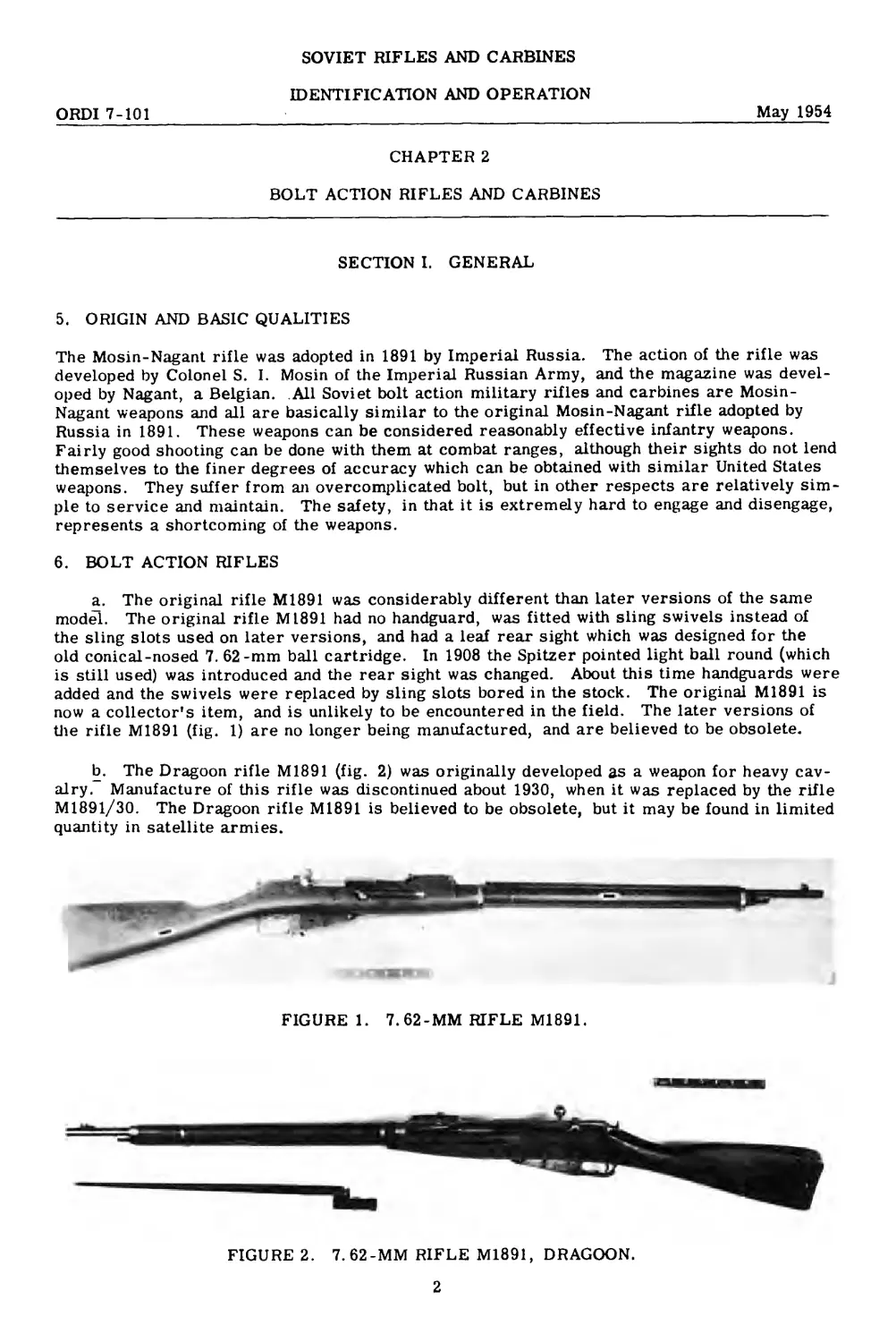
the rifle M1891 (fig. 1) are no longer being manufactured, and are believed to be obsolete.
b.	The Dragoon rifle M1891 (fig. 2) was originally developed as a weapon for heavy cav-
alry. Manufacture of this rifle was discontinued about 1930, when it was replaced by the rifle
M1891/30. The Dragoon rifle M1891 is believed to be obsolete, but it may be found in limited
quantity in satellite armies.
FIGURE 1. 7.62-MM RIFLE M1891.
FIGURE 2. 7.62-MM RIFLE M1891, DRAGOON.
2
SOVIET RIFLES AND CARBINES
IDENTIFICATION AND OPERATION
May 1954 ORDI 7-101
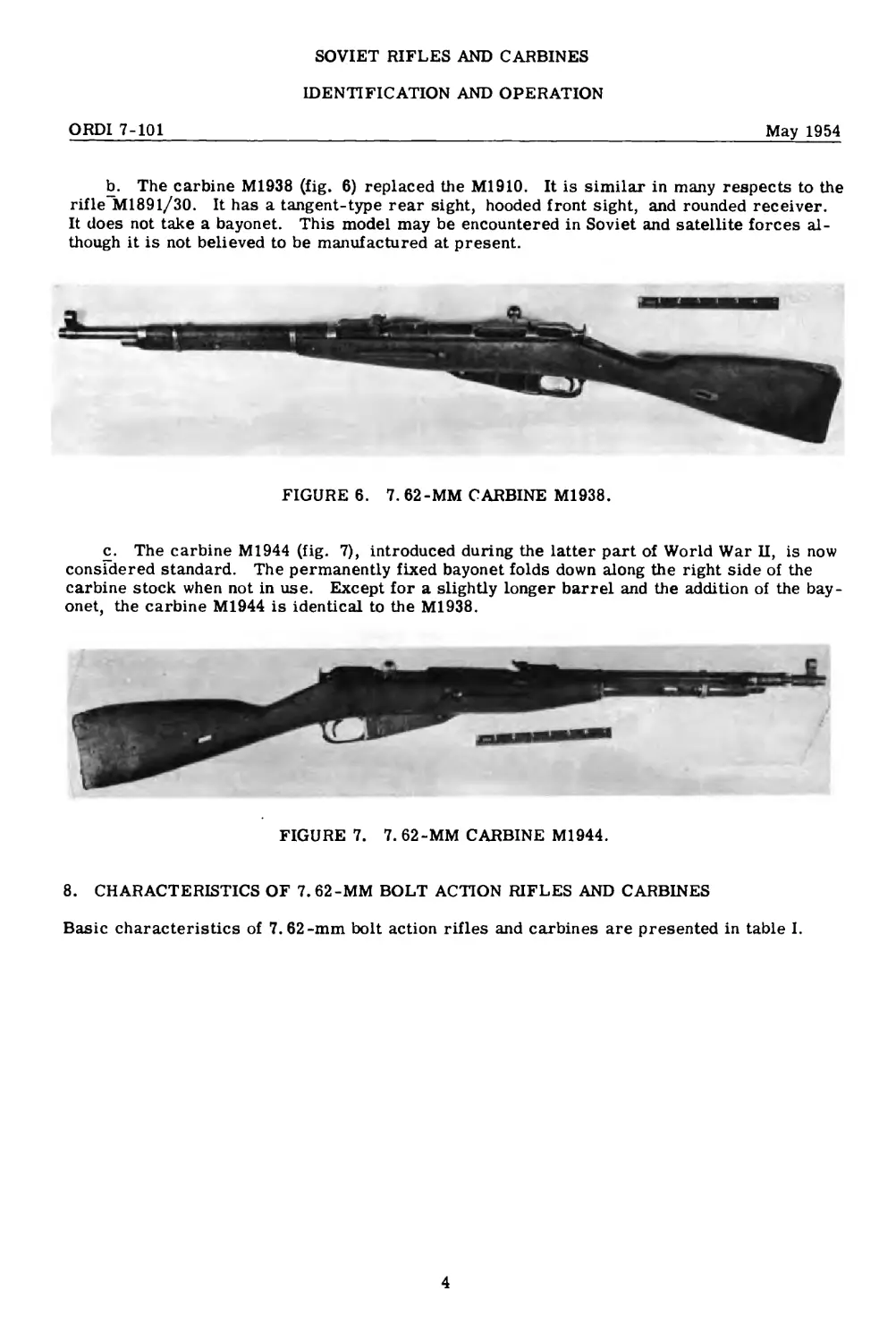
c.	The rifle M1891/30 (fig. 3) is about the same length as the M1891 Dragoon, but it
represents many improvements over the Dragoon. The sights used on the M1891/30 are su-
perior to those of the Dragoon, and, because the metric system of measurement was adopted
in Russia during this period, the sights of the M1891/30 are calibrated in meters rather than
in arshins. (One arshin equals 0. 71 meters or 0. 78 yards.) Manufacture of the M1891/30
was initiated in 1930. Although this model is used in large numbers in the Soviet and satellite
armies, it is apparently being replaced by the carbine M1944 as the standard Soviet infantry
shoulder weapon.
FIGURE 3. 7. 62-MM RIFLE M1891/30.
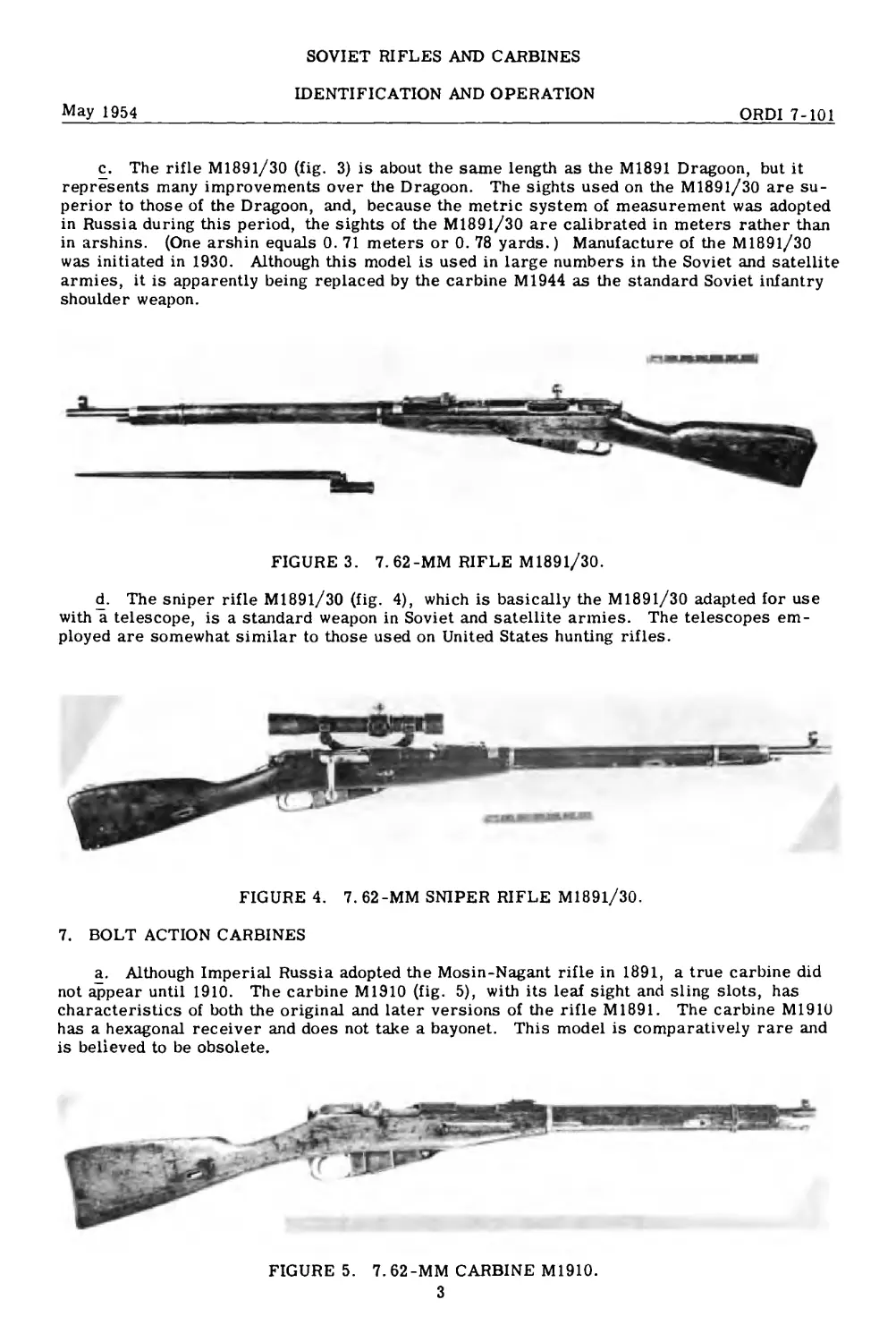
d.	The sniper rifle M1891/30 (fig. 4), which is basically the M1891/30 adapted for use
with a telescope, is a standard weapon in Soviet and satellite armies. The telescopes em-
ployed are somewhat similar to those used on United States hunting rifles.
FIGURE 4. 7. 62-MM SNIPER RIFLE M1891/30.
7.	BOLT ACTION CARBINES
a.	Although Imperial Russia adopted the Mosin-Nagant rifle in 1891, a true carbine did
not appear until 1910. The carbine M1910 (fig. 5), with its leaf sight and sling slots, has
characteristics of both the original and later versions of the rifle M1891. The carbine M1910
has a hexagonal receiver and does not take a bayonet. This model is comparatively rare and
is believed to be obsolete.
FIGURES. 7. 62-MM CARBINE M1910.
3
SOVIET RIFLES AND CARBINES
IDENTIFICATION AND OPERATION
ORDI 7-101
May 1954
b.	The carbine M1938 (fig. 6) replaced the M1910. It is similar in many respects to the
rifle M1891/30. It has a tangent-type rear sight, hooded front sight, and rounded receiver.
It does not take a bayonet. This model may be encountered in Soviet and satellite forces al-
though it is not believed to be manufactured at present.
FIGURE 6. 7. 62-MM CARBINE M1938.
c.	The carbine M1944 (fig. 7), introduced during the latter part of World War II, is now
considered standard. The permanently fixed bayonet folds down along the right side of the
carbine stock when not in use. Except for a slightly longer barrel and the addition of the bay-
onet, the carbine M1944 is identical to the M1938.
FIGURE 7. 7. 62-MM CARBINE M1944.
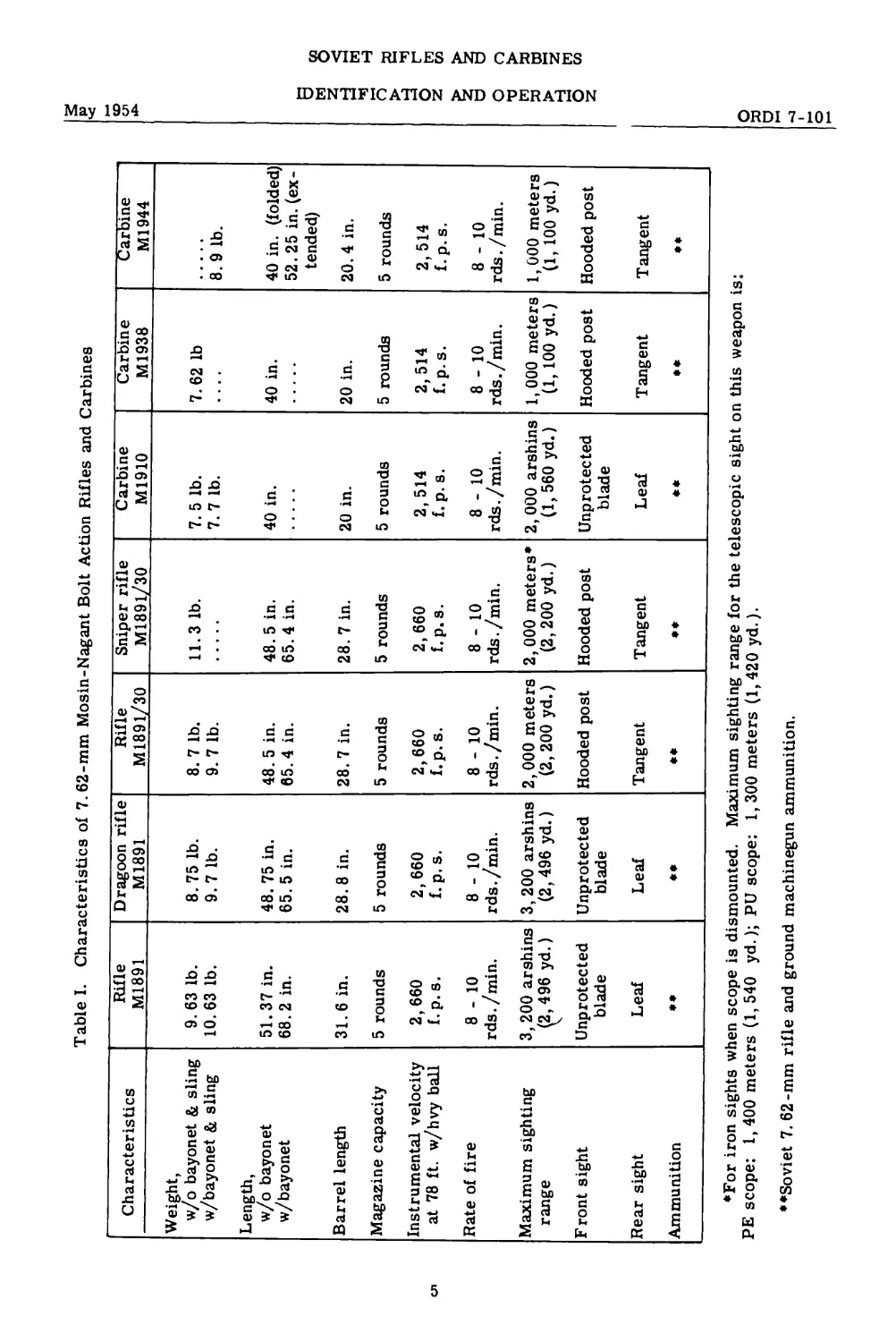
8.	CHARACTERISTICS OF 7. 62-MM BOLT ACTION RIFLES AND CARBINES
Basic characteristics of 7. 62-mm bolt action rifles and carbines are presented in table I.
4
Table I. Characteristics of 7.62-mm Mosin-Nagant Bolt Action Rifles and Carbines
Characteristics	Rifle M1891	Dragoon rifle M1891	Rifle M1891/30	Sniper rifle M1891/30	Carbine M1910	Carbine M1938	Carbine Ml 944
Weight, w/o bayonet & sling w/bayonet & sling	9.63 lb. 10.63 lb.	8.75 lb. 9.7 lb.	8. 7 lb. 9. 7 lb.	11.3 lb.	7. 5 lb. 7. 7 lb.	7. 62 lb	8.9 lb.
Length, w/o bayonet w/bayonet	51.37 in. 68.2 in.	48. 75 in. 65. 5 in.	48.5 in. 65.4 in.	48.5 in. 65. 4 in.	40 in.	40 in.	40 in. (folded) 52. 25 in. (ex- tended)
Barrel length	31.6 in.	28.8 in.	28.7 in.	28. 7 in.	20 in.	20 in.	20.4 in.
Magazine capacity	5 rounds	5 rounds	5 rounds	5 rounds	5 rounds	5 rounds	5 rounds
Instrumental velocity at 78 ft. w/hvy ball	2,660 f. p. s.	2,660 f. p. s.	2,660 f.p. s.	2,660 f. p. s.	2, 514 f. p. s.	2,514 f. p. s.	2,514 f. p. s.
Rate of fire	8-10 rds./min.	8-10 rds./min.	8-10 rds./min.	8-10 rds./min.	8-10 rds./min.	8-10 rds./min.	8-10 rds./min.
Maximum sighting range	3, 200 arshins ^2,496 yd.)	3,200 arshins (2,496 yd.)	2,000 meters (2,200 yd.)	2,000 meters* (2,200 yd.)	2,000 arshins (1,560 yd.)	1,000 meters (1,100 yd.)	1,000 meters (1, 100 yd.)
Front sight	Unprotected blade	Unprotected blade	Hooded post	Hooded post	Unprotected blade	Hooded post	Hooded post
Rear sight	Leaf	Leaf	Tangent	Tangent	Leaf	Tangent	Tangent
Ammunition	♦♦	♦»	♦♦	♦♦	♦ ♦	♦ ♦	»*
SOVIET RIFLES AND CARBINES
♦For iron sights when scope is dismounted. Maximum sighting range for the telescopic sight on this weapon is:
PE scope: 1,400 meters (1,540 yd.); PU scope; 1,300 meters (1,420 yd.).
♦♦Soviet 7. 62-mm rifle and ground machinegun ammunition.
SOVIET RIFLES AND CARBINES
IDENTIFICATION AND OPERATION
ORDI 7-101
May 1954
SECTION II.	DIFFERENCES BETWEEN MODELS
9.	RIFLE M1891
The rifle M1891 (fig. 1) is the basic bolt action model. Later bolt action rifle and carbine
models are variations and attempted improvements of the M1891.
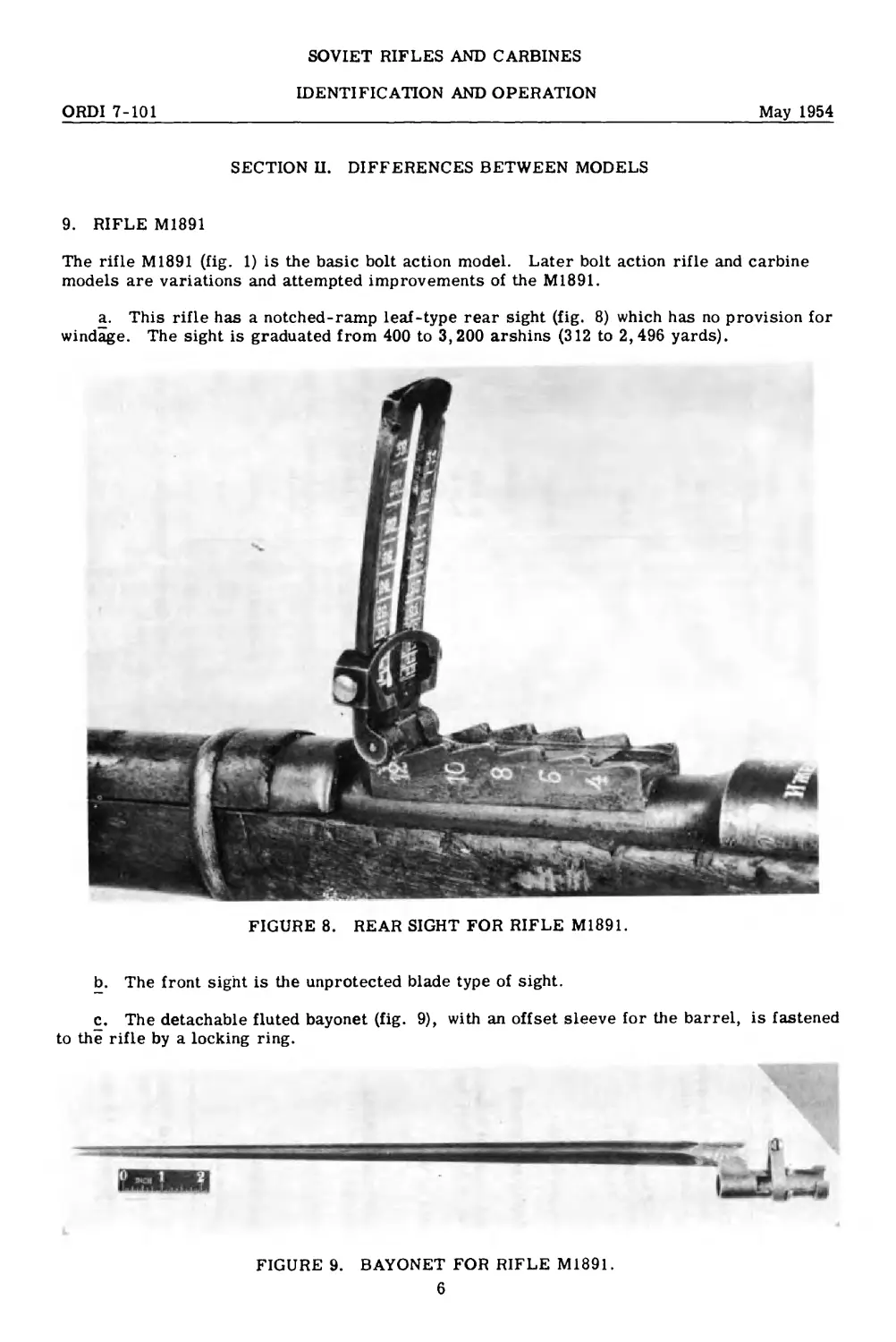
a.	This rifle has a notched-ramp leaf-type rear sight (fig. 8) which has no provision for
windage. The sight is graduated from 400 to 3,200 arshins (312 to 2,496 yards).
FIGURE 8. REAR SIGHT FOR RIFLE M1891.
b.	The front sight is the unprotected blade type of sight.
c.	The detachable fluted bayonet (fig. 9), with an offset sleeve for the barrel, is fastened
to the rifle by a locking ring.
FIGURE 9. BAYONET FOR RIFLE M1891.
6
SOVIET RIFLES AND CARBINES
IDENTIFICATION AND OPERATION
May 1954
ORDI 7-101
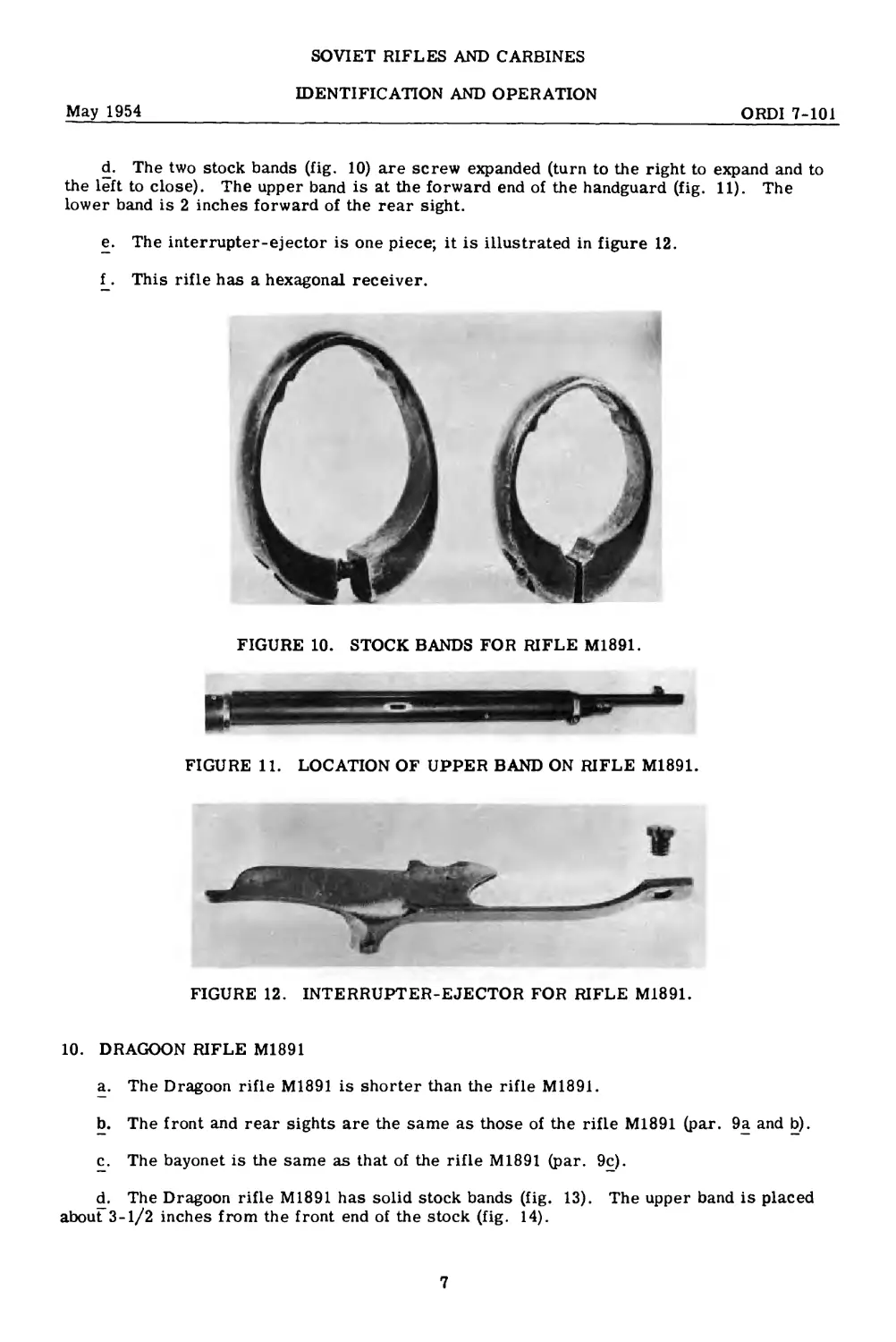
d.	The two stock bands (fig. 10) are screw expanded (turn to the right to expand and to
the left to close). The upper band is at the forward end of the handguard (fig. 11). The
lower band is 2 inches forward of the rear sight.
e.	The interrupter-ejector is one piece; it is illustrated in figure 12.
f . This rifle has a hexagonal receiver.
FIGURE 10. STOCK BANDS FOR RIFLE M1891.
FIGURE 11. LOCATION OF UPPER BAND ON RIFLE M1891.
FIGURE 12. INTERRUPTER-EJECTOR FOR RIFLE M1891.
10.	DRAGOON RIFLE M1891
a.	The Dragoon rifle M1891 is shorter than the rifle M1891.
b.	The front and rear sights are the same as those of the rifle M1891 (par. 9a and b).
c.	The bayonet is the same as that of the rifle M1891 (par. 9c).
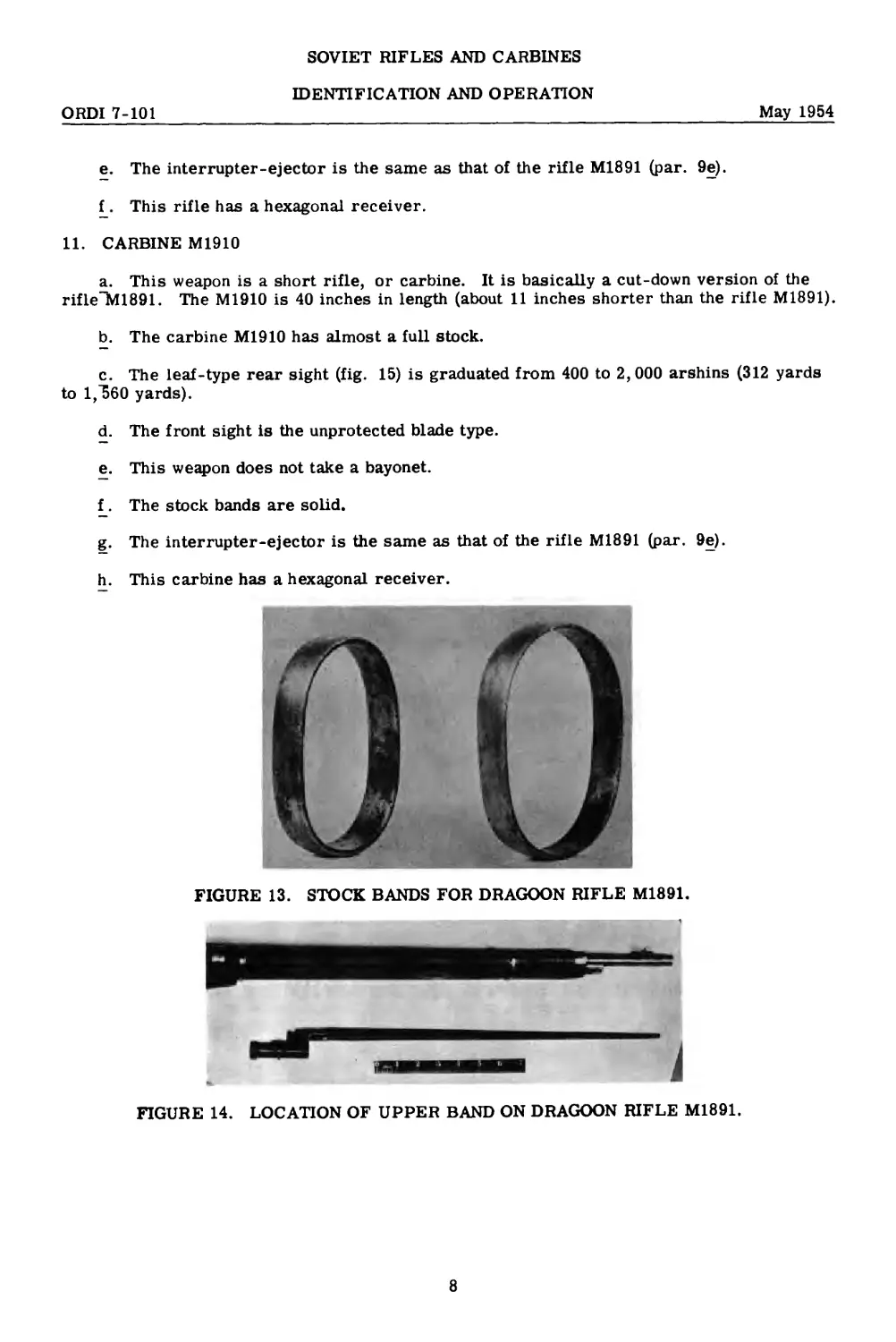
d.	The Dragoon rifle M1891 has solid stock bands (fig. 13). The upper band is placed
about 3-1/2 inches from the front end of the stock (fig. 14).
7
SOVIET RIFLES AND CARBINES
IDENTIFICATION AND OPERATION
ORDI 7-101
May 1954
e.	The interrupter-ejector is the same as that of the rifle M1891 (par. 9e).
f^. This rifle has a hexagonal receiver.
11.	CARBINE M1910
a.	This weapon is a short rifle, or carbine. It is basically a cut-down version of the
rifle”M1891. The M1910 is 40 inches in length (about 11 inches shorter than the rifle M1891).
b.	The carbine M1910 has almost a full stock.
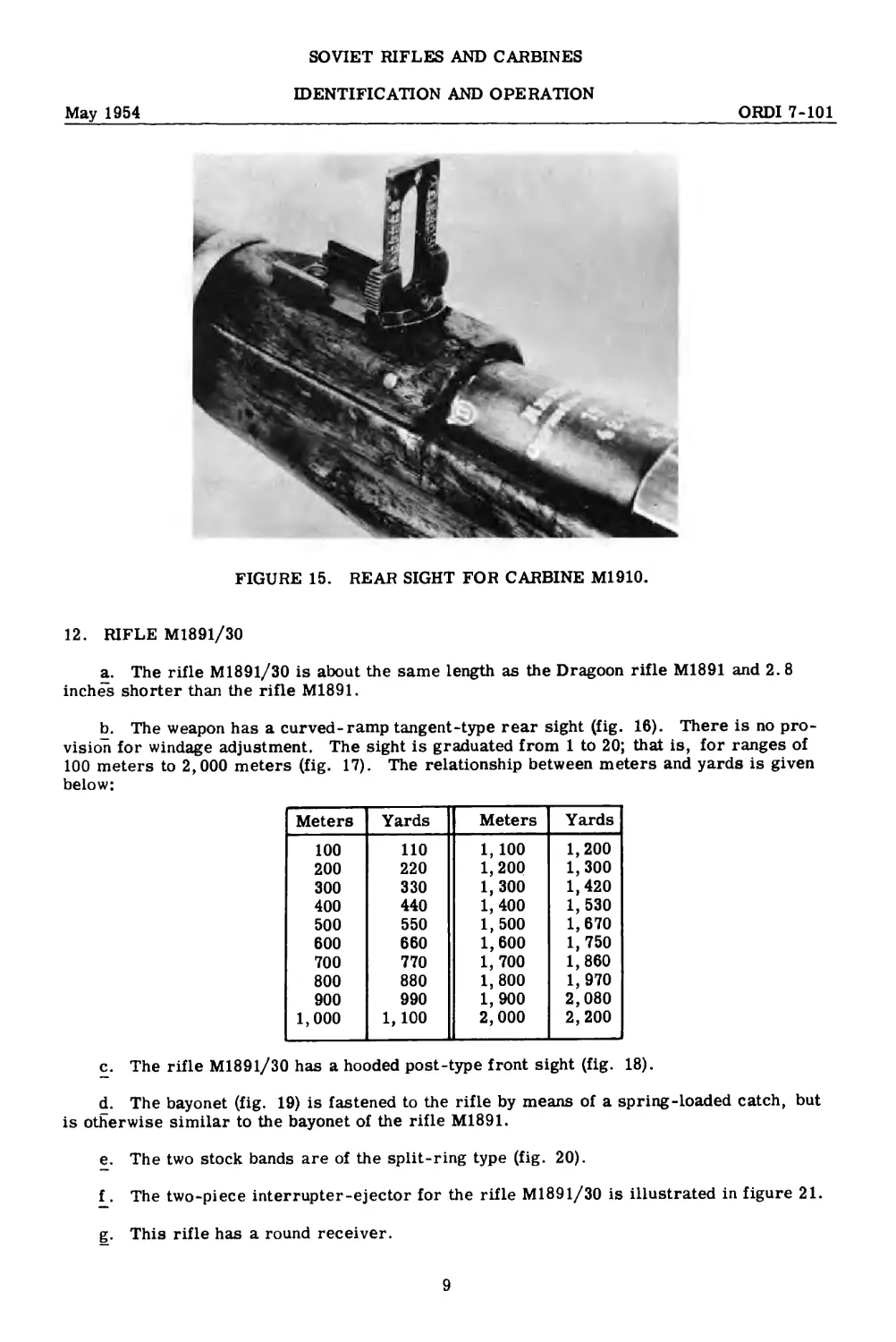
c.	The leaf-type rear sight (fig. 15) is graduated from 400 to 2,000 arshins (312 yards
to 1,360 yards).
d.	The front sight is the unprotected blade type.
e.	This weapon does not take a bayonet.
f.	The stock bands are solid.
g.	The interrupter-ejector is the same as that of the rifle M1891 (par. 9e).
h.	This carbine has a hexagonal receiver.
FIGURE 13. STOCK BANDS FOR DRAGOON RIFLE M1891.
FIGURE 14. LOCATION OF UPPER BAND ON DRAGOON RIFLE M1891.
8
SOVIET RIFLES AND CARBINES
IDENTIFICATION AND OPERATION
May 1954
ORDI 7-101
FIGURE 15. REAR SIGHT FOR CARBINE M1910.
12. RIFLE M1891/30
a.	The rifle M1891/30 is about the same length as the Dragoon rifle M1891 and 2. 8
inches shorter than the rifle M1891.
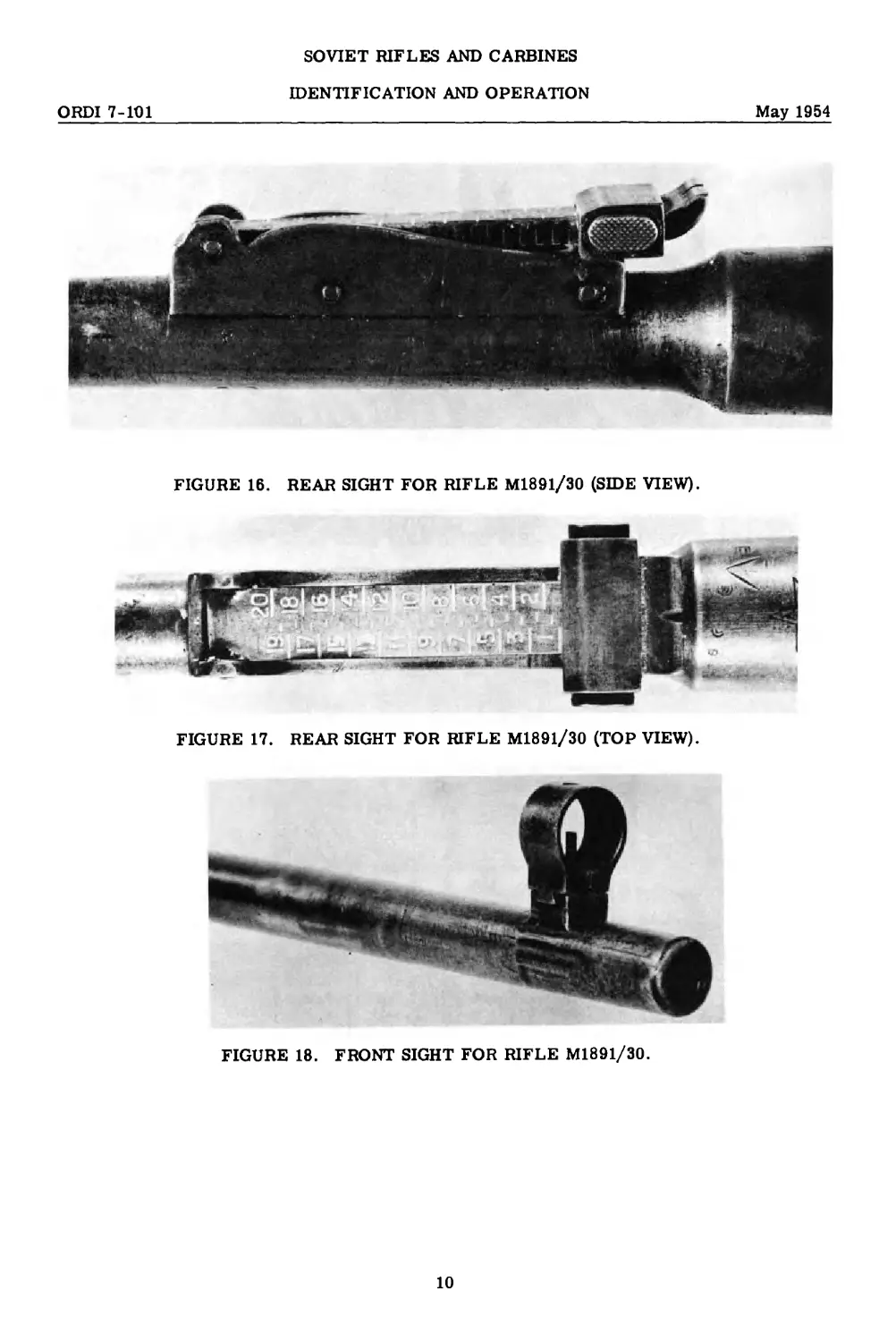
b.	The weapon has a curved-ramp tangent-type rear sight (fig. 16). There is no pro-
vision for windage adjustment. The sight is graduated from 1 to 20; that is, for ranges of
100 meters to 2,000 meters (fig. 17). The relationship between meters and yards is given
below:
Meters	Yards	Meters	Yards
100	110	1, 100	1,200
200	220	1,200	1,300
300	330	1, 300 1,400	1,420
400	440		1, 530
500	550	1, 500	1,670
600	660	1,600	1,750
700	770	1, 700	1,860
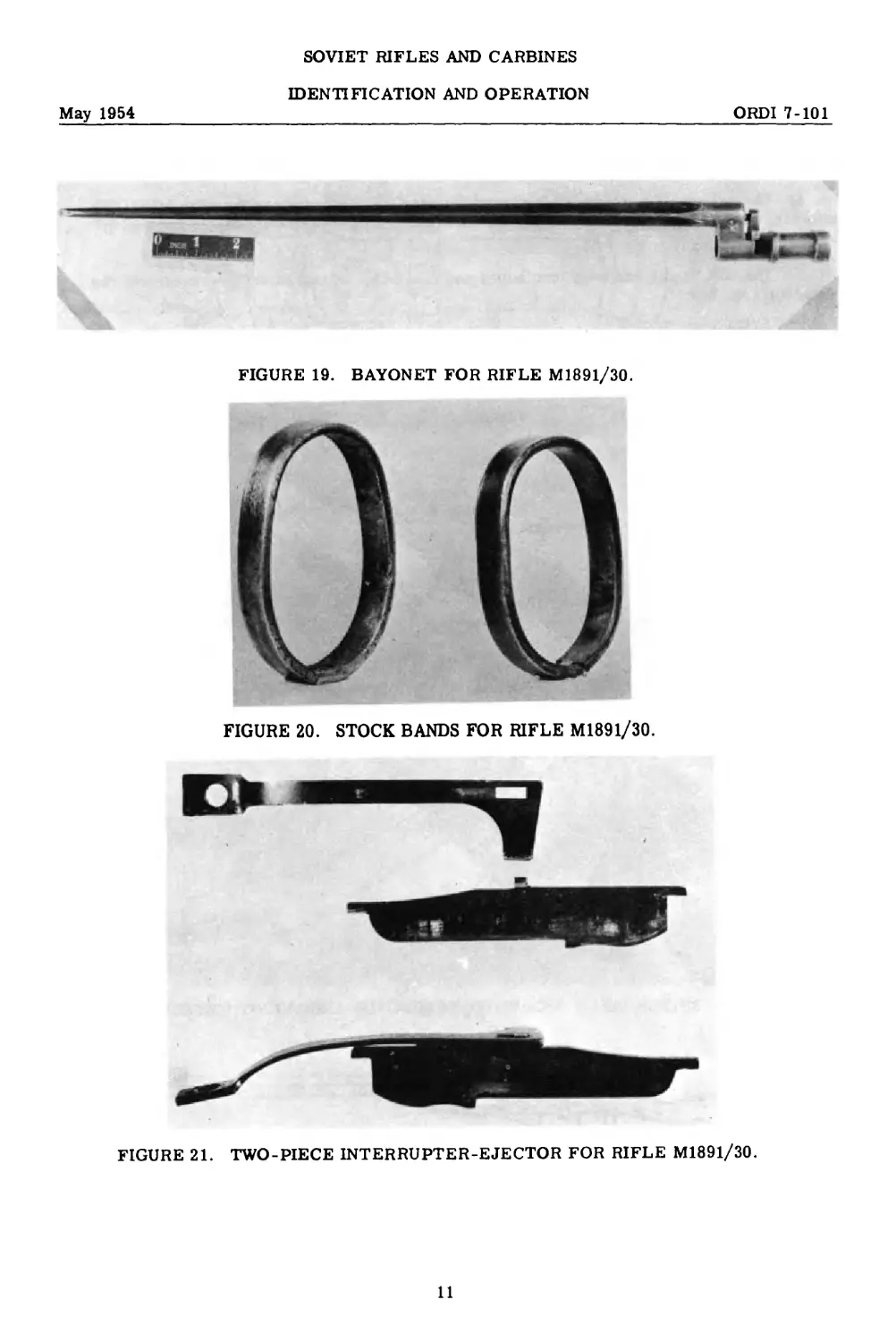
800	880	1,800	1, 970
900	990	1, 900	2,080
1,000	1,100	2,000	2,200
c.	The rifle M1891/30 has a hooded post-type front sight (fig. 18).
d.	The bayonet (fig. 19) is fastened to the rifle by means of a spring-loaded catch, but
is otherwise similar to the bayonet of the rifle M1891.
e.	The two stock bands are of the split-ring type (fig. 20).
f.	The two-piece interrupter-ejector for the rifle M1891/30 is illustrated in figure 21.
g.	This rifle has a round receiver.
9
SOVIET RIFLES AND CARBINES
IDENTIFICATION AND OPERATION
ORDI 7-101 May 1954
FIGURE 16. REAR SIGHT FOR RIFLE M1891/30 (SIDE VIEW).
FIGURE 17. REAR SIGHT FOR RIFLE M1891/30 (TOP VIEW).
FIGURE 18. FRONT SIGHT FOR RIFLE M1891/30.
10
SOVIET RIFLES AND CARBINES
IDENTIFICATION AND OPERATION
May 1954
ORDI 7-101
FIGURE 19. BAYONET FOR RIFLE M1891/30.
FIGURE 20. STOCK BANDS FOR RIFLE M1891/30.
FIGURE 21. TWO-PIECE INTERRUPTER-EJECTOR FOR RIFLE M1891/30.
11
SOVIET RIFLES AND CARBINES
IDENTIFICATION AND OPERATION
ORDI 7-101
May 1954
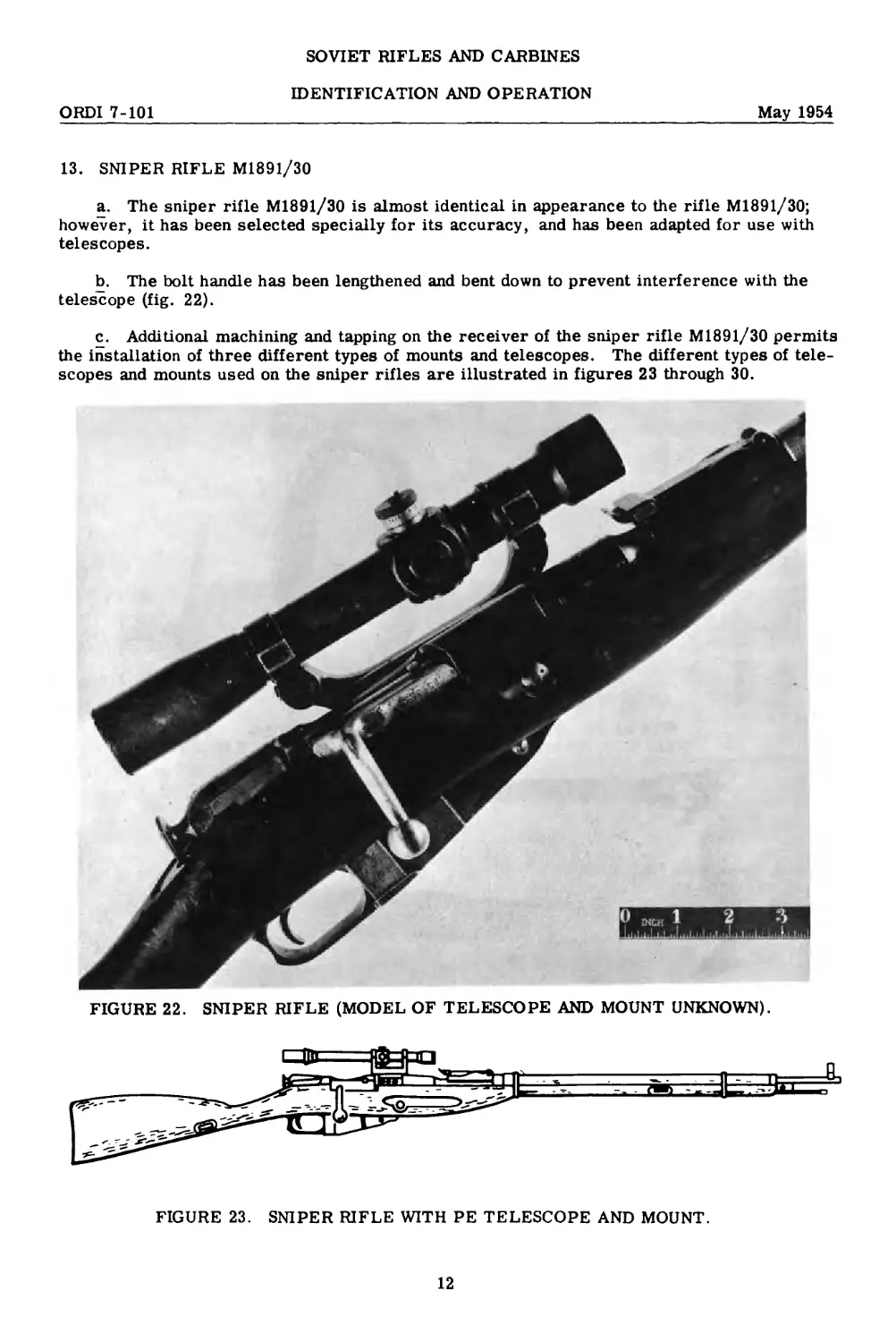
13.	SNIPER RIFLE M1891/30
a.	The sniper rifle M1891/30 is almost identical in appearance to the rifle M1891/30;
however, it has been selected specially for its accuracy, and has been adapted for use with
telescopes.
b.	The bolt handle has been lengthened and bent down to prevent interference with the
telescope (fig. 22).
c.	Additional machining and tapping on the receiver of the sniper rifle M1891/30 permits
the installation of three different types of mounts and telescopes. The different types of tele-
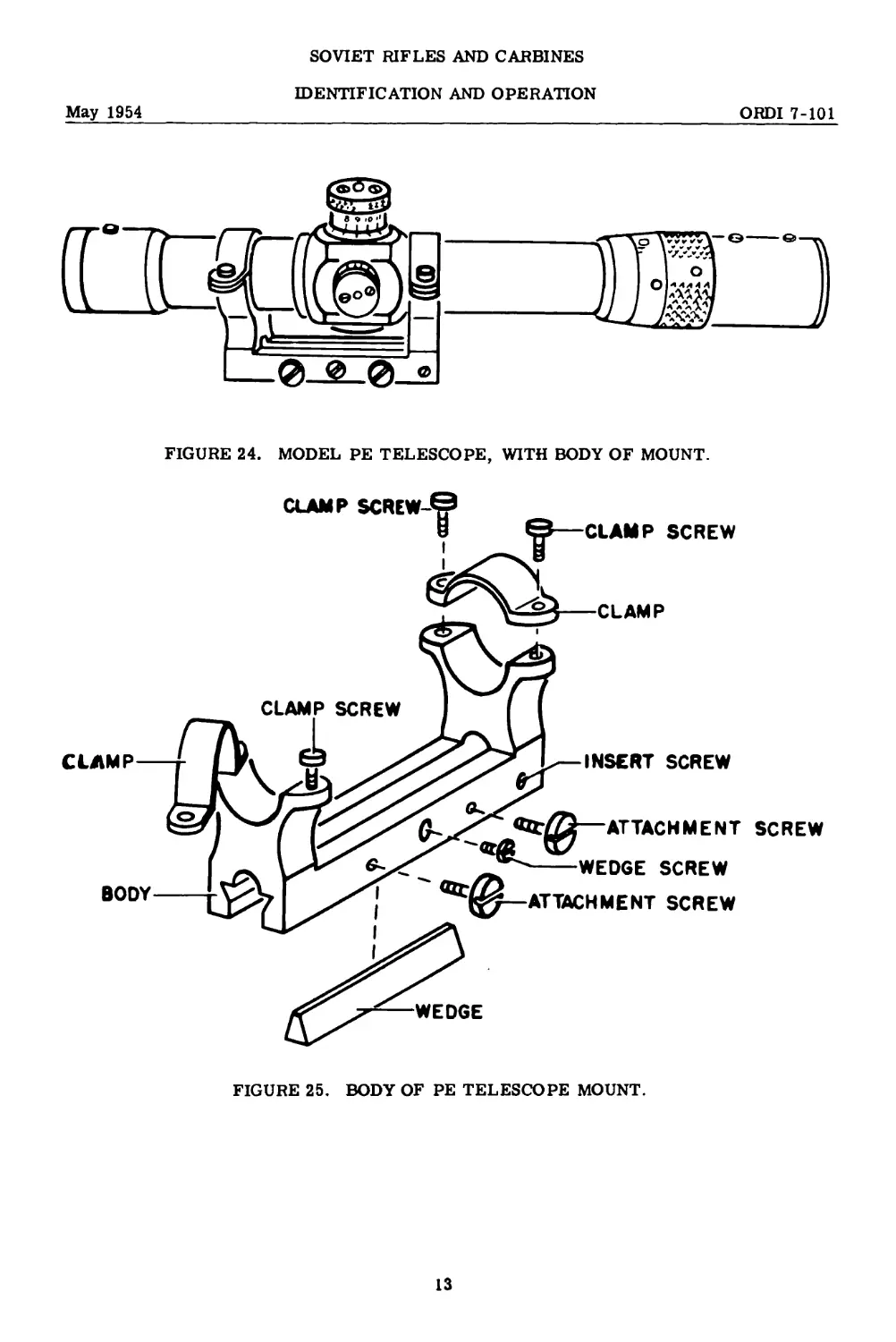
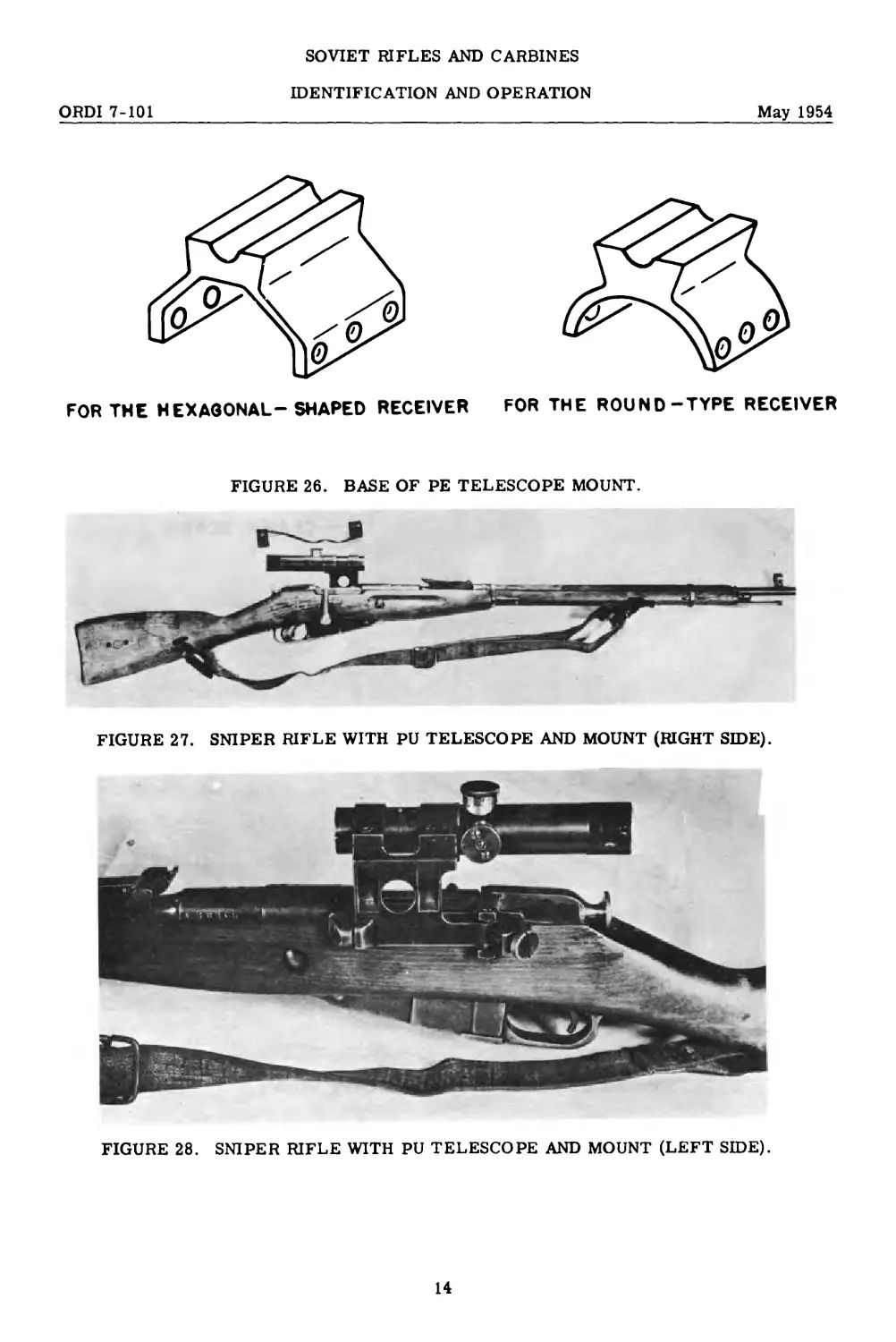
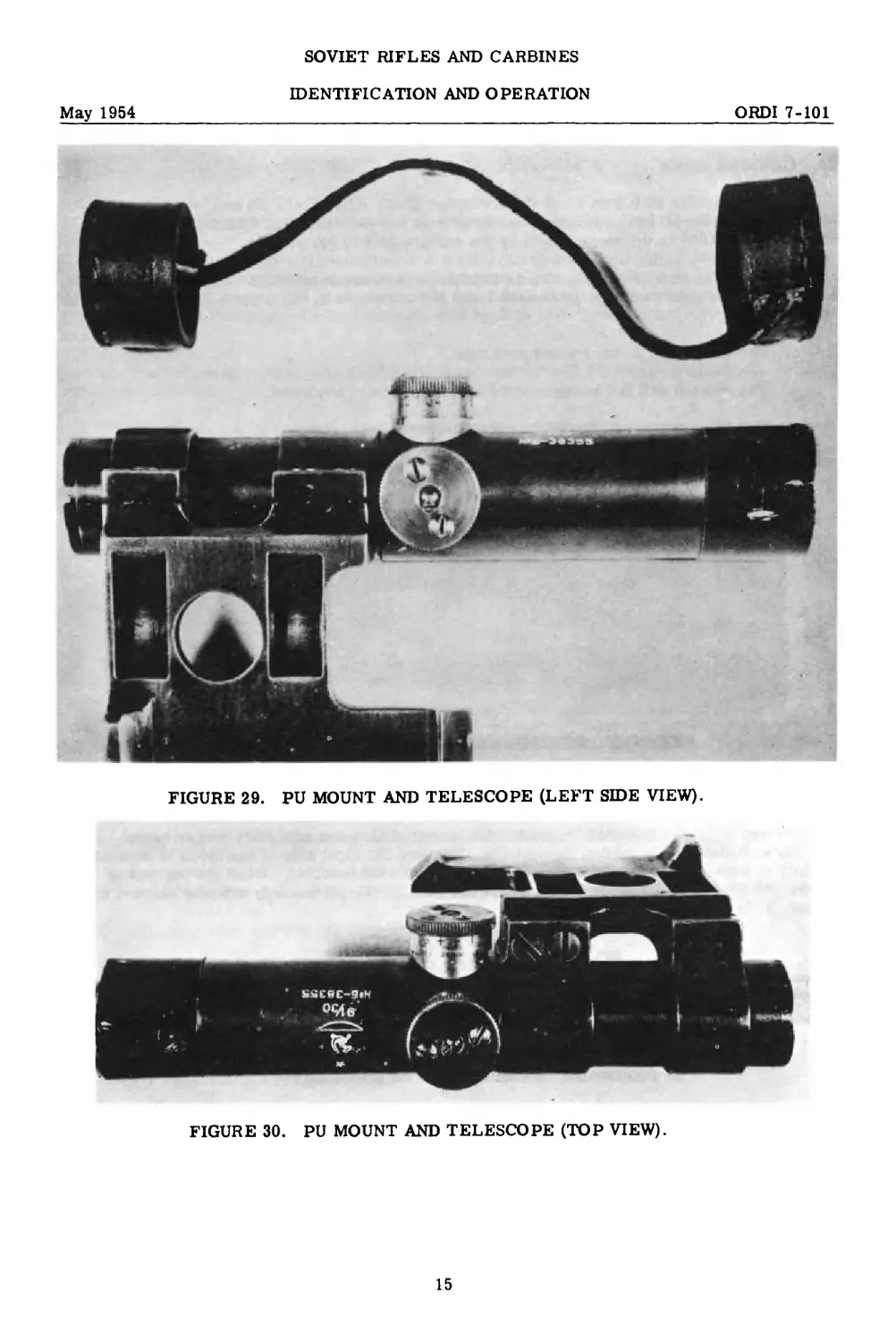
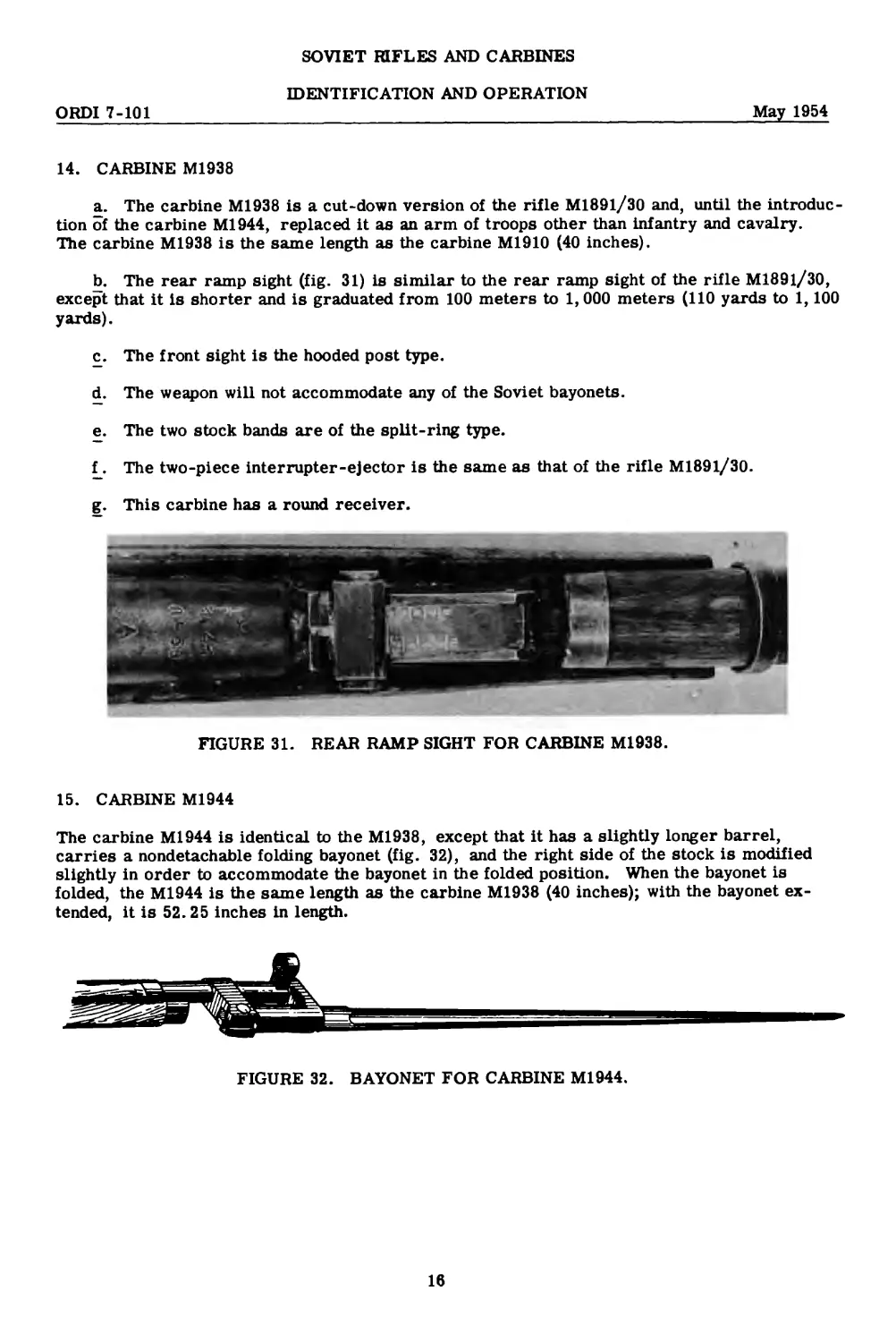
scopes and mounts used on the sniper rifles are illustrated in figures 23 through 30.
FIGURE 22. SNIPER RIFLE (MODEL OF TELESCOPE AND MOUNT UNKNOWN).
FIGURE 23. SNIPER RIFLE WITH PE TELESCOPE AND MOUNT.
12
SOVIET RIFLES AND CARBINES
IDENTIFICATION AND OPERATION
May 1954
ORDI 7-101
FIGURE 24. MODEL PE TELESCOPE, WITH BODY OF MOUNT.
FIGURE 25. BODY OF PE TELESCOPE MOUNT.
13
SOVIET RIFLES AND CARBINES
IDENTIFICATION AND OPERATION
ORDI 7-101
May 1954
FOR THE HEXAGONAL- SHAPED RECEIVER
FOR THE ROUND-TYPE RECEIVER
FIGURE 26. BASE OF PE TELESCOPE MOUNT.
FIGURE 27. SNIPER RIFLE WITH PU TELESCOPE AND MOUNT (RIGHT SIDE).
FI	GURE 28. SNIPER RIFLE WITH PU TELESCOPE AND MOUNT (LEFT SIDE).
14
SOVIET RIFLES AND CARBINES
IDENTIFICATION AND OPERATION
May 1954
ORDI 7-101
FIGURE 29. PU MOUNT AND TELESCOPE (LEFT SIDE VIEW).
FIGURE 30. PU MOUNT AND TELESCOPE (TOP VIEW).
15
SOVIET RIFLES AND CARBINES
IDENTIFICATION AND OPERATION
ORDI 7-101
May 1954
14.	CARBINE M1938
a.	The carbine M1938 is a cut-down version of the rifle M1891/30 and, until the introduc-
tion of the carbine Ml 944, replaced it as an arm of troops other than infantry and cavalry.
The carbine M1938 is the same length as the carbine M1910 (40 inches).
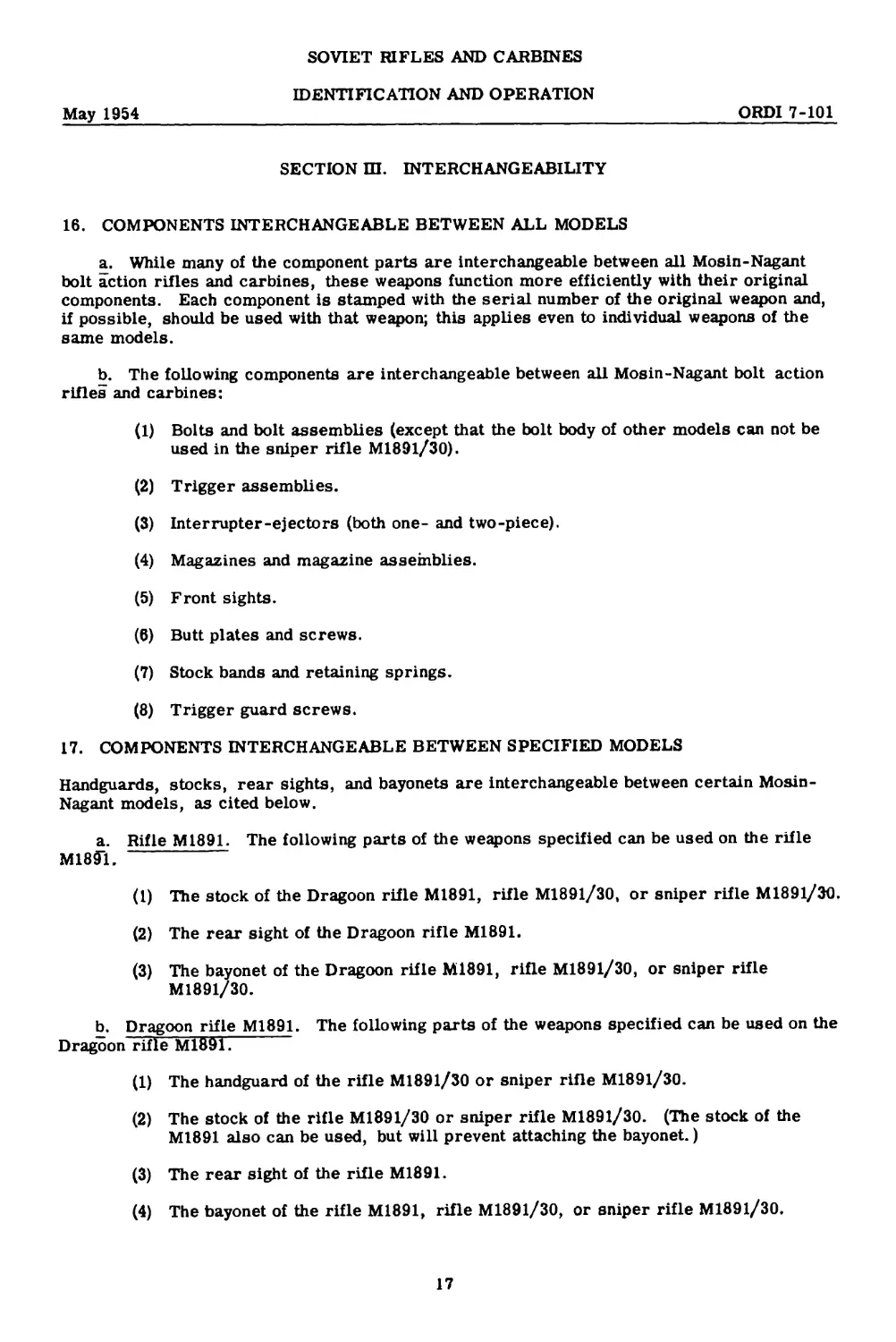
b.	The rear ramp sight (fig. 31) is similar to the rear ramp sight of the rifle M1891/30,
except that it is shorter and is graduated from 100 meters to 1, 000 meters (110 yards to 1,100
yards).
c.	The front sight is the hooded post type.
d.	The weapon will not accommodate any of the Soviet bayonets.
e.	The two stock bands are of the split-ring type.
f.	The two-piece interrupter-ejector is the same as that of the rifle M1891/30.
g.	This carbine has a round receiver.
FIGURE 31. REAR RAMP SIGHT FOR CARBINE M1938.
15.	CARBINE M1944
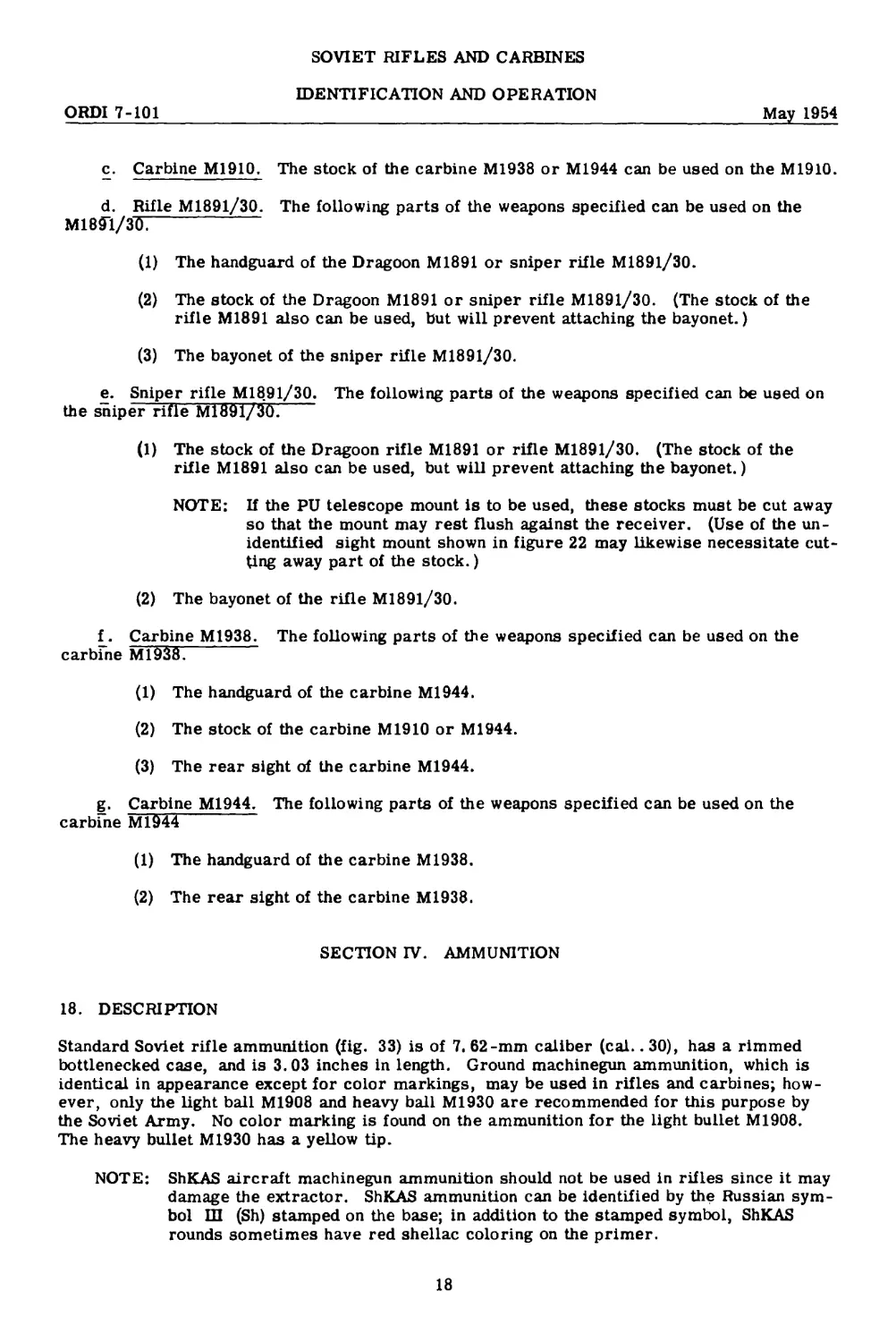
The carbine Ml 944 is identical to the M1938, except that it has a slightly longer barrel,
carries a nondetachable folding bayonet (fig. 32), and the right side of the stock is modified
slightly in order to accommodate the bayonet in the folded position. When the bayonet is
folded, the M1944 is the same length as the carbine M1938 (40 inches); with the bayonet ex-
tended, it is 52.25 inches in length.
FIGURE 32. BAYONET FOR CARBINE M1944.
16
SOVIET RIFLES AND CARBINES
IDENTIFICATION AND OPERATION
May 1954
ORDI 7-101
SECTION Ш. INTERCHANGEABILITY
16.	COMPONENTS INTERCHANGEABLE BETWEEN ALL MODELS
a.	While many of the component parts are interchangeable between all Mosin-Nagant
bolt action rifles and carbines, these weapons function more efficiently with their original
components. Each component is stamped with the serial number of the original weapon and,
if possible, should be used with that weapon; this applies even to individual weapons of the
same models.
b.	The following components are interchangeable between all Mosin-Nagant bolt action
rifles and carbines:
(1)	Bolts and bolt assemblies (except that the bolt body of other models can not be
used in the sniper rifle M1891/30).
(2)	Trigger assemblies.
(3)	Interrupter-ejectors (both one- and two-piece).
(4)	Magazines and magazine assemblies.
(5)	Front sights.
(6)	Butt plates and screws.
(7)	Stock bands and retaining springs.
(8)	Trigger guard screws.
17.	COMPONENTS INTERCHANGEABLE BETWEEN SPECIFIED MODELS
Handguards, stocks, rear sights, and bayonets are interchangeable between certain Mosin-
Nagant models, as cited below.
a.	Rifle M1891. The following parts of the weapons specified can be used on the rifle
M18ffi.
(1)	The stock of the Dragoon rifle M1891, rifle M1891/30, or sniper rifle M1891/3O.
(2)	The rear sight of the Dragoon rifle M1891.
(3)	The bayonet of the Dragoon rifle M1891, rifle M1891/30, or sniper rifle
M1891/30.
b.	Dragoon rifle Ml891. The following parts of the weapons specified can be used on the
Dragoon rifle M1891.
(1)	The handguard of the rifle M1891/30 or sniper rifle M1891/30.
(2)	The stock of the rifle M1891/30 or sniper rifle M1891/30. (The stock of the
M1891 also can be used, but will prevent attaching the bayonet.)
(3)	The rear sight of the rifle M1891.
(4)	The bayonet of the rifle M1891, rifle M1891/30, or sniper rifle M1891/30.
17
SOVIET RIFLES AND CARBINES
IDENTIFICATION AND OPERATION
ORDI 7-101
May 1954
c.	Carbine M1910. The stock of the carbine M1938 or M1944 can be used on the M1910.
d.	Rifle M1891/30. The following parts of the weapons specified can be used on the
М1891/37Г
(1)	The handguard of the Dragoon M1891 or sniper rifle M1891/30.
(2)	The stock of the Dragoon M1891 or sniper rifle M1891/30. (The stock of the
rifle M1891 also can be used, but will prevent attaching the bayonet.)
(3)	The bayonet of the sniper rifle M1891/30.
e.	Sniper rifle M18.91/30. The following parts of the weapons specified can be used on
the sniper rifle M1891/3O.
(1)	The stock of the Dragoon rifle M1891 or rifle M1891/30. (The stock of the
rifle M1891 also can be used, but will prevent attaching the bayonet.)
NOTE: If the PU telescope mount is to be used, these stocks must be cut away
so that the mount may rest flush against the receiver. (Use of the un-
identified sight mount shown in figure 22 may likewise necessitate cut-
ting away part of the stock.)
(2)	The bayonet of the rifle M1891/30.
Carbine M1938. The following parts of the weapons specified can be used on the
carbine Mld$8.
(1)	The handguard of the carbine M1944.
(2)	The stock of the carbine M1910 or M1944.
(3)	The rear sight of the carbine M1944.
g. Carbine M1944, The following parts of the weapons specified can be used on the
carbine М1Й44
(1)	The handguard of the carbine M1938.
(2)	The rear sight of the carbine M1938.
SECTION IV.	AMMUNITION
18.	DESCRIPTION
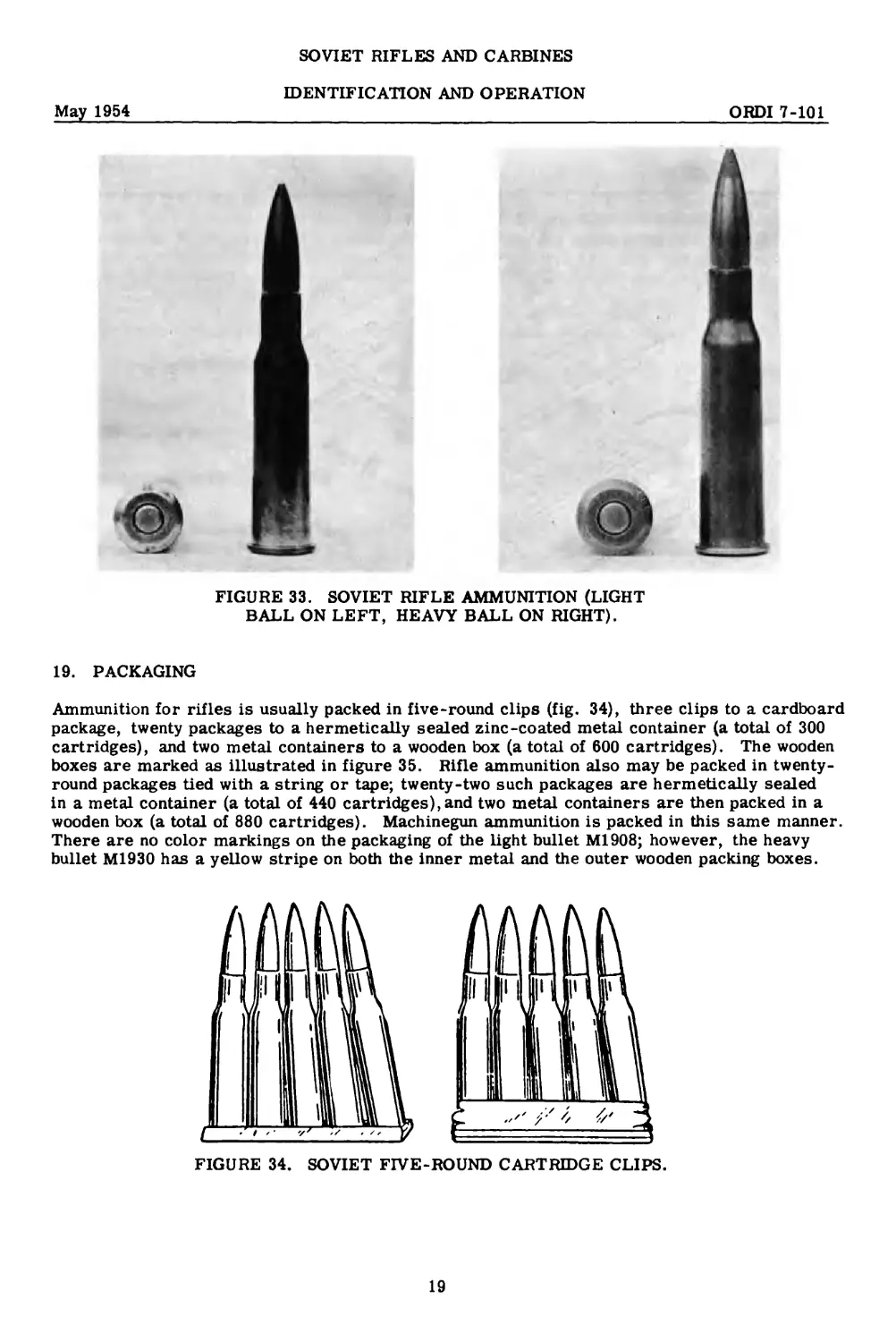
Standard Soviet rifle ammunition (fig. 33) is of 7. 62-mm caliber (cal.. 30), has a rimmed
bottlenecked case, and is 3.03 inches in length. Ground machinegun ammunition, which is
identical in appearance except for color markings, may be used in rifles and carbines; how-
ever, only the light ball M1908 and heavy ball Ml930 are recommended for this purpose by
the Soviet Army. No color marking is found on the ammunition for the light bullet M1908.
The heavy bullet M1930 has a yellow tip.
NOTE: ShKAS aircraft machinegun ammunition should not be used in rifles since it may
damage the extractor. ShKAS ammunition can be identified by the Russian sym-
bol in (Sh) stamped on the base; in addition to the stamped symbol, ShKAS
rounds sometimes have red shellac coloring on the primer.
18
SOVIET RIFLES AND CARBINES
IDENTIFICATION AND OPERATION
May 1954
ORDI 7-101
FIGURE 33. SOVIET RIFLE AMMUNITION (LIGHT
BALL ON LEFT, HEAVY BALL ON RIGHT).
19.	PACKAGING
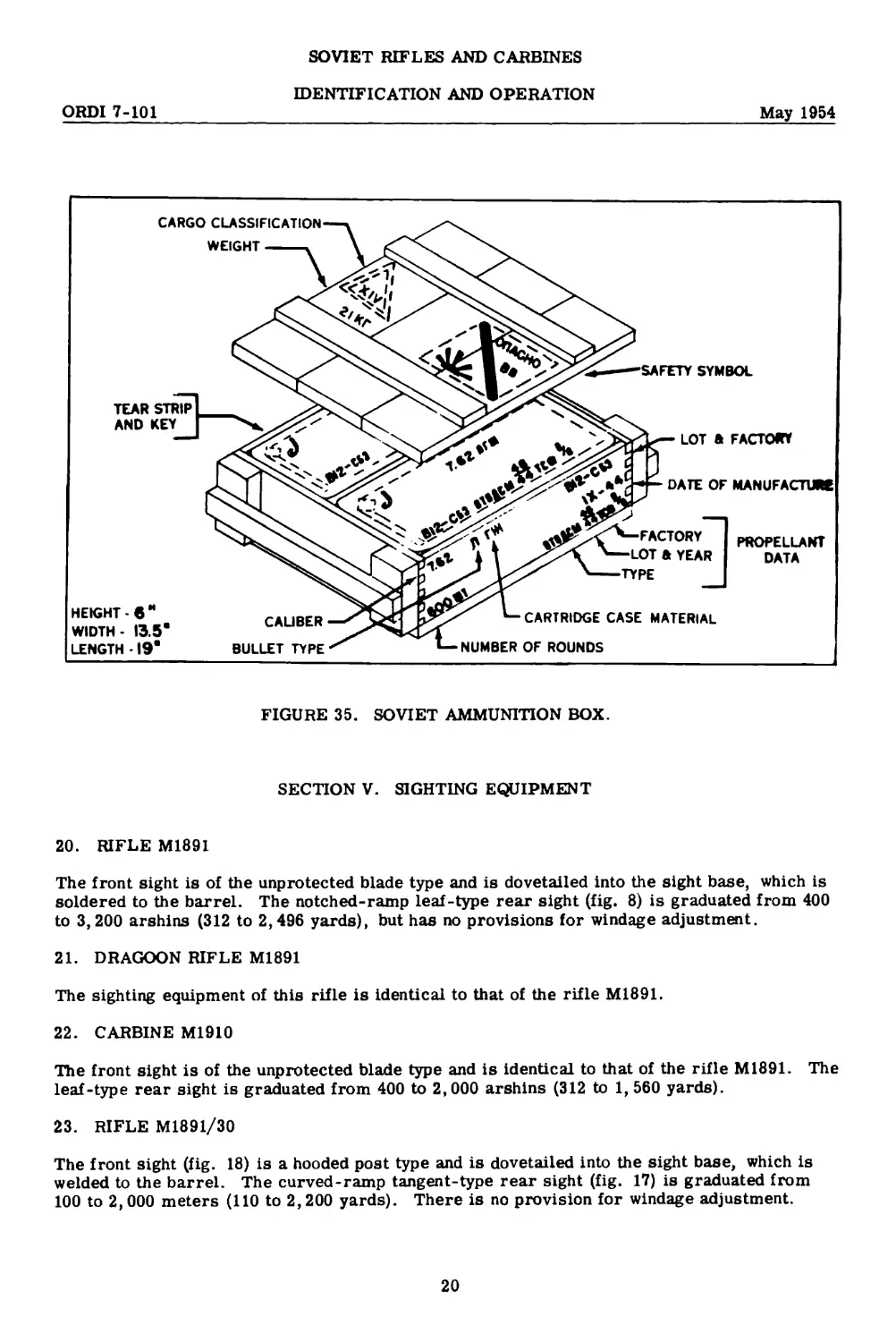
Ammunition for rifles is usually packed in five-round clips (fig. 34), three clips to a cardboard
package, twenty packages to a hermetically sealed zinc-coated metal container (a total of 300
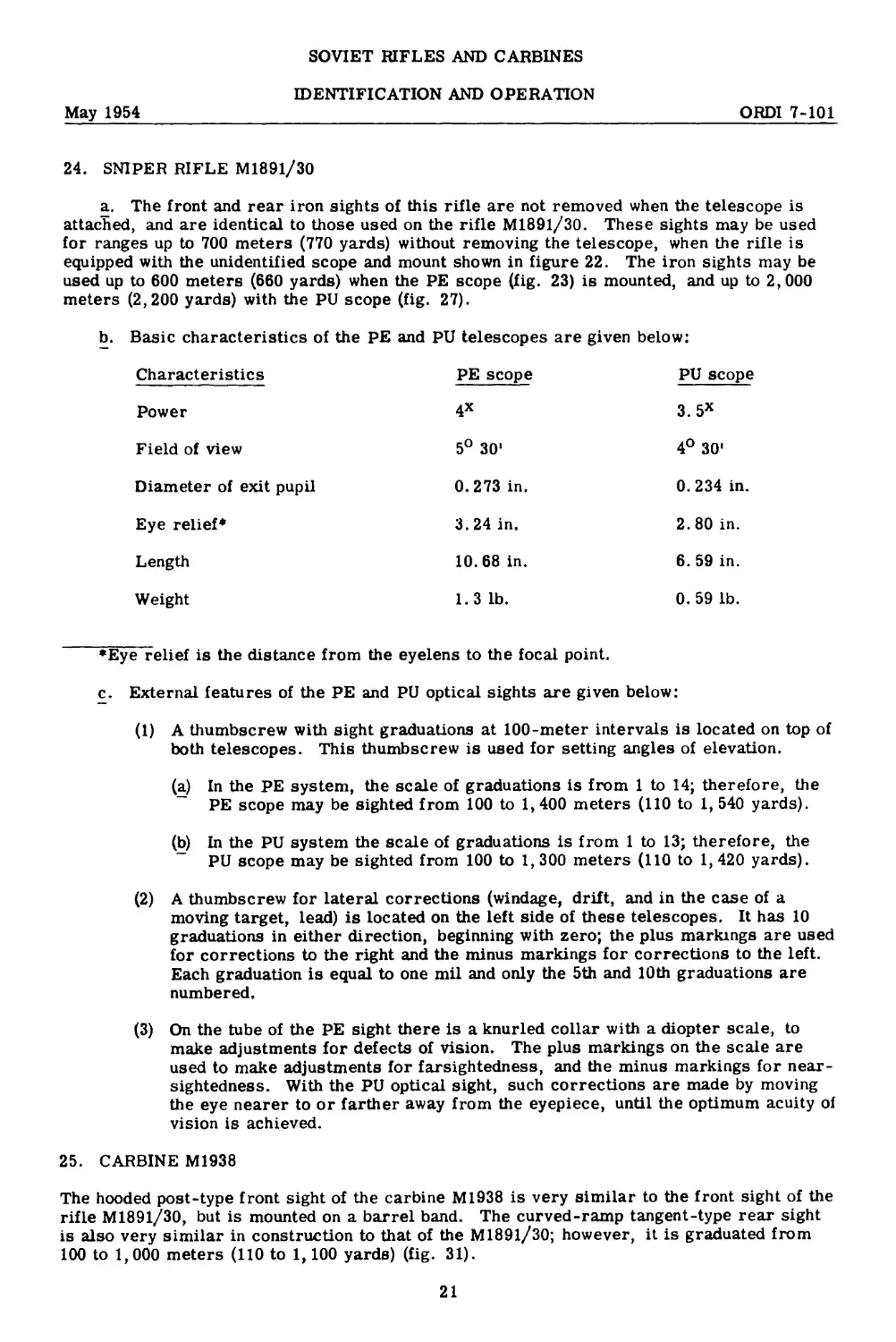
cartridges), and two metal containers to a wooden box (a total of 600 cartridges). The wooden
boxes are marked as illustrated in figure 35. Rifle ammunition also may be packed in twenty-
round packages tied with a string or tape; twenty-two such packages are hermetically sealed
in a metal container (a total of 440 cartridges), and two metal containers are then packed in a
wooden box (a total of 880 cartridges). Machinegun ammunition is packed in this same manner.
There are no color markings on the packaging of the light bullet Ml908; however, the heavy
bullet M1930 has a yellow stripe on both the inner metal and the outer wooden packing boxes.
FIGURE 34. SOVIET FIVE-ROUND CARTRIDGE CLIPS.
19
SOVIET RIFLES AND CARBINES
IDENTIFICATION AND OPERATION
ORDI 7-101
May 1954
FIGURE 35. SOVIET AMMUNITION BOX.
SECTION V.	SIGHTING EQUIPMENT
20.	RIFLE M1891
The front sight is of the unprotected blade type and is dovetailed into the sight base, which is
soldered to the barrel. The notched-ramp leaf-type rear sight (fig. 8) is graduated from 400
to 3,200 arshins (312 to 2,496 yards), but has no provisions for windage adjustment.
21.	DRAGOON RIFLE M1891
The sighting equipment of this rifle is identical to that of the rifle M1891.
22.	CARBINE M1910
The front sight is of the unprotected blade type and is identical to that of the rifle M1891. The
leaf-type rear sight is graduated from 400 to 2,000 arshins (312 to 1, 560 yards).
23.	RIFLE M1891/30
The front sight (fig. 18) is a hooded post type and is dovetailed into the sight base, which is
welded to the barrel. The curved-ramp tangent-type rear sight (fig. 17) is graduated from
100 to 2,000 meters (110 to 2,200 yards). There is no provision for windage adjustment.
20
SOVIET RIFLES AND CARBINES
IDENTIFICATION AND OPERATION
May 1954
ORDI 7-101
24.	SNIPER RIFLE M1891/30
a.	The front and rear iron sights of this rifle are not removed when the telescope is
attached, and are identical to those used on the rifle M1891/30. These sights may be used
for ranges up to 700 meters (770 yards) without removing the telescope, when the rifle is
equipped with the unidentified scope and mount shown in figure 22. The iron sights may be
used up to 600 meters (660 yards) when the PE scope (fig. 23) is mounted, and up to 2,000
meters (2,200 yards) with the PU scope (fig. 27).
b.	Basic characteristics of the PE and PU telescopes are given below:
Characteristics	PE scope	PU scope
Power	4х	3.5х
Field of view	5° 30'	4° 30'
Diameter of exit pupil	0.273 in.	0.234 in.
Eye relief*	3. 24 in.	2.80 in.
Length	10.68 in.	6. 59 in.
Weight	1. 3 lb.	0. 59 lb.
*Eye relief is the distance from the eyelens to the focal point.
c. External features of the PE and PU optical sights are given below:
(1) A thumbscrew with sight graduations at 100-meter intervals is located on top of
both telescopes. This thumbscrew is used for setting angles of elevation.
(a)	In the PE system,	the scale of	graduations is from	1 to 14;	therefore, the
“	PE scope may be	sighted from	100 to 1,400 meters	(110 to	1, 540 yards).
(b)	In the PU system	the scale of graduations is from 1	to 13; therefore, the
~	PU scope may be	sighted from	100 to 1, 300 meters	(110 to	1, 420 yards).
(2) A thumbscrew for lateral corrections (windage, drift, and in the case of a
moving target, lead) is located on the left side of these telescopes. It has 10
graduations in either direction, beginning with zero; the plus markings are used
for corrections to the right and the minus markings for corrections to the left.
Each graduation is equal to one mil and only the 5th and 10th graduations are
numbered.
(3) On the tube of the PE sight there is a knurled collar with a diopter scale, to
make adjustments for defects of vision. The plus markings on the scale are
used to make adjustments for farsightedness, and the minus markings for near-
sightedness. With the PU optical sight, such corrections are made by moving
the eye nearer to or farther away from the eyepiece, until the optimum acuity of
vision is achieved.
25. CARBINE M1938
The hooded post-type front sight of the carbine M1938 is very similar to the front sight of the
rifle M1891/30, but is mounted on a barrel band. The curved-ramp tangent-type rear sight
is also very similar in construction to that of the M1891/30; however, it is graduated from
100 to 1,000 meters (110 to 1,100 yards) (fig. 31).
21
SOVIET RIFLES AND CARBINES
IDENTIFICATION AND OPERATION
May 1954
ORDI 7-101
26. CARBINE M1944
The front and rear sights of the carbine M1944 are identical to those of the carbine M1938.
SECTION VI.	OPERATING INSTRUCTIONS
27.	RIFLE M1891
a.	To set the safety, draw back the cocking piece and turn it to the left. This prevents
the bolt from opening. To put off safe, pull the cocking piece back, turn it to the right, and
allow it to move forward.
b.	The rifle M1891 is loaded in the same manner as the United States Springfield or any
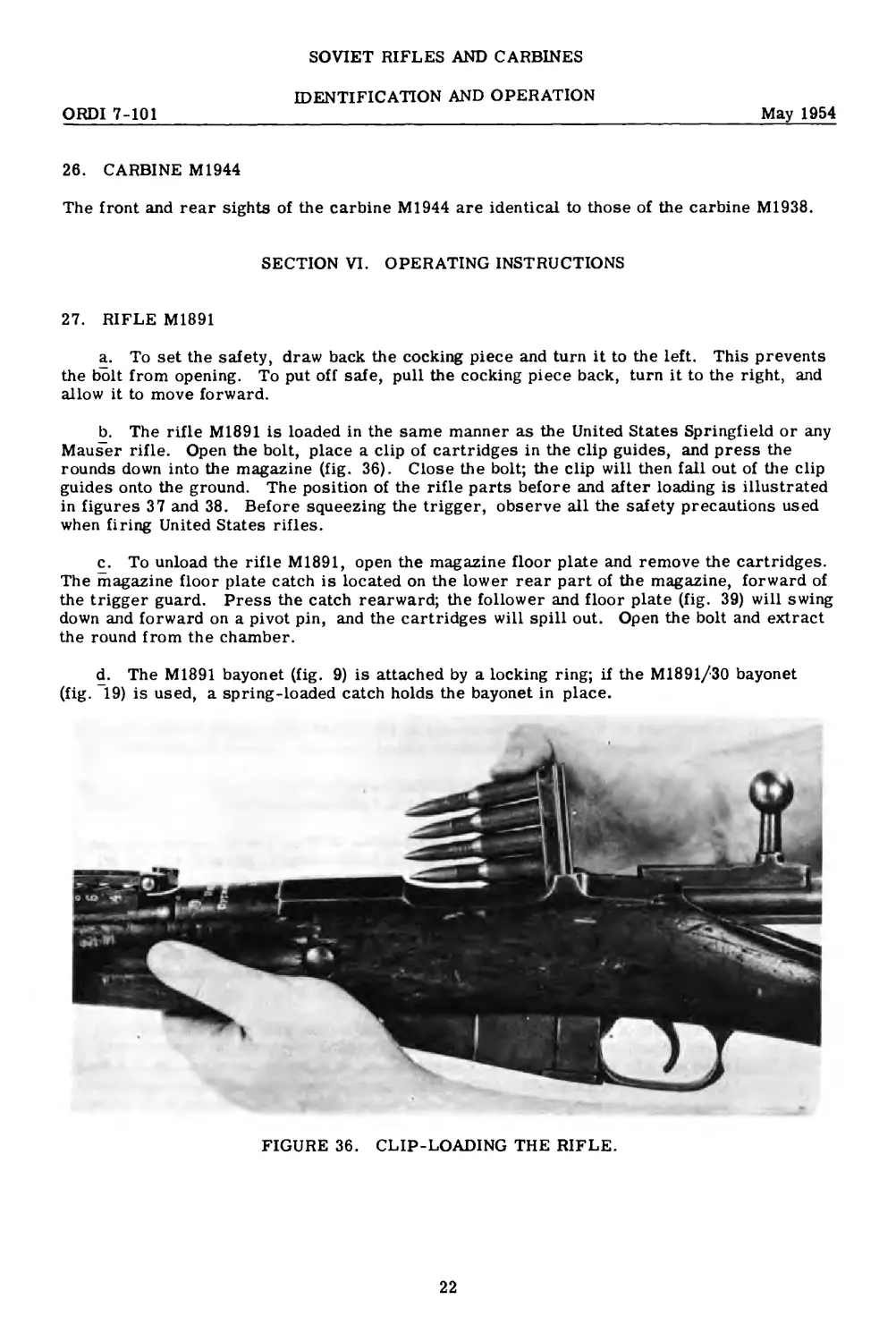
Mauser rifle. Open the bolt, place a clip of cartridges in the clip guides, and press the
rounds down into the magazine (fig. 36). Close the bolt; the clip will then fall out of the clip
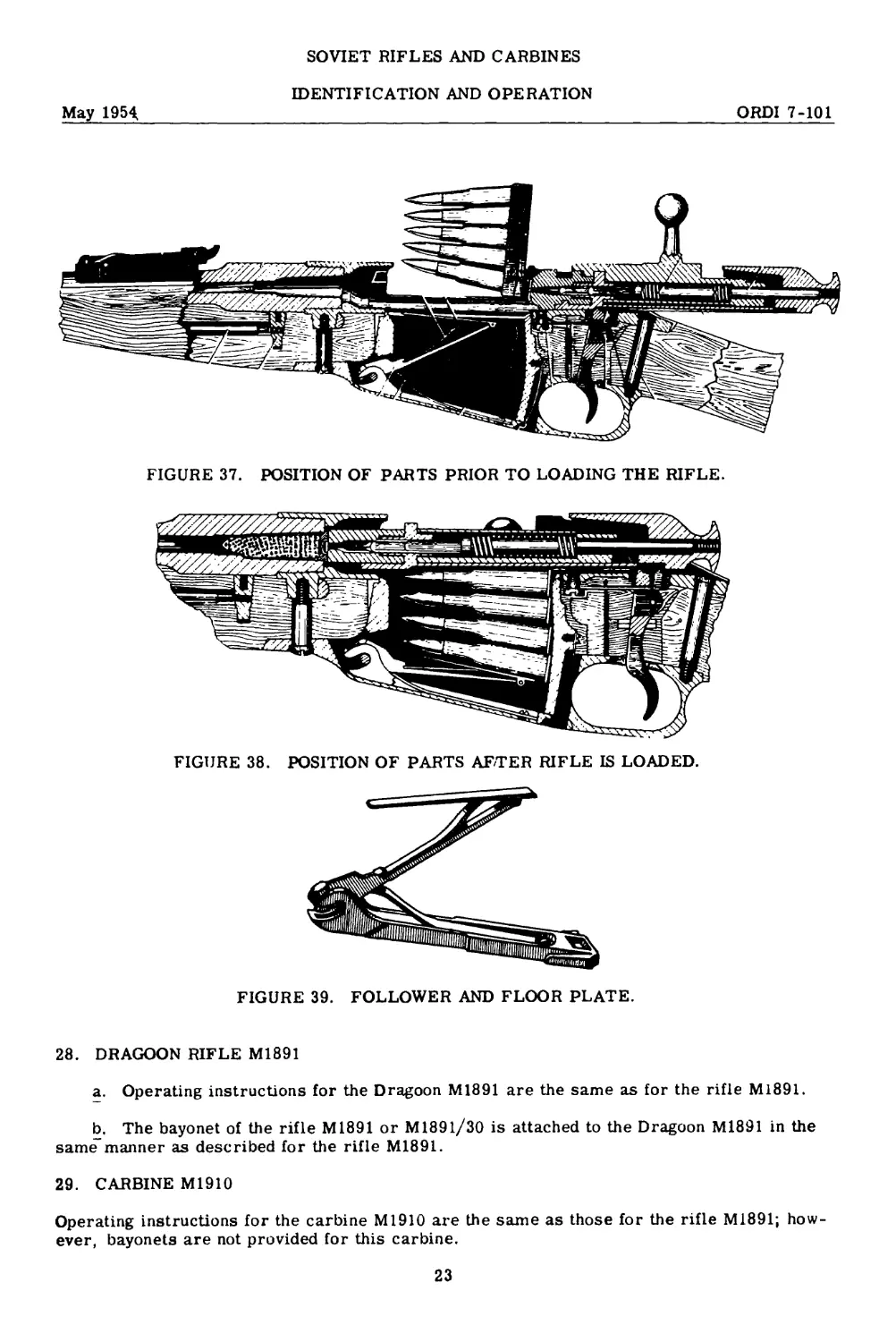
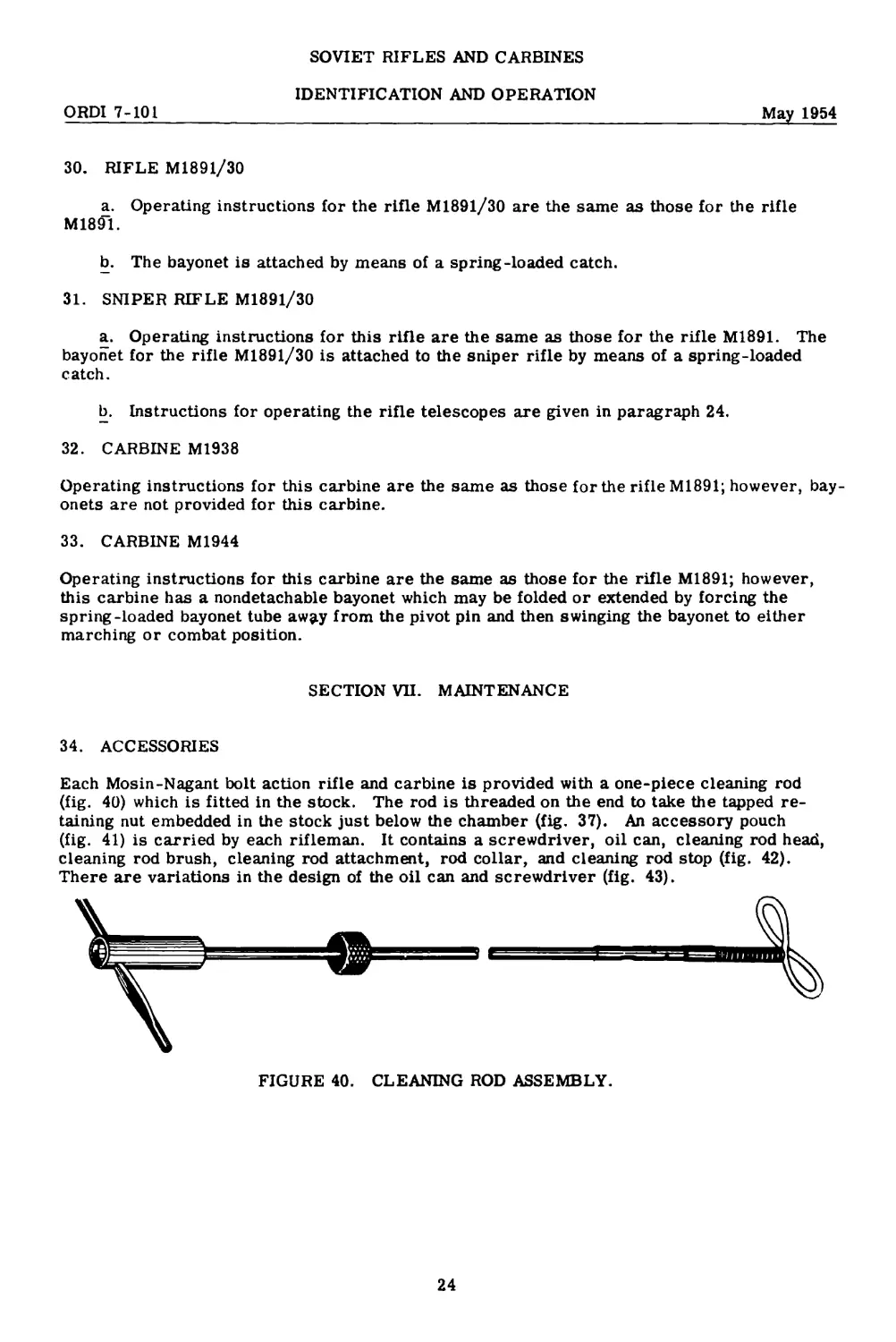
guides onto the ground. The position of the rifle parts before and after loading is illustrated
in figures 37 and 38. Before squeezing the trigger, observe all the safety precautions used
when firing United States rifles.
c.	To unload the rifle M1891, open the magazine floor plate and remove the cartridges.
The magazine floor plate catch is located on the lower rear part of the magazine, forward of
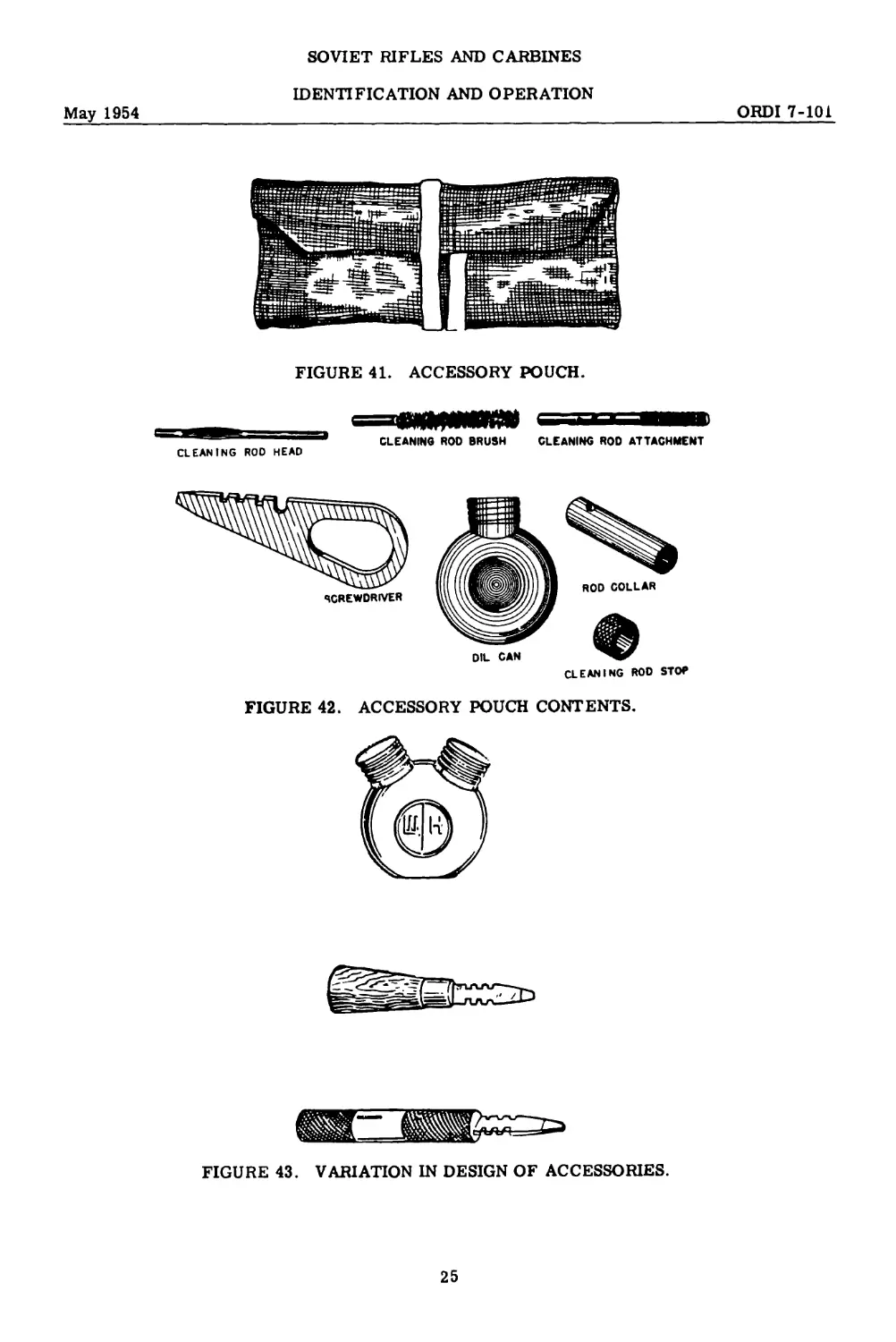
the trigger guard. Press the catch rearward; the follower and floor plate (fig. 39) will swing
down and forward on a pivot pin, and the cartridges will spill out. Open the bolt and extract
the round from the chamber.
d.	The M1891 bayonet (fig. 9) is attached by a locking ring; if the M1891/30 bayonet
(fig. 19) is used, a spring-loaded catch holds the bayonet in place.
FIGURE 36. CLIP-LOADING THE RIFLE.
22
SOVIET RIFLES AND CARBINES
IDENTIFICATION AND OPERATION
May 1954,
ORDI 7-101
FIGURE 37. POSITION OF PARTS PRIOR TO LOADING THE RIFLE.
FIGURE 38. POSITION OF PARTS AFTER RIFLE IS LOADED.
FIGURE 39. FOLLOWER AND FLOOR PLATE.
28.	DRAGOON RIFLE M1891
a.	Operating instructions for the Dragoon M1891 are the same as for the rifle M1891.
b.	The bayonet of the rifle M1891 or M1891/30 is attached to the Dragoon M1891 in the
same manner as described for the rifle M1891.
29.	CARBINE M1910
Operating instructions for the carbine M1910 are the same as those for the rifle M1891; how-
ever, bayonets are not provided for this carbine.
23
SOVIET RIFLES AND CARBINES
IDENTIFICATION AND OPERATION
ORDI 7-101 May 1954
30.	RIFLE M1891/30
a.	Operating instructions for the rifle M1891/30 are the same as those for the rifle
M1891.
b.	The bayonet is attached by means of a spring-loaded catch.
31.	SNIPER RIFLE M1891/30
a.	Operating instructions for this rifle are the same as those for the rifle M1891. The
bayonet for the rifle M1891/30 is attached to the sniper rifle by means of a spring-loaded
catch.
b.	Instructions for operating the rifle telescopes are given in paragraph 24.
32.	CARBINE M1938
Operating instructions for this carbine are the same as those for the rifle M1891; however, bay-
onets are not provided for this carbine.
33.	CARBINE M1944
Operating instructions for this carbine are the same as those for the rifle M1891; however,
this carbine has a nondetachable bayonet which may be folded or extended by forcing the
spring-loaded bayonet tube aw^.y from the pivot pin and then swinging the bayonet to either
marching or combat position.
SECTION VII.	MAINTENANCE
34. ACCESSORIES
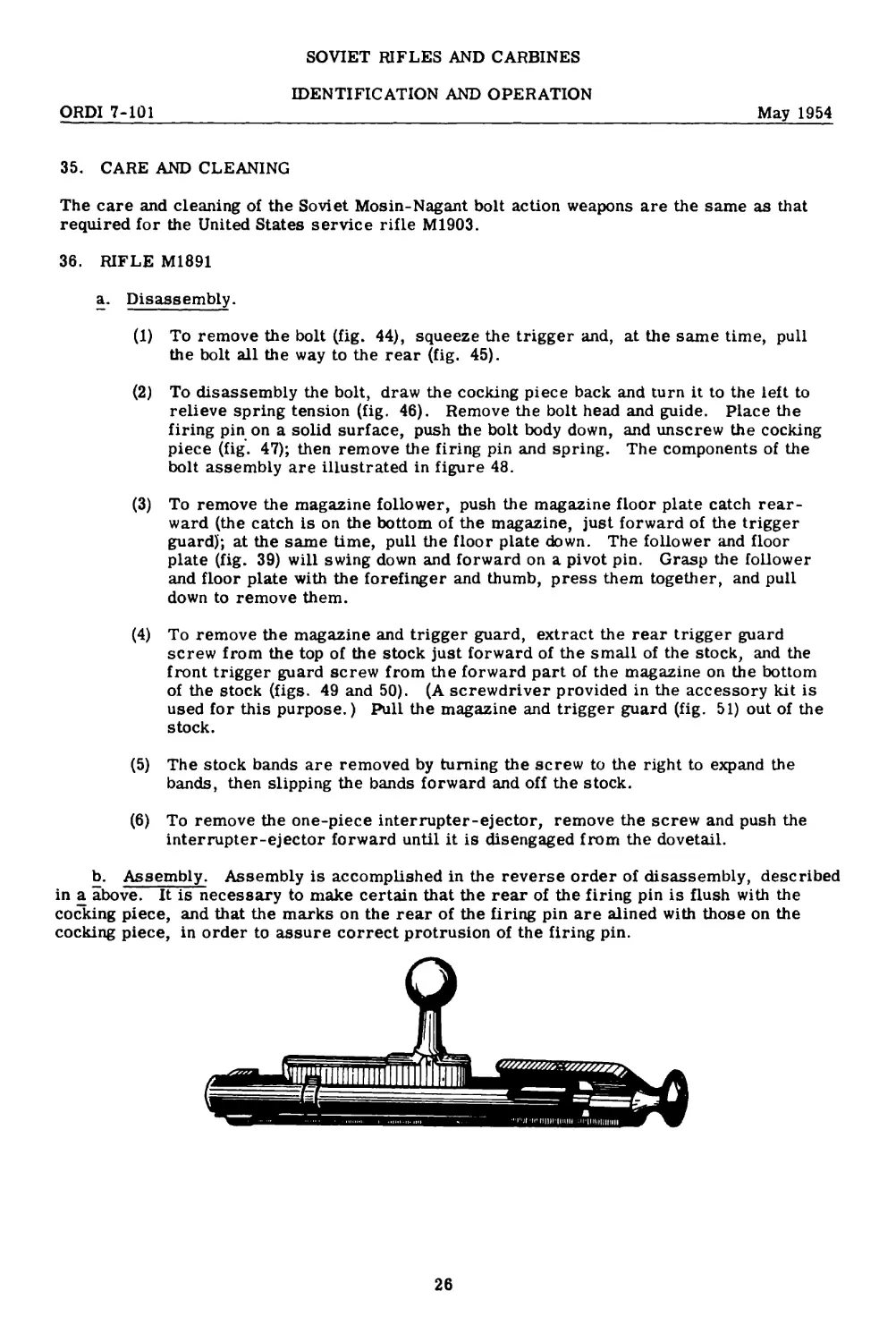
Each Mosin-Nagant bolt action rifle and carbine is provided with a one-piece cleaning rod
(fig. 40) which is fitted in the stock. The rod is threaded on the end to take the tapped re-
taining nut embedded in the stock just below the chamber (fig. 37). An accessory pouch
(fig. 41) is carried by each rifleman. It contains a screwdriver, oil can, cleaning rod head,
cleaning rod brush, cleaning rod attachment, rod collar, and cleaning rod stop (fig. 42).
There are variations in the design of the oil can and screwdriver (fig. 43).
FIGURE 40. CLEANING ROD ASSEMBLY.
24
SOVIET RIFLES AND CARBINES
IDENTIFICATION AND OPERATION
May 1954
ORDI 7-101
FIGURE 41. ACCESSORY POUCH.
CLEANING ROD BRUSH
CLEANING ROD HEAD
CLEANING ROD ATTACHMENT
CLEANING ROD STOP
FIGURE 42. ACCESSORY POUCH CONTENTS.
FIGURE 43. VARIATION IN DESIGN OF ACCESSORIES.
25
SOVIET RIFLES AND CARBINES
IDENTIFICATION AND OPERATION
ORDI 7-101
May 1954
35.	CARE AND CLEANING
The care and cleaning of the Soviet Mosin-Nagant bolt action weapons are the same as that
required for the United States service rifle M1903.
36.	RIFLE M1891
a.	Disassembly.
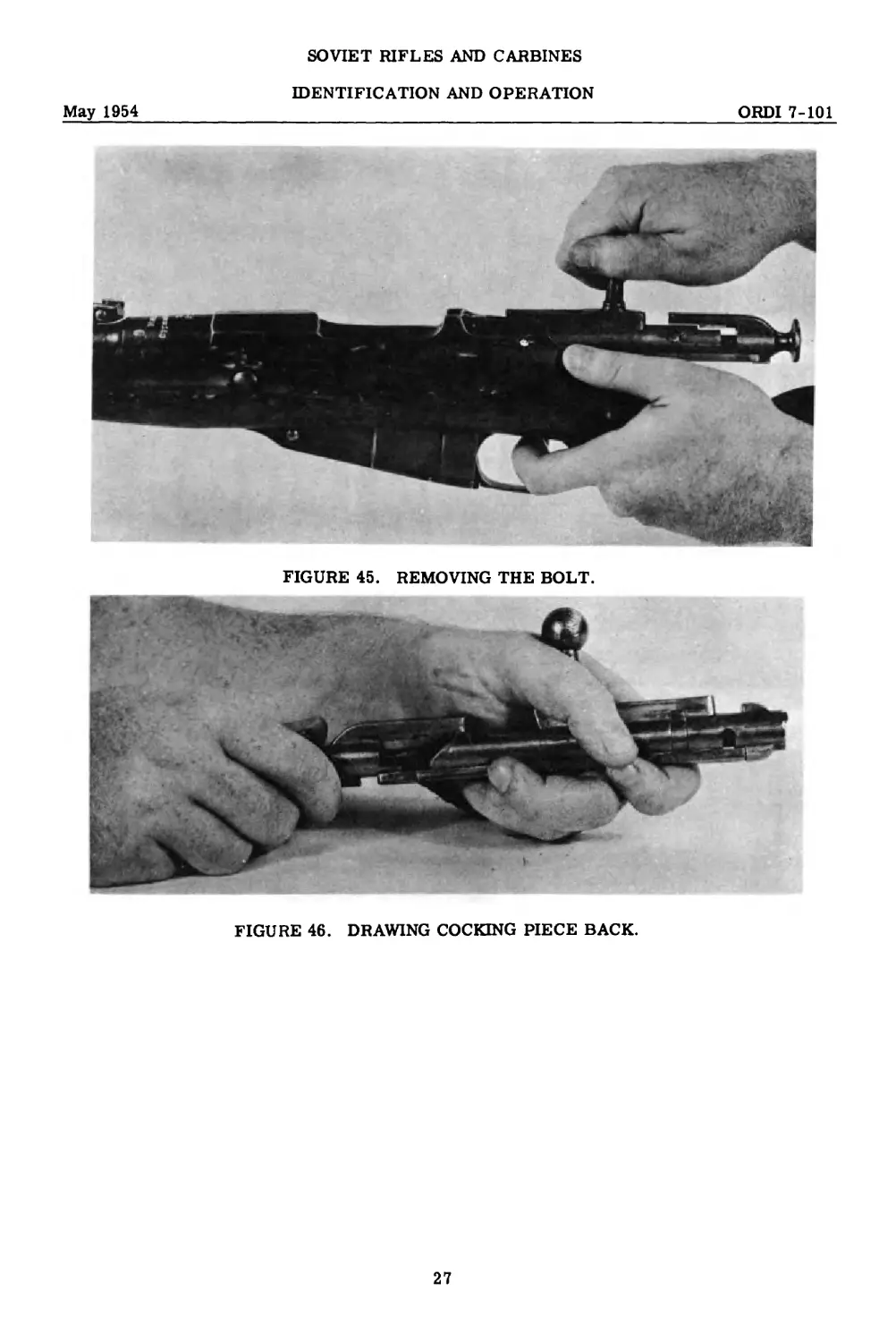
(1)	To remove the bolt (fig. 44), squeeze the trigger and, at the same time, pull
the bolt all the way to the rear (fig. 45).
(2)	To disassembly the bolt, draw the cocking piece back and turn it to the left to
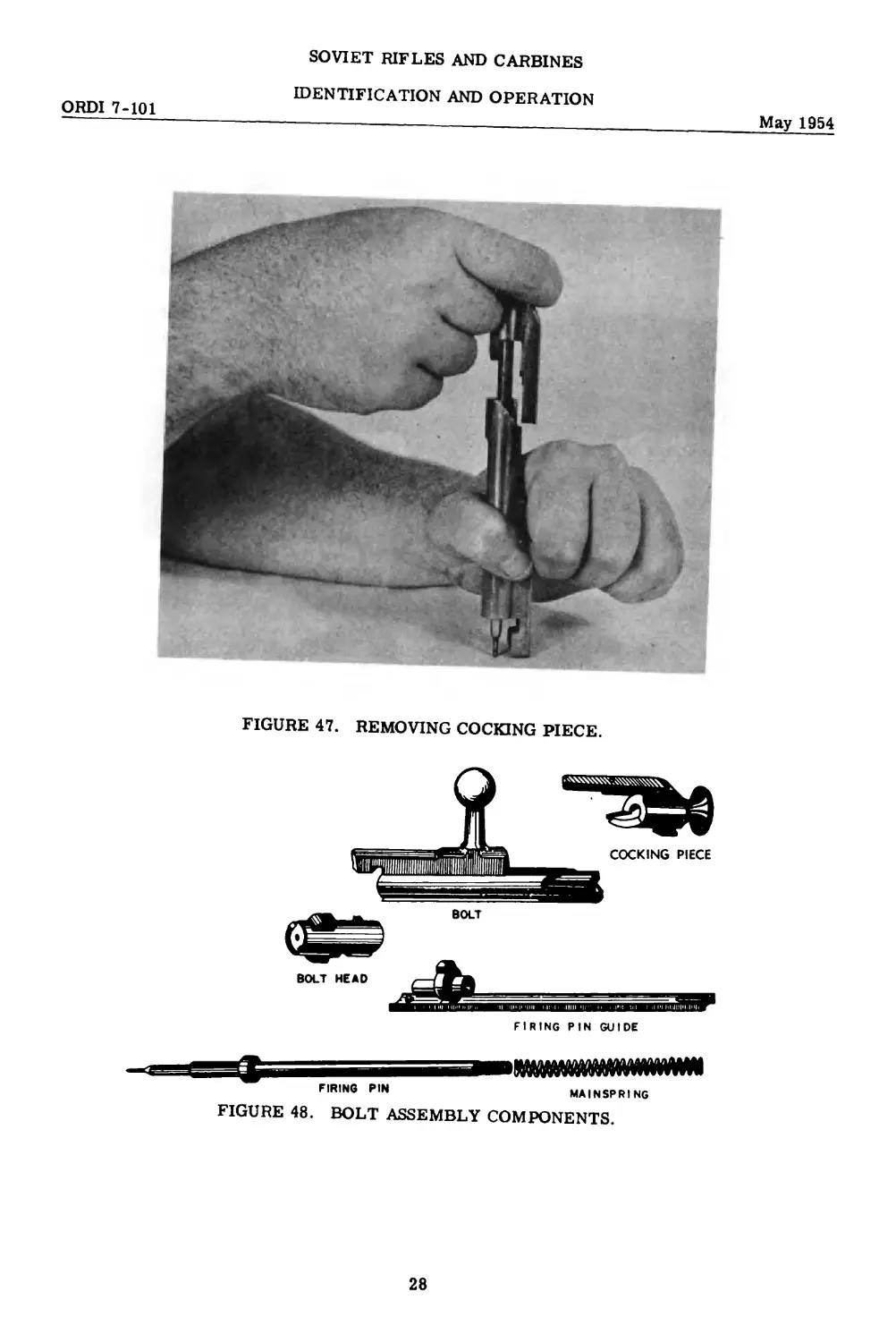
relieve spring tension (fig. 46). Remove the bolt head and guide. Place the
firing pin on a solid surface, push the bolt body down, and unscrew the cocking
piece (fig. 47); then remove the firing pin and spring. The components of the
bolt assembly are illustrated in figure 48.
(3)	To remove the magazine follower, push the magazine floor plate catch rear-
ward (the catch is on the bottom of the magazine, just forward of the trigger
guard); at the same time, pull the floor plate down. The follower and floor
plate (fig. 39) will swing down and forward on a pivot pin. Grasp the follower
and floor plate with the forefinger and thumb, press them together, and pull
down to remove them.
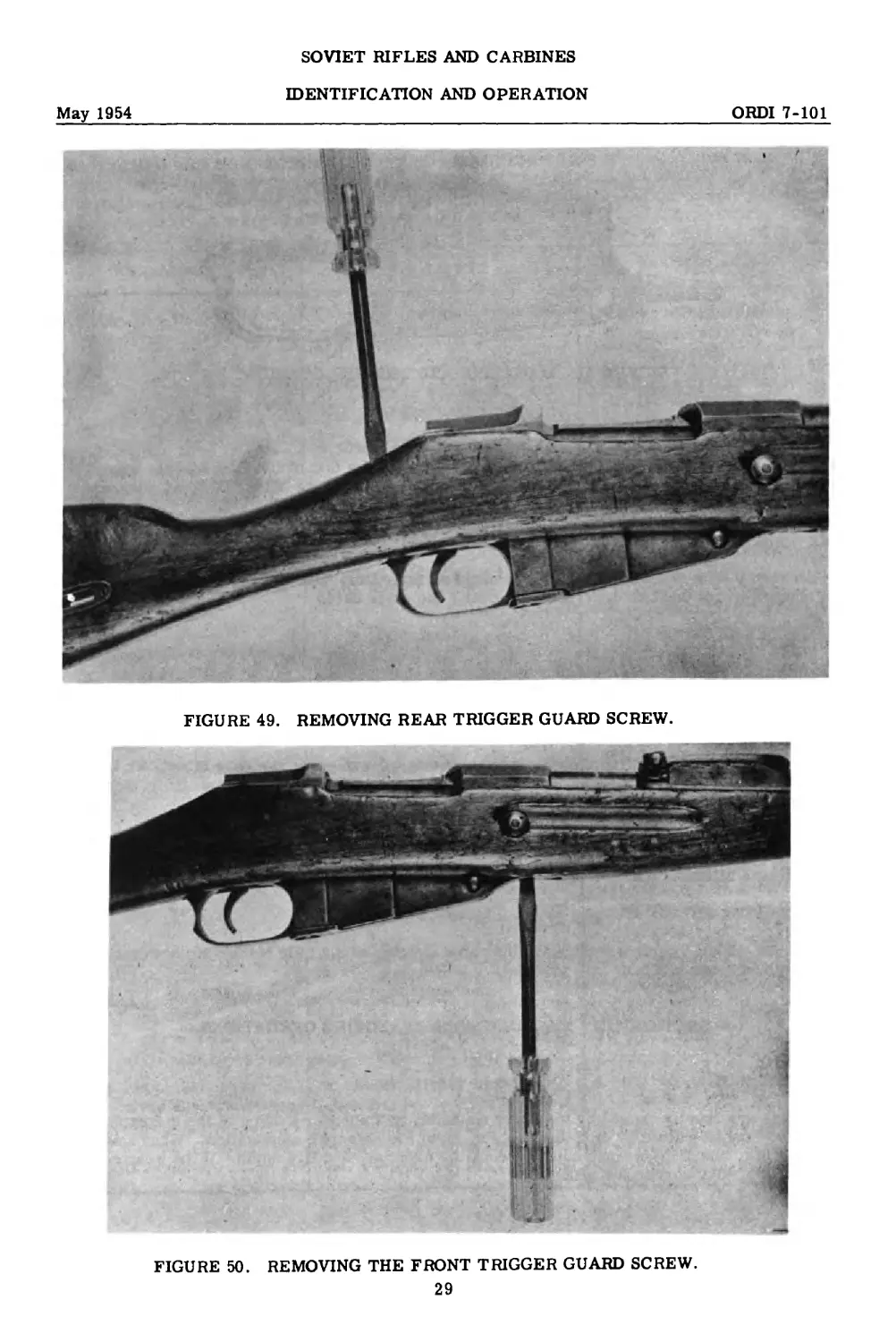
(4)	To remove the magazine and trigger guard, extract the rear trigger guard
screw from the top of the stock just forward of the small of the stock, and the
front trigger guard screw from the forward part of the magazine on the bottom
of the stock (figs. 49 and 50). (A screwdriver provided in the accessory kit is
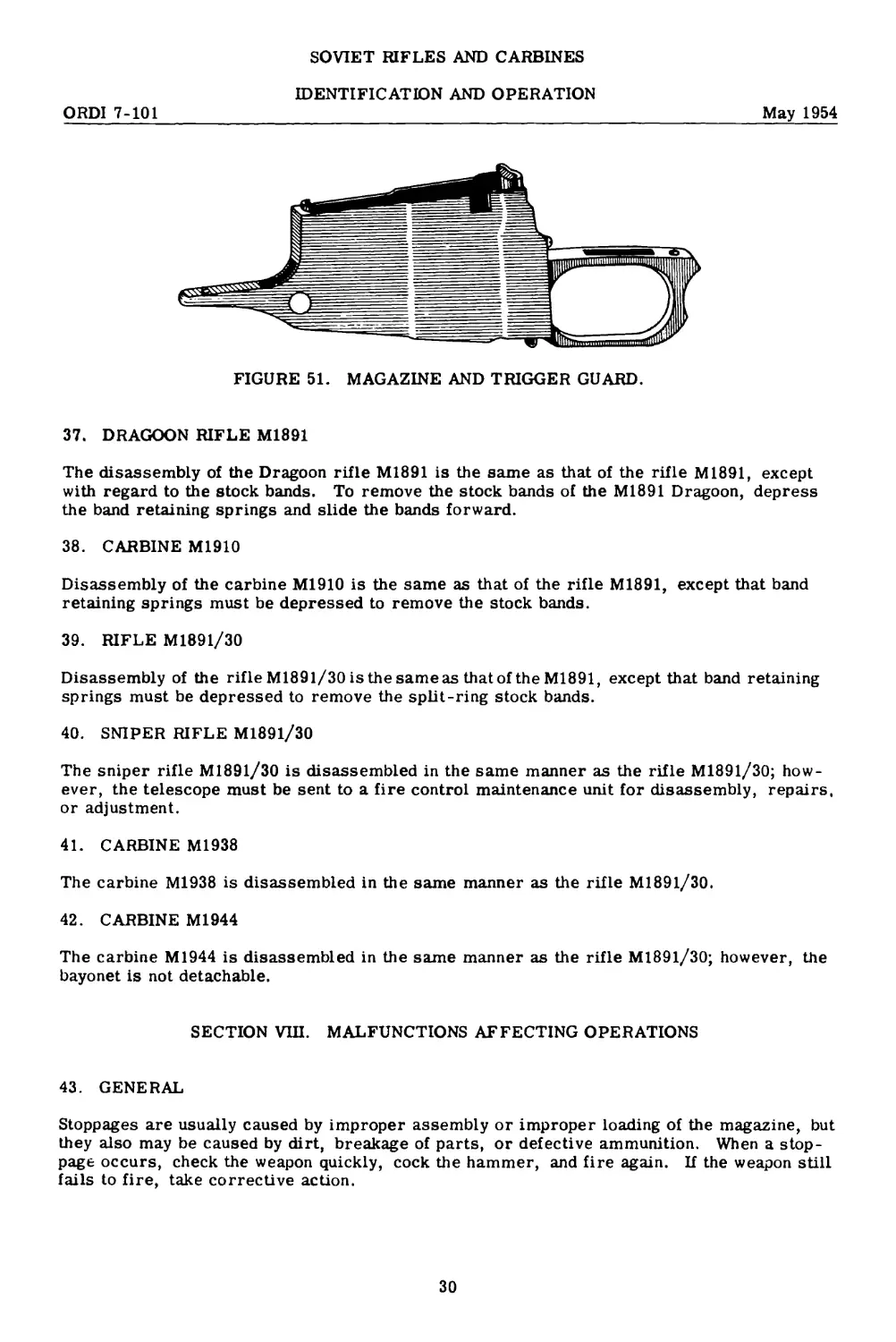
used for this purpose.) Pull the magazine and trigger guard (fig. 51) out of the
stock.
(5)	The stock bands are removed by turning the screw to the right to expand the
bands, then slipping the bands forward and off the stock.
(6)	To remove the one-piece interrupter-ejector, remove the screw and push the
interrupter-ejector forward until it is disengaged from the dovetail.
b.	Assembly. Assembly is accomplished in the reverse order of disassembly, described
in a above. It is necessary to make certain that the rear of the firing pin is flush with the
cocking piece, and that the marks on the rear of the firing pin are alined with those on the
cocking piece, in order to assure correct protrusion of the firing pin.
26
SOVIET RIFLES AND CARBINES
IDENTIFICATION AND OPERATION
May 1954
ORDI 7-101
FIGURE 45. REMOVING THE BOLT.
FIGURE 46. DRAWING COCKING PIECE BACK.
27
SOVIET RIFLES AND CARBINES
ORDI 7-101
IDENTIFICATION AND OPERATION
May 1954
FIGURE 47. REMOVING COCKING PIECE.
FIRING PIN GUIDE
FIRING PIN
MAINSPRING
FIGURE 48. BOLT ASSEMBLY COMPONENTS.
28
SOVIET RIFLES AND CARBINES
IDENTIFICATION AND OPERATION
May 1954
ORDI 7-101
FIGURE 49. REMOVING REAR TRIGGER GUARD SCREW.
FIGURE 50. REMOVING THE FRONT TRIGGER GUARD SCREW.
29
SOVIET RIFLES AND CARBINES
IDENTIFICATION AND OPERATION
ORDI 7-101
May 1954
FIGURE 51. MAGAZINE AND TRIGGER GUARD.
37.	DRAGOON RIFLE M1891
The disassembly of the Dragoon rifle M1891 is the same as that of the rifle M1891, except
with regard to the stock bands. To remove the stock bands of the M1891 Dragoon, depress
the band retaining springs and slide the bands forward.
38.	CARBINE M1910
Disassembly of the carbine M1910 is the same as that of the rifle M1891, except that band
retaining springs must be depressed to remove the stock bands.
39.	RIFLE M1891/30
Disassembly of the rifle M1891/30 is the sameas that of the M1891, except that band retaining
springs must be depressed to remove the split-ring stock bands.
40.	SNIPER RIFLE M1891/30
The sniper rifle M1891/30 is disassembled in the same manner as the rifle M1891/30; how-
ever, the telescope must be sent to a fire control maintenance unit for disassembly, repairs,
or adjustment.
41.	CARBINE M1938
The carbine M1938 is disassembled in the same manner as the rifle M1891/30.
42.	CARBINE Ml944
The carbine M1944 is disassembled in the same manner as the rifle M1891/30; however, the
bayonet is not detachable.
SECTION VIH. MALFUNCTIONS AFFECTING OPERATIONS
43.	GENERAL
Stoppages are usually caused by improper assembly or improper loading of the magazine, but
they also may be caused by dirt, breakage of parts, or defective ammunition. When a stop-
page occurs, check the weapon quickly, cock the hammer, and fire again. If the weapon still
fails to fire, take corrective action.
30
SOVIET RIFLES AND CARBINES
IDENTIFICATION AND OPERATION
May 1954
ORDI 7-101
44.	CAUSES AND CORRECTION OF COMMON MALFUNCTIONS
The malfunctions occurring most frequently, their probable cause, and the proper remedial
action necessary to overcome the stoppage are listed below.
Malfunction	Probable cause	Remedial action
1.	Magazine floor plate falls open. 2.	Cartridge jams in process of being chambered. 3.	Cartridge is chambered with difficulty. 4.	Misfire. 5.	Fails to extract. 6.	Fails to eject. 7.	Bolt is pulled out of re- ceiver during process of opening bolt.	a.	Defective floor plate catch. b.	Screw is weakened, tooth worn or chamfered. a.	Defective interrupter. - ejector. b.	. Cartridge not positioned below interrupter- ejector blade. a.	Dented cartridge case. b.	Dirty chamber. c.	Excessive primer pro- trusion. a.	Defective primer. b.	Firing pin protrusion insufficient. c.	Firing pin spring weak or broken. d.	Dirt in firing mechanism. Defective extractor. a.	Interrupter-ejector spring- portion is bent. b.	Dirt in interrupter- ejector slot. a.	Loose trigger-spring screw. b.	Worn bolt stop.	a.	Load and fire single rounds until fire is completed. b.	Tighten screw. a.	Clean and oil interrupter- ejector blade. b.	Correct position of car- tridge by hand and chamber round. a.	Remove defective car- tridge. b.	Clean chamber. c.	Remove defective car- tridge. a.	Reload and continue firing. b.	Adjust firing pin protru- sion. c.	Turn in weapon to Ord- nance. d.	Clean mechanism. Turn in weapon to Ord- nance. a.	Turn in weapon to Ord- nance. b.	Clean and oil. a.	Tighten trigger-spring screw. b.	Turn in weapon to Ord- nance.
31

SOVIET RIFLES AND CARBINES
IDENTIFICATION AND OPERATION
May 1954
ORDI 7-101
CHAPTER 3
AUTOMATIC AND SEMIAUTOMATIC RIFLES AND CARBINES
SECTION I. GENERAL
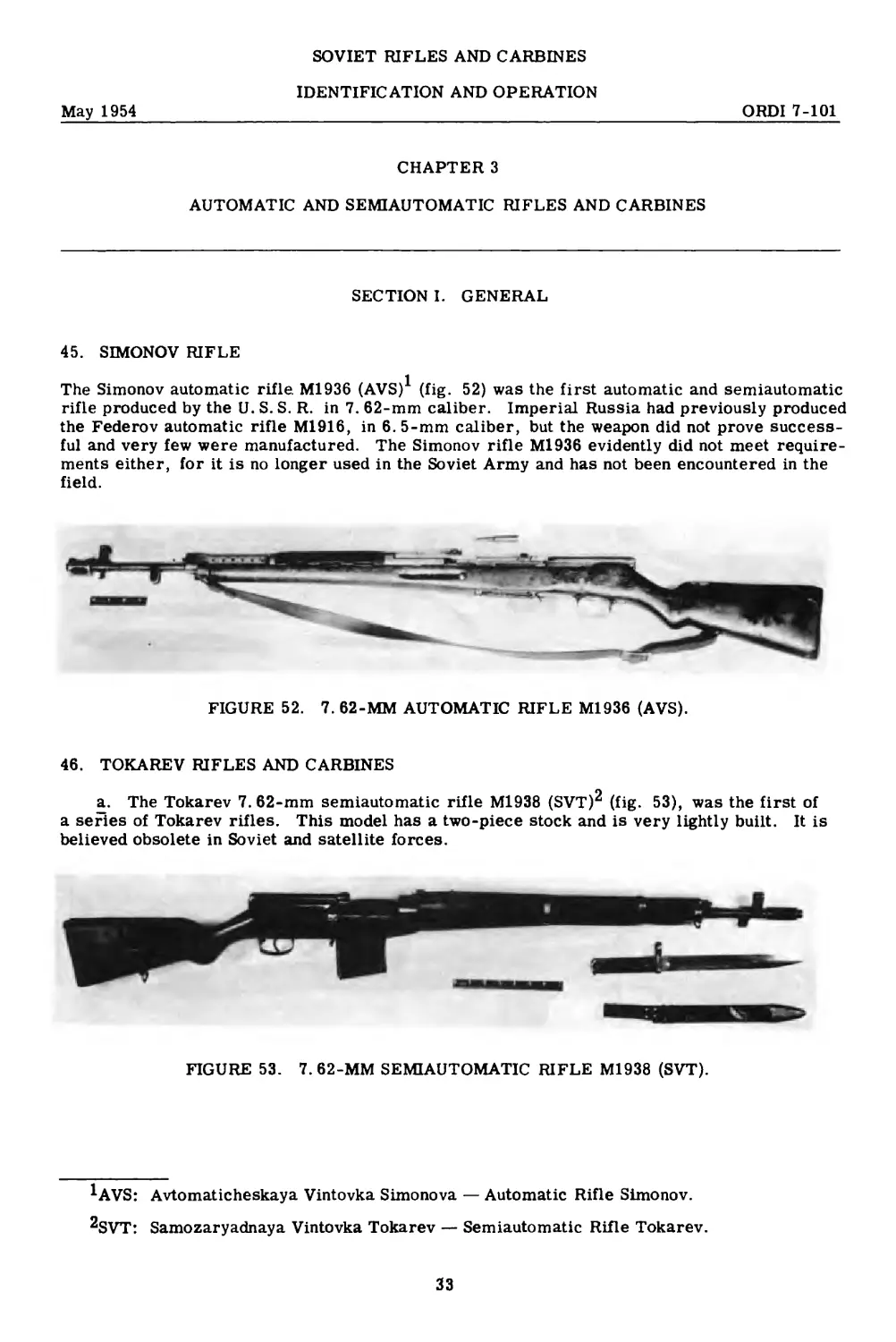
45.	SIMONOV RIFLE
The Simonov automatic rifle. Ml936 (AVs/ (fig. 52) was the first automatic and semiautomatic
rifle produced by the U. S. S. R. in 7. 62-mm caliber. Imperial Russia had previously produced
the Federov automatic rifle M1916, in 6. 5-mm caliber, but the weapon did not prove success-
ful and very few were manufactured. The Simonov rifle M1936 evidently did not meet require-
ments either, for it is no longer used in the Soviet Army and has not been encountered in the
field.
FIGURE 52. 7. 62-MM AUTOMATIC RIFLE M1936 (AVS).
46.	TOKAREV RIFLES AND CARBINES
a.	The Tokarev 7. 62-mm semiautomatic rifle M1938 (SVT)^ (fig. 53), was the first of
a series of Tokarev rifles. This model has a two-piece stock and is very lightly built. It is
believed obsolete in Soviet and satellite forces.
FIGURE 53. 7. 62-MM SEMIAUTOMATIC RIFLE M1938 (SVT).
XAVS: Avtomaticheskaya Vintovka Simonova — Automatic Rifle Simonov.
^SVT: Samozaryadnaya Vintovka Tokarev — Semiautomatic Rifle Tokarev.
33
SOVIET RIFLES AND CARBINES
IDENTIFICATION AND OPERATION
ORDI 7-101
May 1954
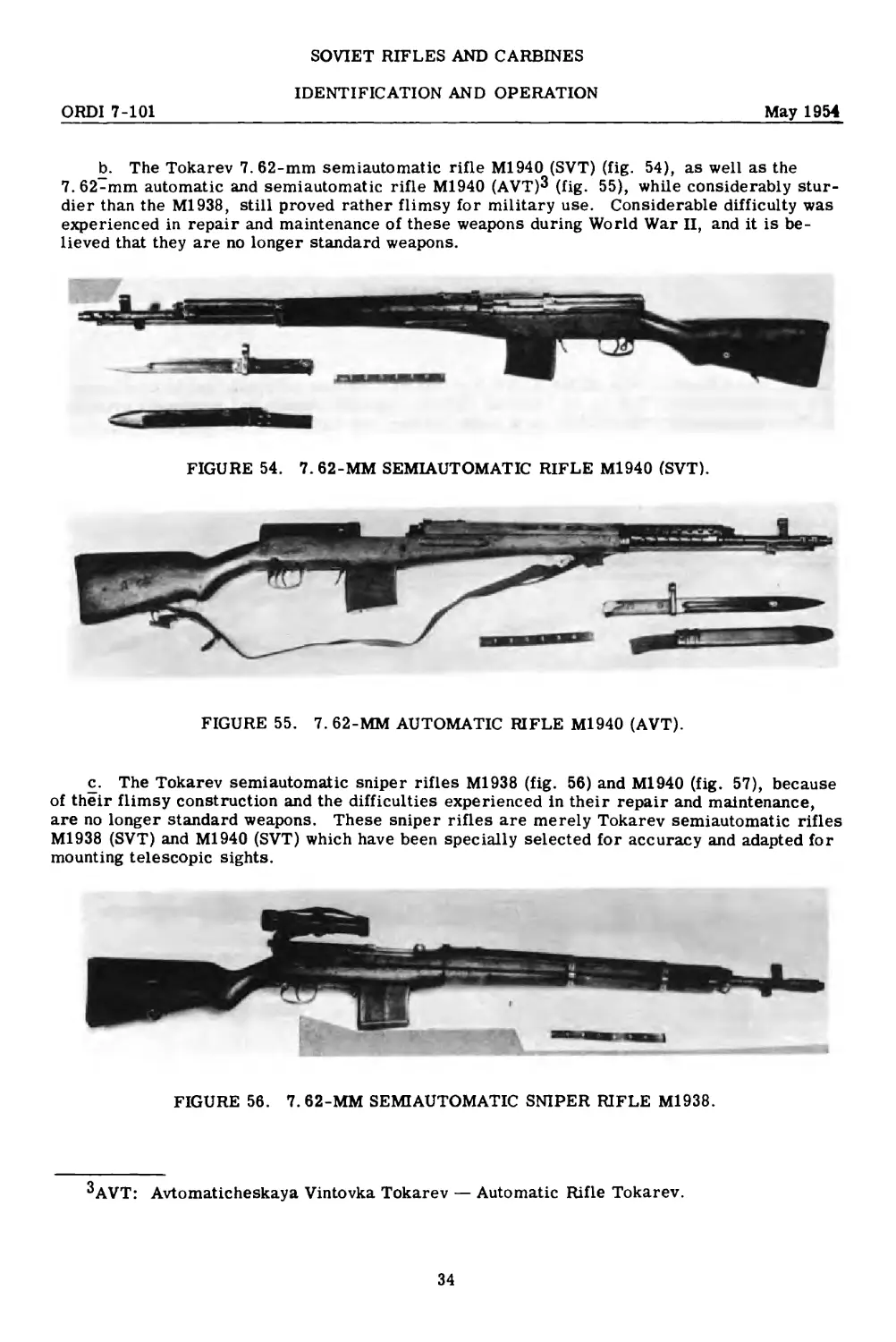
b.	The Tokarev 7. 62-mm semiautomatic rifle M1940 (SVT) (fig. 54), as well as the
7. 62~mm automatic and semiautomatic rifle M1940 (AVT)3 (fig. 55), while considerably stur-
dier than the Ml938, still proved rather flimsy for military use. Considerable difficulty was
experienced in repair and maintenance of these weapons during World War II, and it is be-
lieved that they are no longer standard weapons.
FIGURE 54. 7. 62-MM SEMIAUTOMATIC RIFLE M1940 (SVT).
FIGURE 55. 7. 62-MM AUTOMATIC RIFLE M1940 (AVT).
c.	The Tokarev semiautomatic sniper rifles M1938 (fig. 56) and M1940 (fig. 57), because
of their flimsy construction and the difficulties experienced in their repair and maintenance,
are no longer standard weapons. These sniper rifles are merely Tokarev semiautomatic rifles
M1938 (SVT) and Ml940 (SVT) which have been specially selected for accuracy and adapted for
mounting telescopic sights.
FIGURE 56. 7. 62-MM SEMIAUTOMATIC SNIPER RIFLE M1938.
^AVT: Avtomaticheskaya Vintovka Tokarev — Automatic Rifle Tokarev.
34
SOVIET RIFLES AND CARBINES
IDENTIFICATION AND OPERATION
May 1954
ORDI 7-101
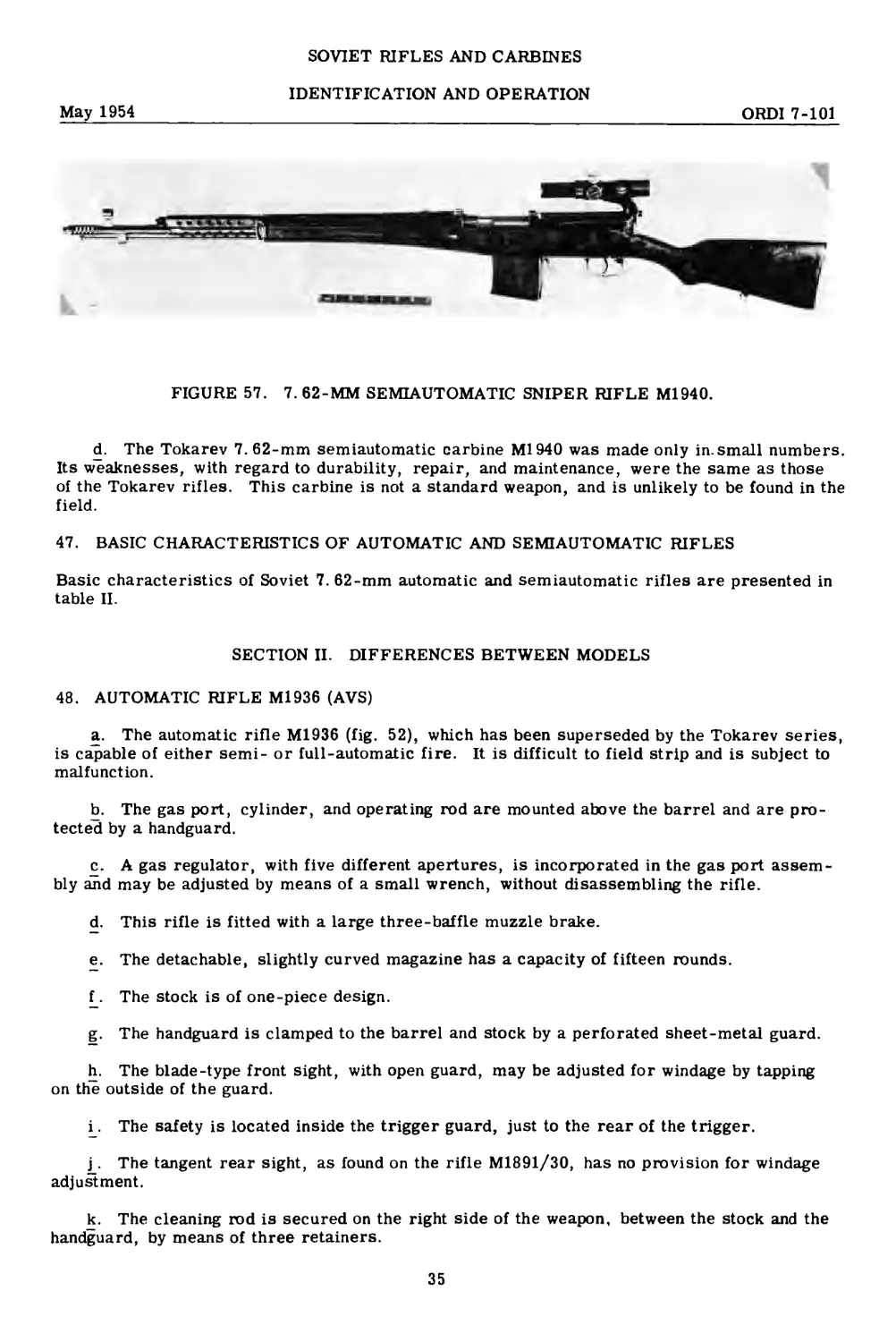
FIGURE 57. 7. 62-MM SEMIAUTOMATIC SNIPER RIFLE M1940.
d.	The Tokarev 7. 62-mm semiautomatic carbine Ml 940 was made only in.small numbers.
Its weaknesses, with regard to durability, repair, and maintenance, were the same as those
of the Tokarev rifles. This carbine is not a standard weapon, and is unlikely to be found in the
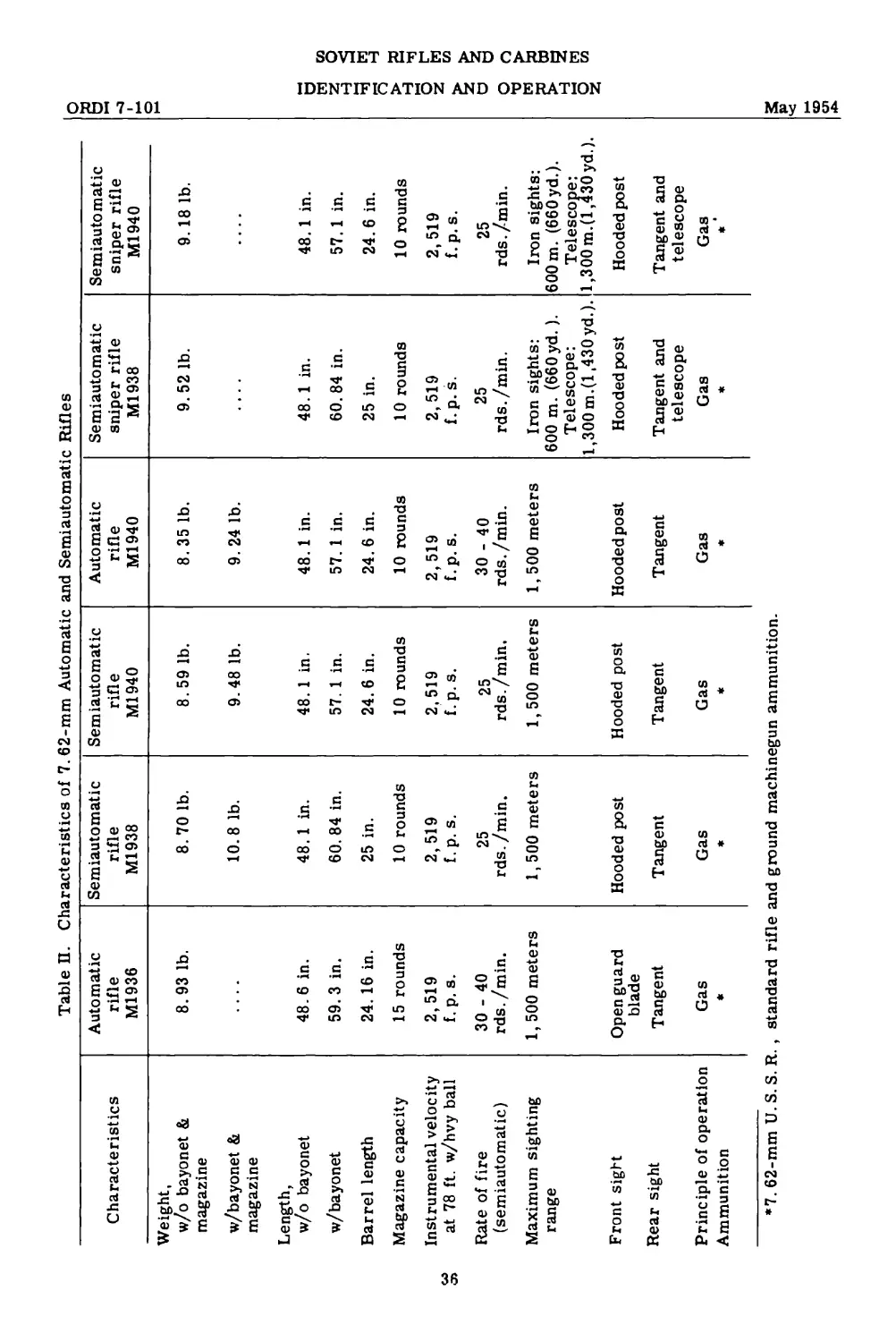
field.
47.	BASIC CHARACTERISTICS OF AUTOMATIC AND SEMIAUTOMATIC RIFLES
Basic characteristics of Soviet 7. 62-mm automatic and semiautomatic rifles are presented in
table II.
SECTION II. DIFFERENCES BETWEEN MODELS
48.	AUTOMATIC RIFLE M1936 (AVS)
a.	The automatic rifle M1936 (fig. 52), which has been superseded by the Tokarev series,
is capable of either semi- or full-automatic fire. It is difficult to field strip and is subject to
malfunction.
b.	The gas port, cylinder, and operating rod are mounted above the barrel and are pro-
tected by a handguard.
c.	A gas regulator, with five different apertures, is incorporated in the gas port assem-
bly and may be adjusted by means of a small wrench, without disassembling the rifle.
d.	This rifle is fitted with a large three-baffle muzzle brake.
e.	The detachable, slightly curved magazine has a capacity of fifteen rounds.
f_. The stock is of one-piece design.
g.	The handguard is clamped to the barrel and stock by a perforated sheet-metal guard.
h.	The blade-type front sight, with open guard, may be adjusted for windage by tapping
on the outside of the guard.
L The safety is located inside the trigger guard, just to the rear of the trigger.
£. The tangent rear sight, as found on the rifle M1891/30, has no provision for windage
adjustment.
k.	The cleaning rod is secured on the right side of the weapon, between the stock and the
handguard, by means of three retainers.
35
Table П. Characteristics of 7.62-mm Automatic and Semiautomatic Rifles							ORDI 7-1C
Characteristics	Automatic rifle M1936	Semiautomatic rifle M1938	Semiautomatic rifle Ml 940	Automatic rifle Ml 940	Semiautomatic sniper rifle Ml 938	Semiautomatic sniper rifle Ml 940
Weight, w/o bayonet & magazine	8.93 lb.	8.70 lb.	8. 59 lb.	8.35 lb.	9.52 lb.	9.18 lb.	h-k
w/bayonet & magazine	....	10.8 lb.	9.48 lb.	9.24 lb.	....	....
Length, w/o bayonet w/bayonet Barrel length	48.6 in. 59. 3 in. 24.16 in.	48.1 in. 60. 84 in. 25 in.	48.1 in. 57.1 in. 24.6 in.	48.1 in. 57.1 in. 24.6 in.	48.1 in. 60.84 in. 25 in.	48.1 in. 57.1 in. 24.6 in.	О и z H 4	из О s M H
Magazine capacity	15 rounds	10 rounds	10 rounds	10 rounds	10 rounds	10 rounds	>	2 ч
Instrumental velocity да	at 78 ft. w/hvy ball	2,519 f. p. s.	2,519 f. p. s.	2,519 f. p. s.	2,519 f.p. s.	2,519 f. p. s.	2,519 f. p. s.	о z £	M из
Rate of fire (semiautomatic)	30 - 40 rds./min.	25 rds. /min.	25 rds./min.	30 - 40 rds./min.	25 rds./min.	25 rds./min.	z и о TJ	§ n
Maximum sighting range	1, 500 meters	1,500 meters	1,500 meters	1,500 meters	Iron sights: 600 m. (660yd.). Telescope: 1,300m.(1,430yd.).	Iron sights: 600m. (660yd.). Telescope: 1,300m.(1,430 yd.).	w о z	g 5 M и
Front sight Rear sight Principle of operation Ammunition	Open guard blade Tangent Gas	Hooded post Tangent Gas	Hooded post Tangent Gas *	Hooded post Tangent Gas ♦	Hooded post Tangent and telescope Gas *	Hoodedpost Tangent and telescope Gas ♦ *
*1. 62-mm U. S. S. R. , standard rifle and ground machinegun ammunition.
CD
СЛ
SOVIET RIFLES AND CARBINES
IDENTIFICATION AND OPERATION
May 1954
ORDI 7-101
IL This rifle is fitted with a knife-type bayonet.
49.	SEMIAUTOMATIC RIFLE M1938 (SVT)
a.	The semiautomatic rifle M1938 (fig. 53) uses the same type of gas port, gas regula-
tor, and operating rod mounted above the barrel as the automatic rifle M1938.
b.	This rifle is capable of semiautomatic fire only.
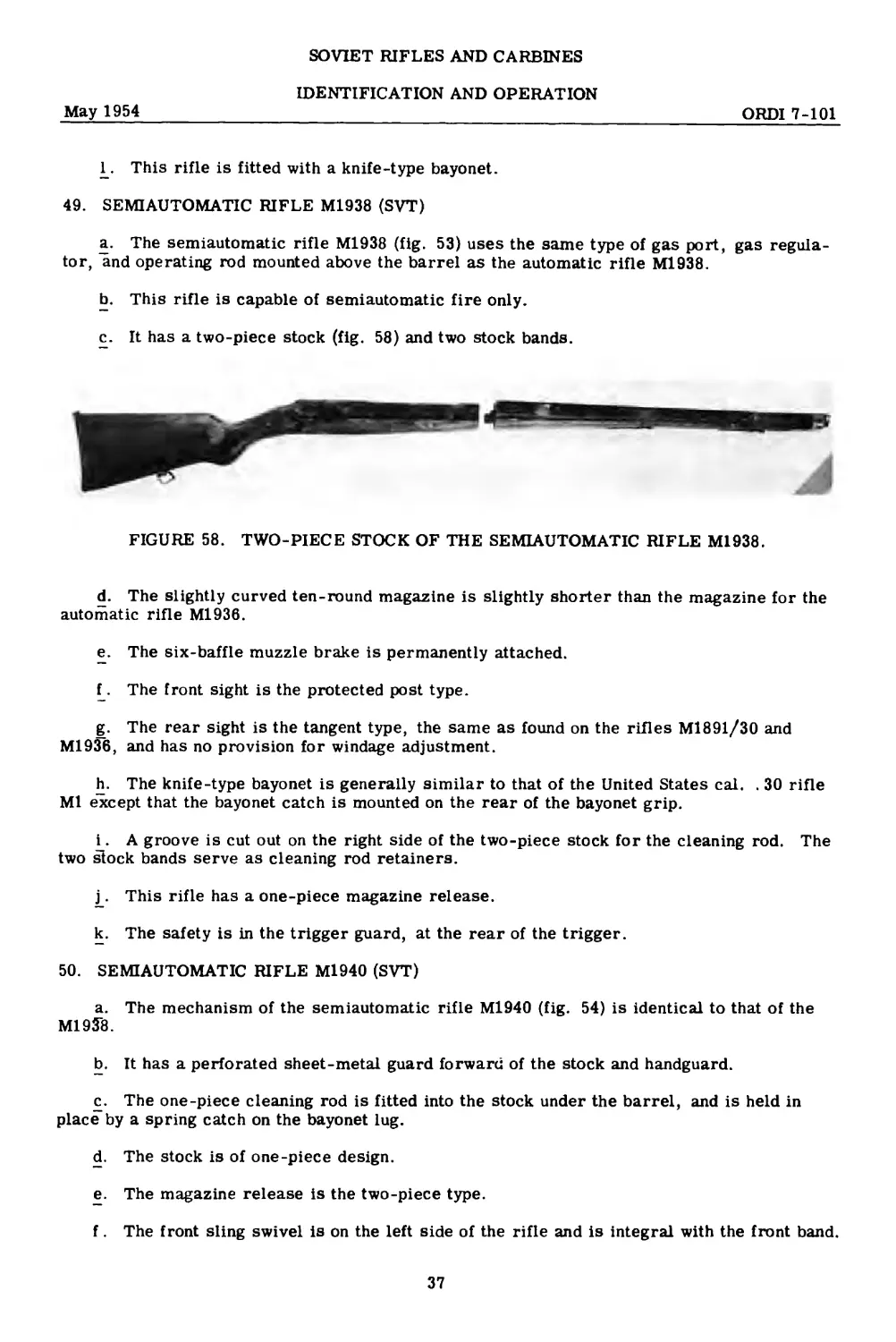
c.	It has a two-piece stock (fig. 58) and two stock bands.
FIGURE 58. TWO-PIECE STOCK OF THE SEMIAUTOMATIC RIFLE M1938.
J
d.	The slightly curved ten-round magazine is slightly shorter than the magazine for the
automatic rifle M1936.
e.	The six-baffle muzzle brake is permanently attached.
L The front sight is the protected post type.
g.	The rear sight is the tangent type, the same as found on the rifles M1891/30 and
Ml936, and has no provision for windage adjustment.
h.	The knife-type bayonet is generally similar to that of the United States cal. . 30 rifle
Ml except that the bayonet catch is mounted on the rear of the bayonet grip.
i.	A groove is cut out on the right side of the two-piece stock for the cleaning rod. The
two stock bands serve as cleaning rod retainers.
j.	This rifle has a one-piece magazine release.
k.	The safety is in the trigger guard, at the rear of the trigger.
50.	SEMIAUTOMATIC RIFLE M1940 (SVT)
a.	The mechanism of the semiautomatic rifle M1940 (fig. 54) is identical to that of the
Ml 958.
b.	It has a perforated sheet-metal guard forward of the stock and handguard.
c.	The one-piece cleaning rod is fitted into the stock under the barrel, and is held in
place by a spring catch on the bayonet lug.
d.	The stock is of one-piece design.
e.	The magazine release is the two-piece type.
f.	The front sling swivel is on the left side of the rifle and is integral with the front band.
37
SOVIET RIFLES AND CARBINES
IDENTIFICATION AND OPERATION
ORDI 7-101
May 1954
g.	The bayonet is shorter than the Ml938 bayonet.
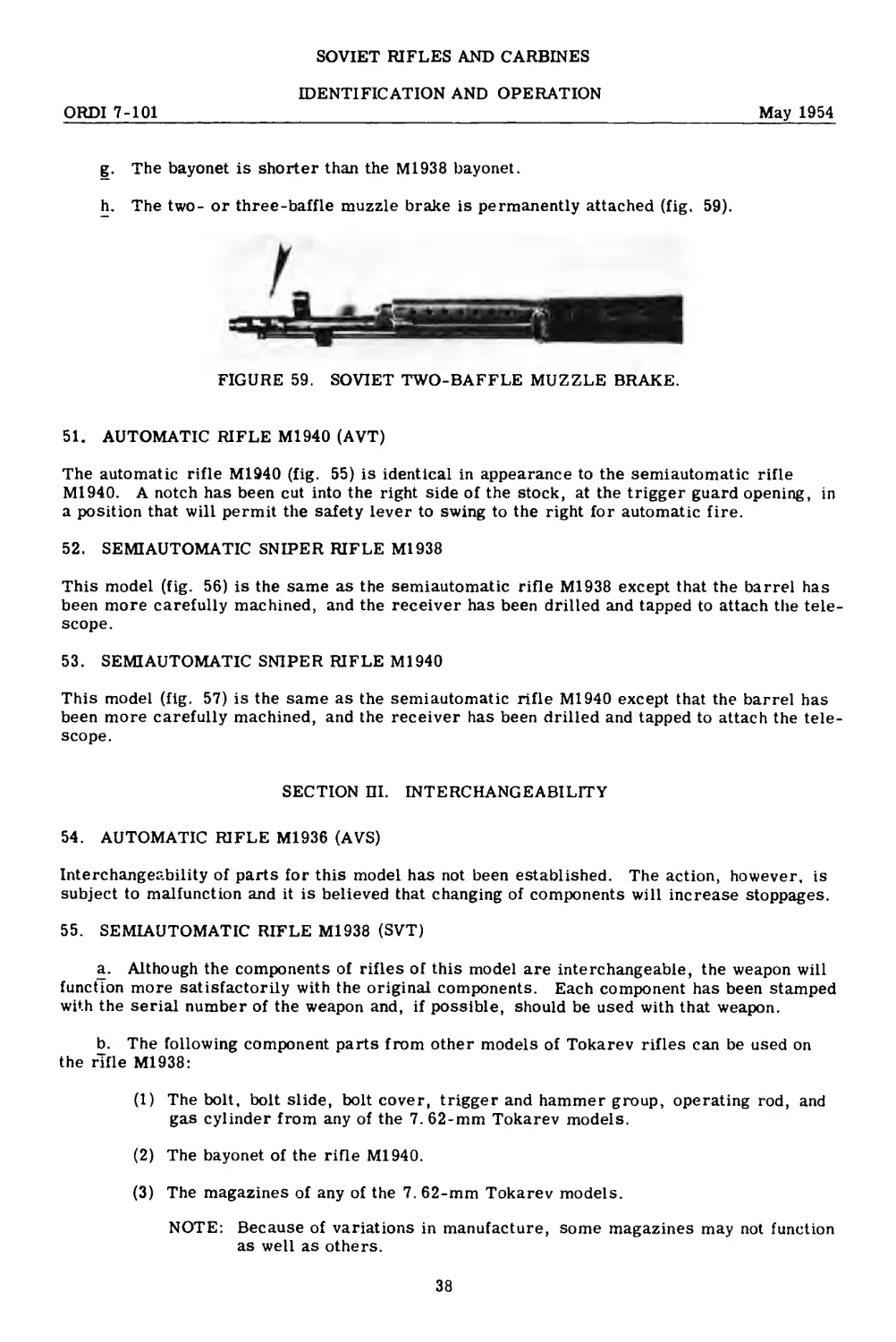
h.	The two- or three-baffle muzzle brake is permanently attached (fig. 59).
FIGURE 59. SOVIET TWO-BAFFLE MUZZLE BRAKE.
51.	AUTOMATIC RIFLE M1940 (AVT)
The automatic rifle M1940 (fig. 55) is identical in appearance to the semiautomatic rifle
M1940. A notch has been cut into the right side of the stock, at the trigger guard opening, in
a position that will permit the safety lever to swing to the right for automatic fire.
52.	SEMIAUTOMATIC SNIPER RIFLE Ml938
This model (fig. 56) is the same as the semiautomatic rifle M1938 except that the barrel has
been more carefully machined, and the receiver has been drilled and tapped to attach the tele-
scope.
53.	SEMIAUTOMATIC SNIPER RIFLE M1940
This model (fig. 57) is the same as the semiautomatic rifle Ml940 except that the barrel has
been more carefully machined, and the receiver has been drilled and tapped to attach the tele-
scope.
SECTION Ш. INTERCHANGEABILITY
54.	AUTOMATIC RIFLE M1936 (AVS)
Interchangeability of parts for this model has not been established. The action, however, is
subject to malfunction and it is believed that changing of components will increase stoppages.
55.	SEMIAUTOMATIC RIFLE M1938 (SVT)
a.	Although the components of rifles of this model are interchangeable, the weapon will
function more satisfactorily with the original components. Each component has been stamped
with the serial number of the weapon and, if possible, should be used with that weapon.
b.	The following component parts from other models of Tokarev rifles can be used on
the rifle M1938:
(1)	The bolt, bolt slide, bolt cover, trigger and hammer group, operating rod, and
gas cylinder from any of the 7. 62-mm Tokarev models.
(2)	The bayonet of the rifle Ml940.
(3)	The magazines of any of the 7. 62-mm Tokarev models.
NOTE: Because of variations in manufacture, some magazines may not function
as well as others.
38
SOVIET RIFLES AND CARBINES
IDENTIFICATION AND OPERATION
May 1954 ORDI 7-101
(4)	The stock of the semiautomatic sniper rifle Ml938.
56.	SEMIAUTOMATIC RIFLE M1940 (SVT)
a.	Although the components of rifles of this model are interchangeable, the weapon will
function more satisfactorily with its original components. Each component, as is the case for
all Soviet small arms, has been stamped with the serial number of the weapon and, if possible
should be used with that weapon.
b.	The following component parts from other models of Tokarev rifles can be used on
the rifle M1940:
(1)	The bolt, bolt slide, bolt cover, trigger and hammer group, operating rod, and
gas cylinder from any of the 7. 62-mm Tokarev models.
(2)	The bayonet of the rifle Ml 938.
(3)	The stock of the automatic rifle Ml 940 and the semiautomatic sniper rifle Ml940.
(4)	The magazine of any 7. 62-mm Tokarev model. (See note, par. 55b(3). )
57.	AUTOMATIC RIFLE Ml940 (AVT)
The interchangeability of component parts for this model has not been established.
58.	SEMIAUTOMATIC SNIPER RIFLE M1938
a.	Interchangeability is the same as for the semiautomatic rifle M1938 described in para-
graph 55.
b.	The telescope and mount for the sniper rifle M1940 apparently can be used on this
rifle.
59.	SEMIAUTOMATIC SNIPER RIFLE M1940
a.	Interchangeability is the same as for the semiautomatic rifle Ml940 described in
paragraph 56.
b.	The telescope and mount for the sniper rifle M1938 apparently can be used on this
rifle.
SECTION IV. AMMUNITION
60.	AMMUNITION
The ammunition used in the semiautomatic and automatic rifles is the same as that used in
the bolt action rifles and carbines. See section IV, chapter 2, for a description of the ammu-
nition.
SECTION V. SIGHTING EQUIPMENT
61.	AUTOMATIC RIFLE M1936 (AVS)
a.	The base of the open guard, blade-type front sight is a band; an extension of the band,
below the barrel, serves to mount the bayonet.
39
SOVIET RIFLES AND CARBINES
IDENTIFICATION AND OPERATION
ORDI 7-101 May 1954
b.	The curved ramp, tangent-type rear sight is identical to that of the bolt action rifle
M1851/30. The base for the rear sight also serves as a stop for the cocking sleeve; conse-
quently, the sight leaf hinge pin is loosened and often broken by the shocks which arise from
stopping rearward travel of the cocking sleeve. The sight then becomes loose, and inaccuracy
results.
62.	SEMIAUTOMATIC RIFLE M1938 (SVT)
a.	The front sight is a hooded post-type sight, dovetailed into a sight base which is an
integral part of the barrel extension; the barrel extension assembly screws onto the muzzle
of the barrel.
b.	The curved ramp, tangent-type rear sight is similar to that of the bolt action rifle
M1891/30. It is attached to the barrel just forward of the receiver.
63.	SEMIAUTOMATIC RIFLE M1940 (SVT)
The front and rear sights of the semiautomatic rifle Ml940 are identical to the front and rear
sights of the semiautomatic rifle Ml938.
64.	AUTOMATIC RIFLE M1940 (AVT)
Front and rear sights are identical to the sights of the semiautomatic rifle Ml940.
65.	SEMIAUTOMATIC SNIPER RIFLE Ml938
a.	Front and rear iron sights are identical to those on the rifle M1938. It is believed
that the iron sights can be used up to 900 meters (990 yards) with the telescope attached.
b.	The telescope for this rifle may be identical to the Ml940 optical sight used on the
sniper rifle Ml940. The telescope mount is apparently interchangeable with that of the sniper
rifle M1940.
66.	SEMIAUTOMATIC SNIPER RIFLE M1940
a.	The front and rear iron sights of this weapon are identical to those of the semiauto-
matic rifle M1940. They may be used for ranges up to 900 meters (990 yards), without re-
moving the telescope.
b.	The telescope Ml940 used on the sniper rifle Ml940 is believed to be the same as the
PU telescope shown in figure 27, which is used on the sniper rifle M1891/30. Soviet docu-
ments show the two telescope nomenclatures; however, the appearance and characteristics of
the telescopes identified variously as "M1940" and "PU" are identical. The telescope mount
for the sniper rifle M1940 is not interchangeable with that of the sniper rifle M1891/30.
NOTE: Characteristics of the PU telescope are shown in paragraph 24b.
SECTION VI. OPERATING INSTRUCTIONS
67.	AUTOMATIC RIFLE Ml 936 (AVS)
a.	Set the safety with the thumb of the right hand. Rotate the safety forward until it rests
against the trigger.
b.	Place the change lever in the upper position for semiautomatic fire, and in the lower
position for automatic fire.
40
SOVIET RIFLES AND CARBINES
IDENTIFICATION AND OPERATION
May 1954
ORDI 7-101
c.	This rifle is loaded in the same manner as the United States carbine М2. Insert the
loaded magazine from the bottom; pull the bolt back, and release it. As the bolt moves for-
ward, it slides a round out of the magazine and chambers it. The rifle also may be loaded
from the top, with five-round clips, without removing the magazine. To load in this manner,
pull the bolt back, insert the rounds, then allow the bolt to slide forward. Turn the safety
rearward. The rifle is then ready for either semiautomatic or automatic fire, depending on
the setting of the change lever. Before squeezing the trigger, observe all safety precautions
used when firing United States rifles. After the last shot, the bolt remains open.
NOTE 1: Care should be taken in loading the magazine to make certain that the rim of
each round is placed forward of the preceding round.
NOTE 2: A loaded weapon may be accidentally discharged by a jolt. This is due to the
peculiar construction of the sear and sear spring, and the failure of the de-
signer to provide the necessary safety features.
d.	Unload the weapon as follows:
(1)	Place the rifle on safe.
(2)	Press the magazine release forward and remove the magazine.
(3)	Open the bolt and extract the cartridge from the chamber.
(4)	After inspecting the chamber, release the bolt.
e.	To remove the bayonet, place the rifle stock on the ground and, grasping the rifle in
the area of the gas cylinder with one hand and the bayonet with the other hand, pull the bayonet
up until it stops; then force the bayonet outward, swing it downward to the stop, pull the handle
forward, and remove the bayonet from the rifle.
f.	Remove the cleaning rod by pulling the head of the cleaning rod away from the rifle,
and withdrawing the rod with a forward motion.
68.	SEMIAUTOMATIC RIFLE M1938 (SVT)
a.	The safety is set by rotating it downward into a vertical position behind the trigger.
b.	This rifle is loaded in the same manner as the Ml936 Simonov. After the magazine
has been inserted, swing the safety to the left, pull the bolt back and release it. The weapon
is now ready to fire. Before squeezing the trigger, observe all safety precautions used in
firing United States rifles. The bolt will remain open after the last round has been fired.
c.	To unload the rifle, place the rifle on safe (swing the safety into vertical position in
line with the trigger); press the magazine catch forward, and at the same time remove the
magazine; pull the bolt back and extract the cartridge. After inspecting the chamber, release
the bolt.
d.	To remove the bayonet, press the catch found on the left side of the bayonet handle to
the right, and at the same time push the bayonet forward and remove it. When the bayonet is
not mounted on the rifle, it is carried in a scabbard attached to the soldier’s belt.
e.	To remove the cleaning rod, press the catch at the rear end, and push it forward.
Pull The catch to the side and then remove the rod with a rearward motion.
69.	SEMIAUTOMATIC RIFLE M1940 (SVT)
The operating instructions for the semiautomatic rifle Ml940 are the same as those for the
M1938 semiautomatic, except that the cleaning rod is removed by pressing the cleaning rod
41
SOVIET RIFLES AND CARBINES
IDENTIFICATION AND OPERATION
ORDI 7-101 May 1954
catch (located on the right side of the bayonet lug) to the left and, at the same time, pulling
the cleaning rod forward. The attachments for the cleaning rod are carried in a canvas pouch
by each individual soldier.
70.	AUTOMATIC RIFLE M1940 (AVT)
The operating instructions for the automatic rifle M1940 are the same as those for the semi-
automatic rifle M1940, except that the safety is so constructed as to permit movement to the
right for full automatic fire, in addition to the safety and semiautomatic positions found on the
M1940 semiautomatic.
71.	SEMIAUTOMATIC SNIPER RIFLE M1938
The operating instructions for this rifle are the same as those for the Ml938 semiautomatic.
For operating instructions concerning the telescope, see section V of this chapter.
72.	SEMIAUTOMATIC SNIPER RIFLE M1940
The operating instructions for this rifle are the same as those for the semiautomatic rifle
M1940. For the telescope, see section V of this chapter.
SECTION VII. MAINTENANCE
73.	AUTOMATIC RIFLE Ml 936 (AVS)
a.	The following instructions are given for the disassembly of the rifle:
(1)	Set the rifle on safe.
(2)	Remove the magazine.
(3)	Make certain the rifle is not loaded.
(4)	Remove the bayonet.
(5)	Remove the cleaning rod.
(6)	To remove the change lever (which also serves as a receiver pin), make certain
the bolt is in the forward position. Move the operating spring cover forward by
lifting up on the rear portion and pushing it forward. Grasp the change lever
with the right hand and pull it out; at the same time rotate it upward and backward
ninety degrees. Pull the lever to the right and remove it; however, use caution,
as the bolt cover is under the tension of the operating spring.
(7)	Remove the bolt cover by pressing on the forward part of the bolt cover with the
left thumb; at the same time lift the rear part of the cover with the right hand
and pull it rearward about three-fourths of an inch. Then lift it up and remove
it from the rifle, along with the operating spring.
(8)	Remove the bolt by pulling it to the extreme rear position, then upward.
NOTE: When the bolt is removed from the rifle the firing pin is always cocked.
Care should be taken to prevent the release of the firing pin, in order
to avoid pinching the fingers between the bolt body and the firing pin
catch.
42
SOVIET RIFLES AND CARBINES
IDENTIFICATION AND OPERATION
May 1954 ORDI 7-101
(9)	Release the firing pin by holding the bolt handle and jarring the bolt. Cock the
bolt by pulling back on the bolt handle.
NOTE: No further disassembly of the bolt is necessary for cleaning and oiling.
(10)	Remove the feedway cover shutter from the receiver grooves by pulling it back
along the grooves of the receiver.
(11)	Separate the stock from the barrel and receiver. Hold the trigger guard up and
unscrew the rear guard screw. Make sure the spring catch, which prevents the
screw from loosening, becomes disengaged. Remove the screw and separate
the barrel and receiver from the stock.
(12)	To separate the handguard from the barrel, remove the pins and push the hand-
guard forward.
b.	Assembly is accomplished in the reverse order of disassembly.
(1)	Make certain the forward end of the trigger mechanism is under the sear nose.
(2)	If the rear guard screw catch does not seat properly, unscrew it until it jumps
into place; then tighten the screw.
(3)	Check the trigger mechanism to see that it is properly assembled, by squeezing
the trigger; this action should depress the sear nose. After releasing the trig-
ger, the sear nosd should rise. When the trigger is squeezed and the disconnect-
ing pawl of the sear lever is depressed with the finger, the sear should rise.
(4)	Place the bolt in the receiver. First, depress the bolt handle stop with the thumb
of the left hand and the firing pin stop with the index finger; at the same time
hold the rear portion of the bolt with the thumb of the right hand, and pull the
bolt handle back with the index finger until the bolt stops are depressed into the
sides of the bolt; then place the bolt in the receiver.
(5)	Move the bolt forward.
(6)	Set the bolt cover in position and assemble the pin (change lever).
c.	The care and cleaning of this rifle is extremely important because the rifle is of com-
plex and fragile construction. Wear and breakage of parts are common causes of malfunctions.
d.	Each rifle is equipped with a one-piece cleaning rod. The oil can and attachments for
cleaning rod are carried in an accessory pouch by each individual rifleman, as is the case with
the accessories for the rifle M1940.
74.	SEMIAUTOMATIC RIFLE M1938 (SVT)
a.	Disassembly of this rifle is almost identical to that of the M1940.
(1)	Set the rifle on safe.
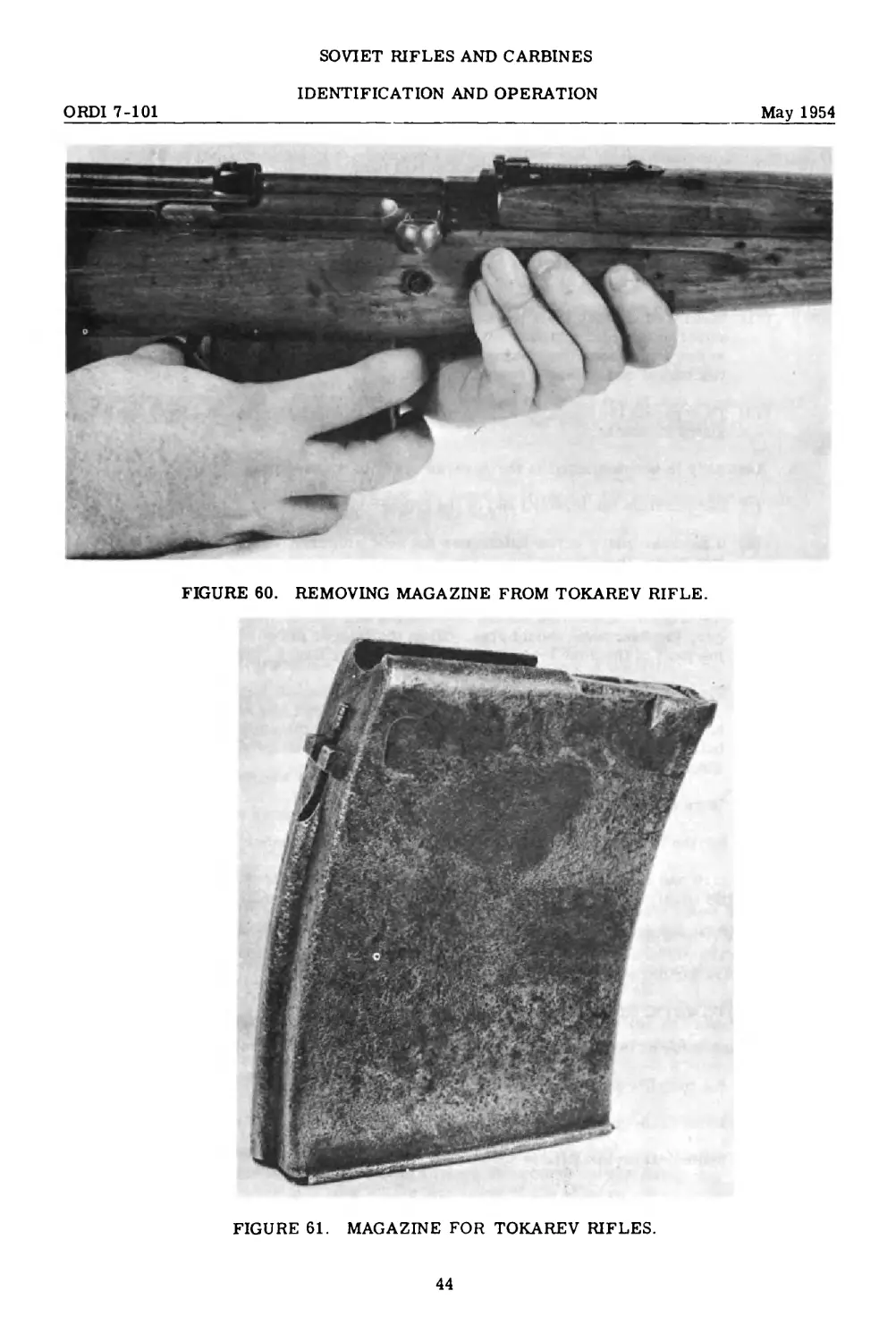
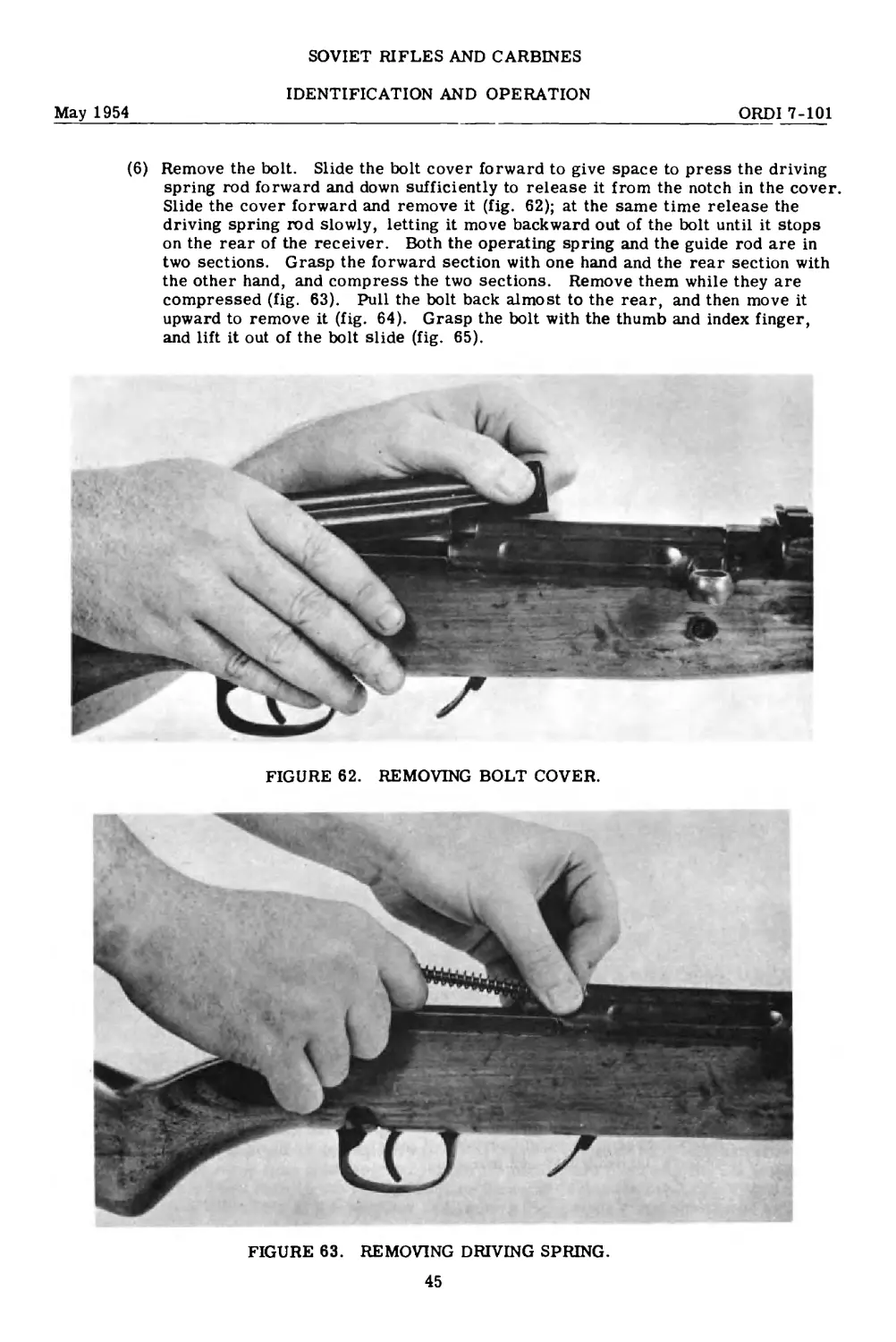
(2)	Remove the magazine (figs. 60 and 61).
(3)	Make certain the rifle is not loaded.
(4)	Remove the bayonet.
(5)	Remove the cleaning rod.
43
SOVIET RIFLES AND CARBINES
IDENTIFICATION AND OPERATION
ORDI 7-101
May 1954
FIGURE 60. REMOVING MAGAZINE FROM TOKAREV RIFLE.
FIGURE 61. MAGAZINE FOR TOKAREV RIFLES.
44
SOVIET RIFLES AND CARBINES
IDENTIFICATION AND OPERATION
May 1954
ORDI 7-101
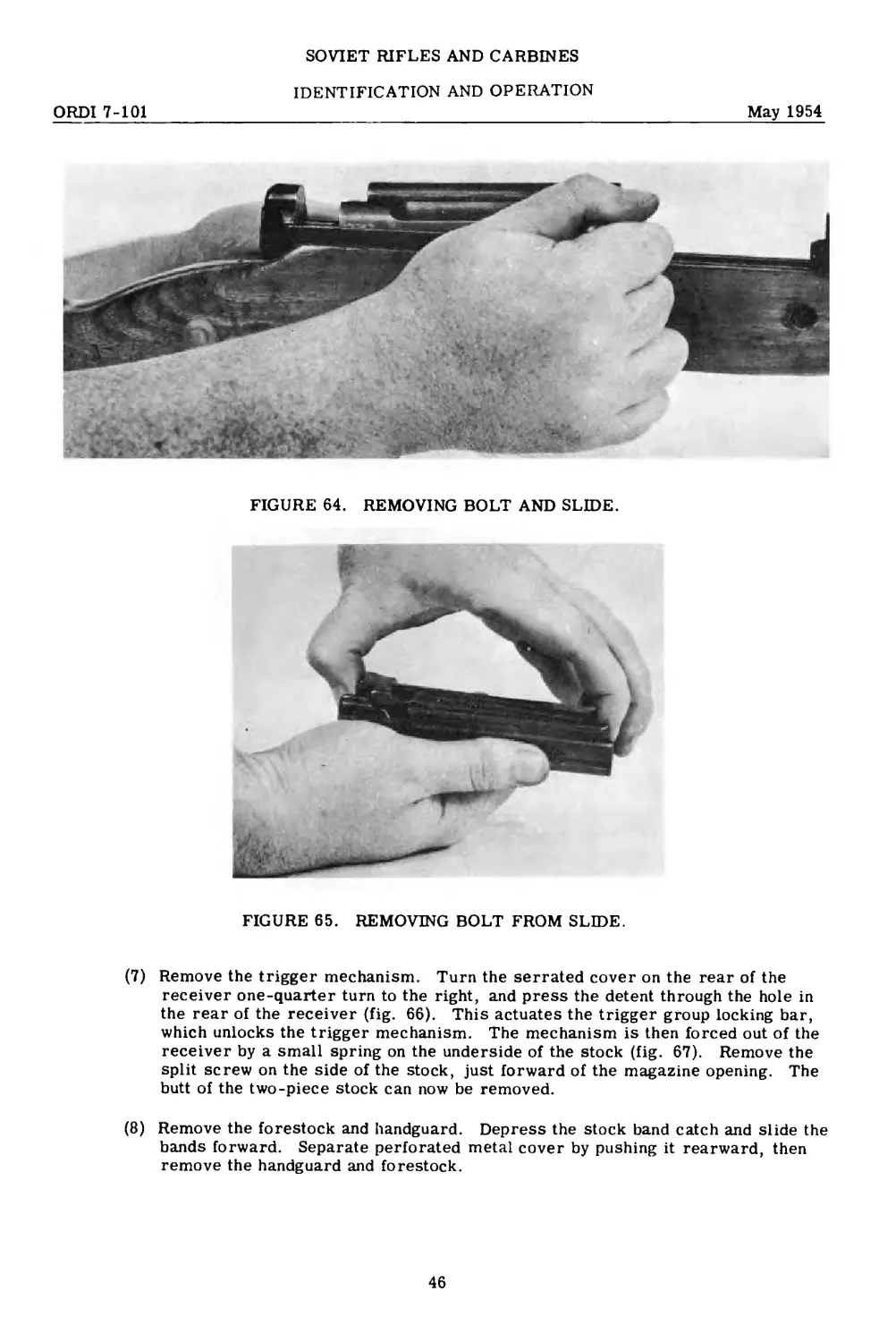
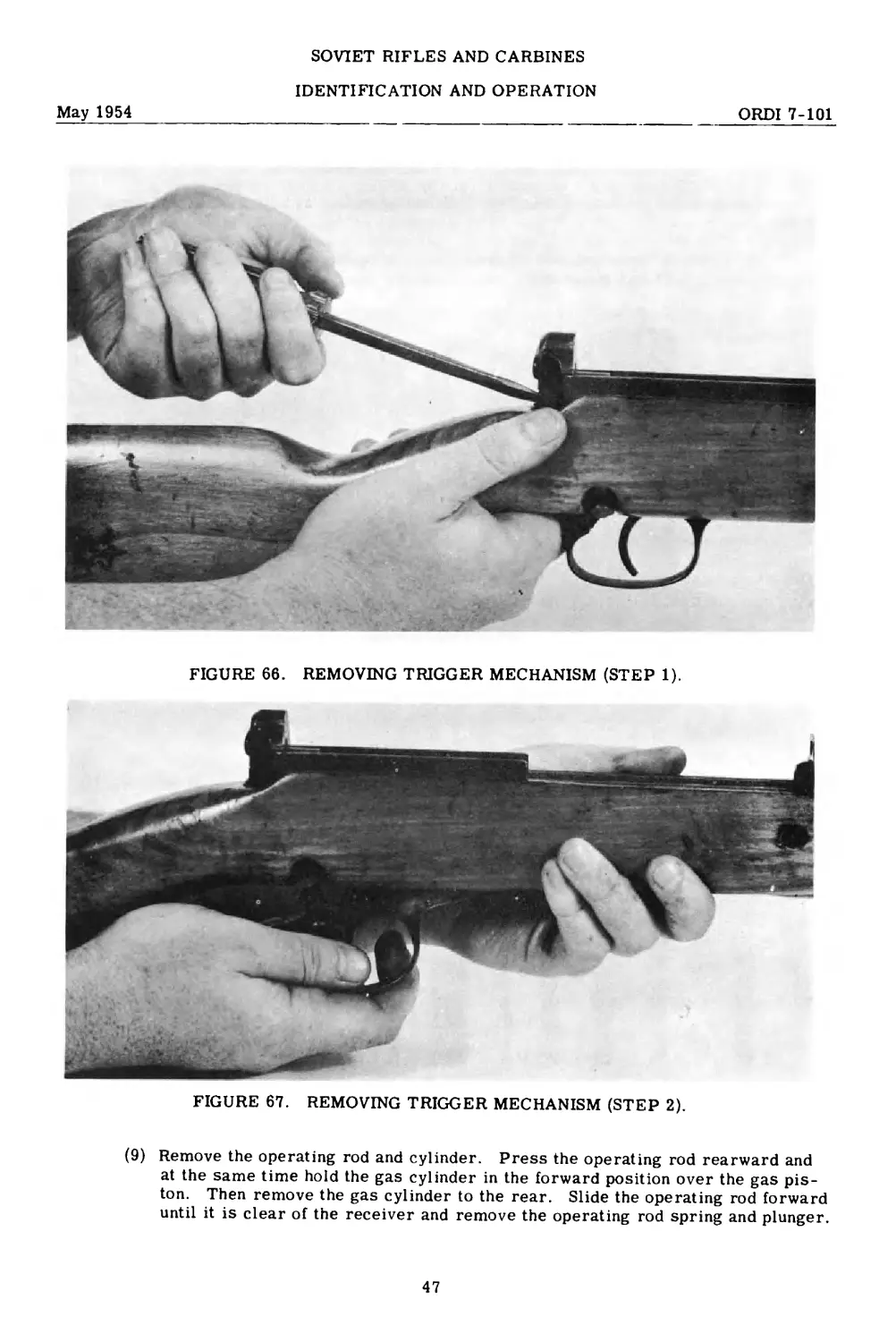
(6)	Remove the bolt. Slide the bolt cover forward to give space to press the driving
spring rod forward and down sufficiently to release it from the notch in the cover.
Slide the cover forward and remove it (fig. 62); at the same time release the
driving spring rod slowly, letting it move backward out of the bolt until it stops
on the rear of the receiver. Both the operating spring and the guide rod are in
two sections. Grasp the forward section with one hand and the rear section with
the other hand, and compress the two sections. Remove them while they are
compressed (fig. 63). Pull the bolt back almost to the rear, and then move it
upward to remove it (fig. 64). Grasp the bolt with the thumb and index finger,
and lift it out of the bolt slide (fig. 65).
FIGURE 62. REMOVING BOLT COVER.
FIGURE 63. REMOVING DRIVING SPRING.
45
SOVIET RIFLES AND CARBINES
IDENTIFICATION AND OPERATION
ORDI 7-101
May 1954
FIGURE 64. REMOVING BOLT AND SLIDE.
FIGURE 65. REMOVING BOLT FROM SLIDE.
(7)	Remove the trigger mechanism. Turn the serrated cover on the rear of the
receiver one-quarter turn to the right, and press the detent through the hole in
the rear of the receiver (fig. 66). This actuates the trigger group locking bar,
which unlocks the trigger mechanism. The mechanism is then forced out of the
receiver by a small spring on the underside of the stock (fig. 67). Remove the
split screw on the side of the stock, just forward of the magazine opening. The
butt of the two-piece stock can now be removed.
(8)	Remove the forestock and handguard. Depress the stock band catch and slide the
bands forward. Separate perforated metal cover by pushing it rearward, then
remove the handguard and forestock.
46
SOVIET RIFLES AND CARBINES
May 1954
IDENTIFICATION AND OPERATION
ORDI 7-101
FIGURE 66. REMOVING TRIGGER MECHANISM (STEP 1).
FIGURE 67. REMOVING TRIGGER MECHANISM (STEP 2).
(9)	Remove the operating rod and cylinder. Press the operating rod rearward and
at the same time hold the gas cylinder in the forward position over the gas pis-
ton. Then remove the gas cylinder to the rear. Slide the operating rod forward
until it is clear of the receiver and remove the operating rod spring and plunger.
47
SOVIET RIFLES AND CARBINES
IDENTIFICATION AND OPERATION
ORDI 7-101
May 1954
b.	This rifle is assembled in the reverse order of disassembly.
c.	The care and cleaning of this rifle is the same as that required for United States
rifles.
d.	Each rifle is furnished with a full-length cleaning rod which is fitted in the stock. An
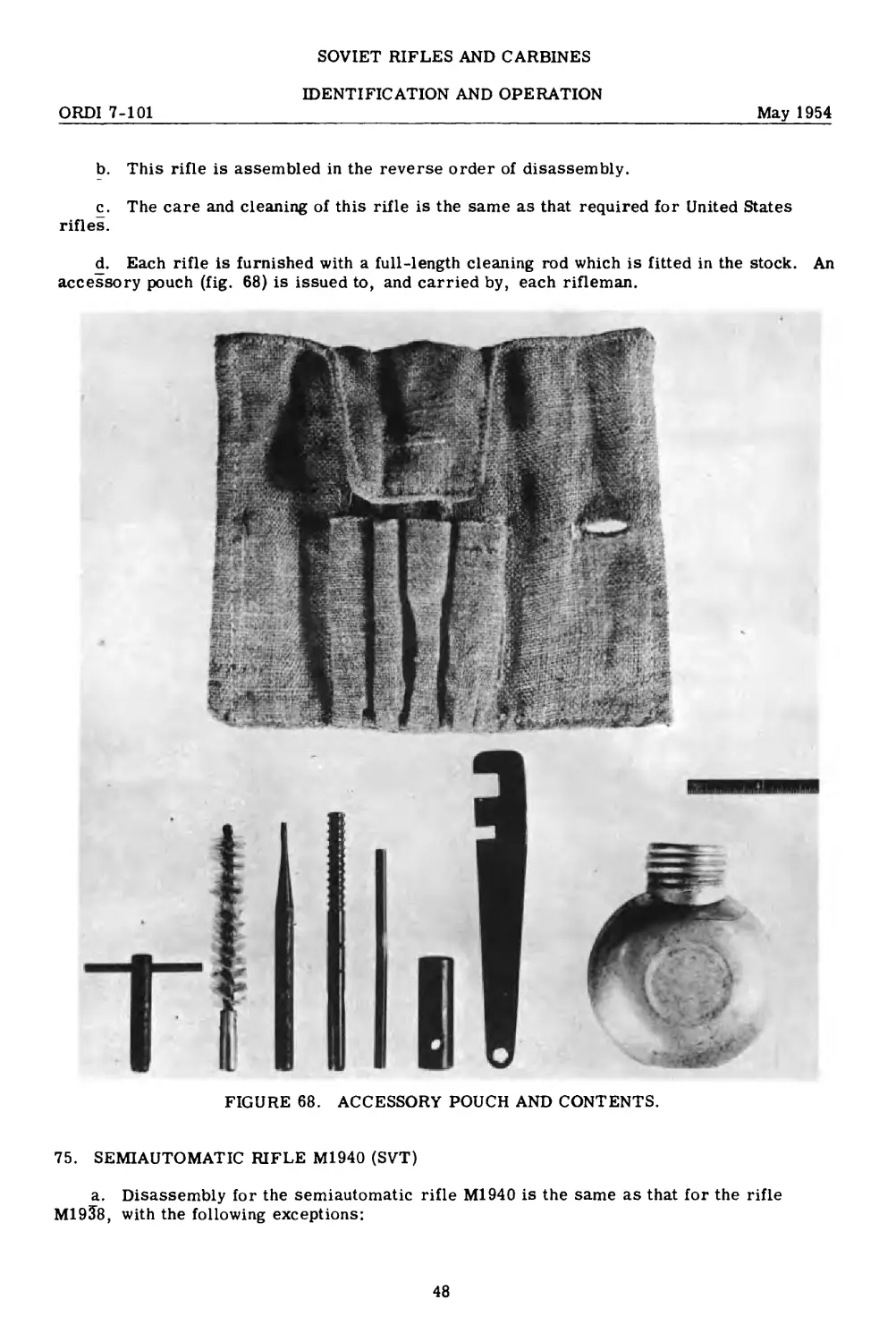
accessory pouch (fig. 68) is issued to, and carried by, each rifleman.
FIGURE 68. ACCESSORY POUCH AND CONTENTS.
75.	SEMIAUTOMATIC RIFLE M1940 (SVT)
a.	Disassembly for the semiautomatic rifle Ml940 is the same as that for the rifle
M1938, with the following exceptions:
48
SOVIET RIFLES AND CARBINES
IDENTIFICATION AND OPERATION
May 1954
ORDI 7-101
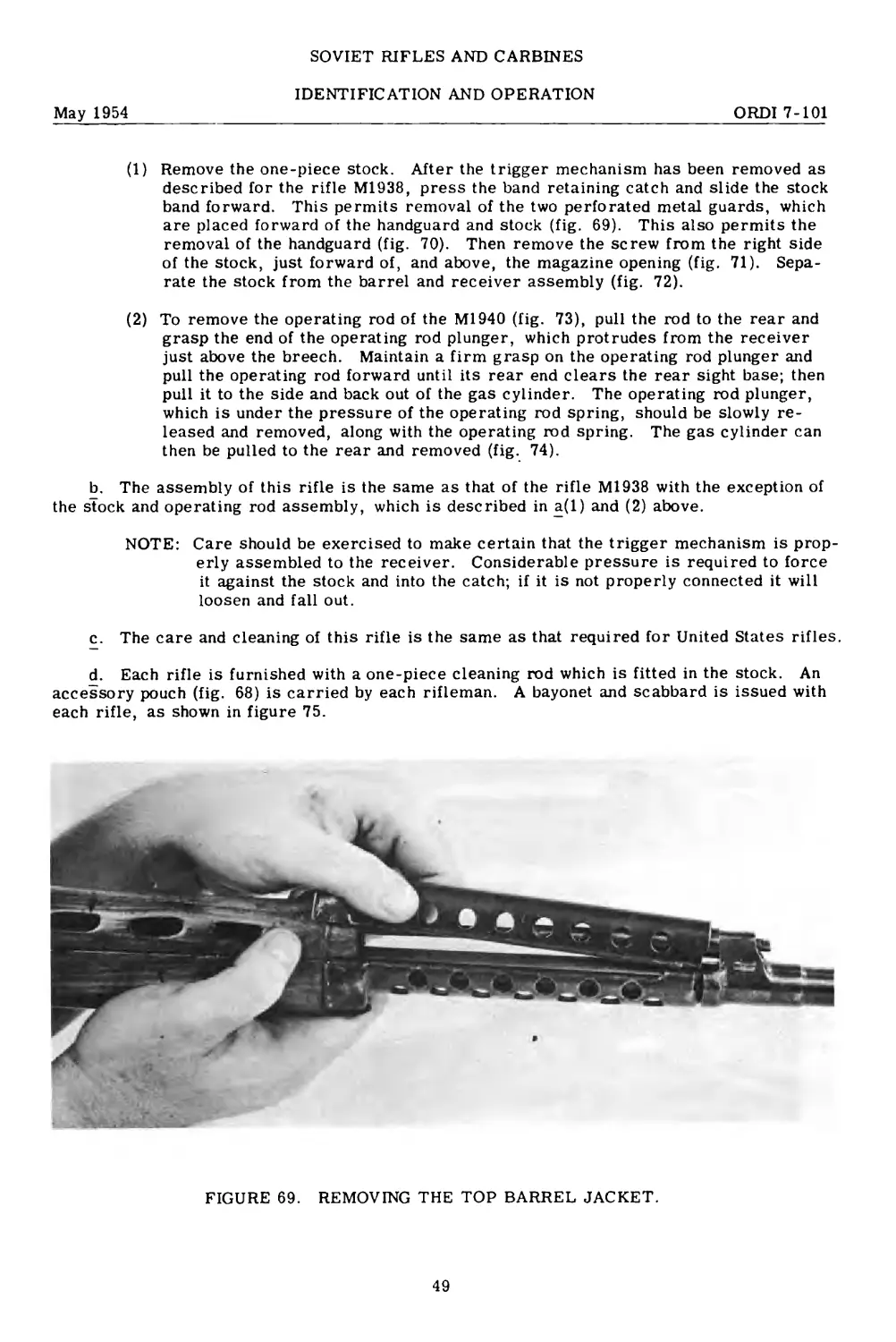
(1)	Remove the one-piece stock. After the trigger mechanism has been removed as
described for the rifle M1938, press the band retaining catch and slide the stock
band forward. This permits removal of the two perforated metal guards, which
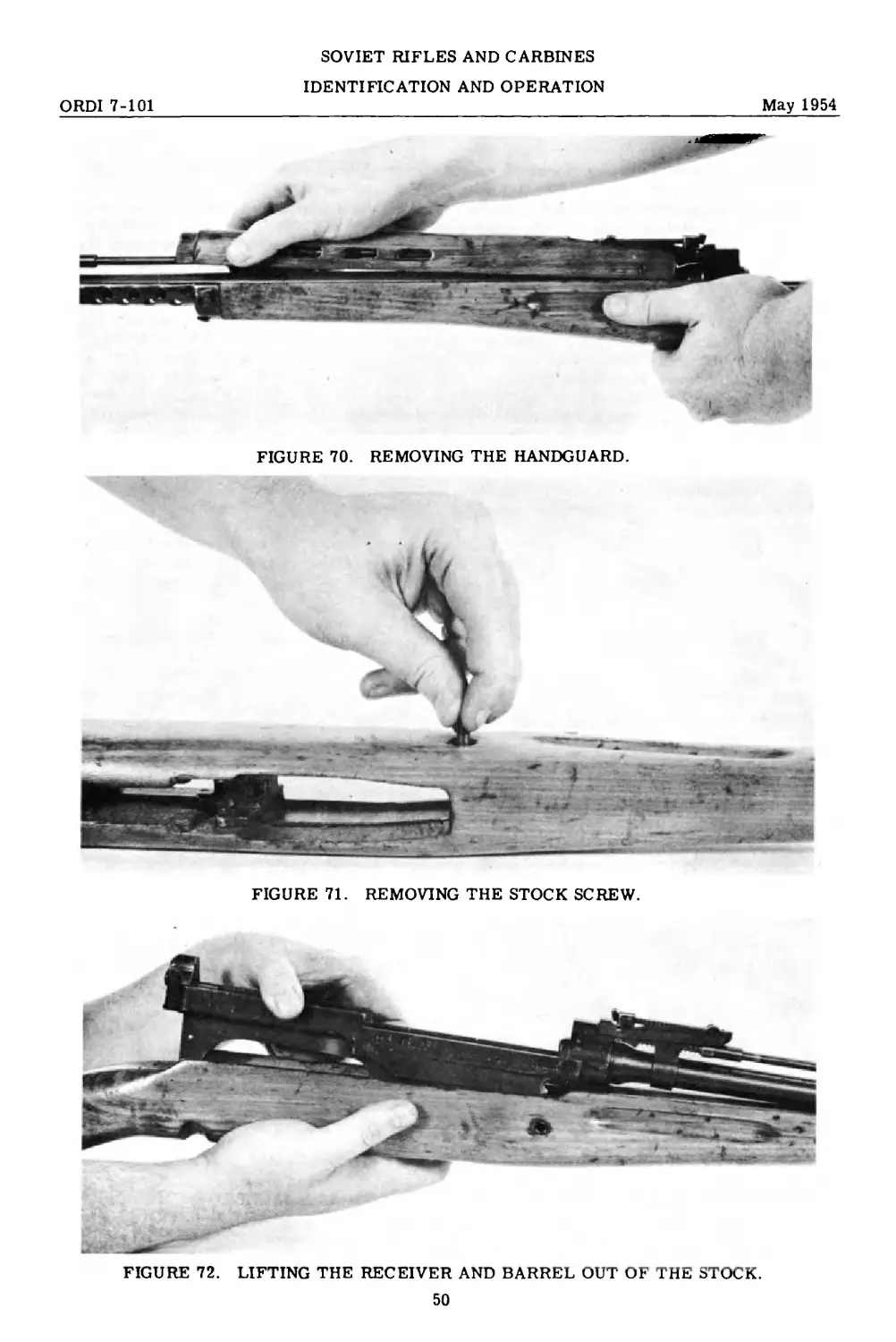
are placed forward of the handguard and stock (fig. 69). This also permits the
removal of the handguard (fig. 70). Then remove the screw from the right side
of the stock, just forward of, and above, the magazine opening (fig. 71). Sepa-
rate the stock from the barrel and receiver assembly (fig. 72).
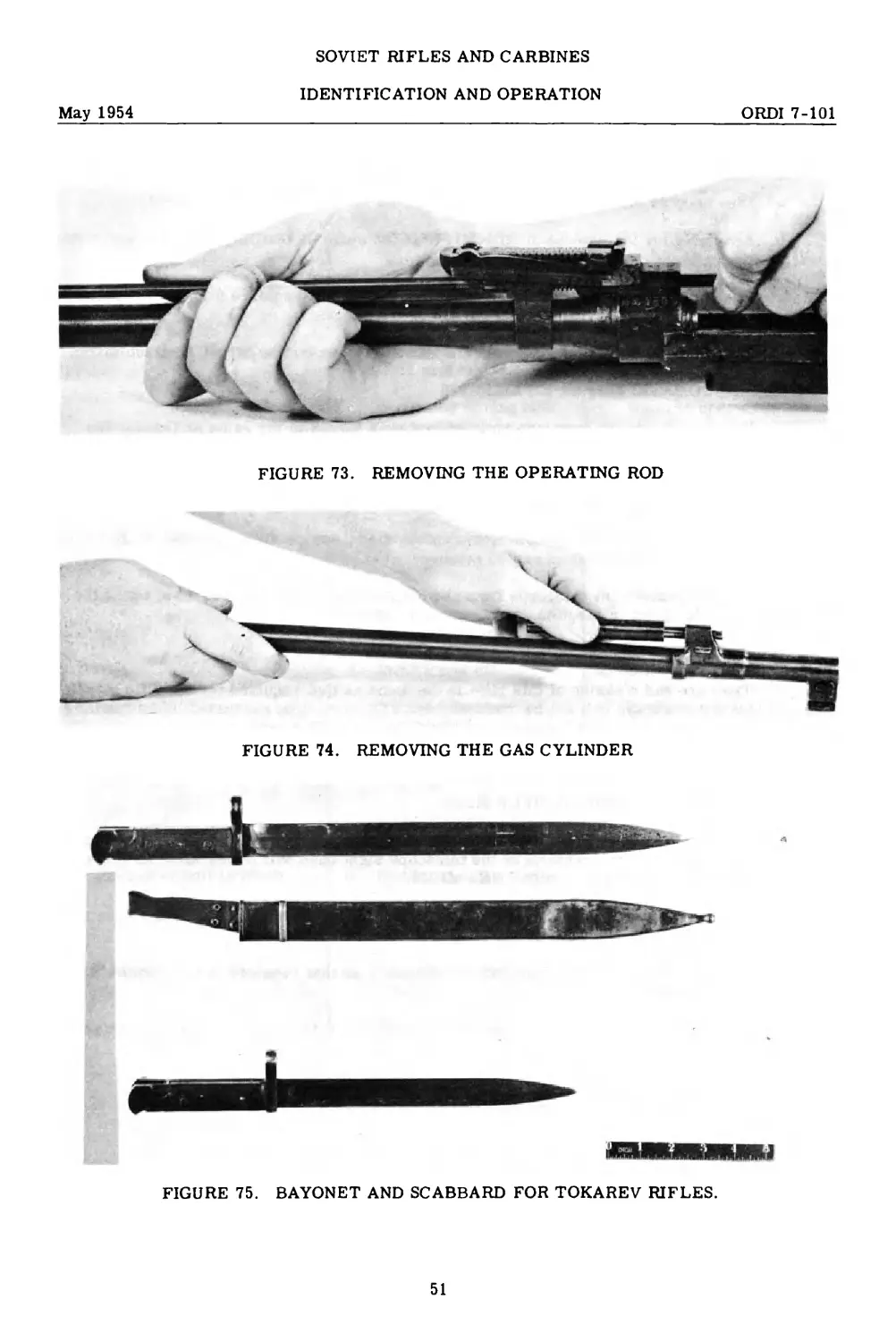
(2)	To remove the operating rod of the Ml940 (fig. 73), pull the rod to the rear and
grasp the end of the operating rod plunger, which protrudes from the receiver
just above the breech. Maintain a firm grasp on the operating rod plunger and
pull the operating rod forward until its rear end clears the rear sight base; then
pull it to the side and back out of the gas cylinder. The operating rod plunger,
which is under the pressure of the operating rod spring, should be slowly re-
leased and removed, along with the operating rod spring. The gas cylinder can
then be pulled to the rear and removed (fig. 74).
b.	The assembly of this rifle is the same as that of the rifle M1938 with the exception of
the slock and operating rod assembly, which is described in a(l) and (2) above.
NOTE: Care should be exercised to make certain that the trigger mechanism is prop-
erly assembled to the receiver. Considerable pressure is required to force
it against the stock and into the catch; if it is not properly connected it will
loosen and fall out.
c.	The care and cleaning of this rifle is the same as that required for United States rifles.
d.	Each rifle is furnished with a one-piece cleaning rod which is fitted in the stock. An
accessory pouch (fig. 68) is carried by each rifleman. A bayonet and scabbard is issued with
each rifle, as shown in figure 75.
FIGURE 69. REMOVING THE TOP BARREL JACKET.
49
SOVIET RIFLES AND CARBINES
IDENTIFICATION AND OPERATION
ORDI 7-101 May 1954
FIGURE 70. REMOVING THE HANDGUARD.
FIGURE 71. REMOVING THE STOCK SCREW.
FIGURE 72. LIFTING THE RECEIVER AND BARREL OUT OF THE STOCK.
50
SOVIET RIFLES AND CARBINES
IDENTIFICATION AND OPERATION
May 1954
ORDI 7-101
FIGURE 73. REMOVING THE OPERATING ROD
FIGURE 74. REMOVING THE GAS CYLINDER
FIGURE 75. BAYONET AND SCABBARD FOR TOKAREV RIFLES.
51
SOVIET RIFLES AND CARBINES
IDENTIFICATION AND OPERATION
ORDI 7-101 May 1954
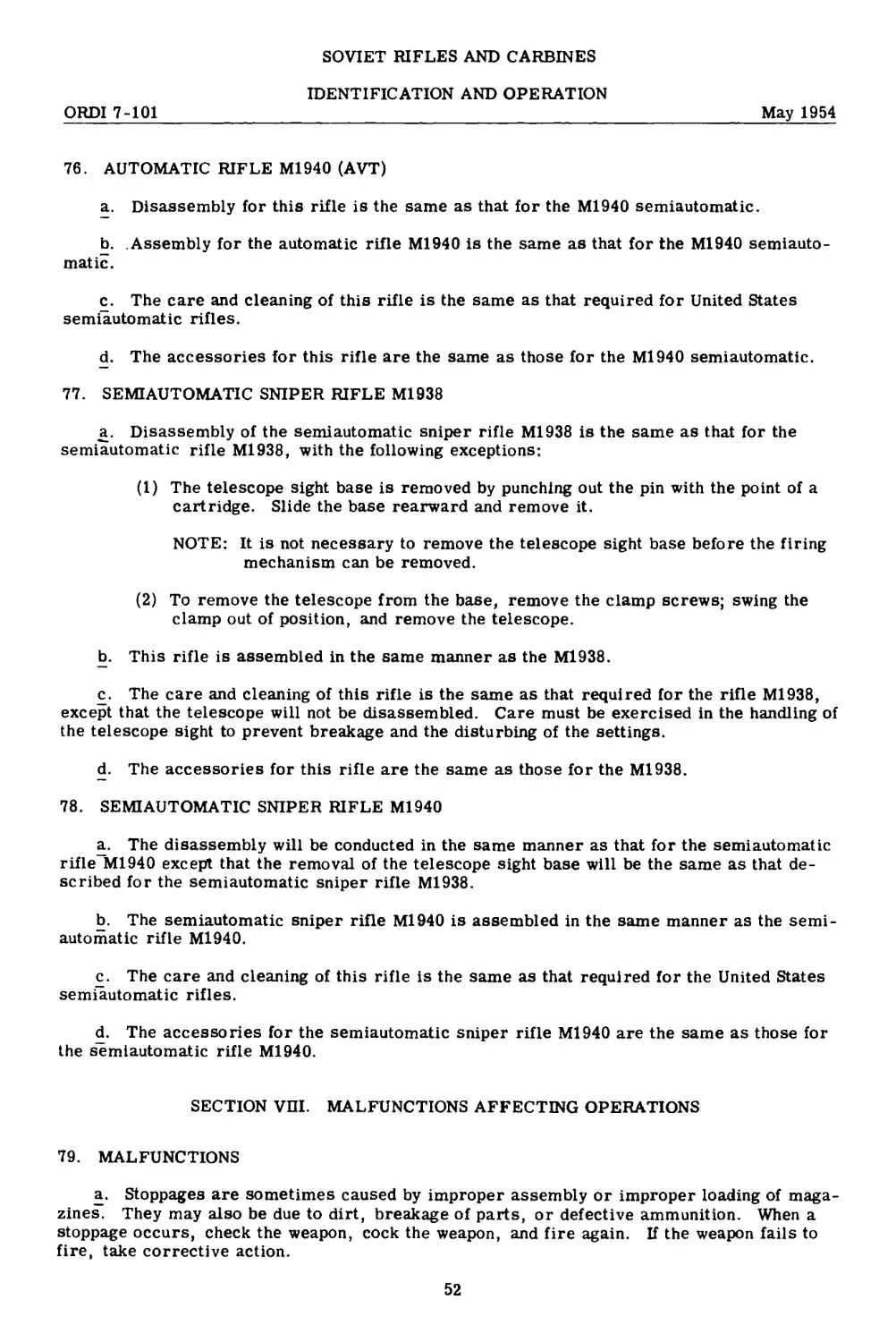
76.	AUTOMATIC RIFLE M1940 (AVT)
a.	Disassembly for this rifle is the same as that for the M1940 semiautomatic.
b.	Assembly for the automatic rifle Ml940 is the same as that for the Ml940 semiauto-
matic.
c.	The care and cleaning of this rifle is the same as that required for United States
semiautomatic rifles.
d.	The accessories for this rifle are the same as those for the Ml940 semiautomatic.
77.	SEMIAUTOMATIC SNIPER RIFLE M1938
a.	Disassembly of the semiautomatic sniper rifle Ml938 is the same as that for the
semiautomatic rifle M1938, with the following exceptions:
(1)	The telescope sight base is removed by punching out the pin with the point of a
cartridge. Slide the base rearward and remove it.
NOTE: It is not necessary to remove the telescope sight base before the firing
mechanism can be removed.
(2)	To remove the telescope from the base, remove the clamp screws; swing the
clamp out of position, and remove the telescope.
b.	This rifle is assembled in the same manner as the M1938.
c.	The care and cleaning of this rifle is the same as that required for the rifle M1938,
except that the telescope will not be disassembled. Care must be exercised in the handling of
the telescope sight to prevent breakage and the disturbing of the settings.
d.	The accessories for this rifle are the same as those for the Ml938.
78.	SEMIAUTOMATIC SNIPER RIFLE M1940
a.	The disassembly will be conducted in the same manner as that for the semiautomatic
rifle M1940 except that the removal of the telescope sight base will be the same as that de-
scribed for the semiautomatic sniper rifle Ml938.
b.	The semiautomatic sniper rifle Ml940 is assembled in the same manner as the semi-
automatic rifle M1940.
c.	The care and cleaning of this rifle is the same as that required for the United States
semiautomatic rifles.
d.	The accessories for the semiautomatic sniper rifle Ml940 are the same as those for
the semiautomatic rifle M1940.
SECTION VHI. MALFUNCTIONS AFFECTING OPERATIONS
79.	MALFUNCTIONS
a.	Stoppages are sometimes caused by improper assembly or improper loading of maga-
zines. They may also be due to dirt, breakage of parts, or defective ammunition. When a
stoppage occurs, check the weapon, cock the weapon, and fire again. If the weapon fails to
fire, take corrective action.
52
SOVIET RIFLES AND CARBINES
IDENTIFICATION AND OPERATION
May 1954
ORDI 7-101
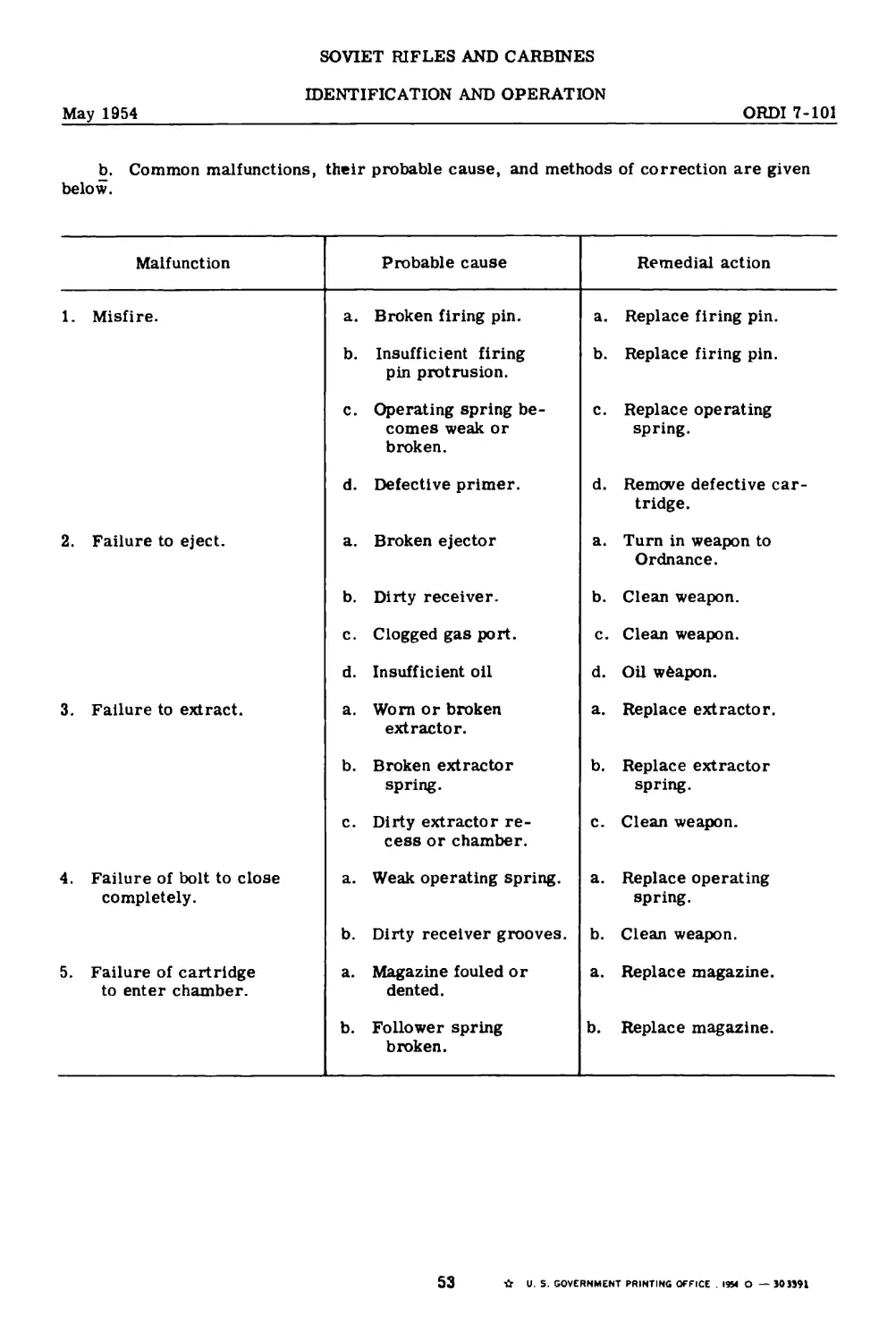
b.	Common malfunctions, their probable cause, and methods of correction are given
below.
Malfunction	Probable cause	Remedial action
1. Misfire.	a.	Broken firing pin. b.	Insufficient firing pin protrusion. c.	Operating spring be- comes weak or broken. d.	Defective primer.	a.	Replace firing pin. b.	Replace firing pin. c.	Replace operating spring. d.	Remove defective car- tridge.
2. Failure to eject.	a.	Broken ejector b.	Dirty receiver. c.	Clogged gas port. d.	Insufficient oil	a.	Turn in weapon to Ordnance. b.	Clean weapon. c.	Clean weapon. d.	Oil w6apon.
3. Failure to extract.	a.	Worn or broken extractor. b.	Broken extractor spring. c.	Dirty extractor re- cess or chamber.	a.	Replace extractor. b.	Replace extractor spring. c.	Clean weapon.
4. Failure of bolt to close completely.	a.	Weak operating spring. b.	Dirty receiver grooves.	a.	Replace operating spring. b.	Clean weapon.
5. Failure of cartridge to enter chamber.	a.	Magazine fouled or dented. b.	Follower spring broken.	a.	Replace magazine. b.	Replace magazine.
53
fr U. 5. GOVERNMENT PRINTING OFFICE . 1954 О — 301391