/



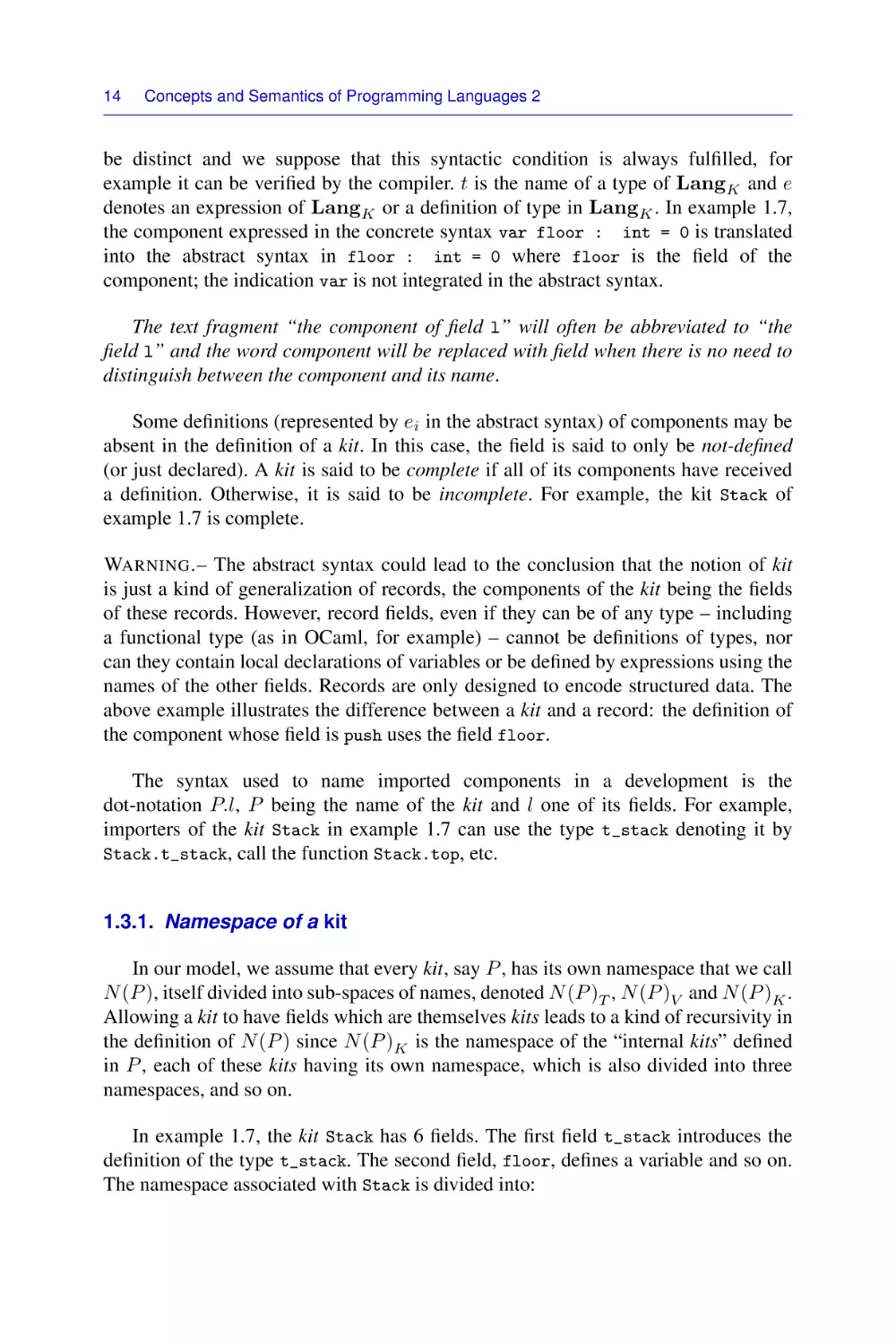
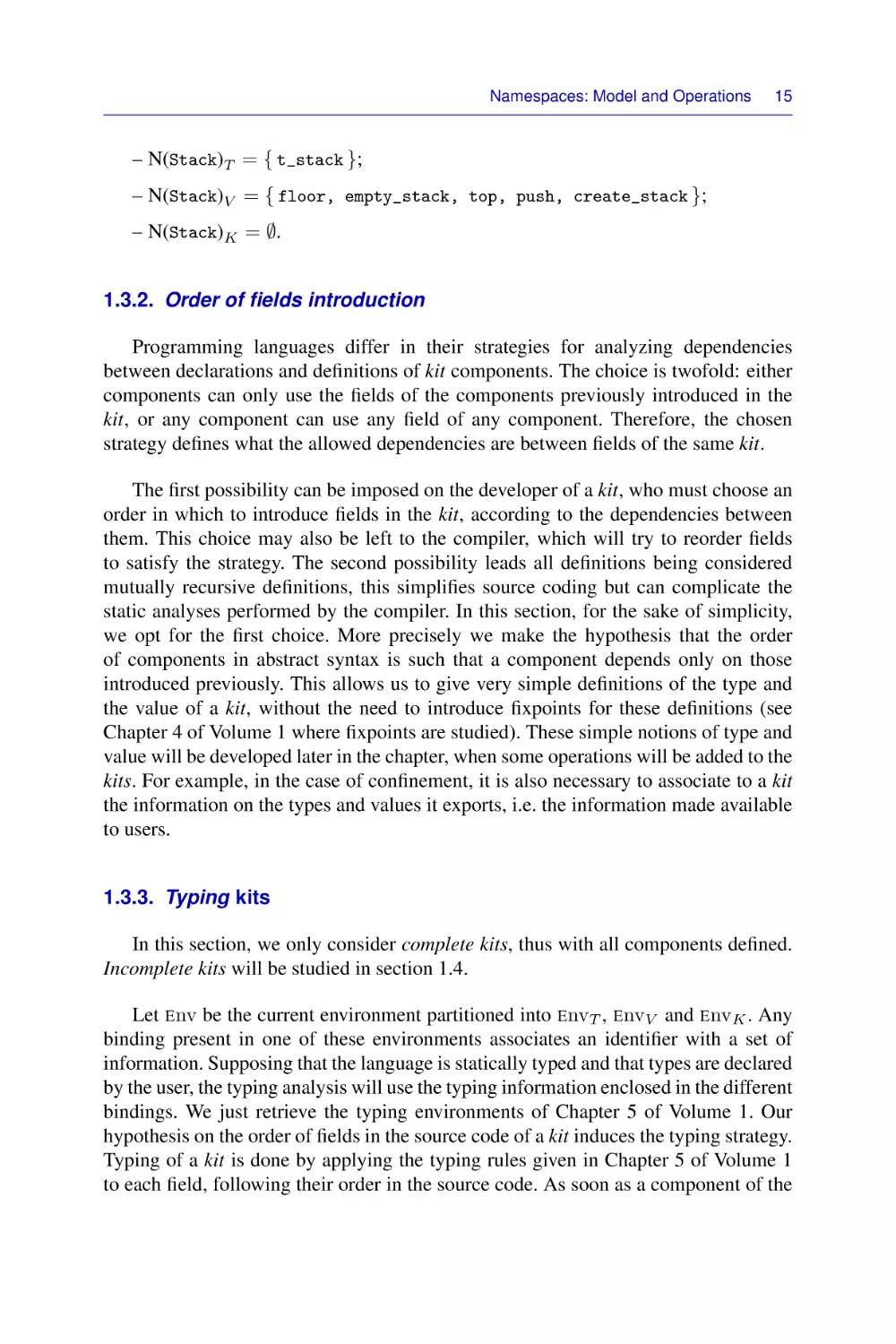
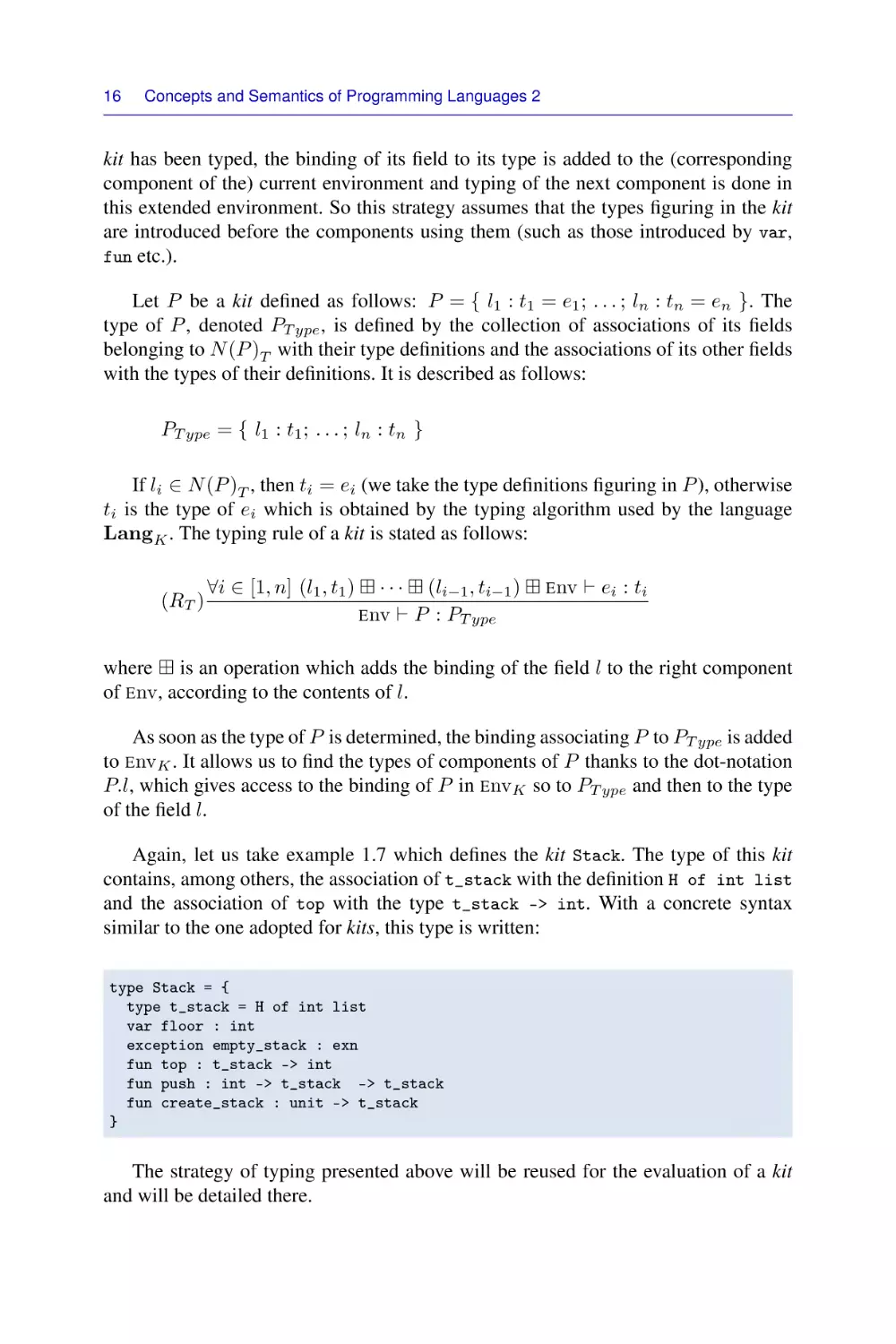
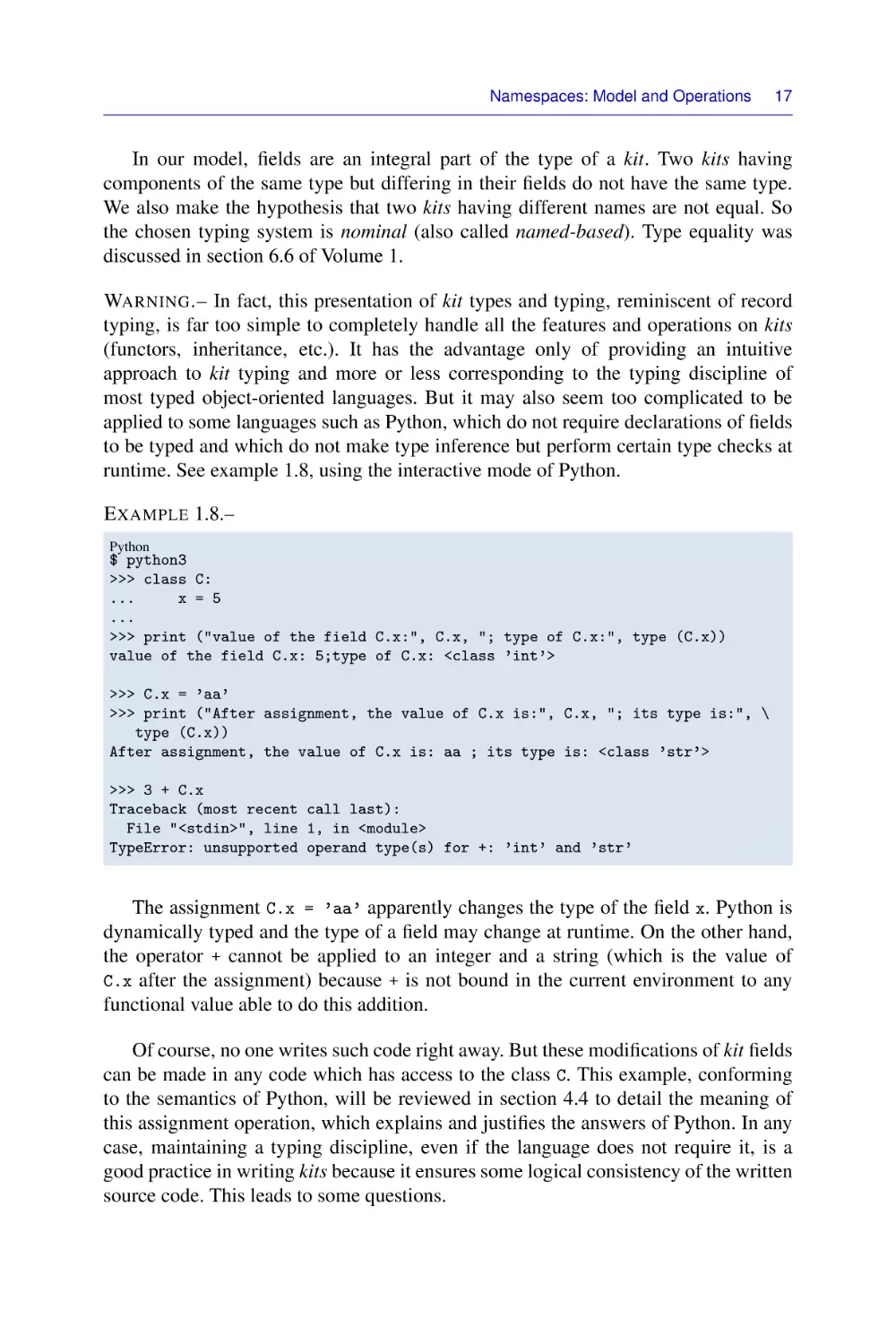
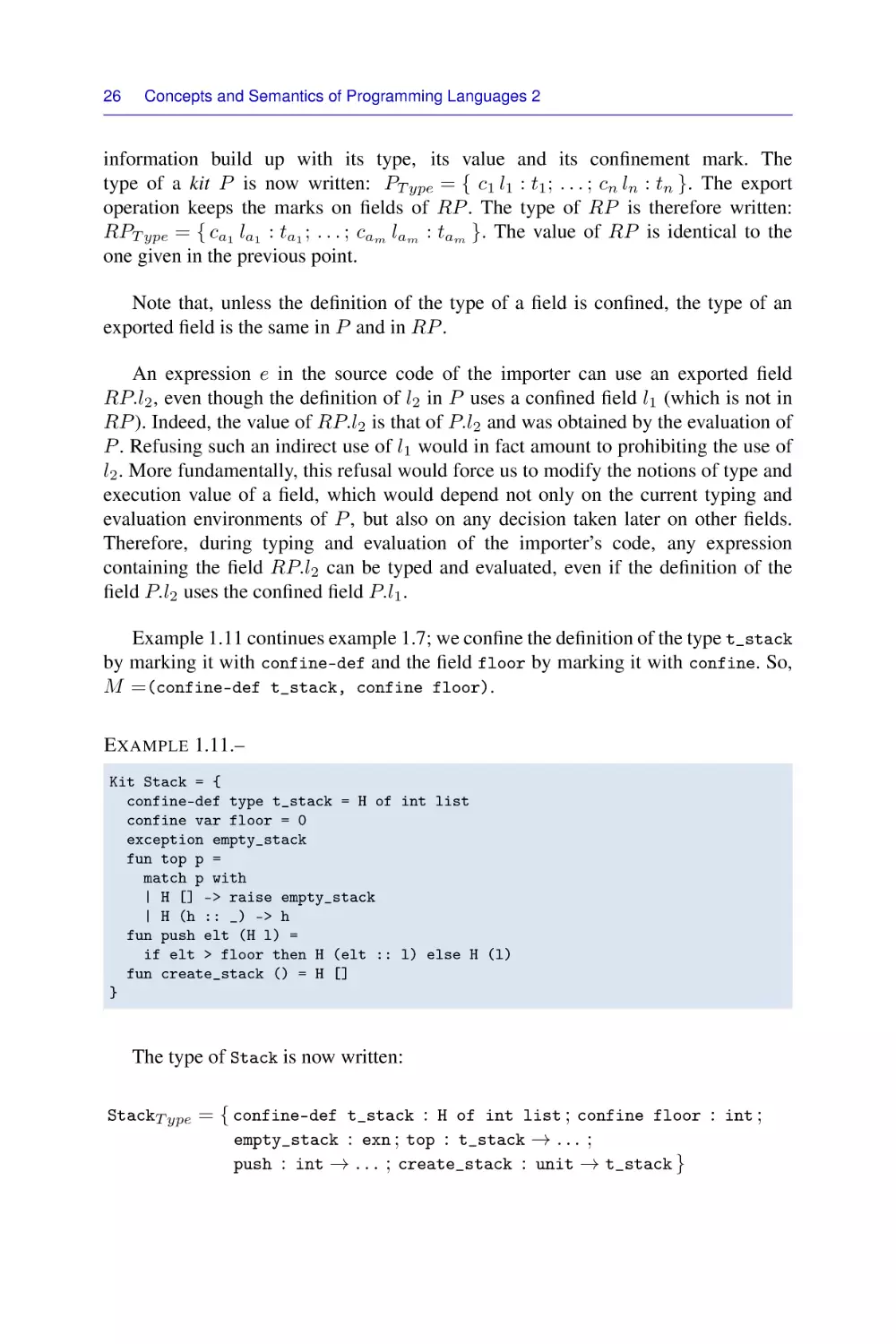
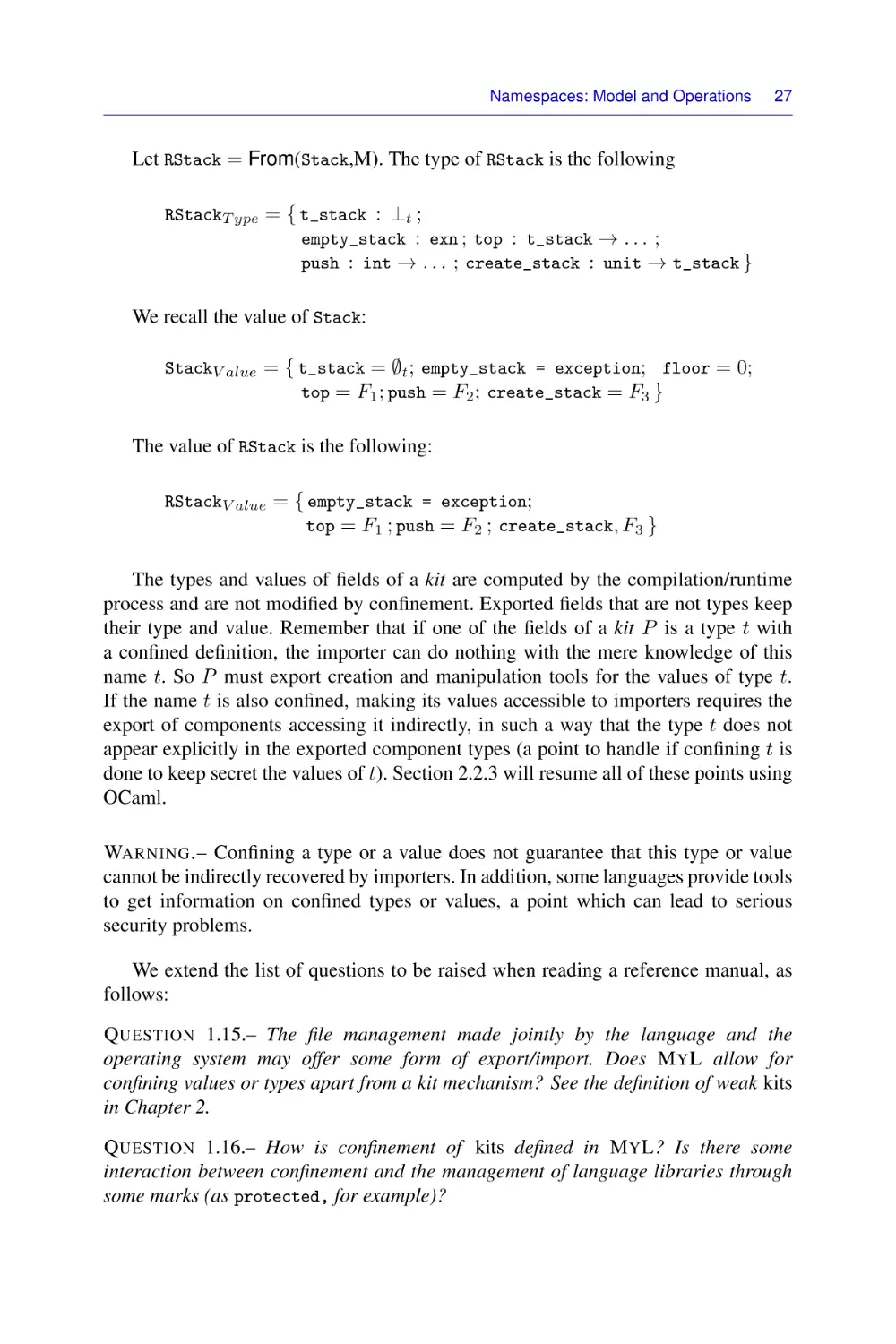
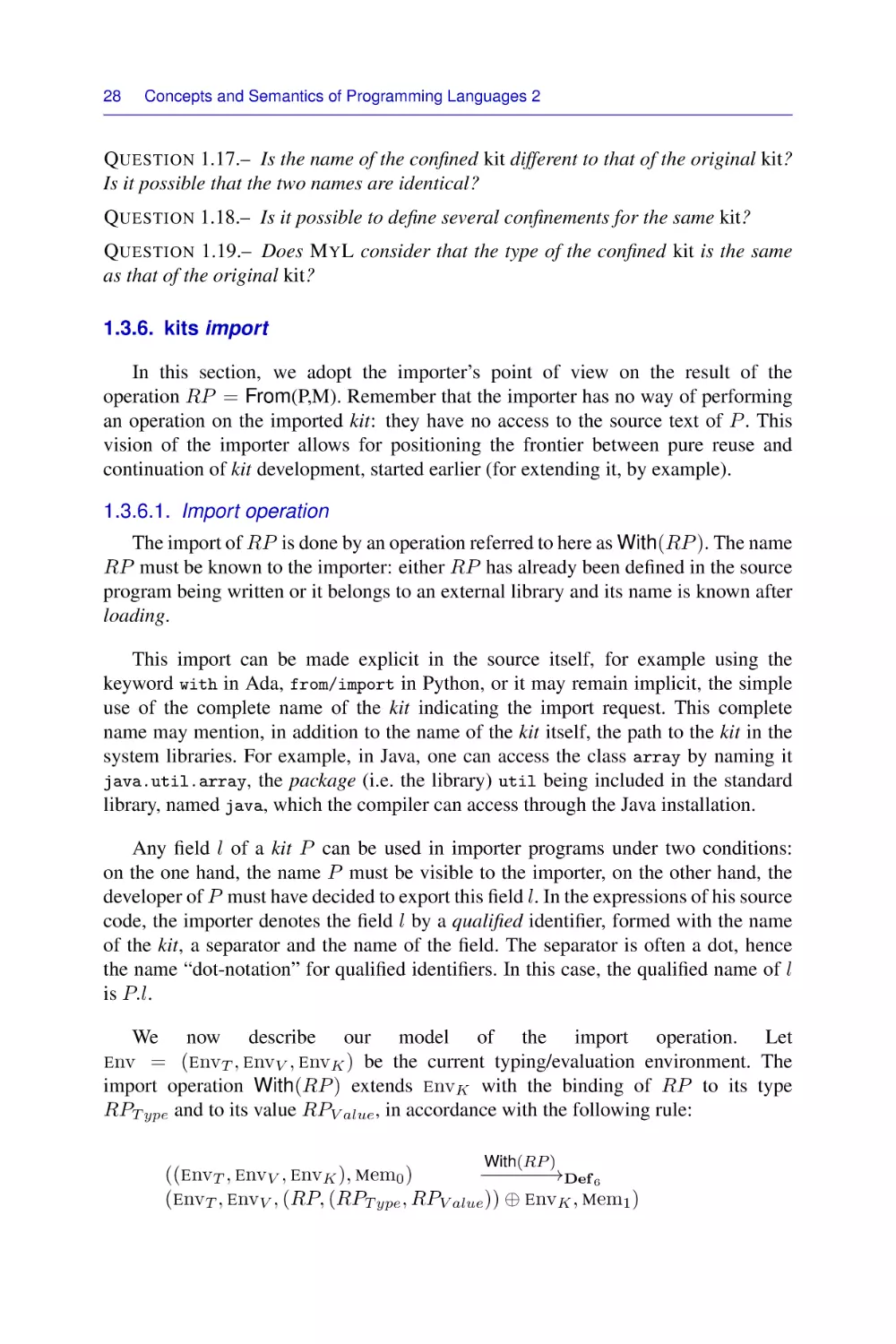
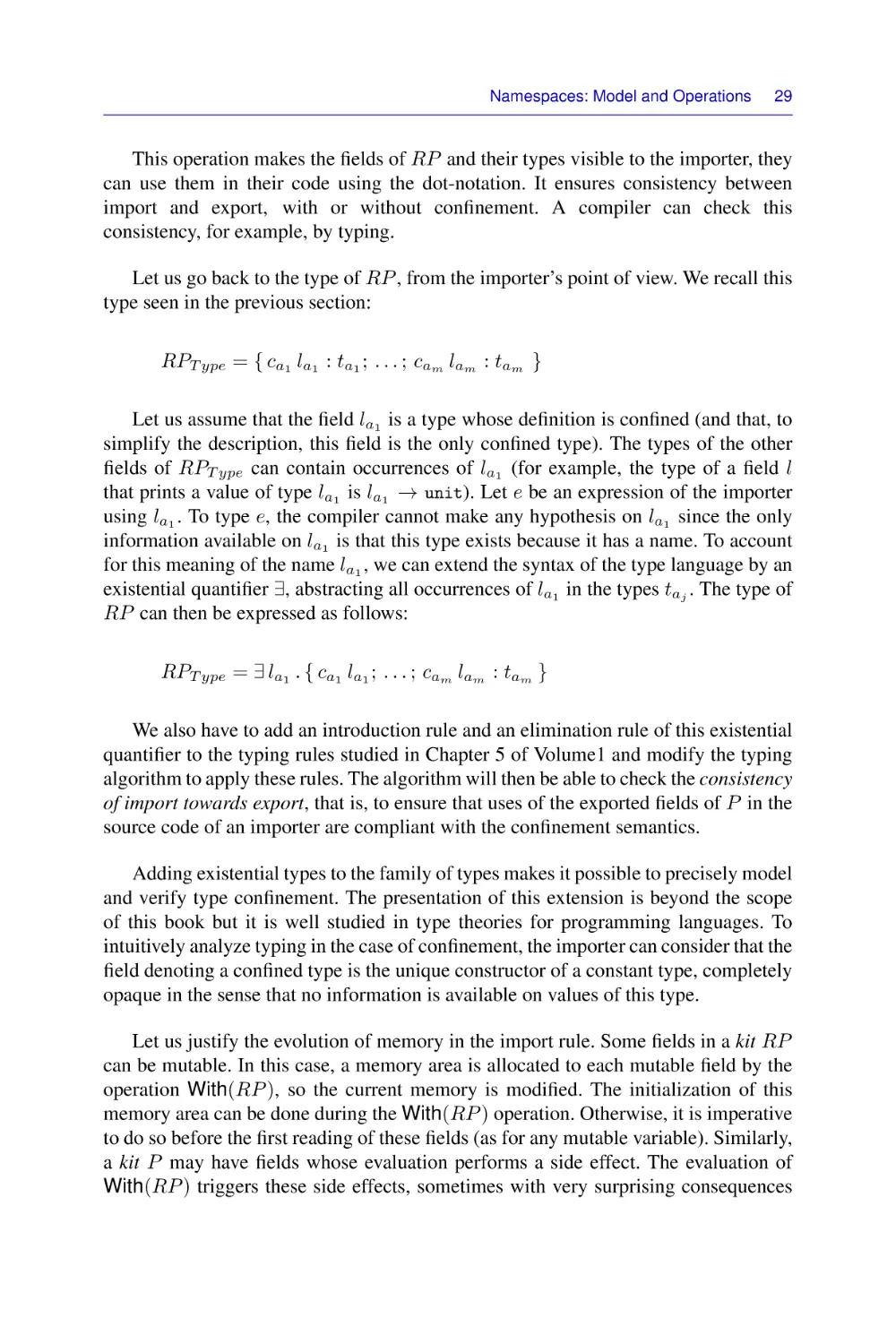
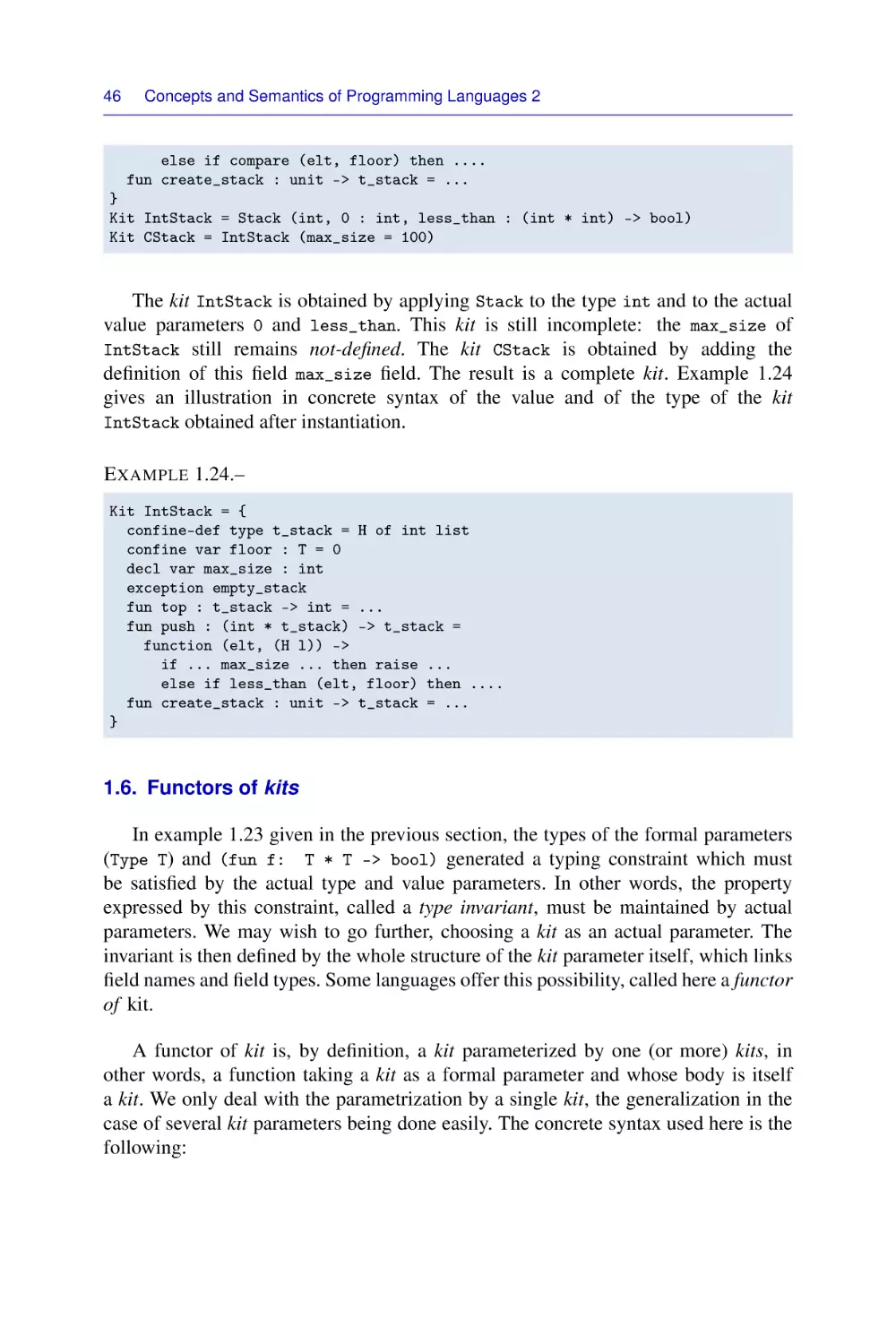
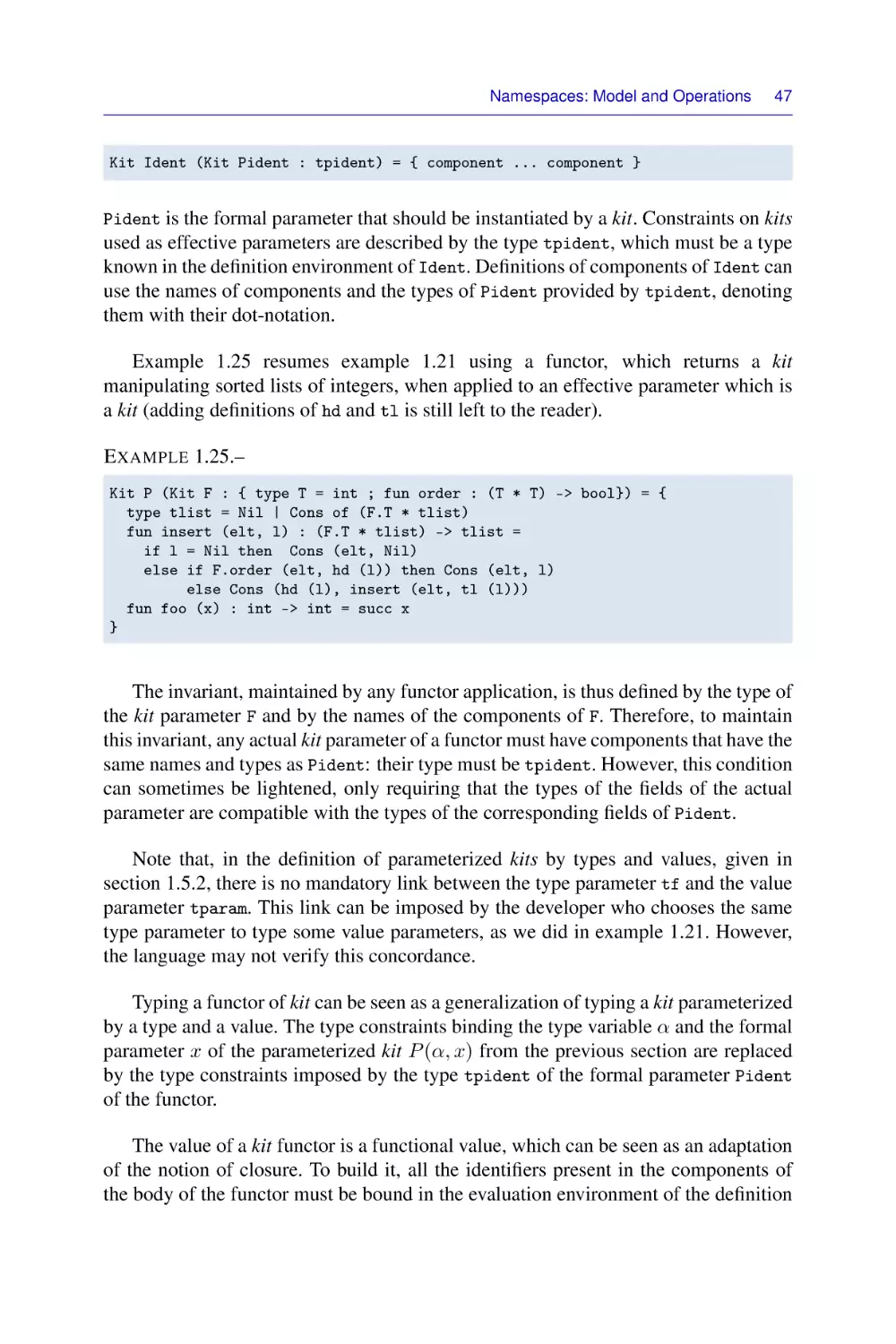
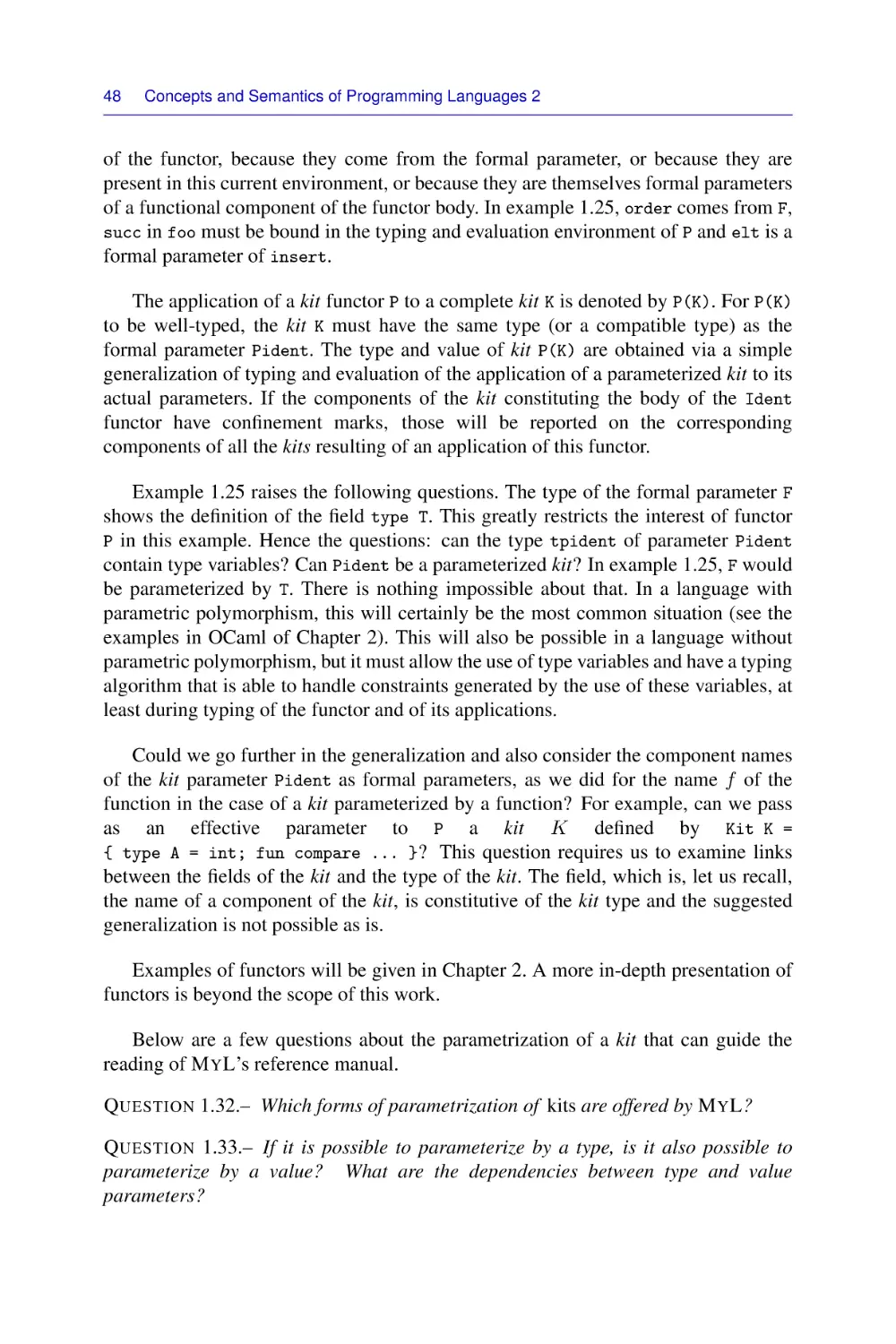
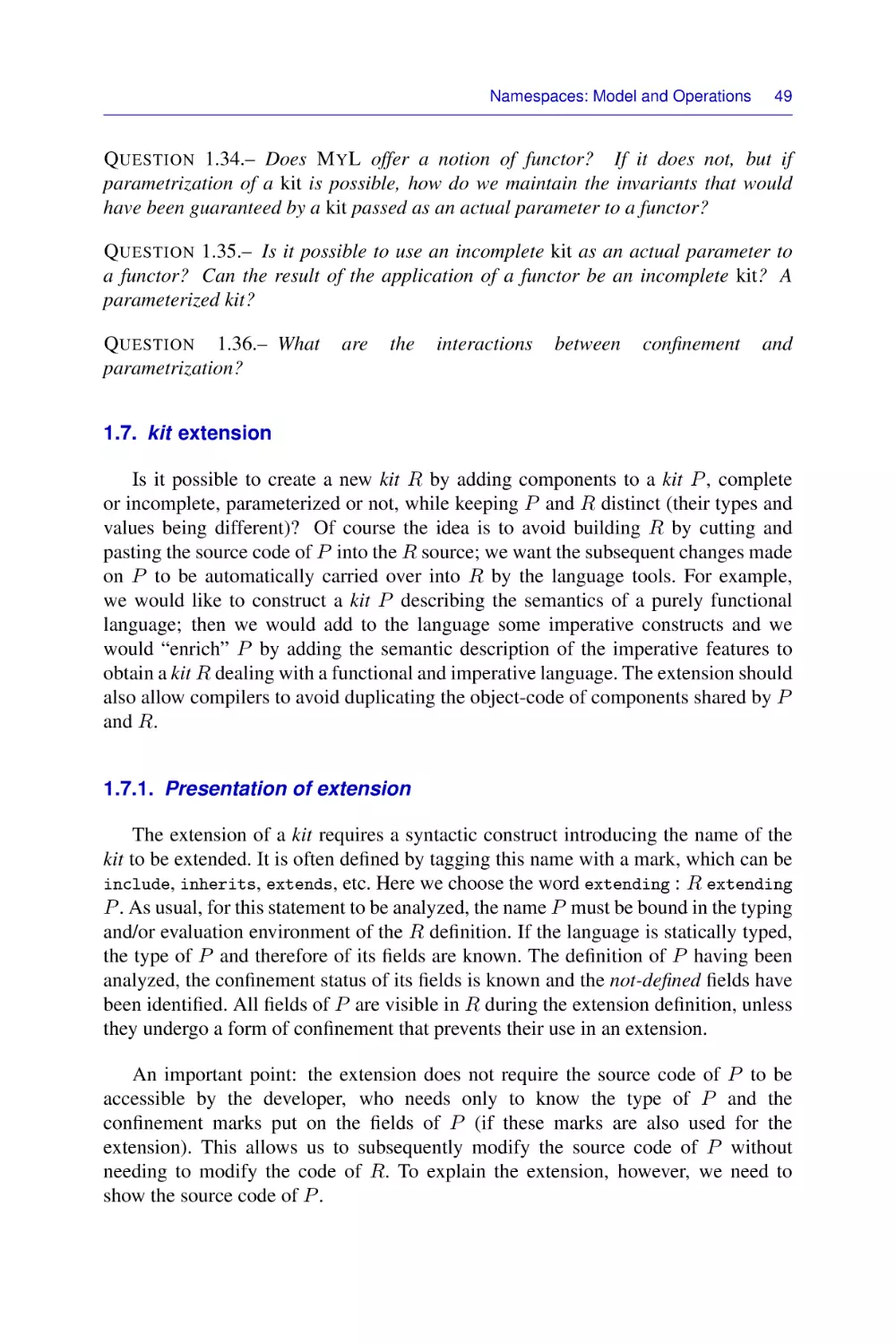
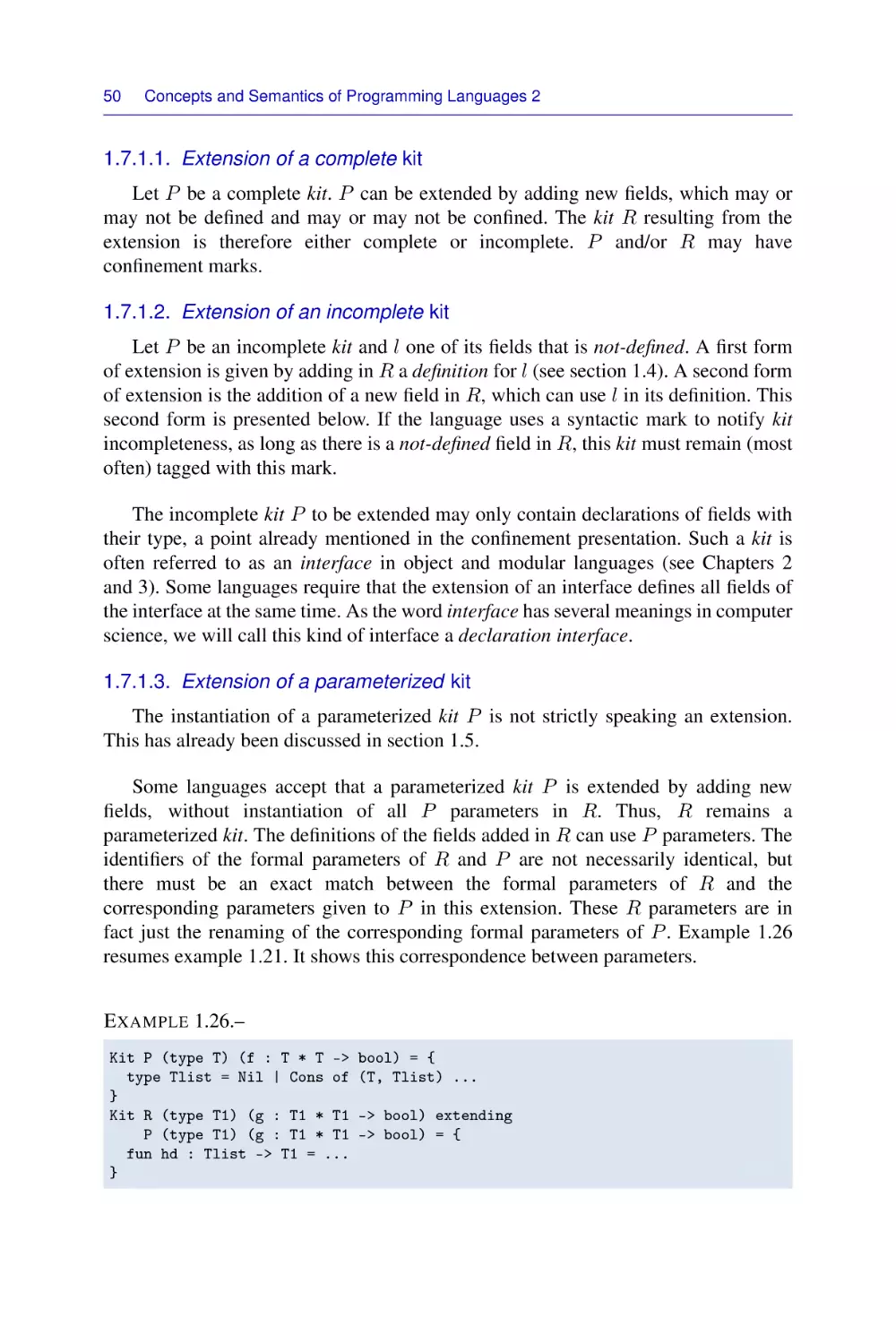
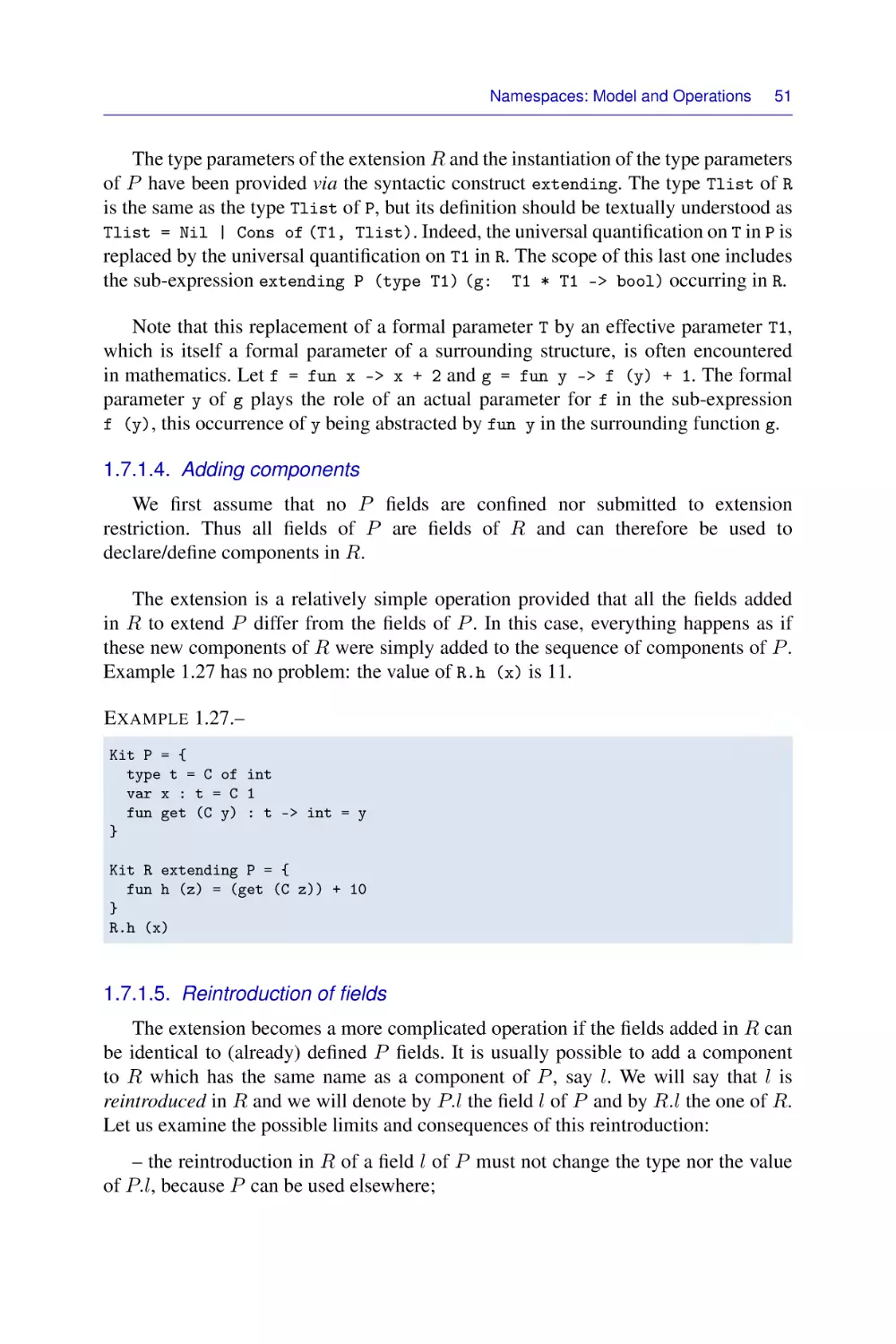
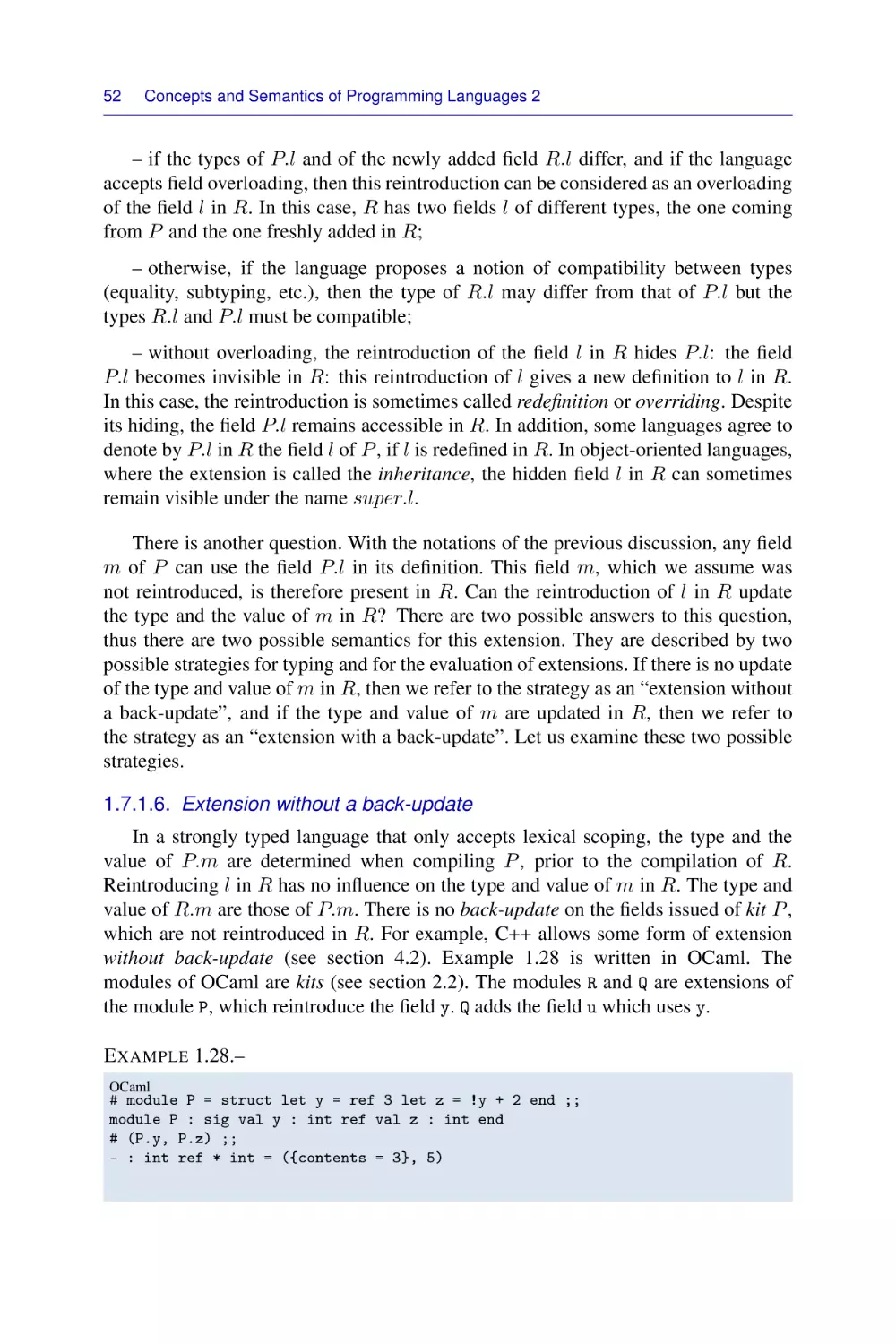
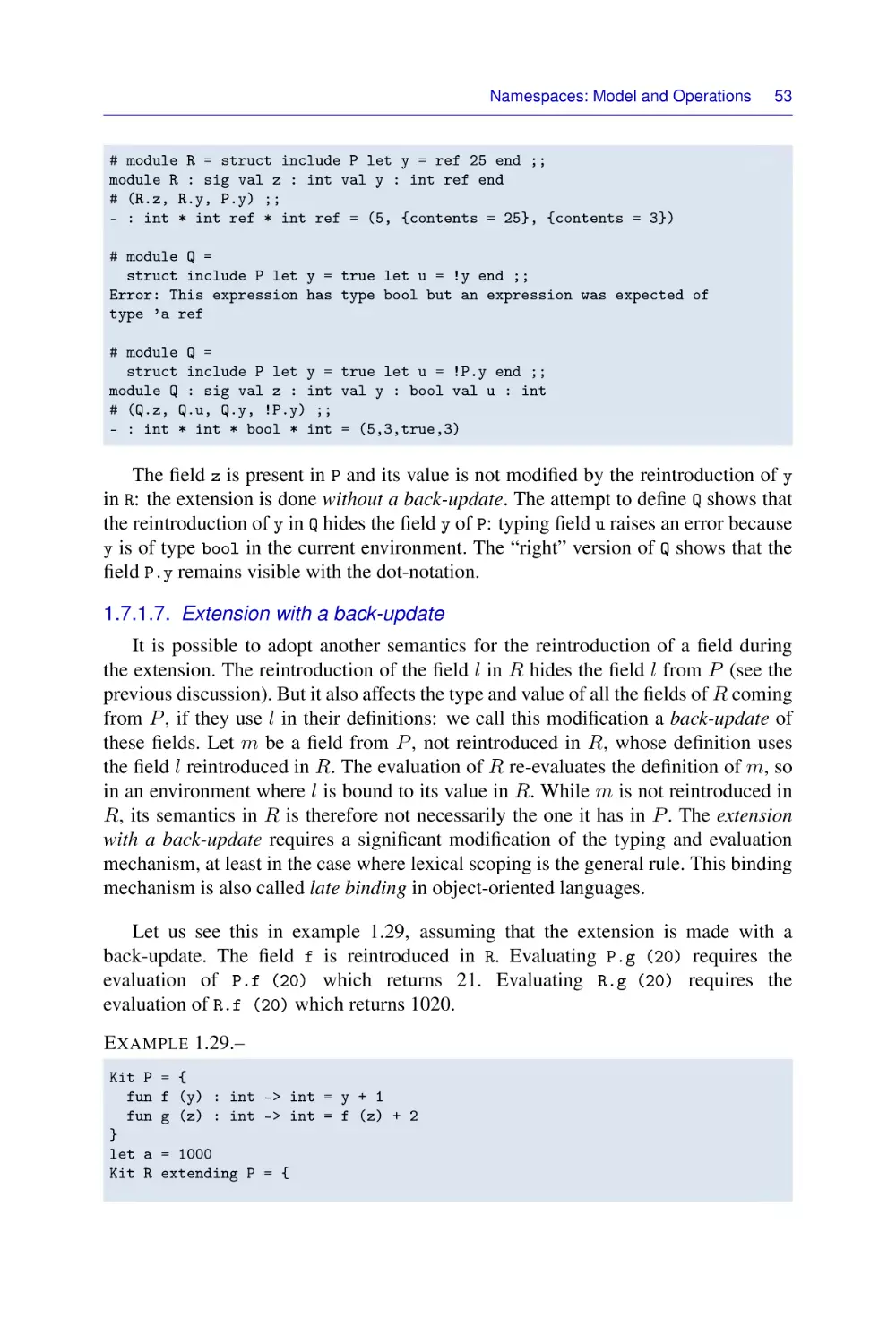

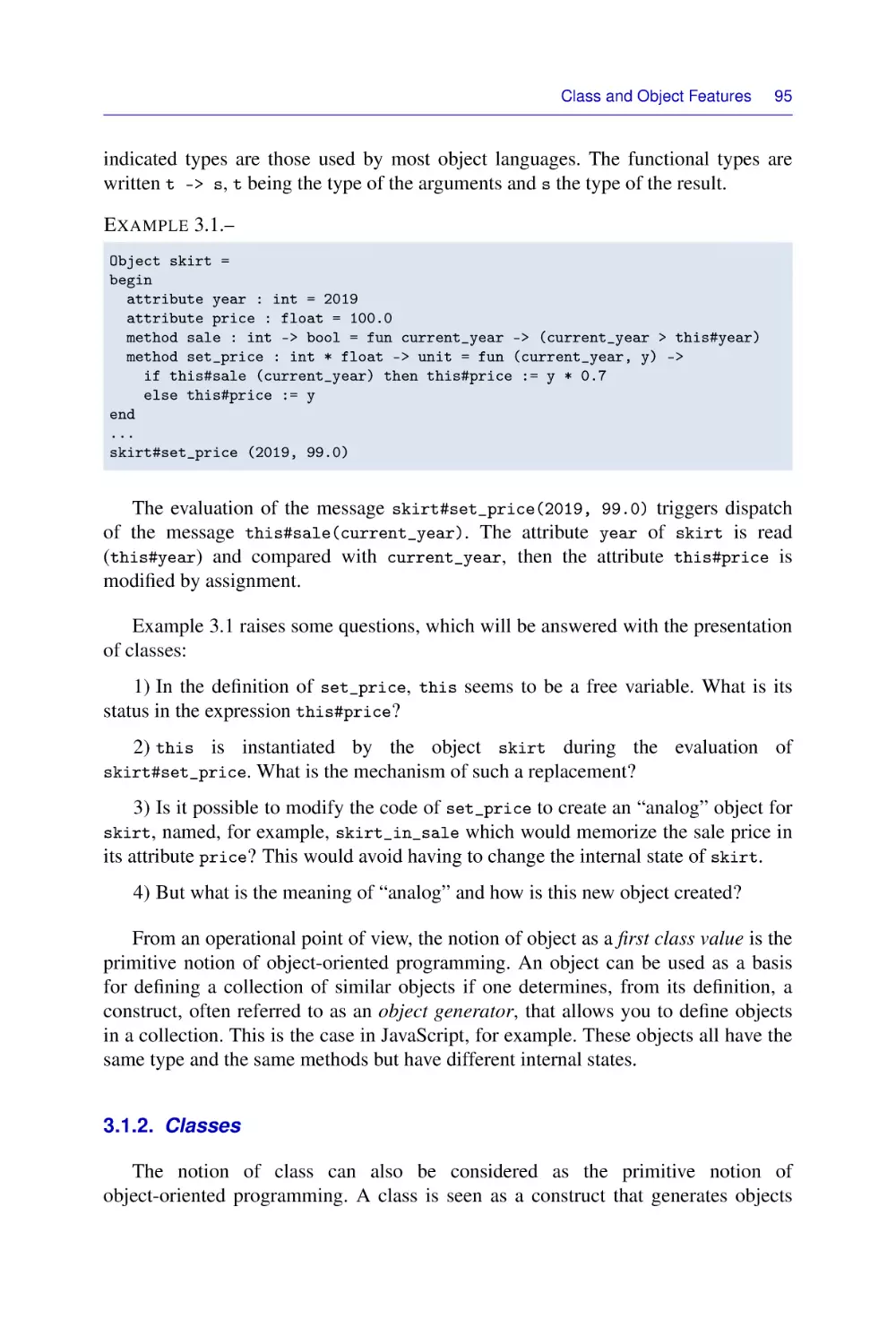
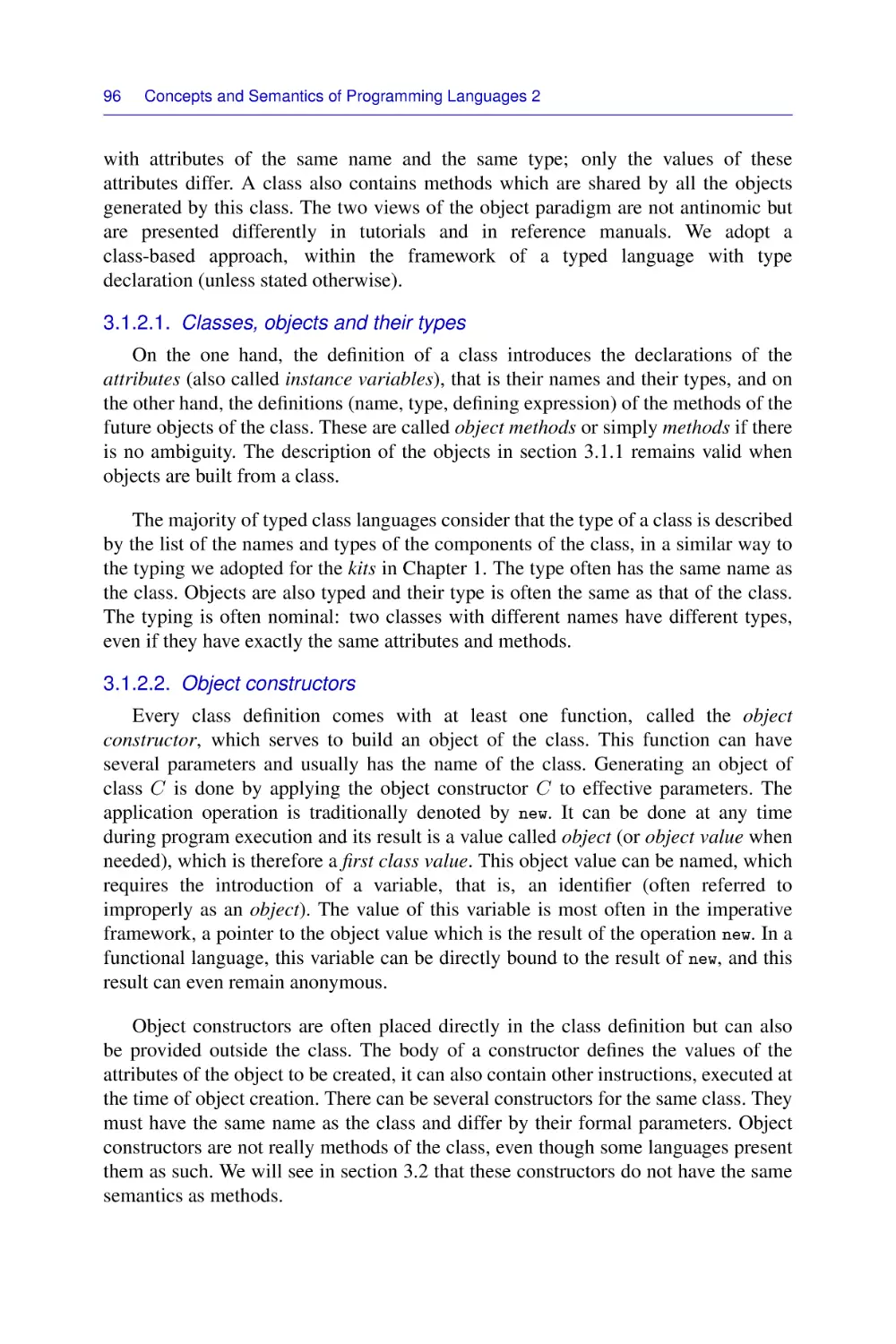
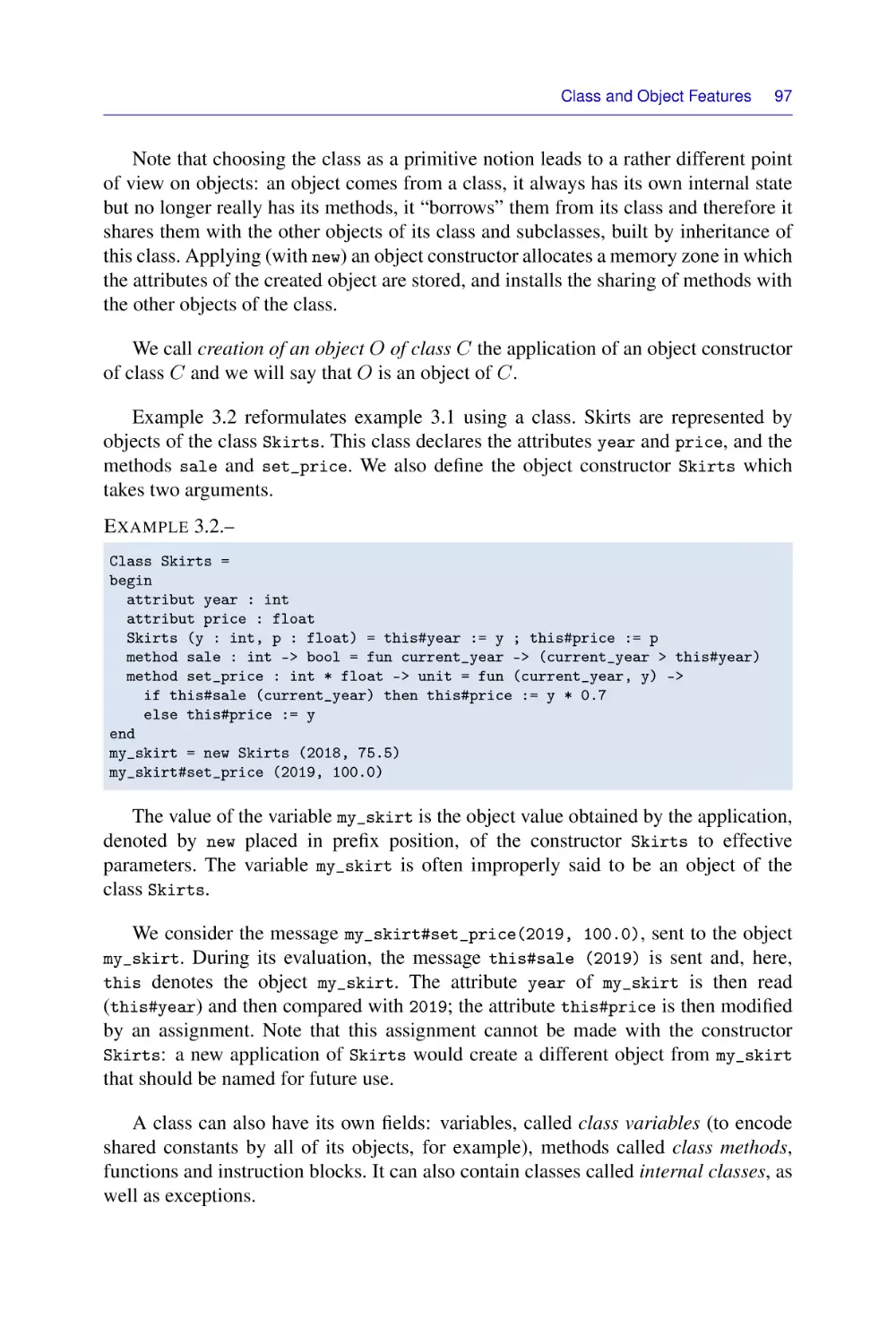
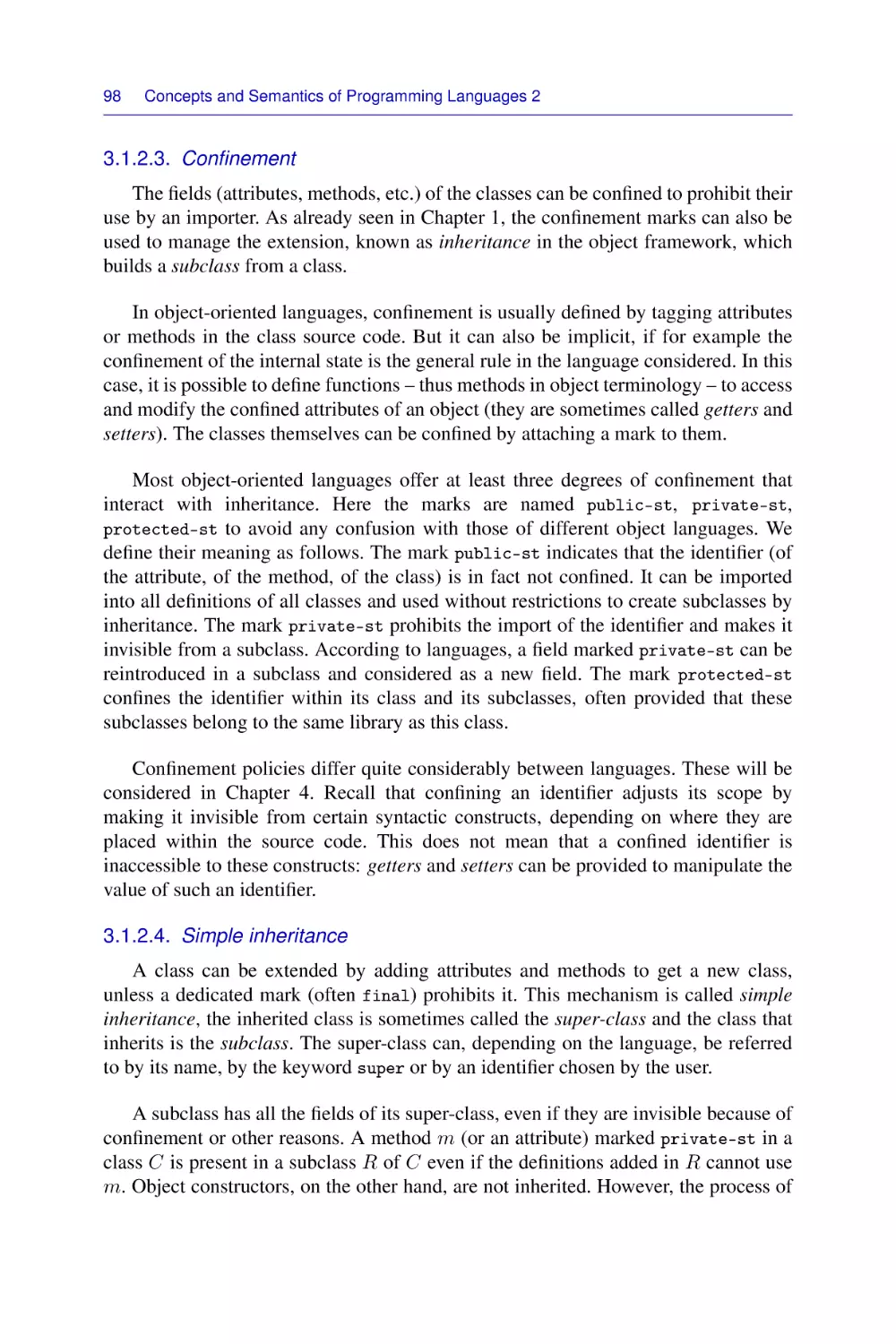
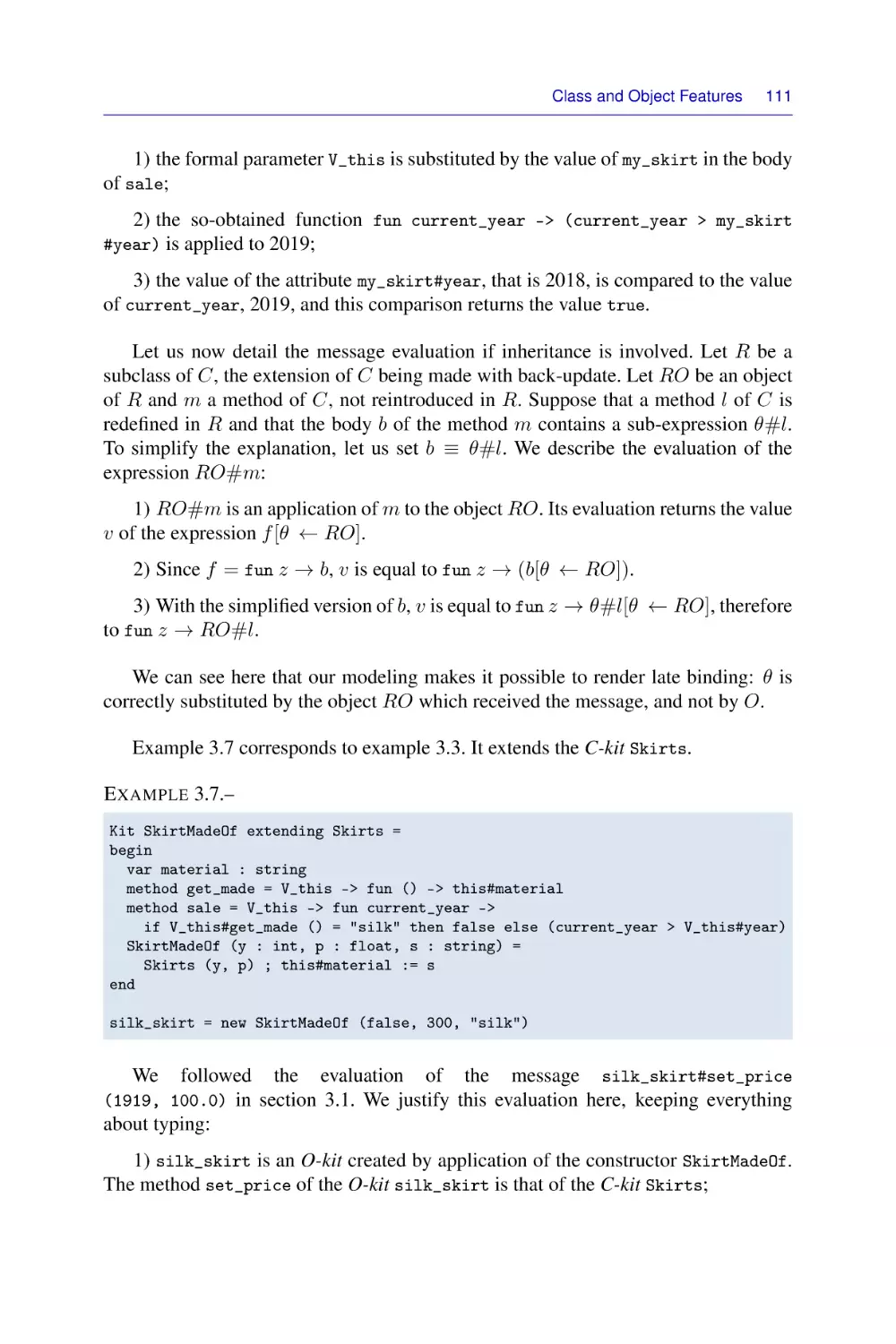
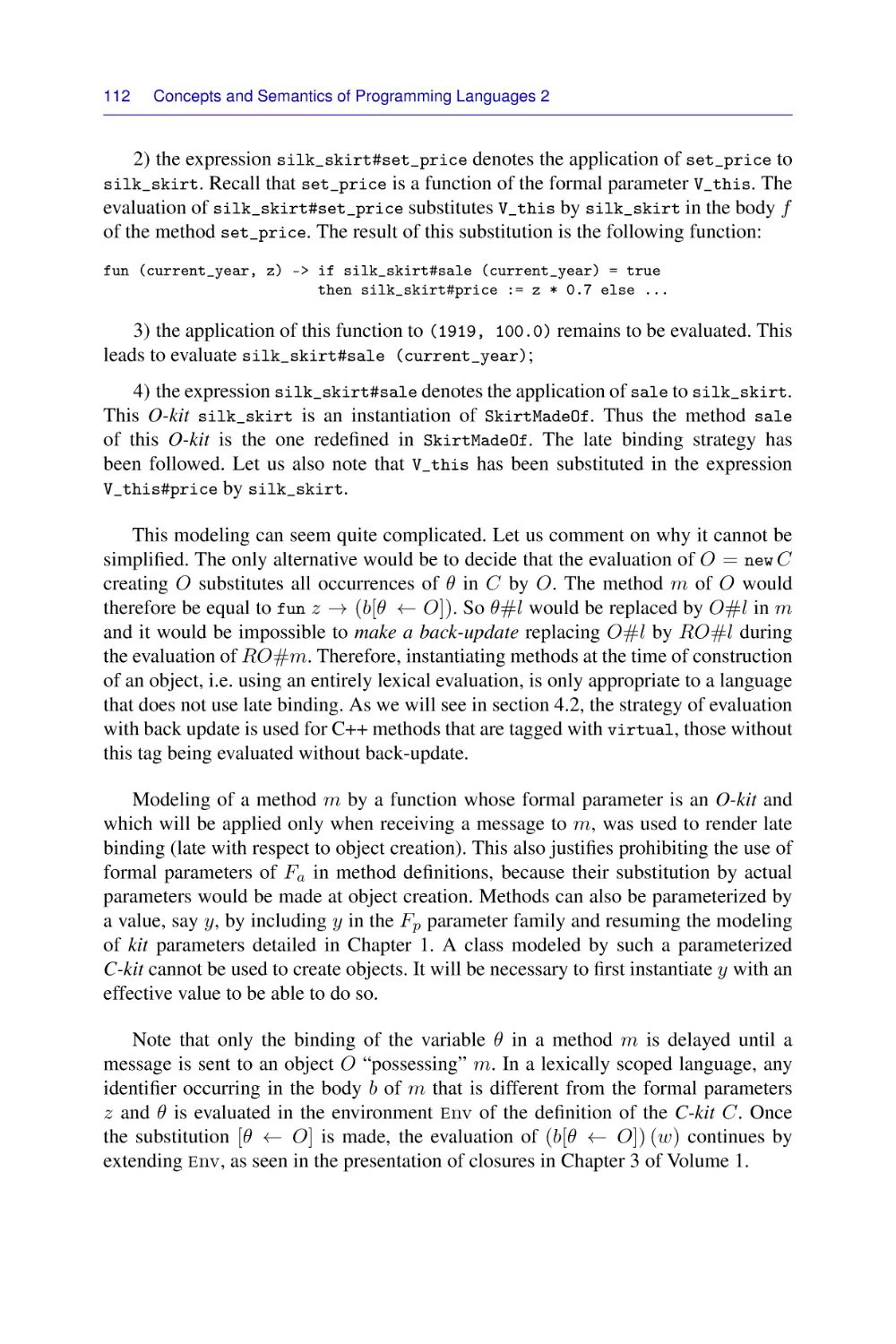
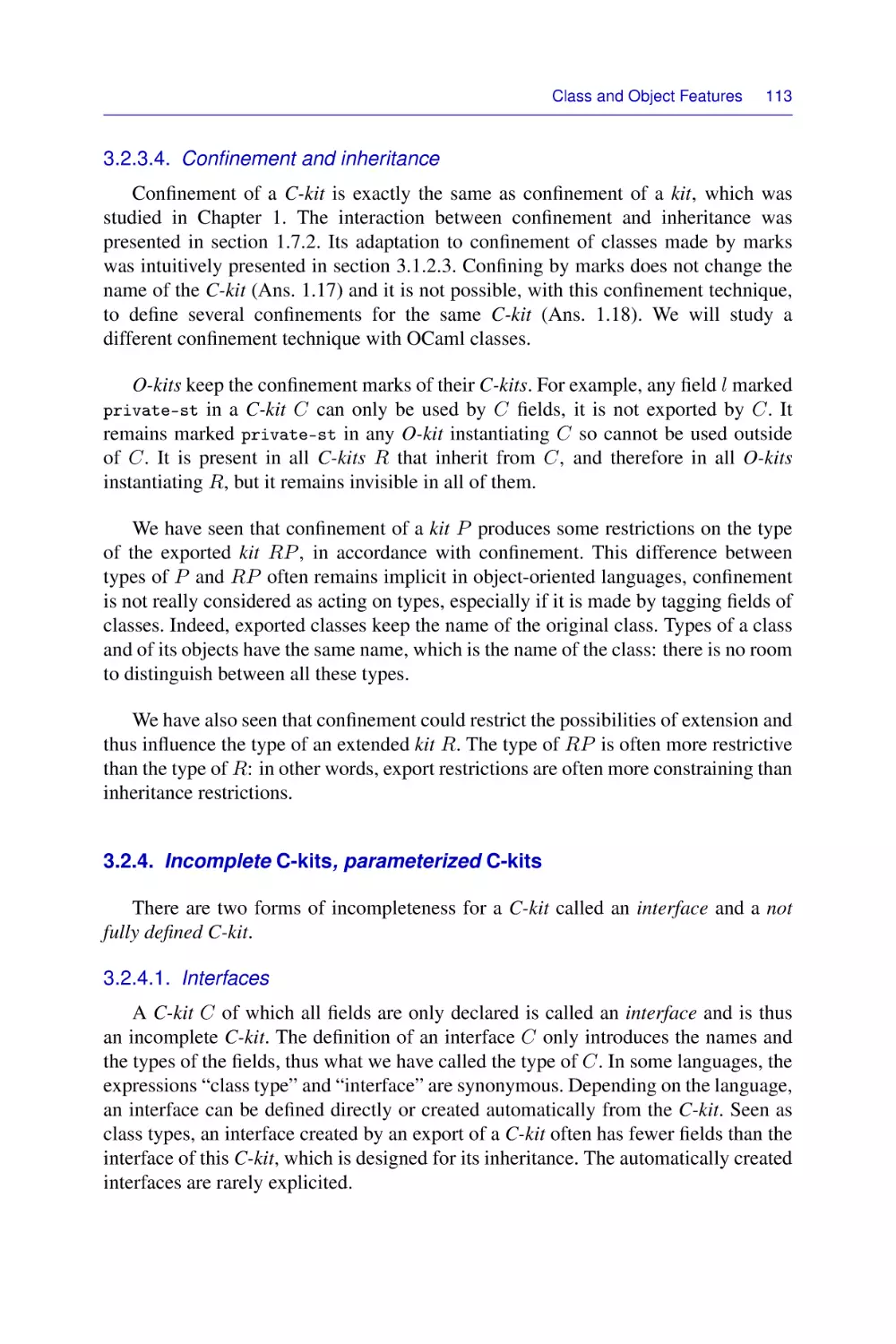
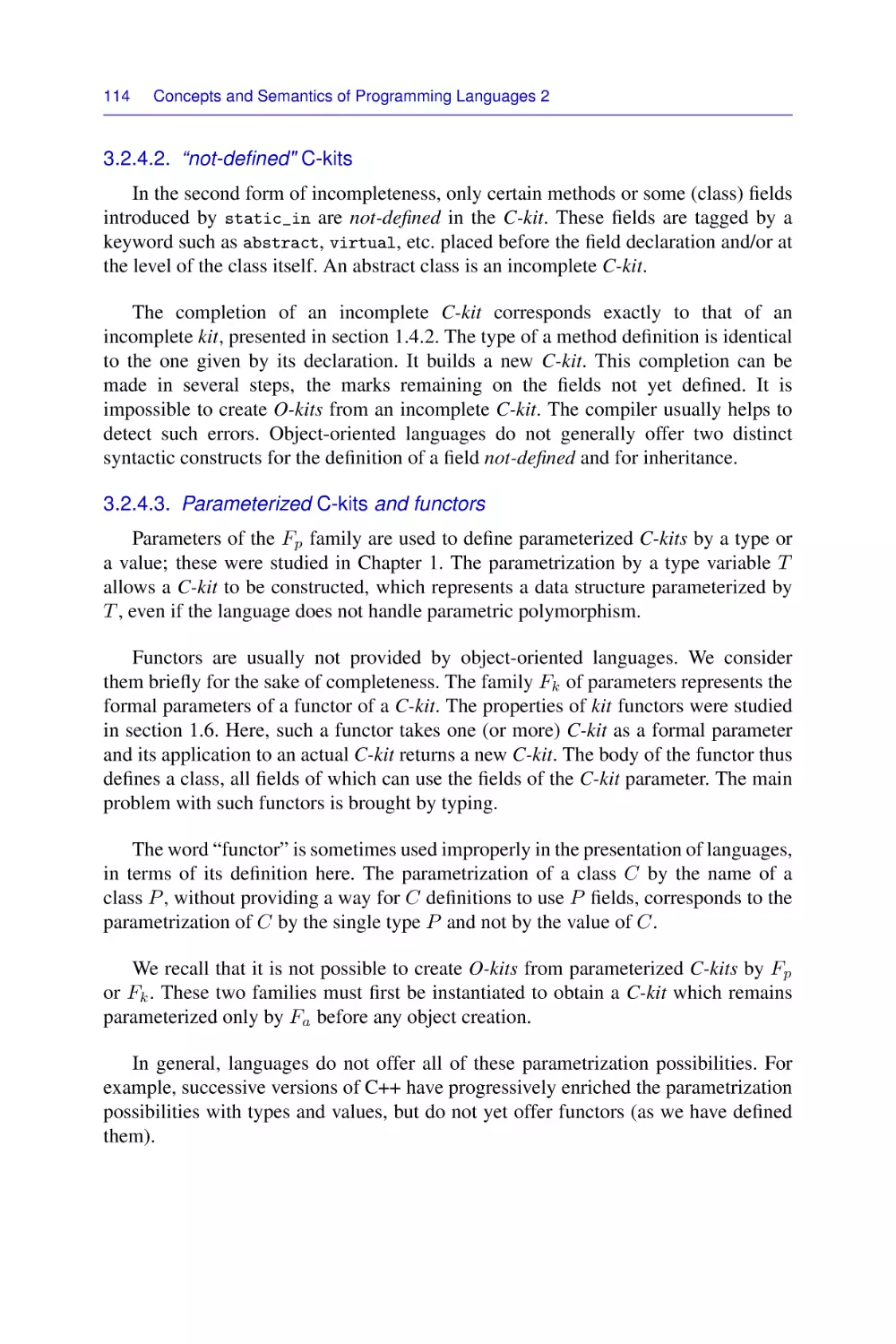

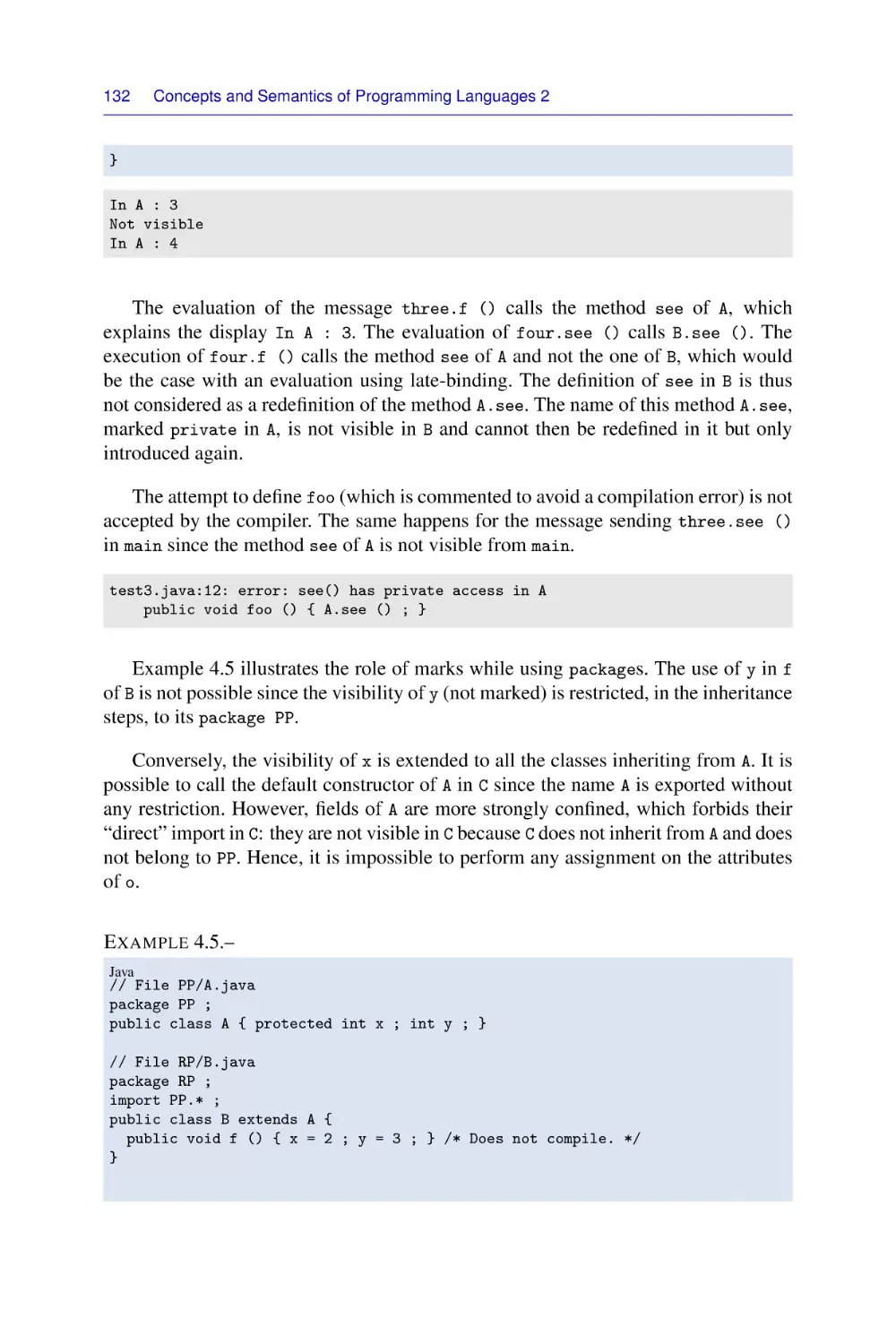
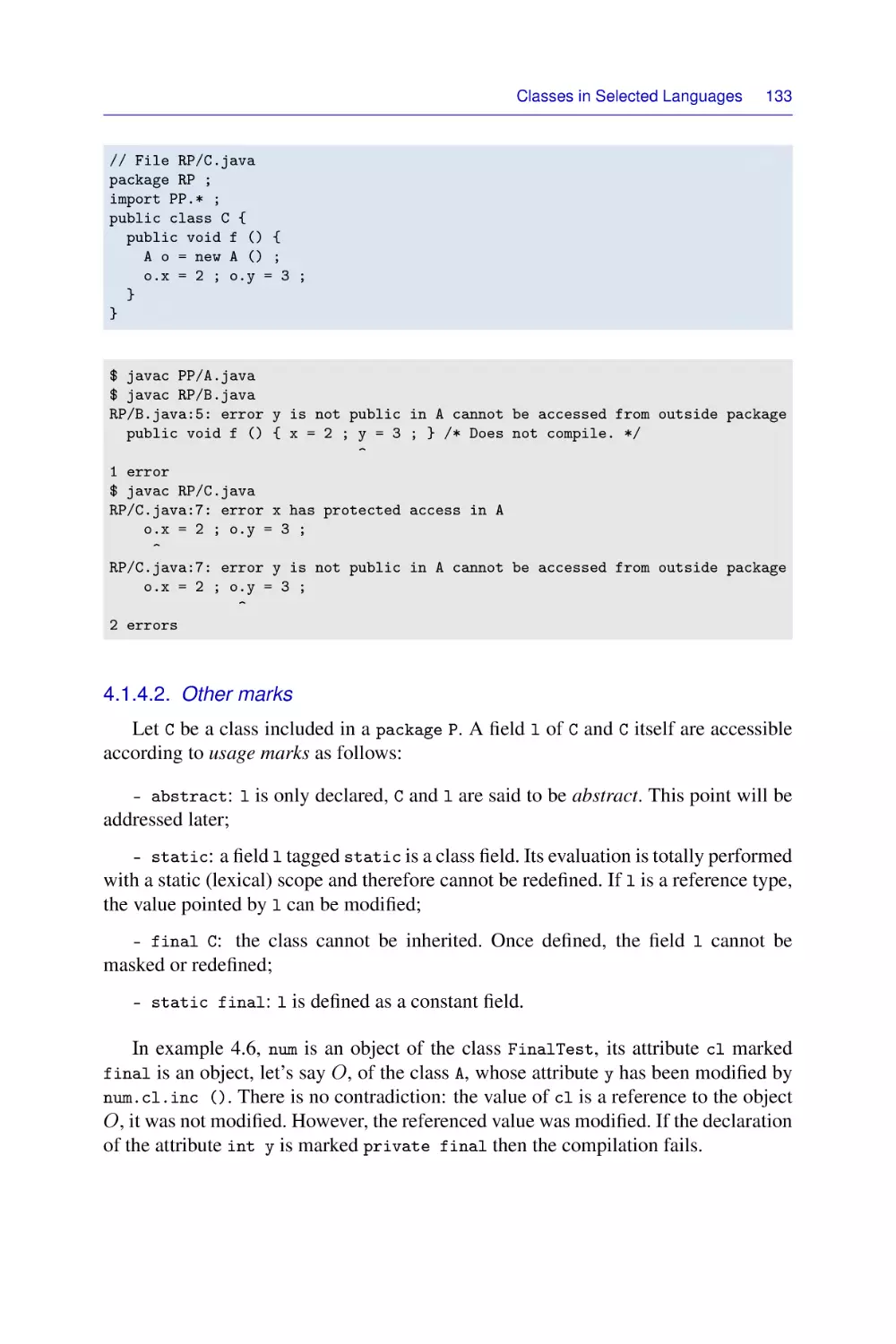
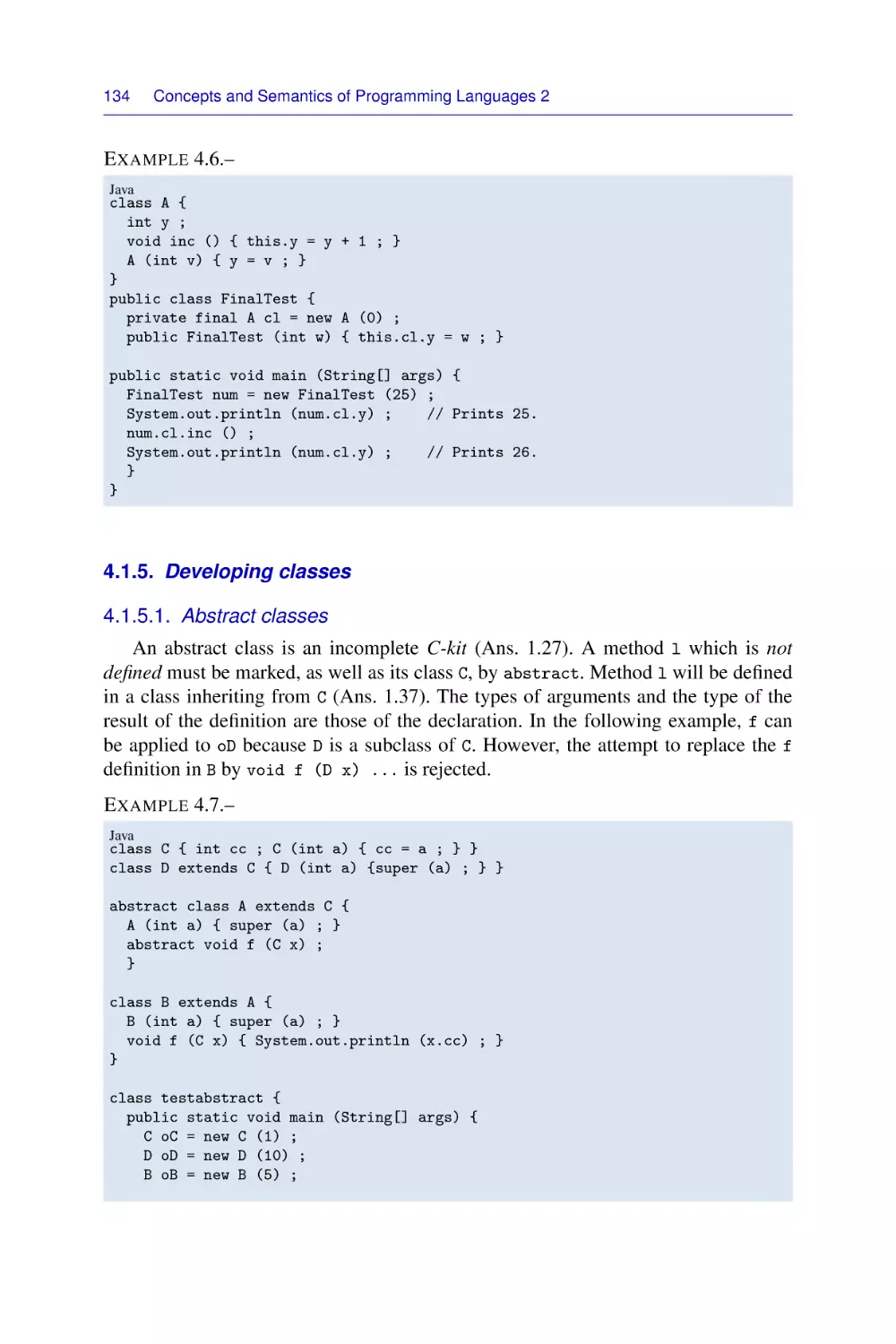
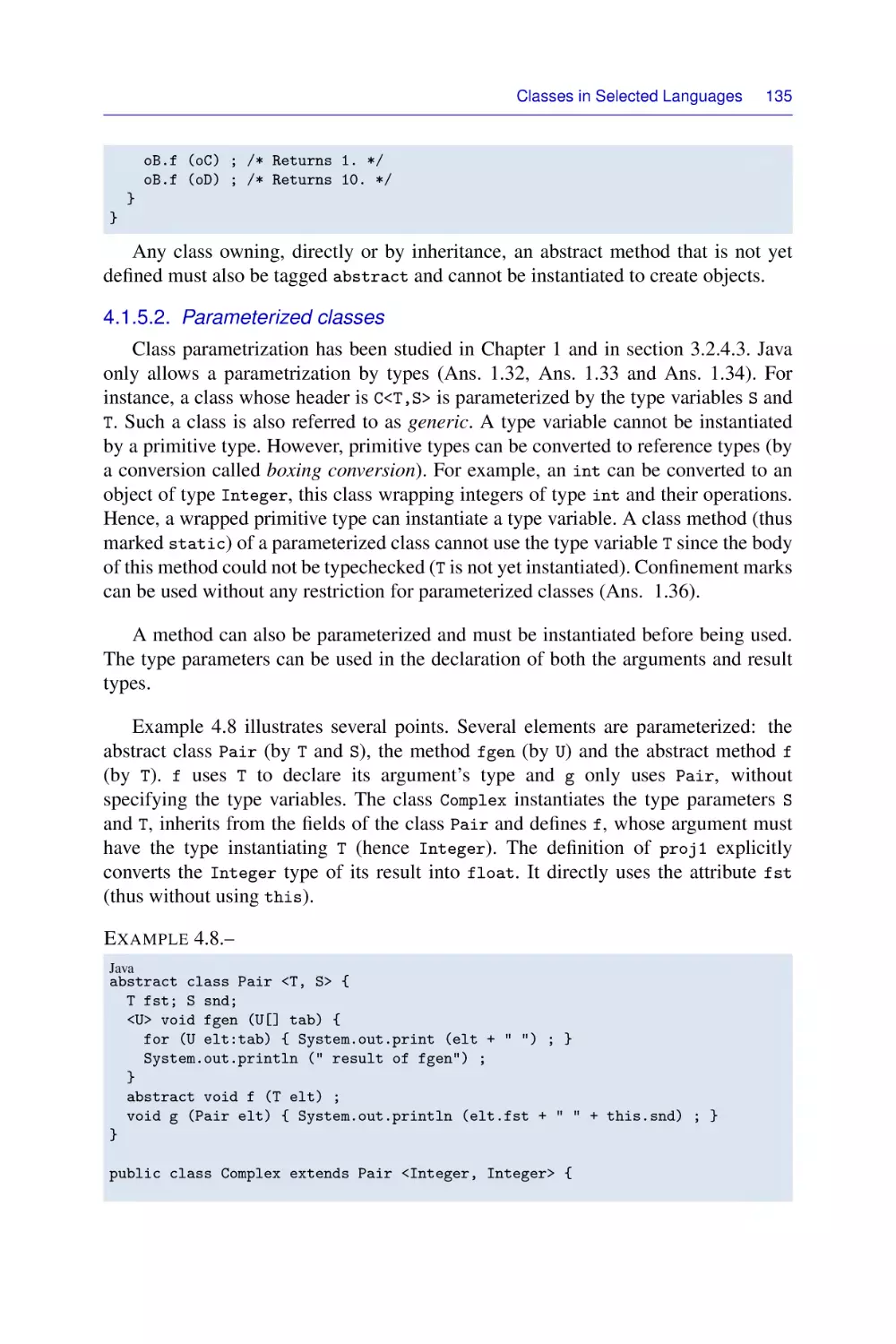
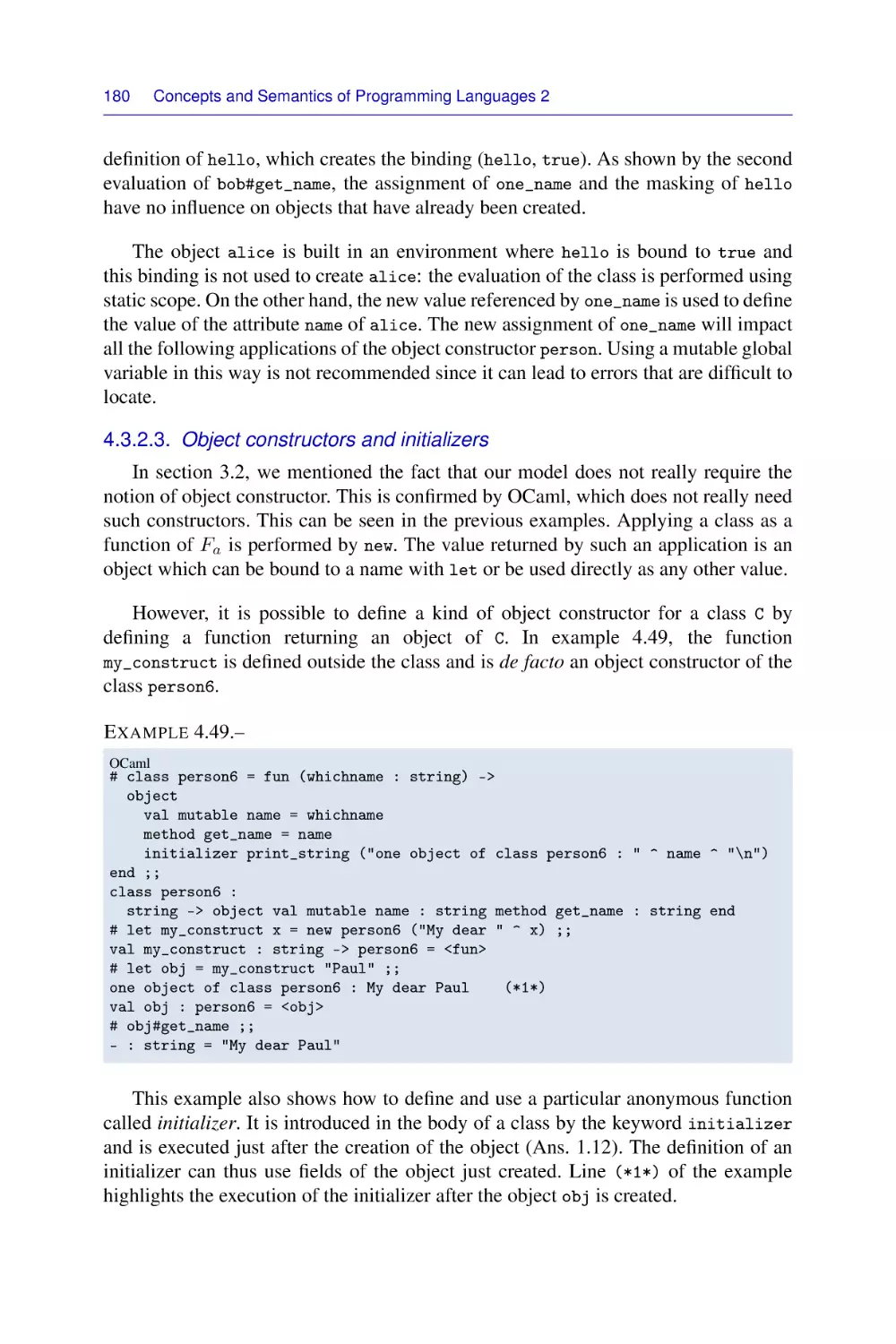
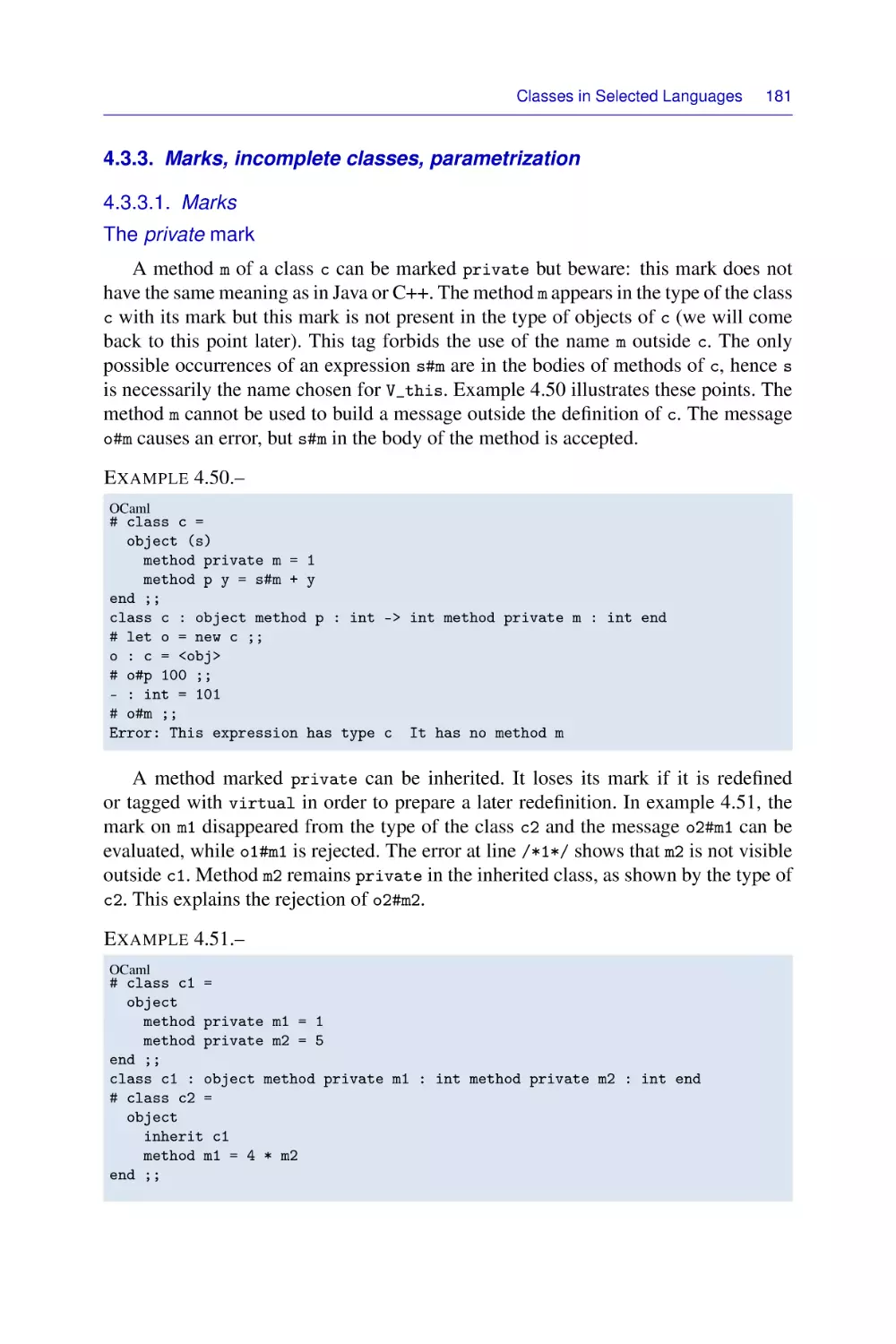
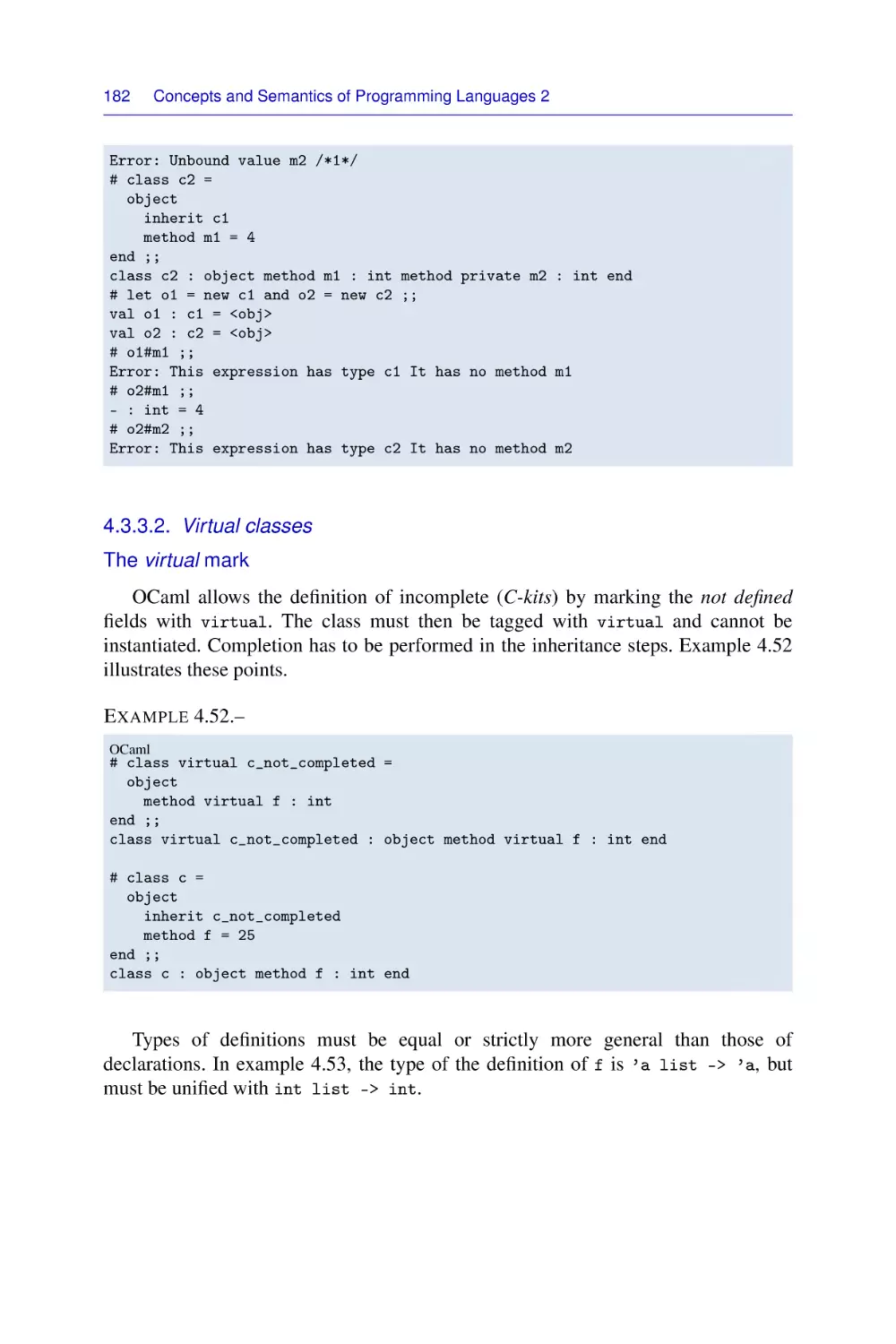
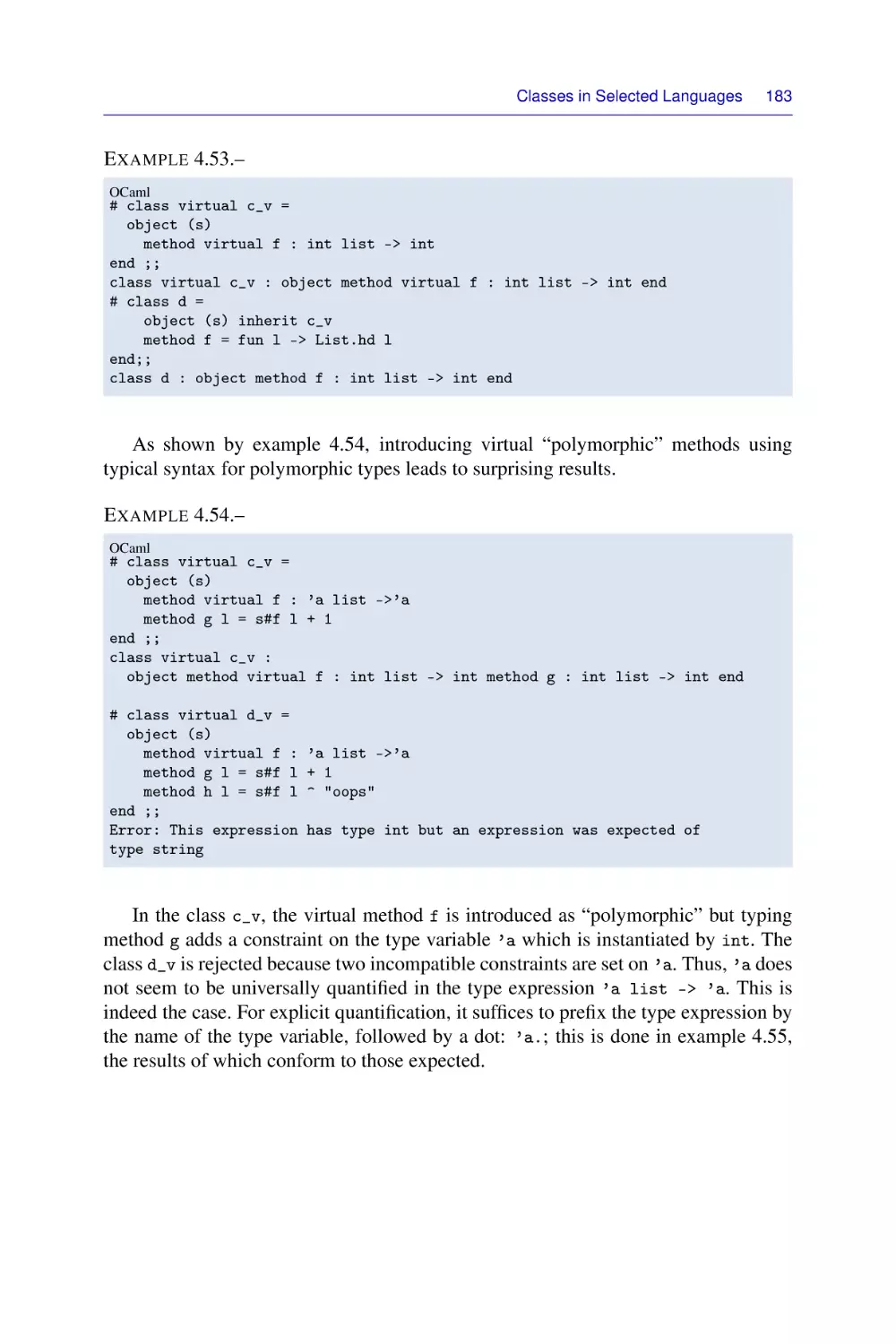
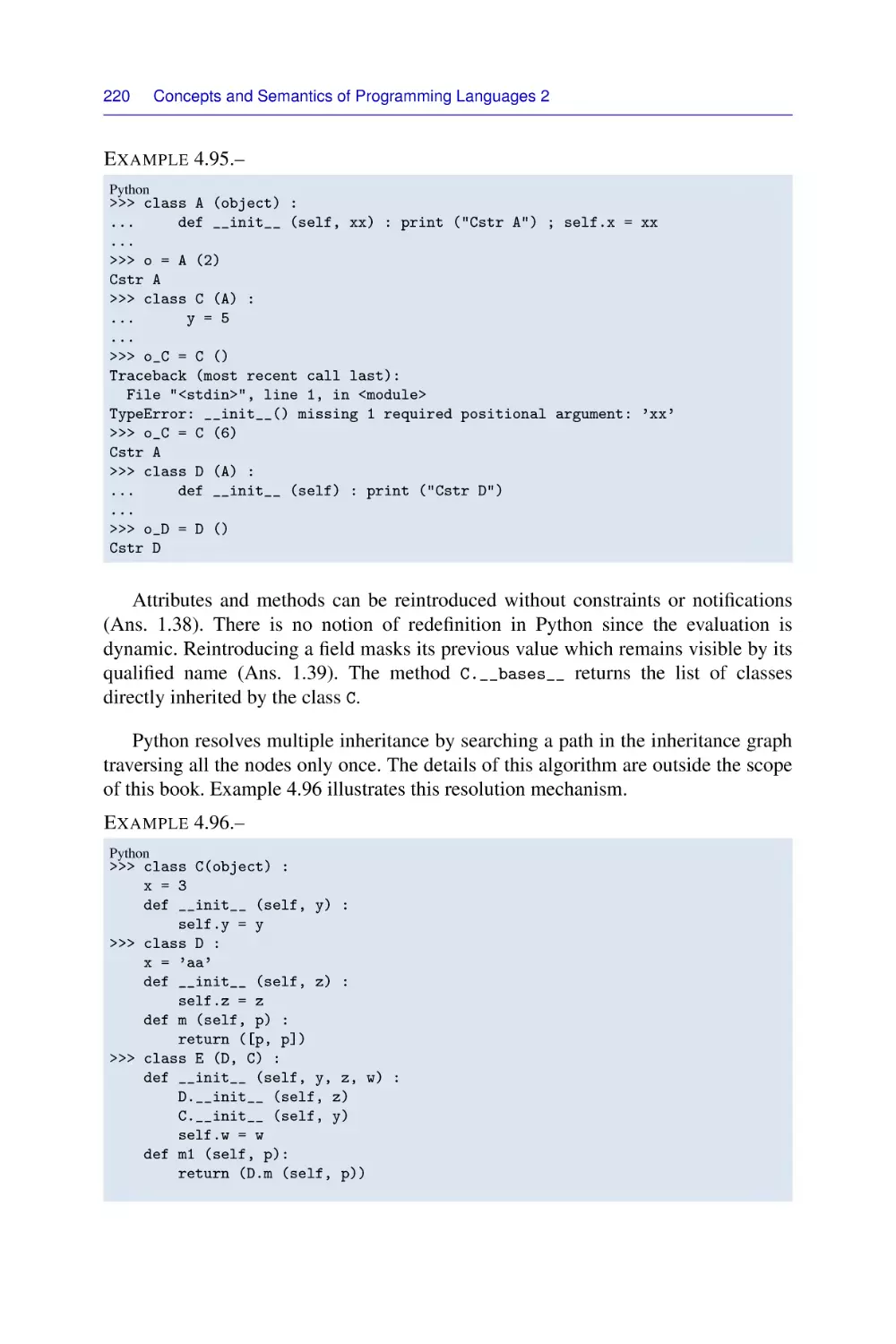
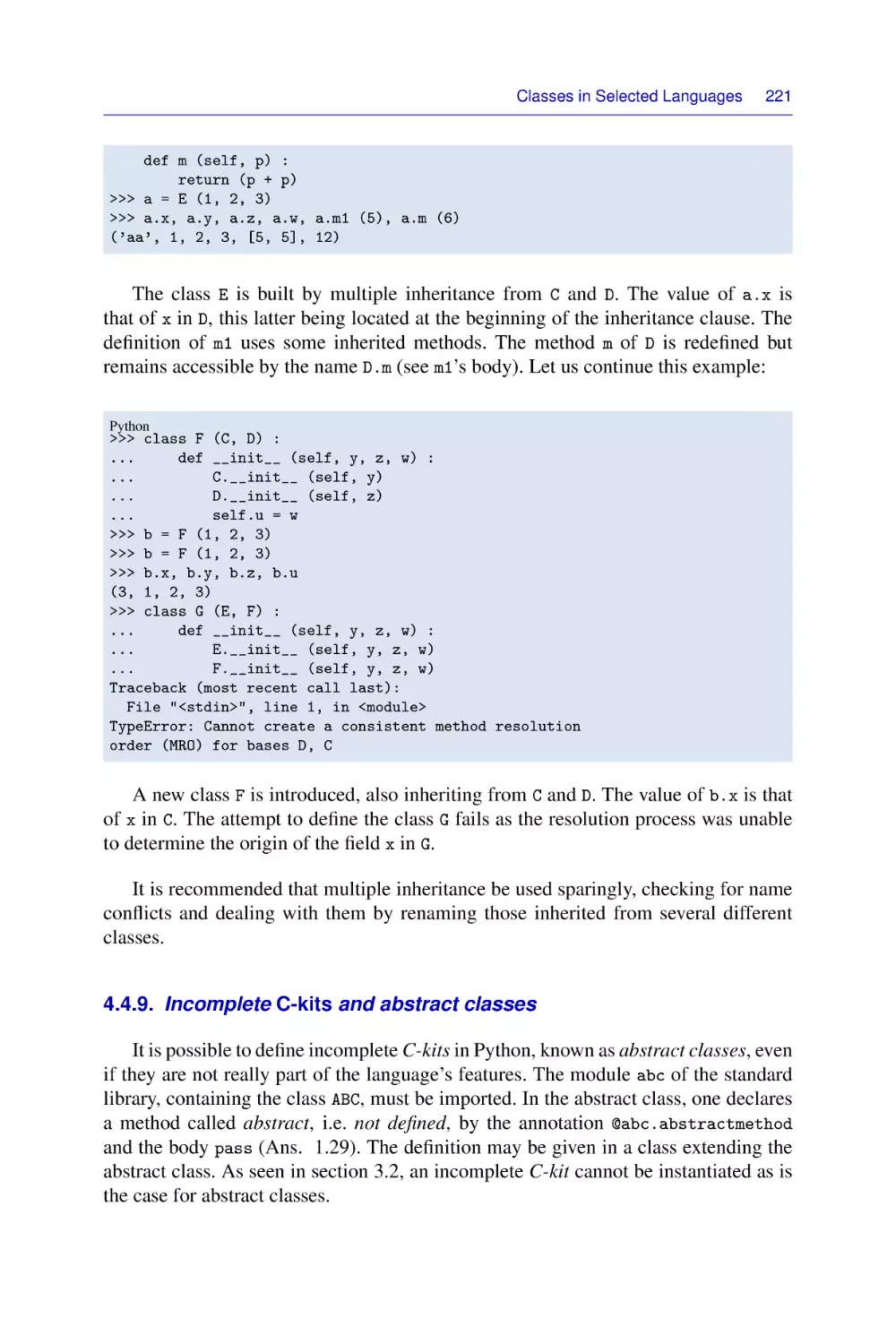
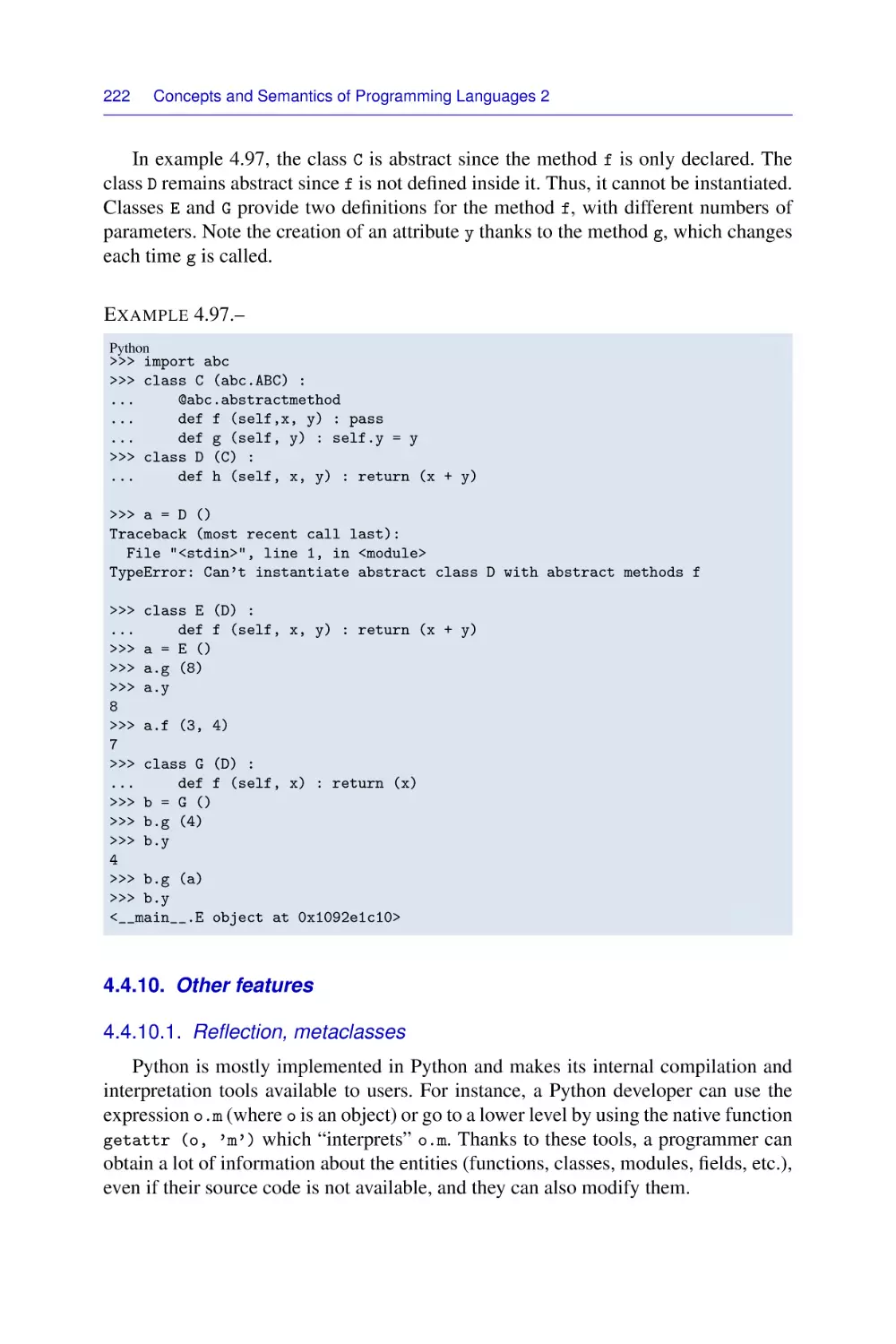
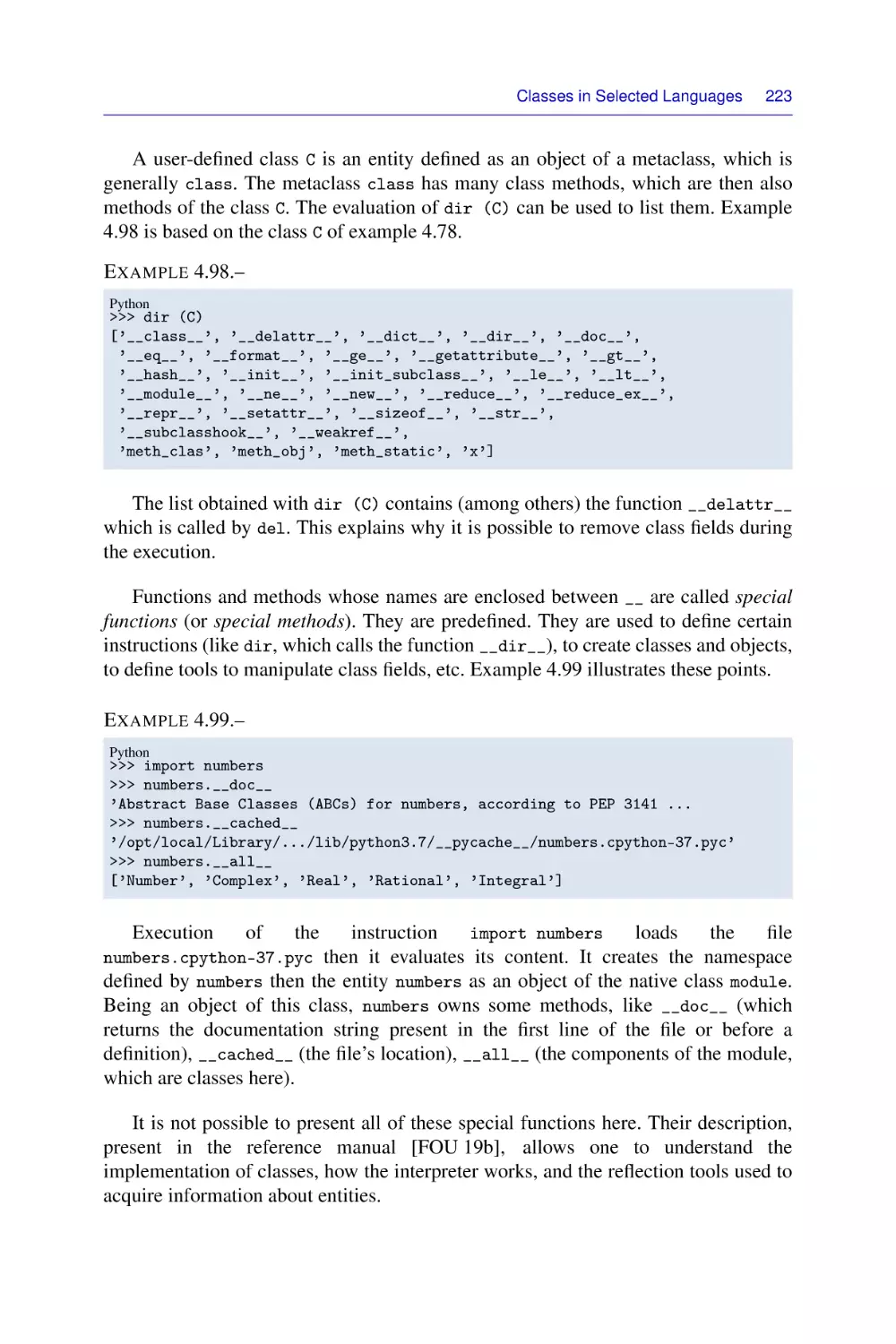








Текст
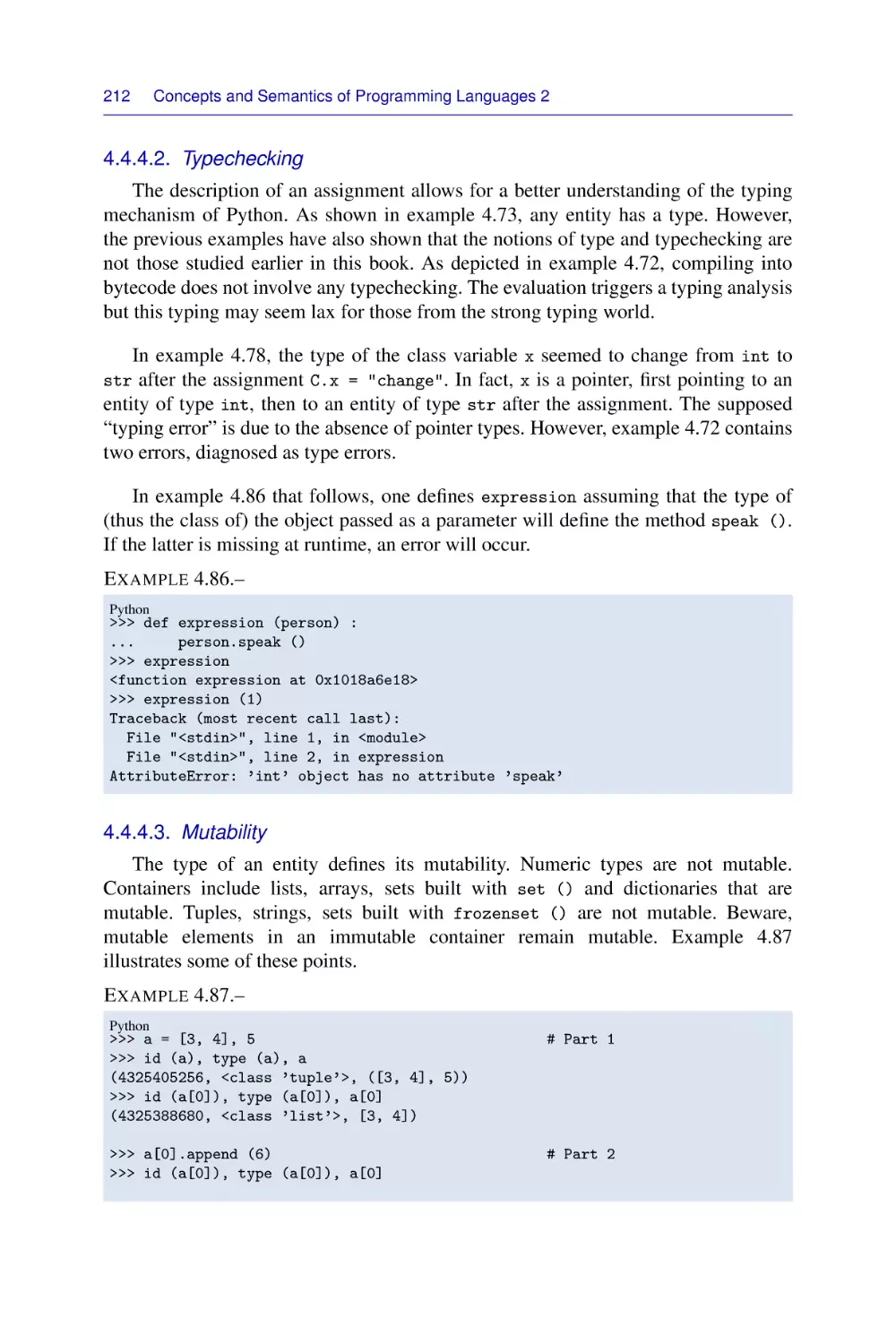
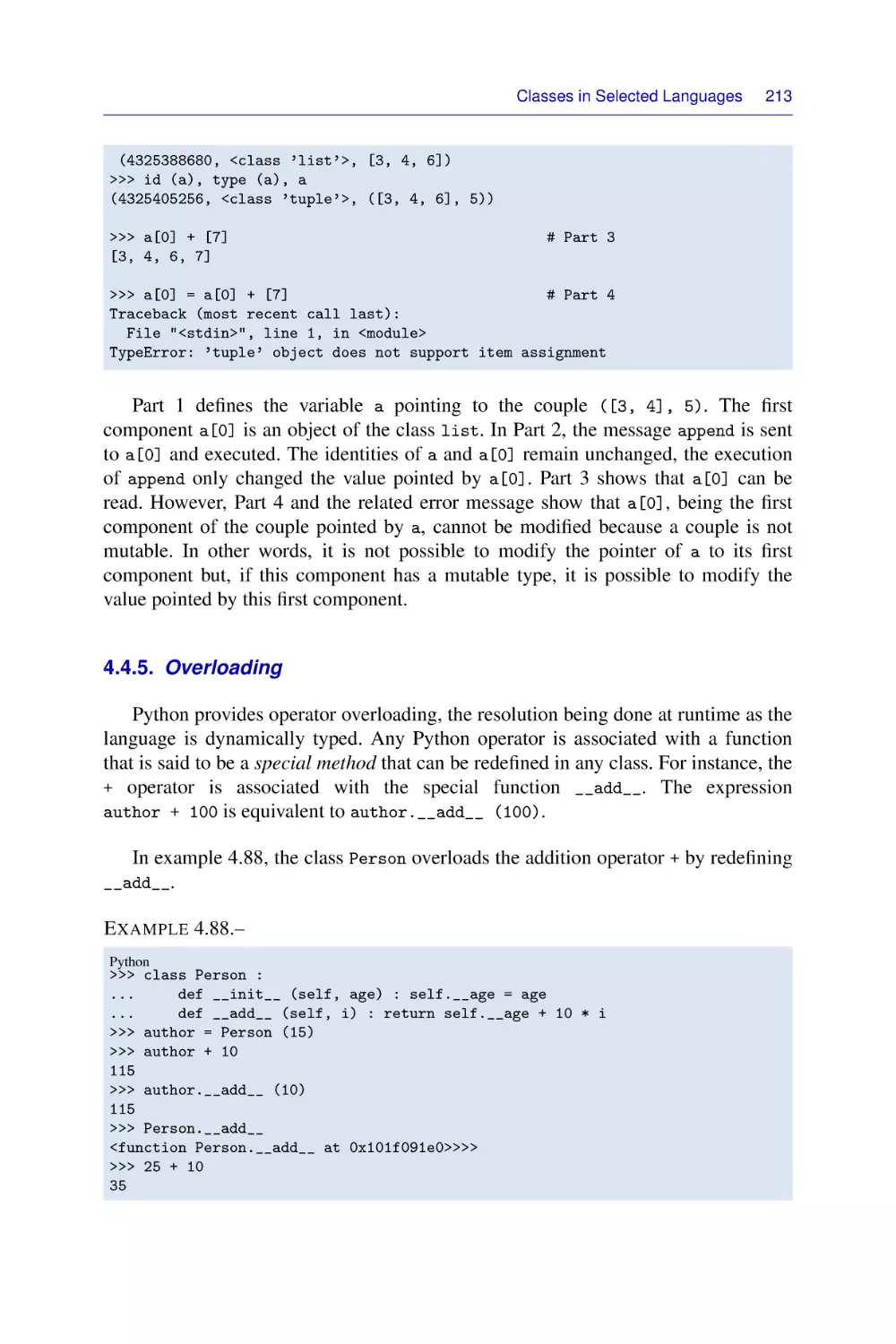
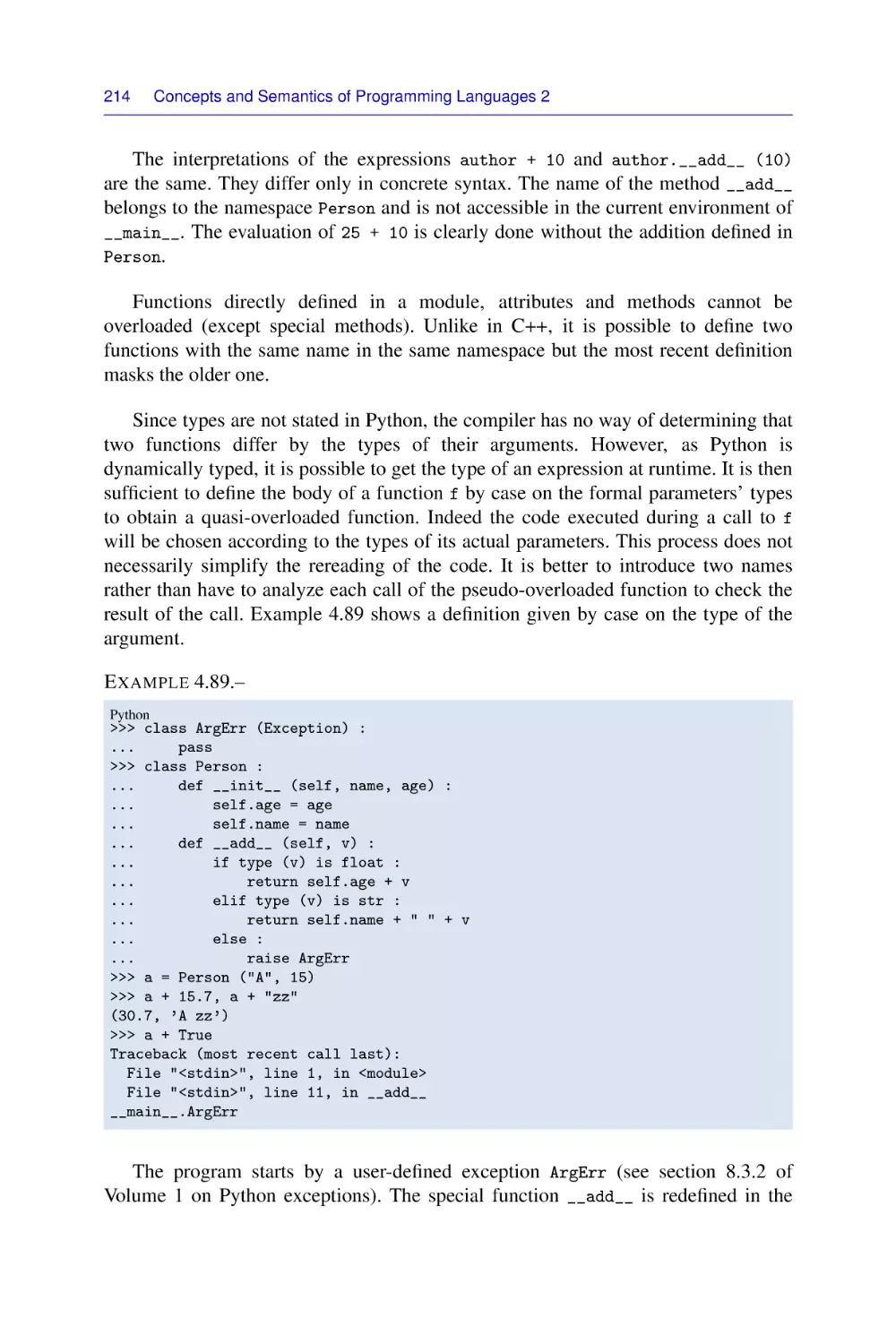
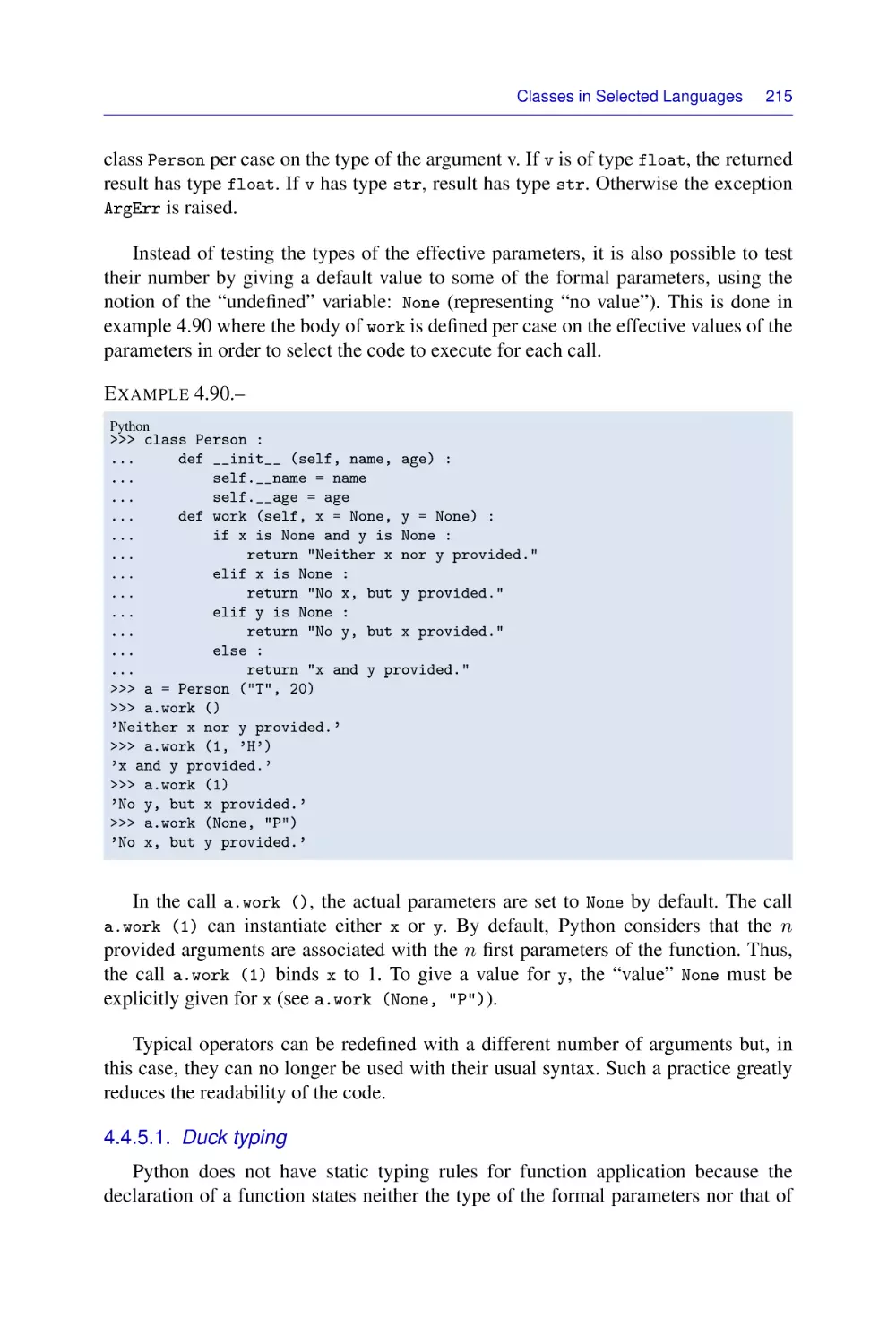
                    Concepts and Semantics of Programming Languages 2

Series Editor
Jean-Charles Pomerol

Concepts and Semantics of
Programming Languages 2
Modular and Object-oriented Constructs
with OCaml, Python, C++, Ada and Java
Thérèse Hardin
Mathieu Jaume
François Pessaux
Véronique Viguié Donzeau-Gouge

First published 2021 in Great Britain and the United States by ISTE Ltd and John Wiley & Sons, Inc.

Apart from any fair dealing for the purposes of research or private study, or criticism or review, as
permitted under the Copyright, Designs and Patents Act 1988, this publication may only be reproduced,
stored or transmitted, in any form or by any means, with the prior permission in writing of the publishers,
or in the case of reprographic reproduction in accordance with the terms and licenses issued by the
CLA. Enquiries concerning reproduction outside these terms should be sent to the publishers at the
undermentioned address:
ISTE Ltd
27-37 St George’s Road
London SW19 4EU
UK

John Wiley & Sons, Inc.
111 River Street
Hoboken, NJ 07030
USA

www.iste.co.uk

www.wiley.com

© ISTE Ltd 2021
The rights of Thérèse Hardin, Mathieu Jaume, François Pessaux and Véronique Viguié Donzeau-Gouge
to be identified as the authors of this work have been asserted by them in accordance with the Copyright,
Designs and Patents Act 1988.
Library of Congress Control Number: 2021935827
British Library Cataloguing-in-Publication Data
A CIP record for this book is available from the British Library
ISBN 978-1-78630-602-9

Contents

Foreword . . . . . . . . . . . . . . . . . . . . . . . . . . . . . . . . . . . . . . .

ix

Preface . . . . . . . . . . . . . . . . . . . . . . . . . . . . . . . . . . . . . . . .

xi

Chapter 1. Namespaces: Model and Operations . . . . . . . . . . . . .

1

1.1. Reusing, dividing, confining . . . . . . . . . . . . . . . . . . .
1.1.1. Analysis of some developer needs . . . . . . . . . . . . . .
1.1.2. Meeting developer needs . . . . . . . . . . . . . . . . . . .
1.2. Namespaces . . . . . . . . . . . . . . . . . . . . . . . . . . . .
1.2.1. Namespaces definition . . . . . . . . . . . . . . . . . . . .
1.2.2. Extending notions of environment and binding . . . . . . .
1.3. kit development . . . . . . . . . . . . . . . . . . . . . . . . . .
1.3.1. Namespace of a kit . . . . . . . . . . . . . . . . . . . . . .
1.3.2. Order of fields introduction . . . . . . . . . . . . . . . . . .
1.3.3. Typing kits . . . . . . . . . . . . . . . . . . . . . . . . . . .
1.3.4. kit values . . . . . . . . . . . . . . . . . . . . . . . . . . . .
1.3.5. kit export, confining fields . . . . . . . . . . . . . . . . . .
1.3.6. kits import . . . . . . . . . . . . . . . . . . . . . . . . . . .
1.3.7. Stages of kit development . . . . . . . . . . . . . . . . . . .
1.4. Incomplete kits . . . . . . . . . . . . . . . . . . . . . . . . . . .
1.4.1. Type and value of an incomplete kit . . . . . . . . . . . . .
1.4.2. Completion of an incomplete kit . . . . . . . . . . . . . . .
1.4.3. Confining an incomplete kit . . . . . . . . . . . . . . . . .
1.5. Parameterized kits . . . . . . . . . . . . . . . . . . . . . . . . .
1.5.1. kits parameterized by a type . . . . . . . . . . . . . . . . .
1.5.2. kits parameterized by types and values . . . . . . . . . . .
1.5.3. Confinement, parametrization, incomplete kits and export
1.6. Functors of kits . . . . . . . . . . . . . . . . . . . . . . . . . . .
1.7. kit extension . . . . . . . . . . . . . . . . . . . . . . . . . . . .

.
.
.
.
.
.
.
.
.
.
.
.
.
.
.
.
.
.
.
.
.
.
.
.

.
.
.
.
.
.
.
.
.
.
.
.
.
.
.
.
.
.
.
.
.
.
.
.

.
.
.
.
.
.
.
.
.
.
.
.
.
.
.
.
.
.
.
.
.
.
.
.

.
.
.
.
.
.
.
.
.
.
.
.
.
.
.
.
.
.
.
.
.
.
.
.

.
.
.
.
.
.
.
.
.
.
.
.
.
.
.
.
.
.
.
.
.
.
.
.

2
2
3
5
6
8
12
14
15
15
18
22
28
32
33
34
34
36
36
36
41
45
46
49

vi

Concepts and Semantics of Programming Languages 2

1.7.1. Presentation of extension . . . . . . . . . . . . . . . . . . . . . . . .
1.7.2. Confinement and extension . . . . . . . . . . . . . . . . . . . . . . .
1.8. Conclusion . . . . . . . . . . . . . . . . . . . . . . . . . . . . . . . . . .

49
55
59

Chapter 2. Modules . . . . . . . . . . . . . . . . . . . . . . . . . . . . . . . .

61

2.1. Modules in Ada . . . . . . . . . . . .
2.1.1. Developing modules . . . . . . . .
2.1.2. Export and confinement . . . . . .
2.1.3. Nesting modules . . . . . . . . . .
2.1.4. Importing a module . . . . . . . .
2.1.5. Flattening an import . . . . . . . .
2.1.6. Generic modules . . . . . . . . . .
2.1.7. Modules and separate compilation
2.2. Modules in OCaml . . . . . . . . . .
2.2.1. Module definition . . . . . . . . .
2.2.2. Export and confinement . . . . . .
2.2.3. Confinement of type definitions .
2.2.4. Functors . . . . . . . . . . . . . .
2.3. Modularity, namespaces and W-kit . .
2.3.1. Declaration interfaces . . . . . . .
2.3.2. W-kits . . . . . . . . . . . . . . . .
2.3.3. Modularity and header files in C .

.
.
.
.
.
.
.
.
.
.
.
.
.
.
.
.
.

.
.
.
.
.
.
.
.
.
.
.
.
.
.
.
.
.

.
.
.
.
.
.
.
.
.
.
.
.
.
.
.
.
.

.
.
.
.
.
.
.
.
.
.
.
.
.
.
.
.
.

.
.
.
.
.
.
.
.
.
.
.
.
.
.
.
.
.

62
62
65
66
66
67
68
71
71
72
73
78
82
85
85
86
86

Chapter 3. Class and Object Features . . . . . . . . . . . . . . . . . . . .

93

3.1. Object-oriented features . . . . . . . . . . . .
3.1.1. Objects . . . . . . . . . . . . . . . . . . .
3.1.2. Classes . . . . . . . . . . . . . . . . . . .
3.2. kits and object features . . . . . . . . . . . .
3.2.1. Modeling classes . . . . . . . . . . . . .
3.2.2. Modeling objects . . . . . . . . . . . . .
3.2.3. Inheritance, redefinition and late binding
3.2.4. Incomplete C-kits, parameterized C-kits
3.2.5. Subclassing, subtyping . . . . . . . . . .
3.2.6. Type languages, classes and objects . . .

.
.
.
.
.
.
.
.
.
.
.
.
.
.
.
.
.

.
.
.
.
.
.
.
.
.
.

.
.
.
.
.
.
.
.
.
.
.
.
.
.
.
.
.

.
.
.
.
.
.
.
.
.
.

.
.
.
.
.
.
.
.
.
.
.
.
.
.
.
.
.

.
.
.
.
.
.
.
.
.
.

.
.
.
.
.
.
.
.
.
.
.
.
.
.
.
.
.

.
.
.
.
.
.
.
.
.
.

.
.
.
.
.
.
.
.
.
.
.
.
.
.
.
.
.

.
.
.
.
.
.
.
.
.
.

.
.
.
.
.
.
.
.
.
.
.
.
.
.
.
.
.

.
.
.
.
.
.
.
.
.
.

.
.
.
.
.
.
.
.
.
.
.
.
.
.
.
.
.

.
.
.
.
.
.
.
.
.
.

.
.
.
.
.
.
.
.
.
.
.
.
.
.
.
.
.

.
.
.
.
.
.
.
.
.
.

.
.
.
.
.
.
.
.
.
.
.
.
.
.
.
.
.

.
.
.
.
.
.
.
.
.
.

.
.
.
.
.
.
.
.
.
.
.
.
.
.
.
.
.

.
.
.
.
.
.
.
.
.
.

.
.
.
.
.
.
.
.
.
.
.
.
.
.
.
.
.

.
.
.
.
.
.
.
.
.
.

.
.
.
.
.
.
.
.
.
.
.
.
.
.
.
.
.

.
.
.
.
.
.
.
.
.
.

.
.
.
.
.
.
.
.
.
.
.
.
.
.
.
.
.

.
.
.
.
.
.
.
.
.
.

.
.
.
.
.
.
.
.
.
.
.
.
.
.
.
.
.

.
.
.
.
.
.
.
.
.
.

.
.
.
.
.
.
.
.
.
.

93
94
95
104
104
107
109
113
115
119

Chapter 4. Classes in Selected Languages . . . . . . . . . . . . . . . . 123
4.1. Classes in Java . . . . . . .
4.1.1. General presentation .
4.1.2. Modules and packages
4.1.3. Classes . . . . . . . . .
4.1.4. Marks . . . . . . . . . .
4.1.5. Developing classes . .

.
.
.
.
.
.

.
.
.
.
.
.

.
.
.
.
.
.

.
.
.
.
.
.

.
.
.
.
.
.

.
.
.
.
.
.

.
.
.
.
.
.

.
.
.
.
.
.

.
.
.
.
.
.

.
.
.
.
.
.

.
.
.
.
.
.

.
.
.
.
.
.

.
.
.
.
.
.

.
.
.
.
.
.

.
.
.
.
.
.

.
.
.
.
.
.

.
.
.
.
.
.

.
.
.
.
.
.

.
.
.
.
.
.

.
.
.
.
.
.

.
.
.
.
.
.

.
.
.
.
.
.

.
.
.
.
.
.

.
.
.
.
.
.

.
.
.
.
.
.

123
123
124
125
131
134

Contents

4.2. Classes in C++ . . . . . . . . . . . . . . . . . . . .
4.2.1. Header files, namespaces, confinement . . . .
4.2.2. Classes . . . . . . . . . . . . . . . . . . . . . .
4.2.3. Inheritance and confinement . . . . . . . . . .
4.2.4. Overloading in C++ . . . . . . . . . . . . . . .
4.2.5. Parameterized classes . . . . . . . . . . . . . .
4.3. Classes in OCaml . . . . . . . . . . . . . . . . . .
4.3.1. Presentation . . . . . . . . . . . . . . . . . . .
4.3.2. An overview of classes . . . . . . . . . . . . .
4.3.3. Marks, incomplete classes, parametrization . .
4.3.4. Objects . . . . . . . . . . . . . . . . . . . . . .
4.3.5. Class signatures: confinement and inheritance
4.3.6. Multiple inheritance . . . . . . . . . . . . . . .
4.3.7. Other features . . . . . . . . . . . . . . . . . .
4.4. Presentation of Python . . . . . . . . . . . . . . .
4.4.1. Getting started . . . . . . . . . . . . . . . . . .
4.4.2. An overview of classes, modules and types . .
4.4.3. Names and assignment . . . . . . . . . . . . .
4.4.4. Assignment and typechecking . . . . . . . . .
4.4.5. Overloading . . . . . . . . . . . . . . . . . . .
4.4.6. Modules and packages . . . . . . . . . . . . .
4.4.7. Confinement . . . . . . . . . . . . . . . . . . .
4.4.8. Inheritance . . . . . . . . . . . . . . . . . . . .
4.4.9. Incomplete C-kits and abstract classes . . . . .
4.4.10. Other features . . . . . . . . . . . . . . . . . .

.
.
.
.
.
.
.
.
.
.
.
.
.
.
.
.
.
.
.
.
.
.
.
.
.

.
.
.
.
.
.
.
.
.
.
.
.
.
.
.
.
.
.
.
.
.
.
.
.
.

.
.
.
.
.
.
.
.
.
.
.
.
.
.
.
.
.
.
.
.
.
.
.
.
.

.
.
.
.
.
.
.
.
.
.
.
.
.
.
.
.
.
.
.
.
.
.
.
.
.

.
.
.
.
.
.
.
.
.
.
.
.
.
.
.
.
.
.
.
.
.
.
.
.
.

.
.
.
.
.
.
.
.
.
.
.
.
.
.
.
.
.
.
.
.
.
.
.
.
.

.
.
.
.
.
.
.
.
.
.
.
.
.
.
.
.
.
.
.
.
.
.
.
.
.

.
.
.
.
.
.
.
.
.
.
.
.
.
.
.
.
.
.
.
.
.
.
.
.
.

.
.
.
.
.
.
.
.
.
.
.
.
.
.
.
.
.
.
.
.
.
.
.
.
.

.
.
.
.
.
.
.
.
.
.
.
.
.
.
.
.
.
.
.
.
.
.
.
.
.

.
.
.
.
.
.
.
.
.
.
.
.
.
.
.
.
.
.
.
.
.
.
.
.
.

.
.
.
.
.
.
.
.
.
.
.
.
.
.
.
.
.
.
.
.
.
.
.
.
.

vii

144
145
148
155
165
168
174
174
174
181
186
192
195
197
197
198
199
208
211
213
217
218
219
221
222

Appendix: Questions to Guide Learning . . . . . . . . . . . . . . . . . . 225
List of Notations . . . . . . . . . . . . . . . . . . . . . . . . . . . . . . . . . . 229
References
Index

. . . . . . . . . . . . . . . . . . . . . . . . . . . . . . . . . . . . . 231

. . . . . . . . . . . . . . . . . . . . . . . . . . . . . . . . . . . . . . . . . 233

Foreword

Computer programs have played an increasingly central role in our lives since the
1940s, and the quality of these programs has thus become a crucial question. Writing
a high-quality program – a program that performs the required task and is efficient,
robust, easy to modify, easy to extend, etc. – is an intellectually challenging task,
requiring the use of rigorous development methods. First and foremost, however, the
creation of such a program is dependent on an in-depth knowledge of the
programming language used, its syntax and, crucially, its semantics, i.e. what
happens when a program is executed.
The description of this semantics puts the most fundamental concepts into light,
including those of value, reference, exception or object. These concepts are the
foundations of programming language theory. Mastering these concepts is what sets
experienced programmers apart from beginners. Certain concepts – like that of value
– are common to all programming languages; others – such as the notion of functions
– operate differently in different languages; finally, other concepts – such as that of
objects – only exist in certain languages. Computer scientists often refer to
“programming paradigms” to consider sets of concepts shared by a family of
languages, which imply a certain programming style: imperative, functional,
object-oriented, logical, concurrent, etc. Nevertheless, an understanding of the
concepts themselves is essential, as several paradigms may be interwoven within the
same language.
Introductory texts on programming in any given language are not difficult to find,
and a number of published books address the fundamental concepts of language
semantics. Much rarer are those, like the present volume, which establish and
examine the links between concepts and their implementation in languages used by
programmers on a daily basis, such as C, C++, Ada, Java, OCaml and Python. The
authors provide a wealth of examples in these languages, illustrating and giving life
to the notions that they present. They propose general models, such as the kit

x

Concepts and Semantics of Programming Languages 2

presented in Volume 2, permitting a unified view of different notions; this makes it
easier for readers to understand the constructs used in popular programming
languages and facilitates comparison. This thorough and detailed work provides
readers with an understanding of these notions and, above all, an understanding of
the ways of using the latter to create high-quality programs, building a safer and
more reliable future in computing.
Gilles D OWEK
Research Director, Inria
Professor at the École normale supérieure, Paris-Saclay
Catherine D UBOIS
Professor at the École nationale supérieure
d’informatique pour l’industrie et l’entreprise
January 2021

Preface

This two-volume work relates to the field of programming. First and foremost, it
is intended to give readers a solid grounding in the bases of functional or imperative
programming, along with a thorough knowledge of the module and class mechanisms
involved. In our view, the semantics approach is most appropriate when studying
programming, as the impact of interlanguage syntax differences is limited. Practical
considerations, determined by the material characteristics of computers and/or
“smart” devices, will also be addressed. The same approach will be taken in both
volumes, using both mathematical formulas and memory state diagrams. With this
book, we hope to help readers understand the meaning of the constructs described in
the reference manuals of programming languages and to establish solid foundations
for reasoning and assessing the correctness of their own programs through critical
review. In short, our aim is to facilitate the development of safe and reliable software
programs.
Volume 1 presented a broad overview of the functional and imperative features of
programming, from notions that can be modeled mathematically to notions that are
linked to the hardware configuration of computers themselves.
Volume 2 is dedicated to the study of language features (modules, classes,
objects) that are known to ease the development of software systems. It builds on the
foundations laid down in Volume 1 since modules, classes and objects are, in
essence, the means of organizing functional or imperative constructs.
Chapter 1 first analyzes some of the needs of developers in terms of tools for
building large software. Based on these requirements, an original semantic model is
drawn up, jointly presenting all of the features of modules and classes that can meet
these needs. We introduce our own structure, a kit, to describe this model, a word
chosen to avoid any confusion with the usual denominations (structure, module,
package, class, etc.) used by languages. These kits serve to explain naming

xii

Concepts and Semantics of Programming Languages 2

management, export and import mechanisms, access restrictions, extension and
parametrization (genericity, functors), subtyping and subclassing. In contrast to the
mathematical study of semantics of functional and imperative features, the semantics
of these kits remains rather informal, as research has not yet led to a relatively simple
mathematical model. In this chapter, we have therefore prioritized intuition and
simplicity, which inevitably leads to approximations and a lack of rigor, to some
degree. Chapter 1 also proposes a set of questions to guide the acquisition of a
language, with some answers given in the subsequent chapters. Chapter 2 first
presents an implementation of kits with the modules of Ada and then a richer
implementation of kits with the modules of OCaml. It ends with a much more
succinct implementation of kits, referred to as weak kits, using the header files and
the mechanisms of import–export of C. Chapter 3 takes up the kit model to handle
classes and objects and their tools, for example inheritance, late binding and
subclassing. This model is exemplified in Chapter 4, which presents the classes of
Java, C++, OCaml and Python from a unified perspective.
This work is aimed at a relatively wide audience, from experienced developers –
who will find valuable additional information on language semantics – to beginners
who have only written short programs. For beginners, we recommend working on the
semantic concepts described in Volume 1 using the implementations in OCaml or
Python to ease assimilation. All readers may benefit from studying the reference
manual of a programming language, while comparing the presentations of constructs
given in the manual with those given here, guided by the questions mentioned in
Volume 2.
Note that we do not discuss the algorithmic aspect of data processing here.
However, choosing the algorithm and the data representation that fit the requirements
of the specification is an essential step in program development. Many excellent
works have been published on this subject, and we encourage readers to explore the
subject further. We also recommend using the standard libraries provided by the
chosen programming language. These libraries include tried and tested
implementations for many different algorithms, which may generally be assumed to
be correct.

1
Namespaces: Model and Operations

Most programming languages currently in use offer tools to facilitate the
construction and maintenance of large software. Two approaches coexist, that of
languages with modules and that of object-oriented languages; approaches that are
different or even historically opposed but which in fact share many characteristics.
This is why this chapter elaborates on a unique model of these two approaches by
introducing a structure, referred to here as kit, as well as operations on these kits. We
have chosen to introduce our own vocabulary for this study as programming
languages sometimes use the same words to designate tools whose meanings differ
significantly. The notion of a kit will be progressively enriched during its
presentation. It will serve as a common framework to reflect the division of software
into sub-systems, to explain management of names, export and import mechanisms,
different possibilities of restricting access to elements of these kits, and extension
mechanisms. Modules, classes and objects will be presented using this framework in
the following chapters.
This chapter introduces a large number of notions which may seem difficult. It can
be read in two passes. The first pass will give the reader an overview of the contents
and may be followed by reading at least one of Chapters 2 or 3. This can be seen as a
real exercise if, at the same time, the reader illustrates the notions with a few examples
in the language they use. The second pass will then be an opportunity for the reader to
deepen their understanding of these concepts.
At the end of each section, we pose a few questions that the reader can ask
themselves when reading the reference manual of their favorite programming
language. We call this language M Y L in the statement of the questions. Chapters 2
and 3 will provide some examples of answers to these questions.

Concepts and Semantics of Programming Languages 2: Modular and Object-oriented Constructs
with OCaml, Python, C++, Ada and Java,
First Edition. Thérèse Hardin, Mathieu Jaume, François Pessaux and Véronique Viguié Donzeau-Gouge.
© ISTE Ltd 2021. Published by ISTE Ltd and John Wiley & Sons, Inc.

2

Concepts and Semantics of Programming Languages 2

1.1. Reusing, dividing, confining
1.1.1. Analysis of some developer needs
We hope the contents of Volume 1 – at least in part – met the developer’s need
to produce programs that conformed to their specifications and that did not contain
programming errors. The study of typing, execution semantics and the presentation of
tools, such as constructed types and pattern matching, exceptions, etc., provided them
with some responses. Developing a software system at a certain scale additionally
requires that the programming languages used be able to satisfy some other developer
needs; globally, these can be described by the words “reuse”, “divide”, “confine”.
1.1.1.1. Reusing
Reusing parts of a software system is perhaps the developer’s primary need. This
reduces the cost and time for development, debugging and software maintenance (bug
correction, performance improvement, etc.). Functions and procedures provide a first
response to this need; but they are not suitable for reusing whole sections of code, if
possible in a compiler-controlled manner.
1.1.1.2. Dividing
If a software specification is large enough, it is best to divide it into relatively
independent parts, the communications between them being precisely stated and, if
possible, automatically controlled. Today’s programming languages provide tools to
reflect this division of the specification into components, which can be separately
developed then assembled to achieve a consistent software satisfying the
specification. Very schematically, it is possible to split a specification by being
guided by the nature of the data to be manipulated or by the actions to be performed.
The first choice is that which is said to have led to the notions of class and object.
The second would have rather led to the notion of module and then to the notion of
functor. In the object-oriented framework, a data is usually strongly linked to the set
of tools dedicated to its manipulation. In the modular framework, a data has an
independent existence, without direct links to the tools that handle it, other than the
typing ones. These two approaches are reminiscent of the notion of abstract type,
introduced early on in both semantics and programming. In programming, an abstract
type is a syntactic structure grouping together a data type and its manipulation tools.
The theory of Abstract Data Types (ADT) gives a formal model of these structures; it
is briefly presented in Chapter 2.
1.1.1.3. Confining
Maintaining program properties is not always easy, for example if several
developers interact on the same software or, in the case of maintenance, if the
software documentation is imprecise about these properties. We saw in section 6.5.2
of Volume 1 that typing allows us to define data structures respecting some

Namespaces: Model and Operations

3

invariants: for instance, a binary tree cannot have three branches starting from the
same node. But these structures remain free in the sense that one cannot introduce
restrictions on the values of a type. Some languages do allow such restrictions but
their validity can only be checked at runtime which can lead to unscheduled, and
therefore dangerous, execution aborting. Let us take the following example: how to
encode binary trees in OCaml whose leaves can only be even natural integers. The
following type is naturally defined.
E XAMPLE 1.1.–
OCaml

type even_tree = Node of (even_tree * even_tree) | F of int

The values of type even_tree are binary trees whose leaves are integers: there are
no means of restricting the possible values of leaves to even natural integers in this
type declaration. The developer of this data representation can certainly offer tools
for manipulating these trees which guarantee this invariant. But the user of type
even_tree can build values of this type directly with leaves being odd integers, so
without using the developer’s offered tools. A mechanism is needed to make this type
definition inaccessible – to confine it – and give only the information needed to use
the developer’s tools. The user of this type will be obliged to use only these tools to
manipulate the even_tree values. Therefore the invariant will be respected. The
control, in particular by static typing, done by the compiler can guarantee that this
confinement will not be abused.
1.1.2. Meeting developer needs
Let us analyze some possible answers to divide, confine or reuse program
fragments to identify rigorous and systematic construction methods for the
development of software applications.
1) To help preservation of invariants, a programming language can have a syntactic
structure devoted to grouping together definitions of types, functions, exceptions, etc.,
and to confine some of them by only providing the information necessary for their
use outside this structure. This syntactic structure can even completely prevent the
external use of certain names, making them invisible from the outside. Most languages
offer such structures, named abstract types, modules, classes, packages, objects, etc.
In order to study their common characteristics, maintaining a fairly general point of
view, in this chapter we introduce our own syntactic construct called a kit. It will
appear in the examples with the keyword Kit. In return, readers interested in modules,
classes, etc., of a given language will be able to appropriate their semantics with the
help of this notion of kit. Chapters 2 and 3 will present, respectively, modules, classes
and objects from the kit approach.

4

Concepts and Semantics of Programming Languages 2

The study of reuse leads to two distinct visions of the same functionality: that of its
developer and that of its users. The developer creates a kit with a group of definitions
(of types, expressions, procedures, exceptions, etc.). Thanks to the export mechanism
(presented later), they can confine some of these definitions within the kit or decide to
export them. Thanks to an import mechanism, a user of a definition exported by the kit
can use its name and, according to the functionality of this definition, its parameters,
its type, etc. In their code, the importer denotes an imported definition using a notation
often called dot-notation, constructed with the name of the kit and the name of the
definition.
Distinguishing between the roles of the importing user and the exporting developer
allows us to better state certain questions. What specification needs does the developer
have to satisfy? What are the reusable components for a new development? Is it
possible to modify them? What are the consequences of these modifications for other
uses? In other words, to borrow software engineering terminology, the developer sees
a kit as a “white box” and the user sees it (rather) as a “black box”.
It is essential that the compiler guarantees the consistency between the definitions
in the kit and their export, the non-export of confined entities, the proper use of
the exported definitions by their importers, and, in particular, the absence of any
confinement bypassing. This can be done by the compilation process, making different
so-called static analyses, and at least by typing analyses that extend those seen in
Volume 1.
2) The introduction of such kits may only be allowed within the same program,
which will be compiled into a single block. However, it is possible to go a little further
by rendering these kits more autonomous:
a) The system architecture can be reflected in the software structure by
representing each sub-system by a kit. This will provide the other sub-systems with the
functionalities they need, but only those they need in order to respect the partitioning
between sub-systems. The support for the maintenance of invariants will be facilitated.
b) Depending on languages’ choices, confinement of parts of a kit can be
directly integrated into its definition, or can be introduced after this definition to be
well-tuned to every importer’s needs.
c) The programming language can propose to compile each of these kits
separately, making the object codes of these kits totally autonomous. This makes it
possible to create libraries of object codes, thus facilitating reuse.
d) Confinement facilitates software maintenance. The effects of changing a
definition are circumscribed to the kit introducing it if, however, the guidelines for
using it remain unchanged. If the export is not modified, if the modifications have not
changed the semantics of the definitions, the importer has nothing to modify in their
own code.

Namespaces: Model and Operations

5

e) The compiler can perform consistency checks at each step of
creation/export/import of these kits, as parts of a complete development.
We begin our list of questions to help and guide learning of a language and the
reading of its reference manual. The first question concerns some characteristics of
the language and those that follow will address points discussed in this chapter. In
the following chapters, during the presentation of a particular language, the simple
mention of (Ans. n) will indicate that elements of the answer have just been given for
question n.
Q UESTION 1.1.– How is the source language under consideration – referred to here
as M Y L – translated into binary code: is it compiled, interpreted or compiled to
bytecode and then interpreted on a virtual machine? Does it offer both a compiler
and an interpreter of the source code? Is M Y L a typed language? Is it strongly typed
(i.e. does every expression have one unique type)? Is it statically typed (typing done
only by the compiler)? If not, does the language offer a notion of a type that prohibits
certain operations or that determines the size of memory allocation?
Q UESTION 1.2.– Does M Y L offer at least one syntactic construct for the notion of
kit? If not, how can this notion emerge from the functionalities of the language, using
for example its file management, as we would do in C? (see the introduction of the
concept of a weak kit in section 2.3.2)
1.2. Namespaces
In the Chapters 3, 4 and 5 of Volume 1, a unique notion of identifier was used to
introduce variables, new data types, exceptions, etc. Each of the analyses presented
was implicitly aware of the role of the identifiers under consideration. The binding of
an identifier present in an environment could only be masked during the evaluation of
a local declaration. The identifier scopes were easy to determine by proofreading the
program source.
The division of software into kits requires better explanation of the role of
identifiers. What happens if a kit exports an identifier already used in the program
being written by the importer? Can two occurrences of an identifier in the same
expression have different bindings? Is it possible that several bindings are potentially
usable for the same occurrence of an identifier? Answering these questions requires
more complex modeling of the environment and the memory than the one given in
Volume 1. We will describe this modeling in a more or less formal way, relying on
the notions already studied in the first volume. The model allows us to determine
precisely the bindings of each of the occurrences of an identifier of an expression
during its typing and its execution. It will then be enough to apply the rules already
seen in Volume 1 to complete typing and evaluation of this expression.

6

Concepts and Semantics of Programming Languages 2

Examples will often be given with a syntax à la OCaml, using sum types and
definitions by pattern matching introduced in Volume 1, simply to reduce the length
of the codes presented.
1.2.1. Namespaces definition
In the compilation framework, the term namespace denotes the set of identifiers
occurring in a program. The names occurring in the bindings of typing or execution
environments, the record labels, etc., are elements of this namespace. In fact, most
programming languages have a structured namespace, which is divided into several
(sub) namespaces. Syntactic constructs provided to the user to declare their
identifiers are also used to determine the namespace to which a given identifier
should belong. These constructs can use keywords type, exception, var or syntactic
conventions, such as putting the name of modules in uppercase. So the compilation
process is simplified and code proofreading is made easier because the role of the
identifiers is more easily recognizable. Programming languages can thus allow the
use of the same identifier to name a type, an exception, a variable, a function, a
procedure, etc. In other words, the same identifier can appear several times in the
same expression, each of its occurrences being related to a type or value that may
differ from those of the other occurrences. Note immediately that these possibilities
sometimes make it easier to write source code but help proofreading only if they are
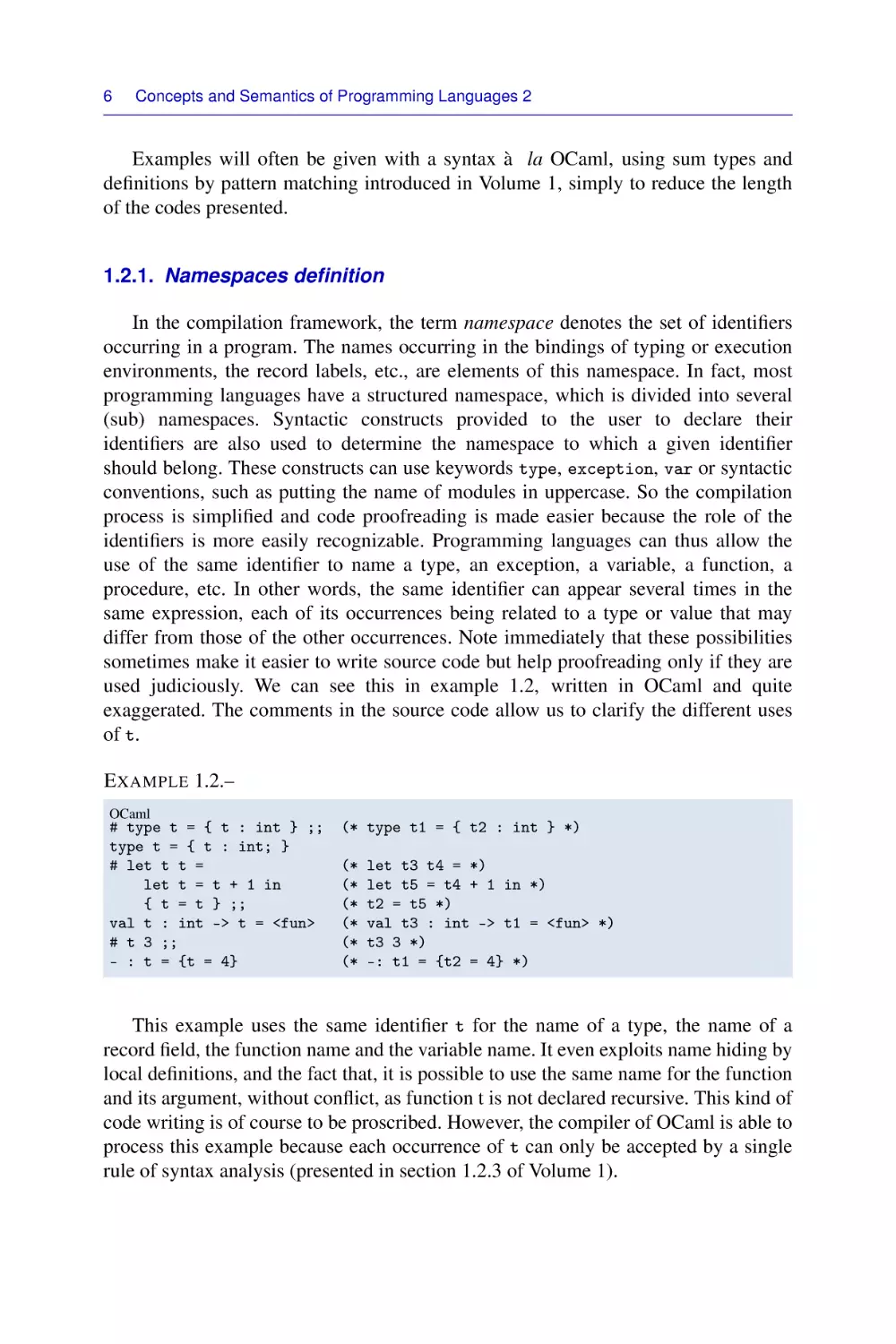
used judiciously. We can see this in example 1.2, written in OCaml and quite
exaggerated. The comments in the source code allow us to clarify the different uses
of t.
E XAMPLE 1.2.–
OCaml

# type t = { t : int } ;;
type t = { t : int; }
# let t t =
let t = t + 1 in
{ t = t } ;;
val t : int -> t = <fun>
# t 3 ;;
- : t = {t = 4}

(* type t1 = { t2 : int } *)
(*
(*
(*
(*
(*
(*

let t3 t4 = *)
let t5 = t4 + 1 in *)
t2 = t5 *)
val t3 : int -> t1 = <fun> *)
t3 3 *)
-: t1 = {t2 = 4} *)

This example uses the same identifier t for the name of a type, the name of a
record field, the function name and the variable name. It even exploits name hiding by
local definitions, and the fact that, it is possible to use the same name for the function
and its argument, without conflict, as function t is not declared recursive. This kind of
code writing is of course to be proscribed. However, the compiler of OCaml is able to
process this example because each occurrence of t can only be accepted by a single
rule of syntax analysis (presented in section 1.2.3 of Volume 1).

Namespaces: Model and Operations

7

In the remainder of this chapter, the model that includes kits uses three
namespaces:
– N T the namespace of types;
– N V the namespace grouping names denoting values, thus, constant identifiers,
variables, functions, exception identifiers, etc;
– N K the namespace of kits.
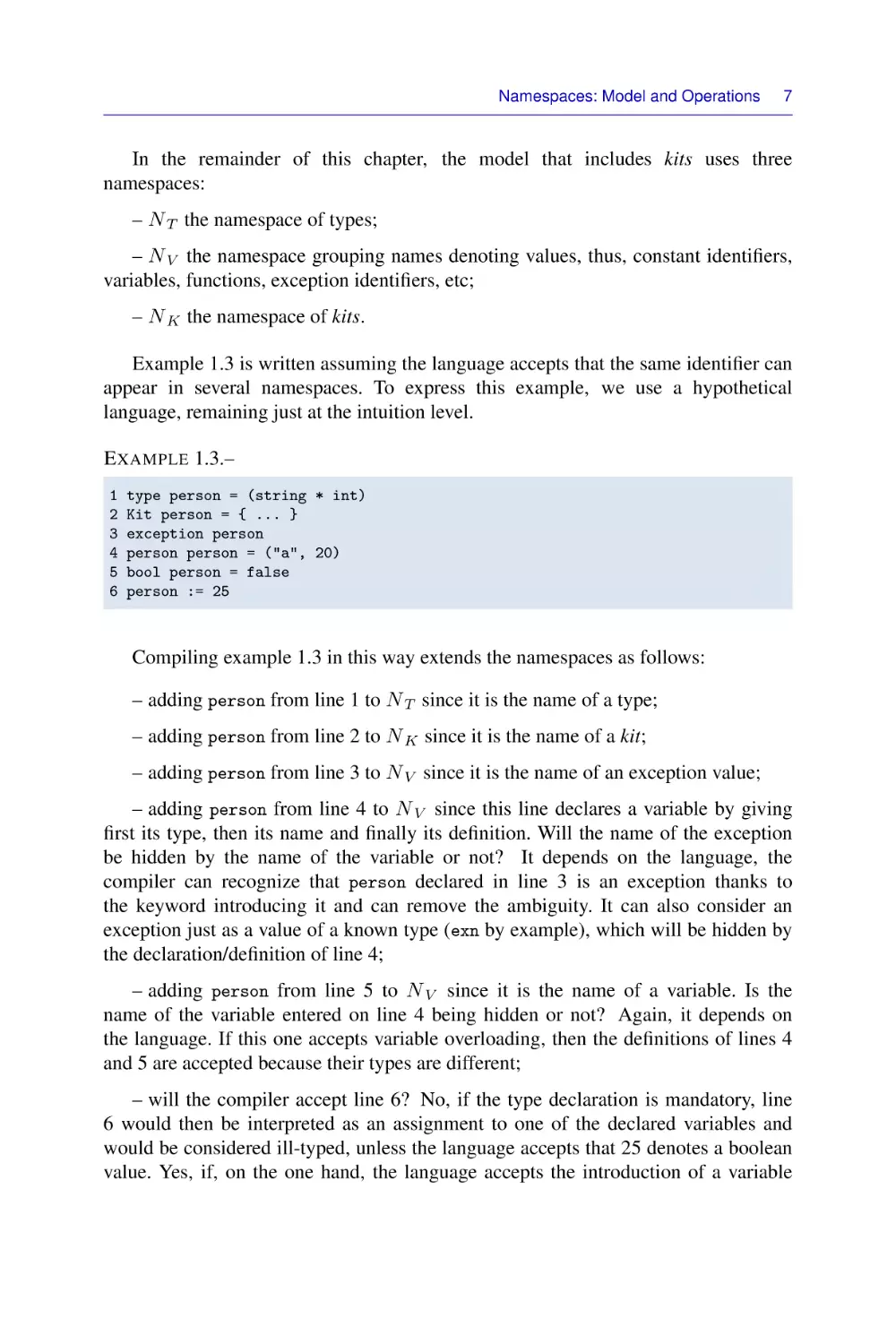
Example 1.3 is written assuming the language accepts that the same identifier can
appear in several namespaces. To express this example, we use a hypothetical
language, remaining just at the intuition level.
E XAMPLE 1.3.–
1
2
3
4
5
6

type person = (string * int)
Kit person = { ... }
exception person
person person = ("a", 20)
bool person = false
person := 25

Compiling example 1.3 in this way extends the namespaces as follows:
– adding person from line 1 to N T since it is the name of a type;
– adding person from line 2 to N K since it is the name of a kit;
– adding person from line 3 to N V since it is the name of an exception value;
– adding person from line 4 to N V since this line declares a variable by giving
first its type, then its name and finally its definition. Will the name of the exception
be hidden by the name of the variable or not? It depends on the language, the
compiler can recognize that person declared in line 3 is an exception thanks to
the keyword introducing it and can remove the ambiguity. It can also consider an
exception just as a value of a known type (exn by example), which will be hidden by
the declaration/definition of line 4;
– adding person from line 5 to N V since it is the name of a variable. Is the
name of the variable entered on line 4 being hidden or not? Again, it depends on
the language. If this one accepts variable overloading, then the definitions of lines 4
and 5 are accepted because their types are different;
– will the compiler accept line 6? No, if the type declaration is mandatory, line
6 would then be interpreted as an assignment to one of the declared variables and
would be considered ill-typed, unless the language accepts that 25 denotes a boolean
value. Yes, if, on the one hand, the language accepts the introduction of a variable

8

Concepts and Semantics of Programming Languages 2

without type declaration and, on the other hand, if it accepts overloading because it
can determine the type of 25. Line 6 (by replacing := by =) will then be understood as
the introduction of a new variable person of type int and added to N V .
The developer is thus led to refine the scope rules seen in Volume 1 in order to
take into account the existence, or not, of different namespaces. If the same identifier
is introduced by several declarations/definitions, there is not always masking of its
previous bindings by the last declaration made. Techniques for removing ambiguities
can be used. However, readers are advised to be careful when relying on them: it is
necessary to make sure that they will clarify what the binding is of each occurrence of
the multi-declared identifier throughout the source code. Remember that the presence
of multi-declared identifiers does not ease proofreading.
Note that the expression “namespace” is used by some authors to actually denote
the execution environment and to describe the scope of the identifiers. This can create
confusion. The determination of the membership of an identifier to a namespace is
made during the syntactic analysis by the compiler. The execution environment (also
called the evaluation environment) evolves during execution, in accordance with the
study in the Chapters 3 and 4 of Volume 1, which also explain the notions of scope of
an identifier and masking (also called hiding).
1.2.2. Extending notions of environment and binding
Partitioning the global namespace into three (sub) namespaces induces the
partition of any environment into three sub-environments (which are also called
environments) described below.
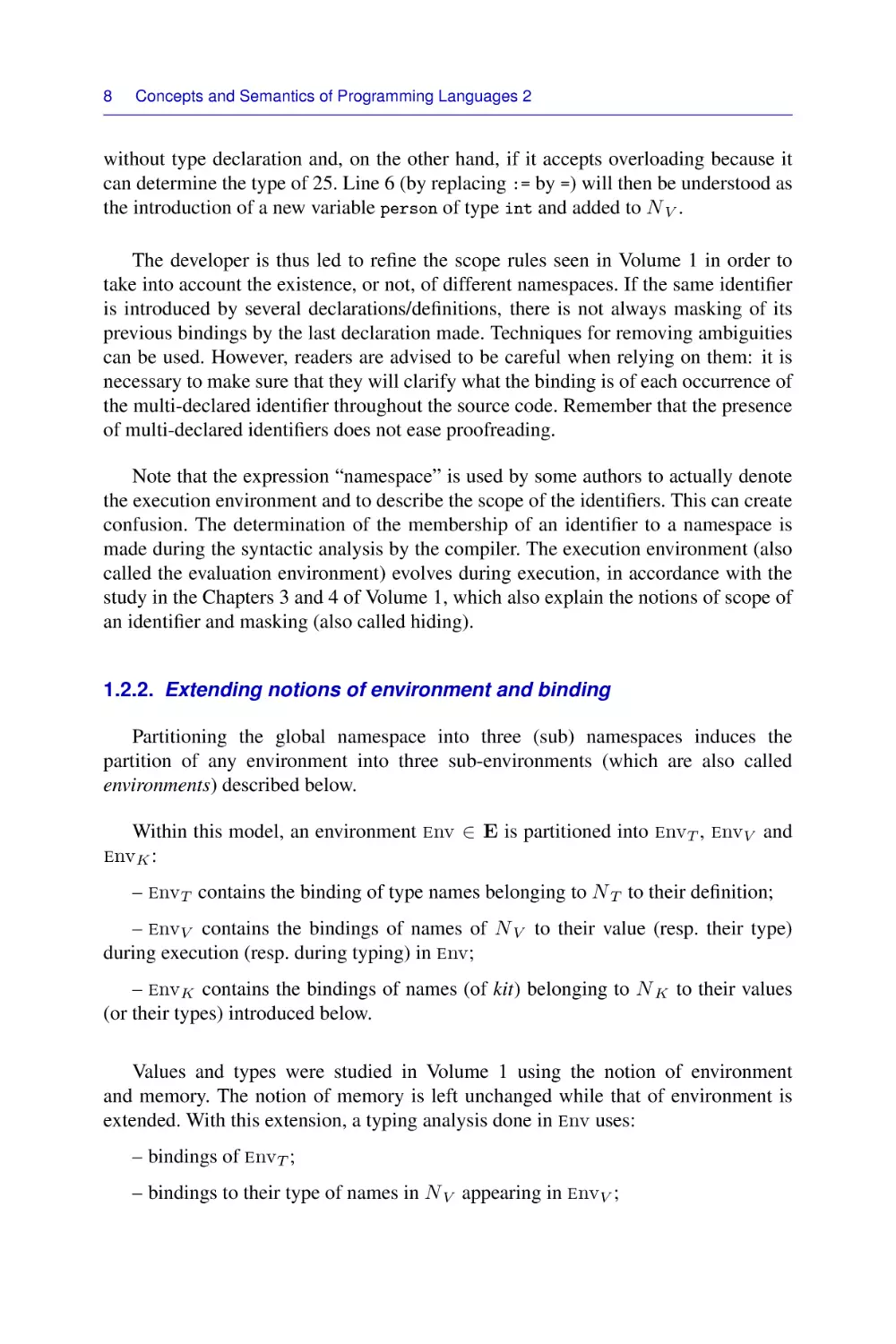
Within this model, an environment Env ∈ E is partitioned into EnvT , EnvV and

E nvK :

– EnvT contains the binding of type names belonging to N T to their definition;
– EnvV contains the bindings of names of N V to their value (resp. their type)
during execution (resp. during typing) in Env;
– EnvK contains the bindings of names (of kit) belonging to N K to their values
(or their types) introduced below.
Values and types were studied in Volume 1 using the notion of environment
and memory. The notion of memory is left unchanged while that of environment is
extended. With this extension, a typing analysis done in Env uses:
– bindings of EnvT ;
– bindings to their type of names in N V appearing in EnvV ;

Namespaces: Model and Operations

9

– typing information bound to the names of the kits appearing in EnvK .
If the language is statically typed, an execution (also called an evaluation) made in
does not use the bindings of EnvT . It uses:

E nv

– bindings in EnvV of names (belonging to N V ) to their values;
– bindings in EnvK of names of kits to their values (defined further).
If type checking is (at least partly) done at runtime, the runtime typing-evaluation
uses:
– bindings of EnvT ;
– bindings in EnvV of names (belonging to N V ) to their types and to their values;
– bindings in EnvK of names of kits to their types and their values.
Programming languages differ not only in their typing verification methods but
also by their notion of scope (lexical or dynamic or adapted according to the
syntactic constructs). The distinction between the typing environment and the
evaluation/execution environment is fading as typing can be started at compile-time
and completed at runtime. To simplify the description of the semantics of these
languages, we extend the notion of binding.
A binding will now be a tuple (identifier, information1 , information2 , etc.), the
information simply being separated by commas, the first information being, by
convention, the type of the identifier. If the type is not a given information (because
the type is confined, for example), it will be noted by ⊥t . If a value is unknown (not
yet initialized by example), it will be denoted by ⊥v . For example, in an untyped
language, the binding of the identifier x can be (x, ⊥t , ⊥v ) if x is only declared, then
will become (x, ⊥t , v) after the evaluation of its definition having returned the value
v. In a typed language, the type t of x will replace ⊥t in both bindings.
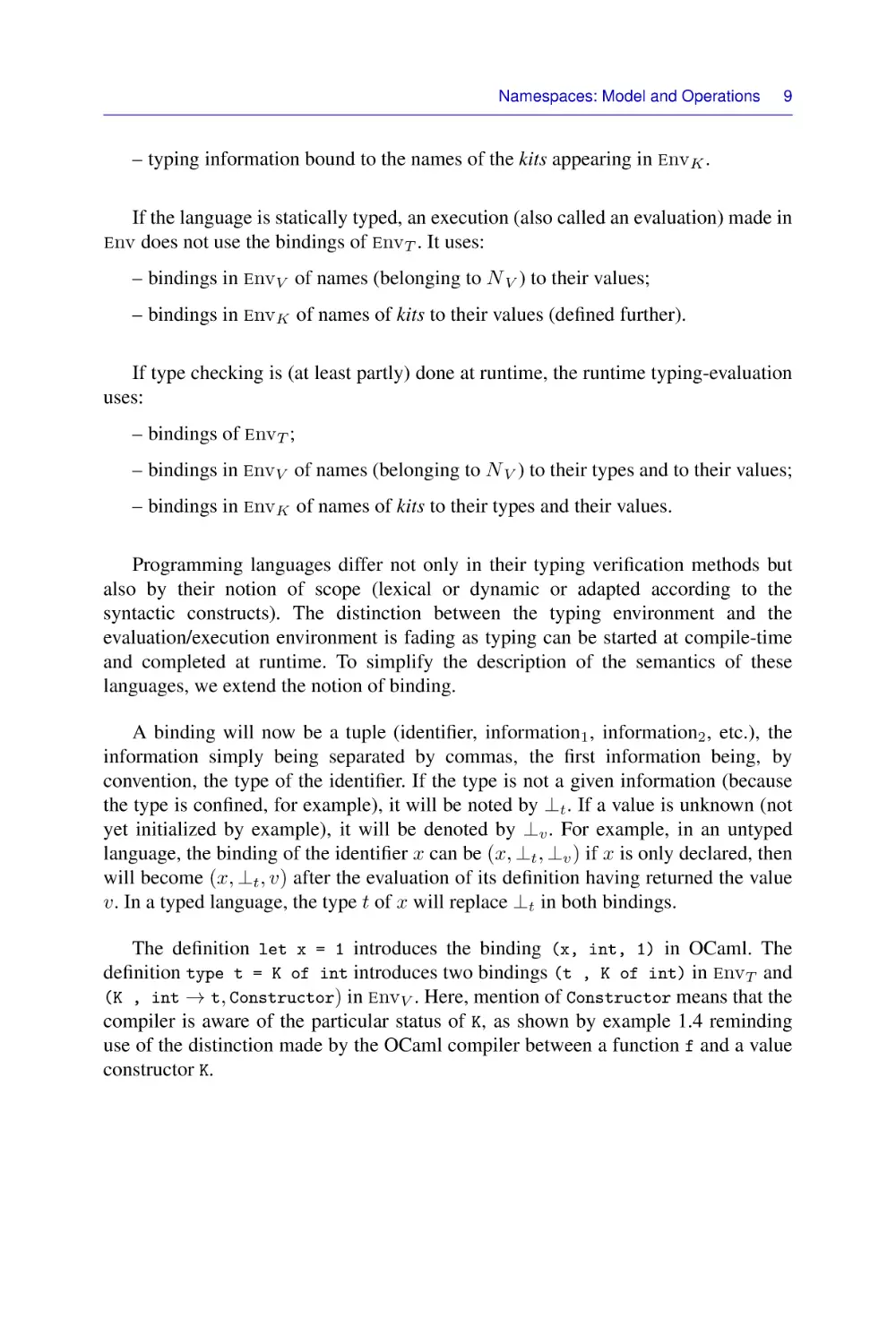
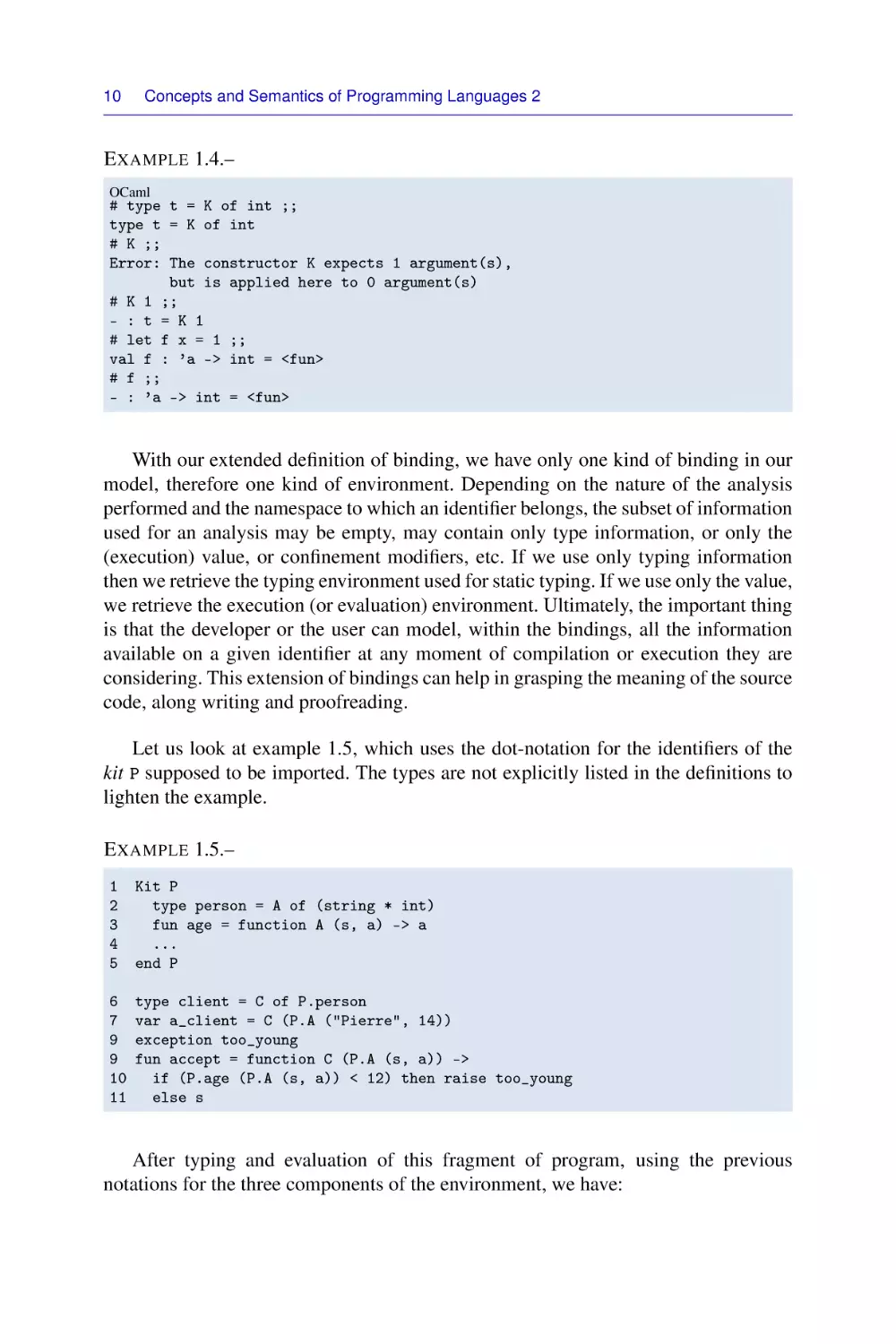
The definition let x = 1 introduces the binding (x, int, 1) in OCaml. The
definition type t = K of int introduces two bindings (t , K of int) in EnvT and
(K , int → t, Constructor) in EnvV . Here, mention of Constructor means that the
compiler is aware of the particular status of K, as shown by example 1.4 reminding
use of the distinction made by the OCaml compiler between a function f and a value
constructor K.

10

Concepts and Semantics of Programming Languages 2

E XAMPLE 1.4.–
OCaml

# type t = K of int ;;
type t = K of int
# K ;;
Error: The constructor K expects 1 argument(s),
but is applied here to 0 argument(s)
# K 1 ;;
- : t = K 1
# let f x = 1 ;;
val f : ’a -> int = <fun>
# f ;;
- : ’a -> int = <fun>

With our extended definition of binding, we have only one kind of binding in our
model, therefore one kind of environment. Depending on the nature of the analysis
performed and the namespace to which an identifier belongs, the subset of information
used for an analysis may be empty, may contain only type information, or only the
(execution) value, or confinement modifiers, etc. If we use only typing information
then we retrieve the typing environment used for static typing. If we use only the value,
we retrieve the execution (or evaluation) environment. Ultimately, the important thing
is that the developer or the user can model, within the bindings, all the information
available on a given identifier at any moment of compilation or execution they are
considering. This extension of bindings can help in grasping the meaning of the source
code, along writing and proofreading.
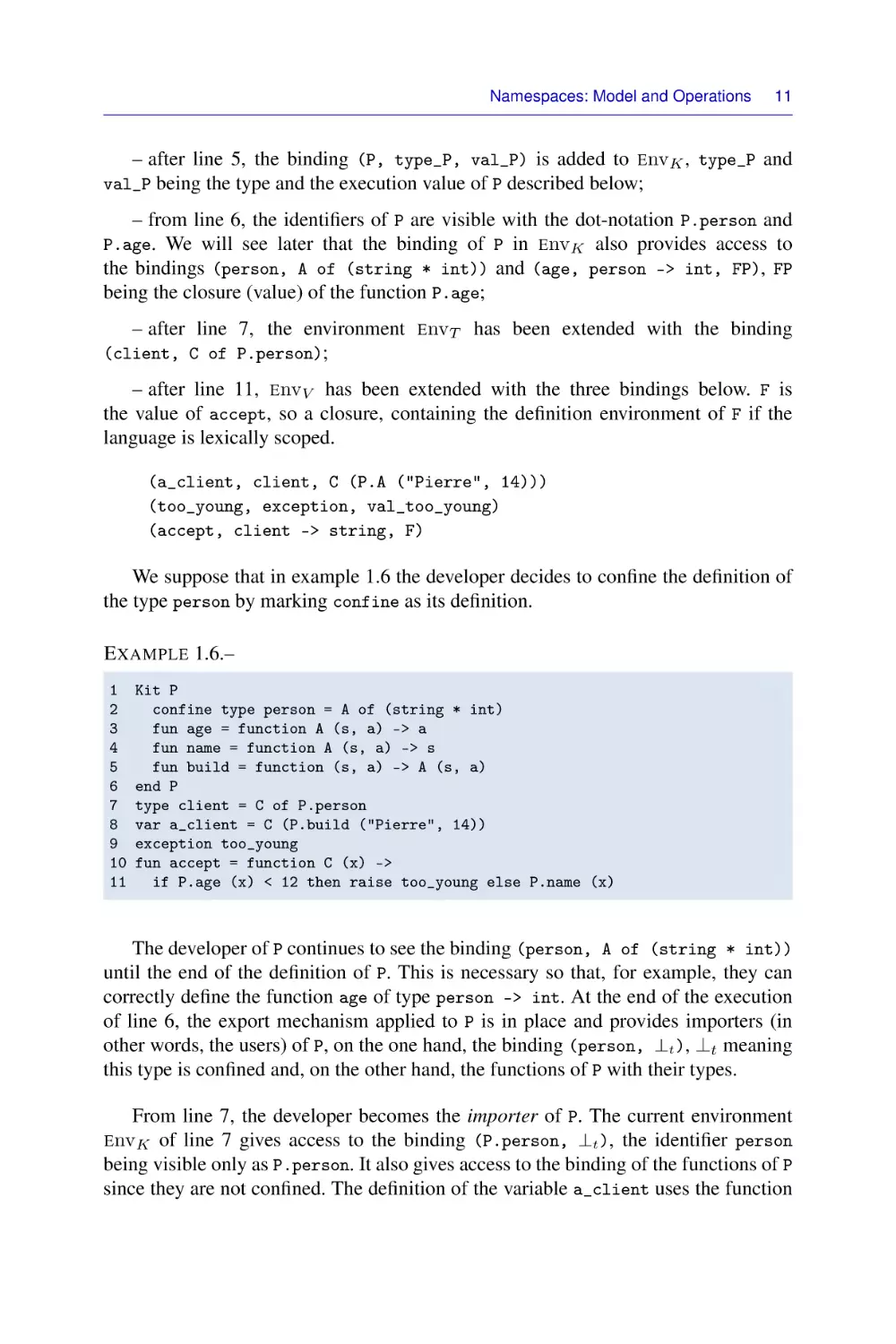
Let us look at example 1.5, which uses the dot-notation for the identifiers of the
kit P supposed to be imported. The types are not explicitly listed in the definitions to
lighten the example.
E XAMPLE 1.5.–
1
2
3
4
5

Kit P
type person = A of (string * int)
fun age = function A (s, a) -> a
...
end P

6
7
9
9
10
11

type client = C of P.person
var a_client = C (P.A ("Pierre", 14))
exception too_young
fun accept = function C (P.A (s, a)) ->
if (P.age (P.A (s, a)) < 12) then raise too_young
else s

After typing and evaluation of this fragment of program, using the previous
notations for the three components of the environment, we have:

Namespaces: Model and Operations

11

– after line 5, the binding (P, type_P, val_P) is added to EnvK , type_P and
val_P being the type and the execution value of P described below;
– from line 6, the identifiers of P are visible with the dot-notation P.person and
P.age. We will see later that the binding of P in EnvK also provides access to
the bindings (person, A of (string * int)) and (age, person -> int, FP), FP
being the closure (value) of the function P.age;
– after line 7, the environment EnvT has been extended with the binding
(client, C of P.person);

– after line 11, EnvV has been extended with the three bindings below. F is
the value of accept, so a closure, containing the definition environment of F if the
language is lexically scoped.
(a_client, client, C (P.A ("Pierre", 14)))
(too_young, exception, val_too_young)
(accept, client -> string, F)

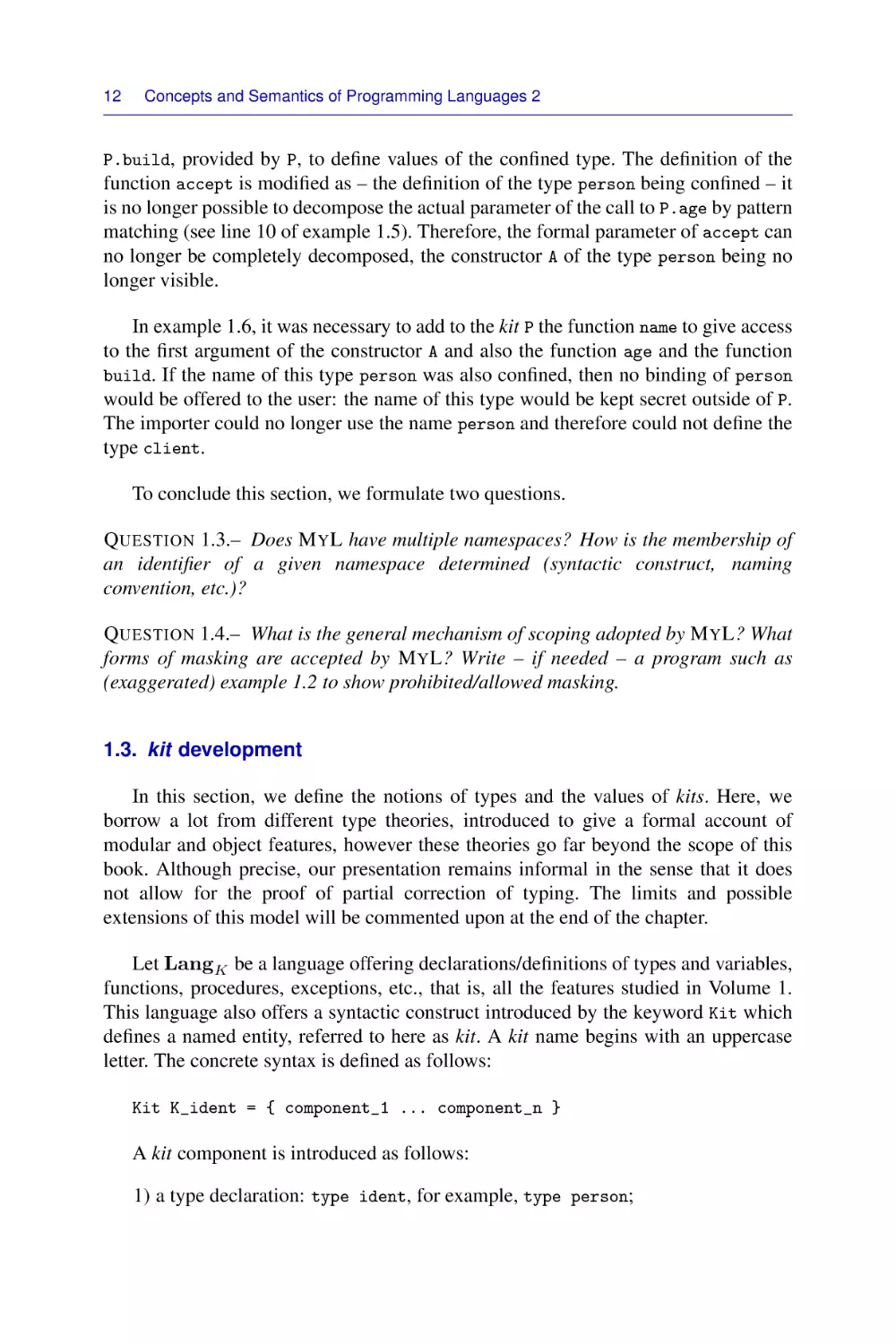
We suppose that in example 1.6 the developer decides to confine the definition of
the type person by marking confine as its definition.
E XAMPLE 1.6.–
1
2
3
4
5
6
7
8
9
10
11

Kit P
confine type person = A of (string * int)
fun age = function A (s, a) -> a
fun name = function A (s, a) -> s
fun build = function (s, a) -> A (s, a)
end P
type client = C of P.person
var a_client = C (P.build ("Pierre", 14))
exception too_young
fun accept = function C (x) ->
if P.age (x) < 12 then raise too_young else P.name (x)

The developer of P continues to see the binding (person, A of (string * int))
until the end of the definition of P. This is necessary so that, for example, they can
correctly define the function age of type person -> int. At the end of the execution
of line 6, the export mechanism applied to P is in place and provides importers (in
other words, the users) of P, on the one hand, the binding (person, ⊥t ), ⊥t meaning
this type is confined and, on the other hand, the functions of P with their types.
From line 7, the developer becomes the importer of P. The current environment
of line 7 gives access to the binding (P.person, ⊥t ), the identifier person
being visible only as P.person. It also gives access to the binding of the functions of P
since they are not confined. The definition of the variable a_client uses the function
E nvK

12

Concepts and Semantics of Programming Languages 2

P.build, provided by P, to define values of the confined type. The definition of the
function accept is modified as – the definition of the type person being confined – it
is no longer possible to decompose the actual parameter of the call to P.age by pattern
matching (see line 10 of example 1.5). Therefore, the formal parameter of accept can
no longer be completely decomposed, the constructor A of the type person being no

longer visible.
In example 1.6, it was necessary to add to the kit P the function name to give access
to the first argument of the constructor A and also the function age and the function
build. If the name of this type person was also confined, then no binding of person
would be offered to the user: the name of this type would be kept secret outside of P.
The importer could no longer use the name person and therefore could not define the
type client.
To conclude this section, we formulate two questions.
Q UESTION 1.3.– Does M Y L have multiple namespaces? How is the membership of
an identifier of a given namespace determined (syntactic construct, naming
convention, etc.)?
Q UESTION 1.4.– What is the general mechanism of scoping adopted by M Y L? What
forms of masking are accepted by M Y L? Write – if needed – a program such as
(exaggerated) example 1.2 to show prohibited/allowed masking.
1.3. kit development
In this section, we define the notions of types and the values of kits. Here, we
borrow a lot from different type theories, introduced to give a formal account of
modular and object features, however these theories go far beyond the scope of this
book. Although precise, our presentation remains informal in the sense that it does
not allow for the proof of partial correction of typing. The limits and possible
extensions of this model will be commented upon at the end of the chapter.
Let LangK be a language offering declarations/definitions of types and variables,
functions, procedures, exceptions, etc., that is, all the features studied in Volume 1.
This language also offers a syntactic construct introduced by the keyword Kit which
defines a named entity, referred to here as kit. A kit name begins with an uppercase
letter. The concrete syntax is defined as follows:
Kit K_ident = { component_1 ... component_n }

A kit component is introduced as follows:
1) a type declaration: type ident, for example, type person;

Namespaces: Model and Operations

2) a type definition:

13

type ident = deftype, for example, type person =

A of (string * int);

3) a variable declaration: var ident: type, for example, var un_client:
client;

4) a variable definition: var ident: type = def, for example, var un_client:
client = ("Alan", 25);

5) a function (or procedure) declaration:
person -> int;

fun ident:

type, for example,

fun age:

6) a function (or procedure) definition: fun ident : type = def, for example,
person -> int = function A (n, a) -> a;

fun age:

7) an exception declaration: exception ident;
8) a

definition

of

kit,

called

“internal

kit”,

for

example,

Kit Kit_ident = { component_a ... component_n }.

In our concrete syntax, the introduction of a component begins with a keyword
which specifies its nature, simply to facilitate reading and writing of the book. This is
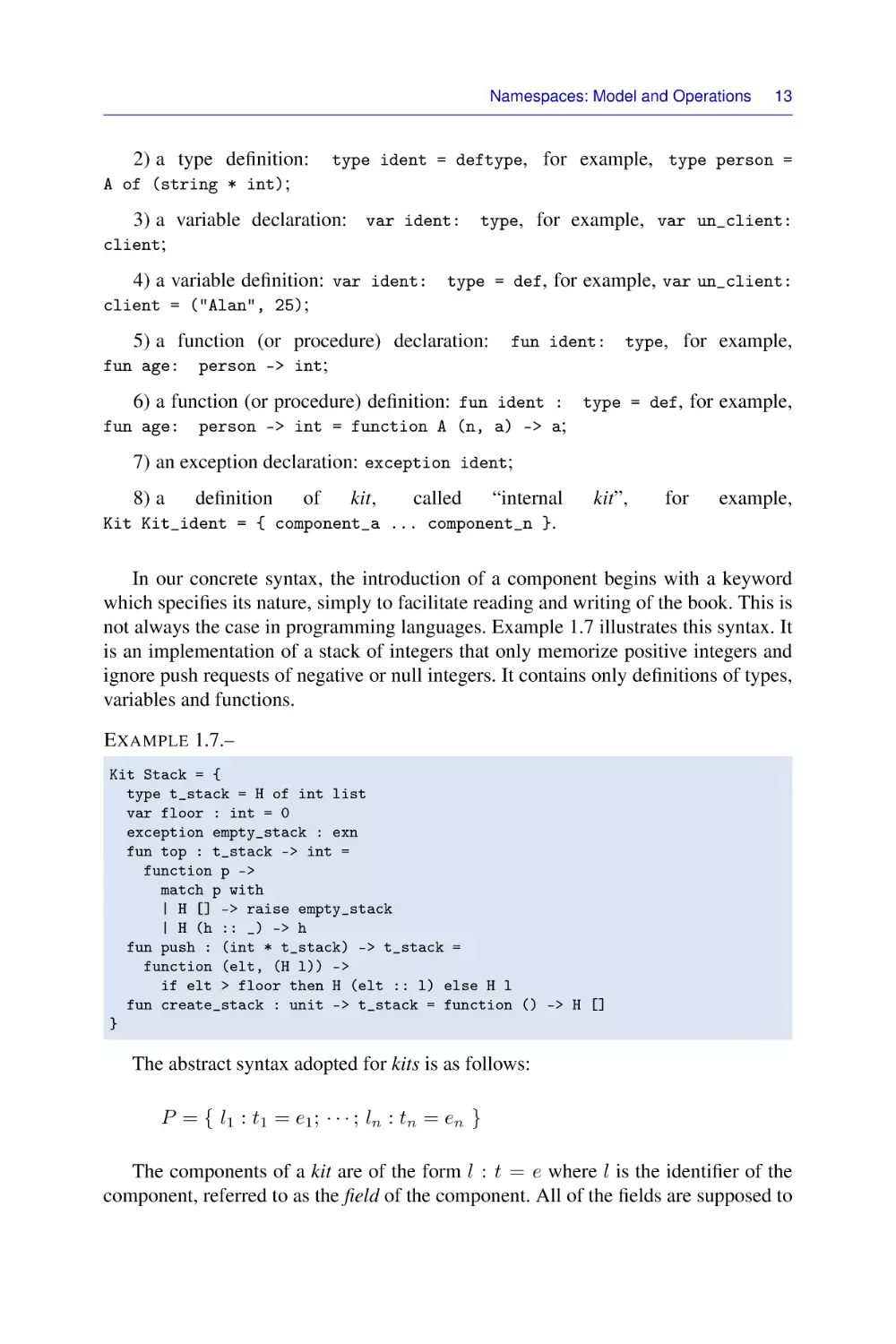
not always the case in programming languages. Example 1.7 illustrates this syntax. It
is an implementation of a stack of integers that only memorize positive integers and
ignore push requests of negative or null integers. It contains only definitions of types,
variables and functions.
E XAMPLE 1.7.–
Kit Stack = {
type t_stack = H of int list
var floor : int = 0
exception empty_stack : exn
fun top : t_stack -> int =
function p ->
match p with
| H [] -> raise empty_stack
| H (h :: _) -> h
fun push : (int * t_stack) -> t_stack =
function (elt, (H l)) ->
if elt > floor then H (elt :: l) else H l
fun create_stack : unit -> t_stack = function () -> H []
}

The abstract syntax adopted for kits is as follows:
P = { l 1 : t1 = e 1 ; · · · ; l n : tn = e n }
The components of a kit are of the form l : t = e where l is the identifier of the
component, referred to as the field of the component. All of the fields are supposed to

14

Concepts and Semantics of Programming Languages 2

be distinct and we suppose that this syntactic condition is always fulfilled, for
example it can be verified by the compiler. t is the name of a type of LangK and e
denotes an expression of LangK or a definition of type in LangK . In example 1.7,
the component expressed in the concrete syntax var floor : int = 0 is translated
into the abstract syntax in floor : int = 0 where floor is the field of the
component; the indication var is not integrated in the abstract syntax.
The text fragment “the component of field l” will often be abbreviated to “the
field l” and the word component will be replaced with field when there is no need to
distinguish between the component and its name.
Some definitions (represented by ei in the abstract syntax) of components may be
absent in the definition of a kit. In this case, the field is said to only be not-defined
(or just declared). A kit is said to be complete if all of its components have received
a definition. Otherwise, it is said to be incomplete. For example, the kit Stack of
example 1.7 is complete.
WARNING .– The abstract syntax could lead to the conclusion that the notion of kit
is just a kind of generalization of records, the components of the kit being the fields
of these records. However, record fields, even if they can be of any type – including
a functional type (as in OCaml, for example) – cannot be definitions of types, nor
can they contain local declarations of variables or be defined by expressions using the
names of the other fields. Records are only designed to encode structured data. The
above example illustrates the difference between a kit and a record: the definition of
the component whose field is push uses the field floor.
The syntax used to name imported components in a development is the
dot-notation P.l, P being the name of the kit and l one of its fields. For example,
importers of the kit Stack in example 1.7 can use the type t_stack denoting it by
Stack.t_stack, call the function Stack.top, etc.
1.3.1. Namespace of a kit
In our model, we assume that every kit, say P , has its own namespace that we call
N (P ), itself divided into sub-spaces of names, denoted N (P )T , N (P )V and N (P )K .
Allowing a kit to have fields which are themselves kits leads to a kind of recursivity in
the definition of N (P ) since N (P )K is the namespace of the “internal kits” defined
in P , each of these kits having its own namespace, which is also divided into three
namespaces, and so on.
In example 1.7, the kit Stack has 6 fields. The first field t_stack introduces the
definition of the type t_stack. The second field, floor, defines a variable and so on.
The namespace associated with Stack is divided into:

Namespaces: Model and Operations

15

– N(Stack)T = { t_stack };
– N(Stack)V = { floor, empty_stack, top, push, create_stack };
– N(Stack)K = ∅.
1.3.2. Order of fields introduction
Programming languages differ in their strategies for analyzing dependencies
between declarations and definitions of kit components. The choice is twofold: either
components can only use the fields of the components previously introduced in the
kit, or any component can use any field of any component. Therefore, the chosen
strategy defines what the allowed dependencies are between fields of the same kit.
The first possibility can be imposed on the developer of a kit, who must choose an
order in which to introduce fields in the kit, according to the dependencies between
them. This choice may also be left to the compiler, which will try to reorder fields
to satisfy the strategy. The second possibility leads all definitions being considered
mutually recursive definitions, this simplifies source coding but can complicate the
static analyses performed by the compiler. In this section, for the sake of simplicity,
we opt for the first choice. More precisely we make the hypothesis that the order
of components in abstract syntax is such that a component depends only on those
introduced previously. This allows us to give very simple definitions of the type and
the value of a kit, without the need to introduce fixpoints for these definitions (see
Chapter 4 of Volume 1 where fixpoints are studied). These simple notions of type and
value will be developed later in the chapter, when some operations will be added to the
kits. For example, in the case of confinement, it is also necessary to associate to a kit
the information on the types and values it exports, i.e. the information made available
to users.
1.3.3. Typing kits
In this section, we only consider complete kits, thus with all components defined.
Incomplete kits will be studied in section 1.4.
Let Env be the current environment partitioned into EnvT , EnvV and EnvK . Any
binding present in one of these environments associates an identifier with a set of
information. Supposing that the language is statically typed and that types are declared
by the user, the typing analysis will use the typing information enclosed in the different
bindings. We just retrieve the typing environments of Chapter 5 of Volume 1. Our
hypothesis on the order of fields in the source code of a kit induces the typing strategy.
Typing of a kit is done by applying the typing rules given in Chapter 5 of Volume 1
to each field, following their order in the source code. As soon as a component of the

16

Concepts and Semantics of Programming Languages 2

kit has been typed, the binding of its field to its type is added to the (corresponding
component of the) current environment and typing of the next component is done in
this extended environment. So this strategy assumes that the types figuring in the kit
are introduced before the components using them (such as those introduced by var,
fun etc.).
Let P be a kit defined as follows: P = { l1 : t1 = e1 ; . . . ; ln : tn = en }. The
type of P , denoted PT ype , is defined by the collection of associations of its fields
belonging to N (P )T with their type definitions and the associations of its other fields
with the types of their definitions. It is described as follows:
PT ype = { l1 : t1 ; . . . ; ln : tn }
If li ∈ N (P )T , then ti = ei (we take the type definitions figuring in P ), otherwise
ti is the type of ei which is obtained by the typing algorithm used by the language
LangK . The typing rule of a kit is stated as follows:
(RT )

∀i ∈ [1, n] (l1 , t1 )  · · ·  (li−1 , ti−1 )  Env  ei : ti
E nv  P : PT ype

where  is an operation which adds the binding of the field l to the right component
of Env, according to the contents of l.
As soon as the type of P is determined, the binding associating P to PT ype is added
to EnvK . It allows us to find the types of components of P thanks to the dot-notation
P.l, which gives access to the binding of P in EnvK so to PT ype and then to the type
of the field l.
Again, let us take example 1.7 which defines the kit Stack. The type of this kit
contains, among others, the association of t_stack with the definition H of int list
and the association of top with the type t_stack -> int. With a concrete syntax
similar to the one adopted for kits, this type is written:
type Stack = {
type t_stack = H of int list
var floor : int
exception empty_stack : exn
fun top : t_stack -> int
fun push : int -> t_stack -> t_stack
fun create_stack : unit -> t_stack
}

The strategy of typing presented above will be reused for the evaluation of a kit
and will be detailed there.

Namespaces: Model and Operations

17

In our model, fields are an integral part of the type of a kit. Two kits having
components of the same type but differing in their fields do not have the same type.
We also make the hypothesis that two kits having different names are not equal. So
the chosen typing system is nominal (also called named-based). Type equality was
discussed in section 6.6 of Volume 1.
WARNING .– In fact, this presentation of kit types and typing, reminiscent of record
typing, is far too simple to completely handle all the features and operations on kits
(functors, inheritance, etc.). It has the advantage only of providing an intuitive
approach to kit typing and more or less corresponding to the typing discipline of
most typed object-oriented languages. But it may also seem too complicated to be
applied to some languages such as Python, which do not require declarations of fields
to be typed and which do not make type inference but perform certain type checks at
runtime. See example 1.8, using the interactive mode of Python.
E XAMPLE 1.8.–
Python

$ python3
>>> class C:
...
x = 5
...
>>> print ("value of the field C.x:", C.x, "; type of C.x:", type (C.x))
value of the field C.x: 5;type of C.x: <class ’int’>
>>> C.x = ’aa’
>>> print ("After assignment, the value of C.x is:", C.x, "; its type is:", \
type (C.x))
After assignment, the value of C.x is: aa ; its type is: <class ’str’>
>>> 3 + C.x
Traceback (most recent call last):
File "<stdin>", line 1, in <module>
TypeError: unsupported operand type(s) for +: ’int’ and ’str’

The assignment C.x = ’aa’ apparently changes the type of the field x. Python is
dynamically typed and the type of a field may change at runtime. On the other hand,
the operator + cannot be applied to an integer and a string (which is the value of
C.x after the assignment) because + is not bound in the current environment to any
functional value able to do this addition.
Of course, no one writes such code right away. But these modifications of kit fields
can be made in any code which has access to the class C. This example, conforming
to the semantics of Python, will be reviewed in section 4.4 to detail the meaning of
this assignment operation, which explains and justifies the answers of Python. In any
case, maintaining a typing discipline, even if the language does not require it, is a
good practice in writing kits because it ensures some logical consistency of the written
source code. This leads to some questions.

18

Concepts and Semantics of Programming Languages 2

Q UESTION 1.5.– Does M Y L possess a notion of type of a kit? If so, what is the link
between the name of a kit and the name of its type?
Q UESTION 1.6.– Are the fields of kits typed?
developer or synthesized by the compiler?

Are their types declared by the

Q UESTION 1.7.– Let P 1 and P 2 be two kits having the same fields associated with the
same types. Do P 1 and P 2 have the same type? Or, is M Y L typing strictly nominal?
Q UESTION 1.8.– This question covers all types (if any) in M Y L. Is it possible to make
explicit a conversion of a type t1 to a type t2 ? Does M Y L perform implicit conversion
of types, at least in some cases? Identify these cases.
Q UESTION 1.9.– May two components of a kit having different types be named by the
same field? In other words, if M Y L accepts some form of overloading of fields, is it
allowed?
1.3.4. kit values
We continue to consider only complete kits. So far, in our model, the evaluation
of a syntactic construct produces either a side effect or a value, sometimes called the
execution value (or runtime value). This value is not always a first class value, that
is, a value that can, for example, be returned as a result (see Volume 1 for a precise
definition of all these kinds of values). We extend this model with the notion of kit
value. In some languages, kit values are not first-class, they are only runtime values.
This is quite often the case with modules and classes. But these kit values can also be
first class values and it is quite often the case with objects. The intuitive presentation
which follows can be applied to both kinds of values; the issues specific to first class
kit values will be discussed in Chapters 2 and 3.
Let us first consider a kit P whose fields are not type definitions nor kit definitions.
The value of this kit is then built as the collection of the values of its components
denoted by:
PV alue = { l1 = v1 ; . . . ; ln = vn }
where vi is the value of the component whose field is li .
Let us detail the evaluation of P , assuming the field definitions are evaluated in the
order of its abstract syntax. Let us also assume that the language is statically typed.
The typing has therefore already been done. The evaluation does not perform any
type checking and therefore uses only the accessible values in the bindings of the
current environment. To evaluate a kit, we follow the strategy used for typing, each

Namespaces: Model and Operations

19

step of evaluation being done with the evaluation/execution rules of Chapters 3 and 4
of Volume 1.
Let E = (Env0 , Mem0 ) be the current state at the beginning of the evaluation of
the kit P where Env0 = (EnvT , EnvV , EnvK ).
The evaluation of the first field, say l1 ∈ P V , in (Env0 , Mem0 ) with our
convention, returns a value v1 and modifies the state E which becomes the new state:
((EnvT , (l1 , v1 ) ⊕ EnvV , EnvK ), Mem1 )
M em1 will differ from M em0 if the evaluation of e1 produces side effects. The value
vi of each field li is then obtained in the same manner, by following the order of
the fields in the source code. Every evaluation extends the current environment and
possibly modifies the memory.

At the end of the evaluation of P , bindings added to EnvV disappear and the
binding (P, PV alue ) is added to EnvK . The resulting environment is therefore (EnvT ,
E nvV , (P, PV alue ) ⊕ E nvK ). The memory remains in the state reached at the end of
the complete evaluation, as the execution of some components may cause side effects.
However, the components of a kit can also be type definitions, for which no
(runtime) value has been defined. We then have the small difficulty of writing values
bypassed as follows. Strictly speaking, fields belonging to N T should not figure in a
kit value. But this requires the renumbering of the li fields. To avoid this and thus
maintain a uniform presentation of kits in abstract syntax, we assign a fictive value ∅t
to any field introducing a type.
Moreover, some fields of a kit P can be kits themselves. Their evaluation is done in
the current state reached by evaluation of the fields written before them in the source
code of P and follows the strategy we have just described.
Note that, if the language has lexical scope, if the definition of a field P.li is a
function whose body contains an occurrence of the field P.lj , then the value of P.li is
a closure that contains the binding of P.lj to its value.
Under lexical scope, the evaluation rule of a kit is as follows:
(RE )

∀i ∈ [1, n] (l1 , v1 )  · · ·  (li−1 , vi−1 )  Env  ei  vi
E nv  P  PV alue

In the case of dynamic typing, the evaluation of a field li starts by the typing
verification of its definition, followed by the evaluation itself, and it uses the type

20

Concepts and Semantics of Programming Languages 2

information present in the bindings of the current environment. The description of
the evaluation made for statically typed languages can be taken over but the result is
twofold: the type ti and the value vi are returned and the name li is bound to the two
sets of information ti and vi .
We have not yet detailed the evolution of the environment alongside the
evaluation of kits. We do so now, considering only the evaluation of kit Stack from
example 1.7. We assume that the language uses lexical scope and that the current
state is (Env0 , Mem0 ). Let Env0T , Env0V , and Env0K be the components of Env0 :
1) evaluation of field type t_stack = H of ... extends the environment Env0T
to Env1T = (t_stack, ;t ) Env0T . The other components of the environment Env1
so obtained are those of Env0 : Env0V =Env1V and Env1K = Env0K ;
2) evaluating exception empty_stack extends the environment Env1V
= (empty_stack, exception) Env1V ;

to

E nv2V

3) evaluating var floor = 0 extends Env2V to Env3V = (floor, 0)

E nv2V ;

4) in the same way, evaluation of the definition fun top p = match p with ...
returns the closure F1 = hp, match p, ..., Env3 i and extends Env3V to Env4V =
(top, F1 ) Env3V ;
5) and evaluating fun push elt H l = if ... in Env4 returns the closure F2 =
helt, H (l), if, ..., Env4 i and extends Env4V to Env5V = (push, F2 ) Env4V ;
6) The evaluation of the last field fun create_stack () = H [] in Env5
returns the closure F3 = h_, H ([]), Env5 i and extends Env5V to Env6V =
(create_stack, F3 ) Env5V .
The evaluation of the kit Stack is finished. The value of Stack is:
StackV alue = { t_stack = ;t ; empty_stack = exception; floor = 0;
top = F1 ; push = F2 ; create_stack = F3 }

During this evaluation, the source code of Stack was de facto considered as a
sequence of local definitions in the kit, thus placing this execution analysis within
the framework defined in Volume 1, Chapters 3 and 4. The environments built during
the evaluation of Stack disappear but remain stored in the closures, which are values
of functional fields of Stack, to conform to lexical scoping. The evaluation of the
definition of Stack extends the current environment into:
E nvT , E nvV , (Stack, StackT ype , StackV alue )

E nvK

In this example with no side effects, the memory remains the same throughout the
evaluation of the kit.

Namespaces: Model and Operations

21

We recall that this evaluation was carried out under the assumption that fields are
evaluated in the order of their presentation in the source code. This is the case in
OCaml: the first line of example 1.9 has been rejected because the field y is used
before being introduced.
E XAMPLE 1.9.–
OCaml

# module M = struct let x = y + 1 let y = 3 end ;;
Error: Unbound value y
# module M = struct let y = 3 let x = y + 1 end ;;
module M : sig val y : int val x : int end

Example 1.10 shows that Java makes the same choice.
E XAMPLE 1.10.–
Java

class MC {
int x = y + 1 ;
int y ;
MC (int a , int b) {
this.x = a ; this.y = b ;
}
public static void main (String args[]) { ... }
}
$ javac MC.java
MC.java:4: error: illegal forward reference
int x = y + 1 ;
^1 error

Here follow some questions about the definition and evaluation of a kit.
Q UESTION 1.10.– In M Y L, is the order of the fields of a kit important? Can a field
use a field that is defined after it in the source code?
Q UESTION 1.11.– May a field have a recursive definition without mentioning it using
a keyword like rec? Is there a possibility of mutual recursivity between several fields?
Q UESTION 1.12.– Apart from its fields, can a kit contain a block of instructions
declaring, for example, local variables to the kit and performing any side effects?
When is this block executed?
Q UESTION 1.13.– Are the functions of M Y L first class values?
Q UESTION 1.14.– Are the kits of M Y L first class values? (see Chapters 2 and 3 to
for further explanation).

22

Concepts and Semantics of Programming Languages 2

1.3.5. kit export, confining fields
The frontier between development and usage of a kit was discussed in section 1.1.
Remember that any operation on a kit is the responsibility of the developer. The
importer can only use the fields of the imported kit (even if the developer and the
importer are the same person). In this section, we study the confinement operation
and the resulting mechanism of exports. We will see in section 1.7 that this
confinement operation does not only serve to restrict exports. It is also used to control
certain operations on kits, such as the addition of fields. It is important to make a
clear distinction between these two different roles, as explained in the following.
We have seen in Volume 1 that the evaluation of a local declaration can hide a
binding already present in the current environment. This masking concerns the whole
code written by the developer in the scope of this declaration and ceases at the end of
this scope. When the local binding disappears, the hidden binding is again visible. In
general, no syntactical mark points out this hiding. The confinement of a type
definition, of a value, etc., is a very different kind of operation, its objective is to
restrict access to some kit fields to importers. It is denoted in the source code by a
syntactic construct. The confinement operation of a kit P acts on the visibility of P
fields after the export operation. Depending on the language, it can be carried out in
two different ways.
– Restricting export possibilities of a field can be done by adding a mark on it,
which can be a keyword or a modifier like protected, private, etc. The confinement
achieved by marking some fields of a kit depends on the language: the marks private
of Ada, Java or OCaml do not have the same meaning.
A field type ident = deftype can be marked so as to authorize the export of
ident and to prohibit the export of deftype. The name ident can also remain confined
by using another mark.
A mark on a field that defines a value can prohibit the export of the field name
which is therefore not usable outside of the kit (see the mark private of Ada in
Chapter 2).
Confining by marking fields in this way is typical of object-oriented languages
(see Chapter 3). The exporter sets the conditions of field exports directly into the
source code of the kit, according to categories of importers defined by the language.
For example, in Java, a field of a class C marked protected can only be used to
define classes belonging to the same group of files (called a package) as C. So the
mark protected has some consequences on later stages of Java software developments
importing C.
– Confinement can be conceived in a more flexible way in order to meet the needs
of different importers. This implies that the confinement is defined outside the source

Namespaces: Model and Operations

23

code of the kit. One can either indicate which fields are to be confined or which
fields are to be exported to comply with importer requirements. The confinement
can be expressed by a type or a dedicated syntactic construct, sometimes called the
interface. This is the case, for example, for the OCaml modules (see section 2.2),
which can adapt field visibility to each importer’s needs, as will be seen in Chapter 2.
Incidentally, note that the word “interface” is used by many programming languages,
but with quite different meanings.
We now consider the confinement mechanism(s) that can be used to export a kit.
Let M be the confinement information which we are making explicit. For example,
for the kit P of example 1.6, M = confine type person. In OCaml, we study the
confinement obtained by the restriction put on the type t1 of a kit P defined by a
“more constraining” type t2 and M will then be M = {P : t2 } (see Chapter 2).
We note RP = From(P,M) the export operation of P , according to the
confinement indication M , RP is the name given to the result of this export. For the
moment, denoting the confinement information by M is sufficient, there is no need to
know its contents explicitly. We will distinguish between the two possibilities of
confinement when necessary.
With or without confinement, the export of a kit P should allow importers to use
exported fields without needing to access the source code of P . In return, importers
must not make any assumptions about the implementation of exported fields from P .
This is the very principle of the “off the shelf” component software libraries.
Export does not build a new kit but provides the importer with access to the P
exported “part”, named RP , consisting of a set of component names, associated with
their types (if the language requires type declaration). An importer can use a field l
exported by P by naming it RP.l. In some languages (often in object languages) the
P and RP identifiers are identical. In other languages, RP is considered to be a new
kit, which is not totally correct because there is always some sharing at object-code
level between P and RP components.
The definition of any component of a kit P can, without restriction, use the name
(field), the type and the value of another component totally or partially confined in
P : the export operation does not constrain the developer of the kit themselves. As
soon as the kit P has been completely defined, its fields can be used immediately
with the dot-notation in the source code, provided it is done in accordance with the
confinement: once the kit P is built, the developer becomes an importer of P for the
continuation of source writing.
The operation RP = From(P,M) produces, from the field P.ident, a set of
information in accordance with the mention M of confinement. We describe below
the information that is provided by the confinement of a field, according to its nature

24

Concepts and Semantics of Programming Languages 2

and M requirements. We denote by From(l) the result of the confinement operation
applied to a field l and we use the concrete syntax to informally describe it. Of
course From(l) returns l if this field is not confined:
1) if ident ∈ N (P )T , we can only confine the definition of the type. Only the
name of the type ident is then exported:
From(type ident = typedef) = type ident
In this case, importers cannot directly define values of this type ident nor can they
define functions by pattern matching on the values of ident. Only the fields exported
by the kit P can be used to manipulate values of type ident;
2) the restriction on ident ∈ N (P )T may be stronger: the name ident of the type
can be confined:
From(type ident = typedef) produces nothing.
The importer will have no way of knowing this type. In addition, if the type of
a field l contains occurrences of ident, then l must also be confined because an
expression of the importer using l could not be typed;
3) an exception ident can be confined. The importer will not be able to raise it or
catch it with the name ident. Be careful, this exception can, however, be caught up
by an exception handler with a case by default intercepting all exceptions raised (see
section 8.2 of Volume 1):
From(exception ident) produces nothing;
4) If the name ident of a component which is a variable (var in our concrete
syntax) or a function (fun) is confined, then the field ident is not exported:
From(var ident : type = def) produces nothing;
5) Otherwise, the name ident and the type of a not-confined component, which is
a variable or a function var (or fun), are provided to importers who can use all of the
information:
From(var ident : type = def) = var ident : type
6) If ident ∈ N (P )K , ident is the name of a kit, which can be confined: this
internal kit ident is not exported:
From(kit ident : type = def) produces nothing;
7) Alternatively the developer may confine some fields of the internal kit ident by
applying the operation From on the fields of ident.
The importer is not aware of the existence of a totally confined field. In other
words, this field is not visible to the importer. This does not necessarily mean that the

Namespaces: Model and Operations

25

value of this field is inaccessible because any other field of P can use the confined
field and reveal its value.
If the field l is not exported, if instead there is an occurrence of the name P.l in
the importer’s source code, we make the hypothesis that the compiler will reject this
source through a preliminary analysis (syntactic analysis, scope analysis) or ultimately
by a typing analysis, and we do not handle this case in the following.
The export operation computes the type RPT ype and the value RPV alue of RP
taking into account confinement indications. Let P be a kit, whose type is PT ype =
{ l1 : t1 ; . . . ; ln : tn } and value is PV alue = { l1 = v1 ; ln = vn }. Let us consider
the question of expressing the type and value of RP . The only way is to refer to types
and values of P fields. Mentioning in the RP type and value all the P fields cannot
be correct. Simply removing those fields of P which are not exported would create
some “holes” in the numbering of the RP fields if we keep the numbering of P fields.
For example, if P = {l1 ; l2 ; l3 }, if l2 is not exported, then writing RP = {l1 ; l3 }
requires mention of the absence of l2 and this solution is not easily generalized to n
fields. Our solution is as follows.
If m fields among the n fields of P are exported, we define a set of indices
{a1 , a2 , . . . , aj , . . . , am } and we note RP = { la1 . . . ; . . . ; lam } making the
hypothesis that for any j ∈ [1, m], there is a unique k ∈ [1, . . . , n] such that the field
RP.laj is obtained by exporting the field P.lk . Therefore the export operation builds
the collection of exported fields { laj | j = 1, · · · , m} named RP , which are defined
as follows:
– Let us suppose that the indication of confinement M is given independently of
the definition of P :
- if the field lk introduces the definition of a type tk and if this definition is
confined, then the type associated with RP.laj is ⊥t otherwise it is tk ;
- if lk introduces the definition of a value of type tk , if this definition is not
confined then the type associated to RP.laj is tk and its value is vk ;
Therefore, the type and value exported by P can be written:
RPT ype = { la1 : ta1 ; . . . ; lam : tam } where taj = tk if laj = lk
RPV alue = { la1 = va1 ; . . . ; lam = vam } where vaj = vk if laj = lk
– if the confinement marks are carried by the fields, then they must be stored
in the type and/or value of P to be used when verifying import operations
(and extension operations, studied later) either at compile-time or runtime. We
note this marks ci and include them in the type of P , by placing them before
the fields. Therefore, in our model, a field of P is now bound to a set of

26

Concepts and Semantics of Programming Languages 2

information build up with its type, its value and its confinement mark. The
type of a kit P is now written: PT ype = { c1 l1 : t1 ; . . . ; cn ln : tn }. The export
operation keeps the marks on fields of RP . The type of RP is therefore written:
RPT ype = { ca1 la1 : ta1 ; . . . ; cam lam : tam }. The value of RP is identical to the
one given in the previous point.
Note that, unless the definition of the type of a field is confined, the type of an
exported field is the same in P and in RP .
An expression e in the source code of the importer can use an exported field
RP.l2 , even though the definition of l2 in P uses a confined field l1 (which is not in
RP ). Indeed, the value of RP.l2 is that of P.l2 and was obtained by the evaluation of
P . Refusing such an indirect use of l1 would in fact amount to prohibiting the use of
l2 . More fundamentally, this refusal would force us to modify the notions of type and
execution value of a field, which would depend not only on the current typing and
evaluation environments of P , but also on any decision taken later on other fields.
Therefore, during typing and evaluation of the importer’s code, any expression
containing the field RP.l2 can be typed and evaluated, even if the definition of the
field P.l2 uses the confined field P.l1 .
Example 1.11 continues example 1.7; we confine the definition of the type t_stack
by marking it with confine-def and the field floor by marking it with confine. So,
M =(confine-def t_stack, confine floor).
E XAMPLE 1.11.–
Kit Stack = {
confine-def type t_stack = H of int list
confine var floor = 0
exception empty_stack
fun top p =
match p with
| H [] -> raise empty_stack
| H (h :: _) -> h
fun push elt (H l) =
if elt > floor then H (elt :: l) else H (l)
fun create_stack () = H []
}

The type of Stack is now written:
StackT ype = { confine-def t_stack : H of int list ; confine floor : int ;
empty_stack : exn ; top : t_stack → . . . ;
push : int → . . . ; create_stack : unit → t_stack }

Namespaces: Model and Operations

27

Let RStack = From(Stack,M). The type of RStack is the following
RStackT ype = { t_stack : ⊥t ;
empty_stack : exn ; top : t_stack → . . . ;
push : int → . . . ; create_stack : unit → t_stack }

We recall the value of Stack:
StackV alue = { t_stack = ∅t ; empty_stack = exception; floor = 0;
top = F1 ; push = F2 ; create_stack = F3 }

The value of RStack is the following:
RStackV alue = { empty_stack = exception;
top = F1 ; push = F2 ; create_stack, F3 }

The types and values of fields of a kit are computed by the compilation/runtime
process and are not modified by confinement. Exported fields that are not types keep
their type and value. Remember that if one of the fields of a kit P is a type t with
a confined definition, the importer can do nothing with the mere knowledge of this
name t. So P must export creation and manipulation tools for the values of type t.
If the name t is also confined, making its values accessible to importers requires the
export of components accessing it indirectly, in such a way that the type t does not
appear explicitly in the exported component types (a point to handle if confining t is
done to keep secret the values of t). Section 2.2.3 will resume all of these points using
OCaml.
WARNING .– Confining a type or a value does not guarantee that this type or value
cannot be indirectly recovered by importers. In addition, some languages provide tools
to get information on confined types or values, a point which can lead to serious
security problems.
We extend the list of questions to be raised when reading a reference manual, as
follows:
Q UESTION 1.15.– The file management made jointly by the language and the
operating system may offer some form of export/import. Does M Y L allow for
confining values or types apart from a kit mechanism? See the definition of weak kits
in Chapter 2.
Q UESTION 1.16.– How is confinement of kits defined in M Y L? Is there some
interaction between confinement and the management of language libraries through
some marks (as protected, for example)?

28

Concepts and Semantics of Programming Languages 2

Q UESTION 1.17.– Is the name of the confined kit different to that of the original kit?
Is it possible that the two names are identical?
Q UESTION 1.18.– Is it possible to define several confinements for the same kit?
Q UESTION 1.19.– Does M Y L consider that the type of the confined kit is the same
as that of the original kit?
1.3.6. kits import
In this section, we adopt the importer’s point of view on the result of the
operation RP = From(P,M). Remember that the importer has no way of performing
an operation on the imported kit: they have no access to the source text of P . This
vision of the importer allows for positioning the frontier between pure reuse and
continuation of kit development, started earlier (for extending it, by example).
1.3.6.1. Import operation
The import of RP is done by an operation referred to here as With(RP ). The name
RP must be known to the importer: either RP has already been defined in the source
program being written or it belongs to an external library and its name is known after
loading.
This import can be made explicit in the source itself, for example using the
keyword with in Ada, from/import in Python, or it may remain implicit, the simple
use of the complete name of the kit indicating the import request. This complete
name may mention, in addition to the name of the kit itself, the path to the kit in the
system libraries. For example, in Java, one can access the class array by naming it
java.util.array, the package (i.e. the library) util being included in the standard
library, named java, which the compiler can access through the Java installation.
Any field l of a kit P can be used in importer programs under two conditions:
on the one hand, the name P must be visible to the importer, on the other hand, the
developer of P must have decided to export this field l. In the expressions of his source
code, the importer denotes the field l by a qualified identifier, formed with the name
of the kit, a separator and the name of the field. The separator is often a dot, hence
the name “dot-notation” for qualified identifiers. In this case, the qualified name of l
is P.l.
We now describe our model of the import operation. Let
= (EnvT , EnvV , EnvK ) be the current typing/evaluation environment. The
import operation With(RP ) extends EnvK with the binding of RP to its type
RPT ype and to its value RPV alue , in accordance with the following rule:
E nv

With(RP )

((EnvT , EnvV , EnvK ), Mem0 )
−−−−−−→Def 6
(EnvT , EnvV , (RP, (RPT ype , RPV alue )) ⊕ EnvK , Mem1 )

Namespaces: Model and Operations

29

This operation makes the fields of RP and their types visible to the importer, they
can use them in their code using the dot-notation. It ensures consistency between
import and export, with or without confinement. A compiler can check this
consistency, for example, by typing.
Let us go back to the type of RP , from the importer’s point of view. We recall this
type seen in the previous section:
RPT ype = { ca1 la1 : ta1 ; . . . ; cam lam : tam }
Let us assume that the field la1 is a type whose definition is confined (and that, to
simplify the description, this field is the only confined type). The types of the other
fields of RPT ype can contain occurrences of la1 (for example, the type of a field l
that prints a value of type la1 is la1 → unit). Let e be an expression of the importer
using la1 . To type e, the compiler cannot make any hypothesis on la1 since the only
information available on la1 is that this type exists because it has a name. To account
for this meaning of the name la1 , we can extend the syntax of the type language by an
existential quantifier ∃, abstracting all occurrences of la1 in the types taj . The type of
RP can then be expressed as follows:
RPT ype = ∃ la1 . { ca1 la1 ; . . . ; cam lam : tam }
We also have to add an introduction rule and an elimination rule of this existential
quantifier to the typing rules studied in Chapter 5 of Volume1 and modify the typing
algorithm to apply these rules. The algorithm will then be able to check the consistency
of import towards export, that is, to ensure that uses of the exported fields of P in the
source code of an importer are compliant with the confinement semantics.
Adding existential types to the family of types makes it possible to precisely model
and verify type confinement. The presentation of this extension is beyond the scope
of this book but it is well studied in type theories for programming languages. To
intuitively analyze typing in the case of confinement, the importer can consider that the
field denoting a confined type is the unique constructor of a constant type, completely
opaque in the sense that no information is available on values of this type.
Let us justify the evolution of memory in the import rule. Some fields in a kit RP
can be mutable. In this case, a memory area is allocated to each mutable field by the
operation With(RP ), so the current memory is modified. The initialization of this
memory area can be done during the With(RP ) operation. Otherwise, it is imperative
to do so before the first reading of these fields (as for any mutable variable). Similarly,
a kit P may have fields whose evaluation performs a side effect. The evaluation of
With(RP ) triggers these side effects, sometimes with very surprising consequences

30

Concepts and Semantics of Programming Languages 2

(see article [JAE 14]). As a general rule, side effects in the kits are not recommended.
The Example 1.12 in OCaml illustrates this point and demonstrates the consequences
of an omission of () in the definition of show. The “involuntary” side effect displaying
loading of S: 25 after loading of the module S is not reproduced by loading the
module Sbis, the addition of a parameter () to show modifying the type of show.
E XAMPLE 1.12.–
OCaml

# module S = struct
let v = 25
let show = Format.printf "chargement de S : %d\n" v
end ;;
chargement de S : 25
module S : sig val v : int val show : unit end
# module Sbis = struct
let v = 25
let show () = Format.printf "chargement de Sbis : %d\n" v
end ;;
module Sbis : sig val v : int val show : unit -> unit end

The following questions concern the names of the kits imported from the same kit.
Q UESTION 1.20.– In M Y L, can a kit P be imported under two different names RP1
and RP2 in the same source code?
Q UESTION 1.21.– If the answer to the previous question is yes, does the typing
consider that the type of the kit RP1 is different from the type of the kit RP2 ?
Q UESTION 1.22.– Does M Y L accept some form of compatibility between types RP1
and RP2 ?
Q UESTION 1.23.– If P exports a type t whose definition is confined, does the typing
consider that the type RP1 .t is different from the type RP2 .t? Apply the same question
to other exported fields.
1.3.6.2. Flattening import
Let P be the name of an imported kit and li be one of its fields. The notation
P.li unambiguously designates this field li , which makes it easier to review programs.
Some developers find it a bit heavy. Some languages thus offer the operation Flat(P )
which places, in the current environment Env, bindings of P fields with their type
and/or value.
Let P T , P V , and P K be the namespaces introduced by P . Let EnvT , EnvV , and
be the three parts of an environment Env. To execute Flat(P ) in Env, the name
P of the imported kit must be bound in EnvK . The operation Flat(P ) acts as follows:
E nvK

Namespaces: Model and Operations

31

– the fields li belonging to P T are bound to their type definitions and these
bindings are added to the environment EnvT ;
– the fields li belonging to P V and P K are bound to their type, their value (and to
any information needed to analyze them) and these bindings are added to EnvV and
E nvK , respectively.
The following rule shows the insertion – in each of the components of the
environment – of the bindings built from the type and value of P , and the structure of
its namespace. We do not distinguish between typing environments and execution
environments, as explained above, and omit the confinement mentions to lighten
writing:
(Flat(P ))

(P, { (l1 , t1 , v1 ); . . . ; (ln , tn , vn ) }) ∈ EnvK
E nvT , E nvV , Flat(P ) P lT ⊕ E nvT , P lV ⊕ E nvV ,
−−−−−−→
E nvK
P lK ⊕ EnvK

knowing that:
P lT = { (li , ti ) | li ∈ P T }
P lV = { (li , ti , vi ) | li ∈ P V }
P lK = { (li , ti , vi ) | li ∈ P K }
The bindings of li inserted by the operation Flat(P ) make the bindings of P fields
directly accessible, avoiding to use the dot-notation.
The question now is to decide where this insertion takes place. By continuing to
consider that an environment is a list (in fact, a stack), they can be placed at the head
of the list. But if the program has already introduced a name identical to a field, then
there is a risk of masking. Suppose that EnvV already contains a binding (l, t, v) and
that l is also a field of P . Suppose that l ∈ P V , its type being tl and its value vl .
The operation Flat(P ) adds the binding (l, tl , vl ) to EnvV and, if this insertion is done
in the head of the environment, this binding (l, tl , vl ) hides the binding (l, t, v). The
current value of l becomes vl . This is the case in OCaml, as shown in the following
example. After the definition of a, EnvV is extended with the binding (a, int, 36).
After the definition of S, EnvK is extended with the binding (S, { a : int = 25 }).
The binding of a in EnvV is not modified. Then, the module S is flattened (by open S).
The binding (a, int, 25) is inserted in the head of (a, int, 36)⊕ EnvV , hence masking
of this last binding.

32

Concepts and Semantics of Programming Languages 2

E XAMPLE 1.13.–
OCaml

# let a = 36 ;;
val a : int = 36
# module S = struct
let a = 25
end ;;
module S : sig val a : int end
# a ;;
- : int = 36
# open S ;;
# a ;;
- : int = 25

Other choices can be made. In Ada, for example, the rule is that the operation
Flat() can never lead to hiding an identifier already occurring in the source code. The
field l of P is therefore not directly visible but can be used with the qualified notation
P.l.
Let us note that the very notion of library imposes acceptance of the fact that the
same field l can be exported by several kits. Flattening all of these imports with the
operation Flat() can lead to some maskings. It is necessary to consult the reference
manual of your programming language to determine how these potential maskings
are managed. Involuntary masking by the operation Flat() can lead to a runtime error
which is difficult to find.
Q UESTION 1.24.– Does M Y L have an explicit syntactic construct for exporting a kit?
For importing a kit? Otherwise, how does the language handle these operations?
Q UESTION 1.25.– Is it possible to flatten a kit? Can this operation mask bindings in
the source being written? Is there a way to remedy this masking?
Q UESTION 1.26.– Can flattening a kit overload an identifier?
1.3.7. Stages of kit development
The development of a software usually requires the construction of several kits.
We have studied the construction of a complete kit, therefore entirely defined by its
source code. This kit could be confined and, once its definition has been analyzed
by the language compiler or interpreter, it can be exported and then imported and
flattened.
A developer may wish to split the construction of a complete kit into several steps.
There are several mechanisms for this which are studied in the following sections and
which we briefly introduce here:

Namespaces: Model and Operations

33

1) defining an incomplete kit only: at least one of the components is only
introduced by its declaration, its definition being deferred to a later stage of
development (see section 1.4);
2) generalizing the notion of kit by accepting that its definition may depend on
type variables or value parameters, the types and actual values being provided later.
We will call such a construction a parameterized kit (see section 1.5);
3) generalizing the notion of kit in a slightly different way to the one previous by
introducing functors of kits, that is, functions taking a kit as a parameter and returning
a kit (see section 1.6);
4) extending a kit by adding components to it (see section 1.7).
Creating an executable file from an incomplete (or parameterized) kit P can lead
to execution errors if the missing definition (or an unsupplied actual parameter) is
required at runtime. Compilers can detect some of these errors but the language can
also deliberately accept some of them, assuming for example that the missing values
will be obtained at runtime, via a URL for example. The possible absence of the
expected data at runtime must of course be treated by the kit P . To avoid such runtime
errors, the choice made by most languages is to restrict import to complete kits only.
1.4. Incomplete kits
In this section, we will disregard some of the assumptions presented in section
1.3.3. Until now, the fields of a kit were all introduced in the source code with a type
definition for the fields of N (P )T , a type and an expression defining their value for
the fields of N (P )V (and N (P )K ).
A kit is said to be incomplete if at least one of its fields, say l of N (P )V has
no definition. This field l, said to be not-defined, is therefore reduced to a declaration.
Most languages accepting this lack of definition require a not-defined field to be tagged
with a keyword such as abstract, virtual, etc., depending on the languages (be
careful, these keywords can have very different meanings in different languages). The
compiler can thus distinguish between an involuntary absence of a definition and an
explicit willingness to delay a definition. Here, we mark a not-defined field with the
keyword decl.
A not-defined field l of a kit P can be used in an expression e, which can be typed
because typing analysis only requires type information. But e cannot be
executed/evaluated since the value of l is unknown. From a runtime point of view,
this field l is therefore useless and P cannot be exported. The creation of incomplete
kits is therefore associated with the operation of field completion: the operation

34

Concepts and Semantics of Programming Languages 2

Def(P, l, exp) introduces the definition exp of the not-defined field l of the kit P . It
builds a new kit, noted here as Def(P, l).
1.4.1. Type and value of an incomplete kit
The not-defined fields being declared, the type of an incomplete kit is defined in
the same way as that of a complete kit:
PT ype = { l1 : t1 ; . . . ; ln : tn }
The value of an incomplete kit differs from that of a complete kit since some of its
fields have no execution value. By convention, we represent the absence of the value
of a field li by the notation ⊥i . With this notation, the value of an incomplete P is:
PV alue = { l1 = v1 ; . . . ; lj = vj ; . . . ; ln = vn }
where vi = ⊥i if li is tagged with decl.
Let lj be a field of P defined by an expression ej using the not-defined field li ,
thus marked by decl. The evaluation of ej in the current environment can be done by
binding li to ⊥i , producing a “value” vj which depends on ⊥i . Therefore vj is not
a runtime value: it is impossible to compute with it. To become a runtime value, vj
must be substituted with the value of the field li when this one is defined. In summary,
the fields lj of an incomplete kit have either the value ⊥j if lj is not-defined or a value
vj which is expressed using the values ⊥i of some not-defined fields li . Of course,
if the definition of lj does not use any not-defined field, its value can be completely
calculated.
1.4.2. Completion of an incomplete kit
Let P be an incomplete kit and li be a not-defined field of P . Let us note
Def(P, li , e) as the operation adding a definition to li with the expression e. This
operation, called completion, builds a new kit, Def(P, li ) as follows. The evaluation
of Def(P, li , e) in the environment Env is done in three steps:
1) the evaluation of the expression e in Env produces the value vi
2) the value ⊥i of the field li in PV alue is substituted by vi , a step which defines
the value of li in Def(P, li );
3) the values of the other fields of Def(P, li ) are updated: if the value vj of a field
lj depends on ⊥i , then ⊥i is substituted by vi in vj .

Namespaces: Model and Operations

35

The value of Def(P, li ) is:
Def(P, li )value = { l1 = w1 ; . . . ; lj = wj ; . . . ; ln = wn }
where wi = vi and wj = vj [⊥i ← vi ] if j = i.
Now let us look at the type of Def(P, li ). Suppose the declaration of li assigned
it the type ti in P . Let t be the type of e. What could happen if ti = t? A simple,
general answer is to give only a definition having the same type as the corresponding
declaration. But some languages can lighten this rule, as detailed below.
– If the language is strongly statically typed, without parametric polymorphism,
without subtyping or overloading, without type parametrization, the definition of
li will be rejected by the compiler because it would lead to a typing error in the
definitions of the fields using li . If the system did not reject this ill-typed definition of
li , runtime errors could occur because some expressions of the other fields would then
be ill-typed.
– If the type language accepts parametric polymorphism, then there are two
questions. The first one is: can the compiler accept the definition of li if t is an instance
of ti ? In this case, type ti is of the form ∀ α.s and t = s[α ← ts ], ts being found by
the typing algorithm. For example, if ti = ∀α.α → bool, if t = int → bool, then
ts = int. But, li can already be used by some fields of P , whose typing has required
a different instantiation of α, string for example. So the completion will be rejected.
The other question is: can the compiler accept a definition, such that ti is an
instance of t? For example, ti is int list → int and t is ∀ α.αlist → α. The
definition can be accepted but the type ti will not be generalized, it remains identical
to int list → int. But there is often no benefit in this because, if a true polymorphic
definition is available, it suffices to use it directly. Some examples are given in section
4.3 which studies OCaml classes.
– In the other cases, the considered language can offer some form of compatibility
between types (subtyping, ad hoc polymorphism, which we will discuss later, etc.).
The definition of li could be accepted, provided that t is compatible with ti and that
typing can infer that the types of P and Def(P, li ) are compatible. If the completion is
accepted, the type of Def(P, li ) can be obtained by substituting ti by t in PT ype . And
the types of the other fields in Def(P, li ) may or may not remain the ones they had in
P . For example, if t is a subtype of ti , then the type of another field l from Def(P, li )
can be – or not – a subtype of the corresponding field l in P.l.
So, if ti = t, depending on the languages and even on the contents of P , the
definition may or may not be rejected. A simple general rule is to only give a definition
that has the same type as the corresponding declaration.

36

Concepts and Semantics of Programming Languages 2

We did not introduce a concrete syntax for the completion of an incomplete kit.
The syntax for completion varies a lot depending on the language. The completion is
often done using the syntax of the extension of a kit, a field being declared abstract
or virtual that will receive a definition in an extension (for example by inheritance).
1.4.3. Confining an incomplete kit
An incomplete kit P cannot be exported since this operation has only been
defined for complete kits. However, could we, by confining all the not-defined fields,
still export P by RP = From(P,M)? RP could thus be seen, by the importer, as a
complete kit. It would be a dangerous practice because any execution of a component
of the RP , whose definition in P uses a not-defined field of P , would lead to an
error. Usually, languages reject this export.
Some languages, however, allow us to confine a not-defined field in an incomplete
kit, without allowing it to be exported. The confinement marks are then used to
control the completion of the kit. The not-defined field must remain accessible to the
developer who will introduce its definition. This possibility receives various
treatments according to the confinement modes offered by languages. Examples will
be given in the presentations of some languages made in the following chapters.
We complete the list of questions as follows.
Q UESTION 1.27.– Does M Y L offer the possibility to build incomplete kits? What is
the syntax of such a construct?
Q UESTION 1.28.– What are the uses of incomplete kits provided by M Y L?
Q UESTION 1.29.– Must the type provided in the declaration of a field and the type of
its definition be the same?
Q UESTION 1.30.– Can a not-defined field of an incomplete kit be confined? Can this
confinement be modified or removed when this field is completed?
Q UESTION 1.31.– Can an incomplete kit be completed in several steps? Is it needed
to indicate that there are still fields to be defined?
1.5. Parameterized kits
1.5.1. kits parameterized by a type
Let us introduce the problem by using example 1.14. Let us suppose we have a kit
PInt which defines the type tlist of the lists of integers and tools for manipulating

these lists.

Namespaces: Model and Operations

37

E XAMPLE 1.14.–
Kit PInt = {
type tlist = Nil | Cons of (int * tlist)
fun length (l) : tlist -> int =
match l with Nil -> 0 | Cons (h, r) -> 1 + length (r)
fun hd (l) : tlist -> int =
match l with Nil -> raise error | Cons (h, l) -> h
}

It is easy to modify the source code of PInt a little to develop kits implementing
lists of booleans, floats, trees, etc. doing everything simply from a copy-paste-adapt
process. The question is, is it possible to do better?
1.5.1.1. Case of parametric polymorphism types
Let us first look at the response in the case of a language that has parametric
polymorphic types such as those introduced in Volume 1 of this book. We encode
the kit Pint of example 1.15 in OCaml, choosing for the type tlist the OCaml type
int list, and we encode the functions length and hd by pattern matching.
E XAMPLE 1.15.–
OCaml

# module Pint = struct
type tlist = int list
let rec length l = match l with | [] -> 0 | h :: r -> 1 + length (r)
let hd l = match l with [] -> raise (Failure "hd") | h :: r -> h
end ;;
module Pint : sig
type tlist = int list
val length : ’a list -> int
val hd : ’a list -> ’a
end

The fields of this module have been typed in turn. The module had to provide tools
to manipulate lists of integers, but the synthesized types for the definitions are, in fact,
polymorphic types.
To obtain a kit manipulating lists of any type in OCaml, it suffices to replace the
type int with a type variable in the definition of the type tlist, as is done in example
1.16.
E XAMPLE 1.16.–
OCaml

# module PList = struct
type ’a tlist = ’a list
let rec length l = match l with | [] -> 0 | h :: r -> 1 + length r
let hd l = match l with | [] -> raise (Failure "hd") | h :: r -> h
end ;;
module PList : sig
type ’a tlist = ’a list

38

Concepts and Semantics of Programming Languages 2

val length : ’a list -> int
val hd : ’a list -> ’a
end

Let us anticipate the presentation of the modules of OCaml by giving the type
PListT ype of the module PList:

{ tlist : ∀α1 .α1 list ; length : ∀α2 : α2 list → int ; hd : ∀α3 .α3 list → α3 }
Even if tlist and the types of length and hd are displayed by OCaml using only
the symbol ’a, these types are independently universally quantified: there is no link
– no constraint – between α1 , α2 and α3 . The field length of PList can be used on
a list of integers and hd on a list of booleans, without previously having to specialize
the module PList to treat int or bool lists (see section 5.3.1 of Volume 1).
The following example, example 1.17, written in OCaml, shows that the head of
the list [1, 2] and the length of the list ["aa"] can be computed just after the
definition of Plist. Typing the expression Plist.hd [1, 2] recognizes that [1; 2]
is a list of integers, so its type is int list. This type must “match” the type α3 list
of the formal parameter of hd. Therefore, the type variable α3 must be substituted by
int and this substitution is performed on (a copy of) the type of hd, that is, the whole
expression α3 list → α3 . The type of Plist is not concerned by this substitution,
which is only performed on a copy of the hd type suppressed after typing
Plist.hd [1, 2].
E XAMPLE 1.17.–
OCaml

#
#
-

Plist.hd [1, 2] ;;
: int = 1
Plist.length ["aa"] ;;
: int = 1

In a language that has parametric polymorphic types, defining the most general
kit meeting a given specification can be done with a judicious use of parametric
polymorphism. In example 1.17, the type synthesis algorithm applied to hd shows
that there is no constraint on the type, say t, of the items in the list. This type t can
therefore be abstracted, i.e. replaced by a variable α which is universally quantified
as ∀α, the scope of this universal quantifier being the expression defining the type
of hd.

Namespaces: Model and Operations

39

1.5.1.2. Type variables without parametric polymorphism
Some languages, such as Ada, which do not have parametric polymorphism, allow
us to answer the question “is it possible to do better?” by introducing type variables in
the definitions of types of kit fields. A kit with such types is said to be parameterized
by a type. Some languages use the word genericity to speak of this possibility.
In our model, the concrete syntax for the definition of a parameterized kit is given
below, where Ident is the name of the kit and tparam the name of the type.
Kit Ident (type tparam) = { component ... component }

The formal parameter tparam is a type variable and this identifier is bound in the
whole definition of the parameterized kit: the types of the fields of the parameterized
kit are described using (if needed) the tparam parameter. Example 1.18 introduces the
type variable T and uses it in the type tlist.
E XAMPLE 1.18.–
Kit P (type T) = {
type tlist = Nil | Cons of (T * tlist)
fun length (l) : tlist -> int =
match l with Nil -> 0 | Cons (h, r) -> 1 + length (r)
fun hd (l) : tlist -> T =
match l with Nil -> raise error | Cons (h, r) -> h
fun create (elt) : T -> tlist = Cons (elt, Nil)
}

Creating a specialization of the kit Ident adapted to a known t_ident type consists
of substituting the type variable tparam with t_ident and to name the obtained kit. We
do this with the following concrete syntax:
Kit Ident_bis = Ident (type t_ident)

This operation, which we call the instantiation of a type variable, creates a new
kit Ident_bis. It is obtained by replacing the formal type parameter tparam in all the
types of fields of Ident with the effective parameter, t_ident, under the assumption
that t_ident is known in the current environment. Let us finish example 1.18 by
instantiating the variable of type T.
Kit Pint = P (type int)
Kit Pstring = P (type string)

40

Concepts and Semantics of Programming Languages 2

Thus, Pint provides tools for integer lists and Pstring for string lists.
In abstract syntax, we denote by P (α) a kit parameterized by a type variable α.
This parametrization is similar to that of a type by a type variable, studied in
Chapter 5 of Volume 1. However, the type attributed to P (α) must express the fact
that all the types of fields of P (α) have been introduced by the developer under the
same hypothesis: α will be substituted in one step in all types of P (α). The
parametrization of a kit by a type variable is here a global operation on the kit. To
model this intention, we universally quantify the type variable α globally, on all types
of P (α) components. The type of P (α) is therefore:
P (α)T ype = ∀ α.{ l1 : t1 ; . . . ; ln : tn }
Note the difference with the previously reviewed parametric polymorphism typing,
for which the universal quantification is done independently and separately on each
of the components, according to the type variables they contain (see the synthesis of
types in Chapter 5 of Volume 1).
Let P (t) be the kit obtained by substituting the type variable α with the known
type t in all types of components of P (α). This substitution is the same as the one
studied in Chapter 5 of Volume 1. We note the type of P (t) as follows:
P (t)T ype = { l1 : t1 [α ← t] ; . . . ; ln : tn [α ← t] }
There is no possibility left for different local non-permanent substitutions of α,
which is in opposite to what the rule in regular polymorphism is. The result of this
substitution is indeed a new kit, whose type differs from the P type. This difference
is illustrated by the comparison between the following example, example 1.19, and
example 1.17. The evaluation of hd [1, 2] must be done with the field hd of the kit
Pint while the one of length ["aa"] must use the Pstring field.
E XAMPLE 1.19.–
Pint.hd [1, 2] ;;
(* Returns 1 *)
Pstring.length ["aa"] ;;
(* Returns 1 *)

That being said, in spite of allowing type variables, a language that does not offer
parametric polymorphism means that the typing algorithm used by its compiler does
not manage the local quantification of type variables. However, the fact that a kit P (α)
is parameterized by a type means it is taken into account at the syntax analysis stage.
It is then possible to type the definition of this kit P (α) using a dedicated typing
algorithm, which considers α as a constant (unknown) type. The typing algorithm is
therefore able to check the consistency of the definitions of the field types.

Namespaces: Model and Operations

41

P ROPOSITION 1.1.– If P (α) is recognized as well-typed by the compiler, then,
whatever the type t, the substitution of α by the type t keeps this property: P (t) is
well-typed.
Only the P (α) field types can contain an occurrence of α. If the definitions of these
fields only use identifiers bound in the current environment, the evaluation of P (α)
can be done rather completely and the obtained value can be shared among all kits
created by the instantiation of α in P (α). This sharing of object codes of components
is effective in some languages.
In a language that accepts overloading, a definition can use an identifier whose
type can only be determined once α instantiated. Let’s think for example of a field
using the identifier +, which in the used language can be overloaded and could denote
either the addition of two integers or the concatenation of two strings. The typing
algorithm of P (α) may fail if overloading constraints cannot be satisfied because of
the presence of the type parameter. In this case, the compiler may just perform a first
typing analysis and add to the object code of the program some typing checks to be
done when the type parameter is being instantiated.
A kit parameterized by a type variable cannot be exported. Indeed, suppose that
the kit P parameterized by Type T of example 1.18 is exported. How can one type
P.create 1 if one only has in the current importer environment the binding of
P.create to its type T → tlist and the information 1:int? The compiler should
instantiate T by int but its typing algorithm does not always know to do so. This
algorithm can be unable to distinguish, throughout the typing, an implicitly
universally quantified type variable from an identifier of unknown type (for example,
a not-defined type, a misspelled type name, for which it needs to send an error
message). The import of a component of P could therefore lead to typing errors not
being detected.
1.5.2. kits parameterized by types and values
Some languages accept some variants of the source code defined in the following
example, example 1.20 (where the definitions of functions hd and tl are omitted for
the sake of space).
E XAMPLE 1.20.–
Kit P (type T) = {
type tlist = Nil | Cons of (T * tlist)
fun insert (elt, l) : (T * tlist) -> tlist =
if l = Nil then Cons (elt, Nil)
else if elt < hd (l) then Cons (elt, l)

42

Concepts and Semantics of Programming Languages 2

else Cons (hd (l), insert (elt, tl (l)))
}

This example makes the implicit assumption that whatever the effective type
parameter t_eff instantiating T is, there exists an identifier named < whose type is
t_eff× t_eff→ bool and which can be called during execution of insert. This
hypothesis is dangerous, even if it is described in the kit documentation. The
compiler cannot always perform static checks on the use of such instantiations,
which depend on syntactic constructs that can be introduced later. This way of
programming can easily lead to runtime errors.
Some languages such as Ada allow constraints to be added on to types provided as
effective parameters to the kit. For this example, the only accepted effective parameter
types would be those with a comparison function named <. This point is detailed in
Chapter 2.
To address the above problem more uniformly, we note that some languages allow
us to parameterize a kit not only by type variables but also by values (of functions
for example), whose types can use the type variables paramaterizing the kit (but only
those type variables). The kit can also only be parameterized by values whose types
are completely defined.
The concrete syntax of the definition of a kit parameterized by a type and a value
is the following:
Kit Ident (type tparam) (f : tf) = { component ... component }

where tparam is a (formal) type parameter (so a type variable), f a (formal) value
parameter whose type is tf, tf being a type expression that can use tparam. The types
of components can also use tparam. The definitions of components can use the value
parameter f. These definitions can be easily generalized in the case of several type
and/or value parameters.
In example 1.21, we resume example 1.20. We modify it by making the abstraction
of the identifier < in the source code of insert: the identifier < is replaced by the formal
parameter f, the type of f is described with T.
E XAMPLE 1.21.–
Kit P (type T) (f : (T * T) -> bool) = {
type tlist = Nil | Cons of (T * tlist)
fun insert (elt, l) : (T * tlist) -> tlist =
if l = Nil then Cons (elt, Nil)
else if f (elt, hd (l)) then Cons (elt, l)

Namespaces: Model and Operations

43

else Cons (hd (l), insert (elt, tl (l)))
}

The concrete syntax of the instantiation of such a kit is the following:
Kit Ident_bis = Ident (type t_ident) (v : t_v)

This construct introduces a new kit Ident_bis obtained by instantiating the
parameterized kit Ident with a known type t_ident and by a value identifier v of
type t_v. The definition of t_v can contain occurrences of t_ident and must also
verify some conditions set out below. If the kit Ident is only parameterized by
values, then the type t_ident obviously does not appear in instantiation. Example
1.22 instantiates the kit P of example 1.21.
E XAMPLE 1.22.–
Kit Pint = P (type int) (compare : (int * int) -> bool)

Let us note, in abstract syntax, P (α, x) a kit parameterized by the type variable α
and by the value variable x of type tx . The type tx can only depend on the variable α,
otherwise P must be parameterized by all other type variables figuring in tx . The kit
P (α, x) is a function of the variable x:
P (α, x) = fun x → { l1 = e1 ; . . . ; lj = ej ; . . . ; ln = en }
where the definitions ei of the fields are expressions that possibly contain occurrences
of x. Their types can be expressed from α and tx .
The typing of a kit parameterized by a type variable α has been studied in the
previous section and is not resumed here. What remains is to take into account the
parameter x to type P (α, x), which is done as follows:
1) let Env be the current typing environment. Any component li of P (α, x : tx ) is
typed in Env under the assumption that α is a free type variable in Env and that tx is
the type of x. Let ti be the type obtained for li , then ti can contain occurrences of α
and tx ;

44

Concepts and Semantics of Programming Languages 2

2) P (α, x) is a function of the variable x, whose body is a collection of fields
{ l1 : t1 ; . . . ; ln : tn }. As a function, its type is: tx → { l1 : t1 ; . . . ; ln : tn }.
P (α, x : tx ) is well-typed if its components are well-typed under the assumption
that α is a free type variable, so without any knowledge about α. This means that α
can be replaced by any type, leaving the components well-typed. This property can be
expressed by universally quantifying the type variable α in the type of P (α, x), so by
a global quantification of the types of all the fields. The type of P (α, x : tx ) is written
as follows:
P (α, x)T ype = ∀ α.(tx → { l1 : t1 ; . . . ; ln : tn })
As already noticed, the kit P (α, x) is a function. So far, we have defined values
of kits as the collection of the values of their fields which have execution values. We
need to generalize the notion of a kit value by introducing functional values.
In a lexical scoped language, the evaluation of a kit parameterized by a value
proceeds in the same way as the evaluation of a function (see section 3.2.4 of Volume
1). Hence the value of P (α, x : tx ) is a closure:
P (α, x)value = Env, x, { l1 = v1 ; . . . ; lj = vj ; . . . ; ln = vn }
Definitions ei of the fields are compiled into object-codes represented by the vi
in the closure. The mention of x in the closure denotes a way to access the actual
parameter which will be substituted to x in the vi . The values of the other identifiers
present in the ei are those that they have in the Env environment of the kit definition,
which is denoted by the presence of Env in the closure.
The application of a parameterized kit P to actual types and actual values, is
often referred to as the instantiation of parameters. It can be done either in one single
step that provides all the effective parameters or be split into several stages. In the
latter case, each step builds a new kit by only instantiating certain formal parameters
with actual ones, the non-instantiated parameters remaining formal. This still
parameterized kit must be named and its (remaining) formal parameters must be
totally explicited: non-instantiated type variables, occurring in the types of these
remaining formal parameters, must remain explicit in these formal type parameters.
Without type inference, this task is the responsibility of the developer.
We only consider the case of the application in a single step of a kit to all its
effective parameters.
Let us note P I(t, f ) the kit obtained by applying P (α, x : tx ) to actual parameters
t and f . Let tf be the type of f . The type of the kit P I(t, f ) is obtained by verifying

Namespaces: Model and Operations

45

first that the type tf of f is equal to tx [α ← t] then by replacing the type variable α
by t and the type tx by tf in the types of the fields of P (α, x : tx ):
P I(t, f )T ype = { l1 : t1 [α ← t; tx ← tf ]; . . . ; ln : tn [α ← t; tx ← tf ] }
The value of P I(t, f ) is obtained by evaluating the application of P (α, x : tx ) to
f : the formal parameter x is substituted by the value vf of f in the values of the fields
of P (α, x : tx ). With wi = vi [x ← vf ], we get:
P I(t, f )V alue = { l1 = w1 ; . . . ; lj = wj ; . . . ; ln = wn }
A kit parameterized by a type and a value cannot be exported either. The discussion
about the value of a kit parameterized by a type can be resumed. As soon as all actual
type and value parameters have been provided, the obtained kit can be exported, so
long as it is complete.
1.5.3. Confinement, parametrization, incomplete kits and export
Some languages allow us to define a parameterized kit, some fields of which are
not-defined and some others can be confined (in this case, in our model, the
confinement marks are added in the bindings and the types of kits). An incomplete,
parameterized kit with confinement is often used to establish the base
implementation of a whole family of data. It can then be specialized to describe
sub-families by adding definitions, instantiation of parameters and, by extension, an
operation like the one studied below. As long as the kit remains parameterized and/or
incomplete, it cannot be exported.
Example 1.23 illustrates this combination of possibilities. The kit Stack is
parameterized by the type variable T, the formal parameters valfloor of type T and
compare of type T × T → bool. It is incomplete since the variable max_size of type
int, which provides the maximum stack height, is not defined. It contains two
confined fields, t_stack and floor.
E XAMPLE 1.23.–
Kit Stack (type T, valfloor : T, compare : (T * T) -> bool) = {
confine-def type t_stack = H of T list
confine var floor : T = valfloor
decl var max_size : int
exception empty_stack
fun top : t_stack -> T = ...
fun push : (T * t_stack) -> t_stack =
function (elt, (H l)) ->
if ... max_size ... then raise ...

46

Concepts and Semantics of Programming Languages 2

else if compare (elt, floor) then ....
fun create_stack : unit -> t_stack = ...
}
Kit IntStack = Stack (int, 0 : int, less_than : (int * int) -> bool)
Kit CStack = IntStack (max_size = 100)

The kit IntStack is obtained by applying Stack to the type int and to the actual
value parameters 0 and less_than. This kit is still incomplete: the max_size of
IntStack still remains not-defined. The kit CStack is obtained by adding the
definition of this field max_size field. The result is a complete kit. Example 1.24
gives an illustration in concrete syntax of the value and of the type of the kit
IntStack obtained after instantiation.
E XAMPLE 1.24.–
Kit IntStack = {
confine-def type t_stack = H of int list
confine var floor : T = 0
decl var max_size : int
exception empty_stack
fun top : t_stack -> int = ...
fun push : (int * t_stack) -> t_stack =
function (elt, (H l)) ->
if ... max_size ... then raise ...
else if less_than (elt, floor) then ....
fun create_stack : unit -> t_stack = ...
}

1.6. Functors of kits
In example 1.23 given in the previous section, the types of the formal parameters
(Type T) and (fun f: T * T -> bool) generated a typing constraint which must
be satisfied by the actual type and value parameters. In other words, the property
expressed by this constraint, called a type invariant, must be maintained by actual
parameters. We may wish to go further, choosing a kit as an actual parameter. The
invariant is then defined by the whole structure of the kit parameter itself, which links
field names and field types. Some languages offer this possibility, called here a functor
of kit.
A functor of kit is, by definition, a kit parameterized by one (or more) kits, in
other words, a function taking a kit as a formal parameter and whose body is itself
a kit. We only deal with the parametrization by a single kit, the generalization in the
case of several kit parameters being done easily. The concrete syntax used here is the
following:

Namespaces: Model and Operations

47

Kit Ident (Kit Pident : tpident) = { component ... component }

Pident is the formal parameter that should be instantiated by a kit. Constraints on kits
used as effective parameters are described by the type tpident, which must be a type
known in the definition environment of Ident. Definitions of components of Ident can
use the names of components and the types of Pident provided by tpident, denoting

them with their dot-notation.
Example 1.25 resumes example 1.21 using a functor, which returns a kit
manipulating sorted lists of integers, when applied to an effective parameter which is
a kit (adding definitions of hd and tl is still left to the reader).
E XAMPLE 1.25.–
Kit P (Kit F : { type T = int ; fun order : (T * T) -> bool}) = {
type tlist = Nil | Cons of (F.T * tlist)
fun insert (elt, l) : (F.T * tlist) -> tlist =
if l = Nil then Cons (elt, Nil)
else if F.order (elt, hd (l)) then Cons (elt, l)
else Cons (hd (l), insert (elt, tl (l)))
fun foo (x) : int -> int = succ x
}

The invariant, maintained by any functor application, is thus defined by the type of
the kit parameter F and by the names of the components of F. Therefore, to maintain
this invariant, any actual kit parameter of a functor must have components that have the
same names and types as Pident: their type must be tpident. However, this condition
can sometimes be lightened, only requiring that the types of the fields of the actual
parameter are compatible with the types of the corresponding fields of Pident.
Note that, in the definition of parameterized kits by types and values, given in
section 1.5.2, there is no mandatory link between the type parameter tf and the value
parameter tparam. This link can be imposed by the developer who chooses the same
type parameter to type some value parameters, as we did in example 1.21. However,
the language may not verify this concordance.
Typing a functor of kit can be seen as a generalization of typing a kit parameterized
by a type and a value. The type constraints binding the type variable α and the formal
parameter x of the parameterized kit P (α, x) from the previous section are replaced
by the type constraints imposed by the type tpident of the formal parameter Pident
of the functor.
The value of a kit functor is a functional value, which can be seen as an adaptation
of the notion of closure. To build it, all the identifiers present in the components of
the body of the functor must be bound in the evaluation environment of the definition

48

Concepts and Semantics of Programming Languages 2

of the functor, because they come from the formal parameter, or because they are
present in this current environment, or because they are themselves formal parameters
of a functional component of the functor body. In example 1.25, order comes from F,
succ in foo must be bound in the typing and evaluation environment of P and elt is a
formal parameter of insert.
The application of a kit functor P to a complete kit K is denoted by P(K). For P(K)
to be well-typed, the kit K must have the same type (or a compatible type) as the
formal parameter Pident. The type and value of kit P(K) are obtained via a simple
generalization of typing and evaluation of the application of a parameterized kit to its
actual parameters. If the components of the kit constituting the body of the Ident
functor have confinement marks, those will be reported on the corresponding
components of all the kits resulting of an application of this functor.
Example 1.25 raises the following questions. The type of the formal parameter F
shows the definition of the field type T. This greatly restricts the interest of functor
P in this example. Hence the questions: can the type tpident of parameter Pident
contain type variables? Can Pident be a parameterized kit? In example 1.25, F would
be parameterized by T. There is nothing impossible about that. In a language with
parametric polymorphism, this will certainly be the most common situation (see the
examples in OCaml of Chapter 2). This will also be possible in a language without
parametric polymorphism, but it must allow the use of type variables and have a typing
algorithm that is able to handle constraints generated by the use of these variables, at
least during typing of the functor and of its applications.
Could we go further in the generalization and also consider the component names
of the kit parameter Pident as formal parameters, as we did for the name f of the
function in the case of a kit parameterized by a function? For example, can we pass
as an effective parameter to P a kit K defined by Kit K =
{ type A = int; fun compare ... }? This question requires us to examine links
between the fields of the kit and the type of the kit. The field, which is, let us recall,
the name of a component of the kit, is constitutive of the kit type and the suggested
generalization is not possible as is.
Examples of functors will be given in Chapter 2. A more in-depth presentation of
functors is beyond the scope of this work.
Below are a few questions about the parametrization of a kit that can guide the
reading of M Y L’s reference manual.
Q UESTION 1.32.– Which forms of parametrization of kits are offered by M Y L?
Q UESTION 1.33.– If it is possible to parameterize by a type, is it also possible to
parameterize by a value? What are the dependencies between type and value
parameters?

Namespaces: Model and Operations

49

Q UESTION 1.34.– Does M Y L offer a notion of functor? If it does not, but if
parametrization of a kit is possible, how do we maintain the invariants that would
have been guaranteed by a kit passed as an actual parameter to a functor?
Q UESTION 1.35.– Is it possible to use an incomplete kit as an actual parameter to
a functor? Can the result of the application of a functor be an incomplete kit? A
parameterized kit?
Q UESTION 1.36.– What
parametrization?

are

the

interactions

between

confinement

and

1.7. kit extension
Is it possible to create a new kit R by adding components to a kit P , complete
or incomplete, parameterized or not, while keeping P and R distinct (their types and
values being different)? Of course the idea is to avoid building R by cutting and
pasting the source code of P into the R source; we want the subsequent changes made
on P to be automatically carried over into R by the language tools. For example,
we would like to construct a kit P describing the semantics of a purely functional
language; then we would add to the language some imperative constructs and we
would “enrich” P by adding the semantic description of the imperative features to
obtain a kit R dealing with a functional and imperative language. The extension should
also allow compilers to avoid duplicating the object-code of components shared by P
and R.
1.7.1. Presentation of extension
The extension of a kit requires a syntactic construct introducing the name of the
kit to be extended. It is often defined by tagging this name with a mark, which can be
include, inherits, extends, etc. Here we choose the word extending : R extending
P . As usual, for this statement to be analyzed, the name P must be bound in the typing
and/or evaluation environment of the R definition. If the language is statically typed,
the type of P and therefore of its fields are known. The definition of P having been
analyzed, the confinement status of its fields is known and the not-defined fields have
been identified. All fields of P are visible in R during the extension definition, unless
they undergo a form of confinement that prevents their use in an extension.
An important point: the extension does not require the source code of P to be
accessible by the developer, who needs only to know the type of P and the
confinement marks put on the fields of P (if these marks are also used for the
extension). This allows us to subsequently modify the source code of P without
needing to modify the code of R. To explain the extension, however, we need to
show the source code of P .

50

Concepts and Semantics of Programming Languages 2

1.7.1.1. Extension of a complete kit
Let P be a complete kit. P can be extended by adding new fields, which may or
may not be defined and may or may not be confined. The kit R resulting from the
extension is therefore either complete or incomplete. P and/or R may have
confinement marks.
1.7.1.2. Extension of an incomplete kit
Let P be an incomplete kit and l one of its fields that is not-defined. A first form
of extension is given by adding in R a definition for l (see section 1.4). A second form
of extension is the addition of a new field in R, which can use l in its definition. This
second form is presented below. If the language uses a syntactic mark to notify kit
incompleteness, as long as there is a not-defined field in R, this kit must remain (most
often) tagged with this mark.
The incomplete kit P to be extended may only contain declarations of fields with
their type, a point already mentioned in the confinement presentation. Such a kit is
often referred to as an interface in object and modular languages (see Chapters 2
and 3). Some languages require that the extension of an interface defines all fields of
the interface at the same time. As the word interface has several meanings in computer
science, we will call this kind of interface a declaration interface.
1.7.1.3. Extension of a parameterized kit
The instantiation of a parameterized kit P is not strictly speaking an extension.
This has already been discussed in section 1.5.
Some languages accept that a parameterized kit P is extended by adding new
fields, without instantiation of all P parameters in R. Thus, R remains a
parameterized kit. The definitions of the fields added in R can use P parameters. The
identifiers of the formal parameters of R and P are not necessarily identical, but
there must be an exact match between the formal parameters of R and the
corresponding parameters given to P in this extension. These R parameters are in
fact just the renaming of the corresponding formal parameters of P . Example 1.26
resumes example 1.21. It shows this correspondence between parameters.
E XAMPLE 1.26.–
Kit P (type T) (f : T * T ->
type Tlist = Nil | Cons of
}
Kit R (type T1) (g : T1 * T1
P (type T1) (g : T1 * T1
fun hd : Tlist -> T1 = ...
}

bool) = {
(T, Tlist) ...
-> bool) extending
-> bool) = {

Namespaces: Model and Operations

51

The type parameters of the extension R and the instantiation of the type parameters
of P have been provided via the syntactic construct extending. The type Tlist of R
is the same as the type Tlist of P, but its definition should be textually understood as
Tlist = Nil | Cons of (T1, Tlist). Indeed, the universal quantification on T in P is
replaced by the universal quantification on T1 in R. The scope of this last one includes
the sub-expression extending P (type T1) (g: T1 * T1 -> bool) occurring in R.
Note that this replacement of a formal parameter T by an effective parameter T1,
which is itself a formal parameter of a surrounding structure, is often encountered
in mathematics. Let f = fun x -> x + 2 and g = fun y -> f (y) + 1. The formal
parameter y of g plays the role of an actual parameter for f in the sub-expression
f (y), this occurrence of y being abstracted by fun y in the surrounding function g.
1.7.1.4. Adding components
We first assume that no P fields are confined nor submitted to extension
restriction. Thus all fields of P are fields of R and can therefore be used to
declare/define components in R.
The extension is a relatively simple operation provided that all the fields added
in R to extend P differ from the fields of P . In this case, everything happens as if
these new components of R were simply added to the sequence of components of P .
Example 1.27 has no problem: the value of R.h (x) is 11.
E XAMPLE 1.27.–
Kit P = {
type t = C of int
var x : t = C 1
fun get (C y) : t -> int = y
}
Kit R extending P = {
fun h (z) = (get (C z)) + 10
}
R.h (x)

1.7.1.5. Reintroduction of fields
The extension becomes a more complicated operation if the fields added in R can
be identical to (already) defined P fields. It is usually possible to add a component
to R which has the same name as a component of P , say l. We will say that l is
reintroduced in R and we will denote by P.l the field l of P and by R.l the one of R.
Let us examine the possible limits and consequences of this reintroduction:
– the reintroduction in R of a field l of P must not change the type nor the value
of P.l, because P can be used elsewhere;

52

Concepts and Semantics of Programming Languages 2

– if the types of P.l and of the newly added field R.l differ, and if the language
accepts field overloading, then this reintroduction can be considered as an overloading
of the field l in R. In this case, R has two fields l of different types, the one coming
from P and the one freshly added in R;
– otherwise, if the language proposes a notion of compatibility between types
(equality, subtyping, etc.), then the type of R.l may differ from that of P.l but the
types R.l and P.l must be compatible;
– without overloading, the reintroduction of the field l in R hides P.l: the field
P.l becomes invisible in R: this reintroduction of l gives a new definition to l in R.
In this case, the reintroduction is sometimes called redefinition or overriding. Despite
its hiding, the field P.l remains accessible in R. In addition, some languages agree to
denote by P.l in R the field l of P , if l is redefined in R. In object-oriented languages,
where the extension is called the inheritance, the hidden field l in R can sometimes
remain visible under the name super.l.
There is another question. With the notations of the previous discussion, any field
m of P can use the field P.l in its definition. This field m, which we assume was
not reintroduced, is therefore present in R. Can the reintroduction of l in R update
the type and the value of m in R? There are two possible answers to this question,
thus there are two possible semantics for this extension. They are described by two
possible strategies for typing and for the evaluation of extensions. If there is no update
of the type and value of m in R, then we refer to the strategy as an “extension without
a back-update”, and if the type and value of m are updated in R, then we refer to
the strategy as an “extension with a back-update”. Let us examine these two possible
strategies.
1.7.1.6. Extension without a back-update
In a strongly typed language that only accepts lexical scoping, the type and the
value of P.m are determined when compiling P , prior to the compilation of R.
Reintroducing l in R has no influence on the type and value of m in R. The type and
value of R.m are those of P.m. There is no back-update on the fields issued of kit P ,
which are not reintroduced in R. For example, C++ allows some form of extension
without back-update (see section 4.2). Example 1.28 is written in OCaml. The
modules of OCaml are kits (see section 2.2). The modules R and Q are extensions of
the module P, which reintroduce the field y. Q adds the field u which uses y.
E XAMPLE 1.28.–
OCaml

# module P = struct let y = ref 3 let z = !y + 2 end ;;
module P : sig val y : int ref val z : int end
# (P.y, P.z) ;;
- : int ref * int = ({contents = 3}, 5)

Namespaces: Model and Operations

53

# module R = struct include P let y = ref 25 end ;;
module R : sig val z : int val y : int ref end
# (R.z, R.y, P.y) ;;
- : int * int ref * int ref = (5, {contents = 25}, {contents = 3})
# module Q =
struct include P let y = true let u = !y end ;;
Error: This expression has type bool but an expression was expected of
type ’a ref
# module Q =
struct include P let y = true let u = !P.y end ;;
module Q : sig val z : int val y : bool val u : int
# (Q.z, Q.u, Q.y, !P.y) ;;
- : int * int * bool * int = (5,3,true,3)

The field z is present in P and its value is not modified by the reintroduction of y
in R: the extension is done without a back-update. The attempt to define Q shows that
the reintroduction of y in Q hides the field y of P: typing field u raises an error because
y is of type bool in the current environment. The “right” version of Q shows that the
field P.y remains visible with the dot-notation.
1.7.1.7. Extension with a back-update
It is possible to adopt another semantics for the reintroduction of a field during
the extension. The reintroduction of the field l in R hides the field l from P (see the
previous discussion). But it also affects the type and value of all the fields of R coming
from P , if they use l in their definitions: we call this modification a back-update of
these fields. Let m be a field from P , not reintroduced in R, whose definition uses
the field l reintroduced in R. The evaluation of R re-evaluates the definition of m, so
in an environment where l is bound to its value in R. While m is not reintroduced in
R, its semantics in R is therefore not necessarily the one it has in P . The extension
with a back-update requires a significant modification of the typing and evaluation
mechanism, at least in the case where lexical scoping is the general rule. This binding
mechanism is also called late binding in object-oriented languages.
Let us see this in example 1.29, assuming that the extension is made with a
back-update. The field f is reintroduced in R. Evaluating P.g (20) requires the
evaluation of P.f (20) which returns 21. Evaluating R.g (20) requires the
evaluation of R.f (20) which returns 1020.
E XAMPLE 1.29.–
Kit P
fun
fun
}
let a
Kit R

= {
f (y) : int -> int = y + 1
g (z) : int -> int = f (z) + 2
= 1000
extending P = {

54

Concepts and Semantics of Programming Languages 2

fun f (y) : int -> int = y + a
}
P.f (5), P.g (20), R.f (5), R.g (20)
6, 23, 1005, 1022

Let us provide a little detail about this extension with a back-update. The definition
of m may contain occurrences of a field l of P . We recall that we suppose that the
definition of m can only use those fields l previously introduced in P . Two cases
are possible: either l can be reintroduced, or l is tagged with a mark prohibiting its
reintroduction (private, static or final for example according to the languages).
Let Env be the environment in which the definition of P is evaluated. Let us follow
the evaluation of m, which is defined by an expression b:
1) within lexical scoping, any identifier occurring inside b which is not a field of
P must be bound in Env and this binding gives its value;
2) let l be a component of P whose name (i.e. field) occurs inside b, the
reintroduction of l being forbidden. The value of l is obtained during the evaluation of
P in Env;
3) if the field l can be reintroduced, the value of m may be different from one
extension to another. It is obtained by evaluating, in the environment present when the
extension is defined, expression b[l ← vl ], where vl is the value of l in this extension.
Identifiers occurring in b which are not reintroduced keep the values they had in Env.
Note that P can be considered as its first extension. Therefore the value of m in P
is the value of the expression b[l ← wl ], where wl is the value of l obtained before,
during evaluation of P in Env.
In example 1.29, the evaluation of g in P uses the binding (f, Env1 , y, y + 1 ),
where Env1 is the environment of the evaluation of the P definition. The value of g in
R is obtained by using the binding (f, Env2 , y, y + a ), where Env2 is the evaluation
environment of the R definition.
Most of the object-oriented programming languages implement an extension with
a back-update. We will return to this form of extension in Chapter 3.
Let us come back to the typing of the extension with a back-update:
– If the language is statically typed, it is mandatory that an extension with a
back-update does not affect the typing of P already done, otherwise there would be
risks of introducing typing inconsistencies. This implies that the types of R.l and of
P.l are identical.
Indeed, let us suppose that P.l is a field of type int → int and that the definition
of P.m is fun x -> 2 * P.l (x), so P.m :int → int. Without overloading, if the

Namespaces: Model and Operations

55

reintroduction of l in R is of type string → string, then m, whose definition is not
modified in R, becomes ill-typed if string → string is not compatible with type
int → int. In this case, this extension with a back-update cannot be accepted;
– If typing is done at least partially during execution, type constraints on
reintroduction can be relaxed by some languages, while waiting for the typing of
values created during the execution. The system may accept that the type of R.l
is different from that of P.l and may possibly interpret this reintroduction as an
overloading. But this can lead to typing inconsistencies detected at runtime and can
even lead to execution errors.
1.7.2. Confinement and extension
So far, a kit P can, on the one hand be exported, and on the other hand it can be
extended. The developer of the kit P can confine some fields for export: it restricts
the use of these fields for the importer. The developer can also restrict the possibilities
of the extension of P by prohibiting the use of certain fields of P to define the fields
added to P or by prohibiting their reintroduction. It can even prohibit the extension
of certain kits. For example, in some languages, the final mark set on a kit prohibits
any extension but does not restrict in any way its export. Therefore, extending is not
importing. However, programming languages often use the same vocabulary (same
keywords, etc.) to restrict exports and adjust the extension. We will comply with this
use by deciding that the confinement mechanism already seen for the import is also
used for the extension.
From now on, we consider that the confinement of a kit P described for export can
act on the possibilities of extension of P . Let RP created by RP = From(P,M) and
R a kit created by extending P .
If the confinement M is set to P after its definition, the user can either extend RP
or P (thus not confined), depending on the environment to which she/he has access. If
she/he extends RP , then only the P fields left visible by this confinement can be used
to define new fields or can be reintroduced.
Suppose the confinement obtained by tagging P fields. The restriction can be
modulated at the level of each field as follows:
– Total invisibility of the field l (sometimes indicated by the tag private). We
considered in our model that RP does not have the field l but that this field remains
accessible from RP (see section 1.3.5). In the case of an extension, l remains invisible
in R so cannot be directly used in R for new definitions. l can be used, however
indirectly via the fields of P that access it. In other words, the field l is invisible to the
new R fields, but it remains accessible from R.

56

Concepts and Semantics of Programming Languages 2

– No visibility restriction (sometimes indicated by public). The field is present in
RP and in R.
– A mark (like protected in some languages) can allow the import of the tagged
field l by a kit belonging to the same library lib1 . In other words, a source file written
by an importer can use l of RP depending on its location in the library hierarchy
(which also depends on the management of files by the operating system). This mark
can, however, give the visibility of l to certain extensions of P , placed in a library
lib2 which can be different from lib1 . But in any case, l is a field of the extension,
accessible if P has provided some means of access to it.
Regardless of the technique used, confinement can either render a field invisible
(its name is not accessible but its value is) or make it both invisible and inaccessible
(i.e. its value is not accessible during an evaluation). Some languages accept that a
field of P invisible in R is reintroduced in R.
Fields of P not reintroduced in an extension R retain their confinement mark.
Those redefined in R can sometimes receive a different confinement mark, even less
demanding than the original mark (which can be a problem if this is not explained
well). In addition, if the extension of a kit is forbidden (for example by a mark final),
the properties verified by its fields cannot be modified.
Confinement may seem complicated to manage, but the development environments
dedicated to a given language generally help in the management of field statuses.
Examples will be provided in Chapters 2 and 3.
1.7.2.1. Sharing fields
Let R be a kit extending a kit P . Let us see how the fields they have in common can
be shared. If the extension is made without a back-update, then there is no problem in
the sharing of the common fields. Let us see this in example 1.30 in OCaml:
E XAMPLE 1.30.–
OCaml

#1 module P = struct let y = ref 3 end ;;
module P : sig val y : int ref end
#2 module R = struct include P let z = true end ;;
module R : sig val y : int ref val z : bool end
#3 P.y = R.y ;;
- : bool = true
#4 P.y := 25 ;;
- : unit = ()
#5 R.y ;;
- : int ref = {contents = 25}
#6 module P = struct let y = ref 1000 end ;;

Namespaces: Model and Operations

57

module P : sig val y : int ref end
#7 R.y ;;
- : int ref = {contents = 25}

The field y of P is not duplicated by the extension. The expression in line 3 tests
the equality of the addresses P.y and R.y, line 4 modifies the value referenced by P.y
and line 5 shows that R.y is an alias of P.y. Finally, lines 6 and 7 confirm that OCaml
uses the lexical scope: R is not modified by the definition of a new module still called
P , which hides the previous definition of P .
With the extension without a back-update and lexical scoping, sharing a field
which is a function is the same as sharing a closure. At the time of the application of
the function, only the binding (formal parameter, effective parameter) must be
created and added to the function definition environment before evaluating the
(compiled) body of the function. So there is no obstacle to sharing.
With the extension with a back-update, code sharing depends a bit more on the
choice of implementation of kits made by the compiler. Roughly speaking, if l is a
field that can be reintroduced, and if m is a field using l, then the object code of m
produced by the compiler must include the possibility of updating the value of l when
it is reintroduced.
Quite often, reference manuals explain extension with a back-update with
comments on its implementation, showing de facto the implementation of code
sharing. The extension with a back-update will be reviewed in Chapter 3.
Regardless of the extension mode, sharing field codes is not a problem if the
associated components do not include side effects. Otherwise, the developer
extending kits must weigh the advantages and disadvantages of the possibility of
aliasing between fields and control the side effects made by the components of the
extended kit.
1.7.2.2. Simultaneous extension of several kits
Some languages accept that a new kit R can be built by simultaneously extending
several kits. We only consider the simultaneous extension of two kits, say P 1 and
P 2 for further explanations. This possibility corresponds to what is called multiple
inheritance in object-oriented languages. Let R be the kit obtained by simultaneous
extension of P 1 and P 2. The fields of R are either the fields of P 1 and P 2 if these
kits have no fields in common or the new fields added by the extension. If P 1 and P 2
have a field l in common, the compiler must be able to decide which field l will be
visible in R. Several solutions are possible:
– fields P 1.l and P 2.l do not have the same type. R can a priori contain both
fields, if the language handles field overloading;

58

Concepts and Semantics of Programming Languages 2

– fields P 1.l and P 2.l have the same type. Remember that a compiler cannot
decide if two definitions are identical (see the discussion on equality of functions
in section 6.6.3 of Volume 1). The language can adopt a syntactic rule to guide the
choice of the compiler: for example, the rule can impose one to choose the field of the
last kit in the list of extended kits;
– the language can also propose a rename in R of the fields common to P 1 and P 2
so as to remove ambiguity or allow them to be named with their qualified notation. In
the case of reintroduction, a means of specifying the origin of the field reintroduced
can be provided.
1.7.2.3. Subtyping and extension
Without confinement, the P fields are fields of its extension R, whether
reintroduced or not. Under the assumption, which we call H, that the extension keeps
the type of fields, the extension provides the basic cases of a subtyping preorder
(subtyping has been introduced in section 5.7.1 of Volume 1): if R extends P , and if
H is valid, then RT ype is a subtype of PT ype . According to the rule T given in
section 5.7.1 of Volume 1, any expression of type RT ype is also an expression of type
PT ype . From the “basic cases” created by this extension, the subtype relationship can
be extended, avoiding some inconsistent interferences with kits operations. This is a
tricky point: inconsistencies like the one brought by ref types in section 5.7.1 of
Volume 1 can occur depending on the form of compatibility chosen with these
operations.
Let us examine whether the H assumption can be lightened by replacing the
condition on types of common fields of P and R by the less strong requirement: if l
is a field of P , the type of R.l must be a subtype of that of P.l. This condition is not
at all harmless if the field is a function, as explained in section 5.7.1 of Volume 1. If
the type of P.l is t1 → t2 , if the one from R.l is s1 → s2 , the language designer can
choose, by interpreting types inspired by set theory, to impose that s1 be a subtype of
t1 (contravariance of the type of the argument) and t2 a subtype of s2 (covariance of
the result). Most languages, in the framework of extension, replace the condition of
the covariance of the result with a stronger condition, the equality of s2 and t2 . This
choice is not without consequences, as will be seen in Chapter 3.
It is possible to use another form of subtyping without reference to extension. This
subtyping, referred to as structural subtyping, is defined by the structure of the types:
if a kit Ps contains all the fields of a kit Pg with compatible types, it is possible to
consider that the type of Ps is a subtype of Pg , no matter how Ps and Pg were defined.
We will come back to this point with the presentation of the modules of the OCaml
language in section 2.2.2.1 (and also classes of OCaml in Chapter 4).
Here are a few more questions, examples of answers will be found in the following
chapters.

Namespaces: Model and Operations

59

Q UESTION 1.37.– In M Y L, are the actions of definition and extension of kits
distinguished by different syntactic constructs?
Q UESTION 1.38.– Is it possible to extend a kit P by reintroducing some fields of P ?
Is there a syntactic mark to indicate that it is a reintroduction?
Q UESTION 1.39.– What is the semantics of such a reintroduction: with or without
back-update? Can its reintroduction hide the corresponding field of P ? If so, is it
possible to use a qualified identifier to denote the hidden field?
Q UESTION 1.40.– Are certain types of fields changed during the extension? Can the
type t of a field of P not reintroduced in the extension be modified in the extension
(perhaps becoming a subtype of t)?
Q UESTION 1.41.– Identify all interactions between the confinement and development
of kits. Distinguish between the interactions of the confinement with exports/imports
and those with extensions.
1.8. Conclusion
This chapter presents a model common to several syntactic constructs, such as
modules, classes and objects. These provide developers with tools to reuse, and
confine and export parts of their software. This model based on kits remains informal
in order to remain roughly intuitive. The typing does not take into account the
possible recursion between fields and no quantifier has been added to the language of
types. We believe that this model should be enough to help one read, step by step, a
reference manual while identifying, beyond the syntax of the language, what the
proposed operations on the kits are and how they interact. In particular, even if the
syntax of the language allows us to make the instantiation of a parameterized kit at
the same time as its extension and the confinement of some of its fields for example,
it is important to identify each of these steps separately in order to grasp the
semantics of code and thus, to understand the source code and to guide its
proofreading.
Some languages only offer the possibility of structuring a source code by dividing
it into several files. If such use of files is associated with a namespace management
and export/import mechanism, then we consider that a file is a first draft of a kit, which
may have, depending on the language, a form of confinement. Examples will be given
in the following chapters.
The main obstacle to further formalization is the definition of a type theory that
can account for all the interactions between extension, confinement, parametrization,
the completion of definitions, export/import and subtyping. We raised the need to
make our typing model more complex by evoking the possibility of an existential

60

Concepts and Semantics of Programming Languages 2

quantification to take into account confinement, the possibility of universal
quantification to take into account parametrization, etc. The study of several theories
of types and subtypes continues to be pursued to provide a formal foundation for the
typing techniques used by languages implementing a kit concept, either within the
modules or in the frame of objects and classes, or in a frame integrating modular and
object/class features. To our knowledge, none of these types theories have so far
succeeded in fully covering typing of all existing modular and object-oriented
languages. Restrictions on development tools (parametrization, extensions, etc.) must
always be made to ensure consistency and especially the decidability of the typing.
The main difficulty comes from the languages themselves, whose design is not
always based on a theoretical study of the relations between their tools, their typing
and their evaluation semantics, the latter being sometimes simply defined by their
compiler (or interpreter). Readers wishing to go further into the type theories may
consult the following bibliographical references: [APO 96, BRU 96, CAU 15,
KEN 06, LER 00, PIE 05].

2
Modules

The need to split source files, to confine, to reuse fragments of programs to
achieve the rational development for a software system arose very early in the history
of programming [PAR 72]. This has been studied in Chapter 1 where kits are
presented as a model that is a general answer to this need. To implement this model,
some programming languages provide a dedicated construct often referred to by the
generic name module. We examine them in this chapter.
Modules appeared in the early 1980s, under the name structure in S TANDARD ML
[MIL 19], module in OCaml [INR 19], package in Ada [AUT 19] or cluster [LIS 81]
for instance.
At the same time as module creation, the theory of algebraic abstract data types
(ADT) [GOG 78] was under development. It formally models the notion of a data set
associated with operations as a term algebra whose properties are stated by equations
between terms. This allows one to formally reason about these sets independently from
their implementation. Any model consistent with these equations defines a semantics
of the ADT. ADTs have been a great source of inspiration for designing the modules
of the current languages.
Modules of programming languages are implementations of kits. They all allow
us to manipulate a collection of type definitions and values but also, depending on the
language, of constants, variables, functions, procedures, classes, exceptions or
modules. Thus, we find in this list all the ingredients of a kit. Whatever the language,
modules define their own namespace and provide import, export and flattening
operations, as presented in Chapter 1. Their semantics is built on that of the
imperative and/or functional features of the language, especially on the notions of
typing and scope. These features have been studied in Volume 1.

Concepts and Semantics of Programming Languages 2: Modular and Object-oriented Constructs
with OCaml, Python, C++, Ada and Java,
First Edition. Thérèse Hardin, Mathieu Jaume, François Pessaux and Véronique Viguié Donzeau-Gouge.
© ISTE Ltd 2021. Published by ISTE Ltd and John Wiley & Sons, Inc.

62

Concepts and Semantics of Programming Languages 2

This chapter presents implementations of kits in several languages and answers,
in this context, some of the questions raised in Chapter 1. These languages are the
following:
– Ada is one of the first programming languages (the first compiler was released
in 1983), still used today, providing constructs that allow real modular programming.
Its module language is pretty simple and allows a nearly immediate illustration of the
study made in Chapter 1;
– OCaml, which is more recent, offers a powerful module language: a module is
a first-class value, hence it can be typed, computed, handled as any other value. The
semantics of OCaml’s modules is an enrichment of the kits’ semantics;
– C is a language with no real dedicated constructs for modular programming. It
only provides a few features, allowing us to implement a weak notion of a kit, called a
W-kit. Section 2.3.3, dedicated to C, gives some hints on a programming discipline to
follow along implementations of W-kits in order to achieve a modular development.
2.1. Modules in Ada
Ada is an imperative language with a static scope. Types of components must be
declared. It is strongly and statically typed, with type verification. It allows the
overloading of functions and constants with different types (see section 5.7.2 of
Volume 1). It is compiled into native code (Ans. 1.1). Ada provides constructs for
modular but also for real-time, concurrent and distributed programming. Since
[ADA 95], the language supports object-oriented features and since [ADA 12], it
allows contract-based development: properties are stated by pre- and post-conditions
which are checked at runtime (see section 4.7.2 of Volume 1 where pre- and
post-conditions are studied). The definition and management of modules were
available in the first versions of the language. They were enriched as successive
versions progressed. The different evolutions of this language [ADA 95, ADA 05,
ADA 12] have always been internationally standardized, a point which guarantees
the full compatibility of the object code produced by the various compilers on the
market. To get a complete presentation of Ada, the reader may refer to the reference
manuals [AUT 19]. In this book, we only present modules.
2.1.1. Developing modules
A module of Ada is an implementation of a kit (Ans. 1.2). It is introduced by the
keyword package and defined in two steps, by first providing its specification, then
its body. The specification (also called the interface) introduces the module name and
the declarations of the fields the developer does not confine. These declarations of
functions, procedures, variables, types, constants, modules and exceptions can also
be defined at this point. Example 2.1 introduces a module to define a list of integers

Modules

63

implemented using pointers. The specification part declares the name of the module,
the types used to build values, the operations to manipulate these values and an
exception. The mutual recursion between types link and int_l requires a
preliminary introduction of the name link. The same can be said for the mutual
recursion between functions. There is no dedicated keyword for recursion (Ans. 1.10
and Ans. 1.11).
E XAMPLE 2.1.–
Ada

-- Specification part
package L_integers is
type link ;
-- Declaration of an element’s type.
type int_l is access link ; -- Type pointer to a link.
type link is -- Definition of type link.
record
v: integer; s: int_l ;
end record ;
function cons (n: integer; l: int_l) return int_l ;
function empty return int_l ;
function is_empty (l: int_l) return boolean ;
function head (l: int_l) return integer ;
function tail (l: int_l) return int_l ;
specification_error: exception ;
end L_integers ;

The body of the module contains the definitions of all the fields only declared in
the specification part of the module and these definitions repeat the declarations of the
completed fields.
New functions/procedures, variables, types, modules, etc. can be defined in the
body of the module, without being declared in the specification part, and then they are
confined inside the body.
Example 2.2 extends example 2.1 by defining the body of the module L_integers.
E XAMPLE 2.2.–
Ada

package body L_integers is
function cons (n: integer; l: int_l) return int_l is ...
function empty return int_l is ...
function is_empty (l: int_l) return boolean is ...
function head (l: int_l) return integer is ...
function tail (l: int_l) return int_l is ...
procedure proc ( ... raise specification_error ...)
end L_integers ;

A module specification can be seen as an incomplete kit, completion being
performed in one unique step by the definition of the module’s body (Ans. 1.27 and
Ans. 1.28). Definition and declaration types must be identical.

64

Concepts and Semantics of Programming Languages 2

2.1.1.1. Namespace
As with any kit, a module introduces a namespace in which names are accessible
from outside using the dot-notation. In Ada, this namespace is not divided into
sub-spaces. Thus, it contains all the names of types, variables and functions, etc.
introduced by this module. This implies that types, variables, functions cannot have
the same names (except in the case of overloading, which is described later)
(Ans. 1.3 and Ans. 1.9).
Thus, the namespace introduced by the module L_integers of example 2.2 is:
(link, int_l, cons, empty, ..., specification_error, proc).
2.1.1.2. Type and value of a module
Types and values are defined and computed as indicated for kits (Ans. 1.5 and
Ans. 1.6). For instance, the type of L_integers involves the name of the module and
the names and types of the fields:
L_integers:
link: (v: integer; s: int_l) ;
int_l: (access link) ;
cons: (integer * int_l -> int_l) ;
...

If we had defined another module M containing the same fields as L_integers, then
types M.link and L_integers.link would be different (Ans. 1.7): typing is nominal.
As for kits, declarations are sequentially evaluated, i.e. they follow the order of the
text. Any declaration can make reference to a previous one but never to a future one.
This is the reason for the preliminary declaration of link (Ans. 1.10 and Ans. 1.11).
Evaluating an Ada module requires two steps. First, the evaluation of the
specification of L_integers in the current environment Env1 binds the name
L_integers to the result of the evaluation of the fields declared and defined in this
specification. Next comes the evaluation of the module’s body in the current
environment Env2 , which completes the value. Beware, Env1 and Env2 can be
different and the memory Mem may have changed between the two steps.
Let us detail the evaluation of L_integers. Let Env be the current environment:
1) the name L_integers is bound in Env to the value to be defined and denoted by
??, which produces the environment (L_integers, ??) ⊕ Env;
2) by sequential evaluation of the specification’s fields, a temporary value
v_L_integers = (cons: ?? ; empty: ?? ; ...; specification_error:
exception) is built. This value only introduces the names of the fields, bound to

“temporary” values ??;

Modules

65

3) the binding of L_integers in Env is then updated with the value v_L_integers,
leading to the environment Env1 ;
4) throughout the evaluation of the body, closures of functions declared in
L_integers are computed in the current environment, here being Env1 . Let us call
fcons the closure of cons, the binding (cons, fcons) is added to the environment
E nv1 and this is the same for empty and its closure fempty, etc.;

5) at the end of the evaluation, L_integers is bound in Env to the value
v_L_integers (Ans. 1.12) where all ?? have been updated with real values.
2.1.2. Export and confinement
Ada provides a first form of confinement: only the fields declared in the
specification part are exported. Any field that is only introduced in the module’s body
remains confined. For instance, the procedure proc of L_integers (example 2.2) is
not exported. The second kind of confinement is achieved using a mark on types. A
type may be marked private or limited private in the specification. The name of
the type can be exported but its definition is confined. This definition must be located
in the private part of the module’s specification, starting with the keyword private
(Ans. 1.29).
Example 2.3 modifies example 2.1 by declaring int_l as a private type.
E XAMPLE 2.3.–
Ada

package L_integers is
type int_l is private ; -- Mark on the type.
function cons (n: integer; l: int_l) return int_l ;
...
private
-- Private part of the specification.
type link;
-- Declaration of the type link.
type int_l is access link ; -- Type pointer on link.
type link is -- Definition of type link.
record
v: integer ; s: int_l ;
end record ;
end L_integers ;

The body of the module L_integers is unchanged. In the type of L_integers, the
definition of the type int_l is replaced by ⊥t .
Variables and constants of a type private cannot be defined, but only declared,
in the specification of the module. The only allowed operations on these variables
(except operations declared in the specification part of the module) are the equality test
and assignment. The clause limited private strengthens the control imposed by the

66

Concepts and Semantics of Programming Languages 2

developer, only allowing operations declared in the module’s specification: equality
tests as well as assignments are forbidden. Having no more equality, the developer
is in charge of defining it. The export operation does not introduce a new name for
the module (Ans. 1.17). The confinement tag is provided by the module and can be
inferred from its specification and its body. The operation From is only represented
by the structure of the specification (Ans. 1.16). A module is associated with only one
confinement (Ans. 1.18). Only defined fields can be imported (Ans. 1.30).
2.1.3. Nesting modules
It is possible to nest modules. Example 2.4 defines the module P which contains
two nested modules, N and M, each one having a private part. Fields exported by P are
(D, N, N.X, E).
E XAMPLE 2.4.–
Ada

package P is
D: Integer ;
package N is
X: Integer ;
private
Foo: Integer ;
end N ;
E: Integer ;
private
package M is
Y: Integer ;
private
Bar: Integer ;
end M ;
end P ;

2.1.4. Importing a module
The keyword with followed by a module name M defines the import operation
called With(M ) in Chapter 1. Components exported by M can be manipulated by
importers via the dot-notation.
Ada provides a standard library made of predefined modules that must be
individually loaded. It also offers many other libraries. The initial environment of an
Ada program is built by importing elements from libraries using the clause with. For
instance, text_io is a module of the standard library containing input/output
operations and must be explicitly loaded. The clause with text_io must be
evaluated before any input/output operation is performed.
In example 2.5, the module L_integers is imported then a list with three elements
is built.

Modules

67

E XAMPLE 2.5.–
Ada

with L_integers ;
begin
declare
l: int_l := L_integers.empty () ;
begin
l := L_integers.cons (5, L_integers.cons (7, L_integers.cons (9, l))) ;
end ;
end ;

Recent versions of the language refine the import clause with by restricting the
scope of the import, as for instance with the clause private with [AUT 19].
2.1.5. Flattening an import
The clause use M defines the flattening operation Flat(M ) (Ans. 1.24). Example
2.6 continues example 2.5 by using the use clause.
E XAMPLE 2.6.–
Ada

with L_integers ;
use L_integers ;
begin
declare
l: int_l := empty () ;
begin
l := cons (5, cons (7, cons (9, l))) ;
end
end ;

In Ada, an environment Env is split in two parts Envc and Envu . Envc is the
environment built from the declarations of the program. Envu is built by flattening
imported modules. The environment Envc , built from the declared entities, behaves
in a usual way: each identifier has one unique binding (except in the case of masking
or overloading), the declaration of an identifier may mask an already existing binding
in Envc . The order of declarations is important. This is not the case for the import
environment Envu : several imported modules P_1, P_2 may quite normally contain
different declarations for a same identifier ident. The compiler warns about the
ambiguity, which can be resolved using the dot-notation P_1.ident or P_2.ident.
The order in which the imports are performed does not matter (Ans. 1.25 and
Ans. 1.26).
The look up of an identifier in an environment is achieved by first searching in
then in Envu .

E nvc

68

Concepts and Semantics of Programming Languages 2

2.1.6. Generic modules
A module can be parameterized by variables, types, functions, objects, procedures
or modules. Such a module is referred to as generic. The syntax used to define a
generic is:
generic g_1, g_2, ... g_n
package id_generic_module is

declarations list
end id_generic_module
where g_i are the formal parameters of this generic. Evaluated in a current
environment, the value of this construct is a functional value (closure) whose
parameters are those of the generic. Thus, its type is a functional type.
2.1.6.1. Instantiation of a parameterized module
The instantiation of a generic module is obtained by:
package created_module is new id_generic_module (e_1, e_2, ... e_n)

This construct defines the module created_module as the result of the application
of id_generic_module to some effective parameters. Fields of this module are
instantiations of the generic’s ones. The confinement installed in the generic is
maintained in the created module. Typechecking the instantiation parameters is
sufficient to ensure the type consistency of the instantiated unit. Any instantiation
must be named and each instance is different from the other instances of a same
generic. In particular, if the generic defines types, then two instances of this module
will generate different types, thus they will be incompatible together.
2.1.6.2. Module parameterized by a type
Let us continue the example implementing lists with the code snippet in example
2.7. We define a module to process lists implemented by pointers, with the type of the
elements being parameterized by the type variable a_t.
E XAMPLE 2.7.–
Ada

generic
type a_t is private ;
package L_generic is
type list is private ;
function cons (v: a_t; l: list) return list ;
function empty return list ;
function is_empty return boolean ;
...
private
type link ;

Modules

69

type list is access link ;
type link is record value: a_t ; next: list ; end record ;
end L_generic ;

Definitions of the functions are not modified, the type integer is replaced by a_t
in the module’s body. As explained in Chapter 1, the type parameter a_t is universally
quantified over all the components of the module.
In example 2.8, a specialization of the module L_generic implementing lists of
integers is obtained by an instantiation of the module, i.e. by applying this module to
the effective parameter integer. This is achieved by using the construct new of Ada.
E XAMPLE 2.8.–
Ada

package my_lists is new L_generic (integer) ;

The result of this instantiation is named my_lists, its type is that of the module
L_generic in which the parameter a_t is replaced by integer, its value is that of
the module L_generic, as explained in section 1.5.2. The remainder of the example
performs two distinct instantiations of the module.
Ada

package my_lists is new L_generic (integer) ;
packages your_lists is new L_generic (character) ;
begin
declare
l: list := my_lists. vide ;
c: list := your_lists.vide ;
begin
l := my_lists.cons (5, my_lists.cons (7, my_lists.cons (9, l))) ;
c := your_lists.cons (’a’, your_lists.cons (’b’, your_lists.cons (’c’, c))) ;
end ;
end ;

Both instances my_lists and your_lists are modules sharing the same code.
2.1.6.3. Module parameterized by a function
A formal parameter for a generic can be a function or a procedure defined by its
name and its type. The compiler verifies that the effective parameter has the same
type as the formal one. It binds the formal parameter to the value (a closure) of the
effective parameter in the environment contained in the closure representing the value
of the generic.
2.1.6.4. Module parameterized by a module, one step towards functors
A generic may be parameterized by a module. Its type is declared by using the
same syntax as that used to instantiate an existing generic. Example 2.9 defines the
generic module G1, parameterized by the type t1 declared private.

70

Concepts and Semantics of Programming Languages 2

E XAMPLE 2.9.–
Ada

generic
type t1 is private ;
package G1 is ... end G1 ;

Let us continue example 2.9. The module G2 has a module parameter FP2, declared
as an instance of the module G1 applied to any discrete type (which is denoted by <>):
Ada

generic
with package FP2 is new G1 (<>) ;
package G2 is ... end G2 ;

The type of the parameter FP2 is obtained by substituting t1 with <> in the type of
G1. FP2 may be instantiated by any module having the same field declarations as
val_G1, their types being obtained by applying this substitution to the type of the
corresponding field of G1. Thus, any module instantiating G1 with a discrete type, for
instance integer, is a possible effective parameter for FP2 and has the same
confinement as G1.
Typechecking and evaluation of the code of G2 can be performed since G2 can
access the non-confined fields of FP2, hence those of G1. Let us continue example 2.9.
Ada

with package FP3 is new G1 (integer) ;
package I2 is new G2 (FP3) ;
...

The type of FP3 is obtained by substituting t1 by integer in the type of G1. integer
being a discrete type, the type of FP3 is compliant with that of the parameter FP2
(which is that of G1 with t1 substituted by any discrete type). Therefore, G2 can be
instantiated by FP3 and its declaration is well-typed.
It is possible to establish dependencies between the parameters. For instance:
Ada

generic
type t2 is private ;
with package FP2 is new G1 (t2) ;
package G2 is ... end G2 ;

Here, a type parameter t2 is introduced and FP2 is declared as an instance of G1,
where t1 is substituted by t2. Thus, the type of FP2 is obtained by substituting t2 to
t1 in the type of G1. This dependency between G1 and t2 will have to be satisfied by
any instantiation of G2.

Modules

71

Declarations of formal parameters of generics may restrict the possible
instantiations. We already used such a restriction with <>, which limits instantiations
by only discrete types. This enables us to use operators and properties coming from
types accepted by the restrictions in the body of the generic. The interested reader
may consult the reference manual [AUT 19].
The Ada language does not allow auto-genericity, as shown by example 2.10.
E XAMPLE 2.10.–
Ada

with A ;
generic
with package P is new A (<>) ;
package A ; -- Illegal: A makes a reference to itself.

It is also impossible to create mutually recursive instantiations: if a generic module
A includes an instantiation of another generic B, then the unit obtained by instantiating
B cannot include an instantiation of A. However, module nesting allows us to nest

generics and the formal parameters of the surrounding module can be used in the
nested module.
2.1.7. Modules and separate compilation
In Ada, a module does not correspond to a file (as is the case in some other
languages). The specification and the body of a module may be in different files: they
form two compilation units that can be separately compiled. In this case, the
specification must be compiled before the body since the latter uses information
generated by the compilation of the specification.
The compilation result is bound to the module name and stored in a library. The
linker combines the compiled modules that are required by a program to create the
final executable.
2.2. Modules in OCaml
OCaml [INR 19] is a functional language of the ML family, distributed by Inria
as open source since 1996. This language is used in this book to allow a better
understanding of certain concepts by programming them. The reader has noticed that
OCaml is a functional language which also offers imperative features, structured
datatypes and a pattern-matching mechanism controlled by the compiler. OCaml uses
static scope, is compiled into bytecode or native code and provides strong static
typing with type inference, also called type synthesis (Ans. 1.1 and Ans. 1.4). It can
be used in an interactive mode to enter an expression which is immediately compiled

72

Concepts and Semantics of Programming Languages 2

then executed on the fly. Several books are dedicated to OCaml programming
[CON 14, DUB 04, WEI 99]. Interested readers may consult the document [ANS 11]
which presents a complete study of the language in the realm of cybersecurity.
Most of the functional languages allow modular programming: Haskell [HAS 19],
S TANDARD ML [MIL 19], OCaml, etc. provide a syntactic construct to develop and
manage modules. They implement all the features of kits introduced in Chapter 1,
sometimes with slightly different semantics for some of them. This section presents
the main features of OCaml modules. Objects will be presented in section 4.3.
2.2.1. Module definition
An OCaml module name is introduced by the keyword module and must begin with
a capital letter. Its body, which is a list of fields, is enclosed between the keywords
struct and end.
OCaml

module Module_name = struct
(* List of fields. *)
end

Example 2.11 mimics the example implementing lists in Ada and defines an
OCaml module.
E XAMPLE 2.11.–
OCaml

module MyList =
struct
type ’a typl = Nil | Cons of ’a * ’a typl
exception Error of string
let empty = Nil
let cons x nl = Cons (x, nl)
let head nl =
match nl with
| Nil -> raise (Error "head empty list") | Cons (h, _) -> h
let tail nl =
match nl with
| Nil -> raise (Error "tail empty list") | Cons (_, t) -> t
let rec add nl1 nl2 =
match (nl1, nl2) with
| (Nil, _) -> nl2 | Cons (h, t), _ -> Cons (h, add t nl2)
let rec lg nl =
match nl with Nil -> 0 | Cons (_, t) -> 1 + lg t
end

An OCaml module is an implementation of a kit (Ans. 1.2). It can be explicitly
defined via providing the list of its fields definitions or can be obtained by a functor

Modules

73

application. These fields can be values, functions, types or exceptions, but can also be
modules, module types, classes or objects. Field types are synthesized by the compiler.
Modules are typed and their type is also synthesized. Such a type has the same name
as the module and is defined by the list of the types of components (Ans. 1.5 and
Ans. 1.6). This corresponds to the definition of the type of a kit given in Chapter 1.
The type of the module MyList is synthesized by the typechecker and shown below.
OCaml

module MyList :
sig
type ’a typl = Nil | Cons of ’a * ’a typl
exception Error of string
val empty : ’a typl
val cons : ’a -> ’a typl -> ’a typl
val head : ’a typl -> ’a
val tail : ’a typl -> ’a typl
val add : ’a typl -> ’a typl -> ’a typl
val lg : ’a typl -> int
end

OCaml calls the syntactical structure defining the type of a module the signature.
The compiler infers the type of a module and thus generates its signature. An OCaml
module M is made of a body and a signature.
A module defines its own namespace (Ans. 1.3). Identifiers of a module are
accessible using the dot-notation. A module value is that of the related kit, fields
being evaluated sequentially, following their order of introduction in the source code
(Ans. 1.10). A module is a first-class value (Ans. 1.14).
2.2.2. Export and confinement
In OCaml, it is possible to define a signature independently from any module by
using the following syntax:
OCaml

module type ModuleTypeName = sig
(* Declarations. *)
end

The confinement operation in OCaml is performed by associating a module P, a
signature S and a name RP for the obtained module, which is different from P
(Ans. 1.16 and Ans. 1.17). This operation directly corresponds to the operation
RP = From(P,S) in Chapter 1. The signature S provides the list of declarations of
the exported fields, and thus defines the confinement mention S. Hence, it is possible
to define several exports for a same module (Ans. 1.18). Any module field can be
confined by removing its name from the export signature. As we saw while studying

74

Concepts and Semantics of Programming Languages 2

confinement in Chapter 1, fields representing type definitions can be exported either
by providing their full definition, or by only giving their name (detailed later), or they
can be omitted in S. Note that the signature automatically inferred by the OCaml
compiler does not confine any type.
For instance, the signature ConfL of example 2.12 causes the export of the type
’a typl and of the operations allowing us to build and inspect values of this type.
E XAMPLE 2.12.–
OCaml

module type ConfL =
sig
type ’a typl = Nil | Cons of ’a * ’a typl
val empty : ’a typl
val cons : ’a -> ’a typl -> ’a typl
val head : ’a typl -> ’a
end

Let us confine the module MyList of example 2.11 using the signature ConfL. In
others words, we apply operation M 1 = From(MyList,ConfL).
OCaml

module M1 : ConfL = MyList

Once M1 is created, its fields are usable using the dot-notation. As expected,
exported components cons, empty or head can be used whereas add is not accessible
from M1, as shown by the continuation of example 2.12.
OCaml

# let l1 = M1.head (M1.cons (2, 3) M1.empty) ;;
val l1 : int * int = (2, 3)
# M1.add ;;
File "", line 1, characters 0-6:
Error: Unbound value M1.add

The semantics of confining a module P by a signature S is that of the operation
RP = From(P,S), where RP is the exported module. There is no code duplication
for fields shared by P and RP. However, types of P and RP are different because their
signatures are different (Ans. 1.21). Moreover, if P contains a field defining a type t,
then the type P.t is different and incompatible with RP.t (if S exports t) (Ans. 1.23).
For instance, the type typl of M1 is not the same as the type typl of MyList or of any
other module defined by a confinement of MyList exporting this type: M1.typl is not
MyList.typl. Example 2.13 illustrates this situation:

Modules

75

E XAMPLE 2.13.–
OCaml

# let l1 = M1.cons (2, 3) M1.empty ;;
val l1 : (int * int) M1.typl = M1.Cons ((2, 3), M1.Nil)
# let l2 = MyList.cons (2, 3) MyList.empty;;
val l2 : (int * int) MyList.typl = MyList.Cons ((2, 3), MyList.Nil)
# l1 = l2 ;;
File "", line 1, characters 5-7:
Error: This expression has type (int * int) MyList.typl
but an expression was expected of type (int * int) M1.typl

2.2.2.1. Signature matching
A module M can be confined by a signature S if it satisfies, or, as we say,
matches, this signature, i.e. if the three following conditions can be verified by the
typechecker:
1) any field present in S is present in M;
2) for any field m in S which is not a type declaration, the type of m in M is more
general (subtyping induced by parametric polymorphism) than its one in S;
3) type definitions in S and in M must be identical, hence have the same number of
type parameters (same arity).
Signature matching defines a subtyping relation (see section 5.7.1 of Volume 1).
Example 2.14 illustrates conditions 1 and 2. Let S be a signature. The field f is not
defined in M1, which leads to an error. The function f of M2 is the identity, but it is
restricted to integers to satisfy S:
E XAMPLE 2.14.–
OCaml

# module type S = sig
val f : int -> int
end ;;
module type S = sig val f : int -> int end
# module M1 : S = struct
let g x = x + 1
end ;;
File "", line 1, characters 16-42:
Error: Signature mismatch:
...
The field ‘f’ is required but not provided
# module M2 : S = struct
let f x = x
end ;;
module M2 : S

76

Concepts and Semantics of Programming Languages 2

# M2.f ;;
- : int -> int = <fun>

Example 2.15 illustrates condition 3: type typl of the signature LC does not define
a valid confinement of MyList:
E XAMPLE 2.15.–
OCaml

# module type LC =
sig
type typl = Nil | Cons of (int * int) * typl
end ;;
module type LC = sig type typl = Nil | Cons of (int * int) * typl end
# module M : LC = MyList ;;
File "", line 1, characters 17-21:
Error: Signature mismatch:
...
Type declarations do not match:
type ’a typl = ’a MyList.typl = Nil | Cons of ’a * ’a typl
is not included in
type typl = Nil | Cons of (int * int) * typl
They have different arities.

Type inference handles the dot-notation and typing ensures the consistency of uses
of modules and of signatures which confine some of their fields.
Making the types of modules exported from a same module M different allows one
to adapt confinement depending on the needs of different importers, by only exporting
the components that these ones require. Typechecking verifies that the confinement is
properly respected, which brings strong guaranties on the uses of fields of M, especially
when the confinement is used to hide some “secret” values [ANS 11].
2.2.2.2. Flattening a module
As already seen, to access a non-confined field of a module, the dot-notation must
be used. The construct open performs the flattening operation on the module. Example
2.16 flattens the module MyList of example 2.11.
E XAMPLE 2.16.–
OCaml

# open MyList ;;
# let list1 = cons (2, 2) (cons (1, 1) empty) ;;
val list1 : (int * int) MyList.typl = Cons ((2, 2), Cons ((1, 1), Nil))

The semantics of open has been studied in Chapter 1. Bindings introduced by a
flattening are put at the head of the current environment Env: if n is bound to v in Env
and is also exported by M, the flattening of M in Env masks this binding (n, v) already
present in Env.

Modules

77

Two modules can define different components that have the same name. In
example 2.17, x is a field of both M and N. Modifications of the environments are
written as comments in the example. env_P represents the environment defined by the
namespace dedicated to modules, env_v is the environment defined by the namespace
for values.
E XAMPLE 2.17.–
OCaml

(* env_P, env_v *)
# module M = struct let x = 42 end
(* env1_P = (M, (x = 42)) + env_P *) ;;
# module N = struct let x = "hello" end
(* env2_P = (N, (x, "hello")) + env1_P *) ;;
# let x = true ;;
x : bool = true
(* env1_v = (x, true) + env_v *)
# open M ;;
(* env2_v = (x, 42) + env1_v = (x, 42) + (x, true) + env_v *) ;;
# open N ;;
(* env3_v = (x, "hello") + env2_v *) ;;
# x ;;
- : string = "hello"

The semantics of OCaml indicates that the selected binding is the most recently
introduced. The binding (x, true) is masked by (x, 42), which is itself masked by
(x, "hello").
2.2.2.3. Restriction on the scope of open
The scope of open can be restricted to an expression. The construct open M in e
reduces open M to the environment used to evaluate e.
Let Env be an environment containing a binding of the module M to a value
{ d1 = e1 , d2 = e2 }. The construct let open M in e evaluates e in the environment
(d2 , e2 ) ⊕ (d1 , e1 ) ⊕ Env. Example 2.18 illustrates this point.
E XAMPLE 2.18.–
OCaml

#
#
-

let open M in x + 2 ;;
: int = 44
x ;;
: string = "hello"

R EMARK.– The module Pervasives of the standard library is automatically opened
when writing an OCaml program. It defines the basic operations on the predefined
types – booleans, strings, exceptions, numbers, etc. It is important to never mask the
bindings of the identifiers of this module.

78

Concepts and Semantics of Programming Languages 2

2.2.2.4. Nested modules
Modules can be nested. The usual rules to manage names apply, as shown by
example 2.19.
E XAMPLE 2.19.–
OCaml

# module M = struct
let x = 5
module M_nested = struct
let x = 3
let y = x * 2
end
module M1 = M_nested
end ;;
# let z = M.M1.y + M.x ;;
val z : int = 11

2.2.3. Confinement of type definitions
A signature may only mention the name of a type. Its definition is thus confined.
Let us extend our example dealing with lists. In example 2.20, the module MyList
of example 2.11 defines the type of lists ’a typl as a polymorphic type. This type
abstracts the type of elements but makes visible the implementation choices made to
represent the structure of the list. It is possible to hide these implementation choices
by confining the definition of ’a typl and only by providing its name (and its arity if
this type is polymorphic). The signature AbsL confines the definition of ’a typl.
E XAMPLE 2.20.–
OCaml

module type AbsL =
sig
exception Error of string
type ’a typl
val empty : ’a typl
val cons : ’a -> ’a typl -> ’a typl
val head : ’a typl -> ’a
....
end

Using values of type ’a typl can only be achieved through functions present in
the signature, like empty, cons, head, tail, etc. Exporting only the name of a type
forbids pattern matching on values of this type.
To implement a module M satisfying a signature only containing a type name t, it
suffices that M provides a definition for t. Example 2.21 defines the structure MAbsL by
confining the module MyList with the signature AbsL:

Modules

79

E XAMPLE 2.21.–
OCaml

# module MAbsL = (MyList: AbsL) ;;
module MAbsL : AbsL
# let l = MAbsL.cons ’a’ MAbsL.empty ;;
val l : char MAbsL.typl = <abstr>

The annotation <abstr> printed by OCaml means that the definition of the type
MAbsL.typl is confined, its value cannot be displayed otherwise it would reveal the
implementation of this type. However, the type of the elements of a list (here char),
instantiating the type variable, is visible.
The developer may choose a different implementation for lists. In example 2.22,
the module NewL uses the predefined type ’a list as a definition for typl and gives
new definitions for the other fields according to this choice.
E XAMPLE 2.22.–
OCaml

module NewL : AbsL = struct
type ’a typl = ’a list
exception Error of string
let empty = []
let cons h t = h :: t
...
end

It is then possible to introduce a new version of the exported module MAbsL using
NewL. Thanks to lexical scope, any code using its first version does not need to be
modified.
OCaml

# module MAbsL = (NewL: AbsL) ;;
module MAbsL : AbsL
# let l2 = MAbsL.cons ’a’ MAbsL.empty ;;
val l2 : char MAbsL.typl = <abstr>

Let us continue example 2.22 by now confining the type of the elements of a list
(we call it elem). Suppose that these elements are built from couples of type
(int*string). The following signature confines types elem and typl. It provides the
function hash which returns a value of type elem.

80

Concepts and Semantics of Programming Languages 2

OCaml

module type AbsL2 =
sig
type elem
type typl
exception Error of string
val empty : typl
val hash : int -> string -> elem
val cons : elem -> typl -> typl
val head : typl -> elem
end

The module NewL2 provides a definition for both confined types and satisfies the
signature AbsL2.
OCaml

module NewL2: AbsL2 = struct
type elem = (int * string)
type typl = Nil | Cons of (elem * typl)
exception Error of string
let empty = Nil
let cons h t = Cons (h , t)
let hash v s = (v , s)
let head nl =
match nl with
| Nil -> raise (Error "head empty list")
| Cons (h, _) -> h
end

Let us compare the signatures AbsL and AbsL2. AbsL introduces the field
type ’a typl and AbsL2 the field type elem.
The type variable ’a of type ’a typl can be instantiated by any type at any time
when typing an expression using fields present in the signature AbsL. In contrast, the
type elem can be replaced by any type but at the time a module satisfying AbsL2 is
introduced, therefore giving a definition for elem.
Let us return to the discussion in section 1.5.1.1. Fields of the signature AbsL have
parameterized polymorphic types. This means that each of these types is universally
quantified over its own free type variables (if any) and the scope of the quantification
is (only) the type of the corresponding field of AbsL. Any field such as cons present
in AbsL can be used by importers just after the definition of MyAbsL to build lists of
integers, of booleans, etc.
Considering AbsL2, elem is a type variable which is free inside this signature but
the scope of its universal quantification is the whole signature. This explains why this
type variable must be instantiated beforehand in a module, for example NewL2. After
the definition of NewL2, importers can use cons but only to build lists of couples of
type int * string. Building lists of integers requires the definition of another module
matching AbsL2, defining type elem by integer.

Modules

81

2.2.3.1. Sharing types between modules
Example 2.13 shows that a type provided in a signature S corresponds to as many
exported types as there are modules satisfying the signature, even if the definitions of
these types are confined. The export strongly separates exported modules. Let M1 and
M2 be two modules confined by S. It is impossible to use functions of M1 to
manipulate both its values and those built from M2, even if these values, seen from S,
have “the same type”. While this feature is very useful for ensuring invariants, it
sometimes requires the introduction of a new operation to manipulate together the
values of both types. The construct with “opens a window” on the confinement by
imposing a constraint in S on a type t whose definition is confined in S.
The modules M1 and M2 must then satisfy this constraint to be compliant with S. In
return, M1.t and M2.t are considered identical by the typechecking algorithm.
Let us define a module NewL3, which has the same type as NewL2, by writing the
same structure. As illustrated in example 2.23, elements built from functions of these
two modules have different types.
E XAMPLE 2.23.–
OCaml

# module NewL3: AbsL2 = struct
type elem = int * string
type typl = elem list
exception Error of string
let empty = []
let cons h t = h :: t
let hash v s = (v , s)
let head nl =
match nl with
| [] -> raise (Error "head empty list") | h :: _ -> h
end ;;
# let l2 = NewL2.cons (NewL2.hash 3 "a") NewL2.empty ;;
val l2 : NewL2.typl = <abstr>
# let l3 = NewL3.cons (NewL3.hash 3 "a") NewL3.empty ;;
val l3 : NewL3.typl = <abstr>
# let elem1 = NewL2.head l2 ;;
val elem1 : NewL2.elem = <abstr>
# let elem2 = NewL3.head l3 ;;
val elem2 : NewL3.elem = <abstr>
# elem1 = elem2 ;;
File "", line 1, characters 6-11:
Error: This expression has type NewL3.elem
but an expression was expected of type NewL2.elem

Rewriting NewL2 and NewL3 below allows one to jointly manipulate elements built
by the operations of these modules. The compiler is informed that the types elem of
these two modules are equal. But the confinement has been partially altered.

82

Concepts and Semantics of Programming Languages 2

OCaml

module NewL2: AbsL2 with type elem = (int * string) = struct
type elem = (int * string)
...
end
module NewL3: AbsL2 with type elem = (int * string) = struct
type elem = (int * string)
...
end

# let l2 = NewL2.cons (NewL2.hash 3 "a") NewL2.empty ;;
val l2 : NewL2.typl = <abstr>
# let l3 = NewL3.cons (NewL3.hash 3 "a") NewL3.empty ;;
val l3 : NewL3.typl = <abstr>
# let elem1 = NewL2.head l2 ;;
val elem1 : NewL2.elem = (3, "a")
# let elem2 = NewL3.head l3 ;;
val elem2 : NewL3.elem = (3, "a")
# elem1 = elem2 ;;
- : bool = true

2.2.4. Functors
OCaml provides functors, presented in section 1.6. A reminder that a functor is a
module parameterized by one or several modules.
Example 2.24 illustrates the notion of functor. We want to define a functor FOrdL,
taking as the input a module describing some values and a function allowing a
comparison of them. The result of this functor will be a module implementing
ordered lists of these values. Thus FOrdL takes a formal parameter, which is a module
whose signature, OrdType, characterizes comparable values. The result of applying
this functor to a module satisfying the signature OrdType is a module satisfying the
signature OrdL, which describes the ordered lists. Let us first define the signatures
OrdType and OrdL.
E XAMPLE 2.24.–
OCaml

type comparison = Inf | Equal | Sup
module type OrdType =
sig type elem val compare : elem -> elem -> comparison end
module type OrdL = sig
type element
type ordlist
val empty : ordlist

Modules

83

val add : element -> ordlist -> ordlist
val member : element -> ordlist -> bool
end

The signature OrdType specifies that values of type elem have a comparison
operation. The type ordlist, introduced in the signature OrdL, is intended to be the
type of ordered lists, element being the type of the elements of the list. Since certain
values, like functions for instance, cannot be compared (see function equality in
section 6.6 of Volume 1), ordlist cannot be declared by a polymorphic type.
Example 2.25 gives a first definition of the signature SOrdL of the functor FOrdL.
Its type element is defined as the type elem of the formal parameter Elt and the other
declarations are identical to those of the fields of OrdL.
E XAMPLE 2.25.–
OCaml

module type SOrdL =
functor (Elt : OrdType) ->
sig
type element = Elt.elem
type ordlist
val empty : ordlist
val add : element -> ordlist -> ordlist
val member : element -> ordlist -> bool
end

Constraints can be established between parameters of a functor. For instance, they
can be used to force some equality between some types of the result module and some
types of the functor’s parameters. Thus, the signature SOrdL can also be written as
follows:
E XAMPLE 2.26.–
OCaml

module type SOrdL =
functor (Elt : OrdType) -> (OrdL with type element = Elt.elem) ;;

A definition of FOrdL can, for instance, rely on OCaml’s lists, and provide an
ordered list implemented by the predefined type list as a result. Such an
implementation is given in example 2.27 below.
E XAMPLE 2.27.–
OCaml

module FOrdL: SOrdL = functor (Elt : OrdType) ->
struct
type element = Elt.elem
type ordlist = element list
let empty = []
let rec add x s = match s with

84

Concepts and Semantics of Programming Languages 2

| [] -> [x]
| hd :: tl ->
match Elt.compare x hd with
| Equal -> s | Inf -> x :: s | Sup -> hd :: add x tl
let rec member x s =
match s with
| [] -> false
| hd :: tl ->
match Elt.compare x hd with
| Equal -> true | Inf -> false | Sup -> member x tl
end
module FOrdL : SOrdL

In the general case, a functor can have any number of parameters, each one being
specified by its name and its signature.
As seen in section 1.6, modules used as effective parameters of the functor must
satisfy typing constraints between kits, i.e. the same field names and compatible
component types. In example 2.28, the functor FOrdL is applied to OrdStr to build the
module LOrdStr, providing ordered lists of strings. One can then build an ordered list
list1, containing strings.
E XAMPLE 2.28.–
OCaml

module OrdStr = struct
type elem = string
let compare s1 s2 = if s1 = s2 then Equal else if s1 < s2 then Inf else Sup
end ;;
module OrdStr :
sig type elem = string val compare : ’a -> ’a -> comparison end
# module LOrdStr = (FOrdL (OrdStr)) ;;
module LOrdStr :
sig
type element = OrdStr.elem
type ordlist = FOrdL(OrdStr).ordl
val empty : ordlist
val add : element -> ordlist -> ordlist
val member : element -> ordlist -> bool
end
# let list1 = LOrdStr.add "z" (LOrdStr.add "a" LOrdStr.empty) ;;
val list1 : LOrdStr.ordlist = <abstr>

In OrdStr, the type elem is defined by string. When applying the functor FOrdL
to the module OrdStr, its formal parameter Elt is substituted by OrdStr: Elt.elem is
replaced by the definition of OrdStr.elem, that is, by string. Hence, in the body of
the functor, the field element element whose definition is Elt.elem is replaced by the
type OrdStr.elem, thus by string.

Modules

85

Now suppose that the definition of the type elem of OrdStr is confined, for instance
by typing OrdStr with OrdType, as in example 2.29 that follows. Therefore, the field
element can be only bound to the type OrdStr.elem. In the same way, the type of add
in LOrdStr is OrdStr.elem -> ... and add cannot be applied to the value "aa" of
type string: a type error is raised.
E XAMPLE 2.29.–
OCaml

module OrdStr
type elem =
let compare
end ;;
module OrdStr

: OrdType = struct
string
s1 s2 = if s1 = s2 then Equal else if s1 < s2 then Inf else Sup
: OrdType

# module LOrdStr = (FOrdL (OrdStr)) ;;
module LOrdStr :
sig
type element = OrdStr.elem
type ordlist = FOrdL(OrdStr).ordlist
val empty : ordlist
val add : element -> ordlist -> ordlist
val member : element -> ordlist -> bool
end
# let list1 = LOrdStr.add "a" LOrdStr.empty ;;
File "", line 1, characters 28-31:
Error: This expression has type string but an expression was expected of type
LOrdStr.element = OrdStr.elem

This situation can be solved as seen previously, by explicitly establishing, with the
clause with, a constraint between the type elem and its definition.
2.3. Modularity, namespaces and W-kit
Section 2.1 demonstrated how the module language of Ada could be faithfully
modeled by the notion of kit. Section 2.2 presented features of the OCaml module
language corresponding to advanced features of kit. Some languages, for instance C,
do not provide any syntactic construct for the notion of module. Some others, like
Python, offer constructs to define a rather basic notion of module.
2.3.1. Declaration interfaces
Most languages allow a program to be split into several source files Fi which are
compiled separately. The link edition briefly addressed in section 1.2.3.5 in Volume 1
builds the program’s object code from the object codes of Fi , ensuring the
consistency between declarations, interfaces, object codes of Fi and the choices

86

Concepts and Semantics of Programming Languages 2

made by the developer. A file F1 may need to use an entity f declared in a file F2 and
f must be defined in one of the files Fi . The language must provide a syntactic
construct, which we call the declaration interface, to ensure that each source file Fi
“knows” the names of entities defined in these Fi . Now several Fi may define an
entity with the same name f . Thus the system must determine which definition must
be bound to the name f . This choice is made according to some indication given by
the developer or by following a general rule specific to the language. The following
question arises: Let g be an entity defined in a file F1 but absent from any declaration
interface of the Fi . Can one of the Fi , say F2 , which differs from F1 , use g? If the
answer is yes, the relation between g and its definition is established by the linker.
Otherwise, as g cannot be used outside of F1 , one may consider that g is confined in
F1 . Therefore this family Fi of files, used to build a program, has a certain
resemblance to a family of kits used for a program construction. Hence the
introduction of the notion of weak kit in the following section.
2.3.2. W-kits
A source file may contain functions, variables, types, classes, etc. The declaration
interfaces can be seen as an export mechanism, and their use as an import
mechanism. They can more or less provide a kind of confinement. In a language
providing declaration interfaces and separate compilation, a file can be considered as
a weak notion of a kit, called here W-kit. These languages sometimes call such files
modules. They do not offer any notion of type of module looking like the type of a
kit. Controls performed by the system on uses of these W-kits remain relatively poor
and are mostly done during the link edition. We do not describe these W-kits any
further but we will refer to them when presenting different languages, the language C
in this chapter and others in Chapter 4.
2.3.3. Modularity and header files in C
The C language only offers the file structure to implement kits. However, it is
possible to rely on the header files mechanism and the preprocessor to recover certain
properties of modularity and confinement. Here we study a way to proceed without
going into all the subtleties and possible uses of the C preprocessor.
A source file name.c contains definitions of variables, functions, types, etc. It is
possible to create a file name.h containing the declarations of identifiers that must be
accessible from other source files. This file name.h can be seen as a declaration
interface describing an export of name.c and is traditionally called a header file. The
import of non-confined components of name.c is achieved by using the directive
#include "name.h" (or #include <name.h> for predefined libraries) inside the
importer source file, say fil.c. The directive #include imports, but also flattens, the

Modules

87

namespace of the .h file in the current environment: the notion of qualified name
does not exist in C. Indeed, the directive #include "name.h" textually includes the
content of this file inside the content of fil.c where this directive is located.
A C source file can thus be modeled as a W-kit, with a confinement defined by
the header files related to this source file, with an export operation and an import
operation automatically performing a flattening. The compiler detects the use of an
identifier not declared in any of the interfaces at two moments, depending on the role
of this identifier. If this identifier represents a variable or a type, an error is raised
while building the object code. If it represents a function, a warning is emitted while
building the object code. If this function is not found in one of the object codes making
the whole program, an error is finally raised during the link edition.
Fields of the file are evaluated sequentially, i.e. the scope of a field spans from its
declaration (or its import) to the end of this file. Thus, there is a risk of masking due to
an import (this point will be addressed later). Values of imported fields are not shared:
the directive #include causes code duplication. For this reason, header files usually
do not contain definitions, just declarations. Indeed, if several .c files of the program
include the same .h containing definitions, these definitions will appear in the object
code generated for each of these .c, leading to an error at link-time.
We now illustrate the confinement in C with example 2.30. The file test.c imports
ftest.h. It uses the variable a and the function id defined in ftest.c. However, only
id is declared in ftest.h.
E XAMPLE 2.30.–
C

/* --- File ftest.h --- */
extern int id (int) ;
/* --- File ftest.c --- */
int a = 36 ;
int id (int y) { return (y) ; }
/* --- File test.c --- */
#include <stdio.h>
#include "ftest.h"
int main () {
printf ("We can see %d\n", id (a)) ;
return (0) ;
}
$ gcc ftest.c test.c -o test.out
test.c:6:21: error: use of undeclared identifier ’a’
printf ("We can see %d\n", id (a)) ;
^
1 error generated.

88

Concepts and Semantics of Programming Languages 2

The variable a is not declared in ftest.h nor in test.c; trying to use it creates an
error, a is confined in ftest.c.
Using a function f that is not declared in the current source file, and in declaration
interfaces it includes, does not necessarily cause a compilation error. The developer
can provide the file containing the definition of f on the command line used to compile
the program. This is sufficient to allow the generation of an executable. The compiler,
however, warns the programmer that the declaration of f is implicit. Example 2.31
illustrates this point. The function id is not declared. The file ftest.c is provided on
the compilation command line and the executable can be produced.
E XAMPLE 2.31.–
C

/* --- File test.c --- */
#include <stdio.h>
int main () {
printf ("We can see %d\n", id (33)) ;
return (0) ;
}
$ gcc ftest.c test.c -o test.out
test.c:9:15: warning: implicit declaration of function ’id’ is invalid in C99
[-Wimplicit-function-declaration]
printf ("We can see %d\n", id (33)) ;
^
$./test.out
We can see 33

With example 2.32, we add the directive #include "ftest.h". When evaluated,
the names a and id are added to the namespace of test.c.
E XAMPLE 2.32.–
C

/* --- File ftest.h --- */
int a ;
int id (int) ;
/* --- File ftest.c --- */
int a = 40 ;
int id (int y) { return (y) ; }
/* --- File test.c --- */
#include <stdio.h>
#include "ftest.h"
int main () {
printf ("We can see %d\n", id (a)) ;
return (0) ;
}

Modules

89

$ gcc test.c ftest.c -o test.out
$ ./test.out
We can see 40

The compiler can verify the consistency between the names declared in an
interface declaration name.h and the use of these names in a source file name.c. It
suffices to place the directive #include name.h in the source code of name.c before
any use of the names exported by name.h. We will follow this programming
convention.
Several declaration interfaces can declare the same name and several files can give
it different definitions. How is this redundancy handled? We provide an answer using
example 2.33.
E XAMPLE 2.33.–
C

/* --- File ftest.h --- */
int a ;
int id (int) ;
/* --- File ftest.c --- */
#include "ftest.h"
int a = 4 ;
int id (int y) { return (y) ; }
/* --- File gtest.h --- */
int a ;
int id (int) ;
/* --- File gtest.c --- */
#include "gtest.h"
int a = 10 ;
int id (int y) { return (y) ; }
/* --- File test.c --- */
#include <stdio.h>
#include "ftest.h"
#include "gtest.h"
int main () {
printf ("We can see %d et %d\n", a, id (a)) ;
return (0) ;
}
$ gcc ftest.c gtest.c test.c -o test.out
duplicate symbol _id in:
/var/folders/mw/0w9p2fcj51z21hhd4469g29m0000gn/T/ftest-183cd4.o
/var/folders/mw/0w9p2fcj51z21hhd4469g29m0000gn/T/gtest-47c960.o
duplicate symbol _a in:
/var/folders/mw/0w9p2fcj51z21hhd4469g29m0000gn/T/ftest-183cd4.o
/var/folders/mw/0w9p2fcj51z21hhd4469g29m0000gn/T/gtest-47c960.o

90

Concepts and Semantics of Programming Languages 2

ld: 2 duplicate symbols for architecture x86_64
clang: error: linker command failed with exit code 1 (use -v to see invocation)

The compiler accepts the redundancy of declarations in the .h files as long as
they are not conflicting (i.e. they do not have different types). However, it rejects
redundancy in definitions. The choice between several definitions must be made by
the developer, deciding which files they send to the compilation. But in any case, only
one definition will be usable in the final executable.
$ gcc test.c ftest.c -o test.out
We can see 4 et 4

A variable var may need to be shared between several files Fi . This variable has
to be defined once in one of the Fi . The declaration of var, starting with the keyword
extern, must be present in all the files Fi needing to use var (for instance by using the
#include directive). The keyword extern indicates to the compiler that the memory
allocation for var must be done once, when the definition of var is given. Hence the
sharing of (or, more accurately, the sharing of the binding of) var between all the files
Fi using it. Let us show this mechanism with example 2.34.
E XAMPLE 2.34.–
C

/* --- File ftest.h --- */
extern int a ;
/* --- File ftest.c --- */
#include "ftest.h"
int a = 40 ;
/* --- File gtest.h --- */
extern int a ;
int fgtest (int) ;
/* --- File gtest.c --- */
#include "gtest.h"
int fgtest (int y) {
extern int a ;
a = a + 1 ;
return (a) ;
}
/* --- File test.c --- */
#include <stdio.h>
#include "ftest.h"
#include "gtest.h"
int main () {
printf ("We can see %d et %d\n", a, fgtest (a)) ;
return (0) ;
}

Modules

91

$ gcc ftest.c gtest.c test.c -o test.out
$ ./test.out
We can see 40 et 41

We suggest readers adopt the following discipline. A header file file.h should be
associated with any file file.c, listing the entities exported by file.c. Moreover, the
file file.c should contain the directive #include "file.h" in order that the compiler
can verify the consistency between the fields of file.h and those of file.c. This
directive #include "file.h" should also be present in any file containing a call to
one of the functions of file.c. It is not recommended to import functions of file.c
directly, even if it is possible to do so (see example 2.31). However, readability of the
structure and control of the program correctness remain, essentially, the responsibility
of the C developer.

3
Class and Object Features

A functional program executes a sequence of function calls to create the result of
the program, an imperative program executes a sequence of state changes to create
the result state of the program. The two points of view can be easily combined, since
most programming languages offer both possibilities, facilitated by the use of
modular features. Object-oriented programming is sometimes presented as belonging
to the concurrent paradigm, which differs significantly from functional and
imperative ones. Different entities, often called objects, contribute to the elaboration
of the result by exchanging messages in parallel; the reception of a message
triggering an action or an evaluation. This view has spread from the arrival of the first
object-oriented languages such as Simula, introduced in the 1960s to create
simulation programs, Smalltalk, created in the 1970s by Xerox, Eiffel, etc. However,
we present object-oriented programming, staying within the framework of functional
and imperative programming.
Section 3.1 includes a very classical description of the object features, which also
serves to establish our vocabulary. Section 3.2 proposes a model of these features,
using the kits studied in Chapter 1. This modeling remains rather informal but provides
guidance for reading a reference manual. This section briefly explains why we cannot
more formally describe the typing and evaluation of objects and classes.
3.1. Object-oriented features
An object-oriented language offers objects, often classes, but can also offer – as in
C++, for example – purely imperative or functional constructs, features of concurrent
programming, etc. Here we present only the most common object-oriented features.

Concepts and Semantics of Programming Languages 2: Modular and Object-oriented Constructs
with OCaml, Python, C++, Ada and Java,
First Edition. Thérèse Hardin, Mathieu Jaume, François Pessaux and Véronique Viguié Donzeau-Gouge.
© ISTE Ltd 2021. Published by ISTE Ltd and John Wiley & Sons, Inc.

94

Concepts and Semantics of Programming Languages 2

3.1.1. Objects
Object programming puts the emphasis on the notion of data, whether it is
concrete data (person, etc.), mathematical concepts (polynomials, etc.), and so on.
Some languages even consider any data as an object, including integers, booleans,
etc. This is the case with Python, for example.
Any object has two main parts. The first part, called the internal state, models
the data encoded by the object by a set of components called attributes (or instance
variables) which represent the different constituents of the data. The second part of
an object gathers the functionalities, often referred to as methods, which define its
interactions with other objects or with itself.
The creation of an object can only be done during the execution of the program.
An object is a first class value, that is, a value that can be obtained as the result of
an assignment, of an application of a function, a procedure, a method, a test, etc. In a
typed language, the type of an object is deduced from its attributes and methods. But
the definition of this type is not necessarily detailed in the language syntax.
A message, also called a method call, denoted here by OD #m (v), is a request
made to a recipient object OD , to execute one of its methods m. Upon receipt of the
message, OD performs the required task defined by m. In other words, the method
m of OD is applied to the actual parameter(s) v provided by the message OD #m (v)
sent to OD . The attributes and methods of OD are all accessible during the evaluation
of OD #m. The definition of a method m can therefore use the attributes and methods
of an object OD , the “future recipient” of the message m. This object OD is denoted in
the body of m either by a dedicated identifier, self or this, or is left implicit, with the
convention that the attributes and methods used by m are those of the object receiving
the message m. We will use this in our examples. The definition of m can contain
messages to OD itself (that is, calls to other methods of this or to m itself), messages
to other objects, calls to known functions and can create new objects. Thus, an object
can send itself a message to update one of its attributes. The message OD #m can
of course only be executed if the object recipient OD has this method m. If OD is
statically known, its possession of m can be checked by the language compiler, which
will raise an error if it is missing. Otherwise, the absence will only be discovered at
runtime and will cause an execution error.
Example 3.1 is about clothing. A skirt is modeled by an object skirt having an
internal state that consists of two attributes: an integer year (year of sale) and a float
price. This object skirt has a method sale which compares its parameter
(current_year) with its attribute year (to possibly put this skirt on sale), a method
set_price which assigns its attribute price, according to the result of the
comparison carried out by sending the message this#sale (current_year) to itself,
represented by this. The syntax used here takes up the words introduced above. The

Class and Object Features

95

indicated types are those used by most object languages. The functional types are
written t -> s, t being the type of the arguments and s the type of the result.
E XAMPLE 3.1.–
Object skirt =
begin
attribute year : int = 2019
attribute price : float = 100.0
method sale : int -> bool = fun current_year -> (current_year > this#year)
method set_price : int * float -> unit = fun (current_year, y) ->
if this#sale (current_year) then this#price := y * 0.7
else this#price := y
end
...
skirt#set_price (2019, 99.0)

The evaluation of the message skirt#set_price(2019, 99.0) triggers dispatch
of the message this#sale(current_year). The attribute year of skirt is read
(this#year) and compared with current_year, then the attribute this#price is
modified by assignment.
Example 3.1 raises some questions, which will be answered with the presentation
of classes:
1) In the definition of set_price, this seems to be a free variable. What is its
status in the expression this#price?
2) this is instantiated by the object skirt during the evaluation of
skirt#set_price. What is the mechanism of such a replacement?
3) Is it possible to modify the code of set_price to create an “analog” object for
skirt, named, for example, skirt_in_sale which would memorize the sale price in
its attribute price? This would avoid having to change the internal state of skirt.
4) But what is the meaning of “analog” and how is this new object created?
From an operational point of view, the notion of object as a first class value is the
primitive notion of object-oriented programming. An object can be used as a basis
for defining a collection of similar objects if one determines, from its definition, a
construct, often referred to as an object generator, that allows you to define objects
in a collection. This is the case in JavaScript, for example. These objects all have the
same type and the same methods but have different internal states.
3.1.2. Classes
The notion of class can also be considered as the primitive notion of
object-oriented programming. A class is seen as a construct that generates objects

96

Concepts and Semantics of Programming Languages 2

with attributes of the same name and the same type; only the values of these
attributes differ. A class also contains methods which are shared by all the objects
generated by this class. The two views of the object paradigm are not antinomic but
are presented differently in tutorials and in reference manuals. We adopt a
class-based approach, within the framework of a typed language with type
declaration (unless stated otherwise).
3.1.2.1. Classes, objects and their types
On the one hand, the definition of a class introduces the declarations of the
attributes (also called instance variables), that is their names and their types, and on
the other hand, the definitions (name, type, defining expression) of the methods of the
future objects of the class. These are called object methods or simply methods if there
is no ambiguity. The description of the objects in section 3.1.1 remains valid when
objects are built from a class.
The majority of typed class languages consider that the type of a class is described
by the list of the names and types of the components of the class, in a similar way to
the typing we adopted for the kits in Chapter 1. The type often has the same name as
the class. Objects are also typed and their type is often the same as that of the class.
The typing is often nominal: two classes with different names have different types,
even if they have exactly the same attributes and methods.
3.1.2.2. Object constructors
Every class definition comes with at least one function, called the object
constructor, which serves to build an object of the class. This function can have
several parameters and usually has the name of the class. Generating an object of
class C is done by applying the object constructor C to effective parameters. The
application operation is traditionally denoted by new. It can be done at any time
during program execution and its result is a value called object (or object value when
needed), which is therefore a first class value. This object value can be named, which
requires the introduction of a variable, that is, an identifier (often referred to
improperly as an object). The value of this variable is most often in the imperative
framework, a pointer to the object value which is the result of the operation new. In a
functional language, this variable can be directly bound to the result of new, and this
result can even remain anonymous.
Object constructors are often placed directly in the class definition but can also
be provided outside the class. The body of a constructor defines the values of the
attributes of the object to be created, it can also contain other instructions, executed at
the time of object creation. There can be several constructors for the same class. They
must have the same name as the class and differ by their formal parameters. Object
constructors are not really methods of the class, even though some languages present
them as such. We will see in section 3.2 that these constructors do not have the same
semantics as methods.

Class and Object Features

97

Note that choosing the class as a primitive notion leads to a rather different point
of view on objects: an object comes from a class, it always has its own internal state
but no longer really has its methods, it “borrows” them from its class and therefore it
shares them with the other objects of its class and subclasses, built by inheritance of
this class. Applying (with new) an object constructor allocates a memory zone in which
the attributes of the created object are stored, and installs the sharing of methods with
the other objects of the class.
We call creation of an object O of class C the application of an object constructor
of class C and we will say that O is an object of C.
Example 3.2 reformulates example 3.1 using a class. Skirts are represented by
objects of the class Skirts. This class declares the attributes year and price, and the
methods sale and set_price. We also define the object constructor Skirts which
takes two arguments.
E XAMPLE 3.2.–
Class Skirts =
begin
attribut year : int
attribut price : float
Skirts (y : int, p : float) = this#year := y ; this#price := p
method sale : int -> bool = fun current_year -> (current_year > this#year)
method set_price : int * float -> unit = fun (current_year, y) ->
if this#sale (current_year) then this#price := y * 0.7
else this#price := y
end
my_skirt = new Skirts (2018, 75.5)
my_skirt#set_price (2019, 100.0)

The value of the variable my_skirt is the object value obtained by the application,
denoted by new placed in prefix position, of the constructor Skirts to effective
parameters. The variable my_skirt is often improperly said to be an object of the
class Skirts.
We consider the message my_skirt#set_price(2019, 100.0), sent to the object
my_skirt. During its evaluation, the message this#sale (2019) is sent and, here,
this denotes the object my_skirt. The attribute year of my_skirt is then read
(this#year) and then compared with 2019; the attribute this#price is then modified
by an assignment. Note that this assignment cannot be made with the constructor
Skirts: a new application of Skirts would create a different object from my_skirt
that should be named for future use.
A class can also have its own fields: variables, called class variables (to encode
shared constants by all of its objects, for example), methods called class methods,
functions and instruction blocks. It can also contain classes called internal classes, as
well as exceptions.

98

Concepts and Semantics of Programming Languages 2

3.1.2.3. Confinement
The fields (attributes, methods, etc.) of the classes can be confined to prohibit their
use by an importer. As already seen in Chapter 1, the confinement marks can also be
used to manage the extension, known as inheritance in the object framework, which
builds a subclass from a class.
In object-oriented languages, confinement is usually defined by tagging attributes
or methods in the class source code. But it can also be implicit, if for example the
confinement of the internal state is the general rule in the language considered. In this
case, it is possible to define functions – thus methods in object terminology – to access
and modify the confined attributes of an object (they are sometimes called getters and
setters). The classes themselves can be confined by attaching a mark to them.
Most object-oriented languages offer at least three degrees of confinement that
interact with inheritance. Here the marks are named public-st, private-st,
protected-st to avoid any confusion with those of different object languages. We
define their meaning as follows. The mark public-st indicates that the identifier (of
the attribute, of the method, of the class) is in fact not confined. It can be imported
into all definitions of all classes and used without restrictions to create subclasses by
inheritance. The mark private-st prohibits the import of the identifier and makes it
invisible from a subclass. According to languages, a field marked private-st can be
reintroduced in a subclass and considered as a new field. The mark protected-st
confines the identifier within its class and its subclasses, often provided that these
subclasses belong to the same library as this class.
Confinement policies differ quite considerably between languages. These will be
considered in Chapter 4. Recall that confining an identifier adjusts its scope by
making it invisible from certain syntactic constructs, depending on where they are
placed within the source code. This does not mean that a confined identifier is
inaccessible to these constructs: getters and setters can be provided to manipulate the
value of such an identifier.
3.1.2.4. Simple inheritance
A class can be extended by adding attributes and methods to get a new class,
unless a dedicated mark (often final) prohibits it. This mechanism is called simple
inheritance, the inherited class is sometimes called the super-class and the class that
inherits is the subclass. The super-class can, depending on the language, be referred
to by its name, by the keyword super or by an identifier chosen by the user.
A subclass has all the fields of its super-class, even if they are invisible because of
confinement or other reasons. A method m (or an attribute) marked private-st in a
class C is present in a subclass R of C even if the definitions added in R cannot use
m. Object constructors, on the other hand, are not inherited. However, the process of

Class and Object Features

99

creating an object of R begins with the creation of an object of C, then completing it
with the fields added by R before returning this new object. Any object constructor of
a subclass must therefore call an object constructor of the class. Some object languages
require this call to be explicit but others add this call implicitly, if, for example, the
class has a constructor with no formal parameters.
Example 3.3 builds a class using simple inheritance. We use the keyword
extending to denote inheritance. The class Skirts of example 3.2 is extended to the
class SkirtMadeOf by adding an attribute material of type string and a method
get_made.

E XAMPLE 3.3.–
Class SkirtMadeOf extending Skirts =
begin
attribut material : string
method get_made : unit -> string = fun () -> this#material
end

Let us continue this example by introducing the object constructor of the class
SkirtMadeOf which must call the constructor of the inherited class Skirts. This one

is not inherited but it is visible in the subclass (unless it is confined): the subclass can
use it.
SkirtMadeOf (y : int, p : float, s : string) =
Skirts (y, p) ; this#material := s

The class SkirtMadeOf inherits the method sale from Skirts but as the silk skirts
are not sold out, it is necessary to adapt this method sale in the subclass SkirtMadeOf,
as follows:
method sale : int -> bool = fun current_year ->
if this#get_made () = "silk" then false else (current_year > this#year)

The reintroduction of a field during inheritance is authorized by all object-oriented
languages. Depending on the language, the attributes, methods, variables and class
methods may or may not be reintroduced. This reintroduction can be considered either
as an overloading of the field or as a redefinition of it. These two possibilities are
discussed further in the following.
In example 3.3, the method sale has been reintroduced. We will elaborate a little
on the effect on the method set_price of this reintroduction, which will be called
a redefinition in this case. The redefinition not only allows the reintroduction of a
method of the superclass by a method of the same name with a different body but also
changes the behavior of the methods using the redefined method. It usually requires

100

Concepts and Semantics of Programming Languages 2

the type of the redefined method to be identical to the type of the original method.
This is the case in example 3.3. In contrast, if a reintroduction is not a redefintion, it
is an overloading, and the type of the overloading method may differ from that of the
overloaded one.
Some languages can prevent the reintroduction of certain fields by tagging these
fields with a dedicated mark (for example final). Such marks put on a whole class
prohibit its inheritance without acting on the confinement of this class.
Some languages allow the reintroduction operation to modify confinement: a
method marked private-st in the super-class (and therefore not visible in any
subclass) can be reintroduced in a subclass with a public-st status that can remain
implicit in the source code of this subclass if, for example, any unmarked field is
considered to have the public-st status.
3.1.2.5. Subclassing
The objects of a subclass R of a class C do not have the same type as those of C:
the names of the classes differ and the fields may differ. Inheriting a method does not
change its type. A method m of C can use this, which designates an object of C. An
object of the subclass R can receive m as a message. If m is not reintroduced in R, is this
message ill-typed?
Object-oriented languages often (though not always) assume that inheritance
defines a preorder between types of classes and subclasses, called subclassing; the
type of the super-class being considered “greater” than the types of its subclasses. We
can make the hypothesis that this subclassing preorder induces a subtyping preorder
on object types: the type of an object of a subclass can be considered as a subtype of
the type of an object of its super-class (see section 1.7.2.3). In short, an object of a
subclass can be considered, during typing, as an object of its super-class: this
property is sometimes called object polymorphism. Thus the receipt of a message
defined in the super-class by an object of a subclass remains well-typed. In other
words, a super-class method can be called by an object of a subclass without typing
errors. We will return to this point in section 3.2.5.
Let us continue example 3.3 by giving an intuitive view of subclassing. Let
silk_skirt be an object of the class SkirtMadeOf introduced by:
silk_skirt = new SkirtMadeOf (2019, 300, "silk")

– First, we type silk_skirt#sale (2019). Under the hypothesis that the type of
an object is that of its class and that this type has the name of its class, the type of
silk_skirt is SkirtMadeOf. So, silk_skirt#sale is of type int → bool and the
message silk_skirt#sale(2019) returns a value of type bool.

Class and Object Features

101

– Let us type the message silk_skirt#set_price (2019, 100.0). The method
set_price of Skirts differs from that of SkirtMadeOf because sale has been
redefined. Types Skirts and SkirtMadeOf are different. But SkirtMadeOf is a subclass
of Skirts and, under the subclassing hypothesis, the type Skirts is more general than
the type SkirtMadeOf. The expression silk_skirt#set_price is thus well-typed. So
the message silk_skirt#set_price (2019, 100.0) is well-typed, of type unit.
3.1.2.6. Late binding
Let us now evaluate the message silk_skirt#set_price (1919, 100.0) from
example 3.3. This is a call to the method set_price of Skirts. Its evaluation requires
the evaluation of the sub-expression this#sale (current_year), thus the evaluation
of the method sale, but which one? Two choices are possible: sale of class Skirts
or sale of class SkirtMadeOf. The second possibility is most often the one chosen
and corresponds to the strategy “extension with back-update”, discussed in
Chapter 1, and known as late binding in the context of objects. The method sale is
then often said to be redefined or overridden in SkirtMadeOf. Thus, the evaluation of
sale will trigger the evaluation of the message this#get_made () and the price of
the skirt will not decrease. This point will be developed in the next section.
3.1.2.7. Multiple inheritance
A new class can be built by aggregating attributes and methods of several classes
and possibly adding new attributes and methods. This mechanism is called multiple
inheritance.
Example 3.4 introduces the class Hat with an attribute value and a method sale.
E XAMPLE 3.4.–
Class Hat =
begin
attribute value : int
Hat (z : int) = this#value := z
method set_value : int -> unit = fun y -> this#value := y
method sale : unit -> unit = fun () ->
if this#value > 100 then this#set_value (100) else this#set_value (50)
end

In example 3.5, the class Formaldress is obtained by multiple inheritance of the
classes Skirts of example 3.3 and Hat of example 3.4.
E XAMPLE 3.5.–
Class Formaldress extending Skirts, Hat =
Formaldress (y, p, z) = Skirts (y, p) ; Hat (z)
...

102

Concepts and Semantics of Programming Languages 2

The object constructor of Formaldress calls those of Skirts and Hat. The two
inherited classes have the method sale. Which one will be chosen to build
Formaldress and how?
Simultaneously inherited classes can include methods that have the same name,
in fine the compiler or the interpreter must choose which of these methods will be
inherited by the subclass being introduced. Several solutions are possible. The
language can propose a syntactic rule stating, for example, that the inherited method
is that of the last class mentioned in the declaration of multiple inheritance, or a
mechanism of renaming of some of the inherited classes can be proposed in order to
clarify the origin of the method to be inherited. Underlying this problem of multiple
inheritance is the fact that a method of a class cannot be used outside of its class, like
an ordinary function, which would then be easy to rename. In example 3.5, with the
first choice of multiple inheritance rule, the class Formaldress will inherit Hat#sale.
All object-oriented languages propose a syntactic construct (a keyword like
extends in Java or a simple sign : in C++) to use simple or multiple inheritance.
Some languages assume that there is a class, sometimes called Object, from which
all the inheritance chains are issued: all classes inherit from Object. It is not always
necessary to explicitly mention the inheritance of this Object class, since the

compiler systematically adds this inheritance to any class built without it.
3.1.2.8. Abstract classes, parameterized classes
A class is said to be abstract if the definition of at least one of its methods is
deferred. The definition is, in general, given in a subclass. The declaration of such a
method is preceded by a keyword which can be abstract or virtual depending on
the language. This indication allows the compiler to endorse the fact that the method
definition is voluntarily omitted. It is not possible to build objects of abstract classes.
Some object languages accept that the definition of a field is done outside the class
body but in the same compilation unit. This is only a syntactic choice, which does not
correspond to the choice to defer a definition, always announced by a keyword.
A class whose methods are all abstract is often called an interface. An interface
therefore contains only fields introduced by their name, type and possibly a mark of
confinement. Depending on the language, as soon as a class inherits from an interface,
all the methods of this interface must or must not be defined in the subclass. Interfaces
are often used as a kind of contract, requiring the class that inherits from them to
implement all the functionalities declared in the interface. In Java, in combination
with simple inheritance, this enables the retrieval of a kind of multiple inheritance.
Many languages offer a form of parametrization for classes, accepting at least
type parameters. Parametrization was discussed in section 1.5. We will link this
presentation of parameterized kits to the parameterized classes in the next section.

Class and Object Features

103

3.1.2.9. Introspection and reflection
Some object languages propose a mechanism, called introspection, to obtain
information at runtime about manipulated objects such as their type, class, methods,
and the classes they inherit. The reflection mechanism goes a step further by allowing
attributes, functions, methods, etc. to be dynamically created and modified at
runtime, possibly with the use of introspection. With this mechanism, it is even
possible to interpret a character string (or another form of data) as a command to be
executed at the moment of its interpretation. Reflection therefore allows the
execution process to be dynamically modified. A language offering such a
mechanism provides the developer with tools derived from those used by the
compiler and/or interpreter to allocate memory, manage branches, etc. Many
interpreted languages, which therefore have a dynamic evaluation, and also some
compiled languages, offer these mechanisms. It is recommended to use reflection
only after having properly measured all the consequences, which can be heavy.
3.1.2.10. Object-oriented programs
An object-oriented program is a set of declarations and definitions of variables,
functions, classes, declarations and constructions of objects, interactions between
objects defined by sending messages; all of these actions being possibly intertwined.
As in functional or imperative programming, a set of interactions can be a
composition and/or a sequence of elementary interactions, which constitutes the
execution of the program. It starts in an initial state built by the import of classes,
modules, objects, etc. already known according to the possibilities offered by the
language. Bindings to classes, objects, etc. can be added to the current environment
at runtime and the memory can be modified. The analysis of these evolutions of
environments and memory can be done by following the execution rules already
stated for functional and imperative programs in Chapters 3 and 4 of Volume 1. In
other words, once the entire class structure has been completed, a program remains a
sequence of computations of values, instructions, function (method) calls, and
exception raising and handling. Some object-oriented languages, such as Java, adopt
the point of view that “everything is an object” and therefore, the main program itself
is a method (see section 4.1).
Finally, among the languages that implement objects as pointers, almost all of
them use a garbage collector (see section 7.6.3 of Volume 1). Some languages also
offer functions called object destructors, which are associated to classes in the same
way as object constructors. They are called when an object is to be destroyed, either
by an explicit instruction in the source code, or by the garbage collector, just before
releasing the memory space allocated to this object. They are mainly used to carry
out “service operations”, such as closing channels and data files at a time specified by
the program (and not when the garbage collector is running, which is not known in
advance).

104

Concepts and Semantics of Programming Languages 2

3.2. kits and object features
In this section, we model classes and objects using the kits studied in Chapter 1.
This modeling differs from the traditional presentation of classes and objects given in
section 3.1. Constructors are defined in a more formal way. Methods have an
additional parameter, which helps to better explain late binding. Links between
objects, attributes and methods are detailed.
3.2.1. Modeling classes
3.2.1.1. C-kits and classes
A class C is modeled by a parameterized kit called a C-kit, denoted by CK , which
is characterized by specific rules about parameters and components. The set of
parameters is divided into three families playing different roles. The Fa family,
possibly empty, is used to initialize the attributes of the objects of the class; it is thus
a family of value parameters. Most object languages use Fa to define object
constructors, without highlighting its status as a class parameter. As it is essential
here to easily model the construction of an object, we introduce Fa . The Fp family, if
it is not empty, introduces type or value parameters so as to build a C-kit
parameterized by a type and/or a value. The Fk family, if it is not empty, introduces
parameters which are C-kits (see the functors in section 1.6). For ease of reading, we
limit the Fa family to only one parameter, denoted by d, and we do not always
consider Fp and Fk , whose study in Chapter 1 also covers their use in C-kits.
The components of a C-kit CK are partitioned into different (possibly empty)
groups that perform or receive different sorts of treatment, as detailed below:
1) A group of components, called attributes, which are mutable or non-mutable
variables, whose types are known (if the language is typed) and whose values are
expressions that can use the formal parameters of Fa of CK . The set of attributes is
usually called the internal state. In the following, we use only one attribute a of type
ta and only one parameter d in Fa .
2) A group of components called methods. A method of field m is a function
with one formal parameter, noted θ, called var-obj: m = λθ.f . The body f of this
function m is (generally) a function of one (or more) parameter(s) z: f = fun z → b.
Our notation uses two abstraction operators fun and λ because their semantics are
not the same (as detailed in the following). The expression b is called the body of
the method, it can use the attributes a, denoting them by θ#a and the methods l of
the C-kit, denoting them by θ#l. The expression b can also use those fields of CK
which are neither attributes nor methods, denoting them simply by their name. But
b cannot use the formal parameters Fa of CK . It can, on the other hand, use those
of Fp and Fk . Most typed object languages require that the declaration of a method
also introduces its “type”. Under this denomination, the required type is that of the

Class and Object Features

105

function f = fun z → b and not that of m = λθ.f . We will conform to this usage,
calling the type of fun z → b the type of the method m and, if necessary, referring to
the type of λθ.f as the full type of the method m.
3) A group of components that are C-kits, here called internal C-kits with
back-update, whose definitions may use the methods and attributes of CK and the
parameters of Fp and Fk . Their attributes can use parameters of Fa .
4) A group of components, annotated here as static_in, including exceptions,
functions called class methods, variables called class variables and C-kits called
internal C-kits without back-update. Their definitions cannot use any parameter of
the Fa family or the methods of CK . They can use parameters of Fp and Fk . In a
static scope language, these fields are evaluated at the creation of CK if Fp and Fk are
empty and otherwise at the moment of instantiation of Fp and Fk , as seen in Chapter 1.
These fields, which have already been studied in Chapter 1, will only be mentioned if
necessary.
5) The C-kit can have components that introduce types. We do not mention them
in our model, to make its presentation lighter. It will suffice to refer to the general
study of the kits to model these fields.
In a typed language, the type of fields is of course provided (unless they are
inferred). Thus a C-kit CK has the following form:
CK (d) = { a : ta = r; m1 : tm1 = λθ.f1 ; . . . ; mp : tmp = λθ.fp ; s : ts = exp }
Field a is an attribute, ta is its type and r its defining expression that may contain
occurrences of the formal parameter d of Fa . The field mj (for j ∈ [1..p]) is a
method of type tmj whose defining expression is λθ.fj where fj = fun zj → bj .
The variable θ is a variable bound in the body bj of fj by the abstraction λ. To
lighten the presentation, we omit Fp and Fk parameters and we do not explicitly
include all possible class variables and methods, exceptions, or internal C-kits with or
without back-updates. We represent them collectively by a single static_in
component denoted by the field s of type ts and defined by the expression exp.
In the examples, the abstraction λθ is denoted V_this ->. The variable V_this is
often noted this (or self) in object-oriented languages. Some of these languages do
not require the methods to be explicitly functions of the variable V_this representing a
object. In this case, any occurrence of V_this (so this or self) in the body of a method
appears as a free variable, which does not reflect its semantics. The attributes used in
the body of methods are not always preceded by V_this. We do this in example 3.6.
It defines the kit Skirts set by Fa = { y, p }, omitting the type of methods to lighten
description.

106

Concepts and Semantics of Programming Languages 2

E XAMPLE 3.6.–
Kit Skirts (y : int, p : float) =
begin
var year : int = y
var price : float = p
method sale =
lambda V_this -> fun current_year -> (current_year > V_this.year)
method set_price = lambda V_this -> fun (current_year, z) ->
if V_this#sale (current_year) = true then V_this#price := z * 0.7
else V_this#price := z
end
Skirts (a : int, b : float) = year := a ; price := b

The C-kit Skirts has two attributes, year and price, and two methods, sale and
set_price. The class Skirts of example 3.1 is modeled by the C-kit Skirts.
3.2.1.2. C-kit types
As a C-kit is a kit, its type has already been defined in Chapter 1. Being
parameterized by the three families Fk of type tk , Fp of type tp and Fa of type ta , a
C-kit does indeed have a functional type which takes the form tk → tp → ta → T ,
where T is the type of the body of the C-kit, thus the collection of the types of its
fields. Most often, object languages name the type of a C-kit by its own name and do
not detail the definition of this type, assimilated to the type T of its body. The
parametrization of a C-kit by the family Fa is rarely explicit in the type of the C-kit.
However we will give such an example in OCaml. The parametrization by the
families Fp and Fk is always explicit; the inclusion of the types of these parameters
in their declaration allows the functionality of the C-kit type to be retrieved.
3.2.1.3. Instantiation of Fp and Fk
Any instantiation of parameters of the families Fp and Fk must result in a C-kit
remaining parameterized by Fa . These instantiations have been studied in Chapter 1.
They must precede the instantiation of Fa .
3.2.1.4. Instantiation of Fa
Instantiation of parameters of the Fa family can only be done on a C-kit CK ,
which has no other parameters. Moreover, all parameters of Fa must be instantiated
at the same time in all attribute definitions. Therefore this instantiation builds a
complete kit, called an O-kit (and called an object in object-oriented languages).
Since the parameters of Fa can only be used by the attribute fields of CK (or the
attributes of its internal kits with back-update), the other fields of CK are not
modified by this instantiation. With the syntax used to describe the C-kit CK in
section 3.2.1.1, let us call CK (v) the O-kit obtained by applying CK to the effective
parameter v and let w = r[d ← v]. We have:
CK (v) = { a : ta = w; ; m1 : tm1 = λθ.f1 ; . . . ; mp : tmp = λθ.fp ; s : ts = exp }

Class and Object Features

107

Effective parameters instantiating Fa must have the same type as the
corresponding formal ones in Fa . So the type of CK (v) is the type of the body of
CK , which was called T in the preceding paragraph. This is why, informally, O-kits
are said to have the same type as the C-kits they come from.
3.2.2. Modeling objects
3.2.2.1. O-kit and objects
An object from the class C, modeled by a C-kit CK and depending only on Fa , is
itself modeled by an O-kit OC created by instantiation of Fa in CK . The attributes of
OC are obtained by instantiation of Fa . The other fields of OC are those of the C-kit
CK . The fields of CK which are not attributes can thus be shared with all the objects
created from CK .
With our modeling of objects, the type of an object OC is the type of the O-kit
modeling it, thus the type T of the body of the C-kit CK , as explained in the previous
section. This choice is in accordance with the typical uses of objects but does not
reflect certain aspects of our modeling, such as the full types of methods. A more
accurate modeling of typing requires too much development to be included in this
book.
Object languages choose to consider the value of an O-kit as a first class value
(Ans. 1.14). An object OC can therefore be used in an expression, can be passed as
an argument, can be the result of a computation, etc. Class languages do not offer any
form of inheritance of O-kits: an object primarily represents given data. The
development of data structures and of tools is done exclusively at the class level. This
is why an O-kit can only be created from a C-kit with only parameters to define its
attributes.
3.2.2.2. Object constructors
We did not need the additional notion of object constructors to talk about the
instantiation of a C-kit parameterized by Fa , and thus about the creation of objects of
a class. However, in section 3.1, we have described the notion of a constructor of
objects of a class, or, to put it more succinctly, an object constructor. Let us put these
object constructors back into the framework of our modeling.
An object constructor CI of a class C modeled by a C-kit CK is a function

fun x → CK (x), which performs the instantiation of the Fa family of parameters of

Ck . Its application to an effective parameter v results in the O-kit CK (v), described
above. The application of this function CI is often denoted by the identifier new in
prefix notation (even though the exact meaning of new may differ from one language
to another). So we have:
new CI (v)  CK (v)

108

Concepts and Semantics of Programming Languages 2

More precisely, the evaluation of new CI (v) in a state E = (Env, Mem) returns
the value vobj of the O-kit CK (v). Suppose now that the result of this application is
named: O = new CI (v). In a functional view of objects, Env is extended with the
binding (O, vobj ). In an imperative design, the evaluation (usually) makes an
allocation ↑ vobj which reserves a memory location to store vobj and provides the
reference r ∈ R of the allocated space, thus modifying Mem. Env is extended with
the binding (O, r) (see Chapters 3 and 4 of Volume 1).
The implementation of objects can be more complicated in some languages and
can be done by giving access to an object only through pointers. In this case, the
identifier O is bound in Env to an address r1 and in Mem, the value of r1 is r.
Let us continue example 3.6 with the creation of an object my_skirt defined by
my_skirt = new Skirts (2018, 75.5). The application of the constructor Skirts
realized by new Skirts (2018, 75.5) is evaluated in a state E = (Env, Mem). The
result is an O-kit whose attribute year has the value 2018 and the attribute price has
the value 75.5. Let vobj be its value, that is the value of the O-kit My_skirt. In a
functional implementation of objects, Env is extended with the binding (my_skirt,
vobj ). In an imperative implementation, Mem is extended with a couple (r, vobj ) and
E nv is extended with the binding (my_skirt, r). The O-kit my_skirt could have been
defined directly as follows in Chapter 1:
Kit My_skirt =
begin
var year : int = 2018
var price : float = 75.5
method sale (V_this) = fun current_year -> (current_year > V_this.year)
method set_price (V_this) = fun (current_year, z) ->
if V_this#sale (current_year) = true then V_this#price := z * 0.7 ...
end

Let us compare the description of the object constructors in section 3.1.2.2 and
their modeling. The formal parameter d does not appear in syntax of classes, the link
between the effective parameter of the constructor and the value of the corresponding
attribute is done via the attribute name. Introducing this formal parameter d allows
the dissociation of the attribute field, which is a non-modifiable constituent of the
class, of its own value in each object. It also makes it possible to differentiate two
evaluation times: the attributes of an object are determined by the application of the
object constructor at the object creation, while the attributes a that appear in a method
m of an object, thus in the form this#a in our model, will be instantiated only upon
receipt of a message sent to m.
The concrete syntax of most object-oriented languages forces an object constructor
to have the name of the class it instantiates and to be placed in the body of the class.
Some languages allow default values to be given directly to attributes, this assignment
can even be done systematically by the compiler (which may cause some surprises).

Class and Object Features

109

Most languages accept several object constructors that differ by the number of
their parameters. They all have the same name as the class. The compiler uses the
types of the effective parameters (a form of overload) to choose which constructor to
apply. If there are less effective parameters than attributes, the values of the attributes
are either their default values or are obtained later by instructions placed in the body
of the constructor CI . A constructor may have no parameters. In this case, only the
allocation is performed by new CI () and the attributes are updated as we have just
explained.
An object constructor, called by default, is often provided by the language, it is
used especially if no object constructor is explicitly included in the class. Its definition
and mode of use differ according to the language. The body of an object constructor
may also contain other instructions, which may therefore perform side effects (a case
to consider if undesirable side effects are feared, see [JAE 14]).
Most object languages (though not Python) do not allow modification of an object:
no addition or deletion of any field. If we add (or remove) fields to a kit, its type
changes. Now, this type, as we have defined it and even with just an intuitive notion
of it, is a kind of runtime invariant, very useful when it comes to understanding and
rereading source code. An object is, moreover, a first-class value that is intended to
represent some data. Changing the type of this data during execution can have harmful
effects. On the other hand, assigning a new value to an attribute is possible, it is not a
modification of the O-kit but simply an update to the value designated by this attribute:
the “global design” of the O-kit does not change.
We have modeled the construction of an object from of a C-kit by parameterizing
the definition of this C-kit by Fa . We could also have modeled it by defining this C-kit
as an incomplete kit whose attributes are only declared, the object constructor then
being a function creating a complete kit. The two models would lead to the same result
but the one chosen, with its more functional aspects, has the advantage of highlighting
the functionality of attributes of classes.
3.2.3. Inheritance, redefinition and late binding
3.2.3.1. Inheritance
In section 3.1, we presented the general notion of inheritance in object-oriented
languages. It is modeled by the C-kit extension, which is only one particular case of
the kit extension studied in section 1.7. Any C-kit P can therefore be extended by
adding attributes and methods to produce a C-kit R, of course with all the restrictions
brought by P marks. An O-kit OR created by instantiation of R has all the fields of P ,
even if these fields are made invisible to R by confinement operations and therefore
cannot be read, modified or redefined in R (but they can be reintroduced by R). This
is why any object constructor of R must call an object constructor of P , which is the

110

Concepts and Semantics of Programming Languages 2

only possibility for defining the attributes of R inherited from P but confined in P ,
thus out of the scope of R. The obligation for any constructor of a subclass to call a
constructor of its super-class is thus justified.
O-kits cannot (in general) be extended (even if our model would allow it). This
choice is justified by the fact that the notion retained as primitive for our model of
object languages is that of class. The extension is at the level of classes and not at the
level of objects. In a nutshell, an object only encodes a single data value.
3.2.3.2. Redefinition
Continuing with the notations of the previous section, and of section 1.7.1.5,
we return to the modeling of a method given in section 3.2.1.1. As already seen in
Chapter 1, reintroduction of a field in R can be done with or without back-update
of the P fields. With back-update, this reintroduction is often called redefinition
or overriding and the evaluation strategy is called late binding. It must take into
account:
1) the fact that a method can only be called by sending a message to an object that
has it;
2) the obligation to perform evaluation of these calls using late binding.
All object-oriented languages accept method redefinitions insofar as this
redefinition complies with confinement. Extension with back-update is generally the
chosen evaluation rule but some languages, such as C++ for example, offer both
extension modes, with and without back-update.
3.2.3.3. Late binding
Let C be a C-kit, m be a method of C and O an O-kit from C defined by O = C(v).
The message O#m(w) is an application of method m of O, therefore the method m
of C to the object O and to w, which is called the effective parameter of this message.
The evaluation of this message, sent in a context without inheritance, is as follows:
1) method m was modeled by m = λθ.f with f = fun z → b. The expression
O#m denotes the application of m to the object O, so the expression (λθ.(fun z →
b)) O;
2) the evaluation of this application returns the value of the expression f [θ ← O],
so the (value of the) function fun z → (b [θ ← O]);
3) it remains to evaluate the application of this function of the formal parameter z
to the effective parameter provided by O#m(w). The result is b[θ ← O][z ← w].
Let

us

take

example

my_skirt#sale (2019):

3.6

once

again

and

evaluate

the

message

Class and Object Features

111

1) the formal parameter V_this is substituted by the value of my_skirt in the body
of sale;
2) the so-obtained function fun current_year -> (current_year > my_skirt
#year) is applied to 2019;

3) the value of the attribute my_skirt#year, that is 2018, is compared to the value
of current_year, 2019, and this comparison returns the value true.
Let us now detail the message evaluation if inheritance is involved. Let R be a
subclass of C, the extension of C being made with back-update. Let RO be an object
of R and m a method of C, not reintroduced in R. Suppose that a method l of C is
redefined in R and that the body b of the method m contains a sub-expression θ#l.
To simplify the explanation, let us set b ≡ θ#l. We describe the evaluation of the
expression RO#m:
1) RO#m is an application of m to the object RO. Its evaluation returns the value
v of the expression f [θ ← RO].
2) Since f = fun z → b, v is equal to fun z → (b[θ ← RO]).
3) With the simplified version of b, v is equal to fun z → θ#l[θ ← RO], therefore
to fun z → RO#l.
We can see here that our modeling makes it possible to render late binding: θ is
correctly substituted by the object RO which received the message, and not by O.
Example 3.7 corresponds to example 3.3. It extends the C-kit Skirts.
E XAMPLE 3.7.–
Kit SkirtMadeOf extending Skirts =
begin
var material : string
method get_made = V_this -> fun () -> this#material
method sale = V_this -> fun current_year ->
if V_this#get_made () = "silk" then false else (current_year > V_this#year)
SkirtMadeOf (y : int, p : float, s : string) =
Skirts (y, p) ; this#material := s
end
silk_skirt = new SkirtMadeOf (false, 300, "silk")

We followed the evaluation of the message silk_skirt#set_price
(1919, 100.0) in section 3.1. We justify this evaluation here, keeping everything
about typing:
1) silk_skirt is an O-kit created by application of the constructor SkirtMadeOf.
The method set_price of the O-kit silk_skirt is that of the C-kit Skirts;

112

Concepts and Semantics of Programming Languages 2

2) the expression silk_skirt#set_price denotes the application of set_price to
silk_skirt. Recall that set_price is a function of the formal parameter V_this. The
evaluation of silk_skirt#set_price substitutes V_this by silk_skirt in the body f
of the method set_price. The result of this substitution is the following function:
fun (current_year, z) -> if silk_skirt#sale (current_year) = true
then silk_skirt#price := z * 0.7 else ...

3) the application of this function to (1919, 100.0) remains to be evaluated. This
leads to evaluate silk_skirt#sale (current_year);
4) the expression silk_skirt#sale denotes the application of sale to silk_skirt.
This O-kit silk_skirt is an instantiation of SkirtMadeOf. Thus the method sale
of this O-kit is the one redefined in SkirtMadeOf. The late binding strategy has
been followed. Let us also note that V_this has been substituted in the expression
V_this#price by silk_skirt.
This modeling can seem quite complicated. Let us comment on why it cannot be
simplified. The only alternative would be to decide that the evaluation of O = new C
creating O substitutes all occurrences of θ in C by O. The method m of O would
therefore be equal to fun z → (b[θ ← O]). So θ#l would be replaced by O#l in m
and it would be impossible to make a back-update replacing O#l by RO#l during
the evaluation of RO#m. Therefore, instantiating methods at the time of construction
of an object, i.e. using an entirely lexical evaluation, is only appropriate to a language
that does not use late binding. As we will see in section 4.2, the strategy of evaluation
with back update is used for C++ methods that are tagged with virtual, those without
this tag being evaluated without back-update.
Modeling of a method m by a function whose formal parameter is an O-kit and
which will be applied only when receiving a message to m, was used to render late
binding (late with respect to object creation). This also justifies prohibiting the use of
formal parameters of Fa in method definitions, because their substitution by actual
parameters would be made at object creation. Methods can also be parameterized by
a value, say y, by including y in the Fp parameter family and resuming the modeling
of kit parameters detailed in Chapter 1. A class modeled by such a parameterized
C-kit cannot be used to create objects. It will be necessary to first instantiate y with an
effective value to be able to do so.
Note that only the binding of the variable θ in a method m is delayed until a
message is sent to an object O “possessing” m. In a lexically scoped language, any
identifier occurring in the body b of m that is different from the formal parameters
z and θ is evaluated in the environment Env of the definition of the C-kit C. Once
the substitution [θ ← O] is made, the evaluation of (b[θ ← O]) (w) continues by
extending Env, as seen in the presentation of closures in Chapter 3 of Volume 1.

Class and Object Features

113

3.2.3.4. Confinement and inheritance
Confinement of a C-kit is exactly the same as confinement of a kit, which was
studied in Chapter 1. The interaction between confinement and inheritance was
presented in section 1.7.2. Its adaptation to confinement of classes made by marks
was intuitively presented in section 3.1.2.3. Confining by marks does not change the
name of the C-kit (Ans. 1.17) and it is not possible, with this confinement technique,
to define several confinements for the same C-kit (Ans. 1.18). We will study a
different confinement technique with OCaml classes.
O-kits keep the confinement marks of their C-kits. For example, any field l marked
private-st in a C-kit C can only be used by C fields, it is not exported by C. It
remains marked private-st in any O-kit instantiating C so cannot be used outside

of C. It is present in all C-kits R that inherit from C, and therefore in all O-kits
instantiating R, but it remains invisible in all of them.
We have seen that confinement of a kit P produces some restrictions on the type
of the exported kit RP , in accordance with confinement. This difference between
types of P and RP often remains implicit in object-oriented languages, confinement
is not really considered as acting on types, especially if it is made by tagging fields of
classes. Indeed, exported classes keep the name of the original class. Types of a class
and of its objects have the same name, which is the name of the class: there is no room
to distinguish between all these types.
We have also seen that confinement could restrict the possibilities of extension and
thus influence the type of an extended kit R. The type of RP is often more restrictive
than the type of R: in other words, export restrictions are often more constraining than
inheritance restrictions.
3.2.4. Incomplete C-kits, parameterized C-kits
There are two forms of incompleteness for a C-kit called an interface and a not
fully defined C-kit.
3.2.4.1. Interfaces
A C-kit C of which all fields are only declared is called an interface and is thus
an incomplete C-kit. The definition of an interface C only introduces the names and
the types of the fields, thus what we have called the type of C. In some languages, the
expressions “class type” and “interface” are synonymous. Depending on the language,
an interface can be defined directly or created automatically from the C-kit. Seen as
class types, an interface created by an export of a C-kit often has fewer fields than the
interface of this C-kit, which is designed for its inheritance. The automatically created
interfaces are rarely explicited.

114

Concepts and Semantics of Programming Languages 2

3.2.4.2. “not-defined" C-kits
In the second form of incompleteness, only certain methods or some (class) fields
introduced by static_in are not-defined in the C-kit. These fields are tagged by a
keyword such as abstract, virtual, etc. placed before the field declaration and/or at
the level of the class itself. An abstract class is an incomplete C-kit.
The completion of an incomplete C-kit corresponds exactly to that of an
incomplete kit, presented in section 1.4.2. The type of a method definition is identical
to the one given by its declaration. It builds a new C-kit. This completion can be
made in several steps, the marks remaining on the fields not yet defined. It is
impossible to create O-kits from an incomplete C-kit. The compiler usually helps to
detect such errors. Object-oriented languages do not generally offer two distinct
syntactic constructs for the definition of a field not-defined and for inheritance.
3.2.4.3. Parameterized C-kits and functors
Parameters of the Fp family are used to define parameterized C-kits by a type or
a value; these were studied in Chapter 1. The parametrization by a type variable T
allows a C-kit to be constructed, which represents a data structure parameterized by
T , even if the language does not handle parametric polymorphism.
Functors are usually not provided by object-oriented languages. We consider
them briefly for the sake of completeness. The family Fk of parameters represents the
formal parameters of a functor of a C-kit. The properties of kit functors were studied
in section 1.6. Here, such a functor takes one (or more) C-kit as a formal parameter
and its application to an actual C-kit returns a new C-kit. The body of the functor thus
defines a class, all fields of which can use the fields of the C-kit parameter. The main
problem with such functors is brought by typing.
The word “functor” is sometimes used improperly in the presentation of languages,
in terms of its definition here. The parametrization of a class C by the name of a
class P , without providing a way for C definitions to use P fields, corresponds to the
parametrization of C by the single type P and not by the value of C.
We recall that it is not possible to create O-kits from parameterized C-kits by Fp
or Fk . These two families must first be instantiated to obtain a C-kit which remains
parameterized only by Fa before any object creation.
In general, languages do not offer all of these parametrization possibilities. For
example, successive versions of C++ have progressively enriched the parametrization
possibilities with types and values, but do not yet offer functors (as we have defined
them).

Class and Object Features

115

3.2.5. Subclassing, subtyping
The subclassing preorder was introduced in section 3.1.2.5, this is an example of
nominal subtyping (see section 1.7.2.3). Let us develop our study of it a little further.
3.2.5.1. Subclassing
Simple inheritance defines a “more general” order between classes and their
subclasses, the inherited class being considered more general than its subclasses: the
ancestor is the most general. One can thus build inheritance chains
C0 > C1 > . . . Cn−1 > Cn , where C0 is an existing class, C1 inheriting from C0
and, more generally, Ci+1 inheriting from Ci . This order can be used by some
compilers to process a message O#m. If m is not defined in the class of O, say Cn ,
then m is searched for in the super-class Cn−1 then throughout the whole inheritance
chain, if necessary. If m is not found in C0 , there is a typing error, an execution error
or an exception raising, depending on the language.
Similarly, multiple inheritance defines an order between classes and subclasses,
but a succession of inheritance steps does not only build a chain but also a tree whose
root is the last subclass to be built and the leaves are the classes – known in advance –
used to “start” the multiple inheritance steps. This tree becomes a graph, often called
an inheritance graph if we regroup all occurrences of a given class into a single node.
The two forms of inheritance thus make it possible to construct a class that manipulates
complex entities, piece by piece.
Some languages start all inheritance chains or graphs from a class often called
Object, which is greater than any other class and thus allows the search for a method

receiving a message to be limited.
3.2.5.2. Subtyping
The subclassing relationship defines some base cases of a subtyping relation. The
extension of such an order to other families of types was studied in section 5.7.1 of
Volume 1; this highlighted the difficulty of obtaining compatibility with some
operations, for example with assignment.
Subtyping and assignment
Let CK be a C-kit and DK be an extension of CK , OC be an O-kit from CK and
OD be an O-kit from DK . If there exists an operation in the language to assign an
O-kit, is the assignment OD := OC legal? Such an assignment can be rejected
immediately because OD could have more fields than OC ; the fields not already
present in OC would not be modified by such an assignment but the fact remains that
they have a value, perhaps not expected by the developer as any non-initialized
mutable variable.

116

Concepts and Semantics of Programming Languages 2

It is also possible to accept this assignment at compile-time and to insert in the
object code a check of the type of the object value, assigned to OD at runtime.
Subtyping and structured data
The extension of subtyping to structured data (lists, arrays, etc.) also poses a
problem of consistency. A list is usually specified in algorithmics as a grouping of
homogeneous values, i.e. values that can be treated in a uniform way. This is what
makes it possible to iterate the same treatment on all the elements of the list. The
type, say t_list, of a list is determined from the type, say t, of its elements. But how
do we determine this type t if the language accepts subtypes, as is the case for most
object-oriented languages? Let us call te the type of an element of the list. In the
context of the inheritance, te is a subtype (at least of itself) and there exists a chain
te ≤ t1 . . . ≤ tn , where the tj are the types of the ancestors of te . For the type t,
one can decide to choose a common majorant of all the types te of the elements, so
the type of a common ancestor of all the subclasses used to create the elements of the
list. If this common majorant does not exist and if it is accepted by the system, then
the lists will be deliberately heterogeneous and therefore will no longer correspond to
the usual specification of lists in algorithmics.
If the existence of a common majorant is required then two problems remain. First,
the common majorant may not be unique. Either the developer chooses this majorant,
therefore the ancestor class, leaving the possibility of defining subclasses later, or this
choice relies on the system, using the class Object introduced in section 3.1. This
class, present in some languages like Java, is the origin of all inheritance graphs and
thus plays the role of the greatest ancestor: its type is the greatest element of the family
of subtypes and allows for typing any list, in particular.
This choice does not ensure complete consistency with the specification of lists.
Let us see the problem within an example. Let us decide that the types int and bool
are subtypes of the type float, then [1.5; true; 3] is of type float list. Adding
1 to all elements of this list cannot be done in a uniform way since the addition of
integers is not the addition of floats and never will be (see Chapter 6 of Volume 1). We
thus lose the consistency with the specification of a uniform treatment of list elements.
Certainly, this adaptation of treatments is often very convenient but it also hides the
complexity of iteration on lists in the presence of subtypes. As soon as there is an
execution error, this complexity must be explored in order to eliminate errors.
Subtyping and methods
The extension of the subclassing relationship into a relationship of subtyping on
functions was studied in section 1.7.2.3. The choice made by object-oriented
languages is quite often the one described in the abovementioned section:
contravariance for effective parameter types and covariance of the result type reduced
to equality. In other words, if the declaration of a method m introduces it with the

Class and Object Features

117

type ta → tr , then any expression whose type is a subtype of ta can be accepted as
an effective parameter of m, but the type of the result must be tr .
In languages where the formal parameter V_this of any method remains implicit,
the acceptance of contravariance remains implicit. Let CK be a C-kit and DK an
extension of CK . Let m be a method of CK : m = λθ.f with f = fun z → b. Let
t1 → tr be the type of f . So, the full type t of m is CK → (t1 → tr ), CK being
used here to denote the type of objects of the class CK . Let OD be an O-kit from
DK . The full type of DK is a subtype of the full type of CK . The method m can
therefore be applied to OD during the evaluation of the message OD #m(w), without
any typing error, and this is justified by the choice of contravariance on the implicit
argument V_this of m.
The choice to keep the type of the method result during inheritance, analyzed
below, is also consistent with subtyping on functional types. Let us continue our
example. Suppose that m returns its effective parameter (one of the attributes could,
for example, be modified), so an O-kit of type CK . Thus the type of OD #m(w) is
CK but the value of OD #m(w) is OD itself. As the result of the application of m,
OD is an O-kit from CK , thus of type CK , however, it was created from DK . This
choice of covariance on the result types ensures consistency of the extension of
subclassing to subtyping; but it does not always satisfy the developer, because some
information on OD is lost, just as in our example, by modifying only one of its
attributes. Let us look at a possible solution, widely used by developers.
3.2.5.3. Coercions
The conversion of the type of an object according to some needs of the typing
algorithm is generally called coercion. This does not mean that the value of the object
is physically modified. A coercion can be explicit and is then called a cast. A first form
of cast allows the object OD to be considered as an O-kit of type CK by “forgetting”
its fields added or redefined in DK . This form of coercion can be checked by the
compiler, thanks to the declaration of OD .
A second form of cast allows the fields of DK , which are not present in CK , to
“reappear”. It solves the problem raised above. The developer, knowing that OD is of
type DK and knowing that m only modifies an attribute of OD , can convert the result
of the evaluation of OD #m(w) (of type CK ) into a value of type DK . This second
form of cast makes it possible to consider a value of a type t as a value of type ts , a
subtype of t. It is a dangerous operation if the value is not of type ts . The error will
often only be detected at runtime because verification requires that the value to be
converted is known.
Coercion can be implicit: it is done silently by the compiler or interpreter. It can
lead to unexpected results, the origin of which will not always be easy to find.

118

Concepts and Semantics of Programming Languages 2

3.2.5.4. Inheritance and binary methods
A binary method is a method m of CK which has a formal parameter z of the same
type as θ. A binary method raises a typing problem if its body contains an expression
of the form op (θ, z), where op is a binary operator. The code of a binary operator,
such as equality, comparison, addition, etc., often assumes that the two operands have
the same memory representation, this one being defined by their type itself. Let us
demonstrate the problem using the following example.
Suppose that the operation compare compares the values of two O-kits from CK .
Let m be a method defined by m:CK → bool = λθ.fun z → (z compare θ). The
type provided by the declaration of m does not include the type of θ, as is usual in
object languages. The full type of m is CK → CK → bool. The type of θ and z is
CK . Let OD be an O-kit from DK and O be an O-kit from CK . The message OD #m
can be accepted because DK is a subtype of CK . But the expression OD #m(O)
is ill-typed: in the sub-expression (z compare θ), the variable θ substituted by OD of
type DK and z is substituted by O of type CK . The function compare is not necessarily
adapted to the comparison of OD and O, whose values do not have the same memory
representation.
The solutions to this problem are often only workarounds. The typing algorithm
usually cannot recognize that m is a binary method and, therefore, cannot impose an
equality constraint between the types of θ and z. This solution can trigger an error, as
we have just seen. It is possible to redefine the method m in DK or to use coercion. It
would also be possible to use a syntactic marker to indicate that a method is binary.
3.2.5.5. Overloading
Overloading was introduced in section 5.7.2 of Volume 1. Overloading a method,
if allowed, is in no way a redefinition of that method. If methods of the same name
do not have the same type, and if the language accepts method overloading, these
methods may be accepted by typing if the compiler is able to resolve overloading. The
resolution algorithm depends on the language.
Determination at runtime of the method receiving a message and resolving
overloading are two different processes. Let OC be an object from class C receiving
the message OC #m, which may have been overloaded and also redefined. The
resolution of overloading chooses the version of m, say m1 , appropriate for typing
this message at typing time, thus at compile-time if the language is statically typed.
The choice of the executed m, say m2 , is made at runtime by searching in the
hierarchy of classes inherited by C. The only requirement is that the type of m2 is
compatible with that of m1 , so as to continue to guarantee typing correction.
Two mechanisms may be combined in the presence of overloading: overloading
itself and implicit type conversions. As a general rule, the compiler determines the

Class and Object Features

119

type of effective parameter(s) and searches, among the different definitions bound to
the same name, for one whose parameter type is exactly that of the effective parameter.
If this is not the case, the compiler may attempt to make an implicit conversion on
the type of effective parameter in order to retrieve the type of one of the definitions,
according to a criterion of “best transformation”. The exact definition of this criterion
varies depending on the language.
Overloading resolution rules can be quite complex because of their interference
with confinement, inheritance, subtyping, functions with a non-fixed number of
arguments or optional arguments, or when the language has elaborate syntactic
constructs such as templates of C++. Chapter 4 provides an overview of overloading
handling in the languages studied.
3.2.6. Type languages, classes and objects
In Chapter 1, we defined the type of a kit as the collection of the names and types
of its components and we chose nominal typing, parametrization being considered as
introducing functional or quantified types. This definition has been adopted to define
class types in section 3.1.2.2. We have determined that the type of an object is the type
of the body of its class and is named by its class name, therefore we chose nominal
typing. This very simple approach to types allows us to very intuitively check the
correctness of typing: if the parameter z of a method m is of type int, then the
effective parameter for z in the message cannot be of type bool (except in a language
like Python where bool is a subtype of int). But these chosen type definitions are
far too simple to construct a true type theory, say T , that models all class and object
features.
Let us look at some difficulties in trying to define such a theory T which should
guarantee that, whichever syntactic construct (confinement, extension,
instantiation, etc.) is used in a program, if the typing algorithm proves that the
program is well-typed, then it returns a value of the expected type or loop forever
(partial correction theorem).
– Are the types of the same method m in a class C and in an object of C the same?
Yes, as in the description in section 3.1, under the assumption that the type tc of a
class and the type tobj of its objects are identical. However, modeling a method m
as a function of θ gives to m the type tobj → tf , where θ:tobj and f :tf . Therefore,
we have here a first form of recursion between tc and tobj which should be taken into
account. In addition, a method m can return an object of the class or the value of a
sub-expression of the form θ#l. To type m, it is necessary to know the type tobj of
θ, and to type θ it is necessary to know the type of m. So there is also a second form
of recursion between the type of the class, the type of an object and the collection of
method types.

120

Concepts and Semantics of Programming Languages 2

– A class is modeled by a C-kit parameterized by a family Fa , whose instantiation
creates an O-kit. This parametrization of a C-kit C gives it a functional type CT ype =
ta → {l1 : t1 ; . . . ; ln : tn }, where ta is the type of the formal parameter corresponding
to the attribute a. How is this dependency of the C type on the attribute types, say td ,
managed? We stated that ta be equal to td , however we mentioned that this constraint
may be relaxed. For example, Fa may contain a parameter, say Oa , to be instantiated
by an object, say O. Should the types of Oa and O be strictly equal or can the type
of O be a subtype of the type of Oa ? How do we model this last choice within the
theory T ?
– Some fields of a C-kit P can be confined and the type of the so
obtained confined C-kit RP is not that of P . If the C-kits do not have fields
introducing type definitions, the type of RP is the one given in section 1.3.5:
RPT ype = { ci1 li1 : ti1 ; . . . ; cim lim : tim }. What is the interaction between the
export modeling and the theory T ?
– The type of an object can, depending on the language, be either totally deduced
from the source text of the program, thus statically determined, or it can be obtained
only at runtime, so dynamically determined, if for example the object is the result of
evaluating an expression. This does not mean that typing is performed statically or
dynamically. The typing algorithm can be run at compile-time and it can insert typing
queries in the object code of the program to be checked at the time of object creation.
How do we integrate this two-step typing process within the theory T ?
– A C-kit P can contain an internal C-kit P I, with or without back-update. This
leads to an additional form of recursion between the type of P and the type of P I,
since P I can use fields of P and vice versa.
– Typing should also allow some form of subtyping, consistent (or not) with
subclassing. It would also be useful to render casts and coercions as type conversion
functions.
The hypothetical type theory T should therefore deal with all these points.
Unfortunately, to our knowledge, any type theory developed so far becomes logically
inconsistent as soon as some of these points are modeled together. Therefore, there is
very little hope for discovering a theory such as T . However, there exist several type
theories that are able to successfully model several aspects of object-oriented
languages. Moreover, research into type theories is very active because such theories
are needed as a firm basis for automatic program verification tools. Readers
interested in type theories can consult the books and articles [ABA 96, BRU 96,
BRU 99, CAS 19, PIE 05].

Class and Object Features

121

Important advances have been made recently with the definition and the study of
the so-called second-order type systems, introduced in [RÉM 14], a new approach to
tools for data structures [WIL 18] and a different conception of adding some objectoriented features to a given type theory [CAU 15].

4
Classes in Selected Languages

This chapter presents classes and objects provided by various languages, based on
the model studied in Chapter 3. Java’s classes are examined in section 4.1, providing
an instantiation of the model presented in section 3.2. Section 4.2 depicts the object
mechanism of C++, which is a slightly more complex implementation of the model
examined in section 3.2. Object-oriented features of OCaml are presented in section
4.3 and they provide an interpretation of the model, which is pretty different from
those of Java and C++. This chapter ends with a presentation of classes and objects
of Python, also examining some other features in order to say a little more about
this language used in this book, to implement semantics of functional and imperative
features in Volume 1.
4.1. Classes in Java
4.1.1. General presentation
The programming language Java was created in 1995 by Sun Microsystems and is
now distributed by Oracle Corporation. The version used here is Java SE (Standard
Edition) 10.0.2. Elements of concrete syntax and terms used here come from the
reference manual [GOS 19] and the documentation provided by Oracle.
Java is a language based on classes (class) (Ans. 1.2). It is statically typed
(Ans. 1.1), allows explicit type conversions (cast) but also implicit ones: adding a
value of type String to a value of type int converts this integer into a String and
returns a String. Hence, the language is not strongly typed, an expression possibly
having several types during the execution. The compiler can add type checks during
the execution, which allows one to assume that the typechecking is (relatively) safe.
Overloading, presented in section 5.7.2 of Volume 1, is available in Java and is
described in section 4.1.5.7 (Ans. 1.26).
Concepts and Semantics of Programming Languages 2: Modular and Object-oriented Constructs
with OCaml, Python, C++, Ada and Java,
First Edition. Thérèse Hardin, Mathieu Jaume, François Pessaux and Véronique Viguié Donzeau-Gouge.
© ISTE Ltd 2021. Published by ISTE Ltd and John Wiley & Sons, Inc.

124

Concepts and Semantics of Programming Languages 2

The source code of any class or interface is placed in a file which can only contain
one class F tagged as public. This file must then be named F.java. Moreover, if F
owns a class method forcibly named main and declared as
public static void main (String args []) { body-of-main }

then F.java is a Java program that can be executed.
A Java source file is compiled into an intermediate lower level language, specific
to Java, called a bytecode language (Ans. 1.1). Java provides a bytecode interpreter,
known as the Java virtual machine (or JVM). Hence, the compiler does not directly
produce native code for the microprocessor. There exist several variants of such a
compilation–interpretation mechanism, already presented in section 1.2.3.6 of
Volume 1.
R EMARK.– The examples provided in Java only aim to illustrate certain points, they
are designed to be as short as possible, they do not respect any specific naming
convention in order to do not hide difficulties. You can only mimic these examples if
you ask yourselves a question while reading the reference manual of the language.
4.1.2. Modules and packages
A Java package is a group of compilation units (classes and interfaces) and
sub-packages accessible to the Java system, which can be stored in a directory of the
operating system, in a database, etc. All the development environments for Java
provide a mechanism to manage these modules and packages. A Java module is a
collection of packages. Modules do not have any structure. The package or a module
that they belong to is indicated at the head of the compilation unit.
Java modules and packages define their own namespaces, hence they can be
considered as W-kits, introduced in section 2.3.2 (Ans. 1.2 and Ans. 1.3). Note that
these W-kits contain some classes, hence some C-kits, which manipulate objects, i.e.
O-kits, thus creating a hierarchy of namespaces. For instance, let M be a module and P
a package of M containing a compilation unit C.java hosting the class C. The full
name of the class is M.P.C and the field l of the class C has the qualified name
M.P.C.l. Let N be another module also containing a package P, this latter is
referenced as N.P, thus without ambiguity. However, a package cannot contain two
compilation units with the same name.
Java modules and packages allow us to manage imports and exports of their
compilation units thanks to dedicated usage directives. The export of a package P
only requires P to be accessible via the system and is achieved in accordance with the

Classes in Selected Languages

125

confinement tags set on the classes and their fields, which we will study later. The
imports of a class (or of a component) are achieved by using the qualified name of
the class in the package. Any component of a package accessible from the Java
system may be imported, with respect to the confinement restrictions (Ans. 1.15 and
Ans. 1.24). For instance, a class C tagged public can be used in any compilation unit
by naming it with its qualified name M.P.C if its source file is located in the package
P of the package M.
The flattening of a component name of a package is performed with the directive
imports name. For example, the declaration imports M.P.C allows us to access the
components of the class C, denoting them by their fields in C. Obviously, these accesses
are only authorized according to the confinement marks present on the class or fields
(see section 4.1.4).
Java handles the visibility rules of flattened names in a very precise manner and
raises a compilation error or a definitive masking in case of flattening a component
whose name is already used in the importer compilation unit or whose name has
already been flattened. For instance, flattening a class M.C in a compilation unit
containing the definition of another class named C causes the masking of the
imported definition. Flattening two classes C coming from two different files raises a
compilation error (Ans. 1.25).
4.1.3. Classes
Let us have a quick look at classes before going deeper in to the study of certain
points. A Java class is a C-kit (Ans. 1.2) possibly owning some attributes (variables
introduced without a keyword), some methods (functions introduced without a
keyword), some class variables and class methods (introduced by the mark static),
some internal C-kit (introduced by class) called nested classes if they are tagged by
static and inner classes if they are not. The definitions of these various fields may
use the other fields according to the description given in section 3.2.1.1: no definition
of static field can use methods and attributes, method definitions (including those of
the inner classes) can use any field.
To denote an object of their class or of a subclass, the methods use the keyword
this. The attributes can be used without prefixing them by this. A Java class may

also contain code placed in a block, which can be seen as an anonymous field of the
C-kit (Ans. 1.12). If this block is marked static, it represents an initialization block
of the class and is executed when the class is created. Otherwise, it is executed at each
call to one of the object constructors of this class. Java proposes class parametrization
by type variables, in accordance with the description given in section 1.5 (Ans. 1.32).

126

Concepts and Semantics of Programming Languages 2

4.1.3.1. Values, types and genericity
Values manipulated in Java are basic values (numbers, booleans), strings, arrays
and objects, the latter three being references. Let us remind ourselves that the word
“reference” denotes a pointer (that cannot be directly handled) on the memory area
allocated for the value (see section 7.5 of Volume 1). Java provides only the notion of a
method to implement functions and a method is not a first-class value (Ans. 1.13). The
language has a static (lexical) scope (Ans. 1.4) except for message sending, evaluated
with late-binding strategy (Ans. 1.39).
A class C, as well as an interface, defines a type also named C, which is also the
type of the objects of this class (Ans. 1.5). The order of the fields is important
(Ans. 1.10), as shown by example 1.10 of Chapter 1, where the attribute x is defined
by int x = y + 1 before the declaration of the attribute y. Giving first a constructor
in a class body declares ipso facto the attributes, as shown by example 4.2. All the
fields of a class must be explicitly typed in the definition of the class (Ans. 1.6). As it
is the case for a class, the introduction of an interface also creates a type taking the
name of the interface. Types defined by classes or arrays (denoted by
type_element[]) are called reference types. Note that character strings are
implemented by the class String and are not mutable. This point has been addressed
in section 7.5.2 of Volume 1.
A class C<T> parameterized by the type variable T defines a family of types C<T_i>,
obtained by substituting T by the type T_i. Such types C<T> are called parameterized
types.
Thus, Java provides three families of types: primitive types like int, parameterized
types and reference types. A class C is well-typed if:
1) all attributes, class variables and internal classes of C have different names and
are well-typed (no overloading for these fields);
2) all methods of C are well-typed, given that any occurrence of this in a field of
C has type C;

3) if two methods of C have the same name, then the types of their arguments are
different (overloading) (Ans. 1.9);
4) any redefinition of a method preserves the type and the order of the redefined
method’s parameters, as well as its result type, even if the result is an object of the
superclass (Ans. 1.38 and Ans. 1.40) (consider however, the possible relaxation of
this rule with example 4.10);
5) the type of the superclass of C is not a subtype of C (no cyclic inheritance);
6) the assignment x = exp is well-typed if the type of exp is a subtype of the type
declared for x (see example 4.11);

Classes in Selected Languages

127

7) a message C.m(exp) is well-typed if the method m, not overloaded, is declared
by A m (B x) in C (or in the inheritance graph of C, presented in section 4.1.5.4). The
type of exp must be a subtype of B and the type of the message’s result is A;
8) if m is overloaded, the compiler attempts to resolve overloading (see section
5.7.2 of Volume 1). A successful resolution ensures that the inheritance graph of C
contains at least one definition of m, which allows us to correctly typecheck C.m(exp).
Two classes with the same fields, which have the same types, define two different
class types, as shown by example 4.1 (Ans. 1.7). This example defines two classes
C and D that have the same fields: an attribute name and a method set. The class
classesequality only owns one field, which is the class method main. This defines
an object from each class and attempts to test their equality. However the equality used
in this context is a binary method which requires its operands to have the same types.
Hence, an error message is issued.
E XAMPLE 4.1.–
Java

import java.util.Date ;
class C {
String name ;
void set (String s) { name = s ; }
}
class D {
String name ;
void set (String s) { name = s ; } ;
}
public class classesequality {
public static void main (String args[]) {
C lucie = new C () ;
D lucie1 = new D () ;
lucie.set ("Lucie") ;
lucie1.set ("Lucie") ;
System.out.println (lucie == lucie1) ;
}
}

The error message is :
$ javac classesequality.java
classesequality.java:17: error: incomparable types: C and D
System.out.println (lucie == lucie1) ;
^1 error

Let us add the instruction (lucie1 = (D) lucie) in the body of main. The compiler
emits the following error message (Ans. 1.8):
error:

incompatible types:

C cannot be converted to D

128

Concepts and Semantics of Programming Languages 2

4.1.3.2. Object constructors
The object constructors of a class must appear in the definition of the class and
take the name of the class. They must differ by the number and the types of their
arguments. If no constructor is defined, the compiler provides a default constructor,
without arguments. This is the case in example 4.1. The first instruction of a
constructor is either a call to another constructor of the class or the call to the
constructor of the class super. If this is not the case, the compiler inserts a call to
super () which is the default constructor of the parent class. As any class inherits
implicitly (or explicitly if the developer stated it) from Object, there is an automatic
insertion of all the constructors without arguments present in the inheritance path up
to its end which is Object. An object constructor may be confined in order to control
the creation of objects from the class.
Example 4.2 illustrates some points already addressed. The class C contains two
attributes: x with a primitive type int and next with a reference type on C. Thus, we
have here a kind of recursivity allowing us to implement, for instance, linked lists. The
field z is a class variable and get_z is a class method. The method get_C is recursive
(Ans. 1.11).
E XAMPLE 4.2.–
Java

class C {
/* Constructors */
C (int a) { x = a ; next = null ; z = z + 1 ; }
C (int a, C nxt) { x = a ; next = nxt ; z = z + 1 ; }
/* Methods */
void get_x () { System.out.print ("attribute x = " + this.x) ; }
void get_C () {
this.get_x () ; C.get_z () ;
System.out.println (" the next") ;
if (this.next != null) this.next.get_C () ;
else System.out.println (" end") ;
}
/* Attributes */
int x ; /* Of primitive type */
C next ; /* Of reference type */
/* Class variable */
static int z = 0 ;
/* Class method */
static void get_z () { System.out.println (" and field z = " + z) ; }
}
public class Test {
public static void main (String[] args) {
C anchor = new C (25) ;
System.out.println ("the anchor") ;
System.out.print ("anchor.get_C () : ") ;
anchor.get_C () ;

Classes in Selected Languages

129

C link = new C (36, anchor) ;
System.out.println ("the link") ;
System.out.print ("link.get_C () : ") ;
link.get_C () ;
}
}

The execution produces the following display:
the anchor
anchor.get_C () : attribute x = 25 and field z = 1
the next
end
the link
link.get_C () : attribute x = 36 and field z = 2
the next
attribute x = 25 and field z = 2
the next
end

The class C owns two object constructors, both of them modifying z. This
explains why the call anchor.get_C (anchor) prints field z = 1 and the recursive
call performed on the cell following link (which is thus anchor) prints field z = 2.
4.1.3.3. Binary methods
In Java, a binary method is typechecked by giving to this the type of the class in
which the method is defined. The obligation to keep identical types for its argument
and for this is ignored. In example 4.3, the class C has an attribute attr of type int,
two binary methods, a method test and a constructor performing a side effect. The
class D inherits from C, introduces an attribute attr of type C, hence masking the one
of C (which is not recommended but is useful here for the explanation). D redefines the
method binary_m. The function main creates an object a_C of type C then an object
b_D and assigns a_C to its attribute attr.
E XAMPLE 4.3.–
Java

class C {
int attr ;
public void
public void
public void
public C ()
}

binary_m (C o) { System.out.println (this == o) ; }
binary_add (C o) { System.out.println (this.attr + o.attr) ; }
test (C o) { System.out.println (this.attr) ; }
{ System.out.println ("New C") ; }

class D extends C {
C attr ;
public void binary_m (D o) { System.out.println (this == o) ; }
}

130

Concepts and Semantics of Programming Languages 2

class TestBinary {
public static void main (String[] args) {
C a_C = new C () ;
a_C.attr = 25 ;
a_C.test (a_C) ;
D b_D = new D () ;
b_D.attr = a_C ;
b_D.attr.attr = 4 ;
a_C.test (a_C) ;
a_C.binary_m (a_C) ;
a_C.binary_m (b_D) ;
a_C.binary_add (a_C) ;
b_D.binary_add (a_C) ;
a_C.binary_add (b_D) ;
b_D.test (a_C) ;
a_C.test (b_D) ;
}
}

The execution displays the following results, with comments directly inserted in
this output:

$ java TestB
New C
-- call to the constructor C () for the creation of a_C
25
-- call to a_C.test (a_C)
New C
-- implicit call to the constructor C () for the creation of b_D
4
-- call to a_C.test (a_C) after the assignment b_D.attr.attr = 4 ;
true
-- a_C.binary_m (a_C) ;
false
-- a_C.binary_m (b_D) ;
8
-- a_C.binary_add (a_C) ;
4
-- b_D.binary_add (a_C) ;
4
-- a_C.binary_add (b_D) ;
4
-- b_D.test (a_C) ;
0
-- a_C.test (b_D) ;

Note that the assignment of the field b_D.attr.attr with 4 performs a side effect
on the field attr of C: a reference is a kind of pointer. This explains the value 8
returned by the evaluation of a_C.binary_add (a_C). The execution of the last
message sending a_C.test (b_D) first shows that the method test can be applied to
an object belonging to a subclass of C. It also reveals the default value given by the
compiler to b_D.attr, which is 0 and can be unexpected.

Classes in Selected Languages

131

4.1.4. Marks
4.1.4.1. Confinement
Java uses a number of marks, either to confine, or to specify more precisely the
access rules to a definition. These marks may be set on the classes themselves or on
their fields. The confinement does not change the type of the class (Ans. 1.19).
Let C be a class hosted by a package P. The class C and one of its fields l are
accessible according to their confinement mark as follows (Ans. 1.16):
– public: any class of any package can access C and l;
– with no mark: any class of P can access C and l;
– protected: any class of P as well as those inheriting from C, hosted by other
packages, can access C and l;
– private: l is only visible in C but is inherited by the subclasses of C. The mark
private cannot be set on C except if C is a subclass. A field tagged private can be
reintroduced in a subclass with another mark.
In example 4.4, the method see of A is tagged private. It has an argument of type
int. It is called by the method f. The class B inherits from A and introduces a method
see taking no arguments. Its constructor calls the one of A.
E XAMPLE 4.4.–
Java

class A {
private int num ;
A (int x) { num = x ; }
private void see () { System.out.println (this.num) ; }
void f () { System.out.print ("In A : ") ; see () ; }
}
class B extends A {
public void see () { System.out.println ("Not visible") ; }
B (int x) { super (x) ; }
/* Line 12 public void foo () { A.see () ; } */
}
public class Confine {
public static void main (String[] args) {
A three = new A (3) ;
B four = new B (4) ;
/* three.see () ; */
three.f () ;
four.see () ;
four.f () ;
}

132

Concepts and Semantics of Programming Languages 2

}
In A : 3
Not visible
In A : 4

The evaluation of the message three.f () calls the method see of A, which
explains the display In A : 3. The evaluation of four.see () calls B.see (). The
execution of four.f () calls the method see of A and not the one of B, which would
be the case with an evaluation using late-binding. The definition of see in B is thus
not considered as a redefinition of the method A.see. The name of this method A.see,
marked private in A, is not visible in B and cannot then be redefined in it but only
introduced again.
The attempt to define foo (which is commented to avoid a compilation error) is not
accepted by the compiler. The same happens for the message sending three.see ()
in main since the method see of A is not visible from main.
test3.java:12: error: see() has private access in A
public void foo () { A.see () ; }

Example 4.5 illustrates the role of marks while using packages. The use of y in f
of B is not possible since the visibility of y (not marked) is restricted, in the inheritance
steps, to its package PP.
Conversely, the visibility of x is extended to all the classes inheriting from A. It is
possible to call the default constructor of A in C since the name A is exported without
any restriction. However, fields of A are more strongly confined, which forbids their
“direct” import in C: they are not visible in C because C does not inherit from A and does
not belong to PP. Hence, it is impossible to perform any assignment on the attributes
of o.
E XAMPLE 4.5.–
Java

// File PP/A.java
package PP ;
public class A { protected int x ; int y ; }
// File RP/B.java
package RP ;
import PP.* ;
public class B extends A {
public void f () { x = 2 ; y = 3 ; } /* Does not compile. */
}

Classes in Selected Languages

133

// File RP/C.java
package RP ;
import PP.* ;
public class C {
public void f () {
A o = new A () ;
o.x = 2 ; o.y = 3 ;
}
}

$ javac PP/A.java
$ javac RP/B.java
RP/B.java:5: error y is not public
public void f () { x = 2 ; y = 3
^
1 error
$ javac RP/C.java
RP/C.java:7: error x has protected
o.x = 2 ; o.y = 3 ;
^
RP/C.java:7: error y is not public
o.x = 2 ; o.y = 3 ;
^
2 errors

in A cannot be accessed from outside package
; } /* Does not compile. */

access in A

in A cannot be accessed from outside package

4.1.4.2. Other marks
Let C be a class included in a package P. A field l of C and C itself are accessible
according to usage marks as follows:
– abstract: l is only declared, C and l are said to be abstract. This point will be
addressed later;
– static: a field l tagged static is a class field. Its evaluation is totally performed
with a static (lexical) scope and therefore cannot be redefined. If l is a reference type,
the value pointed by l can be modified;
– final C: the class cannot be inherited. Once defined, the field l cannot be
masked or redefined;
– static final: l is defined as a constant field.

In example 4.6, num is an object of the class FinalTest, its attribute cl marked
final is an object, let’s say O, of the class A, whose attribute y has been modified by
num.cl.inc (). There is no contradiction: the value of cl is a reference to the object
O, it was not modified. However, the referenced value was modified. If the declaration
of the attribute int y is marked private final then the compilation fails.

134

Concepts and Semantics of Programming Languages 2

E XAMPLE 4.6.–
Java

class A {
int y ;
void inc () { this.y = y + 1 ; }
A (int v) { y = v ; }
}
public class FinalTest {
private final A cl = new A (0) ;
public FinalTest (int w) { this.cl.y = w ; }
public static void main (String[] args) {
FinalTest num = new FinalTest (25) ;
System.out.println (num.cl.y) ;
// Prints 25.
num.cl.inc () ;
System.out.println (num.cl.y) ;
// Prints 26.
}
}

4.1.5. Developing classes
4.1.5.1. Abstract classes
An abstract class is an incomplete C-kit (Ans. 1.27). A method l which is not
defined must be marked, as well as its class C, by abstract. Method l will be defined
in a class inheriting from C (Ans. 1.37). The types of arguments and the type of the
result of the definition are those of the declaration. In the following example, f can
be applied to oD because D is a subclass of C. However, the attempt to replace the f
definition in B by void f (D x) ... is rejected.
E XAMPLE 4.7.–
Java

class C { int cc ; C (int a) { cc = a ; } }
class D extends C { D (int a) {super (a) ; } }
abstract class A extends C {
A (int a) { super (a) ; }
abstract void f (C x) ;
}
class B extends A {
B (int a) { super (a) ; }
void f (C x) { System.out.println (x.cc) ; }
}
class testabstract {
public static void main (String[] args) {
C oC = new C (1) ;
D oD = new D (10) ;
B oB = new B (5) ;

Classes in Selected Languages

135

oB.f (oC) ; /* Returns 1. */
oB.f (oD) ; /* Returns 10. */
}
}

Any class owning, directly or by inheritance, an abstract method that is not yet
defined must also be tagged abstract and cannot be instantiated to create objects.
4.1.5.2. Parameterized classes
Class parametrization has been studied in Chapter 1 and in section 3.2.4.3. Java
only allows a parametrization by types (Ans. 1.32, Ans. 1.33 and Ans. 1.34). For
instance, a class whose header is C<T,S> is parameterized by the type variables S and
T. Such a class is also referred to as generic. A type variable cannot be instantiated
by a primitive type. However, primitive types can be converted to reference types (by
a conversion called boxing conversion). For example, an int can be converted to an
object of type Integer, this class wrapping integers of type int and their operations.
Hence, a wrapped primitive type can instantiate a type variable. A class method (thus
marked static) of a parameterized class cannot use the type variable T since the body
of this method could not be typechecked (T is not yet instantiated). Confinement marks
can be used without any restriction for parameterized classes (Ans. 1.36).
A method can also be parameterized and must be instantiated before being used.
The type parameters can be used in the declaration of both the arguments and result
types.
Example 4.8 illustrates several points. Several elements are parameterized: the
abstract class Pair (by T and S), the method fgen (by U) and the abstract method f
(by T). f uses T to declare its argument’s type and g only uses Pair, without
specifying the type variables. The class Complex instantiates the type parameters S
and T, inherits from the fields of the class Pair and defines f, whose argument must
have the type instantiating T (hence Integer). The definition of proj1 explicitly
converts the Integer type of its result into float. It directly uses the attribute fst
(thus without using this).
E XAMPLE 4.8.–
Java

abstract class Pair <T, S> {
T fst; S snd;
<U> void fgen (U[] tab) {
for (U elt:tab) { System.out.print (elt + " ") ; }
System.out.println (" result of fgen") ;
}
abstract void f (T elt) ;
void g (Pair elt) { System.out.println (elt.fst + " " + this.snd) ; }
}
public class Complex extends Pair <Integer, Integer> {

136

Concepts and Semantics of Programming Languages 2

Complex (Integer a, Integer b) { fst = a ; snd = b ; }
float proj1 () { return fst ; }
void f (Integer elt) {
System.out.println (" elt + this.fst = " + (elt + this.fst)) ; }
public static void main (String[] args) {
Complex i = new Complex (6, 8) ;
System.out.println (i.proj1 ()) ;
Integer mytab [] = { 1, 2 } ;
i.fgen (mytab) ;
i.f (100) ;
Complex j = new Complex (24, 36) ;
i.g (j) ;
}
}

The obtained output follows:
6.0
1 2 result of fgen
elt + this.fst = 106
24 8

The evaluation of i.g (j), displaying the last line of the output, confirms that the
instantiation of the type Pair of g’s argument elt is performed even if there is no
mention of S and T in the source code of g.
4.1.5.3. Interfaces
A Java interface I is an incomplete C-kit (Ans. 1.27), without attributes, object
constructors or any other definition. All the methods declarations are public and class
variables are marked static final, in other words they are constants (Ans. 1.30). An
interface defines a type with the same name. This C-kit may be completed by a class
C, this completion being denoted by the keyword implements. Usually, all the fields of
I are defined in C. However, if some methods of I remain not defined in C, then C must
be declared as abstract. An interface may also be parameterized with type variables
(Ans. 1.28).
Example 4.9 uses the class C introduced in example 4.2. The generic interface
LowerThan<T> is implemented in the subclass R of C, the type variable T is replaced by
the type Integer. This class Integer wraps the type int and the compiler handles the
required conversions between these two types (Ans. 1.29).

Classes in Selected Languages

137

E XAMPLE 4.9.–
Java

interface LowerThan<T> {
public boolean less_than (T x, T y) ;
}
class R extends C implements LowerThan<Integer> {
public boolean less_than (Integer x, Integer y) { return x < y ; }
void compare (C o) {
System.out.println ("this.x < o.x : " + less_than (this.x, o.x)) ; }
R (int a, C n) { super (a, n) ; }
}
public class InterC {
public static void main(String[] args) {
C anchor = new C (25);
System.out.println ("the anchor") ; anchor.get_C () ;
R foo = new R (5, anchor) ;
foo.compare (anchor) ;
}
}

The execution of this example produces the following output:
the anchor
attribute x = 25 and field z = 1
the next
end
this.x < o.x : true

4.1.5.4. Inheritance
Java provides simple inheritance, which we already used in the previous examples,
and implementation of interfaces. We now take a moment to review these notions in
more detail.
Subclassing
Inheritance and interfaces implementation define a subclassing relation between
classes and interfaces. As both of them can be used together by a same class C, this
latter has an inheritance graph whose nodes are the classes transitively inherited by C
and the interfaces transitively implemented in C. Any Java class inherits from a class
called Object which is the root of the inheritance graph. Inheritance is extended to
internal classes: an internal class can inherit from another one that has already been
introduced.
Reintroduction
Let C be a class and R a subclass of C.

138

Concepts and Semantics of Programming Languages 2

Any attribute a of C can be reintroduced in R. The field C.a remains present in
R but is masked by R.a. This may introduce some ambiguities, leading to unexpected
results. Since an attribute is used to represent data that must be visible to be processed,
using the same name twice for an attribute is useless and not recommended.
A method m of C reintroduced in R overloads C.m if the type of R.m is different
from that of C.m. Otherwise, R.m is a redefinition of C.m, which remains visible via
the qualified name super.m. However, it is not possible to go back earlier in the
inheritance steps: no super.super.m is available. The redefinition may be annotated
by @override to ask the compiler for consistency checks.
A class method (hence marked static) f can be reintroduced in R. If C.f and R.f
have the same type then R.f masks C.f, otherwise R.f overloads C.f (as for methods).
Method lookup
Let o be an object of a class C. If the message o.m is well-typed, then the method m
with the expected type exists in one of the classes of C’s inheritance graph. There can
even be several suitable versions if m has been redefined several times. Let us call D
the subclass of the value pointed by o when o.m is executed. This execution starts by
looking for the method m in D, then goes back in the inheritance steps to C, then in C’s
graph. This lookup may continue if needed up to the class Object and if m is not found,
an exception is raised. This means that the method m, used during the typechecking of
the message, is not forcibly the m used at execution-time (see example 4.14).
Multiple inheritance
Java does not propose multiple inheritance. Implementing an interface I (or several
interfaces) by a class C is close to an inheritance from I by C. This avoids the usual
problem of selecting an inherited method in the presence of multiple inheritance.
4.1.5.5. Subtyping
Java proposes a subtyping relation denoted here by ≤T , induced by the
subclassing (declarations C2 extends C1 and C implements I) but also by some
predefined relations between some primitive types (for instance float is a subtype of
double). Moreover, whatever the type T, one has T ≤T Object. For example, the
declaration class C extends C1 implements I induces C ≤T C1 and C ≤T I.
A method m whose formal parameter has type C_1 can be applied to any value of
type C_2 if C_2 is a subtype of C_1 (contravariance of the argument). But the type
of the result R_1 cannot be “super-classed”: the covariance of the result is reduced
to type equality. However, since version 1.5, Java accepts that the result type R_2 of
a redefinition is a subtype of R_1 (which is sometimes called the covariance of the
result but does not correspond to our definition of covariance). Let us examine this
point with example 4.10.

Classes in Selected Languages

139

E XAMPLE 4.10.–
Java

class C {
int x ;
C (int a) { x = a ;}
C get_C () { System.out.println ("of type C") ; return this ; }
}
class R extends C {
R (int x) { super (x) ; }
@Override
R get_C () { System.out.println ("of type R") ; return this ; }
}
public class covariance {
public static void main (String[] args) {
C o1 = new C (25) ;
C o2 = o1.get_C () ;
R o3 = new R (5) ;
R o4 = o3.get_C () ;
}
}
of type C
of type R

The redefinition of get_C, modifying the type of the result, is accepted as shown
in the above execution. However, if the definition of get_C and its redefinition are
respectively replaced by:
Java

C get_C (C o) { System.out.println ("of type C") ; return o ; }
R get_C (C o) { System.out.println ("of type R") ; return o ; }

then the compiler raises an error (which is fully satisfactory):
covariance.java:14: error: incompatible types: C cannot be converted to R
R get_C (C o) { System.out.println ("of type R") ; return o ; }
^
1 error

The extension to assignment, as studied in section 3.2.5.2, is only accepted if the
type of the left-side value is a subtype of the type of the right-side value, as shown in
example 4.11.

140

Concepts and Semantics of Programming Languages 2

E XAMPLE 4.11.–
Java

class C { int attr ; }
interface I { void set_d (int x) ; }
class D extends C implements I {
int d ;
public void set_d (int x) { this.d = x ; }
}
class Affectation {
public static void main (String[] args) {
C a_C = new C () ;
D b_D = new D () ;
a_C = b_D ;
// 1
I h_I = b_D ;
// 2
b_D = a_C ;
// 3
h_I = a_C ;
// 4
}
}
$ javac Test.java
Test.java:14: error: incompatible types: C cannot be converted to D
b_D = a_C ;
// 3
^
Test.java:15: error: incompatible types: C cannot be converted to I
h_I = a_C ;
// 4
^
2 errors

The assignments at lines 1 and 2 in the body of main are legal. The next lines, 3
and 4, are ill-typed. However, it is sufficient to apply the explicit conversions (cast)
b_D = (D) a_C and h_I = (I) a_C to get these lines accepted.
The subtyping relation is extended, as studied in section 5.7.1 of Volume 1, by
induction on the array types: if T ≤T S, then T[] ≤T S[]. The subtyping relation is
not extended on the parameterized types: T ≤T S does not imply C<T> ≤T C<S>. This
impossibility may raise difficulties when using parameterized types, which oblige us
to make explicit conversions. The following program in example 4.12 illustrates this
point. It has indeed been compiled and executed without any issue.
E XAMPLE 4.12.–
Java

class Pair <T, S> {
T fst ; S snd ;
Pair (T x, S y) { this.fst = x ; this.snd = y ; }
}
public class PB {
public static void main (String[] args) {
Pair <Integer, Integer> d1 = new Pair <Integer, Integer> (1, 2) ;

Classes in Selected Languages

141

Pair <Object, Object> d2 = new Pair <Object, Object> (3, 4) ;
}
}

However, if we add the instruction d1 = d2 we obtain the following error message:
error: incompatible types: Pair<Object,Object>
cannot be converted to Pair<Integer,Integer>
d1 = d2 ;

and if we replace it by d2 = d1, we obtain a similar message:
error: incompatible types: Pair<Integer,Integer>
cannot be converted to Pair<Object,Object>
d2 = d1 ;

4.1.5.6. Explicit type conversion
Let C be a class and D one of its subclasses. The coercion of an object a of D to
C, denoted by (C) a, is accepted by the typing algorithm. The coercion of an object
o of C to an object of type D, denoted by (D) o, is also accepted after typechecking.
However, it will not modify the value pointed by the object o and may lead to an error
during the execution if the value of o cannot be interpreted as a value of type D.
In example 4.13, o1, whose value has type D, can be converted into an object of
type C. The execution also shows the default value used for o2.b.
E XAMPLE 4.13.–
Java

class C { int a ;}
class D extends C { String

b ; }

public class Coercion {
public static void main (String[] args) {
C o1 = new D () ;
D o2 = (D) o1 ;
C o3 = new C () ;
/* D o4 = (D) o3 ;
--- Not accepted */
System.out.println
("o1.a = " + o1.a + ", o2.a = " + o2.a + ", O2.b = " + o2.b) ;
}
}
$ java Coercion
o1.a = 0, o2.a = 0, O2.b = null

Conversely, the definition of o4 is not accepted since the type of its value is not
a subtype of D. To prevent such a runtime error, it is possible to perform an instance

142

Concepts and Semantics of Programming Languages 2

test: the boolean expression o instanceof C is true if o has a value that is an instance
of the class C, otherwise if it is false.
4.1.5.7. Overloading
Java only allows methods overloading. Operators are predefined and their
semantics cannot be changed.
Suppose that m is an overloaded method of the class C, having two arguments. The
overloading resolution is statically performed while typing the message o.m (v, w),
where o has type C. The resolution algorithm searches the methods m in C, then if
needed, in the ancestor classes of C. Suppose that two methods m are suitable. One
of the versions of m, let us say m1, is a method of the class C_1 and the types of its
arguments are t_1 and s_1. The other version of m, let us say m2, belongs to the class
C_2 with arguments of types t_2 and s_2.
The resolution mechanism relies on couples whose first component is the class,
the second one being the product of the arguments types and the result type. It defines
an ordering ≤Over on the couples as follows:
(C_1, t_1 × s_1) ≤Over (C_2, t_2 × s_2) if and only if C_1 ≤T C_2 and: t_1
≤T t_2 and s_1 ≤T s_2.

Then, this mechanism selects the method whose type is the smallest according to
the ordering ≤Over . This selected method, statically determined, is the one that will
be executed. The following example 4.14 illustrates subtyping and overloading.
E XAMPLE 4.14.–
Java

class C {
void m1 (C x) { System.out.println
void m2 (C x) { System.out.println
}
class D extends C {
void m1 (C x) { System.out.println
void m2 (D x) { System.out.println
}
public class DiffSurDef {
public static void main (String []
/*1*/
C o_C = new D () ;
/*2*/
D o_D = new D () ;
/*3*/
o_C.m1 (o_D) ;
/*4*/
o_C.m2 (o_D) ;
/*5*/
o_D.m2 (o_C) ;
}
}

("C.m1") ; }
("C.m2") ; }

("D.m1") ; }
("D.m2") ; }

argv) {

Classes in Selected Languages

143

/*3*/ D.m1
/*4*/ C.m2
/*5*/ D.m2

Class D redefines m1. The object o_C having been declared of type C, is assigned
with a value of type D. This is correct since D is a subtype of C (line /*1*/). Typing
the occurrence m1 in the message o_C.m1 (o_D) line /*3*/ is achieved by searching in
class D (the type of the value of o_C) the method m1. Its application to o_D is well-typed
because D is a subtype of C. This explains the obtained output.
Class D overloads method m2. The resolution is statically done, in contrast with the
handling of the redefinition. Through typechecking, we notice that C.m2 is suitable to
type o_C.m2 (o_D) and that D.m2 does not fit because the type of o_C, at compile-time,
is not D. Thus, C.m2 is bound to the occurrence of m2 in this message.
To typecheck o_D.m2 (o_D), both methods m2 are suitable. Because (D, D ×
void) ≤Over (C, C × void), the method D.m2 is chosen.
The compiler may insert legal type conversions to resolve overloading. However, it
will never apply transforms, possibly causing an information leak in the sense defined
in sections 6.1.2.4 and 6.1.4.1 of Volume 1. The program in example 4.15 shows
various usages of the overloading and the raised issues.
E XAMPLE 4.15.–
Java

class Test {
/*a*/ public void f (int a, int b) { System.out.println ("int, int") ; }
/*b*/ public void f (long a, int b) { System.out.println ("long, int") ; }
/*c*/ public void f (long a, short b) { System.out.println ("long, short") ; }
}
public class Resolution {
public static void main (String[] args) {
short i_short = 0 ;
int i_int = 1 ;
long i_long = 2 ;
Test o = new Test () ;
/*1*/
/*2*/
/*3*/
/*4*/

o.f
o.f
o.f
o.f

(i_int, i_int) ;
(i_short, i_int) ;
(i_int, i_short) ;
(i_int, i_long) ;

//
//
//
//

int, int
Conversion short to int -> (int, int)
Ambiguous: (int, int) or (long, short)?
Impossible

}
}

The resolution of the call to f /*1*/ is done with version /*a*/ of f.

144

Concepts and Semantics of Programming Languages 2

Call /*2*/ requires a conversion of the argument short into int, which enables
us to call version /*a*/ of f: short is a subtype of int. The conversion of short
into long could have been possible, leading to the use of version /*b*/ but the couple
(C, short × int × void) is smaller in the ordering ≤Over than the couple (C, long ×
int × void).
Call /*3*/ is ambiguous and the compiler raises an error. Indeed, two conversions
are possible. Version /*a*/ can be used but version /*c*/ of f can also be selected
because int is a subtype of long. The couples (C, long × short × void) and (C, int ×
int × void) are not comparable and the resolution fails.
Call /*4*/ cannot be resolved and leads to an error at compile-time. The type
long of the second argument of f is neither a subtype of int nor of short. Presented
in another way, converting a value of type long into a value of type int or short
would lead to an information leak because types int and short are both encoded with
a number of bits lower than the number of bits required for a long (see section 6.1.2
of Volume 1).
4.1.5.8. Other features
Java provides a garbage collection mechanism, studied in section 7.6.3 of
Volume 1, allowing us to destroy objects that are no longer accessible in the program.
The class Object contains a finalize method (with an empty body by default) that
can be redefined and is executed when an object is collected, hence before the
deallocated memory zone can possibly be reallocated. This method thus plays the
role of an object destructor.
The exceptions mechanism of Java has been presented in section 8.3.3 of
Volume 1. Here, we did not address introspection as it was already introduced in
section 3.1. Many other Javafeatures are not described due to a lack of space, for
instance the use of <? extends C> instead of <T> in parameterized classes to restrict
instanciations of T to all the subclasses of C. After the overview of Java provided
here, the reader may consult the reference manual [GOS 19] to address the advanced
features of this language. The reader may also be interested in the article [IGA 01]
which presents a mathematical model of a Java kernel.
4.2. Classes in C++
C++ is in essence an imperative language, borrowing many characteristics from C,
hence providing low-level features. Several of these features have already been studied
in Chapters 6, 7 and 8 of Volume 1.
C++ also provides high-level constructs, in particular object-oriented features
which played an important role in the conception of some languages such as Java and

Classes in Selected Languages

145

Python. C++ is statically typed. Implicit type conversions are performed by the
compiler (Ans. 1.8) and the user may also write such conversions. Hence, the
language is not strongly typed (Ans. 1.1). C++ is compiled into native code, it uses
the mechanism of static scope except for methods redefinitions (Ans. 1.4). There
exist several compilers for C++ and they do not all accept the same syntax but
semantical differences are not essential.
In this section, we only present the main object-oriented features of C++, without
always giving all the declinations of the studied syntactic construct. We attempt to
provide the simplest possible examples, even if they are not always realistic. In
particular, we do not use pointers and arrays when they are not really needed, in
order to emphasize the studied point.
4.2.1. Header files, namespaces, confinement
As in C, the structure of C++ files allows us to implement W-kits (Ans. 1.2). A
source file name.cpp (or .cp) contains definitions of functions, variables, classes, etc.
It may be associated with a declaration interface name.h, also called a header file,
which defines a form of confinement (Ans. 1.15) already studied for C (see section
2.3.3). The management of source files and declaration interfaces by the compiler and
the linker in C++ is different from the one of C. The language adds some constraints
on declarations to prevent the ambiguities presented in section 2.3.3.
Variables declarations in P.h not defined in the file P.cpp must be introduced by
the keyword extern. Several declarations (hence marked extern) for a same variable
are allowed in the .h or .cpp files but only one definition is authorized among the
files sent to the linker (otherwise an error is raised). Let us remind ourselves that the
expression extern int a is only a declaration of the global variable a and int a is
only its definition without explicit initialization. The compiler only initializes global
variables with the default value 0. However, relying on this default behavior is not
recommended.
In C++, any function must be declared in a header file before being used in
another source file. The declaration extern void f () means, in C++, that the
function does not have any arguments, whereas in C it provides no information about
possible arguments.
The most important difference between C and C++ from the point of view of
W-kit implementation is that C++ provides a real management system of namespaces
(Ans. 1.3). Chapter 1 presented the notion of a namespace using three spaces (type
names, names of variables, functions, exceptions defined in the current program and
kit names). In C++, a namespace myname can be introduced without relation to a
predefined category of names, using the keyword namespace followed by myname

146

Concepts and Semantics of Programming Languages 2

and a block containing at least the declarations of the names belonging to this
namespace. Definitions can be provided in a separate file. A namespace may be
extended by adding new names. The scoping operator denoted by :: allows us to
specify which namespace an identifier belongs to. For instance, the namespace std
refers to the standard library, std::cout is a name of this namespace representing the
standard output (the terminal or the screen) and std::cout << exp prints the value of
exp. Example 4.16 shows the creation and the use of a namespace.

E XAMPLE 4.16.–
C++

/* --- File namespace.cpp */
#include <iostream>
namespace K {
void f () { std::cout << "K :: f" << std::endl ; }
}
namespace P {
void f () { std::cout << "P :: f" << std::endl ; }
}
int main () {
K::f () ;
P::f () ;
return (0) ;
}

This file named namespace.cpp is compiled then executed, leading to the following
display.
$
$
K
P

g++ -o namespace.out namespace.cpp
./namespace.out
:: f
:: f

Let us define a header file for this program, only exporting the namespace K:
C++

/* namespace.h */
namespace K { void f (void) ; }

and consider example 4.17.

Classes in Selected Languages

147

E XAMPLE 4.17.–
C++

/* --- File test0.h */
void print_X (void) ;
extern int my_x ;
/* --- File test0.cpp */
#include <iostream>
#include "namespace.h"
#include "test0.h"
int my_x = 0 ;
int y = 33 ;
void print_X () { std::cout << "my_x = " << my_x << std::endl ; }
void print_Y () { std::cout << "y = " << y << std::endl ; }
int main () {
print_X () ;
print_Y () ;
K::f () ;
/* P::f () ; */
return (0) ;
}

Then, let us compile and execute this program test0.
$ g++ -o test0.out namespace.cpp test0.cpp
$ ./test0.out
my_x = 0
y = 33
K :: f

In example 4.17, the directive #include <iostream> allows us to use the tools
iostream of the standard library related to input/output. This use of the directive
#include does not cause a flattening. If std is removed from std::cout a
compilation error occurs. Likewise, the directive #include "namespace.h" does not
allow us to directly use f. As the namespace P is not exported in namespace.h, the
compiler rejects the commented line P::f (). The header file declares my_x
(extern int my_x) and #include "test0.h" provides the visibility of the name
my_x.
The difference in behavior between the different uses of #include is due to the
namespaces. The file test0.cpp does not introduce a new namespace: its names
belong to the global namespace and are directly accessible.
Flattening a namespace name is achieved with the directive using namespace name
in a file P.cpp. For instance, if the directive using namespace std is used, we can

148

Concepts and Semantics of Programming Languages 2

use cout << exp to print exp’s value. Let us modify the file test0.cpp of example
4.17 by flattening std and K. We can now cease using the qualified names to rewrite
example 4.18.

E XAMPLE 4.18.–
C++

/* --- File test0flat.cpp */
#include <iostream>
#include "namespace.h"
#include "test0.h"
using namespace std ;
using namespace K ;
int my_x ;
int y = 33 ;
void print_X () { cout << "my_x = " << my_x << :endl ; }
void print_Y () { cout << "y = " << y << endl ; }
int main () {
print_X () ;
print_Y () ;
f () ;
return (0) ;
}

The execution of example 4.18 is the same as the one of example 4.17:
$ g++ -o test0flat.out namespace.cpp test0flat.cpp
$ ./test0flat.out
my_x = 0
y = 33
K :: f

Flattening should only be done with full knowledge of the risks of masking or
overloading (Ans. 1.26). It cannot be done in a header file, say P.h, because it could
mask names already present in some importer files, with developers having no way of
modifying the header P.h if they are not the owners of it. The directive
using namespace name::f only flattens the name f.
4.2.2. Classes
A C++ class is a C-kit whose fields can be attributes, methods, class methods, class
variables (introduced by static) and internal classes (Ans. 1.2). A class declaration
introduces a type wearing the same name (Ans. 1.5), fields must be introduced with

Classes in Selected Languages

149

their types (Ans. 1.6). A class cannot contain instruction blocks that are not related to
a field (Ans. 1.12). Objects are first-class values (Ans. 1.14).
Typechecking is nominal (Ans. 1.7). A class also defines a namespace (Ans. 1.3)
that cannot be extended nor flattened (Ans. 1.25).
Let us examine a minimal example, made of one unique file easy.cpp and
containing the declaration/definition of a class and the function main required by any
program. This function has to return a value of type int. Directives #include enable
us to use the tools related to input/output and strings, the using directive avoids the
need to prefix cout and endl by std:: (like in example 4.16). The class owns an
attribute x, an object constructor C (int a) and a method print directly using x.
The function main () creates an object o of C by calling the object constructor. It
then calls the method print “of” o and terminates, returning 0.
E XAMPLE 4.19.–
C++

/* --- File easy.cpp */
#include <iostream>
#include <string>
using namespace std ;
class C {
int x ;
public :
C (int a) { x = a ; }
void print () { cout << "value of x :" << x << endl ; }
};
int main () {
C o = C (4) ;
o.print () ;
return (0) ;
}

The output obtained after compilation and execution of example 4.19 follows:
$ g++ -o easy.out easy.cpp
$ ./easy.out
value of x :4

Example 4.19 provides a first and very simple approach of the notion of class.
With example 4.20, more in line with usual practices in C++, we review how to build
a class P. We first start with the file P.h.

150

Concepts and Semantics of Programming Languages 2

E XAMPLE 4.20.–
C++

/* --- File P.h */
#include <iostream>
#include <string>
class P {
int age ;
public:
P () ;
P (int a, std::string n) ;
~P () ;
void set_age (int a) ;
void print_age () ;
void set_name (std::string n) { name = n ; } ;
void still_young (int x) ;
bool is_young () ;
static void warning (std::string n) ;
static int max_age ;
/* protected : */
std::string get_name () const ;
private:
int get_age () ;
std::string name ;
};

The file P.h begins with some directives and the import of some functions of the
standard library using declaration interfaces. As previously stated, no namespace
flattening can be done in a header file. Then, the class P is declared. The attributes
(here age) located at the beginning of the file, before any mark, are implicitly marked
private and may (depending on the compiler) get default values (it is the case for
age). However, if a class is introduced using struct instead of class, declarations
that are not explicitly marked are implicitly tagged as public. The marks (more
detailed further) private, public or protected can be set on any field. All the fields
declared after a mark p and before another one (or the end of the file) are tagged p.
Here, public marks all the declarations from P () to get_name included since
protected is commented. The fields get_age and name are marked private. The
header file contains the declarations of the object constructors (here P () and
P (int a, std::string n)) and the object destructor ~P (detailed later). It also
contains declarations of methods and possibly their definitions (in the case of
set_name). Defined this way, a method has the default status inline: the compiler
may replace a call to this method with a direct expansion of the instructions present
in its body, for the sake of optimizations. Class variables (max_age) and class
methods (warning) are declared using the keyword static. The annotation const on
a method (get_name), seen in section 7.4 of Volume 1, means that this method does

Classes in Selected Languages

151

not modify its arguments, and in particular its implicit argument V_this. The order in
which fields are introduced does not matter (Ans. 1.10).
Example 4.21 continues the previous one. The file P.cpp defines the class P. The
order of the field definitions is again not important (Ans. 1.10) and a field may be
recursive without any specific keyword (Ans. 1.11). Types in definitions must be
identical to those in declarations (Ans. 1.29).
E XAMPLE 4.21.–
C++

/* --- File P.cpp */
#include "P.h"
using namespace std ;
P::P () { age = 0 ; name = "X" ; }
P::P (int a, string n) { age = a ; name = n ; }
P::~P () { cout << "Cleaning " << name << endl ; }
int P::get_age () { return (age) ; }
void P::set_age (int a) { age = age + a ; }
void P::print_age () { cout << this -> get_age () << endl ; }
string P::get_name () const { return (name) ; }
int P::max_age = 122 ;
void P::still_young (int x) { age = age - x ; }
bool P::is_young () { this->still_young (10) ; return (age < max_age) ; }
void P::warning (string n) { cout << n << " age <= " << max_age << endl ; }

One may notice the flattening of the namespace std, whose scope is restricted to
the file P.cpp. The directive #include "P.h" allows us to “see” the declaration of P
in P.cpp. However, the definition of a field of P is done by using the full name of the
field (P::P (), for instance) because the namespace P defined by the class cannot be
flattened. Only the annotation const has to be repeated, confinement marks do not.
The two object constructors, having different numbers of parameters, are
distinguished by the overloading mechanism. The constructor P() directly initializes
the attributes. The object destructor performs a side effect to highlight its call.
The class variable max_age is initialized with 122. As seen in section 3.2, any
method is a function taking the variable V_this as parameter, denoted if needed in
the method’s body by the keyword this. In C++, this is a constant pointer
(implicitly declared P *const this), whose pointed value is the object that is the
effective parameter of V_this (hence the object receiving the message of the
method). This explains why the message is sent using an arrow, this->get_age () in
print_age. The method set_age modifies the value of the attribute age, without
using this. Class attributes and class methods can be used without any restriction in
method definitions. The method name, tagged private, is used by get_name.

152

Concepts and Semantics of Programming Languages 2

Note that a method defined outside the declaration of its class cannot be implicitly
inlined. To allow inlining, it must be annotated by inline.
Example 4.22 uses class P. The definition of f and the way it is used will be
commented on later.
R EMARK.– In some of the coming examples, messages displayed during the
executions will be set as comments at the “best possible” locations in the source
codes.
E XAMPLE 4.22.–
C++

/* --- File mainP.cpp */
#include "P.h"
using namespace std ;
int f () {
P* ploc = new P (20,"A") ;
P oloc = P (12, "B") ;
ploc->print_age () ;
oloc.print_age () ;
cout << "End running f" << endl ;
return 0 ;
}
int main () {
P old = P () ;
old.print_age () ; /* 0 */
old.set_age (90) ;
old.print_age () ; /* 90 */
old.set_name ("T") ;
cout << old.get_name () << endl ; /* T */
P *p ;
p = new P (14, "Pierre") ;
cout << (p->get_name ()) << endl ;
p->print_age () ; /* 14 */

/* Pierre */

old.still_young (25) ;
old.print_age () ; /* 65 */
p->still_young (0) ;
p->print_age () ;
/* 14 */
P::warning (old.get_name ()) ; /* T age <= 122 */
old.max_age = 300 ;
P::warning (old.get_name ()) ;
/* T age <= 300 */
cout << "old young? " << old.is_young ()
/* old young? 1; p young ? 1 */
<< "; p young ? " << p ->is_young () << endl ;
f () ; /* See below. */
cout << (p->get_name ()) << endl ;
/* Pierre */
/* Cleaning T*/

Classes in Selected Languages

153

return 0 ;
}
/* Execution of f ()
... Skipped messages ...
20
12
End running f
Cleaning B
*/

The variable old denotes the object created by the call P () of the constructor, the
call new P (14, "Pierre") returns a pointer on the created object which is stored in
p. The attributes of these objects being marked private, the function main cannot
access them directly. Calling a method is done using the dot-notation (like in
old.set_age (90)) if the object is a variable of type P. Calling a method from an
object stored via a pointer p is done with the arrow-notation (like in p->get_age ()).
To call a class method, the scoping operator must be used (like in P::warning). A
modification of a method or a variable declared static has an impact on all the
objects of the class: this can be seen through the results of P::warning
(old.get_name ()) before and after the assignment old.max_age = 300. The
execution of f() creates two objects ploc and oloc. The scope of oloc is f and it gets
freed at the end of the f execution. So, the destructor ~P is called, causing the display
of Cleaning B. Conversely, being dynamically allocated, ploc survives to the end of
f. The output of the f() execution is provided at the end of the example. After the f
execution, the message p->get_name is executed, printing Pierre. The end of the
execution is reached, ploc is freed and cleaning T is printed.
We note that, if the mark protected were not commented on in P.h, the following
error would be raised:
mainP.cpp:19:15: error: ’get_name’ is a protected member of ’P’
cout << old.get_name () << endl ;

A method marked const cannot modify the object calling it. For instance, the
method declared by std::string get_name () const; in the P class can modify none
of P’s attributes. If an object is marked const, it cannot be modified and thus can only
call methods tagged const. It is also possible to mark an attribute as mutable. This
allows us to define objects marked const, with some attributes that can be modified.
We will not deepen this point, whose use requires a bit of prudence.
4.2.2.1. Object constructors and destructors
Object constructors take the name of the class. Their semantics complies with the
description given in section 3.2. If no constructor is defined in the source code, the

154

Concepts and Semantics of Programming Languages 2

compiler adds a default constructor, without arguments, that does not initialize
attributes with default values. This constructor becomes inaccessible as soon as a
constructor is provided in the source code (this is the case in example 4.21). The
definition of an object constructor may use default values (see P () in example 4.21).
Creating an object of the class P is done through the evaluation of an application
P (v) of a constructor P, where v are the effective parameters of the application. The
choice of the constructor to call is determined from the number and the types of the
effective parameters (see section 3.2). The created value, which is thus an object, can
be directly bound to a variable o using the declaration P o = P (v) (which may be
shortened in P o (v)). The name o hence denotes a local variable of main (which is
the case of old in example 4.22) or of the function that declared this variable (which
is the case of oloc in the function f). Such a variable is sometimes called automatic
since it will be automatically destroyed once the function’s execution ends.
The value created by the evaluation of P(v) can also be accessible through a
pointer with the definition P *p = new P (v). This is the case for ploc in the
function f or p in example 4.22. Using the operator new performs a dynamic memory
allocation. In example 4.22, the pointer p is created in the stack (or a register) by the
declaration P *p. The evaluation of new P (14, "Pierre") creates the object, stores
it in the memory zone allocated in the heap and assigns p with the address of this
zone. In C++, applying an object constructor is denoted by a call to it (and not by the
keyword new, introduced in section 3.2). new is not reserved in C++ for object
creation but is used for dynamic memory allocation, whatever the type of the
allocated value (see section 7.6.1 of Volume 1).
Any C++ class must contain a destructor, which is defined by default if none is
explicitly provided. It gets called when an object is destroyed, i.e. when its memory
zone is freed. Example 4.21 explicitly defines the destructor ~P, which performs a
side effect. A destructor can be redefined in a subclass and can invoke any
instruction, including “dangerous” ones. Hence, it must be carefully controlled
during a code review. The instruction delete can be used to free the memory
occupied by an object (see section 7.6.2 of Volume 1).
C++ also proposes a copy constructor, creating an object by copying an existing
one. If none is defined in the class, one is implicitly added by the compiler. The
definition P o = old (or in an equivalent manner P o (old)) introduces an object
from the class P and initializes its attributes with the values of those of old.
N OTE.– Example 4.22 was built by first defining a file P.h containing the declaration
of the class, then with a file P.cpp containing the definition of the class and finally, the
file mainP.cpp. From this point on, examples will directly be given in one unique .cpp
file (for reasons to do with space) and will generally contain the execution results in
comments.

Classes in Selected Languages

155

4.2.3. Inheritance and confinement
4.2.3.1. Confinement
C++ uses the following confinement marks: public, private and protected.
Their effects are roughly those described in section 3.2 (Ans. 1.16). However, it is
possible to tune the confinement of fields of a class C to provide a wider visibility on
these fields to functions or classes outside class C. These functions or classes must be
declared friend in C.
Let us examine in detail the effects of the confinement mode on the export and the
inheritance. There exist several kinds of inheritance which will be presented later. In
this paragraph, we use the public version of inheritance.
A field marked private in a class C is not exported, it is only visible by C’s methods
and by functions and classes declared friend in C. It is inherited by subclasses of C
but is not visible inside them. However, it may be accessible through tools provided
by C. This is the case for age, accessible via get_age in example 4.21. A field of C
marked protected is not exported, it is only visible by the subclasses of C and by
the friend classes of these subclasses. A field of C marked public can be exported
without restriction to any function or class. Table 4.1 presents the various cases.
Mark
Public Protected Private
C
yes
yes
yes
Subclass of C
yes
yes
no
Without relation with C yes
no
no
Table 4.1. Effects of marks

Example 4.23 illustrates the effect of confinement marks on the export. Error
messages obtained during its compilation show that fields marked private or
protected cannot be exported.
E XAMPLE 4.23.–
C++

/* --- File marks.cpp */
#include <iostream>
using namespace std ;
class C {
int x ;
protected :
int z ;
int get_z () { return (this->z) ; }
public :

156

Concepts and Semantics of Programming Languages 2

C (int v_x, int v_z, int v_w) {
int w ;
int get_w () { return (this->w)
void print () {
cout << "x=" << get_x () << "
<< endl ; }
private :
int get_x () { return (this->x)
};

x = v_x ; z = v_z ; w = v_w ; }
; }
z=" << get_z () << " w=" << get_w ()

; }

int main () {
C o = C (1, 2, 3) ;
o.get_x () ; /*1*/ /* Because private */
o.get_z () ; /*2*/ /* Because protected */
o.get_w () ;
o.print () ;
return (0) ;
}
$ g++ marks.cpp
marks.cpp:22:5: error: ’get_x’ is a private member of ’C’
o.get_x () ; /*1*/ /* Because private */
^
marks.cpp:17:7: note: declared private here
int get_x (){ return (this->x) ; }
^
marks.cpp:23:5: error: ’get_z’ is a protected member of ’C’
o.get_z () ; /*2*/ /* Because protected */
^
marks.cpp:8:7: note: declared protected here
int get_z () { return (this->z) ; }
^
2 errors generated.

If lines /*1*/ and /*2*/ get commented on, the source file compiles correctly
and the execution prints x = 1 z = 2 w = 3. The method print of class C uses the
methods get_x and get_z, which are accessible but not visible from the function main.
Confinement indications must be respected by internal classes and, reciprocally, a
class has to respect the marks of its internal classes. However, it may depend on the
used compiler. To circumvent this issue, it suffices to declare the class friend of its
internal classes if needed.
4.2.3.2. Inheritance
C++ proposes several kinds of multiple inheritance. There is no keyword to make
inheritance explicit (Ans. 1.37). The names of inherited classes are simply introduced
after the ":" separator placed after the name of the inheriting class, and separated by
commas. Hence, the declaration of a class R inheriting from P1, P2 and P3 starts with
R:P1,P2,P3. The extension operation presented in section 3.2 is available in three

Classes in Selected Languages

157

versions. They allow handling, for each inherited class C, the visibility on C’s fields
required by the created class. The kind of extension is indicated in the inheritance
clause by one of the keywords private, protected or public placed in front of the
inherited class name. For instance, a class R inheriting with a version public from a
class C is declared by R : public C and recovers all fields of C (see details below). If
the inheritance clause does not state the kind of extension, then the compiler selects
public by default for all the inherited classes introduced by struct and private for
those declared by class.
It is possible to change the confinement of a method with a reintroduction (see
example 4.24). Declarations tagged friend in C are never inherited in R. The object
constructors of C are not inherited but can be called explicitly by any object constructor
of R. If this last one does not call one of the object constructors of C, then the default
constructor of C is automatically called. The destructor of C is not inherited but the
destructor of R can call it and if it does not, then the C destructor is automatically called.
Not explicitly defining object constructors of inherited classes can lead to unexpected
results. Explicit calls to them may be achieved through several syntactic constructs.
For example, R (Rparam) : C (Cparam) { ... } is a constructor of R, which
calls a C constructor, whose actual parameters Cparam are defined from the formal
ones in Rparam.
E XAMPLE 4.24.–
C++

#include <iostream>
using namespace std ;
class C { /* The one of the previous example. */};
class R : public C {
public :
int a ;
string x ;
string get_x () { return (this->x) ; }
R (int v_x, int v_z, int v_w, int v_a) : C (v_x, v_z, v_w) {
a = v_a + z + w ; x = "A string" ; }
void show () {
cout << "x = " << get_x () << " z = " << get_z () << " w = " << get_w ()
<< " a = " << this->a << endl ; }
};
int main () {
C o_C = C (1,2,3) ;
R o_R = R (10, 20, 30, 40) ;
o_C.print () ; /* x = 1 z = 2 w = 3 */
o_R.print () ; /* x = 10 z = 20 w = 30 */
o_R.show () ; /* x = A string z = 20 w = 30 a = 90 */
return (0) ;
}

In this example, class R reintroduces the attribute x with another type and the
method get_x. Both of them were private in C, and they become public in R. It then

158

Concepts and Semantics of Programming Languages 2

defines the method show. The main function defines the objects o_C from C and o_R
from R. The values of attributes of these objects are printed. Then comes the result of
show (output is given in comments). Note the result of o_R.print(): this method is
not redefined in R and this call actually executes C’s method print. The occurrence x
in C::print designates the attribute x of the object o_R of type C created by
C (v_x, v_z, v_w). This attribute, whose value is 10, is private to o_R and
accessible in o_R through print. The method show cannot access it. The message
o_R.show () sends the message get_x() to o_R, which instantiates this and whose
attribute x is of type string.
Consider a class R inheriting from a class C. Table 4.2 presents the status, in R, of a
field from C depending on the kind of inheritance from C used by R.
Version
Public
Protected
Private

In C Public Protected Private
In R Public Protected Private
In R Protected Protected Private
In R Private
Private Private

Table 4.2. Semantics of marks depending on the inheritance kind

Let us comment on this table. Suppose that the class R inherits from C1 in the
public version. This requires that any field of C1 tagged as private remains marked
as private in R. The fields of C1 tagged as public remain public in R and those
marked as protected in C1 remain so. If R inherits from C3 in the private version, all
the fields of C3 are ipso facto marked as private in R, hence, for example, they cannot
appear in the header file of R. If R inherits from C2 in the protected version, the fields
of C2 that are not marked private are tagged as protected in R. Note that there is no
explicit indication in the R definition that the inherited marks on fields changed, except
the extension mark on the inherited class.
4.2.3.3. Reintroduction and redefinition
In section 1.7.1.5 we saw that during extension (named inheritance in the
object-oriented context), reintroduction can be done with or without back-update.
C++ provides both strategies (Ans. 1.39). The reintroduction of a method g is done
with back-update if g is marked virtual and is often called redefinition. Without the
virtual mark the reintroduction of g is done without back-update. Class methods
cannot be marked virtual, which is consistent with their status.
Let us put the two extension strategies into the inheritance framework of C++. Let
C be a class inherited (public to simplify) by another class D. Let h be a method of C
whose body contains an occurrence of a method k, not marked virtual. Values of h
and k are determined when compiling C (i.e. statically). Any future reintroduction of
k will have no impact on h.

Classes in Selected Languages

159

Let f be a method of C whose body contains an occurrence of a method g and
suppose that the declaration of g is marked virtual and that g is redefined. Let us
recall that typechecking a message obj.f (...) checks that the declared type of obj
is compatible with that of f. This implies that the type of the redefinition of g has to be
compatible with that of g in C. The annotation virtual on g forces the compiler to set
a late binding evaluation mechanism for g. The evaluation of a message obj.f (...)
must determine which method g is to be used, according to the class of obj. This
value of g is the one present in the value bound to obj in the current environment. This
choice is sometimes called “C++ dynamic typing”.
If the keyword override is set after the formal parameters of the redefinition of
g, the compiler can check that g was indeed tagged virtual in the inherited class
(Ans. 1.38).
Example 4.25 illustrates these explanations and uses the notations that have
already been introduced. Execution results are given in comments and are numbered
next to instructions.
E XAMPLE 4.25.–
C++

/* --- File virtual.cpp */
#include <iostream>
using namespace std ;
class C {
public:
int a;
C (int v) { a = v ; }
void f (int x) { cout << g (x + a) << " ; " ; }
void h (int z) { cout << k (z + 100) << endl ; }
virtual int g (int y) { return (y + 10) ; }
int k (int w) { return (w + 9) ; }
};
class D : public C {
public:
int b ;
D (int v, int w) : C (v) { b = w ; }
int k (int w) { return (w + 1000) ; }
int g (int y) override { return (y + b) ; }
};
int main() {
C o1 = C (2) ; o1.f (0) ; o1. h (0) ;

/*1-

12

; 109 */

D o2 = D (4,7) ; o2.f (0) ; o2.h (0) ;
cout << o2.k (13) << " ; " << o2.g (4) << endl ;

/*2/*3-

11
; 109 */
1013 ; 11 */

C o3 = o2 ; o3.f (0) ; o3.h (0) ;
cout << o3.k (4) << " ; " << o3.g (4) << endl ;

/*4/*5-

14
13

; 109 */
; 14 */

160

Concepts and Semantics of Programming Languages 2

o1 = o2 ; o1.f (0) ; o1.h (0) ;
cout << o1.k (4) << " ; " << o1.g (4) << endl ;

/*6/*7-

14
13

; 109*/
; 14 */

C *p1 = &o2 ; p1->f (0) ; p1->h (0) ;
cout << p1->k (4) << " ; " << p1->g (4) << endl ;

/*8/*9-

11
13

; 109 */
; 11 */

C &o4 = o2 ; o4.f (0) ; o4.h (0) ;
cout << o4.k (4) << " ; " << o4.g (4) << endl ;
return (0) ;

/*10/*11-

11
13

; 109*/
; 11*/

}

Comparing lines 1, 2 and 3 illustrates the evaluation modes. The method g being
virtual and redefined in D, the call o2.f (0) is evaluated by late binding using D::g.
The evaluation of the message o2.h (0) uses the value of h present in C since h is not
redefined in D. Because k is not declared virtual, its reintroduction in D is evaluated
without back-update. The evaluation of the sub-expression h (0) in o2.h (0) calls the
method k of C.
The next lines show another point related to interactions between ways to declare
a variable that is an object and the uses of its type and value. Line 4 declares a variable
o3 of class C and initializes it with a value of the subclass D. The value of o3 is obtained
by “truncating” that of o2 and cannot be interpreted as a value of type D. Similarly, the
assignment o1 = o2 only copies the fields of o2 figuring in C in o1. The type of o1 is
not modified by this assignment, as shown by lines 6 and 7.
Defining a variable of type pointer or reference introduces the type of the pointer,
here C* at line 8. The type of the pointed value must be compatible with the pointer’s
type. This is the case here for the type D of the pointed value o2. Note that the
assignment of p1 with the address of o2 does not modify o2. Lines 8, 9, 10 and 11
illustrate this point.
If a class R inherits a field m defined in several inherited classes, calling m is
ambiguous. The number and the types of the arguments of the method m cannot be
used to disambiguate: this would be an overloading resolution question, which does
not take the inheritance hierarchy into account. An easy way to solve this issue is to
use the qualified name of m, using the name of the inherited class (Ans. 1.39). In
example 4.26, the class C is inherited by D1 and D2 and the class R inherits from D1
and D2. The object constructor of R calls those of D1 and D2, all of them calling that of
C. This causes a compilation error: the field x of R cannot be defined. In the interest of
saving space, classes’ bodies are not given here but can be found in example 4.27
(which corrects this one).

Classes in Selected Languages

161

E XAMPLE 4.26.–
C++

class C { int x ; ... };
class D1 : public C { ... };
class D2 : public C { ... };
class R : public D1, public D2 { ... };
int main () { ... }
g++ diamond.cpp
diamond.cpp:23:23: error: non-static member ’x’ found in multiple base-class
subobjects of type ’C’:
class R -> class D1 -> class C
class R -> class D2 -> class C

To fix these ambiguities, in any subclass inheriting from a common class C, it is
possible to tag this inheritance declaration using virtual (as in the case of D1 and
D2 in the continuation of the example). This use of virtual requires that the object
constructor of R calls the constructor of the class C only once. Also note the use of the
class namespace to disambiguate the reference to y.
E XAMPLE 4.27.–
C++

/* --- File diamond.cpp */
#include <iostream>
using namespace std ;
class C {
public:
C (int v_x) { x = v_x ; }
int x ;
};
class D1 : public virtual C {
public:
int y ;
D1 (int v_x, int v_y) : C (v_x) { y = v_y ; }
};
class D2 : public virtual C {
public:
int y ;
D2 (int v_x, int v_y) : C (v_x) { y = v_y ; }
};
class R:
public :
R (int
int z1
int z2
};

public D1, public D2 {
w) : C (w), D1 (w + 1, w + 2), D2 (w + 3, w + 4) {} ;
= D1::y ;
= D2::y ;

162

Concepts and Semantics of Programming Languages 2

int main () {
R o = R (4) ;
cout << "o.x = " << o.x << " o.z1 = " << o.z1 << " o.z2 = " << o.z2
<< endl ;
return (0) ;
}
/* o.x = 4 o.z1 = 6 o.z2 = 8 */

4.2.3.4. Inheritance and type conversion
Let D be a class declared by D : public C. Any object of D can receive a message
which calls a method of C (except if there is a confinement). If this object is
accessible through a pointer, the compiler implicitly applies a conversion of this
pointer of type D* into C* (Ans. 1.8 and Ans. 1.40). The opposite conversion, from C*
to D* is rejected by the compiler. Example 4.28 contains two rejected instructions:
p2 = &o1 and p2 = (C*) &o1.
E XAMPLE 4.28.–
C++

class C {
public :
C (int v_x) { x = v_x ; }
int x ;
};
class D : public C {
public :
int y ;
D (int v_x, int v_y) : C (v_x) { y = v_y ; }
};
int main () {
C o1 = C (1) ;
C *p1 = &o1 ;
D o2 = D (10, 20) ;
D *p2 = &o2 ;
p1 = &o2 ;
p2 = &o1 ;
p2 = (C*) &o1 ;
return (0) ;
}
$ g++ cast.cpp
cast.cpp:18:6: error: assigning to ’D *’ from incompatible type ’C *’
p2 = &o1 ;
^ ~~~
cast.cpp:19:6: error: assigning to ’D *’ from incompatible type ’C *’
p2 = (C*) &o1 ;
^~~~~~~~

Classes in Selected Languages

163

The inheritance version used prevents certain conversions: it is not possible to
convert a pointer of a subclass into a pointer of the class if the inheritance is not
public. The errors obtained while compiling example 4.29 show the different cases,
with very clear error messages.
E XAMPLE 4.29.–
C++

/* --- File conversion.cpp */
#include <iostream>
using namespace std ;
class
class
class
class

C { public: int a ; } ;
R1 : public C {} ;
R2 : protected C {} ;
R3 : private C {} ;

int main () {
R1* p1 = new R1 () ;
R2* p2 = new R2 () ;
R3* p3 = new R3 () ;
C* p = p1 ;
p1->a = 5 ;
p2->a = 1 ;
p = p3 ;
p3->a = 0 ;
return (0) ;
}
$ g++ conversion.cpp
conversion.cpp:16:3: error: cannot cast ’R2’ to its protected base class
’C’ p2->a = 1 ;
conversion.cpp:7:12: note: declared protected here

class R2 : protected C {} ;

conversion.cpp:16:7: error: ’a’ is a protected member of ’C’ p2->a = 1 ;
conversion.cpp:7:12: note: constrained by protected inheritance
hereclass R2 : protected C {};
conversion.cpp:5:23: note: member is declared here class C { public: int a ; } ;
conversion.cpp:17:7: error: cannot cast ’R3’ to its private base class ’C’
p = p3 ;
conversion.cpp:8:12: note: declared private here class R3 : private C {} ;
conversion.cpp:18:3: error: cannot cast ’R3’ to its private base class ’C’
p3->a = 0 ;
conversion.cpp:8:12: note: declared private here class R3 : private C {} ;
conversion.cpp:18:7: error: ’a’ is a private member of ’C’ p3->a = 0 ;

164

Concepts and Semantics of Programming Languages 2

conversion.cpp:8:12: note: constrained by private inheritance here
class R3 : private C {} ;
conversion.cpp:5:23: note: member is declared here class C { public: int a ; } ;

4.2.3.5. Inheritance and subtyping
The subclassing relation of C++ is considered to be a base case of a subtyping
relation only if the super-class is inherited with the public annotation. It is extended
to functions and accepts that the type of an effective parameter is a subtype of the type
of the formal one (contravariance on the argument’s type).
4.2.3.6. Incomplete C-kits, abstract classes
C++ calls an incomplete C-kit an abstract class (Ans. 1.27) but does not provide
any particular syntax to state that the class is abstract. A class is abstract as soon as
it contains a method that is not defined, introduced by prefixing its declaration with
the keyword virtual and ending it with = 0. Such a declared method is said to be
pure virtual. It has to be defined in a subclass. Any subclass of an abstract class still
containing a pure virtual function is considered abstract (Ans. 1.31). An abstract class
cannot be instantiated to create objects.
Example 4.30 defines an abstract class C, containing two pure virtual methods f
and g. They are defined with different confinement marks in classes D1, D2 and D3,
which all inherit from C using different inheritance versions (Ans. 1.30).
E XAMPLE 4.30.–
C++

#include <iostream>
using namespace std ;
class C {
public :
virtual void f () = 0 ;
private :
virtual string g () = 0 ;
};
class D1: public C {
public :
void f () { cout << "f is defined in D1 " << endl ; }
public : /* To make explicit the mark on g */
string g () { return ("g is defined in D1") ; }
};
class D2 : protected C {
public:
void f () { cout << "f is defined in D2 " << g () << endl ; }
protected :

Classes in Selected Languages

165

string g () { return ("g is defined in D2") ; }
};
class D3: private C {
public :
void f () { cout << "f is defined in D3 " << g () << endl ; }
private :
string g () { return ("g is defined in D3") ; }
};
int main () {
D1 o1 = D1 ()
o1.f () ;
o1.g () ;
D2 o2 = D2 ()
o2.f () ;
/* o2.g () ;
D3 o3 = D3 ()
o3.f () ;
/* o3.g () ;
return (0) ;
}

;

;
g is protected */
;
g is private */

f is defined in D1
f is defined in D2 g is defined in D2
f is defined in D3 g is defined in D3

WARNING .– A method marked virtual can be redefined in an inheriting class. A
pure virtual method must be redefined in an inheriting class.
C++ does not provide syntax to declare a class completely undefined like Java’s
interfaces. They can be simulated by using only pure virtual methods in the definition
of the class.
4.2.4. Overloading in C++
C++ allows overloading of both operators and methods (Ans. 1.9). However, class
methods cannot be overloaded. The overloading resolution is performed at
compile-time.
Example 4.31 defines a class Interval representing intervals of floating-point
numbers, and implements a version of the + operator to use when it is called with (at
least) one argument of type Interval.

166

Concepts and Semantics of Programming Languages 2

E XAMPLE 4.31.–
C++

#include <iostream>
class Interval {
public:
float min ;
float max ;
Interval (float min, float max) { this->min = min ; this->max = max ; }
Interval operator+ (Interval i) {
Interval res (0, 0) ;
res.min = this->min + i.min ;
res.max = this->max + i.max ;
return (res) ;
}
};
int main () {
Interval i1 = Interval (1.0 + 2.0, 10.0) ;
Interval i2 = Interval (5.0, 15.0) ;
Interval res = i1 + i2 ;
printf ("Result: [%f, %f]\n", res.min, res.max) ;
/* Interval x = i1 + 3.0 ; */
return (0) ;
}
Result : [8.000000, 25.000000]

The method operator+ introduces a new definition of +, which can still be used in
infix position: i1 + i2 + i3 means i_plus (i1, i_plus (i2, i3)). Also note the
use of + in the expression (1.0 + 2.0, 10.0). The overloading resolution removed
the ambiguity in terms of which definition of + must be used in these contexts. The
commented instruction Interval x = i1 + 3.0, which has been mentioned, clearly
causes a type error at compile-time. To fix it, it suffices to add a new definition of +,
using float as an argument.
E XAMPLE 4.32.–
C++

#include <iostream>
class Interval {
public:
...
Interval operator+ (float v) {
Interval res (0, 0) ;
res.min = this->min + v ;
res.max = this->max + v ;
return (res) ;
}
};
int main () {

Classes in Selected Languages

167

Interval i1 = Interval (1.0, 10.0) ;
Interval i2 = Interval (5.0, 15.0) ;
Interval res = i1 + i2 ;
printf ("Result: [%f, %f]\n", res.min, res.max) ;
res = i1 + 3.14;
printf ("Result2: [%f, %f]\n", res.min, res.max) ;
return (0) ;
}

The compiler selects the new definition of + for the call res = i1 + 3.14159, on
the basis of the type float of the effective parameter. The obtained output is now:
Result: [8.000000, 25.000000]
Result2: [6.140000, 13.140000]

These two implementations of + have operands of different types, one of these
types (that of V_this) remains implicit. This is not very satisfactory if one considers
the usual semantics of the addition, for which + takes two operands of the same type
(numeric). To make the types of both operands explicit, one can “lift” the definition of
the method + outside the class Interval, changing it into a function.
E XAMPLE 4.33.–
C++

#include <iostream>
class Interval { ... };
Interval operator+ (float v, Interval i) { return (i + v) ; }
int main () {
Interval i1 = Interval (1.0, 10.0) ;
res = 4.14159 + i1 ;
printf ("Result3: [%f, %f]\n", res.min, res.max) ;
return (0) ;
}

The function +, defined at global level, enables one to explicitly specify the types
of both parameters, the first one being a float. Note that this function simply calls the
version of the operator taking an interval and a float, by swapping the operands.
4.2.4.1. Overloading and type conversion
Example 4.34 is a translation in C++ of the program found in example 4.15, which
was written in Java.

168

Concepts and Semantics of Programming Languages 2

E XAMPLE 4.34.–
C++

#include <iostream>
class Test {
public:
void f (int a, int b) { printf ("int, int\n") ; }
void f (long a, int b) { printf ("long, int\n") ; }
void f (long a, short b) { printf ("long, short\n") ; }
};
int main () {
short i_short = 0 ;
int i_int = 1 ;
long i_long = 2 ;
Test o;
o.f (i_int, i_int) ;
o.f (i_short, i_int) ;
o.f (i_int, i_short) ;
o.f (i_int, i_long) ;
return (0) ;
}

/*
/*
/*
/*

int, int */
Conversion short to int: int, int*/
Ambiguous: (int, int) or (long, short)?
Choice: int, int */

The first two calls are resolved as in the Java program, selecting the version of f
taking two ints, with a conversion of the short into int in the second call. The third
one is again ambiguous. The difference with Java is that three versions of f (there
were only two in Java) can be used because C++ does not refuse information leaks.
The compiler can convert the types of the arguments to use any of these three versions
but there is no constraint to select a particular one. Unlike in Java, the fourth call is
not rejected and uses the version of f taking two ints. The compiler accepts a possible
information leak which allows for the conversion of the long into int.
4.2.5. Parameterized classes
The C++ language calls a parameterized C-kit a template. It is introduced by a
keyword template followed by the list of the parameters between < and >, followed
by the keyword class and the name of the class. This section presents some aspects
of template, however an exhaustive presentation of this wide topic is outside the
scope of this book. Examples are deliberately very simple and target the definition
and instantiation of the parameters. The notion of functor does not exist in C++, even
if this term is sometimes used in some presentations of the language (Ans. 1.34).
In order to be used, a template must be exported, it therefore has to be declared
in a header file. Unlike a non-parameterized class, some compilers require that the
public definitions of the template are provided in the header file. However, we will
not follow this practice in the interest of saving space. It is understood that the code of
the examples must be partially reproduced to create the corresponding .h files.

Classes in Selected Languages

169

As we saw in Chapter 1, the semantics of a parameterized class is that of a function
taking these parameters. This function must be applied to some effective parameters
to get a fully defined class which would allow for object creation. Thus, a template
cannot be compiled once and for all into executable code. The compiler has to produce
as many object codes as there are different instantiations of the template.
4.2.5.1. Type parameters
A template can be parameterized by type variables (Ans. 1.32). A type variable T
must be introduced with the keywords typename or class (classname is also accepted
in the syntax). Fields of the parameterized class can use the type parameter in their
definition. The instantiation of T by a type my_type creates a class named P<my_type>.
In example 4.35, the class TC1 is parameterized by the type variable T, which is used
to typecheck the arguments of the constructor TC1 and the results of methods fst and
snd. The main function creates an object of class TC1<int>.
E XAMPLE 4.35.–
C++

#include <iostream>
using namespace std ;
template <typename T>
class TC1 {
public:
T a ;
T b ;
TC1 (T x, T y) { a = x ; b = y ; }
T fst () { return (a) ; }
T snd () { return (this->b) ; }
};
int main () {
TC1<int> o_P = TC1<int> (5, 6) ;
cout << "o_P: " << o_P.fst () << " ; " << o_P.snd () << endl ;
return (0) ;
}
/* o_P: 5 ; 6 */

Hence, the class TC1 defines pairs of values with the same type. To define couples
whose values have different types it suffices to introduce an additional type parameter,
which is done in example 4.36.

170

Concepts and Semantics of Programming Languages 2

E XAMPLE 4.36.–
C++

#include <iostream>
using namespace std ;
template <class T1, typename T2>
class TC2 {
public:
T1 a ;
T2 *b ;
TC2 (T1 x, T2 *y) { a = x ; b = y ; }
T1 fst () { return (this->a) ; }
T2 snd (void) ;
};
template <class T1, typename T2> T2 TC2<T1, T2>::snd () { return *(this->b) ; }
class C {
public :
int x ; int y ;
C (int vx , int vy) { x = vx ; y = vy ; }
};
int main () {
C *o_C = new C (1, 2) ;
cout << "o_C: " << o_C->x << " ; " << o_C->y << endl ;
/* o_C: 1 ; 2 */
TC2<int, C> o_P = TC2<int, C> (5, o_C) ;
cout << "o_P.fst (): " << o_P.fst () << endl ;
/* o_P.fst (): 5 */
cout << "o_P.snd (): " << o_P.snd ().x << " ; " << o_P.snd ().y << endl ;
/* o_P.snd (): 1 ; 2 */
return (0) ;
}

The method snd is defined outside the class TC2. It must be repeated that TC2 is a
template (template <class T1, typename T2>), it is then necessary to give the type
of the result of the method (T2) and then the qualified name of the method. The real
name of the template class is TC2<T1, T2>; it defines the namespace in which snd has
been declared (in other words, the class TC2).
The type variable T2 is instantiated by the type C and not by the class C: a class
parameterized by a type is not a functor, there is no way to use the fields of the
parameter T2 in the definition of TC2. Moreover, T2 could be instantiated by int,
which is a type and not a class in C++. The attribute b is a pointer on a value of type
T2, hence on an object of C in the class TC2<int, C>.
From the context, depending on the use of a template, the compiler may
sometimes infer the required type instantiations to guarantee the consistency of the
typechecking, and apply them implicitly. However, it is better to explicitly write

Classes in Selected Languages

171

them, first to aid the reading of the code, second to get better error messages in cases
where the implicit instantiation led to an error.
4.2.5.2. Value parameters
A template may also be parameterized by variables that can only be instantiated
by values representing integers (Ans. 1.33). The type of these values can be int, char,
long, etc., an enum or a pointer or reference type. Example 4.37 uses a value parameter
of type int.
E XAMPLE 4.37.–
C++

#include <iostream>
using namespace std ;
template <typename T, int min> class TC {
public :
T a ;
int p;
TC (T x, int y) { a = x ; p = y ; }
void warning () {
cout << "Your offer must be greater than " << min << endl ; }
bool OK () { return ((this->p) > min) ; }
};
int main () {
TC<string, 10> o = TC<string, 10> ("flower", 25) ;
o.warning () ;
cout << "Is your offer " << o.a << " OK? " << o.OK () << endl ;
return (0) ;
}
/* Your offer must be greater than 10 */
/* Is your offer flower OK? 1 */

The value parameter min is used in the methods warning and OK. Creating the
object o requires the instantiation of T by string and min by 10.
Example 4.38 adds a pointer on function *f as a parameter, f having type
T2 → T1. Hence C++ allows dependencies between types paramaterizing templates
(Ans. 1.33). The class TC uses the parameter f to define the method tf.
E XAMPLE 4.38.–
C++

#include <iostream>
using namespace std;
template <typename T1, class T2, T1 (*f)(T2) >
class TC {
public :
T1 a ;

172

T2
TC
T1
T2
T1

Concepts and Semantics of Programming Languages 2

*o ;
(T1 x , T2 *y) { a = x ; o = y ; }
fst () { return (this->a) ; }
snd () { return (*this->o) ; }
tf (T2 o) { return (f (o)) ; }

};
class C {
public :
int x ;
int y ;
C (int vx, int vy) { x = vx ; y = vy ; }
};
int g (C o) { return (o.x + 100) ; }
int main () {
C *o_C = new C (1, 2) ;
TC<int, C, &g> o_P = TC<int, C, &g> (5, o_C) ;
cout << "o_P.fst () : "<< o_P.fst () << endl ;
cout << "o_P.snd () : "<< (o_P.snd ()).x << " ; "<< (o_P.snd ()).y << endl ;
cout << "call to g instantiating f: " << o_P.tf (*o_C) ;
return (0) ;
}
/*o_P.fst () : 5
o_P.snd () : 1 ; 2
call to g instantiating f: 101*/

The type of o_P is denoted by an expression which uses the instantiation of the
template parameters: int for T1, C for T2 and &g for *f. The compiler itself instantiates
the type of f by C → int, hence also the type of tf. Once the object o_P is created,
messages can be sent to it using the typical syntax. The evaluation of the message
o_P.tf (*o_C) requires the computation of the expression f (o) knowing that f is
replaced by g and o by *o_C; hence it returns 101.
4.2.5.3. Inheritance from parameterized classes
It is possible to inherit from parameterized classes, or even to create new
parameterized classes. This simply requires indication that the subclass is also a
template and to establish links between the parameters of the inherited class and
those of the subclass. Example 4.39 builds the subclass R of C as a struct in order to
have its fields marked public by default, in order that they can be used directly by
the function main. Note that the call to the constructor of C by that of R is performed
using the name C<T>, as seen previously.

Classes in Selected Languages

173

E XAMPLE 4.39.–
C++

#include <iostream>
using namespace std ;
template <typename T>
class C {
public :
T a ;
T b ;
C (T x, T y) { a = x ; b = y ; }
T fst () { return (a) ; }
T snd () { return (this->b) ; }
};
template <typename T>
struct R: public C <T> {
T d ;
R (T x,T y, T z) : C<T>(x, y) { d = z ; }
T third () { return (d) ; }
};
int main () {
C<int> o_P = C <int> (5, 6) ;
cout << "o_P : " << o_P.fst () << " ; " << o_P.snd () << endl ;
R <int> o_R = R<int> (7, 8, 9) ;
cout << "o_R : " << o_R.fst () << " ; " << o_R.snd () << " ; "
<< o_R.third () << endl ;
return (0) ;
}
/* o_P : 5 ; 6
o_R : 7 ; 8 ; 9 */

The ability to parameterize by values that can be pointers on any data structure
makes the template very expressive. Note however that the use of these advanced
features is dependent on version of the language used and may be pretty tricky. Once
again, we encourage interested readers to consult the relevant books as well as the
reference manual of the language.
4.2.5.4. Other features
Combining very low-level features with those that are high-level brings a wide
range of possibilities for software development in C++. They satisfy the need to
separate, reuse, confine, but also to finely manage the memory layout of data, and to
control the execution time. For instance, in C++ a function is not a first-class value
since it cannot be returned as a result but, because its code is stored in memory, it is
possible to call it through a pointer on this code (Ans. 1.13). Combining features of
all levels makes writing code more complex but also complicates code reading and
maintenance. The need to control the allocated memory and execution time may be
less important in some domains, which may enable a higher level C++ programming
style to be adopted, avoiding the use of pointers and thus expressing the intention of
the developer more directly.

174

Concepts and Semantics of Programming Languages 2

4.3. Classes in OCaml
4.3.1. Presentation
The OCaml language was built by adding object-oriented features to the Caml
language. The notion of object types used in OCaml enables the complete integration
of functional, imperative, modular and object paradigms in the type language of
OCaml. Thus, OCaml provides strong and static typing with inference, subtyping,
parametric polymorphism and inclusion polymorphism. This ensures the global
consistency of a development using these four paradigms (Ans. 1.1). The language
does not accept overloading (Ans. 1.9). All constructs of OCaml have been the
subject of semantic studies prior to their introduction into the language. This makes it
possible to assume that this language satisfies the hypotheses of the partial
correctness theorem 5.1 given in Volume 1.
The semantics of object-oriented features of OCaml may be studied by choosing
classes or objects as the primitive notion and, often, objects are retained to do that.
This semantics allows type inference to extend to objects and guarantees the partial
correctness property. In order to relate this presentation of these features to the model
of section 3.2, we start by describing classes. We give some examples, each time trying
to only show the point being illustrated. Examples are executed in the interactive loop
(“toplevel”) of the language: instructions entered after the prompt # are compiled
and then executed, and added to the current program. The execution result (or the
compilation error if one occurs) is then displayed in the next lines.
4.3.2. An overview of classes
An OCaml class can be modeled by a C-kit (Ans. 1.2) whose fields can be attributes
(called instance variables), introduced by val and methods, introduced by, method.
Attributes and methods may have any type (according to the needs and obligations of
type inference). They must all have different names in the same class (Ans. 1.8). The
type of the class is inferred and built from the names of attributes and methods, along
with their types and marks – virtual or private – (detailed later).
OCaml does not provide class variables or class methods. However they can be
mimicked without difficulty, either by variables and functions defined outside the class
or, if necessary, by a method that does not use the object receiving the message.
The definition of the body of the C-kit is enclosed between the keywords object
(or object (s)) and end, s being the name chosen for the variable V_this, introduced
in the presentation of (C-kits). Attributes are never exported by a class, they are either
constant or mutable fields (mutable annotation). The definition of a method in a class
c can use the attributes of c denoting them by their names, the object itself by the

Classes in Selected Languages

175

name s and the other methods by s#m. The order of the fields is important: a definition
can only use attributes and methods already introduced (Ans. 1.10). Any method can
be recursively defined with the keyword rec. Example 4.40 illustrates these points.
The attribute x cannot be used before it is introduced. The type of the method fact is
inferred and is displayed in the type of the class c.
E XAMPLE 4.40.–
OCaml

# class c = object val y = x + 1 val x = 2 end ;;
Error: Unbound value x
# class c = object
method fact = let rec f (n) = if n <= 0 then 1 else n * f (n - 1) in f
end ;;
class c : object method fact : int -> int end
# let o = new c ;;
val o : c = <obj>
# o#fact (3) ;;
- : int = 6

A call to a method m, giving the object o as its (implicit) actual parameter and v
as its (explicit) actual parameter, is performed with the syntactic construct o#m (v),
which sends the message m to the object o. Example 4.41 relies on a syntactic construct
to define a class, highlighting the fact that, as a C-kit, this class is a function that takes
parameters of the family Fa to create the O-kit. This functional aspect appears in the
inferred type of the class since it is a functional type. The example also shows the use
of a variable, intro, being local to the body of the class. The method get_name is not
a function, as indicated by its type. The method print uses get_name by “sending the
message” to this and makes direct reference to the attribute age (without the help of
get_age).
E XAMPLE 4.41.–
OCaml

# class person = fun whichname ->
let intro = "Madam or Sir: " in
object (this)
val mutable age = 0
val name = intro ^ whichname
method much_more x = age <- age + x
method get_name = name
method get_age = age
method print () =
print_string (this#get_name ^ " age = ") ;
print_int age ;
print_newline ()
end ;;
class person :
string ->
object

176

Concepts and Semantics of Programming Languages 2

val mutable age : int
val name : string
method get_age : int
method get_name : string
method much_more : int -> unit
method print : unit -> unit

4.3.2.1. Types of classes and type inference
As shown by example 4.41, the type of the class person has the same name as the
class (Ans. 1.5 and Ans. 1.6). It is a functional type. The value of person is a function,
its parameter belonging to the family Fa , defined here by whichname. Let us now use
this class in example 4.42.
E XAMPLE 4.42.–
OCaml

# let dupont = new person "dupont" ;;
val dupont : person = <obj>
# (dupont#get_name , dupont#get_age) ;;
- : string * int = ("Madam or Sir: dupont", 0)
# dupont#much_more 80 ;;
- : unit = ()
# dupont#print () ;;
Madam or Sir : dupont age = 80
- : unit = ()

The object dupont is obtained by applying (with new) the object constructor person
defined by the class person to the actual parameter "dupont". We will consider this
point in more detail when we come to look at object constructors.
If the parameter family Fa is empty, the class is no longer a function, as indicated
by the type of person1 in example 4.43.
E XAMPLE 4.43.–
OCaml

# class person1 =
object (this)
val mutable age = 0
method much_more x = age <- age + x
method get_age = age
end ;;
class person1 :
object val mutable age:int method get_age:int method much_more:int -> unit end
# let o = new person1 ;;
val o : person1 = <obj>
# o#much_more 40 ;;
- : unit = ()
# o#get_age ;;
- : int = 40
o#age := 25 ;;

Classes in Selected Languages

177

Error: This expression has type person1
It has no method age

The type of person1 is not functional. The evaluation of new person1 builds an
object bound to o. Its attribute age is set to 0. It is impossible to create o with another
value for age. This attribute can be updated by sending the message o#much_more. Also
note the impossibility of directly assigning the mutable attribute age. While analyzing
the expression o#age, the OCaml compiler only searches for a method called age, as
an attribute is not visible outside its class.
Type inference may fail if not enough information is available in the context, as
shown by example 4.44.
E XAMPLE 4.44.–
OCaml

# class person2 = fun (whichname, val_foo) ->
object (this)
val name = whichname
method get_name = name
val mutable foo = val_foo
end ;;
Error: Some type variables are unbound in this type:
class person2 : ’a * ’b -> object val mutable foo : ’b
val name : ’a method get_name : ’a end
The method get_name has type ’a where ’a is unbound

The OCaml printer displays the result of typechecking: name, get_name and
whichname have the same type, which is a free type variable, denoted by ’a. It is the
same for valfoo and foo with ’b. The typing algorithm could universally quantify
these type variables at the head of the definition of person2, considering they are
type parameters of the class. But the developer did not use the appropriate syntax to
state it (see example 4.47); or, else the user did not provide enough information to
have constraints added on these type variables. Let us see how to add them with
example 4.45.
E XAMPLE 4.45.–
OCaml

# class person3 ((whichname : string), val_foo) =
object (this)
val name = whichname
method get_name = name
val mutable foo = (val_foo : ’b)
end ;;
class person3 :
string * ’b ->
object val mutable foo : ’b val name : string method get_name : string end
# let o = new person3 ("Pierre", 70) ;;
val o : person3 = <obj>

178

Concepts and Semantics of Programming Languages 2

# o#get_name ;;
- : string = "Pierre"

In this example, the types of the formal parameters whichname and val_foo are
made explicit. This provides a first solution to the problem of example 4.44. But, this
is not a true solution as there is no way to use foo. The current example also shows that
type annotations can be set at various places. One may also note a slightly different
syntax for defining classes.
E XAMPLE 4.46.–
OCaml

# class person33 ((whichname : string), val_foo) =
object (this)
val name = whichname
method get_name = name
val mutable foo = (val_foo : ’b)
method get_foo = foo
end ;;
Error: Some type variables are unbound in this type:
class person33 :
string * ’b ->
object
val mutable foo : ’b
val name : string
method get_foo : ’b
method get_name : string
end
The method get_foo has type ’b where ’b is unbound

Let us solve the issue of example 4.44 more efficiently with example 4.47. We
now use the appropriate syntax to create a parameterized class (parametrization will
be presented a bit later).
E XAMPLE 4.47.–
OCaml

# class [’a,’b] person4 ((whichname : ’a), val_foo) =
object (this)
val name = whichname
val mutable foo = (val_foo : ’b)
method get_name = name
method get_foo = foo
end ;;
class [’a, ’b] person4 :
’a * ’b ->
object
val mutable foo : ’b
val name : ’a
method get_foo : ’b
method get_name : ’a
end
# let o = new person4 ("Pierre", 70) ;;

Classes in Selected Languages

179

val o : (string, int) person4 = <obj>
# o#get_name, o#get_foo;;
- : string * int = ("Pierre", 70)

The type person4 is now a parameterized type. Note the difference between the
types of o in examples 4.45 and 4.47.
4.3.2.2. Values of classes
A class definition is statically evaluated, as seen for C-kits. The value of a class
is a closure containing the body of the class, the family Fa if it is not empty and
the definition environment Env of the class. The body of a class is evaluated at each
application of this class, the formal parameters of Fa being bound to actual parameters
to extend Env (as is the case for the application of an “ordinary” function – see Chapter
3 of Volume 1). If this body uses a global mutable variable, then the value referenced
by this mutable variable may change between two object creations. We can illustrate
this point with example 4.48.
E XAMPLE 4.48.–
OCaml

# let one_name = ref "Bob" ;;
val one_name : string ref = {contents = "Bob"}
# let hello = "Hello! " ;;
val hello : string = "Hello! "
# class person5 =
object (this)
val mutable name = hello ^ (!one_name)
method get_name = name
end ;;
class person5 : object val mutable name : string method get_name : string end
# let bob = new person5 ;;
val bob : person5 = <obj>
# bob#get_name ;;
- : string = "Hello! Bob"
# one_name := "Madam " ;;
- : unit = ()
# let hello = true ;;
(*1*)
val hello : bool = true
# bob#get_name ;;
- : string = "Hello! Bob"
# let alice = new person5 in alice#get_name ;;
- : string = "Hello! Madam "

The global variables one_name and hello are used in the definition of the class
person5. The value of person5 is a closure whose environment contains the binding
of one_name to its address in memory and the binding of hello to its value ”Hello! ”.
The value referenced by one_name is modified during the execution. Then the binding
(hello, "Hello! ") gets masked in the current environment (line (*1*)) by the new

180

Concepts and Semantics of Programming Languages 2

definition of hello, which creates the binding (hello, true). As shown by the second
evaluation of bob#get_name, the assignment of one_name and the masking of hello
have no influence on objects that have already been created.
The object alice is built in an environment where hello is bound to true and
this binding is not used to create alice: the evaluation of the class is performed using
static scope. On the other hand, the new value referenced by one_name is used to define
the value of the attribute name of alice. The new assignment of one_name will impact
all the following applications of the object constructor person. Using a mutable global
variable in this way is not recommended since it can lead to errors that are difficult to
locate.
4.3.2.3. Object constructors and initializers
In section 3.2, we mentioned the fact that our model does not really require the
notion of object constructor. This is confirmed by OCaml, which does not really need
such constructors. This can be seen in the previous examples. Applying a class as a
function of Fa is performed by new. The value returned by such an application is an
object which can be bound to a name with let or be used directly as any other value.
However, it is possible to define a kind of object constructor for a class C by
defining a function returning an object of C. In example 4.49, the function
my_construct is defined outside the class and is de facto an object constructor of the
class person6.
E XAMPLE 4.49.–
OCaml

# class person6 = fun (whichname : string) ->
object
val mutable name = whichname
method get_name = name
initializer print_string ("one object of class person6 : " ^ name ^ "\n")
end ;;
class person6 :
string -> object val mutable name : string method get_name : string end
# let my_construct x = new person6 ("My dear " ^ x) ;;
val my_construct : string -> person6 = <fun>
# let obj = my_construct "Paul" ;;
one object of class person6 : My dear Paul
(*1*)
val obj : person6 = <obj>
# obj#get_name ;;
- : string = "My dear Paul"

This example also shows how to define and use a particular anonymous function
called initializer. It is introduced in the body of a class by the keyword initializer
and is executed just after the creation of the object (Ans. 1.12). The definition of an
initializer can thus use fields of the object just created. Line (*1*) of the example
highlights the execution of the initializer after the object obj is created.

Classes in Selected Languages

181

4.3.3. Marks, incomplete classes, parametrization
4.3.3.1. Marks
The private mark
A method m of a class c can be marked private but beware: this mark does not
have the same meaning as in Java or C++. The method m appears in the type of the class
c with its mark but this mark is not present in the type of objects of c (we will come
back to this point later). This tag forbids the use of the name m outside c. The only
possible occurrences of an expression s#m are in the bodies of methods of c, hence s
is necessarily the name chosen for V_this. Example 4.50 illustrates these points. The
method m cannot be used to build a message outside the definition of c. The message
o#m causes an error, but s#m in the body of the method is accepted.
E XAMPLE 4.50.–
OCaml

# class c =
object (s)
method private m = 1
method p y = s#m + y
end ;;
class c : object method p : int -> int method private m : int end
# let o = new c ;;
o : c = <obj>
# o#p 100 ;;
- : int = 101
# o#m ;;
Error: This expression has type c It has no method m

A method marked private can be inherited. It loses its mark if it is redefined
or tagged with virtual in order to prepare a later redefinition. In example 4.51, the
mark on m1 disappeared from the type of the class c2 and the message o2#m1 can be
evaluated, while o1#m1 is rejected. The error at line /*1*/ shows that m2 is not visible
outside c1. Method m2 remains private in the inherited class, as shown by the type of
c2. This explains the rejection of o2#m2.
E XAMPLE 4.51.–
OCaml

# class c1 =
object
method private m1 = 1
method private m2 = 5
end ;;
class c1 : object method private m1 : int method private m2 : int end
# class c2 =
object
inherit c1
method m1 = 4 * m2
end ;;

182

Concepts and Semantics of Programming Languages 2

Error: Unbound value m2 /*1*/
# class c2 =
object
inherit c1
method m1 = 4
end ;;
class c2 : object method m1 : int method private m2 : int end
# let o1 = new c1 and o2 = new c2 ;;
val o1 : c1 = <obj>
val o2 : c2 = <obj>
# o1#m1 ;;
Error: This expression has type c1 It has no method m1
# o2#m1 ;;
- : int = 4
# o2#m2 ;;
Error: This expression has type c2 It has no method m2

4.3.3.2. Virtual classes
The virtual mark
OCaml allows the definition of incomplete (C-kits) by marking the not defined
fields with virtual. The class must then be tagged with virtual and cannot be
instantiated. Completion has to be performed in the inheritance steps. Example 4.52
illustrates these points.
E XAMPLE 4.52.–
OCaml

# class virtual c_not_completed =
object
method virtual f : int
end ;;
class virtual c_not_completed : object method virtual f : int end
# class c =
object
inherit c_not_completed
method f = 25
end ;;
class c : object method f : int end

Types of definitions must be equal or strictly more general than those of
declarations. In example 4.53, the type of the definition of f is ’a list -> ’a, but
must be unified with int list -> int.

Classes in Selected Languages

183

E XAMPLE 4.53.–
OCaml

# class virtual c_v =
object (s)
method virtual f : int list -> int
end ;;
class virtual c_v : object method virtual f : int list -> int end
# class d =
object (s) inherit c_v
method f = fun l -> List.hd l
end;;
class d : object method f : int list -> int end

As shown by example 4.54, introducing virtual “polymorphic” methods using
typical syntax for polymorphic types leads to surprising results.
E XAMPLE 4.54.–
OCaml

# class virtual c_v =
object (s)
method virtual f : ’a list ->’a
method g l = s#f l + 1
end ;;
class virtual c_v :
object method virtual f : int list -> int method g : int list -> int end
# class virtual d_v =
object (s)
method virtual f :
method g l = s#f l
method h l = s#f l
end ;;
Error: This expression
type string

’a list ->’a
+ 1
^ "oops"
has type int but an expression was expected of

In the class c_v, the virtual method f is introduced as “polymorphic” but typing
method g adds a constraint on the type variable ’a which is instantiated by int. The
class d_v is rejected because two incompatible constraints are set on ’a. Thus, ’a does
not seem to be universally quantified in the type expression ’a list -> ’a. This is
indeed the case. For explicit quantification, it suffices to prefix the type expression by
the name of the type variable, followed by a dot: ’a.; this is done in example 4.55,
the results of which conform to those expected.

184

Concepts and Semantics of Programming Languages 2

E XAMPLE 4.55.–
OCaml

class virtual c_v =
object (s)
method virtual f : ’a.’a list -> ’a
method g l = s#f l + 1
end ;;
class virtual c_v :
object method virtual f : ’a list -> ’a method g : int list -> int end
# class virtual d_v =
object (s)
method virtual f : ’a.’a list -> ’a
method g l = s#f l + 1
method h l = s#f l ^ "oops"
end ;;
class virtual d_v :
object
method virtual f : ’a list -> ’a
method g : int list -> int
method h : string list -> string
end
# class c =
object (s) inherit c_v
method f = fun l -> List.hd l
end ;;
class c : object method f : ’a list -> ’a method g : int list -> int end
# let o = new c;;
val o : c = <obj>
# o#f [1;2], o#f ["a"; "z"] ;;
- : int * string = (1, "a")

The example 4.56 shows that a definition whose type is less general than that of
the declaration is rejected.
E XAMPLE 4.56.–
OCaml

# class virtual c_v =
object (s)
method virtual f :’a.’a list -> ’a
end ;;
class virtual c_v : object method virtual f : ’a list -> ’a end
# class d =
object (s) inherit c_v
method f = fun l -> List.hd l + 1
end;;
Error: This method has type int list -> int which is less general than
’a. ’a list -> ’a

Classes in Selected Languages

185

Manipulating polymorphic methods may seem a bit complicated. The reason –
as explained in Chapter 5 of Volume 1 – is that the generalization of a variable, i.e.
its universal quantification, is not done on every expression. Introducing polymorphic
methods is often best done with parameterized classes, where the scope of universal
quantification of type variables is the whole class.
4.3.3.3. Parameterized classes
Parameterized classes of OCaml are parameterized C-kits. The parameter can be
a type or a value. We saw some of them in example 4.47. The main – albeit small
– difficulty is that the developer is sometimes asked to “help” the type inference by
providing the types of some identifiers. Let us examine this point in example 4.57.
E XAMPLE 4.57.–
OCaml

# class [’a] compare_ex (w, less_than) =
object (s)
val min = w
val mutable current = w
method set_current y = current <- y
method choice () = if less_than (w, current) then current else w
end ;;
Error: Some type variables are unbound in this type:
class [’a] compare_ex :
’b * (’b * ’b -> bool) -> object
val mutable current : ’b
val min : ’b
method choice : unit -> ’b
method set_current : ’b -> unit
end
The method choice has type unit -> ’b where ’b is unbound

The error message indicates that the typing algorithm failed, pinpointing the
sub-expression that triggered the failure. No link seems to be etablished between the
type parameter ’a and the formal parameter w. Let us provide the type of w in
example 4.58.
E XAMPLE 4.58.–
OCaml

# class [’a] compare_ex (w, less_than) =
object (s)
val min = (w : ’a)
val mutable current = w
method set_current y = current <- y
method choice () = if (less_than w current) then current else w
end ;;
class [’a] compare_ex :
’a * (’a ->’a -> bool) -> object
val mutable current : ’a val min : ’a

186

Concepts and Semantics of Programming Languages 2

method choice : unit -> ’a
method set_current : ’a -> unit
end

Adding this precision is sufficient. Type inference succeeds and the type of the
class is now polymorphic. Note that the universal quantification on ’a applies to all
the fields of the class, as shown by the following example where the type variable ’a
is instantiated by int in all of the fields.
E XAMPLE 4.59.–
OCaml

# let obj = new compare_ex (1, fun (x, y) -> x < y) ;;
val obj : int compare_ex = <obj>
# obj#set_current ;;
- : int -> unit = <fun>
# obj#set_current 25 ;;
# print_int (obj#choice ()) ;;
25- : unit = ()

A parameterized class may also contain a polymorphic field which does not
depend on the type parameter of the class. In example 4.60, there is an important
difference between the universally quantified type variable ’a, whose scope is the
definition of pair, and the universally quantified variable ’b, also, whose scope is the
whole definition of the class.
E XAMPLE 4.60.–
OCaml

# class [’b] c (x : ’b) =
object (this)
val mutable prem = 25
val mutable w = x
method pair : ’a.’a -> (int * ’a) = fun y -> (prem, y)
method f = this#pair w
end ;;
class [’b] c :
’b ->
object
val mutable prem : int
val mutable w : ’b
method f : int * ’b
method pair : ’a -> int * ’a
end
# let o = new c (true) ;;
val o : bool c = <obj>

4.3.4. Objects
The notion of object in OCaml is the same as in other object-oriented languages:
an object is an O-kit created by instantiating a C-kit. However, it is possible to create

Classes in Selected Languages

187

OCaml objects directly without using classes. An object that has been created directly
can be modeled as the unique O-kit built from a complete C-kit without parameters
(families Fa , Fp and Fk are empty) but cannot be inherited. Example 4.61 introduces
one unique object whose type contains only the types of its methods.
E XAMPLE 4.61.–
OCaml

# let alone =
object
val mutable age = 0
method getting_old v = age <- age + v
method get_age = age
end ;;
val alone : < get_age : int; getting_old : int -> unit > = <obj>
# alone#getting_old 25 ; alone#get_age ;;
- : int = 25

Objects are first-class values. Messages are evaluated using late binding. There is
no difference in the treatment of objects according to how they are created.
4.3.4.1. Closed versus open object types
Typechecking OCaml objects differs significantly from most other programming
languages. As stated at the beginning of this section, object typing was designed (see
[RÉM 98]) to maintain consistency with type inference and parametric polymorphism.
The greatest benefit of this kind of typechecking is the validity of the strong safety
theorem. In concrete terms, this means that if the program is well-typed, then it is
logically consistent.
Obtaining this logical consistency proof from typing requires the introduction of
two families of types called object types: closed object types and open object types.
Types of classes are not object types. We will study their relation with object types
later.
An object type that is said to be closed is made of a sequence of names ni which are
associated with a type ti (i ∈ [1 . . . p]). It is denoted by < n1 : t1 ; n2 : t2 ; . . . ; np :
tk >. Let us name this type t. An object o has type t if any name m of a public method
of o of type s is identical to a name, say nk occuring in t, s being identical to tk and,
conversely, any name ni occuring in t is also the name of a public method of o, whose
type is ti . Roughly speaking, names and types of methods are the same in the object o
and in the considered type t, forgetting names of private methods of o.
Thus, the closed type of an object is defined in a structural manner. This implies
that two objects created independently (for example via two different classes, or
directly created) have the same type if they have exactly the same public methods,

188

Concepts and Semantics of Programming Languages 2

with the same types. Example 4.62 defines two objects, o1 and o2, having the same
type < m1 : string; m2 : int >. A function taking a parameter of type
< m1 : string; m2 : int > can be applied to o1 and o2.
E XAMPLE 4.62.–
OCaml

# class c1 =
object
val x = 4.3
method m1 = "azerty"
method m2 = 3
end ;;
class c1 : object val x : float method m1 : string method m2 : int end
# let o1 = new c1 ;;
val o1 : c1 = <obj>
# let o2 =
object
val y = true
method m1 = "qwerty"
method m2 = 25
end ;;
val o2 : < m1 : string; m2 : int > = <obj>
# let affiche (o : < m1 : string; m2 : int >) =
print_string (o#m1 ^ " ") ; print_int o#m2;print_newline() ;;
val affiche : < m1 : string; m2 : int > -> unit = <fun>
# affiche o1 ;;
azerty 3
- : unit = ()
# affiche o2 ;;
qwerty 25
- : unit = ()

The type float of the attribute x of class c1, and thus of o1, does not occur in the
closed object type of o1. It is the same for the attribute y of o2. Hence, the type of
an object differs to that of its class since it does not include the types of its attributes.
However, the name of the class is used as a type abbreviation to designate the type of
the object (see section 6.4.1 of Volume 1). This implies that two objects issued from
two classes whose names differ, with public methods having the same names and same
types, have different type abbreviations but they have the same types (Ans. 1.7).
An open object type is built like a closed type with an extra type variable, called
a row variable, denoted by ρ in the following explanations and printed as .. (called
an ellipsis) in the examples. Thus, an open object type has the form: < n1 : t1 ; n2 :
t2 ; . . . ; nk : tk ; ρ >. This row variable ρ can be instantiated by (and only by) any
set of method names associated with their types. An open object type tb defined by
< n1 : t1 ; n2 : t2 ; . . . ; nk : tk ; ρ > is said to be ρ-instantiated by a closed type ts
defined by < m1 : s1 ; m2 : s2 ; . . . ; mp : sp > if ts owns the same methods with the
same types as those explicitly present in tb , i.e. if for any name ni of type ti in tb there

Classes in Selected Languages

189

exists mj in ts so that mj = ni and sj = ti . The type ts can contain method names
not present in tb . Suppose that the methods mj , for k < j ≤ p, are not present in tb .
Then, in ts the variable ρ of tb is instantiated by the set {mj | k < j ≤ p}.
Open types are used especially to typecheck functions taking an object (or several),
say x, as a formal parameter. Its open type t can be inferred in the simple cases,
otherwise it must be explicitly stated in the function’s declaration. The body of this
function can contain messages like x#m as long as the method m is present in the open
type of x. Such functions can be applied to any object having a closed object type ts
if ts is a ρ-instantiation of t. This typing rule ensures that all the messages used in the
function’s body are present and well-typed, and can therefore be properly executed.
Thus, open object types can be used to define generic functions (as in those of
Ada, for example) on objects. In example 4.63, the type of the function f_gen has
been inferred. This function can be applied to objects o1 and o2 defined in example
4.62 and to o3, defined in a local declaration. Note the representation of ρ by the
ellipsis .. in the type of f_gen.
E XAMPLE 4.63.–
OCaml

let f_gen (obj) = print_string (obj#m1); print_newline; ;;
val f_gen : < m1: string; .. > -> unit = <fun>
# f_gen o1 ;;
azerty
- : unit = ()
# f_gen o2 ;;
qwerty
- : unit = ()
# let o3 = object method m1 = "iop" end in f_gen o3 ;;
iop
- : unit = ()

4.3.4.2. Subtyping and inclusion polymorphism
The type of objects of a subclass is not that of objects of the inherited class, as
shown by the following example where f cannot be applied to an object of type c2.
Thus, there is no implicit subclassing in OCaml.
E XAMPLE 4.64.–
OCaml

# class c1 = object method m1 = 1 end ;;
class c1 : object method m1 : int end
# class c2 = object inherit c1 method m2 = 4 end ;;
class c2 : object method m1 : int method m2 : int end
# let o1 = new c1 and o2 = new c2 ;;
val o1 : c1 = <obj>
val o2 : c2 = <obj>
# let f (o : c1) = true ;;
val f : c1 -> bool = <fun>

190

Concepts and Semantics of Programming Languages 2

# f o2 ;;
Error: This expression has type c2 but an expression was expected of type c1

In OCaml, an object type ts is a subtype of an object type tb if ts is equal to tb , or
if any method m of tb is present in ts , with a type in ts being a subtype of m in tb (in
other words, ts is more specialized than tb ).
For instance, type <m : int ; n: bool ; p : string> is a subtype of
int ; ..>, of <m : int ; n: bool ; ..>, of <m : ’a ; n: ’b ; ..>.

<m :

We previously defined the ρ-instantiation of an open type tb by a closed type ts .
This is only a particular case of subtyping: ts is a subtype of the open type tb . We
saw that functions with one formal parameter of open type tb can be applied to any
object of type ts if ts ρ-instantiates tb . This condition is generalized as follows: any
function whose formal parameter’s type is an open type can be applied to any object
whose type is a subtype of this open type.
This subtyping mechanism is called inclusion polymorphism. It is compatible with
parametric polymorphism. It guarantees consistency between functional, imperative
and object features of OCaml. Inclusion subtyping is structural subtyping. It is defined
independently of how these objects are built: inclusion polymorphism is not induced
by a subclassing relation. It may happen that the type of objects of a subclass d of c
is a subtype of the one of objects of c but this is not always the case; for instance, if
some methods are binary methods. Example 4.65 illustrates the use of both kinds of
polymorphism.
E XAMPLE 4.65.–
OCaml

# let f o = o#m1 ;;
val f : < m1 : ’a; .. > -> ’a = <fun>
# let g o = (o#m2 10) + 1 ;;
val g : < m2 : int -> int; .. > -> int = <fun>
# class c =
object
method private m1 = "azerty"
method m2 x = x + 2
end ;;
class c : object method private m1 : string method m2 : int -> int end
# let o1 = new c ;;
val o1 : c = <obj>
# f o1 ;;
Error: This expression has type c1 but an expression was expected of type
< m1 : ’a; .. > The first object type has no method m1
# g o1 ;;
- : int = 13
# let o2 = object method private m1 = 3 method m2 x = x + 100 end ;;
val o2 : < m2 : int -> int > = <obj>
# g o2 ;;

Classes in Selected Languages

191

- : int = 111
# let o3 =
object
method m1 x = 1000 + x
method m2 x = x + 75
end ;;
val o3 : < m1 : int -> int; m2 : int -> int > = <obj>
# f o3 ;;
- : int -> int = <fun>
# (f o3) (g o3) ;;
- : int = 1086

The functions f and g are defined without any previously introduced classes or
objects. The function f is polymorphic by inclusion (row variable denoted by .. in
its type) and also by parametric polymorphism (type variable ’a in its type). Thus it
can be applied to any object whose type is both a subtype and an instantiation (of
’a) of the inferred type. The function g only features inclusion polymorphism. The
class c is then introduced and, with the use of the mark private and the application
of f to o1, shows the difference between the type of the class (containing the private
method m1) and the closed type of the object created from this class (not containing the
method). The type of the object o2 (with methods of the same name, type and visibility
as the class c1) explicitly shows that object types only include public methods. The
applications of f and g to the object o3 illustrate the double possibility of subtyping:
the closed type of o3 instantiates both the type variable ’a by int and the row variable
.. by m2 : int -> int in the type of f.
Inclusion polymorphism allows coercions which involves forgetting some fields
(Ans. 1.8). There is no implicit coercion in OCaml. In example 4.66, the type pupil
has one more component than the type person. The function pupil_is_person
converts an object of type pupil into an object of type person by using the coercion
operator :>.
E XAMPLE 4.66.–
OCaml

# type person = <nom : string ; age : int> ;;
# type pupil = <nom : string ; age :int ; school : string> ;;
# let pupil_is_person (x : pupil) = (x :> person) ;;
val pupil_is_person : pupil -> person = <fun>
# let p = object method nom ="H" method age = 15 method school ="G" end ;;
val p : < age : int; nom : string; school : string > = <obj>
# (p#nom, p#age, p#school) ;;
- : string * int * string = ("H", 15, "G")
# let o = pupil_is_person p ;;
- : person = <obj>
# (o#nom, o#age) ;;
- : string * int = ("H", 15)
# o#school ;;
Error: This expression has type person It has no method school

192

Concepts and Semantics of Programming Languages 2

The ability to use open types, closed types and subtyping together allows one to
define generic handling of objects that share method names. Hence, one can define a
function dealing with any object of a class and its subclasses, even if they are not yet
defined. This maintains a sort of invariant about how to describe families of objects
sharing common features. However, this requires careful control of any application of
such defined functions. Indeed they can be applied by error to an object whose type is
a subtype of the type of the argument of the function.
4.3.5. Class signatures: confinement and inheritance
4.3.5.1. Confinement
A class signature is a class type that only specifies the attributes and methods to
be exported. The type inferred for a class is a class signature which shows its
attributes with their types, its methods with their types and their possible marks
(private, virtual).
A class signature can be created with the keyword class type, by listing the
names and types of the methods and attributes which must remain visible outside the
class. A class definition may then be constrained by a class signature. Methods
confined by a class signature must be defined using the keyword private. They
cannot be tagged with virtual. However, a class signature can contain a method
marked private. Example 4.67 illustrates these different points.
E XAMPLE 4.67.–
OCaml

# class type t_signature =
object val x : int method m1 : int method private m2 : int end ;;
class type t_signature =
object val x : int method m1 : int method private m2 : int end
# class c : t_signature =
object
val x = 1 val y = 2
method m1 = x - y
method private m2 = x * y
method p = x + y
end ;;
Error: The class type
object val x : int val y : int method m1 : int
method private m2 : int method p : int end
is not matched by the class type t_signature
The public method p cannot be masked
# class c1 : t_signature =
object (s)
val x = 1 val y = 2
method m1 = s#p - y
method private m2 = x * y
method private p = x + y

Classes in Selected Languages

193

end ;;
class c1 : t_signature
# let obj = new c1 in obj#p ;;
Error: This expression has type c It has no method p
# let obj = new c1 in obj#m2 ;;
Error: This expression has type c1 It has no method m2

The class signature t_signature requires an attribute x, a method m1 and a method
private m2. The definition of c is rejected because the method p, having no private
mark, is not present in t_signature. Once this mark is set on p, the definition is
accepted. c has one more attribute compared to the requirements of t_signature. The
method p can only be used in c since p is private in c. Likewise, the method m2 being
private in t_signature cannot be used outside a class of type t_signature.
4.3.5.2. Class signature and inheritance
Let us examine the relationship between confining a class c by a signature and
inheriting from this class:
1) any attribute of a class is always inherited. If it is not present in the signature
given to the class then it is not visible by a new method, however it remains accessible
using the methods of the inherited class. Let us continue example 4.67 by defining the
class d. This is rejected because the new method m3 uses the attribute y which is not
present in the signature. The occurrence of x is accepted:
# class d = object (s) inherit c1 method m3 = x - y end ;;
Error: Unbound value y

2) a method absent from the signature of a class c (hence marked private) is
not present in the types of its subclasses, and is not visible in them. However it is
accessible using the methods of c. In example 4.68, the method p of the class c is not
visible in d. The method m1 of c uses p and the method m3 of d uses m1. Thus, p is
accessible from d;
E XAMPLE 4.68.–
OCaml

class type t_signature =
object val x : int method m1 : int method private m2 : int end ;;
class c : t_signature =
object (s)
val x = 2
method private p (y) = y
method m1 = s#p (25) + 1000
method private m2 = x * 2
end ;;
# class d = object (s) inherit c method m3 = s#p end ;;
Warning 17: the virtual method p is not declared. Error: This class
should be virtual. The following methods are undefined : p

194

Concepts and Semantics of Programming Languages 2

# class d = object (s) inherit c method m3 = s#m1 + 10 end ;;
class d :
object
val x : int
method m1 : int
method private m2 : int
method m3 : int
end
# let obj = new d in (obj#m1, obj#m3) ;;
- : int * int = (1025, 1035)

3) any method present in the signature of the class can be inherited. If it is not
redefined, a private method remains private in the subclass. This is the case for
method m2, inherited by d in example 4.68. In the remainder of this example, the class
d2 redefines the method p without marking it, and m2 remains private in d2.
OCaml

# class d2 = object (s) inherit c1 method p = x end ;;
class d2 :
object val x : int method m1 : int method private m2 : int method p : int end

Let us take stock of the mark private set on a method m of a class c. This mark
restricts the scope of m to the body of c. If m is not present in the signature of the class
c, then m is absent from the types of subclasses of c, thus it is not visible by subclasses
of c but remains accessible using certain methods that have access to it. If it appears
in the signature of c, it is inherited by all the subclasses of c and, in this case, if it is
redefined it may lose its mark, otherwise it remains private.
4.3.5.3. Confinement by module signatures
The definition of a class may be contained in a module. If the signature of this
module does not mention the class, the latter will not be inherited. In example 4.69, the
module signature T contains an object type c and an object o of this type. The module
M contains a class (visible in its type). The module X is obtained by constraining the
exports of M. The class d1, which inherits from M.c, can be built because the class c
appears in the signature of M. Conversely, the attempt to create the class d2 fails. It
would inherit from X.c which is impossible because the class c is absent from T (there
is only an object type named c).
E XAMPLE 4.69.–
OCaml

# module type T = sig
type c = < m : int >
val o : c
end ;;
module type T = sig type c = < m : int > val o : c end
# module M = struct
class c = object method m = 1 end
let o = new c

Classes in Selected Languages

195

end ;;
module M : sig class c : object method m : int end val o : c end
# module X = (M : T) ;;
module X : T
# class d1 = object inherit M.c end ;;
class d1 : object method m : int end
# class d2 = object inherit X.c end ;;
Unbound class X.c

4.3.6. Multiple inheritance
The relationships between inheritance, signatures and the mark private have
already been studied. Let us examine some features of OCaml’s multiple inheritance.
Any class may be inherited, including a class whose fields are all tagged with
virtual (hence, similar to a Java interface). Multiple inheritance is controlled at
compile-time. The compiler checks that attributes and methods of the same name,
inherited from several classes, have the same types. This is required to guarantee the
consistency of inheritance with respect to typechecking.
4.3.6.1. Solving ambiguities
Let d be a subclass defined by inheriting from several c_i classes. Let m be a
method defined with the same type in several of the c_i. The method m inherited by
d is then that of the last class in the inheritance clause. If m does not have the same
type in all the classes c_i, an error is raised during compilation. The same applies to
attributes, with an additional warning that several inherited attributes have the same
name.
Example 4.70 shows this check. The class cd cannot be built because of the type
conflict on the field f appearing in both c and d. The conflict on x is not yet detected
in cd: the compiler emits an error message as soon as the conflict on f is found. This
conflict on x is detected in the class ce, the one in f has been resolved. The class cg
inherits from c and cf. The compiler warns that c and cf contain two attributes with
the same names and types, however the class cg is created anyway.
E XAMPLE 4.70.–
OCaml

# class c = object val x = 1 method f = x method g = 10 * x end ;;
class c : object val x : int method f : int method g : int end
# class d = object val x = true method f = true end ;;
class d : object val x : bool method f : bool end
# class cd = object inherit c inherit d end ;;
Error: The method f has type int but is expected to have type bool
# class e = object val x = true method f = 25 end ;;
class e : object val x : bool method f : int end

196

Concepts and Semantics of Programming Languages 2

# class ce = object inherit c inherit e end ;;
Warning 13: the following instance variables are overridden by the class e : x
The behaviour changed in ocaml 3.10 (previous behaviour was hiding.)
Error: The instance variable x has type bool but is expected to have type int
# class cf = object val x = 100 method f = x + 25 end ;;
class cf : object val x : int method f : int end
# class cg = object inherit c inherit cf end ;;
Warning 13: the following instance variables are overridden by the class cf : x
The behaviour changed in ocaml 3.10 (previous behaviour was hiding.)
class cg : object val x : int method f : int method g : int end
# let o= new cg ;;
val o : cg= <obj>
# (o#f, o#g) ;;
int * int = (125, 1000)

4.3.6.2. Redefinitions
An attribute or a method can be redefined in a subclass if its type is left
unchanged. The semantics of method redefinition is late binding. A method m can just
be redeclared in a subclass by marking it virtual: the definition of m in c is no longer
accessible. The class d cannot be instantiated. Typechecking redefinitions is
performed at compile-time, the binding between the name and the value is done
during execution, as explained in section 3.2.1.1.
As shown by example 4.70, the OCaml compiler emits warnings when a method
or an attribute is redefined. However, in both cases, it accepts the redefinition if it
is well-typed. By using the keywords val! and method!, it is possible to make the
intention of redefinition explicit and the warnings then disappear (if redefinitions are
legal).
4.3.6.3. Remark
A class which is explicitly a function of the family Fa cannot be directly inherited.
This is the case for d in example 4.71. Actual parameters must be given for Fa , as
in the class e of this example. It also shows the possibility of giving a name to the
inherited class with the keyword as.
E XAMPLE 4.71.–
OCaml

# class c val_x =
object
val x = val_x
method f = x + 1
initializer print_string "initial "; print_newline ()
end ;;

Classes in Selected Languages

197

class c : int -> object val x : int method f : int end
# class d = object inherit c end ;;
Error: This class expression is not a class structure; it has type int
-> c
# class e val_x =
object
inherit c val_x as my_super
method f = 2 * my_super#f
initializer print_int x ; print_newline ()
end ;;
class e : int -> object val x : int method f : int end
# let o = new e 34 ;;
initial
34
val o : e = <obj>
# o#f ;;
- : int = 70

Note that the initializer of c is executed when the object o of e is created (display
of initial), then the interactive system displays its feedback val o : e = <obj>.
The evaluation of o#f requires that of my_super#f.
4.3.7. Other features
Due to lack of space, we have provided relatively little detail on the use of
coercions required to meet subtyping constraints. Several other aspects have not been
studied: pure functional classes and objects, mutually recursive classes, cloning
objects, binary methods, etc. These points are covered in the reference manual of
OCaml, which contains many examples, but they are also addressed in various
dedicated books [CON 14, DUB 04, MIN 13].
4.4. Presentation of Python
Chapters 3, 4, 5 of Volume 1 use Python to implement most of the semantical
concepts studied therein. Chapters 6, 7 and 8 of the first volume also present some
of its features. The present section completes the overview of this language and is
dedicated mostly to Python’s classes.
Thanks to its interpreter, Python can be used as a calculator, allowing the use of
numbers and functions but also lists, sets, arrays, etc. Such use only requires an
intuitive understanding of these features, without needing to delve into the
underlying computational concepts. But Python is also a language which provides

198

Concepts and Semantics of Programming Languages 2

very rich libraries and, to use them wisely, developers need to master Python’s
semantics, which is described in the reference manual [FOU 19b]. Since the general
objective of this book is also to help with the reading of a reference manual, we do
the exercise with Python. The examples provided are of minimum size, designed to
highlight a semantical point and to identify some possible difficulties. They are
absolutely not representative of programs commonly written in Python. We answer
questions from Chapter 1 and clarify some terminology.
4.4.1. Getting started
Like Java, Python is an object-oriented language compiled into a bytecode which
is then interpreted. In contrast to Java, Python’s expressions and constructs are not
typechecked at compile-time but during execution : Python is a dynamically typed
language. We will come back to the notion of types in Python later (Ans. 1.1). Let us
verify this point with example 4.72.
E XAMPLE 4.72.–
Python

# --- File calculator.py
a = [3]
print ("running line 2")
b = 5
print ("running line 4")
c = a + b
# Attempt 1

In the program calculator.py, the variable a points to the list [3] and the variable
b points to the integer 5. Expressions like a + b or a(4) will clearly cause a typing
issue. When will it be detected?
To compile example 4.72, it suffices to import the module py_compile containing
the compiler, then to compile the program. The result is a bytecode file suffixed by
.pyc. During the compilation the error is not detected: typechecking is not performed
statically.
$ python3
Python 3.7.0a1 (v3.7.0)
>>> import py_compile
>>> py_compile.compile (’calculator.py’)
’__pycache__/calculator.cpython-37.pyc’
>>> exit ()

Classes in Selected Languages

199

Let us now execute the generated file:
$ python3 calculator.cpython-37.pyc
running line 2
running line 4
Traceback (most recent call last):
File "calculator.py", line 6, in <module>
c = a + b
TypeError: can only concatenate list (not "int") to list

The typing error (line # Attempt 1) is detected after the execution of lines 1 to 4,
as shown by their messages in the output. Typechecking is thus performed block by
block (which only contain one line in this example) during the execution : Python is
clearly a dynamically typed language. Let us replace c = a + b by a (4) in the line
# Attempt 1 and recompile the program. The execution now provides the following
diagnostic:
Traceback (most recent call last):
File "calculator.py", line 5, in <module>
a (4)
TypeError: ’list’ object is not callable

A typing error is still detected: a is not a functional expression (callable is a
property of functions and methods).
4.4.2. An overview of classes, modules and types
Python provides functions, classes, packages and modules. Roughly speaking,
classes are C-kits, objects are O-kits, and modules and packages are weak kits
(Ans. 1.2). Definitions and instructions introduced during interactive use of Python
form a module called __main__. The text of this module is often called a script.
4.4.2.1. Entities
The reference manual [FOU 19b] refers to all the manipulated values (numbers,
functions, programs, classes, objects, modules, etc.) using the term object, which we
replace here by the term entity. We keep the term “object” for O-kits defined by the
user. If an entity is named n.a then a is said to be an attribute of n, whether n is a class,
a package, a module, etc. We will only use the term qualified identifier and retain the
meaning of attribute given in section 3.2.
Any entity a has one identity, one type and one value: type (a), id (a)
respectively provide the type of a and its identity which is an integer encoding the
address of its value in memory. Neither the identity nor the type of an entity can be

200

Concepts and Semantics of Programming Languages 2

changed. The name given to an entity is bound to a value, which is a pointer to this
entity. Thus this entity is said to be the pointed value. Pointers are not typed. In
example 4.73, we use type and id to show certain features of the language. The
comments # Part have been inserted to aid explanation.
E XAMPLE 4.73.–
Python

>>> type (25), id (25)
#
(<class ’int’>, 4304981184)
>>> a = 25
>>> type (a), id (a)
(<class ’int’>, 4304981184)
>>> def f (x):
#
...
print ("function f’s body", x)
>>> type (f), id (f)
(<class ’function’>, 4320816664)
>>> type (’program’), id (’program’)
#
(<class ’str’>, 4326463600)
>>> type ((1, 2, 3)), id ((1, 2, 3))
#
(<class ’tuple’>, 4326458856)
>>> type ([1,2]), id([1,2])
#
(<class ’list’>, 4327511048)
>>> type (list), id (list)
#
(<class ’type’>,4304636800)
>>> type (float), id (float)
#
(<class ’type’>, 4304631008)
>>> type (type), id (type)
#
(<class ’type’>, 4304664256)
>>> type (class)
#
^ SyntaxError: invalid syntax
>>> import numbers
#
>>> type (numbers), id(numbers)
(<class ’module’>,4326550488)

Part 1

Part 2

Part 3
Part 4
Part 5
Part 6
Part 7
Part 8
Part 9
Part 10

An integer is an object of the class int (Part 1). The instruction a = 25 declares
the name a, which is a pointer on 25, type (a) returns the type of the pointed entity
and id (a) returns the encoding of 25 (the pointed value). Part 2 defines a function f
whose type is function, without information about the types of the arguments and of
the result.
Python calls any entity containing references to other entities (for instance a tuple,
a list, a dictionary – i.e. an association list –, etc.) a container. Parts 3, 4 and 5 show
the types of some containers, particularly those of strings, tuples and lists.
Parts 6, 7 and 8 show that the (so called) types of Python are also objects of the
class type, as well as the entity denoted by the identifier type. Part 9 reminds us that
class is a keyword used to introduce a class definition. Part 10 is the import of the
module numbers of the standard library. Once its name is known, its type and identity
can be requested.

Classes in Selected Languages

201

In our model (see Chapter 1), the name of a variable is bound to a set of
informations. To reduce the comments in the examples, we restrict displayed
information to the value pointed by a variable in the current environment (if no other
information is relevant). Thus, when analyzing the assignment x = 5, we only state
that x is a pointer to 5 if necessary, otherwise we simply say that x is bound to 5.
4.4.2.2. Types
Example 4.73 shows that in Python 3, a type is defined by a class whose name it
bears. All the types displayed by type () in example 4.73 are defined as classes
(Ans. 1.5 and Ans. 1.6). Entities are thus objects that share the methods of their
class, a point which justifies the use of the term “object” to denote entities. For
instance, the module numbers introduces a hierarchy of abstract classes, whose root is
numbers.Numbers (Ans. 1.37). This module is used in example 4.74.
E XAMPLE 4.74.–
Python

>>> issubclass (int, numbers.Integral)
True

# Part 1

>>> issubclass (bool, int)
True

# Part 2

>>> True + True + 25 + False
27

# Part 3

>>> isinstance (4, bool), isinstance (4, numbers.Integral) # Part 4
(False, True)

The type int is that of the class int, which defines the fields of the abstract class
numbers.Integral. This class inherits from numbers.Rational, itself inheriting from
numbers.Real, etc., and finally from numbers.Numbers (Part 1). The type bool is
defined by the class bool, inheriting from the class int (Part 2). bool cannot be
inherited. Its only objects are True and False, behaving like the objects 1 and 0 of the
class int, which explains the output of Part 3. It is possible to test whether an object
is an instance of a class or of one of its subclasses with the function isinstance
(Part 4).
4.4.2.3. Functions
A function is an object of the class function (see example 4.73) and thus owns
certain attributes. A function can be directly defined at the top level of a script or as
a method of a class. Python is dynamically scoped. Indeed let f be a function whose
body contains a free variable a. To evaluate the application f (v) in an environment
E nv, the binding of a in E nv is used, as shown in example 4.75.

202

Concepts and Semantics of Programming Languages 2

E XAMPLE 4.75.–
Python

>>>
>>>
>>>
5
>>>
>>>
zz

a = 5
def f () : print (a)
f ()
a = "zz"
f ()

Dynamic scoping may lead to unexpected results. In example 4.76 that follows,
the expression f ("z") is first rejected, then accepted once the variable a has been
redefined, i.e. after the introduction of the new binding for a in the current
environment.
E XAMPLE 4.76.–
Python

>>> a = 5
# id (a) returns 4304980544
>>> def f (x) : print (a + x)
>>> f (0)
5
>>> f ("z")
Traceback (most recent call last):
File "<stdin>", line 1, in <module>
File "<stdin>", line 2, in f
TypeError: unsupported operand type(s) for +: ’int’ and ’str’
>>> a = "rr" # id (a) retourne 4354740272
>>> f ("z")
rrz

The arguments of a function may receive default values which are evaluated once
and for all when the function is defined, in other words, they are not evaluated each
time the function is called. Providing a default value for a function parameter may
lead to some surprises if this value is mutable. In example 4.77, the default value of
the formal parameter l of f is the mutable value []. The message l.append physically
modifies l which points to [5] after the execution of f (5). This is clearly shown by
the value of f (6). The default value is not used for the evaluation of f (7, [’a’]).
E XAMPLE 4.77.–
Python

>>> def f (x, l = []) :
l.append (x)
return l
>>> f (5)
[5]
>>> f (6)
[5, 6]
>>> f (7, [’a’])
[’a’, 7]

Classes in Selected Languages

203

4.4.2.4. Classes
Python’s classes have already been widely used in this book. A class is a C-kit
whose name defines a type (Ans. 1.5), which is also the type of O-kits issued from this
class. Typechecking is nominal (Ans. 1.6). Using our terminology, fields of classes
can be attributes, methods, class variables and class methods. We use example 4.78,
to detail some aspects of classes.
E XAMPLE 4.78.–
Python

>>> class C (object) :
...
x = 3
...
def __init__ (self, v) :
...
self.y = v
...
self.z = self.meth_obj (v)
...
print ("initialization")
...
def meth_obj (self, b) :
...
print ("the meth_obj")
...
return (C.meth_clas (b))
...
@classmethod
...
def meth_clas (cls, a) :
...
print ("the meth_clas")
...
return ([a])
>>> dir (C)
[..., ’meth_clas’, ’meth_obj’, ’x’]
>>> o = C ("w")
the meth_obj
the meth_clas
initialization
>>> dir (o)
[..., ’meth_clas’, ’meth_obj’, ’x’, ’y’,
>>> o.x, o.y, o.z
(3, ’w’, [’w’])

# Part 1

# Part 2
# Part 3

# Part 4
’z’]

Part 1 defines the class C, inheriting from the class object. The class object is
inherited by all classes (implicitly if the declaration of the class does not state it).
A class variable x is defined with no particular keyword, then the object constructor
__init__ is introduced. Its body defines two attributes y and z, using the parameter v
and the method meth_obj defined afterwards. The parameter self denotes the object
under construction.
An attribute cannot be directly introduced into a class, even by a definition
self.y = ... which is rejected. This definition has to be placed in an object

constructor or it may be done by extension during the execution (this point will be
covered later).
Next, the definition of the method meth_obj is stated, it calls the
class method meth_clas expliciting the namespace C. A method must always have a
formal parameter, referred to here as self, acting as V_this, introduced in section 3.2
to model late binding in case of redefinition. Since the evaluation is fully dynamic in
Python – late binding being a particular case of dynamic evaluation – the use of

204

Concepts and Semantics of Programming Languages 2

V_this must be explicit (Ans. 1.4). Any other name may be used instead of self to
denote V_this but it must be the first parameter of any method. As self is widely
used, we use it in the rest of this section.

The label @classmethod introduces the class method meth_clas, its parameter
cls denotes a class. The class C under construction is indeed itself an object of a class
named class (called metaclass). cls can be instantiated later, for example by a
subclass of C which is also an object of class. The constructor and all the methods
perform side effects (displaying a message) used in the explanations. However,
inserting such side effects in constructors is not recommended.
dir(C) (Part 2) lists all the methods and attributes of its actual parameter (the ...
partially hides this rather long list).

The object constructor __init__ is called in Part 3 to create the value of the O-kit
o: the name of this object o is bound to the parameter self (whose presence is
mandatory), the effective value "w" is bound to the argument v (Ans. 1.10). The call
to meth_obj, then to meth_clas to obtain the value of the attribute z, perform the
expected side effects : print the meth_obj, then the meth_clas and finally
initialization at the end of the constructor’s execution.
In Part 4, the attributes y and z of o are present in the result of dir (o) although
they did not appear in dir (C) (displayed in Part 2): these attributes are not present in
the entity C. Let us continue this example by calling C’s methods.
Python

>>> C.meth_clas (5), o.meth_clas (10), o.meth_obj (8) # Part 5
the meth_clas
the meth_clas
the meth_obj
the meth_clas
([5], [10], [8])

In Part 5, during the evaluation of the message C.meth_clas (5), the parameter
cls is substituted by C and the parameter a by 5. While executing the message
o.meth_clas (10), cls is instantiated by o. Note that all objects of a class share class
methods. In a same way, during the execution of o.meth_obj (8), the parameter
self is bound to o and b is bound to 8. Let us continue this example.
Python

>>> id (o.meth_clas), id (C.meth_clas), id (o.meth_obj)
(4320642376, 4320642376, 4320642376)

# Part 6

>>> def f (this, a) :
...
print (’here is f’)
...
return (this.x + a)
>>> C.meth_clas = f

# Part 7

Classes in Selected Languages

>>> id (o.meth_clas), id (C.meth_clas), id (o.meth_obj)
(4320642376, 4320816664, 4320642376)

# Part 8

>>> o.meth_clas (8)
here is f
11

# Part 9

205

>>> C.meth_clas (8)
# Part 10
TypeError: f() missing 1 required positional argument: ’a’
>>> C.meth_clas (C, 8)
here is f
11
>>> o.meth_obj (25)
# Part 11
the meth_obj
Traceback (most recent call last):
File "<stdin>", line 1, in <module>
File "<stdin>", line 9, in meth_obj
TypeError: f() missing 1 required positional argument: ’a’
>>> o.meth_obj (o, 25)
Traceback (most recent call last):
File "<stdin>", line 1, in <module>
TypeError: meth_obj() takes 2 positional arguments but 3 were given
>>> a = C (’a’)
the meth_obj
Traceback (most recent
File "<stdin>", line
File "<stdin>", line
File "<stdin>", line
TypeError: f() missing

# Part 12
call last):
1, in <module>
5, in __init__
9, in meth_obj
1 required positional argument: ’a’

In Part 7, a function f is defined then assigned to C.meth_clas. A comparison
of the evaluation results in Parts 6 and 8 shows that only the identity of the method
C.meth_clas was changed by the assignment. However, the evaluation of the message
o.meth_clas in Part 9 shows that it is really C.meth_clas, i.e. f, which is executed:
the field meth_clas is searched for in C and not in o since meth_clas is a class method.
The formal parameter this of f has been correctly bound to o, as shown by the display
of the value 11.
Part 10 shows the execution failure of C.meth_clas (8): the interpreter does not
perform the binding of C to the parameter this of f. It suffices to make explicit the
effective parameter in the message C.meth_clas (C, 8), the first occurrence of C
simply indicating the namespace in which meth_class must be looked up.
In Part 11, the call o.meth_obj (25) requires the evaluation of the expression
C.meth_clas (25) which fails for the same reason as above. Making the parameter
explicit, as we did for Part 10, is no longer sufficient. In the call o.meth_obj (o, 25),
the first occurrence of o denotes the receiver of the message meth_obj and is bound

206

Concepts and Semantics of Programming Languages 2

to the formal parameter V_this of o.meth_obj. The second occurrence of o, i.e. the
one in (o, 25), is bound to the formal parameter b of o.meth_obj and there remains
a third effective parameter, 25, with which the interpreter does not know what to do.
It then raises an error.
In Part 12, the attempt to create an object from C fails. The call to the constructor
__init__ (self, y) triggers the evaluation of self.meth_obj (y) which prints
the meth_obj, then calls C.meth_clas (b), with y then b being bound to ’a’. But
C.meth_clas has been assigned with f and we get the same error. The assignment of
C.meth_clas outside the definition of C does not enable the interpreter to perform all
the required bindings. Assigning a function to a method is a programming error,
which may be detected (too) late.
Let us end this example by going back to the definition of C given in Part 1.
Python

>>> C.x = "change"
>>> print ("C.x is " + C.x + " ; o.x is " + o.x)
C.x is ’change’ ; o.x is ’change’

# Part 13

>>> C.m = "add"
>>> o.m
’add’

# Part 14

>>> o.p = "one more attribute for o "
# Part 15
>>> dir (o)
[..., ’m’, ’meth_clas’, ’meth_obj’, ’p’, ’x’, ’y’, ’z’]
>>> dir (C)
[..., ’m’, ’meth_clas’, ’meth_obj’, ’x’]
>>> obj = C ("new")
initialization
>>> dir (obj)
[..., ’m’, ’meth_clas’, ’meth_obj’, ’x’, ’y’, ’z’]

# Part 15

The class variables can be modified: Part 13 shows an assignment to the attribute x
of C. The feedback of this modification acts in the objects of this class already created:
the values of both C.x and o.x are now ’change’ of type str. A class variable m is
added to C in Part 14, it is de facto added to all the objects of the class, as shown by
the value of o.m. A new attribute p is added to the object o in Part 15 but this attribute
remains unknown by C. A new object obj, created in Part 15 (see example 4.73), does
not own the attribute p.
This lengthy example highlighted some features of Python: no type declarations
for fields (Ans. 1.9), the ability to redefine attributes and methods outside an
inheritance mechanism, the ability to extend classes by adding fields shared by all the
objects of these classes, and the ability to add fields to an already created object.

Classes in Selected Languages

207

Note that creating an object constructor as we did in Part 3 is not mandatory, fields
can be created on demand.
As seen in the study of C-kits, the definition of a class method cannot use attributes
and methods belonging to the class. An attribute or a class masks the class variable or
the method having the same name, there is no field overloading (Ans. 1.9).
It is possible to remove a field from a class or an object with the function del.
Example 4.79 again uses the class C and the object o from example 4.78. The object a is
created by the assignment a = o. The field z is removed by the instruction del (o.z).
Thus, o.z disappears, as does a.z because a is an alias of o.
E XAMPLE 4.79.–
Python

>>> o.z
[’w’]
>>> a = o
>>> a.z
[’w’]
>>> del (o.z)
>>> o.z
Traceback (most recent call last):
File "<stdin>", line 1, in <module>
AttributeError: ’C’ object has no attribute ’z’
>>> a.z
Traceback (most recent call last):
File "<stdin>", line 1, in <module>
AttributeError: ’C’ object has no attribute ’z’

Python provides the possibility to define so–called static methods. Defining a static
method f does not introduce a formal parameter to denote the object (of the class)
calling it. Thus, the method cannot use attributes and methods of the class. Example
4.80 takes the class C from example 4.78 and adds a static method meth_static to it.
E XAMPLE 4.80.–
Python

class C (object) :
...
@staticmethod
def meth_static (d) : return d
o = C (’w’)
o.meth_static (89)
89

Let us consider the expression o.meth_static (89). The occurrence of o makes
it possible to access the binding of meth_static but there is no binding of o created
during the evaluation of o.meth_static (89). A static method differs from a class
method since it does not own a parameter representing the class (the parameter cls

208

Concepts and Semantics of Programming Languages 2

in the class method method_clas of C in example 4.78). Its main advantage is that its
name belongs to the namespace of the class.
4.4.3. Names and assignment
4.4.3.1. Namespaces, environments, bindings
Some presentations of Python (see the reference manual [FOU 19b]) use
namespace to refer to what we call “environments” and the word “scope” is
sometimes used in the sense of “visibility”. In this book, a namespace was defined in
Chapter 1 as a set of identifiers built by syntactical analysis. We retain this
terminology. In Python, classes, modules and packages have their own namespace.
The function dir (arg) returns the list of the names of the namespace arg
(Ans. 1.3). Moreover, in the Python reference manual, any entity definition is
considered an instruction because its evaluation records the entity’s name in the
current module’s namespace and binds it in the current environment.
As seen in Chapter 1, an environment is a set of bindings, partitioned into subsets
that group the bindings of certain names of the same namespace. We have decided
to bind a name to all its known information and use only the items relevant for the
current analysis. Here, we only mention the value accessible via the name to simplify
the explanations. A Python environment can be modeled by a list containing (in this
order):
1) the bindings of local names (formal parameters, local variables);
2) bindings of the global variables, functions, classes defined in the current script
P , which defines the module __main__. These bindings can be mutually masked;
3) bindings of names coming from flattened imports performed by P (see below);
4) bindings of module names imported by P (Ans. 1.5).
Example 4.81 shows an example of masking:
E XAMPLE 4.81.–
Python

>>> def fact (n) :
return 1 if n == 1 else n * fact (n - 1)
>>> type (fact), fact
(<class ’function’>, <function fact at 0x1018a6e18>)

# Part 1

>>> class fact (object) :
def f (self, x) :
print (’a terrible fact’)
return (x + x)
>>> type (fact), fact, fact.f

# Part 2

Classes in Selected Languages

209

(<class ’type’>, <class ’__main__.fact’>), <function fact.f at 0x10401dd90>
>>> fact ()
<__main__.fact object at 0x101d04828>
>>> fact ().f (20)
a terrible fact
40

# Part 3

Part 1 introduces the definition of fact and shows its type and value. After the
execution of this first definition, the name fact belongs to the namespace of
__main__ and is bound in the current environment to the value of this recursive
function (Ans. 1.11). Part 2 introduces a new definition for fact, now defined as a
class. The name fact of the class is added to the namespace of __main__
(<class ’__main__.fact’>) and is bound in the current environment to the value of
this class (itself an object of the (meta-) class class). This binding masks that of
fact to the value of the recursive function. Moreover, the evaluation of the new
definition of fact creates a new namespace. In Part 3, the expression fact () is a
call to the (implicit) constructor of the class fact, returning an (unnamed) object of
the class fact, which can call the method f.
4.4.3.2. Scope
The scope of an identifier defines the lifespan of its binding during the execution,
thus its presence in the sequence of environments created during the execution. The
scope of an identifier declared locally in a function is the body of the function. Let us
consider example 4.82.
E XAMPLE 4.82.–
Python

>>> x = ’aa’
# Part 1
>>> def g (y) :
...
print (’binding effective param., formal param.:’, y)
...
z = x
...
return (z)
>>> g (5)
binding effective param., formal param.: 5
’aa’
>>> x = 25
>>> g (6)
binding effective param., formal param.: 6
25
>>> z
Traceback (most recent call last):
File "<stdin>", line 1, in <module>
NameError: name ’z’ is not defined

# Part 2

Let us examine Part 1. The binding (x, ’aa’) is present in the environment Env
where the definition of g is evaluated. After this definition, the binding of g to its

210

Concepts and Semantics of Programming Languages 2

value v is added at the head of Env. The current environment at the moment g (5)
is evaluated is (g, v) ⊕ Env. This evaluation creates the binding (y, 5) at the head of
(g, v)⊕ Env. While evaluating the right-hand side of the assignment z = x, the binding
of x is searched for in (y, 5) ⊕ (g, v) ⊕ Env to get (x, ’aa’). The variable z is local to g,
its binding (z, ’aa’) is created then destroyed after the execution of g (5). Likewise,
the binding (y, 5) is deleted, as explained in Chapter 3 of Volume 1.
In Part 2, the assignment x = 25 creates the binding (x, 25). The current
environment becomes E = (x, 25) ⊕ (g, v) ⊕ Env. The application g (5) is
evaluated in E as is x: Python is a language with dynamic scope, the free variable x
is evaluated in the environment present at the moment the application of g is
encountered. This example also shows that the scope of the local variable z, defined
in the body of a function, is restricted to this body.
In Python, it is possible to specify the scope of an identifier in the body of a
definition. The tagged declaration global a indicates that a must have a global scope
(i.e. spanning all along the program). Below follows an illustration showing that the
global variable x is not masked by the redefinition of another global variable in f’s
body.
E XAMPLE 4.83.–
Python

>>> x = 0
>>> def f () :
...
global x ; x = x + 1 ; return (x)
...
>>> f () ; print ("and then") ; f ()
1 and then 2
>>> x
2

The tag nonlocal widens the scope of a variable to the block encompassing the
one where the variable is located. In example 4.84, the scope of the local variable x of
f is widened to the scope of g, and is thus bound to 25 which is the value of the local
variable x of g. As is the case for any local variable of a function, x is allocated at each
execution of g as shown by the value 26, returned by the two successive evaluations of
g ().
E XAMPLE 4.84.–
Python

def g ():
x = 25
def f () :
nonlocal x ; x = x + 1 ; return (x)
return f ()
>>> g ()
26

Classes in Selected Languages

211

>>> g ()
26

Variables introduced in a loop, like j in example 4.85, are not local to the loop. j
remains accessible after the execution of the loop.
E XAMPLE 4.85.–
Python

>>> x = 0
>>> while x < 2 :
j = 20
x = x + 1
print (x)
1
2
>>> x, j
(2, 20)

4.4.4. Assignment and typechecking
Some of the assignment examples already given may have been surprising. We
now examine the links between assignment and typechecking.
4.4.4.1. Assignment
Binding declarations are performed with the syntax name = exp. The operator = is
called an assignment in the reference manual but its semantics is a bit different from
that described in Chapter 4 of Volume 1.
If name is a non-qualified variable name, with no index (i.e. name does not denote a
container), an assignment creates a binding of name to a pointer on the value w of exp.
If name was bound to a value v, this binding (name, v) is destroyed: in other words,
name was pointing to v before the assignment, it points to w afterward. Pointers are
not explicit in Python and are not typed. During the execution of a block, a name can
denote values of different types. After an assignment, the scope of name is the current
block, except if its scope was set by global or nonlocal. The assignment of name thus
acts as a new definition.
Let us now examine an assignment of the form obj.x = exp, where obj denotes
an object of a class C. If exp contains an occurrence of obj.x, it denotes either the
attribute obj.x or the class variable x of C. After the evaluation of exp, in any case,
obj.x (the l-value) denotes a new attribute of obj, reusing the name obj.x, if it was
already denoting an attribute of obj before the assignment. Example 4.78 illustrated
some of these points.
If obj denotes a container, it can only be assigned if its type is mutable, which
we will address later in this section. Note that the same entity can be pointed to by
several identifiers. The question of aliasing has already be addressed in Chapter 7 of
Volume 1.

212

Concepts and Semantics of Programming Languages 2

4.4.4.2. Typechecking
The description of an assignment allows for a better understanding of the typing
mechanism of Python. As shown in example 4.73, any entity has a type. However,
the previous examples have also shown that the notions of type and typechecking are
not those studied earlier in this book. As depicted in example 4.72, compiling into
bytecode does not involve any typechecking. The evaluation triggers a typing analysis
but this typing may seem lax for those from the strong typing world.
In example 4.78, the type of the class variable x seemed to change from int to
str after the assignment C.x = "change". In fact, x is a pointer, first pointing to an
entity of type int, then to an entity of type str after the assignment. The supposed
“typing error” is due to the absence of pointer types. However, example 4.72 contains
two errors, diagnosed as type errors.
In example 4.86 that follows, one defines expression assuming that the type of
(thus the class of) the object passed as a parameter will define the method speak ().
If the latter is missing at runtime, an error will occur.
E XAMPLE 4.86.–
Python

>>> def expression (person) :
...
person.speak ()
>>> expression
<function expression at 0x1018a6e18>
>>> expression (1)
Traceback (most recent call last):
File "<stdin>", line 1, in <module>
File "<stdin>", line 2, in expression
AttributeError: ’int’ object has no attribute ’speak’

4.4.4.3. Mutability
The type of an entity defines its mutability. Numeric types are not mutable.
Containers include lists, arrays, sets built with set () and dictionaries that are
mutable. Tuples, strings, sets built with frozenset () are not mutable. Beware,
mutable elements in an immutable container remain mutable. Example 4.87
illustrates some of these points.
E XAMPLE 4.87.–
Python

>>> a = [3, 4], 5
>>> id (a), type (a), a
(4325405256, <class ’tuple’>, ([3, 4], 5))
>>> id (a[0]), type (a[0]), a[0]
(4325388680, <class ’list’>, [3, 4])

# Part 1

>>> a[0].append (6)
>>> id (a[0]), type (a[0]), a[0]

# Part 2

Classes in Selected Languages

213

(4325388680, <class ’list’>, [3, 4, 6])
>>> id (a), type (a), a
(4325405256, <class ’tuple’>, ([3, 4, 6], 5))
>>> a[0] + [7]
[3, 4, 6, 7]

# Part 3

>>> a[0] = a[0] + [7]
# Part 4
Traceback (most recent call last):
File "<stdin>", line 1, in <module>
TypeError: ’tuple’ object does not support item assignment

Part 1 defines the variable a pointing to the couple ([3, 4], 5). The first
component a[0] is an object of the class list. In Part 2, the message append is sent
to a[0] and executed. The identities of a and a[0] remain unchanged, the execution
of append only changed the value pointed by a[0]. Part 3 shows that a[0] can be
read. However, Part 4 and the related error message show that a[0], being the first
component of the couple pointed by a, cannot be modified because a couple is not
mutable. In other words, it is not possible to modify the pointer of a to its first
component but, if this component has a mutable type, it is possible to modify the
value pointed by this first component.
4.4.5. Overloading
Python provides operator overloading, the resolution being done at runtime as the
language is dynamically typed. Any Python operator is associated with a function
that is said to be a special method that can be redefined in any class. For instance, the
+ operator is associated with the special function __add__. The expression
author + 100 is equivalent to author.__add__ (100).
In example 4.88, the class Person overloads the addition operator + by redefining
__add__.

E XAMPLE 4.88.–
Python

>>> class Person :
...
def __init__ (self, age) : self.__age = age
...
def __add__ (self, i) : return self.__age + 10 * i
>>> author = Person (15)
>>> author + 10
115
>>> author.__add__ (10)
115
>>> Person.__add__
<function Person.__add__ at 0x101f091e0>>>>
>>> 25 + 10
35

214

Concepts and Semantics of Programming Languages 2

The interpretations of the expressions author + 10 and author.__add__ (10)
are the same. They differ only in concrete syntax. The name of the method __add__
belongs to the namespace Person and is not accessible in the current environment of
__main__. The evaluation of 25 + 10 is clearly done without the addition defined in
Person.
Functions directly defined in a module, attributes and methods cannot be
overloaded (except special methods). Unlike in C++, it is possible to define two
functions with the same name in the same namespace but the most recent definition
masks the older one.
Since types are not stated in Python, the compiler has no way of determining that
two functions differ by the types of their arguments. However, as Python is
dynamically typed, it is possible to get the type of an expression at runtime. It is then
sufficient to define the body of a function f by case on the formal parameters’ types
to obtain a quasi-overloaded function. Indeed the code executed during a call to f
will be chosen according to the types of its actual parameters. This process does not
necessarily simplify the rereading of the code. It is better to introduce two names
rather than have to analyze each call of the pseudo-overloaded function to check the
result of the call. Example 4.89 shows a definition given by case on the type of the
argument.
E XAMPLE 4.89.–
Python

>>> class ArgErr (Exception) :
...
pass
>>> class Person :
...
def __init__ (self, name, age) :
...
self.age = age
...
self.name = name
...
def __add__ (self, v) :
...
if type (v) is float :
...
return self.age + v
...
elif type (v) is str :
...
return self.name + " " + v
...
else :
...
raise ArgErr
>>> a = Person ("A", 15)
>>> a + 15.7, a + "zz"
(30.7, ’A zz’)
>>> a + True
Traceback (most recent call last):
File "<stdin>", line 1, in <module>
File "<stdin>", line 11, in __add__
__main__.ArgErr

The program starts by a user-defined exception ArgErr (see section 8.3.2 of
Volume 1 on Python exceptions). The special function __add__ is redefined in the

Classes in Selected Languages

215

class Person per case on the type of the argument v. If v is of type float, the returned
result has type float. If v has type str, result has type str. Otherwise the exception
ArgErr is raised.
Instead of testing the types of the effective parameters, it is also possible to test
their number by giving a default value to some of the formal parameters, using the
notion of the “undefined” variable: None (representing “no value”). This is done in
example 4.90 where the body of work is defined per case on the effective values of the
parameters in order to select the code to execute for each call.
E XAMPLE 4.90.–
Python

>>> class Person :
...
def __init__ (self, name, age) :
...
self.__name = name
...
self.__age = age
...
def work (self, x = None, y = None) :
...
if x is None and y is None :
...
return "Neither x nor y provided."
...
elif x is None :
...
return "No x, but y provided."
...
elif y is None :
...
return "No y, but x provided."
...
else :
...
return "x and y provided."
>>> a = Person ("T", 20)
>>> a.work ()
’Neither x nor y provided.’
>>> a.work (1, ’H’)
’x and y provided.’
>>> a.work (1)
’No y, but x provided.’
>>> a.work (None, "P")
’No x, but y provided.’

In the call a.work (), the actual parameters are set to None by default. The call
a.work (1) can instantiate either x or y. By default, Python considers that the n

provided arguments are associated with the n first parameters of the function. Thus,
the call a.work (1) binds x to 1. To give a value for y, the “value” None must be
explicitly given for x (see a.work (None, "P")).
Typical operators can be redefined with a different number of arguments but, in
this case, they can no longer be used with their usual syntax. Such a practice greatly
reduces the readability of the code.
4.4.5.1. Duck typing
Python does not have static typing rules for function application because the
declaration of a function states neither the type of the formal parameters nor that of

216

Concepts and Semantics of Programming Languages 2

the result. Python’s typing method is often described by the term duck typing, the
meaning of which is given by the joke: “If it walks like a duck and it quacks like a
duck, then it must be a duck”. This means that any expression that contains an
operation, an instruction, a method call, etc., that can be executed, is accepted by the
typechecker. Let us investigate this aspect using example 4.91.
E XAMPLE 4.91.–
Python

>>> class C (object) :
...
def f (self, x) :
print ("In C", x)

# Part 1

>>> class D (object) :
...
def f (self, x) :
print ("In D", x)
>>> def which_one (o) :
o.f (1)
>>> for y in [C (), D ()] :
which_one (y)
In C 1
In D 1

# Part 2

>>> class E (object) :
...
def g (self, x) :
return (x)

# Part 3

>>> for x in [C (), E ()] :
which_one (x)
In C 1
Traceback (most recent call last):
File "<stdin>", line 2, in <module>
File "<stdin>", line 2, in which_one
AttributeError: ’E’ object has no attribute ’f’

Part 1 defines two classes C and D, and then the function which_one. The expression
o.f (1), which is the body of the function which_one, requires the existence of a name
f in the environment accessible from its effective parameter o. Moreover, this name f
must be callable since o.f is applied to an int. In the iteration of Part 2, y first denotes
an object of C having a method f, then an object of D. Part 3 defines the class E then
iterates. The error message obtained shows that the absence of the method f in E has
been detected after the loop started by printing In C 1.
Note that the function hasattr (o, ’n’) returns False if an object o does not
own a field named n. This function can be used to avoid raising of an exception during
the execution. It could be used here to handle the error case, hence only calling the
function which_one on objects coming from classes with a method f.

Classes in Selected Languages

217

4.4.6. Modules and packages
A module is a file with the .py suffix. It groups definitions of functions, classes,
exceptions, etc. and may contain a block of instructions which is executed during the
first import of the module (see example 4.72 which is actually a module).
Thus, a module can be modeled by a weak kit defining a namespace. Any module
can be exported. The only kit operation on a module is the import. The execution of
the instruction import name_module proceeds in several steps, as follows:
1) check that name_module.pyc (or name_module.pyc) exists in the current
directory or in the one denoted by the environment variable PYTHONPATH. A module
is, in effect, a known file of the operating system (or it is obtained by an interaction
with the external environment, for instance via an url);
2) if necessary, compile name_module.pyc as name_module.py.c;
3) load the bytecode file name_module.pyc;
4) create a module entity from the execution of the bytecode file
name_module.pyc, introducing its name into the module namespace and its
binding in the corresponding sub-environment.
Let us consider the example 4.92 whose content is stored in the current directory
under the name Helloworld.py.
E XAMPLE 4.92.–
Python

print ("Hello")
def f (x) : print (’Bye’, x)

This program is then used as follows:
Python

>>> import Helloworld
Hello

# Part 1

>>> f
Traceback (most recent call last):
File "<stdin>", line 1, in <module>
NameError: name ’f’ is not defined
>>> Helloworld.f
<function f at 0x101cfdd08>

# Part 2

>>> def f () : print (’f from main’)
>>> f
<function f at 0x101cfde18>

# Part 3

218

Concepts and Semantics of Programming Languages 2

>>> Helloworld.f (’f not masked’)
Bye f not masked
>>> f ()
f from main

# Part 4

Part 1 shows the side effect (printing Hello) caused by the import and thus
confirms the loading of the module. Part 2 shows that the name f is unknown but is
accessible using the qualified name. Part 3 defines a new function f. The execution of
this definition adds this function to the module __main__. Part 4 shows that this
definition did not mask helloworld.f. The visible name f is the one introduced in
Part 3. The two occurrences of the name f are not bound in the same
sub-environments because they are not in the same namespace.
A module name can be flattened, this operation is done with the construct
from name import n1, n2, where n1, n2 are fields of the module name. The addition
of the bindings for the non-qualified names n1, n2 of name is performed at the head of
the current environment, with a risk of masking bindings that have already been
introduced, as shown in example 4.93.
E XAMPLE 4.93.–
Python

>>> def f (x) : return [x]

# Part 1

>>> from Helloworld import f
Hello
>>> f (5)
Bye 5

# Part 2

Part 1 defines a function f. Part 2 shows that this function is masked by
helloworld.f because of the flattening.
Packages are modules that have a field __path__. They are W-kits whose fields
are files that define kits or C-kits. They are used to structure namespaces. Let O be a
package containing two packages P1 and P2. P2 contains a module M which owns a
class C. C has a method m. Access to m is done using the dot-notation O.P2.C.m and
access to f from P1 is done by O.P1.f. Packages can contain a field __init__.py,
executed when the package is imported. Import clauses for packages are slightly
different to those of the module. We do not delve any deeper into the description of
packages but instead invite the reader to consult the reference manual.
4.4.7. Confinement
By default, functions, attributes and methods are public. Python does not use marks
as Java does to confine fields and does not provide real confinement. A field m of a class

Classes in Selected Languages

219

C can be made not directly usable by naming it __m (without _ after the name). Its name
m is removed from the namespace of C and is replaced by _C__m. However, the name
_C__m remains visible. This is illustrated in example 4.94.

E XAMPLE 4.94.–
Python

>>> class C (object) :
...
x = 3
...
def __init__ (self, x, y) :
...
self.__y = y
...
self.x = self.__confin (y)
...
def __confin (self, x) : return (x + x)
>>> o = C (5, 6)
>>> o.x
12
>>> o.__confin (20)
Traceback (most recent call last):
File "<stdin>", line 1, in <module>
AttributeError: ’C’ object has no attribute ’__confin’
>>> o._C__confin (20)
40
>>> o._C__y
6

The fields y and confin of C are confined. Their names are not directly usable.
However, it is easy to bypass the confinement, as shown by this example.
4.4.8. Inheritance
As already seen, Python allows simple and multiple inheritance. The names of the
inherited classes are written between parentheses in the header of the class:
class C (A) in the case of simple inheritance, class C (A, B, ...) in the case of
multiple inheritance (Ans. 1.37). If the constructor A.__init__ of the inherited class
A has been defined and if C does not define a constructor, then that of A is called. The
class C can define its own constructor without calling that of A and whithout an
implicit call to the latter.
Example 4.95 defines a class C that inherits from A without defining a constructor.
The error raised when building o_C shows the call to the A constructor. The class D
inherits from A, defines its own constructor without calling the A constructor. A call to
the D constructor does not trigger a call to the A constructor.

220

Concepts and Semantics of Programming Languages 2

E XAMPLE 4.95.–
Python

>>> class A (object) :
...
def __init__ (self, xx) : print ("Cstr A") ; self.x = xx
...
>>> o = A (2)
Cstr A
>>> class C (A) :
...
y = 5
...
>>> o_C = C ()
Traceback (most recent call last):
File "<stdin>", line 1, in <module>
TypeError: __init__() missing 1 required positional argument: ’xx’
>>> o_C = C (6)
Cstr A
>>> class D (A) :
...
def __init__ (self) : print ("Cstr D")
...
>>> o_D = D ()
Cstr D

Attributes and methods can be reintroduced without constraints or notifications
(Ans. 1.38). There is no notion of redefinition in Python since the evaluation is
dynamic. Reintroducing a field masks its previous value which remains visible by its
qualified name (Ans. 1.39). The method C.__bases__ returns the list of classes
directly inherited by the class C.
Python resolves multiple inheritance by searching a path in the inheritance graph
traversing all the nodes only once. The details of this algorithm are outside the scope
of this book. Example 4.96 illustrates this resolution mechanism.
E XAMPLE 4.96.–
Python

>>> class C(object) :
x = 3
def __init__ (self, y) :
self.y = y
>>> class D :
x = ’aa’
def __init__ (self, z) :
self.z = z
def m (self, p) :
return ([p, p])
>>> class E (D, C) :
def __init__ (self, y, z, w) :
D.__init__ (self, z)
C.__init__ (self, y)
self.w = w
def m1 (self, p):
return (D.m (self, p))

Classes in Selected Languages

221

def m (self, p) :
return (p + p)
>>> a = E (1, 2, 3)
>>> a.x, a.y, a.z, a.w, a.m1 (5), a.m (6)
(’aa’, 1, 2, 3, [5, 5], 12)

The class E is built by multiple inheritance from C and D. The value of a.x is
that of x in D, this latter being located at the beginning of the inheritance clause. The
definition of m1 uses some inherited methods. The method m of D is redefined but
remains accessible by the name D.m (see m1’s body). Let us continue this example:
Python

>>> class F (C, D) :
...
def __init__ (self, y, z, w) :
...
C.__init__ (self, y)
...
D.__init__ (self, z)
...
self.u = w
>>> b = F (1, 2, 3)
>>> b = F (1, 2, 3)
>>> b.x, b.y, b.z, b.u
(3, 1, 2, 3)
>>> class G (E, F) :
...
def __init__ (self, y, z, w) :
...
E.__init__ (self, y, z, w)
...
F.__init__ (self, y, z, w)
Traceback (most recent call last):
File "<stdin>", line 1, in <module>
TypeError: Cannot create a consistent method resolution
order (MRO) for bases D, C

A new class F is introduced, also inheriting from C and D. The value of b.x is that
of x in C. The attempt to define the class G fails as the resolution process was unable
to determine the origin of the field x in G.
It is recommended that multiple inheritance be used sparingly, checking for name
conflicts and dealing with them by renaming those inherited from several different
classes.
4.4.9. Incomplete C-kits and abstract classes
It is possible to define incomplete C-kits in Python, known as abstract classes, even
if they are not really part of the language’s features. The module abc of the standard
library, containing the class ABC, must be imported. In the abstract class, one declares
a method called abstract, i.e. not defined, by the annotation @abc.abstractmethod
and the body pass (Ans. 1.29). The definition may be given in a class extending the
abstract class. As seen in section 3.2, an incomplete C-kit cannot be instantiated as is
the case for abstract classes.

222

Concepts and Semantics of Programming Languages 2

In example 4.97, the class C is abstract since the method f is only declared. The
class D remains abstract since f is not defined inside it. Thus, it cannot be instantiated.
Classes E and G provide two definitions for the method f, with different numbers of
parameters. Note the creation of an attribute y thanks to the method g, which changes
each time g is called.
E XAMPLE 4.97.–
Python

>>> import abc
>>> class C (abc.ABC) :
...
@abc.abstractmethod
...
def f (self,x, y) : pass
...
def g (self, y) : self.y = y
>>> class D (C) :
...
def h (self, x, y) : return (x + y)
>>> a = D ()
Traceback (most recent call last):
File "<stdin>", line 1, in <module>
TypeError: Can’t instantiate abstract class D with abstract methods f
>>> class E (D) :
...
def f (self, x, y) : return (x + y)
>>> a = E ()
>>> a.g (8)
>>> a.y
8
>>> a.f (3, 4)
7
>>> class G (D) :
...
def f (self, x) : return (x)
>>> b = G ()
>>> b.g (4)
>>> b.y
4
>>> b.g (a)
>>> b.y
<__main__.E object at 0x1092e1c10>

4.4.10. Other features
4.4.10.1. Reflection, metaclasses
Python is mostly implemented in Python and makes its internal compilation and
interpretation tools available to users. For instance, a Python developer can use the
expression o.m (where o is an object) or go to a lower level by using the native function
getattr (o, ’m’) which “interprets” o.m. Thanks to these tools, a programmer can
obtain a lot of information about the entities (functions, classes, modules, fields, etc.),
even if their source code is not available, and they can also modify them.

Classes in Selected Languages

223

A user-defined class C is an entity defined as an object of a metaclass, which is
generally class. The metaclass class has many class methods, which are then also
methods of the class C. The evaluation of dir (C) can be used to list them. Example
4.98 is based on the class C of example 4.78.
E XAMPLE 4.98.–
Python

>>> dir (C)
[’__class__’, ’__delattr__’, ’__dict__’, ’__dir__’, ’__doc__’,
’__eq__’, ’__format__’, ’__ge__’, ’__getattribute__’, ’__gt__’,
’__hash__’, ’__init__’, ’__init_subclass__’, ’__le__’, ’__lt__’,
’__module__’, ’__ne__’, ’__new__’, ’__reduce__’, ’__reduce_ex__’,
’__repr__’, ’__setattr__’, ’__sizeof__’, ’__str__’,
’__subclasshook__’, ’__weakref__’,
’meth_clas’, ’meth_obj’, ’meth_static’, ’x’]

The list obtained with dir (C) contains (among others) the function __delattr__
which is called by del. This explains why it is possible to remove class fields during
the execution.
Functions and methods whose names are enclosed between __ are called special
functions (or special methods). They are predefined. They are used to define certain
instructions (like dir, which calls the function __dir__), to create classes and objects,
to define tools to manipulate class fields, etc. Example 4.99 illustrates these points.
E XAMPLE 4.99.–
Python

>>> import numbers
>>> numbers.__doc__
’Abstract Base Classes (ABCs) for numbers, according to PEP 3141 ...
>>> numbers.__cached__
’/opt/local/Library/.../lib/python3.7/__pycache__/numbers.cpython-37.pyc’
>>> numbers.__all__
[’Number’, ’Complex’, ’Real’, ’Rational’, ’Integral’]

Execution
of
the
instruction
import numbers
loads
the
file
numbers.cpython-37.pyc then it evaluates its content. It creates the namespace
defined by numbers then the entity numbers as an object of the native class module.
Being an object of this class, numbers owns some methods, like __doc__ (which
returns the documentation string present in the first line of the file or before a
definition), __cached__ (the file’s location), __all__ (the components of the module,
which are classes here).
It is not possible to present all of these special functions here. Their description,
present in the reference manual [FOU 19b], allows one to understand the
implementation of classes, how the interpreter works, and the reflection tools used to
acquire information about entities.

224

Concepts and Semantics of Programming Languages 2

4.4.10.2. Evolution of the language
Python has evolved since its first public release in 1995. Evolution requests and
studies are documented in the Python Enhancement Proposals, abbreviated by PEP.
For instance, PEP 484 and 526 deal with the introduction of a type language, which
differs from the class mechanism, along with an algorithm for static typechecking
based on this language. We strongly recommend reading PEP 483 [FOU 19a] at least.

Appendix: Questions to Guide Learning

In Chapter 1, we created a set of checks – in the form of questions – for grasping
the precise meaning of syntactic constructs and keywords offered by a programming
language. This appendix groups these questions into a list. The reader will thus find
a plan for investigating the semantics of the language they wish to appropriate, by
analyzing documents and reference manuals of this language.
Q UESTION 1.1.– How is the source language under consideration – referred to here
as M Y L – translated into binary code: is it compiled, interpreted or compiled to
bytecode and then interpreted on a virtual machine? Does it offer both a compiler
and an interpreter of the source code? Is M Y L a typed language? Is it strongly typed
(i.e. does every expression have one unique type)? Is it statically typed (typing done
only by the compiler)? If not, does the language offer a notion of a type that prohibits
certain operations or that determines the size of memory allocation?
Q UESTION 1.2.– Does M Y L offer at least one syntactic construct for the notion of
kit? If not, how can this notion emerge from the functionalities of the language, using
for example its file management, as we would do in C? (see the introduction of the
concept of a weak kit in section 2.3.2 of Chapter 2).
Q UESTION 1.3.– Does M Y L have multiple namespaces? How is the membership of an
identifier of a given namespace determined (syntactic construct, naming convention,
etc.)?
Q UESTION 1.4.– What is the general mechanism of scoping adopted by M Y L? What
forms of masking are accepted by M Y L? Write – if needed – a program such as
(exaggerated) example 1.2 to show prohibited/allowed masking.
Q UESTION 1.5.– Does M Y L possess a notion of type of a kit? If so, what is the link
between the name of a kit and the name of its type?
Concepts and Semantics of Programming Languages 2: Modular and Object-oriented Constructs
with OCaml, Python, C++, Ada and Java,
First Edition. Thérèse Hardin, Mathieu Jaume, François Pessaux and Véronique Viguié Donzeau-Gouge.
© ISTE Ltd 2021. Published by ISTE Ltd and John Wiley & Sons, Inc.

226

Concepts and Semantics of Programming Languages 2

Q UESTION 1.6.– Are the fields of kits typed? Are their types declared by the developer
or synthesized by the compiler?
Q UESTION 1.7.– Let P 1 and P 2 be two kits having the same fields associated with the
same types. Do P 1 and P 2 have the same type? Or, is M Y L typing strictly nominal?
Q UESTION 1.8.– This question covers all types (if any) in M Y L. Is it possible to make
explicit a conversion of a type t1 to a type t2 ? Does M Y L perform implicit conversion
of types, at least in some cases? Identify these cases.
Q UESTION 1.9.– May two components of a kit having different types be named by the
same field? In other words, if M Y L accepts some form of overloading of fields, is it
allowed?
Q UESTION 1.10.– In M Y L, is the order of the fields of a kit important? Can a field
use a field that is defined after it in the source code?
Q UESTION 1.11.– May a field have a recursive definition without mentioning it using
a keyword like rec? Is there a possibility of mutual recursivity between several fields?
Q UESTION 1.12.– Apart from its fields, can a kit contain a block of instructions
declaring, for example, local variables to the kit and performing any side effects?
When is this block executed?
Q UESTION 1.13.– Are the functions of M Y L first class values?
Q UESTION 1.14.– Are the kits of M Y L first class values? (see Chapters 2 and 3 for
further explanation).
Q UESTION 1.15.– The file management made jointly by the language and the
operating system may offer some form of export/import. Does M Y L allow for
confining values or types apart from a kit mechanism? See the definition of weak kits
in Chapter 2.
Q UESTION 1.16.– How is confinement of kits defined in M Y L? Is there some
interaction between confinement and the management of language libraries through
some marks (as protected, for example)?
Q UESTION 1.17.– Is the name of the confined kit different to that of the original kit?
Is it possible that the two names are identical?
Q UESTION 1.18.– Is it possible to define several confinements for the same kit?
Q UESTION 1.19.– Does M Y L consider that the type of the confined kit is the same as
that of the original kit?

Appendix

227

Q UESTION 1.20.– In M Y L, can a kit P be imported under two different names RP1
and RP2 in the same source code?
Q UESTION 1.21.– If the answer to the previous question is yes, does the typing
consider that the type of the kit RP1 is different from the type of the kit RP2 ?
Q UESTION 1.22.– Does M Y L accept some form of compatibility between types RP1
and RP2 ?
Q UESTION 1.23.– If P exports a type t whose definition is confined, does the typing
consider that the type RP1 .t is different from the type RP2 .t? Apply the same
question to other exported fields.
Q UESTION 1.24.– Does M Y L have an explicit syntactic construct for exporting a kit?
For importing a kit? Otherwise, how does the language handle these operations?
Q UESTION 1.25.– Is it possible to flatten a kit? Can this operation mask bindings in
the source being written? Is there a way to remedy this masking?
Q UESTION 1.26.– Can flattening a kit overload an identifier?
Q UESTION 1.27.– Does M Y L offer the possibility to build incomplete kits? What is
the syntax of such a construct?
Q UESTION 1.28.– What are the uses of incomplete kits provided by M Y L?
Q UESTION 1.29.– Must the type provided in the declaration of a field and the type of
its definition be the same?
Q UESTION 1.30.– Can a not-defined field of an incomplete kit be confined? Can this
confinement be modified or removed when this field is completed?
Q UESTION 1.31.– Can an incomplete kit be completed in several steps? Is it needed
to indicate that there are still fields to be defined?
Q UESTION 1.32.– Which forms of parametrization of kits are offered by M Y L?
Q UESTION 1.33.– If it is possible to parameterize by a type, is it also possible to
parameterize by a value? What are the dependencies between type and value
parameters?
Q UESTION 1.34.– Does M Y L offer a notion of functor? If it does not, but if
parametrization of a kit is possible, how do we maintain the invariants that would
have been guaranteed by a kit passed as an actual parameter to a functor?

228

Concepts and Semantics of Programming Languages 2

Q UESTION 1.35.– Is it possible to use an incomplete kit as an actual parameter to
a functor? Can the result of the application of a functor be an incomplete kit? A
parameterized kit?
Q UESTION 1.36.–
parametrization?

What

are

the

interactions

between

confinement

and

Q UESTION 1.37.– In M Y L, are the actions of definition and extension of kits
distinguished by different syntactic constructs?
Q UESTION 1.38.– Is it possible to extend a kit P by reintroducing some fields of P ?
Is there a syntactic mark to indicate that it is a reintroduction?
Q UESTION 1.39.– What is the semantics of such a reintroduction: with or without
back-update? Can its reintroduction hide the corresponding field of P ? If so, is it
possible to use a qualified identifier to denote the hidden field?
Q UESTION 1.40.– Are certain types of fields changed during the extension? Can the
type t of a field of P not reintroduced in the extension be modified in the extension
(perhaps becoming a subtype of t)?
Q UESTION 1.41.– Identify all interactions between the confinement and development
of kits. Distinguish between the interactions of the confinement with exports/imports
and those with extensions.

List of Notations

Fa , 104
Fk , 104
Fp , 104
⊥t , 9
⊥v , 9
, 16
NK, 7
N (P )K , 14
E nvK , 8
NT , 7
N (P )T , 14
E nvT , 8
NV , 7

N (P )V , 14
E nvV , 8
λθ, 105
self Python, 203
OCaml, 174
LangK , 12
PV alue , 18
Def(P, l, exp), 34
RP = From(P,M), 23
With(P ), 28
not-defined, 33
Flat(P ), 30
PT ype , 16

Concepts and Semantics of Programming Languages 2: Modular and Object-oriented Constructs
with OCaml, Python, C++, Ada and Java,
First Edition. Thérèse Hardin, Mathieu Jaume, François Pessaux and Véronique Viguié Donzeau-Gouge.
© ISTE Ltd 2021. Published by ISTE Ltd and John Wiley & Sons, Inc.

References

[ABA 96] A BADI M., C ARDELLI L., A Theory of Objects, Springer, 1996.
[ANS 11] ANSSI, LaFoSec : sécurité et langages fonctionnels, Agence Nationale de la
Sécurité des Systèmes d’Information, 2011.
[APO 96] A PONTE M.-V., D I C OSMO R., “Type isomorphisms for module signatures”,
Programming Languages Implementation and Logic Programming (PLILP), Lecture Notes
in Computer Science, Springer-Verlag, vol. 1140, pp. 334–346, 1996.
[AUT 19] AUTHORITY A.C.A., Ada 2012 Language Reference Manual, Ada Conformity
Assessment Authority, 2019.
[BRU 96] B RUCE K.B., C ARDELLI L., C ASTAGNA G., et al., “On binary methods”, Theory
and Practice of Object Systems, vol. 1, no. 3, pp. 221–242, 1996.
[BRU 99] B RUCE K.B., C ARDELLI L., P IERCE B.C., “Comparing object encodings”,
Information and Computation, vol. 155, no. 1–2, pp. 108–133, 1999.
[CAS 19] C ASTAGNA G., “Covariance and contravariance: A fresh look at an old issue (a
primer in advanced type systems for learning functional programmers)”, Logical Methods
in Computer Science, 2019.
[CAU 15] C AUDERLIER R., D UBOIS C., “Objects and subtyping in the lambda-Pi-calculus
modulo”, 20th International Conference on Types for Proofs and Programs (TYPES 2014),
LIPIcs, vol. 39, pp. 47–71, 2015.
[CON 14] C ONCHON S., F ILLIÂTRE J.-C., Apprendre à programmer avec OCaml :
algorithmes et structures de données, Eyrolles, 2014.
[DUB 04] D UBOIS C., M ÉNISSIER -M ORAIN V., Apprentissage de la programmation avec
OCaml, Hermes, Lavoisier, 2004.
[FOU 19a] F OUNDATION P.S., Python Enhancement Proposal 483, Python Software
Foundation, 2019.
[FOU 19b] F OUNDATION P.S.,
Foundation, 2019.

The Python Language Reference,

Python Software

Concepts and Semantics of Programming Languages 2: Modular and Object-oriented Constructs
with OCaml, Python, C++, Ada and Java,
First Edition. Thérèse Hardin, Mathieu Jaume, François Pessaux and Véronique Viguié Donzeau-Gouge.
© ISTE Ltd 2021. Published by ISTE Ltd and John Wiley & Sons, Inc.

232

Concepts and Semantics of Programming Languages 2

[GOG 78] G OGUEN J., T HATCHER J., WAGNER E., “An initial algebra approach to the
specification, correctness and implementation of abstract data types”, Current Trends in
Programming Methodology, vol. IV, Prentice Hall, 1978.
[GOS 19] G OSSLING J., J OY B., S TEELE G., et al., The Java Language Specification, Oracle,
2019.
[HAS 19] H ASKELL . ORG, Haskell, Haskell.org, 2019.
[IGA 01] I GARASHI A., P IERCE B., WADLER P., “Featherweight Java: A minimal core
calculus for Java and GJ”, ACM Transactions on Programming Languages and Systems
(TOPLAS), vol. 23, no. 3, 2001.
[INR 19] I NRIA, OCaml, Inria, 2019.
[JAE 14] JAEGER E., L EVILLAIN O., C HIFFLIER P., “Mind your language(s): A discussion
about languages and security”, LangSec Workshop at IEEE Security & Privacy, ANSSI,
2014.
[KEN 06] K ENNEDY A.J., P IERCE B.C., “On decidability of nominal subtyping with
variance”, FOOL-WOOD ’07, 2006.
[LER 00] L EROY X., “A modular module system”, Journal of Functional Programming,
Cambridge University Press, vol. 10, no. 3, pp. 269–303, 2000.
[LIS 81] L ISKOV B., ATKINSON R.R., B LOOM T., et al., CLU Reference Manual, Lecture
Notes in Computer Science, vol. 114, Springer, 1981.
[MIL 19] M ILNER R., T OFTE M., H ARPER . R., SML Family, MIT Press, 2019.
[MIN 13] M INSKY Y., M ADHAVEPEDDY A., H ICKEY J., Real World OCaml, O’Reilly, 2013.
[PAR 72] PARNAS D., “On the criteria to be used in decomposing systems into modules”,
Communications of the ACM, vol. 15, no. 12, pp. 1053–1058, 1972.
[PIE 05] P IERCE B.C. (ed.), Advanced Topics in Types and Programming Languages, MIT
Press, 2005.
[RÉM 98] R ÉMY D., VOUILLON J., “Objective ML: An effective object-oriented extension to
ML”, Theory and Practice of Object Systems, vol. 4, no. 1, pp. 27–50, 1998.
[RÉM 14] R ÉMY D., C RETIN J., “From amber to coercion constraints”, Essays for the Luca
Cardelli Fest, no. MSR-TR-2014-104 TechReport, Microsoft Research, 2014.
[WEI 99] W EISS P., L EROY X., Le langage Caml, Dunod, 1999.
[WIL 18] W ILLIAMS T., R ÉMY D., “A principled approach to ornamentation in ML”,
Proceedings of the ACM on Programming Languages, vol. 2, no. POPL, pp. 21:1–21:30,
ACM, January 2018.

Index

A, B
attribute, 94
C++, 150
Java, 125
OCaml, 174
Python, 203
bindings, 8
late, 101
bytecode language, 124

C
C++ template, 168
C-kit
attribute, 104
incomplete, 113
C++, 164
Java, 134
OCaml, 182
Python, 221
interface, 113
internal state, 104
method, 104
not-defined field, 33
parameterized, 113, 114
cast, 117

class, 95, 104
abstract, 102, 114
C++, 164
Java, 134
Python, 221
C++, 151
field, 104
Java, 125
OCaml, 174
parameterized, 102
C++, 168
Java, 135
OCaml, 185
Python, 203
subclass, 98
super-class, 98
coercion
C++, 161
C-kit, 117
Java, 140
OCaml, 191
confinement
Ada, 65
C++, 155
kit, 22
OCaml, 73, 192
Python, 218

Concepts and Semantics of Programming Languages 2: Modular and Object-oriented Constructs
with OCaml, Python, C++, Ada and Java,
First Edition. Thérèse Hardin, Mathieu Jaume, François Pessaux and Véronique Viguié Donzeau-Gouge.
© ISTE Ltd 2021. Published by ISTE Ltd and John Wiley & Sons, Inc.

234

Concepts and Semantics of Programming Languages 2

E, F
environments
evaluation, 9
Python, 208
typing, 9
export
Ada, 66
C++, 144
kit, 22
OCaml, 73
Python, 218
flattening
Ada, 66
C, 87
C++, 148
Java, 125
kit, 30
OCaml, 76
Python, 217
functors of kit, 46
OCaml, 82

G, H, I
genericity, 39
header files
in C, 86
in C++, 145
import
Ada, 66
C++, 144
kit, 28
Python, 217
inheritance, 52, 98
C++, 156
C-kit extension, 109
Java, 137
multiple, 57, 101
OCaml, 195
Python, 220
redefinition, 109
simple, 98
instantiation of kit parameters, 44

interface, 23, 50, 102, 113
declaration, 85
Java, 136
introspection, 103

J, K
Java reference, 126
kit, 12
complete, 14
confinement, 22
export, 22
extension, 49
simultaneous, 57
with a back-update, 53
without a back-update, 52
flattening, 30
import, 28
incomplete, 14, 34
completion, 34
instantiation of a type variable, 39
parameterized, 36, 44
Ada, 67
subtyping, 58
typing, 15
values, 18
weak, 86

M
mark
confinement, 22, 36
final, 98
private
C++, 155
Java, 131
OCaml, 181
protected
C++, 155
Java, 132
public
C++, 155
Java, 131
pure virtual C++, 164

Index

virtual
= 0 C++, 164
C++, 158, 164
OCaml, 182
message, 94
method, 94, 104
binary, 118
Java, 129
C++, 151
classes, 104
Java, 125
OCaml, 174
polymorph, 186
Python, 203
special functions, 223
static, 207
modules, 61
Ada, 62
Java, 124
OCaml, 71
Python, 217
mutable variable, 29

N, O
namespaces, 6
C++, 145
Java, 124
module, 64
of a kit, 14
Python, 203, 208
object
instantiation of a C-kit, 106
new constructors, 107
OCaml, 186
object constructors, 98
C++, 153, 154, 203
C-kit, 107
Java, 128
OCaml, 180
object destructors, 103
OCaml
class signatures, 192

initializer, 180
overloading, 41
C++, 165
Java, 142
Python, 213

P, Q
package
Java, 124
Python, 217
polymorphism
inclusion, 190
object, 100
private
Ada, 65
limited, 65
OCaml, 194
Python
assignment, 211
container, 200
duck typing, 215
function, 201
mutability, 212
qualified identifier, 28

R, S
redefinition, 54, 99
C++, 158
C-kit, 109
Java, 138
OCaml, 196
Python, 203
reflection, 103
Python, 222
reintroduction, 99
of fields, 51
scope
dynamically, 201
Python, 209
subclassing, 100, 115
Java, 137

235

236

Concepts and Semantics of Programming Languages 2

subtyping
C++, 164
C-kit, 115
contravariance, 116
covariance, 116
Java, 138
OCaml, 189

T
type
algebraic abstract data types
(ADT), 61
Java, 126
parameters, 126
kit, 15
nominal, 17
OCaml object
closed, 187
open, 187
Python, 201
typing
nominal, 96
Python, 211

V
values
execution, 18
first class, 18, 94
kit, 18
Python default, 202
variable
class, 97
OCaml, 174
Python, 203
instance, 94
row, 188

W
W-kit, 62, 85

Other titles from

in
Computer Engineering

2021
DELHAYE Jean-Loic
Inside the World of Computing: Technologies, Uses, Challenges
DUVAUT Patrick, DALLOZ Xavier, MENGA David, KOEHL François,
CHRIQUI Vidal, BRILL Joerg
Internet of Augmented Me, I.AM: Empowering Innovation for a New
Sustainable Future
HARDIN Thérèse, JAUME Mathieu, PESSAUX François,
VIGUIÉ DONZEAU-GOUGE Véronique
Concepts and Semantics of Programming Languages 1: A Semantical
Approach with OCaml and Python
MKADMI Abderrazak
Archives in The Digital Age: Preservation and the Right to be Forgotten
(Digital Tools and Uses Set – Volume 8)

2020
DARCHE Philippe
Microprocessor 1: Prolegomena – Calculation and Storage Functions –
Models of Computation and Computer Architecture
Microprocessor 2: Core Concepts – Communication in a Digital System
Microprocessor 3: Core Concepts – Hardware Aspects
Microprocessor 4: Core Concepts – Software Aspects
Microprocessor 5: Software and Hardware Aspects of Development,
Debugging and Testing – The Microcomputer
LAFFLY Dominique
TORUS 1 – Toward an Open Resource Using Services: Cloud Computing
for Environmental Data
TORUS 2 – Toward an Open Resource Using Services: Cloud Computing
for Environmental Data
TORUS 3 – Toward an Open Resource Using Services: Cloud Computing
for Environmental Data
LAURENT Anne, LAURENT Dominique, MADERA Cédrine
Data Lakes
(Databases and Big Data Set – Volume 2)
OULHADJ Hamouche, DAACHI Boubaker, MENASRI Riad
Metaheuristics for Robotics
(Optimization Heuristics Set – Volume 2)
SADIQUI Ali
Computer Network Security
VENTRE Daniel
Artificial Intelligence, Cybersecurity and Cyber Defense

2019
BESBES Walid, DHOUIB Diala, WASSAN Niaz, MARREKCHI Emna
Solving Transport Problems: Towards Green Logistics
CLERC Maurice
Iterative Optimizers: Difficulty Measures and Benchmarks

GHLALA Riadh
Analytic SQL in SQL Server 2014/2016
TOUNSI Wiem
Cyber-Vigilance and Digital Trust: Cyber Security in the Era of Cloud
Computing and IoT

2018
ANDRO Mathieu
Digital Libraries and Crowdsourcing
(Digital Tools and Uses Set – Volume 5)
ARNALDI Bruno, GUITTON Pascal, MOREAU Guillaume
Virtual Reality and Augmented Reality: Myths and Realities
BERTHIER Thierry, TEBOUL Bruno
From Digital Traces to Algorithmic Projections
CARDON Alain
Beyond Artificial Intelligence: From Human Consciousness to Artificial
Consciousness
HOMAYOUNI S. Mahdi, FONTES Dalila B.M.M.
Metaheuristics for Maritime Operations
(Optimization Heuristics Set – Volume 1)
JEANSOULIN Robert
JavaScript and Open Data
PIVERT Olivier
NoSQL Data Models: Trends and Challenges
(Databases and Big Data Set – Volume 1)
SEDKAOUI Soraya
Data Analytics and Big Data
SALEH Imad, AMMI Mehdi, SZONIECKY Samuel
Challenges of the Internet of Things: Technology, Use, Ethics
(Digital Tools and Uses Set – Volume 7)

SZONIECKY Samuel
Ecosystems Knowledge: Modeling and Analysis Method for Information and
Communication
(Digital Tools and Uses Set – Volume 6)

2017
BENMAMMAR Badr
Concurrent, Real-Time and Distributed Programming in Java
HÉLIODORE Frédéric, NAKIB Amir, ISMAIL Boussaad, OUCHRAA Salma,
SCHMITT Laurent
Metaheuristics for Intelligent Electrical Networks
(Metaheuristics Set – Volume 10)
MA Haiping, SIMON Dan
Evolutionary Computation with Biogeography-based Optimization
(Metaheuristics Set – Volume 8)
PÉTROWSKI Alain, BEN-HAMIDA Sana
Evolutionary Algorithms
(Metaheuristics Set – Volume 9)
PAI G A Vijayalakshmi
Metaheuristics for Portfolio Optimization
(Metaheuristics Set – Volume 11)

2016
BLUM Christian, FESTA Paola
Metaheuristics for String Problems in Bio-informatics
(Metaheuristics Set – Volume 6)
DEROUSSI Laurent
Metaheuristics for Logistics
(Metaheuristics Set – Volume 4)
DHAENENS Clarisse and JOURDAN Laetitia
Metaheuristics for Big Data
(Metaheuristics Set – Volume 5)

LABADIE Nacima, PRINS Christian, PRODHON Caroline
Metaheuristics for Vehicle Routing Problems
(Metaheuristics Set – Volume 3)
LEROY Laure
Eyestrain Reduction in Stereoscopy
LUTTON Evelyne, PERROT Nathalie, TONDA Albert
Evolutionary Algorithms for Food Science and Technology
(Metaheuristics Set – Volume 7)
MAGOULÈS Frédéric, ZHAO Hai-Xiang
Data Mining and Machine Learning in Building Energy Analysis
RIGO Michel
Advanced Graph Theory and Combinatorics

2015
BARBIER Franck, RECOUSSINE Jean-Luc
COBOL Software Modernization: From Principles to Implementation with
the BLU AGE® Method
CHEN Ken
Performance Evaluation by Simulation and Analysis with Applications to
Computer Networks
CLERC Maurice
Guided Randomness in Optimization
(Metaheuristics Set – Volume 1)
DURAND Nicolas, GIANAZZA David, GOTTELAND Jean-Baptiste,
ALLIOT Jean-Marc
Metaheuristics for Air Traffic Management
(Metaheuristics Set – Volume 2)
MAGOULÈS Frédéric, ROUX François-Xavier, HOUZEAUX Guillaume
Parallel Scientific Computing
MUNEESAWANG Paisarn, YAMMEN Suchart
Visual Inspection Technology in the Hard Disk Drive Industry

2014
BOULANGER Jean-Louis
Formal Methods Applied to Industrial Complex Systems
BOULANGER Jean-Louis
Formal Methods Applied to Complex Systems:Implementation of the B
Method
GARDI Frédéric, BENOIST Thierry, DARLAY Julien, ESTELLON Bertrand,
MEGEL Romain
Mathematical Programming Solver based on Local Search
KRICHEN Saoussen, CHAOUACHI Jouhaina
Graph-related Optimization and Decision Support Systems
LARRIEU Nicolas, VARET Antoine
Rapid Prototyping of Software for Avionics Systems: Model-oriented
Approaches for Complex Systems Certification
OUSSALAH Mourad Chabane
Software Architecture 1
Software Architecture 2
PASCHOS Vangelis Th
Combinatorial Optimization – 3-volume series, 2nd Edition
Concepts of Combinatorial Optimization – Volume 1, 2nd Edition
Problems and New Approaches – Volume 2, 2nd Edition
Applications of Combinatorial Optimization – Volume 3, 2nd Edition
QUESNEL Flavien
Scheduling of Large-scale Virtualized Infrastructures: Toward Cooperative
Management
RIGO Michel
Formal Languages, Automata and Numeration Systems 1:
Introduction to Combinatorics on Words
Formal Languages, Automata and Numeration Systems 2:
Applications to Recognizability and Decidability

SAINT-DIZIER Patrick
Musical Rhetoric: Foundations and Annotation Schemes
TOUATI Sid, DE DINECHIN Benoit
Advanced Backend Optimization

2013
ANDRÉ Etienne, SOULAT Romain
The Inverse Method: Parametric Verification of Real-time Embedded
Systems
BOULANGER Jean-Louis
Safety Management for Software-based Equipment
DELAHAYE Daniel, PUECHMOREL Stéphane
Modeling and Optimization of Air Traffic
FRANCOPOULO Gil
LMF — Lexical Markup Framework
GHÉDIRA Khaled
Constraint Satisfaction Problems
ROCHANGE Christine, UHRIG Sascha, SAINRAT Pascal
Time-Predictable Architectures
WAHBI Mohamed
Algorithms and Ordering Heuristics for Distributed Constraint Satisfaction
Problems
ZELM Martin et al.
Enterprise Interoperability

2012
ARBOLEDA Hugo, ROYER Jean-Claude
Model-Driven and Software Product Line Engineering
BLANCHET Gérard, DUPOUY Bertrand
Computer Architecture

BOULANGER Jean-Louis
Industrial Use of Formal Methods: Formal Verification
BOULANGER Jean-Louis
Formal Method: Industrial Use from Model to the Code
CALVARY Gaëlle, DELOT Thierry, SÈDES Florence, TIGLI Jean-Yves
Computer Science and Ambient Intelligence
MAHOUT Vincent
Assembly Language Programming: ARM Cortex-M3 2.0: Organization,
Innovation and Territory
MARLET Renaud
Program Specialization
SOTO Maria, SEVAUX Marc, ROSSI André, LAURENT Johann
Memory Allocation Problems in Embedded Systems: Optimization Methods

2011
BICHOT Charles-Edmond, SIARRY Patrick
Graph Partitioning
BOULANGER Jean-Louis
Static Analysis of Software: The Abstract Interpretation
CAFERRA Ricardo
Logic for Computer Science and Artificial Intelligence
HOMES Bernard
Fundamentals of Software Testing
KORDON Fabrice, HADDAD Serge, PAUTET Laurent, PETRUCCI Laure
Distributed Systems: Design and Algorithms
KORDON Fabrice, HADDAD Serge, PAUTET Laurent, PETRUCCI Laure
Models and Analysis in Distributed Systems
LORCA Xavier
Tree-based Graph Partitioning Constraint

TRUCHET Charlotte, ASSAYAG Gerard
Constraint Programming in Music
VICAT-BLANC PRIMET Pascale et al.
Computing Networks: From Cluster to Cloud Computing

2010
AUDIBERT Pierre
Mathematics for Informatics and Computer Science
BABAU Jean-Philippe et al.
Model Driven Engineering for Distributed Real-Time Embedded Systems
BOULANGER Jean-Louis
Safety of Computer Architectures
MONMARCHE Nicolas et al.
Artificial Ants
PANETTO Hervé, BOUDJLIDA Nacer
Interoperability for Enterprise Software and Applications 2010
SIGAUD Olivier et al.
Markov Decision Processes in Artificial Intelligence
SOLNON Christine
Ant Colony Optimization and Constraint Programming
AUBRUN Christophe, SIMON Daniel, SONG Ye-Qiong et al.
Co-design Approaches for Dependable Networked Control Systems

2009
FOURNIER Jean-Claude
Graph Theory and Applications
GUEDON Jeanpierre
The Mojette Transform / Theory and Applications
JARD Claude, ROUX Olivier
Communicating Embedded Systems / Software and Design

LECOUTRE Christophe
Constraint Networks / Targeting Simplicity for Techniques and Algorithms

2008
BANÂTRE Michel, MARRÓN Pedro José, OLLERO Hannibal, WOLITZ Adam
Cooperating Embedded Systems and Wireless Sensor Networks
MERZ Stephan, NAVET Nicolas
Modeling and Verification of Real-time Systems
PASCHOS Vangelis Th
Combinatorial Optimization and Theoretical Computer Science: Interfaces
and Perspectives
WALDNER Jean-Baptiste
Nanocomputers and Swarm Intelligence

2007
BENHAMOU Frédéric, JUSSIEN Narendra, O’SULLIVAN Barry
Trends in Constraint Programming
JUSSIEN Narendra
A TO Z OF SUDOKU

2006
BABAU Jean-Philippe et al.
From MDD Concepts to Experiments and Illustrations – DRES 2006
HABRIAS Henri, FRAPPIER Marc
Software Specification Methods
MURAT Cecile, PASCHOS Vangelis Th
Probabilistic Combinatorial Optimization on Graphs
PANETTO Hervé, BOUDJLIDA Nacer
Interoperability for Enterprise Software and Applications 2006 / IFAC-IFIP
I-ESA’2006

2005
GÉRARD Sébastien et al.
Model Driven Engineering for Distributed Real Time Embedded Systems
PANETTO Hervé
Interoperability of Enterprise Software and Applications 2005

WILEY END USER LICENSE AGREEMENT
Go to www.wiley.com/go/eula to access Wiley’s ebook EULA.