/
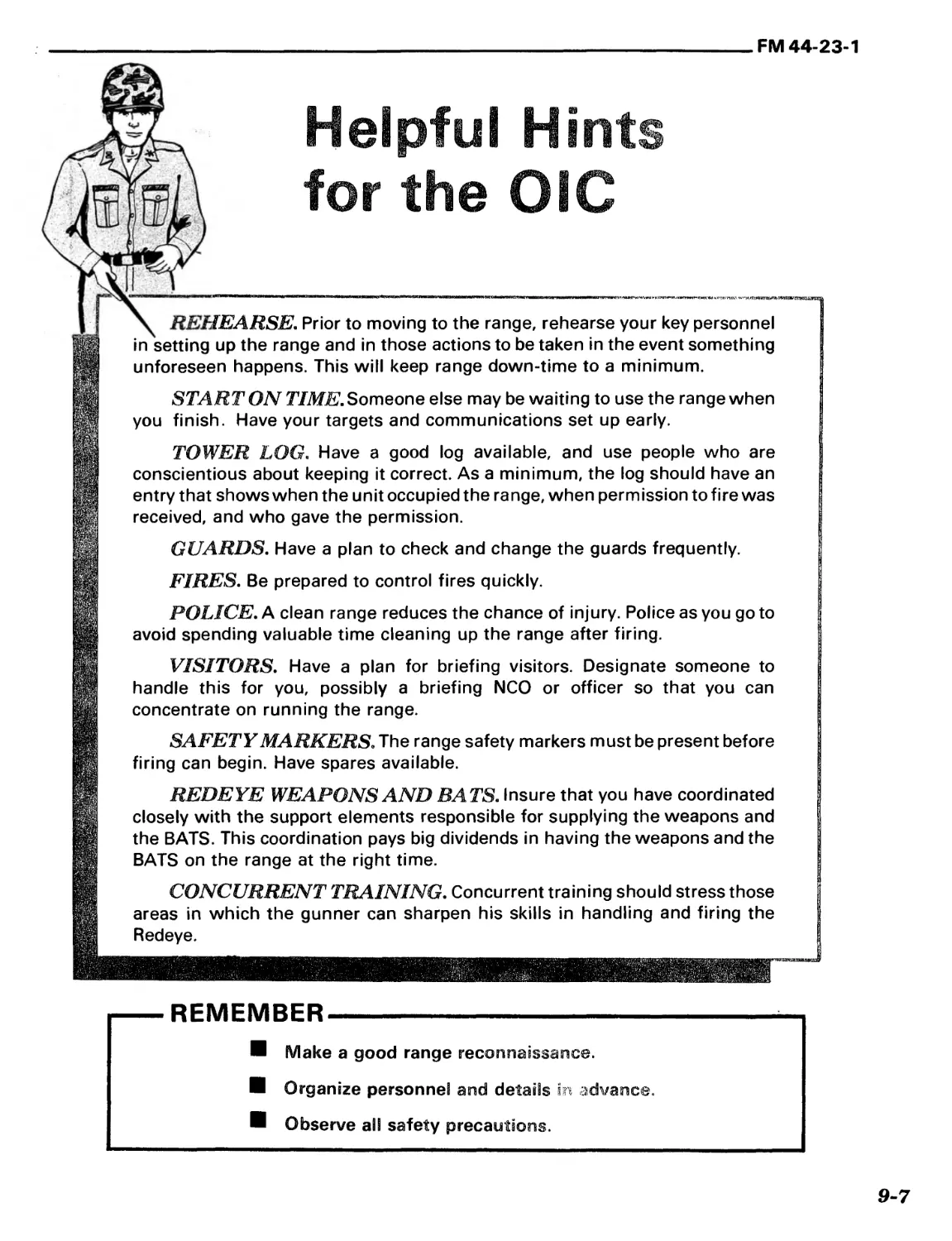
Теги: weapons
Год: 1978




Текст
                    с:
LIBRARY
USA CGSC FT LEAVENWORTH KAN
OCT 3 01978
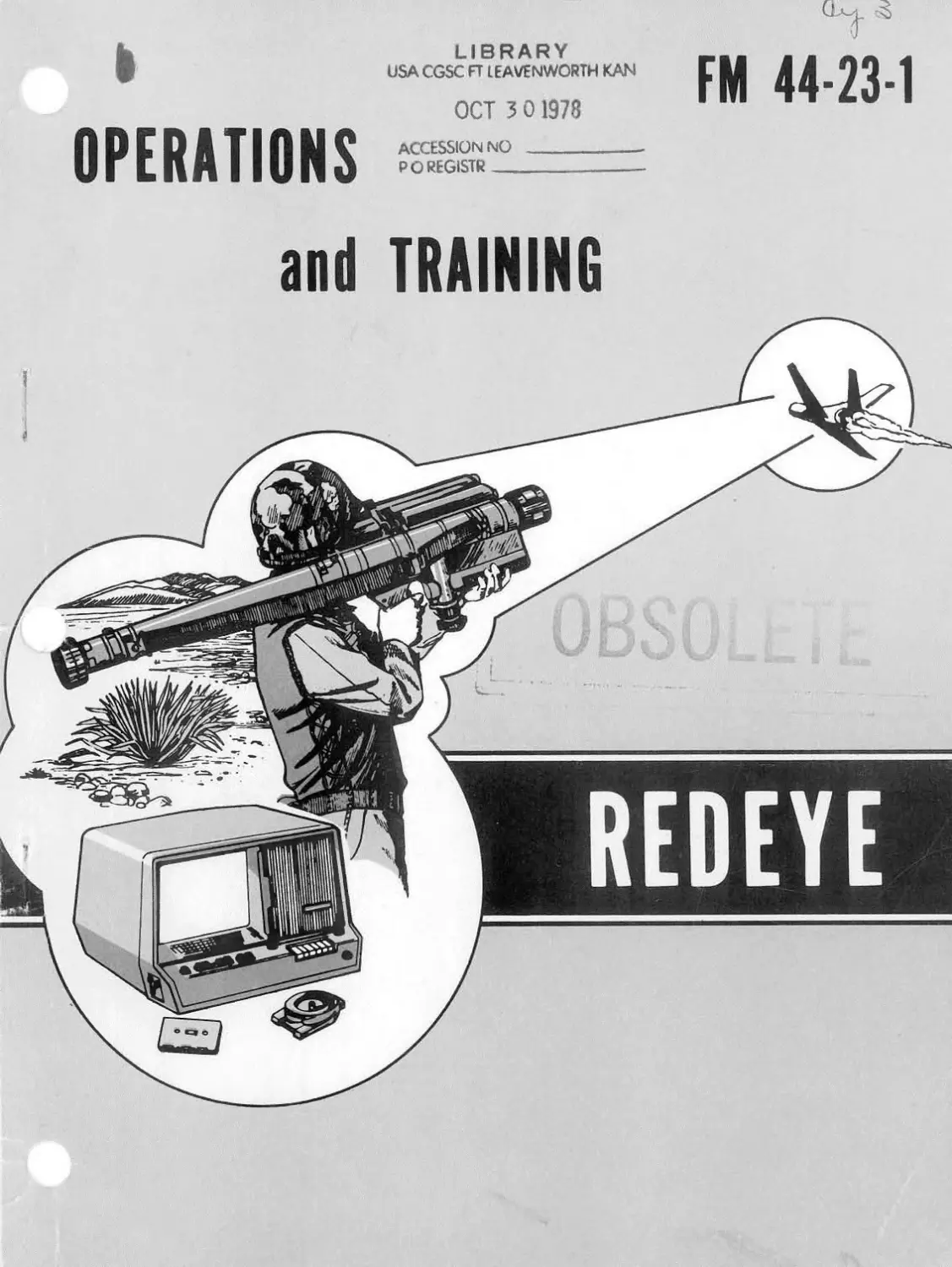
OPERATIONS «”=
FM 44-23-1
and TRAINING
Field Manual I
No 44-23-1 I
FM 44-23-1
HEADQUARTERS
DEPARTMENT OF THE ARMY
Washington, DC, 31 October 1977
OPERATIONS and TRAINING,
REDEYE
Table of Contents
PART I
THE REDEYE SYSTEM
AND HOW TO USE IT
PAGE
Chapter	1	REDEYE GUIDED MISSILE SYSTEM............................... 1-1
Chapter	2	PREPARATION OF THE REDEYE WEAPON FOR FIRING. 2-1
Chapter	3	AIRCRAFTDETECTION AND IDENTIFICATION............... 3-1
Chapter	4	FIRING THE REDEYE WEAPON. 4-1
Chapter	5	ENGAGING AIRCRAFT............... 5-1
PART II
REDEYE GUNNER TRAINING
Chapter	6	TRAINING REDEYE GUNNERS................... 6-1
Chapter	7	TRAINING DEVICES ANDTECHNIQUES..... 7-1
Chapter	8	EVALUATION OF GUNNER PROFICIENCY. 8-1
Chapter	9	REDEYE RANGE OPERATIONS . 9-1
Appendix A	REFERENCES .................................................... A-1
FM 44-23-1
Users of this manual are encouraged to submit recommended
changes or comments to improve the publication. Comments should be
keyed to the specific page and line of text in which the change is
recommended. Reasons should be provided for each comment to insure
understanding and complete evaluation. Comments should be
prepared on DA Form 2028 (Recommended Changes to Publications
and Blank Forms) and forwarded direct to Commandant, US Army Air
Defense School, ATTN: ATSA-TD-LITW, Fort Bliss, Texas 79916.
The wording in this manual should not be construed to discriminate
between the sexes. In order to avoid a repetitious use of the terminology
he/she, the terms he, him, and his are intended to include both the
masculine and feminine gender. Any exceptions to this will be noted.
ii
FM 44-23-1
PREFACE
This manual is for use in training personnel to operate the Redeye
Guided Missile System. This includes not only those personnel
assigned to Redeye sections and teams, but also those who may be
required to man the system on an “as required” basis, such as Hawk
and Chaparral missile crewmen whose units have Redeye assigned to
augment their primary weapon systems.
This manual focuses on the techniques and procedures used by a
two-man Redeye team in engaging enemy aircraft. It consists of two
parts:
PART I describes the Redeye weapon system and tells how to use the
weapon to shoot down enemy aircraft.
PART II	discusses the means and methods of training soldiers to operate
the system.
This manual should be used with the system technical manual (TM
9-1400-425-12) which tells how the system functions and how to
maintain it. Information found in the technical manual, such as that on
maintenance and emergency destruction procedures, is not repeated in
this manual.
This is a companion manual to the “How-to-Fight” manual for
Redeye, FM 44-23, which tells how the system will be employed along
with other air defense weapons as an integral part of the combined
arms team. FM 44-23 describes the dynamics of the modem battlefield
and portrays the threat we face in the next war, the threat on the ground
and from the air. It tells what the Redeye weapon can do and how
Redeye sections and teams are employed, along with other air defense
systems, to defeat the air threat to the ground forces.
The tactical doctrine and procedures contained in FM 44-23 will be
of no use if the soldiers who man the Redeye system cannot effectively
engage enemy aircraft. It does little good to have the Redeye team
properly positioned unless the team leader and the gunner, working
together, can shoot down an enemy aircraft when called upon to do so.
This requires training in engagement procedures and this, in short, is
what this manual is about.
iii
FM 44-23-1
PART I
THE REDEYE WEAPON SYSTEM AND HOW TO USE IT
CHAPTER 1
REDEYE GUIDED MISSILE SYSTEM
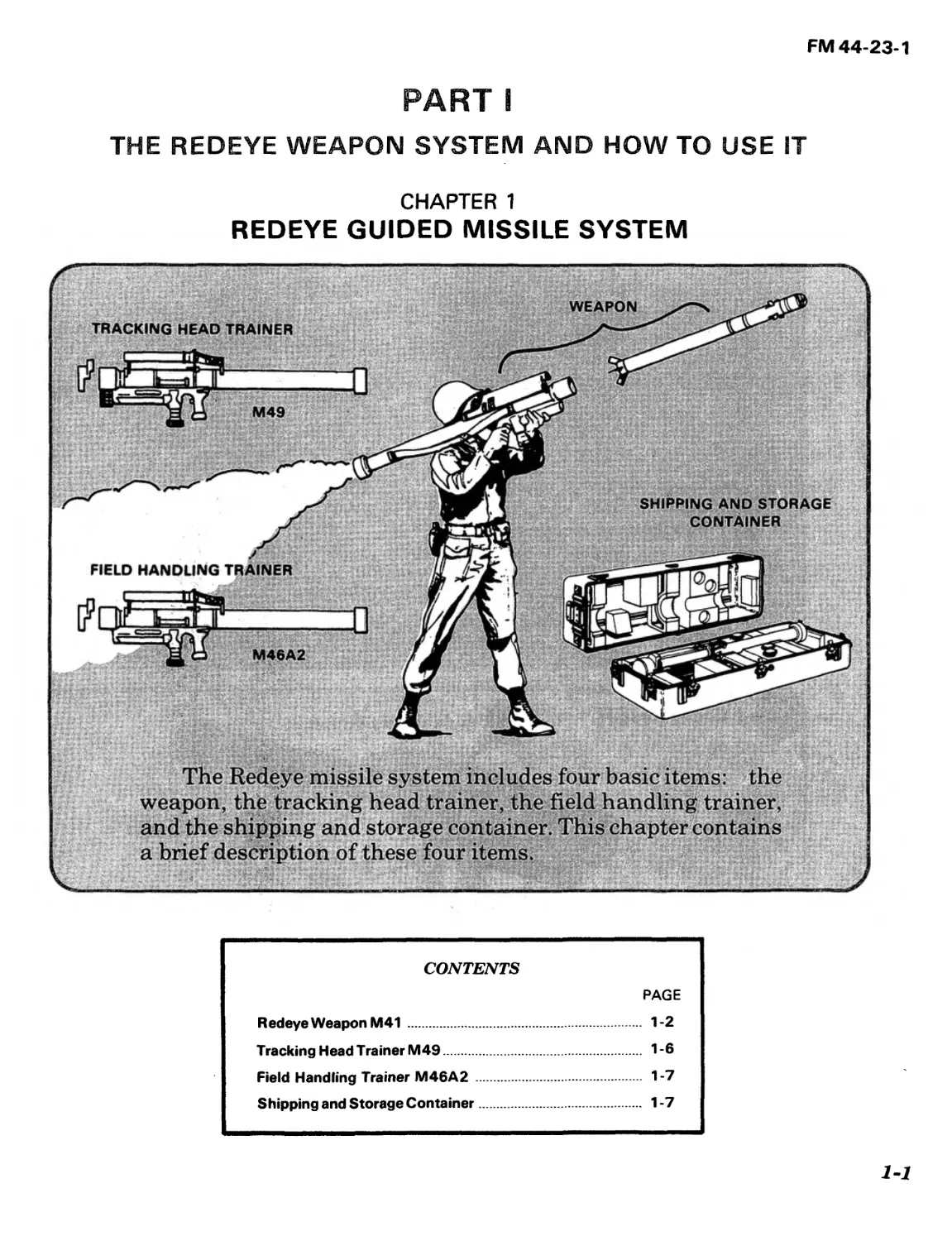
The Redeye missile system includes four basic items: the
weapon, the tracking head trainer, the field handling trainer,
and the shipping and storage container. This chapter contains
a brief description of these four items.
CONTENTS
PAGE
R edeye Weapon M 41 ........................... 1-2
Tracking Head Trainer M49...................... 1-6
Field Handling Trainer M46A2 .................. 1-7
Shipping and Storage Container.................... 1	-7
1-1
FM 44-23-1
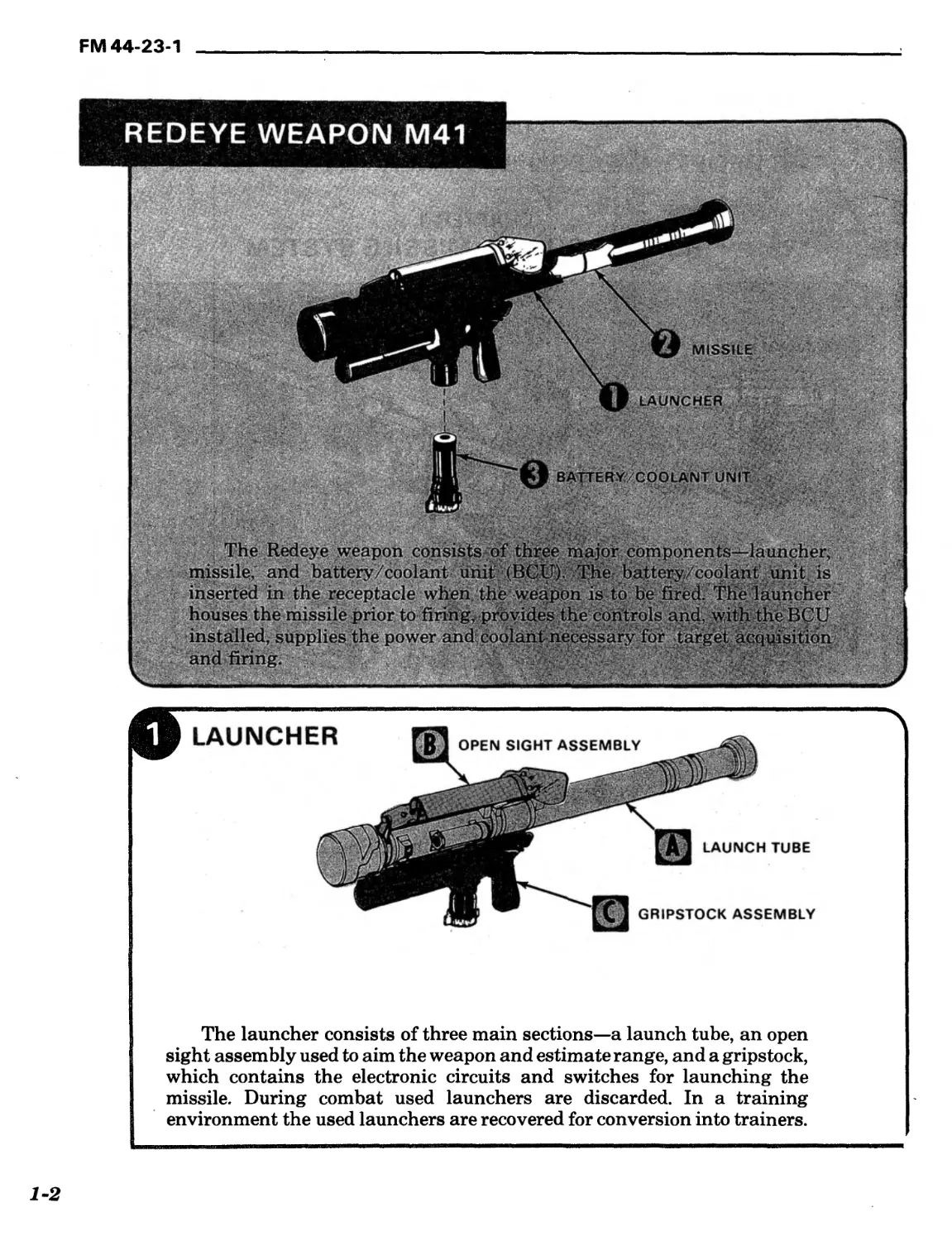
REDEYE WEAPON M41
MISSILE
LAUNCHER

The launcher consists of three main sections—a launch tube, an open
sight assembly used to aim the weapon and estimate range, and a gripstock,
which contains the electronic circuits and switches for launching the
missile. During combat used launchers are discarded. In a training
environment the used launchers are recovered for conversion into trainers.
1-2
FM 44-23-1
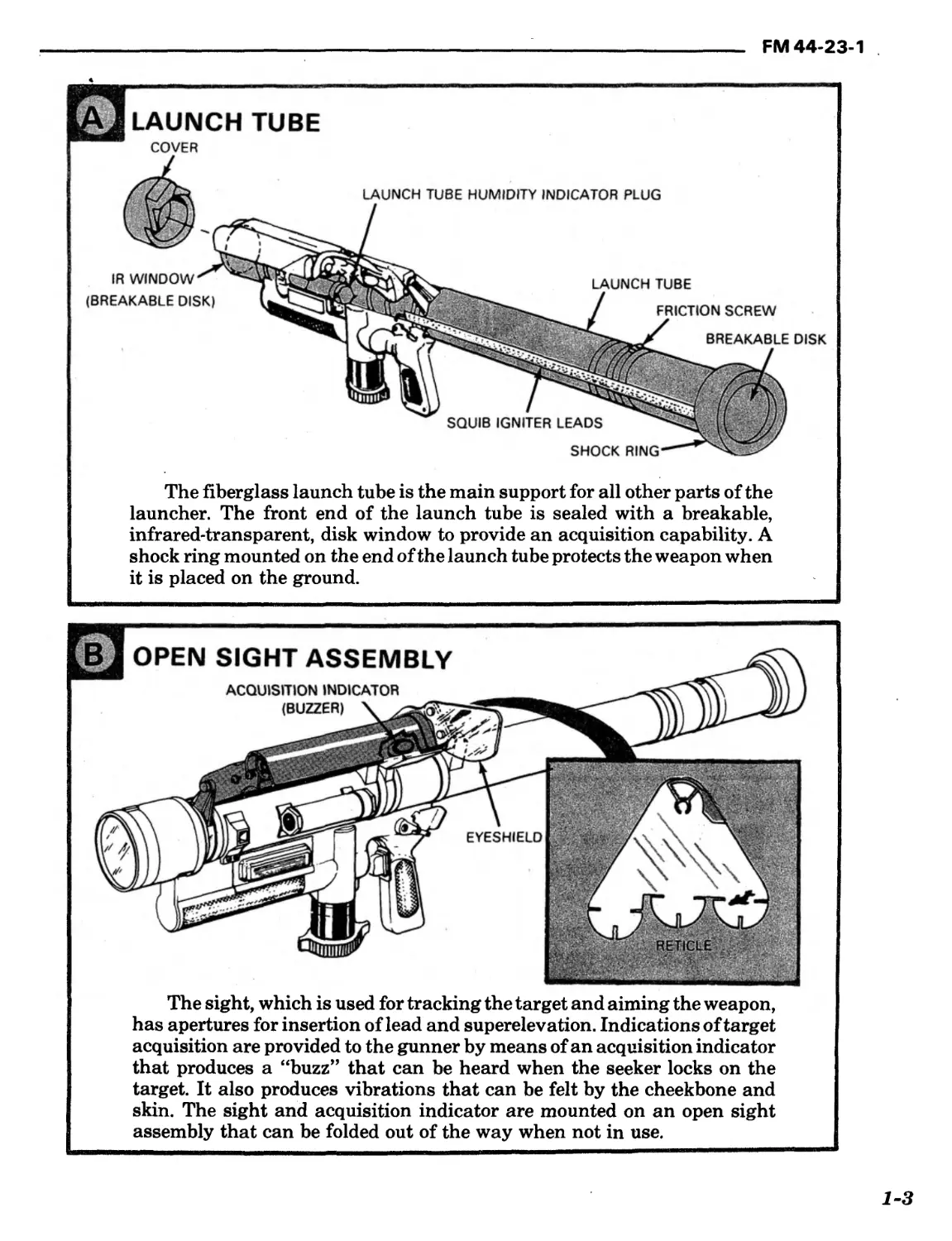
The fiberglass launch tube is the main support for all other parts of the
launcher. The front end of the launch tube is sealed with a breakable,
infrared-transparent, disk window to provide an acquisition capability. A
shock ring mounted on the end of the launch tube protects the weapon when
it is placed on the ground.
The sight, which is used for tracking the target and aiming the weapon,
has apertures for insertion of lead and superelevation. Indications of target
acquisition are provided to the gunner by means of an acquisition indicator
that produces a “buzz” that can be heard when the seeker locks on the
target. It also produces vibrations that can be felt by the cheekbone and
skin. The sight and acquisition indicator are mounted on an open sight
assembly that can be folded out of the way when not in use.
1-3
FM 44-23-1
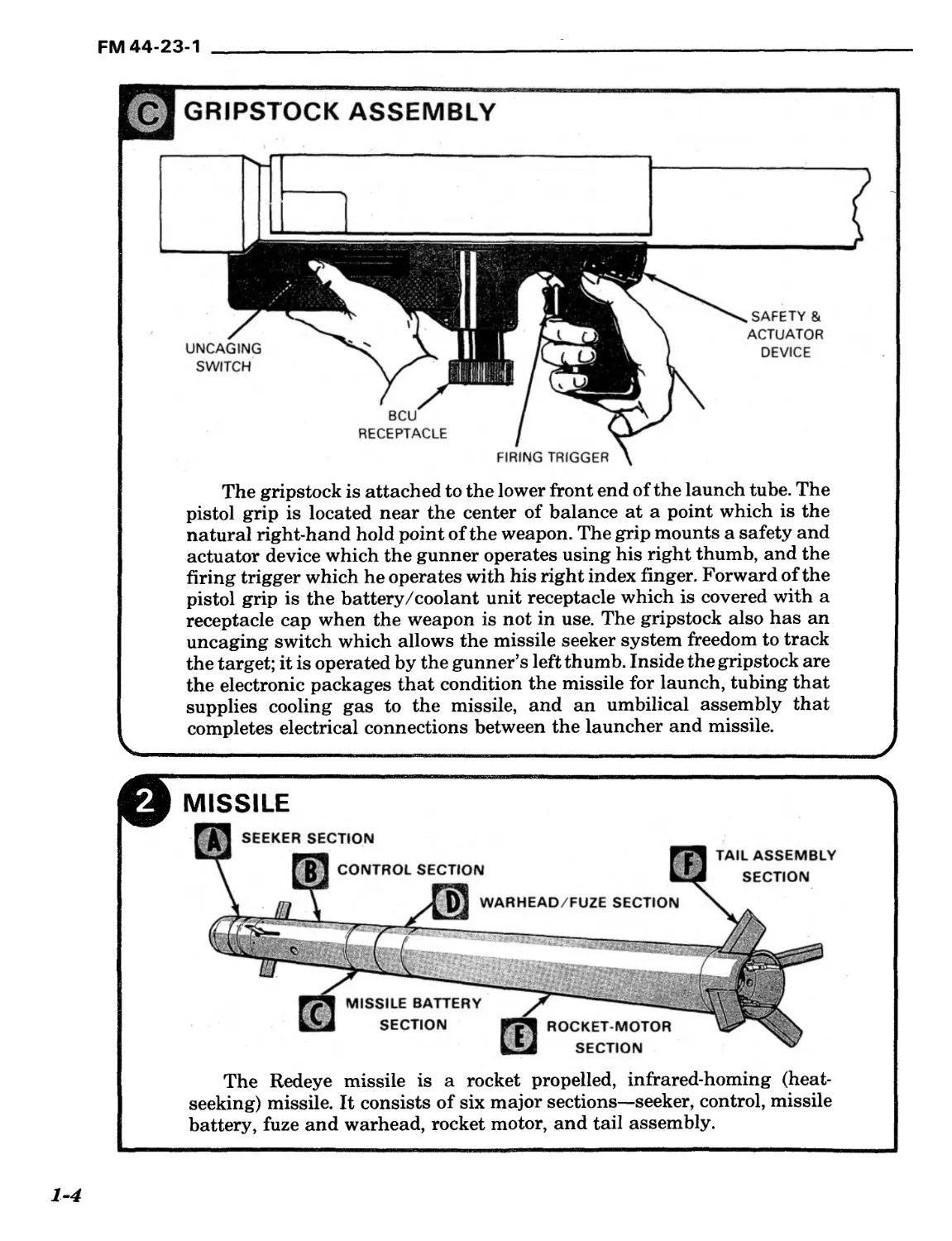
GRIPSTOCK ASSEMBLY
The gripstock is attached to the lower front end of the launch tube. The
pistol grip is located near the center of balance at a point which is the
natural right-hand hold point of the weapon. The grip mounts a safety and
actuator device which the gunner operates using his right thumb, and the
firing trigger which he operates with his right index finger. Forward of the
pistol grip is the battery/coolant unit receptacle which is covered with a
receptacle cap when the weapon is not in use. The gripstock also has an
uncaging switch which allows the missile seeker system freedom to track
the target; it is operated by the gunner’s left thumb. Inside the gripstock are
the electronic packages that condition the missile for launch, tubing that
supplies cooling gas to the missile, and an umbilical assembly that
completes electrical connections between the launcher and missile.
The Redeye missile is a rocket propelled, infrared-homing (heat-
seeking) missile. It consists of six major sections—seeker, control, missile
battery, fuze and warhead, rocket motor, and tail assembly.
1-4
FM 44-23-1
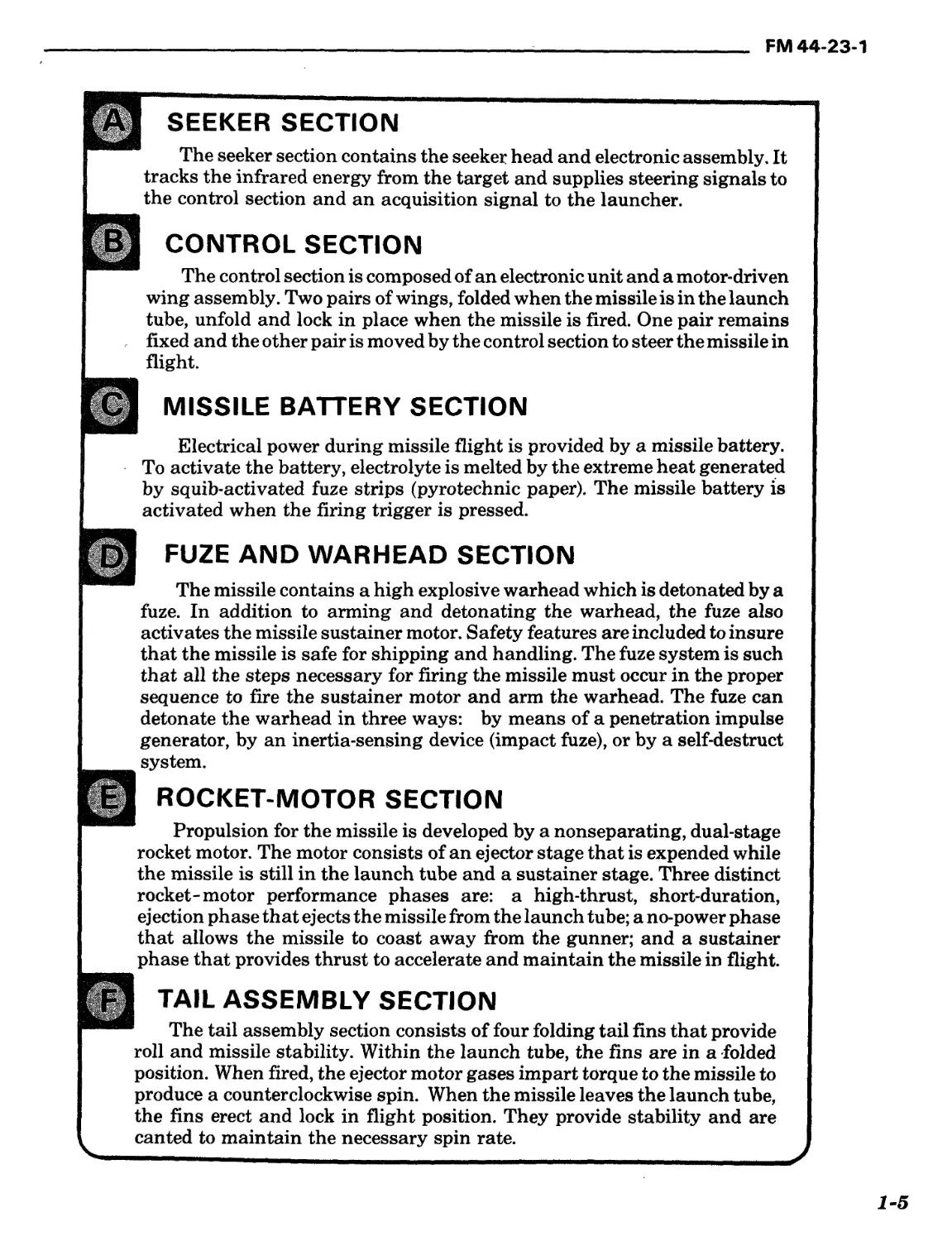
SEEKER SECTION
The seeker section contains the seeker head and electronic assembly. It
tracks the infrared energy from the target and supplies steering signals to
the control section and an acquisition signal to the launcher.
CONTROL SECTION
The control section is composed of an electronic unit and a motor-driven
wing assembly. Two pairs of wings, folded when the missile is in the launch
tube, unfold and lock in place when the missile is fired. One pair remains
fixed and the other pair is moved by the control section to steer the missile in
flight.
MISSILE BATTERY SECTION
Electrical power during missile flight is provided by a missile battery.
To activate the battery, electrolyte is melted by the extreme heat generated
by squib-activated fuze strips (pyrotechnic paper). The missile battery is
activated when the firing trigger is pressed.
FUZE AND WARHEAD SECTION
The missile contains a high explosive warhead which is detonated by a
fuze. In addition to arming and detonating the warhead, the fuze also
activates the missile sustainer motor. Safety features are included to insure
that the missile is safe for shipping and handling. The fuze system is such
that all the steps necessary for firing the missile must occur in the proper
sequence to fire the sustainer motor and arm the warhead. The fuze can
detonate the warhead in three ways: by means of a penetration impulse
generator, by an inertia-sensing device (impact fuze), or by a self-destruct
system.
ROCKET-MOTOR SECTION
Propulsion for the missile is developed by a nonseparating, dual-stage
rocket motor. The motor consists of an ejector stage that is expended while
the missile is still in the launch tube and a sustainer stage. Three distinct
rocket-motor performance phases are: a high-thrust, short-duration,
ejection phase that ejects the missile from the launch tube; a no-power phase
that allows the missile to coast away from the gunner; and a sustainer
phase that provides thrust to accelerate and maintain the missile in flight.
Fj TAIL ASSEMBLY SECTION
The tail assembly section consists of four folding tail fins that provide
roll and missile stability. Within the launch tube, the fins are in a folded
position. When fired, the ejector motor gases impart torque to the missile to
produce a counterclockwise spin. When the missile leaves the launch tube,
the fins erect and lock in flight position. They provide stability and are
canted to maintain the necessary spin rate.
1-5
FM 44-23-1
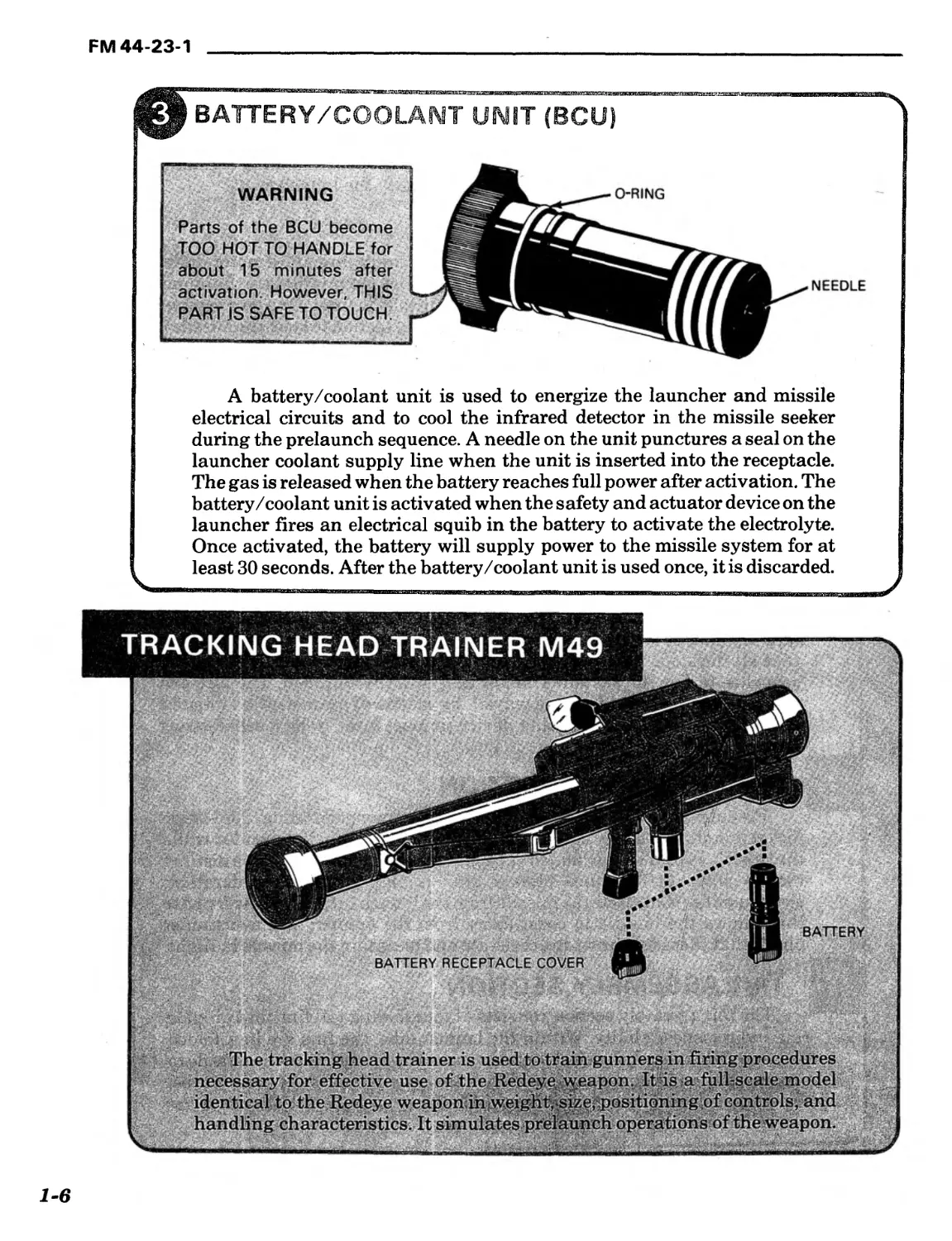
BATTERY/COOLANT UNIT (BCU)
O-RING
WARNING
Parts of the BCU become
TOO HOT TO HANDLE for
about 15 minutes after
activation. However, THIS
PART jS SAFE TO TOUCH.
NEEDLE
A battery/coolant unit is used to energize the launcher and missile
electrical circuits and to cool the infrared detector in the missile seeker
during the prelaunch sequence. A needle on the unit punctures a seal on the
launcher coolant supply line when the unit is inserted into the receptacle.
The gas is released when the battery reaches full power after activation. The
battery/coolant unit is activated when the safety and actuator device on the
launcher fires an electrical squib in the battery to activate the electrolyte.
Once activated, the battery will supply power to the missile system for at
least 30 seconds. After the battery/coolant unit is used once, it is discarded.
TRACKING HEAD TRAINER M49
The tracking head trainer is used to train gunners in firing procedures
necessary for effective use of the Redeye weapon. It is a full-scale model
identical to the Redeye weaponin weight,-size, positioning of controls, and
handling characteristics. It simulates prelaunch operations of the weapon.
iii ,	- ...................   ,	—л
1-6
FM 44-23-1
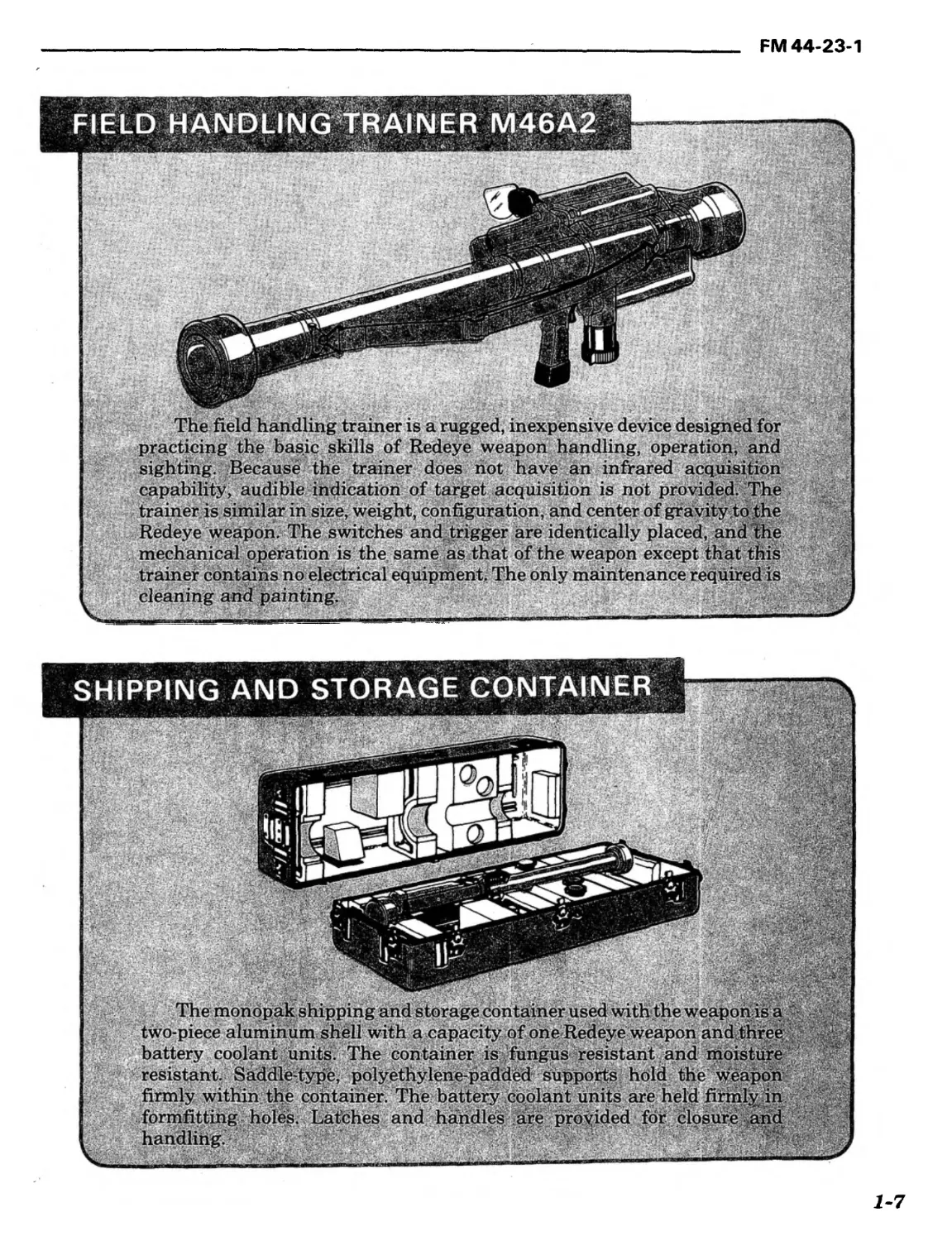
FIELD HANDLING TRAINER М46А2
The field handling trainer is a rugged, inexpensive device designed for
practicing the basic skills of Redeye weapon handling, operation, and
sighting. Because the trainer does not have an infrared acquisition
capability, audible indication of target acquisition is not provided. The
trainer is similar in size, weight, configuration, and center of gravity to the
Redeye weapon. The switches and. trigger are identically placed, and the
mechanical operation is the same as that of the weapon except that this
trainer contains no electrical equipment. The only maintenance required is
cleaning and painting.
The monopak shipping and storage container used with the weapon is a
two-piece aluminum shell with a capacity of one Redeye weapon and three
battery coolant units. The container is fungus resistant and moisture
resistant. Saddle-type, polyethylene-padded supports hold the weapon
firmly within the container. The battery coolant units are held firmly in
formfitting holes. Latches and handles are provided for closure and
handling.	,
SHIPPING AND STORAGE CONTAINER
2-7
FM 44-23-1
CHAPTER 2
PREPARATION OF THE REDEYE WEAPON FOR FIRING
Upon receipt of a Redeye weapon from the ammunition supply
point (ASP), the Redeye team must perform a set of checks to be sure
that the weapon is suitable for firing. This chapter outlines the proper
weapon handling and inspection procedures to follow after receiving a
weapon from the ASP.
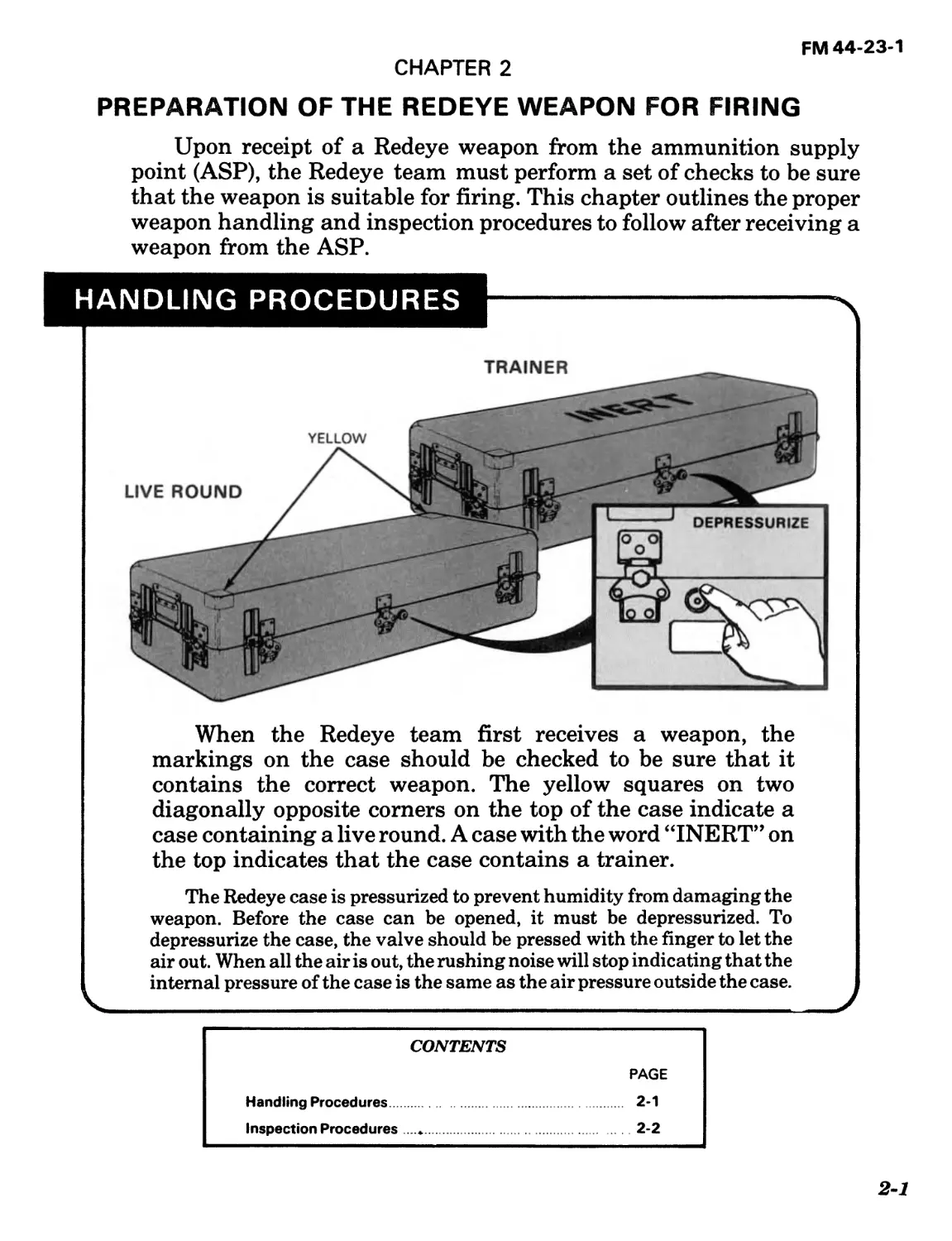
HANDLING PROCEDURES
When the Redeye team first receives a weapon, the
markings on the case should be checked to be sure that it
contains the correct weapon. The yellow squares on two
diagonally opposite comers on the top of the case indicate a
case containing a live round. A case with the word “INERT” on
the top indicates that the case contains a trainer.
The Redeye case is pressurized to prevent humidity from damaging the
weapon. Before the case can be opened, it must be depressurized. To
depressurize the case, the valve should be pressed with the finger to let the
air out. When all the air is out, the rushing noise will stop indicating that the
internal pressure of the case is the same as the air pressure outside the case.
CONTENTS	PAGE
Handling Procedures			 2-1
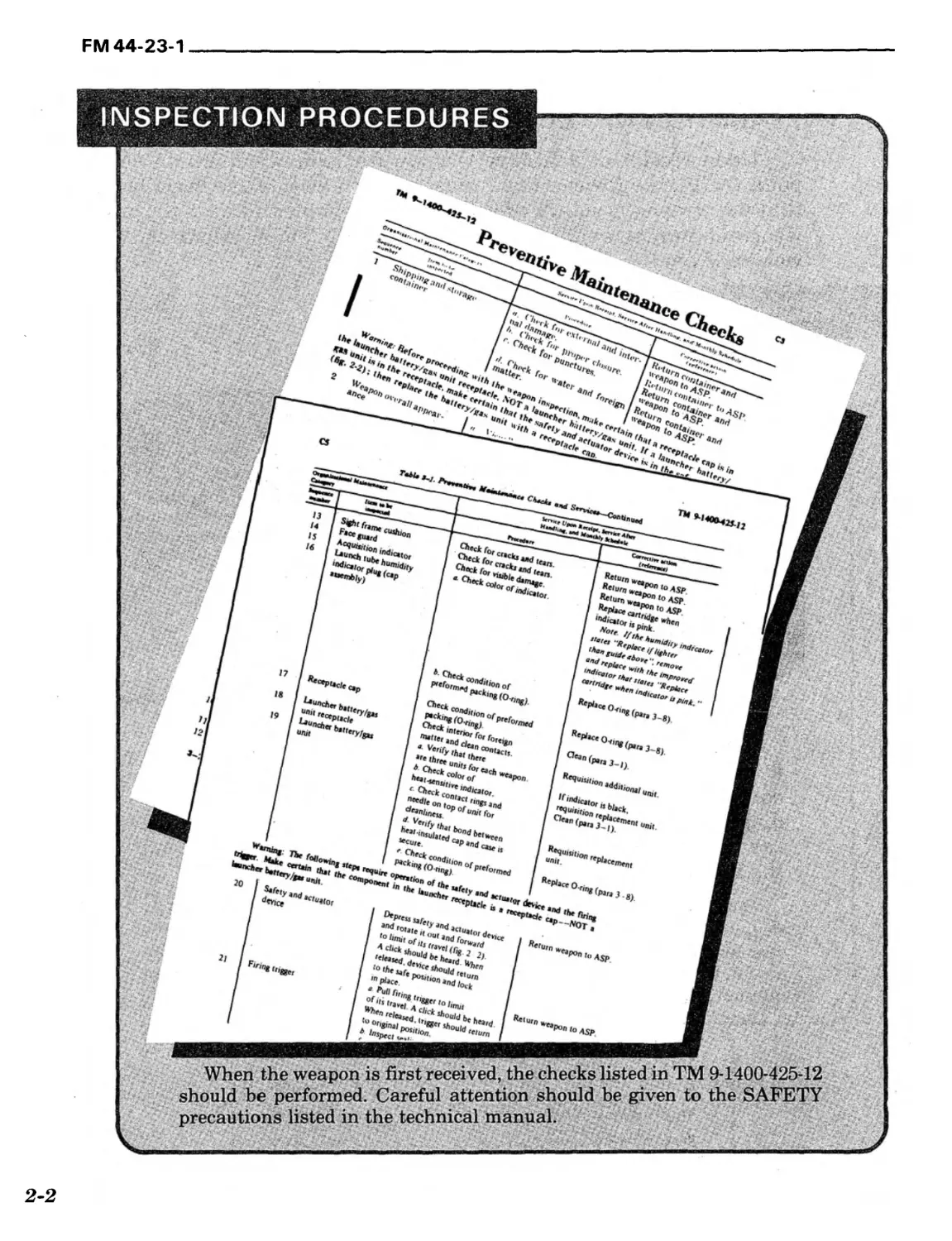
Inspection Procedures ....♦		2-2
2-1
Return weapon to ASP
Safety and aciuator
device
Depress safety and actuator device
and rotate it out and forward
to limit of its travel < fag  2 2).
A click should be heard When
released, device should return
to the safe position and lock
in place
в Pull firing trigger to limit
of its travel A click should be heard
When released, trigger should return
to original position
b Inspect
«take
\istedlB to the
1 л!+tenh°n
а Care^ • ra\
nTecatiho	—-------
/«-SS!?* '"ASP
I »*«P»n (. *nd
""Si Ьдй» «nd
<*'»*«» (hM>
r
т.ЙГ1' '°
'*	^СГТ**»
«псе	•"•Рй’жг. I

—aw	««*	IWnlan	Cwwuiw anta» (Mwrw»>
13	Sight frame cushion	Check for cracks and lean.	Return weapon to ASP.
14	Face guard	Check for cracks and tears.	Return weapon to ASP
IS	Acquisition indicator	Check for visible damage	Return weapon to ASP
16	Launch lube humidity indicator plug (cap aaembly)	a Check color of indicator ft Check condition of preform<*d packing (O-riqg).	Replace cartridge when indicator is pink. Note If the humidity indicator Hotel "Replace tf lighter than gutde above ". remove and replace with the improved indicator that itatet "Replace cartridge when indicator is pink. ” Replace О-ring (para 3-8).
17	Receptacle cap	Check condition of preformed packing (О-ring)	Replace Oeirg (para 3-8).
18	Launcher battery/gas unit receptacle	Check interior for foreign matter and dean contacts.	Clean (para 3-1).
19	Launcher battery/gas unit	a. Verify that there are three units for each weapon b Check color of heal-sensitive indicator c Check contact rings and needle on top of unit for deanliness. d Verify that bond between heal-insulated cap and case is secure e Check condition of preformed packing (O-nng).	Requisition additional unit. If indicator is black, requisition replacement unit. Clean (para 3-1). Requisition replacement unit. Replace О-ring (para 3 -8).
2-2
FM 44-23-1
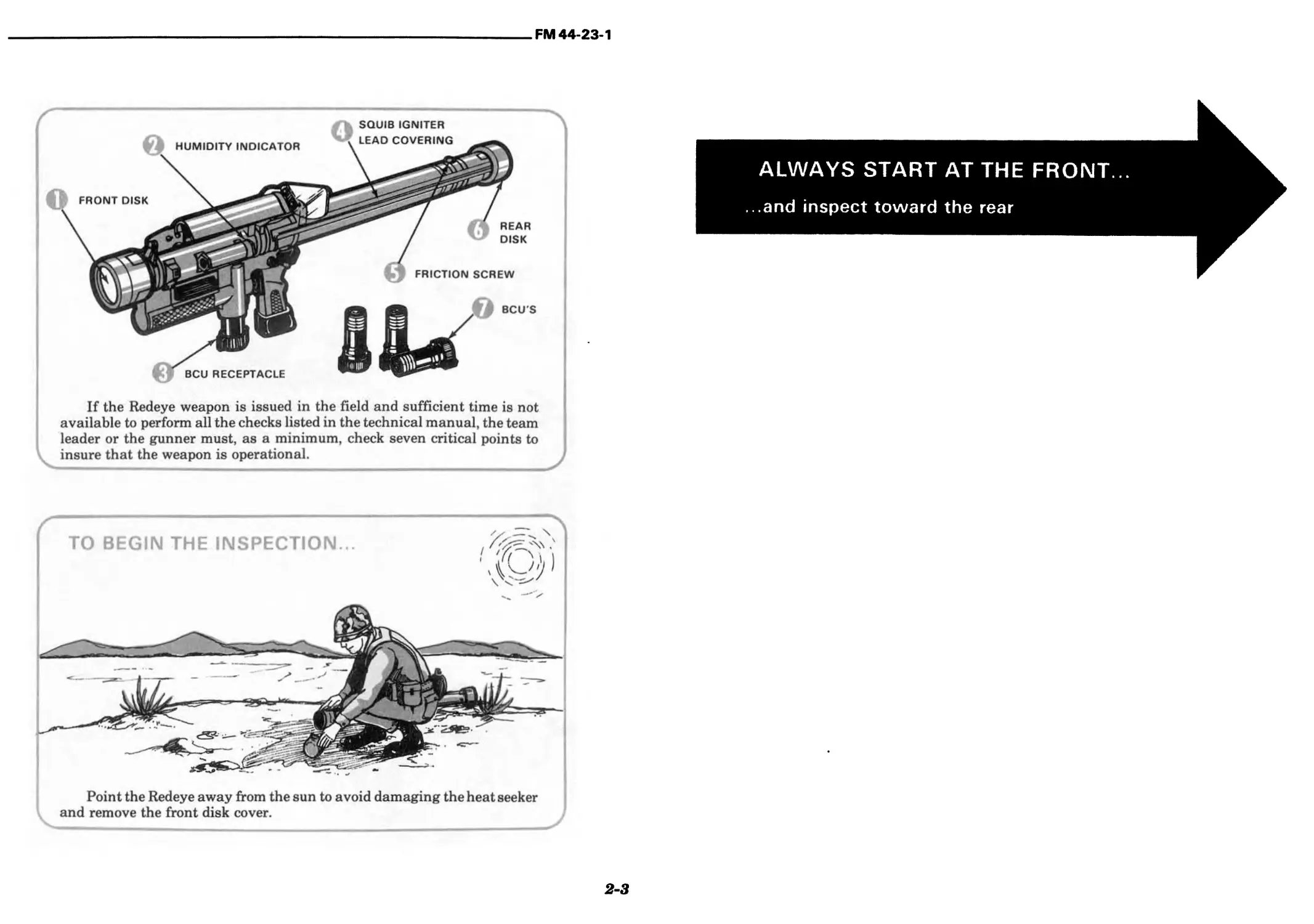
If the Redeye weapon is issued in the field and sufficient time is not
available to perform all the checks listed in the technical manual, the team
leader or the gunner must, as a minimum, check seven critical points to
insure that the weapon is operational.
Point the Redeye away from the sun to avoid damaging the heatseeker
and remove the front disk cover.
2-3
ALWAYS START AT THE FRONT...
...and inspect toward the rear
FM 44-23-1
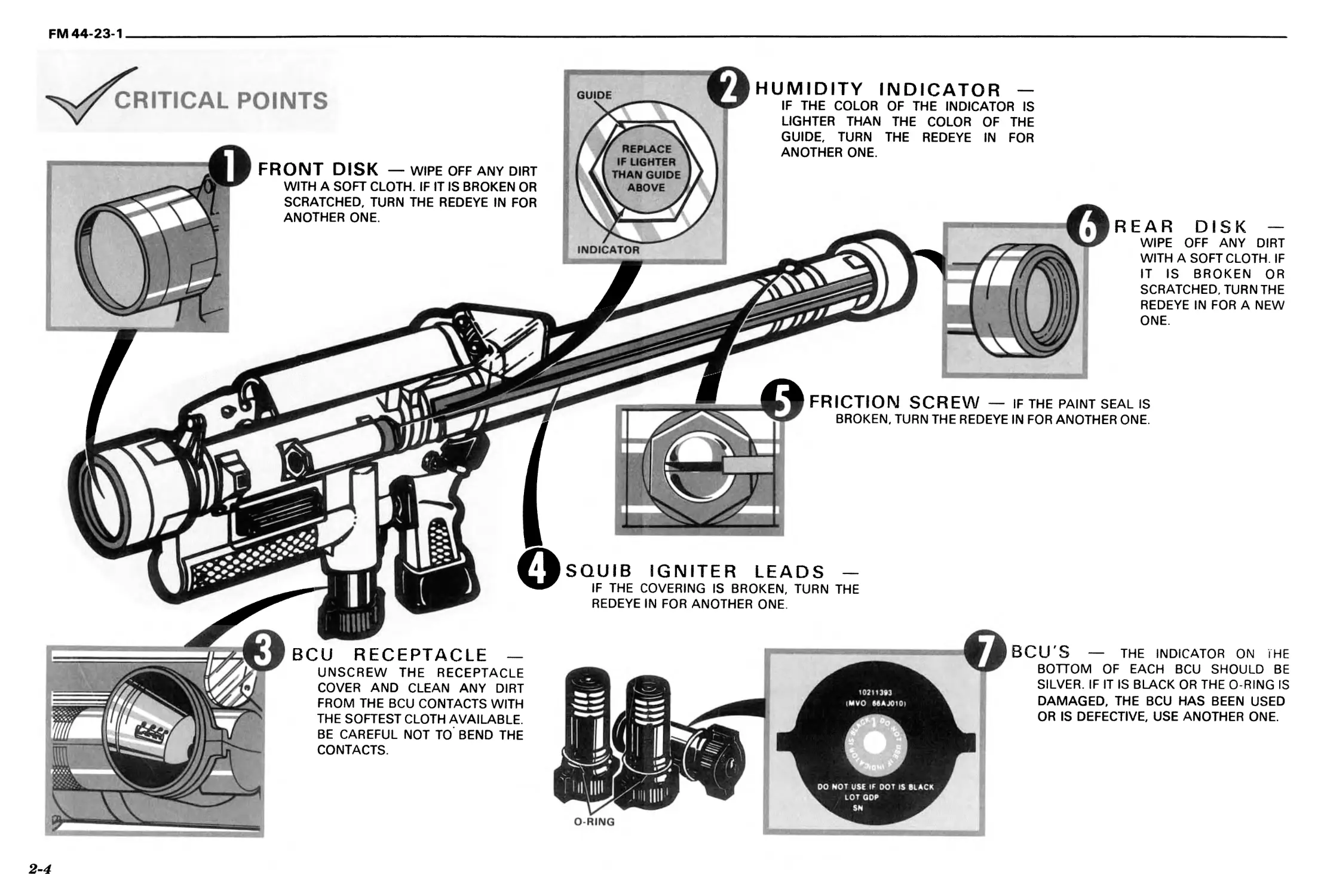
COLOR OF THE
REDEYE IN FOR
FRONT DISK — WIPE OFF ANY DIRT
WITH A SOFT CLOTH. IF IT IS BROKEN OR
SCRATCHED, TURN THE REDEYE IN FOR
ANOTHER ONE.
HUMIDITY INDICATOR —
IF THE COLOR OF THE INDICATOR IS
LIGHTER THAN THE
GUIDE, TURN THE
ANOTHER ONE.
O-RING
10211393
(MVO WAJ010I
DO NOT USE IF DOT IS BLACK
LOT ODP
k. SN
BCU'S — THE INDICATOR ON iHE
BOTTOM OF EACH BCU SHOULD BE
SILVER. IF IT IS BLACK OR THE O-RING IS
DAMAGED, THE BCU HAS BEEN USED
OR IS DEFECTIVE, USE ANOTHER ONE.
CRITICAL POINTS
AR DISK —
WIPE OFF ANY DIRT
WITH A SOFT CLOTH. IF
IT IS BROKEN OR
SCRATCHED, TURN THE
REDEYE IN FOR A NEW
ONE.
FRICTION SCREW — if the paint seal is
BROKEN, TURN THE REDEYE IN FOR ANOTHER ONE.
SQUIB IGNITER LEADS —
IF THE COVERING IS BROKEN, TURN THE
REDEYE IN FOR ANOTHER ONE.
BCU RECEPTACLE
UNSCREW THE RECEPTACLE
COVER AND CLEAN ANY DIRT
FROM THE BCU CONTACTS WITH
THE SOFTEST CLOTH AVAILABLE.
BE CAREFUL NOT TO' BEND THE
CONTACTS.
2-4
FM 44-23>1
CHAPTER 3
AIRCRAFT DETECTION AND IDENTIFICATION
To successfully accomplish an engagement, the Redeye team must
be proficient in detecting and identifying aircraft. This chapter focuses
primarily on the methods and techniques used in detecting aircraft.
Because the identification function is an integral part of the
engagement sequence, it is mentioned, where appropriate, in this
chapter but is not discussed in detail. Aircraft recognition training is
covered in TC 44-30. Chapter 5 of FM 44-23 tells how to apply rules of
engagement, which include hostile criteria and weapons control status,
in making the decision on whether or not to fire at an aircraft.
Where to Look..........
How to Look............
Some Things to Look For
Identification.........
CONTENTS
PAGE
3-2
3-7
3-8
3-9
3-1
FM 44-23-1
WHERE TO
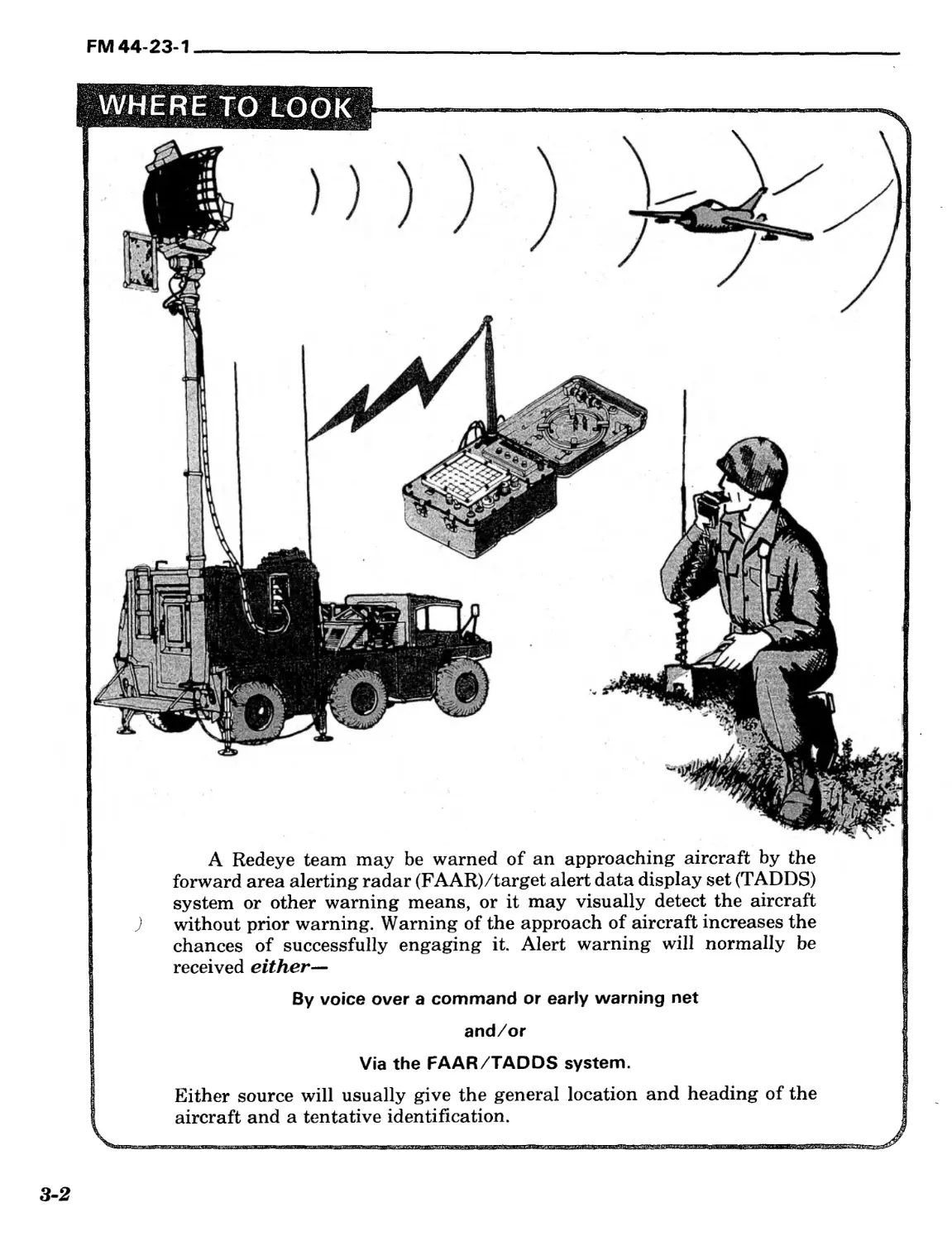
A Redeye team may be warned of an approaching aircraft by the
forward area alerting radar (FAAR)/target alert data display set (TADDS)
system or other warning means, or it may visually detect the aircraft
without prior warning. Warning of the approach of aircraft increases the
chances of successfully engaging it. Alert warning will normally be
received either—
By voice over a command or early warning net
and/or
Via the FAAR/TADDS system.
Either source will usually give the general location and heading of the
aircraft and a tentative identification.
3-2
FM 44-23-1
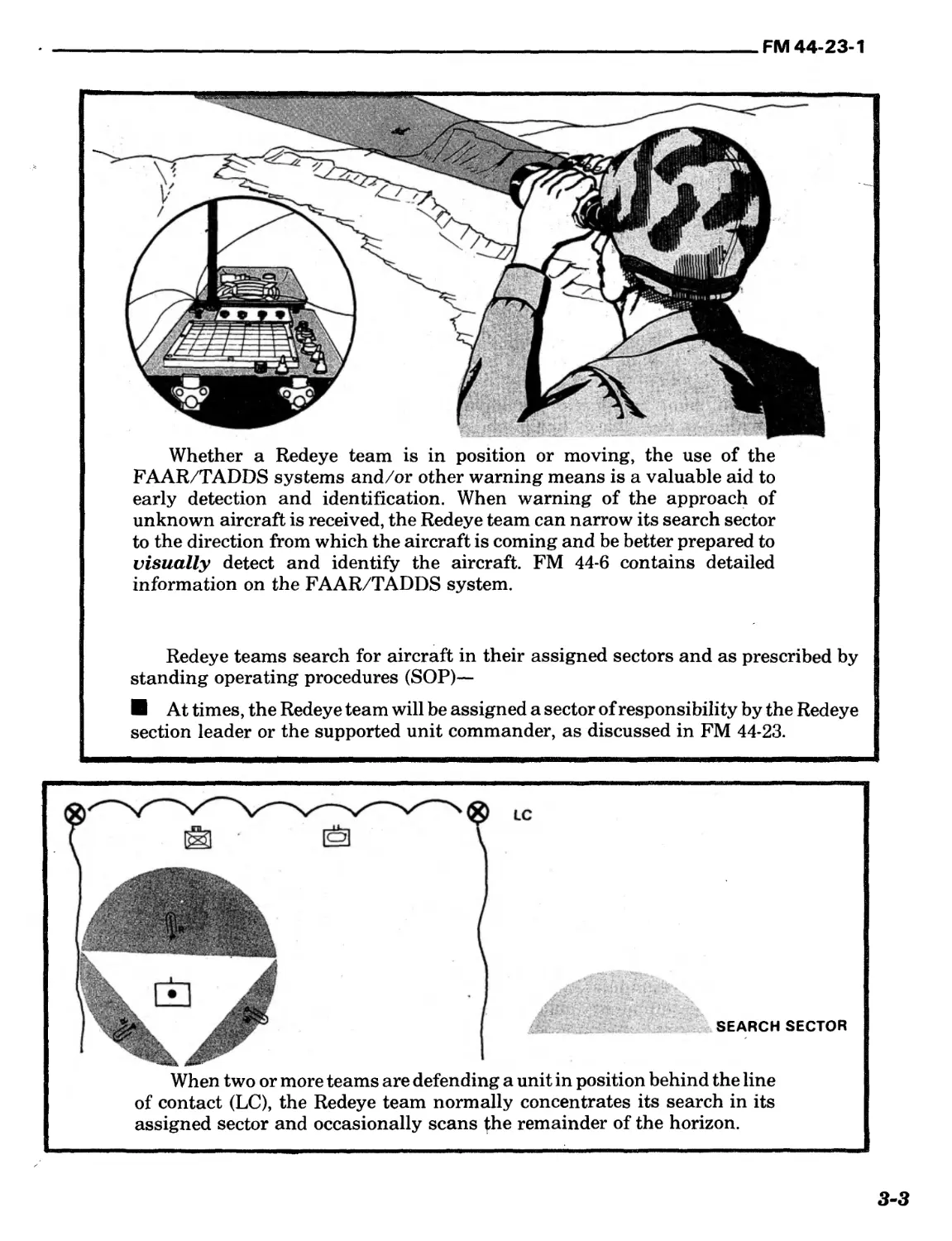
Whether a Redeye team is in position or moving, the use of the
FAAR/TADDS systems and/or other warning means is a valuable aid to
early detection and identification. When warning of the approach of
unknown aircraft is received, the Redeye team can narrow its search sector
to the direction from which the aircraft is coming and be better prepared to
visually detect and identify the aircraft. FM 44-6 contains detailed
information on the FAAR/TADDS system.
Redeye teams search for aircraft in their assigned sectors and as prescribed by
standing operating procedures (SOP)—
 At times, the Redeye team will be assigned a sector of responsibility by the Redeye
section leader or the supported unit commander, as discussed in FM 44-23.
When two or more teams are defending a unit in position behind the line
of contact (LC), the Redeye team normally concentrates its search in its
assigned sector and occasionally scans the remainder of the horizon.
3-3
FM 44-23-1
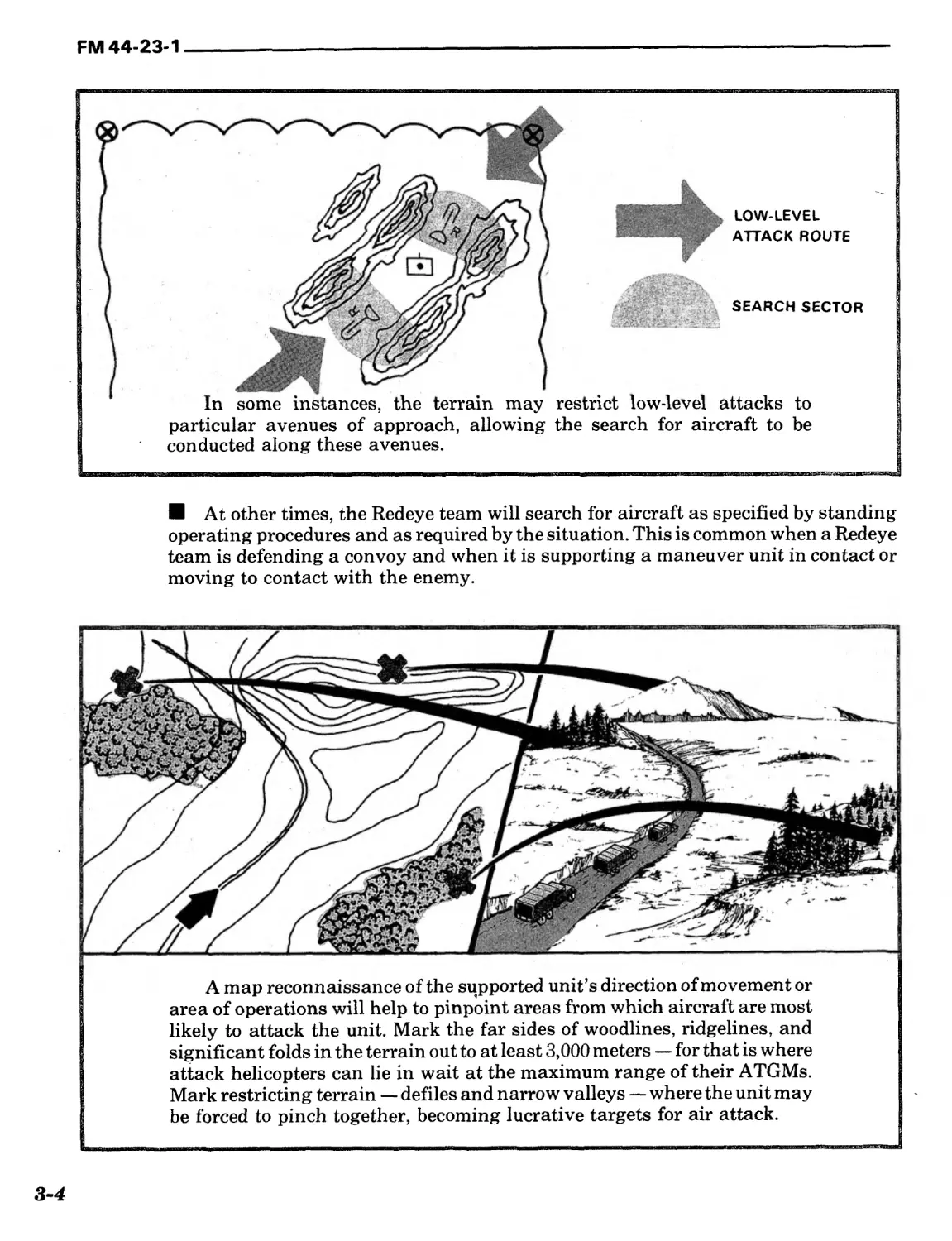
И At other times, the Redeye team will search for aircraft as specified by standing
operating procedures and as required by the situation. This is common when a Redeye
team is defending a convoy and when it is supporting a maneuver unit in contact or
moving to contact with the enemy.
A map reconnaissance of the supported unit’s direction of movement or
area of operations will help to pinpoint areas from which aircraft are most
likely to attack the unit. Mark the far sides of woodlines, ridgelines, and
significant folds in the terrain out to at least 3,000 meters — for that is where
attack helicopters can lie in wait at the maximum range of their ATGMs.
Mark restricting terrain — defiles and narrow valleys — where the unit may
be forced to pinch together, becoming lucrative targets for air attack.
3-4
FM 44-23-1
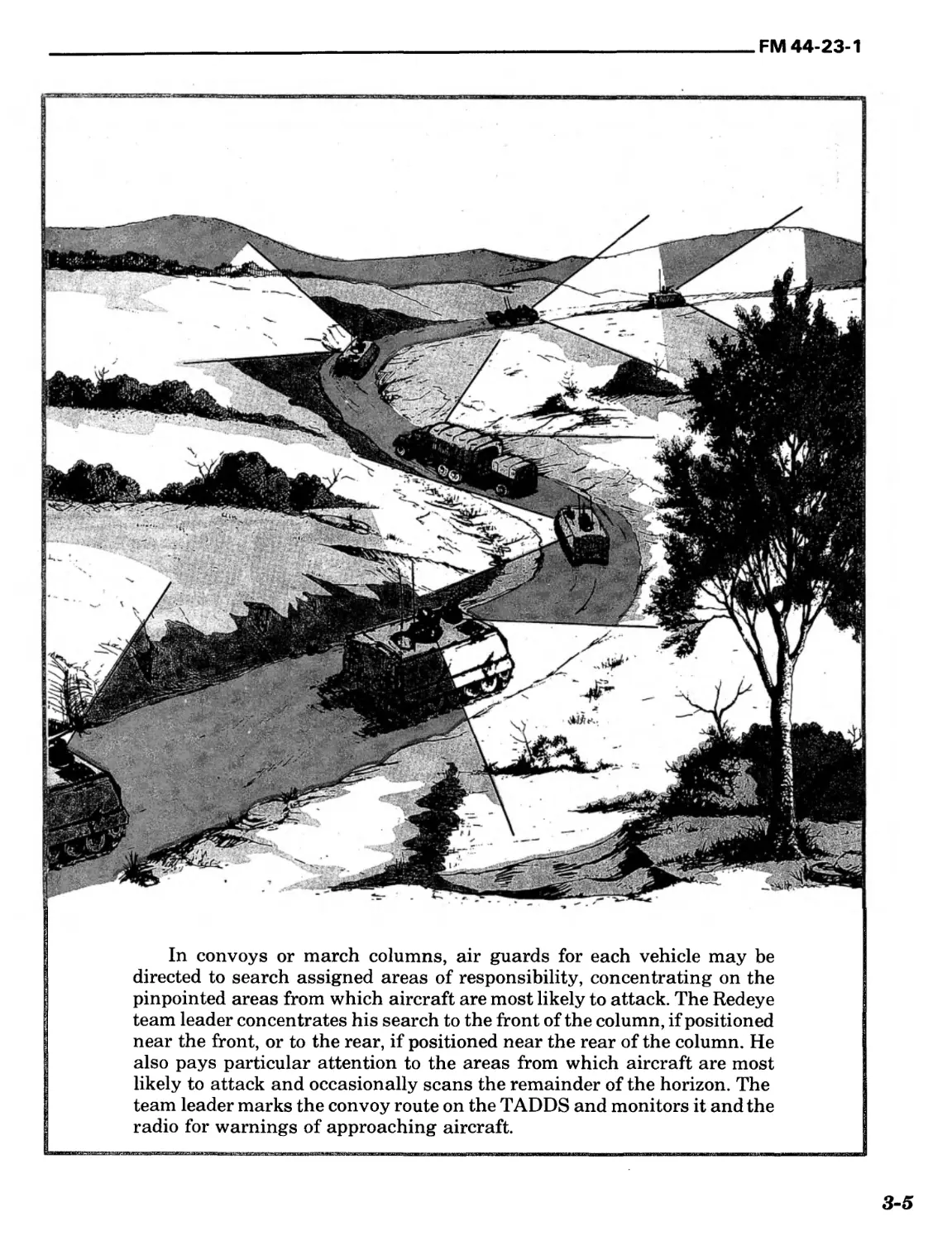
In convoys or march columns, air guards for each vehicle may be
directed to search assigned areas of responsibility, concentrating on the
pinpointed areas from which aircraft are most likely to attack. The Redeye
team leader concentrates his search to the front of the column, if positioned
near the front, or to the rear, if positioned near the rear of the column. He
also pays particular attention to the areas from which aircraft are most
likely to attack and occasionally scans the remainder of the horizon. The
team leader marks the convoy route on the TADDS and monitors it and the
radio for warnings of approaching aircraft.
3-5
FM 44-23-1
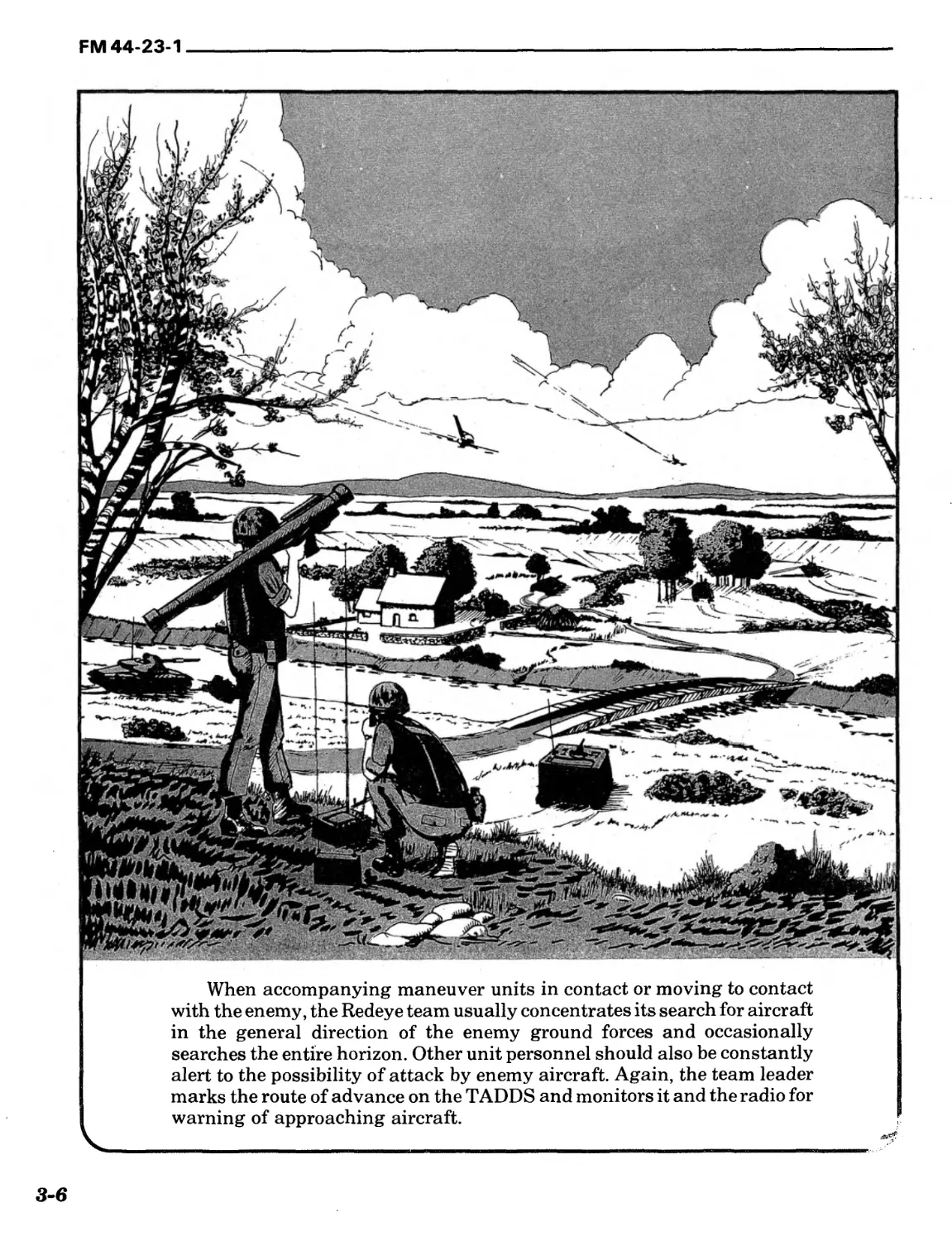
When accompanying maneuver units in contact or moving to contact
with the enemy, the Redeye team usually concentrates its search for aircraft
in the general direction of the enemy ground forces and occasionally
searches the entire horizon. Other unit personnel should also be constantly
alert to the possibility of attack by enemy aircraft. Again, the team leader
marks the route of advance on the TADDS and monitors it and the radio for
warning of approaching aircraft.
3-6
FM 44-23-1
HOW TO LOOK
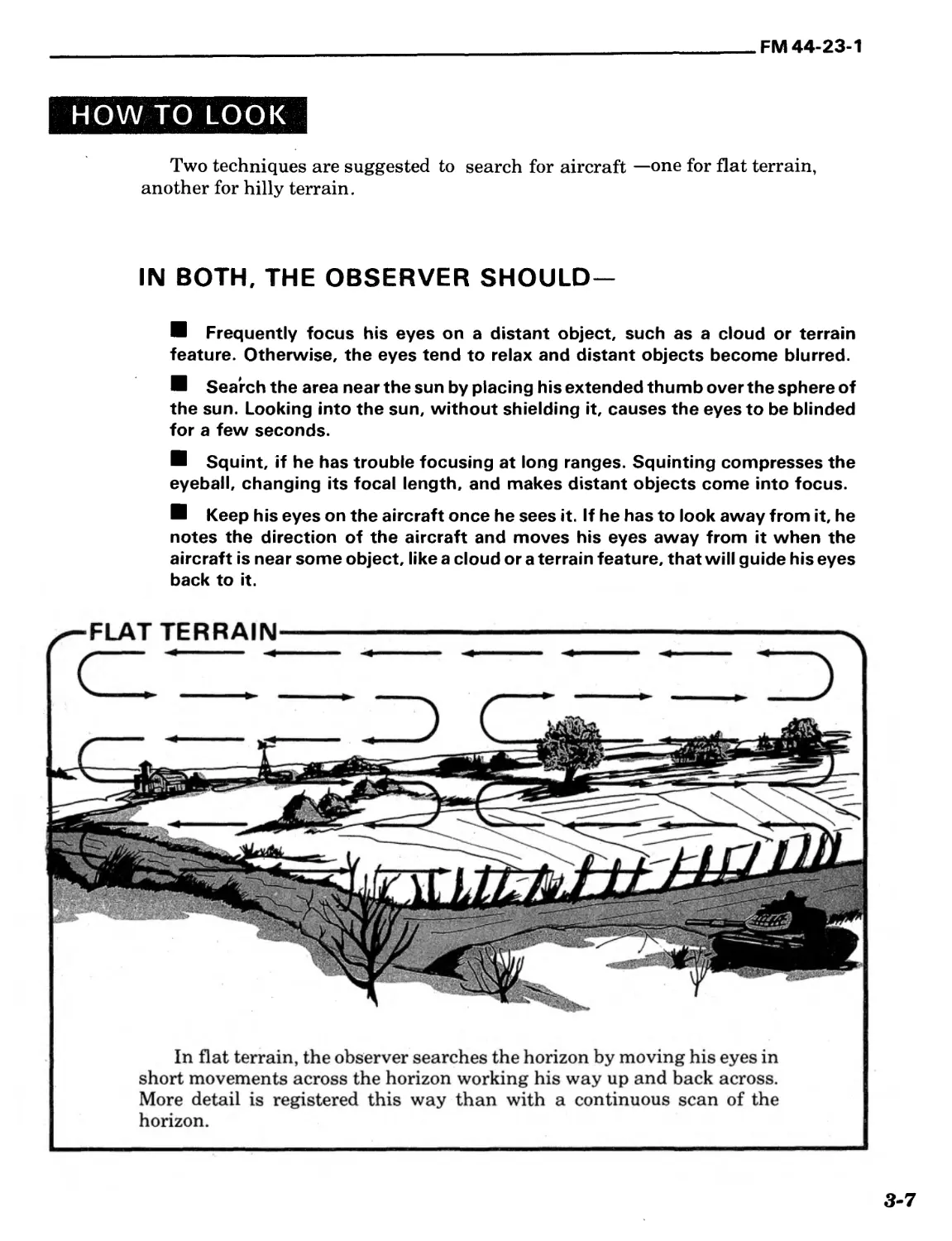
Two techniques are suggested to search for aircraft —one for flat terrain,
another for hilly terrain.
IN BOTH, THE OBSERVER SHOULD—
	Frequently focus his eyes on a distant object, such as a cloud or terrain
feature. Otherwise, the eyes tend to relax and distant objects become blurred.
	Search the area near the sun by placing his extended thumb over the sphere of
the sun. Looking into the sun, without shielding it, causes the eyes to be blinded
for a few seconds.
I Squint, if he has trouble focusing at long ranges. Squinting compresses the
eyeball, changing its focal length, and makes distant objects come into focus.
	Keep his eyes on the aircraft once he sees it. If he has to look away from it, he
notes the direction of the aircraft and moves his eyes away from it when the
aircraft is near some object, like a cloud or a terrain feature, that will guide his eyes
back to it.
In flat terrain, the observer searches the horizon by moving his eyes in
short movements across the horizon working his way up and back across.
More detail is registered this way than with a continuous scan of the
horizon.
3-7
FM 44-23-1
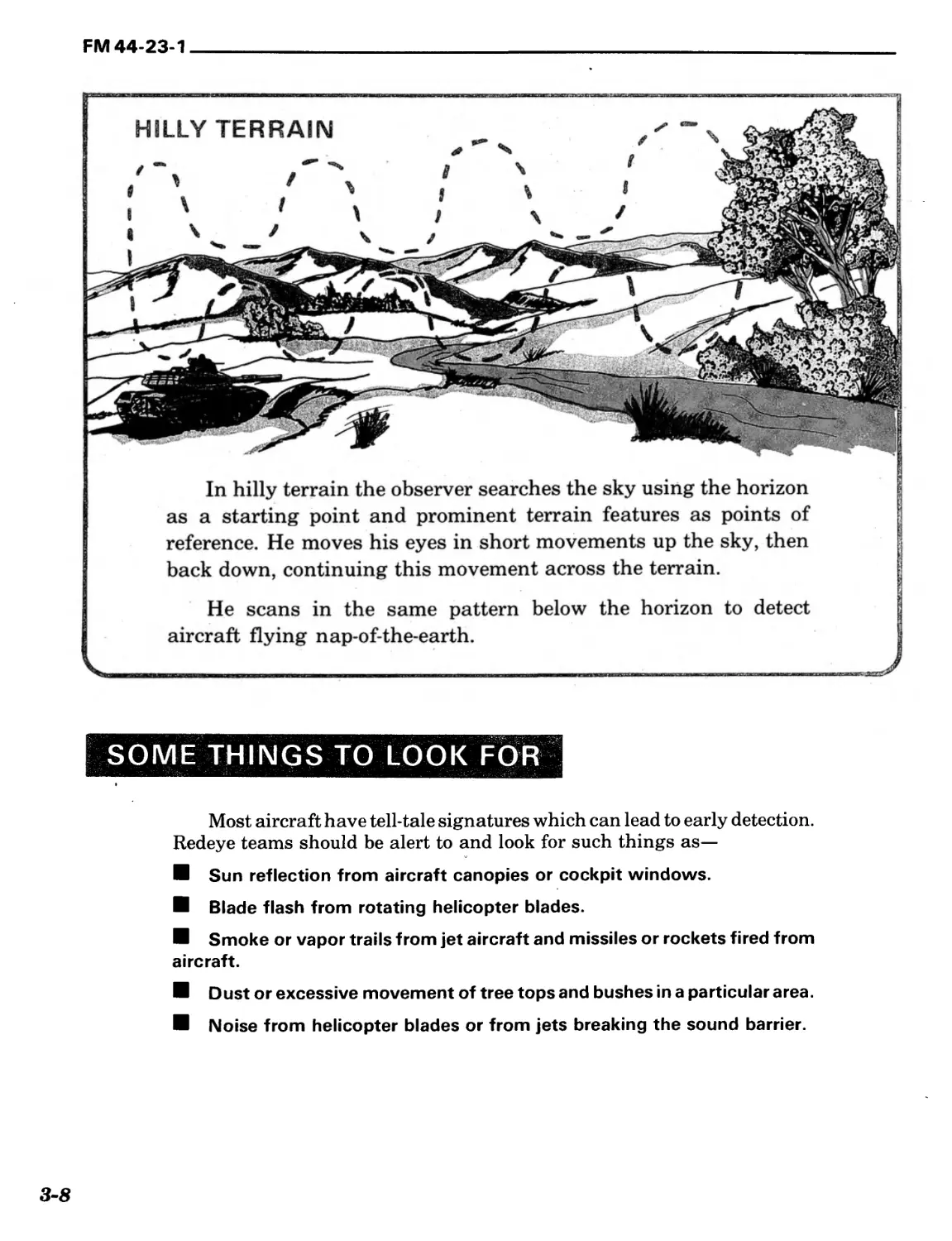
In hilly terrain the observer searches the sky using the horizon
as a starting point and prominent terrain features as points of
reference. He moves his eyes in short movements up the sky, then
back down, continuing this movement across the terrain.
He scans in the same pattern below the horizon to detect
aircraft flying nap-of-the-earth.
SOME THINGS TO LOOK FOR
Most aircraft have tell-tale signatures which can lead to early detection.
Redeye teams should be alert to and look for such things as—
И Sun reflection from aircraft canopies or cockpit windows.
	Blade flash from rotating helicopter blades.
И Smoke or vapor trails from jet aircraft and missiles or rockets fired from
aircraft.
	Dust or excessive movement of tree tops and bushes in a particular area.
	Noise from helicopter blades or from jets breaking the sound barrier.
3-8
_______________________________________________________________________FM 44-23-1
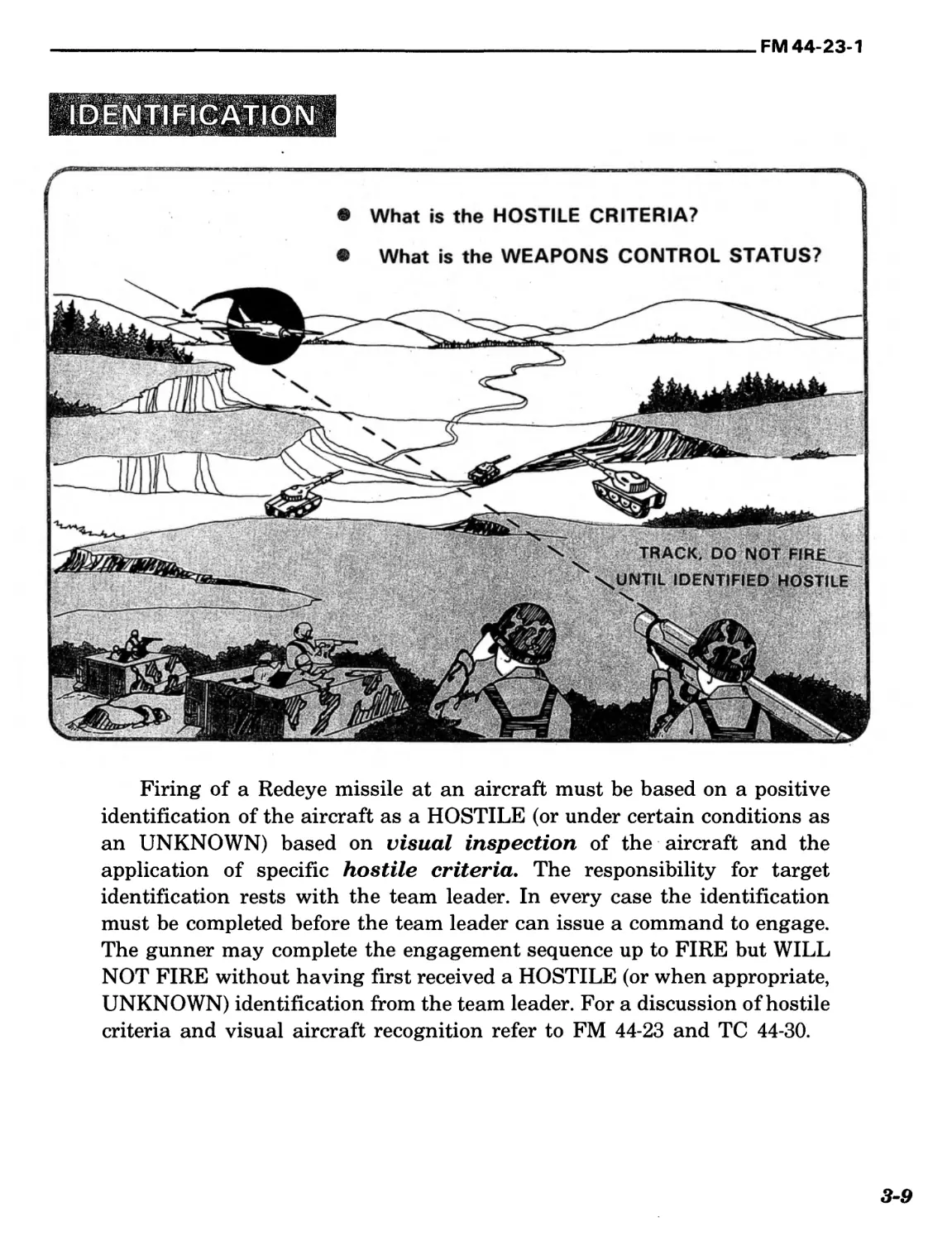
Firing of a Redeye missile at an aircraft must be based on a positive
identification of the aircraft as a HOSTILE (or under certain conditions as
an UNKNOWN) based on visual inspection of the aircraft and the
application of specific hostile criteria. The responsibility for target
identification rests with the team leader. In every case the identification
must be completed before the team leader can issue a command to engage.
The gunner may complete the engagement sequence up to FIRE but WILL
NOT FIRE without having first received a HOSTILE (or when appropriate,
UNKNOWN) identification from the team leader. For a discussion of hostile
criteria and visual aircraft recognition refer to FM 44-23 and TC 44-30.
3-9
FM 44-23-1
CHAPTER 4
FIRING THE REDEYE
This chapter describes the 7 steps required to engage an aircraft
with the Redeye weapon.
О READYING THE REDEYE FOR FIRING
As soon as an aircraft is detected, the team leader visually inspects the aircraft for
identification and finalizes his engagement decision while the gunner readies the
weapon for firing by performing the following steps.
* M ВЯЯ J z \
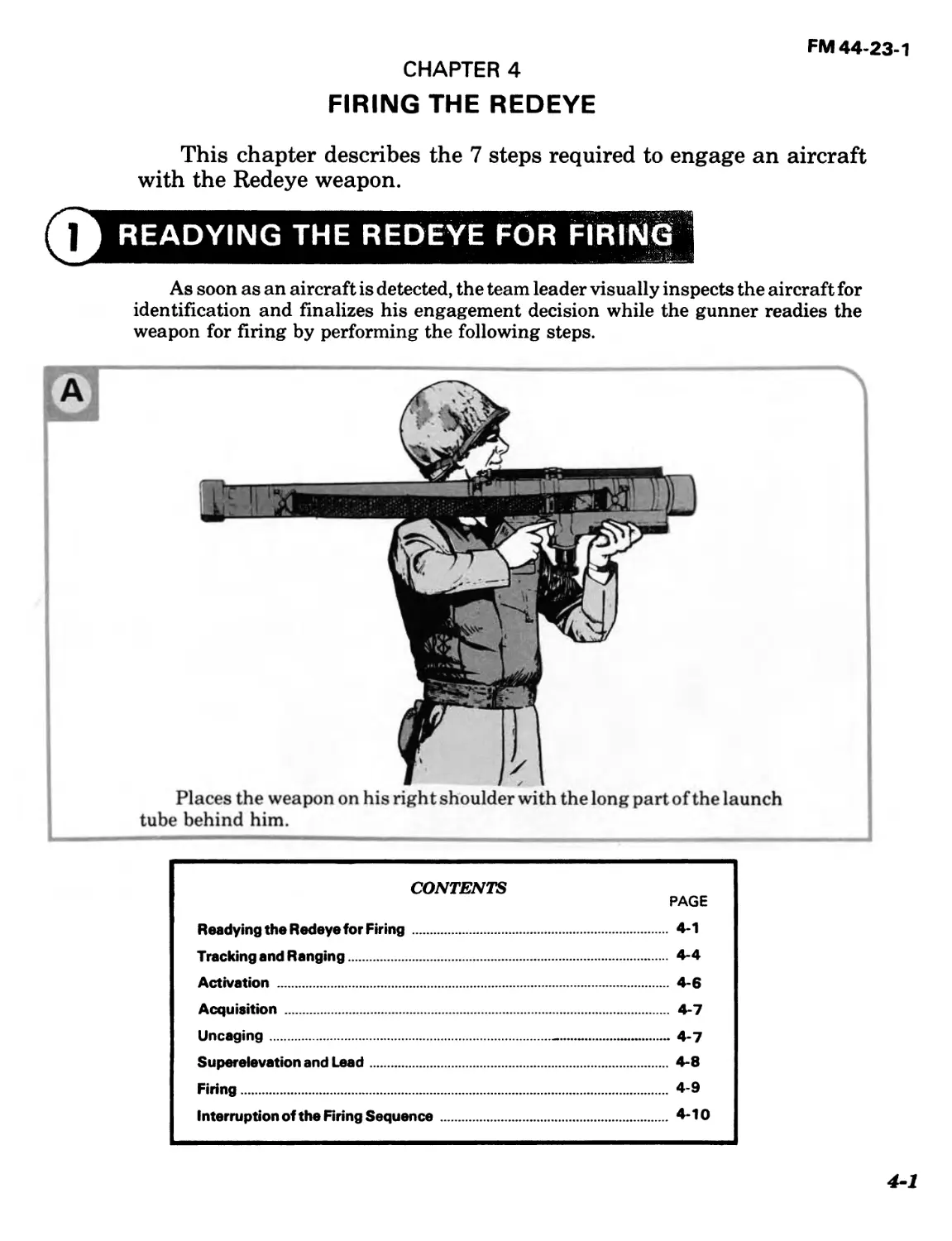
Places the weapon on his right shoulder with the long part of the launch
tube behind him.
CONTENTS
PAGE
Readying the Redeye for Firing.............................. 4-1
Tracking and Ranging........................................ 4-4
Activation ................................................. 4-6
Acquisition ................................................ 4-7
Uncaging.....................................-..............4-7
Superelevation and Lead.....................................4-8
Firing...................................................... 4-9
Interruption of the Firing Sequence......................... 4-10
4-1
FM 44-23.-1
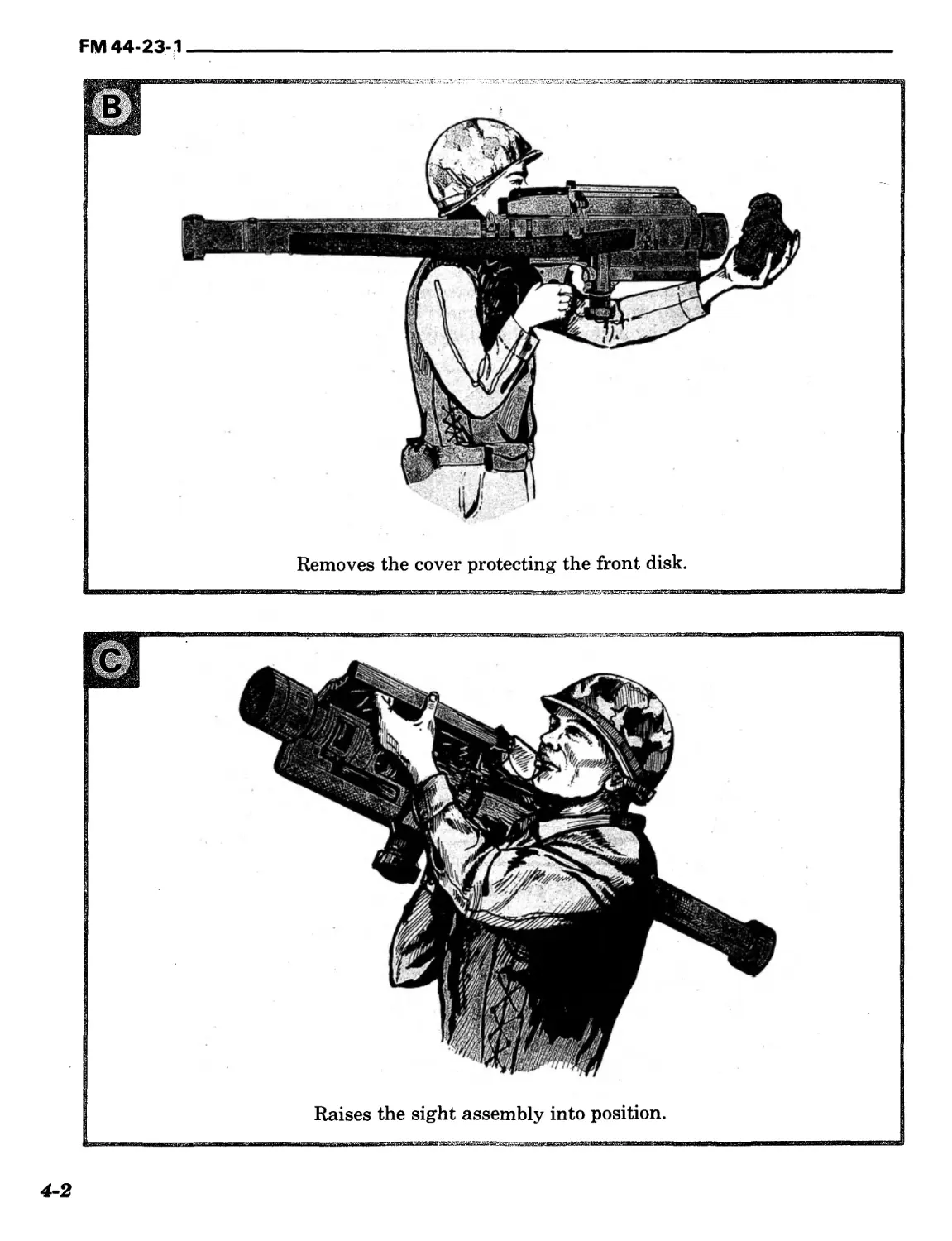
4-2
FM 44-23-1
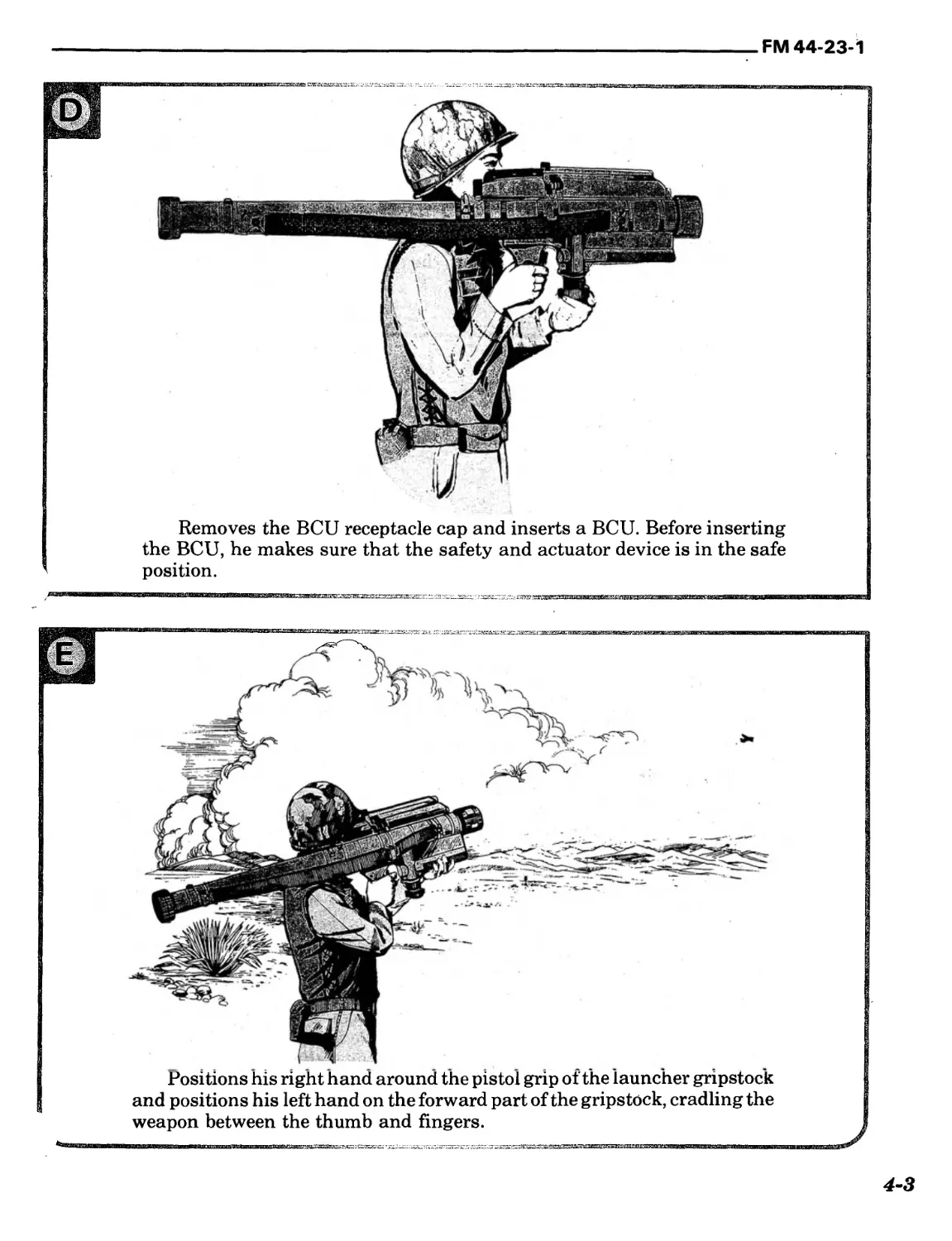
Removes the BCU receptacle cap and inserts a BCU. Before inserting
the BCU, he makes sure that the safety and actuator device is in the safe
position.
Positions his right hand around the pistol grip of the launcher gripstock
and positions his left hand on the forward part of the gripstock, cradling the
weapon between the thumb and fingers.
4-3
FM 44-23-1
TO TRACKING AND RANGING
The gunner uses the Redeye sight to track the aircraft and to determine if it is
within range of Redeye. In addition, the sight is used to insert superelevation and
lead.
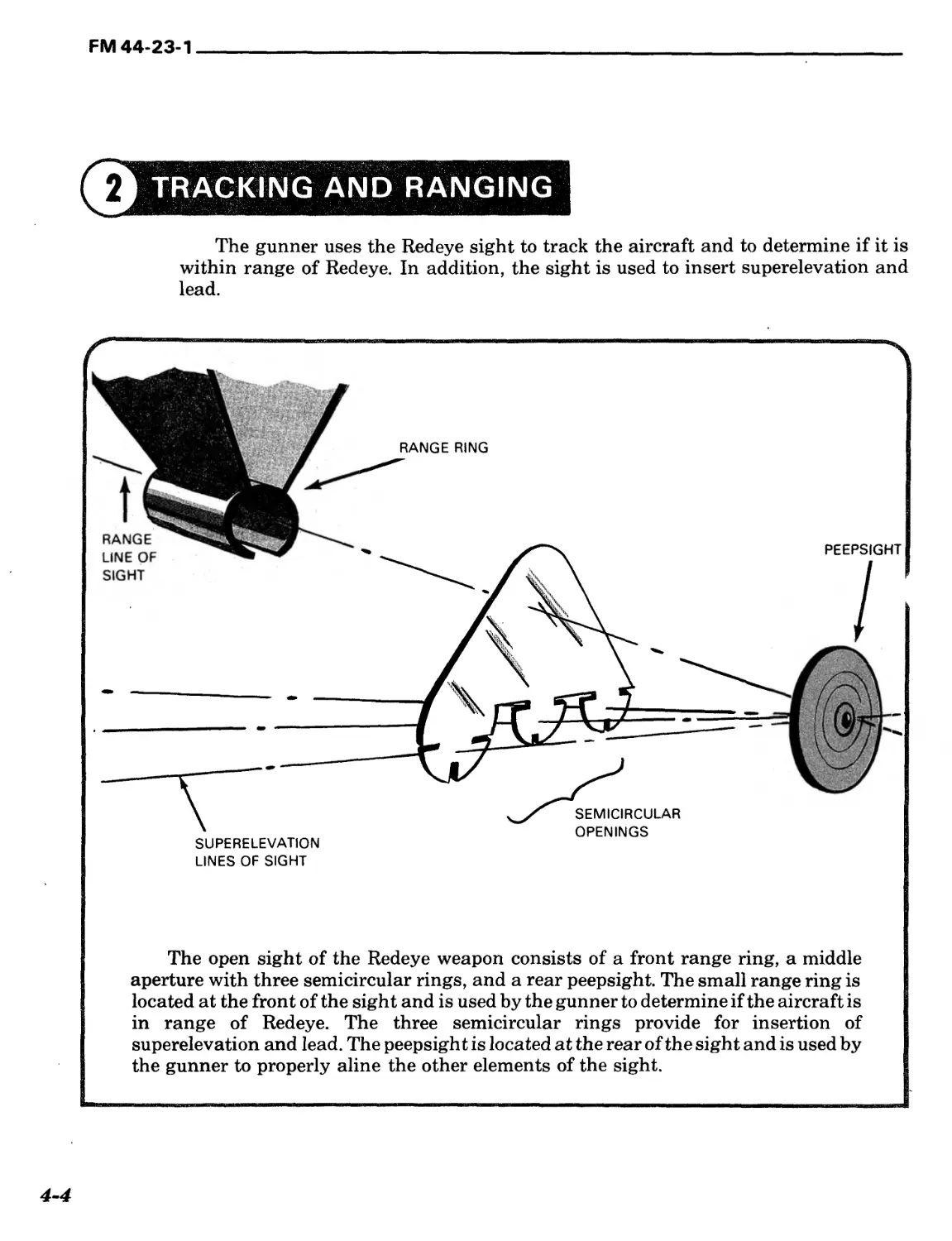
LINES OF SIGHT
The open sight of the Redeye weapon consists of a front range ring, a middle
aperture with three semicircular rings, and a rear peepsight. The small range ring is
located at the front of the sight and is used by the gunner to determine if the aircraft is
in range of Redeye. The three semicircular rings provide for insertion of
superelevation and lead. The peepsight is located at the rear of the sight and is used by
the gunner to properly aline the other elements of the sight.
4-4
FM 44-23-1
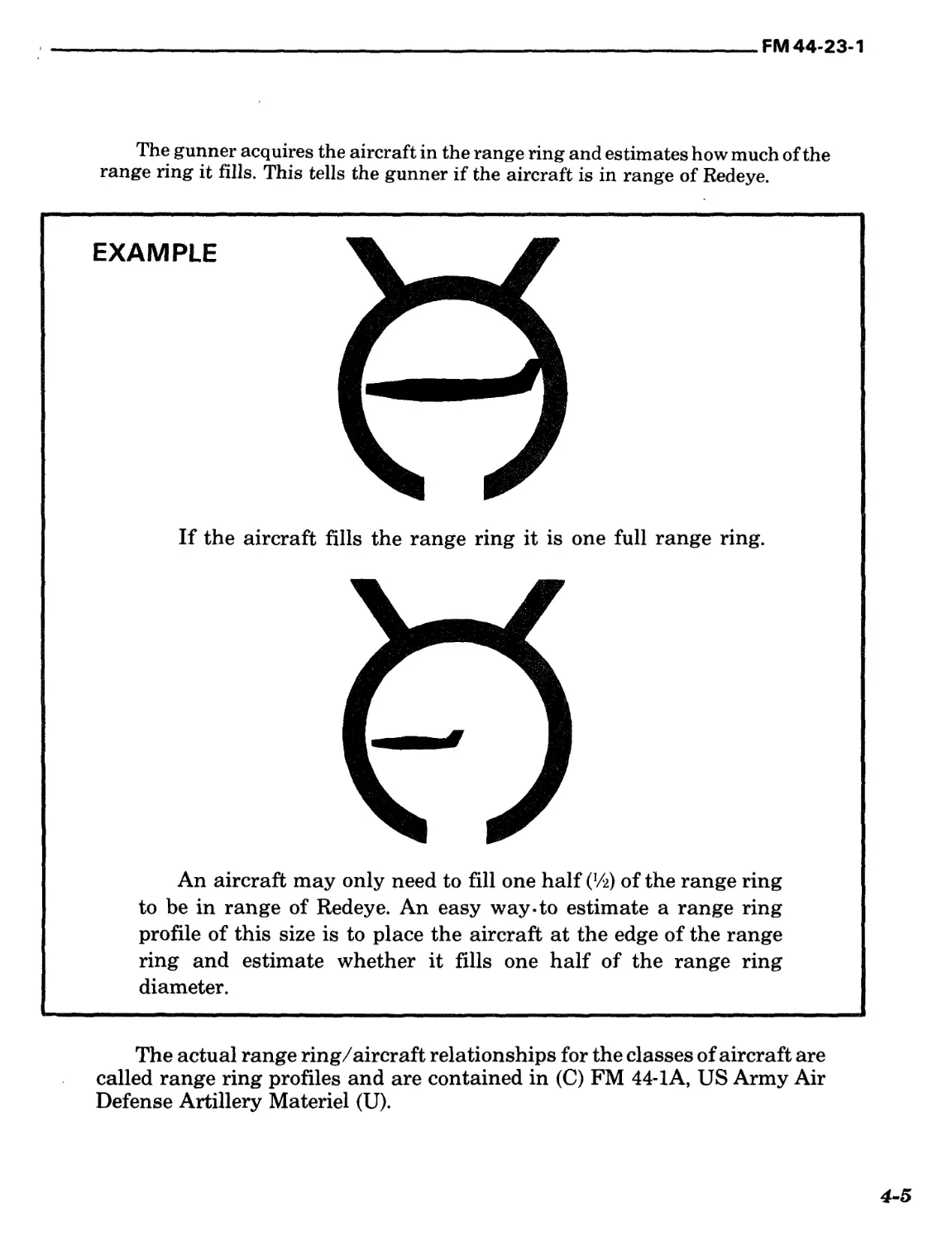
The gunner acquires the aircraft in the range ring and estimates how much of the
range ring it fills. This tells the gunner if the aircraft is in range of Redeye.
EXAMPLE
If the aircraft fills the range ring it is one full range ring.
An aircraft may only need to fill one half (’/г) of the range ring
to be in range of Redeye. An easy way-to estimate a range ring
profile of this size is to place the aircraft at the edge of the range
ring and estimate whether it fills one half of the range ring
diameter.
The actual range ring/aircraft relationships for the classes of aircraft are
called range ring profiles and are contained in (C) FM 44-1A, US Army Air
Defense Artillery Materiel (U).
4-5
FM 44-23-1
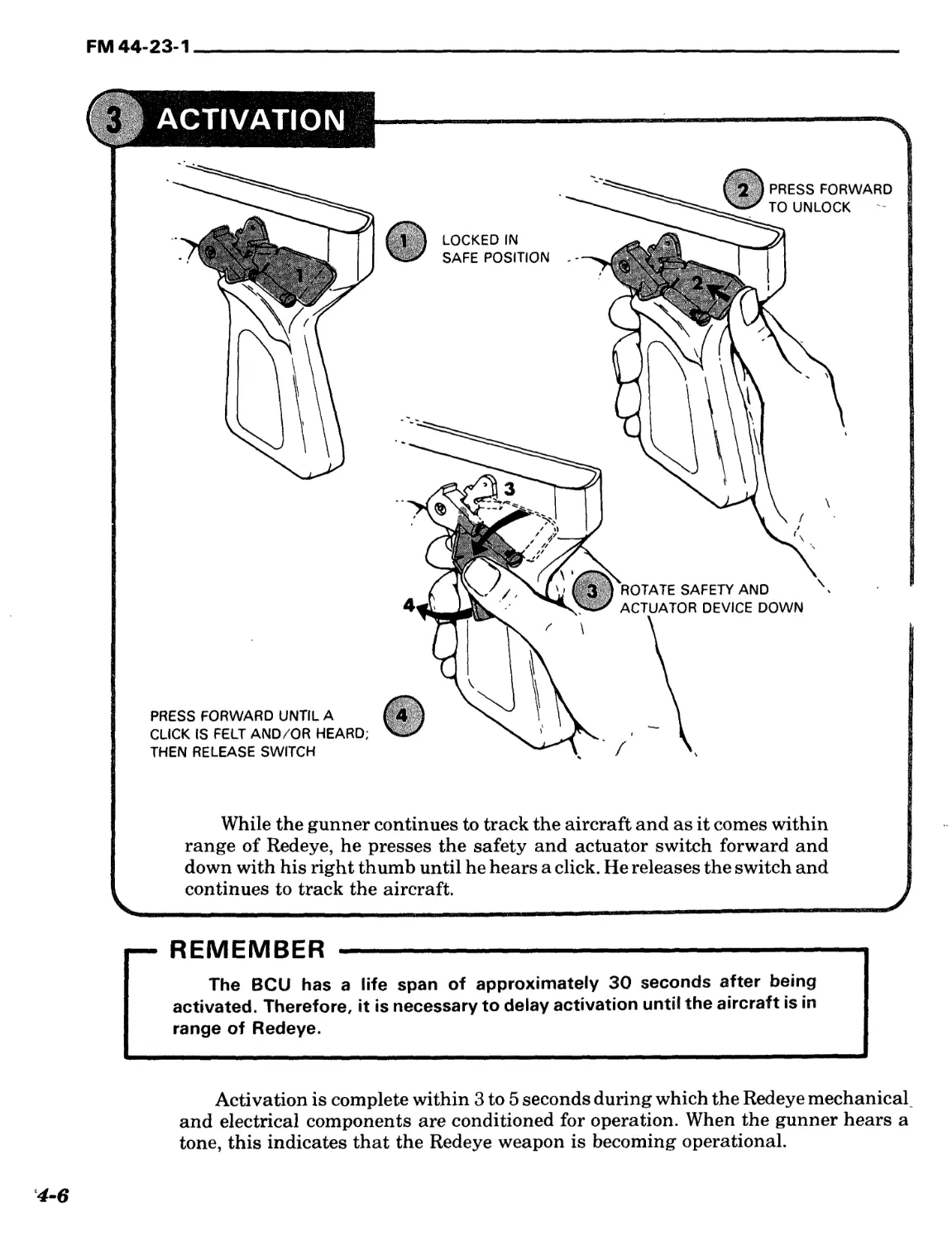
While the gunner continues to track the aircraft and as it comes within
range of Redeye, he presses the safety and actuator switch forward and
down with his right thumb until he hears a click. He releases the switch and
continues to track the aircraft.
|— REMEMBER -----------------------------------------
The BCU has a life span of approximately 30 seconds after being
activated. Therefore, it is necessary to delay activation until the aircraft is in
range of Redeye.
Activation is complete within 3 to 5 seconds during which the Redeye mechanical
and electrical components are conditioned for operation. When the gunner hears a
tone, this indicates that the Redeye weapon is becoming operational.
4-6
FM 44-23-1
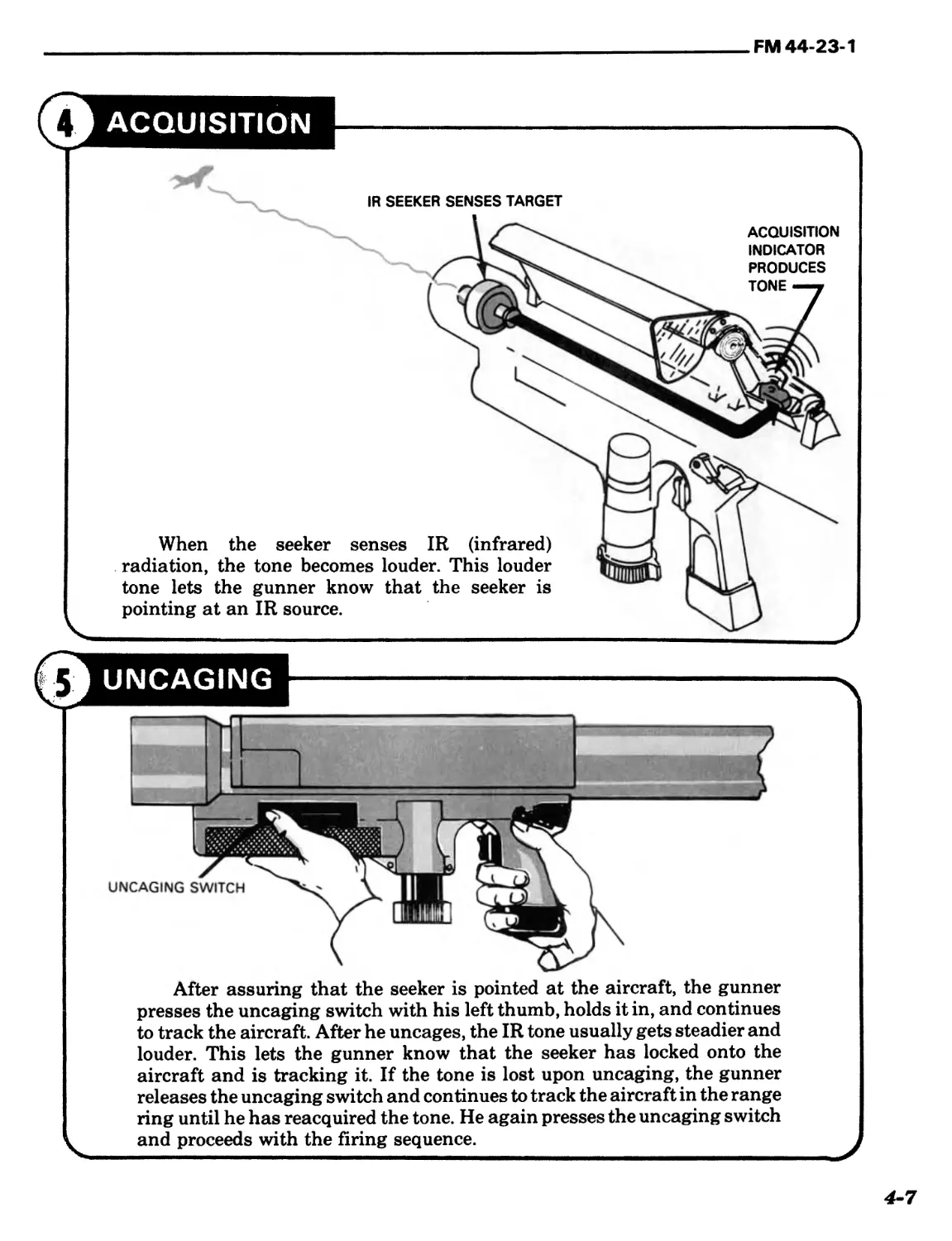
ACQUISITION
IR SEEKER SENSES TARGET
ACQUISITION
INDICATOR
PRODUCES
TONE
When the seeker senses IR (infrared)
radiation, the tone becomes louder. This louder
tone lets the gunner know that the seeker is
pointing at an IR source.
UNCAGING
After assuring that the seeker is pointed at the aircraft, the gunner
presses the uncaging switch with his left thumb, holds it in, and continues
to track the aircraft. After he uncages, the IR tone usually gets steadier and
louder. This lets the gunner know that the seeker has locked onto the
aircraft and is tracking it. If the tone is lost upon uncaging, the gunner
releases the uncaging switch and continues to track the aircraft in the range
ring until he has reacquired the tone. He again presses the uncaging switch
and proceeds with the firing sequence.
4-7
FM 44-23-1
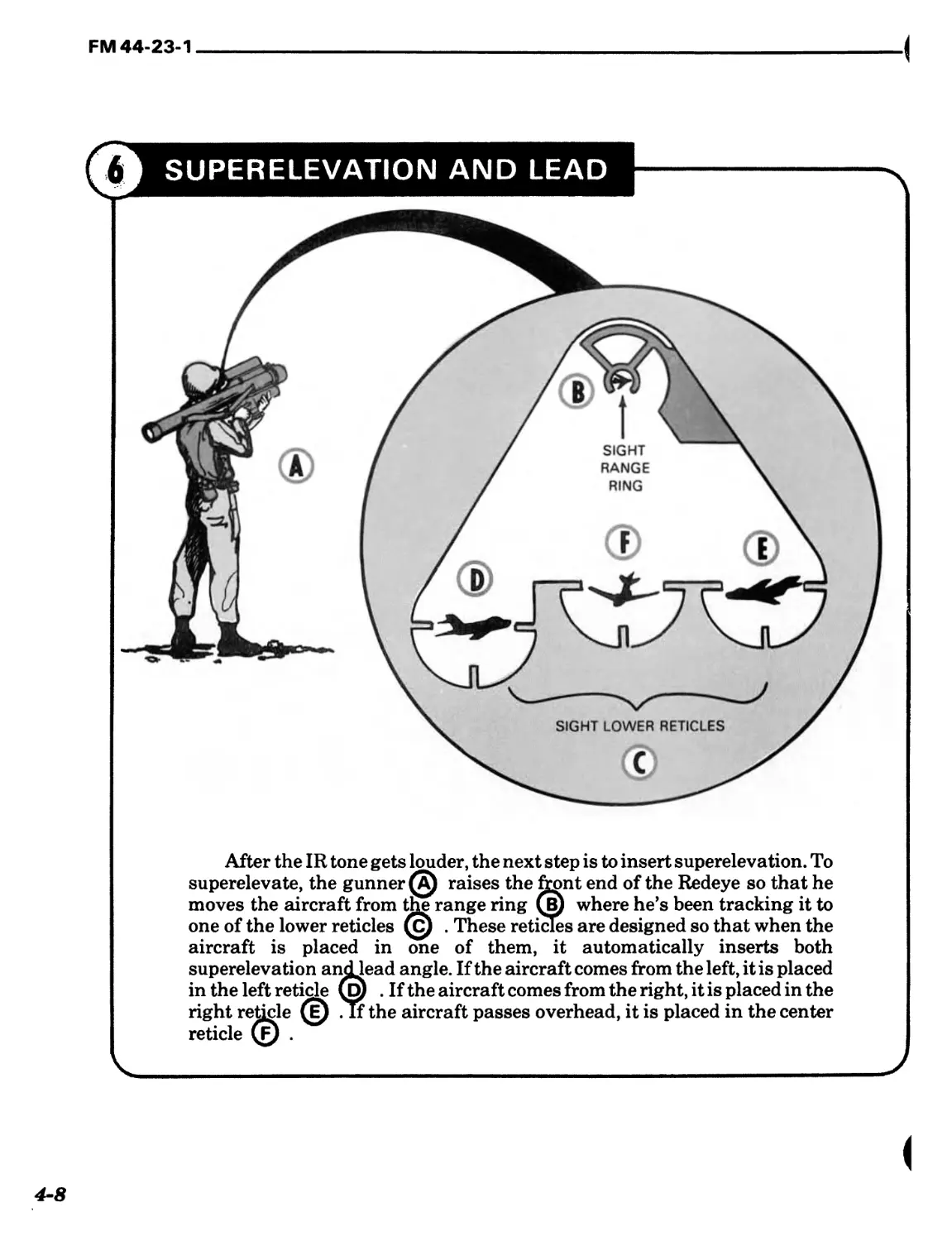
After the IR tone gets louder, the next step is to insert superelevation. To
superelevate, the gunner	raises the front end of the Redeye so that he
moves the aircraft from the range ring (в) where he’s been tracking it to
one of the lower reticles (g) . These reticles are designed so that when the
aircraft is placed in one of them, it automatically inserts both
superelevation andlead angle. If the aircraft comes from the left, it is placed
in the left reticle (d) . If the aircraft comes from the right, it is placed in the
right reticle .If the aircraft passes overhead, it is placed in the center
reticle (F) .
4-8
FM 44-23-1
« FIRING
Prior to firing, the gunner must:
	Receive an order to fire from the team leader (based on his identification of
the aircraft and his engagement decision).
	Be sure that the firing position is clear of personnel and equipment for a
distance of 13 meters.
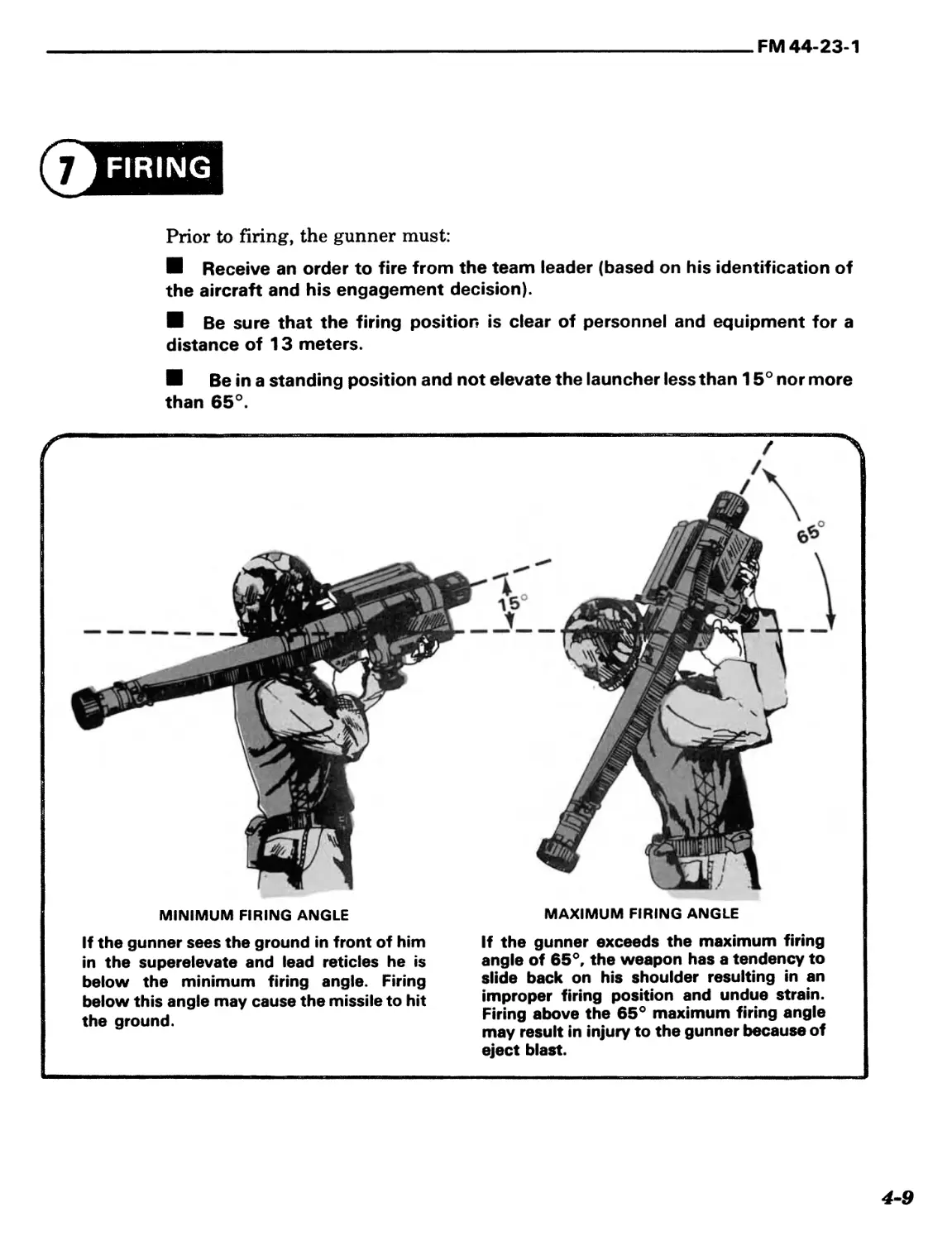
M Be in a standing position and not elevate the launcher less than 15° nor more
than 65°.
MINIMUM FIRING ANGLE
If the gunner sees the ground in front of him
in the superelevate and lead reticles he is
below the minimum firing angle. Firing
below this angle may cause the missile to hit
the ground.
MAXIMUM FIRING ANGLE
If the gunner exceeds the maximum firing
angle of 65°, the weapon has a tendency to
slide back on his shoulder resulting in an
improper firing position and undue strain.
Firing above the 65° maximum firing angle
may result in injury to the gunner because of
eject blast.
4-9
FM 44-23*1
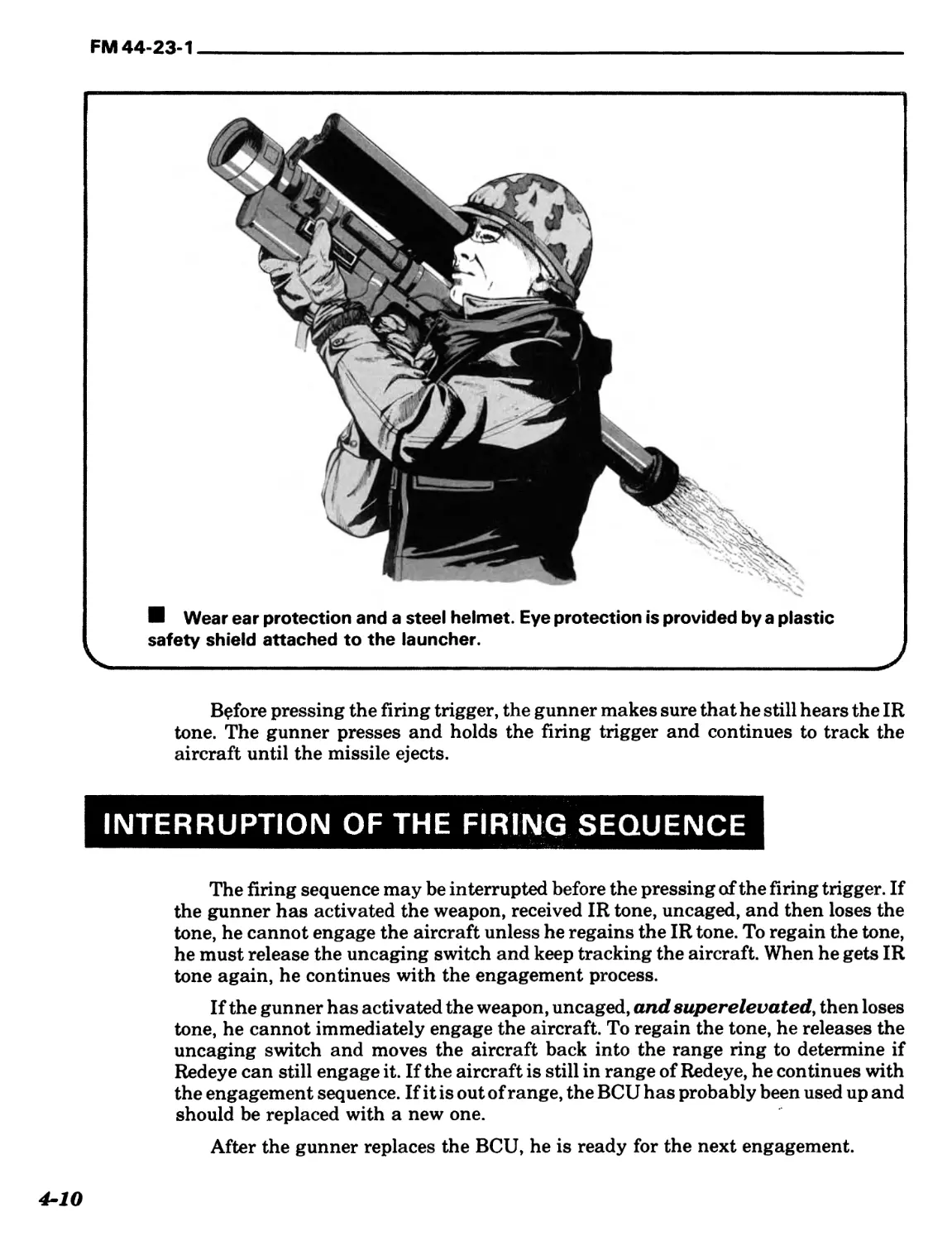
 Wear ear protection and a steel helmet. Eye protection is provided by a plastic
safety shield attached to the launcher.
Before pressing the firing trigger, the gunner makes sure that he still hears the IR
tone. The gunner presses and holds the firing trigger and continues to track the
aircraft until the missile ejects.
INTERRUPTION OF THE FIRING SEQUENCE
The firing sequence may be interrupted before the pressing of the firing trigger. If
the gunner has activated the weapon, received IR tone, uncaged, and then loses the
tone, he cannot engage the aircraft unless he regains the IR tone. To regain the tone,
he must release the uncaging switch and keep tracking the aircraft. When he gets IR
tone again, he continues with the engagement process.
If the gunner has activated the weapon, uncaged, and superelevated, then loses
tone, he cannot immediately engage the aircraft. To regain the tone, he releases the
uncaging switch and moves the aircraft back into the range ring to determine if
Redeye can still engage it. If the aircraft is still in range of Redeye, he continues with
the engagement sequence. If it is out of range, the BCU has probably been used up and
should be replaced with a new one.
After the gunner replaces the BCU, he is ready for the next engagement.
4-10
FM 44-23-1
CHAPTER 5
ENGAGING AIRCRAFT
The mission of the Redeye team is to protect the unit which it is
supporting from attack by aircraft. It does this by firing Redeye
missiles at hostile aircraft to either destroy them or drive them away.
Previous chapters have dealt with the subjects of detecting and
identifying aircraft and how to handle and operate the Redeye weapon.
This chapter tells how to use the Redeye to shoot down aircraft. To be
engaged, an aircraft must first be detected and identified. For the
engagement to be successful, these additional requirements must be
met:
The CLASS of the aircraft must be determined.
The gunner must have IR ACQUISITION.
The aircraft must be within Redeye's RANGE.
о
AIRCRAFT CLASSES
Immediately upon detecting an aircraft which is judged to be a potential
target, the team leader must identify it as a hostile threat and determine its
class. For Redeye engagement purposes all potential threat aircraft have been
grouped into three classes based on aircraft size and type.
CONTENTS
AIRCRAFT CLASSES ............................... 5-1
IR ACQUISITION.................................. 5-5
RANGING......................................... 5-5
HOWTO ENGAGE AIRCRAFT........................... 5-6
5-1
FM 44-23-1
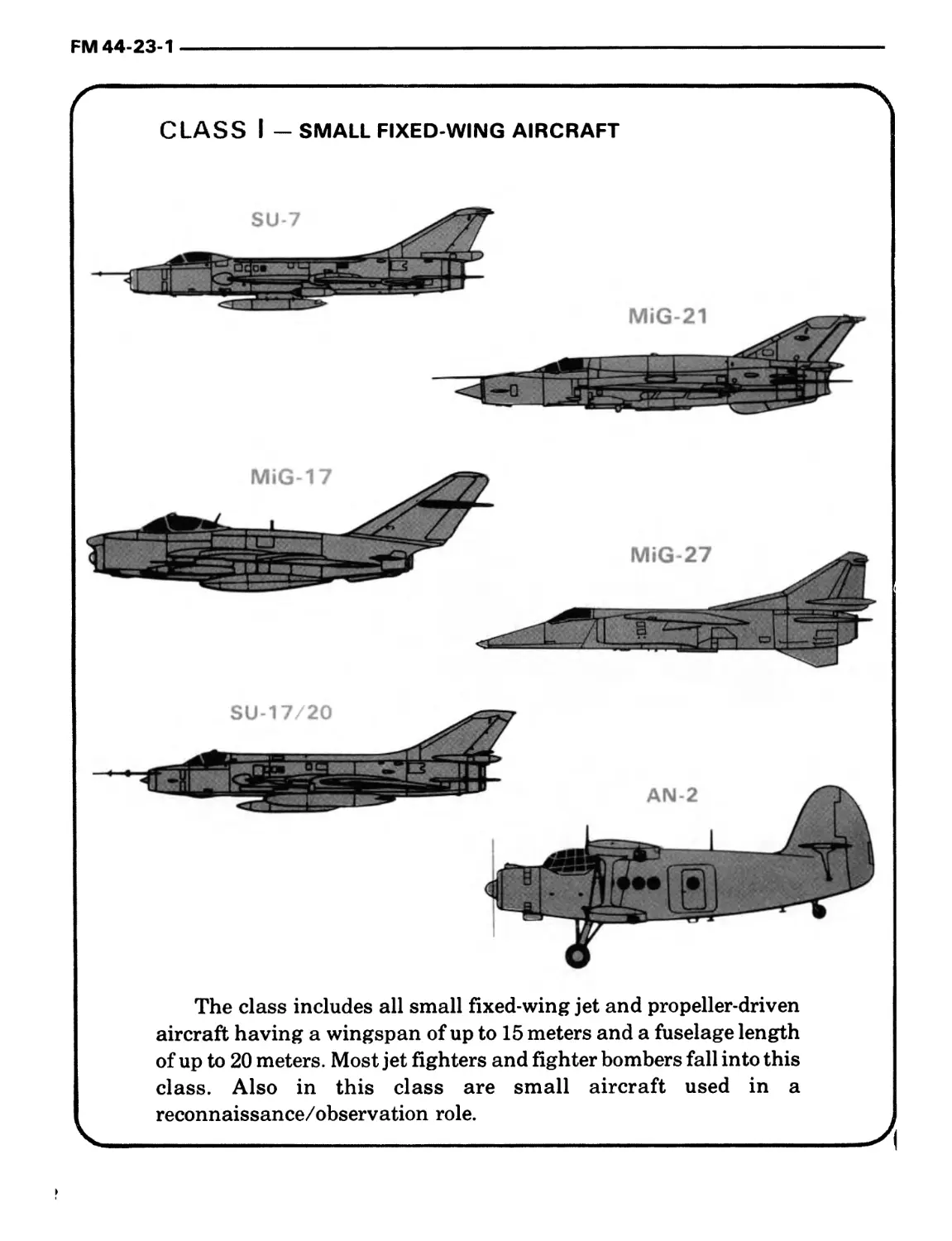
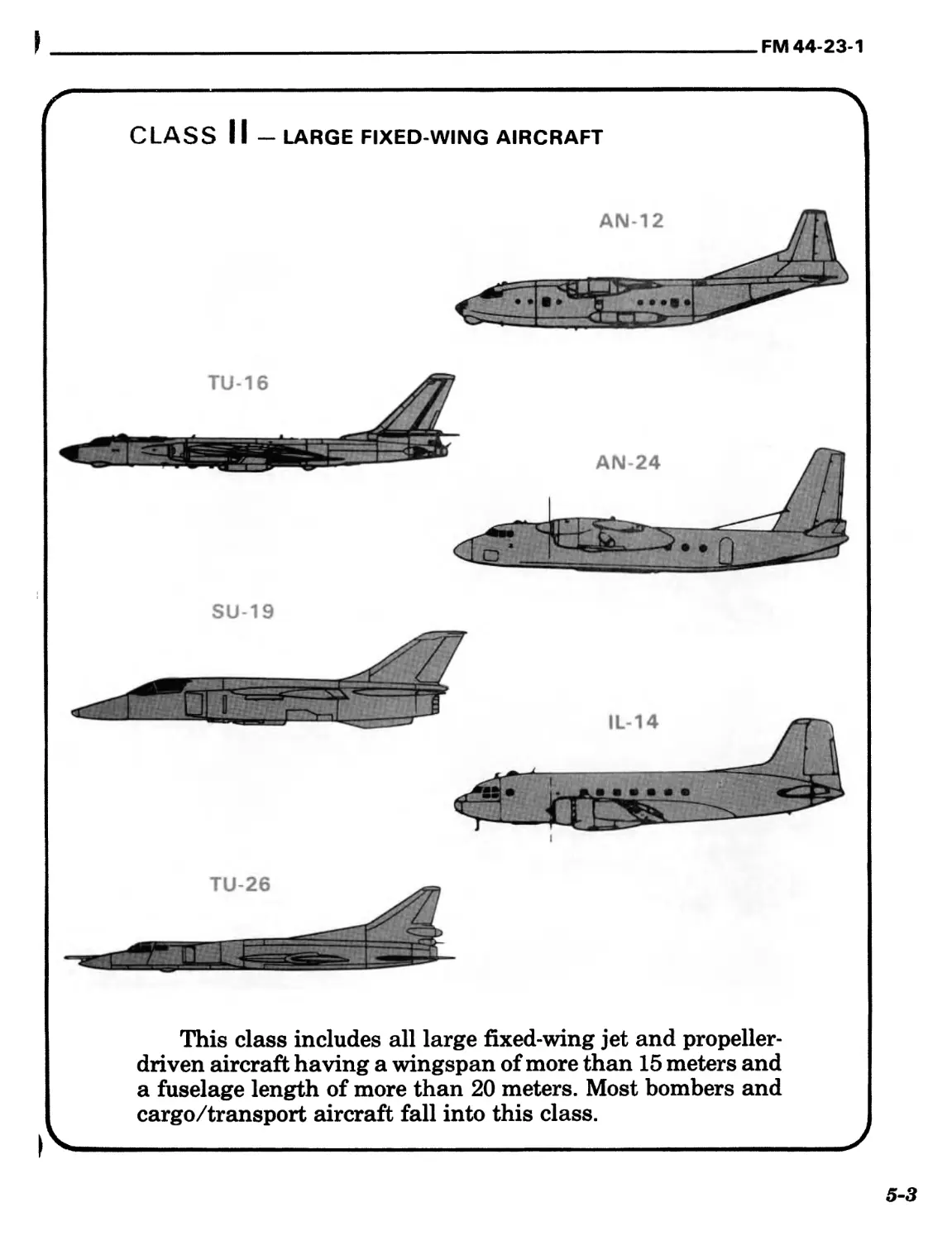
CLASS I — SMALL FIXED-WING AIRCRAFT
The class includes all small fixed-wing jet and propeller-driven
aircraft having a wingspan of up to 15 meters and a fuselage length
of up to 20 meters. Most jet fighters and fighter bombers fall into this
class. Also in this class are small aircraft used in a
reconnaissance/observation role.
I FM 44-23-1
This class includes all large fixed-wing jet and propeller-
driven aircraft having a wingspan of more than 15 meters and
a fuselage length of more than 20 meters. Most bombers and
cargo/transport aircraft fall into this class.
5-3
FM 44-23-1
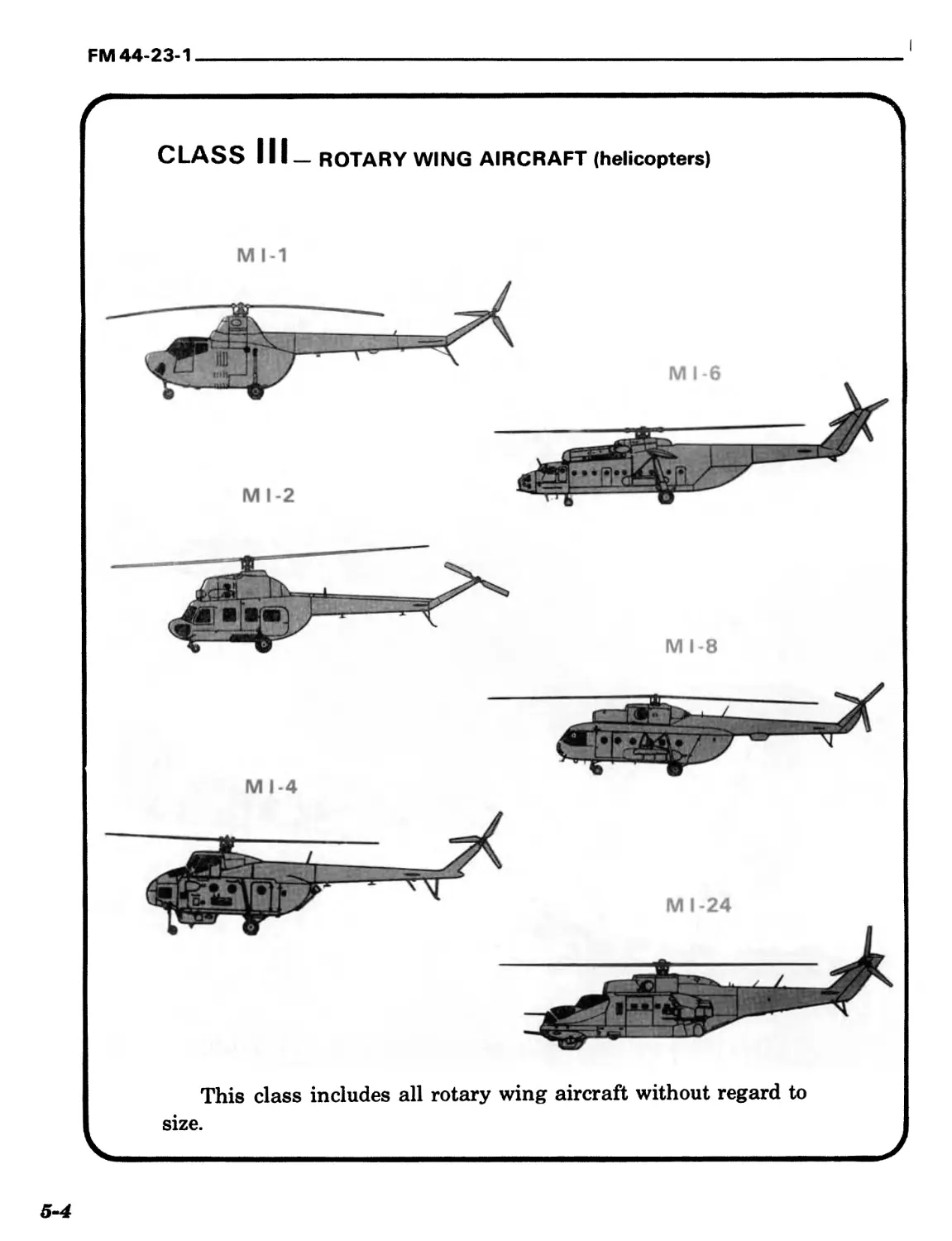
CLASS 111 — ROTARY WING AIRCRAFT (helicopters)
MI-1
MI-2
This class includes all rotary wing aircraft without regard to
size.
5-4
FM 44-23-1
IR ACQUISTION
Redeye guides itself to its target by sensing and locking onto the aircraft's
heat (infrared (IR)) radiations. The missile has a seeker located in its front
end to sense and track the IR. The seeker begins working about 3 seconds after
the weapon is activated. When the target is centered in the range ring, the
seeker is looking directly at the target. When it senses the target's IR, it sends
a signal to a buzzer located in the weapon's sight assembly. The buzzer and
tells the gunner that IR is being received from the target.
The gunner continues to track the target in the range ring and tests to
see if the IR is strong enough for the seeker to lock onto. He tests by pressing
the uncaging switch, This frees the seeker and allows it to track the target
automatically, If the seeker locks on, the buzzer tone will become louder and
steady. If the seeker cannot lock on the target, the buzzer tone will usually be
lost. In that case, release the uncaging switch, reestablish tracking and test
again. The seeker must be locked onto the target before super-
elevating, leading, and firing.
RANGING
To have a successful engagement with the Redeye the target must be in
Redeye's range. This means that the gunner must not fire until he is sure that
the target is in range. Ranging is done by means of range ring profiles (RRP).
The Redeye sight's range ring is used as a device to measure the size of the
target image with respect to the size of the range ring. If the target image is
estimated to reach across half the range ring, then the RRP is one-half. If it
reaches all the way across the range ring the RRP is one. The specific RRP's to
be used to tell when any of the classes of aircraft are in range are classified
CONFIDENTIAL and are not discussed in this manual. To find the correct
RRP's, refer to FM 44-1A.
5-5
FM 44-23-1
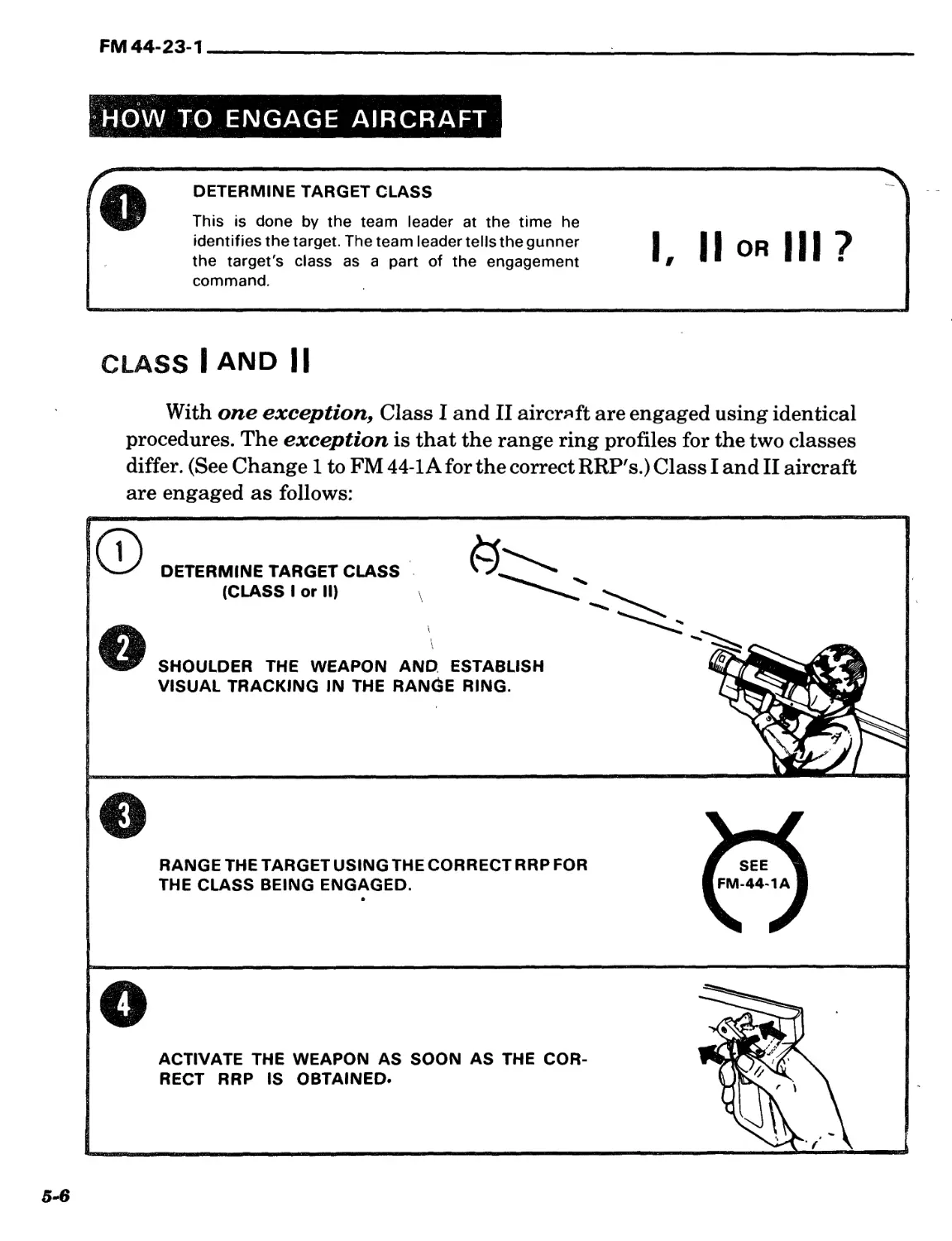
HOW TO ENGAGE AIRCRAFT
DETERMINE TARGET CLASS
This is done by the team leader at the time he
identifies the target. The team leader tells the gunner
the target's class as a part of the engagement
command.
I, II OR III?
CLASS I AND ||
With one exception, Class I and II aircraft are engaged using identical
procedures. The exception is that the range ring profiles for the two classes
differ. (See Change 1 to FM 44-1A for the correct RRP's.) Class I and II aircraft
are engaged as follows:
DETERMINE TARGET CLASS
(CLASS I or II)
SHOULDER THE WEAPON AND ESTABLISH
VISUAL TRACKING IN THE RAN6E RING.
RANGE THE TARGET USING THE CORRECT RRP FOR
THE CLASS BEING ENGAGED.
ACTIVATE THE WEAPON AS SOON AS THE COR-
RECT RRP IS OBTAINED.
SEE
FM-44-1A
5-6
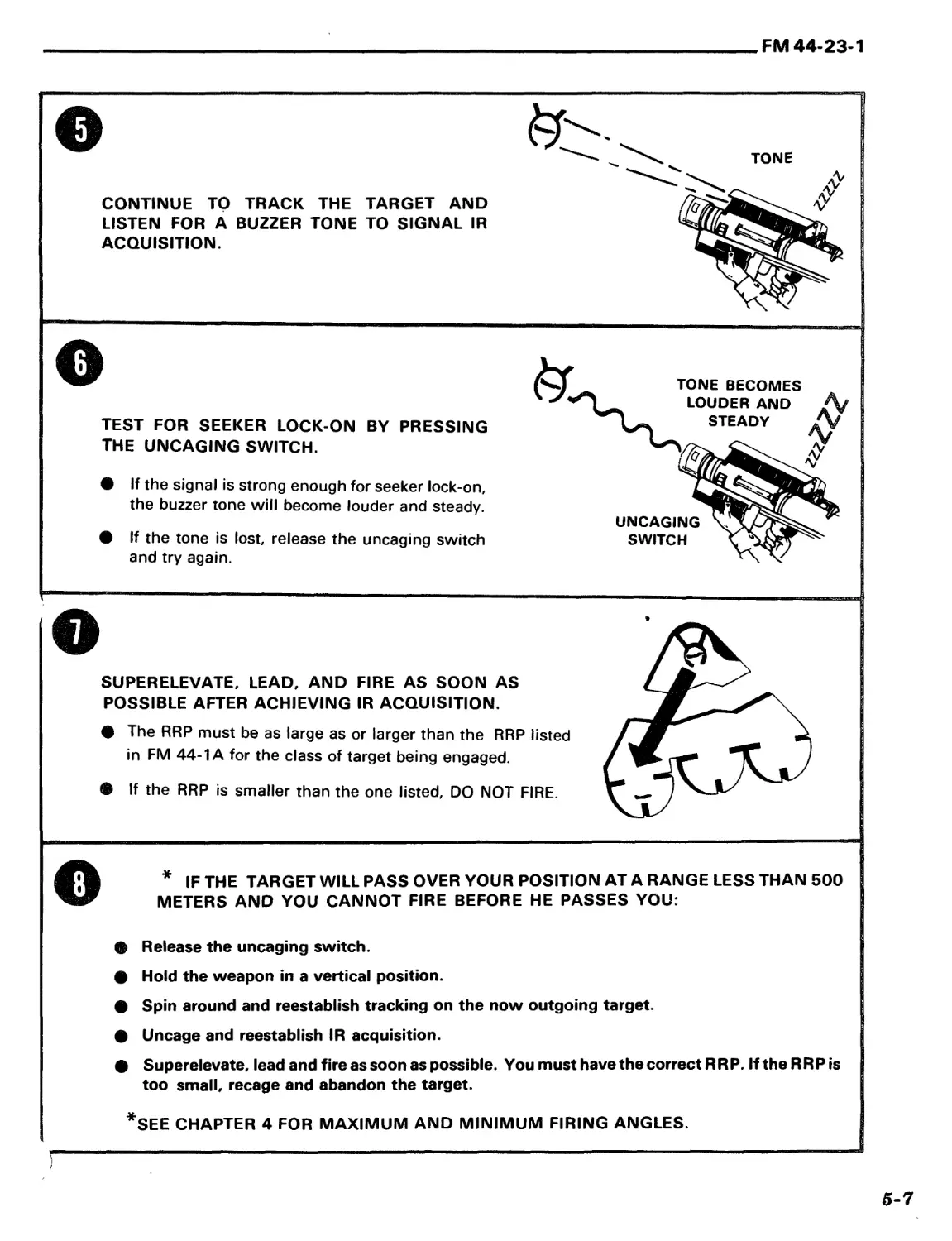
FM 44-23-1
О
CONTINUE TO TRACK THE TARGET AND
LISTEN FOR A BUZZER TONE TO SIGNAL IR
ACQUISITION.
О
TEST FOR SEEKER LOCK-ON BY PRESSING
THE UNCAGING SWITCH.
•	If the signal is strong enough for seeker lock-on,
the buzzer tone will become louder and steady.
•	If the tone is lost release the uncaging switch
and try again.
О
SUPERELEVATE, LEAD, AND FIRE AS SOON AS
POSSIBLE AFTER ACHIEVING IR ACQUISITION.
•	The RRP must be as large as or larger than the RRP listed
in FM 44-1A for the class of target being engaged.
Ф If the RRP is smaller than the one listed, DO NOT FIRE.
* IF THE TARGET WILL PASS OVER YOUR POSITION AT A RANGE LESS THAN 500
METERS AND YOU CANNOT FIRE BEFORE HE PASSES YOU:
•	Release the uncaging switch.
•	Hold the weapon in a vertical position.
•	Spin around and reestablish tracking on the now outgoing target.
•	Uncage and reestablish IR acquisition.
•	Superelevate, lead and fire as soon as possible. You must have the correct R R P. If the R R P is
too small, recage and abandon the target.
*SEE CHAPTER 4 FOR MAXIMUM AND MINIMUM FIRING ANGLES.
5-7
FM 44-23-1
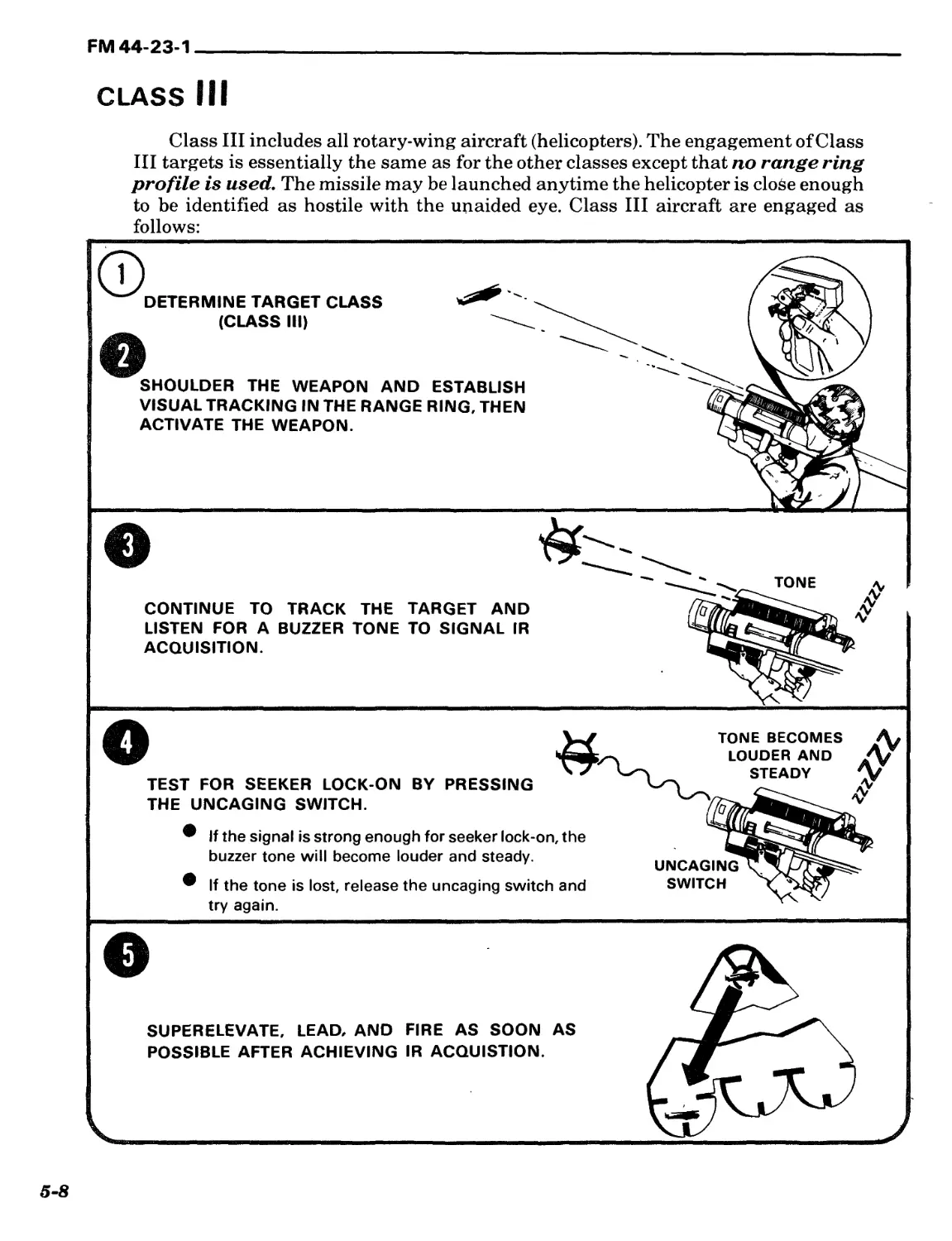
CLASS HI
Class III includes all rotary-wing aircraft (helicopters). The engagement of Class
III targets is essentially the same as for the other classes except that no range ring
profile is used. The missile may be launched anytime the helicopter is clo&e enough
to be identified as hostile with the unaided eye. Class III aircraft are engaged as
follows:
SHOULDER THE WEAPON AND ESTABLISH
VISUAL TRACKING IN THE RANGE RING, THEN
ACTIVATE THE WEAPON.
TONE BECOMES А/
LOUDER AND Л ‘
STEADY
UNCAGING
SWITCH
TEST FOR SEEKER LOCK-ON BY PRESSING
THE UNCAGING SWITCH.
• If the signal is strong enough for seeker lock-on, the
buzzer tone will become louder and steady.
If the tone is lost, release the uncaging switch and
try again.
G
SUPERELEVATE, LEAD, AND FIRE AS SOON AS
POSSIBLE AFTER ACHIEVING IR ACQUISTION.
5-8
FM 44-23-1
PART II
REDEYE GUNNER TRAINING
CHAPTER 6
TRAINING REDEYE GUNNERS
To have proficient Redeye gunners, adequate training time must be
made available to conduct realistic training in weapon handling and
firing procedures. The training program for Redeye gunners should be
well planned but must remain flexible. Mission requirements may
dictate that an abbreviated, intensified program be conducted; but the
goal is still to develop and maintain Redeye gunner proficiency at a
high level. This chapter discusses some factors to consider in training
to achieve that goal. Although this discussion is specifically addressed
to a Redeye section leader, it applies as well to any other individual who
may be assigned responsibility for Redeye gunner training within a
unit.
TRAINING ASSESSMENT
The Redeye section leader’s training assessment is essential to the success or
failure of any training program for Redeye gunners. In making this assessment he
must:
1 1 Determine the gunner's current proficiency by:
	Analyzing the experience level of the individual gunner.
M Analyzing the results of previous training programs.
	Analyzing the overall training level of the section and its personnel
assignment stability.
И Conducting diagnostic testing, such as tracking of aircraft with use of the
Redeye training set or the moving target simulator.
CONTENTS
PAGE
Training Assessment.......................................... 6-1
Planning forTraining......................................... 6-3
6-1
FM 44-23-1
gp Determine what training will be necessary to meet required training standards by:
	Comparing results of the analysis of the gunner's current proficiency with
the required training standards contained in the Soldier's Manual.
	Placing the gunner into the appropriate level of the training program.
3	) Determine how much time is available to achieve the required standards by:
	Examining the section's overall mission requirements and other
obligations.
	Deciding whether an intensified program is required.
4	J Determine what resources are required to train gunners by:
И Referring to Chapter 7, "Training Devices and Techniques/' for innovative
solutions to overcome possible short falls.
 Referring to Chapter 9, "Redeye Range Operations," for administrative
and logistical requirements.
И Reviewing previous training experiences of the section.
5	; Determine what resources are available to conduct gunner training by:
И Inventorying section equipment.
И Reviewing section personnel records for instructor qualifications.
И Determining what assistance is available from supporting units and higher
headquarters.
И Examining available training facilities.
И Evaluating the section's equipment readiness profile.
Reconcile all considerations. Differences between resources required and
resources available will affect both the time required to conduct the training and
the section's ability to meet the required standards.
6-2
FM 44-23-1
PLANNING FOR TRAINING
In the assessment process, the section leader has begun outlining his Redeye
gunner training program. To construct a detailed plan for implementing the program,
the section leader must:
START EARLY. To produce the desired results, all aspects of a training
program must be thoroughly coordinated. Forecast and request required resources
and maintenance assistance long before they will be used.
BE THOROUGH. Do not leave anything to chance, or resources will be
wasted and training opportunities will be lost.
BE FLEXIBLE. Continuously adjust the training program to the changing
needs of the section. If planning stops, the training program stagnates and loses its
effectiveness.
BE INNO VA TIVE. If resources are not available to support one method
of training, look for alternative methods. For example, if a moving target simulator is
not available, look for a well-used low-altitude route, such as an airport approach
pattern, which will provide live tracking.
SUMMARY
H Realistic Redeye gunner training is necessary to establish and maintain gunner
proficiency.
* An effective program is based on the training assessment and detailed
planning.
 Once the section leader has determined the section’s current proficiency
level, decided on the training required, and balanced this against time and
resource constraints, he can intelligently conduct training to achieve the training
goal — full Redeye gunner proficiency.
6-3
FM 44-23-1
CHAPTER 7
TRAINING DEVICES AND TECHNIQUES
A training program should emphasize weapon handling and firing
procedures to develop and maintain gunner proficiency at a high level.
A number of training devices have been developed which, if used
properly, can add realism to the training program. The use of these
devices is less costly than conducting live firings and permits training
to be conducted at the home station.
This chapter describes the devices that can be used to train and test
Redeye gunners. It also includes a brief synopsis of training techniques.
By using these devices with innovative training techniques, section
and team leaders can conduct meaningful, exciting Redeye gunner
training to master the required tasks and standards.
Leaders can stay abreast of the latest training devices by referring
to DA Pamphlet 310-12, Index and Description of Army Training
Devices. This is a reference handbook for training devices presently
used by Army units. Each training device is illustrated and described.
Included are pertinent data which can be used to determine if the device
can be used to support a training requirement.
CONTENTS
PAGE
Field Handling Trainer....................................... 7-2
Guided Missile Trainer Set M76............................... 7-2
Redeye TV Trainer............................................ 7-3
Moving Target Simulator (MTS) ............................... 7-4
Radio-Controlled Miniature Aerial Target (RCMAT)............. 7-5
RedeyeTracking Range......................................... 7-5
BeselerCUE/SEE............................................... 7-6
7-1
FM 44-23-1
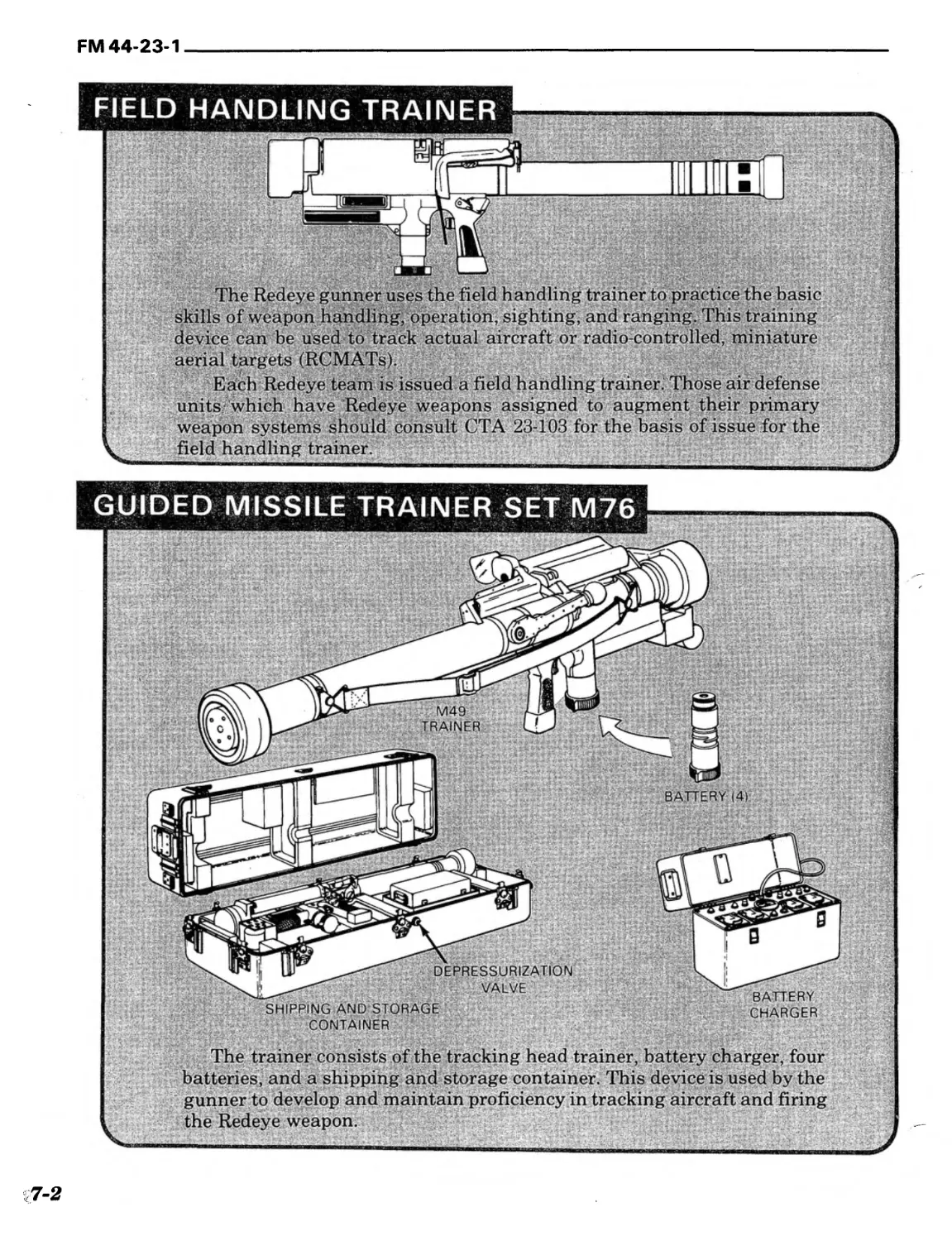
FIELD HANDLING TRAINER
The Redeye gunner uses the field handling trainer to practice the basic
skills of weapon handling, operation, sighting, and ranging. This training
device can be used to track actual aircraft or radio-controlled, miniature
aerial targets (RCMATs).
Each Redeye team is issued a field handling trainer. Those air defense
units which have Redeye weapons assigned to augment their primary
weapon systems should consult СТА 23-103 for the basis of issue for the
field handling trainer.
The trainer consists of the tracking head trainer, battery charger, four
batteries, and a shipping and storage container. This device is used by the
gunner to develop and maintain proficiency in tracking aircraft and firing
the Redeye weapon.
7-2
FM 44-23-1
The tracking head trainer has a performance indicator which displays the
gunner’s progress in a simulated engagement. It provides indications that the gunner
has —
И Correctly performed the engagement sequence.
	Committed a correctable error — a procedural error that can be
corrected prior to squeezing the firing trigger.
	Committed an uncorrectable error — squeezing the firing trigger out of
sequence.
И	Allowed the 3l-second timer to run down which shuts down the trainer.
The trainer can be used to conduct simulated engagements with radio-controlled,
miniature aerial targets (RCMATs) and actual aircraft. It is also used when
conducting training in the moving target simulator (MTS). Each Redeye section is
issued a tracking head trainer. СТА 23-103 contains the basis of issue for other ADA
units.
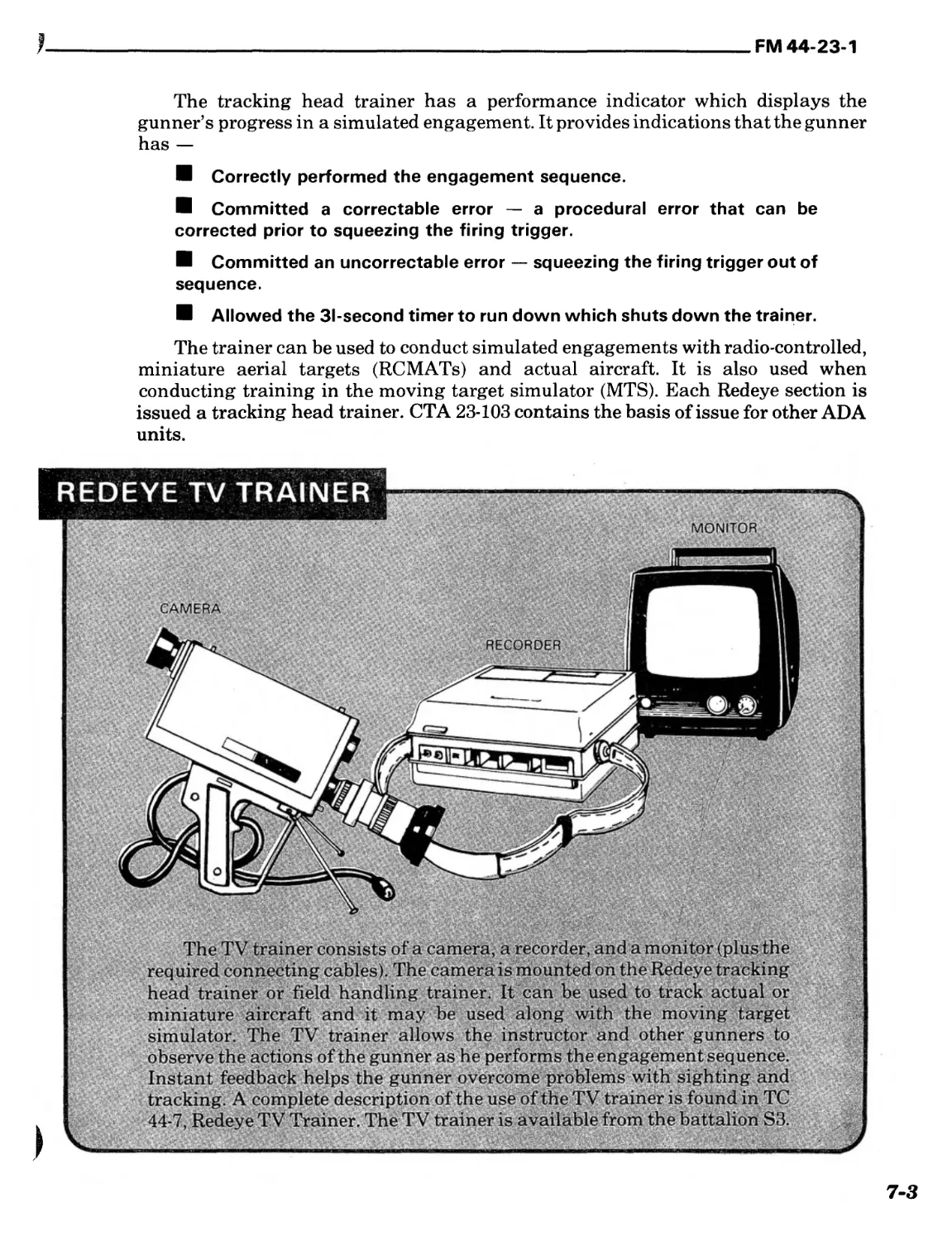
REDEYE TV TRAINER
MONITOR
The TV trainer consists of a camera, a recorder, and a monitor (plus the
required connecting cables). The camera is mounted on the Redeye tracking
head trainer or field handling trainer. It can be used to track actual or
miniature aircraft and it may be used along with the moving target
simulator. The TV trainer allows the instructor and other gunners to
observe the actions of the gunner as he performs the engagement sequence.
Instant feedback helps the gunner overcome problems with sighting and
tracking. A complete description of the use of the TV trainer is found in TC
44-7, Redeye TV Trainer. The TV trainer is available from the battalion S3.
7-3
FM 44-23-1
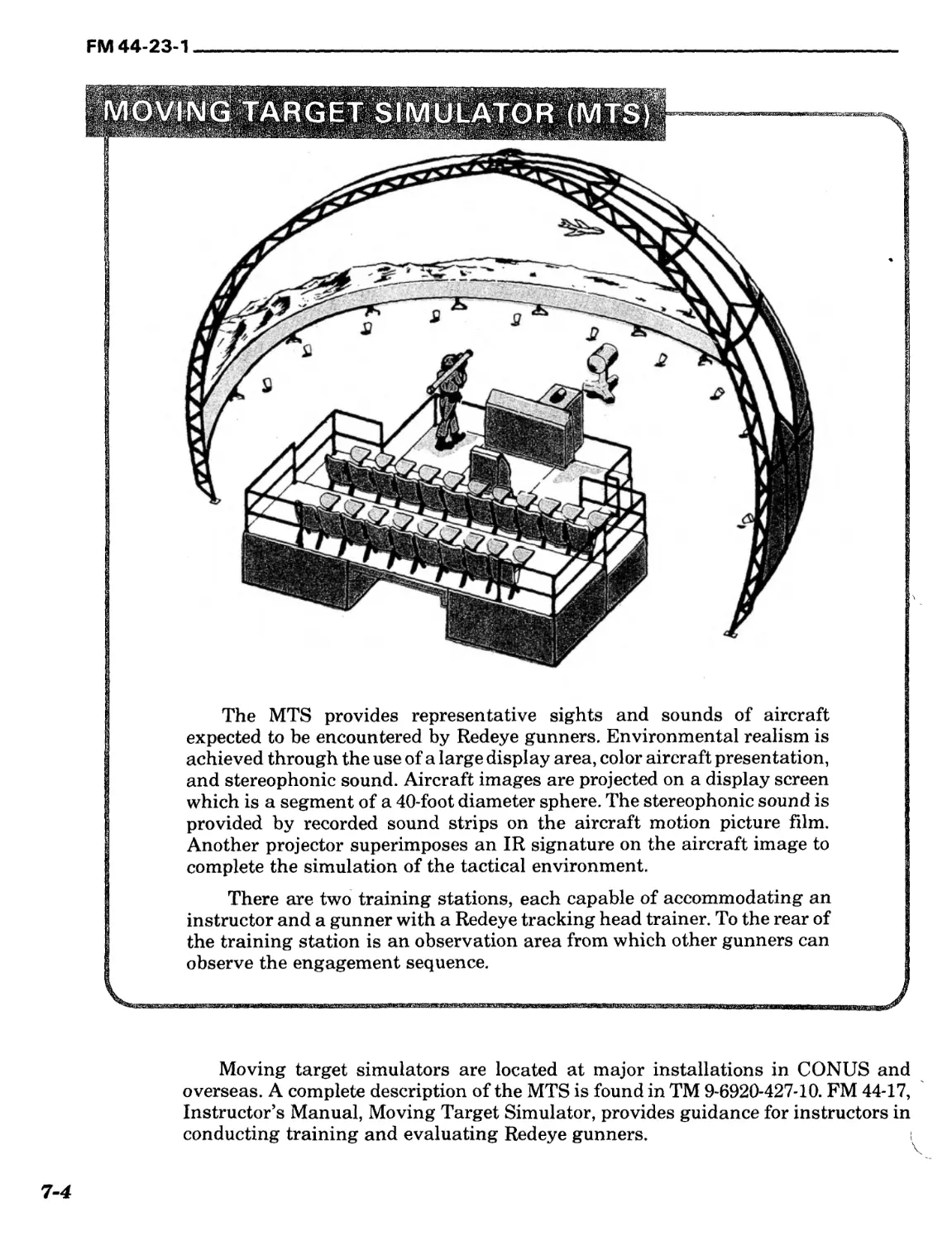
The MTS provides representative sights and sounds of aircraft
expected to be encountered by Redeye gunners. Environmental realism is
achieved through the use of a large display area, color aircraft presentation,
and stereophonic sound. Aircraft images are projected on a display screen
which is a segment of a 40-foot diameter sphere. The stereophonic sound is
provided by recorded sound strips on the aircraft motion picture film.
Another projector superimposes an IR signature on the aircraft image to
complete the simulation of the tactical environment.
There are two training stations, each capable of accommodating an
instructor and a gunner with a Redeye tracking head trainer. To the rear of
the training station is an observation area from which other gunners can
observe the engagement sequence.
Moving target simulators are located at major installations in CONUS and
overseas. A complete description of the MTS is found in TM 9-6920-427-10. FM 44-17,
Instructor’s Manual, Moving Target Simulator, provides guidance for instructors in
conducting training and evaluating Redeye gunners.	i
7-4
FM 44-23-1
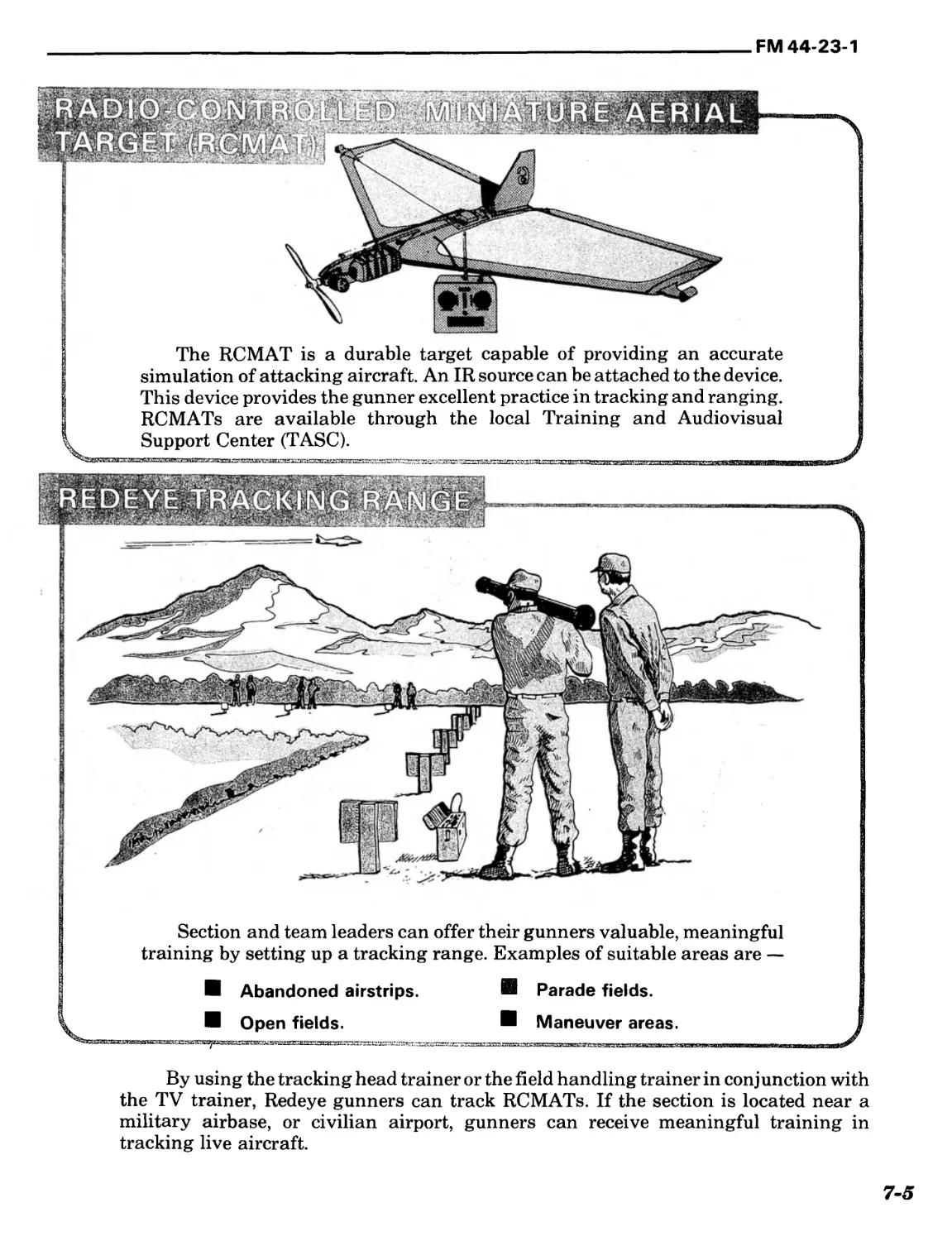
The RCMAT is a durable target capable of providing an accurate
simulation of attacking aircraft. An IR source can be attached to the device.
This device provides the gunner excellent practice in tracking and ranging.
RCMATs are available through the local Training and Audiovisual
By using the tracking head trainer or the field handling trainer in conj unction with
the TV trainer, Redeye gunners can track RCMATs. If the section is located near a
military airbase, or civilian airport, gunners can receive meaningful training in
tracking live aircraft.
7-5
FM 44-23-1
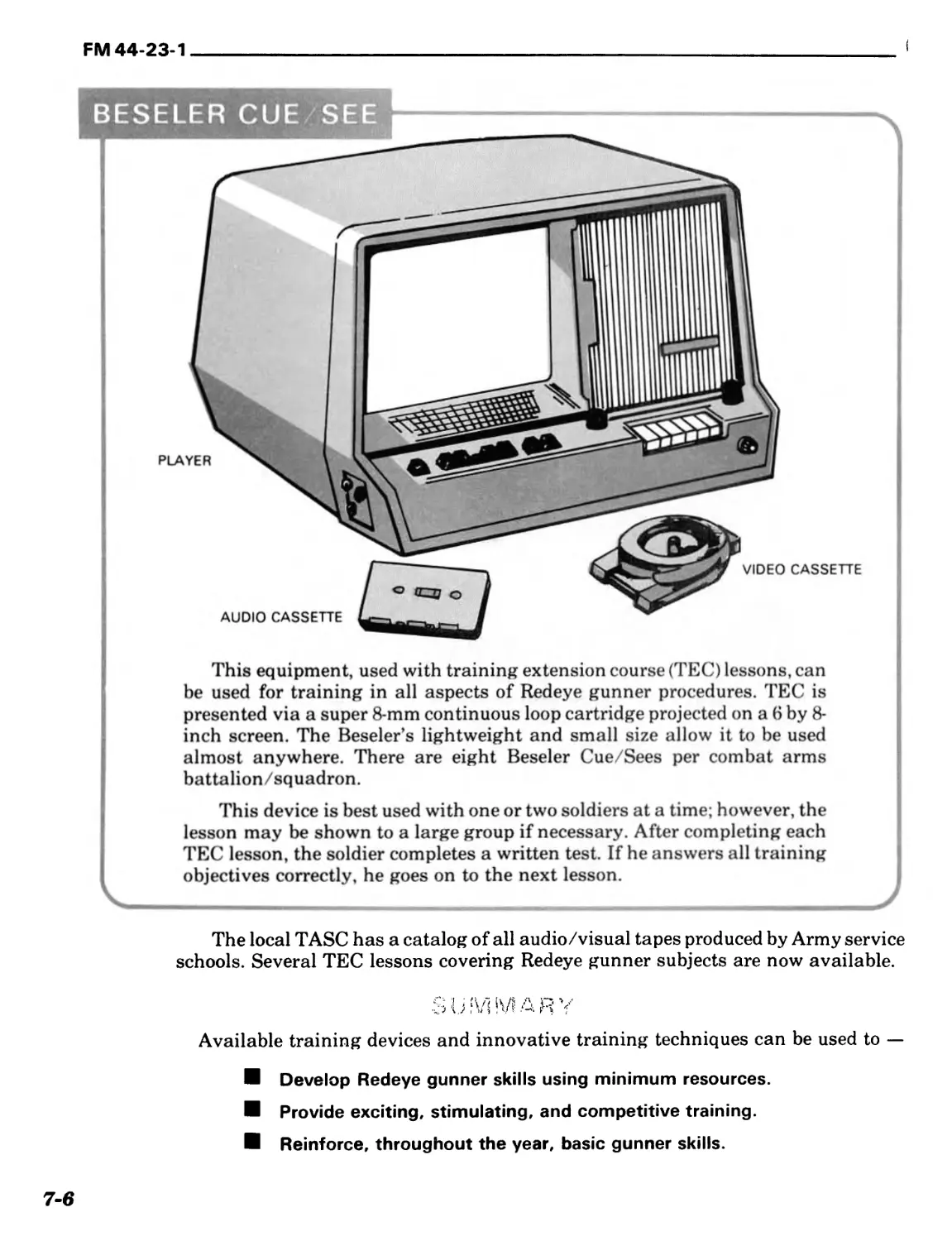
This equipment, used with training extension course (TEC) lessons, can
be used for training in all aspects of Redeye gunner procedures. TEC is
presented via a super 8-mm continuous loop cartridge projected on a 6 by 8-
inch screen. The Beseler’s lightweight and small size allow it to be used
almost anywhere. There are eight Beseler Cue/Sees per combat arms
battalion/squadron.
This device is best used with one or two soldiers at a time; however, the
lesson may be shown to a large group if necessary. After completing each
TEC lesson, the soldier completes a written test. If he answers all training
objectives correctly, he goes on to the next lesson.
The local TASC has a catalog of all audio/visual tapes produced by Army service
schools. Several TEC lessons covering Redeye gunner subjects are now available.
0 ,‘V( A H' V
Available training devices and innovative training techniques can be used to —
И Develop Redeye gunner skills using minimum resources.
 Provide exciting, stimulating, and competitive training.
I Reinforce, throughout the year, basic gunner skills.
7-6
FM 44-23-1
CHAPTER 8
EVALUATION OF GUNNER PROFICIENCY
This chapter provides techniques and procedures for evaluating
the proficiency of Redeye gunners in handling and firing the Redeye
weapon. Since weapons are often not available for conducting live-
firing exercises for evaluation purposes, engagement simulation must
be used instead. The M49 tracking head trainer and the Redeye moving
target simulator can be used to simulate the engagement process and
these devices provide a means for evaluating gunner proficiency.
EVALUATION CONSIDERATIONS
The skills and knowledges that a gunner needs to successfully execute a firing
sequence <are discussed in detail in chapters 3, 4, and 5 of this manual and are listed in
FM 44-16P, Soldier’s Manual for Short-Range Air Defense Artillery Missile Crewman.
The job of the evaluator is to test the gunner to determine if he can correctly perform
all the steps of the engagement sequence. The evaluator grades on a GO or NO GO
basis; thus, to pass the test, the gunner must perform all the steps correctly and in
their proper order. The tasks that must be performed by the Redeye gunner during an
engagement can be divided into two categories for evaluation purposes—weapon
handling and decision making.
	Weapon handling involves the smooth and efficient operation of the weapon. The
gunner must demonstrate mastery of the weapon and its operating controls.
	Decision making involves the process of determining if and when certain actions
in the engagement sequence are to be performed. These decisions require the
application of a number of rules that are based on the type of target being engaged
and visual and audible indications received by the gunner during the engagement
sequence.
CONTENTS
PAGE
Evaluation Considerations ...................................... 8-1
Gunner Evaluation With the Moving Target Simulator.............. 8-2
Gunner Evaluation on a Tracking Range........................... 8-4
Use of the Tracking Head Trainer ............................... 8-6
Scoring......................................................... 8-9
8-1
FM 44-23-1
The evaluator must consider the capabilities of the equipment and facilities he
has available to him for evaluation purposes:
	Either the field handling trainer or the tracking head trainer (THT) can be used to
evaluate weapon handling. However, neither of these devices, used alone, provides a
means for accurately evaluating the gunner's ability at decision making.
	By using the THT with a moving target simulator (MTS), all elements of gunner
proficiency can be tested against a variety of targets and target courses. When
available, the MTS provides the most accurate means of evaluating gunner
proficiency.
И The THT can also be used in conjunction with the TV trainer and live targets
flying known courses on a tracking range to evaluate both weapon handling and
decision making. However, detailed planning and close coordination between the
various elements involved in the operation of the tracking range are required to
achieve accurate test results.
GUNNER EVALUATION WITH THE MOVING
TARGET SIMULATOR
The Redeye MTS provides the most comprehensive means of evaluating Redeye
gunner proficiency. Both the weapon handling and decision making elements of the
engagement process can be accurately assessed against a variety of simulated targets
executing courses, speeds, and maneuvers that would be encountered in actual
combat.
TARGET COURSES
Two MTS target reels, Nos. 11 and 12, are specifically designed for evaluating
gunner performance. The evaluator should consult with the individual in charge of
the MTS in selecting target course and establishing a test scenario. The evaluator
must also consult with the individual in charge of the MTS in scheduling the use of the
MTS and insuring that the necessary equipment is available and operational. In
addition, he must make sure that experienced personnel are present to operate the
equipment and to advise and assist him during the conduct of the test.
Prior to conducting the test, the evaluator should familiarize himself with the
“Target Run Analysis Sheet” for each target run he has selected. Also, the evaluator
should familiarize himself with the “Gunner Performance Evaluation Sheet” and the
scoring criteria and procedures used with the sheet.
8-2
FM 44-23-1
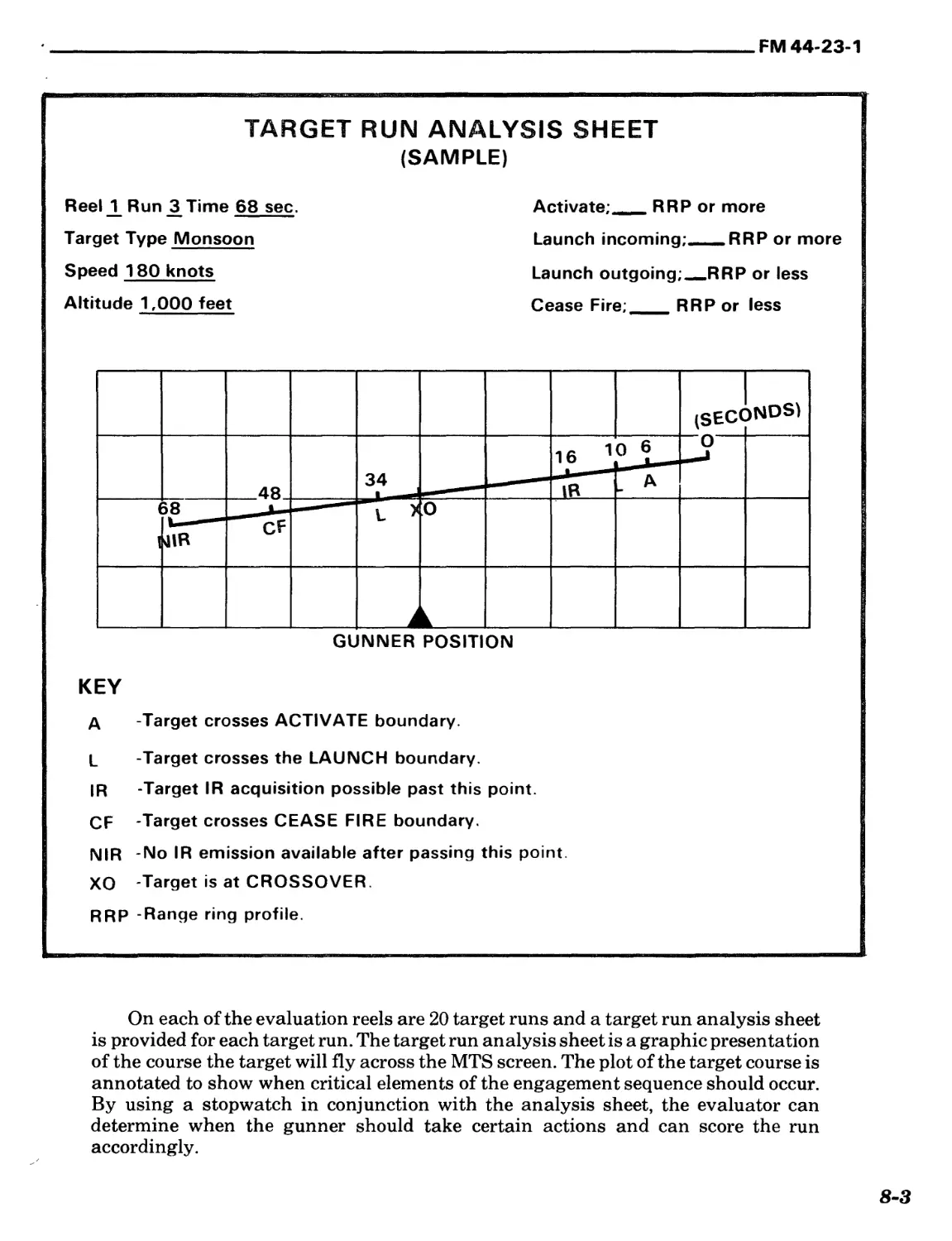
TARGET RUN ANALYSIS SHEET
(SAMPLE)
Reel_^ Run 3 Time 68 sec.	Activate:_RRP or more
Target Type Monsoon	Launch incoming;_ RRP or more
Speed 180 knots	Launch outgoing;_RRP or less
Altitude 1,000 feet	Cease Fire:	RRP or less
KEY
д	-Target crosses ACTIVATE boundary.
L	-Target crosses the LAUNCH boundary.
|R -Target IR acquisition possible past this point.
CF -Target crosses CEASE FIRE boundary.
NIR 'No IR emission available after passing this point.
XO -Target is at CROSSOVER.
RRP -Range ring profile.
On each of the evaluation reels are 20 target runs and a target run analysis sheet
is provided for each target run. The target run analysis sheet is a graphic presentation
of the course the target will fly across the MTS screen. The plot of the target course is
annotated to show when critical elements of the engagement sequence should occur.
By using a stopwatch in conjunction with the analysis sheet, the evaluator can
determine when the gunner should take certain actions and can score the run
accordingly.
8-3
FM 44-23-1
CONDUCT OF THE EVALUATION
The evaluator checks that the MTS equipment is operational and that the selected
target runs are ready to be displayed. He also insures that he has the correct target run
analysis sheet before him and a stopwatch ready to operate. The evaluator positions
the gunner, gives him the tracking head trainer, and explains how the test will be
conducted.
Normally, the gunner is given a total of three target runs. The first two are
practice runs. At the end of each practice run, the evaluator critiques the gunner on his
performance. The evaluator informs the gunner that the third run is for record. The
gunner is not informed of his score or how well he is doing during the record run. At the
completion of the evaluation, the evaluator informs the gunner of his test score, GO or
NO GO, and critiques his performance. If the gunner fails the record run, the
evaluator may, at his discretion, allow the gunner to be given remedial training and
then be retested.
GUNNER EVALUATION ON A TRACKING RANGE
If a moving target simulator is not available, Redeye gunners can be evaluated
against real aircraft or radio-controlled miniature aerial targets (RCMATs) on a
Redeye tracking range. The aircraft or RCMAT is flown over a preplanned course and
the engagement is simulated using the tracking head trainer (M49). As compared with
the MTS method, this method of presenting targets to the gunner has the advantage
of realism but has disadvantages that include:
 Less precision in the evaluation. Aircraft and RCMAT courses are more difficult
to control and time; therefore, the evaluator must rely more on his own judgment as to
exactly when actions in the engagement sequence should occur.
M Aircraft and RCMAT support may be difficult to obtain and more expensive in
terms of the personnel and equipment required to operate and control them.
A tracking range or suitable training area, target coursfes, equipment, and
materiel must be selected. When actual aircraft are to be used, the evaluator
coordinates with the pilot/air operations officer concerning target courses, number of
runs, time involved, and communications. If RCMATs are used, coordination
concerning laying out courses, number of runs, and times involved is effected with the
personnel who will operate these targets.
TARGET COURSES
Target courses used to evaluate Redeye gunners should be designed to test the
gunner’s ability to make correct engagement decisions and to demonstrate correct
weapon handling.
A CTUAL AIRCRAFT, jf possible, targets should include jet and propeller aircraft
and helicopters flying a variety of courses such as—
И Crossing left to right, low altitude (high-performance aircraft).
I Crossing left to right, low altitude (low/medium-performance aircraft).
8-4
FM 44-23-1
И Crossing right to left (helicopter). <
И Crossing right to left, low altitude (high-performance aircraft).
И Directly incoming, low altitude (high-performance aircraft).
RCMAT. The RCMAT can be used as a target if suitable live aircraft cannot be
obtained. The RCMAT is built on a 1/10 scale of the real aircraft. It is radio controlled
in takeoff, flight, and landing. Speed is variable from about 25 to 100 knots, and flight
time is from 10 to 20 minutes on each tank of fuel. Comparison of tracking on a scaled
basis shows that an RCMAT traveling at 80 knots simulates a full-scale aircraft
delivering ordance. The RCMAT can be flown over scaled target courses and used to
evaluate gunners as described for actual aircraft. To provide a variety of engagement
problems, target courses should include—
	Crossing left to right, level.
	Crossing right to left, level.
I Directly incoming, climbing.
I Directly outgoing, diving.
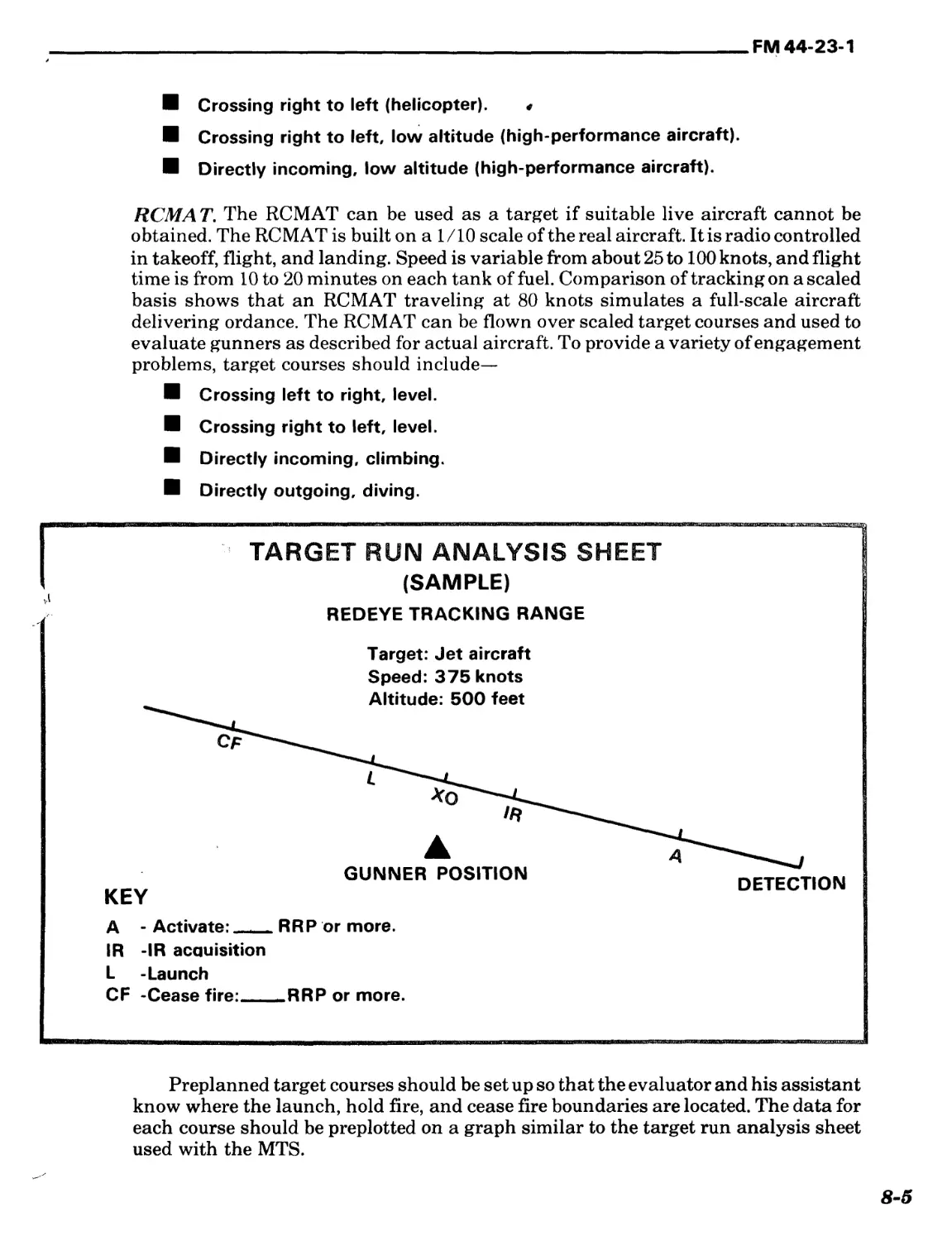
Preplanned target courses should be set up so that the evaluator and his assistant
know where the launch, hold fire, and cease fire boundaries are located. The data for
each course should be preplotted on a graph similar to the target run analysis sheet
used with the MTS.
8-5
FM 44-23-1
CONDUCT OF THE TEST
The conduct of the test is the same as on the MTS. Normally, the gunner is given a
total of three engagement runs; two are practice runs and the third is a scored run. At
the completion of the test for record, the evaluator informs the gunner of the test score,
GO or NO GO, and critiques his performance.
The evaluator can use the television trainer (TVT) to assist in evaluating the
gunner’s performance. The camera, which is mounted on the M49 trainer, picks up the
sight picture seen on the Redeye sight and displays it on a monitor (viewer). A video
recorder can be used to record the display for playback so that it can be viewed later by
the gunner during the critique. The evaluator can also see the gunner’s sight picture
before, during, and after firing and determine the accuracy and smoothness of
tracking.
USE OF THE TRACKING HEAD TRAINER
The tracking head trainer M49 simulates all the functions of the Redeye weapon
except missile launch. In addition, the trainer provides an indication of the correct or
incorrect performance of each major event in the engagement sequence.
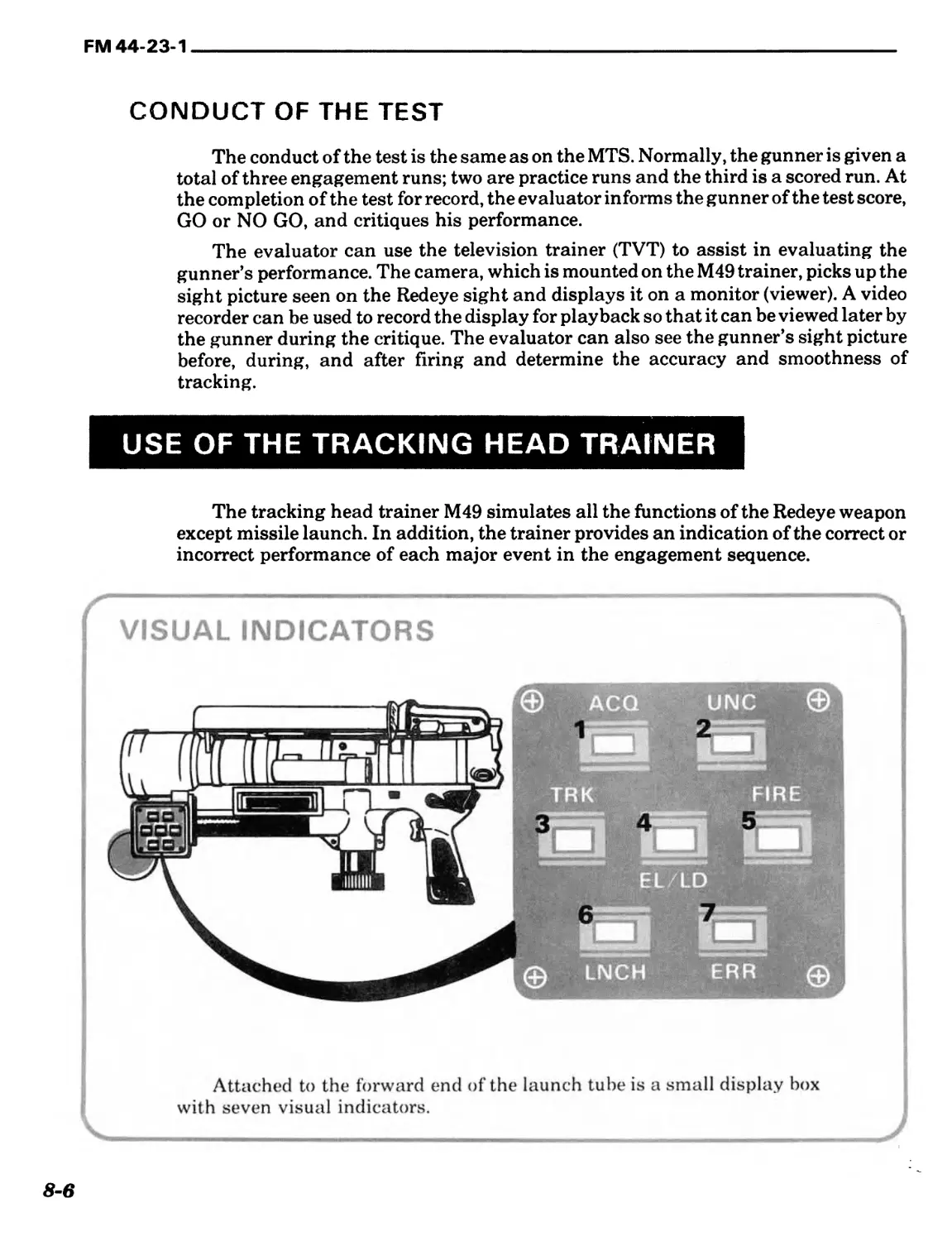
VISUAL INDICATORS
Attached to the forward end of the launch tube is a small display box
with seven visual indicators.
s-e
FM 44-23-1
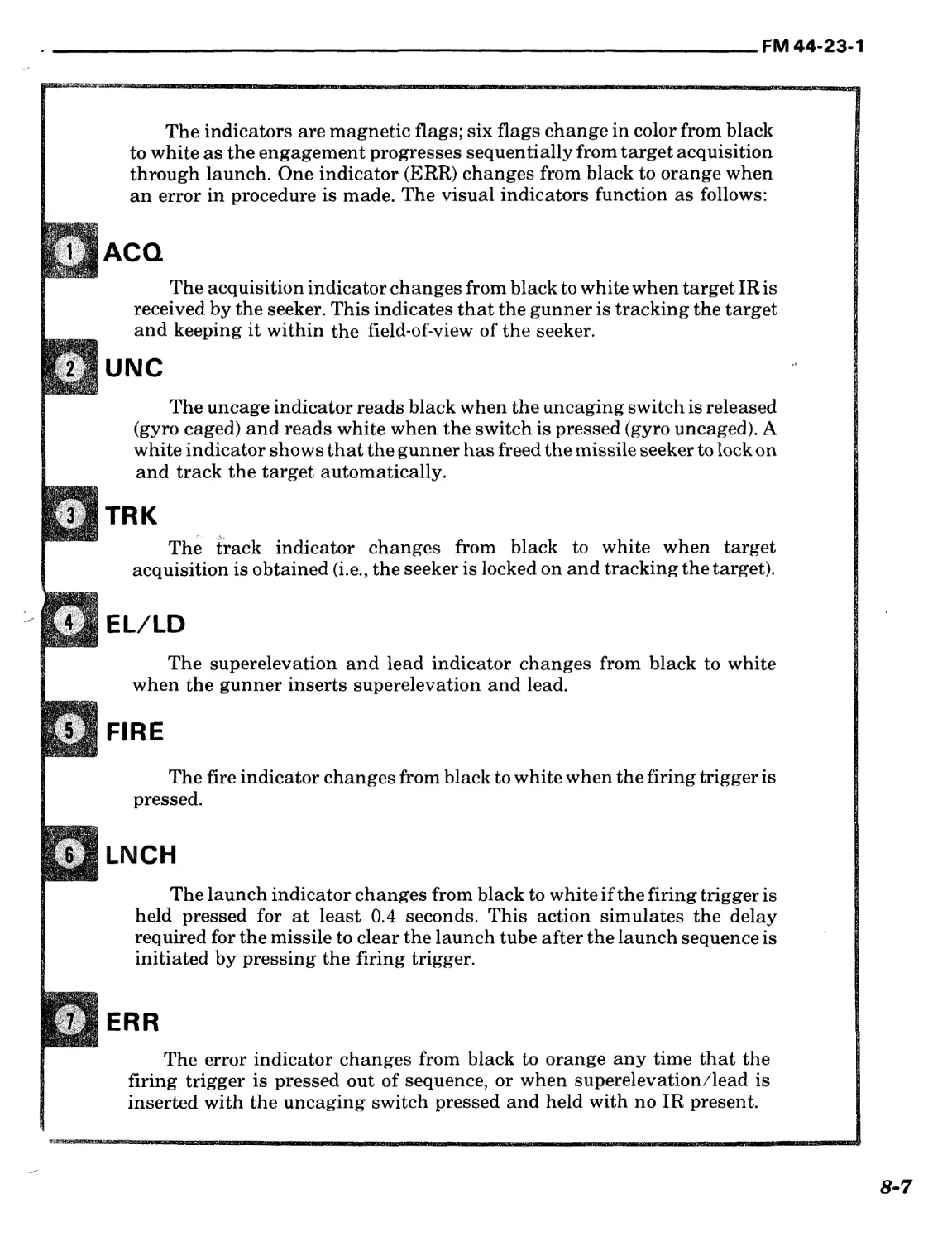
The indicators are magnetic flags; six flags change in color from black
to white as the engagement progresses sequentially from target acquisition
through launch. One indicator (ERR) changes from black to orange when
an error in procedure is made. The visual indicators function as follows:
Идса
The acquisition indicator changes from black to white when target IRis
received by the seeker. This indicates that the gunner is tracking the target
and keeping it within the field-of-view of the seeker.
21UNC
The uncage indicator reads black when the uncaging switch is released
(gyro caged) and reads white when the switch is pressed (gyro uncaged). A
white indicator shows that the gunner has freed the missile seeker to lock on
and track the target automatically.
J1TRK
The track indicator changes from black to white when target
acquisition is obtained (i.e., the seeker is locked on and tracking the target).
ЛЛ EL/LD
The superelevation and lead indicator changes from black to white
when the gunner inserts superelevation and lead.
FIRE
The fire indicator changes from black to white when the firing trigger is
pressed.
61LNCH
The launch indicator changes from black to white if the firing trigger is
held pressed for at least 0.4 seconds. This action simulates the delay
required for the missile to clear the launch tube after the launch sequence is
initiated by pressing the firing trigger.
7J ERR
The error indicator changes from black to orange any time that the
firing trigger is pressed out of sequence, or when superelevation/lead is
inserted with the uncaging switch pressed and held with no IR present.

8-7
FM 44-23-1

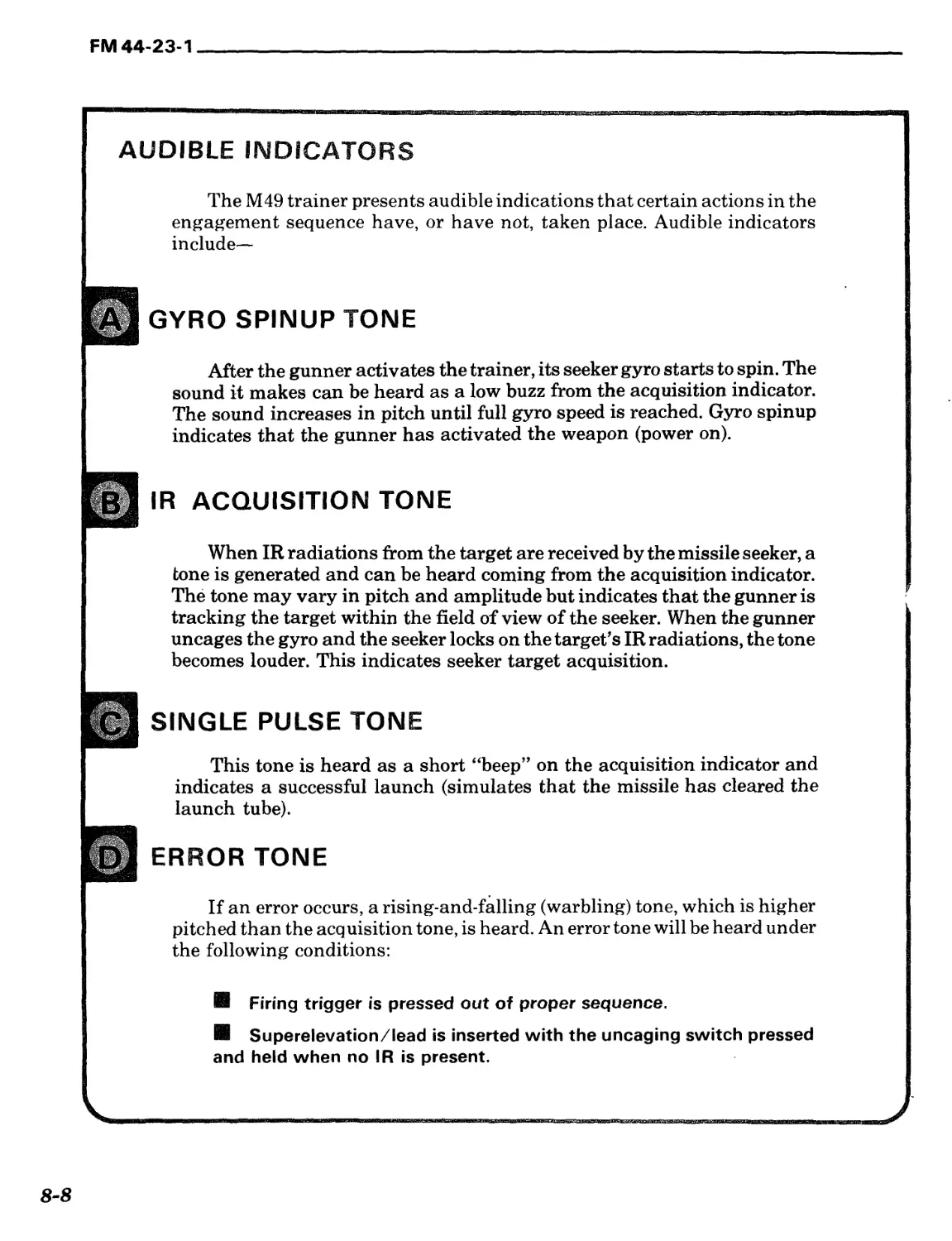
AUDIBLE INDICATORS
The M49 trainer presents audible indications that certain actions in the
engagement sequence have, or have not, taken place. Audible indicators
include—
GYRO SPINUP TONE
After the gunner activates the trainer, its seeker gyro starts to spin. The
sound it makes can be heard as a low buzz from the acquisition indicator.
The sound increases in pitch until full gyro speed is reached. Gyro spinup
indicates that the gunner has activated the weapon (power on).
IR ACQUISITION TONE
When IR radiations from the target are received by the missile seeker, a
tone is generated and can be heard coming from the acquisition indicator.
The tone may vary in pitch and amplitude but indicates that the gunner is
tracking the target within the field of view of the seeker. When the gunner
uncages the gyro and the seeker locks on the target’s IR radiations, the tone
becomes louder. This indicates seeker target acquisition.
SINGLE PULSE TONE
This tone is heard as a short “beep” on the acquisition indicator and
indicates a successful launch (simulates that the missile has cleared the
launch tube).
ERROR TONE
If an error occurs, a rising-and-falling (warbling) tone, which is higher
pitched than the acquisition tone, is heard. An error tone will be heard under
the following conditions:
H Firing trigger is pressed out of proper sequence.
И Superelevation/lead is inserted with the uncaging switch pressed
and held when no IR is present.
8-8
FM 44-23-1
ERROR INDICATIONS
The gunner can make errors at any point in the engagement sequence. He can
correct certain of these errors and still complete a successful engagement. An example
of a correctable error is the loss of IR tone when the uncaging switch is pressed. This
can occur because the IR signal is too weak to establish automatic seeker tracking.
The gunner can correct this by recaging the gyro and waiting for a stronger signal
before uncaging again. Certain errors cannot be corrected (e.g., pressing the firing
trigger out of sequence). When one of these errors is made, the ERR indicator will
change from black to orange and a warbling error tone will be heard. If this occurs,
an uncorrectable error has been made.
TRAINER TIMER
The THT has a 31-second timer which simulates the operating life of the
battery/coolant unit (BCU). The timer begins running down when the trainer is
activated and will shut the trainer down at the end of 31 seconds. If the engagement
has not been completed by the time the trainer shuts down, the gunner simulates the
removal of a dead BCU and the insertion of a new one.
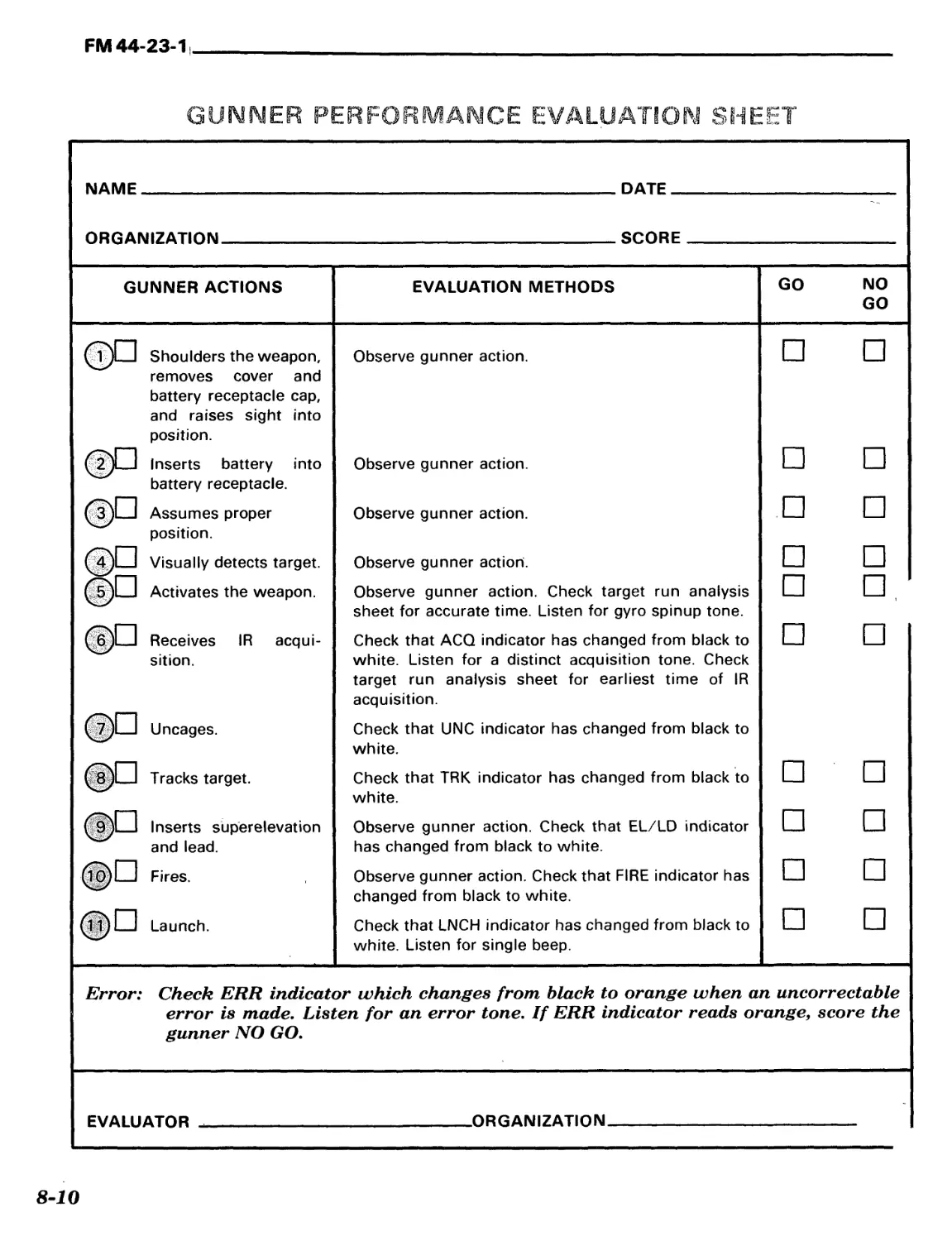
SCORING
Gunner performance during a proficiency test can be scored using an evaluation
sheet similar to the example. The sheet may be modified to fit the local situation. The
scored elements are listed in the order they occur in an actual engagement. The
evaluator closely observes the gunner’s actions during the engagement sequence and
the M49 trainer’s visual and audible indicators. When evaluating using the moving
target simulator, the evaluator looks at the target run analysis sheet for the times at
which certain events in the engagement should occur. When evaluating on a tracking
range, the evaluator uses the target run analysis sheet prepared for each target
course. The evaluator then scores the performance as GO or NO GO on the evaluation
sheet. A GO rating is awarded when an action by the gunner is properly performed
and no uncorrectable errors are made. The gunner may be scored GO if he recovers
from an error and completes the engagement in a satisfactory manner.
8-9
FM 44-23-1
GUNNER PERFORMANCE EVALUATION SHEET
NAME	 ORGANIZATION			DATE	 	SCORE
GUNNER ACTIONS	EVALUATION METHODS	GO	NO GO
Shoulders the weapon, removes cover and battery receptacle cap, and raises sight into position.	Observe gunner action.	| | | |
©□ Inserts battery into battery receptacle.	Observe gunner action.	□ □
©□ Assumes proper position.	Observe gunner action.	1 1	1 1
©□ Visually detects target.	Observe gunner action.	□ □
©□ Activates the weapon.	Observe gunner action. Check target run analysis sheet for accurate time. Listen for gyro spinup tone.	1 1	1 1
(jT)IZZI Receives IR acqui- sition. (^7)0 Uncages.	Check that ACQ indicator has changed from black to white. Listen for a distinct acquisition tone. Check target run analysis sheet for earliest time of IR acquisition. Check that UNC indicator has changed from black to white.	□ □
(j3)O Tracks target.	Check that TRK indicator has changed from black to white.	1 1	J 1
Inserts superelevation and lead.	Observe gunner action. Check that EL/LD indicator has changed from black to white.	J 1	I 1
(w)D Fires.	Observe gunner action. Check that FIRE indicator has changed from black to white.	□ □
Launch.	Check that LNCH indicator has changed from black to white. Listen for single beep.
Error: Check ERR indicator which changes from black to orange when an uncorrectable
error is made. Listen for an error tone. If ERR indicator reads orange, score the
gunner NO GO.
EVALUATOR
ORGANIZATION
8-10
FM 44-23-1
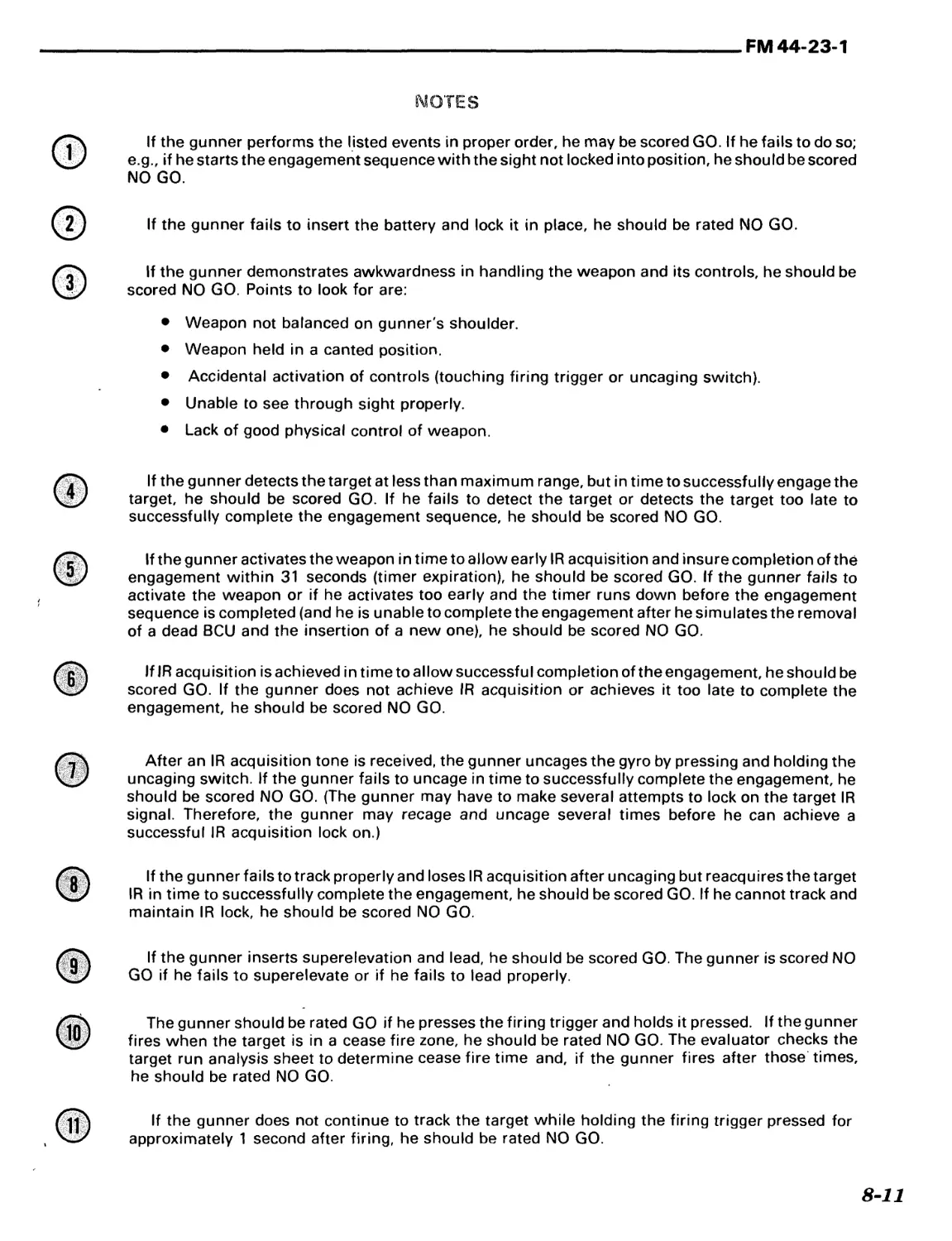
NOTES
®lf the gunner performs the listed events in proper order, he may be scored GO. If he fails to do so;
e.g., if he starts the engagement sequence with the sight not locked into position, he should be scored
NO GO.
If the gunner fails to insert the battery and lock it in place, he should be rated NO GO.
®lf the gunner demonstrates awkwardness in handling the weapon and its controls, he should be
scored NO GO. Points to look for are:
•	Weapon not balanced on gunner's shoulder.
•	Weapon held in a canted position.
•	Accidental activation of controls (touching firing trigger or uncaging switch).
•	Unable to see through sight properly.
•	Lack of good physical control of weapon.
®lf the gunner detects the target at less than maximum range, but in time to successfully engage the
target, he should be scored GO. If he fails to detect the target or detects the target too late to
successfully complete the engagement sequence, he should be scored NO GO.
If the gunner activates the weapon in time to allow early IR acquisition and insure completion of the
engagement within 31 seconds (timer expiration), he should be scored GO. If the gunner fails to
activate the weapon or if he activates too early and the timer runs down before the engagement
sequence is completed (and he is unable to complete the engagement after he simulates the removal
of a dead BCU and the insertion of a new one), he should be scored NO GO.
®Jf IR acquisition is achieved in time to allow successful completion of the engagement, he should be
scored GO. If the gunner does not achieve IR acquisition or achieves it too late to complete the
engagement, he should be scored NO GO.
After an IR acquisition tone is received, the gunner uncages the gyro by pressing and holding the
uncaging switch. If the gunner fails to uncage in time to successfully complete the engagement, he
should be scored NO GO. (The gunner may have to make several attempts to lock on the target IR
signal. Therefore, the gunner may recage and uncage several times before he can achieve a
successful IR acquisition lock on.)
If the gunner fails to track properly and loses IR acquisition after uncaging but reacquires the target
IR in time to successfully complete the engagement, he should be scored GO. If he cannot track and
maintain IR lock, he should be scored NO GO.
If the gunner inserts superelevation and lead, he should be scored GO. The gunner is scored NO
GO if he fails to superelevate or if he fails to lead properly.
The gunner should be rated GO if he presses the firing trigger and holds it pressed. If the gunner
fires when the target is in a cease fire zone, he should be rated NO GO. The evaluator checks the
target run analysis sheet to determine cease fire time and, if the gunner fires after those times,
he should be rated NO GO.

If the gunner does not continue to track the target while holding the firing trigger pressed for
approximately 1 second after firing, he should be rated NO GO.
8-11
FM 44-23-1
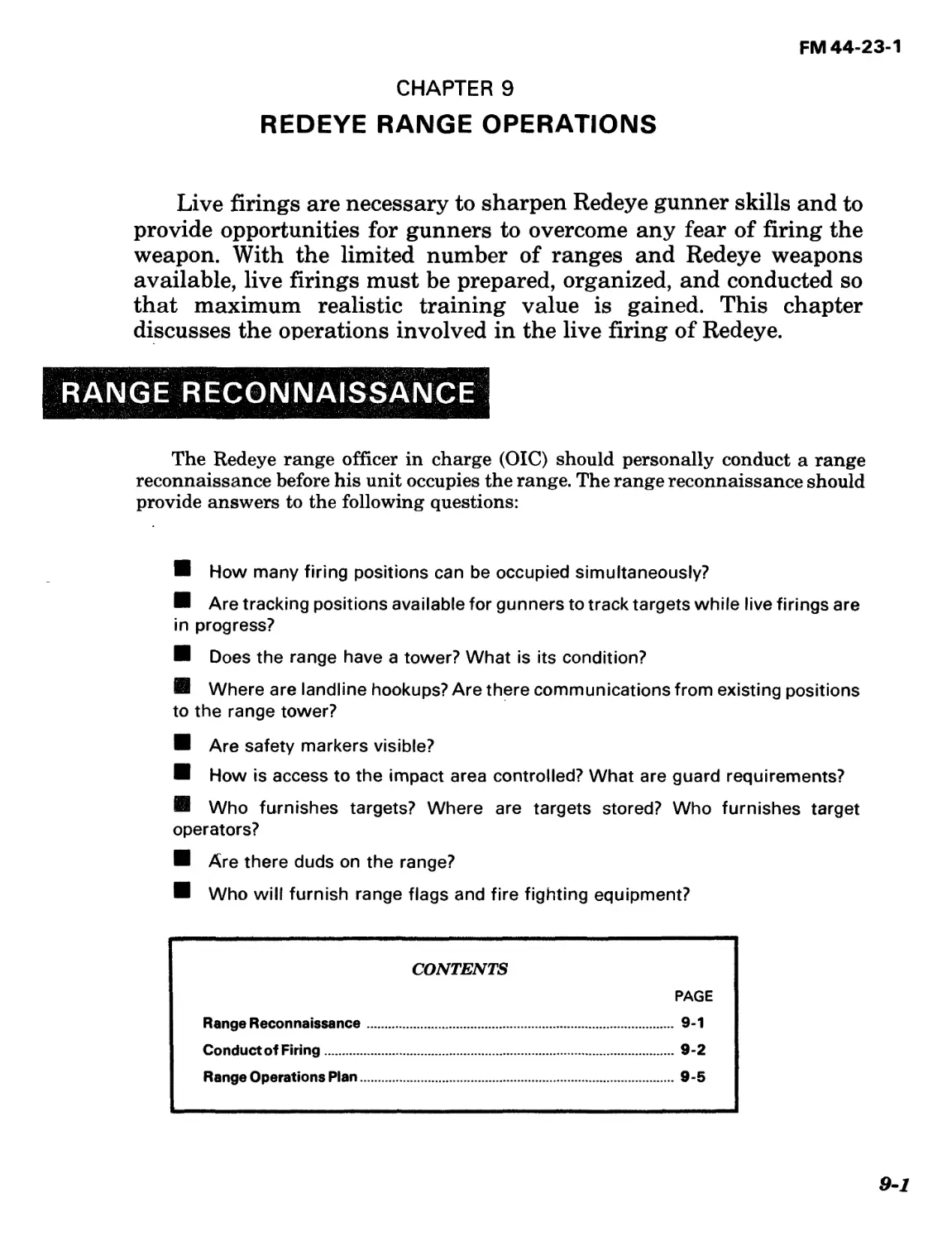
CHAPTER 9
REDEYE RANGE OPERATIONS
Live firings are necessary to sharpen Redeye gunner skills and to
provide opportunities for gunners to overcome any fear of firing the
weapon. With the limited number of ranges and Redeye weapons
available, live firings must be prepared, organized, and conducted so
that maximum realistic training value is gained. This chapter
discusses the operations involved in the live firing of Redeye.
RANGE RECONNAISSANCE
The Redeye range officer in charge (OIC) should personally conduct a range
reconnaissance before his unit occupies the range. The range reconnaissance should
provide answers to the following questions:
	How many firing positions can be occupied simultaneously?
И Are tracking positions available for gunners to track targets while live firings are
in progress?
	Does the range have a tower? What is its condition?
	Where are landline hookups? Are there communications from existing positions
to the range tower?
И Are safety markers visible?
	How is access to the impact area controlled? What are guard requirements?
M Who furnishes targets? Where are targets stored? Who furnishes target
operators?
И Are there duds on the range?
И Who will furnish range flags and fire fighting equipment?
CONTENTS
PAGE
Range Reconnaissance................................ 9-1
Conduct of Firing....................................9-2
Range Operations Plan................................9-5
9-1
FM 44-23-1
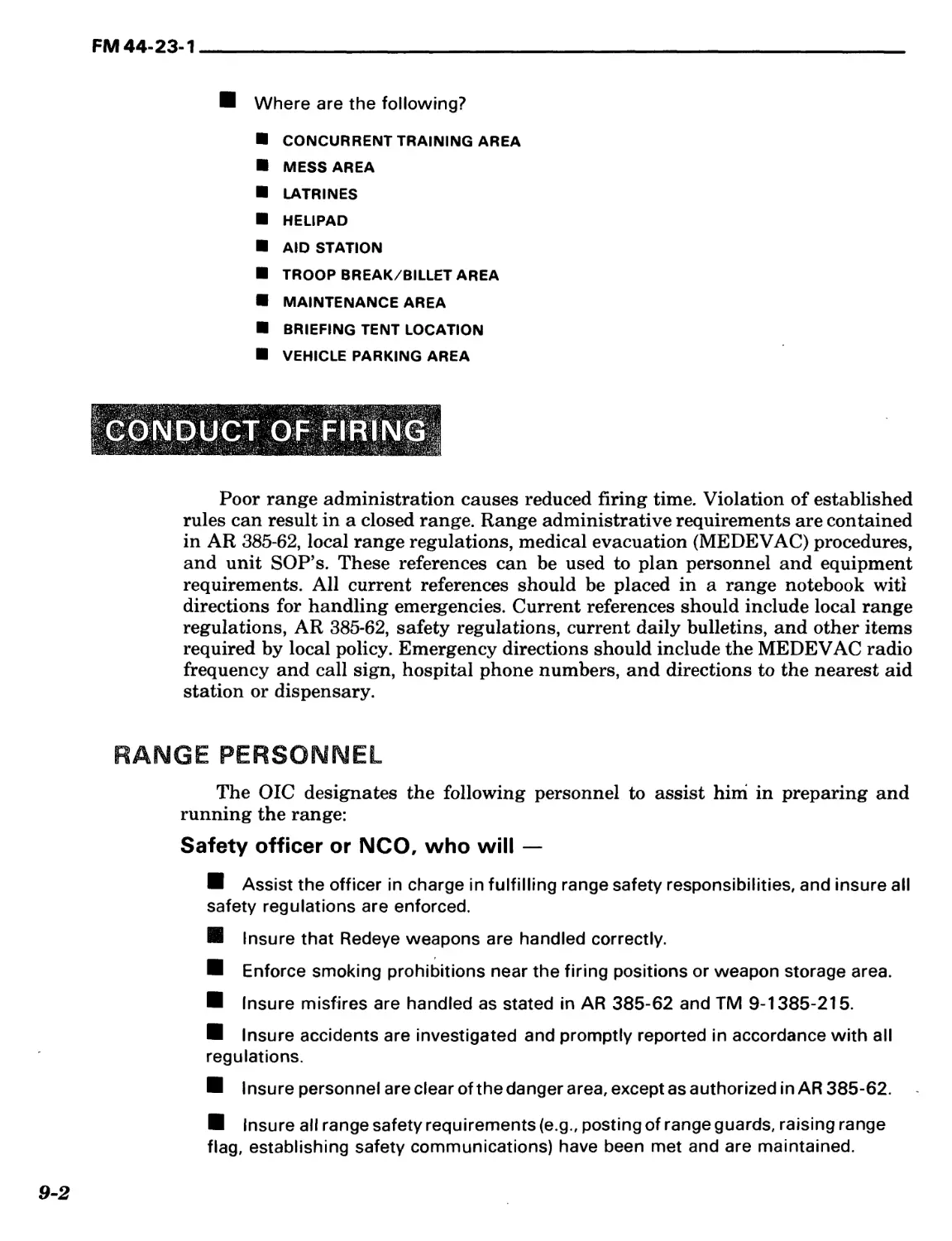
 Where are the following?
	CONCURRENT TRAINING AREA
	MESS AREA
	LATRINES
	HELIPAD
	AID STATION
	TROOP BREAK/BILLET AREA
	MAINTENANCE AREA
	BRIEFING TENT LOCATION
	VEHICLE PARKING AREA
f	v 1	: ’ -v" ‘ д •, ,nV л-'"1
CONDUCT OF FIRING
Poor range administration causes reduced firing time. Violation of established
rules can result in a closed range. Range administrative requirements are contained
in AR 385-62, local range regulations, medical evacuation (MEDEVAC) procedures,
and unit SOP’s. These references can be used to plan personnel and equipment
requirements. All current references should be placed in a range notebook witi
directions for handling emergencies. Current references should include local range
regulations, AR 385-62, safety regulations, current daily bulletins, and other items
required by local policy. Emergency directions should include the MEDEVAC radio
frequency and call sign, hospital phone numbers, and directions to the nearest aid
station or dispensary.
RANGE PERSONNEL
The OIC designates the following personnel to assist him in preparing and
running the range:
Safety officer or NCO, who will —
	Assist the officer in charge in fulfilling range safety responsibilities, and insure all
safety regulations are enforced.
	Insure that Redeye weapons are handled correctly.
	Enforce smoking prohibitions near the firing positions or weapon storage area.
	Insure misfires are handled as stated in AR 385-62 and TM 9-1385-215.
	Insure accidents are investigated and promptly reported in accordance with all
regulations.
	Insure personnel are clear of the danger area, except as authorized in AR 385-62.
И Insure all range safety requirements (e.g., posting of range guards, raising range
flag, establishing safety communications) have been met and are maintained.
9-2
FM 44-23-1
Noncommissioned Officer-in-Charge, who will supervise range
details connected with range firing.
Ammunition NCO, who will —
	Insure that all Redeye weapons are delivered and properly stored and secured,
both on the range and during transportation to and from the range.
И Insure the range is properly policed of expended launchers and packaging
materials.
Target detail officer or senior NCO who will —
Я Prepare the target launch/control area.
И Provide for transportation of targets to and from the range.
И Draw and turn in targets and related equipment.
И Determine target safety requirements and, in conjunction with safety officer,
insure they are met.
	Train target detail personnel in assembly, test, and launching procedures.
	Supervise the operations of target detail personnel.
Firing Station NCO (coach), who will —
И Act as an instructor during the firing.
И Insure compliance with safety procedures.
Firefighting detail.
Radiotelephone operators.
Briefing NCO.
Medical aidman.
RANGE EQUIPMENT
The QIC should insure that he has the following on hand:
	Targets
	Redeye weapons and trainers
	Range flag
И Public address system
Я Briefing tent
Я Blackboard, chalk, eraser
	Pens, pencils, grease pencils
9-3
FM 44-23-1
Я Binoculars
И Field telephones as required
Я Latrine supplies
	Trash cans
Я Water supply (lister bag or trailer)
I Compass (for marking rounds out of impact area)
	Firefighting equipment (shovels, fire extinguisher, rakes, etc.)
Я Vehicles for —
	Firefighting detail
	Medical evacuation (primary and alternate)
	Safety officer
Я Equipment needed for concurrent training (e.g., Beseler tape cassette players
and appropriate TEC lessons).
Я All required regulations, SOP's, maps, and overlays.
A well organized range provides maximum firing time. It should be
organized to best support the firing. This sample layout shows the support
facilities required.
9-4
FM 44-23-1
A good range operation SOP will save both time and energy for the
Redeye firing. The SOP should include guidelines for occupying the range
and describe actions to be taken for specific tasks, such as fighting
downrange fires, issuing weapons, range police, and departing the range.
TARGETS
The Ballistic Aerial Target System (BATS) provides Redeye gunners target
presentations for use in live firings. With the BATS target velocities of 250 to 550
knots are obtainable at altitudes of between 90 and 2,100 meters. Procedures for course
selection and design with BATS are described in FM 44-102, Procedures for Ballistic
Aerial Target System.
RANGE CONTROL
Installations where firings take place will normally have a range control office.
This office is responsible for the coordination and safe conduct of range firing for all
units using range facilities. Normally, section leaders will be required to receive a
range briefing from this office prior to using a range. This office will also provide a
set of local range regulations and policies and will usually require the unit to sign for
range facilities upon occupation of the range.
RANGE COMMUNICATIONS
The post range officer controls all ranges by wire or radio communications. The
communications system is used for obtaining clearance to fire, making reports,
coordination, and ceasing fire. The range communications system enables the range
officer to shut down the range immediately in case of emergency.
The OIC controls firing by several means which may include flag, radio,
telephone, public address set, or messengers. Wire is preferred for communication
with target operators and demolition personnel in the impact area. In all cases, the
OIC plans for a backup communication system to prevent delays.
RANGE OPERATIONS PLAN
A plan must be developed for conducting the Redeye firing. Elements of the plan
should include:
@ OPENING THE RANGE
The OIC must —
	Move to the range before the arrival of the Redeye teams.
И Brief the safety officer.
	Brief the Redeye coaches.
И Brief the Redeye gunners.
Я Establish communications with range control, and insure there are backup
communications.
9-5
FM 44-23-1
The NCOIC will —
	Supervise positioning of Redeye gunners on the firing lines.
	Setup the concurrent training area.
И Supervise weapon issue and target details.
	Supervise other administrative details.
The safety officer or NCO will —
	Inspect the storage and handling of Redeye weapons.
	Inspect aidmen.
Я Insure range guards are posted and briefed.
(^CONDUCT OF FIRING
The OIC will—
	Control the firing.
И Maintain communications with range control.
The NCOIC will —
I Supervise all details.
И Control movement of personnel from the firing positions to the concurrent
training and other administrative areas.
The Safety Officer or NCO will —
	Insure misfires are handled in accordance with safety regulations.
	Observe for any safety violations.
(J) CLOSING THE RANGE
The OIC will —
И Notify range control that firing has terminated.
И Debrief the Redeye gunners.
M Insure the range is cleared in accordance with local regulations and SOP.
The NCOIC will —
	Supervise the weapon issue and target details.
И Supervise the police and cleaning of the range.
The Safety Officer or NCO will —
	Insure all misfires are removed from the range.
	Insure Redeye weapons are removed from the range only by authorized
personnel.
И Prepare certificates required by the ammunition supply point.
9-6
FM 44-23-1
Helpful Hints
for the OIC
REHEARSE. Prior to moving to the range, rehearse your key personnel
in setting up the range and in those actions to be taken in the event something
unforeseen happens. This will keep range down-time to a minimum.
START ON T/ME. Someone else may be waiting to use the range when
you finish. Have your targets and communications set up early.
TOWER LOG. Have a good log available, and use people who are
conscientious about keeping it correct. As a minimum, the log should have an
entry that shows when the unit occupied the range, when permission to fire was
received, and who gave the permission.
GUARDS. Have a plan to check and change the guards frequently.
FIRES. Be prepared to control fires quickly.
POLICE. A clean range reduces the chance of injury. Police as you go to
avoid spending valuable time cleaning up the range after firing.
VISITORS. Have a plan for briefing visitors. Designate someone to
handle this for you, possibly a briefing NCO or officer so that you can
concentrate on running the range.
SAFETY MARKERS. The range safety markers must be present before
firing can begin. Have spares available.
REDEYE WEAPONS AND BATS. Insure that you have coordinated
closely with the support elements responsible for supplying the weapons and
the BATS. This coordination pays big dividends in having the weapons and the
BATS on the range at the right time.
CONCURRENT TRAINING. Concurrent training should stress those
areas in which the gunner can sharpen his skills in handling and firing the
Redeye.
-----REMEMBER-------------------------------------
	Make a good range reconnaissance.
	Organize personnel and details in advance.
	Observe all safety precautions.
9-7
FM 44-23-1
APPENDIX A
REFERENCES
DEPARTMENT OF THE ARMY PAMPHLET (DA PAM)
310-series	Indexes of Military Publications.
FIELD MANUALS (FM)
21-6	How to Prepare and Conduct Military Training.
(С) 44-1A	US Army Air Defense Artillery Materiel (U).
44-6	Procedures and Drills for Forward Area Alerting Radar (FAAR) and Target Alert Data Display Set (TADDS).
44-16P	Short-Range Air Defense Artillery Missile Crewman MOS 16P.
(C) 44-17	Instructor’s Manual: Moving Target Simulator (U).
44-23	Air Defense Artillery Employment, Redeye.
44-30	Visual Aircraft Recognition.
44-102	Procedures for Ballistic Aerial Target System.
TRAINING CIRCULARS (TC)
21-5-3	TEC Management Instruction.
21-5-4	Catalog of Training Extension Course Lessons.
21-5-7	Training Management in Battalion.
44-7	Redeye TV Trainer.
44-30	Aircraft Recognition Training For Ground Observers.
44-71	Commander’s Guide to Redeye.
44-71-1	Redeye — How to Use It.
A-l
FM 44-23-1
TECHNICAL BULLETIN (ТВ)
9-380-101-10	Security Classification Guide for Redeye Missile System.
TECHNICAL MANUALS (TM)
9-1300-206	Ammunition and Explosives Standards.
9-1340-418-12	Operator and Organizational Maintenance Manual for Ballistic Aerial Target System (BATS).
(C) 9-1385-215	EOD Procedures for Redeye Guided Missile System M41 (U).
9-1400-425-12	Operator and Organizational Maintenance Manual: Intercept- Aerial Guided Missile System M41 and Training Intercept-Aerial Guided Missile System M46A1 and M46A2 (Redeye Air Defense Guided Missile System).
9-1430-589-12	Operator’s and Organizational Maintenance Manual: Target Alert Data Display Set, AN/GSQ-137 (XO-2) (Forward Area Alerting Radar System).
9-6920-427-10	Operator’s Manual: Moving Target Simulator Trainer Device M87 (Redeye Air Defense Guided Missile System).
9-6920-428-12	Operator and Organizational Maintenance Manual: Guided Missile System Training Set M76 (Redeye Air Defense Guided Missile System).
A-2
FM 44-23-1
31 October 1977
By Order of the Secretary of the Army:
BERNARD W. ROGERS
General, United States Army
Chief of Staff
Official:
J. C. PENNINGTON
Brigadier General, United States Army
The Adjutant Genera!
DISTRIBUTION:
Active Army, USAR, and ARNG: To be distributed in accordance with DA Form 12-11 A,
Requirements for REDEYE Guided Missile System (Qty rqr block no. 192).
Additional copies can be requisitioned (DA Form 17) from the US Army Adjutant General Publi-
cations Center, 2800 Eastern Boulevard, Baltimore, MD, 21220.
* U.S. GOVERNMENT PRINTING OFFICE: 1978- 735-082:305