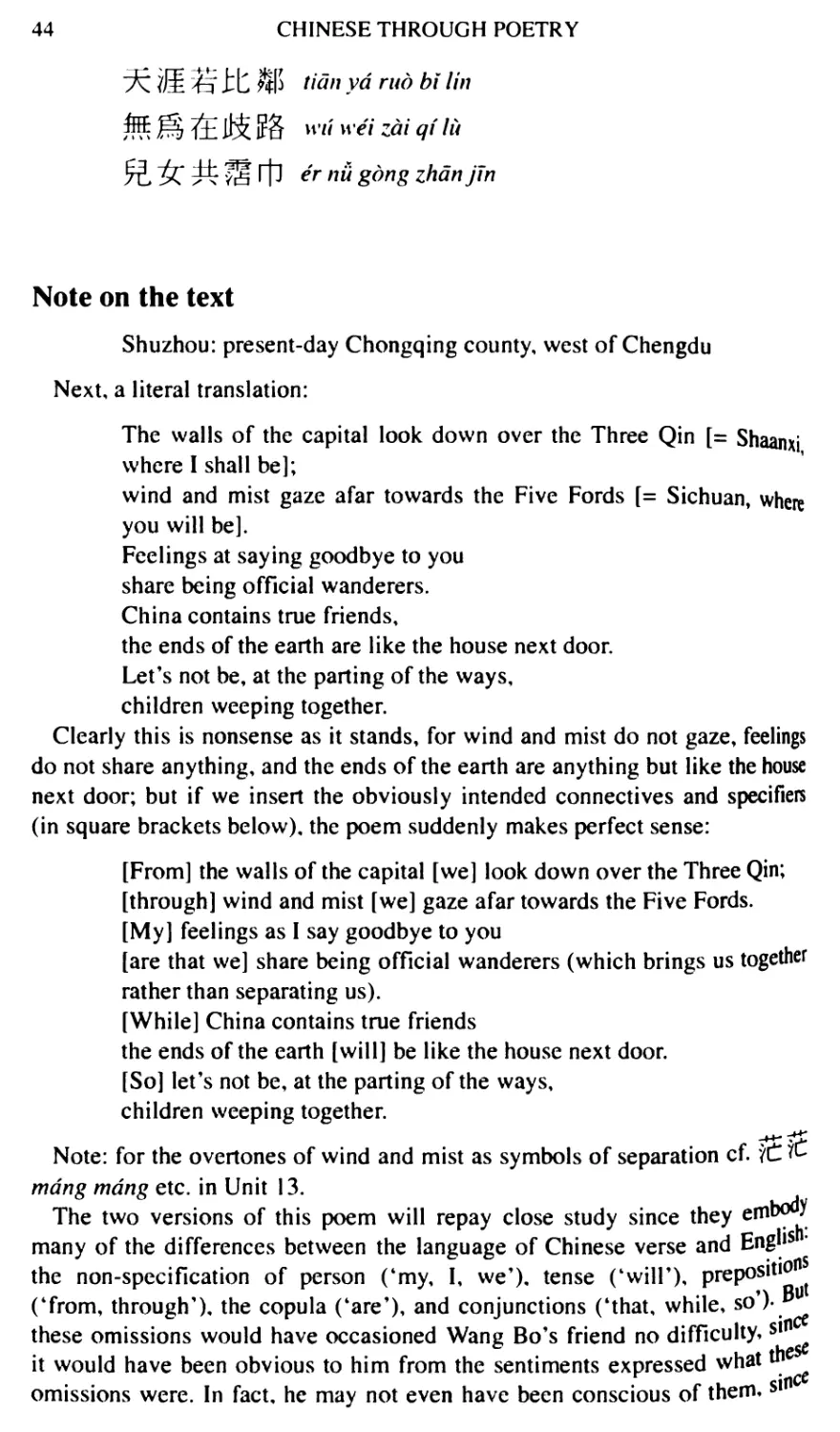
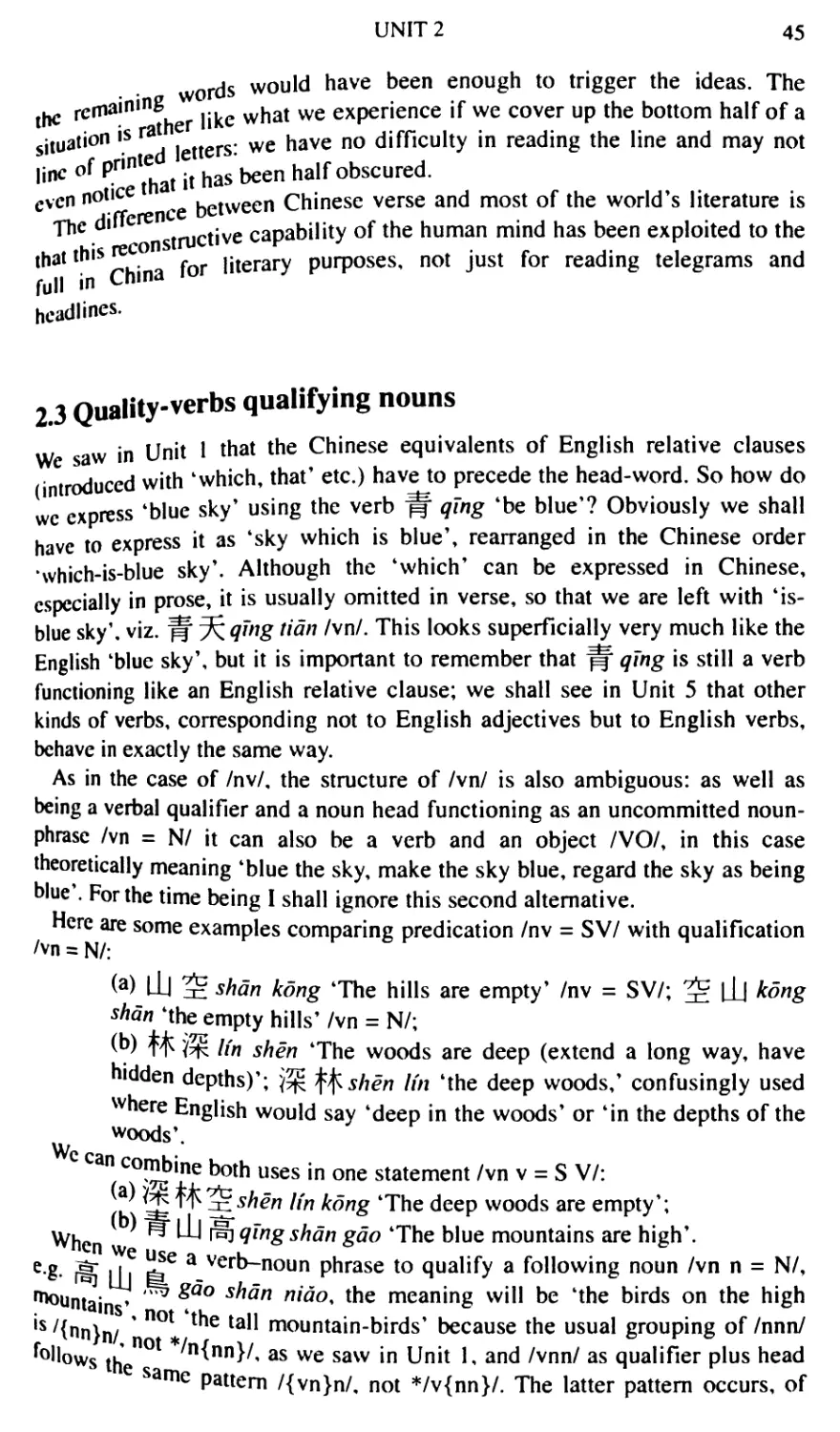
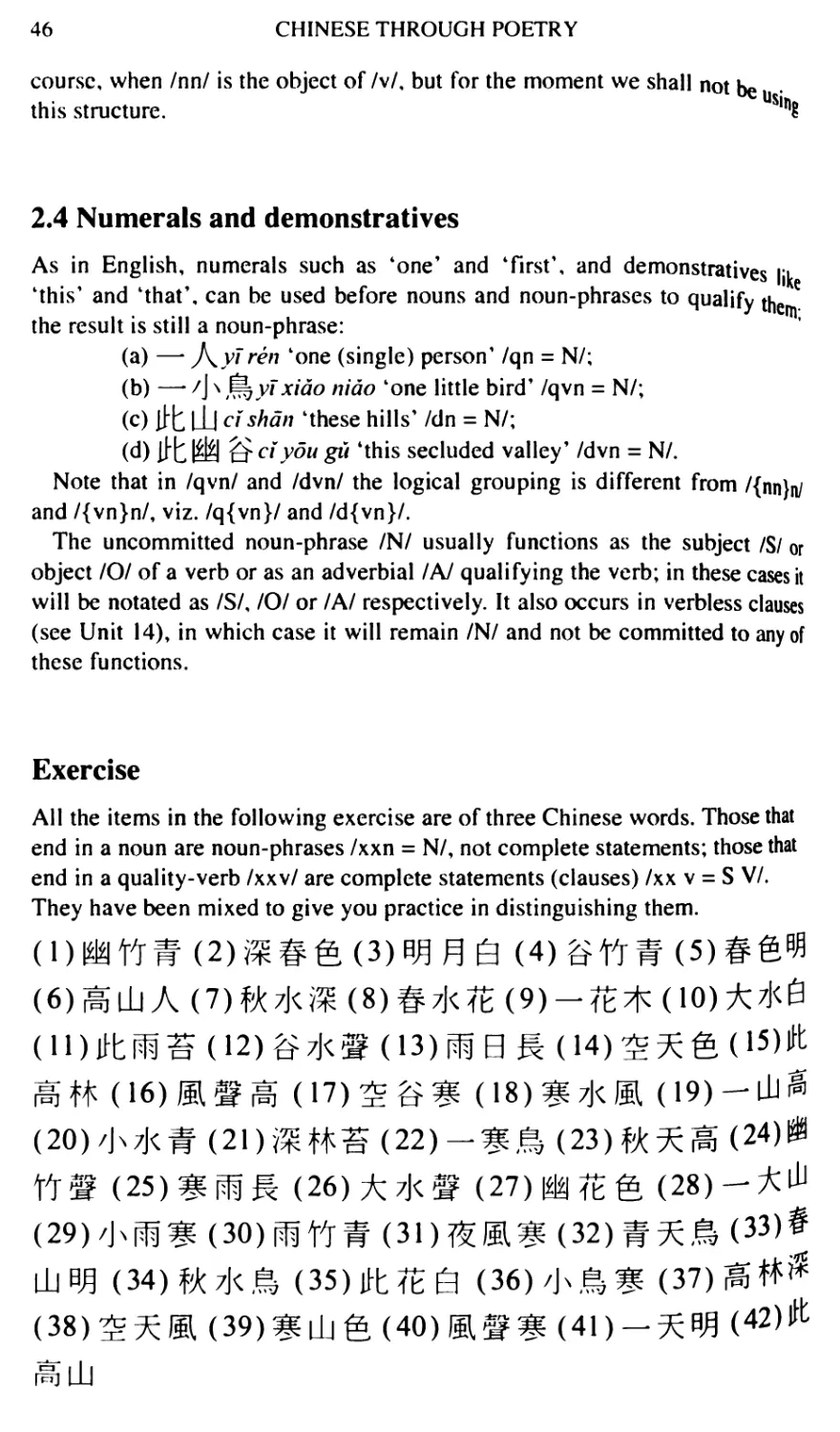
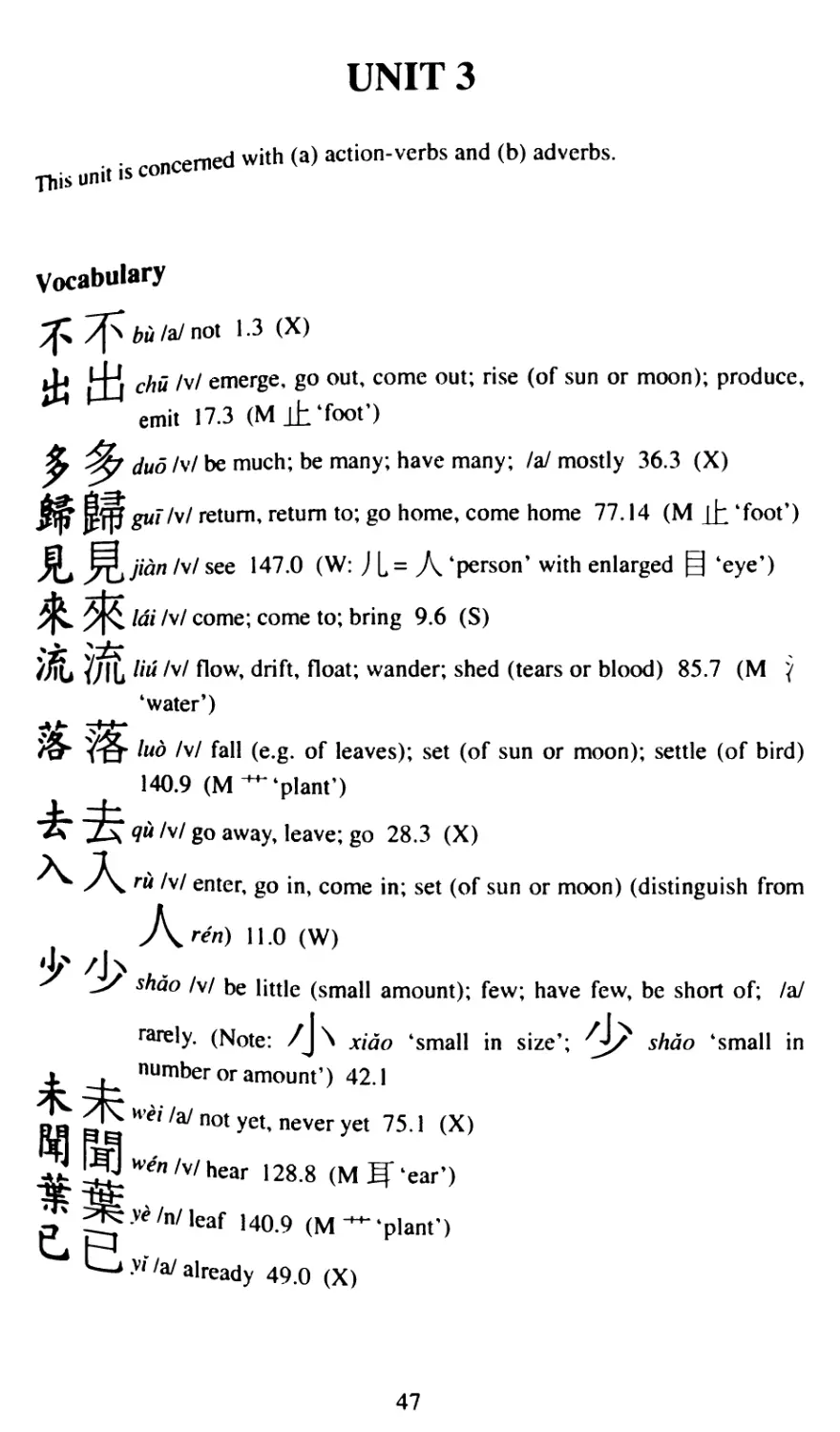
/
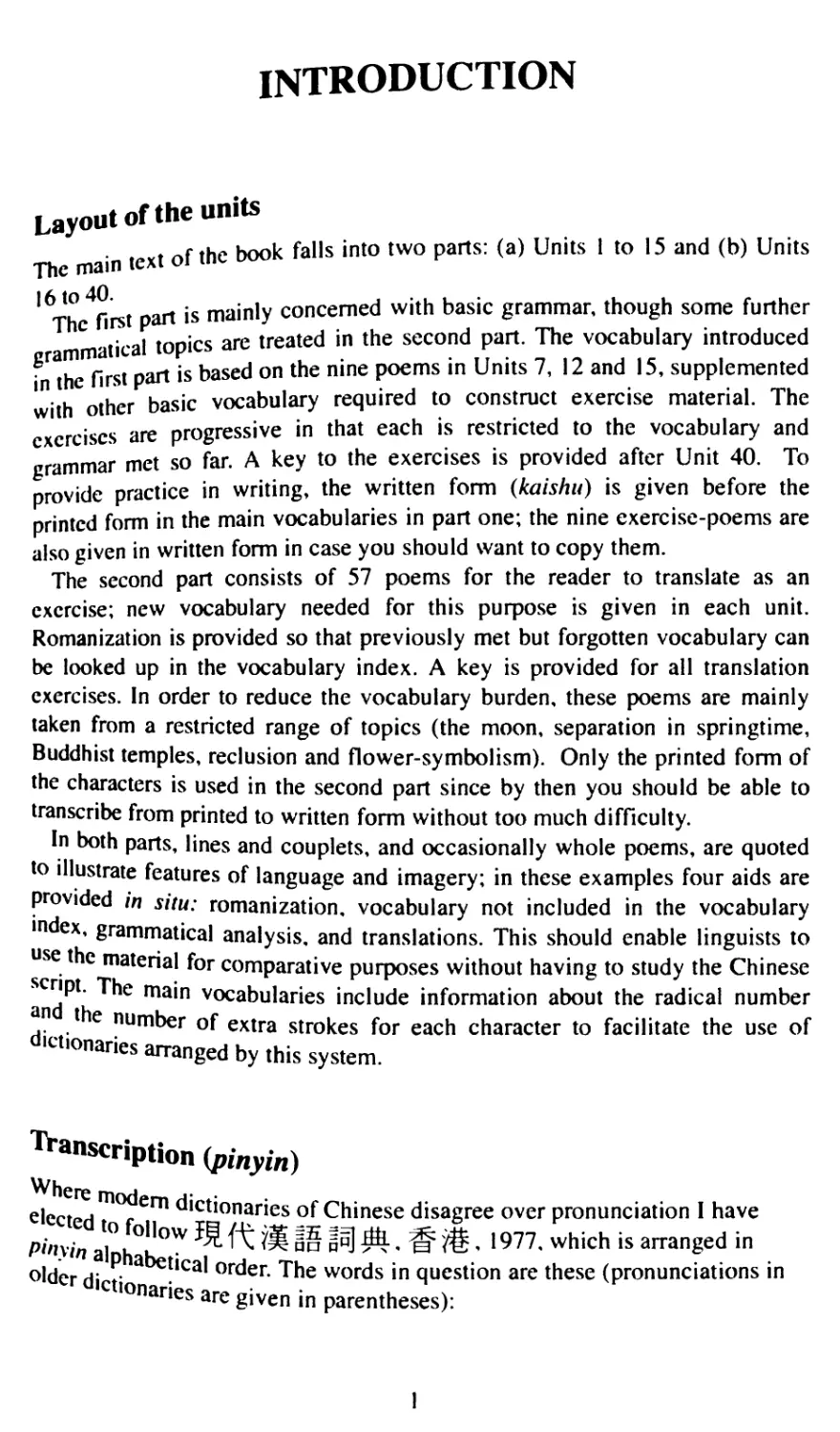
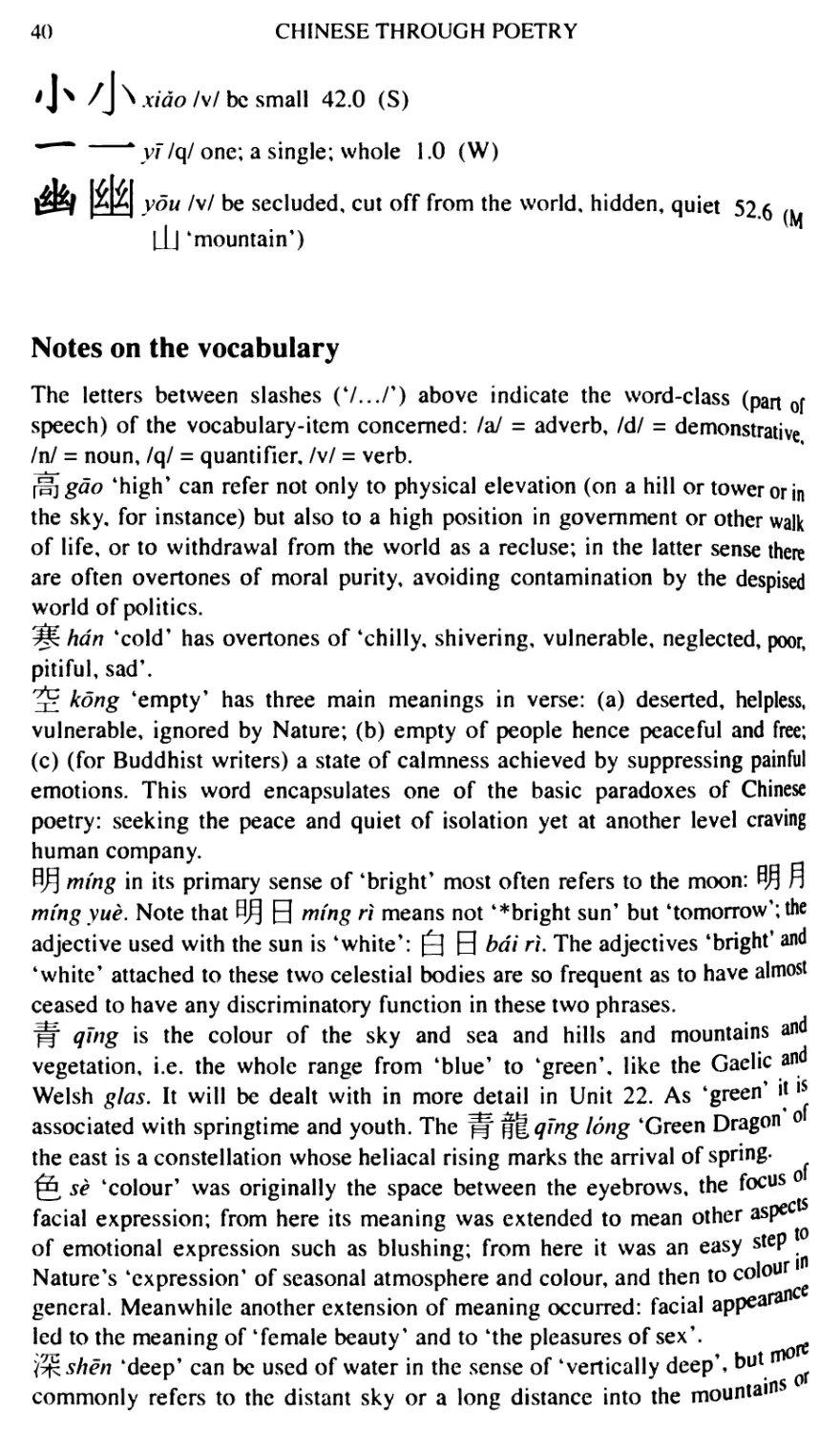
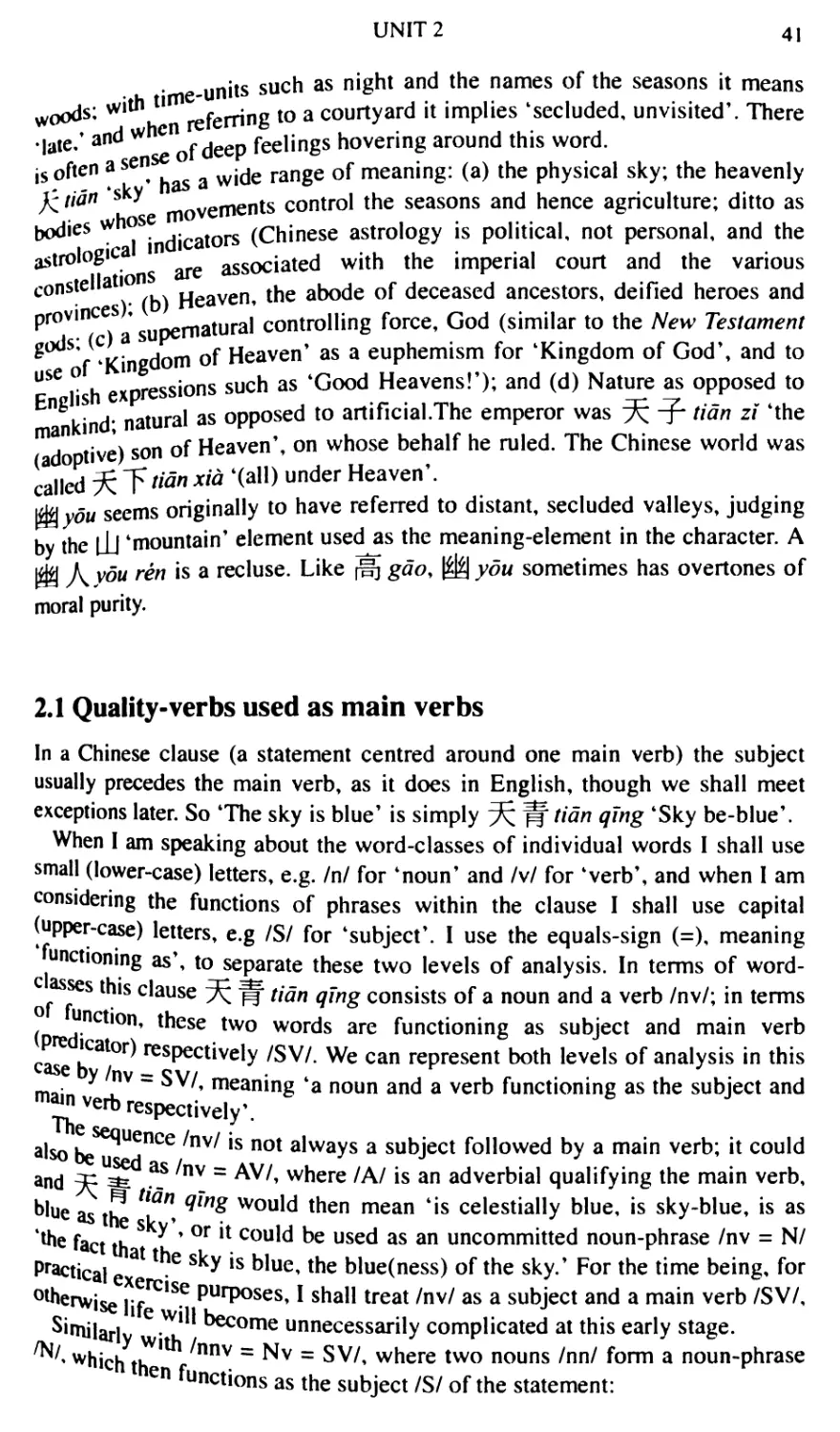
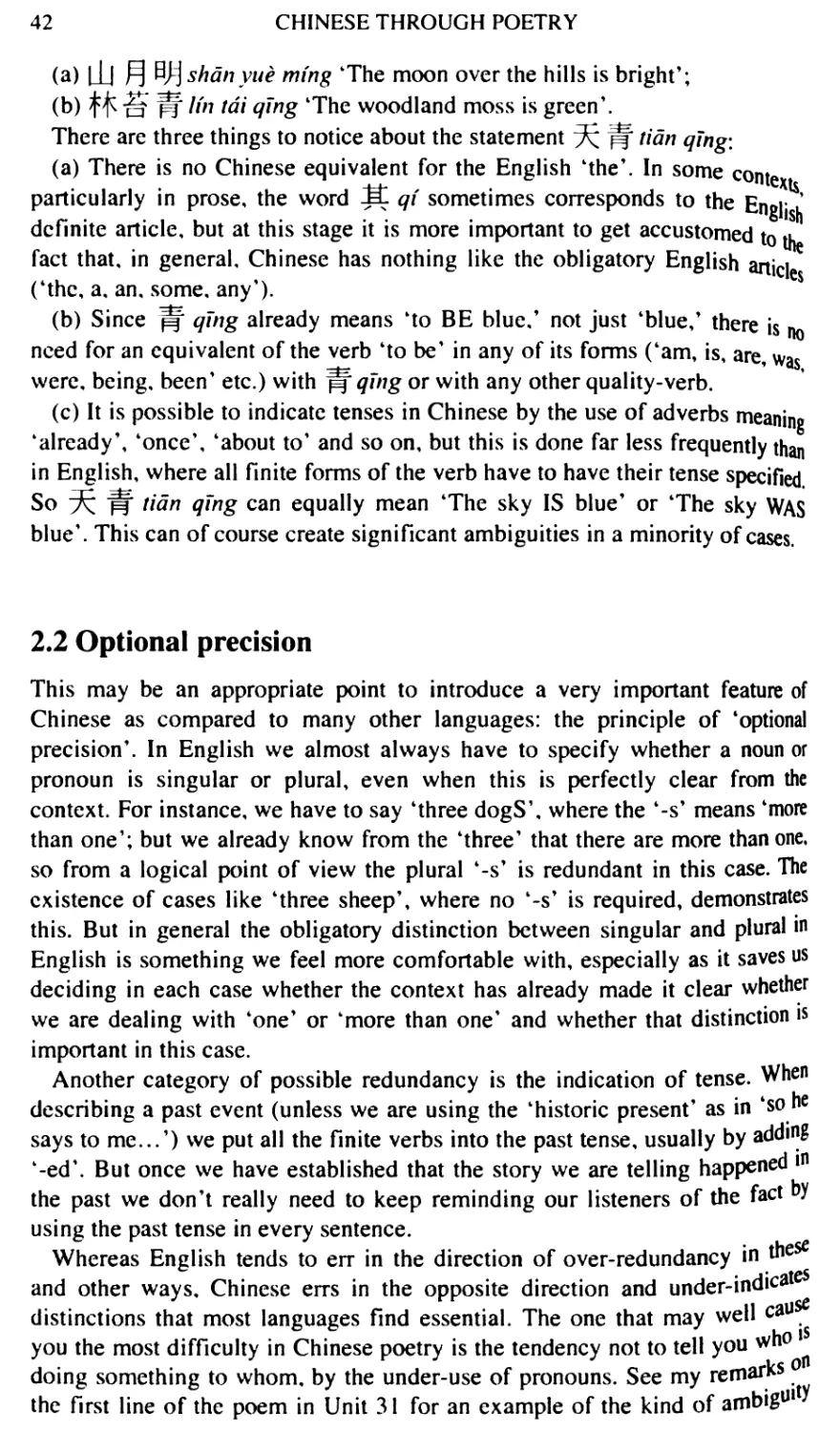
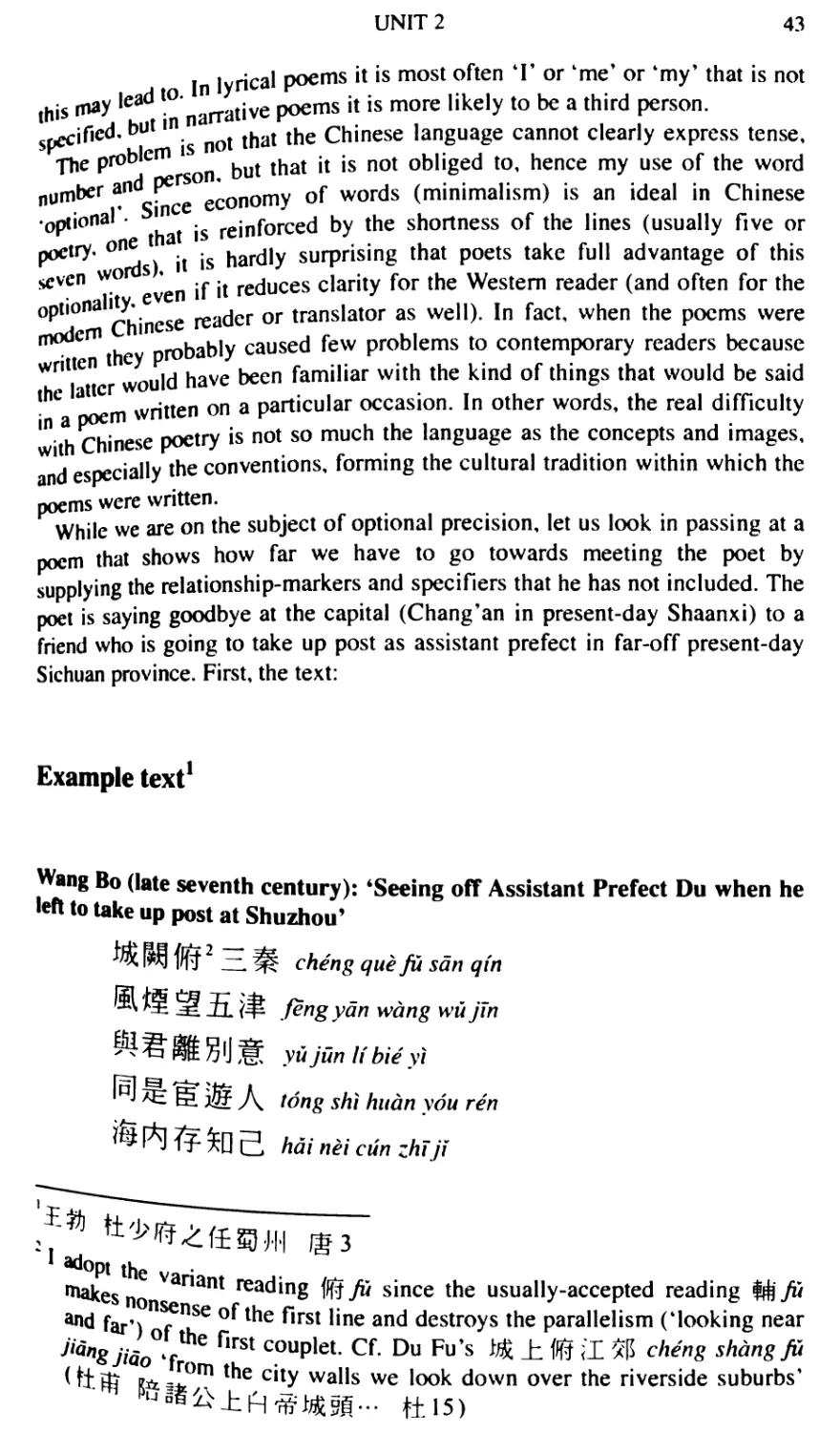
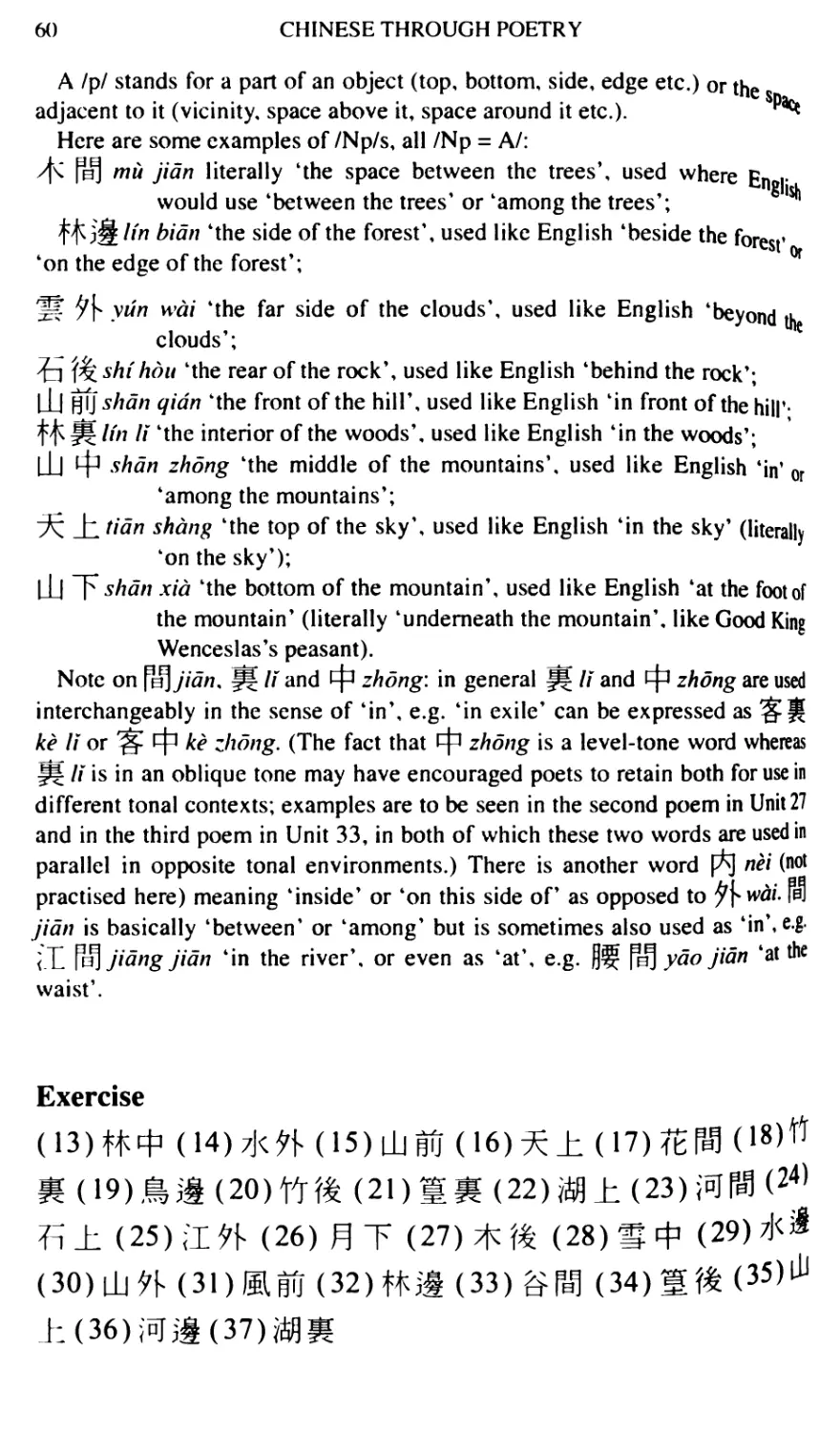
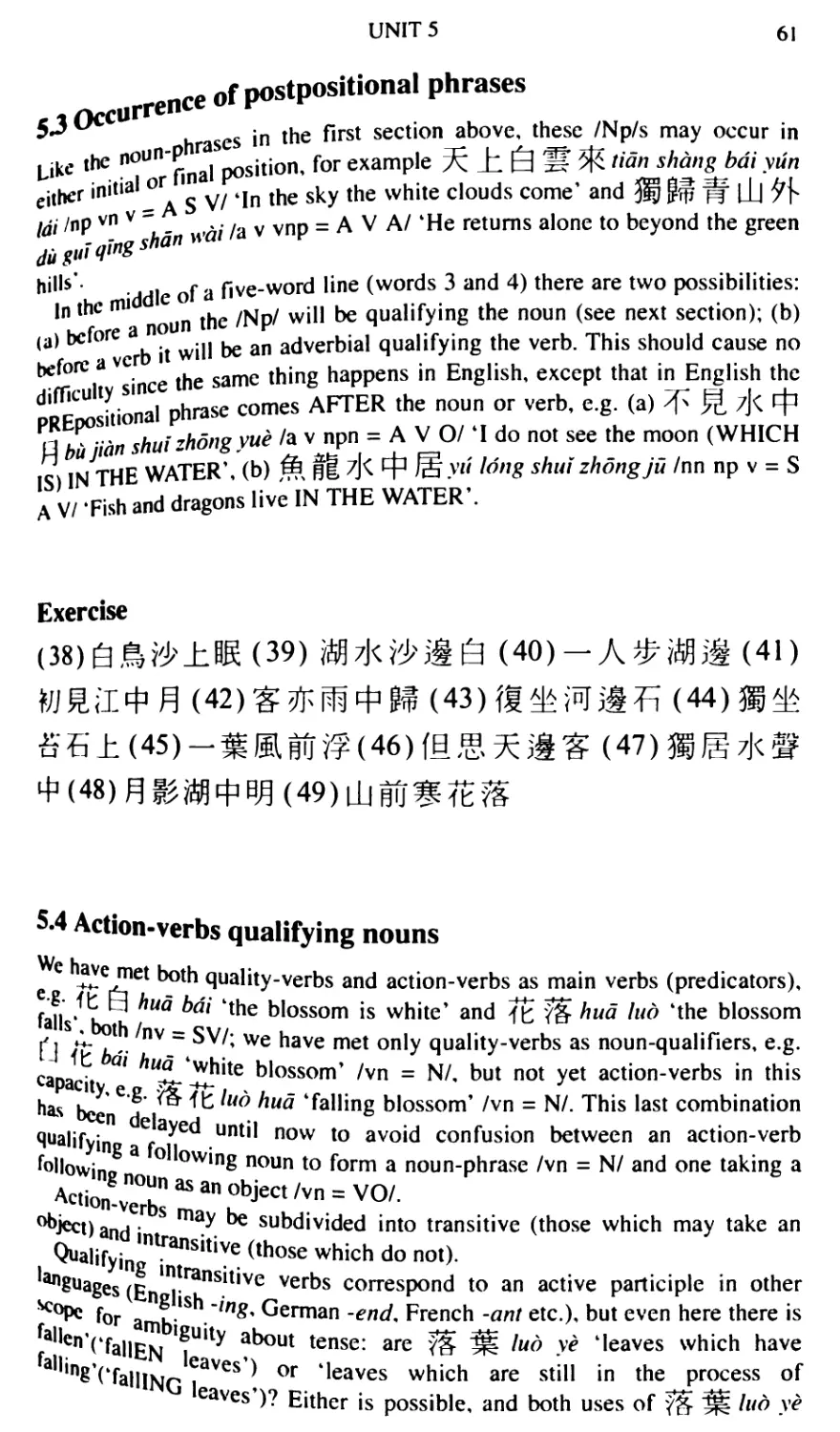
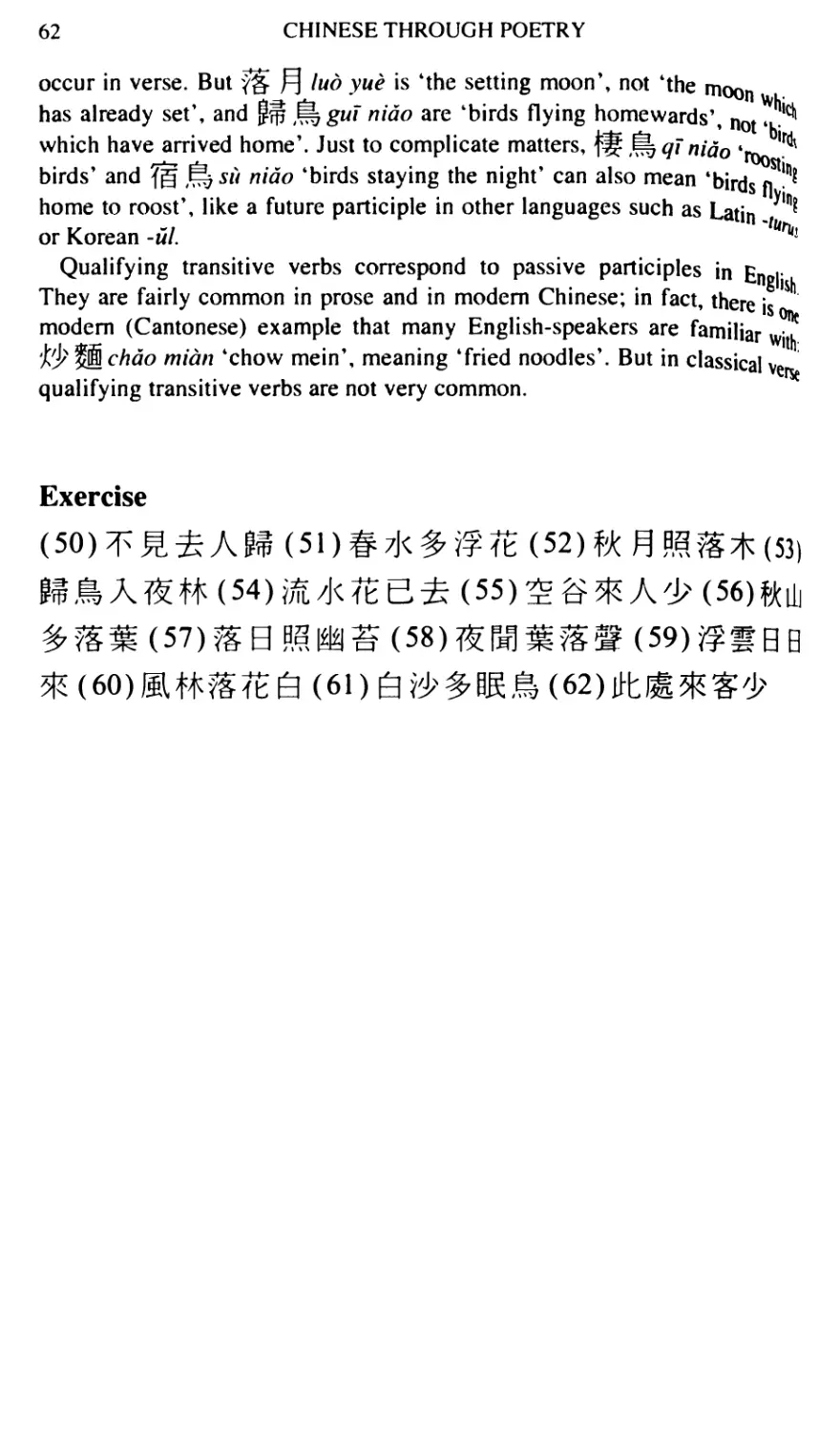
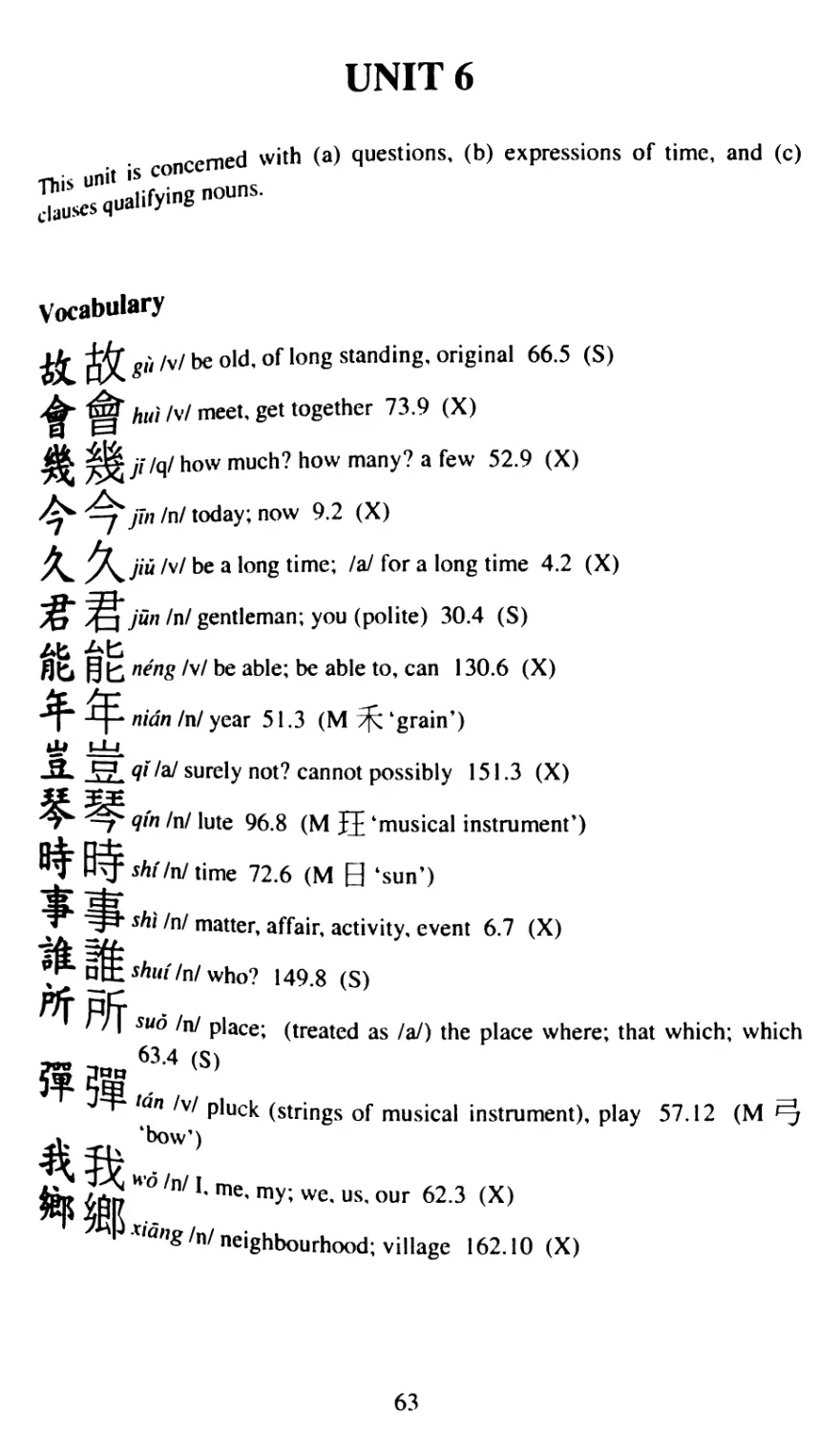
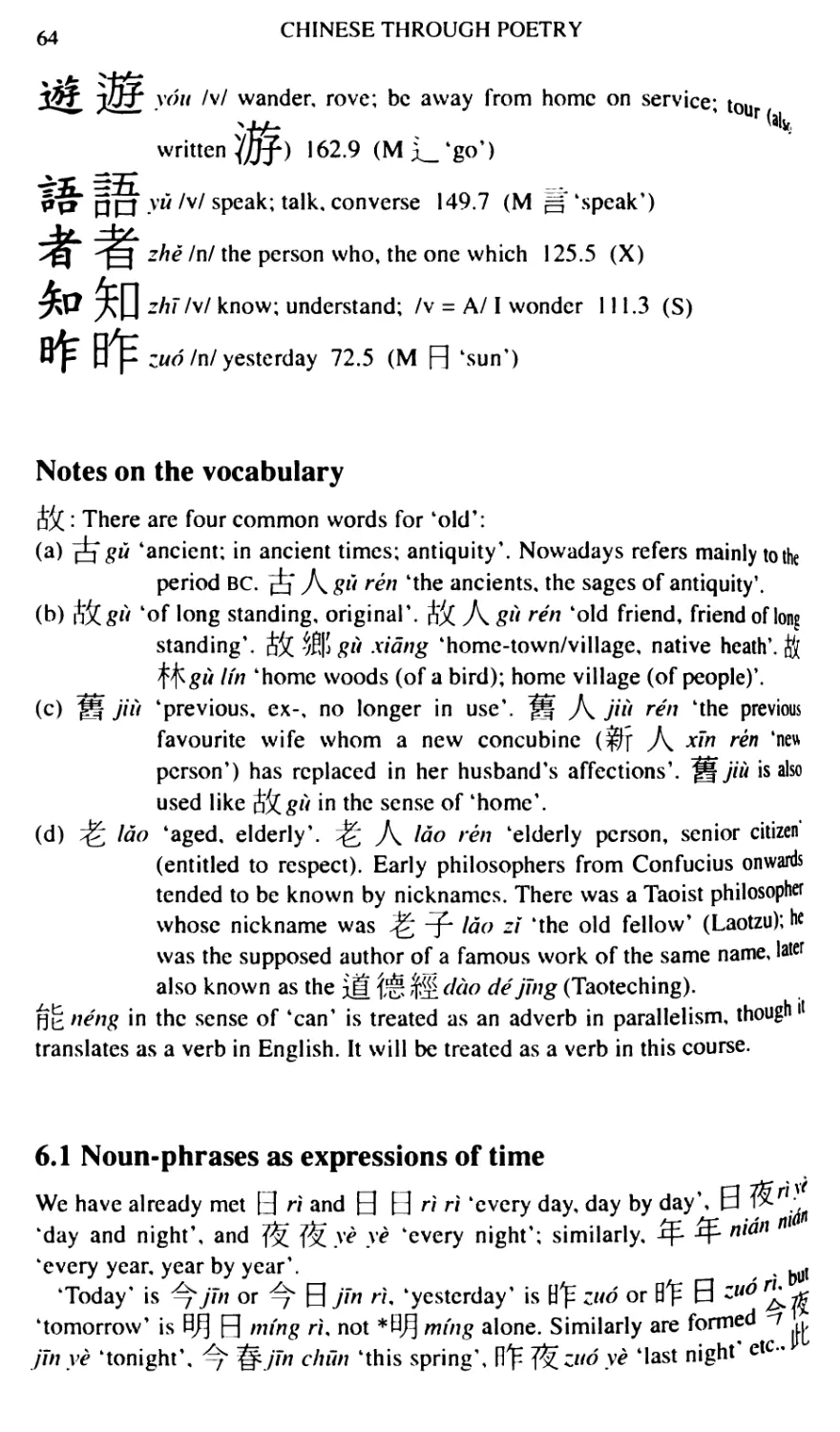
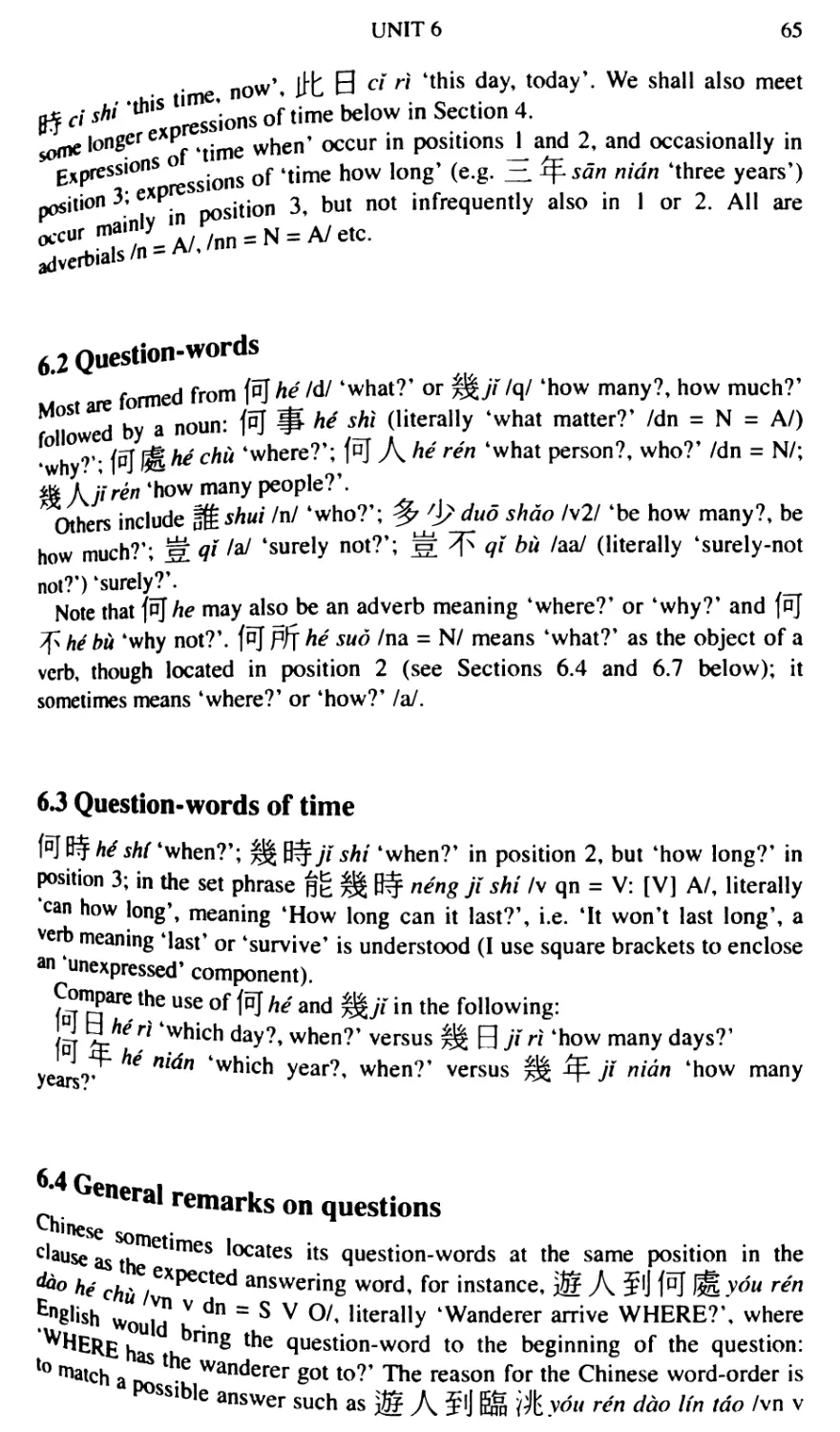
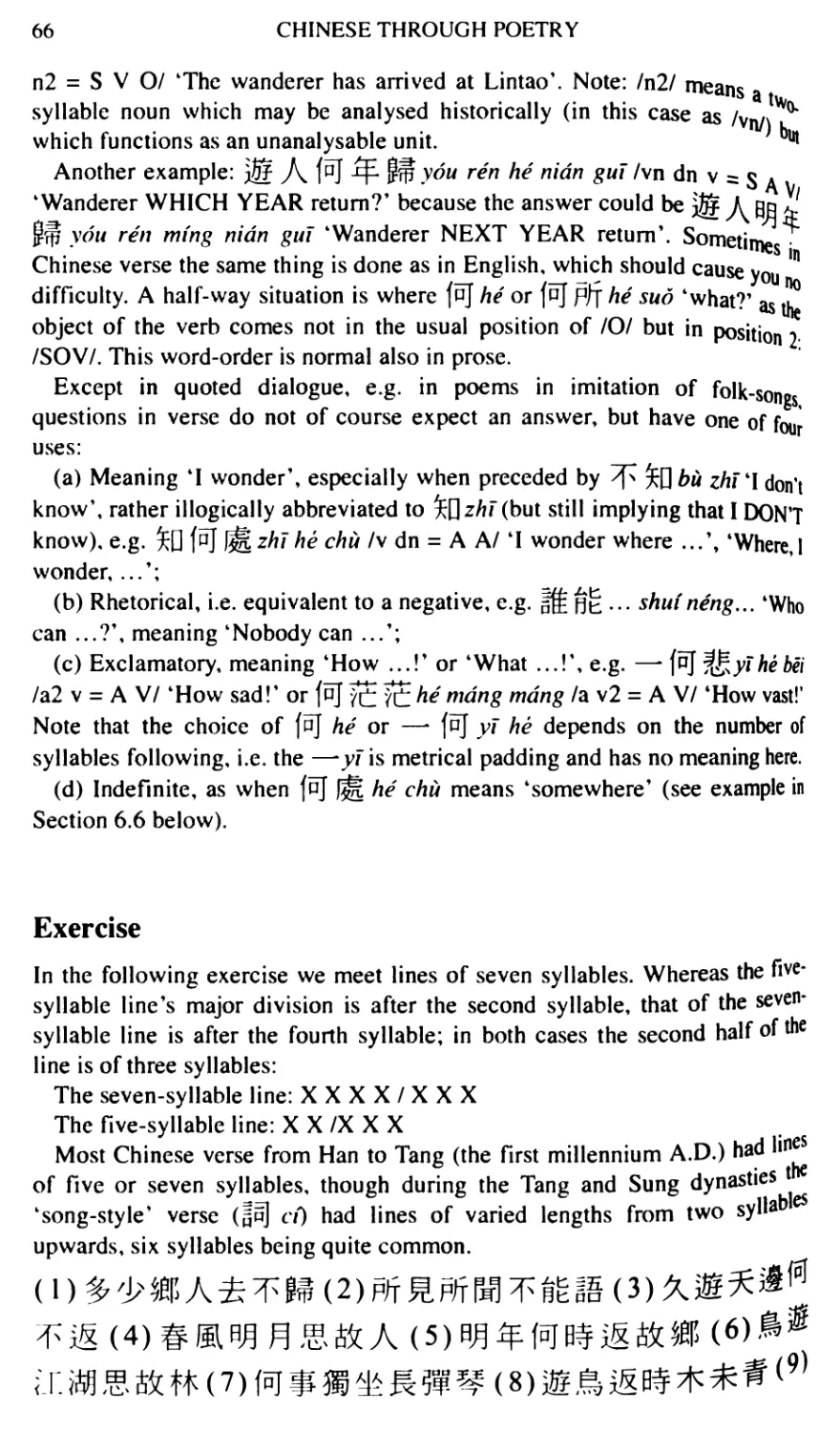
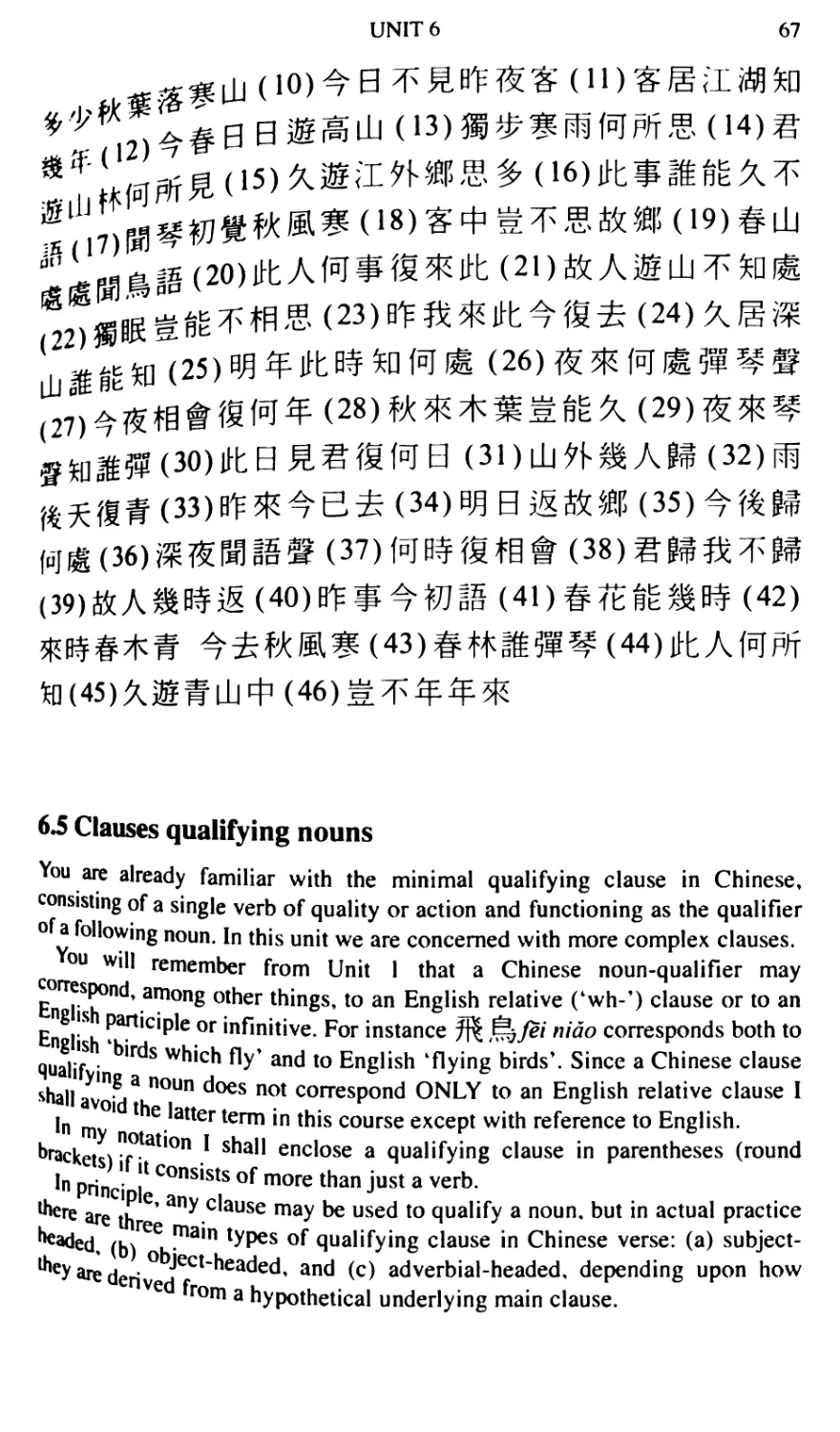
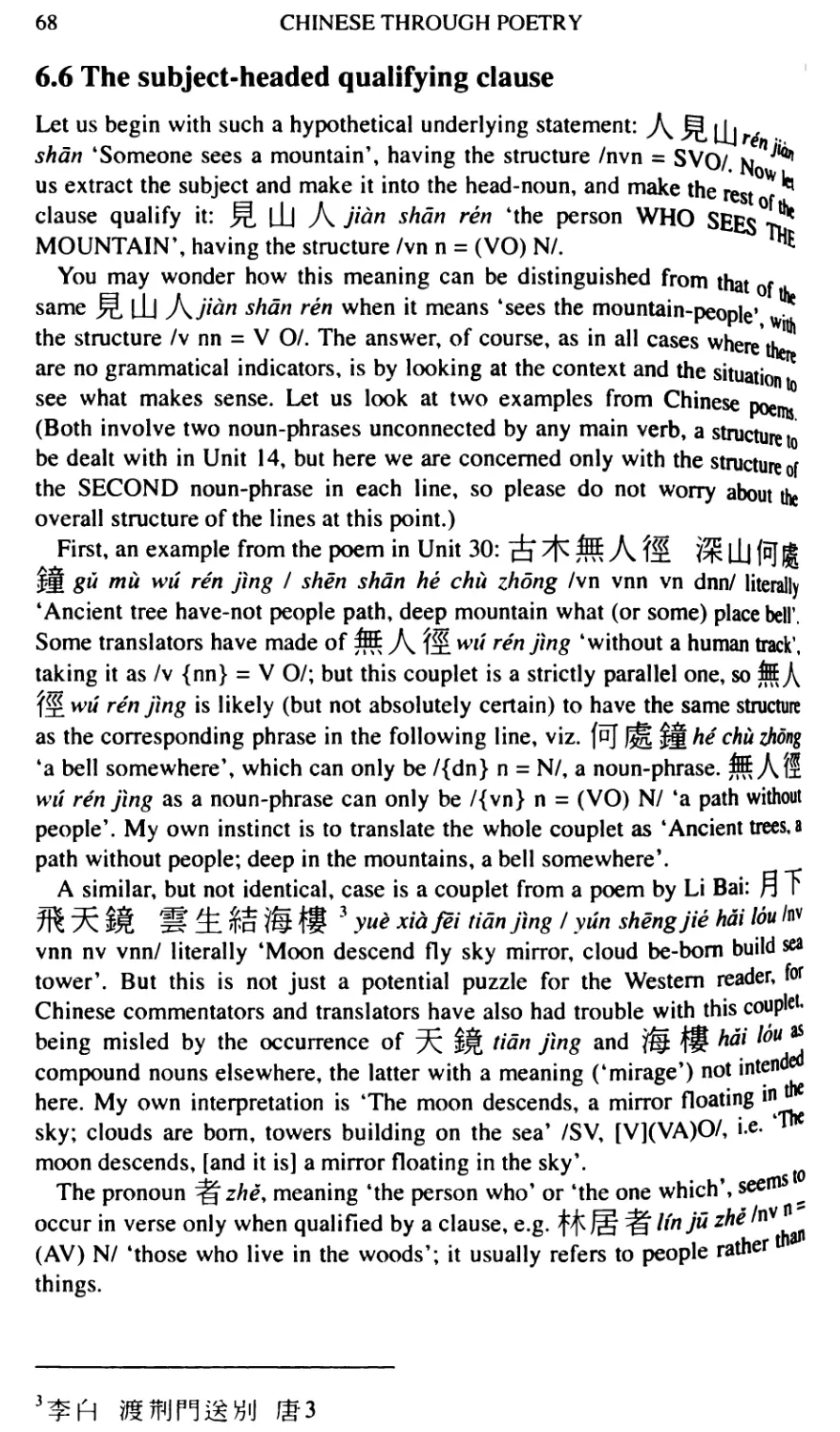
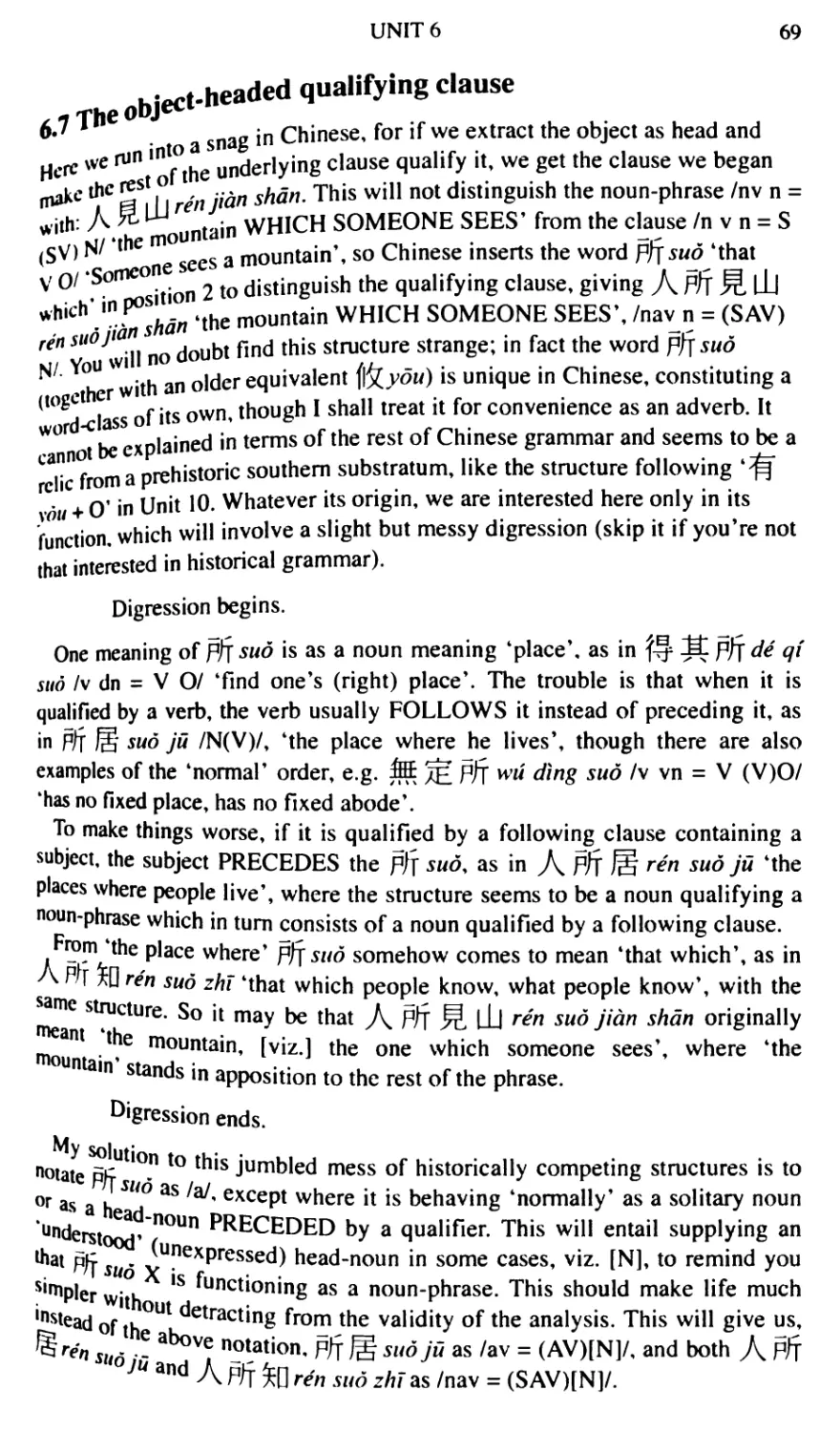
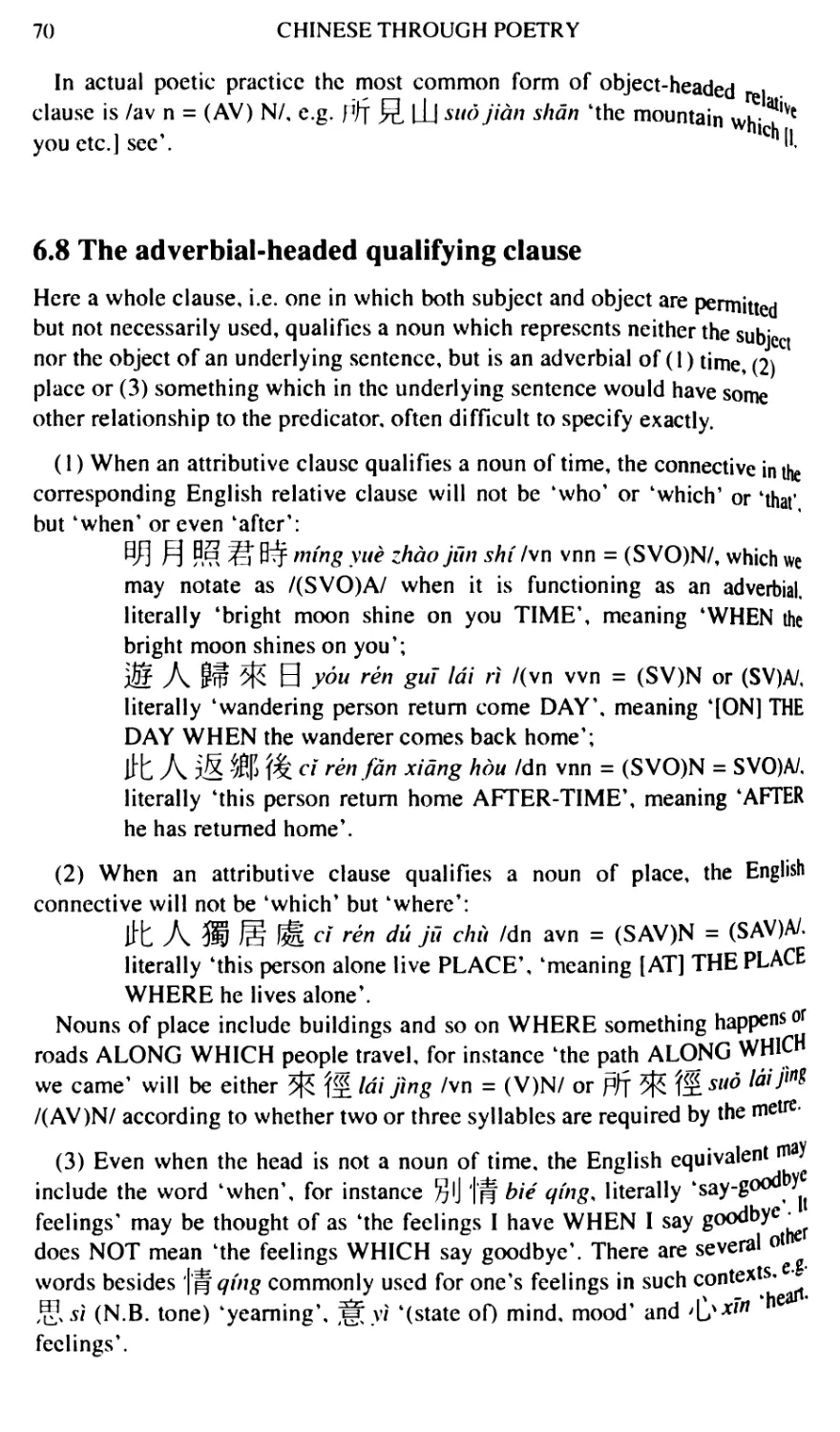
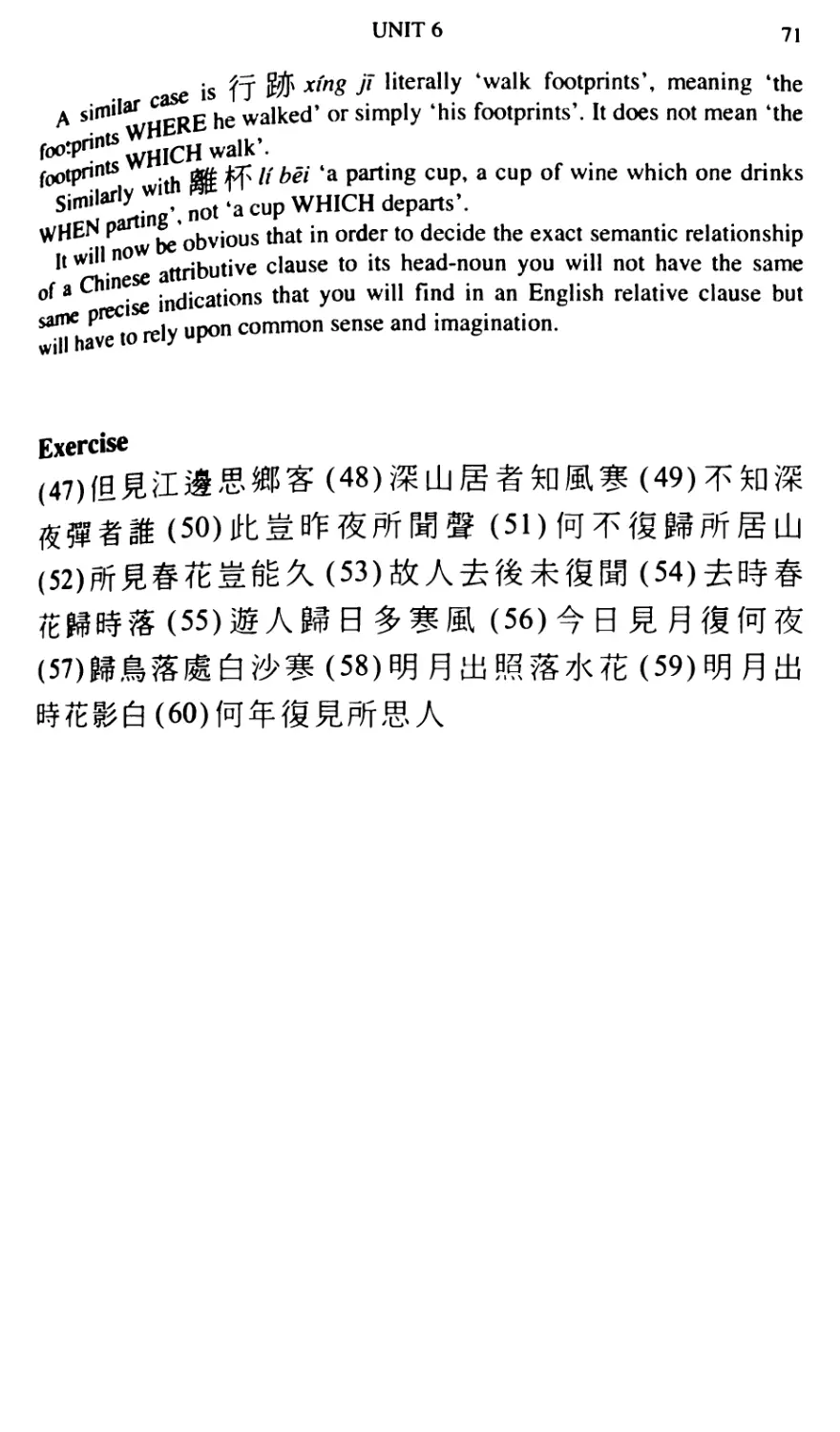
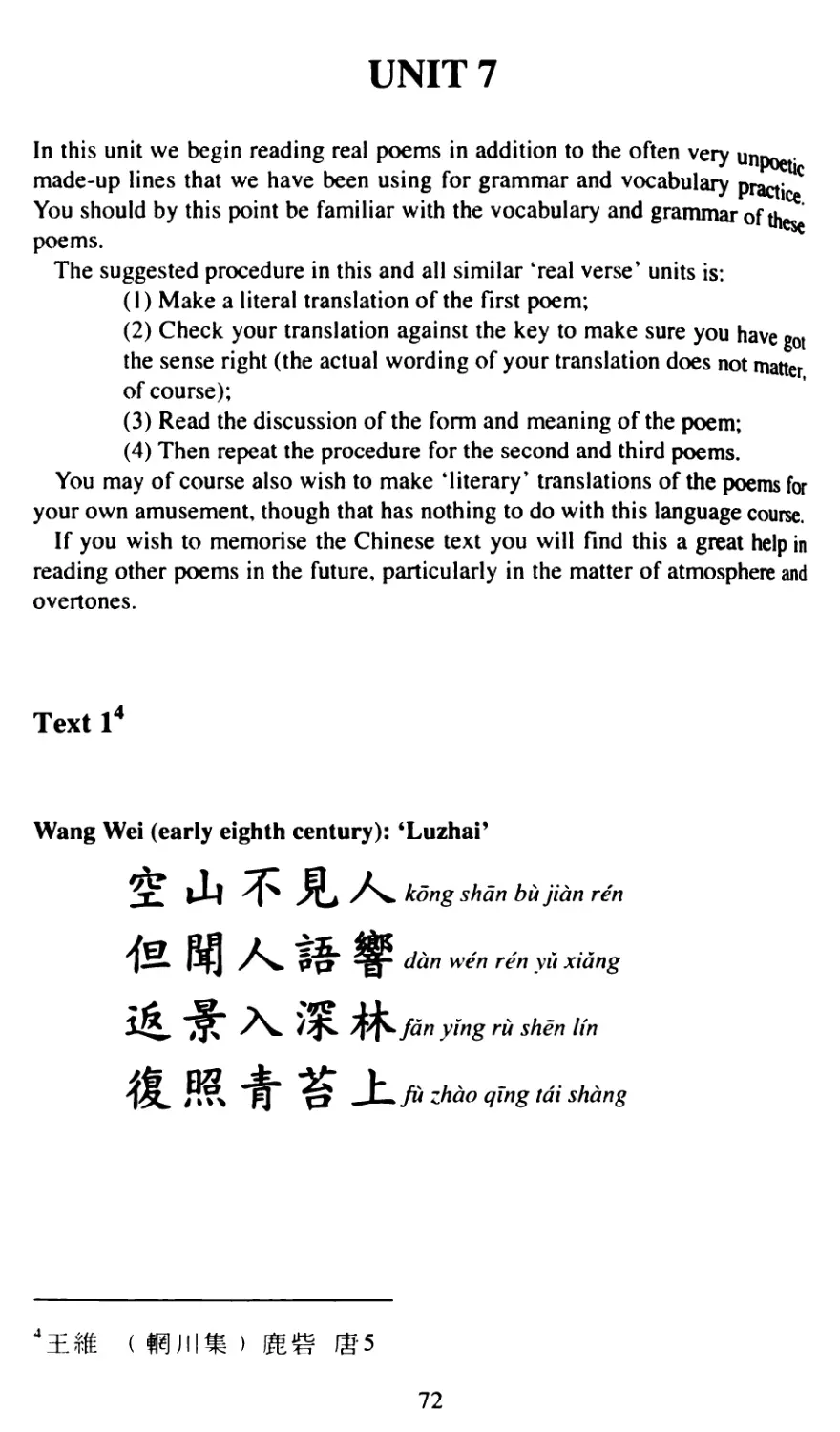
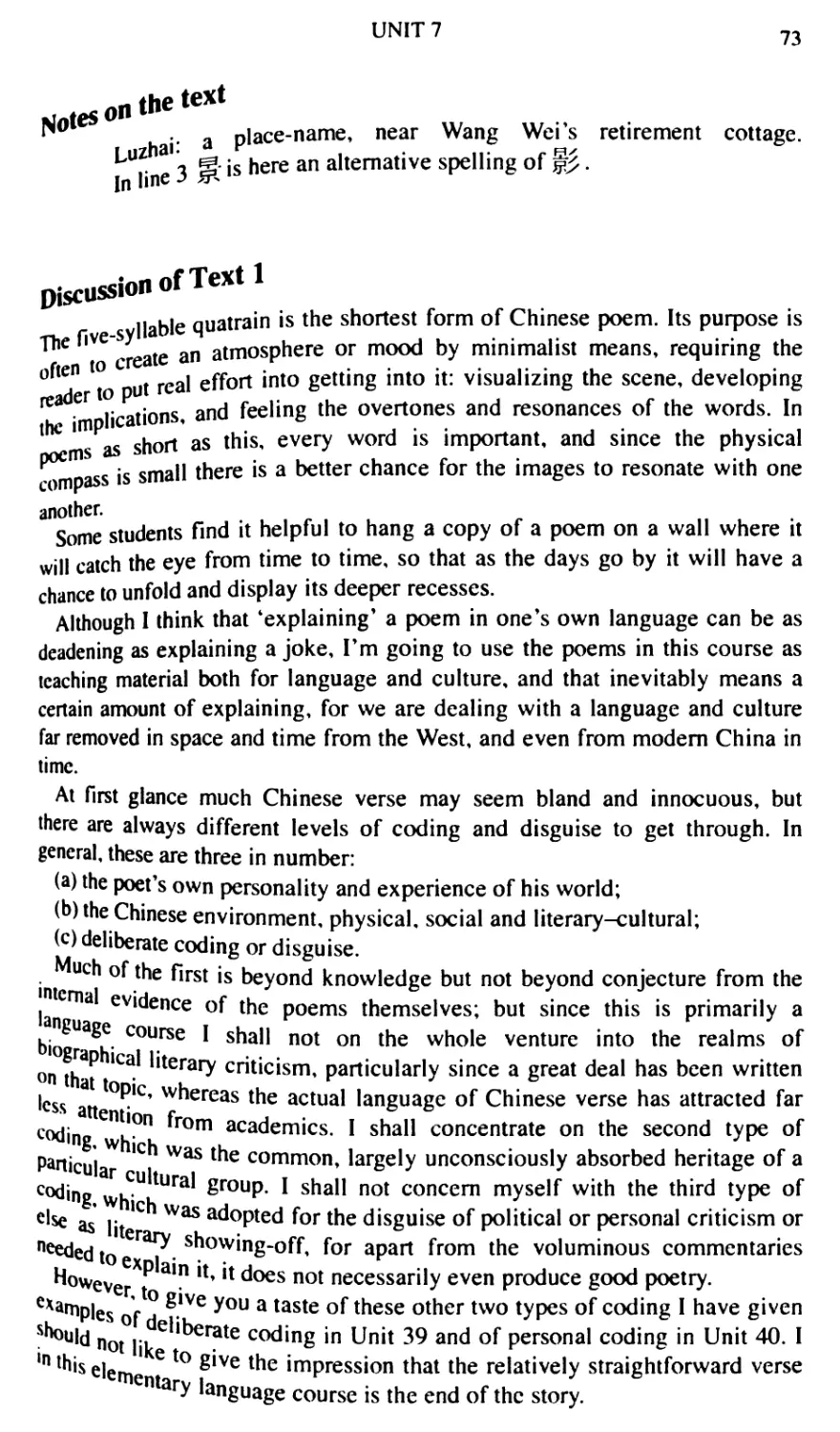
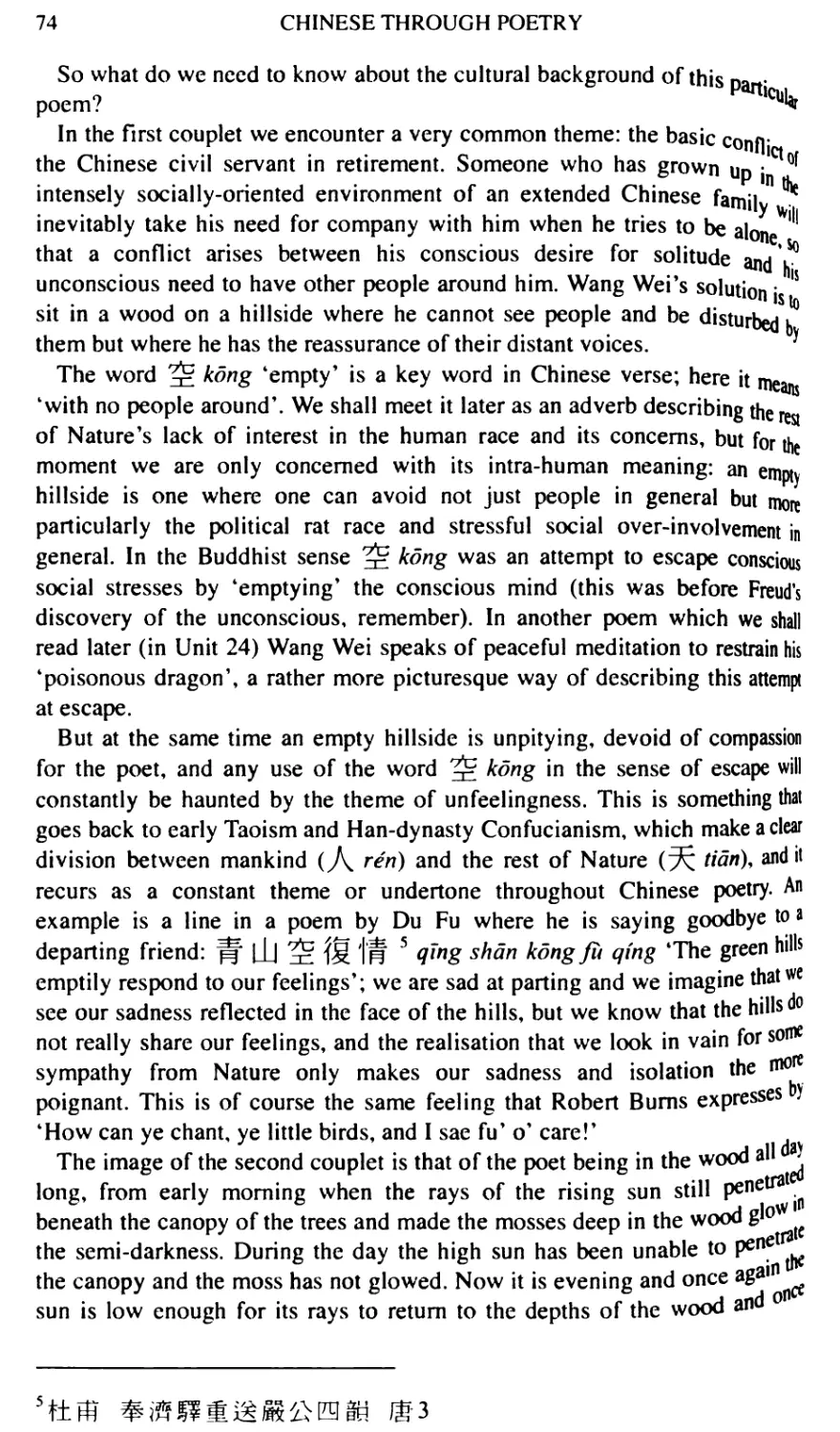
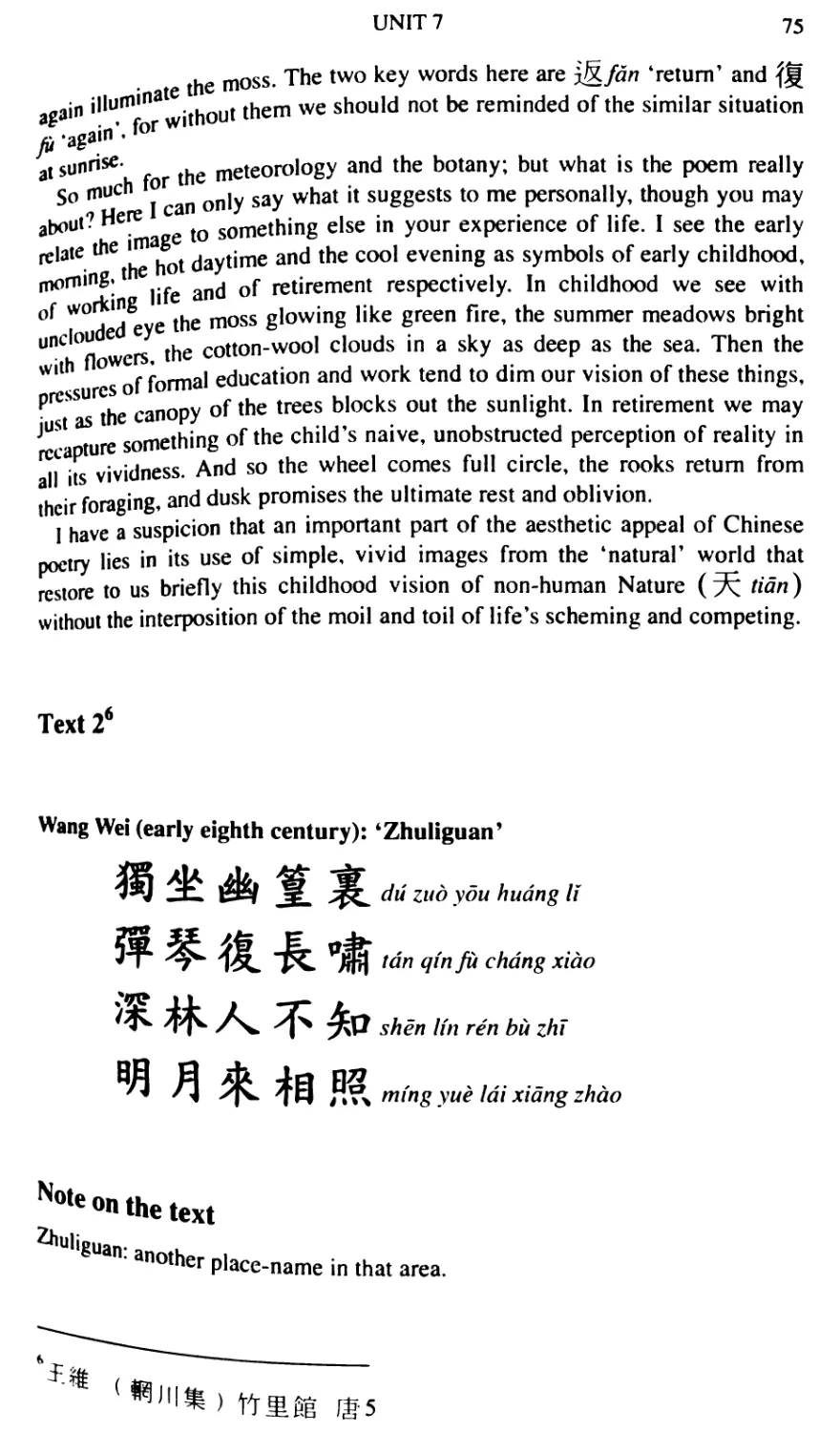
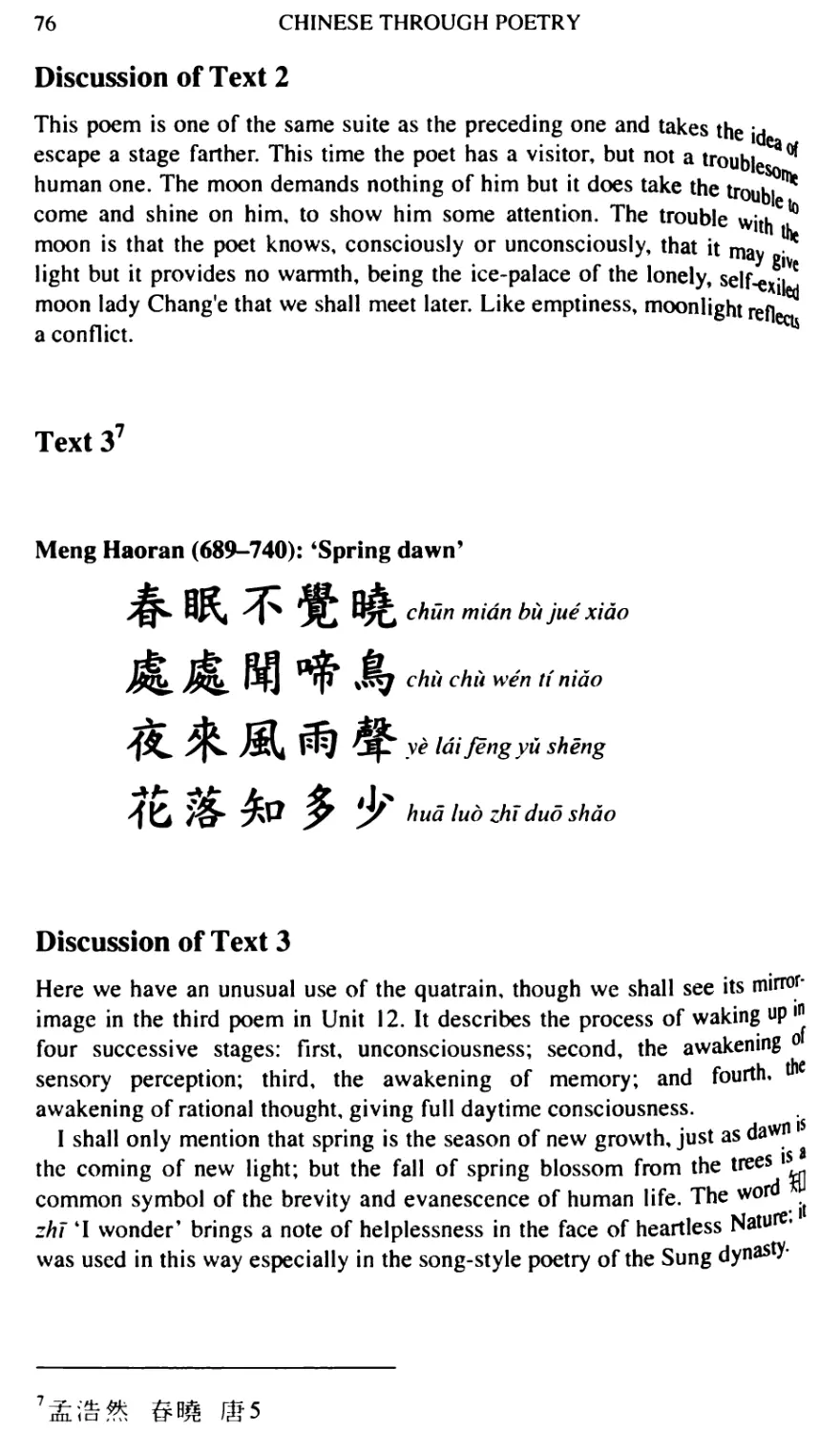
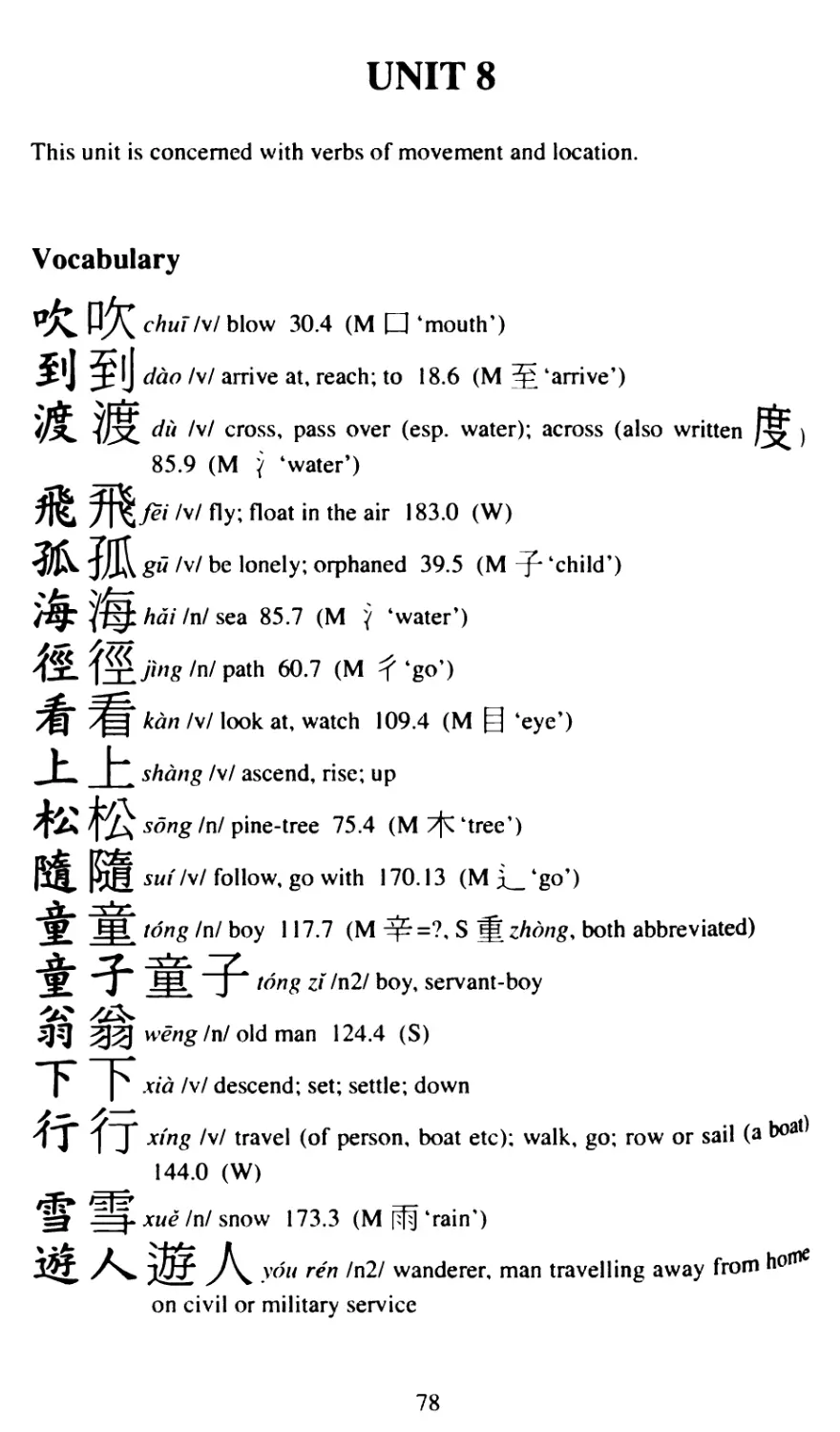
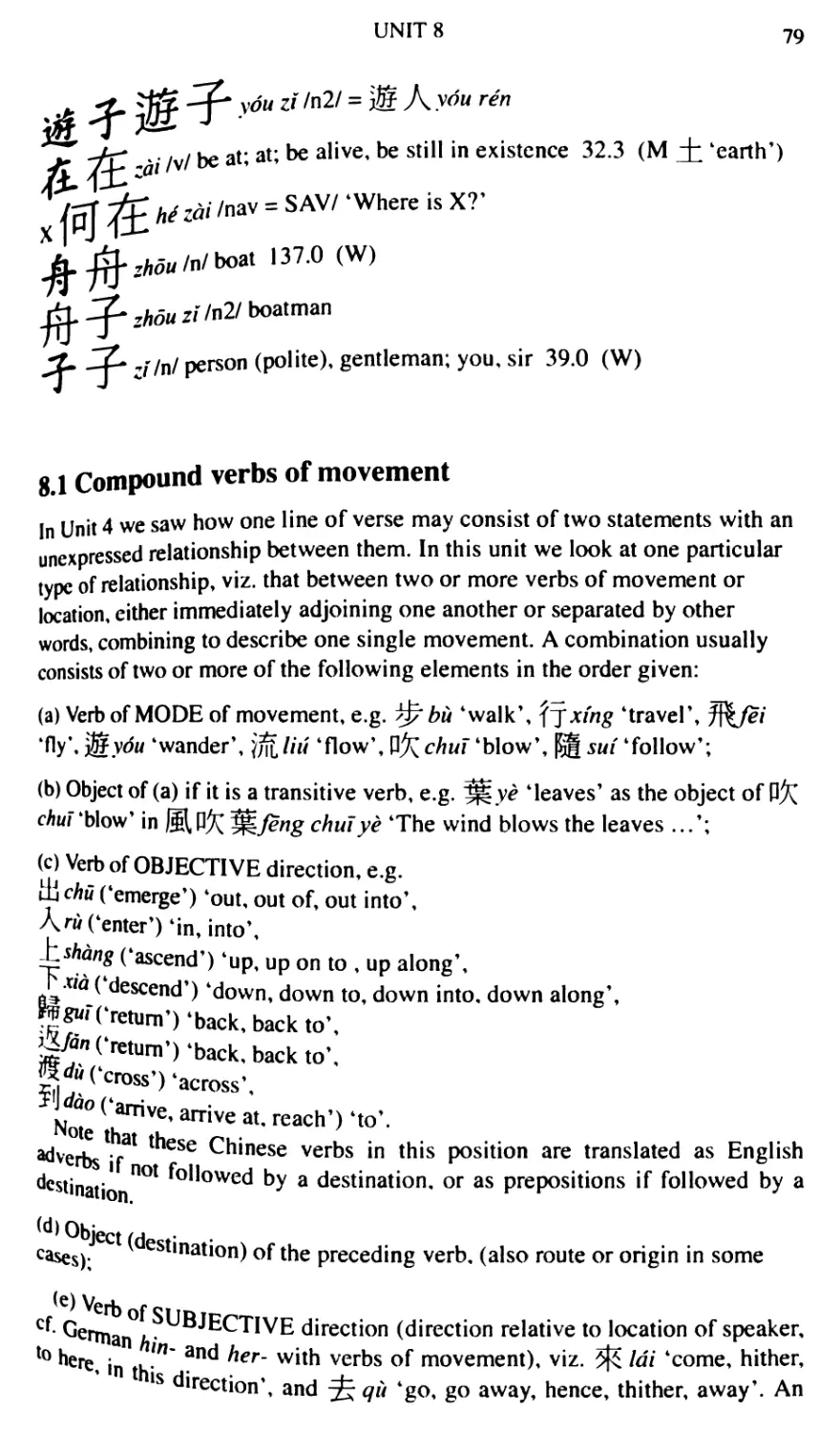
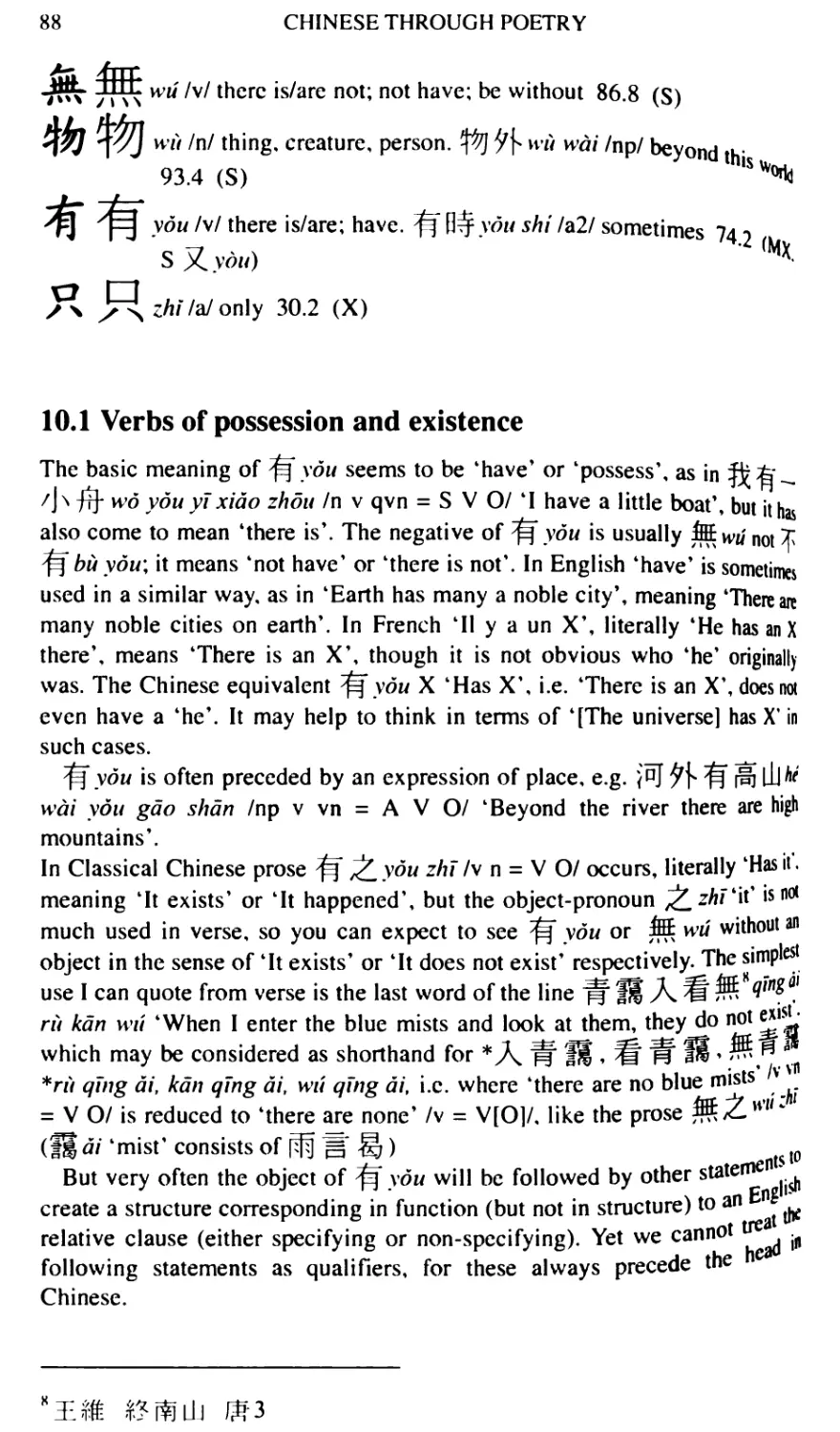
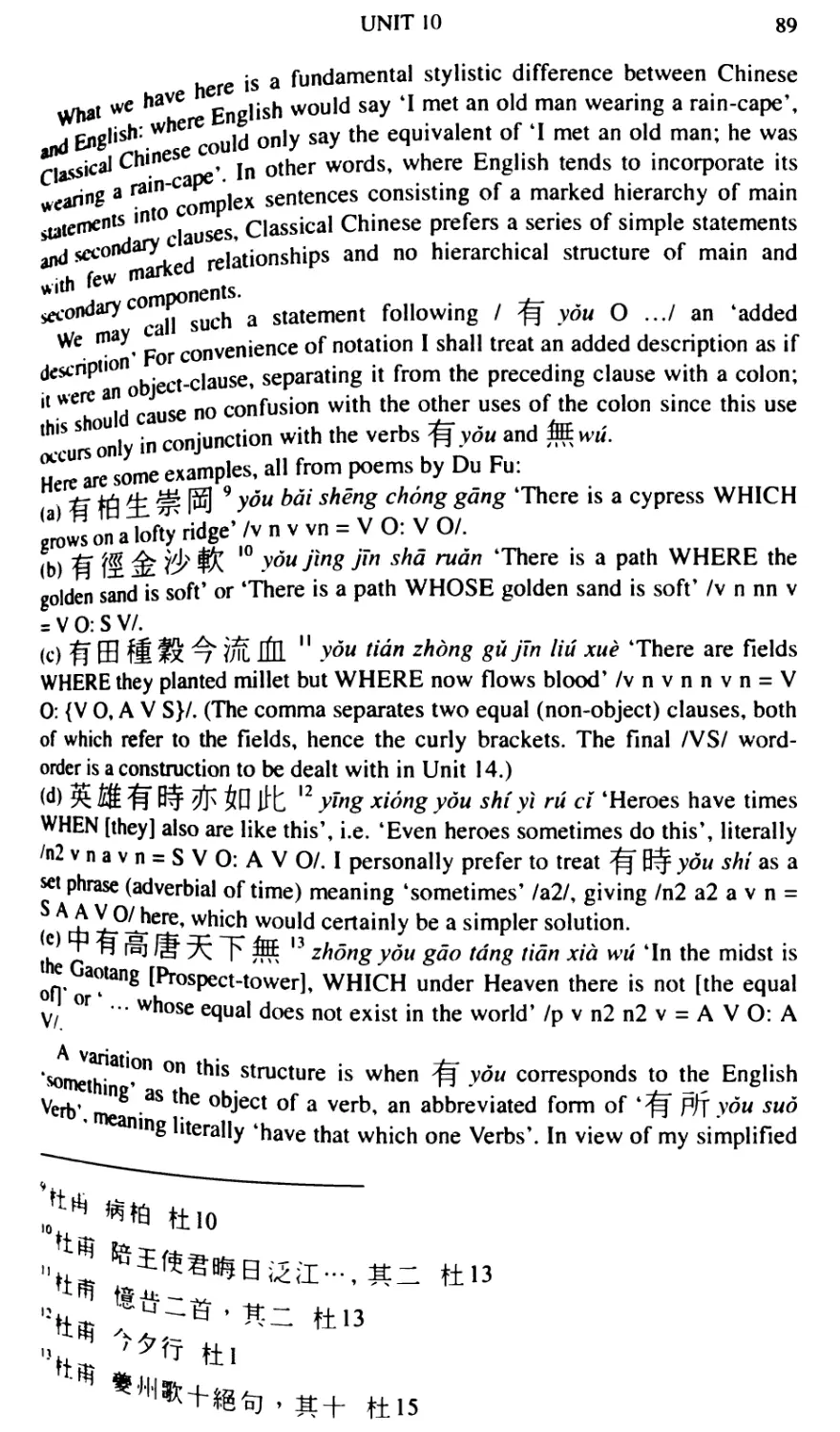
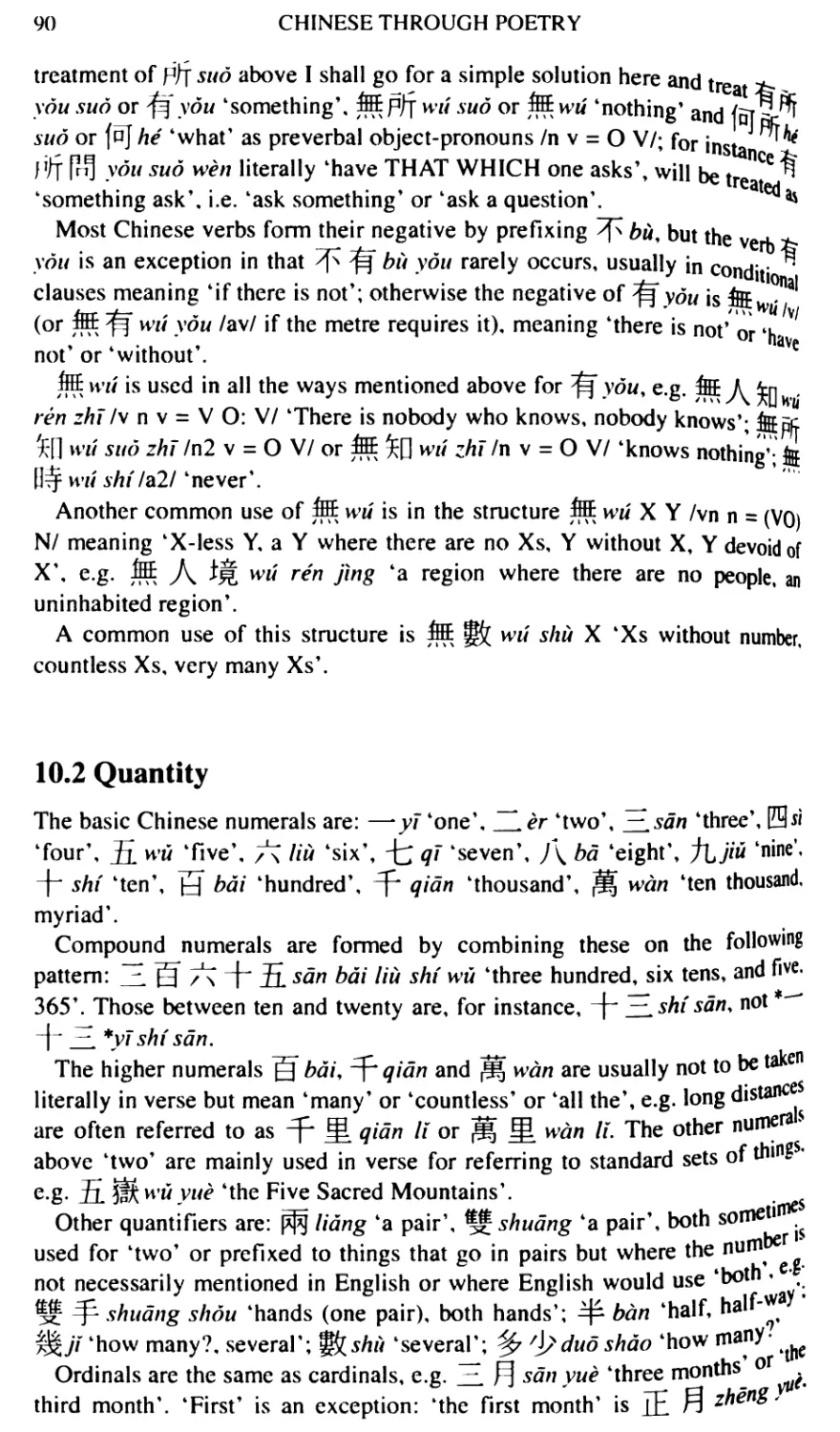
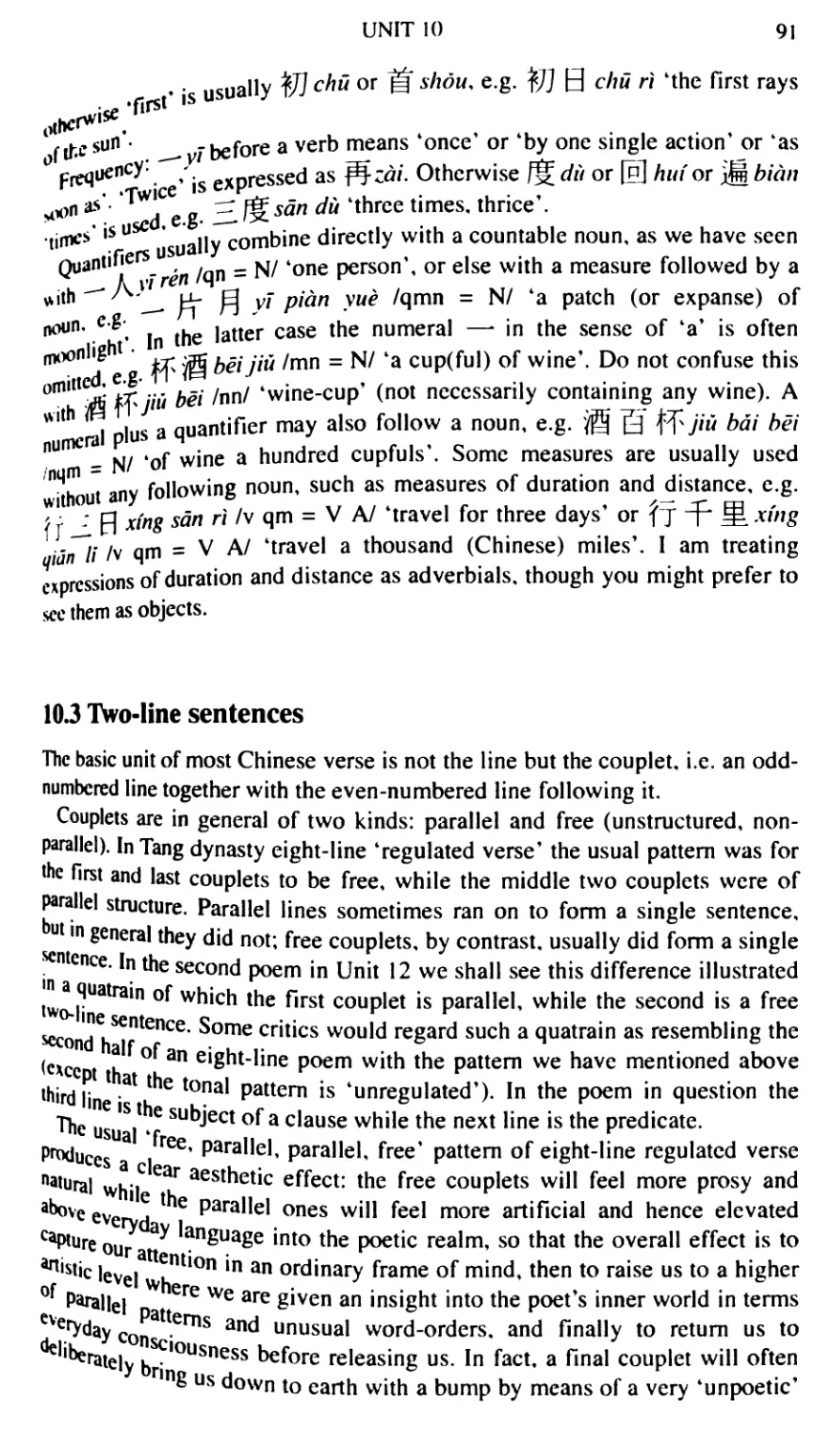
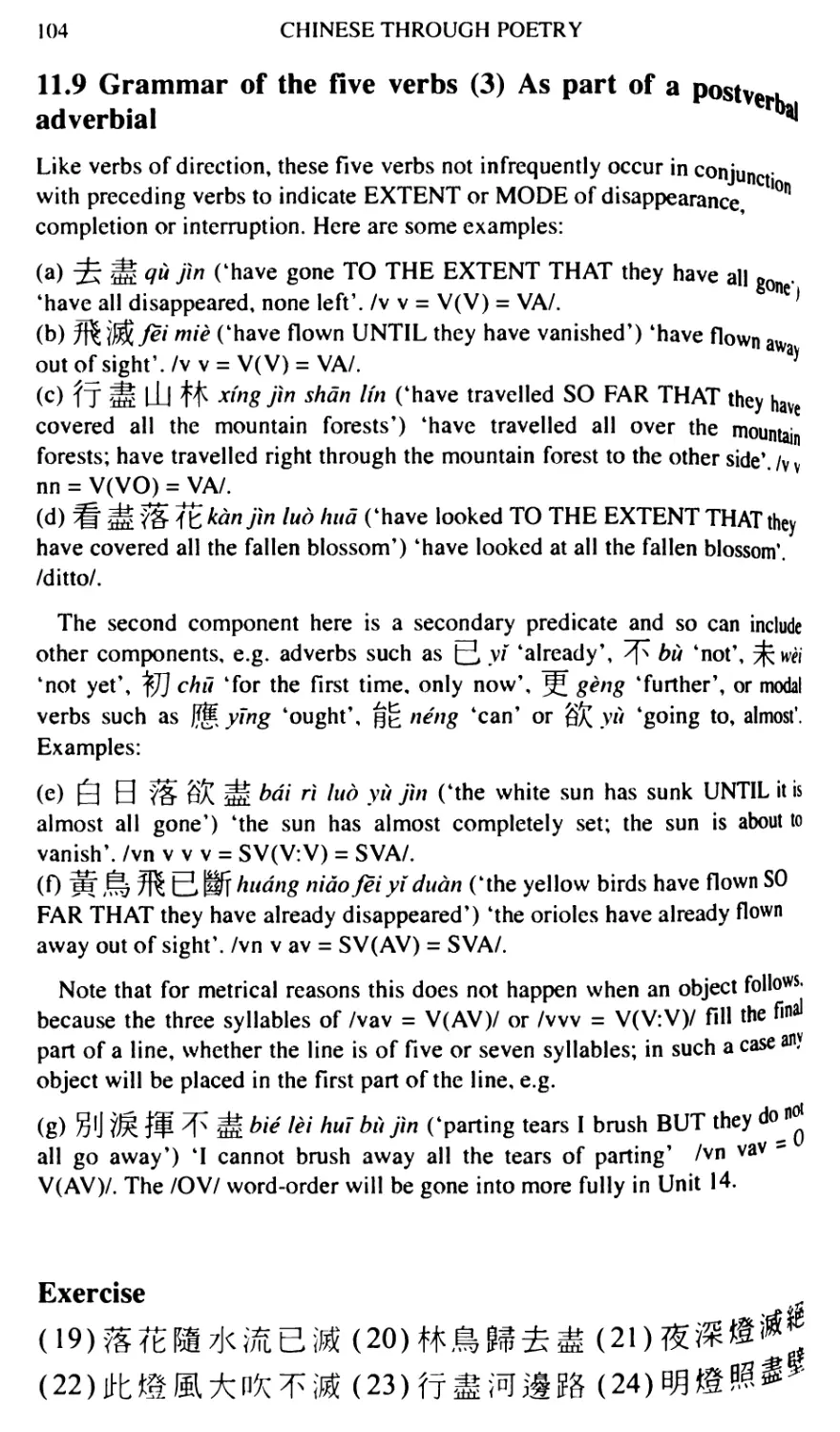
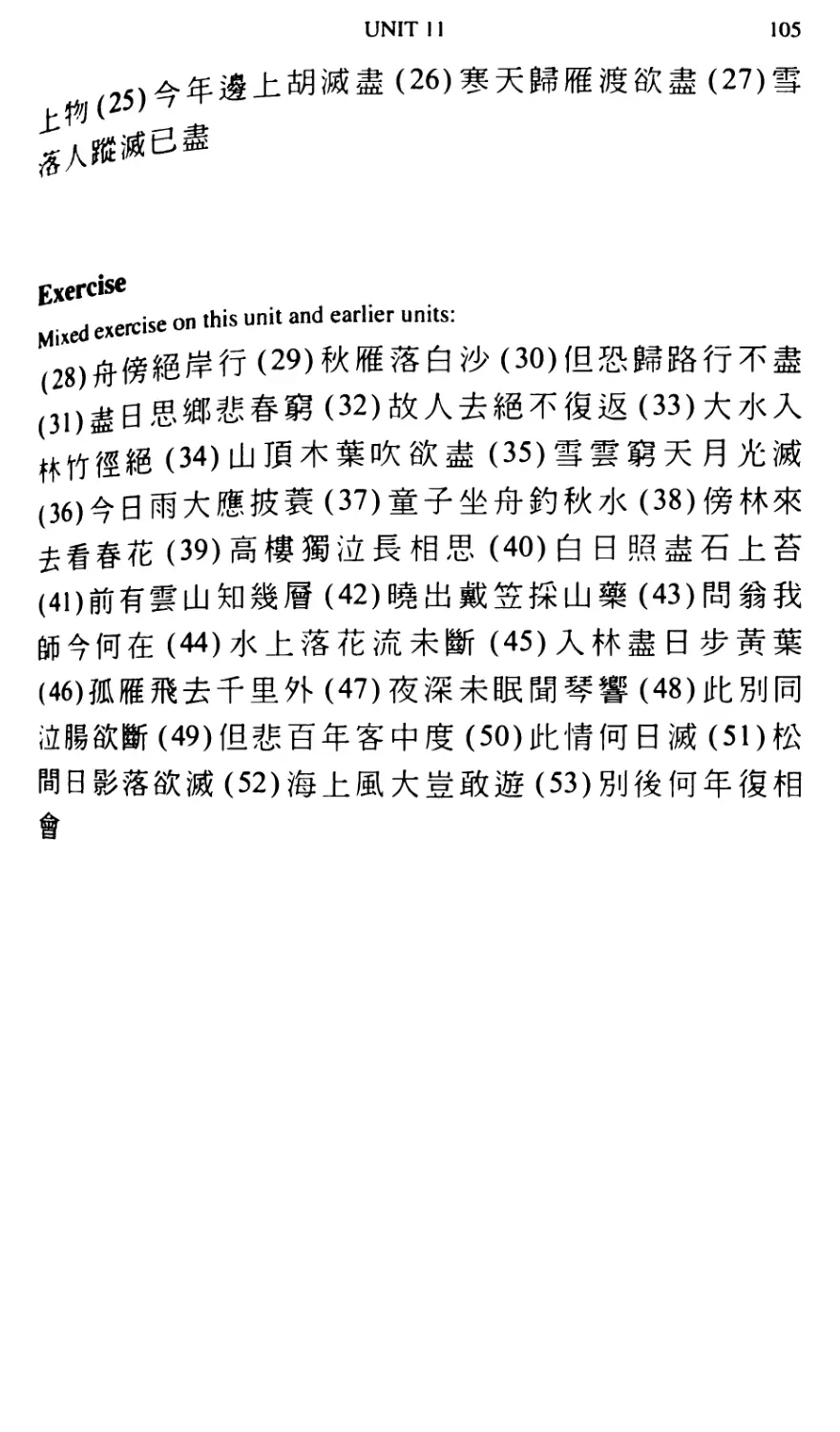
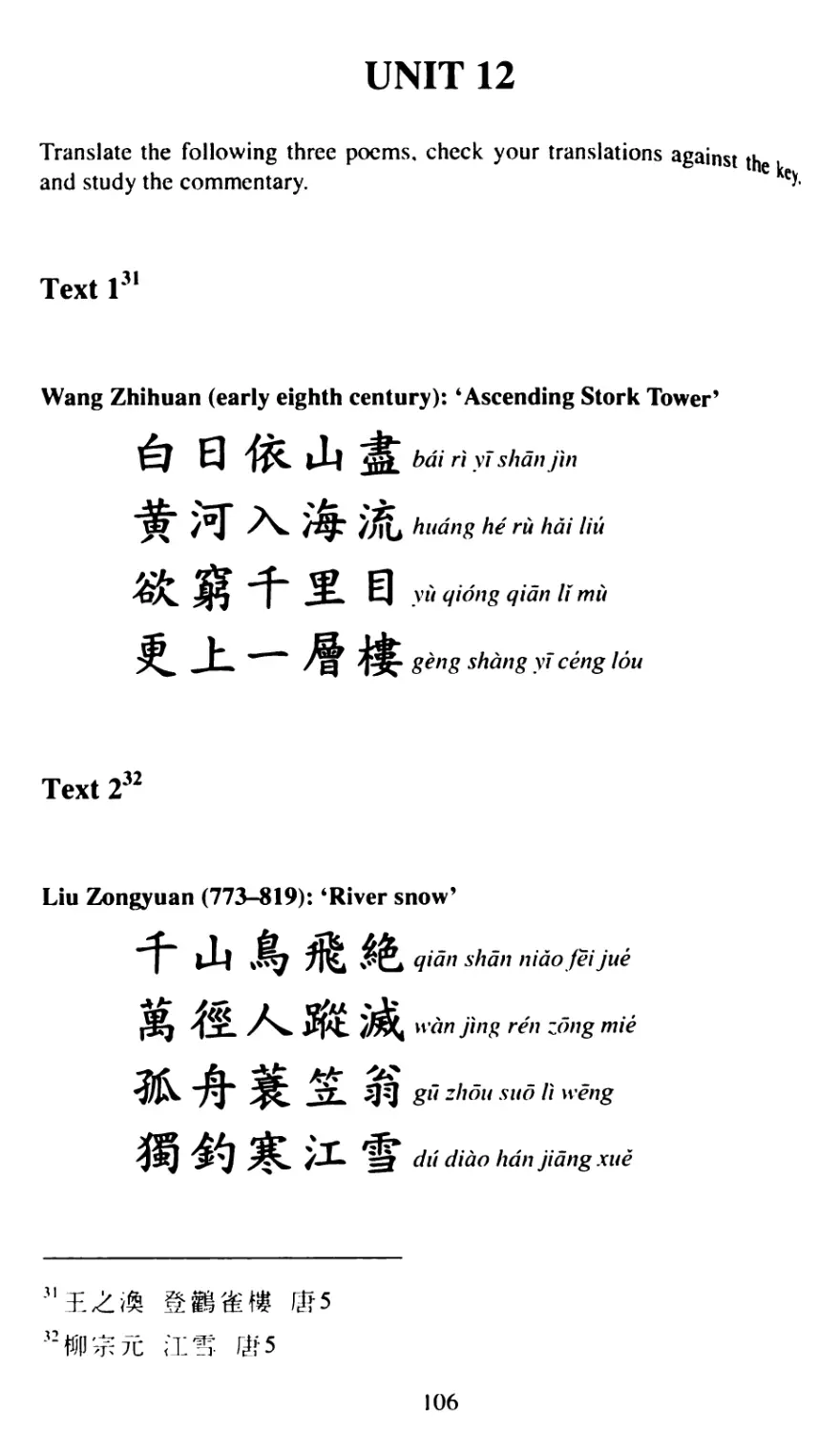
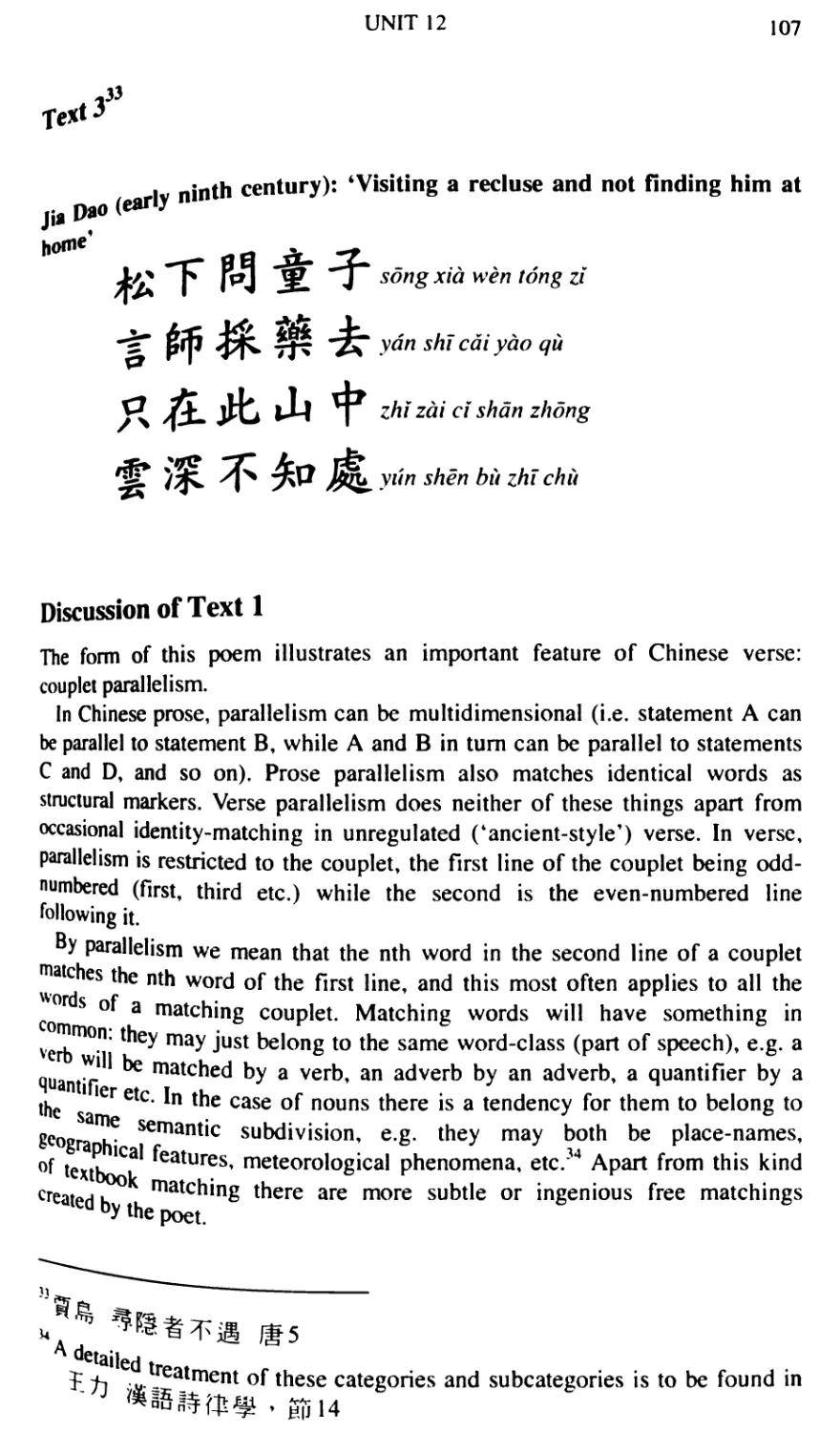
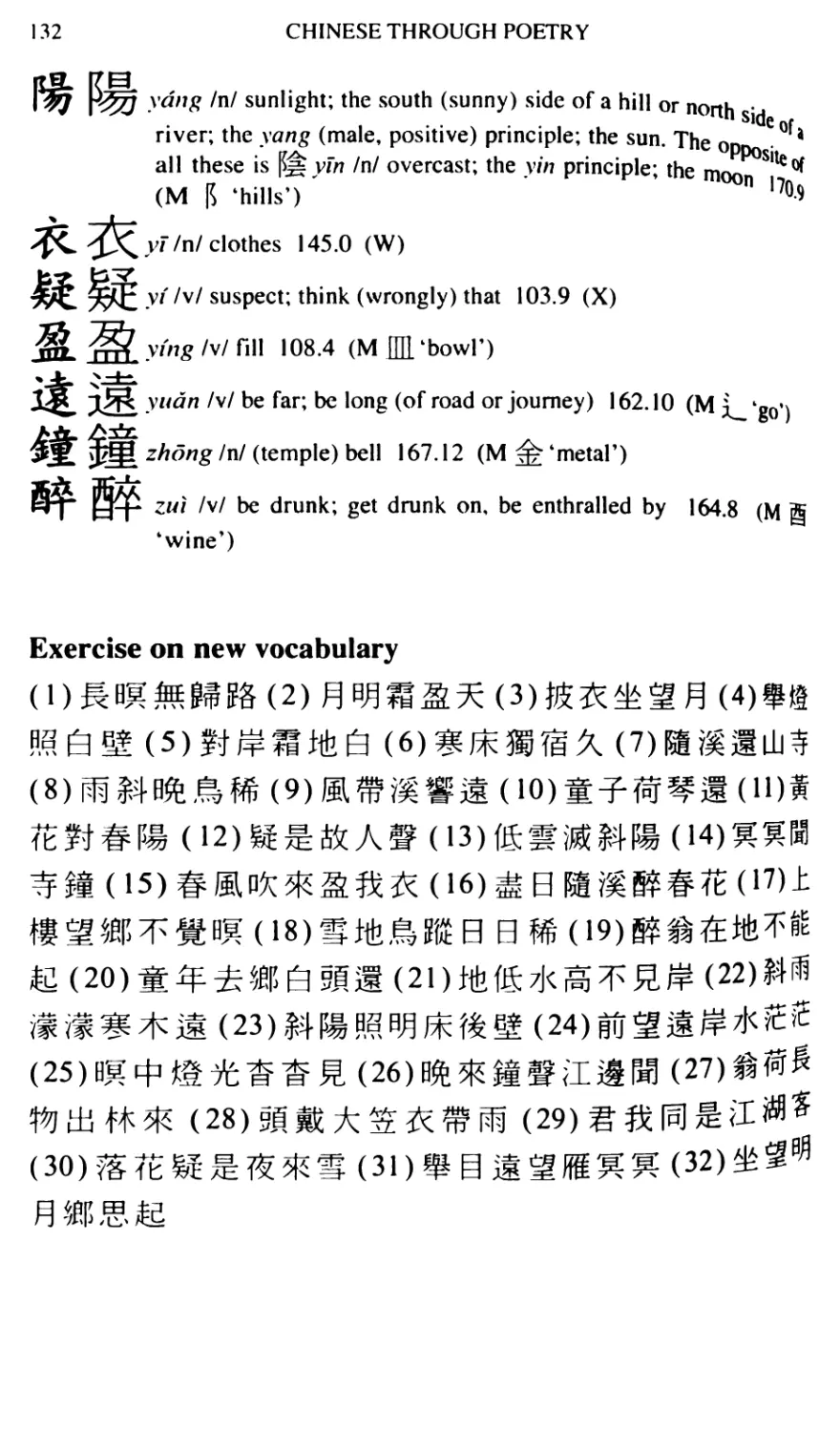
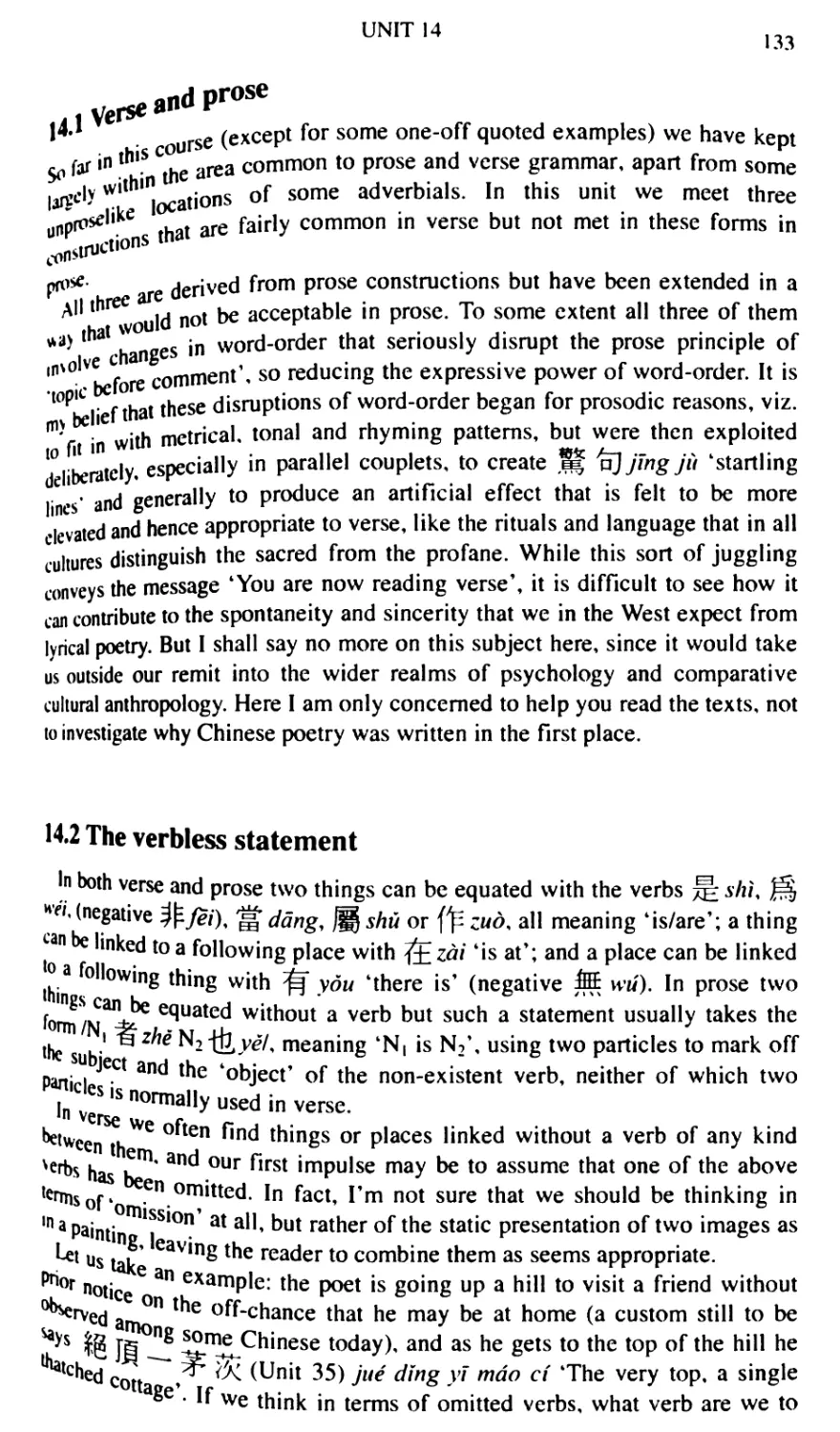
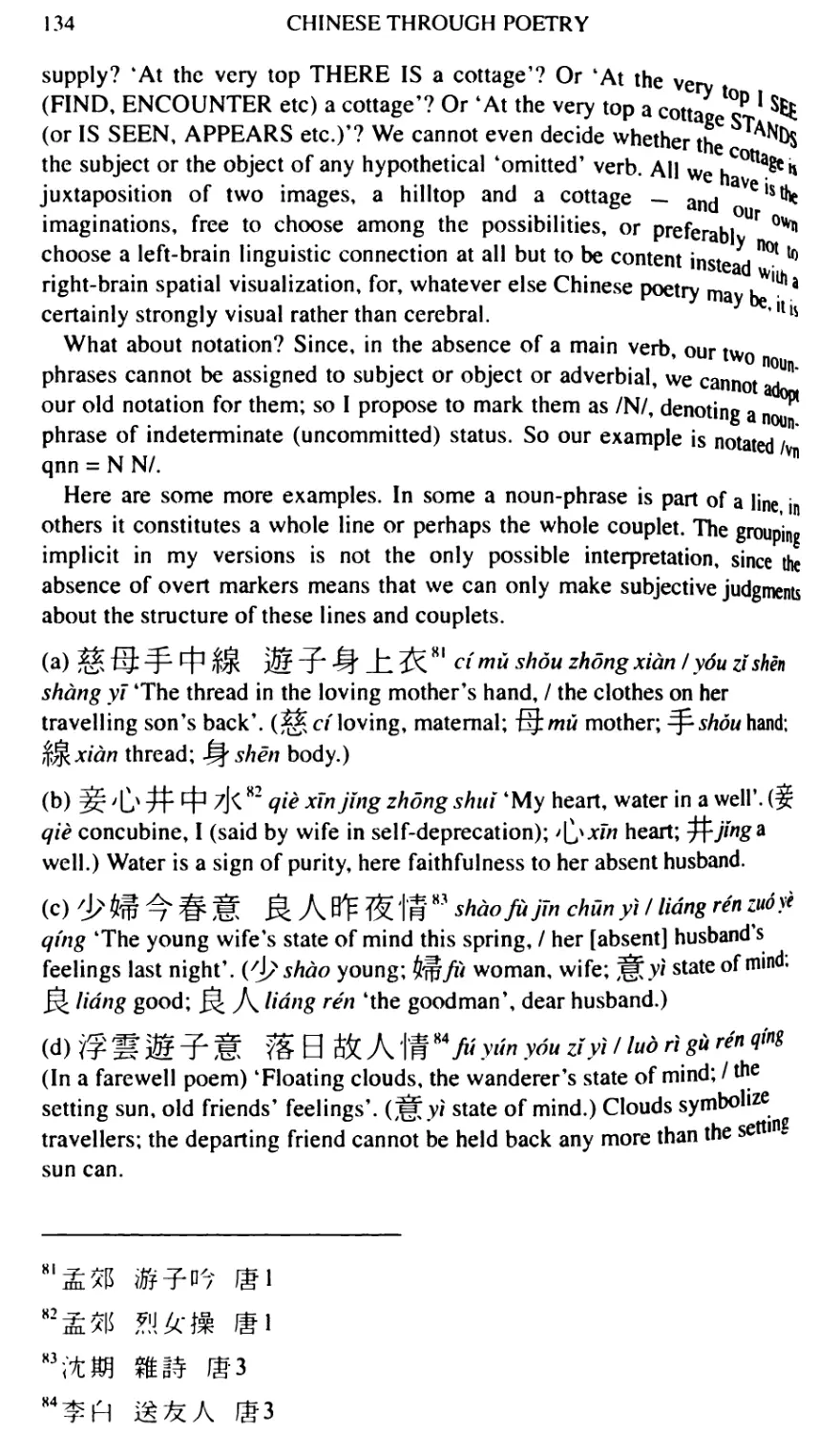
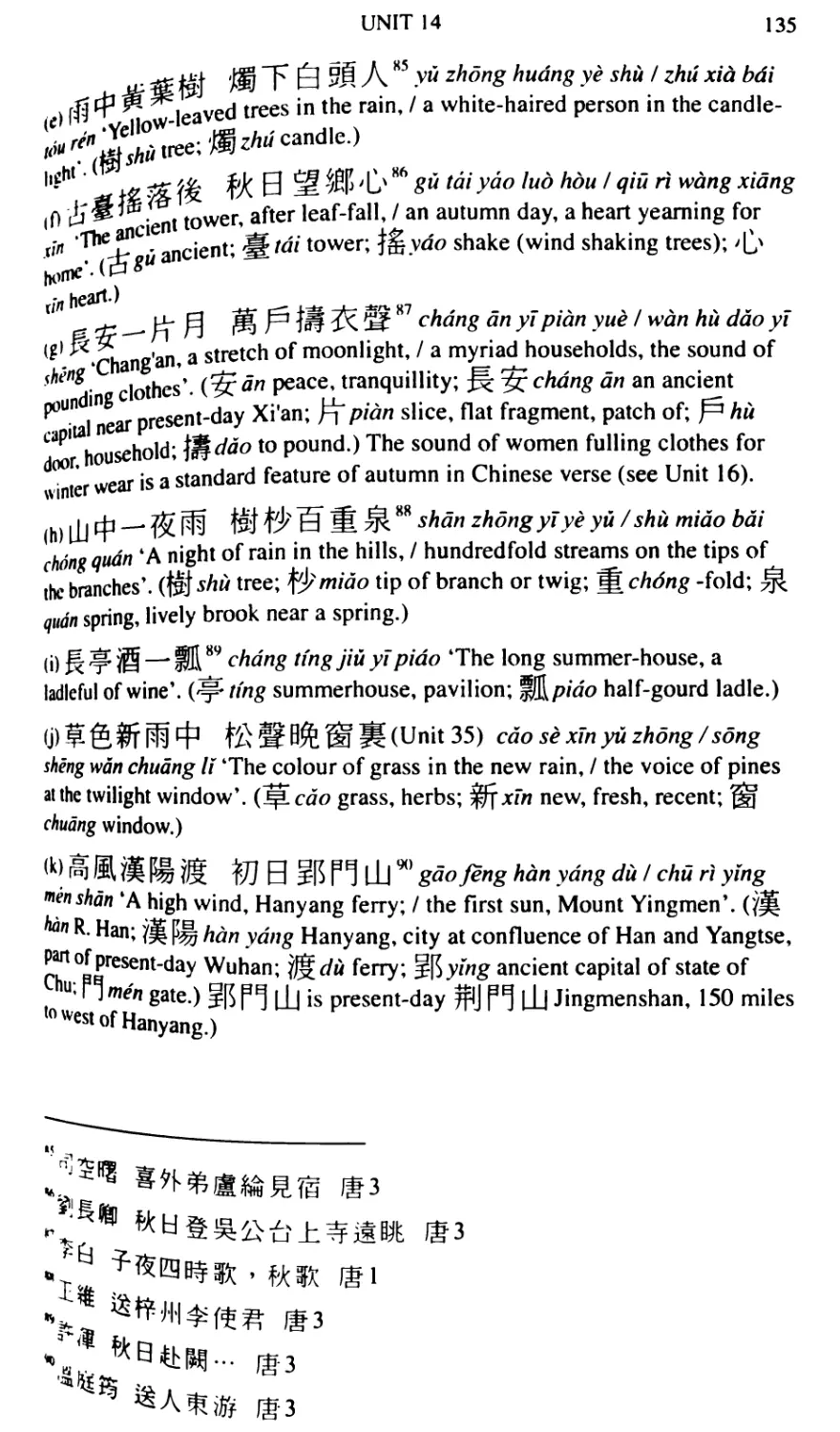
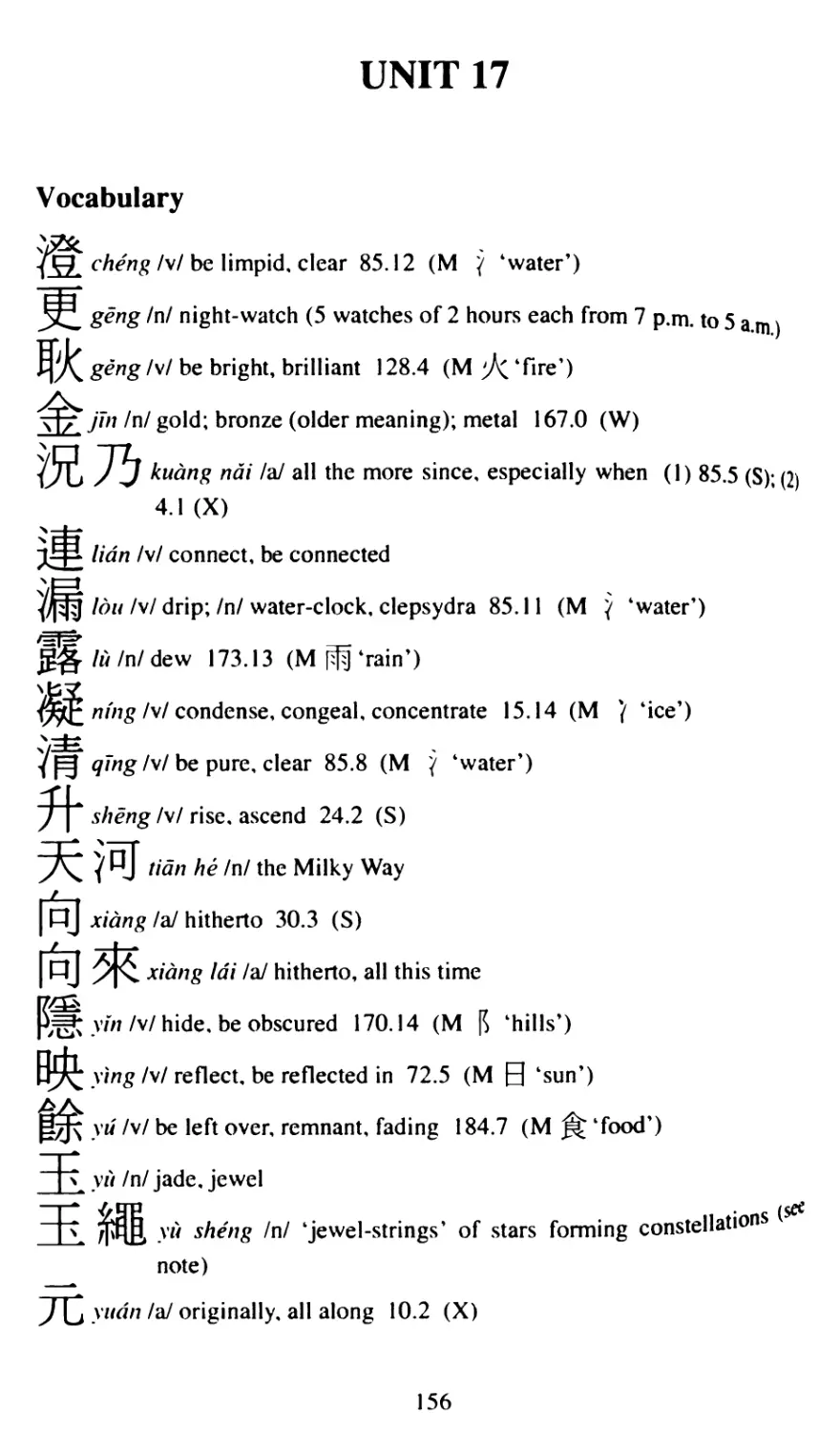
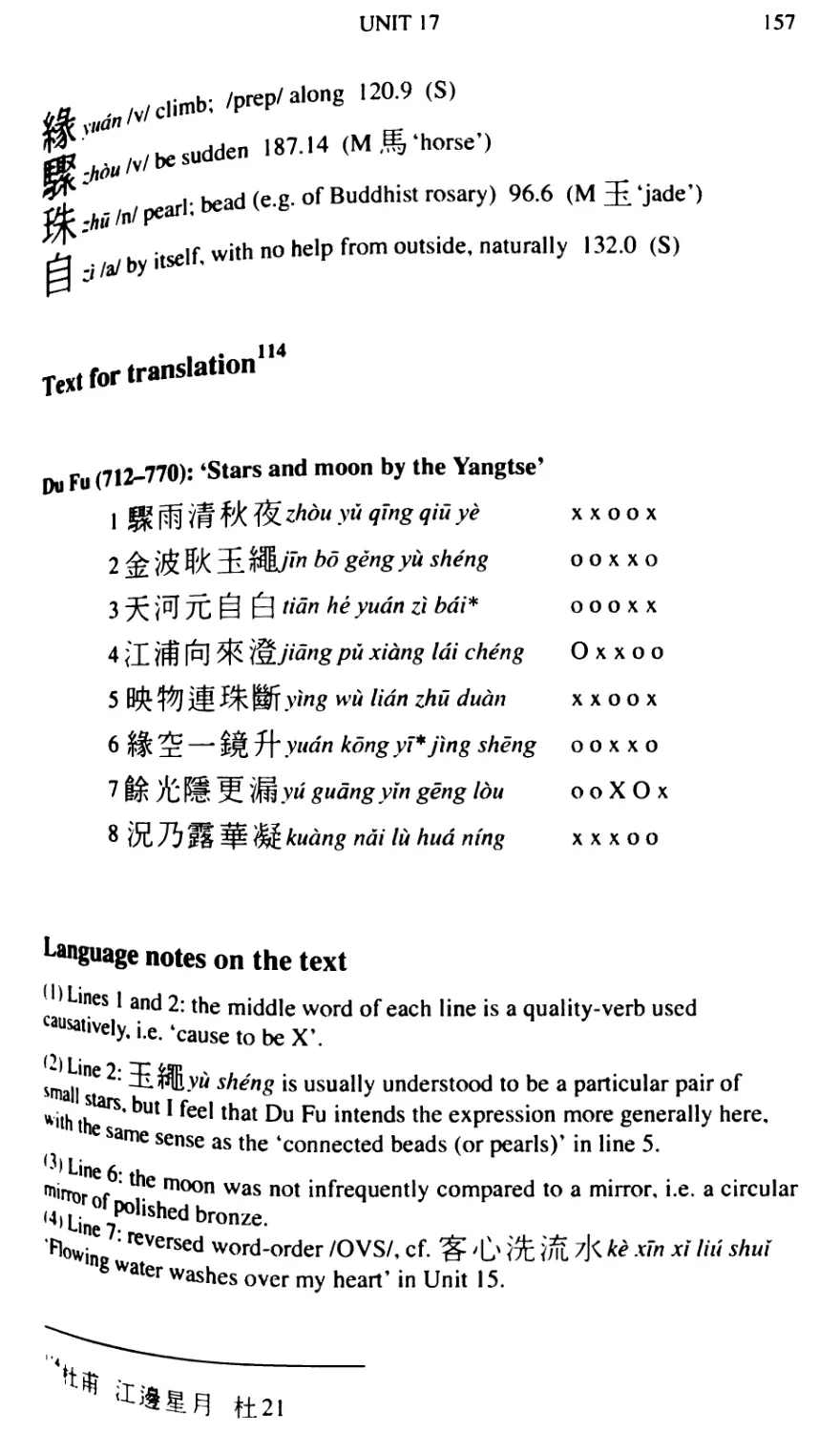
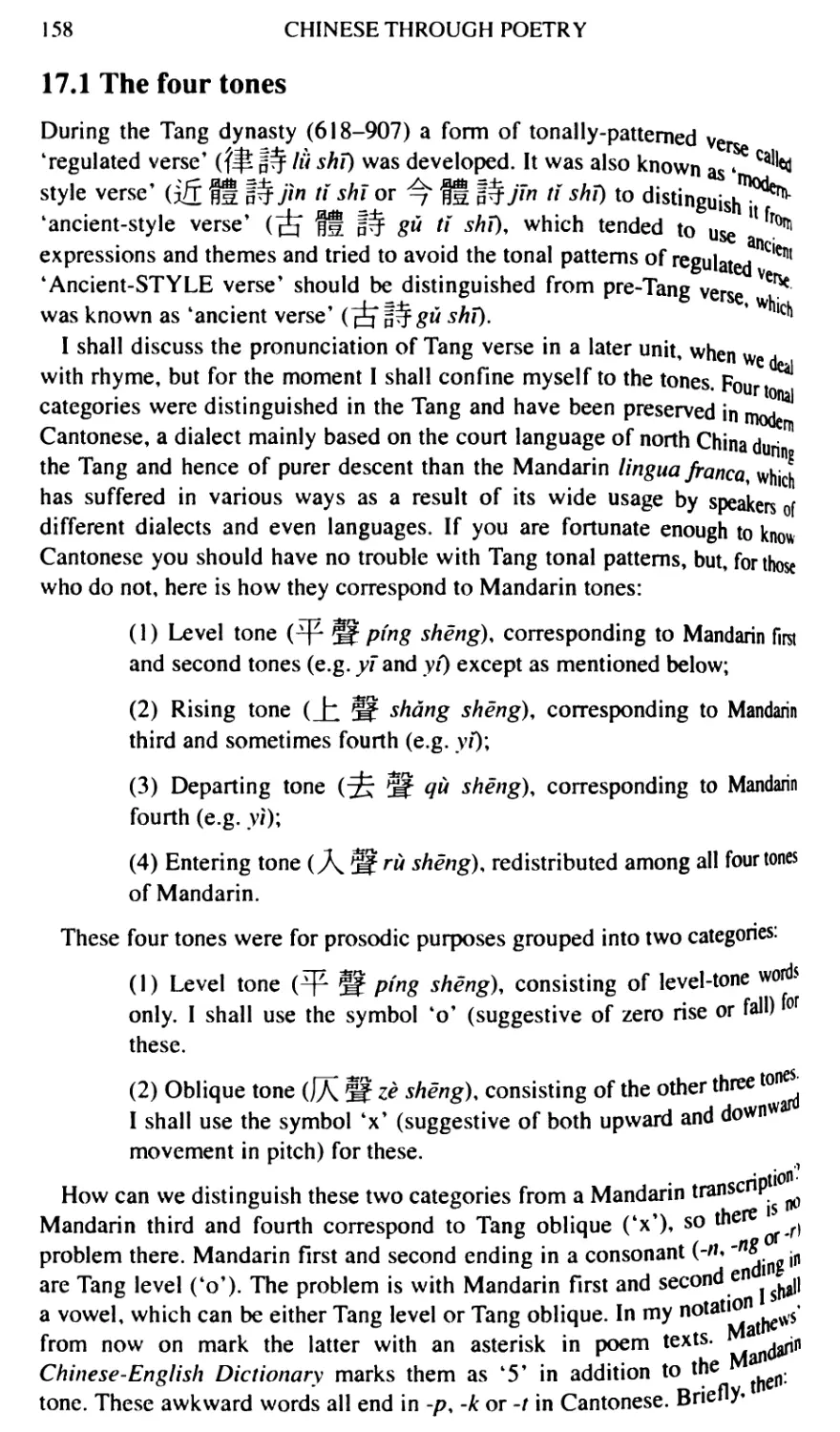
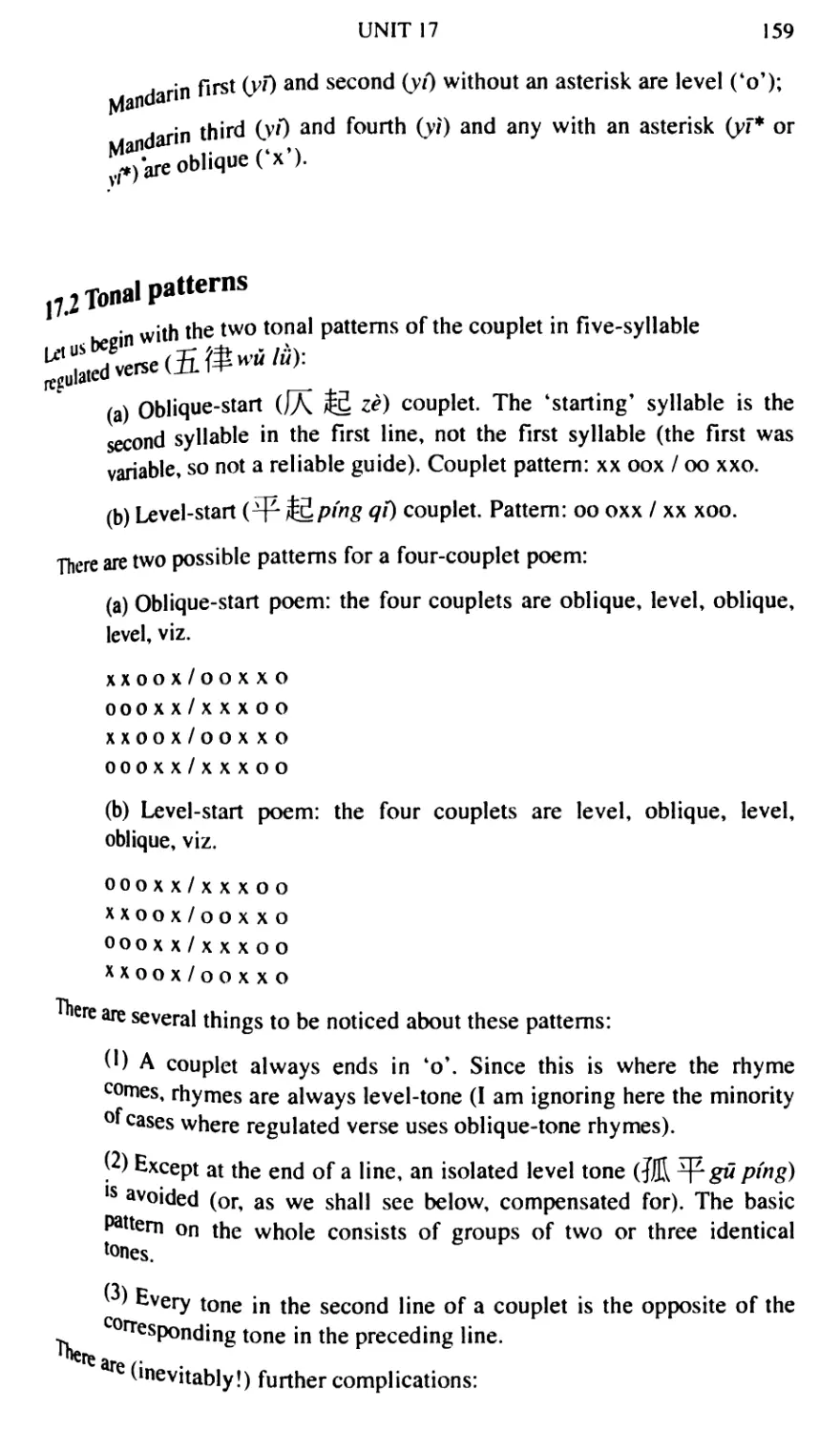
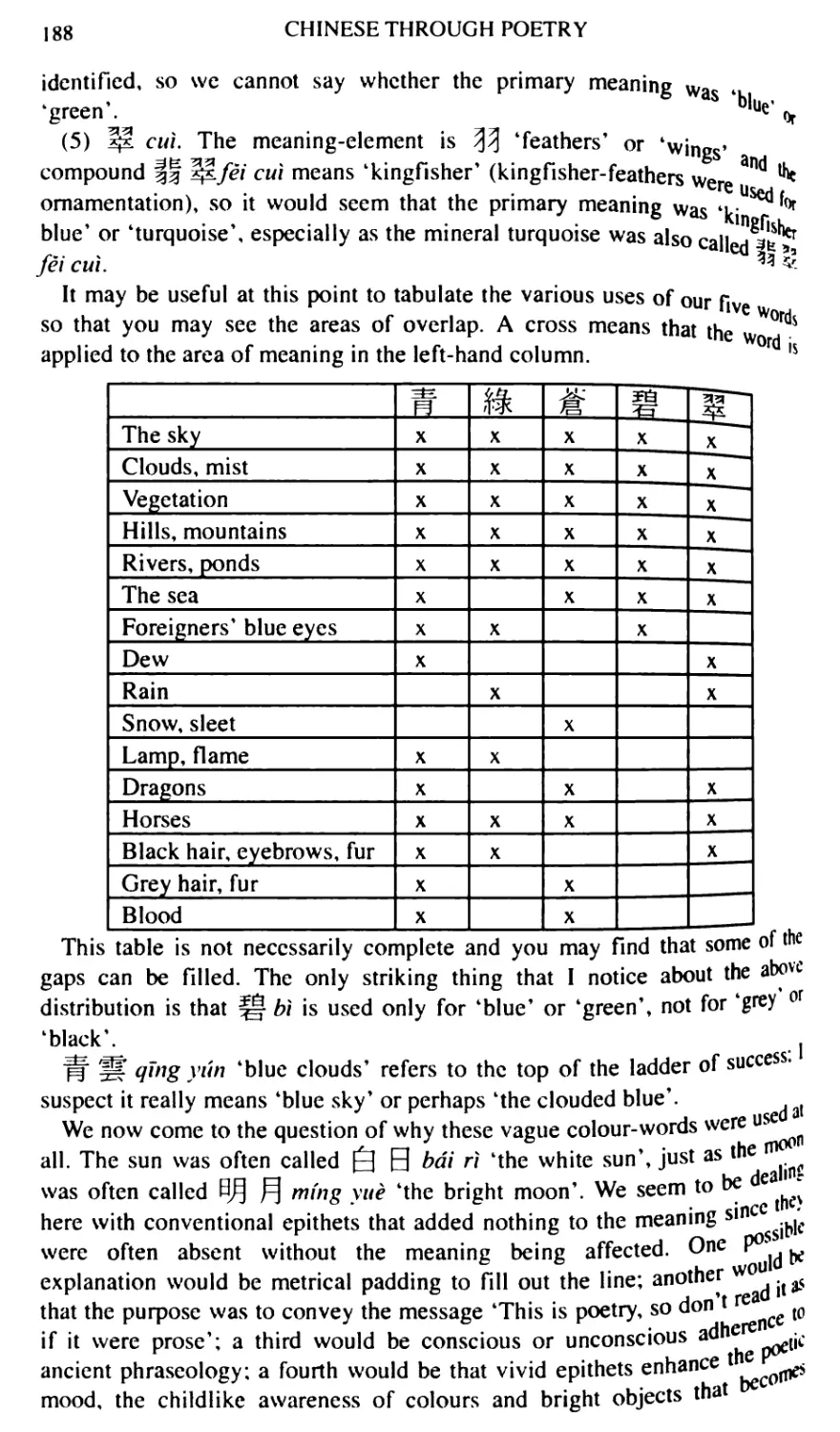
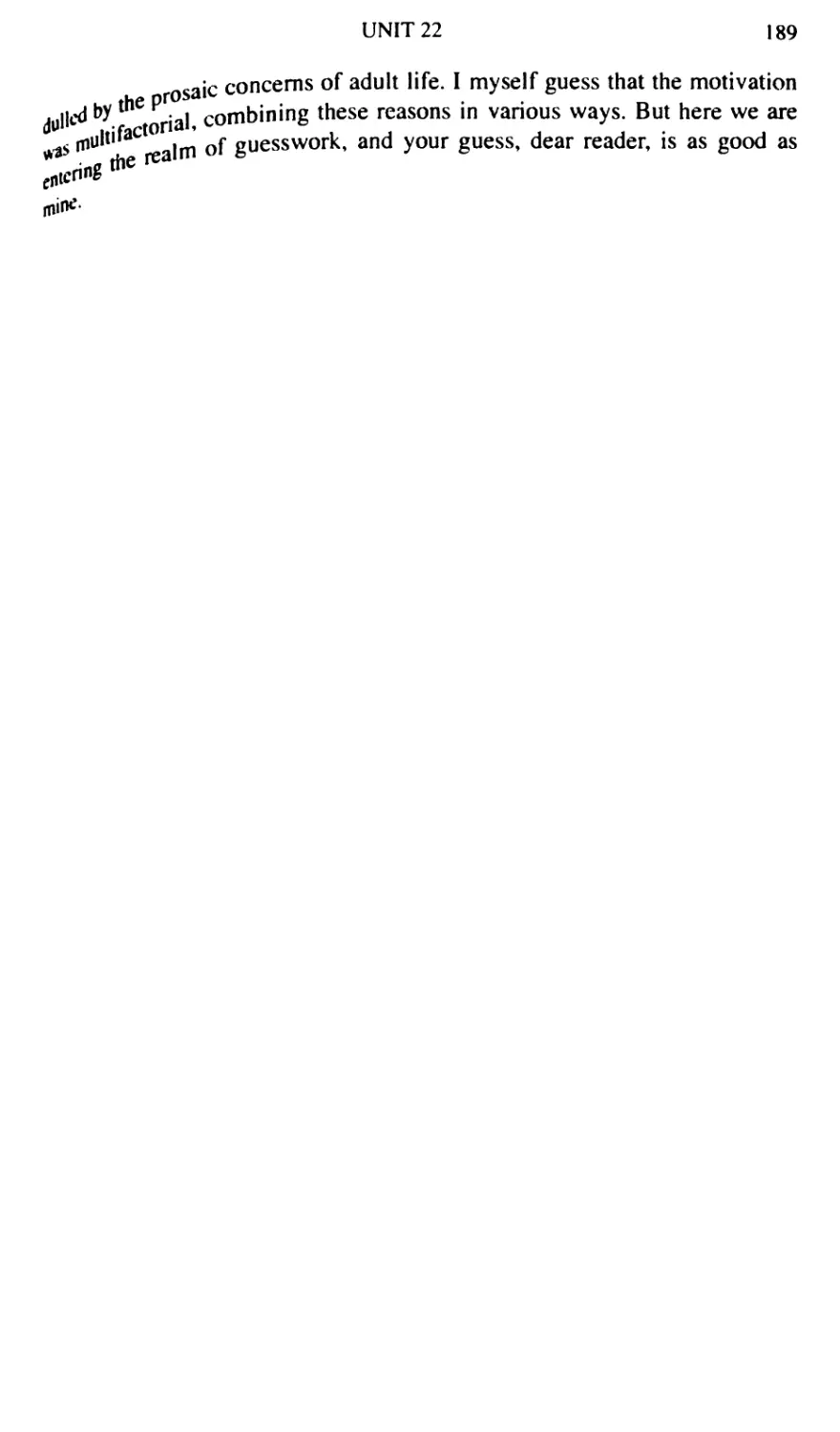
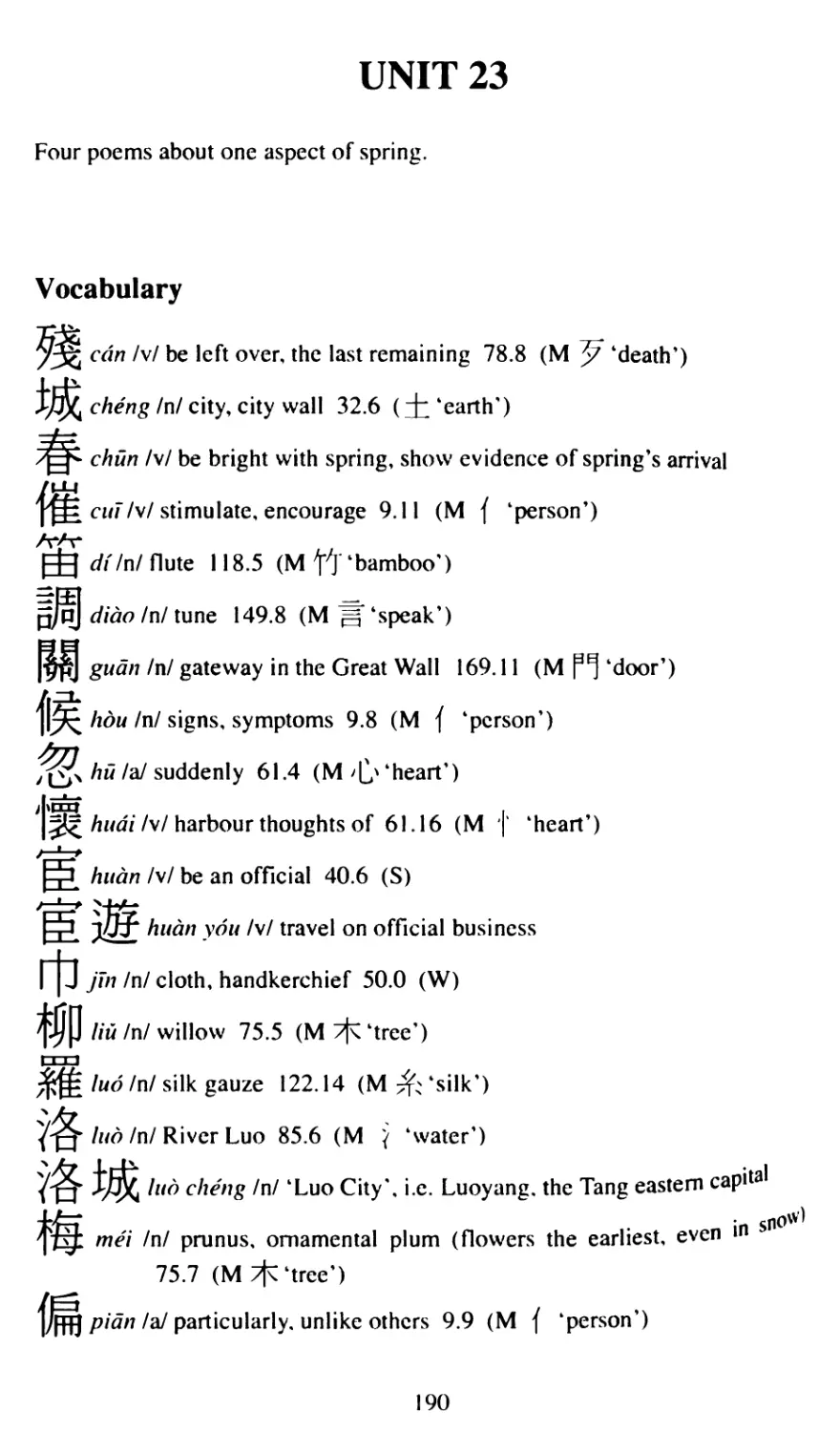
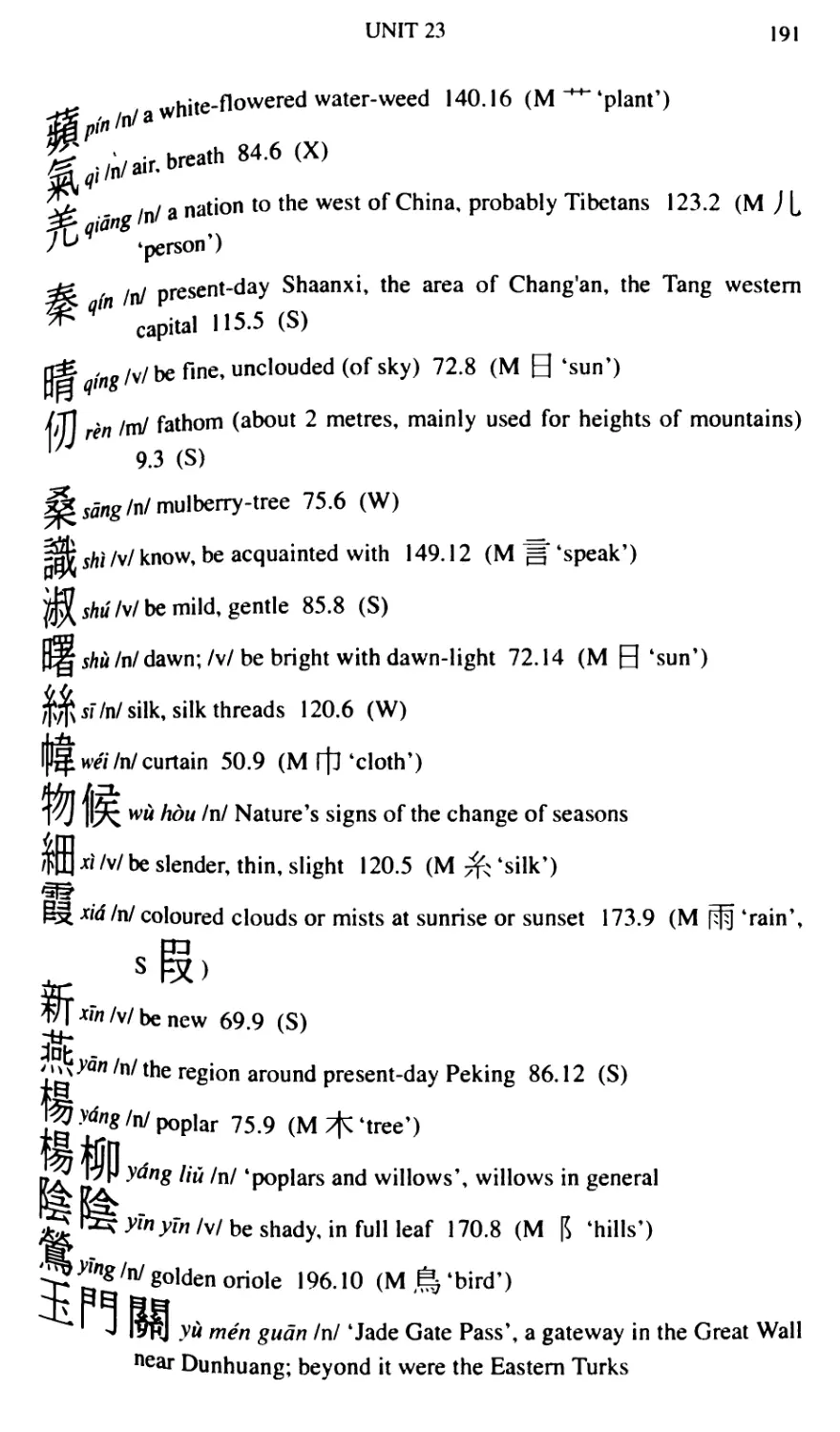
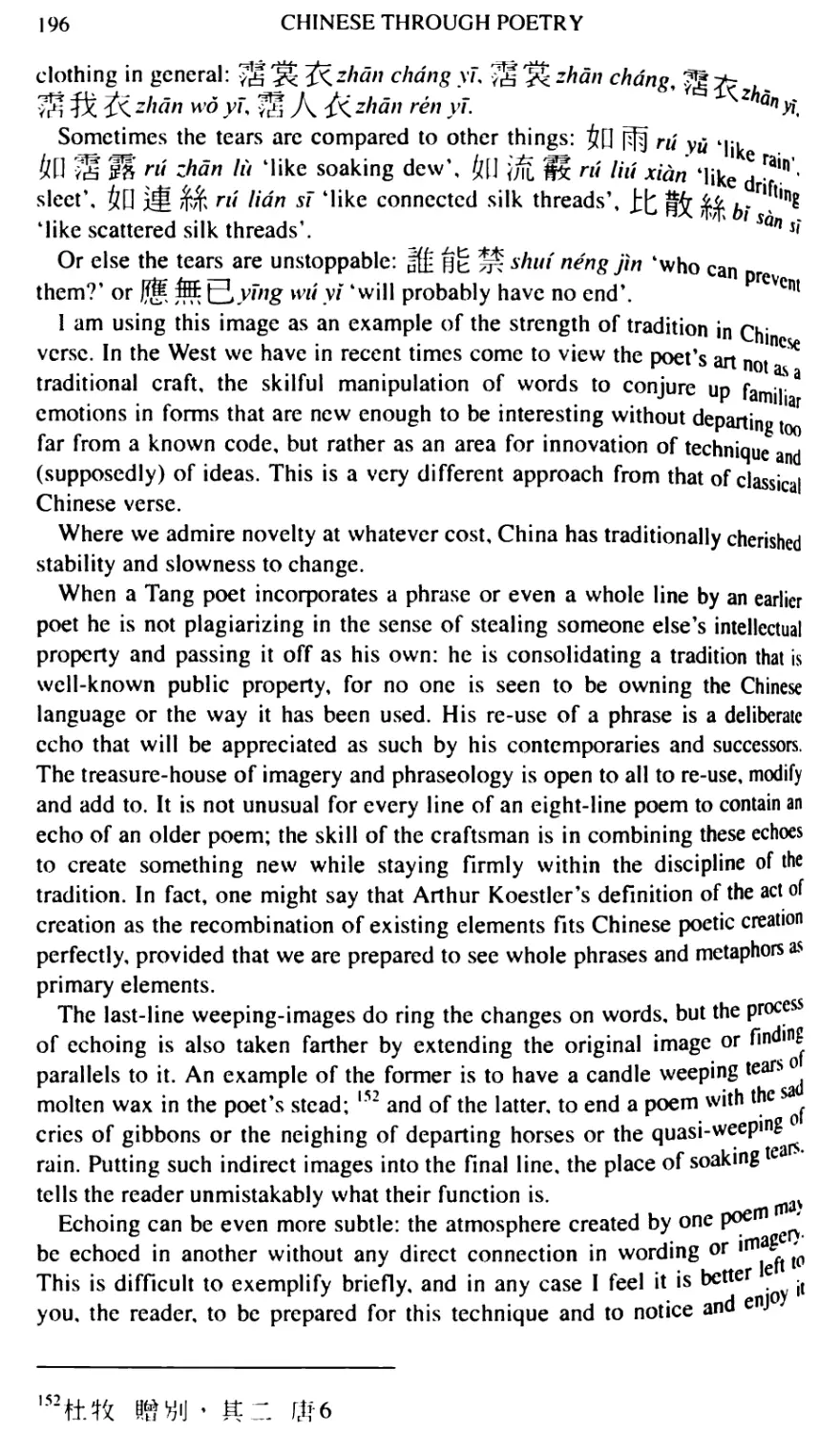
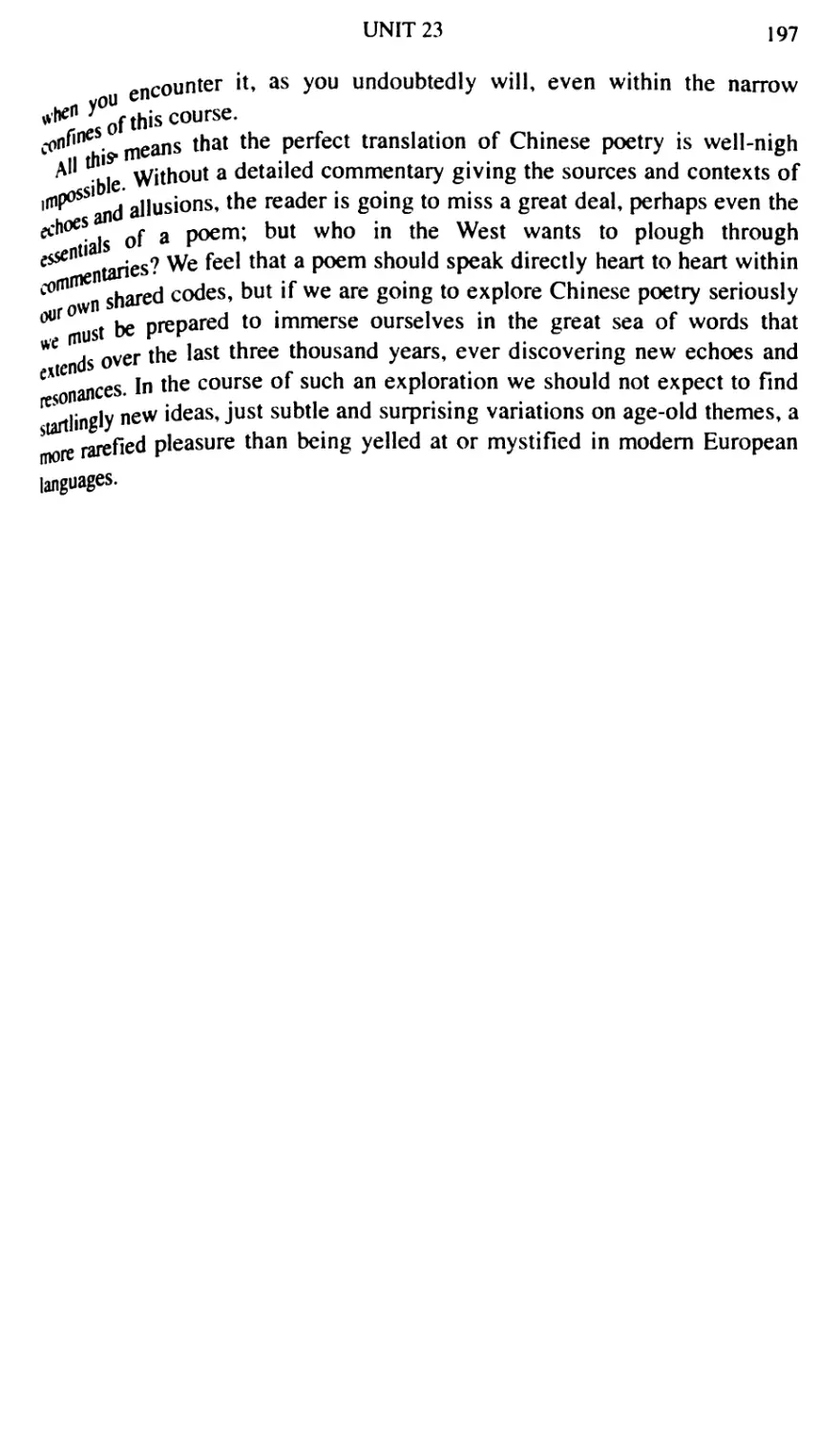
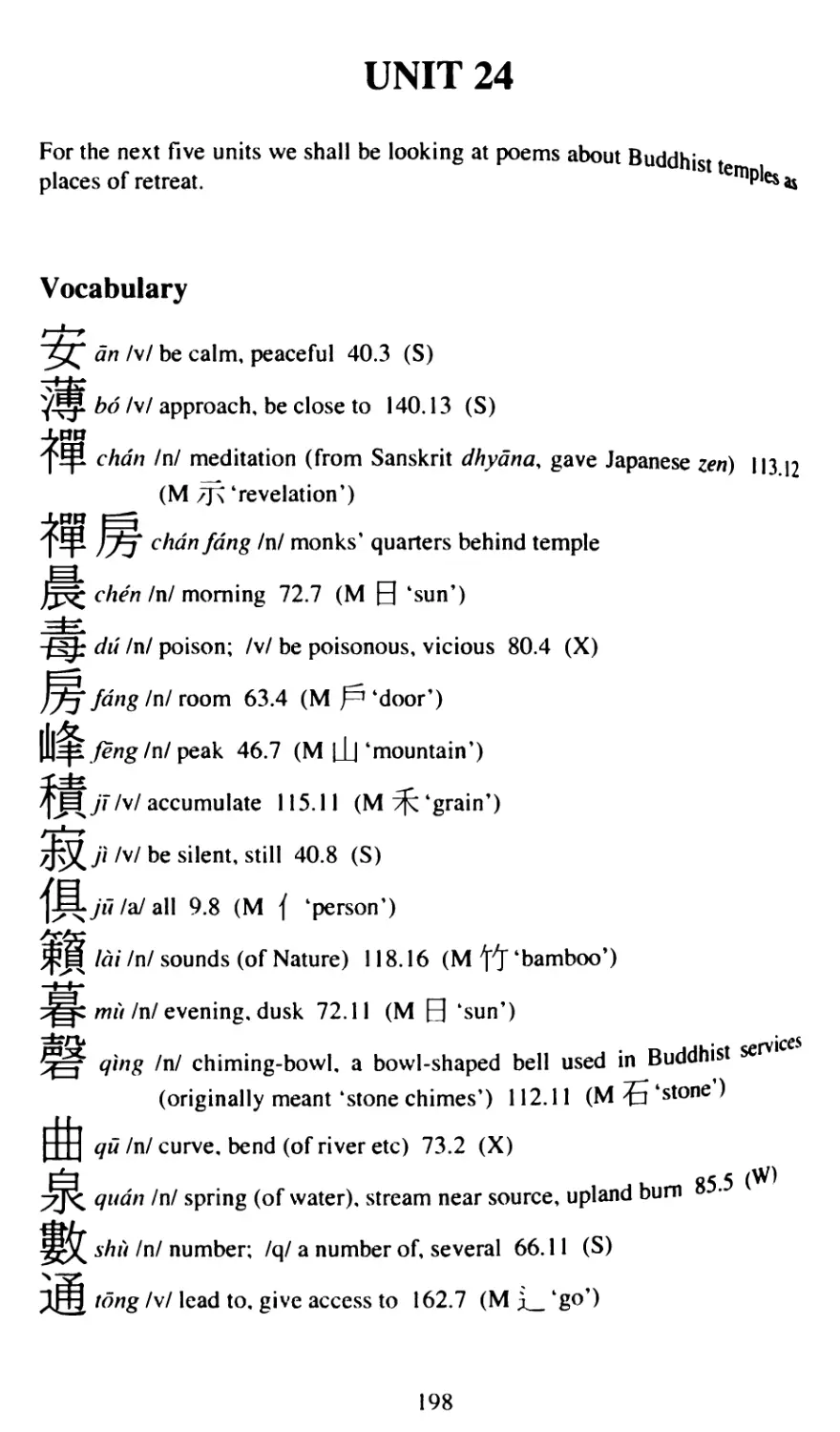
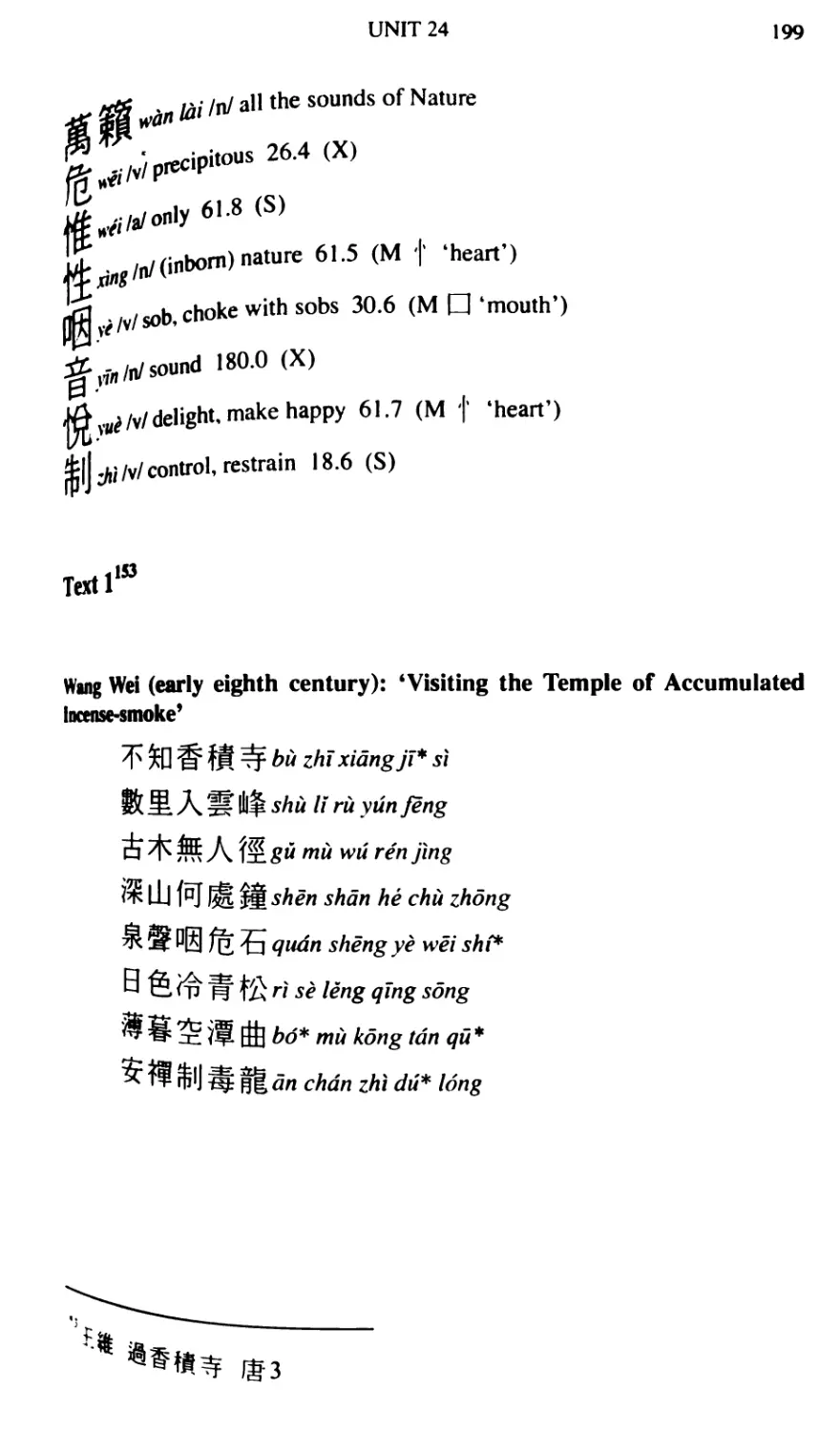
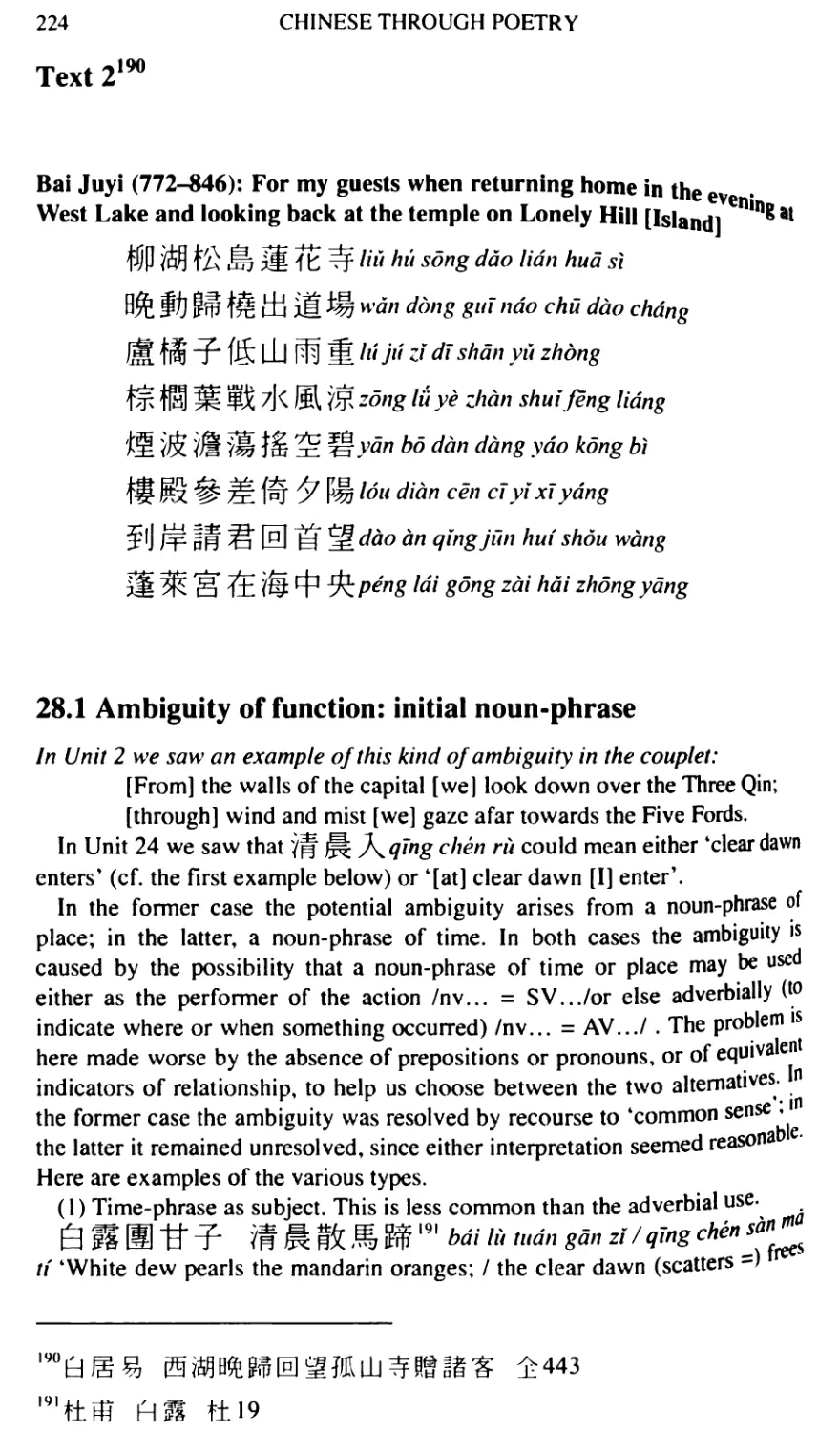
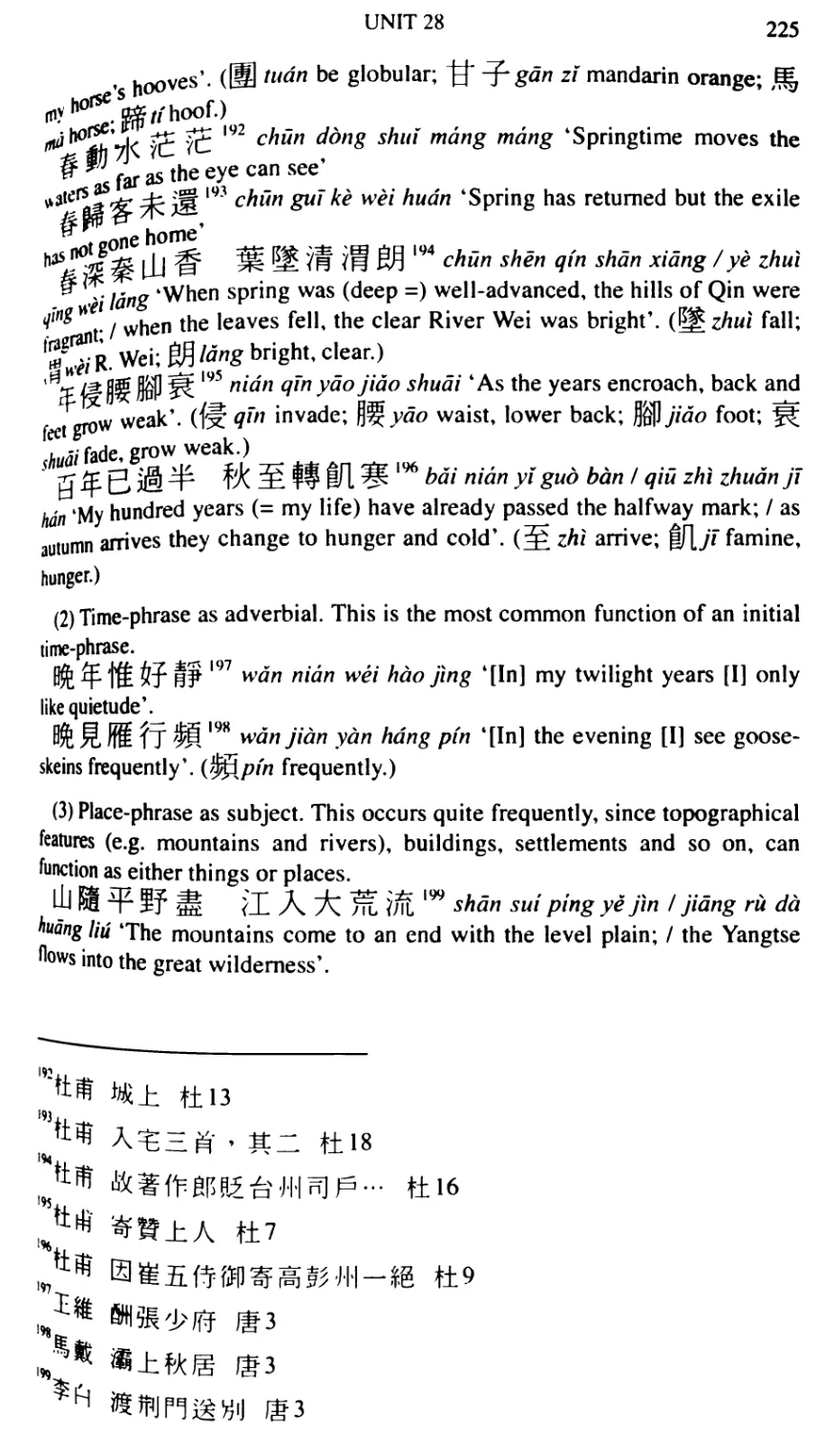
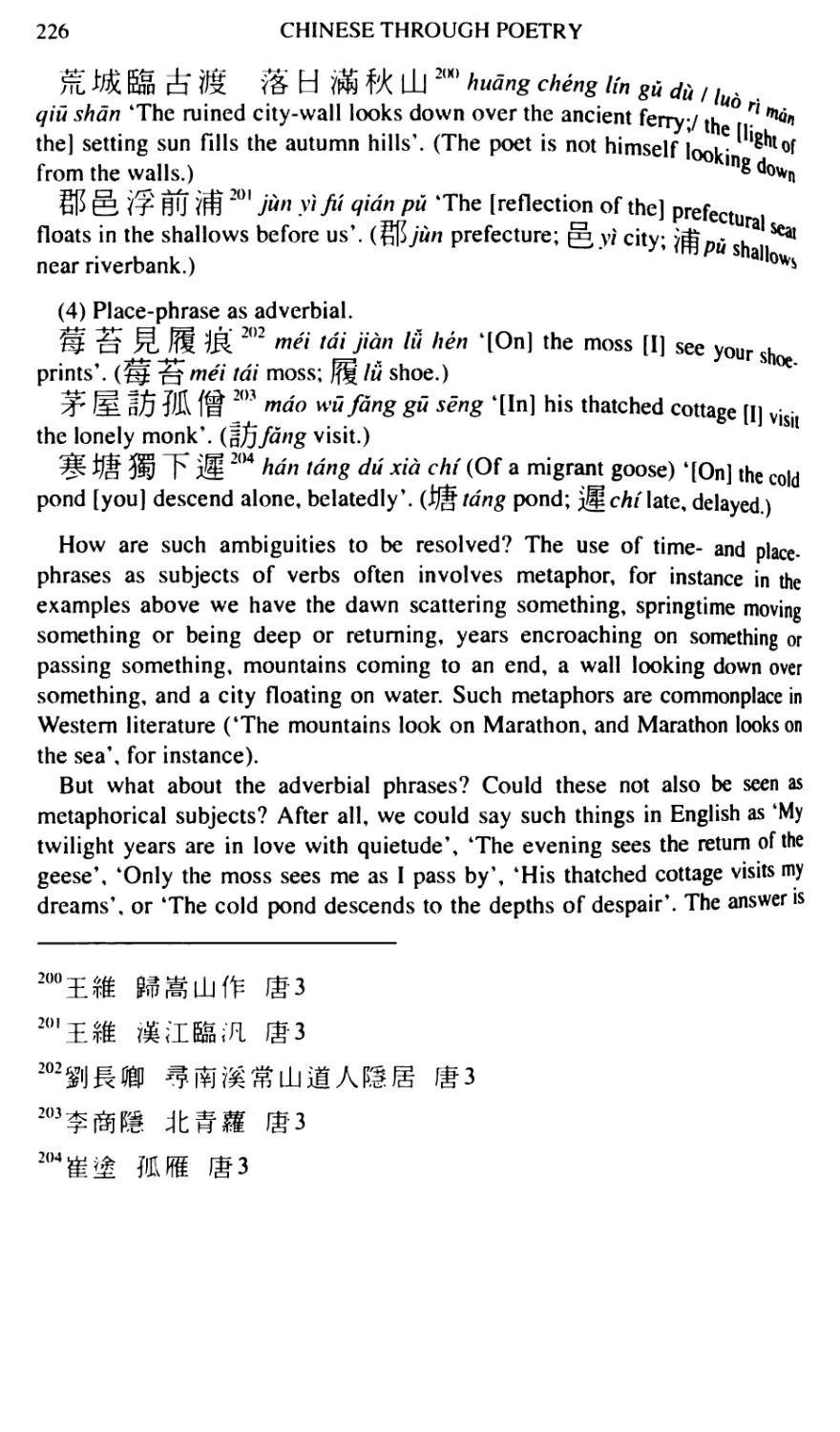
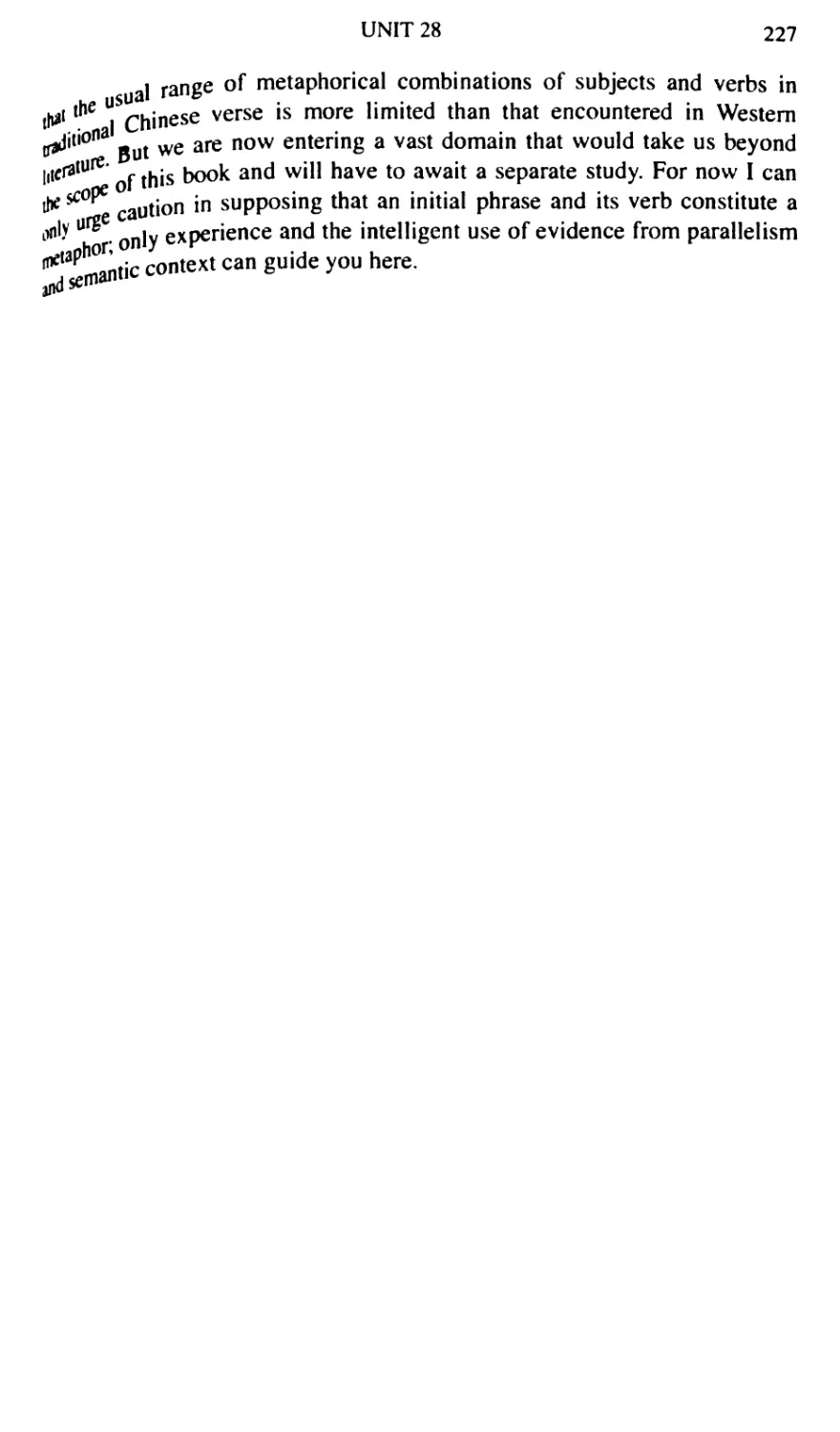
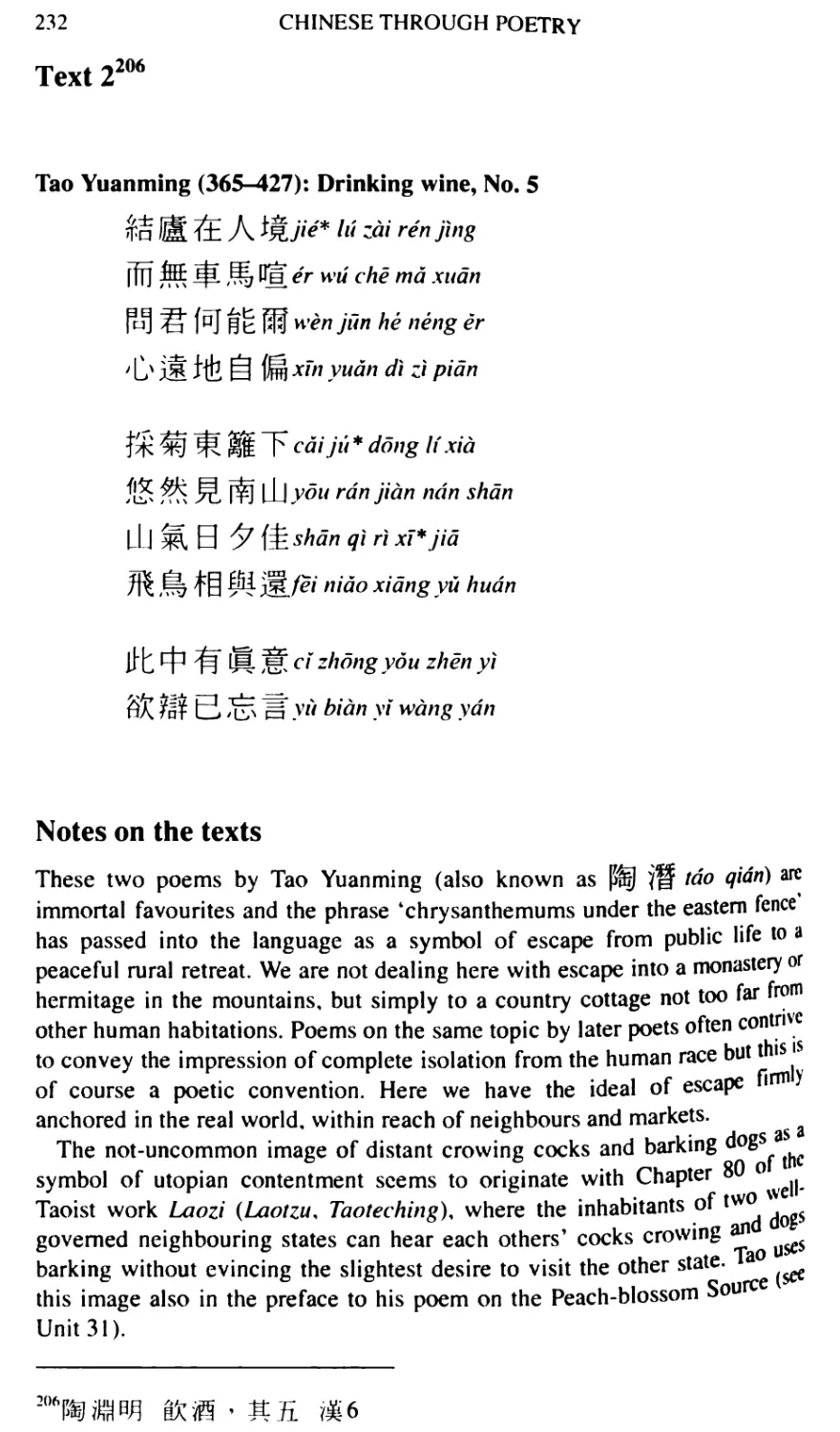
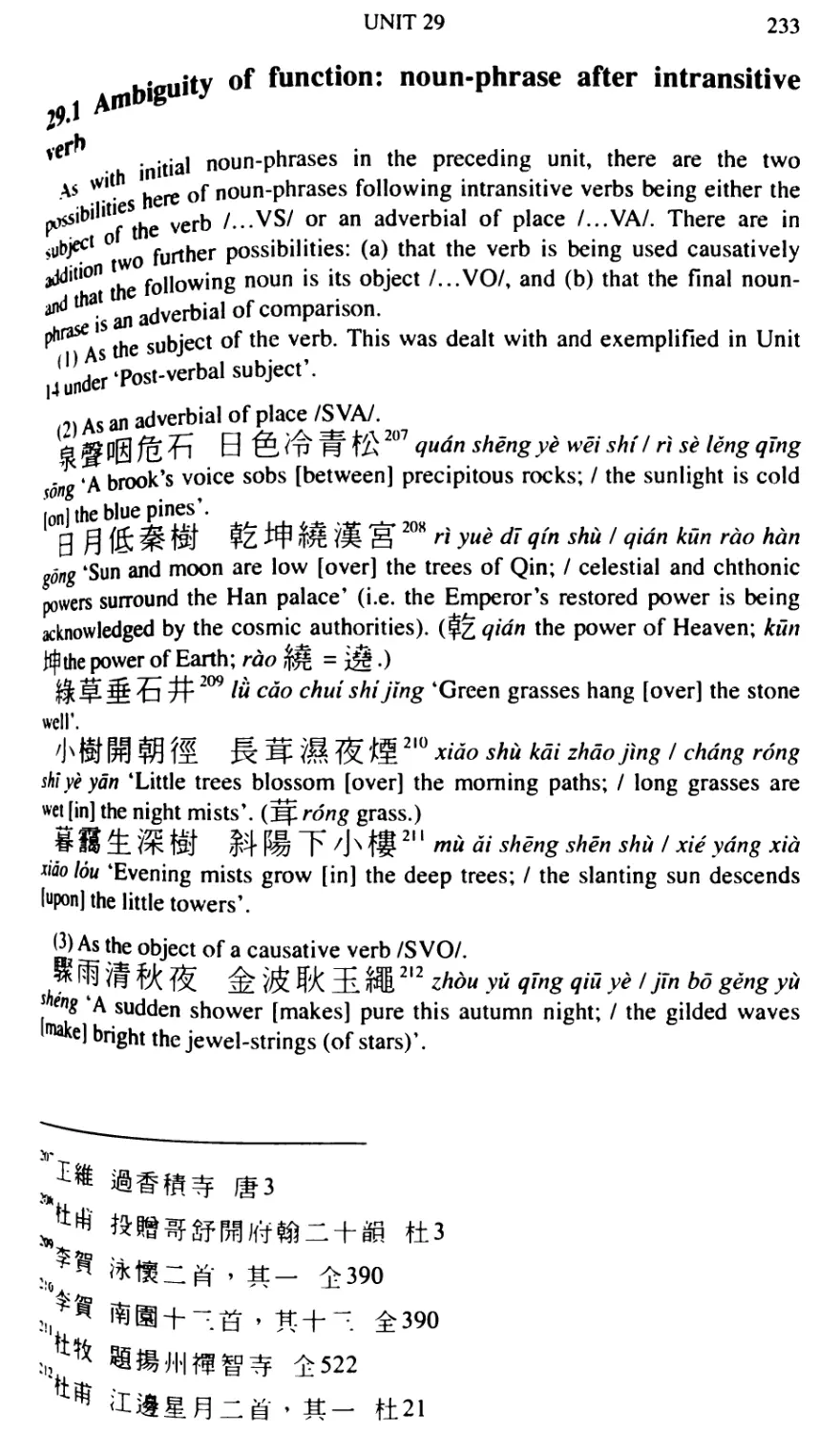
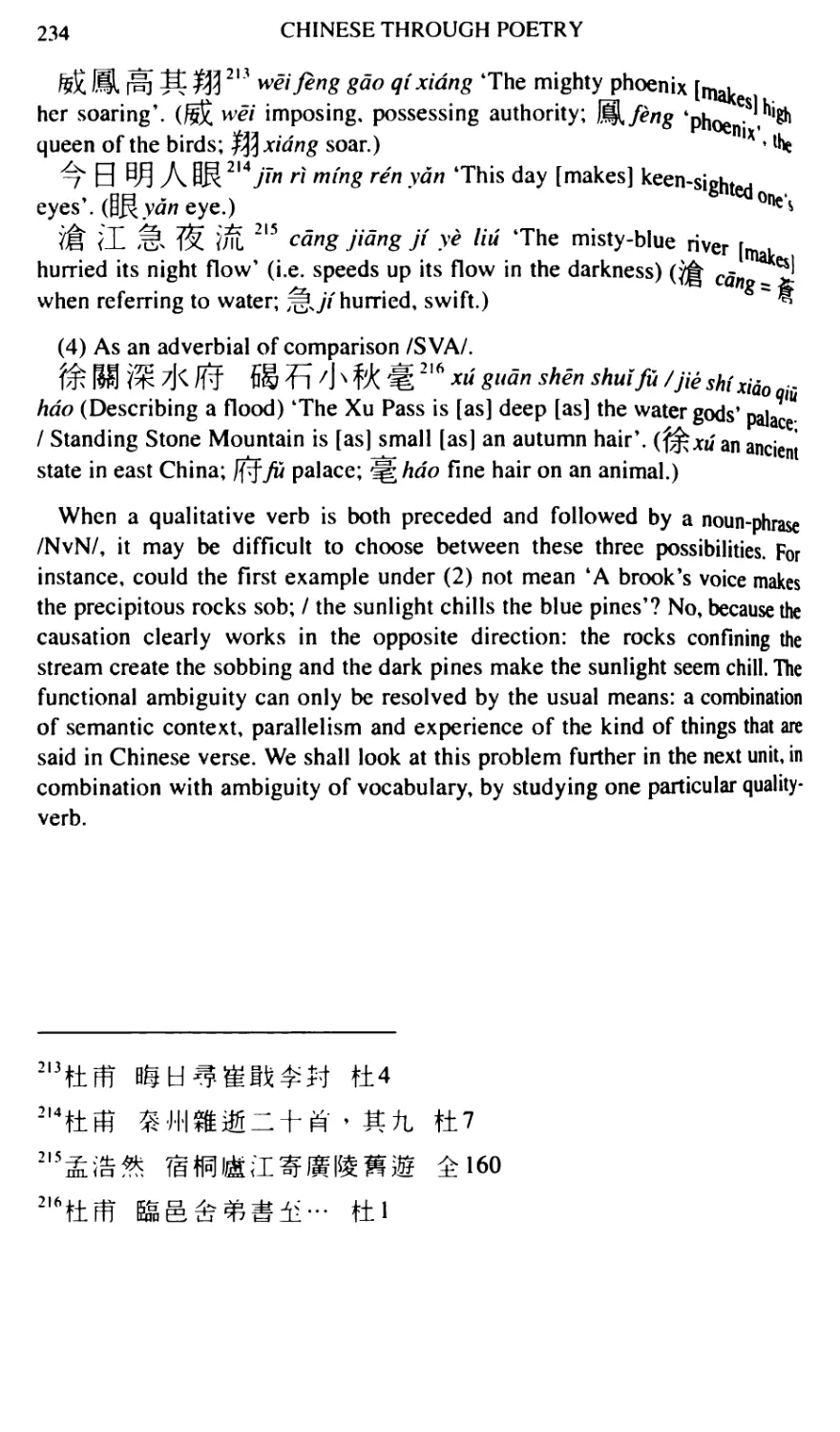
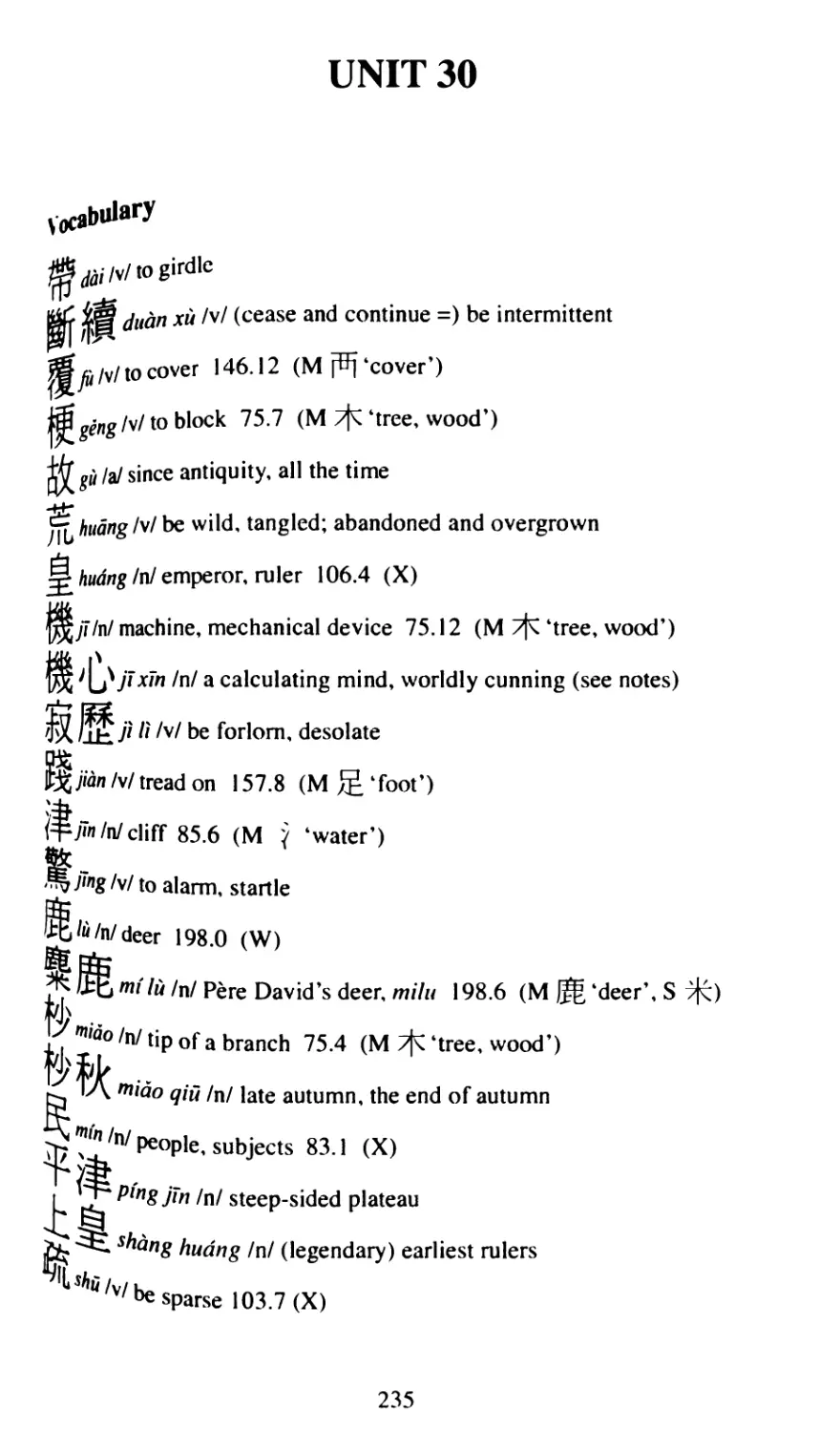
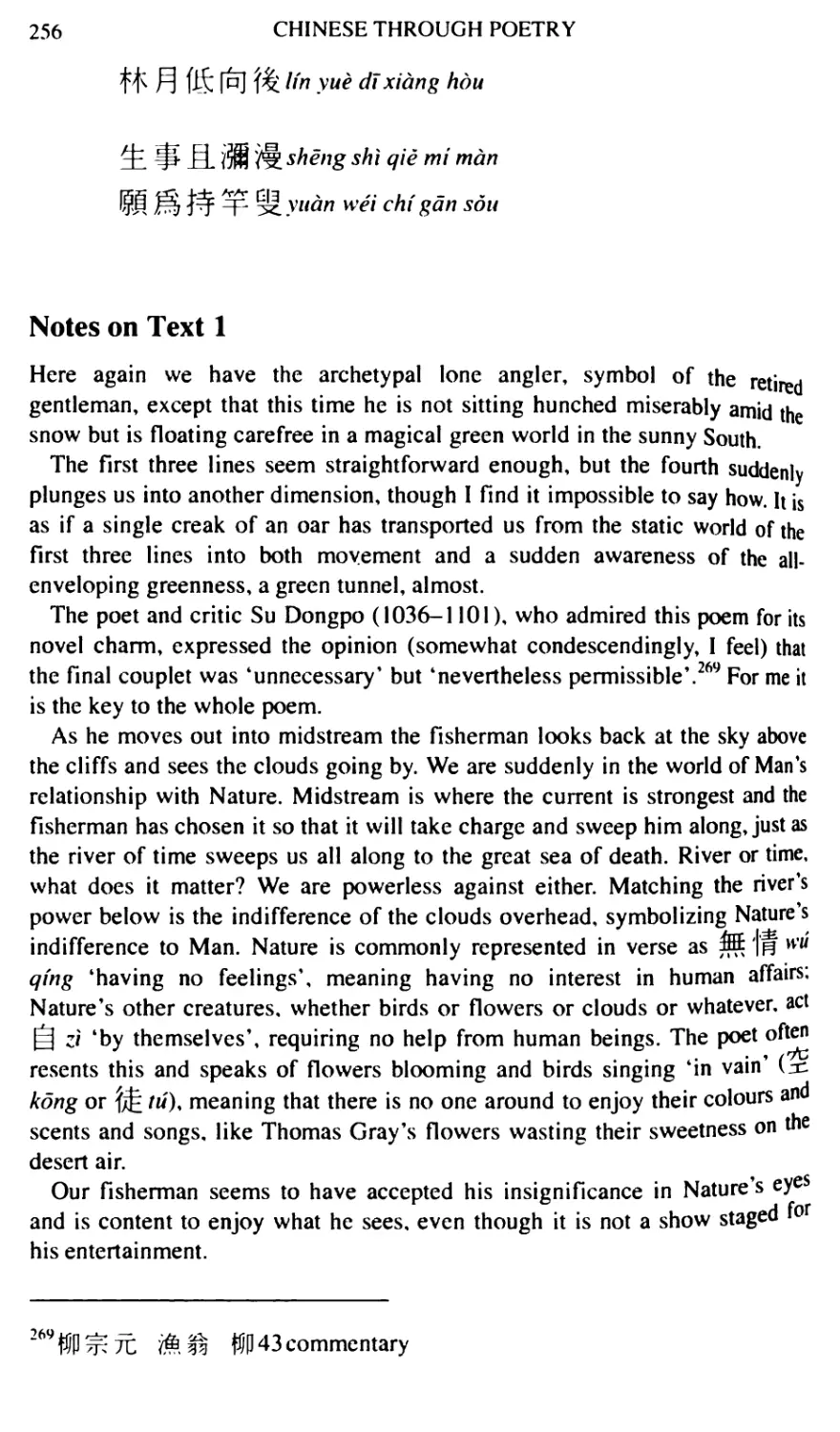
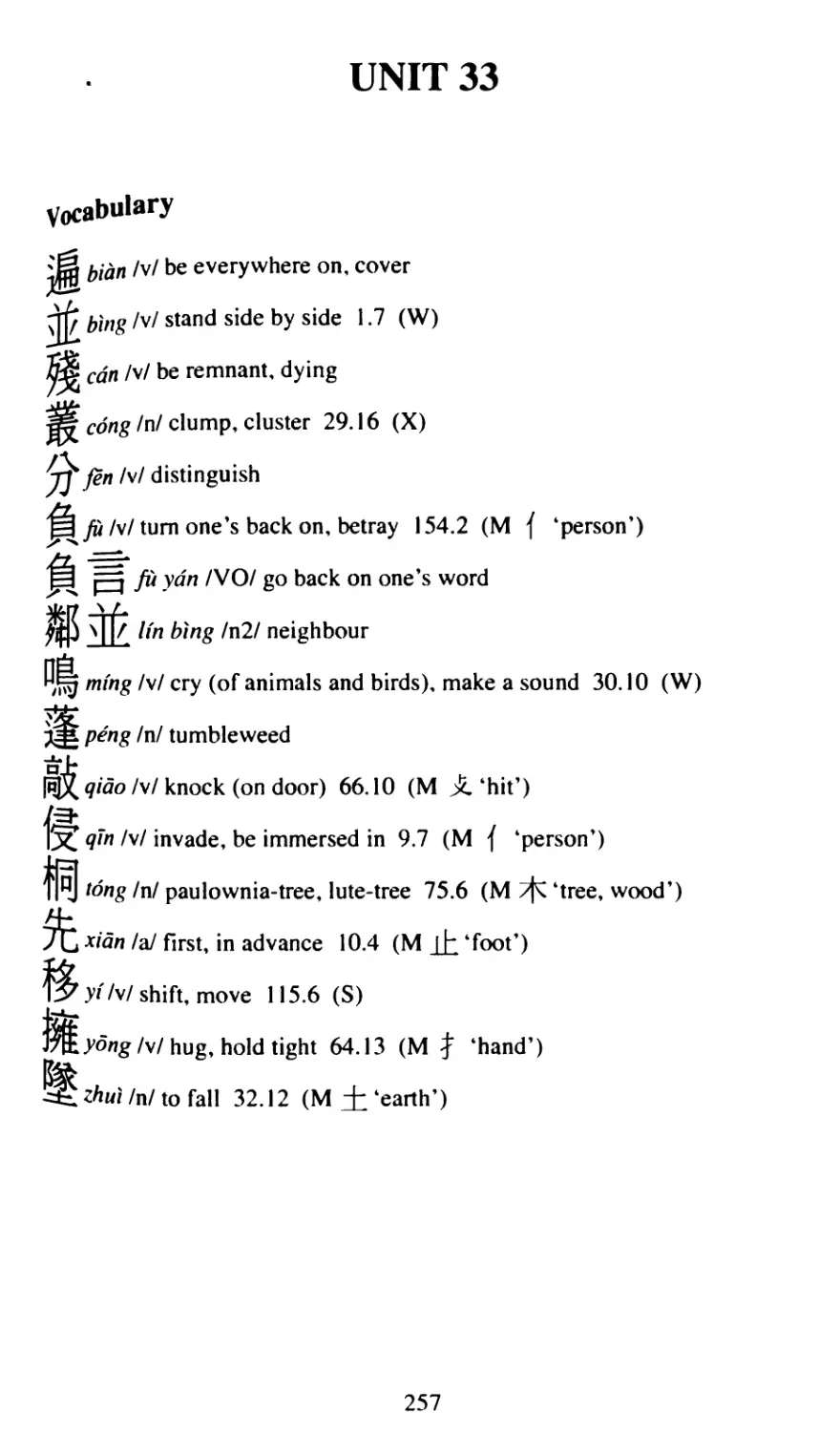
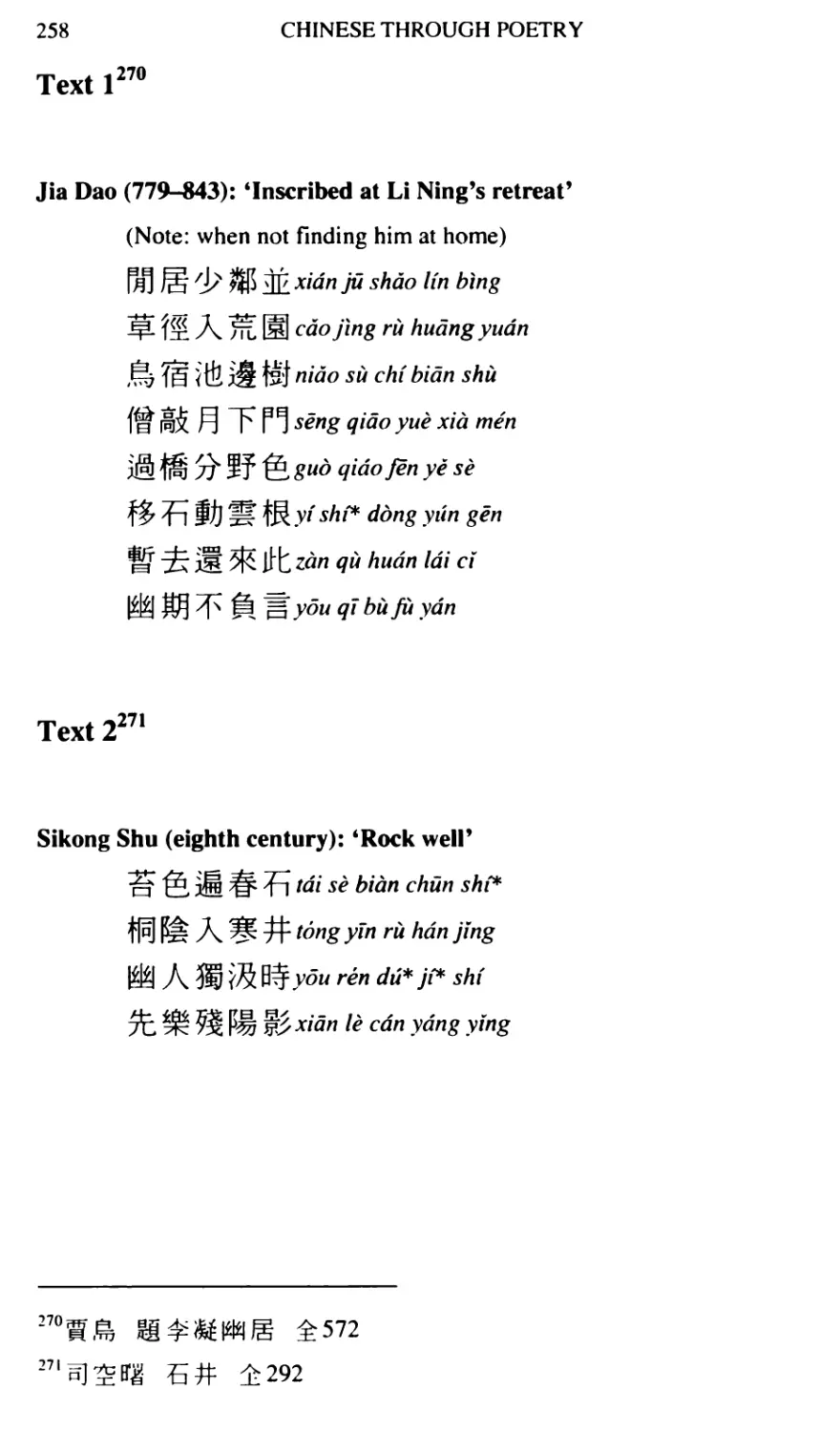
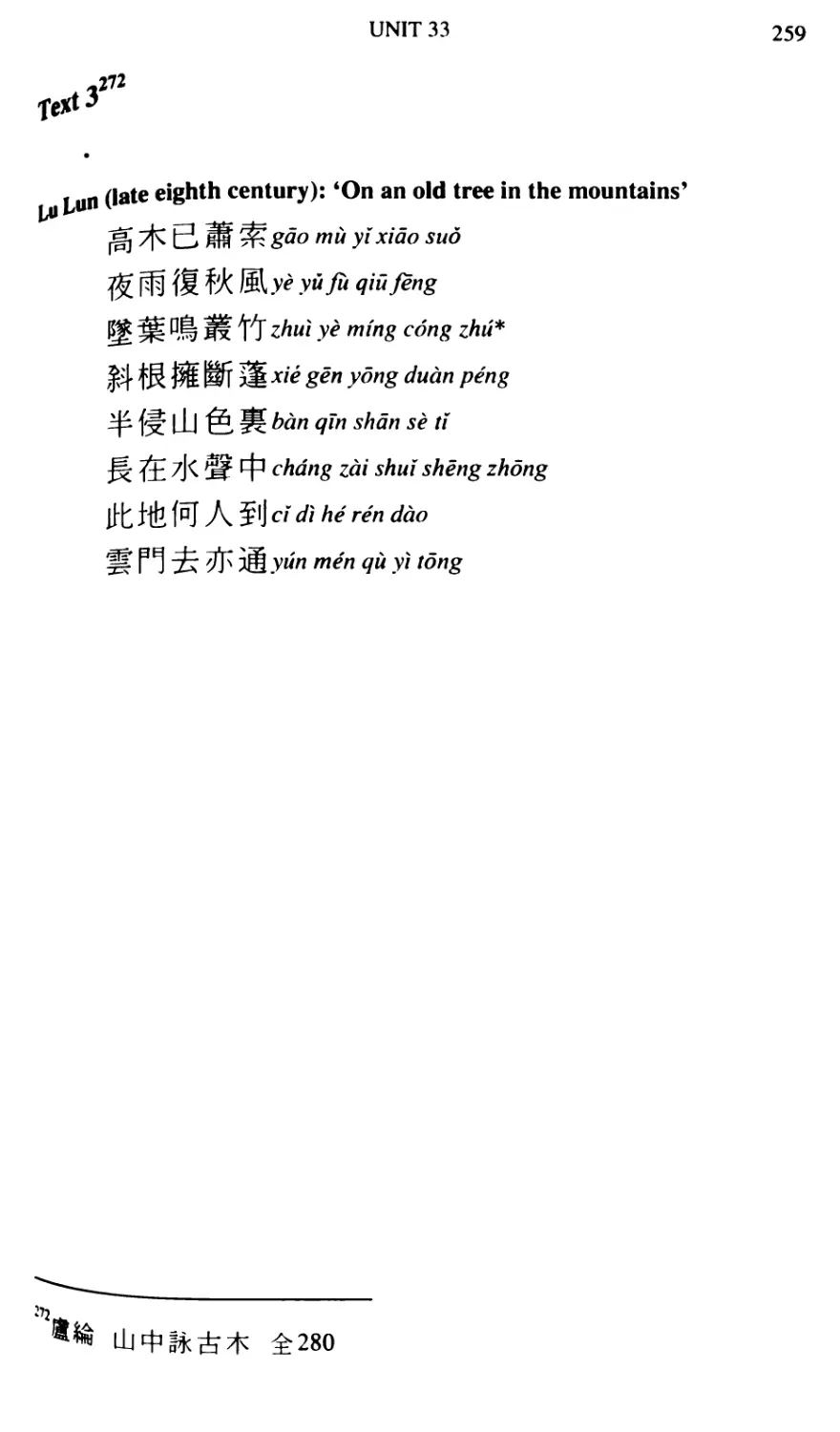
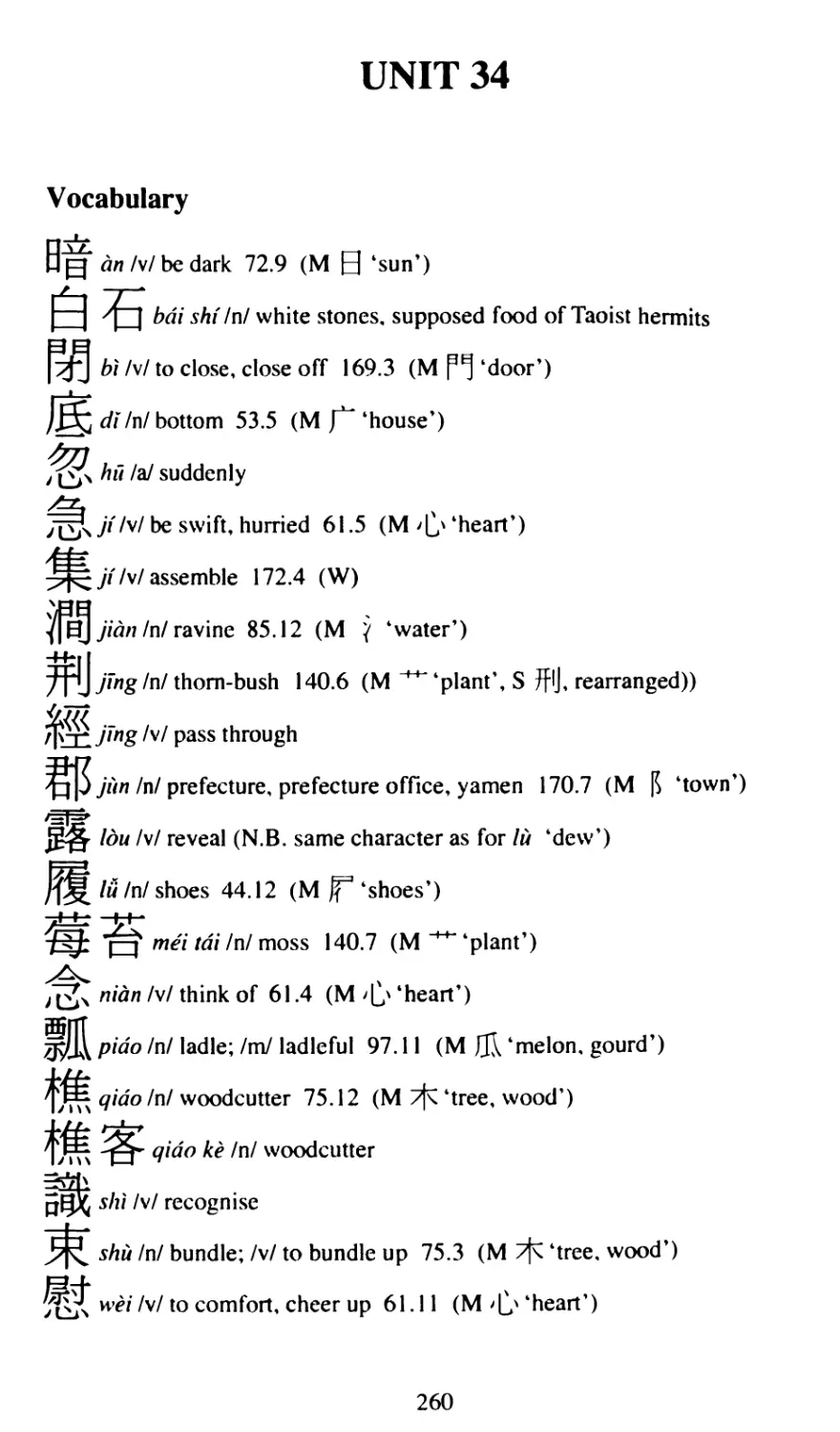
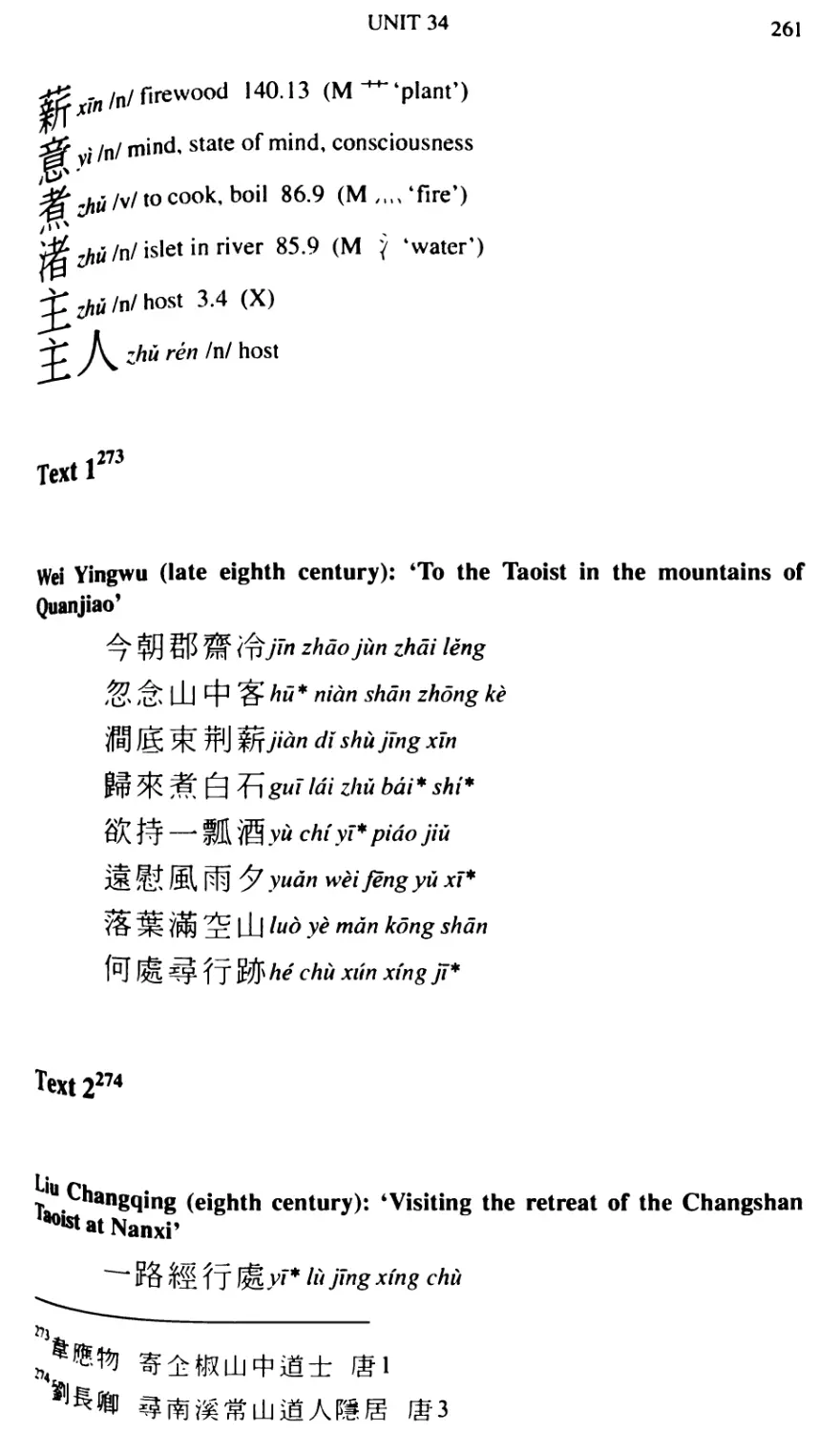
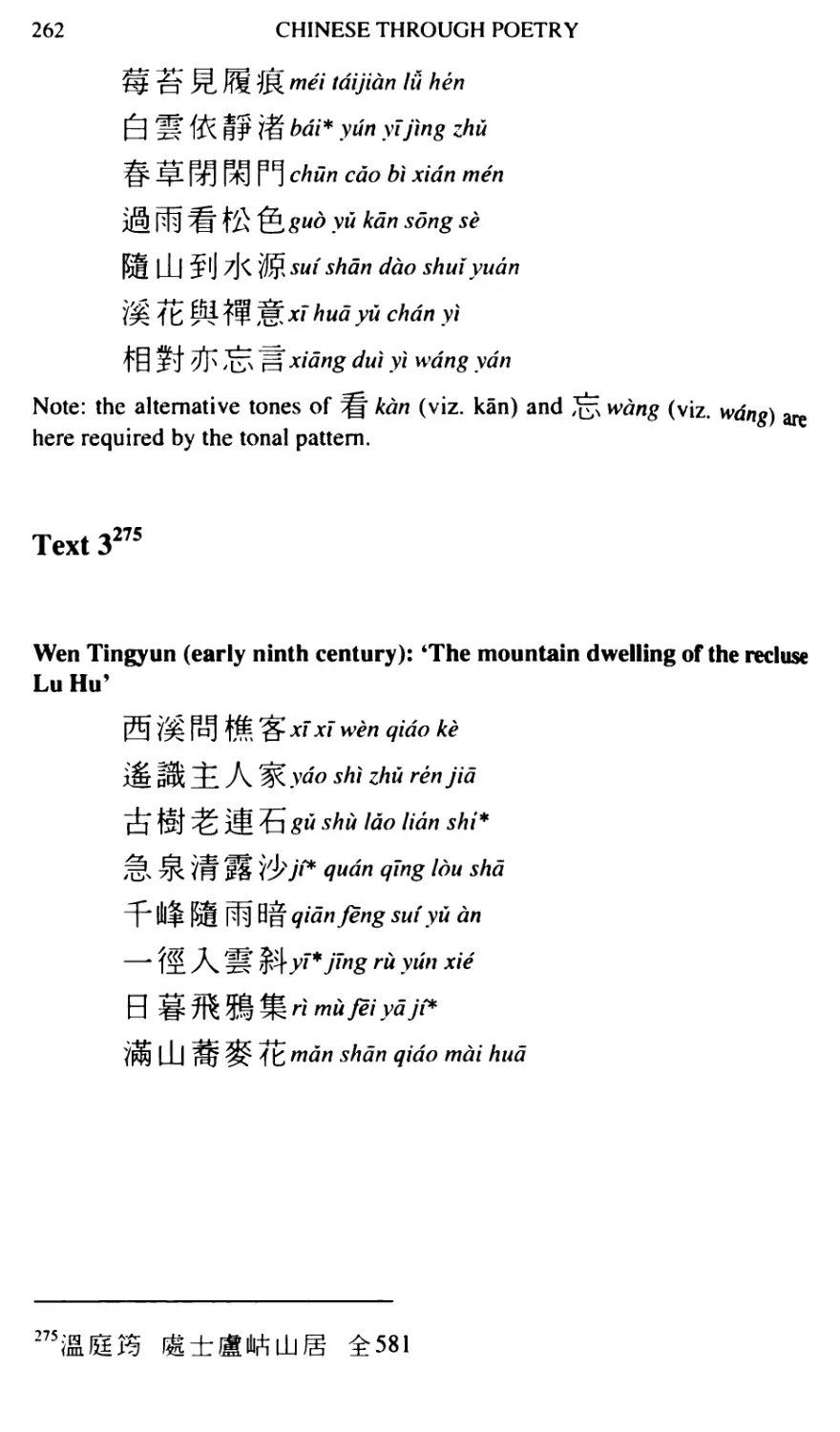
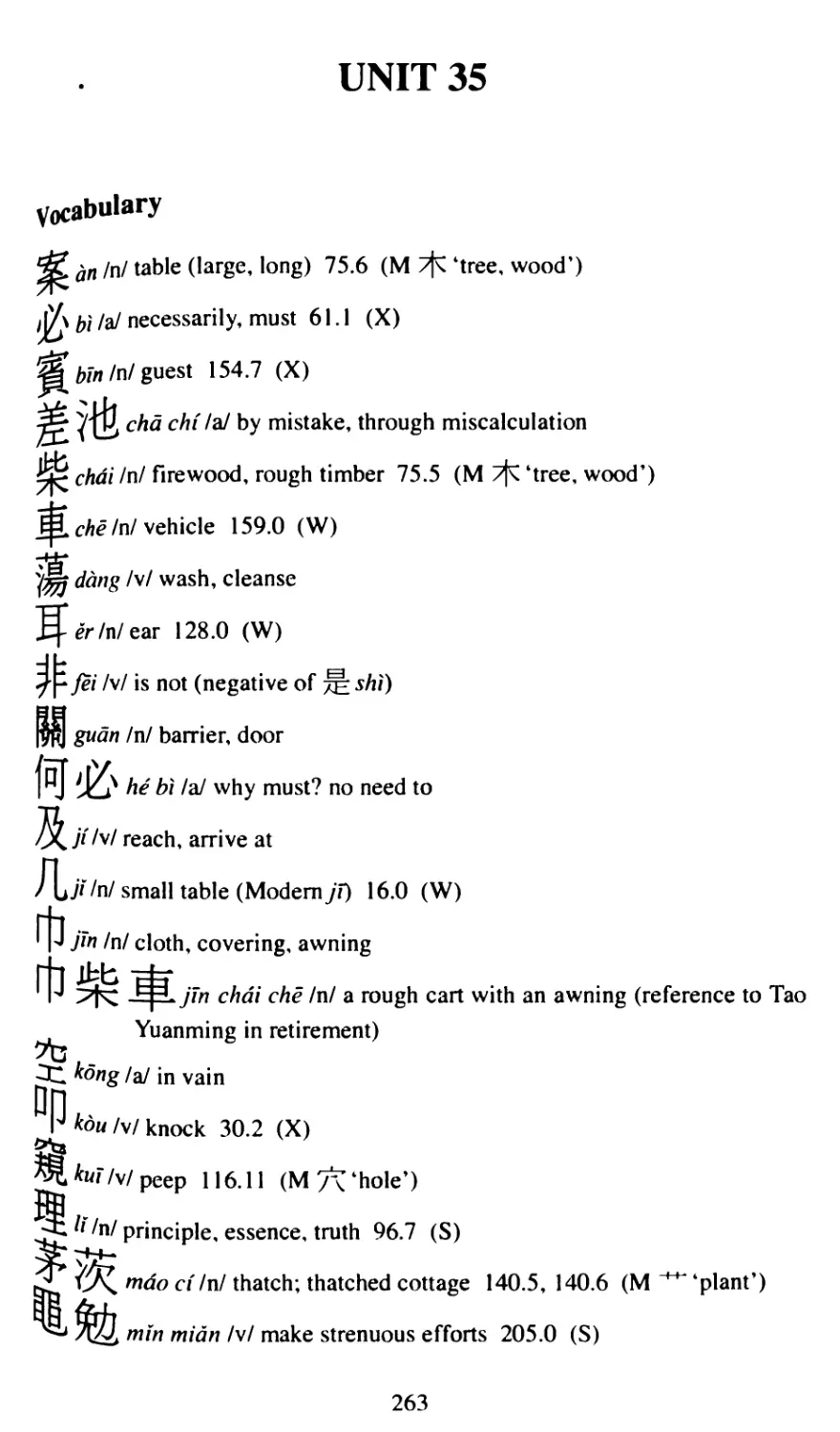
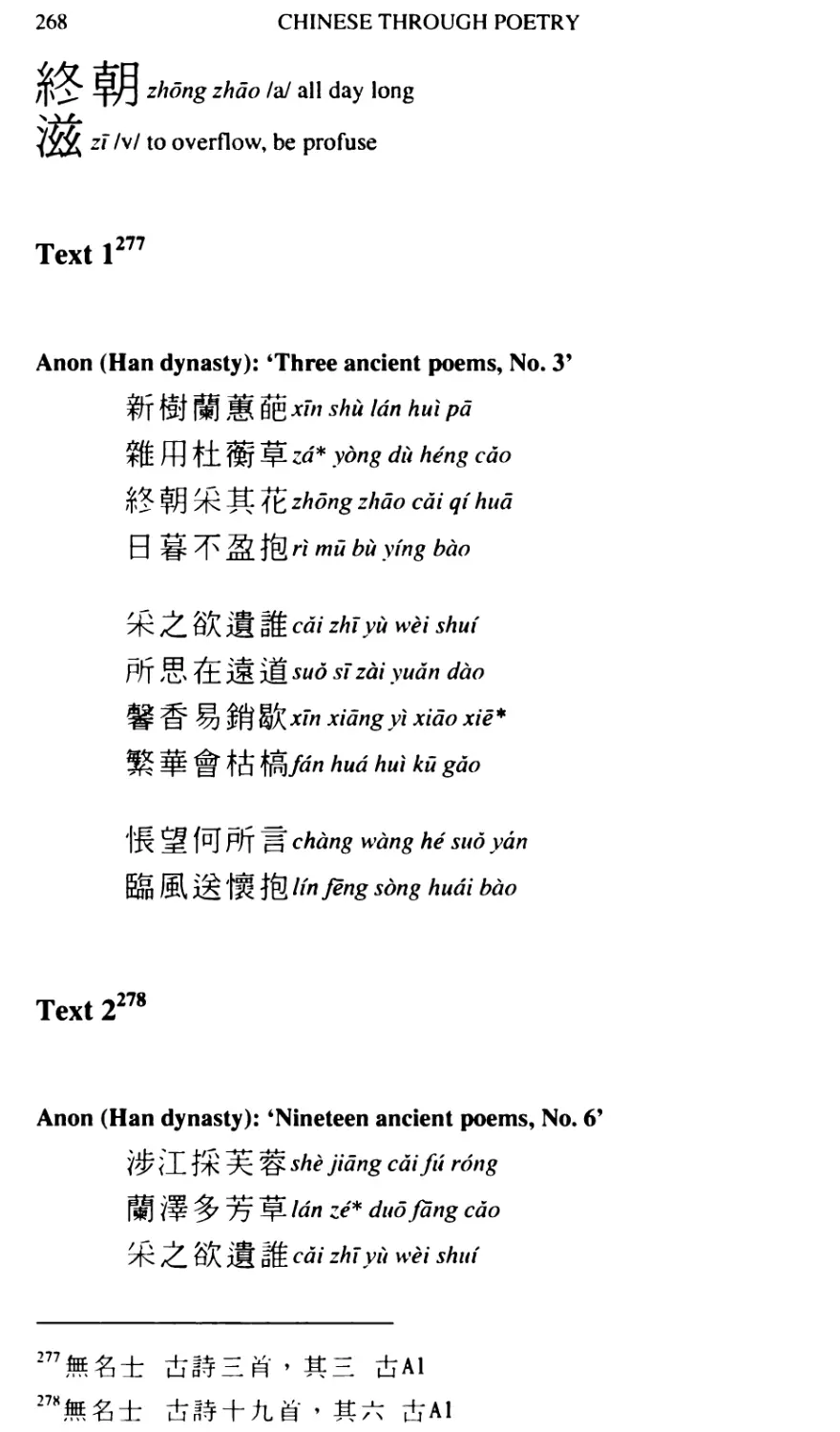
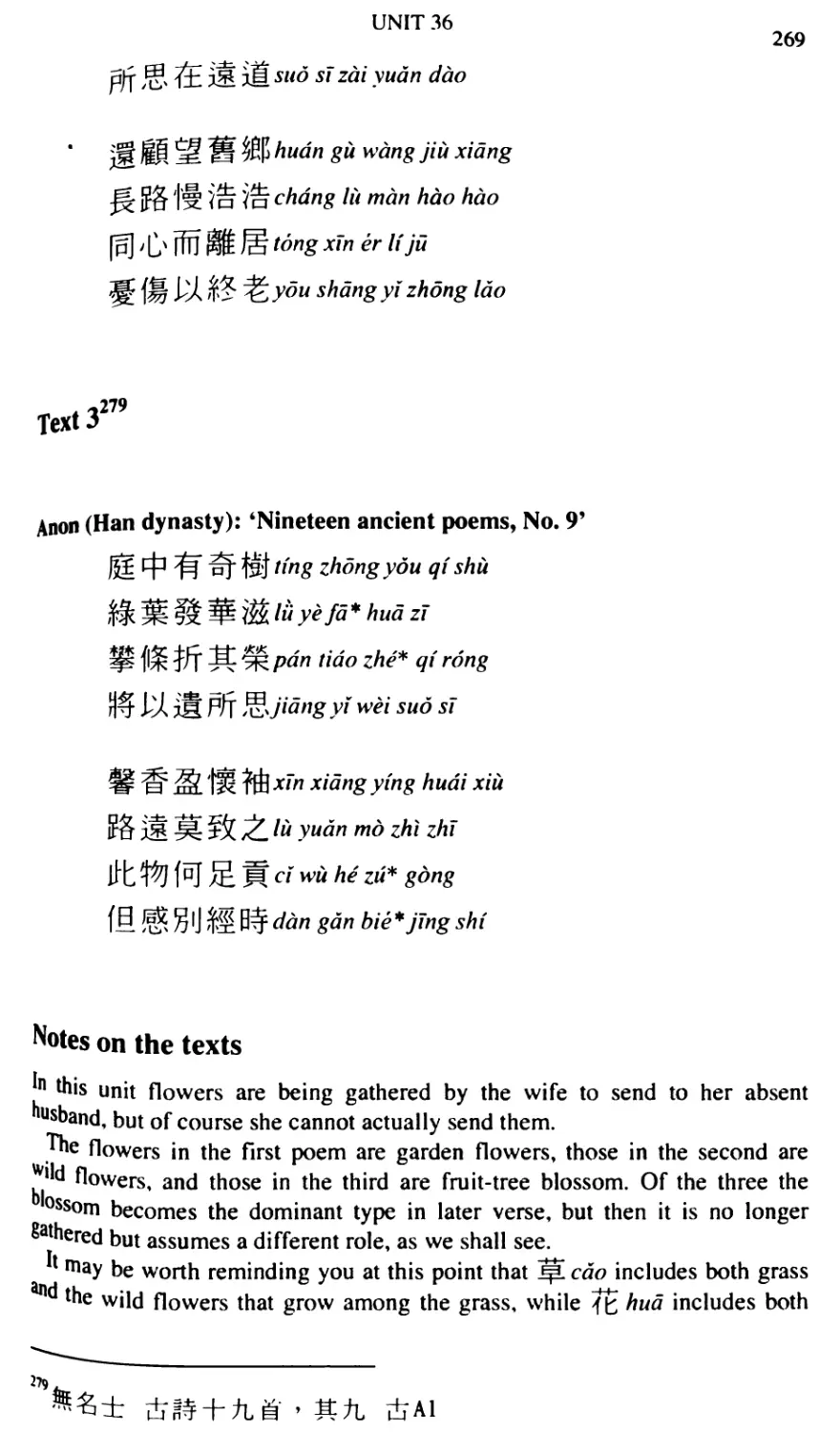
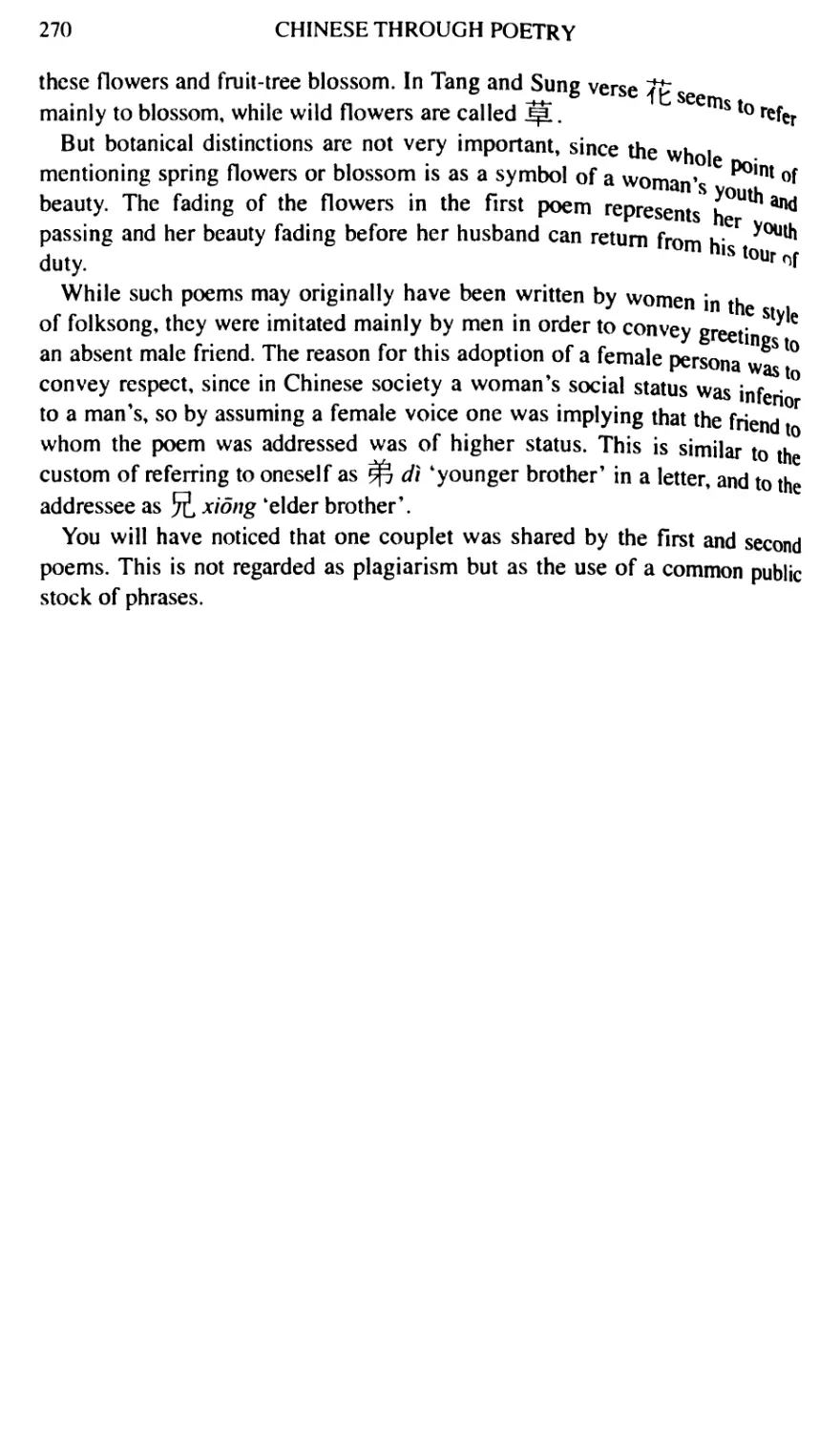
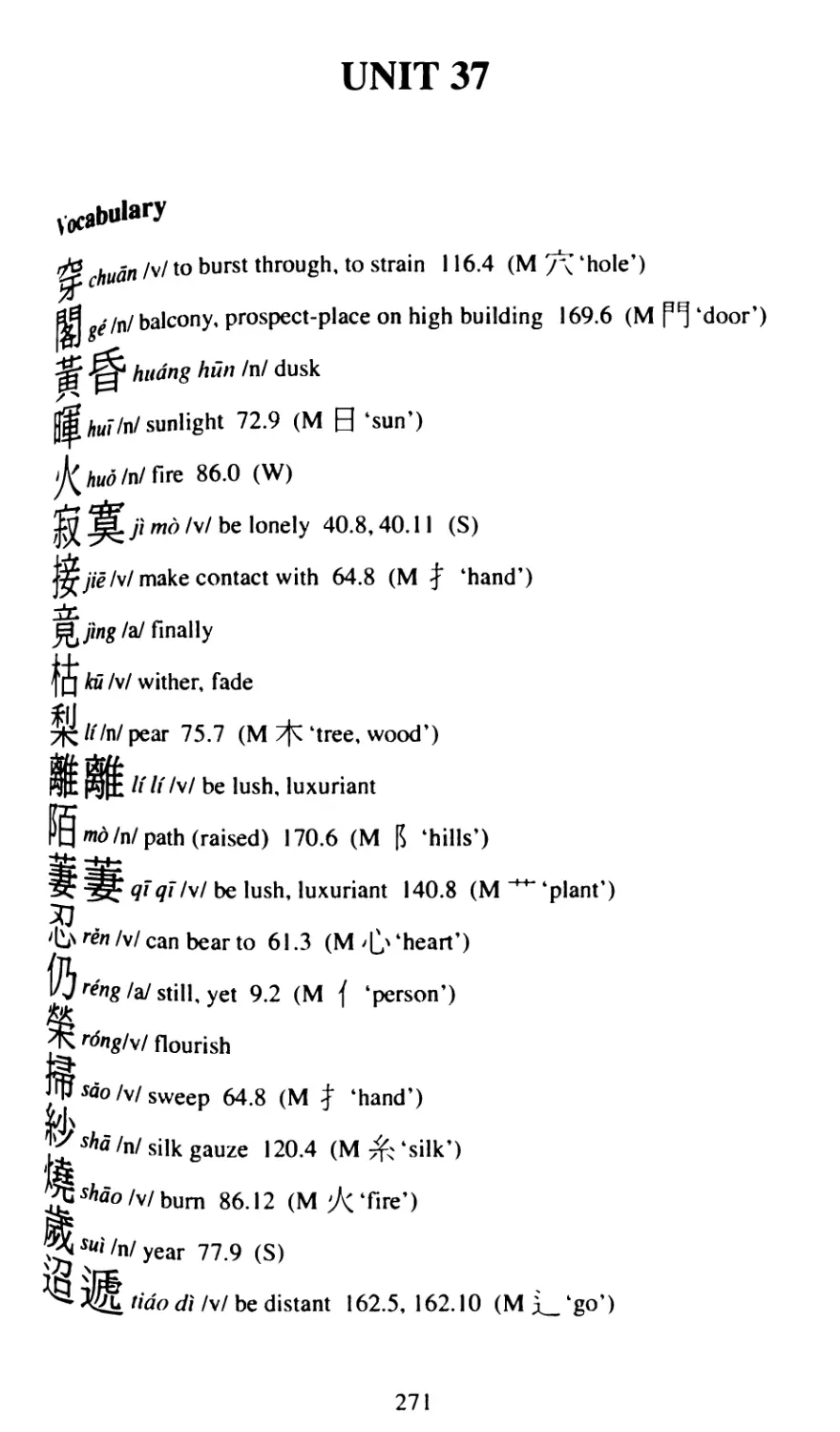
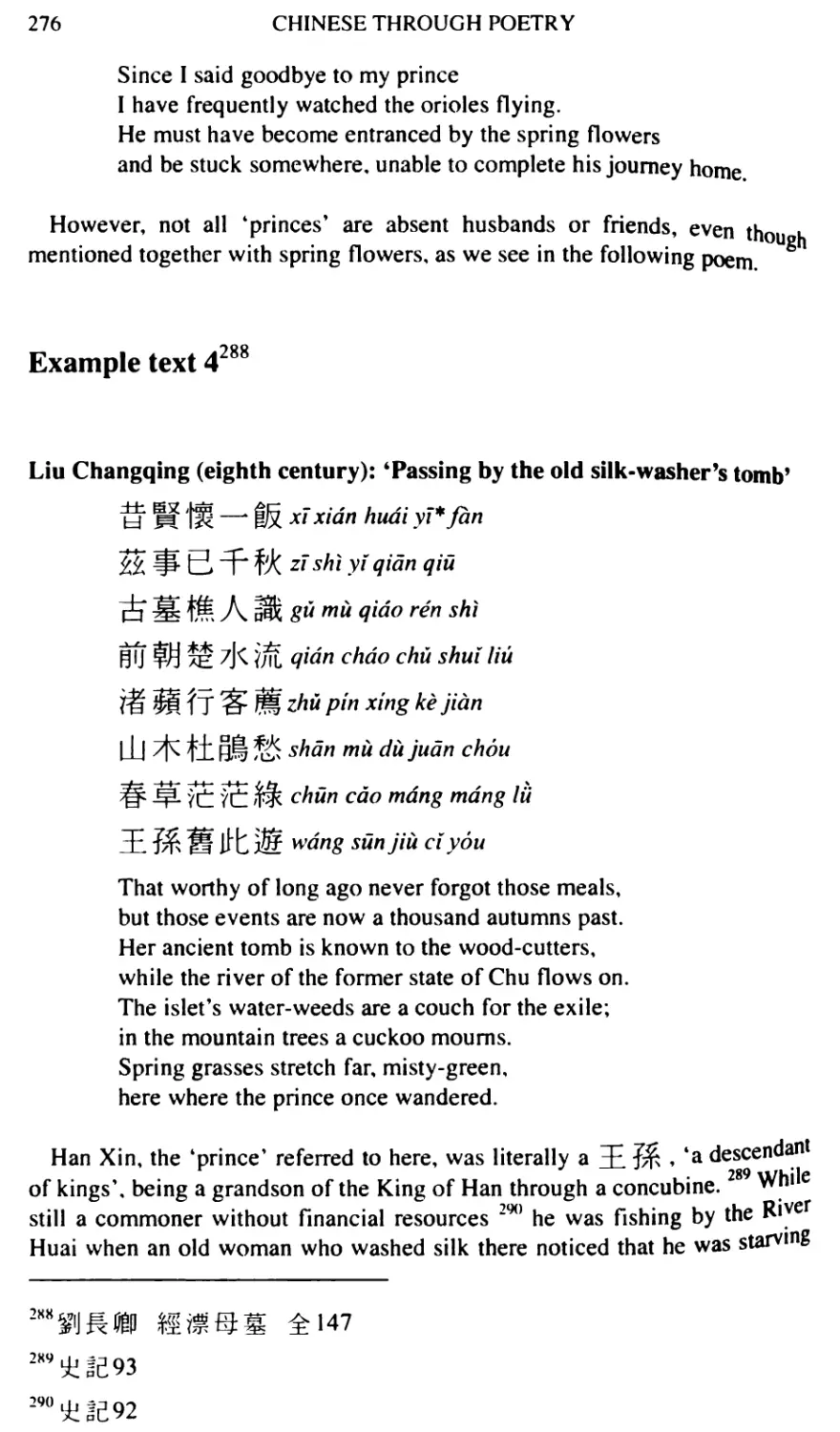
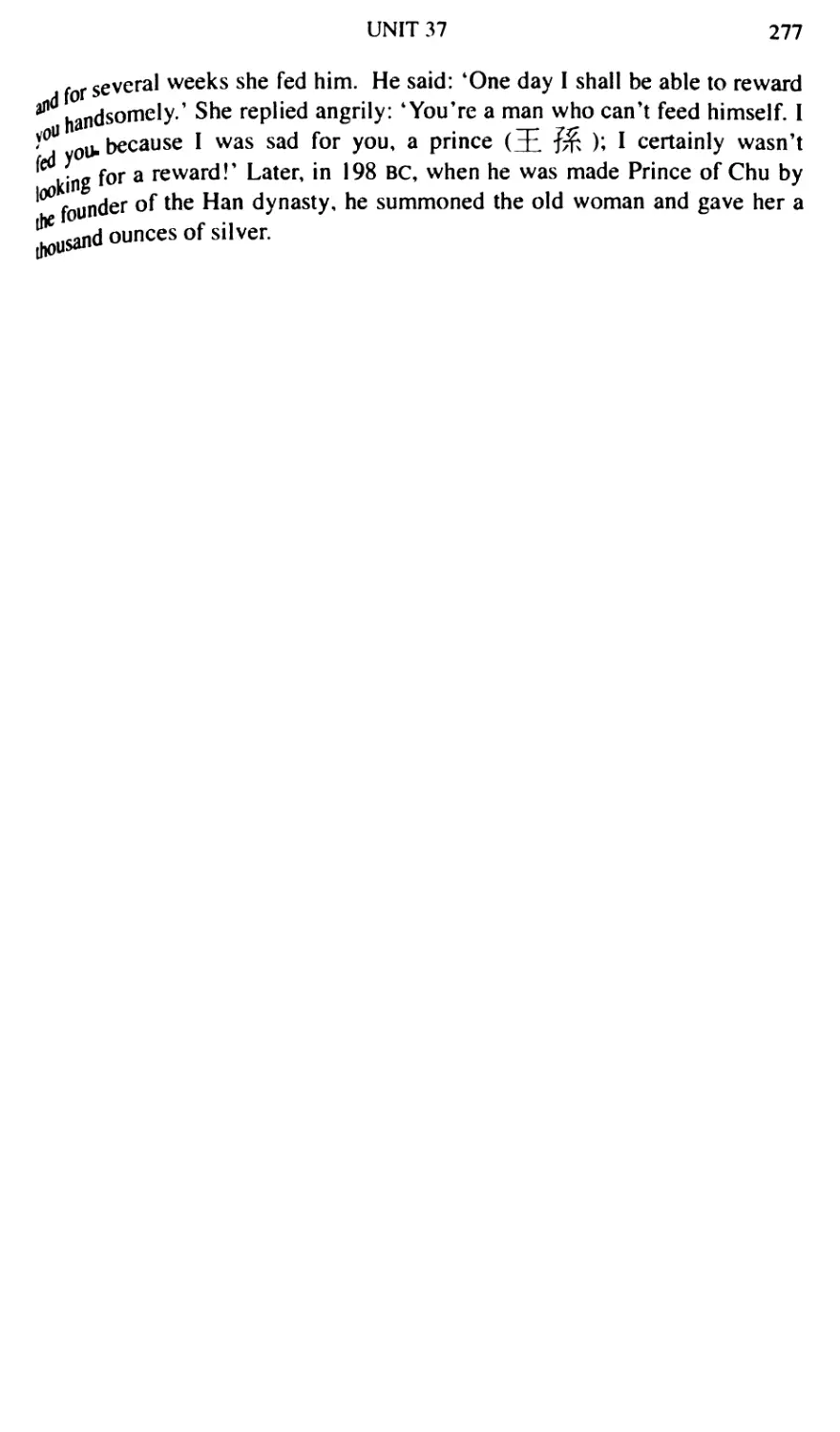
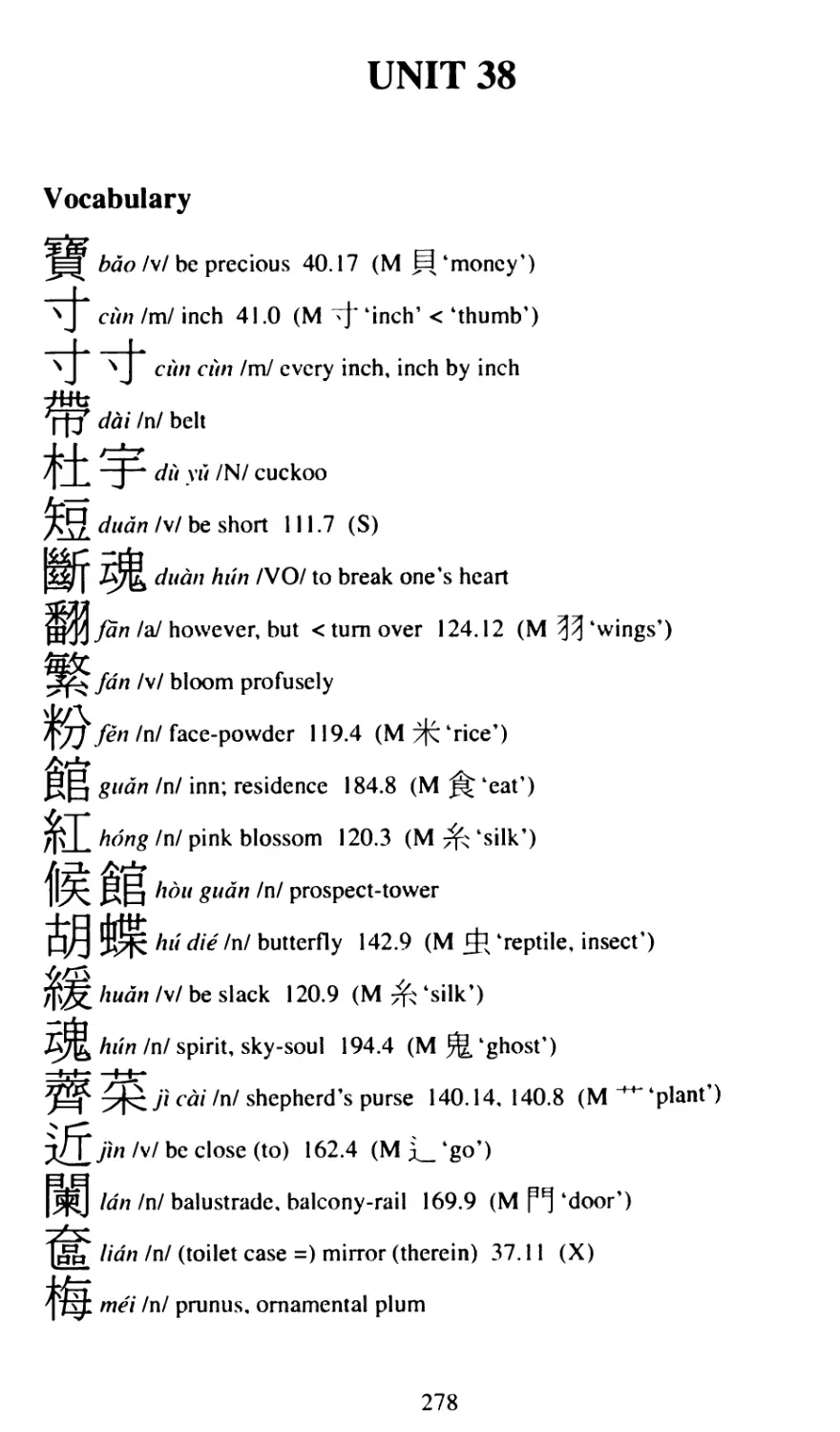
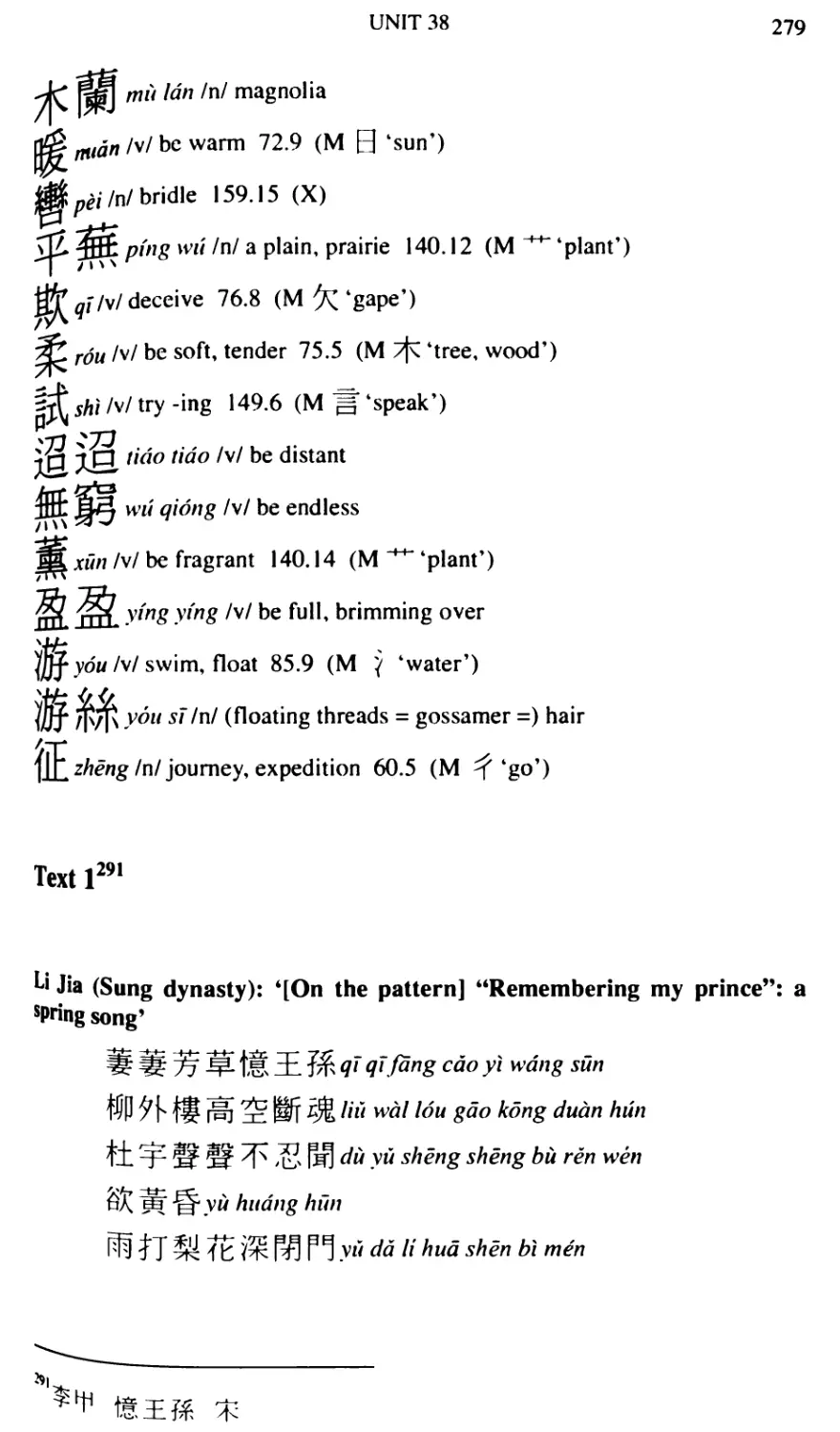
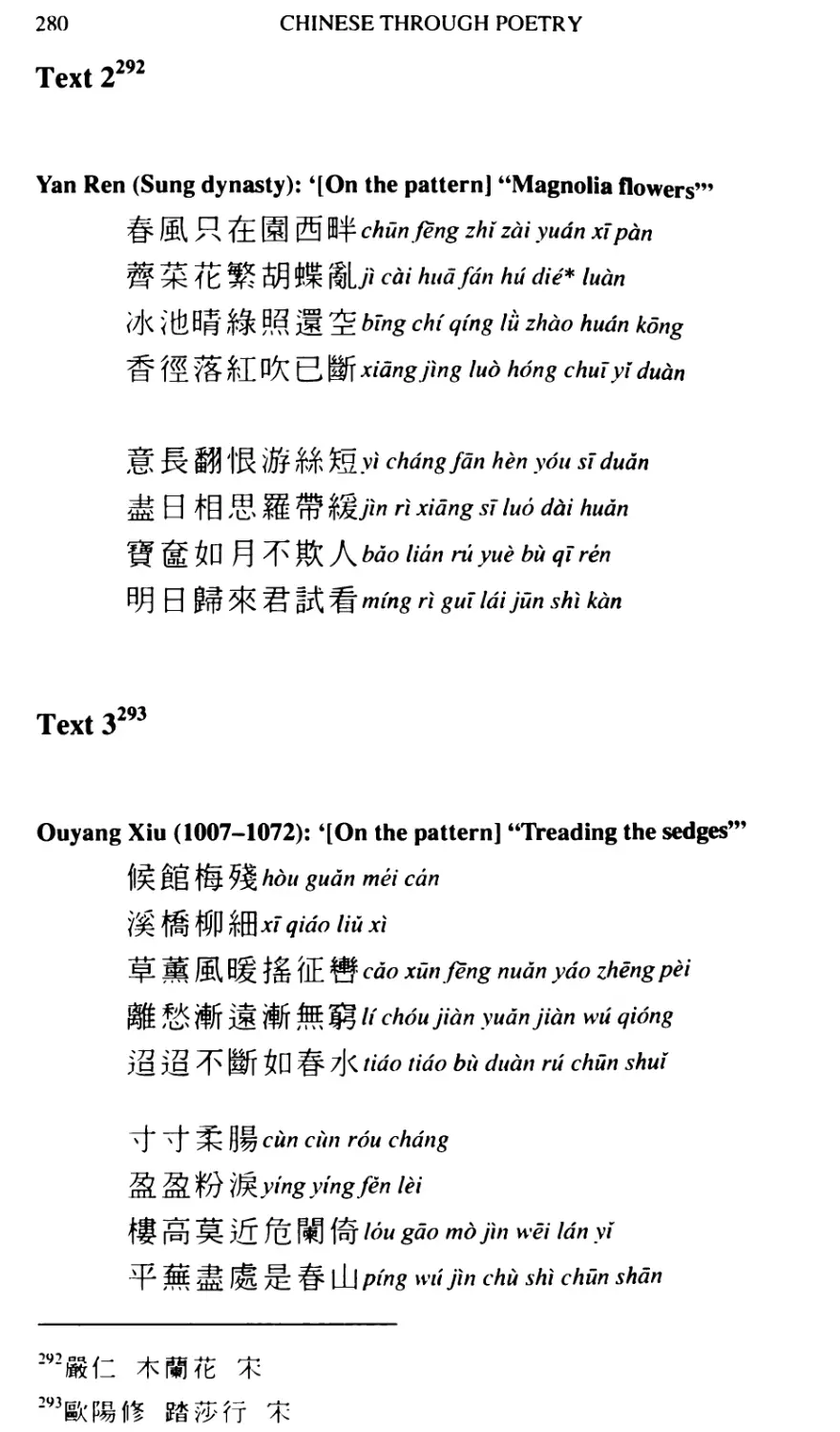
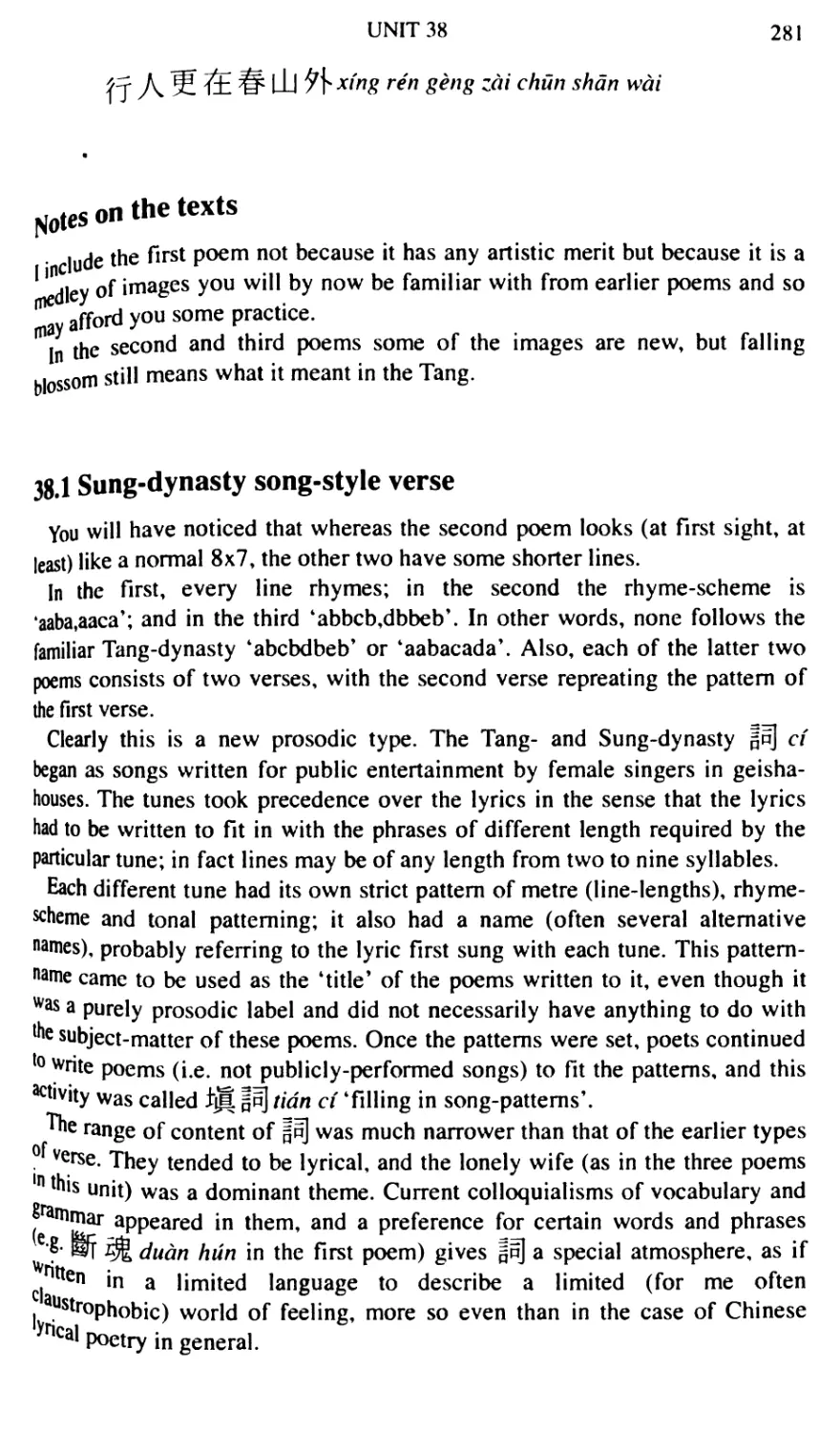
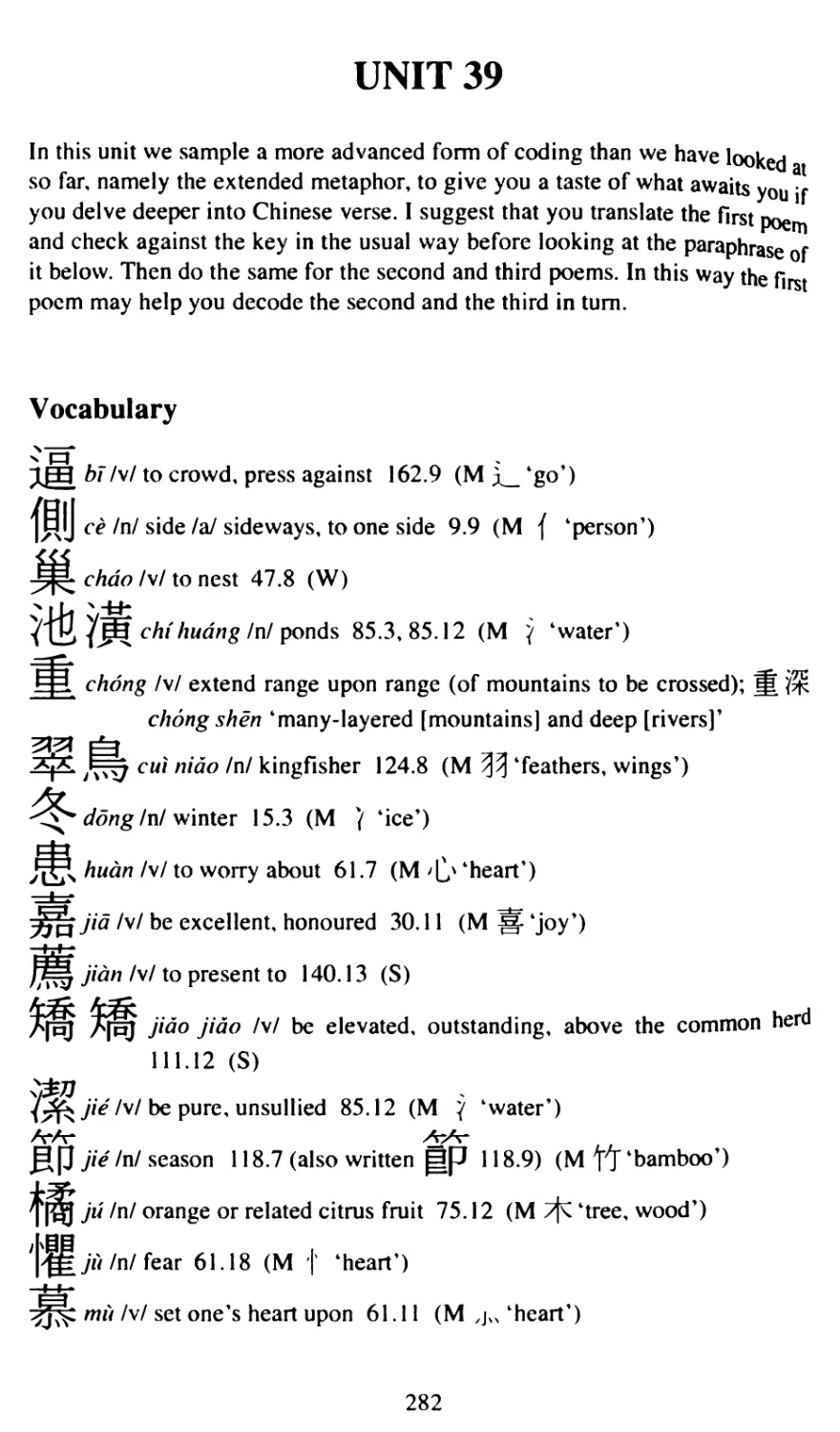
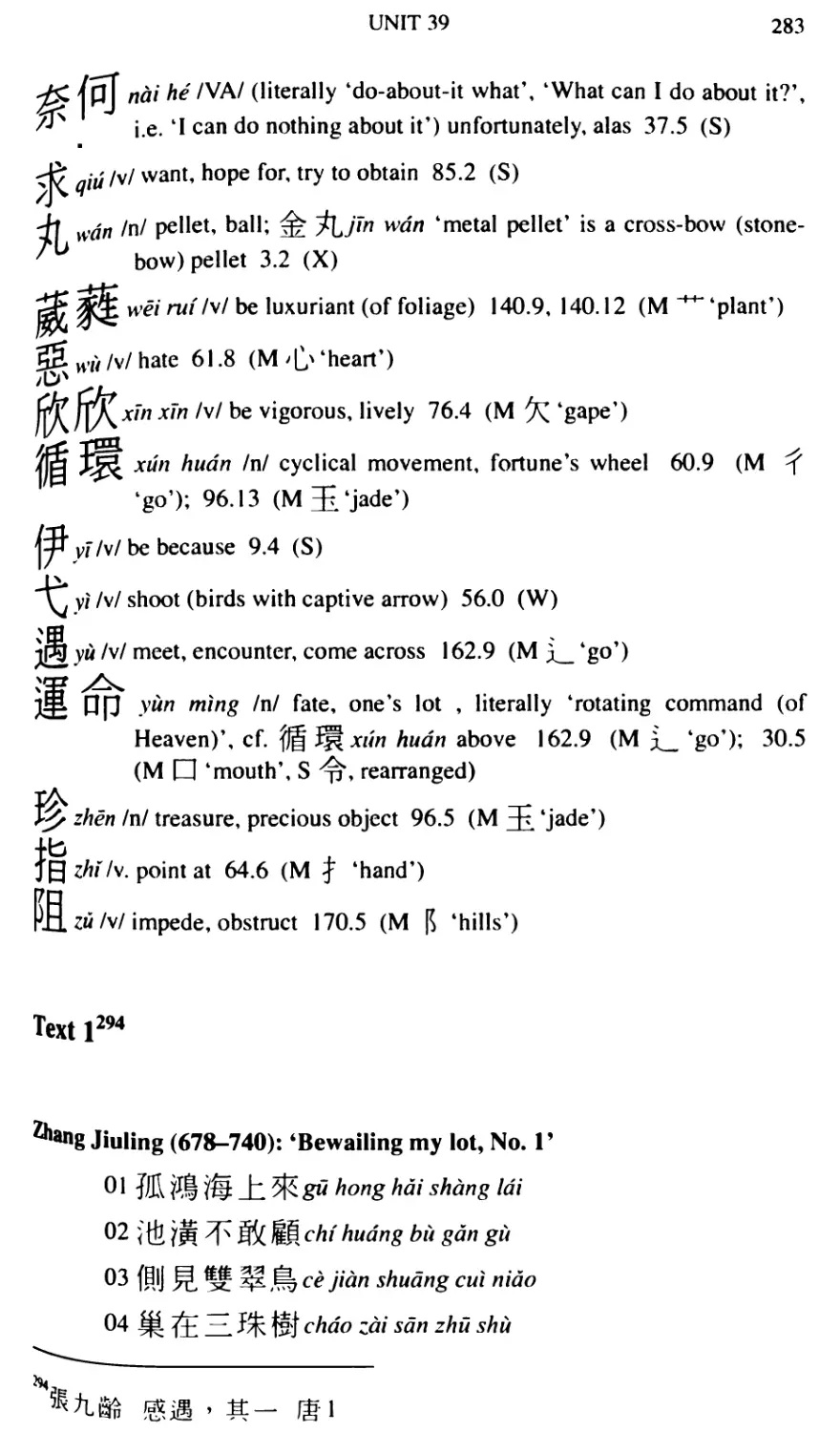
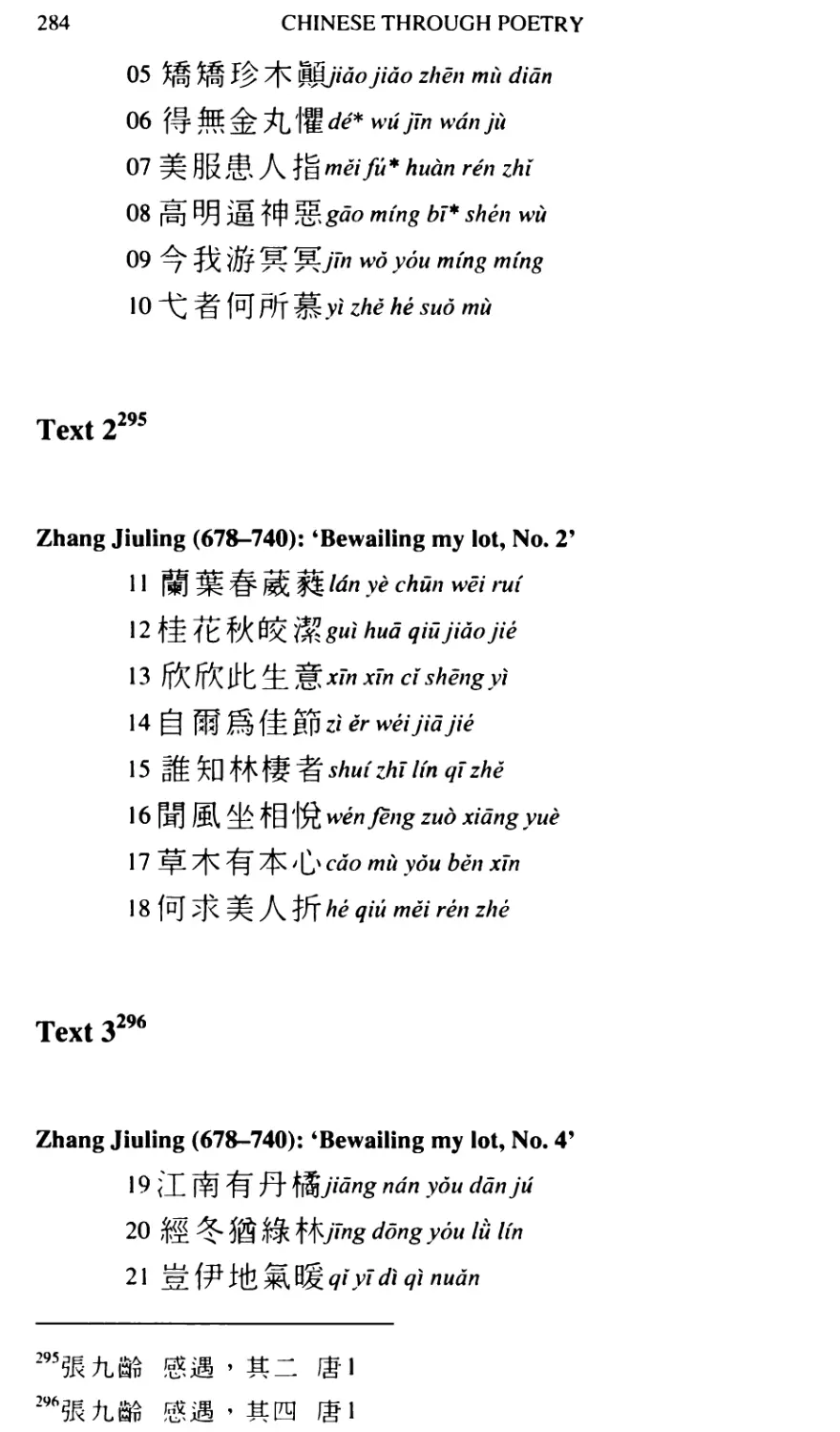
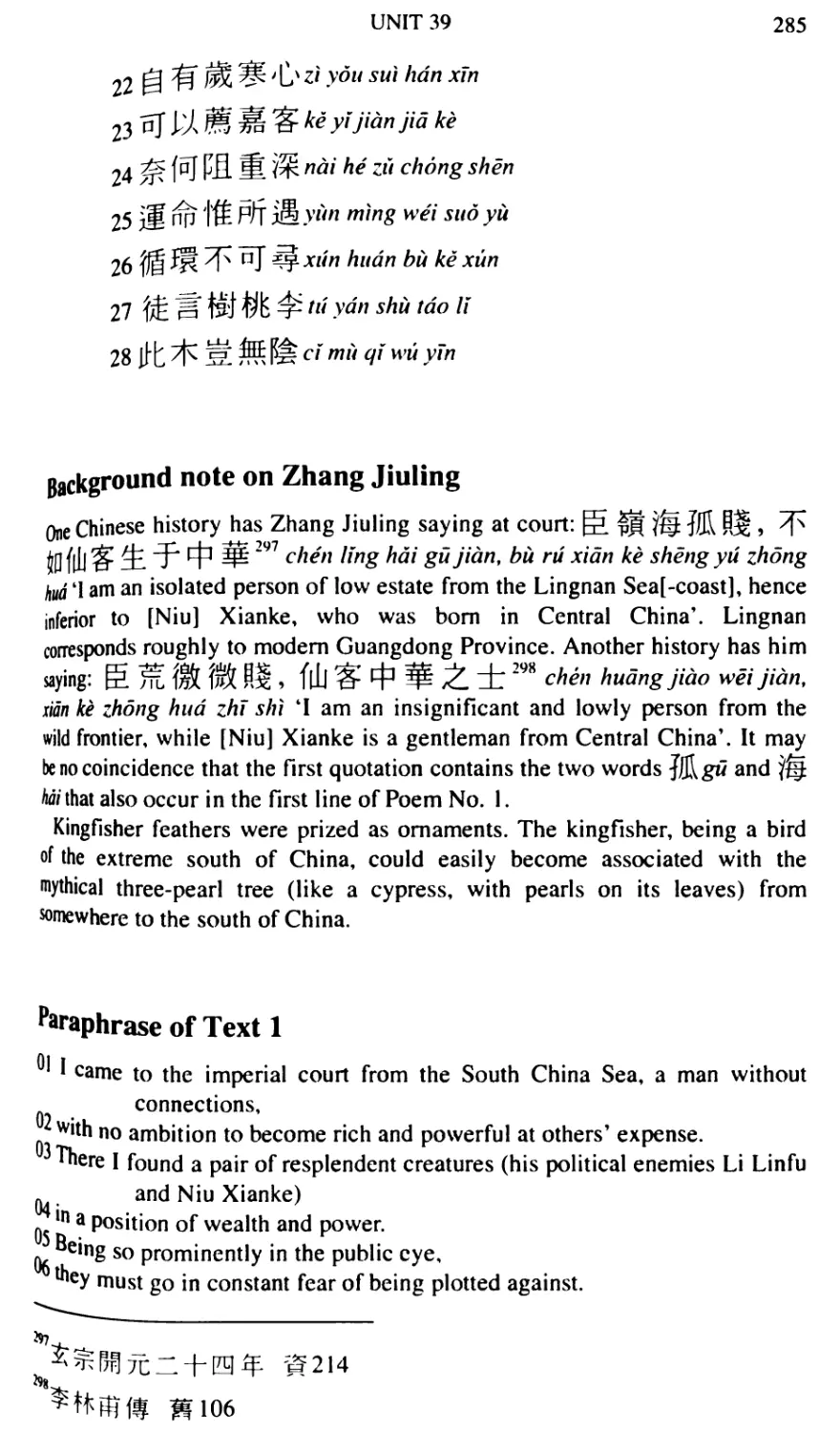
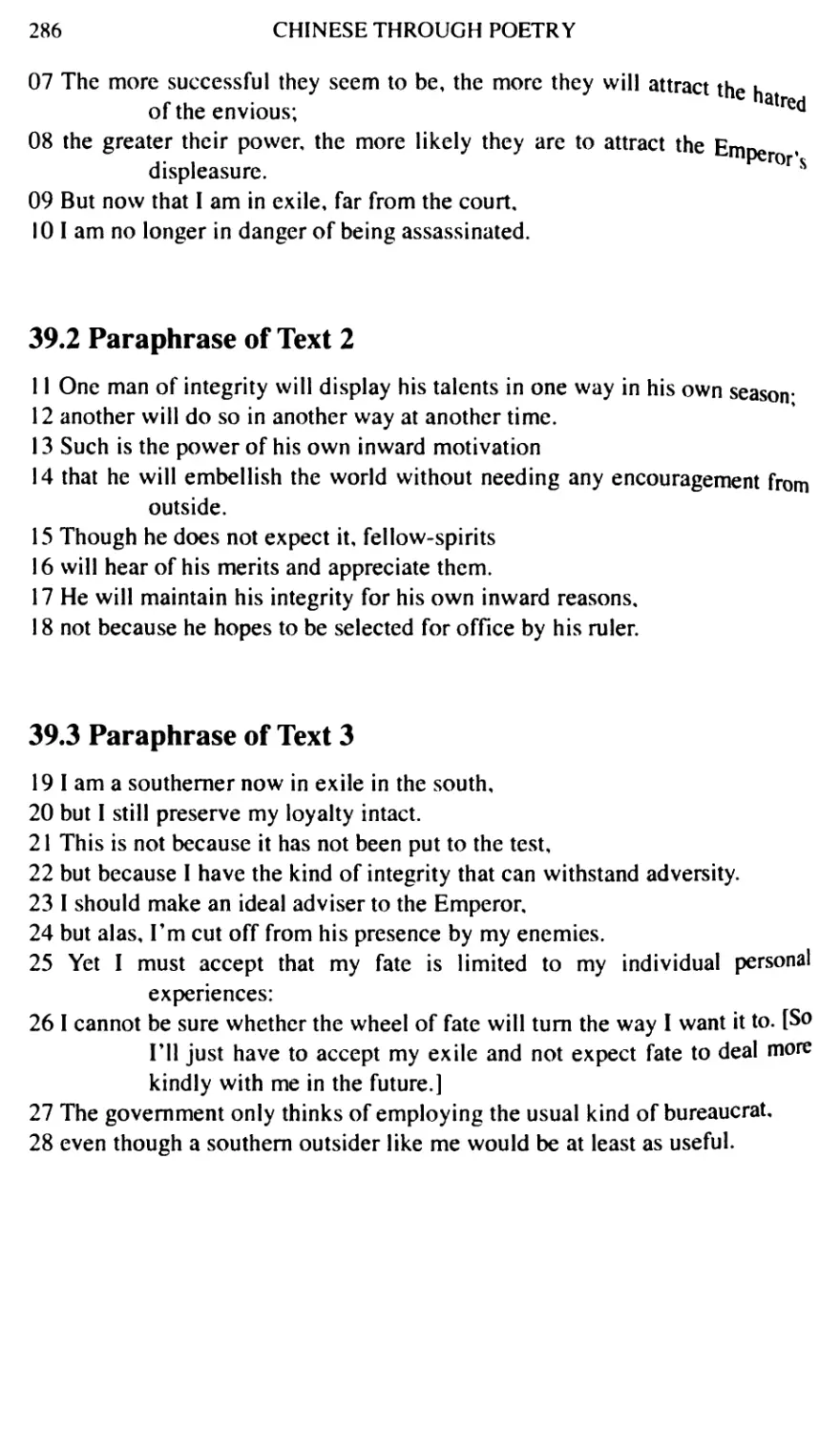
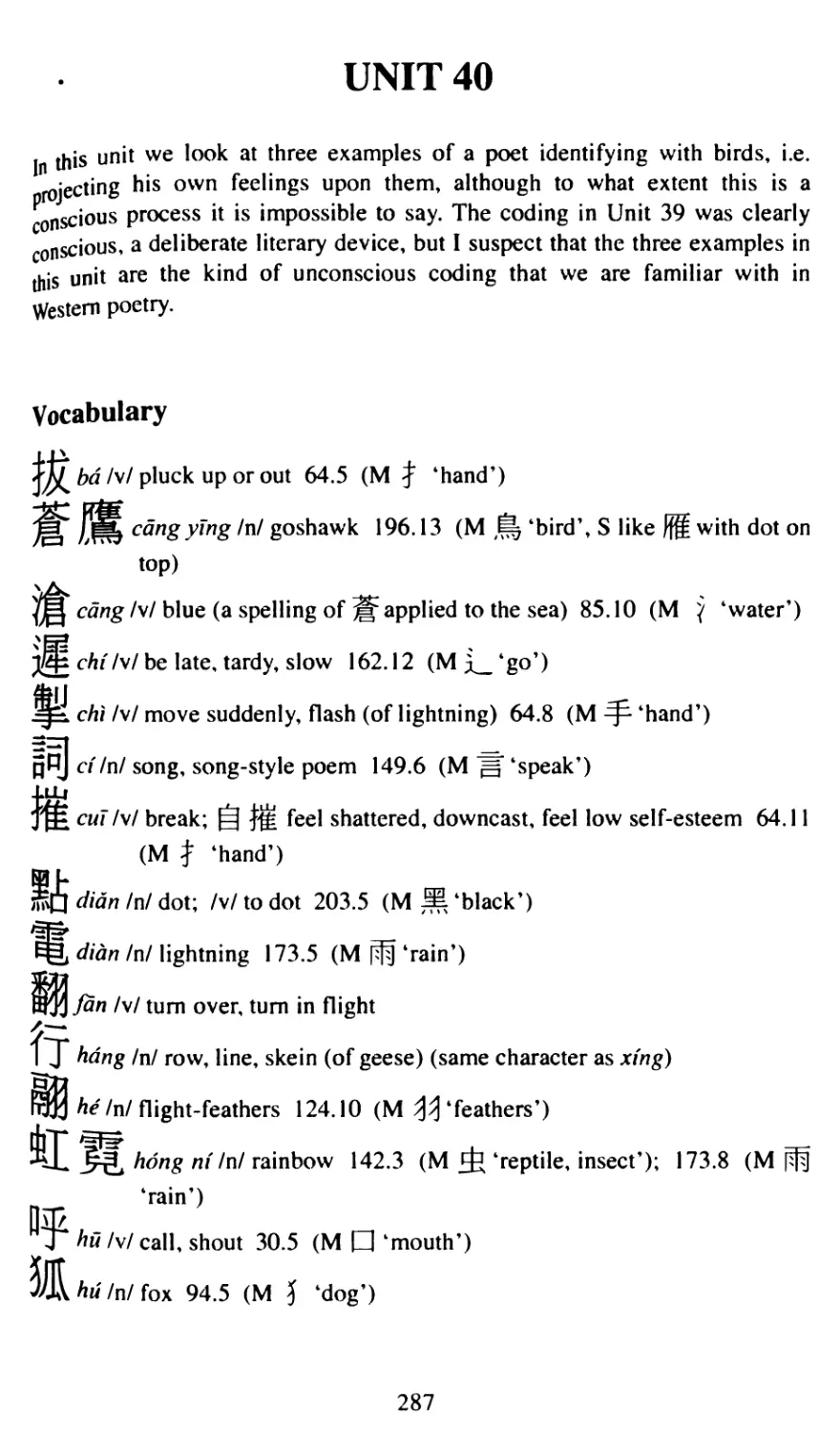
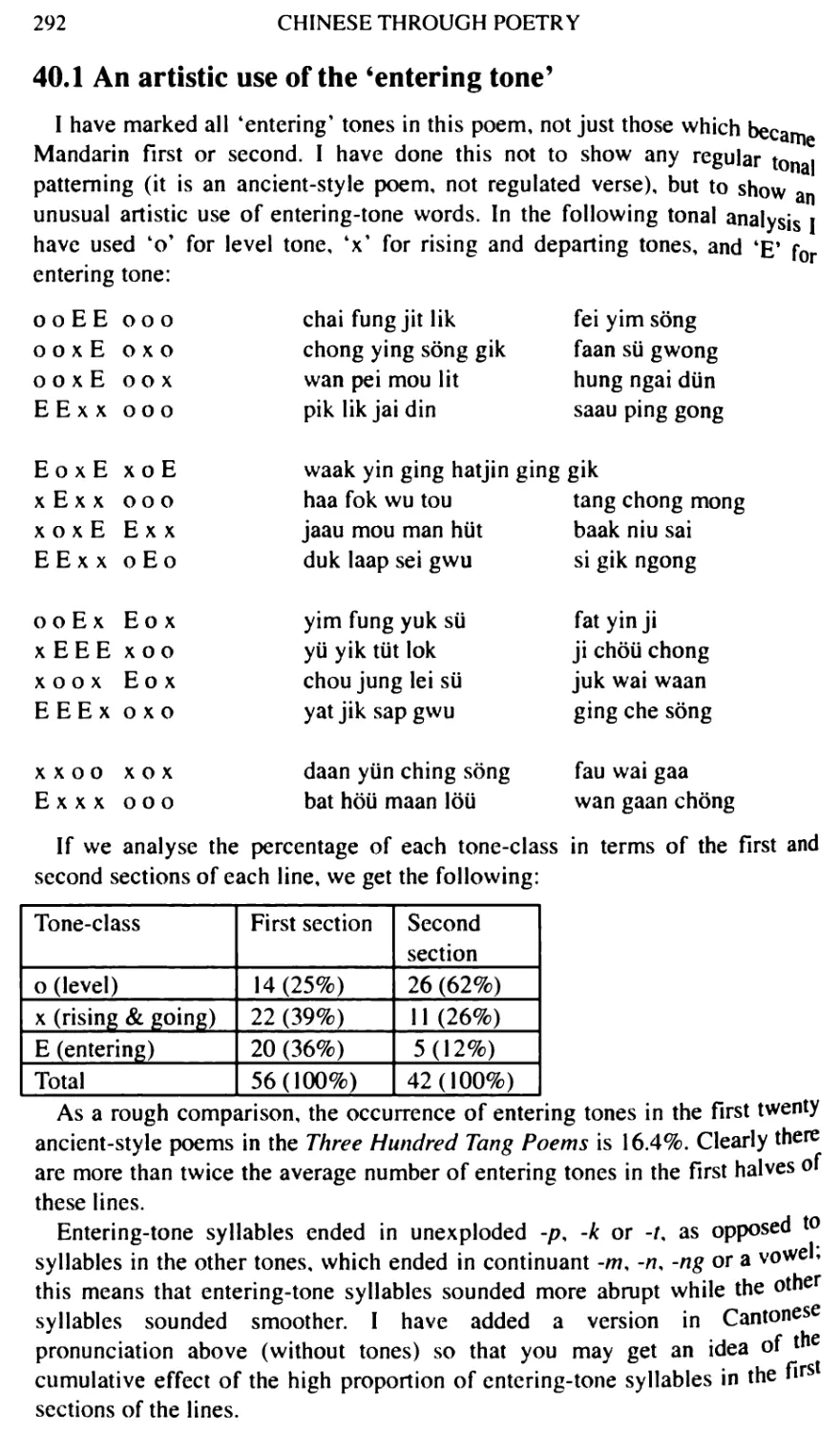
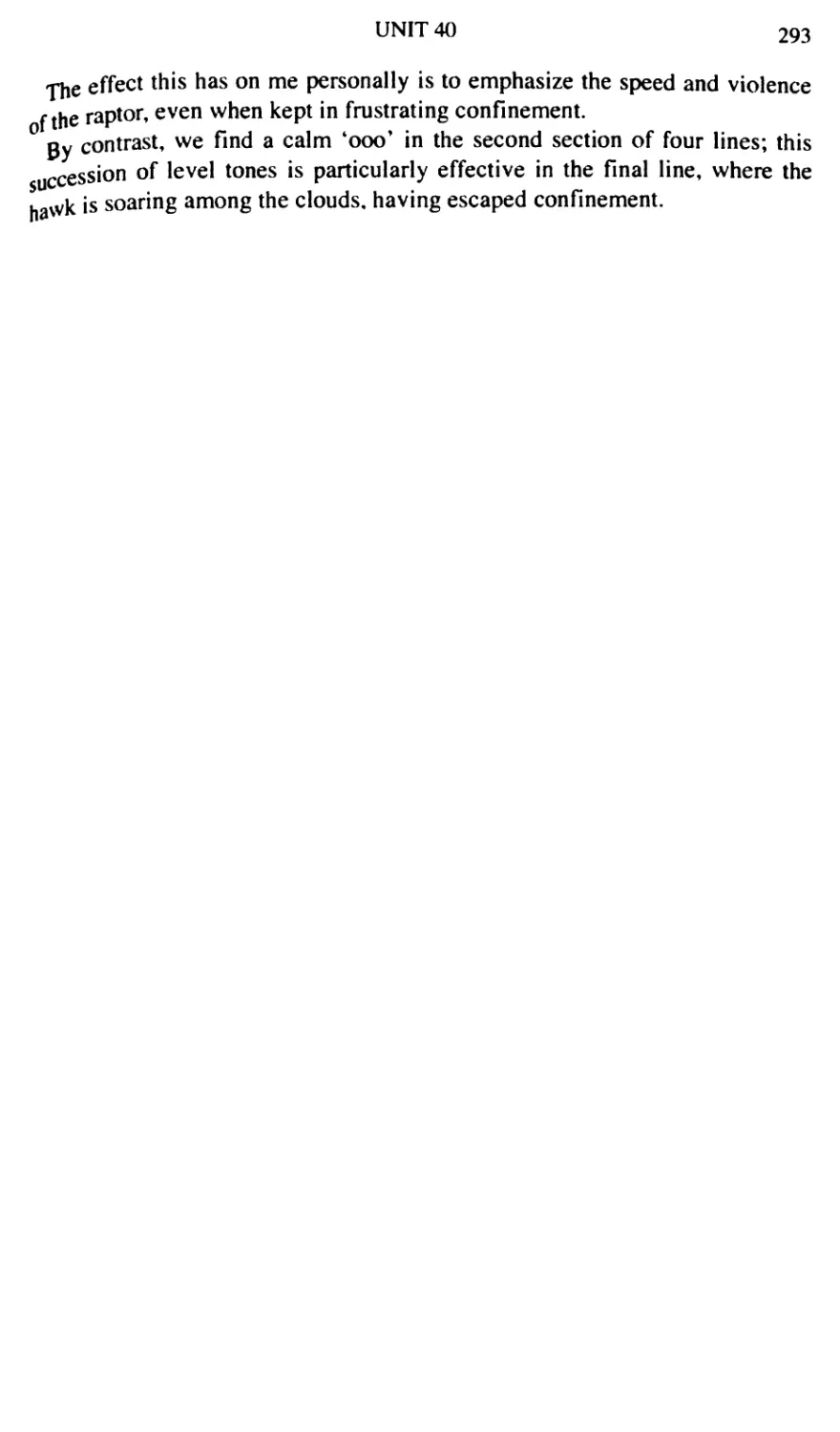
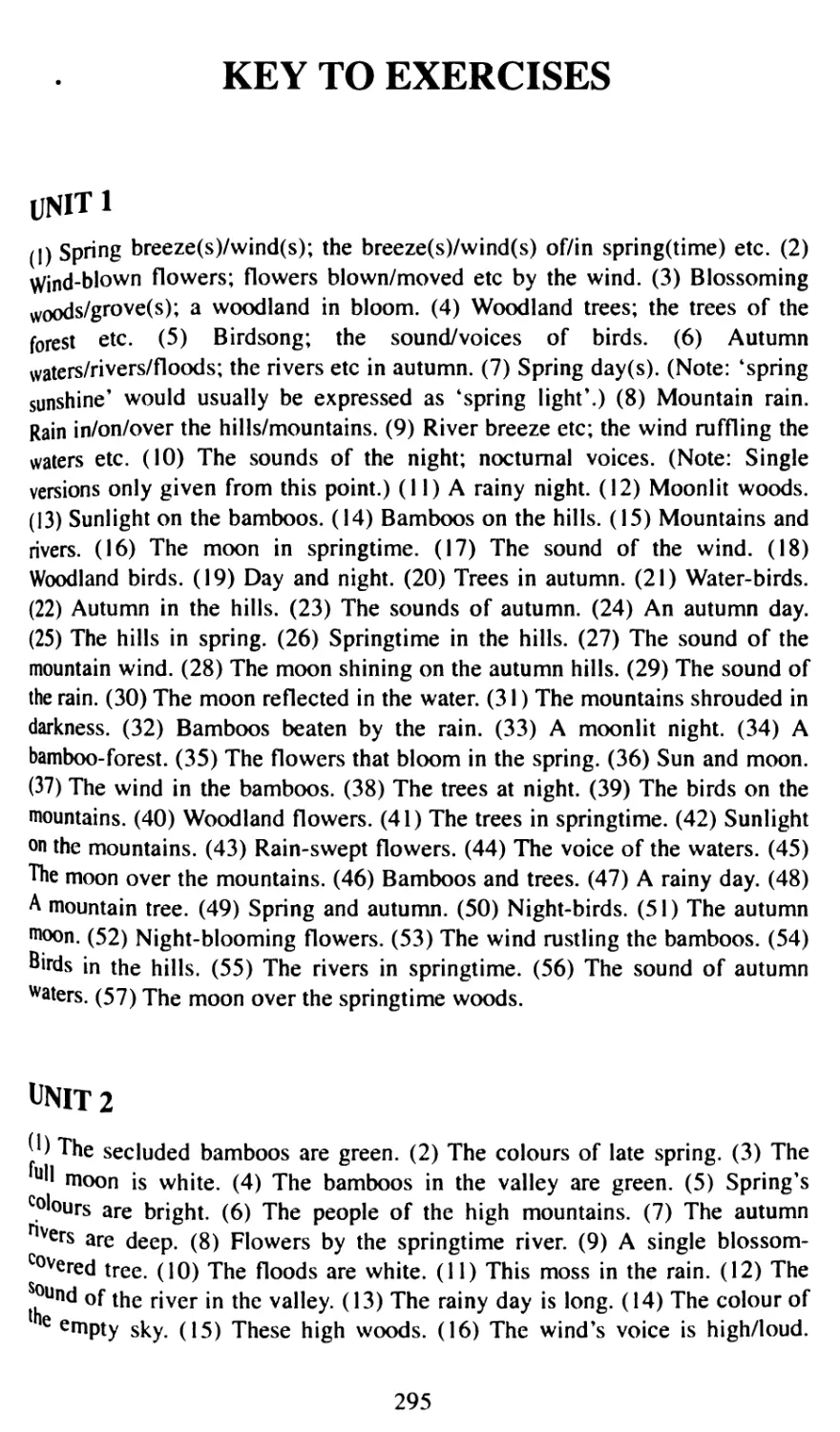
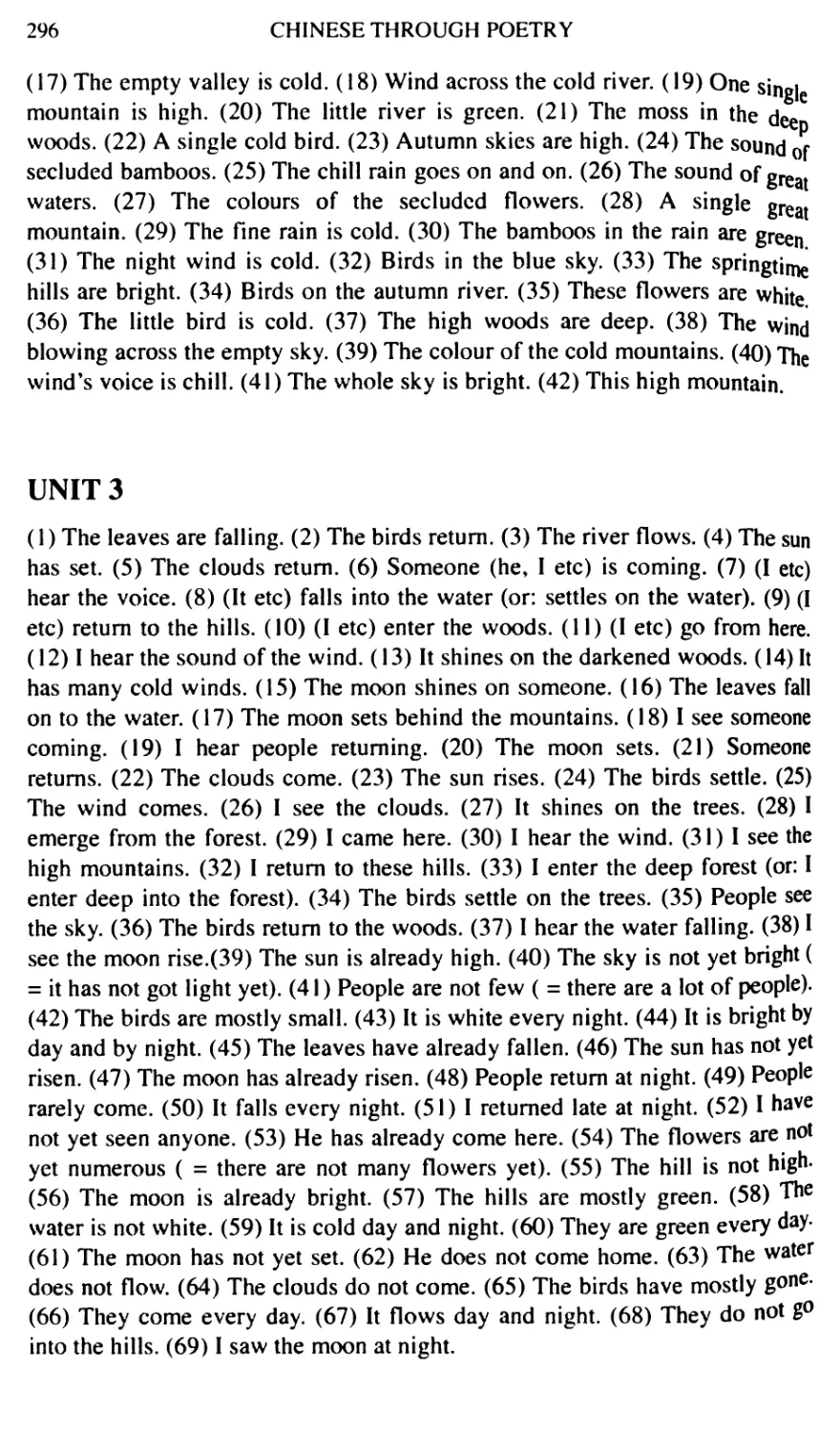
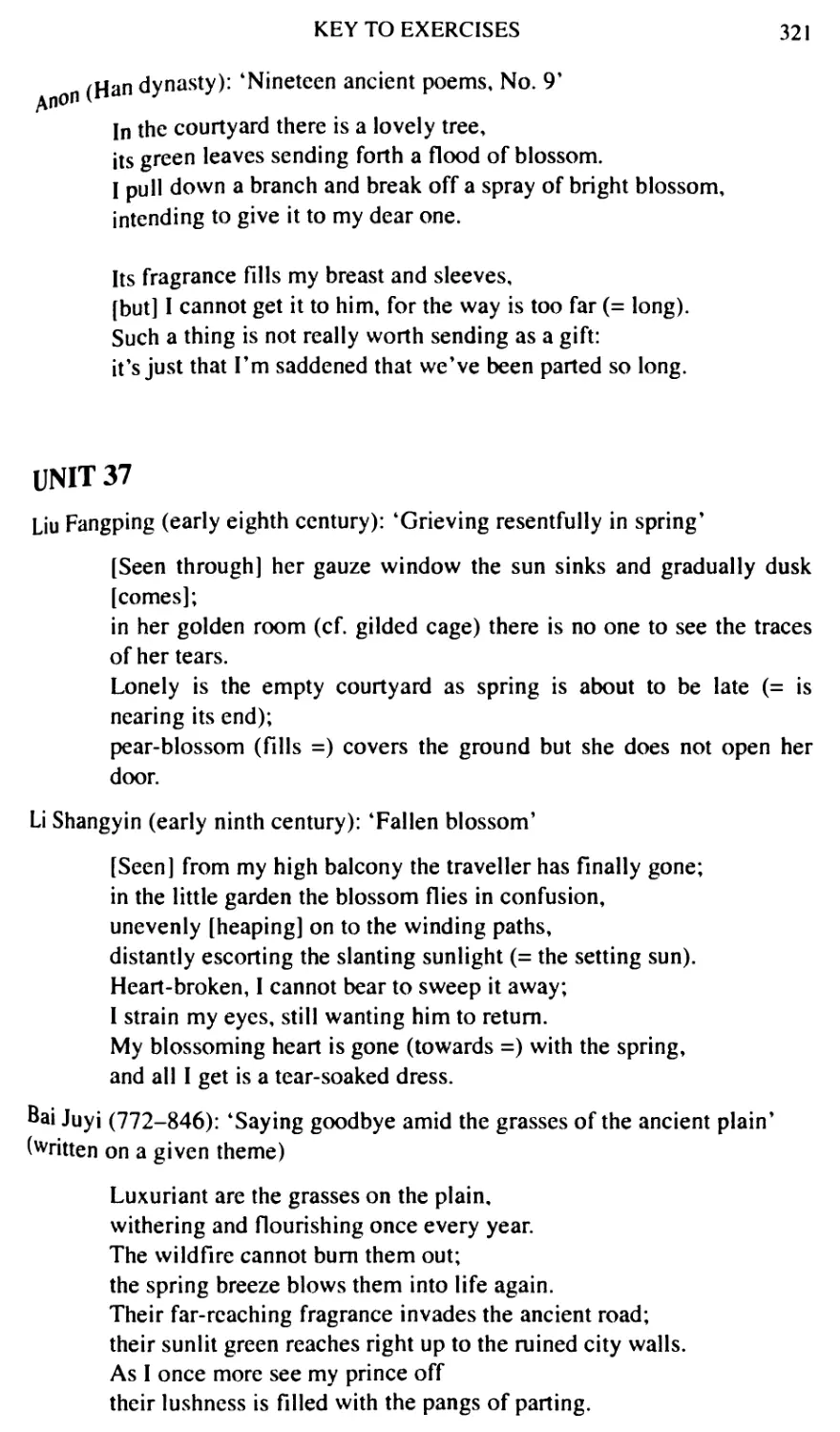
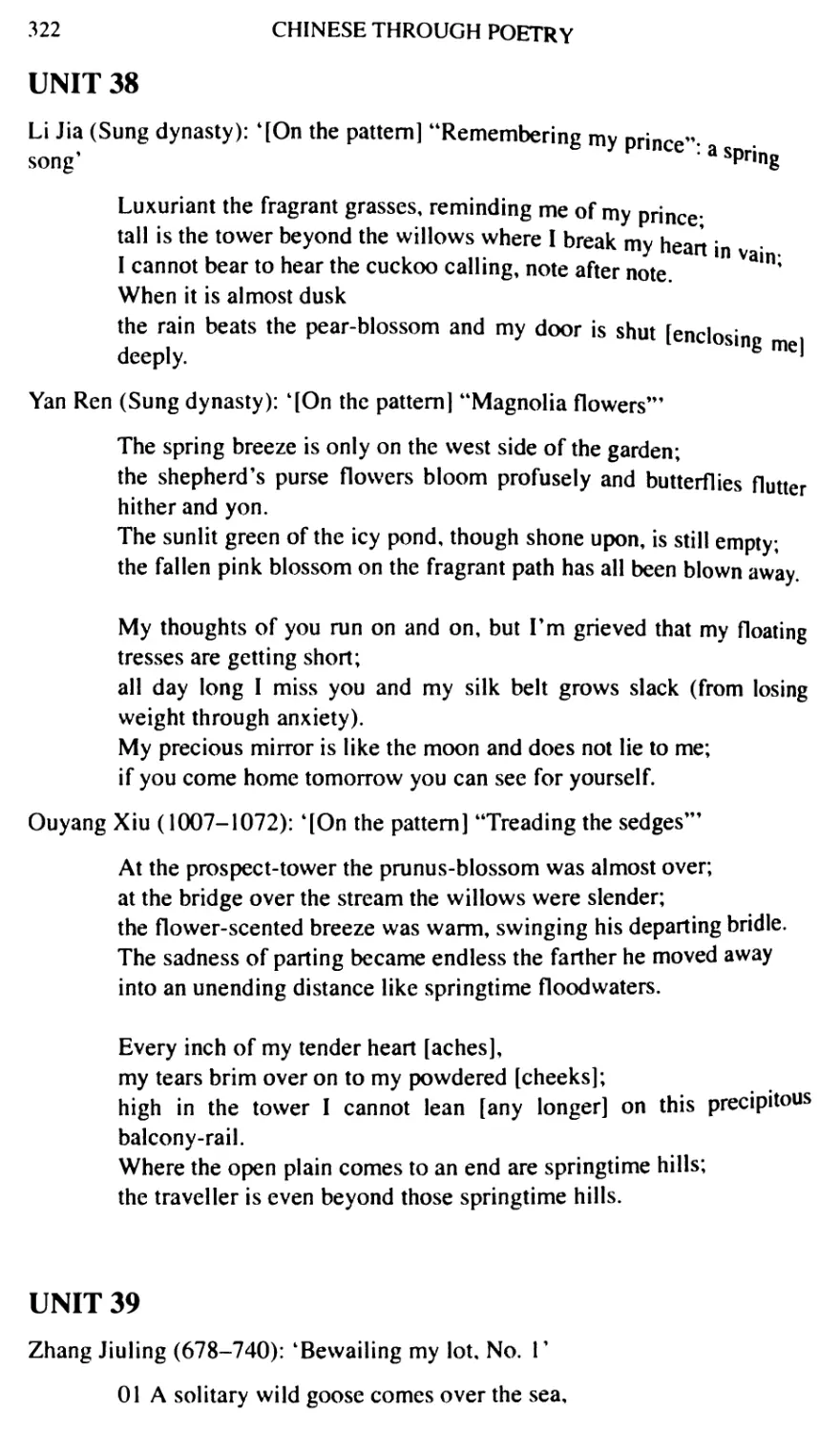
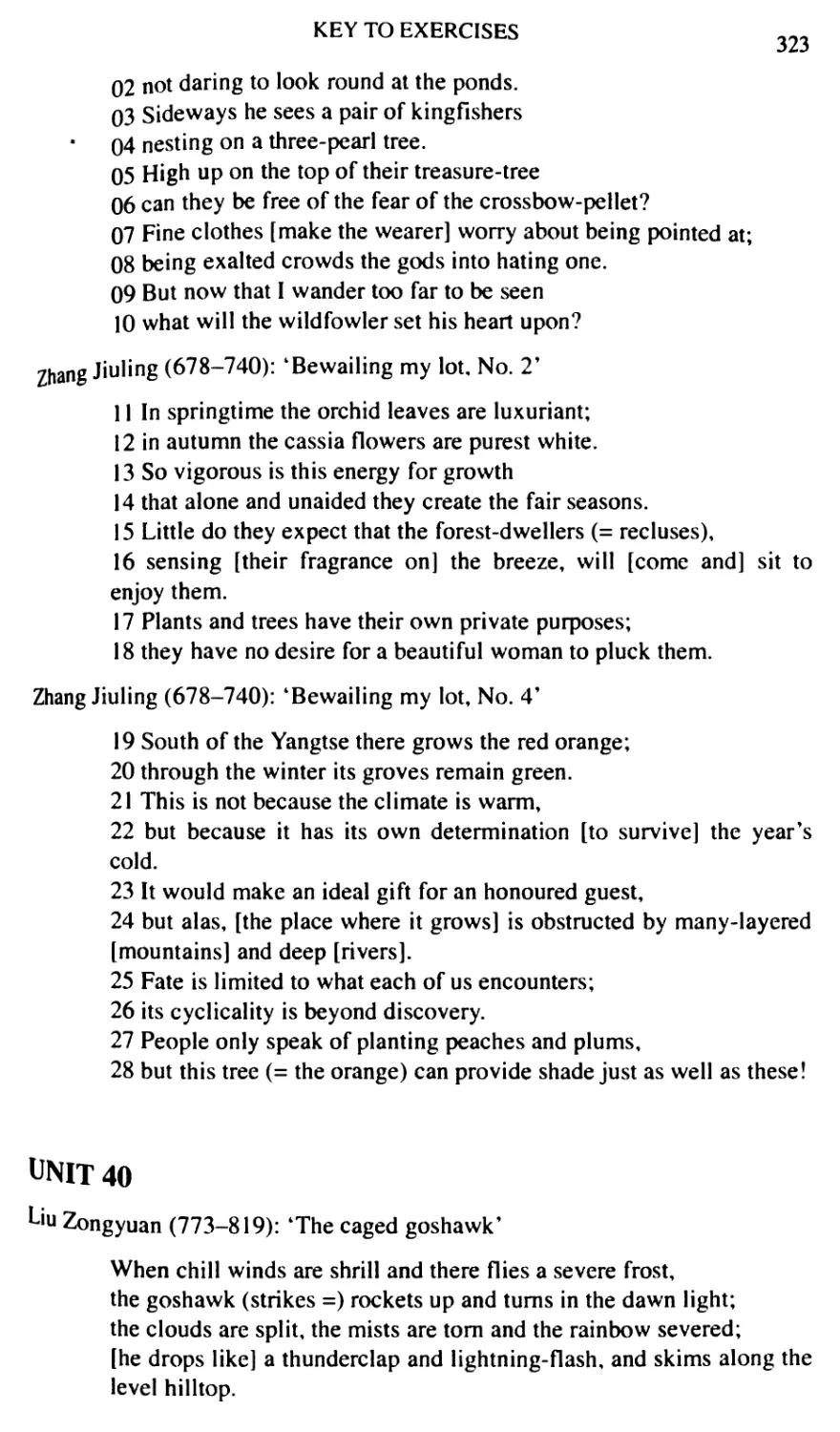
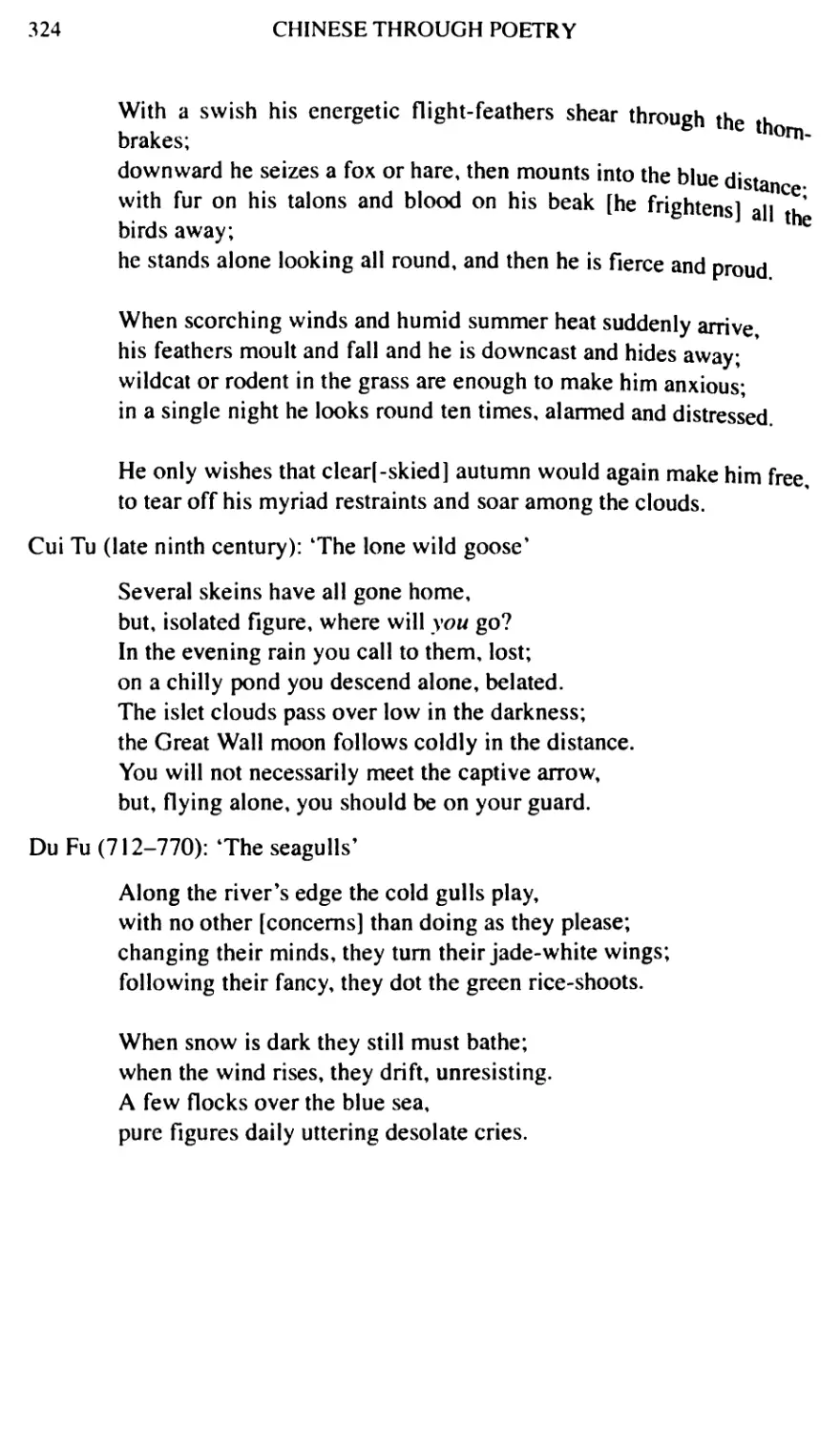


Текст
                    An Introduction to the Language and Imagery of Traditional Verse
CHINESE
THROUGH
POETRY
An Introduction to the
Language and Imagery
of Traditional Verse
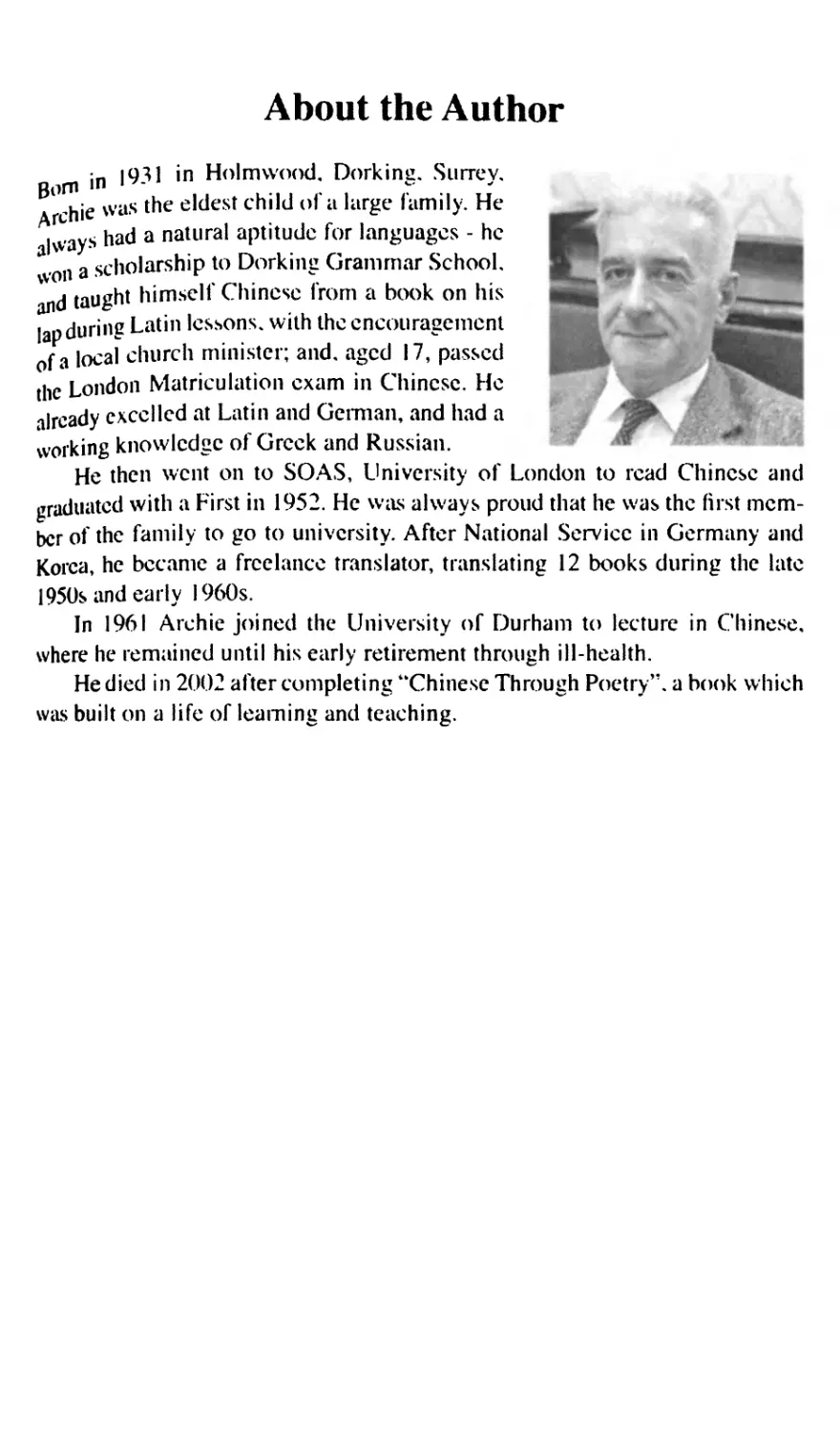
AUTHOR’S BIOGRAPHY
Archie Barnes was bom in 1931 in Holmwood» Dorking» Surrey. Archie was the
eldest child of a large family. He always had a natural aptitude for languages -
he won a scholarship to Dorking Grammar School. With the encouragement of
a local church minister: and aged only 17. he passed the London Matriculation
exam in Chinese.
At SOAS, University of London, he graduated with a First in Chinese in 1952.
In 19(4. Archie joined the University of Durham to lecture in Chinese, where
he remained until his early retirement through ill-health. He died in 2002 after
completing "Chinese Through Poetry", a book which was built on a lifetime of
learning and teaching.
Translated works by Archie Barnes include:
"Red Sun" by Wu Chiang
"Morning in Shanghai” by Zhou Erfu
"Sunrise” by Tsao Yu
"Schoolmaster" by Yeh Sheng-Tao
"Taming the Dragon and the Tiger" by Tuan Cheng-Pin and Tu Shih-Tsun
"Songs of the Red Flag” by Kuo Mo-Jo and Chou Yang
"Thunderstorm” by Tsao Yu (translated with Wang Tso-Liang)
CHINESE
THROUGH
POETRY
An Introduction to the
Language and Imagery
of Traditional Verse
bv
A. C. BARNES
Formerly Senior Lecturer in Chinese
University of Durham
with a foreword by
K. PRATT
University of Durham
С А С Barnes 2007
This book is sold subject to the condition that it shall not, by way of trade
or otherwise, be lent, resold, hired out, converted to another format or
otherwise circulated without the publisher s prior consent in any
format other than that in which it is published.
The moral right of the literary executors of A C Barnes are asserted
to the design and content of this volume.
First published in Great Britain 2007 by Alcuin Academics
an imprint of WritersPrintShop
ISBN 1904623514
Cover Design: Dr Kevin McLoughlin
Cover images courtesy of the Oriental Museum, Durham
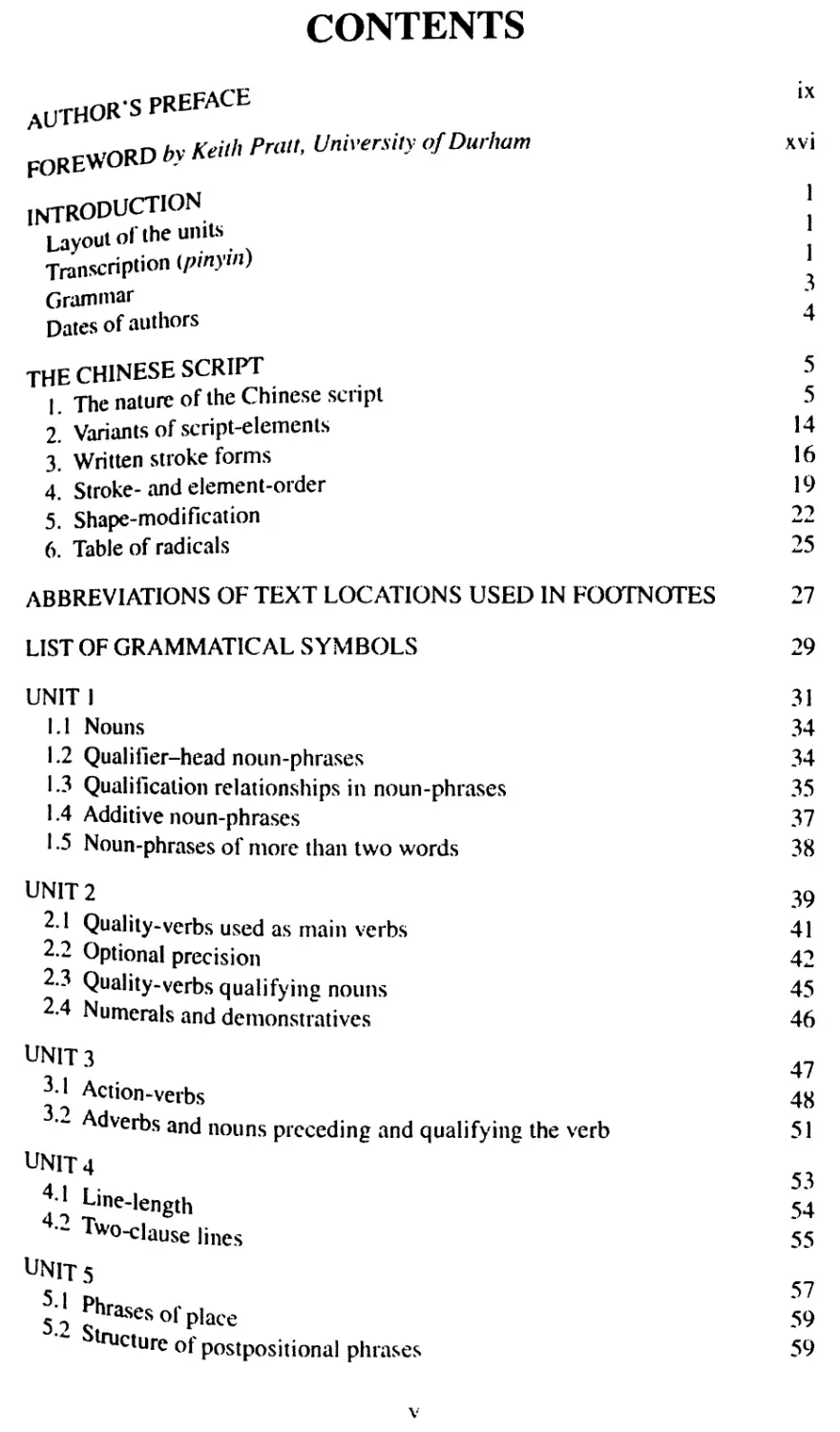
CONTENTS
author s preface FOREWORD by Keith Pratt, University of Durham production Layout of the units Transcription (pinyin) Grammar Dates of authors THE CHINESE SCRIPT I The nature of the Chinese script 2.	Variants of script-elements 3.	Written stroke forms 4.	Stroke- and element-order 5.	Shape-modification 6.	Table of radicals	LX xvi 1 1 1 3 4 5 5 14 16 19 22 25
abbreviations of text locations used in footnotes	27
LIST OF GRAMMATICAL SYMBOLS	29
UNIT 1 1.1	Nouns 1.2	Qualifier-head noun-phrases 1.3	Qualification relationships in noun-phrases 1.4	Additive noun-phrases 1.5	Noun-phrases of more than two words	31 34 34 35 37 38
UNIT 2 2	.1 Quality-verbs used as main verbs 2	2 Optional precision 2.3 Quality-verbs qualifying nouns Numerals and demonstratives UNIT 3 3-l Action-verbs Adverbs and nouns preceding and qualifying the verb UNIT 4 4 L,ne-length - Two-clause lines UNIT 5 5^ £hrases of place tructure of postpositional phrases	39 41 42 45 46 47 48 51 53 54 55 57 59 59
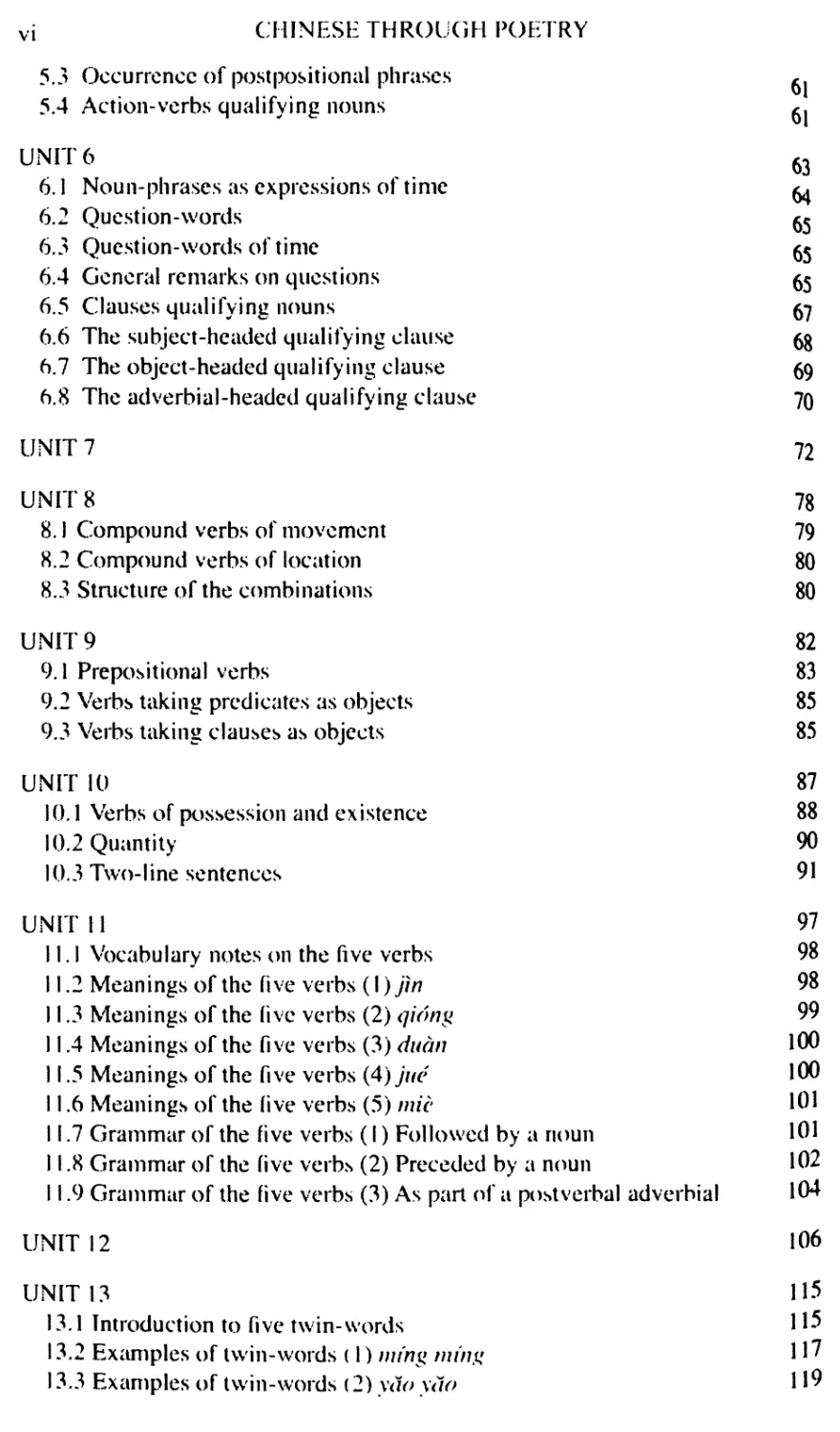
Vi	CHINESE THROUGH POETRY
5.3 Occurrence of postpositional phrases
5.4 Action-verbs qualifying nouns
UNIT 6	63
6.1	Noun-phrases as expressions of time
6.2	Question-words
6.3	Question-words of time	55
6.4	General remarks on questions
6.5	Clauses qualifying nouns	щ
6.6	The subject-headed qualifying clause	6g
6.7	The object-headed qualifying clause	69
6.8	The adverbial-headed qualifying clause	70
UNIT 7	72
UNIT 8	78
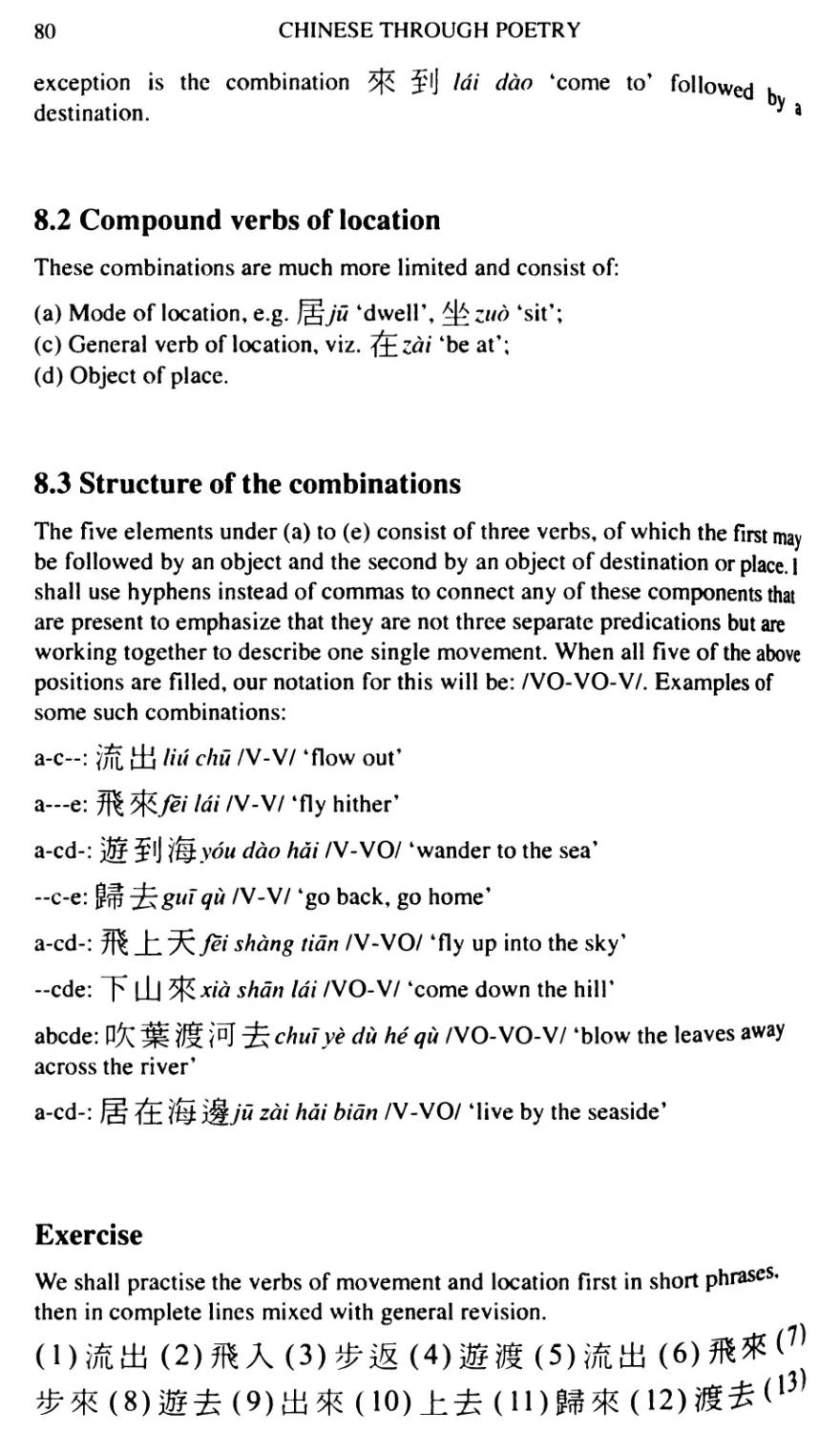
8.	J Compound verbs of movement	79
8.2	Compound verbs of location	80
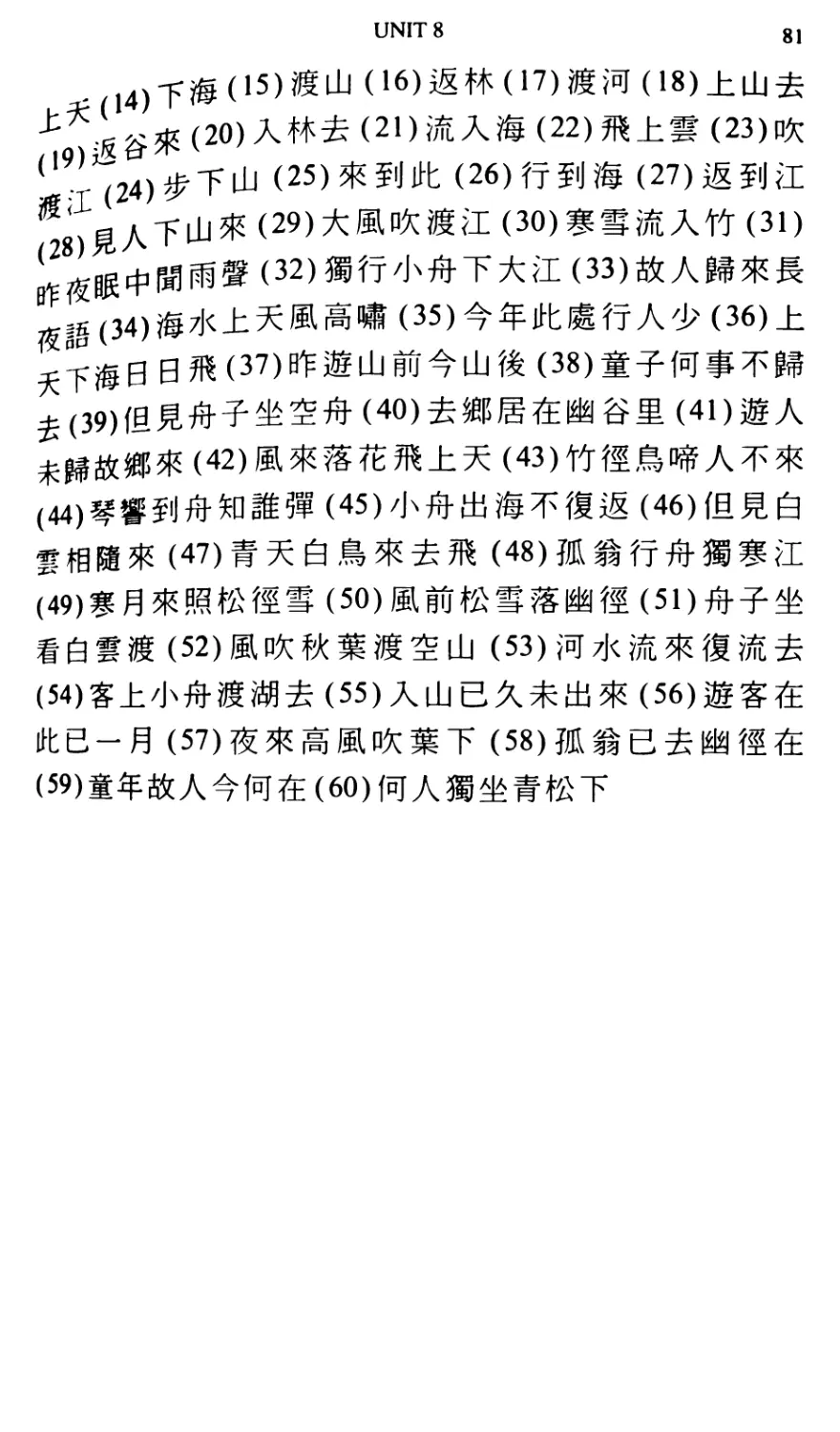
8.3	Structure of the combinations	80
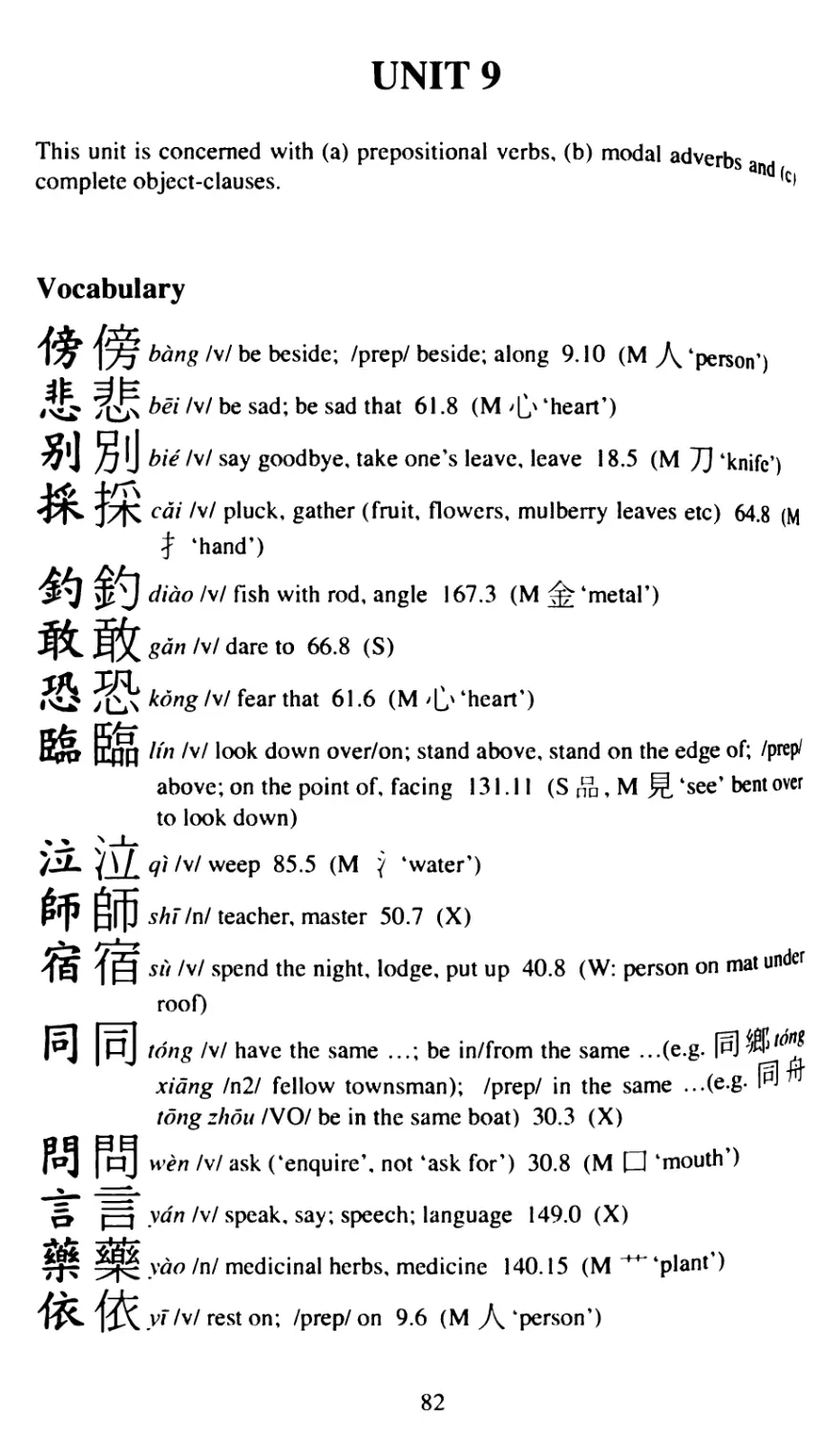
UNIT 9	82
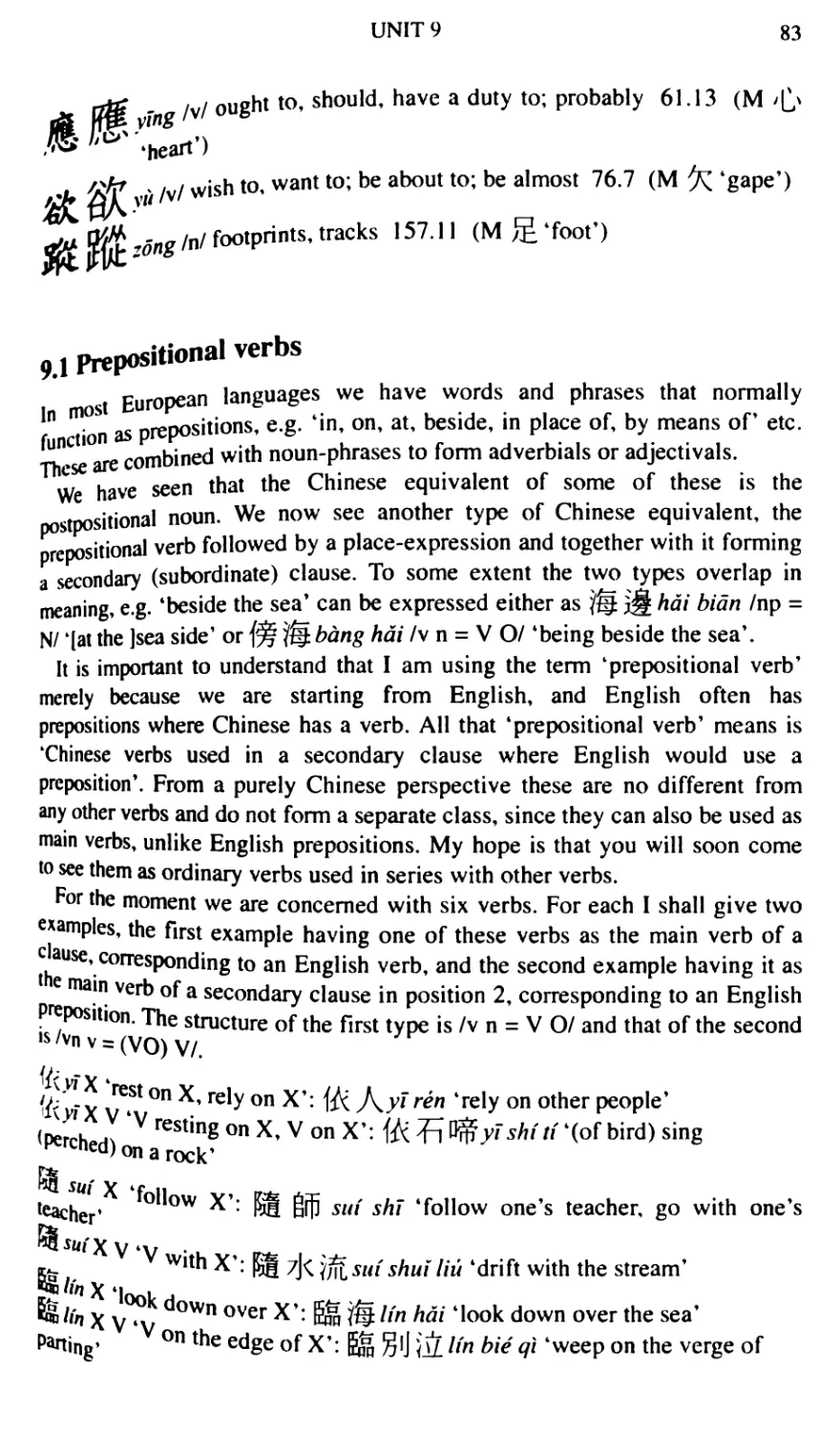
9.1	Prepositional verbs	83
9.2	Verbs taking predicates as objects	85
9.3	Verbs taking clauses as objects	85
UNIT 10	87
10.1	Verbs of possession and existence	88
10.2	Quantity	90
10.3	Two-line sentences	91
UNIT 11	97
11.1	Vocabulary notes on the five verbs	98
11.2	Meanings of the five verbs (I) jin	98
11.3	Meanings of the live verbs (2) qiong	99
11.4	Meanings of the five verbs (3) duan	100
11.5	Meanings of the five verbs (4) jue	100
11.6	Meanings of the live verbs (5) mic	101
11.7	Grammar of the five verbs (I) Followed by a noun	101
11.8	Grammar of the five verbs (2) Preceded by a noun	102
11.9	Grammar of the five verbs (3) As part of a postverbal adverbial	104
UNIT 12	106
UNIT 13	115
13.1	Introduction to five twin-words	115
13.2	Examples of twin-words (1) ming mini»	11?
13.3	Examples of twin-words (2) ydo yao	119
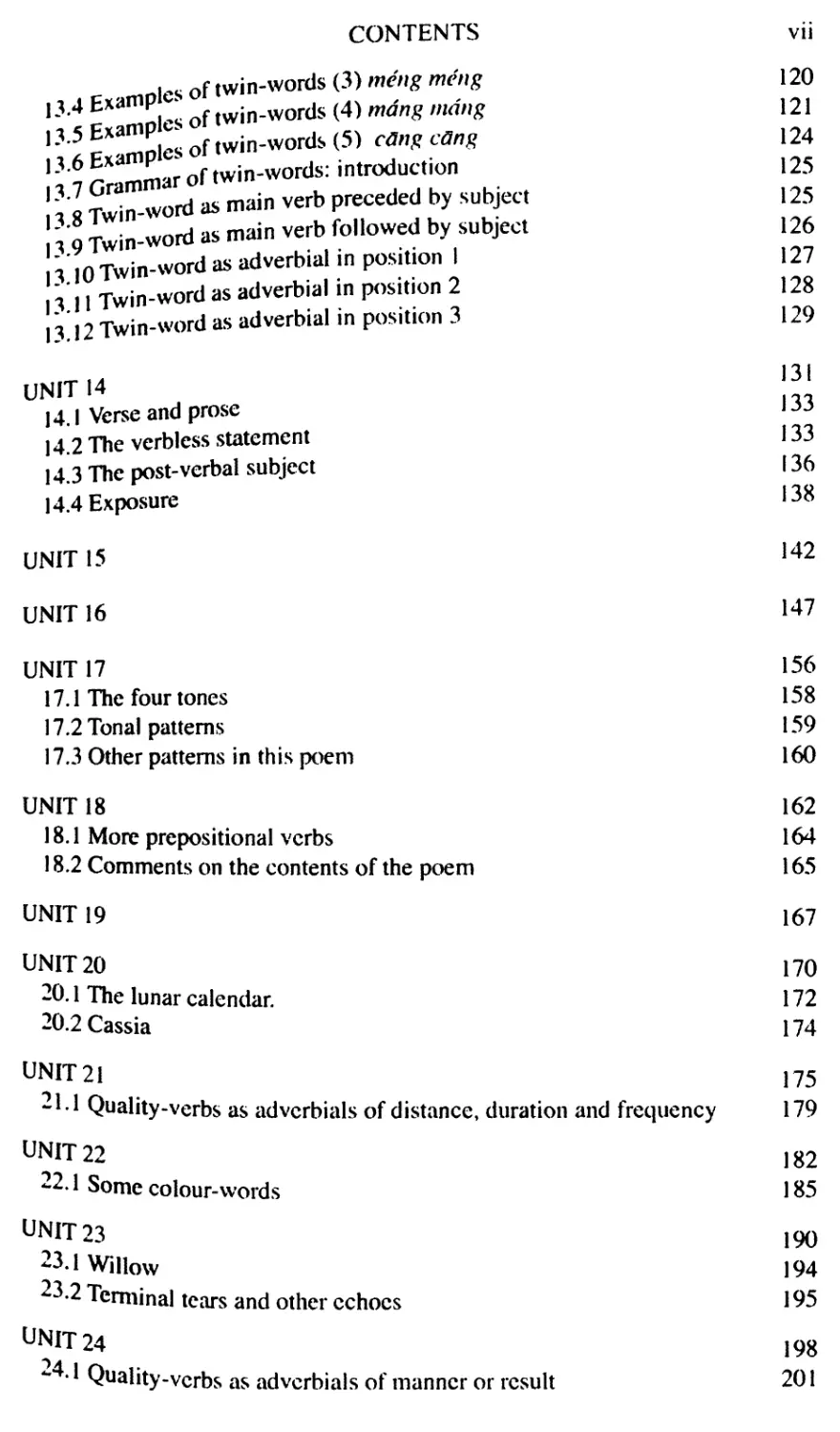
CONTENTS	vii
; 4 Examples of twin-words (3) meng meng	120
V5 Examples of twin-words (4) mdng mdng	121
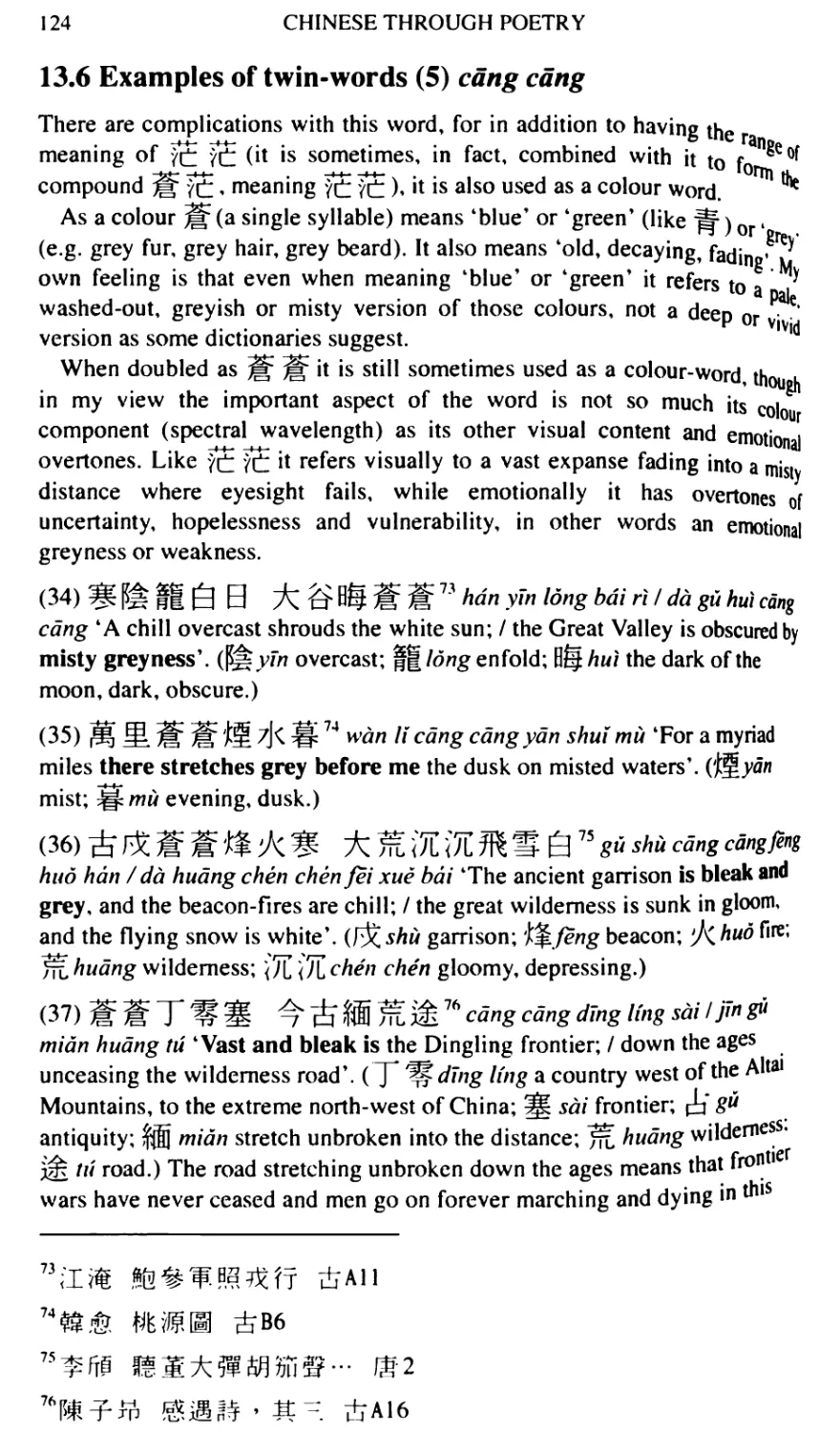
j \б Examples of twin-words (5) cdng cdng	124
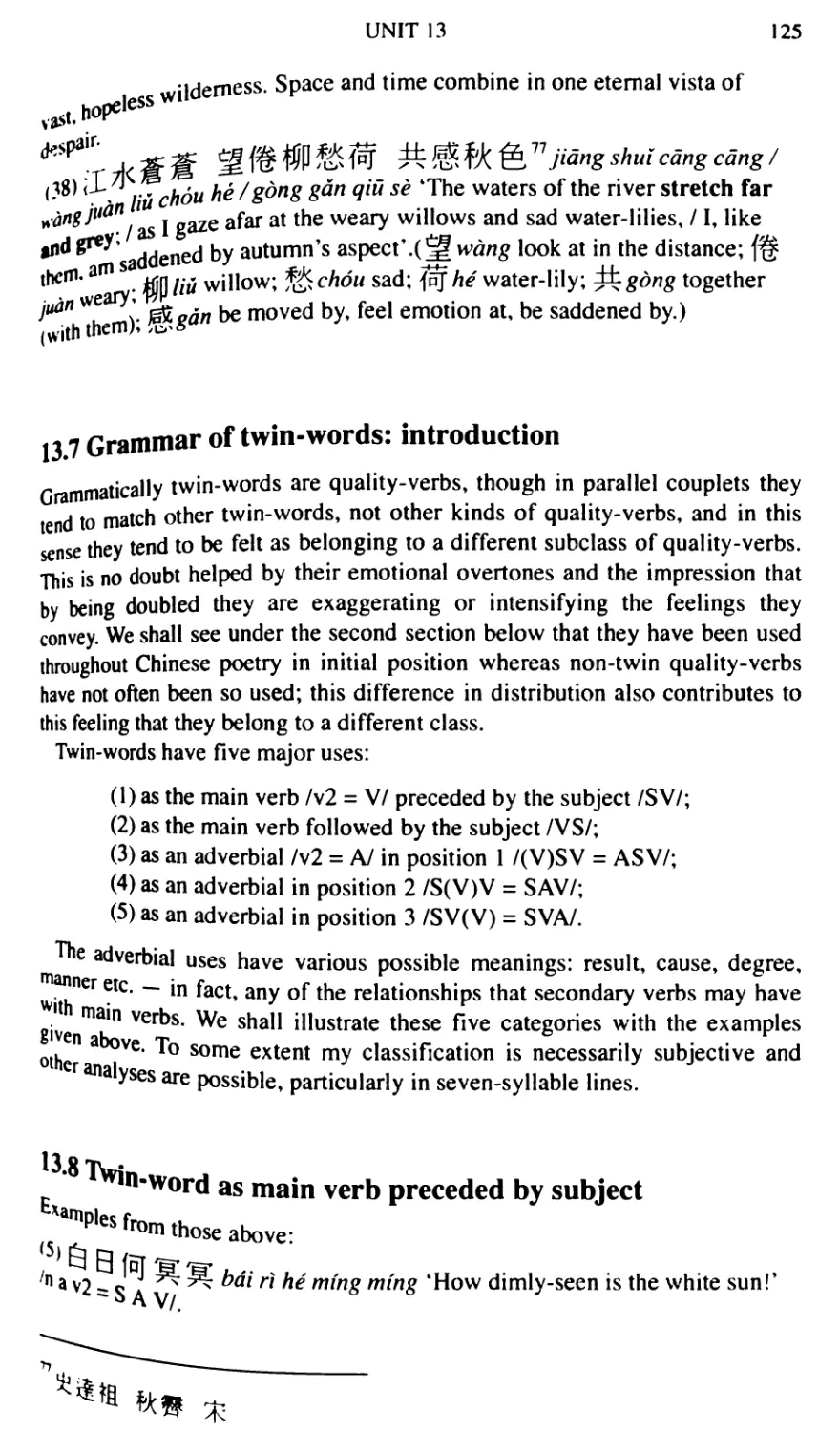
\	Grammar of twin-words: introduction	125
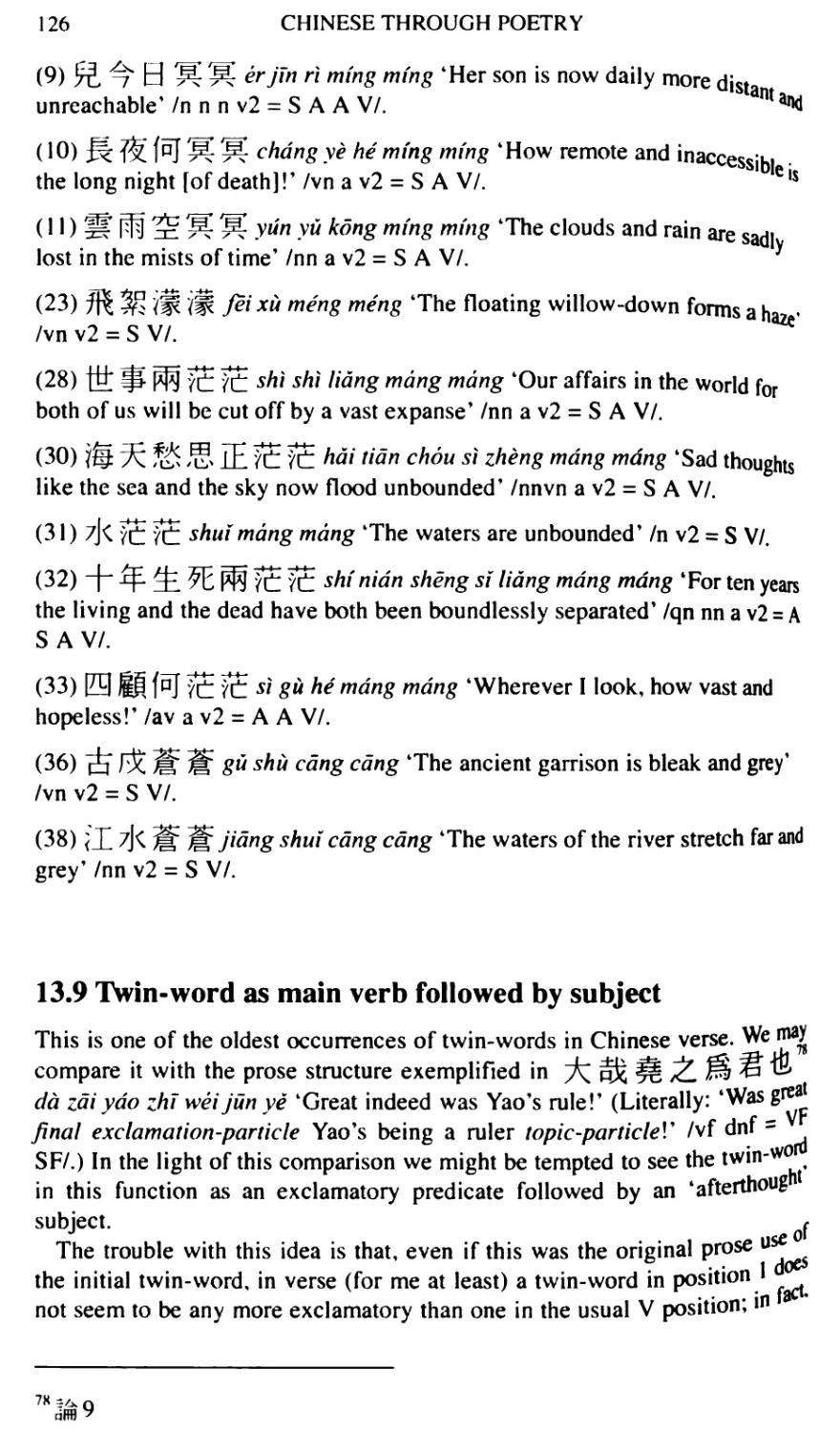
j3 8 Twin-word as main verb preceded by subject	125
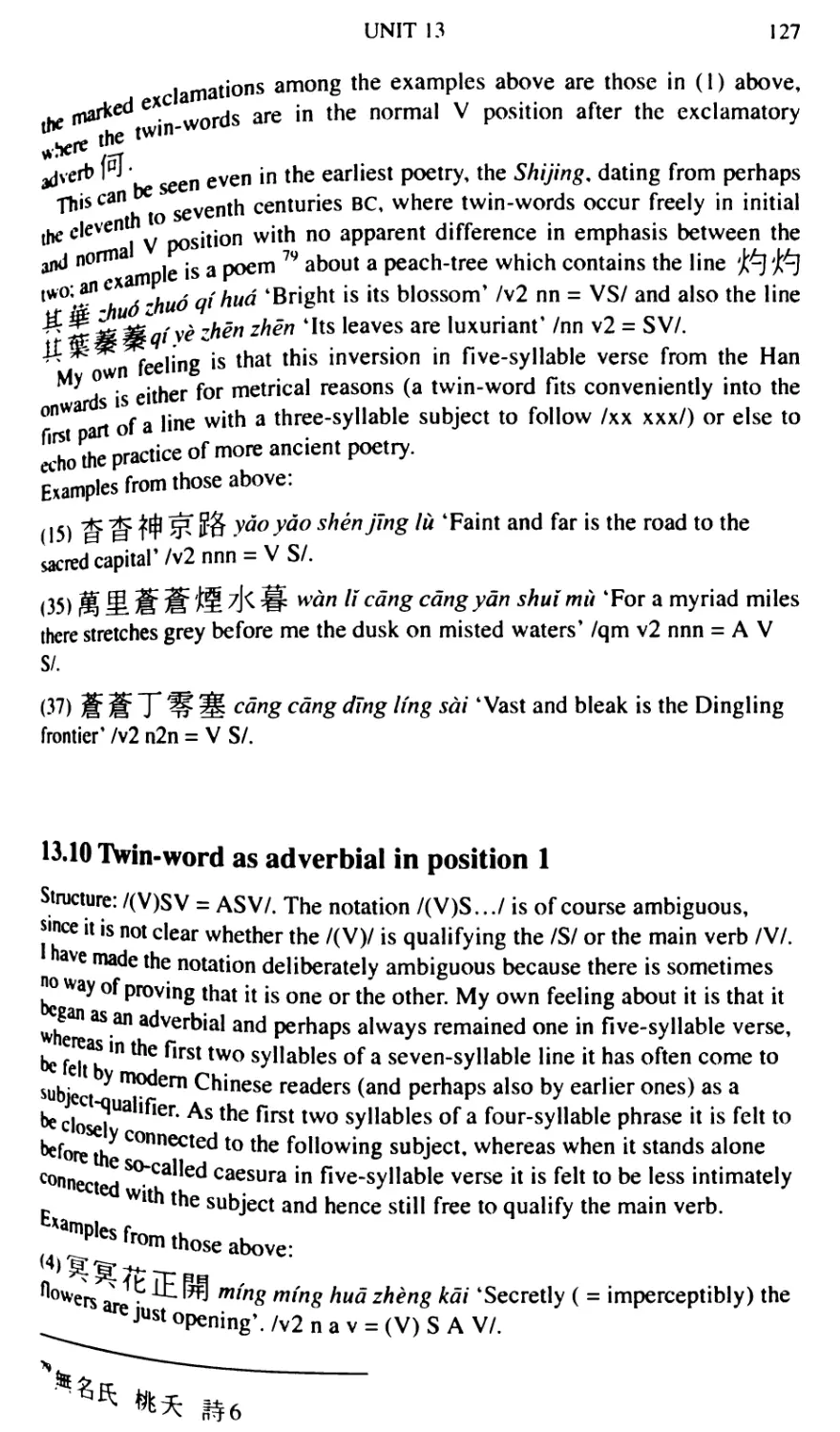
1 \ 9 Twin-word as main verb followed by subject	126
13 10 Twin-word as adverbial in position 1	127
13.11 Twin-word as adverbial in position 2	128
13.12 Twin-word as adverbial in position 3	129
UNIT 14	131
14.1 Verse and prose	133
14.2 The verbless statement	133
14.3 The post-verbal subject	j 136
14.4 Exposure	138
UNIT 15	142
UNIT 16	147
UNIT 17
17.1 The four tones	156
17.2 Tonal patterns 17.3 Other patterns in this poem	158 159 160
UNIT 18
18.1 More prepositional verbs 18.2 Comments on the contents of the poem	162 164 165
UNIT 19
	167
UNIT 20
20.1 The lunar calendar. 20.2 Cassia	170 172 174
UNIT 21
Quality-verbs as advcrbials of distance, duration and frequency UNIT 22	175 179
22,1 Some colour-words	182
UNIT 23	185
23-l Willow enninal tears and other echoes	190 194 195
UNIT 24
Q ity verbs as advcrbials ot manner or result	198 201
viii	CHINESE THROUGH POETRY
UNIT 25	206
25.1 Rhyme	209
UNIT 26	2Ц
26.1 Ambiguity of vocabulary	214
UNIT 27	216
27.1 Ambiguity of function: final quality-verbs	21g
UNIT 28	222
28.1 Ambiguity of function: initial	noun-phrase	224
UNIT 29	228
29.1 Ambiguity of function: noun-phrase	after intransitive verb	233
UNIT 30	235
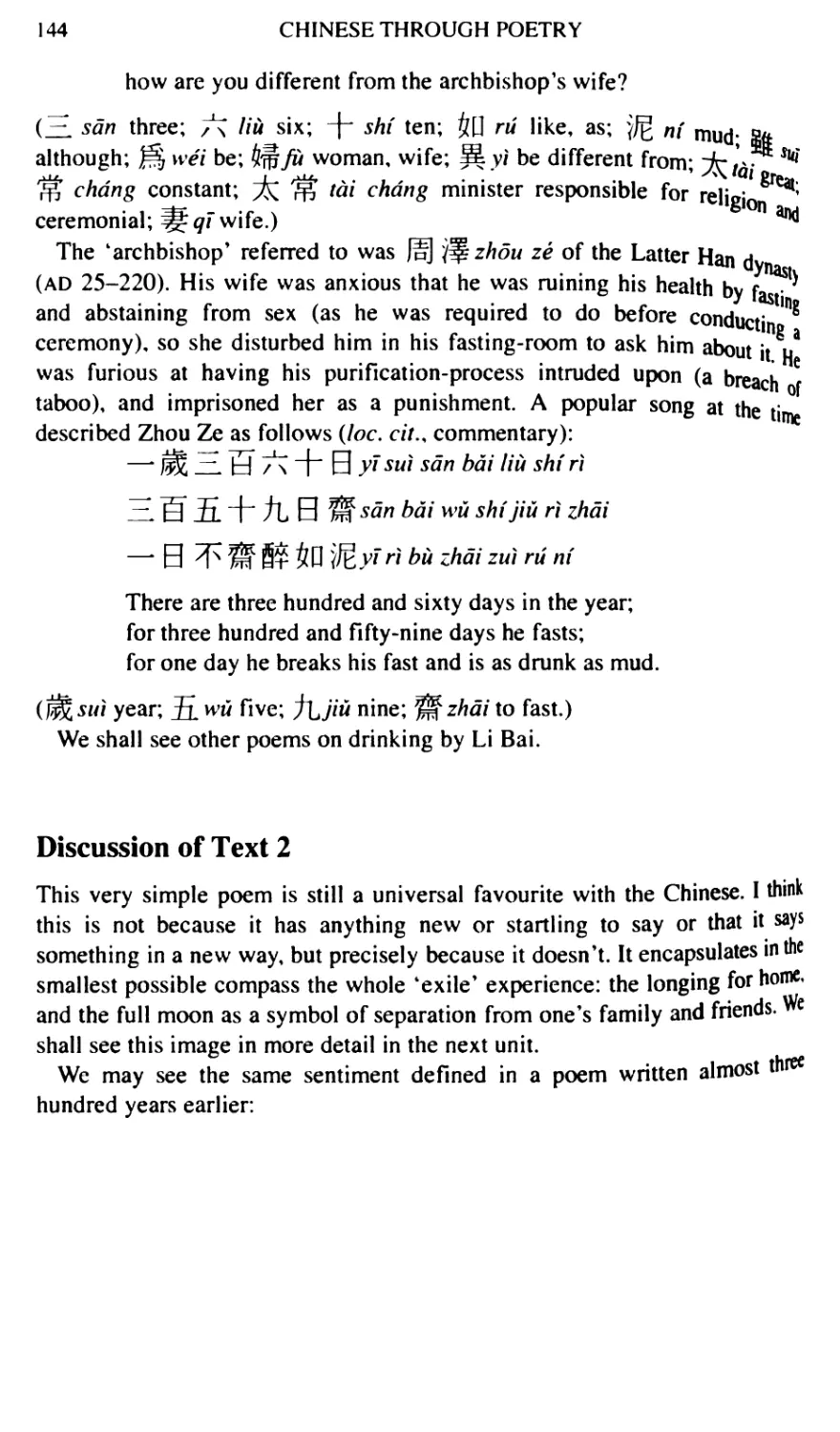
30.1 Ambiguity of function: noun-phrases with the verb ying	237
UNIT 31	245
31.1 The Pcach-blossom Source	245
UNIT 32	254
UNIT 33	257
UNIT 34	260
UNIT 35	263
UNIT 36	266
UNIT 37	271
37.1‘My prince’	274
UNIT 38	278
38.1 Sung-dynasty song-style verse	281
UNIT 39	282
39.2 Paraphrase of Text 2	286
39.3 Paraphrase of Text 3
UNIT 40	282
40.1 An artistic use of the	entering tone’	29"
KEY TO EXERCISES	295
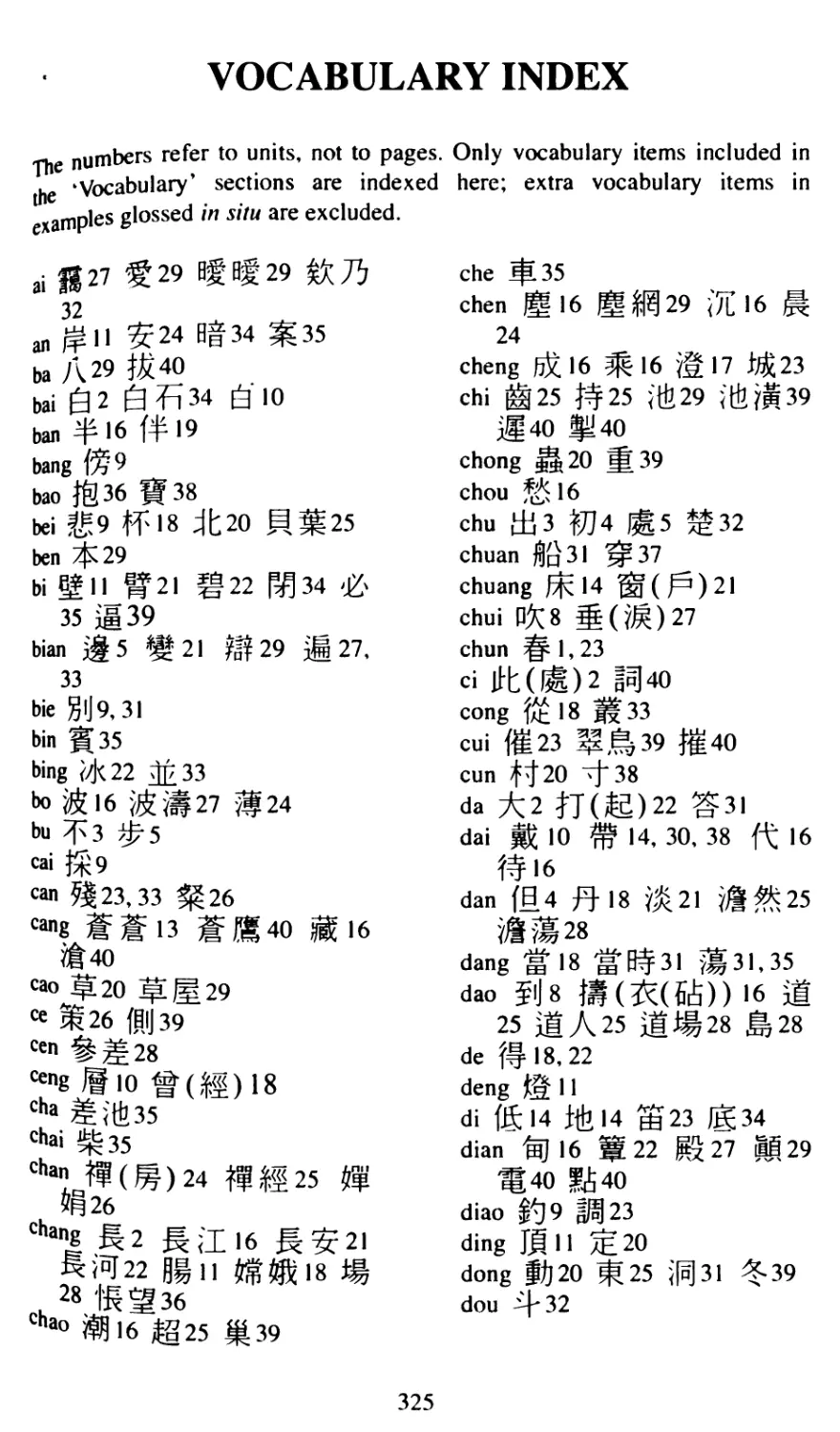
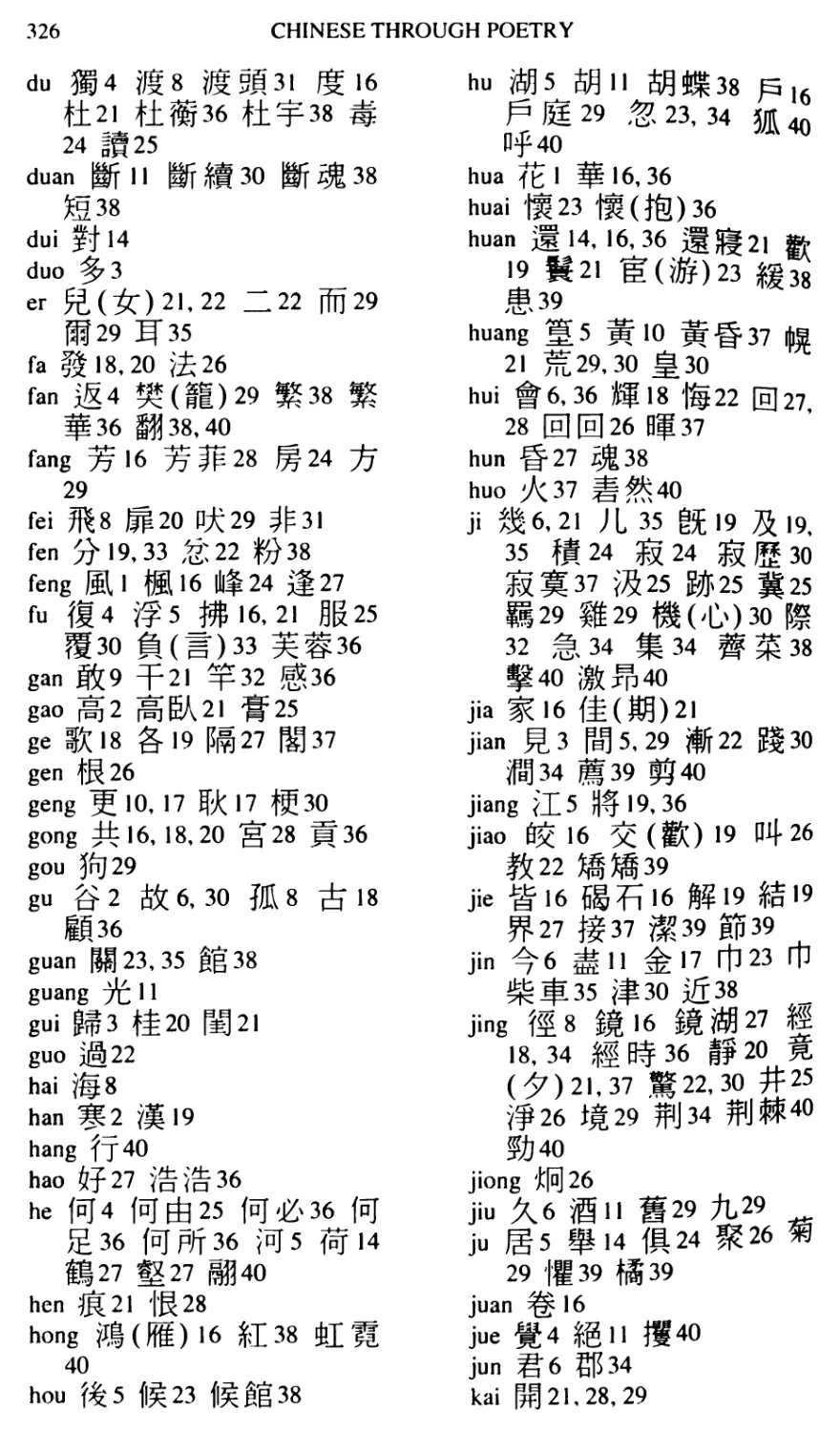
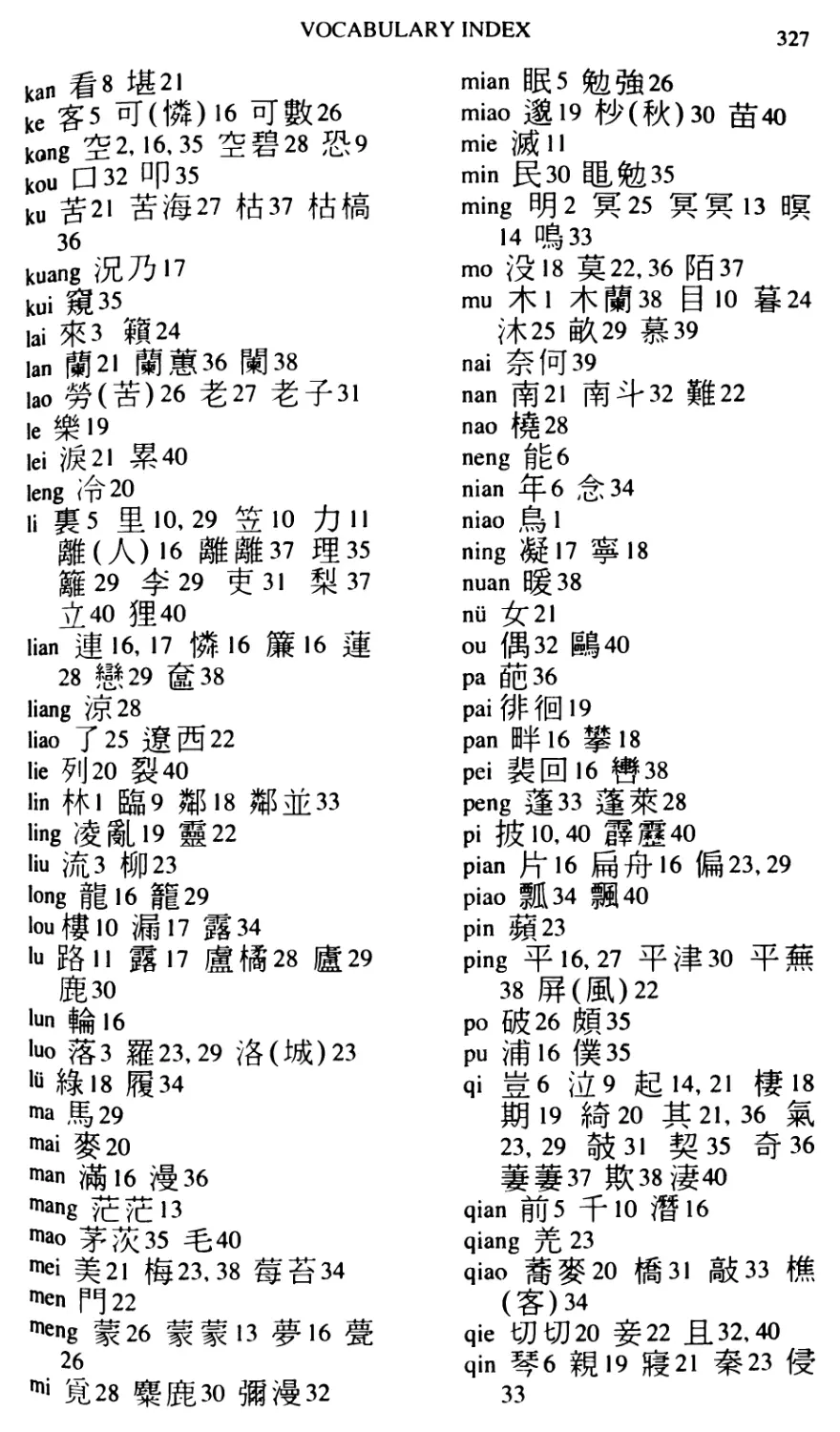
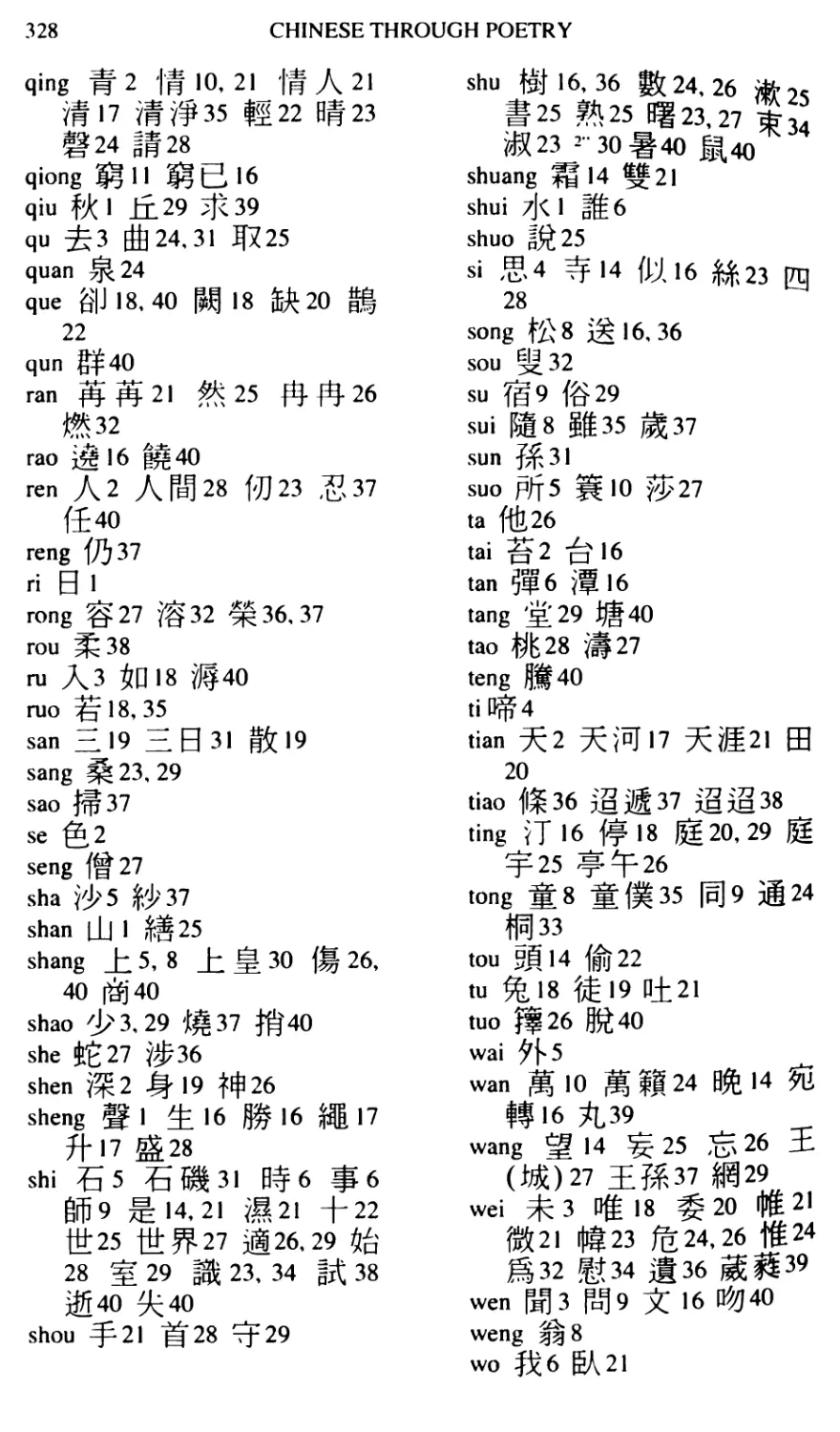
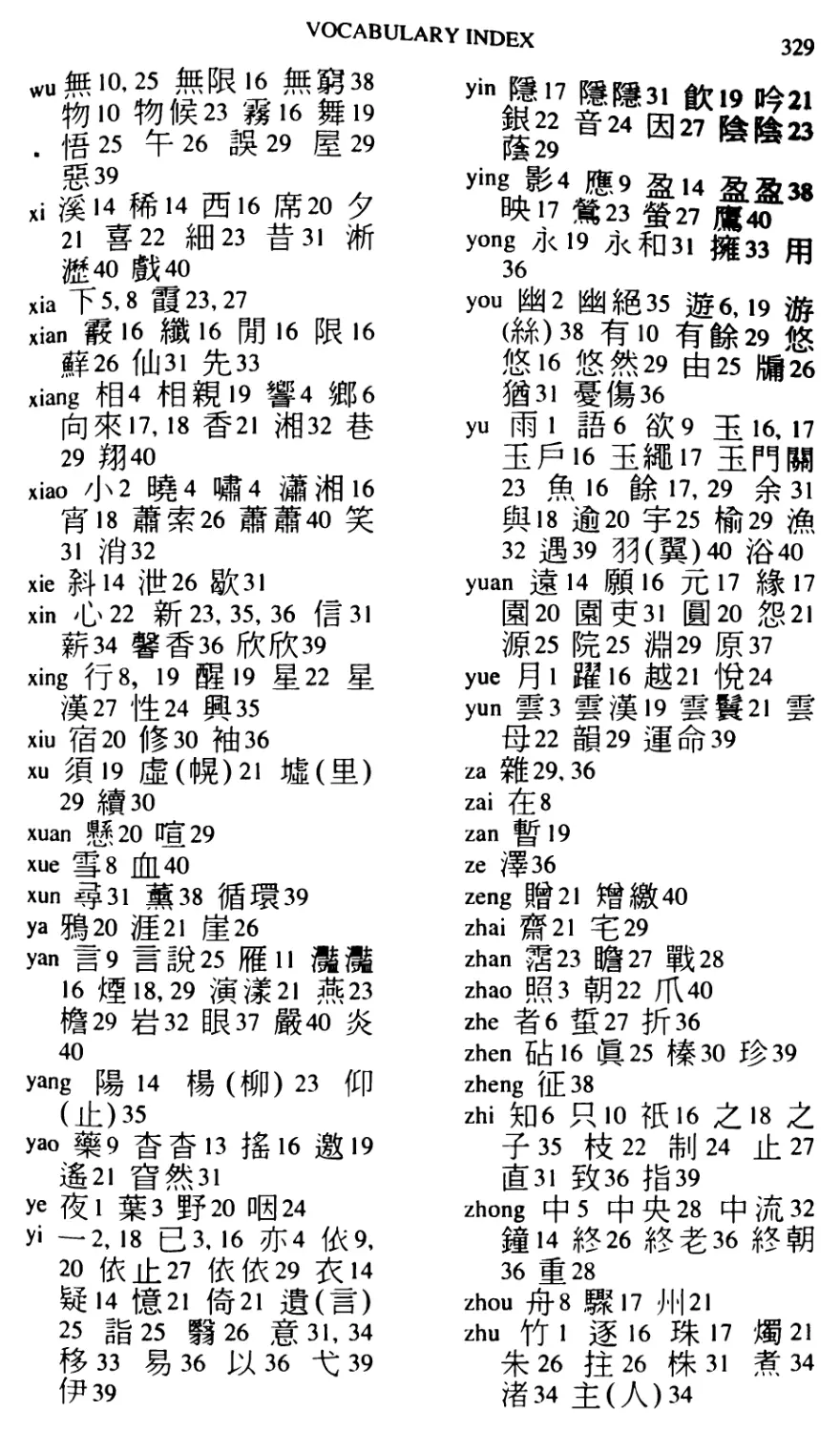
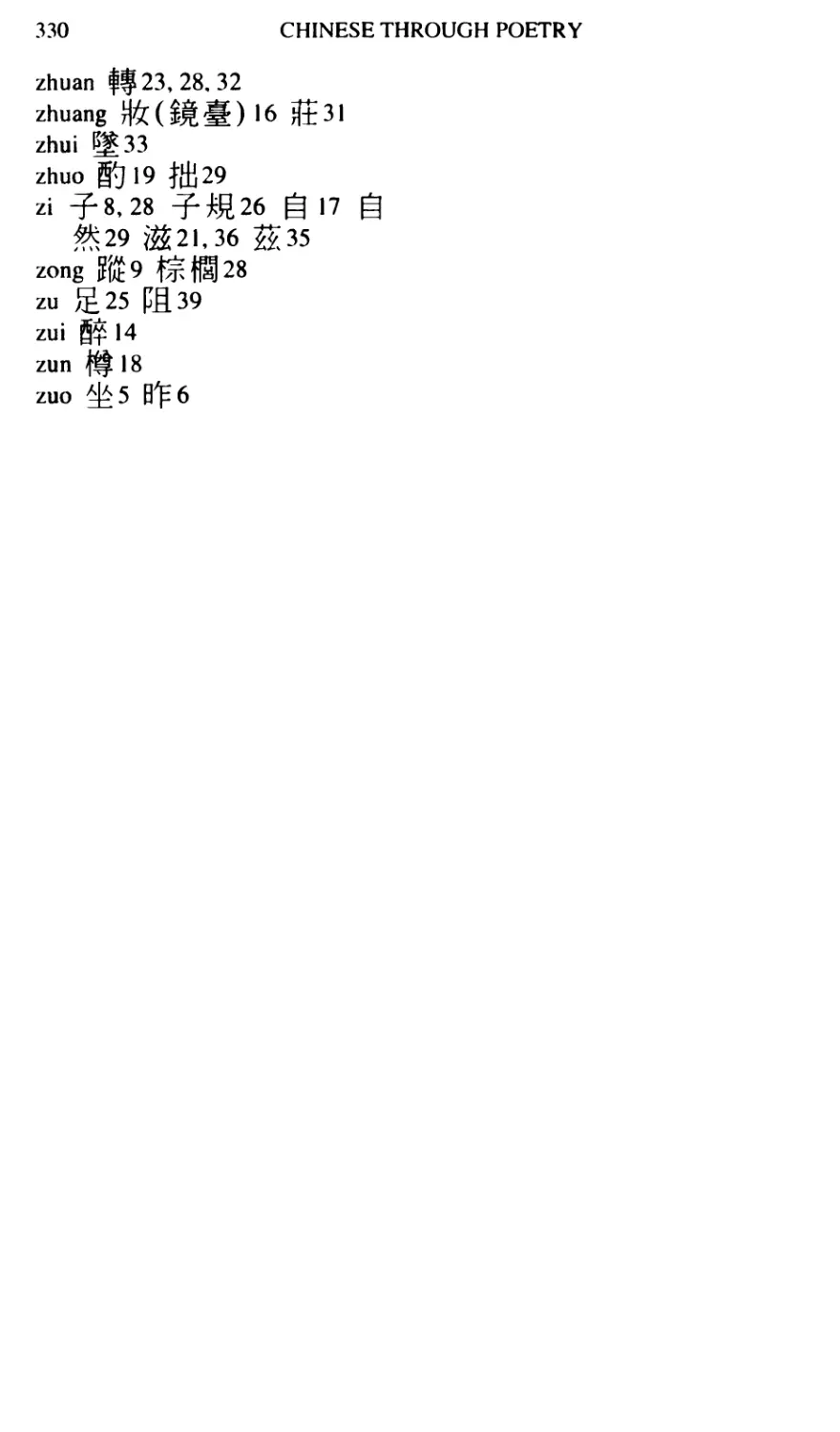
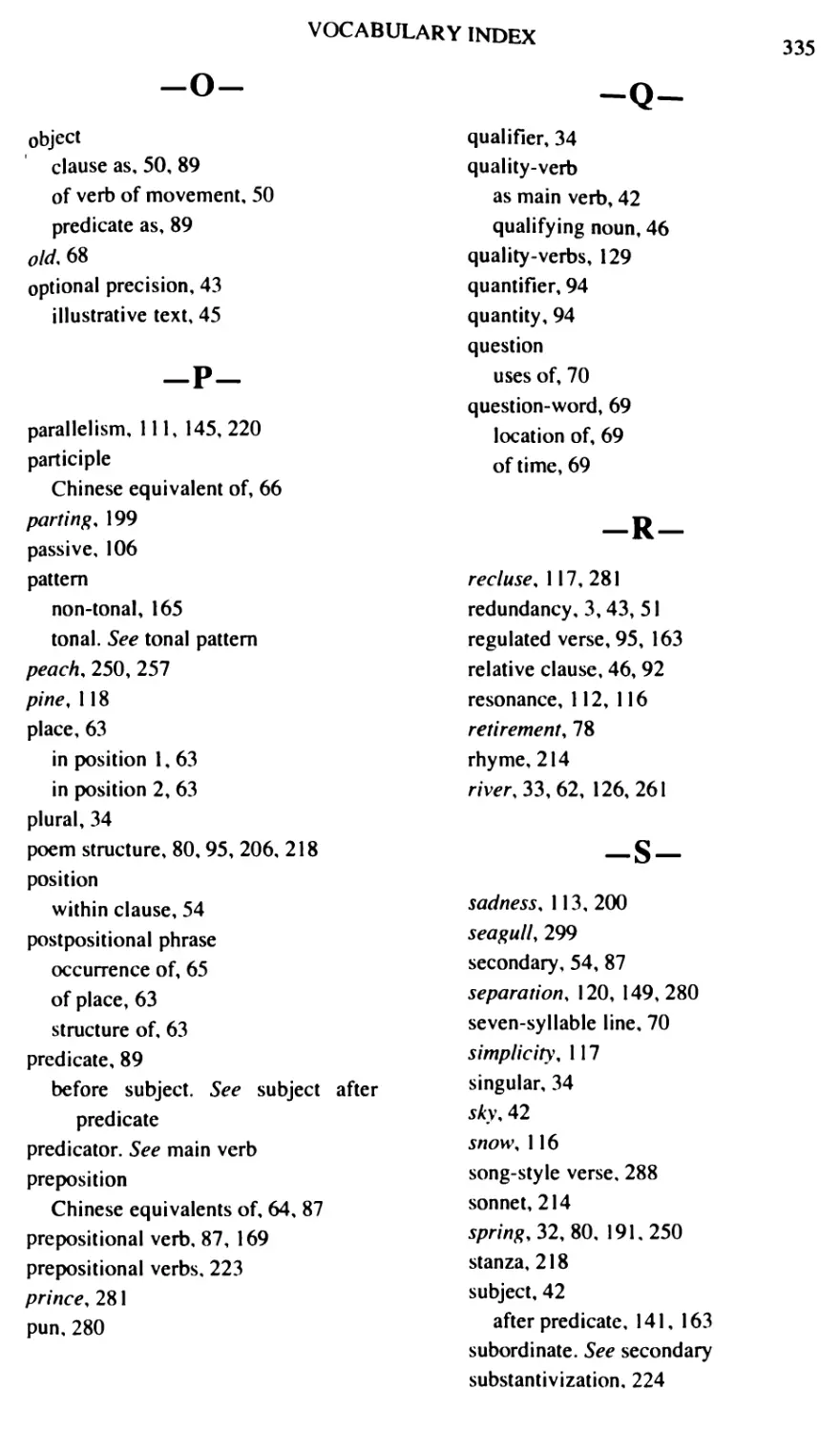
VOCABULARY INDEX	325
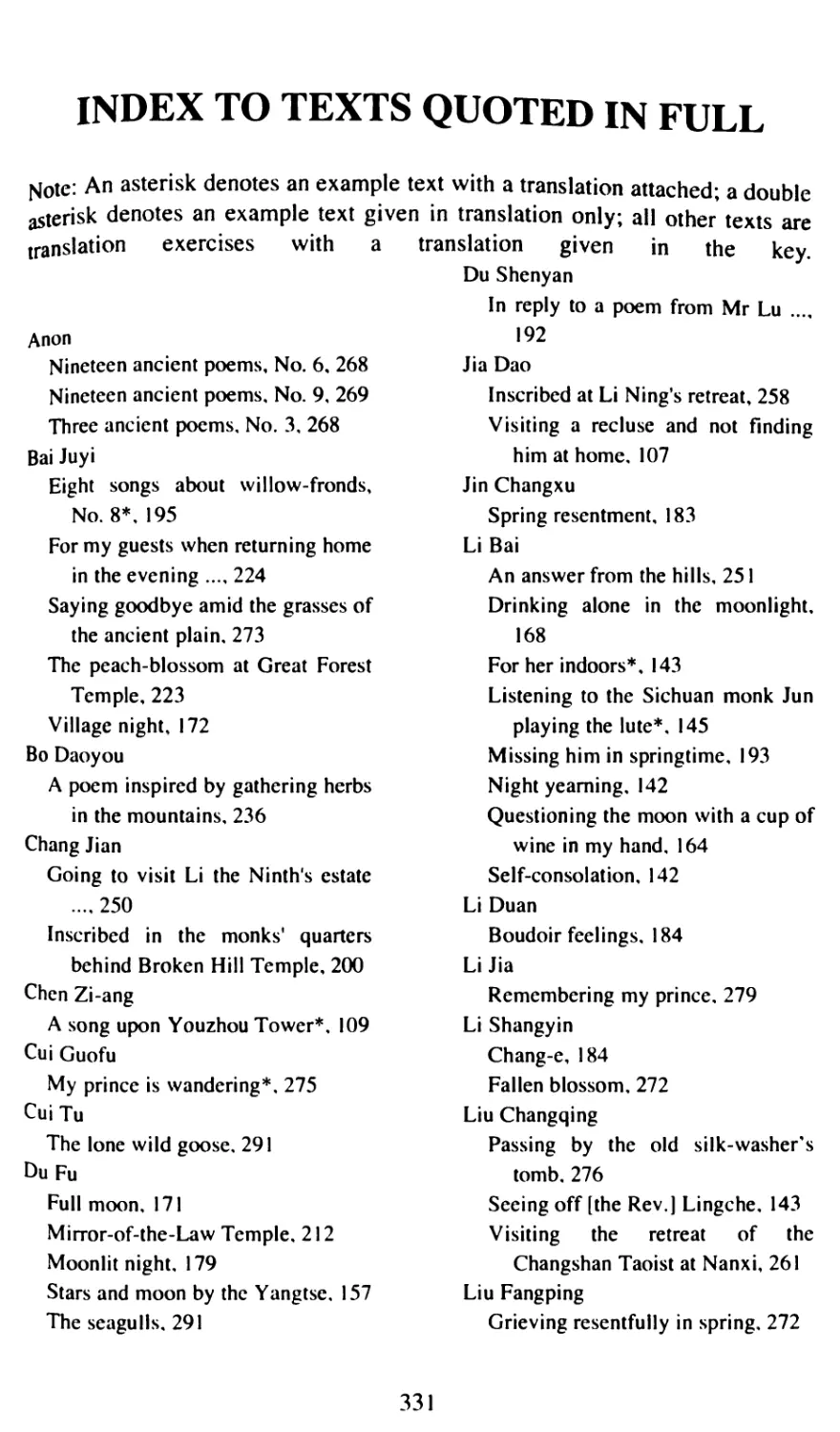
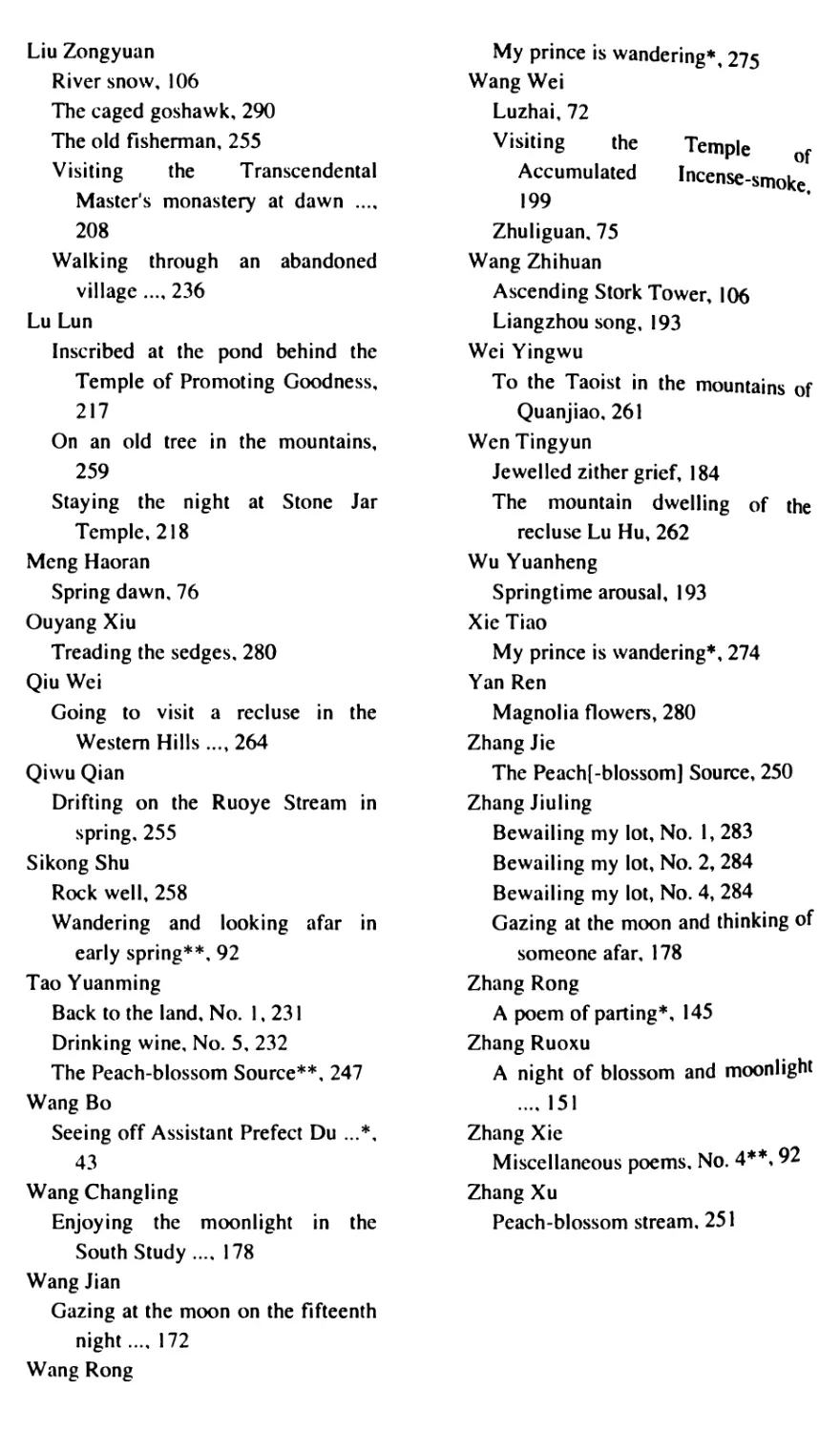
INDEX TO TEXTS QUOTED	IN FULL	331
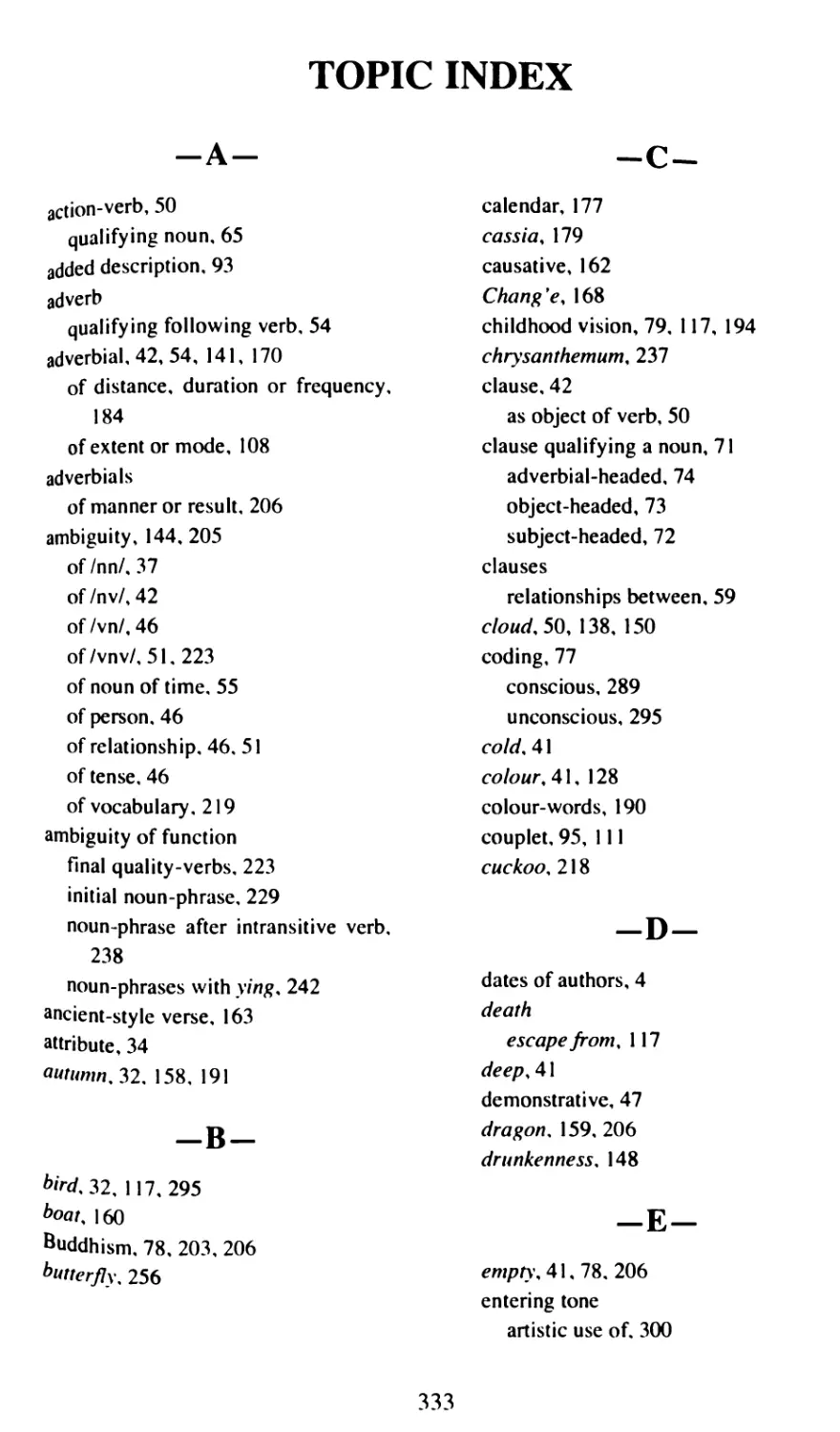
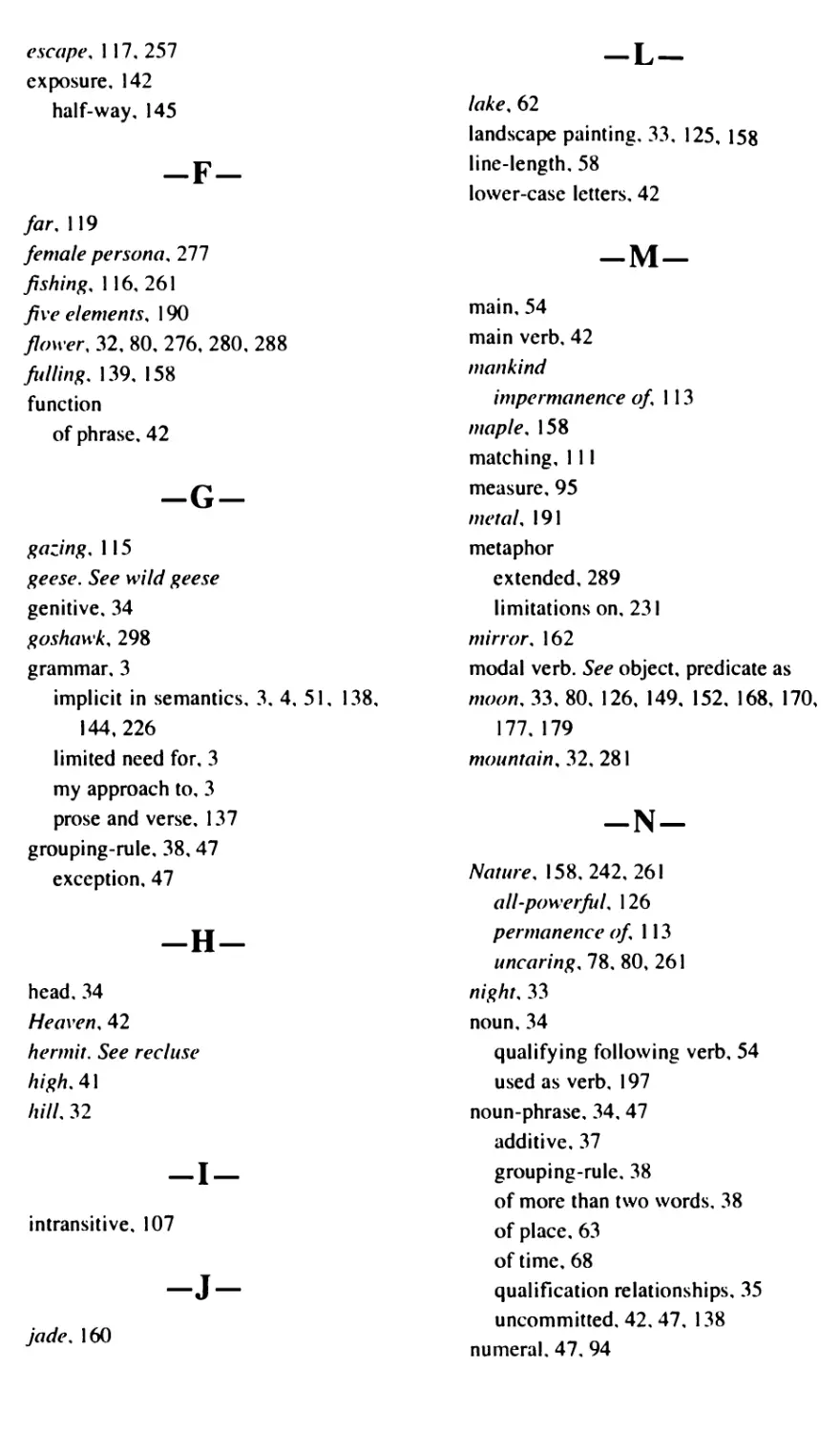
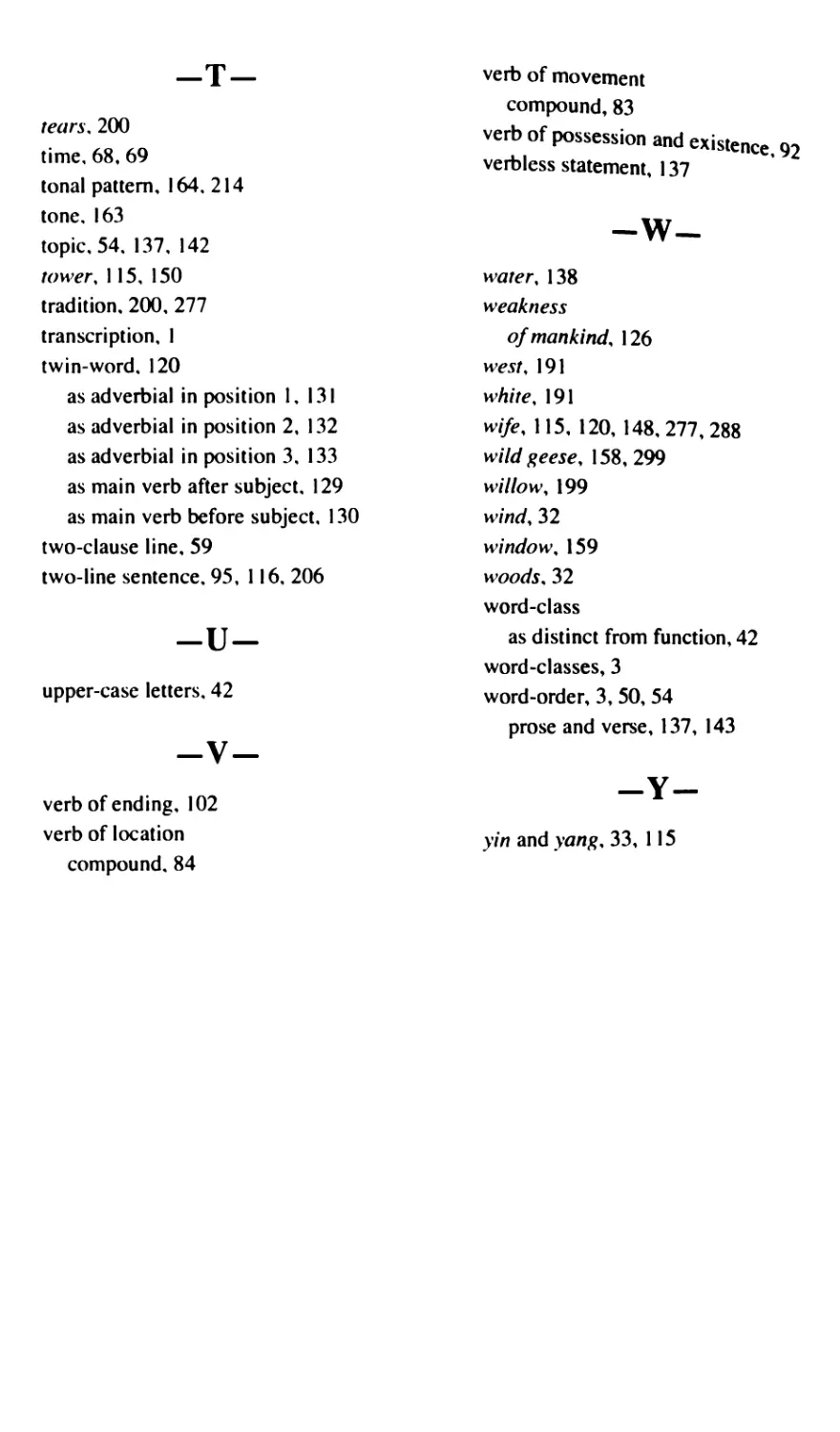
TOPIC INDEX	333
AUTHOR’S PREFACE
uroose text book. While the sub-litle An introduction to the
This is a uua^ imagery of Traditional Verse is a description of the main
l^n^uage^c rnajn title Chinese through Poetry needs some explanation. It
contents, l1 e motjVation behind my approach.
indicates approach the study of Classical Chinese first through prose
11 Г later (if at all) through verse. I am attempting to reverse this procedure
a” the hope that approaching Classical Chinese through a preliminary study
' f verse will be more effectiye for several reasons. First, the student is given
°onfidence by learning to read complete, self-contained texts with a minimum
of vocabulary. Second, the contents are mainly words used in their original
concrete meanings rather than in the abstract extended meanings more common
in prose. Third, the vividness, colour and emotional content of the poems
should assist vocabulary absorption in memorable contexts. Fourth, poetry
brings us closer to the essence of the Chinese psyche than the philosophical
text straditionally used for learning Classical Chinese. It is for this reason that
script, grammar and vocabulary are taught from scratch, enabling the work to
be used as a first introduction to traditional literary Chinese by anyone with no
knowledge of the language. The book can of course be used as an introduction
to Chinese verse for its own sake, either independently or as part of a more
general course.
To be more precise, this book is an introduction to the language and
imagery of traditional Chinese lyrical verse, concentrating on the Tang dynasty
(618-907) but ranging back to the Han (206 вс to ad 220) and forward to the
Sung (960-1279) when appropriate.
The script used is the traditional one (^ ЙЗ not the simplified version
(fffiffiz'4-). The system of transcription used is the standard pinyin. Its
primary purpose is not, of course, to indicate the medieval pronunciation of
te Chinese texts but to enable the reader to use the Vocabulary Index and any
mese-English dictionaries arranged by pinyin.
h eferences are given for ац Cfojnese verse texts quoted. Where possible I
• e £,ven a reference to The Three Hundred Tang Poems (®	— Д Йл)
Tho 1еП aS 3 source lexts f°r students.
are alr°Ujh * suPP°se that this course will be used mainly by students who
(he Chines ^ат*^аг at least the rudiments of modern Chinese and of
knowled e fCriP1’ 1 have made provision for the absolute beginner with no
Chinese w ° ЭПУ Chinese by including an introductory section on the
this course^Hf SyStem’ ^Or such new’coniers t0 Chinese I should suggest that
°/Tu Ftt QXf °h°wed by a more advanced work: D. Hawkes, 4 Little Primer
also be need rTr * rePr’nlec* 1987. A dictionary in traditional script will
Dfctionarv C и °Г further study, such as R. H. Mathews, A Chinese-English
> — Harvard UP, 1974.
In memory of
Archie Barnes
xi
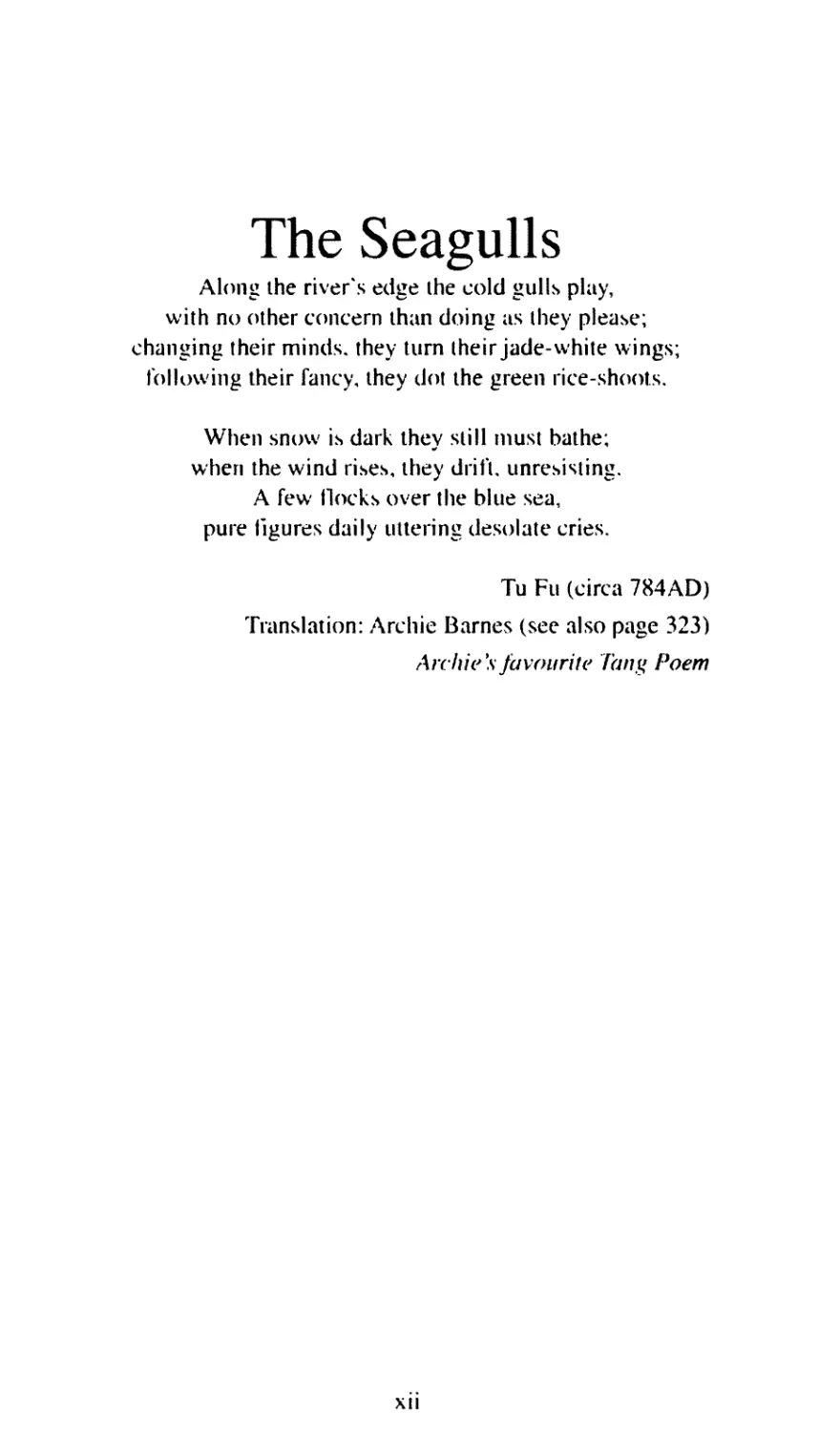
The Seagulls
Along the river's edge the cold gulls play,
with no other concern than doing as they please;
changing their minds, they turn (heir jade-white wings;
following their fancy, they dot the green rice-shoots.
When snow is dark they still must bathe;
when the wind rises, they drift, unresisting.
A few Hocks over the blue sea,
pure figures daily uttering desolate cries.
Tu Fu (circa 784AD)
Translation: Archie Barnes (see also page 323)
Archie's favourite lang Poem
xii
nt t«t1 a ®
| $ <1 К i f <s %
11МЙ^ 38&g
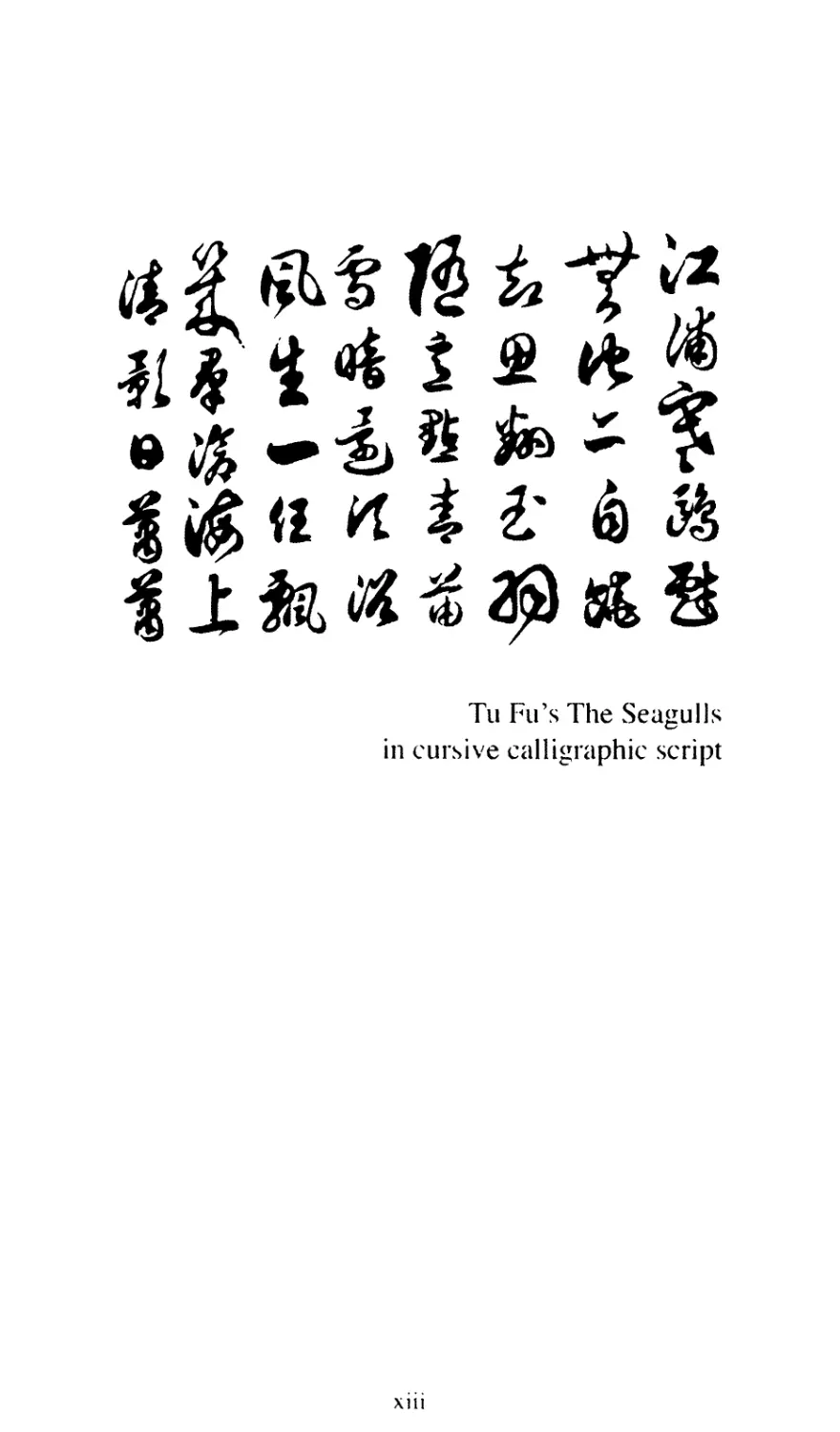
Tu Fu’s The Seagulls
in cursive calligraphic script
xi ii
Acknowledgements
Archie’s work, although completed before he passed away, could easily have been
lost forever, were it not for his sons, John and Jim, rescuing it from the depths of
his computer and were it not for Graham being willing to take on the task of final
processing. Thank you. This book would not be here without your various input.
1 would also like to take this opportunity to show my appreciation to Durham
University for its support of this project, especially Professor Keith Pratt, a long
time colleague and friend of my husband, who contributed the Foreword and to
the Oriental Museum and Dr Kevin McLoughlin who put together the cover for
the book.
Marie Barnes
xiv
Foreword
by
KEITH PRATT
University of Durham
FOREWORD
Change is an essential factor in our daily life. So frequently do we identif
with progress and improvement that stability, despite its comforting sense **
familiarity, risks the charge of out-datedness. We have learned to live with A|v^
Toffler’s outlandish predictions which so alarmed many back in 1970 when th
first read them in Future Shock. 1984 is past and gone, and we who inhabit
Brave New World look back beyond the age of Aldous Huxley with no more than
a passing sense of nostalgia. Younger generations can hardly appreciate what it
meant to live in a world that was not permanently aware of constant shiftsand
developments in technology, communications, medicine, culture, even climate
Are they, and we, the better for it? Yes of course, in many respects. Are we
the happier? Possibly, though the risk that the questioning, re-examination and
discrediting of inherited devices, traditions and values can sometimes result in
doubt, uncertainty, and even cataclysm cannot be denied.
Traditional China also confronted change. If the pace of life was less frenetic than
ours, it was none the less capable of throwing up plenty of developments and
dilemmas to concern its thinking citizens. Political upheavals and rivalries were a
frequent curse and the threat from beyond China’s borders a real one. Ideological
movements, economic fluctuations, and technical innovations periodically
challenged social stability. In the face of constant ups and downs, people fostered
a stoic attitude which today's affluent generation, whether in China or the wider
world, finds largely incomprehensible. What they clung on to, the stability they
trusted and valued most highly and that helped to define Chinese civilisation over
so many centuries, was the culture enshrined in the arts of the brush. To them,
ink, paint, paper and silk afforded continuity, security, and reassurance, and of all
the arts associated with them poetry was the greatest. Some of the Chinese poets
were among the greatest the world has ever known. The subjects they wrote (and
sang) about - beauty in nature, the changing seasons, riverine scenery, absent
loved ones, military' campaigns, homesickness, drink, wistful music, female
allure - still strike a chord with us today. We can marvel too at the sophistication
of their literary' structures and the subtlety of their allusive powers. That said,
we can never hope to see things as they saw them through their own eyes, nor
can even the best translation into modem English convey the depths of meaning
imparted by the succinct phraseology of classical Chinese. The language they
used was difficult. It made no concessions to the reader: indeed, the more abstruse
the writer could make it, the greater the compliment he paid to his reader, who he
knew would enjoy teasing out its hidden depths. Unlike today's writers churning
out ephemera for the masses with an eye on the best-seller lists, he wrote for3
tiny audience, perhaps no more than one. Some, especially the historians among
them, may have hoped that their work would survive for the guidance of bter
generations, but none could envisage a readership outside their own elite circle
of educated Confucian scholars. They would have greeted with incomprehension
and incredulity the idea that what they wrote would be read and analysed by
foreigners ('barbarians') more than a thousand years hence.
xvi
FOREWORD
xvii
(wenyan) was both nebulous and precise, capable of conveying
Cl^al Chi^^
of the greatest profundity on the one hand and unexpected
philosophy31 co" c exaCtjtuje on the other (Archie Barnes used to tell students
degrees of sei ethjng ]jke a dozen characters for blue/green in Chinese, and
that there	reader knew exactly what shade was being described by
that the wc^-i	]jable lo what we should call ambiguity. But when
each of	to discover that a phrase or sentence was susceptible
students n one or cvcn tw0 possible interpretations, Barnes would patiently
to morcjhat (hc wriler knew exactly what he was doing, and that putting over two
explain	al once was not so much a failing (as it might be regarded in
Student’s essay) as an intellectual plus. To try and pin a Chinese scholar down
and expect that his words should be translatable into one exact, corresponding
meaning in 20th-century English was. au contraire. a sign of the modem reader's
own blinkered understanding.
We can never put ourselves in the position of a Confucian historian or a Daoist
poet and the world reflected in the classical Chinese language is long since past
and gone. But as Archie Barnes grew up in the difficult 1930s the attractions of
its apparently stable civilisation were seductive and it still exercised considerable
sway, not only in China but increasingly in the West: its philosophy was exalted
by Bertrand Russell, the humanism of its Confucian education by John Dewey,
its literature by Arthur Waley. and its visual arts by the organisers of the great
1935 Royal Academy Exhibition. It was only natural that a bom linguist like
he (as a teenager he excelled at French, Latin and German, and had a working
knowledge of Greek and Russian, which he taught himself from a book on his lap
during French lessons) should be attracted by Chinese. His Religious Education
teacher, an ex-China missionary, gave him lessons and he passed the London
Matriculation examination in it at the age of 17. In 1952 he graduated with first
Class Honours from the School of Oriental & African Studies, and was then called
up to do his National Service in the Essex Regiment, which included a posting to
Korea in the latter stages of the War there. Korean was duly added to his growing
portfolio of languages. After his demob he became a freelance translator, some of
the twelve books he translated in the late 1950s and early 1960s being published
ЬУ the Foreign Languages Press.
n 1961 he took up a post as Spalding Lecturer in Chinese Language and
isation in the School of Oriental Studies at the University of Durham. There
hisCntered a sma11' intimate community of older specialists into which, despite
h*S ^nSu’-stic voracity fitted him with ease: Tom Thacker (Egyptology).
Fra^k RU^n	Richard Hill (Sudanese studies), John Haywood (Arabic),
Arab* .3^СУ ^crsl3n), C.G.Simpson (Turkish), Ray Thornhill (Hebrew), and
horncR 3 ^aSU ^nd’an studics). As well as the School, Elvet Hill House was
staffC\v° ?C ^r*cntal Section of the University Library, where a team of dedicated
cornmon Unc^cr l^c еУе ol*the redoubtable Ian Foster. Discussions in the staff
tbe kind	$Palcling Room) were scholarly, wide-ranging and spirited,
0 comparative multi-cultural exchange that provided Archie Barnes
xviii
CHINESE THROUGH POETRY
with umpteen fascinating points to file away into his encyclopaedic memory t
he brought out in the course of tutorial debate perhaps years later. (More munda^
matters of University administration were generally relegated to a smoke-fi|j^
comer in the New Inn at lunch time.)
The syllabus Archie Barnes inherited from Ray Dawson in 1961 was modelled
on that of pre-war Oxford, and reflected the traditional Chinese respect for (foe
classical world and its literature. Set texts included portions of the Analects of
Confucius, the philosophers Mencius and Moz.i, the history Shiji, and selections
from the great poets. Classical unseens were taken more seriously than modern
ones (Ray Dawson had famously told his students in 1959 that there was no poinl
in learning to speak Chinese because they would never be able to go there, whereas
there would never be any shortage of books written in classical Chinese in the
library). Archie was able to expand and modernise the syllabus, introducing some
of the books he himself had translated such as Cao Yu’s Thunder. Composition
and translation into Chinese were exclusively concerned with the modem
language, because as late as the 1950s the syntactic analysis of wenyan was still
in its infancy, and the grammar of classical Chinese was generally deemed to
be cither non-existent or largely inexplicable. The first attempt to formulate a
comprehensive grammatical description of the ancient language was W.A.C.H.
Dobson’s Late Archaic Chinese (1959), and though Ray Dawson, as one of
Dobson’s former students, made some use of it as a teaching tool, both he and,
at first, Archie preferred to initiate students in the time-honoured way, reading
simple texts like the Xiaojing (from H.G. Creel’s Literary Chinese by the Inductive
Method, 1938) and commenting on grammatical particles as they occurred. Mrs
Liu's Fifty Chinese Stories was a useful primer, as familiar to students in Durham
as in London. Harold Shadick's First Course in Literary Chinese was based on a
broader sample of textual passages, including examples of poetry, and appeared
in the same year (1968) as Ray Dawson’s Introduction to Classical Chinese. All
of these had their uses, but their approach was still basically inductive and Archie
was convinced that if classical Chinese was to be taken seriously, it had to be put
on a par with, say, Latin, and its grammar presented in logical and comprehensive
format. One of the obstacles hindering the easy appreciation of wenyan was its
lack of a proper system of punctuation. The first classics to appear in punctuated
form were the Shiji (1959) and Lanzhou University's edition of Mencius (1960),
and great excitement greeted the slow appearance of punctuated versions of the
dynastic histories through the 1960s and ‘70s. Archie, however, who had the
ability to skim through unpunctuated texts with uncanny ease, had already begun
hand-copying for his students his own punctuated recensions of their set texts m
his superb ‘Golden’ calligraphy (the style of Emperor Song Huizong), along with
vocabularies and grammatical notes. One of the first to come was the biography
of the Prince of Wei, chapter 71 of the Shiji. He set high standard: students in
succeeding years expected similar privileged treatment long after he himself had
gone. In due course his years of study and experience were crystallised in the
beautifully handwritten and photocopied Introduction to Wenyan Composition
(1977). an unpublished text much used in Durham and one that contributes a
FOREWORD
xix
esent book. To the chagrin of his students, Archie never sought
urcat deal to s c|urjng his working career, and it is appropriate that some
to publish sue Graham Ormerod and his widow Marie (herself a former
ofthcnl ' partl^orking at making this the first book in an ongoing project to
student) - unpUblished trots and grammar work into the public domain,
bring more achievements in which he took the greatest pride was the
One of ™ stein he devised for students to learn Chinese characters, known
SUC ^Diirham graduates as VOL ATS (Voluntary Learning and Teaching System).
103 tested it himself with Gaelic and Cornish before introducing the system
АГ^761 and his students subsequently exported it all over the world. Details can
be found on the website of another (unrelated) alumnus, David Barnes, at http://
www.earthcallingdavid.com.
In many ways, Archie Barnes’ approach to scholarship and teaching was old-
fashioned. He gave the same undeviating care to everybody, from interviewee
to returning alumnus. Whoever requested his help received his total attention,
whether it were in an evening class or the University's Guibenkian Museum of
Oriental Art, where he was often called on to help staff with a difficult inscription.
Among those who visited him periodically with requests for advice, and into
whose areas of own special interest Archie unhesitatingly dived with enthusiasm,
were William Wheat (Chinese roof decoration). Sammy Chow (archaic bronzes).
Arthur Cooper (etymology), and Richard Stephenson (astronomical records).
But it was his undergraduate students who always came first, whether in class
or tutorial period (either of which was likely to finish well past the allotted hour,
thanks to some interesting idea or question cropping up just before its end, and
resulting in frustration for the waiting teacher and a flying run for Archie down the
path from one room to the next) or in the marking and assessment of their exam
papers. Fairness was paramount for him. He told students that it took as long, or
longer, to draw up an exam paper as it did to answer it: passages for translation
had to be evaluated to the last character, every possible nuance in the wording of
a question considered. And marking was just as slow, since the possible merits
of every variant answer had to be considered, where many another reader would
straightway have marked them wrong.
Archie Barnes was no traveller. His sole visit to China was as pail of a delegation in
), and his disappointment at what he saw there later turned to disillusionment.
e didn t attend conferences. He had no sabbatical leave in the twenty-plus years
at he taught in Durham (until, that is, he took a year in 1983-4 and retired at the
en of it). and through that long period of time he published virtually nothing. He
(4is requently heard to say ‘There’s an article in that', but never quite got round
*nl,nS himself. He was, even so, held in the highest professional regard by
te h* °W s’no’°₽*sts- He was lucky to retire before the constant pressures of
kn |П^ rescarch assessment began to distort the true and logical pursuit of
doctoral £e world of limited-duration undergraduate modules and fixed-term
at the C0Urses would have been anathema to him. He would have been horrified
bett^ £Га^е inflation tolerated in today’s Final Honours examinations, and no
P cased at the thought that a scholar's tme worth could be measured by
XX
CHINESE THROUGH POETRY
compelling him to publish a set number of books or articles within a given
period. His own erudition knew no such artificiality.
tiity
Archie was a loving and committed family man. Himself the eldest offspring in
large family, he was intensely proud of his first wife Winnie and their four children
But tragedy struck, and following Winnie's early death Archie's health declined
and he took early retirement in 1984. A second marriage brought great solac
and he and Marie moved south. As he recovered his health he mastered сотрщег
languages and added programming skills; in order to help with his voluntary work
he also learned Braille and sign language. In due course he returned to work on a
project that had lain at the back of his mind for many years, a study of traditional
China through its poetry. Rooted as his scholarship was in the outlook of gentler
times, he was not blind to the potential of modern developments. He had been
greatly excited when the University Library acquired a Chinese typewriter, and
spent lots of time helping with the preparation of catalogue slips and spine titles
and using it to type out exam papers. When he retired the School of Oriental
Studies had only just acquired its first computer, and he was intrigued by the
advantages this might eventually bring: just think, he would say - not really
believing that such a thing would ever really be possible - what could be done if
all the dynastic histories were put on to a computer and could be searched from
end to end! And what might you not discover if the oeuvres of the great poets
were put on disc! The present book, needless to say. was prepared by him on
a computer and amply proves the point. It is a unique testament to a lifetime’s
passion, and a very special insight into the great intellect of a bygone era in one
of the world’s great civilisations.
Keith Pratt
Emeritus Professor
University of Durham
August 2006
INTRODUCTION
Layout of the units
• .nvt nf the book falls into two parts: (a) Units 1 to 15 and (b) Units
The main text oi mv
^Thc^first part is mainly concerned with basic grammar, though some further
mmatical topics are treated in the second part. The vocabulary introduced
g^he first part is based on the nine poems in Units 7, 12 and 15, supplemented
with other basic vocabulary required to construct exercise material. The
exercises are progressive in that each is restricted to the vocabulary and
grammar met so far. A key to the exercises is provided after Unit 40. To
provide practice in writing, the written form (kaishu) is given before the
printed form in the main vocabularies in part one; the nine exercise-poems are
also given in written form in case you should want to copy them.
The second part consists of 57 poems for the reader to translate as
exercise; new vocabulary needed for this purpose is given in each unit.
an
Romanization is provided so that previously met but forgotten vocabulary can
be looked up in the vocabulary index. A key is provided for all translation
exercises. In order to reduce the vocabulary burden, these poems are mainly
taken from a restricted range of topics (the moon, separation in springtime,
Buddhist temples, reclusion and flower-symbolism). Only the printed form of
the characters is used in the second part since by then you should be able to
transcribe from printed to written form without too much difficulty.
In both parts, lines and couplets, and occasionally whole poems, are quoted
to illustrate features of language and imagery; in these examples four aids are
provided in situ: romanization, vocabulary not included in the vocabulary
mdex, grammatical analysis, and translations. This should enable linguists to
use the material for comparative purposes without having to study the Chinese
script The main vocabularies include information about the radical number
ан t e number of extra strokes for each character to facilitate the use of
d,ct,onaries arranged by this system.
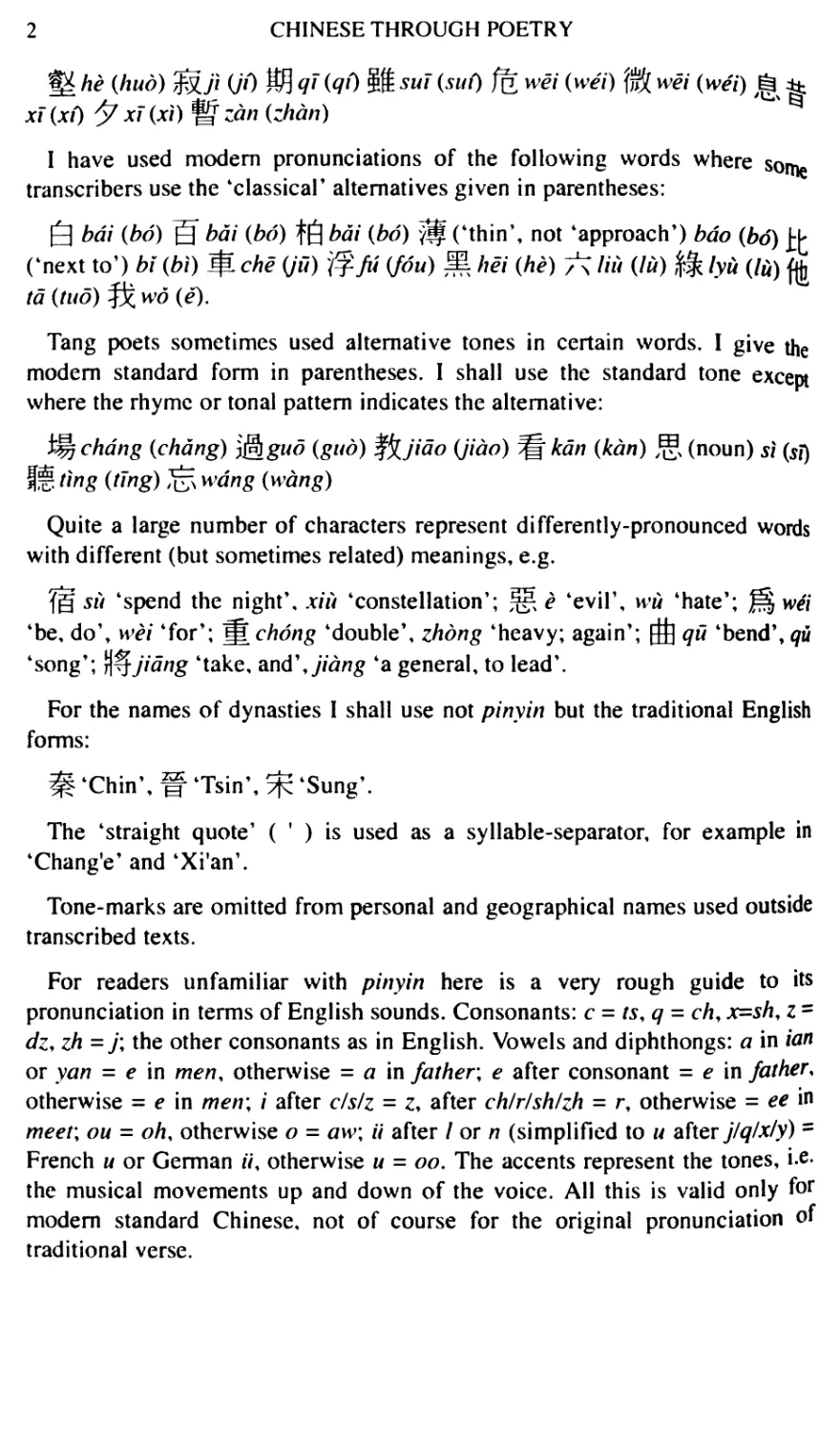
inscription (pinyin)
elected m°?ern dictionaries of Chinese disagree over pronunciation I have
pinyin alphabTW	Л’ 1977’ which is arran£ed in
older di r ,cal order- The words in question are these (pronunciations in
c lonaries are given in parentheses):
2
CHINESE THROUGH POETRY
he (hud) 'fcjji (ji) qi (qi) St sui (suf) fg wei (wei) wei (wei)
xi (xi) *7 xi (xi) zan (zhan)
I have used modem pronunciations of the following words where sorr^
transcribers use the ‘classical’ alternatives given in parentheses:
Q bai (bo) bai (bo) bai (bo) (‘thinnot ‘approach’) bdo (bo)
(‘next to’) bi (bi) Ж che (jii) :fffu (fou) Ж bei (he) A Hu (lu) lyu (lu)
ta (tuo) wo (e).
Tang poets sometimes used alternative tones in certain words. I give the
modem standard form in parentheses. I shall use the standard tone except
where the rhyme or tonal pattern indicates the alternative:
i^chdng (chang) $Jguo (guo) tfyjiao (jiao) fl* кап (кап) (noun) я' (sf)
Ii ting (ting) wang (wang)
Quite a large number of characters represent differently-pronounced words
with different (but sometimes related) meanings, e.g.
fg su ‘spend the night’, xiu ‘constellation’; e ‘evil’, wu ‘hate’; wei
‘be, do’, wei ‘for’; Щ chong ‘double’, zhdng ‘heavy; again’; fit] qu ‘bend’, qu
‘song’; ffijiang ‘take, and’,y7dng ‘a general, to lead’.
For the names of dynasties I shall use not pinyin but the traditional English
forms:
‘Chin’, ‘Tsin’, 5j5 ‘Sung’.
The ‘straight quote’ ( ’ ) is used as a syllable-separator, for example in
‘Chang'e’ and ‘Xi'an’.
Tone-marks are omitted from personal and geographical names used outside
transcribed texts.
For readers unfamiliar with pinyin here is a very rough guide to its
pronunciation in terms of English sounds. Consonants: c = ts, q = ch, x=sh, z -
dz, zh = y; the other consonants as in English. Vowels and diphthongs: a in ian
or yan = e in men, otherwise = a in father, e after consonant = e in father,
otherwise = e in men', i after c/s/z = z, after ch/r/sh/zh - r, otherwise = ее in
meet, ou = oh, otherwise о = aw\ ii after I or n (simplified to и after j/q/x/y) -
French и or German ii, otherwise и = oo. The accents represent the tones, i.e-
the musical movements up and down of the voice. All this is valid only for
modem standard Chinese, not of course for the original pronunciation of
traditional verse.
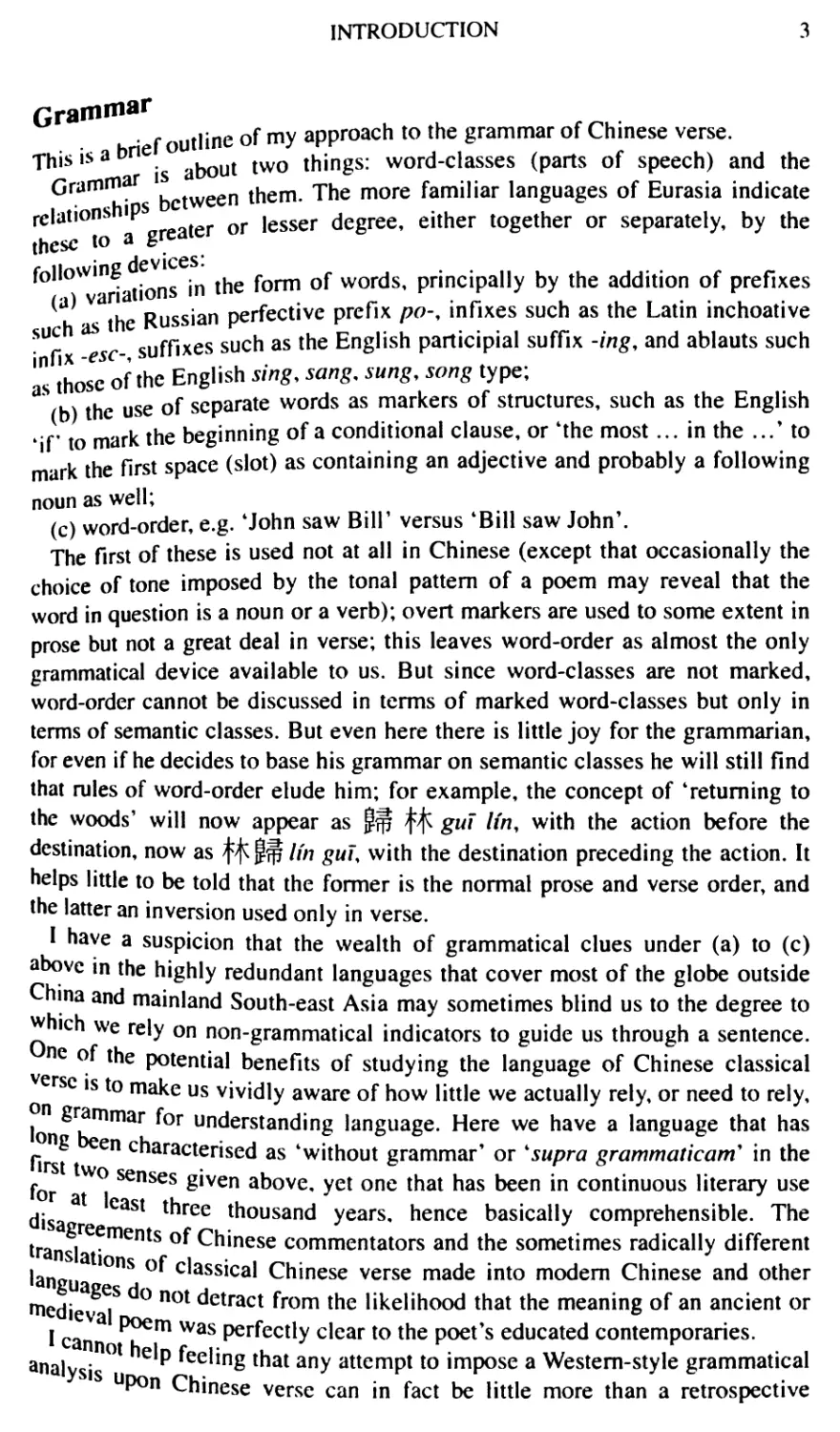
INTRODUCTION
3
GramII,ar
• f inline of my approach to the grammar of Chinese verse.
This is a bne	tw0 thjngS: word-classes (parts of speech) and the
Grammar bctween them. The more familiar languages of Eurasia indicate
relationships	lesser degree, either together or separately, by the
these to a greaic
^°1,O'variations in the form of words, principally by the addition of prefixes
Va(he Russian perfective prefix po-, infixes such as the Latin inchoative
such as^ suffixes such as the English participial suffix -ing, and ablauts such
as those of the English sing, sang, sung, song type;
(b)	the use of separate words as markers of structures, such as the English
‘if’ to mark the beginning of a conditional clause, or ‘the most... in the ...’ to
mark the first space (slot) as containing an adjective and probably a following
noun as well;
(c)	word-order, e.g. ‘John saw Bill’ versus ‘Bill saw John’.
The first of these is used not at all in Chinese (except that occasionally the
choice of tone imposed by the tonal pattern of a poem may reveal that the
word in question is a noun or a verb); overt markers are used to some extent in
prose but not a great deal in verse; this leaves word-order as almost the only
grammatical device available to us. But since word-classes are not marked,
word-order cannot be discussed in terms of marked word-classes but only in
terms of semantic classes. But even here there is little joy for the grammarian,
for even if he decides to base his grammar on semantic classes he will still find
that rules of word-order elude him; for example, the concept of ‘returning to
the woods’ will now appear as gut Un, with the action before the
destination, now as Un guT, with the destination preceding the action. It
helps little to be told that the former is the normal prose and verse order, and
the latter an inversion used only in verse.
I have a suspicion that the wealth of grammatical clues under (a) to (c)
above in the highly redundant languages that cover most of the globe outside
China and mainland South-east Asia may sometimes blind us to the degree to
which we rely on non-grammatical indicators to guide us through a sentence.
ne of the potential benefits of studying the language of Chinese classical
verse is to make us vividly aware of how little we actually rely, or need to rely,
1 ^r|^nmar f°r understanding language. Here we have a language that has
first еП C^aracter*se^ as ‘without grammar’ or 'supra grammaticam' in the
r tW° senses given above, yet one that has been in continuous literary use
tor at Icnct i
disa 1 ШГее thousand years, hence basically comprehensible. The
transl ements Chinese commentators and the sometimes radically different
lan 10nS class*cal Chinese verse made into modem Chinese and other
medieval ^etract ^rom ^le likelihood that the meaning of an ancient or
I cannot™ WaS c*ear to ^ie Poet’5 educated contemporaries.
analysis° 6 P that any attempt to impose a Western-style grammatical
uPon Chinese verse can in fact be little more than a retrospective
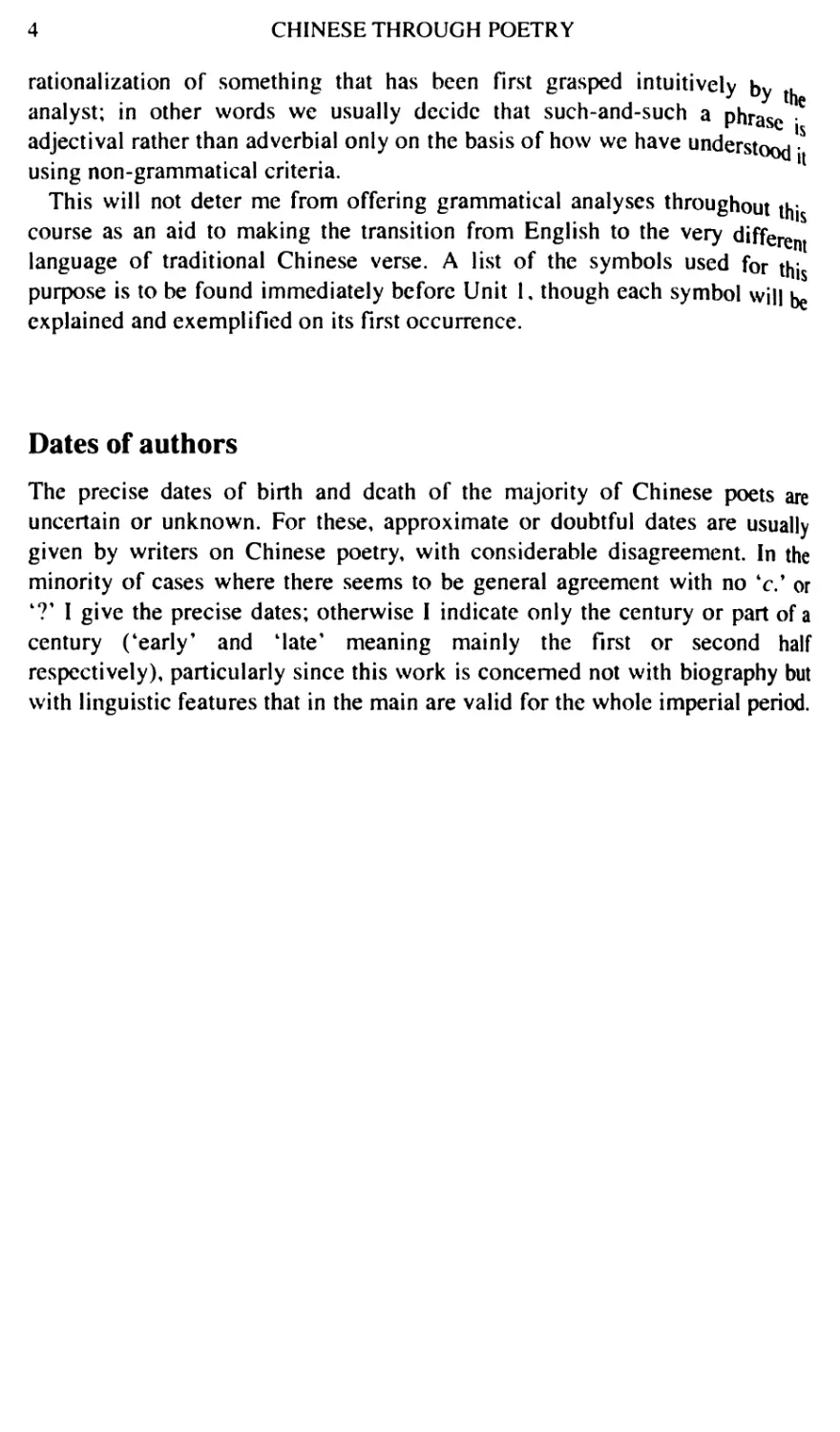
4
CHINESE THROUGH POETRY
rationalization of something that has been first grasped intuitively by t,
analyst; in other words we usually decide that such-and-such a phrase *
adjectival rather than adverbial only on the basis of how we have understood
using non-grammatical criteria.	11
This will not deter me from offering grammatical analyses throughout thjs
course as an aid to making the transition from English to the very differeni
language of traditional Chinese verse. A list of the symbols used for this
purpose is to be found immediately before Unit 1, though each symbol will be
explained and exemplified on its first occurrence.
Dates of authors
The precise dates of birth and death of the majority of Chinese poets are
uncertain or unknown. For these, approximate or doubtful dates are usually
given by writers on Chinese poetry, with considerable disagreement. In the
minority of cases where there seems to be general agreement with no ‘c.’ or
‘?’ I give the precise dates; otherwise I indicate only the century or part of a
century (‘early’ and ‘late’ meaning mainly the first or second half
respectively), particularly since this work is concerned not with biography but
with linguistic features that in the main are valid for the whole imperial period.
THE CHINESE SCRIPT
has been included for readers with no knowledge of the Chinese
This seCll^.n|10pe(j that it will be of some assistance in acquiring at least a
pl2vending) knowledge of the characters.
1. The nature of the Chinese script
The fundamental unit of the Chinese script, at least for the 3,000-odd years
since the earliest surviving records, has always been the ‘character’
representing a one-syllable word.
A word is a combination of sound and meaning, unlike a logo, which
represents only meaning. Words are part of language, and writing is the
representation of language; a logo is not a representation of language since it
has no unique sound-value. It follows that the Chinese script, like all writing-
systems, represents a combination of sound and meaning.
The world’s earliest known script was Sumerian, used in Mesopotamia
around 3000 BC. The earliest known Chinese script uses the same principles as
the Sumerian (sound-elements plus discriminatory meaning-elements) but its
earliest surviving inscriptions date from around 1300 BC, by which time the
Near-Eastern scripts descended from the Sumerian had progressed to the
alphabetic stage (North Semitic 1700-1500 BC). Even today, the Chinese
script is structurally still at the stage that Sumerian had reached 5,000 years
ago. The shapes of the signs have changed but the three basic principles have
not.
The first principle is that a sign can represent a word, i.e. a sound with a
meaning, e.g. a picture of a dog can represent the word for ‘dog’ in the local
anguage. But this device does not get us very far, for very few words in any
anguage can easily be represented by a picture: try writing this sentence in
Pictures if yOU have any doubt about this! So a writing-system, a
representation of language, cannot be made using this device alone. Writing
cannot come into existence until the phonetic principle is invented.
plus ° SeCOnd Рг*псф1е is that a word-sign can be used not just for its sound-
words163*111^ bUt a^so f°r *ts sound alone, i.e. to write other similar-sounding
op hlS ls tbe rebus-principle sometimes used to represent names in coats
Chinese ^°°^‘P^ates- This principle gives us, in the case of monosyllabic
Phone 3 S*llabar*’ where each sign represents a whole syllable, not just a
syllabi *П CaSe an aiphabet. The key word here is ‘similar’, for the
aiso lha^n will represent not just the sound of the original word-sign but
lead to^ аПУ vaSuely similar-sounding word. This by itself will naturally
a great amount of ambiguity.
5
6
CHINESE THROUGH POETRY
The third principle is an attempt to remove this ambiguity by adding
distinguishing signs. These are chosen for their class of meaning. The resultant
combination will mean ‘the word that sounds a bit like A and means
something to do with B’. But this is only a kind of mnemonic: the whole
character still has to be learned as meaning ‘the word that has the precise
sound X and the precise meaning Y’. But this principle was not used
systematically: sometimes a meaning-element was added, sometimes not:
sometimes a whole character was used to write a new word either as it was or
else with the addition of a new meaning-element, but without removing the old
meaning-element.
In order to demonstrate and discuss these three principles I shall use the
following abbreviations:
‘W’ stands for ‘word-sign’, a sign having its original sound and
meaning;
‘S’ stands for ‘sound-element’, a sign used purely for its sound-value;
‘M’ stands for ‘meaning-element’, a sign added to indicate the class
of meaning;
‘*’ before a meaning indicates that it is unattested, i.e. that the sign
has not been found with this meaning in any text and that this
meaning has been deduced from what the sign seems to depict and/or
from its sound-value;
‘<’ means ‘developed from’ and ‘>’ means ‘developed into’;
‘OB’ means ‘oracle-bone script’ (c. 1300-1000 BC);
indented items are extended uses or developments of the head-item.
In principle, any primary sign can be used in any of these three ways, but in
actual practice the largest number are used as an S, usually with the addition of
an M, and only a minority of characters are used as a W or M.
Before illustrating the way these principles were applied to the Chinese
script I should like to invite you to imagine the problems confronting the
script-devisers in the ancient world, whether in the Near East or in the Far
East. They were officials in city-states that needed to keep records of stores
(food, weapons, tools, etc.), of land-tenancy and taxation (a city-state was
dependent on rents and taxes from the surrounding cultivated countryside), of
employees, etc. Their city’s wealth attracted the envy of neighbours, especially
the nomadic herdsmen from beyond the cultivated area, so they needed to keep
in contact with their armies on the borders. These were but a few of the
record-keeping and message-writing requirements of a city-state.
Where do they begin? Let us see what would have happened if their
language had been English and they had needed to record that a tenant fanner,
a Mr Arthur Jones, had been assessed for 85 bushels of grain in land-tax. This
will require as a minimum ‘Arthur Jones 85’. Since there is no obvious
pictorial representation available either for the name or for the number (apart
from 85 strokes!) their only solution will be to find something depictable that
will sound something like them. What depictable object can they find that
sounds vaguely like ‘Arthur’? A drawing of a hearth might do, though that
THE CHINESE SCRIPT
7
be taken as a depiction of a grate and so representing a name
might a,s°ornething ‘grate\ e.g. ‘Graham’. For ‘Jones’ the best I can
sounding & picture of a pair of longjohns , though that might equally
come	or ‘Johnson’. For the sound of ‘eight’ we might find nothing
suggesl Dicture of a gate or even of a hat, and a fife would seem to be the
closer than a <jepiction we could find for ‘five’. The latter two, being
closest p	jn constant use, so would quickly become abbreviated for
numerals, wuuiu
ease of writing.	.
The sad fact is that phonetic distance is essential for any language:
communication would become very difficult if too many words sounded alike
or very similar. This means that finding similar-sounding words is already a
difficult task, one which is made even more difficult if one is looking for a
word which both sounds similar and also stands for a simply and
unambiguously depictable object or activity. The rebus-method is a very
unpromising start for a script.
It is only against this background that one can truly appreciate the enormous
leap represented by the invention of the alphabet in the ancient Near East: the
Semitic unvowelled alphabet and the Greek vowelled alphabet. Suddenly any
word that can be distinguished in speech can be written down unambiguously.
The Chinese have been aware of the existence of Indian alphabets for two
thousand years but have never switched to alphabetic writing. This is not the
place to go into the reasons for this conservatism since we are concerned here
only with the structure of the traditional Chinese script.
Now, since our imaginary English-speaking bronze-age scribes never have
occasion to write about hearths, longjohns, gates (or hats) or fifes in their
official records and correspondence, there will be no possibility of ambiguity:
the picture of a hearth no longer means ‘hearth’, but only ‘Arthur’, and
similarly with the other signs. When their distant descendants begin writing
down their oral literature and wish to write the word for ‘hearth’, they will
have to add the sign for ‘fire’ to distinguish it from ‘Arthur’.This is the kind of
problem all early script-makers must have had. Now let us see what traces of
1 *s Process survive in the Chinese script. In the following, the ancient
aracters preceded by ‘<’ are oracle-bone script unless otherwise stated.
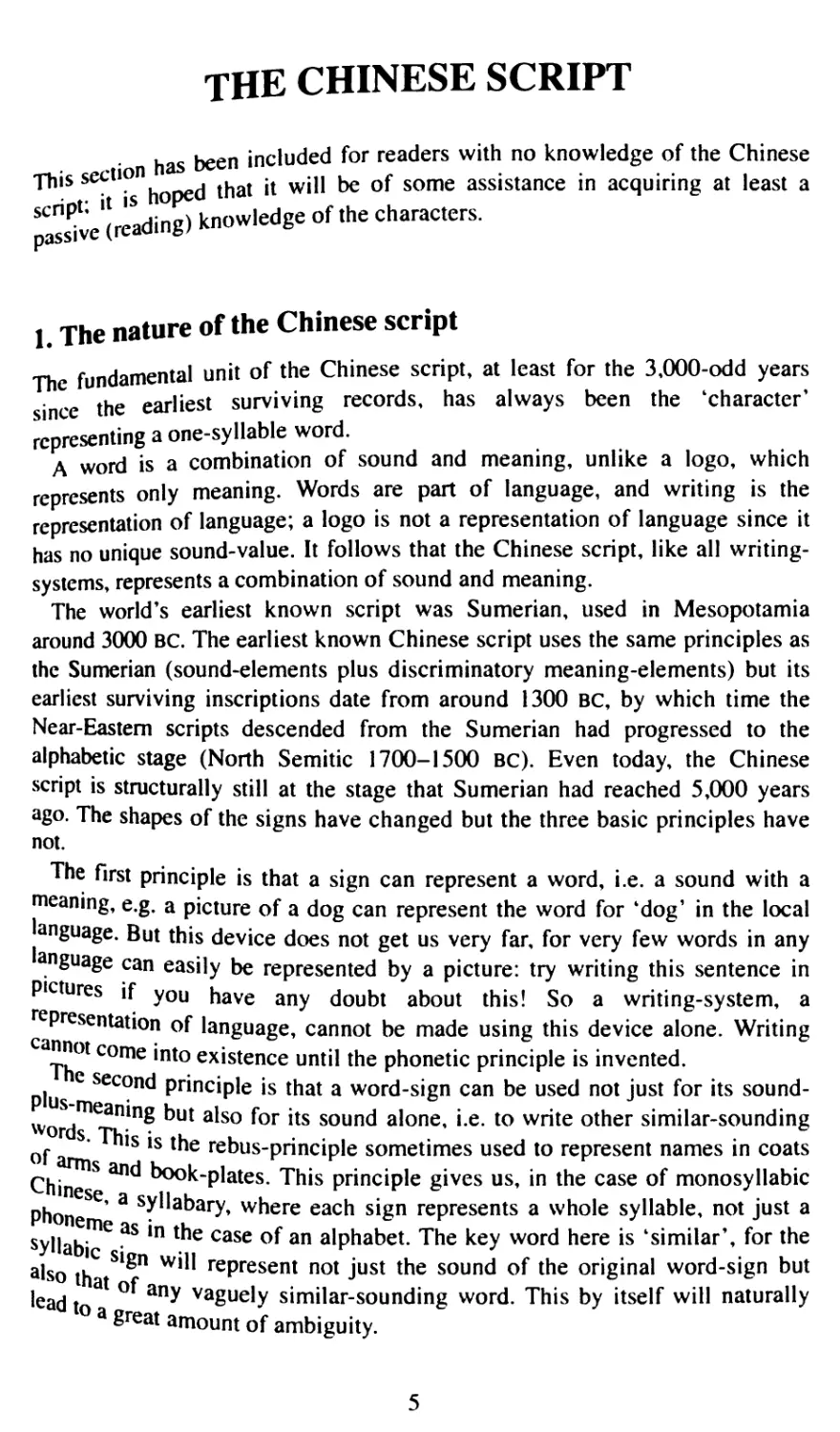
fa) Word-signs
s begin with some characters used as W:
4 Г ren person’
ww ‘tree’
a wood, forest’
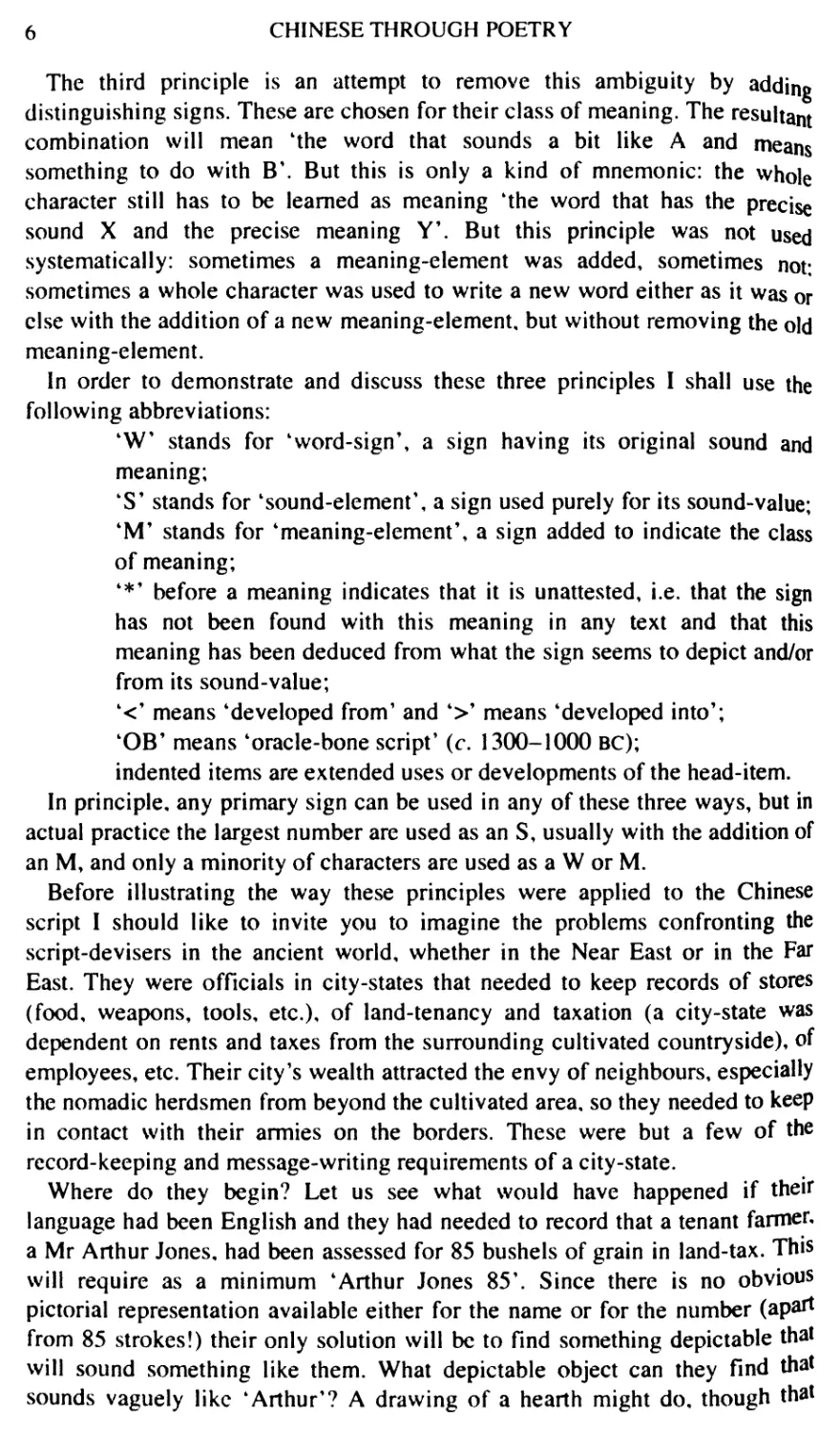
8
CHINESE THROUGH POETRY
>< b
niao ‘bird’
© ri ‘sun, day’

J) yue ‘moon, month’ (90° rotation to the left)
111 < ъ
shan ‘hill, mountain’ (90° rotation to the left)
< $ shut ‘water, river’ (a winding river with splashes of water)
I'l^j < Ф yu ‘rain’ (rain falling from the sky)
ФФ < ЛЛ <№ ‘bamboo’ (bamboo leaves hanging down: not OB but a
later form)
The shapes of these characters have changed a great deal in the past 3,000
years and so of course have their sounds, but their original meanings have
remained intact and they have not been used for other purposes as words, but
only (in some cases) to write foreign names (e.g. 111 shan was once used to
write the third syllable of ‘Alexandria’ and Un is used to write the first
syllable of ‘Lincoln’).
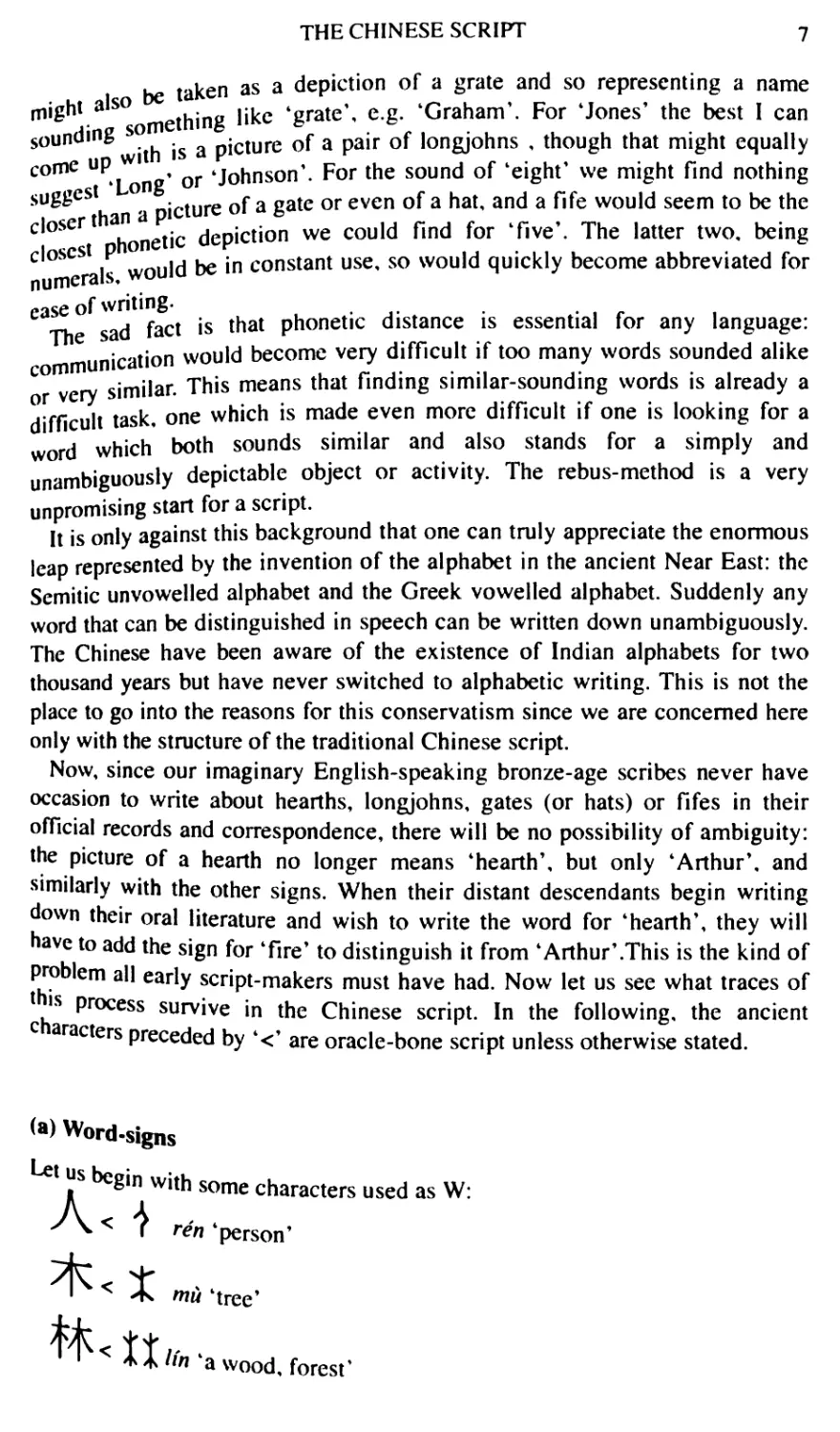
(b) Word-signs doubling as sound-elements
Some primary signs were used both as W and as S, though not necessarily in
that order (see (g) below):
W yun ‘cloud’ (< (j a cloud hanging from the sky)
S 7Xyun ‘say’
W er ‘ear’ (< 3 )
S Ifer ‘only’
W ww ‘crow’ (a bird without an eye: the crow’s dark eye does not
show up against its black plumage)
S Ж vvw ‘how?’
W nil ‘woman’ (< a woman kneeling with arms crossed to cradle
baby)
S ru ‘you’
W zu ‘male ancestor’ (< Я phallus)
S jEtqie ‘also’
THE CHINESE SCRIPT
9
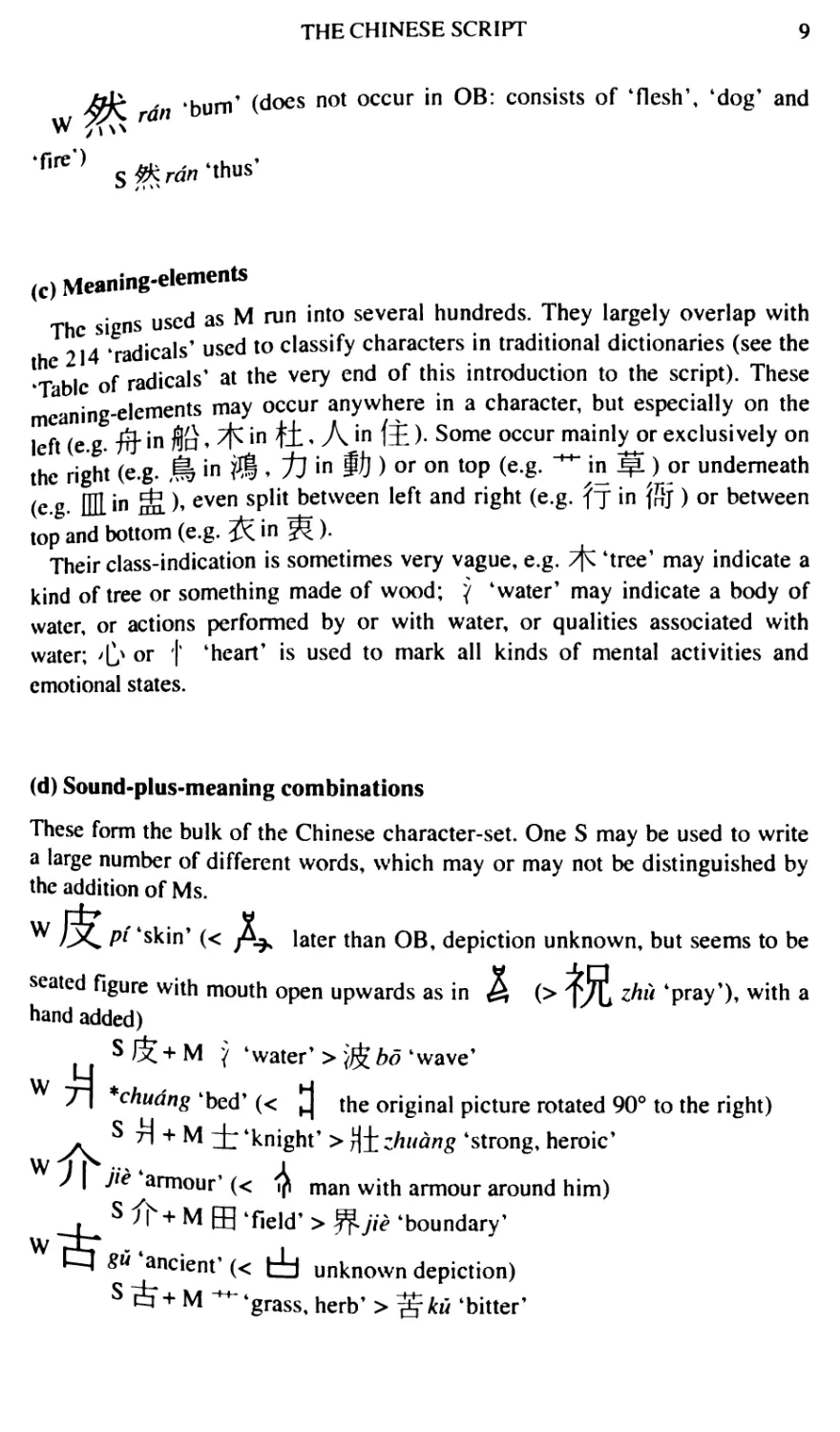
‘burn’ (does not occur in OB: consists of ‘flesh’, ‘dog’ and
fire) ran ‘thus’
(C) Meaning-elements
• ns used as M run into several hundreds. They largely overlap with
214 ‘radicals’ used to classify characters in traditional dictionaries (see the
‘Tabic of radicals’ at the very end of this introduction to the script). These
meaning-elements may occur anywhere in a character, but especially on the
left (e.g.	Йа ,	in ti < Л in fzE )• Some occur mainlyor exclusively on
the right (e.g. M in Й in	) or on t0P <e 8- * j” or underneath
(e.g. HU in X even split between left and right (e.g. ft in ) or between
top and bottom (e.g. R in ).
Their class-indication is sometimes very vague, e.g. 7^ ‘tree’ may indicate a
kind of tree or something made of wood; ‘water’ may indicate a body of
water, or actions performed by or with water, or qualities associated with
water; 'C? or f ‘heart’ is used to mark all kinds of mental activities and
emotional states.
(d)	Sound-plus-meaning combinations
These form the bulk of the Chinese character-set. One S may be used to write
a large number of different words, which may or may not be distinguished by
the addition of Ms.
w Pl ‘skin’ (< later than OB, depiction unknown, but seems to be
seated figure with mouth open upwards as in Д (> zhu ‘pray’), with a
hand added)
у ‘water’ > bo ‘wave’
*chuang ‘bed’ (< the original picture rotated 90° to the right)
s rl + M zb‘knight’ > lltz/iwang ‘strong, heroic’
) I Jie armour’ (< man with armour around him)
г S ) | + M Щ ‘field’ > jie ‘boundary’
Cj gu ancient’ (< unknown depiction)
S M ‘grass, herb’ > ftku ‘bitter’
10
CHINESE THROUGH POETRY
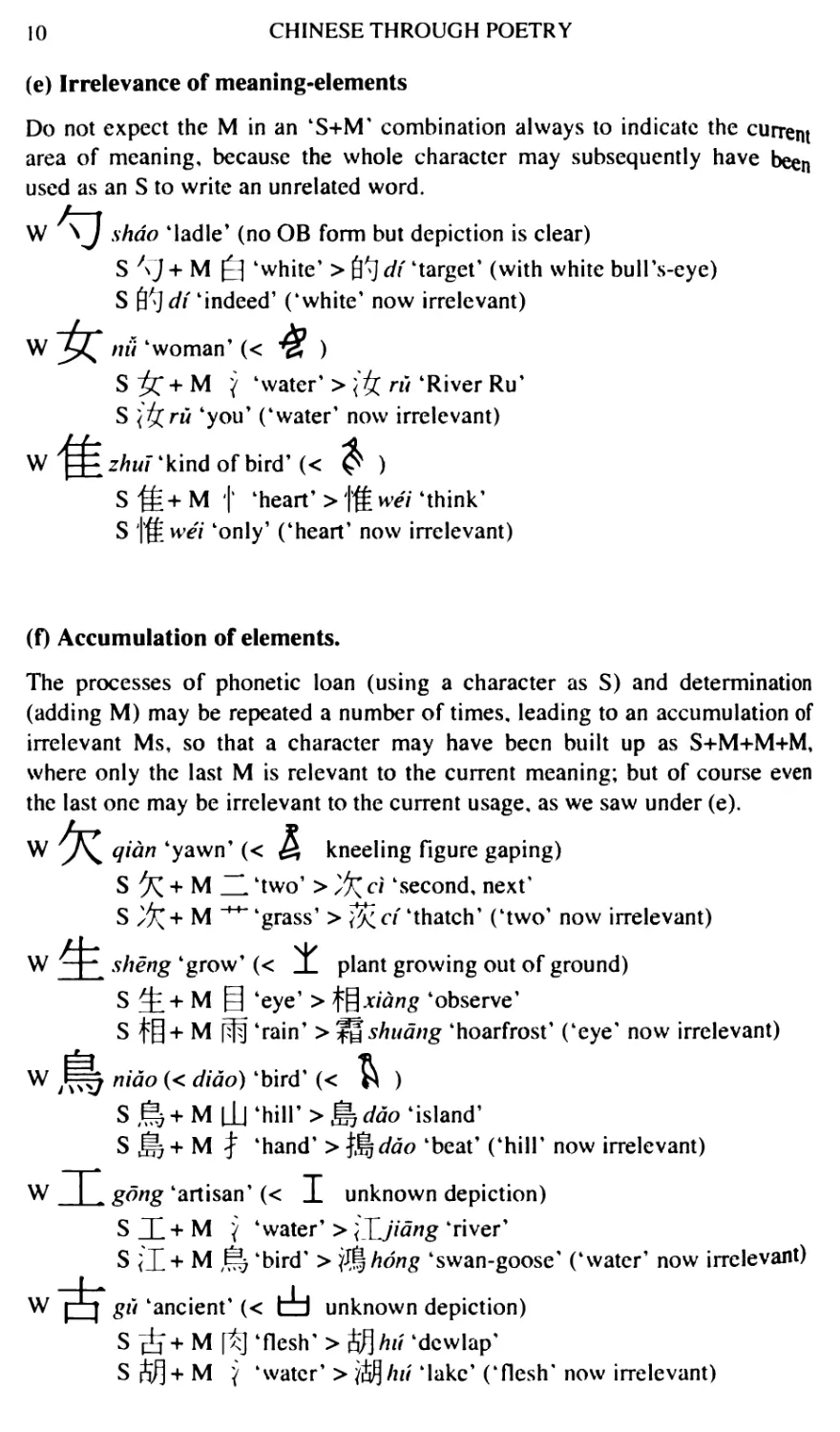
(e)	Irrelevance of meaning-elements
Do not expect the M in an ‘S+M’ combination always to indicate the current
area of meaning, because the whole character may subsequently have been
used as an S to write an unrelated word.
W A J shdo ‘ladle’ (no OB form but depiction is clear)
S + M f ] ‘white’ > 6 df ‘target’ (with white bull’s-eye)
S №}di ‘indeed’ (‘white’ now irrelevant)
W nil ‘woman’ (< $ )
S~£c+M ‘water’ > rii ‘River Ru’
S '(t^ru ‘you’ (‘water’ now irrelevant)
W zhui ‘kind of bird’ (<	)
S + M j' ‘heart’ > wei ‘think’
S j^wei ‘only’ (‘heart’ now irrelevant)
(f)	Accumulation of elements.
The processes of phonetic loan (using a character as S) and determination
(adding M) may be repeated a number of times, leading to an accumulation of
irrelevant Ms, so that a character may have been built up as S+M+M+M,
where only the last M is relevant to the current meaning; but of course even
the last one may be irrelevant to the current usage, as we saw under (e).
W qidn ‘yawn’ (< Д kneeling figure gaping)
S + M ~‘two’ > ci ‘second, next’
S M ‘grass’ > ffisi ‘thatch’ (‘two’ now irrelevant)
W sheng ‘grow’ (< plant growing out of ground)
S M § ‘eye’ >	‘observe’
S tg+M pff ‘rain’ > ^shuang ‘hoarfrost’ (‘eye’ now irrelevant)
niao (< dido) ‘bird’ (<	)
S + M 111 ‘hill’ > ddo ‘island’
S^+M | ‘hand’ >]^ddo ‘beat’ (‘hill’ now irrelevant)
W | 1 gong ‘artisan’ (< I unknown depiction)
S T -ь M < ‘water’ > {Jtjiang ‘river’
S <1+ M ‘bird’ > fijhdng ‘swan-goose’ (‘water’ now irrelevant)
W [~Ц gii ‘ancient’ (< tb unknown depiction)
S + M ‘flesh’ > hii ‘dewlap’
S M ‘water’ > ‘lake’ (‘flesh’ now irrelevant)
THE CHINESE SCRIPT
11
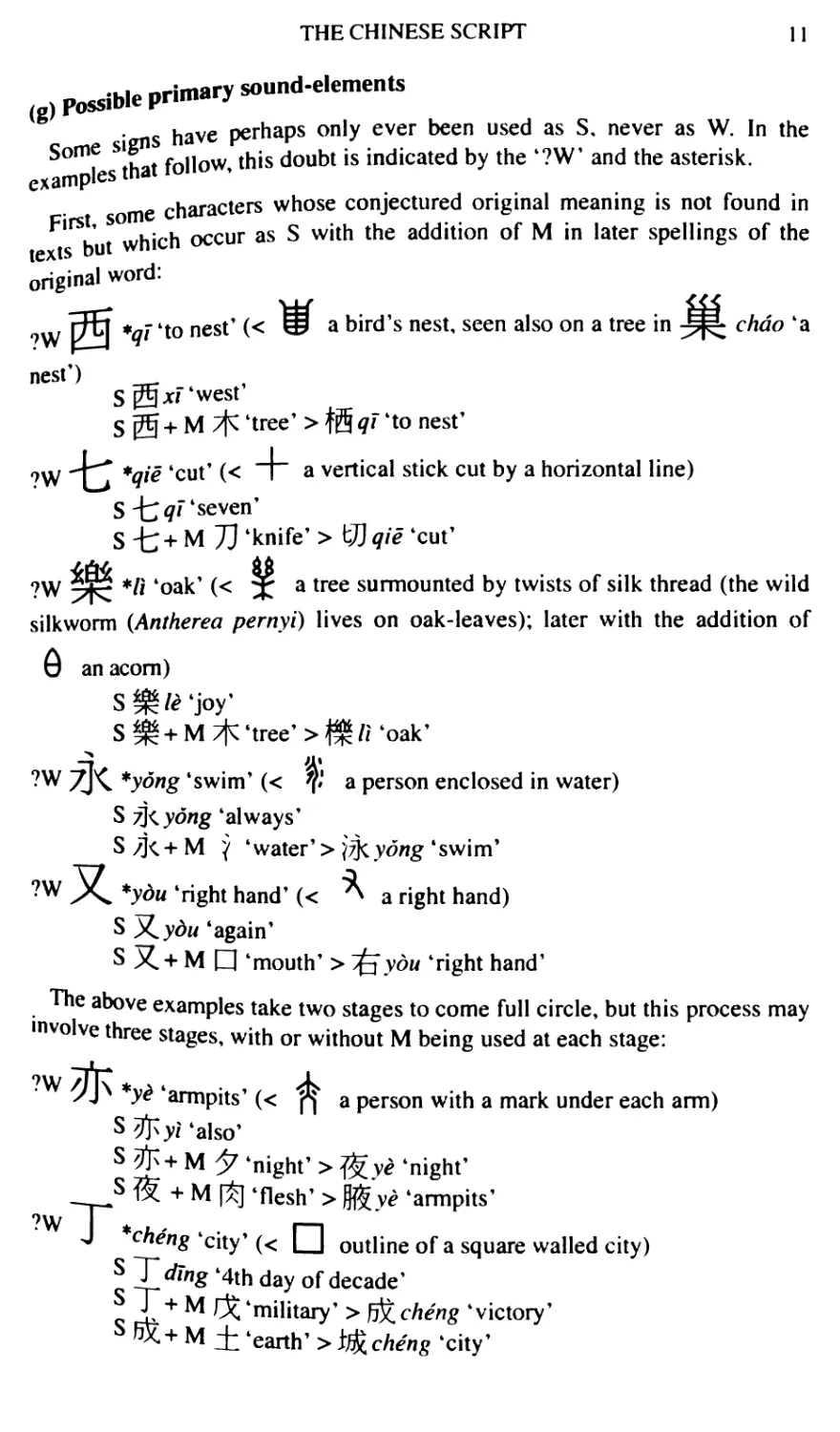
(„) Possible primary smmd-ekment.
. have perhaps only ever been used as S, never as W. In the
Some sign tfojs js indicated by the ‘?W’ and the asterisk,
examples that гоп ,
some characters whose conjectured original meaning is not found in
S which occur as S with the addition of M in later spellings of the
texts but wni4
original word:
a bird’s nest, seen also on a tree in chao ‘a
?W
nest’)
S g + м ‘tree’ > ‘to nest’
W *qie ‘cut’ (< “I” a vertical stick cut by a horizontal line)
S ‘seven’
S M 7J ‘knife’ > tj] qie ‘cut’
?W *fi ‘oak’ (< a tree surmounted by twists of silk thread (the wild
silkworm (Antherea pernyi) lives on oak-leaves); later with the addition of
6 an acorn)
?W ZX *ydng ‘swim’ (< a person enclosed in water)
S zkydflg ‘always’
S /]<+ M ‘water’ > yong ‘swim’
™	‘right hand’ (< ^ a right hand)
S 5Lydu ‘again’
SX+M □ ‘mouth’ > you ‘right hand’
The above examples take two stages to come full circle, but this process may
involve three stages, with or without M being used at each stage:
• W //J\ *y# ‘armpit (< a person a mark under each arm)
S	‘also’
S	M ‘night’ > $£ye ‘night’
cheng ‘city’ (< Q outline of a square walled city)
§ ‘4th day of decade’
jL + M dt‘military’ > fj^cheng ‘victory’
M ‘earth’ > cheng ‘city’
12
CHINESE THROUGH POETRY
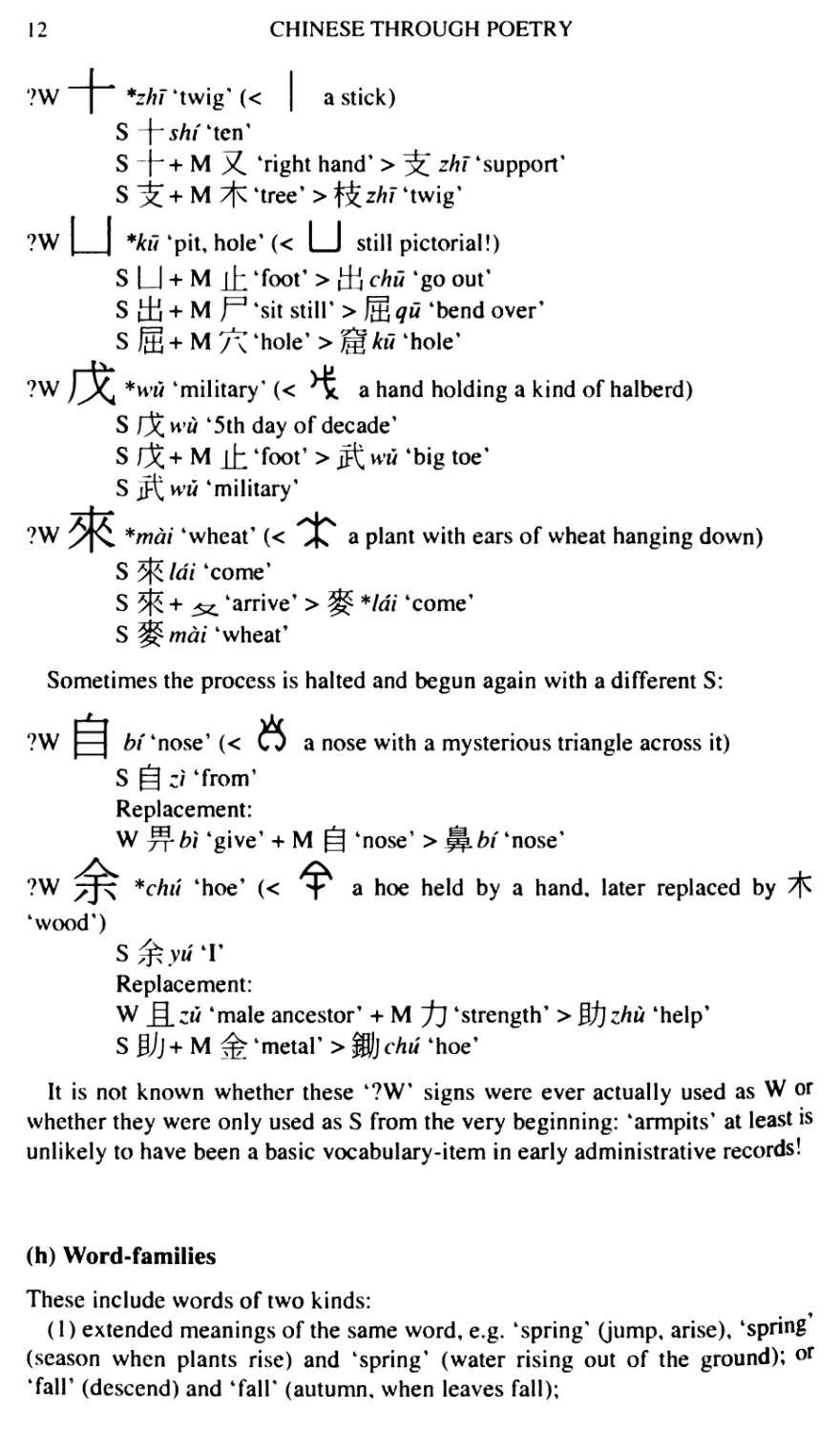
?W | *z/n ‘twig’ (< | a stick)
S ‘ten'
S |'+M / ‘right hand’ > zhi ‘support’
S >£ + M ‘tree’ > ‘twig’
?W I___I *кй ‘pit, hole’ (< I__I still pictorial!)
S I I + M [h ‘foot’ > 1+1 chu ‘go out’
S Ж + M	‘sit still’ > /3}qU ‘bend over’
S	+ M	‘hole’ > Окй ‘hole’
?W *H’w ‘military’ (< ^ a hand holding a kind of halberd)
S и’м ‘5th day of decade’
S + M ih ‘foot’ > jF^ h’u ‘big toe’
S jF^wu ‘military’
?W *mai ‘wheat’ (< a plant with ears of wheat hanging down)
S 5^5 lai ‘come’
S ‘arrive’ > *lai ‘come’
S ^mdi ‘wheat’
Sometimes the process is halted and begun again with a different S:
?W W‘nose’(< ft a nose with a mysterious triangle across it)
S [=] z'i ‘from’
Replacement:
W ttW ‘give’ + M g ‘nose’ > ^bi ‘nose’
?W *c/iw ‘hoe’ (< a hoe held by a hand, later replaced by 7^
‘wood’)
S yu T
Replacement:
W ‘male ancestor’ + M ‘strength’ > §)]zhu ‘help’
S JVj+ M ^7 ‘metal’ > ‘hoe’
It is not known whether these ‘?W’ signs were ever actually used as W or
whether they were only used as S from the very beginning: ‘armpits’ at least is
unlikely to have been a basic vocabulary-item in early administrative records!
(h	) Word-families
These include words of two kinds:
(1)	extended meanings of the same word, e.g. ‘spring’ (jump, arise), ‘spring
(season when plants rise) and ‘spring’ (water rising out of the ground); °r
‘fall’ (descend) and ‘fall’ (autumn, when leaves fall);
THE CHINESE SCRIPT
13
which share a common root, e.g. ‘fall’ and ‘fell’ (a tree); or
(2) words w	‘sit’, ‘seat\ (bishop’s) ‘see’, ‘siege’, ‘session’ and
•breath’ and breathe ,
•sedentary • -dentjca] or similar sounds may belong to the same word-family
Words Wlsjrnj|arjty may be coincidental or arise from a prehistoric kinship
or else the si & matter of conjecture. Chinese characters sharing a sound-
that can on^y fescnt ejther related or unrelated words in the underlying
clement may& mjnority of cases the choice of the same S may indicate an
language^ presljrnption) of kinship on the part of the script-makers. Let us
awareness	$ which has been used to write both related and unrelated
look bneiiy
words.	..
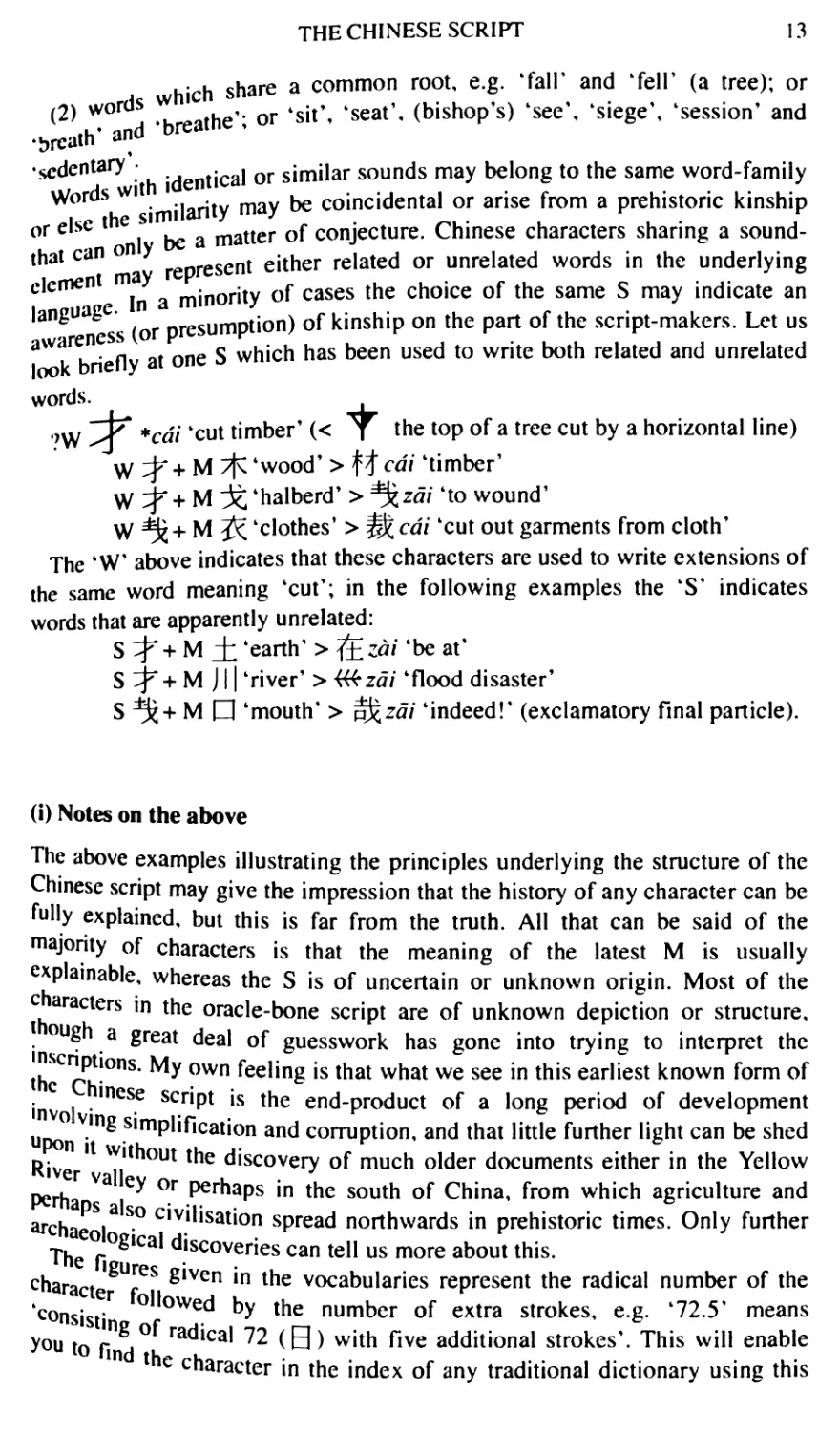
‘CUt timber’ (< у the top of a tree cut by a horizontal line)
W 3^ + M ‘wo°d’ > ca/ ‘timber’
W	+ M	‘halberd’ > ^zai ‘to wound’
W	+ M	‘clothes’ > edi ‘cut out garments from cloth’
The ‘W’ above indicates that these characters are used to write extensions of
the same word meaning ‘cut’; in the following examples the ‘S’ indicates
words that are apparently unrelated:
S + M ~h ‘earth’ > zai ‘be at’
S 3^ + M J11 ‘river’ > i&zai ‘flood disaster’
S M □ ‘mouth’ > v&zai ‘indeed!’ (exclamatory final particle).
(i	) Notes on the above
The above examples illustrating the principles underlying the structure of the
Chinese script may give the impression that the history of any character can be
fully explained, but this is far from the truth. All that can be said of the
majority of characters is that the meaning of the latest M is usually
explainable, whereas the S is of uncertain or unknown origin. Most of the
aracters in the oracle-bone script are of unknown depiction or structure,
g a great deal of guesswork has gone into trying to interpret the
th^ Ck-°nS Му own ^ee^ng *s that what we see in this earliest known form of
inv I •lneSe scr*Pl *s the end-product of a long period of development
Amplification and corruption, and that little further light can be shed
RiverЦ 'У?*1001 1^е discovery of much older documents either in the Yellow
Perha Va |СУ °r P^^P8 m ^ie south of China, from which agriculture and
archae^^0 c’v*fisati°n spread northwards in prehistoric times. Only further
The^0^03* d*scoveries can tell us more about this.
character ^IVen *n ^1е vocabularies represent the radical number of the
consist^ ° l°Wed by the number of extra strokes, e.g. ‘72.5’ means
you to find^ rad*ca* 72 (El) with five additional strokes’. This will enable
the character in the index of any traditional dictionary using this
14
CHINESE THROUGH POETRY
system, e.g. Mathews', but be warned: some more recent dictionaries have
own classification systems to match the ‘simplified’ reformed script.
thejj
These figures are followed in the vocabularies by an indication of th
etymological type of the character, viz. ‘W\ ‘S’, ‘M’ or ‘X’, where ‘M’ mea^
‘S+M’ followed by the actual M, and where ‘X’ means ‘of unknown
uncertain structure’. Of the first 400 characters in the vocabularies of this
course 14% are W, 13% are S without the addition of M, 58% are S+M, and
15% are X.
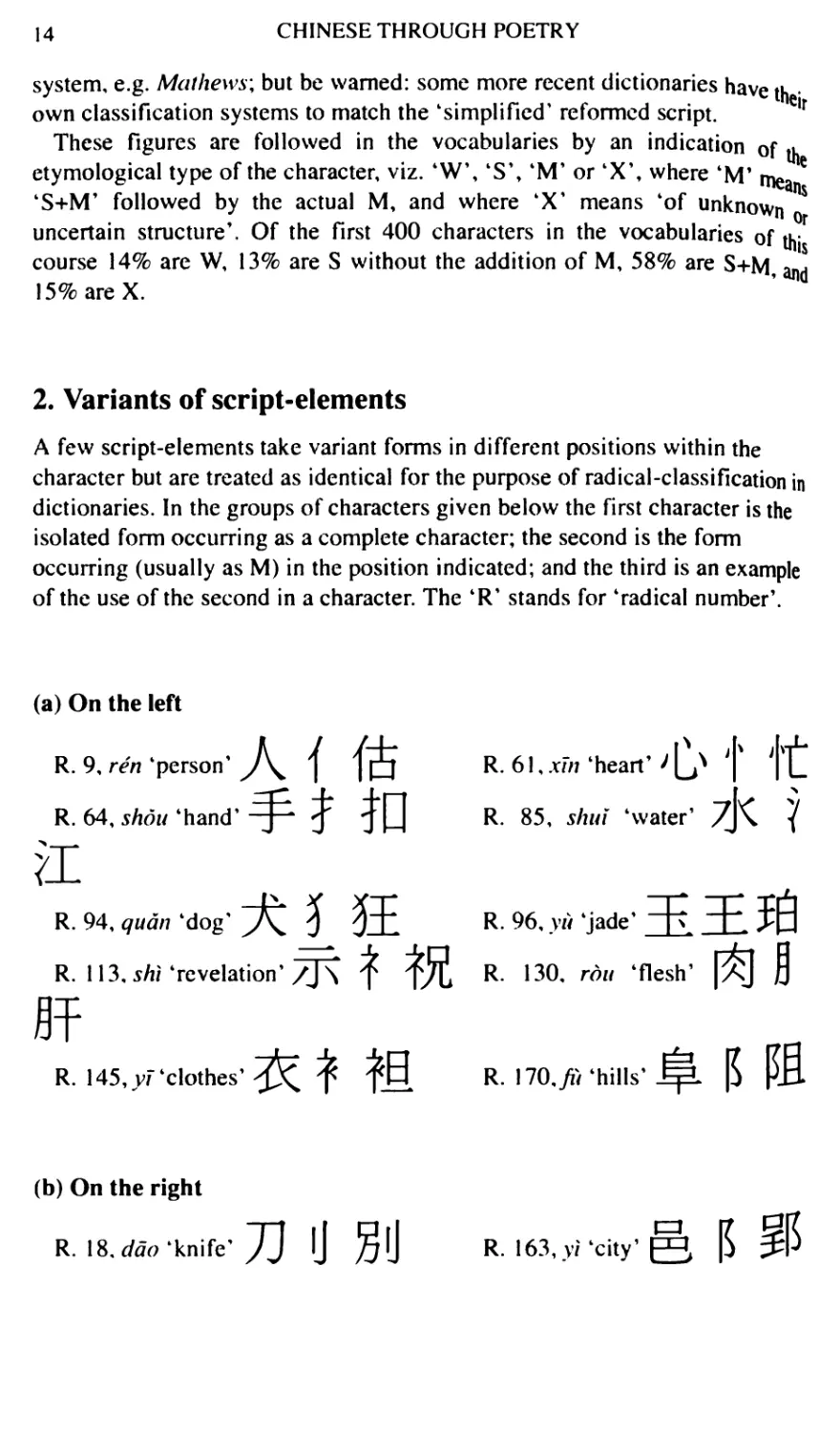
2.	Variants of script-elements
A few script-elements take variant forms in different positions within the
character but are treated as identical for the purpose of radical-classification in
dictionaries. In the groups of characters given below the first character is the
isolated form occurring as a complete character; the second is the form
occurring (usually as M) in the position indicated; and the third is an example
of the use of the second in a character. The ‘R’ stands for ‘radical number’.
(a) On the left
R. 9, ren ‘person
R. 64, shou ‘hand
R. 113, shi ‘revelation
R. 61, xin ‘heart’
R. 85, shut ‘water’
51Й
R. 96, yu ‘jade
R. 145, yi ‘clothes
(b) On the right
R. 18, dao ‘knife
 71 'J SO
R.
163, yi ‘city’
15 H5
THE CHINESE SCRIPT
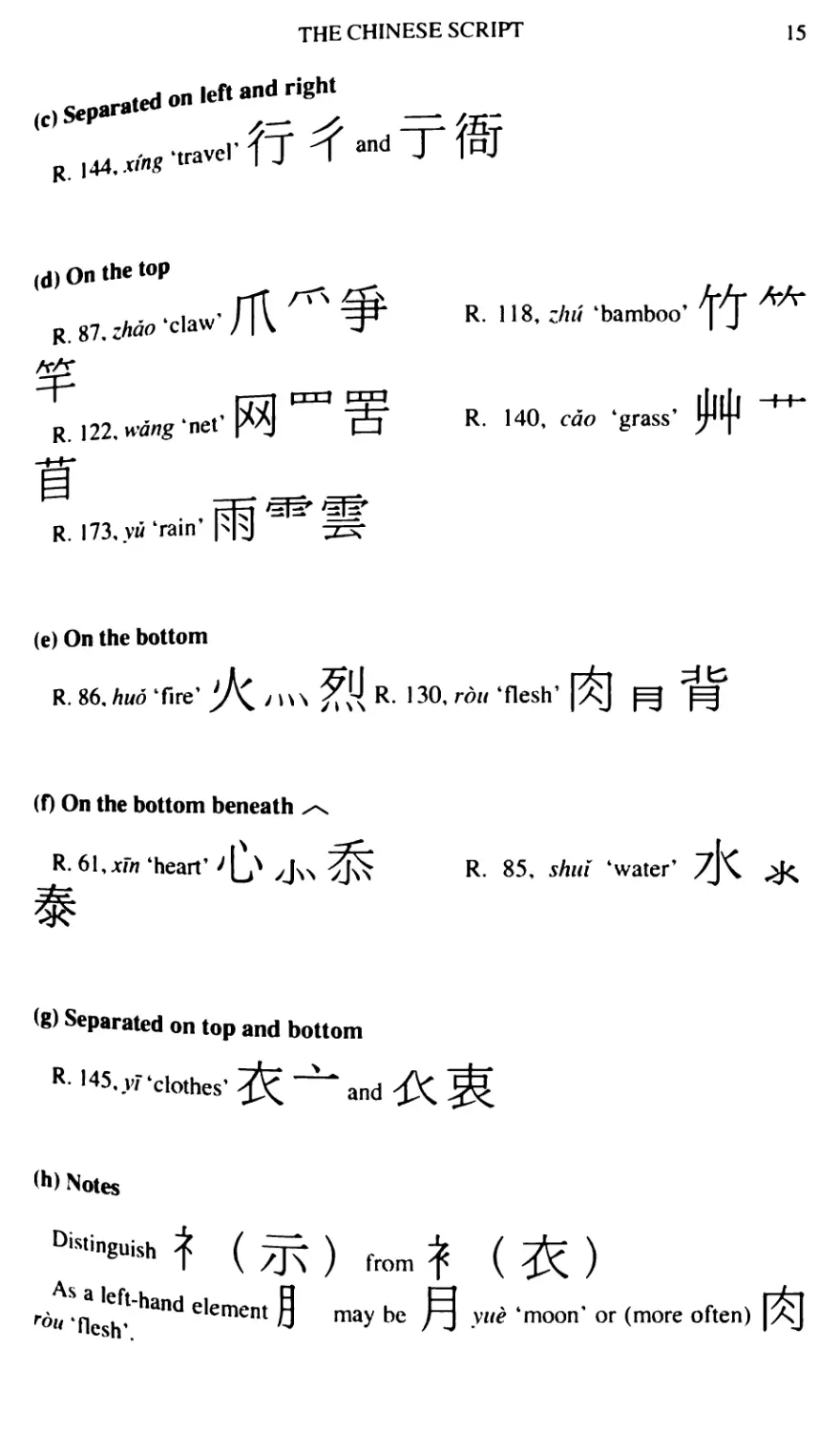
R |44,.nn.?‘travcl	'
(d) On the top
r. 87. zhdo ‘<
R. 118, zhu ‘bamboo’
r 122, nwg‘net’
R. 140, cao ‘grass’
R. 173, ум ‘rain’
(e) On the bottom
R. 86, hud ‘fire
R. 130, rou
(0 On the bottom beneath
R. 85, shui ‘water
(g) Separated on top and bottom
(h) Notes
“«mguish |	) from ( ^ )
г6м ‘fiesh^ hand e*ement Q rnay be yue ‘moon’ or (more often)
16
CHINESE THROUGH POETRY
[5 on the left is
‘city’.
As a top or bottom element [=| may either be R. 73 £2.
(more often) R. 72 |~~j ri ‘sun’.
on the right is R. 163 SS ,
yi
Уиё ‘say’ or
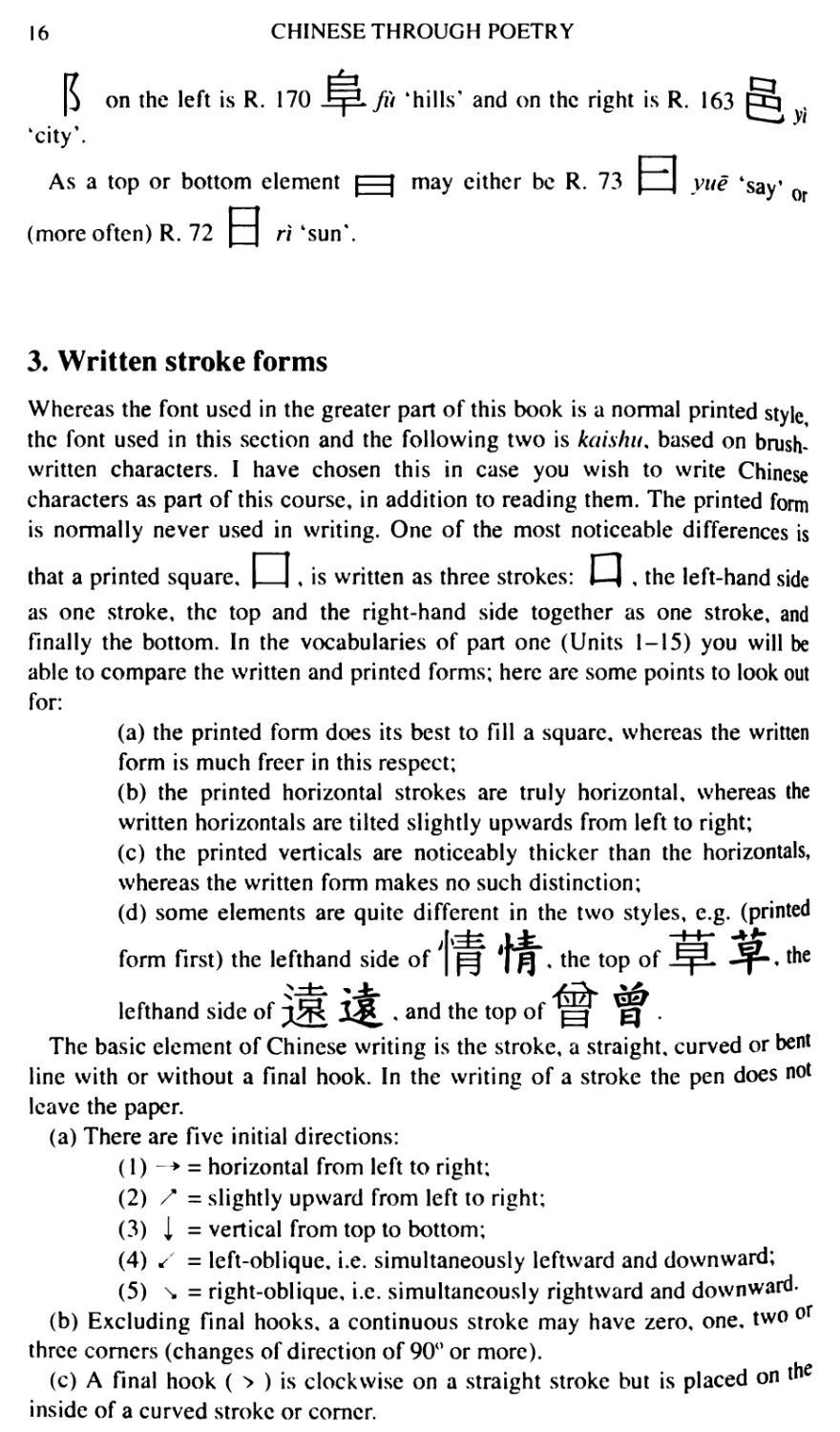
3.	Written stroke forms
Whereas the font used in the greater part of this book is a normal printed style,
the font used in this section and the following two is kaishu. based on brush-
written characters. I have chosen this in case you wish to write Chinese
characters as part of this course, in addition to reading them. The printed form
is normally never used in writing. One of the most noticeable differences is
that a printed square,  , is written as three strokes: Д , the left-hand side
as one stroke, the top and the right-hand side together as one stroke, and
finally the bottom. In the vocabularies of part one (Units 1-15) you will be
able to compare the written and printed forms; here are some points to look out
for:
(a)	the printed form does its best to fill a square, whereas the written
form is much freer in this respect;
(b)	the printed horizontal strokes are truly horizontal, whereas the
written horizontals are tilted slightly upwards from left to right;
(c)	the printed verticals are noticeably thicker than the horizontals,
whereas the written form makes no such distinction;
(d)	some elements are quite different in the two styles, e.g. (printed
form first) the lefthand side of 1 Q Tfl ' the top of	the
The basic element of Chinese writing is the stroke, a straight, curved or bent
line with or without a final hook. In the writing of a stroke the pen does not
leave the paper.
(a)	There are five initial directions:
(!)—► = horizontal from left to right;
(2)	/ = slightly upward from left to right;
(3)	1 = vertical from top to bottom;
(4)	/ = left-oblique, i.e. simultaneously leftward and downward;
(5)	\ = right-oblique, i.e. simultaneously rightward and downward.
(b)	Excluding final hooks, a continuous stroke may have zero, one, two or
three comers (changes of direction of 90° or more).
(c)	A final hook ( > ) is clockwise on a straight stroke but is placed on the
inside of a curved stroke or comer.
THE CHINESE SCRIPT
17
Strokes are modified in shape, size and direction to fit in with the overall
composition of a character, so the following list cannot be complete in terms of
s'uch detail. You will notice that because of this my categories shade into one
another. They are not meant to be watertight classes, merely a rough guide to
get you initially familiar with the kind of shapes you will be dealing with
Each of the stroke-types below is illustrated with one or more examples to
show you how they are combmed with other strokes and modified in the
process. If you are using a Chinese brush or Japanese brush-pen you will be
able to match the varying thicknesses but if you are using a pen or pencil this
refinement will not of course be possible, nor is it necessary for legibility Do
not attempt to write the characters in this section until you have studied stroke
order in the next section, otherwise you may develop bad writing-habits.
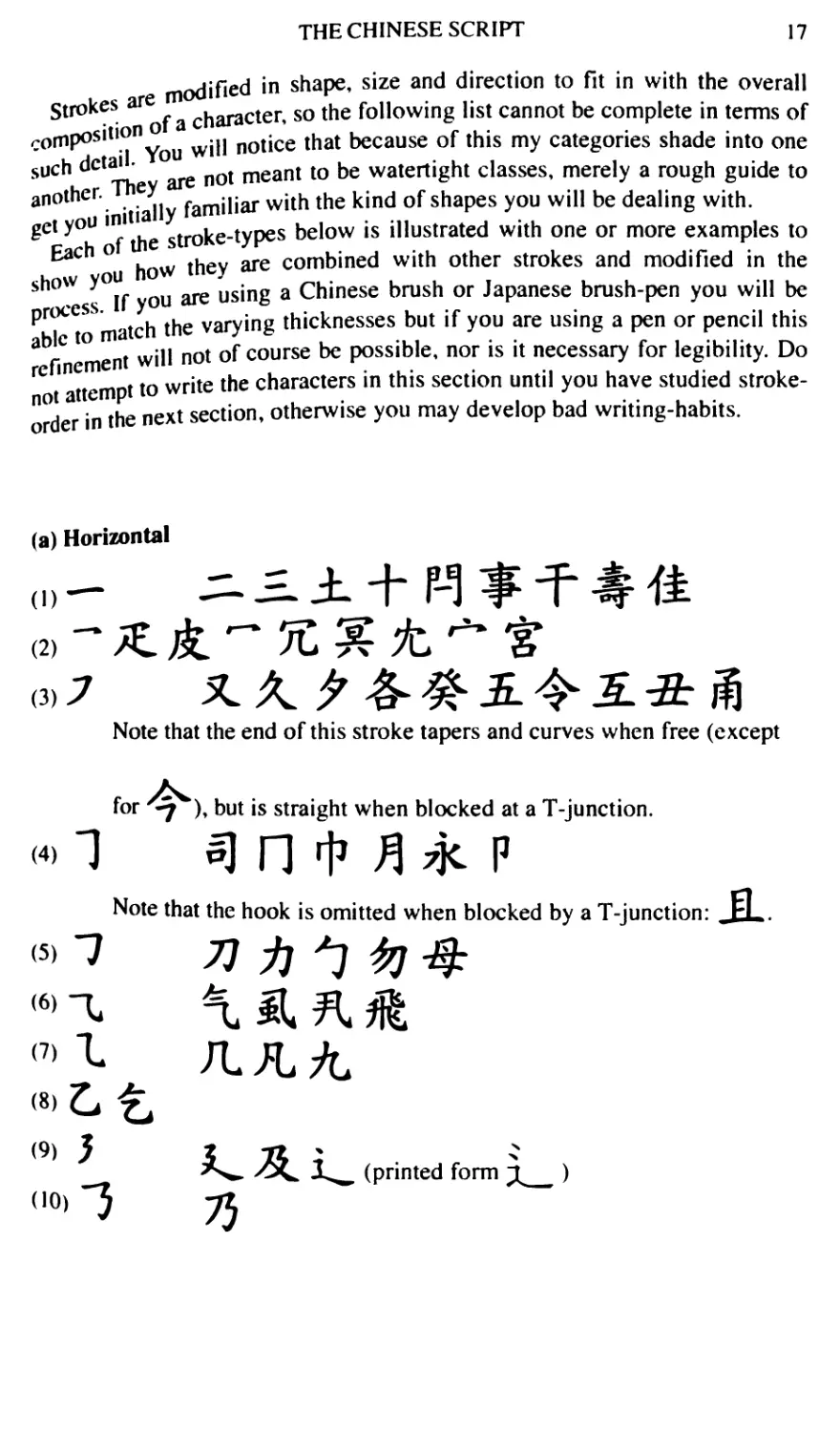
(a) Horizontal
(1) ~“
(2)
Note that the end of this stroke tapers and curves when free (except
for ), but is straight when blocked at a T-junction.
Note that the hook is omitted when blocked by a T-junction:
(5)
(6)
(9) 5
(printed form
18
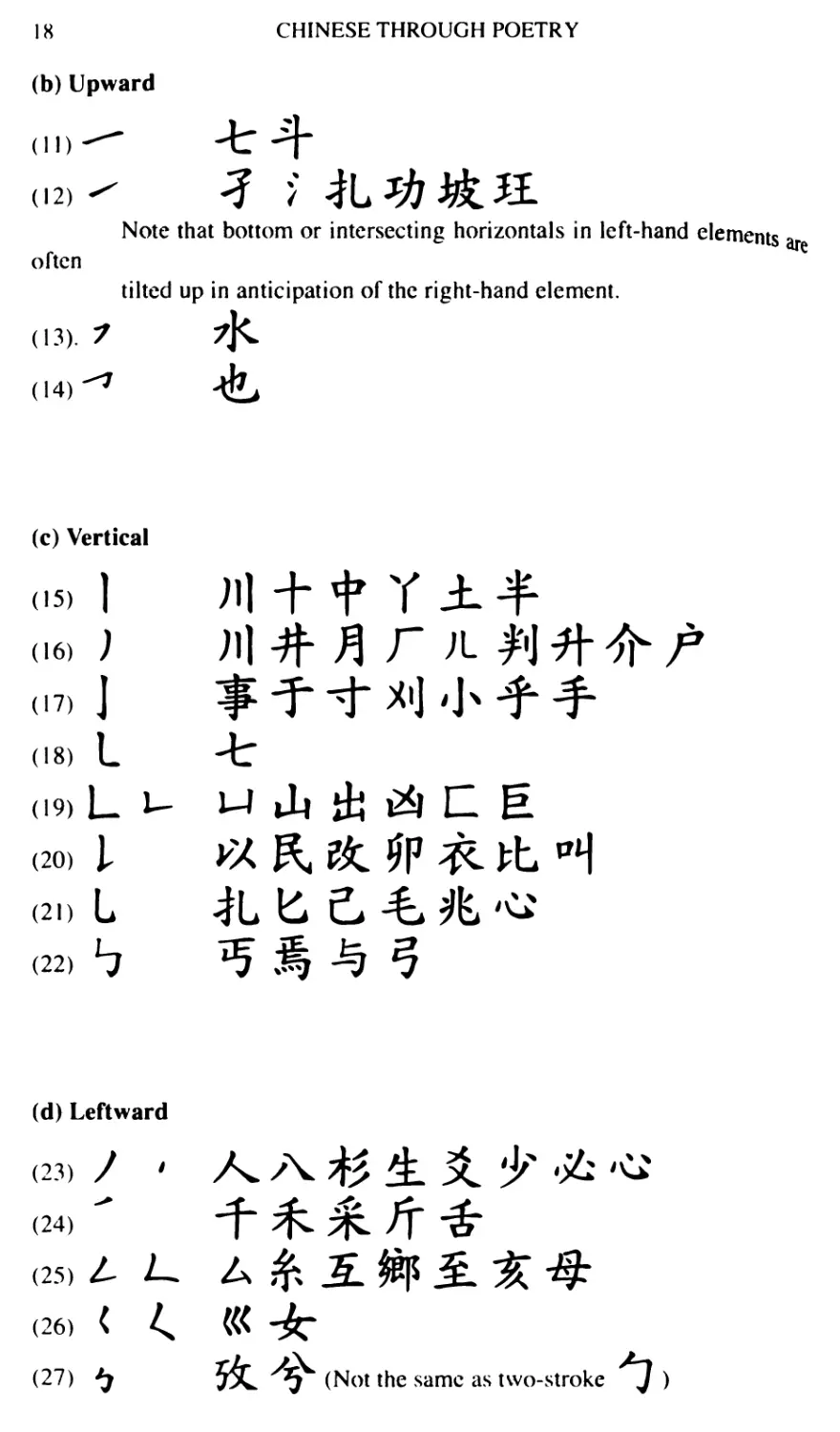
CHINESE THROUGH POETRY
(b) Upward
(11)
(12)
1 ;
Note that bottom or intersecting horizontals in left-hand elements are
often
tilted up in anticipation of the right-hand element.
(13)	. 7	zK
(14)^	л!ь
(c) Vertical
<15> I ЛЦ-1 Y ± 4-
(16) ) л] Я -Я P
(•7) J "Г "Ф ^*] d4
(18)	L	-t
(19)	L l- i-1	J-i	th	Й	IZ	Ё
(20)	I	E4	Я	5P	&	Л *1
(21)	L	4b	lu	£>
(22)
(d) Leftward
(Not the same as two-stroke
THE CHINESE SCRIPT
19
4.	Stroke- and element-order
If ou intend to learn to write Chinese characters it is a sensible idea to write
the strokes in the standard order from the very beginning. This will make the
writing of a character a mechanical habit that will leave your attention free for
other things. On the whole all Chinese write the strokes in the same order,
though there are variations in some cases.
Fortunately the stroke-order of the majority of character-elements can be
reduced to a few simple rules.
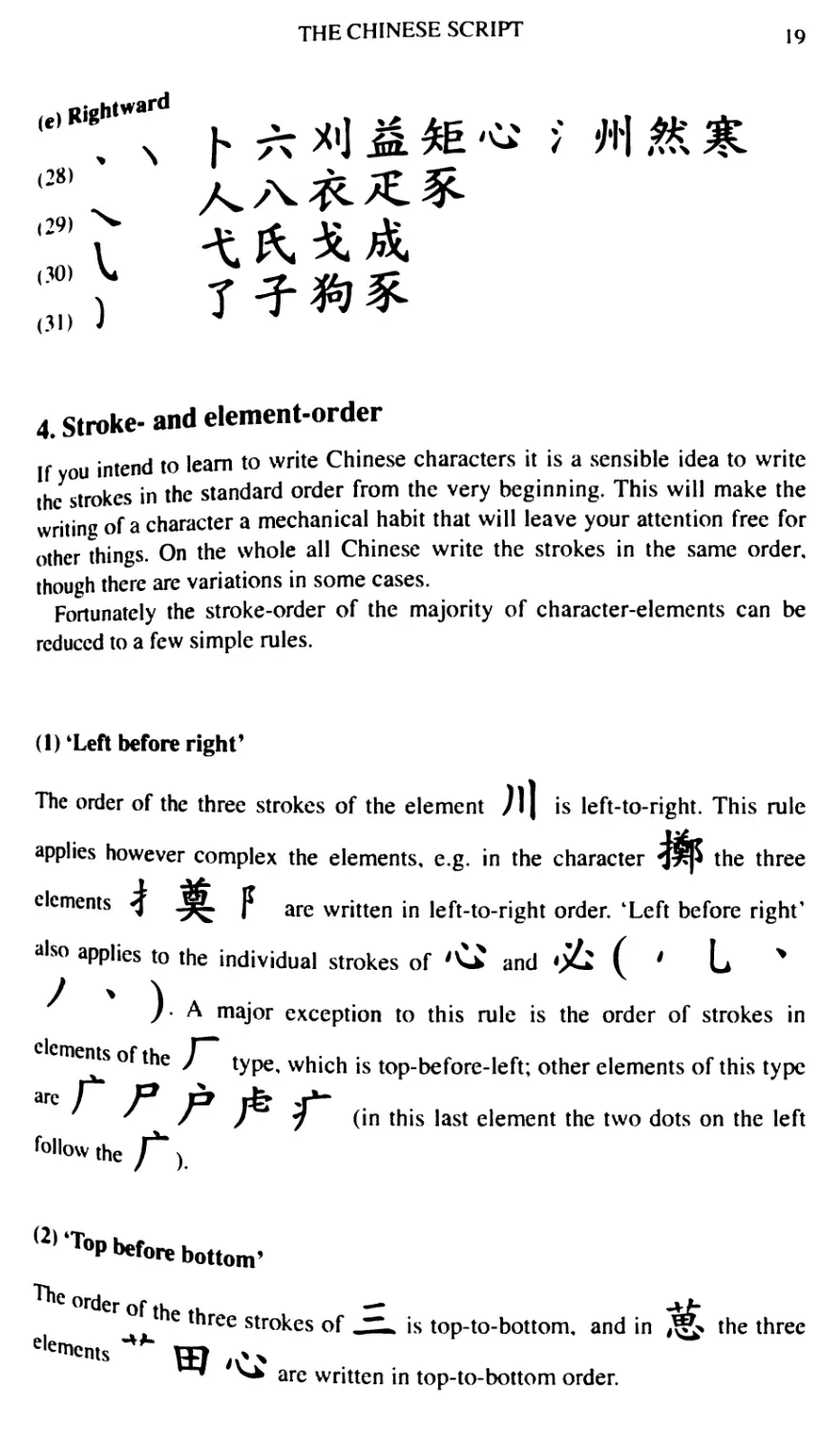
(1)	‘Left before right’
The order of the three strokes of the element Jl| is left-to-right. This rule
applies however complex the elements, e.g. in the character the three
elements % f are written in left-to-right order. ‘Left before right’
also applies to the individual strokes of and	1 U *
)• A major exception to this rule is the order of strokes in
type, which is top-before-left; other elements of this type
are
follow the /^)
(in this last element the two dots on the left
(2)	‘bp before bottom’
f the three strokes of is top-to-bottom, and in the three
elemcnts 4 TO
are written in top-to-bottom order.
20
CHINESE THROUGH POETRY
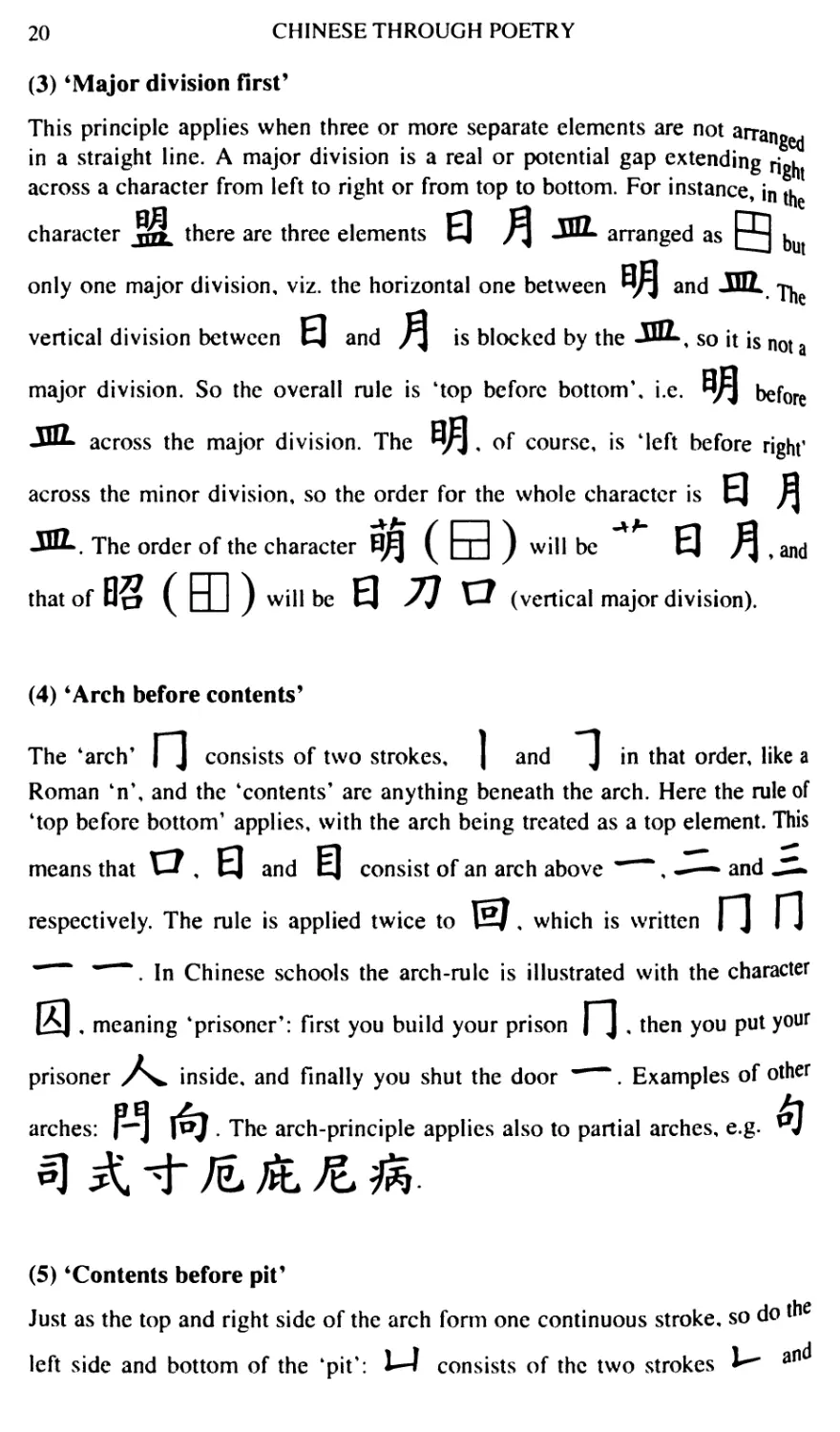
(3)	‘Major division first’
This principle applies when three or more separate elements are not arrange
in a straight line. A major division is a real or potential gap extending right
across a character from left to right or from top to bottom. For instance, in
character ml there are three elements E] ЛН arranged as Pj
only one major division, viz. the horizontal one between and ли
The
vertical division between E] and is blocked by the ЛН so it is not a
major division. So the overall rule is ‘top before bottom’, i.e. before
ли across the major division. The 8/^ • °f course, is ‘left before right’
across the minor division, so the order for the whole character is а Я
ж . The order of the character	) will be	, and
that of 8g (Ш) will be 0 77 О (vertical major division).
(4)	‘Arch before contents’
The ‘arch’ consists of two strokes, ] and in that order, like a
Roman ‘n’, and the ‘contents’ are anything beneath the arch. Here the rule of
‘top before bottom’ applies, with the arch being treated as a top element. This
means that V? , E] and Ё] consist of an arch above —“,	and
respectively. The rule is applied twice to IhJ , which is written П П
“. In Chinese schools the arch-rule is illustrated with the character
Q . meaning ‘prisoner’: first you build your prison Г] , then you put your
prisoner inside, and finally you shut the door —. Examples of other
arches: и ft . The arch-principle applies also to partial arches, e.g.
0 Л’+ТЬ Д JLfa
(5)	‘Contents before pit’
Just as the top and right side of the arch form one continuous stroke, so do the
left side and bottom of the ‘pit’: L-J consists of the two strokes аЛ^
THE CHINESE SCRIPT
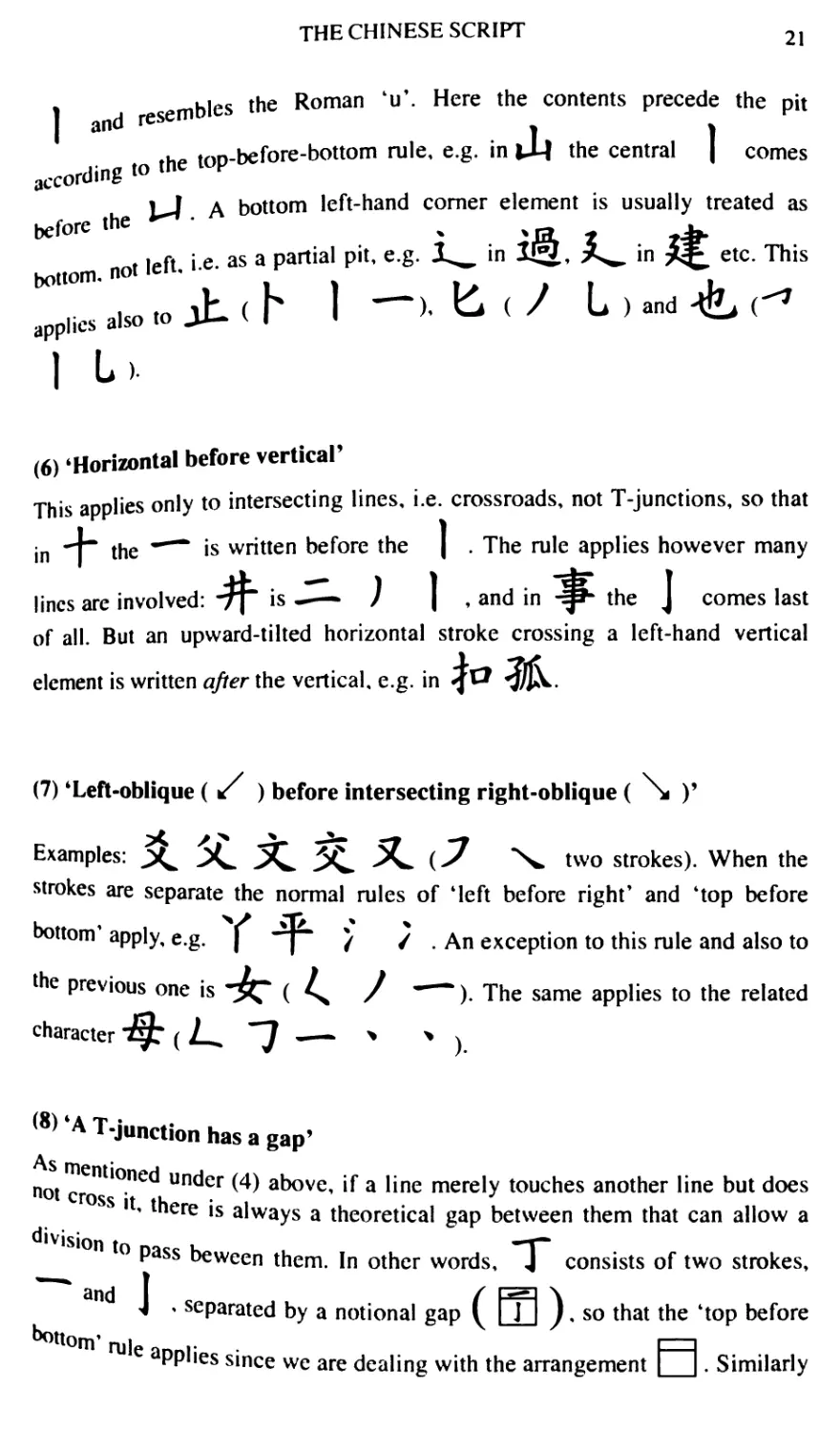
21
| j esembles the Roman ‘u’. Here the contents precede the pit
,hp too-before-bottom rule, e.g. in |1| the central | comes
according to the юр
il A bottom left-hand comer element is usually treated as
before ,he	'	2J2, t
. left i e. as a partial pit, e.g. in	in etc- This
bottom, not lett. •
wli«»Л<Г I —> £<, L>
(6)	‘Horizontal before vertical’
This applies only to intersecting lines, i.e. crossroads, not T-junctions, so that
in	—— is written before the | . The rule applies however many
lines are involved:	is-----)	| , and in the ] comes last
of all. But an upward-tilted horizontal stroke crossing a left-hand vertical
element is written after the vertical, e.g. in
(7)	'Left-oblique ( У ) before intersecting right-oblique ( ^ )’
Examples:	(-Z	"X. two strokes). When the
strokes are separate the normal rules of ‘left before right’ and ‘top before
bottom apply, e.g. f /	/ . An exception to this rule and also to
the previous one is
). The same applies to the related
) A T-junction has a gap’
n.rh°ned un^er (4) above, if a line merely touches another line but does
not cross it th • i	J
' inere is always a theoretical gap between them that can allow a
pass beween them. In other words, J consists of two strokes,
J . separated by a notional gap
’’’Worn’ rule
, so that the ‘top before
aPplies since we are dealing with the arrangement
. Similarly
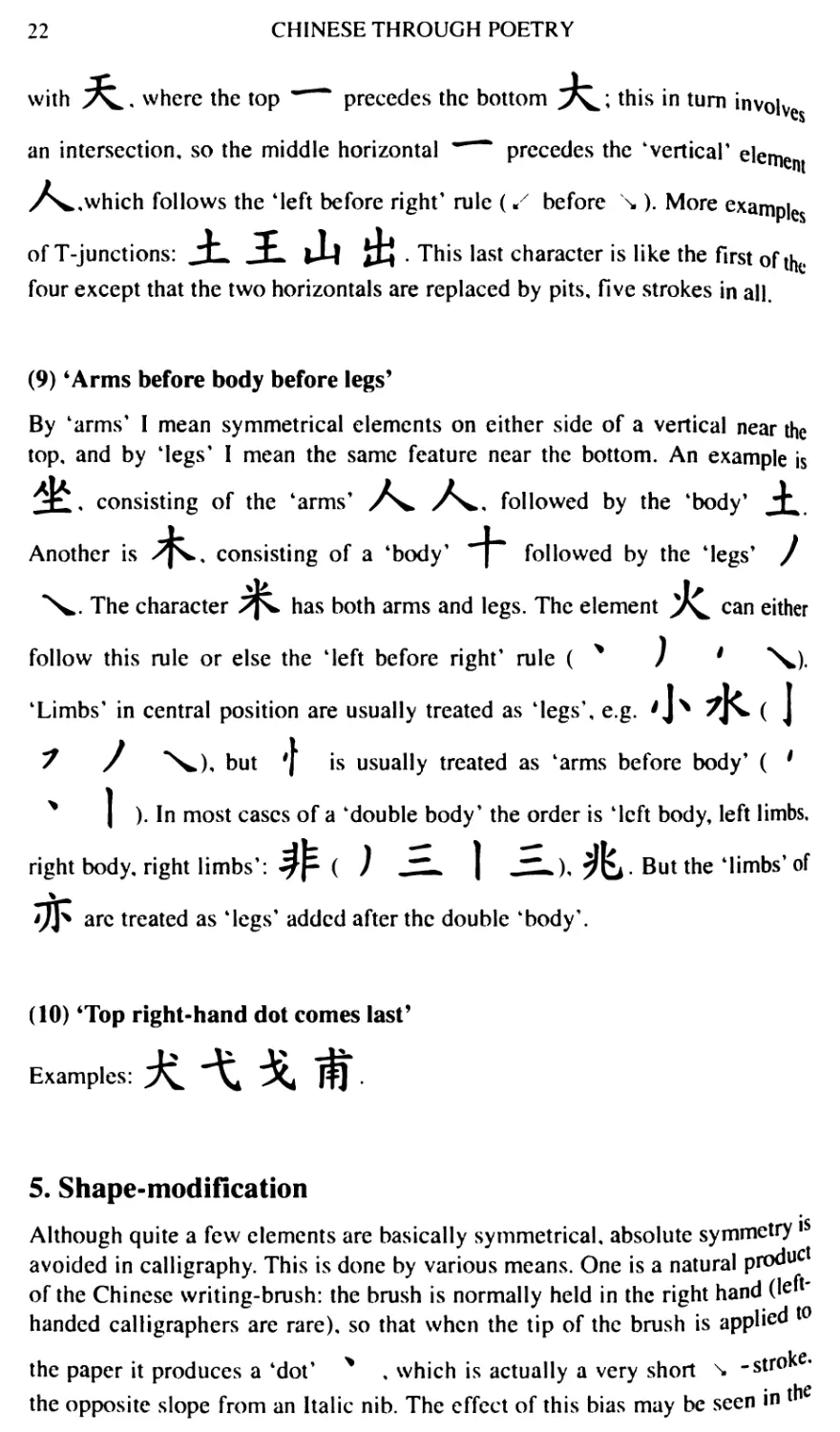
22
CHINESE THROUGH POETRY
with where the top —“ precedes the bottom this in turn involye
an intersection, so the middle horizontal —“ precedes the ‘vertical’ element
>Ач,which follows the ‘left before right’ rule ( Z before \ ). More examp|es
of T-junctions:	th .This last character is like the first of the
four except that the two horizontals are replaced by pits, five strokes in all.
(9)	‘Arms before body before legs’
By ‘arms’ I mean symmetrical elements on either side of a vertical near the
top, and by ‘legs’ I mean the same feature near the bottom. An example is
/Il . consisting of the ‘arms’	followed by the ‘body’ *E
Another is ^4, consisting of a ‘body’ followed by the ‘legs’ )
The character ^4. has both arms and legs. The element can either
follow this rule or else the ‘left before right’ rule ( 4	)	*
‘Limbs’ in central position are usually treated as ‘legs’, e.g.	( |
7 У "^ч), but is usually treated as ‘arms before body’ ( 1
4	] ). In most cases of a ‘double body’ the order is ‘left body, left limbs,
right body, right limbs’:	? JL 1 _=L).. But the ‘limbs’ of
arc treated as ‘legs’ added after the double ‘body’.
(10)	‘Top right-hand dot comes last’
5.	Shape-modification
Although quite a few elements are basically symmetrical, absolute symmetry|S
avoided in calligraphy. This is done by various means. One is a natural product
of the Chinese writing-brush: the brush is normally held in the right hand (left
handed calligraphers are rare), so that when the tip of the brush is applied to
the paper it produces a ‘dot’ 4 , which is actually a very short \ -stroke*
the opposite slope from an Italic nib. The effect of this bias may be seen in tbe
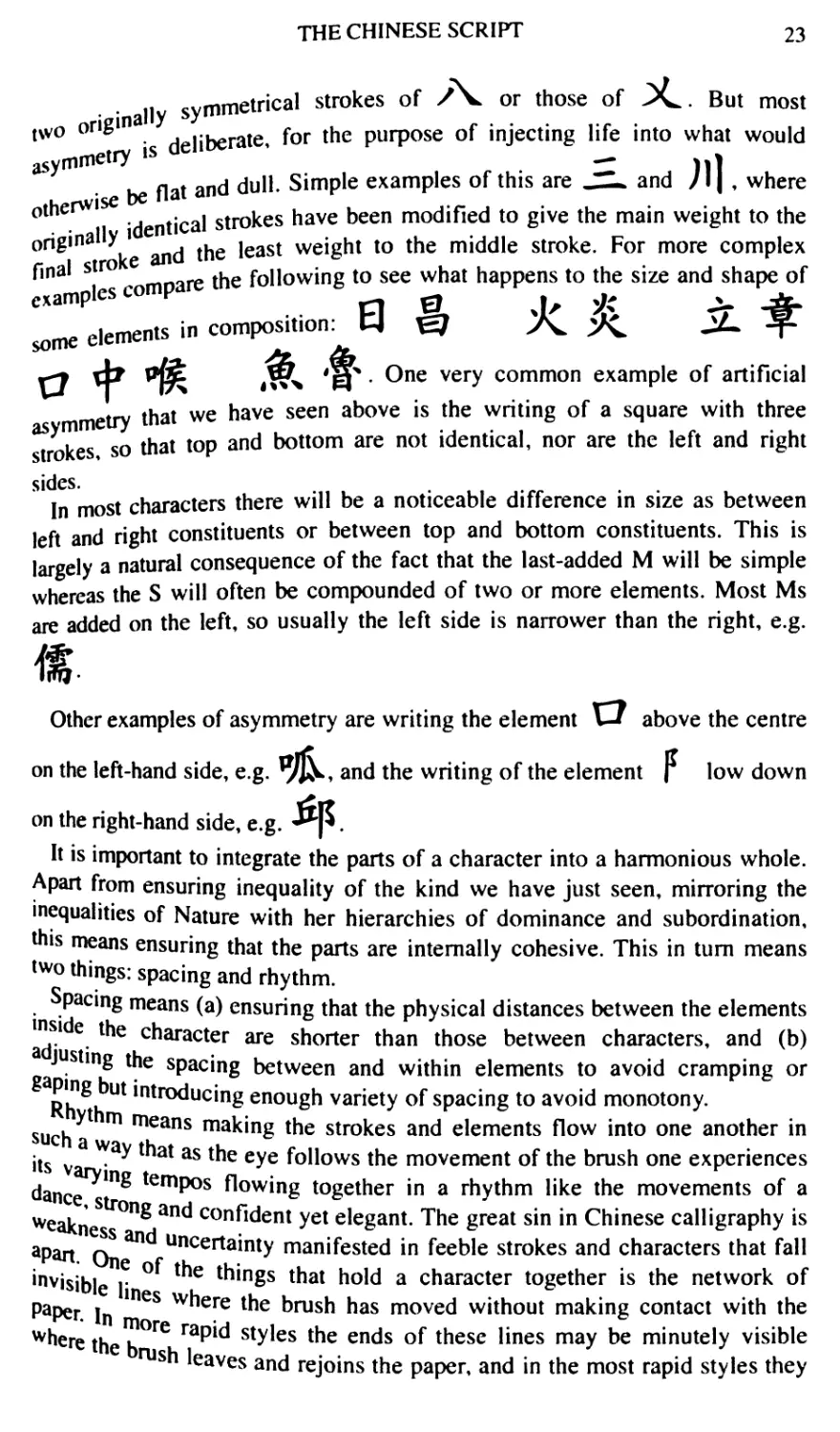
THE CHINESE SCRIPT
23
П symmetrical strokes of /V or those of But most
two ongi -liberate for the purpose of injecting life into what would
asymmetry is йен ’	_	.
be flat and dull. Simple examples of this are JZL and /11 , where
otherwise ^а] strokes have been modified to give the main weight to the
origmahy 1	ieast weight to the middle stroke. For more complex
final stro	the following to see what happens to the size and shape of
examples comp	&
some elements in composition: t|	X УС	-T
asymmetry
. One very common example of artificial
that we have seen above is the writing of a square with three
Xokes' so that top and bottom are not identical, nor are the left and right
sides.
In most characters there will be a noticeable difference in size as between
left and right constituents or between top and bottom constituents. This is
largely a natural consequence of the fact that the last-added M will be simple
whereas the S will often be compounded of two or more elements. Most Ms
are added on the left, so usually the left side is narrower than the right, e.g.
Other examples of asymmetry are writing the element V? above the centre
on the left-hand side, e.g. and the writing of the element F low down
on the right-hand side, e.g.
It is important to integrate the parts of a character into a harmonious whole.
Apart from ensuring inequality of the kind we have just seen, mirroring the
inequalities of Nature with her hierarchies of dominance and subordination,
this means ensuring that the parts are internally cohesive. This in turn means
two things: spacing and rhythm.
Spacing means (a) ensuring that the physical distances between the elements
msi e the character are shorter than those between characters, and (b)
s mg the spacing between and within elements to avoid cramping or
"** ut introducing enough variety of spacing to avoid monotony.
such Г m means ma^*ng Ле strokes and elements flow into one another in
its va	^at aS еУе f°H°ws Ле movement of the brush one experiences
dance	temP°s ^owing together in a rhythm like the movements of a
Weakness°n£ COn^^ent Уе1 elegant. The great sin in Chinese calligraphy is
aPart Uncertainty manifested in feeble strokes and characters that fall
invisible Г	that hold a character together is the network of
paper. In W^ere ^е brush has moved without making contact with the
where the^^ sty^es the ends of these lines may be minutely visible
nish leaves and rejoins the paper, and in the most rapid styles they
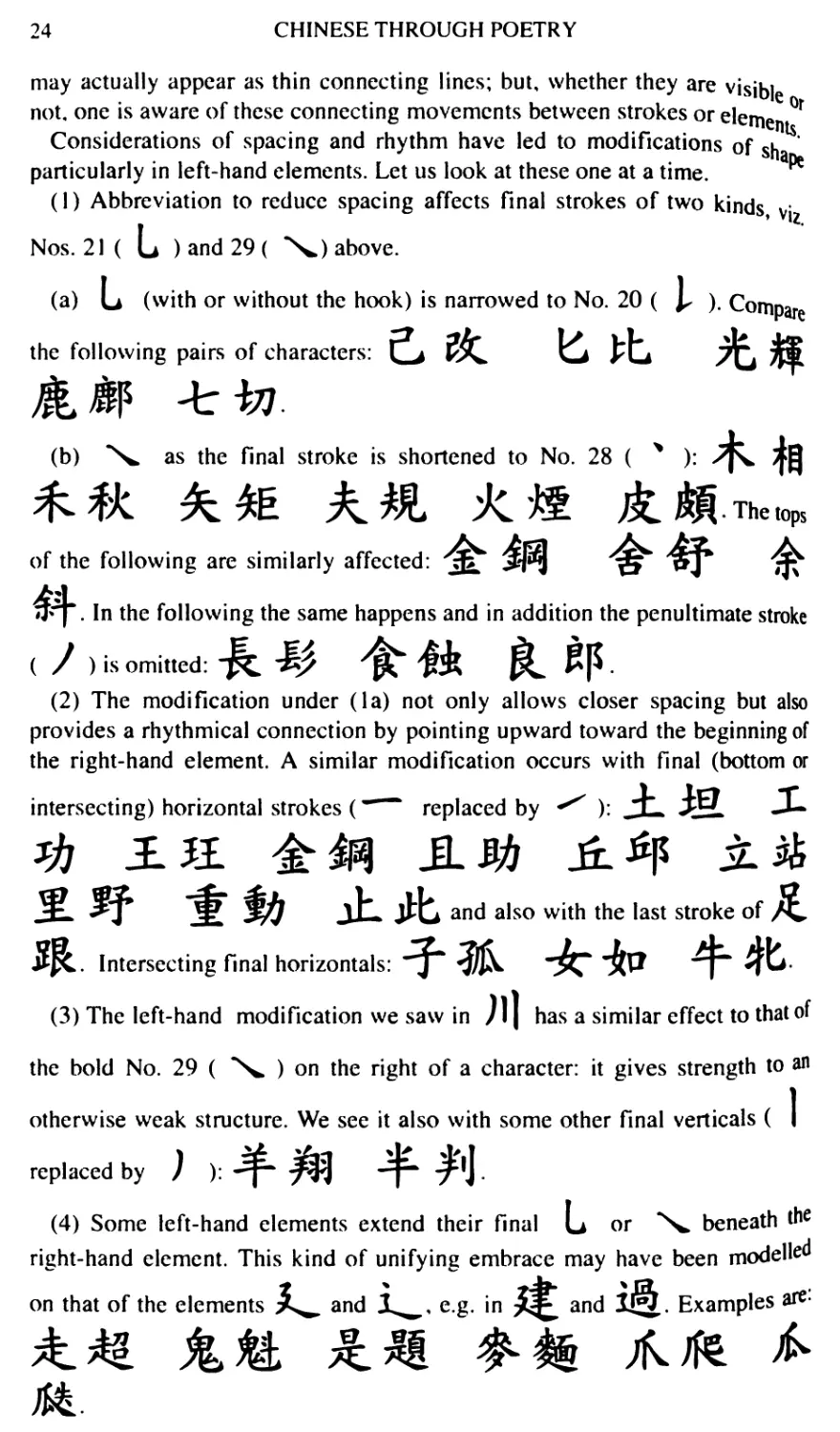
24
CHINESE THROUGH POETRY
may actually appear as thin connecting lines; but, whether they are visible
not, one is aware of these connecting movements between strokes or elemen °Г
Considerations of spacing and rhythm have led to modifications of Sk
particularly in left-hand elements. Let us look at these one at a time.
(1)	Abbreviation to reduce spacing affects final strokes of two kinds vi2
Nos. 21 ( Li ) and 29 ( "'XJ above.
(a)	Li (with or without the hook) is narrowed to No. 20 ( L )- Compare
the following pairs of characters: e. &	& A & $
-tU
(b)	"X. as the final stroke is shortened to No. 28 (
of the following are similarly affected: "nk
^|“. In the following the same happens and in addition the penultimate stroke
(2)	The modification under (la) not only allows closer spacing but also
provides a rhythmical connection by pointing upward toward the beginning of
the right-hand element. A similar modification occurs with final (bottom or
intersecting) horizontal strokes (replaced by ): JL ^5.	-I*
Intersecting final horizontals:	Ж -к -ftn
(3)	The left-hand modification we saw in Л] has a similar effect to that of
the bold No. 29 (	) on the right of a character: it gives strength to an
otherwise weak structure. We see it also with some other final verticals ( 1
(4)	Some left-hand elements extend their final Li or \ beneath the
right-hand element. This kind of unifying embrace may have been modelled
on that of the elements and e.g. in and 1^,. Examples are-
THE CHINESE SCRIPT
25
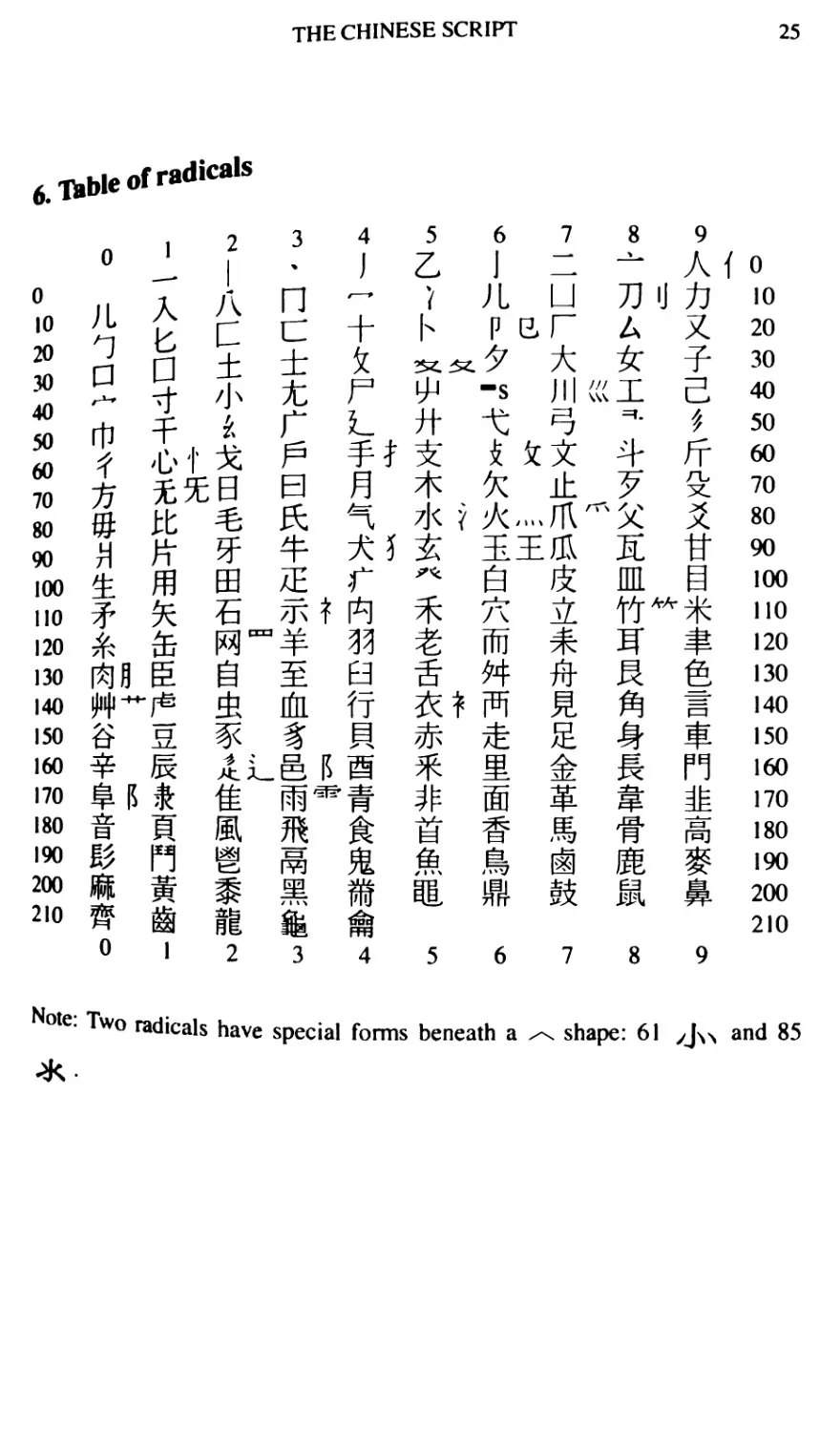
6.1)1ble»rr»dia,,S
	0	1	2 I	3	4	3 в	0 1	/	б	У Л i 0
0	11		1	П			Д	LJ	7] О ti		10
10	/ L л-i	и	с	c	4“	ь	p	d 1	Д	X	20
20	□ гл	П	±	±			у	Л		X-	30
30	i—i		<b	X	Г	A	"S	ill		В	40
40	rh		£	r	L	я-		e	=т.		50
50 zn	i P	-1		я			£			k	60
OU 70	-ft	£5E H		0	я	4^		it			70
80	£	tt	JU;			zj< 7				5^.	80
90	a	я-		*							90
100	£		Ш	ZE	г		в	к	Ш1		100
110		£		75 I A		4^	J\	i			НО
120	&						rfn				120
130			Й			•^*				S	130
140		'A	*	Ift.	fl	Pi					140
150	ё	Я						£	#	ж	150
160		К	ЛЕЙ К		Э	ж	ж		ж	п	160
170	Ж15 t				w			ж	ж	ж	170
180	a	ж		ж	ж	8	§	ж	#	rWj	180
190		n		га	ж		M	й	j^3	%	190
200		ж		JU.	w			5$.	ев m		200
210		год	it	ft	Й						210
	0	1	2	3	4	5	6	7	8	9
Note. Two radicals have special forms beneath a /x shape: 61 and 85
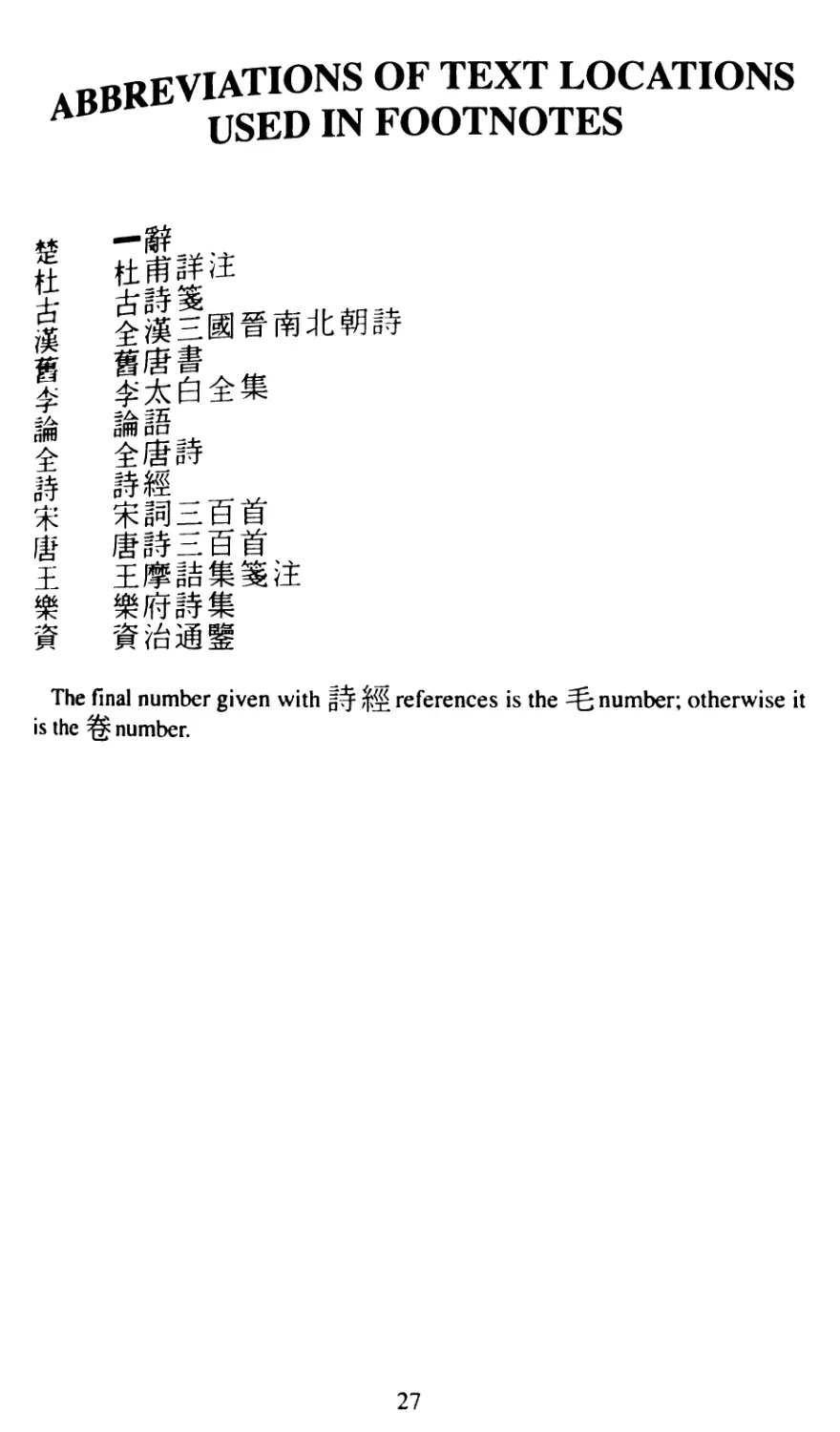
„„DEVIATIONS of text locations
AB USED IN FOOTNOTES
The final number given with references is the number; otherwise it
is the number.
27
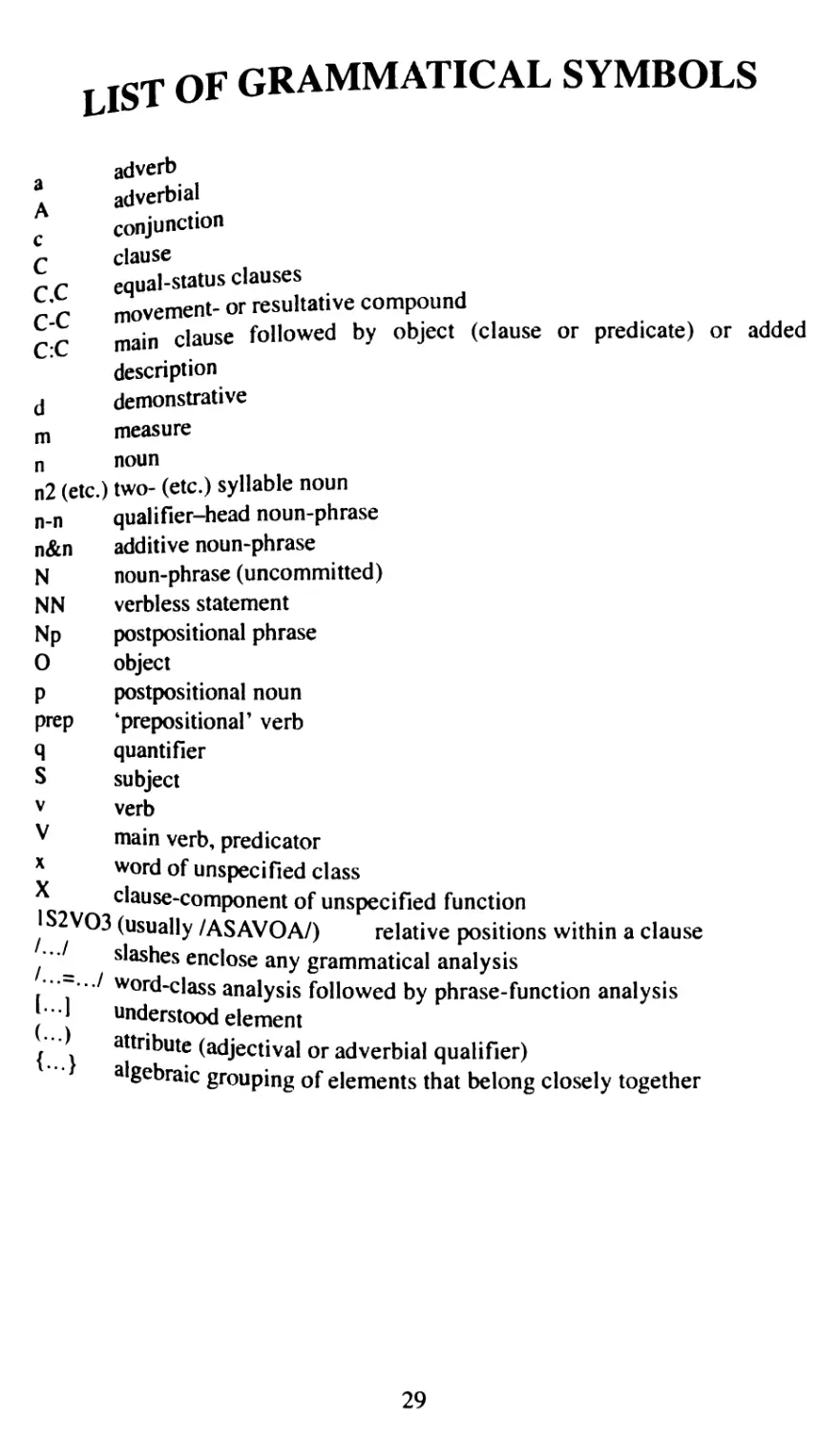
LIST OF grammatical symbols
adverb
’	adverbial
c	conjunction
c	clause
rc	equal-status clauses
rc	movement- or resultative compound
C main clause foll°wed by object (clause or predicate) or added
description
j	demonstrative
m	measure
n	noun
n2 (etc.) two- (etc.) syllable noun
n-n	qualifier-head noun-phrase
n&n	additive noun-phrase
N	noun-phrase (uncommitted)
NN	verbless statement
Np	postpositional phrase
О	object
p	postpositional noun
prep	‘prepositional’ verb
q	quantifier
S	subject
v	verb
V	main verb, predicator
x	word of unspecified class
X	clause-component of unspecified function
^1S2VO3 (usually /ASAVOA/) relative positions within a clause
—z slashes enclose any grammatical analysis
r 7 ”/ Word-class analysis followed by phrase-function analysis
• • • J	understood element
। । attribute (adjectival or adverbial qualifier)
algebraic grouping of elements that belong closely together
29
UNIT 1
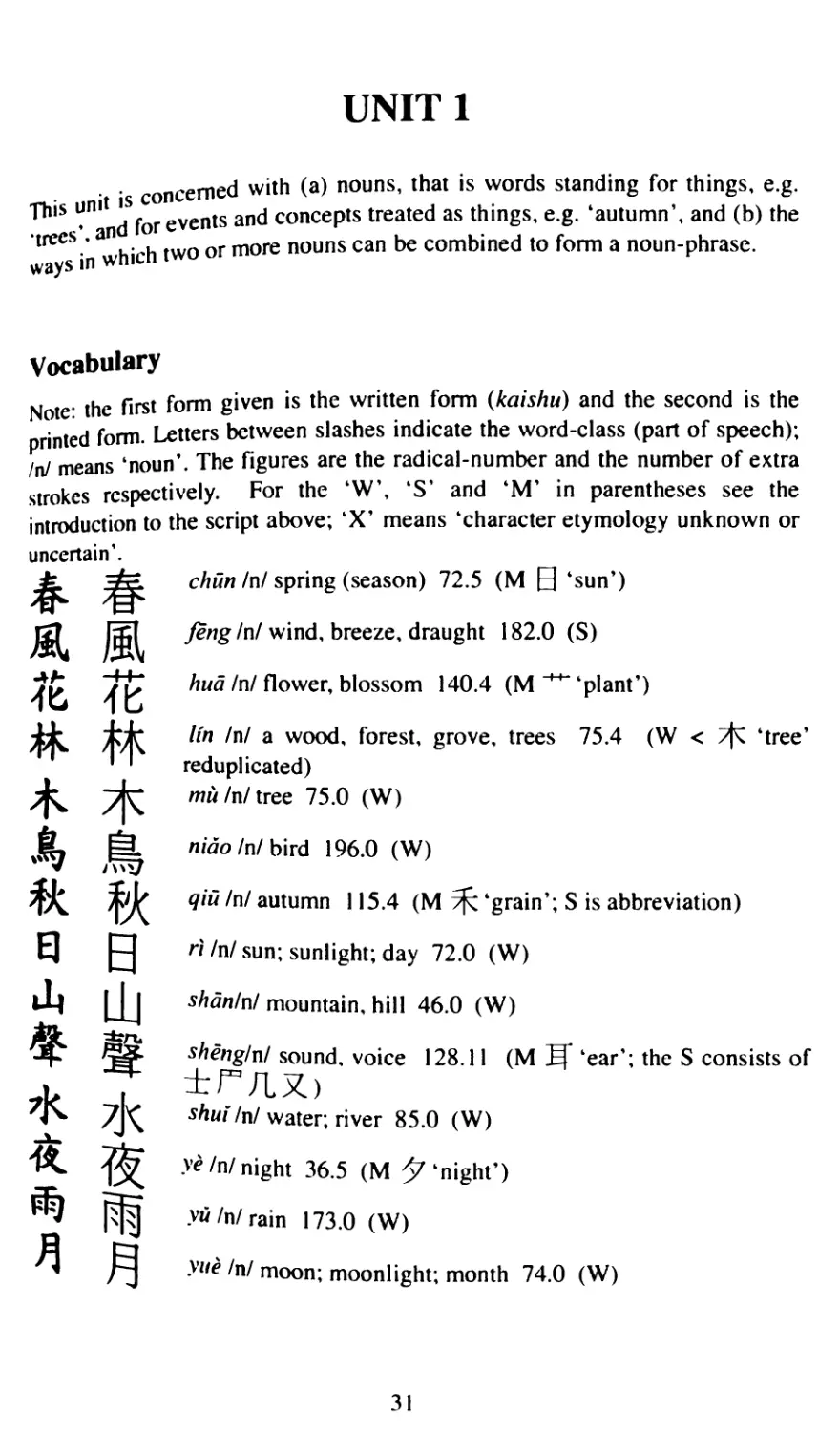
• concerned with (a) nouns, that is words standing for things, e.g.
111,5 ^nlt d forevents and concepts treated as things, e.g. ‘autumn’, and (b) the
trees .	more nouns can combined to form a noun-phrase,
ways in wnicn iwu
uncertain
4b
Я M
& $
s 0
$ g
Vocabulary
Note* the first form given is the written form (kaishu) and the second is the
rinted form. Letters between slashes indicate the word-class (part of speech);
/nJ means ‘noun’. The figures are the radical-number and the number of extra
strokes respectively. For the ‘W’, ‘S’ and ‘M’ in parentheses see the
introduction to the script above; ‘X’ means ‘character etymology unknown or
chiin Ini spring (season) 72.5 (M В ‘sun’)
feng Ini wind, breeze, draught 182.0 (S)
hua Ini flower, blossom 140.4 (M ‘plant’)
Un Ini a wood, forest, grove, trees 75.4 (W < ‘tree’
reduplicated)
mw/n/tree 75.0 (W)
niao Ini bird 196.0 (W)
qiii Ini autumn 115.4 (M ‘grain’; S is abbreviation)
и Ini sun; sunlight; day 72.0 (W)
shanlnl mountain, hill 46.0 (W)
shenglnl sound, voice 128.11 (M Lf ‘ear’; the S consists of
shut Ini water; river 85.0 (W)
ye Ini night 36.5 (M ‘night’)
vw/п/rain 173.0 (W)
vwe/n/ moon; moonlight; month 74.0 (W)
31
32
CHINESE THROUGH POETRY
zhu Ini bamboo 118.0 (W)
Notes on the vocabulary
§ chiin and qiH: in Chinese poetry spring and autumn are the two po^
seasons par excellence, for they are both seasons of change, whereas summer
and winter are more extreme and static and hence far less useful as symbols of
the changes in human life. Spring is associated with youth and renewal, and
autumn with old age, decay and death, as one might expect; but for the Chinese
poet spring can also be sad if it reminds him of lost youth or if he is far from
home and unable to enjoy the springtime with his family. The two kinds of
sadness that afflict the poet in these two seasons are called shdng chiin
‘wounded (i.e. heart-broken) by the spring’ and bei qiii ‘saddened by
autumn’ respectively.
Symbol of freedom, for the wind ‘bloweth whither it listeth’, unlike
the man trapped in exile as soldier or magistrate. The wind brings the scent of
flowers or the voice of the brook; the wind then becomes a symbol of moral
influence, whether for good or ill, spreading through the land, and hence of
local customs. As a storm the wind is of course a symbol of dangers and
obstructions.
hud'. Flowers, particularly fruit-tree blossom, represent both the glory of
springtime and youth and also ‘the flower of grass that fadeth’ when autumn
and old age come. Flowers also represent able or virtuous people, especially
those whose talents should be employed in government but who have been
overlooked, so that their fragrance is wasted in the political wilderness.
lin can refer to (a) woods on the local hills, (b) forests on the distant
mountains, or (c) the countryside as somewhere to retire to, away from the city
but still close to the '/fe Цуи qido ‘fishermen and woodcutters’. Retirement
and more temporary escape is to A lin qudn ‘the wildwood and the burn.
Retirement is often referred to as Ли ju ‘living in the woods’ or
guilin ‘returning to the woods’, though this is not to be taken too literally.
niao: The most common birds in poetry are ydn ‘wild goose’ and
hong ‘swan-goose’ (or often just ‘wild goose’) as symbols of homesickness of
message-carrying (for which see Unit 16); iSt y«n ‘swallow’ as a nest-buildcr
and one of a pair, associated with spring; ylng or pf hudng nido ‘goldcn
oriole’ as a song-bird, also associated with spring; and 1Ц yuan
‘mandarin duck’ as a symbol of marital love and fidelity.
111 shan can refer to (a) the hills around a village above the cultivated are3'
covered with woods, a source of timber and fuel, or (b) the mountains а^*У
from inhabited areas, the haunt of wild beasts, yetis (f?f А У& r^n WI
people’), mountain demons (|_JL| $Lshan gui), hermits in caves or monaster^
UNIT 1
33
mortals (33 Лу“ ‘feathered people’). Mountains include
airbome Moufltains (£ Ш wuyui) and others with spectacular scenery
the Fivc 5аС* of tourist pilgrimage.
and hence о j	sounds of Nature and music and noisy crowds, but
®*"gi,5” er. English‘a big noise’).
also reputation r’: most rivers in China flow eastward from the mountains
^shUl \o the China Sea. They provided convenient east-west
in the ' n but without adequate north-south roads, they and the ranges of
communi ^untains between them also formed a barrier between the
hlllS a”litan north and the colonial south, so <’£ 'ffijiang hu ‘rivers and lakes’
mctropo & bo] of the perils confronting civil and military officers from the
^pitals^f the north (on the Yellow River) who have to travel to central or
southern China.
In Chinese painting 111 shan and 7j< shut form a complementary pair, where
the mountain represents the yang or male principle of solidity, immobility,
upthrust and dominance while the river represents the yin or female principle of
flexibility and submission. At the outset the mountain seems stronger than the
river, which has to go around it, but in the course of time the river wears the
mountain down, just as the passage of time destroys all things. So landscape
painting, which represents the interaction of the two primal forces of yin and
yang, is called 111 7\<>shan shui or 111 7|< Ш shan shut hua ‘mountain and river
painting’. Incidentally, it is a convention in Chinese painting that no two
dominant mountains should be of the same height, for even males have to
submit to a boss!
The mountain does not move, but the river never stops moving, so the river
becomes a symbol of time going on forever, in contrast to the limited brief span
of human life. The river carrying away the fallen blossom of springtime
becomes a symbol of time eroding our youth.
lx ye: night is often associated with loneliness (sleeping alone, looking at the
moon etc.) but also, for instance, with spending the night drinking and talking
wh an old friend briefly encountered in ‘exile’.
Й usua^y refers to the full moon and hence the moon is often called ВД
nnn8 yue ‘the bright moon’. Its roundness is a symbol of the reunion of the
mis^e c*rcle, hence a reminder to a husband far from home that he is
In the *S fam^’ and t0 ^le w^e behind that she is missing her husband.
Unit in ,~nse month’ it refers to a lunar month or lunation; for details see
U^esuTheLUnarCa,endar‘
shall see^311^ m°°n symbolize the yang and yin principles respectively. As we
overcast’3^ ^as*c mean*nS °f Уаn8 was ‘sunlight’, whereas yin meant
developme°r S^ade * male/female symbolism of these terms was a later
Vj zhii	Were ^е*г numerous other associations.
and flexibl h СаП ГеаСЬ tree“^e*Sht. It is an important material, being strong
e’ ence became a symbol for flexible strength.
34
CHINESE THROUGH POETRY
1.1 Nouns
Chinese nouns are invariable: there are no modifications to indicate numbe
case as there are in most of the languages of Europe and Asia. So |Jj sha^
either a single ‘mountain’ or more than one ‘mountains’. It is true that one *
if necessary, distinguish the singular by prefixing the word —>yT ‘one’, and
plural either by prefixing some such word as zhong ‘all the various’ orel^
by using a compound such as 111 (also written 111	) s^n yue (two wOrd$
for ‘mountain’ combined), but in general this is not done and it will be up to
you as the reader to decide which is intended in any particular case, singular Or
plural.
A possessive form (made by adding the word zhT, equivalent to English
-’$) is not often used in verse, though it is common in prose; this can sometimes
cause difficulties, as we shall see later in this unit.
1.2 Qualifier-head noun-phrases
A noun-phrase is a group of words operating as a major clause-component, for
instance as the subject or object of a verb. The simplest noun-phrase consists of
a single noun /п/ (the slashes enclose any symbolic notation in this course); the
next simplest consists of two nouns /nn/.
The most common relationship between two nouns forming a noun-phrase in
Chinese verse is when the first (the ‘qualifier’ or ‘attribute’) qualifies, limits or
describes the second (the ‘head’) in various ways. As in the parallel English
usage in compound nouns such as ‘book-token’, I shall use a hyphen to notate
this relationship: /п-n/. In English and other European languages, by contrast, a
qualifier may precede or follow the head according to the qualifier’s structure.
For instance, we can speak of ‘an autumn day’ (qualifier before head) or ‘a day
in autumn’ (qualifier after head), whereas Chinese uses only the first form.
Compare the following examples of these two word-orders in English
(qualifiers in italics):
(a)	Single-word qualifier before the head:
an autumn day (qualifier is a noun),
a gloomy day (qualifier is an adjective),
the fading day (qualifier is an active participle),
the new-born day (qualifier is a passive participle),
my day (qualifier is a possessive pronoun).
(b)	Phrasal qualifier following the head:
a day in autumn (qualifier is a prepositional phrase),
the day (that) he died (qualifier is a relative clause),	.
a day remembered by all (qualifier is a participle plus a prepositio
phrase),
a day to remember (qualifier is an infinitive).
UNIT 1
35
the equivalents of all the words in italics must precede the head
In Chinese- m	{he |itera| eqUivalents of the following:
“dnv’), so inai wv ь
(here ааУ >'
an in-autumn day,
thehe-Jiet/day,
aremembered-by-all^y.
13 Qualification relationships in noun-phrases
some examples of how Chinese nouns qualify a following noun, and
HCme indication of the precise nature of the relationship.
S But first a general word of caution. Chinese verse is very economical. You
will have to go at least half-way towards meeting the poet. He will not spoon-
feed you; in fact, at times you may feel he’s doing his best to baffle you! You
will not get much out of Chinese poetry unless you are prepared to visualize the
scenery and its physical implications of location, shape, colour, sounds and
sensations, filling in the gaps yourself, and also to empathize with the poet, to
enter not just his physical world but also the world of his feelings, since that
after all is the whole point of poetry as distinct from prose. It is strongly
recommended that you practise doing this even with the simple phrases of these
early units.
§ chiin X: spring(time) X; X in spring(time); X affected by spring (hence
bright, active or growing).
§ chiin Un the springtime woods; the forest in springtime (putting
out leaves, filled with bird-song and flowers).
§ chun nido the birds in springtime (singing, nesting, swallows
gathering mud).
VtqiH X: autumn(al) X; X in autumn; X affected by autumn (dying, chilly, sad,
lonely).
Ж qiii Jeng the autumn wind (chill, stripping the leaves from the
trees, sad-sounding).
autumn rain (chilly and miserable).
X’ noctumal X; dark X; X at night; X of the night; the
ydfeng the night wind; the wind in the darkness.
fx ye Un the woods at night; the forests in the darkness.
m°onli^h moon X; lunar X; X of the moon; the moon’s X; moonlit X; X in the
I* X illuminated by the moon.
yue Un the moonlit forest; the woods in the moonlight; the trees
neath the moon.
36
CHINESE THROUGH POETRY
Я уме ye a moonlit night.
feng X: wind X; the wind’s X; windy X; wind-swept X; X blowing in
wind (hence moving, rustling, creaking).
Ж feng lin trees tossing in the wind; the wind-blown woods
Ж V] fengzhti bamboos swaying and rustling in the wind.
pff уй X: rain X; rainy X; rain-soaked X; X in the rain (wet, cold, beaten down
sad etc).
JW V] уй zhu bamboos in the rain; bamboos with rain dripping froni
the leaves; bamboos with wet, glistening leaves.
yn У? a rainy n*ght; a wet night; a night of rain; rain-filled
darkness.
7\<^shuiX'. water X; river X; X in/on/by the water/river.
/]< VTshutzhu river-side bamboos; bamboos by the water.
/К M shui niao river-birds; water-birds; birds that live by the water.
111 shan X: mountain X; hill X; X among/in/on/above the mountains.
111 ^shan hua mountain flowers; blossom on the hills.
111 Ж-^ал feng mountain breezes; the wind blowing across the hills.
lin X: wood(land) X; in/above the woods/forest.
Ж Hn feng the wind through the woods; forest winds.
Я h'n yue the moon over the woods; the moon shining through the
trees.
One of the nouns in this unit is mainly used as a head, not as a qualifier:
X g- sheng: the sound of X.
lin sheng the sounds of the forest; woodland sounds (e.g. bird-
song); the voice of the woods.
{If hua sluing the sound of falling blossom; the creaking of flower-
stems in the wind.
If we analyse the relationships in the above phrases we find in the Engl^
not only nouns and adjectives used as qualifiers but also a range of prepositions
(‘of, at, in, on, among, above, beneath, with, by, across, through, over’) an
phrases involving participles (‘affected, tossing, blowing, -lit, -blown, -soakeo-
swaying, rustling, creaking, dripping, shining’). In other words, English has the
resources for much greater precision in specifying relationships than
language of Chinese verse has, but this can be a disadvantage: where
spoils the reader by over-specification, Chinese verse-language requires
exercise of imagination and empathy, a halfway step towards the poet, wni
can hardly be a bad thing.
UNIT 1
37
on for compound nouns in other languages to show a wide
К is quite corn . • s between the two nouns concerned, but Chinese verse
range of rclatl°^ave a wider range than that of other languages; that, though, is
seems to me to	t0 others to determine. At least you have had due
something 1 ^°wj(je range of relationships connecting Chinese nouns in a
warning of ^relationship — and noun-phrases are very common indeed in
Chinese verse.
1.4 Additive noun-phrases
less common relationship between two nouns forming a noun-phrase is
addition This can be done by using the conjunction /с/ уй ‘and’ between
nouns e.g.	BQ^shuiуй тй /псп/ ‘rivers and trees’, but on the whole
verse omits the conjunction and simply puts two nouns together, giving in this
case t|< J^shuiтй /п&п/, where the ‘&’ stands for the ‘understood’
conjunction meaning ‘and’.
Does this not lead to confusion? Yes, it can: in verse you will find
shut mu either as /п&п/ in the sense of ‘rivers & trees’ that soothe the soul of
an escapee from city life, like Д Un qudn ‘woods and upland streams’, or
else as /п-п/ ‘river-trees’, i.e. ‘trees by the waterside’ (e.g. in Unit 21, first
poem). Similarly, 111 shan shut most often means ‘mountains and rivers’
/п&п/, but sometimes means ‘rivers in the mountains’ /п-п/.
In additive compounds the two nouns represent members of the same
semantic class of things, whereas the nouns in the qualifier-head compounds
given above belong to different classes. For instance:
В yue ‘day and night’ (both are units of time),
ill shan shut ‘mountains and rivers’ (both are topographical
features),
mu ‘bamboos and trees’ (both are plants),
qiu ‘spring and autumn’ (both are seasons),
g Я] riyue ‘sun and moon’ (both are heavenly bodies),
. rj n yue ‘days and months, the passage of time’ (both are units of
time).
tees are^iT	аП а<^^Уе compound /п&п/, the rivers and
compound / aS tW° eclual sources °f pleasure; as a qualifier-head
resPcctiv | Пт^' are bought of as a place and as things growing there,
important th’ e Same *S 11416	111 s^n s^ut *n *ts two mean*nSs- The
not two co 1П£ ab°Ut ^1S 1S ^lat semant’c classes are subjective: whether or
applied in orde	to same c*ass depends on what criteria are being
from js 6r t0 classify them. So the rule given above for distinguishing ‘-’
On У a rough guide, not a hard-and-fast one.
38
CHINESE THROUGH POETRY
1.5 Noun-phrases of more than two words
Larger phrases may be built up of three or four nouns, though these an»
I*,
common.
In the case of three nouns the first and second are usually more closely ijnL
than the second and third, i.e. /nnn/ represents in algebraic terms /{nn}n/
/n{nn}/; for instance, ® feng zhu sheng is ‘the sound of bambo^
[rustling]-in-the-wind’ /{n-n}-n/, not ‘*the-sound-of-bamboos [borne] on
wind’ */n-{n-n}/. Similarly, 111 ^shan shut hua is ‘paintings of rivers-and
mountains’ /{n&n}-n/, not ‘*river-paintings in the mountains’ */n-{n-n}/ ।
shall refer to this principle as the ‘grouping-rule’.
Four-noun phrases may be /nn/ qualifying /nn/, as in 111 Щ ffiqiu shan
Jeng lin ‘wind-swept woods on the autumn hills’ /{n-n}-{n-n}/, or they maybe
/nn/ plus /nn/, as in ® pff tO" feng hua yu zhu ‘wind-blown flowers and
rain-drenched bamboos’ /{n-n}&{n-n}/.
Exercise
Translate the following noun-phrases into English and check your version
against the key at the end of the book. You should not of course expect your
wording to be identical with that of the key; all that matters is that you have
grasped the overall meaning of the phrase. The same will apply to all later
translation exercises.
(DM (2)®ft (3)O(4)tU (5)MS (6)^zl<(7)
fB (8) ШРК (9Ж(Ю)О (il)M(12) Я fa (13)
г'гв (14>шп(15)шж (16)#я (17)в,® (18)^а
(19) В& (20)^ft (21)7|<М (22)11Ж (23Ш® (24)^А
В (25)#Ш(26)Ш#(27)ШЖ^(28)^ШЯ (29)jW§
(30) т|< Я (31) ^Ш (32)ШП(33) ЯШ34ШШ35)^
ft (36) В Я (37) D Ж (38) ft ft (39) Ш Ж (40) faft (4^
#ft (42) ш В (43)PHft (44)ftg (45) ш Я (46) ft*
(47)ШВ (48)Ш* (49)#^ (50)ft> (51) ЭД Я (52)#
ft(53)M(54^a(55)M(56mftg(57)#fafl
UNIT 2
cerned with quality-verbs (stative verbs), that is verbs used to
This unit is what thingS are like rather than what they are doing.
or descr
Vocabulary
Mi/v/be white 106.0 (W)
chang M be long (in space or time) 168.0 (W)
Aft ci /d/ this, these; this kind of; /п/ this thing; this place, here 77.2
(S)
da M be big 37.0 (W)
ga° M be high, tall; have high social, political or moral status
189.0 (W)
hdn /v/ be cold, chilly; vulnerable 40.9 (M '( ‘ice’)
сЛ? Ус .
JL ~r~ kong /у/ be empty; hollow; deserted (no people present); /а/ in
vain, uselessly 116.3 (M/\‘hole’)
epji mi'ng In/ be bright, shining; clearly visible; clear-sighted; intelligent
1 72.4 (M Я ‘moon’)
4	/v/ be blue or green (sometimes black, livid or pale) 174.0
(M Я* ‘red’)
гел M person, people, human being; others (not self); someone,
A Zt anyone 9 0 (w)
ч'ге	с°1оиг; facial expression of mood 139.0 (M A ‘person’)
/ж 7^2
Shen /v/ be deeP 85.8 (M 7 ‘water’)
Д. |c,aZ/n/mOSS l40-5 (M"‘plant’)
sky; Heaven; Providence; Nature (excluding the human
race!) 37.1 (X)
39
40
CHINESE THROUGH POETRY
/J \ xido /v/ be small 42.0 (S)
—“	\w/q/one; a single; whole 1.0 (W)

you /v/ be secluded, cut off from the world, hidden, quiet
111 ‘mountain’)
52 6 (M
Notes on the vocabulary
The letters between slashes (7.../’) above indicate the word-class (part of
speech) of the vocabulary-item concerned: /а/ = adverb, /d/ = demonstrative
/п/ = noun, /q/ = quantifier, /v/ = verb.
gao ‘high’ can refer not only to physical elevation (on a hill or tower or in
the sky, for instance) but also to a high position in government or other walk
of life, or to withdrawal from the world as a recluse; in the latter sense there
are often overtones of moral purity, avoiding contamination by the despised
world of politics.
han ‘cold’ has overtones of ‘chilly, shivering, vulnerable, neglected, poor,
pitiful, sad’.
5? kong ‘empty’ has three main meanings in verse: (a) deserted, helpless,
vulnerable, ignored by Nature; (b) empty of people hence peaceful and free;
(c) (for Buddhist writers) a state of calmness achieved by suppressing painful
emotions. This word encapsulates one of the basic paradoxes of Chinese
poetry: seeking the peace and quiet of isolation yet at another level craving
human company.
0^ ming in its primary sense of ‘bright’ most often refers to the moon: ВД Я
nu'ng у ue. Note that 0^ В nu'ng ri means not ‘*bright sun’ but ‘tomorrow’; the
adjective used with the sun is ‘white’: Q В bai n. The adjectives ‘bright’ and
‘white’ attached to these two celestial bodies are so frequent as to have almost
ceased to have any discriminatory function in these two phrases.
qTng is the colour of the sky and sea and hills and mountains and
vegetation, i.e. the whole range from ‘blue’ to ‘green’, like the Gaelic and
Welsh glas. It will be dealt with in more detail in Unit 22. As ‘green’ Й
associated with springtime and youth. The h"' ffilqing long ‘Green Dragon
the east is a constellation whose heliacal rising marks the arrival of spring.
& se ‘colour’ was originally the space between the eyebrows, the focus
facial expression; from here its meaning was extended to mean other
of emotional expression such as blushing; from here it was an easy step
Nature’s ‘expression’ of seasonal atmosphere and colour, and then to colour
general. Meanwhile another extension of meaning occurred: facial appcaran
led to the meaning of ‘female beauty’ and to ‘the pleasures of sex’.
ffishen ‘deep’ can be used of water in the sense of ‘vertically deep’, but
commonly refers to the distant sky or a long distance into the mountains
UNIT 2
41
-units such as night and the names of the seasons it means
wOods: wlth tim^eferring to a courtyard it implies ‘secluded, unvisited’. There
•late/ and whcnQf deep feelings hovering around this word.
is often asen,S^as a wjde range of meaning: (a) the physical sky; the heavenly
X tian ‘sky ^ovements control the seasons and hence agriculture; ditto as
bodies wh^ndicators (Chinese astrology is political, not personal, and the
astrolog,ca	associated with the imperial court and the various
constellation^ p|eaven the abode of deceased ancestors, deified heroes and
provinces • p^^urai controlling force, God (similar to the New Testament
dom of Heaven’ as a euphemism for ‘Kingdom of God’, and to
USe 1° h expressions such as ‘Good Heavens!’); and (d) Nature as opposed to
Eng'S d. natural as opposed to artificial.The emperor was tian zi ‘the
t ve) son of Heaven’, on whose behalf he ruled. The Chinese world was
called tianxia ‘(all) under Heaven’.
seems originally to have referred to distant, secluded valleys, judging
by the 111 ‘mountain’ element used as the meaning-element in the character. A
Д vou ren is a recluse. Like gao, ^1 you sometimes has overtones of
moral purity.
2.1	Quality-verbs used as main verbs
In a Chinese clause (a statement centred around one main verb) the subject
usually precedes the main verb, as it does in English, though we shall meet
exceptions later. So ‘The sky is blue’ is simply tian qing ‘Sky be-blue’.
When I am speaking about the word-classes of individual words I shall use
small (lower-case) letters, e.g. /п/ for ‘noun’ and /v/ for ‘verb’, and when I am
considering the functions of phrases within the clause I shall use capital
(upper-case) letters, e.g /S/ for ‘subject’. I use the equals-sign (=), meaning
unctioning as’, to separate these two levels of analysis. In terms of word-
c asses this clause tian qing consists of a noun and a verb /nv/; in terms
(d ?nCt’On’ ^ese two words are functioning as subject and main verb
re icator) respectively /SV/. We can represent both levels of analysis in this
case by /nv — qv/
meaning ‘a noun and a verb functioning as the subject and
m^Verb respectively’.
also j)eSe^u^nce is not always a subject followed by a main verb; it could
and T- a..S ^nv = ^/, where /А/ is an adverbial qualifying the main verb,
blue as tte	would then mean ‘is celestially blue, is sky-blue, is as
‘the fact tha °Г cou^ be used as an uncommitted noun-phrase /nv = N/
Practical e	*S ^ие’ blue(ness) of the sky.’ For the time being, for
0lberwkA Purposes, I shall treat /nv/ as a subject and a main verb /SV/,
*^e lire will bu*
Similarly • к 0600,116 unnecessarily complicated at this early stage.
which tlT* /nnV = Nv = SV/, where two nouns /nn/ form a noun-phrase
en unctions as the subject /S/ of the statement:
42
CHINESE THROUGH POETRY
(a)	111 Я ВД shanyue mfng ‘The moon over the hills is bright’;
(b)	lin tai qing ‘The woodland moss is green’.
There are three things to notice about the statement tian qing:
(a)	There is no Chinese equivalent for the English ‘the’. In some context
particularly in prose, the word Ji qi sometimes corresponds to the Englj^
definite article, but at this stage it is more important to get accustomed to the
fact that, in general, Chinese has nothing like the obligatory English articles
(‘the, a, an, some, any’).
(b)	Since pf qing already means ‘to BE blue,’ not just ‘blue,’ there is no
need for an equivalent of the verb ‘to be’ in any of its forms (‘am, is, are, was
were, being, been’ etc.) with Д' qing or with any other quality-verb.
(c)	It is possible to indicate tenses in Chinese by the use of adverbs meaning
‘already’, ‘once’, ‘about to’ and so on, but this is done far less frequently than
in English, where all finite forms of the verb have to have their tense specified
So tian qing can equally mean ‘The sky IS blue’ or ‘The sky WAS
blue’. This can of course create significant ambiguities in a minority of cases.
2.2	Optional precision
This may be an appropriate point to introduce a very important feature of
Chinese as compared to many other languages: the principle of ‘optional
precision’. In English we almost always have to specify whether a noun or
pronoun is singular or plural, even when this is perfectly clear from the
context. For instance, we have to say ‘three dogS’, where the ‘-s’ means ‘more
than one’; but we already know from the ‘three’ that there are more than one,
so from a logical point of view the plural ‘-s’ is redundant in this case. The
existence of cases like ‘three sheep’, where no ‘-s’ is required, demonstrates
this. But in general the obligatory distinction between singular and plural in
English is something we feel more comfortable with, especially as it saves us
deciding in each case whether the context has already made it clear whether
we are dealing with ‘one’ or ‘more than one’ and whether that distinction is
important in this case.
Another category of possible redundancy is the indication of tense. When
describing a past event (unless we are using the ‘historic present’ as in ‘so he
says to me...’) we put all the finite verbs into the past tense, usually by adding
‘-ed’. But once we have established that the story we are telling happened >n
the past we don’t really need to keep reminding our listeners of the fact by
using the past tense in every sentence.
Whereas English tends to err in the direction of over-redundancy in these
and other ways, Chinese errs in the opposite direction and under-indicates
distinctions that most languages find essential. The one that may well cause
you the most difficulty in Chinese poetry is the tendency not to tell you
doing something to whom, by the under-use of pronouns. See my remarks
the first line of the poem in Unit 31 for an example of the kind of ambigu
UNIT 2
43
In lyrical poems it is most often T or ‘me’ or ‘my’ that is not
this may lead 10 narrative poems it is more likely to be a third person,
specified. but m $ ^at Chinese language cannot clearly express tense,
The problem 1 that jt js not obliged to, hence my use of the word
number and pe ^onomy of WOrds (minimalism) is an ideal in Chinese
•optional .	reinforced by the shortness of the lines (usually five or
poetry. one ^ar(j|y surprising that poets take full advantage of this
seven	.j. re(juces clarity for the Western reader (and often for the
optionality.^^ геа(|ег or translator as well). In fact, when the poems were
m°dcrn^ probably caused few problems to contemporary readers because
Wnllen would have been familiar with the kind of things that would be said
the latlcr on a partiCular occasion. In other words, the real difficulty
with Chinese poetry is not so much the language as the concepts and images,
and especially the conventions, forming the cultural tradition within which the
poems were written.
While we are on the subject of optional precision, let us look in passing at a
poem that shows how far we have to go towards meeting the poet by
supplying the relationship-markers and specifiers that he has not included. The
poet is saying goodbye at the capital (Chang’an in present-day Shaanxi) to a
friend who is going to take up post as assistant prefect in far-off present-day
Sichuan province. First, the text:
Example text1
Wang Bo (late seventh century): ‘Seeing off Assistant Prefect Du when he
left to take up post at Shuzhou’

cheng que Ju san qi'n
й p\| р
Jeng yan wang wu jin
уй jun li bie yl
tong shi huan you ren
hai nei cun zhiji
adopt h
makes no Vanant reading (Jfrf Ju since the usually-accepted reading Ju
and	^le first fine and destroys the parallelism (‘looking near
6 firSt couPlet- Du Fu’s Шс ± 'XP cheng shang Ju
(tf Ш	С*1У wafis we l°°k down over the riverside suburbs’
t±15)
44
CHINESE THROUGH POETRY
Й it Ий” yd гид bi lin
Ж ЙЕ 1Й i?S Wlt wei zai qi lit
Й Й S Ф er nu gong zhan jin
Note on the text
Shuzhou: present-day Chongqing county, west of Chengdu
Next, a literal translation:
The walls of the capital look down over the Three Qin [= Shaanxi
where I shall be];
wind and mist gaze afar towards the Five Fords [= Sichuan, where
you will be].
Feelings at saying goodbye to you
share being official wanderers.
China contains true friends,
the ends of the earth are like the house next door.
Let’s not be, at the parting of the ways,
children weeping together.
Clearly this is nonsense as it stands, for wind and mist do not gaze, feelings
do not share anything, and the ends of the earth are anything but like the house
next door; but if we insert the obviously intended connectives and specifiers
(in square brackets below), the poem suddenly makes perfect sense:
[From] the walls of the capital [we] look down over the Three Qin;
[through] wind and mist [we] gaze afar towards the Five Fords.
[My] feelings as I say goodbye to you
[are that we] share being official wanderers (which brings us together
rather than separating us).
[While] China contains true friends
the ends of the earth [will] be like the house next door.
[So]	let’s not be, at the parting of the ways,
children weeping together.
Note: for the overtones of wind and mist as symbols of separation cf. /С
mdng mdng etc. in Unit 13.
The two versions of this poem will repay close study since they ernbw
many of the differences between the language of Chinese verse and Eng*1S ’
the non-specification of person (‘my, I, we’), tense (‘will’), preposition*
(‘from, through’), the copula (‘are’), and conjunctions (‘that, while, so’)-
these omissions would have occasioned Wang Bo’s friend no difficulty,SI
it would have been obvious to him from the sentiments expressed what tn
omissions were. In fact, he may not even have been conscious of them,SI
UNIT 2
45
words would have been enough to trigger the ideas. The
the remaining like what we experience if we cover up the bottom half of a
situation is ’T |etters: we have no difficulty in reading the line and may not
line of pnnttehat it has been half obscured.
even notice between Chinese verse and most of the world’s literature is
The d*IC tnictive capability of the human mind has been exploited to the
that this ^na for literary purposes, not just for reading telegrams and
headlines.
2.3	Quality-verbs qualifying nouns
We saw in Unit 1 that the Chinese equivalents of English relative clauses
(introduced with ‘which, that’ etc.) have to precede the head-word. So how do
we express ‘blue sky’ using the verb qing ‘be blue’? Obviously we shall
have to express it as ‘sky which is blue’, rearranged in the Chinese order
•which-is-blue sky’. Although the ‘which’ can be expressed in Chinese,
especially in prose, it is usually omitted in verse, so that we are left with ‘is-
blue sky’, viz. J^qing tian /vn/. This looks superficially very much like the
English ‘blue sky’, but it is important to remember that qing is still a verb
functioning like an English relative clause; we shall see in Unit 5 that other
kinds of verbs, corresponding not to English adjectives but to English verbs,
behave in exactly the same way.
As in the case of /nv/, the structure of /vn/ is also ambiguous: as well as
being a verbal qualifier and a noun head functioning as an uncommitted noun-
phrase /vn = N/ it can also be a verb and an object /VO/, in this case
theoretically meaning ‘blue the sky, make the sky blue, regard the sky as being
blue . For the time being I shall ignore this second alternative.
/ ^СГ^е S°me examPles comparing predication /nv = SV/ with qualification
(a)	iJj ЗЕ shan kong ‘The hills are empty’ /nv = SV/; 111 kong
shan ‘the empty hills’ /vn = N/;
(b)	кп
‘The woods are deep (extend a long way, have
hidden depths)’;	Un ‘the deep woods,’ confusingly used
where English would say ‘deep in the woods’ or ‘in the depths of the
woods’.
Can co!^*pe both uses in one statement /vn v = S V/:
rh	I™ kong ‘The deep woods are empty’;
When	rEj qing shan gao ‘The blue mountains are high’.
e.g. и । a verb-noun phrase to qualify a following noun /vn n = N/,
mountains’ S^n П*а°' mean*n8 be ‘the birds on the high
is z{nn}n/ ’ nOt ta^ mountain-birds’ because the usual grouping of /nnn/
follows thenOt	as we saw in Unit 1, and /vnn/ as qualifier plus head
same pattern /{vn}n/, not */v{nn}/. The latter pattern occurs, of
46
CHINESE THROUGH POETRY
course, when /nn/ is the object of /v/, but for the moment we shall not be
this structure.	Us’n8
2.4	Numerals and demonstratives
As in English, numerals such as ‘one’ and ‘first’, and demonstratives li^
‘this’ and ‘that’, can be used before nouns and noun-phrases to qualify the^
the result is still a noun-phrase:
(a) — AXr?n ‘one (single) person’ /qn = N/;
(b)	—• /J \ J=,Xx^°	‘one little bird’ /qvn = N/;
(c)	111 cishan ‘these hills’ /dn = N/;
(d)	ci you git ‘this secluded valley’ /dvn = N/.
Note that in /qvn/ and /dvn/ the logical grouping is different from /{nn}n/
and /{vn}n/, viz. /q{vn}/ and /d{vn}/.
The uncommitted noun-phrase /N/ usually functions as the subject /S/ or
object /О/ of a verb or as an adverbial /А/ qualifying the verb; in these cases it
will be notated as /S/, /О/ or /А/ respectively. It also occurs in verbless clauses
(see Unit 14), in which case it will remain /N/ and not be committed to any of
these functions.
Exercise
All the items in the following exercise are of three Chinese words. Those that
end in a noun are noun-phrases /xxn = N/, not complete statements; those that
end in a quality-verb /xxv/ are complete statements (clauses) /xx v = S V/.
They have been mixed to give you practice in distinguishing them.
(DBTCW (2)^е&(3)0Л Л Й (4)^nw (5)#fe0^
(6) ж ill Л (7)^zJ<^ (8)	(9)-Тё^(1ОШ<0
(12)£7J<3 (13) fW В Й (14)^^fe(15)ft
(16) ж® Ж (17)^ О (18) Ж 7j< ж (19) — LU
(20) /ЬтК w (21)	(22)-ЖМ (23Ш^Ж (24)^
tlS (25) Ж m Й (26) ± Ж S (27)fflftfe (28) — Л
(29)/ШЖ (ЗОШПЖ (31ШЖЖ (32)(33)J
ШВД (34) ж м (35) it ТЕЙ (36)/ЬМЖ (37)
(38) ^^Ж (39)ЖШ£(40)Ж5?Ж (41) -(42^1
UNIT3
• n^med with (a) action-verbs and (b) adverbs,
yhis unit isconceme
Vocabulary
£u/a/not 1.3 (X)
Дл U-J /у/ emerge, go out, come out; rise (of sun or moon); produce,
emit 17.3 (M it ‘foot’)
gulN! return, return to; go home, come home 77.14 (M |h ‘foot’)
lai /v/ come; come to; bring 9.6 (S)
/ЛЬ vIL M flow, drift, ft°at’ wander; shed (tears or blood) 85.7 (M '/
‘water’)
"га* /v/ fall (e.g. of leaves); set (of sun or moon); settle (of bird)
140.9 (M * ‘plant’)
’i* W /v/ go away, leave; go 28.3 (X)
ru /v/ enter, go in, come in; set (of sun or moon) (distinguish from
4' /]> ,.
JX мао /v/ be little (small amount); few; have few, be short of; /а/
rarely. (Note: /J\ xiao ‘small in size’; shao ‘small in
x number or amount’) 42.1
ЙЯ 0EJ /a/ not yet’ never Yet 1 (X)
Lg wen /v/ hear 128.8 (M < ‘ear’)
§’^/n/leaf 1409 (M-H+“planf)
yi /а/ already 49.0 (X)
47
48
CHINESE THROUGH POETRY
yun Ini cloud 173.4 (Mpfj‘rain’)
tig 03
/i \\
zhao /v/ shine; shine on, illuminate 86.9 (M Tire’)
Notes on the vocabulary
^yiuv. Clouds moving in the sky often symbolize a wanderer, i.e. a husba
son or friend far from home, or else a contrast with one, as when clouds sail
freely by but the wanderer does not return. Clouds shrouding mountains are
symbol of isolation and distance from the everyday world, so they
associated with monasteries and individual recluses. § yun xin ‘cloud
heart’ means a mind that is free of worldly worries, as free as the clouds. From
here they can become a symbol of mystery and magic, as in the § >^yun wen
‘cloud script’ used to write some esoteric neo-Taoist documents, ЯгЖод
yun ‘blue clouds’ means an elevated position, especially on the career-ladder.
3.1 Action-verbs
One basic feature of Chinese word-order is that (as in English) the performer
of an action usually comes before the action, while the person or thing affected
by or resulting from the action will usually come after the action, in the order
of ‘Who (the subject, abbreviated to /S/) does-what (the main verb, /V/) to-
whom (the object, /О/)’. I shall treat this /SVO/ order as the ‘normal’ order.
We shall see later that this is only the most common arrangement, not a
universal one, for the arrangements /VS/ and /OV/ are also met. An example
of the ‘normal’ order would be Я Рм |j<ywe Mo Un ‘The moon illuminates
the woods’, where both the Chinese and the English versions can be
represented by the notation /SVO/. Reminder: capital (upper-case) letters arc
used to represent the order of major clause-components whereas small (lower
case) letters are used for word-classes.
If /V/ is a verb of movement, it will usually be followed (if by anything)^
the end-point or destination of the movement, e.g. \ j^feng ru Su *
wind enters the valley’ or ‘The wind comes INTO the valley’. 1 shall о
the parallelistic practice of Chinese poets and treat such destinations, о
and routes directly following a verb as objects 101.
The object of the main verb when the latter consists of a verb of Vе
knowledge, thought, speech etc. may be either a noun, e.g. ^jinny^e
VO/ ‘I saw the moon’ or Ж wen feng sheng /vnn = VO/ I
sound of the wind', or else a clause (SV or SVO or VO), e.g. Ж
ren gui/vnv = V:SV/ ‘I see someone retumING’. Notice that when the
of a verb is a clause I shall not use /01 but shall separate the main c a
the object-clause with a colon. The semantic class of the main verb m
UNIT 3
49
nature of the relationship between the two verbs, as it does
indica«'onofthe."erb-of-perception n v’ means ‘perceive n v-ing’. But very
this <:&• whefe reader to decide what the precise relationship is.
often Йis up ‘° jet us consider the possibilities of structure of /vnv/ apart
for the rnOtnen • _ jn Unit 2. Let us see how some of these /vnv/
from thc /SV/ |ПЮ English. Since the following examples contain some
sequences trans a	word-by-word translation (a trot) will be given
^XESshversi0n-
. л; ,6u r£n lai (there-is person come =) ‘There is someone WHO
(a) comes’ or ‘Someone is coming' /VO:V/.
a a 4J. jian vue chu (see moon emerge =) ‘I see the moon rise’ (or
(Ь) й	•risING’)/V:SV/.
tn Й zhi chan lai (know spring come =) ‘I know THAT spring has
(C‘ '	come’ /V:SV/.
(d) A	(гес1ие51 Person come =) 1 ask someone TO come’
/VO:V/.
(c)	5(5 (cross river come =) ‘I come ACROSS the river’ /VO-
V/.
Clearly these are of different structures not only in the English wording but
in the relationships implied: (a) implies ‘There is a person AND that same
person comes’, but (b) is not identical because it implies that I actually see the
rising of the moon, i.e. not just ‘I see the moon, and it rises’ but ‘I see the-
moon-rising’. We cannot rephrase the others in the same way: (c) is not ‘I
know the spring AND the spring has come’ but ‘I know a fact, and the fact is
that the spring has come’; (d) is not ‘I make a request to a person and that
person comes’, because he may decline the invitation; it means ‘I issue an
invitation to him, HOPING that he WILL come’; and (e) is not ‘I cross the
nver and the river comes’ but ‘I cross the river and I come’, i.e. ‘I cross the
nvcr in this direction’.
^CSC f*Ve examPles all have different structures but the same surface
gomc^h We JUSt *n crude terms of nouns and verbs, so that is not
structure ° P-US c?’^erentlate them, and we have none of the clues to their
Yet no *n the English versions by means of ‘that’, ‘to’ and ‘-ing’.
So what is Jnese геа^ег would be in doubt for a moment about their meaning,
as the plural3PP^n*ng ^еге? Obviously the English markers are redundant, just
structure of a S IS ,re^un^ant *n ‘three pigs’. The Chinese reader deduces the
dividualS env*ronment from some covert (unmarked) feature of
whcrcas the En^kJ’ namely the invisible framework it carries around with it,
l° ^’ng impHci/^ Геа^ег has this framework overtly marked out in addition
‘^Plication of^ог example, the Chinese git qing actually conveys the
a verb. jt (someone) TO (do something)’ if followed by a noun
^Orrnation by mCemS highly probable that all languages convey structural
^ns that Enp^k a m*xture °f such overt and covert markers; it just so
ls has a higher proportion of OVERT (and redundant)
50
CHINESE THROUGH POETRY
markers than Chinese or the other ‘Sinoid’ languages that share most 0
main structural features of Chinese (e.g. Thai, Cambodian and Vietname
I am not pretending that the absence of clear overt markers does
sometimes lead to ambiguity: all I am saying is that on the whole
languages of China and mainland South-east Asia have managed perf
well without the high density of overt markers considered indispensable *
English, at least for the practical purposes for which they have been ,П
hitherto. This is not to say that future heavier demands on these languages
scientific or philosophical purposes may not reveal a need for a wider range of
overt markers and their more frequent use.
This all works well enough in everyday spoken language, especially since
gesture and intonation help eke out the sparse grammatical indicators. But in
traditional Chinese verse, thanks to the limited range of its subject-matter, the
system has been pushed to its limits and far greater liberties are taken with
grammatical economy and word-order than in spoken language, or even in
prose. In these early units I shall be keeping as far as possible to ‘normal’
word-orders in order to ease your passage into a unique form of human
communication that I do not pretend is easy in its more advanced forms.
Exercise
Here is some translation-practice involving a mixture of /SV/, /VO/ and
/SVO/:
(1)Ж^ (2)Ж^ (3)7|Qfi (4) в (5)®ж (6)Л^(7)
Mg (8)Ж	(9)^ш (10) Att (ll)^lht (12)МЖ§
(13)00?Ш(14)^Ж®. (15)	(16ШЖА(17)Я
ЛШ (18)ЯЛ^(19)ЙД^(20) Я?£(21)ЛЖ22)®
(23) 0 Ж (24)М^ (25)В5|5 (26) ЖS (27)НЗД (28>
ШШ29Ш1Н: (зо)ГяШ (31)ЯЖШ (32) Ж (33>^
(34)(35) АЙА (36)(37)
(38)ЙЯЖ
UNIT 3
51
. c and nouns preceding and qualifying the verb
3.2 Adverbs ana
In this «nit tJiesC-4^b - *not\ dud ‘mostly’, ZJ/ shao ‘rarely’, wei ‘not
(a)4dVe4rcady’
yet’. tiV q rq r/. ri ‘every day’, 0 ri ye ‘day and night’, $£shen
(b) Nat*nighf' ^уё at night’^^^X ‘every night’.
У* ,atC 3froni the three possible main components of a clause (S, V and O),
rag-bag of secondary components that are usually called ‘adverbials’.
lhCrCJifference between /SVO/ and these secondary components is that
^hcreas /SVO/ answers the question ‘Who is doing what to whom?’,
adverbials /А/ answer all the other questions, such as when, where, why, how,
with whom, for whom, how often, with what result etc. the action was
performed.
‘Main’ and ‘secondary’ are used in a purely structural sense as a matter of
convenience in exposition: they should not be understood as meaning more or
less important for the meaning or point of the statement. Any component can
function as the essential part of the answer to the question, whether real or
imaginary, that prompted the statement to be made. To some extent there is a
tendency in Chinese prose for the ‘topic’ of a statement to precede the
‘comment’, for the known to precede the unknown, for the background to
precede the foreground, but this tendency is in competition with other
structural requirements and by no means always prevails. In verse the greater
freedom in word-order weakens this tendency even more, so that we have to
be prepared for the emphatic components to occur in any position.
Adverbials consisting of adverbs usually occur immediately before the verb
they are qualifying or before another adverbial in this position, so that we can
ave several such verb-qualifiers in a row, just as a noun can be qualified by a
emonstrative, a quantifier and a verb. Other types of adverbials (non-adverbs)
may occur in any of three positions: (1) before S (‘position 1 ’), (2) between S
ran P°s^On 2’), and (3) after О (‘position 3’), giving the total possible
shah6 ° та*П and secondarY clause-components as: /1S2VO3/, for which I
fropr m°re °^ten use tbe ^mula /ASAVOA/. The distribution of adverbials is
*rcer in verse thn
arranpe 1Пап ln Prose* mainly because poets need greater freedom in the
An Words> as we shall see in Unit 14.
(V) see^n^ CbUSe i,lustrating /1S2VO3/ is ‘(1) Nowadays (S) we (2) never
A longer ' lm (3) al°ne\ where each position is occupied by a single word.
le,ephone(T7nPle:	Three days after that (S) John and I (2) both (V)
the Positions tbe suPP^ers (3) independently of each other’, where some of
dcscribing таГе occuPied by phrases. This formula will be found useful for
c°mparing nk°St tbe clause-structures of Chinese verse and also for
lnese and English structures.
52
CHINESE THROUGH POETRY
Why this constant reference to English? Because I believe that adults
acquire a rapid grasp of another written language most effectively by wori^
from the known to the unknown, unlike young children who can afford
spend several years of constant exposure in order to acquire their nati^
spoken language by working from the unknown. Since the language C
Chinese verse is in many ways very far removed from most other language/^
solid starting point in the structure of the reader’s own language is obviou?
desirable, even though I hope that you will go on to make a full transition to
seeing the poems, as far as it is possible, through ancient Chinese eyes, when
English grammar will be of little help, as well as being no longer necessary |
should not talk about grammar at all if I did not think that such a bridge offers
a more rapid and reliable transition than plunging straight into the chaos of
white water. So I beg for a little patience on the part of the grammar-haters
among my readers.
In English the adverbs under (a) usually come in position 2, while the
phrases under (b) come in position 3, but in Chinese the usual place for any of
these words or phrases is in medial position 2. Compare the Chinese and
English word-orders of the following: Chinese bit lai /AV/ and English
‘DOES NOT come’, also /AV/; Chinese H [ | ri ri lai /АУ/ and English
‘comes EVERY DAY’ /VA/.
In clause-analysis notation all adverbials, whatever their position, will be
represented by a capital /А/, so we can give the ‘normal’ sentence order as
/ASAVOA/. The last two examples above may be represented as /av = AV/and
/nnv = AV/ respectively.
We mentioned in Unit 2 that /nv/ can stand for /SV/ or /AV/. This can
happen with (among other things) nouns of time, e.g. § chUn lai can mean
either ‘Spring comes’ /nv = SV/ or ‘He comes in the spring’ /nv = AV/. For the
moment I shall use nouns of time adverbially in this situation.
Exercise
(39) s Bl (40)ДЖВД (41)АТЖ (42)M^'M43^
Т&Й (44) 0	(45)ЖВ-^ (46) 0 ЖШ (47) ЯВ#
(48)Д^Н(49)ДфД (50Ш??Ш(51ШОф (52)*
Ж А (53) в Д 1ft (54) ДДТ (55) ШТ (Ж (56) Я в0^
(57) Ш^# (58)ЖТЙ (59) 0	(60) 0 0 W (61) В
Жг§ (62) Д (63)ЖЖ}А (64) Ж Ж ж (65) Ж
(66)0 0Ж(67)0^^(68)ТАШ(69)^ЖЯ
UNIT 4
concerned with five-word lines of two kinds: (a) longer clauses of
This unites { combining what we have covered in the preceding units, and
the /SA |auses combined in one line and how they relate to one another.
(b)two short ci
Vocabulary
фу $3 cflii /a/ for the first time; only now (belatedly) 18 5
ddn /а/ only, just 9.5 (МД ‘person’)
Ш du /а/ alone 94.13 (S)
/а/again; also 60.9 (M ‘go’)
he /а/ why? where? how? /п/ or /d/ what? 9.5 (S)
jW/v/be/become aware of/that, realise that 147.13 (M ‘see’)
Ш Ш
яM think of longingly, miss (one’s home or absent beloved) 61.5
(M ‘heart’)
tt /v/ sing (of birds); cry (of crows or gibbons) 30.9 (M Д
‘mouth’)
xiang laJ one another; me, you, him, her etc as object of verb 109.4
. (S)
ft .
>> I Д /1^4 xiangsi/av/ miss him; /п2/ my absent beloved
ЗГ W x>ang Ini echo; sound 180.13 (M # ‘sound’; S )
Ju ^U-rwo/n/dawn, daybreak 72.12 (M 0 ‘sun’)
ntn *i&o /у/ whistle; howl, roar (of wild beasts and mountain demons)
E J2?2 (M □ ‘mouth’)
-ju	chang xiao /av/ whistle in a slow, carefree manner
-w/а/also, and 8.4 (S)
53
54
CHINESE THROUGH POETRY
Ж/ J5tz
ying Ini shadow; dark image; bright image; reflection
59 '2 (M
7/z ‘stripes’)
Notes on the vocabulary
Ж ywg’ The basic meaning seems to be ‘a bright shape against a
background,’ e.g. flowers glowing in the dusk, the gleam of a sunlit waterfall
against a dark hill, or sunbeams entering a dark wood. It can also mean ‘a dark
shape against a light background,’ e.g. the outline of dark trees against a
sunset sky or a shadow on the ground. It is also used for ‘reflections’ in a
mirror or in water, when of course either contrast is possible. See also the
section on its related verb Buying in Unit 30.
Note that although this will usually translate into an English object-
pronoun such as ‘him’ in position /О/, it is still an adverb in Chinese and will
occupy position 2 like any other adverb.
4.1 Line-length
Whereas Chinese prose prefers four-syllable units, Chinese verse for the last
two thousand years (but not before then) has preferred lines of five or seven
syllables. We are familiar with something like this rhythm in English nursery-
rhymes, e.g. the seven beats in ‘MAry HAD a LITtle LAMB; its FLEECE was
WHITE as SNOW’, or, at a rhythmically more sophisticated level, the five
theoretical beats of blank verse. For the moment we shall deal only with the
Chinese five-syllable line. Syntactically this normally divides into two plus
three syllables /xx xxx/; that is to say, a close-knit phrase will not usually
overlap this divide (sometimes misleadingly called the caesura) by occupying
the second and third syllables, which would mean a 1+2+2 /х xx xx/ grouping-
Sung dynasty song-style verse is an exception to this rule, and Tang dynasty
poets will break it for special effect.
So far we have worked with phrases of two or three syllables; for the rest о
this unit we shall work with five-word lines where the major division ,s
between the second and third words in order to encourage you to beg»1
thinking in this pattern before you are confronted with actual poems in Unit •
These exercise-lines (and those in exercises in future units) are not from aC
poems and lay no claim to any poetic quality, but have been made up solely
give you practice in vocabulary, grammar and verse-rhythms at an elemen
level.
UNIT 4
55
ExerCi - g 0 /J? (2) Й в w Ж (3) ж 1Ж A	(4) Й
(6> ВЕЖЖ Ш (7ШЙВД Я Ж
(9ШЛМТ^ (lomM^AW(ii)Bl
(*’ 0Д (12) АЖ А В ВД (13) S M t@ ® (14) ifbM M
22 05)3 0шме(1б)^ш^жж(17)^^ил^
18)Й?В в А(19Ш^ГяШ@ (20)ж В нзш^(21)
(^м#^(22)^ЯВз^А(23)ШГх1-М^(24)^Ж
нВ^(25)В^А^^(26)(ЯА^Ж^(27)(0МШ,Я;
$ (28) |@£?> (Я В И
4.2 Two-clause lines
The five-word line may consist of two clauses, the first of two words and the
second of three words /хх, xxx/, where I use a comma to separate the two
clauses (classical Chinese uses no punctuation). We have already seen that two
nouns can have different unmarked relationships, either qualifying or, if in the
same semantic class, additive. The same sort of situation obtains here between
two clauses. In English we usually distinguish these different relationships by
means of conjunctions such as ‘and, but, when, so that’ etc., whereas Chinese
more often leaves the relationship unstated. Here are the more common
relationships, though the list is not exhaustive:
(a) The connection may be a simple ‘and,’ as in Д [Wj 111 Д 'Ж tian gao
f'an 1"** The skies are high AND the mountain trees are shedding their
Waves’Znvnnv = SV, SV/;
Mi ren ** bUt* where a contrast is involved, as in § 5^5 Д Вш ytin
SV SAW* 8™ The cl°uds come BUT he has not yet come home’ /nv nav =
and *Ьеп’ f°r a simple sequence of events, as in В 'Ж ВД Я
/nv vnv °- sv*8	sun set AND THEN the bright moon came up’
(d) *(	' SV/;
A£^^COITespond t0 an English ‘when’ in the first clause, as in Д RJ]
55 $4 $№/*П т1П8 Г?п Qu WHEN day broke, he had already gone’ /nv nav
(e^ln the m *
°f cause and	cases the relationship between the two clauses is one
^^seinav eCt *nc^ud*n8 reason or purpose or condition. In these cases
COme before the effect, as in [Wj Ж/^g gao chun hua
56
CHINESE THROUGH POETRY
lud ‘The wind is high WITH THE RESULT THAT the spring blossom f
/nv nnv = SV, SV/;	a,|V
(f) or the effect precedes the cause, as in Ж § Jeng hdn chun
ZdPThe wind is cold, FOR spring has not yet come' /nv nav = SV, SAV/
It is left to the reader of Chinese verse to determine what exactly
relationship between two clauses is. This habit of going half-way to meet /
poet should be cultivated as soon as possible, since it will be needed atdee^
and deeper levels as we go on, both at the level of words and phrases andOf
whole poems. The succinct, non-explicit quality of literary Chinese should
seen not just as an inconvenience but as a guarantee that the reader will not
gain much from the poet/reader interface without being willing to visualize
and empathize within the framework of Chinese culture rather than the
reader’s own culture.
Exercise
(29)^А^ЙШ (3O)AJ0B5 Affi S- (32)
0 OO (33) 0	(34)^-жААВД (35)
Й^Ш(36)А^МВ0Л (37)000 (38)ffi^^ffi
Ж (39)ЖШЛ^Ш (40) А0Л A Bi (41) AMLim
(42) Ж W Я ВЛ Я (43) а Л i (44) М i Ж Ж (45)
faiMBi (46)В1Ж^)ЛШ (47)®ilW АА (48)ЗН
Ш®^(49)М<ЛФ<(5О)А^^ЙВ
UNIT 5
icemed with (a) expressions of place and (b) action-verbs
. .«и is con<
This unit
qualifying nouns-
Vocabulary
bian Ini side, edge; /р/ beside; at the edge of 162.15 (M £_ ‘go’;
the S consists of § 7\	)
/J/ ЬйМ walk 77.3 (W: |h ‘foot’ repeated in mirror-image)
сЛ///п/place 141.5 (M ‘go’)
he chit Ini what place? where? somewhere

chit chii /п/ every place, everywhere
ci chit Ini this place, here
A lit
ci Ini here
/v/float, drift 85.7 (M '/ ‘water’)
/RJ he Ini river (distinguish from "(rJ he ‘what?’) 85.5 (M '/
‘water’)
hou Ini rear; following period; /р/ behind; after 60.6 (M ‘go’)
hu Ini lake 85.9 (M ‘water’)
зЕ hl“™g Ini bamboo-grove 118.9 (M ‘bamboo’)
ini interval, space between; /р/ between; among; in; at 169.4
г '	(X)
Ini river 85.3 (M 7 ‘water’)
iCjju Ivl live, dwell, stay 44.5 (M F ‘sit still’)
L s
t-Г e ini guest; stranger; an exile 40.6 (someone in ‘exile’, i.e.
serving far from home); exile (the state of being in exile) (M
ai come up to the present; /р/ in, during; for the last... 9.6
57
58
CHINESE THROUGH POETRY
midnlvl sleep 109.5 (M [=| ‘eye’)
/Jtj qidn Ini front, space in front; preceding period; /р/ jn fr
before 18.7 (S)
sha Ini sand 85.4 (M '{ ‘water’)
Jl. Hl shang Ini upper part, surface; space above; /р/ on; above 1.2 (tyj
/f~~| shi Ini stone, rock 112.0 (W)
hw/п/exterior; /р/outside; beyond 36.2 (S)
t Ф zhong Ini middle, centre; interior; space among; /р/ in, inside;
among 2.3 (W)
/V/ sit 32.4 (X)
Notes on the vocabulary
The /р/ means ‘when used as a postpositional noun’ (see Section 5.2 below).
Rivers and lakes: shut, he, J11 chuan and Jjjiang are general words for
‘river’, so that ‘mountains and rivers’ is expressed as 111 7\<,shan shui, |_Ь 'Л
shan he, 111 J11 shan chuan, or |JjyVa/Tg shan (not *|_JL| <Z *shan jiang).
;nj he is sometimes used specifically to refer to the fir jnj hudng he, the
Yellow River of North China, whereas jiang or da jiang is often
used for the chdng jiang, the Yangtse of Central China. (It is possible
that djiang is a southern (Thai) word, for it comes from Old Chinese *klon&
which is similar to the Thai khloong ‘canal’.) jdj he has overtones of ‘northern
river’, that is of the metropolitan area of the Yellow River, whereas
has overtones of the half-Sinicized South where less-favoured officials were
sent as prefects and magistrates, so in a way jnj he means ‘the rivers of home
and 'JJiang ‘the rivers of exile’, like ‘the waters of Babylon’.
The great lakes of China are south of the Yangtse and so hd has ^s°
become associated with travelling and ‘exile’ in the distant, alien South-
especially in the phrase <Z №jiang hu ‘rivers and lakes’.
UNIT 5
59
5’*	at thjs stage are adverbials of two kinds: (a) ordinary noun-
phrases of Place_ and (b) postpositional phrases, e.g. /Np = А/.
phrases, e.g-/n ordinary noun-phrase of place as an object in such
We have	-n s^-n /v Vn = V О/. So far we have seen
expressions as
of this kind only as the object of verbs of movement, but they
place-indica^ object of verbs of position such as those meaning ‘sit’,
can occur etc, wbere the meaning is of course at a place, not to or from
‘lie , le^ • verbs of m0Vement. So whereas A 111 ru shen shan
a place.	g |_£jy/7 s^n s^n means ‘live in the deep
means go into r
Ь Phrases of this kind also occur as adverbials in position 1, e.g. |JLf Ж IM
shen shan hdnfrng dud /vn vn v = A S V/ 7/i the deep hills cold winds are
numerous’.	. ,
Such ordinary noun-phrases are less common in position 2, though two
kinds of place-expressions are very common here: (a) phrases such as fnJ
he chu ‘where?’, chu chu ‘everywhere’ and jit « ‘here’, e.g. jit Д (nJ
5|5 ciren he chu lai Zdn dn v = S А V/ ‘Where does he come from?’ and (b)
the postpositional phrases discussed in the next section of this unit.
Exercise
(2)ДЖЙЖ'^(3)#ШЙЖ^(4)^Ш
ЛФЛл (7)#шйвж
(8)WTM0	(Ю)^ШЙЖ^ (11) Ж
5*2 Structure of postpositional phrases
meanC'UmSy exPress’on (hereinafter abbreviated to its notation /Np/) is used to
P°stposi  n°Un‘P^rase followed by (and hence qualifying) one of the
Phrase nouns W given in the vocabulary above. A /Np/ is a noun-
three se^1^ USed a<^verbially, i.e. /Np = А/, and may occur at any of the
otherr>cK» ^7 Potions. The list above is not complete and we shall meet
Euro^a^*0118 later in this course.
^yond' etc^ *an^ua^es we have prepositions, such as ‘in, under, between,
Chinese has ’thrJ»^'because they precede a noun. Corresponding to these
P°stPositio Гее k*nds of relationship-indicator: (a) prepositional verbs, (b)
na nouns, and (c) a combination of the two.
6()
CHINESE THROUGH POETRY
А Zp/ stands for a part of an object (top, bottom, side, edge etc.) or the
adjacent to it (vicinity, space above it, space around it etc.).
Here are some examples of /Np/s, all /Np = A/:
ф |ез] mu jian literally ‘the space between the trees’, used where En r
would use ‘between the trees’ or ‘among the trees’;
bian ‘the side of the forest’, used like English ‘beside the forest’
‘on the edge of the forest’;	*
5 yun wai ‘the far side of the clouds’, used like English ‘beyond the
clouds’;
^5 shi hou ‘the rear of the rock’, used like English ‘behind the rock’;
111 shan qidn ‘the front of the hili’, used like English ‘in front of the hili’*
Д Un li ‘the interior of the woods’, used like English ‘in the woods’;
111 ф shan zhong ‘the middle of the mountains’, used like English ‘in’ or
‘among the mountains’;
h tian shang ‘the top of the sky’, used like English ‘in the sky’ (literally
‘on the sky’);
111 "5 shan xid ‘the bottom of the mountain’, used like English ‘at the foot of
the mountain’ (literally ‘underneath the mountain’, like Good King
Wenceslas’s peasant).
Note on	li and ф zhdng\ in general li and ф zhong are used
interchangeably in the sense of ‘in’, e.g. ‘in exile’ can be expressed as
ke li or ф ke zhong. (The fact that ф zhong is a level-tone word whereas
li is in an oblique tone may have encouraged poets to retain both for use in
different tonal contexts; examples are to be seen in the second poem in Unit 27
and in the third poem in Unit 33, in both of which these two words are usedin
parallel in opposite tonal environments.) There is another word nei (not
practised here) meaning ‘inside’ or ‘on this side of’ as opposed to wai. Й
jian is basically ‘between’ or ‘among’ but is sometimes also used as ‘in’, e.g-
fWjnwg jldn ‘in the river’, or even as ‘at’, e.g. yao jian ‘at the
waist’.
Exercise
(13)^ф (14)7j<n (15)Ш1и (16)^± (17)4кИ (18)^
Ж (19)Ж$(20)П{£ (21)ЖЖ (22)^±(23)}5J^(24)
(25)(26) я Т (27)	(28) ШФ (29)
(ЗО)Ш^ (31) ж (32)^31 (33)	(34)	(35)dJ
±(36)}'пВ1 (37)ЙШ
UNIT 5
61
rrence of postpositional phrases
gjOcC**	the first sectjon above, these /Np/s may occur in
Like the n°un'fin”| position, for example Д ± Й St 5|< tian shang bdi yun
eitherinitial °r's v/ ‘In the sky the white clouds come’ and ® И # Ш H
lai /пр vn v '	,. /a v vnp = A V А/ ‘He returns alone to beyond the green
№‘WngshanW
hills’•	f a five-word line (words 3 and 4) there are two possibilities:
In the nn n /jsQp/ will be qualifying the noun (see next section); (b)
(a)	it wiU be an adverbial qualifying the verb. This should cause no
before a v	thing happens in English, except that in English the
SXsitional phrase comes AFTER the noun or verb, e.g. (a) О /И
Й Ьйidn shut zhong vue /a v npn = A V О/ ‘I do not see the moon (WHICH
IS1 IN THE WATER’, (b) ft ft Ф ф ® У" l6nS shut zhongju /nn np v = S
А V/ ’Fish and dragons live IN THE WATER’.
(38)	(39)	(40)-д^^зК41)
ЭДЙ;1Ф Я (42)^^РКФ^ (43)Ш^’Дз£Н (44)®
М±(45)-Ж1ВШ?(46)Ш®ДЗ>£ (47)
Ф (48) Я & ЙО Ф ВД (49) Ш МГ Ж ft
5.4 Action-verbs qualifying nouns
е е ^Ve ™et both quality-verbs and action-verbs as main verbs (predicators),
faUs^ bo^ ba* blossom is white’ and hua luo ‘the blossom
Q b''	= SW’ We have met only quality-verbs as noun-qualifiers, e.g.
capac t 0/ J^hite blossom’ /vn = N/, but not yet action-verbs in this
has bceiTd*	‘falling blossom’ /vn = NZ. This last combination
4ualifyin fayed unt'l now to avoid confusion between an action-verb
following 3 °h°w*ng noun to form a noun-phrase /vn = N/ and one taking a
Ac,'on ve°rbs “ an Object /vn = V0/-
°bject) and * таУ- ** subdivided into transitive (those which may take an
Qualifying11^115*^Ve (those which do not).
,anguages	verbs correspond to an active participle in other
for amb’IS^ German -end. French -ant etc.), but even here there is
JaUen’(‘fa||^ ^nity about tense: are luo ye ‘leaves which have
ah’ng'(Ta|Ii^Q eaves ) or ‘leaves which are still in the process of
eaves )? Either is possible, and both uses of hid ye
62
CHINESE THROUGH POETRY
occur in verse. But Я Уи? ‘the setting moon’, not ‘the moon
has already set’, and !^gui niao are ‘birds flying homewards’, not'^
which have arrived home’. Just to complicate matters, Д qi niao
birds’ and su niao ‘birds staying the night’ can also mean ‘birds n •
home to roost’, like a future participle in other languages such as Latin
or Korean -ul.
Qualifying transitive verbs correspond to passive participles in Enpr
They are fairly common in prose and in modem Chinese; in fact, there is
modem (Cantonese) example that many English-speakers are familiar with
'Jty^ichao mian ‘chow mein’, meaning ‘fried noodles’. But in classical verse
qualifying transitive verbs are not very common.
Exercise
(50)/Гй£ЛИ (51)#тК^?а (52ШЯ0.а-^(53)
(59)
^(бО)Ж*Ш7еЙ (6i)S^WM(62)iH:i^gA
UNIT 6
concerned with (a) questions, (b) expressions of time, and (c)
^Xa'ify‘ngn°UnS-
Vocabulary
it® gil /V/ be old, of long standing, original 66.5 (S)
hui /v/ meet, get together 73.9 (X)
ЯЬ Sts neng /v/ be able; be able to, can 130.6 (X)
nian /п/ year 51.3 (M ‘grain’)
Щ
-EL 57. qi/а/ surely not? cannot possibly 151.3 (X)
qin /п/ lute 96.8 (M ‘musical instrument’)
йф Shi Ini time 72.6 (M 0 ‘sun’)
№ matter, affair, activity, event 6.7 (X)
^W/n/who? 149.8 (S)
su° place; (treated as /a/) the place where; that which; which
__	63.4 (S)
an /v/ pluck (strings of musical instrument), play 57.12 (M
Й ft
ш w°/n/1 me'my; we’us’our 62,3 (X)
x'0'»g/n/neighbourhood; village 162.10 (X)
63
64
CHINESE THROUGH POETRY
iff? you /v/ wander, rove; be away from home on service; t0Ur(
written 162.9 (Mj_‘go’)
ДП yw/v/speak; talk, converse 149.7 (M g ‘speak’)
zhe Ini the person who, the one which 125.5 (X)
iMn zhi/v/ know; understand; /v = А/1 wonder 111.3 (S)
zuo Ini yesterday 72.5 (M В ‘sun’)
Notes on the vocabulary
: There are four common words for ‘old’:
(a)	gii ‘ancient; in ancient times; antiquity’. Nowadays refers mainly to the
period BC. A gii ren ‘the ancients, the sages of antiquity’.
(b)	t&gi* ‘of long standing, original’. gii ren ‘old friend, friend of long
standing’. gii xiang ‘home-town/village, native heath’. $
tin ‘home woods (of a bird); home village (of people)’.
(c)	® jiu ‘previous, ex-, no longer in use’. A jiu ‘the previous
favourite wife whom a new concubine (^p \ xin ren ‘neu
person’) has replaced in her husband’s affections’. jiii is also
used like fyigii in the sense of ‘home’.
(d)	lao ‘aged, elderly’. Д lao ren ‘elderly person, senior citizen
(entitled to respect). Early philosophers from Confucius onwards
tended to be known by nicknames. There was a Taoist philosopher
whose nickname was -f* lao zi ‘the old fellow’ (Laotzu); he
was the supposed author of a famous work of the same name, later
also known as the xf| dao de jing (Taoteching).
Bl neng in the sense of ‘can’ is treated as an adverb in parallelism, though it
translates as a verb in English. It will be treated as a verb in this course.
6.1	Noun-phrases as expressions of time
We have already met R ri and 0 R ri ri ‘every day, day by day’, 0
‘day and night’, and ye ye ‘every night’; similarly, uidn n
‘every year, year by year’.	,
‘Today’ is jin or R jin ri, ‘yesterday’ is 0^ zuo or 0^ 0
‘tomorrow’ is ER R m[ng ri, not *ER ming alone. Similarly are formed -7
jin ye ‘tonight’, ^pjin chiin ‘this spring’, 0^ zuo ye ‘last night etc-
UNIT 6
65
now’, iFL S rl ‘this day, today’. We shall also meet
05 Ci shi •‘h,s “^jons of time below in Section 4.
longer exPf when’ occur in positions 1 and 2, and occasionally in
Expressions ° of *time how long’ (e.g. H. nidn ‘three years’)
position 3: exp jtion з but not infrequently also in 1 or 2. All are
adverbials/п-л/.
6.2	Question-words
formed from (oj he Id/ ‘what?’ or /q/ ‘how many?, how much?’
Meowed by a noun: fqj Ж M shi (literally ‘what matter?’ /dn = N = A/)
‘why?’’ PJ Oi сЛй ‘where?’; (nJ Д he ren ‘what person?, who?’ /dn = NZ;
ШД/гет‘how many people?’.
Others include $ shut /п/ ‘who?’; ZJ? dud shao Zv2/ ‘be how many?, be
how much?’; qi ‘surely not?’; qi bu ZaaZ (literally ‘surely-not
not?’) ‘surely?’.
Note that (nJ he may also be an adverb meaning ‘where?’ or ‘why?’ and (nJ
he bu ‘why not?’, fnj Ят Л* su° /na = N/ means ‘what?’ as the object of a
verb, though located in position 2 (see Sections 6.4 and 6.7 below); it
sometimes means ‘where?’ or ‘how?’ /а/.
6.3	Question-words of time
(nJ Brf hd shf ‘when?’; ji shi ‘when?’ in position 2, but ‘how long?’ in
position 3; in the set phrase Bl Bvf neng ji shi Zv qn = V: [V] А/, literally
can how long’, meaning ‘How long can it last?’, i.e. ‘It won’t last long’, a
verb meaning ‘last’ or ‘survive’ is understood (I use square brackets to enclose
an unexpressed’ component).
Сотрите ^e use of fnJ he and ^ji in the following:
(of £E Г'1 day?, when?’ versus 0 ji ri ‘how many days?’
years9, he n^dn ‘which year?, when?’ versus ji nidn ‘how many
General remarks on questions
Chinese som
clause as theCtlmeS its question-words at the same position in the
ddo he	answering word, for instance, $1 \ Jl] (nJ you ren
English would V ,^п = S V О/, literally ‘Wanderer arrive WHERE?’, where
^HERg ™g the question-word to the beginning of the question:
lo match a po 1 u Wanderer got to?’ The reason for the Chinese word-order is
SS1 le answer such as	ЁМ Л you ren dao Un tao /vn v
66
CHINESE THROUGH POETRY
n2 = S V О/ ‘The wanderer has arrived at Lintao’. Note: /п2/ means a
syllable noun which may be analysed historically (in this case as /vnA^
which functions as an unanalysable unit.
Another example: Д f5J you ren he man gui /vn dn v = $ д
‘Wanderer WHICH YEAR return?’ because the answer could be Д gp
you ren ming nidn gui ‘Wanderer NEXT YEAR return’. Sometimes^
Chinese verse the same thing is done as in English, which should cause you 1П
difficulty. A half-way situation is where (nJ he or (nJ Ле sud ‘what9’ .1°
object of the verb comes not in the usual position of /О/ but in position 2
/SOV/. This word-order is normal also in prose.
Except in quoted dialogue, e.g. in poems in imitation of folk-songs
questions in verse do not of course expect an answer, but have one of four
uses:
(a)	Meaning ‘I wonder’, especially when preceded by	zhi‘\ don’t
know’, rather illogically abbreviated to ^Qzhi (but still implying that I DON’T
know), e.g. (nJ l^zhi he chu Zv dn = А А/ ‘I wonder where ...’, ‘Where,!
wonder, ... ’;
(b)	Rhetorical, i.e. equivalent to a negative, e.g. ... shutneng... ‘Who
can ...?’, meaning ‘Nobody can ...’;
(c)	Exclamatory, meaning ‘How ...!’ or ‘What ...!’, e.g. —• (nJ ^yihebei
/a2 v = А V/ ‘How sad!’ or (nJ he mdng mdng /a v2 = А V/ ‘How vast!’
Note that the choice of (nJ he or —* (nJ yi he depends on the number of
syllables following, i.e. the —yi is metrical padding and has no meaning here.
(d)	Indefinite, as when (nJ he chu means ‘somewhere’ (see example in
Section 6.6 below).
Exercise
In the following exercise we meet lines of seven syllables. Whereas the five-
syllable line’s major division is after the second syllable, that of the seven-
syllable line is after the fourth syllable; in both cases the second half of the
line is of three syllables:
The seven-syllable line: X X X X / X X X
The five-syllable line: X X /X X X
Most Chinese verse from Han to Tang (the first millennium A.D.) had lines
of five or seven syllables, though during the Tang and Sung dynasties
‘song-style’ verse (§5] ci) had lines of varied lengths from two sylla
upwards, six syllables being quite common.
(i)	(2>m
(4)#110Л	(5)вд(6)^
(9)
UNIT 6
67
;f'(’ ^ м (15) X Ж X Н W ® ^ (16) lbt Ж IS Йё X т
(18)^ф °т®£ш (19)еш
^^Гм1дз§(2°)1И:ЛМЖШЖ11-1: (21ШЛВШХМ
(23m^W^Hl£(24)X^
( gt^25)^iH:B#*0Mig (26)^^f5jig§?^W
(27)^О< ШХХ(28)^ХХЖ^^Х(29)^Л55Л
(30)1Н: В	0 (31) Ш(32Ш
(33)0«^ei(34)^B^S^FH35)^^Bf
«(Зб)тГмШ® (37)Ш (38)g£B$W£?
(39)&ДЦ0« (40)В^Ж	(41)#<Ж^Ш (42)
^*^ЖЖ(43)#^^^^(44)1И:Л^рЯ
W5)X>Wl1j^ (46Ш^^
6.5 Clauses qualifying nouns
You аге already familiar with the minimal qualifying clause in Chinese,
consisting of a single verb of quality or action and functioning as the qualifier
° a following noun. In this unit we are concerned with more complex clauses.
ou will remember from Unit 1 that a Chinese noun-qualifier may
correspond, among other things, to an English relative (‘wh-’) clause or to an
or infinitive. For instance ЖЖ/*1’ n^° corresponds both to
qualif ' Wh*ch fly’ and to English ‘flying birds’. Since a Chinese clause
shall avofcj3 n°Un ^°eS nOt corresPond ONLY to an English relative clause I
ln my eJatter term *n this course except with reference to English.
^acketsVfOtatl°n ^	enc^ose a qualifying clause in parentheses (round
In Princi i* C°ns*sts °f more than just a verb.
ihere are th ’ an\clause may be used to qualify a noun, but in actual practice
headed, (h) ^a’n ^P65 °f qualifying clause in Chinese verse: (a) subject-
are derivedeCt ^ea^eC1’ anc* а^Уег^*а^^еа^ес1' depending upon how
Ve from a hypothetical underlying main clause.
68
CHINESE THROUGH POETRY
6.6 The subject-headed qualifying clause
Let us begin with such a hypothetical underlying statement: А Я1 Ll|
shan ‘Someone sees a mountain’, having the structure /nvn = SVO/
us extract the subject and make it into the head-noun, and make the rest W
clause qualify it: |Jj A jian shan ren ‘the person WHO SEES Tu
MOUNTAIN’, having the structure /vn n = (VO) NZ.
You may wonder how this meaning can be distinguished from that of
same 111 J\jian shan ren when it means ‘sees the mountain-people’ •
the structure Zv nn = V О/. The answer, of course, as in all cases where
are no grammatical indicators, is by looking at the context and the situation to
see what makes sense. Let us look at two examples from Chinese poems
(Both involve two noun-phrases unconnected by any main verb, a structure to
be dealt with in Unit 14, but here we are concerned only with the structure of
the SECOND noun-phrase in each line, so please do not worry about the
overall structure of the lines at this point.)
First, an example from the poem in Unit 30: А ЖA fzr.	ll|fnJ
gu mu wu ren jing I shen shan he chii zhong /vn vnn vn dnn/ literally
‘Ancient tree have-not people path, deep mountain what (or some) place bell’.
Some translators have made of ft A fnl wu r?n Jing ‘without a human track’,
taking it as /v {nn} = V O/; but this couplet is a strictly parallel one, so ftX
wu ren jing is likely (but not absolutely certain) to have the same structure
as the corresponding phrase in the following line, viz. (nJ he chit zhong
‘a bell somewhere’, which can only be /{dn} n = NZ, a noun-phrase, ft Д ®
wu ren jing as a noun-phrase can only be /{vn} n = (VO) N/ ‘a path without
people’. My own instinct is to translate the whole couplet as ‘Ancient trees,a
path without people; deep in the mountains, a bell somewhere’.
A similar, but not identical, case is a couplet from a poem by Li Bai: Я T
Ж A Ж A Ш 3 Уи& xia	flnn Jlng / У™ sheng jie hai lou /nv
vnn nv vnn/ literally ‘Moon descend fly sky mirror, cloud be-bom build sea
tower’. But this is not just a potential puzzle for the Western reader, for
Chinese commentators and translators have also had trouble with this couple
being misled by the occurrence of A (^n Jing and Ш hdi lou *
compound nouns elsewhere, the latter with a meaning (‘mirage’) not
here. My own interpretation is ‘The moon descends, a mirror floating m
sky; clouds are bom, towers building on the sea’ /SV, [V](VA)O/, i-e-
moon descends, [and it is] a mirror floating in the sky’.
The pronoun A zhe, meaning ‘the person who’ or ‘the one which’, see
occur in verse only when qualified by a clause, e.g. A® AItnjU
(AV) N/ ‘those who live in the woods’; it usually refers to people rather
things.
3^A	®-3
UNIT 6
69
bject-headed qualifying clause
6.7The»“J*
nag in Chinese, for if we extract the object as head and
Here've П)П ,nt°the underlying clause qualify it, we get the clause we began
„юке the rest о shSn Thjs wjn not distinguish the noun-phrase /nv n =
with: Л mountain WHICH SOMEONE SEES’ from the clause /n v n = S
(SV) N/ ‘,he m sees a mountain’, so Chinese inserts the word f/fsud ‘that
V о/ ‘Someone 2 to distinguish the qualifying clause, giving Д Яу Я ill
which’ ,n P° ,the mountain WHICH SOMEONE SEES’, /nav n = (SAV)
ren „о doubt find this structure strange; in fact the word f/f sud
N/ with an older equivalent (|Д’ои) is unique in Chinese, constituting a
(togd Qf own though I shall treat it for convenience as an adverb. It
W°r t be explained in terms of the rest of Chinese grammar and seems to be a
rchc from a prehistoric southern substratum, like the structure following
.• + 0’ in Unit 10. Whatever its origin, we are interested here only in its
function, which will involve a slight but messy digression (skip it if you’re not
that interested in historical grammar).
Digression begins.
One meaning of pfrsuo is as a noun meaning ‘place’, as in -St p/f de qi
sud /v dn = V О/ ‘find one’s (right) place’. The trouble is that when it is
qualified by a verb, the verb usually FOLLOWS it instead of preceding it, as
in Я/f S’ sud Ju /N(V)/, ‘the place where he lives’, though there are also
examples of the ‘normal’ order, e.g. iffi д: wu ding sud /v vn = V (V)O/
‘has no fixed place, has no fixed abode’.
To make things worse, if it is qualified by a following clause containing a
subject, the subject PRECEDES the plf sud, as in \ pjf JU ren sud jii ‘the
places where people live’, where the structure seems to be a noun qualifying a
noun-phrase which in turn consists of a noun qualified by a following clause,
дft?™	place where’ suo somehow comes to mean ‘that which’, as in
\ nf MJ ren sud zhi ‘that which people know, what people know’, with the
meant^^111^6 $° ** таУ	Й Lb) ren sud jian shan originally
тои\ mounta*n’ fviz-] ^le one which someone sees’, where ‘the
n a,n stands in apposition to the rest of the phrase.
Digression ends.
notatetO Jumhied mess of historically competing structures is to
Or as a h Sl^ ехсеР* where it is behaving ‘normally’ as a solitary noun
Understood’ n°Un PRECEDED by a qualifier. This will entail supplying an
that F/f sud ^UneXPressed) head-noun in some cases, viz. [N], to remind you
Ampler with IS ^unct‘OninS as a noun-phrase. This should make life much
’Hstead of th°Ut detracting from the validity of the analysis. This will give us,
W ren sud “ ak°Ve Ration, pjf JU suo jii as /av = (AV)[N]/, and both Д p/f
JU and Д p/у re'n su& zh-as ynav _
70
CHINESE THROUGH POETRY
In actual poetic practice the most common form of object-headed
clause is /av n = (AV) NZ, e.g. P/f й Ш mid jian shan ‘the mountain wh’^
you etc.] see’.
6.8 The adverbial-headed qualifying clause
Here a whole clause, i.e. one in which both subject and object are permitted
but not necessarily used, qualifies a noun which represents neither the subject
nor the object of an underlying sentence, but is an adverbial of (1) time, (2)
place or (3) something which in the underlying sentence would have some
other relationship to the predicator, often difficult to specify exactly.
(1)	When an attributive clause qualifies a noun of time, the connective in the
corresponding English relative clause will not be ‘who’ or ‘which’ or ‘that*
but ‘when’ or even ‘after’:
ВД Я	ming У"? zhao jiin shi /vn vnn = (SVO)N/, which we
may notate as /(SVO)A/ when it is functioning as an adverbial,
literally ‘bright moon shine on you TIME’, meaning ‘WHEN the
bright moon shines on you’;
jSf А Вш ЕЗ you ren gui lai ri /(vn vvn = (SV)N or (SV)A/,
literally ‘wandering person return come DAY’, meaning ‘[ON] THE
DAY WHEN the wanderer comes back home’;
lit A W Cl ren fan xiang hou /dn vnn = (SVO)N = SVO)AA
literally ‘this person return home AFTER-TIME’, meaning ‘AFTER
he has returned home’.
(2)	When an attributive clause qualifies a noun of place, the English
connective will not be ‘which’ but ‘where’:
]}L A Нл 1Й ren du jii chii /dn avn = (SAV)N = (SAV)A/.
literally ‘this person alone live PLACE’, ‘meaning [AT] THE PLACE
WHERE he lives alone’.
Nouns of place include buildings and so on WHERE something happens or
roads ALONG WHICH people travel, for instance ‘the path ALONG WH1C
we came’ will be either 5f5 lai jing /vn = (V)N/ or p/f
/(AV)N/ according to whether two or three syllables are required by the metre-
(3)	Even when the head is not a noun of time, the English equivalent may
include the word ‘when’, for instance JJlJ j‘j=j bie qing, literally ‘say-go°^
feelings' may be thought of as ‘the feelings I have WHEN I say g00^0 ’
does NOT mean ‘the feelings WHICH say goodbye’. There are several ot
words besides j‘|j qing commonly used for one’s feelings in such contexts.^
® si (N.B. tone) ‘yearning’, e? у/ ‘(state of) mind, mood’ and
feelings’.
UNIT 6
71
л similar да » ?T » f literally 'walk	mea„i„g
«ШСИ »а|Г °Г S'm₽ ’	Г”,Р™К' " d“S ™ "»»" •*
ft?S5y «I* & ff	“P- ‘ “p »f «™ «bid, o„e drinks
WHEN parting’- not a cup WHICH departs’.
It will now be obvious that in order to decide the exact semantic relationship
of a Chinese attributive clause to its head-noun you will not have the same
same precise indications that you will find in an English relative clauseZt
will have to rely upon common sense and imagination.
Exercise
(47)ШМЯ$®	(48) ill g # ЙО (49)^ЙП£
(50Ш^нЮ/т И W (51) fWWfi ® ill
(52)fO#ftsfi£X (53)jKA^^^fgfrl (54)
(55)>ДМ0 W (56)^ 0 Ж
(57)ВМ^^Й^'Ж (58) Я	(59) 0Я Л Ж
!ОВй(бошяч1ят,®А
UNIT 7
In this unit we begin reading real poems in addition to the often very unpoeti
made-up lines that we have been using for grammar and vocabulary practic^
You should by this point be familiar with the vocabulary and grammar of these
poems.
The suggested procedure in this and all similar ‘real verse’ units is:
(1)	Make a literal translation of the first poem;
(2)	Check your translation against the key to make sure you have got
the sense right (the actual wording of your translation does not matter
of course);
(3)	Read the discussion of the form and meaning of the poem;
(4)	Then repeat the procedure for the second and third poems.
You may of course also wish to make ‘literary’ translations of the poems for
your own amusement, though that has nothing to do with this language course.
If you wish to memorise the Chinese text you will find this a great help in
reading other poems in the future, particularly in the matter of atmosphere and
overtones.
Text I4
Wang Wei (early eighth century): ‘Luzhai’
k5ng shan bu jian ren
dan wen ren уй xiang
ru shen Un
fit zhao qing tai shang
(erajii* )
72
UNIT 7
73
the text
<unfe§ on lIIC
Iм®	.. a place-name, near Wang Wei’s retirement cottage.
kuzha1- here an alternative spelling of .
In hne j ж
Discussion of Text 1
liable quatrain is the shortest form of Chinese poem. Its purpose is
The five"^ate an atmosphere or mood by minimalist means, requiring the
°^еПг7о put real effort into getting into it: visualizing the scene, developing
rea^er fcations, and feeling the overtones and resonances of the words. In
thC * as short as this, every word is important, and since the physical
^ompLs is small there is a better chance for the images to resonate with one
another.
Some students find it helpful to hang a copy of a poem on a wall where it
will catch the eye from time to time, so that as the days go by it will have a
chance to unfold and display its deeper recesses.
Although I think that ‘explaining’ a poem in one’s own language can be as
deadening as explaining a joke, I’m going to use the poems in this course as
teaching material both for language and culture, and that inevitably means a
certain amount of explaining, for we are dealing with a language and culture
far removed in space and time from the West, and even from modem China in
time.
At first glance much Chinese verse may seem bland and innocuous, but
there are always different levels of coding and disguise to get through. In
general, these are three in number:
(a)	the poet’s own personality and experience of his world;
(b)	the Chinese environment, physical, social and literary-cultural;
(c)	deliberate coding or disguise.
Much of the first is beyond knowledge but not beyond conjecture from the
^ntcmal evidence of the poems themselves; but since this is primarily a
bio£Ua^h* C°Urse 1 shall not on the whole venture into the realms of
°n that* Ka *^егагУ cr>ticism, particularly since a great deal has been written
lcss аг/°Р*С’ W^ereas the actual language of Chinese verse has attracted far
coding T ГГОт aca(^em*cs- I shall concentrate on the second type of
Particular ,С” WaS common» largely unconsciously absorbed heritage of a
coding ^UUural £rouP- I shall not concern myself with the third type of
else 35 liter WaS ad°Pted f°r the disguise of political or personal criticism or
needed to sh°wing-off, for apart from the voluminous commentaries
However to" <^°es nOt necessar^y even produce good poetry.
exampies of d ^IVe ^°U a taSte °** *hese °ther two types of coding I have given
should not like^^СГа1е СО<^П£ ‘n Unit 39 and of personal coding in Unit 40. I
,П lh*s elerrie C *° ^Ve *mPress*on that the relatively straightforward verse
n ary language course is the end of the story.
74
CHINESE THROUGH POETRY
So what do we need to know about the cultural background of this part-
poem?
In the first couplet we encounter a very common theme: the basic conflj
the Chinese civil servant in retirement. Someone who has grown up
intensely socially-oriented environment of an extended Chinese family
inevitably take his need for company with him when he tries to be alone*"
that a conflict arises between his conscious desire for solitude and
unconscious need to have other people around him. Wang Wei’s solution is *
sit in a wood on a hillside where he cannot see people and be disturbed h°
them but where he has the reassurance of their distant voices.	y
The word 3? kong ‘empty’ is a key word in Chinese verse; here it means
‘with no people around’. We shall meet it later as an adverb describing the rest
of Nature’s lack of interest in the human race and its concerns, but for the
moment we are only concerned with its intra-human meaning: an empty
hillside is one where one can avoid not just people in general but more
particularly the political rat race and stressful social over-involvement in
general. In the Buddhist sense kong was an attempt to escape conscious
social stresses by ‘emptying’ the conscious mind (this was before Freud’s
discovery of the unconscious, remember). In another poem which we shall
read later (in Unit 24) Wang Wei speaks of peaceful meditation to restrain his
‘poisonous dragon’, a rather more picturesque way of describing this attempt
at escape.
But at the same time an empty hillside is unpitying, devoid of compassion
for the poet, and any use of the word kong in the sense of escape will
constantly be haunted by the theme of unfeelingness. This is something that
goes back to early Taoism and Han-dynasty Confucianism, which make a clear
division between mankind (A ren) and the rest of Nature (^ tian), and it
recurs as a constant theme or undertone throughout Chinese poetry. An
example is a line in a poem by Du Fu where he is saying goodbye to a
departing friend: W Ш Ш 1W 5 shan kong fit qing ‘The green hills
emptily respond to our feelings’; we are sad at parting and we imagine that we
see our sadness reflected in the face of the hills, but we know that the hills do
not really share our feelings, and the realisation that we look in vain for some
sympathy from Nature only makes our sadness and isolation the mo*
poignant. This is of course the same feeling that Robert Bums expresses j
‘How can ye chant, ye little birds, and I sae fu’ o’ care!’
The image of the second couplet is that of the poet being in the wood al
long, from early morning when the rays of the rising sun still penetra
beneath the canopy of the trees and made the mosses deep in the wood
the semi-darkness. During the day the high sun has been unable to pen
the canopy and the moss has not glowed. Now it is evening and once a^al^nCC
sun is low enough for its rays to return to the depths of the wood and °
5t±m ммш-з
UNIT 7
75
the moss. The two key words here are ^fan ‘return’ and (g
again ',lurn'nat^jthout them we should not be reminded of the similar situation
yu *again . f°r
at sunrise-	meteorology and the botany; but what is the poem really
So much or ад say wjiat jt suggests to me personally, though you may
about4? Hem something else in your experience of life. I see the early
relate the^ hot jaytime and the cool evening as symbols of early childhood,
morning* and of retirement respectively. In childhood we see with
°f workmg moss glowing like green fire, the summer meadows bright
unclou	cotton-wool clouds in a sky as deep as the sea. Then the
with о of formaj education and work tend to dim our vision of these things,
pressures^ of the trees blocks out the sunlight. In retirement we may
re something of the child’s naive, unobstructed perception of reality in
its vividness. And so the wheel comes full circle, the rooks return from
their foraging, and dusk promises the ultimate rest and oblivion.
I have a suspicion that an important part of the aesthetic appeal of Chinese
poetry lies in its use of simple, vivid images from the ‘natural’ world that
restore to us briefly this childhood vision of non-human Nature tian)
without the interposition of the moil and toil of life’s scheming and competing.
Text 26
Wang Wei (early eighth century): ‘Zhuliguan’
'JSJ Ж zu° y°U hu°nS
tan qin fa chang xiao
$Ьёп lin ren bit zhi
\ ming yue lai xiang zhao
Note on the text
^uliguan: another place-name in that area.
( ^Jl1* ) WBSg

76
CHINESE THROUGH POETRY
Discussion of Text 2
This poem is one of the same suite as the preceding one and takes the id
escape a stage farther. This time the poet has a visitor, but not a trouble
human one. The moon demands nothing of him but it does take the troubf^
come and shine on him, to show him some attention. The trouble with^
moon is that the poet knows, consciously or unconsciously, that it may
light but it provides no warmth, being the ice-palace of the lonely, self-ex^
moon lady Chang'e that we shall meet later. Like emptiness, moonlight reflect
a conflict.
Text 37
Meng Haoran (689-740): ‘Spring dawn9
* % 8&
chun midn bu jue xiao

chu chii wen ti niao
ye lai fengyii sheng

hua lud zhi duo shao
Discussion of Text 3
Here we have an unusual use of the quatrain, though we shall see its mirror
image in the third poem in Unit 12. It describes the process of waking up in
four successive stages: first, unconsciousness; second, the awakening °
sensory perception; third, the awakening of memory; and fourth,
awakening of rational thought, giving full daytime consciousness.
I shall only mention that spring is the season of new growth, just as dawn
the coming of new light; but the fall of spring blossom from the trees
common symbol of the brevity and evanescence of human life. The word
zhi ‘I wonder’ brings a note of helplessness in the face of heartless Nature,
was used in this way especially in the song-style poetry of the Sung dynasty

UNIT 7	77
. гдгу interlude we shall resume our confrontation with new
дПег this । i^ary for the next four units before we meet more actual
nocms'n
UNIT 8
This unit is concerned with verbs of movement and location.
Vocabulary
cW/v/blow 30.4 (M [_I ‘mouth’)
я ?lj ddo InI arrive at, reach; to 18.6 (M Ц ‘arrive’)
it® du InI cross, pass over (esp. water); across (also written
85.9 (M ‘water’)
О gu InI be lonely; orphaned 39.5 (M ‘child’)
hdi InI sea 85.7 (M ‘water’)
kan /v/ look at, watch 109.4 (M § ‘eye’)
shang In I ascend, rise; up
song Ini pine-tree 75.4 (M 7^ ‘tree’)
suf In I follow, go with 170.13 (Mi_‘go’)
tong Ini boy 117.7 (M ^=?,S J zhong, both abbreviated)
weng Ini old man 124.4 (S)
xia InI descend; set; settle; down
4T YZT xinS M travel (of person, boat etc); walk, go; row or sail (a boat)
144.0 (W)
уди ren I nil wanderer, man travelling away from h0lllC
on civil or military service
78
UNIT 8
79
vdu zi /п2/ =	A. you ren
f 'iti' a//v/be at; at; be alive, be still in existence 32.3 (M ~j~ ‘earth’)
fpf dzEл/ zdi /nav = SAV/ Where is x?
^-^-«/n/boat 137.0 (W)
zhou zi /п2/ boatman
person (polite), gentleman; you. sir 39.0 (W)
8.1	Compound verbs of movement
In Unit 4 we saw how one line of verse may consist of two statements with an
unexpressed relationship between them. In this unit we look at one particular
type of relationship, viz. that between two or more verbs of movement or
location, either immediately adjoining one another or separated by other
words, combining to describe one single movement. A combination usually
consists of two or more of the following elements in the order given:
(a)	Verb of MODE of movement, e.g. si/bu ‘walk’, faxing ‘travel’, ffijei
‘fly’. jlgydu ‘wander’, liu ‘flow’, ПХ chui ‘blow’, sui ‘follow’;
(b)	Object of (a) if it is a transitive verb, e.g. ^ye ‘leaves’ as the object of flX
cW‘blow’ in МПХ chulye ‘The wind blows the leaves ...’;
(c)	Verb of OBJECTIVE direction, e.g.
lL chu (‘emerge’) ‘out, out of, out into’,
Aw (‘enter’) ‘in, into’,
у sh“n8 (‘ascend’) ‘up, up on to , up along’,
XXla descend’) ‘down, down to, down into, down along’,
(‘return’) ‘back, back to’,
g/ал (‘return’) ‘back, back to’,
g^(‘cross>).across,
Note aiT‘ve aU reach’) ‘to’.
adverbs i^ ^eSe Ch*nese verbs in this position are translated as English
destination1^01 ^°^OWe<^ by a destination, or as prepositions if followed by a
(d)	Object (d
ca$es); est|nation) of the preceding verb, (also route or origin in some
(e)	Verb
ef German h' OBJECTIVE direction (direction relative to location of speaker,
l° here, in ап^ ^er~ with verbs of movement), viz. lai ‘come, hither,
ls direction’, and qi< ‘go, go away, hence, thither, away’. An
80
CHINESE THROUGH POETRY
exception is the combination 5^5 Jlj lai dao ‘come to’ followed
destination.
ьъ
8.2	Compound verbs of location
These combinations are much more limited and consist of:
(a) Mode of location, e.g. ‘dwell’, ‘sit’;
(c) General verb of location, viz. ^zai ‘be at’;
(d) Object of place.
8.3 Structure of the combinations
The five elements under (a) to (e) consist of three verbs, of which the first may
be followed by an object and the second by an object of destination or place. 1
shall use hyphens instead of commas to connect any of these components that
are present to emphasize that they are not three separate predications but are
working together to describe one single movement. When all five of the above
positions are filled, our notation for this will be: /VO-VO-V/. Examples of
some such combinations:
a-c-:	|~H liu chii /V-У/ ‘flow out’
a—e: Ж $(Jei lai /V-V/ ‘fly hither’
a-cd-: JlJ '{^you dao hai /V-VO/ ‘wander to the sea’
—c-e:	~}xguTqu /V-V/ ‘go back, go home’
a-cd-:	shdng tian /V-VO/ ‘fly up into the sky’
-cde: Д' 111 jfcxia shan lai /VO-V/ ‘come down the hill’
abcde: PX Ж Й1 i chuiye du he qu /VO-VO-V/ ‘blow the leaves away
across the river’
jw zai hai bian /V-VO/ ‘live by the seaside’
Exercise
We shall practise the verbs of movement and location first in short phrases,
then in complete lines mixed with general revision.
ОШ ВДЛ	(5)^ж (6)M$(7J
(8)^£(9)ft^(10)±£ (11Ш5К (12)^£<l3
UNIT 8
81
^^^5|5(20)А^*(21)^А^(22)^±Ж (23)ПХ
(19-П24)^ТШ (25) Ж 5'JUt (26) ffflj В (27)i§5iJiT
ШТОЖ (зо)^ш^АП (31)
(32)^П/Ь#ТХ?1(ЗЗШЛН^М
LsS (34) ЙрК-t А ® ЖШ (35)	АА (36) ±
^$0 0Ж(з7)0/₽1®шт^ш^ (38)>^(5jwT^
(39)®М^-Т^^^ (4°)£ёж (41)>А
(42)Ж А'^^ЖА А (43)	АТА
(44)^^?'J^- Эд	(45)/h^-tU^^fgjg (46) (0Й Й
588 5Н (47) W А Й Ж 5|< А Ж (48) JU зз fr Ж
(49)ЖЯ	(50ШШ£§?М® (51Ш^
f й Ш ig (52) Ж ПХ Ж Ж Ш (53) }Щ А 5Н ш %
(54)£±ФЖМ£ (55) АШ В А АЖ 35 (56)
HtB-Я (57ШАЖЖРХЖТ (58ШЙЕАМЙ
(59)1А$А^(ЯЙ(бО)(п1А^Ш£А
UNIT 9
This unit is concerned with (a) prepositional verbs, (b) modal adverbs
complete object-clauses.	and
Vocabulary
nang /Vi oe oesiae; /prep/ oestae; along v. iu (ivi person’)
ДК Ivl be sad; be sad that 61.8 (M ‘heart’)
Я S'J bie Ivl say goodbye, take one’s leave, leave 18.5 (M J] ‘knife’)
cai Ivl pluck, gather (fruit, flowers, mulberry leaves etc) 64.8 (M
f ‘hand’)
dido Ivl fish with rod, angle 167.3 (M A ‘metal’)
kong /v/ fear that 61.6 (M >[2/‘heart’)
Йда fel h'n /*/ l°°k down over/on; stand above, stand on the edge of; /prep/
above; on the point of, facing 131.11 (S п° , M ‘see’ bent over
to look down)
у \/ qi Ivl weep 85.5 (M ‘water’)
shT Ini teacher, master 50.7 (X)
Y^3 Sl/ M spend the night, lodge, put up 40.8 (W: person on mat under
roof)
F*] | pj tong Ivl have the same ...; be in/from the same ...(e.g. Й
xiang /п2/ fellow townsman); /prep/ in the same ...(e.g- lpJ
tong zhou /VO/ be in the same boat) 30.3 (X)
p-1 и wen Ivl ask (‘enquire’, not ‘ask for’) 30.8 (M □ ‘mouth’)
j~I yan/v/speak, say; speech; language 149.0 (X)
У**0 medicinal herbs, medicine 140.15 (M *+' ‘plant )
Site yilvl rest on; /prep/on 9.6 (M A ‘person’)
82
UNIT 9
83
. /v/ ought to, should, have a duty to; probably 61.13 (M >[>
/V/ W'Sh Ю Want tO' ab°Ut tO’ a'mOSt 76 7 (M gaPe >
Gflf ring /п/ footprints, tracks 157.11 (M £ ‘foot’)
9.1 prepositi°naI verbs
European languages we have words and phrases that normally
1П н^п as prepositions, e.g. ‘in, on, at, beside, in place of, by means of’ etc.
ThCt,°arecombined with noun-phrases to form adverbials or adjectivals.
We have seen that the Chinese equivalent of some of these is the
toositional noun. We now see another type of Chinese equivalent, the
prepositional verb followed by a place-expression and together with it forming
a secondary (subordinate) clause. To some extent the two types overlap in
meaning, e.g. ‘beside the sea’ can be expressed either as hai bian /np =
N/ ‘[at the ]sea side’ or tf^bang hai /v n = V О/ ‘being beside the sea’.
It is important to understand that I am using the term ‘prepositional verb’
merely because we are starting from English, and English often has
prepositions where Chinese has a verb. All that ‘prepositional verb’ means is
‘Chinese verbs used in a secondary clause where English would use a
preposition’. From a purely Chinese perspective these are no different from
any other verbs and do not form a separate class, since they can also be used as
main verbs, unlike English prepositions. My hope is that you will soon come
to see them as ordinary verbs used in series with other verbs.
For the moment we are concerned with six verbs. For each I shall give two
examples, the first example having one of these verbs as the main verb of a
theUSe’.corresP°ndtng to an English verb, and the second example having it as
verb of a secondary clause in position 2, corresponding to an English
Preposition. The structure of the first type is /v n = V О/ and that of the second
s/vn v = (VO) V/.
w‘X V™ °П rety °П AXr?n ‘rely on other people’
(perched V rest,ng on X’ V on X’: H shi tf ‘(of bird) sing
vn*i) On a rock,
Й sui X ‘f и
teacher’ ° ow X': gj|j su[ shf ‘follow one’s teacher, go with one’s
Sli(\ у 4Ж.
with X’:	/]< tffcsui'shut liu ‘drift with the stream’
Efi/in X Vy down over ЁМ Ж Un hai ‘look down over the sea’
Parting’ °n еФ?е of X’:	lin bie qi ‘weep on the verge of
84
CHINESE THROUGH POETRY
bang X ‘be beside X’:	bang wo ‘stand beside me, keep close to
bang X V ‘V beside X’:	bang bn ffi W along the edge of th^
wood’
[B] tong X ‘share X, have the same X’: |Bj ^ffl tong shT ‘have the same teache •
[B] tong X V ‘V in (etc) the same X’: [B] f J' tong zhou xing ‘travel in the
same boat’
^zai X ‘be at X’:	cf ‘is here’
^±^zai X V ‘V at X’: ]}tl0Jczai cimidn ‘sleeps here’
Exercise
The following exercise also contains a few non-prepositional examples!
(1)±Ш1^^<'Т(2)^^П^0^(3)ЖМ^^Ш(4)^^
«vk (5)
MOiH (9) - атм (10)	m
mut (12)штй1Ш(13)йжжжш mo
(15) и 7|<?|J(16)	(17)В Я ВЙ&ЛЙ
(18Ш£й^ (19ШЖ^Я1Й (20)ВЦШ&11Ш (21)
(22)^ГЙЖ5^ (23)	(24)
Ш вл Я1Й Л ^ (25)	И Ж	Ш (26) £ ft ® %
^Й(27);ЯМ^ЙЖЖ5> (28)[ЗДШк^§^(29)^
(30)^Ж^Ж^'^^(31)^Ж<Д#ё
вя (32)-а^н^#§ (зз) в в 1йш(ят«(34)а.^
ши1^ж(35) яв)ш#жйтзб)^>^л£^
(37тт®^#ша (38) &д ж ft (39) 1?) в *
11-шв д (40)^®^11Н£Ш£ ио
(43)	АЙ (44)^^
(45)А±(ВЙШМЖ
UNIT 9
85
Verbs taking pred'cates as objects
9*2	metises known as ‘modal verbs’, correspond to verbs which in
The^ verbS’5ца11у followed by ‘to’ plus another verb, e.g. ‘want to go’, ‘be
English are us sorne English modal verbs the ‘to’ may be absent, e.g.
unable lo Seee'say\ By ‘predicate’ I mean a clause without a subject, i.e. just
•can g° •d^he mosU /... V/ at the least.
z дУ/ОА/ j met neng ‘can, be able to’; now we add to this some of
№ ^corresponding to the English for ‘want to’, ‘dare to’ and ‘ought to’,
the verbsco cojon is used to separate a verb from its object if the latter is a
pre° ^at ftji yjng can be used in two senses of the English ‘should’,
N°,C either t0 duty (e.g ‘You really should go’) or to probability (e.g. ‘He
should be there by now’, meaning ‘He’s probably there by now’).
” Some of these verbs can also take a noun object, e.g.	ifLУw ci /v n = V О/
•want this’, but	lud /v v = V:V/ ‘is about to fall’.
(48) ДО
(5i)
(52)ШЖЖ^$±(53ШД^£<ШЙ (54)Ж±.Ш
53 Verbs taking clauses as objects
pan from verbs of perception such as jian and [if] wen, verbs taking
indu^kCkUSeS (*e’ /AS AV О А/ at the most, /SV/ at the least) as their objects
(1^ v n?Se ^knowledge, emotion and speech. In English the equivalents of
fitted6 S are.usua^y followed by ‘that’ plus a clause. The ‘that’ is often
here’ aJn s° that both ‘I know THAT he is here’ and ‘I know he is
We^vee4UalIypossib,e-
We^eet h met z^z~ ‘know that’ followed by a clause object; now
There are of ^1C words f°r ask’’ ‘say that’, ‘fear that’ and ‘be sad that’.
°bject, the кCOUrse’ many others. A reminder: when these verbs take a noun
*hey take a° ’Г**	** notate<^ as an ordinary /О/, i.e. /v n = V О/, but when
°tyect /nv nyCnaUSe as °hject there will be a colon between the verb and its
°tyect a cIaun "* SV: SVO/. An example of the notation of a verb having as its
e which in turn contains a verb with a predicate as its object: (ЕЭ
86
CHINESE THROUGH POETRY
Й* “F St dan kong zhou zi bu gan du ‘I’m only afraid к
boatman will not dare cross over’, /av n2av v = AV:SAV:V/.
Exercise
(57)	(58) mBl A (59)^>z
(60)(0St|cЖ(61)®!^^^^
(62)bb^stt (63)^я^лж^*^(64)Д£?:
UNIT 10
Th,s Mil is concerned with (a) verbs or poS4(1< .
(c) two-line sentences.	^/existence, (b)
Vocabulary
g t,ai /q/ hundred 106.1 (W: merging of — ‘one’ and Q ‘hundred’
< S bai)
ceng /m/ layer; storey; (as qualifier of noun) piled up in layers,
extending one behind the other into the distance (of mountains or
clouds) 44.12 (M ‘sit still’, perhaps corruption of ‘house’)
о dai /v/ wear on the head 62.14 (S)
о geng /а/ further, more, in addition 73.3 (X)
ЙЗ hudng /v/ be yellow or brown 201.0 (X)
In2-I golden oriole
AT. Я /п/ wide bamboo hat (against sun or rain) 118.5 (M
‘bamboo’)
/л/ storeyed building, tower 75.11 (M ‘wood’)
0 В ,z/
22 Я mu /п/ eye 109.0 (W)
IZK/tf/vZ wear draped around the shoulders 64.5 (M J ‘hand’)
qian /q/ thousand 24.1 (intersection of —• ‘one’ and \ ‘thousand’
/п/ feelings, emotions, ^l] '|'|f bie qing /п2/ the sadness of
parting 61.8 (M f ‘heart’)
rus'1 rain-cape (also written ) 140.10 (M ‘plant’)
Han ten thousand, myriad. wan wii /п2/ the myriad
Matures, Nature 140.9 (S)
87
88
CHINESE THROUGH POETRY
Wi4 /у/ there is/are not; not have; be without 86.8 (S)
4^7 w"/n/ thing, Creature, person. wu wai /пр/ beyond th-
93.4 (S)	,s
/v/ 1^еге *S//are’ have. you shi /а2/ sometimes 7a э
sX-)	IM’-
Я Д 2/»'/а/only 30.2 (X)
10.1 Verbs of possession and existence
The basic meaning of fa you seems to be ‘have’ or ‘possess’, as in
itb уди yixiao zhou /n v qvn = S V О/ ‘I have a little boat’, but it has
also come to mean ‘there is’. The negative of 4=Г уди is usually ftu’wnotZ
fa bu уди; it means ‘not have’ or ‘there is not’. In English ‘have’ is sometimes
used in a similar way, as in ‘Earth has many a noble city’, meaning ‘There are
many noble cities on earth’. In French ‘Il у a un X’, literally ‘He has an X
there’, means ‘There is an X’, though it is not obvious who ‘he’ originally
was. The Chinese equivalent fa уди X ‘Has X’, i.e. ‘There is an X’,doesnot
even have a ‘he’. It may help to think in terms of ‘[The universe] has X’ in
such cases.
уди is often preceded by an expression of place, e.g.	м [11^
wai уди gao shan /пр v vn = A V О/ ‘Beyond the river there are high
mountains’.
In Classical Chinese prose fa fa_ydu zhiZv n = V О/ occurs, literally ‘Basil,
meaning ‘It exists’ or ‘It happened’, but the object-pronoun it’ is not
much used in verse, so you can expect to see уди or & wti without an
object in the sense of ‘It exists’ or ‘It does not exist’ respectively. The simpH
use I can quote from verse is the last word of the line О \
ru kan wii ‘When I enter the blue mists and look at them, they do not^,sL’
which may be considered as shorthand for Яг fit, Ш W Я ’
♦rw qing ai, kan qing ai, wu qing ai, i.e. where ‘there are no blue mists
= V О/ is reduced to ‘there are none’ /v = V[O]/, like the prose
(f|w ‘mist’ consists of	)	(0
But very often the object of уди will be followed by other stateme
create a structure corresponding in function (but not in structure) to an
relative clause (either specifying or non-specifying). Yet we cannot jn
following statements as qualifiers, for these always precede the
Chinese.
UNIT 10
89
is a fundamental stylistic difference between Chinese
we have he^gJish would say ‘I met an old man wearing a rain-cape’,
. English where у on]y say the equivalent of ‘I met an old man; he was
»’ In other words, where English tends to incorporate its
paring a complex sentences consisting of a marked hierarchy of main
elements int°c|auses Classical Chinese prefers a series of simple statements
secondary relationships and no hierarchical structure of main and
^ith few платке
secondaryc0J”P°"uch a statement following / ^ yow О .../ an ‘added
ma\ por convenience of notation I shall treat an added description as if
descnpt|0n _ciause, separating it from the preceding clause with a colon;
it were an	confusion with the other uses of the colon since this use
thl* only in conjunction with the verbs уди and fit wu.
НеГаге some examples, all from poems by Du Fu:
Й 9 У°и bai sh^nS chong gang ‘There is a cypress WHICH
Xwsonaloftyridge’/vnvvn = VO:VO/.
(b)	W ®	10 У™ sha ги^п ‘There is a path WHERE the
golden sand is soft’ or ‘There is a path WHOSE golden sand is soft’ /v n nn v
= V 0: S V/.
(c)	W ffl Й i/it rfn 11 you tian zhong gu jin Hu xue ‘There are fields
WHERE they planted millet but WHERE now flows blood’ /vnvnnvn = V
О: {V О, A V S}/. (The comma separates two equal (non-object) clauses, both
of which refer to the fields, hence the curly brackets. The final /VS/ word-
order is a construction to be dealt with in Unit 14.)
w)	£ Ж W 0$ Ф i □ ift12 ying xiong you shi yi ru ci ‘Heroes have times
WHEN [they] also are like this’, i.e. ‘Even heroes sometimes do this’, literally
/n2 v n a v n = S V О: A V О/. I personally prefer to treat you shi as a
«t phrase (adverbial of time) meaning ‘sometimes’ /а2/, giving /n2 a2 a v n =
(с)^ф L°—еГе’ wh’ch would certainly be a simpler solution.
13 zhong you gao tang tian xia wii ‘In the midst is
on* a?lan£ [Prospect-tower], WHICH under Heaven there is not [the equal
°Г “ wh°se equal does not exist in the world’ /p v n2 n2 v = A V O: A
‘^methi311’011 °П structure *s when уди corresponds to the English
^егЬ’ rnef °^ect a verb> an abbreviated form of pjf уди sud
g hterally ‘have that which one Verbs’. In view of my simplified
lort* t±io
+±13
'’ties	*13
”н»	' ttl
+	t±i5
90
CHINESE THROUGH POETRY
treatment of p/f sud above I shall go for a simple solution here and treat
you sud or you ‘something’, wu sud or wu ‘nothing’ and fen
sud or (nJ he ‘what’ as preverbal object-pronouns /n v = О V/; for insta
P/f У°и su° w?n literally ‘have THAT WHICH one asks’, will be tre^
‘something ask’, i.e. ‘ask something’ or ‘ask a question’.
Most Chinese verbs form their negative by prefixing bu, but the verb
you is an exception in that bu you rarely occurs, usually in cond’f
clauses meaning ‘if there is not’; otherwise the negative of you is ftE^' *
(or Й£ wu you Zav/ if the metre requires it), meaning ‘there is not’ or ‘ha^
not’ or ‘without’.	c
fl£ wu is used in all the ways mentioned above for you, e.g. ft Д ,
ren zhi/v n v = V О: V/ ‘There is nobody who knows, nobody knows’;
Hl wu sud zhi /n2 v = О V/ or ft wu zhT /n v = О V/ ‘knows nothing’
Brf wii shi /а2/ ‘ never’.
Another common use of ft wu is in the structure ft wu X Y /vn n = (VO)
N/ meaning ‘X-less Y, a Y where there are no Xs, Y without X, Y devoid of
X’, e.g. Л A wu ren jing ‘a region where there are no people, an
uninhabited region’.
A common use of this structure is ft wu shu X ‘Xs without number,
countless Xs, very many Xs’.
10.2 Quantity
The basic Chinese numerals are: —yT ‘one’, er ‘two’, zLsan ‘three’,
‘four’, fr. h’u ‘five’, A Hu ‘six’, A ‘seven’, J {ba ‘eight’, jtjiu ‘nine’,
| ‘ shi ‘ten’, "Q* bai ‘hundred’, A' qlan ‘thousand’, wan ‘ten thousand,
myriad’.
Compound numerals are formed by combining these on the following
pattern: 0 A “h S s^n bai Hu shi wu ‘three hundred, six tens, and five.
365’. Those between ten and twenty are, for instance, z^shi san, not
|- \ *v/ shi san.
The higher numerals ЦТ bai, qidn and Aj wan are usually not to be taken
literally in verse but mean ‘many’ or ‘countless’ or ‘all the’, e.g. long distances
are often referred to as A M qian li or Д Щ, wan li. The other nume
above ‘two’ are mainly used in verse for referring to standard sets of thing5*
e.g.	yue ‘the Five Sacred Mountains’.	.
Other quantifiers are: Hang ‘a pair’, shuang ‘a pair’, both some
used for ‘two’ or prefixed to things that go in pairs but where the пиП1^
not necessarily mentioned in English or where English would use
4^ shuang shou ‘hands (one pair), both hands’; A ban ‘half, halP^a
7^Ji ‘how many?, several’; ^shii ‘several’; ^dud shao ‘how many-
Ordinals are the same as cardinals, e.g. 7=7 Я s^n yue ‘three months^
third month’. ‘First’ is an exception: ‘the first month’ is TH Я ^heng
UNIT IO
91
, . usually chu or # shou. e.g. ft] 0 chii ri ‘the first rays
A1*
if.esljn ’	before a verb means ‘once’ or ‘by one single action’ or ‘as
Freque11^’	eXpressed as zdi. Otherwise du or [N huior bian
цтоп TWjCe g. ZE. ® s&n ‘three times' thrice’-
times’ >s use ’ ’aj|y combine directly with a countable noun, as we have seen
Quantified	*one	or e|se with a measure followed by a
uith^A ^ pj v/- pian yue /qmn = N/ ‘a patch (or expanse) of
1101,0 C In the latter case the numeral —> in the sense of ‘a’ is often
moonlight . g -/mn _ n/ ‘a Cup(ful) of wine’. Do not confuse this
bei /nn/ ‘wine-cup’ (not necessarily containing any wine). A
w,th plus a quantifier may also follow a noun, e.g. '/g В jiu bai bei
numc_ of ^jnc a hundred cupfuls’. Some measures are usually used
fallowing noun, such as measures of duration and distance, e.g.
without any ।	®	у—-	гт~]
(T ; Fl Xl'ng san ri /V qm = V А/ ‘travel for three days’ or f; Ж.xing
dn^H /v qm = V А/ ‘travel a thousand (Chinese) miles’. I am treating
expressions of duration and distance as adverbials, though you might prefer to
see them as objects.
10.3 Two-line sentences
The basic unit of most Chinese verse is not the line but the couplet, i.e. an odd-
numbered line together with the even-numbered line following it.
Couplets are in general of two kinds: parallel and free (unstructured, non-
parallel). In Tang dynasty eight-line ‘regulated verse’ the usual pattern was for
the first and last couplets to be free, while the middle two couplets were of
parallel structure. Parallel lines sometimes ran on to form a single sentence,
ut m general they did not; free couplets, by contrast, usually did form a single
sentence. In the second poem in Unit 12 we shall see this difference illustrated
t^o-hne^0 ^le f*rst C0UPlet’s parallel, while the second is a free
secopd ^ntence- Some critics would regard such a quatrain as resembling the
(except th аП ^ht’line poem with the pattern we have mentioned above
lhirdlinekt^'u"a\P!ttem is ‘unregulated’). In the poem in question the
The usuapC a c^ause wh’le next ^ne *s ^ie predicate.
Produces^ /Гее’ Para^e^ parallel, free’ pattern of eight-line regulated verse
natural whileaest^et’c e^ect: the free couplets will feel more prosy and
above eve * я ^ara^e^ ones will feel more artificial and hence elevated
CapiUre our аУ 1ап£иа£е *nto the poetic realm, so that the overall effect is to
fistic level^h^011 1n an ог<^*пагУ frame of mind, then to raise us to a higher
Of Parallel n We are £’ven an insight into the poet’s inner world in terms
everyday Cona erns and unusual word-orders, and finally to return us to
^’berateiy ^IOUSness before releasing us. In fact, a final couplet will often
8 us down to earth with a bump by means of a very ‘unpoetic’
92
CHINESE THROUGH POETRY
sentiment or form of expression. Let me illustrate this with a poem that
beyond the vocabulary we have met but where an English translation
suffice to illustrate the principle involved:
should
Example text14
Sikong Shu (eighth century): ‘Wandering and looking afar in
spring9	J
East wind, but not yet the fullness of spring;
I turn my heart to the Great Wall’s folds.
Green grass reminds me of winter haulms,
bright flowers of autumn chrysanthemums.
Youth and joy have departed together,
age and grief come in company.
I think I’ll become a temple-tramp,
going at dusk to stay with Dong Jing.
But this feature of ‘coming down to earth’ can be seen well before the Tang-
dynasty heyday of Chinese poetry, as the following poem of five centuries
earlier shows. The detailed structure is different but the overall effect is
similar:
Example text15
Zhang Xie (third century): ‘Miscellaneous poems, No. 4’
Glowing clouds welcomed the white morning sun,
red mists hung over Sunrise Vale;
now gathering clouds blot out the sky,
trailing heavy swathes of rain.
Light breezes snap the stiffening grasses,
hoar-frost makes the tall trees quake.
Dense leaves grow sparser night and day,
the close woods cluster faggot-tight.
¥«1 ±292
’ ИИ *A4
UNIT 10
93
InV0Uth I sighed at laggard time.
Cl mourn the pressing years.
X®ies haunt my twilight days.
(think ГН have my fortune told.
mbinations of free and parallel couplets are quite common, both
and unregulated (‘ancient-style’) verse.
jnregulaie ^sCUSS parallelism further in Unit 12, but for the moment let us
We * few examples of single-sentence, free couplets, typically the first or
lookal a f poem. This will involve unfamiliar vocabulary, but
i,,.« L'OUpIetS UI Г
mav be shared between the two lines in various ways, of which
The sentence
three are exemplified below.
(I)The first line is the subject; the second line is the predicate:
Ж Ж бВ бВ (Ф (Ж *6 Ч1П У** cao / chu chu ban chou
xdn ‘Chilly birds and withered grasses ^everywhere accompany my sad
countenance’, ($qin bird; Й1уи and; ^shuai wither, fade; ^Lcdo grass,
herbaceous plants; ffiban accompany; %$chdu sad; $^ydn face, facial
expression.)
xf. /Й	tl W 17 n^n n^n Уие xi nu /xiang yi cai fu rong
‘Every year the women [laundering] by the [Ruoye] stream in Yue I remember
when she gathered water-lilies’. (j|$yue an ancient state in eastern China;
xistream; nu woman; remember;	rong water-lily, lotus.)
(2) The first line consists of adverbials of time, place, manner etc.; the
second line consists of a predicate, with or without a subject:
0 E дЦ ill X тЙ Ж 18 т1'п8 ri ba ling dao I qiu shan you ji
chong Tomorrow on the road to Baling I the autumn hills further [will have]
Ow талУ ranges?’ i.e. ‘How many more ranges of autumn hills will you
encounter on your journey to Baling [beginning] tomorrow?’ (E $£ba ling a
P ace in present-day Hunan; '-yfjddo road, way; ^ybu again, further; Ж
h6n£ layer, range.)
/бы '-J Ж Й11 °§ $3 19 "nn# zhao wang xiang chu / ying jian
1опх)гго\ГП А' (°Г from ) place where I gaze towards my home town
Path’ (йн rT,°5n’n£ /1 should see the plum-blossom at the end of the field-
_____2 ®° m°rning; wang gaze into the distance at; f^ldng a raised
16
q j p-
I” .	''A
§
ia.
|g3
®-з
94
CHINESE THROUGH POETRY
path between paddy-fields; gjf/ои head, end (of long object);
blossom, ‘plum-blossom’, first sign of spring.) It has been suggested
commentators that when the poet goes up to a prospect point he will see
plum-blossom that he could send home to the north as an earlier charact
literature did, but I have a suspicion that it may mean ‘...I should be
imagine that I see the plum-blossom next to the fields at home’. Who c C<°
for sure? Whatever the implication of the couplet, the structure is clear-
first line contains a time and a place, while the second contains a predicat
subject (‘I’) being understood.	e’^
(3) The first line begins with a verbal phrase whose object occupies the
of the line and the whole of the second line. I have used curly brackets in^
notation to enclose and emphasize this overlapping object-clause дп
introductory phrase of this kind can alert one to the possibility of the couplet
being closely linked into a single sentence.
Hl Ш Ю! 'Ж	20 wen dao huang long shu I pin nidn bit jig
bing (first couplet) ‘I hear tell that the Yellow Dragon garrison I year after year
do not remove their weapons’, (j$=jdao say; Belong dragon; J^shu garrison;
$[pin repeated(ly); jie take off (clothes etc.); ^bing weapon. The
‘Yellow Dragon garrison’ means the Chinese troops defending the frontier
near the Hun capital of Dragon City, also known as the Yellow Dragon,
presumably after the yellow desert sand.) /V: {S A AVO}/.
“ Ж MX It Шс 21 shui neng jiang qi gu / yi wei qu long
cheng (last couplet) ‘Who can lead the banners and drums / once-and-for-all
for [us] to capture Dragon City?’, i.e. ‘Where is the general who can capture
the Hun capital once and for all for us at the head of his troops with their
banners and drums?’ (f|§ jiang lead (troops); JJt qi banner; gu drum; Я
wei act on behalf of; XX qu take, capture; cheng walled city.) /SV: {(VO) A
(V) VO}/.
175 Ш ifc Ж Si Щ 22 reng lidn gu xiang shut / wan li song
xing zhou (last couplet) ‘At least you will feel touched that your homeland
river I for a myriad miles will be accompanying your travelling boat’. (\/Jre*
still, in spite of everything (here: travelling far from home); ffi/Mn to be
moved to love or pity that...;	song to see someone off by travelling P311
way with them.) /AV: {S A VO}/.
йй Й ?T i'HI H	Й Ж23 shut' jian ting zhou shang I xiang si^
bai pin ‘Who sees me here on this sandbank , missing you, sad for the
20?Ш	’ ЙЕ ШЗ
2,M	W3
Шз
2Ч’ш®	ш-з
UNIT 10
95
: Г :A\\tingzhdu sandbank, islet; ^chou be sad, pity; ^pin
^flowe^pllnt, symbol of separation.) /SV:{ AV,VO}/.
jloatiflg xample the introductory verbal phrase [mJ chudn wen) has
In the next e secon(j line to make room for other elements taking up the
been shift^ to but it stjn retains its binding function:
hole of the n
*	77V Rg fjfl itb 024 yang yue nan fei ydn I chudn wen zhi ci
Я Ж x ijterally ‘The geese flying south in the yang moon, I from
hui(Г,г51 c t when [they] reach here [they] turn back’, i.e. ‘According to
legend I geese migrating south in the tenth moon reach this spot they
the yang principle; nan south; ffilydn wild goose; Щ
rclU^1 pass on (a legend); Ц zhi reach, arrive at; [n] hui turn, return.)
ChU ‘normal’ underlying order of this couplet could be thought of as [mJ
кГя Ж Ж ЯВ 0 *chudn wen yang yue nan fei ydn zhi ci hui /V:
haaV)S (VO) V}/. But here the subject of the object-clause has been
exposed before the first clause and occupies the whole of the first line,
squeezing out the first clause into the second line, followed by the rest of the
object-clause. This kind of rearrangement is dealt with more fully in Unit 14.
Exercise
(W^(2)W*m(3)A£I£5M
(4)Дв	(5)
§(ЗДФ^Я1^Ш7)М^ШнА®<(8)#5|ШЖ
(,|^^Й^ЖЖ^(12)ЖЖАЙ9Ф^Й
ф^(13)жмч^а®г^ (iwbmw (ism
МА^йШ(17)^^Ж
^^(18)Ц ±ЖШ(19)^ЙИАЙ)
(21ша^®дш22)жм-1на
(25) i23)Л ®	<24) я © Ж А 4й А Ж
fJWd	я§шп>(27)
аД 1Л Wш (28) *(МrW (29) jpjЖт|< А
(ЗО)Я^ШАЖ^® (31)^ФЯИЖИ^
96
CHINESE THROUGH POETRY
(32)Й^-^Ж
Ж (ЗЗ)^^-Ш-Ь

itOJtll ЖЗ
UNIT 11
Horned with five verbs connected with ‘ending’,
p.isunit is concern
Vocabulary
an InI river-bank, shore 46.5 (M (Jj ‘hill’)
& bi M wall; cliff 32.13 (M ±‘earth’)
chdng ZnZ bowels, intestines as seat of emotions (cf. English
‘bowels of mercy’) 130.9 (M ‘flesh’)
Т|| ]J| dinglnl top, summit 181.2 (M fl ‘head’)
МВт duan ZvZ sever, cut off; isolated, lone 69.14 (M Jy* ‘axe’)
10.4 (X)
Я SI hit ZnZ Hu, a general term for peoples to the north and west of China
(Altaic, Turkish, Tibetan etc.) with whom China contested her
borders 130.5 (S)
fin /v/ use up, reach the end of; ZnZ end, edge 108.9 (W: brush
cleaning bowl)
уш/п/wine, spirits 164.3 (M ‘water’)
ZvZ sever, cut off; blocking further progress, impassable 120.6
>	, TfVsilk’)
' J ,i/n/strength, effort 19.0 (W)
♦ u /zi/n/road 157.6 (M‘foot’)
m/e'Extinguish; destroy 85.10 (M 7 ‘water’)
reach the end of; remote; poor; /п/ end 116.10 (S)
У^п ZnZ wild goose, esp. migrating 172.4 (M fl‘bird’)
97
98
CHINESE THROUGH POETRY
11.1	Vocabulary notes on the five verbs
Just in case the reader has gained the idea from the translation exercises
that there is a one-to-one correspondence between Chinese and
vocabulary, we shall be looking in depth in this unit at the range of meaif
of the five new verbs. To do this through real examples we have to go be
the range of the vocabulary met so far, but since the examples are very
the meaning of any such one-off vocabulary items should be obvious. °n
Some written Chinese words have more than one (unconnected) meanin
because of character-borrowing, but all the meanings of each of these fjj
verbs are extensions of the basic meaning, so you should not be misled by the
way each word’s range of uses has been divided up: this has more to do with
the English equivalents than with the Chinese originals! Try to think of the
different ‘meanings’ of a word as sampling-points from a multidimensional
continuous spectrum of meaning, for you will often encounter in texts other
shades of meaning that fall between any meanings given in a dictionary. This
phenomenon is not limited to Chinese, but can be found in any language, since
language is never static, but is always growing and changing and dying, like
any other aspect of human culture.
If you go well beyond this course to the stage where you are using Chinese-
Chinese dictionaries you will encounter the same problem of adequate
definition; for instance the largest of them, the ф	zhong wen da
ci dian. subdivides the meaning-range of a word according to the different
glosses that commentators have made on the word in particular texts in the
past. There is room for improvement here, but a perfect solution is impossible
because any attempt to represent a multidimensional field of meaning in a one-
dimensional text will be even more imperfect than the representation of an
analogue signal in digital form. The following is the best I can do within the
current constraints.
The first two verbs overlap to a large extent but are by no means completely
interchangeable.
11.2	Meanings of the five verbs (1) jin
(a)	‘Use up the whole of, exhaust’. Examples:	jin jiu ‘finish up l^e
wine; jin li ‘use all one’s strength, make the maximum effort’.
(b)	‘Cover the whole of, get to the end of’: Жо’ш zhuang ‘complete one
toilette’; ~t /in tu ‘cover the whole ground’; В jin ri ‘to the end о
day, all day long’; $7 jin xT ‘all night long’.
(c)	‘Make the most of (something enjoyable)’:	jin huan (JI
enjoyment’) or & jin xlng (‘happy mood, high spirits’) ‘enjoy o°eS
the full’; ^jln mei ‘enjoy its beauty to the full’.
UNIT 11
99
an end (in space)’: |_JL| Йи shan jin ‘the mountains end’ (at such-
‘Come t0 j. #&yun jin ‘the clouds come to an end’ (no more pass
ard'sU^^Wy7n ‘the road ends’; Д niao jin ‘the birds are all gone’,
over); Г& end (in time)’: Д Ц qu jin ‘the song is ended’; Ц se jin
(e) <ornC .s gone’; chunjin ‘spring has ended’; jin jin ‘the
thC ^аП gone, all spent’; ye jin ‘his career is over’; Ж Й£ hdn jin
»noncyid weather is over’; Д Ц bing gё jin ‘the fighting is over’; >
thC Лш ‘the dream has ended’.
noun) ‘end, edge’: fjfj qido jin ‘the end of a bridge’; yd jin
‘.^geofaclirr.
11.3	Meanings of the five verbs (2) qiong
qiong is a less common equivalent of but with extra meanings of its
own.
(a)	‘Cover the whole of, get to the end of’: §5 111 qiong shan ‘travel over the
whole of the mountains’; Ipf 1Л qiong jue ding ‘get right up to the utmost
summit’ (see $&jue below); JpJ qiong dong ‘to the end of winter, all winter
long’; Й qiong nidn ‘all the year long’.
(b)	‘Enjoy to the full’:	qiong zhuang guan ‘enjoy magnificent views
(scenery) to the full’.
(c)	‘Come to an end’:	shuiqiong ‘where the river begins’ (in the context
of tracing it to its source); П qiong ‘my strength is all used up’.
(d)	‘Come to the end of one’s resources, be forced into a comer, be in financial
straits, have nobody to turn to’: дЦ О tu qiong ‘my road has come to an end,
I m at the end of my resources, I’m done for’; §5 qiong tu ‘get to the end
of one s road I tether / resources’.
remote’ °A* ^le beaten track, in the back-streets; (hence) shabby, poor
rural and urban remoteness and poverty)’. This area of meaning is
•ntcresting because it seems to represent the convergence of two separate lines
we I J °Pment’ v’z- £etting to the geographical limits of travel away from the
financialmetr°P°l*tan Centre an<^ simultaneously reaching the limits of one’s
shabh resources- Examples: jpj qiong xiang ‘a remote lane (rural), a
n° one aC* Street (urban)’; §5 д'Ц qiong bian ‘the extreme frontier’ (where
(where Л°и^ choose to be); Ipf 111 qiong shan ‘a remote mountain-area’
'Ueanin	to scrape a living); Д qiong ren ‘the poor’. But the
Спу*г°пгпе\Л0* necessari,y negative: if the poet has retired to a humble
Eluded h a$ аП escaPe’ his jpf qiong xiang will have overtones of ‘a
(f) (As aVen or a noble, simple life’.
cg.	End, ending’: ftE wu qiong ‘has no end, is unending’,
^jchdu wu qiong ‘my sadness knows no end’.
100
CHINESE THROUGH POETRY
The next two verbs overlap to a large extent, but, as in the case of th
verbs we have just looked at, they are by no means always interchan
They are sometimes combined into one compound word, ЦЦ; ^duan^^
sever (communications etc.)’. Whereas the words ^gjin and ^qidng im 10
natural end, a completion’, the next two words imply ‘ending a
completion, being cut off before one’s time, being brought to a SUr1d°rc
unexpected or unwished-for end’.	en>
11.4	Meanings of the five verbs (3) duan
(a)	‘Cut off, sever (physical severing)’: ^duan ton ‘decapitate’.
(b)	‘Be cut off, severed, interrupted’ (of routes, communications, social
contacts and links): fg xin duan ‘no more letters come’; ^duan
xiao xi ‘no news gets through any more’; meng duan ‘my dream (of my
beloved) has been interrupted’; xidn duan ‘the lute-string has snapped'
(I’ve lost my mate); en duan ‘his favours have ceased’; duan
chdng (‘it severs one’s bowels’) or |i|f[ chdng duan (‘one’s bowels are
severed’) ‘be heartbroken’.
(c)	‘Cease, be interrupted, disappear’:	sheng duan ‘the sound has
stopped’; yan duan ‘the migrant geese have vanished’; 'ff^fryun duan
‘the clouds have gone’ (after rain).
(d)	(Attributive) ‘Isolated, lone (applied to natural objects as symbols of being
cut off from family or friends)’:	duan yun ‘a lonely cloud’;
yan ‘a migrant goose which has become separated from its companions’; $
duan peng ‘a single piece of tumbleweed blown along by the wind’.
11.5	Meanings of the five verbs (4) jue
fyfejue is a less common equivalent of duan.
(a)	‘Cut off, sever’:	fc} jU(> ‘the road is blocked’ (e.g. by a landslide); §
£e wang jue ‘my hopes are cut off’ (I have no longer any hope of seeing tte
person I was looking forward to seeing returning); §	( cut one
off’) ‘commit suicide’.
(b)	‘Cease’: Ы £e bai chdng jue ‘all the insects have ceased (l cl
sounds); j'g hen jue ‘resentment has ceased’;	yin shiijue le
no longer get through’; £e chou jue ‘sadness fades’; Ж M Ш	,
(‘carriages and horses have ceased’) ‘visitors no longer come to the house
(c) (Attributive) ‘Blocking further progress, impassable’:	bl a
cliff’; $3 fpjue an ‘a sheer river-bank’; jue ding ‘the extreme summ
UNIT 11
101
6Ме»"|п85ОП,,еЯ'’е''еГЬ8<5)'"Й
jsh-:	> ' mie hud ‘extinguish a Tire’; ,!/x yt mil gnnng
(ai 'Ex,ingU light’; Ж ® mii dSn8 ‘extinguish a lamp’; Ж 'Jg mie zhu
^nngU' ha candle’.
extingu,s enemy): Ж т’? Лм' ‘exterminate the Hu’; Ж H mie
(b)	, trov wasps and scorpions’ (evil people); 'g Ж gong mie ‘the
pal^Hide coverup’: ^SJ^/j'hide the tracks’; Жzong mie ‘the tracks
h^ e been covered up’.
‘Disappear’1	8u^nS	‘the evening light disappears’ (from
v\- US ifi£ van mi? ^ie geese have vanished’; $$ mi'ng mie ‘his
the skyb nib	,
name (reputation) has been forgotten .
11.7 Grammar of the five verbs (1) Followed by a noun
Be careful with this combination, since it may be either a main verb followed
by its object /VO/, e.g. {?§ jue lu ‘they blocked the road’, or else a verb
qualifying a noun /(V)N/, e.g.	lu ‘a blocked road, a dead end’. /VO/
is less common than the /SV/ arrangement that we shall see in the next section,
and /(V)N/ is mainly restricted to set phrases, so the possible ambiguity is not
so great as might at first sight appear, especially when the context and
common sense offer help.
Exercise
Here are some examples for practice. The key will indicate the contextual
clues.

102
CHINESE THROUGH POETRY
11.8 Grammar of the five verbs (2) Preceded by a noun
This represents /SV/. A transitive verb without an object often corresponds
an intransitive or passive verb in English. Compare the following English
equivalents.
to
	Followed	by object; transitive in English	Not followed by object; passive in English	Not followed by object; intransitive in English
	bring to an end use up	be ended be used up	come to an end be over
	cut off sever snap	be cut off be severed be snapped	not get through snap vanish
	extinguish destroy cover up	be extinguished be destroyed be covered up	go out disappear
There are two specifically marked quasi-passive structures in Chinese verse
corresponding to the English ‘the subject is verbed by the agent’.
The first of these is the use of a verb meaning ‘undergo’ followed by an
object-clause /SV:SV/, meaning ‘the subject undergoes verbing at the hands of
the agent’. There are two verbs used in this way:	‘to undergo, suffer,
literally ‘to be covered by (a garment)’ and j^zdo ‘to encounter’. Both refer
to an unpleasant experience. In both cases the agent may be omitted /SV;V/.
Here are a couple of examples of each, first with the agent mentioned and then
without it:
Ж (й Ж 25 ‘even if it (= the Milky Way) is obscured by light clou
(Jffitzong even if; $$ wei slight, faint; cover, hide)
[м] Ш № 'Jil EL Ж [H 2 ‘I hear tell that Songzhou has been surrounded ФУ
Tibetan invaders)’ (j]=[dao say, tell; Ц] song zhou a border town in preset
day Sichuan; Щ wei surround, besiege)
25t±m	t±7
26t±m мж t±i5
UNIT 11
103
g. g? 27 waS soun<^y berated by his superior (for returning
^^very. quite a bit; gMd" zh<™8 boss’ suPerior' Ж ™ to
L-Urse- ab^U W)28 ‘her brothers were massacred’ (JnL xiong di brothers;
«^«"^„.slaugb.er)
^^.S"a . .s a structure meaning literally ‘the subject is that which the
The & , tsUbject wei agent pjf sud verb’. The pjf sud is more often
agcnt ve^n jnciuded, giving ‘subject wei agent verb’. The experience is
omitted an unpieasant one as it is in the case of the preceding structure,
not nee tjce it often is, as we might expect from the predominance of
bLJl ,f| • in Chinese verse. Here are a couple of examples, first with the
compla|nl ,n
,ud and then without it:
Д p/rt$ ‘he was once by people’ ( Vj ceng once, in the past;
^/idniopity)
। Д Щ ‘I shall forever be laughed at by those in high office’
(/]; vong always, for ever; ПгЦ chi mock, laugh contemptuously at).
But neither of these forms is as common as /SV/ alone, where I treat
objectless Chinese verbs merely as ‘intransitive’, not as ‘passive’, since they
are not overtly marked as passive in Chinese, no matter how we choose to
render them in English, which, as the table above shows, often offers a choice
of active or passive voice in translation.
Exercise
(8)№	(Ю)мю (ii)®
OAM(12)	(13)АШ«1Ж (14)01 gfrig
(18)A£!l{^g
...
A »,
М tt8
t±3
+ E-
+±2i
104
CHINESE THROUGH POETRY
11.9 Grammar of the five verbs (3) As part of a
adverbial
postverb41
Like verbs of direction, these five verbs not infrequently occur in conjunct’
with preceding verbs to indicate EXTENT or MODE of disappearance 10П
completion or interruption. Here are some examples:
(a)	:£ H jin (‘have gone TO THE EXTENT THAT they have all gOne-
‘have all disappeared, none left’, /v v = V(V) = VA/.	*
(b)	Ж Жfei niie (‘have flown UNTIL they have vanished’) ‘have flown aw
out of sight’, /v v = V(V) = VA/.
(c)	fl Ш Xl'n8 Jin shan Un (‘have travelled SO FAR THAT they have
covered all the mountain forests’) ‘have travelled all over the mountain
forests; have travelled right through the mountain forest to the other side’./w
nn = V(VO) = VA/.
(d)	fl han jin lud hua (‘have looked TO THE EXTENT THAT they
have covered all the fallen blossom’) ‘have looked at all the fallen blossom’,
/ditto/.
The second component here is a secondary predicate and so can include
other components, e.g. adverbs such as Г1, yi ‘already’, bu ‘not’,
‘not yet’, %J] chii ‘for the first time, only now’, geng ‘further’, or modal
verbs such as frying ‘ought’, ne'ng ‘can’ or yw ‘going to, almost’.
Examples:
(e)	Q 0	bai ri lud yu jin (‘the white sun has sunk UNTIL it is
almost all gone’) ‘the sun has almost completely set; the sun is about to
vanish’, /vn v v v = SV(V:V) = SVA/.
(f)	е¥г Ж EEL ЙЕ hudng niao Jeiyiduan (‘the yellow birds have flown SO
FAR THAT they have already disappeared’) ‘the orioles have already flown
away out of sight’, /vn v av = SV(AV) = SVA/.
Note that for metrical reasons this does not happen when an object follows,
because the three syllables of /vav = V(AV)/ or /vvv = V(V:V)/ fill the fin
part of a line, whether the line is of five or seven syllables; in such a case any
object will be placed in the first part of the line, e.g.
(g)	80 /1W 4' hie lei hui Ьй jin (‘parting tears I brush BUT they do n^
all go away’) ‘I cannot brush away all the tears of parting’ /vn vav -
V(AV)/. The /OV/ word-order will be gone into more fully in Unit 14.
Exercise	r
(22)O(UOM (23)ffgjnJ3f (24)
UNIT 11
105
j^(25)-7
(26)(27)©
Exercise
Mixed exercise on this unit and earlier units:
(29H«-^g^ (30)(B®gfggfj^^
(36)^0®Л«Ш37)1РМ1Ш (38)(£t«
(46)ЖИ^*^ЖН(47)^^^0КИ^^(48)^^|0)
ЙЯВ&(49) (BИ g Ф £ (50) itt'IW W 0 M (51) &
^B^^§XM(52)B±®^^^X53)giJ^f5J^fgt@
UNIT 12
Translate the following three poems, check your translations against the
and study the commentary.	e
Text 1”
Wang Zhihuan (early eighth century): ‘Ascending Stork Tower’
6 0
bdi ri y7 shan jin
# я
ZhL hudng he ru hai liu

yw qiong qian limil

geng shang y7 ceng lou
Text 232
Liu Zongyuan (773-819): ‘River snow’
t л Я « %.
qian shan niaojei jue

wan jing ren zong mie

gii zhou sud U weng
t t
du dido han jiang хиё
Г£5
,2ffl^7c ;j:?j Ш-5
106
UNIT 12
107

ninth century): ‘Visiting a recluse and not finding him at
jis pao (early
home’	-
song xia wen tong zi
yan shi cai yao qu
Я ДАЛ zhi zai ci shan zhong
yun shen bu zhi chu
Discussion of Text 1
The form of this poem illustrates an important feature of Chinese verse:
couplet parallelism.
In Chinese prose, parallelism can be multidimensional (i.e. statement A can
be parallel to statement B, while A and В in turn can be parallel to statements
C and D, and so on). Prose parallelism also matches identical words as
structural markers. Verse parallelism does neither of these things apart from
occasional identity-matching in unregulated (‘ancient-style’) verse. In verse,
parallelism is restricted to the couplet, the first line of the couplet being odd-
numbered (first, third etc.) while the second is the even-numbered line
following it.
By parallelism we mean that the nth word in the second line of a couplet
word^65 W°rd fiFSt ^ne’ a°d moSt °^ten aPP^es t0 a^ the
or s of a matching couplet. Matching words will have something in
verb”10’!* таУ Just belong to the same word-class (part of speech), e.g. a
quanttfj* ** matched by a verb, an adverb by an adverb, a quantifier by a
ihe sa^r etc- In the case of nouns there is a tendency for them to belong to
geo„ h‘ Semant*c subdivision, e.g. they may both be place-names,
of textbn^v features> meteorological phenomena, etc.34 Apart from this kind
created к matching there are more subtle or ingenious free matchings
the poet.
detailed tr
f Ф eatment of these categories and subcategories is to be found in
, g^j]4
108
CHINESE THROUGH POETRY
What is perhaps more important than this one-to-one word-matchin
unspoken world created by the two halves of the couplet as a whole г
world ‘between the lines’. Just as two nouns can be combined to
whole class of which they are members, e.g.	cao mu (‘herbaceQ1!^11
and trees’) meaning the whole vegetable kingdom, so two parallel state^
can stand for some or all of the other statements of a similar kind* n*141
expected to use your imagination to conjure these up.	^°u
So far we have been thinking in terms of similarity, but now vve
another difference between prose and verse parallelism: whereas in
parallelism the same idea may be repeated in different words fo**
advertiser’s hope that repetition will aid persuasion, the essence of parallel’
in verse is that the two halves of the couplet should contrast in meaning T
what we should look for here is CONTRAST WITHIN SIMILARITY.
Let us look in detail at the parallelism in this first poem as an example of all
this. Both couplets are parallel throughout.
In the first couplet:
Q bdi ‘white’ and ^hudng ‘yellow’ are both colours;
В ri ‘sun’ and jnjhe ‘river’ are both natural objects in motion;
yT ‘rest on’ and J\rii ‘enter’ are both verbs involving location;
111 shan ‘mountain’ and :(^ihdi ‘sea’ are both geographical features;
5^Jin ‘come to an end' and tffijiii ‘flow’ are both verbs.
In the second couplet:
yu ‘wish to’ and geng ‘further’ are both ‘adverbs’ (the former
is a modal verb, but these are classed by poets with adverbs);
Jp} qiong ‘go to the limits of' and J^shdng ‘ascend’ are both verbs;
-^qian ‘thousand’ and —• v/“one’ are both quantifiers;
Щ li ‘mile’ and J^ce'ng ‘storey’ are both measures;
В mu ‘eye’ and lou ‘tower’ are both nouns; these last two are not
in the same subcategory (body-part and building respectively) but we
shall see below that this is a free and very meaningful match.
There is also strict parallelism of grammatical relationships throughout, th*5
is the general rule, though it is not infrequently broken, giving only wo
matching.
Apart from the last word, this poem is an example of what we may
‘formal parallelism’; its features were a strict requirement in poems
civil service examinations. But what is more important is the in^snC
parallelism’ that may go beyond these requirements and are of greater ‘
importance. The discovery and enjoyment of these informal matches, P6
better called ‘couplet resonances’, are a task for you, the reader.
Although both couplets are formally parallel at the word level, ^ere
important grammatical difference between them: the first two
additive, implying an ‘and’ between them, whereas the third and rou
are conditional, linked by an unspoken ‘if A then B’. As we shall see
10, the final couplet of a poem is often one continuous sentence.
UNIT 12
109
lines are parallel (and hence more characteristic of middle
lW°|ine poems) this continuity gives them a feeling of finality.
in ^ercises and examples we have played about with isolated
€ Hithe*10 *n thef(jer to become familiar with words and the basic grammatical
line5 simp*? ,n ^at we have to do now with real poems is to begin to see
^lationship8' up|ets^ then as parts of whole unitary poems, and that is
hnes f,rsl 'n P^mances will come in to create the atmosphere beyond the
where w^er
merewords' g rj ‘the white sun’ and Ш hudng he ‘the Yellow
What have	on ever like Man Rjver’ an(j ‘Old
• in common» i,ivv °
River Thames’ unlike human beings, who are bom and die in a
Fa^cr • iv short space of time. The sun is part, and hence representative,
‘Heaven’, and the river is part of di ‘Earth’, so they represent
and space respectively. tian and di between them represent the
whole	wh°le human universe, so behind these simple words
for ‘sun’ and ‘river’ lurks a whole cosmic statement about the frailty and
impermanence of mankind against the background of the rest of Nature.
(These overtones are of course not always present, but are brought out by the
parallelism as well as by resonance with the rest of the poem.) The sadness of
the human condition seen in this light can be illustrated by another poem:
Example text35
Chen Zi'ang (late seventh century): ‘A song upon Youzhou Tower’
ЭД "Ёз Л qian Ьй jidn gu ren
hou bit jidn lai zhd
nian tian di zhiyou you
chudng ran er ti xia
^efore me I have not seen the people of ancient times;
^erme I shall not see those who will come.
I епСП 1	vastness °f heaven and earth
8 eve a,°ne and my tears fall.
(4-
vdu amiqUity; n^n ab°ut; A zhi В = В of A;	/{£
V°M vast* Ш	chudng ran grieving; ГГП er and; ti tears.)
110
CHINESE THROUGH POETRY
This poem of Chen Zi'ang’s was inspired by part of another one of
hundred years earlier expressing the same sentiments through the
imagery. It is from the anonymous poem ‘Distant wandering’36
Ш tit W wei tian di zhi wu qidng xi
А Ф, U 1/j di ren sheng zhi chdng qin
7k ^7 wang zhdyufuji xi
5f5 Й lai zhd wu bu wen
... When I think of the endlessness of heaven and earth
I grieve over the long toil of human life;
those who have gone I have not been in time to see,
those yet to come I shall not hear of...
( Ш we'i think; xi eh! (line-divider); di grieve; Ф sheng life
Wj qin toil; wang go; tu I; ffiju not; 7k ji reach, catch up with,
^wu I.)
Vocabulary note on this example: xi was then pronounced ‘eh’, like the
English ‘e’ in ‘men’, with smooth vocalic ingress, i.e. not preceded by a glottal
stop, but this could only be written with a character pronounced with an initial
voiced ‘h’, which in due course came to be pronounced xi in a reading
pronunciation. But since ‘eh’ was extra-phonological, like other prepausal
particles and interjections, its pronunciation has remained unchanged to the
present day and this sound is used in exactly the same way (viz. to break a
sung line into two parts) in modem folksong.
This has been a never-ending tale through the three thousand years of
Chinese poetry. Man’s vulnerability amid the vastness of heaven and earth has
been expressed in Du Fu’s striking image:
. • • Ж Ж f F/f (W	37 piao piao he sud si I tian di yi sha ou
‘... Drifting helplessly, what am I like? I A solitary gull [between] earthand
sky’. (\\ksi resemble;	ou ‘sand-gull’ = gull)
We see the shortness of human life in another couplet of his, written ina
high place when old and sick:	_
•  • M Ж Ж T T И Ж <1Ш 5|5 38 Wii Ыап Идти хшо
xia / bit jin chdng jiang gun gun lai ‘Unbounded, [the leaves from J
shedding trees whisper down, / unceasing, the Yangtse comes rolling on •
gH xiao xiao sadly rustling, sighing etc.; gun gun rolling, tumbling)

UNIT 12
111
heaven and earth as a universal theme. Let us now get back to
50 much f°r our original poem. 111 shan ‘mountain’ and hai ‘sea’
lbe C°Ufpl^ally contrasting yang-yin pair representing masculine solidity
another to fluidity, even at a crudely anatomical level: the hard,
versus fein*nl"yntain versus the water-filled depression of the sea. More
upstanding together with the sun and the river, represent the static
)nlportantly. U>
mic: the setting sun seemingly motionless, at rest on the solid
versus die У rjver js constantly in flux, moving unceasingly to the sea.
mountain, superficial contrasts of the first couplet are overshadowed by the
But all lh^ween the permanence of all these four natural features and the
contrast of the poet’s own life. The yang-yin contrasts provide a formal
work that says ‘everything between earth and sky, whether static or
^rarnC * and then we see the poet against this overwhelming background, so
tWhis insignificance is made the more striking by being implicit rather than
explicit.	.	„.
It may be that the words ^jin ‘come to an end’ and liu ‘flow’ will also
give echoes of human impermanence in this context, for our lives are doomed
to flow away as unstoppably as the river and will inevitably be brought to their
own sunset and darkness.
While the first couplet is sad in general human terms, the second is sad at
the personal level. Why does § mu ‘eye’ match Щ lou ‘tower’? Here we
come to a constant symbol of Chinese verse since the Han dynasty: the wife
who ascends a tower or hill to gaze into the distance, hoping to see her absent
husband returning, but never of course actually seeing him. This has become a
symbol of yearning by men away on service for the family and friends at
home. The § mu are the woman’s eyes straining to see into the distance as
she leans on a balustrade high in the lou.
H 11 qian li mu are keen eyes that can see a thousand miles, far enough
(hopefully) to spot the absent man. Climbing up a further storey is a futile
gesture, and the poet knows it, for no amount of gazing, however high, will
^е absent husband into view.
, e word for gazing hopefully (and despairingly) into the distance is
COmh*ne^ with two of the verbs in the previous unit it gives
Was Qn^ d14™ or wang jue. The original meaning of these expressions
but jPresumahiy ‘to gaze after a departing person until they are lost to sight’
тепищл? Р.Гас^се ^еУ mean ‘to gaze into the distance (either physically or
them* a • Р.1П^ to see ^le absent person or one’s distant home but not seeing
tapelessly'011^ exPressi°n is Ш яр? chang wang ‘to gaze disappointedly or
ther/foOw £° back and see the first couplet in a more personal light. It is
c°uplet. ЕОгГьтеге decoration but to underline the sadness of the second
Cornbined with6 Sym^’c woman *n the tower, the shortness of human life,
^ad °n a b't i ^еГ desPair of ever seeing her husband alive again (he may be
eneld in the north or in a malarial swamp in the south) means
112
CHINESE THROUGH POETRY
that her life is not only short but also purposeless, since she
ever seeing him again.

Although the poem is presented as being in the persona of a wo
traditionally done with this theme, it is of course written by a man to П’
an absent friend or family, though that in no way diminishes the 7^
expressed in it.
Discussion of Text 2
In this poem the first couplet is parallel:
У' qian ‘thousand’ and Д wan ‘myriad’ are quantifiers;
111 shan ‘mountain’ and №jing ‘path’ are topographical features-
f=^nido ‘birds’ and \ ren ‘people’ are living beings;
1$Jei ‘fly’ and zong ‘tracks’ are verb and noun respectively so
not strictly parallel, though both imply movement across the
countryside;
$&jue and mie are both verbs of disappearance.
The second couplet is a two-line sentence, as is often the case in final
couplets, the first line being the subject and the second the predicate. As such
it is not formally parallel, yet it has a few parallel features:
{/Rgw ‘lonely, isolated’ and $$dii ‘alone’ are close in meaning and in fact
can form a compound meaning ‘orphans and childless old people’, hence
‘alone and vulnerable’;
-jj^zhou ‘boat’ and dido ‘to angle’ are connected in meaning;
й Х su<> li weng and < Г- Ж han jiang xue are structurally similar,
consisting of a noun-phrase qualifying a noun. Although none of these features
is parallel in textbook terms, they do give a patterned feeling to the couplet
without interfering with the continuity of the sentence. This quast-paralleiism
may encourage us to look for some sort of resonance between Ц weng old
man’ and хиё ‘snow’, e.g. snowy hair and cold extremities from P0^
circulation; I say ‘may’ because such things cannot be legislated for №
depend on what you, the individual reader, bring to the poem from youro*n
inner world.
Like the two poems by Wang Wei that we read earlier, this
encapsulates the paradox of isolation. An old man fishing in а rain-cape^
bamboo hat is a common image associated with retirement and escape
the world. The retired civil servant sought out the company of	c
‘fishermen and woodcutters', at least in his poems, and the poet himsei
up angling became one of the main images of peaceful retirement.	3
But the angler’s solitude (‘alone' in his ‘lonely' boat) is here set ag
background not of the more clement seasons of the year, as in many
poems, but of a vast empty landscape shrouded in snow. His solitude
relieved by a background of birdsong, since all the birds have vanishe
UNIT 12
113
hear human voices in the distance and other poets, e.g. Tao
was t0 . 29 and 31, were reassured by spirals of kitchen-smoke
in Vi^ges or the far-off crowing of cockerels and barking of dogs;
from distaH1 vl even footprints to show that there have been people in
but he** l^e silent wilderness.
this g1^31 wn of this background I feel that, beneath the surface image of
In the light 0 and escape into solitude, a deeper voice is crying out that
peaceful re ।	of a good thing, that at the deepest level isolation is not
- - op«io" for a biologically SOCial creature-
Discussion of Text 3
• « nnpm with no parallelism; in fact, seemingly artless and uncontrived
Here is а рисш
in its colloquial simplicity.
In terms of semantic structure it is the opposite of Meng Haoran’s ‘Spring
Dawn’ that we read in Unit 7. Whereas that poem presented four stages of
awakening consciousness, this one does the reverse: it presents four stages of
increasing unknowingness. In the first line we have a solid servant-boy under
solid pine-trees; in the second, his absent master presented only as hearsay; in
the third, we have a location so imprecise as to be quite useless to the visitor;
and finally even this vagueness is wrapped in impenetrable cloud. The recluse
has escaped completely, untraceable and untrappable.
What are these herbs that he is gathering? And why pine-trees? Here we
enter another symbolic world, that of the post-Han neo-Taoist hermit. The
seemingly innocent song and yao are unmistakable code on this point,
as also is the artless simplicity of the poem, which takes us back several
centuries вс to the regressive simplicity cultivated by the Warring States
Taoists, which is where we must begin.
The two earliest Taoist works, Laozi (Laotzu), later also known as the
hM^^ (Taoteching), and Zhuangzi (Chuangtzu), include the idea of ‘the
w- ignorance’, where one progresses beyond adult worldly knowledge and
10 W^at *S eSSentiaHy a second infancy, a regression to the Шри, the
and d Uncarved block of wood, a kind of primal innocence devoid of cunning
shows f510П a°d c°mPetition and even of simple technology. This poem
marks * ПО* an uncarved block, at least the skilful removal of the chisel-
b°rly-bu slJbstitute for simplicity. So our recluse has opted out of the
naturaliv У Р°^са1 infighting and now seeks a simple life, though
Severa”0* W^out servants and other conveniences.
have littleCentUr*eS later term Taoism’ came to be applied to ideas which
w’shed-fOr Ш common with early Taoism except the wish to escape. The
^Uangzi ha^^ WaS n°W nOt fr°m P°l’tics but from death. Whereas
^Uecl f°r treating birth and death equally as being simply part
°^sed Wa^ in tbe sense of ‘Nature’s way’, the later Taoists were
extending their natural life-span to become ‘immortals’,
114
CHINESE THROUGH POETRY
and for them ‘the Way’ meant fill j^xian dao ‘the Way to immortality
sought to achieve this by consuming magical herbs, poisonous ch
(especially j^dan ‘cinnabar, mercuric sulphide’ and sulphides of arse
still used in some Chinese herbal remedies!), Tantric-type sexual
unusual diets (e.g. cereal-free), yogic breathing etc. The mythical
immortal often went off to live in the mountains, where he became а j1
ren ‘feathered person’ and floated through the air like a bird and lived
(among other things) pine-resin. The pine-tree was, and still is, a symbol011
prolonged life, its rugged, twisted roots clinging grimly to rocks and i
faces.	С<
I am not suggesting that the poet was visiting someone who was actu II
practising any of these allegedly life-prolonging techniques. The Taoist hermit
like the old fisherman in the previous poem, was a literary symbol for
someone who has retired to a country villa and potters about the hills amusing
himself.
What I have hoped to show through the poems we have read so far is that
even when you have passed the hurdle of language you will still need to
exercise your imagination and common sense and whatever Chinese cultural
background you can acquire.
UNIT 13
cemed with the meanings and grammar of twin-words
This unit is £	> usi an overlapping group of five as examples.
((eduplicauve bmom
Vocabulary
ming ming /v/ be hidden or obscured by darkness, mist,
distance, mystery or secrecy; be dark, with no light penetrating
14.8 (X)
tit	rneng meng /v/ be misty, hazy, blurring, obscuring (also
written	) 85.14 (M '/ ‘water’)
-?c '?t mdng mdng /v/ be vast, unbounded, obscured by
distance 140.6 (S)
cang cang /v/ =	'?t mdng mdng; misty, grey, bleak
140.10 (S)
Note: other new vocabulary is given in situ with the examples.
13.1 Introduction to five twin-words
faCt about China that needs to be borne in mind when reading
д soldier01 теП Serv*ng far from home is that China is physically enormous,
wild goo^ *n Kashgar was eight thousand miles from the capital as the
^’етагп*56 А*65’ 3 ma£’strate sent by his emperor to serve in what is now
Irving f°Ur l^ousand miles from the capital; and even Liu Zongyuan
thousand .|IUzhou *n one of our examples below was getting on for three
talks of bp- *eS from home. So when a poet serving in an outpost of empire
eKa8geratin * VaSt ^stances from home he is not referring to a few miles and
The гоагЛ Under P^tic licence.
l *ue(j system
°°rse. The 7 m Was Primitive. Travel was slow and arduous, by boat or
J^Htains еГП Montier consisted of steppe and desert, the west of
^ntiers offe^S°Ut^ Jungle and malarial swamps. And not only the
ri^1 to гиП frOrn SUCh °hstacles: since rivers and mountain-ranges in China
Vers' by hors WeSt tO east’ north-south travel meant crossing mountains and
e and boat respectively.
115
116
CHINESE THROUGH POETRY
The poet’s frequent question ‘When shall we ever meet again?’ w
one. The image of the wife waiting hopelessly for a distant husband
home alive runs through Chinese poetry from its earliest survivi^0
onwards; it is not just a literary conceit, but an image based on an i
reality.	ПрЧ
In this unit we look at five twin-words that have to do with distan
separation.
AH the examples are from poems covering the period from the Han
Sung dynasties, showing the continuity of these images through a thou
years of history. Since they are real examples, not made-up exercise m
extra vocabulary is inevitably involved (almost 120 new words, in fact) a^
words not met so far in the vocabularies are glossed after each example so 0^
you can understand each example in detail. If you wish to memorize any Of
these new words, so much the better, but this is not necessary for what follow
in the course.
A twin-word is a doubled syllable like ting-ting in English. These we may
call ‘identical twin-words’. A further-developed form involves a high-low
vowel alternation, like ding-dong, tick-tock or zig-zag in English, or else a
different initial consonant, like the English heebie-jeebies. These, of course,
will be ‘non-identical twin-words’. Words formed in this way are widespread
in the languages of the world. In Chinese they have always been used far more
in verse than in prose, for a very good reason: they commonly involve sensory
or emotional impressions rather than precise prosaic description. They may, as
onomatopes, represent a repeated sound such as the twittering of birds, or they
may represent light-phenomena such as glittering, or movements such as
fluttering, or emotional states. They are often difficult to define simply and
precisely, and Chinese commentators on older poetry are often in violent
disagreement about their meaning. In fact, dictionaries often give up №
attempt to define them at all and simply record that they are descriptive (y.
mao ‘appearance’) of mountains or water flowing or whatever, which is not
terribly useful if we are trying to understand something like ‘the water
X-X’, and a dictionary tells us that it means ‘the water flows with
appearance of water flowing’!
I suggest that you go through the examples for the first time concentra
on the MEANINGS of the twin-words so far as they can be grasped Jrom
English versions, and ignoring the grammar for the time being-
grammatical status and relationships of twin-words will be dealt with m
next section of this unit, after the examples.
As you will see below, they do overlap in meaning, like the five \
Unit 11; but, unlike those words, it is not easy to subdivide the meani
these words into narrower areas of meaning, if only because of their v 5
in intellectual terms. The equivalents which I give in my translations *
examples are more precise than their originals and should be ta^clJan^of
clearly defined areas of meaning but rather as samples of the whole
meaning of each of the five words. Try to grasp the FEELING be
UNIT 13
117
than trying to pin down a precise, intellectual definition.
Remen’ber
Exainp|es of twin-words (1) ming ming
toured by darkness, mist, distance, mystery or secrecy; dark,
^'^dight penetrating’ (cf. ^shen Un ‘deep in the woods’).
* . /gf g Q 39 hongfei ming ming ri yue bai ‘The wild geese
(I)	/ indiscernible (because of distance, only sensed by their cries), while
Uy °ve?moon are white (in the clear autumn air)’. They are travelling between
SUn and someone far away but he cannot go with them or even give them
P^age to take. Their distance and faintness also symbolize the distance
between the two people. ($$hong strictly ‘swan-goose’ but commonly used
for wild geese in general.)
(2)	Й Ж Ж Ж	я/f Ж40 Ji” wo you ming ming I yi zhe he sud
mu (The poet is speaking as a lone wild goose) ‘But now I am wandering too
high to be seen clearly, so how can the fowler be after me?’ He means that he
is beyond the reach of his political enemies, shoot (birds); mu set
one’s heart on.)
(3)	Ж Ж Ж [r]	Ж 41 ming ming gii gao dud lie feng (Referring to the
top of a tall memorial pine-tree) ‘Faintly seen, lonely and high, where there
are many fierce winds’ (symbolizing the vulnerability of anyone in a high
political position). fflljie fierce, violent.)
! ming ming hua zheng kai ‘Secretly (i.e. imperceptibly)
the flowers are just opening’. (iF.z/ien^ just now; kai open, bloom.)
® Ж	0 (nJ Ж Ж 43 hong chen bi tian di I bai ri he ming
a desert dust-storm) ‘The red dust blots out sky and earth, /
mily seen is the white sun!’ (£f hong red; chen dust; bi cover,
blOt °Ut
li^p^ *7 W M Ж 44 ^ing shiyang bo xi mao ming ming ‘The
Waler lifts its waves (eh!) shrouded to faintness’. CJ^qlng pure, clear; 38
Л
38 £ tr	ПТГ _ R ’ К _
118
CHINESE THROUGH POETRY
$jydng raise; :$£bd waves; ^x/"eh! (interjection used as line-splitter•
songs and ancient verse); Ц mao cover over.)	In
(7)	jg- jn Ж Й MM 0 ;7l 45 hao haojeng qi bo / ming m[n ,
chen xi ‘Wide-flooding, the wind raises the waves; I dimly-seen, the sun *
drowns in dusk’. ('/§ '/§• hao hao vast, sweeping; ^iqiraise; '{Jochen sink
drown; ^7 xi evening, dusk, night.)
(8)	Я <73 Я1 Lb	£; $E Д hudindn haoyu^^
qian shan /ming ming gui qii wii ren guan ‘South of the River Huai the $
resplendent moon chills a thousand hills; I lost in the mists [of my thoughts
you] I go back home with no one to heed me’, ('ffihudi R. Huai; j^ndn south
Йд hao brilliantly white; leng cold; guan heed, take care of, attend to)
(9)	Й 74 0 M Я т Ш ft I47 er jin n ming ming I ling mu zai hou
dan ‘Her son is now daily more distant and unreachable, causing his mother
[left] behind [at home] to be lonely’ (and vulnerable to pressure from her in-
laws). (^e'r son; f^mu mother; ^.dan single, alone, lonely.)
(10)	g	f nJ Ж Д; — Й Ж Ж 4K ehdng ye he ming ming I yi wang bu
Ju hudn ‘How remote and inaccessible is the long night [of death]: once you
go there you do not return again’( hudn return.). is often applied to the
dark underworld, where the souls of the dead go. It is distant in that there is no
reliable communication between the yin (‘dark’) world of the dead and this
yang (‘sunlit’) world of light, just as it is difficult to communicate between
home and exile.
(11)	it EL Ж FU Ж Ж 49 shen nii qii yijiu / уйп yu kong min$
ming ‘The spirit-woman (i.e. the goddess of Witch Mountain) is gone long
ago, I and the clouds and rain (i.e. love-making with her) are sadly lost in the
mists of time’. (^ф^Леп god, nature-spirit; E* nil woman; '^kdng in vain,
uselessly.)
(12)	ж Ж	T (Unit 33) ming ming ziguijfo I
jing bit gan qu ‘Faint in the distance a cuckoo calls; I this narrow path I <*
not take’. Du Fu is tempted to retire into a Buddhist monastery that he con*5
across in his travels, but the cuckoo calls him home. The word for ‘cuckoo
sounds like Т’Вф ‘You should go home!’ It is faint in the distance because
45 Ж №
47Mft ЛМШФЙГЖСК *ai
4l,Wffi *A2
аЕШЖ Z±7A16
UNIT 13
119
in the wilds of Sichuan. fflzigui cuckoo; U4 jiao cry,
i5 far fr°m ^f^ntly-visible, minute; take, choose.)
j-ltout,	should have given you some idea of the difficulty of defining
•phis selection & twjn-word, let alone its emotional overtones, which in
the II**1 "fSe even more important.
poetry^01
Examples of twin-words (2) yao yao
ssentially the same as M Ж • It is written with E3 ‘the sun’ under A
^,S l5, and the traditional interpretation is that it represents the coming of
a when the sun sinks below the trees on the horizon, though another
is that the A *the sound-element.
(|3) PI HS A IE W W $i 0 v 50 ri zhao tian zheng lu /yao yao gui
hdng vin ‘The sun ^hts up the t0 a v*v*d 8reen’ f faint and high the
returning geese cry plaintively’. (,Ш lu green; hdng (swan-) goose; yin
chant, moan.)	,,
(14) T W РЖ A W W BP S #51 xia you chen si ren /yao yao ji
chdng mu ‘Below are people who are past and dead, I lost beyond recall, gone
to the long twilight’. (РЖ chen old, worn-out, obsolete; 5E si die, dead; ЙРji go
to; dusk, evening.)
(15)^/МВЙ eF Biff Й1 3 Ж Й A If52 ning lei' ydn /yao
ydoshenjing lu / duan hong shengyuan chdng tian mu ‘Through tear-filled
eyes / the road to the sacred capital is faint and far I as a solitary goose’s cry
goes far across the long sky’s dusk’, (i^ ning congeal, gather; lei tears;
yon eyes; of a god, holy, imperial; jing capital city; {?§ lu road; дЦ
yuan far.)
Й н* в* в1 Ш^ё53 hui shdu jing nidn I yao yao yin
n oujue ‘When I look back across the years, I obscured by distance, all
throu °h	^>een cut ® huiturn round; shou head; fy^JTng go
5 ym sound, news; ^yin chen news; ^dou all.)
(l7)	Ф ^54
from tk 4 lu	yao yao xing chu yun ‘Faintly seen, the stars emerge
,he c'°uds’. (Mxwgstar.)
so
1*
(5J	qf.
*aio
120
CHINESE THROUGH POETRY
(18)	'Ж IS Ш yao yao slwn gu cudn qlngjeng ‘Faint!
in the distance, green maples cluster in the deep valley’. (IScutfo „
cluster;	maple-tree.)
13.4 Examples of twin-words (3) meng meng
This is usually not so much ‘obscured’ as ‘obscuring’, and is used of rain
mist and the white haze of floating willow-down.
and
(19)	if	meng meng сап уй long qing ‘With its haze the
last of the rain mantles the clear sky’.	can remnant; |j long envelop-
qing cloudless sky, sunny weather.)
(20)	‘/ft	57 meng meng qiu уй shi ‘Blindingly the autumn rain
drives’. shidrive.)
(21)	j®	58 meng meng xiyan qi ‘Shrouding the distance, the
evening mists rise’, (j^yan mist.)
(22)	Ц1 ® IgW if if iB59 bi chuang su wu meng meng shi ‘At my green-
gauze window the overnight fog is blurringly wet’. (=Ц bi green, blue; ®
chuang window; wit mist, fog; ($shi wet.)
(23)	Ж	if if 60'61 fei xu meng meng ‘The floating willow-down forms a
haze’, (^xu floss-silk; the white ‘thistle-down’ of pussy-willow that floatson
the breeze in May.)
(24)	5ЛМ b _L Ж W Ж Ж 62 ™ bng bei yuan shang I wan gu
qing meng meng ‘The Five Royal Tombs on the northern plain / [stand] hazy-
green through a myriad ages’. (£. wu five; ling tumulus, tomb-mound; ЙС
bei north; ffiyudn a plain.)
55	5 К *B37
56Й<« №
57M	*A1O
5H;W ЙЗШГй' ’ a- *aio
59t±m	t±2i
-HIE
62^	®i
UNIT 13
121
les of twin-words (4) mdng mdng
133
, Ж are concerned with obscured vision, and
Whereas Ж is often more concerned with vast distances, though
*ith h^'nesS' aiso an element, as with the other words in this group,
misty obs£Ur,ty is n0 doubt related to |j mdng ‘blind’ and £ w<™g (from
‘disappear, be lost, die’, and perhaps also to fchuang
Old Chi*5* ,des0|ate, wild’ and to ^sang (from *smang) ‘connected
(fn>m *hmang t0 eg w&ng (from *miangs) ‘gaze into the distance’
withdeath -an' sliare a common sound-element , which may indicate that
(these с*1 ^ers felt that they were related, whether they were or not). The
the ЧПР1| e of ft ft in P0^1^ *s to 8*ve a fee,ing °f vast distances that
K(Ua va	prevent their keeping in touch, as well as the future
^rtainties that one faces in life, particularly during the foreign and civil
t0 Which China has been prone throughout her history.
(25)	ffl, OX 7E	Ж 6\/eng chui hud pian pian I chun dong
shui mdng mdng (Seen from the wall of a city from which the inhabitants have
fled to avoid the fighting) ‘The wind blows the blossom down, petal by petal; I
springtime moves the waters as far as the eye can see’. pian piece,
fragment; $)]dbng move.) The shattered blossom symbolizes the refugees; the
uncontrollable force of the flood-waters represents the tide of war, and their
uncertain extent represents the refugees’ uncertain future. And through these
human tragedies the spring goes blithely on its way, as it does in another of Du
Fu’s poems:
Й 5$ Lil	§ Ж 64 gub pb shan he zai I cheng chun cao
mu shen ‘The State is broken but the mountains and rivers remain; / the city
wall is bright with spring where the flowers and trees grow deep’ (the city wall
к N'Hed and overgrown with vegetation). (Щ gub country, State; 5$ pb break;
colou^	chun fas a verb) be bright with spring light and
here has something in common with the ft ft of the other
human vui rePrpsent Nature out of human control and hence threatening to
figure	*s even seen *n landscape painting, where a tiny human
manual of • 56611 a£a*nst a vast expanse of mountains. The best-known
clear. AithPa,?t 1П£ a(^v*ses against making such human figures too detailed or
my °wn fedip . nese poetry (like all poetry?) is ultimately human-centred,
^ning Б Is both in poetry and in painting the Chinese artist is not
*n face of aS 3 ^sterner might do, but is acknowledging his weakness
аП-powerful Nature and fate (both ), which has its social
,tsi t± 13
" «я вз
11
122
CHINESE THROUGH POETRY
parallel (especially in Confucianism under the empire) in the infr
submission first to his parents and then to the imperial hierarchy.
(26)	§ (Hj № fe) <T ft ;£ 'T'	65 denggao zhuang
tian di jidn /da jiang mdng mdng qu bu huan ‘Ascending to a high place
have a magnificent view between sky and earth; I the Great River goes 6 *
on into the hazy distance and [once gone] it does not return’, (fcfden
ascend; Щzhuang strong, virile, magnificent; ^guan view; еаг^_
huan return.) Li Bai is glorying in Nature’s power and magnificence, eni •
the scenery and inviting a distant friend to join him in his enjoyment; but h
does he say ? Because time cannot be reversed, old age cannot be *
stayed. The very power and permanence of the river hint at the vulnerability
and ephemeral life of the tiny figure of the poet on the mountain, whose futu
life and links with his friends are as unknown as the fate of the flooding
waters. This is true whether the	was written consciously or
unconsciously.
(27)	SO 7t ilit Я “ bie shimdng mdng jiangjin уиё (Bai Juyi is
saying goodbye to a friend who is leaving on a river-boat) ‘As we say
goodbye, boundlessly flowing, the river immerses the moon’. (/$Jin
immerse, soak.) The moon, a symbol of togetherness and its loss at parting, is
drowned (or at least its reflection is) in the river representing the flood of time
that carries all away to unknown destinations.
(28)	ВД В Pl¥J Ш Й	t67 ming ™ g? shan уиё I shi shi Hang
mdng mdng (Du Fu is having a brief reunion with an old friend) ‘Tomorrow
we shall be separated by the mountains, I and neither of us will know what the
other is doing in his life’ (literally: ‘[information about] our affairs in the
world for both of us will be cut off by a vast expanse’), (рй ge be separated
by, be on the other side of; 111 shan yue mountains; Щ5Л/ world;
both.)
(29)	Ж _E В If Ш fEl 68 mang ™ang jiang han shang I n
fu he zhi (Liu Changqing is saying goodbye to an old friend, a general, who is
going home into retirement) ‘On the vast and boundless Yangtse and Han,
as the sun sets, where will you go next?’ (f^han R. Han, which flows into
Yangtse at Wuhan; § mu evening, (of the sun) begin to set; £zhigo )
question is not about his geographical destination but what he is going to
retirement after an outstanding military career. His sun is setting but the
65^Й ЙШОШШО
Ж W2
UNIT 13
123
life is vague and unpredictable. The ostensibly refers to
e'cningOfb7ac‘ual|y h referS ‘° hiS fUtUre'
•* nVetSp &- if	/S ®' IE 69 cheng shang gao lou
(W) $ -£ tian chou si zheng mdng mdng ‘The high tower on the city
pdaWM' । great wilderness; / sad thoughts like the sea and the sky now
wall toUC*,eSn(je<j\ (ifacheng city wall; $xjie be connected with, be in
flood unbou t wjth; ^huang wild, uncultivated land; П~ zheng just at
immediate c
t) Liu Zongyuan is at the back of beyond, in Guangxi, as the
this of Liuzhou; his poem is addressed to friends posted to other far-off
magistrate empjre jhe vastness of the distances between them is now
corners the |^е81 measure available: the height of the sky and the
nh of the ocean. The M huang of the first line is not just a decorative
t tement about the wild landscape that comes right up to the city wall, but is a
Symbol of the lack of cultured company and friends of his own background in
this southern backwater.
AUfESof	^10 yun miao miao / shui
mdng mdng I zheng ren gui lu хй duo chdng ‘The clouds are vast, I the waters
are unbounded; I how long is the soldier’s journey home!’	miao
=	> \&heng military campaign (also applied to long journeys for non-
military purposes); g^p %? xu dud how much!)
(32) h	/t71 shi nidn sheng si Hang mdng mdng (On the
tenth anniversary of his wife’s death) ‘For ten years the living and the dead
have both been boundlessly separated’. (“HsAz'ten; ^sheng alive; ffi.si
dead; fpj Hang both, in both directions.)
И M ft 7t '/t Ж Ж U Ж72 Si gu he mdng mdng I dong Jeng ydo
bai cdo ‘Wherever I look, how vast and hopeless! I The east wind blasts
еУегУ herb’. ([7g ri four, jn a]j four directions; look around; Ж ddng
herb shake, blow the leaves off, cause to wither; J^Lcao grass,
this aCe°US P*ant ) The unknown poet is bewailing the brevity of human life in
corned'П01 seParati°n fr°m someone else. Every herb, every man, must
Nature’s d*’ *П a“ vast w^^erness there *s no hope of reprieve from
v** я?
г* *
124
CHINESE THROUGH POETRY
13.6 Examples of twin-words (5) cang cang
There are complications with this word, for in addition to having the
meaning of G* *s sometimes, in fact, combined with it to for^^
compound Ж /С * meaning ft)Jt is also used as a colour word.
As a colour (a single syllable) means ‘blue’ or ‘green’ (like ) or <
(e.g. grey fur, grey hair, grey beard). It also means ‘old, decaying, fadin
own feeling is that even when meaning ‘blue’ or ‘green’ it refers to a
washed-out, greyish or misty version of those colours, not a deep or
version as some dictionaries suggest.	V|V’d
When doubled as it is still sometimes used as a colour-word the*
in my view the important aspect of the word is not so much its colour
component (spectral wavelength) as its other visual content and emotional
overtones. Like ?£ it refers visually to a vast expanse fading into a misty
distance where eyesight fails, while emotionally it has overtones of
uncertainty, hopelessness and vulnerability, in other words an emotional
greyness or weakness.
(34)	Ж II ЁЗ В S' Il Й?73 han yin long bdi ri I da gu hui cang
cang ‘A chill overcast shrouds the white sun; I the Great Valley is obscured by
misty greyness’. (^yin overcast; || Idng enfold; hui the dark of the
moon, dark, obscure.)
wan li cang cangydn shut mu ‘For a myriad
miles there stretches grey before me the dusk on misted waters’. (Й1уал
mist; mu evening, dusk.)
(36)	If Ц Л Ж Ж m, <ТЕ <7l S Й 75 8й shu cang cang feng
hud han /da huang chen chen jei xue bdi ‘The ancient garrison is bleak and
grey, and the beacon-fires are chill; I the great wilderness is sunk in gloom,
and the flying snow is white’. (F&shu garrison; ‘^ feng beacon; ^hud fire’’
'Kt huang wilderness; '{Jochen chen gloomy, depressing.)
(37)	S’ § T S	ffi Ж Ж 76 cang cang ding ling sai I jin gu
midn huang tu ‘Vast and bleak is the Dingling frontier; I down the ages
unceasing the wilderness road’. (Ж Ж ding ling a country west of the Altai
Mountains, to the extreme north-west of China; Щ sai frontier; Si 8^
antiquity; midn stretch unbroken into the distance; Ж huang wilderness.
tii road.) The road stretching unbroken down the ages means that frontier
wars have never ceased and men go on forever marching and dying in this
73M	*A11
74tt,e ^вб
75W	Ш-2
76[Ж^Гп	*A16
UNIT 13
125
•ijpmess. Space and time combine in one eternal vista of
vaS1.hope|eSsW,ld
jiangshut cang cang/
(18)‘ • /Й chdu he/gong gan qiii se ‘The waters of the river stretch far
*angj“an' “ , I gaze afar at the weary willows and sad water-lilies, 11, like
,ndgre-v; ddened by autumn’s aspect’.(^f wang look at in the distance;
them.arn до wiHow; ^chou sad; jof he water-lily; j^gong together
juan weary»	moved by, feel emotion at, be saddened by.)
(with them)»
13 7 Grammar of twin-words: introduction
Grammatically twin-words are quality-verbs, though in parallel couplets they
tend to match other twin-words, not other kinds of quality-verbs, and in this
sense they tend to be felt as belonging to a different subclass of quality-verbs.
This is no doubt helped by their emotional overtones and the impression that
by being doubled they are exaggerating or intensifying the feelings they
convey. We shall see under the second section below that they have been used
throughout Chinese poetry in initial position whereas non-twin quality-verbs
have not often been so used; this difference in distribution also contributes to
this feeling that they belong to a different class.
Twin-words have five major uses:
(1)	as the main verb /v2 = V/ preceded by the subject /SV/;
(2)	as the main verb followed by the subject /VS/;
(3)	as an adverbial /v2 = А/ in position 1 /(V)SV = ASV/;
(4)	as an adverbial in position 2 /S(V)V = SAV/;
(5)	as an adverbial in position 3 /SV(V) = SVA/.
The adverbial uses have various possible meanings: result, cause, degree,
Sner *П faCt’ any relat*onsh*Ps that secondary verbs may have
given™^” ver^s- shall illustrate these five categories with the examples
other T° some extent my classification is necessarily subjective and
r analyses are possible, particularly in seven-syllable lines.
13.8 Twi
n-word as main verb preceded by subject
fem those above:
n a v? - о ; M hdi n he ming ming ‘How dimly-seen is the white sun!’
126
CHINESE THROUGH POETRY
(9)	В Ж Ж er jin ri ming ming ‘Her son is now daily more dista
unreachable’ /n n n v2 = S А А V/.	ntaiM
(10)	Л (й] Ж Ж chdng ye he ming ming ‘How remote and inaccessibi
the long night [of death]!’ /vn a v2 = S А V/.
eis
(П) Ж fW Ж Ж умл уй kong ming ming ‘The clouds and rain
lost in the mists of time’ Znn a v2 = S А V/.
are sadly
(23)	jei xu meng meng ‘The floating willow-down forms a haz?’
/vn v2 = S V/.
(28)	Щ pEj shi shi Hang mdng mdng ‘Our affairs in the world for
both of us will be cut off by a vast expanse’ /nn a v2 = S А V/.
(30)	z® IE t hai tian chdu si zheng mdng mdng ‘Sad thoughts
like the sea and the sky now flood unbounded’ /nnvn a v2 = S А V/.
(31)	t shut mdng mdng ‘The waters are unbounded’ /n v2 = S V/.
(32)	~E ф, t shinidn slwng si Hang mdng mdng ‘For ten years
the living and the dead have both been boundlessly separated’ /qn nn a v2 = A
S А V/.
(33)	ЕЧ (nJ it it si gu Иё mdng mdng ‘Wherever I look, how vast and
hopeless!’ /av a v2 = А А V/.
gu shu cang cang ‘The ancient garrison is bleak and grey’
/vn v2 = S V/.
(38);XtK< Д’ jiang shut cang cang ‘The waters of the river stretch far and
grey’ /nn v2 = S V/.
13.9 Twin-word as main verb followed by subject
This is one of the oldest occurrences of twin-words in Chinese verse. We may
compare it with the prose structure exemplified in	Si IS
da zai ydo zhi wei jiin ye ‘Great indeed was Yao’s rule!’ (Literally: ‘Was
final exclamation-particle Yao’s being a ruler topic-par ticleY /vf dnf =
SF/.) In the light of this comparison we might be tempted to see the twin-wo
in this function as an exclamatory predicate followed by an ‘afterthoug
subject.
The trouble with this idea is that, even if this was the original prose
the initial twin-word, in verse (for me at least) a twin-word in position
not seem to be any more exclamatory than one in the usual V position;
use
1
in Г**
Q
afffl
UNIT 13
127
jamations among the examples above are those in (1) above,
м marked exC	jn normal V position after the exclamatory
the twin-worn
ajverb ^en even in the earliest poetry, the Shijing, dating from perhaps
•phis can be	centuries BC, where twin-words occur freely in initial
the c,eventhy° sition with no apparent difference in emphasis between the
and nor^ a poem 79 about a peach-tree which contains the line Й
two;,ан c	‘Bright is its blossom’ /v2 nn = VS/ and also the line
've zhen zhen ‘Its leaves are luxuriant’ /nn v2 = SV/.
feeling is that this inversion in five-syllable verse from the Han
^rd is either for metrical reasons (a twin-word fits conveniently into the
°nW art of a line with a three-syllable subject to follow /xx xxx/) or else to
^ho the practice of more ancient poetry.
Examples from those above:
(15) eF 1=F ft yao yao shen jing lu ‘Faint and far is the road to the
sacred capital’ /v2 nnn = V S/.
wan li cang cangyan shut mu ‘For a myriad miles
there stretches grey before me the dusk on misted waters’ /qm v2 nnn = A V
S/.
(37) If If T Ж Ж c^ng cang ding ling sai ‘Vast and bleak is the Dingling
frontier’ /v2 n2n = V S/.
13.10 Twin-word as adverbial in position 1
Structure: Z(V)SV = ASV/. The notation /(V)S.../ is of course ambiguous,
since it is not clear whether the /(V)/ is qualifying the /S/ or the main verb /V/.
ave made the notation deliberately ambiguous because there is sometimes
°f proving that k is one or the other. My own feeling about it is that it
wu 85a<^verbial and perhaps always remained one in five-syllable verse,
be felrb1П	fiFSt tWO sy 11 ables of a seven-syllable line it has often come to
subje У ПКК*егп Chinese readers (and perhaps also by earlier ones) as a
be closd иа*^1еГ ^Irst two sy,lables °f a four-syllable phrase it is felt to
before the C°nnected to the following subject, whereas when it stands alone
c°nnected caesura *n five-syllable verse it is felt to be less intimately
with the subject and hence still free to qualify the main verb.
Un,P^ from those above:
fl°wers are ’ mins m,ns z^^nS kai ‘Secretly ( = imperceptibly) the
JUst opening’. /v2 n a v = (V) S А V/.
128
CHINESE THROUGH POETRY
(7)	Ж Ж 0 {Ж ming ming ri chen xi ‘Dimly seen, the sun dm
dusk’. /v2 n v n = (V) S V О/.	Wns *n
(12)	Ж Ж	ЖU4 ming ming ziguijiao ‘Faint in the distance
calls’. /v2 n2 v = (V) S V/.	Uck(X)
(13)	If yao yao gui hong yin ‘Faint and high the return
mourn’ /v2 vn v = (V) S V/.	In8gee^
(16)	в1 Iff	ftg yao yao yin chen doujue ‘Obscured by distan
news of you has been cut off’ /v2 n2 a v = (V) S А V/.
(17)	Jr ttj ® yao yao xing chu у tin ‘ Faintly seen, the stars emerge
from the clouds’ /v2 n v n = (V) S V Р/.
(18)	JR # ffi yao yao shen gu cuan qingfeng ‘Faintly seen in
the distance, the green maples cluster in the deep valley’ /v2 vn v vn = (V) д
V S/. This /VS/ word-order will be dealt with in the next unit.
(19)/^ S iW it meng me'ng сап yu long qing ‘With its haze the last
of the rain mantles the clear sky’ /v2 vn v n = (V) S V О/.
(20)meng meng qiuyu shi ‘Blindingly the autumn rain
drives’ /v2 nn v = (V) S V/.
meng meng xiyan qi ‘Shrouding the distance, the
evening mists rise’ /v2 nn v = (V) S V/.
(27)	^lj 0vf ft rt <Z Ж Я hie shi mang mdng jiangjin уиё ‘When we part,
boundlessly flowing, the river immerses the moon’ /vn v2 n v n = A (V) S V
О/.
(29)	ft ft <1 /М _h 0	/£. mdng mdng jiang han shang I ri mufu
he zhi ‘Across the boundless Yangtse and Han I as the sun sets, where will У00
go next?’ if we take the (V) as qualifying the rivers. Or: ‘Into a boundless,
uncertain future, on the Yangtse and Han, ...’ if we take it as adverbial. But
the total effect will be the same. /v2 nnp nv aav = (V) A A AAV/.
13.11 Twin-word as adverbial in position 2
Structure: /S(V)V = SAV/.
Examples from those above:
(3) Ж Ж Ш у?!'! Ж ming ming gii gao dud Иё jeng ‘Faintly seen.
and high ...’ Zv2v2 v vn = (V)(V) VS/.
(8) Ж Ж Вш i: A W ming ming guiqu wu ren guan ‘Lost jn ^^vnv *
[of my thoughts of you], I go back home with no one to heed me v
(V)V-V, VO:V/.
UNIT 13
129
Vao vao ji chdngmu ‘Lost beyond recall, gone to the
k*gl*	Ш bi chuang s“ w“ meng meng shi ‘At my green-
(,2)	overnight mist is blurringly wet’ /vnvn v2v = AS AV/.
, ^indo^
gs*1*	da jiang mdng mdng qu bit huan ‘The Great River
Гб) Л <1 Z- ,n the hazy distance and [once gone] does not return’ /vnv2
•4onandoninto
^S(V)V-AV/-
13 tfTffin-word as adverbial in position 3
Stnictu«:/SV(V) = SVA/.
Examples from those above:
(I)	Ж Ж Ж hong Jei ming ming ‘The geese fly over, indiscernible’
(because of distance) /n v v2 = S V (V)/.
(2)	jm w<!>you ming ming ‘But now I am wandering too high
tube seen clearly’ /n n v vv = A S V (V)/.
(6) '/if /Кй! $ /?7 W Ж Ж ding shut yang bo xi mao ming ming ‘The
limpid water lifts its waves (eh!), shrouded to faintness’ /vn vnfvvv = SVO
FV(V)Z.
(24) Д	wan gu qing ming ming ‘[Stand] hazy-green through a
myriad ages’ Zqn v vv = A V (V)/.
ft ft chun dong shuimdng mdng ‘Springtime moves the
waters as far as the eye can see’ /n v n vv = S V О (V)/.
da gu hui cang cang ‘The Great Valley is obscured by
m,sly greyness’ /n2 v vv = S V (V)/.
moder/cr/^ structure with a twin-word at /(V)/ has an exact counterpart in
1хя’ and jntens*ve compounds such as ™ teng teng ‘steaming
are set h	‘pitch-black’, but whereas the modem compounds
d’fficulttn S P061 *s creat*ng ^гес (‘nonce’) compounds that can be
*«a hong хйТ'51.^6’ e‘8.’ Yuan Zhen s ® ft £1 mJeng dong lud
rnean>ng that^ -e W*nd St*rs ^a^en [pe^h-] blossom, crowdedly pink’,
am°Uni of nJn neS^ected, overgrown old palace garden an excessive
^r that is T kl°ssom ^as accumulated, creating a condensed mass of
^Г|па1/У(уу?У’П£*У overwhelming. /n v vn v vv = S V О (V (V))/, where
35 itself become an adverbial. ($^$^in close profusion.)

130
CHINESE THROUGH POETRY
Twin-words occur frequently in the earliest extant poetry and hav
used ever since as part of a continuous tradition stemming from that
poetry. As such they are a reminder that Chinese poetry should not be г
as a form of crippled prose but as part of a three-thousand-year tradition
owes far more to its earlier self and to the folk-song tradition than to °
prose styles.	CUrreni
I felt this unit was heavy enough without adding an exercise!
UNIT 14
This unit is concerned with (a) verble« « .
-*W "POS“re'	'",S- <b) «'-verfe, subjeas
Vocabulary
chucin8 /n/	53 4 ‘wood’)
dai /v/ carry, bear 50.8 (X)
fete dF/v/below 9.5 (M Д ‘person’)
di/п/ earth, ground 32.3 (M ‘earth’)
О dui ZvZ face towards; (noun-qualifier) facing, opposite 41.11 (S)
4SJ’ fо]*	W саггУ on back or shoulder 140.7 (S)
hudn InI return 162.13 (Mi_‘go’)
yii ZvZ raise, lift 134.10 (X)
^01 ming ZnZ darkness, night (cf ® ® ming ming) 72.10 (M 0 ‘sun’)
qi/v/ rise; stand up 156.3 (M^'run’)
Jg. В
shuang ZnZ hoarfrost 173.9 (M Rf ‘rain’)
Tf si ZnZ Buddhist temple (with monastery attached) 41.3 (S)
tou ZnZ head; ZpZ end (extremity) 181.7 (M Д‘head )
wdn ZvZ be late; ZnZ evening 72.7 (M El ‘sun’)
H’dng Zv/ gaze afar at; long for 74.7 (S)
^*f/n/ stream, brook 85.10 (M ? ‘water’)
/vZ be few, sparse, rare 115.7 (S)
xie l\il slant, be oblique, be at an angle 68.7 (S)
131
132
CHINESE THROUGH POETRY
yang Ini sunlight; the south (sunny) side of a hill or north •
1 side nf
river; the yang (male, positive) principle; the sun. The on •
all these is vin Ini overcast; the yin principle* the moo
(M |S ‘hills’) '	n 170.9
yf/п/clothes 145.0 (W)
yi InI suspect; think (wrongly) that 103.9 (X)
ying In I fill 108.4 (M Щ] ‘bowl’)
yuan /v/ be far; be long (of road or journey) 162.10 (M l_Lgo’)
zui In I be drunk; get drunk on, be enthralled by 164.8 (M §
‘wine’)
Exercise on new vocabulary
(о тжш!£W) я ад®я (4)«и
(7) Willie
(9)MilO (lO)SA^^^(iDW
Itft№ (12) >M. A9 (13) teS® (14)Ш
3^1 (15)#й1РХ^й^А (1б)^ВИЖ@$#7ь(17)-Ь
(i8)§№s^0 в ш (19)^йй№^^
& (20)й (21)(22)М^
%(23)мгавшм (24)ви
(25)ВЖф(1А;^^й (26)Н£3|5Ж®МИ (27)Й^
(28)5МВс	(29) g ft [р]
(ЗОШТс^ж^Ш31)тЯЖ^ЖЖЖ(32)^0/|
Я^®Й
UNIT 14
133
n verse ."|Pr0Se
H*1 °urse (except for some one-off quoted examples) we have kept
far inlh,s Cthe area common to prose and verse grammar, apart from some
|3fgCly w,lh,n|ocatjons of some adverbials. In this unit we meet three
unpm^,ike that fairly common in verse but not met in these forms in
^nsim^i°ns
prose- derived from prose constructions but have been extended in a
дП thre^oUjCj not be acceptable in prose. To some extent all three of them
*ay ^alRanges in word-order that seriously disrupt the prose principle of
,n'0l'Vbefore comment’, so reducing the expressive power of word-order. It is
ЧОР,С f that these disruptions of word-order began for prosodic reasons, viz.
mVfit in with metrical, tonal and rhyming patterns, but were then exploited
deliberately, especially in parallel couplets, to create ujjingjti ‘startling
lines’ and generally to produce an artificial effect that is felt to be more
elevated and hence appropriate to verse, like the rituals and language that in all
cultures distinguish the sacred from the profane. While this sort of juggling
conveys the message ‘You are now reading verse’, it is difficult to see how it
can contribute to the spontaneity and sincerity that we in the West expect from
lyrical poetry. But I shall say no more on this subject here, since it would take
us outside our remit into the wider realms of psychology and comparative
cultural anthropology. Here I am only concerned to help you read the texts, not
to investigate why Chinese poetry was written in the first place.
14.2 The verbless statement
In both verse and prose two things can be equated with the verbs shi,
(ne8ative Ж dang, Щ shu or zub, all meaning ‘is/are’; a thing
to a following place with zai ‘is at’; and a place can be linked
following thing with you ‘there is’ (negative mJ). In prose two
forme4Uated w^b°ut a vefb but such a statement usually takes the
the h’1	^2 Шуё!, meaning ‘N| is N2’, using two particles to mark off
Paniri ^еС* and l^e object’ of the non-existent verb, neither of which two
In v^s nonT|ally used in verse.
between thWe °^ten f*nd ^ings or places linked without a verb of any kind
'erbs has °Ur f~irst *mPulse may be to assume that one of the above
lermsof‘ en emitted. In fact, I’m not sure that we should be thinking in
,na paimin !!S1On at aH* but rather of the static presentation of two images as
Let us take eaVln^ reader to combine them as seems appropriate.
notice examPle: Ihe poet is going up a hill to visit a friend without
^rved a on *e °ff-chance that he may be at home (a custom still to be
IB ПБ ^me Chinese today), and as he gets to the top of the hill he
Med	(Unit 35) jue ding yi mao ci ‘The very top, a single
ье • If we think in terms of omitted verbs, what verb are we to
134
CHINESE THROUGH POETRY
supply? ‘At the very top THERE IS a cottage’? Or ‘At the verv
(FIND, ENCOUNTER etc) a cottage’? Or ‘At the very top a cottag ’ S£E
(or IS SEEN, APPEARS etc.)’? We cannot even decide whether the
the subject or the object of any hypothetical ‘omitted’ verb. All we hav^*
juxtaposition of two images, a hilltop and a cottage — anj e,Slhe
imaginations, free to choose among the possibilities, or preferabl^ 0Wtl
choose a left-brain linguistic connection at all but to be content instead 10
right-brain spatial visualization, for, whatever else Chinese poetry may
certainly strongly visual rather than cerebral.	’11
What about notation? Since, in the absence of a main verb our
*	ПОЦп
phrases cannot be assigned to subject or object or adverbial, we cannot
our old notation for them; so I propose to mark them as /N/, denoting a n
phrase of indeterminate (uncommitted) status. So our example is notated
qnn = N N/.
Here are some more examples. In some a noun-phrase is part of a line in
others it constitutes a whole line or perhaps the whole couplet. The grouping
implicit in my versions is not the only possible interpretation, since the
absence of overt markers means that we can only make subjective judgments
about the structure of these lines and couplets.
(а)О£Ф$	ci mu shdu zhong xian /уди zishen
shang yi ‘The thread in the loving mother’s hand, I the clothes on her
travelling son’s back’. (^ a loving, maternal; mother; Cowhand;
ft^xidn thread; shen body.)
(Ь)^'1ЖЖ’2 qie xin jing zhong shui ‘My heart, water in a well’. (^
qie concubine, I (said by wife in self-deprecation); ^xin heart; jing а
well.) Water is a sign of purity, here faithfulness to her absent husband.
(c) zj? ififi eF A	IW83 s^° ft1 fin chtin yi I liang ren zudye
qing ‘The young wife’s state of mind this spring, I her [absent] husband s
feelings last night’. (ZJ? shao young; woman, wife; Жyi state of mind,
liang good; \ liang ren ‘the goodman’, dear husband.)
(d)'/? Ж j® “f* Ж H ЙС A IW MJn У1*п you ziyi I lud ri gu ren qing
(In a farewell poem) ‘Floating clouds, the wanderer’s state of mind; / the
setting sun, old friends’ feelings’, (j^£yi state of mind.) Clouds symbolize
travellers; the departing friend cannot be held back any more than the setting
sun can.
81M
82		Wi
83	ш-з
84 * A
UNIT )4
135
Ш А Й А85 vw zhong huang ye shU I zhu xid bdi
leaved trees in the rain, I a white-haired person in the candle-
^-^^cand,.)
h’hl	S jS W A'1,6 gw taiyao tub hbu Iqiu ri wangxiang
(0	tower, after leaf-fail, / an autumn day, a heart yearning for
tin The^,Cl. anCient; mi tower; $5 yao shake (wind shaking trees); >C?
1кипе'<^*И
xin head*)
V	Я	chang an yi pian уиё I wan hu dao yi
(g1 ‘Chang'an, a stretch of moonlight, I a myriad households, the sound of
clothes’. an peace, tranquillity; Д $ chdng dn an ancient
^4 near present-day Xi'an; pian slice, flat fragment, patch of; hit
household; ]^ddo to pound.) The sound of women fulling clothes for
d°°r к a standard feature of autumn in Chinese verse (see Unit 16).
winter wcoi io «
(h) LU Ф ® Ш$И1Ш88 shan zhongyiye уй /shd miao bdi
chdng qudn ‘A night of rain in the hills, / hundredfold streams on the tips of
the branches’, (^shu tree; miao tip of branch or twig; § chdng -fold;
qudn spring, lively brook near a spring.)
(i) ft ? Й — Ж89 chdng ting jiu yipido ‘The long summer-house, a
ladleful of wine’. ting summerhouse, pavilion; half-gourd ladle.)
0) Ж fiФ St fSf Я (Unit 35) cao se xin уй zhong/song
sheng wan chudng li ‘The colour of grass in the new rain, I the voice of pines
at the twilight window’. (y^Lcao grass, herbs; ffixin new, fresh, recent;
chudng window.)
ill Ж /Ж Ж W В M 111 gao feng han yang du I chu ri ying
wnshan ‘A high wind, Hanyang ferry; I the first sun, Mount Yingmen’. (/Ц
К- Иаи; Ж han yang Hanyang, city at confluence of Han and Yangtse,
of '^аУ ^han; du ferry;	ancient capital of state of
u’ Г j тёп gate.) [ || is present-day 111 Jingmenshan, 150 miles
lOwest of Hanyang.)
15
2^	ЖЗ
'У
31	®-3
136
CHINESE THROUGH POETRY
(1) i Г W Ш fe W IB Ф 91 J^ng fill tian di wai I shan se >
zhong ‘The river’s flow, beyond earth and sky; / the mountains’ colour^
between existent and non-existent’.
v11/ К IX J -12. '77 RU rnuib ^aigjin su cnu I sfi shdn
fang qian ‘The singing zither, gold-patterned pegs, I white-silk hands at ta
front (here implying ‘window’) of the jade chamber’. (ПД ming sing (of ty
z/reng zither; &jm gold; su millet (here a pattern); pillar
tuning-peg; ^su plain silk; ^shou hand; Av// shdu the white hands
beautiful woman; уч/ jade; ^fang room; Чл W vw fang a beautifully.
appointed boudoir.)
(n) W Lb	f J Ш	BU ” кё >" 4'ng sll°” wai/ xing zhou ft
shut qian ‘The exile’s way, beyond the blue mountains, I my travelling boat in
front of (facing into) green waters’.
(o)	ж fife Ж Ж Л94 hid ye ta xiang shu I han deng dti ye
ren ‘Fallen leaves, another district’s trees; / a chilly lamp, someone in the lone
night’, (ftb,ta other.)
To these we may add the two examples from Unit 6, where I deferred
comment on the overall structure until this unit:
(p)	A A fzr. Ж Ш (Я £11 (Unit 24) gu mu wu ren jing I shen shan
he chit zhong ‘Ancient trees, a path without people; deep in the mountains, a
bell somewhere’.
(q)	Я T fR: A SI s Ф. So '/Ш 95 У"? xia fei tian jing I yun sheng jie
hai lou ‘The moon descends, a mirror floating in the sky; clouds are bom,
towers building on the sea’.
14.3 The post-verbal subject
So far we have seen subjects preceding their predicates and have treated thb^
the ‘normal’ order, but not infrequently in Chinese verse (and also to a
extent in modem Chinese) we find subjects following their predicates
	13
42	ш	15
93T?4	Из
94 W	из
95X/'l	13
UNIT 14
137
a twin-word. This is not to be regarded purely as poetic licence
verb is nOtje at |east) a normal feature of Chinese grammar.
(in pfl1101 Chinese this structure is limited to verbs of existence, posture,
in	disappearance. In Chinese verse this range has been extended
ipp^ararlCeverhS of movement and, it would seem, any intransitive verb with
I0incHe v sUhject, and even with a definite subject such as ‘the moon’. Let
in indefinlte exampies, first where the main verb follows an adverbial of
us look as so
plat.g jg 7|< Ж Й 1Ш1Ш Я W IB 96 wo mo shui tian jei bai
ia)	zhuan huang li ‘Vast paddy-fields fly egrets;/ shady summer
4l',n' onoles’, i.e. ‘Egrets fly across the vast expanse of paddy-fields;/
^es s!ng in the shady summer trees’. Q|| mb mo be spread out widely;
Xdn arable field; Ju egret; ^yin yin be shady; <xzd summer; И$|
Хал sing (Of birds); В fi'oriole.)
(b) jg S ж. _t Ж ®97 dii t6u У" lu° ri Ix“ 11 shdns gu yan
Ferry head linger setting sun; / market village rise solitary smoke’, i.e. ‘The
setting sun’s last rays linger on the ferry-landing;/ solitary spirals of kitchen-
smoke rise from the market-village’. (^ dii ferry; be in its final stages,
peter out; market; ^ili village; j^yan smoke.)
(c) il W Ф JS S	A M 98 dang xiong sheng ceng yun /jue zi ru
guinido ‘Cleansed breast be bom layered clouds;/ burst eye-sockets enter
home-going birds’, i.e. ‘Piled-up clouds arise from my clean-swept breast;/
homegoing birds enter my breached eyes’ (Du Fu is gazing at a vast
mountain), (y^ddng cleanse, sweep clean of worldly cares as if with a huge
gush of water;	chest, bosom, heart, mind; $kjue burst, be breached,
a dyke under the pressure of a flood (here continuing the water image, cf (e)
below); zi eye-sockets.)
" mto ting su hud ying / у do yuan zi tai
vard^*lera^^ ^atc^e(^ summer-house spend the night flower-gleams;/ herb-
' increase moss pattern’, i.e. ‘The gleam of the flowers lasts into the night
the h rk 6 summer-house;/ the patterns of the moss grow deeper in
^un	ma° 'T* tinS summer-house, pavilion; yuan
У ’ afczi increase; wen pattern.)
object.a an exPression of place before the main verb we may find a direct
hi
138
CHINESE THROUGH POETRY
(e)	'L? ?/it Ж Ш A (Unit 15) ke xin xi Ий shut/ -
shuang zhong (A description of lute-music played by a visiting
Literally ‘Guest heart wash flowing water; I remnant echo enter f
‘Flowing water washes my heart;/ a frosty bell enters the dying notes’’’*
(meaning that the music has refreshed my heart like cool water and
of the angelus from the monk’s monastery up on the mountainside C П(Хс$
through the chill evening air and combine with the dying notes of th0^^
xi wash; t^yw remnant.)	6 ute^
Or we may even find a clause of result:
(0 Vf Db	JS ft) T JtF100	xuan guihuan пи/ЦаП ddn ••
yii zhou Literally ‘Bamboos rustle, go home laundering women; / water-lilV^
move, descend fishing-boat’, i.e. ‘Bamboos rustle, women go home from
washing clothes [in the river];/ water-lilies move, a fishing-boat comes down
[the river]’. (OWxwd/i make a din, sound; ^huan launder; ~&пй woman* jig
lidn water-lily; move; '/feyii fishing.) In each line the action in the
initial clause (rustling, moving) is the result of the action in the second clause
(women or boat passing through)
14.4 Exposure
In prose we meet the phenomenon of ‘exposure’, where some element of a
clause which may also occur in medial or final position, such as expressions of
time or place, or the object of the main verb, occurs instead in initial position.
This may be done for either of two reasons:
(1) Rhetorical, to distinguish the essence of the message from a preliminary
orientation. The exposed element becomes the ‘topic’ of the clause; the rest of
the clause will be the point of the message, the ‘comment’. An English parallel
would be, instead of saying ‘I went to see my brother Jim last week , to say
‘You know my brother Jim? Well, I went to see him last week’. Jim, the object
of my visit, has been exposed as the topic of my news of a visit *
hearer’s attention is now focused on him as the point of departure,
follows the actual news of my visit to him. This arrangement iW
compared to setting the scene on a stage as a starting-point or backgro
the action that takes place there.	дп
(2) Stylistic, to create an aesthetically more pleasant rhythm and
important principle in Chinese literary style, both in verse and in prose,-
one should endeavour to avoid long, clumsy sentences, and m for
complicated objects; these should be got out of the way by exposure p
aesthetic reasons. Long qualifiers are also avoided and repiac
predication. The distance between intimately connected components
,,Ю1Ш ШМ Ш-з
UNIT 14
139
minimum. The preferred Chinese style has always been to
be kepl.’° a,irs e down into short, self-contained chunks.
einents are used in verse, but not necessarily for the same
^linilar	careful of mechanically projecting prose structures on to
rnU of a superficial resemblance. Just as with twin-words,
simply	necessarily mean topicalization, either for de-emphasis
inlllal Р°5’П°Пса| reasons, nor does final position necessarily mean something
iX k* rfiythnuc
ement of words in a line of Chinese verse is subject to very
Tl^ arral^. ts from those operating in prose: the poet has to fit in with
jifferent co metre and rhyme and also, in regulated verse, of tonality
. a fulUre unit) and of parallelism. His dancing-chains are indeed
(di*usSC The rearrangement of words to fit in with prosodic demands is a
quite heaVJ‘ henomenon in other languages; we should not expect the Chinese
*'^а1опе togo scot'free of this universal tax-
^This does not mean, however, that the considerations affecting prose word-
xder did not apply to verse; what it does mean is that in addition to these the
was a|s0 subject to prosodic considerations, so each case must be judged
on its merits. Sometimes initial position indubitably represents topicalization;
in other cases it undoubtedly results from rhythmical or prosodic
considerations. What is the value of such a dubious correspondence for
actually understanding the meaning or emphasis of a line? None that I can see,
for since we shall have to judge the topic-comment relationship in terms of the
context and common sense, it is only after deciding this that we can say either
Ah, yes, it’s there because it’s a topic’ or else ‘Ah, yes, a clear case of word-
juggling’.
Of course, for academic purposes, the study of ‘word-juggling’ in the works
of a particular poet or within a particular historical period could well be of
mtcrest. and might even eventually deliver a statistical probability of its having
burred in any particular case. But this is not of concern to us in this course
S,ncesuch statistics are not yet available, so far as I know.
u ass,cal Greek and Latin verse the poet enjoyed considerable freedom of
con еГ МПСе £rammatical terminations, in concert with prepositions and
1ад 10ns’ mafked the class and function of most words, but Chinese is a
functional^1 haS a,WayS depended heavily upon word-order to indicate
-anvmaJelat,°nshiPs s’nce ^ac^s 1^е Greek and Latin marking-apparatus.
Once • ICat*on word-order entails risks of ambiguity.
eke out th ^r0Wn kac^ uPon common sense and cultural knowledge
Prosod’ r reduced reliability of a word-order that is subject to subversion
1 ascr>esoflinita^0nS’ I11 *he final analysis what we are often confronted with
^Und W°rds ^at will yield sense only if we begin with the situation on
4or^bacLw Su8gested by the vocabulary and background information, and
f пъэ S tO £гаттаг
lhe‘r ех0ГПеП1 We are concemed with components that are moved back
re only with^ted P°shion to the beginning of a statement. I shall be dealing
°hjects and other normally post-verbal components.
140
CHINESE THROUGH POETRY
(a)^R№HI H йфхЧЦ1’ ^уе/йгЬдиуиё/^ .
кап ‘Tonight Fuzhou moon I in her boudoir only alone look at’
be looking at the moon all alone in her boudoir in Fuzhou toni h wi|)
imprisoned in Chang’an while his wife is taking refuge in Fuzh
aav = О A AAV/. (j|[5 }|‘l# zhou a town 140 miles away; /nn
quarters.) It would sound so impossibly clumsy to swap the two Л0,Псп’$
as to put the object in its ‘proper’ position, that this is in fact the 1$ °Vcr
acceptable order.
(b) |£Й	%® ЁА Ж (Я: Ш Ж 102 you Un guT du wo I zhi Ц xi
‘Secluded woods return alone lie I clogging cares wash isolated pure^^?
have returned to the secluded woods to rest alone;/ my clogging c 1 * 1
being washed away to leave me free and clean’, /vn vav twice = CUV **
twice/. (ЁА wo lie; zhi accumulate and clog; lu worry; faxi wash)
The ЙЧ du wo is an adverbial of purpose, while JU '/jf gw qing is an
adverbial of result. Although this is unregulated verse, this couplet shows a
regulated-verse tonal pattern: oooxx,xxxoo (which, incidentally, excludes the
reading j^xw for the seventh character; I have followed the	reading
here). But I don’t think the exposure was to ‘get the tone’ here, for how else
could these words have been arranged? *|||j|£|£|
*gui уди Un du wo / xi zhi lu gii qing lv vn v2 = V О: V/ would have given a
metre of 1-2-2 instead of the usual 2-3, for the object would then be split
across the metrical divide between syllables 2 and 3. At the end of Unit 24 we
meet $5	xiping sha jing ‘The rain has washed the level sands
clean’ /n v vn v = S V О: V/. Although this line presents verb, object and
result in the same order as our hypothetical version just given, the object is not
split across the divide and the metre is the usual 2-3. My own feeling is that it
was to get this 2-3 metre that the object was exposed in initial position in this
example.
(c) ‘i* SB [=]	^7 A 'F ?¥ 103	diao sui zi ai I jin ren dud bu и
Literally ‘Ancient tunes, although [I] myself love, / people today mostly do not
play’, i.e. ‘Although I myself love these ancient tunes, most people now
do not play them’, /vn aav nn aav = О AAV, S AAV/. (§JnJ dido tune, 5®511
. in terms of wo '
has no subject (
tunes’ with the • •
although; ai love.)
Notice that although this couplet is formally parallel (i.e
classes) it is not parallel in terms of functions: the first line
T is understood) and the second shares the object ‘ancient	(wv
line. The placement of the object in initial position enables
statements to be made about it without repeating it or using a P
я^ аз
’ MH ®1
103
UNIT 14
141
 ь does. The effect of the Chinese word-order is ‘These
as Eng'1Sugh I personally am very fond of THEM, most people
п»1*51 al |a THEM’. In prose the ‘them’ in such cases is optionally
(third-person object-pronoun), but this is rarely used in
Ц ill Ж Ф 104 hong yan Ьй кап chou
^kudng shi ke zhong guo ‘Wild geese I cannot bear in my
li W' vlin 5 {oj clouded mountains especially when in exile I cross’, i.e. ‘I
to ^stelJisten to wild geese in my sadness, / especially when crossing
cannot bear	from home’, /nnaa npv twice = OAA AV twice/. ($|
‘,,°U^an° oose* Й® ® Лол# y^n 8eese >n general; kan can bear to;
^X^ncss: tmS ^Sten tO’ kuang shi especially when, all the
50 can be little doubt that the rearrangement was made either to meet the
n^sodic requirements of regulated verse or else to produce a strange effect,
^cthe word-order sounds odd, especially that of the second line, for Ж
kudng shi and its synonyms normally come at the beginning of the second line
of a couplet; also, if the purpose was topical ization, it has produced an absurd
emphasis on the relatively unimportant verbs ting and instead of on
the significant ‘geese’ and ‘mountains’ that would normally be in final
position.
Finally, a half-way exposure, where the removed objects don’t quite make it
to the beginning of the lines:
(с) Ж tB 0^ Я 105 ji shi bei zhong ba / zuo ye yue tdng
ring ‘When wine-cup again hold?/ Last night moonlight together walked’, i.e.
When shall we raise our glasses together again?/ Last night we walked
moon**S*,t’. (Щ zhong again; JE ba hold.) fa Я xing Уи& is
’c v hj bu уиё (see the first poem in the next unit), where the Я Уи? is an
ject of place, viz. ‘IN the moonlight’, after an intransitive verb, /qn nav nn
ih A0AV’A0AV/-
°bViou l^e exP°sure? Not for topicalization and not for metrical reasons,
for tonal ШСе *s from a P°em *n regulated verse, it is almost certainly
basons (tones: xooxx,xxxoo) or else to produce a bizarre effect.
01	1^3
Translate
UNIT 15
these three poems and check your translation against the
key:
Text I106
Li Bai (701-762): ‘Self-consolation’

dui jiu bit jue ming
hid hud ying wo yi
zui qi bit xiyue
Text 2107
Li Bai (701-762): ‘Night yearning’
Ж- st Я &
chudng qian ming yue guang
yi shi di shang shuang
м ад я
ju tou wang ming yue
4b S
s & и
di tou si gii xiang
106^Й gjg ^23
",7^A f£® Ш-5
142
UNIT 15
143
,10»
Text-*
• «feifihth century): ‘Seeing off [the Rev.] Lingche’
£	V cang cang zhu I in si
St yao yao zhong sheng wan
he li dai xie yang
t	qing shan dii guiyuan
Discussion of Text 1
Chinese poets often mention wine and drunkenness, and Li Bai (Li Po) is
perhaps more closely associated with rice-alcohol in the popular mind than
any other poet. It may be no accident that he is also regarded as the doyen of
free spirits (no pun, of course, intended) and the chief exponent of the carefree
imagination that can become intoxicated with Nature herself. As for his long-
suffering wife, he addresses her thus in a poem:
Example text109
Li Bai: ‘For Her Indoors9
—	\ H san bai Hit shi ri
S S $0 '//g ri ri zui ru ni
Ж Ф Q suT wei li bai fit
(□T J9. 4- Abe,
J > A he yi tai chdng qi
^lree hundred and sixty days,
aThZ as (^run^ as mud (= П°РРУ)-
you are Li Bai’s woman,
H $25
144
CHINESE THROUGH POETRY
how are you different from the archbishop’s wife?
(3£ san three; Д liu six; shi ten; #[] ru like, as; jjg n( mud-
although; Д wei be; tilfjju woman, wife; S y/ be different from;
chdng constant; tai chdng minister responsible for religig^1’
ceremonial; qi wife.)
The ‘archbishop’ referred to was fu] :^zhdu ze of the Latter Han d
(AD 25-220). His wife was anxious that he was ruining his health by •
and abstaining from sex (as he was required to do before conductin
ceremony), so she disturbed him in his fasting-room to ask him about it V
was furious at having his purification-process intruded upon (a breach of
taboo), and imprisoned her as a punishment. A popular song at the time
described Zhou Ze as follows (loc. cit., commentary):
san bdi wu shi jiu ri zhai
—* В 'F Ж Й¥ $0	X rt Ьй zhai zui ru ni
There are three hundred and sixty days in the year;
for three hundred and fifty-nine days he fasts;
for one day he breaks his fast and is as drunk as mud.
(Jffcsui year; wu five; fLJiii nine; ^zhdi to fast.)
We shall see other poems on drinking by Li Bai.
Discussion of Text 2
This very simple poem is still a universal favourite with the Chinese. I think
this is not because it has anything new or startling to say or that it says
something in a new way, but precisely because it doesn’t. It encapsulates in the
smallest possible compass the whole ‘exile’ experience: the longing for home,
and the full moon as a symbol of separation from one’s family and friends. We
shall see this image in more detail in the next unit.
We may see the same sentiment defined in a poem written almost three
hundred years earlier:
UNIT 15
145
Л1°
„/444-497): ‘A poem of parting’
TM"KRong(^^
g ft |Jj _t	bdi y“n sh5n shdns Jtn
$ T Я'п8^”8 s6nS Xia xie
МЖ Я Я ёй tai jian ming yue
The white clouds are gone from the hills;
the pure breeze pauses beneath the pines.
If you wish to taste the grief of parting,
see the bright moon from a lonely tower.
pure, clear, cool; ^xie pause for a rest; shi know, get acquainted
with; Й *eave’ seParate(^’ SS A M ren someone parted from loved ones;
4 гш tower.)
Discussion of Text 3
Forme this has something of the feeling of a poem by Li Bai about a visit
from a musical monk (a couplet from it was quoted in Unit 14 to illustrate
non-SV О word-order):
Example text111
^ei. Listening to the Sichuan monk Jun playing the lute’
JS Ж W shu seng bao lu qi
4o
® ® /Ц (l||? xi xia e mei feng
~ Ж wei wo yi hui shou
iW rii ting wan he song
'L.' /5^	xjn xj fa; shuf
** *'!» *Л9
я» из
146
CHINESE THROUGH POETRY
dy*ng notes (of
Ш ffl Ж У1< xiang ru shuang zhong
§ ill вjlt? bi shan mu
Jt 0|f	Ж qiil yun an ji chdng
A Sichuan monk, cradling a ‘Green Silk’ lute,
westward descends Mt Emei’s peak.
A single brush of his hand for me
is like listening to pines in a myriad valleys.
Flowing water washes over my heart;
the frost-chilled sound of his temple-bell enters the
the lute).
I had not been aware that in the green hills’ dusk
the autumn clouds had darkened severalfold.
(|^ teng listen; §t) shu present-day Sichuan in south-west China, Li Bai’s
birthplace; se/rg Buddhist monk; bao cradle in the arms; /й green-
qi silk; lii qi a superior make of lute, a ‘Strad’; xi west; ll$
mei a mountain in Sichuan; |1|$ feng peak; wei for, on behalf of;
wave; Ж shou hand; ru be like; Щ he valley, ravine; heart;
wash; yu remnant; § bl green, blue; § mu evening, dusk; Hg an be dark;
$tji several; Ж chdng -fold.)
UNIT 16
have broken the back of Chinese verse grammar but have not
B.'lh,SP°in‘ne into all the details. Although there will be more discussion of
course	in future units, from this point onward the emphasis
some grammar to literary symbols associated with particular topics.
\»ill shift -cs w,ii be limited to avoid an excessive burden of vocabulary
Ж ^етепигу course of this kind.
’naneneXt seven units will be devoted to poems using the moon as a symbol
T^^tion loneliness and the impermanence of human life. At the same
0( ajs0 be looking at some technical areas such as tonal patterning,
Sized epithets and the role of tradition.
I suggest you try translating the poem in this unit with the help of the
vocabulary below. You will already know the words constituting three-quarters
of the text, and perhaps more, so do not be deterred by the length of the poem.
The language is deceptively simple, almost naive, and this gives an impression
of sincerity and deeply-felt emotion. I am not alone in considering it one of the
most evocative of Chinese poems of separation. As usual, I give an English
prose version in the key so that you can check your translation, but if you have
battled through the course so far it should not give you too much trouble. And
when you are satisfied that you understand it, why not try making a literary
translation of your own? That is always a good exercise for concentrating
one’s attention on the details of a text!
Note on prosody: each verse is marked by a change of rhyme and has the
thyme-scheme ‘aaba.’
Vocabulary
л. n 4'half; /р/half-way through, middle 24.3 (X)
g^/n/wave 85.5 (M 7 ‘water’)
5 c^g /V/ hide 140.14 (S)
>T
jjfcn C Jiang /п/ River Yangtse
^gCAdo/n/tide 85.12 (M 7 ‘water’)
^^,n/dUst 32.П (M± ‘earth’)
/v/ sink heavily 85.4 (M 7 ‘water’)
147
148
CHINESE THROUGH POETRY
cheng InI avail oneself of (here: /prep/ by the light of) 4.9 (X)
chou InI sadness 61.9 (M >[2/‘heart’)
dai InI generation; epoch, age; dynasty 9.3 (M A‘person’)
' vf dai InI wait for 60.6 (M -f ‘go’)
* dao InI pound in a mortar or on a block, esp. fulling clothes
64.14 (M J7 ‘hand’)
daoyizhen InI stone fulling-block
didn InI meadow 102.2 (M 7 J‘enclose’)
On 3 blo^
j~j fang InI be fragrant; /п/fragrance, flower 140.4 (M ‘plant’)
/eng/п/maple-tree 75.9 (M A‘tree’)
7/w/v/brush off, brush against 64.5 (M j* ‘hand’)
Г gang M be together with 12.4 (W)
swan-goose, large wild goose 196.6 (M ,1^ ‘bird’)
h°n8 У™ /п/ wild geese in general (symbolic messengers)
hit InI door, window 63.0 (W)
hud InI splendour, glory 140.8 (X)
-та
hudn /а/ still, yet, again
&££	jiao jiao InI be brilliant 106.6 (M ‘white’)
pA) >^""1 jie shi InI ‘standing stone', name of a mountain in Hebei provin
symbolic of North China (where his wife is) 112.9 (МЙ sl°n
^^jing /п/ mirror 167.11 (M ‘metal')
J^d/7 InI roll up 26.6 (X)
UNIT 16
149
85.11 (M у ‘water’)
# li°n /v/ 66 delightful; 66 pitiable
^w/n/thevoid’,heair’thesky
^/,-/v/depart, leave, be away 172.11 (S)
А /л/ someone separated from another, e.g. husband away or wife at
home
^/Йл/v/connect with 162.7 (X)
/v/ have tender feelings for, be moved by; love; pity 61.12 (M j
/Ил/п/curtain, bamboo-slat blind 118.13 (M ‘bamboo’)
ting /п/ dragon (a water creature) 212.0 (W)
liin ZnZ wheel 159.8 (M 1(l ‘vehicle’)
man ZvZ be full; fill
meng ZnZ ZvZ dream 36.11 (M ^7 ‘night’)
Щф/Нл ZnZ side 102.5 (M Щ‘field’)
[Ш P?i hui =	flBjpdi hudi ZvZ linger, hesitate (see Unit 19)
Jl] pian zhou ZnZ small boat
pian Ini piece, fragment 91.0 (W)
Г Ping /v/ be level 51.2 (X)
river-bank 85.7 (M 7 ‘water’)
Й 4'dn ZvZ dive, lurk out of sight under water 85.12 (M ‘water’)
Spring yi Ini end
rao ZvZ go round, wind round 162.12 (M£_‘go’)
sheng ZvZ be bom, emerge, come into being; ZnZ life 100.0 (W)
^nS /vZ be able to bear 19.10 (M ‘strength’)
5/lw/n/tree 75.12 (M 7^‘tree’)
^<1 V/resernble, be like, be as if 9.5 (M { ‘person’)
$Опр Zv/
' see off, accompany departure of 162.6 (Mj_‘go’)
150
CHINESE THROUGH POETRY
tai Ini table, stand 133.8 (X) (consists of q* plus without
uui the trw
dot)	’*’₽
tan Ini pool (deep part of river etc.) 85.12 (M \ ‘water’)
УЗ" ting /п/ islet in river, ait 85.2 (M ‘water’)
wan zhudn /v/ be winding, sinuous (1) 40.5 (M ‘house’)-
159.11 (M $‘vehicle’)	’(2>
wen Ini writing; ripples (here a pun on both meanings) 67.0 (W)
wu xian /v/ have no end, be unending
wu Ini mist, fog 173.11 (M [iff‘rain’)
РЦ xi/п/ west 146.0 (W)
xian Ini speck of 120.17 (M ‘silk’)
xian /v/ be quiet, undisturbed (also written ) 169.4 (X)
л/д/7/п/limit 170.6 (M ft ‘hills’)
xioo xiang Ini two rivers in Hunan, symbols of South China (where
the husband is) (1) 85.16 (M '/ ‘water’); (2) 85.9 (M
‘water’)
У<*° M shake, agitate, disturb 64.10 (M f ‘hand’)
you you /v/ be far off 61.7 (M ‘heart’)
yu Ini fish (symbolic messenger) 195.0 (W)
уй /п/jade; a woman’s ... 96.0 (W)
У1К1П wish; I wish I could 181.10 (S)
z^c~'7 /n^ block for beating on (esp. fulling-block or anvil) 112.5
‘stone’)
UNIT 16
151
//a/only 113.4 (S)
pursue, follow 162.7 (Mj_‘go’)
/п/toilette, make-up 38.4	‘woman’)
|£ zhuangjing tai InI dressing-table
Te%tfortransat
Zhang Ruoxu (seventh to eighth centuries): ‘A night of blossom and
moonlight on the Yangtse in springtime’
01 § <1 Ж ill Ж chun Jiang chao shui Чап hai ping
02 _t ВД Я Л Ф- hai shang ming yue gong chdo sluing
оз£Ш1Й^ЖЖ yan yan suf bo qidn wan li
04 (nJ W <1 Я ВД he chu chiin jiang wu yue ming
05 (I Znt % HF jiang liu wan zhuan rdo fang didn
обШОЖ yue zhao hud Un jie si xian
07 Ж frit Я' fFt kong li liu shuang bu jue fei
08 ?T _t Й '/l' Ж Я' Й Ung shang bai sha kan bu jian
09 <1 A —	flE jiang tian yi se wii xian chen
10 fe< fe< ф J/Д j-j	jiao kong zhong gii yue lun
11 Ч^ЯЯ AIZJ Ж Я jiang pan he' ren chu jian yue
»2 <1 Я	03 J\ jiang yue he nian chu zhao ren
ren sluing dai dai wii qiong yi
<T. Я	\\jJiangyue nian nian zhi xiang si
__ $ Я' (J2 Я ItF (Я A hit zhijiang yue dai he ren
<-117
152
CHINESE THROUGH POETRY
16 В. й Л ;Z A dan jidn chdng jiang song Ifo
17 Q ‘	A /1S aS bdi у tin yipian qu you you
18 W Щ. _t Я'	qing feng pu shdng bu sheng chdu
Ж	Я* itj “F shui jid jin ye pian zhou zi
20 1Я 1Ж ® Я H be chu xiang si ming yue Idu
21 nJ U h	Я	0 ke Han lou shdng yue pei hui
22 О BS Щ Д	Hying zhao li ren zhuangjing tai
23 Z. Ж Ф	ityi* bit lidn zhongjudn bit qu
24 А Й H ill 5f5 dao yi zhen shdng fu huan Idi
25 l^t BtF Ji Z* Ji W) d sbi xiang wdng bit xiang wen
26ШЖЯЖЙ1 ВД yuan zhu yue hud liu zhao jdn
27 ЙЙ (Ж Й	® bong ydn chdng fei guang bu du
28 ® ft ila Ж ZK	Ж yd i°ng qian yue shut cheng wen
29 B^ |/fl 'Ж '№r zuo ye xian tan meng lud hud
30 nJ Я' дЖ Ж кё lidn chiin ban bu huan jid
з 1 ?Z A § A mi jiang shut liu chun qu yu jin
32 <'I 'Ж	Я fl Ж $[jidng tan lud yue fit xixie
33 ^4 Я <7l {Tl Ж W Ж x^e' yue chen chen cang hai wit
34 Zi Й? PK PSЛе shixiao xiang wu xian lu
35 Z* Я	A В? bu zhi cheng yue ji ren gui
36 Я JS1W 7Й <1Ш Ьлд yue yao qing man jiang shu
UNIT 16
153
„„lhe’«abulary
'-hen ‘fulling-block’. A stone block on which cloth for winter
] with a wooden beetle (^diw) to make the cloth more
j0(hes waS eather-proof. Though the technique was different, the purpose was
^nsean<J W^e ‘Waulking’ of tweed in the Western Isles of Scotland. The
the fuiiing-block was a standard image for autumn throughout
sound of them like the full moon and red maple-leaves and southward-flying
Chinese рос || whjch are mentioned in this poem.
wild geese, a
i hong von ‘wild geese’. Though two different kinds of geese are
Й pd in this expression, my own feeling is that Chinese poets used the
inv0 v jncjiscriminately, which was quite understandable. Unless one is an
W°r h loeist living on the migration-route of wild geese and just happens to
orn^n the look-out with binoculars when they pass over, it seems unlikely that
onc would spot the difference.
This may be a convenient place to point out that Chinese poetic images were
based more on literary tradition than on immediate personal observation of
Nature. The same tendency is to be observed in traditional Chinese landscape
painting, which was not usually done at first hand in the open air, but was a
combination of remembered impressions and conventions of composition and
technique (for instance, drawing people with short legs and expressionless
faces and subordinating human figures to landscape features). Poets also
worked with conventional forms such as metres and used conventional images
to express conventional sentiments. But more of this anon in a later unit.
For the moment suffice it to say that the image of wild geese has two
conventional uses: (a) as envied travellers and (b) as messengers.
(a) Just as in other parts of the Northern hemisphere, wild geese breed in the
Arctic during the summer, fly to the south in autumn for a warmer climate, and
return northwards in the spring. They are free to travel between north and
^th China, unlike the civil servant or soldier far from home. Their cries as
1 еУ pass over are considered sad and lonely.
to th £°°Se as messenger is based on the story of Su Wu, sent as an envoy
( . e Hunnish (xiong nu) court by the Han dynasty emperor Wudi
thep11^ 141-87 Be). The Hunnish king (the Ж chan yu) imprisoned him,
Chinese^ t0 a shePherd in an isolated place. Nineteen years later the
PreiendedC°nC*U^e^ 3 treat^	Huns and sent an envoy; the Huns
Wu m^at $u Wu was dead, but another envoy who had accompanied Su
story s to see ^le new envoy secretly by night and told him the whole
CniPeror h^eSt*n^ ^lat ^le new еп¥0У te^ ^ie Hunnish king that the Chinese
Wu at^.a s^ot a migrant goose in the imperial park, with a letter from Su
beard this h *° *tS ^oot’ bis Present location. When the Hunnish king
highly j e Stowed Su Wu to return to China, not because he believed this
Chines^° a^e storY but because he realised it was a coded message that
56 bad somehow got this information at the Hunnish court. The ИШ
154
CHINESE THROUGH POETRY
/2. H vw zu shU ‘goose foot letter’ then became a metaphor for a
from someone far from home.

ЖЛяи Чап ‘roll up the blind’ to make	chuang ‘an empty
window’ or ifl^xw huang ‘an empty curtain’ through which to view th
moon either for pleasure or to think of an absent husband or friend. The
window would not be made of glass but would be of wooden lattice-work
covered with green silk gauze and shuttered when necessary.
nJ ke lian, although in modem Chinese meaning only ‘pitiable’, had a
wider range of meaning in poetry, including that of the modem nJ -
‘delightful, charming, dear’. Basically it means some thing or person that
touches one deeply, but the exact feelings involved have to be deduced from
the context.
fe vw long Tish and dragons’. The Chinese dragon is a water-dwelling
creature inhabiting deep pools and the sea, as well as underground
watercourses known as fllR/dwg mai ‘dragon-veins’, an important feature of
Chinese geomancy (Щ, /]< Jeng shut). It does however emerge at the spring
equinox to fly in the sky, floating on a cloud of its own breath, then at the
autumnal equinox it descends to lurk in deep water again. Its earliest
appearance seems to be on the Shang-dynasty oracle-bones (the earliest
Chinese inscriptions), where a rainbow, depicted as a dragon with a head at
each end, drinks from the Yellow River (this belief survives among the
present-day Накка of south China). The dragon is the rain-bringer, so it was
natural that the emperor was referred to as the dragon, since the main function
of the ruler of a semi-arid country heavily dependent on rain for its crops was
to ensure adequate rainfall. The dragon itself is also a ruler, the king of all
scaly creatures.
In this poem Tish and dragons’ just means ‘water-creatures’. Since the
Yangtse was at one time the habitat of both crocodiles and alligators, it may be
that poets had these water-creatures in mind when they referred to dragons.
1,3 that
The fish as a messenger is first encountered in an ancient poem ъ.
contains the lines: Ж
ft ke cong yuan Jang lai I wei wd shuang li yu I hu tdngp&n8 f
zhong you chi su shii ‘A visitor came from far away, I gave me a pair of carp
I called the servant-boy to cook the carp: I inside was a foot-long silk letter.
Geese and fish are sometimes mentioned together as messengers, as
expression ff^yw yan.

UNIT 16
155
_ qjttle boat’ is not just any small boat, or indeed a small boat
Z r „iie craft of the traveller far from home, exposed to all the
и but the trag"
31’lers of river travel.
off’ The Chinese custom was to accompany a departing friend
se^ e jnns) on his journey, not just to say goodbye on the
^veral sta^.Ss gave the opportunity for composing poems of farewell as well
doOrS,ePnine the sorrows of parting.
drowning
t. . ♦ js, properly speaking, nephrite, especially the white ‘mutton-fat’
zhi mei уй ‘sheep fat beautiful jade’), though the
'^has also been applied to a wide range of hard minerals of all the colours
W°the rainbow. Because of its hardness (above that of steel) any worked jade
1 a high intrinsic value in labour terms, and in ancient China it had
something of the status-value of gold elsewhere. Yet it was prized not just for
its economic value but also for its symbolism and its beauty. As the inscription
on the tea-cups in your local Chinese restaurant may well tell you, Ц Д
J mei ren ru yu ‘A beautiful woman is like jade’ (i.e. pleasant to look at,
pleasant to listen to and pleasant to touch). As a colour-word it means ‘white’,
e.g. when applied to a woman’s skin. From this its meaning has been extended
to mean ‘beautiful’, here applied to a lady’s boudoir.
UNIT 17
Vocabulary
cheng /v/ be limpid, clear 85.12 (M ‘water’)
geng Ini night-watch (5 watches of 2 hours each from 7 p.m. to 5 а m)
8^n8Ivl be bright, brilliant 128.4 (M Tire’)
jin Ini gold; bronze (older meaning); metal 167.0 (W)
kuang nai /а/ all the more since, especially when (1) 85.5 (S); (2)
4.1 (X)
lidn /v/ connect, be connected
i'W !°li lyl dr*P; Ini water-clock, clepsydra 85.11 (M ‘water’)
/и/п/dew 173.13 (M [iff‘rain’)
ning /v/ condense, congeal, concentrate 15.14 (M } ‘ice’)
qing Ivl be pure, clear 85.8 (M ‘water’)
| PlJ xiang /а/ hitherto 30.3 (S)
[&J5|5 xiang lai /а/ hitherto, all this time
У"1 Ivl hide, be obscured 170.14 (M ft ‘hills’)
B& ying /v/ reflect, be reflected in 72.5 (M В ‘sun’)
yw /v/ be left over, remnant, fading 184.7 (M Д ‘food’)
forming constellation5 (
note)
J [J yuan /а/ originally, all along 10.2 (X)
156
UNIT 17
157
'₽repZal°nB ,20'’ <S>
18714 (Mft'hOrSe')
- / / pearl’ bead (e.g. of Buddhist rosary) 96.6 (M 31 ‘jade’)
. ,.f with no help from outside, naturally 132.0 (S)
Й j/a/by ,tse r’
. „• И4
Text for translation
Du Fu (712-770): ‘Stars and moon by the Yangtse’
1	'Ж гйои уй qing qiH ye
2	31 Ж/"’b° 8ёп8 У“ sheng
3	}Щ ТС Й Й han he yuan zl bdi*
4	<T fn] jiang pu xiang lai cheng
5	№	Bl ying wu lidn zhu duan
6	zt —- SM ft yuan kdngyi* jing sheng
7	)t IS IE Ж У» gudng yin geng lou
8	ОТ 75 Ж Ж	kuang nai lu hud ning
X X О О X
О О X X о
О О О X X
О х х о о
X X О О X
О О X X о
о о X О х
X X X о о
Language notes on the text
У • Lines 1 and 2: the middle word of each line is a quality-verb used
lively, i.e. ‘cause to be X’.
sMl'nC ^Жуй sheng is usually understood to be a particular pair of
*iih th^ ^Ut 1 ^ее' tbat Du intends the expression more generally here.
satne sense as the ‘connected beads (or pearls)’ in line 5.
^1 Line 6* th
^rrnmr . moon was not infrequently compared to a mirror, i.e. a circular
u'Line7IShedbronze-
Plowin ’reversed word-order/OVS/,cf.	ke xin xi liu shui
Water washes over my heart’ in Unit 15.
tt2l
158
CHINESE THROUGH POETRY
17.1 The four tones
During the Tang dynasty (618-907) a form of tonally-patterned verse
‘regulated verse’ lii shT) was developed. It was also known as ‘
style verse’ (i5	fgfjin ti shi or ff ^fjin ti shi) to distinguish**^
‘ancient-style verse’ Ц gu ti shi), which tended to use *
expressions and themes and tried to avoid the tonal patterns of regulated^'
‘Ancient-STYLE verse’ should be distinguished from pre-Tang verse
was known as ‘ancient verse’	shi).	’
I shall discuss the pronunciation of Tang verse in a later unit, when we
with rhyme, but for the moment I shall confine myself to the tones. Four
categories were distinguished in the Tang and have been preserved in mode^
Cantonese, a dialect mainly based on the court language of north China du
the Tang and hence of purer descent than the Mandarin lingua franca which
has suffered in various ways as a result of its wide usage by speakers of
different dialects and even languages. If you are fortunate enough to know
Cantonese you should have no trouble with Tang tonal patterns, but, forthose
who do not, here is how they correspond to Mandarin tones:
(1)	Level tone (^p § ping sluing), corresponding to Mandarin first
and second tones (e.g. yi and yi) except as mentioned below;
(2)	Rising tone ( к Sf shang sluing), corresponding to Mandarin
third and sometimes fourth (e.g. yi)\
(3)	Departing tone (^ qu sheng), corresponding to Mandarin
fourth (e.g. y/);
(4)	Entering tone Sf ru sluing), redistributed among all four tones
of Mandarin.
These four tones were for prosodic purposes grouped into two categories:
(1)	Level tone (^p ping sheng), consisting of level-tone words
only. I shall use the symbol ‘o’ (suggestive of zero rise or fall) or
these.
(2)	Oblique tone (£\ St ze sluing), consisting of the other three tor^
I shall use the symbol ‘x’ (suggestive of both upward and downw
movement in pitch) for these.
How can we distinguish these two categories from a Mandarin transcript
Mandarin third and fourth correspond to Tang oblique (‘x’), so there
problem there. Mandarin first and second ending in a consonant (-#• jn
are Tang level (‘o’). The problem is with Mandarin first and second en
a vowel, which can be either Tang level or Tang oblique. In my по1аПЛПфе\\$
from now on mark the latter with an asterisk in poem texts,
Chinese-English Dictionary marks them as ‘5’ in addition to the
tone. These awkward words all end in -p, -k or -t in Cantonese. Briefly’
UNIT 17
159
. first (yi) and second (yi) without an asterisk are level (‘o’);
Randan11
rin third (yi) and fourth (yi) and any with an asterisk (yi* or
17.2 Tonal patterns
• with the two tonal patterns of the couplet in five-syllable
(a)	Oblique-start (Ж ze) couplet. The ‘starting’ syllable is the
second syllable in the first line, not the first syllable (the first was
variable, so not a reliable guide). Couplet pattern: xx oox / oo xxo.
(b)	Level-start (^p piping qi) couplet. Pattern: oo oxx / xx xoo.
There are two possible patterns for a four-couplet poem:
(a)	Oblique-start poem: the four couplets are oblique, level, oblique,
level, viz.
xxoox/ooxxo
oooxx/xxxoo
xxoox/oox xo
oooxx/xxxoo
(b)	Level-start poem: the four couplets are level, oblique, level,
oblique, viz.
oooxx/xxxoo
xxoox/ooxxo
oooxx/xxxoo
xxoox/ooxxo
^еге are several things to be noticed about these patterns:
(I)	A couplet always ends in ‘o’. Since this is where the rhyme
comes, rhymes are always level-tone (I am ignoring here the minority
°fcases where regulated verse uses oblique-tone rhymes).
(2)	Except at the end of a line, an isolated level tone (^p gw ping)
,s avoided (or, as we shall see below, compensated for). The basic
Ри^егп on the whole consists of groups of two or three identical
tones.
(3)	Every tone in the second line of a couplet is the opposite of the
COlTesponding tone in the preceding line.
иге (inevitably!) further complications:

160
CHINESE THROUGH POETRY
(a) If the first line of the poem is allowed into the rh
tonal pattern will be replaced with that of the fourth line щ
(b) The tones in positions 1 and 3 of the line are often
vary, i.e. ‘o’ can be replaced with x’ and vice versa Th’10^10
seen, for example, in the first syllable of line 4 of the Can
(my capitals mark a departure from the theoretical basic
pattern)
(c) But if this leads to an isolated level-tone and/or to f0Ur
tones in the first line of a couplet, this imbalanceГ
‘awkwardness’) has to be compensated for ‘rescued’) • 00
the same line or in the second line. This imbalance^ "
compensation is often used deliberately in line 7 of an
an example is in line 7 of the above poem, where ‘oo n
become‘ooXOx’.	*
17.3 Other patterns in this poem
Apart from the tonal patterning and the parallelism of the first three couplets.
Du Fu has created patterns that I find quite unusual: (a) of eye-movement, (b)
of light-phenomena and (c) of relationship polarities between couplet halves.
The numbers are line-numbers.
1	Downward	Increasing light
2	Upward	Increasing light	Equality with preceding line
3	‘River’ above	Realisation of light
4	River below	Realisation of light	Equality with preceding line
5	Downward	Dispersion of light
6	Upward	Unity of light	Contrast with preceding line.
7	Stars above	Fading light
8	‘Stars’ below			p о	 Growing light	Contrast with preceding]!!*-.
Strangely enough (or perhaps not so strangely), these pane
reminiscent of tonal patterns. The tonal contrasts between the two *’nes°ver5U5
couplet are matched by the contrasts in sense: upward movement
downward movement of the eye, metaphor versus literalness,
versus unity of light, fading versus growing of light. And *’etwc^”(a|| ejc-
halves of the poem we have equality versus contrast. The о
movement pattern is the most striking of all: ‘down, up, up, down,
up, down’ matches the pattern of the tones at positions 2 and 4: оЛ ’
where ‘down’ matches ‘o’ and ‘up’ matches ‘x’. This tone-pattern is
by the rule of alternating contrast (^ did ‘opposition’) and equa ।
‘adhesion’) of the tones between successive lines at these positions.
free’ofllK
What is the poem about? The qing ‘pure, clean, clear, coo by3
first line sets the tone and the whole poem is, for me at least, F
UNIT 17
161
7‘ ‘T °f ™X’" and V’"№ silen™" X“"u’
i*n	... я noem of exile, and we remember that - л a us
^rtX °f chil,y is01ati°n and that even the vo'untary ехПе orV!50
freedom at the cost of loneliness.	recluse can
oely have
UNIT 18
Vocabulary
Ьё1 Ini cup 75.4 (M ‘wood’)
ceng /а/ previously 73.8 (X)
/jvy ceng jing /а/ previously, once in the past
chdng e Ini Chang’e (see note below) (1)38.11; (2) 38.7 (M £
‘woman’)
4лл
c°n8 M from 60-8 (M ли ‘go’)
dan Ini cinnabar, vermilion 3.3 (W)
щ dang /v/ be in front of, in the presence of, facing, at 102.8 (S)
frj1 de InI get, achieve; find 60.8 (S)
рГА/	,
ge /v/ sing; /п/singing, song 76.10 (M X ‘gape’)
\ t gong /а/ together
gu /п/ antiquity, ancient times 30.2 (X)
hui/п/ radiance 159.8 (M	‘light’)
jing /а/ already 120.7 (M ‘silk’)
Un Ini neighbour; /v/be a neighbour 163.12 (M ft ‘town’)
lii /v/ be green 120.8 (M ‘silk’)
m() /v/ drown, sink out of sight 85.4 (M '/ ‘water’)
ning /а/ how could? 40.11 (X)
pan /v/ pull down (e.g. a branch) 64.15 (M^f^hand’)
qi/v/ roost (of birds), dwell (of people) 75.8 (M ‘tree’)
que /а/ nevertheless, though 26.7 (X)
162
UNIT 18
163
^^/n/Pa,acegateWay 16910 (M^^te’)
^0rz//v/behke; like, as 38 3 (M □ ‘mouth’)
^^/v/be,ikeJ,ke>aS 140,5 (S)
^ungM*top,pa№ 99 (M ‘person’)
iu InI hare, rabbit 10.6 (W)
/а/only 30.8 (M □ ‘mouth’)
[qj xiang /V/ face towards, towards
xiao InI night 40.7 (S)
j^ydn/п/mist; smoke 86.9 (MjZc’fire’)
—* yi lai once, just
$1уй Ivl with; /с/and 134.7 (X)
zhi/п/ it, him, her, them 4.3 (S)
wine-kettle 75.12 (M 7^‘wood’)
Note on the vocabulary
Chang'e was a lady who stole the elixir of immortality and ran off to the moon,
where she lives forever in cold and loneliness, an object of pity. Her name was
originally jg ijfy e', but was |ater changed to avoid the taboo on the
Personal name heng ‘constant’) of Emperor Xiaowen (reigned 180-147
The first character was changed to chdng, also meaning ‘constant’,
the meaning-element ‘woman’ was added to match that of the second
character.
яапгГ name *s interesting: was originally Ж » with the moon
susp^t betWeen heaven and earth, and said to mean ‘the waxing moon’, but I
aHci J interpretation was based on a guess about the meaning of the
^n‘likUPlet	I® 0 /2.	“5 ru уиё zhi heng / ru ri zhi
the con* 6 reSularity of the moon, like the rising of the sun’, referring to
^Pari -СУ Heaven *n suPP°rtinS the king’s virtuous endeavours and
theSUn J *0 the regularity of the moon’s phases and of the daily rising of
\Qheng seems an appropriate part of a moon-goddess’s name.
S$166
164
CHINESE THROUGH POETRY
Text for translation116
Li Bai (701-762): ‘Questioning the moon with a cup of wine in
01 Ж A W Я 5|< Ш <UngtiSn you yue lai ji shi
02 Ж — fn! Z. wo jin ting bei yi* wen zhi
03 A ВД Я T “J Ш гёп pan ming yue bu ke de*
04 Я ff SP W A Й yue xing que yu ren xiang sui
05	ЯОМ El Я"	jiao rtifeijing Un dan qui
06	@ $$ шЕ JW iu у an mie jin qing huifa*
07 (B. JtL Ж IaL JS A dan jian xiao cong hai shang lai
08 0Д [л] Ц [в] '{yz. ning zhixiao xiang yun jian mb
09 Q Ж W bai* ,£< dao yao qiu fit chun
10	Ж Ж Ж W lit chang e gii qiyu shut Un
11	А А Ж Я1A 0^f Я fin r^n bu jian gu shiyue
12	А Я	A )\fin yue ceng jing zhao gii ren
13	А А Ж A A A. 7j< gii ren jin ren rub till shui
14	А Ж ВД Я W lit gong kan ming yue jie rti ci
15	Is Ж W Ш wei yuan dang ge dui jiH shi
16	ЯЖ;^^АШЖ yue guang chang zhao jin zun h
18.1 More prepositional verbs
We have met subordinate verbs such as ^zai, Й sul'an<^ USe<\ we
the English prepositions ‘at’, ‘with’ and ‘beside’ respectively. In t^,sUt^orn*.
meet four more: fit cong ‘follow, following’ somehow comes
though I personally cannot see how; [qjxwng ‘face towards, facing.
"6^A je-й^я ^20
UNIT 18
165
* f&iyu ‘be with, with’ can also mean ‘and’ when
 and ‘resemble, be like, like, as’ is used AFTER
acting,w° of a position-3 adverbial. Here are some examples:
. verb as Pan
the1,131	. ш Un chu ‘from woods emerge’ = ‘emerge from the
Sesame as
idi ‘towards me come’ = ‘come towards me’
‘with who go’ = ‘who are you going with?’
g bdi ru хиё ‘white like snow’ = ‘it is as white as snow’
]g 2 Comn*ents o’1 the contents of the P°em
is in four verses marked by a change of rhyme.
^We have 566,1 the moon as a 5УтЬо1 °f part’Hg’ but here it is used as a
contrast to the ephemeral nature of human life.
p In the first couplet the moon is treated as a visitor who has dropped in on
the party, whereas the poet, of course, with his brief life, is a visitor dropping
in on the moon’s everlasting party.
3-4: In the second couplet we cannot control the moon, i.e. the passing of time,
and the moon mocks us by following us home while staying forever out of
reach.
5-6: In the second verse the moon (and also, of course, time and death) looks
as pitilessly and mockingly upon the emperor as it does upon the poet; when
the mist of our brief lives has melted away the moon will blaze as bright as
ever.
In the second half of this verse the moon has become a symbol not of
permanence but of human transience: we come to life like the moon from the
but try to forget that we too shall one day sink from sight.
thre° h Verse we meet two ^habitants of the moon (the others are a
1 ree-legged toad and a man trying to fell a tree which heals up after each
e ot the axe, a kind of Sisyphus). The white hare is preparing an elixir of
SUc . tbat will change old age to youth again; my guess is that the
lon the seasons is also a wry reminder that time cannot be turned
lc) Palace Wlth e^X’rs but 111,18 *nexorably on. Chang'e is a figure of pity in her
vjz |one].’ neighbourless and paying the only possible price for immortality,
роещ5 mess as our kith and kin die off. We shall meet her again in future
]i”]^e sec°nd couplet of the third verse we are reminded again that the
and g0 ь? generations of short-lived mortals. Chang'e has seen us all come
13*14: jn саП ** cl°se to none of us.
ff)revernowe last verse we are reminded that our lives, like the river, are
f^sbutt;nS away. We may enjoy the light of the full moon with family and
,s sharing will also be swept away by the river of time.
166
CHINESE THROUGH POETRY
15-16: The final couplet offers Li Bai’s usual suggested sol r
happy while we may; gaudeamus igitur, eat, drink and be me ° *ets
meet this sentiment of his again.
UNIT 19
l^/мл/п/companion; /v/have as companions 9.5 (M Д ‘person’)
^„/v/to separate, part 18.2 (M 7J‘knife’)
/а/ each, variously 30.3 (S)
^Wn/n/R.Han 85.11 (M ? ‘water’)
hu'/n/wine-kettle,‘jug’ 33.9 (X)
huan/v/joy, happiness 76.18 (M ^‘gape’)
~fyjilvlcatch up with, make the most of 29.2 (X)
ft lai both... and ( no ‘and’ here) 71.7 (W)
jjrf jiang Id and 41.8 (M ‘take’)
—I—
Xjido/v/exchange, share 8.4 (X)
X. ^efaiao huan Ivl get along together as friends
/iVIvl contract, tie oneself to 120.6 (M Д ‘silk’)
understand; /а/know how to, can 148.6 (W)
Ш I-
,e /n/ Pleasure, enjoyment 75.11 (S)
"П IxJL ang luan Ivl be in disorder, in confusion (1) 173.5 (M pff ‘rain’);
(2)5.12 (W)
zjl yao Ivl be distant, far off 162.14 (Mj_‘go’)
1E| Pdi huai Ivl walk up and down (1) 60.8 (M ‘go’); (2) 60.6 (M
ЙеЛ v/make a date, fix a time 74.8 (M ‘moon’)
qtn /V/ L .	„
'°e intimate, close 147.9 (M ‘see’)
“’ty three 1.2 (W)
167
168
CHINESE THROUGH POETRY
san /v/ scatter 66.8 (M £ ‘hit’)
VE til /а/ in vain, uselessly 60.7 (M лс ‘go’)
wu /v/ dance 136.8 (M ^4 ‘go opposite ways’)
xiang qin /av/ be close to me; /п/ close friend
xing /v/ do, engage in
[^Ц xing /v/ be awake, sober 164.9 (M Й ‘wine’)
хй lai must, ought 181.3 (S)
yao Ivl invite 162.13 (Mx_‘go’)
yin Ivl drink 184.4 (X)
Zj'C yong /а/ forever, eternally 85.1 (S)
you Ini friendship
yiin han Ini the Milky Way
zan /а/ for now 72.11 (M В ‘sun’)
zhud Ivl pour /wine/, drink 164.3 (M Upwine’)
Text for translation117
Li Bai (701-762): ‘Drinking alone in the moonlight9
01 It feJ —‘	Й hua jian yi* hu jiu
02 fit du* zhud* wu xiang qin
03	ВД Я y’w bei yao ming yue
04 34 ЙС ~ A. dui ying cheng san ren
05 Я tf А Й?	yue ji bit jie yin
06 Й y‘ng fu sui wo shen

UNIT 19
169
f# Я zdn bitn yutj'angy'ng
°8 ff	^xing le xHji* chun
09 # & Я $M0 wd&Уиё Pdi hudi
,0 Ц W	H'O W ying ling luan
! । gUrf |б] >C fixing shi tong jiao huan
! 2 $ '(£ & #	Z‘" hdU 8ё/ёП ™"
! 3 ffi jЦ	yongjie ♦ wit qing you
14	® Ж xiang qi miao yiin han
Exercise (no key)
(a) Regulated verse does not as a rule allow the same word to be used twice in
the same poem. Do you notice any repetitions?
lb) Parallelism is used in both regulated and ancient-style verse. Look at the
pattern of parallel and free couplets in this poem by marking the pattern of
nouns, verbs, adverbs etc. (e.g. Line 1 is /nnqmn/). Would you agree that the
parallelism coincides with high-points of emotion?
ic) In view of the distribution of free and parallel couplets, why do you think
Li Bai broke the poem into two verses by means of a rhyme-change? What is
the effect of this structure?
Mark the tonal patterning using ‘o’ and ‘x’ as in Unit 17. Does the pattern
toll you whether this poem is ancient-style or regulated?
"^«inline 13?
UNIT 20
Vocabulary
bei /р/ north 21.3 (S)
J=pL cao Ini grass 140.6 (M ‘plant’)
chbng Ini insect 142.12 (W)
ciin Ini village 75.3 (M7j\‘wood’)
ding /v/ be steady, fixed, settled 40.5 (S)
dong /v/ move 19.9 (M ‘strength’)
gong Ivl share
gui /п/ ‘cassia-tree’ (Osmanthus fragrans) 75.6 (M ‘tree’)
^?/V\
ymg /v/ be quiet, peaceful, inactive 174.8 (M ‘fight’)
leng Ivl be cold 15.5 (M } ‘ice’)
lie Ini rank, row; Ivl set in a row 18.4 (S)
mai Ini wheat, barley 199.0 (S)
Ф /п/ bright pattern (originally damask silk pattern) 120.8 (M s’^ *
qido mai Ini buckwheat 140.12 (M ‘plant’)
^ZJ фё Я'? /v/ make a low agitated chirping (associated with auW
and sadness) 18.2 (S)
диё Ivl be chipped (of plate); waning (of moon) 121.4 (M^ P°l
“ tian Ini arable fields 102.0 (W)
wei /v/ throw down (on to) 38.5 (S)
170
UNIT 20
171
. rover placed over $£ ydn ‘under-mat’ as floor seat 50.7
й„«»'‘*,е"‘"'ол 408 (W)
1964 <M M'bird'>
ffye/п/ far countryside 166.4 (M g ‘village’)
v(-/v/remain, be the same as ever, cling, not go away
w/а/even more 162.9 (M}_‘go’)
g VM<fn/n/garden 31.10 (M □ ‘enclosure’)
уи4л/v/be round, full (of moon) 31.10 (M □ ‘enclosure’)
T«t I"1
Du Fu (712-770): ‘Full moon’
Ж Я Is Ж gu yue dang lou man
Ж ft	W han jiang ddng ye fei
/Й Ф* Я'' /Е wei bo jin bu ding
JfW $$ дДУ zhao xi* qi yu yi
л? LU if? wei que* kong shan jing
gao xudn lie xiu xi
®	gw у и dn song gui fa *
wan li gong qing hui
гпакщр >e Moonlight reflected from the waves dances through the window,
81 seem to move.
'tiB ЧИ ttl7
172
CHINESE THROUGH POETRY
Text 2119
Wang Jian (eighth to ninth centuries): ‘Gazing at the moon
fifteenth night, [a poem] for Departmental Director Du’	°n
Ф № Й Ш Ш zhong ting di bai* shu qi ya
<7315 Sf Ж Й ^n8 № H’w sheng shi* gui hud
Я ВД Л ж ^lJTn ve yue ming ren jin wang
Й1 ® ЙЕ (Я Ж zhi qiii si zai he jia
Text 3,2°
Bai Juyi (772-846): ‘Village night’
Я Ж Й" Ж tJJ tJJ shuang cao cang cang chdng qie qie
1ЯЖ1Я4Ь?тАШ c^n n(*n сйп bei xing ren jue*
Ж М ВЦ H ffl dii* chu* men qidn wang ye tidn
Я ВД Ж it in ж yue ming qido mai hud ru xue
20.1	The lunar calendar.
The lunar Festival Year or у/л-calendar (|^ l^yin li) year consisted of twelve
moons, each of twenty-nine or thirty days; since these did not add up to an
exact year, but left 11 !4 days over, an extra ‘intercalary moon’ (^ Я г^У*
was inserted in some years to adjust the cumulative discrepancy. The first three
moons constituted spring, beginning with Lunar New Year (% Q yuan dan
‘the first dawn’), which fell upon the second new moon after the winter
solstice, i.e. between January 21st and February 20th, with a mean average
date of February 5th. The mean dates for the beginning of the lunar seasons
and lunar months are given below:
|,9±Я +	±301
,20A®% M ±437
UNIT 20
173
Spring (^chiin)	1 st moon 2nd moon 3rd moon	February 5th March 6th April 4th
Summer (Ж^а)	4th moon 5th moon 6th moon	May 4th June 2nd July 2nd
Autumn (f^C 4^)	7th moon 8th moon 9th moon	July 31st August 30th September 28th
Winter (%?dong)	10th moon 11 th moon 12th moon	October 28th November 26th December 26th
Remember that these dates are all plus or minus up to a fortnight, and that
the beginning date of those following an intercalary month will be shifted by a
whole month in addition to this.
This irregularity of dates (rather like that of Easter and the movable feasts
dependent upon it) was the reason why the lunar calendar could not be used
for agriculture but had to be supplemented by a parallel Farmers’ Calendar or
wing-calendar (РЦ IU yang П) that was based on the positions of the sun
(solstices and equinoxes), which determined temperature and rainfall, not on
the phases of the moon; it begins on February 5th, the mean date of Lunar
New Year, and consists of twenty-four Solar Periods (Z2 “p PS Щ) Ж ?r S^1 Sl
рё qi} of about a fortnight each. A convenient table of these is to be found in
Mathews’ Chinese-English Dictionary, p. 1178 (‘The Twenty-four Solar
Terms’).
In the first poem we meet the word xiu ‘constellation’. Although in this
poem it refers to the stars in general, its technical use is to mean one of the ZL
E	ba xiu ‘28 lunar mansions’ along the ecliptic. It is written with
toe same character as SB su ‘spend the night’, and is in fact derived from it, for
^ch lunar mansion is one of the 28 constellations of the Chinese zodiac, i.e.
part of the sky where the moon spends one night of the lunar month.
|?n* a list of these is to be found in Mathews, p. 1177 (Table V).
Wasngeach lUnar month began with a new moon, the fifteenth day of a moon
Wan8 ‘full moon’, the same word as ‘gaze longingly’, appropriately
Han dynasty poem 121 has the couplet H EL ВД Я ИЕЙ
4 san ming yue man / si wu chan tu que ‘Three fives and the bright
TheV11^ f°Ur fives and toad and hare [in the moon] are waning’.
autumn mont^s °f autumn were referred to as the — san qiu ‘three
(moon]’ * e*£hth moon was ф zhong qiu ‘the middle autumn
w°rd ch bUt s*nce an ancient grammatical construction in poetry allowed the
to precede a noun instead of following it in the sense of ‘in the

174	CHINESE THROUGH POETRY
middle of' (as in the first line of the second poem), ф ЭД zhong qi$ c
be taken as ‘the middle of autumn’, i.e. the fifteenth day of the eighth
This was a special day known as the )\ Я BP ba yue jie ‘eighth
festival’ or ф ЭД BP zhong qiu jie ‘mid-autumn festival’ or as Я ^7
‘the moon-night’ because it was believed that on this night the moon^^
twice as bright as at other times, like our own ‘harvest moon’. It was a f
giving Я bing circular ‘moon-cakes’ decorated with the toad and
hare and symbolizing H [ft] tuan yuan ‘the family circle complete’, and f*
having expeditions and picnics in the moonlight to enjoy its unusual radiant/
One writer even attributes the origination of the festival to Du Fu, the author
of the first poem in this unit. The festival is still celebrated today.
20.2	Cassia
The cassia (specifically Osmanthus Jragrans, not the other plants known as
‘cassia’) is a handsome evergeen shrub or tree producing fragrant flowers in
autumn; ЭД; Я gui yue ‘the cassia moon’ and ЭД gui qiu ‘cassia autumn’
are names for the eighth moon (roughly September). The five-thousand-foot
tree on the moon that |S|IJ wu gang is vainly trying to fell is a cassia, so the
Я Ж yue gong ‘moon palace’ of Chang'e is also called the 'g gui gong
‘cassia palace’ and the moon itself is sometimes called the gui pd
‘cassia ym-soul’. The ym-soul or earth-soul is the one most closely connected
with the body (as distinct from the ifyhUn 'yang-souV or sky-soul that goes a-
wandering in sleep or after death), and in the case of the moon it refers to the
dark part of the moon’s surface that ‘dies’ at full moon; from this meaning Й
S^gwi po has shifted to mean ‘the moon’ in general.
Exercises (no key)
(a)	Analyse the tonal patterns; can the tonality of the second and third poems,
seven-syllable quatrains, be regarded as an extension or modification of tha
five-syllable regulated verse? (The first lines of both are part of the rhyme
scheme.)	,
(b)	Analyse the parallelism of the first poem. What is the effect of the lac °
parallelism in the second and third poems?
UNIT 21
уосаЬи1аГУ
М/п/arm 130.13 (M 3 ‘flesh’)
^Wan/v/change 149.16 (M ‘hit’)
cluing an InI Chang'an, the Tang western capital, near Xi'an
chuang/п/window H6.7 (M/\‘hole’)
w/3 chuang hu InI window
dan /v/ be weak, faint (of colour); tinge 85.8 (M ‘water’)
^2 </« = ti rii° M japonic a, a fragrant plant 75.3 (M 7^
‘tree’)
^er/n/son 10.6 (W)
children, offspring
zhou Ini present-day $&Ju xian, 140 miles north of Chang'an
on the R. Luo 163.11 (M ft ‘town’)
?£&M/v/bedry 5.10 (X)
goo wo Ivl take one’s ease
Й -
^J^wt/п/women’s quarters, boudoir 169.6 (M ‘door’)
§ hen,n/ traces> scars 104.6 (M Г ‘illness’)
huan qin Ivl go back to bed
udn /п/ hair done up in a bun 190.13 (M ‘hair’, S )
4U, Zn/curtain, bamboo-slat blind 50.10 (M ff]‘cloth’)
^glnl curtain, bamboo-slat blind 50.1
^^/a/hnw
/4J now many times
/v/ La
fitter	fine 9.6 (M { ‘person’)
qiInI happy reunion
175
176
CHINESE THROUGH POETRY
jing Ini end; /v/ last until the end of (cf. ) 117.6 (X)
^7 jing xi /а2/ all night long
Zrdz/v/open 169.4 (W)
kanlaJ can, may 32.9 (S)
|-Ц ku /v/ be bitter, painful, hard to bear 140.5 (M ‘plant’)
Ian Ini orchid 140.17 (M " ‘plant’)
lei Ini tears 85.8 (M '/ ‘water’)
mdi /v/ be beautiful, fine (here of character) 123.3 (X)
qi Ini it (padding-syllable) 12.6 (S)
qi Ivl arise, come to the surface
i '-=tL
qing Ini emotion, esp. feelings of friendship and love
> A
qing гёп Ini close friends, lovers, esp. when parted
ran ran /v/ be gradual, imperceptible 140.5 (M ‘plant’)
shilvlbe damp, wet 85.14 (M / ‘water’)
В
aF shi Idl this
shdu Ini hand 64.0 (W)
shuang /q/ couple, pair 172.10 (W: two birds in the hand)
tian yd Ini the edge of the sky, horizon, the ends of the earth
D~h id /v/ emit, come out 30.3 (M □ ‘mouth’)
ztfjL.
we//v/be slight, subtle 60.10 (X)
wei Ini curtain 50.8 (M ф‘cloth’)
wo /V/ lie 131.2 (X)
^7 xiIni night 36.0 (W)
UNIT 21
177
I be fragrant, perfumed 186.0 (X)
xiang v/
be empty 141.6 (X)
|f]M хй huang /п/ window with blind up or curtain drawn aside
gL'/п/edge, shore 85.8 (M 7 ‘water’)
vg	y^nyang /v/ ripple, dance 85.11,85.11 (M '/ ‘water’)
yao M be distant, (of night) long; /а/ in the distance 162.10 (M £_
‘go’)
vf/v/lean against, lean on 9.8 (M { ‘person’)
'bE3v/7v/remember 61.13 (M j ‘heart’)
yin /v/ chant; Ini song 30.4 (M □‘mouth’)
yuan /v/ grieve resentfully 61.5 (M ‘heart’)
уиё Ini an ancient state on the coast south of the Yangtse 156.5 (S)
yun huan Ini cloud-shaped coiffure
zeng /v/ make a present of, give respectfully 154.12 (M Д ‘money’)
zhai Ini studio, study 210.3 (S)
zhou Ini prefecture 47.3 (S)
^гйи/п/candle 86.13 (M^Tire’)
n/v/ increase 85.9 (M 7 ‘water’)
Notes on the vocabulary
til/dn du ‘orchid and pollia’: these two fragrant plants were an old symbol
°fmen of noble character.
‘yJS w^ere Mr Cui is now. Although he is not a native of Yue, ywe
based C S°n^s means songs of home that one sings when feeling homesick,
°n an ancient story of a homesick native of Yue.
178
CHINESE THROUGH POETRY
Text I122
Wang Changling (early eighth century): ‘Enjoying the moonlight *
South Study with my cousin Xiao and remembering Mr Cui A
Prefect of Shaoxing9	’
[Wj ЁА Ж Bvf gao W() nan zhai shi
Ш Я tZJ Ri wei yue chu tu
/Ц	ft qing hui dan shui mu
ЙЕ (Й Я* ydn yang zai chuang hit
ranjiyingхй
'/a	^7 ft cheng cheng bidn jin gu
\ '/if (X ffli niei ren qing jiang pan
Ж В v ft shi ye yue yin kit
ft ll M $0 (Я фап H qi ru he'
Ж PX И ti weifeng chui Ian dit
Text 2123
Zhang Jiuling (678-740): ‘Gazing at the moon and thinking of someone
afar9
$5 H ft 0Я Я hai shang sheng ming yue
ft Й ft itt B^F tun yd gong ci shi
1W ft qing ren yuan yao ye
3S ti ^Jing xi♦ qi xiang si
Ж! W Ifi niie zhii* lidn guang man
ft % Ж l&piyijue* In zi
,22x^
,2ЭЖ«	IM-3
UNIT 21
179
У1П$ sh°u z?n8
;& qf |?(jt #3 hl,dn Ф” тёп% Jid Ф
124
pu Fu (712-770): ‘Moonlit night’
-% Ц5 Л'1 Я Jin yefu zhou yue
|У] ф H ® zhong zhi du* kan
<Ь Й У^° xi<™ n“
xiang wu ytin hudn shi*
W ® HE	Ж ?'«g АиГyu bl han
i хй huang
HB ^Д shuang zhao lei hen gan
Note: Du Fu is imprisoned by the An Lushan rebels in Chang’an while his
family are staying during the fighting at Fuzhou, 140 miles to the north.
21.1 Quality-verbs as adverbials of distance, duration and
frequency
fa) Distance: yuan far; дН jiong far; д|& yao far; ({$ pi far off the beaten
iWj gao high; ffi; di low; shen deep; kuo wide, extensive; д|| bian
everywhere;
Jb) Duration and relative time: %Jiu for a long time; -ф- zao early; д|| chi late;
T^quency: $ip[n often; dud often; ffjj xi rarely; (J? shao rarely,
wjtho^ qual*ty“verks are used adverbially both in position 2 and in position 3
аиу apparent difference in meaning or emphasis.
Examples of position 2:
ascend*	25 zz” s^n These mountains, too, I deeply
1 also go deep into these mountains’. zi this; deng ascend.)

180
CHINESE THROUGH POETRY
S fit (ibid.) yuan ye yun duan seng ‘I visit afar a monk
of the clouds’. ye visit a superior, pay one’s respects to; fe d
edge; flj seng Buddhist monk.)	UQf1 end,
tS Ж Я IS Я? 126 lou gao yue jiong ming ‘The tower is high and the
is bright in the distance’.	rn°°n
Ж Ш Ф X (Unit 21) yao lidn xia er nu ‘From afar I рцу m
children’. (^ er nu sons and daughters, children.)	^le
ill Ж fj£ &	127 shan yun di du qidng ‘The mountain clouds pass
over the wall’. (Я§qidng wall.)	04
128 pin you ren lu chudn ‘Frequently wandering, 1 |et
shoes become holed’, (f£ ren let, allow; JfH lu shoe; chudn make a hole
129 you zi jiu zai wai ‘The wanderer has been long awa^
from home’.
§ Ж -?* SS ,3° chiin I™ c^dng zdo 4* ‘When spring comes I regularly
get up early’. chdng regularly.)
If H Й W Ш S? ВЙ 131 fong wai jiu tu xi zui midn ‘The drinker far from
home rarely goes to bed drunk’. (^f ^fang wai beyond the (civilised) world;
'Й $Ejiu tu drinker.)
Examples of position 3:
tt Ж A ЬМй? Ж Лк ва § Й 132 zhen dian ru lin pi I chd gua liu ke
‘With pillow and bed-mat he has gone far off the beaten track into the woods;/
with tea and melon he keeps his visitors late’, chi (jfczhen neck-rest, pillow;
^ftdidn bed-mat; jfcchd tea; flkgwJ melon; щ7 Hu detain.)
JU fit <7l X Ш S f § Ж 'Ж 133 yi wd du chen jiu / kui jun xiang jian
pin ‘Because I have been alone and fallen on hard times for so long, /1 am
embarrassed that you should come and see me so often’. (JU X because; Ш
kui be ashamed, embarrassed that.)
,25t±m	t±i2
,26нж	t±2o
,27ttm	t±7
’ K-r tti4
,2W' W tti3
,30ttm t±io
,3,t±ffi	t±6
,3Я±да	t±i
,33в]зд	из
UNIT 21
181
A Й zj? <T lW Ж Й *Лй xing yin jian shao /jiang уй ye
$ f> Schaan stars are rarely seen through the overcast; I the Yangtse
^«.ard in the night’. (Ж) shu Shu, Sichuan; ^xing star; yin
is often ne
tat Ж Л Ж F'l 135 Лё chao song shii bian I ren fang bi
cranes nest everywhere in the pinetrees; I people rarely visit my
тёп ri h$ crane; Ж c^° to nest’’ sSfi*ng visit’, W W bamboo lattice;
rustic gatc’ (J^f )
H I i £|n] JpJ § \	136 shu se suf shan jidng / he sheng гй hai
pjE1® of the trees follows the hills into the distance; I the sound of
Vd<? Renters the sea far off’.
Д $ -?* 37	S^1 W° Za° °f f°°d gets me up early’.
^°j| IT $0 138 wan j™11 Уап hang pin) ‘In the evening I often see the
gcZ-skeins’. (fl hang row, skein (of geese).
^ял^139 yi lu jian ren xi ’All the way I see people rarely’, ‘I see
few people along the way’.
’ Jt— t±9
ZE7
&В&ГФ- 113
iSJifAg ЦЗ
Ltjfy £273
UNIT 22
I have chosen two rather light-hearted and two gloomier poems abn
insomnia of lonely wives as a finale to the moon-poems.
Vocabulary
bi InI be blue, green 112.9 (M ‘stone’)
bing /п/ ice 15.4 (M / ‘ice’)
da /v/ strike, chase 64.3 (M f ‘hand’)
''	da qi In I chase away upwards
£B
de InI be able to, manage to, have a chance to
dian InI mat (for sleeping on) 118.12 (M ‘bamboo’)
____.er/q/two 7.0 (W)
fen InI be angry, indignant 61.4 (M'L?‘heart’)
1|ч1 Rud M pass over 162.9 (MJ_‘go’)
huiInI regret 61.7 (M j' ‘heart’)
jian /а/ gradually 85.11 (M '/ ‘water’)
jiao InI let, allow, cause (cf. German lassen) 66.7 (M A ‘hit’)
jing InI startle, shock 187.13 (M ‘horse’)
|/Ь[ ц^о Xi /п/ an ancient county near where the Great Wall meets
sea, on the north-east frontier with the Koreans and Kh>tan*
162.12 (S)
h'ng InI be magical; efficacious 173.16 (M ДА ‘shaman’)
men InI door, gate 169.0 (W)
182
UNIT 22
183
A/a/don’t! 140.7 (S)
too/a/
' 7v/be difficult (to), cannot be ...ed 172.11 (S)
^^g/n/screen 44 6 (S>
jM P'ng^',g /П/ SCreen ( ® here = draught )
ieM concubine; I (self-reference by a woman) 38.5 (M ‘woman’)
|^9/-ng/v/be fight (notheavy* 159 7 (M Ж‘vehicle’)
que /п/ magpie (symbol of parted lovers being reunited) 196.8 (M
‘bird’)
Z0«/v/ steal 9.9 (M { ‘person’)
^.n/n/joy 30.9 (M □ ‘mouth’)
'[j'x/n/n/heart,mind 61.0 (W)
xing/n/star 72.5 (M В ‘sun’)
^ym/n/silver 167.6 (M ‘metal’)
уйп тй Ini mica (lit. ‘cloud-mother’, cf. English ‘mother of pearl’)
zhao Ini morning 74.8 (X)
zhiIni branch, twig 75.4 (M 7^ ‘tree’)
Text I140
Changxu (Tang, no dates): ‘Spring resentment9
Qda qi huang nido er
h mo jiao zhi shdng ti
Щ bu de* dao lido xi
184
CHINESE THROUGH POETRY
Text 2141
Li Duan (late eighth century): ‘Boudoir feelings’
Я	Ж Ш Ж 8X ВД yue lud xing xitian уй ming
Ж	Ж M it ЙС gii deng wei mie meng ndn cheng
ft Ж FrJ П BU ^Pivigeng xiang men qidn wang
Ж 5f5 ей 1? 5? bu fen zhao lai que xi sheng
Text 3142
Wen Tingyun (early ninth century): ‘Jewelled zither grief’
Ж SR R' ЙС bing dian tin chudng mbng bu che'ng
II 7j<	fOni bi tian ru shuiye yun qing
Iffi SB дЖ	i yan sheng yuan gub xiao xiang qu
.ZI Ш Ф Я Й ВД sht* ?r iau zhongyue zi ming
Text 4143
Li Shangyin (early ninth century): ‘Chang'e’
Ж Ш W JjS. ЙО	ydn mu ping feng zhii* ying shen
ft f Ri Si)	Ж <7l ehang he jian lud xiao xing chen
Ж 'IS tw 11 li ehang e ying hui tou ling yao
W S # Ж $Z ' С? bl hai qing tian ye yd xin
±286
l42i&liitS	H6
I4JWB « &6
UNIT 22
185
J2-I	contain words for ‘green’ or ‘blue’, one of which may
last t'y0 ^jing y0U since Unit 1. To add to your possible puzzlement, we
b3vebeen pU*reen mists’ in Unit 18 and earlier we had ‘a green sky’ in Unit
;^n,ered gr
|V	by looking at the five emblematic colours corresponding to the
Let us ^1П ts of five comprehended in the term H. wu xing the ‘five
anC’e?t or ‘five processes’, commonly (but I think misleadingly)
elements’. These were five stages of birth, development
translate	found in Nature. They were symbolized by five
and dC five colours, five directions, five seasons and a multitude of other
^^^categories that flourished from the Han dynasty onwards. Here are
that are germane to our present purpose:
j[miiwood	^chUn spring	Ф dong east	green/blue
'ГлйГЛге	l^xid summer	ф ndn south	chi red
f ni earth	JU da shU	ф zhong centre	ЙН huang yellow
^jin metal	qiri autumn	Д xi west	Q bdi white
i\\shui water	Qddng winter	jfcbei north	® hei black
The centre two columns are the four seasons and the four directions. In order
io fit these in with the Five Processes, an extra season § da shu ‘great
heat’, the last fortnight of summer) and an extra direction (ф zero-direction)
were inserted: the facts must be made to fit the theory, not vice versa!
The two rows that concern us most are the first and the fourth:
Ж wood spring ф east ф' green/blue
metal autumn west Q white
The reason for this is that Chinese poetry is about change, not about stasis,
the two seasons of change are spring, the season of birth and growth, and
autumn, the season of decline and death. These are reflected in the other
>n th™15 1° SP”ng conste^ah°n W fit	‘the green dragon’ rises
east and the trees become green. The symbols of autumn are not so
• metal is autumn’s sword that cuts down the leaves, the west is where
^mj hence where the year declines, and white is the colour of
green Б Ш Ch*na- These two seasons are sometimes called nf § qing chun
and Ж s“ Я™ ‘white autumn’ is ‘plain white silk’ and
course^^' white-silk clothes’ means ‘mourning attire’). In human terms, of
^соппеПП£ autumn mean youth and old age respectively, and it is in
There CCtlOn ^t we meet them in Chinese poetry.
blue\ an^e. Ауе ma*n words in Chinese verse that mean both ‘green’ and
Edition some of them mean ‘black’, ‘grey’ or ‘pale’. They are
’'nce*lis	and ^cul (I am ignoring ^lan ‘indigo, blue’
n°t much used in verse).
186
CHINESE THROUGH POETRY
This colour-range of a single word is not restricted to Chinese, for ja
has aoi ‘be blue, green, pale’ and Korean has p'uruda ‘be blue, greerv^^
not even restricted to the Far East, for the Far West of the Eurasian ls
knows the same phenomenon. Gaelic has distinct words for ‘blue^1*^
‘green’ (uaine) and ‘grey’ (Hath), but it also has glas covering all three^’
‘pale’. One anthology 144 translates glas variously, when referring to
‘grey’, ‘green’ and ‘blue’, so clearly the translators have had as S
difficulty with finding an English equivalent for glas as we have with^
Chinese counterparts. The Welsh glas has the same range: ‘blue’, ‘gree^
‘grey’ and ‘pale’.
Both qing and cang have been applied to the colour of blood* thi
switching of the two ends of the light-spectrum is reminiscent of Homer’
oinops ‘wine-faced, wine-coloured’, applied both to deep-red oxen and to the
sea, which seems even more inappropriate than the ‘red, red gold’ of the
Border ballads.
When referring to hair, Zw, *£cui and qing mean ‘glossy black, raven-
black’ and j? cang means ‘grey’. This is in addition to their existing range of
‘blue’ and ‘green’!
What on earth is happening here? The professional Homeric bards may well
have been blind, but I refuse to believe that Chinese poets down the ages have
been colour-blind, for they knew quite well that qing ‘blue’ was a primary
colour (]]£ zheng se ‘proper colour’) whereas Zw ‘green’ was an
intermediate colour &jian se ‘in-between colour’), a mixture of § qing
‘blue’ and ж huang ‘yellow’. In poetry we are clearly not in the realm of
physics, of colour purely as a wavelength of light.
The use of lii ‘green’ for the glossy, raven-black hair of youth as distinct
from the bai ‘white, grey’ hair of old age may give us a clue, for W Ф
qing nian ‘the green years’ are the years of youth, the salad-days, W qing LS
the colour of spring and vegetation, while bai is the colour of autumn and
death, as we saw when we looked at the five emblematic colours. The Gaelic
glas also means ‘young and fresh, unripe’ and this is a range of meaning
parallel to that of the Chinese equivalents. It may be no coincidence that the
sound-element of the character qing is ф sheng (originally a picture of a
plant growing from the ground), meaning ‘unripe’ and ‘young man’ as well as
‘be bom’ and ‘grow’. This suggests that the underlying words may have been
felt by the prehistoric script-makers to be related or of similar meaning.,
One quality of youth is vitality, so it may be that our ‘blue/green w
were sometimes chosen to express vividness, brightness and glossi
irrespective of the wavelength. But this cannot be taken as a general rule.'
have already seen in Unit 13 that cang is the reverse of this
associated with misty distances and old age.
144 Sean Mac Reamoinn ed. The Pleasures of Gaelic Poetry. Allen
London, 1982
UNIT 22
187
us to ‘green mists’. It seems that this usually means a green
^is brings s hillsides, the sea) seen through a mist and so seeming to
w0Uld then be a poetic reversal of the prosaic ‘misted green’.
*u 80 misled mountain-sides’ is	wei ‘blue/green faintness’
One 'vord ^ГЬу Li Bai: g|J Ц P/f Ж № W ЖЖ 145 Яи? gu sud lai
•pin^P06 heng cui wei ‘When we look back along the path we have
jing 1 саП% . ^tily-distant lies crosswise the mist-shrouded green of the
ux)(nc a,o problem here is that green mountains can look blue or grey in
hillsides. which does not help us choose an English equivalent.
thed,s ' this poem just quoted contains three other words for ‘green’ in
,ndL rrtp<r S ill bi shan ‘green hili’, Zw zhu ‘green bamboos’, and
eight linco- »—*
je i 'ng lub ‘green creepers’. I do not believe that Li Bai was trying to
* uish different shades of green; even if he were, he could not rely on his
Eders’ distinguishing them since the words concerned are interchangeable, as
wc shall see below.
The third and fourth poems in this unit both have colour-words for a moonlit
night sky: the third has bi tian and the fourth has	qing tian, but
also § S bi hai for the sea. In the latter case the §	bi hai qing
tian gives a perfect tonal pattern of ‘xxoo’; interchanging the colour-words
would have given ‘oxxo’, which, while permitted by the rules of prosody,
would obviously not give the smooth tonality appropriate to the stillness of the
scene.
What I am suggesting on the evidence of these three poems is that the choice
of word for ‘green’ or ‘blue’ may be influenced by two considerations among
others: variety (‘elegant variation’) and tonality.
Does the etymology of the five words help us distinguish them? Let us look
at their origins and actual usage.
fi) qing. The meaning-element of the character is dan ‘cinnabar,
vermilion\ with which this word forms the compound dan qing
mean,ng ‘painting’. An excavated Han dynasty banner depicts two dragons,
°"e red and one blue, which suggests that qing is what we should call
referring to a pigment.
silk’ ** 1“ some other colour-words, it has the meaning-element
^ant S‘° таУ have been a Sreen vegetable dye for fabrics. In use it mostly
lienee БГееП and *ts occasional use for ‘blue’ and ‘black’ will be poetic
of Can8- The meaning-element is “*"и ‘grass’, suggesting a basic meaning
sug n ’ but a*ready in the earliest poetry it was applied to the sky, which
(4) is ^al bad as wide a range as pf qing.
^^bi. The meaning-element is ‘stone’, added to a presumably earlier
Element Jade’. Both point to a mineral, though it has not been
Ш1
188
CHINESE THROUGH POETRY
identified, so we cannot say whether the primary meaning Wa
‘green^	‘blue’ or
(5) cui. The meaning-element is ‘feathers’ or ‘wings*
compound || ^.fei cut means ‘kingfisher’ (kingfisher-feathers were
ornamentation), so it would seem that the primary meaning was ‘kin^
blue’ or ‘turquoise’, especially as the mineral turquoise was also called^u^
fei cui.	£
It may be useful at this point to tabulate the various uses of our five
so that you may see the areas of overlap. A cross means that the wor^
applied to the area of meaning in the left-hand column.	,s
				ЗРЙ	_ A5-
The sky	X	X	X	X	X
Clouds, mist	X	X	X	X	X
Vegetation	X	X	X	X	X
Hills, mountains	X	X	X	X	X
Rivers, ponds	X	X	X	X	X
The sea	X		X	X	X
Foreigners’ blue eyes	X	X		X
Dew	X				X
Rain		X			X
Snow, sleet			X
Lamp, flame	X	X
Dragons	X		X		X
Horses	X	X	X		X
Black hair, eyebrows, fur	X	X			X
Grey hair, fur	X		X
Blood	X		X
This table is not necessarily complete and you may find that some of №
gaps can be filled. The only striking thing that I notice about the above
distribution is that bi is used only for ‘blue’ or ‘green’, not for ‘grey or
‘black’.	।
Ц1 gt qing yun ‘blue clouds’ refers to the top of the ladder of success,
suspect it really means ‘blue sky’ or perhaps ‘the clouded blue’.
We now come to the question of why these vague colour-words were
all. The sun was often called Q В bai ri ‘the white sun’, just as the
was often called HJj J-] mfng yue ‘the bright moon’. We seem to be
here with conventional epithets that added nothing to the meaning s,ncC
were often absent without the meaning being affected. One p<^
explanation would be metrical padding to fill out the line; another
that the purpose was to convey the message ‘This is poetry, so don t (0
if it were prose’; a third would be conscious or unconscious ad
ancient phraseology; a fourth would be that vivid epithets enhance ^cOfl1es
mood, the childlike awareness of colours and bright objects that
UNIT 22
189
saic concerns of adult life. I myself guess that the motivation
orial combining these reasons in various ways. But here we are
*,aS i>faC |m’ of guesswork, and your guess, dear reader, is as good as
entering *e r€a
rtiiitf-
UNIT 23
Four poems about one aspect of spring.
Vocabulary
can /v/ be left over, the last remaining 78.8 (M ‘death’)
cheng InI city, city wall 32.6 (~h ‘earth’)
/jzz^ chun /v/ be bright with spring, show evidence of spring’s arrival
рЩ сш/v/stimulate, encourage 9.11 (M f ‘person’)
|—|—| df InI flute 118.5 (M ‘bamboo’)
gi dido InI tune 149.8 (M h' ‘speak’)
guan InI gateway in the Great Wall 169.11 (M f3^ ‘door’)
hbu InI signs, symptoms 9.8 (M ( ‘person’)
hu /а/ suddenly 61.4 (M /Q* ‘heart’)
Jlixrf
hudi InI harbour thoughts of 61.16 (M ‘heart’)
hudn InI be an official 40.6 (S)
hudn you InI travel on official business
Г~|3 jin Ini cloth, handkerchief 50.0 (W)
liu Ini willow 75.5 (M ‘tree’)
nn
luo InI silk gauze 122.14 (M^;‘silk’)
/z/д/п/River Luo 85.6 (M ‘water’)
hio cheng Ini ‘Luo City', i.e. Luoyang, the Tang eastern capita
mei Ini prunus, ornamental plum (flowers the earliest, even in sn
75.7 (M7|4‘tree’)
p/J/7/а/particularly, unlike others 9.9 (M { ‘person’)
190
UNIT 23
191
white-flowered water-weed 140.16 (M _’“H‘plant’)
fir'"'1*’
|^Г.ЬГИ.Ь 84.6 (X)
_ /п/a nation to the west of China, probably Tibetans 123.2 (M J L
qicing 'n
‘person’)
/ /п/ present-day Shaanxi, the area of Chang’an, the Tang western
capital 115.5 (S)
/v/be fine, unclouded (of sky) 72.8 (M В ‘sun’)
/71 /rn/ fathom (about 2 metres, mainly used for heights of mountains)
17	9.3 (S)
Д sang/п/mulberry-tree 75.6 (W)
shi /v/ know, be acquainted with 149.12 (M gf ‘speak’)
shii /v/ be mild, gentle 85.8 (S)
shulnldawn; /v/ be bright with dawn-light 72.14 (M В ‘sun’)
si Ini silk, silk threads 120.6 (W)
wei Ini curtain 50.9 (M ф‘cloth’)
wu hbu Ini Nature’s signs of the change of seasons
xi /v/ be slender, thin, slight 120.5 (M & ‘silk’)
xidlnl coloured clouds or mists at sunrise or sunset 173.9 (M ф ‘rain’,
т/1 xin /v/ be new 69.9 (S)
-
'щЖ/п/the region around present-day Peking 86.12 (S)
2 ydn8 /п/ poplar 75.9 (M ф ‘tree’)
|ZZ<	*P°Plars and w^ows’’ willows in general
У'1пУ1п /v/ be shady, in full leaf 170.8 (M ‘hills’)
'5^л«/п/golden oriole 196.10 (M S/bird’)
3i PR si
d IVFJ уй тёп guan /п/ ‘Jade Gate Pass’, a gateway in the Great Wall
near Dunhuang; beyond it were the Eastern Turks
192
CHINESE THROUGH POETRY
Й5 zhan /v/ soak (usually with tears) 173.8 (M ‘rain’)
zhuan InI turn, swing round 159.11 (M ‘vehicle’)
Notes on the vocabulary
Nouns used as verbs (here chun and 0Ц shu)-. some other nouns of time
also used in this way, e.g. qiu and ^ye.
ft^cur. cf. Chaucer’s ‘Then smale fowles maken melodye ... soprikethh^
nature in hir corages’.
Liangzhou was a north-west frontier town.
Text I146
Du Shenyan (late seventh century): ‘In reply to a poem from Mr Lu,
assistant magistrate of Jinling county, entitled “Wandering and looking
afar in early spring’”
уди huan you ren
Ж	ty] $Tpianjing wii hou xin
Ж й Ж 0Ц vwi xia chu* haishit
mei liu du jiang chiin
Ж Ж (Ш Ж М i'^w* qi cuihuang niao
0pf 7*C Ш Й qing guang zhuan lit pin
& fx] Ж Й"	Лй * wen gd gu dido
Bfp,® йХ Яй Ф gui si yii zhan jin
146	ш-з
UNIT 23
193
147
. n(J nate eighth century): ‘Springtime arousal’
уцдпп ®
ц ДО 1Ш iW yang liu yin yin xi yu qing
Ц Ж ?л1 Ж cdn hua lud jin jian liu ying
—	chUn /engyi*У? chuixiang meng
§ Ш. 50 meng zhu* chun/eng dao lud cheng
Text3148
WangZhihuan (early eighth century): ‘Liangzhou song’
M 7 ЯГ	H Й St fW hudng he yuan shang bdi yun jian
— M* Ж	Ж W Ш yi* pian gii cheng wan ren shan
ЕЙ f5J aQ Ш $P qiang di* he хй yuan yang liu
§ Й 'F /-sc ~R US chiin /eng bu du yu men guan
Text4149
^Bai(701«-762): ‘Missing him in springtime’
hU § ff&yan cao ru bi si
f-£ qin sang di lu zhi
® Ш Вш В dangjUn hudi gui ri
2^ Ilf 9Ц 0rf shi qie duan chang shi
§	chun/^ng bu xiang shi
,4H	^317
.3^ Wile) ±253 ( ЖШ ®6)
m
194
CHINESE THROUGH POETRY
aWay
fnJ ‘ J 4- \ he shi ru lud wei
Note: She is at home in Qin, the area of the capital, while he is
in the Yan region of the north-east frontier.
Grammar note: the dang ‘on’ is to be ignored in translation* the
an example of anacolouthon, viz. a conflation of ‘On the day when C°U^1'
‘The day when A is the time when B’, giving literally ‘On the dav
the day when В’.	ywhenAn
23.1 Willow
$|J liu or yang liu ‘willow-trees’, like mei ‘primus’, are symbolic of
early spring. Whereas ^ydng is strictly a poplar, or a willow that lifts its
leaves skyward, the Hu is a drooping ‘weeping willow’. Chinese poets were
not botanists and seem not to have distinguished the poplar, the pussy-willow
and the weeping willow, using the words Ш ydng, $[]/ш and
indiscriminately. The yellow flowers and early leaves of the weeping willow
are often mentioned in verse, as also are the seeds of the goat-willow (pussy-
willow, sallow) floating away on the breeze in the form of ^iliuxu
‘willow-down’.
Bai Juyi (772-846) describes the weeping willow (referred to in the title as
Ш ydng liu) in this couplet: ~Ш Ф Ж Ж Ж /ft
150 yT shu chun jeng qidn wan zhi / пёп yu jin se ruan yu si ‘A treeful of
spring breezes, a thousand myriad fronds, I more tender than the colour of
gold, softer than silk threads’. (J^yu ‘...er than’)
As well as being a symbol of spring, the willow is associated with parting by
a pun on liu and щ7 liu ‘stay, detain a departing guest’: snapping off a
willow-twig and giving it to someone departing meant ‘I wish you could stay.
The drooping fronds of the willow were called $[] Hu si willow sr
threads’, and as we saw in the last unit tears are sometimes compared
threads, and this provides a link via silk with the weeping willow. Thm
called fife yu si ‘rain silk threads’, and again we have seen
sometimes compared to rain. This whole network of associations is
by a pun on si ‘silk threads’ and si ‘yearning for the absent
This is the kind of thing that makes translation impossible!	for it>
A four-line song, which I quote for the sake of its content rat^^jnesS:
lyrical qualities, makes an overt connection between willows and sa
,50A®%	±460
UNIT 23
195
Л51
ht songs about willow-fronds, No. 8’
* lu)i:	,
J д $0	® r^n У™ Ни У& sl chon mei
g M	y°u ch6u ch^nS si Hu si
||p H 'Ж S' W**n сМп8 фап ^uan
$ jit ® b' ciy'ng w“ x“ de* 4‘
people say that willow-leaves are like sad eyebrows,
but more than this, a sorrowing heart is like a willow-frond:
a willow-frond can be snapped and a heart can be tugged till it
breaks,
but neither the one nor the other can ever be whole again.
Exercise (no key)
What have these four poems in common in imagery and mood?
Ш Terminal tears and other echoes
Як last line of the first poem contains a conventional image of sadness: the
handkerchief. A constant feature of Chinese poetry from the Han
onwards is the mention of weeping in the final couplet, most often in the last
’s variouslY expressed as Ць chut lei ‘have tears hanging down’;
‘have tears flowing’; ”[* ffixia lei and уЦ lud lei, both ‘let
a ; T lei xia, 'fa qi xia, ti xia and lei lud, all four
^erflow tearS	’ ^ome^mes h’s not tears from the eyes but si ‘a sinus
^°ln	nose : 'ЙВ ?И tl Sl Hu ‘eyes and nose streaming’. The
d°ubled to mean ‘on both sides’: yfeshuang lei,
1рй°Г	Hang hdng lei ‘a double row of tears’.
frOnt °f ^ie c^ot^es: ® Ш t&zhan hudi bdo ‘soak the
c°'Cr) the^fZhanjin ‘soak the front of the clothes’ or man jin ‘fill (=
h°nt °f ^le cl°thes’; or a handkerchief: ф zhan jin or else they
(hat. e hat“strings: 'fa yuan ying liu literally ‘along hat-strings
n£s tie under the chin to keep the hat on). Or else they soak the
196
CHINESE THROUGH POETRY
clothing in general:	^zhan chang yi. zhan chang, 7-
ft zhan vz", Д zhan ren yi.	Qn Я.
Sometimes the tears are compared to other things: I'fj гй уй ‘lik
№ nl Л ru zhan lit ‘like soaking dew’, lj[] Ц rii liu xian ‘Пке я Га,.П ’
sleet’,	гй Han si ‘like connected silk threads’,	^7'ng
‘like scattered silk threads’.	San s'
Or else the tears are unstoppable:	shut ne'ng jin ‘who can
them?’ or P® ft trying »vz/ yi ‘will probably have no end’.	Prevcnt
1 am using this image as an example of the strength of tradition in Chi
verse. In the West we have in recent times come to view the poet’s art not"^
traditional craft, the skilful manipulation of words to conjure up familiЭ
emotions in forms that are new enough to be interesting without departing too
far from a known code, but rather as an area for innovation of technique and
(supposedly) of ideas. This is a very different approach from that of classical
Chinese verse.
Where we admire novelty at whatever cost, China has traditionally cherished
stability and slowness to change.
When a Tang poet incorporates a phrase or even a whole line by an earlier
poet he is not plagiarizing in the sense of stealing someone else’s intellectual
property and passing it off as his own: he is consolidating a tradition that is
well-known public property, for no one is seen to be owning the Chinese
language or the way it has been used. His re-use of a phrase is a deliberate
echo that will be appreciated as such by his contemporaries and successors.
The treasure-house of imagery and phraseology is open to all to re-use, modify
and add to. It is not unusual for every line of an eight-line poem to contain an
echo of an older poem; the skill of the craftsman is in combining these echoes
to create something new while staying firmly within the discipline of the
tradition. In fact, one might say that Arthur Koestler’s definition of the act of
creation as the recombination of existing elements fits Chinese poetic creation
perfectly, provided that we are prepared to see whole phrases and metaphors as
primary elements.
The last-line weeping-images do ring the changes on words, but the process
of echoing is also taken farther by extending the original image or fin^1^.
parallels to it. An example of the former is to have a candle weeping lears
molten wax in the poet’s stead; 152 and of the latter, to end a poem with the
cries of gibbons or the neighing of departing horses or the 4uas’'w^c₽,^alS
rain. Putting such indirect images into the final line, the place of soaking
tells the reader unmistakably what their function is.
Echoing can be even more subtle: the atmosphere created by one poem *
be echoed in another without any direct connection in wording or im
This is difficult to exemplify briefly, and in any case I feel it is better
you, the reader, to be prepared for this technique and to notice and enJ
,52ttn ♦ мг ш-6
UNIT 23
197
encounter it, as you undoubtedly will, even within the narrow
Wl** \°of this course.
confiH . ^eans that the perfect translation of Chinese poetry is well-nigh
Al1 without a detailed commentary giving the sources and contexts of
inlp0SS1^d allusions, the reader is going to miss a great deal, perhaps even the
ech<*s of a poem; but who in the West wants to plough through
csSCnl1 taries? We feel that a poem should speak directly heart to heart within
ич)гппк CO(jes, but if we are going to explore Chinese poetry seriously
be prepared to immerse ourselves in the great sea of words that
*e . over the last three thousand years, ever discovering new echoes and
e*onances. In the course of such an exploration we should not expect to find
Singly new ideas, just subtle and surprising variations on age-old themes, a
^)ге rarefied pleasure than being yelled at or mystified in modem European
languages.
UNIT 24
For the next five units we shall be looking at poems about Buddhkt
places of retreat.	ISl ten4>les *
Vocabulary
an InI be calm, peaceful 40.3 (S)
bo InI approach, be close to 140.13 (S)
chan InI meditation (from Sanskrit dhyana, gave Japanese zeri) 113 12
(M 7J\ ‘revelation’)
chan fang InI monks’ quarters behind temple
dii InI poison; /v/ be poisonous, vicious 80.4 (X)
^fa/lg /п/room 63.4 (M ^‘door’)
ll|^ feng Ini peak 46.7 (M 111 ‘mountain’)
^ILyw/a/all 9.8 (M { ‘person’)
lai InI sounds (of Nature) 118.16 (M ‘bamboo’)
тй InI evening, dusk 72.11 (M 0 ‘sun’)
qing InI chiming-bowl, a bowl-shaped bell used in Buddhist serv’
(originally meant ‘stone chimes’) 112.11 (M 'fj ‘stone )
qu InI curve, bend (of river etc) 73.2 (X)
i±q	nc 5 (W)
туч; qudn /п/ spring (of water), stream near source, upland burn
shu Ini number, /q/ a number of, several 66.11 (S)
198
UNIT 24
199
& & win Hi/n/ a11 the S0UndS Of NatUre
264 (x’
618 (S)
>^/11/(inborn) nature 61,5 (M । ‘heart)
•<'/v/sob’ChOkeWithS°bS 30 6 (M^‘mouth)
#tfn/n/sound 180.0 (X)
p *	I
jg ^/v/delight, make happy 61.7 (M f ‘heart’)
^ijjii/v/control, restrain 18.6 (S)
Text I®
Wing Wei (early eighth century): ‘Visiting the Temple of Accumulated
incense-smoke’
Й1 § Ж тТ bu zhi xiang Ji* si
li гй уйп feng
wu ren jing
l_L| (5J	£|| shen shan he chii zhong
Ж 5|j Щ quan shengye wei shi*
Ж ri se leng qing song
® ze? Й bo* mu kong tan qU *
lj an chan zhi du* long
200
CHINESE THROUGH POETRY
Text 2154
Chang Jian (early eighth century): ‘Inscribed in the monks’
behind Broken Hill Temple’
'll Л qing chen ru gu si
ft] В rWj ri zhao gao lin
№ Й ЙЙ Ж zhu* jing tong you chu
W	chdn fang hud mu shen
111 yt	guang yue nido xing
Ж A 'B tan ying kdng ren xin
Ж 1H2 1Я	™an lai cijii ji
tit Ш W eT wei zhong qing yin
Notes on the poems
In the first poem ЙВЕ A fzr. wii ren jing looks at first sight as if it could mean
‘there are no paths for people’ (i.e. only for wild animals or birds), but if we
take into account the parallelism of this phrase with ‘a bell somewhere’ in the
following line we shall have to understand it as ‘a path without people’. But
parallelism is more reliable for determining word-classes than for solving
structural ambiguities, so we cannot be absolutely sure of either interpretation
here. The situation would suggest that there would be a path or road of some
kind to any temple, for these were tourist-attractions, at least for poets. Not
meeting anyone else on the path would have enhanced Wang Wei’s sense о
solitude, and in the context of this poem this escape from people is more
important than the underfoot state of the path.	4
The opening line of the second poem contains another ambiguity:
qing chen ru can mean either ‘clear dawn enters’ or ‘at clear dawn I ente^
The parallel phrase in the second line ft] В 5® chd ri zhao ‘the fir51
shines on’ suggests the former interpretation. Line 9 of the poem in
has	/Ц {^xie yun meng qing chen ‘disintegrating clouds obscure^^^
pure morning’, showing that '/ff qing chen can be treated as a thing 35
as a time; this provides further support. The situation is a third factor we^en
to consider: has the poet been staying at the monastery overnight, as was
,54W	®-3
UNIT 24
201
travelled through the hills overnight to reach the monastery at
e personally the former seems the more likely.
some time on these two ambiguities to focus attention on the
। have s^e|]igent thought and imagination as well as a consideration of
ne<^ f°r 1 when dealing with any Chinese poem.
pa^^ouplet parallelism contrasts with the tendency of the first and last
C<ntra on and form two-line sentences, as in the first poem here. The
couP,etsf this contrast is to create an overall poem structure that begins and
f rmally, sometimes prosaically, while the centre constitutes the high-
1 f formal artistry. We are led gently, as it were, from the everyday world
higher realm of deeper insights into the underlying patterns and
Erasts in the structure of the world, for instance time and distance in gu
1 d in the second couplet, and hearing and vision in § s/zeng and £5
• in the third couplet, before being brought back to earth again.
As I have said before, Wang Wei was attracted to Buddhism, and this is
spelled out explicitly in the final couplet of the first poem. In the key I have
translated^ kong as ‘silent’ rather than ‘deserted’, since the ‘emptiness’ that
Wang Wei is seeking is the absence of noise and turmoil and conflict; he wants
the pool of his mind to be still, with an unruffled surface, not a rushing, turbid
river.
Traditionally, deep pools, like Loch Ness, are the abode of dragons, as we
saw in Unit 16. In China they are beneficent, rain-bringing creatures, not the
fiery monsters of European legend. But Buddhism seems to have brought with
ii the concept of the poisonous dragon, perhaps originating in the Indian naga.
There is a legend about Shakyamuni Buddha transforming himself into a
poisonous dragon which sacrifices itself to others, and if Wang Wei has this
legend in mind, he may here be not so much trying to subdue his biological
self as to transform it into something altruistic.
24.1 Quality-verbs as adverbials of manner or result
?lese 566111 less common than in Western verse. They correspond to English
f s ending in ‘-ly’. Like the quality-verbs of distance, duration and
ln иепсУ toat we looked at in Unit 21, these may occur either in position 2 or
lnth 1 l0n 3. In parallelism those of distance etc. may match those of manner.
cqh e. ow*ng examples we meet 0q an darkly, obscurely; ^bei sadly;
urge^t]^^^ distressingly, cruelly; ^han coldly, with a chilly light; $^/7
hurriedly; jing clean; ££ kuang madly, wildly; lan lazily;
S4iftly,^C°nfusion; ™ins с,еаг,У’ lightly qing clearly;
Vj ’ /J xi(ln unoccupied, not busy;	obliquely, aslant ^xu slowly;
Ьещ.	to° soon; |£|£|уди in seclusion; cramped, narrow and
202
CHINESE THROUGH POETRY
Examples of position 2:
ffi IX ±L BU 155 kuang ge wu liu qian ‘Wildly singing in front of my..
willows” (=house)\	,v*
Ж Ж iW $1 ft 0S ® 156 gw deng han zhao yu / then zhu an
yan ‘A lonely lamp coldly shines on the rain; I deep in the bamboos тк» л
obscurely .
Ф S RSL JR 157 Xiao yuan hua luan Jei ‘In my little garden the blossom
swirls in confusion’.
/К Й SI Й Ba 158 yong ye jue sheng bei zi yu ‘In the long night the
sound of the bugle sadly talks to itself’. (^ bugle.)
® M	Ясэ 159 yd Xie qin bi H qiang ‘The dense rain, blown
aslant, invades the wall with its climbing fig’. (^' dense; @ invade;
climbing fig; wall.)
5=1	l6<> xian zub bei jiin yi zi bei ‘Sitting unoccupied, I am
sad for you, and also sad for myself’.
тигШ^161 qing wen shu miao qing ‘I clearly hear a chiming-bowl
through the tips of the branches’. tips of branches.)
lUS Ш Ш ВД Ши 162 c' sk' huang hu nan ming bin ‘This matter is vague
and difficult to explain clearly’. ( |'^ j^, vague; да liin (usually /ил) discuss,
explain.)
Ф Й Ш l6' cki han wei sheng bai xue mao (Of a ‘blood-
sweating’ Ferghanan horse) ‘The red sweat faintly appears on its snow-white
hide’. (^jKred; <-f-sweat; ^hair, fur.)
|51Ш	I>3
156s]M	Ш-з
|57£[Ш iitE If3
l58tt# Шт Л4
l59w^jc
l6,,7tfH	K ®4
l6lttm	t±i2
l62t±m fiw +±io
UNIT 24
203
/ /0 [Ц 164 xin8 zl У1* ‘WalkinS s,owI*’ 1 can enJ°y myself’.
f5 165 z^n dang su xiu ‘Battlefield bones will quickly rot’,
gbatt^ #b°ne: atwi,,; fa rot’ decay-)
166 q^igzhan niao shou qun (Of morning rain) ‘It lightly wets
^ flocks of birds and beasts’. beast, animal; flock, herd, crowd.)
№ -M IM S® 167 У°и Ф s^n lan dong ‘Dwelling in seclusion, my body
SvI lazily’- (Ж lazy.)
§ o' B S 168 Hdng zhu can Нё tai xian pi (Of a painting of
ancient pine-trees) ‘On their twin trunks the mossy bark is cruelly split’, (p^
pair of; $ trunk; f# tragic, harsh; split; S^moss; joskin, bark.)
f # la S Ж 169 tfwg Chun yi jin ji hudn xiang (Of migrant geese)
‘The green springtime ends all too soon, and you return in haste to your home
country’.
5 {# Я± zt '/Ri	Д Й ffl 170 dn de zhuang shi wan tian
he I jing xijid bing chdng bu ybng ‘Where shall we find a heroic warrior to
harness the sky-river I and wash clean away the armour and weapons so that
they will for a long time not be used?’ (^ where; heroic; ~f~" warrior;
pulldown; EjJ armour; Ji weapon; Д=] use.)
58ЖП tt4
+±3
ВОЖЖЕЙ ’	t±2
^iW tti8
> S- tt 13
t±9
> M- tti2
+±6
204
CHINESE THROUGH POETRY
Examples of position 3:
Ж Ж Й Uf 171 yun li xiang hu ji ‘In the clouds they call to ofie
urgently’.	another
1Ж Ж Ж 172 yan w<?/ lei qin han ‘In the comer of her eye a tear
invades’. (Жtail)	d|>
ЯН£ IM	Ж I® i Ж 173 yue leng yuan ti can / tian ga0 Уап й
chi ‘The moon is cold and the gibbons cry miserably; / the skies are high and
the geese are leaving late’, (fe gibbon)
Ж №	174 Jan ran chu di su (Of lettuces growing) ‘Before you know
it they are out of the ground in a flash’. suddenly (of a change).)
\J175 hu Xing su rti gui ‘The Hu move as swiftly as ghosts’. (^
ghost, demon.)
Ж В Ж Ж Й (Ж <Х dLf 176 han ri chu wu chi I qing jiang zhuan
shan ji ‘A cold sun emerges late from the mist; I the clear river twists hurriedly
through the hills’.
Result in position 3
In position 3 a quality-verb will sometimes indicate not the manner of the
action, but its result, as in the following examples:
Ж Ж Ж Ж 1^0 М 177 han shi dong Jeng уй Ий xie ‘At the Cold Food
Festival the east wind drives the willow[-frond]s aslant’. (^food; fj£p drive.)
ИГ Й ’ M- +±23
172£Ж	’ К — £392
£273
l74t±m of t±i5
l75t±m w t±4
l76+±m WiftSb ttn
|77$$ЭД Л6
UNIT 24
205
U4 /14 $] 0 ж Яд xia yun long shu xiao / hu ri dang chudn
joUds in the gorge shroud the trees so that they appear small; I the
ming	lake floods the boat so that it is bright’. (|l|$ gorge, especially
flightoVtr rges; enfold, shroud; to flood, cleanse with a surge of
yu xiping sha jing I tian xidn kuo dn yu
’ has washed the level sands clean; I the sky engulfs the broad banks
look cramped’. ($f hold in the mouth; broad; cramped.)
$o (hat tney
till
+±22
UNIT 25
Vocabulary
bei ye Ini palm-leaf 154.0 (S)
bei ye shii Ini Buddhist text written in palm-leaf book
chan jing Ini Buddhist scriptures
J chao /v/ go beyond, transcend, transcendental 156.5 (M ‘run’)
chi'Ivl hold 64.6 (M J ‘hand’)
7/Ж j\\\ d™ r(*n /*/ be calm, tranquil 85.13 (M / ‘water’)
dao Ini way; (Taoist) the Tao, the way reality works; (Buddhist) doctrine
dao гёп Ini one who has achieved enlightenment, either Taoist or
Buddhist (here refers to the ‘transcendental master’ of the title)
dong Ini east 75.4 (W)
g^^/w/v/read 149.15 (Mg*‘speak’)
/п/clothes 74.4 (S)
7|i|F gao Ini ointment, hair-oil; /v/anoint 130.10 (S pnj + M ‘flesh)
~|~ he you /а/ by what means? how?
ji Ini tracks; achievement, miracle, wonder 157.6 (M ‘foot)
/v/ draw water (from well or stream) 85.4 (M '/ ‘water’)
у//v/hope 12.14 (X)dtffi^)
jing Ini a well, cistern (often relatively shallow like ОТ be’er) 12
£ lido /а/ at all (plus negative) 6.1 (X)
ming /v/ understand without explicit words, intuit
mu /v/ wash the hair 85.4 (M ‘water’)
206
UNIT 25
207
^^„„.Ke^raw-PO" 29.6 (X)
/а/ thus, so; adjectival or adverbial ending (‘-ly’) 86.8
f 'pt
Jj-^i/n/the world, the unenlightened 1.4 (S)
^5Aii/n/writing;b00k:le,ter 73 6 <M^‘Pen’)
/у/ be ripe, mature, perfect 86.11 (M ,‘fire’)
j^jW/v/rinse 85.11 (M ? ‘water’)
^shuoln/ theory 149.7 (M Ж ‘speak’)
ifng уй M courtyards and buildings, outdoors and in
wang M be vain, useless 38.3 (M ‘woman’)
ЙЕ wu /п/ (here =) nobody
|g wu ZvZ wake up, become aware, achieve satori 61.7 (M f
Й У^п shu° M talk, philosophizing, theorizing
yiZvZ bequeath, hand down 162.12 (M ‘go’)
Ж -=~
Ж И yiydn InI sayings handed down from ancient sages
5b	_
П0 yllvl visit (someone one respects) 149.6 (M Ц ‘speak’)
Й У6» /prep/ by means of 102.0 (X)
.vw/п/building 40.3 (M ‘house’)
yudn ZnZ source, spring 85.10 (M '/ ‘water’)
yuan ZnZ (here) monastery 170.7 (S)
then ZvZ be true; ZnZ one’s own inner truth, self-realisation
M/vl sufficient; be content 157.0 (S)
(S)
‘heart’)
109.5 (X)
4.1
°n the vocabulary
। • ^hdfb ci»?	«I	«ti	ii	i
чц ni transcendental master may be the monk s name or it may be
^yuan’s respectful way of referring to his guru; I just don’t know.
208
CHINESE THROUGH POETRY
chan jing\ not ‘Zen scriptures’, but a general term fOr
scriptures (sutras). A variant reading is lidn jing ‘Lotus^0^
abbreviation of ?£ Ж It miao fa lidn hud jing ‘The Sutra of th^ ’
Flower of the Marvellous Dharma’.	e bxi
S £
Text180
Liu Zongyuan (773-819): ‘Visiting the Transcendental Waste ’
monastery at dawn to read Buddhist scriptures9	s
01 'Ж	'Ж Ж Й ji* jing shu han chi
02	'C? Ж SKtfwg xinfu* chenfu*
03 И Jrf Ц Ж Hr xian chi bei ye shu
04	bu chu* dong zhai du*
05 ft j” $tffizhen yuan lido wu qu
06 !ИГ' tit P/f ilS ™dng ji* shi sud zhu *
07 Ж Ж Ж ЧГ Ж yiyan ji кё ming
08 М ЕЁ shan xing he уди shu*
09 А О	I? dao ren ting уй jing
Ю -q fe Y] tai se lidn shdn zhu*
11 0 Ш WU ri chu* wu lii у и
12 W Д Ж 7^ qing song ru gao mu
13 7® В rfitdan ran liydn shuo*
1	i’^'L? Ё1 aEi wu yue xin zi zii*
,K(W7t:	ш-1
UNIT 25
209
,£ 1 КЬУте
F' normally rhymes on the even-numbered lines, with the first line
fhine# v и included in the rhyme-scheme. In short poems there is
^,ng0P,one rhyme throughout, but long poems are often broken into verses
nofinaHy0'
> of rhyme. This ancient-style poem has one rhyme throughout, but
b> achange^^ verses by another device that may not have been noticed
11 ^the tonal pattern of the last couplet of each verse except the last one.
t*fore' ynes have no pattern that I can detect (this is normal with
nt style verse), the couplets in question have a complementary pattern
^'^the tone of each syllable of the second line is the opposite of that of the
W^ponding syllable in the first line (in capitals below), as if it were
Regulated verse:
Verse kxxxox/ooxox/OOXXO/XXOOX
Verse 2:ooxox/xxxxx/OOXXO/XXOOX
Verse 3:xooxx/oxoox/XXXXO/OOOOX
Verse 4:xooox/xxoxx
The resulting 4+4+4+2-line structure is reminiscent of a Shakespearian
sonnet or the three stanzas plus an envoi that one meets in medieval French
ballades. Does this structure perhaps have a universal aesthetic appeal?
You may have noticed that classical Chinese verse does not always rhyme in
a modem transcription any more than Chaucer does if given a modem English
pronunciation. If you examine pre-Han verse you will find that it often does
not rhyme if read in a Tang pronunciation. The reason of course is that major
sound-shifts have taken place between these three stages. Up to the Han most
extant verse and rhymed prose rhymed fairly consistently: this was the period
of the Old Chinese sound-system. Between the Han and the Tang dynasties
Chinese pronunciation underwent a massive change to give Middle Chinese.
Since the Tang, and especially during the Sung dynasty, even more drastic
^ges have taken place, especially in the northern dialects on which modem
^darin (Standard Chinese) is based.
saw that the entering-tone words (those ending in -p, -k or -t) were
flouted among the four tones of Mandarin; at the same time the vowels
lnE -p, -k or -t underwent drastic changes, e.g. -auk became -ue, -uo, -ao
unch wni e "nal ~m and -n both became -л, and final -ng remained
preced^’ vowe^s preceding them often changed under the influence of
ln medial semivowels, so that -in became -in, -en or -un.
they	Ле last words in lines 3, 5 and 11 end in -u in Mandarin, but
odd-nu k?* course Part °f the rhyme-scheme since they are at the end of
*herea °СГе<^ l*nes- These three words ended in open vowels in the Tang,
The и?	words (except one, see below) ended in -uk.
usually ^rries °f regulated verse had to adhere strictly to standard categories
Verse rh °Wn as	Pl'n8 shut rhymes or simply as the дй shiyun
ymes’, which were mainly formed by continuing or combining the
210
CHINESE THROUGH POETRY
rhyme-categories of the Qieyun, a rhyme-dictionary of ad 601; this
reflected changes in standard (court) Chinese literary pronunciation durT^
seventh century. But ancient-style verse allowed itself a certain latitu^
using hedge-rhymes, i.e. imperfect rhymes, perhaps influenced by m- e *n
ideas about ancient rhyming practice. We see an example in the poem ‘
unit, where the final word of the poem rhymes -ok while all the other rh*
are -uk4 something that would not have been allowed in a regulated
except in an optionally-rhyming first line. Another ancient-style poem by^
Zongyuan ,8,altemates two hedge-rhymes in what looks like a deliber *U
pattern: -iek, -iak, -iek, -iak, -iek, -iak	fff).	Га1е
It would not be appropriate to go more deeply into Tang phonology in
elementary course like this one. ‘But isn’t the sound of Chinese verse
important?’ you may ask. Outside of tones and rhymes, I don’t think so 1
know of nothing in Chinese verse like Gaelic vowel-patterns or Welsh
consonantal patterns, only the rhyme and tonal patterns of Tang (and later)
regulated verse and Sung dynasty song-style verse. And I think there is a good
reason for it, for Chinese verse depended so heavily on traditional vocabulary
and phraseology that expressions that might have had an onomatopoeic or
psychophonic value in pre-Han verse would have been known to Tang poets
only in written form, and hence pronounced in a very different way from their
ancient pronunciation. Add to this the great variation in the dialect
pronunciations of the same written words throughout Chinese history, and
there is little common ground for sound-values that would remain valid over
space and time. So the main medium of Chinese verse is visual imagery, not
suggestive sound-values.
UNIT 26

^fd„/v/be bright, gleaming, brilliant 119.7 (S)
ci ini staff 118.6 (M ‘bamboo’)
chan juan /v/ be elegant, charming, lovely (of woman) 38.12, 38.7
(M fX ‘woman’)
fa InI law, dharma 85.5 (S)
gen InI root, bottom 75.6 (M ‘tree’)
0® hui hid Nt be winding 31.3 (W < @ )
shout, call 30.2 (M Д‘mouth’)
jing/у/ be clean, pure 85.8 (M '/ ‘water’)
/v/assemble, gather, cluster 128.8 (M W‘crowd’)
ke shu /v/ be countable, distinct
Л/too Zn/labour, toil, exhaustion 19.10 (M ‘strength’)
А/ Q Ido кй /п/ hard work, exhausting toil
Ж ^ng /у/ cover, obscure 140.10 (M H' ‘plant’)
Ж veng /п/ ridge of roof, ridge-tiles 98.11 (M LEE‘tile’)
7Щ mian qiang Zv/ do one’s best 19.7 (M ‘strength’), 57.8 (M

112.5 (M ‘stone’)
ran ran ZvZ droop, hang limply 13.3 (X)
wound 9.11 (S)
Sf>en /n/ spirit 113.5 (M/jVrevelation’)
211
212
CHINESE THROUGH POETRY
(S)
shu Ivl count 66.11
ta Idl other 9.3 (M { ‘person’)
ting wu Ini high noon 8.7 (S)
tuo Ini sheaths of bamboo-shoots 118.16 (M ‘bamboo’)
wang Ivl forget 61.3 (M /Q* ‘heart’)
wei Ivl be in danger
и-w /п/ noon 24.2 (X)
xian /п/ moss 140.17 (M ”M"‘plant’)
xie Ivl disintegrate 85.5 (M / ‘water’)
yd Ini cliff 46.8 (M 111 ‘mountain’)
you InI window 91.10 (X)
zhong Ini end; /а/ in the end 120.5 (M ‘silk’)
zhu /v/ lean on (a staff) 64.5 (M f ‘hand’)
zi gui InI cuckoo 39.0,147.4 (S, S)
Text182
Du Fu (712-770): ‘Mirror-of-the-Law Temple’
# fS J® ffe Я1 shen wei shi ta zhou
"S* rnidn qidng zhong lao kit
(M 111	Ж shen shang shan xing shen
,82t±m tts
UNIT 26
213
chan juan bi xian jing
Х™° SU° h™ tu°
g] |p] ill Ш 7K hui hui shan shui
± ™n гйп sdng shang Уй
;|S fS	Ж Ж х'ё У“п nieng qing chen
$0ЙЖИ±^йпу<;йГи
zhu meng ban guangjidng
йВ ЧГ 8^ bh you can ke shu
ft Ж 437' HU Й1 zhu ce wang qian qi
Ж 1? EL AF* chu* meng yi ting wu
Ж Ж "F Ж ^4 nu'ng ming zi gui jiao
'Fweijing bh gan qu
Notes on the poem
F$|z/gw‘cuckoo’ is a pun on ziguVYaxi return home!’ The cuckoo
^culuspoliocephalus) contained the spirit of du yu, one of the ancient
kings of Shu (now Sichuan province) with the title Itf wang di, who
^ucea the wife of one of his ministers, then in a fit of remorse abdicated his
।. Ijean(^Went away without trace. Mention in this poem of a cuckoo heard
SichJ m d*stance таУ suggest that Du Fu had already crossed into
Or it may only indicate his intended objective (see below).
P061™ into four stanzas not because there is any division by
ancientГ tOne‘Pattern’ hut because (a) this is an ancient-style poem and real
fal] mtn^f06015 °ften divide naturally into four-line stanzas, and (b) it seems to
an introduction, the surroundings of the temple, the temple
^ursm • SUnhght, and a conclusion. As in regulated verse, the parallelism
'^nd’1П У *П centr£d half, elevating the description of the temple and its
^lityth^510 a higher, dream-like plane as a break from the unpleasant
к at Precedes and follows it.
7 exact oc
4^’nsix Cas’On and place of this poem is not known, but it can be dated
Months and located within 300 miles!
CHINESE THROUGH POETRY
214
At the beginning of autumn in the year 759, Du Fu resign
government post at Huazhou (east of the capital Chang'an) duri
Lushan rebellion and went west to Qinzhou (now Tianshui) in
Gansu province to stay with a nephew, taking his family with him * 004
couple of months he moved south to Tonggu (now Chengxian, also in^^a
and at the beginning of the twelfth moon he travelled south to Ch*
what is now Sichuan province, arriving at the end of the month.	ln
Stated as baldly as this, his two journeys southwards do not
remarkable. But let us consider what they meant in terms of experience
winter; the journeys totalled three hundred miles across mountains- he
accompanied by his family, plus a deer and a monkey (pets); he had M*
money and was trying to live off the land (wild plants, roots etc.), so that the
children cried with hunger; their transport was a white horse that became p
with mud; he was not a peasant accustomed to rural hardship but a senior civil
servant, scion of an ancient family of office-holders and grandson of the poet
Du Shenyan (one of whose poems we read in Unit 23). Not surprisingly, he
found the experience mentally and physically exhausting.
Remarkably, or perhaps not so remarkably, he wrote a great deal of poetry
on these epic journeys, and this is one of these poems. The location of the
temple is not known.
My guess is that the last line implies that he wishes he could enter the
monastery attached to the temple and retire there away from the troubles of the
world, but, with a family to get to Chengdu and a new home, the call of duty
symbolized by the Sichuanese cuckoo is louder than the temptation.
26.1 Ambiguity of vocabulary
In Unit 16 we met two words for ‘wild goose’, in Unit 22 some rather
confusing colour-words, and in Unit 23 two words for ‘willow’. In each case
we had not a one-to-one mapping between word and meaning but a many-to-
many mapping. Let me now add a further example of this:
mil	tree	wood (material)
shu	tree		to plant
Ш zhong			to plant
Not only do the first two rows show more than one meaning for each word
(polysemy), but the first and third columns show more than one word f°re
meaning (synonymy).
Compare this with modem spoken Chinese, where we have a one-to-one
mapping in this area:
UNIT 26
215

wood
(material)
tree
<5^
to plant
the implications for classical Chinese verse? There are both gains
^sses "Th6 columns show the gains: more synonyms, allowing elegant
° n i e. the avoidance of dull repetition and the maintenance of aesthetic
san ’by using a wider vocabulary for a narrow range of meanings, for
Stl ce by the preservation or resuscitation of senescent or obsolete words, a
phenomenon in other languages as well. The danger, of course, is that
semantic drift will lead to some words acquiring new meanings, so that their
continued literary use in an old sense could lead to ambiguity or at least
hindrances to comprehension, as has happened with the language of the King
James Bible, for instance.
In literary Chinese this situation was exacerbated by a very special
development, that of prose parallelism. In the West we tend to think of
parallelism in terms of Old Testament poetry, but in China it was more akin to
cuphuistic prose in that it involved repeating the same thing (or something
very similar) in different words, as a literary fashion. But what happened when
one could not find an appropriate synonym? One roped in a near-synonym, a
word with a similar but not identical meaning. A trivial example from a
genre halfway between verse and prose, is having two words for ‘and’
between clauses. The traditional prose word was fff] er\ to avoid repeating it in
the parallel line the word yi was used, even though it did not originally
mean ‘and’ at all, but ‘in order to’. From now on it meant either. This process
blunting of meaning meant the devaluation of the words concerned and a
consequent increase in vagueness and ambiguity, an opposite development to
that of semantic precision in the West (the Jesuit 'distinguo\ for instance).
Although this development was most noticeable in prose it inevitably
ttted verse as well. We have seen an example similar to that of the ‘ffn ?r
МуГ matching in the matching of ф zhdng with li, both in the sense
this10 * bUt s’nce cuphuistic parallelism was frowned upon in verse it was not
’s that had an adverse effect, but a consequent semantic devaluation of
Verseldual Vocabulary items in the literary language as a whole, both prose and
li . ’ result of this process is a literary language with lots of words but a
the d i Пит^>ег °f meanings; the overall gain is infinite variety and the loss is
ex ’ut,on of precision and a headache for the student who wants to know
5^. y and with certainty what a line of verse means. I personally prefer to
a never-ending challenge to my intellect and imagination.
UNIT 27
Two poems by the same writer visiting two different temples.
Vocabulary
ai Ini haze, light mist 173.16 (M ‘rain’, S )
bian Iml times, occasions (=	. [F|) 162.9 (M £_ ‘go’)
M waves 85.5,85.14 (M '/ ‘water’)
chut' Ivl hang 32.5 (S)
chut'lei Ivl ‘have tears hanging down’, weep
dian InI worship-hall of a temple 79.9 (S)
feng Ivl meet 162.7 (Mx_‘go’)
фгер/ on the other side of, through, across 170.10 (M [5 ‘hills’)
J hao Ivl like, admire 38.3 ‘woman’)
he InI crane 196.10
he Ini valley, ravine
P hui Ivl look back
(M ‘bird’)
32.14 (M ± ‘earth’)
hiin InI dusk, twilight 72.4 (M В ‘sun’)
jie InI boundary, area within a boundary 102.4 (M Щ ‘field’)
Jin8 hu /п/ Mirror Lake, in a beauty spot just south of Shaoxing
¥ ping /v/ be calm, still
rong /v/ allow, be allowed to 40.7 (X)
seng InI Buddhist monk (from Sanskrit sangha) 9.12 (M { ‘person)
216
UNIT 27
217
‘plant’)
water’)
1A л//п/snake 142.5 (M ‘reptile or insect’)
M wor^ (originally a Buddhist term)
Jgjftft/n/dawn
^^/n/sedge 140.7 (M
^j/o/n/wave 85.14 (M :{
^wangM^ 96.0 (S)
w^nS ch™g lnl ^е г0Уа1 city, the capital
xid /п/ coloured clouds or mists at sunrise or sunset
o xing han /п/ Milky Way
[ [^yi'zhi /v/ find a refuge, stay somewhere depending on others
yin /а/ then, next 31.3 (W)
ywg/п/ firefly 142.10 (M fj* ‘reptile, insect’)
zhan InI gaze into the distance 109.13 (M § ‘eye’)
die Ivl hibernate, lie hidden 142.7 (M fj* ‘reptile, insect’)
ihzfc'/v/stop 77.0 (S)
Text I183
tun (late eighth century): ‘Inscribed at the pond behind the Temple of
Noting Goodness9
Й chuang qi bdi* he
№	si У“ Jing hu lin
Я J® fnJ	yue zhao he nidn shu
hud feng ji bidn ren
'/Jz	dn sud qing you lu
±279
218
CHINESE THROUGH POETRY
c? fS Ш IB ®1t(*l Jln8 lu w“ chen
Ж	I к yong yuan rang yi zhi
fit Ф 11L s^nS zhong lao ci shen
Text 2184
Lu Lun (late eighth century): ‘Staying the night at Stone Jar Temple’
IPS Ш Ж Ж ® dian У°и han deng cao you ying
~F“	Ж Ш ® Qian lin wan he ji wu sheng
®	Ш /К it ils ^yan ning ji* shui long she zhe*
SS Ж Ж 111 Ж Ж ВД lu shi* kong shan xing han ming
Ф	hun di wu zhong bei shi jie
НЦ Я Ж Й ~F. M shu xia guang liJidn wang cheng
D3 ЙЙ	И US Ж hui zhan xiang hao yin chui l£i
IS Й W f^J 0 Ж hu hai bo tdo he ri ping
27.1 Ambiguity of function: final quality-verbs
In earlier units we have seen some of the structures that can be represented by
/vnv/. In this unit we shall be looking at the ambiguity that can arise when the
first /v/ is a verb of movement or posture, while the second /v/ is a quality-^
that is not functioning as an adverbial (like those in Units 21 and 24) but as the
object (destination or place) of the first verb.
First, let us exclude a structure that is easily confused with this. In Unit
looked at ‘prepositional verbs’, subordinate verbs corresponding in translauon
to English prepositions. These verbs, together with their objects,
adverbials in position 2 /vnv = (VO)VZ. In addition to those that correspo1^
English prepositions, any transitive verb may in principle be used in this^
Here is an example; Wang Wei is warning a monk of the perils he |S5
facing at sea as he sails home to Japan:	’
IK4« М3 ±279
l,5Z«	±12
UNIT 27
219
that what we have here is /nn vn v = S (VO) V/ ‘The giant
, fian hei / yu yan she bo hong. Word-for-word: ‘The giant turtle’s
Jp^.^stand out against the sky black; I the fish’s eyes will shine on the
body w^, ao mythical giant turtle; Ж hei black; ВД yan eye; fj' she
>vave§ ' 0jght) on to; ftT. hong red.) ‘Black’ clearly refers to the
shoot- P bUik and ‘red’ refers to the glaring eyes of a monstrous fish,
^’ndicates that what we have here is /nn vn v = S (VO) V/ ‘The giant
Th*s * k/vlv will be black against the sky; I the fish’s eyes will be red, casting
turtle ’$ t*41*
s on the waves .
^What we are concerned with in this section is not this familiar structure but
nothing that looks superficially like it in terms of verbs and nouns but
^hich actually has a different deep structure in terms of functions, viz. /n v
* _ SVO/, where the second verb has been substantivized (made into a
noun) Let us look at a couple of examples and see how these two structures
may be distinguished from one another.
Д lU 00 HS T IS. Й 186 ren gw shan gud an I yan xia lu zhou
bai A word-for-word translation: ‘People return hill village dark I geese
descend reed sandbank white’. ($[5gwo village; Hg an dark; 51 lu reeds; $il
zhou sandbank in river.) If we take this as /n v nn v = S (V О) V/ the
translation will be ‘People, returning to their hill-village, are dark; I wild
geese, descending on the reed-grown sandbanks, are white’. If we take it as /n
v nnv = S V О/ the translation will be ‘People return to the darkness of their
hill-village; I wild geese descend upon the whiteness of the reed-grown
sandbanks’. Since grammatical analysis cannot help us to choose, we apply
our usual non-grammatical application of common sense and Chinese poetic
custom.
What is dark, the people or the village? Obviously the village or the whole
environment. And what is white, the geese or the sandbanks? Theoretically,
cither, but the sandbank is more probable on three grounds: (a) ‘white’ is not
211 epithet commonly applied to wild geese in Chinese verse; (b) ‘white’ is
commonly applied to sand in Chinese verse; and (c) this is a parallel couplet
contrasting the people going home in the evening to their dark hill-village with
geese seeking refuge for the night among the reeds on the white
banks. These considerations will lead us to choose the second
lnterPretation.
^of 00 an and Й bai into nouns (‘darkness’ and ‘whiteness’),
the h^e P061 nOt ^ave used ^ese words as attributes (‘dark’ and ‘white’) as
• Word of each line? No, because that would have given a different
log- Unit 1, Section (5), we saw that three nouns tend to be grouped
here У 35 z{nn}n/, not as /n{nn}/. This grouping-principle would apply also
tw0’ °ugh We are dealing not with three nouns, but with a quality-verb and
not <n°Uns: *00 llj *an shan gud would mean ‘a village in the dark hills’,
a dark village in the hills’ and *Й /Ж	*bai lu zhou would mean
"4
220
CHINESE THROUGH POETRY
‘sandbanks grown with white reeds’, not ‘white sandbanks grown with
The former is a minor difference, since both the hills and the vill Гее<^
darkness, but the latter is a major difference, since the reeds do not h *n
sandbanks’ whiteness.	re the
Could the poet not have written /Я1 */w bdi zhoul Unfortunat
this would have given ‘sandbanks where the reeds are white’ // ,n°:
according to the grouping-rule, not /n{vn}/. So what we are seeing here ,V
only way that Chinese five-syllable verse can express ‘People return
dark hill-village; I wild geese descend upon the white, reed-grown sandbank
The substantivization of the two quality-verbs is not a freely-chosen ‘poetica’
device but is actually imposed by the restraints of line-length and the
grouping-rule.
Here is another example of the same structure: А Ш Ж Я
187 hong ru tdo hud пёп I qing gui liu ye xin Word-for-word: ‘Pink
enters peach blossom tender, I green returns willow leaves new’. (£[
pink, red; tdo peach; $$ nen tender; $|J liu willow; xin new.) In other
words: ‘Pinkness enters the tenderness of the peach-blossom;/ greenness
returns to the newness of the willow-leaves’, corresponding to the English ‘A
pink blush comes into the tender peach-blossom;/ green returns to the new
willow-leaves’. Here again, though, we have a solution of how to express in
Chinese five-syllable verse what in English would be an adjective qualifying
the second noun of a noun-phrase rather than the first one.
A third example: Ц Щ If Я /Й PP xmg chui ping ye
kuo I yue yong da jiang liu ‘Stars hang level counyside vast; I moon surge
great river flow’. kuo wide, vast; V^yong surge, well up.) That is: ‘The
stars hang down [over] the vastness of the level plain;/ [the reflection of ]the
moon wells up in the Yangtse’s flow’. Here the ‘flow’ is not a quality-verb but
an action-verb, one that is quite commonly used as a noun in any case, in the
sense of ‘current’. This helps us decide that the matching ‘vast’ is probably
also a noun here, rather than being the main verb in *‘The stars are vast as
they hang down over the level plain’. This second possibility is also excluded
by the context: the poet is far from home, so it is the vastness of the earth, not
of the sky, that increases his loneliness.
If we now look back at the first example we shall see that this, too-
represents a way of getting around the restrictions imposed by the metre on
use of qualifying quality-verbs, for we could equally translate it into bng
as ‘The giant turtle’s black body will loom against the sky;/ the fish’s red ey^
will cast a glow on the waves’. The only difference is that in that example'
are dealing with the subject of a verb whereas in the following three exa p
we were dealing with an object. This, in fact, will be the question y°^ ?
have to ask: does the final quality-verb refer to the subject or to the о J
,87ttm TOffimw t±9
KOffi ш-3
UNIT 27
221
will have to be judged individually. Grammatical analysis cannot
caseon|y semantic analysis, i.e. weighing the probabilities of meaning. I
y°u’ 0^ег general rules, only warn you of the possible ambiguity.
ean °"еГ
UNIT 28
Two light-hearted temple-poems by Bai Juyi.
Vocabulary
7^ сёп cT/v/ be uneven (in height) 28.9, 48.7 (S, S)
chdng /п/ site, place, ceremonial site 32.9 (M ~h ‘earth’)
dao chdng Ini Buddhist temple
J-j Jangfei /v/ be fragrant; Ini fragrant blossoms 140.4, 140.8 (M
‘plant’)
Q gong Ini palace 40.7 (M'"‘house’)
jg^/v/be sad and annoyed, regret 61.6 (M j' ‘heart’)
P hut /v/ turn round
к di /v/ open, bloom 169.4 (W hands lifting door-bar)
lidn Ini water-lily, lotus 140.11 (M “*"** ‘plant’)
lidng /v/ be cool 85.8 (M '/ ‘water’)
mi /v/ seek 147.4 (W)
4;т*Г-	75 12 (M
ndo Ini oar; often used in verse to mean ‘boat’ by metonymy u-
?|ч ‘tree, wood’)
7^ peng lai Ini Penglai, Isle of the Immortals in the Easte
140.11, 140.8 (M ‘plant’)
5^ qing /v/ request, ask 149.8 (M ‘speak’)
222
UNIT 28
223
Д	гёп j'dn /a/ among P60?16’in the (ordinary) world
shtng/а/ ,uxuriant,y Ю8.6 (M ЦЦ ‘bowl’)
shiM for the first time, only then 38.5 (M ‘woman’)
-g*5W«/n/head 185.0 (W)
si /q/ four 31.2 (X)
; tdo /п/ peach 75.6 (M 7^ ‘tree’)
zhan Ivl tremble 62.12 (M ‘halberd’)
ф zhong yang InI centre, middle 2.3,37.2 (X)
zhong /v/ be heavy 166.2 (W)
zhudn /v/ transfer, shift
ziInI (here) fruit
palm-tree 75.8,75.15 (M 2^‘tree’)
Text I189
Bai Juyi (772-846): The peach-blossom at Great Forest Temple
Л fW К Я	fl ё ren jian si yue fangJei jin
Lid Ш ft	$xi£ shan si tdo hud shi sheng kai
Д 'IS W Вш M Ж IS ehang hen chiin gut wii ml chu
\ ф j|5 bit zhi zhudn ru ci zhong lai
±439
224
CHINESE THROUGH POETRY
Text 2*90
Bai Juyi (772-846): For my guests when returning home in the e
West Lake and looking back at the temple on Lonely Hill [Island] ai
Si Ж 3 It vf Лм song dao lidn hud si
f Й	Ж Ш Ш wdn dong gui nao chu dao chang
Й (-£ ill iW Ж l"j" zi di shan yu zhong
IIIVW Ж z°ng lu ye zhan shuifeng Hang
® Ж Ж 'Ж Ш ^ydn bo dan dang yao kong bl
fix 2^ W	Fll lou didn сёп ciyi xiyang
5?l] рф- [nJ ^dao dn qingjiin huishdu wang
Ж Ж ЙЕ W Ф Idi gong zai hai zhong yang
28.1 Ambiguity of function: initial noun-phrase
In Unit 2 we saw an example of this kind of ambiguity in the couplet:
[From] the walls of the capital [we] look down over the Three Qin;
[through] wind and mist [we] gaze afar towards the Five Fords.
In Unit 24 we saw that '/Ц Ц f\qing chen rd could mean either ‘clear dawn
enters’ (cf. the first example below) or ‘[at] clear dawn [I] enter’.
In the former case the potential ambiguity arises from a noun-phrase of
place; in the latter, a noun-phrase of time. In both cases the ambiguity is
caused by the possibility that a noun-phrase of time or place may be used
either as the performer of the action /nv... = SV.../or else adverbially (to
indicate where or when something occurred) /nv... = AV.../. The problem is
here made worse by the absence of prepositions or pronouns, or of equivalent
indicators of relationship, to help us choose between the two alternatives,
the former case the ambiguity was resolved by recourse to ‘common sense ,
the latter it remained unresolved, since either interpretation seemed reasona
Here are examples of the various types.
(1)	Time-phrase as subject. This is less common than the adverbial use.
Й Ж ffl -0- fit ft F& Ж 191 bai li, tuan gan zi / qing
ti ‘White dew pearls the mandarin oranges; / the clear dawn (scatters -)
±443
l9,+±m ais +±19
UNIT 28
225
, hooves’, (ffl tuan be globular; gan zi mandarin orange; Д
rtf h°^.	//' hoof.)
192 С^П d°n& sh™ тап8 m(™g ‘Springtime moves the
as far the eye can see’
Ж 93 ehun 8™ k? wei huan ‘Spring has returned but the exile
|Jj Ж '/W iW ЙЯ 194 chun shen qi'n shan xiang /ye zhui
^^lfing ‘When spring was (deep =) well-advanced, the hills of Qin were
/ when the leaves fell, the clear River Wei was bright’. zhui fall;
Sr. Wei; Ц lang bright, clear.)
® Ж 195 n“*n ФпУй° jiao shuai ‘As the years encroach, back and
eetg^w weak’. Фп invade’» 0^уа° waist, lower back; Оjiao foot;
^huai fade, grow weak.)
' В	H ВЛ. Ж 196 hai nidn yi gub ban I qiu zhi zhuan ji
han ‘My hundred years (= my life) have already passed the halfway mark; I as
autumn arrives they change to hunger and cold’. zhi arrive; ff[y7 famine,
hunger.)
(2)	Time-phrase as adverbial. This is the most common function of an initial
time-phrase.
ITOF7 wan nidn wei hao jing ‘[In] my twilight years [I] only
like quietude’.
wan jidn ydn hdng pin ‘[In] the evening [I] see goose-
skeins frequently’. (j^pin frequently.)
(3)	Place-phrase as subject. This occurs quite frequently, since topographical
features (e.g. mountains and rivers), buildings, settlements and so on, can
function as either things or places.
Lb	X X 199 shan sui ping ye jin I jiang ru da
huang Ий ‘The mountains come to an end with the level plain; / the Yangtse
flows into the great wilderness’.
ft 13
’ M- ttl8
1±16
ft 7
ЭШ£(ЖЖ(ОЯ1'1-4ё t±9
W3
®3
226
CHINESE THROUGH POETRY
Ж Шс Ем i Г® № H 7Й ЭД Ш 2(Х) huang cheng lin gii / lu6
qiH shan ‘The ruined city-wall looks down over the ancient ferry-/ the
the] setting sun fills the autumn hills’. (The poet is not himself lool^
from the walls.)	Ing down
W E HU ‘ j™ yifi* pu ‘The [reflection of the] prefectural
floats in the shallows before us’. Jun prefecture; q yi city- itnr l ***
near riverbank.)	'	И₽" Shall°*>
(4)	Place-phrase as adverbial.
S O' JOS Ш 202 mei tai jian lu hen ‘[On] the moss [I] see y0Ur sh
prints’. (§ mei tai moss; lu shoe.)
mao wii fang gii seng ‘[In] his thatched cottage [I]
the lonely monk’, (§fjfdng visit.)
Ж iW T Д® 204 han tang du xia chi (Of a migrant goose) ‘[On] the cold
pond [you] descend alone, belatedly’, (if^ta'ng pond; дЦс/п late, delayed.)
How are such ambiguities to be resolved? The use of time- and place-
phrases as subjects of verbs often involves metaphor, for instance in the
examples above we have the dawn scattering something, springtime moving
something or being deep or returning, years encroaching on something or
passing something, mountains coming to an end, a wall looking down over
something, and a city floating on water. Such metaphors are commonplace in
Western literature (‘The mountains look on Marathon, and Marathon looks on
the sea’, for instance).
But what about the adverbial phrases? Could these not also be seen as
metaphorical subjects? After all, we could say such things in English as ‘My
twilight years are in love with quietude’, ‘The evening sees the return of the
geese’, ‘Only the moss sees me as I pass by’, ‘His thatched cottage visits my
dreams’, or ‘The cold pond descends to the depths of despair’. The answer is
200f«	Ш-3
201ЕШ гйПЖН. ШЗ
20Ч’Ш1® WmME W3
21))$ЙВ Шз
ВИ ШЗ
UNIT 28
227
al range of metaphorical combinations of subjects and verbs in
4 Chinese verse is more limited than that encountered in Western
But we are now entering a vast domain that would take us beyond
l^iu^- ^is book and will have to await a separate study. For now I can
caution in supposing that an initial phrase and its verb constitute a
ijflly ur^e onjy experience and the intelligent use of evidence from parallelism
^n»ntic context can guide you here‘
UNIT 29
Vocabulary
di di InI be dim in the distance 72.13 (M В ‘sun’)
j\ ba /q/ eight 12.0 (S)
/фч Ьёп lai originally, basically 75.1 (W)
bidn InI explain, argue a case 160.14 (M Ц‘speak’)
chen InI dust, the the conventional world
Jjjg chen wang InI the worldly trap, the rat race
chi Ini pond 85.3 (M ‘water’)
[цЦ dian InI top 46.19 (M 111 ‘mountain’)
ёг InI be thus, do this 89.10 (X)
fei InI bark 30.4 (W mouth + dog)
gou InI dog 94.5 (M } ‘dog’)
hit InI door; household
hii ting Ini indoors and out
huang InI waste land, wilderness 140.6 (M ‘plant’)
^^уТ/v/be trapped, caged, under restraint 122.19 (M m‘net’)
228
UNIT 29
229
^/n/cock 172.10 (M^'bird’)
/nV space between two pillars as measure of size of house
J^jing м area, district 32.11 (M ± ‘earth’)
^;zi//q/nine 5-! <S)
^.jiu /v/ be old, original (= ЙО 134.12 (S)
ju/п/chrysanthemum 140.8 (M ‘plant’)
kai ZvZ open up, cultivate for the first time
fence 118.19 (M ‘bamboo’)
^//Zn/plum 75.3 (X)
Щ/f/п/ village 166.0 (X)
lian ZvZ yearn for 61.19 (M ‘heart’)
long InI cage 118.16 (M ^‘bamboo’)
|f lu InI hut, cottage 53.16 (M ‘house’)
lud Ivl spread over or across
^jmdlnl horse 187.0 (W)
mu Iml mu, one-sixth of an acre 102.5 (X)
pian Ivl be out-of-the-way, off the beaten track, quiet 9.9 (M {
‘person’)
qi Ini breath, air, (here) mist, vapour breathed out by the ground
-5. Ф'й/п/hill, mound 1.4 (X)
sang InI mulberry
shdo Ivl be young
Ivl fit in with
shi InI room 40.6 (M ‘house’)
shdu Ivl keep, preserve 40.3 (M ‘house’)
4	/п/the common herd, conventional people 9.7 (M { ‘person’)
230
CHINESE THROUGH POETRY
tang Ini main reception-room opening on to steps down
32.8 (M ‘earth’)
ting Ini courtyard, garden
wang Ini net 120.8 (M ‘silk’)
t0 counyanl
wit /а/ by mistake 149.7 (M ‘speak’)
xiang Ini lane 49.6 (S)
JJqp —p хй li Ini market-village
D ЕЭ хиап /п/ din 30.9 (M Д‘mouth’)
XXbe clinging, rise slowly and lazily (of smoke)
yin /у/ to shade 140.11 (M ++'‘plant’)
У°и rcin M be far off, in the distance
уй /q/ (after numeral) -odd, -plus, and more
^|J yw/n/elm 75.9 (M TfVtree’)
У™™ ^eeP P°°l r*ver) 85.8 (M '/ ‘water’)
ЦЦ yun Ini taste for 180.10 (M u’ ‘sound’)
7^^ za /n/din 172.10 (M ^‘clothes’, S 1Ц,rearranged)
—^3 zhai Ini smallholding, property (house and land) 40.3 (M house )
zhuo Ini simplicity, lack of sophistication 64.5 (S)
Й zl ran Ini naturalness
UNIT 29
231
jiming (365-427): ‘Back to the land, No. 1’
Ф fi£ i®	00 sh^° w“ shl s“* Уйп
tT. ill Xing ben di qiu shan
Iff Ф wit c^n wang zhong
___ ±	yi* qii shi* san nidn
niao lidn jiu Un
ife & ® с1и'У“ & Уи™
|Ц Ж fW ?f РЖ kai huang nan yeji
vf Й1S E0 shou zhud* gui yuan tian
ffljang zhai* shi* yu mu
Ж 7\ A fn) ca° wu* ba*jiu jian
$|] j£| yu liu yin hou ydn
Ш Й W tdo li lud tang qian
® Щ Ж A j* ai di yuan ren сйп
Ж j^yiyi xii li ydn
?nJ	Ф gou jei shen xiang zhdng
^8 ЧЦ	Ш ЙЙУГ ming sang shu dian
& §| hit ting wu chen zd*
Ш	xii shi you yu xidn
А Й h! ^Jiu zai fan long li
(tF Ж Й fu de* fan zi ran
еешй®Е§-, м- $6
232
CHINESE THROUGH POETRY
Text 2206
Tao Yuanming (365-427): Drinking wine, No. 5
ЙЙЙЛ	hi zai ren jing
[ffi ЙЕ	Пе[ er wu che ma xuan
wen jiin he neng er
' С? Ж № S *in yuan di zi pian
JtK Ж	T cdi ju * dong li xia
Я Й Ш you ran jidn nan shan
ill Ж S У & shan qi ri xi* jid
fpt M IM Ж/^’ niao xiang yu huan
ci zhong уди zhen yi
££ Ш S S Ж У и bian yi wang ydn
Notes on the texts
These two poems by Tao Yuanming (also known as tdo qian) are
immortal favourites and the phrase ‘chrysanthemums under the eastern fence
has passed into the language as a symbol of escape from public life to a
peaceful rural retreat. We are not dealing here with escape into a monastery or
hermitage in the mountains, but simply to a country cottage not too far from
other human habitations. Poems on the same topic by later poets often contrive
to convey the impression of complete isolation from the human race but this is
of course a poetic convention. Here we have the ideal of escape
anchored in the real world, within reach of neighbours and markets. a
The not-uncommon image of distant crowing cocks and barking
symbol of utopian contentment seems to originate with Chapter 80 о
Taoist work Laozi (Laotzu, Taoteching), where the inhabitants of two
governed neighbouring states can hear each others’ cocks crowing
barking without evincing the slightest desire to visit the other state. a
this image also in the preface to his poem on the Peach-blossom Source
Unit 31).
206ИВД M ’ ME Й6
UNIT 29
233
of function: noun-phrase after intransitive
initial noun-phrases in the preceding unit, there are the two
A* here of noun-phrases following intransitive verbs being either the
$the verb /...VS/ or an adverbial of place /...VA/. There are in
subj^ °^0 further possibilities: (a) that the verb is being used causatively
addiu°n flowing noun is its object /...VO/, and (b) that the final noun-
ар adverbial of comparison.
PhraS^s the subject of the verb. This was dealt with and exemplified in Unit
|4(inder‘P0S,-verbal subjeCt’-
(2)	As an adverbial of place /SVA/.
a g fg H 0 W	207 qийп sheng ye wei shi I ri se leng qing
‘A brook’s voice sobs [between] precipitous rocks; I the sunlight is cold
[on] the blue pines’.
0 Я (Й Ж Ш	Ж 208 ri yue di qin shu I qidn kun rao han
gong ‘Sun and moon are low [over] the trees of Qin; I celestial and chthonic
powers surround the Han palace’ (i.e. the Emperor’s restored power is being
acknowledged by the cosmic authorities). qidn the power of Heaven; kiin
$ the power of Earth; rao	.)
ШМИ* Б 209	cao chui shi jing ‘Green grasses hang [over] the stone
well’.
xiao shu kai zhao jing I chdng rong
shi ye yan ‘Little trees blossom [over] the morning paths; I long grasses are
wet [in] the night mists’. (jlf rong grass.)
# Й Ф Ж M d 4 Ш211 mu di sheng shen shu I xie yang xia
xiaoldu ‘Evening mists grow [in] the deep trees; I the slanting sun descends
[upon] the little towers’.
ыя '^e object °f a causat’ve verb /SVO/.
™	~F. Ж212 zhou yu qing qiii ye I jin bo geng yu
en8 A sudden shower [makes] pure this autumn night; I the gilded waves
bright the jewel-strings (of stars)’.
|g3
tt3
’ M— ^390
+	±390
±522
Шягй ’ a- tt21
234
CHINESE THROUGH POETRY
in the darkness) (fl| ca>g^
M $32,3 fifing gao qixiang ‘The mighty phoenix [под
her soaring’. и’ё/ imposing, possessing authority;	‘phoe • , Й
queen of the birds; xiang soar.)	П1х »the
^7 ВВЛЛ0Й 214 jin rl ming ren ydn ‘This day [makes] keen-sigh^
eyes’. (@Д ydn eye.)	One *
fit <1 S ?л1 215 cang Jiang ji ye liu ‘The misty-blue river r^.
hurried its night flow’ (i.e. speeds up its flow
when referring to water; hurried, swift.)
(4) As an adverbial of comparison /SVA/.
ИЯ Ж т|< fiS H zb ЭД Ж2'6 gaan Shen shuifu /Jie shi xiao qjfi
hao (Describing a flood) ‘The Xu Pass is [as] deep [as] the water gods’ palace
/ Standing Stone Mountain is [as] small [as] an autumn hair’, tf£xii an ancient
state in east China; Jfifju palace; ^hao fine hair on an animal.)
When a qualitative verb is both preceded and followed by a noun-phrase
/NvN/, it may be difficult to choose between these three possibilities. For
instance, could the first example under (2) not mean ‘A brook’s voice makes
the precipitous rocks sob; I the sunlight chills the blue pines’? No, because the
causation clearly works in the opposite direction: the rocks confining the
stream create the sobbing and the dark pines make the sunlight seem chill. The
functional ambiguity can only be resolved by the usual means: a combination
of semantic context, parallelism and experience of the kind of things that are
said in Chinese verse. We shall look at this problem further in the next unit, in
combination with ambiguity of vocabulary, by studying one particular quality-
verb.
2l4tt£ OIM 16 ’ MiL t±7
2I5^M	±160
2l4±m	+±i
UNIT 30
Vocabulary
duan xu /v/ (cease and continue =) be intermittent
^уй/v/to cover 146.12 (M R ‘cover’)
geng/v/ to block 75.7 (M 7^ ‘tree, wood’)
gw /а/ since antiquity, all the time
Awnng/v/ be wild, tangled; abandoned and overgrown
||wng/n/emperor, ruler 106.4 (X)
Ц;7/п/machine, mechanical device 75.12 (M ‘tree, wood’)
Inia calculating mind, worldly cunning (see notes)
ft li 1^1 be forlorn, desolate
jian M tread on 157.8 (M £ ‘foot’)
i|Lw/n/cliff 85.6 (M 7 ‘water’)
/у/ to alarm, startle
4х ..
'«/n/deer 198.0 (W)
milu Ini Pere David’s deer, milu 198.6 (M ’deer’, S xfS:)
mi“° Ini tip of a branch 75.4 (M ‘tree, wood’)
"uao qiu /п/ late autumn, the end of autumn
people, subjects 83.1 (X)
P,ng Jin Ini steep-sided plateau
s^n8 huang Ini (legendary) earliest rulers
/v/.
be sparse 103.7 (X)
235
236
CHINESE THROUGH POETRY
xiu /v/ be tall 9.8 (M
‘stripes’, S rearranged)
xu /v/ continue 120.15 (M rjVsilk’)
гЛёл/п/thicket 75.10 (M ‘tree, wood’)
Text I217
Bo Daoyou (fifth century): ‘A poem inspired by gathering herbs in the
mountains9
|l|$	“f1 Ж. lidn feng shit qian li
f||£ Ж $£xiu I in dai ping jin
Ж Ж Ш II ydn guo yuan shan yi
.Й, 5 ® ж ^feng zhi geng huang then
А А РдВ 'Г' H. mao ci У>п bit jian
Ж W A/'" ming zhiyou ren
И ЯM fflxidn bu jian qijing
1Ж Ж Л. Ж Ж chit chiijian yi xin
T shi zhi bai dai xia
git you shang huang min
Text 2218
Liu Zongyuan (773-819): ‘Walking through an abandoned village
South Gorge on an autumn morning9
fЖ Ж Ж mido qiu shuang lit zhong
2,7*A5
2111И7C	±352
UNIT 30
237
££ fl ЙЙ S' chen qi xing you gii
hudng ye Ju xT qido
| j* HI "if	hudng cun wei gu mu
Bit Ж Йь hdn hud shuji li
Bf Ж you quan wei duan xu
В хТпЛйУ' w“ng
(nJ У Ж Ж h* shl jing mi' 1“
Note on Text 2
The expression tf&'C'Jixin comes from the mainly-Taoist anthology Zhuangzi
(Chuangtzu), Chapter 12, where the use of a well-sweep instead of human
power for drawing water from a cistern is condemned because it is a
mechanical contraption, an artificial replacement of natural human effort, a
degrading attempt to cheat Nature for a cheap advantage. Liu supposes that his
leaving worldly designs behind and reverting to a natural innocence would be
sensed by wild animals, who would trust him because they knew they had
nothing to fear from him, like St Francis of Assisi’s birds.
30.1 Ambiguity of function: noun-phrases with the verbymg
The sections on ambiguity in the last four units have been leading up to this
чпп, where we shall see all these ambiguities of meaning and function
combined in the varied behaviour of the quality-verb Buying.
We have already met the noun ying, meaning a light or dark contrasting
,lnage and also a reflection; B^ is the corresponding verb and no doubt
e,ymologically related to it.
(l)The simplest meaning is ‘be bright, shine, gleam’.
2,9 wei shui tian bian ying ‘The River Wei gleams on the
f.e°f the sky’. wz R. Wei.)
ji^^dverbially, ft means ‘brightly’.
It B^ 220 ji tang hudying fa ‘Around the entertainments-room the
Nourishes brightly’. (tf&Ji female entertainers, i.e. musicians, singers,
£11
±i6o
238
CHINESE THROUGH POETRY
It seems likely that ying ‘flower’ is derived from this use, meaning ‘th
bright one’, just as peach-blossom is sometimes referred to simply as
‘the red one’.	°n8
(2)	It can be combined with a verb of opposite meaning in the phrases пл
yin ying, ydn ying and ydo ying (literally ‘now hidden, now 4
visible’) to mean ‘half-seen, showing intermittently’. (Note that some mode
dictionaries understand	ying as ying alone in the sense of‘t0
contrast with’.)
Ж A Ж В А Ж A 221 cang jiang da rd ydn I yin ying ri
yuan tian ‘The misty-blue river is as big as a ribbon(?), I glimpsed here and
there as it enters the distant sky’. (fflfcyan is the flat black top of the mortar
board style ancient official hat, also written JiE . I suspect that the poet
supposed it to be a word for ‘ribbon’ or ‘string’ since it consists of $£ ‘extend’
plus ‘silk’.)
Ж Я J# (or ШS Hl Ж 222 xing yue ydn ying yun tong long ‘Stars
and moon show intermittently through the veiling cloud’. (Щ tong Idng (of
mist or cloud) to veil or render indistinct.)
^5 Ш В Ш IS 223 chi chi ying tao zhi/yin ying yin si
long ‘Cherry-branches by the red steps (in the imperial palace): I now hiding,
now revealing [the steps], the silver fronds enfold them’. (^ chi red; tf^chi
steps; ying tao cherry.)
Ж A Zc Ж M il Т ЙW /А 224 jidn ru kong meng mt
nido dao I ning zhi ydn ying you ren jid (Of a painting of the fisherman
discovering the Peach-blossom Source) ‘Gradually he entered a path where an
isolating haze made [even] the birds lose their bearings; I to his surprise, half-
seen [through the haze] there were human dwellings’, (д^ mi lose one’s way,
become confused; £[] ning zhi how could he know that ..., he could not
have foreseen that ....)
Ш W ®	Ш Ф 225 than he ydo ying chiin
yun wai I cheng que сёп ci xido shii zhong ‘The hills and rivers are glimpsed
here and there beyond the spring clouds; / the city walls show unevenly among
the dawn trees’.
(3)	As a causative verb it means ‘to cause to be bright, illuminate, light up •
221»5	±246
222$.®	±338
223ttffi (±й f±16
224file±329
225^p.i®	±ззз
UNIT 30
239
tian bdi ri ying lou tai ‘A white sun in a blue
I’ghts UP the towe;r •
Я 227 У1П8 1™° № аП ’mmorta^ faint moon
te(j his gleaming-white crane’. (ЙЦ hao brilliantly white.)
•"‘L 'I4 U& 228 c^n g“°ng ying yuan xiu ‘The dawn light illuminates
he dislant peaks’. (|ll| х/иреак.)
Й U	229 С^П У1П8 ca° *Т^е fl°at*n£
^nilion of the last of the sunset clouds colours the riverside grasses’.
vc ^is use it can also be applied metaphorically to someone’s public image:
230 zi shbu ying mu nidn ‘The purple ribbon (badge of
senior military governor) made glorious his twilight years’. zi purple;
ribbon, cordon.)
(4)	In a ‘passive’ use of this causative sense it means ‘be illuminated by,
reflect the light of, be bright in the light of’.
111 W fe PH231 heng shan bi se ying zhao yang ‘The green colour
of Mount Heng is illuminated by (or ‘reflects’ or ‘is bright in’) the morning
sun’.(W^Mt Heng)
As well as functioning as a main verb in this sense, it often occurs in a
subordinate (adverbial) capacity. This may be in position 1:
№ s сГ ВД 232 ying ri xing hud ming ‘In the sunlight the apricot-
blossom is bright’, (^xzng apricot.)
Or it may be in position 2:
Ж llj Я ЙЕ ЙЧ Ф 233 han shan ying yue zai hu zhong ‘The cold hills,
illuminated by the moonlight, are [reflected] in the lake’.
A more complex use in this position is where moonlight reflected from snow
provides an indirect source of illumination:
И&Ж aft Ш Й h=F 234 ying xue du shii tu bdi shdu ‘Studying by the light
from the snow only [leaves one in the end with] a white head’. (This is a
reference to the story of the industrious student who studied by snowlight for
±344
t±20
ft 19
3||±й* «шиши®- i±i6
igftLlj AZfti'M'l ±292
’ H- ±328
tesiut ±263
£328
240
CHINESE THROUGH POETRY
lack of money for oil or candles. Whatever we achieve in life th
work, we end up with the infirmities of old age.)	® hard
(5)	Followed by an adverbial of place, it may mean ‘stand out bright
be light against a dark background’.
agairist^
¥• I® fWj Ш XE 235 zao mei Ja gao shu I Jidng yin
tian bi ‘The early plum-blossom bursts out on the high trees, I distantlv b;
against the blue of the Chu sky’. (-^ zdo early, jidng distant; y^chu Ch
ancient state south of Yangtse.)	U’
#2“yingjiebicaozlchiinsi
I ge ye hudng li kong hao yin ‘Bright against the steps, the green grasses
[create] unaided the colours of spring; / behind the leaves the golden orioles
[sing] unheard their lovely songs’. (RtyVe steps; oriole.)
$5 S' Ж т|<	237 238 xidn hua man yan gu /рй shuiylng
shan song ‘Untroubled flowers fill the cliff[-sided] valley; I the waters of the
cataract are bright against the firs and pines’. ydn cliff; рй waterfall-
fa shan fir.)
Eft W [o] g 1$	$1218 ying Un tdng lud xue /fii shui zhuang
fan chdo (Of flying egrets) ‘Bright against the woods, they look like falling
snow; I skimming the water, they resemble the tumbling (= breaking) tide’.
(^zhuang resemble; ffifflfan turn over.)
(6)	This literal meaning is extended to human beings and their achievements:
‘be outstanding among I in’. It may be that it was from this use of that
ying in the sense of ‘outstanding man, hero’ was derived.
FrI B& es 0tF sL	239 xiang idi ying dang shi I qi du quan
hou shi ‘He was always outstanding in his own times, / not just an
encouragement to later generations’. ('Ц' 0\F dang shi the time in question; ffi
quan encourage.)
it № Ш Ж Bjfe § 240 wo zhi tid shan shd I chui hui ying
qidn chun ‘My ambition is confined to editing and transmitting [ancient
values], / that their lasting glory may shine through a thousand springtimes.
Ccfzhi will, ambition; Ц|]shan delete, edit; ^£chui to last.)
23-Wjc £353
23W' M
237M tmg £3
238 £^	£284
239M	tti6
240^А	’ й- $2
UNIT 30
241
ite kind of contrast is also met, though less commonly: ‘stand
• st a light background, be silhouetted against’ (especially sky and
^da*ag!'
do shen ying tian hei ‘The giant turtle’s body will be
. t the sky’. ao mythical giant turtle; ® hei black.)
4$ tS 0^	242 w^n fei P^ng ymg tian guo ‘Tumbleweed
$ nv:nC a myriad miles, silhouetted against the sky’. (^| Peng
i)
ШМ 0*^^24’пшОЯ1аоЛи-
н’дл zhang xudn I wan zhang xudn I fu qiu shui /ying qiu tian ‘Gracefully
* g the withered vines hang down a myriad fathoms, I hang down a
* ad fathoms, I brushing against the autumn floodwater, I silhouetted against
^autumn sky’. Ж nido nido graceful and sinuous; dried up,
withered; $£teng vine, liana; ~^zhang three metres.)
Colour-contrasts, whether attractive or not, also use . First, some
attractive ones:
"РЖЖ Ш Я 244 фап liying ti lii ying hdng ‘For a thousand miles
the orioles sing, and green [leaves] contrast with pink [blossom]’.
0& Ж	245 У1П8 У? zhu c^dn si hud fa ‘Bright against the
leaves, her red lips look like flowers blooming’. (J^chun lips.)
W !®Ji246 rong rong bdi yu hui /ying wo qing e
mei ‘Harmoniously the splendour of my white jades I sets off my blue[-
kohled] moth[-antenna] eyebrows’. (^4 r()ng rong harmoniously; e
moth; Jg mdi eyebrow.)
But, equally, the contrast may be unattractive for some reason:
nM Щ Но Ж 51 247 H fit ying tui ydn I zhu deng zhao hud
$ My splendid [official] robes contrast with my haggard face; I the red lamp[-
shines on my greying hair’. (§g li splendid; tui gaunt, haggard,
a£e*ng; ydn face; ^ghua pepper-and-salt, greying;/d f^hair.)
±12
tj-21
±261
J*1*	±522
i£jlin ±349
^6
±5
242
CHINESE THROUGH POETRY
Ж £1	0f£ Й 248 duo shi hong hud ying bdi hud ‘I can’t cope
the contrast between red blossom and white’ (the red reminds him of the
cheeks of youth and the white of the white hair of approaching old age)
dud shi have too much to handle, feel overwhelmed.)	‘
(9) The idea of contrast, particularly in subordinate (‘prepositional’) use is
often so weakened that actually means little more than ‘against’ (a
background), or even ‘by, close to, at’. In such cases it is often parallelled b
other ‘prepositional’verbs of location or movement such as ^lian ‘connected
to’, $xjie ‘touching’, dang ‘right in front of, at’, '^zhu ‘following, with’
‘passing through’, $Jguo ‘crossing’, ^pchuan ‘going through’,
‘next to’, dui ‘facing’ or Щ chui ‘hanging down over’.
Bjfe Ж _t T дй Ж Ш 249 ying hud ying shang xia I gud shuidie
Jei yang ‘Among the blossom the orioles rise and dip; I over the water the
butterflies flutter and soar’, (tyfedie butterfly; ^yang be lifted on the breeze.)
M S a 1 W Ж Й top № 250 zi ge chui tai bi I qing gu ying liu si
‘Purplevine hangs down over the mossy cliff; / wild rice grows against the
willow-fronds’. (^S zige Vitis coignetiae;	qing gu Zizania latifolia.)
(10) With water as the subject, it may mean ‘reflect something above it’.
nu'ng hu ying tian gudng/сЬё dijidn
qiu se ‘The bright lake reflects the light of the sky; I down to the bottom we
see the autumn colours’, Cliche go right down to; fiSzdibottom.)
§ /]< Я} Я 252 hi shui ying dan xia ‘The green water reflects the
vermilion sunset clouds’.
Ш Va (X В& Я 253 ydng zi cheng jiang ying wan xia ‘The Yangtse’s
limpid river reflects the evening red clouds’. $n~pydng zi Yangtse.)
Ж Ж Bjfe fX 254 qing quan ying shu song ‘The pure brook reflects the
sparse pines’, (J^shu sparse.)
Ж tW Ж 255 han tang ying shuai cao ‘The chill pond reflects the
withered grasses’, (ij^tang pond; ^shuai wither, fade.)
248tt$	+±10
249	±285
25O«	±286
25,$A	$21
252 ±?S ШТЖ ±285
25W	±304
254±A	$23
UNIT 30
243
V^ith water as an adverbial of place in position 3, it may mean ‘is
^fleeted m •
РЗ Я fe	256 Уи? se Ут8 heng tang ‘Before my door
' ^nlit scene is reflected in the crosswise pond’. (|Ц heng lie crosswise,
ssthe field of vision; i^tdng pond.)
Bfe fl jE 7Й 257 xwe Vin$ tc*n	‘With the snow
fluted *n dragon-pool, the water looks even purer’.
*n the following example the ying pu is adjectival, qualifying
258 Han han ying pu qiang ‘The sky touches our mast
reflected in the shallows’. (Шqiang mast.)
(12) The uses given above cover most of the occurrences of 0^ . But even
these categories are not clearly unambiguous, for example:
—	Ш 259 yi shu hong hud ying lu bo. Is this ‘A treeful of
red blossom is reflected in the green waves’ or ‘...contrasts with the green
waves’? Or does it combine both of these and mean ‘...is reflected in the
green waves, creating a contrast with them’?
The full extent of the combined ambiguities of meaning and structure of /N
0j£ N/ may be seen in the following summary of the above:
/SVO/
(3) illuminate
(10)	reflect
/SVA/
(4)	be illuminated by
(5)	be bright against
(6)	be outstanding among
ашйгё ’й- ±251
‘	±286
±268
bVKWft ±ззз
244
CHINESE THROUGH POETRY
(7)	be dark against
(8)	contrast in colour with
(9)	be against, close to, by, at
(11)	be reflected in
As we have so often seen in this course, ambiguities of this kind cannot к»
solved by grammatical analysis, only by common sense and imagination
even then there is no guarantee of a solution.
UNIT 31
Л 1 The Peach-blossom Source
The peach in China has four symbolic values:
(1)	Peach-wood in various forms deters evil spirits and disasters in general;
this may be because the Chinese words for ‘peach’ ($£) and ‘flee’ (д^) sound
identical (tao).
(2)	The fruit is associated with marriage and consequently with offspring
(‘fruit of the womb’) and brothers, and eventually with disciples as quasi-
children; the first literary example of this association with marriage is a poem
260 of perhaps the seventh century BC. Could this be because the pink of the
blossom or the red of the fruit suggested the colour of sex-organs?
(3)	The peach is associated with the cheeks of young women, the bloom of
youth, and, presumably via this, it becomes the fruit of everlasting youth and
longevity.
(4)	The blossom is one of the signs of spring, the second lunar month (April
or May) being the ‘peach moon’. Spring, in turn, often symbolizes youth, so
reinforcing the association with eternal youth, and also birth, so linking in with
the marriage theme.
The legend of the Peach-blossom Source consists of two distinct elements:
the lost utopia and the dreamlike journey to it. The utopia is an ordinary,
down-to-earth place, a survival of an imaginary prehistoric golden age of
peaceful, idyllic village life, with the well-worn image of cocks crowing and
dogs barking. The journey is something very different, something from a
dream or a vision. The lost land is discovered by accident and cannot be found
again intentionally (‘no way back’), even though the route has been marked; it
,s reached, like the womb, through a narrow opening at the source of a stream;
and it is approached through a long, pink tunnel of peach-blossom. The
Journey has no literary antecedents known to me, and it is my feeling that it is
^spired by a very personal vision of the quality of Blake’s ‘Tyger’ or
endge’s ‘Ancient Mariner’. This may explain why the longer poems that
lus^ ^ееП based on it have (in my opinion at least) on the whole a very lack-
J*» Pedestrian quality, as if inspiration never strikes the same spot twice,
fm 6 heart ^1е ^еёеп^ is about refugees from tyranny who became cut off
le the rest of the world, an unremarkable story in itself; the outer part of the
ty^d is the mysterious, unrepeatable journey replete with symbolism. One
have thought that this in itself would have been enough, but Tao
2бО
^6
245
246
CHINESE THROUGH POETRY
Yuanming himself and several later poets felt the need to embroider it in
in different ways.
ver$e
First, a translation of the legend as told by Tao Yuanming in his
preface to his poem:
Prose
In the Taiyuan reign-period (376-397) a fisherman of Wul'
followed a stream, losing count of the distance. He suddenly earner
a grove of peach-blossom extending several hundred paces along the
banks, with no other kinds of trees among them, but with fresh and
lovely fragrant herbs and fallen blossom in bright profusion beneath
them. The fisherman was struck with wonder, but he went on in order
to find the end of the grove. It ended at the source of the stream, and
there he encountered a cliff with a small opening in it. He thought he
could see daylight through it, so he left his boat and entered the
opening; at first it was very narrow and he could barely pass through,
but after a few dozen paces he suddenly came out into the open.
He was on a level plain with neat cottages, with fertile fields and
fine ponds, with mulberries and bamboo and all such things. Paths
criss-crossed between the fields, crowing cocks and barking dogs
answered one another. Among these things peasant men and women
came and went, all dressed in clothes just like the people outside; old
and young alike were happy and contented.
When they saw the fisherman they were astonished and asked him
where he had come from; he answered all their questions. Then they
invited him home, set out wine, killed a chicken and prepared a meal.
When the rest of the villagers heard about the visitor they all came to
question him.
They said that their ancestors had fled from the civil war of Chin
times (third century BC) and had brought their families and
neighbours to this isolated place; they had never left it and so had
become cut off from the world outside. They asked him what dynasty
now ruled; it turned out that they knew nothing of the Han dynasty,
let alone of the Wei and Tsin. The fisherman told them in detail
everything he knew, which made them sigh.
The rest of the villagers all invited him to their homes and
entertained him with wine and food. After staying a few days he sai
goodbye; the villagers said there was no need to tell people outside
about them. After he had emerged he found his boat and returned the
way he had come, marking the route at various points.
When he reached his prefecture he went to see the prefect and to
his story. The prefect at once sent people to follow his route,
out the signs he had left, but they went astray and could not find
way again.
An unworldly gentleman of Nanyang, named Liu Ziji was exC1.ej
to hear of it and planned to go there, but his plan was never earn
UNIT 31
247
out, for he soon afterwards fell ill and died. After that no one else
tried to find the way there.
a translation of Tao Yuanming’s own poem on the legend (I am not
d’nc the Chinese text, which would impose unreasonable vocabulary
llK at this stage of the course). This poem has no magical journey, only
ГьисоПс idyll, Which is reminiscent of his poems about retirement to the
trvsidc in the previous unit. He provides his lost-landers with no taxes, no
Ca]endar, no learning: the complexities of agriculture and social existence look
Cfter themselves, as in a child’s view of the world. These are not real people,
whereas those of the legend might well be. It is hard to believe that Tao
himself created the legend since he is either unaware of, or uninterested in, the
magical element and its implications. His final couplet is an echo of the
Nineteen Old Poems, the image of flying away like a swan. Or could it be the
image of a flying ‘immortal’?
Example text261
Tao Yuanming (365-427): ‘The Peach-blossom Source’
When Chin disrupted the natural order,
men of ability fled the world;
the Four Greybeards retired to Mount Shang,
these people likewise took their leave.
Their departing footprints gradually faded,
their path was overgrown and lost.
They urged one another to till the soil
and seek their place of rest with the sun.
Bamboo and mulberry gave generous shade,
beans and millet grew in their season.
In spring their silkworms gave long silk,
in autumn their harvests went untaxed.
Sharing secret untrodden ways,
finked by the voices of roosters and dogs,
their rites were those of ancient times,
their dress untouched by fashion’s change.
The children sang their carefree songs,
&6; *6
248
CHINESE THROUGH POETRY
the white-haired strolled to visit friends.
Flowering told of warmth to come,
leaf-fall warned of biting winds;
they had no calendar to guide them,
but still the seasons made the year.
Contentment was theirs, and joy abundant:
what need of learning to trouble their heads?
Five hundred years was this marvel hid,
till the day their magical world was bared;
but deep minds and shallow are different streams,
and soon they were safely forgotten once more.
May I ask those people still trapped in this world:
how can they go deep beyond dust and din?
I wish I could tread the gentle breeze,
be lifted high to seek my kind.
The above is intended as a background to the texts of this unit and any other
references you may find to peach-blossom in other poems.
Vocabulary
bie lai separately, elsewhere (but ‘say goodbye’ in the first poem)
/ЦД chudn InI boat 137.5 (M ‘boat’)
dd /v/ to reply 118.6 (S)
Щ dang shi Ini that time (in the past)
Mt0 row 140.12 (S)
/[nJ dong Ini cave 85.6 (M ‘water’)
dii ton InI ferry-landing
7/п/an official 30.3 (X)
UNIT 31
249
> San ri InI the Shangsi festival
sh'jilnl Crag overhan8in8 a river 112 0’ 11212 (M H ‘stone’)
/n/ grandchild, descendant 39.7 (M^-‘child’)
days gone by (anything from yesterday to antiquity!) 72.4 (M H
‘sun’)
j^ r/an/n/an immortal 9.3 (M f ‘person’)
^xiaoM laugh, smile 118.4 (S)
х/ё/v/ to pause for a rest 76.9 (M X ‘gape’)
xin /v/ believe 9.7 (M =f ‘speak’)
хил /v/ seek, go to visit (not necessarily successfully!) 41.9 (X)
yao ran laJ mysteriously, into secret depths 116.5 (M ‘hole’)
?gsyi/n/purpose 61.9 (M ‘heart’)
Bl yin yin InI be dimly seen, faint
/К yong he InI ‘Everlasting Harmony’, the reign-period 345-356
30.5 (M П ‘mouth’)
Шуди /а/ still, yet 94.9 (S)
yu InI I, me 9.5 (S)
-XL li /п/ superintendent of parks, gardens and orchards
l[ zA»7a/ all the way 109.3 (X)
^гЛй/п/ tree-trunk, measure-word for trees 75.6 (M ‘tree, wood’)
nt zhuang InI estate.villa 140.7 (M4*‘plant’)
250
CHINESE THROUGH POETRY
Text I262
Zhang Jie (late ninth century): ‘The Peach [-blossom] Source’
rS TH il^l M Jl*e* bi xiang qi shi dong men
\ kt it t \ fill 7® x/~* ren cd ng ci ru xian yuan
lefc ~E iH ^-shii zhu hud xia feng zhii cui
Ф Й 5X Ф “E ban qu gd zhong Ido zi sun
Sil	|WI bie* hou zi yiyuan li meng
II? Ж Ift fa Ж gw lai shuixin dido wdngydn
Ш	7\f>shan qian kongydu wu qing shui
@ ifi Is BrF Ш *tyou rao dang shi bi shu cun
Text 2263
Chang Jian (early eighth century): ‘Going to visit Li the Ninth’s estate on
the Shangsi festival’
(W Ш Ж °fLvw xie* yang lin dong dii ton
/К zs ЕЗ 'Ж	he san ri dang qing zhou
Л Ж ЙЕ Ш 4b g" ren jid zai tao hud dn
11 5У P*! tU A ini zhi* dao men qian xishui liu
262 M И £669
263W	£144
UNIT 31
251
Text3264
Zhang
Xu (seventh to eighth centuries): ‘Peach-blossom stream9
ж Ш PlM ?? yin Jei qido ge* ye yan
jS	$□ shi* ji xipan wen yu chuan
$1$ ж В H	7K ta° hua jin ri suiliu shui
Й 7В 'Ж flH дЙ dong zdi qing xi he chit bian
Text 4265
Li Bai (701-762): ‘An answer from the hills’
fnj & f&J Ж Ш Hf 111 wen yu he yi qi bi shan
Ж 1=F 'С? Й xiao bu dd* xin zi xian
Ш -ft Ж if Alao hua liu shuiyao ran qu
bie* you tian di jei ren jian
Notes on Text 1
Here the peach-blossom legend is given a Taoist slant in two ways. In the first
Half the inhabitants of the lost valley are made into descendants of the
supposed author of the Taoist work Laozi. to whom neo-Taoists centuries later
bribed the status of founder of Taoism, just as Confucius was regarded as the
founder of the various later systems of thought called ‘Confucianism’. In the
sec°nd half, reference is made to the best-known dream of Chinese literature,
l^e Butterfly Dream. It comes from the Taoist anthology Zhuangzi 266and
rec°unts how the supposed author, Zhuang Zhou (once a superintendent of
gardens) dreamed he was a butterfly. When he awoke he wondered whether he
264
265 z
$19
2бб_
252
CHINESE THROUGH POETRY
was a man who had just dreamed he was a butterfly or whether he
butterfly who was now dreaming he was a man.
Was really a
What are we to make of this admixture of Taoism in a legend of escane*) tl
early Taoism of Zhuangzi was about survival in a dangerous world
avoiding being employed as a minister or other public servant, in other w
by using the world to one’s own personal advantage. The later Laozi is ahn S
the art of kingship using unconventional means. Both books use hi ы1
imaginative language for symbolic purposes, but from the Han dynast
onwards not-so-imaginative neo-Taoists tried to reinterpret them as guides to
mystical or even magical escape from the world. The names of their putative
authors and the word ‘Taoism’ itself acquired very different associations The
Tao (дй dao ‘way’) was no longer the way to survive in the human world or a
way of ruling a country ‘from below’, but the ways to achieve immortality and
escape from this world altogether.
In later popular religion things went a stage farther: in the novel Xiyouji we
find Laozi in Heaven making cinnabar pills, while the gods renew their
immortality by eating celestial peaches.
In this poem the author seems to be using ‘Laozi’s descendants’ to mean
people who have not just taken refuge in a lost valley but who have escaped
into another dimension, another reality, and become ‘immortals’. The mention
of the Butterfly Dream reinforces this idea if one twists it into an allegory of
being transported to another reality in a dreaming state. Why does the poet
refer to Zhuangzi as the [Ц yuan li ‘superintendent of gardens’ here? I have
a suspicion that it is to suggest that the peach-orchard in the lost valley was
producing the same kind of peaches of immortality as those eaten in Heaven
and that Zhuangzi, as one of the founders of Taoism and hence supposedly an
expert on immortality, was in some sense in charge of the orchard and hence
bestowing magical qualities upon the peaches. The ‘emerald-trees’ are not just
beautifully green trees, but are the jewel-trees of the Taoist paradise ruled over
by Й Т Д Xiwangmu, the Mother-Queen of the West.
Notes on Text 2
Here the peach-blossom theme is combined with another one connected with
the same time of year: the H. E shang si festival, celebrated on the third day
of the third moon. Its purpose was to dispel evil influences and it is closely
linked with water (hence the boat trip). Whatever its unknown original form*
whether as lustration or as river-sacrifice, it developed for the literati into
kind of literary picnic where wine-cups were floated along an artificial cu
channel, then drunk from, followed by the composition and recitation
poems to celebrate the occasion.
The event referred to in this poem was one which occurred four centu
earlier, the celebration of the Shangsi festival by forty-one eminent literati
the year 353 at Lanting on the north side of Mt Kuaiji in present-day Zheji
UNIT 31
253
calligrapher Wang Xizhi was there to brush his most famous piece
Thc & rtphy extolling the distinguished company, the beautiful setting and
°f irious weather.
flie third and fourth poems speak for themselves.
UNIT 32
Vocabulary
J J di ndi (onomatope) creak-creak! (sound of oars) 76.7 (Щ fa
‘gape’); 4.1 (S)
chu Ini an ancient state, the Sinicized area south of the Yangtse, centred
on present-day Hubei province 75.9 (M ^‘woods’)
dou Ini peck-measure 68.0 (W)
gan Ini pole, fishing-rod 118.3 (M ‘bamboo’)
Д0 hut InI turn around 162.6 (M ‘go’)
ji Ini edge; Ivl be on the edge of 170.11 (M ft ‘hills’)
|—| kdu Ini mouth 30.0 (W)
ЙЙЖ nu' man Ivl be hazy, vague, obscure, uncertain 85.17, 85.11 (M '/
‘water’)
Ж 4 nan dou InI Southern Dipper constellation (part of Sagittarius)
y du Ivl meet by chance 9.9 (S)
ran InI bum; ignite, to light 86.12 (M Tire’)
r°n8 rc)n8 M swirl and merge 85.10 (M ‘water’)
sou InI old man 29.8 (M ‘father’)
wei Ivl be, become 87.8 (S)
xiang Ini the river Xiang in Hunan province 85.9 (M '/ ‘water’)
xiao InI melt away, disperse, vanish 167.7 (M ‘metal’)
254
UNIT 32
255
pp zh°ns l'“/n/ midstream
,hudn M turn, turn into
«I267
Text!
Liu Zongyuan (773-819): ‘The old fisherman9
® St Ш У“ w^nS Уё bang xi ydn su
ВД Ж 'Ж ?ffl 'Ш л£ xidoji* qing xiang rdn chu zhu*
В Ж Ф Я1 J\ydn xiao ri chit* bu jidn ren
‘ 5=f |JL| Ж Ж fl* **fl* X* sheng shan shui lu
PM F Ф	hui kan tian ji xia zhong liu
yan shang wii xin yun xiang zhu*
Text2268
Qiwu Qian (early eighth century): ‘Drifting on the Ruoye Stream in
spring’
er iffi [Uff $&you yi wu duan jue*
ci qu sui sud du
Ж DX	ith wan feng chui xing zhou
"f t	'Ж D hua lu ru xi kou
ye zhudn xi he
fl?l Lb Ж 4*^* shan wang nan dou
it Ж Ж '/§	fan ydn fei rong rong
®'2;$P43
256
CHINESE THROUGH POETRY
Я fj£ [rJ Ж hn У1*? dixiang hou
J l 15Й '/§ slwng shi q'w mi man
yuan wei chi gan sou
Notes on Text 1
Here again we have the archetypal lone angler, symbol of the retired
gentleman, except that this time he is not sitting hunched miserably amid the
snow but is floating carefree in a magical green world in the sunny South.
The first three lines seem straightforward enough, but the fourth suddenly
plunges us into another dimension, though I find it impossible to say how. It is
as if a single creak of an oar has transported us from the static world of the
first three lines into both movement and a sudden awareness of the all-
enveloping greenness, a green tunnel, almost.
The poet and critic Su Dongpo (1036-1101), who admired this poem for its
novel charm, expressed the opinion (somewhat condescendingly, I feel) that
the final couplet was ‘unnecessary’ but ‘nevertheless permissible’.269 For me it
is the key to the whole poem.
As he moves out into midstream the fisherman looks back at the sky above
the cliffs and sees the clouds going by. We are suddenly in the world of Man’s
relationship with Nature. Midstream is where the current is strongest and the
fisherman has chosen it so that it will take charge and sweep him along, just as
the river of time sweeps us all along to the great sea of death. River or time,
what does it matter? We are powerless against either. Matching the river’s
power below is the indifference of the clouds overhead, symbolizing Nature’s
indifference to Man. Nature is commonly represented in verse as jW
qing ‘having no feelings’, meaning having no interest in human affairs;
Nature’s other creatures, whether birds or flowers or clouds or whatever, act
§ zi ‘by themselves’, requiring no help from human beings. The poet often
resents this and speaks of flowers blooming and birds singing ‘in vain’ ( ts
kong or tu), meaning that there is no one around to enjoy their colours and
scents and songs, like Thomas Gray’s flowers wasting their sweetness on the
desert air.
Our fisherman seems to have accepted his insignificance in Nature’s eyes
and is content to enjoy what he sees, even though it is not a show staged f°r
his entertainment.
269 UP л? 7C 'i& UP 43 commentary
UNIT 33

Vocabulary
bian /v/ be everywhere on, cover
bing /v/ stand side by side 1.7 (W)
can M be remnant, dying
cdng /п/ clump, cluster 29.16 (X)
Jen /v/ distinguish
Ju /v/ turn one’s back on, betray 154.2 (M ( ‘person’)
Ju yan /VO/ go back on one’s word
\ | f/ Un bing /п2/ neighbour
ming InI cry (of animals and birds), make a sound 30.10 (W)
peng Ini tumble weed
qiao Ivl knock (on door) 66.10 (M Jc ‘hit’)
qin Ivl invade, be immersed in 9.7 (M { ‘person’)
tong InI paulownia-tree, lute-tree 75.6 (M ‘tree, wood’)
xian /а/ first, in advance 10.4 (M |h ‘foot’)
yi InI shift, move 115.6 (S)
ydng Ivl hug, hold tight 64.13 (M f ‘hand’)
zhul Ini to fall 32.12 (M ± ‘earth’)
257
258
CHINESE THROUGH POETRY
Text I270
Jia Dao (779-843): ‘Inscribed at Li Ning’s retreat’
(Note: when not finding him at home)
f/fl ® Ф $$ ДЕ хшл Ju shao Un bing
Ж fzn А лТ [S] cao jing ru huang yuan
1=^ 7g	niao su chi' bian shu
Ps Я M seng qiao yue xia men
я® 77" If	gud qiao fen ye se
Tl Ж ШХ shi* dong yun gen
Ш А Ж 5f5 ]}t zan qu hudn lai ci
|#|£| Я' M ^зУди qi bu Ju ydn
Text 2271
Sikong Shu (eighth century): ‘Rock well’
"o fe дМ Tl (di se bian chun shi*
ArI А Ж t°ng yin ru han jing
A	ren du* ji* shi
A	^xian le cdn yang ying
27OW.^	£572
27,вШЙ Б# £292
UNIT 33
259
Те*3272
Ui Lun
(late eighth century): ‘On an old tree in the mountains’
lgj S Ж Ж gao mu yi х’йо sud
jW ЙИЛ yufi* qmfeng
Ж Ж УГ zhul ye ming cdng zhti*
xie gen yong duan peng
(fl 111 Ж ban qin shan se ti
Д ЙЕ Ж Sf Ф chdng zdi shui sheng zhong
lit № A 51] <d di be ren dao
§ FT А А Э.Умл men qu yi tong

£280
UNIT 34
Vocabulary
tig дл/v/bedark 72.9 (M 0 ‘sun’)
~| ^~\ bdi shi Ini white stones, supposed food of Taoist hermits
bi /v/ to close, close off 169.3 (M ‘door’)
/ hii /а/ suddenly
jlr/v/ be swift, hurried 61.5 (M>0‘heart’)
ji /v/ assemble 172.4 (W)
j|Bj jidn Ini ravine 85.12 (M j ‘water’)
TH, 7wg/n/ thorn-bush 140.6 (M ‘plant’, S JflJ, rearranged))
/pr. ./wg M Pass through
y /п/prefecture, prefecture office, у amen 170.7 (M ft ‘town’)
Sjj lou /v/ reveal (N.B. same character as for lu ‘dew’)
рт* mei tai Ini moss 140.7 (M ‘plant’)
имя/v/think of 61.4 (M >0 ‘heart’)
pido Ini ladle; /m/ ladleful 97.11 (M ‘melon, gourd’)
qiaolnl woodcutter 75.12 (M ‘tree, wood’)
qido ke Ini woodcutter
дЁРС shi /v/ recognise
wei Ivl to comfort, cheer up 61.11 (M >£/ ‘heart’)
260
UNIT 34
261
|^xfn/n/firewood 14013 (M-‘plant’)
inl mind, state of mind, consciousness
jui/v/to cook, boil 86.9 (M ‘fire’)
-jiu Inl islet in river 85.9 (M ? ‘water’)
,j,ii inl host 3.4 (X)
3^ Л /n/ host
„ <iw
Text 1
Wei Yingwu (late eighth century): ‘To the Taoist in the mountains of
Quanjiao’
<vj‘n zhao Jun zhai leng
111 Ф "§ hu* nian shan zhong ke
jfW Jg Ж Ж1 ^jian di shu jing xin
Ж Й Tl gu' Idi zhu bdi* shi*
Jrf — Ж Й У“ chi yi* pido jiu
)S Ш Ж (W	yuan wei Jeng yu xi*
Ж ZcE Ш lab ye man kong shan
(41Ж	fy KJ' he chu xitn xi'ng ji*
Text 2274
T^.Changqing (eighth century): ‘Visiting the retreat of the Changshan
’’“«‘at Nanxi’
‘ fy ffUiyi* lii jing xi'ng chu
HI
55ЙМШШЛ18Н H-3
262	CHINESE THROUGH POETRY
Жп" й It Ш mei taijian lu hen
Й Ж Ж I? 'fia bai* yun yijing zhu
§ j|l Щ chun cao bi xian men
fW fe 8U<> уй ban song se
Й 111 J1] Ж suf shan ddo shut yuan
It Ж W Жx/ hua yu chan yi
t@ W чГ' Ж xiang dui yi wang yan
Note: the alternative tones of kdn (viz. kan) and wang (viz. wdng) are
here required by the tonal pattern.
Text 3275
Wen Tingyun (early ninth century): ‘The mountain dwelling of the recluse
Lu Hu’
Э 'M fo| Ш § xz”x/~ wen qido ke
i£^±A yao shi zhu ren jia
Ж 5 gu shit lao Han shi*
M 7Н 3S Quan qing lou sha
A AM КЙ iW Зв gian feng sui уй an
—'	A ® ^yi*fing ru yun xie
0 § Ж SI Ж mu Jei yaji*
111	man shan qido mai hua
275;ййж s±nttLijg ±58i
UNIT 35
Vocabulary
dn /п/ table (large, long) 75.6 (M/jvtree, wood’)
bi /а/ necessarily, must 61.1 (X)
bin Ini guest 154.7 (X)
Ц? C^1 by mistake, through miscalculation
chai Ini firewood, rough timber 75.5 (M ‘tree, wood’)
chelnl vehicle 159.0 (W)
dang /v/ wash, cleanse
^er/n/ear 128.0 (W)
fei Ivl is not (negative of Ж shi)
ЦЦ guan Ini barrier, door
(rJ he bi /а/ why must? no need to
jiIvl reach, arrive at
Ini small table (Modem ji) 16.0 (W)
1*3 Jm /п/ cloth, covering, awning
rfi ibb
J -Fp. jin chai сЬё Ini a rough cart with an awning (reference to Tao
Yuanming in retirement)
*dng /а/ in vain
cow/V/knock 30.2 (X)
cur/v/peep 116.11 (M7\‘hole’)
' /n/ principle, essence, truth 96.7 (S)
mao ci Ini thatch; thatched cottage 140.5, 140.6 (M 1 ‘plant’)
min midn Ivl make strenuous efforts 205.0 (S)
263
264
CHINESE THROUGH POETRY
$f| рб /а/ very much, quite a bit 181.5 (S)
pu InI servant 9.12 (M ( ‘person’)
Ф77
qi Ivl feel in tune with, be in harmony with 37.6 (X)
ж ж qing jing InI inner peace
suTlai although, even though 172.9 (S)
tong pu InI servant-boy
xin /v/ be new
xing InI interest, heightened mood 134.9 (X)
J vang /v/ look up (to) 9.4 (M f ‘person’)
yang zhi Ivl pay one’s respects to, call on (a superior)
/f'B № hnl superbly secluded and peaceful place
Text276
Qiu Wei (eighth century): ‘Going to visit a recluse in the Western Hills
but not finding him at home9
II —*	dingyi* mao ci
Ь S zhi* shang san shi* li
□ P & jU kbu guan wu tong pu*
Ж 2Ё Ж Ж ) L kui shi wei an ji
rub jei Jin chai che
Жying shi diao qiu shui
?76й:й
UNIT 35
265
Ц: 'F ti Й cha chi bu xiang jian
gg, (flJ I к w/л midn kong yang zhi
#f Ffr Ф c<™ s? xin Уй zhong
® M song sheng wan chuang li
$	%&J** ziqi you jue*
g £ Ж 'С? W zi ZU* dang xin er
ffi sui wu bin zhii yi
ЙЙ f# 7# 7^ ^po de* qingjing li
®. F 111 xing jin fang xia shan
П	he bi dai zhi zi
UNIT 36
In the next three units we shall be looking at the connection betwee
and parting in poems from the Han, Tang and Sung dynasties respecdv 1^
Vocabulary
bao v/ to embrace; /m/ a double armful 64.5 (M J ‘hand’)
/П	_
yjK cai /v/ gather, pluck (=	) 165.1 (W)
dii heng Inl wild ginger 140.16 (M ‘plant’)
-Ц-Q fan hudlnl glory (of flowers)
‘plant’)
/v/be upset about 61.9 ‘heart’)
gong /v/ send as a gift 154.3 (M S‘money’)
gii /v/ look back 181.12 (M jl[‘head’)
{д jq hao hao /v/ be without limit 85.7 (M / ‘water’)
fnjp/f he sud /а/ how?
he zu = ^5 /a v/ is not worth .. .ing
-l-Mt hud Inl blossom (=	)
huai /п/ bosom; /v/ hold in one’s bosom
'	hudi bao Inl a hug, an embrace
hudn /v/ turn the head
hui /а/ soon
to, will
jing shi /VO/ to last a long time
266
UNIT 36
267
t-g tfgao /v/ wither, fade 75.5, 75.10 (M /fc ‘tree, wood’)
Idn hui’/n/ kind °f orchid 14017’ 140.12 (M-‘plant’)
,0 . zv/eo on and on, extend 61.11 (S)
^maniy' ₽
<«0 /a/ cannot
^'/n/flower 140.9 (M — ‘plant’)
.-/v/be wonderful, outstanding 37.5 (M ‘great’)
0]
jjt^/d/his, her. its, their; the
ring M bright blossom, splendour 75.10 (M Tf'C ‘tree, wood’)
'^sheM wade across 85.7 (W)
l^shuM to plant
song /v/ send
lido /п/ twig, branch 75.7 (M ‘tree, wood’, S f|j(, rearranged))
'W
wti Ivl give (same character as yi)
xin /а/ newly, recently
Hr xin xiang Ini fragrance 186.11 (M ‘fragrant’, S same as S of
Sf)
^хш/п/sleeve 145.5 (M | ‘clothes’)
'I .
<A yi Ivl use; /prep/ by means of; sign of direct object (see notes); (in
second poem) thus (metrical padding) 9.3 (M \ ‘person’, S ^)
yl Ivl is easy to, will soon 72.4 (S)
^yong/v/ use 101.0 (X)
-
you shdng Ivl be grief-stricken 61.11 (M >[_/ ‘heart’)
zd /а/ mixed among them
^ге/n/marsh, low-lying land 85.13 (M '/ ‘water’)
^Г^/V/ snap off 64.4 (M f ‘hand’)
6a cause to arrive, send 133.4 (M Л ‘hit’)
~ zhong Ido /а/ to the end of old age, all my life long
268
CHINESE THROUGH POETRY
zhong zhao /а/ all day long
zi / v/ to overflow, be profuse
Text I277
Anon (Han dynasty): ‘Three ancient poems, No. Э’
$T Ш ИЙ Ш ЙЕ xin shu Ian hui pa
ybng dii heng cdo
K	zhong zhao cai qihud
В SJ 'f' S IB тй bu ying bao
cai zhlyu wei shui
PJf ® ЙЕ iS ifi su° si Z^1 yndn dao
xiang уi xiao xie*
5? Ж W Й tini/fl'7 hua hui кй gdo
al f bJ F/Т й chdng wang he' sud yan
Ёдй Ш1Й Un feng song huai bao
Text 2278
Anon (Han dynasty): ‘Nineteen ancient poems, No. 6’
<Z J* 51 she jiang cai fit rong
И /Ж Ж /«'л "ё* duo Jang cdo
)Й ntt C<H zhiyii wei shui
'77flS-Szt d-i"— Й ’ JC— iljAl
27В.Ш£± Йп’НЛё- ’ ЙА *А1
UNIT 36
269
pfr S Й дЖ 1Й suo 5/~ ywdn dao
jg fB Ц Ж $$ hudn gu wang jiu xiang
Д {M TH i a ?a chang 1й man hao hao
[p] ' L? ffn I® ® 1°п£ xTn ёг ll' Ju
Jgr (M -UZ № ^you shangyi zhong lao
Text 3279
Anon (Han dynasty): ‘Nineteen ancient poems, No. 9’
$£ ф	ting zhong you qi shu
/Ш Ж Ж	lu ye fa* hud zi
^^pun tido zhe* qi rong
TT Ж Ffr ® jiangyi wei sud si
§ §	fe ft xin xiangying hudi xiu
1S Ж SC lu yuan mo zhi zhi
1HS	f&J S Ж ™й he zu* gong
Ш Sil BtFdan gan bie*jing shi
Notes on the texts
[n this unit flowers are being gathered by the wife to send to her absent
Usband, but of course she cannot actually send them.
Jhe flowers in the first poem are garden flowers, those in the second are
^d flowers, and those in the third are fruit-tree blossom. Of the three the
Oss°m becomes the dominant type in later verse, but then it is no longer
Sphered but assumes a different role, as we shall see.
Л may be worth reminding you at this point that Д1 cao includes both grass
the wild flowers that grow among the grass, while hua includes both
270
CHINESE THROUGH POETRY
these flowers and fruit-tree blossom. In Tang and Sung verse 4^ see
mainly to blossom, while wild flowers are called Jz|l .	seems to refer
But botanical distinctions are not very important, since the whole
mentioning spring flowers or blossom is as a symbol of a woman’s ^°*nt
beauty. The fading of the flowers in the first poem represents he^
passing and her beauty fading before her husband can return from his
While such poems may originally have been written by women in the
of folksong, they were imitated mainly by men in order to convey greet’
an absent male friend. The reason for this adoption of a female persona l°
convey respect, since in Chinese society a woman’s social status was infer/0
to a man’s, so by assuming a female voice one was implying that the friend Г
whom the poem was addressed was of higher status. This is similar to the
custom of referring to oneself as di ‘younger brother’ in a letter, and to the
addressee as xiong ‘elder brother’.
You will have noticed that one couplet was shared by the first and second
poems. This is not regarded as plagiarism but as the use of a common public
stock of phrases.
UNIT 37
Vocabulary
/V/ to burst through, to strain 116.4 (M ‘hole’)
X*
^7n/ balcony, prospect-place on high building 169.6 (M ‘door’)
ft huang hiin /п/ dusk
Aw/п/sunlight 72.9 (M 0 ‘sun’)
hud Ini fire 86.0 (W)
ji mo /v/ be lonely 40.8,40.11 (S)
|^Jie/v/make contact with 64.8 (M } ‘hand’)
at
ft jing /а/ finally
U кй Ivl wither, fade
i|l
If /п/ pear 75.7 (M ‘tree, wood’)
Hl li U /v/ be lush, luxuriant
Й Л>/ path (raised) 170.6 (M ft ‘hills’)
f qiqi/v/ be lush, luxuriant 140.8 (M ‘plant’)
ren /v/ can bear to 61.3 (M >[2/ ‘heart’)
/а/ still, yet 9.2 (M ( ‘person’)
tinglvl flourish
yEf л»о/v/sweep 64.8 (M J ‘hand’)
«Ь
JV/ sha/nl silk gauze 120.4 (M % ‘silk’)
^^do/v/bum 86.12 (M A ‘fire’)
^V"</n/year 77.9 (S)
tido di /v/ be distant 162.5,162.10 (M x_‘go’)
271
272
CHINESE THROUGH POETRY
“x wang sun InI (descendant of kings =) ‘my prince’
Text I280
Liu Fangping (early eighth century): ‘Grieving resentfully in spring’
@3 В 'Ж Ж Ж ^sha chuang ri lud jian hudng hun
Ш fS 7k JRl 'Ж Ж7’"7 wn * Wl* r?n jian № hen
Ж Ж § SX mo kong ting chun уй wan
№ 'F Hfl M h hna man di bit kai men
Text 2281
Li Shangyin (early ninth century): ‘Fallen blossom’
Ж И H £;gao ge* kejing qu
/J 4 Bl Ш ffixiaoyuan hua luan Jei
ill Й еёп cilidn qu* mo
Ш ^4 ВЖ ndo di song x*e inn
ВЦ 1Ж S Ж ehang duan wei ren sao
(J5 yan chuan reng yu gui
7? 'С? Й # wtfang xin xiang chun jin
P/f TH Slto de* shi zhan yi
2K0£ijw
28,$ЙВ	±539
UNIT 37
273
• Juyi (772-846): ‘Saying goodbye amid the grasses of the ancient
plain’ (*ritten 0,1 a given theme)
Ж H Ж ll li Уlidn shang cao
— tRX* sul y>* hd r°ng
If Л T ИХ hl,d shSo hl,fln
Ж OX X Ф chiin feng chuiyou sheng
Ж (Л Ж '^yuan Jang qin gu dao
0jf	ding cuijie* huang cheng
Хд^ЗЕ^тЁ уди song wang siin qu
qiqiman bie* qing
Notes on the texts
In the first two poems fallen blossom represents the passing of spring, the
passing of youth for the woman left alone.
The third poem, written when the poet was sixteen years old, contrasts
Nature’s powers of renewal with human vulnerability in the face of separation.
The flowers are no longer a symbol of youth but of uncaring Nature,
flourishing unabated while the poet suffers the pangs of parting.
That is the superficial meaning, but I personally have a suspicion that
something else is being said at a deeper, perhaps unconscious, level. The first
four lines may be hinting that our love is indestructible, whatever ‘wildfire’
foe world may subject us to. Line 7 may imply ‘Your fragrance (= moral
qualities) from afar will imbue our long-standing love’ and line 8 ‘Your
evergreen love will reach me in my desolation when I remember you’. This is
just a guess.
There are two possible puns (puns are respectable in Chinese verse!): in the
f^Iine^^/f li ‘luxuriant’ suggests li ‘parting’; in the last line ^^qi
luxuriant’ sounds the same as $£^qiqi‘bleak, sad’.
282 L'
К±436
274
CHINESE THROUGH POETRY
37.1 ‘My prince’
T. wang sun seems always to be associated with chiin cdo
flowers and grasses’. Its first recorded occurrence is in the second century
in the anonymous poem ‘Summoning the recluse’ 2X3 (i.e. to join the galaxy^
thinkers at the court of Liu An, Prince of Huainan). The poem describes
mountains as a horrible, dangerous place for the recluse to be. Near the
beginning is the couplet H	f В 4 It wdng
you xi bu gui / chiin cdo sheng xi qi qi ‘Prince, you are wandering and do not
come home;/ the spring grasses are growing luxuriantly’. The poem ends T
££ ''j	5|5 Ш Ф "'j nJ LU X EB *’«'»£ sun xT gui lai I shan zhdng Xi
bu кё yijiu liu ‘Come home, prince, I you cannot stay long in the mountains’
(nJ\?\кёyi ‘may’; щ7 ‘stay’.)
Vocabulary note on this example: xi was then pronounced ‘eh’, like the
English ‘e’ in ‘men’, with smooth vocalic ingress, i.e. not preceded by a glottal
stop, but this could only be written with a character pronounced with an initial
voiced ‘h’, which in due course came to be pronounced xi in a reading
pronunciation. But since ‘eh’ was extra-phonological, like other prepausal
particles and interjections, its pronunciation has remained unchanged to the
present day and this sound is used in exactly the same way (viz. to break a
sung line into two parts) in modem folksong.
Nine hundred years later Wang Wei contradicted this view in the poem
‘Autumn twilight at my mountain dwelling’ 2X4 extolling the pleasure of living
as a recluse in the mountains:	# 7? ZE ££ Й щ7 suiyl chiin
fang xii / wang siin zi кё liu ‘Who cares if the spring flowers are over? / Of
course you may stay [here in the mountains], my prince’.
In general, though, the ‘prince’ is the object of complaints about not
hurrying home while his wife is yet blooming like the spring vegetation. Here
are two quatrains from the fifth century:
Example text I285
Xie Tiao (464-499): ‘My prince is wandering9
Ж Ж lu cdo man ru si
Wza* shii hdng ying fa*
21,3 Ж± £12
2R5M	^74
UNIT 37
275
(ffi fffl US' X IB wti ton fin bu gui
g |B	В ^Kfin guijangyixie*
The green grasses spread like silk threads;
on the various trees pink blossoms burst forth.
Even if you do come home,
when you come the fragrant flowers will be over.
Example text 2286
Wang Rong (467-493): ‘My prince is wandering9
Й §	J/w deng gu<™g dian
flfl Йк P/f ® kai fin wang sud si
§ Ipl 2chun cdo xing yi xie*
fpj X fi Ж1 he shi jiujia qi
I set out the wine when I go up on to [the balcony of] the spacious
palace;
I open the front of my gown and yearn for my dear one.
The spring flowers will soon be over;
why does he keep me waiting so long for a reunion?
A poem with the same title from the Tang:
Example text 3287
C®* Guofu (eighth century): ‘My prince is wandering’
Й W 3E ££ S 0 zi уй wang sun bie *
eB 1=^ ffi.pin kan hudng niao fii
Ж ЕЁ|	ying you chun hua wu
W1Ж 'F 5Й IB zhu chu bu cheng gui
,/«!	^74
^74
276
CHINESE THROUGH POETRY
Since I said goodbye to my prince
I have frequently watched the orioles flying.
He must have become entranced by the spring flowers
and be stuck somewhere, unable to complete his journey home
However, not all ‘princes’ are absent husbands or friends, even thou h
mentioned together with spring flowers, as we see in the following poem *
Example text 4288
Liu Changqing (eighth century): ‘Passing by the old silk-washer’s tomb’
xixidn hudi yi* fan
zf shi yi qian qiu
Ж Ш A gu mu qiao ren shi
HU aE /Jk qian chao chu shui liu
zhu pin xing ke jian
111 ?|к IB shan mu du juan chou
§	chun cao mdng mdng lu
Ж lit J® wang sun jiu ci you
That worthy of long ago never forgot those meals,
but those events are now a thousand autumns past.
Her ancient tomb is known to the wood-cutters,
while the river of the former state of Chu flows on.
The islet’s water-weeds are a couch for the exile;
in the mountain trees a cuckoo mourns.
Spring grasses stretch far, misty-green,
here where the prince once wandered.
Han Xin, the ‘prince’ referred to here, was literally a HE , ‘a descendant
of kings’, being a grandson of the King of Han through a concubine.289 While
still a commoner without financial resources 290 he was fishing by the R|Ver
Huai when an old woman who washed silk there noticed that he was starving
£147
289 £ К 93
290	6 92
UNIT 37
277
r several weeks she fed him. He said: ‘One day I shall be able to reward
han^some^’ геР1*е^ angrily: ‘You’re a man who can’t feed himself. I
y°u because I was sad for you, a prince (3E ££ ); I certainly wasn’t
J g f°r a rewar<^’’ Later, in 198 BC, when he was made Prince of Chu by
fOlInder of the Han dynasty, he summoned the old woman and gave her a
JuSand ounces of silver.
UNIT 38
Vocabulary
4 cun Iml inch 41.0 (M vf ‘inch’ < ‘thumb’)
4	4 I cun cun /m/ every inch, inch by inch
pfj dai Ini belt
du уй /N/ cuckoo
duan / v/ be short 111.7 (S)
dudn hiin /VO/ to break one’s heart
/а/however, but < turn over 124.12 (M ‘wings’)
fan /v/ bloom profusely
^0* fen Ini face-powder 119.4 (M ‘rice’)
JaB g11™ *nn’ residence 184.8 (M	‘eat’)
hdng Ini pink blossom 120.3 (M	‘silk’)
hbu guan Ini prospect-tower
hu die Ini butterfly 142.9 (M jji ‘reptile, insect’)
huan Ivl be slack 120.9 (M ‘silk’)
hiin Ini spirit, sky-soul 194.4 (M ‘ghost’)
cai Ini shepherd’s purse 140.14, 140.8 (M ‘plant’)
lan Ini balustrade, balcony-rail 169.9 (M ‘door’)
lidn Ini (toilet case =) mirror (therein) 37.11 (X)
278
UNIT 38
279
тй Ian /п/ magnolia
mian/v/ be warm 72-9 (M S ‘sun’)
^peiM bridle 159.15 (X)
Гр ping wii /п/ a plain, prairie 140.12 (M4^‘plant’)
^^Г/v/deceive 76.8 (M ‘gape’)
rdu /v/ be soft, tender 75.5 (M ‘tree, wood’)
shi /v/ try -ing 149.6 (M g ‘speak’)
tido tide InI be distant
4ЙЕ wu qiong InI be endless
хйп InI be fragrant 140.14 (M "*** ‘plant’)
ying ying InI be full, brimming over
you/v/swim, float 85.9 (M '/ ‘water’)
Ж ffvft У°и (floating threads = gossamer =) hair
Text I291
bi Jia (Sung dynasty): ‘[On the pattern] “Remembering my prince”: a
sPring song’
¥ W	Ж Ш	qi gifting c^° yi wdng siin
1$P	|||ff liu wdl lou gao kong duan hun
Ж If If Ж W) yu sheng sheng bu гёп wen
W уu huang hun
fW J J	'Ж И M У1* da li hud shen bl men

280
CHINESE THROUGH POETRY
Text 2292
Yan Ren (Sung dynasty): ‘[On the pattern] “Magnolia flowers’”
§ й Я ft Й ffitt chun feng zhi zai yuan xipan
W Ж	fSL./' cai hua fan hu die* luan
<7fc { Ш 0S bing chi qing lii zhao huan kong
£1ПХ В Bl xiang jing lud hong chuiyi duan
yi chdng fan hen you si duan
S tl,® Ж	Жди rt xiang Si lud dai huan
U (Sf ЭД Я 'T' 7k bao Han ru yue bu qi ren
ming ri gui lai jiin shi kdn
Text 3293
Ouyang Xiu (1007-1072): ‘[On the pattern] “TYeading the sedges’”
fl^ fit? Ш bbu guan mei can
tOP xi Qido liti xi
Д M й, ВЦ	cao хйп feng nuan yao zheng pei
Щ Ж ЙОГ $£ chou jian yuan jian wii qiong
)S Ш T Htfr iП W Ж ddo tiao bit duan rii chun shui
vj* xj* cun cun rou chdng
layingying fen lei
IS Й Ж )5 fa fW W lou gao mo jin wei Ian yi
ffi	111 ping wii jin chu shi chiin shan
292й?С
29Шш
UNIT 38
281
Д Ж Й # th ^xfng
ren geng zai chun shan wai
Notes on the texts
• Jude the first poem not because it has any artistic merit but because it is a
1,n.. of images you will by now be familiar with from earlier poems and so
Гау afford you some practice.
In the second and third poems some of the images are new, but falling
blossom still means what it meant in the Tang.
38.1 Sung-dynasty song-style verse
You will have noticed that whereas the second poem looks (at first sight, at
least) like a normal 8x7, the other two have some shorter lines.
In the first, every line rhymes; in the second the rhyme-scheme is
‘aaba.aaca’; and in the third ‘abbcb,dbbeb’. In other words, none follows the
familiar Tang-dynasty ‘abebdbeb’ or ‘aabacada’. Also, each of the latter two
poems consists of two verses, with the second verse repreating the pattern of
the first verse.
Clearly this is a new prosodic type. The Tang- and Sung-dynasty §n] ci
began as songs written for public entertainment by female singers in geisha-
houses. The tunes took precedence over the lyrics in the sense that the lyrics
had to be written to fit in with the phrases of different length required by the
particular tune; in fact lines may be of any length from two to nine syllables.
Each different tune had its own strict pattern of metre (line-lengths), rhyme-
scheme and tonal patterning; it also had a name (often several alternative
names), probably referring to the lyric first sung with each tune. This pattern-
name came to be used as the ‘title’ of the poems written to it, even though it
was a purely prosodic label and did not necessarily have anything to do with
foe subject-matter of these poems. Once the patterns were set, poets continued
10 write poems (i.e. not publicly-performed songs) to fit the patterns, and this
^hvity was called hfl |й] tian ci ‘filling in song-patterns’.
The range of content of §n] was much narrower than that of the earlier types
Averse. They tended to be lyrical, and the lonely wife (as in the three poems
ln fois unit) was a dominant theme. Current colloquialisms of vocabulary and
aPPeared in them, and a preference for certain words and phrases
’?• 0Г iyl duan hiin in the first poem) gives a special atmosphere, as if
'У’Иеп in a limited language to describe a limited (for me often
। . str°phobic) world of feeling, more so even than in the case of Chinese
Пса1 Poetry in general.
UNIT 39
In this unit we sample a more advanced form of coding than we have looked
so far, namely the extended metaphor, to give you a taste of what awaits you
you delve deeper into Chinese verse. I suggest that you translate the first poem
and check against the key in the usual way before looking at the paraphrase of
it below. Then do the same for the second and third poems. In this way the first
poem may help you decode the second and the third in turn.
Vocabulary
ЦВ biInI to crowd, press against 162.9 (M ‘go’)
s*de sideways, to one side 9.9 (M f ‘person’)
ZW chl huang Inl ponds 85.3,85.12 (M ‘water’)
chong /v/ extend range upon range (of mountains to be crossed); §
chong shen ‘many-layered [mountains] and deep [rivers]’
cui niao Inl kingfisher 124.8 (M ‘feathers, wings’)
dong Inl winter 15.3 (M } ‘ice’)
/Вт* hudn InI to worry about 61.7 (M /Q' ‘heart’)
jia InI be excellent, honoured 30.11 (M § ‘joy’)
jian InI to present to 140.13 (S)
111.12 (S)
^^у/e/v/be pure, unsullied 85.12 (M 7 ‘water’)
Д p jie Inl season 118.7 (also written |||p 118.9) (M yj ‘bamboo’)
jd /п/ orange or related citrus fruit 75.12 (M /jk ‘tree, wood’)
‘ Ju Inl fear 61.18 (M j' ‘heart’)
mu InI set one’s heart upon 61.11 (M ‘heart’)
282
UNIT 39
283
pi |pj nai he /УА/ (literally ‘do-about-it what’, ‘What can I do about it?’,
i.e. ‘I can do nothing about it’) unfortunately, alas 37.5 (S)
qiu /v/ want, hope for, try to obtain 85.2 (S)
w(^n /п/ pellet, ball;	wdn ‘metal pellet’ is a cross-bow (stone-
bow) pellet 3.2 (X)
w&' I* ^uxur*ant (°f foliage) 140.9, 140.12 (M "*** ‘plant’)
§5H’w/v/hate 61.8 (M ‘heart’)
flA /|Лxx'n M be vigorous, lively 76.4 (M X ‘gape’)
xw'2 Лмдп /п/ cyclical movement, fortune’s wheel 60.9 (M
‘go’); 96.13 (M -R ‘jade’)
|^yf/v/be because 9.4 (S)
Vi /v/ shoot (birds with captive arrow) 56.0 (W)
yu /v/ meet, encounter, come across 162.9 (M ‘go’)
Ж пр yun ming /п/ fate, one’s lot , literally ‘rotating command (of
Heaven)’, cf. fjfj F^xtin huan above 162.9 (M ‘go’); 30.5
(M □ ‘mouth’, S , rearranged)
z/гёл/п/treasure, precious object 96.5 (M Ят ‘jade’)
+b
j 0 zhi/v. point at 64.6 (M f ‘hand’)
Щ zu /v/ impede, obstruct 170.5 (M ft ‘hills’)
Text I294
Jiuling (678-740): ‘Bewailing my lot, No. 1’
01 Ш $5 h 5|5 gu hong hai shang lai
02 /Ц	Ц chi hudng bit gdn gii
03 fllj Я1 Hl Ж Ж Л(т shuang cui nido
04 Ш it Wchao zai san zhu shu
’ M-
284
CHINESE THROUGH POETRY
05	А [Щу/яя jido zhen mit dian
06 f=y ЙЕ A/lll de* wii jin wan jii
07 Ж A la mei fa* huan ren zhi
08 [§] 0/3 is v&gdo ming bi* shen wu
09 fie Ж Жу7и wo уди ming ming
yi zhe he sud mu
Text 2295
Zhang Jiuling (678-740): ‘Bewailing my lot, No. 2’
11	[KJ	Idn ye chun wdi rui
12	Ц ft	gut hua qiujiaojie
13	lbt Ф xin xin ci sheng yi
нйоо zi er wei jia jie
15	Ш ia shui zhi lin qi zhe
16	Ж	w^n feng zu^ xiang yue
17	EpL А 'ЁГ $' С? cd° niii you ben xin
18	f nJ A JJf he qiu mei ren zhe
Text 3296
Zhang Jiuling (678-740): ‘Bewailing my lot, No. 4’
19	<1 W Я* jidng nan you dan ju
20	@ t^jThg dong you lu lin
21	s № Ж di qi nudn
295^RK^ № ’Mr ®1
296?fi« BIS ’ ME ®1
UNIT 39
285
22	Й & zt y°u sul h<*n x'n
23	nJ Ж	Ж	ke yijian jia ke
24	f 5J PH	fi	he z" chong shen
25	Ш ПР	FJf Ж У"» ming w?i sud yu
26	Ш Ж	ЧГ	Xlln hudn bu ke xun
27	Ш Жtl< У™ shu tdo li
28	Jj-1Ф Si ci mu qi wu yin
Background note on Zhang Jiuling
One Chinese history has Zhang Jiuling saying at court: £ Ш W Ж
|D (ill Ф Ф Ф 297 chen ling hai gii jian, bu ru xian ke sheng yu zhong
hud ‘1 am an isolated person of low estate from the Lingnan Sea[-coast], hence
inferior to [Niu] Xianke, who was bom in Central China’. Lingnan
corresponds roughly to modem Guangdong Province. Another history has him
saying: £	, fill § ф Ж zt 298 chen huang jiao wei jian,
xian ke zhong hud zhi shi ‘I am an insignificant and lowly person from the
wild frontier, while [Niu] Xianke is a gentleman from Central China’. It may
be no coincidence that the first quotation contains the two words Ж gw and
hai that also occur in the first line of Poem No. 1.
Kingfisher feathers were prized as ornaments. The kingfisher, being a bird
of the extreme south of China, could easily become associated with the
mythical three-pearl tree (like a cypress, with pearls on its leaves) from
somewhere to the south of China.
Paraphrase of Text 1
Ol I came to the imperial court from the South China Sea, a man without
connections,
w»th no ambition to become rich and powerful at others’ expense.
*nere I found a pair of resplendent creatures (his political enemies Li Linfu
and Niu Xianke)
ln a position of wealth and power.
°eing so prominently in the public eye,
“tey must go in constant fear of being plotted against.
+	^214
Ж106
286
CHINESE THROUGH POETRY
07 The more successful they seem to be, the more they will attract the h
of the envious;	atre<*
08 the greater their power, the more likely they are to attract the Emperor*
displeasure.	s
09 But now that I am in exile, far from the court,
10 I am no longer in danger of being assassinated.
39.2 Paraphrase of Text 2
11 One man of integrity will display his talents in one way in his own season-
12 another will do so in another way at another time.
13	Such is the power of his own inward motivation
14	that he will embellish the world without needing any encouragement from
outside.
15	Though he does not expect it, fellow-spirits
16	will hear of his merits and appreciate them.
17	He will maintain his integrity for his own inward reasons,
18	not because he hopes to be selected for office by his ruler.
3	9.3 Paraphrase of Text 3
19	I am a southerner now in exile in the south,
20	but I still preserve my loyalty intact.
21	This is not because it has not been put to the test,
22	but because I have the kind of integrity that can withstand adversity.
23	I should make an ideal adviser to the Emperor,
24	but alas, I’m cut off from his presence by my enemies.
25	Yet I must accept that my fate is limited to my individual personal
experiences:
26	I cannot be sure whether the wheel of fate will turn the way I want it to. [So
I’ll just have to accept my exile and not expect fate to deal more
kindly with me in the future.]
27	The government only thinks of employing the usual kind of bureaucrat,
28	even though a southern outsider like me would be at least as useful.
UNIT 40
In this unit we look at three examples of a poet identifying with birds, i.e.
rojecting his own feelings upon them, although to what extent this is a
conscious process it is impossible to say. The coding in Unit 39 was clearly
conscious, a deliberate literary device, but I suspect that the three examples in
this unit are the kind of unconscious coding that we are familiar with in
Western poetry.
Vocabulary
ba M pluck up or out 64.5 (M J ‘hand’)
cangying /п/ goshawk 196.13 (M ‘bird’, S like with dot on
top)
cang /v/ blue (a spelling of applied to the sea) 85.10 (M j ‘water’)
chiIvl be late, tardy, slow 162.12 (Mj_‘go’)
gy
chi Ivl move suddenly, flash (of lightning) 64.8 (M ‘hand’)
дп] ci Ini song, song-style poem 149.6 (M ‘speak’)
cui Ivl break; [-j Ж feel shattered, downcast, feel low self-esteem 64.11
(M f ‘hand’)
жА dian /п/ dot; Ivl to dot 203.5 (M Ж ‘black’)
dian Ini lightning 173.5 (M|^f‘rain’)
Ivl turn over, turn in flight
hdng Ini row, line, skein (of geese) (same character as xing)
he Ini flight-feathers 124.10 (M ‘feathers’)
JtxL hdng ni Ini rainbow 142.3 (M ‘reptile, insect’); 173.8 (M
‘rain’)
hu Ivl call, shout 30.5 (M Д ‘mouth’)
Ж Ли Ini fox 94.5 (M I ‘dog’)
287
288
CHINESE THROUGH POETRY
hud ran InI swish; /а/ with a swish 112.4 (S)
jiInI strike 64.13 (M^‘hand’)
ji dng InI be fierce, self-assertive, proud 85.13 (M ‘water’
72.5 (S)	еГ);
leisure, freedom; be free, unconstrained 9.9	।
‘person’)
jian InI cut, scythe through 18.9 (M 7J ‘knife’)
^J$^7^7v/thorns and brambles 75.8 (W)
jing M be energetic, vigorous 19.7 (M j] ‘strength’)
jue InI seize in the claws 64.20 (M f ‘hand’, S consists of § twice
above ^and X)
lei InI trammels, restraints, burdens 120.5 (M ‘silk’)
^JH If InI wild cat 94.7 (M } ‘dog’)
^ij
lie InI rip, rend, tear 145.6 (M ‘clothes’)
mao InI small feathers, down; fur 82.0 (W)
|+] rniao InI rice-shoots 140.5 (W)
Bl du InI seagull 196.11 (M Д ‘bird’)
qi InI chilly; '/ШЖ the chill winds of autumn 85.8 (M 7 ‘water’)
q|J que InI turn, change course; £[] ^change one’s mind
qiin InI flock, crowd 123.7 (M ‘sheep’)
s —♦“*	- £>
rao InI indulge, not constrain; § do as one pleases 184.12 (M
‘eat’)
UNIT 40
289
/< r$n /v/ allow, not resist; — (4: let oneself go completely 9.4 (M {
‘person’)
y^r,i/v/humid, close, muggy 85.10 (M у ‘water’)
/М ehanzl^l wound, be wounded in spirit, distressed
j^T shang Inl the musical note ‘re’, associated with autumn; the attributes of
autumn, such as refreshing winds and high, clear skies 30.8 (X)
shao /v/ skim, brush across the top of 64.7 (M f ‘hand’)
shi/v/ lose; (here) those he has lost 37.2 (S)
shilvl depart, flee 162.7 (M £_ ‘go’)
shu Inl summer heat 72.9 (M В ‘sun’)
shu Inl rodent (rat, mouse, vole etc.) 208.0 (W)
tang Inl pond 32.10 (M ‘earth’)
teng /v/ ascend, rise 187.10 (M ‘horse’, S rearranged)
tuo /v/ come off, moult 130.7 (M | ‘flesh’)
wen Inl mouth (of animal), beak (of bird) 30.4 (M П ‘mouth’)
xi li Ivl to sough with a thin, high note (of the autumn wind) 85.8,
85.16 (M ‘water’)
^x//v/play 62.13 (S)
xiang /v/ wheel, circle (of a bird) 124.6 (M ‘feathers, wings’)
xiao xiao Ivl utter desolate cries
ifil/п/ blood 143.0 (W)
ydn /v/ be stem, severe 30.17 (X)
ydn /v/ be scorching hot 86.4 (W)
^Xng/n/hawk
) yu (yi) Inl feathers; wings 124.0 (W); 124.11 (M ‘feathers,
wings)
’Ч’уй/у/bathe 85.7 (M ? ‘water’)
290
CHINESE THROUGH POETRY

zeng zhud /п2/ captive arrow and the silk line attached to it
(M ‘arrow’); 120.13 (M^’silk’)
*4.12
zhao /п/ claw 87.0 (W)
Text I299
Liu Zongyuan (773-819): ‘The caged goshawk9
Ш ® Ж №	Ж Ш 4'Jeng xi* li*feiydn shuang
cang ying shdng ji*jan shu guang
Ж Ж Sc ФХ Ж yun Pi Wli hdng ni duan
W 5=11Ц [5j] pi* li* chi dian shao ping gang
IB Btl РЭЙ	Ж1 $$ huo* ran Jing he* jidn jing ji*
T JW ffi	H '/t xia jue* hii tit teng cang mdng
/К (fn ,l=f Жzhao mao wdn xue* bdi* nido shi
Vf И Ж B^F il& тр dti* li* si git shiji* ang
1Ж W Ж yan feng ru* shu hu* ran zhi
уй yi* tud lud* zi cui cang
cdo zhong lishu zu* wei huan
— У “И Ж W -IL Шх* xi* shi* gUjing qie shdng
(В |к1 Ш M don yuan qing shdng fit wei jid
Ш Ж -Ж ®t FsJ ha* qu wan lei ydn jidn xiang
299semasj ±353
UNIT 40
291
t23°°
Text-4
Cui bi (late ninth century): ‘The lone wild goose’
Ц ff If £ ttiji hang gui qujin
1Я %. Pi™ y'ng dii* Ле zhi
[W til Я? тй уй xiang hU shi*
Ш ® ~F iS han tang dii* xia chi
$3 S (Й Нв (Ж zhu yun di an dii
Я <T? лЖ Й guan yue I eng yao sui
7^ № $В Ж *’« Ы feng zeng zhuo *
Ж Й nJ giifei zi keyi
Text 330'
Du Fu (712-770): ‘The seagulls’
<1 Ж HI	J^ng рй han ou xi
ft fife Ф Й tn! wh {a Уi zi rao
ЙР,® ~P	que sifan уй уй
1Ш Ж W BB suiyi dian qing rniao
S 0B (Ж хиё an huan хй уй
Ж Ф — fzE ISyeng sheng yi* ren piao
УЙ .hji qun cang hai shang
В Ж Ж y^nsri xia° х™°
My own feeling about this last poem is that Du Fu begins by envying the
8u*ls their apparent freedom but then realises their vulnerability. The price of
^dom in China’s closely-knit, conformist society has always been loneliness
and vulnerability.
ЖИ J£3
gg +±17
292
CHINESE THROUGH POETRY
40.1 An artistic use of the ‘entering tone’
I have marked all ‘entering’ tones in this poem, not just those which became
Mandarin first or second. I have done this not to show any regular tonal
patterning (it is an ancient-style poem, not regulated verse), but to show an
unusual artistic use of entering-tone words. In the following tonal analysis I
have used ‘o’ for level tone, ‘x’ for rising and departing tones, and ‘E’ fOr
entering tone:
о о E E ooo	chai fung jit lik	fei yim song
о о x E oxo	chong ying song gik	faan sii gwong
о о x E о о x	wan pei mou lit	hung ngai diin
E E x x ooo	pik lik jai din	saau ping gong
E о x E x о E	waak yin ging hatjin	ging gik
x E x x ooo	haa fok wu tou	tang chong mong
x о x E E x x	jaau mou man hut	baak niu sai
E E x x о E о	duk laap sei gwu	si gik ngong
о о E x E о x	yim fung yuk sii	fat yin ji
x E E E x о о	yu yik tilt lok	ji chdii chong
x о о x E о x	chou jung lei sii	juk wai waan
E E E x oxo	yat jik sap gwu	ging che song
X X 0 0 X о X	daan yiin ching song	fau wai gaa
E x x x ooo	bat hoii maan loti	wan gaan chong
If we analyse the percentage of each tone-class in terms of the first and
second sections of each line, we get the following:
Tone-class	First section	Second section
о (level)	14(25%)	26 (62%)
x (rising & going)	22 (39%)	11 (26%)
E (entering)	20 (36%)	5(12%)
Total	56(100%)	42(100%)
As a rough comparison, the occurrence of entering tones in the first twenty
ancient-style poems in the Three Hundred Tang Poems is 16.4%. Clearly there
are more than twice the average number of entering tones in the first halves of
these lines.
Entering-tone syllables ended in unexploded -p, -k or -r, as opposed to
syllables in the other tones, which ended in continuant -m, -n, -ng or a voweL
this means that entering-tone syllables sounded more abrupt while the other
syllables sounded smoother. I have added a version in Cantonese
pronunciation above (without tones) so that you may get an idea of the
cumulative effect of the high proportion of entering-tone syllables in the firsl
sections of the lines.
UNIT 40
293
The effect this has on me personally is to emphasize the speed and violence
of the raptor, even when kept in frustrating confinement.
By contrast, we find a calm ‘ooo’ in the second section of four lines; this
succession of level tones is particularly effective in the final line, where the
hawk is soaring among the clouds, having escaped confinement.
KEY TO EXERCISES
UNIT 1
(1) Spring breeze(s)/wind(s); the breeze(s)/wind(s) of/in spring(time) etc. (2)
Wind-blown flowers; flowers blown/moved etc by the wind. (3) Blossoming
woods/grove(s); a woodland in bloom. (4) Woodland trees; the trees of the
forest etc. (5) Birdsong; the sound/voices of birds. (6) Autumn
waters/rivers/floods; the rivers etc in autumn. (7) Spring day(s). (Note: ‘spring
sunshine’ would usually be expressed as ‘spring light’.) (8) Mountain rain.
Rain in/on/over the hills/mountains. (9) River breeze etc; the wind ruffling the
waters etc. (10) The sounds of the night; nocturnal voices. (Note: Single
versions only given from this point.) (11) A rainy night. (12) Moonlit woods.
(13) Sunlight on the bamboos. (14) Bamboos on the hills. (15) Mountains and
rivers. (16) The moon in springtime. (17) The sound of the wind. (18)
Woodland birds. (19) Day and night. (20) Trees in autumn. (21) Water-birds.
(22) Autumn in the hills. (23) The sounds of autumn. (24) An autumn day.
(25) The hills in spring. (26) Springtime in the hills. (27) The sound of the
mountain wind. (28) The moon shining on the autumn hills. (29) The sound of
the rain. (30) The moon reflected in the water. (31) The mountains shrouded in
darkness. (32) Bamboos beaten by the rain. (33) A moonlit night. (34) A
bamboo-forest. (35) The flowers that bloom in the spring. (36) Sun and moon.
(37) The wind in the bamboos. (38) The trees at night. (39) The birds on the
mountains. (40) Woodland flowers. (41) The trees in springtime. (42) Sunlight
on the mountains. (43) Rain-swept flowers. (44) The voice of the waters. (45)
The moon over the mountains. (46) Bamboos and trees. (47) A rainy day. (48)
A mountain tree. (49) Spring and autumn. (50) Night-birds. (51) The autumn
moon. (52) Night-blooming flowers. (53) The wind rustling the bamboos. (54)
birds in the hills. (55) The rivers in springtime. (56) The sound of autumn
waters. (57) The moon over the springtime woods.
UNIT 2
U) The secluded bamboos are green. (2) The colours of late spring. (3) The
U,1 moon is white. (4) The bamboos in the valley are green. (5) Spring’s
c°lours are bright. (6) The people of the high mountains. (7) The autumn
nvers are deep. (8) Flowers by the springtime river. (9) A single blossom-
c°vered tree. (10) The floods are white. (11) This moss in the rain. (12) The
^Und of the river in the valley. (13) The rainy day is long. (14) The colour of
e empty sky. (15) These high woods. (16) The wind’s voice is high/loud.
295
296
CHINESE THROUGH POETRY
(17) The empty valley is cold. (18) Wind across the cold river. (19) One singje
mountain is high. (20) The little river is green. (21) The moss in the dee
woods. (22) A single cold bird. (23) Autumn skies are high. (24) The sound of
secluded bamboos. (25) The chill rain goes on and on. (26) The sound of great
waters. (27) The colours of the secluded flowers. (28) A single great
mountain. (29) The fine rain is cold. (30) The bamboos in the rain are green
(31) The night wind is cold. (32) Birds in the blue sky. (33) The springtime
hills are bright. (34) Birds on the autumn river. (35) These flowers are white
(36) The little bird is cold. (37) The high woods are deep. (38) The wind
blowing across the empty sky. (39) The colour of the cold mountains. (40) The
wind’s voice is chill. (41) The whole sky is bright. (42) This high mountain.
UNIT3
(1) The leaves are falling. (2) The birds return. (3) The river flows. (4) The sun
has set. (5) The clouds return. (6) Someone (he, I etc) is coming. (7) (I etc)
hear the voice. (8) (It etc) falls into the water (or: settles on the water). (9) (I
etc) return to the hills. (10) (I etc) enter the woods. (11) (I etc) go from here.
(12) I hear the sound of the wind. (13) It shines on the darkened woods. (14) It
has many cold winds. (15) The moon shines on someone. (16) The leaves fall
on to the water. (17) The moon sets behind the mountains. (18) I see someone
coming. (19) I hear people returning. (20) The moon sets. (21) Someone
returns. (22) The clouds come. (23) The sun rises. (24) The birds settle. (25)
The wind comes. (26) I see the clouds. (27) It shines on the trees. (28) I
emerge from the forest. (29) I came here. (30) I hear the wind. (31)1 see the
high mountains. (32) I return to these hills. (33) I enter the deep forest (or: I
enter deep into the forest). (34) The birds settle on the trees. (35) People see
the sky. (36) The birds return to the woods. (37) I hear the water falling. (38) I
see the moon rise.(39) The sun is already high. (40) The sky is not yet bright (
= it has not got light yet). (41) People are not few ( = there are a lot of people).
(42) The birds are mostly small. (43) It is white every night. (44) It is bright by
day and by night. (45) The leaves have already fallen. (46) The sun has not yet
risen. (47) The moon has already risen. (48) People return at night. (49) People
rarely come. (50) It falls every night. (51)1 returned late at night. (52) I have
not yet seen anyone. (53) He has already come here. (54) The flowers are not
yet numerous ( = there are not many flowers yet). (55) The hill is not high-
(56) The moon is already bright. (57) The hills are mostly green. (58) The
water is not white. (59) It is cold day and night. (60) They are green every day.
(61) The moon has not yet set. (62) He does not come home. (63) The water
does not flow. (64) The clouds do not come. (65) The birds have mostly gone-
(66) They come every day. (67) It flows day and night. (68) They do not g°
into the hills. (69) I saw the moon at night.
KEY TO EXERCISES
297
UNIT 4
I) The autumn flowers are fewer every day. (2) The white sun shines on the
- en leaves. (3) The cold wind enters the empty valley. (4) We don’t see a
^ngle person returning. (5) At night I hear the sound of the bamboo leaves. (6)
The sun has already risen from the green hills. (7) At night I see the bright
moon rising. (8) The sun has not yet set behind the high hills. (9) Why does
this person not return? (10) Every night I hear the sound of the river. (11) The
dawn birds are again singing long. (12) I was not yet aware that the day had
already dawned. (13) Day and night I long think of you. (14) Why does this
bird sing alone? (15) Day by day I whistle carefree alone. (16) On the autumn
hills there are many cold winds. (17) Late at night I hear someone coming
home. (18) The white clouds come day by day. (19) Every night I hear the
sounds of autumn. (20) A cold sun shines on the mountain forests. (21) We
have not yet seen the colour of the springtime hills. (22) The autumn moon
shines on the darkened trees. (23) I only hear a single bird singing. (24) Only
now did I realise that the sun had already set. (25) The sun’s rays enter the
deep woods. (26) Why not return to the high woods? (27) I only hear the
echoes of the birds on the hills. (28) On what day will my beloved return? (29)
The rain is so heavy that I cannot see the hills. (30) He has gone and the days
are already long ( = He has been gone a long time now). (31) He left here and
entered a secluded valley. (32) When the sun sets the cold winds come. (33)
The sun rose and shone on the high woods. (34) The night is advanced but the
day has not yet broken. (35) I’ve come again to hear the sounds of the forest.
(36) The water is deep and the birds’ reflections are bright. (37) I came out of
the woods and only then did I see the sun (I did not see the sun until I came
out of the woods). (38) We think of (or: miss) one another but we do not see
one another (or: I miss him but never see him). (39) Whistling carefree I go
deep into the hills. (40) When day broke he had already gone. (41) The skies
are high and the mountain trees are shedding their leaves. (42) When we came
out of the woods we saw the bright moon. (43) The birds have returned but he
has not yet come home. (44) The birds come and settle on the cold river. (45)
Autumn comes and the birds have already gone. (46) He comes out at dawn
but at night he returns to the hills. (47) When clouds come, the rain also
comes. (48) I came alone and again I shall return alone. (49) The birds are
S|nging and he is also whistling. (50) I went into the woods and only then did I
bear the birds.
UNIT 5
U) To the bamboo forest the colours of springtime come. (2) On the flood-
waters white birds settle. (3) Over the green hills the white clouds drift. (4)
into the mountains people rarely go. (5) Somewhere I hear a singing
*rd. (6) Night after night I walk alone in the moonlight. (7) From the blue
298
CHINESE THROUGH POETRY
hills the white sun rises. (8) In the deep forest we do not see the sun (9) ।
bamboo forest the colour of the moss is bright. (10) On the empty ЬП]П^С
white clouds are numerous. (11) What people live in the deep forest^
Where does this visitor live? (13) In the woods. (14) Beyond the waters/
(15) In front of the mountain. (16) In the sky. (17) Among the flowers (1оЛГ
the bamboos. (19) Beside the birds. (20) Behind the bamboos. (21) jn
bamboo-grove. (22) On/above the lake. (23) In the river. (24) On the гос^
(25) Beyond the river. (26) Beneath the moon. (27) Behind the trees. (28) j
the snow. (29) By the water-side. (30) Beyond the hills. (31) Before the wind"
(32) At the edge of the forest. (33) In the valley. (34) Behind the bamboo-
grove. (35) On the hill. (36) By the river-side. (37) In the lake.(38) White
birds are asleep on the sand. (39) The waters of the lake are white at the edge
of the sand. (40) A single person is walking along the edge of the lake. (4|)
Only now do I see the moon [reflected] in the river. (42) The traveller also
returns in the rain. (43) I sit again on the rocks by the river. (44) I sit alone on
the mossy rock. (45) A single leaf drifts before the wind. (46) I only think of
the traveller at the edge of the sky ( = far away). (47) I live alone amid the
sound of waters. (48) The reflection of the moon is bright in the lake. (49) In
front of the mountain the cold blossom falls. (50) We do not see those who
have gone returning. (51) On the springtime waters are many drifting
blossoms. (52) The autumn moon shines on the shedding trees. (53) The
home-going birds enter the darkened woods. (54) With the flowing waters the
blossom has already gone. (55) To the empty valley the people who come are
few. (56) On the autumn hills are many fallen leaves. (57) The setting sun
shines on the secluded moss. (58) At night I hear the sound of leaves falling.
(59) The drifting clouds come day by day. (60) In the wind-swept woods the
fallen blossom is white. (61) On the white sand are many sleeping birds. (62)
To this place the visitors who come are few ( = few visitors come to this
place).
UNIT 6
(1) How many local people have gone but not come home! (2) What I saw and
what I heard cannot be spoken about. (3) Long have you wandered at the edge
of the sky ( = far from home); why do you not return? (4) In the springtime
breeze under a full moon I miss my old friends. (5) When will you return to
your home-town next year? (6) The bird wanders among rivers and lakes an^
misses its native woods. (7) Why do you sit alone playing the lute for so long-
(8) When the wandering birds returned the trees were not yet green. (9) How
many autumn leaves have fallen on the cold hills? (10) Today I do not see last
night’s visitor. (11)1 wonder how many years I shall live in exile among rivers
and lakes? (12) This spring I wander every day in the high hills. (13) What are
you thinking about as you walk alone in the chilly rain? (14) What did you see
when you wandered through the mountain forests? (15) Having wandered lonS
KEY TO EXERCISES
299
w¥Ond the river’ 1 am very homesick О*- тУ thoughts of home are manvl
6) Who is able to stay silent on this matter for a long time? (17) When I
lLrd the lute I realised for the first time that the autumn wind was cold (18)
? exile how can one not miss one’s native heath? (19) On the springtime hills
(hear the birds chattering everywhere. (20) Why does this person come here
in? (21) My old friend is wandering in the hills, but I don’t know where.
How can I not miss you when I am sleeping alone? (23) Yesterday I came
here and today I’m going again. (24) He has lived a long time deep in the hills,
s0 who can know about him? (25) I wonder where we shall be at this time next
ear? (26) During the night there was the sound of someone playing the lute.
(27) What year will we meet again as we are meeting tonight? (28) When
autumn comes, how can the leaves on the trees last very long? (29) The sound
of a lute in the night: I wonder who was playing? (30) I see you today, but
when shall I see you again? (31) From beyond the mountains how many
people return? (32) After the rain the sky is blue again. (33) He came
yesterday but now he has gone. (34) Tomorrow I return to my home-town.
(35) After today where will you go back to? (36) Deep in the night I heard the
sound of talking. (37) When shall we meet one another again? (38) You are
going home but I am not going home. (39) When will my old friend return?
(40) What happened yesterday, we talk about today for the first time. (41)
How long can springtime flowers endure? (42) When I came the springtime
trees were green; now I am going and the autumn wind is chill. (43) Who is
playing the lute in the springtime woods? (44) What does this person know?
(45) Long have I wandered among the green hills. (46) Surely they come
every year? (47) All I see is an exile yearning for home by the river. (48)
Those who live deep in the mountains know that the wind is cold. (49) I
wonder who it is, playing late at night. (50) This is surely not the sound that
we heard last night. (51) Why not return again to the mountain where I live?
(52) The spring blossom that I see cannot last long. (53) Since my old friend
went away I have not heard from him again. (54) The spring blossom when I
left has fallen when I return. (55) On the day the wanderer returns there is
much cold wind. (56) On what night shall we see again the moon that we see
tonight? (57) The white sands are cold where the home-going birds have
settled. (58) The bright moon rises and shines on the blossom that has fallen in
the water. (59) When the bright moon rises the blossom glows white.
(60)Which year shall I see again the one I’m yearning for?
unit 7
^ang Wei (early eighth century): ‘Luzhai’
On the empty mountain I see no one,
I only hear the distant sound (or: echo) of people talking.
The returning sunbeams enter deep into the woods
300
CHINESE THROUGH POETRY
and shine again on the green moss.
Wang Wei (early eighth century): ‘Zhuliguan’
I sit alone in a secluded bamboo-grove,
plucking my lute and whistling long.
Deep in the woods, nobody knows [Гт here];
the bright moon comes and shines on me.
Meng Haoran (689-740): ‘Spring dawn’
Asleep in spring I was not aware of the dawn;
everywhere I hear singing birds.
The sound of wind and rain in the night:
blossom will have fallen, I wonder how much?
UNIT 8
(1) Flow out (of). (2) Fly in(to). (3) Walk back (to). (4) Wander across. (5)
Flow away. (6) Come flying, fly here. (7) Come on foot, walk here. (8)
Wander away. (9) Come out. (10) Go up. (11) Come back home. (12) Go
across. (13) Go/come up into the sky. (14) Go/come down to the sea. (15)
Cross the hill. (16) Return to the woods. (17) Come across the river. (18) Go
up the hill. (19) Come back to the valley. (20) Go into the woods. (21) Flow
into the sea. (22) Fly up to the clouds. (23) Blow across the river. (24) Walk
down the hill. (25) Come as far as here. (26) Travel as far as the sea. (27)
Return to the river.(28) I saw someone coming down the hill. (29) A great
wind blows across the river. (30) The cold snow drifts into the bamboos. (31)
Last night in my sleep I heard the sound of rain. (32) I sailed a small boat
alone down the great river. (33) When my old friend came back home we
talked long into the night. (34) The waters of the sea rise up to the sky and the
wind howls high. (35) This year there are few travellers here. (36) They fly
day by day, up to the sky and down to the sea. (37) Yesterday I wandered over
this side of the hill and today the far side. (38) Why will the boy not go with
you? (39) All I see is the boatman sitting in his empty boat. (40) He left his
home and went to live in a secluded valley. (41) The wanderer has not yet
come back to his native place. (42) When the wind comes the fallen blossom
flies up into the sky. (43) In the path between the bamboos the birds are
singing and nobody comes here. (44) The sound of a lute reaches my boat;
who, I wonder, is playing? (45) The little boat went out on the sea and never
returned again. (46) All I see is the white clouds coming one after another.
(47) In the blue sky the white birds fly this way and that. (48) A lonely old
man rows/steers his boat across the cold river. (49) A cold moon comes and
shines on the snow on the path through the pine-trees. (50) Before the wind
the snow on the pines falls on to the secluded path. (51) The boatman sits and
KEY TO EXERCISES
301
patches the white clouds pass over. (52) The wind blows the autumn leaves
across the empty hills. (53) The river water comes flowing, and goes flowing
away again- (54) The visitor boarded a small boat and went across the lake.
^5) It is a long time now since he went into the hills and still he has not come
out- (5^) The tourist has already been here a month. (57) During the night a
high wind blew the leaves down. (58) The lonely old man has gone now, but
the secluded path remains. (59) Where now are my old friends from my
Ijoyhood years? (60) Who is that sitting alone under the green pine-tree?
UNIT 9
(1) I go up the hill and look down over the Yangtse. (2) How long did you
travel by the sea? (3) The lonely bird spends the night on the sands. (4) The
fallen blossom goes with the flowing water. (5) Why not return together in the
same boat? (6) I overlook the sea and watch the boats go by. (7) I walk up and
down beside the river. (8) Facing into the wind I watch the rain coming. (9) A
solitary old man is fishing in the autumn floods. (10) When he said goodbye
the visitor wept for a long time. (11)1 walked here along the edge of the wood.
(12) The boy went home with the old man. (13) White clouds rest on the high
mountains. (14) The shadows of the trees rest on the green moss. (15) I
followed the river to the blue sea. (16) The passengers on the boat sat side by
side. (17) The lonely moon is white above us. (18) I was on the point of
leaving when I saw a visitor approaching. (19) Where are my teacher’s
footprints now? (20) I went out at dawn to gather mountain herbs. (21) How
long can I survive if I’m dependent on others? (22) He is fishing from a rock
beside the lake. (23) I have long been overseas and only today have I come
back. (24) Above the autumn hills the bright moon follows me home. (25) On
the sands the river-birds spend the night side by side. (26) While I’m away I
think of you; what year shall I see you? (27) The river-birds come to spend the
night beside the chill water. (28) A fellow-townsman of mine is living here but
we haven’t yet got together. (29) I am here today; when shall I leave? (30)
Blown by the wind, the autumn leaves wander through empty woods. (31) At
dawn I went out to look at the trees; the spring colours were bright. (32) A
solitary old man watches the springtime while sitting on a rock. (33) What are
y°u looking at, up there looking out over the lake every day? (34) It’s chilly
tonight where the river-birds pass the night. (35) The moon shines on a lonely
b°at resting on the white sands. (36) How many wanderers will be spending
(be night away from home? (37) I sit alone beneath the pine-trees watching the
fountain birds. (38) My old friend has gone away; where will he be now?
Й9) We came here on the same day, and on the same day we depart. (40) Now
lives deep in the mountains beside a lonely pine-tree. (41) Only then did I
^Hse that the sea-birds were following our boat. (42) At night they also
sPend the night on the cold waters of the sea. (43) Today I return to my native
302
CHINESE THROUGH POETRY
place, but how many will still be alive? (44) The wanderer has long travel!
at the edge of the sky. (45) All I see in the sky is a lone bird flying. (45ч
wind is strong so I don’t dare cross over sitting in my boat. (47) The snow ’
deep, so we should see the tracks of people walking by. (48) The little hJS
can’t talk yet. (49) How can spring colours last a long time? (50) The night i
well advanced and dawn is imminent. (51) What do you want, coming here**
(52) The mountain is high and the snow is deep, so how would I dare go Upj
(53) When my old friend said goodbye and left, I was close to tears. (54) you
should go up into the hills and gather this kind of herb. (55) You ought to
know where your teacher lives. (56) People ask me why I weep; I say I’m sad
about autumn. (57) I didn’t dare ask my teacher what he wanted. (58) If y0U
don’t know where he is you should ask someone. (59) The old man said he
didn’t know when he would be back. (60) I’m only afraid the water is deep
and he won’t dare to cross over. (61) I’m only sad that the springtime blossom
cannot last long. (62) Who says no snow will fall this year? (63) Every year
when autumn comes I’m sad that the trees shed their leaves. (64) I’m
constantly afraid that after you leave you won’t be back for a long time.
UNIT 10
(1)	Beside the river there is a high tower. (2) From a myriad trees on a
thousand hills the yellow leaves come down. (3) Entering the valley I walked
on till I came to a river-side, where I saw a solitary old man sitting wearing a
bamboo hat. (4) Nobody knows my grief at parting today. (5) Piled-up clouds
for a thousand miles enter my eye as one. (6) Who comes to gather the yellow
flowers in the woods? (7) Nature has no feelings; only people have. (8) When
spring comes all the birds sing. (9) Beyond the river a single lonely old man
walks in the rain with a rain-cape round his shoulders. (10) I’m only afraid that
beyond the mountain there will be yet more mountains. (11) I’m sad that you
will long be wandering a myriad miles away. (12) An old man in a little boat
on a great lake in a cold wind fishes amid the snows wearing a bamboo hat
and a rain-cape. (13) I alone hear the sound of orioles singing. (14) Yesterday
he was here but today there is no trace of him. (15) How many more ranges of
clouded hills lie before us? (16) In my home village in a hundred years no one
will know what I am feeling. (17) Nobody lives in these hundred-fold empty
valleys. (18) Storey by storey I mount the high tower. (19) Who knows of the
sad weeping in the high tower tonight? (20) My feelings are too deep f°r
utterance. (21) The sea-birds sometimes spend the night on the water. (22)
From a single note of the oriole we know that spring has arrived. (23) Who is
sad that there have long been no footprints on the recluse’s (lit. wood-
dweller’s) secluded path? (24) I’m only afraid that the wind will be strong an
nobody will cross over. (25) Overlooking the river I let my eyes wander
beyond a thousand miles. (26) He left his home to live deep in the hi
wishing only to wander beyond this world. (27) Before me is a little river an
KEY TO EXERCISES
303
^ind me is the mountain. (28) Not yet asleep, all I could hear was rain that
vent on all night. (29) The autumn flood-waters in the river are wide, so how
anJ cross w*thout a boat? (3°) !’m ОП’У sad that ^еге are no more storeys at
the top of the tower. (31) In the bamboo-grove all I hear is the sound of ten
thousand bamboos. (32) How can I tell in one day the events of a whole year
away from home? (33) I hadn’t realised that during the night the snow was
already deep on all the hills.
UNIT 11
(1)	In front of us there was a sheer cliff that we couldn’t climb up. (ftg is a
set phrase; the context is ‘In front of us there was a X cliff’, so only an
adjective like ‘sheer’ will fit; ‘cutting off a cliff’ would not fit the context.)
(2)	A lone wild goose comes flying high. (ЦЦ[ is a set phrase; ‘cutting off a
wild goose’ would not fit here.)
(3)	Why has he left his home and gone to live on a God-forsaken mountain?
(‘Dwell all over the mountains’ would not make sense.)
(4)	You should try your best to get right up to the extreme summit. (^ and
$8 ]J| are set phrases; jfpf must be a transitive verb here because it is not usual
louse two attributive verbs before a noun in verse.)
(5)	At the edge of the sky I have travelled everywhere across the rivers and
lakes. (If 1Ц is not a verb there will be no verb in the sentence, though, as we
shall see later, this is not an invalidating objection.)
(6)	A solitary cloud emerges above the high woods. (In ‘X cloud emerges’,
can only be an attributive intransitive verb since ‘cut off a cloud emerges’
would not make sense.)
(7)	Why don’t we finish off this wine tonight? (^§ is a set phrase; is
preceded by , which suggests that it is a verb; also, is the only possible
verb in this sentence.)
(8)	When I returned the spring was almost over. (9) The flowing water never
ends. (10) At night the birds’ talk ceases. (11) Only now am I aware that the
spring sunlight has been extinguished. (12) I’ve been travelling a long time
and my strength is almost exhausted. (13) The sky is cold and the returning
wild geese have gone out of sight. (14) Broken-hearted, I go back to my old
home. (15) When, I wonder, will the Hu be exterminated? (16) When the wine
Was finished it was almost daybreak. (17) Human strength has a time when it
c°mes to an end = There comes a day when our strength gives out. (18) He is
8°ne but his tracks have not yet disappeared. (19) The fallen blossom has all
vanished, carried away on the stream. (20) The woodland birds have all gone
home. (21) It is late at night and the lamps have all been extinguished. (22)
^h*s lamp cannot be blown out, however strong the wind. (23) I travelled the
whole length of the road by the river. (24) The bright lamp illuminates all the
things on the (interior) wall. (25) This year on the borders the Hu have all been
304
CHINESE THROUGH POETRY
" 1 au Passed
obliterated, oqx
wiped out. (26) In a cold sky the returning wild geese have <
over. (27) Snow has fallen and people’s tracks have all been
The boat sails close to the sheer river-bank. (29) The autumn geese descend"^
the white sands. (30) I’m only afraid that we shall not be able to cover the
whole of the road home. (31) All day I am homesick and grieve that spring is
over. (32) My old friends have all disappeared and won’t be coming back
again. (33) The flood-waters have entered the woods and the path through the
bamboos is impassable. (34) The leaves on the trees at the top of the hill have
almost all been blown down. (35) Snow-clouds cover the whole sky and the
moonlight is extinguished. (36) It is raining heavily today, so you should wear
a rain-cape. (37) The boy sat in the boat fishing the autumn flood-waters. (38)
I walked to and fro beside the wood looking at the spring blossom. (39) j
weep alone in this high tower, constantly thinking of you. (40) The sun
illuminates all the moss on the rocks. (41) Ahead of us are cloud-capped
mountains, range after range — how many, I wonder? (42) At dawn he goes
out wearing his bamboo hat to gather mountain herbs. (43) I asked the old man
where my teacher was now. (44) The fallen blossom on the stream has not yet
ceased to drift by. (45) I went into the woods and walked through the yellow
leaves all day long. (46) The lonely wild goose has flown off to a place a
thousand miles away. (47) Late at night I am not yet asleep and I hear the
distant sound of a lute. (48) At this parting we weep together, our hearts close
to breaking. (49) I’m only sad that my hundred years ( = lifespan) will be
spent in exile. (50) When will these emotions cease? (51) The gleam of the sun
among the pines will soon have set out of sight. (52) There is a strong wind on
the sea, so I dare not go for a sail. (53) After saying goodbye, which year shall
we meet again?
UNIT 12
Wang Zhihuan (early eighth century): ‘Ascending Stork Tower’
The white sun reaches its end, resting on the mountains;
the Yellow River flows away to the sea.
Wishing to go to the limits of thousand-mile eyes,
I climb a further storey of the tower.
Liu Zongyuan (773-819): ‘River snow’
On a thousand hills the birds have stopped flying;
on a myriad paths people’s tracks have been obliterated.
A rain-caped, bamboo-hatted old man in a lonely boat
fishes alone amid the cold river’s snows.
Jia Dao (early ninth century): ‘Visiting a recluse and not finding him at home
Beneath the pine-trees I inquired of your servant-boy;
KEY TO EXERCISES
305
he said his master had gone to gather herbs
somewhere among these mountains,
but the clouds were deep and he knew not where.
UNIT 14
(1)	There is no way home from the long darkness (of death). (2) The moon is
bright and frost ( = stars) fills the sky. (3) I sit gazing at the moon with a coat
around my shoulders. (4) I held up the lamp and shone it on the white wall. (5)
The frosty ground is white on the opposite bank. (6) She has long spent the
night alone in a cold bed. (7) Following the stream, he returned to the temple
on the hill. (8)The evening birds are few in the slanting ( = driving) rain. (9)
The breeze carries the sound of the brook a long way. (10) The boy returned
carrying a lute over his shoulder. (11) Yellow flowers face the spring sunshine.
(12) I thought it was the voice of my old friend. (13) Low clouds blot out the
slanting ( = setting) sunlight. (14) Faint in the distance I hear the temple bell.
(15) A spring breeze comes blowing and fills my gown. (16) All day I follow
the stream, intoxicated by the spring blossom. (17) I go up the tower and gaze
towards my home country until the darkness takes me by surprise. (18) The
bird-tracks on the snow-covered ground are fewer day by day. (19) The
drunken old man is on the ground and can’t get up. (20) I left my home-town
in boyhood and I return with a white head. (21)The land is low and the water
high, and we cannot see the bank. (22) The cold trees are distant through the
haze of the driving rain. (23) The low sunlight lights up the wall behind my
bed. (24) I gaze ahead at the distant bank showing vaguely across the water.
(25) In the darkness the lamplight is seen faintly in the distance. (26) In the
evening the sound of a bell is heard by the river. (27) An old man came out of
the woods carrying a long object over his shoulder. (28) He wore a large
bamboo hat on his head and there was rain on his clothes. (29) You and I are
both exiles in the distant south. (30) I thought the fallen blossom was
overnight snow. (31)1 raise my eyes and gaze afar at the wild geese faint in
the distance. (32) I sit gazing at the bright moon and a longing for home arises.
UNIT 15
Li Bai (701-762): ‘Self-consolation’
Sitting opposite a jug of wine I do not realise that it has got dark
and that fallen blossom fills ( = covers) my gown.
Drunk, I get up and walk in the moonlight by the stream,
where the birds have gone to roost and few people remain.
Bai: ‘Night yearning’
306
CHINESE THROUGH POETRY
Before my bed, the light of the bright moon;
I thought it was frost on the ground.
Raising my head, I gaze at the bright moon;
lowering my head, I long for my old home.
Liu Changqing (eighth century): ‘Seeing off [the Rev.] Lingche’
Misty grey is Bamboo Mountain Temple;
faint in the distance, the sound of the bell comes through the dusk
With your bamboo hat on your back and the light of the setting sun
upon it,
up the green mountain you return alone to your distant home.
UNIT 16
Zhang Ruoxu (seventh to eighth centuries): ‘A night of blossom and
moonlight on the Yangtse in springtime’
1	The tide on the springtime Yangtse stretches level to the sea;
2	the bright moon over the sea is bom together with the tide.
3	It (= the moonlight) comes flooding in with the waves a thousand
myriad miles;
4	where on the springtime river is there no moonlight? (= it is
everywhere)
5	The river’s flow snakes around meadows fragrant [with flowers];
6	when the moon shines on the blossoming trees they all seem to be
[covered with] frozen rain.
7	In the air drifting hoar-frost floats imperceptibly (i.e. the moonlight
seems to fill the air with a frosty haze),
8	[so that] the white sand of the islets cannot be seen.
9	The sky over the river is of one colour without a mote of dust;
10	brilliant in the void the moon’s lonely wheel.
11	Who first saw the moon from a river-side?
12	In what year did a river-moon first shine upon mankind?
13	Human life goes on unending from generation to generation;
14	the river-moon is just like it (= what it was before) year after year.
15	I wonder who the river-moon is waiting for;
16	I only see the Yangtse sending the flowing waters on their way.
17	A single little white cloud (= a man away from home) has g°ne
far, far away ;
KEY TO EXERCISES
307
18	on the green-mapled river-bank his sadness is unbearable.
19	‘At whose home tonight is the traveller in his frail craft [staying]?’
[she will be asking].
20	Where on a moonlit balcony is she (=his wife) longing for him?
21	Lovely above that balcony the moon will be lingering [now];
22	it must be shining on that lonely woman’s dressing-table.
23	[Its light] cannot be rolled away with the blinds in her room;
24	[when it falls] upon her fulling-block it will come back if brushed
away.
25	At this moment we are gazing towards one another but hearing no
news;
26	I wish I could flow with this glorious moonlight and shine upon
you.
27	The wild geese fly afar, but this light would not pass [that far];
28	the fish and dragons dive and leap, making ripples in the water (a
pun on ‘a letter’: neither geese nor fish are proving good
messengers).
29	Last night by a quiet pool I dreamed of fallen blossom;
30	how sad that half-way through spring I’m not returning home.
31	The river’s waters have carried the spring away until it is almost
gone;
32	the settimg moon over Yangtse’s pools is low again in the west.
33	The slanting moon sinks heavily, hidden in the mist from the sea;
34	[between] the North and the South the road is endless.
35	I wonder how many people are travelling home by the light of this
moon;
36	the setting moon troubles my heart as it fills the river-side trees.
UNIT 17
Du Fu (712-770): ‘Stars and moon by the Yangtse’
1	A sudden shower has made this autumn night even clearer;
2	the gilded waves make the jewel-strings (of stars) even brighter.
3	Now we can see how white the Milky Way actually is,
4	how clear [the water by] the bank has been all along.
5	When reflected in things the connected beads (= stars) snap;
6	climbing the void, a single mirror (= moon) rises.
7	The night-watch water-clock dims the fading light (of stars and
moon),
308
CHINESE THROUGH POETRY
8	the more so as the splendour of the dew condenses
compensates for it).
(and
UNIT 18
Li Bai (701-762): ‘Questioning the moon with a cup of wine in my hand’
1	In the blue sky there is a moon: how long has it come for?
2	I shall now stop drinking and just ask it.
3	When people reach up to pull the bright moon down they can’t get
hold of it,
4	yet when the moon travels it tags along behind us.
5	Brilliant like a floating mirror, it looks down on the vermilion
palace-gates;
6	when the green mists have all been cleared away, its pure radiance
blazes forth.
7	We only see it at night coming from upon the sea;
8	how can we know (= little do we think) that at dawn it will sink out
of sight among the clouds?
9	The white hare pounds his drugs and autumn is spring again;
10	Chang'e dwells in loneliness with who (= no one) as a neighbour?
11	People today do not see the moon of ancient times
12	but tonight’s moon has in the past shone upon the ancients.
13	Ancients and modems are like flowing water,
14	as we look at the bright moon together we are all like this.
15	I only wish (= hope) that while we are in the presence of song and
wine
16	the moonlight will long shine into the golden wine-kettle.
UNIT 19
Li Bai (701-762): ‘Drinking alone in the moonlight’
1	A jug of wine among the blossom,
2	I drink alone with no boon-companions.
3	I raise my cup to invite the moon [to join me];
4	my shadow opposite me will make three of us.
5	But the moon knows nothing of drinking
6	and my shadow uselessly follows my body.
7	For now I’ll make do with moon and shadow as companions;
8	if I’m going to enjoy myself I must do it while spring is still here.
KEY TO EXERCISES
309
9	When I sing [and wag my head] the moon moves to and fro;
10	when I dance my shadow breaks and scatters.
11	While Гт [still] sober let’s have fun together;
12	[when I wake up] after I’ve been drunk we’ll each go our own
way.
13	So let’s join in a friendship without emotion
14	and make a date in the distant Milky Way.
UNIT 20
Du Fu (712-770): ‘Full moon’
A lonely moon is full right before my balcony;
the chill Yangtse moves my darkened casement.
Cast on the waves, the goldfen light] is restless;
as it shines on my mat, the patterns remain even more [vivid].
It is not yet waning where the empty hills are tranquil;
it hangs high where ranked constellations are fading.
In my old garden [back at home] the pines and cassia will be
flourishing;
ten thousand miles [apart] we share this pure radiance.
Wang Jian (eighth to ninth centuries): ‘Gazing at the moon on the fifteenth
night, [a poem] for Departmental Director Du’
In the middle of the courtyard the ground is white and the trees give a
roost for the crows;
the cold dew silently wets the cassia-flowers.
Tonight everyone is gazing at the moon’s brightness;
I wonder in whose home there is autumn yearning.
Bai Juyi (772-846): ‘Village night’
The frosted grass is misty-green and the crickets chirp sadly;
south of the village and north of the village there are no more people
walking.
Alone I go out before the door and gaze over the countryside fields:
the moon is bright and the buckwheat flowers are like snow.
UNIT 21
^ang Changling (early eighth century): ‘Enjoying the moonlight in the South
Study with my cousin Xiao and remembering Mr Cui, Assistant Prefect of
Shaoxing’
310
CHINESE THROUGH POETRY
As we take our ease in the South Study
the curtains are open and the moon begins to emerge.
Its pure radiance tinges the riverside trees
and [its reflection in the waves] dances in the window.
How many times has it gradually waxed and waned,
changing the present into the past with its limpid light?
For that fine man on clear Yangtse’s side
songs of home will tonight be past bearing.
A thousand miles, what does it matter?
The lightest breeze will bring his fragrance.
Zhang Jiuling (678-740): ‘Gazing at the moon and thinking of someone afar’
Over the sea the bright moon is bom;
at the edge of the sky (= though worlds apart) we share this hour.
Parted friends hate the night for being so long;
all night long, thoughts of you arise.
I extinguish the candle to enjoy the fulness of the [moon]light;
I drape a coat around my shoulders as I feel the dew increasing.
I cannot fill my hands [with the moonlight] as a gift for you,
so I’ll go back to bed and dream of a happy reunion.
Du Fu (712-770): ‘Moonlit night’
The moon over Fuzhou tonight,
in her boudoir she will only be watching it alone (i.e. without me).
From far off my heart is moved to think of my little children,
who do not yet understand what remembering Chang’an means [to
her].
In a fragrant mist her cloud-coiffure will be damp;
in the pure radiance her jadelike (=white) arms will be chilled.
When shall we lean [together again] at an uncurtained window,
shone upon as a couple till our tear-marks are dry?
UNIT 22
Jin Changxu (Tang, no dates): ‘Spring resentment’
Drive away the orioles,
don’t let them sing in the branches,
for when they sing they disturb my dreams
so that I cannot go to Liaoxi (where her husband is stationed).
Li Duan (late eighth century): ‘Boudoir feelings’
The moon sets, the stars thin out, the sky begins to get light;
KEY TO EXERCISES
311
my lonely lamp is not yet extinguished and dreams (= sleep and then
dreams
of her absent husband) will not come.
I drape a coat round my shoulders and gaze further towards the front
of
the door (= out of the front door);
I am not annoyed at the magpies’ glad cries in the morning (as she
would
be if they had disturbed her from a dream about her husband).
Wen Tingyun (early ninth century): ‘Jewelled zither grief’
On my icy mat on my silver[-omamented] bed my dreams will not
come;
the blue sky is like water and the night-clouds [float] lightly.
The cries of wild geese pass over bound for Xiao and Xiang;
in the Twelve Towers ( = the boudoirs of the capital) the moon is
bright by itself.
Li Shangyin (early ninth century): ‘Chang'e’
In the mica screen the candle’s reflection is deep;
the Milky Way gradually sets and the dawn stars drown.
Chang'e must be regretting that she stole the magical elixir;
between blue sea and blue sky, her heart night by night.
UNIT 23
Du Shenyan (late seventh century): ‘In reply to a poem from Mr Lu, assistant
magistrate of Jinling county, entitled “Wandering and looking afar in early
spring’”
Only the official traveller
of all people is startled by Nature’s renewal.
Then sunrise clouds are rosy with dawn as they emerge from the sea;
prunus and willow are green with spring when one crosses the
Yangtse.
The mild air excites the golden orioles;
the cloudless light turns the green water-weed.
Suddenly hearing you sing an ancient tune,
my thoughts of going home almost soak my handkerchief.
Yuanheng (late eighth century): ‘Springtime arousal’
The willows are shady and the sky is clear after the small rain;
the last of the blossom has fallen, letting us see the drifting orioles.
Night-long the spring breeze wafts me fragrant dreams [of home];
312
CHINESE THROUGH POETRY
my dreams pursue the spring breeze back to Luoyang.
Wang Zhihuan (early eighth century): ‘Liangzhou song’
The Yellow River rises afar into the white clouds;
a patch of lonely city, mountains a myriad fathoms high.
Tibetan pipes need not bewail the willows,
for the spring breeze does not come past Jade Gate Pass.
Li Bai (701-762): ‘Missing him in springtime’
Yan grass will be like green silk threads;
Qin mulberries lower their verdant boughs.
The very day when you dream of coming home
is the time when my heart is breaking.
Spring breeze, you stranger to me,
what business have you in my silk-gauze curtains?
UNIT 24
Wang Wei (early eighth century): ‘Visiting the Temple of Accumulated
Fragrance’
I had not realised that the Temple of Accumulated Fragrance
was several miles into the clouded peaks.
A path through ancient trees where no one was;
somewhere deep in the mountains the sound of a bell.
A brook’s voice sobs between precipitous rocks;
the sunlight is cold on the blue pines.
Towards evening, in the bend of a silent pool,
by calm meditation I tame my poisonous dragon.
Chang Jian (early eighth century): ‘Inscribed in the monks’ quarters behind
Broken Hill Temple’
Clear dawn enters (or: In the clear dawn I enter) the ancient temple,
the first sun shines on the high woods.
A path through bamboos leads to a secluded place;
around the monks’ quarters the blossoming trees are deep.
The mountain light cheers the birds’ natures;
the pool’s reflections still my mind.
All Nature’s sounds are silent here;
all that remains is the sound of bell and chiming-bowl.
KEY TO EXERCISES
313
.Zongyuan (773-819)
UNIT 25
: ‘Visiting the Transcendental Master’s monastery at
riptures’
I draw water from the well to rinse my cold teeth;
I clear my mind and brush my dusty clothes.
Relaxedly holding a palm-leaf scripture,
I walk out of the east study reading it.
Nobody at all draws on the true source [within];
empty marvels are what the world pursues.
I hope to be able to intuit [the message behind] this ancient text
to discover how I may repair [the damage done to] my inborn nature.
My wise teacher’s monastery is quiet outdoors and in;
the colour of the moss leads on to deep bamboo thickets.
The sun rises and traces of mist and dew remain;
the green pine-trees look as if washed and anointed.
In tranquillity I leave philosophizing behind
and awaken to joy, my mind complete in itself.
UNIT 26
Du Fu (712-770): ‘Mirror-of-the-Law Temple’
My person being in danger, I went to another prefecture (i.e. from
Huazhou to Qinzhou);
I’ve done my best but in the end I am exhausted.
With wounded spirit I’ve travelled deep into the mountains,
but my sadness is broken by [the sight of] an ancient temple on a
cliff.
Charming is the pure green moss,
vulnerable are the clustering cold bamboo-shoot sheaths.
Meandering is the river at the foot of the mountain,
limply hanging are the raindrops on the pinetrees.
Disintegrating clouds obscure the pure morning;
the first sun is hidden, then re-emerges.
The vermilion ridge-tiles glow in the intermittent light;
doors and windows are brilliantly coloured and every one is distinct.
314
CHINESE THROUGH POETRY
Leaning on my staff. I’d forgotten my earlier plans ил,. .
of the journey);	oday’s sta^
when I emerge from my dream it is already high noon
Faint in the distance a cuckoo calls,
so I dare not take this narrow path (to the temple).
UNIT 27
Lu Lun (late eighth century): ‘Inscribed at the pond behind the Temple of
Promoting Goodness’
Outside the window the white cranes go to roost;
it is as if I am neighbour to Mirror Lake.
How old are the trees that the moon shines on?
How many times has their blossom greeted visitors?
There is a way through the green sedge on the bank;
the mossy paths are green with no trace of dust.
I’ve long wished I might be allowed to find refuge here
and let this body age among the monks.
Lu Lun (late eighth century): ‘Staying the night at Stone Jar Temple’
A cold lamp bums in the worship-hall, and fireflies in the grass;
a thousand forests and a myriad valleys are still and silent.
Mist thickens over the rain-pools where dragons and snakes lie
hidden;
dew moistens the empty hills and the Milky Way is bright.
In the haze and mists of twilight I am sad for the world;
in the light of coloured clouds at dawn I see the royal city.
I look back and gaze [at the temple], admire it, then weep:
when will the waves in the sea of suffering be stilled?
UNIT 28
Bai Juyi (772-846): ‘The peach-blossom at Great Forest Temple’
In the ordinary world in the fourth moon the fragrant blossom is all
over;
but at this mountain temple the peach-blossom is only now in full
bloom.
I’ve long regretted that springtime goes away, nowhere to be found;
I hadn’t realised that it gets transferred to this place.
Bai Juyi (772-846): ‘For my guests when returning home in the evening at
West Lake and looking back at the temple on Lonely Hill [Island]’
KEY TO EXERCISES
315
A lotus-blossom temple on a pine-tree island in a willow lake;
in the evening we move our home-going oars, leaving the temple-site.
The cumquat’s fruit hangs low, for the hill rain is heavy;
the palm-tree’s leaves tremble, for the river breeze is cool.
The azure voidf’s reflection] rocks on the relaxed misted waves;
the evening sun rests on the uneven temple buildings.
As we reach the shore please look back, gentlemen:
the Penglai Palace is in the middle of the sea.
UNIT 29
Tao Yuanming (365-427): ‘Back to the land, No. 1 ’
When young I had no taste for fitting in with the conventional world;
my nature had always been to love the hills.
By mistake I fell into the worldly trap
and once I was there I stayed for thirteen years.
The caged bird longs for its old home-woods;
the fish in the pond yearns for its old home-pool in the river.
So I reclaimed some waste land in the countryside to the south [of the
city]
and preserved my simplicity by returning to garden and field.
A square smallholding of a dozen mu (= a couple of acres),
a thatched cottage of eight or nine jian.
Elm and willow shade the eaves at the back,
peach and plum spread their branches in the front courtyard.
Dimly seen are the distant villages of people,
lazily rising is the smoke from the market-village.
A dog barks in a deep lane,
a cock crows from the top of a mulberry-tree.
No dust or din indoors or out,
just plenty of peace in the empty rooms.
I have been so long in the cage;
once more I have the opportunity to return to naturalness (= to be
myself once more).
Tao Yuanming: ‘Drinking wine, No. 5’
I built a hut in an inhabited area
but without the din of carriages and horses.
You ask: ‘How did you manage that?’
316
CHINESE THROUGH POETRY
If the mind is distant the place becomes secluded by itself.
I gather chrysanthemums under the eastern fence;
far off in the distance I see the Southern Hills.
At sunset the mountain mists are beautiful
and flying birds accompany one another home.
There is a true consciousness (= sense of reality) in this;
if I try to explain it, all words are forgotten.
UNIT 30
Bo Daoyou (fifth century): ‘A poem inspired by gathering herbs in the
mountains’
Linked peaks for several thousand miles;
tall woods girdle steep-sided plateaus.
When clouds pass over, distant mountains are obscured;
when the wind arrives, it is blocked by tangled thickets.
Thatched cottages are hidden from sight
but cocks crowing tell us there are people here.
I tread their paths with carefree steps;
everywhere I see firewood they have left.
Only now do I realise that after a hundred generations
the earliest rulers’ subjects (= the Golden Age people) have been here
all this time.
Liu Zongyuan (773-819): ‘Walking through an abandoned village in South
Gorge on an autumn morning’
Late autumn’s frost and dew lie heavy
as I rise in the morning to walk the secluded valley.
Yellow leaves cover the bridge over the stream;
in the abandoned village there are only ancient trees.
Cold flowers are sparse and forlorn;
a hidden spring is faint and hesitant.
My worldly cunning is long forgotten,
so why should [my coming] startle the deer?
UNIT 31
Zhang Jie (late ninth century): ‘The Peach[-blossom] Source’
KEY TO EXERCISES
317
Where sheer cliffs leaned towards one another was the gateway to the
cave;
from here a man in days gone by entered the immortals’ source.
Beneath the blossom of several trees he met [dancers wearing] pearls
and kingfisher-feathers,
Laozi’s descendants halfway through a song, in the midst of singing.
After taking his leave he naturally supposed that it was a dream [like
that] of the orchard-keeper;
when he came home who (= nobody) believed the old angler’s tale?
In vain before the mountain the uncaring stream
still circles what once was an emerald-tree village.
Chang Jian (early eighth century): ‘Going to visit Li the Ninth’s estate on the
Shangsi festival’
The rain has stopped at the ferry-landing east of the willow-grove;
on Lanting anniversary I row in a light boat.
My old friend’s house is on a peach-blossom bank;
right up to his garden-gate the stream’s water flows.
Zhang Xu (seventh to eighth centuries): ‘Peach-blossom Stream’
Faintly seen is the flying bridge through the wildland mists;
on the west side of an overhanging crag I ask [a man in] a fishing-
boat:
‘Peach-blossom comes down with the flowing water all day long;
whereabouts on this pure stream is the cave?’
Li Bai (701-762): ‘An answer from the hills’
You ask me what is my purpose, lodging among green hills;
I smile but do not answer, for my mind is at peace of itself.
Peach-blossom on flowing water passes into secret depths:
there is another earth and sky that is not in this world of ours.
UNIT 32
Liu Zongyuan (773-819): ‘The old fisherman’
The old fisherman has spent the night under the western cliff;
at dawn he draws clear Xiang [water] and makes a fire of Chu
bamboo.
The mists disperse as the sun rises, and there is no one in sight;
with a single creak of his oar the mountains and river are green.
He turns to look at the edge of the sky as he goes down midstream;
above the cliffs, mindlessly, the clouds follow upon each other.
Qiwu Qian (early eighth century): ‘Drifting on the Ruoye Stream in spring’
318
CHINESE THROUGH POETRY
This atmosphere of peaceful seclusion continues uninterrupted;
on this trip I’ll go along with whatever I meet by chance.
The evening breeze wafts my boat onwards
[through] a path of [floating] blossom into the mouth of the stream
At the edge of night I turn into West Creek;
I gaze at the Southern Dipper beyond the hills.
The mist on the pools floats, swirling and merging;
the woodland moon sinks low behind me.
Life’s business is in fact hazy and unpredictable;
I wish I could be an old man holding a fishing-rod.
UNIT 33
Jia Dao (779-843): ‘Inscribed at Li Ning’s retreat’
You live quietly with few close neighbours;
a grass-grown path leads into your overgrown garden.
The birds had gone to roost in the trees by the pond
when this old monk knocked at your moonlit door.
Crossing the bridge, I could distinguish the colours of the
countryside;
the drifting rocks moved against the roots of the clouds.
I shall leave for now but I’ll be back here again:
I shall not go back on my promise to see you in your retreat.
Sikong Shu (eighth century): ‘Rock well’
Moss-colour covers all the spring-lit rocks;
lute-tree shade enters the chilly well.
When the recluse comes alone to draw water
he first enjoys the sun’s last rays.
Lu Lun (late eighth century): ‘On an old tree in the mountains’
The tall tree is lonely and chill
[from] night rains and autumn winds.
His fallen leaves rustle in the clustered bamboos;
his slanting roots clutch wandering tumbleweed.
Half immersed in the mountain’s face;
constantly amid the sound of waters.
Who ever comes to this place [to visit him]?
[Through] the cloud-gates you may also reach him.
KEY TO EXERCISES
319
UNIT 34
^ei Yingwu (late eighth century): ‘To the Taoist in the mountains of
Quanjiao’
It was cold this morning in my study in the prefecture office
and suddenly I thought of you, hermit of the hills,
bundling up thorn-sticks for fuel at the bottom of a ravine
then coming home to cook your white stones.
I was going to bring you a stoup of wine
to cheer you up this wild, wet evening,
but fallen leaves cover the empty hills,
so where could I seek your footprints?
Liu Changqing (eighth century): ‘Visiting the retreat of the Changshan Taoist
at Nanxi’
All the way, wherever I pass through,
I see your footprints in the moss.
White clouds rest on the tranquil islets;
spring flowers block your unvisited gate.
After the rain I look at the colour of the pinetrees;
I follow the hill to the source of the stream.
Brookside flowers and your meditating mind
will look at one another, all words forgotten.
Wen Tingyun (early ninth century): ‘The mountain dwelling of the recluse Lu
Hu’
At West Brook I asked [my way of] a woodcutter,
then in the distance I recognised my host’s home.
Ancient trees had embraced the rocks with their advancing years;
a rapid bum revealed the [bottom] sand by its clarity.
A thousand peaks darkened as they followed [the course of] the rain;
the single path sloped up into the clouds.
As the sun set the flying rooks assembled
and the hillside was filled with [the whiteness of] buckwheat flowers.
UNIT 35
Qiu Wei (eighth century): ‘Going to visit a recluse in the Western Hills but not
finding him at home’
At the very top, a thatched cottage;
all the way up, thirty li (= ten miles).
I knock on the door, no servant-boy [answers];
I peep inside: only the furniture.
320
CHINESE THROUGH POETRY
If he is not [out in] his covered cart
he must be fishing in autumn flood water.
By miscalculation we did not meet;
I tried my best, but my [attempt at a] visit has been in vain
The colour of grass (and flowers) in the new rain;
the sound of pinetrees through evening windows.
Coming here, I feel in tune with this superbly peaceful spot;
[these things] alone are enough to cleanse my mind’s hearing
Even though we have not had the mood (= enjoyment) of guest and
host.
I’ve learned quite a lot about inner peace.
My mood fulfilled, only now do I descend the hill:
there’s no need now to wait for him.
UNIT 36
Anon (Han dynasty): ‘Three ancient poems, No. 3’
I’ve recently planted orchids;
among them I’ve used wild ginger.
All day I’ve gathered their flowers;
by sunset my arms are not full.
Having gathered them, who am I going to give them to?
My dear one is on a far road (= journey).
Their fragrance will easily melt away and vanish;
their glory will soon wither.
How can I tell him my yearning?
I’ll send him a hug on the wind.
Anon (Han dynasty): ‘Nineteen ancient poems, No. 6’
I waded the river gathering water-lilies;
in the orchid marsh are many fragrant flowers.
Having gathered them, who am I going to give them to?
My dear one is on a far road (= journey).
When he looks back towards his home
the long road stretches on for ever.
Our hearts are together but we are apart;
I shall grieve till my life is ended.
KEY TO EXERCISES
321
on (Han dynasty): ‘Nineteen ancient poems, No. 9’
In the courtyard there is a lovely tree,
its green leaves sending forth a flood of blossom.
I pull down a branch and break off a spray of bright blossom,
intending to give it to my dear one.
Its fragrance fills my breast and sleeves,
[but] I cannot get it to him, for the way is too far (= long).
Such a thing is not really worth sending as a gift:
it’s just that I’m saddened that we’ve been parted so long.
UNIT 37
Liu Fangping (early eighth century): ‘Grieving resentfully in spring’
[Seen through] her gauze window the sun sinks and gradually dusk
[comes];
in her golden room (cf. gilded cage) there is no one to see the traces
of her tears.
Lonely is the empty courtyard as spring is about to be late (= is
nearing its end);
pear-blossom (fills =) covers the ground but she does not open her
door.
Li Shangyin (early ninth century): ‘Fallen blossom’
[Seen] from my high balcony the traveller has finally gone;
in the little garden the blossom flies in confusion,
unevenly [heaping] on to the winding paths,
distantly escorting the slanting sunlight (= the setting sun).
Heart-broken, I cannot bear to sweep it away;
I strain my eyes, still wanting him to return.
My blossoming heart is gone (towards =) with the spring,
and all I get is a tear-soaked dress.
Bai Juyi (772-846): ‘Saying goodbye amid the grasses of the ancient plain’
(written on a given theme)
Luxuriant are the grasses on the plain,
withering and flourishing once every year.
The wildfire cannot bum them out;
the spring breeze blows them into life again.
Their far-reaching fragrance invades the ancient road;
their sunlit green reaches right up to the ruined city walls.
As I once more see my prince off
their lushness is filled with the pangs of parting.
322
CHINESE THROUGH POETRY
UNIT 38
Li Jia (Sung dynasty): ‘[On the pattern] “Remembering my prince”
song’	a sPr,ng
Luxuriant the fragrant grasses, reminding me of my prince-
tall is the tower beyond the willows where I break my heart in
I cannot bear to hear the cuckoo calling, note after note. Vain’
When it is almost dusk
the rain beats the pear-blossom and my door is shut [enclosing mel
deeply.
Yan Ren (Sung dynasty): ‘[On the pattern] “Magnolia flowers’”
The spring breeze is only on the west side of the garden;
the shepherd’s purse flowers bloom profusely and butterflies flutter
hither and yon.
The sunlit green of the icy pond, though shone upon, is still empty;
the fallen pink blossom on the fragrant path has all been blown away.
My thoughts of you run on and on, but Гт grieved that my floating
tresses are getting short;
all day long I miss you and my silk belt grows slack (from losing
weight through anxiety).
My precious mirror is like the moon and does not lie to me;
if you come home tomorrow you can see for yourself.
Ouyang Xiu (1007-1072): ‘[On the pattern] “Treading the sedges’”
At the prospect-tower the prunus-blossom was almost over;
at the bridge over the stream the willows were slender;
the flower-scented breeze was warm, swinging his departing bridle.
The sadness of parting became endless the farther he moved away
into an unending distance like springtime floodwaters.
Every inch of my tender heart [aches],
my tears brim over on to my powdered [cheeks];
high in the tower I cannot lean [any longer] on this precipitous
balcony-rail.
Where the open plain comes to an end are springtime hills;
the traveller is even beyond those springtime hills.
UNIT 39
Zhang Jiuling (678-740): ‘Bewailing my lot. No. Г
01 A solitary wild goose comes over the sea,
KEY TO EXERCISES
323
02 not daring to look round at the ponds.
03 Sideways he sees a pair of kingfishers
*	04 nesting on a three-pearl tree.
05 High up on the top of their treasure-tree
06 can they be free of the fear of the crossbow-pellet?
07 Fine clothes [make the wearer] worry about being pointed at;
08 being exalted crowds the gods into hating one.
09 But now that I wander too far to be seen
10	what will the wildfowler set his heart upon?
Zhang Jiuling (678-740): ‘Bewailing my lot. No. 2’
11	In springtime the orchid leaves are luxuriant;
12	in autumn the cassia flowers are purest white.
13	So vigorous is this energy for growth
14	that alone and unaided they create the fair seasons.
15	Little do they expect that the forest-dwellers (= recluses),
16	sensing [their fragrance on] the breeze, will [come and] sit to
enjoy them.
17	Plants and trees have their own private purposes;
18	they have no desire for a beautiful woman to pluck them.
Zhang Jiuling (678-740): ‘Bewailing my lot, No. 4’
19	South of the Yangtse there grows the red orange;
20	through the winter its groves remain green.
21	This is not because the climate is warm,
22	but because it has its own determination [to survive] the year’s
cold.
23	It would make an ideal gift for an honoured guest,
24	but alas, [the place where it grows] is obstructed by many-layered
[mountains] and deep [rivers].
25	Fate is limited to what each of us encounters;
26	its cyclicality is beyond discovery.
27	People only speak of planting peaches and plums,
28	but this tree (= the orange) can provide shade just as well as these!
UNIT 40
Liu Zongyuan (773-819): ‘The caged goshawk’
When chill winds are shrill and there flies a severe frost,
the goshawk (strikes =) rockets up and turns in the dawn light;
the clouds are split, the mists are tom and the rainbow severed;
[he drops like] a thunderclap and lightning-flash, and skims along the
level hilltop.
324
CHINESE THROUGH POETRY
through the thorn-
-fiance;
frightens] all the
With a swish his energetic flight-feathers shear
brakes;
downward he seizes a fox or hare, then mounts into the
with fur on his talons and blood on his beak [he
birds away;
he stands alone looking all round, and then he is fierce and proud
When scorching winds and humid summer heat suddenly arrive
his feathers moult and fall and he is downcast and hides away;
wildcat or rodent in the grass are enough to make him anxious;
in a single night he looks round ten times, alarmed and distressed
He only wishes that clear[-skied] autumn would again make him free
to tear off his myriad restraints and soar among the clouds.
Cui Tu (late ninth century): ‘The lone wild goose’
Several skeins have all gone home,
but, isolated figure, where will you go?
In the evening rain you call to them, lost;
on a chilly pond you descend alone, belated.
The islet clouds pass over low in the darkness;
the Great Wall moon follows coldly in the distance.
You will not necessarily meet the captive arrow,
but, flying alone, you should be on your guard.
Du Fu (712-770): ‘The seagulls’
Along the river’s edge the cold gulls play,
with no other [concerns] than doing as they please;
changing their minds, they turn their jade-white wings;
following their fancy, they dot the green rice-shoots.
When snow is dark they still must bathe;
when the wind rises, they drift, unresisting.
A few flocks over the blue sea,
pure figures daily uttering desolate cries.
VOCABULARY INDEX
here; extra vocabulary items in
The numbers refer to units, not to pages. Only vocabulary items included in
фе ‘Vocabulary’ sections are indexed 1------------ ------------------------
examples glossed in situ are excluded.
ai $27 ^29 BgBg 29
32	_
an 11 $24 0b34 Ж 35
ba A 29 $40
bai 02 ЙН34 010
ban $ 16 (ф I 9
bang ft 9
bao IS 36 И 38
bei 18 $20 МЖ25
ben $29
bi ^ll_ff 21 §22 ВД34
35 Ж 39
bian ^5 W21 /I? 29 Ц 27,
33
bie glj9, 31
bin <35
bing $22 51033
bo Й 16 ^W27 ^24
bu $3 $5
«i J&9
can 5^23,33 Ж 26
cang If > 13 >J^40 В 16
it 40
cao ^20 Ж®29
ce ^26 (0IJ39
cen 28
4 1 io MGW) 18
cha М<'Й 35
cbai ^35
Cha" ti(W)24 I?^25 ®
«^26
chang ft 2 ft’I16 ft $21
Mi°l22 Bill ^^18 <
k 28 Ж ^36
Cha« ®jl6 £g25 Ж 39
che $35
chen В 16 Ж ^29 <7Е 16 Ж
24
cheng $16 Ж 16	17 J$23
chi Й25 ft 25 }$29 <‘Sii39
Ц40 B140
chong ^20 Ж 39
chou 16
chu ЖЗ #}4 |g5 ^32
chuan ^q31 5j^37
chuang $14 ^a($)21
chui Pft8 ЗШД) 27
chun 1,23
ci 1Ж(Й)2 §5)40
cong ^18 Ж 33
cui ffi23 ЩД39 Ш40
cun 1120 $38
da $2 1T(&) 22 g31
dai 10	14, 30, 38 ft 16
16
dan (04 ft 18 |£21 /1^25
dang 18 <	31 В 31,35
dao ?l) 8 Ш($(Й)) 16 if
25 if A 25 if <28 >28
de (#18,22
deng (t 11
di (A 14 Й214 ®23 Jg34
dian la) 16 Ш22 1^27 gg29
Ж 40 |£40
diao ^9 Di 23
ding Jfll Ж 20
dong 1120 Ж 25 i|5)31 <$39
dou ^32
325
326
CHINESE THROUGH POETRY
du ®4 /18 jg SM 31 К 16
+±21 ttW36 J±±38 Ш
24 |fl25
duan Bl 11 Bl Ж 30 Bl 38
Ш38
dui 14
duo ^z3
er	21,22 “22 029
®29 <35
fa §£18,20 ^26
fan <4 ^(fi)29 W?38
|S36 И 38,40
fang <16 <f>28 ^24
29
fei >8 W20 P^29 #31
fen <19,33 В 22 ^38
feng Щ,1 ffil6 Й24 5127
fu Ж 4 7? 5 J# 16, 21 Ш25
Шзо Й( = )33 <B36
gan ^9 ±21 qp32 ^36
gao ^,2
ge 1X18 g-19 Pi 27 037
gen ±26
geng Ж 10, 17 ^17 $J30
gong ±b 16, 18,20 <28 я 36
gou <29
gu <2 AX 6, 30 JM 8 <18
IB 36
guan 023,35 gg38
guang ±11
gui g^3 <20 ВД21
guo j]^22
hai 08
han 3^2 Ж 19
hang <40
hao £f27 }o<q36
he foj4 (nJ < 25 (nJ <j£ 36 fnj
£36 fSJp/T 36 } nJ 5 <14
fg27 1g 27 |7®40
hen ^21 ±28
hong Й|(Ж) 16 <38 ЙЖ
40
hou Ж 5 (1^23 Ш1В38
hu Й0 5 A^ll ^4^38 Slfi
<Й29 #.23,34
0^40
hua ± I ± 16, 36
huai Ш23 Ш(1Й)36
huan Ж 14, 16, 36 ,§^21 »
19 f(21 gf($F)23 ^g38
Ж 39
huang Ц5 1з 10 fir-Ц 37
21 <29,30 >30
hui ^6,36	18 1§22 027,
28 0026 Big 37
hun -^27 Д&38
huo <37 Ж^40
ji ^6,21 Д 35 ££19	19.
35 J<24 3^24 $®30
Ж Ж 37 ® 25 8ф25 Ж 25
Ц29 Ш29 Ш(Д» 30 Р®
32 В 34 Ж 34 W^38
^40 ilfcJMo
jia Ж 16 <(М^)21
jian ЙЗ 05,29 $г 22 ^30
^34 Ш39 5^40
jiang <5 Ж 19, 36
jiao 16 X (ШЭ 19 04 26
&22 Х§Ж39
jie ^16 fig <16 Й?19 $5 19
^27 |^37 ^39 g|539
jin <6 ^11 ±17 ф 23 Ф
^>35 j$30 <38
jing < 8	16 Bl ЙО 27 <
18,34 <0^36 I? 20
(<)21, 37 Ж22, 30 #25
7^26 Ш29 4*J34 4Ш40
40
jiong fln]26
jiu <6 7§11 >29 ±29
ju ®5 ^14 >24 IM26
29 'Ц39 Ш39
juan 16
jue ^4 £gll Ц 40
jun © 6	34
kai 021,28,29
VOCABULARY INDEX
327
lean	21
ke ^5 nJ(W) 16 W26
kong ^2, 16,35 ^§28 f&9
kou 0 32 OP35
ku ^21 ^i§27 Й37
36
kuang Jb 11
kui Ж 35
,ai Л53 Ж 24
Ian [Я) 21 ЙЙЖ36 ^38
lao 97 ( т!з ) 26 ^27	-f- 31
le >19
lei M21 Ж40
leng ii? 20
li Ж5 Ж Ю, 29 4 10 t) H
^(Д) 16 ^^37 ff 35
ж 29 ^29 5^31 >37
A 40 ®40
lian Л 16, 17 1$. 16 Ж 16 Ж
28 ®29 (£38
liang Ж 28
liao J 25 if g§ 22
lie ^l]20 gMO
•in Hl Ё&9 $518 $5^33
ling 19 'S.22
liu ^3	23
long it 16 tt 29
lou Ш 10 ?117 Jg34
'u ЙП H 17 ftW28 Ж29
Ж 30
•un ^16
Iuo i§3 Ц23,29 i§(J$)23
10 Й18 Ж 34
ma Д29
mai ^20
man 16 j§36
mang -/t^l3
mao Ж 35 4b 40
mei HU1 #§23,38 В S'34
men 022
meng ж 26 Ц ft 13	16 >
26
mi Ж28 Ц)^30 ^1#32
mian [1^5 ^^26
miao JM19 Н(ЭД)30 щ4О
mie 11
min f3q3O ^^35
ming 0^2 Ж 25 ЖЖ 13 0Ж
14 R|33
mo 18 Ж 22, 36 |5g 37
mu 1 А ИЙ 38 @10 В 24
И25 ©,29 >39
nai ^fg39
nan Ж21 Ж^32 ||22
nao |^28
neng ge6
nian ^-6	34
niao В; 1
ning $$(17 5=b 18
nuan 38
nil ^"21
ou f^32 g140
pa ЙЕ36
pai 19
pan 16 Ц118
pei ||0 16 ^38
peng J§33
pi $10,40 O®40
pian ЯЧ6 J^#16 (^23,29
piao |Й34 IS 40
pin ^23
ping 16, 27 44$ 30
38 ^(®)22
po Й?26	35
pu 16 (Й 35
Я' 316 Й9 14, 21 Ш 18
19 £§20 К 21, 36 Ж
23,29 ^31 ^35 ^36
SW37 Ж 38 ^40
qian glj 5	10 iff 16
qiang 23
qiao Щ£20 ^31 ^33 Ш
(g)34
qie WW20 % 22 Й 32,40
qin ^6 ^19 Я121 >23
33
328
CHINESE THROUGH POETRY
qing #2 '|f 10, 21 'If Д 21
Ж 17 Ж $35 $«*22 Bf23
^24 ||28
qiong О*' ОP 16
qiu 1T29 A 39
qu >3 ft24,31 1725
quan >24
que g|J 18,40	18 j$20 §|
22
qun §^40
ran < < 21 >25	>26
$*32
rao 16	40
ren Д 2 A ^28 ffl23 ,^37
(£40
reng (7^37
ri H 1
rong fr 27 /f 32 > 36, 37
rou > 38
ru АЗ ЭД18 $?40
ruo ^18, 35
san A 19 AH 31 |£19
sang 23, 29
sao 37
se >2
seng 27
sha $5 ^37
shan 111 1 (f 25
shang £ 5, 8 H g 30 > 26,
40 $j40
shao A 3.29	37 Jf'40
she $£27 Я 36
shen Я 2 >19 |$26
sheng g 1 A 16 W 16 Ж 17
fl-17 ^28
shi £j 5	31 Bf 6 fi-6
gflj 9 7E 14, 21 ?121 >22
Щ25 Щ^27 ig26,29
28 >29	23, 34	38
jg40 >40
shou >21 <28 >29
shu Ш 16,36 ^24,26
>25 A 25 Bf 23,27 S£
Ж 23	30 §40 1,40
shuang 14 ^21
shui z]< 1 ff£ 6
shuo |$25
si ®4 > 14 (Д 16 ,>23 И
28
song A. 8 (£ 16, 36
sou §<32
su (g9 (§29
sui |?18 gg35 ^37
sun >.3i
suo ^10 i£'27
ta ffb. 26
tai ^2 ел 16
tan 6 ?i| 16
tang ^29 J@40
tao <28 Ж 27
teng 40
ti Df 4
tian >2 >}0jl7 А/Ж21 ES
20
tiao (1^36 iljg37 jSiS38
ting Я 16 (^18 В 20, 29
>25	26
tong j|r 8 s 35 |p] 9 Й 24
flii|33
tou 14 ft 22
tu Й.18 (£19 B±21
tuo fg 26 3ft4O
wai > 5
wan Ж 10 Ж 24 B$J 14
If 16 >39
wang ^14 >25 > 26 £.
(W27 >?^37 Ж29
wei >3 Pg 18 ^20 Ш21
^21 1^23 (§24,26 fg24
^32 ®t34 (136 йШ39
wen ^3 ^9 jc 16 l^J40
weng 338
wo |£б Ё\21
VOCABULARY INDEX
329
wu ffi 10, 25 tePM 16 ЙЕЦ38
10 IW.23 '^16 M19
. fg 25 ±26 |£ 29 g 29
jg39
xi ?^14 Ш14 ffi16 1^20 ±
21 <22 £ffl 23 <31 Ж
^40 $40
xia T5,8 Я 23, 27
xian Я 16 Ж 16	16 PM 16
W26 (dj31 >33
xiang ||4 |@^19 Ш4 Ш6
Й $ 17, 18 ^21 Ж32 #
29 ^40
xiao /Ь2 B^4 I® 4 Ж 16
Ж 18 ^^26 ЖВ40
31 <32
xie M 14	26 ^31
xin ±22 #( 23,35,36 (§31
^34 ^<36 Jftf&39
xing ±8, 19 @1 19 Ж 22 Ж
Ж 27 «24 Ж 35
xiu <20 (|f 30 «36
xu Ж 19 {1 (Ip^) 21 ШЖ)
29 Ж 30
xuan 020 ПЖ 29
xue §8 iftl 40
xun ^31 Ж38 (f^39
ya $|20 @21 Ш26
yan <9 В1Й25 Ж И
16 -(118,29 Ж Ж 21 ?&23
(§29 ^32 Й37 f|40 &
40
yang P^ 14	(W) 23 (([J
(1L) 35
Уао ^9 <<13 Ш16	19
ig21 W$\31
ye ^1 *jg3 gf 20 0024
У' —2, 18 E.3. 16 >4 (M9,
20 Ж ±27 (M(M29 <14
14 (121 Й21 ig( B)
25 gg 25 Ц26 <31,34
«33 Ж 36 ±36 ±39
«39
yin>17 Ц&31 |Xi9 H^21
Ж22 <24 й|27 Й|^23
you В2 ШЙ35 ^6, 19 Ж
(,^)38 <10 <g&29 &
(£16 (£(*29 Й25 (Щ26
^31 ®fg36
yu 1 g§6 §^9 ± 16, 17
±P16 ±Ж17
23 ft 16 g£ 17, 29 $= 31
Ж18 Йи20 ±25 ^29
32 j/l39 ^(H)40 ?§40
yuan jf 14	16 7C 17 ^17
Ц20 S<31 Й 20 ^21
^25 P^25 $H29 JM37
yue Я 1 Ji 16 @21 '1Й24
yun ®3 ®/Ж 19 SR21 Ж
Ш22 B29 Жт39
za Й29.36
zai ±8
zan 19
ze /^36
zeng ^21 Ж 40
zhai >21 ±29
zhan Я 23 Й 27 fc28
zhao ВЗз |^22 ±40
zhe <6 1g27 ±36
zhen 5^16 Ж 25 «30 f^39
zheng (IE 38
zhi ^6 Я 10 ± 16 ±18 ±
±35 «22 $1] 24 ±27
jf 31 g[36 Ш39
zhong ф 5 Ф Я 28 ф 32
^14 ££26 ££±36 £,£ВД
36 Ж 28
zhou Я 8 Л^17 J |‘| 21
zhu « 1	16	17 ЙО 21
>26 «26 «31 #34
?#34 ЖД)34
330
CHINESE THROUGH POETRY
zhuan 23, 28.32
zhuang	16 H±31
zhui ЩЗЗ
zhuo 19
zi -f-8,28 dHi26 g 17 g
^29 $$21,36 &35
zong 9 £rf|aj28
zu £25 Pfi39
zui §ф 14
zun 18
zuo 5 0^ 6
INDEX TO TEXTS QUOTED IN FULL
Note: An asterisk denotes an example text with a translation attached; a double
asterisk denotes an example text given in translation only; all other texts are
translation exercises with a translation given in the key.
Du Shenyan
In reply to a poem from Mr Lu
Anon
Nineteen ancient poems, No. 6, 268
Nineteen ancient poems. No. 9, 269
Three ancient poems. No. 3, 268
Bai Juyi
Eight songs about willow-fronds,
No. 8*, 195
For my guests when returning home
in the evening ..., 224
Saying goodbye amid the grasses of
the ancient plain, 273
The peach-blossom at Great Forest
Temple, 223
Village night, 172
Bo Daoyou
A poem inspired by gathering herbs
in the mountains, 236
Chang Jian
Going to visit Li the Ninth's estate
..., 250
Inscribed in the monks’ quarters
behind Broken Hill Temple, 200
Chen Zi-ang
A song upon Youzhou Tower*, 109
Cui Guofu
My prince is wandering*, 275
Cui Tu
The lone wild goose, 291
Du Fu
Full moon, 171
Mirror-of-the-Law Temple, 212
Moonlit night, 179
Stars and moon by the Yangtse, 157
The seagulls. 291
192
Jia Dao
Inscribed at Li Ning’s retreat, 258
Visiting a recluse and not finding
him at home, 107
Jin Changxu
Spring resentment, 183
Li Bai
An answer from the hills, 251
Drinking alone in the moonlight.
168
For her indoors*, 143
Listening to the Sichuan monk Jun
playing the lute*. 145
Missing him in springtime. 193
Night yearning, 142
Questioning the moon with a cup of
wine in my hand, 164
Self-consolation, 142
Li Duan
Boudoir feelings. 184
Li Jia
Remembering my prince, 279
Li Shangyin
Chang-e, 184
Fallen blossom, 272
Liu Changqing
Passing by the old silk-washer’s
tomb. 276
Seeing off [the Rev.] Lingche. 143
Visiting the retreat of the
Changshan Taoist at Nanxi, 261
Liu Fangping
Grieving resentfully in spring. 272
331
Liu Zongyuan
River snow, 106
The caged goshawk, 290
The old fisherman, 255
Visiting the Transcendental
Master's monastery at dawn ...,
208
Walking through an abandoned
village ..., 236
Lu Lun
Inscribed at the pond behind the
Temple of Promoting Goodness,
217
On an old tree in the mountains,
259
Staying the night at Stone Jar
Temple, 218
Meng Haoran
Spring dawn, 76
Ouyang Xiu
Treading the sedges, 280
Qiu Wei
Going to visit a recluse in the
Western Hills 264
Qiwu Qian
Drifting on the Ruoye Stream in
spring, 255
Sikong Shu
Rock well, 258
Wandering and looking afar in
early spring**, 92
Tao Yuanming
Back to the land. No. 1,231
Drinking wine. No. 5, 232
The Peach-blossom Source**, 247
Wang Bo
Seeing off Assistant Prefect Du ...*,
43
Wang Changling
Enjoying the moonlight in the
South Study ..., 178
Wang Jian
Gazing at the moon on the fifteenth
night..., 172
Wang Rong
My prince is wandering*, 275
Wang Wei
Luzhai, 72
Visiting the Temple of
Accumulated Incense-smoke
199
Zhuliguan, 75
Wang Zhihuan
Ascending Stork Tower, 106
Liangzhou song, 193
Wei Yingwu
To the Taoist in the mountains of
Quanjiao, 261
Wen Tingyun
Jewelled zither grief, 184
The mountain dwelling of the
recluse Lu Hu, 262
Wu Yuanheng
Springtime arousal, 193
Xie Tiao
My prince is wandering*, 274
Yan Ren
Magnolia flowers, 280
Zhang Jie
The Peach[-blossom] Source, 250
Zhang Jiuling
Bewailing my lot, No. 1, 283
Bewailing my lot, No. 2, 284
Bewailing my lot, No. 4, 284
Gazing at the moon and thinking of
someone afar, 178
Zhang Rong
A poem of parting*, 145
Zhang Ruoxu
A night of blossom and moonlight
..., 151
Zhang Xie
Miscellaneous poems. No. 4**, 92
Zhang Xu
Peach-blossom stream, 251
TOPIC INDEX
-A-
action-verb, 50
qualifying noun, 65
added description, 93
adverb
qualifying following verb, 54
adverbial, 42, 54, 141, 170
of distance, duration or frequency,
184
of extent or mode, 108
adverbials
of manner or result, 206
ambiguity, 144, 205
of /nn/, 37
of /nv/, 42
of /vn/, 46
of/vnv/, 51, 223
of noun of time, 55
of person, 46
of relationship, 46, 51
of tense, 46
of vocabulary, 219
ambiguity of function
final quality-verbs, 223
initial noun-phrase, 229
noun-phrase after intransitive verb,
238
noun-phrases with ymg, 242
ancient-style verse, 163
attribute, 34
autumn. 32, 158, 191
—B—
bird, 32. 1)7. 295
boat, 160
Buddhism. 78. 203, 206
butterfly. 256
-C-
calendar, 177
cassia, 179
causative, 162
Chang’e, 168
childhood vision, 79, 117, 194
chrysanthemum, 237
clause, 42
as object of verb, 50
clause qualifying a noun, 71
adverbial-headed, 74
object-headed, 73
subject-headed, 72
clauses
relationships between, 59
cloud, 50, 138, 150
coding, 77
conscious, 289
unconscious, 295
cold, 41
colour, 41, 128
colour-words, 190
couplet, 95, 111
cuckoo. 218
—D—
dates of authors, 4
death
escape from, 117
deep, 41
demonstrative, 47
dragon. 159, 206
drunkenness. 148
—E—
empty, 41,78, 206
entering tone
artistic use of, 300
333
escape. 1 17. 257
exposure, 142
half-way, 145
—F—
far. 119
female persona. 277
fishing. 116, 261
five elements. 190
flower. 32, 80, 276, 280, 288
fulling. 139, 158
function
of phrase. 42
—G—
gazing. 115
geese. See wild geese
genitive, 34
goshawk. 298
grammar. 3
implicit in semantics, 3. 4, 51, 138.
144, 226
limited need for, 3
my approach to, 3
prose and verse. 137
grouping-rule. 38, 47
exception, 47
—H—
head. 34
Heaven. 42
hermit. See recluse
high. 41
hill. 32
-I-
intransitive. 107
-J-
jade. 160
—L—
lake. 62
landscape painting, 33, 125, 158
line-length, 58
lower-case letters, 42
—M—
main, 54
main verb, 42
mankind
impermanence of. 113
maple. 158
matching, 111
measure, 95
metal. 191
metaphor
extended, 289
limitations on, 231
mirror. 162
modal verb. See object, predicate as
moon. 33, 80, 126, 149, 152, 168, 170,
177,179
mountain. 32, 281
—N—
Nature. 158, 242, 261
all-powerful. 126
permanence of. 113
uncaring. 78, 80, 261
night. 33
noun,34
qualifying following verb, 54
used as verb. 197
noun-phrase. 34, 47
additive. 37
grouping-rule, 38
of more than two words. 38
of place. 63
of time, 68
qualification relationships, 35
uncommitted. 42. 47, 138
numeral. 47. 94
VOCABULARY INDEX
335
-O-
object
clause as, 50, 89
of verb of movement, 50
predicate as, 89
old, 68
optional precision, 43
illustrative text, 45
-P-
parallelism. 111, 145, 220
participle
Chinese equivalent of, 66
parting, 199
passive, 106
pattern
non-tonal, 165
tonal. See tonal pattern
peach, 250, 257
pine, 118
place, 63
in position 1,63
in position 2, 63
plural, 34
poem structure, 80, 95, 206, 218
position
within clause, 54
postpositional phrase
occurrence of, 65
of place, 63
structure of, 63
predicate, 89
before subject. See subject after
predicate
predicator. See main verb
preposition
Chinese equivalents of, 64, 87
prepositional verb, 87, 169
prepositional verbs, 223
prince, 281
pun,280
—Q—
qualifier, 34
quality-verb
as main verb, 42
qualifying noun, 46
quality-verbs, 129
quantifier, 94
quantity, 94
question
uses of, 70
question-word, 69
location of, 69
of time, 69
—R—
recluse, 117, 281
redundancy, 3,43, 51
regulated verse, 95, 163
relative clause, 46, 92
resonance, 112, 116
retirement, 78
rhyme, 214
river, 33, 62, 126, 261
-S-
sadness, 113, 200
seagull, 299
secondary, 54, 87
separation, 120, 149,280
seven-syllable line, 70
simplicity, 117
singular, 34
sky, 42
snow, 116
song-style verse, 288
sonnet, 214
spring, 32, 80, 191, 250
stanza, 218
subject, 42
after predicate, 141, 163
subordinate. See secondary
substantivization, 224
-т-
tears. 200
time, 68, 69
tonal pattern, 164, 214
tone, 163
topic, 54, 137, 142
tower. 115, 150
tradition, 200, 277
transcription, I
twin-word, 120
as adverbial in position 1,131
as adverbial in position 2, 132
as adverbial in position 3, 133
as main verb after subject, 129
as main verb before subject, 130
two-clause line, 59
two-line sentence, 95, 116, 206
-u-
upper-case letters, 42
-V-
verb of ending, 102
verb of location
compound, 84
verb of movement
compound, 83
verb of possession and existence, 92
verbless statement, 137
-W-
water, 138
weakness
of mankind, 126
west, 191
white, 191
wife, 115, 120, 148, 277, 288
wild geese, 158, 299
willow, 199
wind, 32
window, 159
woods, 32
word-class
as distinct from function, 42
word-classes, 3
word-order, 3, 50, 54
prose and verse, 137, 143
—Y—
yin and yang, 33, 115
About the Author
in |931 in Holmwood. Dorking. Surrey.
waS eldest child of a large family. He
always had a natural aptitude for languages - he
won a scholarship to Dorking Grammar School,
and taught himself Chinese from a book on his
lapdurine Latin lessons, with the encouragement
of a local church minister; and. aged 17, passed
the London Matriculation exam in Chinese. He
already excelled at Latin and German, and had a
working knowledge of Greek and Russian.
He then went on to SOAS, University of London to read Chinese and
graduated with a First in 1952. He was always proud that he was the first mem-
ber of the family to go to university. After National Service in Germany and
Korea, he became a freelance translator, translating 12 books during the late
1950s and early 1960s.
In 1961 Archie joined the University of Durham to lecture in Chinese,
where he remained until his early retirement through ill-health.
He died in 2002 after completing “Chinese Through Poetry”, a book which
was built on a life of learning and teaching.