/












































































Автор: Kagan D. Viggiano G.F.
Теги: warfare history of greece bronze age history of antiquity history of ancient greece
ISBN: 978-0-691-14301-9
Год: 2013



Текст
Men of Bronze
ii
In 2007, a Greek helmet of gilded bronze was recovered from Haifa Bay, Israel, during commercial dredging operations. Following conservation by the Israel Antiquities Authority, the helmet
emerged as a remarkable example of the type of closed “Corinthian” helmet traditionally associated with Greek hoplites. The helmet had been shaped by a master craftsman from a lost-wax
bronze casting less than 2 mm thick, with a riveted nose guard 11 mm thick to provide extra protection to the warrior’s face. A glittering coat of gilding covered the exterior, some of which still
remains to testify to the wealth and elite status of the helmet’s original owner. Rich decoration
had been applied with chasing hammers and punches: two snakes curling above the eye-holes; a
palmette or peacock’s tail on the forehead; and heraldic lions on the cheek-pieces. Such elaborate
decoration is rare on Corinthian helmets, though more common in the Archaic period than in the
fifth and fourth centuries BC. This spectacular piece of early Greek metalworking is now on display at Israel’s National Maritime Museum in Haifa, which overlooks the waters where the helmet
lay hidden for some 2600 years. Photo by Warhaftig Venezian Photographers for the Maritime
Museum of Haifa. Text description courtesy of Israel Antiquities Authority and Jacob Sharvit.
Men of Bronze
Hoplite Warfare in Ancient Greece
Edited by Donald Kagan and Gregory F. Viggiano
P r i n c eto n U n i v er s i t y P r ess
P r i n c eto n a n d O x f o r d
Copyright © 2013 by Princeton University Press
Published by Princeton University Press, 41 William Street,
Princeton, New Jersey 08540
In the United Kingdom: Princeton University Press, 6 Oxford Street,
Woodstock, Oxfordshire ox20 1tw
press.princeton.edu
Jacket Photograph: Haifa Bay helmet. Photo by Warhaftig Venezian
Photographers for the Maritime Museum of Haifa. Courtesy of
Israel Antiquities Authority and Jacob Sharvit.
All Rights Reserved
Library of Congress Cataloging-in-Publication Data
Men of bronze : hoplite warfare in ancient Greece / edited by Donald Kagan and Gregory F. Viggiano.
pages cm
“The papers published in this volume resulted from a conference on early Greek hoplite warfare held at
Yale University in April 2008.”
Includes bibliographical references and index.
ISBN 978-0-691-14301-9 (hardcover : alk. paper) 1. Military art and science—Greece—History—
To 1500—Congresses. 2. Soldiers—Greece—History—To 1500—Congresses. 3. Greece—History,
Military—To 146 B.C.—Congresses. 4. Weapons, Ancient—Greece—Congresses. 5. Armor, Ancient—
Greece—Congresses. I. Kagan, Donald, author, editor of compilation. II. Viggiano, Gregory, author,
editor of compilation.
U33.M46 2013
355.4'738—dc23
2012047892
British Library Cataloging-in-Publication Data is available
This book has been composed in Garamond Premier Pro
Printed on acid-free paper. ∞
Printed in the United States of America
10 9 8 7 6 5 4 3 2 1
Contents
List of Figures vii
Preface ix
Donald Kagan and Gregory F. Viggiano
Introduction xi
Donald Kagan and Gregory F. Viggiano
Chapter 1
The Hoplite Debate 1
Donald Kagan and Gregory F. Viggiano
Chapter 2
The Arms, Armor, and Iconography
of Early Greek Hoplite Warfare 57
Gregory F. Viggiano and Hans van Wees
Chapter 3
Hoplitai/Politai: Refighting Ancient Battles 74
Paul Cartledge
Chapter 4
Setting the Frame Chronologically 85
Anthony Snodgrass
Chapter 5
Early Greek Infantry Fighting in a Mediterranean Context 95
Kurt A. Raaflaub
Chapter 6
The Hoplite Revolution and the Rise of the Polis 112
Gregory F. Viggiano
Chapter 7
Hoplite Hell: How Hoplites Fought 134
Peter Krentz
vi
Contents
Chapter 8
Large Weapons, Small Greeks: The Practical Limitations
of Hoplite Weapons and Equipment 157
Adam Schwartz
Chapter 9
Not Patriots, Not Farmers, Not Amateurs: Greek Soldiers
of Fortune and the Origins of Hoplite Warfare 176
John R. Hale
Chapter 10 Can We See the “Hoplite Revolution” on the Ground?
Archaeological Landscapes, Material Culture,
and Social Status in Early Greece 194
Lin Foxhall
Chapter 11 Farmers and Hoplites: Models of Historical Development 222
Hans van Wees
Chapter 12 The Hoplite Narrative 256
Victor Davis Hanson
List of Contributors 277
Index 279
List of Figures
Frontis
Figure f-1
Figure 2-1
Figure 2-2
Figure 2-3
Figure 2-4
Figure 2-5
Figure 2-6
Figure 2-7
Figure 2-8
Figure 2-9
Figure 2-10
Figure 2-11
Figure 9-1
Figure 10-1
Figure 10-2
Figure 10-3
Figure 10-4
Figure 10-5
Figure 10-6
Figure 10-7
Figure 10-8
Figure 10-9
Hoplite helmet ii
Map of Ancient Greece xxiv–xxv
Rhodian plate, c. 600 BC 58
Line drawings illustrating the use of the hoplite shield 60–61
Classical hoplite equipment, Attic tombstone,
late fifth century BC 62
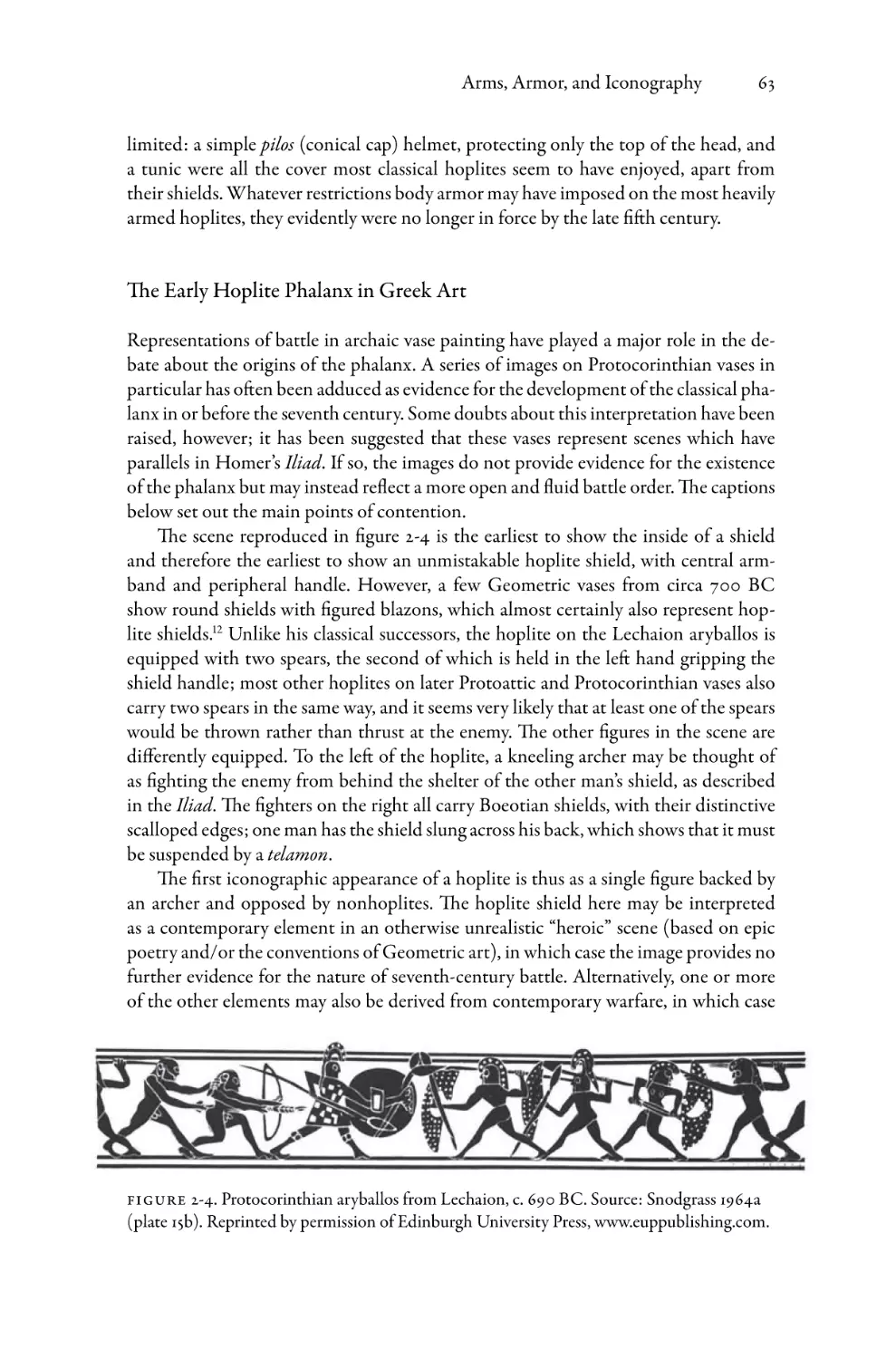
Protocorinthian aryballos from Lechaion, c. 690 BC 63
Protocorinthian aryballos from Perachora, c. 675 BC 64
Battle frieze from the Berlin aryballos, Middle
Protocorinthian aryballos, c. 650 BC 65
Battle frieze from the Macmillan aryballos,
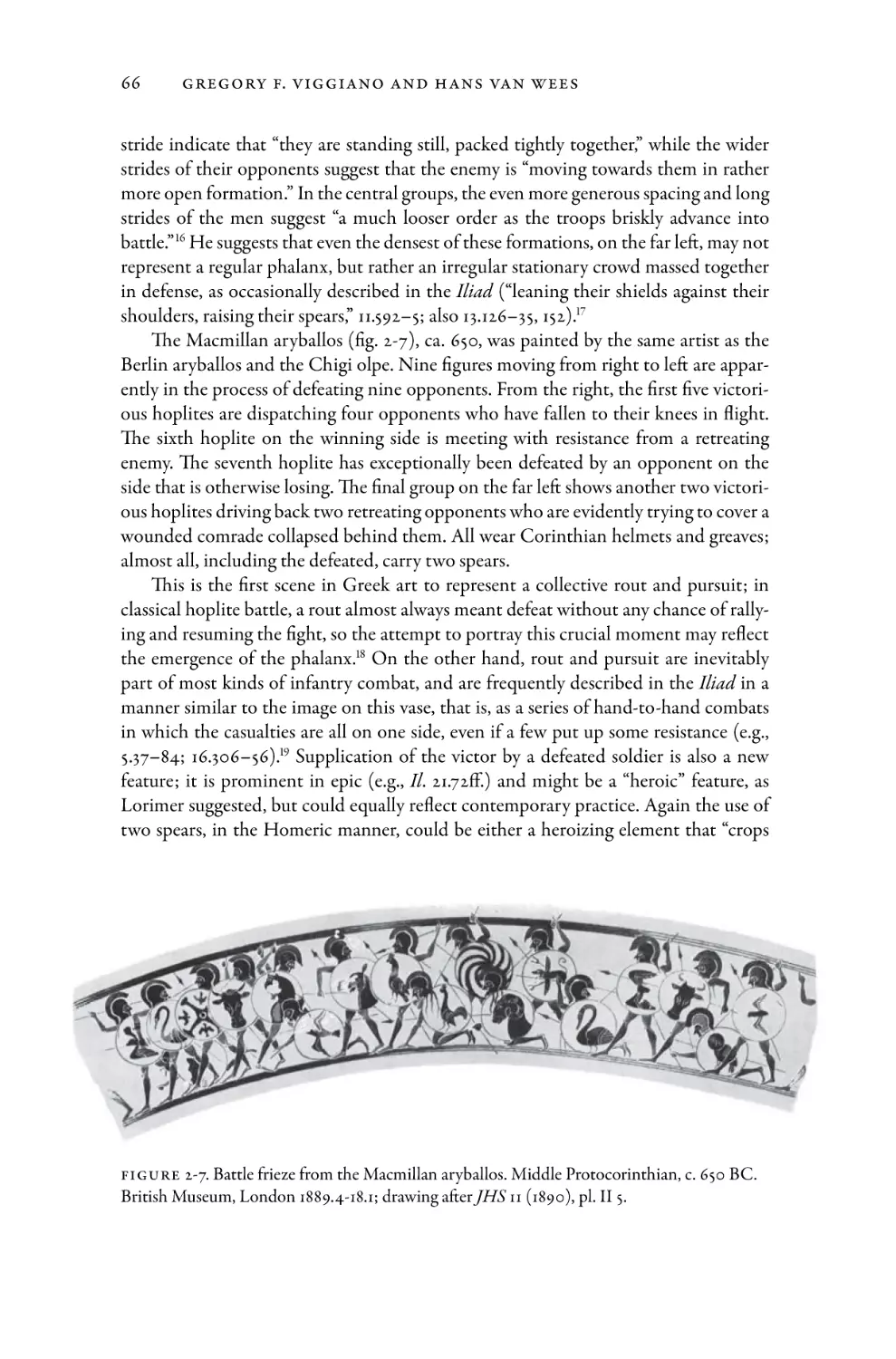
Middle Protocorinthian, c. 650 BC 66
Chigi vase, Middle Protocorinthian olpe from Veii,
c. 640 BC 67
Alabastron from Corinth, c. 625 BC 69
Middle Corinthian krater, c. 600–575 BC 69
Battle in the Highlands of Papua New Guinea 71
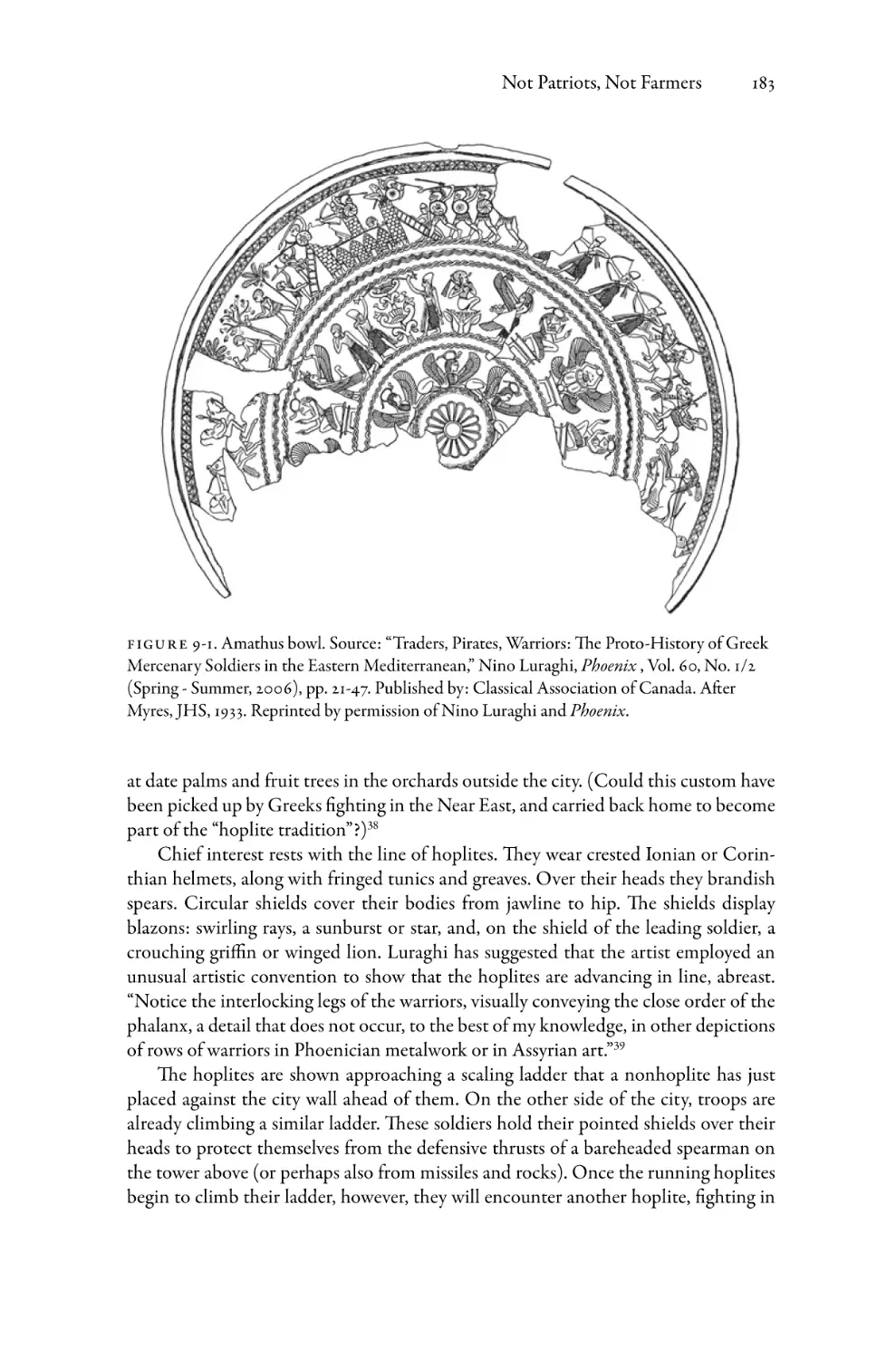
Amathus bowl 183
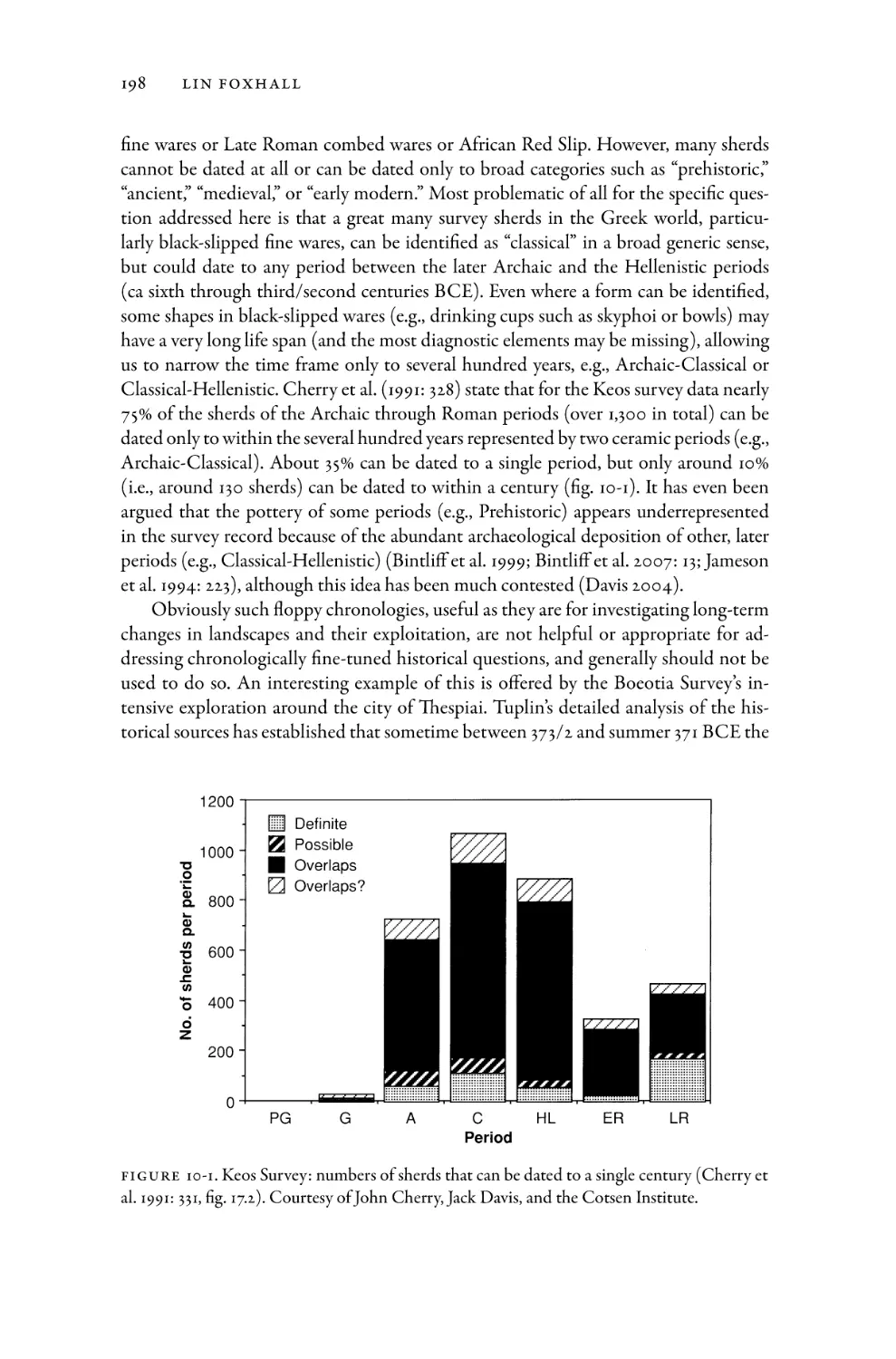
Keos Survey: numbers of sherds that can be dated
to a single century 198
Thespiai, southern approaches, Geometric-Archaic sites 203
Thespiai, southern approaches, Classical-Hellenistic sites 205
Keos Survey, Protogeometric-Geometric sites 206
Keos Survey, Archaic-Classical sites 206
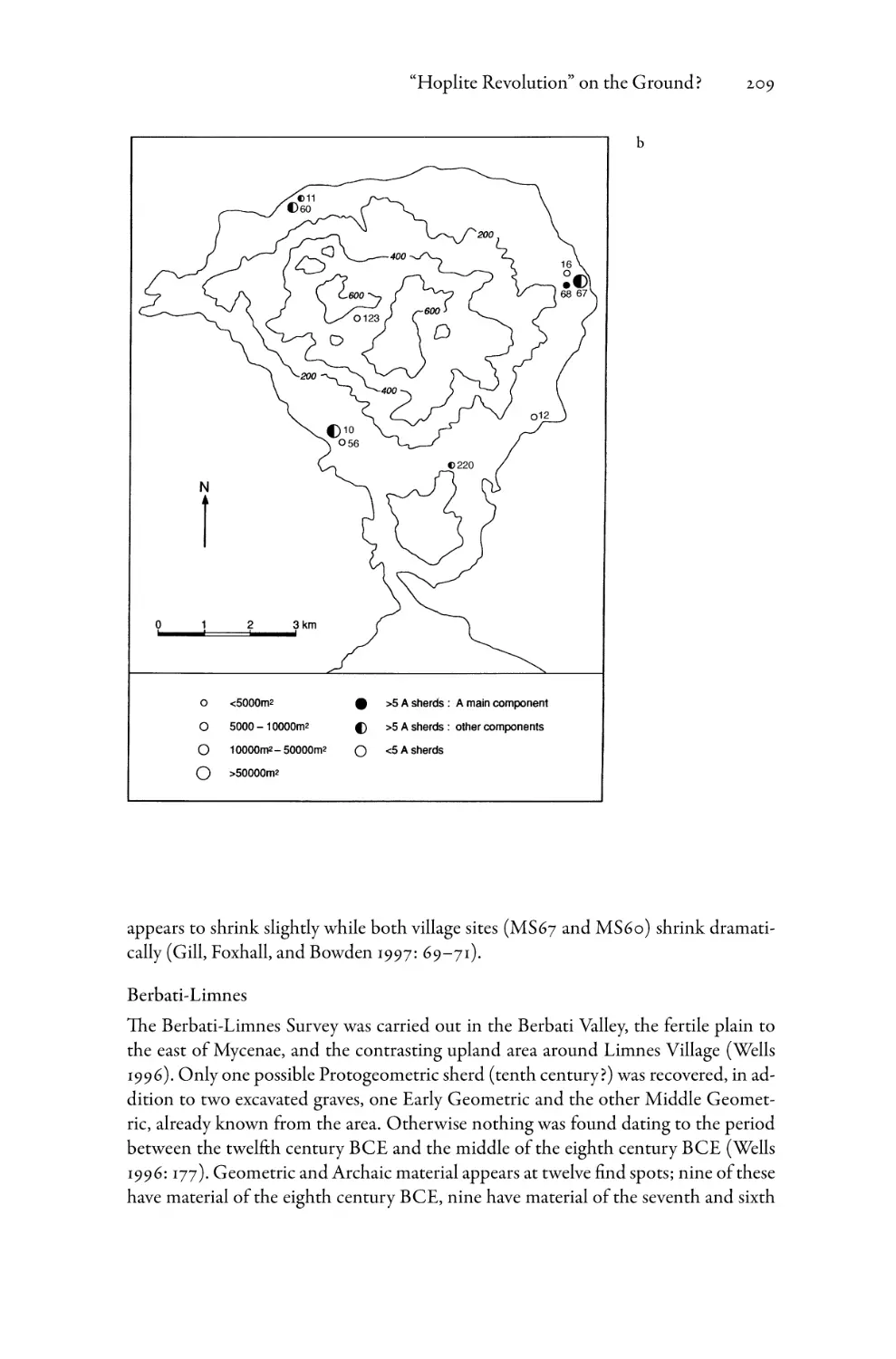
Methana, Early Iron Age and Archaic sites 208–9
Methana, Classical sites 210
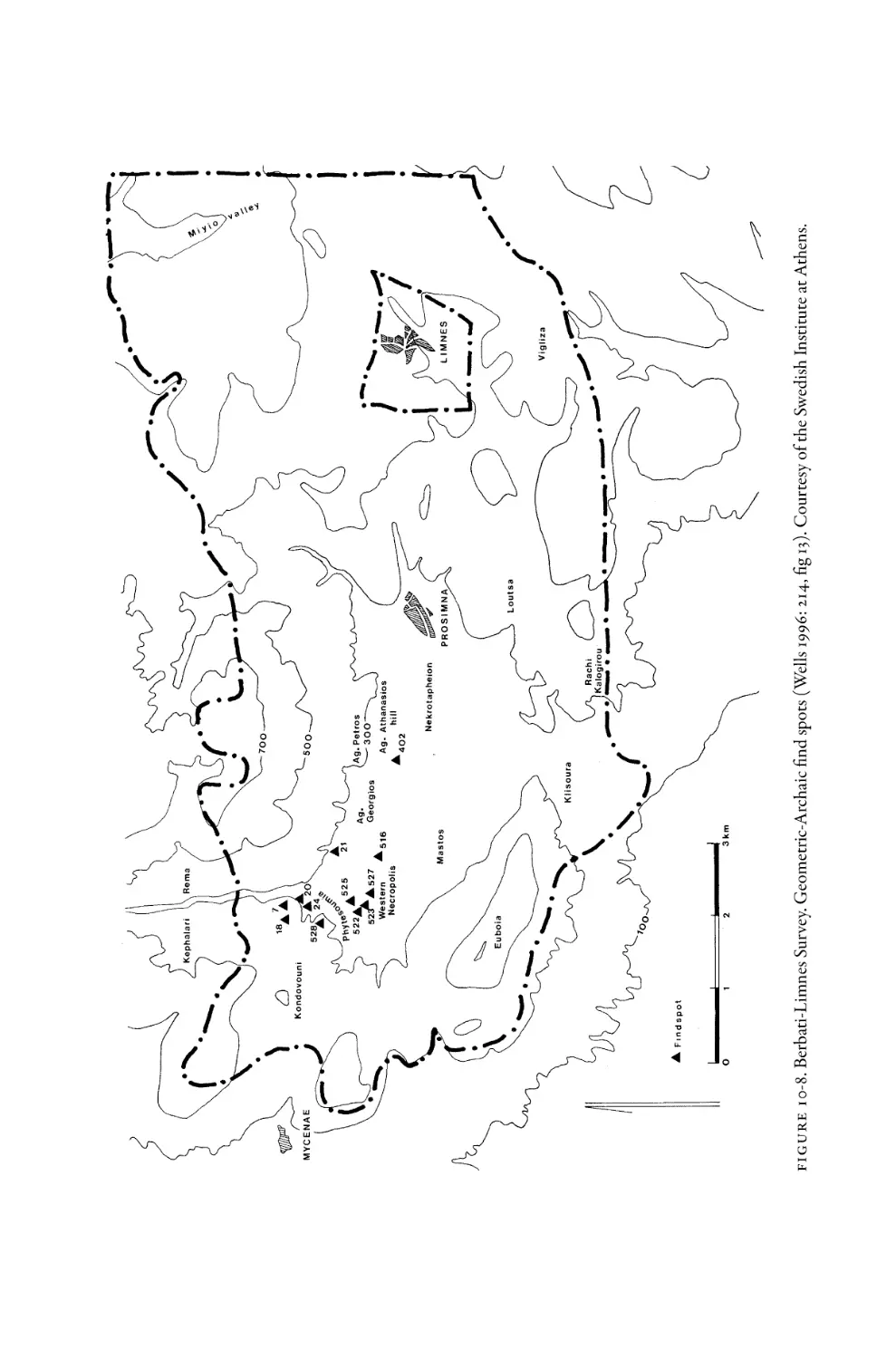
Berbati-Limnes Survey, Geometric-Archaic find spots 211
Berbati-Limnes Survey, Classical-Hellenistic find spots 213
vii
Preface
Donald Kagan and Gregory F. Viggiano
The papers published in this volume resulted from a conference on early Greek hoplite
warfare held at Yale University in April 2008. The idea for the conference grew out of
a spirited debate that took place following a panel presentation at the American Philological Association’s annual meeting at San Diego in January 2007, “New Perspectives
on Ancient Warfare.” From the audience, Gregory Viggiano argued in favor of the theses of Victor Davis Hanson’s The Western Way of War and The Other Greeks against the
positions of Peter Krentz and Hans van Wees. These scholars later agreed to continue
the debate in a formal setting. Viggiano then discussed with Donald Kagan the unique
possibility of having the world’s leading scholars on the subject air out their differences
face-to-face at Yale. Further discussions with Paul Cartledge helped bring about the
Yale conference. The conference panels debated a variety of issues surrounding the
hoplite orthodoxy and the attempts to revise it: (1) questions concerning the origins of
the tactics and weapons employed by the Greek hoplite (heavily-armed infantryman),
fighting in massed formation on behalf of his autonomous city-state (polis); (2) questions about the political, economic, and social significance of the new mode of fighting; and (3) questions regarding the impact hoplite warfare had on Greek culture in
general. All these issues have in recent years been at the center of one of the liveliest
and most important controversies in the fields of classical studies, ancient political
history, and ancient military history.
We want to thank everyone who contributed to the success of the Yale conference,
which was held at the Hall of Graduate Studies on the Yale campus. Our first concern
in putting together an international workshop was making sure that the scholars would
be willing to come and debate, so we are grateful to all the participants for sharing our
enthusiasm for the idea. We were very fortunate to have Susan Hennigan’s superb assistance in arranging the travel and stays of the participants, and in taking care of all
the logistics (meals, programs, audiovisual equipment, etc.) for the event. One scholar
remarked that everyone got along so well because there was so much good food to eat.
The panel sessions were well attended by faculty, undergraduate and graduate students
from Yale, as well as faculty from Sacred Heart University, especially the Department
of History. A number of scholars and graduate students from universities as far away as
ix
x
Preface
the West Coast came to attend the sessions, in addition to people from the New Haven
community. Therefore, we owe special thanks to International Security Studies (ISS) at
Yale, as well as the Yale Classics Department; for without their kind generosity there
would not have been any conference. We make special mention of Ted Bromund of ISS
and his dedication to the project, and the support of Professor Christina Kraus, the
chair of Yale Classics. Rob Tempio of Princeton University Press has given invaluable
support and inspiration at every stage in the production of this volume.
Introduction
Donald Kagan and Gregory F. Viggiano
The study of ancient Greek warfare begins with what scholars might infer about fighting
techniques from the archaeological remains of the late Bronze Age (1600–1100 BC). It
appears that, similarly to the situation in the contemporary Near East, the war chariot
was the main offensive arm of the king’s military. But during the chaos that attended the
collapse of Bronze Age civilization, infantry seems to have become capable of breaking
the charges of the palace’s chariot forces. The ensuing period from the eleventh to the
eighth century, which scholars often call the Dark Age,1 is notable to the military historian for the introduction of iron weapons. However, to the ancient Greeks themselves
this was the Age of Heroes, and the bard Homer was its most famous witness.
At its most basic level, the hoplite orthodoxy argues that critical changes took
place in Greek warfare around 700 BC that had fundamental importance for the rise
of the polis. Prior to that “revolution” in arms, armor, and tactics, the aristocrats dominated in war. They fought at long range with missiles and in close combat as individual
“heroic” champions with swords. The main equipment they used included the short
throwing spear, an open-face helmet, a round single-grip shield, and a sword. Since
these heroic figures bore the brunt of battle in the protection of their communities, it
followed that they had a monopoly on political power as well. The semidivine heroes
of the Iliad give the most brilliant expression of the fighting style and ethos of this
period. For example, there are the famous duels between the champions Menelaus
and Paris, Hector and Ajax, and Achilles and Hector above all. Hector learned to be
valiant always and fight far out in front of the others. Achilles was taught always to be
the best and to be preeminent among men in order to win his own godlike glory. The
consensus placed Homer in the second half of the eighth century and claimed that
the Iliad provided an idealistic depiction of warfare before the polis.
But warfare changed with the introduction of the double-grip hoplite shield and
the tight formation of the phalanx at the beginning of the seventh century. In the new
fighting style the warrior substituted for his pair of throwing spears a single heavy
thrusting spear. The new shield, which was much wider, heavier, and more difficult
to wield than a single-grip model, only made sense in close ranks, where one soldier
sought cover for his vulnerable right-hand side behind the redundant half of the shield
xi
xii
Introduction
of the neighbor on his right. Therefore, soldiers arranged themselves in orderly rows
with about three feet between them and in columns about (usually) eight men deep.
The phalanx required many more men and much greater cohesion than the open-
order combat of the Dark Age. It was essential for each soldier to keep his assigned
place in the formation in order to provide cover for his neighbor and to make it possible for his side to break through the opposing ranks of the enemy.
Whereas in the Dark Age the common soldiers fought as an unorganized, open,
and fluid mass subordinate to the elite, the hoplites played a decisive role in the phalanx. Unlike the heroes in Homer’s epics who strive for individual honor, the hoplites
in the martial poet Tyrtaeus’ elegies must hold their ground in the phalanx to win
glory for the polis. The phalanx was unique in ancient warfare in that each soldier was
a citizen of his polis and provided his own arms to fight in its defense. The hoplites
comprised a middling stratum,2 wealthy enough to afford their own panoply, but lacking the divine ancestry and large landholdings of the elite aristocrats. On the other
hand, the newfound military importance of the hoplite put him in a position to demand greater political power from the aristocrat who now fought at his side and in an
identical fashion. In some poleis, the hoplites supported an aristocrat as a tyrant to
overthrow his oppressive peers. The hoplite revolution brought an end to narrow aristocracies and paved the way for the creation of democracy. The American Philological Association panel and discussion showed how closely the hoplite orthodoxy has
become associated with the work of Victor Davis Hanson over the past two decades.3
Notwithstanding the undeniable influence that Hanson’s Western Way of War and The
Other Greeks have exercised in the field, the grand hoplite narrative has in fact taken
shape over the course of more than 150 years.4
George Grote in the 1846–1856 edition of his famous twelve-volume History of
Greece gave the first full expression of what was to become the hoplite orthodoxy. His
narrative of the rise of the polis includes all the hallmarks of the later narrative. A revolution in military tactics occurred at the same time as the political change in Greece
from monarchies to republics. During this period the numbers and importance of
the middling farmers rose for manning the ranks of the phalanx. At the same time,
the Greeks transformed their political institutions from heroic kingdoms to narrow
oligarchies in which eligibility for high office was based on a claim to divine or heroic
descent. Grote considered the Iliad useless for historical accuracy, but a reliable witness of Greek warfare and society in the ninth century. The champions of Homer had
enjoyed armor and fighting skills far superior to those of the common soldier in both
long-range and close combat. During the eighth and seventh centuries, on the other
hand, the phalanx became the driving force behind the political and cultural as well
as the military developments in Greece. The hoplite, having an assigned place and
duty in battle, transformed what had been an unorganized and ineffective mass into a
disciplined group striving for a common victory.
The discipline of the phalanx, Grote points out, trained citizen soldiers to understand their civil and social rights and duties by making the polis their primary source
of obligation. The common citizen did not acquire much political power at first. But
the intellectual revolution that accompanied the emergence of the first oligarchies had
Introduction
xiii
trained the Greek mind not to accept a subordinate role in the polis. A second revolution took place in the seventh century when in some poleis the hoplites supported a
tyrant to break the power of the exclusive aristocracies. The age of tyrants marked the
rise of the citizens of middling property, who might back a despot for a limited time.
However, by the seventh century there was universal hatred for the idea of permanent hereditary rule, which worked against the principles of the polis. For Grote, the
hoplite citizen soldier as an autonomous middling farmer effected the major political
and social changes in the early polis. Hoplites, in whose mind the idea of equality was
instilled through training for the phalanx, determined the direction of Sparta as well;
but the Spartans avoided tyranny and had a subject population to work their fields.
Athens, on the other hand, may have remained an oligarchy after Solon, but he gave
the middling farmers enough power to oppose the aristocrats.
The field of scientific archaeology has made some of the most significant contributions to the hoplite question in the twentieth century. For example, Wolfgang
Helbig in 1909 used the earliest datable finds of hoplite arms and equipment to determine when the Greeks first adopted the phalanx. The appearance of the phalanx in
art, the Protocorinthian Chigi vase in particular, gave the basis for Martin Nilsson’s
1929 classic statement of the hoplite orthodoxy.5 Lorimer in 1947 became the first English scholar to employ the monuments, vase painting above all, to date the origins
of the phalanx. Grote had had to rely on Homer’s epics alone to discuss early Greek
warfare and the rise of the polis. Scholars could now use actual finds not only to be
more precise in their arguments. They could also provide the framework for more nuanced arguments and disagreements. Nilsson, for instance, thought that the martial
elegies of Tyrtaeus were inconclusive for proving the existence of the phalanx in the
seventh century, since the poet mentions foremost fighters (promachoi), reminiscent
of Homer’s champions. However, the round shields of the figures depicted in art and
of the lead figurines dedicated at the temple of Artemis Orthia in Sparta seemed to
leave no doubt.6 The phalanx may have taken time to develop; perhaps the transition
lasted until the period of the Chigi vase in the mid-seventh century. But the census
classes of Solon showed that the principle of having citizens provide their own arms to
defend the polis in return for political privileges was well established by the early sixth
century. Therefore, Nilsson reasoned that the practice must have begun much earlier.
For Lorimer, the single structural change involving the replacement of the round
shield slung on a telamon marked the end of the long-range fighting of the eighth
century.7 The substitution of the single central handgrip for a central armband of
metal (porpax), through which the hoplite thrust his forearm up to the elbow, and
a handgrip (antilabe), which he grasped with his left hand, just inside the rim of the
shield, created a shield suited for only one form of combat. Whereas the single-grip
shield had been easy to maneuver, the double-grip shield restricted the hoplite to the
close confines of the phalanx, which afforded him maximum protection as long as
the entire formation stood firm. The new formation led the soldier to substitute the
throwing spears of the Homeric hero for a single heavy thrusting spear as well. Lorimer
dated this momentous change to about 675 BC. She argued that artists in Corinth
and Athens at the time depicted hoplite equipment and the tight formations that
xiv
Introduction
characterized the phalanx. In addition, there were the lead figurines of the warriors in
hoplite armor from Sparta to confirm the date. Lorimer accounted for the anomalies
of the lyric poets by positing that they drew on epic diction and that the extant poems
contained interpolations.
Like Grote, both Nilsson and Lorimer had connected the early Greek tyrants
with the emergence of the hoplite middle class. A seminal study in 1956 by Andrewes,
moreover, applied to the tyrants Aristotle’s theory on how political systems in Greece
changed from aristocracies to democracies. The most important element was military
strength. The early poleis relied on cavalry to defend the state, which only the wealthy
could afford. The next stage involved the middling farmers possessing enough wealth
to provide their own hoplite arms. The final stage of democracy and naval supremacy
gave political power to those who rowed the ships, the landless poor. Prior to that,
however, Andrewes argued that hoplite revolutions played a crucial role in transferring power from narrow aristocracies to a much broader class of citizens. Aristotle
himself does not say that the hoplites backed the tyrants in their struggles against
their peers, but Andrewes found it impossible that no connection existed. He details
the rise of the tyrants from Cypselus to Peisistratus. To compete with its neighbors
and stave off civil war, polis after polis adopted the phalanx and yielded power to the
citizens that manned its ranks. The hoplites drove the tyrants from power and created
broad oligarchies in their place.
The seminal work of Snodgrass in the 1960s began the first sustained attack on
the hoplite orthodoxy, which has continued to the present. He concluded from his
study of arms and armor, much of which was unknown to previous scholars, that the
adoption of hoplite equipment was a “long drawn out, piecemeal process,” and that
the double-grip shield did not imply the phalanx. Furthermore, the fully developed
phalanx did not appear until after 650 BC—too late to play a role in the Greek tyrants’
rise to power and the other revolutionary changes associated with the emergence of
the polis. In fact, the aristocrats filled the first phalanxes, and it was only with prodding that the middling farmers joined them; hoplite equipment had been adopted by
aristocratic warriors before the later development of hoplite tactics. The demands of
the mature phalanx with its denser formations forced the elite in time to recruit reluctant commoners to help fill its ranks.
In response to Snodgrass’s thesis of gradual phalanx development, Cartledge proposed some nuances to the sudden-change theory. He emphasized above all the nature of the double-grip shield and its severe limitations for the unorganized tactics of
prehoplite warfare. The shield’s design indicates that the Greeks created it with a new
style of fighting in mind, and that a change in tactics toward organized, hand-to-hand
fighting had already been taking place. Frontal protection became valued over mobility and protection in the flank and rear. On the other hand, Cartledge finds the visual
and literary evidence too insecure to ground an argument. Instead, the whole gamut
of economic, social, and political changes during the last half of the eighth and first
half of the seventh century explains the broad revolutionary effects that the phalanx
had on the polis. Relative overpopulation and land hunger placed a premium on arable land and forced the aristocrats to relinquish their military dominance. Success in
Introduction
xv
war now depended on fielding the greatest possible number of men for a battle. Yet
the number of farmers wealthy enough to equip themselves still represented less than
one-half of the state’s citizen population. Between 675 and 650 all the major poleis had
adopted the phalanx to secure and to defend the maximum possible amount of land.
There has been a tendency over the last thirty years to try to dismantle just about
every aspect of the hoplite orthodoxy through the gradualist position. On the one
hand, some gradualists maintain that the hoplite reform came early in the seventh
century. But they deny that the hoplite class could have had the confidence and experience necessary to bring about revolutionary political and social change. A great deal
of the revisionism, however, has challenged the very idea that any significant reform
took place in infantry tactics in the archaic period. Krentz has argued not only that
hoplite warfare went through a long period of transition before reaching the classic
formation described by Thucydides. He contends that throughout its history hoplite
battle involved much looser deployments of troops and emphasized the hand-to-hand
combat of individual fighters and small groups in the front rank. Hoplites did not seek
to maintain the cohesion of their line, while breaking apart the phalanx of the enemy.
The warriors kept much greater spacing between themselves and their neighbors than
the traditional narrative imagines. Krentz has also challenged the notion that the two-
handled hoplite shield was much less maneuverable than the single-grip model.
In this spirit, an important 1989 paper by Cawkwell explains that the orthodox
model for how hoplites fought in the phalanx is far too rigid. Troops may have advanced into battle in tight formation, but in actual combat they would have required
more room to fight. The phalanx must have been flexible for hoplites to employ the
type of fighting skills the sources such as Xenophon and Plato mention that they developed in training and used in battle. The iconography also indicates open-order fighting and more variety in style and technique than some of the literary sources suggest.
One of the most thoroughgoing critiques of the hoplite orthodoxy has come from
van Wees. He argues for a third position among the gradualists and sudden-change
theorists. For him the hoplite phalanx had much less cohesion and evolved over a
much longer period of time than the two to three generations for which most gradualists allow. There was no great change in tactics from the eighth to the seventh century,
and, in as far as Homer can be taken as an historical witness, the fighting in the Iliad
bears a striking resemblance to the picture one may reconstruct for the early phalanx.
Perhaps mass combat, and not massed hoplite warfare per se, undermined the power
of the aristocracy and initiated political and social change.
The theses in The Western Way of War and The Other Greeks reassert the tradition
of the grand hoplite narrative. In The Western Way of War Hanson provides from the
ancient sources the most graphic account available of what the experience of battle
might have been like in the phalanx. He finds unconvincing the attempts to prove that
the fighting was fluid, and that individual skirmishing took place instead of collective pushing. His argument stresses the cumbersomeness and sheer weight of hoplite
equipment, especially the helmet and the shield. Mass infantry fighting in some less
rigid form probably existed before the complete adoption of the panoply. But it is
inconceivable that men fought in hoplite equipment in any formation apart from the
xvi
Introduction
phalanx. The battles were brief and depended on the shock collision of heavy infantry
with the aim of breaking apart the enemy phalanx or shoving it off the battlefield.
The idea was to limit the killing through a decisive contest, so that the farmer-citizen-
soldiers could return to their fields with minimal disruption to their way of life.
Conflicts became highly ritualized pitched battles fought over farmland. The main
elements included the tight deployment of troops, an accumulation of shields, and the
charge across a level field, the crashing together of opposing lines, the push and collapse, and the rout. Hoplite warfare remained virtually unchanged for more than two
centuries, from its start until the fifth century.
Two remarkable features set Hanson’s account of the hoplite apart from that of his
predecessors. First is the idea that the preference of Western armies for decisive battle
began with the archaic Greek phalanx. Second, he identifies intensive farming as the
main element that shaped the character and values of the middling group that provided its own arms to fight for the polis. These georgoi in turn shaped the ideals, institutions, and culture that gave rise to the polis. Unlike any prior civilization, the culture
of the Greek polis combined citizen militias with the rule of law. That involved having
a broad middle class of independent small landowners that met in assemblies where
the votes of these nonelite determined laws, and foreign and domestic policy. These
smallholders gained in status as population growth in the ninth and eighth centuries
forced an agricultural revolution. Labor-intensive farming of marginal lands came to
replace the Dark Age pastoral economy. This required a growth in private landownership, which motivated georgoi to assume the risks involved in cultivating land that was
unproductive using traditional farming techniques. These farmers created the ritual of
hoplite warfare to decide disputes in a manner that did not contradict their agrarian
agenda. The georgoi and their agrarian ideology became the driving force behind the
hoplite revolution during the early seventh century.
Scholars in the past decade have heavily criticized the hoplite orthodoxy in general and Hanson’s model of it in particular. For example, some gradualists have lowered the date for the introduction of the phalanx to well into the fifth century. They
claim that the equipment hoplites wore was much lighter and that the warriors were
more mobile than the traditional narrative contends. In addition, revisionists have
challenged the idea that opposing phalanxes maintained rigid formations and crashed
into one another in the opening stages of battle. They have attempted to refute the
notion of collective pushing. Another form of revisionism has used Homer’s Iliad to
argue that a protophalanx existed in the eighth century, hence lessening the significance of the adoption of hoplite arms and armor in the seventh. According to this
thinking, there was no hoplite reform, let alone revolution, to effect changes in the
political and social structures of the polis. Van Wees, in his examination of the iconography and the elegies of Tyrtaeus, sees much continuity in the fluid style of the protophalanx and early hoplite warfare. Therefore, the hoplites did not suddenly emerge in
the seventh century to support the tyrants and break the backs of the aristocracy. In
fact, the warfare and the politics of the Greek state remained very much an elite affair
until the fifth century. And when change occurred, the hoplites had little to do with
bringing it about. Foxhall has employed survey archaeology, moreover, to deny that
Introduction
xvii
a substantial middle stratum of farmers living on the land even existed as early as the
orthodoxy believes. She has suggested that the countryside remained largely devoid of
settlement far into the sixth century in most places, while the best lands were farmed
from nucleated settlements, with little evidence for intensive agricultural practices or
the cultivation of marginal lands.
The idea for the Yale conference was to bring together the leading scholars from
both the orthodox and the revisionist’ schools of thought to examine the current state
of the field, which is at a crucial turning point. A number of outcomes were possible.
First, everyone could have agreed that in fact the traditional hoplite narrative was
correct and that there was no need to rewrite the textbooks. Second, the revisionists
might have convinced the orthodox that their model had fatal flaws. In that case, we
all might have either conceded that we could know little or nothing about the rise
of the Greek state and culture, or at least that the early hoplites had nothing to do
with it. Or we could have agreed that what we thought we knew was wrong, but an
alternative theory could better explain the major movements of the formative period
in classical Greece. Third, a great synthesis might have combined key elements of the
traditional model with new insights to produce a higher truth. Despite the recognition of much common ground among the participants, none of those things happened
at the conference. Instead of working toward a consensus, each side sharpened its position in response to the latest research. The keynote speaker, Paul Cartledge, set up the
framework for the debate that took place. Panels were arranged in pairs of scholars to
discuss essential aspects of the orthodoxy in light of recent attempts to revise it. In the
first panel, Kurt Raaflaub and Gregory Viggiano considered whether or not a hoplite
revolution transformed the Greek world in the seventh century. In the second, Peter
Krentz and Adam Schwartz presented opposing views about the significance of hoplite arms and weapons and how hoplites fought in archaic Greece. In the third, Anthony Snodgrass responded to current theories on early Greek warfare, and John Hale
considered the role of Greek mercenaries in the seventh and sixth centuries. In the
fourth panel, Hans van Wees critiqued The Other Greeks and argued that an agrarian
revolution did occur but centuries later than Hanson envisions. For his part, Victor
Davis Hanson explained why the orthodoxy is still orthodox. The conference concluded on the third day with a roundtable discussion, which covered topics debated
over the three-day event. The chapters in this volume represent the rewritten drafts of
the papers presented at Yale, though they often contain the original spirit in which
they were delivered.
Paul Cartledge notes and welcomes the shift in the study of ancient Greek warfare
over the past thirty years from the “narrowly technical” toward sociopolitical issues
and approaches. The study is no longer an abstract exercise in military history, but a
“totalizing history of war and society.” He reveals how his own views on the subject
have and have not changed since his first major publication in the field. Cartledge also
sets the stage for all the essays that follow by examining several key issues. What were
the causally related variables or factors that link the evolution of the hoplite phenomenon to the rise of the polis? Do the notorious source(s) problems prevent us from understanding them? What tipped mass fighting over into phalanx fighting? Was there a
xviii
Introduction
hoplite “ideology”? Did Aristotle get it right when he posited a connection between
warfare and political development in Greece? In light of the nature of the sources,
Cartledge emphasizes the strength of a theoretical approach to the inextricable link
between warfare and politics in the Greek state.
Anthony Snodgrass lays out the chronological framework for the history of hoplite
warfare. He discusses the impact the studies of Homeric warfare have had on the orthodoxy since the groundbreaking work of Latacz. Indeed there was a “hoplite reform”
despite the contention of many scholars that fighting in the Iliad and hoplite fighting
are one and the same. He considers the problems posed by the evidence of iconography and archaeology, especially the dedications of actual armor in the sanctuaries
at Olympia and Delphi, and the various philological and historical approaches that
scholars have applied to the literary sources. Snodgrass also notes the potential significance that Nagy’s evolutionary model for the creation of the Homeric epics has when
historians use the poems to understand archaic warfare and its relation to the polis. He
reaffirms his gradualist position on the hoplite reform, while he underscores the often
overlooked common ground among scholars involved in the debate. The persistence
of the hoplite in the Hellenistic period defies any simple reading of the phenomenon.
Most of the paper Kurt Raaflaub gave at Yale on the nature of mass fighting in the
Iliad has already been published, but we are happy to include in this volume his ideas
on early Greek infantry fighting in a Mediterranean context. Raaflaub sees the emergence of hoplite warfare as part of a long interactive process associated with the rise of
the polis. The polis, its institutions and political thought, evolved from the eighth to
the fifth century along with its military practices. Despite intense interaction with the
states of the Near East, the Greeks of the eighth and seventh centuries developed the
phalanx independent of Oriental influence. Raaflaub examines Assyrian and Persian
armies, arms, and armor as well as formation and tactics to determine that there is no
prior model for the equipment and style of Greek infantry. Having no Near Eastern
example, the Greeks must have invented the double-grip shield for use in the already
existing phalanx for which the hoplite was always intended. Therefore, Raaflaub rejects
van Wees’s picture of Homeric and early hoplite fighting as open-order combat by many
small and loosely organized bands of warriors. On the other hand, he is a “gradualist” in
that he believes that the phalanx developed over too long a period of time and in conjunction with too many other factors to bring about a “revolution” in warfare or society.
Gregory Viggiano contests the idea that any argument put forth in recent years
is reason to push down the traditional date for the origin of the polis or to reject the
hoplite orthodoxy. He states the basic elements of the theory that have their beginnings in Aristotle’s Politics, and then tests their merit against revisionist claims. Viggiano finds unconvincing the notion that the Greeks would have invented equipment
such as the double-grip shield and Corinthian helmet for a purpose that contradicted
their design. The change in fighting style and tactics provides the best explanation
for the transformation in Greek values from the epic poetry of Homer to the martial
elegies of Tyrtaeus, as well as the rise of the early tyrants. Viggiano contests the recent
claims that the evidence of survey archaeology has disproved the existence of a substantial class of middling farmers in the late eighth and seventh centuries. He argues
Introduction
xix
that, despite gaps in the evidence, a clear picture of how the polis emerged can be
made without omitting or contradicting any of the evidence from the literary sources,
archaeology, and inscriptions.
Peter Krentz takes aim at The Western Way of War’s highly influential and popular
conception of how hoplites fought. He critiques the orthodox view—especially the
version of Hanson—concerning the actual weight of the hoplite panoply, which he
argues was far lighter than the traditional estimate of about seventy pounds. Krentz
proposes a different interpretation of the various stages of hoplite battle, such as the
hoplite charge into battle. In his view, the evidence supports neither the picture of
a mass collision between armies nor the concept of a mass pushing of troops or the
account of the othismos as a rugby scrum. Revisionists such as van Wees deny that
hoplites fought in tight formation until the phalanx of the fifth century. But instead
Krentz contends that the phalanx did not consist exclusively of hoplites before Marathon. He suggests, however, that even in the fifth century hoplites never actually
fought in a cohesive formation.
Adam Schwartz places the equipment of the hoplite in a very different light than
Krentz. The defining elements of the hoplite were the spear and, above all, the double-
grip shield. Other items of the panoply were subject to much change and innovation
over the centuries, but the shield and spear remained essentially unaltered throughout the entire hoplite era. Schwartz reasons that the Greeks maintained the shield’s
original design—circular, concave, and about one meter in diameter—because it was
preeminently suited for a specific purpose, fighting in tight formation in a phalanx.
He gives a detailed analysis of the Etruscan Bomarzo shield, one of the few hoplite
type shields to survive more or less intact from antiquity; and he assesses a number
of key sources bearing out the burden and cumbersomeness of the hoplite shield, to
conclude that its weight, shape, and sheer size in terms of surface area made the shield
particularly unwieldy. Schwartz’s discussion of comparable body shields used until recently by the riot squad of the Danish police adds a new dimension to the debate over
tactics and the handling of shields in combat. He also points out that skeletal remains
from Greek antiquity demonstrate that hoplites were significantly smaller in relation
to their equipment than modern Western men, which has consequences for the tacit
assumption that they are fully comparable.
John Hale disagrees with the two main theories proposed for the context within
which hoplite warfare emerged. For Hale neither the leisured class of aristocrats who
vied for high social and political status within the polis nor the middling citizen soldiers who defended their farmland provide the origins of archaic Greek arms and tactics. Instead he suggests looking for the first hoplites fighting as mercenaries in the
service of Eastern monarchs in areas such as Syria, Egypt, and Babylon. These soldiers
of fortune fought in search of gain and glory, not to defend a civic ideology or ethos.
Hale finds evidence for his thesis in lyric poetry and in inscriptions, pottery, and the
remains of hoplite armor discovered outside Greece. He calls mercenary service the
“Main Event” of Greek military history in the seventh century, in contrast to the sporadic battles between poleis. The nearest historical parallel to the soldiers of fortune
of the archaic period are the Viking armies of the ninth and tenth centuries AD. The
xx
Introduction
Greek raiders and mercenaries not only fought for hard-won riches but also created
new communities around the Mediterranean world.
A major part of the debate regarding the rise of the polis turns on whether scholars
believe a substantial class of small middling farmers emerged by the late eighth century. Perhaps more than any other scholar, Hanson has emphasized the rise of small
independent farmers, who could afford hoplite arms and thereby serve in the phalanx
and demand a greater share of political power. On the other hand, van Wees places
the evolution of the phalanx and the emergence of the “middling” farmer-hoplite in
the late sixth century; before that date, he argues, only members of the wealthy elite
served as hoplites, and they fought alongside less well-off light infantry in open and
fluid battle order. A recent approach to this question has been the study of the Greek
landscape through archaeological survey, a technique that has been developing over
the past thirty years. We invited Lin Foxhall to consider what site survey might reveal
about the appearance of a new class of small farmers in archaic Greece. Foxhall gives
a brief history of the discipline and explains the strengths and limitations of using
its findings for historical analysis. Her study of eight survey projects across Greece,
including Boeotia, the Argolid, Laconia, and Pylos, focuses on data for the Geometric
through the Hellenistic periods. She suggests that the archaeology tells us a different
story than the historical record of citizens, soldiers, and property owners. The survey
data show the rise of a densely populated countryside of small-scale farmers neither in
the eighth century nor, universally, in the sixth century.
Hans van Wees critiques the grand narrative of The Other Greeks and argues that
it is wrong in important respects. Hanson presents the social and economic changes
in the eighth century that took place with the rise of the independent yeoman farmer
and his culture of agrarianism as the driving force behind the political and military
history of Greece. But van Wees believes that something like the rise of small farmers
occurred about two centuries later than Hanson relates. However, from the middle
of the eighth century there was a class of elite leisured landowners that did not work
the land themselves but supervised the toil of a large lower class of hired laborers and
slaves. This era of gentlemen farmers who comprised the top 15–20 percent of society
and competed with each other for status lasted for about two centuries. When the
yeomen farmers emerged after the mid-sixth century, they joined the leisure class in
the hoplite militia. Van Wees doubts that the small farmers brought about a revolution when they joined the phalanx, but, if they did effect political changes, it was in
conjunction with the rise of the trireme rowers.
Victor Hanson defends the orthodoxy in light of the various attempts to revise it
over the past twenty years, especially those of Krentz and van Wees. He points out the
inherent difficulties in studying the origins and nature of hoplite battle since there are
few prose accounts of set battles before Marathon. For example, the material the scholar
must use includes Homer and lyric poetry, which makes it difficult to distinguish realistic portrayal from metaphorical expression. On the other hand, scenes painted on vases
are hard to date and make it nearly impossible to depict a phalanx in proper perspective.
Nevertheless, over the last two centuries of classical scholarship the “grand hoplite narrative” has emerged in most histories of Greece. Hanson suggests that the success of the
Introduction
xxi
orthodoxy is due to the fact that it best reflects the evidence for phalanx fighting and
the larger social, economic, and political role of the hoplite. He responds to the recent
attacks on the view that hoplites formed a distinct middle class, the claims that hoplites
fought in an open and fluid formation, and that the phalanx was a late development.
In addition, he examines the debate over the weight of hoplite equipment and key elements of the traditional battle narrative such as the attack on the run, the shock collision, and the role of mass and density in deciding hoplite contests.
The editors of this volume do not expect the following essays to end the debate
over hoplite arms, tactics, and their relationship to the rise of the polis and the larger
issues of Greek culture. On the contrary, the idea behind the conference was to determine how well the orthodoxy holds up in light of recent research and criticism.
Second, we wanted to challenge revisionists to clarify their position with a view to offering a coherent paradigm as a more plausible alternative, if possible. In that respect,
the objective is to initiate a debate that should result in either a restatement of the
traditional narrative or nothing short of rewriting the history of the early Greek polis.
Notes
1. The term Dark Age has itself become controversial, and some scholars prefer Early Iron
Age instead.
2. The phrase “middle stratum” is perhaps preferable to the word “class” as in “middle class,”
which has unfortunate anachronistic connotations. Nonetheless, “middle” or “middling” class
is used frequently and need not cause difficulty as long as the ancient context is understood.
3. See the preface.
4. The following is a brief sketch of the history of the hoplite orthodoxy. Chapter 1 contains
a much more extensive and detailed treatment of the issues debated in this volume; chapter 2
gives a discussion of the iconography.
5. Helbig in 1911 was the first historian to show and discuss the Chigi vase in connection
with the phalanx.
6. Subsequent work has indicated that the lead figurines do not date to the eighth century,
or even the earlier seventh century (although Nilsson and Lorimer did not know that). Boardman down-dated the complex stratigraphy of the site in 1963 ( J. Boardman, 1963, “Artemis Orthia and Chronology,” BSA 58:1–7), and this down-dating is generally accepted. Critically, he
notes that none of the lead figurines of warriors is earlier than the middle of the seventh century
(Boardman 1963:7). The hoplite warriors appear in Lead I, II, and III, some found below, but
most found above the sand level (probably representing a major flood on the site) dated by
Boardman to 570/560 BCE (A. Wace, 1929, The lead figurines, pp. 249–84 in R. M. Dawkins,
“The Sanctuary of Artemis Orthia,” JHS Suppl. 5, London). This means that the vast majority
of the “hoplite” figurines are probably to be dated to the sixth century BCE. Also scholars using
these warriors as early evidence for hoplites should note that there are also archers (e.g., Dawkins
1929: pl. CLXXXIII.16, 17) and light armed soldiers (e.g., Dawkins 1929: pl. CLXXXIII.18, 26)
among the leads, even as early as Lead I, and continuing through the whole sequence.
7. NB Sylvia Benton, 1953, BSA 48:340, pointed out that certain blazons on the front of a
shield had to be shown one way and only one way—the right way—up, which implied an unalterable grip on the shield.
Men of Bronze
Greece and Western Asia Minor
ce
Ma
don
Mt. Olympus
Aegean
Sea
Thessaly
Euboea
Thermopylae Pass
Ionian
Gulf
Aetolia
Chalcis
Delphi Boeotia Thebes
Sicyon
Megara
Peloponnese Argos
Corinth
Olympia
Arcadia
Messenia
Sparta
Pylos
Laconia
Mediterranean
Sea
battle sites
miles 0
kilometers 0
50
50
100
100
150
150
Eretria
Athens
Thessaly Black
Thrace
Sea
Thermopylae Pass
Eu
b
Leuctra (371 BC)
tis
p o nDelphi
oe
a
Chalcis
Lelantine
Plain
Eretria
Thebes
Boeotia
Plataea (479 BC)
Athens
Megara
Sicyon
Nemea (394 BC)
Corinth
Peloponnese Argos
Sepeia (494 BC)
Olympia
Mantinea
Hysiae (669 BC)
(418 and 362 BC)
Arcadia
Aetolia
Coronea (447 and 394 BC)
Pro
Tegea (560 BC)
Messenia
Pylos
Lesbos
Aegean
Sea
Marathon
(490 BC)
Delium
(424 BC)
Tanagra (457 BC)
Sparta
Laconia
Sardis (425 BC)
Sphacteria
Samos
Miletus
Caria
Delos
Naxos
Lycia
Rhodes
Crete
Mediterranean Sea
Chapter 1
The Hoplite Debate
Donald Kagan and Gregory F. Viggiano
The study of war has not only interested military historians from the ancient world
to the modern day; many scholars have held that the way in which societies organize
for and fight war lies at the foundation of civilization itself. Cultural historian Lewis
Mumford has remarked:
War was not a mere residue of more common primitive forms of aggression. . . .
In all its typical aspects, its discipline, its drill, its handling of large masses of
men as units, in its destructive assaults en masse, in its heroic sacrifices, its
final destructions, exterminations, seizures, enslavements, war was rather the
special invention of civilization: its ultimate drama.1
For generations scholars have examined the relationship between how the Greeks
fought and their social, political, and cultural development. The Greeks themselves
considered war both part of the nature of human society and terrible. “Peace,” Plato
said, “is merely a name; in truth an undeclared war always exists by nature among
all city-states.”2 The poet Pindar (F 15) called battle “a sweet thing to him who does
not know it, but to him who has made trial of it, it is a thing of fear.” For Thucydides
war was “a violent schoolmaster.”3 Aristotle, in his Politics (1297b16–28), on the other
hand, provided the first known theory to connect the evolution of the political institutions of the polis with the rise of heavy infantry. Modern historians of ancient
Greece in turn have developed a grand narrative. This “orthodoxy” explains the rise
of the early polis in terms of a dramatic change or “revolution” in arms, armor, and
tactics; the military revolution became a driving force behind the emergence of the
characteristic political and social structures of the Greek state. A central part of the
thesis is that the change in fighting style was directly related to recent innovations in
arms and armor. Second, the phalanx depended on the weight and the cohesion of
heavily armed men who employed “shock” tactics in brief but decisive battles. Third,
it has been critical to identify the greatest number of hoplites with a middling group
within the polis, which had the wealth to provide its own arms. Fourth, this middling
group transformed Greek values.
1
2
Donald Kagan and Gregory F. Viggiano
By the mid-nineteenth century, scholars had already recognized the basic elements of what was to become the hoplite orthodoxy. For example, George Grote, in
his famous twelve-volume History of Greece, made a sharp distinction between heroic
and historical Greece, and the emergence of the hoplite warrior marked the point of
departure for the beginning of the age of history. “The mode of fighting among the
Homeric heroes is not less different from the historical times, than the material of
which their arms were composed.” He described the essentials of the ancient Greek
phalanx:
The Hoplites, or heavy-armed infantry of historical Greece, maintained a close
order and well-dressed line, charging the enemy with their spears protended at
even distance, and coming thus to close conflict without breaking their rank:
there were special troops, bowmen, slingers, etc. armed with missiles, but the
hoplite had no weapon to employ in this manner.4
Grote compared the close-in approach of the hoplites with the long-range fighting
style of the legendary figures of Homer:
The heroes of the Iliad and Odyssey, on the contrary, habitually employ the
spear as a missile, which they launch with tremendous force: each of them is
mounted in his war-chariot, drawn by two horses, . . . advancing in his chariot
at full speed, in front of his own soldiers, he hurls his spear against the enemy:
sometimes, indeed, he will fight on foot, and hand to hand, but the chariot
is near to receive him if he chooses, or to ensure his retreat. The mass of the
Greeks and Trojans, coming forward to the charge, without any regular step
or evenly-maintained line, make their attack in the same way by hurling their
spears.5
The champions of Homer enjoy several advantages over the common soldier: “Every
man is protected by shield, helmet, breastplate, and greaves: but the armor of the
chiefs is greatly superior to that of the common men, while they themselves are both
stronger and more expert in the use of their weapons.” The weapons used included a
long sword, a short dagger, and two throwing spears, which on occasion could be employed as a thrusting weapon. The few bowmen are rare exceptions to the equipment
and tactics described above.
The loose battle array of the Iliad contrasts sharply with the inflexible ranks that
attacked the Persian king at Plataea or Cunaxa, and “illustrates forcibly the general
difference between heroic and historical Greece. While in the former, a few splendid
figures stand forward, in prominent relief, the remainder being a mere unorganized
and ineffective mass, —in the latter, these units have been combined into a system,
in which every man, officer and soldier, has his assigned place and duty, and the victory, when gained is the joint work of all.” With the introduction of the phalanx, the
difference in the role of the individual and the military effectiveness of the group is
remarkable: “preeminent individual prowess is indeed materially abridged, if not
wholly excluded, —no man can do more than maintain his station in the line: but
on the other hand, the grand purposes, aggressive or defensive, for which alone arms
The Hoplite Debate
3
are taken up, become more assured and easy, and long-sighted combinations of the
general are rendered for the first time practicable when he has a disciplined body of
men to obey him.”6
Grote derives his picture of how the classical phalanx engaged the enemy from
Thucydides’ account of the battle of Mantinea:
It was the natural tendency of all Grecian armies, when coming into conflict,
to march not exactly forward, but somewhat aslant to the right. The soldiers
on the extreme right of both armies set the example of such inclination, in
order to avoid exposing their own unshielded side; while for the same reason every man along the line took care to keep close to the shield of his right
hand neighbor. We see from hence that, with equal numbers, the right was
not merely the post of honor, but also of comparative safety. So it proved on
the present occasion, even the Lacedaemonian discipline being noway exempt
from this cause of disturbance. Though the Lacedaemonian front, from their
superior numbers, was more extended than that of the enemy, still their right
files did not think themselves safe without slanting still farther to the right,
and thus outflanked greatly the Athenians on the opposite left wing; while on
the opposite side the Mantineans who formed the right wing, from the same
disposition to keep the left shoulder forward, outflanked, though not in so
great a degree, the Skiritae and Brasideians on the Lacedaemonian left.7
From its start, the proto-orthodoxy posited a close link between military, political,
and cultural developments in archaic Greece. Grote details the political revolution—
the substitution of one or more temporary and accountable magistrates in the place of
the Homeric king—that accompanied the emergence of the hoplite phalanx.
It was always an oligarchy which arose on the defeasance of the heroic kingdom: the age of the democratical movement was yet far distant, and the condition of the people—the general body of freemen—was not immediately
altered, either for better or worse, by the revolution; the small number of
privileged persons, among whom the kingly attributes were distributed and
put in rotation, being those nearest in rank to the king himself, perhaps members of the same large gens with him, pretending to a common divine or heroic
descent.8
The composition of Homer’s epics and the celebration of the first Olympiad were essential for dating the revolution. Consistent with Herodotus, who placed Homer four
hundred years before his own time, Grote assigned the composition of the Homeric
Iliad and Odyssey to the second half of the ninth century—the poems having reached
their final form before the first Olympiad of 776 BC.9 His method for dating the
poems reflects the great debate surrounding the Homeric Question in the nineteenth
century. He argues against Wolf and Lachmann’s contention that the epics represented
an amalgamation of many distinct poems brought about by Peisistratus in the middle
of the sixth century in Athens. Lachmann, for instance, identified sixteen separate
songs in the first twenty-two books of the Iliad. Grote, on the other hand, contends
4
Donald Kagan and Gregory F. Viggiano
that, far from producing an original poem, Peisistratus simply enhanced the solemnity
of the Great Panathenaic festival by selecting, among the divergences of rhapsodes
in different parts of Greece, “that order of text which intelligent men could approve
as a return to the pure and pristine Iliad.”10 For Grote, the poems have no historical
value, because they contain no verifiable evidence. However, since Homer reflects the
contemporary society of the ninth century, the Iliad and Odyssey have immense value
for assessing the achievements of the Greeks in the eighth and seventh centuries. Civil
society makes a transition similar to that of the military: “we pass from Herakles, Theseus, Jason, Achilles, to Solon, Pythagoras, and Perikles—from ‘the shepherd of his
people,’ (to use the phrase in which Homer depicts the good side of the heroic king,)
to the legislator who introduces, and the statesman who maintains, a preconcerted
system by which willing citizens consent to bind themselves.”11
There was for Grote a parallel between the individual who knows his place in the
hoplite phalanx and the citizen who understands his predetermined rights and duties
in the social order according to established principles. The result is that even without
commanding individual talent, “the whole community is so trained as to be able to
maintain its course under inferior leaders.”12 Grote had no doubt about the significance of these developments: “the military organization of the Grecian republic is an
element of the greatest importance in respect to the conspicuous part they have played
in human affairs,—their superiority in this respect being hardly less striking than it is
in many others.”13 In the historical period following the first Olympiad, the emergence
of hoplite warfare had dramatic implications for many of the major cities in Greece,
especially Argos, Sparta, Corinth, Sicyon, Megara, and eventually Athens.
Grote envisioned the political transformation in the Greek world from the heroic
kingdoms to the poleis taking place through two revolutions. The first involved the
intellectual revolution14 that accompanied the transition from the world of legend to
the development of history.15 This upheaval resulted in the emergence of oligarchies
out of the divine kingships, and demonstrated to Grote the progressive character of
the Greek mind and all its superiority over the “stationary and unimproving” Oriental mind.16 The abolition of kingship came about through natural change and without violence. For example, sometimes the royal lineage died out or, after the death
of the king, the king’s son became acknowledged as archon only, or he gave way to
a prytanis chosen from the aristocrats. These primitive oligarchies were common
throughout Greek cities and colonies of the seventh century, and they represent an
advance on heroic government. The primary characteristic of the heroic age had been
“the omnipotence of private force, tempered and guided by family sympathies, and
the practical nullity of that collective sovereign afterwards called The City,—who in
historical Greece becomes the central and paramount source of obligation.”17 Grote
describes the rise of the poleis: “Though they [the poleis] had little immediate tendency to benefit the mass of the freemen, yet when we compare them with the antecedent heroic government, they indicate an important advance,—the first adoption
of a deliberate and preconceived system in the management of public affairs.” The
polis invented the concept of citizenship, the rule of law, and the accountability of
elected magistrates.
The Hoplite Debate
5
[The poleis] exhibit the first evidences of new and important political ideas in
the Greek mind,—the separation of legislative and executive powers; the former vested in a collective body, not merely deliberating but finally deciding,—
while the latter is confided to temporary individual magistrates, responsible to
that body at the end of their period in office. We are first introduced to a community of citizens, according to the definition of Aristotle,—men qualified,
and thinking themselves qualified, to take turns in command and obedience:
the collective sovereign, called The City, is thus constituted.18
The second revolution took place when the usurpers Grote calls Despots subverted
the first oligarchies. This period, which contemporary scholars refer to as the age of
tyrants, involved “the gradual rise of the small proprietors and town-artisans” and “was
marked by the substitution of heavy-armed infantry in place of cavalry.”19
Cities such as Corinth, Sicyon, and Megara required the figure of the despot,
backed by the hoplites, to bring about decisive political change.20 This period occurred
during the progress of the seventh and sixth centuries, with the expansion of wealth,
power, and population. Grote distinguishes these early despots from those of later
periods by their use of armed force. Notwithstanding the benefits tyrannies brought
to their respective poleis, the age of the despots worked against the principles of the
City: “this rooted antipathy to a permanent hereditary ruler stood apart as a sentiment almost unanimous.”21 The hoplites enabled the tyrant to overthrow the narrow
oligarchies of the seventh century in many cities. These figures made possible the transition to broader oligarchies and later to democracies; but the tyrant’s success could
only be temporary.22
The people by their armed aid had enabled him [the despot] to overthrow the
existing rulers . . . but they acquired no political rights and no increased securities for themselves.23 . . . The rise of these despots on the ruins of the previous
oligarchies was, in appearance, a return to the principles of the heroic age,—
the restoration of a government of personal will in place of that systematic
arrangement known as the City. But the Greek mind had so far outgrown
those early principles, that no new government founded thereupon could
meet with willing acquiescence, except under some temporary excitement.24
The military force in the early days had been in the hands of the great landowners in
the form of cavalry; these include the primitive oligarchical militia in seventh-and
sixth-century Chalkis and Eretria on Euboea.25 But such states lacked the egalitarian
ethos and the rule of law that Grote associates with heavy infantry. He remarks on the
Thessalians, “Breeding the finest horses in Greece, they were distinguished for their
excellence as cavalry; but their infantry is little noticed, nor do the Thessalian cities
seem to have possessed that congregation of free and tolerably equal citizens, each
master of his own arms, out of whom the ranks of the hoplites were constituted.” On
the other hand the rise of the polis saw the emergence of the independent farmer.
As a general rule, every Greek city-community included in its population, independent of bought slaves, the three elements above noticed,—considerable
6
Donald Kagan and Gregory F. Viggiano
land proprietors with rustic dependents, small self-working proprietors, and
town-artisans,—the three elements being found everywhere in different proportions. But the progress of Greece, from the seventh century B.C. downwards, tended continually to elevate the comparative importance of the two
latter, while in those early days the ascendency of the former was at its maximum, and altered only to decline.
The development of a new class of middling farmers led to the transformation of the
political and social relations in the Greek world. “All the changes which we are able
to trace in the Grecian communities tended to break up the close and exclusive oligarchies with which our first historical knowledge commences, and to conduct them
either to oligarchies rather more open, embracing all men of a certain amount of
property, or else to democracies. But the transition in both cases was usually attained
through the interlude of the despot.”26
At Sparta, the transition to oligarchy came about through the reforms of Lycurgus. Grote attributed the superiority of the Spartan state to the superiority it obtained in warfare by the period 600–547. The arms of the Spartans did not differ
from those of other Greek hoplites so much as the superior discipline that Lycurgus
had instituted in the ninth century.27 “Her military force was at that time superior to
that of any of the rest, in a degree much greater than it afterwards came to be; Athens
in particular was far short of the height which she afterwards reached.”28 Their perfect training, individual and collective in the face of the discontent of its subject
population, the perioikoi and helots, set the Spartans apart from the other Greeks.29
“It is in this universal schooling, training, and drilling, imposed alike upon boys and
men, youths and virgins, rich and poor, that the distinctive attribute of Sparta is to
be sought, —not in her laws or political constitution.” This emphasis is on the military reform. “Lykurgus (or the individual to whom this system is owing, whoever he
was) is the founder of a warlike brotherhood rather than the lawgiver of a political
community.”30
Grote denied that the Lykurgean system included a redistribution of land on principles of exact or approximate equality, and provisions for maintaining the number of
distinct and equal lots. Instead, he attributes the egalitarian ethos of Sparta to, among
other things, the training of its hoplites. “The Lykurgean discipline tended forcibly to
suggest to men’s minds the idea of equality among the citizens.”31 The connection of
fighting tactics to the transformation of Greek values has been crucial to the hoplite
narrative; in particular, the substitution of the Homeric goal of the individual striving
for preeminence by the stress on warriors playing an equal role in battle.
In Athens, the essential powers of the state remained in the hands of the oligarchy
after the reforms of Solon, “but the oligarchy which he established was very different
from the unmitigated oligarchy which he found, so teeming with oppression and so
destitute of redress.”32 Solon did not seek to overthrow the aristocrats but simply to
check their power, and “it was he who first gave to the citizens of middling property
and to the general mass, a locus standi against the eupatrids.”33 The hoplites broke the
monopoly on political power that the aristocracy of birth had held.
The Hoplite Debate
7
The position of Grote on the transition from monarchy to oligarchy in the eighth
century prefigures the hoplite orthodoxy of the twentieth century. He argued for a
causal link between the emergence of the hoplite warrior of middling status and the
rise of the Greek polis, and established the relevance of the Homeric Question for
both ideas. Grote also made the connection between the early tyrants and the new
form of heavy infantry. Furthermore, the concepts of citizenship and equality have
their source in the new tactics as well.
In his book Thucydides and the History of His Age, published in 1911, Grundy discussed the Greek art of war in the fifth century in the light of the main historical
sources of the period. For example, Herodotus (7.9) has the Persian general Mardonius explain the nature of hoplite warfare in a quip to the king Xerxes: “The Greeks are
accustomed to wage wars in the most senseless way due to their ignorance and foolishness. When they have declared war against each other, they look for the fairest and
most level ground, and then go there and fight, so that the victors depart with heavy
casualties; I won’t even begin to speak about the losers, for they are completely wiped
out.” These remarks indicate that the Greeks confined their battles to the flat alluvial
plains of the country. In another passage, Herodotus (5.49) suggests both the Greek
view of Persian warfare and how the Persians themselves fought; here Aristagoras, in
his attempt to obtain help from Athens in the Ionian revolt, observed, “The Persians
use neither the shield nor spear, and can be easily conquered.” Aristagoras’ comments
suggest that light-armed troops played an insignificant role in classical Greek warfare.
In fact, the success or failure of the hoplite force determined the fate of the battle.
The reliance on heavy infantry led Grundy to two paradoxes in the Greek art of
war. First, whereas hoplites must fight on level ground, about four-fifths of the territory of Greece is mountainous and rugged. If one excludes the broad plains of Thessaly and Boeotia, the proportion of arable soil is even smaller. Grundy saw the issue
complicated by the fact that the weight of the hoplite panoply was “very great.” “Even
a single Greek hoplite would have found himself in great difficulties on such ground.
As for a body of hoplites, its position would have been hopeless. Its efficiency was
absolutely dependent upon the maintenance of a peculiarly close and precise formation, such as it could not possibly have maintained for an advance of even ten yards
over such ground as this.” So, why did the Greeks choose a form of warfare ill suited
for their country? Second, the strength of the natural positions of the country allowed
states of all sizes to build nearly impregnable fortresses. Yet the Greek army was remarkably incapable of attacking such places. This was true of Sparta above all—a polis
that dominated neighbors whose towns had an unassailable acropolis. How could the
Greek state fail to advance the art of siege warfare against walled towns? And how
could an enemy be confident that the citizens of the polis he invaded would march out
to fight him in the alluvial plains, the only type of ground suited for hoplite tactics?
The answers to both questions are related. The system of fighting used until the
last third of the fifth century could assume that invaded peoples would not retreat
behind the absolute safety and security of their walls and defenses. This was a matter
of pride and necessity. Of course the enemy could not operate upon the rugged land
that made up most of the territory they had invaded, nor could they capture by assault
8
Donald Kagan and Gregory F. Viggiano
the impregnable sites. But, since just 22 percent of the land was cultivable, the destruction of cereals, vines, and olive trees could bring disaster.34 “The fruit and cereal crops
must be saved at all costs, either by facing the enemy in the field or by prompt sub
mission to his demands. The only other alternative was safety in the present, and starvation, or something like it in the near future.”35 The invaded polis had no choice but
to place in the field hoplite against hoplite, because light-armed troops were useless
under these circumstances. A negative example proves the rule. When Archidamus led
the Peloponnesian army into Attica at the beginning of the Great War, the Spartans
were certain that the Athenians had only two choices. They must either fight outside
the walls and be destroyed, or have their fields devastated and be forced to surrender.
The entire operation would take at most three years to succeed. Pericles’ decision to
refuse battle and to allow the ravaging of the crops, trees, and vines not only marked a
radical departure from the traditional system of fighting. The strategy, for which the
Athenians heavily criticized Pericles in their humiliation at not engaging the enemy in
a showdown battle, altered the evolution of the art of war in Greece.
What was this traditional way of fighting? In addition to the battle narratives in
the historians of the fifth century, Grundy’s classic description of the nature of hoplite
battle drew on the recent finds of weapons and armor. The pieces of equipment he
examined, the helmet in particular, had impressed him with how heavy they were.36
This influenced the way in which Grundy understood close fighting in the phalanx.
“The hoplite force relied on two qualities, solidity and weight. The men were placed
very close together in the ranks, and that tendency which Thucydides notices for each
man to shelter his right side under the shield of the man next to him would promote
the closeness of the order in the phalanx. The aim was to present to the enemy an unbroken line of shields and breastplates.”37
Besides the importance of maintaining a close order of men, the phalanx depended for its effectiveness on the sheer weight and thrust it could bring to bear in its
initial collision with the enemy. Here Grundy saw an analogy with a scrimmage in the
Rugby game of football.
Under ordinary circumstances the hoplite force advanced into battle in a
compact mass, probably at the slow step, breaking, it may be, into a run in the
last few yards of advance. When it came into contact with the enemy, it relied
in the first instance on shock tactics, that is to say, on the weight put into
the first onset and developed in the subsequent thrust. The principle was very
much the same as that followed by the forwards in a scrimmage at the Rugby
game of football.38
The depth of the phalanx contributed to its overall weight and thrust. Thucydides
(5.68) suggests that the ranks were usually eight men deep, but much deeper phalanxes
were possible. For example, the Athenians at Delium used a phalanx eight men deep;
however, the Thebans were in ranks twenty-five shields deep. In their first engagement
at Syracuse (6.67), each of the two bodies of Athenian troops had a depth of eight
ranks, whereas the Syracusans drew up sixteen rows of men. The idea in any event was
to overwhelm and drive the enemy phalanx back or to break it apart.
The Hoplite Debate
9
On the other hand, a general might hesitate to stack his troops deeper than usual
because he would fear that the enemy might outflank him. For instance, the fear of a
flank attack caused the Athenians to extend their front at Marathon so as to equal that
of the Persians, even though this meant having a depth of just a few rows in the center
(6.111). At Mantinea, Agis took precautions against the Mantineans outflanking his
left wing. “One thing is evident. The hoplite phalanx was regarded as peculiarly vulnerable on either flank. The first care of a general seems to have been to make his front
at least equal in length to that of the enemy.”39 For this reason it seems that the Greek
generals of the fifth century avoided using the flank attack as an offensive strategy of
their own. Should a general detach a body of hoplites from the rest of the line to attack
the flank of the enemy, he might expose the flanks of his own army. “The general theory governing the fighting of large armies seems to have been that the most effective
way of defeating an enemy was to roll up his line from one or both wings, not by attack
in flank, but by defeating one, or, if possible, both of the opposing wings.”40 Therefore,
Greek tactics throughout the fifth century demanded that armies place their most efficient elements on the wings. The Spartans were especially adept at using their best
troops on the right, with the intent of rolling up the enemy’s line from left to right.
“The idea . . . seems to have been that the best troops should be on the right, with the
intent to roll up the enemy’s line from left to right; but inasmuch as the enemy would
be pretty certain to attempt the same design, the second best troops were placed on
the left in order to prevent him from being successful in this manoeuvre.”41
In addition to the nonemployment of a flank attack, Grundy found it remarkable
that Greek generals at the time did not use a reserve force in battle. The only exception Thucydides mentions is when Nicias retained half his hoplite army for such use
in the first engagement at Syracuse. Grundy explains, “It is probable that the theory
prevailed that it was all-important to put as much weight as possible into the first
charge: that it was on the effect of this that the battle was decided; and therefore that
it was necessary to throw into it the weight of the whole available force.”42 This idea
could motivate a general to run the risk of exposing his flanks by overloading one of
his wings. At Leuctra, for example, the brilliant Theban general Epaminondas stacked
his top fighters fifty deep on his own left; having defeated the best troops on the right
wing of the enemy, he more easily rolled up the rest of the line.
Grundy emphasizes the overall simplicity of hoplite tactics throughout the fifth
century, conditioned as they were by “the nature of the country and the circumstances
of the population.” “In point of fact the hoplite phalanx was of such a nature,” Grundy
reasons, “that any great elaboration of tactical design in its evolution was practically
impossible. Manoeuvres which a less heavily-armed soldier could have carried out
would have been impossible for them.”43 Grundy attributes the nature of hoplite tactics not only to the geography of Greece; he points out that the Greek infantryman
was a citizen above all, neither a mercenary nor a professional soldier.
Poverty explains in part why the Greek states did not employ mercenary forces.
In addition, the democratic idea that those who profit from the existence of the state
should serve it in their persons traces its origins to the time when the army was the
political assembly. “The fifth-century democrat converted the idea. Aforetime a man
10
Donald Kagan and Gregory F. Viggiano
had been a citizen because he was a soldier; now he was a soldier because he was a
citizen.”44 The fact that most citizens were farmers affected their attitudes toward war.
Such armies are not adapted for prolonged continuous service. Hence Greek
wars tended to be short and sharp, and . . . decisive. Thucydides ascribes their
brevity to lack of capital. That no doubt has something to do with it. But the
dislike of the agriculturalist to be called away from home during a season of
harvest, which inasmuch as it included the gathering of the produce of cereals,
vines, and olives, extended throughout the greater part of the campaigning
season, had a great deal more to do with it; and the fact . . . that a state when
invaded, had either by submission or battle, to bring matters to a prompt decision, was most of all responsible for this feature of Greek warfare.45
The use of farmer-citizen-soldiers in the armies of the poleis discouraged the employment of mercenaries. But the situation changed throughout the course of the twenty-
seven years of the Great War. The periods of activity were longer and the service more
exacting than any prior experience of Greek citizen armies.
Year after year the cultivator was called from his land, and the trader from his
business, at the very season at which his presence was most needed, if the land
and the business were not to go to ruin. It was naturally suggested to the mind
of the Greek that it was better to support the burden of paying someone to
take your place in the field rather than be robbed altogether of the means of
supporting yourself.46
Thus, the idea of employing mercenary troops took root and grew rapidly during the
last third of the fifth century. A direct impetus to employing professional soldiers on
land came from an experience early in the war. The Athenians operating in Chalcidice
learned to appreciate “the fact that light-armed could be employed effectively against
hoplites, and, generally speaking, that a hoplite force by itself was not by any means
invincible or invaluable on ground and under circumstances which differed fundamentally from those which were characteristic of Greece.”47 In Aetolia, moreover,
light-armed troops had inflicted a humiliating defeat on Athenian hoplites after they
forced them to act on ground unsuited to their usual tactics and without the assistance
of an efficient light-armed force. Indeed, Demosthenes’ experience fighting in northwest Greece had so impressed him with the potential of lightly armed troops that he
made use of them against the Spartans at Sphakteria.
Yet Athens still did not have any regularly organized light infantry at the time of
the battle of Delium. The main role of light-armed fighters in the fifth century was to
protect the flanks of advancing heavy infantry. In any event it was not until the fourth
century, with the rising importance of light infantry, peltasts in particular, that Greek
armies became much more professional. Grundy argues that it would have been very
difficult to persuade a citizen soldier to lighten his defensive armor to attain greater
freedom of movement. He would have been reluctant to give up the personal security
afforded by his heavy armor, since he did not regard war as his trade. Besides, “the
Greek soldier, like other soldiers, was tenacious of old ideas. Could he have put them
The Hoplite Debate
11
off, he might have put off his armour. But he clung to the one, and so he clung to the
other.”48
It took fighting outside Greece to initiate developments in the use of efficient
light-armed troops; experience with peoples such as the Thracians inspired the development of the more mobile and highly trained bodies of peltasts who served under
commanders like Iphikrates in the early fourth century. But in the Great War itself,
“the Greek had never discovered that there was a sort of mean between the extremes
of his heavy-armed and light-armed troops, and sufficient offensive and defensive armour to cope successfully, or, at any rate, with a fair hope of success, with bodies of
hoplite troops.”49 It was only in situations in which hoplites were caught on ground
unsuited for their formation and tactics that light-armed troops decided a battle.
Cavalry also played a limited part in the wars of Greece. For the most part cavalry
seems to have been of considerable value only if used in combination with heavy infantry. Horsemen could guard the flanks of an army and protect or harass scattered bands
of foragers. But cavalry of the fifth century was not good enough to employ against a
hoplite force in close formation; however, having cavalry provided distinct advantages
over an enemy without it. For example, the Athenian cavalry at Mantinea helped them
overcome the fierce resistance of the Corinthian hoplites. Grundy explains that the
weakness of cavalry among the Greeks had a different set of causes than was the case
with light infantry. Above all, the very poor pasturage of the greater part of Greece
makes it especially unsuited for horse breeding.
The Greeks could not develop the cavalry because they had not the horses.
Apart from that, an effective cavalry force such as would be required against
hoplites, is very expensive to maintain. Its existence is only possible under
two conditions: abundance of good horses, and a numerous and hardy nobility of sufficient wealth to supply themselves with horses and the horseman’s
panoply.50
As a result only Thessaly and Boeotia developed effective cavalry. And despite the significance of their cavalry the Boeotians themselves considered the horseman inferior
in importance to the hoplite. It was only under the military genius of Philip of Macedon and his son Alexander that a Greek state created a force of heavy cavalry from the
nobility of the country. Alexander realized the possibility of using heavy cavalry as
the striking force of his army, “while the phalanx, more heavily armed than ever, and
consequently more immobile, should give solidarity and rigidity to the resisting power
of the line of battle.” On the other hand, Grundy points out the ultimate supremacy
of the phalanx for the Greek art of war. “The effectiveness of the cavalry declined as its
personnel became scattered over the whole of Western Asia, but the phalanx remained
as the type of all that men thought best in the military art, until it was wiped out of
existence by those soldiers who combined all the best fighting qualities of the hoplite
and the peltasts, the Roman legionaries.”51
The analysis of Grundy has heavily influenced discussions of the classical hoplite
phalanx for the past century. Hoplite armies comprised farmer-citizen-soldiers. The
strategy and tactics of the phalanx required little training, because it relied on heavy
12
Donald Kagan and Gregory F. Viggiano
infantry and did not integrate efficient light-armed troops or cavalry. The Greeks emphasized the cohesion of their ranks in their massed charge into battle; solidity and
weight were of paramount importance in the initial collision with the enemy; in order
to break apart and put to rout the opposing phalanx, a general attempted to roll up the
enemy line from left to right by deploying his best troops on the right wing. Significant changes in the art of war occurred during the course of the last third of the fifth
century, but did not fully take shape until the generation after Thucydides wrote. Later
scholars would apply Grundy’s description of hoplite warfare to the fighting that took
place two centuries before the battle of Marathon.
Since Grote first published his History of Greece, scholars have come to view the
development of the phalanx as the driving force of a revolution not only in military
tactics; they argue that the hoplite helped shape the political and social structures of
the early polis as well as transform the cultural values of archaic Greece. The progress of modern scientific archaeology has been one of the key factors in advancing the
idea. For example, at about the time Grundy was writing, Wolfgang Helbig in 1909
used datable finds of hoplite arms and equipment, above all the shield, to ask when
the Greeks first adopted their characteristic style of close combat in the phalanx. In
addition, Helbig provided the first analysis of the Chigi vase. It was Martin Nilsson,
however, who first gave the classic statement of the hoplite orthodoxy in his seminal
article of 1929.
The appearance of the phalanx in art, especially the Protocorinthian Chigi vase,
provides the basis for Nilsson’s thesis. The Chigi vase shows two lines of hoplite warriors attacking with raised spears, preceded by a flute player. The vase provides a lower
limit for the introduction of mature hoplite tactics by the second half of the seventh
century and a vivid contrast with Homeric warfare:
In Homer, we find a completely different battle style. . . . The aristocrats have
the role of champions, the battle finds its resolution in solo combats and the
large mass of soldiers only provides a background, being given but little consideration. Even when the epic poets exaggerate the deeds and importance
of single individuals for the sake of their aristocratic public, there remains an
unbridgeable difference.52
Nilsson points out the difficulty in setting a higher date for the phalanx because
of the problems involved in interpreting the poetry of Tyrtaeus. On the one hand,
Wilamowitz53 had argued that Tyrtaeus describes the large tower shield found in
Homer, “cover with the wide belly of the shield your thighs and shins below and
your chest and shoulders.” On these grounds he rejected passages that mention the
round hoplite shield and the phalanx as interpolations.54 It was also problematic that
the elegies mention the Homeric word for champions, promachoi. But Nilsson saw
the possibility that this term had taken on a new meaning in the context of Tyrtaeus.
And even if Tyrtaeus indicates that the Spartans had not yet adopted the phalanx by
the Second Messenian War,55 Nilsson cites the unambiguous shields that turned up
in the then unpublished Spartan excavations of 1906–1910 and 1924–1927 discussed
by Woodward:56
The Hoplite Debate
13
I do not remember a single shield of the figure-8 type on any Geometric or
archaic work of art. . . . In these periods the Spartan shield was essentially the
round one. . . . I cannot believe that the countless lead figurines of soldiers
would all have a round shield unless this was the normal type; and the only
clay votive model of a shield, found in 1926, is also circular; I think we may
regard the collective evidence as convincing against the figure-8 shield having
been in use at Sparta in post-Mycenaean times.
Nilsson accepted that the evidence of Tyrtaeus was inconclusive. The passages in question may “refer to a time when the hoplite tactic was still in its state of development
and that the tightly packed phalanx first began to supersede the champions gradually.”
In fact, a stage of transition seemed likely.57
The hoplite tactic was introduced in the seventh century at the latest, or more
rightly was finalized. Because, of course, it did not step into the world in one
go, but first people gradually learned how to repel and to dash to the ground
the impetuous attack of the champions using the close-serried ranks of hoplites, a transition, which, as an aside, we can with some good will infer from
a few passages of Tyrtaios. Maybe it did not go so dramatically as long ago,
when the knightly army of Charles the Bold was annihilated by the pikes
of the Swiss, rather, the new tactic developed more gradually and proved its
superiority.58
Yet the sheer numbers of the archaeological finds left no doubt that the tower shield
had never been in use at Dorian Sparta. If anything, the apparent Homeric references
to it must illustrate the poetic language that Tyrtaeus had inherited from the epic.
Nilsson used Solon and the timocracy he set up in Athens to fix the introduction
of the hoplite phalanx high in the seventh century. He saw the economic demand
placed on the hoplite to provide his own panoply as the forerunner to the thinking
behind Solon’s census classes. “The principle of the demarcation of political rights and
responsibilities according to wealth was so naturalized and well developed in the first
years of the 6th century that Solon could employ it for a real timocracy in his division
of classes.”59
Nilsson could not imagine the Greek polis without the introduction of the phalanx. “The Greek polis in its distinctiveness is inconceivable without the hoplite army,
where the solidarity, of which the polis availed itself, was manifestly inculcated in the
citizens.”60 The phalanx made cavalry obsolete and caused a breakdown in the aristocratic state. Nilsson draws an analogy between the feudal knight and the Homeric
champion. The invention of gunpowder destroyed the military effectiveness of the
knight and transformed the values of the medieval world. Likewise, hoplite tactics introduced a change in mentality and made futile the heroes’ drive for preeminence and
individual glory.61 Nilsson describes how the new military order signaled the downfall of the aristocracy and gave birth to the short-lived tyrannies. “One can imagine
the course of events, so that the hoplites, with the economic boom, gradually becoming more and more powerful and fit for military service, initially together with the
14
Donald Kagan and Gregory F. Viggiano
unpropertied mass, turned against the aristocracy and accepted the tyranny, since it
supported their economic interests; but then, with growing importance and increasing
political-confidence, strongly contributed to preparing the end of tyranny.” The immediate benefactors of the fall of the tyrants, however, are not the poor. “Not the mass,
but rather the middle class has raked in the profit. In the motherland—for this is the
concern here—a fully developed democracy does not follow from the rule of the tyrants, but a more or less moderate one, which corresponds to the interests of the middle
class.” Nilsson extends his thinking even into the early years of the democracy. “We see
this, for example, in Korinth and in Athens, where the so-called rule of the Areopagus
lasted for about 20 years after the Persian war; it is little known, but it demonstrates
the moderate way that we must necessarily attribute to a middle class fit for military
service.”62 The work of Nilsson anticipates the recent debate about Tyrtaeus and the
idea that the development of phalanx tactics may have been gradual. But for Nilsson,
much like Grote, the rise of the polis was inconceivable without the emergence of the
middling hoplites, their values, and their ability to demand political change.
The first expression of the hoplite orthodoxy in English was the classic article by
Lorimer in 1947.63 She dated the adoption of hoplite tactics and equipment in the
most important poleis to the first half of the seventh century. The introduction of the
new shield caused an immediate change in tactics.
The momentous change from the essentially long-range fighting of the eighth
century involved a single structural alteration in the round shield slung on a
telamon which was in vogue, an alteration designed to make it afford the maximum of protection to troops in close formation so long as they stood firm;
in the case of flight it became a mere encumbrance and was fairly likely to be
thrown away. The change consisted in the substitution for the single central
hand-grip previously in use of a central arm-band of metal (porpax), through
which the bearer thrust his arm up to the elbow, and a hand-grip (antilabe), at
the end of the horizontal diameter and just within the rim, which he grasped
with his left hand.64
Lorimer described the range of motion of the new shield as “extremely restricted”
compared with the single-grip shield, which “unless exceptionally large” was “easily
manoeuvrable,” and “could be used to cover practically any part of the owner’s body.
The hoplite shield gave complete protection only to the left side of the trunk, with
consequences when the phalanx went into action which Thucydides has made familiar
to everyone.” She outlined the hoplite revolution, linking the arms, armor, and tactics
together:
Hoplite equipment is inseparably linked with the phalanx and its tactics,
whose whole object was to supersede long-range fighting by a hand-to-hand
encounter waged by an unbreakable line uniformly armed. The essence of the
change consisted for attack, in the substitution of the single heavy thrusting-
spears and, for defence, in the adoption of the porpax shield with its powerful
inducement to keep the line and not turn tail. Greaves extended protection
The Hoplite Debate
15
without being a serious encumbrance; the Corinthian helmet superseded, not
quite universally, forms which might offer a hand-hold to an opponent in the
now inevitable close-locked struggle. These items form a natural and logical
combination, and they all appear on one of our earliest monuments, the Perachora aryballos.65
The finds of arms and armor made it possible to date the revolution. Mainland Greece
made the transition to hoplite armor right after the enigmatic Lelantine War, to which
its adoption is somehow related. The single-grip shield had been current in Attica in
the late eighth century, but the Hymettus amphora demonstrated that hoplite equipment had superseded it before 675. This change coincided with the earliest established
date in Athenian history, the beginning of the list of annual archons. “It would seem
that the consummation of the political revolution and the reorganization of the army
were approximately contemporary, as is natural enough.” In Sparta, the lead figurines
of warriors from the sanctuary of Artemis Orthia seemed to confirm her hypothesis.
“That part of the series which runs concurrently with Laconian I pottery—i.e., from
circa 700 to circa 635, in which they are pretty numerous—has almost without exception hoplite equipment so far as it can be checked.”66 Furthermore, in Corinth, the
Protocorinthian aryballos from Perachora dated to the same period.
The famous Chigi vase offered the strongest case for the revolution in tactics (see
fig. 2-8). This Protocorinthian olpe, or pitcher, of the finest period, which falls shortly
after 650, “succeeds in depicting the hoplite phalanx going into action,” and furnishes
“an indubitable representation of hoplite forces . . . the earliest reliable evidence for the
new armature.”67 Lorimer explains:
Each side forms a hoplite phalanx, pure and unadulterated; every article of
hoplite equipment is plainly represented and nothing alien to it, and the
tactics—hand-to-hand fighting with the spear—are purely hoplite. Of the
ranks on the point of engaging each man holds his spear above his head, nearly
horizontal but with a slight downward tilt, poised ready, not for a throw, but
for a thrust at the exposed throat of an opponent.68
Some of the essential points include the presence of hoplite equipment, the shield
with the porpax and antilabe, the metal corselet and greaves, and the fighting style,
close combat with a thrusting instead of a throwing spear. Both the equipment and
fighting style mark off the hoplite from the previous Geometric warrior armed with
a single-grip shield, leather corselet, no greaves, and a javelin. The flutist in his purple
tunic is significant. For example, Thucydides mentions in his description of the battle
of Mantinea (5.70) that the Spartans used a flute player to help maintain their formation as they marched into battle. But Lorimer denies that the warriors on the Chigi
vase carry more than one spear; she claims that the five redundant spears above the
men are either “ghost spears” or are meant to be thrown.
As the number of the ghost spears and of the combatants are the same, the
artist presumably intended to indicate that each man had a second spear in reserve, carried by his servant, but at the same time to suggest by the extra spears
16
Donald Kagan and Gregory F. Viggiano
the presence of a larger body of troops than he could depict without marring
the clarity of his composition, a device which is completely successful.69
The early and complete change in the foot soldier’s equipment, which produced a
revolution in tactics and political change in the polis, transformed Greek art in the
seventh century as well. Yet the transformation in art was more gradual and reveals
itself in stages from the Perachora aryballos to the Chigi olpe.
The transformation from Geometric art marks the rise of the individual, which
one may see on the Perachora aryballos. “There too struggling to assert itself against
it [the individual], was the consciousness, equally foreign to Geometric art, that
the battle engaged was between two organized fronts, in which the individual was
merged in the fighting force of his polis. On the Berlin aryballos and in the relevant
zone of the Chigi olpe the heroic motive is wholly discarded in favour of an exaltation of contemporary life, perhaps the glorification of the hoplite class.” Lorimer
posits that the tyrants such as Cypselus found the most reliable support of their
power in the hoplite class. “What exportable monument could be better fitted than
the olpe to spread the impression of Corinthian military power in the highest circles
abroad?”70 The link with the tyrants places Lorimer in the tradition of Grote and
Nilsson.
Like Grote, Lorimer saw the revolution in hoplite tactics and the related political
changes as sudden and dramatic. They marked not only a change in warfare and political structures but also the rise of the individual and a transformation of the Homeric
ethos. The key element is the substitution of the single-for the double-grip shield,
which required a close formation. She placed her confidence in dating the changes to
the representations in Greek vase painting, the Chigi vase above all.
The modern textbook description of how the early Greek state emerged in the
wake of a hoplite revolution took shape in the decade following Lorimer’s work. This
is evident in the work of Adcock and Andrewes. For his part Adcock built on the
earlier work of Grundy, as well as Lorimer; he connected the Greek art of war in the
seventh century with the social and political culture of the early polis. “We can see,
as Aristotle saw, that it [the art of war] is in part a cause, and in part an effect, of
the political development of the city-state.”71 It is unclear how the art was attained,
but the epic tradition showed the historical Greeks that war had become something
far different from fighting in the heroic age. War for the polis in the seventh century
“meant the uniting of the armed men of the community to fight shoulder to shoulder,
with an orderly, integrated valour.”72 Adcock disregards those parts of Greece which
were not poleis; they not only had different forms of political organization; they also
had different ways of fighting. Absent are the clashes of heroes or aristocrats. Instead
of striving for individual glory, the hoplite must identify his interests with those of
the polis. “This [the characteristic political form of the Greeks and its characteristic
method of waging war] was to place in the field as its one dominant arm a phalanx of
hoplites. I use phalanx as a convenient word to describe a body of infantry drawn up
in close order in several ranks which are also close together.”73 Adcock emphasizes the
importance of the shield for hoplites: “the character and use of their shields were of
The Hoplite Debate
17
the essence of their fighting in battle.” The aim of battle was to achieve a decisive victory through a contest of heavy infantry.
The effectiveness of the phalanx depends in part on skill in fighting by those in
the front rank, and in part on the physical and moral support of the lines behind them. The two opposing phalanxes meet each other with clash of shield
on shield and blow of spear against spear. Their momentum is increased by
the impetus of the charge that precedes their meeting. If the first clash is not
decisive by the superior weight and thrust of the one phalanx over the other,
the fighting goes on. The later ranks supply fighters as those before them fall.
At last one side gains the upper hand. Then the other phalanx breaks and takes
to flight and the battle is won and lost.
Hoplite battles depend on the shock collision of heavy infantry, exclude light-armed
and missile troops, follow certain “rules” of engagement, tend to be fought by farmers
over farmland, and are limited in extent and decisive. “The normal battle between
hoplite armies ends, after a severe clash and some fighting at close quarters, in the
rout of one side or the other. Pursuit is limited; the victor remains in possession of the
battlefield, as though that was what he was fighting to possess. The vanquished accepts
defeat: he is given his dead to bury: the victor sets up a trophy to mark his success.”
This account of hoplite strategy and tactics and the “rules” for the seventh century
recalls that of Grundy for the fifth.
The recipe for victory is to have more or better, or more and better, hoplites
than the opponent. Except for the successful exploitation of an advantage
on the right wing—and this requires more tactical control than most generals could apply—the battle is a head-on collision all along the line. It would
seem to follow that it is almost irrational to engage in battle unless the hoplite
strength of the two sides approaches parity.74
Adcock lays out the simplicity and economy of the hoplite art of war. “It is hard to
conceive of a method of warfare that, in peace, made a more limited call on the time
and effort of most citizens of most communities.” The ritual of hoplite warfare made
it possible for those who could provide their own shields to fight on equal terms with
the elite of the polis. “It did not suit the ideas of an early aristocracy to provide equipment for men who could not afford to provide it for themselves, or to train such men
to fight on an equality with their betters.”75 In general, the economy of hoplite warfare
served the needs of the middling farmers.
Campaigns were brief. The armies, operating in the summer, wished to be
home again for the harvest and the gathering of the grapes and olives. And
one battle nearly always settled the business. The losses of a defeated army
were almost invariably greater than those of the victors, even though pursuit,
after the hard exertion of the combat, was not prolonged. . . . The battle was,
as it were, a mass “duel,”76 a trial of strength; and the verdict of the trial was
accepted. It would have seemed to the Greeks of this age folly not to know
18
Donald Kagan and Gregory F. Viggiano
you were beaten. . . . Nor did they wish to press matters to the arduous task of
besieging the enemy city. And so states passed from war to peace as easily, or
more easily, than from peace to war.77
This version of fighting in the archaic polis contains all the essential elements that
make up the orthodoxy on hoplite strategy and tactics. Adcock’s account applies to
the two hundred years prior to the battle of Marathon much of what Grundy had said
about the art of war in the fifth century.
In his 1956 landmark study, The Greek Tyrants, Andrewes emphasized the hoplite
as a basic factor to explain “the age of tyrants” in Greece; he covers the period from
the usurpation of Cypselus of Corinth in about 650 to the expulsion of the Peisistratids from Athens in 510. Andrewes builds on the idea of a hoplite revolution, which
scholars had established during the previous century. The age of the tyrants marked
the turning point in the political development of Greece, namely, the breakdown of
the old political order of oppressive or inadequate aristocracies of the early seventh
century; these regimes gave way before the establishment of more broadly based oligarchies. This change coincides with the introduction of new tactics in war. “At the
beginning of the seventh century the Greeks changed their style of fighting and began
to use the mass formation of heavy-armed infantry called hoplites. . . . The essential
features of the change concern the type of shield, the use of the spear, and the training
of a formation instead of individual fighters.”78
The tactical and ideological underpinnings of the orthodoxy espoused by Andrewes are essentially the same since Grote more than a century earlier. The hoplite
marked the transition from the javelin warrior who was lightly armed and fought at
close quarters with a single-grip shield and sword. “The outstanding difference between the two systems is that hoplites can only fight in formation.” The revolution
in weapons and tactics, moreover, transformed Greek values and notions of arete.
“Defensively it is clear from the nature of the shield just described that the hoplite’s
safety depends on the line holding fast. This is what produces the characteristic Greek
conception of courage, the picture shown to us by Tyrtaeus and Plato of the good man
who keeps his place and does not give ground.”
Since Grundy the emphasis on the weight and awkwardness of the defensive
armor had become a key part of the orthodoxy. “In the new hoplite style, defensive
armour was much heavier.” The fighter could hold the new double-grip shield more
firmly, but could only cover his left side. Moreover, it was difficult to maneuver the
shield to protect the right. “This was not necessary while the line stood fast, for a good
half of every man’s shield projected to the left of his elbow and covered the next man’s
right side. In flight such a shield was no protection at all, merely a burden, and if he
ran away the hoplite was apt to throw it down.” The use of weapons distinguishes the
hoplite from the Dark Age warrior. “The spear was still the first weapon of offence, but
no longer as a missile: instead, it was held firmly for a thrust, the favorite stroke being
made with the spear held high and pointed downwards to attack the neck above the
edge of the breastplate. If the spear failed, the hoplite took to his sword like the older
type of fighter.”79
The Hoplite Debate
19
The description in Andrewes of the main elements of hoplite battle and its contrast with the style of fighting in the heroic age recalls both Grundy and Grote. “Offensively the decisive factor is the weight of the combined charge of several ranks of
hoplites with a view to breaking the enemy’s line, and this kind of charge needed practice.” Homer’s depictions of individual duels owe something to the needs of heroic
poetry. On the other hand, “real fighting of the pre-hoplite period tended to be like
that, with the mass of the troops only lightly armed and the expert fighters attacking
one another individually.”80
Following Lorimer, Andrewes dates the revolution to the first quarter of the seventh century based on iconography. The painting of battle scenes on Greek vases does
not begin until the late eighth century, and the images are often indeterminate. But
the representations of the old style at the end of the eighth century contrast with the
depictions of fighting between hoplite warriors on Corinthian and Attic vases before
675, and the series of lead figurines with hoplite armor from Sparta in about 700.
The definitive example is the Chigi vase painted around 650: “Protocorinthian artists
had mastered the difficult problem of making a picture which represents hoplites in
formation . . . for purposes of dating, the first representations of even single hoplites is
decisive, since the nature of hoplite equipment is such that it must from the first have
been used in formation and cannot have been adopted piecemeal.”81
Drawing inspiration from Aristotle, he connects the emergence of hoplite warfare
with the rise of the middling citizens, broad-based political reforms, and the rise of the
early Greek tyrants.
The social and political basis for these two styles of fighting must be entirely
different. The earlier, more individual method is the method of a military aristocracy, where the mass of the people is of little account and the brunt of the
fighting is borne by a class of privileged experts: the hoplite method needs a
broader basis, a greater number of trained fighters accustomed to acting as a
team and not to showing off their individual prowess.
Andrewes identifies the hoplites as “a sort of middle class, including the more substantial farmers, for the equipment of Greek armies was not provided by the state, and the
hoplites were just that income-group which could afford hoplite armour.” He points
out the political effect of the new tactics: “the middle class would start to claim its
share of power in the state, breaking into the monopoly held by the aristocrats.82
In the Politics, Aristotle made similar observations: the early polis relied for its
military strength on cavalry, which only the wealthy class could afford; therefore, the
first constitutions after the monarchies were very narrow; but when the polis came to
depend on the hoplite army, political power was spread more widely. Andrewes points
out that the remarks about cavalry in early Greece cannot be verified but that this in
itself does not invalidate what the philosopher says about how the introduction of
hoplite tactics affected the early constitutions. Indeed, Andrewes connects the hoplites with tyranny, though Aristotle does not. “The tyrannies begin a generation or so
after the introduction of hoplites, and it is hardly possible that there should be no connection between them.”83 “There is no direct proof that the earliest tyrants, Cypselus
20
Donald Kagan and Gregory F. Viggiano
of Corinth and Orthagoras of Sicyon, relied on hoplite support,” but, since Cypselus
never needed a bodyguard, he must have been sure of the army.84
Sparta and Solonian Athens provide stronger evidence for the emergence of the
hoplite class. At Sparta, membership in the sovereign assembly depended on service in
the phalanx. “These soldier-citizens proudly called themselves the ‘Equals’ (homoioi),
and while they held down a subject population many times their own number, they
attempted to preserve a strict equality within their own body.” That the new style of
fighting produced an egalitarian ethos is one of the essential features of the hoplite
narrative. In the case of Sparta, it enabled the polis to avoid revolution and to attain its
renowned stability. “There was no tyranny at Sparta, and one important reason is that
they gave the hoplites the vote and insisted on equality between them.” A comparable
crisis later arose in Athens.
Early in the sixth century Solon staved off civil war by breaking the absolute political power of the noble families called Eupatridae. He divided the Athenians into
four classes with privileges based on farm income instead of birth. The lowest class had
minimal powers, which included the right to vote in the assembly and at elections, and
to sit in the court of appeal. But Solon restricted eligibility for high office to the two
richest classes. “In between comes the third class called zeugitai, who were roughly
the hoplites, indeed that seems to be the meaning of the name: they were admitted
to minor political office.” The hoplites may have brought about the crisis in Athens,
but Solon in his moderation did not satisfy their interests. “The hoplites were the
politically active element, the group who would have gained most land if there had
been a revolution. Solon, as he boasts, contrived to keep the demos [sc. the hoplites
and no one else] in order. In his constitutional settlement the principle [sic] gainers
were the rich men outside the circle of the great Eupatrid families. The hoplites got
only as much as Solon thought good for them, and it was not nearly as much as they
wanted.”85 However, in the case of both Athens and Sparta, the polis had to come to
terms with the emergence of the middling farmers to avoid revolution and tyranny.
Andrewes credits hoplites with transferring power from the narrow aristocracies
to a much wider class throughout Greece during the age of the tyrannies and the succeeding regimes. “The detailed evidence sometimes confirms and nowhere contradicts
the thesis that these were mainly hoplite revolutions, and the a priori likelihood is
very great that the institution of the hoplite army would entail such a shift of political
power.” The reason was simple: other poleis had no choice. “In military development
no state can afford to lag behind, and if one city adopted the new arms and tactics the
rest must do so in self defence. From now on the defence of the state rested on the
hoplites, and with the knowledge of this it is not surprising that they should gradually
acquire confidence and begin to demand a share of political power.”86
The hoplite orthodoxy attained its complete form with the thesis of Andrewes.
Subsequent scholars have drawn out its implications in various ways, and the theory
has strongly influenced the manner in which many textbooks present the rise of the
polis. W. G. Forrest’s 1966 The Emergence of Greek Democracy, 800–400 BC is one of
the earliest and most prominent examples.87 Forrest uses the hoplite orthodoxy to explain the breakdown of the aristocratic Greek state of 800 BC and the attainments of
The Hoplite Debate
21
the polis, namely, the absolute acceptance of laws, including constitutions, by citizens
with equal rights and equal duties to administer and maintain those laws.
The Western Way of War
Two of Victor Davis Hanson’s books, The Western Way of War and The Other Greeks,
have made perhaps the largest and most controversial contributions to the hoplite
grand narrative in the past thirty years. In The Western Way of War, Hanson discusses
the changes that occurred in Greek warfare after the Dark Age.88 The era of mounted
fighters who dismounted from either a chariot (i.e., in Homer) or a horse to throw javelins came to a close in the eighth century with the introduction of the heavily armored
infantryman. No longer did warfare consist of aristocrats fighting duels with their social equals. Victory in battle now depended more and more on the common soldier
who was armed with his own panoply and fought head-on with a round double-grip
shield and thrusting spear in the tight formation that became the classical phalanx. In
this way, Hanson’s account belongs to the long tradition of the hoplite orthodoxy. In
part, his conclusions about the nature of hoplite battle reassert the orthodoxy contrary to recent scholarship. “I should confess that recent attempts to prove some idea
of widespread fluidity in the phalanx, to envision individual skirmishing rather than
collective pushing, make no sense at all; the image is not based, it seems to me, on a
fair reading of the ancient evidence.”89 Similarly to Grundy and Adcock, Hanson calls
Greek hoplite warfare “decisive engagement as shock battle and frontal assault.”90
Grundy had pointed out the necessity for citizen militias to confront invaders
outside the walls of the acropolis to protect their precious crops in the alluvial plains.
Adcock suggested that in early hoplite battles the Greeks were fighting for possession of the battlefield, the farmland. In a 1983 work, Hanson argued that the amount
of damage an army could do to the crops, vines, and fruit-bearing trees of an enemy
polis was limited.91 Therefore, despite reports in the ancient historians of invaders “laying waste” the fields of their enemy, Hanson countered, “the rationale of Greek battle
between heavy infantry of the classical period cannot be that it was preventative to
agricultural catastrophe but, rather, we must consider that it arose as a provocation or
reaction to the mere threat of farm attack.”92 Since actual long-term damage to agriculture was minimal, when the enemy entered a city-state’s farms, “infantrymen marched
out not to save their livelihoods nor even their ancestral homes, but rather for an idea:
that no enemy march uncontested through the plains of Greece, that, in Themistocles’
words, ‘no man become inferior to, or give way, before another.’ ”93 This provides the
background for a hoplite battle. “Usually a quick response was considered necessary,
in the form of heavily armed and armored farmers filing into a suitable small plain—
the usual peacetime workplace of all involved—where brief but brutal battle resulted
either in concessions granted to the army of invasion, or humiliating, forced retreat
back home for the defeated.”
Like earlier scholars, Hanson argues that the fundamental differences between
massed infantry combat and the style of fighting that existed prior to it are in part
22
Donald Kagan and Gregory F. Viggiano
linked with the rise of the polis. But Hanson goes further. The Greek city-states
formed “the first consensual governments in the history of civilization that fielded soldiers who were independent and free property owners—militiamen, family farmers,
and voters all in one.” These facts help explain why the Greeks wanted to limit warfare
to single, brief, shock encounters, as well as why they developed an ethos that such
face-to-face killing at close range in “pure” hoplite battles was more “fair” and “noble”
than other forms of combat.
Not only did such men find it in their own economic and political interests to
fight decisively—they had no wish to be absent from their farms on long campaigns and no desire to tax or spend to hire others to do so—but also spiritually such fighting reaffirmed the free farmers’ preeminence in Hellenic culture
at large. In Greek art, literature, and popular culture only the free landowning citizen—the hoplite—was willing and able to endure the spear carnage of
phalanx warfare, and thus alone deserving of the honors and prestige of his
polis at large.94
The remarkable integration of civic and military duties within the polis accounts for
the success of the farmer-citizen-soldier model. “In most cases, men were arranged
within the phalanx right next to lifelong friends or family members, and fought not
only for the safety of their community and farmland but also for the respect of the
men at their front, rear, and side.” These small landholders and craftsmen might be
called up for military service any summer after their eighteenth birthday until they
turned sixty.95 “We can be sure that the greater danger to any landholding infantryman
was painful death on the battlefield, not slow starvation brought on through loss of
his farm.”96
The Western Way of War sets the mass confrontations of the Greeks apart from
those of any previous ancient civilization.
Egyptians, Hittites, Persians, or tribal forces from central and northern Europe were not by Greek standards heavily armed and armored. The bow, the
javelin, and the sling were usually the preeminent offensive weapons of such
forces. Horsemen and chariots were often the decisive contingents that ensured victory or defeat. Even those footsoldiers who charged each other did
so in small groups and often through uncoordinated attacks. None were
free citizens, who could vote—much less buy, own, or pass on private property. Herodotus felt that no other armies fought in the “absurd” way of the
Greeks—heavily armored militiamen crashing together on flat plains during the long days of summer, each side after the initial collision seeking quite
literally to push the other off the battlefield through a combination of spear
thrusting and the shove of bodies.97
These battle traits of the Greeks established a distinctive Western way of war. “Firepower
and heavy defensive armament—not merely the ability but also the desire to deliver
fatal blows and then steadfastly to endure, without retreat, any counterresponse—have
always been the trademark of Western armies.”98 The geography of most of the major
The Hoplite Debate
23
city-states favored this type of warfare. The valleys of Argos, Athens, Corinth, Mantinea, Sparta, and Thebes were surrounded and divided by nearby mountain ranges.
“Such small and rolling plains not only favored the culture of small farming, but also
allowed heavy infantry to march unencumbered, and gave no natural shelter for the
less armored; the nearby hills also protected the flanks of such ponderous infantry
columns from the sweeps of flanking horsemen.”99
However, the brutal but brief and limited hoplite battles, which served as “a glorious method of saving lives and confining conflict to an hour’s heroics between armored infantry,”100 did not dominate throughout the entire life of the polis. Following
the Persian invasions of Greece in the early fifth century, the rise of sea power and the
constant struggle between Sparta and Athens for hegemony and empire changed the
nature of warfare. In addition to naval forces, Greek warfare started to make use of
a variety of light-armed troops, skirmishers and missile troops by the fifth century.
Hoplites themselves had begun to wear lighter body armor. Cavalry, artillery, and
sieges became integral to campaigns that were waged over longer periods of time and
in multiple theaters of operations. But the process that culminated in the phalanx of
Philip II and Alexander did not take hold until the early fourth century. Instead, Hanson focuses on the seventh and sixth centuries when discussing the ideal of the middling farmer-citizen-soldier who voted to fight the wars of his polis. “For at least the
two centuries between 700 and 500 B.C., and perhaps for much of the early fifth century as well, hoplite infantry battle determined the very nature of Greek warfare, and
became the means to settle disputes—instantaneously, economically, and ethically.”
Hanson’s account differs from other treatments of the orthodoxy by concentrating not on strategy and tactics but on the combat experience of the average Greek
soldier. Like Adcock, Hanson cites the nineteenth-and early twentieth-century Germans Köchly and Rüstow (1852), Droysen (1888), Delbrück (1920), and, especially,
Kromayer and Veith (1928) for their expertise in Greek hoplite arms, drill, and deployment, and the strategic limitations of the generals.101 But Hanson has more serious
reservations about the approach of these scholars to Greek battle. Their handbooks,
“exemplars of nineteenth-century scholarship at both its best and its worst, view conflict strategically, topographically, logistically, tactically—in the end, nonsensically
and amorally.” The analytical distance in their accounts of the battles marks their detachment from the subject.102 Even later British scholars such as Tarn (1930), Griffith
(1935), and Greenhalgh (1973) maintain to an extent “the previous obsession with deployment, drill, weapons and tactics.”103 On the other hand, Hanson praises the shift
in focus accomplished by Kendrick Pritchett in his five-volume The Greek State at War
(1971–1979). “For the first time Greek warfare was really seen in its proper function
as a social institution, as commonplace and integral an activity to the Greeks as agriculture or religion: in Garlan’s words, “ ‘ancient war has a reality, a manner of being, a
practice and a mode of behavior that are as wide as society itself.’ ”104
Inspired by John Keegan’s The Face of Battle, The Western Way of War depicts in
graphic detail what it must have been like for Greek infantrymen to fight in the typical hoplite battle.105 Hanson shows the Greek fighter as “warrior, killer and victim.” “I
try to suggest what the environment of ancient Greek battle was, the atmosphere in
24
Donald Kagan and Gregory F. Viggiano
which the individual struggled to kill and to avoid death, the sequence of events seen
from within the phalanx. I ask the question, What was it like? at any given stage of
the fighting.”106 “John Keegan . . . had demonstrated that a firsthand description need
not be mere blood and guts, but could tell us much about the society that yielded
such fighters—and indeed about the human condition itself.”107 Several of the areas
Hanson covers have been the subjects of much recent debate, including the weight
and awkwardness of hoplite armor and its impact on fighting style, and the nature of
the collision and the pushing of the troops.
In keeping with the orthodox belief that hoplite arms and armor must have been
created for the special needs of close fighting in tight formation, Hanson discusses the
disadvantages of the panoply.
Heavy, uncomfortable, unbearably hot, the panoply was especially poorly
suited for the Mediterranean summer; it restricted even simple movement,
and in general must have made life miserable for the men who were expected
to wear it. Most modern estimates of the weight of hoplite equipment range
from fifty to seventy pounds for the panoply of greaves, shield, breastplate,
helmet, spear, and sword—an incredible burden for the ancient infantryman,
who himself probably weighed no more than some 150 pounds.108
The gradual move toward lighter panoplies over the 250 years from the seventh to the
fifth century seems to have been in response to the discomfort the hoplite experienced.
The introduction of a so-called race in armor at the Olympic Games (520) and
the final Greek charge at Marathon (490) may reflect a newfound mobility
arising from a reduced panoply. Such activity would have been quite impossible for the original hoplites of the seventh century, whose limbs were virtually
encased in bronze. In any case, it is clear that the hoplites of the fifth century
never had any auxiliary protection for the arms, thighs, and ankles. Their helmets, body armor, and greaves all became sleeker, lighter, and at times disappeared altogether, again suggesting continual displeasure with the weight of
the old equipment of their forefathers.109
Two items receive the most discussion from scholars since they are essential to the
panoply: the double-grip shield and the “Corinthian” helmet. Hanson analyses the
uses of the shield. “The advantage over the earlier ox-hide models of the Dark Age
was the greater protection against standing spear and sword thrusts, allowing the warrior the chance to approach his enemy at much closer range.” The double-grip system
relieved the weight of the shield by distributing it over the entire arm, but had several
drawbacks.
Overall body movement was impaired [by this grip] as the left arm—for most
men the more awkward and weaker one—had to be held rigidly, stuck out in
front of the body waist high, elbow bent and the forearm straight and parallel
to the ground, the hand tightly clenched to the grip. If the hoplite bent down
or slipped, the lower rim of the shield would scrape the ground—a likely
The Hoplite Debate
25
occurrence when its wearer was not much over five and a half feet in height.
Balance was affected as well, and crouching or even bending over was difficult.
Nor could the shield be easily handled once battle commenced. Because the
entire arm was needed to maintain its great weight, the angle of deflection
could be adjusted only with difficulty, and its shape suggests that it may have
been designed largely for pushing ahead. The shield could not be brought
over at any angle to protect a man’s right side, and we hear of entire phalanxes
caught helpless by a flank attack upon the extreme right, where the last file of
hoplites had no protection at all for their unshielded sides.110
The Corinthian helmet was the most widely used headgear throughout Greece
during the first two centuries of hoplite warfare. The orthodoxy contends that only
a warrior fighting in a phalanx would wear equipment that imposed such restrictions
on sight and hearing. “It would not be surprising if the simple formation and tactics
of phalanx warfare—the massing into formation, charge, collision, and final push—
grew, at least in part, out of the lack of direct communication between soldiers and
their commander; dueling, skirmishing, hit-and-run attacks were out of the question
with such headgear, and the isolation created by the helmet demanded that each individual seek close association with his peers.”111
Following the initial charge across no-man’s-land, the battlefield having become
filled with blinding dust and deafening noise, actual battle would commence with the
horrific shock of the two armies colliding . Hanson argues against those who deny this
aspect of hoplite battle took place.
Some have suggested that the initial clash of many infantry battles is at times
not literally a collision, there being a last-second avoidance of a real impact between the two bodies, a mutually understood step back on each side. Keegan,
for example, . . . has said that “large masses of soldiers do not smash into each
other, either because one gives way at the critical moment, or because the attackers during the advance to combat lose their faint hearts and arrive at the
point very much inferior to the mass they are attacking.” (71) And yet a fair
reading of the ancient accounts of hoplite battles suggests that in the case of the
Greeks—and perhaps among the Greeks alone—the first charge of men usually smashed right into the enemy line: the key was to achieve an initial shock
through collision which literally knocked the enemy back and allowed troops
to pour in through the subsequent tears in the line. That is exactly what Arrian
meant when he remarked that the idea of Greek battle was to force back the
enemy during the initial charge. While in most cases such a crash was spontaneously transformed into a grinding, hand-to-hand struggle between two locked
phalanxes, each striving to tear a gap in the battle line of the other, on occasion
we do hear of an entire army demolished, simply rammed right off the battlefield in shambles because of the force of the initial crash of men on the move.112
Hanson proposes four reasons why a terrible collision of soldiers on the run took
place within the first few seconds of ancient Greek battle. First, they had no choice.
26
Donald Kagan and Gregory F. Viggiano
The great depth of the phalanx with its eight ranks of men generated irresistible momentum during the charge. “If they hesitated or gave into any natural fear of physical
collision, they would, nevertheless, be shoved onward—or else trampled by successive waves piling against their backs from the rear.”113 Second, the protection afforded
by the “unusual and bowl-like shape” of the hoplite shield gave the soldier a sense of
invulnerability, which encouraged him in the seconds before the collision. Third,
there was also the possibility of missing “the barrier of an enemy shield or spear, that
rather than hitting a wall of wood and/or flesh, a point of iron, a plate of bronze, they
might be forced in between the small gaps of running soldiers—a chance that they
might smash their way through arms and legs, and begin stabbing at the second or
third rank of the enemy phalanx.”114 Finally, Hanson points out that the hoplite was
probably not rational at this stage and was affected by a “group” mentality. “He and
the other men may have been drinking together in the morning before battle and
may not have been sober but, rather, functioning in these moments on ‘automatic
pilot.’ ”115
Perhaps the most controversial aspect of the orthodoxy in general and of Hanson’s
depiction of it in particular is the nature of the othismos or “push” of shields. Following
the collision of the warriors and a period of close-in fighting with thrusting spears, and
then with short swords after the spears had shattered, the orthodoxy maintains that
a sort of pushing or shoving match ensued. The precise nature of this obscure tactic
mentioned in the sources has eluded modern scholars.
In most hoplite battles, it is true, the initial collision of men and subsequent
hand-to-hand fighting soon gave way to the othismos, the “push” of shields,
as one side eventually achieved a breakthrough, allowing its troops to force
their way on into and through the enemy’s phalanx. On occasion, we hear
that neither side could open up the requisite tear, and thus both sides simply
butchered each other right where they stood, the dead discovered with “all
their wounds to the front.” (Diodorus 15.55.2) In these rare cases, the soldiers
in the rear could not push their way to victory, but were forced to step up a
rank over the fallen corpses and take their own turn in the stand-up killing. . . .
That the push of shields in a hoplite battle might not lead to a quick collapse
soon after the crash is clear also from the second stage of fighting at Koroneia,
where the Theban and Spartan phalanxes met head-on: “throwing up their
shields against each other, they pushed, fought, killed, and died.”116
The troops stationed in the rear of the phalanx played a critical role in applying steady
pressure without breaking formation once the push began.
The real importance of these men in the rear was simply to push those in front
with their shields—in Asklepiodotos’ words, “to exert pressure with their
bodies.” Of course, from the moment of impact they had been doing essentially just that, as they piled up behind their file leaders; increasingly, their
pressure grew stronger or more desperate, since they were striving to force back
the entire mass which was itself trying to press forward. It is surprising how
The Hoplite Debate
27
many ancient authors saw the crucial phases of hoplite battle as “the push,”
where each side sought desperately to create the greater momentum through
the superior “weight” or “mass.”117 . . . The ancients took it for granted that the
deeper the column, the greater its thrusting power and momentum; . . . most
phalanxes were generally described not as rows, or ranks, or spears, but rather
as “shields” in depth, which may indicate that the main idea for the ranks in
the middle and rear was to push ahead with their shields and bodies. On occasion hoplite battle could be summarized simply an othismos aspidon, “the push
of shields.” The goal was to break the deadlock in those precious few moments
before exhaustion set in.118
Hanson discusses exactly how this mass pushing was accomplished as “each hoplite
pressed with the center of his shield against the back of the man to his front, probably
steadying his balance at times with his upright spear shaft as he leaned forward. The
shaft in this way served as a staff of sorts—used to push off, it provided extra momentum as well as balance.”119 The construction of the hoplite shield figures directly into
the nature of the pushing.
From reconstructions of the hoplite shield, evidence of vase painting, and
suggestions in Greek literature, we know that the lip of the top rim of the
hollow Greek model was ideal for precisely that steady pushing; the hoplite
supported the shield on his shoulder as he drove it against the backs of his
friends ahead. That way the weight was distributed over the entire body rather
than the left arm alone, while the shield’s broad surface ensured that such pressure would be distributed evenly across the back of the man in front, neither
tripping him nor forcing him off balance. Polybius simply declared that men
push by “the weight of their bodies”; that same image of pushing is found
again in many varieties of authors and can only confirm our belief that men in
fact shoved everyone forward as they dug their bodies into the spacious dish
of their own shield.120
Descriptions in the sources referring to “men who either were trampled down or literally suffocated as they stood” underline the tremendous force generated by this “mass
of shields.”121 This critical phase in battle of the “push” ultimately gave way to a collapse, in which the warriors of one side succeeded in tearing open and breaking apart
the other side’s phalanx, and then pouring in through the gaps they had created. The
fighting ended in a general rout of the enemy’s surviving troops.
Battle degenerated into a massive, pushing contest as rank after rank struggled
to solidify and increase local advantages until the entire enemy’s formation
was destroyed. Yet, if the defeated could somehow maintain enough cohesion,
a fighting withdrawal of sorts was possible. A great number died only when
there was a sudden collapse, a collective loss of nerve, when the abrupt disruption of the phalanx sent men trampling each other in mad panic to the rear,
either in small groups or, worse, individually to save themselves from spear
thrusts in the back. Even when one side was swept suddenly off the battlefield,
28
Donald Kagan and Gregory F. Viggiano
casualties in such a disaster remained low by modern standards. . . . Long
drawn-out pursuit was also rare.122
For more than three hundred years Greece thrived under such a structured
system of conflict between amateurs, where the waste of defense expenditure
in lives and lost work from agricultural produce was kept within “limits.”123
The account of hoplite battle in The Western Way of War follows the basic sequence
of the orthodoxy as laid out by Grundy and Adcock. On the other hand, Hanson
provides by far the most ambitious, detailed, and vivid portrayal of the hoplite’s experience of battle, incorporating a wide array of primary and comparative sources. As a
result, The Western Way of War has become the most cited and popular, as well as the
most controversial depiction of the modern orthodoxy.124 In his next work, The Other
Greeks, Hanson advanced the most far-reaching theory as to who these hoplites were.
How and why did they emerge in the early polis to become the dominant force that
shaped not only the fighting style but also the political forms, values, and culture of
the Greeks?
The Other Greeks
Probably the most influential book written in the last two decades on the emergence
of hoplite warfare and its relation to the rise of the Greek polis is Victor Davis Hanson’s The Other Greeks: the Family Farm and the Agrarian Roots of Western Civilization. Hanson argues in the long tradition of the hoplite orthodoxy, but differs in
remarkable ways from any of his predecessors. First, the idea that a new commercial
economy underlies the hoplite phenomenon,125 even of the moderate variety proposed
by Forrest, is absent. For Hanson, “Greek fighting of the polis should never be discussed
outside the context of farming.”126 In the thousand or so agrarian city-states outside
Athens and Corinth, the craftsmen and traders were few in number and exerted limited influence. “The real political, social, economic, and military issues were over land,
not arising from commercial rivalry among a purported large class of manufacturers
and tradesmen.”127
Second, scholars have often seen overseas colonization as simply an attempt to relieve population pressure at home or to further a new commercial economy. But Hanson thinks that starting in the eighth century an underlying change was taking place in
the early polis. “Colonization of the eighth and seventh centuries did not alleviate the
need for local agricultural change, but rather was a symptom that such transformation
was already occurring in Greece proper.”128 He refers to the gradual internal colonization
of marginal lands. In short, the increase in the population of the late Dark Age created
pressures on land use, which inspired a revolution in agricultural technique that led to
the birth of a new economic class, the independent middling farmer. Third, Hanson
minimizes the significance of individual figures such as the Greek tyrants in creating
the political revolution. “Although at some city-states tyrants at the head of a phalanx
could bring about a dramatic end to old aristocracies . . . more often they simply were
The Hoplite Debate
29
not needed. Farmers themselves, through their own agricultural expertise and agrarian
ideology, had ensured their economic, political, and military superiority.”129
Fourth, Hanson envisions that an agrarian revolution was well on its way before
the military revolution that took place with the creation of the hoplite phalanx. He
objects to both “gradualists” and “sudden change” theorists who postulate that new
battle tactics, whether at 700 or 650 BC, followed the adoption of hoplite equipment.130 The references to mass fighting of infantry in Homer’s Iliad may be historical
and demonstrate that phalanx tactics of some type existed before the complete adoption of the hoplite panoply.131 “Most likely a less rigid style of massed attack had already been present in the eighth century [apart from formal hoplite equipment].”132
On the other hand, Hanson sees little merit in arguing for men fighting in the hoplite
panoply apart from the phalanx, in any formation.
Could a man in heavy armor battle in small groups or alone outside the phalanx in all sorts of terrain? Consider carefully the particular elements of the
hoplite panoply, especially the concave wooden shield. Seventy pounds of
arms and armor were difficult to wear and somewhat expensive to fabricate.
They were also disadvantageous for fluid fighting and individual combat. The
image of a metal-encased pikeman scrambling alone over rocks, darting across
a plain in groups of twos and threes, or perched on a charger is unconvincing.
How did this agricultural revolution, which lies at the base of all the changes associated with the rise of the polis, take place? Hanson views the increase in population as
the force behind the need to intensify agriculture. By contrast, the Late Bronze Age
was characterized by a command economy controlled by an autocratic, centralized,
and bureaucratic government that stifled innovation in farming.
The Mycenaean bureaucracies apparently practiced collectivized agriculture
under central control, the age-old anathema to productive agriculture. Such
a system could never have led to the free farming of the polis era. Much of
the land in Mycenaean times had been allotted to local political and religious
officials. They supervised vast herds of sheep, crop selection, and agricultural
technique, closely monitoring returns, reimbursing seed, and bringing produce back up to the palace stores. True, there was a certain efficiency to such
regimentation, but it was a redistributive system of both public and private
landholding that ensured little agricultural innovation. Its rigorous complexity could not have allowed much for personal initiative, and thus maximum
utilization of both human and natural resources. No city-state, no community
of peers could have emerged out of that environment.133
Mycenaean society had had a narrow distribution of wealth. The elites of the palace
controlled most of the land, food production, and social life. There seems to have
been little advance in viticulture and arboriculture, and a small range of domesticated species of fruit trees and olives. The moderate population density resulted in a
low intensity of labor and productivity. Either external or internal pressure or some
combination of the two destroyed the elite of the agricultural hierarchy in the twelfth
30
Donald Kagan and Gregory F. Viggiano
century. That led to the collapse of the vulnerable Mycenaean system. The majority of
farmers who had depended on palace authority were now left without directors to organize them. The ensuing Dark Age of 1100–800 BC, however, laid the groundwork
for the agrarian revolution that followed in the eighth century.
Paradoxically, for all the ensuing human misery, the disruption and devastation of this “banking system” [which received, stored, exchanged, and lent surplus crops, both locally and overseas] at the end of the twelfth century could
in time facilitate real agricultural change. If Greek farmland was eventually allowed to fall into as many private hands as possible, and if farmers themselves
could retain their own crop surpluses, people could quickly learn new potentialities for land use, novel methods of food storage, grafting and propagation of
an entire range of domesticated species of vines and olives. Dissemination of
agricultural knowledge and expertise was practicable if—and only if—a large
number of farmers gained title to their own pieces of ground, if they became
freed from outside interference from the top. In the case of Greece, the process took nearly four hundred years.
In the eighth century these conditions began to be met when individual decision-
making authority came into the hands of the middling farmers. This was made possible by the decentralization of the Dark Age.
Once Mycenaean palace authority was done away with, there was a second
opportunity for agrarian transformation by the sheer process of neglect and unconcern, should other critical factors—mainly population growth—ever come
into play. The Dark Age chieftain, in an environment where efficient land use
was not necessary, seems to have been indifferent to agriculture. He was more
intent on raiding by land and sea, and in acquiring large herds of cattle, sheep,
goats, and pigs; if anything, he was more a thug than a bureaucrat.134
The low population density and physical environment of Greece lent itself to livestock
and nomadic herding in preference to intensive agriculture. Since the food needs of
the people were easily met as long as the population remained stable there was little
incentive for agricultural change even in the absence of a powerful and rigid hierarchy.
“Both Mycenaean and Dark-Age Greeks were relatively ignorant of intensive farming
technique for entirely different reasons.”135 It was not until the rise of the Greek polis
that domesticated species were cultivated on a wide scale and came to predominate
over wild varieties of trees, vines, and cereals.
At the end of the Greek Dark Age there was a gradual increase in domesticated
species as population pressure forced the end of traditional land use. Hanson’s idea
of a renaissance in viticulture and arboriculture opposes the common view that there
was little change in farming technique or crop species from Mycenaean to Hellenistic
times. This is critical for his argument that innovative farmers from the eighth century
on liberated agriculture from the control of Mycenaean palace authority and the neglect of Dark Age nobles. “They [the georgoi] found specialized varieties for particular
locales, thus increasing the potential for viticulture and arboriculture as a whole in
The Hoplite Debate
31
Greece.”136 In order to feed a growing population a greater number of farmers transformed the conditions of agriculture. These farmers “must have changed the fundamental conditions of land tenure. Thus arose the kleros, or the idea of a privately held
plot attached not to any one person, but rather in perpetuity to a single farm-family or
oikos.” The autonomy of farmers who owned their own plots fostered a new ideology.
Renters, serfs, indentured servants, or lessees cannot invest in capital crops
such as trees or vines in any efficient manner. Nor will they take the considerable risks entailed in viticulture and arboriculture without clear title to the
land they farm. Farmers, especially planters of trees and vines, will soon demand to own their own land if they are to invest labor and capital in order to
enrich the surrounding community. Once they own land, and plant permanent crops there, a transformation in both values and ideology ensues.137
The slow but steady population growth of the late Dark Age ensured the spread of
revolutionary family-owned, independent, and intensively worked small farms. “In
the case of Greece, like many other nonindustrial societies, population growth may
have come first: it often initiates, drives, and maintains agricultural intensification.”
Growing numbers of people needed to eat, so they had to develop better methods
of producing food and organizing themselves in the countryside. “After centuries of
strict agronomic control, followed by the other extreme of relative agrarian neglect,
agriculture in Greece was finally becoming the property of numerous individual and
autonomous families.”138
Hanson suggests what caused the population growth and how this facilitated
the development of the new agrarianism. The process started with a breakdown of
“age class” systems or the discouragement of early marriage and procreation by the
elite clans of the Dark Age. The age class culture, characteristic of warrior societies, ensured the political power of the few Greek aristocrats over their subjects; this
delayed for centuries the dramatic rebound from the chaos that followed the collapse of the Mycenaean centers. The modification and erosion of the old “system” led
to social experimentation as “military regimentation gave way to other pursuits like
agriculture.”139 Hanson credits the agricultural revolution with preventing any large-
scale famine in early Greece that might have otherwise accompanied the population
increase.
The innovation in land use in mainland Greece preceded the colonization movement of the eighth and seventh centuries. In fact, foreign colonization was not sufficient in and of itself to address the problem of surplus population at home. Local
agricultural change at home was necessary in the form of “a more gradual internal
colonization of land previously unwanted and underdeveloped.”140 The incorporation
of “marginal” land (eschatia) by middling farmers in response to demographic pressure
marked a serious challenge to the existing social order. “In the old Dark-Age social and
economic sense, that [cultivation of marginal land] meant less accessibility to manorial centers, and less fertility for native grazing, less suitability for easy ploughing of
cereals, but not unsuitability for crops such as vines and trees.” The process initiated
private ownership of land for the first time in the West.
32
Donald Kagan and Gregory F. Viggiano
“Marginal” land is ubiquitous in many parts of Greece, an ideal, relatively safe
springboard for anyone brave enough to embark on a new sort of agricultural
strategy of outright private ownership and intensive working of permanent
crops. Once private ownership by adventurous farmers was the rule, each Greek
rural household sought its own parcel, to improve and pass on. Previously unused and unowned land was thus developed by men on their own, marking the
real beginning in the West of individual property holding on any wide scale.141
When the georgoi did leave the mainland, the colonists agreed on the new role of agriculture, and “were often not critics, but supporters of agrarianism; not the poor, but
members of the lower middle stratum who saw little chance of obtaining a hereditary
plot for themselves inside Greece.”142 In addition to private ownership of marginal
lands and overseas colonization, Greek farmers applied their new intensive strategies
to the estates of wealthier landowners. But the repressive forms of tenancy, where the
owner could draw off the surplus of another’s work, compromised agricultural success,
which depends on private ownership. On the other hand the gradual transition from
pastoralism to intensive farming “liberated” the georgoi of the eighth century from the
traditional social patterns and military castes. The majority of farmers chose to remain
in the mainland of Greece rather than to move overseas in mass. Hanson attributes
the agrarian renaissance of the eighth century and later to a combination of three factors: “(1) a quiet revolution in agricultural technique and rural social organization in
general, (2) an incorporation of new technologies and crop species, [and] (3) an intensification of labor.”143 Key techniques such as grafting applied to the domesticated
olive along with other trees and vines “allowed for a lasting alternative to pastoralism,”
which sustained the population increase into the polis period.
Hanson points out why this kind of farming was such an important element for
the rising class of smallholders; the liberation of agriculture helped create a new type
of human being. “People who choose this kind of agriculture have confidence that
they can and will stay put, that they can and will keep the countryside populated, prosperous, and peaceful. They are not just a different sort of farmer, but a different sort of
person as well.” Farming bears on the quality of the infantry soldier as well.
In a military sense . . . there is little doubt that the superiority of Greek citizen
infantry, the “planters of trees,” in wars both foreign and domestic derived
from the resoluteness, conservatism, independence, and physical courage prerequisite to the intensive farming of trees and vines, the need to protect and
to honor the visible inherited vineyards and orchards of past generations.144
How might agriculture shape the character of the smallholder? Hanson details the
differences between an intensive farmer of vines and fruit trees in the polis and a Dark
Age pastoralist and grower of grain.
The picture that emerges from even a small Greek vineyard is clear: constant
decisions, endless searching for the precise but always elusive equilibrium
between multifarious choices, the need for constant attention and labor,
and reverence for ancestral practice. Much different from cereal or livestock
The Hoplite Debate
33
production, these complexities in viticulture and arboriculture help explain
the new intensified Greek agriculture of homestead residences, slave labor,
incorporation of rough terrain, and mastery and control of food processing.145
Where did this emerging class stand in relation to other citizens in the polis? “It is
impossible accurately to gauge their numbers, possible only to approximate their relative position between a smaller entrenched elite and a slightly larger group below of
landless poor, and some less successful subsistence “peasants.”
There is intense dislike on the part of the landed and wealthy elite for these upstart farmers, the georgoi who in early Greek literature are predictably dubbed
the kakoi, the “bad” (in opposition to the agathoi, the “good” traditional aristocrats by birth), and second, recognition appears among more enlightened
Greeks that the presence of an agrarian class of small farmers (properly called
hoi mesoi, “the middle ones”) was responsible for both the creation and preservation of the Greek city-state, and that their political agenda was both reasonable and proper. . . . This “class” is clearly not mercantile or commercial in
the modern sense, but rather entirely agrarian, sandwiched between the few
wealthy and the most numerous poor.146
Hanson finds strong support for his thesis in Aristotle’s Politics.
Aristotle writes of middling farmers in realistic, rather than utopian terms.
He implies that agrarians of the middle had been widespread throughout the
early polis history of Greece. . . . He . . . confirms that the “middle ones” were,
in fact, those who farmed on their own, and who provided the city-state with
the social and political stability that led to the “best” type of government . . .
but possible only when they are present in sufficient numbers to prevent class
strife between the very rich and the abject poor. . . . Aristotle writes that this
most stable form of government by small farmers had an ancient pedigree, and
was to be associated with the foundation of the polis.147
Aristotle discussed the effect the early lawgivers had in shaping their governments to
protect the interests of the growing number of independent farmers. They seem to
have designed their legislation to protect the land and the economic gains of the farmers from aristocratic backlash.
Philolaus of Corinth (about 730 B.C.?) had supposedly enacted regulations
ensuring that the farms at Thebes might remain the same number in perpetuity. The Corinthian Pheidon, “one of the most ancient of the lawgivers,”
purportedly argued that the population and the number of plots ought always
to remain roughly equal. An even more shadowy figure, Phaleas the Chalcedonian, advanced the concept that all citizens of the polis ought to hold equal
amounts of property.148
In addition to the texts of Aristotle and Plato, Hanson sees evidence for property egalitarianism and small farm size in the Greek colonies from the eighth through
34
Donald Kagan and Gregory F. Viggiano
the fourth century. “Surely the formal organization of colonists and their creation of
equitable plots and a complex social structure presupposes the prior formation of a
polis, and suggests a preexisting, ongoing agrarian ideology.” The standard size for allotments of land in the colonies was rectangles around fifty plethra (about 11 acres).
“This practice may suggest that farm plots between forty and sixty plethra (8.9 and
13.3 acres), the so-called exemplary hoplite farms we discussed earlier, were being duplicated afresh in early colonies. . . . Would be georgoi were seeking to reproduce—or
given this second chance, to perfect or to improve on—an agrarian ideology they had
seen at home.”149
There is a pattern in Greek literature of agrarian legislation and practice (about
700–550 BC) that ensured widespread equality in landholding by about 550–400
BC. He stresses above all “the actual conditions of landowning, the size of farms as
expressed in the literary and epigraphical record, oratory for the most part, and leases
and sales recorded on stone.” Authors in the fifth and fourth centuries most often
speak of farms from ten to twenty acres; there were on occasion larger estates between
fifty to seventy acres, but holdings over one hundred acres were very rare until the
Hellenistic and Roman period. It appears that an enforced code or social ethic of the
Greek polis discouraged the accumulation of property. “How else can we explain why
the inherited rich, the more gifted georgoi, the more successful in commerce and mining, all failed to accumulate vast tracts, failed to transfer their off-farm capital into
landed estates—phenomena that were commonplace after the demise of the free and
autonomous Greek polis.”150 The new middling class of farmer-citizen-soldiers became
numerous enough to prevent agriculture from reverting back to the fragile palace bureaucracies. Their prosperity and ability to provide for the increased population ensured that the agricultural neglect of the Dark Age clans would not return.
All of Greek history in the polis period follows from the successful creation of
a new agriculture and the efforts of the many to protect a novel agrarian way of
life. The rural system of the georgoi created the surplus, capital, and leisure that
lay behind the entire Greek cultural renaissance. It was an agrarianism that
was highly flexible and decentralized economically, socially egalitarian, and
politically keen to avoid the accumulation of power by a nonagricultural elite.
No surprise that the later polis Greeks envisioned the rise of agrarianism—
which had created their city-state—primarily in moral terms.151
The development of hoplite warfare took place in this context of novel agrarianism,
which promoted a particular type of moral excellence.
Small and equitable farm size inculcated a number of values in the citizenry
and created a shared vision of what a Greek city-state might be. In the early
agrarian polis, modest, equal-sized plots ensured that all Greek citizens
would have to work with their own hands. All would look at the ensuing
(most natural) challenges pragmatically, rarely theoretically. All would acquire capital largely through their own sacrifice and toil. All would rely on
their own resolve and bodily strength to reclaim land or ward off invasion.
All would be secure in the thought that a whole cadre of like citizens was
The Hoplite Debate
35
presented with about the same challenges, with about the same opportunities
to succeed or fail.152
Victor Hanson’s The Other Greeks provides the fullest and most vivid account of those
who might have comprised the middling class of the orthodox tradition of hoplite warfare. He has developed his picture of the late Dark Age and early polis period through
examination of the early Greek lawgivers and the extensive site surveys that have been
conducted in Greece since the 1980s. Yet it is from the archaeological sources that
Hanson’s thesis has met with some of its strongest criticism.
Revisionism and the Hoplite Orthodoxy
The first sustained challenge to the orthodoxy came with Anthony Snodgrass’s seminal work of the 1960s. He developed the earlier suggestion of Nierhaus153 to indicate
that the introduction of hoplite arms was a “long drawn out, piecemeal process”154 and
that it did not lead to an immediate change in tactics. For Snodgrass the double-grip
shield does not imply the phalanx. In a transitional stage, aristocratic soloists took
up new items of equipment before the invention of the phalanx. The date of 650 that
Snodgrass proposed for the fully developed phalanx refuted the idea that hoplites
played a role in the rise to power of the tyrants or in any other revolutionary changes
associated with the early Greek polis. These arguments throw light on some of the
problematic aspects of Lorimer’s thesis.
Lorimer had contended that the literary evidence confirmed her conclusions
based on the archaeology. The Iliad depicts prehoplite equipment and tactics. Shields
have telamons, and the heroes often carry spears in pairs and cast them at long range.
Homeric heroes never throw their shields away but fling them around their back for
protection in flight. They wear an open-face helmet and a corselet, which Lorimer
identified with the leather jerkin depicted on the Warrior Vase and on other late Mycenaean monuments. She imagined that the Greek warrior’s arms, armor, and fighting
style changed little from the collapse of Bronze Age civilization in the twelfth century
till the hoplite revolution in the early seventh century.155
On the contrary, Nierhaus had proposed the theory of the piecemeal and gradual
adoption of hoplite equipment, which was still far from complete at the end of the
seventh century.156 The process began with the introduction of the round shield in the
eighth century, which he identified with the hoplite shield. He reasoned that, since
artistic representations of the plate corselet were rare in the first half of the seventh
century and limited in the second half, its adoption was slow and tentative. Lorimer
dismissed his hypothesis as a priori improbable owing to the inseparable link she posited between hoplite equipment and the phalanx and its tactics. She pointed out that
he overlooked the Corinthian helmet, greaves, and spear in his thesis; for example,
the helmet is already present with the plate corselet on the Perachora aryballos, which
was unknown to Nierhaus. In addition, the greaves appear on the Hymettus amphora,
while both vases show the exclusive use of the single spear. The aim of adopting the
single heavy thrusting spear and the porpax shield in place of the pair of light throwing
36
Donald Kagan and Gregory F. Viggiano
spears and the single-grip shield was to supersede the long-range fighting of the Geometric period; greaves added protection and completed the panoply intended for
hand-to-hand fighting by troops with uniform equipment arranged in an unbreakable
line. “These items form a natural and logical combination, and they all appear on one
of our earliest monuments, the Perachora aryballos.” “If they [the Carians] invented
the porpax shield,” she proposes, “[they] must also have invented the cohesive tactics
of which it was to be the instrument.”157
But in light of the finds of the panoply at Argos in 1953 and of the armor at Dendra
in 1960, Snodgrass could argue for the “piecemeal” adoption of hoplite arms with far
greater force than Nierhaus. The eighth-century Argos discovery made it impossible
to maintain that a metal corselet was specific to hoplite tactics, which were unknown
to Geometric art. The Dendra metal corselet and greaves from the Bronze Age gave
even more striking proof that protecting the body with bronze armor was not exclusive to the archaic period. In fact, most of the essential items of the “hoplite panoply” were known to Mycenaean Greece, including the metallic helmet and the single
thrusting spear.158 The plate corselet, for example, traces its ancestry back to the type
of corselet used seven hundred years earlier at Dendra. But Snodgrass traces the origin
of the technique for producing the bronze corselet found at Argos to central Europe
before it returned to the Aegean in the eighth century through trade and colonization
in the West.159 Elite Geometric fighters used the bronze body armor with neither a
Corinthian helmet nor a double-grip shield. His ideas have inspired all subsequent
attempts to revise the hoplite orthodoxy.
The originality of the ‘hoplite panoply’ has been disproved by the emergence
of Bronze Age precedents for many of its parts, and its homogeneity dispelled
by the differences in origin and chronology between them. The fact that Mycenaean soldiers, to whom hoplite warfare was most decidedly unknown,
fought with metal helmets, corslets, greaves, and ankle-g uards, suggests that
their similarly-equipped successors were not so armed with new and specific
tactics in mind. The sole point of difference is the porpax-shield, and its tactical significance, hitherto rather taken for granted, needs re-examination. Further, the Argos discovery, in addition to all its other valuable testimony, also
gives a hint that ‘hoplite’ armour was first known as the possession of the few.
The existence of hoplite armor and weapons by no means implies the phalanx. “The
essential components of the hoplite’s armament (the greave excepted), are thus all
known to the Aegean world before 700, and their association together is first portrayed about 25 years later; while another full generation elapses before we have any
archaeological evidence for the adoption of ‘hoplite’ tactics.”160
Snodgrass not only challenged ideas about the origins of the phalanx; he made
several other important arguments against the notion of hoplites playing a revolutionary part in the rise of the polis. First, the initial adoption of new arms starting in
the mid-eighth century emboldened the aristocratic warrior to fight at closer range.
He would close with his sword after throwing two or three javelins, or substitute his
javelins for a single, heavy thrusting spear as his main weapon. Yet these changes in
The Hoplite Debate
37
fighting style required neither greater manpower nor the close-packed formation of
a phalanx. Second, the qualification of wealth, namely, the ability for the individual
soldier to provide his own panoply, is the basis for a hoplite army. In an agricultural
society such as archaic Greece, the recruits must have come from the farmers who were
substantial landholders. He suggests that the farmers concerned about the devastation of their property and their absence from it had no vested interest in war. In fact,
there would have been “no enthusiastic rush to arms on the part of the more substantial property owners, the future ‘hoplite class.’161 Even if the bait of political power
had been held out from the first—which is perhaps improbable—this would hardly
be enough to launch a voluntary movement which ran so entirely against historical
precedent.”162 Third, the aristocracy remained as a traditional warrior class after the introduction of hoplite equipment; it was only after the sharp increase in the number of
soldiers required by the adoption of hoplite tactics that the new class could affect their
military supremacy. Fourth, Snodgrass sees in Etruria and Rome examples of societies
that can adopt hoplite tactics without immediate and far-reaching social and political
consequences. He presents his view in the following.
The Greek hoplite entered history as an individual warrior, probably in most
cases an aristocrat. The adoption of the phalanx meant that he was joined by
men, for the most part substantial land-owners, who had come not to seek a
way to political power nor by any wish of their own, but because they were
compelled to. These men, however stout-hearted as warriors, are not likely to
have become, all at once, a revolutionary force in politics, even in Greece. The
political rights which they came to possess could have been acquired gradually
and peacefully, ton en tois hoplois ischusanton mallon, as Aristotle says. They
must have had political leaders, but I doubt whether we can number the early
tyrants among them. Hoplites, in short, were an instrument before they became a force.163
In sum, Snodgrass’s treatment of the development of Greek arms suggests that the
traditional picture of the early history of Greek warfare is too simplified. The evidence
does not support the idea of Lorimer that in about 700 BC some genius, in one of the
great military reforms of history, imposed order on the loose, disorganized skirmishing
of the Dark Age. In the light of the precedents for bronze armor, Snodgrass views the
military developments of the seventh century as a continuation of what went before,
not a radical break, and denies any military or political impulse to equip massed heavy
infantry. Warriors adopted greaves, for example, in the era of long-range warfare as a
barrier against missiles, and that had nothing to do with massed infantry tactics. The
double-grip shield existed in the late eighth century, yet the first plausible portrayal of
the phalanx does not occur until the Berlin aryballos. This does not indicate that artists
were unable to paint the phalanx earlier, but that the classical formation did not exist at
the time of the first panoplies, which were worn by the few.164 In the case of the porpax
shield and the metal corselet, the two items were alternative pieces of equipment, not
necessarily meant to be worn together. Corinthian art of the mid-seventh century bears
witness only to the initial stage of the adoption of the true hoplite phalanx; the poleis
38
Donald Kagan and Gregory F. Viggiano
with a large enough body of wealthy citizens completed the process, which ended when
the heavily armed foot soldier discarded the throwing spear as his equipment became
more and more standardized. “Finally, at a date unknown but possibly not much before
the fifth century, the Greeks coined a word to define the final status that the heavy infantryman had reached—hoplitēs. We, too, should be hesitant in our application of the
term to the earlier stages of Greek armament.”165
Since the 1965 article of Snodgrass, several schools of thought have established
themselves, with two emerging as especially critical. First, it has been held that use
of the broad hoplite shield marked only a single stage in an evolutionary process that
culminated in about 650 BC, the date of the first known artistic representations of
the classical phalanx. Second, scholars have argued that the classical hoplite phalanx
took shape rather suddenly with the introduction of hoplite armor, between 725 and
700 BC. In his 1977 article Cartledge proposed some nuances to the “sudden change”
theory:
Briefly, the change was relatively sudden and due imprimis to the widespread
adoption of what became regarded as the hoplite accoutrement par excellence,
the shield with porpax and antilabe. This was not, however, a case of brute
determinism (as it is presented by Lorimer; cf. Detienne 132 n. 68). For, to
borrow the careful phraseology of Greenhalgh (71), the new shield was ‘not
impossibly ill-adapted to the unorganised warfare of the javelin era’. But
Greenhalgh, although he does at least make the points that it was ill-adapted
and that pre-hoplite warfare was unorganised, does not go far enough. As an
invention for use in pre-hoplite warfare the hoplite shield would not merely
have been barely (if at all) superior to its single-handled predecessors but also
in certain circumstances positively and dangerously inferior. For what the invention of porpax and antilabe tells us is that concern for protection in the
front was outweighing the need for manoeuvrability and for protection in
the flank and rear—in other words, that a change in tactics in the direction of
organized, hand-to-hand fighting was already in progress.166
Cartledge stresses the fact that the Greeks invented the double-grip shield: “why
should it not have been invented with the phalanx in mind rather than the other way
around?”167 He has less trust in the often insecure visual and literary evidence; instead,
he looks to the “whole gamut of economic, social and political conditions in this ‘Age
of Revolution’ ” (c. 750–650) to explain how the development of the hoplite shield
was soon followed by hoplites operating in phalanx formation; this took place “somewhere in the first quarter of the seventh century, the precise date varying naturally
from state to state.” No one polis was responsible for the entire process, and by 650 all
of the more important states had gone hoplite. Cartledge details the dominant trends.
Relative overpopulation in Greece resulted in colonization abroad and in a shift from
pasturage to arable farming. Land hunger also had military implications:
Warfare became more frequent as each political community sought to secure for itself the maximum amount of land compatible with its convenient
The Hoplite Debate
39
utilisation and defence: throughout Greek antiquity the ownership of land
was the most important single cause of interstate wars. Secondly, the shift
from stock-raising to arable farming determined thereafter the general pattern
of warfare on land, for the basic objectives everywhere in this game of ‘agricultural poker’ (Snodgrass 1967, 62) became the menacing, temporary possession
or destruction of the enemy’s crops and the protection of one’s own.168
The idea of the polis has significance as a community of equal citizens and for the
consequent decline of monarchy. The upheavals of the “Age of Revolution” led to the
rise of a solid peasantry of substantial farmers with the psychological independence
to challenge the injustice of the “bribe-swallowing” aristocrats. In this scenario, the
aristocrats were the “reluctant hoplites” forced by the new circumstances to invite the
“wealthy and well equipped commoners” to join them in the phalanx, whose success
depended on fielding the greatest possible numbers on a given occasion.
Indeed, it had the makings of a brilliant compromise. The relevant commoners were enabled at a stroke to defend not only their own property but also the
polis of which they were citizens. At the same time the devolution of military
responsibility did not obviously imperil the aristocratic structure of society.
Rather, it could have reasonably been hoped that phalanx-warfare would defuse the potentially explosive contradiction between aristocratic arete and
polis-equalitarianism. For although membership of the phalanx was open in
principle to all who could provide their own hopla, and although sheer numbers were an advantage in the hoplite style of fighting, rarely was as much as
one half of a state’s citizen-body able to turn out as hoplites in practice.169
The advent of hoplite warfare not only destroyed the monopoly of political suzerainty
of the aristocrats; it excluded militarily “the poor peasantry and ‘wearers of skins’ in
the country, . . . the shopkeepers, petty traders, handicraftsmen and casual labourers in
the town. . . . The hoplite ‘reform’ brought on a change in conceptions of bravery, but
hoplite ideology retained the indelible stamp of its aristocratic origins.”170
In the same 1977 Journal of Hellenic Studies volume, John Salmon, a “gradualist,”
accepts the thesis that the phalanx came into existence after the piecemeal adoption
of the hoplite panoply.171 But he argues that as soon as the aristocrats adopted massed
tactics, which he dates to 675 using vase painting, new fighters joined them on the
battlefield. Salmon agrees with Snodgrass, moreover, that the representations of warfare in paintings in the period 700–650 may provide “the documentary evidence of a
transitional stage in the development of Greek warfare.”172 This is for three main reasons: (1) unlike later hoplite practice many warriors are shown carrying two spears;
(2) they sometimes use swords as primary weapons; and (3) they often are equipped
with less than the full panoply. Salmon does not thus conclude, however, that massed
tactics were unknown in the early form of phalanx warfare. “[The] phalanx has two
essential features: its cohesion and its relatively large size; both can be achieved without following the later canonical pattern closely.”173 He notes that even when the phalanx existed, after 650, paintings still show hoplites carrying two spears: presumably a
40
Donald Kagan and Gregory F. Viggiano
shorter spear to throw before the opposing forces met in hand-to-hand combat, and a
longer spear for thrusting at close quarters. Therefore, Salmon suggests a second transitional stage after the invention of the phalanx, in which “the new style of fighting
saw the gradual development, through experiment with throwing spears, swords and
various items of body armour, of the canonical version.”174 He dates the beginning of
this second transitional stage to no later than 655, the time of the Macmillan vase, but
probably at least as early as the flutist on the Perachora aryballos of circa 675. In either
case, the hoplites might have had a role in the revolutions of Cypselus, Orthagoras,
and Theagenes.
Salmon compares the Roman tradition that Servius Tullius organized the centuriate assembly at the same time as he reformed the military. He notes that the political
situation in Greece was far different from the one in Rome in view of the background
of political unrest, which renders the analogy false.
Comparatively wealthy men with a grievance were given, for the first time,
major military importance; it would hardly be surprising if they used their
new strength to set their grievance right—or if ambitious men like Cypselus
took advantage of this new pressure group to achieve their own ends. There
are no reasons in principle to deny that the invention of hoplite tactics had an
effect on political development solely because of the analogy with what may
have happened in Etruria and in Rome.175
Salmon agrees that economic grounds restricted a place in the phalanx to a relatively
small class, resulting in a seventh-century phalanx of hundreds compared to that of
thousands in the fifth century. The unpleasant character of hoplite warfare also might
have made many wealthy landowning farmers reluctant to serve, as Snodgrass suggests;
but Salmon does not see this standing in the way of revolution. “Wealthy men have
never been slow to press what they see as their interests, and that has often made them
support revolution, from the non-Eupatrid wealthy who supported Solon through the
great plebeian families of Rome who fought the struggle of the orders.” Citizens in
the more advanced Greek poleis were growing discontent with aristocratic methods
of government in the mid-seventh century. At the same time aristocrats were losing
their monopoly on fighting skills with the development of phalanx tactics. “In such
a situation it was the wealthy who were most likely to attack the status quo; they were
doubtless contented enough with their economic position, but they felt a stark contrast between that and their social and political poverty.176 For the less well off there
was no such contrast, and therefore no impulsion to political change.”177
Salmon finds the adoption of the new style of fighting to be the most powerful
explanation for the many political revolutions that took place in mid-seventh century
Greece. However, he does not attribute them to the development of a self-conscious
hoplite class. The hoplites gave positive support to tyrants in not rescuing the aristocratic regimes under attack; but more wide-ranging claims of hoplites demanding
political power commensurate with their new military status seem to him unlikely.
The length of time to develop such feelings is perhaps longer than the gap between
the adoption of the phalanx and its political consequences allows. The complaints
The Hoplite Debate
41
against exclusive rule of aristocrats and their failure to provide dike would not depend
on hoplite status.
Second, if hoplite demands were for greater political power, these demands were
rarely met. At Corinth, Sicyon, and Megara control passed from traditional aristocracies to tyrants, and in Argos there is no evidence the hoplites were conscious instruments of change. “It is not easy to believe that one generation of Corinthian hoplites
raised Cypselus to the tyranny in order to gain influence for themselves through him
only for a succeeding generation to acquiesce in its effective exclusion from political power.”178 In the case of Sparta, Salmon finds it incredible that a politically inexperienced group such as the hoplites could demand the positive political rights
formulated in the rhetra. “Hoplites were probably incapable of formulating even a
coherent statement of their grievances; but they were sufficiently discontented for
an aristocratic faction to attempt to turn their discontent to its own advantage.”179
On the model of Pheidon’s success at Argos, Salmon posits that the two Spartan
kings attempted to enhance their power by gathering hoplite support in political life.
Thus the rhetra enshrines royal power in the gerousia to help preserve their declining
power. In sum, special circumstances in Greece beyond simple participation as a hoplite contributed to political change, whereas those other factors were not significant
in places such as Etruria. “We cannot look to the hoplite reform for a simple explanation of the political upheavals of the mid-seventh century, for the essential causes will
have been different in each case.” The role of the hoplite was far more modest. “The
hoplite reform played an important part; it supplied the weapon for change, but not
the will for it.”180
The gradualist position not only calls into question the political role of hoplites
in the seventh century; in the last few decades scholars have mounted vigorous challenges to the orthodoxy on the topic of tactics. Hans van Wees, for example, has argued for a much-reduced role for the mass formation of the phalanx as an instrument
of change. “I believe that the process of change was not only less rapid than that envisaged by e.g. P. A. Cartledge, but also longer drawn-out than the piecemeal development suggested by Snodgrass. By implication, I do not believe that the introduction of
the double-grip shield greatly accelerated the growth of the phalanx-formation.”181 In
his 1994 article, he states that Krentz’s 1985 piece in Classical Antiquity and Cawkwell’s
paper in Classical Quarterly 1989 “appear to me worthy of more positive attention than
they have received thus far.”182
Krentz developed the idea that the change to hoplite tactics was gradual and did
not bring about a hoplite revolution in archaic Greece. He argues against the view
that in a hoplite battle the two sides met in tight formation with each of its soldiers
stationed about three feet apart and (usually) eight rows deep with the objective of literally pushing through and breaking up the opposing line.183 Instead he contends that
“the essence of a hoplite battle remained [throughout its history] the hand-to-hand
fighting of individual hoplites in the front rank, one-on-one, two-on-one, three-on-
two, etc.”184 Two of the main points of the orthodoxy with which he takes issue are the
spacing between the troops in the phalanx and maneuverability of the two-handled
hoplite shield.
42
Donald Kagan and Gregory F. Viggiano
Regarding the distance between hoplites in formation, Krentz disregards Polybius’ statements about the width between Macedonian phalangites as inapplicable
to hoplites; he doubts that Thucydides refers to a distance as tight as three feet per
man. For instance, he takes sunklesis in one passage of Thucydides to mean “a gap large
enough to hold 2/7 of the Spartan army.” “He might have thought three feet per man
impossible, too cramped for hand-to-hand fighting. Such fighting requires room to
fake, to dodge, to sidestep, to wrong-foot the opponent by stepping backward as he
delivers his blow or thrust.”185 On the other hand the two-handled hoplite shield is in
no way incompatible with fighting as a soloist. Its advantages include the porpax or
central armband, which helped support the weight of a larger shield that could be held
at an angle more firmly than a single-handed shield to deflect blows more easily. The
double-grip shield also made it possible for the hoplite to hold a spare weapon in his
left hand. He discounts the often cited difficulties of using the less maneuverable hoplite shield to protect the more vulnerable right-hand side outside a tight formation.
Its [the double-grip shield’s] disadvantages were that it protected the left side
better than the right, and that it did not effectively protect the back. But given
that it is difficult for a right-hander to reach the right side of his opponent,
and given that a hoplite could protect his right side by turning his body as well
as by moving his shield (and would naturally do so in order to deliver a spear
thrust), an individual fighter would find the double-handled shield preferable
to its predecessors.186
In reference to hoplites in land battle, as opposed to marines who fought on triremes
armed as hoplites, Krentz addresses some of the main tactical issues his theory raises.
How close did [a hoplite] need to be to his neighbor to feel reasonably protected? Within a spear’s thrust, I should think. Consider the position from
the point of view of the enemy hoplite: how far would hoplite A have to be
from hoplite B for an enemy to enter the gap and attack A from the side? Far
enough so that the enemy would not have to worry about a spear or sword in
his back from B while his attention was directed toward A. The comfortable
limit, therefore, would be about six feet per man, as the Roman legionaries
had (Polybius 18.29.6-8).187
Krentz allows for formations tighter than six feet apart per man under various scenarios, “but the typical battle order allowed significantly more than three feet per man.”
He draws further support for this idea from Tyrtaeus 8.35–38, who pictures javelin
and stone throwers seeking cover behind the shields of seventh-century hoplites. In
sum, Krentz relates his position to earlier challenges to the orthodoxy. “The effect of
my argument that hoplite battle consisted of a multiplicity of individual combats is
to increase the emphasis A. M. Snodgrass and John Salmon have placed on gradual
transition rather than sudden revolution in the switch from ‘Homeric’ to ‘hoplite’
warfare.”188
For Krentz, the phalanx was not an invention of the seventh century; it is fully
present in Homer’s Iliad and only became more standardized later. He pictures a small
The Hoplite Debate
43
number of aristocrat hoplites fighting in the eighth-century phalanx alongside a much
larger number of more vulnerable men who could not afford the new equipment.
“The Homeric laos did not instantly disappear or move to the side. When the rank
and file could afford it, no doubt they acquired the new panoply too—with the approval of the existing hoplites.”189
G. L. Cawkwell’s paper questions the orthodox model for how hoplites fought as
far too rigid: “the only confidence one can have is that things were not as simple as the
orthodox would have us believe.”190 The main thrust of his argument is that hoplites
and phalanxes were far more flexible in their battle tactics and use of weapons than
the orthodoxy allows.191 For example, the orthodoxy draws heavily on Thucydides’ description of the battle of Mantinea to explain the hoplite’s need to protect his vulnerable right-hand side by maintaining a tight formation so as to seek protection from the
shield of his right-hand neighbor. But Cawkwell is unconvinced. Hoplites may have
advanced in close formation, but once they closed with the enemy they would have
required more room to fight in the actual battle. Plato speaks in the Laws about the
need for a full and regular system of military training organized by the polis, including
teaching by experts in hoplomachia. This implies that fighting skills were important.
Dancing, moreover, was part of [Spartan] hoplite training, and in the Laws (815a)
Plato speaks of the Pyrrhic depicting “the motions executed to avoid blows and shots
of all kinds (dodging, retreating, jumping into the air, crouching).”192 He notes that
“when ‘the Mantineans and some of the Arcadians’ from the Ten Thousand danced,
they did so in hoplite equipment, and in general the place of dancing in Greek life
was such that we may be confident that most young men of the hoplite class got from
dancing whatever was of use in it for soldiering.”193
The discussion of tactics in Xenophon’s Constitution of the Spartans, especially the
description of the Spartan countermarch and the thinning of the ranks, suggests that
hoplite phalanxes were “flexible on the field of battle.” Cawkwell finds it “very hard
to conceive of a hoplite using his weapons at all effectively in the crowded space orthodoxy assigns him,” aside from using the spear in an overhand motion or the sword
solely to cut.194
In the use of weapons as in all games that involve the delivery and avoidance
of blows, it is footwork that is all important. Hoplites may have been heavily
armed, but they would surely duck and dodge in the way that Plato would
have had them train (Laws 815a). One cannot do that, if one’s neighbour gets
in the way. Likewise the delivery of blows would require some freedom of
movement. Of course, they may have fought in a highly constricted way and
very ineffectively and longed for a chance for single combat where their real
skills could be exploited, but if the evidence lends any encouragement to the
view that hoplites fought, as opposed to advanced or followed up, in open
order, one should take the possibility most seriously.195
On the other hand, Cawkwell points out, “Variations of formation could be, and
indeed were on occasion, made in the course of a battle, but this is far from disproving that normally hoplites fought as Thucydides made them advance, i.e. as close as
44
Donald Kagan and Gregory F. Viggiano
possible to each other to secure the partial protection of the shield of the man on
the right.”196
Another area that Cawkwell addresses is the iconography. He confines his comments to scenes representing rows of fighters going into combat.
In most scenes that I am aware of, the shield is held not across the body but is
extended forwards and at an angle, as if the hoplite was using his shield to give
a ‘straight left’. (Indeed if they did not use it in this way, their shields would
have been unnecessarily wide.) In those few scenes where the shield is held
directly in front, it is held well forward to leave the hoplite free to use his legs,
but the Chigi vase is the typical scene, and in it hoplites, with spears held high
ready to strike, all have their shields on their left and their right legs forward,
the very posture necessary for the effective use of the spear. Was this how the
fighting in line was conducted?
Based on the depictions of vases Cawkwell believes that hoplites fought in open order.
“If one is to take seriously the archaeological evidence, it is plainly the case that hoplites did not fight as Thucydides made them advance.” One concern is for safety: “If
the man on one’s right is fighting with left leg forward and with shield advanced to
ward off his opponent’s spear, the closer one got to him the greater the danger of his
opponent’s spear sliding off one’s neighbor’s shield and damaging oneself. Another
concern would be tactical: “Common prudence would require that there be some
space between one and one’s neighbor. Such space would give the hoplite room to
move and make good use of his weapons. Nor was there need to fear that he would be
attacked on his open right side. He had the man behind him to defend him.”197
An open formation, he suggests, is the best way to imagine a hoplite having the
room to employ the type of skills Plato (Laws 815a) mentions. “He was still in line,
fighting man beside man, still dependent on his neighbor’s courage, but had enough
room to do more than just make ineffectual jabs.”198
Before looking at the arguments of van Wees, it is critical to examine in detail the
enormous impact that Homeric studies have had on the way scholars understand early
Greek warfare.
Homer and the Hoplite Phalanx
Lorimer’s view of Homeric warfare is in its essentials similar to that of Grote a century earlier.199 The fighting takes place at long range and privileges the actions of heroic champions over those of the mass of common soldiers; the picture of warfare
in the Iliad predates the invention of the hoplite phalanx. Like Grote, she appears
to assume a written text composed by Homer in the eighth century. Her ideas on
late passages and interpolations are consistent with the types of debates that took
place in the nineteenth century.200 For example, she points out that a reference to the
plate corselet occurs only twice in the poem within a short space (13.371–72; 397–
98), which indicates it is an interpolation. She treats the apparent reference to the
The Hoplite Debate
45
hoplite phalanx in a similar manner. “Corslets are called neosmektoi [newly cleaned]
in a passage (13.339–44), which can only be an attempt, unique in the poem, to describe hoplite formation, and is therefore an interpolation, presumably of the seventh
century.” Homer’s diction might indicate the weapons and armor of a hoplite as well.
“The emphatic makreis [long] marks the spears as the heavy thrusting weapon, while
neosmektoi can only apply to a corslet of metal.”201 The main differences in her reading
of the epic seem to depend on the archaeological evidence to which Grote did not
have access.
In the 1970s Snodgrass and Latacz developed two of the most influential approaches to the Homeric poems as sources for early Greek warfare. Their theories respond to the problem of Homeric society that Finley stated in The World of Odysseus.
The serious problem for the historian is to determine whether, and to what
extent, there is anything in the poems that relates to social and historical reality; how much, in other words, of the world of Odysseus existed only in the
poet’s head and how much outside, in space and time. The prior question is
whence the poet took his picture of that world and its wars and its heroes’
private lives.202
In the light of the work of Parry and Lord on oral composition and oral traditions, certain key ideas have impacted all subsequent work on this subject. The first recognizes
that the bard or singer composes his epic during his performance of it. The second
emphasizes the importance of the interaction between the poet and his audience in
shaping the content of his narrative. The result is that the poet seeks consistency in
providing his audience with a coherent view of society that might appear remote or
“heroic,” but, to be intelligible, must resemble their shared experience. For ancient
warfare, therefore, the description in the Iliad must represent a fighting style familiar
to the audience in order to be realistic and compelling.
Snodgrass answered an unequivocal no to the question whether Homer presents
an historical society in the Iliad and Odyssey.203 Yet he finds that Homer combines and
conflates features from different eras. The Homeric description of fighting and equipment does not derive from one single period of history, but “is composite and shows
internal inconsistency.” Cartledge agrees on this point: “The problems of interpreting
‘Homer’ (i.e. our Homer) as history are legion, but for my limited purposes the most
important is whether it is possible to locate a coherent Homeric ‘world’ or ‘society’
in space and time. To avoid multiplying references, I need only cite Snodgrass, with
whose negative I am in complete agreement, against e.g. M. I. Finley.”204 But in a more
recent work, Cartledge discusses the problems that face the historian who wishes to
make use of the epics for evidence.
They were the products of a centuries-long oral tradition unconstrained by
properly historical attention to accuracy, authenticity, and consistency—
indeed, of a tradition constrained rather to mutate and evolve in accordance
with the changing circumstances and expectations of the poets’ audiences. If it
is indeed the case that no imaginative poet can be expected to be as consistent
46
Donald Kagan and Gregory F. Viggiano
and authentically realistic as the historian might wish or demand, then this is
true to the ultimate degree of the poets of the Homeric tradition of oral epic.205
However, the revisionists, Latacz first of all, have shown that the common soldier in
the Iliad plays a critical role in the fighting. Indeed, Latacz and scholars since have argued persuasively that mass action, not individual combat between heroic champions,
is decisive in most Homeric battles.206
For his part Hans van Wees accepts that phalanx-style fighting is already widely—
not just occasionally—detectable in Homer’s Iliad, which he dates to the early seventh
century. But he does not see a clear-cut break between the Homeric and hoplite styles
of fighting. For example, Homeric heroes use spears as weapons far more frequently
than warriors depicted on Geometric vases. On the other hand Geometric warriors
use bows and arrows about three times more often than epic heroes; and swords, the
least mentioned weapon in Homer, are the most used weapon in the paintings.207 He
concludes that “the usage of weapons in the Iliad corresponds, not to Geometric, but
to early seventh-century practice.” Van Wees summarizes his findings:
In the eighth century, warriors are armed with a pair of spears, which they use
primarily as missiles: hence the prominence of the sword in Geometric scenes
of close combat. In the seventh century, and in the Iliad, men are armed with
either one or two spears, which they use for both thrusting and throwing,
with roughly equal frequency: the Iliad features 87 spear casts (52.4%) and 79
spear-thrusts (47.6%). By the classical period, warriors are without exception
equipped with a single large spear used exclusively as a thrusting weapon.208
The old view saw a dramatic break between the fighting styles of heroic soloists and
that of hoplites; the new consensus led by Latacz proposed that the masses play as decisive a role in Homer as they do in the phalanx. Van Wees suggests a compromise. He
agrees on the importance of the masses in both styles of fighting but sees no increased
participation of the masses in warfare from the eighth to the seventh century; therefore there was no change in the balance of power between aristocrats and commoners.
On the other hand he notes development in the evolution of warfare from Geometric,
through Homeric, to hoplite fighting, whereas Latacz does not. For example, there is a
shift from the sword to the spear as the main weapon of close combat; a gradual disappearance of chariots from the battlefield; light-armed troops become differentiated
from heavy-armed warriors and lose status; and, “most importantly, there is a marked
development of cooperation, coordination, and central leadership.”209 This process
culminates in the increasing uniformity, equality, and solidarity associated with the
rise of the phalanx.
But van Wees’s conclusions differ from the traditional narrative. Mass combat did
not lead to political changes. Not only was the process drawn out over several generations or more; “it is doubtful whether without the crucial ingredient of the introduction of mass combat the remaining changes would have had much effect on relations
between aristocracy and commoners.” The rise of the phalanx simply reduced further the elite’s claim on political power. “By reducing individual mobility and finally
The Hoplite Debate
47
excluding chariots and horses from the battlefield, the phalanx made it even harder
than it had previously been for anyone to stand out in the melee, and even more obvious that the course of battle was never really determined by noble champions.”210
Van Wees employs his understanding of “mass fighting, but not in dense or regular
order” in the Iliad to develop perhaps the most ambitious thesis of the revisionists.
Latacz had suggested that Homeric warriors wear the equivalent of hoplite panoplies
because they fight in the close formation of a phalanx. For van Wees, however, not only
is Homeric armament similar to that of hoplites, but it is also “by no means incompatible with mobile, open-formation.”211 He explains the apparent contradiction between
the combat of champions (promachoi) and mass fighting in the epic (13.576–655).
The situation is clear: the fighting takes place among the promachoi, while behind them a mass of hetairoi are in relative safety. A man picks an adversary
and moves as near to him as is necessary to shoot an arrow, cast a spear or
stone, or stab with spear or sword. Unless killed in combat, he then falls back
upon the mass. The pattern recurs in every battle. Warriors go “through the
promachoi” and “run” or “jump” at their opponents before they fight. All kinds
of weapon, including arrows and stones, are used simultaneously. The spear,
either thrown as a javelin or thrust as a lance, is by far the most commonly
mentioned. Men may come close to their target to strike, or to retrieve their
spear, or, if they have killed, to try to take spoils, but in each case they will
quickly retreat to safer surroundings. This style of fighting presupposes that
individual combatants are separated by a considerable distance from one another as well as from the enemy.212
In sum, either common fighters or heroic champions may fight among the promachoi.
“This is depicted quite consistently, so it would appear that the poet had a clear vision
of what battles in heroic times were supposed to be like.”213
Van Wees places Homeric warfare in the context of the interaction between the
oral poet and his audience. The battle narrative alternates between close-ups of the
front-rank fighters and panoramic images of the mass of men in action.
To the modern reader, unfamiliar with the kind of fighting described by the
poet, the panoramic scene of “shields clashing” at the beginning of the first
battle may suggest a collision of two close-order phalanxes, while missiles
flying all morning at the beginning of the third battle may sound like long-
range skirmishing. But to audiences who understood how the heroes fought it
would have been obvious that such images simply represented two sides of the
same coin. In the fluid, open-order action of the epic, mass fighting takes place
close range and long range at the same time.214
The open order and fluid combat of the Iliad provides a model for van Wees of how
Greek hoplites fought in the seventh century. In addition, he finds support for his
thesis in the poetry of Tyrtaeus.
Tyrtaeus has long figured into the orthodoxy and has often been cited as proof
of the existence of the classical phalanx. Van Wees concedes that “some of the main
48
Donald Kagan and Gregory F. Viggiano
themes of Tyrtaeus’ surviving work may indeed at first glance deceptively suggest
phalanx tactics.”215 There is the importance of close combat: “Set foot against foot,
press shield against, fling crest against crest, helmet against helmet, and chest against
chest, and fight a man, gripping the hilt of a sword or a long spear.” A second theme
is cohesion: “Fight while staying together, young men” (F 10.15 West); “those who
[fight] while staying together die in smaller numbers and save the men behind them”
(F 11.11–13); “speak encouraging words to the next man when you stand beside him”
(F 12.19). Tyrtaeus also stresses the need to stand one’s ground: “legs well apart, both
feet planted firmly on the ground, biting your lip, covering thighs and shins below and
chest and shoulders with the belly of the broad shield, shaking a mighty spear in your
right hand” (F 10.16–32; 11.4–27). However, van Wees points to other elements of the
poetry that appear in both pre-selected passages and especially in fragments that survive by chance on papyrus, “which show that our poet did not have the classical phalanx in mind.”216 In these the poet must exhort the soldier to make his way to the front
line: “those who dare go into close range and towards the front-line fighters (promachoi),
while staying together, die in smaller numbers” (F 11.11–13).
Tyrtaeus’ Spartans, in other words, have the space and freedom to move
around the battlefield. They are still able to behave just like the warriors of the
Iliad, who wander around their battlefields quite freely, individually and in
small groups, moving “towards the front-line fighters” or dropping back “beyond the range of missiles,” leaving and entering battle as they see fit. Just like
Homer’s heroes, the Spartans must be fighting in an open and fluid order.217
Van Wees sees other aspects of the poetry that contradict the idea that the warriors in
the martial elegies of Tyrtaeus have a fixed place in a tightly organized formation. For
instance, light-armed missile troops play a prominent role. Instead of fighting outside
the phalanx as in the classical period, the light-and the heavy-armed “are part of a single, undifferentiated formation.” One exhortation by the poet to fight hand-to-hand
is especially telling. “And you, light-armed, squatting under a shield here and there,
must throw great rocks and hurl smooth javelins while you stand close by the heavy-
armed (F 11.35–8).” “The light-armed here are clearly not a separate body of troops, but
scattered ‘here and there’ among the hoplites,” van Wees points out, “and ‘squatting’
for cover behind the latter’s shields. The same mode of operation is described in the
Iliad, where archers are protected by other men’s shields, and only briefly break cover
to shoot their arrows.”218
Using both the literary and iconographical evidence, van Wees traces the slow
transformation of Greek warfare from the Dark Age to the creation of the hoplite.
Dark Age Greek warriors wore little or no armor; they fought with a light shield and
a sword in close combat; the weapons they used at long range included either a pair of
throwing spears or bow and arrows. Both archers and spearmen fought independent
from one another in a wide, open formation. The relative status of different styles of
fighting changed with the emergence of the hoplite in the last quarter of the eighth
century. The heavy armor and heavy shield enabled the hoplite to engage the enemy
at closer range. Therefore, he could use his spear for thrusting as well as throwing.
As formations became denser, archers started to play a subordinate role as auxiliary
The Hoplite Debate
49
troops; they moved among the ranks and behind the shields of the hoplites. “Not
until the last third of the seventh century did the majority of hoplites stop carrying
throwing spears and begin to rely on the single thrusting spear and sword only. Even
then, as Tyrtaeus shows, formations remained relatively open and fluid: hoplites and
light-armed intermingled and soldiers continued to enjoy considerable freedom of
movement on the battlefield.”219
When did the classical phalanx emerge with its closely packed ranks? Van Wees
considers the possibility that the phalanx continued to evolve until after the Persian
Wars in the fifth century.
Perhaps we can only say that the type of phalanx described by Thucydides
and Xenophon must have developed some time after 600 BC and before the
Peloponnesian War. Either way, it is clear that the emergence of the hoplite
was only the beginning of a lengthy process, which certainly lasted more than
a century and may have lasted more than two centuries, leading to the creation
of a close-order, hoplites-only phalanx. The classical hoplite formation, then,
was not the long-lived military institution of scholarly tradition, but merely
one phase in a history of almost four centuries of slow change towards ever
denser and more cohesive heavy infantry formations, culminating in the mid-
fourth century with the creation of the Macedonian phalanx.220
If the hoplite phalanx did not fully develop until the fifth century, this rules out any
hoplite-led political revolution in archaic Greece. But in this volume, van Wees argues
that something like the agrarian revolution Victor Hanson details in The Other Greeks
took place about two centuries later. The thesis that van Wees presents in the present
volume builds on some of the arguments in his book Greek Warfare: Myths and Realities,221 which Hanson addresses in his chapter.
Notes
1. Lewis Mumford, The Transformations of Man, New York, 1956, 46–47.
2. Laws 1.626A.
3. Thucydides 3.82.2.
4. George Grote, A History of Greece, New York, 1846, II, 106.
5. Grote, II, 106.
6. Grote, II, 107.
7. Grote, VII, 84.
8. Grote, III, 16.
9. In arguing for a ninth-century Homeric society Grote (II, 160) reasons that “there is
nothing either in the Iliad or Odyssey which savors of modernism, applying that term to the age
of Peisistratus; nothing which brings to our view the alterations, brought about by two centuries, in the Greek language, the coined money, the habits of writing and reading, the despotisms
and republican governments, the close military array, the improved construction of ships, the
Amphiktyonic convocations, the mutual frequentation of religious festivals, the Oriental and
Egyptian veins of religion, etc., familiar to the later epoch.”
10. Grote, II, 155.
50
Donald Kagan and Gregory F. Viggiano
11. Grote, II, 107.
12. Grote, II, 107.
13. Grote, II, 107–8.
14. Grote views (I, 340–69) the period immediately following the first Olympiad as momentous in the passage from an age of imagination, emotion, and religious feelings to one of
recorded history and science, and concern with the present. The early Greek myths, the Iliad
and Odyssey specifically, furnished a quasi history and a quasi philosophy that “filled up the
vacuum of an unrecorded past.” The vast majority of Greeks still clung to mythopoeic ways of
thinking, “the staple of the uninstructed Greek mind,” throughout the historical period. But
the meaning of the word myth changed, and it “came to carry with it the idea of an old personal
narrative, always uncertified, sometimes untrue or avowedly fictitious [pointedly opposed to
historia]. And this change was the result of a silent alteration in the mental state of society,—of
a transition on the part of superior minds (and more or less on the part of all) to a stricter and
more elevated canon of credibility, in consequence of familiarity with recorded history, and its
essential tests affirmative as well as negative.” The transition to historical time is remarkable: “a
sensible progress is made in the Greek mind during the two centuries from BC 700 to BC 500,
in the record and arrangement of historical facts: an historical sense arises in the superior intellects, and some idea of evidence as a discriminating test between fact and fiction.”
15. Grote comments (II, 65) on Aristotle’s inability to explain the voluntary obedience his
ancestors paid to their early heroic chiefs, “such remarks [of Aristotle] illustrate strongly the
revolution which the Greek mind had undergone during the preceding centuries, in regard to
the internal grounds of political submission. But the connecting link, between the Heroic and
the republican schemes of government, is to be found in two adjuncts of the Homeric royalty . . .
the boule, or council of chiefs, and the agora, or general assembly of freemen.”
16. Grote, III, 14.
17. Grote, II, 93.
18. Grote, III, 17.
19. Grote, III, 31.
20. Since he dated Pheidon of Argos to between 770 BC and 730 BC, Grote placed this controversial figure outside the age of tyrants proper. On the other hand, Grote presumably would
have attributed the despot’s remarkable military success to a hoplite army, which he also dates in
the eighth century.
21. Grote, III, 28.
22. Grote, III, 31.
23. Grote, III, 21.
24. Grote, III, 23.
25. Grote (II, 276–77) comments further, “These Thessalian cities exhibit the extreme of
turbulent oligarchy, occasionally trampled down by some one man of great vigor, but little tempered by that sense of political communion and reverence for established law, which was found
among the better cities of Hellas. Both in Athens and Sparta, so different in many respects from
each other, this feeling will be found, if not indeed constantly predominant, yet constantly present and operative.”
26. Grote, III, 30–31.
27. Grote, II, 456.
28. Grote, II, 455.
29. Grote, II, 453.
30. Grote, II, 389.
31. Grote, II, 400.
The Hoplite Debate
51
32. Grote, III, 128.
33. Grote, III, 128.
34. P.D.A. Garnsey, Famine and Food Supply in the Graeco-Roman World: Responses to Risk
and Crisis, Cambridge, 1988, nuances this “22 percent cultivable” figure.
35. G. B. Grundy, Thucydides and the History of His Age, London, 1911, 248.
36. For example, Grundy commented on the weight of the Corinthian helmet (244), “I have
tried on a Greek helmet found at Delphi, and I have also tried on various helmets of genuine
armour dating from various periods in the Middle Ages. The iron [sic] of the Greek helmet was
extraordinarily thick, and its weight was, I should say, nearly double that of the heaviest helmet
of the medieval period, even than those used by the Spanish common soldiers of the sixteenth
century, which were naturally made of inexpensive metal.”
37. Grundy, 267–68.
38. Grundy, 268.
39. Grundy, 271.
40. Grundy, 271.
41. Grundy, 271.
42. Grundy, 270.
43. Grundy, 268.
44. Grundy, 256.
45. Grundy, 257.
46. Grundy, 260.
47. Grundy, 261.
48. Grundy, 262.
49. Grundy, 274.
50. Grundy, 279.
51. Grundy, 281.
52. Martin P. Nilsson, “Die Hoplitentaktik und das Staatswesen,” Klio 22 (1929), 240–49, p.
240, translations by Gregory Viggiano.
53. Ulrich von Wilamowitz-Moellendorff, Die Textgeschichte der griechischen Lyriker, Berlin,
1900; see fragment 11, 23–24.
54. Nilsson, 241–42; Nilsson accepts that Tyrtaeus is problematic on these grounds but remarks, “one cannot help finding also in the words of fragment 11, V.11 παρ ᾽ἀλλήλοισι μένοντες,
which stick fast, a prefiguring of the phalanx.” See fragment 12 and fragment 11, 29–34.
55. Grote (II, 106 n. 1) had also commented on the problematic nature of using to Tyrtaeus
to date the introduction of the phalanx regarding both the content and language of his poems:
“Tyrtaeus, in his military expressions, seems to conceive the Homeric mode of hurling the spear
as still prevalent, —δόρυ δ ᾽εὐτόλμως βάλλοντες. Either he had his mind prepossessed with the
Homeric array, or else the close order and conjunct spears of hoplites had not yet been introduced during the second Messenian war.”
56. Nilsson, 243; See the note in the introduction on the Spartan dedications.
57. Nilsson, 242.
58. Nilsson, 244.
59. Nilsson, 248.
60. Nilsson, 245.
61. Nilsson (248) discusses the analogous situation in Rome. “The story that in the year 432
the dictator A. Postumius Tubero had his son beheaded, because he leaped out from his assigned post (Diodorus XII, 64; Livius IV, 29), has by no means a legendary character. . . . On the
contrary, it is an occurrence of the type that leaves a deep impression on the heart and memory
52
Donald Kagan and Gregory F. Viggiano
and therefore survives. It must only be understood in the circumstances of the time. It was not
even long before that the hoplite tactic had been introduced, in which the gravest fault was to
leave one’s place in the line; However, the old way of fighting, according to which the individual
needed to prove his worth in single combat, had not yet been forgotten, and the young man
had given way to his thirst for glory. The father had maintained and inculcated the hoplite
discipline with ruthless severity. Such conflicts between the old and the new way of fighting
must have taken place when the former was replaced by the latter, because the hoplite discipline
is difficult to learn and the old way is deeply rooted in human nature. Such a tragic outcome as
this remained unforgotten. For us, the story is valuable because it teaches us at which time the
change took place.”
62. Nilsson, 247.
63. H. L. Lorimer, “The Hoplite Phalanx with Special Reference to the Poems of Archilochus
and Tyrtaeus,” The Annual of the British School at Athens, 1947, 76–138.
64. Lorimer, 76.
65. Lorimer, 107; see illustrations for Perachora aryballos.
66. Lorimer, 92; see note in introduction.
67. Lorimer, 81.
68. Lorimer, 82–83.
69. Lorimer, 83.
70. Lorimer, 105.
71. F. E. Adcock, The Greek and Macedonian Art of War, Berkeley and Los Angeles, 1957, 2, 3,
and 4.
72. Adcock, 2.
73. Adcock (3 n. 5) points out, “the word [phalanx] was first generally applied to the famous
Macedonian phalanx, which was a variant of the hoplite formation with special characteristics
of its own.”
74. Adcock, 14.
75. Adcock, 5.
76. W. Rüstow and H. Köchly, Geschichte des griechischen Kriegswesens von der ältesten Zeit
bis auf Pyrrhos, 1852, 145; Cambridge Ancient History IV, 166.
77. Adcock, 7–8.
78. Andrewes, The Greek Tyrants, 1956, 31.
79. Andrewes, 32.
80. Andrewes, 32–33.
81. Andrewes, 33.
82. Andrewes, 34.
83. Andrewes, 36.
84. Andrewes, 36; note that “Similars” or “Peers” is a preferable translation for Homoioi.
85. Andrewes, 37–38.
86. Andrewes, 38.
87. Other important examples include Oswyn Murray’s Early Greece (Harvard, 1978, 2nd
edition 1993), John V. A. Fine’s The Ancient Greeks: A Critical History (Harvard, 1983), and
more recently the second edition of Robin Osborne’s Greece in the Making 1200–479 BC (Routledge, 2009) and the popular textbook by Sarah B. Pomeroy et al., Ancient Greece: A Political,
Social, and Cultural History (Oxford, 2008), as well as Ian Morris and Barry B. Powell’s The
Greeks: History, Culture, and Society (Pearson, 2nd edition 2010).
88. Victor Davis Hanson, The Western Way of War: Infantry Battle in Classical Greece, Berkeley and Los Angeles, 1989, 2nd edition 1998.
The Hoplite Debate
53
89. Hanson (1989, xvii); see below for the arguments to which Hanson is in part responding
to here.
90. Hanson (1989, xxviii).
91. V. D. Hanson, Warfare and Agriculture in Classical Greece, Pisa, 1983.
92. Hanson (1989, 4).
93. Hanson (1989, 5).
94. Hanson (1989, xxiv–xxv).
95. Hanson (1989, 30–31).
96. Hanson (1989, 4).
97. Hanson (1989, xxiv).
98. Hanson (1989, 9).
99. Hanson (1989, xxv); for more in-depth discussion of the nature of terrain, geography,
etc., see V. D. Hanson, “Hoplite Battle as Ancient Greek Warfare: When, Where and Why?” in
H. van Wees, War and Violence in Ancient Greece, London, 2002, 167–200.
100. Hanson (1989, xxviii).
101. Hanson (1989, 22–23).
102. Hanson (1989, 22–23).
103. Hanson (1989, 24).
104. Hanson (1989, 24); Y. Garlan, La Guerre antique de Sumer a Rome, Paris, 1973.
105. John Keegan, The Face of Battle, New York, 1976.
106. Hanson (1989, 25).
107. Hanson (1989, xxvii).
108. Hanson (1989, 56); See Krentz in this volume on the weight of hoplite armor.
109. Hanson (1989, 57).
110. Hanson (1989, 65–66).
111. Hanson (1989, 71).
112. Hanson (1989, 156–57); for the sake of comparison, Hanson (159) cites Oman’s detailed
account of medieval warfare’s collision of a German phalanx and a square of Swiss pikemen:
“The two bristling lines of pikes crossed, and the leading files were thrust upon each other’s
weapons by the irresistible pressure from behind. Often the whole front rank of each phalanx
went down in the first onset, but their comrades stepped forward over the bodies to continue
the fight. When the masses had been for some time ‘pushing against each other,’ their order
became confused and their pikes interlocked” (2.274).
113. Hanson (1989, 157).
114. Hanson (1989, 159) quotes Thucydides: “Large armies break their order just as they meet
the enemy” (5.71.1).
115. Hanson (1989, 159).
116. Hanson (1989, 169–70) sees in Xenophon’s remark (Hellenica 4.3.16) that Koroneia
“proved to be such as none of the battles of our time” evidence of the anomaly that the two
phalanxes locked together in slaughter without the expected advance.
117. Hanson (1989, 172); Xenophon, Hellenica 2.4.34; 6.4.14; 7.1.31; Agesilaos 2.12; Cyropaedia
7.1.33; Thucydides 4.96.2; 4.35.3; 6.70.2; Herodotus 7.224–25; 9.62.2; Polybius 18.30.4; Arrian,
Tactica 12.10.20; 14.16; Pausanias 4.7.7–8; 13; Plutarch, Agesilaos 18.2.
118. Hanson (1989, 172–73); Thucydides, 4.96.2.
119. Hanson (1989, 174).
120. Hanson (1989, 174–75); Polybius 18.30.4.
121. Hanson (1989, 175).
122. Hanson (1989, 35–36).
54
Donald Kagan and Gregory F. Viggiano
123. Hanson (1989, 36–37).
124. For an example of recent criticism and revisionism of Hanson’s overall thesis see Harry
Sidebottom, Ancient Warfare: A Very Short Introduction (Oxford, 2004). Sidebottom (preface)
explains: “Some modern scholars have picked up on the classical cultures’ ideas of their distinctiveness in war-making and, linking this to classical influences on modern Western culture,
have come up with the concept of a ‘Western Way of War’; a continuity of practices that they
claim runs from ancient Greece to the modern West.” Sidebottom continues his critique, “the
‘Western Way of War’ is not so much an objective reality, a genuine continuity of practices, but
more a strong ideology which since its creation by the Greeks has been, and still is, frequently
reinvented, and changed with each reinvention. Those who subscribe to the ideology do not
necessarily fight in a different way to others, it is just that often they genuinely think they do.”
125. Many scholars have stressed the importance of a new commercial class in the eighth century that exploited settled conditions in Greece to generate a level of movable wealth that could
rival the landed wealth of the traditional aristocracies. For example, Forrest suggested that safer
conditions for travel, more stable markets, better goods, and the momentous effect colonization
had had on trade resulted in a shake-up of the existing society that was the starting point of a
political revolution. This led to a change in how commoners might view aristocrats and their
power based on greater landed wealth and divine ancestry. The expanded economy allowed
some to advance beyond their peers or even to surpass their betters. The physical dispersion of
the Greeks created the psychological independence that made it possible for the new middle
class to first question and then outright oppose their superiors. “It is at least certain that this new
economy . . . provided the necessary conditions for the rise of the hoplite army (in a very loose
sense); let us say for the first military adventures of a new middle-class” (94).
126. Victor Davis Hanson, The Other Greeks: The Family Farm and the Agrarian Roots of Western Civilization, New York, 1995, 220, emphasis Hanson.
127. Hanson (1995, 116).
128. Emphasis Hanson (1995, 39).
129. Hanson (1995, 237).
130. Hanson (1995, 227).
131. This argument was first put forth by J. Latacz, Kampfparanese, Kampfdarstellung, und
Kampfwirklichkeit in der Ilias, bei Kallinos und Tyrtaios, Munich, 1977.
132. Hanson (1995, 228).
133. Hanson (1995, 29–30).
134. Hanson (1995, 32).
135. Hanson (1995, 33).
136. Hanson (1995, 35).
137. Hanson (1995, 35).
138. Hanson (1995, 37).
139. Hanson (1995, 38).
140. Hanson (1995, 39).
141. Hanson (1995, 39–40).
142. Hanson (1995, 38).
143. Hanson (1995, 41).
144. Hanson (1995, 42–43).
145. Hanson (1995, 173).
146. Hanson (1995, p103, 106–7, 113).
147. Hanson (1995, 113–15); Aristotle, Politics 4.1318b7–15; 1295b40–1296a22.
148. Hanson (1995, 119); see Aristotle, Politics 2.1274b1–6; 2.1265b13–16; 2.1266a40–1266b6;
cf. 2.1274a23–30.
The Hoplite Debate
55
149. Hanson (1995, 192–93).
150. Hanson (1995, 184, 186).
151. Hanson (1995, 44).
152. Hanson (1995, 199).
153. R. Nierhaus, Eine fruhgriechische Kampfform, Jdl 53 (1938), 90–113.
154. A. M. Snodgrass, “The Hoplite Reform and History,” JHS 85 (1965), 110–22, p. 110.
155. Lorimer, 111.
156. Nierhaus, 90ff.
157. Lorimer, 107–8.
158. Snodgrass (1965, 34, 115–16).
159. Snodgrass (1965, 73, 89).
160. Snodgrass (1965, 89–90).
161. Paul Cartledge, “Hoplites and Heroes: Sparta’s Contribution to the Technique of Ancient Warfare,” JHS 97 (1977), 11–27, pp. 20–21; reprinted 1986 in K. Christ, ed., Sparta, in a
German translation with new addenda) strongly denies this point on the grounds that wealthy
nonaristocrats would be keen to enlist to defend their own substantial plots—warfare at this
point being largely a matter of defending crops.
162. Snodgrass (1965, 115).
163. Snodgrass (1965, 122).
164. Snodgrass (1965, 198).
165. Snodgrass (1965, 204).
166. Cartledge, 20.
167. Cartledge (1977, 20 n. 71).
168. Cartledge (1977, 21–22).
169. Cartledge (1977, 23).
170. Cartledge (1977, 23–24).
171. John Salmon, “Political Hoplites?” JHS 97 (1977), 84–101.
172. Snodgrass (1965, 113).
173. Salmon, 90.
174. Salmon, 90–91.
175. Salmon, 94.
176. Cf. Cartledge (1977, 22).
177. Salmon, 95.
178. Salmon, 99.
179. Salmon, 99.
180. Salmon, 101.
181. Hans van Wees, “The Homeric Way of War: The Iliad and the Hoplite Phalanx (part II),”
Greece & Rome 41.2 (1994), 155 n. 100.
182. Van Wees (1994, 155 n. 100).
183. Peter Krentz, “The Nature of Hoplite Battle,” Classical Antiquity 4 (1985), 50–61.
184. Krentz, 61; Krentz sites the painting by the C painter on the bowl of a tripod-pyxis in the
Louvre to support his thesis. See illustrations.
185. Krentz, 53.
186. Krentz, 53.
187. Krentz, 54.
188. Krentz, 59–60; Snodgrass conceded Salmon’s point in A. Snodgrass, Archaic Greece,
Berkeley, 1980, 106.
189. Krentz, 61.
190. G. L. Cawkwell, “Orthodoxy and Hoplites,” CQ 39 (1989), 375–89, 389.
56
Donald Kagan and Gregory F. Viggiano
191. Peter Krentz in this volume discusses the nature of the othismos and the orthodoxy’s use
of the rugby analogy, which Cawkwell discusses in detail.
192. Penguin translation by T. J. Saunders.
193. Cawkwell, 379; Xen. Anab. 6.1.11.
194. Cawkwell, 381.
195. Cawkwell, 381.
196. Cawkwell, 384.
197. Cawkwell, 384–85.
198. Cawkwell, 386–87.
199. See the introduction in this volume.
200. In the second edition of his classic study, The World of Odysseus, originally (1954) written
close to a decade after Lorimer’s article on hoplites, Finley (1977, xxi) commented on the delayed impact that theories of oral composition had had on Homeric studies: “About oral poetry
and its techniques, in contrast [to the negligible changes made to the rest of the first edition],
the alterations (in the first two chapters) are significant, though not numerous. I originally
wrote at a time when the discoveries of Milman Parry, which revolutionized our understanding
of heroic poetry, had just been digested by scholars in the English–speaking world, and were still
largely ignored.”
201. Lorimer, 113.
202. Finley, 21.
203. Anthony Snodgrass, “An Historical Homeric Society?” JHS 94 (1974), 114–25.
204. Cartledge (1977, 18 n. 59).
205. Paul Cartledge, Spartan Reflections, Berkeley and Los Angeles, 2001, 157.
206. Anthony Snodgrass, “The ‘Hoplite Reform’ Revisited,” Dialogues d’ Histoire ancienne 19
(1993), 47–61, accepts this aspect of Latacz’s argument.
207. Van Wees (1994, 131–55, 143–44).
208. Van Wees (1994, 145–46).
209. Van Wees (1994, 148).
210. Van Wees (1994, 148).
211. Van Wees (1994, 131).
212. Hans Van Wees, “Kings in Combat: Battles and Heroes in the Iliad,” CQ 38 (1988), 1–24.
213. Van Wees (1988, 14).
214. Hans Van Wees, Greek Warfare: Myths and Realities, London, 2004, 157; see Iliad 4.446–
56 and 11.90–91.
215. Hans Van Wees “The Development of the Hoplite Phalanx: Iconography and Reality in
the Seventh Century,” 149, in Van Wees, ed., War and Violence in Ancient Greece, London, 2000,
125–66; scholars have dated Tyrtaeus as early as 680.
216. Van Wees (2000, 149).
217. Emphasis that of van Wees (2000, 150).
218. Van Wees (2000, 151); Iliad 4.112–14; 8.266–72; 15.436–44.
219. Van Wees (2000, 155).
220. Van Wees (2000, 156); for a more detailed discussion see van Wees (2004, 166–83, 195–
97), which tries to show that the phalanx did indeed develop c. 550–450 BC.
221. Hans van Wees, Greek Warfare: Myths and Realities, London, 2005.
Chapter 2
The Arms, Armor, and Iconography
of Early Greek Hoplite Warfare
Gregory F. Viggiano and Hans van Wees
The Greek Hoplite (c. 700–500 BC)
Although elements of the bronze panoply associated with the classical hoplite began
to appear in the late eighth century, what set the hoplite apart from his predecessors
was above all his distinctive heavy wooden shield with a double handle, which is first
attested circa 700 BC (see below, fig. 2-4). This date may therefore be regarded as the
beginning of the hoplite era. A great deal of the debate about the origins of the classical phalanx centers on what the adoption of this type of shield might imply about the
nature of hoplite fighting and battle formations.
The Hoplite Shield
The simple scene of combat shown in figure 2-1 is representative of a very common
type in archaic vase painting. It is a scene from heroic legend—explicitly identified
by captions as Menelaus facing Hector over the dead body of Euphorbus (described
in the Iliad 17.1–113)—but the combatants are equipped with the panoply of the contemporary hoplite. It is included here primarily to illustrate the nature of the double
grip of the hoplite shield, as shown on the figure on the left: the shield has a central
metal armband (the porpax), through which the bearer thrust his left forearm up to
the elbow, and a hand grip (antilabe), at the rim of the shield, that he grasped with his
left hand.
It is worth noting that in archaic art the hoplite shield is almost always shown in
scenes like this, used by combatants who are “dueling” or otherwise engaging in what
looks like combat in a quite open order, rather than in a regular, close formation of the
classical type. On a view widely adopted since the study of Lorimer, all such images
show a combination of contemporary arms and armor with unrealistic “heroic” combat tactics. Alternatively, it could be argued that early hoplite tactics were not yet like
those of the classical phalanx and that both the equipment and the manner of fighting
shown on the vases may reflect contemporary reality.
The common view is that the double-grip hoplite shield could be effectively employed only in a dense formation because the bearer used the protection of only half
57
58
Gregory F. Viggiano and Hans van Wees
Figure 2-1. Rhodian plate, c. 600 BC. London, British Museum 4914.
Redrawn by Nathan Lewis.
the shield, leaving him vulnerable on his right unless he exploited the cover of the
“redundant” half of his right-hand neighbor’s shield, as shown in figure 2-2a. If so, the
presence of the shield implies the existence of a close-order phalanx in which the intervals between men are such that their shields nearly touch, that is, about three feet. On
Victor Hanson’s view, the shield was adopted to meet the needs of an already existing
form of massed combat; more commonly, it has been argued that the invention of the
shield immediately, or in the course of some fifty years, brought about the adoption of
close-order formations. Others, by contrast, have argued that the double-grip system
was invented primarily to enable warriors to carry heavier shields that offered more
protection, and that the hoplite shield could be used without serious disadvantage in
more open formations. In particular, van Wees has suggested that hoplites stood sideways (left side forward) when in close combat with their opponents, as shown in figure
2-2b, and that in this position they would make full use of the cover of their entire
shield, leaving no “redundant” section and thus little opportunity or need for men to
rely on the shelter of their neighbor’s shield. He argues that this pose is both the more
natural stance to adopt in fighting with a spear, and is frequently shown in Greek art;
see figures 2-2c and d.1 If so, the hoplite formation could have been more open, with
intervals of, say, six feet between soldiers, which are attested elsewhere and would have
allowed room for brandishing spear and sword, as well as for some movement between
Arms, Armor, and Iconography
59
the lines, without losing the cohesion of ranks; in archaic hoplite combat, the formation may have been still more open.
Other significant features of the large wooden hoplite shield are its more limited
maneuverability compared with the single-grip shield and its greater weight compared with a variety of types that were smaller and/or made of lighter materials such
as leather or wicker. A hoplite shield could be held out no farther than the length of
the upper arm, whereas a single-grip shield could in principle be held out at arm’s
length, though if it was carried on a strap (telamon) the range of its forward movement was in practice limited. The hoplite shield could not be brought over to the
right-hand side as far as a single-grip shield, though in practice the lateral range of the
latter was restricted by how much space the bearer needed in order to wield the spear
or sword in his right hand. A hoplite shield was not carried on a telamon and could
thus not be slung across the shoulders, as a single-grip shield on a strap could; it thus
offered no protection for one’s back in retreat or flight, though the bronze corselet,
which was introduced at the same time, would have at least partly compensated for
this.2 The greater weight of the hoplite shield made the bearer less mobile, but how
much less mobile depends on one’s estimation of its actual weight (see Krentz, chapter 7 this volume), and literary and iconographic evidence show that it did not stop
hoplites from being able to charge into battle at a run (see fig. 2-2e and the Chigi
vase, fig. 2-8).
Many scholars argue that the cumulative effect of the above factors was enough
to make the bearer of a hoplite shield a largely static fighter who relied heavily on
the protection of a close-order formation. For some, however, the effect of the shield
was primarily to provide much greater frontal protection, and neither the reduced
mobility nor the reduced protection for the right flank and the back were significant enough to produce (or reflect) a fundamental change in manner of combat. On
this latter view, “If this change to the shield did not necessarily entail a change in
formation, it does suggest that in the late eighth century BC the trend in warfare
was towards more frequent or prolonged hand-to-hand fighting, where improved
protection was vital since blows landed with more force and were less easily dodged
than in missile exchanges.”3
Finally, Victor Hanson has argued that the bowl-shaped hoplite shield was particularly well suited to physical “shoving” of the enemy: the bearer could lean his shoulder into the hollow of the shield and thus push with his whole bodily weight against
the enemy, or into the back of the comrade in the rank ahead of him.4 Krentz, however,
has argued that most references to “pushing” refer to a forward drive in combat, not
to a physical shove,5 and van Wees has suggested that hoplite shields were tilted back
(see figs. 2-2e and 2-2f ), so that the upper rim rested on the shoulder and the lower rim
pointed outward, and any physical “pushing of shields” could not have involved shoving with one’s whole bodily weight into the shield, but rather “shoving the protruding
lower part of one’s shield against the corresponding part of the enemy’s shield—with
the aim, no doubt, of driving him back, disturbing his balance, or at least breaking his
cover.”6 The rear ranks would not engage in this type of pushing, but played a more
passive role, including replacing fallen or tired men from the front ranks.
60
Gregory F. Viggiano and Hans van Wees
Figure 2-2. Line drawings illustrating the use of the hoplite shield. (a) Phalanx formation,
assuming three-foot intervals and a frontal stance. (b) Phalanx formation, assuming six-foot
intervals and a sideways stance. (c and d) Profile views of hoplite shields as carried in combat,
tilted back against the left shoulder, on (c) a Middle Protocorinthian vase, the Berlin aryballos attributed to the Chigi/Macmillan Painter, c. 650 BC, from Kamiros (Berlin inv. 3773),
and (d) a Siana cup by the Heidelberg Painter, c. 560 BC, from Boeotia (Athens, NM 435).
(e and f ) Hoplites running and squatting with left shoulder turned forward, torso almost at
a right angle to the shield, on (e) a terra-cotta plaque from Athens, c. 520–510 BC (Acropolis
Museum 1037) and (f ) an Attic red-figure cup, c. 520–510 BC, from Chiusi (Louvre G25).
Drawings courtesy of Hans van Wees.
Hoplite Body Armor
After the hoplite shield, the Corinthian helmet has been regarded as the piece of
equipment with the greatest impact on the manner of fighting.7 Its weight may have
contributed to making warriors less mobile, but more importantly its extensive cover
restricted the hoplite’s range of vision and reduced his ability to hear. It is commonly
Arms, Armor, and Iconography
61
argued that these limitations meant that the wearer of a Corinthian helmet could operate in relative safety if he were surrounded by comrades in a close-order formation;
as in the case of the shield, the counterargument is that the limitations were not so
severe that a hoplite could not still operate in a relatively independent fashion.
The hoplite corselet was composed of two bronze sheets: a breastplate modeled to
the shape of the chest, and another plate for the back connected by metal bands and
62
Gregory F. Viggiano and Hans van Wees
leather lacing over the shoulders and down the sides. Corselets are commonly worn
by hoplites in archaic art, but it has been noted that they are very much less common
than helmets and shields in actual finds, which may suggest that only about one in ten
hoplites wore a bronze cuirass.8
The panoply also included greaves, which were hammered out of a sheet of bronze,
and customized to fit the fighter and the shape of his calf muscles. The greaves covered
the warrior’s ankles and shins, and were held in place by the pliability of the metal
itself. The clear differences between the greaves that first appear on vase paintings of
the seventh century, and the types known from the Mycenaean period, argue against
continuity.9 Although it was once argued that greaves were the last major addition to
the hoplite panoply, circa 650 BC, it is now clear that they were introduced at about
the same time as the rest of the armor, in the late eighth century.10 As in the case of the
corselet, greaves are much more common in archaic art than among actual finds, and
it has been suggested that only about one in three hoplites wore them.11
Thigh guards and arm guards are also attested in archaic archaeology and iconography, but were probably quite rare. By contrast, finds and images from the classical period (fig. 2-3) suggest that hoplite body armor at this time was generally very
Figure 2-3. Classical hoplite equipment. Attic tombstone, late fifth century BC. Berlin.
Staatliche Museen zu Berlin. Photo: Anderson 1970, pl. 12. Redrawn by Nathan Lewis.
Arms, Armor, and Iconography
63
limited: a simple pilos (conical cap) helmet, protecting only the top of the head, and
a tunic were all the cover most classical hoplites seem to have enjoyed, apart from
their shields. Whatever restrictions body armor may have imposed on the most heavily
armed hoplites, they evidently were no longer in force by the late fifth century.
The Early Hoplite Phalanx in Greek Art
Representations of battle in archaic vase painting have played a major role in the debate about the origins of the phalanx. A series of images on Protocorinthian vases in
particular has often been adduced as evidence for the development of the classical phalanx in or before the seventh century. Some doubts about this interpretation have been
raised, however; it has been suggested that these vases represent scenes which have
parallels in Homer’s Iliad. If so, the images do not provide evidence for the existence
of the phalanx but may instead reflect a more open and fluid battle order. The captions
below set out the main points of contention.
The scene reproduced in figure 2-4 is the earliest to show the inside of a shield
and therefore the earliest to show an unmistakable hoplite shield, with central armband and peripheral handle. However, a few Geometric vases from circa 700 BC
show round shields with figured blazons, which almost certainly also represent hoplite shields.12 Unlike his classical successors, the hoplite on the Lechaion aryballos is
equipped with two spears, the second of which is held in the left hand gripping the
shield handle; most other hoplites on later Protoattic and Protocorinthian vases also
carry two spears in the same way, and it seems very likely that at least one of the spears
would be thrown rather than thrust at the enemy. The other figures in the scene are
differently equipped. To the left of the hoplite, a kneeling archer may be thought of
as fighting the enemy from behind the shelter of the other man’s shield, as described
in the Iliad. The fighters on the right all carry Boeotian shields, with their distinctive
scalloped edges; one man has the shield slung across his back, which shows that it must
be suspended by a telamon.
The first iconographic appearance of a hoplite is thus as a single figure backed by
an archer and opposed by nonhoplites. The hoplite shield here may be interpreted
as a contemporary element in an otherwise unrealistic “heroic” scene (based on epic
poetry and/or the conventions of Geometric art), in which case the image provides no
further evidence for the nature of seventh-century battle. Alternatively, one or more
of the other elements may also be derived from contemporary warfare, in which case
Figure 2-4. Protocorinthian aryballos from Lechaion, c. 690 BC. Source: Snodgrass 1964a
(plate 15b). Reprinted by permission of Edinburgh University Press, www.euppublishing.com.
64
Gregory F. Viggiano and Hans van Wees
Figure 2-5. Protocorinthian aryballos from Perachora, c. 675 BC. Plate 57 from Perachora,
vol. 2, Pottery, Ivories, Scarabs, and Other Objects edited by T. J. Dunbabin (Oxford, 1962).
Reproduced with the permission of the British School at Athens.
the image may imply that in the early seventh century the hoplite shield was not yet
used to the exclusion of other types, that hoplites still used throwing spears, and that
archers mingled with hoplites on the battlefield.
The surface of the vase in figure 2-5 has suffered extensive damage, so that many
details are lost or uncertain. In the center, two figures on each side are locked in combat.
On the right, one man appears to be attacking another while a third figure comes to the
backward-leaning fighter’s aid; the advancing attacker may be imagined as belonging to
the same side as the two men on the left of the central group. On the far left, a kneeling
archer has released an arrow that is about to penetrate the shin of the leading fighter on
the right of the central group. Behind the archer, a flute player, unarmed and wearing a
chiton, has turned his feet to the left and is about to leave the battle for safety.
The armor of the figures shows a mix of hoplite and nonhoplite elements.13 Judging from the crest and the neck protection, the five helmets that are visible seem to be
Corinthian, though only the lead fighter on the left has what looks like a cheek piece.
There are no greaves but, apart from the archer, the warriors are armed with single
thrusting spears, which they use in an overhand style aimed at the opponent’s throat.
The lead fighter on the left carries a hoplite shield; though the porpax and antilabe are
not visible, the position of the arm leaves no question. Lorimer inferred corselets on
several of the men as well. As for the nonhoplite elements, she argued that the figure
between the archer and the lead fighter on the left is nude and that the warriors on
either side of the figure with the hoplite shield carry Dipylon or Boeotian shields.
However, whereas in Geometric art the Dipylon shield is always held vertically, here
the fighters carry them slantwise like a hoplite shield.
Lorimer concluded from the mixture of hoplite and nonhoplite equipment and
the presence of “heroic nudity” that, “though I have no doubt that one object of the
Perachora aryballos was to depict the encounter of two hoplite forces, I have also felt
certain from the first that the scene was at the same time meant to be heroic.”14 On the
suggestion of Dunbabin, she identified the scene as the slaying of Achilles by Paris.
Whether or not the scene represents a specific legend, and whether or not nudity is an
Arms, Armor, and Iconography
65
indicator that the image is “heroic,” the Boeotian shield and the presence of an archer
are not necessarily fictional or archaizing, so alternatively one could take the scene as
evidence that hoplite and Boeotian shields continued to be in simultaneous use, and
that archers still mingled with hoplites.
Apart from the use of hoplite equipment, further possible evidence for this image
representing a closed phalanx in action, rather than a purely “heroic” scene, is the presence of a piper, who is assumed to have set a marching rhythm to help keep the formation intact (as in classical Sparta, according to Thucydides 5.70). However, the piper
may instead have been present “for religious reasons” (as Thucydides implied was
customary elsewhere in Greece), that is, to accompany the singing of a paean by the
soldiers as they advanced into battle, without implying a regular formation.
An aryballos in the Berlin museum (fig. 2-6), which dates to about 650, depicts the
encounter of four men on the far left opposing an advancing group of five, and then
three men on the left of center face three on the right of center. On the far right, at
the back of the vase, two hoplites attack two men that have fallen to their knees, and
a third is in retreat. The wounded man to the left is about to receive the death blow in
the back of his neck. It is not clear whether the three groups represent different stages
of battle, or simultaneous actions on the right, center, and left of the battlefield, as one
sometimes finds in the Iliad (esp. 13.308–29).
The fading paint has caused most of the spears to disappear, but there is no indication that any soldier had a second spear. All ten warriors on each side hold shields
with blazons, including flying birds, bulls’ heads, a lion’s head, and a hare; all wear
Corinthian helmets with crests, and greaves, and the left-hand man of each group, the
only men whose torsos are visible, wear corselets. Lorimer inferred corselets where the
border of a chiton is visible. The equipment is thus typical of the hoplite, although,
as in the whole Protocorinthian battle series, there is not a single representation of a
sword or dagger, which every man presumably carried.15
This is the first image that shows lines of hoplites with significantly overlapping
figures, and this has generally been interpreted as an indication that the artist is trying to represent a high-density formation, specifically closely spaced organized ranks,
as in the classical phalanx. It has been suggested, however, that what appear to be
straight ranks may rather be stylized images of dense but irregular crowds, and it has
been pointed out that the spacing of the different groups of figures on this aryballos
varies. Van Wees argues that the closeness of the men on the far left and their short
Figure 2-6. Battle frieze from the Berlin aryballos. Middle Protocorinthian, c. 650 BC.
Berlin 3773; drawing after E. Pfuhl, Malerei und Zeichnung der Griechen (Munich, 1923),
no. 58. Redrawn by Nathan Lewis.
66
Gregory F. Viggiano and Hans van Wees
stride indicate that “they are standing still, packed tightly together,” while the wider
strides of their opponents suggest that the enemy is “moving towards them in rather
more open formation.” In the central groups, the even more generous spacing and long
strides of the men suggest “a much looser order as the troops briskly advance into
battle.”16 He suggests that even the densest of these formations, on the far left, may not
represent a regular phalanx, but rather an irregular stationary crowd massed together
in defense, as occasionally described in the Iliad (“leaning their shields against their
shoulders, raising their spears,” 11.592–5; also 13.126–35, 152).17
The Macmillan aryballos (fig. 2-7), ca. 650, was painted by the same artist as the
Berlin aryballos and the Chigi olpe. Nine figures moving from right to left are apparently in the process of defeating nine opponents. From the right, the first five victorious hoplites are dispatching four opponents who have fallen to their knees in flight.
The sixth hoplite on the winning side is meeting with resistance from a retreating
enemy. The seventh hoplite has exceptionally been defeated by an opponent on the
side that is otherwise losing. The final group on the far left shows another two victorious hoplites driving back two retreating opponents who are evidently trying to cover a
wounded comrade collapsed behind them. All wear Corinthian helmets and greaves;
almost all, including the defeated, carry two spears.
This is the first scene in Greek art to represent a collective rout and pursuit; in
classical hoplite battle, a rout almost always meant defeat without any chance of rallying and resuming the fight, so the attempt to portray this crucial moment may reflect
the emergence of the phalanx.18 On the other hand, rout and pursuit are inevitably
part of most kinds of infantry combat, and are frequently described in the Iliad in a
manner similar to the image on this vase, that is, as a series of hand-to-hand combats
in which the casualties are all on one side, even if a few put up some resistance (e.g.,
5.37–84; 16.306–56).19 Supplication of the victor by a defeated soldier is also a new
feature; it is prominent in epic (e.g., Il. 21.72ff.) and might be a “heroic” feature, as
Lorimer suggested, but could equally reflect contemporary practice. Again the use of
two spears, in the Homeric manner, could be either a heroizing element that “crops
Figure 2-7. Battle frieze from the Macmillan aryballos. Middle Protocorinthian, c. 650 BC.
British Museum, London 1889.4-18.1; drawing after JHS 11 (1890), pl. II 5.
Arms, Armor, and Iconography
67
Figure 2-8. Chigi vase. Middle Protocorinthian olpe from Veii, c. 640 BC. Museo di Villa
Giulia 22679. Redrawn by Nathan Lewis.
up to mar the perfect picture of hoplite equipment”20 or else an indication that mid-
seventh-century hoplites were indeed still equipped in this way, and sometimes used
spears for throwing.21
Most complex of all surviving battle scenes in seventh-century art, the Chigi vase
(fig. 2-8) shows four groups of hoplites, two on each side, about to engage in combat.
On the far left, two men are arming themselves. Each of the hoplites carries two spears,
one in the right hand and another, apparently larger, in the shield hand. Snodgrass has
refuted Lorimer’s attempt to explain these second spears as representing an extra rank
of hoplites not shown: “contrary to what she says, in the original illustration of the
scene in Antike Denkmaler, the shafts of at least two of the spears are visible, passing
across the shields of the main group of the left, and grasped in their left hands together
with the antilabe.”22 The men arming on the far left each have two spears planted in the
ground beside them, and here it is clear not only that the spears are of unequal sizes but
also that they have throwing loops attached to their shafts.
This is the first scene, and one of the very few scenes ever, to show hoplites in more
than one rank, and as a result scholars since at least Nilsson have regarded the Chigi
vase as the first undeniable depiction of the classical phalanx; Snodgrass describes the
image as follows: “the men fight in close-packed ranks; they advance and join battle in
step, to the music of a piper; they balance their first spear for an overhand thrust; they
are all equipped with Corinthian helmet, plate-corselet, greaves and hoplite shield.”23
But the image raises some questions. First, if, as Snodgrass pointed out, the two
front ranks of hoplites are raising the smaller of their pairs of spears with loops, the implication seems to be that they are preparing to throw. The two sides, despite standing
so close together, would thus be engaging in missile rather than hand-to-hand combat.
68
Gregory F. Viggiano and Hans van Wees
Van Wees concludes that “whether we have here a picture of close combat with the
wrong weapons, or of missile warfare at the wrong distance, we do not have a picture
that matches the classical phalanx.”24
Second, van Wees observes the extra pair of legs in the front line on the left. He
doubts that this can be a careless mistake by the meticulous Chigi Painter. He also
notes the redundant spear in the other army (i.e., the third, shorter, upright spear that
protrudes behind them), which “must belong to some other, unseen hoplite. In other
words, these rows of overlapping figures are not realistic images of single ranks, but
schematic representations of larger groups of hoplites—whether in regular formations
or bunched together, we cannot tell.”25 Third, he points out that the second rank of
hoplites is in each case larger than the first, and is not marching in step with the men
ahead of them, but “unmistakably running.” The running hoplites on the left, moreover, are still carrying their spears upright rather than leveled, which may suggest that
they are imagined as farther from the front than the second rank on the right, which
has begun to level its spears. His overall interpretation of the scene is as follows:
In the centre, two groups of hoplites are about to join battle and throw javelins
at one another. The army on the right is about to be reinforced by a larger
group of hoplites who have come running up and are just raising their spears
to join the fray. In danger of being overwhelmed, the troops on the left call
for help in turn, but their reinforcements, the largest group of all, still have
some way to run, and indeed some are only just getting armed. The role of the
piper in this scenario is not to set a marching rhythm, but to sound a call to
arms, as trumpeters do elsewhere: this explains why he is evidently blowing at
the top of his lungs, and why we see no piper on the other side, which has the
temporary advantage.26
On this interpretation, the Chigi vase does not, after all, represent a classical hoplite
phalanx, but a stylized version of the scenes of escalating combat by sizable but irregular crowds of warriors that one finds described in the Iliad (e.g., in the sequence
at 13.330–495; men arming while their comrades are already fighting has a parallel at
13.83–128).27
Van Wees thus contends that these three remarkable vase paintings “prove nothing about the existence of a fully developed phalanx.” Unlike earlier Greek art, they
show armies moving into battle and armies in flight and pursuit, as well as “an unprecedented degree of overlapping between figures to create an impression of density.”28
However, van Wees sees closer analogies to Homeric battle narratives than to the classical phalanx in the work of the Chigi Painter.
Further explicit evidence that hoplites in the seventh century were sometimes
armed with throwing spears comes from the alabastron from Corinth (fig. 2-9). The
still-life arrangement of a hoplite’s equipment shows both a long (i.e., thrusting) spear
and a shorter javelin with a throwing loop. The fact that this appears in a still life rather
than a battle scene makes it unlikely to be a “heroic” feature. “It seems an inescapable
conclusion,” Snodgrass argues, “that the early hoplite often, though not invariably,
went into battle carrying two or more spears; and it is very probable that one at least
Arms, Armor, and Iconography
69
Figure 2-9. Alabastron from Corinth, c. 625 BC.
Formerly Berlin 3148; after Snodgrass 1964, pl. 33.
Source: Snodgrass 1964a (plate 33). Reprinted by
permission of Edinburgh University Press,
www.euppublishing.com.
of these was habitually thrown.”29 He also argues that the use of throwing spears in the
Geometric age “took such a strong hold on current practices that the advent of the
heavy infantry panoply, and even of the rudimentary hoplite phalanx, did not at first
expunge it.”30 It is not clear how the use of throwing spears by hoplites was compatible
with a dense phalanx formation—which in classical times engaged only in hand-to-
hand combat—and it could be argued that the use of this weapon implies a more open
and fluid formation even as late as 625 BC.
A battle scene from a badly broken Corinthian krater (fig. 2-10) presents a group
of at least five hoplites crouching—some stooping slightly, others almost down on one
knee—behind a scene of combat. They hold their spears horizontally in an underarm
grip, or rest them on the ground, pointing diagonally forward and upward. These rear
Figure 2-10. Middle Corinthian krater, c. 600–575 BC. The Metropolitan Museum of Art,
Gift of John Marshall, 1912; New York 12.229.9. Redrawn by Nathan Lewis.
70
Gregory F. Viggiano and Hans van Wees
ranks are not represented in the way one would expect to see in the classical phalanx.
They seem closer to the relatively passive “crowd of companions,” waiting some way
behind the “frontline fighters,” which is often mentioned in the Iliad. The scene may
be taken either as “heroic” or, as Van Wees has suggested, a reflection of the looseness
of the battle order even in the early sixth century.31
There are no images of the phalanx, archaic or classical, that illustrate the traditional views regarding the part played in the battle by the rear ranks in either adding
weight to the phalanx or pushing on the front ranks.
As an alternative to the classical phalanx as a model for the style of fighting adopted by hoplites in the archaic age, van Wees has suggested an open and fluid kind
of combat often attested in “primitive” warfare. He illustrates this with the particular
example of battles as they were still fought in the 1960s by warriors in the Highlands
of Papua New Guinea.
A series of remarkable photos32 illustrates their fighting techniques.
Before combat, Highlands warriors gather round their leaders in dense crowds
[fig. 2-11a] and after a harangue set off at a run towards the battlefield, scattering as they do [2-11b] and slowing as they draw closer to the enemy [2-11c],
until they come within firing range of the opposing lines. At this point the
warriors are widely dispersed [2-11d] and in constant movement, not only
across the front line ‘to avoid presenting too easy a target,’ but to and from
the front: ‘men move up from the rear, stay to fight for a while, and then drop
back for a rest.’ Warriors fight as archers or spearmen as a matter of personal
preference. Spears, as in Homer, are used both for thrusting and throwing. At
any one time, only about a third of each army takes an active part in the battle,
while two-thirds stand or sit well back and observe the action. In the course of
a day’s fighting, a man spends much time at the back, but he will also go several
times to take his turn at doing battle.
In the course of this open order skirmishing, ‘the front continually fluctuates,
moving backwards and forwards as one side or the other mounts a charge’. ‘As
the early afternoon wears on, the pace of battle develops into a steady series of
brief clashes and relatively long interruptions. . . . An average day’s fighting will
consist of ten to twenty clashes between the opposing forces’, lasting between
ten and fifteen minutes each.33
Van Wees argues that, in essence, this model fits the depictions of combat in Geometric and archaic art, and the descriptions of battle in the Iliad (as well as the allusions to
battle in the seventh-century martial poems of Callinus and Tyrtaeus); he concludes
that this is also how archaic hoplites actually fought.
Whether this “primitive” model is viable depends largely on one’s interpretation
of hoplite equipment. The Papua New Guinea Highlanders do not carry shields or
swords, or wear body armor, so that they are certainly more mobile and more dependent on missile fighting than were archaic hoplites. If one believes that the weight
of their armor made hoplites largely immobile, that they fought only with thrusting
Arms, Armor, and Iconography
71
a
b
c
d
Figure 2-11. Battle in the
Highlands of Papua New Guinea.
Source: R. Gardner and K. G.
Heider, Gardens of War: Life and
Death in the New Guinea Stone
Age. (Harmondsworth, 1974).
72
Gregory F. Viggiano and Hans van Wees
spears, and that the double-grip shield was designed for use in dense formations, then
they clearly cannot have fought in the Papua New Guinea manner. If however one
believes that hoplites were relatively mobile despite their armor, that the double-grip
shield and the rest of the bronze panoply could be effectively used also outside dense
formations, and finally that hoplites used throwing as well as thrusting spears in the
seventh century and mingled in combat with archers and infantry carrying lighter
Boeotian shields, as the vase paintings suggest, then it is conceivable that they practiced a rather slower and denser form of Papua New Guinea combat.
Notes
1. Hans Van Wees “The Development of the Hoplite Phalanx: Iconography and Reality
in the Seventh Century,” 128, in Van Wees, ed., War and Violence in Ancient Greece (London,
2000), 125–66; drawing (c) after a terra-cotta plaque, c. 520–510 BC, from Athens (Acropolis
Museum 1037; photo in J. Charbonneaux et al., Archaic Greek Art [London 1971], 313, fig. 359);
(d) after an Attic red-figure cup, c. 520–510 BC, from Chiusi (Louvre G25; photo in P. Ducrey,
Warfare in Ancient Greece, New York, 1986), 120, pl. 84.
2. Van Wees (2000, 127).
3. Van Wees (2000, 130–31).
4. Victor Davis Hanson, “Hoplite Technology in Phalanx Battle,” in Hanson, ed., Hoplites:
The Classical Battle Experience (London, 1991), 63–84.
5. Peter Krentz, “The Nature of Hoplite Battle,” ClAnt 4 (1985), 50–61; Krentz, “Continuing the Othismos on Othismos,” AHB 8 (1994), 45–49.
6. Van Wees (2000, 131).
7. A. M. Snodgrass, Arms and Armour of the Greeks (Ithaca, NY: Cornell University Press,
1967), 51, explains the significance of the helmet’s craftsmanship: “To beat a complete head-
piece out of one sheet of bronze has always been a feat requiring exceptional skill on the part of
the smith; in the seventeenth century AD, for instance, armourers seem to have lost this art, and
resorted to constructing helmets in two or more pieces with a join over the crown; while even
in 1939 a modern Greek artificer, making a replica of a similar form, found it difficult to beat
out the back of the helmet unless a deep recess was left over the forehead. So far as we can tell,
the Greek bronzesmiths at the end of the eighth century had no foreign model or precedent for
their achievement.”
8. E. Jarva, Archaiologia on Archaic Greek Body Armour (Rovaniemi, 1995), 111–13, 124–80,
with n. 10 below.
9. Snodgrass (1967, 52–53).
10. A. Snodgrass, Early Greek Armour and Weapons (Edinburgh, 1964), 86–88; E. Kunze,
Beinschienen. Olympische Forschungen XXI (Berlin, 1991), 4–5 n. 10.
11. Hans Van Wees, Greek Warfare: Myths and Realities (London, 2004), 50 n. 10.
12. See, e.g., the Benaki amphora: H. Lorimer, “The Hoplite Phalanx,” BSA 42 (1947), 76–
138, pl. 19.
13. Lorimer (1947, 94).
14. Lorimer (1947, 95).
15. Lorimer (1947, 85).
16. Van Wees (2000, 140).
17. Van Wees (2000, 140–42).
Arms, Armor, and Iconography
73
18. Lorimer (1947, 104–5).
19. Van Wees (2000, 142).
20. Lorimer (1947, 104).
21. Van Wees 2000, 142.
22. Snodgrass (1964, 138).
23. Snodgrass (1967, 58).
24. Van Wees (2000, 136) quotes W. Helbig, “Über die Einführungszeit der geschlossenen Phalanz,” Sitzungsberichte der Königlichen Bayerischen Akademie der Wissenschaften.
Philosophisch-philogische und historische Klasse, (Munich, 1911), 3–41.
25. Van Wees (2000, 138).
26. Van Wees (2000, 139).
27. Van Wees (2000, 139).
28. Van Wees (2000, 142).
29. Snodgrass (1964, 138).
30. Snodgrass (1964, 139).
31. Van Wees (2000, 132).
32. Originally published in R. Gardner and K. G. Heider, Gardens of War: Life and Death in
the New Guinea Stone Age (Harmondsworth, 1974).
33. Van Wees (2004, 154).
Chapter 3
Hoplitai/Politai: Refighting Ancient Battles
Paul Cartledge
I was myself at one time an actively engaged participant in the intellectual gymnastics that are, inevitably, the default mode for the study of early Greek hoplite
warfare.1 But, in or around 2001, I effectively retired from the lists.2 So my involvement here is largely that of a former combatant, and interested spectator, somewhat
bloodied by the latest thrusts and cuts of scholarly rapiers and bludgeons but yet
largely unbowed.
Once, perhaps, “2001” might have conjured up images of Stanley Kubrick and futurology, but today it is all too gloomy retrospective visions of the destructive mayhem
in New York City on 9/11, and its ongoing military consequences in Iraq, Afghanistan, and elsewhere, that weigh like a nightmare on our brains. I highlight our present
circumstances, not just because war seems, like Jesus’ poor, always to be with us, but
because all history is in Benedetto Croce’s sense present history: we historians of ancient Greek warfare cannot, however much we might like to, avoid bringing a present
(though not, we trust, a viciously presentist) consciousness to bear on our strategic
studies of the ancient Greek past.
I suppose the first thing that has struck me most forcefully as I have tried to review the scholarship on early Greek warfare of the past thirty years or so is the extent of the shift away from the more narrowly technical toward sociopolitical issues
and approaches. The message that what we should aim to do ultimately is not “war
studies” or “military history” in the abstract, but polemology, a totalizing history of
war-and-society, seems to have been firmly driven home. Hence, presumably, all those
collective volumes, excellent ones too, with that sort of a title.3 From this welcome
welter I should like to single out for special commendation, as the twin pioneers in
the 1960s, Yvon Garlan of Rennes and my Cambridge colleague and fellow congressist Anthony Snodgrass.4 Gratifyingly, for example, religion has begun to be given its
due place in the story.5 The other thing that strikes me palpably now is just how much
work has been published recently on ancient Greek warfare—the Croce syndrome at
work again, presumably.6
What follows is intended as a continuation of our editors’ introductory lucubrations, a scene-setting attempt to frame the discussions or polemics that ensue. I shall
74
Hoplitai/Politai
75
state what I take to be the most compelling or pressing issues, and sometimes too give
an idea of what my own views of them are, and how they have or have not changed
over the past thirty years.7 But this remains above all a position paper, a thinkpiece.8
To begin with, therefore, let me try to deconstruct the “rise” or evolution of the hoplite phenomenon (a question-begging catchall label). As I (still) see it, we have to deal
with a number of concomitant and I should say causally related variables or factors:
first, and above all others, and indeed most generally, an “accelerated dynamic” as it
has been nicely called9 toward the formation of poleis or citizen-states with distinct
identities, distinct territorial boundaries (including those of the especially dynamic
“conquest states” such as Sparta), and distinct political, legal, and administrative institutions, as well as some idea of collective—including, not least, military—action; and,
second, such further enabling or conditioning phenomena as demographic growth,
the emergence of written law, struggles for power between old and new elites, intensified interstate relationships, and, last but not least, changing forms of warfare, especially greater or lesser degrees of hopliticization.
The process of polis formation was of course by no means universal, and I have
some sympathy with those who wish to emphasize in parallel or opposition the rise
of non-polis political entities,10 or those who, more radically, wish the debate to transcend conventional polis-ridden categorizations altogether.11 Nor of course was “hopliticization” any more universal.12 But I hope I am not mistaken in thinking that—as is
the case of the Archaic phenomenon of tyranny—what really matters is not so much
universality, but significance: that is, what we today think matters historically, as we
look back with the privilege of 20/20 hindsight. It is thus because of what I (again,
still) see as the inseparable, inextricable connection between warfare and politics, and
specifically the rise of poleis in the century between 750 and 650 (though of course
not just then), that I have given my contribution its punning, near-anagrammatic title.
In sketching out some aspects of the many contentious issues, I have adopted the
well-known Spartan organizational preference for groupings of five:
1. The source problem(s): contemporary as opposed to noncontemporary sources,
documentary as opposed to imaginative (or imaginary), literary as against
archaeological or documentary.
2. The developmental problem: What tipped massed fighting over into mass,
phalanx fighting? Why, and how, did this tactical development occur, and how
widespread how soon did it become?
3. Did (any) states need to “go hoplite” for purely utilitarian, functional, military
reasons? Or rather was it ideology that drove, or at least severely inflected, the
change?
4. But, if so, what was “hoplite” ideology? Were there rules of agonalism? Was it,
for example, an ideology that included—or was specially focused upon—an
ultimately political notion of equality?
5. Finally, to return to issue 1, above, the source problem(s): Did Aristotle get it
at all right—not just in postulating an intimate causal connection between
form of warfare and form of polity but in identifying the precise nature of that
76
Paul Cartledge
connection? Or was he either wildly anachronistic or concerned only with peddling theoretical dogma, or both?
1. Sources
It is quite right to remind us sharply, as Peter Krentz has done (2007b), that we know
nothing much for sure about Greek warfare in practice (we know or are told rather
more about the theory or ideology) before the fifth century. That is true, after all, of
almost all aspects of Archaic, or pre-Classical, Greek history. But it does mean that a
great deal is made to hang upon those few scraps of especially contemporary evidence
that are deemed to be unambiguous, accurate, and relevant; and, in particular, upon
those that are claimed to be probative, whether they are literary or archaeological.13 I
shall give two illustrations, one contemporary, one noncontemporary, both Spartan,
of the problems of the literary evidence, and a third illustration that combines literary
evidence with archaeological (both representational and artifactual). My overall point
is to show that we can and should do more than just throw up our hands and retreat
to the imagined safety of a “we don’t know anything, or anything much significant,
before the fifth century” position.
i. Tyrtaios
Let us assume, for the sake of this argument, that Tyrtaios was indeed Tyrtaios, that is,
a genuine Spartan poet of the seventh century BC rather than, say, an Athenian of the
fourth, or even a non-Spartan literary fabrication. How, or how best, can his surviving
verses be used to throw light on, or even explain, real Spartan military evolutions and
developments of his own or an earlier generation (ex hypothesi, we are dealing with
roughly the first half of the seventh century)? Two interpretative constraints have to be
scrupulously observed—constraints, that is, operating on any interpretation we may
wish to advance. First, there are the literary qualities or dimensions of his poems. He
belonged to, if not the first, at any rate one of the first generations of post-Homeric,
non-Homeric poet-creators, which means that he was, on the one hand, desperately
original, but also, on the other hand, that he was just as desperately cabined, cribbed,
and corralled by the overwhelming cultural-linguistic legacy of Homeric-style oral
epic. Second, his poems, anapaests as well as elegiacs, continued to be sung by Spartans for centuries after his own, putative seventh century; that is, they were preserved
and rehearsed through and into military and political circumstances unimaginably
different from those of their original creation without that difference being felt as an
insuperable obstacle to their positive reception. His verses apparently detailing real
tactics cannot and must not therefore be read as if they are merely a poetic form of an
early seventh-century Spartan general’s campaign manual.14
ii.
Early Greek “lawgivers” were apparently by no means all equally concerned or preoccupied with military matters, though they must all have taken at least some interest
Hoplitai/Politai
77
and devoted some care and attention to the issue of the security, if not the power, of
their respective polities. The most famous—or fully documented—of these pioneers
were Solon of Athens and Lykurgos of Sparta. The latter, if it’s not too disrespectful
to say so, was little more than an urban myth; that he is not so much as mentioned by
Tyrtaios is at least suggestive. Yet I judge it to be neither accidental nor coincidental
that “Lykurgos,” as represented by our earliest even vaguely reliable historical source
Herodotus (1.65), was thought to have had military concerns centrally at the heart of
“his” reforms.
Well in advance of the current trend of minimalist downdating of key Archaic
phenomena, Moses Finley (1968, 1981) summed up his revisionist view of Archaic
Sparta’s development in the phrase “the sixth-century revolution.” By that he meant
that by 500 Sparta was, taken overall, the unique political, cultural, social, and economic entity that entered the brightish light of history in the Graeco-Persian wars.
But how long before 500 it had assumed that overall profile, and how long before 500
its individual components—the military and so forth—had come into being, the state
of the evidence he believed precluded us from stating. This is fair enough—up to a
point. Yet, as Finley himself pointed out later in his Politics in the Ancient World (Finley 1983), one useful way of characterizing and categorizing the Spartan state entity is
to label it a “conquest-state.” In other words, it was not the case merely that the state of
Archaic Sparta made conquests, but that it had acquired its very being and identity as a
state precisely through such acts of (permanent) conquest and acquisition, both external and (at least as important) internal. Putting Finley and Herodotus together therefore, as it were, one might very well be tempted to claim, on prior theoretical grounds,
that for Sparta to have become as it did and to have done what it did by 500 not only
must it necessarily have undergone some major structural military transformation but
it must have done so relatively early on (whether or not one also wants to claim that
the transformation occurred very or relatively swiftly). Just exactly how one describes
and construes that major military transformation is of course a separate question. But
the theoretical considerations, for me, tend to argue strongly against such notions as
four centuries of slow evolution, or a denial of any dramatic politico-military change
anywhere in Greece before 500.15
iii.
My third and final illustration of a source problem concerns what I am still firmly
minded to claim as the decisive, and possibly literally, hoplitic innovation: the hoplite
shield.16 No one, I think, denies that the very large, round, double-handled hoplite-
type shield was an innovation, or that the invention can be pinned down quite closely
to the years around 700. What I think not all discussants are always willing to acknowledge is just how peculiar—in both senses—this invention was. Two-handled
shields can indeed be used effectively in less as well as more massed, phalanx-like formations, but this particular version (regardless of local or individual variations) was
designed, purpose-built, to be held only on the left arm, in an unalterably fixed position that severely restricted free movement, so that it had to be used in close association with other shields so held and fixed.
78
Paul Cartledge
Plato, predictably unorthodox, objected to this enforced dextrosity, to this systematic disadvantaging of the natural southpaw (who might have been able safely to
wield a double-handed shield on his right arm in any more open-order style). But
that objection came many centuries after an innovation, the impact of which must
have been felt most fiercely in the original phase or stage of introduction, or rather
imposition. The basic design of the hoplite shield remained unaltered for over three
centuries, and later articulate Greeks, anecdotally and otherwise, recognized its absolutely cardinal, central, and definitional function in a variety of ways: by criminalizing
“shield throwers” (the very existence of the single word rhipsaspides is telling) or by
urging ideologically that, whereas one wears other items of defensive equipment for
one’s own self-protection, one bears the shield for the sake of the battle line or formation as a whole. If it was an ancient etymological mistake to derive the word hoplitês
from hoplon meaning “shield,” the mistake is itself a revealing one.
2. The Developmental Problem
I have given a hint already as to how I see the tipping point from mass to full-blown
phalanx fighting happening operationally. Very briefly, the invention and very widespread adoption for many centuries thereafter of such a peculiar form of double-
handled shield implies that it supplied efficiently a functional need: the need, that
is to say, for much greater defensive protection and a correspondingly decreased emphasis on offensive maneuverability—just such a need as would have been created by
the sort of increasingly mass style of fighting inferred from Homer by Joachim Latacz,
an insight further developed by Hans van Wees, Kurt Raaflaub, and others.17 We are
of course all now hypersensitive to the difficulty of reading Homer as in any sense
“history,” but to identify this trend within the epic as it were against the grain (of
the dramatic, ideological, and narratological highlighting of heroic individualism) as
Latacz did seems to me a very impressive feat indeed of historical deduction.18 But the
inferences to be drawn from that discovery remain as contested as ever.
3. The Follow-My-Leader Problem
A hoplite style of fighting was unarguably quite widely adopted in Greek lands during
the seventh and sixth centuries.19 But did all or most or any poleis need to “go hoplite”
for similar utilitarian, functional, military reasons to those that favored or required
the adoption of the hoplite shield? Or was it rather ideology that drove, or at least
gravely inflected, the issue?20 I used myself once to be overimpressed by Herodotus’s
wonderful send-up (as I now see it to be) of the absurdity of hoplite warfare in terrain
such as that which characterized most of mainland Greece (Hdt. 7.9). That this sendup was placed in the mouth of Mardonius should have been a sufficient clue. He was
after all a “barbarian” who had not, actually, managed to defeat the Greek (especially
Spartan) hoplites at Plataea, despite ridiculing their mode of fighting. So, yet another
Hoplitai/Politai
79
case of Herodotean dramatic irony. On the other hand, the fact does remain that the
adoption of a hoplite style of warfare was not the most obvious purely military solution to a strategic-tactical problem. It does therefore remain a strong possibility that
a very large dose of ideology might have been involved, if not solely or mainly in the
original decision by a state to “go hoplite” then at least in the states’ refusal for so long
to diversify within—or out of—the hoplite mode.
4. (A) Hoplite Ideology?
The classically trained historical sociologist W. G. Runciman seems to me to have put
his finger on the nub of this issue when he wrote: “it is difficult to see how the persistence of hoplite warfare can be accounted for without reference to the distinctive set
of norms, values and beliefs which encouraged and legitimated it” (Runciman 1998:
733). But if so, what exactly was this hoplite ideology? What were the norms, values,
and beliefs involved, and were they essentially or only contingently so connected?
Were there quasi laws of warfare, or at least informal rules of agonalism, honored not
only or mainly in the breach? Was there, for instance, a properly hoplite ideology
that included—or was especially focused upon—an ultimately political notion of
equality?
Possibly one of the most unguarded formulations of just such a point of view,
not unconnected to the author’s nationality perhaps, is the following, by the Japanese
scholar Hiroshe Ando (1994: 23): “the system of the hoplite army created new human
beings who carried on their shoulders a new polis which was nearing completion.”
That formulation is not incompatible with the overall thesis of one of the most challenging of recent general interpretations of Archaic Greek politics, Victor Hanson’s
The Other Greeks: hoplite warfare, Hanson argues, “cannot be understood apart from
the economic, cultural and political agenda of a new group of middling agrarians,
whose unique notions of private property, landed timocratic government, free economic practice, and distrust of rich and poor established the foundations of the Greek
polis.”21 One might even wish to rescue something of Herodotus’s Mardonios and
invoke it in favor of a notion of hoplite agonalism, even perhaps egalitarianism, so
long as that is not understood in strictly mathematical terms. At any rate, Peter Hunt
(2007: 138) is surely right that “hoplites were the citizen army par excellence.”22
Yet if these thoughts are on the right lines, they have failed to persuade, for example, Peter Krentz, according to whom “the case for new [agonal] protocols evaporates”
and hoplites “did not qua hoplites drive political changes in Archaic Greece.”23
5. Aristotle
So, let us turn finally to the political issue, also of course a source issue, and reconsider
whether Aristotle was entirely off the mark in his postulated organic connection between form of warfare and form of polity in early Greece.
80
Paul Cartledge
The first political community [politeia] that arose in Greece after the kingships was based on the men who did the brunt of the fighting. These were
originally the cavalrymen, because the strength and superiority in war lay
with the cavalry. (Heavy-armed infantry are useless without formation, but
the ancients had no experience of ranks and such matters, which is why their
strength lay in the cavalry.) But as cities grew and the heavy-armed grew in
strength, more began to share in ruling the state. That is why what we now
call Polities were formerly called democracies. The ancient communities were
of course oligarchically and monarchically ruled. (Politics 1297b16–26, trans.
R. E. Robinson, slightly modified)
Revolution, I would suggest, is at the heart of our discussions here, though it is a problematic term, the application of which to ancient Greece has been denied by no less
a historian than Moses Finley.24 But Finley chose to apply what I consider to be an
unduly restrictive, even anachronistic definition. So, although I agree with him on the
absence from ancient Greece of an economic or socioeconomic infrastructure that
would have allowed a permanent progressive transformation of the social conditions
and relations of production (one thinks immediately of the persistence of slavery and
other forms of unfree labor), I see no contradiction between that absence and the possibility of both the fact and the concept of political revolution: what the Greeks, Aristotle not least, called metastasis or metabolê. That notion, explicit in the Aristotelian
Ath. Pol., is, I suggest, implicit here, where Aristotle employs a military-based schema
to account for successive political developments not merely within one polis but on
the grandest scale of Archaic Greek political development in general and as a whole.
The problem with this schema, empirically speaking, is that its generality is—
ironically for the advocate of golden mediocrity—excessive. Structurally, as often in
the rather disjointed Politics, it does not follow organically from what immediately
precedes. Moreover, not all of its meaning is transparently clear. Nevertheless, that
does not seem to me to invalidate its utility precisely as a thought experiment, or
model. That is, it constitutes a set of simplifying assumptions about what sorts of
conditions and variables must necessarily be present to account for, not just the differences between the various sorts of Greek “constitution,” but also the causal connections, the developmental interrelations, between them. Above all, the general context
of Aristotle’s thinking here is not only abundantly clear—the military dimension of a
polity can serve, or be made to serve, to inflect or determine its fundamental nature—
but also, to me, persuasive. But, no doubt, that will not necessarily persuade all readers
altogether.25
Conclusion
I should like to end on a more general than a narrowly hoplitic note, quoting from a
Theban praise poet writing, for once, not in a triumphalist vein: “War is sweet to the
inexperienced but anyone who has experienced it fears its approach in his gut” (Pindar
Hoplitai/Politai
81
fr. 110).26 But let us not only fear war’s approach, but rather, with Donald Kagan, actively seek, and seek to promote, “the preservation of peace.”27 One useful way to do
that, perhaps, is to reexamine the mainsprings of Western warfare in Archaic and Classical Greece: let the ôthismos commence.28
Notes
It was a huge honor for me to be invited by Don Kagan and Greg Viggiano to give at Yale
on April 4, 2008, the opening talk of their Hoplites conference, held under the auspices of
Yale’s International Security Studies program and Department of Classics. This chapter reproduces substantially that quite informal presentation, with the addition of some rather light
annotation.
1. I began my participation, as an undergraduate student of Geoffrey de Ste. Croix at New
College, Oxford, just about the time Victor Ehrenberg was writing his From Solon to Socrates
book (1st ed. 1968). Referring back to the struggles over early Spartan history of his academic
youth, Ehrenberg wrote there of his involvement in a form of “intellectual gymnastics” (1968:
380 n. 2).
2. Cartledge 1977, 1986, 1996, 2001 (where fuller documentation, ancient and modern, may
be sought).
3. Rich and Shipley 1996; Raaflaub and Rosenstein 1999; Meissner, Schmidt, and Sommer
2005 (rev. E. L. Wheeler, BMCR 2006.07.55); Pritchard, ed., forthcoming.
4. Garlan’s La Guerre dans l’Antiquité (originally Paris 1972, 3rd ed. 1999) was translated
as War in the Ancient World (London 1975) for a series edited by Moses Finley. Garlan 1989
marked a further development of his polemological thought, in a specifically economic direction: see my review in Gnomon 62 (1990): 464–66. The book of Snodgrass’s Oxford doctoral
thesis, published in 1964, quickly gave rise to Snodgrass 1965 (reprised, together with essential
contextual material, in Snodgrass 2006).
5. Especially of course in the work of Kendrick Pritchett (1991), but also for instance in
Hanson ed. 1991 (two essays out of the nine). Cf. Krentz 2007a: 158.
6. Rawlings 2007; Sabin et al. 2007; De Souza 2008.
7. It is perhaps somewhat risky to find oneself lined up in the ranks with my old friend
Victor Hanson, but I have to say that the very title of his present contribution did cheer me.
Revisionism has its place, here as elsewhere; indeed, insofar as “progress” may be made in any
field of historiography, revisionism must have a place. The question, always, is what sort of a
place? Conversely, orthodoxy is probably to be rejected eo ipso only if it is orthodoxy of a caste-
imposed and -enforced kind. Cawkwell’s review of “orthodoxy and hoplites” honestly “ends on
an agnostic note” (1989: 389).
8. Compare Hanson 1999; Hanson and Strauss 1999.
9. The phrase of Sitta von Reden, in a forthcoming work on money and coinage in the ancient world.
10. As Morgan 2003; but see my review in CR n.s. 55 (2005): 198–200.
11. As Vlassopoulos 2007.
12. Wheeler 2007a: 187 has done well to remind us of that.
13. Hall 2007: 155–75 is an especially strong account from the methodological point of view,
all the more so for being embedded in a general history of Archaic Greece. Van Wees 2000
conscientiously distinguishes between the realia, the actual pieces of equipment extant, and
82
Paul Cartledge
the more or less idealized representations. For the latter see now Muth 2000 Part III, “Das
Spektrum der Hoplitenkämpfe: Vielfält an Siegern und Vielflt an Opfern,” esp. “Die nicht-
narrativen Hoplitenkämpfe: Pendeln zwischen Sieg und Tod?” 142–238.
14. For very different recent readings of Tyrtaios, see Hall 2007: 166–67; and Singor 2009:
591–92.
15. Krentz 2007a, 2007b, and this volume; van Wees 2000: 156, and this volume; Singor
2009.
16. Dr. V. Stamatopoulou kindly shared with me the findings of her Athens doctoral thesis
on the “Argive” shield: Stamatopoulou 2008.
17. Latacz 1977; developed by van Wees 1994, 2000, and 2004: 183; and see very recently
Raaflaub 2008.
18. Snodgrass 2006: 346 pays due tribute to Latacz’s pioneering interpretation.
19. Pritchett 1986 convinced H. W. Pleket, Mnemosyne 45 (1991): 266, that there was indeed
“massive hoplite warfare in early Archaic Greece,” though Hornblower (1996: 396, ad Thuc.
4.96.2) may well be right that “only an unusually arrogant scholar could claim to know what
really went on in a hoplite battle.” (I owe that reference to Dan Tompkins.) Hunt 2007: 108–9,
111–13 airs the propositions that the hoplite panoply innovation spread within a generation but
that classical hoplite fighting developed slowly and hoplite dominance was less long and less
complete than the traditional view would hold. Krentz 2007b, following and citing Raaflaub
1997, argues that there was no space for a hoplite revolution, or even a serious hoplite reform.
Osborne 2009 has only a couple of (good) pages on hoplite warfare.
20. A possible analogy for the general type of question under consideration might be drawn
with the introduction of silver coinage in the sixth century BC. For all the differences in detail, this likewise is a case of a compound of the severely pragmatic-utilitarian with the heavily
ideological.
21. Hanson 1999: 403, referring to Hanson 1995. See also Hanson, this volume; and, especially, Viggiano, this volume.
22. Cf. Santosuosso 1997. On equality and citizenship in early Greece, see now Cartledge
2009. Note that, according to Burckhardt 1996, even in the fourth century BC citizen-armies
were the norm as well as the ideal.
23. Krentz 2007b: 76, 80; and Krentz, this volume.
24. On the theoretical issue of “revolution” in antiquity, see, with caution, Finley 1986. The
Goldhill and Osborne 2007 “revolutions” collection does not, unfortunately, consider warfare.
25. For my most recent engagement with Aristotle’s political thought, see Cartledge 2009.
26. I have used the translation of Krentz 2007b: 79.
27. Kagan 1995.
28. Matthew 2011 unfortunately appeared too late for my consideration here.
Bibliography
Ando, H. 1994. “The ethos of hoplites and democracy in ancient Greece.” KODAI 5:17–25.
Burckhardt, L. A. 1996. Bürger und Soldaten: Aspekte der politischen und militärischen Rolle
athenischen Bürger im Kriegswesen des 4. Jahrhunderts v. Chr. (Historia Einzelschr. 101).
Stuttgart.
Cartledge, P. 1977, 1986. “Hoplites and heroes: Sparta’s contribution to the technique of ancient warfare.” JHS 97:11–27. [German trans., with add., in K. Christ, ed., Sparta (WdF
622, Darmstadt 1986), 387–425, 470.]
Hoplitai/Politai
83
Cartledge, P. 1996. “La nascita degli opliti e l’organizzazione militare,” in S. Settis, ed., I Greci
II.1: 681–714.
Cartledge, P. 2001. “The birth of the hoplite: Sparta’s contribution to early Greek military
organization,” in his Spartan Reflections, 153–66. London and Los Angeles.
Cartledge, P. 2009. Ancient Greek Political Thought in Practice. Cambridge.
Cawkwell, G. 1989. “Orthodoxy and hoplites.” CQ 39:375–89.
De Souza, P., ed. 2008. The Ancient World at War: A Global History. London and New York.
De Souza, P., and J. France, eds. 2007. War and Peace in Ancient and Medieval History.
Cambridge.
Ehrenberg, V. 1968, 1973. From Solon to Socrates: Greek History and Civilization during the
Sixth and Fifth Centuries B.C. London. [2nd ed. (1973) reprinted by Routledge in 2010
with a new foreword by Paul Millett.]
Finley, M. I. 1968, 1981. “Sparta and Spartan society,” in B. Shaw and R. Saller, eds., Economy
and Society in Ancient Greece, 21–40. London.
Finley, M. I. 1983. Politics in the Ancient World. Cambridge.
Finley, M. I. 1986. “Revolution in antiquity,” in R. Porter and M. Teich, eds., Revolution in
History, 41–60. Cambridge.
Garlan, Y. 1989. Guerre et économie en Grèce ancienne. Paris.
Goldhill, S., and R. Osborne, eds. 2007. Rethinking Revolutions through Ancient Greece.
Cambridge. [Nothing on war.]
Goldsworthy, A. 1997, “The Othismos: Myths and heresies—the nature of hoplite battle.”
War & History 4:1–26.
Hall, J. M. 2007. A History of the Archaic Greek World ca. 1200–479 BCE. Oxford.
Hanson, V. D. 1989, 2000. The Western Way of War: Infantry Battle in Classical Greece.
London and Los Angeles.
Hanson, V. D., ed. 1991. Hoplites: The Classical Greek Battle Experience. London and New
York.
Hanson, V. D. 1995. The Other Greeks: The Agrarian Roots of Western Civilization. New York.
Hanson, V. D. 1999. “The status of ancient military history: Traditional work, recent research, and on-going controversies.” Journal of Military History 63:379–414.
Hanson, V. D., and B. S. Strauss. 1999. “Epilogue,” in Raaflaub and Rosenstein 1999:439–53.
Hornblower, S. 1996. A Commentary on Thucydides, vol. 2. Oxford.
Hunt, P. 2007. “Military forces,” in Sabin et al. 2007:108–46.
Kagan, D. 1995. On the Origins of War and the Preservation of Peace. New York.
Krentz, P. 2007a. “War,” in Sabin et al. 2007:147–85.
Krentz, P. 2007b. “Warfare and hoplites,” in H. A. Shapiro, ed., The Cambridge Companion
to Archaic Greece, 61–84. Cambridge.
Latacz, J. 1977. Kampfparänese, Kampfdarstellung und Kampfwirklichkeit in der Ilias, bei
Kallinos und Tyrtaios (Zetemata 66). Munich.
Matthew, C. 2011. A Storm of Spears: Understanding the Greek Hoplite in Action. Barnsley.
Meissner, B., O. Schmitt, and M. Sommer, eds. 2005. Krieg—Gesellschaft—Institutionen.
Berlin.
Morgan, C. A. 2003. Early Greek States beyond the Polis. London.
Muth, S. 2008. Gewalt im Bild. Das Phänomen der medialen Gewalt im Athens des 6. und 5.
Jahrhunderts v. Chr. Berlin and New York.
84
Paul Cartledge
Osborne, R. 2009. Greece in the Making, 1200–479 BC, 2nd ed. London.
Pritchard, D. M., ed. 2011. War, Democracy and Culture in Classical Athens. Cambridge.
Pritchett, W. K. 1979. The Greek State at War, vol. 3. Religion. Los Angeles.
Pritchett, W. K. 1986. “The topography of Tyrtaios and the Messenian Wars,” in his Studies
in Ancient Greek Topography, 5:1–86. Los Angeles.
Raaflaub, K. A. 1997. “Soldiers, citizens and the evolution of the early Greek polis,” in L. G.
Mitchell and P. J. Rhodes, eds., The Development of the Polis in Archaic Greece, 49–57.
London and New York.
Raaflaub, K. 2008. “Homeric warriors and battles: Trying to resolve old problems.” Classical
World 101.4: 469–83.
Raaflaub, K., and N. Rosenstein, eds. 1999. War and Society in the Ancient and Medieval
Worlds. Cambridge, MA.
Rawlings, L. 2007. The Ancient Greeks at War. Manchester.
Rich, J., and G. Shipley, eds. 1996. War and Society in the Greek World. London and New
York.
Runciman, W. G. 1998. “Greek hoplites, warrior culture, and indirect bias.” JRAI 4.4:
731–51.
Sabin, P., H. van Wees, and M. Whitby, eds. 2007. The Cambridge History of Greek and
Roman Warfare, vol. 1, Greece, the Hellenistic World and the Rise of Rome. Cambridge.
Santosuosso, A. 1997. Soldiers, Citizens and the Symbols of War: From Classical Greece to
Republican Rome, 500–167 BC. Oxford.
Singor, H. 2009. “War and international relations,” in K. A. Raaflaub and H. van Wees, eds.,
A Companion to Archaic Greece, 585–603. Oxford.
Snodgrass, A. M. 1965, 2006. “The hoplite reform and history.” JHS 85:110–22. [Repr. with
new introductory discussion in Snodgrass 2006:309–30.]
Snodgrass, A. M. 2006. Archaeology and the Emergence of Greece: Collected Papers on Early
Greece and Related Topics (1965–2002). Edinburgh.
Stamatopoulou, V. 2008. “HOPLON. I argoliki aspidha kai i tekhnologia tis.” PhD diss.,
University of Athens.
Van Wees, H. 1994. “The Homeric way of war: The Iliad and the hoplite phalanx (II).” G&R
41.2: 131–55.
Van Wees, H. 2000. “The development of the hoplite phalanx: Iconography and reality in
the seventh century,” in van Wees, ed., War and Violence in Ancient Greece, 125–66.
Swansea.
Van Wees, H. 2004. Greek Warfare: Myths and Realities. London.
Vlassopoulos, K. 2007. Unthinking the Greek Polis: Ancient Greek history beyond Eurocentrism. Cambridge.
Wheeler, E. L. 2007a. “Battle. Land battle,” in Sabin et al., eds., 2007:186–224.
Wheeler, E. L., ed. 2007b. The Armies of Classical Greece. Farnham, UK.
Chapter 4
Setting the Frame Chronologically
Anthony Snodgrass
If there is nowadays a consensus that discussion of the Greek hoplite must start from
Homer and the descriptions of fighting in the Iliad, then this is a fairly recent development. For most historians and Homerists of little more than a generation ago,
Homer stood outside the issue and the Iliad’s battles would be mentioned only to be
excluded from the discussion. There is an obvious analogy here with a bigger topic,
one so closely linked with the hoplite as to be often thought inseparable from it: the
rise of the polis. The same shift has occurred here: where there was once widespread
agreement with Finley’s view of the Iliad and Odyssey, that “neither poem has any trace
of a polis in its classical political sense” (Finley 1956: 39), it is common practice today
to scrutinize both texts, the Odyssey especially, for features that betray the poet’s familiarity with elements of early polis society. Recent scholarship has detected a number of
such elements there and indeed has held that, for the Iliad, the hoplite style of fighting
is itself one of them.
In the specific case of hoplite warfare, this collective change of heart is, I think,
relatively easily accounted for. It began with the appearance of Joachim Latacz’s
Kampfparänese, Kampfdarstellung und Kampfwirklichkeit in der Ilias, bei Kallinos und
Tyrtaios in 1977. I would not go so far as to say that, without Latacz, the old orthodoxy would have continued to prevail, and the Homeric evidence to be set aside; but
I would maintain that the momentum and concertedness of this change in opinion
derived from the publication of his book and, more especially, to its favorable reception on the part of historians. The prime contention of that book, that mass armies
and mass combat play a far more important role in the battles of the Iliad than anyone
had hitherto been prepared to admit, has won almost unanimous acceptance and, on
its own, constitutes a major advance in the debate.
For Latacz, however, it served as the foundation for a series of more far-reaching
inferences, which carry his argument far beyond the philological domain and progressively further into the historical one. At this point, radical dissent intervenes. It
begins with a mainly philological issue: how far is Latacz justified in arguing that the
picture of fighting in the Iliad, his Kampfdarstellung, is a homogeneous, consistent,
unified, and coherent one? One critic who, at an early stage, gave a firmly negative
85
86
Anthony Snodgrass
answer was Latacz’s reviewer in Gnomon, Rüdiger Leimbach (Leimbach 1980). In his
view, Latacz had quite failed to establish the coherence of detail of the Homeric battle
scenes: his analyses tended to illustrate just the opposite qualities, of incoherence and
internal incompatibility. For instance, the allegedly regular sequence of an engagement at long range, giving way to a phase of exploits by individual heroes, then to a
mass engagement at close quarters, was simply not there in the text. A passage singled
out by Latacz to exemplify the first phase of long-range engagement and specifically
discussed at the Yale hoplite conference, Iliad viii, 60–67, gives an ideal illustration of
this. This and other points were later to be taken up by historians and archaeologists,
the present writer (Snodgrass 1993) and Hans van Wees (1994) included.
But we remained in a minority. Just as, on the philological side, most of the reviewers had reacted favorably, so most commentators on the historical implications
took their lead from the late Kendrick Pritchett (Pritchett 1985), who followed the
lead given by Latacz far beyond the point that we have reached so far. A useful roll
call of these largely favorable responses has been given by van Wees (1988: 1–2, n. 3;
supplemented in 1994: 14, n. 2): as we shall see, they include a number of historians
and archaeologists. For Latacz and for many of his converts, not only was there a coherent Kampfdarstellung of massed battles, but it was historically a realistic one, rather
than some kind of poetic construction; not only was it real, but it was based on a type
of phalanx formation familiar from historical times; not only was it a kind of phalanx
warfare, but it was the same kind of phalanx warfare that we know from later descriptions of the hoplite. This is the Kampfwirklichkeit of Latacz’s title: it goes without
saying that, at almost every point, its validity depends on the integrity of the Kampfdarstellung that we were just now criticizing.
It will be apparent by now that, after the first, indisputable demonstration of the
importance of mass armies in the Iliad, I question every subsequent stage in this sequence of arguments. The “consistency” of the poet’s battle descriptions seems to me
largely imaginary. Even if it were genuine, it does not necessarily follow that the descriptions should be credited with the historical authenticity that Latacz confers on
them: they might have been designed simply to fit the plot of the Iliad (as, in the main,
they do, playing down but not entirely suppressing the effectiveness of the large forces
arrayed on each side so as to highlight the deeds of individual warriors). But from this
point on, the issues become increasingly historical ones: can the descriptions of mass
engagements in the Iliad be closely compared, let alone identified, with the evidence
that we have for the early historical phases of hoplite phalanx battle?
To assert that they can, Latacz had to venture unusually far outside the purely philological sphere. The fact that he nevertheless convinced historians and archaeologists
of high repute on this whole issue, up to and including the final step of identifying the
hoplite phalanx in the Iliad, must be reckoned a powerful argument for the strength
of his case. No doubt I remain in a minority in continuing to find in this mass conversion a source of amazement. I cannot understand how my historical and archaeological colleagues were lulled into overlooking what seem to be glaring contrasts between
the two methods of fighting. These contrasts range from the higher conceptual level,
in the multiple linkage of the hoplite phalanx with the condition of citizenship, to
Setting the Frame Chronologically
87
the lower levels of organization (the presence or absence of pipers) or of mundane accoutrements (the total dichotomy between shields of hide and shields of wood). I can
only echo a phrase that we earlier heard from Paul Cartledge, “a world of difference.”
It is true that I have jumped directly to the last step in Latacz’s argument, the
identification in Homer of the hoplite phalanx and the consequent denial of any
post-Homeric “hoplite reform,” passing over many complex intermediate arguments.
It might be asserted that his case could anyway stand without the support of these
intervening steps: that is, even if the battle descriptions of the Iliad were confused and
incoherent, and consequently lacking in all historical verisimilitude, the mere occurrence, even once or twice, of a descriptive passage recognizable as an account of the
hoplite phalanx would be enough—enough to show (short of having recourse to the
old tactic of denouncing such lines as later interpolations) that the hoplite phalanx
was something present in the poet of the Iliad’s experience. In some opinions, we do
have one or two passages of just this kind, notably in book xiii (130–33, 339–43). We
shall return to this issue of single passages later; but in any case, I do not think that
it was this line of argument that won over so many distinguished scholars. Rather,
it was a feeling of intellectual dissatisfaction (shared by myself ) with the established
view against which Latacz was rebelling: the view, enshrined in Lorimer’s classic article (1947: 111), that Homeric and hoplite fighting were two utterly different, sharply
contrasting phenomena, the latter having fairly abruptly replaced the former in post-
Homeric times; and that any Homeric passage suggesting otherwise was to be excised
as a later interpolation. Like the denial of any trace of the polis in the Homeric poems,
this doctrine had come to seem too absolute, too “pat.”
But next, I wish to move for a moment into a fully archaeological field: that of
dedications of actual armor in sanctuaries. Here we have a class of evidence that is
robust in itself, and central to the issue of chronology with which we are concerned:
indeed, for the early chronology of the hoplite and the phalanx, it constitutes the
firmest evidence that we have. From a date in the mid-seventh century BCE, it suddenly became common practice to dedicate, to Zeus at Olympia and to other deities elsewhere, specimens of the bronze armor of the hoplite. None of these items of
equipment was altogether new, but never had they appeared in anything resembling
these quantities. The highly protective bronze Corinthian helmet becomes a very
much more frequent dedication, along with the less common bronze breastplate;
more important than either, and more abrupt in the scale of increase in dedications,
are the bronze facings and bronze armbands from the round, wooden hoplite shield.
The figures in Snodgrass 1980: 105 today stand to be greatly enhanced by new finds
and publications, particularly in the additional category of the bronze greave: Kunze
1991. Kunze’s periodization is slightly different, with the phases beginning and ending
somewhat later: the marked surge in the dedication of greaves thus becomes clearly
visible only from around the 630s BCE, rather than at the mid-seventh century, rising
from about thirty-four examples in the “Early Archaic” phase to about eighty in the
“High Archaic” (a phase of similar duration, extending perhaps from about 630 to
about 560 BCE), dedicated at Olympia or Delphi. But some of the “Early Archaic”
specimens—perhaps as many as fourteen—are specifically dated to the third quarter
88
Anthony Snodgrass
of the seventh century (Kunze 1991: 14, 20–21) so that the “surge” at the midcentury
may have been comparable with those apparent in the other categories of armor.
Each item on this list—hoplite shield, breastplate, Corinthian helmet, cuirass,
and greaves—had been seen on the battlefield for a generation or two before circa
650 BCE, and indeed, most of them feature in the battles of the Iliad. But when taken
together, they comprise the first, and heaviest, standard panoply of the Greek hoplite,
and there is good reason to see in this upsurge in dedication a significant step in the
development of the hoplite. To explain it as a mere change in votive fashion would be
to overlook the exact coincidence in time with a small group of Corinthian vase paintings, which give us our best iconographic evidence of this same, standardized heavy
panoply, together with the first and clearest depictions of the phalanx.
It is important to realize that this “mature” phase of heavily armed hoplites, fighting in a phalanx, had an end as well as a beginning. Something over a century later, in
the final generation of the sixth century BCE, there is a similar conjunction of archaeological (a falloff in dedications) and iconographic evidence, but this time demonstrating that armor was becoming lighter. Perhaps in the cause of increased mobility,
the bronze cuirass began to be discarded in favor of lighter materials and the Corinthian helmet to be made of thinner metal, or replaced by less protective forms (though
the greave evidently lived on). This lightened form of the panoply was to prevail permanently: the hoplite familiar from the Classical written sources was thus a different
animal from his ancestor of the period between circa 650 and 525 BCE.
But this if anything increases the significance of that earlier phase: it is perhaps the
most prolonged, stable, securely attested, and well-dated episode in Greek warfare.
It is also the period of the widespread overseas exploits of the Greek hoplite ( John
Hale, this volume), in what might be called his “export model”; and, as a direct consequence, the period during which certain non-Greek peoples, most famously the
Etruscans, first paid the Greek hoplite the compliment of adopting his equipment and
imitating his formations. It is not the beginning of the hoplite’s story, but it provides a
fundamental benchmark against which we should judge both earlier and later Greek
warfare—including the warfare of the Iliad.
Each of the approaches to these problems that has been mentioned—the philological, the historical, and, less often, the iconographical—has its characteristic strengths
and weaknesses, which in turn may have a chronological application; the weaknesses
are often apparent at the point of junction with, or transition to, a different field of
study. To take first an example of the philological approach: every discussion of the
battle tactics of the Iliad, by comparison with those of the historical hoplite, must
take account of the fact that the word phalanx occurs repeatedly in the poem, though
almost always in the plural: I recall my own unease, many years ago, in seeking either
to explain away this fact, or alternatively to use it as an argument against the then
established orthodoxy. For the philologist, it is natural to attach greater weight to
a terminological factor of this kind and, if pressed too far, this tendency becomes a
weakness. The fact is that a given Greek word could, and often did, change its meaning through time: Peter Krentz (this volume) considered the interesting case of the
verb ôtheo, which (like phalanx) makes frequent appearances in the battle scenes of
Setting the Frame Chronologically
89
the Iliad, but is also a basic feature in descriptions of Classical hoplite fighting. Even
within a single period, Greek terminology is notorious for its failure to use the same
word to denote a given thing in anything like a one-to-one relation: rather, it seems to
revel in richness and variety of vocabulary. The Greek nomenclature of pot shapes, or
of weapons, would provide clear examples. All of this means that too close a reliance
on the terminology of literary descriptions can become a weakness of the philological
approach: the mere presence of a word like phalanx (or phalanges) may mean little on
its own. I am not suggesting that Latacz himself is vulnerable on this account, but I do
suspect that this factor has played a part in persuading others.
But the historical approach has its weaknesses too. In this context, there is one
tendency that I have found as prominent as it is unfortunate: the detachment from, or
disregard for, the most recent shifts of opinion in philological scholarship. Historians
and archaeologists are, I think, by now generally aware of the movement (already of
some thirty years’ standing) on the part of philologists and others toward lowering the
date of the completion of the Iliad and Odyssey, in essentially the form in which we
have them, from the later eighth century BCE to the earlier seventh: indeed, some of
them have themselves contributed to it. Its effect on the whole issue of the relation between hoplite fighting and the battles of the Iliad is potentially quite a profound one.
What I have missed altogether, however, is any reference to a more recent, and
even more far-reaching, movement of opinion. I refer to the “evolutionary model”
for the Homeric texts, which in its fully fledged form, first pioneered in the 1990s by
Gregory Nagy, has today made such a rapid advance as to have reached “almost the status of orthodoxy” among the younger generation of American philologists, according
to one of their number who does not himself accept it (Reece 2005: 52). The doctrine
is conveniently summarized in a succinct, two-page outline that Nagy appended at
the end of his paper in the volume New Light on a Dark Age (Nagy 1997: 206–7). According to this model, there were “five ages of Homer,” each showing progressively less
flexibility and greater rigidity:
1. the most fluid period, with no written texts, extending from the second millennium to the later part of the eighth century BC
2. a more formative or “Panhellenic” period, still with no written texts, from the
later eighth to the mid-sixth century BC
3. a definitive period, originating in the Athens of the Peisistratids, with potential
transcripts being taken down at any of several points from the mid-sixth to the
later fourth century BC
4. a standardizing period, perhaps with texts that were not mere transcripts, from
the later fourth to the mid-second century BC
5. a most rigid period, with texts as “scripture,” from the mid-second century BC
onward.
All this, but especially the description of the first two “ages,” poses a direct and
obvious threat to any theory of consistent and coherent Homeric battle tactics, belonging to a single period. The most important feature for us is perhaps the continued absence of written texts down to the mid-sixth century and the fact that even
90
Anthony Snodgrass
the second stage is still merely “more formative,” not definitive. Yet in one respect, by
bringing the first “age” to a close in the later eighth century rather than the seventh,
this model restores some of its significance to a long-established, but now increasingly
disputed, landmark: an important quality, namely, Panhellenic status, differentiates
the second “age” from the first. At the same time, the model would undermine the
recent fashion for detecting the latest diagnostic features in the Homeric Realien and
using them to lower the date of the main composition of the epics from the eighth
century to some point within the seventh, and so setting up a comprehensive terminus
post quem for their consolidation into essentially the form that we know. Instead, the
whole concept of “consolidation” becomes premature for this stage, and any such features may simply be assigned to a further stage in the development of the epics.
We may wish to reject the entire evolutionary model, but I do not think we can
silently ignore its existence. On the positive side, the model opens the door to a variety of potential solutions to the problems that we have been discussing. An example
might be the occurrence in the Iliad of single passages with distinctively hoplite overtones, which we were discussing earlier. Under the “evolutionary model,” it is no longer necessary to stigmatize such lines as “interpolations,” if the whole received text was
still potentially exposed to the influence of the age of the hoplite: on the contrary, it
may now be their extreme rarity that occasions surprise.
The ramifications of the evolutionary model of course extend very much more
widely. New explanations may emerge, whether for long-standing textual debating
points such as the description of the shield of Achilles in Iliad xviii, with its surprisingly advanced development, both in the society portrayed and implicitly in the
techniques of artistic execution; or for notorious iconographic problems such as that
posed by the “Euphorbos plate,” showing the fight to secure the body and arms of Euphorbos, with Menelaos apparently prevailing against Hektor in a way that not merely
differs from, but flatly contradicts the narrative of Iliad xvii, 1–113. In these as in other
cases, the main effect of the model may appear to be that of increasing the range of the
uncertainties—not necessarily a bad thing.
The iconographical approach, in general, is perhaps the one whose weaknesses
are most apparent to us. I content myself with quoting a couple of phrases from the
paper published earlier by Adam Schwartz (Schwartz 2002: 54): “any attempt towards interpretation is bedeviled by the sheer amount of ambiguity inherent in such
early iconography. There is no external criterion of control to iconography.” One
might contest the last comment by saying that actual finds of objects, corresponding
to those shown in the images, constitute a partial external control. But in general
these comments are truer of the iconographical approach than of either the philological or the historical one.
None of these three approaches can in fact progress very far on its own, without recourse to the other two. Above all, this must not degenerate into a game of
stone/scissors/paper, in which the “stone” of the textual evidence competes with the
“scissors” of history and the “paper” of iconography. Our difficulty is that few of us
can muster the skills necessary to judge authoritatively in more than one of these categories, let alone all three. We have instead to assess the reliability of the conclusions
Setting the Frame Chronologically
91
reached by colleagues in other disciplines; and the essence of my argument so far has
been that we have sometimes fallen short in such assessments.
Yet my conclusion, in the light of the contributions to this volume intended to
represent the full range of divergent views, and of the conference at Yale from which
the volume sprang, is an optimistic one. I recall something said by Donald Kagan in
the first session at Yale. He referred to the “search for self-differentiation” that once
preoccupied the epic poets, but which today instead affects research—in that scholars
tend to accentuate, rather than play down, the differences between their own views
and those of colleagues. I agree: I think that the degree of consensus present in the current study of hoplites is greater than has often been acknowledged by the participants
in that study. I would include myself, and this present article, in that judgment: it is
more important that I share in the fundamental consensus, founded on Latacz’s work,
that mass armies are the decisive force in the warfare of the Iliad, than that I reject
every one of the later inferences that he bases on that insight.
Some of the apparent disagreements have turned out to be derived from simple
misunderstanding. Thus, Hans van Wees did not deny the presence of mass combat
in the Iliad, but that of massed combat, a different thing (van Wees 1994: 15, n.7); and
Kurt Raaflaub (this volume) does not support Latacz’s identification of the close formations described in the Iliad with the hoplite phalanx. It is helpful to have these matters clarified, but what I argue is that there is a deeper level of convergence between
ostensibly competing views.
I do not wish to overpress this point. But one man’s “hoplite revolution” may not
differ all that much from what is merely a significant advance in the course of another
man’s “evolution of the hoplite.” Nowadays, in fact, nearly everyone seems to accept
some kind of gradualist account of the onset of the Greek hoplite, though we differ
in the degree of gradualism that we favor, and in the chronological settings to which
we extend it. Thus the nascent phalanx of the Iliad, even on Latacz’s own account, has
some further developments to undergo before reaching the form recognizable from
historical accounts; while, for Hans van Wees, these further developments had still not
run their full course by the end of the seventh century BCE. A combination of these
two views would extend the evolution of the hoplite over a century or more.
Against this trend toward gradualism, however, one substantial obstacle has remained: the adoption of the two-handled arrangement for the hoplite shield, that
single, once-for-all advance, apparently widely and rapidly accepted. It is absolutely
certain that this invention was in place by the early decades of the seventh century, and
very likely that it had already happened in the late eighth. But was it desirable, or even
practicable, to combine this new piece of equipment with any battle formation other
than the fully fledged, close-order phalanx, whose members were uniformly armed
with it?
Here a genuine conflict of views persists. Paul Cartledge (now joined by Greg
Viggiano at this conference) has been prominent among those who champion the
inseparability of shield and formation; Victor Hanson has brought home to everyone the features of weight and concavity that distinguish the hoplite shield from just
any two-handled form; while Hans van Wees has been tireless in the search for other
92
Anthony Snodgrass
contexts of use for the two-handled shield. For now, I would only plead for flexibility
in our interpretations. Is it not possible, even likely, that the developed form of the
hoplite shield—heavy, wooden, concave, partly bronze-faced—did not appear immediately upon the invention of the double handles? Could it have been precisely
this final form that introduced and characterized the slightly later phase of the “standardized heavy panoply” that I identified earlier? Certainly the decorated bronze arm
armband, the most diagnostic surviving feature of the developed hoplite shield, begins
to appear among the dedications only from this time. In that case, the earlier round,
two-handled shields, though undoubtedly real and of similar dimensions, could have
been made of different, lighter materials, and so perhaps been usable in a wider range
of battle formations.
I note, too, how often those involved in recent discussion of hoplites have seen
themselves as seeking compromises between different views, and I am happy to join
their number. My paper has concentrated heavily on the beginning and the early
phases of the age of the hoplite, to the detriment of the far better documented Classical period, let alone anything later. So let me end with a pointer in the direction of
something that is very seldom discussed, no doubt because it is heavily deficient in
written documentation and almost entirely lacking in iconography: the final disappearance of the hoplite.
Some may be tempted to say that the age of the hoplite had come to a close on
the battlefield of Chaironeia in 338 BCE, when the hoplite phalanx met with immediate defeat and ultimate replacement at the hands of the Macedonian army. Yet the
evidence shows that many elements of the hoplite system and, especially, of the enrollment of citizens for it, still remained in place in the Greek cities for generations after
this; nor did the tactics and armor change everywhere overnight. This was not necessarily a token of localized backwardness or conservatism. Rather, as has been argued in
an illuminating paper by John Ma (Ma 2000), the system was a central characteristic
of the small intercity wars of the Hellenistic age. However much our literary sources
may have neglected them in their preoccupation with the major clashes of the successor kingdoms, such wars, documented primarily in the epigraphic record, continued
to occur and, for them, established systems were still found most appropriate.
A possible example of such a survival, apparently much regarded at the time although there are interesting differences between the various later accounts of it, is
the story of Philopoemen’s reforms of the equipment and tactics of the army of the
Achaean League. As told by Pausanias (viii.50.1), Philopoemen actually introduced
the traditional phalanx tactics and equipment of the Classical hoplite to the Achaean
army, till then entirely equipped as lightly armed: Pausanias makes this explicit by his
use of the phrase “Argolic shields,” the time-honored designation for the large round
wooden shield of the hoplite; his “longer spears” will then also presumably be those
of the hoplite. But this is not quite how our other two sources, Plutarch (Philopoemen
9.2–3) and later Polyainos (Strategemata 6.4, 3) tell it. For them, the new equipment
was that of the Macedonian phalangite: Plutarch implies this by having Philopoemen
directly seek to emulate the superior arms of the Macedonians, while Polyainos explicitly uses the word sarisa for the longer spear that he now introduces. This latter version
Setting the Frame Chronologically
93
is the more likely to convince: the episode must belong in or close to the year 208
BCE, a time not long after the Spartans had abandoned the hoplite spear and shield
in favor of their Macedonian counterparts (Plutarch, Cleomenes xi.2). But even so,
the “last hoplites” of John Ma’s account (Ma 2000: 353–57) were still a reality in some
Greek cities of this era. This gradual, protracted decline of the hoplite may even have
some lessons to teach us about the other end of the story, when, I have argued, gradual
change had also been the order of the day.
The disparities in the speed and direction of military development, whether in
Archaic or Hellenistic times, as between different regions of Greece, serve to remind
us how far the hoplite system fell short of being a Panhellenic phenomenon. The
long lapse of time that is attested toward the end, with hoplite equipment still being
in use many years after its critical limitations had been exposed on the field of Chaironeia, does at least warn us against the general dangers of any periodization that is
too rigid and clear-cut. The hoplite system of fighting was a successful, but not a self-
evidently irresistible, mode of warfare: the idea of an immediate and near-universal
rush to embrace it still seems to me just as improbable as the notion of a “sudden
death” for the system has turned out to be. Even in the Classical period, and surely
in the early years too, it had to undergo the occasional serious setback, long before
things deteriorated into any kind of steady eclipse. Whether politically or tactically,
its greatest strength seems to have lain in defense, which might in certain circumstances limit its value. Admiration for it seems to have been widespread, but we may
doubt whether it was at any stage unquestioning. Yet even when faced, toward the
end, with evidently superior external methods of warfare, we see that it could still be
found fully serviceable by some Greeks in more limited, internal contexts. All these
factors, cumulatively, encourage me still to join in supporting a gradualist account of
the advent of the hoplite.
Bibliography
Finley, M. I. 1956. The World of Odysseus. London: Chatto and Windus.
Kunze, E. 1991. Beinschienen (Olympische Forschungen 21). Berlin: Walter de Gruyter.
Latacz, J. 1977. Kampfparänese, Kampfdarstellung und Kampfwirklichkeit in der Ilias, bei
Kallinos und Tyrtaios (Zetemata 66). München: C. H. Beck.
Leimbach, R. 1980. Review of Latacz 1977. Gnomon 52:418–25.
Lorimer, H. L. 1947. “The hoplite phalanx with special reference to the poems of Archilochus and Tyrtaeus.” BSA 42:76–138.
Ma, J. 2000. “Fighting poleis of the hellenistic world,” in H. van Wees (ed.), War and Violence in Ancient Greece, 337–76. London: Duckworth.
Nagy, G. 1997. “The shield of Achilles: Ends of the Iliad and beginnings of the polis,” in
S. Langdon (ed.), New Light on a Dark Age: Exploring the Culture of Geometric Greece,
194–207. Columbia/London: University of Missouri Press.
Pritchett, W. K. 1985. The Greek State at War, vol. 4. Berkeley and Los Angeles: University
of California Press.
94
Anthony Snodgrass
Reece, S. 2005. “Homer’s Iliad and Odyssey: From oral performance to written text,” in
M. C. Amodio (ed.), New Directions in Oral Theory: Essays on Ancient and Medieval
Literatures, 43–90. Tempe: Arizona State University.
Schwartz, A. 2002. “The early hoplite phalanx: Order or disarray?” Classica et Mediaevalia
53:31–64.
Snodgrass, A. 1980. Archaic Greece: The Age of Experiment. London: J. M. Dent.
Snodgrass, A. M. 1993. “The hoplite reform revisited.” DHA 19:47–61.
Van Wees, H. 1988. “Kings in combat: Battles and heroes in the Iliad.” CQ 38:1–24.
Van Wees, H. 1994. “The Homeric way of war: The Iliad and the hoplite phalanx.” G & R
41:131–55.
Chapter 5
Early Greek Infantry Fighting
in a Mediterranean Context
Kurt A. Raaflaub
Some of my work has long focused on two projects: to understand “Homeric or epic
society,” including epic battle descriptions, and to situate the emergence of political thinking in archaic Greece in a broader Mediterranean context.1 I posit that the
Greek polis with its institutions, and political thought or, to put it differently (without intending to pursue this here), the polis and “the political,” developed in a long
interactive process.2 Polis institutions included political (assembly, council, offices) as
well as religious (cults, festivals, rituals), social (for instance, ritual dining in public
contexts), and military ones. I have therefore suggested that the polis as a type of community, the form and composition of its army, and its fighting tactics evolved together
and in interaction as well.3 If I see this particular evolution as a long process, I do
not exclude ruptures or accelerated spurts of development, but I expect continuity
and integration of innovations into an ongoing process to prove more important than
revolution or abrupt new beginnings. Among others, Hans van Wees, too, emphasizes
a “slow and steady process” that, he thinks, lasted “throughout the archaic and classical
periods which transformed Greek infantry tactics from the kind of fluid long-range
skirmishing found in ‘primitive’ societies into the kind of close-order hand-to-hand
combat found in more developed city-states.”4 I shall return to this later. I have discussed elsewhere why and to what extent I think “epic society” reflects a historical
society, and take this for granted here.5 To forestall criticism, even if I deliberately
simplify and generalize here, suggesting a uniform “Greek” development, I am very
much aware of vast differences among Greek regions, individual poleis, and between
poleis and ethnē, but this is not the place to emphasize these.6
To return to my overall thesis, if polis, institutions, and political thought evolved
in an interactive process, political thought must be studied in this broader social and
political context. It matters, for example, that already around the mid-seventh century
in Cretan Dreros “the polis decided” (literally: tad’ ewade poli) to enact a law limiting iteration of the chief office, and the Spartans regulated the process of communal
decision making and formally attributed the final decision (kratos and nikē) to the assembly.7 Such rules and laws reflect a high level of communal awareness and a certain
priority attributed to the community (as opposed to individual leaders or groups of
95
96
Kurt A. Raaflaub
elite families).8 This could not but influence the political thinking that emerged in
these communities and among their members. The same, I suggest, is true if members
of this community (whatever the criteria determining participation) regularly met for
communal feasting, eating, and drinking, or if many of its men (whatever criteria determined inclusion or exclusion) fought in the communal army to defend community
and territory. I am therefore interested in early Greek military practices in themselves
(because of Homer’s description of wars and battles) but also because they were a crucial part of the social context in which early Greek political thinking evolved.
Moreover, the archaic Greeks interacted intensively with the highly developed
civilizations in the ancient Near East (from Anatolia to Egypt). They absorbed an
enormous range of cultural impulses, from crafts and technology to law and literature.9 My project tries to assess the impact of all this “orientalizing” on early Greek
political thought.10 Here I wonder about “orientalizing” influences on early Greek
military developments, especially, of course, on that of the hoplite phalanx.
After Anthony Snodgrass’s seminal work,11 little attention has been paid to this
aspect. As far as I can see, Hans van Wees pretty much ignores it. In the recent Cambridge History of Greek and Roman Warfare, Everett Wheeler observes: “A definite
command structure and the use of column and line formations characterize state (as
opposed to pre-state) warfare, so the phalanx need not be a Greek peculiarity. A lack
of detailed information for Bronze and Iron Age Near Eastern infantry deployments
precludes proving either that the phalanx developed independently or that it imitated
Near Eastern practice.”12 True enough: such detailed information is lacking, but this
does not need to be the end of the story.
Although some continuities in equipment are documented through the Dark
Age, I do not think that Near Eastern influences on Greece in the Bronze Age matter for our present purposes. At the end of the Bronze Age and again from the tenth
century Greek civilization experienced major changes, if not ruptures, and these
deeply affected military culture and customs as well. Moreover, by the eighth century pieces of equipment that may have been “imported” from the Near East more
than four hundred years earlier would long have been firmly integrated into Greek
military tradition.13 For my present purposes the period in which polis and phalanx
developed (eighth to early fifth century) is more immediately important. From this
period we have some information about warfare in the Near East, especially about
Neo-Assyrian and, later and to a lesser degree, Persian military practices.14 A comparison seems promising, and I suggest focusing on three aspects. One is the composition and organization of armies, that is, their recruitment (citizens vs. professionals,
seasonal vs. standing), the categories of fighters, and the emphasis placed on each category (chariots, cavalry, infantry, and, among the latter, heavily vs. lightly armed and
specialists such as spearmen, archers, and slingers). A second aspect concerns arms and
armor: here we explore possible connections between early Greek military equipment
and Near Eastern models, and examine the way the Greeks adapted such “imports” to
serve their own (and possibly new and different) purposes. A third aspect involves formations and fighting tactics. By combining comparison of these three aspects, we may
be able to determine more precisely what the Greeks borrowed from the Near East,
A Mediterranean Context
97
how they adapted it, and how this contributed to the development of phalanx fighting. This in turn will allow us to define more precisely the Greeks’ own contribution,
and especially how this contribution relates to communal development.
I limit my comparison primarily to the Neo-Assyrian empire because the evidence
(both textual and pictorial) is rich and authentic (rather than, as is the case with the
Persians, seen and conveyed largely through Greek eyes and pens) and because we
know that Greeks both served as mercenaries in the Near East from at least the early
seventh century and were aware of military and other aspects of Assyrian culture.15
It suffices to mention here Sarah Morris’s brilliant explanation of the Trojan horse as
reflecting knowledge of Assyrian siege engines that indeed look somewhat like giant
battle horses, and Erwin Cook’s recent comparison of Alkinoös’ palace in the Odyssey
with specific features of Near Eastern palaces.16
First, then, the composition of armies. Although Homer mentions agrarian property only when speaking of the leaders and Hesiod largely ignores war when talking
about the life of his farmers, there is no good reason to doubt that Greek polis armies
(as opposed to raiding bands of individual warlords) consisted early on of independent farmers (elite and “middling,” wherever the line was drawn on the lower end): all
members of the community who were capable of doing so and met the criteria set by
each community fought in the polis’s wars.17 These same men (and those beyond fighting age) formed the assembly and played there a communally indispensable political
role.18 A couple of generations after Homer, Tyrtaeus’ Sparta illustrates all this well,
and Sparta was not unique even if these matters for specific reasons were probably
more pronounced there than elsewhere. Importantly, already Alcaeus alludes to the
formula “the men are the polis.”19
True, archers and other lightly armed missile specialists initially seem to have
played a more significant role and may have continued to do so longer than we used
to think:20 early poetry, images on vases, as well as, for example, Spartan lead figurines
of bowmen leave no doubt about this. Yet this role should not be overestimated, and
it seems to have decreased over time. For example, the masses of Spartan lead figurines from the sanctuary of Artemis Orthia show two types of archers in the seventh
century and only one in the sixth, but a large variety of “hoplite” types, increasing
from fifteen to twenty-six in the same period; those from the Menelaion reflect the
same distribution; moreover, the “hoplites” are spearmen and always wear helmet and
shield, sometimes greaves; the archers do not.21 The fragments of Archilochus’ poetry
mention (non-Greek?) archers in the context of a siege and the storming of a city but
spears, javelins, and swords everywhere else; as we shall see, heavy protective armor
appears already by the late eighth century, the Iliad emphasizes the dominant role of
heavily armed fighters in large numbers, and by the second half of the seventh century
illustrations on vases, dedications in sanctuaries, reflections in poetry (esp. Tyrtaeus),
and new polis institutions leave no doubt that, despite the presence of missile specialists (lightly armed archers, slingers, javelin or stone throwers), in military importance,
social prestige, and communal status the hoplite predominated.22 As far back as we can
see, therefore, the Greek polis army consisted of soldiers who were “citizens,” farmers,
and primarily heavily armed spearmen.
98
Kurt A. Raaflaub
Assyrian evidence reveals a different picture. True, the Assyrians, often receiving
land assignations in border areas, were obliged to serve in the army. In the early phase
of the Neo-Assyrian state (the “Old Empire”), Assyrian armies consisted largely of
citizen levies. But the kings of the “New Empire,” beginning with Tiglath-pileser III
in the mid-eighth century, used large-scale citizen levies mostly in emergencies but
otherwise relied on standing armies under their own command or assigned to provincial governors.23 These were largely recruited among provincial populations and regularly replenished by large contingents of soldiers from among defeated enemies and
thus from newly subjected peoples. For example, after his conquest of Carchemish,
Sargon says: “I created a contingent of 50 chariots, 200 men on horseback and 3,000
foot soldiers and added it to my royal corps.” At another occasion, he integrated into
his standing army 10,000 archers from Philistia and 30,500 from Bit-Jakin and Elam
(as well as the same number of shield bearers).24
These figures are illuminating: bowmen apparently were by far the largest force in
the army, several times outnumbering all the others together. According to Sargon II’s
Annals, the king assigned to the governor of a new province an army consisting of 150
chariots, 1,500 horsemen, 20,000 bowmen, and 1,000 spearmen.25 Such disproportion
is all the more remarkable as each bowman, naturally unable to protect himself with
a shield, worked in tandem with a shield bearer. The preponderance of archers is confirmed in other texts and in pictorial reliefs where they are highly prominent.26 The
Assyrian army thus relied primarily on the long-distance impact of a hail of arrows
and on the assault of cavalry and chariots. Infantry capable of hand-to-hand fighting
was limited to relatively small units of spearmen armed with a heavy spear and shield.
The Achaemenid Persian armies that invaded Greece in the early fifth century reflect similar preferences. They too were recruited in the whole empire and thus were
ethnically mixed (although, as Pierre Briant has demonstrated brilliantly, the fighting
army must be distinguished from the “parade army” displaying the ethnic contingents’
native dress and equipment).27 According to Herodotus, Persians preferred to fight in
terrain that was suitable for cavalry. At Marathon, he says, they were shocked to see
the Athenians attack without support of archers and cavalry—by implication, Greeks
commonly expected Persians to rely heavily on such support. Miltiades ordered his
hoplites to attack on the run—obviously to minimize their exposure to Persian arrows, and the Persians were handicapped decisively by lacking (for whatever reasons)
the support of their cavalry. In close combat the more lightly armed Persian infantry
was no match for Greek hoplites, hence the extraordinary disproportion in losses.28
Herodotus says so explicitly when describing the battle of Plataea, where Persian cavalry and archers, bombarding the enemy from behind their shield barrier, caused serious problems for the Greeks but resistance faded quickly once the cavalry general had
fallen, the cavalry retreated, and the shield barrier was overrun; the latter also sealed
the fate of the Persians at Mycale.29 In his description of the Persian army on the march
Herodotus gives for the core contingent of Persians equal numbers of horsemen and
spearmen, which may indicate that the Persians placed more emphasis than the Assyrians on the capacity of their armies to sustain close combat, but archers and cavalry apparently still dominated the battlefield. In Persae, Aeschylus famously pits the Greek
A Mediterranean Context
99
spear against the Persian bow. Yet Herodotus’s report about the Persians fighting at
Plataea seems to suggest that, unlike their Assyrian predecessors, Persian infantrymen
were both archers and spearmen: they pelted the enemy with arrows before the armies
closed, then fought in the melee with spears and swords.30
Next, equipment. The Greeks themselves were aware of their military borrowings from others. According to Herodotus, they appropriated three inventions from
the Carians: “fitting crests on helmets, putting devices on shields, and making shields
with handles.” Modern scholars have doubts about these “Carian inventions” or modify them.31 Overall, despite the debt the Greeks owed to the Near East in terms of
technology—most importantly, the knowledge of ironworking32—imitation of specific armor and weapons is surprisingly limited.
The first Greek iron swords may have come from Cyprus and the Levant, but
Greek smiths soon mastered the challenge.33 The bronze-plate corselet appears first
around 725; it is definitely not Near Eastern (where the scale corselet dominated)
and was most likely modeled after a European type ultimately derived from the Celtic
urnfield culture, which may in turn have been influenced by Greek Bronze Age technology.34 While earlier helmet types have analogs in a wide area of the eastern and
western Mediterranean, the “Corinthian” helmet, usually hammered out of one sheet
of bronze and covering the entire head except for a small opening for eyes, nose, and
mouth, is Greek and originated in the late eighth century.35 The same is true for the
greaves, first visible on vases about 675 but now archaeologically attested some fifty
years earlier.36
Round shields were used by the sea peoples, in late Bronze Age Greece, and
through the Dark Age; their bronze bosses have analogs on Cyprus. Round shields are
frequent too in Neo-Assyrian battle depictions. Where we see their interior, it is clear
that they were light, made of wicker, and covered with leather. All these shields were
held by a single grip in the middle and could presumably be carried by a strap around
the neck. Scholars assume a common origin of this shield type in late Bronze Age
Anatolia or Assyria.37 The Greek hoplite shield, larger than earlier round ones, made
of wood with bronze applications around the rim or even covering the entire surface,
and markedly concave, with its characteristic two handles (porpax and antilabē), was
an entirely new, Greek invention, even if it is possible that, as Snodgrass thinks, the
“very large round shield of sheet bronze carried by Assyrian infantrymen, though it
had only a single central hand-grip, . . . influenced the evolution of the Greek type.”
But this, he emphasizes, “detracts little from the Greek achievement.” This shield, too,
was in use by the end of the eighth century.38
In the aspects, then, that are most characteristic of the Greek hoplite, his defensive
body armor made of sheet bronze and his shield with double handle, borrowings from
the Near East are not decisive, perhaps even marginal; many of the crucial technological advances were made in Greece. Most remarkably, all this equipment shows up in
the late eighth century. Although initially not many fighters may have worn all of it,
by the second half of the seventh century vase paintings show the entire assemblage
and document that a uniformly equipped line of hoplites had become the ideal.39
Although Snodgrass concludes “that the archaeological facts give little ground for
100
Kurt A. Raaflaub
believing that any unity of purpose lay behind the development of the various items of
the panoply,” it seems worth thinking along the lines suggested by Victor Hanson:40
all pieces of this equipment, whatever their origin and original purpose, and whenever
they appeared in Greece, were ultimately adapted or combined for one single purpose:
fighting straight forward in relatively dense formation. Hence, for example, the Corinthian helmet radically prioritized safety over hearing and peripheral vision. If the spear
broke, the sharp iron butt provided a useful weapon before the hoplite had to use his
even shorter sword. Corselet and shield were heavy: again, protection was more important than maneuverability. True, the perfection of this fighting system took time,
and missiles initially played a significant role. Still, the idea or principle of close-order
frontal fighting must have been developed early on, apparently earlier than 700. It
is tempting to think, as Hanson does, that fighting mode and equipment developed
hand in hand, in an interactive process—for which there was no Near Eastern model
either—but this is not provable, and I will not press it here.
Third, fighting tactics. Snodgrass thinks that “massed heavy infantry had long
been in use among the Oriental kingdoms,” but finds it remarkable that the Ionian
Greeks, with their close contacts to the Near East, were not among the Greek pioneers of these tactics. Kendrick Pritchett refers to the famous “Stele of the Vultures,”
interpreted by Yigael Yadin as a “heavily armed phalanx of soldiers in a column of
six files.”41 Unfortunately, a third-millennium relief is not helpful to us. Neo-Assyrian
texts, although effusive about royal campaigns and victories, and often describing the
difficulties the king had to overcome, suffice only to make clear that the Assyrian army,
in Arther Ferrill’s words, “was an integrated force of heavy and light infantry, consisting of spearmen, archers, slingers, storm troops, and engineers,” relying on chariot
corps and cavalry as its major strike force.42 But these texts do not give detailed descriptions of battle formations and tactics. The pictorial record is rich, though, like the
Greek vase paintings, stylized, using its own conventions and “language,” and thus not
necessarily realistic enough for our needs.43
At any rate, these images delight much more in dramatic sieges than in field battles.44 With good reason. As Israel Eph’al writes, “After the Assyrian Empire had consolidated its power and its military supremacy had been duly demonstrated, there was
a considerable decline in its involvement in pitched battles. Assyria was so much more
powerful than most of its opponents that only rarely did they dare to confront her in
the open field. Accordingly, the massive offensive activities of the Assyrian army, both
within and, to some extent, beyond the empire, were aimed at ensuring victory by
conquest of cities.” This helps explain the importance of archers in the composition
of Assyrian armies: in siege warfare, where walls separate the armies and the attackers fight largely from a distance, archers necessarily assumed a crucial role. Where we
do see infantry in battle, archers therefore dominate; the spearmen with shields, helmets, and swords are shown in intensive, chaotic fights in the open field, intermixed
with horsemen and archers, and, more often, in their advance, in single files, against
a besieged city.45 The latter is due to the constraints of relief sculpture with largely
two-dimensional representation that, moreover, juxtaposes in one image sequential
scenes and is thus limited in space. Still, so far I have seen evidence for mass battle but
A Mediterranean Context
101
nothing that would suggest dense formation, even in the stylized way the Chigi vase
and other Greek vase paintings represent this.
In Greece we know the result of the evolution: the hoplite phalanx, arranged in
somewhat dense formation, with a wide front, several rows deep. After clashing, the
two armies engaged in fierce hand-to-hand fighting, those in the hind rows replacing those who fell in front, perhaps at some point engaging in a veritable shoving
match, until one line broke, turned, and fled.46 The details (how closely packed and
how “purely hoplite” this phalanx was, how much fighting occurred before the “shoving match,” and how exactly we should imagine the latter) can be endlessly debated,
but they matter less for my present purpose than that, as far back as we can see, the
Greeks fought intercommunal wars primarily by meeting each other in frontal assault
and fighting it out in person-to-person combat: missile-to-missile, spear-to-spear
(by throw and thrust), hand-to-hand. Although the hoplite could fight individually,
his strength lay in the formation.47 We grasp this formation in the second half of the
seventh century.
In our intense debates over every detail we tend to forget what seems to me crucial: both Tyrtaeus’s poetic exhortations and Homer’s descriptions of armies marching
into battle, clashing, and fighting convey in numerous ways an impression not only of
mass fighting but also of relatively dense formations. I have argued for this in detail
elsewhere and will say here only that all the Homeric evidence adds up to an impression that made at least Polybius, an experienced general, think of a phalanx. We may
try to prove him wrong, but that is the way he read it, and, I think, this corresponds
to the poet’s intention.48
I have also suggested that Homeric battles, lasting all day, are stitched together
from large-scale but infinitely varied type scenes by alternating between “normal
battles” and “chaotic flight and aristeia scenes,” in which the poet gives his fantasy
free rein, heroes reach spectacular levels of achievement, “special effects” are frequent,
and gods as well as chariots play an important role. By contrast, I argue, the “normal
battles,” lasting from march into battle in dense formation and intense fighting in a
long line of duels to flight of one side, essentially reflect a reality familiar to poet and
audience. If we look for anything coming close to historical reality, we have to focus
on these “normal battles.”49 Even here, as I have insisted all along, Homer does not
describe anything resembling the fully developed hoplite phalanx. But what he depicts
is much closer to at least a “proto-phalanx” than the much looser and disorganized
model, the “kind of fluid long-range skirmishing found in ‘primitive’ societies,” that
Hans van Wees sees in Homer.50
At any rate, my reconstruction of epic fighting fits well with the date established
by archaeology for the emergence of various pieces of hoplite equipment. By the time
Homer’s epics were composed, therefore, that is, by the early seventh century at the
latest, the Greek development toward the hoplite phalanx was well under way.51
Let me summarize and draw some conclusions. The Assyrian kings’ armies consisted of levies from among citizen farmers, mostly for seasonal campaigns, and, from
the mid-eighth century, increasingly of standing armies composed largely of provincials and replenished by units formed from among subject populations. These armies
102
Kurt A. Raaflaub
combined various types of arms; in numbers and importance, archers (protected by
shield bearers), chariots, and cavalry dominated, while shock troops of spearmen
(some more heavily, some more lightly armed) seemed to be less important. The Persians continued to rely heavily on archers and cavalry, while assigning a more significant role to shock troops: their archers were also spearmen. In both empires the latter
attacked and fought en masse, though often intermixed with archers and horsemen
and apparently not in tight formation. Although Assyrian spearmen are mostly represented as wearing light round wicker shields, it is possible, as Snodgrass suggests, that
in some cases the shields were larger, heavier, and covered with metal. If so, this is the
only Near Eastern piece of military equipment that may have influenced the development of the Greek hoplite panoply.
On the Greek side independent citizen-farmers fight in the communal army.
Despite Homer’s focus on the great leaders, it is clear that all fighters matter and
contribute, and they all share in the booty that is distributed by “the army,” that is,
by collective communal authority.52 Although archers, slingers, and javelin throwers
play a nonnegligible role, the battle is dominated already in Homer both numerically
and physically by the heavily armed spearmen. As it will be for centuries to come,
this battle is decided in frontal clashes of mass (and somewhat massed) armies and
in person-to-person combat. With the possible exception of some aspects of the
shield, none of the defensive armor of the future hoplite is derived from Near Eastern
models. Crucial inventions and adaptations (the Corinthian helmet, the shield’s porpax, antilabē, and typical concave shape, the greaves, and the iron spear butt, among
others) that were used to develop and perfect frontal fighting in the phalanx’s massed
formation—these are all Greek. All parts of the hoplite equipment seem to have been
in use before 700. Homer’s battle descriptions reflect some awareness of the value
of dense formations and close support among fighters.53 Hence, as said before, by
Homer’s time the development that would result in the phalanx seems to have been
well under way, both in terms of equipment and in terms of fighting tactics. This
is why I have been arguing that, as big, profound, and perhaps “revolutionary” as
this transformation was overall, it was mostly the result of a long process of gradual
change in which I do not see one specific moment for a “hoplite revolution” of the
kind that was postulated in the past.54
Overall, then, the military development that eventually produced the phalanx was
essentially a Greek one.55 As said at the beginning, by 700, and perhaps earlier, Greek
mercenaries and their elite officers were fighting in the Near East; Homer reflects
awareness of Assyrian military motifs. Information about Assyrian armies and ways of
fighting was thus available in Greece. Yet the Greeks of the early seventh century did
not have any use for the Assyrians’ highly developed siege technology and tactics, and
they did not do what military specialists have been telling them forever they should
have done: they did not develop, in imitation of the Assyrians, an “integrated force
of skirmishers, light infantry, heavy infantry, and light and heavy cavalry,” although,
as Ferrill insists, such forces are “more effective and less demanding on society,” especially, as already Herodotus’s Mardonius points out, in a country that seems mostly
unsuitable for hoplite armies.56 Chariots were not useful for fighting in Greece,57 but
A Mediterranean Context
103
horses were available, at least in modest numbers, outside Thessaly and Macedonia,
and bows, arrows, and slings were much cheaper than the panoply. Yet the Greeks
did not imitate the eastern empires’ systematic use of large corps of archers. Archery
remained the specialty of geographically marginal areas (Crete and Thrace), and the
tendency, clearly attested in the fifth century, to look down on the archer is perceptible
already in the Iliad.58 Instead, the Greeks developed an army focused predominantly
on heavily armed spearmen.
In the military aspects of Greek social culture, it seems, therefore, that Near Eastern influence can be ruled out almost entirely. Why this is the case is of great interest
and crucial importance. Many scholars have tried to explain this Greek peculiarity,
focusing on the phalanx as part of the Greek “way of life, a code of manliness and
morality” and on the essential correspondence, characteristic of Greek social values,
between tilling the land and fighting.59 Reluctantly, I refrain from entering this debate here: it would exceed the scope of this chapter. Instead, I mainly want to draw
attention to what this tells us about the nature of early Greek polis communities. I
suggest that by the time information about Assyrian armies and modes of fighting
began to arrive in Greece, conveyed by credible informants (that is, Greeks, and preferably elite Greeks who had personal experience of these matters),60 Greek poleis were
already well under way in developing their characteristic social and political institutions and achieving an increasing degree of cohesion, based not only on their elites
but on a much broader class of independent farmers. These were the men who mattered in the early polis and who therefore manned the assembly and the polis army. In
Homer they fight not for prosaic goals such as defending or conquering land—as they
did in contemporaneous real life (after all, this is the age of the Messenian Wars and
other well-attested wars between neighboring poleis about the control of contested
territory)—but they already fight in straight man-to-man combat. They are the ancestors of those whom we see a little later fighting on their land for their land and in those
increasingly competitive and ritualized forms that have sometimes been exaggerated
but should not be entirely discarded.61
This brings me back to my initial thesis about the interactive development of
polis, institutions, and political thought. I draw two conclusions—which in turn
serve as hypotheses for my continuing research. One is that the crucial role in the early
polis of these “citizen” farmer-soldiers was responsible for the communal ethos that
pervades the earliest extant epic and elegiac poetry. Clashing with growing elite aspirations and tendencies toward exclusiveness, this communal ethos underlies the earliest attestations of Greek political thinking.62 The other conclusion is that the Greek
poleis around 700 were no longer entirely open communities, ready to absorb any
outside influences.63 They did this in many ways, but as far as communal structures
were concerned, they were already set in their ways and, I think, more developed than
is usually believed. Hence, based on a number of partial explorations such as that conducted here,64 I begin to think that in the sphere of “the political”—and perhaps only
in this sphere—Greek borrowings from the Near East were much more limited than
one might expect. Naturally, a much broader investigation will be required to confirm
or refute this.
104
Kurt A. Raaflaub
Notes
1. The paper I offered at the conference at Yale University was based largely on one that has
now been published (Raaflaub 2008a). Although several parts of that paper await further development, I prefer to offer for public discussion a related paper that was presented at meetings
of the European Network for the Study of Ancient Greek History at Oxford University in late
March and the Midwestern Consortium of Ancient Historians at the University of Michigan
in late April 2009. I thank all participants for valuable criticism and suggestions; in addition, I
am grateful to Ryan Balot and Adam Schwartz and to two anonymous referees for helpful comments. This is work in progress. I am aware that more needs to be done to confirm and solidify
my results, but what I need most at this point is feedback from knowledgeable colleagues.
2. Raaflaub forthcoming. On “the political,” see Meier 1990: pt. 1.
3. Raaflaub 1997b; see also 1999. On the emergence of the Greek polis, see, e.g., Hall 2007:
ch. 4; Osborne 1996: ch. 4, and chs. by Snodgrass and Raaflaub in Hansen 1993.
4. Van Wees 2004: 152. For recent summaries of scholarly debates about the emergence of
the hoplite phalanx, see Osborne 1996: 170–85; van Wees 2004: ch. 12; Hall 2007: ch. 7; Singor
2009.
5. Raaflaub 1998; see also Ulf 1990; van Wees 1992; Donlan 1999. Osborne 1996: ch. 5; Osborne 2004; and Shear 2000, among others, offer differing views.
6. See also Paul Cartledge’s important chapter in the present volume.
7. Dreros: ML 2. Sparta’s “Great Rhetra”: Tyrt. 4 West; Plut. Lyc. 6; on the general issue of
communal awareness and “people’s power” in early Greece, see Raaflaub and Wallace 2007.
8. See, from different approaches, I. Morris 2000: pt. 3; Raaflaub and Wallace 2007.
9. See, recently, Burkert 1992, 2004; S. Morris 1992; West 1997. A more complete bibliography is in Raaflaub 1993: xvii–xix.
10. See esp. Raaflaub 2008b, 2009, in preparation a; see also 2004a, 2004b.
11. Snodgrass 1964b, 1965, 1999 (1967); the update (1999: 134–38) does not record major
changes.
12. Wheeler 2007: 193.
13. On Greek Bronze Age military equipment, see Snodgrass 1999: 14–34, 132–34. Dark
Age: ibid., ch. 2; 1964: ch. 20. On changes and ruptures: e.g., Snodgrass 1971; Raaflaub 2003:
312–23; Dickinson 2006.
14. For recent work on Assyrian warfare, see Malbran-Labat 1982; Stillman and Tallis 1984;
Bahrani 2008; see also Ussishkin 1982; Bleibtreu 1990; Eph’al 1995. Hamblin 2006 covers the
period to 1600 BCE. (I thank J. Novotny for some of these references.) On Persian warfare, see
Briant 1999: 107: there “exists at this point no comprehensive monograph on the Achaemenid
armed forces, their composition, the methods of their recruitment, their financing, their command structure, or their fighting tactics.” Owing to the scarceness of Persian evidence, which
forces us to rely far too heavily on Greek sources with their specific agendas and biases, this has
not changed (Briant, written communication); see generally Briant 2002.
15. Evidence: Kuhrt 1995: II, 500–505. Greek mercenaries: Bettalli 1995: 43–52; Raaflaub
2004: 206–10 with biblio. See also Luraghi 2006.
16. See Morris 1995 on Near Eastern sources for the Trojan horse; Cook 2004 for Alkinoös’s
palace.
17. Homer and agrarian property: Hennig 1980; Donlan 1999: 303–20; cf. id. 1997: esp. 654–
61. Hesiod and war: Wade-Gery 1949: 91–92. Farmers and fighters: No direct contemporaneous evidence exists to support this view (nor, for that matter, any other). When we first see
such evidence (in Sparta at the time of the Great Rhetra and the emergence of the homoioi
A Mediterranean Context
105
system, and Athens at the time of Solon’s timocracy: Raaflaub 2006), the hoplites are farmers; I
don’t see why their predecessors should have been different. See also Raaflaub 1999: 134–38. Van
Wees 2004: chs. 3–4 emphasizes elite hoplites. Polis army: this requires dropping the model of
a “hoplite revolution” based on Arist. Pol. 1297b16–18 and outdated views of tyrants relying on
hoplites and early Greek warfare being predominantly an affair of elite warriors; see n. 54 below.
18. Assembly: Ruzé 1997; Raaflaub 1997a; Hölkeskamp 1997.
19. “The men are the polis”: Thuc. 7.77.7; cf. Hdt. 8.61; Alc. fr. 112.10; 426 Campbell. On
Sparta, see, e.g., Murray 1993: ch. 10; Osborne 1996: 177–85; Thommen 1996; Luther at al. 2006;
Hall 2007: 178–209.
20. See esp. van Wees 2000; 2004: ch. 12.
21. Spartan lead figurines (I thank L. Foxhall, J. Hall, and Stephen Hodkinson for references):
for Artemis Orthia, see Wace 1929: 262, 269, pls. 183, 191, 197 (archers: 2 varieties throughout
the seventh century BCE, only one in the sixth; hoplites: 15 varieties 700–635, 18 or 21 635–600,
26 in the sixth century); Menelaion: Wace 1908–9: 130, 137 with pls. 10 and 7; Cavanagh and
Laxton 1984. See also Boss 2000: 55–72 (warriors), 78 (naked archers; are they hunters?), and
in the future Cavanagh’s chapter on the lead votives in the forthcoming publication of the BSA
Menelaion excavations.
22. Archilochus (West 1971; Gerber 1999) fr. 98 (siege with attack by Thracian [?] archers);
frs. 2, 3, 91, 96, 113, 139, et al. (spears, javelins, swords). Predominance of hoplites: Snodgrass
1980: 99–106; Raaflaub 2007: 134 with biblio. Battlefield evidence might be helpful, but I
doubt whether reliable statistics are available; D. Blackman (oral communication) has seen large
piles of arrowheads at Himera, but these could be more Carthaginian than Greek.
23. Manitius 1910; though outdated, this article is still cited with approval; cf. Saggs 1963;
Reade 1972.
24. Recruitment and replenishing of standing armies: Manitius 1910: 220–24; see also Dalley
1985; Oded 1979. Specific examples: Yadin 1963: II, 293; Manitius 1910: 128, 131.
25. New provincial army: Manitius 1910: 129. Preponderance of bowmen: confirmed by the
evidence of the Sargonid letters found in Niniveh: Malbran-Labat 1982: 79–80 (often also recruited for specific campaigns from the local population).
26. Bowman working in tandem with shield bearer: Manitius, 1910: 130–32; Malbran-Labat
1982: 81–82 (though pointing out that shield bearers appear in other contexts too); see illustrations, e.g., in Yadin 1963: II, 418, 424. Spearmen armed with heavy spear and shield: Manitius
1910: 125–27; Yadin, 1963: II, 420.
27. Fighting army vs. “parade army” (described by Hdt. 7.61–99): Briant 1999: 116–20.
28. Preference for “horse country”: Hdt. 6.102 (Marathon); 9.13.3 (Boeotia). References to
battle of Marathon: 6.112.1–2. Losses: 6,400 vs. 192 (6.117.1).
29. Superiority of heavily armed hoplites over much more lightly armed enemy: Hdt. 9.62–
63. Significance of shield barrier: 9.61–63; cf. 102.2–3 (Mycale). Archers at Thermopylae: 7.218,
225–26 (when the Persians shoot their arrows, the sun disappears). Plataea and Mycale: archers
shooting hails of arrows protected by barricade of wicker shields: 9.61, 99, 102; cavalry attacks
at Plataea: 9.20–25, 40, 49–50, 52, 57; cavalry blocking passes of Kithairon to prevent reinforcements and supplies from reaching the Greeks: 9.39. On Persian use of cavalry, see now
Tuplin 2009.
30. Persian army on the march: 12,000 horsemen and spearmen (Hdt. 7.40–41). Greek spear
vs. Persian bow: Aesch. Pers. 813; cf. 280, 725, 1001–3. Archers and spearmen identical: Raaflaub
in preparation b.
31. Borrowings from Carians: Hdt. 1.171.4; cf. Asheri et al. 2007: 192–93; Snodgrass 1964a.
32. Ironworking: Snodgrass 1967: 36; 1971: ch. 5; Wertime and Muhly 1980.
106
Kurt A. Raaflaub
33. Swords: Snodgrass 1964b: ch. 4; 1967: 37.
34. Corselet: Courbin 1957; Snodgrass 1964b: ch. 3; 1967: 41–42; see also Catling 1977; Jarva
1995.
35. Corinthian helmet: Snodgrass 1964b: 11, 13, 20–28; 1967: 51; J. Borchhardt 1977: esp. 72.
36. Greaves: Snodgrass 1964b: 66–68; 1967: 52; Kunze 1991.
37. Round shield and bosses: Snodgrass 1964b: ch. 2; 1967: 43–44; H. Borchhardt 1977: 28–
36; on Assyrian depictions: H. Borchhardt 1977: 36–37; Hrouda 1965: 90–91; Yadin 1963: II,
294–95, with ill.; common origin: H. Borchhardt 1977: 39 with biblio.
38. Hoplite shield: Snodgrass 1964b: 61–68 [quotes 66, 68]; 1967: 53–55. On the crucial
significance of this shield for hoplite fighting: Cartledge 1977; 2001; this vol.; Osborne 1996:
175–76.
39. Hoplite ideal: Snodgrass 1967: 58; see illustrations in Salmon 1977. Uniformity prevails
even if, for example on the Chigi vase, the fighters still carry both javelin and spear.
40. Snodgrass 1964b: 90. Adaptation to straight-forward fighting: Hanson 1991.
41. Snodgrass 1967: 59; Pritchett 1985: 8, with reference to the third millennium “Stele of the
Vultures” (Yadin 1963: I, 134–35).
42. Ferrill 1997: 70, 99.
43. See Eph’al 1995: 51 on the questionable realism of the reliefs. Spearmen in battle: Yadin
1963: II, e.g., 431–32, 442–43. Stylized mass formation on Greek vases: Salmon 1977; van Wees
2004: 178 fig. 21; pls. 18–21. A systematic investigation of battle depictions on Greek vases with
the purpose of “deciphering” the artists’ conventions and “language” is an urgent desideratum.
44. E.g., Ussishkin 1982; Bleibtreu 1990. Eph’al 1995 (quote: 50).
45. See, for example, for a battle in the open field, Yadin 1963: II, 442–43; for sieges: ibid.,
418–25, 428–37, 448–49, and passim; Ussishkin 1982; Bleibtreu 1990.
46. On phalanx fighting, see, e.g., Thuc. 5.66–74; 6.66–71; Anderson 1970; Pritchett 1985:
1–93; Hanson 2000. Further biblio. in Raaflaub 1999: 149 n. 12. More recently, see van Wees
2004: ch. 13; Hall 2007: 163–70 raises important questions, as does Osborne 1996: 170–85. This
is not the place to deal with these. For counterarguments, see, e.g., Schwartz 2002 and 2009.
47. Schwartz 2002: 31 reemphasizes what seems essential: “hoplites were unfit for single
combat, and the weaponry was invented for use in the already existing phalanx. Assessments of
iconography and literature yield the same results: the hoplite was always intended for phalanx
fighting.” See also Schwartz’s contribution to this volume.
48. Homeric fighting: Raaflaub 2008a. Pol. 13.3.4; cf. Walbank 1967: 416.
49. “Normal battle” vs. “chaotic flight and aristeia scenes”: Raaflaub 2008a: 479–83.
50. Van Wees 1997: 690: “The heroic army is composed of many small and loosely organized bands of warriors, held together by personal ties of subordination and companionship.
Battles are fought in open order; at any particular moment the majority of men remain at a
distance from the enemy, while a substantial minority of individual ‘front-line warriors’ venture closer to fight with missiles or hand-to-hand. There is much mobility back and forth as
every man in the army is expected to join combat at least occasionally, and even the bravest
heroes retire from battle every so often.” See also 2000; 2004: ch. 11, with figs. 14–17. Contra:
Schwartz 2002. Further biblio. on Homer’s battle description is listed in Raaflaub 2008a:
470 n. 8.
51. I have defended this date in Raaflaub 1998: 187–88.
52. Raaflaub 2008a: 476–78 (booty: 478).
53. Ibid., 477–78.
54. For discussion of the “hoplite revolution,” see, among others, Snodgrass 1965, 1993; Cartledge 1977, 2001; Raaflaub 1997b; 1999: 132–41; Hall 2007: 157–59.
A Mediterranean Context
107
55. So too Snodgrass 1965: 110: “The combination of all these elements [of the panoply] together was an original Greek notion; as was their later association with a novel form of massed
infantry tactics, the phalanx.”
56. Criticism of the inadequacy of Greek hoplite fighting: Ferrill 1997: 144; cf. Hdt. 7.9b. A
rare testimony for an archaic battle about a fortified city is Arch. fr. 98 West, where the attackers
are non-Greek (n. 22 above).
57. Crouwel 1992; see also Greenhalgh 1973.
58. For contempt of archers, see, e.g., Soph. Ajax (Teucer) and Eur. Heracles. Typically, in the
Iliad Paris and Pandaros are bowmen, and Odysseus left his prized bow at home! Conversely,
despite the primacy of the spearman in the Iliad, Troy cannot be taken without the assistance of
Philoctetes, an archer, and the use of deception; see Mackie 2008: 70 and ch. 3.
59. Ferrill 1997: 145. Values: Aymard 1967. See also, generally, Cartledge 2001; Hanson 1995.
60. Raaflaub 2004a; on mercenaries and elite Greek mercenary commanders: 206–10. Hdt.
2.152, 154 comments on the flow of information to Greece from mercenaries settled in Egypt.
61. Ritualized warfare: Connor 1988. On the model of the early polis underlying my reconstruction, see Raaflaub 1991, 1993, 1997b, 1999; also, for example, Starr 1977, 1986, 1992; Stein-
Hölkeskamp 1989: chs. 2–3; Donlan 1999.
62. Early Greek political thought: Raaflaub 2000; Hammer 2002. That armies (such as those
of Assyria and Persia studied in this paper) drafted to a large extent from subjected populations
and serving an autocratic, divinely sanctioned king and his officers, who were wielding absolute
power over them, did not and could not develop a comparable communal ethos is obvious.
The structures of leadership, command, and obedience would offer another fruitful aspect of
comparison.
63. Open and closed communities: Ulf forthcoming.
64. See n. 10 above.
Bibliography
Anderson, J. K. 1970. Military Theory and Practice in the Age of Xenophon. Berkeley.
Asheri, D., A. Lloyd, and A. Corcella. 2007. A Commentary on Herodotus Books I–IV, ed.
O. Murray and A. Moreno. Oxford.
Aymard, A. 1967. “Hiérarchie du travail et autarcie individuelle dans la Grèce archaïque.” In
Aymard, Etudes d’histoire ancienne, 316–33. Paris.
Bahrani, Z. 2008. Rituals of War: The Body and Violence in Mesopotamia. New York.
Bettalli, M. 1995. I mercenari nel mondo greco, vol. 1: Dalle origini alla fine del V secolo a.C. Pisa.
Bleibtreu, E. 1990. “Five Ways to Conquer a City.” Biblical Archaeology Review 16.3.
Borchhardt, H. 1977. “Frühe griechische Schildformen.” In Buchholz and Wiesner
1977:1–56.
Borchhardt, J. 1977. “Helme.” In Buchholz and Wiesner 1977:57–74.
Boss, M. 2000. Lakonische Votivgaben aus Blei. Würzburg.
Briant, P. 1999. “The Achaemenid Empire.” In K. Raaflaub and N. Rosenstein (eds.), War
and Society in the Ancient and Medieval Worlds, 105–28. Washington, D.C.
———. 2002. From Cyrus to Alexander: A History of the Persian Empire. Winona Lake.
Buchholz, H.-G., and J. Wiesner (eds.). 1977. Kriegswesen, I. Archaeologia Homerica, pt.
E. Göttingen.
108
Kurt A. Raaflaub
Burkert, W. 1992. The Orientalizing Revolution: Near Eastern Influence on Greek Culture in
the Early Archaic Age. Cambridge, MA.
———. 2004. Babylon, Memphis, Persepolis: Eastern Contexts of Greek Culture. Cambridge, MA.
Cartledge, P. 1977. “Hoplites and Heroes: Sparta’s Contribution to the Technique of Ancient Warfare.” Journal of Hellenic Studies 97:11–27.
———. 2001. “The Birth of the Hoplite: Sparta’s Contribution to Early Greek Military Organization.” In Cartledge, Spartan Reflections, 153–66, 225–28. London.
Catling, H. W. 1977. “Panzer.” In Buchholz and Wiesner 1977:74–118.
Cavanagh, W. G., and R. R. Laxton. 1984. “Lead Figurines from the Menelaion and Seriation.” BSA 79:23–36.
Connor, W. R. 1988. “Early Greek Land Warfare as Symbolic Expression.” Past & Present
119:3–29.
Cook, E. 2004. “Near Eastern Sources for the Palace of Alkinoos.” AJA 108:43–77.
Courbin, P. 1957. “Une tombe géométrique d’Argos.” Bulletin de Correspondance Hellénique
81:322–86.
Crouwel, J. H. 1992. Chariots and Other Wheeled Vehicles in Iron Age Greece. Amsterdam.
Dalley, S. 1985. “Foreign Chariotry and Cavalry in the Armies of Tiglath-pileser III and Sargon II.” Iraq 48:31–48.
Dickinson, O. 2006. The Aegean from Bronze Age to Iron Age: Continuity and Change between the Twelfth and Eighth Centuries BC. London.
Donlan, W. 1997. “The Homeric Economy.” In Morris and Powell (eds.), The Aristocratic
Ideal and Selected Papers, 649–67. Wauconda, IL.
Eph’al, I. 1995. “Ways and Means to Conquer a City.” In S. Parpola and R. M. Whiting
(eds.), Assyria 1995, 49–54. Helsinki.
Ferrill, A. 1997. The Origins of War from the Stone Age to Alexander the Great. Boulder, CO.
Gerber, D. E. (ed., trans.). 1999. Greek Iambic Poetry. Cambridge, MA.
Greenhalgh, P.A.L. 1973. Early Greek Warfare: Horsemen and Chariots in the Homeric and
Archaic Ages. Cambridge.
Hall, J. 2007. A History of the Archaic Greek World, ca. 1200–479 bce. Malden, MA, and
Oxford.
Hamblin, W. J. 2006. Warfare in the Ancient Near East to 1600 BC: Holy Warriors at the
Dawn of History. London.
Hammer, D. 2002. The Iliad as Politics: The Performance of Political Thought. Norman.
Hansen, M. H. (ed.). 1993. The Ancient Greek City-State. Copenhagen.
Hanson, V. D. 1991. “Hoplite Technology in Phalanx Battle.” In Hanson (ed.), Hoplites: The
Classical Greek Battle Experience, 63–84. London.
———. 1995. The Other Greeks: The Family Farm and the Agrarian Roots of Western Civilization. New York.
———. 2000. The Western Way of War: Infantry Battle in Classical Greece. 2nd ed. Berkeley.
Hennig, D. 1980. “Grundbesitz bei Homer und Hesiod.” Chiron 10:35–52.
Hölkeskamp, K.-J. 1997. “Agorai bei Homer.” In W. Eder and K.-J. Hölkeskamp (eds.), Volk
und Verfassung im vorhellenistischen Griechenland, 1–19. Stuttgart.
Hrouda, B. 1965. Die Kulturgeschichte des assyrischen Flachbildes. Bonn.
Jarva, E. 1995. Archaiologica on Archaic Greek Body-Armor. Rovaniemi.
Kuhrt, A. 1995. The Ancient Near East c. 3000–330 bc. 2 vols. London.
A Mediterranean Context
109
Kunze, E. 1991. Beinschienen. Oympische Forschungen 9. Berlin.
Luraghi, N. 2006. “Traders, Pirates, Warriors: The Proto-History of Greek Mercenary Soldiers in the Eastern Mediterranean.” Phoenix 60:21–47.
Luther, A., M. Meier, and L. Thommen (eds.). 2006. Das frühe Sparta. Stuttgart.
Mackie, C. J. 2008. Rivers of Fire: Mythic Themes in Homer’s Iliad. Washington, D.C.
Madhloom, T. A. 1970. The Chronology of Neo-Assyrian Art. London.
Malbran-Labat, F. 1982. L’Armée et l’organisation militaire de l’Assyrie. Paris.
Manitius, W. 1910. “Das stehende Heer der Assyrerkönige und seine Organisation.”
Zeitschrift für Assyriologie und verwandte Gebiete 24:97–149, 185–224.
Meier, C. 1990. The Greek Discovery of Politics. Trans. D. McLintock. Cambridge, MA.
Morris, I. 2000. Archaeology as Cultural History. Malden, MA, and Oxford.
Morris, S. P. 1995. “The Sacrifice of Astyanax: Near Eastern Contributions to the Siege of
Troy.” In J. B. Carter and S. P. Morris (eds.), The Ages of Homer: A Tribute to Emily
Townsend Vermeule, 221–45. Austin.
Murray, O. 1993. Early Greece. 2nd ed. Cambridge, MA.
Oded, B. 1979. Mass Deportations and Deportees in the Neo-Assyrian Empire. Wiesbaden.
Osborne, R. 1996. Greece in the Making, 1200–479 BC. London.
———. 2004. “Homer’s Society.” In R. Fowler (ed.), The Cambridge Companion to Homer,
206–19. Cambridge.
Pritchett, W. K. 1985. The Greek State at War, vol. 4. Berkeley.
Raaflaub, K. A. (ed.). 1991. “Homer und die Geschichte des 8. Jh. v. Chr.” In J. Latacz (ed.),
Zweihundert Jahre Homer-Forschung, 205–56. Stuttgart.
———. 1993. Anfänge politischen Denkens in der Antike: die nahöstlichen Kulturen und die
Griechen. Munich.
———. 1997a. “Politics and Interstate Relations among Early Greek Poleis: Homer and Beyond.” Antichthon 31:1–27.
———. 1997b. “Soldiers, Citizens and the Evolution of the Early Greek Polis.” In L. G.
Mitchell and P. J. Rhodes (eds.), The Development of the Polis in Archaic Greece, 49–59.
London.
———. 1998. “A Historian’s Headache: How to Read ‘Homeric Society’?” In N.R.E. Fisher
and H. van Wees (eds.), Archaic Greece: New Evidence and New Approaches, 169–93.
London and Swansea.
———. 1999. “Archaic and Classical Greece.” In Raaflaub and N. Rosenstein (eds.), War
and Society in the Ancient and Medieval Worlds, 129–61. Washington, D.C.
———. 2000. “Poets, Lawgivers, and the Beginnings of Political Reflection in Archaic
Greece.” In C. Rowe and M. Schofield (eds.), The Cambridge History of Greek and
Roman Political Thought, 23–59. Cambridge.
———. 2003. “Die Bedeutung der Dark Ages: Mykene, Troia und die Griechen.” In C. Ulf
(ed.), Der neue Streit um Troia. Eine Bilanz, 309–29. Munich.
———. 2004a. “Archaic Greek Aristocrats as Carriers of Cultural Interaction.” In R. Rol
linger and C. Ulf (eds.), Commerce and Monetary Systems in the Ancient World: Means
of Transmission and Cultural Interaction, 197–217. Stuttgart.
———. 2004b. “Zwischen Ost und West: Phönizische Einflüsse auf die griechische Polisbildung?” In R. Rollinger and C. Ulf (eds.), Griechische Archaik: interne Entwicklungen—
externe Impulse, 271–89. Berlin.
110
Kurt A. Raaflaub
———. 2006. “Athenian and Spartan eunomia, or: What to Do with Solon’s Timocracy?” In
Josine Blok and André Lardinois (eds.), Solon: New Historical and Philological Perspectives, 390–428. Leiden.
———. 2007. “The Breakthrough of Demokratia in Mid-Fifth-Century Athens.” In Raaflaub et al. 2007:105–54.
———. 2008a. “Homeric Warriors and Battles: Trying to Resolve Old Problems.” CW
101:469–83.
———. 2008b. “Zeus und Prometheus. Zur griechischen Interpretation vorderasiatischer
Mythen.” In M. Bernett, W. Nippel, and A. Winterling (eds.), Christian Meier zur Diskussion, 33–60. Stuttgart.
———. 2009. “Early Greek Political Thought in Its Mediterranean Context.” In R. Balot
(ed.), A Companion to Greek and Roman Political Thought, 37–56. Malden, MA, and
Oxford.
———. Forthcoming. “Perfecting the ‘Political Creature’ (zōion politikon): Equality, demokratia, and ‘the Political’ in the Evolution of Greek Democracy.” In Johann Arnason,
Kurt A. Raaflaub, and Peter Wagner (eds.), The Greek Polis and the Invention of Democracy: A Politico-Cultural Transformation and Its Interpretations.
———. In preparation a. “Frühgriechische Gerechtigkeitsvorstellungen im interkulturellen
Zusammenhang des Mittelmeerraumes: methodologische Überlegungen.” In R. Rol
linger and K. Schnegg (eds.), The Complex World of Cultural Contacts in Antiquity.
Leuven.
———. In preparation b. “Persian Army and Warfare in the Mirror of Herodotus’s Inter
pretation.” In R. Rollinger and B. Truschnegg (eds.), Herodot und das Perserreich.
Darmstadt.
Raaflaub, K. A., J. Ober, and R. W. Wallace (eds.). 1997. Origins of Democracy in Ancient
Greece. With chs. by P. Cartledge and C. Farrar. Berkeley.
Raaflaub, K. A., and R. W. Wallace. 2007. “ ‘People’s Power’ and Egalitarian Trends in Archaic Greece.” In Raaflaub et al. 2007:22–48.
Reade, J. E. 1972. “The Neo-Assyrian Court and Army: Evidence from Sculptures.” Iraq
34:87–112.
Ruzé, F. 1997. Délibération et pouvoir dans la cité grecque de Nestor à Socrate. Paris.
Sabin, P., H. van Wees, and M. Whitby (eds.). 2007. The Cambridge History of Greek and
Roman Warfare. 2 vols. Cambridge.
Saggs, H.W.F. 1963. “Assyrian Warfare in the Sargonid Period.” Iraq 25:145–54.
Salmon, J. 1977. “Political Hoplites?” JHS 97:84–101.
Schwartz, A. 2002. “The Early Hoplite Phalanx: Order or Disarray?” C&M 53:31–64.
———. 2009. Reinstating the Hoplite. Arms, Armour and Phalanx Fighting in Archaic and
Classical Greece. Stuttgart.
Shear, I. M. 2000. Tales of Heroes: The Origins of the Homeric Texts. Crestwood, NY.
Singor, H. 2009. “War and International Relations [in Archaic Greece].” In K. Raaflaub and
H. van Wees (eds.), A Companion to Archaic Greece, 585–603. Malden, MA, and Oxford.
Snodgrass, A. M. 1964a. “Carian Armourers: The Growth of a Tradition.” JHS 84:107–18.
———. 1964b. Early Greek Armour and Weapons from the End of the Bronze Age to 600 b.c.
Edinburgh.
A Mediterranean Context
111
———. 1965. “The Hoplite Reform and History.” JHS 85:110–22.
———. 1971. The Dark Age of Greece. Edinburgh.
———. 1980. Archaic Greece: The Age of Experiment. Berkeley.
———. 1993. “The ‘Hoplite Reform’ Revisited.” Dialogues d’histoire ancienne 19:47–61.
———. 1999 (1967). Arms and Armour of the Greeks. London and Ithaca, NY, 1967. Repr.
with a new afterword, Baltimore 1999.
Starr, C. G. 1977. The Economic and Social Growth of Early Greece, 800–500 b.c. New York.
———. 1986. Individual and Community: The Rise of the Polis, 800–500 b.c. New York.
———. 1992. The Aristocratic Temper of Greek Civilization. New York.
Stein-Hölkeskamp, E. 1989. Adelskultur und Polisgesellschaft. Stuttgart.
Stillman, N., and N. Tallis. 1984. Armies of the Ancient Near East, 3,000–539 bc. Devizes.
Thommen, L. 1996. Lakedaimonion Politeia: Die Entstehung der spartanischen Verfassung.
Stuttgart.
Ulf, C. 1990. Die homerische Gesellschaft. Munich.
———. Forthcoming. “Die komplexe Welt der Kulturkontakte. ‘Kontaktzone’ und ‘Rezeptivität’ als Mittel für ihre Beschreibung und Analyse.” Ancient West & East 9.
Ussishkin, D. 1982. The Conquest of Lachish by Sennacherib. Tel Aviv.
Wace, A.J.B. 1908–9. “Laconia: Excavations at Sparta, 1909. The Menelaion: The Lead Figurines.” BSA 15:127–41.
———. 1929. “Lead Figurines.” In R. M. Dawkins (ed.), The Sanctuary of Artemis Orthia at
Sparta, 249–84. London.
Wade-Gery, H. T. 1949. “Hesiod.” Phoenix 3:81–93. Repr. in Wade-Gery, Essays in Greek
History, 1–16. Oxford 1958.
Walbank, F. 1967. A Historical Commentary on Polybius, vol. 2. Oxford.
Wertime, T. A., and J. D. Muhly (eds.). 1980. The Coming of the Age of Iron. New Haven.
Wees, H. van. 1992. Status Warriors: War, Violence, and Society in Homer and History.
Amsterdam.
———. 1997. “Homeric Warfare.” In I. Morris and B. Powell (eds.), A New Companion to
Homer, 668–93. Leiden.
———. 2000. “The Development of the Hoplite Phalanx: Iconography and Reality in the
Seventh Century.” In van Wees (ed.), War and Violence in Ancient Greece, 125–66. London and Swansea.
———. 2004. Greek Warfare: Myths and Realities. London.
West, M. L. (ed.). 1971. Iambi et Elegi Graeci Ante Alexandrum Cantati, vol. 1. Oxford.
———. 1997. The East Face of Helicon: West Asiatic Elements in Greek Poetry and Myth.
Oxford.
Wheeler, E. L. 2007. “Land Battles.” In Sabin et al. 2007:1, 186–223.
Yadin, Y. 1963. The Art of Warfare in Biblical Lands. 2 vols. London.
Chapter 6
The Hoplite Revolution and the Rise of the Polis
Gregory f. Viggiano
In his seminal 1937 article, “When Did the Polis Rise?” Victor Ehrenberg notes that it
is impossible to give exact dates for the “rise” and that the polis was no doubt the product of a long evolution.1 He acknowledges that “rise” can only mean true origin, which
scholars as a rule place long before the sixth or fifth century. However, “some strange
pronouncements in a contrary sense,” the assertions of Berve in particular, provoked
Ehrenberg to reassert the orthodox position. Earlier Ehrenberg had protested2 against
Berve setting the formation of the Greek state as late as the turn of the seventh to the
sixth centuries.3 But he was astonished when Berve later argued for a fifth-century
date: in the generation of Pindar and Simonides the “growing spirit of the Polis is
scarcely yet apparent”; “not under Cimon but under Pericles, the dynastic form of rule
is dissolved totally into the self-accomplishment of the Polis.”4 Ehrenberg points out
the fallacy in thinking that realization of the polis does not occur until its climax in the
fifth century. Such a model as Berve’s limits the polis to about the period of Periclean
Athens since it declines soon thereafter (e.g., Thuc. 3.82ff.).5 In recent years, similar
attacks on the orthodox view6 threaten once again to reduce the polis to a “phantom
which would owe its existence perhaps to the speculation of philosophers and rhetors
of the fourth century.”7
Ehrenberg suggested that Berve confused the Polis with the “democratic polis” of
the fifth century. In fact, as early as 800 BC, the Greeks knew the polis in a purer and
simpler form even before the first legislators and the tyrants. The thrust of Ehrenberg’s
argument is that the polis existed well before it had reached what many consider its
apex if not its predestined form. The first stage involved the emergence of the polis-
city. Following the formation of the walled polis-town and its unification with the
hinterland, the rule of the town replaced the domination of the pure aristocracy. The
concept of dikē, which had over time become a traditional and admitted principle of
the state, restrained the aristocracy and made it responsible to the will of the community of citizens. This description of the process of the internal formation of the state
would not arouse much controversy today. It is the second stage Ehrenberg identifies
in the rise of the Greek state that scholars have vigorously challenged in recent years.
That is when, in the seventh century, a more egalitarian form of the state resulted from
112
The Hoplite Revolution
113
the “family-polis” giving way to the “hoplite-polis.”8 The idea that a rising and middling group of farmer-citizen-soldiers burst the bonds of exclusive political privilege
and paved the way for broader oligarchies and later for democracies traces its roots
back to Aristotle. One of the most common forms of attacking this position has been
to deny the existence of a substantial middling stratum of farmers, to make early Greek
political history an affair of elites.9 This view has drawn much inspiration from attempts to downdate the classical phalanx. Ehrenberg sought to prevent the assumption of a “totally new and arbitrary use of the term ‘Polis’ ”;10 in this light I want to
reassert the traditional hoplite narrative in the face of the current challenges and put
the phalanx in its proper context in the history of the polis.
In his Politics, Aristotle, provides a model for how the constitutions of the Greek
polis evolved.11 Following the early kingships, the earliest form of constitution among
the Greeks was made up of those who fought. The first constitutions consisted of the
cavalry, the horse-owning aristocrats, who dominated the battlefield. However, once
the heavy infantry learned the art of proper formation (syntaxis), the hoplites were
able to break the aristocrats’ monopoly of political power. The early Greeks, Aristotle
says, called the hoplite constitution democracy. In a later passage,12 he remarks that
the rowers made the democracy of Athens stronger, having been the cause of the victory off Salamis during the Persian Wars and thus the cause of the city’s hegemony
due to its sea power. Scholars have criticized this scheme.13 For instance, except for
a few areas, such as Thessaly and Macedonia, cavalry never played a preeminent role
in Greek warfare. Yet Aristotle still presents a compelling thesis for how the political
institutions of the polis did develop. The orthodox view of historians, moreover, has
maintained for a long time that the rise of the polis owed much to the emergence of a
middle class of farmer-citizen-soldiers, wealthy enough to provide their own hoplite
panoply to fight in defense of their state. The hoplites have often been linked to the
early Greek tyrants as well. A brief review of the traditional model for how the early
polis developed can help throw light on recent attempts to overthrow it.
The polis emerged in the eighth century after the long Dark Age, which followed
the chaos that attended the collapse of Mycenaean society. The centuries of low population density and of depressed economic conditions gave way to demographic and
geographic expansion and to renewed long-distance trade. The details are obscure,
but Thucydides gives a plausible account of the rise of the polis after the period of the
migrations ended and the conditions in Greece settled down. He says that the early
constitutions were hereditary monarchies with limitations placed on the powers of the
kings.14 There was no great land war fought during this period. Warfare involved simple
border conflicts between neighboring poleis over contested land. The Lelantine War
fought between Chalcis and Eretria in which “all the rest of Hellas took sides in alliance
with the one side or the other” was the first significant land battle to take place among
the Greeks.15 By this time, around 700, most scholars believe that hereditary monarchies of some sort had yielded to aristocracies of birth in most poleis. The traditional
view is that the nature of Greek warfare changed dramatically shortly thereafter.
Above all other factors, the introduction of the hoplite shield in the late eighth
century had a revolutionary16 effect. Use of the shield makes sense only in the context
114
Gregory f. Viggiano
of a phalanx in which a warrior in the massed formation seeks coverage for his vulnerable right-hand side behind the shield of the neighbor on his right (Thuc. 5.71).
The hoplite shield underscores the technical differences between Dark Age and classical warfare. Dark Age warriors seem to have worn their shields suspended from their
necks by a leather strap and to have thrown their spears as javelins. The hoplite shield,
on the other hand, is held in place by a double armband while the warrior uses his
spear like a pike. Hoplites fought in close formation and thrust their spears instead
of throwing them. Thus the open-order battles in which champions were preeminent
must have given way to more cohesive formations of heavy infantry with the introduction of the double-grip shield. This transition in tactics led to radical social and political changes in the Greek world. As the defense of the state came to depend more and
more on ever-greater numbers of nonaristocrats who fought in the phalanx, side by
side with the aristocrats, the hoplites succeeded in their demands for political power.
In many states, a charismatic leader exploited the masses’ discontent with their aristocratic peers to champion the cause of the hoplites and establish himself as tyrant.
The model outlined above has been challenged from a number of viewpoints. Perhaps the most influential approach has been to argue that the phalanx did not come
about through sudden change with the introduction of the hoplite shield.17 Snodgrass
further maintained that the double-grip shield does not necessarily imply phalanx
tactics, and that the two innovations did not occur at the same time. In his view, the
phalanx did not achieve its full development until about 650. Since the phalanx as
described in the classical sources did not first take shape until after the date for the
earliest tyrants, there was no self-conscious hoplite class to back the tyrants and to
push for political reform. In addition, the prohibitive expense of the panoply meant
that few individuals outside the narrow class of aristocrats could afford to arm themselves as hoplites. These aristocrats continued to fight as soloists, and it was only over
a period of half a century or more that they gradually recruited nonaristocrats to join
their ranks in the phalanx. Therefore, the “gradualist” position contends that there was
a military reform in the seventh century but no accompanying political revolution.
Scholars have based the next major change in their understanding of the phalanx
on the new readings of the battle scenes in Homer. They claim that in the Iliad mass
armies, and not heroic champions, are the decisive element in battle.18 The mass forces
are not only decisive but also engage in hand-to-hand combat and close-order formations that are nearly the same as those of the classical phalanx. Latacz argued that,
since the Homeric phalanx likely resembles what must have taken place in historical
battles of the same period, there is no need to posit a hoplite “revolution” or even
a “reform” for the seventh century. The reform must have come earlier or not at all.
From this some have concluded that in Homer “the pitched battle was the decisive element.”19 Pritchett has remarked, “The general impression created by the poems is one
of hoplites fighting in formation.” Indeed, Raaflaub has combined the idea of piecemeal adoption of the hoplite panoply with the arguments for mass fighting in Homer.
He proposes a long evolution of fighting in early Greece that involves perfection and
formalization of tactics rather than the introduction of phalanx warfare. He asserts,
“The evidence of Homeric and early Greek warfare leaves no space for a ‘hoplite
The Hoplite Revolution
115
revolution.’ ”20 Raaflaub suggests that mass fighting gradually “evolved along with the
formation of the polis.”21 Since mass fighting had been developing since the start of
the polis, the phalanx did not incorporate a new class of citizens who for the first time
fought on equal terms with the aristocrats. For Raaflaub, the integration of the polis,
which took place under the leadership of the aristocrats, resulted from the “collective
will of the entire citizen body” and served the needs of the entire community.22
Some historians have gone much further in rejecting the idea of a seventh-century
military reform. Van Wees, for example, accepts the thesis that hoplite warfare is
widely represented in the Iliad and has advanced a new theory about how warriors
used the double-grip shield, the aspis. He argues that hoplites fought in a stance resembling that of fencers, with their left shoulder facing the enemy, rather than the position
of a wrestler, with their chest to the foe. In this case, the aspis covers both flanks of the
warrior, so there is no need for him to seek the shelter of a neighbor’s shield for the
protection of a vulnerable right-hand side.23 Therefore, he contends that hoplites did
not need to maintain a tightly ordered line but could fight in a much looser and less
cohesive formation or could even have fought independent of the phalanx. The consequences of the new readings of Homer and van Wees’s thesis go beyond just a revision of tactics. For example, in a recent textbook discussing the Greek polis Osborne
remarks that warfare in massed ranks replaced warfare of individual champions in the
eighth century and that this was both prior to the invention of the double-grip shield
and well before the appearance of the first tyrants in the Greek tradition. Osborne also
accepts van Wees’s ideas on how hoplite warriors used their shield. He concludes that
“as a key to the development of tyranny, the invention of the hoplite shield needs to be
laid aside: it probably happened too early, and it probably made very little difference
to the nature of warfare.”24 These trends have begun to affect how some scholars write
authoritative descriptions of archaic hoplite battle, as follows.
The standard hoplite battle formation, the phalanx, developed gradually over
the centuries. In classical times the phalanx was a densely packed arrangement,
typically eight ranks deep, optimized for mass shock combat. While Herodotus sometimes anachronistically portrays hoplites fighting in classical fashion,
the Archaic phalanx was in reality looser and less structured. Armies did form
up in close-ordered lines, but contingents were able to advance or withdraw
on their own initiative (5.75, 5.113, and 9.62). Battles could proceed in seesaw fashion, with troops repeatedly charging and falling back (7.225, 9.21, and
9.74). Archers and other light troops occasionally fought mixed in with hoplites (9.22, 9.29–30).25
On the contrary, I shall argue that the testimony of Homer does not mean that the
innovations in hoplite arms brought about no revolutionary change in warfare, and
that van Wees’s ingenious interpretations of the iconographical evidence are no cause
to throw out the orthodoxy regarding tactics. I shall then maintain that the date of the
phalanx does in fact coincide with the introduction of the double-grip shield. This earlier date, moreover, is crucial for understanding the revolution that occurred in the poleis in the political and social institutions of at least several of the major Greek states.
116
Gregory f. Viggiano
These changes transformed Greek values and culture in general and helped create the
egalitarian ethos and rule of law that shaped the polis. None of the recent advances in
archaeology or the new readings of the literary sources for the period has refuted the
traditional grand hoplite narrative.
I begin with a critique of van Wees’s view on how hoplites fought,26 especially their
use of the aspis. In a recent article, Schwartz analyzes van Wees’s theory.27 He rejects
the view that hoplite warriors were fit for single combat. The hoplite was always meant
to fight in a phalanx. Schwartz also disputes the idea that the hoplite phalanx did not
evolve until the time of the Persian Wars. To begin with, the hoplite panoply, including
the bronze breastplate, the bronze “Corinthian-style” helmet, the iron-tipped ashen
spear, the iron sword, the bronze greaves, and, of course, the large shield (the aspis or
hoplon), remained essentially unchanged throughout the archaic and classical periods.
The shield itself maintained the same circular shape, the concavity of its inner surface,
its wooden core, the bronze band on its rim, and the double-grip system. Examination
of the equipment shows that it could only have been made for one style of fighting.
The size and weight of the shield made it unwieldy.28 The double-grip system of the
central arm band—the porpax—and the gripping handle—the antilabe—enabled the
hoplite to support the approximately 7.5 kg weight of the shield at two points instead
of the one afforded by the single-grip shield. In addition, this meant that the bearer
could wield the shield with the left arm only, as opposed to the warrior who could
shift a single-grip shield from one hand to the other to relieve its weight. On the other
hand, the concavity of the shield allowed the hoplite to rest the lip of the shield on his
shoulder. Carrying the shield in this inclining position, with the lower rim jutting out
in front of the warrior, has the added advantage of enlarging the zone of protection
and serves to make spear thrusts glance off the shield. Schwartz points out29 that this
is in fact the only possible way to handle the aspis.
However, without the carrying strap (the telamon) of previous shields, and owing
to the sheer size of the shield, the bearer could not sling the aspis around his back,
which limited his protection when the hoplite turned to flight. This fact, along with
its weight and awkward concavity, made the aspis particularly unwieldy, and made the
warrior himself far less mobile than previous fighters. Yet van Wees insists that “the
shield . . . at most tended to slow down movement on the battlefield: it did not in
itself impose a static form of combat,” and that the loss of maneuverability that the
aspis entailed “should not be exaggerated,” since no type of shield can be brought very
far to the right “without badly impeding the use of weapons.”30 However, as Schwartz
maintains, it is nearly impossible to deflect a blow or thrust with a shield in one hand
and strike with a weapon in the other hand simultaneously. The required technique is
to deflect an incoming blow first, say to the defender’s right side, and then, only after
that, to go on the offensive. By this time, the warrior will have transferred his shield to
its usual position to the front and slightly to the left, so he can strike with greater force.
What van Wees’s description misses is that in fast-paced fighting the lighter, single-
grip shield is of greater value because the bearer can deflect incoming blows better by
more swiftly transferring the shield’s center to the point of attack and back again, “in
short, by using his shield actively in the fighting, truly wielding it.” In addition, since
The Hoplite Revolution
117
a fighter can hold the single-grip shield at full arm’s length, which decreases the opponent’s angles of attack, the shield surface need not be quite so large. The single-grip
shield also allows great freedom of movement. For example, even when the bearer
reaches across to his own right side, a mere turn of the wrist enables him to rotate the
shield to maximize the angle of deflection.
The aspis, on the other hand, failed in all these respects. The double-grip system
severely limited the warrior’s overall range of motion. Unlike the single-grip shield,
which could be held out at full arm’s length, the aspis could only be held out as far
from the body as the elbow, or about half the distance. It would have been especially
difficult for the hoplite wearing a heavy bronze cuirass to reach across his torso to
deflect a thrust aimed at his right side. It would have been even more difficult for him
to use his aspis to deflect a thrust directed at his legs. For unlike a warrior armed with
the single-grip shield who could simply alter his footing and lower his shield arm, the
hoplite would have had to stoop down for his shield to deflect the sword or spear of
his attacker. In any instance, the weight and size of the aspis made it awkward to wield,
especially over any prolonged period. The Corinthian helmet can be seen in much the
same light as well. Besides the considerable weight of the helmet and the discomfort of
wearing it, the highly protective helmet impaired the hoplite’s field of vision and made
it nearly impossible for him to hear.
When one considers the great skill and workmanship that went into designing and
making such engineering masterpieces as both the Corinthian helmet and the aspis,31
it is hard to believe that they were not created for a particular type of fighting. That
style would hardly have been fighting a series of duels between individuals with their
mobility impaired by awkward armor, which limited their range of motion, restricted
their vision, and deprived them of their hearing. The most reasonable way to understand the use of the shield is described by Thucydides’ often-quoted passage: “through
fear each man draws his unarmed side as close as possible to the shield of the man
stationed on his right, thinking that there is the greatest safety in the tightest formation possible (synkleisis).”32 As Greenhalgh remarks, “the significance of Thucydides’
observation is that some lateral, not frontal, protection was obtained from the next
man’s shield, and that it was vital not to allow a gap to develop which might break the
line, since a broken phalanx was as good as lost.”33
Peter Krentz has criticized the traditional understanding of archaic battle for its
“excessively literal interpretation of the sources both for the formation and manner
of fighting.”34 He makes light of the double-handled shield, which is “like any shield
carried on one arm,”35 and suggests that a hoplite “could have covered himself nicely
by turning sideways to the enemy,” which “would also have enabled a more powerful
spear thrust.”36 In fact, this technique would have worked just as well with a smaller
shield, which would have been easier to wield without the double grip and wide diameter, and would have presented a smaller target to the enemy. Of course, the logical reason for soldiers preferring the larger aspis is what Thucydides describes in 5.71.1, which
is precisely why we should “assume that Thucydides did not exaggerate and should be
taken literally.”37 Krentz gives his own account of how phalanxes collided, inspired by
the Myrmidons’ charge in the Iliad:38
118
Gregory f. Viggiano
However neat the phalanx was when it began to move, by the time it reached
the enemy it tended to dissolve into small clusters and individuals, the braver
men striking out on their own, the less confident men bunching together.
Archaic hoplites were amateurs, mostly farmers, who lacked the training necessary to advance in an evenly spaced formation.39
Not by coincidence, this reconstruction contrasts sharply with Victor Davis Hanson’s
vivid portrayal of the terrible shock collision of hoplites in Western Way of War.40
However, it is hard to believe that even the Spartans, the closest archaic and classical
Greece came to professional soldiers, lacked the discipline and courage to maintain
their ranks during an infantry charge.41 Yet they did not annihilate every Greek force
they faced. For example, the Athenians more than held their own against the Spartans
at Tanagra in 457.42 What would have happened if one side did maintain ranks and a
relatively tight formation while the other side became frightened and scattered before
impact? I think the side that maintained relatively uniform ranks, which is what Tyrtaeus exhorts the Spartans to do, would break right through the opposing line, assuming that they would even need to make contact to win.
Krentz criticizes the orthodox argument for the ritualistic/agonistic nature of archaic hoplite warfare because it is based on late sources, but he presents an alternative
model based on a second-century AD account about the Messenian Wars.43 This is
despite the fact that at least the First Messenian War took place before the Spartans
first adopted hoplite tactics. A common feature of “revisionist” challenges is to propose a hypothesis that seems to contradict individual points of the orthodoxy.44 These
hypotheses are then treated as facts that disprove the theory without offering an alternative to help explain the larger picture. Krentz, for instance, concludes, based on
his idea that phalanxes did not maintain a tight formation nor crash into one another,
that, “Archaic Greece did not experience a military revolution, much less one that led
to political revolutions as well.” There was an evolution in equipment, but this was “in
order to help a man do better what he was already doing.”45 But how did a double-grip
one-meter-in-diameter shield and a Corinthian helmet help an amateur farmer charge
an opposing phalanx only to retreat into small clusters or individual combat before
making contact with the enemy?
There will no doubt continue to be lively discussion about tactics, but it will be
difficult to explain why such a shield and grip system was designed for any other style
of fighting than that which Thucydides described three centuries after the invention
of the aspis. Why would it take so long to figure out how to use the shield to its best
advantage when mass fighting was already taking place in the eighth century? Why
propose an extended period of evolution in technique when close-order fighting was
already being practiced, as nearly all scholars agree? Why would the Greeks invent
the aspis only to change to a style of fighting as duelists46 in hoplite armor for the next
two centuries? It is inconceivable that the Greeks would invent specialized armor only
to use it in a manner that contradicts its design.47 It is even more incredible that they
would need over two hundred years before realizing during the Persian Wars48 how
to fight with identical equipment, when those arms clearly perfect the type of mass
The Hoplite Revolution
119
fighting to which Homer may bear witness.49 The burden of proof rests with those
who want to argue that hoplites in the seventh century fought in a looser, less cohesive
phalanx. Evolution in fighting style and technique no doubt took place, such as the
use of throwing spears and the use of swords as a primary weapon. Tyrtaeus exhorts
the lightly armed men, moreover, to “throw great rocks and hurl smooth javelins while
[they] stand close by the heavy-armed men.”50 However, these elements do not in and
of themselves change the essential character of hoplite warfare. What was most likely
an early experimental stage before warriors adopted the uniformity of weapons and of
methods does not change the obvious references of Tyrtaeus to the classical phalanx:
“let him stand with his shield . . . with foot placed alongside foot and shield pressed
against shield, let everyone draw near, crest to crest, helmet to helmet, and chest to
chest, and fight against a man, seizing the hilt of his sword or his long spear.”51
Why would a hoplite encounter in the middle of the seventh century be fundamentally different from one in the fifth century? The archaeology for the period suggests a
different story. Snodgrass has pointed out “there is a substantial class of evidence, that
of the actual surviving pieces of armour dedicated at Olympia and other sanctuaries,
which is more robust than either new textual interpretations of Homer, or new readings of battle scenes in art. It tells a firmly consistent story, that the middle years of the
seventh century saw a sharp rise in frequency of use of the ‘classic’ items of hoplite armour on Greek battlefields: something in Greek warfare changed significantly in these
years.”52 He argues for a period of transition during which Greek armorers worked their
way through experiment toward the “classic” forms of hoplite equipment.
This firmly fixes the terminus ante quem for the hoplite revolution at 650. However, changes in and refinements of equipment need not indicate an alteration in the
basic nature of what became the classical phalanx. This includes the relatively large size
and cohesion of its ranks,53 and the decisive role played by the massed ranks of heavy
infantry. The Homeric texts, moreover, may show that some form of mass fighting
involving nonaristocratic warriors took place prior to the phalanx. This could have
provided a precedent for participation by nonelite soldiers, some of whom must have
been able to afford the new arms once the massed close-order tactics did come into
use. Therefore, though the Homeric testimony54 cannot be used to disprove a hoplite
revolution by arguing for a pre-polis hoplite phalanx, Homer may show that mass
fighting had a long history before the full adoption of hoplite armor,55 and that aristocratic soloists did not monopolize the battlefield. It appears unclear in light of the current reading of Homer’s poetry whether an early stage of exclusive aristocratic combat
by individual warriors or soloists56 ever existed. This removes an important objection
to the idea that the phalanx had revolutionary consequences, namely, that hoplite warfare “ran so entirely counter to historical precedent.”57 At the same time, there was no
hoplite phalanx without the aspis.
The reasons for going hoplite were mostly pragmatic but were also consistent
with archaic Greek ethics and culture. Recent study suggests that “mass armies, and
not heroic champions, are the decisive element in Homeric battle, and the importance of their role is absolutely integral to the battle-descriptions.”58 Though this is
not conclusive proof that Homeric warfare is historical, it is at least plausible that
120
Gregory f. Viggiano
such a depiction of warfare had some resemblance to real battles of the eighth century.
The key innovation that transformed battle was the introduction of the double-grip
system. Even if hoplite phalanxes were organized based on the clans in early Greece,
as soon as the new form of fighting was adopted, the lead position in battle was taken
away from the aristocrats. The original size of the hoplite class, which was probably
small, would not have determined whether the new form of fighting would have had a
revolutionary effect. However one defines the aristocracy, its power was lessened once
aristocrats took their place in the phalanx next to commoners soon after the invention
of the double-grip shield. Scholars have placed too much emphasis on the insufficient
time for a separate hoplite class to become a self-conscious political force to create
a revolution. The transition, once the aspis came into use, would not require a long
period of perfection and formalization of phalanx warfare, which continued to evolve
throughout the classical period while maintaining its essential character.
The dependence on nonaristocrats in battle by itself would have diminished the
political stature of aristocrats. Even a small number of nonaristocrat hoplites was now
essential and in a position to contest the exclusiveness of aristocratic privilege or to
support an aristocrat looking to challenge his peers. Enough time for nonaristocrats
to become unified was provided by the long period of mass fighting before its formalization with the new equipment in the fully developed phalanx. In any case, for
a “revolution” to take place it would not have required a “class consciousness” on the
part of the many independent, well-to-do farmers with the means to sustain and to
arm themselves with their own hoplite panoply. The need and desire to protect their
farmland would have provided sufficient motivation to fight and demand a voice in
polis decisions. The tension from this middle stratum may be seen in the figure of
Homer’s Thersites, a man of no account in battle or in council, who is a caricature of
the new threat to the established political order. There is also the instance of Odysseus
rebuking the demos as worthless in war and in council.59
Raaflaub rejects the idea of a “hoplite revolution.” He acknowledges that military
changes not only took place but also were an integral part of the rise of the polis.60
However, he sees political institutions, military practice, and cultural values evolving
throughout the archaic period. The development of the phalanx plays a key role in the
emergence of the polis, but it is just one important element in the “integration of the
polis” in the seventh and sixth centuries without causing any radical breaks from the past.
Raaflaub sees a gradual progression in the individual’s relationship to his community.61
It is true that in his exhortation to his comrades to fight all together by the ships
Hector mentions dying for one’s patrē: for the soldier “it is not unseemly to die defending his fatherland (patrē); but his wife is safe and his children after him.”62 On the
other hand, Hector also tells his wife Andromache, when she advises him to station
his army where the city is most vulnerable to attack, that he must consider his own
honor ahead of saving her freedom and that of his family.63 Achilles exemplifies the
heroic ethic perfectly by allowing his fellow Achaeans to be slaughtered by the ships
in order to defend his own timē.64 In addition, the Achaeans themselves recognize his
right in this. In the embassy to Achilles in book 9 his friends agree that Achilles was
right to withdraw from battle until his individual honor was restored. Phoenix tells
The Hoplite Revolution
121
him: “if the son of Atreus were not to offer you gifts . . . I would not be the one to ask
you to cast aside your wrath and assist the Argives, though their need is great.”65 Even
Agamemnon does not fault Achilles’ lack of devotion to the community, but instead
concedes his own madness in dishonoring the great warrior.66 This contrasts sharply
with the hoplite ethos advanced by Tyrtaeus:67
“This is aretē; this is the best human prize and the fairest for a young man to
win.” The man who fights without pause among the promachoi “is a common
good (xynon esthlon) for the polis and all the people (demos).” . . . “If he falls
among the promachoi and loses his dear life, he brings honor to his town (asty)
and his people (laoi) and his father.”
Young and old alike lament him / and his entire polis mourns with painful
regret. / His tomb and his children are notable among men, / and his children’s children, and his genos hereafter . . . / but if he escapes the doom of
death . . . having prevailed [in battle], . . . / all men give place to him alike, the
youth and the elders. . . . / Growing old he is distinguished among his citizens.
Never does his name or his excellent glory (kleos) perish, but even though he
is beneath the earth he is immortal.
The warrior in Tyrtaeus may receive individual honors and praise for his valor in battle,
but that is only because he has placed the common good of the polis above all else. The
heroic values of Achilles and Hector, which place individual honor and achievement
of glory over the life and safety of both family and community, are unimaginable in
this context. However, the words of Pericles in the Funeral Speech over two hundred
years later are in much the same spirit.
You must behold daily the might of the polis and become lovers of her, and
when her greatness has inspired you, consider that bold men, who knew their
duty, and at times of stress were moved by a sense of honor, acquired this, and,
whenever they faltered in an enterprise, thought that at least they should not
deprive the polis of their excellence (aretē), but gave freely to her their fairest
service; for they gave their lives (somata) for the common good and won for
themselves the praise which is ageless68 and the most notable of tombs—not
that in which they lie buried, but that in which their glory remains in everlasting remembrance on every occasion that gives rise to word or deed. For
the entire world is the tomb of famous men. . . . The polis will maintain their
children at the public expense until manhood, thus offering a useful prize for
the dead and their survivors for such contests; for where the greatest prizes are
offered for excellence (aretē), there also the best men are citizens.69
I agree that there is some development in the concept of the polis. But the words of
Tyrtaeus are much closer in spirit to those of Pericles than to the speech of Hector.
Yet Homer comes maybe a generation or two before Tyrtaeus, and might even be contemporary, depending on how one dates the Iliad. For Pericles, much like Tyrtaeus,
the aretē of the individual is directed entirely to and derives meaning only from the
polis. Indeed, citizens who do not participate in the affairs of the polis (ta politika) are
122
Gregory f. Viggiano
useless (akhreion).70 The difference from the values of Homer71 originated with hoplite
warfare, and the ethos of egalitarianism and the devotion to the polis it fostered.
The idea that there was a dramatic increase in the population of eighth-century
Greece has had great influence on how scholars conceive the rise of the polis—the
notion being that the population pressure on limited land led to the use of more intensive farming techniques, such as the cultivation of marginal lands and farmstead
residence.72 As such farming expands, the pastoralism of dominant aristocrats gives
way to the agrarian lifestyle and ethos of the middling farmer. The middling georgoi,
who make up the bulk of the soldiers that fight in the phalanx, become a potent force,
which transforms the culture of the early polis. The new egalitarian spirit leads to
broader oligarchies and democracies as the middle class demands political power on
par with its military importance.
Lin Foxhall has challenged this thesis based on archaeological survey.73 She argues that the evidence does not support the idea of overpopulation or of landscapes
approaching their carrying capacity in the archaic period. There is little evidence of
expansion into the countryside in the eighth and seventh centuries. In the southern
Argolid, for example, “there is no evidence for dramatic changes in cultivation practices and most sites seem to be situated near the areas of the best agricultural land.”74
Small isolated rural “farmstead” sites do not show up in significant numbers until the
Classical and Late Roman periods. The period of extensification into marginal lands
“seems to start no earlier than the late sixth century, and is more generally a fifth-
and fourth-century phenomenon across Greece.”75 According to Foxhall, the elite
still dominated the polis until at least the late sixth century.76 Therefore, the middling
farmers and, by extension, the hoplites had little to do with the overthrow of aristocratic regimes. Her analysis removes any significant link between hoplites and the
Greek tyrants.
Other scholars have criticized Hanson’s model. For instance, Forsdyke suggests,
“Hanson’s focus on isolated farm residence is motivated by his desire to define a class
of small independent farmers whose ethos of hard work and whose skepticism of the
values associated with the luxurious and urban city was the backbone of ancient Greek
culture.”77 In addition, she questions Hanson’s association of the lifestyle and values
of the small independent farmer with the rise and culture of the polis. On the other
hand, her discussion points to some of the limitations of the current survey evidence
in denying the existence of a middling farmer class. Forsdyke states that “current historical interpretations of archaic agriculture place too much emphasis on permanent
residence on the land as an indicator of intensive land use.”78 The essential element
in increasing agricultural productivity is the availability of labor, not farm residence.
Therefore, farmers could apply intensive techniques to the most fertile lands closest
to settlements first.79 When cultivating previously uncultivated lands farmers might
employ traditional, less intensive methods.80 This would “neither require residence
near the land, nor techniques such as manuring which might leave traces in the archaeological record.”81 Forsdyke warns of the complex relation between land use and
the material record. This comes into play when attempting to “make claims for one
region based on the evidence of one or more other regions.”82 The survey evidence
The Hoplite Revolution
123
bears directly on the hoplite question, but at present it is far from being conclusive
enough83 to make general claims for the whole of Greece in the eighth and seventh
centuries.84 In any case, there is no need to conclude that all the growth in population and agriculture in the eighth century was wholly manipulated by elites with no
recognizable “middle class” playing a part.85 For one thing, this would imply a level of
centralized state control and bureaucracy similar to that of the Mycenaean palaces,
which we know could not have existed at the time.86
Despite the challenges to the thesis about explosive growth in the population of
eighth-century Greece,87 strong conclusions are still possible for the rise of the polis.
The recent demographic study by Scheidel88 estimates steady population growth of
about 0.25 percent per annum throughout Greece from the tenth through the fourth
centuries. The growth from the late eighth through the fifth centuries was particularly
strong at up to 1 percent per annum, and was possibly higher at certain times in certain regions. “It remains true, however, that even after every reasonable adjustment
has been made . . . present evidence still suggests that there were more people, living
in a larger number of settlements, of a larger average size, and spread over a wider
geographical area, in the later eighth century than at any time in the preceding four
centuries.”89 The accumulated growth of the previous two centuries in addition to the
unusually high growth rate of the eighth century could well have helped bring about
the significant changes that marked the emergence of both hoplite warfare and the
polis. The increase in population certainly led to farmers employing some type of intensive agriculture, which may or may not have left traces in the archaeological record.
Relative land hunger (e.g., farmers not wanting to cultivate marginal lands, or to farm
lands more than a certain distance from their poleis, or perhaps dissatisfied with the
amount and/or quality of the land available to them) could have inspired colonization, without the need for the entire landscape to be filled to its capacity. More importantly for the hoplite question, relative land hunger would have increased competition
for and conflict over the most fertile borderlands. The changes in population and the
effects this had on agriculture no doubt varied from region to region and polis to
polis, and affected different areas in different ways at different times. The point is that
in certain major poleis, such as Argos, Corinth, and Sparta, there were simply more
farmers who were well-to-do nonaristocrats and more able to afford arms now than in
any prior generation. It is irrelevant that most small poleis could not possibly field a
full hoplite army. The situation was no different in the fifth century as well.
If an agrarian and military revolution transformed Greek society in the seventh
century, what did it look like? The picture conforms closely to the orthodox view,
which has enjoyed widespread acceptance in the past. One has to admit that it is impossible to form anything close to a complete narrative owing to the nature of the surviving evidence, which is both sparse, often of a late date,90 and controversial. Still, it is
possible to sketch a plausible and instructive account of what might have taken place
without omitting or contradicting any of the extant archaeological or literary material.
A change in the model of settlement occurred in the eighth century, which demonstrates a regular layout and clear planning by a central authority that was concerned
with the whole community.91 The colonizing movement reinforced this trend. The
124
Gregory f. Viggiano
first major change in the formation of the polis, following the various synoecisms,
would have been the division of the paramount basileus’ power among elected magistrates serving in offices with limited tenure and powers. The struggle between the
newly established aristocracies and the emerging middle class of citizen-soldier-
farmers who at first took part only in the assemblies came to define the history of the
polis in the archaic period. The transition from the mass armies of the eighth century
to the massed ranks of the phalanx of the seventh century created revolutionary social
and political changes.
The idea for the hoplon developed after infantry had been fighting in mass formation since at least the first half of the eighth century. During the second half of the
eighth century, the time of the so-called Greek “Renaissance,” the great colonization
movement toward the west began. Chalkis and Corinth, which founded Naxos and
Syracuse in about 734, sent out the first foundations proper. The period of colonization coincided with the growth in population and the competition for resources,
arable soil in particular. With polis formation and relative land hunger, border conflicts broke out between neighboring city-states. It was at this time that Chalkis and
Eretria fought over the fertile Lelantine Plain. During these border wars of increasing
intensity warriors must have come to see the advantages of fighting in a scrum for
protection. Before the end of the eighth century, someone imagined the possibilities
of having a larger shield for greater coverage when fighting in mass formation. The creation of a double-grip shield was not inevitable. However, the invention was surprising
and made sense. The next stage involved the decision of the more innovative leaders to
organize the new fighting style into a phalanx to make it more formal and more effective. The process likely started by organizing one’s family and neighbors and eventually
included all those who could fight and provide their own panoply. Certain pieces of
armor became desirable, such as the breastplate in case an enemy should drive his spear
through the shield. Through experience, warriors came to see what worked best in
practice, and the tendency toward uniformity increased. The hoplite revolution took
place at different times in different places of the Greek world.
Chalkis had played the leading role in Greek warfare in the eighth century until
Argos, which probably invented the hoplite shield, developed the phalanx, I would
argue. The earliest figure to succeed in hoplite warfare on a large scale may well have
been Pheidon of Argos, the first Greek tyrant for whom there is any evidence. I agree
with Salmon’s dating of Pheidon’s reign to about 675.92 Being the first to make use of
a hoplite phalanx would help explain the tradition of Pheidon’s remarkable success in
conquering new territory. He would have exploited the novel phalanx to diminish the
power of the aristocrats and to defeat his neighbors, Corinth and Sparta in particular.
At the height of his powers, Pheidon probably defeated the Spartans at Hysiae in 669.
Shortly thereafter, Cypselus used his position as polemarch to overthrow the Bacchiads in about 655 and to establish himself as tyrant of Corinth. Cypselus rose to
power when the Bacchiad aristocrats, who were no longer able to maintain their great
success of the eighth century, faced popular discontent with their rule.93 It is a natural inference that Cypselus either made use of the hoplites or at least had their tacit
support. The revolution in the government brought about by Cypselus would have
The Hoplite Revolution
125
drawn on both the new class of men who had prospered from Corinth’s expansion of
commerce, which had made men outside the Bacchiad class wealthy, and, of course,
the hoplites. The tyrant would have included in his council and minor magistrates the
hoplites on whom Cypselus could rely in Corinth’s resistance to Pheidon of Argos.
Pheidon is said to have been killed in a civil disturbance in Corinth94 that occurred in
the middle of the century, the same time as Cypselus’ revolution. Despite the violence
and oppression of the Cypselids, and the fact that oligarchy returned after the fall of
the tyranny, Corinth was never subject again to the domination of the Bacchiads or
any other single clan.
The external example of tyranny on the Isthmus of Corinth and popular demand
for a redistribution of the state land helped bring about the hoplite revolution at
Sparta. The date for the political solution formulated in the Great Rhetra must follow
the defeat suffered at the hands of Argos at Hysiae in 66995 and the subsequent helot
revolt that resulted in the Second Messenian War. A combination of factors contributed to this development, especially the unequal distribution of land that followed the
Spartan victory in the First Messenian War. To avoid the civil strife that had destroyed
the aristocracies in other states, such as Corinth, the Spartan ruling class decided to
base the state on a citizen body of homoioi, “equals” or “similars.” The military reform
detailed in the rhetra transformed the old-style army organized by the three Dorian
tribes of kinship96 into one based on the five territorial units, the obai. This new Spartan government was the first hoplite constitution in Greece. It was established when
it became clear to the demos that the aristocrats could no longer preserve the state
following the heavy defeat at Hysiae and the long drawn-out war with the helots. The
rights of citizens were linked both to possession of an allotment of state-owned land,
a kleros, worked by helots, and to membership in the all-hoplite citizen army and the
elite class of homoioi.97
After the hoplite phalanx had already been adopted by many major Greek states
such as Argos, Corinth, and Sparta, the revolution in Athens came about relatively
late, at the end of the seventh century. Despite the synoecism of Attica in the eighth
century, Athens did not become a unified polis until the time of Peisistratus (e.g., warfare between Athens and Eleusis, as separate political entities, into the seventh century). In contrast to Sparta, Athens could also depend on “internal colonization” of
relatively spacious Attica to deal with the land-hunger problem plaguing many Greek
states. In 632 the Olympic victor Cylon apparently failed to gather enough support
from the hoplites in his attempt to become tyrant of Athens. However, the laws of
Draco in 621 were insufficient to resolve the feuding among the aristocrats.
When Solon was made sole archon to deal with the debt crisis in 594, he addressed
the infighting among the aristocrats that had been going on since at least the time of
Cylon. The census groups he created not only broke the political monopoly of the
aristocrats, the Eupatrids, on the high magistracies but also essentially divided political power according to military function. The hippeis (i.e., the cavalrymen) and the
zeugitai (the “yoke men,” i.e., the hoplites) secured the greatest benefit.98
Solon probably established the Council of Four Hundred to serve as a counterweight to the traditional aristocratic council. The Council (boulē) provided an
126
Gregory f. Viggiano
opportunity for the zeugitai to serve in the government. Except for the right to attend
the assembly and to sit in the Heliaia, the thetes played little role in the new constitution. However, Solon needed to incorporate the zeugitai in the Athenian state if he
wished to stave off the tyranny, which had overtaken many Greek states in the seventh
century. Since the assembly met relatively few times a year, the power of the council would not have been great, but significant enough to hope to satisfy the drive toward broader participation. The powers of council and assembly were enhanced when
Solon established regular meetings of the assembly.99
The idea of a hoplite revolution goes a long way in explaining both the changes
in the political and social institutions of the archaic polis and the rise of the early
Greek tyrants. In general, a scheme for how the hoplite “revolution” took place at
different times in different places shows the strength of Aristotle’s model. Arguments
that do away with the revolutionary character of hoplite warfare fail fully to account
for the rise of the polis and its subsequent history. The Mycenaean palace system was
similar to the monarchies of the ancient Near East. Many scholars, moreover, propose
continuity between the Late Bronze Age and the Dark Age of Greece. However, the
polis was unlike any political system prior to it in history. For example, there were
no Near Eastern models for Greek assemblies,100 which developed out of the assemblies of fighting men found in Homer. The assemblies rose in importance and power
with the emergence of the hoplites. At the same time, a self-conscious aristocratic class
came into existence and defined itself in opposition to the middling farmers and merchants. How did the Greek polis develop?101 A grand narrative involving the hoplite
phalanx helps explain the rise of this unique phenomenon, and nothing put forward
in opposition has refuted the theory. At best, individual points have been contested,
but no combination of the “revisionist” arguments adds up to a coherent theory that
even begins to replace the orthodox model. There is simply no reason to retreat to the
position that we cannot know.
Notes
I want to thank Paul Cartledge and Donald Kagan for offering many helpful comments and
suggestions for this paper. The translations of the Greek are my own.
1. Ehrenberg 1937.
2. Ehrenberg 1969: 60.
3. Berve 1951, 1:176.
4. Berve, “Fürstliche Herren der Zeit der Perserkriege,” Die Antike 12 (1936): 1ff., and his
book Miltiades, 1937.
5. Ehrenberg 1937: 158–59.
6. E.g., see van Wees in this volume. Gawantka (1985: 26, 28, n. 43) attacks the use by modern scholars of the ancient Greek word “polis” as an abstraction, a Weberian “ideal type.” Morris,
on the other hand, argues for an eighth-century polis, but denies any connection with hoplites:
“there is absolutely no reason to associate a ‘hoplite class’ with either the rise of the polis or the
rise of the tyrants” (1987: 200).
7. Ehrenberg 1937: 148, n 2.
The Hoplite Revolution
127
8. Ehrenberg 1937: 156.
9. For Morris (1996: 40), “To meson was not a class but an ideological construct.” He suggests (2009: 76–79) that “the elitist vision . . . formed in opposition to middling ideologies in
the same period, and the variability of the late-eighth-century archaeological record reflects the
use of material culture to express competing visions of the good society” and “there are hints
in the texts that the conflicts of the eighth century were sometimes settled by violence, but the
main arena of debate was probably cultural.”
10. Ehrenberg 1937: 157.
11. Politics 1297b 16–28.
12. Politics 1304a 22–24.
13. Raaflaub 1999: 129.
14. Thuc. 1.13.
15. Thuc. 1.15.
16. By the term “revolution” I am referring to the fundamental change that I argue took place
in the social and political structure of the polis with the introduction of the hoplite phalanx.
This change had more dramatic consequences for the development of the early polis than the
military “reform” for which Snodgrass has argued (see below).
17. Snodgrass 1965. See “The Hoplite Debate” chapter in this volume.
18. Latacz 1977.
19. Pritchett 1985: 33.
20. Raaflaub 1999: 140.
21. Raaflaub 1993: 80.
22. Raaflaub 1992: 80–81.
23. See van Wees’s chapter in this volume.
24. Osborne 2004: 64–65. However, in the second edition of Greece in the Making, 1200–
479 (2009: 164–65), Osborne states, “From around 675 BC vases provide good evidence for
the use of the hoplite shield. . . . such a shield was far less manoeuvrable . . . as they [soldiers]
advanced at a run the shield offered protection only to the left-hand side of the body. . . . the
invention of the hoplite shield makes no sense except in the context of hand-to-hand fighting.
The hoplite shield offers clear military advantages only in combination with heavy body-armour
or in a very close-packed line, where each soldier (except the man at the right-hand end!) could
protect his right side behind the shield of his right-hand neighbor during the advance. Paintings on pots show pipers in association with marching soldiers as early as they show use of the
hoplite shield: once one was in very close-packed ranks with interlocking shields keeping in
step became important. Inventing and adopting a shield can only have seemed a good idea when
fighting in massed ranks was already familiar. Having a heavier and more securely held shield,
which forced warriors to pack tightly together for maximum protection and covered the gaps
between warriors, then became militarily desirable.”
25. J.W.I. Lee, “Hoplite Warfare in Herodotus,” appendix N in The Landmark Herodotus:
The Histories, ed. Robert B. Strassler, 799 (first Anchor Books edition, June 2009). I do not
find convincing that these citations in Herodotus necessarily support this description of hoplite
battle.
26. Van Wees 2000.
27. Schwartz 2002.
28. Even if Krentz’s revised estimates for the weight of the shield and hoplite panoply are
correct (see his chapter in this volume), the point remains unchanged: hoplites were fighting in
armor that was much heavier and bulkier than anything they wore prior to the innovations in
arms. Snodgrass points out that the arms were heavier when first introduced during the eighth
128
Gregory f. Viggiano
and seventh centuries than in the fifth century, when the revisionists acknowledge that the
close-order formation of the phalanx was in place. Krentz himself argues that hoplite armor
became lighter over time until it may have been as light as 10 kg less at the time he claims the
close-order fighting first came into use during the Persian Wars. Schwartz points out that the
hoplites themselves were considerably lighter than originally estimated as well, which would
offset some of the possible downward adjustments in weight of armor.
29. Schwartz 2002: 35, and in this volume.
30. Van Wees 2000: 127.
31. Snodgrass 1964: 35, 68.
32. Thuc. 5.71.
33. Greenhalgh 1973: 72.
34. Krentz 2007: 72 uses V. D. Hanson’s Western Way of War (2000) as an example.
35. Krentz 2007: 72. In this volume, Kurt Raaflaub argues that, though Near Eastern equipment may have served as a starting point, the Greek shield and hoplite arms in general are
unique and unlike anything the ancient world had produced.
36. Krentz 2007: 72 cites van Wees 2004b: 168–69 to support his assertions.
37. Krentz 2007: 72–73 suggests that “as close as possible” might mean much more than
three feet for Thucydides, but this is unlikely. Three feet is a fair estimate of the distance soldiers
would need to stand apart for the passage to make sense. Why propose a much greater distance
that explains nothing and only makes one of the most direct extant references to close-order
fighting unnecessarily confusing and obscure? At the Yale conference, Krentz said that three
feet or something close to it was a possibility for the distance between hoplites.
38. Iliad 16.259–67.
39. Krentz 2007: 74.
40. Hanson 2000: 152–59. See Hanson’s chapter in this volume on the impossibility that opposing hoplite phalanxes never collided.
41. In this volume, Krentz cites John Keegan (1976) to make his point that out of faintheartedness hoplites would not crash into one another, but this is unconvincing. Scholars have long
used the rugby scrum, which Krentz also criticizes in this volume, as an analogy for certain
aspects of hoplite battle. In this case, American football is helpful. Football coaches at all levels,
even when coaching eight-to twelve-year-old boys, insist that players crash into one another
and often judge the success of line play and tackling in part by the sound of the popping together of helmets and shoulderpads when players collide. Special-team play, during which players run the length of the field at top speed and crash into one another, is considered one of the
most exciting and important parts of the game. Teams perform drills in practice to develop
the skills and toughness necessary for hitting opposing players head-on. Professional football
careers in the National Football League are notoriously short (about 3.5 years) due mainly to the
violent contact players, especially the huge linemen, who battle in the “trenches” and crash into
each other in tight formation, experience. Sports Illustrated, a popular American sports magazine, describes a linebacker tackling a running back at full speed (SI, September 5, 2011): “There
is an unmistakable crack—helmets, face masks and upper body pads all colliding, a noise that
can’t be heard on Sundays in living rooms or from the distant and soft club seats. But it is the
soundtrack of the game.” A player explains what he was taught as a boy in Pop Warner (youth
football): “Make sure you hit as hard as you can. Inflict as much pain as possible. Take ’em out.
That’s what got me recruited to Miami from high school—the violence that I tackled with. I
guess there were rules but I didn’t really think about them till I got to the pros.” Why would
battle-hardened hoplites similarly equipped and fighting for their lands, families and poleis shy
away, as a rule, from violent contact that would help break open the enemy’s line? It is more
The Hoplite Revolution
129
believable that armies would station their most disciplined and fearless warriors in the front
two or three rows, and then place the older but relatively brave men in the back two or three
lines to keep the relatively fainthearted hoplites in the middle from fleeing and thus to prevent
what Keegan describes from happening. In the Iliad 4.299–300, for instance, Nestor drives the
cowards (kakoi) into the middle to make them fight against their will.
42. Thuc. 1.108.1. An objection that Tanagra is a fifth-century battle will not work. If the
Spartans had had such a decisive edge over all other Greeks with a close formation between 650
and 500, that would have compelled other poleis to follow suit.
43. Pausanias, Periegesis, book 4. The argument being that archaic wars were neither brief nor
decisive nor economical.
44. Along these lines, revisionists will often argue that if there is only one or a handful of references in the sources to an idea (e.g., the collision of phalanxes, synkleisis in Thucydides, etc.),
the point is either false or can be ignored as unproven.
45. Krentz 2007: 79.
46. At the conference, Krentz objected to saying that the revisionist position characterizes
hoplites as duelists, but once one abandons the idea of the close formation and warriors seeking
cover provided by their neighbors’ shields, the phalanx becomes a series of duels fought in an
extended line.
47. See Schwartz in this volume for tactics implied by the hoplite panoply.
48. In this volume, Krentz argues that hoplite armor became progressively lighter until it was
ultimately used for close-order fighting in the fifth century, following Marathon.
49. See Hanson’s analogy to people playing touch football with full gear in this volume.
50. Tyrtaeus fr. 11.35–38.
51. Tyrtaeus fr. 11.29–34.
52. Snodgrass 2006: 345.
53. Salmon 1977: 90.
54. On the one hand, I am aware of the precarious nature of using the poetic and often ambiguous testimony of Homer as historical evidence. On the other hand, certain references in
the Iliad to mass fighting seem clear enough (e.g., Iliad 13.130–33) to point to precedents for the
later hoplite phalanx.
55. In this volume, Snodgrass discusses the trend of philologists to lower the date for the
completion of the Iliad and Odyssey from the eighth to at least the seventh century. However,
even if one assumes that Homer describes Greek warfare close to the way it was actually fought
before the development of the phalanx, and accepts the evolutionary model of Nagy that posits
a somewhat fluid transmission of an unwritten Iliad down to as late as the mid-sixth century,
that does not necessarily imply a later phalanx. The traditional nature of Homeric poetry and
the desire of the poet to represent a distant and heroic, though intelligible, past, would compel
him to describe the fighting style of a generation before the hoplite era.
56. This does not mean that aristocrats did not play a much more prominent role in pre-
phalanx mass warfare. Raaflaub is correct that Homer downplays the decisive role of the laoi
for poetic effect, but in order for Homeric battle to be serious and meaningful, the aristeia and
individual battles of the great champions must too have met the expectations of the audience
for a measure of realism. That argument works both ways. If Homer was pretending and heroic
demonstrations of arete were entirely fanciful, scenes that display them would seem ludicrous.
Indeed, Herodotus describes the battle of champions between the Argives and Spartans over
Thyrea in the middle of the sixth century (Hdt. 1.82).
57. Snodgrass 1965: 115.
58. Snodgrass 2006: 346.
130
Gregory f. Viggiano
59. Iliad 2.200–202.
60. See Raaflaub 1993, 1997, and 1999.
61. Raaflaub 1993: 41–42.
62. Iliad 15.494–98.
63. Iliad 6.407–65.
64. I agree that Homer deliberately downplays the role of the laoi in order to concentrate on
heroic combat and that there was probably never an era dominated entirely by soloist fighters;
however, a fundamental change occurs with the introduction of hoplite armor and tactics.
65. Iliad 9.515–18.
66. Iliad 9.115ff. and 19.83ff.
67. Fragment 12.15–42.
68. Note the contrast Pericles makes with the ageless praise for which the Homeric hero
strives to win individual immortality, not the immortality of the community.
69. Thuc. 2.43.1–2; 2.46.1.
70. Thuc. 2.40.2.
71. Thuc. 2.41.4: “We shall not need the praise of a Homer.”
72. Hanson 1995: 47–89.
73. Foxhall 1997: 122–29.
74. Foxhall 1997: 123.
75. Foxhall 1997: 127.
76. Foxhall 1997: 131.
77. Forsdyke 2006: 342.
78. Forsdyke 2006: 343 cites Garnsey 1988: 94, “the argument for the prevalence of intensive
farming does not depend on farmers residing on their properties rather than in nearby nucleated settlements.” In a list of five methods of intensification Cherry et al. 1991: 331 include only
one involving farm residence.
79. Isager and Skydsgaard 1992: 112–13.
80. Forsdyke 2006: 344–45 following Gallant 1982: 122–24.
81. Forsdyke 2006: 345.
82. Forsdyke 2006: 346 observes, “it is striking that on Keos ‘farms’ and expansion into marginal lands arise already in the archaic period while in the Argolid such phenomena appear only
in the classical period.”
83. Osborne 2004: 170 points out the limitations of the survey data: “survey itself offers no
way in to absolute population levels. Survey data yield figures for inhabitants only when we
apply a series of assumptions derived from non-survey, and frequently from non-archaeological,
evidence. Survey itself cannot even show that the assumption that ‘family farms’ were on average the residences of five people is justified. The density figures for larger settlements are at best
derived from local excavation evidence (via further hypotheses which are not themselves testable on the basis of archaeological material); more normally, they come from cross-cultural data
whose comparability is not explored.”
84. It is significant that there is some evidence for marginal lands being farmed in the eighth
and seventh centuries, even though the surveys produce a much higher volume of rural sites for
the fifth and fourth centuries.
85. This argument has become popular in recent years. But Starr 1977: 123 relates that no
more than 400 men were assigned the liturgy of maintaining a trireme in the Peloponnesian
War, which must have been less than one percent of the adult male citizen population; 300
citizens had that responsibility in the mid-fourth century. Starr observes, “in earlier centuries
and in smaller states the numbers of aristocrats must have been fewer.” It is unlikely that the
The Hoplite Revolution
131
aristocracy in Greece at any point from 700 to 300 BC numbered much above 1 or 2 percent, far
less than even the lowest estimates for the percentage of those wealthy in land in archaic Greece.
86. Foxhall 1995: 243–44.
87. E.g., Morris 1987: 57–109 attributed the dramatic increase in burials found for the years
780–720, which Snodgrass 1980 interpreted as a massive growth (4%) in the population, in part
to short-term changes in Athenian burial customs.
88. Scheidel 2003: 120–40.
89. Snodgrass’s observation of 1993: 32 still applies.
90. Revisionists are especially critical of using any late source to explain what took place in
the archaic period. They often reject any source that is not contemporary and question the dating of early sources such as Tyrtaeus. My method is to be critical of all evidence but not to reject
writers like Ephorus solely because they are late, if their testimony does not contradict an earlier
source and presents a plausible account.
91. Snodgrass 1993: 30–31.
92. Salmon 1977: 92–93.
93. For discussion of Corinth and tyranny in general see Andrewes 1956: 43–53.
94. Nicholas 90 fr. 35.
95. Pausanias 2.24.7.
96. Tyrtaeus fr. 1. 12.
97. Cartledge 2002: 115–17.
98. Cartledge 2001: 16.
99. On Solon’s constitution see Ste. Croix 2005.
100. Davies 1997: 34.
101. Raaflaub 2009: 37–56 argues for the uniqueness of early Greek political thought, despite
certain “foreign influences” from the Near East and Egypt.
Bibliography
Alcock, S. E. 2004. Side-by-side survey: Comparative regional studies in the Mediterranean
World, ed. Susan E. Alcock and John F. Cherry. Oxford: Oxbow.
Andrewes, A. 1956. The Greek Tyrants. New York: Harper & Row.
Berve, H. 1951. Griechische Geschichte. Freiburg: Herder.
Cartledge, P. A. 2001. Spartan Reflections. Berkeley and Los Angeles: University of California Press.
Cartledge, P. A. 2002. Sparta and Laconia: A regional history, 1300–362 BC. London and
New York: Routledge.
Ehrenberg, V. 1937. “When did the polis rise.” JHS 57:147–59.
Ehrenberg, V. 1969. The Greek state. London: Methuen.
Davies, J. K. 1997. “The ‘origins of the Greek polis’: Where should we be looking?” In The development of the polis in archaic Greece, ed. Lynette G. Mitchell and P. J. Rhodes. London
and New York: Routledge, 24–38.
Forsdyke, S. 2006. “Land, labor and economy in Solonian Athens: Breaking the impasse
between archaeology and history.” In Solon of Athens: New historical and philological
approaches, ed. Josine H. Blok and André P.M.H. Lardinois. Leiden and Boston: Brill,
334–50.
132
Gregory f. Viggiano
Foxhall, L. 1995. “Bronze to iron: Agricultural systems and political structures in late Bronze
Age and early Iron Age Greece.” The Annual of the British School at Athens 90:239–50.
Foxhall, L. 1997. “A view from the top: Evaluating the Solonian property classes.” In The development of the polis in archaic Greece, ed. Lynette G. Mitchell and P. J. Rhodes. London
and New York: Routledge, 113–35.
Gawantka, Wilfried. 1985. Die Sogenannte Polis: Entstehung, Geschichte und Kritik der modernen althistorischen Grundbegriffe der griechische Staat, die griechische Staatsidee, die
Polis. Stuttgart: Steiner.
Greenhalgh, P.A.L. 1973. Early Greek warfare. Cambridge: Cambridge University Press.
Keegan, J. 1976. The face of battle. New York: Viking Press.
Krentz, P, 2007. “Warfare and hoplites.” In The Cambridge companion to archaic Greece, ed.
H. A. Shapiro. Cambridge: Cambridge University Press, 61–84.
Latacz, J. 1977. Kampfparanase, Kampfdarstellung und Kampfwirklichkeit in der Ilias, bei
Kallinos und Tyrtaios. Munich, Zetemata 66.
Morris, I. 1987. Burial and ancient society: The rise of the Greek city-state. Cambridge: Cambridge University Press.
Morris, I. 1996. “The strong principle of equality and the archaic origins of Greek democracy.” In Democratia: A conversation on democracies, ancient and modern, ed. Josiah Ober
and Charles Hedrick. Princeton: Princeton University Press, 19–48.
Okin, L. A. 1988. Review of Gawantka 1985. American Historical Review, April, vol. 93, no. 2.
Osborne, R. 2004. Greek history. London and New York: Routledge.
Osborne, R., 2009. Greece in the making, 1200–479 B.C. London and New York: Routledge.
Pritchett, W. K. 1971–91. The Greek state at war, vols. 1–5. Berkeley and Los Angeles: University of California Press.
Raaflaub, K. A. 1993. “Homer to Solon: The rise of the polis; the written sources.” In The
ancient Greek city-state: Symposium on the occasion of the 250th anniversary of the Royal
Danish Academy of Sciences and Letters, July 1–4, 1992, ed. Mogens Herman Hansen.
Copenhagen: The Royal Danish Academy of Sciences and Letters, 41–106.
Raaflaub, K. A. 1999. “Archaic and classical Greece.” In War and society in the ancient and
medieval worlds, ed. Kurt Raaflaub and Nathan Rosenstein. Cambridge, Mass., and London: Harvard University Press, 129–61.
Salmon, John. 1977. “Political hoplites?” JHS 97:84–101.
Scheidel, W. 2003. “A model of demographic expansion: Models and comparisons.” JHS
123:120–40.
Schwartz, A. 2002. “The early hoplite phalanx: Order or disarray.” C & M 53:31–64.
Snodgrass, A .M. 1964. Early Greek armour and weapons. Edinburgh: Edinburgh University
Press.
Snodgrass, A. M. 1965. “The hoplite reform and history.” JHS 85:110–22.
Snodgrass, A. M. 1993. “The rise of the polis: The archaeological evidence.” In The ancient
Greek city-state: Symposium on the occasion of the 250th anniversary of the Royal Danish
Academy of Sciences and Letters, July 1–4, 1992, ed. Mogens Herman Hansen. Copen
hagen: The Royal Danish Academy of Sciences and Letters, 30–40.
Snodgrass, A. M. 2006. “The ‘hoplite reform’ revisited.” In Archaeology and the emergence of
Greece. Ithaca: Cornell University Press, 344–59.
The Hoplite Revolution
133
Starr, C. G. 1977. Economic and social growth of early Greece, 800–500 B.C. New York: Oxford University Press.
Ste. Croix, G.E.M. de. 2005. “Five notes on Solon’s constitution.” In Athenian democratic
origins: And other essays, ed. David Harvey and Robert Parker. Oxford: Oxford University Press, 73–108.
Van Wees, H. 2000. “The development of the hoplite phalanx: Iconography and reality in
the 7th century.” In War and violence in ancient Greece, ed. Hans van Wees. London:
Classical Press of Wales, 125–66.
Chapter 7
Hoplite Hell: How Hoplites Fought
Peter Krentz
If W. Kendrick Pritchett built the stage set for our understanding of Greek warfare
and Anthony Snodgrass provided the costumes, Victor Davis Hanson made the actors
come alive. Hanson’s gritty Western Way of War, in particular, has had an enormous
impact on popular understanding of how Greeks fought, from Steven Pressfield’s Gates
of Fire (1998)—in which Pressfield created an othismós drill that he called, memorably,
“tree-fucking”—to Zack Snyder’s movie 300 (2007), in which the Spartans fight with
the underhanded grip favored by Hanson. So any discussion of how hoplites fought
(or what one of my friends, after reading The Western Way of War, called “hoplite hell”)
must now start with Hanson’s interpretation.
Hanson writes forcefully and shows an excellent eye for vivid details. Using an
impressive variety of scattered pieces of evidence, he builds a thick description of a
hoplite battle. In his words, cobbled together from different parts of the book:1
for at least the two centuries between 700 and 500 B.C., and perhaps for
much of the early fifth century B.C. as well, hoplite infantry battle determined
the very nature of Greek warfare, and became the means to settle disputes—
instantaneously, economically, and ethically. . . . Unfortunately, nearly all of
the conflicts of the seventh and sixth centuries remain unrecorded. At this
time hoplite battle remained a “pure,” static, unchanging match between
men in the heaviest of armor, void of support from auxiliary cavalry, missile
throwers, or archers. . . . [M]ost wars involved only an hour or more of pitched
battle. . . . The actual battle environment for men who served in the phalanx
was nearly identical wherever and whenever they fought. . . . [U]nusual uniformity in both arms and tactics . . . guaranteed that the killing and wounding were largely familiar to many generations—whether they had fought one
summer day in the mid-fifth century in a valley in Boiotia, or on a high plain
in the central Peloponnese one hundred years earlier. For men aged twenty
through sixty—the uninitiated and veteran alike—the charge, the collision of
spears, the pushing, trampling, wounding, panic, confusion, even the pile of
134
Hoplite Hell
135
the battlefield dead, were all similar events to be experienced one awful, fatal
time, or perennially until a man could fight no more.
Perhaps the only sentence here that I would not quarrel with makes the point
that we have very limited literary evidence for Archaic warfare. As for the rest, hoplite
battles did not decide wars instantaneously. Archaic wars sometimes dragged on and
on. Think of the Messenian Wars, the Lelantine War, Sparta’s struggle with Tegea, or
Athens’ conflicts with Megara and Aigina. Nor were these wars particularly ethical.
The idea that Archaic Greeks fought fairly, following distinctive Greek laws of war, is
a mirage based on later Greek claims about the good old days.2 But my job is to discuss
the nature of hoplite fighting. Let me first summarize, fairly briefly, my views on two
aspects of Archaic warfare that will inform what follows. I will begin with the weight
of hoplite equipment and the nature of the Archaic phalanx, or rather, the Archaic
phalanges or ranks. Then I will focus on three debated aspects of a battle: the charge,
the collision, and the pushing.
“The Burden of Hoplite Arms and Armor”
In The Western Way of War, Hanson devotes a chapter to “the burden of hoplite arms
and armor,” in which he reports that modern estimates range from 50 to 70 lbs.3 The
higher figure is the most common estimate. Hanson mentions 70 lbs at least four
times in The Other Greeks.
This estimate goes back to W. Rüstow and H. Köchly’s Geschichte des griechischen
Kriegswesens von der ältesten Zeit bis auf Pyrrhos (1852).4 Rüstow and Köchly estimated weights for each piece of equipment, calculating that a fully equipped hoplite
carried 72 lbs or—since they were using German lbs (one German lb = 0.5 kg)—36 kg.
Hans Delbrück picked up and popularized the Rüstow-Köchly total.5 In Delbrück’s
day, European soldiers carried 28–31 kg, so perhaps it is not surprising that he believed
Greeks managed 36. Many scholars since have followed his lead.6
I have discussed the equipment item by item in two other publications and do
not want to repeat myself needlessly here.7 Drawing on studies of surviving pieces of
Greek equipment, especially from the German excavations at Olympia, and on the
reconstructions made by reenactment groups in Britain and Australia, I conclude
that Hanson’s picture of lumbering hoplites must be moderated. A realistic estimate
is that a hoplite equipped with a helmet, cuirass, shin guards, shield, spear, and sword
carried a total weight of 18–22 kg in the seventh century. By the time of the Persian
Wars, helmets and shin guards had gotten thinner, and leather-and-linen corselets had
largely replaced bronze-plate cuirasses, which were never ubiquitous. The total weight
dropped to 14–21 kg. If a man did without shin guards and relied on his shield for
chest protection, he could have carried only 9 kg.8
Let me say a bit more about the shield, which a hoplite called an aspis, since it has
played a significant role in the debate about the origins of the Greek phalanx. This
136
Peter Krentz
aspis, with its central bronze armband (porpax) and leather handgrip at the right edge,
was made of wood. It could be faced with a thin sheet of bronze, but movies such as
300 give a misleading impression when the actors use metal shields. Wood did the
work. And the three shields that have survived with enough wood to be identified
were poplar, willow, and poplar or willow—precisely the woods recommended by the
Roman naturalist Pliny for shields (Natural History 16.209). These rather soft woods
tend to dent rather than split. Because their density is so much lower than the density
of oak or even pine, a shield made of willow or poplar will weigh roughly half as much
as one made of oak and two-thirds to three-quarters as much as one made of pine.
Reconstructors have shown just how light a porpax aspis could be. P. H. Blyth’s
reconstruction of the best-preserved example, a fifth-century poplar specimen now in
the Museo Gregoriano Etrusco, weighs 6.2 kg. This shield, which is on the low end of
the range in diameter (0.82 m), had a bronze facing on the exterior that weighed 3 kg.
The same shield, unfaced, would weigh only 3.2 kg. Craig Sitch of Manning Imperial in
Australia makes several versions: one of poplar, 0.84 m in diameter, weighs 4.3 kg, and
another of radiata pine, 0.85 m in diameter, weighs 6.5–7 kg (samples vary). The Hoplite Association in London produces shields made of lime (similar in density to pine)
and pine, 0.93 m in diameter, that weigh 6.4 kg. In poplar or willow, these shields would
weigh about a third less. Sitch’s heaviest version, 0.91 m in diameter, faced with brass
and lined with leather, weighs 9 kg. Most shields, however, were not faced with bronze.9
In short, while hoplite shields could weigh 7–9 kg, many weighed only half as much.
Did all hoplites carry this porpax shield? No. Greek writers applied the term “hoplite” to Egyptians carrying shields that reached to their feet and to Macedonians who
used a much smaller shield.10 Did all Greek hoplites carry this porpax shield? Perhaps
yes, but there is good iconographic evidence for a significantly different variation, the
oblong “Boeotian” shield found in Archaic vase painting and on coins, in addition to
the famous figurine from Dodona, now in Berlin. A Boeotian shield appears to have
two cut-out arcs, one on each longer side, with the handgrip on a shorter side. Scholars
have usually dismissed the Boeotian shield as an unrealistic heroic marker, adapted from
Mycenaean figure-of-eight shields and out of place in a hoplite phalanx. But we have
to guard against letting assumptions about how hoplites fought prejudge what equipment they used. A number of scholars have followed John Boardman in arguing that
the art reflects reality.11 Handling a Boeotian shield would have differed from handling
a round aspis, because no one would want to hold a Boeotian shield with the arm bent at
a 90-degree angle, positioning the cutouts to expose the throat and groin. But a warrior
could rotate the shield quickly by moving his left hand counterclockwise 180 degrees,
lessening the likelihood of dislocating his arm. One anonymous reenactor has posted a
YouTube video showing how the Boeotian shield could work.12 He reminds me of one
of the stories told about Sophanes, son of Eutychides from Dekeleia, who distinguished
himself at the battle of Plataea. It was said that he “had an anchor as an emblem on his
shield, which never ceased moving and was always in swift motion” (Herodotus 9.74.2).
No Boeotian shields have been found, but if they were made of organic materials,
perhaps by stretching hides over a wooden frame, they would have disintegrated long
before now. The drinking song of Hybrias the Cretan, usually dated to the late Archaic
Hoplite Hell
137
period, demonstrates that a leather shield could be a source of pride (Athenaios Deipnosophistai 695f–696a). To judge by vase paintings, the Boeotian shield remained an
attractive option for a minority of fighters throughout the Archaic period. It would
have looked impressive as the warrior twirled it about, and it would have been more
comfortable to walk or run with it slung on one’s back, positioned with the cutouts at
elbow height so one’s elbows would not constantly bump the shield. Its continued use
has important implications for the nature of the Archaic phalanx.
The Nature of the Phalanx
From a strictly literary point of view, the hoplite phalanx did not exist until the fourth
century, when Xenophon refers to “the phalanx of hoplites” (Anabasis 6.5.27).13 The
word “phalanx” apparently derives from a root meaning “log.” Neither Herodotus nor
Thucydides uses it in a military context, and with a single exception, the Archaic poets
use it only in the plural, phalanges, with one exception in the Iliad.14 The word “hoplite,” which derives from hopla (military equipment), first occurs in the fifth century as
an adjective in poetry; it becomes common as a noun in the second half of the century,
first in Herodotus, then in Thucydides, Aristophanes, Euripides, and inscriptions.15
When discussing Archaic warfare, we might do well to avoid the expression “hoplite
phalanx” and refer simply to phalanges or ranks, without prejudicing the issue of who
fought in them.
Who did fight in the Archaic phalanges? By the time of the Peloponnesian War,
lightly armed troops fought separately from the hoplites, as emerges clearly from
Thucydides’ description of the battle of Syracuse (6.69.2): “The stone-throwers,
slingers, and archers of either army began skirmishing, and routed or were routed by
one another, as might be expected between light troops.” Following this inconclusive skirmishing, the seers sacrificed and the trumpeters blew, and only then did the
hoplites move forward. So the phalanx of hoplites existed before any surviving source
names it. When was the exclusive hoplite phalanx invented? How historians have answered this question makes for an interesting story.
Before George Grote, historians maintained that the Dorians introduced “the
method of fighting with lines of heavy armed men, drawn up in close and regular order,” since Homer describes a different mode of combat and an anecdote in
Polyainos credits the Herakleidai Prokles and Temenos with using pipers to help their
men advance in rhythm in an unbreakable formation against the Lakedaimonians.16
Grote objected that the correctness of this view “cannot be determined . . . we have
no historical knowledge of any military practice in Peloponnesus anterior to the hoplites with close ranks and protended spears.”17 Late nineteenth-century scholars then
limited themselves to claiming that the Lakedaimonians had a trained mass formation by the time of the Messenian Wars in the eighth and seventh centuries. In his
narrative of these wars, the traveler Pausanias says that it was traditional for the Lakedaimonians not to pursue too quickly, because they preferred to maintain their formation rather than to kill anyone running away (4.8.11). Several ancient sources, starting
138
Peter Krentz
with Thucydides, say that pipers helped the Lakedaimonians maintain formation.18
“In this context,” opined Hans Delbrück, “the piper is nothing other than the tactical
formation.”19
In the nineteenth century, no one mentioned any of the soldiers’ equipment as
suitable only for a close-order formation. No one was talking about how heavy and
unwieldy the porpax shield was—no doubt because, according to the conventional
wisdom of Rüstow and Köchly, it weighed only half as much as the earlier great oval
shield (6–7.5 kg compared with 14–15 kg).20
Credit for connecting the porpax shield and the phalanx formation goes to Wolfgang Helbig. In 1909 he suggested in a page or two that the phalanx developed gradually.21 Only after the development of the close-order formation had made considerable
progress did Greeks adopt the porpax shield, which Helbig pronounced suitable only
for fighting in close ranks. Two years later, he developed this view in a long article, ‘Über
die Einführungszeit der geschlossenen Phalanx,” in which he looked not to late sources
such as Pausanias and Polyainos, but to Archaic poets.22 He argued that Euboians distinguished between hoplites and lightly armed men, excluding everyone but hoplites
from the ranks during the Lelantine War, which he dated to the middle of the seventh
century. Since the Lakedaimonian poet Tyrtaios, whom he put in the second half of
the seventh century, did not describe an exclusive phalanx, Helbig concluded that the
Euboians, not the Spartans, created it. In his view, there was a longish period of development lasting until the sixth century. He cited the Chigi olpe, which was then dated to
the early sixth or even fifth century, as the earliest definite depiction of a hoplite phalanx. Though he found this depiction inadequate in some ways, he did think that the
piper on the Chigi vase proves a close-order formation advancing in step. This Protocorinthian jug fit his theory that the hoplite phalanx originated on the island of Euboia,
because he believed that Protocorinthian pottery was in fact produced in Chalkis.23
The details of Helbig’s theory no longer seem tenable.24 Yet many distinguished
scholars have accepted Helbig’s innovative claim that the porpax shield would only
work in a close-order formation, so that once Greeks had that shield, they had the
hoplite phalanx.25 These scholars stress that the shield’s weight and distinctive handling
system meant that it provided better protection for the left side than the right, and
they cite Thucydides’ comment that in all armies each man, out of fear, gets his unprotected side as close as possible to the shield of the man stationed next to him (5.71.1).
They disagree about whether the phalanx or the shield came first, and they credit different Greek poleis with being first in the field: H. L. Lorimer and Paul Cartledge favor
Corinth and Athens, Antony Andrewes Argos, Marcel Detienne Sparta. But they all
date the invention of the exclusive phalanx to the first quarter of the seventh century.
Other writers, starting with Johannes Kromayer, have argued that the porpax
shield could have been used in a mixed fight.26 While it is true that this shield protects
the left side better than the right (as any shield carried in the left hand does), a hoplite
could get squarely behind the shield by turning sideways with his left foot forward.
Greeks found the porpax shield suitable for climbing ladders and fighting on ships.27
I do not see any way of resolving this dispute through further reading of ancient
texts, vase paintings, and monuments. The problem is a practical one, a matter of what
Hoplite Hell
139
Delbrück would have called “die Realität der Dinge.” Since modern soldiers do not
fight with porpax shields, we have to look at police (who are not using replicas of
Greek porpax shields) and reenactors (who are not really trying to kill each other).
Police first. Adam Schwartz has cleverly compared hoplites to Danish riot control
police using double-handled, Plexiglas shields weighing less than 3 kg each. The police
found them “suitable only for defensive fighting: policemen would typically form a
line, advance to the combat zone and keep their position. They would . . . stand so close
that the edges of their shields actually touched.”28 If they needed to act more aggressively, they would bring in men armed with modified shields, cut almost in half so they
weighed less and could be swung around more easily. Unlike the complete shields,
“the adapted version could therefore be used offensively, combined with little or no
body armour to ensure crucial mobility. These policemen, cowering behind the wall of
shields held by the front line in full combat gear, would then be able to dart forward
and close with rioters who had ventured too close to the defensive police line.”29
So the solid wall of riot police was not always solid, but flexible and permeable
enough to permit these mobile troops to dart forward and then back for cover. The formation sounds to me like inclusive phalanges, rather than an exclusive hoplite phalanx.
Reenactors next. Anyone who doubts that a porpax shield can be manipulated
against attacks from various sides and angles should watch Allen Pittman’s YouTube
video “Allen teaching Hoplite shield and spear.” Pittman is admittedly a martial arts
expert who spent a year training with a porpax shield, but he is also using one that
weighs 9 kg without the metal attachments.30
To my mind, therefore, looking at police and reenactors supports the view that warriors could have used porpax shields in a mixed formation. I can agree with Schwartz
that the porpax shield was better suited to fighting in phalanges than to fighting an
individual duel in an open field, but the protection needed by a warrior armed with
this shield could be provided by a lightly armed fighter as well as by other men with
porpax shields. Depending on the nature of the threat, a lightly armed fighter might
provide better coverage than someone more weighed down could. Leaders might have
organized all their men into phalanges for getting to the killing zone. The old argument that a piper proves hoplites and only hoplites marching in step is invalid. Everyone could benefit from walking in rhythm together.31
How far apart were the men in Archaic phalanges? After collecting the evidence for
the width of file, Pritchett concluded that hoplites deployed in files spaced about three
feet apart.32 Most writers have accepted Pritchett’s conclusions, but two have argued recently for a tighter formation, at least on some occasions. Their ideas deserve attention.
Allen Pittman suggests that hoplites overlapped their shields slightly, each man
using his left hand to grab not only the leather loop at the edge of his shield but also
his neighbor’s shield cord.33 This cord is visible in many vase paintings, making a complete loop around the interior of the shield. Pittman suggests that its function was to
give the next man something to grasp in order to form a shield wall, and he has posted
another YouTube video in which he and a friend demonstrate how this wall would
work.34 The two men do move together well, raising and lowering and shifting their
shields together. But the idea seems impractical for an entire line of men. What would
140
Peter Krentz
happen when one man faced a threat to the right and his left-hand neighbor one to his
left? They would pull in opposite directions and would have to break the wall. They
could separate quickly, as they demonstrate on the video, but such disparate threats
would come so quickly that the shield wall would break apart almost immediately. I
think we’d do better to find another function for the cord.
Christopher Matthew has revived Delbrück’s view that each man sometimes occupied only a foot and a half. He relies on the Hellenistic tactician Asklepiodotos
(4.3), who mentions an offensive formation called pyknosis in which each man had
two cubits (about 90 cm) and a defensive formation called synaspismos in which he
had only one (about 45 cm). Matthew argues that “the characteristics of the hoplite’s
shield (aspis) demonstrate that the interval of the close-order phalanx had to be the
45 cm outlined by Asclepiodotus. One of the terms used to describe the close-order
formation is ‘with interlocked shields’ (synaspismois). For the shields of the hoplite
phalanx to effectively interlock, each man can occupy a space no bigger than half of
the diameter of the shield he is carrying.”35 Matthews imagines that Greek phalanxes
sometimes lined up in pyknosis formation and sometimes in synaspismos formation, so
that hoplite fighting was “much more varied and dynamic in its nature” than scholars
have conceived. A battle between phalanxes in the same formation would have differed a lot from a fight between phalanxes in different formations.
While I like Matthew’s stress on difference and variety, his interpretation relies
heavily on the translation of synaspismos as “interlocked shields,” though it literally
means only “shields together.” The word itself does not require interlocked shields.
Polybios uses it to describe a formation allotting each man three feet.36 In fact Polybios
uses pyknosis and synaspismos as synonyms to describe this three-foot formation, so
whether there was a tighter formation is doubtful. And even if Asklepiodotos is correct and the Macedonians did sometimes fight with interlocked shields, his description might not apply to the earlier Greek hoplites, who had larger shields and shorter
spears. But the biggest difficulty is imagining a battle between one side with shields
interlocked and the other with men spaced twice as far apart. However impenetrable
the shield wall, it would have been massively outflanked on both wings unless it had
overwhelming superiority in numbers. Yet as best we can tell, when facing odds greater
than 3:2, Greeks did not go out to fight another Greek army.
On the other hand, van Wees and I have both argued that Greek warriors might
have had more space. Polybios says that against the Macedonian phalanx each Roman
occupied three feet and had another three feet between himself and the next man in
any direction.37 This spacing seems about the maximum for comfort, and it might
satisfy Thucydides’ “as close as possible,” given that a man would want some space to
feint and duck and manipulate his spear and sword.
The Charge
How did the battle begin? Once the men were in position, the general sacrificed the
sphagia, the simple battlefield sacrifice that meant, in Michael Jameson’s words, “I kill.
Hoplite Hell
141
Let me kill,” and led the men in a paean.38 The biographer Plutarch, who uses the
phrase “marching paean” in his Lykourgos, seems to have thought the Spartans sang a
paean to the accompaniment of pipes all along their advance. But Thucydides’ famous
passage about the Spartans advancing in step to the sound of pipes (5.70) does not
mention the paean and stresses that the purpose of the music has nothing to do with
religion. A passage from Xenophon makes clear that doing the paean differed from
marching in time to pipes (Anabasis 6.1.11). Paeans before battle are best understood
as a subset of paeans in general, which Ian Rutherford has elucidated as song-dances
performed by men to honor the god and to demonstrate a sense of community among
men.39 Soldiers performed the paean before they began their final advance into battle,
as aorist participles often suggest.40 The commander had to choose the right moment
to begin the paean. Too soon, and the men might lose their edge before they reached
the enemy; too late, and faint-hearts might have dropped out before the unifying and
invigorating chant began. A good commander, such as Cyrus the Younger in Xenophon’s Anabasis, would walk to within about 600 m from the enemy, perform the
paean, and then advance to within 200 m before ordering the final charge (1.8.17).
The prebattle paean served multiple functions. If the men had previously walked
some distance, it helped them regain their order, as they found their places and fell
into step with the movements of the dance. It helped them to warm up for the fight. It
gave them a sense of solidarity, as they joined in doing something familiar, something
they had learned to do as young men. And as they chanted and stamped their feet
together, they appealed to the god to see them safely through the battle. Performing
the paean gave “courage to friends as it rids them of the fear of the enemy” (Aeschylus,
Seven against Thebes 270). As the paean ended, they found themselves walking confidently forward, ready to fight. In his semifictitious Education of Cyrus (3.3.58–59),
Xenophon has Cyrus the Great do it just right: After sacrificing successfully, he leads
his well-trained forces ahead at a quick pace. Before they come into missile range,
he starts the paean. When it finishes his men are walking boldly forward, filled with
“enthusiasm, ambition, strength, courage, exhortation, self-control, and obedience.”
When they step on the first arrows shot by the enemy, they yell and charge.
As hoplites charged, yelling a war-cry such as eleleu! or alala! they tended to lose
their formation (Thucydides 5.70). The Spartans were the exception, for they advanced all the way to the sound of pipes, but Hanson suspects (I think rightly) that
Thucydides gives “an idealized picture of even the Spartan army, which often did not
follow such a textbook procedure.”41 Once they started moving, hoplites “lost the
rigid conformity of finely tailored columns.”42 Obstacles such as ditches, clefts, clumps
of trees, ridges and water courses, Polybios says (18.31.5–6), are all sufficient to break
up a formation. Men scattered and bunched. By the time they reached the enemy, the
line would not have been straight or the files even.
Scholars and reenactors debate how hoplites held their spears when they charged.
They began their advance with spears held at the slope on their right shoulders, spearheads and thumbs upward. To judge by Xenophon’s Anabasis (6.5.25), they lowered
them on command to an underhand thrusting position, thumbs forward. Did they
change to an overhand grip (thumbs backward, spearheads forward) before they
142
Peter Krentz
reached the enemy? Vases show both underhand and overhand grips. Hanson and
Matthew maintain that hoplites delivered their initial blows underhand; reenactors
in Melbourne agree.43 They would interpret men using the overhand grip as throwing
javelins. But J. K. Anderson argues that warriors raised their thrusting spears to an
overhand position before they reached the enemy; reenactors in London agree with
him.44 Anderson believes that the hoplites in the second line on the right on the Chigi
vase are shown in the act of raising their spears by flipping them up into the air just
enough to grab them again with their thumbs reversed. He comments (and I can confirm) that a little practice with a broom handle will show that changing grips is not
all that hard. You have to watch closely to catch Alan Pittman doing it in one of his
YouTube demonstration videos, so quickly and smoothly does his hand change position as he raises his arm.45 J. F. Lazenby argues that changing grips would have been
more difficult after the fighting started, and this would be particularly true if Matthew
is correct that the weights of the spearhead and butt spike mean the spear’s center of
gravity would be well toward the butt spike, not in the middle, so that perhaps 2 m of
his spear would extend in front of the warrior.46 Lazenby points out that underhand
thrusts shown on vases are invariably in duels, while the (admittedly few) vases showing hoplite lines about to engage show raised spears. He therefore inclines to think
that hoplites changed to an overhand grip before they charged, while some changed
back again after their line broke and they had enough room to change.
The Collision
In his now classic book, The Face of Battle (1976), John Keegan claimed that “large
masses of soldiers do not smash into each other, either because one gives way at the
critical moment, or because the attackers during the advance to combat lose their
fainthearts and arrive at the point of contact very much inferior in numbers to the
mass they are attacking.”47 Keegan’s denial of shock fits the ancient historians, who
regularly speak of armies coming “to hands” or “to spear.” It also fits the slow, methodical Spartan advance, which would not have aided shock.
Though he was inspired by Keegan, Hanson argues that Greek hoplites crashed
into each other. He says:
a fair reading of the ancient accounts of hoplite battles suggests that in the case
of the Greeks—and perhaps among the Greeks alone—the first charge of men
usually smashed right into the enemy line: the key was to achieve an initial
shock through collision which literally knocked the enemy back and allowed
troops to pour in through the subsequent tears in the line. . . . Indeed, the narratives of the battles of Mantineia, Delion, Nemea, and Leuktra, not to mention
the accounts of earlier (often nameless) conflicts in the Lyric poets, make no
sense unless we understand that both sides literally collided together, creating
the awful thud of forceful impact at the combined rate of ten miles per hour.48
Hanson actually quotes from only one ancient account, the second part of the battle of
Koroneia (not the initial fight), where Agesilaos “made a furious frontal attack on the
Hoplite Hell
143
Thebans,” according to Xenophon, “and clashing their shields together they pushed,
they fought, they killed, they died” (Hellenika 4.3.19 = Agesilaos 2.12).
Perhaps sensing that this single passage is inconclusive—Xenophon describes the
battle as “like no other fought in my time” (Hellenika 4.3.16), so it’s unwise to use
it as if it were typical—Hanson offers four reasons “why we must assume that ancient Greek battle within its first few seconds was a terrible collision of soldiers on the
run.”49 None is compelling.
1. The depth of the phalanx. “The function of those to the rear,” he says, “was literally
to push their comrades forward.” This statement assumes what needs to be proved.
2. The size and shape of hoplite shield created a feeling of “absolute protection.” I
doubt it. Shields were neither impenetrable nor unbreakable.
3. “The enemy line was not necessarily an absolutely impenetrable wall of shields.” I
agree. But why would this increase the likelihood of shock?
4. At this stage men were irrational; “adrenaline and the laws of motion made continued movement forward more likely than a sudden stop.” The stop would not
have to be sudden. If Keegan is right that in other times and places infantry lines
did not crash into each other, we require good evidence for believing that Greeks
were different.
Perhaps Everett Wheeler goes too far when he dismisses the idea of shock on the
grounds that many men would have died from the impact.50 I do not doubt that eager
hoplites sometimes collided. But I do not think Hanson has made his case for a general collision. As Adrian Goldsworthy points out, “references in our sources to the
great noise when battle was joined cannot be used to prove that the two phalanxes literally crashed together.”51 Wolfgang Petersen’s 2004 film Troy gives a realistic impression of the charge. The Greeks break their formation somewhat as they run toward the
stationary Trojans, deployed in a tight formation outside their city wall. But the film is
less realistic in having all the leading Greeks slam into the Trojan shields. Computer-
generated imagery has created an unrealistic uniformity.
The Pushing (ōthismós)
In Hanson’s scenario, a brief period of very crowded fighting followed the initial collision, before the battle turned into a shoving match, a sort of inverted tug-of-war. In
taking this view, Hanson followed many distinguished scholars.52 Cartledge, for example, writes that “warfare between massed phalanxes (phalanges) was not a graceful
or imaginative affair, but required above all disciplined cohesion and unyielding physical and moral strength . . . fighting consisted chiefly of a concerted shoving (ôthismos)
akin to the tight scrummaging of modern rugby football.” This rugby analogy has
proved to be a powerful one.
For all its prominence in modern discussions of Archaic battle—how many
other Greek words made it into Donald Kagan’s opening remarks at the 2008 Yale
conference?—the word ōthismós occurs rarely in the battle narratives of the classical historians: twice in Herodotus (7.225.1, the struggle over Leonidas’ body at
144
Peter Krentz
Thermopylae, and 9.62.2, the end of the battle of Plataia), once in Thucydides (4.96,
the battle of Delion), and never in Xenophon. The word for the great shoving contest
supposed to be the essence of Greek battle, in other words, occurs once in a description of Greek fighting Greek. There it does not stand alone, but is modified by “of
shields” or perhaps, by analogy with Herodotus 5.30.4, we should understand “of men
with shields.” From these few passages, it is hard to be sure that Thucydides’ ōthismós
of shields is any more literal than Herodotus’ ōthismós of words (8.78, 9.26).
Years ago, scholars did not take ōthismós to mean something like a rugby scrum
on steroids. Look at how translators used to render Herodotus. George Rawlinson in
1858–60 was typical: “a fierce struggle” and “a hand-to-hand struggle.”53 Commentators and lexicographers were no different. In the first American edition of A Greek-
English Lexicon (1848), Henry George Liddell and Robert Scott gave “a very hot, close
fight” and “to come to close quarters.” In 1908, R. W. Macan wrote that “Hdt. seems to
use ὠθισμός for fighting at the closest quarters (without special reference to its etymological sense).”54 As late as 1938, J. E. Powell’s Lexicon to Herodotus translated ôthismós
as “hand-to-hand combat.”55
Nor were nineteenth-century military historians thinking of Greek battles as
shoving contests. Delbrück, for instance, wrote that
In such a phalanx two ranks at most can participate in the actual combat,
with the second rank stepping into the holes of the first at the moment of
contact. The following ranks serve as immediate replacements for the dead
and wounded, but they exercise principally a physical and moral pressure. The
deeper phalanx will defeat the more shallow one, even if on both sides exactly
the same number of combatants actually manage to use their weapons.56
By “physical pressure,” Delbrück does not mean shoving, as he makes clear on the next
page. There he says that Greeks did not put unarmored men in the rear ranks because
the realization that they could not really expect to receive any true support
from these rear ranks would have seriously weakened the drive, the forward
thrust of the foremost ranks, in which, of course, the value of the rearmost
ranks normally lies.57
If battles were shoving matches, more men in the rear would have helped, whether
armed or unarmed. Delbrück must mean that by their reassuring physical presence the
rear ranks supported the front ranks and encouraged their advance.
The earliest use of the rugby analogy that I have found occurs in G. B. Grundy’s
Thucydides and the History of his Age, originally published in 1911:
Under ordinary circumstances the hoplite force advanced into battle in a
compact mass. . . . When it came into contact with the enemy, it relied in the
first instance on shock tactics, that is to say, on the weight put into the first
onset and developed in the subsequent thrust. The principle was very much
the same as that followed by the forwards in a scrummage at the Rugby game
of football.58
Hoplite Hell
145
Since the forwards are only eight of fifteen players on a rugby team, perhaps Grundy
might have had in mind a “scrum” of the first two or three lines, not of eight lines or
more. His further explanation of his idea is curious, to say the least. He says:
People who are unacquainted with military history do not understand the
importance of mere avoirdupois weight in close fighting. A regiment of big
men meeting a regiment of smaller men in a circumscribed space, such as, for
example, a village street, will almost certainly drive the latter back. . . . In the
fifth century the appreciation of it [the factor of weight] would seem to have
been at least imperfect. It was not till Leuktra that the Greeks really learnt this
particular lesson in the military art.59
This passage strikes me as really odd. Greek battles did not take place on village streets,
and the Greeks were very well acquainted with their own military history. If weight
was literally so important in Archaic and Classical battles, how can it be that the
Greeks didn’t appreciate it until the fourth century?
In any case, Johannes Kromayer and Georg Veith used the word Massendruck in
their 1928 handbook, though they did not amplify what they meant by it.60 They may
have meant that the entire front rank or two pushed, or they may have meant that all
ranks pushed together. W. J. Woodhouse had the latter in mind in his 1933 book King
Agis III of Sparta and His Campaign in Arkadia in 418 B.C. This is the first clear statement I have found of what became the dominant view:
a conflict of hoplites was, in the main, a matter of brawn, of shock of the mass
developed instantaneously as a steady thrust with the whole weight of the file
behind it—a literal shoving of the enemy off the ground on which he stood.61
The context for this passage is Woodhouse’s peculiar discussion of Thucydides 5.71,
where Thucydides says that each man kept close to his right-hand neighbor’s shield
out of fear. Woodhouse labeled this “notion . . . to put it bluntly, nothing but a fatuous
delusion and stark nonsense,” and claimed to understand the real explanation: Hoplites advanced with their shields held straight across their chests, forcing them to slant
to the right as they walked.
Not surprisingly, the great commentator on Thucydides, A. W. Gomme, objected:
a Greek battle was not so simply “a matter of brawn, a steady thrust with the
whole weight of the file behind it—a literal shoving of the enemy off the
ground on which he stood” (did the back rows push the men in front?), as
Professor Woodhouse supposes. It was not a scrummage. The men all used
their weapons, and had their right arms free.62
The parenthetical remark drips with sarcasm—Gomme italicized the word push. Did
the back rows push the men in front? Obviously not, he means. No publicity is bad
publicity, however, and Gomme had mentioned the rugby scrum again.
The analogy caught on in spite of both Gomme and a short 1942 article by A. D.
Fraser called “The Myth of the Phalanx Scrimmage,” which takes as its point of departure the assumption that the rugby model dominates the field, at least in England.
146
Peter Krentz
Pritchett dismissed Fraser’s note as a “strange article . . . [that] claims that there are only
‘three literary references’ to pushing.”63 By the time Pritchett wrote this put-down, in
1985, the full-scale rugby scrum, all ranks uniting in one giant shove, had become the
standard view of how Greeks fought.
I first challenged this model in an article published in the same year in Classical
Antiquity—in fact, I suspect that an earlier version of that paper, submitted to another journal and rejected by a cranky anonymous reader using a manual typewriter,
prompted Pritchett’s chapter. Though I have been rebuked by literalists such as Robert
Luginbill and Adam Schwartz, I take heart in the number of other writers since 1985
who have declared themselves skeptical about the rugby model.64
It is true that, unlike the noun ōthismós, the verb ōtheō (push) and its compounds
occur frequently in the classical historians, in lines such as “on the right the Athenians
pushed the Syracusans.” The rugby model takes these verbs literally. (Luginbill’s “natural reading” really means “literal reading.”) Now there is no doubt that the classical
historians sometimes use ōtheō figuratively. For example, Herodotus refers to Miltiades pushing the Apsinthians away by walling off the neck of the Chersonesos (6.37.1)
and speaks of the Greeks pushing the Persians back in reference to Xerxes’ invasion as
a whole (8.3.2). So ōtheō might be meant literally or figuratively in battle narratives.
How can we decide which?
The historians worked in a literary tradition going back to Homer, from whom
they inherited ōtheō. The natural way to understand ōtheō in the historians is to assume
they use it as Homer does. If he describes mass shoving, so do they. But if he does not,
the natural interpretation is that they do not either.
Pritchett opted for the former. “The ōthismós is as common in Homer as it is in
later hoplite warfare,” he writes, “although the noun is not used.”65 In his description of Homeric fighting, he says that “they pushed, leaning their shields against
their shoulders . . . while they thrust with swords and spears.”66 This combination of
pushing, leaning shields, and thrusting swords and spears never occurs in the poem.
Pritchett cites two passages for the leaning of shields on shoulders. Neither mentions
pushing. He cites six passages for the thrusting with swords and spears. Only one mentions pushing. It comes in book 13, in what Pritchett describes as “the most informative passage.”67 The Greeks are massed together closely in what sounds like a hoplite
phalanx as Hektor attacks (13.145–48):
But when he met the dense phalanges he came close and stopped. The opposing sons of the Achaians, pricking him with swords and leaf-headed spears,
pushed him away from them; he shivered as he retreated.
Here the Greeks are fighting inside their camp wall, their backs to their ships, when a
small group of nine champions, each one named by the poet, rallies together. There’s
no mention of shields clashing, and the stabbing and the pushing happen at the
same time. The Greeks used their weapons, not their shields, to drive Hektor back,
slowly—he was “pushed” back rather than routed. A figurative “push” makes equally
good sense in the other passages Pritchett cites as evidence of an ōthismós in the Iliad.68
The ōthismós is as common in Homer as in hoplite warfare, but not in quite the sense
Pritchett intended.
Hoplite Hell
147
I want to return briefly to the battle of Koroneia, a favorite of the literalists. It’s
an interesting case where Xenophon uses the verb ōtheō while alluding to a passage in
Homer that does not use it. In the Hellenika (4.3.19), Xenophon writes:
Clashing their shields together, they pushed, they fought, they killed, they died.
Xenophon uses the same verb, symballein (“clashing their shields”), that Homer
does in Iliad 4.446–51 = 8.60–65:
Now as these advancing came to one place and encountered,
they clashed their [leather] shields together and their spears, and the
strength
of armored men in bronze, and the shields massive in the middle
clashed against each other, and the sound grew huge of the fighting.
There the wails of despair and the cries of triumph rose up together
of men killing and men killed, and the ground ran with blood.
The allusion is clearer in the expanded version of the scene Xenophon gives in his
gesilaos (2.12–14). Here we have, as in Homer, the peculiar noise of battle, men killA
ing and men dying, and blood on the ground:
Clashing their shields together, they pushed, they fought, they killed, they
died. There was no screaming, nor was there silence, but the noise that anger
and battle together will produce. . . . When the fighting ended, one could see,
where they met one another, the ground stained with blood.
And what happens next in Iliad 8? Fighting at a distance (Iliad 8.66–67):
So long as it was early morning and the sacred daylight increasing,
so long the thrown weapons of both took hold, and people fell.
If Xenophon has this Iliad scene in mind, “push” cannot be a mass shove in either the
Agesilaos or Hellenika passages.
A few years ago Simon Hornblower commented that “only an unusually arrogant
scholar could claim to know exactly what kind of thing went on in a hoplite battle.”69
I am thankful that he included the words “unusually” and “exactly.” I feel close to certain that hoplites never carried 30+ kg of equipment. I feel confident that Archaic
phalanges included archers, javelin and stone throwers, and slingers as well as men
with helmets, breastplates, shin guards, and shields. The men who came to be called
hoplites were not equipped identically. A man might use a Corinthian helmet or a felt
pilos, a bronze cuirass or a linen corselet, a round or Boeotian shield—or some but not
all of these items, depending on personal preference or simply whether he could afford
them all. Whether they lined up with three feet per man or had a few feet more, most
armies lost their formation as they advanced and charged. The neat blue and red rectangles we draw on battle plans should not seduce us into thinking of untrained Greeks
as capable of marching precision. As for a collision and a shoving match, I’m skeptical
that a general collision or general shove occurred, but willing to believe that some
men ran into each other and that some literally shoved an enemy when they thought
it would give an advantage in the hand-to-hand fighting. But above all, I agree with
148
Peter Krentz
John Keegan that “all infantry actions, even those fought in the closest of close order,
are not, in the last resort, combats of mass against mass, but the sum of many combats
of individuals—one against one, one against two, three against five.”70
The Origins of the Hoplite Phalanx
At the 2008 Yale conference, Anthony Snodgrass repeated a suggestion he had made
in print in 2006: Future considerations of the hoplite’s development ought to start
from the physical evidence, especially the dedications at Olympia.71 Greeks dedicated
helmets, cuirasses, and greaves by the late eighth century. The porpax shield first appears in vase painting in the early seventh century, or even the late eighth if a round
shield with a figured shield device proves a shield intended to be held right side up
(that is, a double-grip shield). Then the dedications of armor increase sharply about
the middle of the century. Snodgrass therefore maintains that individual hoplites existed before the hoplite phalanx. In his view, aristocrats adopted the more expensive
equipment first. They fought in a mixed force that included more lightly equipped
troops until the middle of the seventh century, when the number of hoplites was
large enough to exclude all other fighters from the ranks, restricting them to supporting roles.
I think we can squeeze a bit more out of the material evidence. Peter Bol’s study
of the bronze shield fragments found at Olympia suggests that bronze rims, bronze
emblems, and bronze facings came into use no earlier than the last third of the seventh
century. For sixty to seventy years, therefore, porpax shields were made of perishable
materials, wood or wood and leather. How can we explain this time lag in the use of
bronze for shields compared to its use for other pieces of defensive equipment?
Perhaps the earliest warrior on a Greek vase who certainly carries a double-handled
round shield in action provides a clue.72 He does not wear a bronze-plate cuirass. Perhaps the first men to carry the new shield were not wealthy aristocrats, but poorer
men who wanted the superior protection a large, round shield provided a man who
could not afford expensive body armor. I think of Thrasyboulos’ men in 403, making
wooden and wickerwork shields in Peiraieus (Xen. Hell. 2.4.25). They had defeated
the Thirty’s forces once, but as they anticipated the fighting to come, they needed to
equip javelin and stone throwers with enough protection to let them join the hand-
to-hand fighting. A big shield would be enough, for a brave or desperate man. John
Hale may well be right: The first Greeks to use big, round shields might have been
mercenaries employed in the east.73 When they brought their shields home, they used
them in the early phalanges, fighting beside or behind aristocrats armed with the best
defensive armor available and using lighter shields. If the Boeotian shield on vases is
often used by a hero, perhaps that is because it was used by aristocratic promachoi,
aristocrats who fought in the front line.
As the richer warriors began to adopt the porpax shield, they decorated it more
impressively with bronze fittings, which then begin to turn up at Olympia. Because
a bronze cuirass was less critical for warriors armed with the porpax shield, it became
Hoplite Hell
149
less common, so that by the end of the sixth century a hoplite normally wore a leather
and linen corselet, if that.
If hoplites could fight successfully in a mixed force, why did the Greeks eventually
exclude archers and other lightly armed fighters from the hoplite ranks? I believe the
impetus came from the Persians.74 Herodotus says that the Median king Cyaxares was
the first to divide his forces into spearmen, archers, and cavalry, in the late seventh century (1.103). He’s likely to be wrong: The Assyrians probably used an integrated tactical system, employing specialist contingents of different kinds, already in the eighth
century.75 The Greeks had no such specialized contingents until much later. Archaic
Greek cavalry was really mounted infantry, men who rode to get into position but
dismounted and fought on foot. Archers and other lightly armed men fought in the
same ranks. Such armies could not match the Persians. The way forward was shown by
Miltiades, who armed all the Athenians at Marathon as hoplites and closed with the
Persians before their mounted archers could get into position. Thereafter other Greeks
emulated the exclusive phalanx and experimented with specialized contingents of archers and cavalry and even, at Athens, Persian-style mounted archers.
Let me close with a comment on the “grand hoplite narrative.” I would return to
a view close to that articulated by George Grote, who thought that “the gradual rise
of the small proprietors and town-artisans” in the seventh and sixth centuries led to
heavily armed infantry replacing cavalry and that the Persian threat led to an equally
important increase in the number of rowers in new, larger Greek fleets. “All these
movements in the Grecian communities,” he wrote, “tended to break up the close and
exclusive oligarchies with which our first historical knowledge commences; and to
conduct them, either to oligarchies rather more open, embracing all men of a certain
amount of property—or else to democracies.”76 Provided that we substitute mounted
infantry, men who rode to battle in all their fine gear but fought on foot, for Grote’s
(originally Aristotle’s) cavalry, this passage sounds right to me. It isn’t that the hoplite
phalanx was politically unimportant. In the big picture, it was very important. But its
history is complex. Grote rightly linked both an increasing number of men who could
afford hoplite equipment and an increasing number of men who rowed in the fleets to
the lengthy evolution toward political equality in ancient Greece.77
Notes
I am grateful to Gregory Viggiano and Donald Kagan for inviting me to participate in the 2008
conference at Yale University on the origins of the Greek phalanx. In revising my paper for
publication, I have not tried to eradicate traces of its origin as an oral communication delivered
to a diverse audience in a setting designed to provoke debate.
1. Hanson 2000: xxvi, 37, 153, 221–22.
2. See Krentz 2000, 2002; and Dayton 2006.
3. Hanson 2000: 56.
4. Rüstow and Köchly 1852: 44.
5. First in Die Perserkriege und die Burgunderkriege (1887) and later in his multivolume Geschichte der Kriegskunst im Rahmen der politischen Geschichte (3rd ed. 1920, translated as History
150
Peter Krentz
of the Art of War, vol. 1 Antiquity, 1975), where he conceded that Rüstow and Köchly lacked
evidence (1975: 86).
6. Some authorities writing in English mention the specific figure of 72 lbs, probably misled
or confused by the two kinds of lbs, the German and the avoirdupois. I confess to making this
mistake myself until Kurt Raaflaub kindly corrected me during a conference break.
7. Krentz 2010a: 45–50, and 2010b: 190–197.
8. Based on his own experience exercising with replicas and his examination of spears in
Greek art, Allen Pittman has argued that Greek spears were thinner than the one inch (25 mm)
both scholars and reenactors have generally accepted; he suggests that 18 mm is a realistic estimate (2007: 66–69). As far as I know, no one has tested thinner, lighter spears to see whether
they would in fact work better.
9. Snodgrass 1964: 63–64.
10. Xenophon Anabasis 1.8.9; Arrian Anabasis 1.6.2.
11. Boardman 1983: 27–33; Franz 2002: 183–84; van Wees 2004: 50–52; Rawlings 2007: 57.
12. The YouTube video “Boeotian Shield Usage” (http://www.youtube.com/watch?v=IeKuy
36OG_g&feature=player_embedded#at=10) demonstrates the maneuverability of the shield.
13. In this section I draw heavily on my paper “Marathon and the Development of the Exclusive Hoplite Phalanx,” forthcoming in Carey and Edwards 2011.
14. The exception appears in Homer, Iliad 6.6; Homer uses the plural about twenty times.
The plural also occurs in Tyrtaios F 12 lines 21–22, where the good warrior “turns to flight the
enemy’s rugged phalanges,” and Mimnermos F 13 line 3, where the warrior breaks “the massed
phalanges of the Lydian horsemen.”
15. Lazenby and Whitehead 1996: 32.
16. Müller 1839: 85. Rüstow and Köchly 1852: 10 cite Polyainos 1.10.
17. Grote 1869–70: 2. 462–63.
18. Thucydides 5.70; Plutarch Moralia 210F; Athenaios Deipnosophistai 14.627D; Polyainos
Stratagems 1.10, Excerpts 18.1; Pausanias 3.17.5; Xenophon Anabasis 6.1.11.
19. Delbrück 1975: 58, a translation of the third German edition of 1920.
20. Rüstow and Köchly 1852: 16–17. They included this great oval shield in their 36 kg total
estimate discussed above.
21. Helbig 1909: 66–67.
22. Helbig 1911.
23. Helbig 1879: 85–86.
24. The Chigi olpe, for instance, was painted in Corinth about 640, from which Martin Nilson concluded that “the Chigi vase gives the lower boundary; hoplite tactics were fully enacted
in the second half of the seventh century” (1929: 240).
25. Gomme 1945–56: 1.10; Lorimer 1947: 128; Andrewes 1956: 31–42; Detienne 1968: 140;
Cartledge 1977 and 2001: 153–66; Hanson 1999: 222–42; Schwartz 2009.
26. Kromayer in Kromayer and Veith 1928: 21; Nierhaus 1938: 90–113; Snodgrass 1965 and
1993; Greenhalgh 1973: 69–75; van Wees 2000 and 2004: 166–83; Krentz 2002; Wheeler 2007;
Rawlings 2007: 54–59.
27. For hoplites outside the phalanx, see Rawlings 2000.
28. Schwartz 2009: 54.
29. Schwartz 2009: 54.
30. For the video, go to http://www.youtube.com/watch?v=OjjU6tSUp34&feature=player
_embedded. Pittman 2007: 70 says that adding the metal parts pushed the weight as high as
14 kg, so it isn’t surprising that he’s training with an unfaced wooden shield in the video. The
Hoplite Association in London judges 14 lbs to be about the maximum manageable weight
Hoplite Hell
151
(http://www.4hoplites.com/Aspis.htm). I would like to see reenactors practicing with lighter
poplar and willow shields weighing a realistic 4–5 kg.
31. Note, too, that the Lakedaimonians’ use of pipers was exceptional, was worthy of remark:
Thucydides 5.70, Athenaios Deipnosophistai 14.624D; Pausanias 3.17.5; Polyainos Stratagems
1.10. Most armies did not use pipers to keep their advance slow and their formation intact.
32. Pritchett 1971–91: 1.134–54.
33. Pittman 2007: 70–72. More tentatively, he says that a man might have thrust his arm
through his left-hand neighbor’s rope, then put his hand through his porpax, and finally
grabbed both his loop and his right-hand neighbor’s rope, linking him both left and right. This
idea strikes me as entirely unworkable.
34. For the video “Hoplite Shield,” go to http://www.youtube.com/watch?v=ZbPSvJt3ER0
&feature=player_embedded#at=13.
35. Matthew 2009: 406.
36. Polybios 18.29–30 with Pritchett 1971–91: 1.145, 151–54.
37. Polybios 18.30.5–11. See Krentz 1985, 1994 (where “6 m” and “3 m” are misprints for “6
feet: and “3 feet”); van Wees 2000, 2004.
38. Jameson 1991.
39. Curiously, Rutherford 1995: 114 seems to think the dance was not included in military
paeans. My thanks to my colleague Keyne Cheshire for suggesting that stomping feet and other
movements would fit a prebattle context nicely. For a helpful review of recent work on paeans,
see Furley and Bremer 2001: 1.84–91.
40. Thucydides 4.43, 4.96.1; Xenophon, Anabasis 4.3.29–31, 4.8.16, 5.2.13, Hellenika 2.4.17.
41. Hanson 2000: 141.
42. Hanson 2000: 121, 140.
43. Hanson 2000: 162–64; Matthew 2009: 400–406.
44. Anderson 1991: 31.
45. “Hoplite shield,” at http://www.youtube.com/watch?v=ZbPSvJt3ER0&feature=pla
yer_embedded#at=13.
46. Lazenby 1991: 92–93.
47. Keegan 1976: 71.
48. Hanson 2000: 156–57.
49. Hanson 2000: 157–58.
50. Wheeler 2007: 209.
51. Goldsworthy 1997: 17.
52. Hanson 2000: 68–69, 152–59, 171–84, 1999: 262; Anderson 1970: 175–76, 1984; Cartledge 1977: 15–16. Pritchett 1985: 65–73. Important recent advocates of this view include Lazenby 1991: 87–109; Luginbill 1994; Raaflaub 1999: 132–33; Eccheverría Rey 2011: 64–65.
53. See also George Campbell Macauley in 1904 (“a great struggle” and “jostling”), Henry
Cary in 1908 (“violent struggle” and “a close conflict”), and Alfred Denis Godley in the 1921
Loeb edition (“a great struggle” and “blows at close quarters”).
54. Macan 1908: 730, commenting on 9.62.
55. Powell 1938: 386.
56. Delbrück 1975: 53, a translation of the 1920 third edition. The first edition was published
in 1900.
57. Delbrück 1975: 54.
58. Grundy 1948: 1.268. I have not seen the 1911 first edition, but Grundy says in his preface
that he made “only one change in respect to matter and a few minor changes in respect to form”
(viii). I would not be surprised to find the rugby analogy somewhere earlier. William Mitford
152
Peter Krentz
may have anticipated Grundy’s view, without mentioning rugby. On Plataia, Mitford says that
“the Tegeans, according to Herodotus, made the first impression; the Lacedaemonians then
pushed forward, and confusion soon became general among the Persian infantry” (1823: 2.111).
And on Delion: “The field was well disputed between the rest; in action so close, they joined
opposing shields; and where weapons could not avail against the compact arrangement of defensive armor, they endevored [sic] to break each other’s line by force of pushing” (1823: 3.27).
Mitford clearly has literal pushing in mind, but it is unclear whether he imagines the Greeks in
the rear ranks pushing their own men ahead of them.
59. Grundy 1948: 1.268–69.
60. Kromayer and Veith 1928: 85.
61. Woodhouse 1933: 78–79. He cites only Thucydides 4.96 and 6.70 in support of his view.
62. Gomme 1937: 135.
63. Pritchett 1971–91: 4.66 n. 200. Perhaps this dismissal is not quite fair. Fraser does say that
the rugby model was founded on only three passages. But the ones he discusses are among those
most frequently cited, and what he says can be applied to the rest. Fraser discusses the battle of
Syracuse (Thucydides 6.70.2 [the reference is garbled in his text]), the “give me one more step”
story from the battle of Leuktra (Polyainos 2.3.2), and the battle of Delion (Thucydides 4.96).
64. To varying degrees, scholars skeptical of the mass shove and favoring individual action,
sometimes including a push with the shield, include Cawkwell 1978, 1989; Krentz 1985, 1994;
Goldsworthy 1997; van Wees 2004: 188–91, Rawlings 2007: 93–97, and Matthew 2009.
65. Pritchett 1971–91: 4.29.
66. Pritchett 1971–91: 4.29.
67. Pritchett 1971–91: 4.15.
68. Pritchett 1971–91: 4.29.
69. Hornblower 1991–2008: 2.306.
70. Keegan 1976: 100.
71. Snodgrass 2006: 345.
72. A Protocorinthian aryballos, c. 690–680, found at Lechaion (Corinth Museum CP
2096). See Eliot and Eliot 1968: plate 102, 2.
73. See Hale (this volume). Fagan hints at this hypothesis when he comments that “the development of [the mixed early phalanx], perhaps not coincidentally, was more or less contemporaneous with the height of Assyrian military sophistication” (2010: 99 n. 51).
74. See Krentz 2002: 35–37, 2011. Though he would not attribute such significance to Marathon, van Wees 2004 makes a case based on iconographic evidence that the exclusive phalanx
developed only in the sixth or fifth century.
75. Fagan 2010.
76. Grote 1869: 3.30–31.
77. On the role of the fleet in developing its rowers’ political consciousness, see Strauss 1996.
Bibliography
Anderson, J. K. 1970. Military Theory and Practice in the Age of Xenophon. Berkeley: University of California Press.
———. 1991. “Hoplite Weapons and Offensive Arms.” In Hanson 1991:15–37.
Andrewes, Antony. 1956. The Greek Tyrants. London: Hutchinson’s University Library.
Blyth, P. Henry. 1982. “The Structure of a Hoplite Shield in the Museo Gregoriano Etrusco.”
Bolletino dei Musei E’Gallerie Pontifice 3:5–21.
Hoplite Hell
153
Boardman, John. 1983. “Symbol and Story in Geometric Art.” In Ancient Greek Art and Iconography, ed. W. G. Moon, 15–36.
Bol, Peter. 1989. Argivische Schilde. Berlin: W. de Gruyter.
Cahn, David. 1989. Waffen und Zaumzeug. Basel: Antikenmuseum Basel und Sammlung
Ludwig.
Carey, Christopher, and Michael Edwards, eds. 2011. Marathon 2,500: Proceedings of the
Marathon Conference 2010. Forthcoming from the Institute of Classical Studies,
London.
Cartledge, Paul. 1977. “Hoplites and Heroes: Sparta’s Contribution to the Technique of
Ancient Warfare.” Journal of Hellenic Studies 97:11–27.
———. 1998. The Cambridge Illustrated History of Ancient Greece. Cambridge: Cambridge
University Press.
———. 2001. Spartan Reflections. Berkeley: University of California Press.
Cawkwell, George L. 1989. “Orthodoxy and Hoplites.” Classical Quarterly n.s. 39:375–89.
Dayton, John C. 2006. The Athletes of War: An Evaluation of the Agonistic Elements in Greek
Warfare. Toronto: Edgar Kent.
Delbrück, Hans. 1887. Die Perserkriege und die Burgunderkriege. Berlin: Walther & Apolant.
———. 1920. Geschichte der Kriegskunst im Rahmen der politischen Geschichte, vol. 1, Das
Alterthum, 3rd ed. Berlin: G. Stilke.
———. 1975. History of the Art of War, vol. 1, Antiquity, trans. W. J. Renfroe. Lincoln:
Greenwood.
Detienne, Marcel. 1968. “La phalange: problèmes et controversies.” In Problèmes de la guerre
en Grèce ancienne, ed. J.-P. Vernant. Paris: École des hautes études en Sciences sociales,
119–42.
Donlan, Walter, and James Thompson. 1976. “The Charge at Marathon.” Classical Journal
71:339–42.
Ecchevería Rey, Fernando. 2011. “Taktikè Technè—the Neglected Element in Classical
‘Hoplite’ Battles.” Ancient Society 41:45–82.
Eliot, C.W.J., and Mary Eliot. 1968. “The Lechaion Cemetery near Corinth.” Hesperia
37:345–67.
Fagan, Garrett. 2009. “ ‘I Fell upon Him like a Furious Arrow’: Toward a Reconstruction of
the Assyrian Tactical System.” In New Perspectives on Ancient Warfare, ed. Garrett G.
Fagan and Matthew Trundle. Leiden: Brill, 81–100.
Furley, William D., and Jan Maarten Bremer. 2001. Greek Hymns: Selected Cult Songs from
the Archaic to the Hellenistic period, 2 vols. Tübingen: Mohr Siebeck.
Gabriel, Richard A., and Donald W. Boose, Jr. 1994. The Great Battles of Antiquity: A Strategic and Tactical Guide to Great Battles that Shaped the Development of War. Westport,
Conn.: Greenwood.
Goldsworthy, Adrian K. 1997. “The Othismos, Myths and Heresies: The Nature of Hoplite
Battle.” War in History 4:1–26.
Gomme, A. W. 1937. Essays in Greek History and Literature. Oxford: Blackwell.
———. 1945–56. A Historical Commentary on Thucydides, 3 vols. Oxford: Oxford University
Press.
Greenhalgh, P.A.L. 1973. Early Greek Warfare: Horsemen and Chariots in the Homeric and
Archaic Ages. Cambridge: Cambridge University Press.
154
Peter Krentz
Grote, George. 1869–70. A history of Greece; from the earliest period to the close of the generation contemporary with Alexander the Great, 12 vols. London.
Grundy, G. B. 1948. Thucydides and the History of His Age. Oxford: Blackwell.
Hanson, Victor Davis, ed. 1991. Hoplites: The Classical Greek Battle Experience. London:
Routledge.
———. 1999. The Other Greeks: The Family Farm and the Agrarian Roots of Western Civilization, 2nd ed. Berkeley: University of California Press.
———. 2000. The Western Way of War: Infantry Battle in Classical Greece, 2nd ed. Berkeley:
University of California Press.
———. 2004. Wars of the Ancient Greeks. Washington, D.C.: Smithsonian.
Helbig, Wolfgang. 1879. Die Italiker in der Poebene. Leipzig.
———. 1909. “Ein homerischer Rundschild mit eine Bügel.” Jahreshefte des Österreichischen
Archäologischen Institutes in Wien 12:1–70.
———. 1911. “Über die Einführungszeit der geschlossenen Phalanx.” Sitzungsberichte der
Koniglichen Bayerischen Akademie der Wissenschaften. Philosophisch-philologische und
historische Klasse. Munich, 3–41.
Hornblower, Simon. 1991–2008. A Commentary on Thucydides, 3 vols. Oxford: Clarendon
Press.
Jameson, Michael H. 1991. “Sacrifice before Battle.” In Hanson 1991:197–227.
Keegan, John. 1976. The Face of Battle. New York: Viking Press.
Krentz, Peter. 1985. “The Nature of Hoplite Battle.” Classical Antiquity 4: 50–61, trans. Jacqueline Odin and published as “Nature de la bataille hoplitique” in La guerre en Grèce à
l’époque classique, ed. Pierre Brulé and Jacques Oulhen, Rennes, 1999, 205–17.
———. 1994. “Continuing the Othismos on Othismos.” Ancient History Bulletin 8:45–49.
———. 2000. “Deception in Archaic and Classical Greek Warfare.” In War and Violence in
Ancient Greece, ed. Hans van Wees. London: Duckworth and Classical Press of Wales,
167–200.
———. 2002. “Fighting by the Rules: The Invention of the Hoplite Agôn.” Hesperia 71:23–
39, reprinted in E. Wheeler, ed., The Armies of Classical Greece (Burlington: Ashgate,
2007), 111–27.
———. 2010a. The Battle of Marathon. New Haven: Yale University Press.
———. 2010b. “A Cup by Douris and the Battle of Marathon.” In New Perspectives on Ancient Warfare, ed. Garrett G. Fagan and Matthew Trundle. Leiden: Brill, 183–204.
———. 2011. “Marathon and the Development of the Exclusive Hoplite Phalanx.” Forthcoming in a BICS supplement edited by C. Carey.
Kromayer, Johannes, and Georg Veith. 1928. Heerwesen und Kriegführung der Griechen und
Römer. Munich: C. H. Beck.
Lazenby, John F. 1991. “The Killing Zone.” In Hanson 1991:87–109.
Lazenby, John F., and D. Whitehead. 1996. “The Myth of the Hoplite’s Hoplon.” Classical
Quarterly n.s. 46:27–33.
Lorimer, H. L. 1947. “The Hoplite Phalanx.” Annual of the British School at Athens
42:76–138.
Luginbill, Robert D. 1994. “Othismos: The Importance of the Mass-Shove in Hoplite Warfare.” Phoenix 48:51–61.
Hoplite Hell
155
Marshall, S.L.A. 1950. The Soldier’s Load and the Mobility of a Nation. Washington, D.C.:
Combat Forces Press.
Matthew, Christopher A. 2009. “When Push Comes to Shove: What Was the othismos of
Hoplite Combat?” Historia 58:395–415.
Mitford, William. 1823. The History of Greece. Boston: T. Bedlington and C. Ewer.
Müller, Karl Otfried. 1839. The history and antiquities of the Doric race, trans. G. C. Lewis and
H. Tufnell, 2nd ed. London.
Nierhaus, R. 1938. “Eine frühgriechische Kampfform.” Jahrbuch des Deutschen Archäologischen Instituts 53:90–113.
Nilsson, Martin P. 1929. “Die Hoplitentaktik und das Staatswesen.” Klio 22:240–49.
Pittman, Allen. 2007. “’With Your Shield or On It’: Combat Applications of the Greek
Hoplite Spear and Shield.” In The Cutting Edge: Studies in Ancient and Medieval Combat, ed. Barry Molloy. Stroud: Tempus, 64–76.
Pressfield, Steven. 1998. Gates of Fire: An Epic Novel of the Battle of Thermopylae. New York:
Doubleday.
Pritchett, W. K. 1971–91. The Greek State at War, 5 vols. Berkeley: University of California
Press.
Raaflaub, Kurt, and Nathan Rosenstein, eds. 1999. War and Society in the Ancient and Medieval Worlds: Asia, the Mediterranean, Europe, and Mesoamerica. Washington, D.C.:
Center for Hellenic Studies.
Rawlings, Louis. 2000. “Alternative Agonies: Hoplite Martial and Combat Experiences beyond the Phalanx.” In War and Violence in Ancient Greece, ed. Hans van Wees. London:
Duckworth and Classical Press of Wales.
———. 2007. The Ancient Greeks at War. Manchester: Manchester University Press.
Rüstow, W., and H. Köchly. 1852. Geschichte des griechischen Kriegswesens von der ältesten
Zeit bis auf Pyrrhos. Uarau: Verlags-comptoir.
Rutherford, Ian. 1995. “Apollo in Ivy: The Tragic Paean.” Arion 3:112–35.
Santosuosso, Antonio. 1997. Soldiers, Citizens, and the Symbols of War: From Classical Greece
to Republican Rome, 500–167 B.C. History and warfare. Boulder, Colo.: Westview Press.
Schwartz, Adam. 2002. “The Early Hoplite Phalanx: Order or Disarray?” Classica & Mediaevalia 53:31–64.
Seiterle, G. 1982. “Techniken zur Herstellung der Einzelteile (Exkurs zum Schild Nr. 217).”
In Antike Kunstwerke aus der Sammlung Ludwig, II. Terrakotten und Bronze, ed. Ernst
Berger. Mainz: von Zabern, 250–63.
Snodgrass, Anthony M. 1964. Early Greek Armour and Weapons. Edinburgh: Edinburgh
University Press.
———. 1965. “The Hoplite Reform and History.” Journal of Hellenic Studies 84:110–22.
———. 1993. “The ‘Hoplite Reform’ Revisited.” Dialogues d’histoire ancienne 19:47–61.
———. 1999. Arms and Armor of the Greeks. Baltimore: Johns Hopkins University Press.
———. 2006. Archaeology and the Emergence of Greece. New York: Cornell University Press.
Snyder, Zach, et al. 2007. 300. Burbank, Calif.: Distributed by Warner Home Video.
Strauss, Barry S. 1996. “The Athenian Trireme, School of Democracy.” In Dēmokratia: A
Conversation on Democracies, Ancient and Modern, ed. Josiah Ober and Charles W. Hedrick. Princeton, N.J.: Princeton University Press, 313–25.
156
Peter Krentz
Van Wees, Hans. 2000. “The Development of the Hoplite Phalanx: Iconography and Reality in the Seventh Century.” In War and Violence in Classical Greece, ed. Hans van Wees.
London: Duckworth and Classical Press of Wales, 125–66.
Van Wees, Hans. 2004. Greek Warfare: Myths and Realities. London.
Wheeler, Everett. 2007. “Battle: (A) land battles.” In The Cambridge History of Greek and
Roman Warfare, 2 vols., ed. Philip A. G. Sabin, Hans van Wees, and Michael Whitby.
Cambridge: Cambridge University Press, 1:195–202.
Chapter 8
Large Weapons, Small Greeks: The Practical
Limitations of Hoplite Weapons and Equipment
Adam Schwartz
Physical Characteristics of the Hoplite Shield
During the entire period when hoplites held sway over Greek land warfare, they were
defined above all in terms of their primary offensive and defensive weapons, namely,
the spear and the peculiarly characteristic shield; indeed, it is nearly impossible to
conceive of the idea “hoplite” without these. Of these weapons, it was first and foremost the hoplite’s shield that was his defining characteristic; and it was this shield that
effectively set him apart from any other troop type in the Greek world. Moreover,
whereas all other items in the hoplite’s equipment were subject to differing degrees
of change and development over time, the shield and the spear were the only items to
remain essentially unaltered throughout the entire hoplite era. The fact that they did
not undergo any larger-scale structural change is significant: evidently their design
was eminently suited to their purpose right from the outset, and it continued to be so
successful that it needed few or no adjustments later on.
Consequently, attempting an assessment of the shield’s measurements, weight, and
handling characteristics is of crucial importance for an understanding of what could be
done with hoplite armor and weapons. What knowledge can be obtained about hoplite shields is largely derived from two types of sources. First, although shields, unlike
other arms and armor, were invariably made chiefly of perishable materials and thus
have largely vanished, a few have been at least partly preserved. Among these is the famous Spartan shield captured by the Athenians during the fighting at Pylos in 425; an
Etruscan shield of the hoplite type found at Bomarzo in Italy; the Basle shield, found
in Sicily; and a bronze shield facing, recovered at Carchemish on the Euphrates.1 To
this should be added numerous bronze shield covers excavated at Olympia.2 Second,
there are many representations of shields in iconography—representations that are
frequently quite detailed and revealing, and which therefore allow a great measure of
accuracy in determining shield measurements.
Based on this, it may be laid down that the shield was circular, noticeably concave,
and on average 90 cm to 1 m across. These characteristics are also particularly evident
157
158
Adam Schwartz
from the large amount of vase paintings of hoplites holding their shields in different
ways, offering good views of the weapon from all angles.3
The shield core was invariably made of wood,4 and while almost all original shield
cores have therefore long since disintegrated, there are a few archaeological shield
finds with some wood still preserved. This is the case with the Bomarzo shield, inside which were found remains of wood identified as poplar, as well as with the Basle
shield, which had a core made of willow.5 The fact that this type of wood was especially
suitable for shields is corroborated by Pliny the Elder, in whose Naturalis Historia
both poplar and willow, and in fact all hardwoods in the group aquatica, are described
as the most suitable wood for shields (scutis faciendis aptissima), because they are not
only tough but also comparatively pliable, and thus very resistant to breaking.6 Several
Greek sources, however, indicate that willow (itea, also reckoned among the aquatica)
was in fact the normal material.7 Its characteristics lent the wood durability and resistance against penetration while at the same time allowing the wood to contract somewhat in the event of a penetration (plaga contrahit se protinus cluditque suum vulnus),
and so helped minimize damage from edged weapons sustained during combat. In
addition to these characteristics, poplar is also suitable for shield making because of its
very light weight compared with, for example, oak or ash.8
The shield core was made by fastening wooden laths to the rim, running from side
to side. The laths would be joined to each other by a system of grooves and tongues
that were glued together in order to achieve a maximum of structural stability.9 According to Adolf Rieth, some shield cores may even have been made from several very
thin layers of laths, with each new layer running at right angles to the preceding one.10
It is obvious that this manufacturing process would have yielded a gain in resilience:
a modern parallel is ordinary plywood, which is extremely durable and nearly impossible to break. While it is possible that the views offered of the inward-facing surfaces
of shields on the Chigi olpe—those held by the advancing phalanx on the left-hand
side—reveal just such a manufacturing technique, it cannot have been ubiquitous, as
the Bomarzo shield had only one layer of wood. In this case, then, it was obviously
advantageous to affix the handle grips in a way that ensured that, with the shield held
correctly, the grain ran horizontally across the shield, offering much better flexibility
in case of simultaneous pressure on both sides of the shield (rather than simultaneous
pressure on the “top” and “bottom” of the shield, an unlikely scenario). This measure
would have increased the shield’s combat effectiveness in no small degree.11
Often the shield was covered by a very thin bronze sheathing (chalkōma), which
afforded extra protection against the wood splintering, and helped dissipate the force
of blows over a larger area.12 Even in its current state, the Bomarzo shield offers an
excellent example of both the thinness of the bronze facing and the remarkable con
cavity of hoplite shields: “The bronze cover, which is about 0.5 mm thick, forms a
shallow bowl about 10 cm deep and between 81.5 cm and 82 cm in diameter, including
a rim which projects about 4.5 cm from the wall of the bowl all round.”13 Nevertheless, many vase images of hoplite shields suggest that shield concavity was frequently
even more pronounced. The inner surface of the shield was usually padded with a
glued-on layer of leather, which was likely mounted in order to decrease wear and tear
Large Weapons, Small Greeks
159
on the wooden core, and to prevent the wood snagging or pinching the bearer’s arm.
By Henry Blyth’s estimate, however, the leather layer inside the Bomarzo shield is too
thin to have afforded any real protection from penetration, and is therefore chiefly
decorative.14
The bronze shield facing was apparently optional, but whether the shield had one
or not, the shield rim (itys) was invariably reinforced with a bronze band to protect the
vulnerable edges. The itys was thin enough to be wrapped around the shield edge itself,
and there is at least one case of an itys covering the shield rim halfway.15 This reinforcement was indispensable on any hoplite shield, and the reason is obvious: if the edge
were insufficiently protected, it would be very vulnerable in combat. The joints of the
laths would be open to blows, especially lateral sword cuts, which could separate the
laths from each other and thus cause the shield to disintegrate.
Emil Kunze and Hans Schleif ’s listings of the numerous hoplite shields dedicated
at the sanctuary in Olympia show diameters between extremes of 80 cm and 100 cm
(most between 90 and 100 cm); and the famous Spartan shield captured at Pylos in
425, somewhat bent out of shape, measures 95 × 83 cm. Interestingly, Rieth mentions
a shield that is in other respects similar to the one examined, but which measures no
less than 125 cm in diameter.16 The large diameter gave the shield a considerable surface
area: between 6,362 and 7,853 cm2, according as the diameter was 90 or 100 cm.17
That hoplite shields were of a considerable size seems also to be borne out by a
passage in Arrian’s Anabasis. Here, the garrison of Miletos, consisting of Milesians and
mercenaries, panicked and abandoned their positions when the city was stormed by
Alexander’s invading Macedonian troops in 334:
Then some of the Milesians and the mercenaries, attacked on all sides by the
Macedonians, threw themselves into the sea. On their own inverted shields,
they then paddled across to a small, nameless island near the city. Others
boarded small vessels and hurried to get past the Macedonian triremes but
were caught by them at the harbour entrance. The majority, however, perished
in the city itself.18
The word aspis in itself of course does not necessarily betoken a hoplite shield; but
the fact that the shields are inverted (ὑπτίων) for the purpose of flotation seems to
corroborate this. If these were hoplite shields, they naturally had a wooden core; but
what provided the buoyancy in this case was rather the principle of displacement. It
is reasonable to assume that the soldiers in this case, as so often, had discarded most
of their weapons and equipment, and so weighed considerably less. However, when
Alexander turned his attention to the three hundred survivors after taking Miletos
itself, he realized that they were ready to fight to the death (διακινδυνέυειν), a fact that
prompted him to spare their lives. This seems to indicate that they may after all have
kept their offensive weapons as well. Whether the soldiers kept their weapons or not,
we should probably estimate that each shield-boat in this situation had to keep some
60–70 kg afloat on average.19
If these events actually took place as described by Arrian, a considerable displacement (and, consequently, shield surface area) was therefore necessary. Let us look
160
Adam Schwartz
at the physics involved. The density of the shield in question is extremely difficult
to ascertain, since the amount of metal in addition to the wood is unknown, but
it may be assumed that the overall density is less than 1. The density of saltwater is
slightly higher than that of freshwater: a 5 percent saltwater solution has a density
of 1.034, which is probably not too different from seawater. It is difficult to say with
any exactitude without precise knowledge of the concentration of salt, however, so
water density will not be factored in. At any rate, the actual buoyancy would not have
been less than the result of the calculation. Apart from the shield’s own buoyancy, the
amount of air contained within the shield produces a buoyancy equal to the amount
of water it displaces without the shield edges submerging. Therefore, if the shield
contains 10 l of air, it can displace 10 l of water, weighing 10 kg, before becoming
submerged and sinking.
Now, the volume of the relevant geometrical figure, a spherical cap, is determined
as follows:
rh
V = (3r 2 + h 2)
6
, in which r is the radius of the base of the cap and h is the height (or depth) of the cap.
This yields, for shields of the following dimensions, the volumes shown in table 8-1.
Apart from the shield’s own buoyancy and the possibly increased density of the
seawater in question, the shield will float approximately the same amount in kg as
the amount of liters of air contained. It may be seen, moreover, that small changes
in height and radius yield rather greater volumes. It is reasonable to surmise that the
hoplites in question had jettisoned anything but perhaps their spears and swords; and
assuming an average body weight between 62 and 65 kg for an adult male,20 it is apparent that the dimensions of the Bomarzo shield are insufficient for it to float a man.
It is also evident, however, that the carrying capacity greatly increases with slight increments in dimensions; and on this assumption it does not seem unrealistic for the
Milesian garrison to have paddled to safety on their shields.21
Blyth, in his assessment of the Bomarzo shield, estimates the total weight of
all its components at 6.2 kg.22 Of this, the weight of grips, straps, and fittings is assessed at some 0.7 kg, the rest consisting of the wooden core and the bronze sheathing. The weight of the original wood and bronze can of course be no more than an
educated guess, because the materials have decayed considerably over the centuries;
Table 8-1
Shield radius
Height
Volume
45 cm
10 cm
32.3 l
45 cm
20 cm
67.9 l
50 cm
20 cm
82.7 l
45 cm
25 cm
87.7 l
50 cm
25 cm
106.3 l
Large Weapons, Small Greeks
161
but considering that the average hoplite shield had a diameter of 90 cm, rather than
only 82 cm as in this case, the combined weight of bronze and wood would have been
closer to 6.75 kg. Rieth, in his examination of the Bomarzo shield, reckons with a very
pronounced decay of the wooden components and consequently a rather greater mass
in the original shield. If we follow Rieth’s assessments, then, we arrive at a shield even
heavier than any derived from Blyth’s estimates, weighing as much as 7 or 8 kg. And
this still only allows for one layer of wood in the construction of the shield core.23 That
this weight is probably closer to the norm is brought out by the fact that the shriveled
remains alone of the Basle hoplite shield, as examined by David Cahn, weigh as much
as 2.95 kg—or nearly half of the estimated full weight of a “new” and intact Bomarzo
shield by Blyth’s estimates.24
Using the Hoplite Shield
It seems a straightforward enough assumption that the shape and sheer size of such
shields would have had consequences for the men bearing them in combat, but the
worst problem with the hoplite shield would no doubt have been the considerable
weight. On closer inspection, the sources also seem to bear this out.
It is interesting, for example, that merely being ordered to stand still while holding the shield (τὴν ἀσπίδα ἔχων) was considered a sufficient disciplinary punishment
in the Spartan army,25 which was not otherwise known for being particularly squeamish when it came to maintaining discipline by means of corporeal punishment.26
The element of physical ordeal in this type of punishment has been downplayed,27
apparently because Xenophon, in whose Hellenika the punishment is mentioned,
adds “[which] is regarded by distinguished Spartans as a great disgrace,” almost by way
of an afterthought.28 There can be no doubt that kēlis certainly does mean “blemish”
or “disgrace”;29 but its mention here does not mean that the disgrace visited upon
military miscreants was not intended to be a harsh physical punishment as well. This
interpretation is in fact borne out by a comparison with Plutarch’s Aristeides, where
the Spartan king Pausanias’ harsh treatment of recalcitrant Spartan allies is discussed:
“The commanders of the allies always met with angry harshness at the hands of Pausanias, and the common men he punished with lashings, or by compelling them to stand
all day long with an iron anchor on their shoulders.”30
Now, if the punishment that involved standing while holding a shield was merely
symbolic (a symbolic value which, one suspects, may not have been immediately appreciable to outsiders), then this case—similar in all respects except for the object
actually held—becomes bafflingly pointless. The point was hardly lost, however, on
those unfortunate allies who fell afoul of Pausanias and were forced to stand around
holding iron anchors all day—even if they were otherwise unaware that this was a particularly shameful brand of dishonor in the Spartan army. The substitute punishment
of flogging emphasizes this to an even greater degree: Plutarch evidently sees the anchor punishment as completely parallel to the floggings, the physical nature of which
can hardly be denied. Standing τὴν ἀσπίδα ἔχων may very well have been humiliating
162
Adam Schwartz
or dishonorable for the offender (if he was a Spartan, at least), but it is evident that
it was also a grueling physical ordeal. Xenophon’s remark that it was a kēlis for the
Spartans should be seen in this light: the physical harshness of such a punishment was
obvious to any contemporary reader; that it was also considered disgraceful in Sparta
was what needed an explanatory remark.31
An amusing passage in Xenophon’s Anabasis points to the same conclusion. During Xenophon’s learning period as commander of the Greek rearguard on the retreat
from Artaxerxes’ pursuing Persians, a detachment of hoplites commanded by Xenophon (himself on horseback) “race” Persian troops for possession of a hill commanding the only way forward. One of the hoplites, a certain Soteridas of Sikyon, reacts
unfavorably to the strategos’ ill-timed pep talk: “It’s not fair, Xenophon! You are sitting
on your horse while I’m wearing myself completely out with carrying this shield.”32
Xenophon, tacitly acknowledging his leadership blunder, jumps down, takes Soteridas’ shield from him, and tries to keep up. He is soon completely exhausted, since he’s
also wearing a heavy cavalry thōrax; and the other hoplites therefore bully Soteridas to
take back his shield. Whether the anecdote is true or not, it must have been acceptable
to contemporary readers, so the vignette demonstrates the hoplite shield’s very real
problem of sheer weight.
The Hellenika and Anabasis passages afford a glimpse of how the burden of the
hoplite shield was perceived, despite the fact that—or perhaps precisely because—
the question of weight in either statement is treated in a rather offhand fashion, as is
natural with allusions to everyday experiences. Yet other essential characteristics of
the shield would also have contributed to making it difficult to use in actual combat.
The ungainly shape and the sheer size of the shield made a significant contribution
to a quite exceptional awkwardness in handling. As we saw above, the shield’s mass
was spread fairly evenly over a surface area of approximately 6,400 cm2 at a minimum, but could easily reach an area of as much as 7,800 cm2. Now, the greater its
surface area, the more inertia and thus difficulty in handling any physical object;
and one that is the size of a small bridge table is thoroughly unwieldy, no matter
how it is held.
Despite these considerable drawbacks, it has frequently been claimed that the
hoplite shield is no less apt for single combat than other shield types;33 but this claim
is too optimistic. The shield seemingly afforded good protection against any kind of
edged weapon brought to bear against it, but that protection came at a price. Its size,
shape and weight were enough to require some sort of alleviation, and this need in
turn dictated the well-known combination of the double grip and holding posture peculiar to this shield type, entailing a series of consequences for close combat. When in
use, the hoplite shield—uniquely—was supported on no fewer than three points: the
elbow (the porpax), the wrist (the antilabē), and, by means of using the unique “lip” of
the shield edge to hang or rest its weight there, the shoulder.34 The left-side-forward
posture not only seems natural to assume in combat; it also greatly relieves the strain
on the arm and shoulder by taking advantage of all three support points. Furthermore,
when the rim is rested upon the bearer’s shoulder, the shield is carried aslant, its lower
rim jutting out before the hoplite. This has the additional advantage of enlarging the
Large Weapons, Small Greeks
163
zone of protection considerably. The inclination of the shield would also have served
to make spear and sword thrusts glance off the shield, although, as is in evidence from
iconography, the upper edge of a shield supported on the bearer’s shoulder was also
directly under his chin if he was adopting a sideways-on stance. This meant that a
thrust delivered to the top half of his shield might glance off the polished surface and
straight into his face or throat, just as anything that jolted the shield forcefully upward
at the lower edge, such as a swift kick, must have directed the upper edge in the same
direction. Nevertheless, vase images clearly bear out that this was in fact the normal
grip and defensive stance with a hoplite shield; and people who have actually worn
replicas of hoplite armor have assured me that this way of handling the shield is not
only the logical but indeed the only possible way.35
Furthermore, the hoplite shield had certain design drawbacks compared with
other, lighter shield types having a single central grip. The double-grip system dictated
that the shield could be held with the left arm only, whereas a single-grip shield could
easily be shifted from one hand to the other to ease the strain on arm and shoulder.
The hoplite shield for this reason generated even greater strain on the left arm, and
supporting it on the shoulder was an absolute necessity, not simply a convenience.
For the shield to afford sufficient protection, it must also be held as far away from the
body as possible, and aslant at an angle of approximately 45°. This increased the angle
of deflection and kept penetrating weapons farther away from the bearer’s body, but it
also increased the strain on the left arm considerably.
However, an even more serious drawback was the fact, to my knowledge hitherto
overlooked in scholarship, that in order to use a double-grip shield properly, it can
only be held out at half an arm’s length, since the forearm must of necessity be bent and
held at right angles to the upper arm. The zone of protection therefore begins already
at the elbow, and cannot be extended beyond it. The frontal range is thus drastically
reduced. A single-grip shield, on the other hand, can be held out at a full arm’s length,
or about twice as far from the body as the hoplite shield. This is important because it
means that a hoplite shield’s surface area must necessarily be much larger than a single-
grip shield needs to be: the single-grip shield, being held at a full arm’s length from the
body, can afford to be much smaller while still offering the same degree of protection.
It decreases the adversary’s angle of attack just as effectively as the much larger hoplite
shield does, simply by being held at twice the distance from the body. Furthermore, by
merely turning the wrist, the single-grip shield can be rotated to maximize the angle of
deflection, even when the bearer reaches across to his own right side. Thus, incoming
attacks can be countered earlier and perhaps “nipped in the bud” by merely parrying
with the shield. That these exact advantages of a smaller, single-grip shield were well
understood in antiquity is demonstrated by Diodoros, who comments approvingly on
the Iberians’ use of such targes.36
A hoplite shield could of course also be moved about to a certain degree, but,
owing to its awkward size and shape, not exactly briskly; and if it was moved about
actively to parry or block incoming blows and thrusts, this was carried out with the
shield very near the body: there was little time and room for secondary measures if a
parry came too late or was misdirected.
164
Adam Schwartz
Weight, shape, and size together thus made a hoplite shield very awkward to
“wield”; and it is open to serious doubt whether anyone, no matter how strong or
how well trained, was able to sustain its weight, let alone wield it, for any considerable
amount of time during combat.
Comparison with a Modern Combat Shield
A major problem facing scholars trying to assess the combat aptitude of ancient weapons is naturally the scarcity of possibilities to try to handle them, let alone under anything resembling actual fighting conditions. Accordingly, the next best thing would be
if it were possible to obtain this much-needed information from somebody who has
actually tried using similar items.
Police forces around the world have regularly used shields against rioters throwing
stones, bottles, or even Molotov cocktails; and Danish riot police have often seen action, particularly against squatters in the 1980s, but on many other occasions as well.
The police are among the very few today who have any experience with handling a
shield in combat, and the theory and practice of shield fighting employed by them is
therefore very relevant in a discussion of what can and cannot be done with a shield.
For this reason, I contacted the riot squad section of the Danish police academy in
Copenhagen. The following is the distilled result of a long interview I conducted with
Chief Inspector Claus Olsen of the Danish police, who supervises the combat training
section and has taught riot control for many years, including the use of double-grip
shields in phalanx-like formations.
Danish police riot control forces regularly used shields from the 1970s until recently, when they were almost completely abandoned in favor of more mobile and offensive tactics. The shield in question is rectangular with rounded corners and made of
Plexiglas, and so its shape is possibly more reminiscent of a Roman legionary scutum. It
is fitted with a double-grip carrying system that allows for ambidexterity, placed in the
middle. The grips are affixed at approximately 45° to the vertical edge, so that the arm
is inserted at an oblique angle. The shield measures 95 × 60 cm, or 5,700 cm2 and as
such is roughly comparable with the surface area of a hoplite shield, but the weight is
nonetheless kept down to a mere 2.74 kg. Despite the shield’s weighing no more than
between 34 and 39 percent of a hoplite shield, however, it was considered a weapon
suitable only for defensive fighting. Policemen would typically form defensive lines
(termed “chains”), and stand so close that the edges of their shields actually touched.
They then advanced to the combat zone and kept their position. The defensive character of these formations was underlined by the fact that policemen in combat gear
would also be equipped with visored helmets, greaves, bulletproof vests, and thick,
padded gloves.
According to Chief Inspector Olsen, the shield was deemed too heavy, large, and
awkward to be wielded freely, and to be put to offensive use—so much so, in fact,
that a provisional concept was devised for offensive action. The stationary shield line
might under certain circumstances be supported by hastily summoned plainclothes
Large Weapons, Small Greeks
165
policemen, who would be equipped only with modified standard shields. The modified shield is identical to the normal type, but is simply sawn off just above the middle
near where the grips are affixed, so that a little less than half the shield remains. Much
like a buckler, this lighter shield could be swung around with comparative ease; and
unlike the large shield, the adapted version could therefore be used offensively, combined with a lack of body armor to ensure crucial mobility. These policemen, cower
ing behind the wall of shields held by the front line in full combat gear, would then be
able to move around the chain, dart forward, and close with rioters who had ventured
too close to the line. It should be noted, however, that this was a stopgap measure
intended to enable police to arrest the most aggressive individuals, since police generally had no interest in actually clashing with the rioters but rather aimed at containing them and driving them away from crowded spaces, thereby protecting the public
and property.
The stationary, defensive police line could thus benefit from the unarmored, lighter
troops, who could prevent aggressive missile-throwing rioters from coming close to
their position with impunity—something that was otherwise a possibility. In other
words: policemen with shields, and in combat gear, were considered unable to fight
hand-to-hand, whereas they were extremely well suited to braving barrages of thrown
cobblestones and bottles. Individually, however, they could do little more than that,
and the practice of leaving the line to pursue rioters was discouraged for two reasons:
first, this threatened to disrupt the shield wall and endanger the entire position; second,
although well protected, policemen were unfit for single combat because of the large,
heavy, and unwieldy shield.
It may of course be objected that Danish police shields are rectangular and as such
not comparable to hoplite shields; but this is immaterial, since riot squads of other
countries’ police forces operate with riot shields of other shapes, among them circular,
as I have witnessed myself in Greece.37 Clearly, then, it is possible to make a satisfactory shield line, providing sufficient shelter for the members, with round shields.
The standard police shield, deemed too heavy and clumsy by well-trained and
physically fit riot squad policemen, weighed not much more than a third of a typical
hoplite shield. It seems unlikely that hoplites in bronze armor would have been able
to do what fit and trained policemen cannot, or at least deem hopeless—namely, fight
as duelists in serial monomachiai, wielding their three times heavier shields with ease
against attacks from all corners.
Physiology
Another factor worth considering is the physical characteristics of the men actually
wearing the armor. When theories are put forward about what could and could not
be done while wearing hoplite armor, frequently based on assessments of what “adult
males” are capable of, the tacit assumption must eo ipso be that Greek men of antiquity are immediately comparable to modern Western men.38 However, whereas the
weight and measurements of the surviving specimens of armor, and to a certain degree
166
Adam Schwartz
weapons, are naturally constants (leaving aside for the moment the effects of oxidation, corrosion, weathering, and other decay of the materials, and the corresponding
compensation estimates made), there is no guarantee that the individuals who had
to wear and use them were physiologically similar to modern men. The questions
concerning bearer physiology are thus of crucial importance for understanding the
“relative” weight of hoplite weapons and armor; yet the problem of this relation has
seldom, if ever, been addressed. It is therefore well worth examining the available data
supplied by skeletal remains from the Archaic and Classical periods.
John Lawrence Angel, who in 1945 examined skeletal remains exhumed in Attica,
put the average height of the Greek male in antiquity at no more than 162.2 cm, and of
the female at 153.3 cm. It should be pointed out, however, that these data accrue from a
rather scanty sample material: 61 male and 43 female skeletons from Attica, as against
a total of 225 datable males and 132 females in all of Greece proper.39 Similar results
accrue from Angel’s 1944 analysis of all ancient Greek skeletal remains known at the
time: here, the result is given as 162.19 cm for males, with a range between extremes
of 148 and 175 cm. The result for females overall remains the same.40 Angel, whose
interest was primarily “racial” analysis, lists crania from Attica, Boiotia, Corinthia, and
Macedonia; but unfortunately he does not indicate the distribution of more complete
skeletons, which may have formed the basis for the calculations.41 Nevertheless it must
be assumed that the average measurements actually represent the average, geographically as well as chronologically.42
The comparatively scanty material notwithstanding, we would be well advised to
keep in mind that, in the words of Lin Foxhall and Hamish Forbes, “this sample may
be biased in favour of higher socio-economic groups since it is the graves of the comparatively wealthy that are most likely to receive attention from archaeologists.”43 If
this is accepted, it follows that the average Greek male was in fact likely less well nourished, and the skeletons examined by Angel may well belong in the absolute upper
percentile.44 Walter Donlan and James Thompson give the average height of Greek
males in the Classical period as approximately 170 cm, with body weight between 65
and 67 kg.45 Unfortunately, however, their article gives no information about how
these results were arrived at; so Angel’s data must assume priority.
The modern European or American adult male, on the other hand, measures approximately 179 cm on average.46 Determination of body weight is more complicated,
as it depends to a large extent on a wide variety of other factors (age being but one);
but the average weight of modern males between the ages of twenty and sixty is 80.97
kg.47 It is therefore certain that Greek men in antiquity were shorter than Western
men today; and it is also highly likely that they were noticeably lighter, considering a
diet consisting largely of cereals and pulse and to a certain extent vegetables.48
These extrapolations from a rather exiguous sample material have recently been
confirmed in no small degree by the interesting findings from the survey of the expansive territory of Metaponto (ancient Metapontion) in southern Italy.49 In the course
of this grand-scale survey, field examinations of the remarkably well-preserved necropolises at Pantanello, Saldone, and Sant’Angelo Vecchio were carried out.50 Here,
Maciej and Renata Henneberg examined the skeletal remains of 272 individuals, 251
Large Weapons, Small Greeks
167
of which were excavated at Pantanello alone.51 The Hennebergs’ work on these and
other necropolises of Magna Graecia now comprises approximately 1,000 individuals,
easily “the largest and most comprehensive study of the mortal remains of a population in the Greek world.”52 In addition, while the human remains excavated from the
necropolis spanned a period of several centuries (from the sixth to the third centuries
BC), the majority could be dated to well within the hoplite era.53
Metapontion was a largely rural settlement, focused primarily on agriculture, and
with a population who were very likely predominantly farmers.54 Accordingly, its inhabitants would have been very similar to the average rural population in the rest of
the Greek world with respect to—among other things—nourishment, growth, build,
overall health, life expectancy, and general physiology.
Now, it is scarcely unreasonable to assume that, on average, more than 50 percent of
the population in the Greek world as a whole were occupied with agriculture, arboriculture, and the production of foodstuffs in some capacity, if possibly sometimes in other
activities than farming as such.55 If that is the case, most Greek hoplite armies, drawn
from the male citizenry, would likely have displayed the same ratio of, at a minimum,
50 percent farmers (or, at the least, “agriculturalists”). The implications of this should
be clear: the Metapontine necropolis not only furnishes a representative selection of
a typical population occupied primarily in agriculture, the backbone of any hoplite
citizen army who likely possessed the physical qualities most wanted in hoplites—
toughness, stamina, strength, and resilience—but the amount of material in question is
comprehensive enough to be statistically significant.56 The examined data revealed that
the average height of adult males was between 162 and 165 cm, that of females between
153 and 156 cm (estimates vary according to the applied method of reconstruction),
and with a body weight of approximately 60–65 kg for males and 50–55 kg for females:
in other words, the findings of earlier examinations were soundly confirmed in this
respect.57 Given this uncharacteristically ample, significant sample material, as well as
its thoroughly agricultural setting, the Metapontion necropolis furnishes an excellent
opportunity for assessing the physical characteristics of the average Greek hoplite.58
Greek men in antiquity—including Greek hoplites—were thus significantly
smaller than modern Western men. For this reason alone, what may perhaps seem
comparatively light or small to us as moderns may in fact have been considerably
harder and more cumbersome for smaller men to bear. Offensive, and especially defensive, weapons and armor would have been even more uncomfortable, heavy, and
unwieldy to men frequently more than 15 cm shorter than the modern Western average. The shield, above all, some 90 cm in diameter, would have been even larger for
such men, normally no taller than 165 cm: in most cases, the shield’s diameter measured considerably more than half of the total body height. In fact, even the lightest
of Greek panoplies would have been a much heavier burden to bear when compared
to the physical norm of the average modern Western male. All this serves to underline
the fact that hoplite weapons and armor were not, by any stretch of the imagination,
easily or comfortably manipulated or worn.
It should also be kept in mind that polis armies were normally composed of
citizens of all ages between eighteen and sixty.59 Owing to this tremendously long
168
Adam Schwartz
obligation to perform military service, there must have been a great many older men in
the phalanxes, perhaps even a majority.60 In the words of Victor Davis Hanson, “after
all, thirty of forty-two age classes liable to military service were composed of men
over thirty years of age.”61 While this is a priori true, it should also be taken into consideration that these age groups would have been exponentially depleted of members
because of the increasing mortality resulting from both natural causes and participation in more campaigns and battles. There is no shortage of sources attesting to older
men taking their equal share of the grisly work in the rank and file;62 and all other
things being equal, the burden of arms and armor must have been a great deal harder
to shoulder for men pushing sixty.
The sources to a large degree bear this out. Personal servants (hypaspistai) frequently carried the hoplites’ weapons63 and supplies;64 at least this seems to have
been the case with higher-ranking and wealthier persons. Even when hoplites did
hold their own shields, and when supposedly ready for instant action, they normally
would not pick them up until the last possible moment: the command θέσθαι (τὰ)
ὅπλα means to extract the arm from the twin grips and set the shield (and probably
spear) down on the ground, leaning against the knees and ready to be picked up
again quickly when the order is given. The phrase is unusually common: it is found
forty-three times in Herodotos, Thucydides, and Xenophon alone,65 and so well
known was this “stand at ease” position that the Athenian general Chabrias, according to later historians, on one occasion could display his contempt for the advancing
enemy simply by ordering his mercenaries to remain brazenly in this position as the
enemy approached (δέχεσθαι τοὺς πολεμίους καταπε φρονη κότως ἅμα καὶ ἐν τῇ τάξει
μένοντας).66 We even find that the Phokians guarding the Anopaia pass at Thermopylae in 480—who, it must be supposed, should have been on maximum alert—
only picked up their weapons after they saw the Persians approaching, surprising the
advancing enemy with that strange sight: “Leaping to their feet, the Phokians were
in the act of arming themselves when the enemy were upon them. The Persians were
surprised at the sight of troops preparing to fight.”67 In fact, Herodotos’ choice of
verb, ἐνέδυον (“put on,” rather than the expected ἀνέλαβον), implies that the Phokian
hoplites did not even put on their body armor until the last possible moment—even
in a “red alert” situation like this.68
In Euripides’ tragedy Herakleidai (datable to c. 430)69 the weight of a “full set of
armour” (ὅπλων παντευχίαν) also seems to be a consideration. The old Iolaos, about to
join battle, is advised by his servant to put his armor on in a hurry, since battle is near.
All the same, the servant adds, “However, if you dread the weight of it, / go unarmed
for the present, and when you reach the ranks / put all this on there. Meanwhile I’ll
carry it.” With palpable relief, Iolaos quickly accepts (καλῶς ἔλεξας).70
Conclusion
The weight and completeness of armor was, if anything, reduced over the centuries,
either by perfecting the metalwork techniques, by replacing bronze cuirasses with
Large Weapons, Small Greeks
169
corselets made of other materials, or simply by increasingly discarding items that
were apparently no longer needed. It is interesting to note that the full set of hoplite weapons and equipment was at its heaviest and most cumbersome in its earlier
stages of development; and it is equally interesting that Euripides suggests that even
by 430—at a time when most defensive body armor was well on its way to becoming
obsolete71—a set of armor was still considered a significant burden (albeit, in this case,
to an elderly man). Reconstructions based on the surviving remains of shields suggest
that they were in fact very heavy, as much as 8 kg not being an unrealistic assessment
for a combat shield some 90 cm in diameter. Contemporary literary sources testify to
the considerable size and perceived burden of hoplite shields, an aspect that was exacerbated by the shield’s ungainly shape and the double-grip system, which, although
securing good support for the bearer, also drastically reduced his range with the shield
when compared with a lighter, single-grip shield. A comparison with probably the
only modern use of shields “in anger” reveals that a double-grip shield of roughly comparable size was deemed too heavy and awkward to be used for any sort of soloist
fighting, despite the fact that the police shield in question weighs a little more than a
third of a hoplite shield.
The tacit but widespread assumption that Greeks in antiquity were physically immediately comparable to ourselves is refuted by analyses of skeletal remains from the
Archaic and Classical periods, revealing that the average height of Greek males was
between 162 and 165 cm compared with the 179 cm of modern Western males. Obviously the burden of weapons, and especially shield and armor, would have been even
greater for such smaller men. Exacerbating this even further is the fact that quite a few
old men must have been present in the average phalanx, since men were required to
serve until they were sixty years old.
All this serves to underline the importance of assessing the physical characteristics
of the weapons themselves in the debate on how hoplites and phalanxes functioned
in combat. Furthermore, it seems to me that the evidence, such as it is, points in the
direction of a defensive, closed-order system intimately connected with and based on
the weapons themselves. The evidence thus suggests that the debate on hoplite fighting, unlike the hoplite phalanx itself, is not closed at all.
Notes
I wish to thank Curtis Eastin, Gregory Viggiano, and Donald Kagan warmly for inviting me to
participate in the Origins of the Greek Phalanx conference at Yale in April 2008. It should also
be pointed out that, owing to circumstances entirely beyond my control, I found myself with
a matter of mere days in which to prepare a paper for the conference. It, and consequently this
article, therefore consisted largely of material drawn from my (then forthcoming) monograph,
Reinstating the Hoplite (2009). However, I have endeavored, as far as at all possible, to rearrange
it and add fresh material and new data for this chapter.
1. Blyth (1982) 9, 13–14; Rieth (1964) 104–5; Cahn (1989) 15–16; Shear (1937) 347; Boardman (1980) 75; Millard (1994) 288–89.
2. Kunze and Schleif (1942) 70–93; Mallwitz and Herrmann (1980) 106.
170
Adam Schwartz
3. The concavity of the shield is apparent also from a number of literary sources: Hdt.
4.200.2–3 (in which an inverted shield is used as a stethoscope to listen for enemy sapping
underground, a procedure also recommended in Aen. Tact. 37.6–7); Thuc. 7.82.3 (where four
upturned [ὑπτίας] shields serve as vessels for coins confiscated from Athenian prisoners of war);
Xen. Hell. 5.4.17–18 (where hoplites weigh their shields down with stones to prevent them from
blowing away during a storm on a mountain); Plut. Mor. 241f 16 (where the shield [again, presumably, inverted] is thought of as a possible stretcher, in the famous anecdote of a Spartan
mother saying to her son “ἢ τὰν ἢ ἐπὶ τᾶς”); cf. Σ Thuc. 2.39.1; Stob. Flor. 3.7.30 and Hammond
[1979–80]). Several notable landmarks were called “the Aspis,” most famously perhaps a steep
hill or slope near Argos with difficult access (ὀχυρὸς τόπος): “[Kleomenes] led his army by night
up to the walls, occupied the region about the Aspis overlooking the theatre, a region which was
rugged and hard to come at, and so terrified the inhabitants that not a man of them thought
of defence” ([Κλεομένης] νυκτὸς πρὸς τὰ τείχη ἦγε τὸ στράτευμα, καὶ τὸν περὶ τὴν ᾿Ασπίδα τόπον
καταλαβών ὑπὲρ τοῦ θεάτρου χαλεπὸν ὄντα καὶ δυσπρόσοδον οὕτως τοὺς ἀνθρώπους ἐξέπληξεν
ὥστε μηδένα τράπεσθαι πρὸς ἀλκήν [trans. Perrin]): Plut. Cleom. 17.4–5, cf. 21.3, Pyrrh. 32.1–4.
4. Blyth (1982) 9–12. A wooden core is also strongly suggested by Brasidas’ shield, which,
when dropped from a ship, drifted ashore (Thuc. 4.12.1; cf. Diod. Sic. 12.62.4).
5. Blyth (1982) 9, 13–14; Rieth (1964) 104–5; Cahn (1989) 15–16. There are adequate photographs in both Blyth’s and Rieth’s articles; but the best illustration of the Bomarzo shield
remains Connolly’s drawing (Connolly [1998] 53).
6. Plin. NH 16.209: “The trees that have the coldest wood of all are all that grow in water;
but the most flexible, and consequently the most suitable for making shields, are those in which
an incision draws together at once and closes up its own wound, and which consequently is
more obstinate in allowing steel to penetrate; this class contains the vine, agnus castus, willow, lime, birch, elder, and both kinds of poplar” (Frigidissima quaecumque aquatica, lentissima
autem et ideo scutis faciendis aptissima quorum plaga contrahit se protinus cluditque suum
vulnus et ob id contumacius tramittit ferrum, in quo sunt genere ficus, vitex, salix, tilia, betulla,
sabucus, populus utraque [trans. Rackham]); cf. Franz (2002) 128–29.
7. Eur. Heracl. 375–76, Supp. 694–96; Cyc. 5–8, Tro. 1192–93; Ar. fr. 65. All these are metonymical uses where itea is simply used for aspis.
8. See, e.g., http://www.ces.purdue.edu/extmedia/FNR/FNR-109.html (at table 1; accessed 02.09.2011).
9. Blyth (1982) 9–13.
10. Rieth (1964) 108 (citing Robinson who in fact only says “crossing pieces of wood,” however: Robinson [1941] 444).
11. The situation, as illustrated by Blyth, can easily be imagined: if the shield bearer charged
(or was charged by) two enemies at the same time, the shield might as well be caught between
their shield edges as hit either frontally (Blyth [1982] 17 fig. 6).
12. Hdt. 4.200.2–3; Xen. Lac. Pol. 11.3; Aen. Tact. 37.6–7; Polyaen. 1.45.2, 7.8.1; Cartledge
(1977) 12–13. See, however, Snodgrass (1964a) 63–64. The Bomarzo shield’s remains of wood
and leather were found inside its chalkōma: Blyth (1982) 1, 12; Rieth (1964) 101, 106.
13. Blyth (1982) 5–6.
14. Blyth (1982) 12; Cahn (1989) 16; Robinson (1941) 444. Another suggestion is that the
leather increased comfort for the bearer, both when the shield was hung on the shoulder and
when he pressed against it and cowered inside it during combat.
15. Rieth (1964) 108. Rieth also mentions the finding of a shield at Olynthos: remains of
wood, circumscribed by a bronze itys.
16. Kunze and Schleif (1938) 70–74; Shear (1937) 347; Rieth (1964) 101. Cf. Paus. 1.15.4.
17. If r = 45 cm, then A = π × 452 = 6,362 cm2.
Large Weapons, Small Greeks
171
18. Arr. An. 1.19.4: ἔνθα οἱ Μιλήσιοί τε καὶ οἱ μισθοφόροι πανταχόθεν ἤδη προσκειμένων σφίσι
τῶν Μακεδόνων οἱ μὲν αὐτῶν ῥιπτοῦντες σφᾶς ἐν τῇ θαλάσσῃ ἐπὶ τῶν ἀσπίδων ὑπτίων ἐς νησῖδά τινα
ἀνώνυμον τῇ πόλει ἐπικειμένην διενήχοντο, οἱ δὲ ἐς κελήτια ἐμβαίνοντες καὶ ἐπειγόμενοι ὑποφθάσαι
τὰς τριήρεις τῶν Μακεδόνων ἐγκατε λήφ θησαν ἐν τῷ στόματι τοῦ λιμένος πρὸς τῶν τριήρων·οἱ δὲ
πολλοὶ ἐν αὐτῇ τῇ πόλει ἀπώ λοντο.
19. I am very grateful to John R. Hale for pointing out the significance of this passage to me.
20. See the “Physiology” section below.
21. I am indebted to Christian Tortzen, Sebastian Persson, and Claus Glunk for these
calculations.
22. Blyth (1982) 16.
23. Rieth (1964) 101. Donlan and Thompson (1976) 341 n. 4 give this measurement as the
average weight of the shields in Olympia.
24. Cahn (1989) 15.
25. Xen. Hell. 3.1.9.
26. See especially Hornblower (2002).
27. Franz (2002) 269–70, criticizing Hanson (2000) 67; but see also Schwertfeger (1982) 263
n. 34: “Daß der schwere Hoplitenschild eine Last war, geht aus dem spartanischen Recht der klassischen Zeit hervor, wo der König im Rahmen seiner Disziplinargewalt gegen ungehorsame Soldaten die Strafe des ‘Stehens mit dem Schild’ verhängen konnte” (that the heavy hoplite shield
was a burden is also evident from Spartan law of the Classical period, where the king, as part of
his disciplinary measures, could punish disobedient soldiers with ‘standing with the shield’ ”).
28. Xen. Hell. 3.1.9: ὃ δοκεῖ κη λὶς εἶναι τοῖς σπουδαίοις Λακεδαιμονίων.
29. Cf. LSJ 9th ed. s.v. κηλίς.
30. Plut. Arist. 23.2: τοῖς τε γὰρ ἄρχουσι τῶν συμμάχων ἀεὶ μετ’ ὀργῆς ἐνετύγχανε καὶ τραχέως,
τούς τε πολλοὺς ἐκόλαζε πληγαῖς, ἢ σιδηρᾶν ἄγκυραν ἐπιτιθεὶς ἠνάγκαζεν. ἑστάναι δι’ ὅλης τῆς
ἡμέρας (trans. Perrin, modified).
31. Greek literature is rife with Spartans either exacting or threatening physical punishment:
the sources are collected in Hornblower (2002) 57–60.
32. Xen. An. 3.4.47–49: oὐκ ἐξ ἴσου, ὦ Ξενοφῶν, ἐσμέν· σὺ μὲν γὰρ ἐφ’ ἵππου ὀχῇ, ἐγὼ δὲ
χαλεπῶς κάμνω τὴν ἀσπίδα φέρων (trans. Warner, modified). See also Lendle (1995) 187.
33. See, e.g., Greenhalgh (1973) 73; Salmon (1977) 85 n.6; Krentz (1985) 60–61; van Wees ed.
(2000) 126; Rawlings (2000) 246–49.
34. See especially Hanson (1991) 68–69, (2000) 68; and cf. Franz (2002) 132; van Wees
(2000) 128; (2004) 167–69. Van Wees’s sample of illustrations (figs. 3, 4a, 6, and 10) demonstrate the posture clearly.
35. I have corresponded with the UK-based Hoplite Association (http://www.hoplites.
co.uk/), a reenactment group whose members have kindly (and patiently) answered my questions. I am also grateful to Nino Luraghi, who, having actually tried on a replica, emphasized to
me the impossibility of holding a modern replica of a hoplite shield, except with bent arm and
supported on the shoulder.
36. Diod. Sic. 5.34.5: “The bravest among the Iberians are those known as Lusitanians, who
carry in war quite small shields which are interwoven with cords of sinew and are able to protect the body unusually well, because they are so tough; and shifting this shield easily as they
do in their fighting, now in this direction, now in that, they expertly ward off from the body
every blow which comes at them” (τῶν δ’ ᾿Ιβήρων ἀλκιμώτατοι μέν εἰσιν οἱ καλούμενοι Λυσιτανοί,
φοροῦσι δ’ ἐν τοῖς πολέμοις πέλτας μικρὰς παντελῶς, διαπεπλεγμένας νεύροις καὶ δυναμένας σκέπειν
τὸ σῶμα περιττό¬τερον διὰ τὴν στερεότητα· ταύτην δ’ ἐν ταῖς μάχαις μεταφέροντες εὐλύτως ἄλλοτε
ἄλλως ἀπὸ τοῦ σώματος διακρούονται φιλοτέχνως πᾶν τὸ φερόμενον ἐπ’ αὐτοὺς βέλος [trans. Old
father, modified]).
172
Adam Schwartz
37. See also, e.g., www.fotosearch.com/DGV464/766019/ (accessed 02.09.2011) for a photo
of unspecified police riot control forces holding round shields, or http://www.securityprousa
.com/pabsleglbosh.html (accessed 02.09.11) for a round Paulson BS-6 Lexan Gladiator Body
Shield, manufactured by Paulson Riot Equipment.
38. Such a rationale must be behind, e.g., Blyth’s assurance regarding the Bomarzo shield. In
Blyth’s assessment, “the total is little more than the weight of a World War II rifle, a weapon
which can be handled quite briskly by a trained man” (Blyth [1982] 17). For comparisons of
this type to work, it is evident that ancient and modern men must be equal in terms of physical
characteristics.
39. Angel (1945) 284–85 and n. 25. The male skeletons dating from the Classical period—no
more than three—are on average 165.4 cm high: Angel (1945) 324. Foxhall and Forbes (1982)
47 correctly warn against possible statistical insignificance due to the relatively small sample
material. Insufficient though it may be, however, there is no better way to estimate bodily proportions of ancients, so the material at hand will simply have to suffice.
40. Angel (1944) 334 table 2a.
41. Angel (1944) 331 table 1.
42. Garnsey (1999) 57–59 cites a number of analyses of ancient Roman skeletal material from,
among other sites, Pompeii and Herculaneum. He circumspectly concludes that all that may be
said for the average male height here is that it is “for the most part within the range 162–170 cm
for men and 152–157 for women.”
43. Foxhall and Forbes (1982) 47 n. 21.
44. Teeth stemming from several skeletons excavated under the Stone Lion monument at
Chaironeia (in all likelihood the human remains of Thebes’ “Sacred Band” elite force of three
hundred hoplites, wiped out to a man during the battle there in 338) bear signs of linear enamel
hypoplasia, an indicator of systemic stress during childhood; the reasons include severe malnutrition or illness. “The presence of these lines in multiple individuals indicates that even for
the future military elite, childhood could at times be stressful in ancient Thebes”: Maria Liston
(personal communication); and cf. Hanson (1999) 152–76.
45. Donlan and Thompson (1976) 341 n. 4; the 170 cm apparently repeated in Stewart (1990)
1:75. Hanson posits some 1.67 m (Hanson 1991) 67–68 n. 14.
46. http://en.wikipedia.org/wiki/Human_height (accessed 02.09.2011). The figure given is
the average of German, Dutch, British, and American males.
47. http://www.halls.md/chart/men-weight-w.htm (accessed 02.09.2011).
48. Foxhall and Forbes (1982) and Garnsey (1999) 17–21 suggest that 70–75 percent of the total
consumption consisted in cereals. A postwar survey carried out in Crete demonstrated that no
less than 29 percent of the calorie intake was olive oil: Allbaugh, cited in Garnsey (1999) 19 n. 12.
Even for heavyweight boxers it was a rare occurrence, apparently deserving of mention, to venture
outside the staple diet: Harris (1966) 88–89 relates the few instances; cf. Waterlow (1989) 6–9. See
also Henneberg and Henneberg (1998) 512–14; Wilkins and Hill (2006) 114–39, esp. 120–21.
49. Carter (1998), (2006).
50. Carter (1998) 5–22, (2006) 21–22, 40–42.
51. Henneberg and Henneberg (1998) 503–37, at 504.
52. Carter (2006) 41.
53. Morter and Hall (1998) 449–54 with table 8.2 and graph 8.2; Carter (2006) 22.
54. Hdt. 4.15.2 (referring to the χώρη); Carter (2006) 9–15. The Metapontine χώρα was large,
covering approximately 20,000 ha (or 200 km2): Fischer-Hansen, Nielsen, and Ampolo (2004)
279–80.
55. For Attica (otherwise probably the most urbanized of the Greek poleis) see, e.g., Thuc.
2.14; and cf. Arist. Pol. 1256a 35–40, where there is a list of possible occupations. Aristotle then
Large Weapons, Small Greeks
173
adds “The largest group of people, however, live off the land and off cultivated plants” (τὸ δὲ
πλεῖστον γένος τῶν ἀνθρώπων ἀπὸ τῆς γῆς ζῇ καὶ τῶν ἡμέρων καρπῶν). The denotations and connotations of the word γεωργός are many and varied.
56. Strangely, however, the ratio of buried females to males at Pantanello is almost 2:1, which
is all the more puzzling as no predominantly male necropolis has been found on Metapontine
territory: Henneberg and Henneberg (1998) 509; Carter (2006) 41–42.
57. Surprisingly, these average height values are “the same as [those] for Italian peasants in
southern Italy before World War II” (Carter [2006] 42; Henneberg and Henneberg [1998] 519–
21 with tables 11.14 and 11.15, and 538–41 [appendix 11A.1]). Of other interesting information
culled from the skeletons it may be mentioned that life expectancy was on average forty-one
years for males, thirty-nine for females (Henneberg and Henneberg [1998] 509–14), and that
there were found twelve cases of malaria and also—rather more surprisingly—signs in some
individuals of antigens for Treponema pallidum, a form of syphilis ( Jeske-Janicka and Janicki
[1998] 557–59 [appendix 11A.5]). Moreover, there were high rates of dental hypoplasia, indicating either malnourishment or childhood disease, the latter being the likelier cause: Henneberg
and Henneberg [1998] 517–19 and tables 11.10–13; Carter (2006) 42, and cf. above, n. 44.
58. It is interesting, therefore, that when the Athenian relief force under Demosthenes put
in at Metapontion in 413 on their way to Syracuse, they picked up a force consisting of no more
than three hundred javelin throwers (and two ships): Thuc. 7.33.4–5. However, there may be
more than meets the eye to the seemingly grudging assistance afforded Athens by Metapontion:
see Hornblower (2008) 608–9.
59. Xen. Hell. 6.4.17; [Arist.] Ath. pol. 53.4, cf. IG II 2nd ed. 1926.
60. In Xen. Hell. 6.1.5, Jason of Pherai is made to boast of his well-trained, mercenary army:
“[b]ut armies made up of citizens must include some men who are already past and some who
have not yet reached their prime. And there are very few people in each city who keep constantly
in good physical training. But no one serves in my mercenary army unless he can stand physical
hardship as well as I can myself ” (ἀλλὰ τὰ μὲν ἐκ τῶν πόλεων στρατεύματα τοὺς μὲν προεληλυθότας
ἤδη ταῖς ἡλικίαις ἔχει, τοὺς δ’ οὔπω ἀκμά ζοντας·· σωμασκοῦσί γε μὴν μάλα ὀλίγοι τινὲς ἐν ἑκάστῃ
πόλει· παρ’ ἐμοὶ δὲ οὐδεὶς μισθοφορεῖ, ὅστις μὴ ἱκανός ἐστιν ἐμοὶἴσα πονεῖν [trans. Warner]).
61. Hanson (2000) 90.
62. Holoka (1997) 342; Hanson (20002) 89–95.
63. Hdt. 7.229.1, 5.111; Xen. An. 4.2.20 (Xenophon’s personal hypaspistēs runs away with his
shield, leaving him in a tight spot), Hell. 4.5.14, 4.8.39; Polyaen. 2.3.10; cf. Lazenby (1991) 89.
64. Hdt. 7.40.1; Thuc. 2.79.5, 4.101.2, 7.78.2; Xen. Hell. 3.4.22, Cyr. 5.3.40, 6.3.4.
65. Hdt. 1.62.3, 5.74.2, 9.52; Thuc. 2.2.4bis, 4.44.1, 4.68.3, 4.90.4, 4.91, 4.93.3, 5.74.2, 7.3.1,
7.83.5, 8.25.4, 8.93.1bis; Xen. An. 1.5.14, 1.5.17, 1.6.4, 1.10.16, 2.2.8, 2.2.21, 4.2.16, 4.3.17, 4.3.26, 5.2.8,
5.2.19, 5.4.11, 6.1.8, 6.5.3, 7.1.22bis, Hell. 2.4.5, 2.4.12, 3.1.23bis, 4.5.8, 5.2.40, 5.3.18, 5.4.8, 6.4.14,
7.3.9, 7.5.22; Diod. Sic. 11.5.4, 12.66.2, 14.105.2, 18.26.4, 18.61.1, 20.42.5, 20.88.8.
66. Diod. Sic. 15.32.5; Polyaen. 2.1.2; Νep. Chabr. 1.1–2 (obnixoque genu scuto), and see Stylianou (1998) 297–98. The Athenians later erected a statue of Chabrias in just this position in
the Agora, the base of which has probably been found: Arist. Rhet. 1411b 6–10; Nep. Chabr. 1.3;
Anderson (1963) 411–13; Buckler (1972), esp. 474.
67. Hdt. 7.218.1–2: ἀνά τε ἔδραμον οἱ Φωκέες καὶ ἐνέδυον τὰ ὅπλα, καὶ αὐτίκα οἱ βάρβαροι
παρῆσαν. ὡς δὲ εἶδον ἄνδρας ἐνδύομένους ὅπλα, ἐν θώματι ἐγένοντο (trans. de Sélincourt).
68. Cf. Thuc. 6.69.1; Xen. Hell. 4.8.37–39; Plut. Pel. 32.3.
69. Wilkins (1993) xxxiii–xxxv.
70. Eur. Heracl. 720–26: εἰ δὲ τευχέων φοβῇ βάρος, / νῦν μὲν πορεύου γυμνός, ἐν δὲ τάξεσιν / κόσμῳ
πυκάζου τῷδ’· ἐγὼ δ’ οἴσω τέως (trans. Vellacott).
71. Anderson (1970) 13–42.
174
Adam Schwartz
Bibliography
Anderson, J. K. 1963. “The Statue of Chabrias.” American Journal of Archaeology 67:411–13.
———. 1970. Military Theory and Practice in the Age of Xenophon. Berkeley.
Angel, J. L. 1944. “A Racial Analysis of the Ancient Greeks: An Essay on the Use of Morphological Types.” American Journal of Physical Anthropology 2:329–76.
———. 1945. “Skeletal Material from Attica.” Hesperia 14:279–363.
Blyth, H. 1982. “The Structure of a Hoplite Shield in the Museo Gregoriano Etrusco.” Bollettino dei monumenti, musei e gallerie pontificie 3:5–21.
Boardman, J. 1980. The Greeks Overseas: Their Early Colonies and Trade, 2nd ed. London.
Buckler, J. 1972. “A Second Look at the Monument of Chabrias.” Hesperia 41:466–74.
Cahn, D. 1989. Waffen und Zaumzeug. Ausstellung Antikenmuseum Basel und Sammlung
Ludwig. Basle.
Carter, J. C. 1998. The Chora of Metaponto: The Necropoleis, vols. 1–2. Austin, TX.
———. 2006. Discovering the Greek Countryside at Metaponto. Ann Arbor, MI.
Connolly, P. 1998. Greece and Rome at War, 2nd ed. London.
Donlan, W., and J. Thompson. 1976. “The Charge at Marathon: Herodotus 6.112.” Classical
Journal 71:339–43.
———. 1979. “The Charge at Marathon Again.” Classical World 72:419–20.
Fischer-Hansen, T., T. H. Nielsen, and C. Ampolo. 2004. “Italia and Kampania,” in M. H.
Hansen and T. H. Nielsen (eds.), 249–320.
Foxhall, L., and H. A. Forbes. 1982. “Σιτομετρεία: The Role of Grain as a Staple Food in Classical Antiquity.” Chiron 12:41–90.
Franz, J. P. 2002. Krieger, Bauern, Bürger. Untersuchungen zu den Hopliten der archaischen
und klassischen Zeit. Frankfurt am Main.
Garnsey, P. 1999. Food and Society in Classical Antiquity. Cambridge.
Greenhalgh, P.A.L. 1973. Early Greek Warfare: Horsemen and Chariots in the Homeric and
Archaic Ages. Cambridge.
Hammond, M. 1979–80. “A Famous Exemplum of Spartan Toughness.” Classical Journal
75:97–109.
Hansen, M. H., and T. H. Nielsen (eds.). 2004. An Inventory of Archaic and Classical Poleis.
Oxford.
Hanson, V. D. 1991. “Hoplite Technology in Phalanx Battle,” in V. D. Hanson (ed.), Hoplites: The Classical Greek Battle Experience, 63–84. London.
———. 1999. The Other Greeks: The Family Farm and the Agrarian Roots of Western Civilization, 2nd ed. New York.
———. 2000. The Western Way of War: Infantry Battle in Classical Greece, 2nd ed. Berkeley.
Harris, H. A. 1966. “Nutrition and Physical Performance: The Diet of Greek Athletes.” Proceedings of the Nutrition Society 25:87–90.
Henneberg, M., and R. J. Henneberg. 1998. “Biological Characteristics of the Population
Based on Analysis of Skeletal Remains,” in J. Carter (ed.), 503–37.
Holoka, J. P. 1997. “Marathon and the Myth of the Same-Day March.” Greek, Roman and
Byzantine Studies 38:329–53.
Hornblower, S. 2002. “Sticks, Stones, and Spartans,” in H. van Wees (ed.), War and Violence
in Ancient Greece, 57–82. London.
Large Weapons, Small Greeks
175
———. 2008. A Commentary on Thucydides, vol. 3, books 5.25–8.109.
Jeske-Janicka, M., and P. K. Janicki. 1998. “Detection of Trepomena Pallidum Antigens,” in
J. Carter (ed.), 557–59.
Krentz, P. 1985. “The Nature of Hoplite Battle.” Classical Antiquity 4:50–61.
Kunze, E., and H. Schleif. 1938. Bericht über die Ausgrabungen in Olympia, vol. 2. Berlin.
Lazenby, J .F. 1991. “The Killing Zone,” in V. D. Hanson (ed.), 87–109.
Lendle, O. 1995. Kommentar zu Xenophons Anabasis (Bücher 1–7). Darmstadt.
Mallwitz, A., and H.-V. Herrmann. 1980. Die Funde aus Olympia. Athens.
Millard, A. R. 1994. “King Solomon’s Shields,” in M. D. Coogan, J. C. Exum, L. E. Stager,
and J. A. Greene (eds.), Scripture and Other Artifacts: Essays on the Bible and Archaeology
in Honor of Philip J. King, 286–95. Louisville, KY.
Morter, J., and J. Hall. 1998. “Dating of Tombs,” in J. Carter (ed.), 449–54.
Rieth, A. 1964. “Ein etruskischer Rundschild.” Archäologischer Anzeiger 1:101–9.
Robinson, D. M. 1941. Excavations at Olynthus, Part X, Metal and Minor Miscellaneous
Find: An Original Contribution to Greek Life. Baltimore.
Salmon, J. 1977. “Political Hoplites?” JHS 97:84–101.
Schwertfeger, T. 1982. “Der Schild des Archilochos.” Chiron 12:253–80.
Shear, T. L. 1937. “The Campaign of 1936.” Hesperia 6:333–81.
Stylianou, P. J. 1997. A Historical Commentary on Diodorus Siculus Book 15. Oxford.
Van Wees, H. 2000. “The Development of the Hoplite Phalanx: Iconography and Reality
in the 7th Century,” in H. van Wees (ed.), War and Violence in Ancient Greece, 125–66.
London.
———. 2004. Greek Warfare: Myths and Realities. London.
Warner, R. 1949. Xenophon: The Persian Expedition. London.
———. 1979. Xenophon: A History of My Times, 2nd ed. London.
Waterlow, J. C. 1989. “Diet of the Classical Period of Greece and Rome.” European Journal
of Clinical Nutrition 43:3–12.
Wilkins, J. (ed.). 1993. Euripides: Heraclidae. Oxford.
Wilkins, J. M., and S. Hill, S. 2006. Food in the Ancient World. Malden, MA, and Oxford.
Chapter 9
Not Patriots, Not Farmers, Not Amateurs:
Greek Soldiers of Fortune and
the Origins of Hoplite Warfare
John R. Hale
In the eighth and seventh centuries BC, Greek soldiers adopted a new way of making war that has become known as the hoplite tradition. Hoplites were heavily armed
infantry who carried large shields or aspides—circular, convex, and manipulated with
double grips—and who typically confronted their opponents in phalanx formation.
The first hoplites appeared on the historical scene in the mid-eighth century BC, and
remained an essential part of Greek life throughout the Archaic and Classical periods.
What circumstances gave rise to the invention of hoplite arms and tactics? And
who exactly were the first hoplites? To answer those questions, we must identify the
precise contexts—chronological, geographical, social, and military—in which Greek
hoplites first appeared. Were hoplite innovations triggered by class struggles between
farmers and aristocrats?1 Or by an arms race among emerging Greek city-states—one
that was launched when the men of each polis almost simultaneously took up the new
equipment and tactics?2 Or were the innovations adopted as symbols of social status
and class identity?3 All these possibilities have their adherents. This paper presents an
alternative context for the origin of hoplite warfare, and tracks early hoplites into a
realm where private enterprise, not public service, was the guiding star.
The mainstream of current scholarly opinion is united in regarding the polis or
city-state as the breeding ground of the hoplite phalanx. The combatants are envisioned by some scholars as patriotic citizens4 and sturdy agriculturalists defending
their fields, and by others as members of a competitive leisure class, but the social
and geographical context is always the polis. In accordance with these prevailing
views, a tradition of military amateurism is invoked to account for the seeming simplicity of hoplite tactics.5 Thus the classic and natural opponent of one city-state’s
army of hoplites is assumed to be a second army of Greek hoplites, a mirror image
of the first.
Hanson links the rise of hoplites to the agrarian sector of Greek society. He outlined his theory in Warfare and Agriculture in Classical Greece (1983) and has worked
it out in detail thereafter in a succession of books and articles. In Hanson’s reconstruction, when a pre-Classical Greek landscape of large aristocratic estates gave way to a
polis surrounded by small farms, a brand new military situation emerged.
176
Not Patriots, Not Farmers
177
It led to the formal creation of hoplite weaponry and finally face-to-face, near-
ritual duels between agrarian phalanxes. In sum, yeomen emerged from the
anonymity of the old mass to reinvent the Greek phalanx as the private domain of heavily armed, mutually dependent small farmers. This “invention”
of hoplite warfare was not some utopian enterprise, the “construct” of some
agrarian conspiracy. Instead imagine its birth far more pragmatically, as the
result of one group of agrarians, perhaps first on the island of Euboea or in
the Peloponnese at Argos in the late eighth century, reinventing and rearming the “phalanx” and thus finding themselves invincible on the battlefield.
Other agricultural communities were also forced to go “hoplite” to defend
their property.6
Hans van Wees, though in agreement with Hanson about the centrality of the
polis to this issue, locates hoplites in a very different social milieu. In his book Greek
Warfare: Myths and Realities (2004), van Wees relegates Hanson’s fighting farmers to
the category of myth, and presents as the opposing reality a set of leisure-class hoplites,
motivated by pleonexia (“greed for more”) and the quest for high social and political
status.
Despite some sense of respect for the toughness of farmers and shepherds,
however, the model hoplite was not the working man whose fitness for war
derived from hard labour, but the man of leisure who owed his fitness to dedicated physical and mental training. Those who theorised about the ideal state
agreed that soldiers should not cultivate land, or do any productive work, but
live off the labour of others and devote themselves to war and politics.7
The central role played by the city-state in these two contrasting visions gains
some support from historical, literary, and artistic evidence. Greeks were indeed fighting other Greeks at an early stage in the evolution of hoplite warfare—in the Lelantine
War, for example, and in the momentous Spartan and Messenian wars. Nevertheless, I
believe that the theaters of war that originally gave rise to the hoplite tradition lay far
from the gathering places and plowed fields of the polis, and equally far from anything
that can be described as a civic mentality or ideology.
Judging from archaeological discoveries of Greek arms and armor, as well as artistic representations, the heavily armed hoplite began to evolve in the eighth century
BC. By about 650 BC, the hoplite had emerged as both the archetypal Greek fighting
man and a dominant figure in Mediterranean warfare. Even at that early date, there
were already two distinct strands within the hoplite tradition. The strand that monopolizes modern historical discourse is indeed polis-centered and patriotic.
Fair and good [kalòn . . . agathòn] the man who falls fighting in the front rank,
dying for the fatherland.8
The exhortations of the poet Tyrtaeus (mid-seventh century BC) have been traditionally linked by both ancient and modern historians to one or the other of the
Spartan-Messenian Wars that eventually led to the complete subjugation of Messenia.
178
John R. Hale
The other major “patriotic” war of this age was the Lelantine War between the Euboean cities of Chalcis and Eretria. In that shadowy conflict, each city was aided by
allies from the Greek mainland or the eastern Aegean.9 One specific inter-polis battle
may also be assigned to the mid-seventh century: the battle of Hysiae near Argos. This
battle is mentioned by Pausanias, and dated by him, using a surprising synchronism
with an Olympic victor and an Athenian archon named Peisistratus, to 669 or 668 BC.
At Hysiae soldiers from Argos were said to have scored a victory over Spartans.10
There were other battlefields where Greek met Greek in the seventh century. A war
that broke out between the islanders of Paros and neighboring Naxos during the lifetime of Archilochus (mid-seventh century) may have involved not only a well-attested
sea battle but also fighting on land.11 Several generations earlier at Paros, a late eighth-
century mass burial or polyandrion of some 150 Parian soldiers may have commemorated the dead from an earlier Naxian war, or from an expedition even farther afield.12
How frequent were classic hoplite battles—those phalanx-to-phalanx shoving
matches, held like rituals on open plains between neighboring city-states? Lyric poetry and vase paintings provide our only contemporary evidence, since later Greek
historians took only sporadic interest in military affairs before the Persian Wars.
Were these combats so common that they became mere background noise, taken for
granted by ancient historians and therefore underrepresented in the historical record?
Such might be the implication of the eminently quotable description that Herodotus
put into the mouth of the Persian commander in chief Mardonius, addressing King
Xerxes.
From what I hear, the Greeks are pugnacious enough, and start fights on the
spur of the moment without sense or judgement to justify them. When they
declare war on each other, they go off together to the smoothest and levellest
bit of ground they can find, and have their battle on it—with the result that
even the victors never get off without heavy losses, and as for the losers—well,
they’re wiped out.13
Although the “dramatic date” of this passage in its narrative context is 480 BC, the
date of composition may be as late as the 420s, with the author either satirizing or
deploring (or both) the situation of his own time. Herodotus presents hoplite battles
as commonplace yet ceremonial, and also as being extremely costly in human lives.
Hanson, although a proponent of ritualized hoplite battles, argues that in reality the
early Greeks who served as hoplites had to devote most of their time to farming: hence
wars and battles were few. “Hoplite battles were themselves singular and brief. They
were also not frequent before the fifth century.”14 By Hanson’s own tally of hoplite
warfare in the seventh and sixth centuries, “there were not more than a dozen important campaigns in the historical record involving the major Greek city-states in more
than two hundred years.”15
This observation fits well with Hornblower’s claim that in Greek literature and
art “the prominence of war is disproportionate to its frequency and significance in
practice.”16 Yet such sporadic warfare would seem unlikely to stimulate or sustain
any cultural tradition, especially a highly specialized military tradition. If the hoplite
Not Patriots, Not Farmers
179
tradition was not fostered through regular combat between Greek city-states, then we
must look elsewhere for the conflicts that offered long-term and consistent training in
the arts of war. Just such conflicts existed outside the Greek homeland, in the wider
Mediterranean world.
Away from the polis, a more extensive and detailed historical record bears witness
to the second strand of early hoplite warfare: campaigns undertaken by Greek soldiers of fortune. These men fought not on the fields of Greece but overseas, as pirates,
raiders, mercenaries, bodyguards, land-grabbers, and generals for hire. Archilochus of
Paros presents their philosophy, which is utterly antithetical both to the “good death”
advocated by Tyrtaeus and to the ritualized combat described by Herodotus.
Some Thracian is waving the shield I reluctantly left by a bush, a flawless piece.
So what? I saved myself. Forget the shield. I will get another, no worse.17
The Greek soldier of fortune of the Archaic age, like his better-known successors
of the fourth century, ventured abroad in search of gain and glory. A drinking song
asserts the view of the man who fights for himself, not for his city.
I have great wealth: a spear, a sword, and the fine leather shield which protects
one’s skin. For with this I plough, with this I harvest, with this I trample the
sweet wine from the vines, with this I am called master of serfs. Those who
dare not hold a spear, a sword, or the fine leather shield which protects one’s
skin, all cower at my knee and prostrate themselves, calling me ‘Master’ and
‘Great King’.18 (Athenaeus 695f–696a, Page)
The mysterious “Hybrias the Cretan,” to whom these verses are attributed, is
known only from the quotation of this skolion in Athenaeus’ Deipnosophistae. Archilochus of Paros, however, was a real seventh-century Greek who, by his own account,
served both the God of War and the Muses.19 Archilochus enjoyed drinking the same
Ismaric wine that Homer’s Odysseus had prized as booty from a shore raid in Thrace.
When Odysseus’ company of Ithacan soldiers took Ismaric wine from the Kikones,
Odysseus was concerned to ensure an equal division of the loot.20 Archilochus sees the
matter from the entrepreneur’s point of view.
In my spear is my kneaded barley bread, in my spear is Ismaric wine,
and I drink it leaning on my spear.21
For early Greek soldiers like Archilochus, warfare became at times a career. These
men were professional soldiers, not amateurs. They sought the good things in life not
through a display of arms as status symbols, and still less through agricultural labor,
but through wielding their weapons successfully on one battlefield after another.
The evidence for this branch of Greek military activity has been summarized by
van Wees in two sections of his book Greek Warfare: Myths and Realities. He has given
these sections the evocative titles “An Army of Wanderers: Mercenaries, Exiles, Adventurers” and “Epikouroi: Mercenaries and Other Outsiders.”22 Their unimportance in
his overall scheme of Greek warfare, however, is indicated by a simple page count: 10
pages are devoted to these fighters out of a main text of 240.
180
John R. Hale
Instead of considering that freebooters like Archilochus may have been a primary
influence in the evolution of Greek warfare, van Wees ties their activities back to his
central focus: the civic tradition. “The abundance of men, citizens and itinerants, who
were prepared—indeed keen—to fight for personal prestige and wealth reinforced
the willingness of Greek cities to wage war for the honour and profit of the community.”23 He concludes by contrasting these “outsiders” to the Greek “ideal of the
citizen-soldier.”24 Yet as we shall see, these soldiers of fortune did in fact lead the kind
of highly specialized and professionalized military life, with continuous months and
years devoted to the pursuit of war, that Hanson, van Wees, Hornblower, and many
other modern scholars routinely deny to the citizen-soldiers of the classical Greek
polis. It is time to consider the possibility that hoplite arms and tactics evolved outside
the realm of the polis, and not within it.
The Crucible: Eastern Mediterranean Warfare in the Eighth Century BC
In his article “Traders, Pirates, Warriors: The Proto-History of Greek Mercenary Soldiers in the Eastern Mediterranean,”25 Nino Luraghi presents evidence to show that
Ionian Greek soldiers were fighting as mercenaries for the kings of Assyria as early
as 732 BC. In that year the Assyrian king Tiglath-pileser III captured Damascus in
Syria, and his soldiers plundered the city. Several bronzes that appear to be loot from
the royal treasury of Damascus have turned up in excavations at three sanctuaries
of the Ionian Greeks: those of Athena at Miletus in Asia Minor, of Hera at Samos
in the Aegean, and of Apollo at Eretria on Euboea. These heirloom bronzes consist
of elaborate frontlets and blinkers from the headgear of chariot horses. Inscriptions
on the pieces themselves identify their previous owner as King Hazael of Damascus.26
Stratigraphic contexts at the Greek sanctuaries assign this cluster of finds to the
eighth century, thus supporting a direct link to the Assyrian campaign. Luraghi concludes that these Near Eastern bronzes were dedicated by soldiers from three different parts of Greece who took part in the sack of Damascus, and who made gifts to
their gods for bringing them home not only alive but rich with oriental booty.27 If the
men from Eretria and Samos and Miletus who collected royal loot from Damascus
were prehoplite soldiers, then their presence in the Assyrian army provides a context
for the subsequent invention of hoplite arms and tactics. If, on the other hand, these
Greeks already fought as hoplites, then we might regard their heavy armament and
disciplined close-order formation as the features that made them desirable mercenaries in the eyes of the Assyrian king Tiglath-pileser.
Snodgrass has observed, “The very large round shield of sheet bronze carried by
Assyrian infantrymen, though it had only a single central hand-grip, must have influenced the evolution of the Greek type.”28 If Luraghi is right that Ionians fought
in Tiglath-pileser’s army in 732 BC, then the campaigns that involved the conquest
of Damascus would provide a specific context for Snodgrass’s theoretical interactions
between Greek and Assyrian soldiers.
There was another aspect of eighth-century conditions in the Near East, however, that provides a background for the appearance of Greek soldiers of fortune at
Not Patriots, Not Farmers
181
Damascus. Viking-like, the Ionians were at this time venturing overseas in their long
ships not only to serve as mercenaries (as the Vikings did in a later age at Byzantium)
but even earlier as piratical raiders. Ionian attacks on coastal cities in the Levant between 738 and 732 BC are repeatedly documented in royal Assyrian correspondence.
Let us consider the record of these seaborne attackers.
Several years before the capture of Damascus, a royal Assyrian official named
Qurdi-Ashur-lamur learned from a mounted messenger that seafaring men “from the
land of Iauna” (i.e.. Ionia) had come ashore on the coast of the Levant and attacked
a number of cities.29 Qurdi-Ashur-lamur marshaled his forces and set off to confront
the invaders. When the Ionians saw the Assyrian troops approaching, they retreated
to their ships (empty-handed, the official assured Tiglath-pileser, his king) and then
vanished into the open sea. The threat of these armed seaborne Greeks was serious
enough to warrant building new fortifications and shifting more Assyrian troops to
the coastal area.
The Ionians persisted. During the reign of Sargon II in 715 BC, the royal annals recorded that the king—a usurper who had seized the kingship after a career as a general—
assembled a fleet of ships on the Syrian coast and personally led a counterattack against
the Ionians at sea. According to the texts, Sargon intended to stop both their deadly
raids on Tyre and Cilicia and also their disruptions of commerce. He succeeded. The annals repeat many variations of Sargon’s subsequent boast: “I caught like fishes the Ionians
who live in the midst of the sea of the sunset.”30 This poetical phrase suggests that the
troublesome raiders were known to be islanders from the Aegean. They may in fact have
been Ionians from as far off as Samos and Euboea. The ethnic term “Iauna” or “Iavan”
eventually became the generic name for Hellenes throughout the Near East.
King Sargon’s son and successor Sennacherib defeated a Greek army in a land battle in Cilicia, probably in 696 BC. Two years later Sennacherib is said to have repelled
an Ionian fleet in an engagement off the Cilician coast. The royal annals for the year
694 BC record that Ionian seafarers had been captured by the king and subsequently
pressed into service in the Assyrian army.31 These Greek warriors then continued their
military careers under new management, far from home. Did this transformation of
raiders into mercenaries repeat a pattern already established in the reign of Tiglath-
pileser, four decades earlier? In any case, such Near Eastern adventures foreshadow the
exploits of Greek soldiers of fortune in Egypt, which we will consider shortly.
No surviving Greek historical source preserves any record of these early encounters between Ionians and Assyrians. It may be, however, that the traditional narrative
material in the Iliad was reshaped by Homer to reflect the contemporary epic of Greek
fleets voyaging eastward to assault walled towns beyond the sea. Some scholars have in
fact suggested that horse-shaped Assyrian siege towers of the eighth century directly
inspired the “Trojan Horse” of Homeric tradition.32 In any case, the archaeological
discoveries and Assyrian records prove the reality of—and also provide solid dates
for—these early military contacts. The subsequent history of the Greeks shows their
importance. As Luraghi concludes,
If the arguments presented in this paper are accepted, the history of Greek
mercenaries begins considerably earlier than is usually thought. Its roots
182
John R. Hale
would lie in the activities of pirates-traders from Euboea, the Cycladic islands,
and Asia Minor, who seem to have started their business in the Levant in the
third quarter of the 8th century. They were the ancestors of the Greek mercenaries who fought for almost every single Near Eastern kingdom from the
mid-seventh century to the age of Alexander the Great.33
The final century of the Greek mercenary tradition looms large in the historical record, thanks to the career and writings of Xenophon. Mercenary armies of the fourth
century BC have been closely examined in books by H. W. Parke34 and Matthew
Trundle.35 The existence of these later Greeks who fought for personal gain has been
regarded as an unfortunate outcome of the Peloponnesian War, a degeneration and
debasement of the original patriotic, polis-centered tradition of hoplite warfare. Study
of the eighth century evidence, however, shows that Xenophon and his companions
were in fact reverting to type. Mercenary service and raiding expeditions were part of
the environment in which Greek hoplites evolved. Was this type of warfare directly
linked to the appearance of hoplite arms and tactics?
The young fighting man of Euboea or Samos or Miletus whose cry was “Eastward,
ho!” would follow the path of the rising sun to the margins of mighty empires. There
he experienced a kind of warfare very different from the ritualized hoplite battle attested elsewhere in our sources. His company issued not from the walls of his home
city, but from oared ships beached on an alien and hostile coast. The situations he
faced while wading ashore or proving his worth to foreign kings shaped his approach
to war. His arms and fighting methods were designed to score victories, not against
others of his own kind, but against non-Greek chariots, horsemen, and lightly armed
troops, or in assaults on walled towns. As for agricultural pursuits, our young soldier
of fortune took up arms not to protect a farm that he worked himself but, I would
suggest, to escape from the routine drudgery of farmwork altogether.
One important work of ancient art may in fact show Greek soldiers fighting in an
eastern war of the eighth or early seventh century BC. The oldest-known representation of hoplite soldiers in a phalanx-like formation appears on a silver bowl that was
found in a tomb at Amathus, Cyprus (fig. 9-1).36 This Amathus bowl was probably created in a Cypro-Phoenician workshop in the late eighth or early seventh century BC,
and belongs to a type of vessel that was popular from the Near East to Etruria.37 On
the surface of the bowl, embossed or engraved motifs from Near Eastern and Egyptian
art fill the central roundel and two surrounding circular bands. The outermost band,
however, which runs around the bowl’s rim, is decorated with a battle scene rendered
in a more naturalistic style.
Here, troops of various types are engaged in combat at a walled city, some attacking, others defending. The towering fortifications appear to be constructed of ashlar
masonry, with crenellated battlements. The attacking army has chariots drawn by pairs
of horses, cavalry armed with spears and bows, and archers on foot wearing long Assyrian overcoats and tall conical hats or helmets. Along with these standard elements
of Near Eastern warfare there appears a line of four hoplites who are striding or running forward. Nearby, some unarmed men are hacking away with double-bladed axes
Not Patriots, Not Farmers
183
Figure 9-1. Amathus bowl. Source: “Traders, Pirates, Warriors: The Proto-History of Greek
Mercenary Soldiers in the Eastern Mediterranean,” Nino Luraghi, Phoenix , Vol. 60, No. 1/2
(Spring -Summer, 2006), pp. 21-47. Published by: Classical Association of Canada. After
Myres, JHS, 1933. Reprinted by permission of Nino Luraghi and Phoenix.
at date palms and fruit trees in the orchards outside the city. (Could this custom have
been picked up by Greeks fighting in the Near East, and carried back home to become
part of the “hoplite tradition”?)38
Chief interest rests with the line of hoplites. They wear crested Ionian or Corinthian helmets, along with fringed tunics and greaves. Over their heads they brandish
spears. Circular shields cover their bodies from jawline to hip. The shields display
blazons: swirling rays, a sunburst or star, and, on the shield of the leading soldier, a
crouching griffin or winged lion. Luraghi has suggested that the artist employed an
unusual artistic convention to show that the hoplites are advancing in line, abreast.
“Notice the interlocking legs of the warriors, visually conveying the close order of the
phalanx, a detail that does not occur, to the best of my knowledge, in other depictions
of rows of warriors in Phoenician metalwork or in Assyrian art.”39
The hoplites are shown approaching a scaling ladder that a nonhoplite has just
placed against the city wall ahead of them. On the other side of the city, troops are
already climbing a similar ladder. These soldiers hold their pointed shields over their
heads to protect themselves from the defensive thrusts of a bareheaded spearman on
the tower above (or perhaps also from missiles and rocks). Once the running hoplites
begin to climb their ladder, however, they will encounter another hoplite, fighting in
184
John R. Hale
defense of the city. He also is equipped with an emblazoned shield and a crested helmet, and will certainly attempt to ward them off with his own spear. Among the other
defenders are archers and spearmen without heavy armor.
It appears, therefore, that mercenaries equipped as hoplites are fighting on both
sides in this example of Near Eastern art. The only visual distinction between the
hoplites inside and outside the walls is a stippled pattern on the defending hoplite’s
helmet. Thus by the end of the eighth or early in the seventh century, soldiers armed
as hoplites and arrayed in close formation were fighting as self-contained units embedded within eastern armies that included archers, chariots, cavalry, and lightly armed
spearmen. At this date and in this corner of the world, the originals of the hoplite
figures on the Amathus bowl are most likely to have been Greek soldiers.
One other possible point of origin for these particular mercenaries is Caria, in
the southwestern corner of Asia Minor. Herodotus (1.171.4) credits the Carians with
inventing helmet crests, shield devices, and shield grips or handles, and then passing
them on to the Greeks. All these items can be plausibly connected to the hoplite tradition. Snodgrass, however, has denied the reality of the Carians’ claims to these military
inventions.40 There is no mention of Carians in the surviving Assyrian records to parallel the references to Ionian Greeks.
A Widening Stage: Early Greek Mercenaries in Egypt and Beyond
In about 664 BC, shiploads of Ionian and Carian “Bronze Men” (i.e., hoplites) landed
on the shores of the Nile delta and proceeded to loot and pillage the land. So successful were these raiders against the local forces of horsemen and lightly armed troops
that an Egyptian ruler promptly engaged them as mercenaries.
According to Herodotus,41 this farsighted Egyptian king was Psammetichus I,
founder of the Saite or twenty-sixth dynasty, who ultimately owed his throne to these
soldiers from overseas. Subsequent rulers of the dynasty continued the tradition of
hiring mercenaries, so that within a century of the first landing of the original “Bronze
Men” up to thirty thousand Carians and Greeks were said to have been employed in
Egyptian armies.42 An immense fort at Daphnae (modern Tell Defenneh in northeastern Egypt) served as one of their bases.43 The ruins of the fort have been excavated,
revealing not only Greek pottery from the seventh and sixth centuries BC but also
quarters that in the estimate of the excavators could have accommodated approximately twenty thousand troops.44
About seventy years after the first recorded landing of Greek soldiers in the delta
region, a group of their successors inscribed their names on one of the ancient colossi
of Ramses II at Abu Simbel, far up the Nile in southern Egypt, where they had traveled
in the royal service. These mercenaries came from eastern Greek islands and cities, including Teos, Ialysos, and Colophon.45 Their inclusion of ethnic identifiers after their
names at Abu Simbel suggests that as soldiers of fortune they had not settled down
permanently in Egypt and “gone native.”
In addition, the tradition of service in Egypt was apparently being passed down
within Greek families. The graffiti show that one Greek mercenary had actually been
Not Patriots, Not Farmers
185
named “Psammetichus” by his father Theocles, who had presumably fought for another pharaoh a generation earlier. The same royal Egyptian name of Psammethicus
even found its way into the family of Periander, tyrant of Corinth.
A remarkable archaeological discovery in Syria reinforces the impression that in
the seventh century more “Bronze Men” may have been fighting overseas in the eastern Mediterranean region than in Greece itself. In fact, the earliest Greek hoplite gear
ever recovered from an actual battle site comes not from a plain in Euboea or the Peloponnese but from the Syrian city of Carchemish on the Euphrates River. The hopla or
gear in this case probably belonged to Greeks in the Egyptian army.
In about 605 BC the Egyptian king Necho—who, like his forefathers, manned
his garrisons, field army, and trireme fleet with tens of thousands of Greeks—led his
forces north to Carchemish to challenge the power of Nebuchadnezzar II of Babylonia. Necho lost the battle, and during the fierce fighting two of his Greek mercenaries
apparently lost pieces of their bronze hoplite armor (if not indeed their lives). These
artifacts were unearthed at Carchemish during the 1911–14 excavations conducted by
a British archaeological team that included T. E. Lawrence, later known as “Lawrence
of Arabia” and a bit of a soldier of fortune himself.
One of the items was a bronze greave of Archaic type, discovered in the ruins of
the city gate along with arrowheads and the bones of horses and humans. The other
was a bronze hoplite shield found in “House D” outside the walls of Carchemish. This
building had been destroyed by fire. Alongside the shield, the diggers found items
inscribed with the cartouches of the pharaoh Necho and his ancestor Psammetichus I,
as well as hundreds of arrowheads, some javelin points, and a sword. The device on the
Greek shield was the head of the gorgon Medusa, surrounded by writhing snakes and
circular zones decorated with horses and other animals.46 House D may have served as
an Egyptian supply station or even the royal headquarters of Necho during the siege.
Here again in this conflict between Babylonians and Egyptians, just as in the
fighting depicted on the Amathus bowl, Greek soldiers of fortune seem to have been
employed on both sides. Nebuchadnezzar II followed up his victory over Necho at
Carchemish in 605 BC by campaigning southward to the old Philistine city of Ashkelon and ultimately to the borders of Egypt itself. By this time (if not long before)
the Babylonian king was certainly employing Greek mercenaries. One of these men, a
soldier named Antimenidas from Mytilene, defeated a Goliath-like champion in one
of the enemy armies. Antimenidas happened to be the brother of the poet Alcaeus
(late seventh century BC), who wrote congratulatory verses to mark the mercenary
hero’s homecoming to his native Lesbos. It is interesting to note that Alcaeus’ verses
seem to imply that by this time Greeks had actually seen the houses of Babylon itself.
You have returned from the ends of the earth, Antimenidas, with the gold-
bound ivory hilt of that sword with which, as you fought for the Babylonians
who dwell in houses of long bricks, you did a great deed, preserving them all
from evil by killing a fighter who lacked only a palm of standing five royal
cubits high.47
Greek hoplites of the seventh and early sixth centuries, then, seem more likely to
have been professionals fighting in foreign wars than part-time amateurs fighting for
186
John R. Hale
their own cities at home. Is there a connection between these two strands of hoplite
warfare—between Greek versus Greek wars on the home front, and mercenary service
abroad? It may be that the sporadic wars between city-states and political factions in
the seventh and sixth centuries were fueled in part by returning mercenaries, to take
up the observation of van Wees quoted above. To use van Wees’s terms, the large number of individuals who fought for their own prestige and wealth would “reinforce the
willingness of Greek cities” to fight for communal honor and profit.48
Antimenidas came back to Lesbos from his glorious stint in the Babylonian army
at about the time that war broke out between men of Mytilene and some seafaring
Athenians who were attempting to settle at Sigeum near the Hellespont. A Mytilenean civil war followed soon after. The soldier-poet Alcaeus fought in both conflicts,
and (echoing Archilochus) frankly admitted that he had lost his shield in an engagement with the Athenians. The victors carried it off as a trophy and (Alcaeus imagines)
hung it up in a temple.49 Here, perhaps, we can see the “soldier of fortune” mentality
brought home to roost on Greek soil, in “patriotic” contests between armies of different city-states.
Wars of limited scope between Greeks on the home front may have been spurred
by competition to possess the river of gold, slaves, and other riches that was flooding
the Greek world as veterans like Antimenidas returned from the eastern wars, flush
with pay and booty. At the same time, warfare between factions or city-states could
have functioned as an incubator that inculcated toughness, fighting skills, and martial
spirit among each new generation of young warriors. The seemingly pointless battles
described by Herodotus could thus have contributed to a very practical outcome.
Strengthened by athletic training and hardened to the rigors of hand-to-hand combat
in local battles, Greek soldiers could have maintained their extremely profitable monopoly on providing heavily armed infantry to wealthy monarchs overseas.
Snodgrass has aptly described the mercantile nature of the tradition. “It was the
Greek infantryman himself who was found to be more widely exportable than either
ideas or objects on their own; in particular his services were keenly sought in the role
of mercenary.”50 The most lucrative opportunities for ambitious Greeks during the
period we call Archaic lay outside the Hellenic world, not within it.
Viking warfare holds up a distant mirror to the two strands of Greek hoplite warfare. On the one hand, the Norse sagas recount the dynastic struggles and homegrown
conflicts between nascent states in the Vikings’ home realm—Denmark, Sweden, and
Norway. In these home-front contests, Viking armies even practiced a close counterpart to the ritualized and “agonal” Greek hoplite battle—a “battle of the hazelled
field,” where two armies met by appointment in a big fenced enclosure. On the other
hand, historians have reconstructed—from the sagas of the Vikings and the chronicles
of foreigners who were their targets—the relentless overseas raids, sieges, mercenary
service, and settlement missions that eventually carried Vikings and their fleets of long
ships from Byzantium to Newfoundland.51
Which branch of war mattered most to the Vikings? Clearly, in the long run, the
overseas campaigns and raids counted for much more than the dynastic wars within
the Baltic and the North Sea. Seaborne expeditions, by vastly increasing Viking wealth,
Not Patriots, Not Farmers
187
territory, and contacts with the outside world, did more to shape Viking warfare, society, and culture than did the conflicts between the rival kingdoms. As it was in Scandinavia from AD 800 to 1000, so it had been, I would suggest, in Archaic Greece.
If one considers the impact made by rovers, raiders, and mercenaries on ancient
Greek economy, society, and culture, as well as the number of “man-hours” involved
in their professional careers, the overseas campaigns undertaken by soldiers of fortune clearly constituted the “main event” of Greek military history in the seventh century BC. By contrast, battles between Greek city-states appear to have been in this
early period a sporadically performed and—always excepting the Spartan conquest of
Messenia—rather unproductive sideshow.
Hoplite Origins: Of Halls and Hetairoi, Ships and Shields
In his book The Other Greeks, Hanson observes that the early city-states of Greece
owned few warships. He reasons that since the Greek polis was essentially agrarian,
and since farmers by nature distrust ships and the sea, modern scholars can rule out
“overseas involvement”52 as the stimulus for military or cultural innovations. However, ships and seafarers often appear in early Greek art, and the Assyrian documents
show that Greek ships were venturing regularly to the eastern Mediterranean in the
eighth century BC. The nearly contemporaneous waves of Greek settlement expeditions to coastal sites from Asia Minor to Sicily also presuppose the existence of
large fleets.
As far as the eighth century BC is concerned, it is indeed hard to believe that any
Greek polis possessed a state-owned fleet. But if city-states could not provide ships for
overseas campaigns and colonization, then who did? A new evaluation of archaeological evidence from the earliest overseas settlements suggests that ambitious individuals,
not city-states, were the driving force behind eighth-century Greek expansion.53 In all
probability, the owner of every naus or longship in the Greek world before the age of
the tyrants was an individual aristocrat or an aristocratic clan. No one else would have
had the resources needed to acquire the raw materials, compensate the shipbuilders,
protect and maintain the finished vessel, and assemble the crew of rowers that was
required to propel the ship on its voyages. (A pirate or leistos could have performed
the same functions, but the occupation of pirate chief may have been no more than a
temporary role assumed by opportunistic aristocrats.)
In the eighth century the Greek city-state was only beginning its process of evolution. At that time the upper end of Greek society still centered on a much more
ancient focal point: the aristocratic feasting hall. Here, the owner of an ancestral estate displayed his riches and power. Standard equipment included iron firedogs for
the open-air roasting of spitted meats—forerunners of modern Greek souvlaki. The
firedogs were often forged in the shape of long, low warships with pointed rams,
and were so highly prized that they were often buried with their owners.54 The fires
banked under the spits made these halls “smoke-filled rooms” where deals and destinies were decided. As the assembled men accepted the food and wine, they also tacitly
188
John R. Hale
recognized the paternal and dominant status of the aristocrat who was the founder of
the feast. They became bound to him as hetairoi or companions.
The poet Alcaeus from Mytilene, brother of Nebuchadnezzar’s champion Antimenidas, composed a vivid description of one such great hall where young Greeks
could “get on board” and prove their worth through prowess in fighting.
The great hall [mégas dómos] is ablaze with bronze; ranks of bright helmets
cover the ceiling and spill white horsehair crests, ornamentation for masculine
heads. Glistening metal greaves, legs’ rampart against the arrow’s force, hang
on the wall on unseen pegs. Fresh linen corselets and hollow shields clutter
the floor; here are blades from Chalcis; here, belts in abundance and tunics.
From the moment we took on this job [ergon], these are things we could not
forget.55
The ergon or “work” that called for the distribution of these arms and weapons
must have been an enterprise that, if successful, would increase the wealth and fame
of every man involved. As for the personality, background, and worldview of the aristocrat who was tempted away from his inherited lands, we can turn to Homer’s Odyssey for a vivid portrait. The speaker is a fictional Cretan (one of Odysseus’ own false
identities), the illegitimate son of an aristocrat named Castor, who shared with his
half-brothers in the division of the estate after his father’s death.
To me they gave a very small portion, and allotted a dwelling. But I took to
me a wife from a house that had wide possessions, winning her by my valor, . . .
Such a man was I in war, but labor in the field was never to my liking, nor care
of a household, which rears comely children, but oared ships were ever dear
to me, and wars, and polished spears, and arrows. . . . For before the sons of
the Achaeans set foot on the land of Troy, I had nine times led warriors and
swift-faring ships against foreign folk, and great spoil continually fell to my
hands. . . . Thus my house at once became rich, whereupon I became feared
and honored among the Cretans. . . . then to Egypt did my spirit bid me voyage with my godlike companions [hetároisin], when I had fitted out my ships
with care. Nine ships I fitted out, and the host [laós] gathered speedily. Then
for six days my comrades [hetaîroi] feasted, and I gave them many victims.56
As Homer reminds us in this passage, the Greek aristocrat needed a following of
armed companions or hetairoi, not only for the sake of his own prestige and glory, but
also for very practical purposes of security, survival, and military success. He and his
family attracted these followers by offering them hospitality, sustenance, entertainment (including the singing of bards), weapons, and a share in the profits. The existence of a common source for shields and other arms—namely, the aristocratic leader,
who also patronized smiths, bronze workers, and other craftsmen—may help account for the startlingly uniform appearance of early hoplite companies in Greek art.
Fortune-seeking young men were eager to find a place in such a retinue, for the great
halls were jumping-off places for all sorts of opportunities. The hosts planned overseas
expeditions not only for warfare but also for trade and new settlements, ceremonial
Not Patriots, Not Farmers
189
visits to guest-friends, and religious missions to remote sanctuaries. Homer admired
the men who crowded into these noble halls, provided they honored their obligations.
Hesiod, the farmer-poet of the Works and Days, despised them.
Some seaborne expeditions involved coastal raiding, piracy, and mercenary service abroad—the domain of the soldier of fortune. Because early Greek warships
were galleys propelled by rowers—thirty, fifty, or even more being required for each
vessel—the owner of the ship had to attract large numbers of men for every expedition. A company consisting of an aristocratic leader and his followers would launch
one or more makra ploia or “long ships” from a beach near the great hall. In these galleys, which were rowed auteretai (by the soldiers themselves), the adventurers set out
on their voyages. The men formed a “company” in both senses of the English term—a
fellowship of kindred spirits, and an entrepreneurial partnership.
Once aboard, the soldiers hung their circular shields along the ship’s railings, making a fearsome and very Viking-like show of strength. Round shields are ideal for use
at sea, as they have no sharp corners to chip or cause damage or injury. Unlike long oblong shields (which are in other respects better suited to phalanx formations), round
shields can also be lifted clear of the water as the men wade to the beach. Assyrian artists depicted Phoenician warships with rows of circular shields in the eighth century.
As noted earlier, Vikings followed the same tradition. On reaching land, Vikings typically formed a schildborg or “shield wall” for the initial collision with the defending
enemy force. Among Greek soldiers of fortune, the Athenian commander Iphicrates
shows exactly how the maneuver was carried out.
Iphicrates was sailing with 100 thirty-oared ships near Phoenicia, where the
beach was covered with standing water. When he saw the Phoenicians marshaling on the shore, he gave orders, when he raised the signal, for the steersmen to drop anchor from the stern and to make the landing in formation,
and for each of the soldiers [stratiôtais hoplisamenous] to lower himself armed
into the sea at his oar and to preserve this formation. As soon as he [i.e., Iphicrates] thought the water shallow enough, he raised the signal for disembarking. The thirty-oared ships landed in formation because of their anchors, and
the men, throwing themselves in formation before the ships, advanced. The
enemy, amazed at their formation and daring, began to flee. Iphicrates’ men in
pursuit killed some, captured others, seized a great deal of plunder, which they
put on the ships, and encamped on land.57
This forming of a phalanx in the sea belongs to the fourth century BC, but similar “D-Day” and Normandy-like conditions must have faced Iphicrates’ predecessors
three centuries before, and may have generated the same response from those earlier
“Bronze Men.” Certainly it is a truth, universally acknowledged, that a landing on
a beach held by enemy troops constitutes one of the most difficult of all military
challenges.
Once formed at the sea’s edge with the purpose of forcing a landing, the phalanx
could maintain itself on land whenever the enemy continued to challenge the invading
Greeks. The poet Mimnernus (c. 630–600 BC) describes such a scene.
190
John R. Hale
So the men of the basileus charged when he gave the word of command, making a fence with their hollow shields.58
The basileus (king or lord) in this passage may have been either the aristocratic
leader of the Greek force, or the foreign monarch who had engaged them as mercenaries. On flat plains the early hoplites came into their own, and could successfully withstand attacks of a “home team” composed of archers, slingers, lightly armed infantry,
cavalry, or even chariots. The horses of Asiatic and Egyptian armies would have been
no more able to break the hoplites’ wall of glittering bronze shields than the horses
of Marshal Ney’s French cavalry were able to face the squares of British bayonets at
Waterloo. Should a horse have come too close, even a lone hoplite stood a chance of
fending the animal off with his heavy convex shield, or even inflicting a wound with
a slash of the shield’s blade-like rim. Once the enemy forces were driven back behind
their city walls, the hoplites’ shields provided superior protection from stones and
missiles as the Greeks attacked the gates and fortifications.
To sum up, the Near Eastern and Egyptian evidence suggests that ambitious
Greeks may have initially trained as heavily armed fighting men for success in raiding.
Ultimately they discovered (or their erstwhile opponents discovered) that, armed and
trained as hoplites, they were supremely desirable as soldiers for hire by monarchs
throughout the eastern Mediterranean. The aristocratic Greek leader presumably distributed the loot from raids, and negotiated with foreign kings and chiefs for mercenary pay and shares of booty. Rich with these winnings, an upwardly mobile young
Greek might dream of one day presiding in his own great hall, and commanding his
own warship filled with hetairoi.
Greece was a harder land than most. Starting in the eighth century, its sons began
to surpass all other dwellers around the Mediterranean in sheer physical strength and
toughness, the ability to wield the heavy hoplite arms and carry them over long distances, and a fierce and battle-ready mentality. The cost of this mastery was the physical
training required to manage the shield for long stretches of time. From this necessity
sprang the masculine Greek mania for physical fitness, the idiosyncratic Greek pride in
displaying and depicting their muscular, naked physiques, and the corresponding scorn
for the stereotypical pale, soft, untanned bodies of Asiatics. As men who had developed
a marketable skill, these early Greeks resembled not only Vikings but also the Swiss pikemen of the Middle Ages, likewise famous as mercenaries, and likewise native to a harsh
and rocky homeland. The Ionian mercenaries serving Near Eastern and Egyptian rulers
founded a Greek tradition that endured through the campaigns of Xenophon and the
Ten Thousand down to the “world wars” of Alexander the Great and his successors.
After the loot from the shore raids and captured towns was divided, the adventurers of early times reboarded their ships for the return voyage to Greece. The homeward
passage was enlivened by celebratory toasts and drinking bouts. Archilochus is our
eyewitness to the scene.
But come, make many a trip with a cup through the thwarts of the swift ship,
pull off the covers of the hollow casks, and draw the red wine from the lees; we
won’t be able to stay sober on this watch.59
Not Patriots, Not Farmers
191
Archilochus and his fellow soldier-poets expressed a uniquely Greek consciousness of the individual as master of his destiny. The peculiar nature of the newborn
Greek polis, so much at variance with the ancient Near Eastern model, reflected the
entrepreneurial spirit and worldview of these far-voyaging military professionals as
they returned home with their hard-won riches, or created new Greek communities
abroad. Their successful exploits became an economic engine that pumped vast wealth
and cultural baggage from more advanced cultures into the formerly impoverished
Greek heartland. By the sixth century BC these soldiers of fortune had extended the
limits of the Greek oikumene from the coast of Iberia to the Black Sea, and from the
Libyan desert to the northern lagoons of the Adriatic. The armed adventurers of
the eighth and seventh centuries BC may have been the true progenitors of Classical
Greek civilization. I believe that they were also the first hoplites.
Notes
1. Hanson 1999, p. 223. “Do these innovations in arms tell us how geôrgoi took land or influence away from entrenched landowners?”
2. Hanson 1999, p. 224.
3. Van Wees 2007, pp. 273–99.
4. Mitchell 1996, pp. 98–101.
5. Concerning the apparent absence of elaborate tactics in hoplite warfare, see Hanson 1989,
pp. 19–26, a chapter titled “Not Strategy, Not Tactics.”
6. Hanson 1999, p. 224.
7. Van Wees 2004, p. 55.
8. Tyrtaeus fr. 10, West.
9. Herodotus 1.13 and 5.99; Thucydides 1.15. For a list of the opposing allies, see Murray 1993,
p. 76.
10. Pausanias 2.24.7.
11. The fragmentary inscriptions that relate to this war between Paros and Naxos are presented in Gerber 1999, pp. 16–33.
12. Zapheiropoulou 2006, pp. 262–65.
13. Herodotus 7.9b, translated by de Sélincourt.
14. Hanson 1999, p. 299.
15. Hanson 1999, p. 300.
16. Hornblower 2007, p. 22. See also Shipley 1993, p. 1.
17. Archilochus fr. 5, Gerber. Translation by D. Mulroy.
18. Skolion of Hybrias the Cretan, in Athenaeus 695f–696a (Page).
19. Archilochus fr. 1, Gerber.
20. Homer, Odyssey 9.39–46 and 9.193–215.
21. Archilochus fr. 2, Gerber. In his own translation for the Loeb edition of Greek Iambic
Poetry (1999, p. 79), Gerber prefers to translate en dorì as “on board ship” or “under arms,” rather
than the more common “on my spear.” The reference to campaigning is clear, regardless of which
meaning is preferred.
22. Van Wees 2004, pp. 40–43 and 71–76. On Greek mercenaries see also Hunt 2007, pp.
140–44.
192
John R. Hale
23. Van Wees 2004, p. 42.
24. Van Wees 2004, p. 76.
25. Luraghi 2006.
26. Luraghi 2006, pp. 38–39.
27. Luraghi 2006, pp. 40–42.
28. Snodgrass 1964a, p. 66.
29. For translations and detailed discussion of these Assyrian documents, see Luraghi 2006,
pp. 31–33, and Niemeier 2001, p. 16.
30. From the “Little Annals,” line 9; see Luraghi 2006, p. 31.
31. Luraghi 2006, p. 33.
32. Anderson 1970, pp. 22–25.
33. Luraghi 2006, pp. 41–42.
34. Parke 1933.
35. Trundle 2004.
36. Myres 1933, pp. 25–39.
37. Luraghi 2006, p. 36.
38. For Assyrian destruction of orchards as part of siege warfare, see Cole 1997, pp. 29–40.
39. Luraghi 2006, p. 37, note 86.
40. Snodgrass 1964b.
41. Herodotus 2.152.
42. Herodotus 2.163.
43. Herodotus 2.30.
44. Petrie 1888, pp. 47–96.
45. Tod 1946, pp. 6–7.
46. Woolley 1921, pp. 121–29 and figures 43–46, plates 21, 22, and 32.
47. Alcaeus fr. 133 Edmonds.
48. Van Wees 2004, p. 42.
49. Herodotus 5.95.
50. Snodgrass 1980, p. 110.
51. For an overview of Viking arms and warfare, see Griffith 1995.
52. Hanson 1999, p. 290.
53. Osborne 1998, p. 268.
54. Whitley 2001, p. 96.
55. Alcaeus fr. 19, Edmonds (tr. D. Mulroy).
56. Homer, Odyssey 14.210–51, tr. Murray (rev. Dimmock).
57. Polyaenus 3.9.63, tr. Krentz and Wheeler.
58. Mimnernus fr. 13a, Gerber.
59. Archilochus fr. 4, Gerber.
Bibliography
Anderson, J. K. 1970. “The Trojan Horse Again.” Classical Journal 66:22–25.
Cole, Steven W. 1997. “The Destruction of Orchards in Assyrian Warfare,” in ASSYRIA
1995: Proceedings of the 10th Anniversary Symposium of the Neo-Assyrian Text Corpus
Project, ed. S. Parpola and R. M. Whiting. Helsinki.
Gerber, Douglas. 1999. Greek Iambic Poetry. Cambridge, Mass.
Not Patriots, Not Farmers
193
Griffith, Paddy. 1995. The Viking Art of War. London.
Hanson, Victor Davis. 1983. Warfare and Agriculture in Classical Greece. Pisa.
———. 1999. The Other Greeks: The Family Farm and the Agrarian Roots of Western Civilization, 2nd ed. Berkeley, Calif.
Hornblower, Simon. 2007. “Warfare in Ancient Literature: The Paradox of War,” in The
Cambridge History of Greek and Roman Warfare, vol. 1: Greece, the Hellenistic World
and the Rise of Rome, ed. Philip Sabin, Hans van Wees, and Michael Whitby. Cambridge.
Hunt, Peter. 2007. “Military Forces,” in The Cambridge History of Greek and Roman Warfare, vol. 1: Greece, the Hellenistic World and the Rise of Rome, ed. Philip Sabin, Hans van
Wees, and Michael Whitby. Cambridge.
Luraghi, Nino. 2006. “Traders, Pirates, Warriors: The Proto-History of Greek Mercenary
Soldiers in the Eastern Mediterranean.” Phoenix 60.1: 21–47.
Mitchell, Stephen. 1996. “Hoplite Warfare in Ancient Greece,” in Battle in Antiquity, ed.
Alan B. Lloyd. Swansea.
Niemeier, Wolf-Dietrich. 2001. “Archaic Greeks in the Orient: Textual and Archaeological
Evidence.” Bulletin of the American Schools of Oriental Research 322:11–32.
Osborne, Robin. 1998. “Early Greek Colonization?” in Archaic Greece: New Approaches and
New Evidence, ed. Nick Fisher and Hans van Wees. London.
Parke, H. W. 1933. Greek Mercenary Soldiers: From the Earliest Times to the Battle of Issus.
Oxford.
Petrie, W. Flinders. 1888. Nebesh and Defenneh. London.
Snodgrass, Anthony. 1964a. Early Greek Armour and Weapons. Edinburgh.
———. 1964b. “Carian Armourers: The Growth of a Tradition.” in Journal of Hellenic
Studies 84:107–18.
———. 1967. Arms and Armour of the Greeks. Ithaca, N.Y.
———. 1980. Archaic Greece: The Age of Experiment. Berkeley, Calif.
Tod, Marcus N. 1946. A Selection of Greek Historical Inscriptions, vol. 1. Oxford.
Trundle, Matthew. 2004. Greek Mercenaries: From the Late Archaic Period to Alexander.
London and New York.
Van Wees, Hans. 2004. Greek Warfare: Myths and Realities. London.
———. 2007. “War and Society,” in The Cambridge History of Greek and Roman Warfare,
vol. 1: Greece, the Hellenistic World and the Rise of Rome, ed. Philip Sabin, Hans van
Wees, and Michael Whitby. Cambridge.
Whitley, James. 2001. The Archaeology of Early Greece. Cambridge.
Woolley, C. L. 1921. Carchemish, vol. 2: The Town Defenses. London.
Chapter 10
Can We See the “Hoplite Revolution” on the Ground?
Archaeological Landscapes, Material Culture,
and Social Status in Early Greece
Lin Foxhall
Introduction: A Hoplite Revolution?
The issue of the emergence of hoplite phalanxes in early Greek communities offers a
challenging case study for exploring the ways in which archaeological and historical
data can be combined, or not, to address questions about social and political developments central to Archaic poleis. A hoplite is not just a material cultural assemblage, although at one level he is defined by scholars by the particular assemblage(s)
of weaponry he wore and carried (van Wees 2005: 47–52). Hoplite equipment appears to have varied regionally, over time, and even between individuals, but the core
elements were the spear and shield (van Wees 2005: 48; Giuliani 2010). Indeed, “a
hoplite” is hardly the issue: it is the hoplite phalanx, the emergence of a group of
men fighting together as a team (van Wees 2005: 166–68), that has most interested
historians. Fundamentally, the historical debates have focused on the emergence of
the hoplite phalanx as a tactic and its relationship to the phalanx as a sociopolitical
group, generally believed to be synonymous with property owners (Hanson 1999:
69; 223–24; van Wees 2005: 55–57). The logic of the various arguments presented
associates (1) the shared experience of being, almost literally, joined in battle with
(2) the shared ideologies that (3) fed into the ideals of a shared political community,
whose members (4) held a stake in the security (and sometimes expansion) of a territory they owned and farmed for a living, although not always in this order (Hanson
1999: 235–37).
Hanson (1999: 47–88) dates the social and political environment that generated
the social group and political community of hoplites to the late eighth century. He
takes Laertes as epitomizing the Zeitgeist of the phenomenon, “a representation of
an entire new class of farmers” (Hanson 1999: 49). A key element in Hanson’s interpretation is Laertes’ permanent residence on his rural farmstead, rather than in a
nucleated settlement (Hanson 1999: 51). For Hanson, these “middling” farmers, “independent moderate property owners,” served as hoplites to defend their farms and
communities (Hanson 1999: 69, 87–88 and passim). Hanson (1999: 40, 50, 79–82)
194
“Hoplite Revolution” on the Ground?
195
also envisages this period as a time when farmers spread onto “eschatiai,” “marginal
lands,” as a result, he postulates, of “population pressure and the scarcity of good
bottomland” (Hanson 1999: 82). For the most part Hanson supports his argument
for dispersed rural residence (in his terms, “homestead residence”) with evidence
from contemporary (e.g., Homer’s Odyssey and Hesiod’s Works and Days; Hanson
1999: 443–45) and later (e.g., Thucydides, Ps-Aristotle, Ath. Pol.; Hanson 1999: 445–
46) literary sources. However, he also invokes at a general level the discoveries of
extensive and intensive archaeological survey and the excavation of farmhouses of the
Classical period to support this argument (Hanson 1999: 51–53; 445–46).
Van Wees places both the development of the phalanx as a hoplite infantry force
(van Wees 2005: 56) and the rise of hoplites as a political class in Athens (van Wees
2005: 177) in the sixth century BCE (see also van Wees, this volume). His argument for the development of the phalanx as a fighting tactic is based on a combination of early Greek poetry (especially Tyrtaeus), the archaeological evidence
of preserved weapons, and the iconographic evidence, especially of Athenian and
Corinthian vases (van Wees, this volume; 2005: 166–79). In contrast, his arguments
about the enfranchisement of hoplites as a property-holding group are based primarily upon the, mostly later, historical sources relating to Solon’s property classes
and the reforms of Kleisthenes. In his view, the early sixth-century “reforms” extended political participation and military service in the phalanx to the zeugitai,
a group that was still part of the wealthy elite in Athens (van Wees, this volume;
2001; 2005: 55–56, 80–81; 2007: 276; Foxhall 1997). The political reorganization
of Kleisthenes devolved military organization to the new political units of tribes
and demes, although the generals, who held both political office and military command, were elected (van Wees 2005: 99). For van Wees (2001), the key feature is that
hoplites in Athens and other Archaic poleis were (prosperous or elite) farmers and
property holders within the community; he does not address the specific question
of residence.
The exploration of Mediterranean landscapes through archaeological survey over
the past thirty years has transformed our understanding of the ancient Greek polis
in its territorial setting. We now have a relatively clear picture of the rural countrysides within which the urban centers of the polis developed and were embedded. The
growth of this body of archaeological data has provided us with an additional tool
for working through the complex spatial, social, and political relationships between
town and country. However, this additional source of data has introduced new, and
exacerbated existing, methodological issues. Archaeological and historical data differ
in character, and historical “events” do not map easily onto archaeological “events”
(Foxhall 2000). Can we use archaeological data to address questions of social and political status in Archaic Greece? If so, what questions can we legitimately ask of these
data? Can archaeological evidence be mobilized to address the historical issues of
whether the hoplite phalanx was coterminous with “middling” (Hanson 1999: 69) or
prosperous (van Wees 2005: 55–56) property holders and whether this phenomenon
began in the eighth or sixth century BCE?
196
Lin Foxhall
Using Archaeological Data: Landscape and Survey
If, as historians, we wish to engage with archaeological evidence, we must first be
aware of how it is generated and of what, precisely, it consists. It is no use simply swiping the conclusions from the archaeology book without understanding how and on
what basis those interpretations were reached (Alcock and Cherry 2004: 5). When
historians do this, it can result in the promulgation of major misunderstandings and
misinterpretations (and the same is true in reverse, when archaeologists try to use the
conclusions of historians on textual data) (Osborne 2004). It is easy to forget that
archaeological data are no more “neutral” or “unbiased” than historical data, and that
archaeologists, like historians, have often “found” what they were looking for—that is,
their results and interpretations are shaped by the questions they were asking in the
first place.
The methodologies of intensive archaeological survey were first developed by
American archaeologists working in the “New Archaeology” tradition of the 1960s
and 1970s (e.g., Binford et al. 1970:1–2, 7–15; Mueller 1974). These techniques were
first applied in the Greek world in the 1970s, first in a limited way by the Minnesota
Messenia Expedition (McDonald and Rapp 1972)—still really a more precise form of
extensive survey—and more fully by Renfrew and Wagstaff in Melos (1982). A number of major survey projects were carried out in Greece and Italy during the 1980s and
1990s, and intensive survey continues to be a major feature of Greek and Mediterranean archaeological projects at present. With the advent in the 1990s and 2000s of
GIS (Geographical Information Systems) and other computer-based techniques for
analyzing and reconstructing landscapes (Gillings 2000), the techniques and methodologies of collection, recording, and interpretation are continuing to develop in
sophistication (Caraher et al. 2006; Tartaron et al. 2006; Sullivan et al. 2007; Lolos
et al. 2007).
The fundamental basis of intensive survey, in a very oversimplified form, is the
systematic sampling of a landscape by walking small teams over a selection of areas
of known size, measured out in a grid where possible, and generally chosen by some
explicit sampling methodology. The team then records and, as appropriate, collects or
systematically samples all traces on the surface of the ground of human use of that part
of the landscape, from all periods usually up to and including the present. Although
survey teams are sometimes lucky enough to discover architectural features such as
towers or structures, the bulk of the archaeological material found and collected is
ceramics and lithics (stone tools and debitage from their manufacture). The density
of artifacts in any particular part of the landscape is interpreted as significant for the
intensity of human activity in that location, and is sometimes important for determining its specific character. So, for example, a settlement (e.g., a village) generally has a
much higher density of artifacts than land that appears to have been used as cultivated
fields, which might only have a “background” scatter of artifacts, or in some cases none
at all. Nucleated settlement sites generally present a different artifactual “signature”
than isolated rural sites, lone agricultural installations, graves, or small rural sanctuaries (which often have a particularly distinctive material cultural signature). The overall
“Hoplite Revolution” on the Ground?
197
aim of intensive survey is to build up a picture of a specific landscape in the past, including human activity as a key component, and to understand how that landscape
and the relationship of human societies to it changed and developed.
So, what do the raw data look like, and can historians use them? As noted above,
most of the finds are ceramics—small fragments of pottery (sherds). Because these
are surface finds, they are often very small indeed, and many are very worn, probably
because they have been tumbled about in the plowing zone for many centuries. (However, the question of artifact taphonomy—i.e., how an artifact comes to rest where
the archaeologist finds it—is much debated in the survey literature, and may result
from a complex combination of human activity and geomorphohological processes,
e.g., Jameson et al. 1994: 222–23; James et al. 1994.) Most of the time, for any one
specific area within a survey, the sherds collected are few in number and often range
over a number of periods. This is true even on the “hot spots” of human activity in the
landscape, which most survey projects call “sites” ( Jameson et al. 1994: 221–22). Even
this term is not unproblematic: distinguishing “sites” in areas of heavy “background”
scatter can be very difficult (Pettegrew 2001 with responses from Osborne 2001, Foxhall 2001a, and Bintliff et al. 2002), and some archaeologists have questioned whether
the term “site” is even meaningful (Caraher et al 2006; Dunnell 1992) for the interpretation of landscapes. Sites are often occupied in more than one period, and not
necessarily continuously—there may be substantial gaps in the habitation record. Archaeologists have long recognized that there can be no straightforward translation of
survey data into population or even settlement data for any particular period (Cherry
et al. 1991: 327–28).
The key problem for the identification of survey pottery is that material collected
on the ground surface usually consists of a mix of periods and has no stratigraphic context as excavated material would. Generally the shapes, decoration, and sequences of
fine wares are much better known (from excavated parallels) than for most utilitarian
wares. This creates an instant “bias” in data interpretation if we privilege the fine wares
(and we thus try not to do so, though that often proves difficult). On many sherds the
surface has worn away altogether, and the pottery may then be identifiable only by the
fabric (the specific mix of clay and temper of which it is made), if this is sufficiently
distinctive (and it may not be). If the surface (especially any surface decoration) survives, it may provide more information. Specific parts of pots, especially rims, bases,
and to some extent handles, are also potentially informative and can often be matched
with typological sequences of excavated material to determine form and date, and to
a limited extent function. Body sherds (the bulk of finds) are usually less informative.
However, it is easier to find excavated parallels for some sherds than others since the
ceramics of certain periods (e.g., classical antiquity) have been studied in much more
detail than for other periods (e.g., early modern household wares).
Nonetheless, survey pottery finds vary considerably in their diagnosticity, and thus
in the degree to which we can pin down their date and other attributes. Some distinctive and well-preserved sherds can be pinned down to as narrow a frame as a quarter of
a century. Some pottery styles and fabrics are so distinctive that even a very small fragment can be informative, for example, Late Geometric (eighth century BCE) decorated
198
Lin Foxhall
fine wares or Late Roman combed wares or African Red Slip. However, many sherds
cannot be dated at all or can be dated only to broad categories such as “prehistoric,”
“ancient,” “medieval,” or “early modern.” Most problematic of all for the specific question addressed here is that a great many survey sherds in the Greek world, particularly black-slipped fine wares, can be identified as “classical” in a broad generic sense,
but could date to any period between the later Archaic and the Hellenistic periods
(ca sixth through third/second centuries BCE). Even where a form can be identified,
some shapes in black-slipped wares (e.g., drinking cups such as skyphoi or bowls) may
have a very long life span (and the most diagnostic elements may be missing), allowing
us to narrow the time frame only to several hundred years, e.g., Archaic-Classical or
Classical-Hellenistic. Cherry et al. (1991: 328) state that for the Keos survey data nearly
75% of the sherds of the Archaic through Roman periods (over 1,300 in total) can be
dated only to within the several hundred years represented by two ceramic periods (e.g.,
Archaic-Classical). About 35% can be dated to a single period, but only around 10%
(i.e., around 130 sherds) can be dated to within a century (fig. 10-1). It has even been
argued that the pottery of some periods (e.g., Prehistoric) appears underrepresented
in the survey record because of the abundant archaeological deposition of other, later
periods (e.g., Classical-Hellenistic) (Bintliff et al. 1999; Bintliff et al. 2007: 13; Jameson
et al. 1994: 223), although this idea has been much contested (Davis 2004).
Obviously such floppy chronologies, useful as they are for investigating long-term
changes in landscapes and their exploitation, are not helpful or appropriate for addressing chronologically fine-tuned historical questions, and generally should not be
used to do so. An interesting example of this is offered by the Boeotia Survey’s intensive exploration around the city of Thespiai. Tuplin’s detailed analysis of the historical sources has established that sometime between 373/2 and summer 371 BCE the
Figure 10-1. Keos Survey: numbers of sherds that can be dated to a single century (Cherry et
al. 1991: 331, fig. 17.2). Courtesy of John Cherry, Jack Davis, and the Cotsen Institute.
“Hoplite Revolution” on the Ground?
199
Thebans destroyed Thespiai and removed the population (Tuplin 1986: 337). Whether
this was done by expelling them from their land or by mass execution or enslavement
is not clear; Tuplin’s preferred solution on the basis of the texts is that the urban center
was demolished, the population was moved to small settlements in the countryside,
and the polis ceased to exist as a political entity (Tuplin 1986: 325, 339). This situation
seems to have continued at least down to the Peace of Philokrates in 346, when it is
specifically highlighted as an issue (Dem. 5.10; 19.20–21, 112, 325; cf. Aesch. 2.116, 137;
Tuplin 1986: 326). However, this dramatic episode in the history of the polis cannot be
detected in the archaeological survey record, and the landscape remained intensively
cultivated throughout the period, possibly by deposed Thespians living in the countryside, presumably working for the benefit of the Thebans, during this time (Bintliff
et al. 2007: 143). In other words, the archaeological data inform us about the intensity
and sometimes the type of land use, but usually provide no information about land
tenure or patterns of property ownership.
No chronology based on pottery sequences will have the precision of historical
dates in well-understood periods (Cherry et al 1991: 328–31). Worse yet, not all survey projects use the same chronological boundaries for identifying pottery and dating
sites, which makes comparing data from different survey projects quite difficult except
from a very wide-angle perspective. For the most part, survey projects set a threshold
(e.g., five sherds) for positively identifying activity/human presence, sensu lato, during
any particular period, but this is hardly an exact science. And, there are many different
ways to quantify pottery data (e.g., number of sherds, weight of sherds, the application
of scaled quantitative measures to allow for inequalities in length of periods, deposition and visibility at different times in the past, etc.). This is why it is important that
historians move beyond just looking at the dots on the maps; they need to understand,
as well, precisely on what basis particular sites identified in survey have been dated, and
how their function has been interpreted by the archaeologists.
In summary, then, survey tells us an enormous amount about long-term changes
in a landscape at a broad level. It is useful for understanding general trends and patterns, and these may both result from large-scale historical processes and have historical implications, but the quality and granulation of the data are such that we cannot
push them too far within any specific period. Nonetheless, these broad trends can be
usefully deployed to address the question at hand, at least in a limited way.
Survey Data and the Development of the Greek Countryside
This section provides an overview of eight survey projects in Greece, focusing particularly on the data for the Geometric through Hellenistic periods. The data presented
are also summarized in table 10-1. As will become clear in the individual subsections,
different projects have divided up this time period in slightly different ways, but the
data can usefully be compared nonetheless. What emerges is a considerable degree of
regional variation in terms of settlement and occupation history within the overall
broad trends that appear to apply to almost all areas.
200
Lin Foxhall
Table 10-1
Survey
Protogeometric-
Geometric
Boeotia
Practically nothing.
Evidence of activity
from LG only.
Small amount
of archaic rural
settlement and
activity, mostly
6th c.
Keos
Excavated material
from A. Irini. One
certain PG sherd,
site 20.
A few possible,
but no definite G
sherds.
Almost all dates
to 6th c., nothing
certain before
7th c. Numerous
6th c. sherds in
countryside.
S. Argolid
Only one site,
which also has EG
component.
MG: 3 certain and 3
uncertain sites; LG
up to 22 sites, but
many uncertain.
Later Archaic
(700/655–480
BCE) increase in
site numbers.
Methana
3 sites (1050–700
BCE).
Berbati-
Limnes
1 PG sherd.
Laconia
Geometric
Geometric-Archaic
6 sites in total
(600–480 BCE).
2 excavated graves
(1 EG, 1 MG).
12 find spots: 9
with 8th c. BCE
material; 9 with
7th–6th c. BCE
material
Virtually nothing
Submyc-G.
Kea
Nothing.
Late 6th–early 5th
c. BCE material
largely missing.
Early archaic (700–
600 BCE) missing;
much material from
second half of 6th
c. BCE.
Only activity at 2
sanctuaries at very
end of 8th c. BCE.
Pylos
Archaic
3 certain sites
Nothing.
Small numbers of
sites.
“Hoplite Revolution” on the Ground?
Archaic-Classical
Classical
Period of dramatic
increase in rural
settlement. For
Thespiai, band of
cemeteries followed
by hamlets/large
farms, followed by (a
few) small farms.
Late Classical–
Early Hellenistic
Hellenistic
Peak of rural
settlement
Decline after c. 200
BCE.
Less material than
Classical period, but
still quite a lot down
to 3rd c.; after that
steep drop-off in
diagnostic material
until Late Roman.
A-H most dense
phase of sherd
deposition, of which
a large proportion are
probably Classical.
Even more increase
in site numbers in
Classical (480–338
BCE), 42 sites.
Peak of rural dispersed
occupation, 75 sites
(350–250 BCE)
600–450 BCE , 87
definite sites, 9 new
sanctuaries; some
activity on 72 further
sites.
450–300 BCE, sharp
reduction in number
of sites to 64.
Decline in site
numbers in later
Hellenistic phase
(250–50 BCE).
28 certain Hellenistic
sites (323–100 BCE);
54 with Hellenistic
component.
22 certain sites (480–
323 BCE), Classical
component on 48
sites; peak in isolated
rural sites appears to
be the last third of the
5th c. BCE.
13 definite 5th c. BCE
find spots.
peak of settlement
activity appears late
4th–early 3rd c. BCE
decline in site numbers
from 2nd c. BCE.
3rd–1st c. BCE; 48
definite, 27 probable
sites.
Peak period of
occupation.
7th–4th c. BCE
increase in settlement,
but relatively few
dispersed farmsteads.
A peak period for site
numbers.
201
Decline in site
numbers.
202
Lin Foxhall
Boeotia
The major, and pioneering, survey project carried out across the rural territories of
the cities of Boeotia between 1978 and 1991 is still not fully published, although many
important and full publications have appeared. Overall, it is clear that the Geometric occupation was largely restricted to a few key settlements that later became urban
sites (Bintliff 1999: 15–18). The sixth century (Late Archaic) appears to be the period
when urban sites acquired walls, and a limited amount of activity, possibly dispersed
farmsteads in some cases (see below), first appears in the rural territories of these cities
(Bintliff 1999: 19). The peak of rural sites (and populations) comes in the fourth century BCE (Bintliff 1999: 23), with a fairly dramatic shrinkage from around 200 BCE
(Bintliff 1999: 27). However, it is clear that in the Classical period the distribution of
different types and sizes of rural sites (e.g., hamlets/large farm, small isolated farmsteads) varies considerably from one part of Boeotian territory to another (Bintliff et
al. 2007: 146–47).
The area south of Thespiai has recently been published in more detail (Bintliff
et al. 2007). Between the Late Bronze Age and the Late Geometric period there is
almost no evidence of rural settlement, and the earliest documented rural activity is
Late Geometric (Bintliff et al. 2007: 173). Geometric-Archaic settlement was largely
focused on the center of Thespiai. Ten sites in the southern approaches to the city
belonging somewhere in this period are mapped (Bintliff et al. 2007: 132, fig. 9.3) (fig.
10-2). Most of these appear to be hamlets with the occasional sanctuary or cemetery
site (Bintliff et al 2007: 131–32, 172–73), but the actual ceramic evidence on which this
map is based appears very thin when scrutinized in more depth. From the data helpfully published with the report, it is clear that there is almost no certain Geometric
pottery and there are very few certain Archaic sherds per site; of the closely datable
material most appears to be sixth century BCE (table 10-2). This contrasts dramatically with the very large numbers of Classical–Hellenistic sherds recovered.
For the Classical period, the authors argue for several “bands” of occupation: a
zone of cemeteries on the city’s edge, then a band of large estates or hamlets, then farthest out an area occupied by a few small scattered farms (fig. 10-3). This pattern seems
to begin in the Late Archaic period (sixth century BCE) (Bintliff et al. 2007: 132). The
cemetery zone appears to be an agglomeration of small family grave plots, not big civic
cemeteries (Bintliff et al. 2007: 134). In the next band, the sites are all relatively large
and thus seem most likely to be either the headquarters of large, wealthy estates or
hamlets with several farming families occupying them. All these sites have easy access
to (and from) the city. They are also close to good agricultural land, which, judging
from the very heavy background scatter, was extremely intensively exploited in Classical times. The third, outermost group consists of only two examples in this sector of
the Boeotian landscape, but other areas in Boeotia Survey territory show many more
of these small rural “farmstead” sites (Bintliff et al. 2007: 135–36).
Keos
The Keos Survey was carried out in the 1980s in northwest Keos, mostly in what would
have been the territory of the Classical city of Koressos, though the eastern sector of
“Hoplite Revolution” on the Ground?
203
Figure 10-2. Thespiai, southern approaches, Geometric-Archaic sites (Bintliff et al. 2007:
132, fig. 9.3). Courtesy of John Bintliff.
the survey area would almost certainly have fallen within the territory of Ioulis. Also
included within the survey area was the important prehistoric site of Aghia Irini (Cherry
et al. 1991: 5–6). The only significant amount of Protogeometric and Geometric material
came from the excavations at Agia Irini where a sanctuary of this period was built over the
Bronze Age sanctuary. Few sherds can be dated earlier than the Archaic period (Cherry
et al. 1991: 329). Only one single certain Protogeometric (tenth century BCE) sherd was
found in the countryside at site 29. All sherds identified as “Geometric” (ninth–eighth
century BCE) in the survey, and they are few, are possible but not definite. There is little
evidence for any Geometric presence at the polis site of Koressos from either survey or
excavation (Cherry et al. 1991: 332) (fig. 10-4).
The Archaic period sees a significant increase in activity both in the countryside
and at the polis center of Koressos (fig. 10-5). However, almost all the Archaic pottery discovered is later than the seventh century BCE (Cherry et al. 1991: 330), and
the great majority of Archaic sherds that can be identified with certainty date to the
sixth century (Cherry et al. 1991: 33l, fig. 17.2). It is clear that the overall amount of
204
Lin Foxhall
Table 10-2
Finds from the sites identified as Geometric and Archaic in the southern approaches to Thespiai
(derived from data in Bintliff et al. 2007)
Site
Ceramic finds
Comments
THS11
2A in survey
Small cemetery site ca. 200 m from edge
of Classical city. 1981 excavation revealed
Late Archaic and Late Classical tombs
constructed in two separate phases of use
(Bintliff et al. 2007: 69–70).
THS12
no certain G or A
“Settlement before the end of the archaic
period remains a possibility only” (Bintliff
et al. 2007: 73).
THS15
1 possible A, no definite
“Its use may just possibly have begun in Late
Archaic times” (Bintliff et al. 2007: 79).
THS16
1 G?-A
“May conceivably have originated before
the end of the Archaic period” (Bintliff et
al. 2007: 81).
THS17
2 possible A
“‘Possibly beginning in the Archaic period”
(Bintliff et al. 2007: 83).
LSE1
1 G-A ; 1 probable G-A ; 1 certain A;
6 probable A; 6 possible A; 1 M/L
Corinthian-6th c.; 2 Late A/Early C; 1
6th–5th c.
Interpreted as a sanctuary in this period
(Bintliff et al. 2007: 44).
LSE3
1 aryballos mouth c. 600; 2 A;
6 probable A
Hamlet site that was perhaps already large in
the Archaic period (Bintliff et al. 2007: 49).
LSE4
8 Late A ca. 500 BC; 2 A;
1 Late A-C ; 12 probable A
Interpreted as Classical period burial site
(Bintliff et al. 2007: 52).
LSE5
1 A; 1 probable G-A ; 7 probable A;
1 probable 6th c.
“Seems likely that main settlement begins
during the Archaic period” (Bintliff et al.
2007: 54).
LSE6
2 G-A ; 6 A; 2 probable A;
2 possible A
“Occupation of site must begin at this time
[G-A and A]” (Bintliff et al. 2007: 55).
deposition of sherd material was greater in the Archaic through Hellenistic period
than in the Roman period (Cherry et al. 1991: 329). Indeed, the bulk of sherd deposition appears to belong to the Classical–earlier Hellenistic (down to the third century
BCE) phase (Cherry et al. 1991: 330–31). However, the Keos authors explain particularly clearly and straightforwardly just how few sherds can be pinned down in date to
a precise time period (see above, Cherry et al. 1991: 328–31). There were fewer certain
fifth-century BCE sherds than sixth-century sherds, but the sherd total for the fifth
century is much higher if the possible fifth century sherds are included (Cherry et al.
1991: 330–31 and fig. 17.2). There is a significant decrease in the number of diagnostic
sherds in the fourth and third centuries BCE (Cherry et al. 1991: 331, fig 17.2), and little
diagnostic material postdating the third century was found until Late Roman times
(Cherry et al. 1991: 330).
“Hoplite Revolution” on the Ground?
205
Figure 10-3. Thespiai, southern approaches, Classical-Hellenistic sites (Bintliff et al. 2007:
133, fig. 9.4). Courtesy of John Bintliff.
In summary, most of the sites discovered in the countryside appear to have been
isolated “farmsteads.” They date mostly to the later Archaic (probably mostly sixth century BCE) and Classical periods, and the numbers decline in the Hellenistic period.
Such sites do not appear to have been a feature of this part of the Kean countryside
before the seventh–sixth century BCE. (Cherry et al. 1991: 336–37).
Southern Argolid
The Southern Argolid Survey was carried out during the 1980s in the southernmost
part of the Argolic Peninsula, in the area that would probably have been the rural territory of the Classical cities of Hermion and Halieis, which also included the important prehistoric site of the Franchthi Cave ( Jameson et al. 1994: 29–48 and 25, fig. 1.7).
206
Lin Foxhall
Figure 10-4. Keos Survey, Protogeometric-Geometric sites; no. 35 is Aghia Irini (Cherry et
al. 1991: 333, fig. 17.5). Courtesy of John Cherry, Jack Davis, and the Cotsen Institute.
Figure 10-5. Keos Survey, Archaic-Classical sites; no. 7 is Koressos, the polis site (Cherry et
al. 1991: 334, fig. 17.6). Courtesy of John Cherry, Jack Davis, and the Cotsen Institute.
After a rich Late Helladic record ( Jameson et al. 1994: 236, fig. 4.16) very little early
Iron Age (1000–700 BCE) material was found. Only one site with a Protogeometric (1000–900 BCE) component was discovered ( Jameson et al. 1994: 236, fig. 4.17,
372), and the same site also has an Early Geometric (900–850 BCE) presence, but of
uncertain date ( Jameson et al. 1994: 237, fig. 4.18). There are three uncertain and three
“Hoplite Revolution” on the Ground?
207
certain Middle Geometric (850–750 BCE) sites ( Jameson et al. 1994: 236, fig. 4.19).
Up to twenty-two sites have Late Geometric (750–700/675 BCE) pottery, but many
are uncertain in terms of date and site size ( Jameson et al. 1994: 238, fig. 4.20). The
real boom in rural sites appears in the later Archaic (700/675–480 BCE) and Classical periods (480–338 BCE; forty-two sites documented) and even more in the Late
Classical/Early Hellenistic period (350–250 BCE; seventy-five sites): the latter period
is defined as a discrete phase in the Southern Argolid Survey ( Jameson et al. 1994: 238,
fig. 4.21; 239, figs. 4.22 and 4.23; 253, table 4.7). Site numbers decline in the later Hellenistic (250–50 BCE) period.
Site locations also change somewhat in different periods. Generally 25%–30% of
all sites are located within 500 m of the coast, with the exception of the Geometric and
Medieval periods, times when security may have been more of an issue ( Jameson et al.
1994: 257 and 245, table. 4.4). During the Geometric period only small sites appear
to have existed, and in Late Geometric a couple of medium-size sites ( Jameson et al.
1994: 252 and 238, fig. 4.20). The overall settlement pattern for the Protogeometric–
Late Geometric/Subgeometric phase is interpreted as nucleated, each area of the
landscape having one dominant nucleated site. During the Archaic-Hellenistic period
dispersed settlement around urban centers ( Jameson et al. 1994: 253–54, table 4.8;
374–83) characterized the countryside. The Late Classical/Early Hellenistic (350–250
BCE) is singled out as the period with the largest number of sites, especially small
rural sites ( Jameson et al. 1994: 383–85). A preference for fertile valley bottoms for
settlement sites appears in Geometric times; but valley slopes and rolling hills in are
preferred locations in the Classical through Middle Roman phases ( Jameson et al.
1994: 257–58, 373). The settlement and exploitation of thin soils and “marginal” lands
began only in the Classical period, not earlier ( Jameson et al. 1994: 258).
Methana
The Methana Peninsula is located at the top of the Argolic Peninsula, just to the east
and north of Epidauros and Troezen (Mee and Forbes 1997). The Methana Survey was
carried out during the 1980s. Protogeometric pottery of the Early Iron Age (1050–
700 BCE) appears at the three key settlement sites (fig. 10-6). Two of these are villages: MS69 (Ogha) and its related sanctuary at MS68, and MS60 (Maghoula). The
other settlement eventually became the polis center of Methana (MS10). All these
settlements are located within easy reach of the sea and good agricultural land (Gill
and Foxhall 1997: 57). In this period settlement was clearly nucleated, and land was
exploited from villages. During the Archaic period (600–480 BCE) six sites in total
were occupied, and the three main sites grew substantially and continued to dominate
their respective sectors of the peninsula. Limited exploitation of the Plain of Throni
and the interior begin, but only in areas of excellent agricultural land. There is also an
increase in the number of rural sanctuaries (Gill and Foxhall 1997: 57–59). The Classical period shows (480–323 BCE) twenty-two certain sites (but a Classical component
appears on forty-eight) (fig. 10-7).
The growth of the polis center (MS10) as the main site of the peninsula occurs
at this time. There is now also an increase in the number of isolated rural sites, which
208
Lin Foxhall
a
Figure 10-6. Methana, Early Iron Age and Archaic sites (Gill and Foxhall 1997: 58, figs. 5.1
and 5.2).
appear to date largely to the last third of fifth century BCE and generally seem to have
been very short-lived. For the first time there is substantial exploitation of marginal
areas and less good agricultural land. During the fourth century BCE fewer rural sites
appear, many in small clusters, and none are located more than 200 m above sea level
(Gill, Foxhall, and Bowden 1997: 62–67). There are twenty-eight certain Hellenistic
(323–100 BCE) sites, and fifty-four sites have a Hellenistic component. Of these, 40%
lack a Classical component, suggesting some reorganization of settlement, perhaps in
connection with the role of the peninsula as a Ptolemaic base. Overall, fewer Hellenistic than Classical sherds were identified. Most Hellenistic sites remain within 500
m of the sea, and as in the Classical period, they are concentrated on the western side
of peninsula, where the polis site is located. However, there is also a significant concentration of sites at altitudes over 600 m above sea level. The main urban site (MS10)
“Hoplite Revolution” on the Ground?
209
b
appears to shrink slightly while both village sites (MS67 and MS60) shrink dramatically (Gill, Foxhall, and Bowden 1997: 69–71).
Berbati-Limnes
The Berbati-Limnes Survey was carried out in the Berbati Valley, the fertile plain to
the east of Mycenae, and the contrasting upland area around Limnes Village (Wells
1996). Only one possible Protogeometric sherd (tenth century?) was recovered, in addition to two excavated graves, one Early Geometric and the other Middle Geometric, already known from the area. Otherwise nothing was found dating to the period
between the twelfth century BCE and the middle of the eighth century BCE (Wells
1996: 177). Geometric and Archaic material appears at twelve find spots; nine of these
have material of the eighth century BCE, nine have material of the seventh and sixth
210
Lin Foxhall
figure 10-7. Methana, Classical sites (Gill, Foxhall, and Bowden 1997: 64, fig. 6.1).
centuries BCE, and four have material from all three centuries (Ekroth 1996: 214–15,
figs. 33 and 34) (fig. 10-8). Find spots 20 and 24 form the core of the most important Geometric settlement in the Berbati Valley and contain the only definite Late
Geometric I material; other find spots (7, 18) appear to be related to this settlement.
In Late Geometric II, occupation spread from find spots 20–24 to two additional
locations: the Phytesoumia spur with five find spots, and the area around the hill of
Ag. Athenasios. All these areas continued to be inhabited into the seventh and sixth
Figure 10-8. Berbati-Limnes Survey. Geometric-Archaic find spots (Wells 1996: 214, fig 13). Courtesy of the Swedish Institute at Athens.
212
Lin Foxhall
centuries BCE. Late sixth-and early fifth-century BCE material is largely missing
from the Berbati Valley assemblage, although occasional Late Archaic sherds appear
at existing settlements (Ekroth 1996: 213). The mountainous Limnes area remained
unoccupied during the Geometric–Archaic period, but there is some thin background
sherd scatter, particularly along the ancient road (Ekroth 1996: 215).
Activity during the Classical and Hellenistic periods is documented at thirty find
spots in Berbati, with an additional five in the rugged Limnes area (Penttinen 1996:
229) (fig. 10-9). There are thirteen definite fifth-century BCE sites, with some activity
documented at another four. Most are located in the north-central part of the valley to the north of the main road between modern Nekrotapheion and the Roman
bath. Find spot 426 in the far west of the survey area was occupied, and the slopes
to the west of Kephalari remma appear to have been being visited at this time. The
peak of settlement activity appears in the late fourth–early third centuries BCE, and a
new pattern of settlement seems to emerge at this time. New sites increase the settlement density around Nekrotapheion. Sites on both sides of Kephalari remma at 300
m above sea level now begin to appear. Smaller clusters of sites appear to the west of
Mastos, close to modern Panaghia. In the Limnes area the development of settlement
is slightly different. Find spot 42 at Vigliza was probably permanently occupied, but
find spots 309 and 307 appear on inaccessible mountain slopes. From the second century BCE there is a general decline in the number of sites (Penttinen 1996: 271 and
272, table 1).
Laconia
The area of the Laconia Survey covers the approximate center of the territory of ancient Sparta (Cavanagh et al. 2002: 1). The only evidence of activity during the Early
Iron Age (1050–700 BCE) appears at the cult centers of Zeus Messapeus and the
Menelaion, and is limited to the very end of the eighth century BCE. Nothing earlier
appears in the rural territory (Catling 2002: 153), though there is material from Sparta
itself. The Early Archaic period (700–600) remains a blank apart from the same two
sanctuaries, and there is no indication of agricultural exploitation of anything except
the best agricultural land on the plain (Catling 2002: 156).
The later Archaic and Early Classical period (600–450 BCE) sees a shift from
nucleated settlement to widely dispersed small and medium-size rural sites. However,
very little of the material recovered is earlier than the mid-sixth century BCE, and
much dates from the second half of the sixth century (Catling 2002: 157). At least
eighty-seven definite sites appear in this period, and nine new sanctuaries. Some evidence for later Archaic-Classical activity appears on seventy-two further sites (Catling
2002: 160–61). Almost all of these (74%) are small sites, but there is a small group
of seventeen larger sites (19%), which could be high-status rural habitations or large
farms, and six (19%), appear to be villages, small towns, and in one case a fortress
(Catling 2002: 161–63). When the was area settled in the second half of the sixth century BCE, there was a discernible preference for occupation of the most fertile and
easily worked soils (Catling 2002: 171–72), and avoidance of upland areas even in this
peak period of rural occupation.
Figure 10-9. Berbati-Limnes Survey. Classical-Hellenistic find spots (Wells 1996: 274, fig 37). Courtesy of the Swedish Institute at Athens.
214
Lin Foxhall
The Classical period (450–300 BCE) sees a sharp reduction in the total number
of habitation sites, from about mid-fifth century BCE (Catling 2002: 184, 225). However, there is a concomitant trend toward increased site size, so this perhaps indicates
a more nucleated phase. The eighty-seven habitation sites of Late Archaic times go
down to forty-six over the Classical period; small farmsteads decline from sixty-four
to twenty-seven (74% to 57%). Larger farms decline from seventeen to ten (20% to
23%); and there is a rise in village/hamlet sites from four to seven (5% to 16%), as well
as two large sites (Catling 2002: 175–78). Sites continue to concentrate in the areas
of the best soils (Catling 2002: 182–84). During the Hellenistic period (third–first
centuries BCE) forty-eight definite and twenty-seven probable sites can be identified,
although in this area the Hellenistic ceramic repertoire is less diagnostic than for the
Archaic–Classical periods (Shipley 2002: 257, 260–61).
Pylos
The Pylos Survey was conceived in part as a “follow-on” from the Minnesota Messenia
Expedition Survey (Alcock 2001: 190; Alcock et al. 2005). It was carried out by Jack
Davis, Susan Alcock, and others in western Messenia, to the north and east of the
Palace of Nestor at Pylos in 1991–95. Substantial reports have been published in Hesperia (Davis et al. 1997; Zangger et al. 1997; Alcock et al. 2005), and the project is also
well published online at http://classics.uc.edu/prap/, including a full site gazetteer
and pottery and small finds databases (though these are unedited and have not been
updated since data entry in the field).
Very little material dating to the Submycenaean-Geometric range was discovered, and according to the published pottery report only three sites produced more
than three certain sherds in the Geometric-Archaic range (Davis et al. 1997: 452–53).
During the Archaic-Classical phase (seventh–fourth centuries BCE) there was a substantial increase in settlement and exploitation. But the investigators note the relative
scarcity of Classical material, and the lack of evidence for small, dispersed rural farmsteads, suggesting that this might be a result of the Spartan domination on the region
(Davis et al. 1997: 455–56; Alcock 2001: 195, fig. 13.2, 196–98; Alcock et al. 2005: 166–
71). Indeed, the Archaic and Classical presence was substantially focused in one sector
of the survey area (Area VI), which may well have been a sizable ancient village under
the modern village of Romanou (Alcock 2001: 194–95 and fig. 13.3; Alcock et al. 2005:
163), and larger sites seem to have been the norm in this region (Alcock et al. 2005:
166–67). Not entirely surprisingly, the peak of occupation occurred in the Hellenistic
period, after the liberation of Messenia (Davis et al. 1997: 456–57; Alcock 2001: 193).
As in the case of the Boeotia Survey, it is possible to look directly at the raw ceramic
data for activity/occupation in different periods (table 10-3, compiled using the unedited online pottery database, which may not be entirely accurate). It is clear from the
sparse pottery finds that there is little evidence for substantial levels of settlement in
the region before the seventh–sixth centuries BCE.
Kythera
The recent survey on the island of Kythera undertaken by Cyprian Broodbank and
Evangelia Kyriatzi has not yet been fully published. The excellent project website
“Hoplite Revolution” on the Ground?
215
Table 10-3
Finds from the sites in the Pylos Regional Archaeological Project identified as Dark Age
through Archaic based on the unedited online pottery database at http://classics.uc.edu/prap/
Site
Ceramic finds
Comments
E01 Romanou Glyfadaki
3 G-A ; 15 A
Most material on the site is later
Hellenistic and domestic in
character.
I01 Koryfasio Beylerby
4 LH3-G; 9 Dark Age; 2 G;
10 G-A
I04 Romanou Romanou
1 LPG-G; 2 Dark Age;
1 PG-G; 4 G; 9 G-A ; 23 A;
2 A?
M02 Gargliani Kalantina
6 G-A ; 1 A?
(http://www.ucl.ac.uk/kip/survey.php) clearly explains the sampling strategy and
methodology, and presents preliminary results of data analysis. The project has discovered over two hundred sites. In the post–Bronze Age phases, Kythera shows a huge
rise in site numbers during the Classical period, but only very small numbers of sites
were occupied during the Archaic period. There is no evidence for Protogeometric or
Geometric period occupation of rural sites (http://www.ucl.ac.uk/kip/sitedates.jpg).
Survey Data and the Development of the Polis Countryside
It is clear from the discussion of the survey data above that there are some common
trends in the rural settlement record across Greece. Strikingly, the Iron Age through
the Late Geometric period is a low point in the settlement record virtually everywhere
in Greece. In many areas there is almost no record of any activity after the Bronze
Age until the Late Geometric (c. 750–700 BCE) period, and even at that point the
evidence is very thin in most places. Small nucleated settlements appear to be usual,
generally located in proximity to the best agricultural land. Excavation evidence confirms this conclusion (e.g., Lathouriza: Lauter 1985, Mazarakis Ainian 1994; Zagora:
Cambitoglou et al. 1971, 1988; Oropos: Mazarakis Ainian 1998). Certainly there is no
evidence of substantial levels of dispersed rural settlement anywhere in Greece during
the eighth century; indeed the Greek countryside appears to have been quite empty
at this time. Another common trend is that movement onto “marginal” sloping land,
whether for habitation or for agricultural exploitation, is relatively late everywhere,
and generally coincides with settlement peaks occurring well after the Archaic period.
Beyond these basic common trends there is a considerable amount of regional
variation in the development of different Greek countrysides in their specific polis settings, and even within the territory of any particular polis. These variations between
poleis are clearly linked to different trajectories of historical development. The cases
of Laconia (where rural settlement peaked early in the late sixth–early fifth centuries BCE), and Pylos (where dispersed rural settlement was largely absent before the
216
Lin Foxhall
Hellenistic peak) make this particularly clear, intertwined as they both are with the
very particular development of Sparta as a polis, and its distinctive mode of domination over the southern and southwestern Peloponnese.
In most (but not all) Greek countrysides, dispersed rural settlement, consisting
of a range of different kinds of sites (including graves and small sanctuaries), becomes
characteristic at some point between the second half of the sixth and the third centuries BCE, at periods when the urban centers themselves are also densely populated.
However, as the Boeotian case of Thespiai shows, it would be simplistic to interpret
all of these as small isolated farmsteads belonging to the same sociopolitical group
within the polis. It is plain that a range of “farmsteads” at different scales is likely to
be represented, and distinguishing a single large “farmstead” from a cluster of smaller
“farmsteads” using surface survey techniques alone is often not possible. In addition,
the “sites” recovered reveal only the headquarters of a “farm”: it is likely in the majority of instances that the landholdings worked by the inhabitants would have included
plots not directly adjacent to the structure itself (Osborne 198;, 2001; Foxhall 2001a,
2001b: 213). One of the things most difficult for archaeologists to judge is where the
inhabitants of the sites revealed by surveys belong in the socioeconomic spectrum
(Osborne 2004: 168–70). It may well be the case that even with the smallest sites we
are not picking up the poorest farmers in the archaeological record at all, and that almost all of the “farmsteads” discovered belonged to relatively prosperous proprietors,
with sufficient material goods to make an impact on disposal patterns. Slaves are certainly largely invisible, and even Morris and Pappadopoulos (2005) struggle to make a
case for their presence on rural sites of the Classical period. On the other hand, wealth
and poverty are relative, and some periods are clearly much wealthier overall in terms
of the material goods, especially ceramics, that are available to a wide range of people,
and which ultimately end up in the landscape.
That the peak of rural settlement varies so much in date from one area to another
strongly suggests that dispersed habitation in the countryside may not have had much
to do with widespread political changes or innovations in any one period, so establishing its link to a purported “hoplite revolution” across Greece is almost impossible.
Rather, expansion (or decline) of dispersed rural settlement and changes in the exploitation of the countryside visible in the archaeological record are likely to be related
to specific local factors. It is clear from the examples of Lakonia and Messenia that
long-term political configurations may have had significant impact on the shaping of
rural landscapes. However, it is probable that in most cases broadly socioeconomic
factors and trends were most important (rather than overtly and narrowly political
ones)—namely, those factors related most closely to the changing wealth and fortunes of the individual households that exploited the land. The patterns we see on
the ground are likely to be the agglomeration of the activities and decisions of many
different, individual households. Survey data generally provide no information about
land tenure (Foxhall 2001b: 213–14), and a number of different land tenure arrangements could have produced the same archaeological patterns. Given the varied constitutions and political structures of the different poleis represented in the survey data, it
may be remarkable that, beyond the differences in date, there is so much similarity in
“Hoplite Revolution” on the Ground?
217
these patterns of dispersed rural settlement when they occur. The underlying causes,
of course, need not be the same in every case. However, what this broad similarity
might suggest is that the fundamental relationship of households with land held as
private property was very deep-seated in Greek culture, documented in texts from as
far back as Hesiod’s Works and Days. In periods when investment in the countryside
and pressure on land increased for whatever reasons (e.g., increased wealth, increasing population, additional sources of labor), individual households tried to make the
most of the land to which they had access. Sometimes they might have carved out new
cultivable lands where they had the means to invest in doing so. However, it is plain
from the survey data discussed here that, except in periods when the best lands were
densely settled, “marginal” hilly and mountainous lands and areas of poor soils were
not intensively exploited or even occupied.
Conclusion
Where does this leave us with hoplites and the origin of the phalanx? For a start, the
archaeological evidence strongly suggests that the Hanson hypothesis of an eighth-
century move to dispersed agricultural settlement and the exploitation of “marginal”
hillslopes and “eschatiai” is incorrect. The available archaeological data positively contradict this model. As van Wees (this volume) points out, practically all of the evidence that Hanson uses to support this view is derived from later periods, so that the
picture he paints is anachronistic. Farmers in the eighth century appear to have lived
in nucleated villages for the most part, using them as a base for cultivating the best
agricultural land, generally located relatively close to these settlements. The evidence
from archaeological surveys for this period is inadequate to produce even a very crude
settlement hierarchy.
It is not until well into the sixth century in most parts of Greece that activity in
the countryside becomes visible in any kind of meaningful way. However, even then,
the extent of occupation and intensity of use is quite low in most places; Sparta seems
to be somewhat exceptional in this regard. If we are looking for “the rise of the small
independent farmer” (van Wees, this volume), we may not find him here either. There
is no straightforward or easy way of mapping political structures such as the Solonian
property classes, known from historical sources, onto the settlement hierarchies derived
from archaeological data (although that has not stopped scholars from trying, e.g.,
Bintliff et al. 2007: 147–51). (And this is assuming that the production units associated
with the Solonian property classes are correct—the “500 bushels” of the pentakosiomedimnoi is, of course, the only one that is absolutely certain because it is embedded in the
name: Foxhall 1997.) Even in periods of intensive exploitation of the countryside from
dispersed residential sites, as appears in many regions from the later sixth through third
centuries BCE, we do not know for certain that we are seeing “the small independent
farmer” on the ground. And this is a period when we know from written and iconographic sources that the citizen-hoplite was unquestionably well established in many
places. Archaeologically documented “farmsteads” certainly vary in size and scale of
218
Lin Foxhall
production, and rural settlement is not uniform throughout the countryside. But could
we tell whether these “farmsteads” were operated by small independent farmers? The
example of the takeover of Thespian land by the Boeotians in the mid-fourth century,
cited above, suggests that we cannot necessarily distinguish dependents from owner-
occupiers in the archaeological record (Bintliff et al. 2007: 143).
I suggest that we are seeing different things in the archaeological and historical
records. The written sources (and even the iconographic sources) primarily show us
male individuals, often working together, but portrayed specifically as citizens, soldiers, and property owners. The archaeological data reveal households and their collective activities, not “homesteaders” or proprietors as individuals. The archaeological
landscape that we see in the data is the aggregate pattern formed by the decisions and
activities of many households. What it does show is a widespread engagement by
the inhabitants of a polis with the agricultural landscape as property-working units
(whether they were always property owners or not is another question) in, broadly
speaking, later Archaic and Classical times. This creates an archaeological signature
that is quite distinguishable from different ways of working the landscape visible in
other periods (e.g., Roman and Late Roman phases; see Foxhall 2004). If this is correct, then it is hardly surprising that we cannot find individuals as “hoplite fighters,” or
even the origins of the phalanx, in the landscape data.
Bibliography
Alcock, S. 2001. A simple case of exploitation? The helots of Messenia. In P. Cartledge,
E. Cohen, and L. Foxhall (eds.), Money, Labour and Land: Approaches to the Economies
of Ancient Greece, 85–99. London: Routledge.
Alcock, S., A. Berlin, A. Harrison, S. Heath, N. Spencer, and D. Stone. 2005. Pylos Regional
Archaeological Project, part VII: Historical Messenia, Geometric through Late Roman.
Hesperia 74:147–209.
Alcock, S., and J. Cherry. 2004. Introduction. In S. Alcock and J. Cherry (eds.), Side by
Side Survey: Comparative Regional Studies in the Mediterranean World, 1–9. Oxford:
Oxbow.
Binford, L., S. Binford, W. Whallon, and M. Hardin. 1970. Archaeology at Hatchery West.
Memoirs of the Society for American Archaeology 24:i–vii, 1–91.
Bintliff, J. 1999. Pattern and process in the city landscapes of Boeotia from Geometric to
late Roman times. In M. Brunet (ed.), Territoire des cités grecques, 15–33. BCH suppl. 34.
Paris: École française d’Athènes.
Bintliff, J., E. Farinetti, P. Howard, K. Sarri, and K. Sbonias. 2002. Classical farms, hidden
prehistoric landscapes and Greek rural survey: A response and an update. Journal of
Mediterranean Archaeology 15:259–65.
Bintliff, J., P. Howard, and A. Snodgrass. 1999. The hidden landscapes of prehistoric Greece.
Journal of Mediterranean Archaeology 12:139–68.
Bintliff, J., P. Howard, and A. Snodgrass. 2007. Testing the Hinterland: The Work of the
Boeotia Survey (1989–1991) in the Southern Approaches to the City of Thespiai. Cambridge: McDonald Institute.
“Hoplite Revolution” on the Ground?
219
Cambitoglou, A., A. Birchall, J. Coulton, and J. Green. 1988. Zagora 2: Excavation of a Geometric Town on the Island of Andros. Athens: Athens Archaeological Society.
Cambitoglou, A., J. Coulton, A. Birmingham, and J. Green. 1971. Zagora 1. Sydney: Sydney
University Press.
Caraher, W., D. Nakassis, and D. Pettegrew. 2006. Siteless survey and intensive data collection in an artifact-rich environment: Case studies from the Eastern Corinthia, Greece.
Journal of Mediterranean Archaeology 19:7–43.
Catling, R. 2002. The survey area from the Early Iron Age to the Classical period (c. 1050 – c. 300
BC). In W. Cavanagh, J. Crouwel, R. Catling, and G. Shipley (eds.), The Laconia Survey I:
Methodology and Interpretations, 151–256. London: British School at Athens.
Cherry, J. F., J. L. Davis, and E. Mantzourani. 1991. Landscape Archaeology as Long-Term
History: Northern Keos in the Cycladic Islands. Los Angeles: University of California
Press.
Davis, J. 2004. Are the landscapes of Greek prehistory hidden? In S. Alcock and J. Cherry
(eds.), Side by Side Survey: Comparative Regional Studies in the Mediterranean World,
22–35. Oxford: Oxbow.
Davis, J., S. Alcock, J. Bennet, Y. Lolos, and C. Shelmerdine. 1997. The Pylos Regional
Archaeological Project, part I: Overview and the archaeological survey. Hesperia 66:
391–494.
Dunnell, R. 1992. The notion “site.” In J. Rossignol and L. Wandsnider (eds.), Space, Time
and Archaeological Landscapes, 21–41. New York: Plenum Press.
Ekroth, G. 1996. The Late Geometric and Archaic periods. In B. Wells (ed.), The Berbati-Limnes
Archaeological Survey, 1988–1990, 179–228. Stockholm: Swedish Institute at Athens.
Foxhall, L. 1997. A view from the top: Evaluating the Solonian property classes. In L. Mitchell and P. Rhodes (eds.), The Development of the Polis in Archaic Greece, 113–36. London:
Routledge.
Foxhall, L. 2000. The running sands of time: Archaeology and short-term timescales. World
Archaeology 31:484–98.
Foxhall, L. 2001a. Colouring in the countryside. Journal of Mediterranean Archaeology
14:216–22.
Foxhall, L. 2001b. Access to resources in classical Greece: The egalitarianism of the polis in
practice. In P. Cartledge, E. Cohen, and L. Foxhall (eds.), Money, Labour and Land: Approaches to the Economies of Ancient Greece, 209–20. London: Routledge.
Foxhall, L. 2004. Small, rural farmstead sites in ancient Greece: A material cultural analysis.
In F. Kolb (ed.), Chora und Polis: Methoden und Ergebnisse der historische Landeskunde,
249–70. Munich: Oldenbourg.
Gill, D., and L. Foxhall. 1997. Early Iron Age and Archaic Methana. In C. Mee and H. Forbes
(eds.), A Rough and Rocky Place: The Landscape and Settlement History of the Methana
Peninsula, Greece, 57–61. Liverpool: Liverpool University Press.
Gill, D., L. Foxhall, and H. Bowden. 1997. Classical and Hellenistic Methana. In C. Mee and
H. Forbes (eds.). A Rough and Rocky Place: The Landscape and Settlement History of the
Methana Peninsula, Greece, 62–76. Liverpool: Liverpool University Press.
Gillings, M. 2000. The utility of the GIS approach in the collection, management, storage
and analysis of surface survey data. In J. Bintliff, M. Kuna, and N. Venclová (eds.), The
Future of Surface Artefact Survey in Europe, 105–20. Sheffield: Sheffield Academic Press.
220
Lin Foxhall
Giuliani, L. 2010. Myth as past? On the temporal aspect of Greek depiction of legend. In
L. Foxhall, H.-J.Gehrke, and N. Luraghi (eds.), Intentional History: Spinning Time in
Ancient Greece, 35–55. Stuttgart: Franz Steiner.
Hanson, V. D. 1999. The Other Greeks: The Family Farm and the Agrarian Roots of Western
Civilization, 2nd ed. Berkeley and London: University of California Press. Originally
published 1995, New York: Free Press.
James, P., C. Mee, and G. Taylor. 1994. Soil erosion and the archaeological landscape of
Methana. Journal of Field Archaeology 21:395–416.
Jameson, M., C. Runnels, and T. van Andel. 1994. A Greek Countryside: The Southern Argolid from Prehistory to the Present Day. Stanford: Stanford University Press.
Laüter, H. 1985. Lathureza. Beiträge zur Architektur und Siedlungsgeschichte in spätgeometrische Zeit. AF2. Mainz am Rhein.
Lolos, Y., B. Gourley, and D. Stewart. 2007. The Sikyon Survey Project: A blueprint for
urban survey? Journal of Mediterranean Archaeology 20:267–96.
MacDonald, W., and G. Rapp. 1972. The Minnesota Messenia Expedition: Reconstructing a
Bronze Age Regional Environment. Minneapolis: University of Minnesota Press.
Mazarakis Ainian, A. 1994. Lathouriza. Mia agrotiki egkatastasi ton proimon istorikon
chronon sti Vari Attikis. In P. Doukellis and L. Mendoni (eds.), Structures rurales et societies antiques. Actes du colloque du Corfu 14–16 mai 1992, 65–80. Paris: Les Belles Lettres.
Mazarakis Ainian, A. 1998. Oropos in the Early Iron Age. In M. Bats and B. d’Agostino
(eds.), Euboica. L’Eubea e la presenza euboica in Calcidica e in Occidente, 179–215.
Naples: Centre Jean Berard.
Mee, C., and H. Forbes (eds.). 1997. A Rough and Rocky Place. The Landscape and Settlement
History of the Methana Peninsula, Greece. Liverpool: Liverpool University Press.
Morris, S., and J. Papadopoulos. 2005. Greek towers and slaves: An archaeology of exploitation. American Journal of Archaeology 109:155–225.
Mueller, J. 1974. The use of sampling in archaeological survey. Memoirs of the Society for
American Archaeology 28:i–ix, 1–91.
Osborne, R. 1985. Buildings and residence on the land in Classical and Hellenistic Greece:
The contribution of epigraphy. Annual of the British School at Athens 80:119–28.
Osborne, R. 2001. Counting the cost. Journal of Mediterranean Archaeology 14:212–16.
Osborne, R. 2004. Demography and survey. In S. Alcock and J. Cherry (eds.), Side by Side
Survey: Comparative Regional Studies in the Mediterranean World, 163–72. Oxford:
Oxbow.
Penttinen, A. 1996. The Classical and Hellenistic periods. In B. Wells (ed.), The Berbati-Limnes
Archaeological Survey, 1988–1990, 229–84. Stockholm: Swedish Institute at Athens.
Pettegrew, D. 2001. Chasing the classical farmstead: Assessing the formation and signature
of rural settlement in Greek landscape archaeology. Journal of Mediterranean Archaeology 14:189–209.
Renfrew, C., and M. Wagstaff. 1982. An Island Polity: The Archaeology of Exploitation in
Melos. Cambridge: Cambridge University Press.
Shipley, G. 2002. The survey area in the Hellenistic and Roman periods. In W. Cavanagh,
J. Crouwel, R. Catling, and G. Shipley (eds.), The Laconia Survey I: Methodology and
Interpretations, 257–337. London: British School at Athens.
“Hoplite Revolution” on the Ground?
221
Sullivan, A., P. Mink, and P. Uphus. 2007. Archaeological survey design, units of observation, and the characterization of regional variability. American Antiquity 72:322–33.
Tartaron, T., T. Gregory, D. Pullen, J. Noller, R. Rothaus, J. Rife, L. Tzortzopoulou-Gregory,
R. Schon, W. Caraher, D. Pettegrew, and D. Nakassis. 2006. The Eastern Korinthia Archaeological Survey: Integrated methods for a dynamic landscape. Hesperia 75:453–523.
Tuplin, C. J. 1986. The fate of Thespiae during the Theban hegemony. Athenaeum 64:321–41.
Van Wees, H. 2001. The myth of the middle-class army: Military and social status in ancient
Athens. In T. Bekker-Nielsen and L. Hannestad (eds.), War as a Cultural and Social
Force: Essays on Warfare in Antiquity, 45–71. Copenhagen: Royal Danish Academy of
Sciences and Letters.
Van Wees, H. 2005. Greek Warfare: Myths and Realities. London: Duckworth.
Van Wees, H. 2007. War and society. In P. Sabin, H. van Wees, and M. Whitby (eds.),
The Cambridge History of Greek and Roman Warfare, 1:273–99. Cambridge: Cambridge
University Press.
Wells, B. (ed.). 1996. The Berbati-Limnes Archaeological Survey, 1988–1990. Stockholm:
Swedish Institute at Athens.
Zangger, E., M. Timpson, S. Yazvenko, F. Kuhnke, and J. Knauss. 1997. The Pylos Regional
Archaeological Project, part II: Landscape evolution and site preservation. Hesperia
66:549–642.
Chapter 11
Farmers and Hoplites:
Models of Historical Development
Hans van Wees
Insofar as modern histories of ancient Greece have a grand narrative at all, it is almost
always the story of the rise of democracy—too selective and limited even as an account
of Athenian history, never mind the history of the Greek world at large. A rare exception is Victor Davis Hanson’s The Other Greeks (1995), which writes the economic,
social, political, and military history of Greece as the story of the rise and fall of the
independent “yeoman” or “middling” farmer and his culture of “agrarianism.” This is
an admirable attempt to construct a more comprehensive model of historical development insofar as it offers an internally coherent explanation for a wide range of fundamental historical developments over a period of more than four centuries. In doing so,
and in making social and economic change the primary driver of political and military
change, rather than the other way round, Hanson points the way to just the sort of
master narrative that Greek history needs.
But although The Other Greeks provides an account of the right kind, it seems
to me that its story is in important respects wrong. I shall argue that something
much like the rise of the small independent “middling” farmer posited by Hanson
did occur, but only around 550/500 BC, two centuries later than he suggests, and
only in some parts of Greece. The period 750–550/500, which for Hanson marks
the rise and dominance of a class of small farmers and their characteristic military
and political systems, was an era in fact dominated by gentlemen farmers, leisured
landowners.1 They established the first republics, which were oligarchic in nature,
and the first heavy infantry militias, which were small and irregular. The period 550–
300 BC, which for Hanson marks the slow demise of the small independent working farmer, in fact saw first the rise and then the decline of this social and economic
class, along with political and military changes. But even when and where working
farmers did become a significant force, they rarely dominated politics or warfare.
Leisured landowners usually retained political power and continued to claim dominance in war, while in cities that developed more democratic forms of government
working farmers were only one element among a coalition of forces opposing the
landed elite.
222
Farmers and Hoplites
223
The Republic of Yeomen: Hanson’s Model
Center stage in The Other Greeks stands the “yeoman” or “family farmer,” variously
described as a “small” or “middling” landowner. One of the virtues of Hanson’s account is that these terms, which other scholars tend to use quite vaguely, are precisely
defined:
• The yeoman farmer owned about 10 acres (4 ha) of land, which was enough for
him and his family to earn an independent livelihood.2
• A yeoman farmer’s labor force consisted of his family and “one or two” slaves.3
• Yeomen farmers constituted nearly half, and no less than a third, of the population of most archaic and classical Greek cities.4
These small family farmers typically lived on the land, outside the city walls, and rarely
went into town—“mostly just to vote and go home, disgusted at the noise, the squalor,
and the endless race for pelf and power.”5 They emerged as a class circa 750–700 BC
and became the dominant political and military force in Greek cities until 500/490
at least.6
The rise of the yeoman farmer, Hanson argues, was the result of an economic
transformation set off by population growth in the late eighth century: a predominantly pastoral economy was replaced by a regime dominated by the cultivation of
cereals, olives, and vines. In the process, many families carved out a new, independent
living for themselves, in particular by occupying small plots of uncultivated land on
the margins of the territory and making these new farms viable by means of intensive
cultivation. Apart from the families who benefited from such “internal colonisation,”
there were also those who took part in external colonization, establishing themselves
in new settlements abroad, and those who leased land from their richer neighbors.7
Their new prosperity and independence enabled yeomen farmers to acquire
for themselves better arms and armor, specifically a large round shield and a bronze
panoply of armor, which turned them into heavy infantry, and enabled them to
fight hand-to-hand in a distinctive close-order formation: thus the hoplite phalanx
emerged. This new military force was so successful that it drove other kinds of troops
(horsemen, light-armed) out of business and reshaped warfare to fit its own interests,
developing a set of “agonal” conventions that were closely tailored to the needs of a
militia of small farmers.8 At the same time, yeoman farmer-soldiers started to assert
themselves in politics, and managed to impose their egalitarian ideals on the whole
community, creating republics governed by “broad-based timocracies” in which all
adult men of yeoman status, and the small elite above them, shared equal rights. This
political transformation was usually a peaceful process, though in a few cases where
change did not come quickly enough yeoman farmer-soldiers supported a coup d’état
by a “tyrant” to expedite the process.9
From about 500 BC onward, and especially after the Persian Wars of 480–479,
Greek cities faced new military demands that traditional yeoman militias could no
longer meet: first the threat of Persian invasion itself, and then the endless wars for
224
Hans van Wees
hegemony among the Greeks that followed, required the use of navies, cavalry forces,
and various types of light-armed as well as hoplites, and often required full-time soldiers rather than farmer-militias. The military role of the yeoman-hoplite shrank. Further economic developments—the development of trade, craft production, and other
nonagricultural sources of income—meant that other social groups gained political
influence and rights, and the yeomen lost their dominance here, too. Finally, a trend
toward concentration of landownership in the hands of a few threatened the very existence of small independent farmers. After 300 BC, the yeoman farmer-soldier was no
longer a significant force.10
For all the merits of this account, at least one problem stands out immediately:
among the Greek states that do not fit the model are Sparta and the cities of Crete,
which is particularly troubling since the Spartans were the soldier-citizen ideal incarnate, while Crete provides us with the earliest evidence for the emergence of republican institutions. Yet in neither case were the soldier-citizens also yeomen. Instead,
they were landowners who prided themselves on not tilling the soil but having serfs
labor for them. Hanson does acknowledge these anomalies, calling them “strange,”
“a bizarre mutation,” and even “outside the culture of the Greek polis,” but offers no
explanation.11 The greatest problem with the model of The Other Greeks, however, is
that all the evidence in support of it dates from the classical period, as we shall see. In
archaic sources before the late sixth century, by contrast, there is nothing to indicate
the rise of the yeoman farmer as an economic, military, or political force, and much to
indicate the contrary.
Archaic Landowners and Cultivators: The Evidence
There is no doubt that small family farmers with ten-acre plots were a significant group
in late classical Greece: ownership of a farm of this size was a threshold for citizenship
in the fourth-century Crimea and Thessaly, as well as in Athens after the abolition of
full democracy in 322 BC. It seems very likely that this was the minimum property
level at which one could afford to serve as a hoplite in the militia.12 The question is,
however, whether there is any evidence for the existence of a significant social and
economic class of this type of farmer in the early archaic period.
Homer’s Odyssey
The first yeoman farm in the Greek literary record, as Hanson reads it, is the estate
of Laertes described at the end of Homer’s Odyssey. Here, old Laertes works with
his own hands, cultivating vines, olives, and fruit trees on a plot that he himself has
carved out on marginal land.13 Hanson is well aware, of course, that Laertes is the
father of Odysseus and a former ruler of Ithaca and so hardly an ordinary yeoman,
but he argues that Homer nevertheless portrays the farm as small (1995, 48, 87), cultivated by a resident owner (51, 65) with the help of only “a few slaves” who are “close,
intimate, fellow manual labourers” rather than deemed far below their owner (66; cf.
Farmers and Hoplites
225
48), and he concludes that Laertes serves as “a representation of an entire class of new
farmers” (49).
This is not a tenable interpretation of the evidence. First of all, the labor force on
the farm does not consist of “a few” slaves, but of two large groups. Inside the farmhouse itself live Dolios, a slave who joined Laertes’ household as part of his daughter-
in-law’s dowry and now “keeps” the farm (4.735–37), “an old Sicilian woman,” evidently
a bought slave (1.190–93, 24.211, 366), and their six sons (24.387–89, 497). Yet another
son of this couple works as a goatherd (17.212–13), while a daughter is employed as a
maidservant in town (18.321–23). Separate from this slave family (24.222–23) are an
unspecified number of “coerced slaves” (dmoes anankaioi), who are numerous enough
to be housed in a “shelter [klision] which ran all round the house” (24.208–10). The
situation seems clear: Dolios’ long service has been rewarded with “a house, a plot of
land and a much-courted wife, the kind of thing which a well-disposed master will
give to a slave who has worked hard for him” (14.62–65). The property is his master’s,
not his own, but he has the privilege of living in the house and having his own family,
while ordinary slaves stay single and sleep in barracks. Since eight slaves live in the
house, at least as many must surely live in the large outdoor “shelter,” and we must infer
the presence of a labor force of at least fifteen to twenty men.
Relatively egalitarian relations may exist between the privileged slave family and
their master, but ordinary “coerced” slaves are excluded from the story: they do not
get to greet their master on his return, let alone support him against his enemies, as
Dolios and his sons do. And although Dolios’ family share a meal with their owners,
distinctions are observed: the slaves sit on low stools while Laertes and his family sit
on chairs.14
Finally, the presence of the owner on this farm, and his active participation in manual
labor, are due to exceptional circumstances. We are told that “Laertes himself acquired
[the farm] once upon a time after he took very great trouble over it,” and that he took
his son Odysseus to visit when the latter was still a small child (Od. 24.205–12, 336–44).
Homer must surely have imagined that Laertes was at the time still living in his house in
town and taking an active part in public life, since he was, after all, “ruler over the Kephallenians” (24.378). The implication is that originally Laertes had left the running of this
remote farm to Dolios and his wife, as a slave bailiff in charge of a slave workforce. Only
in old age, in mourning for his missing son, did Laertes retire to this farm and express
his grief by dressing and behaving like a poor farmer.15 Even then he did not mingle with
the rest of the workforce, but planted vines near the house while the rest went off farther
afield performing heavy labor, gathering stones to build a wall (24.222–25).
In short, Laertes’ farm is a large estate, cultivated by a large number of slaves,
which under normal circumstances would be run by a slave manager on behalf of an
absentee owner who lived in town and played only a supervisory role in its cultivation.
We hear of only one other farm on Ithaca, which is again on marginal land, and this
is owned by the second-richest family on Ithaca, who employ hired labor. Also to be
found in the more remote parts of Ithacan territory are twelve herds of goats and a
troop of about one thousand pigs, owned by Laertes’ family, all managed by slaves.16
226
Hans van Wees
So far as one can tell from Homer, then, marginal land and indeed the countryside at
large is occupied, not by small independent farmers, but by the estates, herds, slaves,
and hired laborers of the very rich.
Hesiod’s Works and Days
Hesiod at first sight seems to offer much more support for the idea that the yeoman farmer was a rising force around 700 BC, the probable date of his Works and
Days. This poem exhorts the farmer to work hard so as to avoid “hunger,” “debt,” and
“poverty,” which sounds like—and has generally been taken as—advice addressed to
farmers struggling to make a living and maintain their independence by the labor of
their own hands. Hanson accordingly interprets Hesiod as representing the “small
agriculturalist” (1995, 97), though he allows this “middling” yeoman a somewhat
larger farm and labor force than normal: up to 15 acres (6 ha) rather than 10, and “two
or more male slaves” plus a hired female servant, rather than one or two (107).
This higher number of slaves means that the dependent labor force on such a farm
would be about as large as the labor force provided by the family itself, and the question arises whether one can still reasonably call this a “family” farm. By the standards
of modern agribusiness, it is of course a tiny enterprise, but by the standards of the
ancient Mediterranean world there would have been a significant gap in social and
economic status between a family farm in the proper sense—cultivated by the labor of
the family alone, except for short-term additional labor in peak seasons—and a farm
with a permanent workforce of at least three servants. The question becomes all the
more acute because Hanson in fact underestimates the size of Hesiod’s farm and its
labor force.
Hesiod’s advice assumes the presence of at least four slaves, and at least two full-
time hired laborers. A man starting up a farm needs “first of all a house and a woman
and a plough ox—a woman bought, not married, who could also follow the cattle”
(W&D 405–6). It has been plausibly argued that this is an adaptation of a proverbial
line “a house and a woman and a plough ox” in which the woman is understood as the
farmer’s wife. If so, it is all the more striking that the poet decided to turn the proverb
into advice to the farmer to buy a slave housekeeper even before he marries, and to
employ this slave woman also in agricultural work, if necessary, to help out in plowing
or in taking cattle to pasture.17 Normally, the sowing and plowing will be done neither
by the housekeeper nor by the farmer himself but by two other men, ideally forty-
year-olds, who are regarded as the most reliable workers (W&D 441–47): they, too,
are slaves (459). A third slave follows behind the plowman and sower to cover over the
seeds with a mattock (469–71).
These are all the slaves individually identified, but there may be more: Hesiod
always speaks of “slaves” in the plural, and if we take literally the implication that
the farmer has a range of slaves of various ages from among whom he can pick his
plowman and sower, and that younger slaves waste too much time “gawping after
their peers,” that is, yet more slaves (444, 447), we must infer quite a large staff. So
four slaves, three male and one female, are the minimum servile workforce assumed
by Hesiod.18
Farmers and Hoplites
227
In addition, he recommends hiring male and female laborers at the end of the
agricultural year: “when you have stored all supplies indoors, I urge you to appoint
a hired man without a household [theta t’ aoikon poieisthai] and seek a maidservant
[erithos] without a child.”19 The timing makes sense only if they are hired for the duration of the next agricultural cycle, that is, on a full-time rather than seasonal contract.
The purpose of hiring a mere two full-time laborers to complement a slave force of at
least four is not obvious, and the point of the advice is probably not that one should
hire one man and one woman but that, however many men and women one hires, they
should have no landholdings or children to distract them from complete commitment
to their paid work. In short, Hesiod’s total full-time workforce, not counting family members, is at least six—four male agricultural laborers and two female domestic
servants—and may be larger.
This is clearly no longer a “family farm” in any meaningful sense. To employ and
feed so many, a 10-or 15-acre farm will not suffice. A family of four, plus six laborers,
requires at the very least 20 acres (8 ha).20 Another sign that Hesiod is not imagining a
small farm is his assumption that land will be left fallow (W&D 462–64), presumably
on a biennial rotation, as was normal Greek practice: leaving half the land uncultivated is something only a well-off farmer could afford to do.21 Hesiod also assumes
that the farmer owns a seaworthy ship, big enough to transport a substantial part of
his harvest,22 and that he keeps a range of livestock. The livestock are easily overlooked
because Hesiod’s account of the agricultural year features almost no animals, but
the closing section on auspicious days includes good days for shearing sheep (775),
building sheep pens (787), gelding goats, rams, boars, bulls, and mules (786, 790–91),
taming sheep, oxen, dogs, and mules (795–97), and putting a yoke on oxen, mules,
and horses (815–16). A man would yoke horses only if he owned a chariot, the Greek
world’s supreme symbol of wealth.
Given these indications of wealth, it is not surprising to find Hesiod’s farmer playing a supervisory role. “You must show an inclination to arrange [kosmein] work in
due measure,” he is told (W&D 306–7, emphasis added). His job is to “tell the slaves in
summer to build their winter shelters” (502–3), and in the harvest season, the busiest
time of the year, he must “wake up the slaves; avoid shady benches and sleeping until
dawn” (573–77). If these exhortations do not exclude the farmer working alongside
his slaves, the arrangements for the summer do: the master sits in the shade, drinking
imported wine, eating milk bread, beef, and lamb, while he “tells the slaves” to thresh
and store the grain.23
Even more telling are the opening lines of the almanac of auspicious days: “You
must announce to your slaves the days given by Zeus, observing them duly; the thirtieth of the month is the best to supervise work [erga epopteuein] and to distribute
rations, when people judge truly in celebrating it” (765–67). The rest of the days then
follow in more or less chronological order, starting with the first. The poet here evidently envisages a situation in which the farmer visits his land only once a month, to
deliver provisions for his slaves and issue instructions about what work is to be done
on which days. Even if the last day of the month was merely the “best,” not the only,
day on which to visit the farm, the fact remains that advice about good moments
228
Hans van Wees
for supervision only makes sense for a farmer who is not permanently present on
the farm.
Passages that urge the farmer to work hard must be seen in this light. Hesiod may
say that “your slaves and you yourself alike” (W&D 459) should plow, and that the
farmer should pray to Zeus “when you put your hand on the end of the plough-handle
and apply the goad to the backs of the oxen” (465–69), but the verses that immediately precede and follow explicitly describe a team of three slaves doing all the work.
There is nothing left to do for the farmer himself, except supervise and lend a hand
occasionally. When Hesiod tells the farmer what to do “after you have stored all your
food supplies inside the house,” it is clear the storage of this grain in jars has been the
work of slaves, and slaves alone; the farmer’s role is to organize the storage (597–601).
Even the most emphatic exhortations to “toil at toil after toil,” to sow, plough and harvest “naked” (458–63), must therefore surely be taken as rhetorical: “toil” here means
active, hands-on management of the farm, not physical labor—just as in Xenophon’s
picture of a large classical estate, the landowner’s “toil” consists of walking, running,
and riding from town house to farm and back again after supervising the slave workforce for a while.24
Hesiod’s apparent worries about poverty, debt, and hunger thus take on a different
complexion. The need to avoid “poverty” (penia) and have a “sufficient” (arkios) livelihood is frequently stressed, and modern readers tend to assume that “sufficient” means
“enough to survive” while “poverty” means falling below subsistence level. But the classical Greek definition of “poverty” was “having to work for a living,” as opposed to
living off the labor of others, and there is no reason to think that Hesiod used the word
differently.25 To escape “poverty” and acquire a “sufficient” livelihood, then, was to have
a farm large enough to support a workforce of slaves and hired workers as well as a family of leisured owners. As for hunger and debt,26 I would argue that Hesiod’s farmers are
too well-off to be seriously at risk, and that the poet evokes the worst-case scenario as
the ultimate justification for his ethical advice, to which we shall return in a moment.
It should in any case be noted that warnings of poverty, debt, and hunger are only
part of the picture, and are balanced by equally many references to farmers aiming for
wealth, and the “excellence” and “glory” that comes with it. Hanson himself rightly
makes the point, missed by many other scholars, that Hesiod’s farmer is unlike small
farmers and peasants in so many other cultures, whose ambitions stop at subsistence
and a fair share of what they regard as strictly limited resources. In Hesiod, the farmer
aims for “untold prosperity” (376–80). He may trade his produce overseas to maximize his income (“the larger the cargo, the larger will be the profit upon profit,” 643–
45), and use this to increase his landholdings (“you may buy the estate of other men,”
335–41) or his herds.27 Hesiod’s famous opening analysis of the nature of “competition” (eris) stresses that to strive to become richer than one’s neighbor is a good thing,
so long as the competition relies on productive work and does not spill over into deceit, perjury, and violence (11–26).
Indeed, the whole of the Works and Days is an extended exhortation to engage
in “good” and steer clear of “bad” competition. For Hesiod, the crucial problem in
contemporary society is that wealthy landowners adopt a leisured lifestyle and spend
Farmers and Hoplites
229
little time managing their estates, frittering away their property, while competing for
greater wealth by illegitimate means—fraudulent litigation, theft, and force. His remedy is to tell these landowners that there is only one way to get rich legitimately and
with lasting success: close and constant supervision of farmwork with a view to getting
the most out of one’s land and laborers. It is precisely because the poem is addressed
to wealthy farmers who can in principle afford to leave the cultivation of their land to
their slaves and hired men that Hesiod finds it necessary to stress the benefits of “toil,”
which hardly needed to be rehearsed at length for poorer farmers. Hesiod justifies his
advice on religious grounds by telling stories about Prometheus and Pandora, and the
five races of mankind (42–201), both of which serve to show that it is the gods’ will
that all men, not just the poor, should toil for a living, and that even the rich should
not simply live off the labor of others:
Gods and men are filled with indignation at one who would live without
working, his disposition like that of stingless drones who devour what the bees
have toiled for, eating without working. . . . Whatever your fortune [daimon],
it is better to work (W&D 303–7, 314).
Hesiod’s conjuring up of the specter of hunger and debt serves a similar purpose: it
adds an economic justification for his moral advice. In practice, for the wealthy farmers whom he addresses, the threat of hunger may have been no more acute than the
danger that the gods’ “indignation” would somehow actually put an end to their dronelike existence, but the vulnerability of agriculture to natural disaster means that no
farmer is completely safe from hunger and debt. This allowed Hesiod to remind them
of the worst that could happen and to argue that the best way to prevent this was
dedication to farm management.28
So the Works and Days, like the Odyssey, reveals the existence only of gentlemen
farmers, employing slaves and hired laborers, and competing for wealth by fair means
and foul. Within this group, there is a distinct ruling elite, the “lords” (basileis), who
according to Hesiod’s Theogony owe their status to their special eloquence and ability
to settle disputes within the community. In Works and Days, however, these lords are
sharply addressed as among the worst offenders in getting rich through deceit and
violence.29
Solon’s Zeugitai
The laws and poems of Solon, and above all the system of property classes that he
instituted or adapted in 594 BC as the basis of Athens’ political organization, constitute the most important archaic evidence for the distribution of landownership and
its relation to politics and warfare. For Hanson, the third of Solon’s property classes,
the zeugitai, represents the “yeoman” family farmer and hoplite, given new political
rights under Solon’s reforms.30 Since the zeugitai rank below the evidently wealthy
“horsemen” (hippeis) and five-hundred-bushel-men (pentakosiomedminoi), but above
the evidently poor “hired men” (thetes), it seems at first glance fair enough to assume
that they are a “middling” group of small farmers. This assumption, however, is incorrect, as Lin Foxhall demonstrated in a paper published a couple of years after The
230
Hans van Wees
Other Greeks. She pointed out that the actual property qualification associated with
the zeugitai, an annual harvest of at least “200 measures,” shows them to be very much
wealthier than yeomen farmers.31
There are several ways of calculating the economic level implied by an income
of “200 measures” of agricultural produce. A simple indication is how many people
it could feed. A standard daily ration for an adult male was one choinix of barley or
wheat and one kotyle of wine; 365 choinikes amounted to 7.6 measures (medimnoi)
of grain, and 365 kotylai to 2.5 measures (metretai) of wine.32 One person therefore
needed about 10 measures of grain and wine—which together formed the bulk of his
diet—a year, and the minimum harvest of a zeugites could in principle sustain twenty
adult men, though in practice we need to deduct up to a quarter of the grain harvest as
seed corn for next year, and the actual number of men who could live off this income
is about fifteen. Allowing for a small amount of other food and other expenses, this
must still be approximately three times as much as the subsistence minimum for a
family of four.
Alternatively, one can estimate what the sale value of such quantities of produce
was. Although the evidence for prices is limited, the average price of barley in the late
fifth and fourth century BC was 3 or 4 drachmas per medimnos, wheat 5 or 6 drachmas per medimnos, and wine probably 12 drachmas per metretes. After deducting seed
corn, therefore, a zeugites might in principle sell 150 measures of barley or wheat for
450–600 dr or 750–900 dr, respectively, and his 200 measures of wine could be worth
2,400 dr. Yet at the time the minimum annual cost of feeding a family was a mere 3
obols a day, or about 180 dr a year. Even a crop of 200 measures of nothing but barley,
the cheapest staple, was therefore worth at least two-and-a-half times as much as a
family needed.33
Extrapolating the size of the farm from the size of the harvest is somewhat more
speculative, but it can be done with a fair degree of precision by using comparative
evidence for grain harvests in early twentieth-century Attica. A medimnos of barley or
wheat weighed 27.5 and 33 kilograms, respectively; a metretes of wine or oil contained
38.88 liters.34 A harvest of 200 measures of barley, Attica’s main crop, thus amounted
to 5,500 kg, and since modern records suggest that a yield of 800 kg per hectare was
the maximum that could have been achieved in ancient Attica, this requires a minimum of 6.9 hectares, or 17.25 acres, under cultivation. We must double that amount
to allow for biennial fallow, so that the minimum size of the zeugites’ farm was 13.8 ha
or 34.5 acres.
For wheat, a rather greater weight, 6,600 kg, and a lower maximum yield, 630
kg/ha, mean that we require a minimum 10.5 ha or 26.25 acres of cultivated land, plus
fallow, that is, a minimum farm size of 21 ha or 52.5 acres.35 For olive oil, the result is
similar: to produce 7,775 liters at a maximum yield of 360 liters per hectare, the farmer
needed 21.6 ha or 54 acres. Only wine could have been produced in sufficient quantities on the 10-acre farm envisaged by Hanson: 7,775 liters at a maximum yield of 2,500
liters per ha would have required only 3.1 ha or 7.8 acres.36 But wine could never have
been the major crop of Attica, since it formed a relatively small part of the diet, and
there is no sign that Athens ever exported wine in any quantity. The main agricultural
Farmers and Hoplites
231
export was olive oil—already exempted from export restrictions by a law of Solon’s—
which required the most land of all.37 Again, we must conclude that the farm of a
zeugites was at least three times as large as the subsistence minimum of 10 acres.
Finally, we can calculate the approximate monetary value of these farms on the
basis that the minimum price of agricultural land in the late fourth century BC was
50 drachmas per plethron and that one acre is 4.4 plethra.38 Ten acres of land were thus
worth at least 2,200 drachmas; 30 acres, the zeugites’ minimum, cost at least 6,600.
Even a modest house and furnishings, a few slaves, and some livestock would bring
the total value of such a property quite easily up to 8,000 drachmas. By implication,
the next-highest property class, the hippeis, who produced 300 measures, must have
owned properties worth at least 12,000 dr (2 talents), and the highest class, the pentakosiomedimnoi, producing 500 measures or more, had estates worth 20,000 dr (3.3
tal.) or more. To put this in perspective, in the late fourth century the estimated level
of wealth of the so-called liturgical class, the top 5 percent of rich Athenian families,
was 3 talents or more, which coincides with Solon’s highest property class. A citizen
property census of 2,000 drachmas, very close to the 10-acre minimum, was set after
the abolition of democracy in 322 BC and in all probability represented the smallest
viable family farm for a yeoman citizen-soldier. Zeugitai, then, were three times as
rich as these yeomen, and not much less than half as rich as the wealthiest-class men
in Athens. Significantly, they owned properties just above 1 talent (6,000 dr), which
is the estimated level above which one was rich enough to belong to the leisure class,
exempt from the need to work for a living.39
The last calculations allow us to form some idea of the absolute and relative numbers
of families belonging to each property class. In 322 BC, only 9,000 households owned
properties worth 2,000 dr or more, and among them approximately 1,200 households
fell in the liturgical class with estimated minimum properties of 18,000 dr. If the remaining 7,800 families were equally distributed over the property range from 2,000 to 18,000
dr, the minimum census for zeugitai, which we estimated at 8,000 dr, would have been
met by about 6,000 families. In practice, such a perfectly equal distribution is unlikely,
and more properties will have fallen at the lower end of the range, so that we may reckon
with about 5,000 families in the top three property classes, or only just over half of all
families at yeoman level or above. The total citizen population of Athens in 322 BC was
about 30,000, so the richest 5,000 constituted about 17 percent of citizens.40 And this
was when public pay for jury and military service, and later also for attending assemblies
and festivals, had done much to ensure a relatively even distribution of wealth. Under
Solon, the proportion of citizens in the top three property classes must, if anything, have
been smaller, and is unlikely to have been higher than 15 percent.
In short, Solon’s zeugitai belong to the same group as the farmers in Homer and
Hesiod: landowners who can afford to live off the labor of their workers and whose
role on the farm is essentially supervisory. It was this class of gentlemen farmers, not
yeomen, who received new political rights under Solon. His property class system was
designed to break up attempts to monopolize power by an even narrower elite within
the class of leisured landowners, the Eupatridae, whose name implies that they claimed
hereditary privileges: Solon ensured that the entire leisure class—that is, all those rich
232
Hans van Wees
enough to be able to hold office without pay—had access to at least the lower ranks
of political office.41
Solon’s Thetes
Homer and Hesiod tell us about gentlemen farmers and their slaves without revealing social and economic conditions at other levels of society, so although they do not
mention the yeoman farmer, they do not positively exclude the possibility that he existed. Solon’s property classes and the fragments of his laws and poetry, by contrast,
do paint a picture of the condition of the nonleisured classes—and the yeoman has
no place in it.
In Solon’s scheme, the property class below the zeugitai, which embraces at least
85 percent of the population, is called thetes, “hired laborers.” They are, in other words,
people who do not have enough land to make an independent living and therefore
need to hire themselves out as laborers to those who have land in abundance. Between
these free laborers and the leisured elite no other group—no body of yeomen family farmers—is given a recognized status. If a sizable group of yeomen did exist, they
were ignored, insultingly lumped together with the poorest, and granted no political
role beyond attending assemblies, a privilege shared by all adult males. Alternatively,
landownership may have been so uneven and polarized that there really were virtually
no small independent farmers at all, just a yawning socioeconomic gap between the
estate-owning elite and the mass of wage laborers with little or no land.
What we can gather from the fragments of Solon’s poetry supports the second
scenario. After his reforms, he prided himself on having resisted calls for the redistribution of land (fr. 34.7–9), but it is revealing that such calls were issued at all: only
when wealth is very unevenly distributed and a large proportion of people simply do
not have enough income to survive will such radical measures be demanded. Although
stopping short of a full-scale redistribution, Solon did “liberate the earth” by “removing boundary markers planted everywhere,” which in my view means that he restored
illegally occupied or confiscated land to its rightful owners or to common use (fr. 36.3–
7).42 The other major demand, to which Solon did accede, was for a cancellation of
debts, since indebtedness had got to the point where “the poor” (penichroi) were sold
abroad into slavery by their creditors, or else left the country in order to avoid slavery.
Others remained in Attica, “trembling at their masters’ whims,” evidently in a highly
vulnerable position (frs. 4.23–25; 36.8–15). Solon stressed that it was only thanks to
his reforms that the crisis did not escalate into bloodshed, for which both the rich and
poor were fully prepared (fr. 36.20–25), and that “the people” had wanted him to go
much further than reform: they expected him to seize sole power in Athens and force
through more radical changes (frs. 32, 33, 34, 37).
Solon may have overstated his case, but his poems nevertheless offer clear evidence
that Athens’ thetes were being viciously exploited in the years around 600 BC and
were on the brink of mounting a violent rebellion against the exploitative landed and
leisured elite—including the zeugitai.43 Classical evidence further fleshes out the picture with the information that many of the poor were pelatai, “clients” and dependants, of the rich, and worked on the land of the rich as hektemoroi, “sixth parters,”
Farmers and Hoplites
233
which Hanson rightly understands as sharecroppers who were rewarded with only
one-sixth of the harvest—a highly exploitative form of sharecropping, given that the
most common sharecropping contracts divide the harvest fifty-fifty between cultivator and landowner.44 Thetes would hardly have tolerated such conditions unless there
was no other way to gain access to land because “all the land was in the hands of few”
([Arist.] Ath. Pol. 2.1, 4.1). Everything thus points to a situation in which the top three
property classes monopolized most of the land, while the bulk of the population made
do with tiny plots or no land at all. If everyone below the leisure class was labeled a
“hired laborer,” it was because there were indeed no independent yeomen farmers to
speak of.45 It is no coincidence that when Solon mentions farming in a poem counting
the ways in which people try to make a living, his agricultural worker is not a small
struggling landowner, but a hired laborer on an annual contract.46
Much like Hesiod, Solon acknowledges in his poetry that no amount of wealth
is ever enough, since even the very rich want to be richer still, and that it is perfectly
acceptable to “yearn for wealth,” so long as one acquires it by legitimate means only. It
is because the elite of Athens knew no such restraint but indulged in greed and hybris,
arrogant aggression, according to Solon, that they had reduced the rest of the community to actual or virtual slavery and brought Athens to the brink of civil war.47 He
therefore helped the thetes by imposing limits on existing forms of exploitation, creating new kinds of legal protection, restoring usurped land to private and public ownership, and reducing incentives to compete for wealth by enacting sumptuary laws and
a ban on most agricultural exports. The elite could console themselves with their new
access to political office, in compensation for these economic and legal restrictions.48
A similar situation prevailed at Sparta a little before Solon’s time. A line of an archaic poem that became proverbial warns that “love of wealth” might destroy Sparta,
and a poem by Tyrtaeus alludes to calls for the redistribution of land in the late seventh
century. In Sparta, too, large numbers of people were evidently falling below the subsistence minimum while others accumulated great wealth. Elsewhere, poets throughout
the archaic period express concern about the consequences of competition for wealth,
and we find stories in classical and later sources about civil conflicts that opposed landowners against dependent rural laborers, not independent smallholders. Debtors and
clients rioted in Megara, circa 600; a bloody civil war between the rich and their agricultural laborers nearly ruined Miletus, probably in the late seventh century.49
Theognis’ Rustics and Phocylides’ Middling Men
Three snippets of verse dating to about 540 BC are Hanson’s only other archaic evidence for the rise of the yeoman farmer. The first is a lament by Theognis of Megara
(53–58):
Cyrnus, this city is still a city but its people now are other men, who previously knew no courts or laws, but wore threadbare goatskins on their backs
and grazed like deer outside this city. And now, son of Polypaos, they are good
men, and those who used to be fine men are now worthless. Who could bear
to see such things?
234
Hans van Wees
Hanson interprets this as a reference to “agrarians [who] had so . . . completely replaced birth by material success . . . that . . . now they wandered outside the walls of
the polis with pretensions to actually being agathoi,” that is, members of the elite (1995,
109–10); they are “new farmers who . . . rarely come into town, but “pasture like deer”
on their isolated farms” (120), and have changed the social order by means of “not
wealth, but work” (121).
This is a very strained reading of the passage. Clearly, those who used to live outside the town, according to Theognis, are no longer in the countryside but have moved
into the city, and do not merely have a high opinion of themselves but have replaced
the old elite. The claim that new men have gained dominance is repeated later, with
the addition that their rise involved them marrying into the old elite on the strength
of wealth, not work:
Cyrnus, the good men of the past are now bad men, and those who used to be
bad men are now good men. Who could bear to see such things: the good men
less respected, worse men treated with respect? And the fine man courts the
offspring of the bad one (1109–12). A fine man does not mind marrying a bad
woman [born] of a bad man so long as [this man] gives him much wealth, nor
does a woman refuse to be the wife of a wealthy bad man, but she wants riches
instead of a good man. They respect wealth. (185–89).
There is no question here of a new agrarian middle class, but of high upward social mobility that turned poor country dwellers into rich city dwellers. Perhaps such high mobility really did occur or else Theognis merely slandered his rivals by claiming that they
belonged to families of very low status. Either way, his underlying image is of a society
divided between an urban elite and a group of rural poor who are so far removed from
the trappings of civilization that they are more like animals than like humans: from
his point of view, at any rate, this is still a polarized society without a middle class.50
Whatever Theognis thought of country dwellers, his verses show that a rural
population did exist. But it does not follow that these were yeomen farmers, let alone
that they were numerous. When Homer mentions “rustics” (agroiotai), they are always
herdsmen, not farmers, and, if identified further, specifically herdsmen in the service
of a rich owner.51 Two fragments of Sappho, circa 600 BC, which gently mock an uncouth “country girl” and a rural wedding probably suggest farmers, but we cannot tell
whether these are independent family farmers or dependent peasants. Theognis’ reference to “grazing” suggests that, like Homer, he was primarily thinking of herdsmen as
a group of particularly low status.52
The other two snippets of archaic poetry adduced by Hanson are couplets by Phocylides of Miletus. “If you seek wealth, take care of a fertile farm, for a farm, as they say,
is a horn of plenty” (fr. 7) according to Hanson (1995, 111) refers to “homestead agriculture,” but it is simply a very concise version of Hesiod’s advice (as is fr. 9) and does
not imply a small farm any more than Works and Days does. More interesting is the
second couplet: “Those in the middle have many great assets; in the middle of the city
I wish to be” (fr. 12). For Hanson, this is an expression of a long-lived “middling” ideal,
established by yeomen farmers in the eighth century and still shared in the fourth
Farmers and Hoplites
235
century, most notably by Aristotle, who is cited at length (1995, 110, 114–19). Other
scholars have adduced further evidence for this ideal, which advocated moderation
and approved of those who were content to remain in the middle of the social hierarchy. Aristotle in particular argued that “middle people” (mesoi) provided balance
and stability to communities that were in danger of being torn apart by the struggle
between the rich and poor.53
Whereas the classical evidence is quite abundant and clear, however, an archaic
concept of a “middling” lifestyle, let alone a “middling” social class, proves almost
nonexistent. Some poets, like Hesiod and Solon, urged “moderation” in the pursuit
of wealth, but this was not conceived of as a “middle” way. The closest Solon comes
to using the concept of the middle is when he says that he “stood like a boundary
marker in the space between the lines of battle” in a looming civil war (37.8–9). The
image evokes political neutrality at a time of conflict, as do a few lines of Theognis that
explicitly speak of staying “in the middle” (219–20, 331–32). Only once in Theognis is
“the middle way” (mesa) used to mean “moderation” (335–36)—a significant conceptual innovation, but without any implication that such moderation was characteristic
of a broader “middle” group. No such group appears anywhere else in Theognis, who,
like Solon, sees the world strictly in polarized terms of upper-class “good men” (agathoi) and lower-class “bad men” (kakoi).54
Phocylides’ couplet is in fact the sole archaic text that speaks of “those in the
middle” as a group, and as a permanent element of the city as a whole. Who form
this “middle class” is far from obvious: they may be a new class of yeomen farmers, or
they may be the lower strata of the landed elite redefining themselves as a “moderate”
middle class at a time when the very rich raised conspicuous consumption to new
levels of extravagance. Hanson cites Aristotle’s occasional association of the “middle”
with a class of working farmers, but one cannot simply project classical idea(l)s onto
Phocylides, and even less onto other archaic poetry. Even if one did, one would have
to remember that Aristotle did not associate the “middle” with working farmers alone
but was quite happy stretching the middle so wide that it could include, for instance,
the lawgiver Lycurgus on the basis that he was regent of Sparta, not king. Moreover,
Aristotle also conceded that almost nowhere in the Greek world had there ever been a
middle class large enough to balance the forces of rich and poor.55 So we cannot safely
infer that a sizable yeoman class existed by the time of Phocylides. His concept of a
middle class, and Theognis’ concept of a middle way, are nevertheless significant: they
show the emergence, circa 540 BC, of a conceptual space, as it were, that independent
working farmers could in principle fill.
The Archaeologists’ Empty Countryside
Material evidence for agriculture plays only a small role in Hanson’s argument, but he
does cite instances where field divisions indicate farm sizes. The only place where 10-
acre farms emerge as the norm is the Crimea, where in the fifth century BC a general
redistribution of land produced many plots of 11–12 acres. All the other instances are
also of classical date, and reveal only a few more farms of about 10 acres, while the vast
majority range from just over 20 acres to 100 acres. One estimate for early fifth-century
236
Hans van Wees
Metapontum suggests that only 8 percent of farms were 11 acres in size, 27 percent were
22 acres, and 63 percent covered between 33 and 88 acres. Hanson makes the fair point
that evidently even the rich in Greece were not very much richer than the yeomen (although he concedes that the wealthiest may have owned more than one farm: 1995,
187; 195), but the fact remains that 10-acre farms are rare even in the classical material
record, which does reveal estates large enough to enable a leisure-class existence.56
Elsewhere, a variety of archaeological survey projects has now revealed that the
Greek countryside was largely “empty” until the late sixth century. The evidence is
discussed more fully elsewhere in this volume, but one example may illustrate the
point. The Laconia Survey, which covered a large area from the immediate northeast
of Sparta itself to the border of Laconia, found no signs of habitation between 700
and 550 BC, only a few dedications at two sanctuary sites. At some point between 550
and 450, however, the landscape filled up dramatically, with dozens of farms, several
hamlets, and even a small town. These remarkable findings are mirrored elsewhere,
including Metapontum.57 The material evidence is open to interpretation, of course,
but it seems clear that it is incompatible with the notion of a sizable class of yeomen
living on their farmsteads outside town before 550 BC. The emptiness of the landscape
strongly suggests that landowners lived in town, and that cultivators lived there, too,
or else lived on the land under such simple conditions that they left no trace in the
archaeological record.
Conversely, the filling-in of the Greek countryside after circa 550 BC suggests a
new pattern of landownership or agricultural exploitation. What exactly happened
in Sparta remains unclear, since the regimented Spartan lifestyle kept citizens closely
tied to the city, and they were unlikely to have begun to settle in the countryside. But
elsewhere in Greece, the emergence of country-dwelling small farmers may explain the
spread of rural settlement, and this may be our earliest evidence, perhaps along with
Phocylides’ praise of “middling men,” for the rise of the yeoman farmer—from the
mid-sixth century onward.58
The Republic of Gentlemen: Another Model
At the center of ancient Greek history stands a protagonist much less sympathetic
than the hardworking independent farming family of The Other Greeks. This is the
gentleman farmer, whom on the basis of the evidence discussed above we may define
as follows:
• A gentleman farmer owned at least 30 acres (12 ha) of land, which was enough in
principle for him and his family to afford a life of leisure in town, even if in practice many may have been actively involved in the management of their farms.
• A gentleman farmer’s labor force consisted of at least four agricultural workers
and two domestic servants, hired or slave.
• Gentlemen farmers constituted probably no more than 10–15 percent of citizens
in most archaic Greek cities.59
Farmers and Hoplites
237
In writing the history of Greece, we must take as our starting point that for almost
the whole of the archaic age, leisured landowners and their laborers—sharecroppers,
hired men, with or without a tiny plot of land of their own, slaves, and serfs—are the
only significant social classes attested. Not until later did independent yeomen farmers
emerge as a class in some parts of the Greek world, including Athens—and this development must have had a fundamental impact on the history of the classical period.
This chapter cannot, of course, present a full-dress revised history of ancient Greece to
rival The Other Greeks, but I will try to sketch what such a history might look like, even
if this means making bold claims without being able to offer the further substantiation
that they sorely need.
Land, Labor, and Rivalry for Wealth and Honor
The striking developments of the eighth century, especially from 750 BC onward, reflect the emergence of an elite of gentlemen farmers. Population growth at the time
does not now seem as drastic as was once argued, and the evidence for a shift from
pastoral to agricultural economies is very limited, so for an explanation we may look
instead to the sort of fierce competition for wealth, both land and livestock, on which
Hesiod comments. This presumably had been a feature of Greek life for centuries and
may have ultimately produced a separation between landed elite and dependent labor
by 750 BC. It was this new elite that displayed its wealth and consolidated its dominant position by settling together in larger nucleated settlements, building sanctuaries
and filling them with dedications, as well as constructing fortifications, more complex houses, and more visible grave monuments. The relative egalitarianism that one
can often observe in the material record from this time onward reflects an egalitarian
culture within the landed elite. It did not extend to yeomen farmers, if there were
any, let alone to dependent farmers or laborers, who remain essentially invisible in the
archaeological record.60
Much of archaic history can be understood as the product of two basic dynamics: tension between egalitarianism and competitiveness within the class of gentlemen
farmers; and tension between the landed elite and the rest of the population. Competition for honor (time), in the form of status and power, meant that every individual
and family aimed to raise their own standing while not allowing their peers to advance
themselves. Often an informal group of ruling families, such as the basileis of Hesiod’s world, the Bacchiads of Corinth, or the Eupatridae of Athens, established itself
within the landed elite, but their dominance was always resented and challenged by
the other gentlemen farmers.61 In order to end or prevent violent conflict between
sections of the landed elite, Greek cities generally developed, in the course of the seventh and early sixth centuries, republican systems of government with clear rules for
power sharing among all leisured landowners. Solon’s property classes are an example
of such timocratic republican institutions, which are far less “broad-based” than those
envisaged by Hanson. Rivalry for status was meant to take place within this republican
framework, but leading men were often not content to compete within the rules and
instead established themselves as monarchs, “tyrants.” This met fierce resistance, and a
republic of gentlemen was usually soon restored.
238
Hans van Wees
Competition for wealth also led to conflict within the elite as well as to increasing
exploitation of the labor force, debtors, and dependants. One response was to counter
the ethos of conspicuous leisure and consumption with the ideology of “toil” that we
find in Hesiod, according to which the only legitimate way to gain wealth was through
active farm management, close supervision of the labor force, profitable sale of surplus,
and a relatively austere lifestyle. Another response was to compete by seizing wealth
from new sources, through the internal “colonization” of marginal land, by raiding or
settling overseas, or even by means of the conquest of neighboring territory.
Homer and archaeology suggest that marginal land was not occupied by independent small farmers but by large estates and herds; presumably the landed elite used
force and intimidation to prevent their poorer neighbors from carving out their own
small farms here. New settlements abroad often seem to have started out on an egalitarian basis, but even if some or most of the colonists had been poor men at home,
the communities they established abroad adopted the egalitarianism of a leisure class
rather than of a community of working farmers. The model is Syracuse, where the
Greek settlers subjected the local population and ruled as gamoroi, landowners, over
native serfs.62 Raiding overseas was widespread, and slaves must have been the raiders’
main spoils, so that these expeditions not only alleviated the poverty of the ships’ crews
but also increased the wealth of the captains and created a supply of chattel slaves for
their labor force. As for the conquest of neighboring territory, the reduction of the
Messenians to a serf population feeding a leisured Spartan elite is usually regarded as
unique, but there is evidence that it was by no means unusual in the archaic period.63
Despite the availability of external sources of land and labor and the preaching
against violent greed by the likes of Hesiod and Solon, intense rivalry for wealth also
led the gentleman-farmer elite to usurp the use of common and private land, exploit
their workforce, enslave their debtors, and abuse legal process. This sparked widespread social crises from 650/600 BC onward, including radical calls for the redistribution of land in Sparta and Athens. Such social unrest could be tapped by ambitious
members of the elite in their competition for status, enabling them to mobilize not
only factional support within the elite but also broad popular backing for seizing
monarchical power. Solon’s pride in not having imposed himself as tyrant on Athens
despite having the enthusiastic support of the masses shows how well established this
pattern was by 600 BC.64
In many Greek cities, such crises were never more than temporarily resolved and
continued to erupt over the following centuries. But some places did achieve greater
stability in the second half of the sixth century. Athens and Sparta provide us with two
models that were probably mirrored in other cities.
In Athens, the position of the poor working masses was gradually improved by
means of internal reform that imposed restrictions on exploitation and offered better legal protection. According to later tradition the tyrant Peisistratus even provided
direct material support for farmers in need of plow oxen or seed corn. Conquest of
some overseas territory in Salamis, Sigeum, the Chersonese, and Chalcis also helped.
The result was the emergence, finally, of a class of independent working farmers. In
322 BC, as we saw, Athens had about 5,000 leisure-class citizens, 4,000 independent
Farmers and Hoplites
239
working-class citizens, no doubt still mainly farmers, and another 20,000 or so citizens who labored for others. Note that yeomen “middling” farmers, although now
a significant class, were the smallest social group, forming at most 13 percent of the
citizen population. The proportions may have been similar by about 500 BC. This new
social class remained thetes under the terms of the Athenian property-class system,
however, and acquired no new formal political rights beyond their roles in popular assemblies and courts, unless perhaps they were entitled to serve on the reformed council instituted by Cleisthenes in 508 BC, which is not clear.
In Sparta, stability was achieved in the first instance by conquest of large tracts of
land in Laconia and Messenia and the subjection of their inhabitants, which enabled
large numbers of Spartiates to become gentlemen farmers, and staved off demands for
a redistribution of land. This strategy continued after the completion of the conquest
of Messenia, circa 600 BC, with attempts to seize land and labor also in neighboring
Arcadia and Cynouria until circa 550 BC. After that, expeditions of conquest gave
way to wars of hegemony, in which defeated enemies became subject allies rather than
serfs. At about the same time, the famously “austere” and egalitarian material culture
of classical Sparta emerged. It was thus probably in the late sixth century, when further
conquests failed, that Sparta turned to a different way of avoiding internal conflict
by creating a rigid distinction between leisure-class landowning citizens and a subject
labor force, and inhibiting competition for wealth by imposing on all citizens a strictly
egalitarian material culture while channeling rivalry for honor into highly regulated
forms of competition.65
Far from being a “bizarre mutation” or Dark Age relic, the social and economic
structure that we encounter in classical Sparta and the similar systems found in the
towns of Crete and Thessaly were thus created in the late archaic period in response to
the same pressures that affected Athens, Megara, Miletus, and other cities. The Spartan
solution was to make as many citizens as possible gentlemen farmers at the expense
of outsiders and to resort to extreme self-regulation of the leisure class. The Athenian
model involved less self-regulation by the gentleman-farmer elite, and fewer conquests,
but more protection of the working classes, which allowed a yeoman class to establish
itself and play some part in political life even if its formal rights remained confined to
voting in assemblies and juries.
Despite the reformers’ best efforts, competition for wealth and status did not
stop, and in many places ultimately proved more powerful than the laws and political
structures that were set up to rein it in. Already by the late fifth century, there were
signs of renewed concentration of land in the hands of a few, and a shrinking of the
yeoman class and ultimately even of the gentleman farmer class. Renewed exploitation of credit and labor caused new social crises; timocratic regimes became narrower
and often turned into oligarchies. Even the heavily regulated elite of landowning citizens in Sparta shrank at an alarming rate, from a possible 9,000 at the time of the
sixth-century reform to a mere 1,100 on the eve of the battle of Leuctra in 371 BC.
Most of the losses must be due to a concentration of wealth in the hands of fewer
citizens, which caused the others to fall below the property requirement and become
“inferiors.”66
240
Hans van Wees
Only where the rise of the yeoman class was accompanied by other major economic and social developments was it possible for broader timocracies and even democracies to establish and maintain themselves. From the mid-sixth century onward,
the scale of Greek overseas trade increased dramatically, as the appearance of specialized merchant ships suggests, and this allowed substantial groups of traders and craftsmen to develop in cities such as Athens. The rise of professional traders may indeed
have been another factor that helped working farmers to gain their independence,
insofar as they were able and willing to produce for the market, rather than for home
consumption, and improve their profit margins.67 The late sixth century also saw the
first wars for naval hegemony and the adoption of the trireme as the dominant warship, which provided seasonal employment for increasingly large numbers of men, and
made many of the poor and landless gradually less dependent on their wealthy neighbors for pay.68 In fifth-century Athens, commercial and naval success were reinforced
by imperial and other public revenues to create levels of prosperity that allowed not
only yeomen farmers but also the rest of the working classes to assert themselves in
politics. As a result, legal restrictions on office holding that still existed in name were
no longer upheld after circa 450 BC, and, crucially, the introduction of pay for office
enabled even working men to serve as councillors and magistrates.69 Yeomen farmers
played their role in such developments here and elsewhere, but it is telling that Aristotle regarded farmers as least likely of all working-class men to exercise their political
rights, and that a coup d’état in Athens in 411 BC restored rule by the leisure class
while cutting out yeomen farmers along with the rest of the “mob.”70
The ultimate fate of the broad timocratic and democratic regimes that did take
hold in Greece is a matter of controversy, but it seems likely that in the Hellenistic
period, and under the Roman Empire, the trend was a return to de facto rule by rather
narrow timocracies, even if the forms of democracy were commonly retained.71
The Development of the Hoplite Phalanx
If this sketch of the changing social and economic structures of the Greek world is
along the right lines, then for most of the archaic age only the top 10–15 percent of the
population, the gentlemen farmers, could afford to equip themselves with a hoplite
panoply. The other 85–90 percent of the community were too poor to afford much
armor, and if they fought at all, it must have been mainly with missiles. In other words,
even a large archaic city with 10,000 adult males had a hoplite militia of only 1,000–
1,500 men, while in many towns hoplites numbered in the hundreds. Not until the
rise of yeomen farmers and other independent working families from the mid-sixth
century onward could hoplite armies include up to 40 percent of the population and
thus have significantly larger absolute numbers.
Our very limited evidence for hoplite numbers in the archaic age does not contradict this conclusion. The sole contemporary source is an inscription of unknown
but surely archaic date reported by Strabo (10.1.10) that recorded a festival parade at
Eretria in which 60 chariots, 600 horsemen, and 3,000 hoplites took part, presumably
the whole of Eretria’s forces. This may sound like a large number but it must be remembered that Eretria, a leading city in archaic Greece, controlled one of the largest territories held by any city-state: in the sixth century, it occupied about 900–1,000 km2. If
Farmers and Hoplites
241
these troops amounted to 40–50 percent of the population, population density would
have been extremely low. Corinth, with a territory of about the same size, raised a field
army of 5,000 hoplites in 479 BC, which implies a total hoplite militia of at least
7,500, twice as large as Eretria’s. And according to Herodotus, Naxos, with a territory
about half as large, had a total of 8,000 hoplites in 500 BC. This suggests that the
Eretrian forces listed in the archaic inscription represented a much smaller proportion
of the citizen population.72
Our only other archaic figures are not contemporary: they derive from stories reported by Plutarch, who says that Solon conquered Salamis with a force of only 500
men, and that a catastrophic defeat around 600 BC left 1,000 Samians dead on the
battlefield. Since Samos was at least as prominent a power as Naxos and had a slightly
larger territory, one would have expected it to be able to raise 8,000 hoplites or more,
and this massacre would not have been far above the average of 14 percent casualties
for the loser in a hoplite battle. For the loss of 1,000 men to count as a historic catastrophe, the Samian militia must have been much smaller.73
The first indications of much larger numbers of hoplites come from 500 BC onward, beginning with the figure for Naxos already cited, followed by the figure of
6,000 Argive soldiers massacred by Sparta in the battle of Sepeia, circa 494 BC, and
the figures for the Greek field armies in the Persian Wars, including Corinth’s 5,000,
Athens’ 9,000, and the 3,000 each of Megara and Sicyon, all probably representing
at most two-thirds of the total available number of hoplites.74 Herodotus says that at
Plataea the proportion of hoplites to light-armed was roughly fifty-fifty. Only Sparta
still fielded an archaic-style leisure-class hoplite militia, making up a mere 12.5 percent
of its forces.75
For a century and a half since the introduction of the hoplite shield and body
armor, circa 700 BC, hoplite militias therefore consisted of leisure-class landowners.
Working yeomen farmers began to join their ranks only from 550 BC onward. This
chronology happens to fit well with Aristotle’s famous account of the rise of the hoplite phalanx, which is commonly misused as evidence for the rise of a hoplite middle
class in the seventh century:
The first political system among the Greeks also emerged from the warriors,
after the kingships: the very first form emerged from the horsemen—because
strength and superiority in war lay with these horsemen, since hoplite forces
are useless without organisation [suntaxis] and among the ancients there was
no experience or order [taxis] in such matters, so that strength lay with the
horsemen—but when the cities grew and those with hoplite equipment grew
stronger, more people became part of the political system. . . . The ancient
political systems were oligarchic and royal for good reason, because they did
not have a large middle class on account of their small populations, so that the
multitude, being few, was more ready to endure being ruled even when they
were organized [kai kata tên suntaxin]. (Pol. 1297b16–28)
The idea here is not, as some modern scholars argue, that the introduction of hoplite
equipment transformed warfare and politics at a stroke, but that there were two phases
of development. Once upon a time, hoplite forces existed but oligarchies of horsemen
242
Hans van Wees
still ruled because hoplites were too disorganized to play a significant military role and
too few in number to assert themselves in politics. Later, however, hoplite numbers
increased, their military efficiency improved, and their political power grew. Aristotle
had already indicated in an earlier passage when, to his mind, this second phase began:
In ancient times there were oligarchies in all cities whose power was based on
their horses, for they used horses in their wars against neighbours, as did, for
example, the Eretrians and Chalcidians and the Magnesians on the Maeander,
and many of the others in Asia. (Pol. 1289b30–40)
The dates of the regimes “in Asia” are difficult to establish, but Aristotle knew that in
Eretria the oligarchy of Hippeis was not overthrown until sometime after 546 BC, and
that in Chalcis a similar oligarchy of Hippobotai was overthrown only in 506 BC. It
seems to me that Aristotle here does little more than project his political philosophy
into the past, and that his account is of almost no historical value. But if one does
regard it as useful evidence, as Hanson and others do, then Aristotle supports the view
that the rise of the hoplite phalanx was a two-stage process, which had political consequences only in the second stage, with the rise of the “middle-class” hoplite in the
late sixth century.76
The strict separation between warriors and cultivators imposed in classical Sparta,
Crete, and Thessaly was thus, again, no relic from the Dark Age, but a formalization
of the norm established in the archaic age, when hoplites were leisured landowners,
living off the labor of slaves and dependants. Even in late fifth-century Athens a formal
obligation to serve in the hoplite militia was still confined to the zeugitai and the two
richer property classes, that is, the leisured elite. The thetes, now including large numbers of yeomen farmers, were merely under a moral obligation to contribute to the defense of the city and to join in general mobilizations for short campaigns. The limited
legal liability for hoplite service is why Athenian hoplite forces picked from “the list”
(katalogos) were rarely larger than 1,000 or 2,000 men; why every man in such forces
could afford to bring along a slave attendant; and why, according to Aristotle, it was
“the rich,” not the middle classes or the poor, who suffered the greatest casualties in the
Peloponnesian War. The distinction between leisure-class and working-class hoplites
faded in Athens only in the fourth century, when expeditionary forces were no longer
handpicked from “the list,” but mobilized by age group; it disappeared completely in
336 BC, when the state began to pay for the basic equipment and training of every
hoplite in the reformed ephebeia.77
Few Greek states can have matched fifth-century Athens in the egalitarianism of
its political climate or the sheer number of its yeomen hoplites. If the distinction between leisure-class and working-class hoplites was nevertheless preserved in military
organization at least until the time of the Sicilian expedition, when Athenian democracy was at its peak, the distinction surely also continued to exist elsewhere in fifth-
century Greece. Indeed, the creation of a leisure-class hoplite army remained the ideal
of Greek intellectuals. Hippodamus of Miletus, Plato, and Aristotle built their ideal
states on the premise that the citizens who ruled these states should be soldiers and
leave the farming to others. In Ways and Means, the pragmatic Xenophon proposed
Farmers and Hoplites
243
fund-raising schemes designed to exempt all Athenian citizens from the need to work
by providing them with a subsistence minimum at public expense. Greek thinkers did
speak of farmers as good hoplites, made strong and tough by their toil, and determined to resist any invasion on account of their attachment to the land (Hanson 1995,
221–23, 242–43). But even if farmers made better soldiers than craftsmen or traders,
they were still only second-best to rich landowning hoplites whose physical and mental fitness derived from elite leisure pursuits: wrestling, running, and other athletic
exercises as well as hunting. In Hanson’s terms, the “ugly muscle” of farmers may have
been appreciated, but “elegant muscle” always continued to be rated most highly.78
The predominance of the leisure-class hoplite in the archaic age undermines Hanson’s idea that the conventions of hoplite warfare, and indeed hoplite arms and armor
as such, were shaped by the needs of yeomen farmers, who needed a kind of warfare
that caused minimal disruption to their farming duties and was effectively confined to
instantly decisive battles fought in close combat, “afternoon wars” in the summer season.79 Since leisured gentlemen landowners were not subject to the same constraints
on their time, this explanation will not work. It is in any case highly questionable
whether archaic warfare was ever restricted to pitched hoplite battles, and not at all
certain that archaic infantry battles were fought in the same way as classical hoplite
battles. If, instead of relying on classical caricatures of what warfare was like “in the
old days,” one considers what little evidence we have for actual archaic wars, it quickly
becomes obvious that sieges, ambushes, and raids were at least as common as pitched
battle, and that the rules of engagement spanned the range from restricted “agonal”
combat to the mobilization of all resources to inflict the greatest possible damage.
Insofar as archaic warfare did have its limitations, these were not imposed by the interests of small farmers, but by the limited military manpower, military organization,
and above all public finances of archaic cities.80
How one assesses the impact of the rise of the yeoman farmer in the late sixth
century depends to a large extent on one’s views on the nature of hoplite equipment.
If, with Hanson and Cartledge, one believes that the hoplite’s double-grip shield,
restrictive Corinthian helmet, and heavy body armor are compatible only with fighting in a close-order formation, then the phalanx must have taken its classical form
already in 700 BC, and the subsequent rise of the yeoman would have doubled the
size of the phalanx without fundamentally changing anything else. If, however, with
Snodgrass and Krentz, one believes that the shield and armor were designed simply
to give added protection and could equally have been used in an open and fluid style
of fighting, then the rise of the yeoman may have been the factor that transformed
this earlier style of fighting and created the phalanx in its classical form. On the latter scenario, it is possible that archaic leisure-class hoplites were accompanied into
battle by small groups of personal friends and dependants, some of them hoplites,
others light-armed, like the heroes of Homer and their “retainers” (therapontes). The
support and protection of these followers enabled them to carry relatively heavy and
constricting armor, but made it impossible to form closed ranks of hoplites. With
the rise of the independent working farmer, however, the pool of dependants was
reduced while the proportion of poorer hoplites without followers of their own
244
Hans van Wees
increased greatly. This may have tilted the balance toward relegating the remaining
light-armed to the rear or flanks while forming the hoplites, at last, into an exclusive
heavy infantry formation.81
It is notable that the heaviest panoplies, with bronze arm and thigh guards, disappear in the late sixth century, as do images in art of mounted hoplites, while the
Corinthian helmet was abandoned in favor of more open-face types after 500 BC.
Even more strikingly, as Peter Krentz has shown, two of the best-known “agonal” conventions for marking the end of hoplite battle, setting up a tropaion and concluding a
truce for the retrieval of the dead, are first attested in the early fifth century BC. These
changes suggest that the phalanx did indeed change in nature when the yeoman class
emerged. Because personal followers were no longer on hand to assist their masters,
the most restrictive armor was abandoned; and because a close formation replaced
a fluid order, mounted hoplites vanished. Since close-order battles were decided at
the moment either side broke and ran, without any prospect of rallying and resuming
battle time and again in the Homeric manner, a tropaion marking the “turning point”
now, for the first time, became a meaningful symbol, and immediate truces for the
retrieval of the dead became viable and desirable.82
The rise of the classical phalanx and its conventions of battle may thus have begun
only in the late sixth century, at the very same time that the scale of naval warfare
increased exponentially with the introduction of the trireme, soon followed by notable developments in siege warfare and an increasing use of mercenaries. These developments undermined the military dominance of the leisure-class hoplite, but not of
the hoplite as such or of pitched heavy-infantry battle: these continued to play as important a part as ever in the spectrum of military operations, and remained the most
prestigious kind of soldier and form of combat throughout the classical period and
beyond. The trend toward larger-scale warfare, however, meant that the numbers of
citizen-hoplites were often too small to match a city’s ambitions, a problem aggravated
by shrinking numbers of hoplites as a result of the trend toward a renewed concentration of property. In the Hellenistic period, the result was generally a return to smaller,
leisure-class militias, supplemented by mercenary forces.83
Whether the rise of the hoplite phalanx, as reinterpreted above, could still have
inspired a “hoplite revolution” or “hoplite reform,” as many have argued, is doubtful.
With Hanson, I have argued that the fundamental changes were social and economic,
and that changes in war and politics merely reflected these structural developments.
This does not entirely rule out, however, the possibility that military changes in their
own right did contribute to political change. After all, the most pervasive legitimation
of political power in Greek thought was the idea that power was earned by playing a
decisive role in war.84 One could therefore still argue, in principle, that the adoption
of hoplite armor around 700 BC was a factor in consolidating the power of an elite
class of leisured landowners established about fifty years earlier, and that it contributed
to creating an ethos of elite egalitarianism in these early republics of gentlemen. But
there is no good evidence that the constitutional reforms and tyrannical coups of the
seventh and early sixth centuries, which have traditionally been linked to the rise of
the phalanx, were designed to give hoplites a share of political power; instead, as I have
Farmers and Hoplites
245
suggested, they seem concerned mainly to contain conflict within the hoplite elite and
between this elite and its exploited labor force.85
If there ever was a hoplite revolution as conventionally envisaged, a military
change that brought a share in power for up to half of adult male citizens, it would
have taken place in the late sixth century. One might therefore look to tyrants like
Polycrates and Peisistratus, or more promisingly to Cleisthenes and his reforms, as
possible champions of the new class of yeomen hoplites—but again direct connections are hard to establish. If warfare did have an impact on politics, it would in any
case have been the whole complex of late sixth-century military changes that did so,
not just the further development of the hoplite phalanx. The rise of the yeoman hoplite went hand in hand with the rise of the trireme rower, and if they changed the face
of Greek politics, they changed it together.
Notes
1. In response to comments by one of the anonymous referees for the press, I should clarify
the term “leisured”: perhaps somewhat provocatively, I use it to indicate landowners whose
farms are cultivated by hired or coerced labor, i.e., those who can in principle afford to live in
leisure. In practice, many members of this “leisure class” may well work quite hard in managing
their farms, but they have at least the option of adopting a leisured lifestyle, unlike “working”
yeoman farmers who rely largely on their own and their family’s labor. I am grateful to both
referees for their helpful comments and suggestions.
2. Hanson 1995, 5, 22, 193, 219, 359, 366, 368, 398. Ten to twenty acres is given as “‘normative’ ” on p. 188, but a note here (478 n. 6) gives 8–10 acres as “typical” and 10 acres as “average.”
3. Hanson 1995, 68, 70; and generally on pervasive use of slave labor by yeoman farmers: 50,
63–70, 127; cf. on Hesiod, below.
4. Hanson 1995, 105, 114, 207, 213, 374, 479 n. 6 (nearly half ); 208, 406 (one-third to half ).
The statement that “one third to one half ” of the population fell below yeoman status (411) is
presumably a slip and should read “two thirds to one half.”
5. Hanson 1995, 5–6; farmstead residence also, e.g., 22, 50–51, 65, 127.
6. Hanson 1995, 16 (economic changes from 750 onward); 202, 296, 328ff. (dominant 700–
500 or 490); on p. 186, a line is drawn earlier, c. 550 BC, but it is also said that “widespread
landed equality” continued until 400 BC.
7. Hanson 1995, 16, 32–33, 44 (agriculture v. pastoralism); 36–41 (population growth and
consequences); 40 (leasing); 50–87 (intensive cultivation; esp. 79–85: marginal land).
8. Hanson 1995, 225–328.
9. Hanson 1995, esp. 202–19 (broad timocracies); cf. 202, 239, 471–72 n. 21 (tyranny).
10. Hanson 1995, 327–55, 369–75 (military developments); 359, 365–68, 375–79 (economic
developments); 394–98 (rise of large estates, replacing family farms).
11. Sparta and Crete as anomalies: Hanson 1995, 105 (atypical, different development), 242
(“strange,” “outside culture of polis”), 275, 293–94 (“special problems”), 333, 391–92 (“bizarre”),
484 n. 4; also 110 (Thessaly—lack of development from Dark Age).
12. Hanson 1995, 195 with 481 n. 12; cf. Burford 1993, 67–72, 113–16; Gallant 1991, 86–87. The
property qualification of 2,000 dr. in Athens implies a 10-acre farm: see below.
13. Od. 24.205–12, 220–34, 244–57, 336–44, 361–411; cf. 1.189–93; 11.187–96.
246
Hans van Wees
14. Od. 24.384–85, 408–11; for the distinction, see van Wees 1995a, 151–53.
15. Od. 1.189–93 (“no longer” comes into town, and suffers “miseries” [pemata] on farm);
11.187–94 (wears “ ‘bad clothes,’ ” does not sleep in a bed, but on the ground, “grieving, and sorrow waxes great in his heart”); 24.227–33 (poor, patched-up clothes express his grief ).
16. Other marginal farm, hired labor: Od. 357–61 (owned by Eurymachus, the richest of Odysseus’ rivals: 15.16–18). Herds: Od. 14.1–28, 103–5.
17. Adapted proverb: West 1978, 259–60. Aristotle cites only the “proverbial” verse (405) and
omits the modification (406; Pol. 1252b11; Oec. 1343a21) because it suits his argument to treat the
woman as the farmer’s wife, and this does not prove that line 406 was a late insertion; no later
than the third century BC it was widely known as a line of Hesiod’s (Timaeus FGrH 566 F 157).
The argument that 406 may not be original because Hesiod elsewhere does not show an interest
in livestock (West 1978, 260) is not valid: see below. Hanson 1995, 107, 130–31, and, e.g., Edwards
2004, 83 n. 4, are therefore not justified in ignoring 406 and assuming that the woman is a wife.
18. Alternatively, the farmer had no real choice, and Hesiod described an ideal; cf. his recommendation of nine-year-old oxen for the plow (W&D 436–40): ideal, or ownership of numerous oxen? The possibility that the plowman and sower are hired laborers (West 1978, 270;
Edwards 2004, 84) is ruled out by 459 (and made unlikely by 469–71).
19. W&D 600–608; for the meaning of the passage, see West 1978, 309–10. Alternatively,
one could read “make a hired man homeless,” i.e., dismiss him from your employment: either
way, hired labor is used. Hanson 1995, 107, acknowledges the female laborer only.
20. See esp. Gallant 1991, 82–87; absolute minimum requirement is c. 2 acres per person.
21. Isager and Skydsgaard 1992, 108–14; Gallant 1982, 113–17; Jameson 1978, 125–30.
22. W&D 623–32, 689–91; there are auspicious days for a woodcutter to cut timber for
houses and ships (807–8), to start building ships (809), to launch ships (817–18): these are the
only nonagricultural activities (other than weaving) mentioned in the entire almanac.
23. Master: W&D 582–96; slaves: 597–600 (cf. 805–7: a good day for threshing, “while
keeping a very close eye,” i.e. ,supervising the threshing). The period during which the master sits
in the shade starts “when the golden thistle flowers,” which is around the summer solstice, i.e.,
21 June (West 1978, 304 ad 582); the threshing begins at the rising of Orion, i.e., 20 June (West,
309 ad 598), so that the master’s relaxation and the slaves’ labor are simultaneous, as indeed the
structure of Hesiod’s account suggests. West 1978, 54 and 253, is therefore wrong to think that
the master rests only after the threshing.
24. See Xenophon, Oeconomicus 11.12–18 (contra Hanson 1995, 65). Note the ambiguity
about the role of the landowner’s sons, if he has several: “more people, more care (melete),
greater surplus” (W&D 380): more labor or more extensive supervision?
25. For the meaning of penia, see Hemelrijk 1925, 11–54; cf. van Wees 2004, 34–36; Finley
1973, 40–41. Penia: W&D 497, 638 (634–38: the “poor” man “is lacking a fine [esthlos] livelihood”), 717; arkios bios: 501, 577.
26. Hunger and debt: W&D 363–67, 394–404, 647; hunger: 298–302; debt: 477–78.
27. Hanson 1995, 98–102. Wealth as the goal in Hesiod: see also W&D 287–92, 312–13; expansion of herds is implied at W&D 308; cf. 102.
28. This analysis of W&D is developed further in van Wees 2009, 445–50.
29. Theogony 79–97; W&D 37–41, 202–11, 219–69.
30. Hanson 1995, 111–12; also, e.g., Murray 1993, 194 (zeugitai have “12+ acres”).
31. Foxhall 1997, 129–32; see further van Wees 2001 and 2006a.
32. See Foxhall and Forbes 1982, 41–90.
33. Xenophon, Poroi 4.17 and 33, implies that 3 obols per day are a living wage for a family;
see for prices and cost of living Markle 1985, 293–97; Loomis 1998, 220–31.
Farmers and Hoplites
247
34. The weight of the medimnos is now known from the Grain-Tax Law of 374/3 BC
(Rhodes-Osborne no. 26; Stroud 1998): 1 talent (27.5 kg) for barley; 1.2 talent (33 kg) for wheat.
Previously, weights of respectively 33.55 and 40.28 kg had been widely accepted (after Foxhall
and Forbes 1982) and were accordingly adopted in my own earlier calculations (van Wees 2001
and 2006a). Volume of metretes: Foxhall and Forbes 1982.
35. Maximum barley and wheat yields based on Gallant 1991, 77: statistics for average yields
of Attica and Boeotia 1911–1950, inflated by chemical fertilizer from c. 1930 onward. See further
van Wees 2001, 48–51; 2006a, 360–67.
36. Maximum oil and wine yields based on Amouretti and Brun (eds.), 1993, 554, 557–61.
37. Olive export: Plut. Solon 24.1; see further below, n. 48.
38. Minimum land prices: e.g., Lambert 1997, 229–33, 257–65; a higher price is also attested:
Lysias 19.29, 42 (83 dr. per plethron).
39. On the 2,000 dr. census, see n. 40, and Hanson 1995, 296, 479, noted above. On liturgical
and leisure-class censuses: Davies 1984, 28–29; Ober 1989, 128–29.
40. Diod. 18.18.4–5: 9,000 citizens owned 2,000 dr. or more; the vexed question of the total
size of the citizen population implied by Diodorus, by Plutarch, Phocion 28.4, and by the census
figures of Demetrius of Phaleron (Athenaeus 272c) is discussed in detail in van Wees 2011a, which
ends up endorsing the common view that it was c. 30,000 in 322 BC. If only about 5,000 men belonged to the three highest property classes, one can see why after an earlier oligarchic coup in 411
BC citizen rights were restricted to the wealthiest 5,000 men, who at the time constituted rather
less than half of those who served as hoplites in the Athenian army: see van Wees 2001, 56–59.
41. The only way to avoid this conclusion is to declare the Solonian property censuses a fiction (Ste. Croix 2004, 28–56; Valdéz Guía 2008, 70 n. 349), or to argue that they were originally much lower (Raaflaub 2006, 405–23; 2007, 128–32). In van Wees 2001, 54–56; 2006a,
362–67, I have tried to show that neither view is tenable.
42. See van Wees 1999a, 16–18.
43. On the threat of violent conflict, see also van Wees 2008a, 25–35.
44. Hanson 1995, 122; see further van Wees 1999a, 18–24.
45. See also Plutarch, Solon 13.1. Hanson regards the statements of pseudo-Aristotle and Plutarch about landownership as “somewhat of an exaggeration” and “an incorrect generalisation,”
on the grounds that by the late fifth century “at least two-thirds of Attica constituted small
farmers” (1995, 122). My argument is that the rise of these small farmers occurred after, and
partly as a result of, Solon’s reforms. Hanson suggests that only a few small farmers whose enterprises failed resorted to extreme measures such as borrowing on the security of their own bodies, or accepting sixth-parter sharecropping contracts (122–24)—but failing farmers can spark a
general crisis only if they fail in large numbers, and the question is what structural factors caused
so many to fail (clearly not incompetence, as Hanson hints in suggesting that Solon’s reforms
rewarded “agricultural expertise,” 125).
46. Fr. 13.47–48: “he labours for a year”; the verb latreuein implies a hired laborer.
47. Frs. 4, 4b, 4c, 11; see van Wees 1999a, 10–29; Fisher 1992, 69–75.
48. See van Wees 2006a, 376–81. Hanson 1995, 123–24, argues that Solon did nothing to
help the thetes; on 122–23, he suggests that the export ban was an attempt to encourage yeomen
farmers to cultivate “olives and vines” while restricting richer cereal farmers, but this cannot be
right, because export of all produce other than olive oil was banned. The ban is also unlikely to
be an attempt to convert farmers to olive cultivation. Rather, it deprived the richest farmers of
the most profitable outlet for their surpluses and thereby removed an incentive to compete for
more land; olive oil was exempted simply because it was already too important an export: van
Wees 2009, 463; Stanley 1999, 229–34.
248
Hans van Wees
49. Sparta: Diodorus 7.12.6 (“love of silver”); Tyrtaeus fr. 2 West (redistribution of land),
with van Wees 1999b, 2–6. Competition for wealth as a threat: Alcaeus fr. 360 L–P; Theognis,
e.g. 227–32. Later evidence: Plutarch, Mor. 295cd, 304ef (Megara); Herodotus 5.28–29 (Miletus), as explained by van Wees 2008a, 29–31; contra Forsdyke 2005; and Hanson’s view that
such conflict was exceptional: 1995, 109, 119.
50. See van Wees 2000a, 57–63.
51. Od. 11.293 (herdsmen of Iphicles); 21.85 (herdsmen of Odysseus); Il. 11.676 (herdsmen of
Itymoneus); Il. 11.548–55, 18.162 (herdsmen in similes); only at Il. 15.271–76 is the status of the
agroiotai hunting in the mountains not clear.
52. “Rustics”: Sappho, frs. 57, 110; cf. Crielaard 2009, 358–59. Hanson suggests that Theognis’
rustics are “dressed like Laertes and Hesiod,” i.e., as farmers (1995, 120; cf. 106–7); however,
the “threadbare goatskin” is closer to the “bald deerskin” of a beggar (Od. 13.434–38), not only
because both are worn out, but also because both are worn instead of a woolen cloak, whereas
Hesiod’s farmer (in wet, cold weather, W&D 536–46) and the swineherd Eumaeus (at night,
Od. 14.428–31) wear good-quality goatskin capes on top of a cloak and tunic; on Homeric and
archaic dress, see van Wees 2005; 2006b.
53. See esp. Morris 2000, 114–19 (classical), 157–71 (archaic); also Kurke 1999; contra Kistler
2004; Hammer 2004. Despite saying at one point that “archaic poets imagined hoi mesoi as self-
sufficient farmers” (2000, 161), Morris argues that to be “middling” is essentially a state of mind
and cannot be identified with a particular social group.
54. For Theognis’ image of society, see van Wees 2000a; for Solon’s image, see Mitchell 1997.
Note also Theognis’ rejection of “poverty” (i.e., having to work for a living) as a fate worse than
death: 173–78, 181–82, 267–68.
55. Hanson 1995, 109–17, claiming on p. 115 that Aristotle “implies that agrarians of the middle had been widespread throughout the early polis history of Greece,” on the basis of Aristotle,
Pol. 1292b25–35, 1305a18–20, 1318b7–15. Contrast Pol. 1295a23–26, 37–40 (middle class very
rare), 1296a18–22 (Lycurgus middle class). On Aristotle’s flaws as a historian of archaic Greece,
see van Wees 2002, 72–77.
56. Evidence cited by Hanson 1995, 195, with nn. 11–12. Metapontum: Carter 1990, 429, table
2 (his alternative estimate is even less favorable to Hanson’s view); on p. 423, average farm size
c. 350–300 BC, when settlement density was highest, is given as 41.5 acres (16.6 ha). The evidence for Halieis, which Hanson cites, concerns city blocks, not farm plots (Boyd and Jameson
1981); his claim that “farms in Greek Italy, as at Halieis, were . . . from 16.3 to 32.6 acres in size”
is not supported by any of the evidence adduced.
57. Laconia survey: Cavanagh et al. (eds.) 1996, 2002. Metapontum: Carter 1981, 170, 174
(founded c. 650, first evidence of settlers in the countryside “middle of the sixth century”). See
also the summary of survey results from Kea, Methana, Argolid, and Attica in Foxhall 1997,
122–27, and Foxhall’s chapter in the present volume.
58. See also Morris 1998, 78. For the sake of completeness, I note two pieces of classical evidence for archaic Athens cited by Hanson as evidence for the existence of three classes. He
suggests that the factions of “Shore” and “Hill” represented poorer farmers on marginal land
opposed to the rich landowners of the “Plain” (it is not clear to me how this distinction is resolved into “three, not two, social groups”; 1995, 113). We are here not dealing with classes at all,
but with three elite factions, each with its center in a different region of Attica (as Ath. Pol. 13.4
explains). Hanson also equates the eupatridai with landed elite, the georgoi with the yeoman
class, and the demiourgoi with the landless (1995, 111, 113), when it is clear from the fact that in
580 BC all three groups are said to have been granted eligibility for the archonship (Ath. Pol.
13.2), which until 457 BC was open to the richest two property classes only, that the first two
Farmers and Hoplites
249
groups are rich landowners (the eupatridai with hereditary privileges, the others without) and
the third consists of rich owners of workshops and other specialists.
59. Given that they amounted to no more than 17% of the citizen population of relatively
egalitarian fourth-century Athens. Two important questions, rightly raised by the referees and
by Hanson’s paper in this volume, are whether a “leisure class” of this size is feasible, and how
it compares with the size of elites in other historical societies. Usable comparative data are not
easy to come by and will require further research, but one suggestive parallel I happen to have
come across is the social structure of a farming region in Puerto Rico in the 1950s, where 16%
of landowners had farms of 30 acres or more, cultivated by wage labor, while 28% had farms of
10–30 acres cultivated by family labor (Wolf 1956, 201–3). It may very well be that proportional
sizes of “leisured” elites in history have usually been smaller than 10–15%, and if so, a relatively
large “leisure class” may be key to the distinctive historical developments of archaic Greece—
but it was nevertheless only one-third the size of the class to which Hanson attributes this key
role, and in a fundamentally different economic position.
60. While I follow in outline Morris’s account of the changing degrees of egalitarianism in
the archaeological record, I reject his idea that even in the most unegalitarian phases a broad
elite of 25–50% of the population is represented, while in the most egalitarian phases the bulk
of the remaining population, “the kakoi,” are also represented (esp. Morris 1987, 84). I suggest
that the archaic material from c. 750 onward still represents only the leisured elite, and that
lower-level groups enter the record only in the late sixth century (creating the false impression
of a huge population increase; see Morris 1987, 73, fig. 22). In more recent work, Morris has emphasized the changing ideology reflected in the record, rather than visibility of a wider group:
esp. 1998; 2000, 109–91.
61. In my view the basileis of Homer are also a ruling group within an elite of wealth, rather
than a closed aristocracy of birth (e.g., Finley 1977, 53, 59–60) or a fluid elite of merit (e.g., Ulf
1990): see van Wees, forthcoming a.
62. See van Wees 2003, 45–47; cf. Purcell 2005, 117–18, who argues that colonial allotments
were much larger than “a minimum for survival.”
63. Native serf populations in territories conquered in archaic Crete, Thessaly, Argos, Sicyon,
Corinth, Epidaurus, and Elis, as well as Sparta: van Wees 2003, 33–66.
64. See van Wees 2008a for “popular tyranny,” contra Forsdyke 2005; Anderson 2005.
65. Sixth-century (as opposed to seventh-century) reform: e.g., Finley 1968 (1981), 24–40;
Hodkinson 1997; and in detail van Wees, forthcoming b. Regulation of competition for wealth:
Hodkinson 2000, 151–302. Regulated competition for status: Cartledge 1996.
66. Signs of concentration of wealth: e.g., Morris 1992, 145–55. Decline of Spartan citizen
numbers and landownership: Hodkinson 2000, 65–112. The late sources that claim Lycurgus redistributed all land to 9,000 citizens are peddling a third-century myth (Hodkinson
2000, 68–81), but the figure 9,000 as such may derive from the number of Spartiates included in the public messes when these were instituted in the late sixth century: see van Wees,
forthcoming b.
67. Rise of trade: e.g., van Wees 2009, 457–60; Hanson dates this after 480 BC (1995, 359,
365–68, 375–79), which is surely too late. That small farmers produced for the market, at least
in classical Athens, is clear from the comment in pseudo-Aristotle, Oeconomica 1344b33–34,
1345a18–19, that “‘he Attic system” is for small farmers not to store their produce but to sell
everything and buy all their food and other supplies in the market.
68. For the late sixth-century rise of the trireme, public navies, and wars of hegemony, see van
Wees 2008b; forthcoming c; Nagy 2009. Hanson subscribes to the more common view that
these were fifth-century developments (1995, 316, 334–36).
250
Hans van Wees
69. In the absence of pay for office, positions of power would in practice necessarily have been
restricted to the leisure classes, even if they were notionally open to all.
70. Aristotle, Politics 1318b7–15; for the philosopher, the working farmer’s inability to spend
time on politics makes a farming democracy the “best” (i.e., least bad) form of democracy; he
also claims that this was the oldest form of democracy (cf. 1305a18–20), as stressed by Hanson
1995, 116–17, but as we have seen there is no evidence for this. For the leisure-class regime of
5,000 citizens in 411, see above, n. 40.
71. Grieb 2008 argues that democracy survived longer than traditionally believed.
72. Size of Eretrian territory: Hansen and Nielsen 2004, 72, 652 (1,500 km2 in fourth century); Walker 2004, 15 (one-third less in archaic period). From an Eretrian roster of c. 290 BC,
Hansen 2006, 61–88, reconstructs a population of c. 4,000 adult male citizens, and argues
that this represents an oligarchic regime with a high property census; Knoepfler 2007, 679–81,
argues for a full franchise, but reconstructs a population of “easily” 6,000 citizens. Corinth:
Salmon 1984, 19 (c. 900 km2); 5,000 hoplites in 479: Herodotus 9.28; this may represent a two-
thirds mobilization, which was the norm later: Thuc. 2.10, 47.1. Naxos: Hdt. 5.30.4; territory
430 km2: Hansen and Nielsen 2004, 760.
73. Plut. Solon 9.2 (Salamis); Mor. 296ab (Samian dead). Samian territory: 468 km2 plus
mainland possessions: Hansen and Nielsen 2004, 1094. Casualty rates: Krentz 1985a.
74. Sepeia: Hdt. 7.148. Athens: 9,000 at Marathon: Nepos, Miltiades 5.1; Plutarch, Moralia
305b; Pausanias 10.20.2; to Athens’ 8,000 at Plataea (Hdt. 9.28.6) one must add perhaps 1,000
hoplites serving as marines in the navy at the same time. Megara and Sicyon: Herodotus 9.28.
Two-thirds mobilization: see n. 72, above. In 431 BC, Athens’ field army was just under half of
all available hoplites and cavalry: Thuc. 2.13.6–7.
75. Proportions: Hdt. 9.29; Sparta: seven light-armed helots for every hoplite; cf. 9.10.
76. Eretria: Ath. Pol. 15.2; Pol. 1306a35–36. Chalcis: Herodotus 5.77. The other indication of
time, “when cities were growing larger,” is of no use: at 1305a8–13, 18–28, Aristotle claims that
“the cities were not large” at the time of Theagenes (c. 630), Peisistratus (c. 550), and Dionysius
(c. 400); at 1310b17–31, he claims that “the cities had already grown large” at the time of Cypselus (c. 650), Peisistratus, and Dionysius. Critical analysis of Aristotle, see van Wees 2002, 72–77;
contra, e.g., Hanson 1995, 237.
77. Size of expeditionary forces: Krentz 2007, 149 (table 6.1); slave attendants: Hunt 1998,
166–68; hoplite casualties among the elite: Aristotle, Pol. 1303a8–10; Ath. Pol. 26.1. For later
developments, see van Wees 2004, 93–95, 103–4.
78. “Ugly muscle”: Hanson 1995, 265; see further van Wees 2004, 89–95; 2007, 273–81.
79. Hanson 1995, 221–44; “afternoon wars”: 378; cf. 255.
80. See Krentz 2000, 2002, 2007; van Wees 2004, 115–50, 232–40; 2011b.
81. Hanson 1995, 230–33; 1991; Cartledge 2001, 153–66. Snodgrass 1965; Krentz 1985b; 1994.
For the view that no closed phalanx developed until the end of the archaic age, see van Wees
2000b; 2004, 166–97; Rey 2008, 107–287; cf. Wheeler 2007, 192–202.
82. On tropaion and truces, see Krentz 2002. For late archaic changes in armor, see Snodgrass
1999, 90–95; Jarva 1995. Mounted hoplites: Greenhalgh 1973; Brouwers 2007 argues that they
played a crucial role in the adoption of hoplite armor.
83. See Chaniotis 2005, 20–26; Ma 2000, 343–49.
84. See Ceccarelli 1993; van Wees 1995b.
85. Contra, e.g., Cartledge 2001, 153–66; Salmon 1977. Andrewes’s widely accepted theory
linking the tyranny of Pheidon of Argos with the creating of the hoplite phalanx (1956, 31–42)
is pure speculation; cf. the critical comments of Hall 2007, 145–54.
Farmers and Hoplites
251
Bibliography
Amouretti, M.-C., and J.-P. Brun (eds.). 1993. La production du vin et de l’huile en Méditerranée (BCH Supplément 26). Paris.
Anderson, G. 2005. “Before turannoi were tyrants.” Classical Antiquity 24:173–222.
Andrewes, A. 1956. The Greek Tyrants. London.
Blok, J., and A. Lardinois (eds.). 2006. Solon of Athens. Leiden and Boston.
Boyd, T., and M. H. Jameson. 1981. “Urban and rural land division in ancient Greece.” Hesperia 50:327–42.
Brouwers, J. J. 2007. “From horsemen to hoplites: Some remarks on archaic Greek warfare.”
BABESCH 82:305–19.
Burford, A. 1993. Land and Labor in the Greek World. Baltimore and London.
Carter, J. C. 1981. “Rural settlement at Metaponto.” In G. Barker and R. Hodges (eds.), Archaeology and Italian Society (BAR Int. Series 102), 167–78. Oxford.
Carter, J. C. 1990. “Metapontum—land, wealth and population.” In J.-P. Descoeudres (ed.),
Greek Colonists and Native Populations, 405–41. Oxford.
Cartledge, P. A. 1996. “Comparatively equal.” In J. Ober and C. Hedrick (eds.), Demokratia,
175–86. Princeton.
Cartledge, P. A. 2001. “The birth of the hoplite.” In id., Spartan Reflections, 153–66. London;
originally published as “La nascita degli opliti e l’organizzazione militare” in S. Settis
(ed.), I Greci, vol. 2, 681–714 (Turin 1996).
Cavanagh, W., J. Crouwel, R.W.V. Catling, and G. Shipley. 1996. Continuity and Change
in a Greek Rural Landscape: The Laconia Survey, vol. 2: Archaeological Data. London.
Cavanagh, W., J. Crouwel, R.W.V. Catling, and G. Shipley. 2002. Continuity and Change in
a Greek Rural Landscape: The Laconia Survey, vol. 1: Results and Interpretation. London.
Ceccarelli, P. 1993. “Sans thalassocratie, pas de démocratie? Le rapport entre thalassocratie et
démocratie à Athènes dans la discussion du Ve et IVe siècle av. J.C.” Historia 42:444–70.
Chaniotis, A. 2005. War in the Hellenistic World: A Social and Cultural History. Malden.
Crielaard, J. P. 2009. “Cities.” In K. Raaflaub and H. van Wees (eds.) 2009, 349–72.
Davies, J. K. 1984. Wealth and the Power of Wealth in Classical Athens. Salem, NH.
Edwards, A. 2004. Hesiod’s Ascra. Berkeley.
Finley, M. I. 1968. “Sparta.” In J. P. Vernant (ed.), Problèmes de la guerre en Grèce ancienne.
Paris; repinted as “Sparta and Spartan society” in M. I. Finley, Economy and Society in
Ancient Greece, 24–40 (Harmondsworth, 1981).
Finley, M. 1973. The Ancient Economy. London; revised ed. 1985.
Finley, M. 1977. The World of Odysseus, 2nd ed. London; 1st ed. 1954.
Fisher, N. 1992. Hybris: A Study in the Values of Guilt and Shame in Ancient Greece.
Warminster.
Fisher, N., and H. van Wees (eds.). 1998. Archaic Greece: New Approaches and New Evidence.
London and Swansea.
Forsdyke, S. 2005. Exile, Ostracism and Democracy. Ann Arbor.
Foxhall, L. 1997. “A view from the top: Evaluating the Solonian property classes.” In
L. Mitchell and P. Rhodes (eds.) 1997, 113–36.
252
Hans van Wees
Foxhall, L., and H. A. Forbes. 1982. “Sitometreia: The role of grain as a staple food in classical
antiquity.” Chiron 12:41–90.
Gallant, T. W. 1982. “Agricultural systems, land tenure, and the reforms of Solon.” ABSA
77:111–24.
Gallant, T. W. 1991. Risk and Survival in Ancient Greece: Reconstructing the Rural Domestic
Economy. Stanford, CA.
Greenhalgh, P. A. 1973. Early Greek Warfare: Horsemen and Chariots in the Homeric and
Archaic Ages. Cambridge.
Grieb, V. 2008. Hellenistische Demokratie. Historia Einzelschriften 199. Stuttgart.
Hall, J. 2007. History of the Archaic Greek World, ca 1200–479 BCE. Malden).
Hammer, D. 2004. “Ideology, the symposium, and archaic politics.” AJP 125:479–512.
Hansen, M. H. 2006. The Shotgun Method: The Demography of the Ancient Greek City-State
Culture. Columbia and London.
Hansen, M. H., and T. H. Nielsen. 2004. An Inventory of Archaic and Classical Poleis.
Oxford.
Hanson, V. D. 1995. The Other Greeks: The Family Farm and the Agrarian Roots of Western
Civilization. New York.
Hemelrijk, J. 1925. Penia en Ploutos. Amsterdam; reprint New York, 1979.
Hodkinson, S. 1997. “The development of Spartan society and institutions in the archaic
period.” In L. Mitchell and P. Rhodes (eds.) 1997, 83–102.
Hodkinson, S. 2000. Property and Wealth in Classical Sparta. London/Swansea.
Hunt, P. 1998. Slavery, Warfare and Ideology in the Greek Historians. Cambridge.
Isager, I., and J. E. Skydsgaard. 1992. Ancient Greek Agriculture: An Introduction. London
and New York.
Jameson, M. H. 1977–78. “Agriculture and slavery in classical Athens.” CJ 73:122–45.
Jarva, E. 1995. Archaiologia on Archaic Greek Body Armour. Rovaniemi.
Kistler, E. 2004. “Kampf der Mentalitäten: Ian Morris’ ‘elitist’ versus ‘middling ideology’?”
In R. Rollinger and C. Ulf (eds.), Griechische Archaik. Interne Entwicklungen—Externe
Impulse, 145–76. Berlin.
Knoepfler, D. 2007. “Érétrie.” Bulletin Épigraphique, no. 327 (REG 120 [2007]: 679–81).
Krentz, P. 1985a. “Casualties in hoplite battle.” GRBS 26:13–21.
Krentz, P. 1985b. “The nature of hoplite battle.” ClAnt 4:50–61.
Krentz, P. 1994. “Continuing the othismos on othismos.” AHB 8:45–49.
Krentz, P. 2000. “Deception in archaic and classical Greek warfare.” In H. van Wees (ed.)
2000, 167–200.
Krentz, P. 2002. “Fighting by the rules: The invention of the hoplite agōn.” Hesperia 71:23–39.
Krentz, P. 2007. “Archaic and classical Greek war.” In P. Sabin et al. (eds.) 2007, 147–85.
Kurke, L. 1999. Coins, Bodies, Games, and Gold: The Politics of Meaning in Archaic Greece.
Princeton.
Lambert, S. D. 1997, Rationes Centesimarum: Sales of Public Land in Lykourgan Athens.
Amsterdam.
Loomis, W. 1998. Wages, Welfare Costs and Inflation in Classical Athens. Ann Arbor.
Ma, J. 2000. “Fighting poleis of the hellenistic world.” In H. van Wees (ed.) 2000, 337–76.
Farmers and Hoplites
253
Markle, M. M. 1985. “Jury pay and asembly pay at Athens.” In P. A. Cartledge and F .D.
Harvey (eds.), Crux: Essays Presented to G.E.M. de Ste. Croix on His 75th Birthday, 265–
97. Exeter.
Mitchell, L. 1997. “New wine in old wineskins: Solon, arete and the agathos.” In L. Mitchell
and P. Rhodes (eds.) 1997, 137–47.
Mitchell, L., and P. Rhodes (eds.). 1997. The Development of the Polis in Archaic Greece.
London.
Morris, I. 1987. Burial and Ancient Society: The Rise of the Greek City-State. Cambridge.
Morris, I. 1992. Death-Ritual and Social Structure in Classical Antiquity. Cambridge.
Morris, I. 1998. “Archaeology and archaic Greek history.” In N. Fisher and H. van Wees
(eds.) 1998, 1–91.
Morris, I. 2000. Archaeology as Cultural History: Words and Things in Iron Age Greece.
Malden.
Murray, O. 1993. Early Greece, 2nd ed. No place; first ed. 1980.
Nagy, G. 2009. Homer the Preclassic. Washington, DC.
Ober, J. 1989. Mass and Elite in Democratic Athens: Rhetoric, Ideology and the Power of the
People. Princeton.
Purcell, N. 2005. “Colonization and Mediterranean history.” In H. Hurst and S. Owen
(eds.), Ancient Colonizations: Analogy, Similarity, Difference, 115–39. London.
Raaflaub, K. A. 2006. “Athenian and Spartan eunomia, or: What to do with Solon’s timocracy?” In J. Blok and A. Lardinois (eds.) 2006, 390–428.
Raaflaub, K. A. 2007. “The breakthrough of demokratia in mid-fifth-century Athens.” In
K. Raaflaub, J. Ober, and R. Wallace, Origins of Democracy in Ancient Greece, 105–54.
Berkeley.
Raaflaub, K. A., and H. van Wees (eds.). 2009. A Companion to Archaic Greece. London and
New York.
Sabin, P., H. van Wees, and M. Whitby (eds.). 2007. The Cambridge History of Greek and
Roman Warfare, vol. 1. Cambridge.
Salmon, J. 1977. “Political hoplites?” JHS 97:84–101.
Snodgrass, A. 1965. “The hoplite reform and history.” JHS 85:110–22.
Snodgrass, A. 1999. Arms and Armour of the Greeks. Baltimore; first ed. 1967.
Stanley, P. 1999. The Economic Reforms of Solon. St. Katharinen.
Ste. Croix, G. de. 2004. Athenian Democratic Origins and Other Essays, ed. D. Harvey and
R. Parker with the assistance of P. Thonemann. Oxford.
Stroud, R. 1998. The Athenian Grain-Tax Law of 374/3 BC (Hesperia suppl. 29). Princeton.
Ulf, C. 1990. “Die Abwehr von internem Streit als Teil des “politischen” Programms der
homerischen Epen.” Grazer Beiträge 17:1–25.
Van Wees, H. 1995a. “Princes at dinner: Social event and social structure in Homer.” In J.-P.
Crielaard (ed.), Homeric Questions, 147–82. Amsterdam.
Van Wees, H. 1995b. “Politics and the battlefield: Ideology in Greek warfare.” In A. Powell
(ed.), The Greek World, 153–78. London and New York.
Van Wees, H. 1999a. “The mafia of early Greece: Violent exploitation in the seventh and
sixth centuries BC.” In K. Hopwood (ed.), Organized Crime in Antiquity, 1–51. London.
254
Hans van Wees
Van Wees, H. 1999b. “Tyrtaeus” Eunomia: Nothing to do with the Great Rhetra.” In
S. Hodkinson and A. Powell (eds.), Sparta: New Perspectives, 1–41. London.
Van Wees, H. (ed.). 2000. War and Violence in Ancient Greece. London and Swansea.
Van Wees, H. 2000a. “Megara’s mafiosi: Timocracy and violence in Theognis.” In R. Brock
and S. Hodkinson (eds.), Alternatives to Athens, 52–67. Oxford.
Van Wees, H. 2000b. “The development of the hoplite phalanx: Iconography and reality in
the seventh century.” In H. van Wees (ed.) 2000, 125–66.
Van Wees, H. 2001. “The myth of the middle-class army: Military and social status in ancient
Athens.” In L. Hannestad and T. Bekker-Nielsen (eds.), War as a Cultural and Social
Force, 45–71. Copenhagen.
Van Wees, H. 2002. “Tyrants, oligarchs and citizen militias.” In A. Chaniotis and P. Ducrey
(eds.), Army and Power in the Ancient World, 61–82. Stuttgart.
Van Wees, H. 2003. “Conquerors and serfs: Wars of conquest and forced labour in archaic
Greece.” In N. Luraghi and S. Alcock (eds.), Helots and Their Masters in Laconia and
Messenia, 33–80. Washington, DC.
Van Wees, H. 2004. Greek Warfare: Myths and Realities. London.
Van Wees, H. 2005. “Trailing tunics and sheepskin coats: Dress and status in early Greece.”
In L. Cleland, M. Harlow, and L. Llewellyn-Jones (eds.), The Clothed Body in the Ancient
World, 44–51. Oxford.
Van Wees, H. 2006a. “Mass and elite in Solon”s Athens.” In J. Blok and A. Lardinois (eds.)
2006, 351–89.
Van Wees, H. 2006b. “Clothes, class and gender in Homer.” In D. Cairns (ed.), Body Language in the Greek and Roman Worlds, 1–36. Swansea.
Van Wees, H. 2007. “War and society.” In P. Sabin et al. (eds.) 2007, 273–99.
Van Wees, H. 2008a. “ ‘Stasis, destroyer of men’: Mass, elite, political violence and security in
archaic Greece.” In C. Brélaz and P. Ducrey (eds.), Sécurité collective et ordre public dans
les sociétés anciennes, 1–48. Vandoeuvres-Geneva.
Van Wees, H. 2008b. “ ‘Diejenigen, die segeln, sollen Sold erhalten’: Seekriegführung und—
finanzierung im archaischen Eretria.” In F. Burrer and H. Müller (eds.), Kriegskosten
und Kriegsfinanzierung in der Antike, 128–50. Darmstadt; English version in G. Fagan
and M. Trundle (eds.), New Perspectives on Ancient Warfare (Leiden and Boston 2010).
Van Wees, H. 2009. “The economy.” In K. A Raaflaub and H. van Wees (eds.) 2009,
444–67.
Van Wees, H. 2011a. “Demetrius and Draco: Athens’ property classes and population in and
before 317 BC.” JHS 131:95–114.
Van Wees, H. 2011b. “Defeat and destruction: The ethics of ancient Greek warfare.” In
M. Linder and S. Tausend (eds.), “Böser Krieg”: exzessive Gewalt in der antiken Kriegsführung und Strategien zu deren Vermeidung, 69–110. Graz.
Van Wees, H. Forthcoming a. The World of Achilles. Cambridge.
Van Wees, H. Forthcoming b. “Luxury, austerity and equality” and “The common messes.”
In A. Powell (ed.), A Companion to Sparta. Malden.
Van Wees, H. Forthcoming c. “Athens in context” and “Institutions.” In H. van Wees, P. J.
Rhodes, et al., Athenian Public Finance, 594–86 BC. Oxford.
Farmers and Hoplites
255
Walker, K. G. 2004. Archaic Eretria: A Political and Social History from the Earliest Times to
490 BC. London and New York.
West, M. L. 1978. Hesiod: Works and Days. Oxford.
Wheeler, E. L. 2007. “Land battles.” In P. Sabin et al. (eds.) 2007, 186–223.
Wolf, E. R. 1956. “San José: Subcultures of a ‘Traditional’ Coffee Municipality.” In J. H.
Steward (ed.), The People of Puerto Rico, 171–264. Urbana, IL.
Chapter 12
The Hoplite Narrative
Victor Davis Hanson
Why Don’t We Know More about Hoplites?
There are few controversies in Greek history as spirited as those over the origins and
nature of hoplite battle. The dilemma arises because we have few prose accounts of
set battles before Marathon (490 BC). Consequently, it is far easier to take exception
to a particular element of a general reconstruction than it is to risk offering a likely
comprehensive scenario of the nature of the hoplite phalanx from meager evidence.
Surviving battle descriptions in later historians are fragmentary, and dependent
largely on a prior oral tradition. Battle references to hoplites and/or mass fighting in
Homer’s epics and the subsequent lyric poets remain subject to raging controversy. Poetical interpretations often require the sensitivity of a literary critic to distinguish realistic portrayal from expressions that are metaphorical, or predicated on the formulaic,
metrical, and vocabulary rules of poetic expression. The net result is we know almost
no details about either the strategy or the tactics involved in early battles from the
eighth to early fifth centuries. The Lelantine Plain, the wars for Messenia, the battle
of Hysiai, the so-called Battle of Champions, Sepeia, and a host of other engagements
are now mostly mere names.1
Representation on vases and in stone often reflects the conventions of artistic genres. It is, after all, nearly impossible to portray a phalanx in its proper three-
dimensional perspective in ceramic painting or even on temple friezes. Pots and
sculpture are hard to date. The subject matter is far more often mythological in theme
than historical.
Physical remains of arms and armor are invaluable sources of evidence. But after
some 2,500 years, artifacts are often poorly preserved, especially those with leather and
wood components. Their original weights and sizes remain inexact; and it is sometimes
difficult to determine whether surviving specimens in dedicatory and ceremonial circumstances were typical or exceptional. Often given the scarcity of evidence, discussion
of hoplite warfare is compressed over three centuries, inasmuch as we do know to what
degree arms and tactics were roughly similar or at wide variance in the decades between,
256
The Hoplite Narrative
257
say, 700 and 350 BC. And when ancient military analysts talk in the abstract about the
weapons, tactics, and problems of the phalanx, they usually do so in reference to the
Macedonian-inspired formations of the late Hellenistic period—as the extant Roman-
era works of tacticians such as Arrian, Asclepiodotus, and Onasander attest.2
Moreover, the nature of hoplite battle involves not merely a question of source
materials and military history, but is deeply embedded in the central controversies of
the rise of the polis itself: who were hoplites, and did they reflect or cause (or even,
were they largely irrelevant to) the major social and economic changes of Greek history? Did hoplites and phalanxes prove central to the security of the small Greek city-
states? Or, given the beauty of hoplite arms and the romance of phalanxes, has the later
Western tradition exaggerated their importance, and forgotten the invaluable role of
Greek horsemen, archers, and lightly armed troops? In short, major economic, political, social, and cultural interpretations of Greek history hinge on how we interpret
often narrow controversies of hoplite fighting.3
The Emergence of a Grand Narrative
Despite scholarly disagreements about hoplites, there has emerged over the last two
centuries of classical scholarship what I would call the “grand hoplite narrative.” This
general consensus, with occasional qualifications, has found its way into most histories
of Greece and runs along something like the following lines.4
Sometime in the late eighth century BC elements of the hoplite panoply began appearing in plenitude in Greece—prominently perhaps in the Peloponnese, but within
decades throughout much of the Greek-speaking world. The concave round wooden
shield, heavy bronze breastplate, greaves, and crested helmet, along with a thrusting
spear with butt spike and ancillary sword, reflected a preference for fighting en masse
in the phalanx. While the ensemble was often worn piecemeal and developed slowly,
and while initially all sorts of differently armed warriors fought alongside hoplites,
such heavy, cumbersome arms and armor eventually proved not only best suited for
phalanx warfare but also disadvantageous for purely soloist fighters. The so-called
hoplite panoply either reflected a desire to improve existing mass formations or, by the
exceptional characteristics of such arms, began to prompt many of the novel tactics of
phalanx warfare itself.5
By the mid-seventh-century BC at least, many Greek city-states fielded small
armies of hoplite phalanxes that perhaps brought a stature to infantry warfare not
enjoyed by either the wealthier and less numerous horsemen—or the more numerous and less wealthy lightly armed soldiers. Accordingly, the Greeks felt there were
certain desirable conventions to hoplite battle, concerning its conduct and duration,
that tended to mitigate the destructive nature of frequent warring among small city-
states—even as they allowed that on occasion such moral protocols of heavy infantry
combat were ignored or abbreviated in the heat of battle, or over the course of longer
wars simply superseded by other strategies and tactics.6
258
Victor Davis Hanson
Early hoplite battle, then, was conducted by infantrymen in cumbersome armor.
Hoplites massed in columns several shields deep and collided with their opponents in
some sort of shock battle, and perhaps after the fifth century, when equipment grew
somewhat lighter, often at a trot or double-time. While there was chaotic and often
vicious individual spear fighting along the front ranks, armies ideally tried to use their
superior mass, solidarity, and cohesion to break apart the ranks of their opponents.
The round, double-gripped shield could provide its wearer only partial protection.
Each hoplite found the right half of his body—especially his spear arm and shoulder—
protected by the shield of the hoplite to his right. In some sense, the entire battle line
was composed of fighters who simultaneously were both providing partial protection
to, and receiving it from, their fellow hoplites at their sides. The greater depth of a
phalanx was felt to provide commensurate increased—and desirable—thrust, even at
the cost of taking more spearmen out of the initial collision and fighting in the killing
zone. Accordingly, a hoplite ethos emerged stressing group solidarity and the need,
as far as possible, to stay in one’s assigned rank, as the cumbersome panoply made
solo fighting riskier to both self and comrade—and skirmishing clearly negated the
advantages of heavy armor, the large shield, and long spear. Phalanxes, accordingly,
were calibrated by the depth of “shields” rather than of “spears”—again a reflection of
the emphasis on collective protective solidarity rather than individual battle prowess.
In the battle zones at the front of the two armies, spears often were broken, while
the middle and rear ranks soon sought to force and push the frontline hoplites on
through the enemy’s lines of shields. Elements of the phalanx usually advanced as a
unit or collapsed together, often along tribal or regional contingents. Pursuit of the
defeated was limited by both the weight of the panoply and the apparent reluctance to
define victory by absolute annihilation of the enemy rather than the collapse of enemy
advance and solidarity. Acknowledgment of the verdict of the battle was reinforced
through a variety of rituals.7
The Greek islands, the horse-raising plains in Thessaly and Macedon, and tribal
frontiers such as the mountainous regions of western Greece were, in terms of geography alone, less conducive to battle by hoplite phalanxes. But elsewhere on the
small plains of the mainland the rise of hoplites is often associated with the simultaneous fruition of the Greek polis, especially the prominence of a broadening property-
owning class, positioned somewhere in between the landless poor and the mounted
wealthy.8
The prominence of hoplites in classical literature and art reflected both their utility
on the battlefield—and a certain growing chauvinism of the middling warrior-citizen.
There was certainly something visually arresting about the hoplite protective ensemble, from horsehair crest down to bronze greaves and even toe guards, enhanced when
thousands of such armed warriors were arrayed in serried ranks—at least as we can tell
from ancient literary descriptions and surviving vase paintings. And while the obvious
combat limitations of heavily armed phalanxes were apparent to the Greeks as early as
the Persian War, and all too real by the Peloponnesian War, city-states continued to
invest in hoplite armies and often sought to defend or attack other city-states through
decisive engagements, as the prominent hoplite battles of the fourth century attest.
The Hoplite Narrative
259
Apart from reasons of military conservatism, and the general reverence for the autonomous property-owning heavy infantrymen, hoplite battle of some sort persisted
for centuries from Archaic to Hellenistic times, quite apart from the social, political,
and economical landscape of its origins. Few forms of warfare, after all, could concentrate so many fighters in such a small space to fight in such a decisive and public
manner.9
The general notion that Greek warfare was both frequent and yet not genocidal;
that there was ideally a preference for decisive infantry battle rather than extended
skirmishing and inconclusive raiding; and that the Greeks accepted war as inevitable
and a tragic element of the human experience was predicated at least in part on the
ethos of hoplite fighting that usually offered clear-cut results, involved many of the
voting citizenry, and did not result in a degree of casualties that would have ruined
the city-state.
Currently, however, much of the above traditional hoplite narrative has been questioned. In what follows, rather than concentrate in depth on the myriad of individual
controversies that have arisen recently, I briefly summarize some of the more contentious points of dispute, and hope to show that the traditional narrative best reflects
our existing evidence as well as offering the most logical hypothesis about the nature
of hoplite battle.10
Rich, Poor, Middle-Class—or Mixed Up—Hoplites?
Some critics have suggested that the notion of classical Greek hoplites as a distinct
middling class—known in our sources often as hoi mesoi—is mostly a myth. Hoplite warfare, then, was supposedly instead mostly the domain of the upper classes that
alone could afford armor; and fighting in mass formation is no reflection of an emergence of a new sort of Greek citizen.11
Yet the fact that the later Greeks themselves did not always recognize such a middle group in modernist terms as a clearly conceptualized “class”—or that the qualifications of mesoi at times were loose and fluid—does not negate its existence. Sometimes
the argument for and against the presence of middling hoplites hinges on interpretation of Aristotle’s famous description in his Politics about the rise of the city-state and
its connection with its hoplite citizenry (4.1297b16–24):
Indeed the earliest form of government among the Greeks after monarchy
was composed of those who actually fought. In the beginning that meant
cavalry, since without cohesive arrangement (aneu suntaxeôs), heavy armament (to hoplitikon) is useless; and experience and tactical knowledge
of such hoplite systems (tôn toioutôn empeiriai kai taxies) did not exist in
ancient times, and so power again lay with mounted horsemen. But once
the poleis grew and those with hoplite armor became stronger (tôn en tois
hoplois ischusantôn), more people shared in government (pleious meteichon
tês politeias).
260
Victor Davis Hanson
Note here Aristotle’s impression that the city-states were at first dominated by
horsemen, since hoplites were in small numbers and did not fully employ the tactics of
the phalanx (“cohesive arrangement”). But as population grew, and once heavy equipment and those who used it found their optimum expression on the battlefield, then
government reacted accordingly to incorporate this new group (“more people”) of
citizen-soldiers.
Aristotle’s sociology elsewhere in the Politics about classes is not systematic or
even consistent. He often is imprecise (as are we moderns who naturally prefer a simplistic rich/poor political dichotomy in casual political discourse even as we privilege
the all-American “middle class”) about the rich, poor, and middle classes. Nevertheless, Aristotle is also often unambiguous elsewhere in the Politics when talking about
the relationships of hoplites to those who farm and own property (e.g., 4.1291a31–33),
a common enough connection that echoes throughout Greek literature in diverse authors, in both implicit references and constant metaphors and similes.12
Equally importantly, middleness itself is reflected as a ubiquitous sociological
ideal in Greek literature (e.g., cf. Phocylides: “Much good is there to the middle-ones;
I wish to be midmost [mesos] in a city” [fr. 7.1–2]; cf. Euripides Suppliants, “the ones
in the middle” [hoi mesoi”] are the “salvation of the city” [238–42]). Such generic idealization of the in-between is often naturally connected to the hoplite ranks that on
the battlefield are framed at both ends by the mounted wealthy and the poorer lightly
armed troops. In the rural sociology of the polis, they remain distinct from both the
wealthy horse owners and the landless poor.13
Farmland is sometimes in Greek literature assessed by its potential to produce
hoplites, emphasizing the natural generalized connection between those citizens who
farm their own plots and those who fight in the phalanx. A variety of passages in classical authors equate farmers with hoplites and define them as the true measure of the
city-states, as well as the generally held notion that the catalysts for most wars were
disputes over borderlands among rival property-holding citizenries. The Spartan exception of having helots do much of their agricultural labor emphasizes the normal
Greek belief that elsewhere farmers and hoplites were nearly synonymous: “Not by
caring for our fields,” the singular Spartans brag, “but rather by caring for ourselves did
we acquire those fields (Plut. Mor. 214a72).14
There is also the more practical argument of demography and landscape. Take
Athens—generally not associated as a major hoplite power—where rough estimates of
the citizen population, average farm size, and total arable land make it likely that there
were nearly twenty thousand middling farm owners, about the accustomed number
of the hoplite class. That hoplites may have been a minority of the resident citizens
within the city-state does not negate either the fact that they formed a middling
group, or that Greek city-states could field hoplite armies in the many thousands.
In contrast, if we were to believe that “the model hoplite was not the working
man whose fitness for war derived from hard labor, but the man of leisure who owed
his fitness to dedicated physical and mental training,” then we would have to assume
that rather sizable numbers of the Greek citizenry—compare the some forty thousand
hoplites who fought together at battles like Nemea—had enough capital not to work
The Hoplite Narrative
261
physically and the leisure to train for battle. Likewise there would be no reason for the
constant references in (elite) classical literature to the connection between hard physical work on the farm or in the countryside and the readiness to fight.15
Was Greek Warfare Rare?
The common assumption of the hoplite narrative that Greek warfare was a relatively
common event has been challenged recently on the odd basis that it is supposedly a
fallacy hinging on a misreading of a single, though famous, passage in Plato’s Laws to
the effect that all Greeks are engaged in continuous war against those of other city-
states.16 At one point in Plato’s dialogue, Cleinias, a Cretan, quotes an anonymous
Cretan lawgiver: “What most people call ‘peace’ is nothing but a word, and in fact
every city-state is at all times, by nature in a condition of undeclared war (akêrutos
polemos) with every other city-state” (Laws 626a).
The orthodox interpretation usually cites the passage as further evidence of the
Greeks’ philosophical acceptance that periodic outbreaks of hostility were more to be
expected than long periods of peace. Here the Athenian stranger and Cleinias are discussing the Cretan constitution—specifically, why the custom arose for group messes
and the need for constant preparedness, given the perception of near-constant war.
The explanation of a condition of undeclared war is not, as revisionists sometimes
argue, followed by a sneer against the masses that are unaware of it, or an implication
that ceaseless fighting was only a rarified theory. Instead the thought serves as a necessary explanation of why the anonymous Cretan lawgiver—as an authority responsible
for the safety of the Cretan community—“established every one of our institutions,
both in the public sphere and private, with an eye on war.”17
But more importantly, there are plenty of other abstract observations, across a wide
chronological spectrum, that reflect a similar Hellenic view of war as a near-constant
and natural state of affairs. Most famously, Heraclitus remarked: “War is both father
and king of all, some he has shown forth as gods and others as men. Some he has
made slaves and others free.” And in another—less often quoted—fragment, he reiterated that view of war as a natural state of affairs: “It should be understood that war is
the common condition (xunon), that strife is justice, and that all things come to pass
through the compulsion of strife” (frgs. 53, 80). It would be hard to imagine philosophers referring to war as “common” if it were felt to be a somewhat rare occurrence.
The point of these observations, which, again, cover a large chronological continuum, is that generic conflict is seen by abstract Greek thinkers as almost natural—a
ceaseless, omnipresent state that at any time can alter even the very status of the citizen
and slave. In Xenophon’s Hellenica (6.3.15), for example, the Athenian envoy, Callistratus, matter-of-factly remarks in candid terms to his Spartan audience, “Moreover, we
all know that wars are forever breaking out and being concluded, and that we—if not
now, still at some future time—shall desire peace again.”
Given that there were probably over a thousand city-states without a unified
federal state, but with poorly demarcated borderlands, and plenty of contentious
262
Victor Davis Hanson
landowners who could both vote and bear arms, the observations of Heraclitus, Plato,
and Xenophon seem quite natural.
The Tragic Acceptance of War
There is a certain Hellenic resignation—perhaps even cynicism—that the state of war
among the city-states is something commonplace and that men should accept it as
inevitable. The particular allegiances between the city-states that for a time might
deter a war pale in comparison to the larger bellicosity of the poleis, and indeed of
human nature itself, that ensure wars of some sort are near constant. War was seen
either as Xenophon’s natural state, or Plato’s undeclared reality, or Heraclitus’s king
and father—or, in Thucydides’s words, a “violent teacher” (5.82), or in Pindar’s (fr. 15)
formulation “a thing of fear.”
Again, these reflections seem natural given the absence of a Panhellenic federal state, the sheer number of rival city-states, the limited amount of arable land in
Greece, and the geography of small habitable enclaves set off from one another by
hills and mountains that form convenient borders—and given especially a pretechnological age among a relatively small population in which wars of massive annihilation
were largely unknown. To take a modern example, while warfare between the three
North American nations—Canada, Mexico, and the United States—broke out in the
last two centuries on only two or three occasions, one might imagine a very different,
European-like scenario had there been fifty different contiguous American sovereign
countries, rather than unified states of a single nation.
While it is easy to suggest the classical Athenian experience of near-constant warring is either atypical of its own history or that of other poleis, it is nonetheless probably true that Athens warred three out of four years in the fifth century, and perhaps
two out of three over a longer continuum. Likewise, the fourth-century Spartan state
suffered severe social dislocations, given its almost nonstop deployment of its officers
abroad in the aftermath of the Peloponnesian War. The ubiquity of martial scenes in
ceramic art and on temple friezes and pediments emphasizes the general Greek sense
that war was a near-natural state of affairs—born out in literary genres from Homeric
epic to the Greek historians that are devoted to an explication of war.18
The Greeks accepted the tragic notion that while war was impossible to legislate
away, outlaw, or prevent from ever again breaking out, there were nonetheless ways
to prevent individual wars and to mitigate their severity—through deterrence, a balance of power, the creation of coalitions, constant preparedness, eternal vigilance,
and, when fighting broke out, acknowledgment of certain limitations on hoplite
combat. This acceptance of inherent bellicosity is well illustrated in the Theban general Pagondas’s speech before the hoplite battle of Delium (Thuc. 4.92) in which he
outlined the need for constant vigilance against his Athenian neighbors, who were
likely to be aggressive when they sensed weakness: “As between neighbors generally, freedom means simply a determination to hold one’s own,” and further: “People
who, like the Athenians in the present instance, are tempted by pride of strength
The Hoplite Narrative
263
to attack their neighbors, usually march most confidently against those who keep
still, and only defend themselves in their own country, but think twice before they
grapple with those who meet them outside their frontier and strike the first blow if
opportunity offers.”19
Again, this tragic acceptance of armed conflict is not an endorsement of war’s utility; nevertheless, it is antithetical to the modernist notion that human nature can be
altered sufficiently—through greater education, training, and freedom from want—to
ensure that war might be outlawed or eliminated entirely.
Fluid Fighting?
Some have advanced a different scenario of battle in which hoplites along the battle
line fought at some distance from each other, in more fluid fashion, and in formations
in which there was neither an initial collision nor a subsequent pushing to achieve a
breakthrough.20
But once again there are general reasons to doubt this revisionism of the hoplite
narrative, even as we concede that individual prowess in arms and bodily strength were
highly desirable, and that matchups along the front ranks were frequent as both sides
sought to fight their way into and break apart enemy formations. Being pushed often
into an enemy line, while keeping the shield chest high to protect both oneself and
the man on the left, does not preclude individual battle skill in stabbing the enemy,
keeping one’s balance, and avoiding incoming blows. In collisions of massed ranks,
inevitably hoplites often fought individual hoplites.
That said, there is a rich Greek vocabulary for a “breaking” of the ranks, a “storm”
of spears, and a literal “push”—images of collective efforts used to describe hoplite
battles in a wide variety of authors. It is hard to accept that the repeated references to
the ôthismos (the “push”), or its more frequent verbal forms (ôtheô), are merely figurative. Often supplementary vocabulary stresses the value of “density” and “depth,”
which is logical when both sides seek to use their mass to force an opponent off the
battlefield. Emphasis is often placed on muscular strength and the superior physicality of one side over the other; likewise the Boeotian armies are distinguished both by
their tendencies to stack unusually deep and by the logical corollary of the superior
physicality of their hoplites.21
In a war of shock and pushing, one would expect hoplite battles to involve an
initial advance by running, or at least by advancing in double-time, and a subsequent
frequent breaking of spears—and that is often just what we read in our extant descriptions. Indeed, at most major classical battles, hoplites are specifically mentioned
as approaching at some sort of double-time or trot—often in contrast to the Spartans, who were singled out as unique in marching in step to battle to the sound of
pipes. In general, the need to keep close in rank and protect the man to the left is
likewise emphasized and alone rewarded with formal commemoration. The shield is
frequently praised as a defensive weapon, one used in unison with those along the
battle line, and as the most common measurement of phalanx depth. Flinging down
264
Victor Davis Hanson
the spear or sword is rarely seen as proof of cowardice; abandoning the shield always
is—presumably because it imperils the integrity of the entire line of hoplites.22
If phalanx warfare were not a matter of shock and pushing, why then in a Mediterranean climate would skirmishing hoplites carry spears and large shields, and wear
such heavy bronze armor—an ensemble not particularly suitable for more fluid individual combat—and not to my knowledge replicated with skirmishers in similar climates? And why, time after time, would Greek authors warn that such heavily armed
soldiers could not fight well on rough terrain—given that gaps would appear in the
ranks and files as infantrymen stumbled or tried to avoid obstacles on the battlefield?
Would not gaps be natural and expected if battles involved little more than individual
skirmishing?
If density of rank, shock of collision, and pushing were not critical to hoplite battle,
would not hills and broken ground be welcomed as places where a less compact phalanx with its fluid-fighting men in armor might ambush and waylay others—or might
not such terrain at least be considered largely irrelevant to the outcome? Thucydides’s
famous statement of the night fighting above Syracuse, that even in daylight “each
man hardly knows anything except what is occurring to himself ” (7.44.1) better fits
the notion of heavily armored men in mass rather than fluid skirmishers.23
Note as well that commemoration for bravery and excellence in battle usually is
awarded on the basis of group cohesion, and maintaining order. Prizes and awards are
not accorded—as was true in more fluid fighting scenarios in regions such as Iberia,
Scythia, or Thrace—to the number or nature of kills that individual warriors can tally.
The impression we receive is that in hoplite battle it is either difficult or less important
to record “kills,” but essential to preserve the integrity of the formation. That again
is a reality hard to reconcile with the notion of armies grinding to a halt as they approached each other to allow individual warriors to battle and duel with an enemy of
like kind.24
Analogies to either Macedonian phalangites or Roman soldiers or contemporary
tribesmen who mass in formation only to advance in smaller groups and in greater fluidity are not convincing: Hellenistic phalangites, with much smaller shields on their
neck or arms, used both hands to carry long pikes; Roman legionaries relied on throwing the pilum and the short gladius and employed single-grip shields.
Modern tribesmen with long spears who fought in fluid fashion usually did so in
near-naked fashion. In contrast, I would imagine if anthropologists had discovered
indigenous tribes in warm climates with odd Hellenic-like full suits of bronze armor,
large, round, and concave willow shields, and thrusting spears, then they likewise
would have recorded shock tactics similar to those of hoplite warfare. But such is not
the case with modern lightly clad tribesmen who used spears.25
In addition, often battle narratives in Thucydides and Xenophon concentrate on
entire contingents that advance or retreat collectively, and likewise either are annihilated or escape casualties as a whole. At Delium the Thespians are encircled and nearly
wiped out in toto (Thuc. 4.96). At Nemea they meet the men from Pellene and both
sides die in their places, suggesting a sort of death struggle between two mass contingents of colliding hoplites. At the same battle, the Spartans let entire contingents of
The Hoplite Narrative
265
the Athenians go by and then struck the unprotected sides of the retreating Argives
(Xen. Hell. 4.2.16–23). Indeed, at Nemea, Xenophon talks of Athenian, Argive, Corinthian, Spartan, and Theban fighters who suffered collective fates—either near annihilation or almost no damage at all. At Coronea the Argives en masse run away, and
the Thebans and Spartans hit each other as two identifiable contingents (e.g., Xen.
Hell. 4.3.17). At Tegyra, the Spartans let the Thebans under Pelopidas come through
an open lane, who then in turn collectively are broken apart. (Plut. Pel. 17.5). In the
so-called Tearless Battle, entire formations of Arcadians collapse in unison from the
panic of facing the Spartans (Xen. Hell. 7.1.28–32)—a sometimes frequent occurrence in hoplite battle that suggests a herd or group-like mentality of soldiers tightly
massed, who may have decreased perception and are subject to rumor or blind fears of
collapse—without ever seeing clearly the enemy himself.
The sense in many of these battles is not one of fluid stages involving small groups
and pockets of individual duelers, where fatalities are roughly divided among warriors
on both sides, but rather of collisions, collective retreats, and synchronized advances,
in which entire columns of men attempt to keep close rank throughout the battle
and thus seem to suffer terribly or escape losses altogether. Many hoplite battles have
lopsided casualty figures that suggest not long episodes of individual combat, contingent on personal weapons prowess, but the sudden disintegration of units en masse,
or in turn the near invulnerability of entire phalanxes whose enemies either flee or are
caught unawares.
Was Hoplite Armor Heavy?
Key to the hoplite narrative is the notion that hoplite armor was heavy and cumbersome. What a hoplite soldier lacked in mobility, flexibility, vision, and comfort was
more than offset by the protection offered by his panoply. Such metal, leather, and
fabric protection, when used in proper concert with other similarly armed men, was
felt to offer an ancient hoplite a reasonable chance of surviving spear, sword, and occasional missile attacks—and to ensure that the community usually did not lose large
percentages of its male population in frequent hoplite fighting.
Recently that truism too has come under question, most notably by Peter Krentz,
who reexamines the ancient evidence in concert with various calculations and modern conjectures to reduce the average classical panoply to less than 50 pounds.26 The
Greeks, of course, themselves commented often on the weight, discomfort, and clumsiness of their hoplite armor—a ubiquitous theme throughout Greek literature (see
Ar. Nub. 988–89; Eur. HF 190; Xen. Mem. 3.10.9–14). Elements of the panoply such
as the double-grip and concave shield seem designed to lessen the burdensome weight
of the shield on the wearer. Arm, thigh, and other peripheral items over time appear to
be discarded rather than to be continually added to the panoply. Breastplates become
lighter, not heavier.
We can only offer informed guesses about the exact weights of the ancient panoply,
in part because it is almost impossible to calibrate at which stage of its evolution were
266
Victor Davis Hanson
particular hoplite battles conducted. Bronze thigh, shoulder, foot, and hand protection
would add weight; composite corselets composed of linen in lieu of the bell cuirass
would lessen it. Early Corinthian helmets seem heavier than the later pilos; metal shield
veneers and blazons, along with padding, grips, and straps, would add to the weight of
shield. There are few extant breastplates and only one known wooden shield, and the
size and tastes of individual ensembles under combat conditions perhaps varied widely.
Surviving samples have weathered and corroded over centuries, and we are not sure
exactly the types and treatment of woods typically used for shields and spears. Modern
replication of ancient Greek arms is indeed helpful, but there remain variances between
contemporary and ancient modes of fabrication and metal use.27
That said, the current controversy over the precise weight of the panoply is not
about whether we moderns regard hoplite panoplies to have been heavy—that seems
to have been a given—but rather whether the ensemble is to be regarded as extremely
heavy. If earlier estimates of 70 pounds prove to have been excessive, or wrongly predicated on exclusively bronze corselets and full three-foot-diameter shields of hardwoods rather than smaller sizes and lighter woods, it is still not altogether clear how
an ancient hoplite of 120–150 pounds, with even nearly 50 pounds of offensive and
defensive gear, could have fought deftly out of formation.
A Late Phalanx?
The grand hoplite narrative allowed that the phalanx evolved in a complex fashion
from the seventh century to the fourth, in the same manner that the Corinthian helmet and the solid bronze breastplate gave way to lighter models, as the Greeks increasingly encountered a wide array of challenges abroad, and at home innovative
commanders over the centuries experimented with both armament and tactics.
Current revisionism that the phalanx was a more recent phenomenon of the
fifth century seems likewise mistaken. Of course, greater population, more state control, and accumulated battle experience made “classical” phalanxes larger and more
sophisticated—along with a synergy of specialized light and mounted troops, and
more elaborate tactics of advance and concentration of force.28
Still, there is no reason to think the classical phalanx was all that much different from its archaic antecedents, much less that it had become something altogether
novel, rather than a logical outgrowth of what we would expect would have been the
natural evolution from its archaic forebearers.
There are a number of pragmatic considerations that explain perceived differences
in early and late formations. First, archaic hoplites at war are largely known from vase
painting and poetry; their classical counterparts in contrast are described in prose
accounts in Herodotus, Thucydides, Xenophon, and the later historians and biographers. The latter offer more opportunity for detail, both of battle and tactics, in a
way impossible in earlier epic and lyric poetry and vase painting. Nevertheless, it is
remarkable that both the poet Tyrtaios and historian Xenophon, composing three
centuries apart, alike speak of some sort of ôthismos. The scene of a line of hoplites
portrayed on the Protocorinthian Chigi vase, dated around 650 BC, seems not that
The Hoplite Narrative
267
much different from a similar battle line sculpted on the Nereid monument in stone
at Xanthos around 400 BC. On occasion it seems natural that hoplites can raid sanctuaries to employ arms for contemporary battle that must have been decades old, and
should have been rendered obsolete, had phalanx fighting little pedigree and been a
late development.29
Second, the logical connection between the known evolution in hoplite weaponry and the proposed idea of the phalanx proper first appearing in the fifth century
is problematic. The traditional narrative often postulated that the introduction of
heavy weaponry refined and improved earlier, less organized fighting in dense mass.
As the polis grew larger and richer, phalanxes incorporated more hoplites, and warfare became more complex with greater maneuver and motion. In turn, armament in
response gradually grew somewhat lighter and perhaps therein cheaper as well, often
produced in “factories” by the state.30
But if instead phalanx warfare—that is, fighting in close formation—was a phenomenon mostly of the fifth century, followed by even more compact formations of
the Macedonians, then are we to believe that earlier archaic hoplites with cumbersome
arm and thigh guards, wearing the obtrusive Corinthian helmet and bronze bell corselet, fought as skirmishers in more or less fluid fashion, while their more mobile and
lighter-clad successors belatedly discovered the advantages of fighting in solidarity and
through shock? It would seem that the opposite sequence would be more credible—
that as the phalanx suddenly coalesced and grew denser, began to rely on shock, and
saw less fluidity, the crowded hoplites in the ranks would adopt more protective, not
lighter arms and armor.
Finally, why would eighth-and seventh-century Greek warriors, fighting in loose
formation and skirmishing, suddenly begin to fabricate heavy infantry arms and
armor—only to discover their optimum usage over two centuries later? The hoplite
panoply was not quite like any other set of arms and armament seen before or since.
The notion that citizens would craft such armor only to fathom its ideal application
three centuries after its creation is as unconvincing as it is unsupported by literary
descriptions and artistic renditions. A modern analogy would be that in loosely organized games of traditional touch football where contact is forbidden and injuries are
rare, a few players for some reason began appearing in heavy pads, helmet with face
guard, and full body protection that hampered the very mobility that was vital to such
a fluid sport. Then, after decades or even centuries of slogging about, they discovered
that, while such cumbersome, hot, expensive, and heavy equipment kept putting them
at a disadvantage in status quo light football, in time it could nevertheless prove especially apt for a new variation of brutal tackle football—though one unknown at the
time they capriciously donned their original ensembles.
Deconstruction of Hoplite Battle
There is no typical hoplite battle, given regional variations, the nearly four centuries
of development, and the leadership of later innovative commanders such as Pagondas, Brasidas, and Epaminondas. Nevertheless here are a few random observations on
268
Victor Davis Hanson
some well-recorded fourth-century hoplite battles that seem to confirm most of the
elements of the traditional narrative—the attack on the run, the collision of mass formations, the frequent breaking of spears, and the subsequent role of mass and density
of formations in deciding the battle.
The exceptionalism of the battle of Coronea was not, as often argued, just a result
of an anomalous crash between Thebans and Spartans. Indeed, the mechanics of that
horrific encounter were similar to the collisions found at other fourth-century battles.
Otherwise, are we to assume that Agesilaus expected his hoplites in a split second to
adopt a manner of fighting with which they had absolutely no prior experience?
Instead, what made Xenophon remark that Coronea “was like no other” battle
of his time was the odd fact that the superior Spartan right wing, by its own volition,
chose an optional, second-stage head-on collision against a similarly victorious Theban
right wing—in a manner of sorts foreshadowing the right wing/left wing showdown
of the best units at Leuctra (Xen. Hell. 4.3.16). Xenophon gives a brutal description
of “shield to shield” fighting between Spartans and Thebans (Xen. Hell. 4.3.19), not
because such crashes of arms per se were necessarily singular, but because, between two
such evenly matched and lethal contingents, the accustomed impact of forces would,
in this unique case, not so quickly result in the collapse of either side, but rather ensure
a sort of mutual destruction. (And if fluidity were the norm, it would seem impossible
that both mobile Spartans and Thebans could redirect, and retain rank and formation,
to restart the battle ab initio.)31
At Nemea (394 BC) we hear of the advantage of weight that accrues to the Thebans in massing beyond even the agreed-on sixteen shields depth (Xen. Hell. 4.2.18).
On the Boiotians’ right side, the Thespians and the men of Pellene hit each other
head-on and are nearly obliterated (4.2.20). The victorious Spartans across the way are
ready to strike the retreating Argives front-to-front (4.2.22). But instead they allow
the enemies to go on by and then engage them on their unshielded right sides. Here
again, note the sense of the collective, since the assumption is that all the retreating
Argives have remained in rank and thus will suffer from a commensurately collective
strike from the intact formation of Spartans.
At Leuctra there is the usual run of the non-Spartan side (dromô), and the subsequent hand-to-hand fighting (eis cheiras), before the superior density (puknotêta) and
weight (baros/bareis) of the Thebans bring advantage (Diod. 15.55.2–4).
The phalanxes of the Boeotians and the Lacedaemonians at Mantinea (362 BC)
hit each other head-on, and, owing to the density of the blows, both sides break a great
deal of their spears (dia tên puknotêta tôn plegôn ta pleista suntripsantes; Diod 15.86.2).
Their bodies almost become intertwined (sumplekomenoi de tois sômasi; Diod. 15.86.3).
Progress for the Thebans follows the successful entry of Epaminondas’s Thebans, who
charge in a tight mass (meta toutôn sumphraxas, eisebalen eis mesous tous polemous;
Diod. 15.86.4). The army then seems to close to hand-to-hand fighting (tôn allôn eis
cheiras erchomenôn; Diod. 15.86.4). Indeed the Boeotians use their density and depth
to break through the ranks of the Lacedaemonians, like a trireme (ôsper trirêrê prosege,
nomizôn opoi embalôn diakopseie (Xen. Hell. 23). Some of the enemy then panic as the
Boeotians break through their phalanx (diekopse tên phalanga tôn polemiôn) as the
The Hoplite Narrative
269
“weight” of their formation seems to play the decisive role (to baros; Diod. 15.86.5).
The battle then ends indecisively because, with the wounding of Epaminondas, the
Thebans check their pursuit of the receding Lacedaemonians and each side claims a
victory on one of the two wings.32
A Century-Long Orthodoxy
Finally, recent questions about hoplite war are too often framed as a revisionist questioning of an orthodoxy that grew up in the last twenty years among a “face-of-battle”
group of scholars influenced by John Keegan and others.33 In fact, the orthodoxy of
late eighth-to early fourth-century hoplites of a middling group of citizens, neither
rich nor poor, colliding with like kind in heavy armor, finally pushing en masse in
efforts to break apart the cohesion of an enemy phalanx, in frequent wars over borderlands, was established, in varying degrees, over a centuries-long tradition in scholarship by historians as diverse as F. E. Adcock, J. K. Anderson, H. Delbrück, Y. Garlan,
A. W. Gomme, G. B. Grundy, J. Kromayer, W. K. Pritchett, A. Snodgrass, and dozens
of others who had no allegiance to any particular ideology, approach, or politics, but
rather drew conclusions from their own close reading of Greek texts, inscriptions, and
representations on vase paintings and stone.
One of the oddest elements of the present controversy over the grand narrative is
the explaining away of what Greek authors themselves thought in the abstract about
hoplite battle—in a variety of genres and over hundreds of years.
To discredit the narrative, one must assume that Aristotle was wrong when he
said that once early hoplite soldiers gained knowledge of orderly formation and deployment, and their numbers increased, they naturally began to take a greater share
in the consensual government of the polis, and that hoplites were useless without cohesive arrangement (Pol. 4.1297b16–24); that Herodotus was in error when he made
the Persian Mardonius ridicule Greek hoplite battle as “silly” (môria) for its emphasis
on fighting openly on “the most level ground,” where both sides settled the issue by
convention and mutual agreement (7.9.2); that Demosthenes was confused when he
complained that the warfare of his own mid-fourth century did not resemble prior
generations of hoplite armies that fought mostly seasonally, and did not count on the
advantages of money, but followed customs and protocols (Third Philippic 48–52);
that Polybius (13.3–6) was rhetorical when he complained that his ancestors avoided
fraud, fought openly, accepted conventions, and settled their contests not with missiles but at close quarters, hand-to-hand—and that phalanxes have only one set time
and place to fight, on clear and level ground (18.31.2–7).
The hoplite narrative has a long scholarly pedigree because it best accommodates
both the extant literary and archaeological evidence about phalanx fighting and the
larger social, economic, and political role of the hoplite. The narrative likewise makes
logical sense about how most soldiers in unusually full armor might fight, both individually and collectively, and so it has withstood most revisionism. And while it is
salutary always to reexamine the narrative’s components—the precise weight of the
270
Victor Davis Hanson
hoplite ensemble, the exact status and class of the combatants, the degree to which
other nonhoplitic forces were employed, and the Greeks’ own views on hoplite
battle—the main scholarly consensus of the last two centuries about hoplite battle is
not likely to change.
Notes
1. For brief discussions about the difficulty of reconstructing early hoplite battle, see Connor 3–29; Frost 183–86; Hanson 2000a: 40–45; Wheeler 125–26; and most recently, Whitby
53–84. For most of the mid-twentieth century there had been a reaction against the Sachkritik
of Hans Delbrück (cf. 33–52) and other German scholars, who on occasion rejected ancient
literary accounts if they were deemed at odds with what they felt were the logical parameters of
battle as seen from contemporary military thinking. Yet more recently theorists in general have
once again returned to frequent skepticism of ancient authenticity; cf. Hornblower 22–53.
2. The problem of artistic representation of hoplites is often remarked upon; e.g., cf. Ahlberg 49–51; Cartledge 21; Pritchett 4.41; Salmon 91. There is still no consensus about how
phalanxes might have been properly represented in cramped two-dimensional scenes on Greek
black-figure vases. Early bronze sculptures of hoplites inform only about solitary figures; even
temple friezes show largely only one side of warriors in linear battle. Scholars often fault the
lack of clear-cut artistic expressions, but if they were themselves asked to paint a phalanx on a
curved pot, or sculpt a row of fighting hoplites on a flat stone surface, the results of the more
gifted might not be all that much different from what we often see in seventh-and sixth-century
representations.
3. Early hoplite battle, for example, has variously been explained as a populist assault of tyrannies that overthrew mounted aristocrats; as aristocratic infighting among a rather small elite;
as the rise of a broader base of middling agrarians; or simply as militarily efficacious fighting
without much class significance and carried on at times by various social groups. It is certainly
true that the Greeks often exaggerated the actual strategic importance of hoplites, and considered their losses far more grievous to the commonwealth than the deaths of other warriors:
cf., e.g., Thuc. 6.17.5, 6.72.5, where Alcibiades inflates the importance of hoplite armies; and for
hoplite chauvinism, see Arist. Pol. 8.1326a; Thuc. 3.98.4.
4. See most recently the grand narrative in Hunt 108–46. Cf. more of the standard view
in Osborne 170–76. Perhaps the most traditional picture of heavily armed soldiers fighting en
masse and pushing—as a reflection of a new agrarian class (e.g., “peasant-farmers”) with a novel
social and economic agenda—is elaborated upon by Murray 159–80.
5. On technology reflecting a preexisting tactical need versus the less plausible idea of it
emerging ex nihilo to create new tactical possibilities, see Hanson 1991: 75–78.
6. On hoplite rituals, see Connor 3–29, and Ober 53–71. I do not think that the acknowledgment of such ritual components to hoplite fighting negates the obvious fact that at all times
and places people sometimes refuse to follow rules and protocols. That ancient Greeks early on
in the sixth and fifth centuries often resorted to ambushes, missile weapons, night attacks, raiding, and skirmishing does not nullify the simultaneous hoplite ideal that looked down on such
“alternative” weapons and tactics.
7. The emphasis of ancient authors on the moral role of the hoplite shield—not as a tool
of the individual fighter, but as central to the protection of both the man at the side and the
integrity of the entire line of battle—is quite striking. Cf. Plut. Mor. 220a; Thuc. 5.71; cf. Plut
The Hoplite Narrative
271
Pel. 1.5 (a valuable reminder why states did not punish those who abandoned offensive weapons
like the spear or sword); Eur. HF 190ff.
8. For the role of geography in defining the parameters of the spread and commonality of
hoplite warfare, see Hanson 2000b: 207–11. For those who believe that fluidity was central
to hoplite battle, it would then be harder to see how geography would play much of a role in
determining which areas were more likely prone to go hoplite. Indeed, the proverbial notions
that hoplites were confined to particularly level and clear terrain, that their ranks and files reflected singular solidarity and interconnectability, that they did not undergo or need a great
deal of weapons training, and that they had limited sensory perception—all make little sense if
armored men dueled out of formation against like individuals. Fluid fighters might instead fight
on far more rugged terrain.
9. For a review of earlier scholarship that made the connection between the rise of hoplite
warfare and an emerging farming class and/or middle class, see Hanson 1999: 476 n. 4; cf. 463 n.
21. This idea of middling farmer hoplites goes back to the nineteenth century, and was embraced
by a host of prominent scholars; see the survey of such prior arguments in Hanson 1996: 308 n. 4.
10. For some examples of prominent recent critics of the grand narrative, cf. van Wees 2004:
1–2; and, in general, Krentz 2002.
11. See most prominently van Wees 2004: 47, where his chapter subsection is titled “The
Myth of the Middle Class Hoplite,” and argues mostly from the idea of supposedly common
misinterpretations of Aristotle’s notion of the mesoi, centering on the above-mentioned passage in the Politics. (But see also van Wees 2004 elsewhere at p. 55: “The typical working-class
hoplite was probably a small but independent farmer who owned about 10–15 acres of land
(4–6 ha), worth 2,000 to 3,000 drachmas, and who could just about afford a hoplite panoply.”)
For a good example of the standard middling agrarian hoplite view, see Raaflaub 1997: 57, “The
land-owning farmers, from the very beginning formed an integral element, both military and
politically, in the evolving polis. Owing to this triple role of landowners, soldiers, and assembly-
men, they naturally became the essential part of the citizen body.”
12. On the natural, moral connection between farming and fighting, and the borrowing of
war metaphors from farming, see Xen. Oec. 5.7, 14; Arist. [Oec.] 1.1342b5–7. Cf. Tyrt. 19.16; Xen.
Hell. 4.4.12; Aesch. Pers. 818 (thines nekrôn de kai tritospórôi). The reformist Plato’s call for more
formal training (e.g., Resp. 2.374c), to his chagrin, assumes citizens normally were too busy to
train extensively for phalanx battle. Van Wees 2004: 37, cites both philosophical calls for a break
between agrarianism and hoplite service, and such realities in Sparta, Crete, and Thessaly—but
that exceptionalism is more an argument against, not for, a widespread presence of a leisured or
professional class of nonfarming hoplites in most of the city-states.
13. There is a vast modern literature on “middleness” and plenty of ancient referents. See
Rahe 42; Spahn 7–15, 174–82; the corpus of notable ancient examples on mesoi is collated in
Hanson 2000b: 112–21.
14. Farmland calibrated by its ability to raise hoplites: Arist. Pol. 2.1270a16; Plut. Mor. 414a;
Theopompus FGrH 115 fr. 225; Dem. 23.199. Combined hoplite and agrarian chauvinism: Pl.
Leg. 4.707c; Thuc. 3.98.4. 4.126. 6.17.5; Hdt. 5.97. Borderlands as the catalysts for hoplite battle:
Hdt 5.49; Plut. Mor. 213e3; cf. Hanson 2000b: 214–18.
15. The quote is from van Wees 2004: 55. On estimates of Attic acreage accounting for a large
body of middle hoplite agrarians, see, in general, Jameson 1996.
16. E.g., cf. the classic synopsis of Arnaldo Momigliano, “War was an ever present reality in
Greek life. . . . War was the centre of Greek life. . . . The Greeks came to accept war as a natural
fact like birth and death about which nothing could be done” (120).
17. Cf. Pl. Leg. 626a. For the revisionist view, see, again, van Wees 2004: 3.
272
Victor Davis Hanson
18. For the proverbial frequency of war making by the fifth-century Athenians, see Chamoux
162; de Romilly 1968; Zimmern 354; and for reasons why democracies are so prone to make war
so often, see Hanson 2001: 17–26. For the toll taken on early fourth-century Sparta by constant
military service, cf. Hodkinson, especially 153–57. Kyra Orgill in an unpublished 2005 MA thesis
at California State University, Fresno, attempted to quantify the years Athens was at war in the
fifth century and confirmed the traditional view of a near-constant bellicosity. (cf. the abstract at
http://www.csufresno.edu/gradstudies/thesis/Spring2005pdfs/ABSTRACTKOrgill.pdf ).
19. Note also that Pagondas gives here a defense of the doctrine of preemption and assumes
that city-states would naturally attack others considered weak; and likewise, a state always must
consider hitting a presumed enemy first, before it has a chance to attack with greater lethality.
For some ancient examples of preemption, or, in addition, more general preventative war, see
the Spartans’ thinking that led them to invade Attica (Thuc. 1.118.2. 4.92.5), and Alcibiades’s call
to hit Sicily before it attacked Athens (6.18.3)—and the Syracusan democratic leader Athenagoras’s recommendation for the Syracusans themselves to preempt: “It is necessary to punish an
enemy not only for what he does, but also beforehand for what he intends to do, if the first to
relax precaution would not also be the first to suffer.” (Crawley translation, 6.39.5). The common
thinking is that even when war is not actually breaking out, there is a constant tension between
states that requires eternal vigilance.
20. The most prominent advocate of the “nonpushing” school is Krentz (see his essay and
references in this volume), who emphasizes both the fluidity of hoplite battle, and the ubiquity
of trickery and ambush in Greek warfare. But the dispute over the phalanx scrum is a long one,
with a vast bibliography; see, for example, the review of the ancient and modern literature in
Goldsworthy 1997; Krentz 2002; Luginbill 1994.
21. On these terms of mass shoving, breaking a line, and the use of the mass in Greek, see
Pritchett 4.65–74. I do not know why some see much significance in an ancient author’s choice
of either the verb (ôtheô) or the synonymous abstract noun (ôthismos). For superior body
strength and its role in battle, cf. Diod. 12.70.3, 15.39.1, 15.87.1; Plut Mor. 639e; cf. Theban depth:
Thuc. 4.93.4; Xen. Hell. 3.2.13, 18; 6.4.12. On the need for hoplites to keep in rank and maintain
order, cf. Lazenby 94–96.
22. For battles where hoplites are said to have run toward the enemy, cf. passages collected at
Hanson 2000a: 135–51. There is an entire corpus of moral literature surrounding the shield that
emphasizes that it is the one weapon of the panoply necessary for the entire line (see note 7).
In addition, cf. the more generic references to the need to fight together that assume some sort
of cohesiveness on the battlefield that is hard to reconcile with individual dueling and fluidity
(e.g., cf. the idea that without cohesive formation hoplites “are useless” [Arist. Pol. 4.1297b20;
Xen. Oec. 8.4 ]). There are a surprising number of references to broken spears in literature (and
in scenes in Greek art; cf., e.g., Hanson 1999: 244; Hanson 2000a 87–88; 164; 245n).
23. In addition, there are the famous passages attesting to the unsuitability of the heavily
armed hoplite fighting either in solo combat (Eur. HF 190ff; and cf. the ease of hitting someone while in rank: Xen. Cyr. 2.1.16–18) or on rough terrain that could break ranks and leave
fully equipped soldiers at the mercy of lighter-armed and mounted troops (and, in contrast,
the suitability of flat land for hoplite collisions): Hdt. 7.92; Polyb. 18.31.2–7; cf. 11.15.7–17; Arist.
Pol. 5.1303b12. In recent years a number of groups and individuals have reconstructed hoplite
shields, and remarked on the disadvantages of such equipment in staged fluid fighting, especially the double-gripped shield in comparison to more easily maneuverable center-grip shields:
http://www.lloydianaspects.co.uk/armour/hoplite/hoplshld.html. Note that on occasion,
at battles like Delium and Nemea, it is remarked that atypically rough terrain (the ravines at
The Hoplite Narrative
273
elium; the underbrush at Nemea) tends to bother hoplites and leads to unexpected and unD
welcome surprises.
24. For the nature of the aristeion, see Pritchett 2.276–90. Why arises the moral disdain for
shield tossers—and those who leave the line of battle (cf. Hdt. 7.1.104.4), or those whose cowardice endangers the line (Eur. HF 191–92)—in the collective martial ethos, if battles were determined by the preeminence of soloists? Cf. Aristotle (Pol. 7.1324b10–24) on the difference
between nonpoleis societies who reward or emphasize individual kills—which de facto seems
to me to suggest a contrast with phalanx warfare, where heavier armor, reduced vision, massed
attack, and the need to keep formation would both make it harder to distinguish individual
kills, and deprecate such knowledge in comparison with keeping the battle line unbroken and
hoplites in rank protecting those at their right.
25. Cf. the plates (XIV–XVII) in van Wees 2004 of near-naked tribesmen with long spears
advancing to battle in fluid fashion—as if such unprotected warriors in any way shed light on
early hoplite spearmen sheathed in bronze, linen, and wood. Would we expect New Guinea
highlanders to do the same if encumbered with the hoplite panoply?
26. See Krentz’s essay in this volume, where he comprehensively reviews various methods for
adjudicating weights of the panoply.
27. See again the arguments of Krentz, who would downgrade previous estimates of the hoplite panoply from about 32 kg (ca. 70 lbs.) to a high of 22 kg (ca. 48 lbs.). I do not know why
Krentz believes that hoplite shields were rarely faced with bronze blazons, which in various
manifestations appear ubiquitously in ancient literary accounts and in vase paintings.
28. E.g., “There are in fact good reasons why the classical phalanx could only have emerged in
the classical period” (van Wees 2004: 196). Note the key phrase “classical phalanx” in contrast
to just “phalanx.” Yet, the “archaic” phalanx no doubt emerged in the archaic period, and the
Hellenistic phalanx emerged in the Hellenistic period as well.
29. Some examples of the longevity of hoplite weapons: Paus. 4.16.7, 8.21.1; Diod. 17.18; Plut.
Pel. 12; Mor. 241F17; Xen. Hell. 5.4.8.
30. There are a number of examples that refer to workshops that turn out arms and armor
(Lys. 12.19; Diod. 14.43; Plut. Mor. 835B–C ; Ar. Av. 491; Pax 1210ff; Dem. 36.11), and to the
state or general in the field supplying weapons to hoplites (Diod 12.68.5, 14.43.2–3, 15.13.2; Thuc.
6.72.4, 8.25.6; Xen. Hell. 4.4.10; Aen. Tact. 10.7).
31. On the notion that Coronea was unique and not representative of the collisions of other
battles, see, for example, van Wees 2004: 188. When Wheeler (209) says that Xenophon disapproved of the crash at the second stage of Coronea and that such a collision made the battle
unusual, he misses entirely the point of the passage. Again, what was exceptional about Coronea was that (a) Agesilaus chose, unlike at the second stage at Nemea when such a gambit
was shunned, to hit an opposing contingent head-on when he had perhaps the safer option of
striking it, as it passed by, in the flank; (b) the battle ended up pitting the best troops, formerly
stationed on the right wing of each respective army, in a direct collision, ensuring not the flight
of a weaker contingent, but unusually savage fighting not characteristic of the usual formula
(outside of Leuctra) of the strong wing hitting the enemy’s weak counterpart. If we were to
believe van Wees and Wheeler, Agesilaus chose suddenly to employ his phalanx in a manner in
which his own hoplites would have had little, if any, prior experience.
32. Van Wees 2004: 188–91 envisions a quite different scenario. Running is simply to curb
exposure to missiles, and prompted mostly by psychological considerations that bring no real
physical advantages: hoplites “must have slowed down in the last few seconds and ground to a
halt within ‘spear-thrust.’ ” Frequent references to hoplite weight and pressure are “figurative.”
274
Victor Davis Hanson
And common examples of pushing, and the advantage that accrues from greater weight of the
phalanx, refer to “psychological pressure.”
33. So I do not understand what Wheeler (187) quite means by the rhetorical “This chapter’s
assessment of archaic and classical Greek land combat will not assume the correctness of the
‘face-of-battle’ approach”—a term he never explicitly defines.
Bibliography
Ahlberg, G. 1957. Fighting on Land and Sea in Greek Geometric Art. Stockholm: Svenska
Institutet i Athen.
Cartledge. P. 1977. “Hoplites and Heroes: Sparta’s Contribution to the Technique of Ancient Warfare.” Journal of Hellenic Studies 97:11–27.
Cawkwell, G. L. 1989. “Orthodoxy and Hoplites.” Classical Quarterly n.s. 39:375–89.
Chamoux, F. 1965. The Civilization of Greece. New York: Simon and Schulster.
Connor, R. 1988. “Early Greek Warfare as Symbolic Expression.” Past and Present 119:3–29.
Delbrück, Hans. 1975. History of the Art of War, vol. 1: Antiquity. Trans. W. J. Renfroe.
Lincoln: Greenwood.
Frost, F. 1984. “The Athenian Military before Cleisthenes.” Historia 33:283–99.
Goldsworthy, A. K. 1997. “The Othismos, Myths and Heresies: The Nature of Hoplite
Battle.” War in History 4.1: 1–26.
Hanson, V. D., ed. 1991. Hoplites: The Classical Greek Battle Experience. London: Routledge.
———. 1996. “Hoplites into Democrats: The Changing Ideology of Athenian Infantry.”
In Dêmokratia: A Conversation on Democracies, Ancient and Modern, ed. J. Ober and
C. Hedrick, 289–312. Princeton: Princeton University Press.
———. 1999. The Other Greeks: The Family Farm and the Agrarian Roots of Western Civilization. Berkeley and Los Angeles: University of California Press.
———. 2000a. The Western Way of War. Berkeley and Los Angeles: University of California
Press.
———. 2000b. “Hoplite Battle as Ancient Greek Warfare: When, Where, and Why?” In
Van Wees 2000: 201–32.
———. 2001. “Democratic Warfare, Ancient and Modern.” In War and Democracy: A
Comparative Study of the Korean War and the Peloponnesian War, ed. D. McCann and
B. Strauss, 3–33. Armonk, NY: M. E. Sharpe.
Hodkinson, S. 1993. “Warfare, Wealth, and the Crisis of Spartiate Society.” In Rich and
Shipley 1993: 146–76.
Hornblower, S. 2007. “Warfare in Ancient Literature: The Paradox of War.” In The Cambridge History of Greek and Roman Warfare, ed. Philip Sabin, Hans van Wees, and
Michael Whitby, 1:22–53. Cambridge: Cambridge University Press.
Hunt, P. 2007. “Military Forces.” In The Cambridge History of Greek and Roman Warfare,
ed. Philip Sabin, Hans van Wees, and Michael Whitby, 1:108–46. Cambridge: Cambridge University Press.
Jameson, M. H. 1994. “Class in the Ancient Greek Countryside” In Structures Rurales et
Sociétés Antiques, ed. P. N. Doukellis and L. G. Mendoni, 55–63. Paris: Les Belles Lettres.
The Hoplite Narrative
275
Krentz, Peter. 2002. “Fighting by the Rules: The Invention of the Hoplite Agôn.” Hesperia
71:23–39; reprinted in E. Wheeler, ed., The Armies of Classical Greece, 111–127 (Burlington: Ashgate, 2007).
Lazenby, J. 1991. “The Killing Zone.” In Hanson 1991: 87–109.
Luginbill, R. D. 1994. “Othismos: The Importance of the Mass-Shove in Hoplite Warfare.”
Phoenix 48.1: 51–61.
Momiliagno, A. 1966. “Some Observations on Causes of War in Ancient Historiography.”
In Studies in Historiography. New York: Harper Torchbooks.
Murray, O. 1993. Early Greece, 2nd ed. Cambridge, MA: Harvard University Press.
Ober, J. 1998. The Athenian Revolution: Essays on Ancient Greek Democracy and Political
Theory. Princeton: Princeton University Press.
Osborne, R. 1996. Greece in the Making, 1200–479 B.C. London: Routledge.
Pritchett, W. K. 1971–91. The Greek State at War, vols. 1–5. Berkeley and Los Angeles: University of California Press.
Raaflaub, K. 1979. “Soldiers, Citizens, and the Evolution of the Early Greek Polis.” In The
Development of the Polis in Archaic Greece, ed. L. Mitchell and P. J. Rhodes, 49–59. London: Routledge.
Raahe, P. 1993. Republics, Ancient and Modern. Chapel Hill: University of North Carolina
Press.
Rich, J., and G. Shipley. 1993. War and Society in the Greek World. London: Routledge.
Romilly, J. de. 1968. “Guerre et paix entre cites.” In Probèmes de la guerre en Grèce ancienne,
215–225. La Haye: Mouton & Co.
Salmon, J. 1977. “Political Hoplites?” Journal of Hellenic Studies 97:84–101.
Spahn P. 1978. Mittelschicht und Polisbildung. Frankfurt, Berne, and Las Vegas: P. Lang.
Van Wees, Hans., ed. 2000. War and Violence in Ancient Greece. London: Duckworth.
———. 2004. Greek Warfare: Myths and Realities. London. Duckworth.
Wheeler, E. 1991. “The General as Hoplite.” In Hanson 1991: 121–72.
Whitby, M. 2007. “Reconstructing Ancient Warfare.” In The Cambridge History of Greek
and Roman Warfare, ed. Philip Sabin, Hans van Wees, and Michael Whitby, 1:54–84.
Cambridge: Cambridge University Press.
Zimmern, A. 1931. The Greek Commonwealth. Oxford: Oxford University Press.
Contributors
Paul Cartledge is the inaugural A. G. Leventis Professor of Greek Culture, Faculty of
Classics, University of Cambridge, and President of the Fellowship, Clare College. He
is the author, coauthor, editor, or coeditor of more than twenty books and two monograph series. He holds the Gold Cross of the Order of Honour, Hellenic Republic, and
is an Honorary Citizen of Sparti, Greece.
Lin Foxhall is Professor of Greek Archaeology and History at the University of
Leicester, and has held posts at St. Hilda’s College, Oxford, and University College
London. She studied at Bryn Mawr College, the University of Pennsylvania, and the
University of Liverpool. In 2005–6 she held a Humboldt Research Prize at Freiburg
University and was Visiting Professor at the University of Aarhus in 2010. She has
worked on archaeological projects in Greece and Southern Italy and currently codirects a field project in Calabria. She has written extensively on agriculture, land use,
and gender in classical antiquity. Her publications include Studying Gender in Classical Antiquity (Cambridge University Press, 2013), Olive Cultivation in Ancient Greece:
Seeking the Ancient Economy (Oxford University Press, 2007), as well as Money, Land
and Labour in Ancient Greece (Routledge, 2002) with Paul Cartledge and Edward
Cohen, and Intentional History: Spinning Time (Stuttgart: F. Steiner-Verlag, 2010)
with Hans-Joachim Gehrke and Nino Luraghi. She lives in rural Leicestershire with
her family and many fruit trees.
John R. Hale is a classical and underwater archaeologist at the University of Louisvılle.
Since earning his BA degree at Yale and his PhD at Cambridge, he has conducted
fieldwork in Scandinavia on the ancestors of Viking longships, in Portugal on ancient
harbors, and in Greek and İsraeli waters in a search of shipwrecks from the time of
the Persian Wars. A rower himself, Hale takes particular interest in the role of oared
galleys in ancient sea battles and the quest for maritime supremacy. In his book Lords
of the Sea (Viking Penguin, 2009), Hale presents a new reconstruction of the Greek
trireme, as well as a new interpretation of Athenian history that integrates the naval
enterprises of Athens into the political and cultural life of the city. Hale has also investigated Delphi and other Greek oracle sites. His research has been published in
277
278
c ontributors
Antiquity, Scientific American, and The Journal of Roman Archaeology, among other
publications. At the University of Louisville, Hale is an Adjunct Professor of Anthropology and Director of Liberal Studies.
Victor Davis Hanson received his PhD in Classics from Stanford University in 1980.
He is Professor of Classics Emeritus at California State University, Fresno, and currently the Martin and Illie Anderson Senior Fellow in Classics and Military History
at the Hoover Institution, Stanford University. Hanson is a weekly syndicated columnist for Tribune Media Services and the author or editor of twenty-one books,
among them The Western Way of War, The Other Greeks, Carnage and Culture, and A
War Like No Other. He is a recipient of the National Humanities Medal (2008), the
Bradley Prize (2009), the Eric Breindel Award (2002), and the American Philological
Association Award for Distinguished Undergraduate Teaching (1992). He lives on his
farm in Selma, California, where he was born in 1953.
Donald Kagan is Sterling Professor of Classics and History at Yale University. His
most recent books are The Peloponnesian War and Thucydides: The Reinvention of
History.
Peter Krentz received his PhD in history from Yale University in 1979 and has since
taught Greek and Roman history at Davidson College, where he is now the W. R.
Grey Professor of Classics and History. He has written a series of articles about Greek
warfare, leading up to The Battle of Marathon (Yale University Press, 2010).
Kurt A. Raaflaub is David Herlihy Professor of Classics and History emeritus at
Brown University. His research interests cover archaic and classical Greek as well as
Roman republican political, social, and intellectual history, and the comparative history of ancient civilizations. His books include The Discovery of Freedom in Ancient
Greece (2004), War and Society in the Ancient and Medieval Worlds (coed., 1999), and
War and Peace in the Ancient World (ed., 2007).
Adam Schwartz is a postdoctoral fellow at the Section for Greek and Latin, University of Copenhagen. He is the author of Reinstating the Hoplite: Arms, Armour and
Phalanx Fighting in Archaic and Classical Greece (2009) and has published studies on
Aristotle’s Politics, Greek interstate alliances, and Homeric society. He currently does
research on early Greek literacy.
Anthony Snodgrass served as Laurence Professor of Classical Archaeology at the
University of Cambridge (UK) from 1976 to 2001. His first field of research was in
Greek military equipment, later extended into the broader study of the archaeology
of Early Iron Age and Archaic Greece as a whole.
Hans van Wees is Grote Professor of Ancient History at University College London.
He is the author of Greek Warfare: Myths and Realities (2004), editor of War and
Violence in Ancient Greece (2010), and coeditor of The Cambridge History of Greek and
Roman Warfare (2007).
Gregory F. Viggiano received his PhD in classics from Yale University. He is assistant professor of history at Sacred Heart University in Fairfield, Connecticut. He and
Kagan are the authors of Problems in the History of Ancient Greece.
Index
Abu Simbel, mercenaries’ names inscribed at, 184
Achaean League, 92
Adcock, F. E., 16–18, 21, 28, 52n.73, 269
Aeschylus, 98–99
Agis, 9
agriculture: the emergence of hoplites and, xvi,
28–35, 97, 122–23, 176–77, 194–95, 217, 260–61;
farmer-citizen-soldiers, 9–10, 17–18, 22–23, 34,
113, 271n.9; the gentleman farmer, definition of,
236; the Greek countryside/landscape, archaeological data regarding (see archaeological data);
harvests and farms, estimating size and value
of, 230–31; land ownership and the economic
circumstances of farmers (see historical development); production for the market in classical
Athens, 249n.67; soldiers of fortune escaping
from farmwork, 182; the yeoman farmer, definition of, 223
Alcaeus, 97, 185–86, 188
Alcibiades, 272n.19
Alcock, Susan, 214
Alexander the Great, 11
Amathus bowl, 182–84
Anderson, J. K., 142, 269
Ando, Hiroshe, 79
Andrewes, Anthony, xiv, 16, 18–20, 138
Angel, John Lawrence, 166
Antimenidas, 185–86
archaeological data: Berbati-Limnes Survey,
209–13; Boeotia Survey, 198–99, 202–5; historical data and, 195, 217–18; the hoplite question,
contributions to, xiii; intensive surveys: method,
strengths, and limits of, 196–99; Keos Survey,
198, 202–6; Kythera Survey, 214–15; Laconia Survey, 212, 214, 236; Methana Survey, 207–10; Pylos
Survey, 214–15; rural settlement, 215–17, 235–36;
Southern Argolid Survey, 205–7; summary of
survey projects, 200–201. See also data
Archidamus, 8
Archilochus of Paros, 97, 179, 190–91
Aristagoras, 7
Aristophanes, 137
Aristotle: agriculture, importance in Attica of,
172–73n.55; farmers, limited enthusiasm for,
240, 242; the grand hoplite narrative and, 269;
hoplite phalanx, rise of, 241–42; the “middle”
class, 235; middling farmers and government, relationship of, 33, 113, 260; political and military
development, connection of, xiv, 1, 19, 75–76,
79–80, 259–60; size of cities, 250n.76
armor: of the classical period, 62–63; Corinthian
helmet, 24–25, 51n.36, 60–61, 72n.7, 99–100, 117;
corselet, 61–62; dedications of in sanctuaries,
87–88; disadvantages of hoplite, 24; evolution of
hoplite, 35–38, 88, 99–100, 168–69; greaves, 62;
the hoplite shield (see hoplite shield); introduction of hoplite, 14–16, 62; lightened form of the
hoplite panoply, 62–63, 88; physiology of wearers, 165–68; representations of, 58, 61–69; shields
(see shields); thigh and arm guards, 62; weight of,
8, 51n.36, 127–28n.28, 168, 265–66 (see also hoplite shield: weight of ). See also equipment
Arrian of Nicomedia, 25, 159
art. See iconography
Asklepiodotos, 26, 140
Athenaeus, 179
Athenagoras, 272n.19
Athens: egalitarianism and number of yeomen
hoplites in fifth-century, 242–43; hoplites in, 20,
125–26; leisure class, size of, 249n.59; political
evolution in, 6; political stability of, conditions
for the poor working masses and, 238–40;
279
280
Index
Athens (continued )
population in 322 BC, 231, 247n.40; production for the market in classical, 249n.67; Solon’s
property classes and the distribution of wealth
in, 229–33 (see also Solon)
Babylon, Greek mercenaries employed by rulers
of, 185
battle formations: Etruscan adoption of hoplite, 88;
hoplite equipment and close-order, 243–44; the
hoplite shield and, 57–59, 91–92, 116–19, 139–40,
169 (see also hoplite shield); the phalanx (see
phalanx, the); the rugby model, 8, 128n.41, 146
battle tactics: the charge, 140–42; the collision,
17, 25–26, 117–18, 128–29n.41, 142–43; flanks,
concerns regarding, 9; flexibility of, 43–44; in
fourth-century battles, 267–69; geography and,
271n.8; Grundy’s description of, 7–12; massed
fighting into phalanx fighting, question of how/
why this development occurred, 75, 78; Near
Eastern and Greek, comparison of, 100–101;
pushing/shoving, 26–27, 59, 143–48, 263–64; revisionist view of, 115, 263–65; revolution in, the
phalanx as, 12, 14–16 (see also phalanx, hoplite);
Western way of war, uniqueness of, 22–23
Berbati-Limnes Survey, 209–13
Berve, H., 112
Blyth, P. H., 136, 159–61, 172n.38
Boardman, John, 136
Boeotian shield, 136–37
Boeotia Survey, 198–99, 202–5
Bol, Peter, 148
Bomarzo shield, 157–58, 160–61, 170n.5, 170n.12,
172n.38
Briant, Pierre, 98, 104n.14
Broodbank, Cyprian, 214
Cahn, David, 161
Cartledge, Paul: defend crops, readiness of wealthy
nonaristocrats to, 55n.161; Homer, interpretation of, 45–46, 87; hoplite equipment and
close-order battle formations, relationship of,
91, 138, 243; rugby analogy for fighting between
phalanges, 143; sudden-change theory, nuances
added to, xiv, 38–39
Cawkwell, G. L., xv, 41, 43–44, 81
Cherry, J. F., 198
Chigi vase: battle depicted on, 59, 142; dating of
hoplite tactics using, xiii, 12, 15–16, 19, 160n.24;
gradualist interpretation of, 68; Helbig as first
to analyze, 12; hoplite phalanx, first undeniable
depiction of, 67; piper depicted on, 15, 138; questions raised by, 67–68
chronology: approaches to dating emergence of
the phalanx, 88–91; dedications of armor in
sanctuaries as evidence regarding, 87–88; difficulties in dating emergence of the phalanx,
12–13; disappearance of the hoplite system, 92–
93; early and lengthy evolution of the phalanx,
arguments for, 101–3, 266–67; emergence of the
phalanx, varying positions regarding, 137–38;
gradualism, limited consensus regarding, 91;
Hanson vs. van Wees on, 194–95; Homer and
emergence of the phalanx, issues regarding,
85–87; the hoplite orthodoxy regarding, xii–xiv;
hoplites, emergence of, 176 (see also soldiers
of fortune); late development of the phalanx,
arguments for, 42–43, 137, 244; “mature” phase
of heavily armed hoplites, beginning and end
of, 88; representations of hoplites on vases and,
63–70. See also grand hoplite narrative; historical development
city-state. See polis
civic ideology/mentality, hoplites and, 176–78, 180
colonization, 28, 31–32, 124
Cook, Erwin, 97
Corinthian helmet, 24–25, 51n.36, 60–61, 72n.7,
99–100, 117
Croce, Benedetto, 74
Cypselus of Corinth, 16, 19–20, 124–25
data: archaeological (see archaeological data);
archeological vs. historical sources of, 194–95,
217–18. See also scholarship; sources
Davis, Jack, 214
Delbrück, Hans, 23, 135, 138–40, 144, 269, 270n.1
Demosthenes, 10, 269
Detienne, Marcel, 138
Diodorus, 163
Donlan, Walter, 166
Droysen, Johann Gustav, 23
economic class: commercial class in the eighth
century, 54n.125; the gentleman farmer and the
competition for wealth, 236–40; of hoplites, xii,
176–80, 194–95, 259–61; of landowners, models
of historical development based on (see historical development); leisure class, size of in Athens,
249n.59; slave and master, relations between,
225; Solon’s system of property classes, 229–33
(see also Solon); tensions between rich and poor
in Athens and Sparta, 232–33
Edwards, A., 246n.17
Egypt, Greek mercenaries employed by rulers of,
184–85
Ehrenberg, Victor, 112–13
Index
Epaminondas, 9
Eph’al, Israel, 100
equipment: armor (see armor); Etruscan adoption
of hoplite, 88; nature of hoplite, impact of the
yeoman farmer and, 243–44; Near Eastern
influence on Greek military, 99–100; weapons
(see weapons); weight of, 8, 127–28n.28, 135,
150n.6, 265–66
Euripides, 137, 168–69
evolutionary model for the Homeric texts, 89–90
Fagan, Garrett, 152n.73
feasting halls, 187–89
Ferrill, Arther, 100, 102
Finley, Moses I., 45, 56n.200, 77, 80, 85
Forbes, Hamish, 166, 172n.48
Forrest, W. G., 20, 28, 54n.125
Forsdyke, S., 122, 130n.78, 130n.82
Foxhall, Lin, xvi–xvii, 122, 166, 172n.48, 229–30
Fraser, A. D., 145–46, 152n.63
Garlan, Yvon, 23, 74, 269
Garnsey, P., 130n.78, 172n.42, 172n.48
Gawantka, Wilfried, 126n.6
Gerber, Douglas, 191n.21
Goldsworthy, Adrian, 143
Gomme, A. W., 145, 269
grand hoplite narrative, 257–59; bellicosity of the
poleis and human nature, 262–63; economic
class of hoplites, question of, 259–61 (see also
economic class); fluid fighting described by revisionists, questions regarding, 263–65; fourthcentury battles that confirm the, 267–69; long
scholarly pedigree of, xii, 269–70; phalanx warfare, late development vs. lengthy evolution of,
266–67; warfare as a nearly constant and natural
state, 261–62; weight of hoplite armor, controversy over, 265–66. See also historical development; hoplite orthodoxy; phalanx, hoplite
Greenhalgh, P.A.L., 23, 38, 117
Griffith, G. T., 23
Grote, George: on the evolution of military practice and political organization, 149; historical
sense, passage to, 50n.14; Homeric society,
argument for ninth-century, 49n.9; Homeric
warfare, view of, 44–45; hoplite orthodoxy,
contribution to, xii–xiii, 2–7, 12, 19; on military
practice, 137; the phalanx, Tyrtaeus and dating
of, 51n.55; Pheidon of Argos, dating of, 50n.20;
political submission, Aristotle’s inability to
explain his ancestors’, 50n.15
Grundy, G. B.: Corinthian helmet, weight of,
51n.36; hoplite orthodoxy, contribution to,
281
7–12, 17–19, 21, 28, 269; rugby analogy, use of,
144–45, 151–52n.58
Hale, John, 148
Hanson, Victor Davis: age of men in the phalanxes,
168; agrarian basis of hoplite development,
28–35, 79, 122, 176–77, 194–95, 217 (see also
historical development); Aristotle on the hoplite
phalanx, use of, 242; arms and armor, weight of
hoplite, 135; collision of hoplites in battle, 118,
142–43; data sources used by, 195; frequency
of Greek warfare, 178; Hesiod, the yeoman
farmer thesis and, 226–29; hoplite equipment
and the phalanx, 100, 243; hoplite orthodoxy,
contribution to, xii, xv–xxvi, xx–xxi, 21–28,
134–35; hoplite shield, distinctive characteristics
of, 91; hoplite shield and massed combat, view
of, 58–59; Laertes as example of yeoman farmer,
224–26; material evidence of agricultural activity, the yeoman farmer thesis and, 235–36; medieval warfare, the phalanx and, 53n.112; pushing of
hoplites in battle, 143; Solon’s system of property
classes, the yeoman farmer thesis and, 229–33;
spears, use of, 142; Theognis and Phocylides, the
yeoman farmer thesis and, 233–35; Thucydides’
picture of the Spartan army, suspicions regarding, 141; “ugly muscle” of farmers not rated as
highly as “elegant muscle” of landowners, 243;
warships owned by city-states, 187; yeoman
farmer, model of historical development based
on, 222–24; yeoman/middling farmer, model of
historical development based on (see also historical development)
Hector, 120–21
Helbig, Wolfgang, xiii, 12, 138
Henneberg, Macicj, 166–67
Henneberg, Renata, 166–67
Heraclitus, 261–62
Herodotus: Carians as inventors of military paraphernalia, 99, 184; division of forces by weapons, 149; the grand hoplite narrative and, 269;
Greek mercenaries in Egypt, 184; Homer, dating
of, 3; hoplite battles, characterization of, 178;
hoplites in Naxos, number of, 241; “hoplite,”
usage of, 137; hoplite warfare, description of, 7;
hoplite warfare in terrain commonly found in
Greece, absurdity of, 78–79; Lykurgos, representation of, 77; Persian military practices, 98–99;
“phalanx,” usage of, 137; proportion of hoplites
to light-armed soldiers at Plataea, 241; pushing
and shoving of hoplites, 143–44, 146; on the
shield of Sophanes in battle, 136; “stand at ease”
command recorded by, 168
282
Index
Hesiod: competition for wealth, 237; on farmers,
226–29, 234; households and land, documenting of relationship between, 217; moderation
in pursuit of wealth urged by, 235; noble halls,
despising of men in, 189; toil, ideology of, 238;
war ignored when talking of farmers, 97
hetairoi, 188–89
Hippodamus of Miletus, 242
historical approach, 89–90
historical development: archaeological data and
the yeoman farmer thesis, 235–36; archaic history, basic dynamics of, 237; the double-handled
shield as tipping point in change of fighting
styles, 78; evidence of the yeoman farmer in archaic Greece, 224–36; the gentleman farmer and
the competition for wealth, 237–40; Hanson’s
yeoman farmer model of, 223–24; Hesiod as
support for yeoman farmer thesis, 226–29; the
hoplite phalanx and changing social/economic
structures, 240–45; Laertes as faulty example of
yeoman farmer, 224–26; of the polis, seventhcentury agrarian and military revolutions underlying, 123–26; population growth and, 122, 223;
Solon’s property classes and the yeoman farmer
thesis, 229–33; Theognis and Phocylides, the
yeoman farmer thesis and, 233–35; van Wees’s
gentleman farmer model of, 236–37; yeoman/
middling vs. gentlemen farmers as drivers of
political and military change, 222, 243. See also
grand hoplite narrative
Homer: agrarian property, military leadership and,
97; dates of completion of the Iliad and Odyssey,
89–90, 129n.55; evolutionary model of, 89–90;
Greek voyages to the Near East, impact of, 181;
heroic contrasted with hoplite fighting style, 2;
history, precariousness of reading as, 78, 129n.54;
the hoplite orthodoxy and, xi–xiii; hoplite style
of fighting, rival interpretations of, 85–87; iconographic images and, 63; Laertes as faulty example
of yeoman farmer, 224–26; marginal land,
ownership of, 238; mass fighting in, 119; mode of
combat described in, 101–2, 114–15, 119, 129n.56,
130n.64, 137; “phalanx” used by, 137; pushing
by hoplites, 146–47; “rustics” as herdsmen, not
farmers, 234; scholarly approaches to the interpretation of, 88–91; seafaring expeditions of aristocrats and followers, praise for, 188–89; value of,
Grote’s position regarding, 4; warfare in, 44–47;
wine as loot, Odysseus’ division of, 179
Homeric Question, 3, 7
Hoplite Association, 136, 171n.35
hoplite orthodoxy: Adcock’s contribution to, 16–
18; agricultural revolution, Hanson’s account of,
28–35; Andrewes’ contribution to, 18–20; battle,
Hanson’s account of, 21–28; brief overview of, 1;
Cartledge’s revision of, 38–39; Cawkwell’s critique of, 43–44; challenges to, 35–44; gradualism, differences over degree of, 91; the gradualist
attack on, xiv–xvii, 114; Grote’s contribution to,
xii–xiii, 2–7; Grundy’s contribution to, 7–12;
Hanson’s reassertion of, xv–xvi, xx–xxi; the
hoplite revolution, 119–20; Krentz’s gradualist
critique of, 41–42, 117–18; the long scholarly
pedigree of support for, 269–70; Lorimer’s
contribution to, 14–16; Nilsson’s contribution
to, 12–14; revisionism, place of, 81n.7; Salmon’s
gradualist critique of, 39–41; Snodgrass’s gradualist critique of, 35–38; van Wees’s critique of, 41,
244–45; Viggiano’s reassertion of, 113–26. See
also grand hoplite narrative
hoplites and the hoplite tradition: conventions
for marking the end of battle, 244; disappearance of, 92–93 (see also chronology); emergence
of (see chronology); existence of before the
phalanx, 148; as farmer-citizen-soldiers, 9–10,
17–18, 22–23, 34, 113, 271n.9; ideology of, 75,
79; knowledge about, consensus drawn from
(see grand hoplite narrative); knowledge about,
impediments to, 256–57 (see also data; sources);
necessity of each city-state to field, 7–8; numbers
of in the archaic age, 240–41; the phalanx (see
phalanx, hoplite); physiology of compared to
modern men, 167–68; the polis and, relationship
of, xii–xiv, 3–7, 13–14, 176–80, 194–95; social
and economic milieu of, xii, 176–80, 194–95; as
soldiers of fortune (see soldiers of fortune)
hoplite shield: adoption of, 148–49; Assyrian
infantry shield and, 99, 180; battle formations,
implications for, 57–59, 91–92, 113–14, 116–19,
138–40, 169; as the decisive hoplite innovation,
77–78, 113–14; depictions of, 57–58; disadvantages of, 24–25, 116–17, 162–64; as Greek invention, 99; implications of adopting, xiii, 14–15,
18, 38; moral role of, 270n.7, 272n.22; physical
characteristics of, 157–61, 170n.3; use of, 60–61,
161–64; weight of, 138, 161–62, 169; YouTube
video showing use of, 139. See also shields
Hornblower, Simon, 82n.19, 147, 178
Hunt, Peter, 79, 82n.19
Hybrias the Cretan, 136, 179
iconography: artistic representation of hoplites,
difficulty of, 270n.2; battle, representations of,
44, 63–70, 266–67; the Chigi vase (see Chigi
vase); hoplite equipment, depiction of, 62, 88;
the hoplite orthodoxy and, xiii–xiv, 12, 15–16,
Index
35–36; hoplite phalanx, depiction of, 138;
shields, depiction of, 44, 57–58, 60–61, 136–37,
157–58, 163; soldiers of fortune depicted in,
182–84; spears, depiction of use of, 142
ideology of hoplites, 75, 79
Iphicrates/Iphikrates, 11, 189
Jameson, Michael, 140–41
Kagan, Donald, 81, 143
Keegan, John, 23–25, 128–29n.41, 142, 148, 269
Keos Survey, 198, 202–6
Köchly, H., 23, 135, 138
Koroneia, battle of, 142–43
Krentz, Peter: collision of hoplite forces, disbelief in,
128n.41; distance between hoplites in the phalanx,
128n.37; end of hoplite battle, “agonal” conventions marking, 244; Greek terminology, changing
meanings over time in, 88; hoplite equipment,
weight of, 127–28n.28, 265, 273n.27; hoplite
equipment and open, fluid style of fighting, compatibility of, 243, 272n.20; knowledge of Greek
warfare in practice, our limited, 76; orthodox
position, criticism of, xv, 41–42, 117–18; political
change in Archaic Greece, hoplites and, 79; pushing forward in battle formations, view of, 59
Kromayer, Johannes, 23, 145, 269
Kunze, Emil, 87–88, 159
Kyriatzi, Evangelia, 214
Kythera Survey, 214–15
Lachmann, Karl, 3
Laconia Survey, 212, 214
Laertes, 194
Latacz, Joachim, 45–47, 78, 85–87, 89, 91, 114
Lawrence, T. E., 185
Lazenby, J. F., 142
Leimbach, Rüdiger, 86
Liddell, Henry George, 144
life expectancy, 173n.57
Liston, Maria, 172n.44
Lord, Albert, 45
Lorimer, H. L.: heroic tactics and contemporary
arms and armor, images depicting, 57; Homeric
warfare, view of, 44–45, 87; hoplite orthodoxy,
contribution to, xiii–xiv, 14–16, 19, 35, 37, 138;
iconographic commentary of, 64–67
Luginbill, Robert, 146
Luraghi, Nino, 180–83
Lykurgos/Lykurgus and the Lykurgean system, 6, 77
Ma, John, 92–93
Macan, R. W., 144
283
Mardonius, 7
Matthew, Christopher, 140, 142
mercenaries. See soldiers of fortune
Methana Survey, 207–10
military practices: cavalry, Greek use of, 11; composition of armies, comparison of Greek and
Near Eastern, 97–99; dancing as part of hoplite
training, 43; equipment, comparison of Greek
and Near Eastern, 99–100; fighting tactics,
comparison of Greek and Near Eastern, 100–
103; the hoplite revolution in, xi–xiv; interactive evolution of the polis, political thought,
and, 95–96, 103; length of citizen military service obligation, 167–68; lightly armed troops,
Greek use of, 10–11; tactics (see battle tactics).
See also warfare
Miltiades, 98, 149
Mimnermos/Mimnernus, 150n.14, 189–90
Minnesota Messenia Expedition, 196, 214
Mitford, William, 151–52n.58
Momigliano, Arnaldo, 271n.16
Morris, I., 126n.6, 127n.9, 131n.87, 248n.53, 249n.60
Morris, Sarah, 97, 216
Mumford, Lewis, 1
Nagy, Gregory, 89, 129n.55
Near East: Greek soldiers of fortune in, 180–84;
“orientalizing” influence on Greek military
practices, 96–102
Nebuchadnezzar II (king of Babylon), 185
Necho (king of Egypt), 185
Nicias, 9
Nierhaus, R., 35–36
Nilsson, Martin, xiii–xiv, 12–14, 51–52n.61, 51n.54,
150n.24
Olsen, Claus, 164
Oman, Charles, 53n.112
Orgill, Kyra, 272n.18
Orthagoras of Sicyon, 20
Osborne, R., 115, 127n.24, 130n.83
paeans, 141
Pagondas, 262–63, 272n.19
panoply. See armor
Pappadopoulos, J., 216
Papua New Guinea Highlanders, 70–72
Parke, H. W., 182
Parry, Milman, 45, 56n.200
Pausanias, 92, 137, 161
Peisistratus, 3–4, 238
Pericles, 8, 121, 130n.68
Petersen, Wolfgang, 143
284
Index
phalanx, hoplite: Aristotle on the rise of, 241–42;
centrality of for the Greek polis, 13–14; changing social/economic structures and development of, 240–45; depth of, 8–9; emergence
of (see chronology); forming in the sea, 189;
Homer and, 44–47, 85–87; hoplite armor and,
relationship of, 35–38, 243 (see also armor); in
the hoplite orthodoxy, xii; hoplite shield and,
57–59, 113–14, 116–19, 138–40 (see also hoplite
shield); the nature of, 137–40; Near Eastern
influence on development of, 96–97, 100–103;
origin of, 29, 42–43, 49, 137, 194–95 (see also
chronology); representations of, 63–70; second
transitional stage after the invention of, 40–41;
spacing of men in, 8, 42, 128n.37, 139–40; supremacy of in Greek warfare, 11. See also grand
hoplite narrative
Pheidon of Argos, 41, 50n.20, 124–25
Philip of Macedon, 11
philological approach, 88–89
Philopoemen, 93
Phocylides of Miletus, 234–36
physiology of modern men compared to Greeks of
antiquity, 165–68
Pindar, 1, 262
Pittman, Allen, 139–40, 142, 150n.8, 150n.30
Plato, 1, 43–44, 78, 242, 261–62, 271n.12
Pliny the Elder, 136, 158
Plutarch, 92, 141, 161, 241
police, shields used in riot control by, 139, 164–65
polis, the: conflict based on economic class, prevalence of, 237–40; development of, van Wees
vs. Hanson on (see historical development);
farmer-citizen-soldiers, armies consisting of,
9–10, 17–18, 22–23, 34; formation of, warfarepolitics connection and, 75; “going hoplite”:
utilitarian vs. ideological reasons for, 75, 78–79;
the hoplite revolution and, 120–26; hoplites
and, relationship of, xii–xiv, 3–7, 13–14, 20–21,
40–41, 176–80, 194–95; interactive evolution of
political thought, military practices, and, 95–96,
103; orthodox view and major challengers on
the rise of, 112–16; “polis,” usage of the term,
126n.6; rise of, Grote’s interpretation of, 4–5;
rural settlement and development of, 215–17;
transformation of, seventh-century agrarian and
military revolutions underlying, 123–26; warships owned by, lack of, 187
political thought, interactive evolution of the polis,
military practices, and, 95–96, 103
Polyainos, 92, 137
Polybius, 27, 42, 101, 140–41, 269
population growth, 122–23, 223
Powell, J. E., 144
Pressfield, Steven, 134
Pritchett, W. Kendrick: Greek warfare, contribution to understanding, 134; Hanson’s praise for,
23; hoplite orthodoxy, contribution to, 269; the
hoplite phalanx in Homer, 114; hoplite warfare
in Archaic Greece, 82n.19; Latacz’s reading of
Homer, historical implications of, 86; the rugby
model, support for, 146; spacing between hoplites in the phalanx, 139; “Stele of the Vultures,”
reference to, 100
Psammetichus I (king of Egypt), 184
Pylos Survey, 214–15
Qurdi-Ashur-lamur, 181
Raaflaub, Kurt: aristocrats in pre-phalanx mass
warfare, 129n.56; evolution rather than revolution, hoplite, 114–15, 120; the hoplite shield
and phalanx, relationship of, 78; land-owning
farmers as hoplites, role in the polis of, 271n.11;
Latacz’s close formations and the hoplite
phalanx, 91; uniqueness of Greek political
thought, 131n.101; uniqueness of Greek shield
and hoplite arms, 128n.35
Rawlinson, George, 144
Renfrew, C., 196
Rieth, Adolf, 158–59, 161
Runciman, W. G., 79
Rüstow, W., 23, 135, 138
Rutherford, Ian, 141, 151n.39
Salmon, John, 39–42
Sappho, 234
Sargon II (king of Assyria), 98, 181
Scheidel, W., 123
Schleif, Hans, 159
scholarship: the historical approach to, 89–90; the
iconographical approach to, 90; the philological
approach to, 88–89. See also sources
Schwartz, Adam, 90, 116, 128n.28, 139, 146
Schwertfeger, T., 171n.27
Scott, Robert, 144
Sennacherib (king of Assyria), 181
shields: Assyrian, 180; Boeotian, 136–37, 148;
circular used by seafaring soldiers, 189; of Dark
Age warriors, 114; hoplite (see hoplite shield);
materials and designs for, 135–37, 157–61; police
use of, 139, 164–65; reenactors use of, 139; singlegrip, advantages of, 116–17, 163
ships. See warships
Index
Sidebottom, Harry, 54n.124
Sitch, Craig, 136
Snodgrass, Anthony: Carian claim to military
inventions, denial of, 184; Cartledge’s commendation for, 74; Corinthian helmet’s craftsmanship, significance of, 72n.7; gradualist critique
of the hoplite orthodoxy, xiv, 35–40, 42, 114;
Greek warfare, contribution to understanding, 134; Homeric poems as source on warfare,
45, 129n.55; hoplite equipment, weight of,
127–28n.28; hoplite equipment in open and
fluid style of fighting, 243; hoplite orthodoxy,
contribution to, 269; iconographic commentary
of, 67–69; mercenary tradition, mercantile
nature of, 186; Near Eastern influences on Greek
military development, 96, 99–100, 102, 180; the
panoply, 87, 99–100; physical evidence, starting
from, 119, 148; population growth in Athens,
131n.87
Snyder, Zack, 134
soldiers of fortune: artwork, depicted in, 182–84;
in Egypt and Babylon, 184–86; Greek vs. Greek
conflicts and, 185–86; hoplites as, 88, 179–80,
190–91; mercantile nature of, impact on Greek
economy and, 186–87; in the Near East, 180–
84; seaborne expeditions and raiding, 187–90;
use of mercenaries by Greek city-states, 9–10
Solon: agrarian reforms and resistance to the redistribution of land, 232; aristocrats and oligarchy,
reform of, 6; the hoplite revolution in Athens
and, 125–26; moderation in pursuit of wealth
urged by, 235; Nilsson’s use of, 13; property
classes, system of, 20, 229–33, 229–37; the thetes
class (hired laborers), exploitation of and the
uneven distribution of wealth, 232–33; tyrant,
pride in not imposing himself as, 238; the zeugitai class as yeoman farmers, 229–32
Sophanes, 136
sources: Aristotle as, 79–80; the double-handed
hoplite shield, peculiarity of, 77–78; military
transformation in Sparta prior to 500, limited
knowledge of, 77; problems of, 75–76, 256–57;
Tyrtaeus/Tyrtaios, challenge of interpreting,
12–13, 51n.54–55, 76. See also data
Southern Argolid Survey, 205–7
Sparta: as a conquest-state, 77; disciplinary punishment, 161–62; distribution of land and wealth,
concerns regarding, 233; emergence of hoplites
in, 20; the hoplite revolution in, 125; major
military transformation prior to 500, limited
knowledge of, 77; membership in the polis
and military service in, 97; political stability,
285
strategies for achieving, 239; soldier-citizens of,
landowners as, 224; transition to oligarchy in, 6
Starr, C. G., 130–31n.85
Strabo, 240
Tarn, W. W., 23
Themistocles, 21
Theognis of Megara, 233–35
Thompson, James, 166
Thucydides: battle formations and procedure,
8–9, 42–44, 53n.114, 117–18, 138, 140–41, 145;
battle narratives of, collective action recorded
in, 264; “hoplite,” usage of, 137; ōthismós in, 144;
phalanx in battle of Mantinea, description of, 3;
“phalanx,” usage of, 137; pipers, use of, 65, 138;
“stand at ease” command recorded by, 168; Syracuse, battle of, 137; on war, 1; war as a violent
teacher, 262
Tiglath-pileser III (king of Assyria), 98, 180–81
Troy (Petersen), 143
Trundle, Matthew, 182
Tullius, Servius, 40
Tuplin, C. J., 198–99
tyrants, 18–20, 28–29, 114
Tyrtaeus/Tyrtaois: difficulties of interpreting,
12–13, 51n.54–55, 76; fighting tactics described
by, 42, 47–49, 138, 150n.14; hoplite ethos advanced by, 121, 177, 179; Lykurgos, no mention
of, 77; phalanx, references to, 118–19; redistribution of land in Sparta, 233
van Wees, Hans: agrarianism and hoplite service,
break between, 271n.12; battle formation, spacing of men in, 140; critique of the hoplite orthodoxy, xv–xvii; data sources used by, 195; evidence
used by Hanson, challenge to, 217; fighting in
the Highlands of Papua New Guinea, 70; fighting styles and equipment, fluidity of, 46–47, 70,
115; the gentleman farmer model and the competition for wealth, 236–40 (see also historical
development); gradualism of, 91, 95; Hanson’s
yeoman farmer model, critique of (see historical
development); Homer, interpretation of, 46–47,
86, 91, 101; hoplite shield and massed combat,
view of, 58–59, 78, 91–92, 116–17; iconographic
commentary of, 65–66, 68, 70; Near Eastern
influence on Greek military practices, ignoring of, 96; phalanx, timing of development of,
49, 152n.74; propertied leisure class, hoplites as
product of, 177, 195; soldiers of fortune, Greeks
as, 179–80; soldiers of fortune and of Greek
city-states, relationship of, 186; Tyrtaeus,
286
Index
van Wees, Hans (continued )
interpretation of, 47–49; working-class hoplite,
characteristics of typical, 271n.11
Veith, Georg, 23, 145
Viggiano, Greg, 91
Vikings, 186–87, 189
West, M. L., 246n.23
Wheeler, Everett, 96, 143, 273n.31, 274n.33
Wilamowitz-Moellendorff, Ulrich von, 12
Wolf, Friedrich August, 3
Woodhouse, W. J., 145
Woodward, A. M., 12–13
Wagstaff, M., 196
warfare: change in Greek after Persian invasions
of the fifth century, 23; connection to politics,
formation of the polis and, 75; division of forces
by weapons, 97–99, 102–3, 149; economy of
hoplite, 17–18, 23; formations (see battle formations; phalanx, the); frequency of, 74, 178–79,
261–62; Hanson’s interpretation of hoplite,
21–28, 134–35; Homer as source on, 44–47; the
hoplite revolution in, xi–xiv; length of Archaic
wars, 135; paradoxes in Greek, 7–8; tactics (see
battle tactics). See also military practices
warships: aristocratic ownership of, 187–90;
seaborne expeditions of soldiers of fortune,
187–90; wars for naval hegemony and adoption
of the trireme, 240
weapons: spears, 141–42, 150n.8. See also equipment
Xenophon: battle narratives of, 264–65, 268; battle
tactics, discussion of, 43; citizen vs. mercenary
armies, 173n.60; exemption of Athenian citizens
from work, schemes for, 242–43; as Greek commander, 162; the Greek mercenary tradition
and, 182; Koroneia, on the battle of, 53n.116,
142–43; landowners “toil” on large classical
estates, 228; the prebattle paean, 141; pushing
and shoving of hoplites, 144, 147; Spartan
disciplinary punishment, holding the shield
as, 161–62; spears, hoplite use of, 141; “stand at
ease” command recorded by, 168; warfare as a
nearly constant state, 261–62
Yadin, Yigael, 100
yeoman or middling farmers. See historical
development