/


Текст
WHITE CUBE
TARWUK. MRTISKLAAH.emitot.neht,tneideboebsu_teL (detail). 2022 © TARWUK. Photo © White Cube (David Westwood)
TARWUK
Conceived for the Stage
17 October - 2 December 2023
White Cube Paris
Tf F:'
г
HAUSER & WIRTH

AVERY SINGER
FREE FALL
10 OCTOBER - 22 DECEMBER
LONDON


Jior.com — 020 7172 0172
DIOR
HIGH JEWELLERY
White gold, diamonds, emeralds and lacquer.


ENVISIONING NEW FUTURES WITH
THE CENTRE POMPIDOU, PARIS
REFRAMING NARRATIVES WITH
THE NATIONAL PORTRAIT GALLERY, LONDON
FOSTERING GLOBAL DIALOGUE WITH
THE LEEUM MUSEUM OF ART, SEOUL
ADVANCING CULTURE
ELEVATING UNDERREPRESENTED VOICES WITH
THE MUSEUM OF CONTEMPORARY ART CHICAGO
EXPLORING CRAFT AND ARCHITECTURE WITH
THE POWER STATION OF ART, SHANGHAI

Tffeny com IО 2023 TACO.
Tiffany & Co.
JANF IARGF ARMCHAIR PHOTOGRAPHED RY PAOLO ROVERSI
Poliform

THE ARGUMENT
Start here. You won’t be disappointed.
iuvduio') puv win .mji
«**')	рлччпн лии.»чиГ1
Family Constellations:
Katherine Hubbard
How do we care?
p.38
Conversation:
Rhea Dillon and Tiona Nekkia McClodden
Notions of spirit
1,500 Words:
Isabel Waidner
Nicole Eisenman’s
bookish painting
p.94
frieze No. 238
15
October 2023

CONTENTS
Going Up. Going Down 25
One Take: NAN GOLDIN
by Lynne Tillman 26
FAMILY CONSTELLATIONS
Notions of home
FARAH AL QASIMl's crystallized memories
by Allie Biswas 31
Finding IGSH AAN ADAMS's desire line
by Vanessa Peterson 34
Motherhood, crisis and labour
by Ghislaine Leung 37
Notes on caretaking
by Katherine Hubbard 38
Caught between drought and deluge
byJorie Graham and Geoffrey G. О 'Brien 41
FEATURES
1.500 Words: NICOLE EISENMAN s fictions
by Isabel Waidner 94
Essay: M ARISOL and the privilege of‘no’
by Eva Diaz loo
Conversation: RHEA DILLON and
TIONA NEKKIA MCCLODDEN
Working on mutual ground 108
Festschrift: SARAH LUCAS
‘It’s just a chair, isn't it?' 116
Profile: RIRKRITTIRAVANIJA
by Marko Gluhaich 128
REVIEWS
Liverpool Biennial. UK 208
Lonely Arts 224
frieze No. 238
17
October 2023
CONTRIBUTORS
Alito Blswa* is a writer and editor With Mark
Godfrey. she co-edilcd 7Ле Soul ofa Nation Reader
Writings by and about Hlack American Artists.
I960 19X0 (Gregory R Miller Ik Co.. 2021)
Igahaan Adam* is an artist. His recent
exhibitions indude ‘Vast rapplek’ al Casey
Kaplan. New York. t-SA. and 'Desire I ines’
at lhe An Institute of Chicago. USA.
Chloe Ashby is an author and arts critic
Her first novel. Hi»/ Paint (2022). and her
second novel. Second Self (2023). are both
published by Trapeze
♦ Family Constellations:
Regarding (irigins. p. 31
♦ Family Constellations:
Desire l.ines. p. 34
—»Reviews:
Chris О//Л.Р 211
Joel* Graham is the author of К collections
of poetry, lhe most recent being To 2010 (2023)
from Carcanet and Copper Canyon Tress.
Iler work has received many awards. including
lhe I orward Prize and the Pulitzer Prize.
Isabat Waldner is a writer and critical theorist
Their novel Sterling Karat (M(Peninsula Press.
2021) won the Gold smiths Prize, and their
latest book. Corey Fall Does Social Mobility, was
published in July by Hamish Hamilton Penguin
Random House.
Tlona Nekkla McCloddan is an interdiscipli-
nary research-based conceptual artist.
—»Family Constellations:
Such I.de Л> Come. p. tl
>1.500 Words:
(iregor Sumsa's Hambi, p 4 $
—>Conversation:
With Rhea Dillon, p I0X
Katharina Hubbard is an interdisciplinary
artist and arts educator. She is an Associate
Professor of Art and MFAGraduate Director
al Carnegie Mellon University School of Art.
Pennsylvania. IISA.
♦ Family’ Constellations:
Ibe Great Ко<чп. p $g
Max Andrews is a water, curator and
co-founder of Latitudes. Barcelona. Spain
—»Revie*s:
MirulJa. p WX
Rhea DI Non is an artist, writer and poet based
in London. Examining and abstracting her
intrigue of the rules of representation* as
a device to undermine contemporary Western
culture. Dillon seeks to continually question
what constitutes as the ontology of Blackness
versus lhe untie.
-»Conversation:
With Dona Sekkia McClodden. p 10K
frieze No. 238
18
October 2023
Liu Ye
Liu Ye, Fhoebe. 2021 О Uu Y«
Naive and
Sentimental Painting
David Zwirner
10 October-18 November 2023
24 Grafton Street, London
Jules de Balincourt
Sam Gilliam
Loie Hollowell
Robert Irwin & Mary Corse
Sui Jianguo
William Monk
Paulo Monteiro
Yoshitomo Nara
Robert Nava
Julian Schnabel
Scan here to see
our exhibitions
PACE
Editor’s Letter
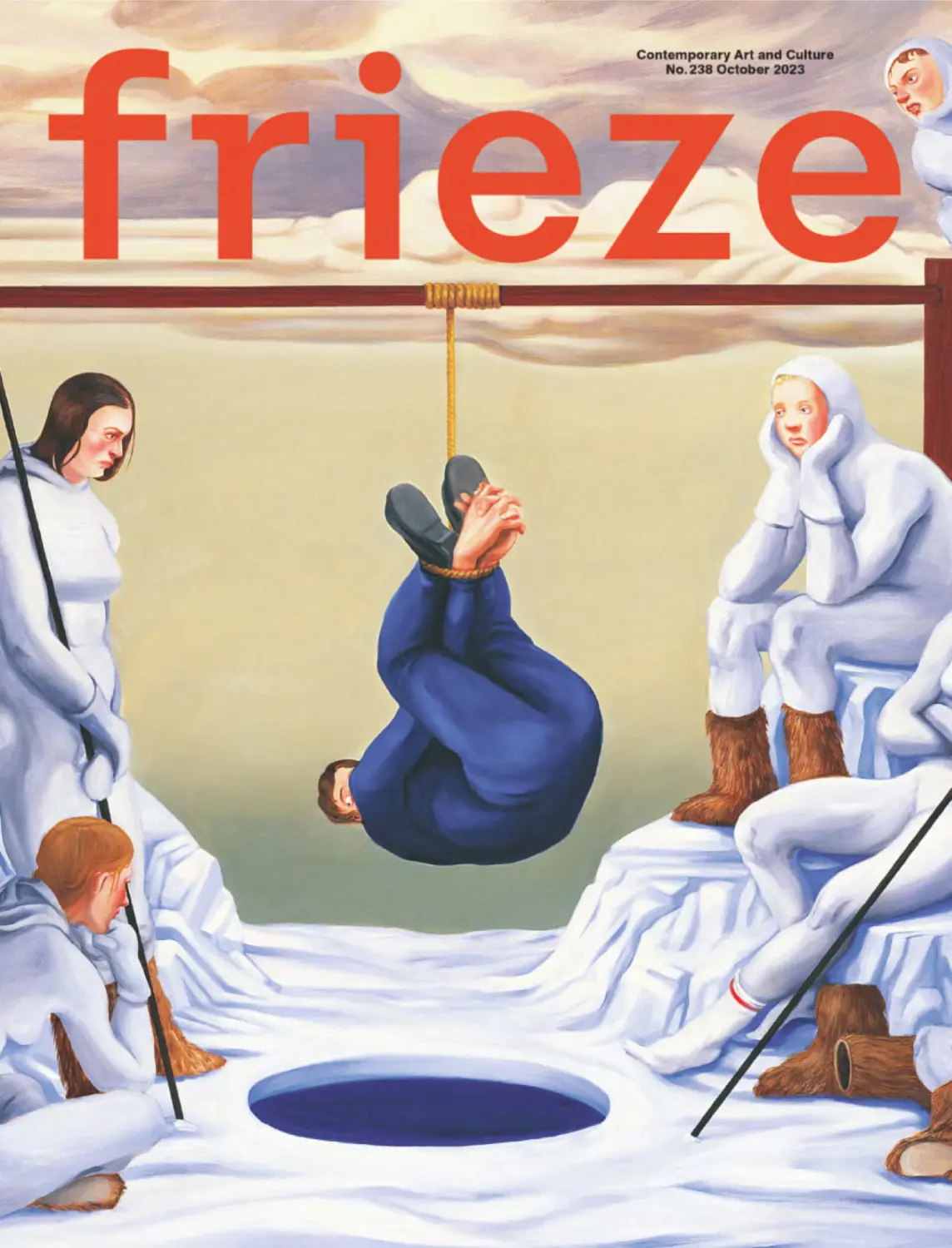
To put a painting by Nicole Eisen man on I he cover ol'frieze is to ask
you to stop. Hold the issue at a slight distance, bring it close, stare.
All works of art lay claim to our attention but. by some quasi-magical
formula of colour and shape, a painting by Eisen man asks you to take
a beat. I've done it plenty of times. A face, a scenario, a landscape, li lied
with recognizable elements that have been exaggerated, diminished,
smothered in colour. ‘Effortlessly referential.' Isabel Waidner says of
Eisenman's work, in a feature on how the artist responds to literature.
I take Waidner's description to mean two things: there are aspects of
Eisenman's paintings that we recognize from other works of art. and
there are aspects we recognize from our own lives. I don't mean the
latter quite so literally: it's far dreamier you simply feel, with a painting
by Eiscnman, that you've ‘been there'. We like to pretend that art is part
of our lives, in some direct way. but it rarely is. All sorts of interventions
geographic distance, gobs of money keep it at a remove. One through-
line for this issue is how art really does become part of lived experience.
For instance. Marko Gluhaich profiles Rirkrit Tiravanija - one of the
ultimate artists of presence ahead of his retrospective at MoM A PSI.
New York. Five writers pen homages to the work of Sarah Lucas,
especially the ways in which her familiar, impoverished materials seem
to come so directly from (our) crummy metropolitan life. And a scries
of columns focuses on how family ties inform our creativity: Igshaan
Adams speaks about inherited craftsmanship. Katherine Hubbard
about caring for (and creating with) her mother, poets Jorie Graham
and Geoffrey G. O'Brien ask what it means to raise kids when the world
is burning down. Eiscnman once said that ‘at this intensely worrisome
moment' (ofclimate change and right-w ing populism). ‘I'm painting
examples of what, to me. looks like goodness in the world.' Maybe that's
why we stop - she otters us a glimpse of something rare •
Andrew Durbin is editor-in-chid оГ,/йел*.
frieze No. 238
21
October 2023
An De part men l
Creative Director, Design
Claude d’Avoinc
Art Director
Lorenz Klingebiel
Senior Designer
Amalie Bonhommc
Operations & Distribution
Content Operations Manager
Caroline Marciniak
Marketing Director
Matteo Plachcsi
Marketing Manager. Membership
Alejandra Llavona Abarrategui
Social Media Manager
Sophie Johal
Membership Services Executive
Chris Daniels
Distribution & Circulation Manager
Greg Frost
Digital Content Coordinator
Rachele Rosina
Web Assistant
Stefania Tsivelekidou
Digital & Audience Director
Tom I .aidlaw
frieze
Ofliees
London
1 Surrey Street, London WC2R 2ND. UK
info a lrteze.com «44 2ll 3372 6111
Berlin
Zehdenicker St raise 28.11)114 Berlin, Germany
berlin a frieze.com «49 30 7675 KO23O
New York
247 Centre Street, 5th Flour, New York,
NY 10013, USA d 212 463 7161
Editor In Chief
Andrew Durbin
Senior Editor
Terence 'frouillot
Associate Editors
Marko Gluhaich, Angel I .ambo &
Vanessa Peterson
Assistant Editors
Sean Burns, Chloe Stead &
Lisa Yin Zhang
Publishing & Events Manager
Claudia Kensani Saviotti
Editorial Coordinator
Kate Cunnington
Editorial Assistant
Ivana Cholakova
Editorial Trainees
Nadia Egan & Annalisa Giacinti
Chief Executive Officer
Simon F'ox
Founders
Amanda Sharp &
Matthew Slotover
Facebook, Instagram & Twitter
a friezeofficial
Membership
frieze.com membership
Commercial
Commercial Director
Emily Glazebrook
Publisher
Lisa Gersdorf
Head of Digital Media Sales.
Global & Media Sales,
Americas & Asia Pacific
Melissa Goldberg
melissa.goldberg a friczc.com
Media Sales Manager,
UK A EMEA
Hannah Nashman
hannah.nashman a ITieze.com
Media Sales Assistant,
Americas & Asia
Alexa Prounis
alexa.prounis a frieze.com
Senior Partnerships Manager. Brands
Morenike Graham-Douglas
morcnike.graham-douglas a fricze.com
Advertising Production Coordinator
Jennifer Ward
Partnerships Coordinator
Naya Sam
Media Sales Assistant
I Xian Naylor
Frieze Studios
Director of Branded Content & Studios
Francesca Girelli
Creative Lead, Branded Content (Interim)
Jacqueline Olagburuagu
Creative Lead. Frieze Studios
Matthew McLean
Creative Producers
Rachel Cunningham Clark &.
Marina 1л Verghctla
Assistant Producer
AriannaTrabuio
From the Mailbox
Al frieze, we receive hundreds of emails even
day from urtisis. galleries and public relations
companies around the world. Here, we share our
favourite excerpt from the past month. Sarnes
have been redacted to protect the guilty, but they
know who they are.
.Attn: Business Editor and Art Editor x
You might be interested in looking at a paint-
ing I did. .1/7 us u/i Investment It is 75» 100cm
in acrylics and markers. Ihen are small boxes
of copy at the bottom of the painting that ask
questions. such as.
I I low much do you think the Mona l isa might
go for some day?
(Especially after someone threw a cake at it
a while back?)
2.1 low liquid is art?
3. Will you represent my estate?
You can download a brochure about me here:
And then, the painting is signed.
Artistically yours.
•-
|
5
3
Z
5
I
*
Nicole Eisenman. Fishing.
2000. oil on panel. I 2«lA m
Courtesy the artist and
Craig Robins Collection.
Miami. Seep. 94
/HceilSSS (НЛ2ОП. Pf 1КГ0) » ruHithH	m M,nA Apnl SUv Srj*. < S< ut>Hin Ъл. June V* b Hw/e PuttnhMf L U I Sunn Street
L.ouAon. W.JB ’MJ Sirtrxifht дпЭ	in the I SAS) n*rat named World Container lac. ..о BBT ISO IS. IMrd SL -iiruneSY. 1MU. I SA. Гст».х1ы.аЬ	pAid
•I Вн»>Цуп.\УНЬ« •••'SIMASTH	W<rU tonumcr Ii^.l . HITT ISO U UOri St hnune VY. IMli.I SA
frieze No. 238
22
October 2023
RICHARD PRINCE
Early Photography, 1977-87
Gagosian London
GIUSEPPE РЕНОМЕ
Improntedi luce/Empreintesde lumiere
Gagosian Paris
GOING UP, GOING DOWN
Collaborative
Kitchens
Just ask Rirkrit
I iravamja (p!28)
Bedavr 4 ilium» Shoe** Mudim. ('««Mirth
Century Fin. Ilan» Kamiah EMMe. Ikn
\nupoay (kin Image» Vlagp. Fart».
Ihrrad» InMagram. Rirkril Ttfaianiu
Instagram awittnaippoh. Rk,hard <юте»
frieze No. 238
25
October 2023
One Take: As Nan Goldin's‘This Will Not End Well’
opens at the Stedelijk Museum in Amsterdam.
Lynne Tillman traces the circular reflections of the
artist’s latest film. Memory Lost (2019-21)
Beyond Good and Evil
NAN GOLDIN S MEMORY LOST Opens With
Super-8 film of beautiful, young
people dancing, having fun. while
Eartha Kitt sings about ‘unspoiled
gender’ and ‘being pure not
wanting to be chased’. No. Kitt sings.
*1 want to go to the devil; I want to
be evil.’
In the 1980s in New York, heroin
and coke fuelled parties, clubs,
minds. Fashion photographs of
the 1990s portrayed stoned models
in images called ‘heroin chic’. Fun
didn’t last long; too many overdoses,
and the AIDS epidemic’s onslaught
of death.
In Goldin’s first major work.
The Ballad of Sexual Dependency
(1982 2022). she declared her
commitment to an unabashedly
autobiographical project, culling
images from her life. Goldin would
add more photographs to the series,
and. with fame, new interiors,
hotel rooms, landscapes, yet always
many of the same faces, reliable,
often troubled friends who are. in
the worst of times, her lifelines.
Memory Lost recalls the all-
night parties of The Ballad of Sexual
Dependency'-. Goldin’s addiction;
rehabs; friends’ anguish and deaths.
It moves from pristine shot to
blurred image, every frame a mem-
ory. Goldin may not remember
as much as she once did. but the
photographs do.
Memory Lost's visual pleasures
abound, though sadness permeates
the film. Its superb soundtrack
tenderly heightens every passage
of time and place.
Sporadically, there are recorded
voices, old phone messages. A dealer
says. ‘I am here. I’ve got all you
wanted.’A friend says.‘I hope I get
better.’ Goldin asks, in a tortured
voice. ‘Why am I in a hospital?’
A friend tells her she was found
unconscious on a sidewalk.
Opposite page,
top to bottom
Nan Goldin. Memory
NkI. 2OW 21. featuring
Ihftmu*. undated.
entitled. 1982. and
ЛЛ Hone. Komu. Valley
i if the Quetlts. Luxor,
txypi. 200.1. Courtesy:
• Nan Goldin
The film ends at the beginning,
w hen everyone is young and healthy.
Goldin’s paradise lost. Maybe
they all wanted to be evil, but they
weren’t. They were just fucked-up.
That ongoing Judeo-Christian
fiction, good and evil, shows no
compassion for our Hawed species.
If‘evil’ existed. Goldin recognized,
in the 2000s it was legal, prescrip-
tion drugs, and she organized
Prescription Addiction Intervention
Now(P.A.I.N.) to denounce the
profiteering dealers of those
deadly opioids.
Nan Goldin survived her addic-
tions and cherishes the memory of
her friends who didn’t. Memory Lost
is her testament; lhe grand drama
of life is surviving it •
Lynne Tillman is the author ol Mttthercure (2022)
and numerous other hooks. lhe reissue of her
second novd. MotHtn Sickncxx (19911. WK published
by Peninsula Press in September.
frieze No. 238
26
October 2023


у
. i
Anish Kapoor
JE GALLERY

30 Aug - 22 Oct 2023
** 1

I Л

ANNENBERG
Gregory Annenberg Weingarten
With additional support from
The Thompson Family Charitable Trust
Sponsored by
CREDIT SUISSE
Partner of the National Gallery
THE
NATIONAL
GALLERY
30 September 2023 -
21 January 2024
Book now
Members go free
The Credit Suisse Exhibition
к
la
Family Constellations: How family photo albums
retrace Farah Al Qasimi s ancestral history by Allie Biswas
Regarding Origins
•THIS WORK IS FOR. AND ABOUT, my
mother’s family.’explained Farah
Al Qasimi. speaking to me from her
home in Brooklyn. New York. Having
spent the last decade documenting
the Persian Gulf, specifically taking
photographs of Abu Dhabi, the
city where she grew up. and its
surrounding emirates (her father
hails from Ras Al Khaimah), the
artist envisaged a project that would
honour the history of her maternal
blood. Everywhere there is splendor
(2021) - a site-specific installa-
tion originally commissioned by
Contemporary Art Museum St.
Louis but later revised and re-titled
Letters for Occasions for the Esker
Foundation in Calgary (2022) and
the 14th Gwangju Biennale (2023)
- is a testament to those members
of Al Qasimi’s family who emigrated
from Lebanon to the United States,
beginning in 1899. when the artist’s
great-grandfather left the village of
Mdoukha and found himself in the
northeast, by way of Ellis Island. My
grandmother died when I was eight
and I never met my grandfather,’
Al Qasimi continued, ‘so I felt that
I needed to fill in these craters of
knowledge regarding my origins.’
Like the numerous photographic
series that the artist has produced
since graduating from Yale University
in 2012, Everywhere there is splendor
explores the customs which crystal-
lize within the sphere of the home
Farah Al Qasimi.
Everywhere there is
splendor. 2021. All
images courtesy:
the artist and
Francois Ghcbaly
Gallery. Los Angeles;
photograph:
Dusty Kessler
or the place of work. In the scenes
she depicts. Al Qasimi favours the
idiosyncratic or unexpected (her
photographs are both staged and
shot spontaneously), with certain
objects - whether an intricately
patterned rug ora handheld mir-
ror - often assuming the lead role.
Her debut exhibition, Hhe World Is
Sinking’ (2014) at The Third Line in
Dubai, focused on interior shots
of beauty salons and photogra-
phy studios around the Emirati
metropolis, while ‘Funhouse’ (2020),
at Helena Anrathcr in New York,
portrayed young women and
adolescents in their bedrooms.
These projections of the UAE,
particularly when they initially
frieze No. 238
31
October 2023
I fell in love with the transformative
quality of a colour photograph.
Farah Al Qaslml
began to circulate, provided a
necessary alternative to existing
visuals of the region produced by
outsiders, which had merely helped
to prolong predictable readings.
Ihe distinctive nature of Al Qasimi’s
work was further reinforced by
her magnetic use of colour - now
an irrevocable hallmark - which
resulted in vivid, lustrous images.
(‘I fell in love with the transforma-
tive quality of a colour photograph.’
Al Qasimi commented in a 2019
interview with The New York Times.
having initially experimented with
monochrome processes.)
Several of the images that fea-
ture in Everywhere there is splendor
were sourced from family photo
albums which the artist discovered
at her aunt’s house during an exten-
sive period of pandemic lockdow n
in 2020. Described by Al Qasimi as
depicting a world that felt ‘frozen
and timeless, but still full of spirit’,
these pictures had been posted to
her grandmother over the years by
relatives w ho had relocated to the
United States and Canada in the
1950s: a photographic tracing, then,
of her family’s migration across
North America. Al Qasimi scanned
and reprinted a selection of them,
as well as related paraphernalia
garnered through aunts and uncles,
before physically collaging together
the components, which she then
photographed. These multi-layered
compositions were framed, then
placed on top of vast w allpapered
panels onto which new photographs
by Al Qasimi. as well as archival
images, had been printed.
The combination of these various
elements enabled Al Qasimi to
augment the narratives to which
the photographs in the family
albums alluded. 4 was looking at
the everyday objects in these photos
for some greater sense of w hat my
relatives were like back then.* she
tells me.‘l w anted to know what they
cared about, what they ate. w hat they
chose to surround themselves with.’
Kimball Hotel (2021). one of the larger
components of the overall composi-
tion. references her grandmother’s
job at the eponymous establishment
in Springfield. Massachusetts, which
involved cooking dishes for the
lunch buffet. Al Qasimi’s collaged
image includes a ‘cocktail special’
menu, dating from February 1934.
which sits against a backdrop of
strawberries and prawns that have
been pinned to a draped curtain. At
the centre of the picture is a black
and white Polaroid of tw o women
sitting in front of a Christmas tree.
In the right-hand corner resides
a postcard from Mamie which relays
a single message: we are all safe.
larah Л1
QdMmi.
Ihh Sandals.
2022
This amalgam is bordered by a panel
of wallpaper that renders a plate
ofchickpeas on a kitchen table -
a reference to the hummus that
Al Qasimi’s grandmother would
make at home.
If the act of leaving your home-
land behind consumes this work. Al
Qasimi’s first feature-length film. Um
Al Naar (Mother of Eire) (2019). reflects
on the possibilities of returning to and
reclaiming your roots.Taking the form
of a horror-comedy, the narrative
centres around a//nn (supernatural
spirit) hailing from Ras Al Khaimah,
who laments the rigid social con-
structs of contemporary life, instead
appealing for a society which allows
for what cannot be easily catego-
rized. Al Qasimi devised the film
at the same time that exorcisms
(a sustained practice in the UAE)
alongside other cultural traditions,
such as the provocative M’alayah
dance, became outlawed. Recounting
the demise of her country, the
folkloric spirit comes to the realiza-
tion that she is losing her currency,
along with the endorsement of those
around her. In the end. though, she
decides to reassert herself as a vital
entity'w ithin the community*. Her
conduit is her ow n body: an invigor-
ating dance, performed with fervour
alongside other women, offers
cathartic release, while signalling
self-governance.
In her attempt to make a record
of the intangible and transitory -
whether through the perspective
erf a jinn or the experiences of
distant relatives Al Qasimi reveals
the importance of geographical
specificity: howT a person’s location
is interchangeable with notions of
home and family, as well as their
sense of self •
Aills Biswas is a writer and editor. W ith Mark
Godfrey.she co-edhcd lhe Saulп/a Nation Raider-
Writings b\ uiidubimt Black American Artists,
I960 1980 (Gregory R Miller & Co, 2021)
frieze No. 238
32
October 2023

Family Constellations: Igshaan Adams on
how his family is integral to his practice
Desire Lines
WHAT I FIND IMPORTANT FOR ARTMAKING
is to have an existential question:
my exhibitions always start from
a provocation, some idea that has
bothered me since I was young. For
my first solo exhibition with Thomas
Dane Gallery, which opens this
month. I decided to return to the
house where I grew up, and where
my brother and his family now live,
in Bonleheuwel a township in
Cape Town created for those who
were Coloured (a legally defined
racial classification during apartheid
for members of multiracial ethnic
communities) in apartheid-era South
Africa. The title of the exhibition,
‘Primere Wentelbaan’ (Primary
Orbit), alludes to the first spaces
into which we ventured to explore
the world. For me, that early domes-
tic environment really shaped how
1 became the person 1 am and how
I see the world.
When I was five years old,
my parents relocated, and my
grandparents decided that my
siblings and 1 should stay with them
until we finished primary school.
Later, as an artist, 1 realised that
1 needed to explore these formative
relationships and look back at the
environment in which I grew up in
order to understand myself. I created
tapestries using beads that focus on
the ‘desire lines’ - informal short-
cuts taken by pedestrians through
open fields that I used to first
venture out of the family home with
my brother. Contradicting the routes
urban planners had mapped out,
these paths resulted from people
using land and space in their own
way. I have often wondered about
the first person who decided to take
a shortcut, paving the way for others
to follow. I feel a kinship with them,
having grown up in an environment
where there were no artists, no one
to create a path for me. It was made
very clear to us from a young age
that our professional options would
be limited, as we were considered
second-class citizens, so I had no
choice but to blaze my ow n trail.
My family has always been
integral to my practice. In the per-
formance Please Remember (2Q\3),
for instance, my father washed
and prepared my body in line with
the Islamic ritual for burying the
dead. While for Salat Aljamaeat
Igshaan Adams.
Work in progress
(detail). 2023.
Courtesy: the artist.
Ihomas Dane Gallery.
London and blank
projects. Cape
Town; photograph:
Lindsey Appol is
Min Bonleheuwel (A Communal
Prayer From Bonleheuwel, 2023),
my contribution to the first Islamic
Arts Biennale earlier this year in
Jeddah. I collected 100 prayer mats
that, having been used by the same
individuals for decades, carried the
imprints of their bodies. We then
copied the imprints from the rugs
to produce carpets and weavings
based on them. My father helped
me in this work. too. by taking the
name of each individual whose rug
we used and conducting interviews
with them.
After 1 graduated from the
Ruth Prowse School of Art in Cape
Town in 2009.1 got a job in a Black
tow nship as an art facilitator
working with women to give them
skills and make products that they
could sell to tourists. Later, when
I needed assistance with my pro-
jects. I employed my mom and two
women whom 1 had taught, and
they’re still with me several years
later. I eventually employed some
of their family members, loo. My
mom has five sisters, and two
of them work in my studio. They
do a lot of embroidery as w ell as
the preparation of materials for
weaving. I taught my cousin to
weave, and she is now’ one of the
star weavers. One of my younger
brothers is a studio technician. 14ч?
known my studio supervisor since
I was five: we were in the same class
throughout school. It’s my respon-
sibility to bring my family and my
local community w ith me as I grow.
I often find myself using the
word we when I speak about the
work because my practice is not sin-
gular at all. I’ve been working with
the same team since the beginning
of my career and even my neigh-
bours feel like my extended family.
A friend recently told me how. over
the years. I’ve managed to catty the
Bonleheuwel community with me
along the way, and that’s probably
the most meaningful thing anyone
has ever said about my practice.
Ultimately, it’s served me to have to
find my own way and to find my ow n
desire line •
>ls told to Vanessa Peterson
Igshaan Adams is an artist.
Vanessa Peterson is associate editor
of frieze magazine.
frieze No. 238
34
October 2023
HAUSER & WIRTH

’ •
LORNA SIMPSON
30 SEPTEMBER - 22 DECEMBER
LIMMATSTRASSE, ZURICH
Spruth Magers
Berlin
Bernd & Hilla Becher
September-November
Pamela Rosenkranz
Alien Blue
September- November
Nora Turato
NOT YOUR USUAL SELF?
September-November
London
Sylvie Fleury
S.F.
September- November
Peter Fischli David Weiss
November - January
Los Angeles
Analia Saban
Synthetic Self
September-October
Louise Lawler
GOING THROUGH THE MOTIONS
November-January
New York
Kaari Upson
Body as Landscape
September-October
spruethmagers.com
Family Constellations: Ghislaine Leung on
navigating her identity as an artist and mother
Risk without Support
THE NEGOTIATION OF LIMITS 1П ГОУ WOfk
is about try ing to undo a certain
dialectic of value, trying to under-
stand the thing I have or don’t have
as a resource, try ing to understand
the situation I’m in as a resource.
I have a fantasy or speculation that
I should be unlimited, and a pro-
jected notion of what unlimitedness
should look like in a daily practice
or in an exhibition space. Within
that fantasy limits are perceived as
a hindrance - my financial ability,
my need for stable employment,
my commitment as a mother, my
body, my political efficacy. But those
limits, those dependencies could be
turned around to become a resource
for making artwork in another way,
in a way that you don’t know what
it’s going to do. And I constantly
have to decide to maintain this turn.
Whatever projection you have
about how you should be working
as an artist is definitely an internal
one. It’s about understanding how
the material conditions of your
situation have consequences.
‘I have to function in a way that
goes against my hormones, that
makes it seem like I’m always the
same.’ ‘It won’t work if I don’t w ork
16 hours a day’ This is my default
way of seeing things; then there
is my inability’ to be able to
work on the same terms as that
fantasy. Maybe it’s not working
because you w ork 16 hours a day.
Maybe there is fear of the point
of internality or reflection that
space might produce. I want to
understand the inactive forms of
life; it’s not necessarily best that
you are always in the visible,
active form of production. It’s
about not operating on the basis
of external validation.
If you think about financial
autonomy as a way of being
supported, you can also think of
other things as support. What I’m
describing are not limits but life,
other forms of life that are not your
art-industrial life. I have depend-
ents. friends, family, outside the
parameter of my artist identity;
Do I think of my daughter as a
limitation? She’s not a limitation,
she’s my life. I don’t w ant - polit-
ically, emotionally, psychologically
-1 don’t want to see this as a
limitation. I disagree that suffering
is indicative of being a good artist.
I’m not saying I’m not perpetually
in a situation of crisis.
[...]
Ghislaine Leung.
Monitors. 2(122.
Courtesy : the artist.
Maxwell Graham.
New York, and Simian.
Copenhagen
This practice isn’t something
that’s done. It’s a maintenance act.
it’s something I maintain in myself
against something else. It has to
have that relational framework,
it’s idiosyncratic and subjective.
Whatever myth I’ve internalized is
not going to be yours, that’s yours
to change. I believe how’ I’ve inter-
nalized that system and how you
have internalized the system can
be changed, but you need a lot of
help to do that. It’s not something
I could have got to on my own. it’s
a product of community and history
and luck and conversations like
this. If I was off by myself I wouldn’t
have got there. There’s a projection
in competitive society that every one
else can run to it and keep up. But
if intimacy occurs there’s a moment
when that competitiveness disap-
pears into a moment of solidarity.
Art is an immense psychological
risk. It’s hard to take that risk
without support.
I want to create an identity where
not all is carried on an industrial,
functional infrastructure, based on
labour and market. In different con-
texts I’m different things. I’m Jew ish
and I’m Chinese. I’m also neither,
because I’m not a practising Jew and
I don’t speak Chinese and I never
met my Chinese family. I’m also
British, but am I really? Your coher-
ence is based on w hether you can
trade as a certain commodity. I could
be that commodity. 1 could do that
high-functioning neoliberal labour,
but why is that what commitment
is? I don’t want that. Commitment
could be something else. So then,
w hat boundaries can I set up against
that unlimited self that Гт suppos-
ing I should function as? If Гт my
own boss, maybe I should start to
acknowledge the limitations, rather
than trying to overcome them? Are
they even limitations? Maybe they
are just things I care about? Without
which I w ould perish •
7Й/5 text is excerpted from
Ghislaine Leung's Bosses (Divided
Publishing. 2023).
Ghislaine Leung is an artist. She has been
shortlisted Гог the turner Prize 2023.
frieze No. 238
37
October 2023
Family Constellations: Katherine Hubbard on
caretaking and making art with her ageing mother
The Great Room
my mom sits on the bed looking
at the pile on the floor and sighs.
She is overwhelmed by the pile,
but the pile only continues to grow
with bills and letters and notes she
writes to herself about the bills, and
notes about the things she wants to
remember to tell me, or notes about
the things she wants to remember
herself but knows she will forget.
‘Tell Katie I love dick was filmed
in Marfa.’ I find this note every’ time
I am home. This one lives in the
stack of small notes that pile up
in the kitchen on the counter just
under the radio mounted under the
cabinet. These notes live between
the cutting boards and the vitamins
and, somehow, I always pick this
one up. I already know that I Love
Dick (2016 17) was filmed in Marfa
and. by the way. my mom has never
actually told me that 1 Love Dick was
filmed in Marfa but, she does know’
1 did a residency there and she does
know Marfa is in Texas and she does
know’ she visited me in Texas, in
Marfa, when I did a residency there.
She did, at one point in time, hear
this bit of information, perhaps on
the radio, and write it down because
she wants me to know that she
knows this tiny thread of informa-
tion that might connect us, as in
she know s something that relates
to something she knows I was a part
of at some point in time, but she
never actually remembers to say
anything to me about it. She never
actually reads the note and remem-
bers to say it out loud.
‘Hey Katie, did you know that
I Love Dick w as filmed in Marfa?*
‘Yes. Mom. I know that I Love
Dick was filmed in Marfa.’
The brain is a complicated thing.
New facial expressions 1 have
never seen before: how do I describe
them? One cheek lifts up so that
the eye squints slightly from the
pressure but, being only on one side
of the face, ifs a cockeyed expres-
sion. The lips form a taut straight
line but lift into a scmi-hook shape
on one side. The face is sincere, and
1 guess the best way to describe the
face is confused, except 1 am not
sure how to describe the look of
Katherine Hubbard.
one .fifty<me. 2021.
Courtesy: the artist and
Company Gallery .
NcwYortc
confusion when I have never seen
it before on this face, on this head,
on this neck, on this body, on this
configuration of a being that is so
familiar it feels like me. And I have
never seen myself -1 mean, her;
I mean, my mom look confused
before, so even though I understand
what a look of confusion is, it
means something different when
you’ve never seen it before. The
look of confusion isn’t the same
look of confusion on ever) body. On
this face, on this body, the look of
confusion is a gut punch and. if my
mom knew it was happening, she
w ouId hate it. We were lying on her
bed talking, and the new expression
came. I registered it as terrifying
and sad and new all at once without
clocking those registers. The look
just sort of lay down on top of me.
‘So. were selling the house, right?’
‘Yes. Mom, we’re selling the house.’
How do you apply tense to
a person who is in the process of
becoming someone new? Aren’t
we all in the process of becom-
ing someone new’ all the time?
Shedding, right? We’re all shedding,
and isn’t it wonderful? What kind
of tense is appropriate when the
emotional registers that have guided
an individual’s sense of person-
hood for their entire adult life slip
because they can’t remember to feel
how'they’ve always felt?
You might like to know’ that,
when I think of you and see you. it
is as the whole person I have known
you to be. bringing with you ever)
single past experience, and that this
turning inside out this change is
no different, but it is accelerated
and, as opposed to other years that
felt additive, this time is stripping
you back. You’re cashing in your
neurotic and self-defensive poker
chips that you’ve horded over many
years reluctantly at first, but now
more willingly. You might like to
know that, when I think of you and
see you. it’s as a whole person •
Lhis text is excerpted from an untitled
essay which considers Queer Mothering,
photography as care work, blood,
dementia and why inversions fait us.
Katherine Hubbard к an interdisciplinary artiM
and arts educator
frieze No. 238
38
October 2023
Liam Gillick
The Alterants
6th October to 11th November 2023
GAOERYBATON
FONDATiON LOUIS VUITTON
exhibition 18 October 2023 -> 2 april 2024
Book your rickets on	Fondatlon Louis Vuitton	Д	Fondatlon Lou Is Vuitton
fondationloulsvultton.fr	8 avenue du Mahatma Gandhi,	#	Rothko	_	-J J!	4.
andfnac.com	Bols de Boulogne, 75116 Parts	n
Family Constellations: Poets Jorie Graham and Geoffrey G. O'Brien
consider what family means in an age of climate catastrophe
Such Life to Come
Geoffrey g. o brien We’ve been asked
to think, as poets, about the family
form during environmental crisis,
which is to ask about furtherance,
about tomorrow and about making,
all while hard up against catastro-
phe. What s your current version of
those questions and what are your
provisional answers?
jorie graham What have these
months, this suddenly every-
where-visible acceleration, meant
for you? Would you still bring a
person into this reality? I still have
my old belief system operational, my
operative illusion, my ability to take
on board irrefutable facts, and then
my pendulum-like return - even if
only by habit or habitual memory
to something I still hang on to as ‘the
normal’ a notion of the future which
is fraught but still possesses extension
an as-yet-not expanse into w hich the
crucial imagination of and sensation
of futurity can glide. By which I mean
into what does a person shape thought?
Can imagination even function in
a radical breakdown of the field of
futurity? You need to haw an opening
a towards which is palpable, solid,
into which to move. Your body, your
spirit, thought, imagination, all require
a current in which to flow - what I’ve
called a draught which only comes
alive w hen you are living in relation to
both the past and the future meaning
you are in human time. Are we still
in human time?
Cy Gavin. I 'milled
(Gruss yruwiny cm
a weir). 2022. ЛИ images
courtesy: r Cy Gavin
andGagosian.
New York; photograph:
Roh McKeever
ggob lhe psychoanalyst Wilfred
Bion was asked about treating people
in a terminal cancer ward and said
the following: ‘If there’s a job to be
done for making the life of people in
a particular w ard bearable for such
time as they have got left to live, then
there is something to be done [...] It’s
got to do with making such life as is
still to come, still in lhe bank so to
speak, tolerable and available.’ That
matter-of-fact answer applies equally
to making new life and new poems,
even when lhe idea of a future or a
posterity is bracketed. The quotidian
remains when ‘the normal’ has
departed - that’s the ‘such’ in ‘such
life as is still to come.’ We are still in
human time, but it isn’t what it was.
frieze No. 238
41
October 2023
The danger is that one will
respond by making the present earth
and its inhabitants ghosts.
Geoffrey G. O'Brien
jg No. It isn’t. But it can seem
like it. Perhaps it’s the reality that
both are true at once which is the new
form of human struggle? I think
much of my book To 2040 [2023]
comes out of that struggle. As I sit
here, for example, there are sheep
in the next field. It is still. The heat
is dry. Their bleating crosses the
half mile to me. I can smell the dry
grasses. As I am writing this. They
intensify. Emotions rise up in me.
I hear the bees up close now. I might
as well be in the archaic. A small
prop plane flies over. This is the
lime into w hich I have to place the
rapid and irrevocable breakdown
of AMOC [Atlantic Meridional
Overturning Circulation], the
burning Mediterranean basin, the
sudden water rise, the unliveable
earth and the fleeing stateless. So,
how do I do that? Because I must,
to keep sane and keep it honest.
ggob It’s eerie and demoralizing
to feel the gaze change as it hits
the surfaces and relations of the
material w orld because of what is
happening; and temporality altering
so rapidly, the psychic lime arrow
fraying, splitting, falling to the
ground. Feeling both in a before and
in a slow, then not-so-slow, after.
The danger is that one will
respond by making the present
earth and its inhabitants ghosts
or at least ghostly, which is to
deprive oneself, a little, of the gift
of responsibility. When it rains and
everything is verdure I fear its future
as kindling for wildfires. To see the
flower as only a flower is pastoral
escape; to see it only as metonymy
for fire is inert despair. It must be
both at even moment, a ratio. And
the same with our nearest most
loved faces and those bey ond them
their present has to matter without
Cy Gavin.
I 'iiiiiled (I Mb border),
2022
any forgetting of the long harm
in which they’re set.
jg That feeling, w hich I share
as we move here as well between
drought and deluge, captures the
sensation so perfectly. Sometimes
it’s as simple as the suddenly
close-up date that is burning into
\iew before us - 2025 for the AMOC
right there on the calendar of our
only‘human lime’; the quotidian
narrowing to reveal its apocalyptic
face which had until very recently
only been a ‘possible scenario’. It
turns out reality can do it one better
than imagination no surprise
there. The surprise is that even in
these up-close realities, so much
in us still freezes in place, stunned.
And we have to jolt ourselves awake,
as in: I am still sitting in the heat,
grass now almost non-existent,
no rain in years, birds not coming
back again, the water in the tap
discoloured when there at all. and
still, the body the mind inventing
some way to make this feel ‘normal’.
So we have to live in this long-
imagined futurity and this immediate
present tense. It’s always been
somewhat like this. life. But this
has the simultaneous qualities of
acceleration, dilation and end-time.
We can intuit unimaginably long
stretches of a next-on geologic era
a planet without us right along-
side, or underneath, or in the cracks
of, the insanely quick present lense
with its fractured attention span. To
survive, we are being asked to knit
these together. How is the question.
ggob I think of art as a form of
attention that encourages further,
active attention.
To what does it attend is one
question. What does promoting fur-
ther attention do is another. If it’s all
virtual engagement, on the page and
in the mind, it will disappear in fire
and water despite Shakespeare’s and
Allen Grossman’s claims for poetry’s
sturdiness as compared with metal
and stone. I’ve yet to see a poem, or
its readers, alter policy on climate
change with the nothing it can make
happen, to paraphrase W.H. Auden.
Il can testify to wrong life, and it can
offer imaginations of other forms of
life, less wrong or more right?
jg There’s been a lot of fire and
water since Shakespeare, and it still
moves me in what I would call a real
experience. Grossman’s endurance
frieze No. 238
42
October 2023
against our vanishing is of the
human presence and voice, and
I would not doubt poetry’s ability
to give us an enduring sense of
someone’s humanity. Shakespeare’s
sonnets have preserved a sense
of a person struggling with love,
ambition, desire, jealousy what
it feels like to be alive - across five
centuries. That’s not virtual. Few
arts keep life alive from the inside,
so to speak, as poetry does. But no,
not alive in its ability to make policy
or science. As [W.B.J Yeats says,
‘we have no gift to set a statesman
right’. So perhaps, now. poetry must
do justice to what it means to live
in this impossible crack between
radically contradictory temporal-
ities? Though in a way that’s what
it’s always done. ‘To hold in a single
thought reality’ and justice’. To rise
to the occasion. To be adequate to
the moment. To bear witness. To
leave a trace. To imagine a future
in which this account and this
witnessing, this imagination, will
serve a purpose.
ggob One we can’t see from here.
jg Has it ever been more
important to give a form to what
we imagine? Because otherw ise we
might stop imagining. Has it ever
been more important to give a form
to w hat we feel - because otherw ise
we might stop feeling. This may be the
same reason, perhaps, for having
a child. Because the future is
fundamentally unknowable, but
we want to reach towards it. or
push forw ard others w ho will reach
further into it still full of complex
To bear witness.
To leave a trace.
Jorle Graham
human emotions. Full of wonder
and paradox and capable of touching
the unknowable. To pass on what the
refining fire of form makes of our
raw' first impressions. That’s what the
mystery is. To not know. To shape.
To love most what has no knowable
outcome. To engender and protect
the imagination of the future.
ggob That answer could deftly
describe attention, or writing, or
making family, the last of which we
haven't really attended to yet.
jg I’ve been avoiding it. Let’s try*.
ggob Well, the family can be
a structure of care and intergenera-
tional knowledge transmission to be
sure, but it's also an economic unit,
a political factory’ of gender and
sexuality, and a place where love
can tend inward, away from care for
others. What can poets ask of the
family, this diverse and ancient form
of association and blood, while it
is keenly under threat and while it
is sometimes the threat itself?
Cy Gavin. (milled
(l\jihx critsfdnji
blue). 21)22
jg Perhaps it’s the first time we’ve
really had to transcend entities like
family or neighbourhood, commu-
nity; society, nation-state. To extend
our physical, emotional, ethical bor-
ders. To try to imagine and give shape
to genuine global equity - realities
that really do concern all those living
on the planet. Not to mention other
living entities arable land, forests,
coral, watersheds, aquifers. In this
way, a person can think of this as a
tremendous time to be alive - and to
bring others into life because we
have an opportunity for extending the
very notion of what justice, and gen-
uine equity, mean. Perhaps this is a
fond dream. But catastrophe, though
it w ill atfect us differently, will affect
us all. Maybe we can finally revise
our notions of security, compassion,
justice on behalf of everyone on the
planet. Our survival doesn’t seem
separate from that.
ggob When I watch my child
fascinated by a book or humming-
bird. I know why 1 write poetry. When
I w rite poetry’. 1 know why I wanted
to make more life. These palpable,
extant forms of tether to the earth
and social life and its archives are
why 1 still believe we could revise
those notions you speak of into
a total love-driven reorganization.
For me it has the name full com-
munism and poetry’ is one of the
places I sometimes hear it sounded.
jg I would agree with that. And
if this is the task now, we have an
incredible tool in hand - we have
this art form, poetry; which has in its
DNA the ability to bridge these gaps,
and to move from the most intensely
local and personally felt emotion to
the borderless reaches of communal
human emotion. By virtue of its
forms and traditions, it can link past
and present, keeping that temporal
current of human time alive. Perhaps
poetry’s capacity is being called upon
with such renewed urgency because
of this ability? And perhaps poets will
imagine, speak to, or summon their
readers in new w ays - somehow more
intimate - shoulder to shoulder*? We
have to move from our sense of being
territorial to being terrestrial •
J orb Graham is the author of If collections of
poetry, including 7bZdfd(Carcanet and Copper
Canyon Press. 2023).
Gao tire у G. O’Brian is a professor al I Iniversily
of California. Berkeley, I ISA. and lhe author of
Experience in Groups (Wave Books, 2018).
frieze No. 238
43
October 2023
Frith Street Gallery
Malgorzata Mirga-Tas
Fiona Tan
Frieze London
Art Basel Miami Beach
Tacita Dean
Shilpa Gupta
Malgorzata Mirga-Tas
Thomas Sch litre
Dayanita Singh
Fiona Tan
17-18 Golden Square. London W1F 9JJ
15 September 11 November 2023
Footsteps
24 November 2023 20 January 2024
12 -15 October 2023
8-10 December 2023
Museum of Contemporary Art Australia, Sydney
8 December 2023 - 3 March 2024
Amant, New York
21 October 2023-2 April 2024
Andalusian Centre of Contemporary Art. Seville
29 September 2023 -31 March 2024
De Pont Museum. Tilburg. Netherlands
16 September 2023 - 28 January 2024
S5o Paulo Biennial
6 September -10 December 2023
Serraives Museum, Porto
16 November 2023 -6 May 2024
The Great Window
Great Saint Laurence Church. Aikmaar, Netherlands
Unveiling 6 October 2023
Igshaan Adams
Prirnere Wentelbaan
11 October — 16 December 2023
THOMAS DANE GALLERY
3 DUKE STREET, ST JAMES’S. LONDON SW1
Igshaan Adams, Kytr	vn die *rar»e voo< ju'le «true I 2023 (detail) О Igshaan Adams Photo Mario Todesd
525 West 21st Street, New York
Booth F05 October 11-15,2023
Capitain Petzel, 4.11.-20.12.2023

Galerie Max Hetzler
Berlin
Paul McCarthy
Them as Was /s
September 13 - October 21.2023 Potsdamer Strasse 77-87. 10785 Berlin
Beatriz Milhazes
Paisagem em Desfile
September 15 - October 28. 2023 Goethestrasse 2/3, 10623 Berlin
Albert Oehlen, Richard Prince, Rudolf Stingel
September 15 - October 28. 2023 Bleibtreustrasse 45. 10623 Berlin
Paris
Katharina Grosse
The Bedroom
September 8 - October 21, 2023 46 & 57. rue du Temple. 75004 Paris
London
Eleanor Swordy
Busy Signal
September 21 - October 28. 2023 41 Dover Street London. W1S 4NS
Marfa
Grace Weaver
Indoor Paintings
May 4 - December 10, 2023 1976 Antelope Hills Road. Marfa. Texas
maxhetzler.com
Julian Char'riere
Buried Sunshine
September 14 - November 4, 2023
• ••
*
%
' SEAN<ELLY •
LOS ANGELES
Ali Kazma
28.09-04.11.2023
A House of Ink
ELLIOTT HUNDLEY
EVERYDAY, EVERY DAY
September 6 - October 21,2023 | 297 Tenth Avenue, New York
KASMIN
Ian Davenport: Lake
4 October - 11 November 2023
11 Cork Street. London W1S 3LT
WADDINGTON CUSTOT
1л । i).iv up. ! t M >' r, d	2022. acrylic on aluminium mounted onto aluminium panel i with additional floor section). I IS *4 x 78 in UM) x 200cm


AGOSTINO BONALUMI
LEE SEUNG JIO
THE PARADOX
OF PROXIMITY
CURATED BY MARCO SCOTINI
KUKJE GALLERY
10 OCTOBER - 30 NOVEMBER 2023
MAZZOLENI, LONDON
□
MAZZOLENI
LONDON TORINO

SEVIL DOLMACI


BOSCO SODI
<	ж • JSbA	" Vr _
THE SILENCE OF FORM
SH^TEMBER 22 - OCTOBER 28


www.sevildolrnaci.com.tr
.• . info@sevikioimacl.com I +90 (212) 258 95 85
Cihannuma Mabgllesi, Qomezler Sokak No: 16, Be§ikta§ / Istanbul
EMILY KAM KNGWARRAY
EVERYTHING
D-C
11 - 15 OCTOBER 2023
Frieze Masters I B10 I The Regent’s Park
dlancontemporary.com.au
EMILY KAM KNGWARRAY dree 1910 - 1996
Kame Colour 1995
synthetic polymer paint on linen, 151 * 120 cm
О Emily Kam Kngwarray/Copyright Agency. 2023
•GIULIA ANDRE ANI.
L’IMPRODUTTIVA
29 October 2023
10 March 2024
collezionemaramotti
MaxMara
Thursday—Sunday
Via Fratclli Cervi 66 - Reggio Emilia, Italy
collezionemaramotti.org
Jesse Darling
Ghislaine Leung
Rory Pilgrim
Barbara Walker
28 September2023
to 14 April 2024
Free Admission
townereastbourne.org.uk
TOWNER Eastbourne
TURNER PRIZE
2023
KING &
MSGAW
ОI
W!
EAHBOU&NE «

ARTS COUNCIL
ENGLAND
FINE ART PRINTS
ИШИИШ)
SHARJAH ART FOUNDATION
We grew rapidly mure exhausted лч lhe indict
days of ruiminq and huhnq continued of
иь bcamr danqrrovslif dbhcarlr/ied and Ъсуал
{о "hear sh-nnge tern/yrn^ noises all arcunq umbra
$<rearing monn/iKj far away yet near al hand.
Ue wash'd pecious time standing sh" trying to fathom
their onyins Our fear uas unbearable /\jlcv many
terrible nights of this we s/ouly beyan ?c remembfr
the glorious worrh of our old sonys ^his united u*
and we hud lhe strength io *cc that we could indeed
Survive lony enough la enjoy out freedom.
oeoo
sharjahart.org
Lubems Him id. Havana Nightsctnol (Plan 0i. 1999 image courtesy the artet and Hollybush Gardens. London Photo; Andy Keate
Lubaina Himid and Magda Stawarska
Plaited Time / Deep Water
29 October 28-2023 January 2024
Also on view this autumn
Vantage Point Sharjah 11
14 October 2023
14 January 2024
Perform Sharjah
Season of performances
19 October 2023
11 February 2024
Gavin Jantjes: To Be Free!
A Retrospective (1970-2023)
18 November 2023
10 March 2024
Focal Point
Sharjah Art Book Fair
24-26 November 2023
Sharjah Film
Platform 6
8-17 December 2023
Willow Drum Oriole
Suki Seokyeong Kong

о
о
И-% Willow Л Drum
*№1 Oriole
Suki Seokyeong Kong
Willow 4 Drum Oriole
2023.9.7.-12.31.
In partnership with BOTTEGA VENETA
LEEUM
www.leeum.org
MARIA MAGDALENA
CAMPOS-PONS
Maria Magdalena Campo» Pbns. Behold м organized by the Brooklyn Museum and the I Paul Gettt Museum the ex Nbibun н curated by Carmon Hermu Associate Curator E llzatreth A Snckler Center fur Fensrsst Art
Brooklyn Museum and Mazie Hams Assistant Curator 0*4ortment of Photographs I Paul Getty Museum with lenee-Dana Strand tormer Curatorial Associate Elizabeth A Sac kier Center for Fensnrst Art Brooklyn Museum
M^or support lor this exhibition is provided by the Brooklyn Museum s Contemporary Art Committee the Rockefeller Brothers Fund, the Jacques and Natasha Gelman Foundation the Elzabeth A Sackkrr Museum
fdocatl.ru-»l Trust Rlshabb and I cpa Mehrotra anti Estrelbta В ami Daniel BrcxHky
Brooklyn Museum September is, 2023-january 14,2024
Cnmp on in
INTERDEPEN-
П F N ПIF onS-”es
I ч! I	and Resilience
Adina Pintilie, Carmen & Antonio Papalia, Carolyn Lazard, Ezra Benus,
Grace Ndiritu, Jesse Luke Darling, Johanna Hedva, Lauryn Youden,
Maryam Jafri, Rory Pilgrim, Sharona Franklin, the vacuum cleaner and
collaborators, Alina Szapocznikow und Marijke van Warmerdam
7.10.23-21.1.24
Free Entry
MUSEUM
f Ur Gegenwartskunst
Lowenbraukunst, Limmatstrasse 270,8005 ZOrich, migrosmuseum.ch
Elne Institution des
VMIGROS
Kuiturprozent
GUSTON
The Guston Foundation
PhilipGuston.org
Untitled (Self Portrait). 1974
THE CATALOGUE RAISONNE OF DRAWINGS BY PHILIP GUSTON
IS UNDER PREPARATION BY THE GUSTON FOUNDATION.
SUBMISSIONS FORM
aND MORE DETAILS
Gustoncrllc.org/drawmgs
06.10.23~ 21.01.24

М НКА
Museum of Contemporary Art Antwerp
Leuvenstraat 32,2000 Antwerp, www.muhka.be

□
DeStandaard	De oUf ant	allen л о very
vtm* t* ritnnio
Inside Other Spaces
Environments by Women Artists 1956-1976
8.9.23-10.3.24
Haus der Kunst
MUSEOJUME ANOS
MU
MUS
MUSE
MUSEO
MUSEOJ
MUSEOJU
MUSEOJUM
MUSEOJUME
MUSEOJUMEX

NYUADARIGALLERY
OCT 3, 2023—JAN 14. 2024 I nyuad-artgallery.org
New York University Abu Dhabi, UAE
14.10.2023 - 4.2.2024
staedelmuseum.de
sa die LINIEN
DES LEBENS
GEFdRDERTDURCH
Deutsche Bank И
Vuti-w Млг. »r tew With  Wrmnrt, хкэс/аол. **nv«wmmlurf. Frarifirt arr Man » VG Hart Кием, Barr JO2j, Foto ЧгеЬп Form, CaurfMy a# th* мтвт Я N*u
VICTOR
MAN
MAKE IT
THE MAC!
PUSSY RIOT
Full of Days
Charlottenborg Jubilee
30 Sep 2023-14 Jan 2024
PRtMNTID BY
ALL YEAR, ALL FREE вмо Q Financial Group
Canada Council Consei des arts
{HL) to the Arts du Canada
Ontario ©
The Power Plant Contemporary Art Gallery
Toronto, CA
thepowerplant.org @ThePowerPlantTO
Аты Oaan, Abellntr. U.SA f, 2023 Single channel video. Bound, colour 1060 minutes Courtesy
the artist Greene Naftali New York
MUSEUM MODERNER KUNST STIFTUNG LUDWIG WIEN
bJ lisabeth
Wild
Until 7.1.2024
MuseumsQuartier ф
Museumsplatz 1, A—1070 Vienna
www.mumok.at
A global destination for creative expression, SCAD MOA
presents awe-inspiring exhibitions and events with
museum of art	internationally renowned contemporary artists.
601 Turner Blvd.
Downtown Savannah
scadmoa.org
@scadmoa
*SCADMOA
CHIARA CAMONI. SERPENTESSE
EDITED BY
Elena Volpato
PUBUSHER »*mbooK»tor»
•dtzlonl, Milano
BOOK DESIGN • Chiara Coata
Serpentesse Is a sound. The sound that comes before the word, that
plays at repeating the voice of what It calls. It Is formed by the friction
of matter, by the sliding and vibration of the world when the world, for
an Instant, listens to the sound of the breath of life passing through It.
17. О 6 -15.1 О , 23
KI UND Е|NE ZUKUNFTIGE
GEMEINSCHAFT

KOEN OF(F) ROAD
VAN DEN BROEK
kunstmuseum-magdeburg.de
Koen van den Broek, Wanderlust #2, 2021
KUNSTMUSEUM
MAGDEBURG
KLOSTER UNSER
LIEBEN FRAUEN
KMd
(DXP) Digital Transforfriation Planet
AFROSCOPE
Refik Anadol
ANREALAGE
GROUP
HATRA+Yuma Kishi/ /
Homei Miyashita Laboratory,
Meiji University
Keiken
Tomihiro Kono
Shruti Belliappa & Kiran Kumar
Emi Kusano
7 Oct. 2023
21st Century Museum of Contemporary Art, Kanazawa
1 -2-1 H rosaka, Kanazawa. Ishikawa 920-8509. Japan
£Я2И*«гЖ«в T920-8509	2-1
www.kanaz*№tjp	II ’I	I
(Shu Isaka+Soshi Nakamura)
Shdei Matsuda
David OReilly
Sputniko!
Takashi Ikegami Laboratory,
The University of Tokyo
Supported by H.fOshibhlQ-irr laboratory. Osaka University)
VUILDy
Jonathan Zawada
and more...
wexner center for the arts
AT THE OHIO STATE UNIVERSITY
Autumn 2023
Exhibitions
Sahar Khoury
Umm
Jumana Manna
Break, Take, Erase, Tally
Harold Mendez
one way to transform
and two and three
ON VIEW IN THE GALLERIES
AUGUST 25-DECEMBER 30, 2023
Outpost Office
ON VIEW IN THE LOBBY
AND OUTSIDE THROUGH
SUMMER 2024
Learn more at wexarts.org
Connect with us @wexarts
#theWexl$)t>

Amoako Boafo
Soul
Black
Folks
October 8, 2023-February 19,2024
IMAGE Amoako Boafo BefcSantez -•	0i< an paper	?2 - .rtesy of P-wt* LollecPcn	"t -•	, A--
AmMkoBoafo SwrfofBfartfo*»  	. И •• ф ммя C-mv-ri yArtsM	rnrtthoM r of A« i ‘i( m . < - * .	। *•- r.ib • -jiy
Lorry OsseiMensah I"* presentation of this еяЬЬГюп at tte Denver Art Museun» б orgonjed by Йогу Ajo«er. Vntu ano Кен Logan Curator / Modern and Ccntemporary Art It б funded by
Vick and Kent Logon, the Br rtaurn Saul D^cou've Prqer t. U S Bank, the donee to the Annud Г nd leadersh© Compoqn. and the '«dents who support the Scient fii and QAturtf Foabties
Distr <t (SCTD) P’cmcit «nd supper t б р»ovided by 5^90	and CBS Colorado
$CBS COLORADO f 0^"o
art
MUSEUM
MMCA	2023:
3
MMCA Hyundai Motor Series 2023:
Jung Yeondoo
0^7]
One Hundred Years
of Travels
September 6, 2023 — February 25, 2024
MMCA Seoul
<S>HYUnOAI
DISNEY CREATE 100 is a global celebration
of creativity that marks 100 years of Disney
storytelling. For nearly a century, Disney
stories have inspired creators, influenced
pop-culture and connected generations
across the world. To mark this milestone,
some of the world’s most renowned
visionaries and next generation talent across
fashion, music, art and more have donated
artworks, items and experiences inspired by
their personal connection to these stories
and characters to benefit Make-A-Wish®.
To learn more about Disney Create 100 and
the auction items follow @DISNEYSTYLE
on social media and search
#DISNEYCREATE100 and #DISNEY100 or
scan the QR code below.
www.di$neyxom/di$neylOO
crcofe
1OO
Ministerio da Cultura and
MASTER SPONSORSHIP
conception ano
PRODUCTION
SUPPORT
INSTITUTIONAL PARTNERSHIP
REALIZATION
FILE
i\i—i—i
«MVWMU
Mumu du Ami л hi
t&Rio
THE LARGEST
LIGHT ART
FESTIVAL
IN THE
\	ITiT
WORLD	Г
>	\\\ /л Bh
eFONDAZIONENIORRAGRECO
32° EAST UGANDAN ARTS TRUST
• ARKKITEHTUURIMUSEO - MUSEUM OF FINNISH ARCHITECTURE
OF NEW SOUTH WALES • ASIA CULTURE CENTER • CASTELLO DI
L’ARTECONTEMPORANEA LUIGI PECCI • CERTOSA E MUSEO DI
MUSEUM SINGAPORE • CHIOSTRO DEL BRAMANTE
- FONDAZIONE PISTOLETTO	COLLEZIONE
PEGGY GUGGENHEIM • COMPLESSO
MONUMENTALE SANT’ANNA DEI
LOMBARDI • CONTEMPORARY
ART MUSEUM OF ESTONIA
LAZZARELLE • DEDALUS -
AMSTERDAM • FONDAZIONE
SANDRETTO	RE
CONTEMPORANEA
HABLARENARTE
DER KUNST • IKON
MUSEUM
CONTEMPORARY
OF MODERN
MUSEUM
METALAB
A R T
ACCADEMIA DI BELLE ARTI DI NAPOLI • ARGOS CENTRE FOR AUDIOVISUAL ARTS
ART DAYS - NAPOLI CAMPANIA • ART GALLERY
RIVOLI • CENTRE POMPIDOU • CENTRO PER
SAN MARTINO • CHILDREN’S
CITTADELLARTE
W^LBEiNG
DATIWA
COOPERATIVA
COOPERATIVA SOCIALE • FOAM MUSEUM
CRT • FONDAZIONE MORRA GRECO • FONDAZIONE
REBAUDENGO • GALLERIA NAZIONALE D’ARTE MODERNA E
•	GALLERIE	D’ITALIA
3	HAMBURGER BAHNHOF - NATIONALGALERIE DER GEGENWART • HAUS
) GALLERY • IMMA - IRISH MUSEUM OF MODERN ART • J. PAUL GETTY
• KUNSTHALLE BASEL • KUNSTHALLE ZURICH • KW INSTITUTE FOR
ART • LAAGENCIA - OFICINA DE PROYECTOS DE ARTE • LOUISIANA MUSEUM
ART • LUMA ARLES • MACRO • MADRE - DONNAREGINA CONTEMPORARY ART
MAPA DAS IDEIAS • MAXXI • MEET DIGITAL CULTURE CENTER •
AT HARVARD &	FU BERLIN • MODERNA MUSEET • MOMA • MORI
•	MUMOK • MUSEION • MUSEO ARCHEOLOGICO
Dl	PONTECAGNANO • MUSEO D’ARTE
DI V/f>//7h	BOLOGNA - MAMBO • MUSEO E
DI	CAPODIMONTE
CENTRO	*<//	DE ARTE REINA
“."z:viero •	////ДДЛ a MUSEUM
muzeum sztuki
DELLA	V
MUSEUM
NAZIONALE
MODERNA
REAL BOSCO
MUSEO NACIONAL
• MUSEO TATTILE STATALE OMERO
VAN BEUNINGEN • MUZEUM
S О F f A
BOIJMANS
NOWOCZESNE J W WARSZAWIE / MUSEUM OF MODERN ART IN WARSAW -
NATIONAL ARCHAEOLOGICAL MUSEUM OF NAPLES-MANN • NATIONAL GALLERY
SINGAPORE • NATURAL HISTORY MUSEUM • NIKOLA TESLA TECHNICAL MUSEUM •
OSCAM - OPEN SPACE CONTEMPORARY ART MUSEUM • PALAZZO GRASSI - PUNTA DELLA
DOGANA - PINAULT COLLECTION • PALAZZO MAGNANI • PALAZZO REALE DI NAPOLI
INVISIBLES: PROYECTOS DE ARTE < EDUCACI6N
ACADEMY OF ARTS • SALZBURGER KUNSTVEREIN
II • SMAK • STEDELIJK MUSEUM
COLLECTION
L L t С T I 0 N
SUSIMNABIUh
PEDAGOGfAS
PISTOIA MUSEI • RAW MATERIAL COMPANY • ROYAL
SCIENTIFIC MUSEUMS OF THE UNIVERSITY OF NAPLES FEDERICO
TATE MODERN • THE PHILLIPS
DEGLI STUDI DELLA CAMPANIA LUIGI
UNIVERSITA DEGLI STUDI DI NAPOLI
UNIVERSITA DEGLI STUDI SUOR ORSOLA
VAN ABBEMUSEUM • VICTORIA AND
WIELS • ZEITZ MOCAA
AMSTERDAM •
• UNIVERSITA
VANVITELLI •
FEDERICO II •
BENINCASA •
ALBERT MUSEUM
 EDUCATION
L I I I INTEGRATION
I I I I GL0BAL
Ь V I FORUM
www.ediglobalforum.org
24 - 27 OCTOBER 2023
NAPLES - ITALY
An international symposium by Fondazione Morra Greco
connecting arts and culture experts from all over
the world to explore themes of educational
innovation in art
Deutsche Bank
Wealth Management
Supporting you
with a shared
passion for art.
#Positivelmpact
Whether it’s helping you unlock
the value of your collection or
planning for its future, our
expertise has been shaped
by a shared passion for art
spanning over four decades.
To find out how our dedicated
art lending team can help you
release capital without selling
and support your collecting
ambitions, get in touch
by scanning the QR code:
Celebrating 20 years of partnership
with Frieze, providing access to
contemporary art and culture.
© Erin O'Keefe. Courtesy Seventeen, London

In Europe. Middle East and Africa as well as in Asia Pacific this material may be considered marketing material, but this is not the case in the U.S. The value of an
investment can fall as well as rise and you might not get back the amount originally invested. The services described in this advertisement are provided by Deutsche Bank
AG or by its subsidiaries and/or affiliates in accordance with appropriate local legislation and regulation. Deutsche Bank AG is subject to comprehensive supervision by
the European Central Bank ("ECB"), by Germany's Federal Financial Supervisory Authority (BaFin) and by Germany's central bank ("Deutsche Bundesbank"). Brokerage
services in the United States are offered through Deutsche Bank Securities Inc., a broker-dealer and registered investment adviser, which conducts investment banking
and securities activities in the United States. Deutsche Bank Securities Inc. is a member of FINRA, NYSE and SIPC. Lending and banking services in the United States
are offered through Deutsche Bank Trust Company Americas, member FDIC, and other members of the Deutsche Bank Group. The products, services, information
and/or materials referred to within this advertisement may not be available for residents of certain jurisdictions. © 2023 Deutsche Bank AG and/or its subsidiaries.
All rights reserved. This advertisement may not be used, reproduced, copied or modified without the written consent of Deutsche Bank AG. 052910 032923
ASPREY STUDIO PRESENTS
OCTOBER I0TH
ATTHE NEW ASPREY STUDIO GALLERY, BRUTON STREET MAYFAIR, LONDON
ASPREYSTUDIO.COM
RSVP@ASPREYSTUDIO.COM
biennale.org.sa
a i rjnJi ydi.iij a ijla iju4-d
Diriyah Biennale Foundation
Diriyah
Contemporary
Art
Biennale
The Diriyah Biennale Foundation is proud to
announce the 2nd edition of the Diriyah
Contemporary Art Biennale and its curatorial
team led by Ute Meta Bauer as Artistic Director.
A platform for global dialogue and exchange
between Saudi Arabia and the world
February
20
2024
The curatorial team comprises:
Anca Rujoiu - Co-Curator | Wejdan Reda - Co-Curator
Rose Lejeune - Co-Curator | Rahul Gudipudi - Adjunct Curator
And working with:
Ana Salazar
Amina Diab
Dian Arumningtyas
Alanood AlSudairi
JAX District
Diriyah
Saudi Arabia
The international art event will run in Diriyah
until May 24, 2024.
We look forward to welcoming you!
NEUE NATIONALGALERIE

Genzken
75/75
13.07. - 27.11.2023
Nationalgalerie	Neue Nationalgalerie
a..- l a a	„ ..	Staatliche Museen zu Berlin
Staatliche Museen zu Berlin	Potsdamer straee so
10785 Berlin
Features
Rirkrit Itravanija.
(niilleJ. /999 (curuvan),
1999. Courtesy:
theanist. Seep. 128
frieze No. 238
93
October 2023
1.500 Words
by Isabel Waldner
Gregor
Samsa’s
Bambi
Novelist Isabel Waidnerdiscusses the
influence of Nicole Eisenman’s 1993
painting Bambi Gregor on their latest novel
Corey Fah Does Soeial Mobility
frieze No. 238
94
October 2023
frieze No. 238
95
October 2023
In the centre of the drawing, brown ink on
paper. Bambi is batting his lashes and smil-
ing disarmingly. When 1 say Bambi 1 mean
Bambi, but not as we know him: on top of his
famously unsteady legs, he has four spiders legs -
a grand total of eight. He is try ing out his new set
of insect wings, preparing for take-olf perhaps.
Could be that he can’t wait to get away from his
little friends, including Thumper and Friend Owl.
who. surrounding him, watch in consternation.
Something is wrong with him. they suspect, as in.
very’ wrong.
The US painter and sculptor Nicole Eisenman
whose first major UK survey show, ‘What
Happened’, opens this month at Whitechapel
Gallery - called this drawing Bambi Gregor
(1993). The title is an allusion to Gregor Samsa,
protagonist of Franz Kafka’s short story ‘The
Metamorphosis’ (1915), who wakes up one
morning to find himself transformed into an
ungeheueres Ungeziefer - a monstrous vermin,
gigantic insect or cockroach, depending on
translation. Bambi Gregor is an carly-ish and.
in the context of Eisenman’s hugely impressive
catalogue, arguably minor work. However, its
recent appearance on the cover of Honey Mine:
Collected Stories (2021), a compilation of new and
out-of-print fictions by lesbian New Narrative-
affiliate writer Camille Roy, published by New
York-based Nightboat Books, brought it into the
present for many - especially readers of innova-
tive fiction. During that same summer, as I was
writing Corey Fah Does Social Mobility (2023).
I kept a copy of Honey Mine on my desk, and its
cover star became a jumping-off point for me
to write my own Kafkaesque, Eiscnman-esque
protagonist - more of that later.
Eisenman is an effortlessly referential painter
who draws on source material as diverse as renais-
sance art. 1930s socialist murals and cartoons
like Bambi (1942). Another example is Alice in
Wonderland (1996), a painting which shows young
Alice going down on Wonder Woman or, rather,
up. as the stars-and-stripes-clad heroine stands
over the girl, legs apart, in victory pose. Much
has been made of the influence of pop culture.
US politics and art history on Eisenman’s work
arguably less of the impact of literature. Guy
Reading The Stranger (2011), for example, depicts a
person reading Albert Camus’s 1942 novel in front
of a bookshelf sustaining a ‘best-of ’ of European
philosophy, including volumes by Hannah
Arendt. Roland Barthes and Martin Heidegger.
The Triumph of Poverty (2009), a large-scale figu-
rative painting more typical of Eisenman’s later
work, features disenfranchised disparates from
various historical periods - including an orphan
with a begging bowl who might be Charles
Dickens’s Oliver Twist (1837) - gathered around
a broken-down car. Another Green World (2015)
references Brian Eno’s eponymous 1975 album,
but also, as Eileen Myles observed in a 2016
article for frieze, the critic Northrop Frye, ‘who
contended that, in Shakespeare’s work, the char-
acters were always going offinto the woods to find
another mode of knowing and being - the green
place’. Even Eisenman’s version of The Thing
from Marvel's Fantastic Four comic series (From
Success to Obscurity', 2004) is reading something.
Incorporating their cultures and communities
has long been integral to Eisenman’s practice.
Paintings like Beer Garden with A.K. (2009) are
Incorporating their
cultures and communities
has long been integral to
Eisenman’s practice.
populated by New York-based queer and trans
contemporaries and friends, in this instance
gathered around the artist A.K. Burns. It makes
sense that Eisenman’s engagement with liter-
ature should not be limited to canonical works
but should include, if not centre, contemporary
literary’ communities and live literary production.
‘Eisenman loves literature and writers,’ Myles
noted in frieze in relation to the painting HeeAs
on the Train (2015), in which the writer Laurie
Weeks, laptop on lap, is reading and taking up
space while travelling.
Writers, in turn, love Eisenman. In 1995, Myles
invited the artist to contribute the cover to their
collection Mayfield Parrish: Early &. New Poems
(1995): Eisenman created a striking, hilarious and
threatening drawing of little flowers with unsus-
pecting faces building a large wooden sculpture
of an uber-flouer. More recently, Eisenman pro-
vided the cover art for Myles’s momentous 700-
page anthology. Pathetic Literature (2022), which
sets out to rehabilitate pathctic-ness in diverse
forms of writing spanning centuries. In it. a figure
in white holds a black cat as far away from their
body as possible, another sleeps in a demented
sun lounger, while yet another smokes a rollie -
all in a landscape where nothing but a leafless
excuse for a tree cases the beige. ‘1 like seeing my
work on the cover of poetry books!’ Eisenman
said in a conversation with writers erica kaufman
and Matt Longabucco published earlier this year
in Ursula magazine. My point is: the literature-art
traffic goes both ways.
My ambition for Corey Fah Does Social Mobility
w as to examine and challenge conservative notions
of social mobility, which, especially in fiction, are
often related as simplistic iriumph-ovcr-tragcdy
narratives, or connected to mythologies around
merit. I use the example of a disadvantaged writer,
Previous page
Nicole Eisenman.
BambiGregor. 1993.
india ink on paper.
93 * 133 cm. Courtesy:
the artisi and Hauser
& Wirth: photograph:
Robert Wedemeyer
Opposite page
Nicole Eisenman. Beer
Garden with A.K.. 2009.
oil on canvas. 1.7  2m.
Courtesy: the artist
and Leo Koenig Inc..
New York
frieze No. 238
96
October 2023
Honey Mine's cover star became
a jumping-off point for me to write my own Kafkaesque,
Eisenman-esque protagonist.
frieze No. 238
97
October 2023
InJOGW й»1
CAil All О
edited by
LAUREN LEVIN & ERIC SNEATHEN
EILEEN MYLES
In the writing process,
preliminary intiuences coalesce,
become transformed and
emerge as something surprising
and original.
frieze No. 238
98
October 2023
Opposite page,
left to right
Camille Roy. Honey
Mine, 2021. book cover.
Courtesy: Nighlboal
Books
Eileen Myles. MuxlieU
i*urrish: Early A New
Poems. 1995. book cover
Courtesy: I ilccn Myles
Eileen Myles. PuAaic
Literature. 2022.
book cover. Courtesy*
Grove Press
Right
Isabel Waidncr. Corey
I ah Does Social Mobility.
2023. book cover
Courtesy: Penguin
Random House
Corey Fah. winning a prize (not unlike myself) to
make the case that it might not be quite so straight-
forward: parachuted into unfamiliar contexts of
social power and opportunity as a result of their
win, Fah has to contend with their difference and
their messy past catching up with them. At one
point during the writing process, 1 was searching
for a historical or fictional figure through which
to write Fah’s complex past - a container capable
of holding trauma (the death of Bambi’s mother,
of course, being the first encounter with the con-
cept of parental loss for many of us), as well as
otherness, that is. queerness, insect legs and all.
Bambi Gregor, as featured on my copy of Honey
Mine, was just that.
In a sense. Roy’s fictions are less literally con-
nected to Bambi Gregor than is Corey Fah Does
Social Mobility - no spider-Bambi cameo far and
wide in Honey Mine. In another sense, the con-
nection is far more. I want to say. personal: Roy -
like Eisenman. like Myles, like Weeks - has been
part of a US lesbian counterculture for decades.
They may all be friends. Whereas 1. a British-by
naturalization, working-class novelist, a decade
Eisenman’s junior, come at the work sideways.
In the writing process as, I imagine, in the
process of painting if it is going well, prelim-
inary influences coalesce, become transformed
and ultimately emerge as something surprising
and original. Skeletally propped up by now fairly
obscured, half-forgotten source material, charac-
ters take on a life of their own. With eight eyes and
a hidden drinking-straw-like-mouth, my character.
Bambi Pavok (pavok is similar to the Czech word
for ‘spider’) is related to, but divergent from.
Eisenman’s Disney perversion in terms of physi-
cality*. Beyond that. Bambi Pavok graduated from
his 2D cartoonish status, acquiring psychological
layers, emotional dimensions, a backstory and
a British accent, so to speak. To get to this point,
it’s perhaps simplistic to say that I brought Bambi
Gregor in conversation with cultural references
much closer to home, and with literary traditions
that I myself write in and see myself in relation to
For example, I recruited autobiographical detail
pertaining to British playwright Joe Orton into
the novel alongside my own. which allowed me to
think through and write about gay. working-class
authors winning literary prizes historically and in
the present a rarity to this day. I also mobilized
existing similarities between Orton’s and my
writing styles, putting to work irreverence, mor-
bid humour and outsider perspective to aim to
produce not just a formally interesting novel, but
a critique of class inequality. What happens w hen
Fah. Bambi Pavok and an Orton-inspired charac-
ter meet in the novel? No spoilers, but imagine
unspeakable scenes.
The cover of Corey Fah Does Social Mobility
features L’K-based artist Linda Stupart’s inter-
pretation of Bambi Pavok. (Stupart made the
original cover art for my second novel. We Are
Made of Diamond Stuff, which was first published
by Manchester-based micro press Dostoyevsky
Wannabe in 2019.1 consider Stupart part of my
own extended community* of contemporaries,
and I have been in conversation with their work
for many years.) A collage of a naturalistic young
deer stands confidently in sepia heathland
which, with its low bushes and industries in the
near distance, looks distinctly mildly depress-
ingly British. Multiple insect legs are emerging
from under his body, and his eyes - just two of
them - are bright-red flowers. A collection of
discarded trophies has been dumped at his feet.
some of which - with their bulgingveins or signs of
knotweed infestation - seem positively alive, or
overtaken by something alive. A cluster of textured
pink and white bunny stickers represent Fumper.
another character from the novel, or Thumper from
Disney’s Bambi, or Eisenman’s Bambi Gregor who
knows anymore? Creeping out from under thelorn
edges of Stupart’s image, something more sinis-
ter is hinted at more rampant insect legs upon
which the entire fantasy unstably is built. The
iteration of Bambi that appears on the finalized
Corey Fah Does Social Mobility jacket - designed
by Jon Gray - is four- or five-times removed from
Eisenman’s Bambi Gregor but. really, it is worlds
away. It is its own thing entirely. No less funny
than Eisenman’s version, or my fictional one
arguably even a touch next-level •
Isabel Waldner is a writer and critical theorist Iheir novel Sterling
Karul (iaU(2021) won the Goldsmiths Pri/e. and their latest bonk,
Corey I ah /Joes Social Mobility. was published in July tn I lamish
Hamilton Penguin Random House.
frieze No. 238
99
October 2023
Essay: Eva Diaz reconsiders
the radicality of Marisols art
Decorative,
Classy and Other
Pejoratives
frieze No. 238
100
October 2023

At times, I can’t believe what the most famous
female artists of the 1960s accomplished,
both in their first flushes of fame and beyond.
1 think especially of three whose practices
boldly confronted gender identity and sexuality: Yayoi
Kusama. Marisol and Niki de Saint Phalle. Their work,
with its often overtly carnal nature, its carnivalesque
pageantry and play, is nothing short of revolutionary.
Portraying women’s pleasure, they charted a path for
erotic liberation and. in some ways, anticipated, yet
remained a generational prior to. the collectivist project
of second-wave feminism.
Then. at other times, 1 get pissy that each of these
women grew up exceedingly rich and was also a fashion
model (De Saint Phalle) or a photogenic media darling
(Marisol). These factors no doubt played a large role in
their early career success. This trio, in particular, was
formed of ingenues - one of art history’s most critically
tarnished roles.
To avoid becoming resentful, envious or depressed,
I think of other contemporaneous women who also
took on female power and sexuality in frank, disturbing
and trailblazing ways; artists like Ida Applebroog. Lee
Bontecou. Lee Lozano, Faith Ringgold. Betye Saar. Zilia
Sanchez Dominguez. Nancy Spero and other (mostly)
figurative artists born c.1930. These slightly less famous
female artists lacked prodigious financial resources and
did not hit it big by the age of 35 - at least not on the
global scale of Kusama. Marisol or De Saint Phalle.
Previous page
Ilans Namui.Marisol.
&1960. Courtesy:
Center for Creative
Photograph).
I nivcr\ity of Arizona
Below
Hugh Huffier. 1967.
Courtesy: IlMt
Magazine
Opposite page
Teufor three. I960.
Unless otherwise
Mated.all images
courtesy: Estate
of Marisol Artists
Kights Society (A RS).
New York
The thing is. the work of both the rich and the poor
women artists of this generation, who came of age in
the 1940s and ’50s, inspires me. The traumatizing sexism,
violence and. in the cases of women of colour, racism
they experienced, metabolized and eventually bravely
rebelled against is extraordinary.
But niggling ole me can’t wholly separate the biogra-
phy from the work, because I know how fucking hard and
exhausting it is to be creative without resources and how
this always affects the work. You have to do things you
don’t w ant to do A LOT of the time: a lack of independ
ence euphemistically termed ‘creative compromise’You
don’t have the money to be free, bereft of a trust fund,
an inheritance or a financially advantageous marriage
to coast on. Poverty, routine economic oppression, is
alw ays nipping at your heels.
There has been much talk, post tf.MeToo.of separating
the ‘man from the ‘work’, in the cases of Pablo Picasso
and other cradle-robbers and women-abusers. But we
must also consider other forms of privilege that facili-
tate a career becoming publicly visible. In Marisol’s case,
her w ealth insulated her from all manner of demands
and accountability. Even before she became famous, she
declared in her journal in 1956: ‘I am the Venezuelan,
born in France, living in Italy - that has an English car
with North American plates and Swiss insurance - and
they want to ask me what nationality I am.’
Buffalo AKG Art Museum curator Cathleen Chatfee
responded to this statement in the museum catalogue
for ‘Marisol: A Retrospective’ which opens this month
at the Montreal Museum of Fine Arts - w riting: One
recognizes in these self-assessments of her different
personae the privilege of a white-passing Latin American
immigrant with the resources to adopt expensive
hobbies.’ Such is the guilelessness of extreme privilege
that can float the rich above the depressing realities
of class inequality’, that day-to-day enervation the
struggle, the grind, the hustle - that forecloses creative
possibilities for so many.
When 1 first considered Marisol’s survey. I immedi
ately thought of a work of hers that always annoyed me:
her portrait of Playboy founder Hugh Hefner, commis-
sioned by and published on the cover of TIME magazine
on 3 March 1967.1 then recalled her famous Self-Portrait
(1961-62). w hich was a standout work in last year’s ‘New-
York. 1962 1964’ at the Jewish Museum, where it was first
exhibited in 1966. The Hefner work is not in ‘Marisol:
A Retrospective*, or the accompanying catalogue, nor
was it in ‘Warhol and Marisol Take New York’ at the
Warhol Museum in Pittsburgh in 2021. (This particular
self-portrait, however, is in both.)
Don’t get me w rong. Marisol is awesome. The recent
catalogue is a trove of delights and the show- - travelling
to Toledo Art Museum next, before arriving al Buffalo
AKG Art Museum and then Dallas Museum of Art - will
be a must-see. Even though Marisol w as you ng, very- rich
and model-like, she was also eventually not those things.
She lived loo large travelling the world at the peak of
her fame and. given her predisposition to not give a
shit about money, coming as she did from extravagant
Venezuelan oil wealth, she essentially walked away from
her career to scuba dive for half a decade in remote
locations at immense expense. And, even when she’had
frieze No. 238
102
October 2023

There was often too much Marisol in her works,
which became polymorphous ciphers for female excess:
profligate desire, will and intensity.
frieze No. 238
104
October 2023
it all’, she was still a woman, which, in 1965. presented
powerful men and women (and not so powerful men) yet
another opportunity to be condescending, churlish and
misogynistic about a female artist’s success.
She was also a woman who existed in a stew of
pernicious, exoticizing stereotypes about her Latinidad.
Marisol bequeathed her estate to Buffalo AKG Art
Museum, which has meticulously explored key elements
of her career, emphasizing the ecological polemics of
her post-diving, aquatic-inspired works; her frequent
collaborations with choreographers Louis Falco. Martha
Graham and Elisa Monte; the graphic renderings of
sexuality and sexual violence in her drawings, as well as
the ambiguous co-existence of desire and repulsion in
them; and the oddities of her public commissions. In
1966. Eva Hesse left a studio visit with Marisol with ven-
critical thoughts, complaining in her diary that the elder
artist left ‘too much on the surface - design, decoration.
Mystery is lost. She cannot any longer just attach dime-
store paraphernalia all over [...] When her pieces hide
something from the viewer, we look at [them] differently.’
• • •
Back to Mr. Playboy. In line with Hesse’s critique.
Marisol’s sculpture of Hefner hides nothing; instead, it
employs excess and duplications to great and sometimes
jarring effect. Given Marisol’s strength as a caricaturist,
it is overall an exceedingly flattering portrait. Donated
by TIME to the National Portrait Gallen in Washington.
D.C.. the work, which is just under two metres tall, is
slightly larger than the real Hef. who apparently topped
out at 1.75 metres, lhe body is painted on a vertically ori-
ented narrow rectangular box; its leftmost area retains
the exposed plywood, while the central portion depicts
its red-cardiganed subject with arms crossed and left
hand grasping his signature pipe, lhe right section of the
box around I lef’s body is painted in royal blue. An actual
black leather loafer protrudes from the bottom of his
right trouser leg jutting out of the plinth. Atop this rec-
tangle sits a wonky fish/torpedo-like form, also made of
wood, set perpendicular to the big box. Projecting about
twelve inches in front of the body, this long cylindrical
object is flattened to contain the face of its subject, drawn
in pencil, lhe plane of the face has a prominent wooden
nose attached and a second, carved-wood pipe extending
from its mouth, lhe rear of the sculpture - well call it
that because it’s also Hef’s rear paints a facsimile of
his backside, its tight black pants a little less rumpled
and baggy than on the frontside, with his left hand visible
again. (Although it holds the pipe in front, the hand on
the rear appears without it.) lhe fish-like skull tapers
in the back, ending about one metre behind the body.
Pictured on the cover of TIME, with the magazine’s sig-
nature red border, lhe sculpture is angled away from lhe
viewer against a black background. Though the plinth
is receding, the column-like head swells forward to
cover part of the M* in TIME, while a yellow sash of text
proclaiming lhe Pursuit of Hedonism’ slices over the
T and lhe T. Asked about the cover. Hefner remarked:
T thought it was very classy? His response echoes one of
the justifications we used to hear about the magazine’s
objectification and sexualization of women; Playboy is
classy; subscribe for lhe articles.
Left
Marisol, I Lin e You.
1971
Below
Srifhriruil, 1961 62.
Courtesy Estate
of Marisol/Ап ists
Rights Sockb
CARS). New York,
and MCA Chicago
Opposite page
и "omen an J Dog, 1963 61.
Courtesy: Estate of Marisol
Artists Right* Society (ARS).
New York, and Whitney
Museum of American Art.
New York
frieze No. 238
105
October 2023
Right
l ouis Falco Dance
Company, Caviar, 1970,
performance view.
Courtesy: Мапы»1
Papers and Buffalo AKG
Art Museum
Below
American Merchant
Mariner*' Memorial. 1991,
Opposite page
Diptych. 1971
She lived too large, travelling the world at the peak of her fame.
frieze No. 238
106
October 2023
I’d never actually read Gloria Steinem’s 1963 expose
about her time working as a Bunny at the 59th Street
Manhattan Playboy Club.2 So, I did.
It’s just as nasty a world as 1 had anticipated: very
young women falsely promised generous salaries, who
instead toil long hours as near-naked waitresses and coat
girls, pawed as chattel by drunk men who feel themselves
entitled to making rapey passes at them and subjected
to a humiliating system of demerits and body-shaming
by the Playboy corporation. I asked a former Playmate
I know about her experiences of working at Hefner's
Los Angeles mansion and relaunched New York club
before he died in 2017. (Playmates have been centrefolds
in the magazine: Bunnies have not.) She confirmed that
it was just as bad in the 2010s and that - while men prop-
ositioned her for dinner dates, wanting her as arm candy
and for potential sexual favours she was always broke:
dinners don’t pay the rent. The whole enterprise had
calcified into a time capsule of the sexism and female
dependency on men’s money of its founding moment
in 1953.
So. there's this weirdness to Marisol producing
a slightly satirical but largely heroizing portrait of one
of the most retrograde figures of the 20th century: a man
who fancied himself a figure of sexual liberation, yet
whose fetishistic portrayal of women rendered them
servants to male desire. White, upper-class women have
often been criticized for their tolerance of - if not active
support for other forms of inequality, embedded as
they are within racist, patriarchal, settler-colonialist
power. And here we find Marisol.
W hen asked why Hef has two pipes in her portrait.
Marisol craftily responded: ‘He has too much of
everything.” In some ways, the same could be said of her.
Yet, this excess, pushed to the point of derangement, is
what makes her works, most of which utilized casts of
her face and body, incredibly powerful. In Self-Portrait.
the large rectangular block that forms the figure's
enormous torso rests on the floor on its long side, from
which protrude seven heads, six limbs and one set of
breasts. There was often too much Marisol in her works,
which became polymorphous ciphers for female excess:
profligate desire, will and intensity.
The TIME issue featuring Marisol’s cover mentioned
that she had also been asked to produce work for another
project, on the topic of Playboy Playmates: Marisol
thought about it for a while, then declined because she
"couldn't think of anything interesting to do. They look
like caricatures already.”’ Marisol. Exercising a powerful
and ven’ privileged ‘No’ •
1 Elon Green. ’When Playboy Went Mainstream’. Г/Л/Е12 November 2014
2 Gloria Steinem. ’A Bunny’s Tale’. Part 1.5Л«т. May 1963. pp. 90 93. pp.
114 115; Part ll.XfaJW.June I963.PP 66 6Kpp 110 116
3 ’A Letter from the Publisher’. TIME. 3 March 1967
Eva Diaz is the author of /Ле Experimenters: Chance and Design al Pluck
Mountain College (University of Chicago Press. 2014) Iler new book.
After Spaceship Earth. will be published in 2024 bs Yale University Press.
frieze No. 238
107
October 2023
Conversation: Conceptual artist Rhea Dillon speaks
with friend and fellow artist Tiona Nekkia McClodden
about film, the ethics of poetry, the genius of
Toni Morrison and what it means to ground their work
in the expanses of African Diasporic histories
‘I want there
to be commas
in how
I approach
my practice.’
frieze No. 238
108
October 2023

Previous page
Rhea Dillon in her
studio. 2023. Courtesy:
the artist; photograph:
Sinti Ma
Below
/1л t fnhofy Irinin (the)
Imaginary. Symbolic
and Real. 2022. sapele
mahogany. 117 • X7 • X7cm
Courtesy: the artist
and Soft Opening.
London, photograph:
I heo Christ elis
tiona nekkia mcclodden How do you re-enter the studio
after producing a body of work?
rhea dillon I think when you enter into a controlled
environment that you are building foryourself whether
that becomes defined by the classic term ‘studio* or
not - Гт more interested in its confinement. Solitude
has come up recently in many conversations with people
I care about. Folks are coming up against their own
break, whether desired or forced. Coming back into the
studio after making a body of w ork, that’s its ow n break.
That was my irritation with video and moving image, as
film and cinema have this desire for a full stop. I want
there to be commas in how I approach my practice.
I was talking to my friend recently, and we were
discussing my choice of working within fine art as a solo
artist and the difficulty it takes to have your inherent
solitude not fall into solipsism. So, coming into the studio
after a large project. 1 try to sit and do a deep listening to
w hat existed outside of this confined space.
tnm When you say that you feel like film has a desire
for a full stop, w hat do you mean by that?
rd There's such a purity7 of process. Гт coming
from a place where 1 was labelled a filmmaker because
I engaged in a lens-based practice in university. You
make films, you're a filmmaker.' But did I know’ that
artists made films before that? Not really. Did anyone
let me in on that? No. So were the films 1 made more
akin to how artists choose to exhibit and present films?
In the end. yes.
tnm I agree. This idea of not being able to move away
from something that wants to push you towards recon-
ciliation or conventions is the reason why I left the film
scene at the time that I did. Il's interesting to think about
the relationship between art and industry, and how it can
inform a cutting-off of self, a lack of forming your ow n
voice or identity so as to conform to a certain kind of
format. My impulse was to figure out how to do cinema
in a different way that allowed people to enter and exit
whenever they wanted to. as well as to work out their own
beginning and ending.
rd That’s a good point. Figuring out how to enter or
exit my work boded well for figuring out what kind of film
I was making, and that comes with devising your own
language - or what other people call theory. It's also how
I understand and level with other filmmakers, artists or
lens-based medium practitioners. For me. there's video
art. film and then there's cinema. A w hile back 1 talked
about this with my friend who’s a painter and musician,
Jasper Marsalis, with regards to video. He w as saying that
he expects to be able to walk into the room at any point
and engage with what's on the screen: in other words not
have to watch it from the beginning.
tnm For me. painting can be a time-based medium.
In Jacob Lawrence’s canvases, moments are painted in
a gesture towards re-memory - framed by Toni Morrison
as the remembering of a memory7, which prompts the
mind to do the work of taking in the history, w hile also
thinking about what's happening beyond the frame.
August Wilson’s Ceniury Cycle [1982-2005] opened my
mind up to think about the span of a Black historical
narrative where objects become the focus as charac-
ters. and then appear in various forms throughout
the ten plays in separate contexts and across different
frieze No. 238
110
October 2023
Lett
’An Alterable Terrain’.
2023. installation
view. Courtesy:
the artist and l ate
Britain, photograph.
Recce Straw
Below
/is Waia io Wing, Wine
Io Rlood. Rioodlo Din
Din io Sand Sand
lo Waler; Wala (Oil),
2023, iron, plastic and
sand. 10 il JO cm.
Courtesy: the artist
and Soft Opening.
London; photograph
I heo Christ elis
The Caribbean is a fractured place in constant flux.
Rhea Dillon
frieze No. 238
111
October 2023
generations, like how the piano is featured in The Piano
Lesson [1987], which holds the lineage of an entire family.
rd When you mentioned those two examples, the
first thing that came to mind is Richard Wagner’s cycle
of four operas Der Ring des Nibelungen (The Ring of the
Nibelung) [1869-1876], otherwise known as The Ring Cycle.
tnm For Catgut - The Opera [2021], you’ve written
a libretto and it made me think of Toni Morrison’s
libretto for Margaret Garner [2005]. an opera based on
the life of a runaway slave. It was the first libretto I’d ever
read by a Black woman.
I actually attended the presentation at the Academy
of Music at the Kimmel Centeryears ago in Philadelphia.
It was snowing and many couldn’t make it, so I got a rush
ticket. Morrison was there and it blew my mind to see
her language elevated by the music and performance.
It made me think of the concept of’poethics’ that you’ve
mentioned to me before. How does that come together
in your artmaking and writing practice?
rd I remember, in this early stage of understanding
spirituals, seeing Georges Bizet’s Carmen [1875] at the
Royal Opera House in London with my mum. It’s the
only opera I’ve seen in person. I lost space for that in my
mind and then it came back when I focused on Samuel
Coleridge-Taylor - who grew up in Croydon, as did I. and
was the first Black composer in the UK. That to me. sitting
within the framework that I was bom into - a Black w ork-
ing-class family - is needed when thinking about the UK.
When you come from
an island nation, you can’t
help thinking about sand,
land and movement.
Rhea Dillon
frieze No. 238
112
October 2023
I came across the term ‘poethics’ in a conversation
with the poet Simone White whilst I was doing research
for the libretto. She brought up Joan Retailack, who
wrote the book Ihe Poethical Wager 12003], in relation
to my work. 1 was excited by this because poethics has
this framework of a ‘thickened* language; that’s how
Joan phrases it. She says it’s language ‘thickened with
an “h"'. I liked how that could be embodied and how
it made the word ‘poetics’ wider. I brought up class
because, being a descendant of migrants, I find that
there’s a real possibility for Caribbean poethics to be
given space. 1 looked at several poets, but I was taken
by Jamaican-American June Jordan’s poetry because
I felt like she was the closest person to get into the
diction of a descendant. So, I was scouring her poems
to see if there were creole inflections or disturbances
in her writing. I think that Kamau Brathwaite begins
a lot of w hat could be the foundations of where I’m
trying to collate a newr extension that synthesizes an
already existing plane. This is what I found w ith Barbara
Ferland’s poetry’, where her writing w as just so different
from everyone else’s. Ihis is despite the fact that the
school curriculum in Jamaica was the same as the UK,
in that most of the poetry was quite banal and repeti-
tive of this old English vernacular and stanza, w hereas
Barbara’s was sopoethically charged.
There’s an ability to marry the poethical charge
with a Caribbean charge, in that there have been great
essays and conversations around how the Caribbean
is, in its foundation state, a fractured place in constant
flux. Other places say there’s something in the water, but
there's something in the spirit of those islands that has
this poethical feel.
tnm On the notion of spirit, I want to talk about
your work As Wata to Wine, Wine to Blood, Blood to Dirt,
Dirt to Sand. Sand to Water: Wat a (Bit) [2O23J: two plastic
water bottles filled with sand and joined together with
a metal mouthpiece, like an hourglass but suspended
horizontally. When I sawyour current show‘An Alterable
Terrain* at Tate Britain, it w as the one work that gave me
the most trouble but also the one that forced me to sit
with that difficulty. I thought it was very successful, even
though I didn’t know what it was or what it was about.
Where did you pull from historically to arrive at this
final presentation?
rd I went to Ghana for the first time in 2021. where
I visited the slave forts Elmina Castle and Cape Coast
Castle. In the dungeon cells, they had these bottles of
water that sat next to each other in clusters. No one w as
talking about them, but they were clearly there as offer-
ings. It led me to a question: ‘What is a drink of water to
the dry’ mouth of the dead?’ Ihat stayed with me. Being
from an island nationyou can’t nor think about sand; you
can’t not think about land; and you can’t not think about
movement and transportation. I was thinking about
sand w hen I w’as on this beach in Jamaica last year. I w ent
away to do some intensive reading of Sylvia Wynter’s
writing and I bumped into a friend. She was telling me
that the beach we were on had been ‘stolen’. Heaps of
sand had been taken away; it made international news.
Then, years later, a hotel suddenly popped up on that plot
of excavated sand. That was a bit of gossip in the way that
gossip and new’s in Jamaica intertwine w ith politics.
Opposite page
Catflit the Opera.
2021. performance
view. Courtesy: the
artist, photograph
Rosie Marks
Below
9/3 лг I kmnv Ihm b)
Jail (3) and I wvs born
to nights ГУ/2022.
sapclc mahogam and
steel. 4 60  65  65cm
Courtesy: the artist
and Bold Tendencies.
London; photograph
Deniz Guzel
frieze No. 238
113
October 2023
Right
She was washing dishes. Iler
small hack hunched aver the
sink a winged hut grounded
bird, intent on the blue void it
could not reach.. 2023. brass
and polyester. 21 • 9 • 13cm.
ЛИ images in this spread
courtesy: the artist and
Sweetwater. Berlin;
photograph: Joanna Wilk
For me, painting can be a time-
based medium.
Tlona Nekkia McClodden
Left
Incomprehensible Sex
Coming Го Its Dreaded
fruition: nothing
remains hut Гесо1а к
the I nyielding Earth.
2023. sapci e mahogany
and marigold seeds.
22  38 • 15cm
Above
ЛЛ whole dress was
messed with purple, and
it never did wash out. Not
the dress nor me. I could
feel that purple deep inside
me.. 2023. deadstock
paper, rope and metal.
50 • 40 • 2 cm
frieze No. 238
114
October 2023
Above
/'renveye.v t*retty' hltu‘
eyes. Big blue pretty eyes.
Kun, lip. run. Jip runs,
Alice runs. Alice hus Hue
eyes. Jerry has blue eyes
Jerry runs. Alice runs,
they run with their blue
ey es. Baur blue eyes.
I our pretty blue eyes.
Blue-sky eyes. Blue-like
Mrs. litrresTs blue
blouse eyes. Morning-
glory-blue-eyes. Alice-
urul-Jerry-blue-. 2023,
anti-climb paint. paper
and sapele mahogany,
91 <91* 6cm
As Wata to Wine... shares a connection with the voice-
less ancestry* that I have, and this mouth that cant drink.
I used the water bottles that we were given at the resort.
I filled them with the same sand and 1 wanted them to
be constricted by this mouthpiece. This mouthpiece then
came to represent the mouth shackles that were used on
enslaved people across Africa and the Caribbean, and
subsequently in the US. This mouth bit feels like the
continued constraint on the voices of postcolonial lands
and nations, and how they’re still stuck in that time.
The work is in communication with sand timers. Sand
is a symbol of time, that’s also why it comes out of the wall.
It’s then embodying this chaos of the language
in postcolonial nation politics. When you look at it
head-on, it w ill really fuck with the mind of anyone who
enjoys straight lines, because it’s slightly off. lhal was
intentional in that it needed to be just off to create this
irritation, perhaps what you were seeing as a sight line
or shoreline. Il then embodies this pause in the chaotic
spin of time, evolving and descending.
tnm We both share an affection for Toni Morrison
and you directly reference her work in object in your
show at Sweetwater in Berlin, ‘We looked for eyes
creased with concern, but saw’ only veils’. It’s the show
I wanted to see the most but didn’t get to. The exhibition
focused on Morrison’s novel lhe Bluest Eye [1970], which
I read in the 11th grade quite a daring thing to do in
Greenville. South Carolina, where I was raised. Ihe book
was eventually banned in much of the South. Could you
just talk about your thinking behind that show?
rd 1 was raised Roman Catholic. I have my issues
with it but one thing that provides a language for great
feeling for me is the tome that is the Bible. I have several
books that are mainly theory’ or nonfiction that I describe
as ‘Bible books’ for what would be best described as my
life’s study. lhe Bluest Eye is the only fictional one, which,
of course, can be argued is an example of poethics. It was
also the first Morrison book that 1 read. It really affected
me because it potently spoke to the feelings that I knew'
I had at some point engaged w ith in my youth - not in
full, but always in time. There was something that was
left unspoken to that reality that 1 felt compelled to give
space to. 1 have such a deep respect for the feelings and
the affectations of growing up as a dark-skin Black girl in
a dark-skin-Black-girl-hating society. 1 got obsessed with
the topography of lhe Bluest Eye. It doesn’t have titles
to lhe chapters but is split into parts spanning a year. Il
houses so much emotion in such a controlled framew ork.
That’s what I desire to achieve in my ow n w orks •
Tlona Nek к la McClodden К an interdisciplinary research-based conceptual
artist, filmmaker and curator.
Rhea Dillon is an artist, writer and poet Ixamining and abstracting her
intrigue of lhe ’rules of representation’ as a device to undermine contempo-
rary Western culture. Dillon seeks to continually question what constitutes
as the ontology of Blackness versus the untie.
frieze No. 238
115
October 2023
Festschrift: Since she emerged in the early 1990s, Sarah Lucas has
confronted good taste and mocked sexual norms by recycling the common stuff
ofa pious and repressive modern Britain, whether it's the everyday phalluses
of bananas and sausages, the misogyny of the tabloid spread or the humble and
much-maligned cigarette. Five artists and writers reflect on three decades of
Lucas’s provocative practice - now the subject of a major survey at Tate Britain -
and the humour at its heart
Crash a Fag
frieze No. 238
116
October 2023

Hettie Judah
‘Bunnies ’
1997-ongoing
a nylon tumult of lust, vulnerability, assertiveness,
polygendered anatomy and a confusion of fuck-me/
don’t-touch-me vibes. Sarah Lucas’s ‘Honey Pie’ opened
at Sadie Coles HQ just as the world shut down in early
2020. A sculpture show. yes. but also an installation
teasing taste, class and the politics of design. Arranged
on four sides of a raw concrete divider stationed in the
middle of the gallery (so butch’), contorted lady-shapes
knotted from stuffed and painted hosiery writhed and
sprawled around modernist chairs. The chairs were
classic, collectible, bland good taste. Ihe Saturday night
shoes worn by the hosiery sculptures (which carried
titles like SUGAR or DORA LALALA) looked like they’d
been picked up at a south London street market.
Here. Lucas’s Bunnies* (1997-ongoing) had evolved
by way of her tangling *NUDS’ series (2010) and the
troupe of plaster-cast female body pans that populated
her British Pavilion installation 1 Scream Daddio’ at
the 2015 Venice Biennale. In its tits-out anxiety, both
brazen and bashful. ‘Honey Pie’ was a slouching chorus
to the sexual politics of the moment. This was fresh after
#MeToo, when grown-up female sexuality didn’t quite
know where to put itself, but the night tubes were full of
young girls in toe-crushing platform shoes, raven lashes
and contouring.
The previous year. Lucas had designed a tribute to
Franz West al Tate Modern. She invited his spirit into
‘Honey Pie’: he’s there in the unyielding, artificial colour
of the plinths - Capri-Sun orange. Hubba Bubba
pink. Aquafresh blue. He’s there, too. in the wink-wink
obscenity the lumpen turdy cock forms rearing out of
diminished hosiery’ crotches. If West is the show’s dirty
daddy, Louise Bourgeois is its wicked mama: Lucas’s soft
sculptures (and their cast-bronze sisters) bristle with
many breasts in an ancient abundance. The accidental
isolation and emptiness of Honey Pie’ was curiously
appropriate: Lucas’s sculptures look as though they’re
waiting for us. on display, like working girls in the world’s
loneliest brothel •
Hottie Judah is a writer
Previous page
H&ting / ire И/7Л Hre,
W9h. Nack and while
photograph. 1.5* 1.2 m
I Jnless otherwise
Mated, all images
courtesy: ♦ Sarah
Lucas and Sadie Cotes
I IQ. l-ondon
Opposite page
ПОКА blL lbt. 2020.
lights. wire. wool, shoes,
acnlic paint, wooden
chair. 105 «84 « 70 cm
Photograph
Robert Glowacid
frieze No. 238
118
October 2023

Daisy Lafarge
The Old In Out
1998
frieze No. 238
120
October 2023
IheOIJ hi (>ui.\4W.
installation view.
Courtesy: r Sarah I .ucas
and Gladstone Gallery.
New York Brussels
in sarah lucas’s the old in out (1998). an otherwise immacu-
late cast of a toilet bowl is imperfected by a series of messy
drips at the back: the traces of resin pouring moonlight
ing as beatified piss. It was shown among a fleet of nine
resin toilets, their tones ranging from mild dehydration
to UTI to liver disorder. They lack plumbing but, being
vessels, they are kenotically begging to be filled. I think
of them as bodies, of the body’s faulty plumbing. I also
think of the late American poet Hannah Weiner, who
spent a week sitting in a sink to experience the mystical
economy of pissing and drinking simultaneously. In Love's
Work(\995). philosopher Gillian Rose described shit as
‘the hourly transfiguration of our lovely eating of the sun,
and Lucas’s sculptures gleam with this solar intensity. To
my eyes, they are creaturely, snail-like, beautiful.
1 wish I’d seen this work when 1 most needed it,
which was in 2011, the year 1 started art school. Like most
first-year students, 1 had a toilet phase: I loved Helen
Chadwick’s Piss Flowers (1991-92) and the video Pipilotti
Rist installed in the toilets of her solo show at London's
Hayward Gallery in 2011.1 was reading Georges Bataiile’s
Story of the Eye (1928) and Angela Carter’s The Sadeian
Woman and the Ideology of Pornography (1978). Lucas’s
work escaped my attention because, by that point, any-
thing adjacent to the young British artists (yBa) - with the
exception, perhaps, of Rachel Whiteread - had become
something of a slur in art school. It was an aesthetically
challenging time. Relational aesthetics had come and
gone, and all the hotshot boys in my year amused them-
selves by marionetting its corpse. The result was a kind
of artisanal pun-based conceptualism, which found its
textual equivalent in alt lit.
In art history. I learned that female yBa artists were
the disobedient, feminism-rejecting daughters of the
second wave, so I obediently rejected them in turn. Now
I see that blanket treatment as a disservice, lhe Old In
Out lifts its title from a slang term for sexual intercourse.
In Anthony Burgess’s novel A Clockwork Orange (1962).
it's a term for rape. Lucas’s toilet series is sharp and
unsentimental, grappling with gender and class violence
while also eliding any easy bond of solidarity with a sec-
ond-wave sisterhood.
Ten years on from art school, this disjuncture still
interests me. Although I’m less compelled by art-histori-
cal redressals that amount to adding an overlooked artist
back in, Lucas’s work was more overly looked-at than
overlooked, resulting in the lack of nuanced engagement
that hypervisibility often entails. I still hope to see this
work in lhe flesh, and to watch the light animate its
stained-glass crcatureliness. since animals arc the only
ones, really, who know’ how to handle their shit •
Daisy Lafarge is a writer. Iler most recent publication is 1ллеЬиц
(Peninsula Press. 2023).
frieze No. 238
121
October 2023

Princess Julia
Oral Gratification
2000
The Гад Show. 2000.
installation view.
Sadie Coles HQ.
London
in February 2000.1 walked into Sarah Lucas’s ‘The Fag
Show’ al Sadie Coles HQ on Heddon Street in London.
Now. 1 loved a cigarette in those days; in fact, I was as
obsessed as the actress June Brown, who was known for
herchain-smoking portrayal of Dot Cotton on EastEnders
(1985-ongoing). June once told me she wanted to stage
a pro-smoking march across the Millennium Bridge
in 2007, when the smoking ban was introduced in UK
workplaces. Obviously. 1 was roped in Just like June and
me. Sarah liked a chuff' and, since the age of nine, she
apparently coveted those decadent and highly addictive
smokes with fervour. Just like fags themselves. I was
instantly hooked on Sarah’s take, but it was the ciggie-
encrusted tits of Oral Gratification (2000) that really
struck me. At ‘The Fag Show’, the sculpture was placed
against a wall papered with floating repetitions of the
cigarette orbs attached to Oral Gratification's chair.
That chair. It’s just a chair, isn’t it? Yet, once Sarah adds
appendages to her chairs, everything comes to life, The
ciggic tits resonated with me; they made me laugh, but
they sort of made me cry. too. Sarah gave up smoking
around this time.There are a few variations on the theme
in lhe show, but Oral Gratification feels stark, confronta-
tional in comparison to the earlier black bra-clad version
of the sculpture, Cigarette Tits (Idealized Smokers Chest II)
(1999). In an interview with the curator James Putnam,
she said: ‘There is this obsessive activity of me sticking
all these cigarettes on the sculptures [... and] obsessive
activity could be viewed as a form of masturbation.’ 1 get
that, actually: smoking is obsessive. Smoking has always
been marketed as an alluring activity. Addicted to fags,
addicted to sex; the two went hand-in-hand. Oh, and that
post-coital puff! Well. I did do a stint at Sex and Love
Addicts Anonymous. I'm getting all these parallels, now’
that I’m really thinking about it. Do you think that’s w hat
Sarah wanted to address? I’ll have to ask her... •
Princess Julia is a muse, model and active member of London's LGBTQ-
club, an and fashion scenes. She has contributed to various publications,
including Altitude. BUTZ, the Face. iD. King Kong and Polyester.
frieze No. 238
123
October 2023
Rye Dag Holmboe
Beyond the Pleasure
Principle (Freud)
2000
a red futon mattress hangs by a strap from a metal
clothes rail, its side pierced by a fluorescent tube. A light-
bulb glows orange in a tin bucket, above which tw o more
lightbulbs dangle from a coat hanger, like eyes out of
their sockets. Alongside lies a cardboard coflin, lit from
within. How readily the installation changes register!
Ordinary things turn menacing, erotic. A visual pun can
be amusing, but the way the work pulls household objects
into a less differentiated, more bodily space is also dis-
quieting. You laugh because you are anxious. Lightbulbs
turn to eyes turn to testicles or breasts and back again;
lhe tin bucket becomes a belly with a bulb-baby inside
it; a fluorescent lamp morphs from the holy lance to a
finger to a penis. A mattress-Christ pierced through his
side. lhe great masochist. I think of Pontius Pilate. Of
Saint Lucy; with her eyes on a plate. Of the incredulity
of Saint Thomas. I also think of the work of Marcel
Duchamp. Tracey Emin. Dan Flavin. And. of course,
of Sigmund Freud, in whose bedroom Lucas’s Beyond
the Pleasure Principle (Freud) (2000) was first installed.
You wonder what animates the interior of the cardboard
coffin, what sets lhe dream in motion. For Freud, what
resided‘beyond lhe pleasure principle’, as he noted in his
1920 essay, was death. Desire, always in excess of need,
is underpinned by the compulsion to repeat. To live is to
die. too. and all of us. according to Freud, yearn to return
to the inertia of inorganic life. If desire is preceded by
lhe loss of the original object and lhe experience of frus-
tration then, in the unconscious, death is nirvana: an
undifferentiated space where desire is abolished because
it is definitively fulfilled Lucas’s installation draws you
closer to the ground of infantile sexuality and its poly
morphic, quasi hallucinatory nature. It also brings you
closer, not to death, exactly, w hich is unimaginable - like
a dream, art must always assume a symbolic form - but
to lhe life-in-death of inanimate things and the death-
in-life of animate things •
Ry» Dag Holmbo» is a psychoanalyst. art hislorian. writer and curator
lie works tn pm ale practice and al lhe Camden I’sychoiherap* Unit,
a menial health charily in London. UK. 11 is most recent book .IfirwurJ
Hodgkin's Interiors, will be published by Ml Г Press in 2025
frieze No. 238
124
October 2023
Heytmd the Pleasure Principle (I reud),
20(H). futon mattress, cardboard
coif in. garment rail, neon tube. light
bulbs, bucket and wire. 15* 1.9» 2.2m
frieze No. 238
125
October 2023

Jack O’Brien
Perceval
2006
Jtoreitf.2006.
bronze, polished
brass, concrete and
paint. 23* IX» 5.5 m
I 'hi Hr ’graph
Seong Kwon
i have a strange relationship with Sarah Lucas's Perceval
(2006). I first encountered lhe work in my early teens,
after my family moved to Suffolk. Garishly glossy and
monumental, this life-size bronze replica of a horse and
cart the artist's only public sculpture has appeared
across die globe, from Central Park in New York to Aspire
Park in Qatar. However, my Perceval stood on the quiet
grounds of Snape Maltings Concert Hall, not far from
where Lucas herself now lives.
1 hadn’t given much thought to this work until a few
months ago. when I stumbled upon a miniature cart with
gold-trimmed wheels lying amongst a pile of trash and
domestic debris outside my London flat. This porcelain
ornament - featuring a shire horse pulling a wooden
carriage, often laden with miniature barrels or other par-
aphernalia - was once a popular knick-knack in British
homes. It served as the inspiration for Lucas’s sculpture,
in which the horse and carriage are accompanied by two
of her signature giant concrete marrows.
For some. Perceval is a beloved character from the
good old days’who might induce nostalgia for a bygone
era of a less modern Britain. For others, that same era
was one of class division and racism to which they
wouldn’t seek to return. Watching benevolently from the
side-lines, Perceval - named after a knight from King
Arthur's legendary court has witnessed the decline
of New Labour under former prime minister Gordon
Brown, followed by the rise in 2010 of austerity meas-
ures under David Cameron s Conservative coalition.
He is a relic from the pre Brexit era. from the decade
before division, disillusionment and precarity spiralled
out of control, lhe Britain that the ornament stood for
is fading fast.
Like the little carriage I found discarded in the trash,
lime rolls on Yet. Lucas finds a way to make us slop
and reflect. She created a monument that, lumbering
under the weight of its concrete marrows, remains
stoic. Ihrough elevating this forgotten ornament into
lhe realm of contemporary art, Perceval is Lucas’s way
of deconstructing class. For an artist whose practice has
often and boldly embraced metaphors of sex and death,
this perfectly likeable work might appear somewhat
tame. Yet. it is Perceval*s connection to a place and time
that no longer exists, and perhaps never did. that makes
it as evocative as any of her sculptures •
Jack O’Brien i\ an artist. Ills next мй<»presentation opens in November
at Between Bridges. Berlin, Germany, and is curated by Viscose Journal.
frieze No. 238
127
October 2023
Profile: On the occasion of*Rirkrit Tiravanija’s major
survey at MoMA PSI. New York, Marko Gluhaich
considers the transgressiveness ofthe artist who brought
cooking inside of galleries
Rirkrit
Tiravanija
frieze No. 238
128
October 2023

The story goes, he was running late. As Rirkrit
Tiravanija tells it. he was going to cook the
pad thai. transfer it into sealed containers and
allow the visitors to his exhibition at Paula Allen
Gallen* in New York to help themselves. But gathering
the groceries around Chinatown took so long that he
had no choice but to cook throughout the entire open-
ing. Friends, seeing him stressed, helped, while others,
confused, thought he was the caterer. Tiravanija and
friends then served the food to a lot of people. Thus w as
untitled (pad thai) (1990).
So. I appreciate the irony when, in July, I drive
two-and-a-half hours to Hancock. New-York, to meet
Tiravanija at his and gallerist Gavin Brown s restau
rant-cum-gallery Unclebrother, and he is running late.
It's a balmy afternoon; artist Precious Okoyomon is in
the kitchen with a few helpers preparing a spicy whole
roast lamb with peaches and roses, while Tiravanija w ill
be outside overseeing two curries (green and massaman)
and cooking two kinds of paella (one vegetarian, the
other seafood and sausage). Mr. Fingers’s ‘Mystery of
Love (1985) bumps inside the eaten; a former car deal-
ership (‘DaBrescia Motors Inc’ still adorns the seafoam
facade). Two signs from the neighbouring shop face
Unclebrother: Fuck Biden and fuck you for voting for
him’ and ‘Trump 2024: Fuck Your Feelings’.
While waiting for Tiravanija. 1 offer myself as a line
cook and I am tasked with peeling shrimp When we
speak later, Tiravanija is insistent that Unclebrother is
not a restaurant but a kitchen an apt term to define
the space in-between the propriety of a restaurant and
the very DIY nature of his cooking pieces. Okoyomon’s
lamb sits in two smoking buckets outside; beside it are
two paella pans resting atop propane fuelled burners.
When Tiravanija arrives one hour before opening, he
immediately gels to work preparing the curries, before
moving to his paella station w here he'll be for the rest
of the evening. His salt-and pepper hair is up in a bun;
he’s wearing sweats, chefs’ clogs and a shirt he got at
a Berlin golf tournament organized by friend and fellow
artist Olafiir Eliasson.
When I ask him about his decision to set up a more
permanent kitchen, compared to his itinerant cooking
pieces, he reminds me of Passerby, the bar opened by
Brown in 1999 that attached to his then-gallery. Gavin
Brown’s Enterprise, on West 15th Street. The disco-styled
venue played watering hole to both the arts and fashion
crowds, as well as to the neighbourhood’s blue-collar
community, until its closure eight years later. Just
before the bar opened. Tiravanija staged untitled 1999
(tomorrow can shut up and go away) (1999) in the gallery.
Originally presented at Kolnischer Kunstverein as unti-
tled 1996 (tomorrow is another day) (1996), this recreation
comprised a condensed plywood replica of Tiravanija’s
apartment in New York’s East Village, complete with run-
ning water and a working gas stove. Unlike in Cologne
- where labour restrictions meant the gallery- could only
operate six days a week Gavin Brown’s Enterprise
remained open 24 hours per day for the duration of the
three and-a-half-month run. As in Cologne. Tiravanija
left low n shortly after the opening: the idea being that he
didn’t need to be present for the work to be activated a
sentiment he also relays to me about his cooking pieces.
For me, to be aware of
yourself is to be aware
that you can be in
the chaos and can still
sustain yourself.
Rlrkrlt TlravarW|a
Previous page
Riririi Tirumni/u.
undated. Courtesy:
SI'I’I Creative
Workshop & Gallery.
Singapore, photo-
graph: Toni Cuhudi
Opposite page
Photographs
Marko Gluhaich
In its first iteration, the apartment was relatively tame:
visitors would cook, nap, celebrate birthdays; the sec-
ond. however, found visitors fucking and fighting. Still,
nothing truly bad happened, as Brown explained to lhe
New Yorker in 2004. ‘lhe art world is very polite.’
Born in 1961 in Buenos Aires - where his father,
a diplomat, w as working at lheThai embassy Tiravanija
moved around a lot as a child: Bangkok when he was
three, Addis Ababa at seven and back to Bangkok by 1970.
He attended university in Ottawa, where he enrolled to
study photojournalism but soon switched to fine art
after encountering the work of Marcel Duchamp and
Kazimir Malevich on an art history course. He moved
to New York shortly thereafter to attend lhe Whitney
Museum’s Independent Study Program.
Tiravanija now- lives between New York. Berlin and
Chiang Mai. with itinerancy a key. albeit often-over-
looked. aspect of his practice. The early work untitled 1994
(from barajas to paracuellos de iarama to torreion de ardoz
to san fernando orcoslada to reina sofia) (1994). made for
the Museo Nacional Centro de Arte Reina Sofia, featured
the bicycle that Tiravanija walked 17 kilometres from
Madrid airport to lhe museum, lhe supplies that sus-
tained him during the trip, as well as a video documenting
the experience.‘h’s always been about the position of the
self in lhe place.’ he says. ’And that’s because I’m always
displaced. I’m never not al home because every where
is home’
A common criticism of T iravanija’s practice is that it
promotes a woo-woo utopian vision of the w orld without
much of a coherent politics to back it. Nearly 20 years ago
in this magazine, Dan Fox wrote: ‘[UJndoubledly there’s
something New .Age about Tiravanija’s neo-hippie posi-
tivity* There’s been a focus by critics from Claire Bishop to
Nicolas Bourriaud on the dubious claims to a democratic
interactivity these works seem to promote. But. as Brown
tells me jocundly, Tiravanija is ‘a little bit of a sadist’. In
addition to running Unclebrother with Tiravanija, Brown is
lhe artist’s close friend, collaborator and gallerist of nearly
30 years. ‘It’s not only about bringing people together; it's
also about making people feel a bit itchy in their skin.*
frieze No. 238
130
October 2023
<*'чи«Н
untitled l*M> (pud thai).
1990. l nless otherwise
stated, all images cour-
tesy: Rirkril Tiravanija
Archive. Berlin
untitled /VW (nyul ihui
puvilion). 1999
he tells me about those early relational works. Brown
was working at 303 Gallen* in New York when Tiravanija
staged unfilled (free) (1992). in which he moved the contents
of the gallery’s office desks, filing cabinets, works by other
artists into the exhibition space and cooked Thai curry
in the back. ‘There was a palpable tension. People saying.
"What has he done to our gallery ?”* Brown reflects. Rirkrit
was describing his own discomfort, his own otherness to
all of these, essentially white, middle-class art makers, art
lovers, art goers.’
Tiravanija was a graduate student at the Art I nstitute
of Chicago when he visited the museum’s Asian wing
specifically, the artefacts from Thailand. They were ‘Asian
objects’, he tells me. ‘like Buddhas and bowls’. There was
a dissonance, though, between the aesthetic value for
which the museum presented these objects and the use
value that Tiravanija had attributed to them. ‘For us,
they’re important because we use them. A Buddha is
a used object, not a sculpture; it’s not an idle thing.’ he
says. ‘It’s there to remind you of the philosophy you have.*
In 1996. after his participation in the 1993 Venice
Biennale and the 1995 W hitney Biennial. Tiravanija
returned to Thailand an international star. ‘You know,*
he tells me. Tiger Woods is half Thai, so everyone
always claims him as Thai. But, even though I’m really
Ihai. they all thought that I was this kind of fake Thai,
from the West.’ During a conference organized by
Toshiba Thailand, artist Chalermchai Kositpipat asked
Tiravanija: ‘If my wife cooks pad thai at home, does that
make it art?’To this, Tiravanija responded facetiously:
Well. if I were invited to that dinner.’ It’s an anecdote
that demonstrates a common misinterpretation of
Tiravanija’s work: that it requires the artist’s presence.
A few weeks later, we re walking with his dog. Blue,
through Tompkins Square Park in the East Village. It’s
early morning, and T iravanija is in town to prepare for
his survey exhibition. ‘A Lot of People’, which opens this
month at MoMA PSI. A problem has arisen: one of the
electric woks Tiravanija used for pad thai isn’t working
and the curators had been planning on recreating the
piece with the original appliances. 4 told them to just
get a new one.’ he tells me. ‘That same wok doesn't mean
anything. It’s actually the people who came that meant
more.’The show at PSI in addition to presenting works
across sculpture, film and painting from the late 1980s to
the present - will feature five plays’ of Tiravanija’s rela-
tional pieces, including pad thai and free/still, performed
by actors from a ‘score’ written by the artist. While visitors
will be able to eat pre-cooked’ pad thai or curry; dance
with the actors (untitled 1993/2008 (shall we dance).
1993/2008) and make a graphic t-shirt (untitled2011 (t-shirt,
no t-shirt). 2011), Tiravanija insists: You’re not looking
at the original; there is no original. It’s being reframed
into an institutional structure as education.’ He’s smiling
when he tells me that his show‘JOUEZ/PLAY’ at PHI
Foundation for Contemporary* Art in Montreal, to open
concurrently with the PSI survey, will feature two works
that will simultaneously be on display in New York. ‘It’s
not like a sunflower in a vase that sits in one place.’ he
explains. ‘The work could be the same in really different
places and be doing completely different things.’ There’s
always been this inherent tension between Tiravanija’s
practice and the institutional expectations for artworks.
frieze No. 238
132
October 2023
I’m never not at home because
everywhere is home.
Rirkrit Tiravanija
uniilled 1^2 (free). \^2.
Courtesy: 303 Gallery.
New York
frieze No. 238
133
October 2023
This page
uniiilcd /wv
(hHnt>rnn\ cun dim up
andj&awqy),WW
frieze No. 238
134
Oetober 2023
When we speak, he emphasizes the increasing limits to
how a person can experience art in a museum.
In 2004-05, Tiravanija’s ‘A Retrospective (tomorrow
is another tine day)’ toured from the Museum Boijmans
Van Beuningen in Rotterdam to the Musee d’Art mod
erne de la Ville de Paris/ARC. Notably, the only objects
on display were empty plywood structures resembling
the works’ initial locales; his practice was described
in voiceovers written by Tiravanija and fellow artist
Philippe Parreno as well as in a story’ by sci-fi author Bruce
Sterling, recited by the voice of a ’ghost*. Impermanence
is built into Tiravanija’s practice. When a cooking piece
is completed, he always packs up the waste, telling me:
‘I don’t want to leave anything behind.’
Brown tells me that he thinks ‘the work is obsessed
with death'. When Tiravanija came to North America,
he had to be the charming, smiling guy, the one who is
nowr projected to be behind these ‘utopian’ works. Brown
emphasizes. But he was stateless in many ways, being
the son of a diplomat, and there is something unfriendly
in all lhe friendliness. In ‘We Don’t Recognise What We
Don’t See’, held earlier this year at STPI in Singapore
and curated by another long time collaborator Ilans
Ulrich Obrisl, lhe artist presented untilled 2020 nature
morte (2023), a series of 20 aluminium plates dedicated
to extinct species. On the occasion of the show, Obrist
recalled in a conversation w ith the artist that, w hen play-
ing a game in which he had to choose to be an animal,
Tiravanija opted to be a fruit fly. During our meeting,
I asked him to explain this choice and, w ithout skipping
a beat, he responded ‘short lifespan’.
When Unclebrother opens, a queue quickly forms of
local Hancock residents and art-world types visiting from
the city. People mill about, sipping on wine or spicy pal
omas, waiting for their ticket to be called by lhe kitchen.
Tiravanija is standing at his paella station with a helper
now. handing off orders as they come in. The food is deli-
cious; lhe curry nasal-drip spicy. As the night goes on.
most locals filter out. the out-of-towners straggle behind.
Someone brings out Jell-O shots, another is serving pre-
rolled joints at the bar. A few’ people cross the border
into Pennsylvania and bring back cheap fireworks. The
crowd congregates down by the Delaware River below
Unclebrother. ‘People think I have to be at the centre of
things.’ Tiravanija explains while we sit over glasses of
wine, scraping crispy rice off the bottom of the paella pan.
‘But I’ve tried not to be.’Out here.you sense that. You w alk
into Unclebrother questioning who has a stake in what;
by the lime you leave, everyone seems to been a part of it.
Hancock is an overwhelmingly republican, Donald
Trump-voting, economically depressed part of the state:
it doesn’t have a readymade audience for a contem-
porary art gallery’ and pop-up kitchen. Yet, the picnic
benches are crowded and locals are wailing in line for
Thai curry*. ‘I don’t understand how\ at this point in the
existence of humanity, we don’t understand each other
better,’Tiravanija tells me.‘People are afraid that, if they
encounter difference, it’ll change them. It’s all because
they don’t understand themselves. For me. to be aware of
yourself is to be aw are that you can be in the chaos and
can still sustain yourself •
Marko Giuhaich ь associate editor of/гмге magazine.
It’s about making
people feel a bit itchy
in their skin.
Gavin Brown
Above
unlitled 1996 (iiHnornm is
another day). 1996
frieze No. 238
135
October 2023
ANDY
WARHOL
THREE
TIMES
OUT
06 October 2023 - 28 January 2024
Further information on hughlane.ie
HUGH LANE
GALLERY
К	Comhairle Cathrach
W ш	Bhaile Atha Cliath
Ж	Dublin City Council
Hugh Lane Gallery
Charlemont House, Parnell Square North
Dublin, DOI F2X9, Ireland
ANIKA ROACH
October-November
JENNIFER PACKER
November-December
Corvi-Mora la Kempsford Road London SE11 4NU
BONINGTON
GALLERY A
2023/24
JOHN BECK AND
MATTHEW CORNFORD
22 SEPTEMBER - 2 DECEMBER 2023
ONYEKA IGWE
13 JANUARY - 2 MARCH 2024
OSHEEN SIVA
16 MARCH - 4 MAY 2024
Bonington Gallery
Dryden Street
Nottingham
NG1 4GG
Free, open to all
www.boningtongallery.co.uk/2023<24
GROPIUS
Berliner
Festspiele
General
Idea
22.9.2023
>14.1.2024
Contemporary Art Fair
3rd edition
14-17.12.2023
Antwerp Expo
PH7JE
tunc
> com	De Standaard
LE SOIR
Main partners
DELEN
Bank-Banque
Van Breda
11 OCT 2023-7 JAN 2024
Hiroshi
Sugimoto
Time Machine
SOLTHBAXK
fENTRE
MEMBERS GO FREE
Hiroshi Sugirn jto, L ightn.ng	2??. Ф Hiroshi Sue»moto
ARS
FENNICA
2023
September 8, 2023
- January 28, 2024
	Henni Alflan	Emilija Skarnulyte	Toomas A. Laitinen
kiasma_ FVMSM NATIONAL GALLERY • Museum of Contemporary Art Kiasma MannerheiminiukH) 2 • Fl-00100 Helsinki, Finland www.kiasma.fi	Lap-See Lam	Camille Norment	A HS FENNICA
Internationalism before the Fall of the Berlin Wall
Dorothy lannone. On the Continuing Journey
40th EVA International аЙГгои
IRELAND’S BIENNIAL OF CONTEMPORARY ART
&
The Royal Parks. Registered Charity No:
THE
ROYAL
PARKS
The Royal Parks cares for 5,000 acres of green
space right in the heart of London. We are
committed to protecting the wildlife, habitats
and historic heritage of these iconic spaces.
This October, we look forward to hosting Frieze
London and Frieze Masters in The Regent's Park
- our jewel in the crown. By attending, you will
be helping our charity to care for London's most
precious green spaces with the money raised
from events being invested back into the parks.
DAS MINSK
KUNSTHAUS IN POTSDAM
I'VE SEEN THE l/MALL
LOUIS ARMSTRONG ON
TOUR IN THE GDR 1965
SEPTEMBER 16, 2023 -
FEBRUARY 4, 2024
DASMINSK.DE

Institut Valencia d’Art Modern
Centre Julio Gonzalez
O5.1O.2023—14.04.2024
О
Q
vvkr UHTt laU—U. ЦП (VAN IniUlul Vak*M CAfl u<x*rf« GmrrtllUi
IVAM
5ЙЖ IVAM •=&
\
www.museum-ludwig.de
ctive
•n
(
8 September - 7 January 2024
Free Entry | Book Online
The
Fitzwilliam
Museum
CAMBRIDGE
Barter
Em Museum der
| RIMOWA artf*
*^*«irvn<	pcuur	Pete* lfene
ww	nCYVtee Ludwifl Stlftung
Ж
POWER, PEOPLE, RESISTANCE
MUSEUM
LUDWIG
FLJSUN
ONUR
Retros
SEP 16, 2023
-JAN 28, 2024
Stadt Koln
CONTEMPORARY SINCE 1842
TALIA CHETRIT I MATRIX 193
October 6.2023 - January 7.2024
The MATRIX series has been a showcase for exciting emerging artists since 1974.
In her first solo museum exhibition in the U.S., Talia Chetrit presents photographs
investigating themes of agency, authorship, intimacy, and the passage of time.
RULES & REPETITION: CONCEPTUAL ART AT THE WADSWORTH ATHENEUM
October 2Б. 2023 - February 18.2024
A celebration of the Wadsworth's long history of showing challenging, idea-driven
art featuring iconic works by pioneering conceptual artists of the 1960s and 70s
alongside recent acquisitions.
WADSWORTH ATHENEUM
MUSEUM OF ART
600 Mam St. Hartfi
thewadsworth org

MASTERPIECES EROM THE COLLECTION OF
SAM JOSEFOWITZ
A LIFETIME OF DISCOVERY AND SCHOLARSHIP
AUCTIONS
London
13 October 2023
PUBLIC VIEWING
6-12 October 2023
8 King Street, London SW1Y 6QT
CONTACT
The Sam Josefowitz Collection
Keith Gill
kgill@christies.com
*44 (0) 20 7389 2175
20th/21st Century Art
Claudia Schurch
cshurch@chnsties.com
*44 (0) 20 7389 2889

FtLIX VALLOTTON (1865-1925)
Cinq heures, 1898
Estimate: £3,000,000-5,000,000
Auction I Private Sales I christies.com
Other foot apply m addt юп to the hammer роса Sea Section 0 of our Condition a of Sala at the beck of the Auction Catalogue
KNOW WHO
This is London.
Everchanging.
Forever captivating.
Works Sold to \/\ /
Benefit the MOWAA V W	1
Rainforest Gallery
and Nigerian Pavilion
at the Venice
Biennale 2024
YINKA SHONIBARE (B. 1962)
Flower Kid (Girl), 2022
Estimate: £100,000-150,000
To be ottered »n the 20th/21et Century.
London E MvmnQ Sale 13 October 2023
€ Yinka ShonibareCBE
Courtesy Jama» Cohan Gallery. Now York;
Stephen Friodman Gal er y. London Goodman Gallery
Johannesburg 'Cape Town/London/Now York
CHRISTIE’S
“Red alerts us: it's
heat & veins, blood
& rave...it's the
color of creation"
- Zoe Buckman
Dress with bold intent.


THOM BROWNE.
NEW YORK
...IN CELEBRATION OF 20 YEARS...
MENS STORE
3 ALBEMARLE STREET
W1S4HE
WOMENS STORE
37 ALBEMARLE STREET
W1S4JF
HARRODS
87-135 BROMPTON ROAD
WOMENSWEAR, FIRST FLOOR
MENSWEAR, SECOND FLOOR
CHILDRENSWEAR, FIFTH FLOOR
SW1X 7XL
THOMBROWNE.COM
ЕЖ©
Ж®
THE INTERNATIONAL
EXPOSITION
OF CONTEMPORARY
& MODERN ART
CHICAGO
Ж
NORTHERN
'ф' TRUST
expochicago.com
Presenting Sponsor
DOROTHEUM
SINCE 1707

William Nelson Copley, Battling Beauties, 1969, acrylic on canvas, 73.5 x 91.5 an €100,000 - 150,000. auction 29 November 2023
MODERN AND CONTEMPORARY ART
Auction Week,Vienna
28 - 30 November and
1 December 2023
Palais Dorotheum Vienna
T +43 1 515 60-570
Dorotheum London
T. 020 7009 1049
www.dorotheum.com
Hamburg | Dusseldorf | Munich | Rome | Milan | London | Paris | Brussels | Prague | Geneva
Celebrating 10 years of LG OLED.
Celebrating the merging of technical essence and artistic creativity.
As a global partner of Frieze since 2022, LG is collaborating with Frieze in London, Los Angeles,
New York and Seoul, with each iteration of the fairs taking inspiration from the city's artistic community.
0 LG _ OU DA* 1
ею LG.OAOGAL
The Regent’s Park
11-15 October 2023
FT
Global media partner
FINANCIAL
TIMES
Become a Frieze Member to
enjoy VIP access, multi-day entry,
exclusive guided tours and more


FRIEZE LONDON
CELEBRATING 20 YEARS
Globa) lead partner
Deutsche Bank

The Regent’s Park
11-15 October 2023
Become a Frieze Member to
enjoy VIP access, multi-day entry,
exclusive guided tours and more
Artwork Ь/ Яме Pilkington
FRIEZE MASTERS
Global media partner
\A\( Al
Г M S
Deutsche Bank
Global lead partner
^fik
HONDA
Main Partner
INTES4 @ SNNB40L0
Fondazione Torino Musei
Regione Piemonte
Citta di Torino
Fondazione CRT
Fondazione per I'Arte Moderna
e Contemporanea CRT
Fondazione
Compagnia di San Paolo
Camera di commercio di Torino
official partners: illycaffd | Dott.Galina | Guido Gobino Cioccolato | Juventus I K-Way
KRISTINA Tl | Lauretana | Piemonte Land of Wine | Principi di Piemonte | UNA Esperienze
Tosetti Value - II Family office | VANNI occhiali | Pin infarina Architecture | Chinati Vergano | Art Defender
in-kind partners: Bolzan | Carioca | Chave 1890 | edra | Gebruder Thonet Vienna | Kartell
LOMBRELLO | Pedrali
22 - 2611 1 2023
MANARAT AL SAADIYAT
ABU DHABI ART PARTICIPATING GALLERIES
HONG KONG FOCUS BY CHRIS WANG
DE SARTHE {China) I Hanart T Z Gallery (China) IJPS (China) I
Leo Gallery (China) I Lucie Chang Fine Arts (China) I Rossi &
Rossi (China) I Square Street Gallery (China) I The Shophouse
(China) | SC Gallery (China)
ARAB WOMEN ARTISTS FOCUS BY ESSIA HAMDI
110 Veronique Rieffel (France) I Aglal Art Gallery (Lebanon) |
Aninat Gallery (Chile) I Galerie Krlnzinger (Austria) I GVCC
(Morocco) I Selma Ferlanl Gallery (Tunisia) I TABARI ARTSPACE
(UAE) I Wadi Finan Art Gallery (Jordan)
SUSTAINABILITY FOCUS BY RICCARDA MANORINI
Addis Fine Art (UK) I ADN Galana (Spain) I Agorgi Gallery
(Tunisia) I Anna Laudel (Germany) I Ko (Nigeria) I LIA RUMMA
(Italy) I Mashrabia Gallery of Contemporary Art (Egypt) I
Mazzolenl (Italy) ITHK Gallery (South Africa)
LATIN AMERICA FOCUS BY MANELI KEYKAVOUSSI
DAN GALERIA (Brazil) I Galeria Karla Osorio (Brazil) I Galeria La
Cometa (Colombia) I Casa Zirio (Colombia) I Pablo Geobel Fine
Arts (Mexico) I Praxis (Argentina)
MODERN & CONTEMPORARY
Ab-Anbar (United Kingdom) I Anna Laudel (Germany) I Aria Gallery
(Iran) I ARTSIDE Gallery (South Korea) I Barakat Contemporary
(South Korea) I Baro Galeria (Spain) I Bemier/Eliades (Greece) I
Canvas Gallery (Pakistan) I COSPACE (China) I CUSTOT GALLERY
DUBAI (UAE) I Dan Galeria (Brazil) I Dastan Gallery (Iran) I Elmarsa
(UAE) I Etihad Modem Art Gallery (UAE) I Galerie Isa (India) I
GALLERIA C0NT1NUA (Italy) I Gallery One (Palestine) I Gary
Tatinsian Gallery (USA) I Grosvenor Gallery (UK) I Hafez Gallery
(KSA) I Hakgojae Gallery (South Korea) I Keumsan Gallery (South
Korea) I LEE & BAE (South Korea) I Leehwaik Gallery (South Korea) I
Leila Heller Gallery (UAE) I Leo Gallery (China) I Ua Rumma (Italy) I
Pablo Geobel Fine Arts (Mexico) I Perrotln (France) I Rossi & Rossi
(China) I Sabrina Amranl (Spain) I Saleh Barakat Gallery (Lebanon) I
Salwa Zeldan Gallery (UAE) I Sapar Contemporary (USA) I SARA! Gallery
(Saradipour) (Iran) I Selma Ferlanl Gallery (Tunisia) I TABARI ARTSPACE
(UAE) IWHATIFTHEWORLD (South Africa) I Zawyeh Gallery (UAE)
SPECIAL PROJECTS
1X1 Art Gallery (UAE) I ABC-Arte (Italy) I Alcon Contemporary (USA) I
Aisha Alabbar Gallery (UAE) I Artbooth Gallery (UAE) I Bala Gallery
(Georgia) I CARBON 12 (UAE) I Chardin Gallery (Georgia) I CUSTOT
GALLERY DUBAI (UAE) I Cuturi Gallery (Singapore) I Daniel Crouch
Rare Books (UK) I Errm Art Gallery (KSA) I Firetti Contemporary
(Dubai) I Galerie In Situ (France) I Gallery Isabelle Van den Eynde
(UAE) I Gallery Misr (Egypt) I Green Art Gallery (UAE) I Lawrie Shabibi
(UAE) I lilia ben salah (France) I Meem Gallery (UAE) I Musk & Amber
Gallery (Tunisia) I October Gallery (UK) I P420 (Italy) I PI Artworks
(Turkey) I Ronchinl (UK) I Sean Kelly (USA) I The Third Une (UAE) I
The Why Not Gallery (Georgia) I The Window Project (Georgia)
EMERGE
ATHR (KSA) I Gallery Isabelle Van Den Eynde (UAE) I Galerie La La
Lande (France)
Information Is correct at the time of publishing,
for more details or up to date Information visit abudhabiart.ae
abudhabiart.ae
Mohamed Ahmed Ibrahim, Untitled. 2022
dioloi
ABU DHABI СиШЖ
PARIS*
par Art Basel
October 20 - 22,2023
Grand Palais Ephemere
rt 12-14.04.24 milano miart 12-14.04.24 milar
rt 12-14.04.24 milano miart 12-14.04.24 milar
rt 12-14.04.24 milano miart 12-14.04.24 milar
rt 12-14.04.24 milano miart 12-14.04.24 milar
____7\rt
Toronto
Principal
Sponsor
Esmaa Mohamoud(Olga Korper Gallery)
Canada's
Art Fair
100+ Galleries
500+ Artists
October
Metro Toronto	More Info:
Convention Centre	ArtToronto.ca
Contemporary
African Art Fair
London
12-15 October 2023
Somerset House
Gustavo Nazareno, Exu. 2023, Oil On Linen. 200 x 170cm. Courtesy Of Portas Vilaseca Galeria.
The Regent’s Park
Free admission
Showcasing major outdoor works
from leading artists and galleries
FRIEZE SCULPTURE
20 SEP-29 OCT 2023
Artwork by Rote Pilkington
* THE
ROYAL
WW PARKS
Global lead partner
Deutsche Bank

18-22 OCTOBER 2023
PREVIEW:17 OCTOBER
. .
jw ?i HlLd
WT&MT/q^
17RueduFbg Poissonniere, PARIS 9e
PARISINTERNATIONALE.COM
THE
HIGHLAND SINGLE MALT SCOTCH WHISKY
be drinkaware.co.uk

CONCORD
LONDON
Marylebone Masterpieces
W1 Place is a collection of 37 one, two and three-bedroom luxury residences.
A place to call home, in an unparalleled location.
Marylebone Square is a collection of 54 elegantly appointed apartments, carefully curated
boutiques and restaurants; located in the heart of Marylebone Village.
wl.place I marylebonesquare.com
Visit the Concord London Marketing Suite for further information: 79 Marylebone Lane, London W1U 2PX
+44 (0)20 3598 8888 | info@concord-london.com
The Listed Hall, 50 Bolsover Street, London, W1W 5NG T +44 (0)20 7307 1820 | E mfo@concord-london.com | concord-london.com
Computer Generated Images. Indicative Only.
ESt 1720
IR
/«TIN MAYFA
Find more cultural events on in Mayfair at
mayfairldn.com or scan the QR code below
> 4

Explore Mayfair's thriving art scene this October.
Indulge in creative dining experiences at art-filled pub The
Audley and legendary restaurants George and Scott’s;
discover timeless pieces on Mount Street at Stephen Webster,
APPARATUS. M£tier and Maison Rabih Kayrouz; and view
unique works by contemporary artists at must-visit Mayfair
galleries, including JD Malat and Lyndsey Ingram


© Mayfair.LDN
mayfairldn.com

CALM, COOL,
CONNECTED
We Leo me to The Berkeley.
Mol
dem Luxury in the heart of London.
Li 'v 1
THE BERKELEY
LONDON
For reservations contact +44 (0)20 7235 6000
or email info@the-berkeley.co.uk
the-berkeley.co.uk
STAY
WITH
YOU’
Embrace the Circle of Island Life
Your private island of modern luxury inspired by the rhythm of the ind an Ocean
A halo of discoveries awaits.
ritzcarlton.com/rnaldives
C2023 The Rftz-Carton Hotel Company, LL C
THE RITZ-CARLTON
MALDIVES. FARI ISLANDS
The Art of Finance
With more than 30 years of experience in banking and providing financial solutions,
DHB ART FINANCE is positioned to release the value in your collection with fast, discreet and tailor-made approach.
dhbbonk.com/artfinance
DHB
BANK
PRINCIPAL TOWER
LONDON EC2
•nages. indicative only.
THE HEIGHT OF LUXURY
Designed by Foster ♦ Partners. Principal Tower is the epitonne of understated
elegance offering incredible views over the city of London.
For more information, contact the sales team: *44 (0)20 3883 3333 | info@principaltower.com | principaltower.com
DESIGNED BY
Foster + Partners
A JOINT VENTURE MANAGED BY
CONC0RD Brookfield
Properties

International listings of gallerias for October 2023 - For more information, visit frieze.com on-view galleries
Roger Ballen, Mouth to Mouth, 2013, on view at Museum Tinguely. Basel
frieze No. 238
175
October 2023
Asia
Pacific
Momo kim, <lito love >. 2023,
on view at Seojung An, Seoul
China
Galerie Urs Meile Beijing Beijing. D10,798 East Street. 798 Art District, No. 2 Jiuxianqiao Road, Chaoyang District, 100015 Tel. +8610 576260 51 www.galerieursmeile.com	Wang Xingwei Love Expert' through 29 October
Hauser & Wirth Hong Kong, 15 16/F, H Queen s. 80 Queen’s Road Central www.hauserwirth.com Instagram ©hauserwirth Facebook ©hauserwirth Twitter ©hauserwirth	Contact the gallery for information.
MASSIMODECARLO Hong Kong, Shop 03-205A & 205B & 206, Second Floor. Barrack Block. Tai Kwun, No 10 Hollywood Road. Central www.massimodecarlo.com	Contact the gallery for information.
Pace Gallery Hong Kong, 12/F H Queen’s, 80 Queen's Road Central Tel. +852 2608 5065 www.pacegallery.com	Contact the gallery for information
White Cube Hong Kong. 50 Connaught Road. Central Tel. +852 2259 2000 www.whitecube.com	Julie Curtiss Bitter Apples’ through 11 November
David Zwlrner Hong Kong, 5-6/F 80 Queen's Road. Central Tel. +852 2119 5900 www. da vidzwir ner com	Frank Walter Opens 14 September
AlmineRech Shanghai, 27 Huqiu Road. 2nd Floor. 200002 www.alminerech.com	JohnGiorno ‘1 am a Poet' through 14 October Brian Calvin 27 October - 2 December
	Keiichi Tanaami 27 October - 2 December
India
Experimenter Kolkata, 2/1 Hindusthan Road, 700029 Tel. +91 33 4001 2289 www expenmenter in Instagram ©experimenterkoi Facebook ©Experimentergallery Twitter ©experimenterkoi #experimenter	Contact the gallery for information.
South Korea
BB&M Seoul. 10, Seongbuk-ro 23-gil, 02879 Tel. +822725 0094 Instagram ©gallerybbm	LEE BUL through 14 October
frieze No. 238
176
October 2023
Wael Shawky. Amphora with lid, 2022.
on view at Sfeir-Semler Gallery. Beirut
Lehmann Maupin Seoul. 213 Itaewon-ro, Yongsan-gu, 04349 Tel. +82 2 725 0094 www.lehmannmaupin.com	David Salle through 28 October
Kukje Gallery Seoul. КЗ, 54 Samcheong ro, Jongno-gu, 03053 Tel. +82 2 735 8449 www.kukjegallery.com	Haegue Yang ‘Latent Dwelling* through 8 October Anish Kapoor through 22 October
Busan, F1963.20 Gurak-ro. 48121	‘A Stranger to Strangers' through 22 October
Pace Gallery Seoul. 267 Itaewon-ro Yongsan-gu www.pacegallery.com	Contact the gallery for information.
Thaddaeus Ropac Seoul. 2F, 122-1 Dokseodang-ro Hannam-dong, Yongsan-gu 04420, Tel. +82 2 6949 1760 www.ropac.net Instagram ©thaddaeusropac	Donald Judd through 20 October Joseph Beuys Reservoirs of impulse: drawings, 1950s-1980s* through 20 October
Spriith Magers Seoul. My Pleasure Building, 3F 252, Itaewon-ro. Yongsan-gu www.spruethmagers com	Henni Alftan, Thomas Demand, Thea Djordjadze, Sylvie Fleury, Jenny Holzer, Barbara Kruger, Thomas Scheibltz, Andreas Schulze. Rosemarie Trockel and Andrea Zlttel, among others ‘Mondi Posslblli* through 14 September
Seojung Art Seoul, 12 Bongeunsaro 47-gil Gangnam-gu, 06103 Tel.+82 1644 1454 www.seojung-art.com Instagram @seojung_art	Rusudan Khlzanishvili Velvet Armor* through 30 October
Busan, 30 Dalmaji-gil, Haeundae-gu	Novo. Jeehye Song. Momo Kim Figure Ground* through 31 October
White Cube Seoul. 6, Dosan-daero 45-gil www whitecube com	The Embodied Spirit* through 21 December
Middle East
Lebanon
Sfeir-Semler Gallery
Beirut. Tannous Building,
Quarantine, Lb-2077, 7209
Tel. +961 1 566 550
www.sfeir-semler.co
Wael Shawky
through 29 December
frieze No. 238
177
October 2023
Europe
Katia Keim, Kopfschmuck 3,
2020, on view at HALLE FUR
KUNST Steiermark, Graz
Austria
Kunstraum Dornbirn
Dornbirn, Jahngasse 9. 6850
T 4-43 5572 55 044
www.kunstraumdornbirn.at
Instagram ©kunstraumdornbim
Chiharu Shiota
Who am I Tomorrow?’
through 12 November
HALLE FUR KUNST Steiermark
Graz. Burgring 2. 8010
Tel. 4-43316 740 084
www.halle-fuer-kunst at
Instagram
©hallefuerkunststeiermark
Facebook
©hallefuerkunststeiermark
#HfkSt
•RIDICULOUSLY YOURS! Art,
Awkwardness and Enthusiasm'
13 October 25 February 2024
NeueGalerieGraz, Universalmuseum Joanneum Graz, Joanneumsviertel, 8010 Tel 4-43 316 8017 9100 www. neuegaleriegraz.at Instagram ©Joanneumsviertel Facebook ©Joanneumsviertel #NeueGalerieGraz	Sophia Gatzkan & Moritz Fuhrer ’Everyone can lace on space-age shoes* through 1 October Art Space Styria 2022* through 19 November Ebru Kurbak Who Owns the Moon?’ 7 October - 4 February 2024
	Ridiculously Yours! Art, Awkwardness and Enthusiasm* 13 October - 25 February 2024
	Johann Rausch Searching Myself 20 October 3 March 2024
Thaddaeus Ropac Salzburg, Mirabellplatz 2, 5020 Tel: 4-43 662881 3930 www.ropac.net Instagram ©thaddaeus ropac	‘198312023 - 40 Years* through 30 September Richard Deacon Tread’ 7 October - 23 December
	Marcin Maciejowski Around you* 7 October - 23 December
Salzburger Kunstverein Salzburg. Hellbrunner StraBe3,5020 Tel 4-43 662 842 2940 www.salzburger kunstverein.at Instagram ©salzburgerkunstverein Facebook ©salzburgerkunstverein #salzburgerkunstverem	Megan Rooney Big Sky Blooming’ through 31 December Omer Fast The Invisible Hand’ through 31 December
	Niko Abramidis &NE 29 September 26 November
	Noel W. Anderson Black Exhaustion' 29 September - 26 November
Galerie Hubert Winter Vienna. BreiteGasse 17.1070 Tel 4-43 1 524 09 76 www.galeriewinter.at Instagram ©galeriehubertwinter #galeriehubertwinter	Ketuta Alexi-Meskhlshvili & Carrie Yamaoka through 14 October Katherine Porter 19 October 25 November
	Davide Allied ’Within Cells Interlinked’ Opening 30 November
Belgium
AlmineRech Abdijstraat, 20 Rue de L'Abbaye 1050 www.alminerech.com	Larry Poon Recent Paintings' through 4 November The Wall: Antoni Tapies’ through 4 November
KETELEER GALLERY Antwerp. Pourbusstraat 3 5, 2000 Tel:4-32 3 283 04 20 www.keteleer.com	Sybren Vanoverberghe through 7 October Bjarne Melgaard 14 October - 25 November
Otegem, Tiegemstraat 6A 8553	ROA | SYMBIOSIS’ through 29 October
frieze No. 238
178
October 2023
Tim Van Laere Gallery Antwerp. Jos Smolderenstraat 50. 2000 Tel. +32 3 25714 17 www timvanlaeregallery.com	Rinus Van de Velde A Life in A Day’ through 7 October
Galerie Tempion Brussels. Veydtstraat 13A, 1060 Tel. +32 2 537 13 17 www.templon.com	Claude Viallat ‘A Couple Of Sidesteps' through 4 November
Czech Republic
Galerie Rudolfinum Prague, Alsovo nabrezi 12,11000 Tel. +420227 059205 www galenerudolfmum.cz Instagram @galenerudolfinum Facebook ©galerie rudolfinum	CO-EXTENSIVE Marion Baruch. Larry Bell, Michal Budny, Angela Bulloch, Simon Callery, Ann Veronica Janssens, Anthony McCall, Jaromir Novotny, Robert Salanda’ 19 October - 21 January 2024
Denmark
ARoS - Aarhus Art Museum	Human Nature’
Aarhus. Aros Alle 2.8000 Tel. +45 87 3066 00	Permanent
www.aros.dk	‘Installation Art' Permanent
‘Your Rainbow Panorama'
Permanent
‘Far From Hornell’
Permanent
GalleriBo Bjerggaard Copenhagen. Flaesketorvet 85a, 1711 Tel. +45 33 93 42 21 www.bjerggaard com	Tai R Solvbryn’ through 7 October Anna Bjerger New Work’ 27 October -16 December
Kunsthal Charlottenberg Copenhagen, Kongens Nytorv 1, 10518 Tel. +45 33 74 46 39 www.kunsthalcharlottenborg.dk	Seeds and Souls' through 18 February 2024 ‘Full of Days' 30 September 14 January 2024
Finland
EMMA- Espoo Museum of Modern Art Espoo, Exhibition Centre WeeGee, Ahertajantie 5.02100 Tel. +358 43 827 0941 www.museum.fi/en	Pierre Huyghe Chimeras* through 22 October Yrjd Kukkapuro Magic Room' through 14 January 2024 ‘Anthem’ through 14 January 2024
	Collection Kakkonen through 14 November 2027
	‘Touch - Saastamoinen Foundation Collection Exhibition' Permanent
	Bryk & Wlrkkala Visible Storage’ Permanent
	Katarina Reuter 4 October - 28 January 2024
	Taplo Wirkkala Form’ 5 October - 6 October 2024
Calvin Marcus. Frog & Plane.
2018. on view at HALLE FUR
KUNST Steiermark, Graz
frieze No. 238
179
October 2023
Didier Guillon, Vangelis
Kyris & Anatoli Georgiev.
EGO, 2023, on view at
Valmont. Venice
Museum of Contemporary Art Kiasma	Tom of Finland Bold Journey'
Helsinki. Mannerheiminaukio 2 00100	through 29 October
Tel +31 0294 500 200	Dreamy'
www.kiasma.fi	through 26 November ‘Ars Fennica 2023’ through 28 January 2024 Dineo Seshee Raisibe Bopape* 6 October - 25 February 2024
Serlachius Museums	Lorna Simpson
Serlachius Museum Gosta	Haze’
Mantta. Joenniementie 47.35800 Tel 4-358 3 488 6801	through 8 October
www.serlachius.fi/en	Anna Estarriola
Instagram @serlachiusmuseums	Moment’
Facebook ^serlachius YouT ube • Serlachius Channel	through 3 March 2024
(English translations)	Elena Nasanen
#serlachius	Night and Day’
#serlachiusmuseum	through 3 March 2024 Classic Works of Fine Art at the Manor* Ongoing CATCH’ 4 November 14 April 2024
Serlachius Museum Gustaf	Minna Henriksson &
Mantta. R. Erik Serlachiuksen	Ahmed Al-Nawas
katu 2. 35800	Genesis’ through 19 November
France
AlmineRech Paris. 64 Rue de Turenne. 75003 www.alminerech.com	Sasha Ferre ‘Toccata’ through 7 October Group Show: Aly Helyer, Alec Egan, Sylvia Ong through 7 October
Matignon, 18 Avenue. 75008	Choi Myoung Young Conditional Planes' through 7 October
Thaddaeus Ropac Paris. 7 Rue Debelleyme, 75003 Tel +33 1 42 72 99 00 www ropac.net Instagram (cDthaddaeusropac	Han Bing got heart’ through 13 October Irving Penn ‘The Bath’ through 30 November
	Lisa Brice 16 October - 23 December
Pans Pantin, 69. avenue du General Leclerc	Sean Scully Landline Weave* through 30 September
	Alvaro Barrington THEY GOT TIME’ 18 October 27 January 2024
Galerie Tempion Paris. 28 Rue du Grenier Saint Lazare, 75003 Tel +33 1 85 76 55 55 www.templon.com	Robin Kid Kingdom Of Ends’ through 21 October
Paris, 30 Rue Beaubourg. 75003	Jonathan Meese Doctor-Doc-Dr.-.,Hlgh Noon ' Is Back! (Wonderland De Large)’ through 28 October
frieze No. 238
180
October 2023
Galerie Georges-Philippe & Nathalie Vallols Paris. 36 Rue de Seme. 75006 Tel.+33 146 34 6107 www.galerie-vallois.corn #galerievallois	Niki de Saint Phalle Tableaux Eclates* through 28 October
33 Rue de Seine. 75006	Always the Sun’ through 28 October
White Cube Paris. 10 avenue Matignon Tel. +852 2259 2000 www.whitecube.com	TARWUK 17 October 2 December
Fondation Valmont Paris. La Maison Valmont, Rue de Castiglione 6 www.tondationvalmont.com	HOPE through 31 December
David Zwirner Paris. 108. rue Vieille du Temple. 75003 www davidzwirner. com	Josh Smith through 7 October
Germany
Galerie Buchholz	Melvin Edwards
Berlin, FasanenstraBe 30.10719 Tel. +49 30 8862 4056	through 21 October
www.gaienebuchholz.de	Diego Marcon November i December
Spruth Magers Berlin. Oranienburger StraBe 18. 10178 Tel. +49 30 2888 4030 www spruethmagers.com	Bernd & Hilla Becher through 11 November Pamela Rosenkranz Alien Blue* through 11 November
	Nora Turato NOT YOUR USUAL SELF?’ through 11 November
Zilberman Berlin, GoethestraBe 82.2 Etage, 10623 Tel.+ 49 30 31809900 www.zilbermangallery.com Instagram ©zilbermangallery Facebook ©ZilbermanGallery #zilbermangallery	‘Instances of Erasure - Video Screening Program with Sena Ba^dz, Hera BuyOktasciyan. Guido Casaretto, Isaac Chong Wai, Itamar Gov & Others* through 18 January 2024 Omar Barquet ‘The Passage of Amnesia. Ghost Variations. 1st Regression’ through 25 November
KA110 | ARTHENA FOUNDATION
Dusseldorf, Kaistrasse 10.40221
Tel. +49 2119943 4130
www kaist rasse 10de
Instagram @kai10_arthenafoundation
Facebook
@KA110ArthenaFoundation
#PhaniomsAndOtherlllusions
Cologne. Neven-DuMont-StraBe 17. 60M7	Lutz Bacher through 7 October
	Michael Krebber November / December
KW Institute for Contemporary Art Berlin. AuguststraBe 69 10117 Tel +49 30 2434590 www.kw-berlin.de	Coco Fusco - Tomorrow. 1 Will Become an Island' through 7 January 2024 Schering Stiftung Award for Artistic Research 2022: Kameelah Janan Rasheed - In the coherence, we weep through 7 January 2024
	Ruth Buchanan, Otobong Nkanga. Collier Schorr, Rosemarie Trockel, Joello Tuerllnckx, Andrea Zlttel SKIN IN THE GAME’ through 7 January 2024
Neuer Berliner Kunstverein Berlin, ChausseestraBe 128-129, 10115 Tel. +4930 280 7020 www.nbk org Instagram ©neuerberiinerkunstverein Facebook (oJNeuerBerlinerKunstverein Twitter @nbk_Berlin	Bea Schlingelhoff through 12 January 2024 ‘If the Berlin Wind Blows My Flag. Art and Internationalism before the Fall of the Berlin Wall' through 14 January 2024 Dorothy lannone through 3 March 2024
	John Knight through 1 September 2024
Bernd & Hilla Becher. Winding Tower,
Fosse Noeux No. 13, Sains en Goheile. F,
1972. on view at Spruth Magers. Berlin
frieze No. 238
181
October 2023
Kunsthalle Dusseldorf Dusseldorf. Grabbeplatz 4.40213 Tel. +49 211 899 6243 www.kunsthalle-duesseldorf.de Instagram ©kunsthalleduesseldorf Facebook ©kunsthalleduesseldorf #kunsthalleduesseldorf	Contact the gallery for information.
Julia Stoschek Foundation Dusseldorf, SchanzenstraBe 54. 40549 Tel. +49 211 585 8840 www.jsc.art	Worldbuilding: Gaming and Art In the Digital Age* through 10 December Double Feature: Young-jun Так’ through 16 December
Berlin. Leipziger Str 60. Entrance Jerusalemer Str. 10117	‘Double Feature: Young-jun Так* through 16 December
	Unbound: Performance as Rupture’ through 28 July 2024
Kunstsammlung Nordrhein-Westfalen Dusseldorf. K20 Grabbeplatz 5, 40213 Tel. +49211 8381 204 www.kunstsammlung.de	Chaim Soutine ‘Gegen den Strom / Chaim Soutine. Against the Current’ through 14 January 2024
K21 Dusseldorf. StandehausstraBel, 40217	Isaac Julien What Freedom Is To Me’ through 14 January 2024
	Andrea Buttner No Fear, No Shame. No Confusion’ 28 October 18 February 2024
Sfeir-Semler Gallery Hamburg. AdmiralitatstraBe 71, 20459 Tel 494037519940 www.sfeir-semler.com	Christine Streuli through 28 October Khalil Rabah through 28 October
Museum Angewandte Kunst Frankfurt Frankfurt. Schaumainkai 17.60594 Tel. +4969 21234037 www.museumangewandtekunst.de	Dieter Rams. A Style Room* Permanent Elementary Parts. From the Collections’ Permanent
	Richard Meier. A Style Room’ Permanent
	Style Rooms. From the Collections’ Permanent
MUSEUM MMK FUR MODERNEKUNST Frankfurt am Main. DomstraBe 10. 60311 Tel. +49 69 21230447 www.inmk.ar1
TOWERMMK Taunustor 1. Frankfurt. 60310	Cameron Rowland Amt 45 i through 15 October
Taunusanlage 60325 Frankfurt am Main	Cyprien Gaillard •Frankfurter Schacht’ Commissioned public sculpture
Portikus Frankfurt. Maininsel, Alte Brucke2. 60594 www.portikus.de	HOW(EVER) - Portikus Art Book Festival' 19-22 October
Ed Atkins, Even Pncks, 2013,
on view at Julia Stoschek Foundation
Dusseldorf
Heidelberger Kunstverein Hetdelberg. Hauptstrafle97 69117 Tel. +496221 184086 www.hdkv.de	Eloise Bonneviot and Anne de Boer ‘Tracing a Seeping Terrain’ through 5 November Winds of the Anthropocene’ with films by Heather Dewey«Hagborg, Kyriaki Goni, Arjuna Neuman & Denise Ferreira da Silva. Sybille Neumeyer, Mimi Onuoha through 5 November
Badischer Kunstverein Karlsruhe. WaldstraBe3, 76133 Tel +49 721 28226 www.badischer-kunstverein.de Instagram @badischer_kunstverein Facebook fa)BadischerKunstverem	Asa Sonjasdotter The Kale Bed Is So Called Because There Is Always Kale In It* 5 October - 3 December
Lenbachhaus Munchen Munich. LuisenstraBe 33,80333 Tel +49 89233969 33 www lenbachhaus.de Instagram ©lenbachhaus Facebook ©lenbachhaus	Contact the gallery for information.
Fondation Valmont Munich. La Maison Valmont MaximilianstraBe 22. 80539 www.fondationvalmont.com	HOPE’ through 31 December
Berlin. La Maison Valmont Fasanenstrasse 72	HOPE’ through 31 December
Italy
AlmineRech	Alejandro Cardenas
Venice. Palazzo Cavanis. Calle Frati ‘FANTASMI DI PRIMAVERA
Dorsoduro 920.30123	7 October - 26 November
www.alminerech.com
MASSIMODECARLO	Contact the gallery for information
Milan, Viale Lombardia 17. Casa
Corbellini-Wassermann
20131
Tel. +39 02 70003987
www.massimodecario.com
Instagram
massimodecarlopieceunique
frieze No. 238
182
October 2023
Galleria Raffaella Cortese	Edi Hila
Milan, Via A. Stradella 7,20129	Experienced Territories'
Tel. +39 02 204 3555	29 September - 4 November
www.raffaellacortese.com
Instagram ©gallenaraftaellacortese
Facebook ©galleriaraffaellacortese
Fondation Valmont	‘EGO’
Venice. Palazzo Bonvicini Calle through 25 February 2024
Agnello. 21611A
Tel +390418050002
www fondationvalmont.com
Victoria Miro	Contact the gallery for information.
Venice, II Capncorno, San Marco
1994, Calle Drio La Chiesa, 30124
Tel. +39 041 523 3799
www victona-miro.com
Monaco
Hauser & Wirth Monaco. One Monte-Carlo, Place Du casino. 98000 www. hauserwirth .com Instagram ©hauserwirth Facebook ©hauserwirth Twitter ©hauserwirth	Mark Bradford ‘Nobody Knows the Trouble I’ve Seen’ 28 September - 10 February 2024
Norway
Astrup Fearnley Museet Oslo. Strandpromenaden 2,0252 www.afmuseet.no	Before Tomorrow’ through 8 October
Liechtenstein
Kunstmuseum
Liechtenstein
Vaduz. Stadtle32,9490
Tel. +423 235 0300
www.kunstmuseum.li
Paco Knoller
Beneath Me, the Sky. With works
from the Hllti Art Foundation’
through 15 October
Parliament of Plants II
through 22 October
In the Context of the Collection:
Clemens von Wedemeyer’
through 28 January 2024
Portugal
Cristina Guerra Contemporary Art Joao Onofre
Lisboa Rua Santo Antonio a 28 September 11 November
Estrela. 33,1350 291
www.cristinaguerra.com/en/ Artissima Art Fair
Instagram ©cnstinaguerragallery 3 5 November
Facebook ©CristinaGuerra
Contemporary Art
Spain
Fondation Valmont	‘HOPE’
Madrid, La Maison Valmont C. de through 31 December
Jorge Cuan 13
www fondationvalmont.com
Mariana Gomes. Music
for Fireworks, 2023, on view
at Cristina Guerra
Contemporary Art. Lisbo
frieze No. 238
183
October 2023
Hauser & Wirth Menorca, Isla del Rey (Illa del Rei) Mahon www.hauserwirth.com Instagram @hauserwirth Facebook @hauserwirth Twitter @hauserwirth	After the Mediterranean* through 29 October Christina Quarles Come In From An Endless Place’ through 29 October
Hemani, Chillida Leku Barrio Jauregui 66.20120	Phyllida Barlow through 15 October
Sweden
Malmo Konsthall Malmo, St Johannesgatan 7.205 80 Tel. 4-4640 34 6000 www.konsthall.malmo/se	Ingela Ihrman 30 September 14 January 2024
Moderna Museet Malmo Malmo. Ola Billgrens plats 2-4, 21129 Tel. 4-4640685 7937 www. moder namuseet. se/malmo	Lotte Laserstein A Divided Life’ through 1 October Moki Cherry through 3 March 2024
	Hope. Confusion. Despair - ART IN THE WAKE OF THE UPRISINGS ACROSS THE ARAB WORLD THAT BEGAN IN 2010 28 October 14 April 2024
Bonniers Konsthall Stockholm. Torsgatan 19, 11390 Tel. 4-46 87 36 42 48 www.bonnierskonsthall.se	Sara*Vide Ericson & Tilda Lovell through 29 October
Moderna Museet Stockholm
Stockholm. Skeppsholmen. 111 49
Tel 4-46 8 52023500
www. moder nam useet. se/
Stockholm
Monica Sjoo
The Great Cosmic Mother*
through 15 October
Blldmuseet	Down North / Contemporary Art
UmeS, Ostra Strandgatan 30 B.	in the Arctic’
903 33	through 14 January 2024
Tel 4-4690 786 7400
www.bildmuseet.umu.se
Switzerland
Aargauer Kunsthaus Aarau. Aargauerplatz. 5001 Tel 4-4162 8352330 www.aargauerkunsthaus.ch	Stranger In the Village. Reflecting on Racism with James Baldwin’ through 7 January 2024
Kunsthalle Basel Basel, Steinenberg 7, 4051 Tel 4-41 61 206 99 00 www.kunsthallebasel.ch Instagram ©kunsthallebasel #kunsthallebasel	Phun-Tien Phan ‘Kartoffer through 12 November Diego Marcon Have You Checked the Children’ 27 October - 21 January 2024
Kunsthaus Baselland Basel. St. Jakob-Strasse 170,4132 Tel 4-4161 31283 88 www.kunsthausbaselland.ch Instagram @kunsthausbaselland #kunsthausbaselland	Swiss Performance Art Award 2023* 23 - 24 September R Sebastian Schachinger Notlzen zur 13.Stunde’ through 1 October
	Chiara Bersani Deserters’ 27 October - 7 January 2024
Sara-Vide Ericson.
Supernatural Helper.
2022. on view at
Bonniers Konsthall.
Stockholm
frieze No. 238
184
October 2023
Zanete Muholi, ID Crisis. 2003 on view
at Kunstmuseum Luzern, Lucerne
Fondation Beyeler Basel, BaselstrasBe 101,4125 Tel. +41 61645 9700 www.fondationbeyeler.ch #fondationbeyeler
Riehen/Basel, Baselstrasse 77 Switzerland, 4125	Niko Plrosmanl through 28 January 2024
Museum Tinguely Basel, Paul Sacher-Anlage 1, 4058 www.tinguely.ch T.+41 61687 4608	Roger Ballen Call of the Void (Danse macabre No. VIII)’ through 29 October La roue = c'esttout. New permanent exhibition’ through 2025
	Delphine Reist OL [oil, olio, huile]’ 18 October - 14 January 2024
	Temitayo Ogunbiyi ‘You will follow the Rhein and compose play' 18 October 14 January 2024
Galerie Urs Meile Lucerne Lucerne, RosenberghOhe 4.6004 Tel. +41 41 420 33 18 www.galerieursmeile.com Instagram (a>galerieursmeile_ beijinglucerne Facebook @galerieursmeile	Rebekka Steiger ‘ma quy vo dong tur - ghosts without pupils' through 28 October
Zurich, Ramistrasse 33. 8001	Rebekka Steiger ma quy vo dong tur - ghosts without pupils' through 14 October
Kunstmuseum Luzern Lucerne, Europaplatz 1,6002 Tel.+41 41 226 7800 www.kunstmuseumluzem.ch	Zanele Muholi through 22 October Sincerely. Walter Pfeiffer' through 22 October
ABC of Images. Reading
the Collection’
through 19 November
Daniel Schwartz
‘Tracings'
30 September 4 February 2024
frieze No. 238
185
October 2023
Walter Pfeiffer,
Untitled, 1978/2018,
on view at
Kunstrnuseum
Luzern, Lucerne
MASI Lugano Lugano, Piazza Bernardino Luini 6, 6900 T+41 (0)910157999 www.masilugano.ch Collezione Giancarlo e Danna Olgiati, Riva Caccia 1.6900	•From Albrecht Durer to Andy Warhol. Masterpieces from the Graphische Sammlung ETH Zurich' through 7 January 2024 Thomas Huber Lago Maggiore' 8 October - 28 January 2024 Balia *12 Dorazio '60. Dove la luce' through 14 January 2024
Kunst Halle Sankt Gallen St. Gallen, Davidstrasse 40. 9000 Tel. +41 71 22210 14 www.k9000.ch Instagram @kunsthallesanktgallen Facebook @kunsthallesanktgallen #kunsthallesanktgallen#khsg	Melike Kara Emine's Garden' through 15 October
Kunstmuseum St. Gallen St. Gallen, Museumstrasse 32, 9000 Tel. +41 71 24206 71 www.kunstmuseumsg.ch Instagram @kunstmuseumsg Facebook ©kunstmuseumsg.ch Twitter (g)KunstmuseumSG #kunstmuseumsg	Unexpected Encounters - New Perspectives on the Collection* through 5 November
LokremiseSt.Gallen Grunbergstrasse 7,9000 Instagram @lokmsg #lokmsg	Camille Henrot Sweet Days of Discipline' through 5 November
	Haris Epaminonda through 14 January 2024
KunsthausGlarus Glarus, Im Volksgarten, 8750 Tel +41 55 640 2535 www.kunsthausglarus.ch	Helene Fauquet Phenomena' through 19 November Flora Klein Heat’ through 19 November
Hauser & Wirth Zurich, Ummatstrasse 270,8005 Tel +41 44 446 8050 www.hausenvirth.com Instagram @hauserwirth Facebook (g)hausenvinh Twitter @hauserwir1h	Lorna Simpson 30 September - 23 December Fabio Mauri Amore Mio' 30 September - 23 December
Migros Museum fur Gegenwartskunst Zurich, Limmatstrasse 270, 8005 Tel +4144 277 2050 www.migrosmuseum.ch Instagram @migrosmuseum Facebook @Migrosmuseum fuergegenwartsk unst #migrosmuseum	Interdependencies, Perspectives On Care And Resilience' 7 October 21 January 2024
Galerie Urs Meile Zurich Zurich, Ramistrasse 33 8001 www.galeneursmeile.com	Rebekka Steiger ‘ma quy vo dong tur - ghosts without pupils* through 14 October
Turkey
Zilberman Istanbul. Istiklal Cad No. 163 Misir Apartmani K.3 D.10,34433 Tel +90212251 1214 www.zilbermangallery.com	Contact the gallery lor information.
frieze No. 238
186
October 2023
United Kingdom
The Fitzwilliam Museum
Cambridge.Trumpington Street.
CB21RB
Tel. +44 (0)1223 333 230
www.fitzmuseum@cam.ac.uk
Instagram @fitzmuseum_uk
Facebook @fitzmuseum_uk
Twitter @fitzwilliammuseum
Black Atlantic: Power. People.
Resistance*
through 7 January 2024
Real Families: Stories of Change’
through 7 January 2024
Arusha Gallery
Edinburgh. 13А Dundas Street.
EH36QG
Tel +44 131 5571412
www.arushagallery com
Claire Partington
When the rocks were soft’
28 September - 29 October
Lehmann Maupin London. 1 Cromwell Place. South Kensington, SW7 2JE www.lehmannmaupm.com	Kader Attia & Mandy El-Sayegh 21 September 4 November
MASSIMODECARLO London. 16 Clifford Street Tel. +44 (0)20 7287 2005 www massimodecarlo.com	Contact the gallery for information.
No. 9 Cork Street. FRIEZE London, 9 Cork Street, W1S3LL www.frieze.com/9corkstreet	‘Paul Simon’s Seven Psalms - Illustrated by Charlie Mackesy* through 27 September Sullivan + Str umpf Story, Place’ curated by Tony Albert and Jenn Ellis’ 6-21 October
Somerset. The Old Silk Barn
Quaperlake Street, BA 10 OHB
Paige Perkins Hot Mess
30 September - 29 October
Almine Rech	Emma Stern
London. Grosvenor Hill. Broadbent Penny & The Dimes: Dimes 4Ever
House.WlK3JH
www alminerech.com
World Tour'
through 30 September
Group Show Celebrating Picasso
Today: Infinite Modernism*
10 October - 18 November
Hauser & Wirth
London. 23 Savile Row.
W1S2ET
www hauserwirth.com
Instagram @hauserwirth
Facebook @hauserwirth
Twitter @hauserwirth
Somerset. Durslade Farm,	Gruppenausstellung: Part Two*
Dropping Lane. Bruton. BA100NL through 1 January 2024
Ingleby
Edinburgh. 33 Barony Street.
EH36NX
Tel. +44 (0)131 556 4441
www.inglebygallery.com
Nick Goss | Smickellnn,
Balcony of Europe'
30 September 16 December
Flora Klein, Parliament, 2020,
on view at Kunsthaus Giarus
Night Gallery Wanda Koop Eclipse* 6-21 October Charles Moffett ‘Kenny Rivero ‘This, That, and The Third Eye’ 6-21 October
Spriith Magers London. 7A Grafton Street. W1S4EJ Tel. +44 20 74081613 www spruethmagers.com	Sylvie Fleury S.F.* 22 September 4 November
Thaddaeus Ropac	Mandy EbSayegh London, Ely House. 37 Dover Street. ‘Interiors' W1S 4NJ	through 30 September Tel: +44 20 38138400 www.ropac.net	Daniel Richter Instagram @thaddaeusropac	Stupor* 10 October -1 December
Victoria Miro London. 16 Wharf Road, N1 7RW Tel: +44 20 73368109 www victoria-miro.com	Contact the gallery for information.
White Cube London. 25 26 Mason s Yard SW1Y6BU Tel. +852 2259 2000 www whitecube.com London. 144-152, Bermondsey Street, SE1 3TQ	Christian Marclay Doors* through 30 September Marina Rheingantz ‘Mare’ 10 October -11 November Julie Mehretu They departed into their own country another way’ through 5 November
Unit London London. 3 Hanover Square. W1S1HD Tel: +44 20 7494 2035 www unitlondon com	‘Anatomy of the Radiant Mind* 3 October 4 November
frieze No. 238
187
October 2023
Americas
Anaha Saban, Cooling Rack (4 x 4), 2023,
on view at Spruth Magers, Los Angeles
Canada
Daniel Faria Gallery
Toronto, 188 St Helens Avenue,
M6H4A1
Tel. +1 416 5381880
www.danielfanagallery.corn
Allyson Vieira ‘You Too*
through 14 October
Douglas Coupland
‘The New Ice Age
24 October 25 November
MKG127
Toronto, 1445 Dundas Street West,
M6J1Y7
Tel.+1 647 435 7682
www mkg127.com
Instagram @mkg127
Kristiina Lahde Vice Versa*
through 14 October
Dean Baldwin Lew
‘not only is everything ours; It Is
also everybody else’s’
21 October 18 November
MOCA Toronto Toronto, 158 Sterling Rd, ON M6R 2B7 Tel. +1 416-530-2500 www.moca.ca	Seeing the Invisible An Outdoor Augmented Reality Exhibition* 1 October 30 September Phyllida Barlow ‘Eleven Columns* through 4 February 2024
	LizMagor ‘The Separation* through 4 February 2024
	The Wedge Collection: Dancing in the Light* through 4 February 2024
The Power Plant Contemporary Art Gallery Toronto, 231 Queens Quay W, M5J 2G8 Tel +1 416 9734949 www. thepowerplant. org	Contact the gallery for information
United States
Hauser & Wirth Los Angeles. 901 East 3rd Street, 90013 www. hauserwi rth com Instagram (a>hauserwirth Facebook @hauserwinh Twitter @hauserwirth	Stefan Bruggemann White Noise* through 31 December ‘Nonmemory’ through 31 December Harmony Korlne through 31 December
New York, 69th Street	Exemplary Modern. Sophie Taeuber-Arp with Contemporary Artists' through 4 November
New York. 22nd Street	Ed Clark ‘The Big Sweep’ through 21 October
	Nicolas Party Swamp through 21 October
New York. 443 West 18th Street	Louise Bourgeois ‘Once there was a mother’ through 23 December
California, 8980 Santa Monica. West Hollywood. 90069	Jenny Holzer through 21 October
Southhampton, 9 Main Street, NY 11968	Two Pieces in the Shape of a Pear* through 30 September
	Jane Yang-DHaene earthbound* through 30 September
Almlne Rech New York. 39 East 78th Street, 2nd Floor. 10075 www.alminerech.com	Zlo Ziegler The Essential Figures' through 28 October
Arusha Gallery New York, High Line Nine, 507 W 27th St United States. 10001 www.arushagallery.com	Contact the gallery for information.
Galerie Buchholz New York, 17 East 82nd Street United States. 10028 www.galeriebuchholz.de	‘Critical Melancholia’ through 7 October
frieze No. 238
188
October 2023
Kaari Upson. Body as Landscape, Installation view,
2023. on view at Spruth Magers. New York
Galerie Georges-Philippe & Nathalie Vallois New York. Madison Avenue 1018 Tel. (646) 476 5885 www.fleiss-vallois.com #fleissvallois	Niki de Saint Phalle Masterworks 1961-1970* through 22 November
Lehmann Maupin New York. 501 West 24th Street United States. 10011 www.lehmannmaupin.com	Lari Pittman through 4 November Arcmanoro Niles through 4 November
Pace Gallery New York. 540 West 25th Street. 10001 www pacegallery com	Paulo Monteiro Undefined Inclusions* through 28 October
Los Angeles. 1201 S La Brea Ave. 90019	William Monk •West of Nowhere through 21 October
Spruth Magers New York. 22 East 80th Street. 2nd Floor. NY, 10075 www.spruethmagers.com	Kaari Upson Body as Landscape' through 21 October
Los Angeles, 5900 Wilshire Boulevard. CA 90036	Analia Saban Synthetic Self through 28 October
Galerie Tempion New York. 293 10th Avenue. 10001 www.templon.com	George Segal ‘Nocturnal Fragments’ through 28 October
Fondation Valmont New York. La Maison Valmont 35 E 76th St www.fondationvalmont.com	HOPE* through 31 December
White Cube New York. 1002 Madison Avenue NY 10075 www.whitecube.com	Chopped & Screwed* October 2023 Tracey Emin Lovers Grave’ 4 November -13 January 2024
David Zwirner New York. 537 West 20th Street, 10011 www.davidzwimer.com	Toba Khedoori through 21 October
34 East 69th Street	Emma McIntyre Opening 21 September
Grand Central Art Center Santa Ana. 125 N. Broadway. 92701 Tel * 1 714 567 7233 www.grandcentralartcenter.com Instagram @g randcentralart Facebook ©grandcentralartcenter	Lorena Ochoa SE BUSCA through 15 October Susy Bielak and Fred Schmalz Welcome* 7 October 14 January 2024
Scottsdale Museum of Contemporary Art Scottsdale, 7374 East Second Street. 85251 www smoca.org/	Contact the gallery for information.
frieze No. 238
189
October 2023
▼ /
FRIEZE 91
A global cdinmunTT^Bith
a shared passion for art
JOIN TODAY AND ENJOY
VIP Access to Frieze Fairs and VIP Frieze Week events
Year-round invitations to Frieze 91 programming
Bespoke entry to Frieze partner galleries, studios and institutions
Access to frieze print and digital content
Exclusive offers from Frieze partnerj^^^
Reviews
Mike Silva. (Mr/n Room, 2023, oil on linen. 127*91 cm
frieze No. 238
191
October 2023
Sin Wai Kin
Beyond gender
binaries
Margaret Raspe
Everyday violence
p.203
p.197
p.211
Chris Ofili
Free love and excess
p.216
Matthew Barney
Masculinity and its
discontents
frieze No. 238
192
October 2023
CONTENTS
NEXUS
MoCA Taipei,
Taiwan 194
Isabel & Alfredo Aquilizan
Museum MACAN.
Jakarta. Indonesia 195
All Kaaf
Daral al Funun.
Amman, Jordan 196
Sin Wai Kin
Fondazione Memmo,
Rome. Italy 197
Miralda
Bombas Gens Centre d’Art,
Valencia, Spain 198
P. Staff
Kunsthalle Basel.
Switzerland 199
VALIE EXPORT
Albertina,
Vienna, Austria 200
Jean-Ulrick Desert
SAVVY Contemporary,
Berlin, Germany 201
Edita Schubert
Galerie Molitor.
Berlin. Germany 202
Margaret Raspe
Badischer Kunstverein,
Karlsruhe, Germany 203
Alexander Tovborg
Kunsthal Charlottenborg.
Copenhagen, Denmark 204
Dorota Jurczak
KIN,
Brussels. Belgium 205
Marie-Claire Messouma
Manlanbien
Palais de Tokyo.
Paris. France 206
Flo Brooks
Spike Island,
Bristol. UK 207
Liverpool Biennial
Various locations.
Liverpool, UK 208
Elizabeth Peyton
David Zwirner.
London. UK 210
Chris Ofili
Victoria Miro.
London. UK 211
Support Structures
Gathering.
London. UK 212
Mike Silva
lhe Approach.
London. UK 213
Martin O'Brien
Whitechapel Gallery,
London. UK 214
Chrysanne Stathacos
Anonymous.
New York. USA 215
Matthew Barney
Studio Matthew Barney.
New York. USA 216
Erika Verzutti
Center Гог Curatorial Studies,
Bard College,
New York, USA 217
Jac Leirner
Swiss Institute.
New York. USA 218
Harry Gould Harvey IV
PPOW,
New York. USA 219
Shahryar Nashat and
Bruce Hainley
lhe Renaissance Society,
Chicago. USA 220
Pacita Abad
Walker Art Center.
Minneapolis. USA 221
Richard Mosse
Altman Siegel &
Minnesota Street Project
Foundation,
San Francisco. USA 222
Rosemberg Sandoval
Museo de Arte
Moderno de Bogota
Colombia 223
frieze No. 238
193
October 2023
NEXUS
МоСЛ Taipei, Taiwan
Undulating upon a wall of cerulean blue,
lithe adolescent boys tumble through
Circa no future (2016). a portal of a film
by St. Vincent and the Grenadines-based
artist Nadia Huggins. Washed of the
presumptions and expectations that
accumulate on the skin of Black men. the
body is plunged through the skin of the
ocean, flung beyond the reaches of the
land. The work otters new horizons for the
interpretation of identity beyond the con-
struct of race and national sovereignty;
lhe alchemy at the heart of Huggins's
film is central to the work of‘NEXUS’,
a survey’ of video work by Caribbean
artists at MoCA Taipei. and the first show
in Taiwan to focus exclusively on the
region. Despite certain affinities on top
of sharing histories of colonization, four
of the 13 nations that recognize Taiwan’s
independence are Caribbean exchange
between the two regions has been
limited, partly due to obstacles imposed
by Western nations and institutional
misunderstanding of these issues. As
the Taiwan-based Haitian-American
curator Jean-Paul Weaver told me in
conversation, such constraints have in
the past necessitated lengthy visa appli-
cations and extremes such as zigzagging
international flights to circumvent the
US for Haitian artists coming to Taiwan,
to avoid penalties or even incarceration
an option no longer even feasible due
to Russia’s invasion of Ukraine. In fact,
with ‘NEXUS’ having a mere three-week
proposal window; only the show’s Dutch
curator. Sasha Dees, was able to travel
to the island: none of the participating
artists were in attendance.
Given such restrictions, the works on
view otter portals between such distanced
regions. Foreign in a Domestic Sense (2021)
- a collaboration between Puerto Rico-
based Sofia Gallisa Muriente and Natalia
Lassalle-Morillo examines how engage-
ment with Caribbean identity is mediated
by the US. The film gathers testimony from
migrant Puerto Ricans in Central Florida
and lingers on the burden of assimilation
following displacement, as well as the
immense tenderness found in reaching
beyond place toward community. The
closing scene captures a rainy slow’ dance
in a Floridian swamp, fingers reaching
beyond raincoats to cup familiar faces.
While the militaristic zeal that the
US applies to the administration of its
borders may be a comfort in a push
for sovereignly for many in Taiwan, for
others, it is an aggressive reminder of
sovereignty opposed. Ihe unflinching
footage of Haitian artist Maksaens Denis's
multi-channel work Mes Reves/My Dreams
(2021) immerses viewers in throngs of
masked protestors as they overwhelm the
streets of Port-au-Prince. It is a panorama
easily legible to Taiwanese audiences,
who are well-versed in interpreting sim-
ilar scenes from locales not so far-ttung
(think Hong Kong). In other moments,
Denis repeatedly pounds his forehead
into his camera like a bloody metronome
seemingly in a desperate attempt to crack
through this final portal of the screen -
pausing only w hen he has to be patched
up w ith sutures.
Its significance and good intentions
notwithstanding, circumstances around
‘NEXUS’ evidence the logistical legacies
of colonialism and the predatory visa
regulations that still strand and immobilize
Black and Brown bodies. Community-
building, particularly in racially homoge-
nous environs like Taiwan, does not end
with art: more protracted entanglements
are key. In the absence of these artists,
as Weaver puts it. ‘the life force of the
political statements within these works
is lost’. To ensure Caribbean-based
practitioners have the opportunity to
contribute in full to ongoing artistic
discourse, Taiwanese institutions must
understand the issues these artists face
when travelling and operate on time-
frames that can accommodate them.
Only then can we summon a portal to
truly reciprocal exchange.
— Christopher Whitfield
Christopher Cozier. AU cinmndus elsewhere* are
be&nHinicsund endings. 2019. installation vie*
frieze No. 238
194
October 2023
Isabel &. Alfredo
Aquili/an.//е/т. there,
and Everywhere (tn-habu:
Project Another Country)
(detail), 2018. cardboard
and metal. 4 *1.2* 5m
Isabel & Alfredo Aquilizan
Museum MACANJakarta, Indonesia
Whether piling used toothbrushes on the
gallery floor in Presences and Absences:
Project Be longing (1999-2023) or con-
strueting vast angel wings from discarded
flip-flops in the series‘Last Flight: Project
Be-longing' (1999-2023), Filipino husband-
and-wife artists Isabel and Alfredo
Aquilizan transform objects destined for
obsolescence into works of art. ‘Somewhere.
Elsewhere. Nowhere*, at Museum MACAN
in Jakarta, surveys nearly two decades of
the Australia-based duo’s practice explor-
ing the latent psychic energy' of everyday-
objects in space.
Recontextualized for MACAN. Dream
Blanket Project: Project Be longing (2002-23)
is both architectural intervention and
living archive. Hundreds of neatly folded
blankets set into the wall around a central
doorframe sit flush against each other.
Crowdsourced by members of the museum’s
community via an open call, each anony-
mously donated blanket is accompanied
by a speaker that relays a dream recorded
by its original owner. The combined effect
is of a humming, polyphonic yet intimate
chorus of dreamscapes rooted in the lived
experience of Jakartans.
Plaster casts of the interiors of shoes,
again collected from the local community,
are placed on either side of a wooden
walkway that leads through a central
opening. Resting in pairs atop a layer of
grains, they gesture toward the possible
occupations of their owners: millers,
farmers, labourers. One pair of adult-sized
sneakers, for instance, appears well-used:
falling inward, the heels evidence the
repeated action of feet being hastily pushed
into the shoes. In tandem, the two parts
of Project Be longing invert the private
realm - dreams and inner lives - into
public space, signalling not necessarily
revelation but. rather, absence. I thought,
for instance, of migrant labourers,
who - often undocumented - pass barely-
noticed within the public realm of
Indonesia, wary of provoking racist or
nationalistic backlash.
The invisible lives of labourers again
come to the fore in the couple’s sculpture
series ‘Belok Kiri Jalan Terus' (Left Wing
Project, 2017 18), in which metal sickles
and chains are fashioned into wings.
Though heavy by the nature of their
material, the works appear w eightless in
the gallery, suspended from the ceiling
and counterbalanced by bags of rice.
Accompanying the wings is a soundtrack
of workers hammering at their blades, an
audible reminder of the physical labour of
agriculture. In recent years, competition
from the Chinese market has caused
sickle-making, or arit, to become a dying
craft in Indonesia. Drawing on a phrase
commonly found at intersections, the
series title - which roughly translates to
‘turn left and ahead’ has another layer
of meaning, since the expression was
used as code between communist allies
during the period of unrest, marked by
anti-communist violence and political
turmoil known as the Indonesian killings
in 1965-66. The sculptures, too, hold a
double meaning, referencing not only the
loss of intergenerational know ledge due
to the impact of global commerce, but
also the socialist history of the hammer
and sickle.
Elsew-here. Here, lhere, and Everywhere
(In habit: Project Another Country) (2018)
perhaps best instills this sense of the
dissolution between private and public
life, specifically the boundary between
the self and a multitudinous community.
A satellite-shaped, three-dimensional
map in cardboard and w’ood, it charts
a dense, fictional city. Rather than docu-
ment natural features such as mountains
and waterways, it documents the sub-
limity suggested by the accumulation of
hundreds of individual buildings vary ing
in size and scale. Al the centre of the
12-metre work is a human-sized manhole
in which visitors can stand. The experi-
ence of being immersed in the map is
overwhelming - not just for the intricacy
of the work’s sculptural detail but for the
impossibility- of viewing it in its entirety.
I felt the sense of being marooned some-
where. elsewhere and nowhere all at once.
— Hilary Ihurlow
frieze No. 238
195
October 2023
Ali Kaaf
Darat Al funun, Amman, Jordan
Ali КааГЛодк/.
2002 03. pigment
and charcoal
on paper
Playing with the notions of shelter and void
implicit in its title. Ali Kaaf’s / Know the
Emptiness of this House (2023) is a cage-like
sculpture in which metal bars frame a
single entrance/exit. Made for his epony-
mous solo exhibition at Darat Al Funun in
Amman, this site-specific interpretation
of the 8th-century desert castle Quseir
Amra upends the original building’s
triple-vaulted ceiling to create three merged
cylindrical forms, lhe interior of Quseir
Amra. which was built for the Umayyad
caliph Walid Ibn Yazid in Jordan’s Eastern
Desert, is known for its elaborate frescoes
depicting constellations as well as scenes
of hunting, bathing and female nudity.
By eliminating these forms of figuration.
Kaaf’s abstraction calls into question
troubled histories around representation
and aniconism from early Islamic times.
This act of omission signals a develop-
ment from his early meditations on black
ink as absence, as seen in the show’s oldest
monochrome piece. Aswad (2002-03).
meaning ‘black’ in Arabic. Although he was
a student of the late Berlin-based Syrian
expressionist painter Marwan Kassab-Bachi
during Darafs first Summer Academy
in 1999. Kaaf would go on to develop a
minimal language of abstract elliptical
shapes by using fire to create layers, tears
and cavities in his canvases. A selection of
works from this series are presented in one
central room of the exhibition, highlighting
their evolution. In Rift 6 (2017). for instance,
burned paper edges outline two shadowy
forms w ithin a black ink blob, w hile in
Rift 7(2018). two uneven semicircles divided
by a frayed rupture merge, the larger
encapsulating the smaller. Despite the
apparent simplicity of these works, there
is something painterly about the way Kaaf
juxtaposes textured black ink with the
jagged contours of burned paper.
More recently, however, the artist
has embraced controlled incisions,
laser-cutting and photomontage. This
is exemplified in The Byzantine Corner 10
(2023), where ornate architectural elements
from Istanbul’s Hagia Sophia Mosque
are presented in large-scale apostrophes
and commas. While tbe layered feeling of
a form-inside-a-form resonates with his
‘Riif series (2011-ongoing), no space is left
empty, the overwrought aesthetic perhaps
driven by a need to document. Yet, this
impulse is not w ithout manipulation: as
with / Know the Emptiness of this House, in
a 90-degree rotation he repositions the
image of the ceiling vertically instead
of horizontally.
The short video AY)XOF/M7A(2016)
shows how the movement - and. at times,
excision - of materials can reflect loaded
histories. A black, submerged fabric
quivers in water. It is the abstraction of
the artist’s memory of the moment when
a young boy stopped moving while being
beaten up by militiamen in Syria in 2013.
There are white flecks in the wet fabric akin
to the surfaces of Kaaf’s black and white
paintings, and a reflective pool of water
distorts the image, opening up bright,
uneven gaping holes like those burned
into his canvases.
Another video, Scherben Mantra (2013).
sees the artist moving over a broken
mirror, trying yet failing - to pick up
shards w hile fragments remain stuck to his
fingers, like the residues of destruction in
his native country. Kaaf’s actions recall the
unexpected gentleness of the titular char-
acter from Edward Scissorhands (1990), who
had sharp tools in place of hands. Within
the framework of this troubled history; the
artist seems to suggest that abstraction is
not a choice. While one element of Kaaf’s
work investigates architectural ornamen-
tation and the other removes all signifiers.
both are part of an editorializing need to
cut and burn away unwanted parts - an
erasure of image and memory.
— Nadine Khalil
frieze No. 238
196
October 2023
Sin Wai Kin
Fondazione Memmo. Rome, Italy
‘Not one single day of our lives is not a play,’
declares Sin Wai Kin in the captivating titu-
lar video installation of their solo exhibition.
Dreaming the End’, at Fondazione Memmo.
In this introspective showcase, the artist
tiptoes between authenticity and perfor-
mance, delving into the complex layers of
identity’ and binary’constructs that forcibly
permeate our existence. As a non binary’
artist who recently transitioned to using
their Cantonese name from their Western
one. Sin’s body of work is an intimate
extension of their personal encounters with
the categorizations that seek to regulate
and define them.
The concept of‘putting on gender is
nothing new to Sin, who has previously
taken to the stages of London’s drag
scene dressed as a blow-up-doll version of
Marilyn Monroe, with feminine features
exaggerated to comical proportions to
satirize societal ideals of beauty. Now.
in their video work, they explore gender
non-conformity through adopting various
masculine characters, defying the shackles
of a gendered culture’s socialization. In
Dreaming the End(2Q23), Sin dons a range of
lavish costumes - from elegant three-piece
suits to extravagant ballgowns to portray
a series of characters that encompass
the full breadth of the (stereotypical)
gender spectrum. In a pivotal scene that
suggests the artist’s rebirth following an
internal struggle about their body. Sin
stands in a clearing, wearing a volumi-
nous. floor-length dress paired with a
wig of cascading orange hair. Their voice,
however, surprises: deep and resonant,
it defies the tonality associated with the
artist’s external appearance and reaffirms
their identity outside of the constraints
of binary categorizations.
Dreaming the End is shot amidst the
enchanting gardens of Villa Medici, the
opulent interiors of Palazzo Ruspoli and
the sprawling expanse of Palazzo della
CivilU Italiana: locations that imbue the
film with a further layer of complexity.
Particularly striking is the juxtaposition
of the two 16th-century palaces with the
Palazzo della Civilta Italiana - a neo-
classical building conceived in 1938 as
part of Benito Mussolini’s scheme for the
1942 World Exhibition which serves as a
potent reminder of Italy’s fascist past at a
time when the country is being governed
by the country’s first far-right coalition,
spearheaded by Giorgia Meloni. since
World War II. In a wide-angle shot, the
imposing Palazzo is shown towering over
Sin, its suffocating presence embody ing
the oppressive weight of the ideologies that
perpetuate binary structures and threaten
free expression.
In addition to the video installation,
the exhibition expands its presence across
the spaces of the Fondazione Memmo.
manifesting in an assortment of busts,
wigs and face wipes bearing the imprints of
the makeup worn by each character. While
these items provide a physical manifes-
tation of Sin’s performative self and form
a bridge between the virtual world and
reality, they inevitably pale in comparison
to the emotional response prompted by the
video. Moreover, the open expanse of the
adjoining gallery rooms feels overly gener-
ous for the display of these objects, making
them seem like an afterthought rather than
an extension of the film’s themes.
Heightened by its richness of colour
and ethereal softness. Dreaming the End is
a meticulously crafted, oneiric film that,
perpetually transitioning and looping
without any discernible narrative thread,
ultimately defies a definitive conclusion.
As it shifts from one character to another,
the story’ mirrors Sin’s personal journey
of existing beyond traditional binaries
and emphasizes the transformative pro-
cess inherent in embracing a non-binary
consciousness.
— Nadia Egan
Sin Wai Kin. Dreaming the End.
2023. Him Mill
frieze No. 238
197
October 2023
Miralda
Bombas Gens Centre d’Art,
Valencia, Spain
A giant high-heeled shoe with Venetian
gondola trimmings stands in the court-
yard of Bombas Gens Centre d’Art like
a monument to fairy-tale slippers. Yet,
this is a true-to-size stiletto, made to fit
a 93-metre-tall debutante who stands in
New York’s harbour: the Statue of Liberty.
Created in 1990 by Antoni Miralda as a
wedding gift for Liberty ’s proposed sym-
bolic marriage to another monument of
similar vintage, the Columbus Monument
in Barcelona, the original shoe was taken
down the Grand Canal before forming the
centrepiece to the artist’s Spanish Pavilion
al that year’s Venice Biennale. This replica,
fabricated by a Valencian fallen) craftsman,
is destined for the collection of the Museo
Reina Sofia. Madrid. For now. it provides
Miralda and Bombas Gens with a neat
excuse for a send-off performance (Liberty's
Little Shoe. 2023) and the exhibition
‘Honeymoon: Unclassified’, which docu-
ments the sprawling Honeymoon Project
(1986-92) - a milestone in the long career
of an artist known for his ebullient food
ritualsand multicultural parades.
Miralda moved to New’York in the
1970s, then to Miami in the early 1990s,
before recently returning to his native
Catalonia, and the axis of the Honeymoon
Project's ironic conceit is the monumen-
tal society wedding as an equivocal
celebration of cultural exchange betw een
the so-called old and new worlds. Over
the years. Miralda’s metaphor w as writ
large through dozens of make-believe
nuptial rites and dedications of colossal
bridal regalia that coincided w ith the 1986
centennial of the Statue of Liberty and
the 1992 quincentennial of Christopher
Columbus’s arrival in the Americas.
At Bombas Gens, an island of display
cases filled with invitations, publications,
posters and shoe-making sketches is
complemented by a three-tier timeline
along one wall. Detailing the project from
1974 precursors to date, the chronology
gives a picture of the hundreds of col-
laborators involved, from artisans, chefs,
designers and sponsors to members of the
public. An enormous cake was display ed
in Paris (Gateau Monument. 1989), a ring in
Birmingham (Eternity' Ring. 1991), a dress
in New* York ( Hie Wedding Gown. 1991) and.
in 1992, a wedding w as held in Las Vegas.
Displayed below is a reordering of events
that follows a more logical courtship-
to-honeymoon sequence, whilst a wishful
row* under that incorporates unrealized
elements. A selection of draw ings related
to the latter, including proposals for elab-
orate carnival floats, adorns one adjacent
wall, while a video documenting Liberty's
Little Shoe screens on the other.
This processionary’ addendum saw the
shoe paraded from its maker, through
the city ’s agricultural hinterland, to its
old fishing port and into the historic
centre, accompanied by eight chaperones
representing the ancient irrigation
channels of Valencia and referencing its
Islamic heritage through their costumes.
The clamorous cavalcade incorporated
neighbourhood bands and the local
chapter of the Harley-Davidson ow ners
club. Draw ing out aqueous and trading
connections between Venice and Valencia,
and culminating in a tapas tasting, the
parade added yet more syncretism to
the Honeymoon Project. In doing so, it
evolved the work almost entirely away
from a celebrity husband who is today
more widely understood as the trigger
for the brutal subjugation of indigenous
peoples, rather than, as the w ry 1992
Prenuptial Agreement featured in the
exhibition states, a ‘symbol of discovery
and adventure’.
Yet, biting decolonial critique is not
really Miralda’s intent. Honeymoon Project
does not dismantle monuments; rather, it
punctures their pompousness with exces-
sive festive flattery to create new’collective
mythologies. While the documentation
of the project’s past lives almost quaintly
recalls the taste of hope of early-1990s
globalization and bilateralism, the piquant
performative farewell was deliberately
too much. It follows that ‘Honeymoon:
Unclassified’gave Miralda’s appetite for
inclusive and pluralistic worldviews a
revival in the best etymological sense of a
culinary hodge-podge by shaking the pot.
Max Andrews
Miralda. I loncymnon:
I hiclaMifieC 2023.
exhibition view
frieze No. 238
198
October 2023
P. Staff
Kunsthalle Basel Switzerland
Museums are good places for taking lhe
social temperature and. by most indica-
tions. society is sick. Institutions inevita-
bly reflect inequities in the wider world.
To that end. P. Staff's Tn Ekstase* (all
works 2023), on view at Kunsthalle Basel,
invokes stale and corporate power as both
literal and figurative ills. Subtle interven-
tions in the gallery ’s architecture, from
its ceilings to its floors, contribute to the
exhibition’s oppressive atmosphere
of violence.
lhe piss-yellow light that flows out of
the entrance is the first of several details
that trigger involuntary bodily responses.
As your eyes adjust to the haze, daylight
pouring through the windows appears
unnaturally green. Strung just below the
ceiling, an electrified net. normally used
to control livestock, hums threateningly
(Afferent Nenes). If Michael Asher’s 1970s
excavations of gallery spaces focused
attention on the walls of lhe white cube
in order to expose their ideological
contingencies. Staff's work performs a
similar operation by directing our gaze
to where we rarely look up and. in
turn, invoking the ways institutional
architecture can oppress those seeking
to shatter its metaphorical ceilings.
The exhibition’s most unsettling
work. Bloodheads (Kunsthalle Basel), takes
centre stage in the following gallery’,
though its discreet presence in the
previous room and outside the show
entrance is likely to have gone unnoticed.
Staff has replaced certain window and door
handles, socket covers and parquet floor
tiles at Kunsthalle Basel with replicas
cast from animal blood. Hardened using
an albumen-based biopolymer developed
in collaboration with the artist Basse
Stittgen the fixtures have dulled to a
dung brown. Animal blood is often used
in lab experiments by the many phar-
maceutical companies headquartered
in Basel, a link that recalls one of the
Kunsthalle’s prime funding sources as
well as lhe low-wage art workers who
shed their ‘blood' - or sweat equity - to
make museums run.
The show 's latter half indulges in less
subtle theatricality’ to mixed effect. In
a darkened room, spotlights illuminate a
set of steel intaglio etchings that hang on
lhe w alls (HHS-68T). Each reproduces the
titular document, a consent form used by
the US Department of Health and Human
Services for‘voluntary” sterilization
procedures. For decades, governments in
Western industrialized nations, including
Switzerland, coerced minorities, particu-
larly women of colour and the mentally
ill (a category’ that included transgender
people), to sign such forms in exchange
for housing or other welfare benefits -
an unofficial eugenics policy. The subject
feels both urgent and personal for Staff,
w ho is transgender, particularly in light
of the anti-trans law s recently passed
in the US. where they are based. As a
medium, intaglio, achieved using corro-
sive acid, also recalls certain archaic ster-
ilization methods. Strangely though, lhe
parts of lhe documents redacted by the
artist don’t cover up any information that
isn’t publicly available - in contrast to
Jenny Holzer’s 2007 screen prints of clas-
sified US government documents, which
they closely resemble. Rather. HHS b87
senes to aestheticize these bureaucratic
forms as art. while the dramatic lighting
undercuts the sterility’ and soullessness
of their subject matter.
A similar dissonance is palpable in
La Nuit AmMcaine (American Night), lhe
exhibition’s climax. A filmic montage of
daytime scenes shot around Los Angeles
is submerged beneath a crepuscular blue
filter, lending lhe footage the appearance
of having been filmed at night. Bubbling
fountains, beer spilling from a broken
bottle and foamy ocean tides invoke leaky
bodies dispelling blood or urine; strobe
sequences, meanwhile, make the work
difficult to bear for anyone with light
sensitivity. La Nuit Anidricaine feels just
as ominous as Staff’s other works, but it’s
less clear to what end; the only obvious
authority here is the artist behind the
camera subjecting us to extended retinal
burn. This also means that, like it or not.
Tn Ekstase’ will stay with you long after
you leave.
— Evan Moffitt
frieze No. 238
199
October 2023
VALIE EXPORT: A Retrospective*. 2023. installation view
VALIE EXPORT
Albertina, Vienna, Austria
Clad in a fur coat and heeled leather
loafers, VALIE EXPORT might be the
epitome of the Austrian postwar bour-
geoisie - shaped by Catholicism and
conservatism were it not for the young
man, artist Peter Weibel, that she leads
on a leash like a dog. Documented in a
series of black and white photographs, the
performance Aus der Марре der Hundigkeit
(From the Portfolio of Dogness, 1968)
is - along with Tapp und Tastkino (Grope
and Touch Cinema. 1968) and Aktionshose:
Genitalpanik (Action Pants: Genital Panic,
1969) one of EXPORT’S most famous
pieces. All three are included in ‘VALIE
EXPORT: A Retrospective at Albertina,
Vienna, which focuses on her work from
the 1960s to the 1990s. Curated by Walter
Moser, the showF asserts the photographic
as EXPORT’S modus operandi across all
media, including performance, drawing
and large-scale installation.
Born Waltraud Lehner in Linz in
1940, the artist appropriated the moniker
VALIE EXPORT from a brand of cigarettes
to distance herself from patriarchal fam-
ily names. From the beginning, ‘expanded
cinema’, as she terms it, was at the centre
of her feminist practice, which opposed
conservative Austrian society and the
misogynist representation of the female
body particularly by Viennese actionists
like Otto Muehl.
In Tapp und Tastkino. for instance,
she strapped on a vendor’s tray with
miniature cinema curtains, inviting the
public to feel her naked breasts through
them, while Aktionshose: Genitalpanik saw
her march into a cinema wearing crotch-
less trousers and carry ing a machine
gun, prompting the audience to look at
EXPORT and away from the unrealistic
portrayals of women’s bodies on-screen.
Ihese actions, and the photographs and
posters of them, have become iconic in
Austria, but maybe even more so abroad,
where EXPORT has held professorships
So. while the Albertina show doesn’t
exactly offer a brand-new perspective on
her practice, it does exhibit many works
that haven’t been show n in Vienna in more
than a decade or in some cases, at all
making it an important reintroduction to
Austrian audiences of one of the country ’s
pioneering artists.
In the short film Remote... Remote...
(1973). EXPORT addresses forms of trauma
and suffering: sitting before a blown-up
police photograph of two abused children,
cutting into her cuticles with a knife, she
dips her bleeding fingers into a bowl of
milk and licks them. Biblical motifs and
nods to EXPORT’S Catholic upbringing
reverberate throughout the exhibition,
with the most direct references found in
ironic re-enactments of religious images.
For instance. Die Geburtenmadonna, nach
Michelangelo Buonarroti's ‘Pieta. Madonna
della Fehhre'1495 1501 (The Birth Madonna,
after Michelangelo Buonarroti’s ‘Pieti,
Madonna della Febbre’ 1498-1501,1976/80)
show s a woman perched on top of a
washing machine ‘birthing’ a towel that
emerges from its drum. Today’s models
may be higher-tech, but EXPORT’S
Madonna is as pertinent as ever to discus-
sions of domestic labour.
Not every’work in the show’ is so
successful, however, and it becomes clear
that EXPORT’S oeuvre is less emphatic
when her focus moves beyond the body.
Schriftzug (Lettering. 1973). for instance,
sees her chalking the titular word - a
combination of‘writing* and ‘train’ in
loopy cursive onto a railway carriage: a
stilted visual pun that seems almost quaint
today. Nonetheless, the piece is indicative
of the artist’s playfulness and deep interest
in language, which echoes throughout
the exhibition. In the video I turn over the
pictures of my voice in my head (2008), for
example. EXPORT uses a laryngoscope
to explore her mouth. ‘The voice is a swift
arrow, boring into the fat body of lan-
guage.’ she croaks as the device impacts
her speech. Given this interest, it seems a
shame that the show abruptly stops in the
late 1990s. EXPORT is still working aged 83
and. I’d imagine, still has plenty left to say.
— Kathrin Heinrich
frieze No. 238
200
October 2023
Jean-Ulrick Desert
SAVVY Contemporary; Berlin,
Germany
Is it possible to hold one’s tongue to
protect oneself? Audre Lorde didn’t
seem to think so. In a lecture given
after her cancer diagnosis in 1978. she
gallantly proclaimed: ‘I was going to die,
if not sooner then later, whether or not
I had ever spoken myself. My silence
had not protected me. Your silence will
not protect you.’Turned into an LED
message, the penultimate sentences of
this declaration scroll across the SAVVY
Contemporary building.Ihe work. Silence
Will Not Protect You (2019). is an appetizer
for Jean-Ulrick Desert’s ‘Conspicuous
Invisibility’, a survey of the Haitian-born
artist’s work from 1997 to 2023. Like
Lorde, Desert intuits that death is inev-
itable. but the curse of quiescence makes
life even more unbearable.
Split into four constellations - area
studies, the archive, the n-word and
proverbs - ‘Conspicuous Invisibility’
captures the past and the present through
a deep sense of where the artist has lived,
including the Caribbean. North America
and Europe. With creolity in mind, the
first section sees D£sert disintegrate
borders by leasing out how migration
passages are politicized. A map of the
Caribbean comprising nine vellum panels
stratified by red lines and blue waves,
The Waters of Kiskeya/Quisqueya (2017)
challenges the viewer’s perception of the
region. In the upper right-hand corner,
the African continent hugs the edge
of the Caribbean Sea alluding to the
millions of enslaved Africans forced to
migrate to the Americas.
‘Conspicuous Invisibility’ is uncannily
precise in capturing the African diaspora
in its saintly and unsettled forms. I was
particularly enamoured by his Shrine of
the Divine Negress Nr.l (2009). a stained-
glass panel piece depicting the actress
Josephine Baker as a Black Madonna.
(The French so revered Baker that she
was the first Black woman to be inducted
into the Pantheon in Paris.) With its
religious iconography the 12 butterflies
surrounding Baker are emblematic of
her 12 adopted children or. possibly, the
12 apostles - Shrine of the Divine Negress
contrasts starkly with nearby works that
explore the n-word and stereotypes of
Blackness. In the video BLING (2017), for
instance. Desert embodies the character
‘Blackamoor’, who is instructed by a
white figure to darken his Black face
even further. Whereas in GLORIA (2017),
D£sert seeks to integrate within bourgeois
German society by adopting a flaneur
aesthetic and being force-fed pork. While
the former work critiques the reduction
of our identities, the latter speaks power
fully to imposed assimilation.
Some artworks can shake us, inviting
us to recall a supressed memory or a
period of unrest. Sky Above Port-au-Prince
Haiti 12th January' 2010(20X2), for instance,
initially resembles a celestial map.
However, a cross cut into the red velvet
paper nods to the Red Cross organiza-
tion. while the various pins point to the
human casualties of the 2010 Haiti earth-
quake. The piece is a visual reminder of
the cavernous death toll in the Caribbean
capital and the aid that was forestalled
despite an outpouring of donations
and sympathy. Ihere is a satisfaction
to be found in Desert’s critique of non-
governmental organizations in Haiti,
while his visualization of the ruined city-
highlights the complacency of Western
governments. Eliciting my own early
childhood memories of Haiti, the map
brought home to me the jarring contradic-
tion between the country ’s revolutionary
past and its reactionary present.
As the first time I had seen a solo
exhibition by a Haitian artist while living
in Berlin.‘Conspicuous Invisibility’ had
a personal resonance for me. Yet, the showr
is not solely about Haiti and Haitians: the
story Desert tells is universal. Despite
the discomfort we may experience when
impelled to confront our relationship to
blackface or the n-word. the work’s power
lies in trusting the viewer to witness the
wounds of history with an unwavering
commitment to truth.
— Edna Bonhomme
Jean-l Jlrick MserX. Shrine of Ibe
Divine Negress NrJ, 2009. I'Ve,
aery I к paint, coloured gel*. textile
ribbon, i * 2.7 m
frieze No. 238
201
October 2023
I dita Schubert. Krforuied Cunvtu (Performed). 1977,
acrylic. wax pastel and medical tape <»n canvas. 2.3* IЛ m
Edita Schubert
Galerie Molitor, Berlin, Germany
Can a performance endure within
a painting*? Ihis question circles around
Edita Schubert’s ‘Self-Portrait Behind
a Perforated Canvas* at Galerie Molitor,
it is the first solo exhibition in Germany
dedicated to the artist, who exhibited
mainly in her native Croatia before she
died in 2001. lhe presentation features
a selection of Schubert’s cut-out canvases
from the 1970s. as well as photographs in
which she activates these works. This com-
pact show suggests that the artist’s use of
her own body can be seen in dialogue with
her work as an anatomical draughtsper-
son at lhe University of Zagreb’s School of
Medicine, where she also had her studio.
The exhibition’s title derives from
a work displayed alone in lhe first gallery
of the three-floor space. It comprises a
single frame containing 16 photocopied
photographs of the artist interacting with
the cut-out paintings that populate lhe
gallery . Arranged in two rows of eight,
with an additional lone photograph at the
base, the work shows Schubert revealing
parts of herself through cut-out triangles.
We see a hand drawing the cut-out, then
a finger, then another finger, a nose,
an eye, lips, teeth, tongue, an ear. If the
title indicates that this performance is
a self-portrait, then it is as if the artist is
exposing the parts of herself that connect
to her senses.
The show* contains seven works from
a series of eleven, ‘Perforated Canvas
(Performed)’ (1977 78), the range of
which is conveyed by an initial pairing
of tw o canvases with different coloured
backgrounds - one midnight blue, one
off-white that impact the patterns
created by the cut-out shapes. Adhered to
lhe canvases w ith small pieces of medical
tape (or. in one instance, with a red wax
seal), the cut-outs, from afar, dissolve into
abstract patterns and arabesques but, up
close, they appear like incisions in the
body, or even orifices. At times, however,
the cut-outs transcend the physical and
enter a cosmological realm, such as when
lhe combination of cut-outs and stamped
wax registers as both a geometric form
and a comet.
In the most recent artwork in lhe
exhibition, a sculptural assemblage titled
Embedding (1997), Schubert enacts upon
her own image w hat the title of the work
convey s, lhe work consists of two sculp-
tural groups, each featuring two pieces
of wood connected at right angles, w hich
partly jut out from the wall. Traces of
circles and rectangles are drawn in white
on the boards affixed to the wall; a white
draw ing at the base creates a surface
for a huddle of Petri dishes featuring
images of the artist’s face suspended in
resin. As with lhe other works on display,
this sculpture emphasizes how. during
her lifetime, Schubert was active in
constructing her own artistic identity,
whether poking her body parts through
a canvas and photographing them or
placing her image within vessels ordi-
narily used in a scientific laboratory , lhe
show reveals lhe rippling connections
Schubert’s work had to other artists
active on both sides of the Atlantic in the
1960s and ’70s. from Lucio Fontana to
Hannah Wilke. Part minimalist, part body
artist, pan feminist. Schubert may have
contained her image within resin-filled
petri dishes, but her an bursts out of
such confines.
— Talia Kwartler
frieze No. 238
202
October 2023
Margaret Raspe
Badischer Kunstverein,
Karlsruhe, Germany
Four kettles emit piercing whistles,
releasing steam onto canvases leant
against the walls and transforming
water-soluble pigments into drops of
red paint. Recreated for the opening
of her solo show Automatic’, Margaret
Raspe’s 1984 performance and installation
/Condensation (Condensation) envelops
the gallery’with an intense soundscape.
Much like the delirium of modernity
that engulfs Giuliana (Monica Vitti)
in Michelangelo Antonioni’s him Red
Desert (1964), there is no escaping the
high-pitched noise that tills the Badischer
Kunstverein, before materializing as
red circular stains on the white canvas
surfaces. Featuring film, sound and media
installation, performance, poetry and
painting, the exhibition, which debuted at
Berlins Haus am Waldsee earlier this year,
provides an insight into the profoundly
sensorial and ritualistic practice of an artist
who. for the past 60 years, has explored
the transformative potential of seemingly
unassuming actions.
Since the 1970s, Raspa’s oeuvre has
critically reflected on the mechanization
of human and non-human bodies. Finding
herself a single mother consumed by
household chores, the artist began looking
for creative lines of flight. Indeed, the
kitchen of her Berlin home became
a magnet for artists and thinkers, espe-
cially those associated with avant-garde
movements such as actionism and fluxus.
which railed against sociopolitical norms
and sought to bridge the gap between
art and life. For Rasp£. who is now in her
90s. these thoughts transformed into a
practice which favours immediacy and
automatization to the sleekness of a
preconceived object.
In 1971, by ingeniously mounting
her 8mm camera onto a helmet. Raspe
found a way to wield her own gaze and
transform into a human-machine. Films
such as Oh Tod. wie nahrhaft hist du (Oh
Death. How Nourishing You Are, 1972 73)
which documents the artist slaughter-
ing a chicken for dinner, blood dripping
from its neck onto a white cloth - offer no
perspective beyond Raspe looking down at
her own hands. The result produces a rather
claustrophobic viewing experience - an
effect heightened in the exhibition by the
installation of the works side-by-side and
projected onto wooden frames. Whether
the artist is washing the dishes in Alle Tage
wieder let them swing (Every Day Again
- Let Them Swing. 1974) or beating cream
till it hardens in Der Sadist schliigt das
eindeutig Unschuldige (The Sadist WTfips the
Obviously Innocent, 1971), these films are
striking for their violent, turbulent tactility.
Donning the camera-helmet, Raspe’s
seemingly mundane actions emphasize
destruction as a precursor for creation, be
it killing poultry for supper or covering a
white canvas with automated brush strokes
in Gelb. Rot und Blau entgegen (Against
Yellow, Red and Blue. 1983).
In 1990, wearing an oversized white
T-shirt. Rasp£ entered the contaminated
Bzura River in Poland. The evocative
performance piece, titled Wasser ist nicht
mehr Wasser (Waler Isn’t Water Anymore.
1990). was documented in a series of
photographs on display in the exhibition.
Submerged up to her neck in the polluted
river, the artist attempted to sing using an
overtone vocal technique, whereby two or
more distinct pitches are produced simul-
taneously, purportedly to healing effect.
This testing of the body’s limits - whether
through physicality, technology or mech-
anization - has long been at the core of
Raspas artistic investigations. The objects
transformed by her actions - a red-sprayed
canvas, a blood-stained cloth, a blackened
T-shirt - are but remnants of the spiritual
and psychological transformations arising
from Raspe’s processual practice, which is
finally beginning to receive the recognition
it deserves.
Ben Livne Weitzman
Margaret Качрё.
Oh hut wie iiuhrlm't
hivdulOh Death.
I Пил Nourishing
Y.hi Arc). 1972 73,
film still
frieze No. 238
203
October 2023
Alexander Tovborg
Kunsthal Charlottenberg,
Copenhagen, Denmark
A central nave flanked by a series of aisles
and transepts, the layout of the Kunsthal
Charlottenberg bears a close resemblance
to that of a cathedral. It’s fitting, then,
that Alexander Tovborg has reimagined
it as a place of worship in ‘lhe Church’,
his largest solo exhibition to date, and his
most searching exploration yet of spiritual
yearning - and personal gnosis - in our
increasingly secular age. Long blocked-up
with plasterboard, the institution’s ten
vaulted windows have been exposed by the
Danish artist, who has overlaid their panes
with collaged images of flowers and fruits
cut from sheets of translucent, jewel-toned
acetate, which recall the simplified forms
and reverent joy in nature's fecundity that
characterize Henri Matisse's stained-glass
windows in the Chapelle du Rosaire in
Vence. As the Earth makes its daily journey
around the sun. these images are projected
onto the floor like visions sent from heaven,
their shapes shifting by the hour, until
night falls and they finally fade out.
Conceived as a single installation,‘The
Church' presents its constituent works as
though they were ecclesiastical furnish-
ings and decor. Accordingly, a ceramic font
shaped like a Madonna and child. Dobefont
(Dea Madonna Baptismal Font. 2023), is
installed near the show’s entrance, while
in a ‘lady chapel’ at its far end hangs
Beatrice (2023). an extraordinary; cinema
screen-sized painting that channels both
the ethereal visions of William Blake and
the earthy primitivism of Paul Gauguin.
Its subject is a scene from Dante’s The
Divine Comedy (c.1308-21). in which
the spirit of the poet's deceased muse
suddenly appears as he approaches
paradise, demanding: ‘What right had you
to venture (...) here?’We might equally
ask this question of Tovborg. who doesn’t
identify as Christian, but nevertheless
places Christianity's sacred narratives
and iconography at the centre of his
practice. I suspect he'd respond that these
things represent human attempts to know
the unknowable divine and are thus by
definition flawed. Why not. then, pry open
their mythopoeic cracks?
In place of an altar hangs Eve (2022-
23). a trio of near-identical canvases
portraying the titular biblical character.
While she has adult facial features, there's
a foetal bulge to her forehead, and the
benign-looking serpent nestling against
her body suggests an umbilical cord.
Having consumed the forbidden apples
of the tree of knowledge, she's about to be
reborn as the first true human, burdened
and blessed with moral sense. Maybe this
was her plan all along. Better to be cast
out of Eden than to spend eternity as
the infantilized pet of some patriarchal
deity. The Book of Genesis is revisited in
a smaller painting. Edam (2022-23), where
Eve and Adam are recast as a composite
intersex being (a logical move, given
scriptural accounts of how she was
fashioned from his rib), who resembles
a serene, blue-skinned sprite. The work
is essayed on wood sawn from a church
pew, in acrylics laced with holy water.
1 get to thinking about how art objects
become imbued with an aura of the
numinous. Had Tovborg used an unsanc-
tified liquid to thin Edam's pigment, would
this enigmatic, ravishingly beautiful
vision of humanity's beginnings feel any
less charged?
Suspended from the ceiling, the
rainbow-hued Teenage Jesus (2022) is
a painting of a crucified adolescent
Messiah and a reminder that the gospels
say nothing of Christ's life between the
ages of 12 and 30. The work suggests he
experienced his first, unrecorded Passion
and resurrection during puberty . If so.
what arc the theological implications?
As a chronic agnostic. I'm not sure. What
I'm more confident of is the sincerity and
deep spiritual pull of‘The Church’. Philip
Larkin’s poem Aubade (1977) described
Christian tradition as a ‘vast, moth-eaten,
musical brocade'. Tovborg holds it up to
the light and makes it glow.
- Tom Morton
Alexander hnborg.' lhe Church’. 2023. exhibition view
frieze No. 238
204
Oetober 2023
Dorota Jurc/ak,
1ипю and Ionia. 2023.
ceramic. wood and
fabric, dimensions
variable
Dorota Jurc/ak
KIN. Brussels, Belgium
Piles of mattresses, quilted blankets,
stacks of pillows and stage curtains
orchestrate lavish worlds in Dorota
Jurczak’s prints and drawings. Everything
in ‘bratki’ (pansies), her exhibition at
Nicolaus Schathausen's newly opened
gallery KIN, appears to be moving in slow’
motion. An ominous feeling lurks behind
the calm surface of things, similar to
what you might experience on a hot
summer afternoon.
Lost in thought or sinking into
lethargy, the androgynous dandy figures
depicted by Jurczak in her series of litho-
graphs, drawings and aquatints passively
merge with the interiors they inhabit.
If‘creation lies just between dreams and
daily work’, as Alina Szapocznikow wrote
in a 1971 artist’s statement. Jurczak’s
allegories make this liminal state the very
subject of her work. Cocooned in fur coats
and comforters, awaiting enchantment,
her sophisticated bohemian figures, such
as those depicted in cterwona kukury-
dza and antresola 1 &. 2 (all 2023), are
resting, smoking or reading - trapped in
their own leisure by a web-like profusion
of folkloric patterns and ornaments, all
drawn with the same delicate lines.
Not unlike these characters hidden in
plain sight, the skill involved in the pro-
duction of Jurczak’s works on paper and
sculptures is concealed within the subjects.
For instance, in polatanapolana and bratk
/(both 2023), the most abstract drawings
in the exhibition, the symbolic motif of
the pansy - a flower praised by William
Shakespeare and herbalists alike - takes
the form of a meticulously drawn vortex.
These draw ings epitomize a recurrent
tipping point in Jurczak’s work where the
decorative becomes hallucinatory, thereby
blurring the symbolic order of things.
Jurczak. who is originally from Poland
and recently relocated from Brussels to
Palermo, nonchalantly resists affiliation to
prevalent artistic discourse. Her persistent
omission of contemporary markers paired
with her choice of anachronistic materials
and techniques bronze, ceramic, etching
results in a false naivety that keeps us
guessing, since it might always be neither
false, nor actually naive.
Alongside the works on paper in
the main gallery space, the presence
of Tunia and Tonia (both 2023) tw o pale,
slender, ceramic dolls seated against
a massive concrete pillar with their
eyes closed - brings the viewer closer to
Jurczak’s world. The figures’ awkward size
- smaller than mannequins but bigger than
marionettes - echoes the proportions of
the freestanding and oddly low’ gallery' walls
designed for KIN by OFFICE Kersten Geers
David Van Severen. In an unassuming man-
ner. Tunia and Tonia playfully accentuate the
life-size dollhouse effect of this permanent,
pavilion-like structure built inside the
existing space. Clothed in an elegant,
pastel-pink ensemble held together by
a large round button, which echoes the
rosy patches on its cheeks. Tunia, who
has a beauty mark on its upper right lip.
also wears a single fuzzy’ slipper on its
left foot. This series of subtle symmetries
and asymmetries prefigures the dolls’
inconspicuous double-sided head. Facing
the wall, the more masculine-looking
backside is featureless but for a nose,
which physically supports the front
figure's pensive state.
Two sleek ceramic animals with
bodies made of the same fuzzy towel
material as Tunia s slipper occupy
opposite corners on the periphery of the
space: Bronski, a red dog. and Beat, a blue-
bird (both 2023). Un flustered, they give
the impression of being altruistic and
gentle - the qualities of emotional
support animals. Facing the street, three
bronze relief busts with a deep blue
patina. Balasina, Alfred and Gieniek (all
2020). hang like a frontispiece. With their
elongated necks sticking out of tight
collars, these sculptural portraits have the
solemnity of ancestors w ho know more
than w e do. This small cast of characters,
who seemingly ignore their existence as
such, triggers a feeling of recognition: we
all play a role in the creation of someone
else’s world.
Emily Ku bino
frieze No. 238
205
October 2023
Marie-Claire Messouma
Manlanbien
Palais de Tokyo, Paris. France
lhe objects in Marie-Claire Messouma
Manlanbien’s latest exhibition. ‘L’dtre.
1‘autre et 1’entre’ (Being, the Other and
Between), appear restless, insistently
pushing against the confines of the space.
Wall-hung tapestries extend out into the
gallery, pebbles coat an expanse of the
fioor and a voice-over of Manlanbien
reading aloud her own poetry gently rever-
berates around the room, lhe experience
is one of totality - a microcosmic world
in which things overflow and become
entangled with one another.
Manlanbien. who lives and works
in Paris, is of Cdle d'Ivoirian and
Guadalupian heritage. These cultural
milieux and their matriarchal craft
traditions are crucial substrates in her
art. which also borrows from historically
feminine Ghanaian and Creole mytholo-
gies and aesthetics. As a young child,
the artist was surrounded by female
artisans - in particular weavers - whose
practices remain vital to her own but
which she has come to modify with her
own visual language. Ofititi #3 (Audio #3.
2022) and Ga isa - Maternity' Goddess of
Love (Here It Is - Maternity’ Goddess
of Love #1,2022), for instance, employ
raffia palm a material used by countless
generations of Central and West African
artisans as a base material, which the
artist then embeds with contemporary
techniques, such as photomontage.
At the centre of the gallery , we
encounter a three-part installation com-
prised of Mater Hydro, Take Care and Asoasa
- Mater Hydro (all 2023), a grouping of
sculpture and tapestry' resting on a bed
of rocks. Take Care, a monumental coil of
copper, signals towards systems of bodily
circulation in its infinite loop. Crystals
- which the artist takes as material
signifiers of clairvoyance and healing
accentuate the sculptures snaking line. It
is tempting to imagine a life force moving
through the sculpture, a potentiality
echoed in a line of Manlanbien’s poetry :
‘This Energy / This Power / Il comes from
our blood.’
The works al Palais de Toky o not only-
draw on the materials associated with
Manlanbien’s cultural identities, bui are
also inflected by her attunement to a
plurality’ of psychic places. The tapestries
are marked by converging and diverging
eddies of thread. In Organic Landscapes
La nail #2 (Organic Landscapes lhe
Night #2,2022), shells, plants and other
natural materials carrying cultural
significance in Cote d’Ivoire and Ghana
are embroidered into a web resembling a
map of lhe earth or the cosmos. Here, the
idea of interconnectedness is physically
embedded into the work, with codepend-
ent materials literally woven together.
This visual cartography resurfaces in
the artist’s poetry, which appears not only
in lhe voice-over but written on the wall.
Divided into two parts one resembling
a spiral, the other an astrological map -
its morphology approximates concrete
poetry-. Both these schemas resist any
clear start or finish: rather than tracing
a precise narrative, words are loosely-
mapped in relation to one another.
Though they move beyond the
human and towards the cosmological,
Manlanbien’s artworks are also concerned
with lhe embodied experience of being
human, lavishing careful attention on cor-
poreality and outlining bodies precisely.
In a self-portrait titled Portrait - Soigne
et Protege (Portrait - Heals and Protects,
2021-23), a silhouetted figure erupts from
the head bearing a profusion of flowers
and shells. Embroidery resembling myce-
lial networks emerges from the crown of
this figure, entangling the human with
the non-human. On lhe back of the same
tapestry, lhe artist has stitched a portrait
of her brother, weaving their bodies and
beings together. Manlanbien’s exhibition
is a map of its own title, an ontological
cartography of lhe relationship between
one entity and another.
Zoe Hopkins
Mane-Claire
Messouma Manlanbien.
Саьпюцтйе. Munden
Lcumes #/(detail). 2022
frieze No. 238
206
October 2023
Flo Brooks
Spike Island. Bristol, UK
Crammed with detail and hand-written
texts. Flo Brooks's exuberant paintings
evoke an array of emotions - from joy
to pain, awkwardness to desire. I first
encountered his work in 2019 as part of
the show‘Kiss My Genders’ at Hayward
Gallery; London, and was struck by their
unruly edges, within which overlapping
scenes depict a frenzy of activity as people
relentlessly wash and scrub surfaces -
a metaphor. I presumed, for heteronorma-
tive society 's tendency to erase what it
considers aberrations and for the artist’s
own experience of transitioning. The dyna-
mism of Brooks's paintings reflects
the flux of queer existence.
‘Harmonycrumb’, the artist’s current
show at Spike Island comprising painting
and assemblage, extends this sense of flu-
idity to summon up historical figures who
moved away from the gender they were
assigned at birth. We meet, among others:
Joan of Arc; the 20th-century’ Belgian
faith healer and lion tamer. Pdre Jean; the
18th-century’quack Charles Hamilton, who
was publicly whipped after being exposed
as the ‘female husband' of another woman;
and Michael Dillon/Lobzang Jivaka.
a phy sician and the author of an influential
book on transsexualism. Self: A Study in
Endocrinology and Ethics (1946).
lhe artist brings these figures into
joyful collision with his personal experi-
ences in seven large-scale, free-hanging
paintings on linen appliqued onto curtain
fabric, which lends a domestic intimacy
to the space in a departure from his pre-
vious works on board. How to find a soul a
home (2023), for instance, depicts a messy-
adolescent bedroom scene with cats, a K.D.
Lang poster, a Joan Armatrading album,
the hellish landscape of Pieter Brueghel
the Elder’s Dulle Gne/(c.1564) and an
image of lhe fifth-century’ monk. Saint
Marinos - one of lhe earliest examples
cited. Nothing is stable: walls lurch, lhe
carpeled floor dissolves into the earth
and a beam pokes through the undulating
ceiling; meanwhile, a two-faced figure on
the bed simultaneously sleeps and stares
into space.
Brooks eloquently captures this
multiplicity of emotions and selfhood
in these vivid works featuring fragmented
individuals layered on top of each other
in an indistinguishable knot of faces
and limbs. In a time of rife transphobia.
Brooks's merging of bodies speaks to
strength in numbers, potentiality and
polyphonic narratives. The juxtaposition
of historical figures with these portrayals
grounds Brooks and. by extension, his
contemporaries within a long lineage
of trans and queer ancestry .
Like saints in religious paintings,
these androgy nous figures appear like
long lost friends or guardian angels,
along with snippets from their stories:
Рёге Jean with his lion, say. or Hamilton
with his bizarre potions of‘viper drops'.
It’s not a huge stretch to consider them
as martyrs; many were punished for their
supposed transgressions and Joan, of
course, was executed. Brooks's lyrical
paintings, however, focus on celebration
rather than trauma, lhe male-identifying
cobbler. Ray Leonard, is portrayed with a
woman lover; a bewigged Hamilton peers
wry ly into present-day Glastonbury, where
heady concoctions are being mixed.
Sculptural assemblages on linoleum
pull threads out of the paintings into
three dimensions: handmade cardboard
versions of Saint Marinos's bool or a
dodgy potion bottle. Other items, such
as a favourite purple sandal or a burning
ear, reference Brooks's own musings and
memories. Weeds, insects, even a lone
finger playfully disappear into and emerge
from cracks in lhe rucked lino, emphasizing
a glorious, leaky web of connectedness
between humans and nonhumans.
‘Harmonycrumb', titled after a user-
name that the artist spotted on a gay
message board, commemorates plurality
and resistance. Small, colourful forms -
or crumbs - spill out of the canvases,
which might almost be history paintings
crossed with (self)portraits. and across
the gallery walls. They invite us to meander
between the works and lose ourselves in
these dreams and speculative visions of
harmonious, inclusive worlds where hope
and resilience flourish.
— Elizabeth Fullerton
I Нгш4в. Gateway
in (Hasttrnbury (for Charles
Hamilton). 2023. acrylic
on linen
frieze No. 238
207
October 2023
Liverpool Biennial
Various locations, Liverpool, UK
This year. Cape Town-based curator
Khanyisile Mbongwa’s Liverpool Biennial
- titled after the isiZulu term uMoya,
which translates loosely as ’wind’, ’climate’,
‘breath’ or‘soul’ - forms a cartography
of the city, homing in on the history of
international slave trading that haunts its
famous docks. In preparation. Mbongwa
spent extended periods dockside, feeling
the wind on her skin, just as people
had done before her albeit under very
different circumstances.
'uMoya. The Sacred Return of Lost
Things’ contains works by 35 artists, many
based in or descended from the Global
South, that eschew traditional European
painting for performance, video art, film
and installation. As Mbongwa outlined
during the press conference, preventing
participating spaces’ institutional con-
cerns from overriding an artist’s integrity
was essential to her mission, with works
appearing in unexpected places and
historic buildings as well as in more
conventional gallery’ contexts.
Inside the Tobacco Warehouse - the
world’s largest brick-built warehouse,
quayside at Stanley Dock - Julien
Creuzet’s multimedia sculpture The
Possessed of Pigalle or the Tragedy of King
Christophe (2023) is suspended from the
ceiling. Electrical wire and ribbon taut
as if wrapped around flesh weave across
the works to create an at-once earthly and
starkly artificial assemblage. The eclectic
style pays homage to creolisation, a
cultural process that informs the artist’s
Martinican origins.
In an adjacent hangar. Albert Ibokwe
Khoza performed The Black Circus of the
Republic of Bantu (2022), inviting a majori-
ty-white audience to watch as, with wrists
bound, they memorialized the victims of
historical human zoos. Khoza’s incanta-
tions rose to a crescendo, their eyes rolling
back and their cowry-shell earrings swing-
ing. Pausing, the artist then summoned
four white guests to enrobe themselves in
monkey masks and bibs. ’Dance!’ bellowed
Khoza, cracking a whip and demanding
the audience to cheer. Eyes flickered with
indecision: better to engage in colonial
cosplay or sit in silence? A strangled ’hoo-
ray’was mustered, but Khoza’s implicating
gaze reversal was impossible to avoid.
Subtler but just as perturbing is Francis
Offman’s exacting, two-part installation
at Tate Liverpool, featuring an abstract
wall hanging and a floor-based arrange-
ment (Untitled, 2019-23). A stone’s throw
from the Albert Dock, Otfman creates
the suggestion of human bodies by
mottling draped fabric with paint and
coffee grounds in a reference to his native
Rw anda - one of the w orld’s major coffee
exporters. Below the drape is a formation
of books, each held up by a set of calli-
pers: the tool used by Belgian colonizers
to measure and segregate Rwandans
based on facial dimensions. A century’
later, during the Rwandan Genocide of
1994, it was these imposed ethnic divi-
sions that led Hutu militias to massacre
the minority Tutsi. A bible owned by
Offman’s mother, carried with her as she
fled Rwanda at this time, stands at the
centre of the installation - a harrow ing
witness to the atrocities.
At times, however, Mbongwa’s
curatorial conceit misses its mark.
Despite being an excellent film. Melanie
Manchot’s STEPHEN(2023), for instance
- which focuses on mostly white people
in the recovery’ community felt like a sub-
plot to Mbongwa’s main curatorial focus
on the responses of Black. Indigenous
and РОС artists to European imperialism.
Asked at the press conference whether she
had visited Liverpool’s outskirts - where
one of Europe’s oldest Black communities
exists - Mbongwa squirmed, suggesting
it would be a ’violence'. The response didn’t
add up: the biennial covers work from
myriad nations and professes a situated
response to Liverpool. Such footnotes
aside, however, she makes a powerful
case: Liverpool is only a British centre for
culture today because it was once the
British centre of slavery.
— Joseph Bobowicz
Albert Ibokwe Khoza.
the Hluck Circus oj'ihe Republic
ojHuntu. 2023, performance
documentation
frieze No. 238
208
October 2023
f rom lop
Julien Creuzet.
lhe Possessed of'Pifiille
or the Irugedy of King
Christophe. 2023,
installation view
Gala Porras-Kim. Ш
offeringsfor the ruin ui
lhe Peabody Museum.
2021. graphite and ink
on paper, 119 • 90 cm
Rudy Loewe,
lhe Reckoning. 202k
installation view
frieze No. 238
209
October 2023
Elizabeth Peyton
David Zwirner, London, UK
Elizabeth Peyton’s latest solo show, ‘Angel’,
mediates human fragility through a lover’s
gaze. The 16 paintings and works on paper
depict personal acquaintances, such as
her friend and gallerist Lucas Zwirner,
alongside lhe well-known cultural figures,
including lhe late singer Elvis Presley,
typical of the artist’s work. Peyton seems
less concerned with portraying individual
likeness than capturing her subjects with
unbridled, luminous energy.
lhe gallery’s tall ceilings and sparse
curation amplify lhe small scale of the
works, inviting slow viewing and creating
a sense of intimacy. Peyton’s short,
layered oil and watercolour brushstrokes
adopt a distinctly impressionistic quality
here. In Liberation Warrior (Lara) (2023),
for example, a muted facial profile
emerges from a vase of Howers rendered
in jewel-like tones redolent of a Paul
Signac pointillist sunset, lhe pensive
expression of the ghostly figure seems
at odds with lhe brilliance of the artist’s
palette, the colours suggesting warmth
in an otherwise melancholy and disem
bodied scene.
Peyton’s affection for her subject
is most palpable in works such as Light
(Lucas & Flowers) (2023) or Ihus Love
(Echo) (2023), in which her mark-making
is dense but considered. Mai (Afterlife)
after Sir Joshua Reynolds’$ Portrait of Omai,
1776 (2023) is a close-cropped pencil and
pastel study of Mai’s face from Reynolds’s
full-length portrait of the first recorded
Polynesian man to visit Britain. Peyton’s
version is devoid of background and
drawn in sweeping shades of fuchsia,
which render lhe face with a tenderness
typical of lhe artist’s work. Reynolds’s
original painting, recently acquired by
London’s National Portrait Gallen; is
widely celebrated.
Peyton’s portraits of attractive male
celebrities are often bittersweet, tinged
with a yearning for youth and past
beauty. Elvis (1956) (2023) shows the king
of rock n’ roll all long eyelashes and
swollen pout - in a kitsch w ash of irides-
cent greys and lilacs. Elvis Angel (Elvis'
Eyes) (2023) is a highly cropped compo-
sition; the late musician’s ambiguous
expression could be a gaze into a lover’s
eyes, or he could be on lhe verge of tears.
A stroke of blue cuts across his amethyst
face, perhaps a streak of sparkling light
or a rolling bead of sweat. There is a notable
contrast between the nostalgia these
paintings embody and lhe more immedi-
ate energy of other works. For example,
Mani Rimdu (2023), which references the
Buddhist festival celebrated annually in
Nepal, freezes an anonymous woman in
a moment of eternal dance; spiralling
strokes of oil pastel and coloured pencil
evoke a tangible sense of movement.
Near to lhe Elvis portraits, the unfin-
ished pencil drawing TC (Timothte) (2022-
23), the forlorn Titanic (Jack and Rose) (2023)
and the ethereal Titanic (Leonardo) (2023)
similarly veer into a kind of innocent
eroticism that recalls teenage fandom
and fantasy. Invariably, Pey ion’s subjects
are beautiful, though they are largely
rooted in lhe culture and aesthetic of
lhe 1990s. when lhe artist first rose lo
prominence. In a 2019 piece for this
magazine, Peyton spoke of her subjects
as ‘containers of their time’. This may be
true, but it’s her gaze - rather than lhat
of her sitters which comes across mosl
vividly in ‘Angel’.
Peyton renders all her subjects -
actors, musicians, lovers, friends with
a romantic painterly quality that seems
to belie a longing or a sense of nostalgia.
Although not revolutionary, her works
are gems; moments of pause and
windows onto the human frailty and
inieriority lhat unites us all - across the
fourth wall, lhe saturation of hypermedia
and time.
Ella Slater
frieze No. 238
210
October 2023
Ibis page
Chris Ofili, Ihe Great
Beauty . 2020 23.
oil and charcoal on
linen. 2* 3m
Opposite page
Elizabeth Peyton,
Апц(Лпц Ntering
lama). 2023. oil on
board. 31 *23cm
Chris Ofili
Victoria Miro, London, UK
Never before have I seen such a sassy
satyr. Or is he a minotaur? The devil? A
man? The fantastical beast reclines in the
undergrowth, propped up on one elbow,
in a pose that’s vaguely reminiscent of the
French girls painted by fidouard Manet in
19th-century Paris. A high heel-like hoof
and matching horns dazzle in fluorescent
pink, yellow’ and blue. A long, slender tail
snakes up and around, its feathered tip
flickering in the celestial light. He brings
a flower stem to his lips, its leaves rubbing
up against a vulva-shaped bloom. Only
then do I notice the woman swinging on
a golden vine tossing her head back with
orgasmic abandon.
The Swing (2020 23) is one of seven
vast and dreamlike canvases in Chris
Ofili s ‘The Seven Deadly Sins*. Painted
over the past six years in Barbados and
Trinidad, each work conjures not a single
sin but a cosmic realm of overabundance
and transgression. Amid the mythical
creatures and lush foliage are glimpses
of greed, gluttony, envy, w rath, lust, pride
and sloth, though the exact meaning of
the images is tantalizingly out of reach.
As with all things Ofili. this shimmering
Eden is as mystifying as it is hypnotic.
The fallen appear among thinly
painted layers of pigment and a constel-
lation of pointillist dots that resemble
pollen, dust motes, even blood cells. In
The Pink Waterfall (2019 23), one woman
is literally falling in a cascade of rosy
spray, legs akimbo, back arched. In The
Fountain (2017 23). a stream of naked
sprites, which call to mind the beautiful
and the damned of Hieronymus Bosch’s
paintings, spill up and over the lip of a
boiling pot. The Fall from Grace (2019 23)
features something or someone tumbling
towards the Earth within the kaleido-
scopic rays of a golden-orb sun. Watching
it all unfold are floating heads slurping
bright and colourful flora.
As I pass from painting to painting,
1 find myself moving closer to lap up the
rich and glittering paint surface, then
backing away as the full scene unfolds.
I crane my neck to catch a glimpse of a
heavily lashed eye, pink-painted toenails,
a trailing vine. These canvases slip and
shift between representation and abstrac-
tion, and reward slow’ looking. It’s only
on second inspection that I notice the
shining silhouette of a couple embracing
at the heart of The Great Beauty (2020-23).
so preoccupied was I with its bird and
plant life.
The seven canvases at Victoria Miro
are displayed across two floors, each with
a wall to itself. Hanging upstairs between
big w indows, and with a small circular
window above. The Fall from Grace resem-
bles an altarpiece. The artist was raised
as a Roman Catholic and has always been
interested in religion, which he mixes in
his work with mythology, contemporary
pop culture and art-historical references.
Most famously and controversially,
he gave us The Holy Virgin Mary (1996),
a portrait of a Black Virgin with pages from
pornographic magazines collaged around
her and elephant dung for a breast. Also.
The Upper Room (1999-2002), inspired by
Leonardo da Vinci’s The Last Supper (1495
98). with monkeys - synonymous with base
instincts - instead of apostles.
Amid the carnal tangle of limbs in
‘The Seven Deadly Sins’, I sense, every
now’ and then, where these beguiling
works have come from and where they’re
heading. There are nods to William Blake
and Sigmar Polke as well as to Ofili’s
own practice, w hich has always fused
the sacred and the profane, the spiritual
and the physical. As for the meaning, it
could be a lesson in the consequences of
cardinal sins. Or and I like this reading
better it’s a celebration of free love and
excess, fizzing, teeming.
— Chloe Ashby
frieze No. 238
211
October 2023
Support Structures
Gathering, London, UK
My initial response upon walking into
lhe 18-artist group show ‘Support
Structures’ is to seek out lhe human
body w hich so much of the w ork appears
to have been moulded to fit. Berenice
Olmedo’s Isabela (2020), for instance,
suggests the lower half of a ballet dancer:
a pair of upright legs, formed from various
elements of medical apparatus, at lhe end
of which sit two pink satin ballet shoes en
pointe. The w ork’s lack of a corporeal form,
however, is the key to ‘Support Structures’,
which sets oui to explore the precarity of
the human body.
Here, lhe physical body is pushed
towards, and often beyond, its limits.
Louise Bourgeois’s etching Untitled (Tree
with Red Crutch) (1998). in which the work’s
eponymous crutch props up a tree with
a broken branch, suggests that nobody
can be self-supporting forever; that to
need help isn’t a sign of weakness bui.
rather, a collective necessity. If you
examine them for long enough. Alina
Sapocznikow’s gelatin silver prints of
ambiguous gum-like material. ‘Foto
Rzezby’ (Photo Sculptures. 1971-2007),
also begin to take on lhe form of body
parts. Her surreal images of matter
in-between states recall Salvador Dali’s
melting figures, such as those in Daddy
Longlegs of the Evening Dope (1940).
Descending to the gallery ’s basement
level engenders a change in atmosphere
one that seemingly gestures to the
future. Here, metallic, steampunk-style
works, such as Geumhyung Jeong’s Small
Upgrade (2019), create lhe feeling of
a scientific laboratory. Jeong’s four-screen
video installation shows the construc-
tion and operation of what appears to
be a crude cyborg mannequin limbs
attached to wheels - that moves like
a strange, remote-control car.
Other sculptures seem to draw’ on lhe
kind of bodily modification often found
in science-fiction films, such as David
Cronenberg’s Videodrome (1983). When
confronted with Rafal Zajko’s ceramic
wall-mounted relief Monstrance (Pleasure
Principle) (2023) or works from Maren
Karlson’s oil painting series‘Viscera’
(2023). it’s impossible not to wonder what
lhe future holds for the human body: will
lhese last pieces of skin be all that’s left
of us; are flesh and blood destined to be
replaced by wires and chrome?
‘Support Structures’ is not entirely
coherent some of the artworks feel
incongruous, particularly between the
tw o floors of the gallery but there are
complementary dialogues. For instance.
Ivana Basic’s mixed-media sculpture / Will
L all and Rock My Ailing Light in My Marble
Arms #/ (2017). which looks like a warped
version of a ballerina en pointe, either
emerging from or supported by a metallic
shell, appears to be in direct conversation
with Olmedo’s Isabela.
While ‘Support Structures’ provides
no concrete answers to how’ our bodies
might look in lhe future - nor how emer-
gent technology, such as AL may further
impact them - it certainly suggests that
humanity’will always need some form of
assistance. Despite its elaborate construc-
tion. 7 Will Lull and Rock My Ailing Light in
My Marble Arms #1 is still propped up by
a metal rod. Similarly, for all her apparent
skill and endurance, Isabela is held en
pointe by barely visible strings. Without
support, lhese works imply, none of us
can truly stand on our own forever - and
that’s okay.
— Sam Moore
Berenice Olmedo. IwMu.
2020. 11КЛ1О and ballet shoes.
81'29» 40cm
frieze No. 238
212
Oetober 2023
Mike Silva
The Approach, London, UK
The figure of a man peeps out from beneath
a mass of bedding that tills the frame.
Turned away from view’ on the far right
of the canvas, his face burrowed into the
duvet and one arm resting on the pillow
next to him, Gan* (all works 2023) appears
to be sleeping. Unlike almost all the other
canvases on display in Mike Silva’s ‘New
Paintings’ show, Gary has no visible window.
However, its presence is unmistakable: sun-
light floods in. transforming the duvet into
an abstract topography of ridgelines and
crevices, with bleached spots of brilliant
white that fade into gloomy shadow; lhe
painting’s positioning heightens its drama:
hung perpendicular to the gallery ’s double
sash windows, the direction of light in the
image aligns with that in the room.
lhe show also contains three figurative
studies, including Drawing of Gary. lhe
timeless interplay between light and dark
is at the heart of Silva’s meditative practice,
which fuses classical approaches to still
life and portraiture painting with personal
narratives via an archive of source photo-
graphs taken over the last three decades,
lhe resulting works emerge as snapshots
from the artist’s memory; domestic inte-
riors and flashes of former lovers, These
almost-filmic glimpses tell only fragments
of stories.
Silva’s windows act as psychological
thresholds between interior and exterior
w orlds in scenes redolent of w orks by
Dutch Golden Age artists, such as Pieter
de Hooch and Johannes Vermeer, as well
as by 20th-century painters including
Vilhelm Hammershoi and Edward Hopper.
Painted from lhe inside looking out. Silva’s
canvases suggest the place on the other
side in enough detail - the outline of
terrace houses and tower blocks for the
former to feel calm, safe and still. In Red,
for example, we see the reverse of a figure
engaging in the most humdrum of tasks:
the washing up.
Insulated from the outside world,
the figures in these paintings exist in lhe
privacy of their own domestic sanctuaries
- seemingly by and for themselves - going
about their every day tasks with a sense of
intimacy and casual familiarity. In Silva’s
interiors, soft light falls on the clutter of
household paraphernalia, bestowing the
quotidian with a transcendental aura:
a disordered bureau (Michaels Desk), a
mattress on the floor (Gary), a spider plant
perched on a sill (Window). Each item is a
detail of rooms the artist inhabited during
lhe 1990s, when he lived between London
housing co-operative properties and
boyfriends’ bedrooms.
Silva charges his works with the subtle
melancholy of moments already lost. The
solitary; outmoded fax machine in Window,
for instance, reveals the source photograph’s
age. The artist’s generous and masterful use
of w hite imbues each scene w ith a haziness
that engenders the instability’ of memory .
At the same time, curtains draw n partially
or entirely over w indows. are equally
suggestive of movement and transience.
In Curtain and Owen's Room, they operate as
paradoxical mechanisms of concealment
and revelation, alerting us to the possibility
that something else is yet to be uncovered.
Overt political sy mbols remain
absent from Silva’s paintings, despite
his documented commitment to social
action, including anti-fascist activism
and squatting. Instead, his works have a
subdued, reflective aura and carry no bold
statements, offering a counterpoint to the
punk-fuelled non-conformism of lhe artist’s
youth. These soft interiors suggest the quiet
repose of lhe morning after or lhe salve of
a shaft of sunlight as it streams through lhe
bedroom window. By carefully balancing
light and dark, interior and exterior, past
and present, Silva attempts to reconcile
photography with memory and. ultimately,
transience with loss.
— Finn Blythe
Mike Silva, (Jury. 2023.
oil on linen. I Mm
frieze No. 238
213
October 2023
Martin O'Brien
Whitechapel Gallery, London, UK
Commissioned as part of his Whitechapel
Gallery residency, Martin O’Brien’s Overture
for the End (An Ashen Place) (2023) is a four-
hour durational performance exploring the
physical limits of the human body and the
constant spectre of death. Taking place in
a stripped-bare gallery with its audience
sat around the edges, it begins with O’Brien
(the ‘Breather’) and artist zack mennell
looking like a synthpop duo in shades
- positioned one side of a stage while, on
the other, photographer and performance
artist Sheree Rose (the ’Crone), in mourn-
ing dress, is rocked in a chair by gender-
queer artist Luka Fisher. Besides featuring
Rose - widow and former collaborator of
artist Bob Flanagan - with whom O’Brien
has often worked, there are other artistic
references, such as the shark heads by the
stage that recall Damien Hirst’s Lhe Physical
Impossibility' of Death in the Mind of Someone
Living (1991) and Fisher cutting O'Brien out
of his clothes in a nod to Yoko Ono’s Cut
Piece (1964). Backed by a big screen and
surrounded by coffins on the floor, while
a short drone riff plays on a loop, the action
really starts when O’Brien recites his epony-
mous poem in a menacing, half-shouting
tone: ’She sees every thing, nothing escapes
her view / He resembles a corpse more than
a man / This is a land of decay:
lhe microcosm of life that O'Brien
presents is slow, but seamlessly shifts from
the tortoise-like movement of performers
crawling under coffins to O’Brien lying
naked on top of the stacked caskets, being
phy sically tortured by Rose dripping hot
wax on his genitals, assisted by Fisher
and mennell. For those familiar with
Flanagan’s sadomasochistic performance,
it begins in a manner that’s not overly
extreme, and it’s consistent with O’Brien’s
previous endurance-based works that
convey* his experience of living with
cy stic fibrosis. All this has the ritualistic,
ceremonial detachment of fetish parties
and BDSM fantasy, reminding me of Anne
Desclos's erotic novel 5zory of О (1954)
or Alain Robbe-Grillet’s films, with the
participants in a fugue-like state and
lhe audience quite removed. Indeed, the
atmosphere O'Brien engenders is so sin-
gular that interaction is limited, at least
for the first hour or so, until the wax tor-
ture ends and O’Brien gets into a coffin,
upright, rocking it with his body before
letting it fall and shocking the crowd with
a thud. At this point. I thought about how
Samuel Beckett set some of his sparsest
plays about waiting for the inevitability of
death, especially Endgame (1957) with its
elderly protagonist, lhe immobile Hamm,
and his parents with their heads sticking
out of dustbins. With its slow, cyclical
motions occasionally interrupted by more
declamatory poetry ‘the Breather hears
the sound of the procession and knows it
has come for him...’ - there is a theatrical
grandiosity that keeps lhe audience
hooked, with fewer coming or going than
you might expect considering lhe length,
and the pitches of intensity towards
which it gradually builds.
Overture for the End (An Ashen
Place) periodically and dramatically
stretches every one’s limits: a lengthy
scene in which the performers who
started under the coffins return to lhe
stage, kneel and orally transfer mouth-
wash between each other visibly pushed
many in the room, lhe extremity of these
actions maintains a high level of sepa-
ration between performers and audience
such acts have to be pre-planned with
clear consent which means the fourth
wall is rarely broken and, when it is, lhe
crowd seem nervous to respond, at least
at first. But so be it: O’Brien. Rose and lhe
other performers create such a strange,
entrancing atmosphere, with O'Brien
embody ing this constant sense of coming
close to death and being reborn, that to
watch them fluctuate between meditative
inactivity and masochistic intensity is
a frightening, fascinating experience.
— Juliet Jacques
this page
Manin O’Brien. Overture
For the End (An Ashen
Place). 2023. perfor-
mance documentation
Opposite page
Chrysanne Stathacos.
Rti\c Tree. IW2. printed
roses on linen. 2 x 1.3 m
frieze No. 238
214
October 2023
Chrysannc Stathacos
Anonymous, New York, USA
‘lhe Re-Turn, Chrysanne Stathacos’s
first New York solo show* in five years,
gives a fitting homecoming to an under-
recognized former fixture of the down-
town scene. Displayed in Anonymous’s
meditative subterranean gallery, the
artist’s paintings and prints speak to
a cerebral, Buddhist-inflected enlight-
enment about the coexistence of past,
present and future and to the profundity
of loss experienced by Stathacos and
her community during the AIDS crisis.
‘The Re-Turn’ reminds us that, though
widely derided at the time, Stathacos’s
ethos of care and community-building
was trailblazing.
Curators K.O. Nnamdie and Joseph
Henrikson first orient us to three paintings
discovered earlier this year in Stathacos’s
Brooklyn storage unit and shown here for
the first time. Rose Hair (1992), Stathacos
tells me. is the ‘mother’ of the trio. To make
it, she gathered roses and strands of her
hair, laid them on a linen canvas, painted
them in oil, folded the canvas in half, then
pulled it through a press. This physically
strenuous process - what she calls
‘performative painting is essential to
her ritual-driven practice. The subsequent
stage of unfolding the canvas is an exercise
in trust and letting go. a nod to the Tibetan
Buddhist teachings palpable throughout
her work. The finished piece evokes an
organism: rose petals shoot otf from stems
around which tendrils of Stathacos’s hair
are tethered like tentacles. Resembling a
torso, it suggests the impressions bodies
and spirits alike leave behind.
Throughout history, women’s hair -
a key medium of Stathacos’s practice has
frequently been expected to be covered up
in public. In 1990, as a challenge to that
convention. Stathacos created a fictional
alter ego, Anne de Cybelle a 19th century
French artist w ho yearned to be part of the
academy, created hair dresses w ith her ow n
locks and scraps of linen, and eventually
tapped into her power as an oracle. De
Cybelle and Stathacos understood time
as three-dimensional, rendering material
success unimportant in the grand unfold-
ing of the universe. Indeed. Stathacos tells
me, Rose Hair and her adjacent daughters’,
Rose Tree and Rose Blood Tree (both 1992),
w ere painted at the peak of the AIDS
epidemic, when Stathacos was grieving
close artist friends. Jorge Zontal and Felix
Partz of General Idea and Robert Flack,
and consciously constructed portraits in
homage to those lost to disease or history.
So, while ‘The Re-Turn revisits
Stathacos’s oeuvre-defining motifs of roses
and hair as conduits between the material
world and the spiritual realm, it’s also about
the celebration of homecoming, lineage
and the beauty of impermanence. Rose
Scroll (2015-22), a repurposed rose-printed
linen scroll from the mid-20th century,
pays homage to Stathacos’s great aunt,
a seamstress in Greece. The metal roses
that surround the scroll were given to
Stathacos by her sister, who found them at
a roadside flea market in Maine, while those
scattered on the linen are fresh, purchased
at a flower market on the Upper West Side.
Over the course of the exhibition, they will
gradually decay, a process which references
Stathacos’s Buddhist belief in samsara, or
the endless cycle of rebirth and death.
Rose Scroll also acts as a literal pathway
to the final element of the exhibition. Rose
Wall (1995-2022). which comprises printed
roses and hair on canvas, w ith nine framed
rose petal prints on cotton rag paper
sourced from Victorian erotica. The prints
so small that they need to be viewed through
a looking glass demand the kind of close
attention that facilitates moving into
a deeper state of consciousness. Stathacos
inspires us. in this liminal space between
reality’ and enlightenment, to consider new
ways of finding peace and closure to grief,
and to perform acts of care and compassion
both to ourselves and to others.
— Adam Smilh-Perez
frieze No. 238
215
October 2023
this page
Matthew Barney.
Secondary. 2O2X lilm
still
Opposite page
I rika Verzulli.
Hnmeopuiiu Mondrian.
ЗОЗДаспМс M
aluminium. 98 >81 cm
Matthew Barney
Studio Matthew Barney. New York. USA
During the 1978 NFL preseason. Jack
Tatum hurtled into Darry l Stingley with
such colossal energy’ that Stingley’s fourth
and fifth vertebrae shattered, paralyzing
him. Matthew Barney’s Secondary (2023)
- installed in the artist’s cavernous Long
Island City studio - converges around this
catastrophe. Barney’s usual preoccupations
are present: a priapic focus on excreta,
manliness and its discontents, and iconic
source material (famous people, famous
things, famous events - ever the fodder
for famous art).
An artificial turf carpets the concrete
floor of Barney’s studio, with a reduced-
scale jumbotron hanging at centre field
and four satellite screens marking the
corners of the turf. As the film begins,
multichannel speakers generate an immer-
sive sonic patterning of athletic exertion,
acapella vocalizations and the clang and
rasp of material production. Scenes shuttle
between the screens, which are positioned
so far apart that they’ cant be monitored
simultaneously. I fell continuously anxious
that something sudden and violent might
occur wherever I wasn’t looking the
feeling. 1 gather, of being a receiver staring
up at a lofted ball, listening peripherally
for an impending tackle.
Dancers Raphael Xavier, performing
as Tatum, and David Thomson. as Stingley,
execute rhythmic sequences of athletic
drills, juxtaposing frozen poses with
sudden leaps and transitions. Duelling
the material and equipment of Barney's
workshop. theyT move glacially while
shouldering slabs of clay, operating a chain
pulley to raise or lower a gale. Suited up in
their jersey s and pads, the dancers’ facial
expressions remain martially stern, making
them seem oddly at home in lhe environ-
ment of kilns and artistic debris.
Like the battles they symbolize, sports
games are inaugurated by nationalism.
Singer Jacquelyn Deshchidn. dressed
in a glamorous feathered gown, delivers
an unnerving anthem - an American
pre-game ritual often accompanied by
fighter-jet flyovers - which devolves into
outright screaming, lhat Deshchidn is
Chiricahua Apache adds ironizing force
to lhe glittering intensity of her rendition.
Drawing on Apache vocalization tech-
niques. she unsheathes the barbarism
lhat cleared the field for America’s
sanitizing pageantry’.
As usual. Barney’ assumes a leading
role. Here, the artist - who was recruited to
play college football at Yale is Ken Stabler,
a quarterback on Tatum’s team. We first
meet him gutting a football helmet and
wrapping the padding around his head,
so that he looks alternately vulnerable and
unhinged, like someone recuperating from
surgery or a lunatic protecting themselves
from big brother. Stabler relives the tackles
of his past: again and again, an invisible
force knocks him concussively down.
But Barney’s Stabler is very much Barney.
At a whiteboard, he obsesses over a Forrest
Bess-like diagram presumably a football
play - as though try ing to plot an escape
from the gridiron of his own damaged
brain. (After Stabler’s death, neurologists
confirmed that he suffered from chronic
traumatic encephalopathy, or CTE.) At the
diagram’s centre is lhe graphic logo of The
Cremaster Cycle (1994 -2002), lhe best-known
of Barney’s previous projects.
These scenes like those showing serious-
faced referees nodding to each other and
communicating in a lexicon composed
entirely of lhe word ‘hut’,‘hut hut’ and. for
variety,‘hut hut hut’- underscore lhe bathos
of a game lhat is theoretically played for
fun but in which the stakes can be millions
of dollars, lifelong paralysis or irrevocable
CTE. Battles are fought for territory and
gain, but American football is played merely
for glory; depending on your sensibility,
this is either dumb, beautiful or beautifully
dumb. A tautological logic drives atliletes
and the artists towards fanaticism: since
the scale of devotion required is great, the
stakes are high, since the stakes are high,
the cause must be worthy of devotion. The
effort becomes its own justifying premise.
Secondary conveys the beauty; lhe hokiness
and the tragedy of a metaphor mistaking
itself for its referent.
Brecht Wright Gander
frieze No. 238
216
October 2023
Erika Verzutti
Center for Curatorial Studies,
Bard College, New York, USA
Erika Verzutti’s lhe Dress (2015) comprises
a pair of thick bronze wall reliefs, identical
save for their colour: one is painted gold
and white; the other black and blue. If the
palette seems familiar, it might be because
you recall the image of a dress - white and
gold or black and blue, depending on your
perspective which went viral the same
year, sparking an epistemic crisis about
how unstable and subject to interpretation
the world is.
lhe more than 60 sculptures in ‘New
Moons’, Verzutti’s current exhibition at
the Center for Curatorial Studies at Bard
College, emphasize the ways in which
the cross-pollination of references and
modes of making can scramble logic
and complicate meaning. Wax looks like
brie cheese in the wall relief Gober (2016),
while the lumpy Turtle (2015) more closely
resembles a modernist coffee table than
the eponymous reptile. In the newly com-
missioned wall work Crisis of Sculpture
(2023), veiny limbs ending in brass moons
sit on a gouged celestial surface that you
desperately want to stick your fingers into.
Constant play with materials both high’
(bronze, wood, porcelain) and low’ (clay.
Styrofoam, papier mache) underlines the
performativity of Verzutti’s objects: heav-
ily tactile bodies evoking plants, animals,
cosmic formations ora slightly confusing
combination thereof.
Verzutti refers to groups of her
works as ‘families’ (rather than the more
generic ‘series’), evoking the impor-
tance of interconnection and kinship
across her practice. In her well-known
family ‘Tarsilas’, bowed phallic shapes
recalling the vegetal forms of Solpoente
(Setting Sun, 1929), by fellow Brazilian
artist Tarsila do Amaral, entangle with
iridescent balls or balloon like vegeta-
bles referencing the w ork of Jeff Koons.
Verzutti has reproduced the embrace
across numerous sculptures varying in
scale and materiality, each signalling her
fascination with rebirth and troubling
the notion of the ‘unique’ art object. This
promiscuous treatment of art history
echoes throughout the show: in Missionary1
(2011), for instance, a sliced papaya forms
the head of an inclining gourd reminis-
cent of Constantin Brancusi's phallic
Princess X (1915-16), while the playful
sexuality of recurring orbs moonlighting
as breasts, balls or eggs sits within the
lineage of Brazilian feminist artists
including Celeida Tostes and Clarice
Inspector, lhe endless possible chains of
association reverberate w ith the concept
of anthropofagia (anthropophagy), posited
by Brazilian writer Oswald de Andrade
in his Manifesto Antropdfago (Cannibalist
Manifesto. 1928). about how Brazilian
modernism emerges from its distinct
ability to ‘devour' disparate cultural
intluences. Verzutti, however, doesn’t
so much eat as chew; spitting out hybrid
forms alw ays in the process of becoming
something else.
A mini survey of Verzutti’s works
from the past 15 years is arranged in a
long procession within the exhibition’s
second gallery* - a ‘parade’, as curator
Lauren Cornell calls it in lhe exhibition
literature, teeming w ith joy. irreverence
and liveness, lhe tenderness of Verzutti’s
material process affords each of the
differently scaled works a kind of sen-
tience, acting as maybe lhe one unifying
principle across a practice dedicated to
deprivileging cohesion. Flanking one
end of lhe procession is an arrangement
of 632 pieces of studio detritus - poked,
prodded and discarded stones and pieces
of clay brought back from the dead to
form the new configuration Cemitdrio
com Franja (Cemetery with Fringe,
2014). Al lhe parade's other end. Pavao
(Peacock, 2014} displays a fan of plumage
made up of brushes, presumably the
same ones Verzutti used to paint the
bird’s clay body. Making and ‘made* col-
lapse into freely fluctuating forms w here
a singular aesthetic experience becomes
impossible: lhe Dress, as Verzutti pre-
sents it, is both blue and gold; and if you
stare at either side for long enough,
it might just change colour.
— Mariana Fernandez
frieze No. 238
217
October 2023
Jac Leirncr
Swiss Institute, New York. USA
Rooted in the meticulous collection and
reappropriation of discarded objects,
Jac Leirner’s practice traces lhe unseen
contours of lhe even day. In her survey
exhibition, currently on view at the Swiss
Institute in New York, emery boards, pen
caps and paper tickets line lhe walls of the
ground floor gallery, arranged by colour on
thin metal shelves. In the corners, spirit
levels and notebook spines form ‘X’s like
scaffold supports. Upstairs, newspaper ads.
business cards and posters pulled from
the streetlights of lhe Lower East Side are
collaged on canvas. These are the objects
that linger at the back of your desk drawer,
the rarely used fold of your wallet or the
centre console of your car. Not all lhe
works successfully transcend the image of
the artist as simply a serial collector, but
those that do allude to lhe full complexity
of interlaced allegiances personal and
political - that run electric through the
grid of our day-to-day lives.
Curiously, Leirner speaks about her
work as primarily a study in materiality.
In a 2011 interview with Adele Nelson, she
claimed to be motivated first and foremost
by the physical quality of objects, choosing
to combine them chiefly by happenstance.
She links her practice back to dada, to
meaning in nonsense. And yet. despite her
fascination with material, her best works
trade more directly in the institutional
afterlives of lhe objects than in their blunt
physicality. Inspired by lhe constructivism
of her native Brazil and the conceptual art
of New’York in the 1960s and 70s, the min-
imal profiles of Leirner‘s w orks place her
amongst a group of artists who, beginning
in the 1990s. retooled minimalist aesthet-
ics to hold poetic and political meaning.
The detritus of daily life becomes not only
a shadow representation of that life, but
perhaps more crucially, a loose sketch of
lhe systems and networks that validate
it. Pens and pencils taken from research
libraries, museums and opera houses
lined tip to toe and suspended across the
walls gesture at lhe artists, workers and
visitors who both feed and rely on lhe
institutional ecosystem.
This interdependent network is perhaps
best exemplified by Nice to Meet You (2023).
Installed along lhe back wall of the ground
floor exhibition space, rows of business
cards are fixed to two metal strips. The
w ork is an extension of the artist’s series,
‘Foi um prazer’, which has seen a number
of different iterations since its inception
in 1987. A blend of new* and old. the
cards date themselves, listing editors
for now-defunct magazines and gallery’
directors who’ve since opened their ow n.
eponymous spaces. Wear is evidenced
in folded corners, coffee stains and
pencilled scribbles. Placed directly in
front, on a low plinth, is Blue Phase (1992),
a sculpture constructed of hundreds of
Brazilian cruzeiro banknotes, punctured
and stitched together to form an organic,
circular shape.
In 1986, lhe new Brazilian cruzado was
introduced at an exchange rale of 1 to 1000,
rendering the cruzeiro lhe second currency
to become useless following decades of
runaw ay inflation. The direct correlation
between lhe two works is evident: the
cards, indicative of knowing and being
known, operate as a currency’ traded within
the various overlapping circuits of the arl-
w orld. The juxtaposition paints value itself
as exceedingly fragile - produced not only
through the organic reification of circuits,
systems and ’worlds’, but capable also of
being redirected or voided at the sudden
w him of the state. Adjacent to institutional
critique, Leirner’s strict attention to the
minute in her art ultimately captures the
overlapping value systems that pepper
our daily engagement with life itself not
criticizing perse but, rather, precisely illu-
minating lhe w ebs of exchange on which
we all invariably depend.
— Maddie Hampton
frieze No. 238
218
October 2023
Harn Gould Haney IV
PPOW, New York, USA
Harn- Gould Harvey IV’s new solo exhi-
bition, ‘Sick Metal’ at PPOW in New York,
is his first with the gallery'. Though rooted
in the particular history of Fall River.
Massachusetts, where he grew’ up. the artist
transcends the specificity of geography by
creating systems governed by rich symbolic
orders. In the exhibition, gothic details
such as steeples and gargoyle-like creatures
embellish drawings, red-wax sculptures, and
sound and video installations. Lining the
gallery walls, the small framed drawings,
with their intricate diagrammatic composi-
tions, order the airy, uncluttered space.
On the back wall of lhe main exhibition
space, two large cross-shaped drawings
frame Magneto Cloud Buster Broken Tub
Ihumper (2023), a column erected from five
found vintage speakers topped with a red
wax lion sprouting a radio antenna from
its back. Activated via a button on the wall,
the speakers play an ambient composition
that cascades into the empty space al lhe
centre of the gallery', mixing street noise,
music, bird chirps and voice memos. Paired
with video works in lhe next room that
depict the artist walking through an urban
landscape carrying a ladder, the sound
and video installations are shrines to
lhe ordinary;
At the same lime. Harvey challenges the
gatekeeping of canonization, elevating the
prosaic into symbols of religious and aes-
thetic transcendence, lhe Phantasmagoric
Ladder (Status Qou) (2023) canonizes
Thomas Kennedy, an unacknow ledged local
hero of Fall River w ho lost his life in 1900
while climbing a ladder to connect the
city’s electrical structure to the grid. The
symbol of the ladder reappears in wall-
hung, sculptural and video works in the
exhibition, such as Garden (2023), a charcoal
and coloured pencil drawing set into a wood,
bronze and MDF frame that obliquely recalls
a medieval Christian icon.
Meanwhile, the ethereal drawings
upon lhe walls feel like w indows into oilier
worlds, marked by invented cosmologies
and populated w ith a rotating cast
of symbols and characters. Some allude
to canonized religious figures such as
Presupposition of Saint Anne (2023). But
that work also conjures the abstraction of
Wassily Kandinsky via its colour palette, the
dynamic relationship unfolding between
lhe geometric forms, and its allusion to
philosophical and spiritual concerns.
Inflected by Christian symbology' and art
history; Harvey’s practice seems mainly
to be influenced by William Blake. As in
Blake’s visionary works that reflect upon
lhe complexity of the human spirit in
relation to the social, political and religious
restraints of late-18th to 19th century
Britain. ‘Sick Metal’ suggests lhat reality is
created by interconnected fields political,
historical, religious and spiritual within
which symbols are reclaimed, discarded
and salvaged.
Indeed, post-industrial Fall River is
emblematically inscribed in each of the
works, both symbolically and materially, lhe
wood that frames lhe drawings comes from
fallen trees from around the city’; many of
lhe materials used in sculptures are repur-
posed from old factories, churches or dilap-
idated buildings. Presupposition of Saint Anne
seems, in its depiction of a church engulfed
in flames, to have been partly influenced
by the burning down of Fall River’s Notre
Dame de Lourdes in 1982. The city’s large
Portuguese-American population is evoked
in the Portuguese palindrome ameopoema
(love the poem), which is inscribed on lhe
frame of Garden and appears in lhe titles of
two draw ings. Ате О Poem and Ате О Poema
(both 2023). The decline of lhe city’s indus-
trial base is referenced in lhe Eschatological
Artists Union 1111 - Post Labor (Illuminated)
(2022). Harvey’s skill consists of building
these historical and geographical references
into his meticulously constructed works,
creating a Blake-ian metaphysical realm
that taps into a contemporary hunger
for spirituality.
— Adriana Blidaru
Opposite page, abmv
Jac l.cirner. filue
I'hum. 1992. detail.
Brazilian bank notes
and polyurethane
cord, dimensions
variable
Opposite page. below
Jac l.cirner. Nice to
Meet w (NYC Scene)
(detail). 2023, alu
minium and business
card*. dimension*
variable
Illi.* page
Harn Gould Haney
IV. Sick Metal’. 2021
exhibition view
frieze No. 238
219
October 2023
Shahryar Nashat and
Bruce Hainley
The Renaissance Society, Chicago, USA
At lunch in Los Angeles one day last
year. Shahryar Nashat and Bruce Hainley
spotted actor Robert Pattinson at a nearby
table and captured a blurry creepshot.
He’s dishevelled, mid-chew, hiding under
a baseball cap and sunglasses.
It must’ve been a lightning bolt to see
Pattinson in the flesh, like experiencing
Leonardo da Vinci’s Mona Lisa (c.1503-06)
in person. Most of us only encounter
such celebrity via mediation: reproduc-
tions, movies, merchandise. Nashat and
Hainley leapt into that circus, making
the actor the ‘muse’ for their exhibition
at The Renaissance Society and using the
image they created of him on the landing
page of lhe institution’s website in lieu
of both title and press release. The actor
catapulted to fame playing a vampire in
Twilight (2008); like the mythical bite,
there’s violence to the transfiguration of
person to icon: muse is to artist as prey
is to vampire.
What does it feel like to participate in
this economy of images? Inside lhe exhi-
bition space, a lofted structure inset with
three monitors played a clip from Lhe Phil
Donahue Show (1967-96), converting a
teen’s recounting of trauma into a ready-
made (Larry Clark. Brian. 15year old raped
by mop handle. 1992). I ducked beneath a
rough-cut door and found myself inside
a kind of makeshift attic, w atching a
black and white livestream of a sleeping
man (username: Sleeping Pig), feeling
like some kind of creep. By far the most
uncomfortable experience - which is say-
ing a lol - was viewing Marie Laurencin’s
oil-on-canvas portrait Head of a Young
Woman (WIG) while a pole dancer from
Chicago’s Fly Club performed behind
me; it was impossible to ignore the duet
of Clark’s film with the noise of block
stilettos slamming against lhe platform,
lhe squeal of flesh swivelling around
metal. It fell violent to turn my back from
live performer to petrified painting.
Pattinson, you could argue, is no
victim: he made his bed, traded privacy
for fame. Sleeping Pig’s livestream bed.
too. was monetized users could pay
a sum to w ake him and the pole dancer
was compensated for her lime. Laurencin,
on the other hand, long deceased, could
not consent to her display. The painting,
acquired by the Art Institute of Chicago in
1986, had never been shown. Then again.
I understood why; I preferred the dancer.
Whom did I owe more?
This kind of cogitating is only a little
bit masturbatory.The competition for
attention is. in aggregate, zero sum: a
spotlight only works because every thing
else is cast into shadow, and every body
jostles for their small space in that light.
It’s lhe trade-ofl' we’ve chosen: a larger
quantity of mediated experience over
a narrower sliver of real life.
This equation has a particular
character in the artworld, which prizes
in-person communion al the same time
that its machinery depends on mediation:
installation shots, Instagram promotion,
editorial coverage. Hainley and Nashat
critique works by inhabiting the form of
the exhibition to expose its cracks. By
including works that wouldn’t normally
be considered art - livestreams. pole
dancers the exhibition plays with elevat-
ing them into art, while at the same lime
reducing the works of art on view’ to the
level of image-commodity . Ils construc-
tion short-circuits lhe typical economy
of exhibitions: there’s no title, no press
release until the exhibition closes, and
no names of artists were divulged in
advance. At the same time, Hainley and
Nashat lean into the truths of the market
for coverage, teasing the show with the
hype and hush of a sneaker drop, w hile
plucking the behind-the-scenes strings
of editorial relationships by setting up
advance meetings with writers like myself.
This show' induces an embodied,
skin-prickling discomfort that you. the
reader, will probably not experience. In
writing this review. I’m ushering it, by
means of a vampiric bite, into its afterlife
as a mediated relic a creepshol of
Pattinson. a selfie with the Mona Lisa
petrified eternally like so much cold and
sparkling flesh: an act of violence, an act
of love.
Lisa Yin Zhang
Shahryar Nashat and
Bruce Hainley.2023.
exhibition view
frieze No. 238
220
October 2023
Pacita Abad. Flight to Freed tun. 19Ж).
acrylic and oil on canvas
Pacita Abad
Walker Art Center, Minneapolis, USA
I had to resist the urge, walking through
Pacita Abad’s retrospective at Walker Art
Center, to wrap myself in one of the artist’s
colourful, hand-embroidered, canvas
and fabric trapunto works. I wanted to
be engulfed in their pufly, shimmering
surfaces - at once maps, bodies and
repositories. Foothill Cabin (1977), one of
Abad’s earliest paintings, seems to echo
this sentiment: the central figure the
artist’s husband lies in bed. almost sub-
sumed by an enormous patchwork quilt.
Hovering above him are a series of yellow-
squares depicting lively figures inspired by
Indigenous American art. while a swath of
phulkari (Punjabi embroidery) stretches
across lhe canvas like a textile sky.
Born in the Philippines in 1946. Abad
lived a politically inflected life: photo-
graphs in lhe exhibition catalogue depict
her participating in student protests
in Manila during the 1960s and San
Francisco’s countercultural movement
of the 1970s. The central galleries house
a broad selection of her social-realist
paintings, including the four-and-a-half
metre ‘portable mural’ Flight to Freedom
(1980), whose matter-of-fact depiction of
Cambodian refugees verges on National
Geographic photojournalism. Though
admirable, lhese works left me with the
sense that the most interesting aspects
of the artist’s interaction had occurred
off canvas.
Curators Victoria Sung and Matthew-
Villar Miranda offer a elegant and precise
presentation. But I found myself yearning
for more of Abad’s maximalism: more tra-
puntos, with their virtuosic hand-stitched
backs, shown in the round; more of her
numerous fabric scrapbooks, teasingly
displayed in vitrines at lhe edges of the
exhibition, that hint at the spillage -
a bench covered in Batik fabric; a dress
continuously embellished with beads -
so integral to her practice.
For it is the material politics of Abad's
work - accumulated from cultures across
dozens of countries on six continents -
that stuck with me. Works like 100 Years
of Freedom: From Butanes toJolo (1998)
implement both Chinese and Spanish
silks as well as Filipino cloth. They seem
to imagine a globe in which borders were
traversed as easily as her stitching. Abad’s
travel was enabled by her husband’s
work as a World Bank economist, but her
itinerancy was balanced by her earnest
immersion with local traditions and craft.
Ultimately, I found lhe works in
which social critique is embedded in
abstract gestures the most affecting.
White Heightens the Awareness of the Senses
(1998), for instance, features a central
panel of primarily white squares brushed
over with various colours, and those
seemingly spontaneous brushstrokes are
stitched back over in correspondingly
hued thread as if to attirm an intuitive
thought as an action. Il perhaps serves
as an Asian diasporic rejoinder to Zora
Neale Hurston’s line from her essay‘How
It Feels to Be Colored Me (1928): ‘I feel
most coloured w hen I am thrown against
a sharp while background.’
Abad’s later abstract works thrum with
all lhe urgency of her realist paintings.
Liquid Experience (1985) resembles a
throbbing hide, with lava-like stains and
bubbles. A trio of w orks in the ‘Abstract
Emotions’ series (1984 -2004) seems to
realize lhe vision foreshadowed in Foolhill
Cabin: the world as pattern. Natural forces
reflect emotional stales: the agitation of
a field full of flowers and pollinating bees;
lhe sheer anticipation of a lily pad-filled
pond as a rainstorm blows leaves off the
willows; the velvet satisfaction of a rainy
day. Abuzz with movement and light,
these works don’t depict the exteriorized
actions of social justice, but the searching
soul that engines a life in pursuit of
such equity.
— Simon Wu
frieze No. 238
221
October 2023
Richard Mossc
Altman Siegel &
Minnesota Street Project Foundation,
San Francisco. USA
It’s difficult to deny the good intentions
of Richard Mosses multi-channel, feature-
length film Broken Spectre (2018-22):
it seeks to represent the complex, dire
situation playing out in the Amazon,
where massive industrial extraction has
destroyed vast swathes of environmental
habitat, lhere is also no denying lhe film’s
overwhelming post-production choices,
which create a media tour-de-force that
immerses viewers in highly wrought
images, both seductive and disturbing.
Projected in the dark, cavernous former
warehouse of Minnesota Street Project
Foundation, Broken Spectre is delivered
with an intensively tooled soundtrack by
Ben Frost at viscera-trembling volume.
Prior attempts to investigate
devastation in the region have proven
extraordinarily dangerous for would-be
documentors: in 2022, indigenous rep-
resentative Bruno Pereira and journalist
Dom Phillips were victims of a targeted
assassination. Mosse is no stranger to
danger: previous projects include lhe
Enclave (2013) shot on infrared stock
that generates hyperbolic pinks and
magentas - which orbits around deadly
conflicts in the Democratic Republic
of Congo.
Broken Spectre's evocations of nature
are also frequently colour-shifted, some-
times at blown-up microscopic scale,
creating the effect of life on an alien
planet. Other footage of jungle being
clear-cut for timber, soy, cattle or gold
is presented in sepia. While these trans-
mutational aesthetic choices position
Mosse s work on the cusp between art
and journalism, such manipulations can
obscure as much as they reveal about the
landscapes they depict. Equally distancing
and arguably exoticizing - is Mosse’s
Above
Richard Moesc.
Still from Broken Spectre
A7k RandAua. 2022.
digital C-prinl
Below
Richard Mosse,
Broken Spectre. 20IX 22.
Him Mill
choice to depict his human subjects in
muted, nostalgia-inducing black and white.
The absence of people portrayed
directly for much of the film’s 74-minute
duration makes for a greater shock when
a late panning shot in a jungle clearing
locks tightly on Adneia, a Yanomami
woman who, along w ith her family, has
been aggressively displaced by resource
extractivists. She launches into a sev-
en-minute tirade, delivered straight to
camera, with lhe simple declaration: ‘1 am
going to speak.* Her fierce anguish com-
bines displays of vulnerability, anger and
pleas for help, as she lambasls rapacious,
mine-supporting Brazilian former presi-
dent Jair Bolsonaro. before addressing lhe
film crew: ‘Ifyou’re just here to film us for
money [.„] we don’t want that.*
Every one is implicated in her furiously
abject speech, from the audience to the
camera operators, whose technology’
has been instrumental in continuing
extraction processes: possible resources
are identified via aerial Geographic
Information Systems (GIS). the same
colour-shifting apparatus Mosse utilizes.
In Broken Spectres case, both camera and
viewers eventually w ithdraw their gaze
from lhe spent testifier. A QR code on the
wall near lhe gallery exit solicits donations
on behalf of the indigenous - a faint
parting gesture.
Meanwhile, in ‘Occidental’, a coordinated
gallery-based exhibition up the street
at Allman Siegel. Mosse’s large-scale
photographs confront viewers in a more
restrained manner with evidence of
defunct, still-leaking oil pipelines in the
Amazon. Again, colour shifts in the pho-
tographic processes yield obscured signs
of devastating ecological impact viewed
from above dense, expansive landscapes
(Abandoned Oil Plant Infrastructure, San
Jacinto. Block 192, Loreto. 2022). Other still life
images suggest intertwined and alienated
relationships betw een people and highly
domesticated and dislocated plant life.
Oblique human presence bleeds through
an absence of actual human figures via rich
display’s of flora in provincial marketplaces
(Herbalists Stall, Ver-o-Peso, Belem, Para, 2023)
and sad potted plants held captive indoors
nearby hulking HVAC apparatus (Cactus.
Belem. Parti, 2023). lhe assignment of new-
colour schemes via aerial-image surveil-
lance intends to push back against typical
uses of GIS but. in many w ays, reiterates the
distancing language of relentless industrial
production. As in the spectacle of Broken
Spectre, the photographs in ‘Occidental*
enact mixed messages, calling attention
to the media of representation while
impotently calling out paths to action as
foregone in their occlusion.
— Brian Karl
frieze No. 238
222
October 2023
‘Rosemberg Sandoval: Performer*.
2023. exhibition view
Roscmbcrg Sandoval
Museo de Arte Modern© de Bogota
Colombia
‘Rosemberg Sandoval: Performer’ at
the Museo de Arte Moderno de Bogota
(MAMBO) - the Colombian artist’s first
institutional retrospective - opens with
a room whose beauty belies the exhibition’s
underlying brutality. Large-scale abstract
frottage drawings in red iron oxide titled Red
Ranch (2022) fiank a suspended frottage of a
monolithic stone figure titled Tabldn Woman
II(in Black) (2011-22). Broken Maps - Amazon
(2014), a map of Latin America executed on
white paper, for instance, is in fact formed
from a multitude of stab marks, while the
vestiges of a 2023 reenactment of the artist’s
performance Rose -toe (2001) hint at the
violence of an action during which, seated
on a pre-Columbian ritual rock. Sandoval
tears apart a bouquet of red roses as blood
drips from his thorn-pricked hands.
lhese minimalist traces of an obsessive
mania take measure of the histories of
Sandoval’s homeland a ruthlessness
further explored in works such as Symptom
(1984). which saw the artist use the tongue
from the corpse of a political prisoner
dipped in human blood to repeatedly write
words of debasement across a gallery wall;
the performance ended only when lhe
longue was entirely worn away. Elsewhere.
Dirt (1999) features a low-hewn white
plinth lightly smeared with grime from the
living body of a homeless person, who
Sandoval used as both brush and pig-
ment. lhe precedent for both these works
is an unrealized project from 1980. rep-
resented in the exhibit ion via a drawing,
which proposes dragging the corpse of a
political prisoner across Bogota’s Plaza
de Bolivar - the centre of governmental
authority - until lhe victim’s body is fully
ground into the asphalt.
The show’s curators, Eugenio Viola
and Juaniko Moreno, endeavour to
make sense of such violence by situating
Sandoval alongside movements such as
aclionism and Colombian nadaism as
well as artists like Vito Acconci. Joseph
Beuys and Gina Pane. The installation
similarly counteracts Sandoval’s use
of grotesque materials - anonymous
body parts stolen from morgues, street
detritus by foregrounding, instead,
moments of incidental beauty-. Shards of
glass collected from a terrorist attack, for
instance, are presented like flowers in a
white vase (By the Way of Emergency, 1985).
Art-historical context and aesthetics
seem here almost an apologia for lhe
horror lhe work contains. Unlike aclion-
ism, Sandoval’s art is not a response to
a sterile or censured culture; rather, his
work is enmeshed in the abjection of
a specific sociocultural context.
This hesitancy to engage with the
affective charge and social indictment of
Sandoval's practice is most evident in lhe
exhibition’s handling of works that explore
certain experiences of Colombian child-
hood. In Popular Major (1991), for instance,
five metallic rods pierce children’s shoes
that the artist found on the street, in refer-
ence to the government's‘social cleansing
campaigns’ of the era. The disconnect
between a wall label that reads‘found
leather, rubber and cotton’ alongside this
assortment of heavily w orn children’s
shoes (pink Barbie sandals, ‘bubble
summer’ tennis shoes, while satin baptism
slippers) is jarring. What does it say about
our society lhat children not only have
to live on city streets, but are even
then ‘cleansed’ from them? Sandoval’s
profoundly moralistic work implicates us
all in this failure: he finds in conceptual
and performative gesture a mechanism
of communication where discourse fails.
In presenting a retrospective of
Sandoval, an artist who resists insti-
tutional culture by highlighting lhe
profound inequities from which it derives,
MAMBO continues to demonstrate its
commitment to radical practices that
engage with socio-political realities.
Nonetheless, I left w ishing that lhe cura-
tion had met the unceasing courage of
the artist himself, whose visceral response
to the impact of such government-
endorsed cruelty has so far exceeded
all other attempts to grapple w ith
Colombian realities.
— Jennifer Burris
frieze No. 238
223
October 2023
Arts PR agent, 29,80 percent
extrovert / 20 percent
liability, after a non-art-world
boyfriend to bring her
down to earth - preferably
a finance or tech bro who’s
never stepped foot in a fair.
Off-Duty
To the handsome
gentleman engrossed
in I Love Dick on the
You are an urbane older painter with
a sizable oeuvre. 1 am a hands-on
dealer with a growing roster, desperate
to reignite your (market) value.
Please, Take My Card
(LtV STft ATiOfJf
ey
MA (IT IN Fe N6fL

Whats love got to
do with it?
Wanted: performers for light
hearted, amateur-dramatics
staging of Pasolini’s Said.
Must be open-minded and
willing to work for and wear
little-to-nothing.
Apply Within
Marina Abramovic
impersonator seeks
muscular bodyguard
for busy forthcoming
period personal,
private, plain-clothed
and un-clothed
engagements booked.
Erotic Epic
concourse at Canning
Town: I laughed
because I do, too. Same
platform next week for
a second chance?
Lonely Girl
We shared a cab home from the Rose Easton
dinner. After too much Campari, you
almost discharged your ravioli onto the back
seat. I found it (and you) cute, though.
Non-judgemental
In search of someone? Submit your
story to lonelyarfs afrieze.com
frieze No. 238
224
October 2023
articles from the leading voices shaping
today’s art world.
Photo:
FRIEZE
IN PRINT

9
I
CELINE
cblinecom

CELINE
CELINECOM
Ryan Gander
PUNTO!
LISSON GALLERY
LONDON