/









































































































Текст
MODERN PERSIAN: A COURSE-BOOK
This book assumes no prior knowledge of the language and begins with the teaching of the Persian alphabet. Grammar and vocabulary are each covered in full. The course has not adopted any method of transliteration and expects the student to read and write in Persian script from the start. It places equal emphasis on reading, writing and speaking and aims to provide the student with the necessary skills for social interaction, as well as a basis for the study of modern literature. The course consists of seventeen units and favours teaching by communicative and contextual learning. Most units begin with a reading exercise used to introduce an item of grammar and new vocabulary, followed by an explanation of grammatical points and drill exercises aimed at consolidating the student’s understanding. Each unit also contains a strong oral communication element which helps the student assimilate the theory through interaction with the teacher and other students, at first concentrating on transactional language, then moving increasingly towards more idiomatic Persian. Complete with a Persian-English vocabulary to all the exercises and CD recordings, this is an up-to-date textbook which can be used both by teachers or individuals wishing to learn Persian independently.
Simin Abrahams taught Persian at Edinburgh University from 1995-8 before embarking on a career at the Home Office. She currently works at the Office of Scottish Information Commissioner. Her research interests include Safavid history and historiography and the history of migration in sixteenth- and seventeenth-century Iran.

MODERN PERSIAN: A COURSE-BOOK
Simin Abrahams
D
RoutledgeCurzon
Taylor &. Francis Group
LONDON AND NEW YORK
First published 2005 by RoutledgeCurzon 2 Park Square, Milton Park, Abingdon, Oxon 0X14 4RN
Simultaneously published in the USA and Canada by RoutledgeCurzon 270 Madison Ave, New York NY 10016
RoutledgeCurzon is an imprint of the Taylor & Francis Group
© 2005 Simin Abrahams
Printed and bound in Great Britain by MPG Books Ltd, Bodmin
All rights reserved. No part of this book may be reprinted or reproduced or utilized in any form or by any electronic, mechanical, or other means, now known or hereafter invented, including photocopying and recording, or in any information storage or retrieval system, without permission in writing from the publishers.
The publisher makes no representation, express or implied, with regard to the accuracy of the information contained in this book and cannot accept any legal responsibility or liability for any errors or omissions that may be made.
British Library Cataloguing in Publication Data A catalogue record for this book is available from the British Library
Library of Congress Cataloging in Publication Data A catalog record for this book has been requested
ISBN 0-700-71311-5 (hbk) ISBN 0-700-71327-1 (pbk) ISBN 0—415-33446-2 (CD) ISBN 0-700-71337-9 (set)
Contents
Acknowledgements	11
Introduction	12
Lesson One
Persian Alphabet	13
Lesson Two
New vocabulary	21
Grammar:
Personal pronouns	25
The ezafe: Possessive and adjectival	25
Exercises	27
Lesson Three
New vocabulary	30
Grammar:
The plural	32
Possessive pronoun suffixes	34
Exercises	36
Lesson Four
New vocabulary	37
Dialogues	40
Grammar:
Present tense of the verb 'to be'	41
Interrogative sentences
44
The definite and the indefinite	45
The orthography of the indefinite (£	46
Exercises	47
Lesson Five
New vocabulary	50
Text	52
Grammar:
Demonstrative adjectives and pronouns	53
Basic word order	54
Verbal agreement with the plural	54
The possessive pronoun ju	55
Exercises	55
Lesson Six
New vocabulary	58
Dialogues	61
Grammar:
Present tense of the verb J 'to have'	62
Numerals	62
Time	64
Days of week	67
Exercises	67
Lesson Seven
New vocabulary	70
Text	74
Grammar:
Persian verbs and their present stem	76
Simple and regular verbs	76
Irregular verbs	76
Compound verbs	77
Present tense of simple verbs	77
Present tense of compound verbs	79
Some uses of the present tense	79
The reflexive pronoun Jj-Sw	81
The indefinite	82
Exercises	83
Additional glossary	86
Lesson Eight
New vocabulary	87
Dialogues	89
Grammar:
The specific direct object	suffix	(j	90
Some uses of lj	91
Word order	93
The comparative and superlative	adjectives	93
Exercises	95
Lesson Nine
New vocabulary	100
Text	104
Grammar:
The past stem	106
The simple past tense	106
Exercises	108
Lesson Ten
New vocabulary	111
Text	113
Grammar:
Subjunctive present	114
The uses of the subjunctive present	116
Verb and pronominal suffix	119
Exercises	120
Lesson Eleven
New vocabulary	124
Dialogue	126
Grammar:
The uses of the subjunctive present	128
Impersonal constructions	129
Exercises	131
Lesson Twelve
New vocabulary	134
Text	137
Grammar:
The imperative	138
Fusion of preposition and	pronominal suffix	140
The verb Jj-lu	'Is it	possible'	142
Lesson Thirteen
New vocabulary	145
Text	147
Grammar:
The imperfect tense or past continuous	149
Uses of the imperfect	150
The temporal conjuction 4^	'when'	150
The use of the verb J 'to have' in an imperfect tense	151
Exercises	152
Lesson Fourteen
New vocabulary	156
Text	158
Grammar:
The past participle	160
The perfect tense	161
The use of the verb J 'to have' in the present continuous	161
Exercises	162
Lesson Fifteen
New vocabulary	165
Text	167
Grammar:
Pluperfect	169
The future tense	171
Ordinal numbers	171
Lesson Sixteen
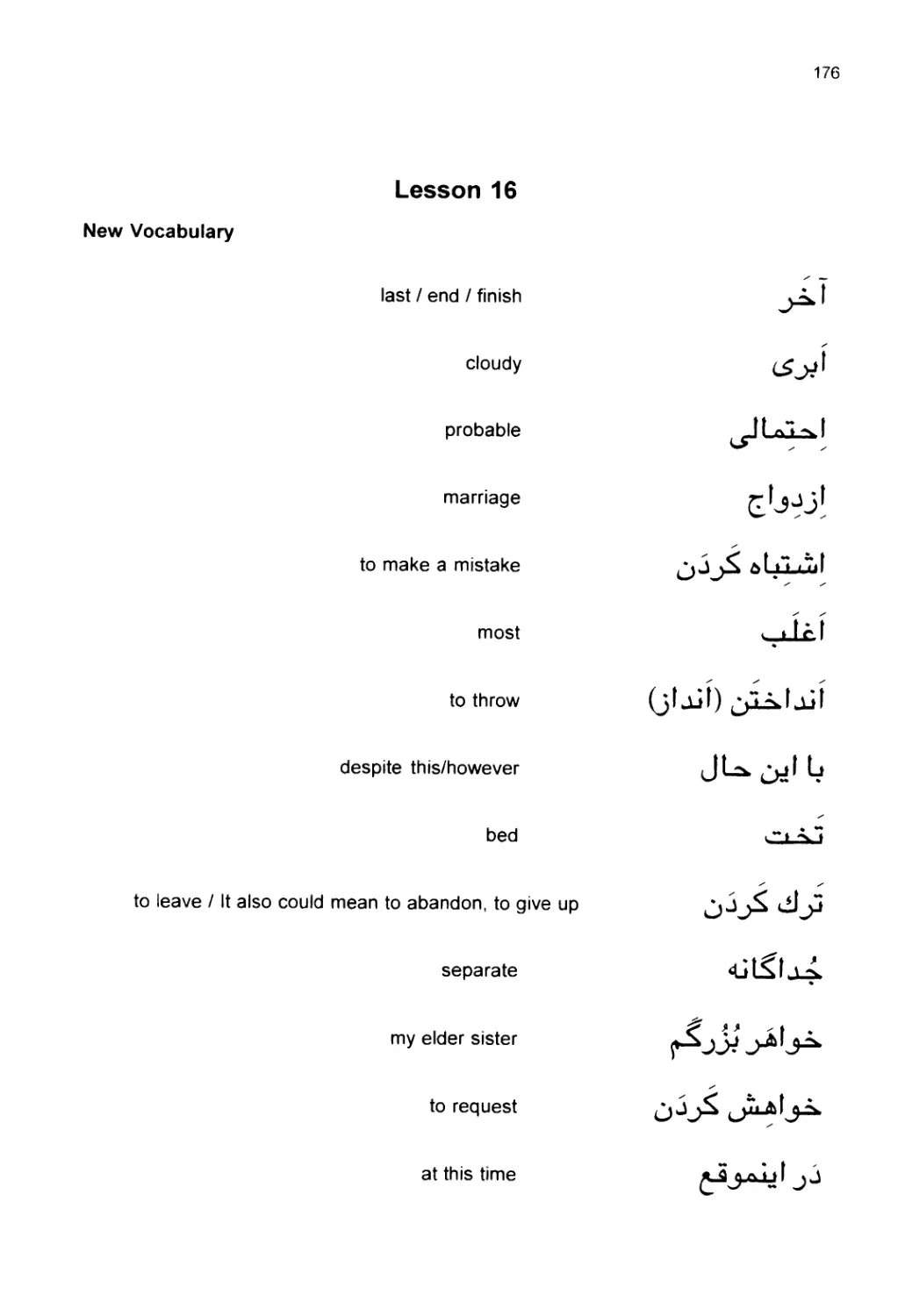
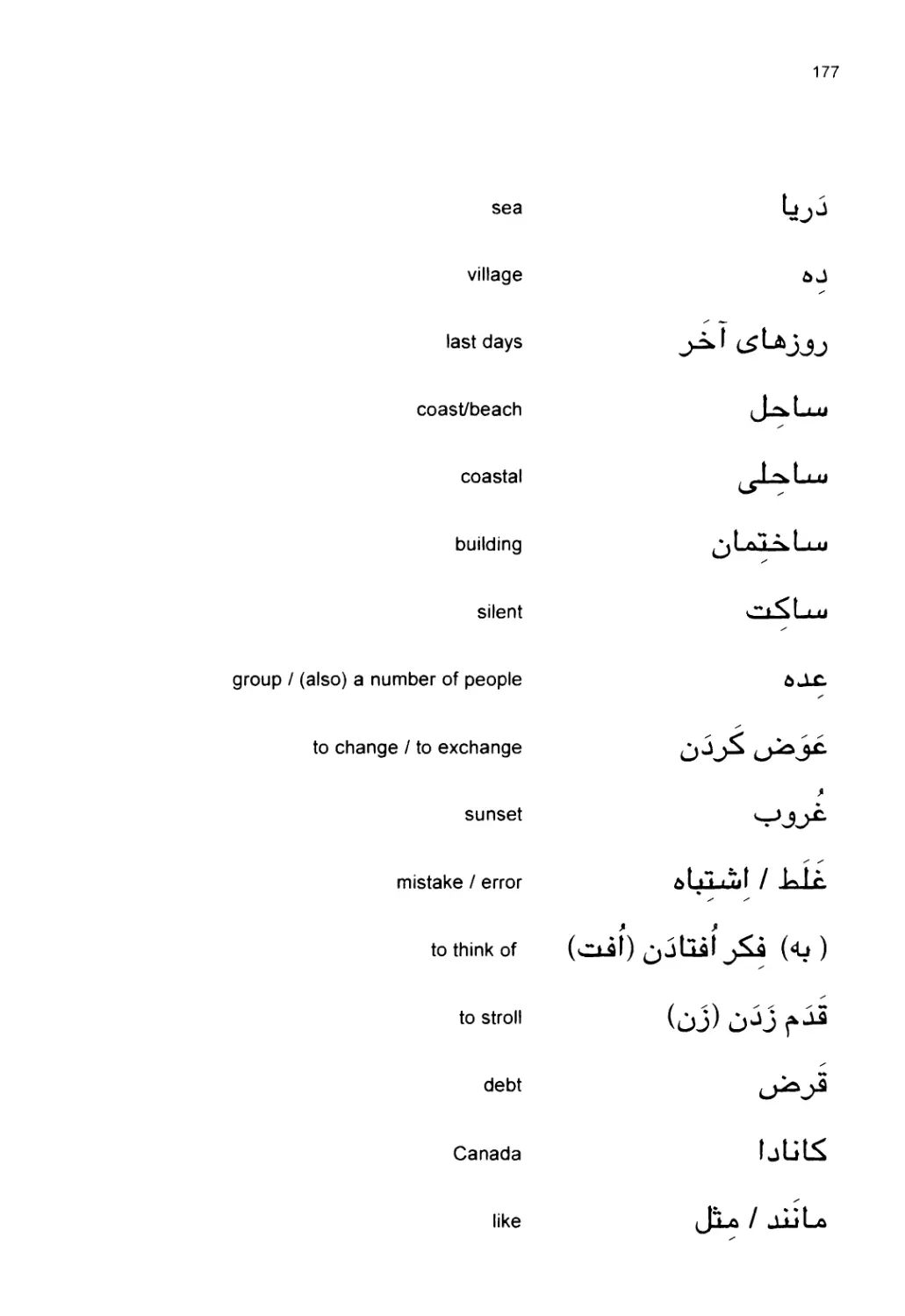
New vocabulary	176
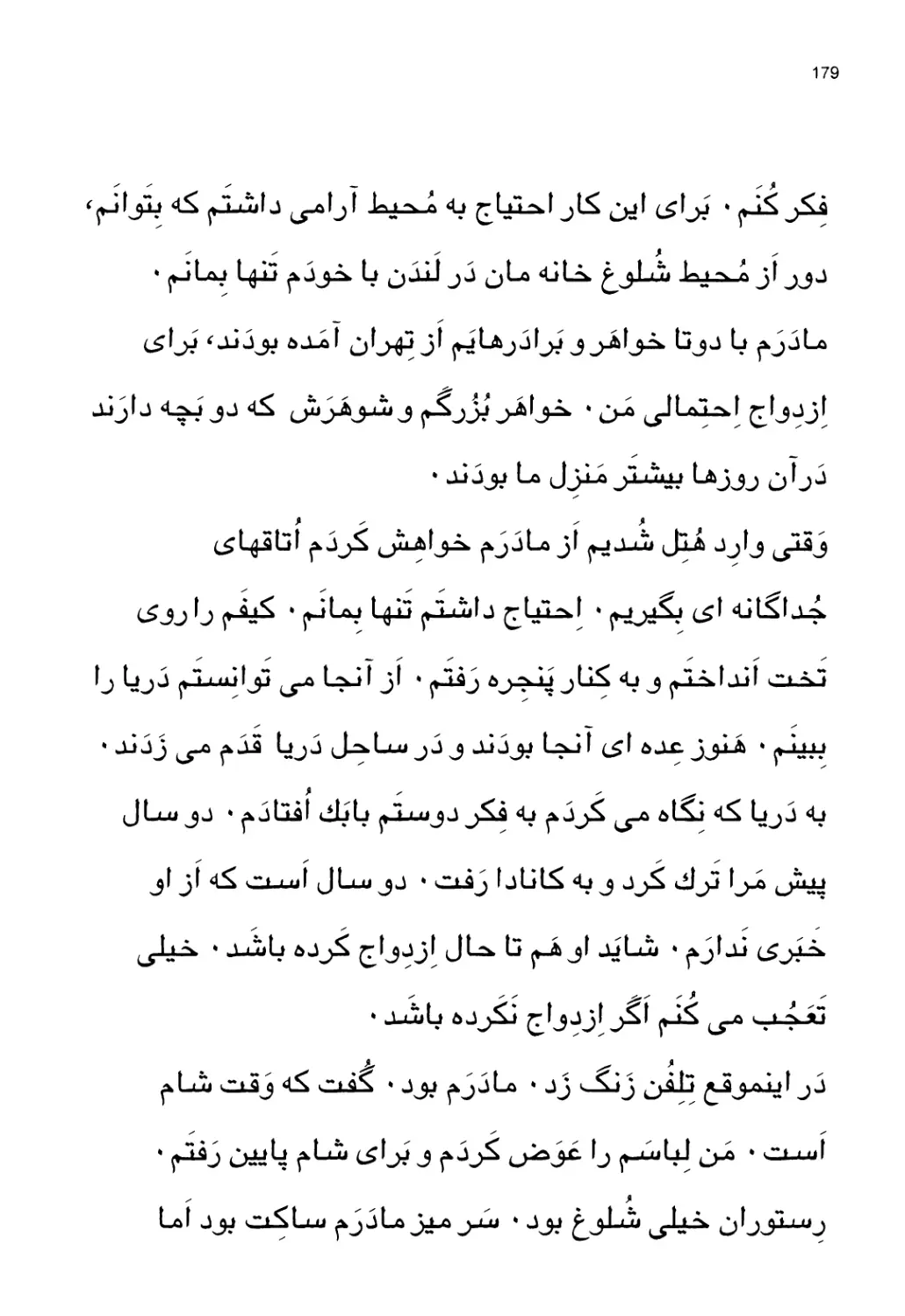
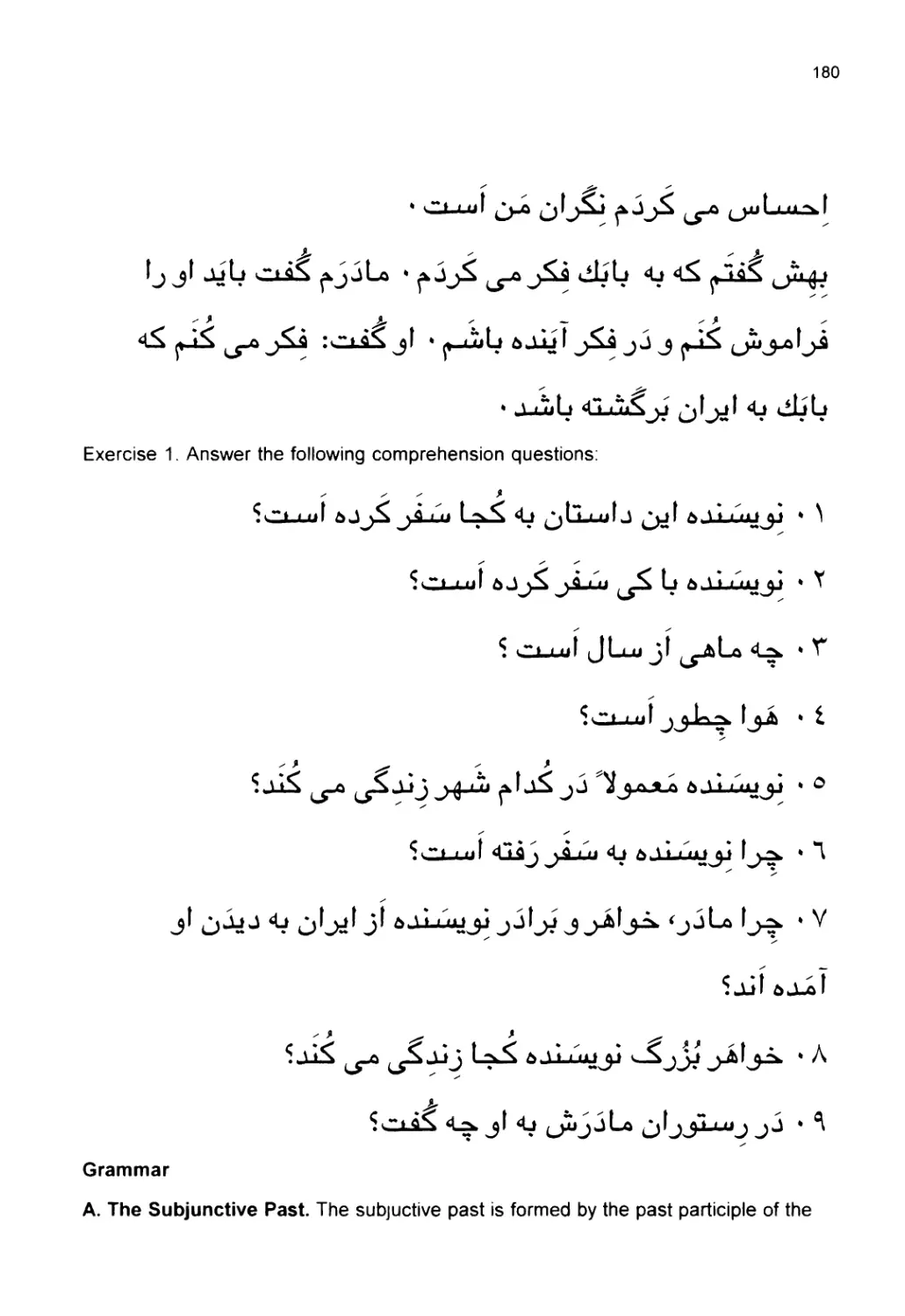
Text	178
Grammar:
The subjunctive past	180
The relative clause	181
Exercises	184
Lesson Seventeen
New vocabulary	188
Text	191
Grammar:
Conditional sentences	193
The causative verb	195
Exercises	195
Appendix A
Colloquial Persian	199
Exercises	202
Persian - English Glossary	204
Index	258
Acknowledgements
Many people have contributed to the making and production of this book.
Foremost, I'd like to thank my husband Terence whose support over the years made completion of this book possible.
I would also like to thank Edmund Herzig for his invaluable comments on the manuscript and the Media Centre of Manchester University for the production of the audio recording of this book.
I would also like to express my appreciation for the help and encouragement that I received from Robert Hillenbrand, Yasir Suleiman and Carole Hillenbrand at Edinburgh University.
I would also like to offer my warm thanks to the Iran Heritage Foundation for the award of a grant which enabled me to complete this book.
Finally, I would like to acknowledge all that I gained from the students who I taught during my three years at the Islamic and Middle Eastern Studies Department of Edinburgh University.
Introduction
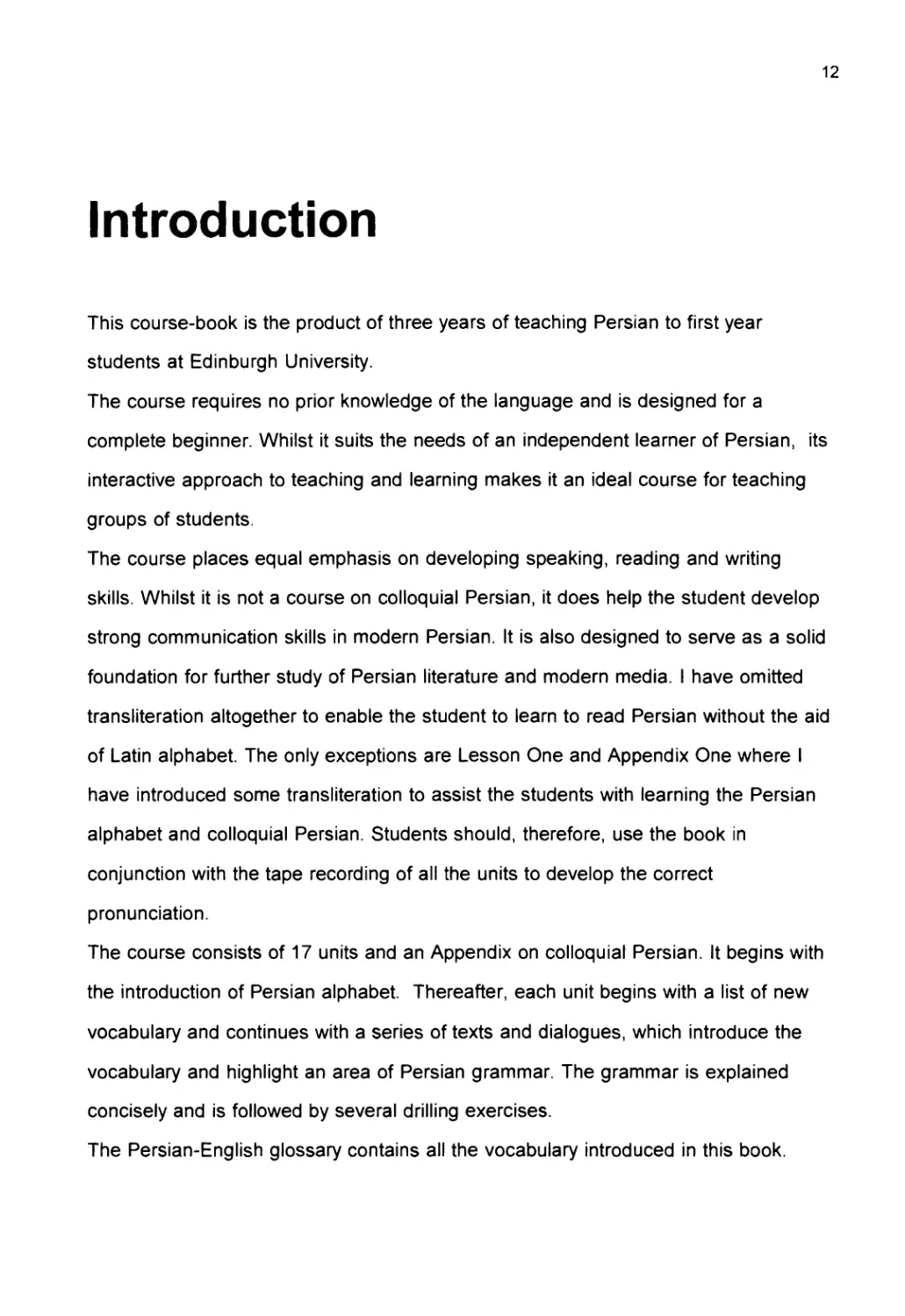
This course-book is the product of three years of teaching Persian to first year students at Edinburgh University.
The course requires no prior knowledge of the language and is designed for a complete beginner. Whilst it suits the needs of an independent learner of Persian, its interactive approach to teaching and learning makes it an ideal course for teaching groups of students.
The course places equal emphasis on developing speaking, reading and writing skills. Whilst it is not a course on colloquial Persian, it does help the student develop strong communication skills in modern Persian. It is also designed to serve as a solid foundation for further study of Persian literature and modern media. I have omitted transliteration altogether to enable the student to learn to read Persian without the aid of Latin alphabet. The only exceptions are Lesson One and Appendix One where I have introduced some transliteration to assist the students with learning the Persian alphabet and colloquial Persian. Students should, therefore, use the book in conjunction with the tape recording of all the units to develop the correct pronunciation.
The course consists of 17 units and an Appendix on colloquial Persian. It begins with the introduction of Persian alphabet. Thereafter, each unit begins with a list of new vocabulary and continues with a series of texts and dialogues, which introduce the vocabulary and highlight an area of Persian grammar. The grammar is explained concisely and is followed by several drilling exercises.
The Persian-English glossary contains all the vocabulary introduced in this book.
Lesson One
Persian Alphabet
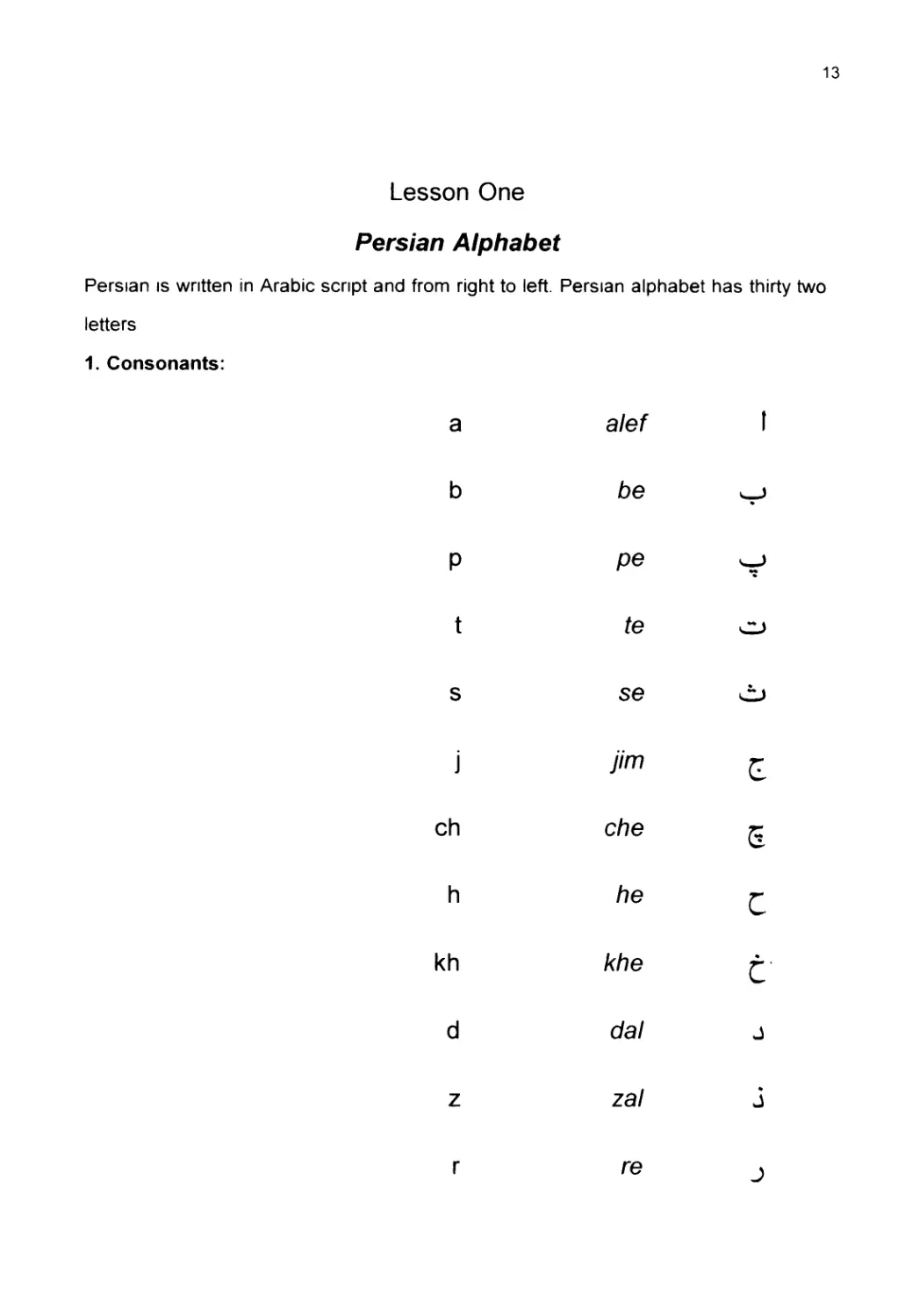
Persian is written in Arabic script and from right to left. Persian alphabet has thirty two letters
1.	Consonants:
a	alef	I
b	be	J
P	pe
t	te	CJ
s	se
j	jim	G
ch	che	S
h	he	C
kh	khe	C
d	dal	□
z	zal	j
r	re	j
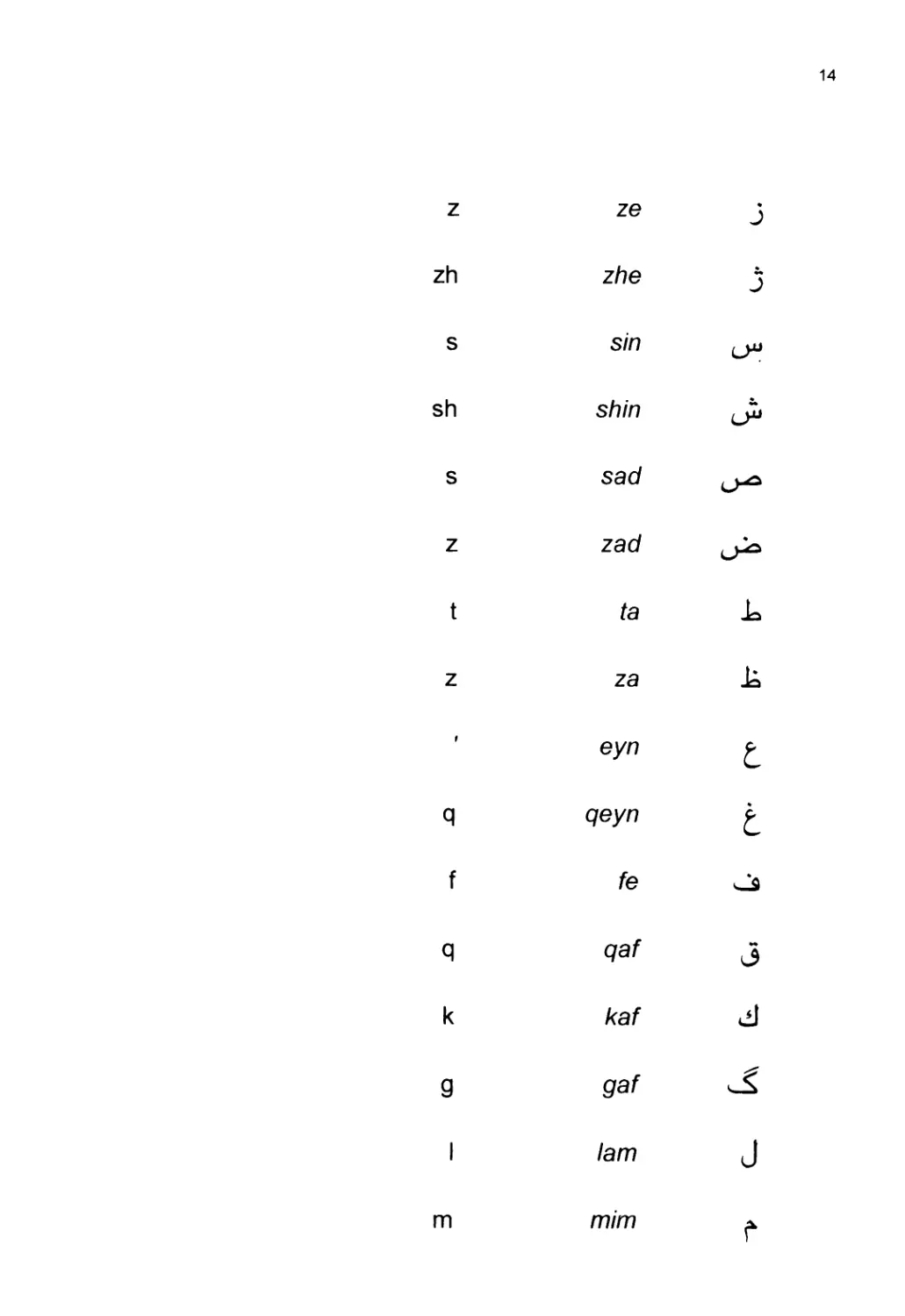
zh s
sh s z t z
I
q f
q к
g
i m
zhe sin shin sad zad
ta
za
eyn qeyn
fe qaf kaf gaf lam
mim
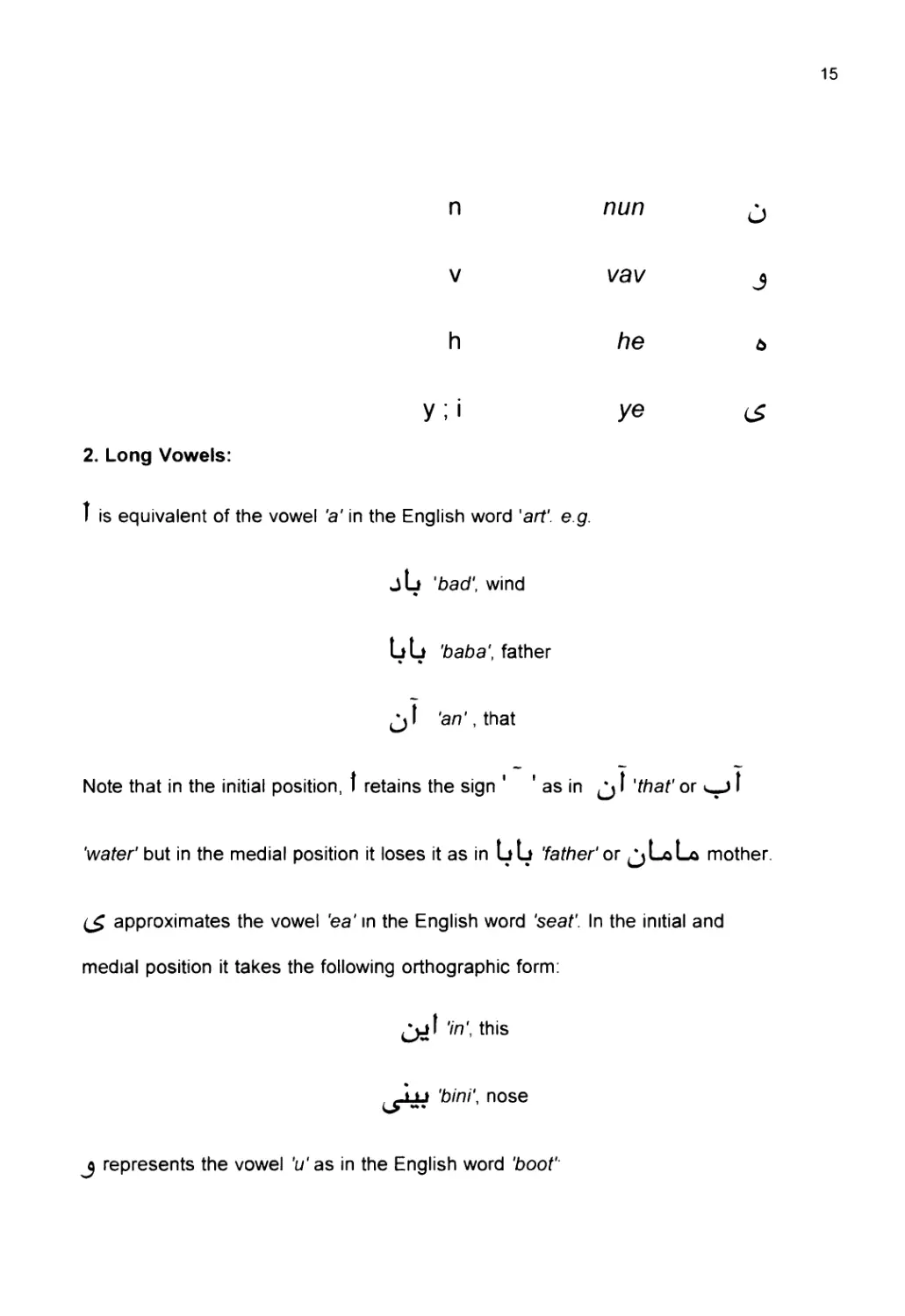
n	nun	J
v	vav	j
h	he	6
У;।	ye
2.	Long Vowels:
1 is equivalent of the vowel 'a' in the English word 'art', eg.
'bad', wind
LL 'baba', father
'an', that
Note that in the initial position, I retains the sign ' ' as in I 'that' or I 'water' but in the medial position it loses it as in LL 'father' or JjLqLc mother.
approximates the vowel 'ea' in the English word 'seat'. In the initial and medial position it takes the following orthographic form:
'in', this
j represents the vowel 7/as in the English word 'boot'
J'bud' He/she or it was.
'bu', smell
3.	Short Vowels:
The short vowels are represented by signs only:
'a' represents the English vowel 'a' as in the word 'bad':
j J 'dar', door
j-jlu 'sar', head
is the equivalent of the vowel 'e' in the English word 'bed':
p—luI 'esm', name
'ers', inhertance я
represents the vowel 'o' as in the word 'bored':
я
jLLI 'otaq\ room
я Jj 'por', full
Note that normally the short vowels are not marked.
Also note that the letter 6 in its final position sounds like the short vowel 'e':
'bache', child
4.	Diphthong:
'ey' is very similar to the sound 'a' in the word 'jade':
Initial
Medial
'ey wan'
(Jxxjj 'sey/', flood
jI 'aw' is close to the sound 'aw' in the word 'awful':
'awlad'
5.	The orthography of Persian alphabet changes according to the initial, medial or final position of the letter in a word.
An Exercise:
Final	Final	Medial	Initial	Letter
separate	joined
'dara' Ijlj	'ba' Lt	'bad' J Lt	'ab' jl	'alef' I
			'asb' <_lxuI
'ab'	'asb\i t ul	'shabnam' tt i7i	'baba' LLt
'soup'	JJJuU	'chap'	'ashpaz' jlxb I	'pa' ь	'pe'
'mat' CjLa 'hast' Ct i и A		'nistam' 5 11л t	'ta' Lt	?e'CJ
'vares' Ojlj	'ba's" C-LC Lt	'kasif s .VK	'sabt' Clu	'se' О
'kharj'	'kaj'	'koja' I *4*4	'ja' Lk
'mach' ^Lo 'hich' gj-A	'kuchek' dLb,^^	'chai' Ць,	'che'
'madh' jL 'sobh' ^c-j a a	'mahram'	'hal' J Lb,	fie'
'makhfi'	< a	'sakht' C* /n	'khar' jLk	ktr Q
'zad' J J	'bad' Jj	'medad' jljuo	'dar' j J	dal' J
	'kaqaz'	jx.L£	'razl' Jjj	'zat' culj	'zal' J
'dar'jlj 'sar' j_lu	'mard'	'ra' lj	're’j
'raz'jlj 'miz' Jxa	я 'mozd'	'zan' j J	'ze' j
'tirazh' Jljjj 'kazh'j^	'azhans' ^jxul J1	'Zhaleh' <1 lj	'zhe' j
'das'llJ 'das' qau	'shast'	'sard' Jj-jlu	'sin'
'nush'	'shesh' ^jL-juu	'/shan' jjLuujI	'shad' J Luu	'shin'
'khas' ^j-oLk (nas)	'mesr' j	'sabr' j j 1/3	'sad'
'avaz	'ariz ^pajjX.	'ba'zi' ^-aaju	'zalem' ^JL-b	'zad'
'rebat' la Lj 'rabt' lajJ	'matah'	'taraf	'ta' -L
'hefaz' lali^ 'qaliz' l\tlc	'mazhar'	'zohr'	'za' la
'veda" 1Jj ’jam' '	'ba'd' Jju	"eyd' Jjl£.	'eyn'
daq'	'baliq' £j!j	'maqreb'	'qarib'	'qeyn'
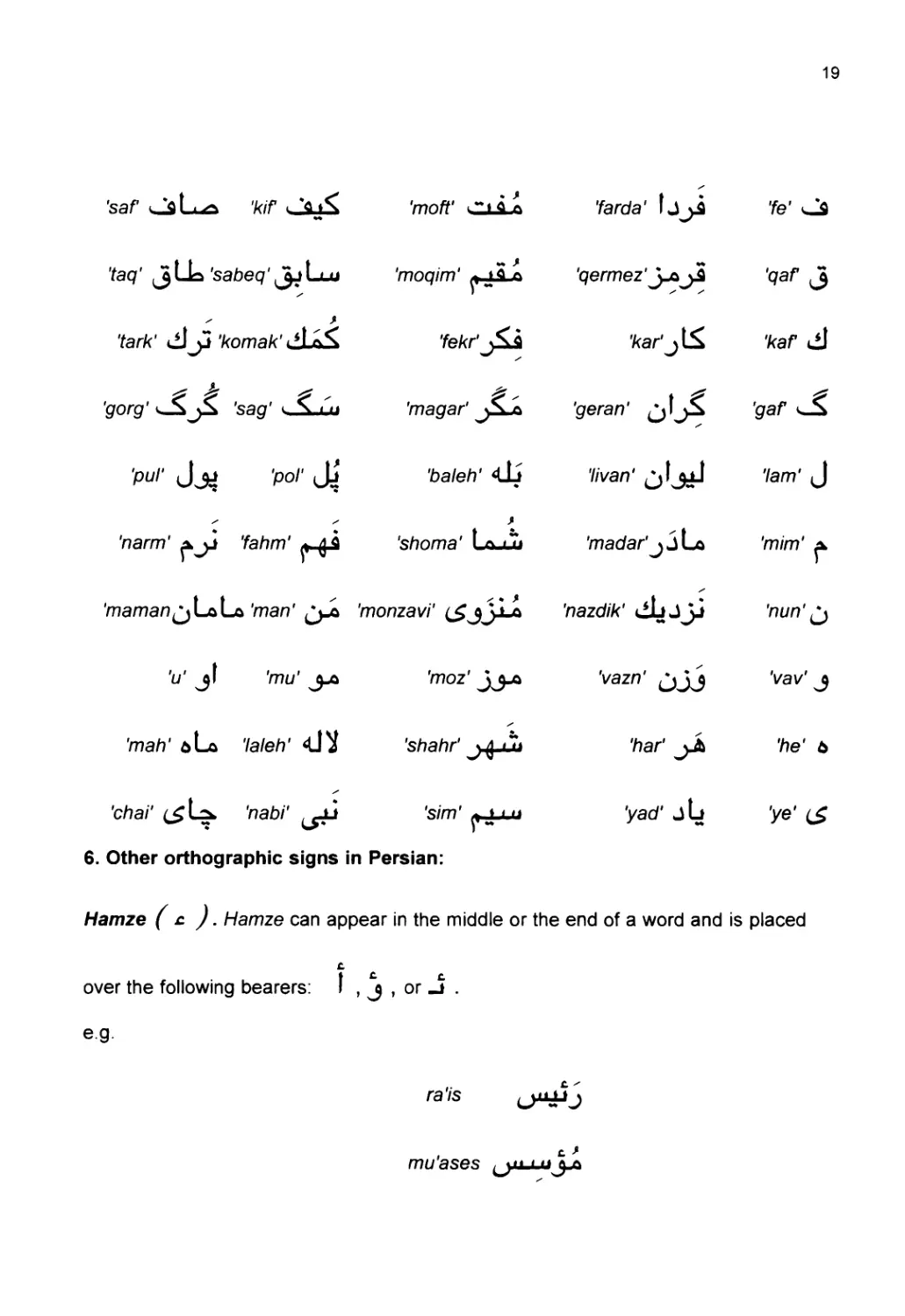
'saf CsLuo
'kif
'taq' 3 LL 'sabeq' Jjj Llu
'tark' dljJ 'komak'
'gorg'	'sag' i
'pur Jjj 'pol' Jj
'narm' jxjj
'fahm'
'moft' C1Aa
'moqim' &
'fekr'j&i
'magar'
'baleh' <dj
'shoma' Lg-uj
'farda'
'qermez'jjbjf
'kar'j\£
'geran'
'livan' (jljxl
'madar'j jLo
'nazdik' dLjjj
'fe' Cs
'qaf J
'kaf d!
'gaf
'lam' J
'mim'
'nun'
'maman^LoLo 'man' 'monzavi'
'u' jl	'mu' j-a	'moz' j3-a	'vazn' JjJ	Vav' J
'mah' &Lo	'laleh' <1^1	'shahr'	'har' jJb	'he' 6
'chai'	'nabi'	'sim' jt-Lxu	'yad' jLj	'ye'
6. Other orthographic signs in Persian:
Hamze ( ^ ). Hamze can appear in the middle or the end of a word and is placed
over the following bearers: I , j , or «5 .
eg
ra'is
mu'ases i
ra's
At the end of a word, hamze can appear on its own without a bearer:
insha1 cLllmI
In spoken Persian, sometimes for ease of pronounciation the hamze -J changes to
(dastshui) i.7u < mJ
(joziat)	CJ LyjJL
(daneshjui)	ни IJ
(dastshu'i) jp.u*? i.uj
(joz'iat) CjLpJji
(daneshju'i)	мл IJ
Tashdid ( *) . Tashdid marks a double consonant. The consonant is written only
once but the tashdid sign over it doubles the sound:
Tashdid is seldom marked in writing but it should be strictly observed in
pronounciation.
Tanvin ( ). This sign appears over an a/ef I and sounds 'an'. e.g.
taqriban
hatman
Lesson 2
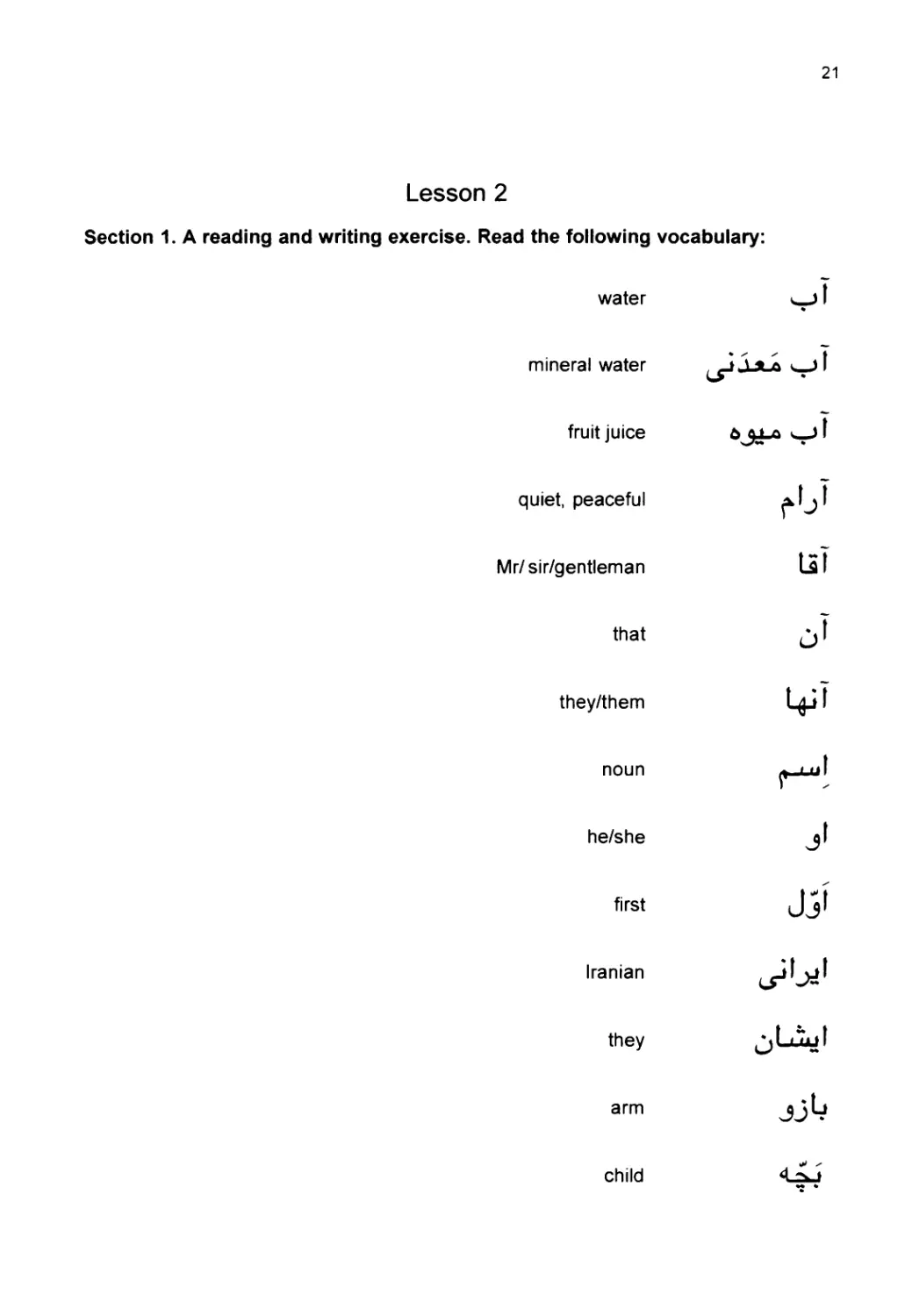
Section 1. A reading and writing exercise. Read the following vocabulary:
water mineral water fruit juice quiet, peaceful
Mr/sir/gentleman that they/them noun he/she first
Iranian they arm
child
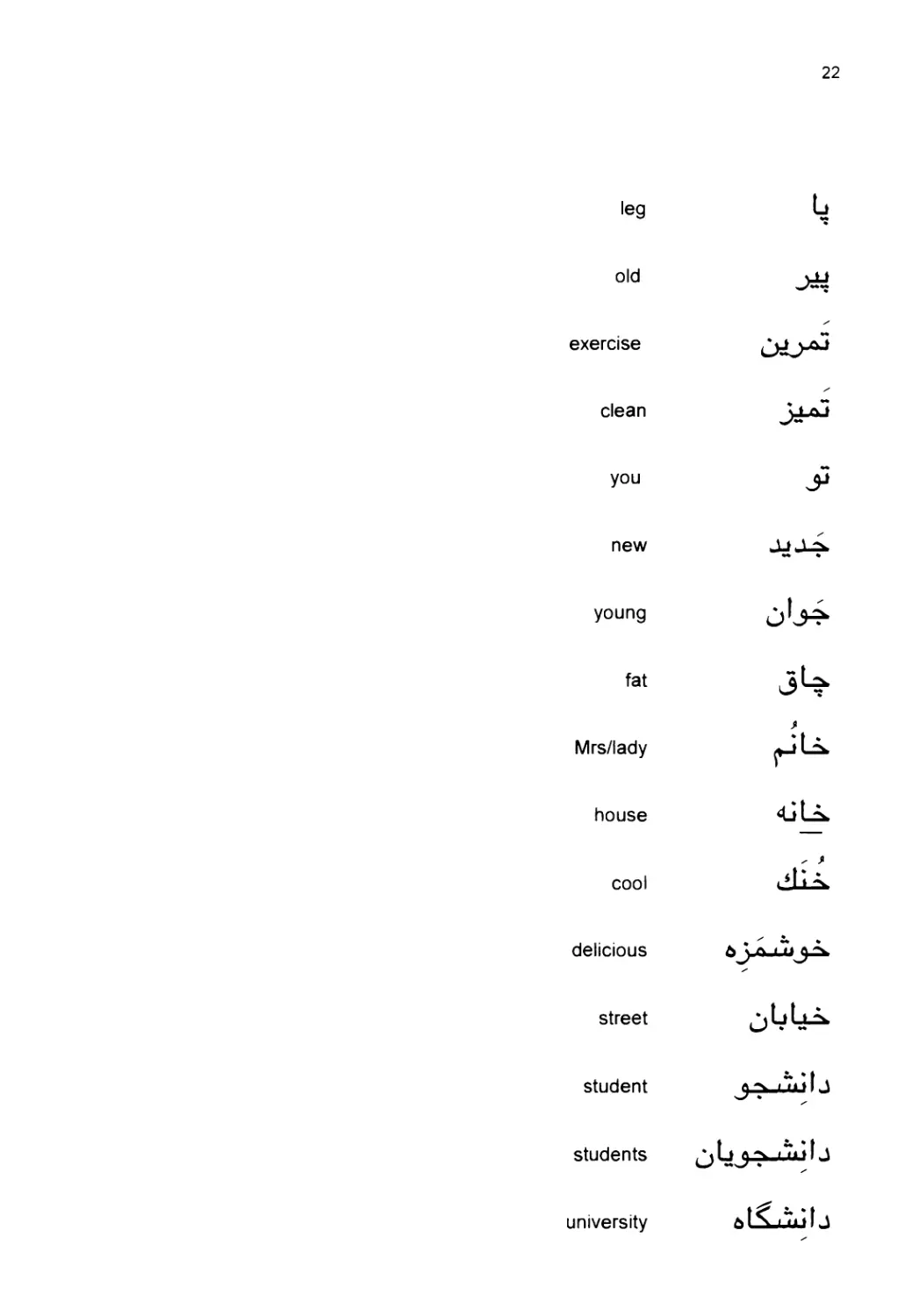
leg	L
old
exercise
clean
you	5»
new	jjj-a-t
young
fat	зЦ*
Mrs/lady
house
cool
delicious	6j-ajuu^5-^
street
student
students	1J
Лн1 J
university
girl/daughter
second woman
beautiful cold
busy you
city milk
adjective food
carpet tall
short
book
short
small
child
cat
slim/thin
clothes
we	Lo
car	Л11ZS
man
people
Mashhad, a city in North East Iran	J (] ХЛХ Г>
shop
I hair
table
neighbour
newborn
Section 2:
A. The Personal Pronouns. The personal pronouns are as follows:
	plural		singular
1st person	we	La	I	0-^
2nd person	you	я	you	5»
3rd person	they	jlAjI	he/she	У
	they	L^i	it	oi
B. The ezafe, Possesive and Adjectival
(AjLjal)
The function of ezafe
is to join two nouns, or nouns and adjectives. It is
pronounced *e* or 'ye' and on words ending in consonants it is represented by the sign
). When added to words ending in the vowels I 'a' or j 'u', the ezafe is
represented by the letter T and is pronounced 'ye'.
In modern Persian usually the ezafe is not marked in writing but it should be read into the text. There are two types of ezafe : possessive and adjectival.
B.1.	The possessive ezafe. This denotes possession. It is added to the thing possessed which precedes the possessor:
our book La
my book
your book
your book
their book	His/her book jl
< , /
Note that here the combination of the personal pronoun and the ezafe approximates
the English possessive adjective, e.g.
My table
B.2.	The adjectival ezafe: In Persian the adjective normally follows the noun and joins
it with an ezafe:
the young woman
the old man
the small child
If more than one adjective qualifies the noun, the ezafe is added to the noun and to
each adjective except for the last one:
the slim old man
the beautiful young woman
the cool mineral water
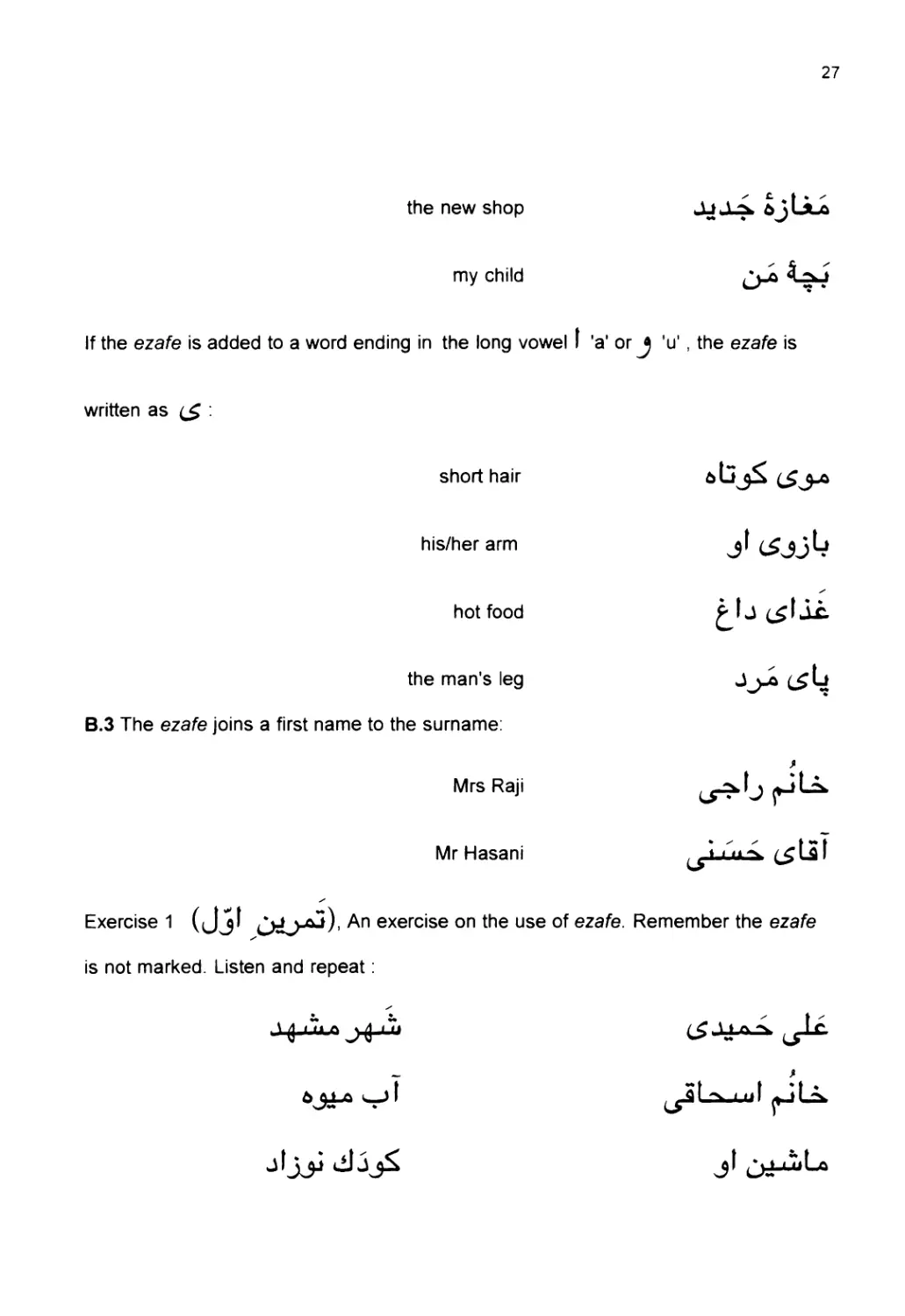
If the ezafe is added to a word ending in the silent h ( 6 ) , it is written as
hamza (	) which is placed over the silent h. The hamza is usually omitted in
writing but it should be read into the text:
the old house

the new shop
my child
If the ezafe is added to a word ending in the long vowel I 'a' or J 'u' , the ezafe is
written as :
short hair
his/her arm
hot food
the man's leg
B.3	The ezafe joins a first name to the surname:
Mrs Raji
Mr Hasani

Exercise 1 (Jjl <30^exerc'se on the use °f ezafe Remember the ezafe
is not marked. Listen and repeat:

6
iMtl \	<7itl \
jLkf, C^lSl
(_я>
allj ^J_a
jx IJI <U Lui ftJb
Exercise 2 (^xj J	Translate to Persian using the possessive ezafe:
my pen	our bag
their house	your (s.) university
her chair	your (p.) old car
my table	our young daughter
your (s.) child	their friend
their neighbours	his long hair
Exercise 3	Join the appropriate nouns and adjectives using the
adjectival ezafe :
Noun	liI	Adjective
woman	Qj	delicious
cat	busy
street
cold
milk		slim/thin
drink	d <7^	tall	aiB a5
clothes	(_>uLJ	clean

food	lac	warm
man	Jj-0	short	бЬ
New Vocabulary:
Lesson 3
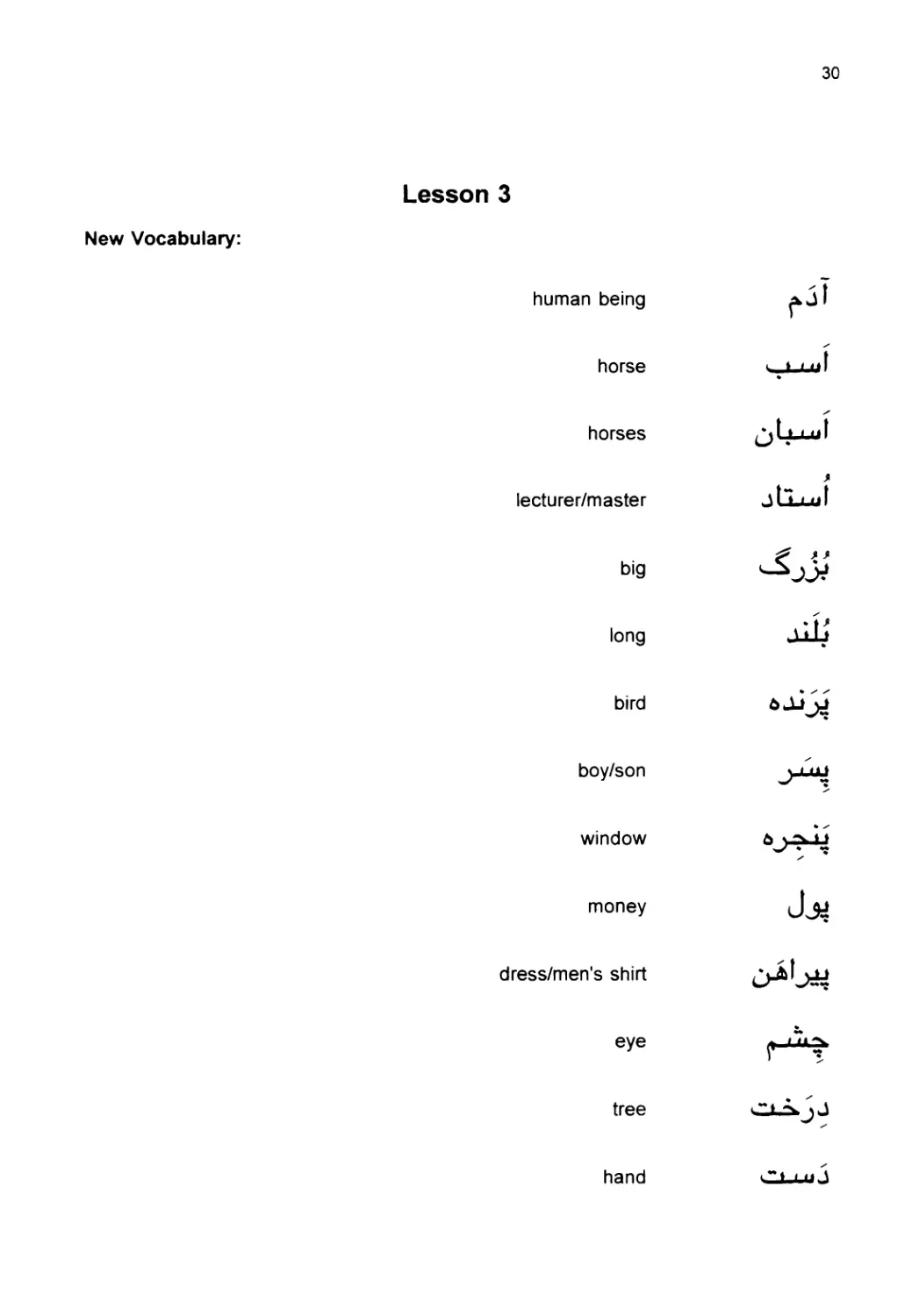
human being horse
horses
lecturer/master
big long
bird boy/son window
money
dress/men's shirt
eye tree
hand

CXJ-U J
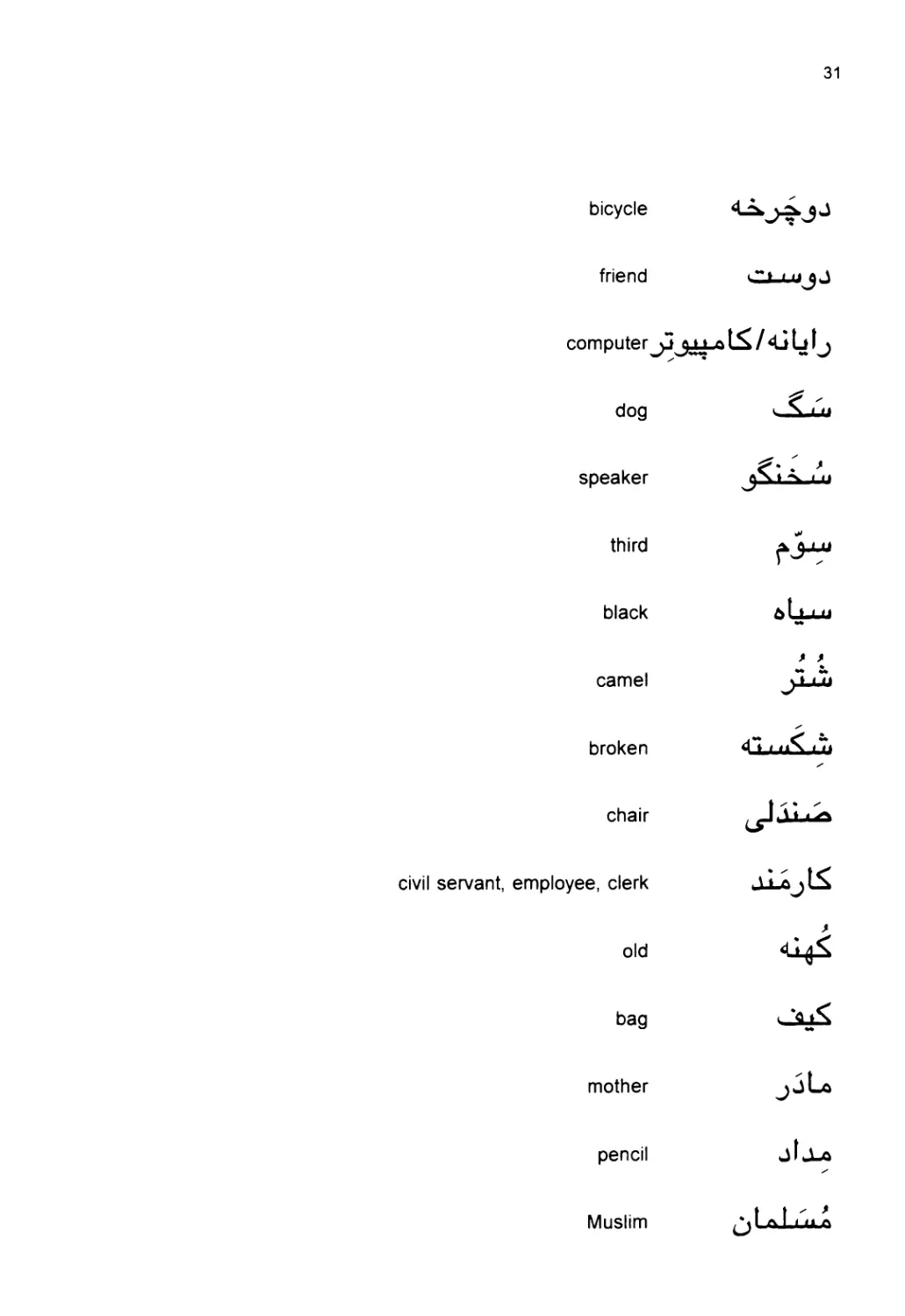
bicycle
friend
computer jjjxla / <S L lj
dog	i
speaker	4 ui
third
black
camel
broken
chair
civil servant, employee, clerk old
bag
mother
pencil
Muslim
4 l. J <X LG
JOLLA
teacher
A.	The Plural. This section is only concerned with the Persian plurals. A noun is
made plural in the two following ways:
A.1 By adding U to the noun. In colloquial Persian, this ending is used for all
nouns:
plural


A.2 By the addition of qI to the noun. This method is only used for animate beings including the names of the majority of animals, some plants and some parts of the body:
plural
singular


ft IJ U ft
If the word ends in the long vowel j or I
xlulj (student) and LSI
(Mr/gentleman/sir), a is inserted between the j or I and the suffix
jLUSl
isi
When the plural suffix <jl is added to a word ending in silent 'h', the silent 'h' is
dropped and the letter is inserted before the suffix:
Note: In spoken Persian, Iranians tend to use the plural suffix Lb indiscriminately for
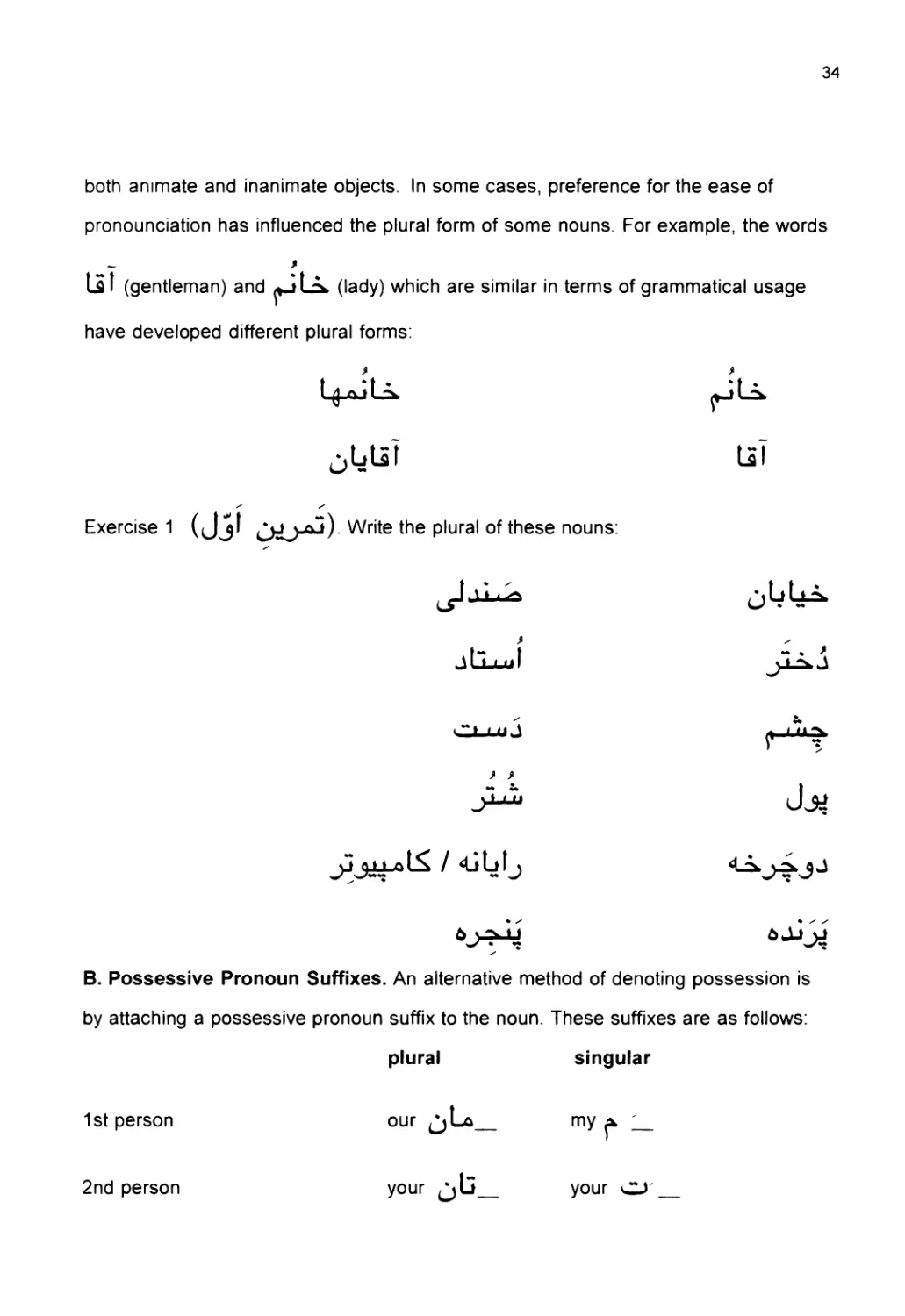
both animate and inanimate objects. In some cases, preference for the ease of pronounciation has influenced the plural form of some nouns. For example, the words
LSI (gentleman) and (lady) which are similar in terms of grammatical usage
have developed different plural forms:
Exercise 1 (Jjl	Write the plural of these nouns:
j'jjj atC / <GLI
B.	Possessive Pronoun Suffixes. An alternative method of denoting possession is
by attaching a possessive pronoun suffix to the noun. These suffixes are as follows:
plural	singular
1st person
2nd person
our (jLx. your jb
your O)
3rd person
their (jLui 	her/his/its
B.1. If the word ends in a consonant or in the vowel T, the suffix is directly
attached.
our book		my book
your book		your book
their book	0 Luu 11^	her/his book
B.2. If the word ends in the silent 'h', in the singular only, an
is inserted before the
suffix. Note that the suffix does not join the silent 'h' :
our child		my child	e1'	*? •
your child		your child
their child	jLi 4^5	her/his child	(jlll <
If the word ends in the long vowel I 'a' or j 'u', a is inserted between the word
and the suffix:
your hair
my leg

If a noun is qualified by an adjective the possessive suffix joins the adjective and not
the noun:
her/his old mother

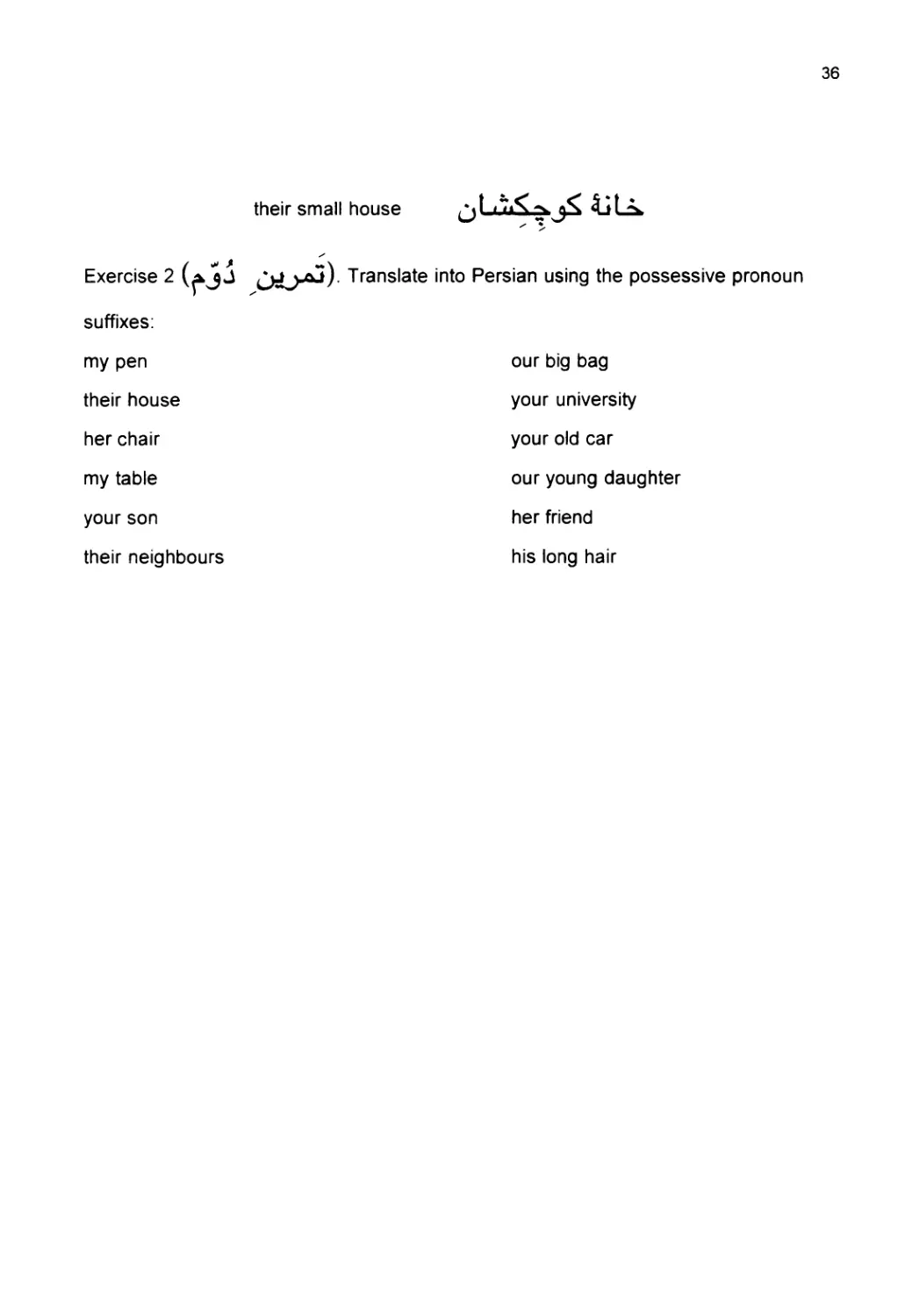
their small house

Exercise 2 (jxjJ	Trans,ate into Persian using the possessive pronoun
suffixes:
my pen	our big bag
their house	your university
her chair	your old car
my table	our young daughter
your son	her friend
their neighbours	his long hair
New Vocabulary:
Lesson 4
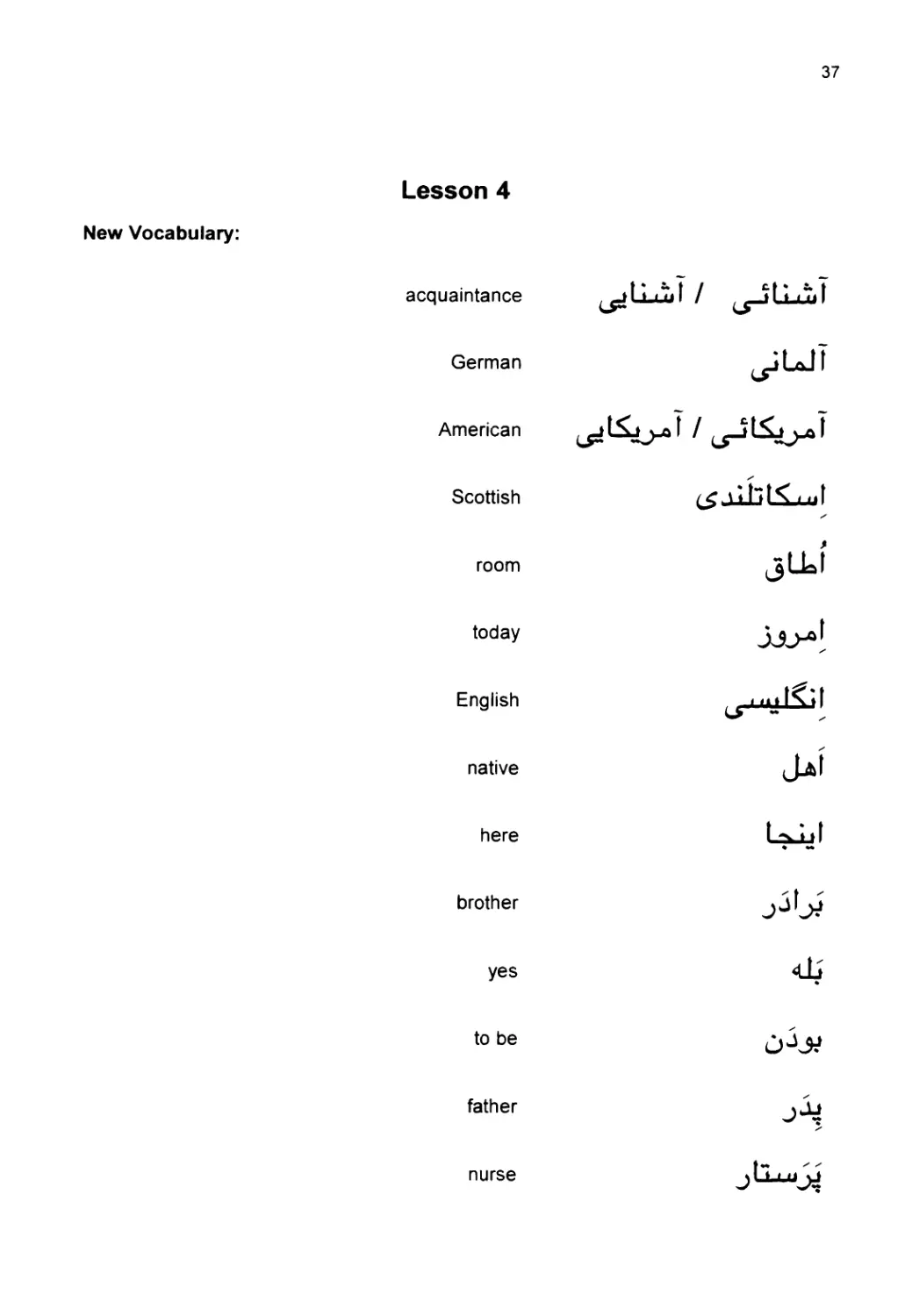
acquaintance German
American
Scottish room today
English native
here brother
yes to be
father nurse
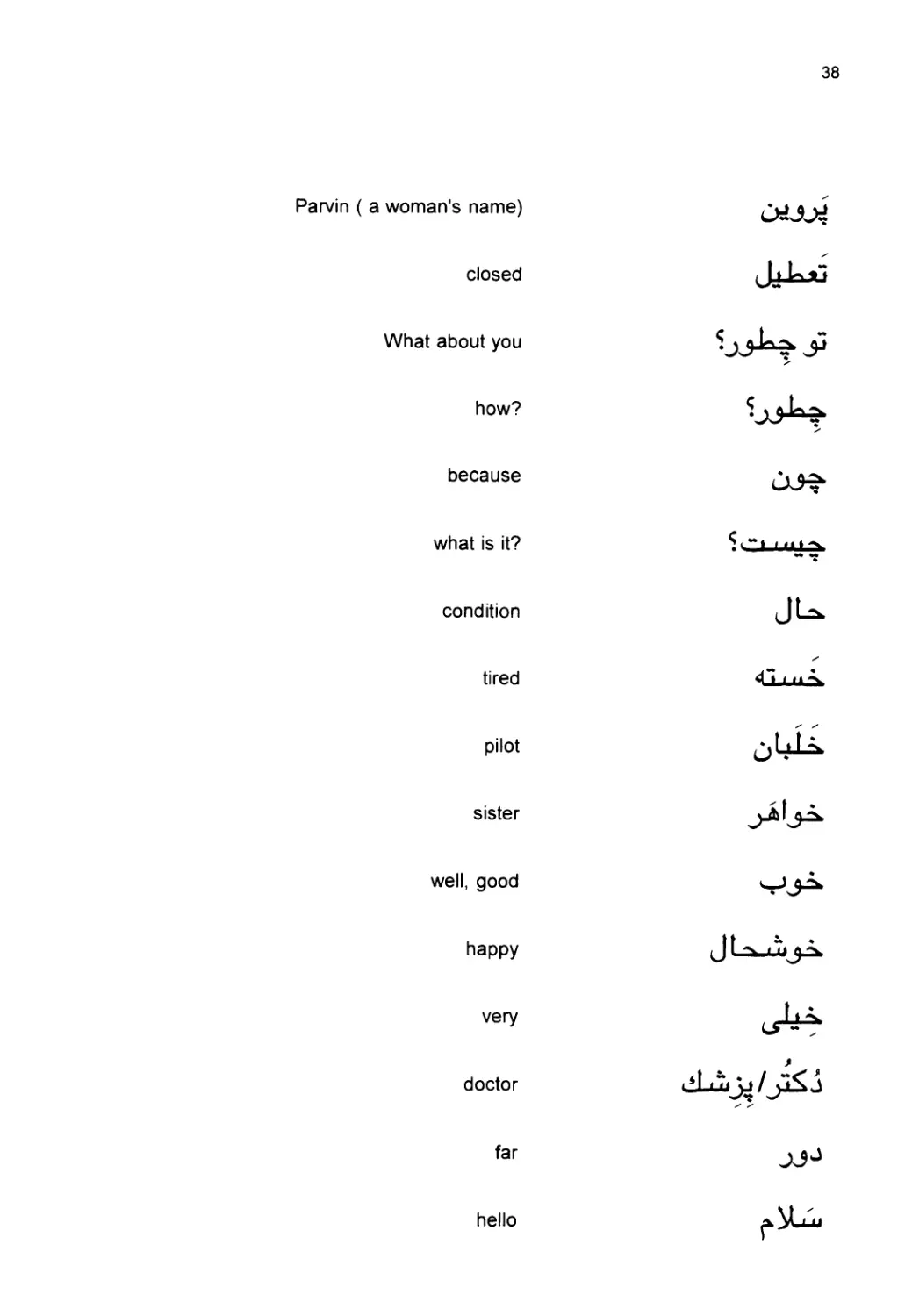
Parvin ( a woman's name)
closed
What about you how? because what is it? condition tired pilot sister well, good happy very doctor far
hello
cinema
job good morning holiday/celebration French tomorrow library where? a little who is (he/she)? thankful like ill/invalid Maryam (a woman's name) passenger/traveller
near
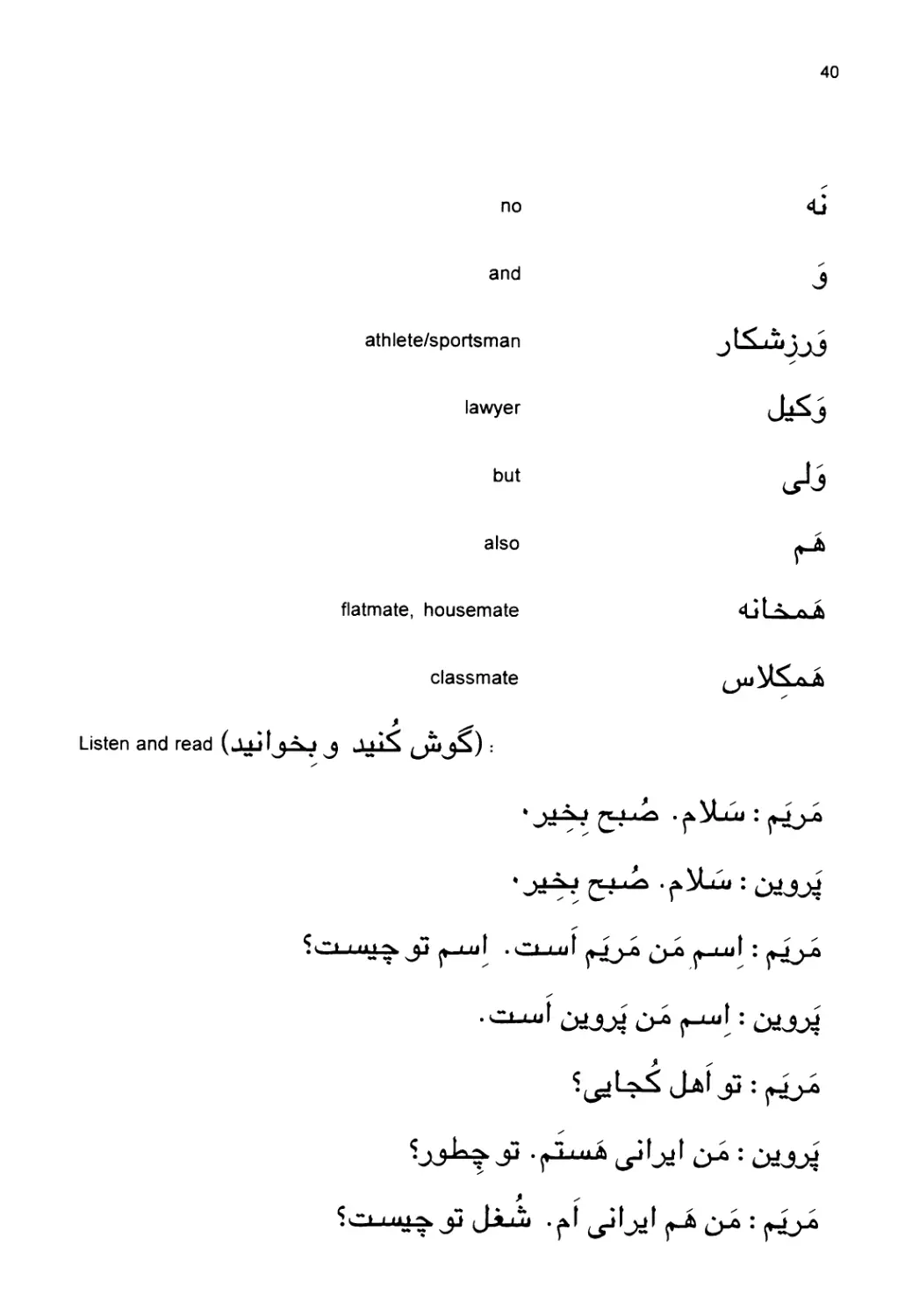
ПО
and	J
athlete/sportsman
lawyer
but	urG
also
flatmate, housemate	\ xx A
classmate
Listen and read (iptjAj J	cP3S) :
•	^4^» -f^Luu : JJjjJ

=» jCbJlLil jl: jjjjj
Grammar:
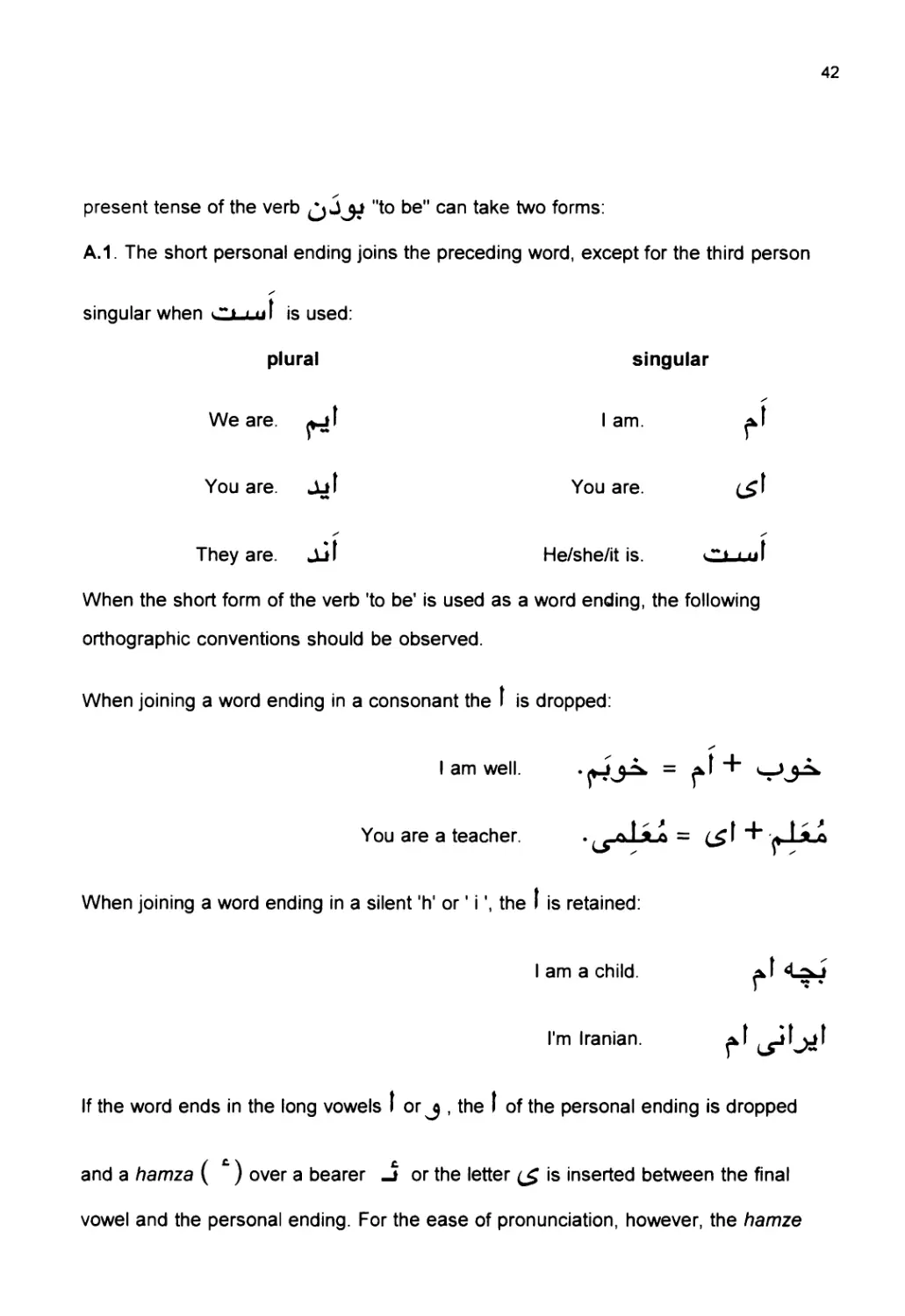
A. Present Tense of the Verb J Jjj ”to be” . As the text above illustrates, the
present tense of the verb q "to be" can take two forms:
A.1. The short personal ending joins the preceding word, except for the third person
singular when O-luI is used:
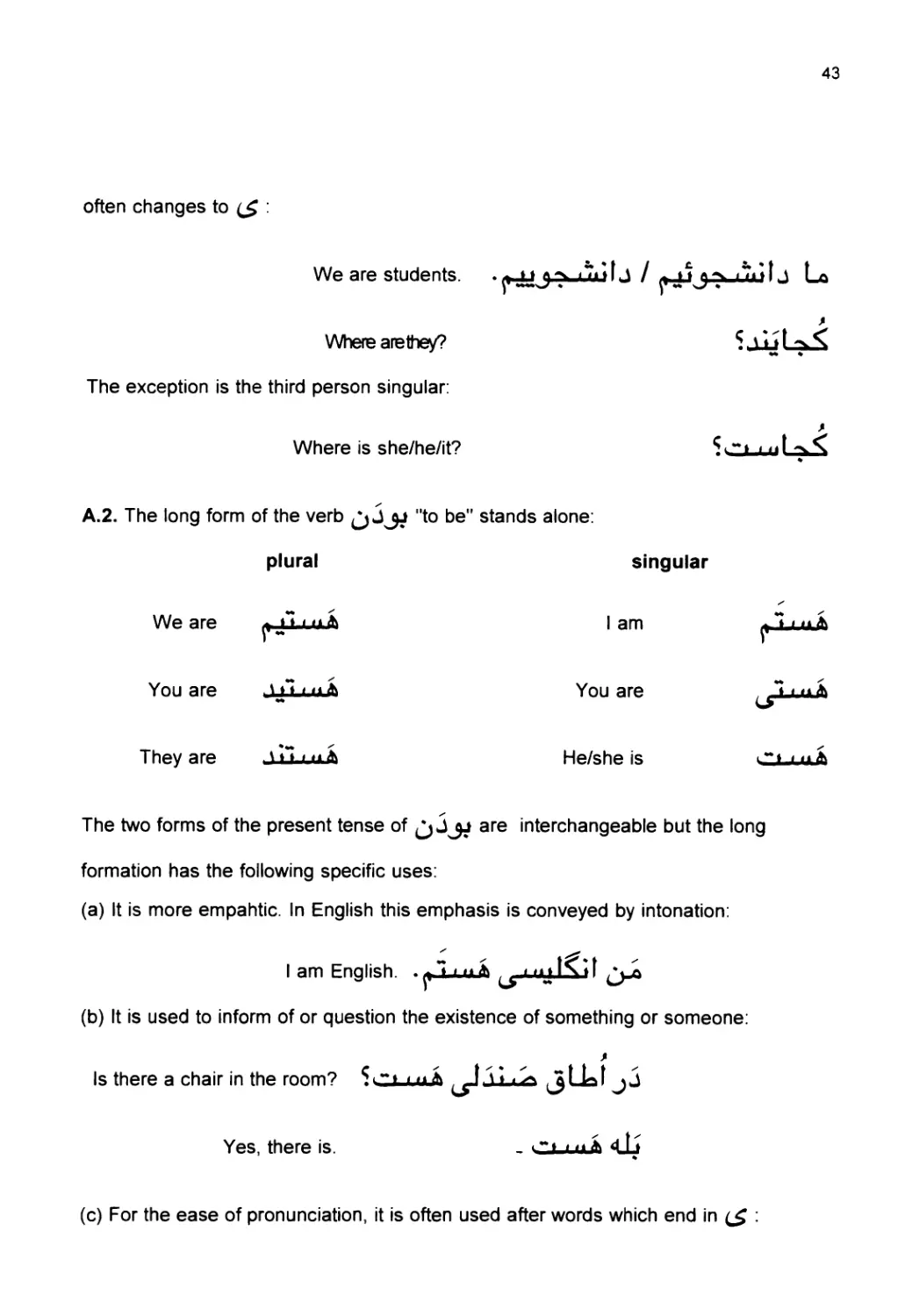
plural			singular
We	are.		I am.	f'
You	are.	jjI	You are.
They	are.		He/she/it is.	‘ “I
When the short form of the verb 'to be' is used as a word ending, the following orthographic conventions should be observed.
When joining a word ending in a consonant the I is dropped:
I am well.
You are a teacher.
When joining a word ending in a silent 'h' or' i', the I is retained:
I am a child.
I'm Iranian.
If the word ends in the long vowels I or j , the I of the personal ending is dropped
and a hamza ( ) over a bearer or the letter is inserted between the final
often changes to :
We are students.
Where are they?
The exception is the third person singular:
Where is she/he/it?
A.2. The long form of the verb "to be" stands alone:
	plural	singular
We are		1 am
You are	LU A	You are	mi A
They are	ClU U Д	He/she is	L ** I i U &
The two forms of the present tense of & are interchangeable but the long formation has the following specific uses:
(a)	It is more empahtic. In English this emphasis is conveyed by intonation:
(b)	It is used to inform of or question the existence of something or someone:
Is there a chair in the room?	JjLial jJ
Yes, there is.
(c) For the ease of pronunciation, it is often used after words which end in :
Are you German?

A.3. The negative form of the verb Jjj. Only the long form of this verb can be
made negative. Simply the initial letter A is replaced by the prefix J (ni) :
	plural	singular
We are not.	pH <4i>	I am not.
You are not.	IHXUH	You are not.
They are not.	JXiJJJLjJ	He/she/it is not.	1 Uj♦
B. Interrogative Sentences. The word order of interrogative sentences which do not have an interrogative word does not change. The question is signalled by rising intonation:
Is she/he your neighbour?
Are you English?
Are you well?

5 JJXUIA jA Lg-uj
B.1. Most Interrogative words do not come at the beginning of a sentence but usually
are positioned after the subject and immediately before the verb:
What is your name?
Where is she/he ?
What is that?
i mJ I
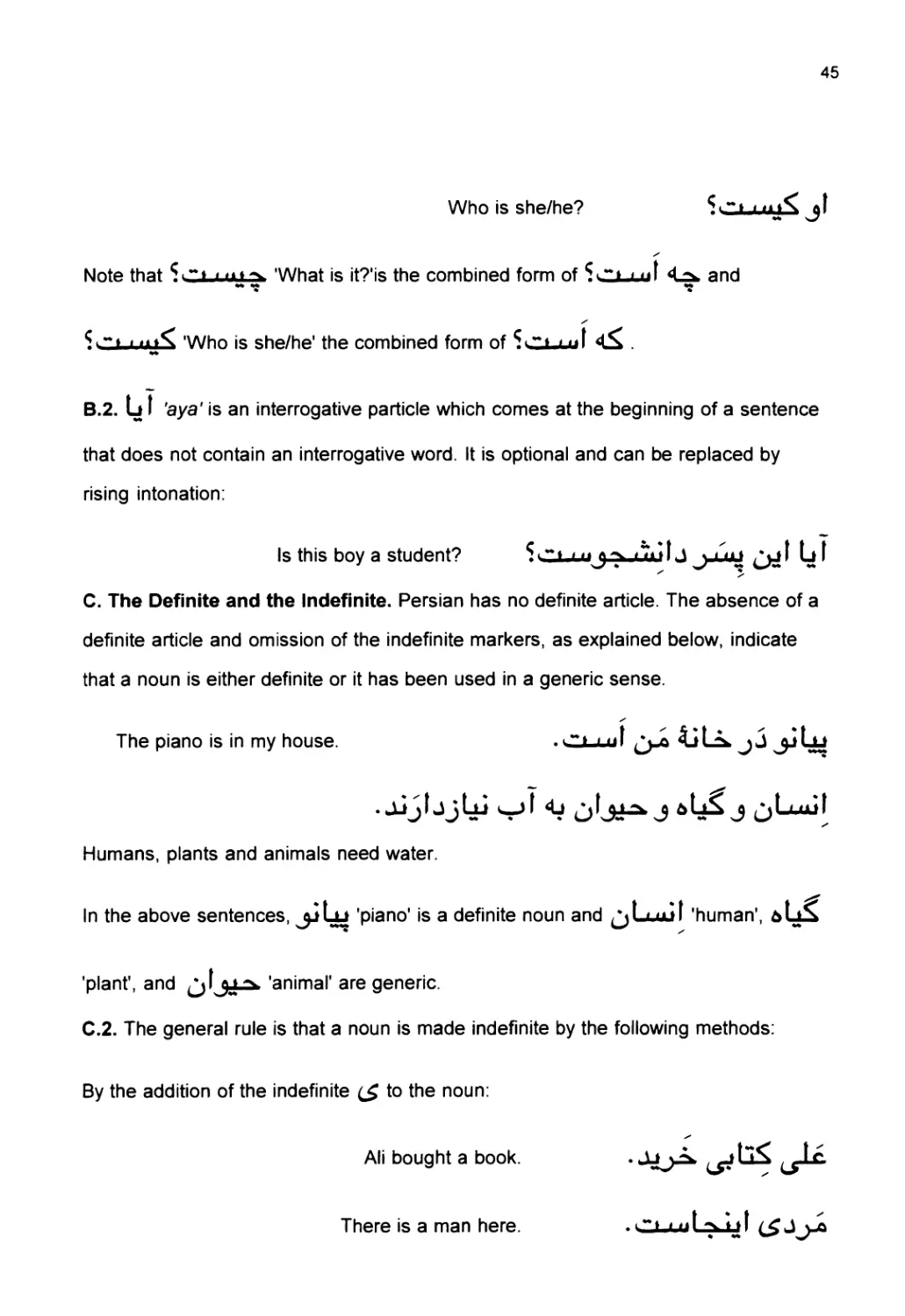
Who is she/he?	Solxuj^ jl
Note that	'What is it?'is the combined form of So-j-uI and
i 'Who is she/he' the combined form of	.
B.2. LI 'aya1 is an interrogative particle which comes at the beginning of a sentence that does not contain an interrogative word. It is optional and can be replaced by rising intonation:
Is this boy a student? SvVt t ни
C. The Definite and the Indefinite. Persian has no definite article. The absence of a definite article and omission of the indefinite markers, as explained below, indicate that a noun is either definite or it has been used in a generic sense.
The piano is in my house.	hJ AjLk
. jSJI jjLu	J qLlamI
Humans, plants and animals need water.
In the above sentences, jjLu 'piano' is a definite noun and	'human',
'plant', and	'animal' are generic.
C.2. The general rule is that a noun is made indefinite by the following methods:
By the addition of the indefinite to the noun:
. jt u
Ali bought a book.
There is a man here.
С.2a. A noun preceded by dL 'a' :
Ali has a sister . Jjl J dL
Hasan has a cat . jjl J dL
C.2b. By a combination of the two method. This method is most common in spoken Persian:
.jJIj jA dL (J1£.
D.The Orthography of the Indefinite . When added to a word ending in the long
vowels I or j , a is inserted between the final vowel and the indefinite suffix as in
(j hjTjLo 'cars' or 'a hair'.
When added to a word ending in a silent 'h* 5 or in a final , an I 'alef is inserted
before the indefinite :
a window
a child
a chair
A distinction should be made between the silent 'h' 6 which indicates the final vowel
'e' and the 'h' 5 which is a consonant. When joining the consonant, the indefinite
joins the 6 :
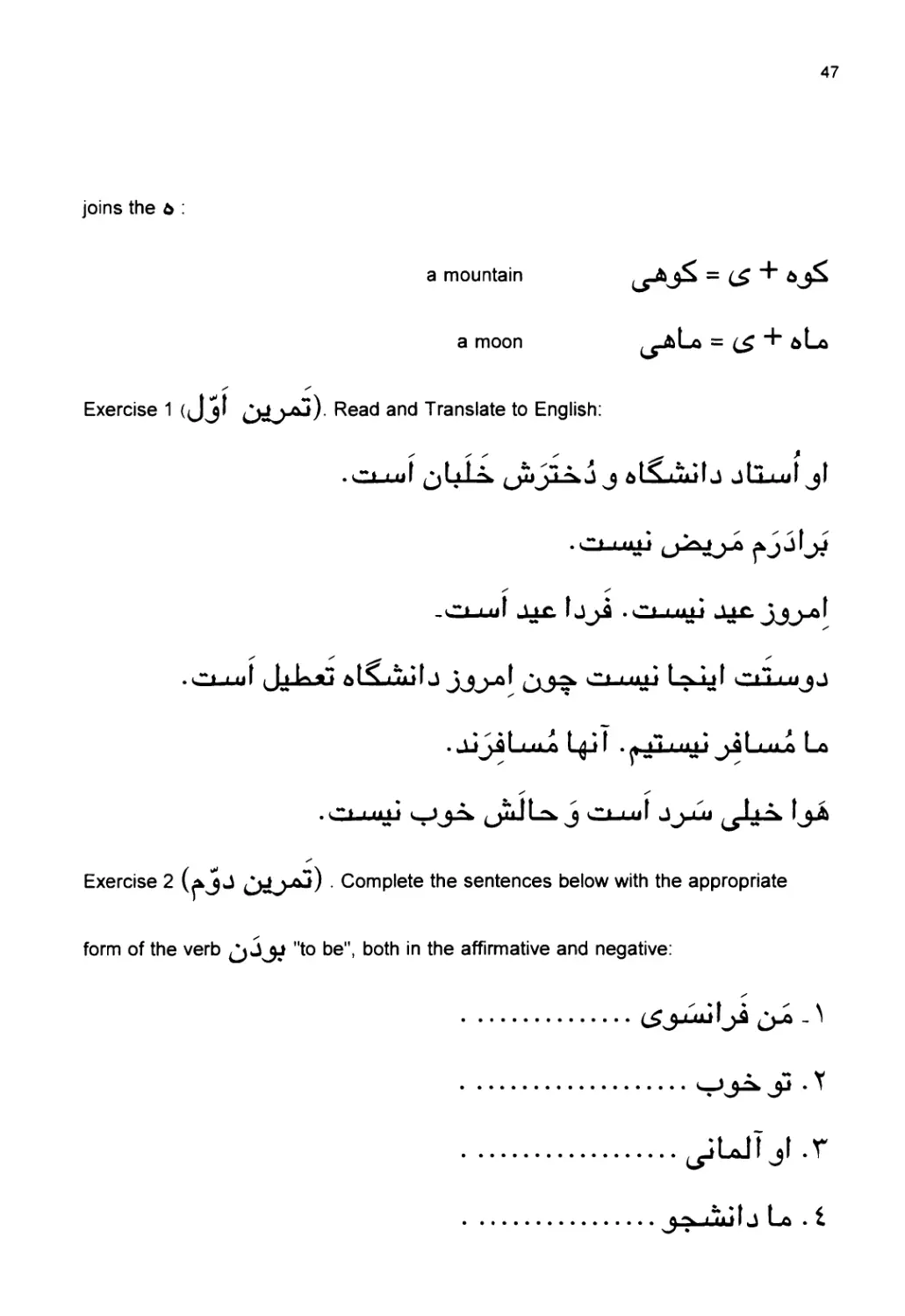
a mountain

a moon
^.aLa = C$ bLo
Exercise 1 (Jjl ch!j^)- Reacl ancl Translate to English:
. CJLJ-ul I 11 4 qLjIAJ J 61♦ t J jt*i i til jl
Exercise 2 (^j J	• Complete the sentences below with the appropriate
form of the verb "to be", both in the affirmative and negative:
....................(g	JjLbt^.xul l Л "ii .°
..........................................•	4
Exercise 3 (^ju-u	• Complete the sentences below using the correct
personal pronoun:
• ifAJ? <”>^J ........
.	...............Г
* ............................................
. i ol 4*t 111Ч .......................°
я
• Л j f i ц А ........................
я
I
. О—LU
Exercise 4 (^jL^	Read the interrogative sentences paying attention to
your intonation and answer the questions both in the affirmative and negative :
Ji .
IjA Л
5o i nt jjj <GlAjCi^ . Г
X	>	_
5jm iuii Lftj.u jJLg j jjj L$JI . i
SjlJjCLluJJ LaJi .o
SO-jlmI dL jjj t л и i u . 4
Ss-j uj! jj <~t j tiJ J jl . V
S ul 4 it < t /4 i7i .л
\i /uVC /4 A L^jl . Я
Exercise 5	71 н	• Divide into pairs and practice the conversation at the
beginning of the unit
Lesson 5
New Vocabulary
America
mirror
cheap
swimming pool
this
these
Excuse me
orange
Turkish
tight/narrow
alone/only sharp
interesting
tourist
knife	a.
Hasan (a man's name)
maternal aunt	<dLk
empty
family	6
readable
newspaper	«ulijjj
Russia
bright/ switched on
land
Japanese
watch/hour/clock	<7,1 C, Llu
. fast
apple
trousers
sweet
< 11 J.U
jljLX
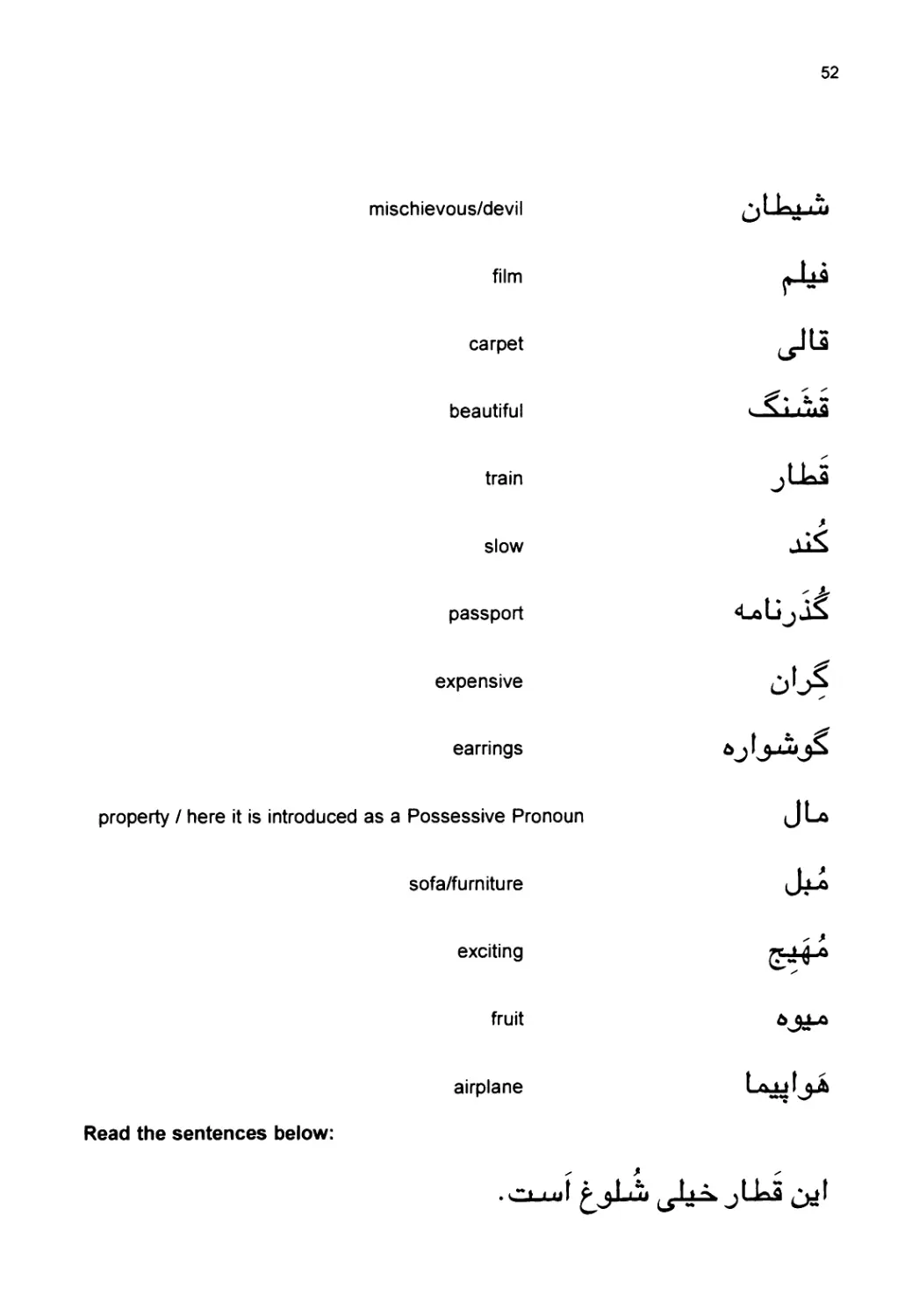
mischievous/devil
film
carpet
beautiful
train
slow
passport
expensive
earrings
property I here it is introduced as a Possessive Pronoun
sofa/furniture
exciting
fruit
airplane
Read the sentences below:
. J Й 1 Ц Д Lo AjLlUaA 6jl
 Ct I 111 &A <bl	^1
aS I <u_ujj J-*I	^1
.aSI^KjjxI jljjSSl^ jJ
Grammar:
A.	The Demonstrative Adjectives and Pronouns.
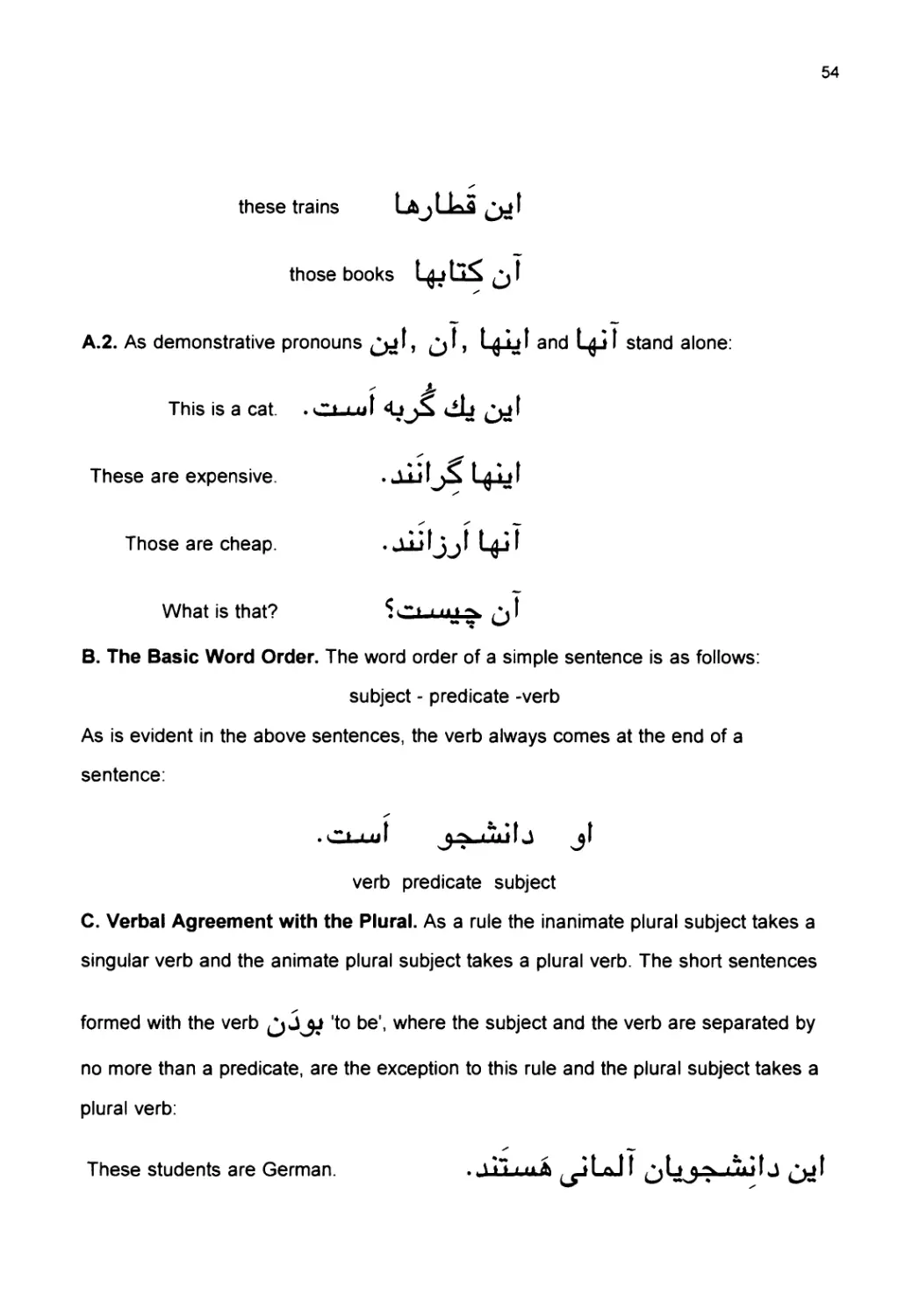
A.1. The demonstrative adjectives ^l 'this' and 'that' precede the noun they qualify:
this train jLk3
that book	^jl
When preceding plural nouns ^jjl and ^jl always remain singular:
these trains t Ajt Uo
those books о f
A.2. As demonstrative pronouns £ I, t and stand alone:
This is a cat. . CXJ-ul 4^ 4i ся’
These are expensive.
Those are cheap.
What is that?
B.	The Basic Word Order. The word order of a simple sentence is as follows:
subject - predicate -verb
As is evident in the above sentences, the verb always comes at the end of a
sentence:
. 0-1X11	IJ
verb predicate subject
C.	Verbal Agreement with the Plural. As a rule the inanimate plural subject takes a singular verb and the animate plural subject takes a plural verb. The short sentences
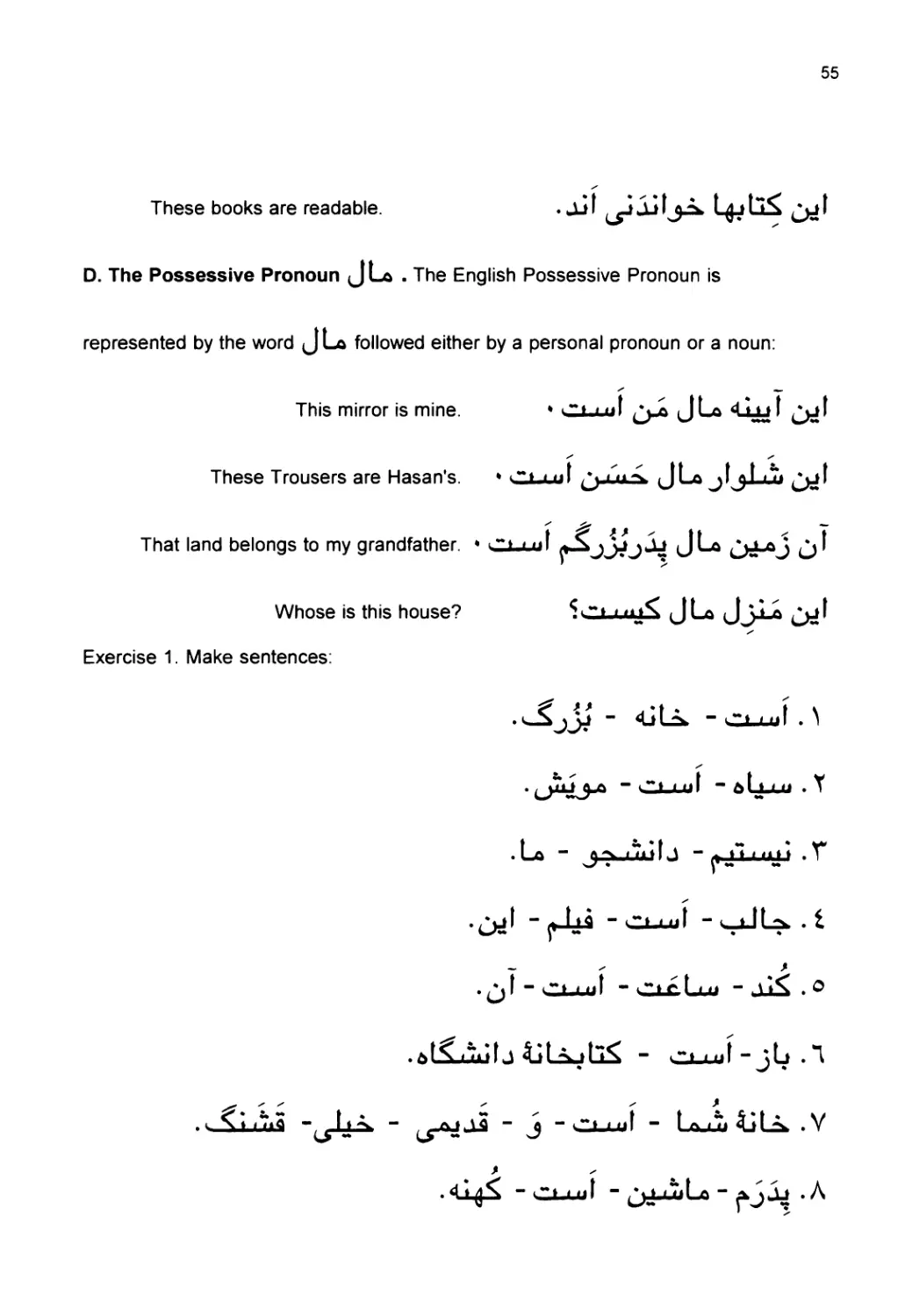
formed with the verb 'to be', where the subject and the verb are separated by no more than a predicate, are the exception to this rule and the plural subject takes a plural verb:
These students are German.
. j 1ua JLoJI	j
These books are readable.	. Jj
D.	The Possessive Pronoun JLg . The English Possessive Pronoun is represented by the word JL> followed either by a personal pronoun or a noun:
This mirror is mine. * C* * JU <Ly 1^1
These Trousers are Hasan’s. * Ct j ul ^/44 J La jtj!
That land belongs to my grandfather. • Ctj	JLg сД
Whose is this house?	5ct i J La Jj-La
Exercise 1. Make sentences.
. uXjjj - <5 La - o-j-uf.
.j	- ct xul" jL •
. AjCjUULoJb ” LaJ I -	"I -	• Я
Exercise 2. Complete the sentences with the correct demonstrative pronouns or adjectives:
• J-U
T
. Ji a!JuLIJ t fl Ь ................V

Exercise 3. Answer the questions below twice, both in the affirmative and negative:
jul dLjjS (g I LI .
5 jjl 41 I j IA * ‘ (£)jl . Y
5o-ixiLauju <LqLjJS <jjI <L5l *2 *jj • £ Sjjl	Lt *LaLj^j Сл^ *
SdjJu^jLu LbjLLj
5jjf<1^ Lb^lSjT.V •Cbwl	.Л
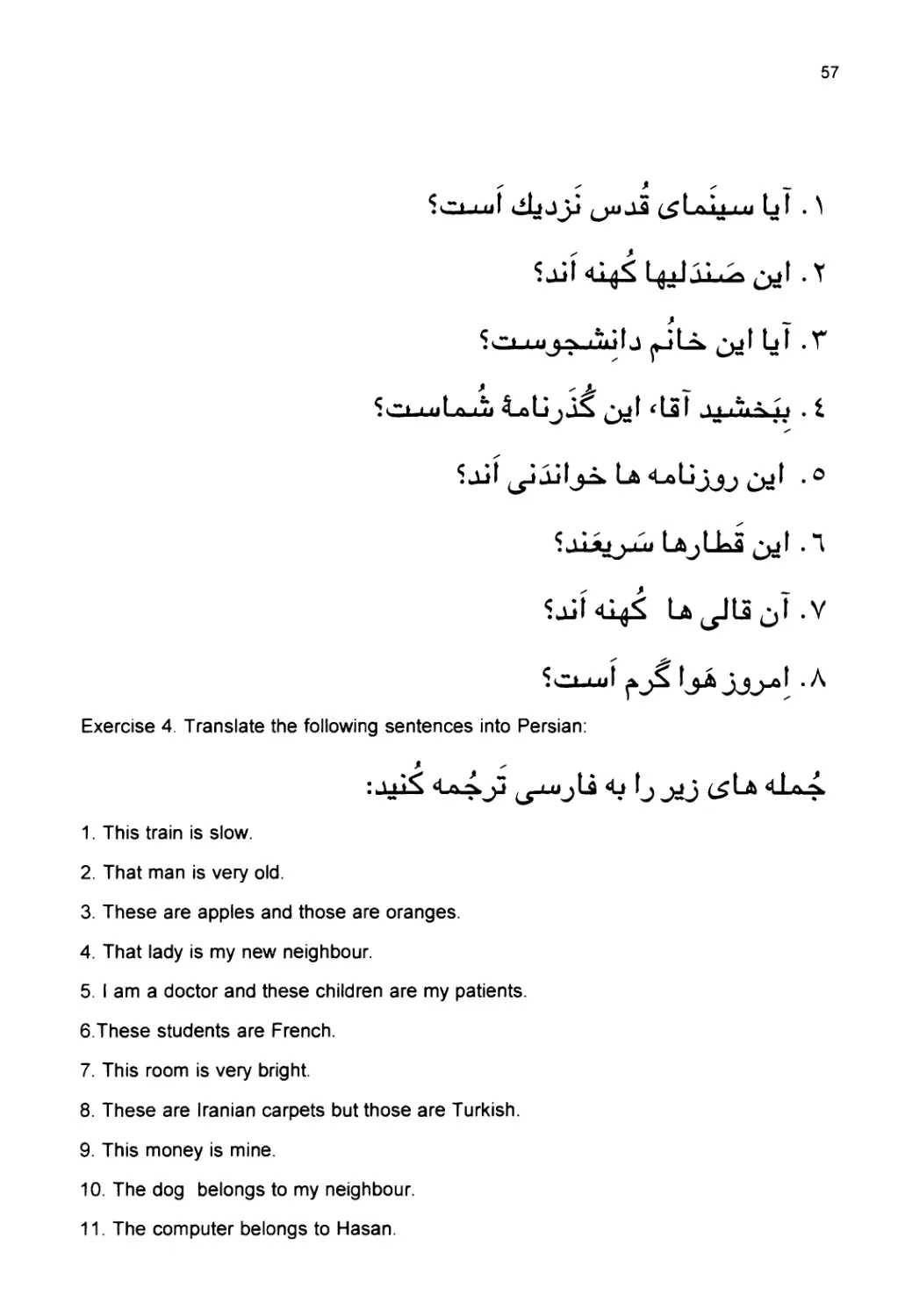
Exercise 4. Translate the following sentences into Persian:
:д±1£ 4a^jj <b Ij jJj <^La чХал.
1.	This train is slow.
2.	That man is very old.
3.	These are apples and those are oranges.
4.	That lady is my new neighbour.
5.	I am a doctor and these children are my patients.
6.	These students are French.
7.	This room is very bright.
8.	These are Iranian carpets but those are Turkish.
9.	This money is mine.
10.	The dog belongs to my neighbour.
11.	The computer belongs to Hasan.
Lesson 6
New Vocabulary:
literature
Persian literature
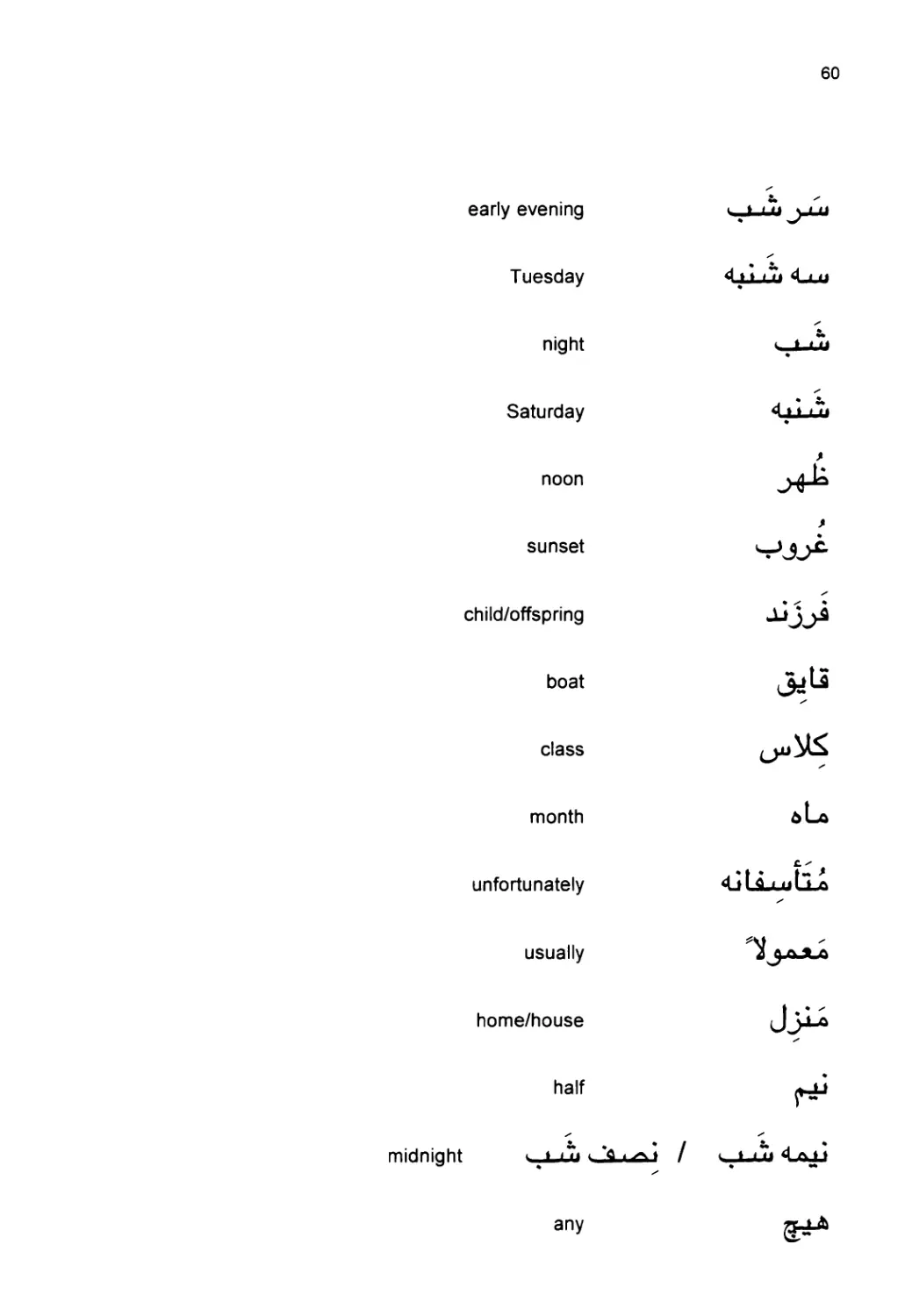
room now tonight
afternoon I p.m.
twenty years Thursday
a.m. / before noon history
history of art
lonely(Here used as an adjective meaning 'the only')
Friday
yes (when not used as the interrogative 'why?')
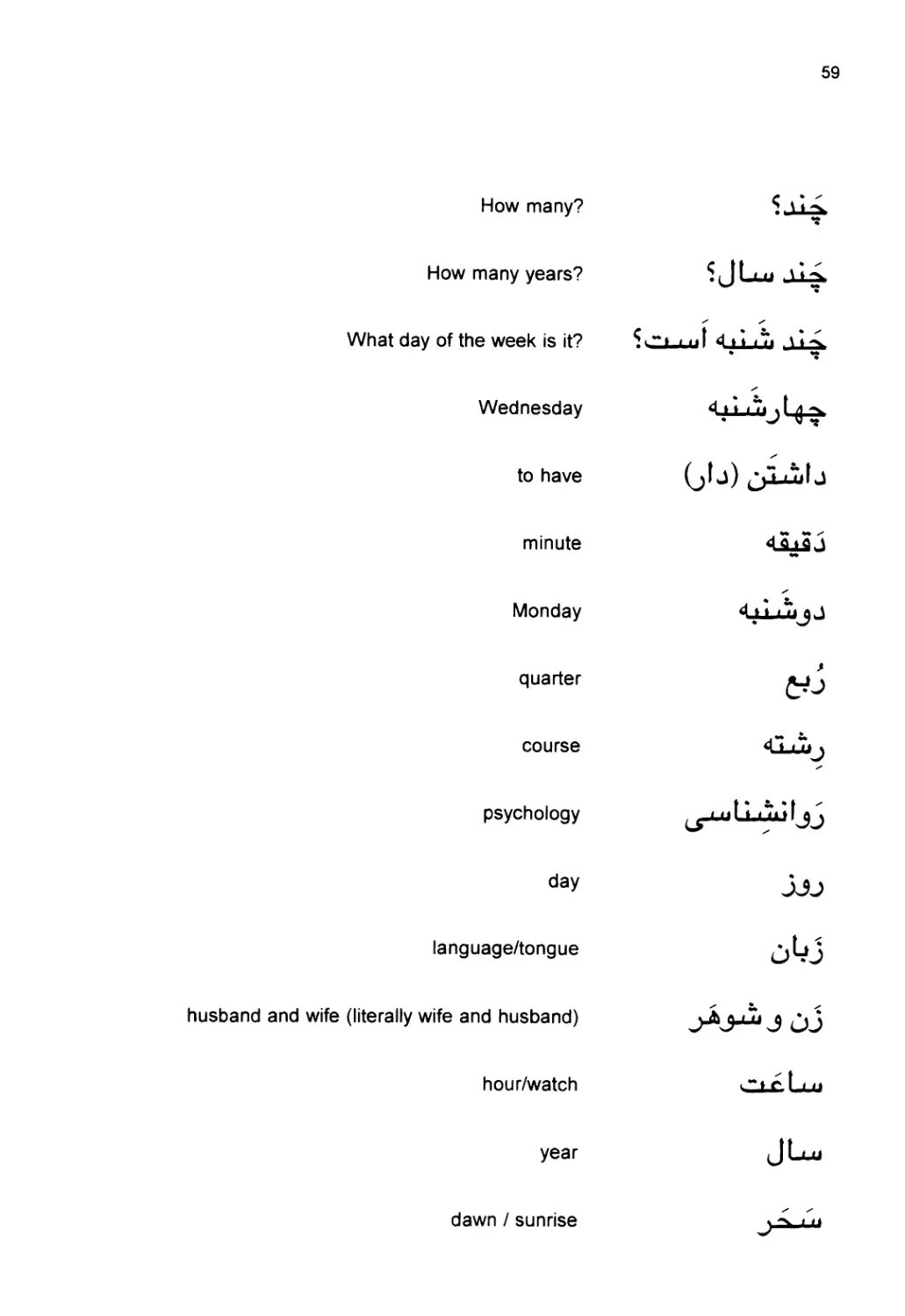
How many?
How many years?
What day of the week is it?
Wednesday
to have
4 и uij
(jlj) JjJuL
minute
Monday quarter course psychology
SdJjjLul 4 t t 171 \ I '-v
<5x5 J

day	jjj
language/tongue
husband and wife (literally wife and husband)
hour/watch	O-£Luj
year
dawn / sunrise
early evening
Tuesday	du <7i d < и
night
Saturday	d <71
noon	я
sunset	я
child/offspring
boat
class
month		6 La

unfortunately		<Gt utLa
usually
home/house
half
midnight	<> t С&л	/	v lull
any
Section 1. Read:

5 J j IJ J Llu । H 4 3 Ctu	1 u • СЯ J Ji

5
U Y j И U Ь o-£Llu	^>1*^ и < н U"^
:JW^
*^_U jljJU О
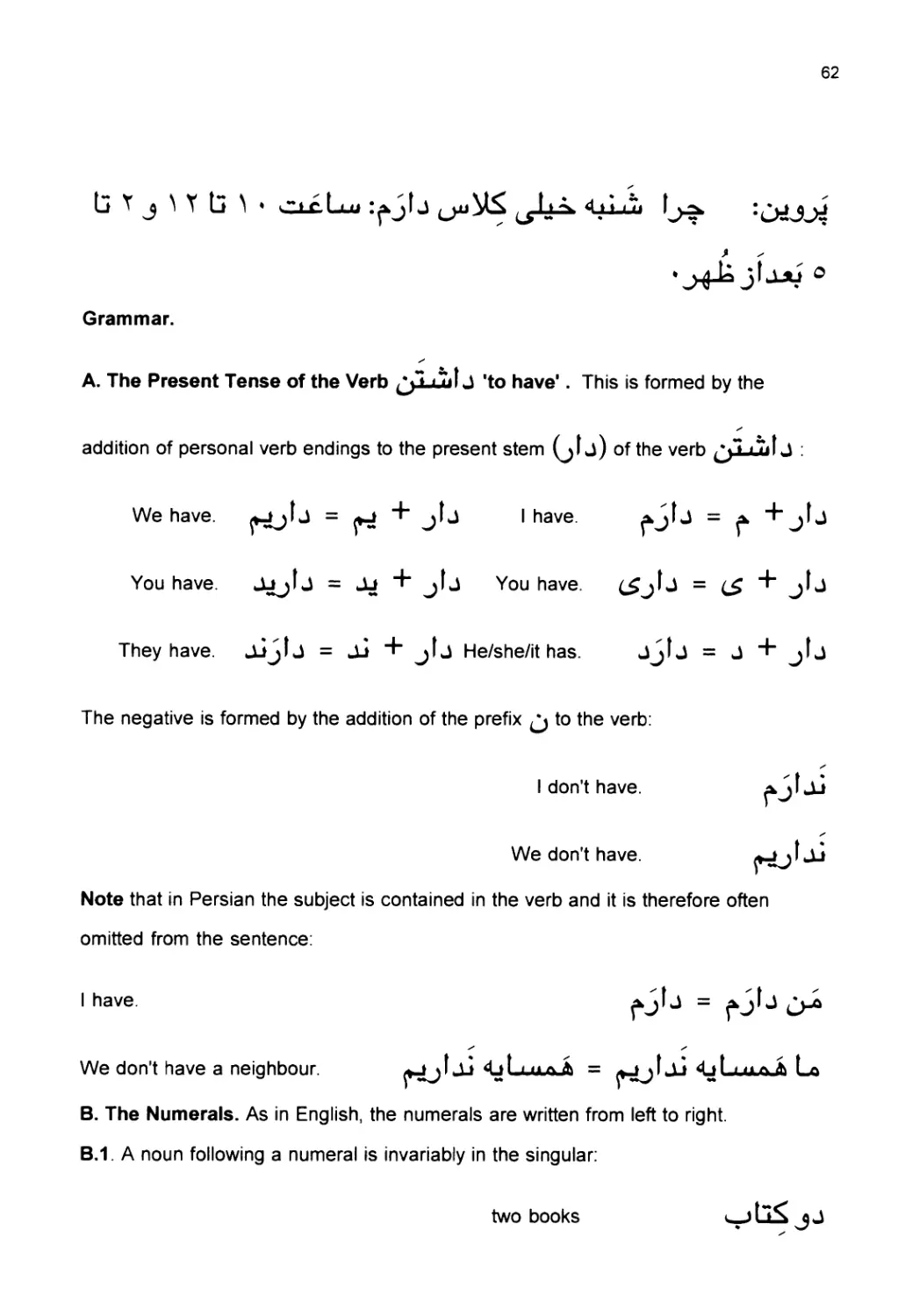
Grammar.
A.	The Present Tense of the Verb	to have'  This is formed by the
addition of personal verb endings to the present stem (jt j) of the verb
We have.	1 have.	= C
You have. Jjjlj = JJ + jlj You have.	= C5 +
They have. Jjjlj = Jj + jlj He/she/it has. Jjlj = J + jlj
The negative is formed by the addition of the prefix & to the verb:
I don't have.	jxjljj
We don't have.
Note that in Persian the subject is contained in the verb and it is therefore often omitted from the sentence:
I have.	jxjlj = cH*
We don't have a neighbour.	Jj AjLlauxA = Jj «bLuxoJb La
B.	The Numerals. As in English, the numerals are written from left to right.
B.1.	A noun following a numeral is invariably in the singular:
two books
eleven tables
four brothers and sisters	3 jJbl3A
Similarly the interrogative 5 Д i > 'how many?' is always followed by a singular noun:
How many brothers and sisters do you have? jjtjJ 3 jjUjA Лць,
How many students do you have?
B.2.	The Cardinal Numbers from one to nineteen:
		(1)			(11)
Y	3^	(2)	Y		(12)
Г		(3)		6 JjI-uj	(13)
£		(4)	£		(14)
0		(5)	0		(15)
		(6)	1	& jjSLuu	(16)
V		(7)	W		(17)
A	L**t IM A	(8)	A	6 J A	(18)
	JI <G	(9)			(19)
•	4>J	(10)
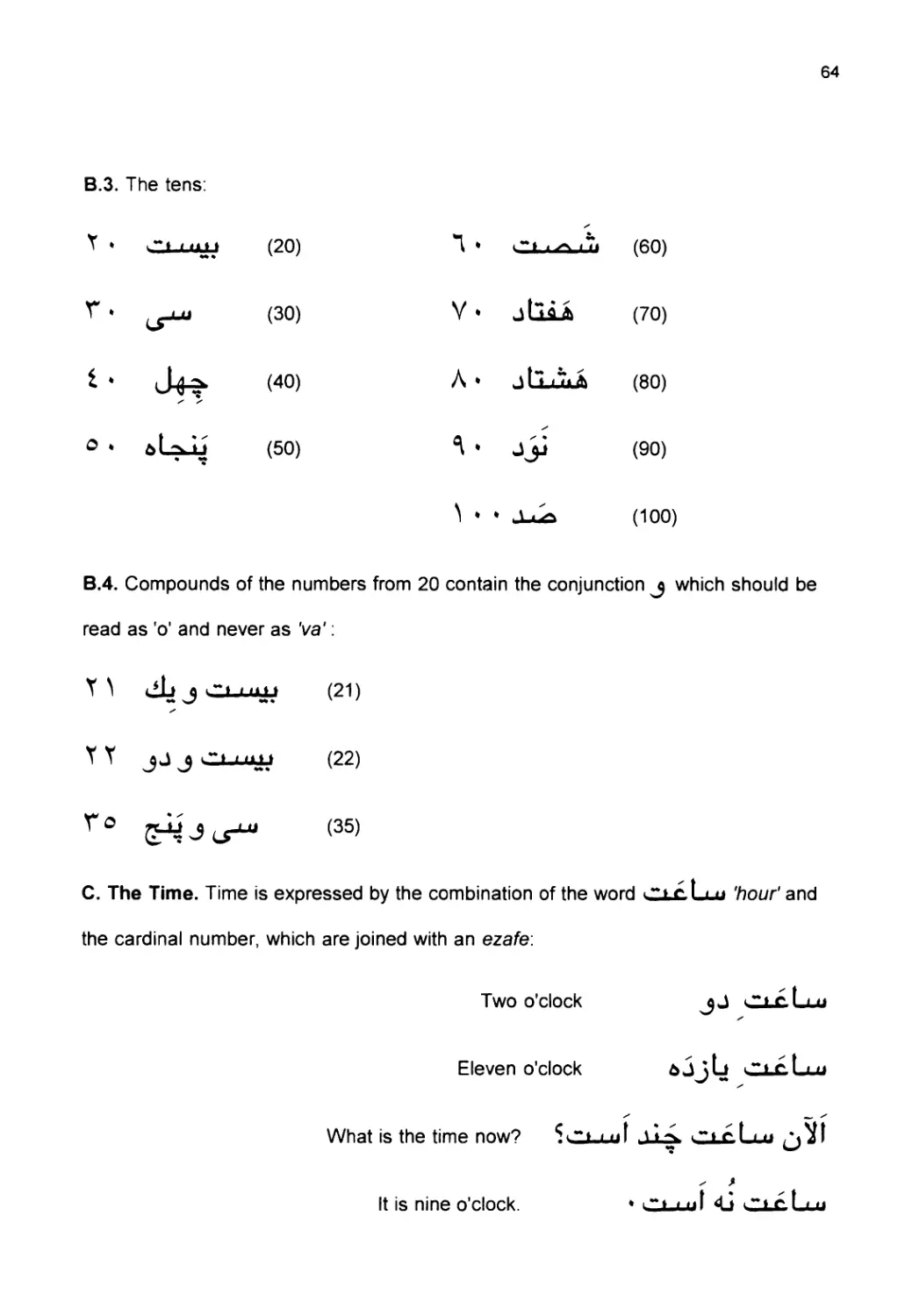
В.З. The tens:
Y .		(20)	1 .	<71	(60)
r.		(30)	V«	allii	(70)
i •		(40)	Л.	jt~t hi Л	(80)
о .		(50)	Я ‘		(90)
				* \	(Ю0)
B.4.	Compounds of the numbers from 20 contain the conjunction j which should be
read as 'o’ and never as 'va':
Y'l d-t j <-t ШН (21)
Y Y	J J J t"i i uh (22)
Г О JU J	(35)
C.	The Time. Time is expressed by the combination of the word ox.lxu 'hour' and the cardinal number, which are joined with an ezafe:
Two o'clock	j J O-£Llu
Eleven o'clock 6JjLj t *
What is the time now?	5С* < “I л * Luu &I
x я
С.1. Half hour is O-£Llu >jj. Half hours are expressed as follows:
Half past two
ХЛ1
Half past ten
Note that 6 J and are joined by the conjunction j Va' ’and'which sounds ’o’. It should never be pronounced as Va'.
Half hours could be expressed in the following forms also:
half past two
half an hour to three
C.2. Quarter hour is ClcLlu and is expressed as follows:
quarter past two
quarter to three
Quarter hours could be expressed in the following ways:
quarter past two
quarter to three
C.3. Minute is 4JL15 J . Minutes are expressed as follows:
one eleven
four fifty

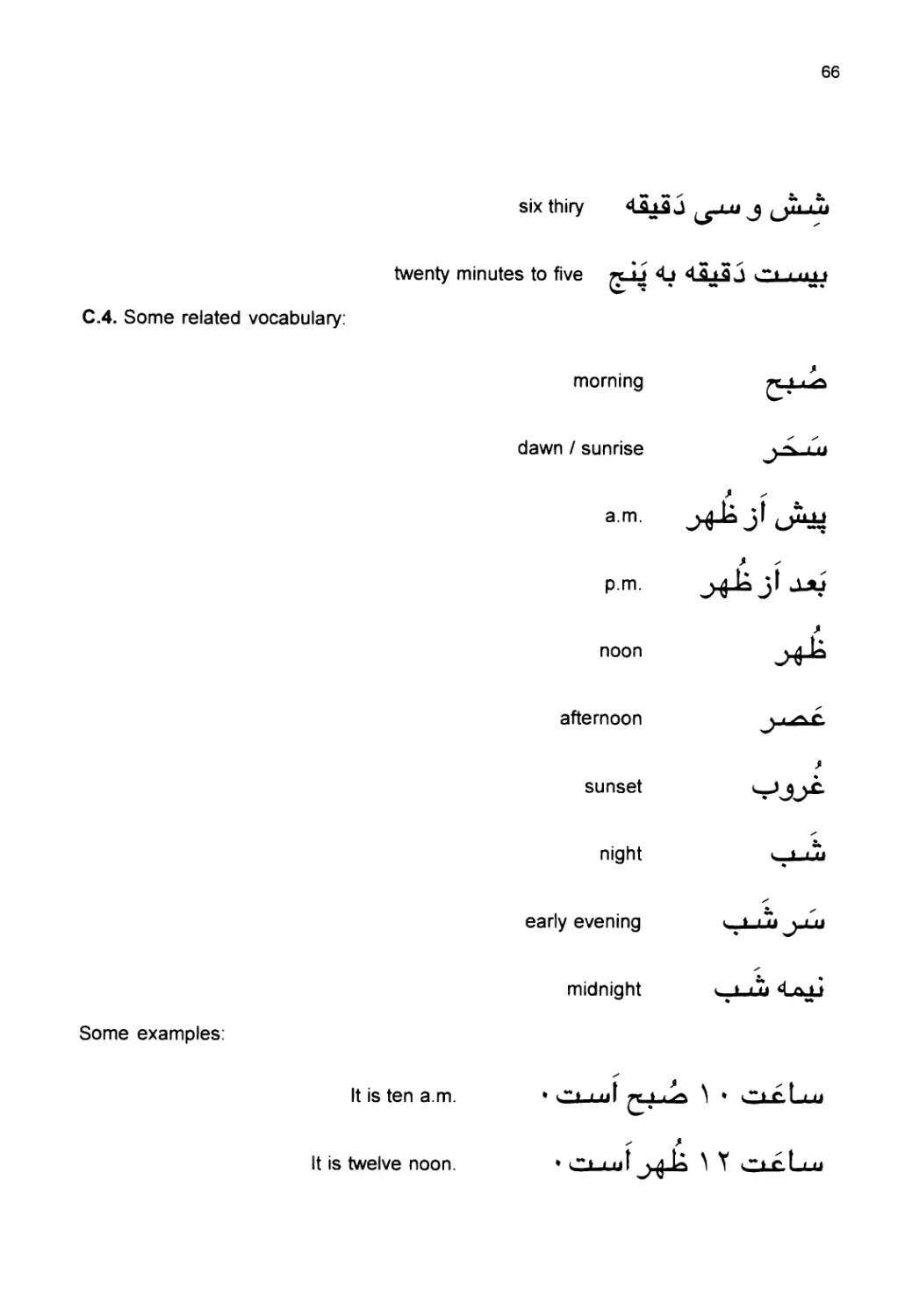
six thiry
<5x5 J
twenty minutes to five «Jj <J <5x5 J rt i цн
C.4. Some related vocabulary:
morning
dawn / sunrise
a.m.
p.m. noon afternoon sunset
night early evening midnight
Some examples:
It is ten a m.
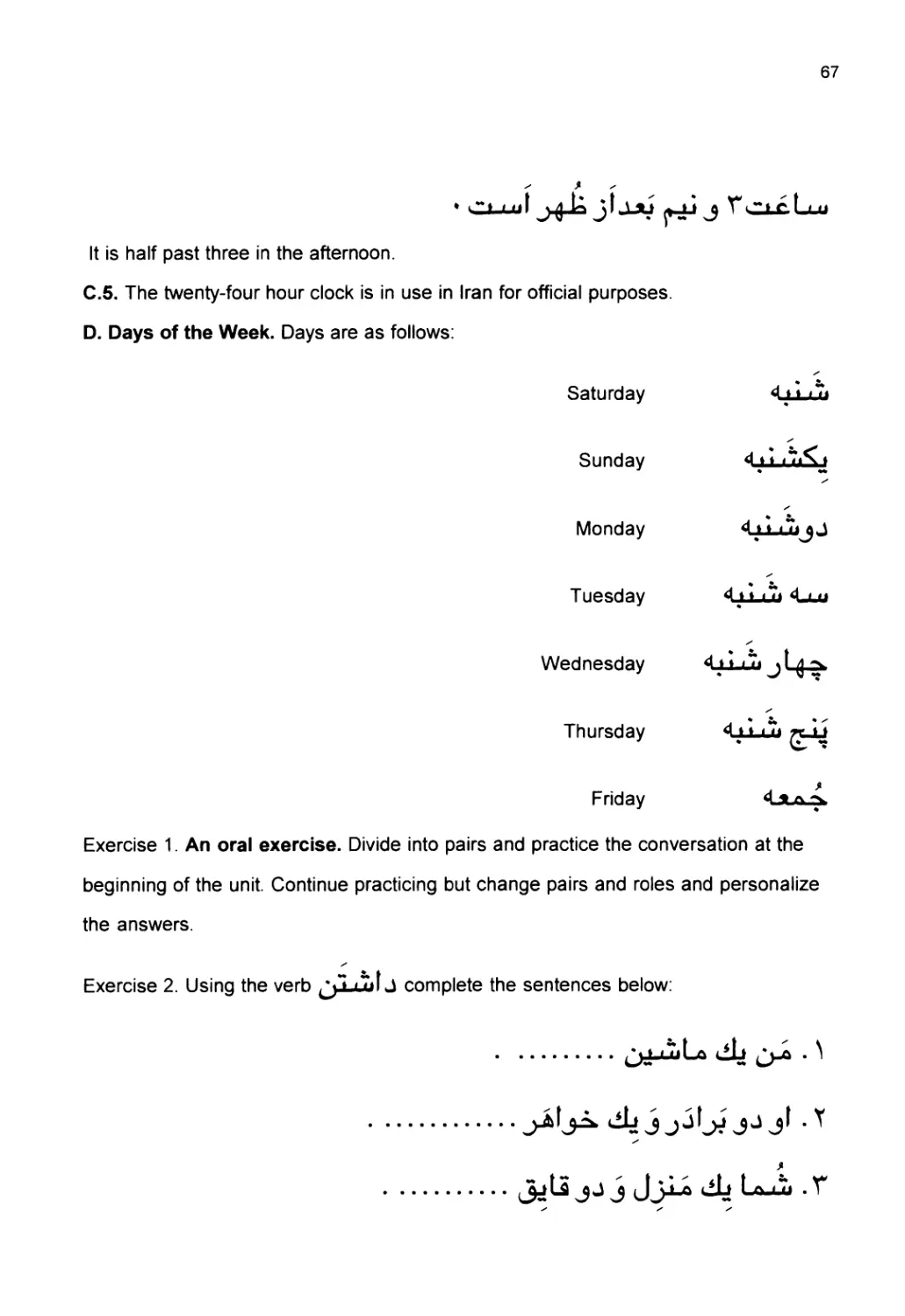
• Ct uj I JI Jju jf-U	Г etc. Luu
It is half past three in the afternoon.
C.5. The twenty-four hour clock is in use in Iran for official purposes.
D.	Days of the Week. Days are as follows:
Saturday	<1*1 C«
Sunday	‘*^2
Monday	4 it Cijj
Tuesday	4jt <7i 4-lu
Wednesday 4ji hi jLfcb
Thursday 4xlxii
Friday
Exercise 1. An oral exercise. Divide into pairs and practice the conversation at the beginning of the unit. Continue practicing but change pairs and roles and personalize the answers.
Exercise 2. Using the verb J complete the sentences below:
................jxxbU	dL
...............................j*
..........J	. г
I . О
Exercise 3.
ov
.(negative)
. (negative)
Read the numbers below:
яг
Exercise 4. Translate to Persian:
two libraries
ten friends
five hours
forty five students
fifty computers
twenty four months
W T. n rr ГЯ tr
four schools
eleven kilometers
twenty one tables
thirty three cars
thirteen days
How many years?
r
0
Л
я

и
лл

How many books?
nine cats
Exercise 5. Answer the following question and then repeat the question and answer
exercise using the substitute vocabulary:

У jju г -
111 atljj
exJa - CuLuJ i ~ (jljjj
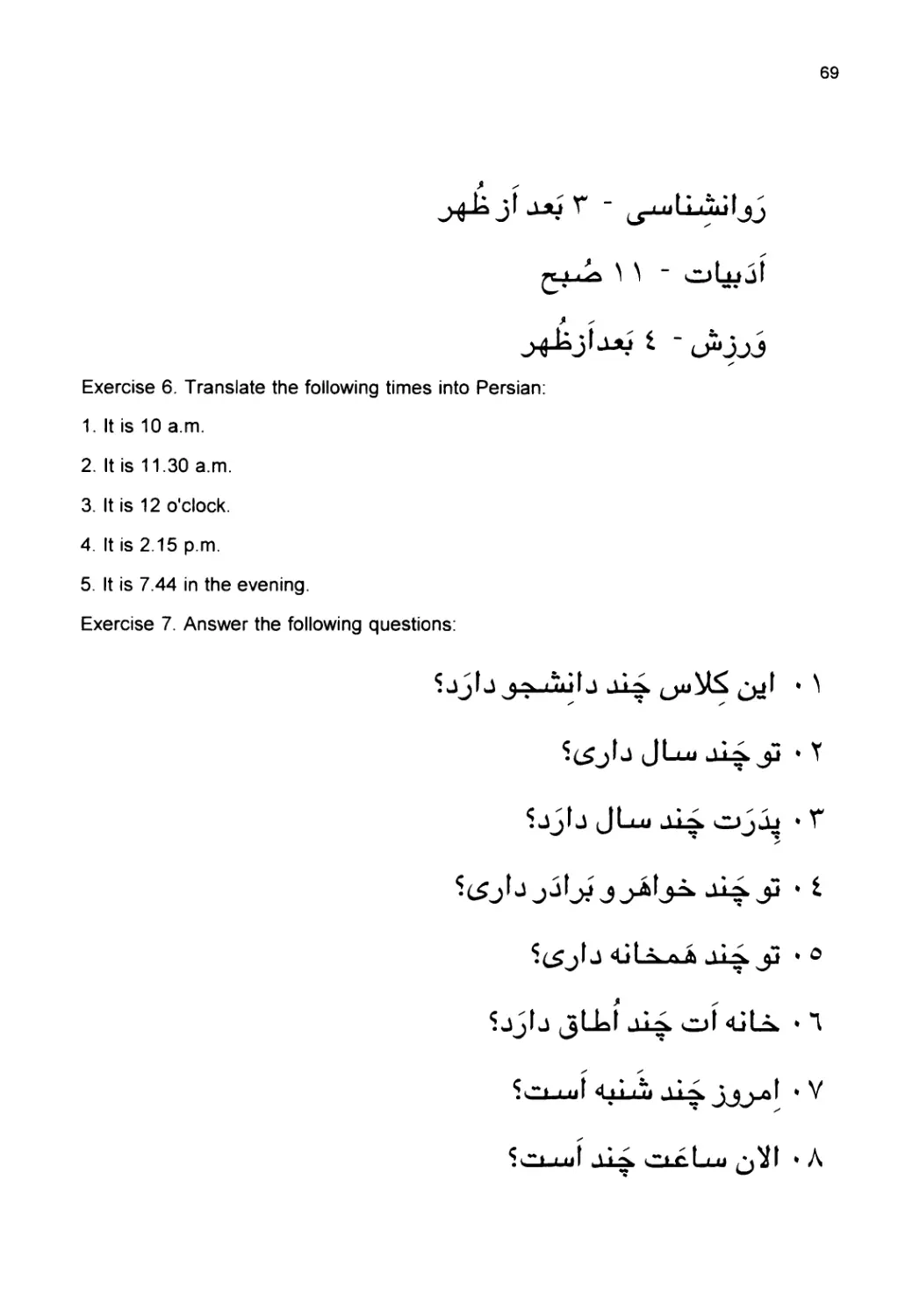
Exercise 6. Translate the following times into Persian:
1.	It is 10 a.m.
2.	It is 11.30 a.m.
3.	It is 12 o'clock.
4.	It is 2.15 p.m.
5.	It is 7.44 in the evening.
Exercise 7. Answer the following questions:
5 J j IJ j) tl.ua t1J JjA	(Jjl •
JLuj
5	J Lui	uJjJj * Y*
S(Sjb	JJ • 0
Sjjlj (jt-lal J>4> CJ? <GLk • 4
Seixui <uLi	jjj-ol • V
Lesson 7
New Vocabulary:
to come next / future
office
post office from with
to play for
to return (from) to
to cook fifth
on foot
piano
to teach
to watch team
What does he do? courtyard / yard / garden to buy to shop to read to want good/well self / here it means 'their' to eat/to drink dressmaker sewing / dressmaking to sew
primary school
in
twice
to run
to drive
to go
life
to live

night
to swim
swimmer
to be fond of / to be keen, to be interested in
children football
to tell stories jobs
J


to work to do
to help sometime
to tell plant mother
grandmother regularly
matches (i.e. sport)/ competitions kind
name painting
also sport/exercise
when
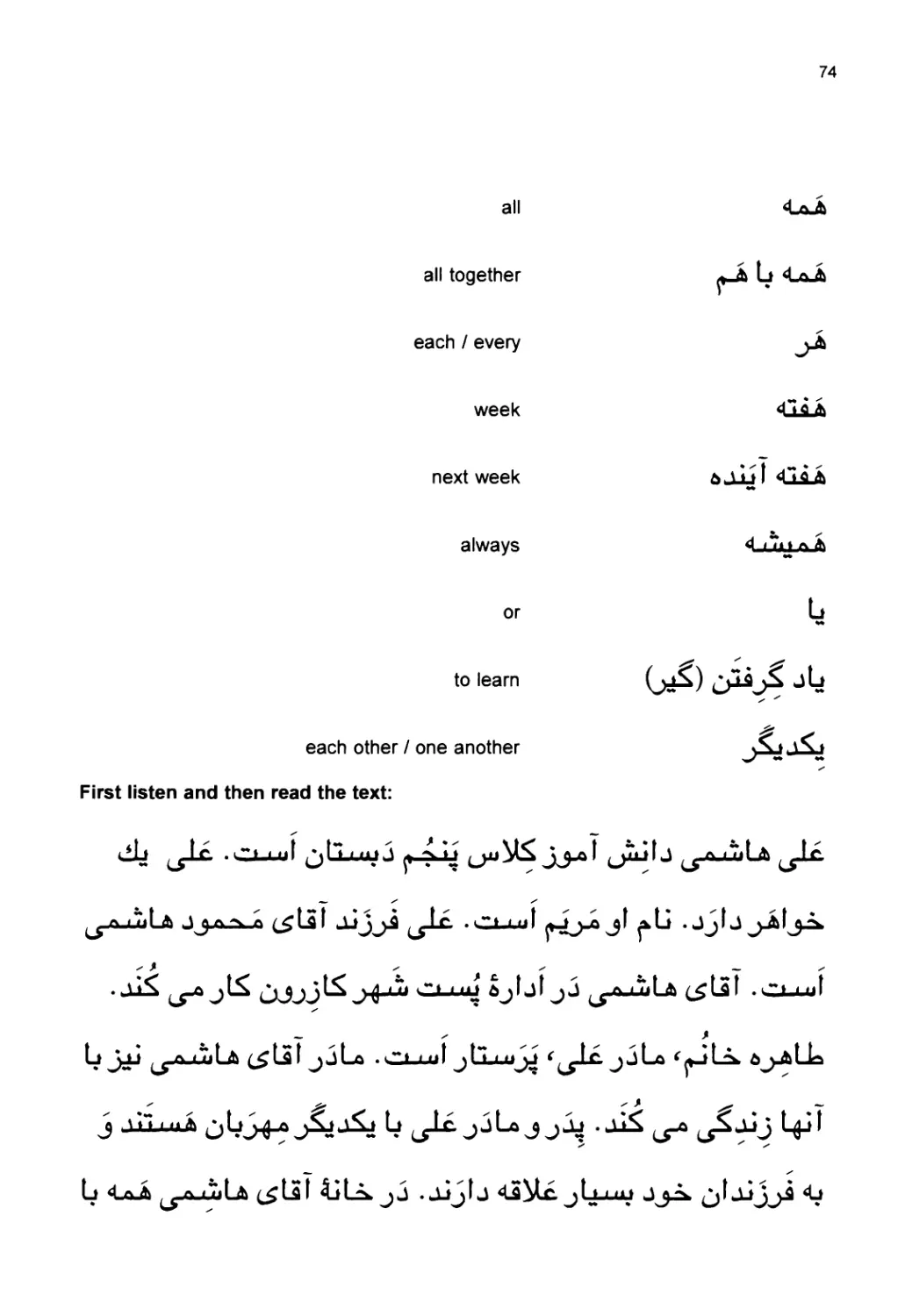
all
all together	L <LaJb
each / every	jJb
week	a
next week	6JjjI
always	4 i uj n Д
or	Lj
to learn (_)Д) Jki each other / one another First listen and then read the text:
Read the sentences below:
Grammar
A.	Persian verbs and their present stem. Persian verbs can be divided into simple
and compound, and regular and irregular verbs.
A.1. Simple and Regular Verbs. These verbs usually end in ’dan\ 'tan1 or
(j Ju 'idan'. The present stem of the regular verbs, which is used in constructing the present tense, usually forms by simply dropping these endings;
present stem
the infinitive
A.2. Irregular Verbs. There are no clear rules for obtaining the present stem of irregular verbs and these should be learnt individually:
present stem	Infinitive

A.3. Compound Verbs. Persian has few simple verbs. The majority are compound verbs which are formed by a combination of a simple verb with a noun or an adjective, adverb or a preposition. To obtain the present stem of compound verbs we only change the verbal component:
present stem
J jLp

infinitive
LLlu
J jLu
B.	The Present Tense of Simple Verbs. With the exception of the verbs 'to
be' and	'to have', the present tense of all the simple verbs is formed by the
addition of the prefix (mi) and the personal verb endings to the present stem of
the verb.
Example J lie .	present stem
infinitive

to go
I go.	•NJc	Г0 = f + JJ
You go.	•<£jJus-	O = ^ + JJ
She/he goes.	и	= J + JJ
We go.		* = (*} +JJ
You go.	•AUJ	> = -M + Jj
They go.	us-	0 = ^ + JJ
В.1 The negative of the present tense is formed by the addition of the prefix
D t0
(mi): e.g.
I don't go. .
We don't go. . p-Jjj
B.2. When the present stem of a verb ends with the long vowel j 'u' or I 'a', a is
inserted between the final long vowel and the personal verb ending:
eg
Plural
Singular
We tell.
I tell.
You tell.
You tell.
They tell.		a	He/she tells.
We come.		I come.	w'
You come.	. Jjjl	You come.
They come.	• jjjl цЛ	He/she comes.	.JL»T
C.	The Present Tense of Compound Verbs. When conjugating a compound verb
only the verbal component changes, following exactly the same rule as simple verbs.
The prefix . -a (mi) and the personal verb endings are attached to the present stem
of the verbal component:
present stem
to live
infinitive
я
We live.	^3 I live.
я You live.	You live.
x л
They live. . aiK ^a	He/she lives.
C.1. The negative form of a compound verb follows the general rule by adding the
prefix & to ^a : e.g. I don't live here.	^3 cP0
D.	Some Uses of the Present Tense.
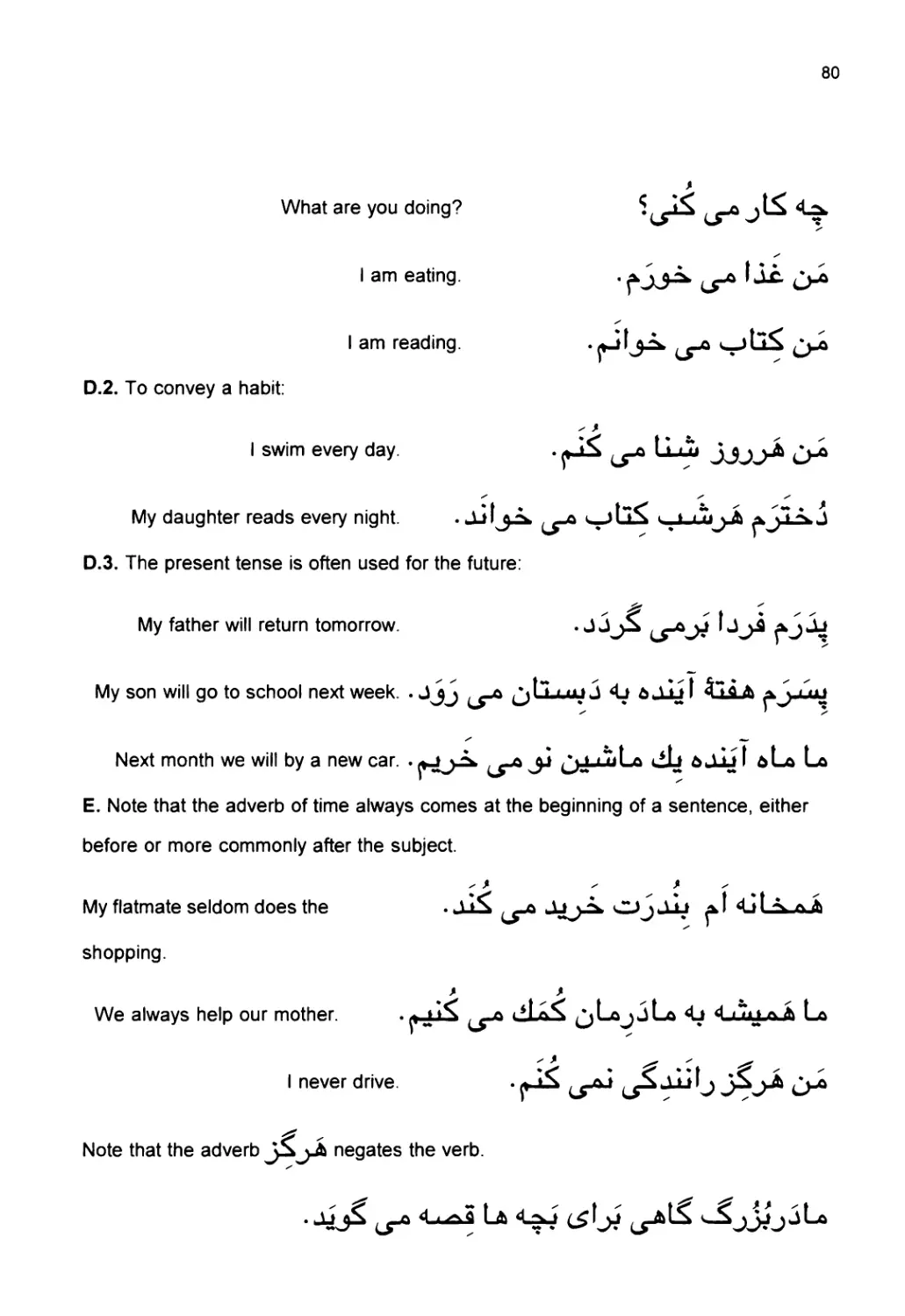
D.1.Present Continuous: To refer to an action which is in progess:
What are you doing?
I am eating.
I am reading.
D.2. To convey a habit:
I swim every day.
My daughter reads every night.
D.3. The present tense is often used for the future:
My father will return tomorrow.
Next month we will by a new car.
E.	Note that the adverb of time always comes at the beginning of a sentence, either
before or more commonly after the subject.
My flatmate seldom does the
shopping.
We always help our mother.
I never drive.
Note that the adverb >
negates the verb.
Grandmother sometimes tells stories to the children.
F.	The Reflexive Pronoun J. If the possessive pronoun suffix or the personal
pronoun refers to the subject of the setence, the reflexive pronoun Jshould be used. e.g.
He gives me his (own) book. »	&a Ij	JjA
In this sentence,	refers to the subject of the sentence. We could have
used a possessive pronoun suffix to convey possession but this would lack clarity as to its reference:
He gives me his book.	• д q-д
In the above sentence, it is not clear to whose book reference is being made, to his own or to a third party's. Therefore Jshould be used and not \ e.g.
He goes to his (own) office. • Jjj ^a	6jl jl jl
My father is in his (own) house. • Cxxul qxi Jj J
F.1. JjA can also be used as an emphatic pronoun meaning ’self.
My sister learns French by herself, she does not go to a class.
Pronominal suffixes are attached to J^jA when it is used as an emphatic pronoun:
I myself
You yourself
She/he herself

Note that the drilling exercises on the use of J^A are included in Lesson 8.
G.	The Indefinite . When a noun is qualified by one or more adjectives, the
indefinite (£ is added to the last adjective:
She has a good income from dressmaking.
Hasan's family have a simple life.
Ali is a good swmimer.
Tehran is a big city.
That is an expensive old car. . CXxul
simple life',
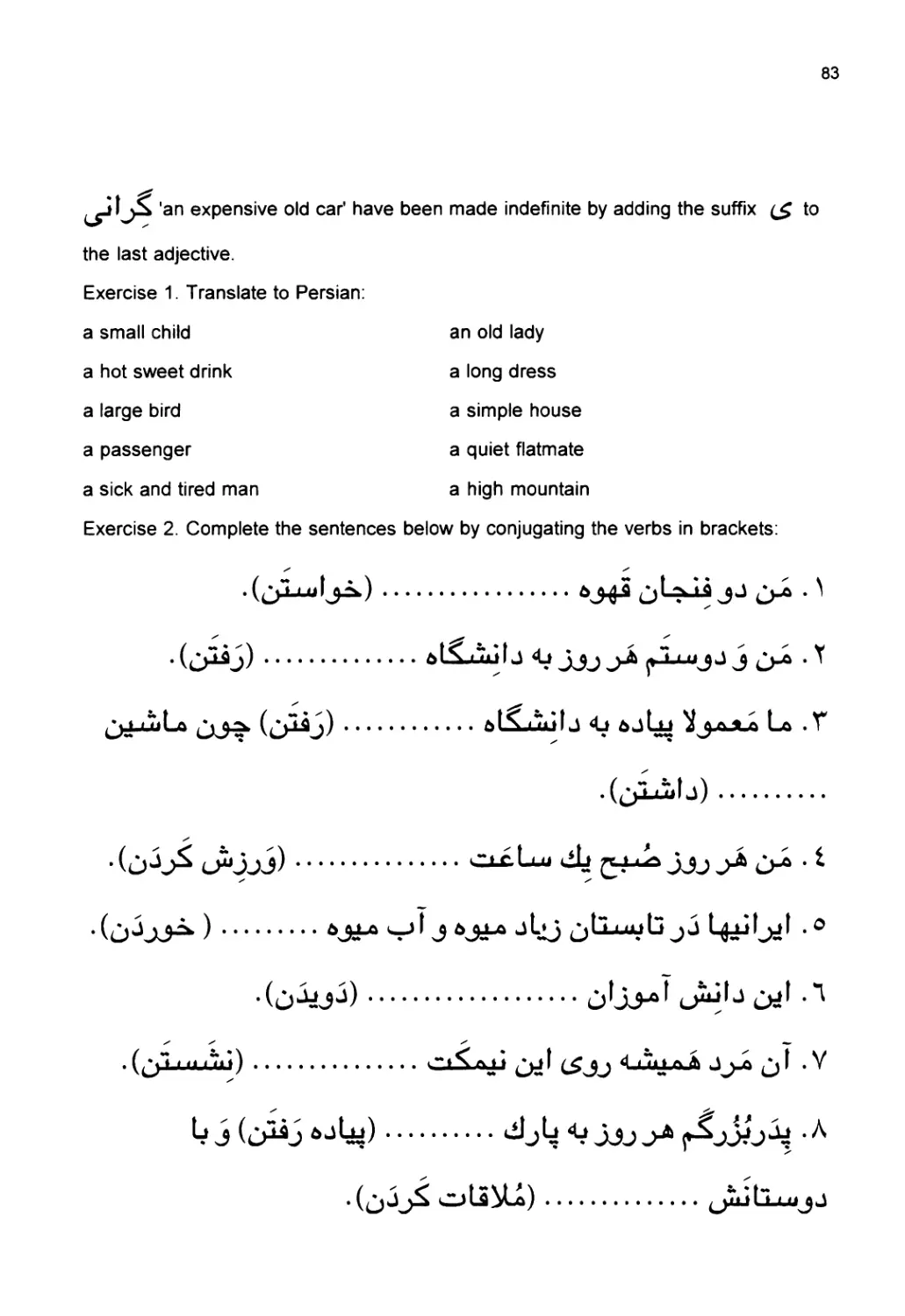
'an expensive old car’ have been made indefinite by adding the suffix to
the last adjective.
Exercise 1. Translate to Persian:
a small child
an old lady
a hot sweet drink
a long dress
a large bird
a simple house
a passenger
a quiet flatmate
a sick and tired man
a high mountain
Exercise 2. Complete the sentences below by conjugating the verbs in brackets;

о
4 i
3	.............La jtLuijdjJ jjXo Lfll jl . Я
...............
• (pAi111 j)..........,	t.iu Л о г Ixu jLLlS . •
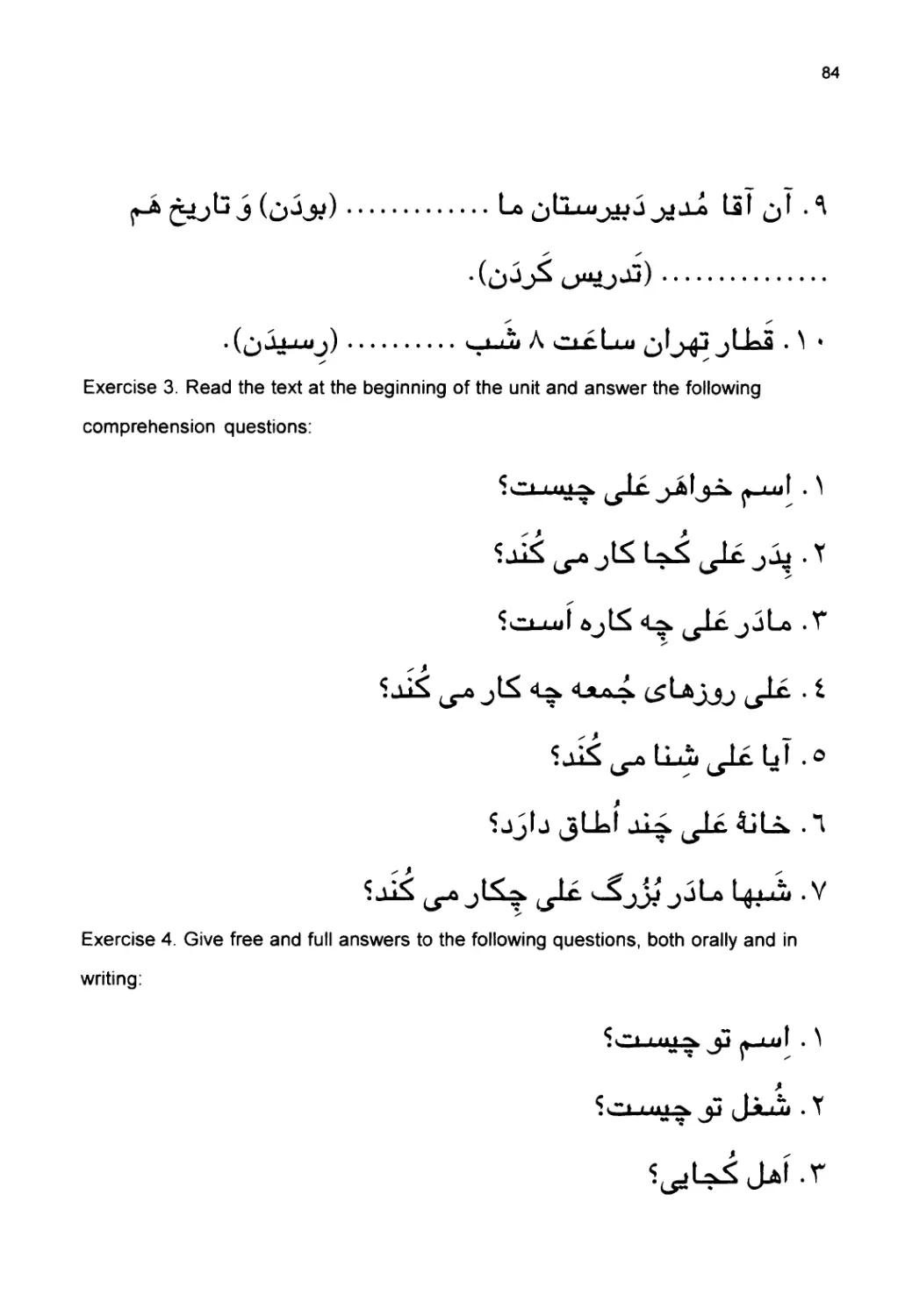
Exercise 3. Read the text at the beginning of the unit and answer the following comprehension questions:
5s~t ^jJx. jJbljA f_ujl .
6j£ 4^ j jLa . Г
S^j-o	<(алЛ	• £
/J	_
.o
S Jjl J JjLJal dla*
SdlS jKa. ^jlc. jjlft L^Jui . V
Exercise 4. Give free and full answers to the following questions, both orally and in
writing:

л
Ss~t tuj^ JJ (JjL4jU • T
>' -r
jjljJ J	JJ .0
cr® сАлл? ^ч5-“ •
Ou-UjJ (^jlxbl jj .	*
c5jb JLijijj . Г
Exercise 5. Translate into Persian:
1.	She wants a cup of coffee.
2.	I sometimes go to the library.
3.	We live in a big old house.
4.	They never play football but sometimes play tennis.
5.	I have two sisters and one brother.
6.	My friend watches TV every night.
7.	Who is that girl?
8.	We go to France every summer.
Additional Glossary
by sweing
to knit/to weave
nursing
containing, having	ОЛЬ
income
simple	6 jlxu
supporter
in addition to
Kazeroon ( a city in Iran)
to make dresses	(jjd) jjAjJ C>°U
to meet
skill
bench
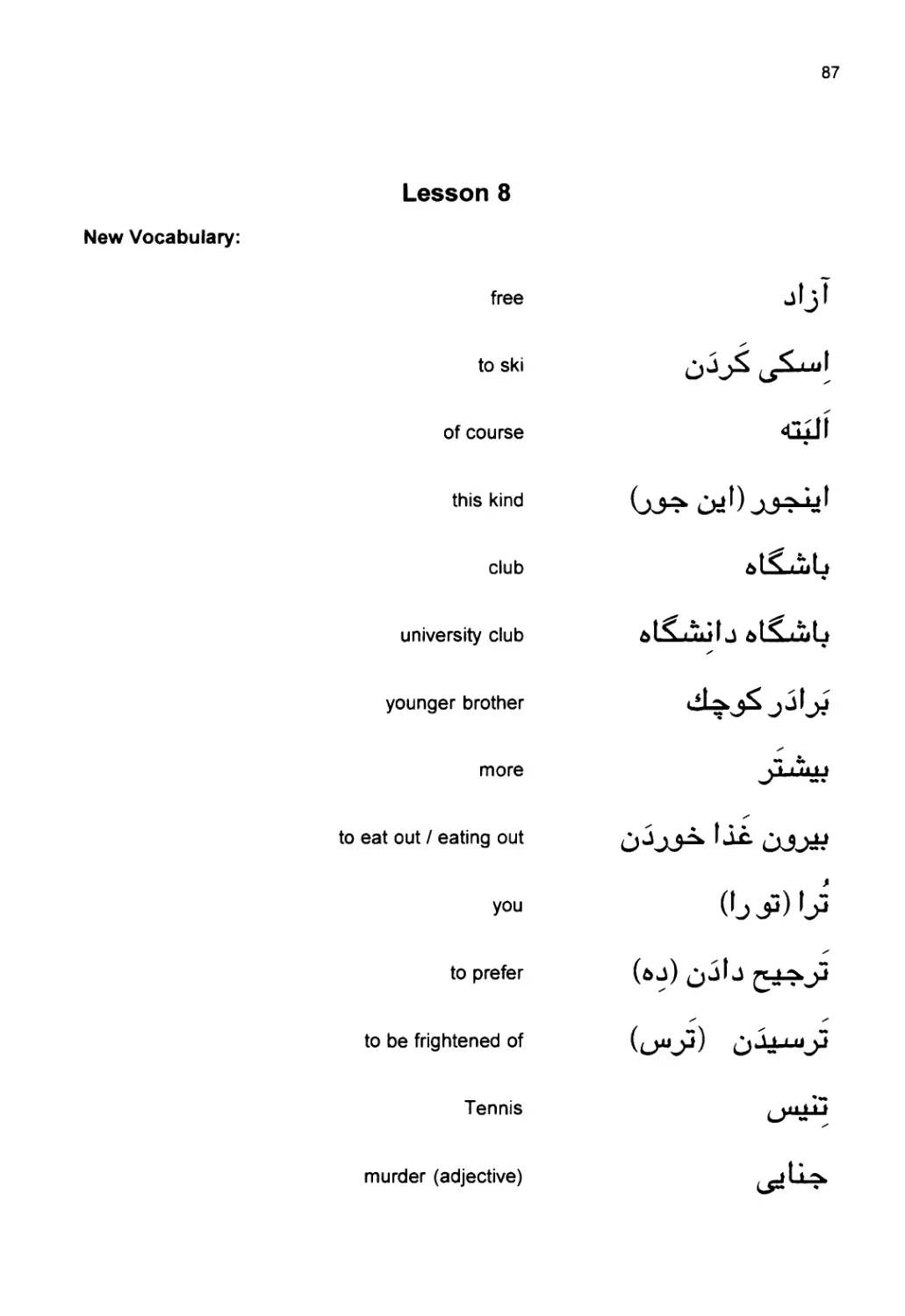
New Vocabulary:
Lesson 8
free
to ski of course this kind
club
university club younger brother
more
to eat out I eating out you
to prefer
to be frightened of
Tennis
Gj-^ сяО
<7iL
i utt J blSujuL
** &
I Ji ojjjj
(IjjW
(ftj) Jjlj
murder (adjective)
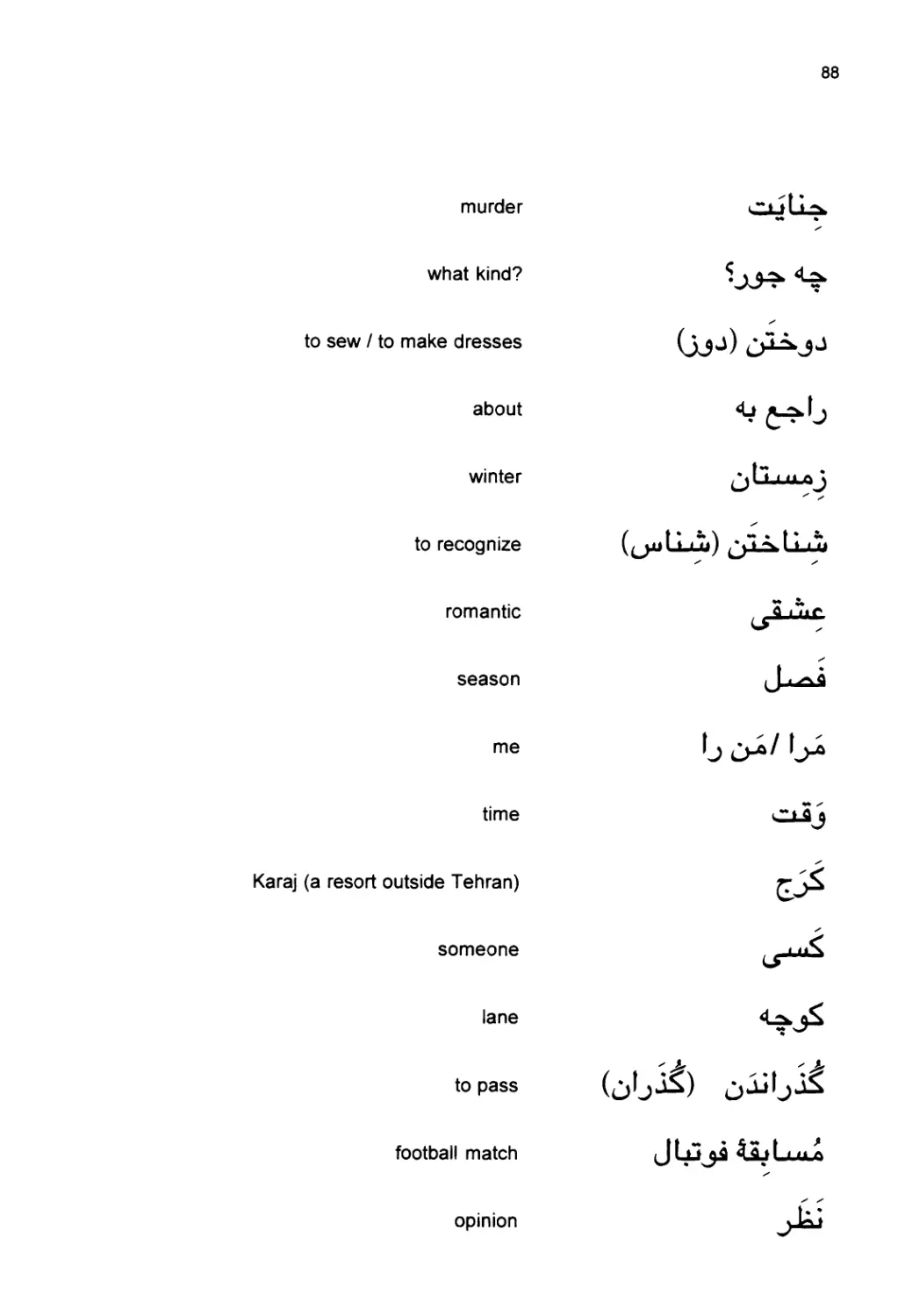
murder what kind?
to sew / to make dresses about winter to recognize romantic season me
time
Karaj (a resort outside Tehran) someone lane
to pass football match
opinion
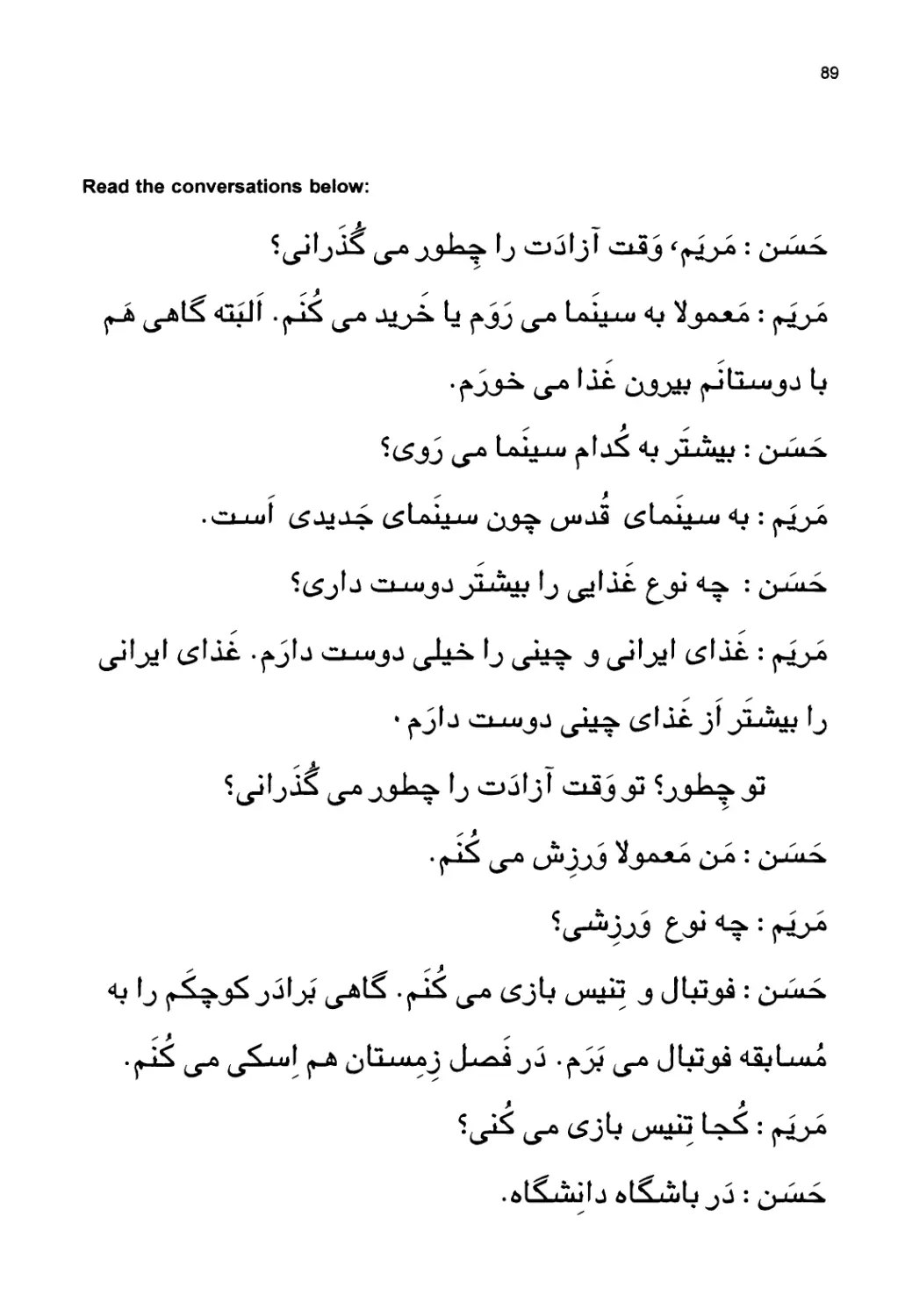
Read the conversations below:

Grammar.
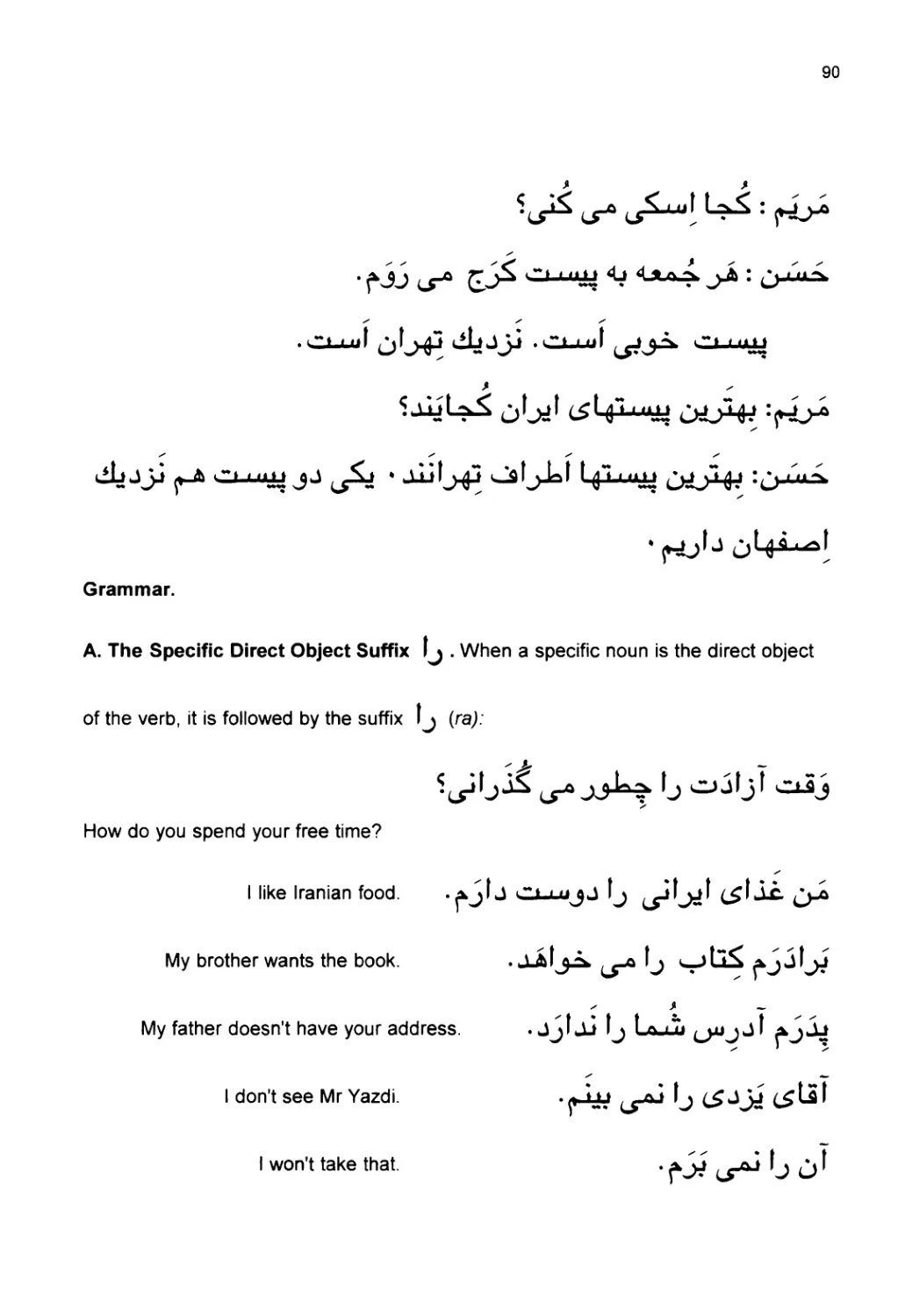
A.	The Specific Direct Object Suffix lj . When a specific noun is the direct object
of the verb, it is followed by the suffix lj (ra):

How do you spend your free time?
I like Iranian food.
jxjlj CXjlujJ Ij
My brother wants the book.
My father doesn't have your address.
I don't see Mr Yazdi.
I won't take that.
Ь G?
He/she likes me.	. Jjlj О * оjJ lj-a
As the above examples demonstrate, a specific direct object can be a noun qualified by a possessive pronoun suffix as in CJ jlj I 0-4j 'your free time', a noun qualified by one or more adjectives tgl Jx, 'Iranian food', a proper name as in CS JjJ C5 LSI 'Mr Yazdi1, a demonstrative pronoun 'that' or 'this' or a personal pronoun such as && T.
Note that lj is often combined and written in the irregular form of Ij-a . The я same rule applies to lj jj : Ijj .
When a verb has more than one definite object, these are regarded as a syntactical whole and the suffix lj is placed after the final object:
They are buying our house and car.
The following are some of the other uses of the suffix lj :
A.1. In an interrogative sentence, if the interrogatives 'which' and I 4^ 'who' refer to the specific direct object of the sentence they are followed by lj :
Which car do you want?
I want the black car.
Who do you see?
I see Mrs Beheshti.
5^1^ Ij jauiLo
Ij b r*1^
A.2. . A noun qualified by a cardinal number does not take lj unless it is also
preceded by the demonstrative adjective & I 'that' or ’this':
I want two books.
I want these two books.
. fjbljS.	Jj .
We are buying five chairs.
We are buying those five chairs.
. p-AljS.	Ij	jJ jjt
A.3. It therefore follows from the previous point that any noun which is the direct
object of the verb and is qualified by the demonstrative adjectives <jl 'that' or
'this' takes the suffix lj :
LluLgJ
I am watching the American film.
I know this athlete.
.--uulLi	IJ jtixujjJ Jjl
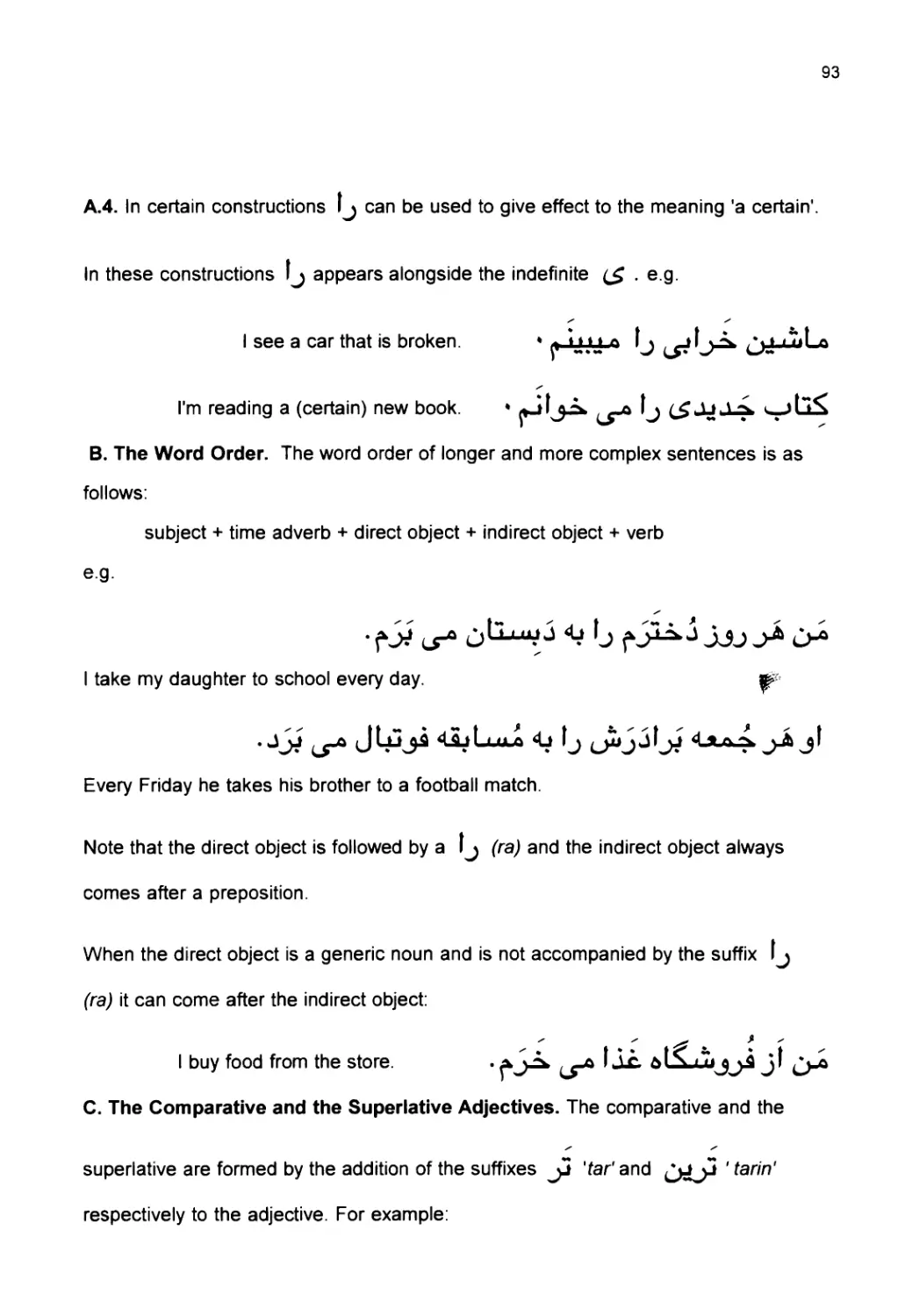
А.4. In certain constructions lj can be used to give effect to the meaning 'a certain'.
In these constructions Ij appears alongside the indefinite • e-9-
I see a car that is broken. ♦ н и a Ij ^jlj_k
I'm reading a (certain) new book. ♦ ^JljA, ^a Ij
B.	The Word Order. The word order of longer and more complex sentences is as follows:
subject + time adverb + direct object + indirect object + verb eg.
•	Ь f J1S J jjj jA
I take my daughter to school every day.
. JjJ ^A (JllJji	4j Ij (jbj jljJ j-А JI
Every Friday he takes his brother to a football match.
Note that the direct object is followed by a Ij (ra) and the indirect object always comes after a preposition.
When the direct object is a generic noun and is not accompanied by the suffix Ij (ra) it can come after the indirect object:
I buy food from the store.	. uF0	jjJ jl j-a
C. The Comparative and the Superlative Adjectives. The comparative and the
superlative are formed by the addition of the suffixes jJ 'far' and <jjjj ' farin' respectively to the adjective. For example:
The exceptions are:
bigger
biggest
colder
coldest	JJjJjj-LU
good
better
best
and	are the comparative and the superlative forms of the now
obsolete adjective 'be/?''good'. jA- 'good' is now common in modern Persian
and you will sometimes see its comparative and superlative forms jijA 'better'
and	'best' being used.
C.1. The comparative follows the noun it qualifies:
We want the bigger house.	*	lj
I want the longer skirt.	* jt A U * L* Ц -
C.2. The superlative precedes the noun it qualifies:
The best pistes are around Tehran. • Cslj-Ll t
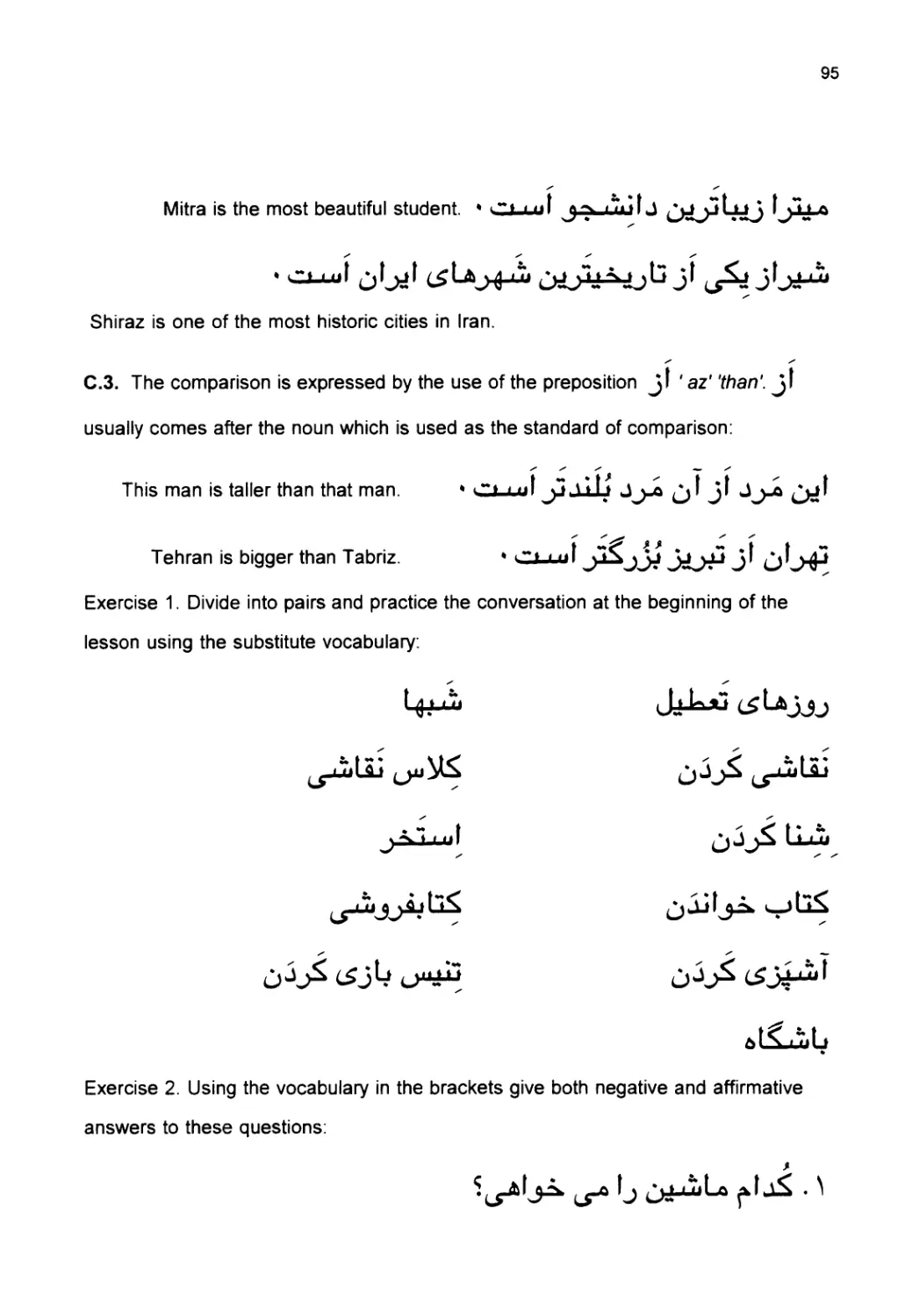
Mitra is the most beautiful student * Ct t ul tut IJ	Ijxta
• cxxul jljjl	jjjljAjjlj jl jljj-Lu
Shiraz is one of the most historic cities in Iran.
C.3. The comparison is expressed by the use of the preposition JI 'az' 'than'. JI usually comes after the noun which is used as the standard of comparison:
This man is taller than that man. ♦ O-juj! jj JjJj Jj-a ^jt jl
Tehran is bigger than Tabriz.	* Ct t ut	jf
Exercise 1. Divide into pairs and practice the conversation at the beginning of the lesson using the substitute vocabulary.
^-LuLSj	^-luLSj
jAlxul
13^	0 it I <_j (3^
। Tit j
Exercise 2. Using the vocabulary in the brackets give both negative and affirmative answers to these questions:
^A lj 4jLuJjj	. T
(jXjf - Jjul ) •(У^ ^A IJ <Lal»jjJ	.V
(cruul^l - ^jU) lj	a
(ji - 41^)
*LsAj^ (Xй b ёйЬ^ f • 0 bbJ- j>4) Exercise 3. Translate to Persian:
1.	We want that table.
2.	I am reading this book.
3.	He does not like that film.
4.	I see Mrs Raji.
5.	She wants that black bicycle.
6.	Which car do you want?
7.	I'll wear that long dress.
Exercise 4. Give free answers to these questions:
:jxajj JljI
Ij <Loli \
•tfjA LT0-* Ь	ЧМ5 •
S^u^^jjlj^ .r
X	'
5 (_£ j IJ 6 l^dJb I j cul 4x1»j	• £
Exercise 5. First read the following conversation and then practice it orally in pairs :

^jjlj

Exercise 6. Using the comparative degree of adjective answer the following questions
both orally and in writing:
I jd^jJj J^ui aIj^ •

Jlj^ Lj jLJT
л
5s7t t fit	i7iLq * i
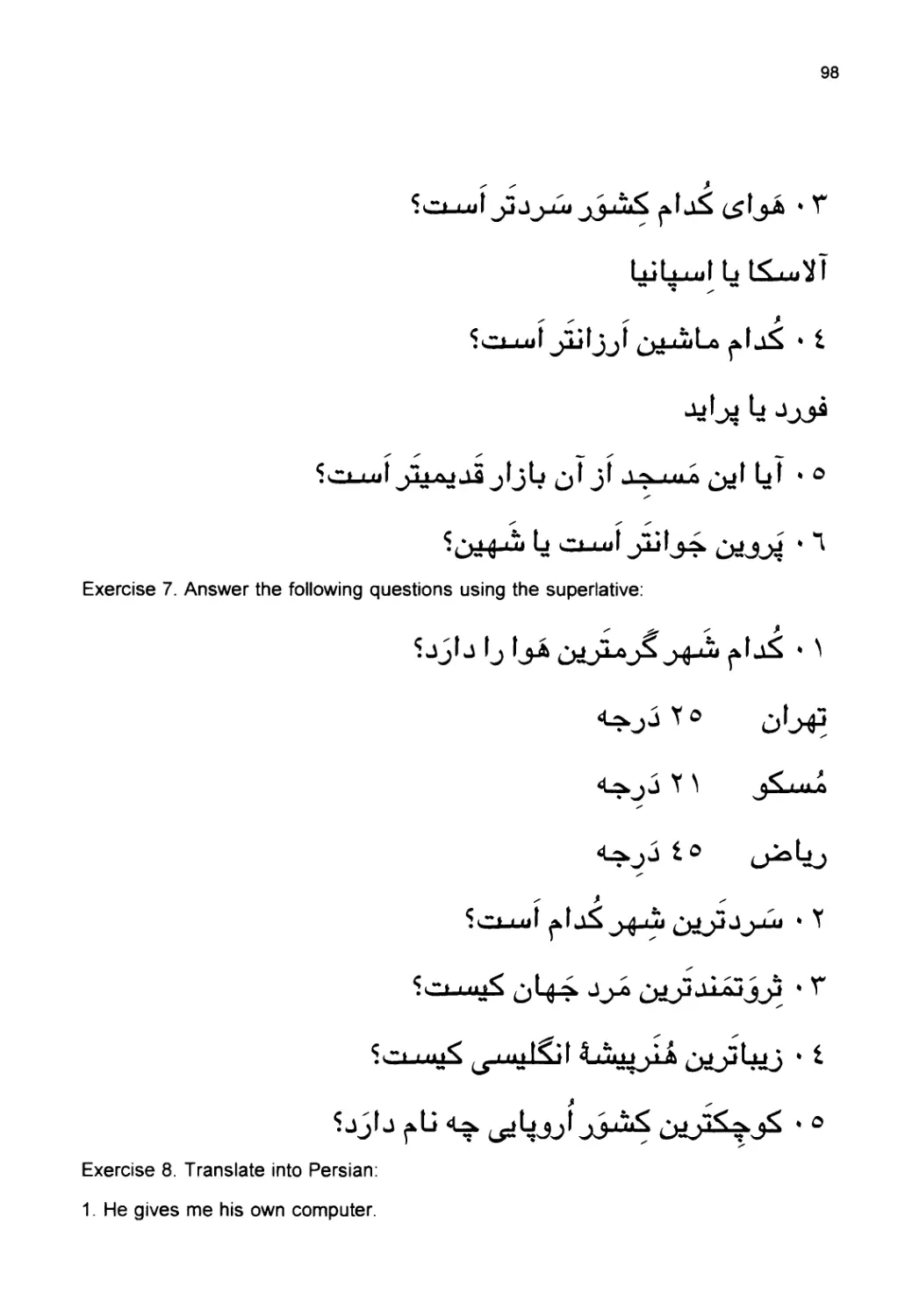
Exercise 7. Answer the following questions using the superlative:
“ijjlj Ij Ij-A JJjIa
<L>jJ i о (_>bLjj
J	s'
5sт11 nt j(|j7i	* Y
Exercise 8. Translate into Persian:
1.	He gives me his own computer.
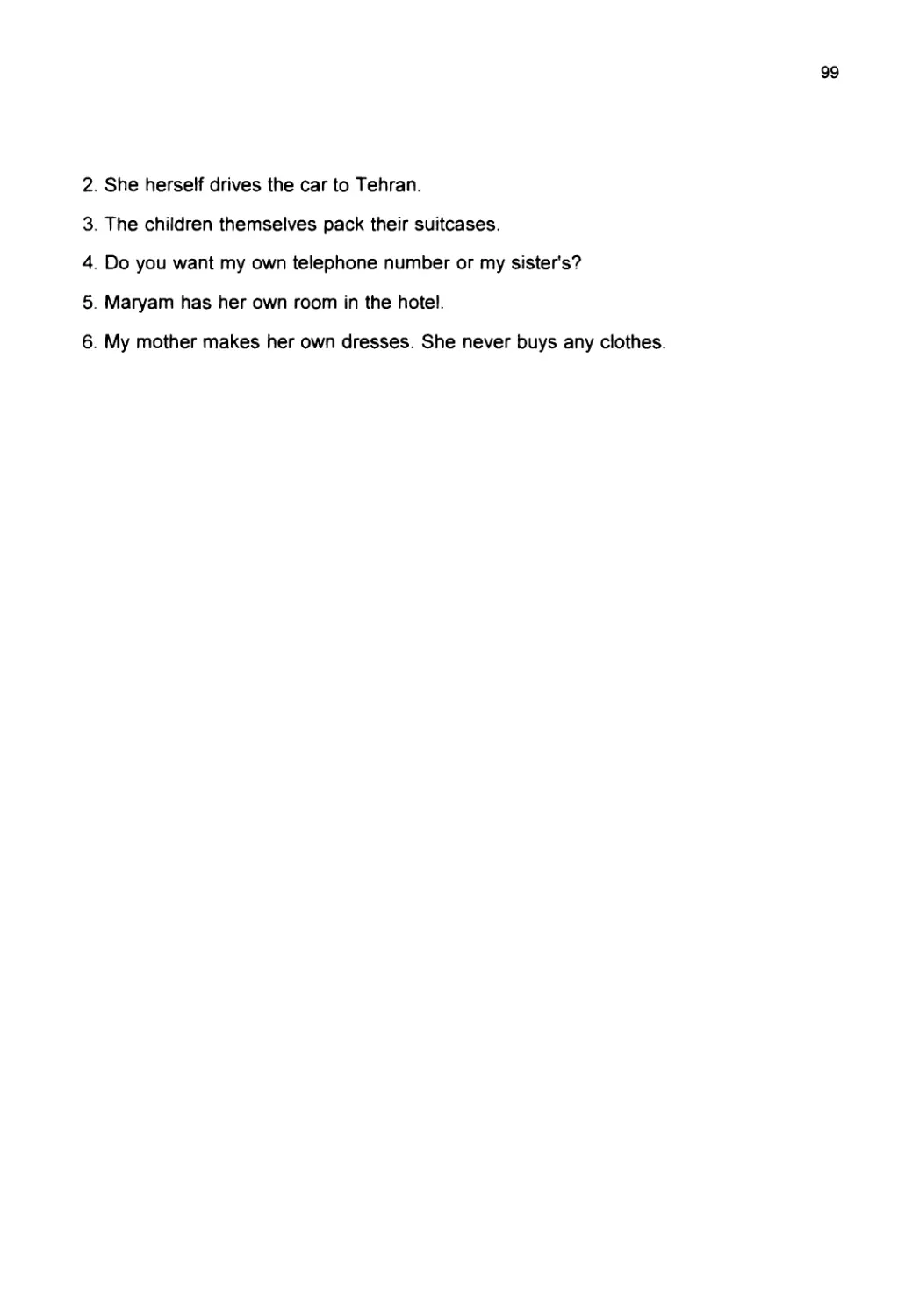
2.	She herself drives the car to Tehran.
3.	The children themselves pack their suitcases.
4.	Do you want my own telephone number or my sister's?
5.	Maryam has her own room in the hotel.
6.	My mother makes her own dresses. She never buys any clothes.
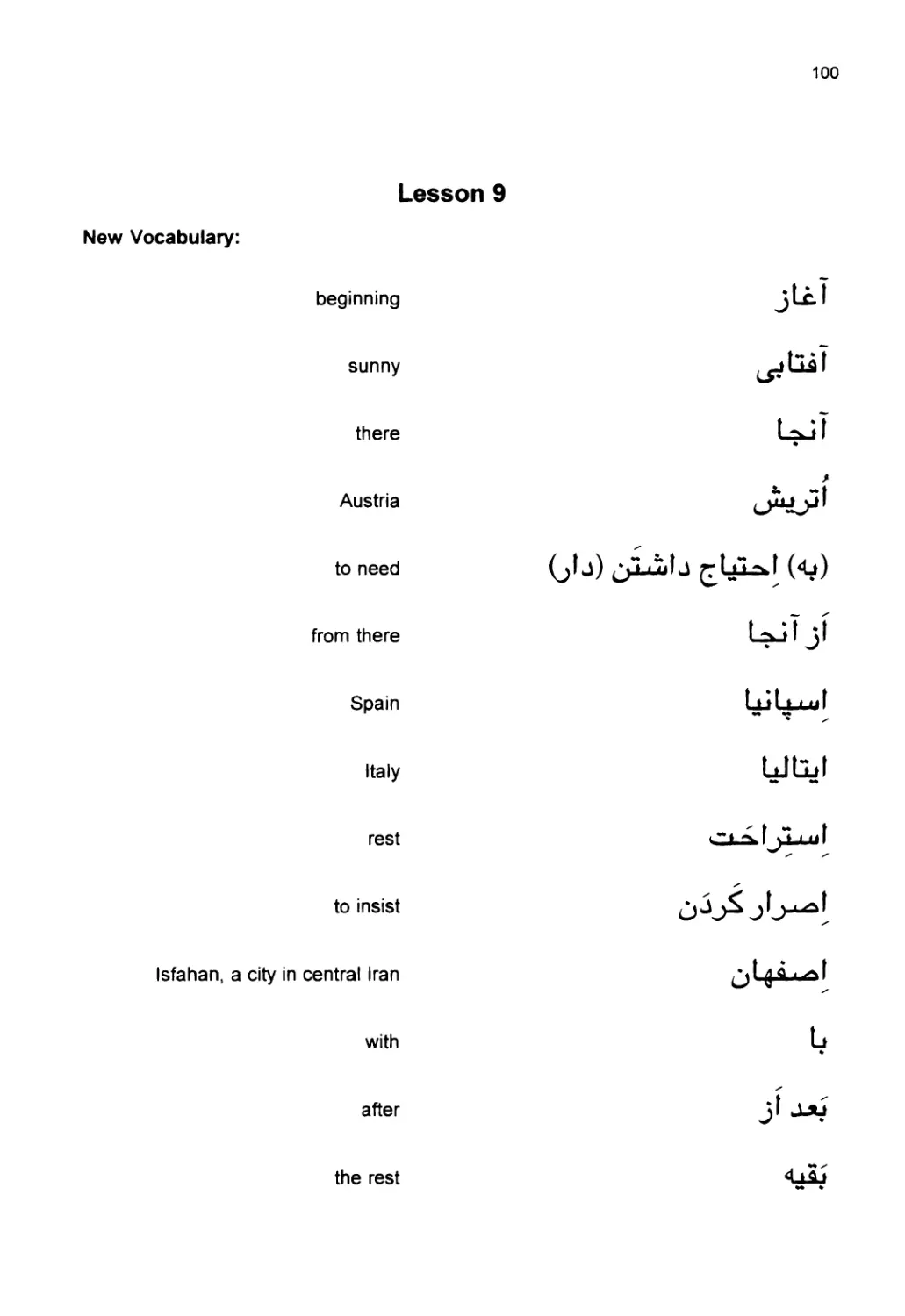
Lesson 9
New Vocabulary:
beginning	Jl£l
sunny
there	ljI
	я
Austria
to need	(jlj) (jlxulj	(<u)
from there	Ljiji
Spain	Lutj CU1
Italy	LJCmI
rest	L ~ I j U 1
to insist	о <4
Isfahan, a city in central Iran
with	L

after	jt 4JU
the rest	d
in my opinion spring
to wake up last year
park after until
backgammon fast tea
suitcase to set
to be tired
self to be asleep
to sleep

ourselves income
to make receipt to receive
to see to reach next day
the day before
cxiLjj u-Ъ^ eiaLjj
(l*“) йЛ»-> (u°j)
jjj
<14 jjj
early / soon
a piece of cloth spread on the floor on which Iranians traditionally set the food at meal
times
dinner
chess
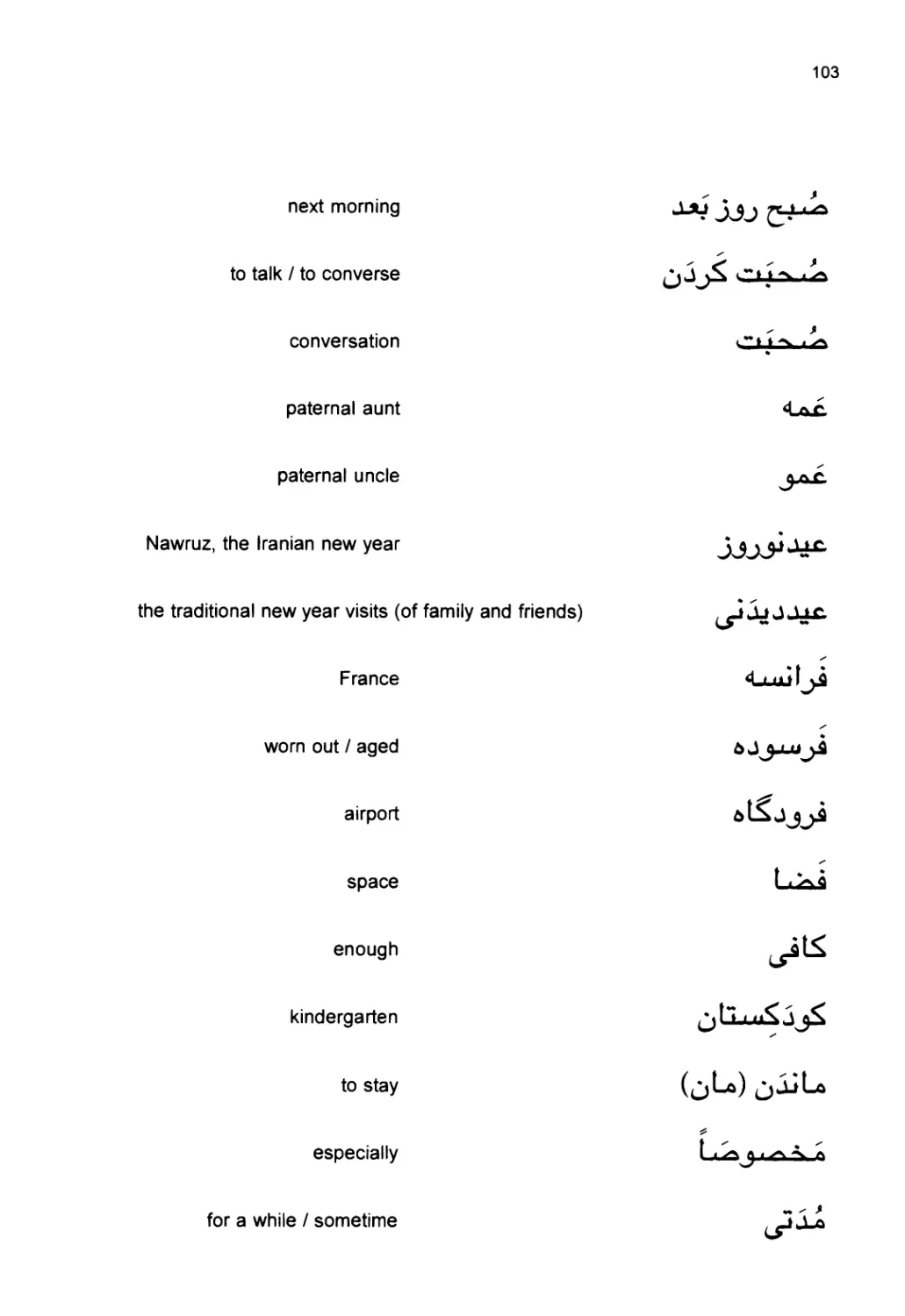
morning
next morning	±4 jjj
to talk / to converse
conversation	/ я
paternal aunt	d
paternal uncle
Nawruz, the Iranian new year
the traditional new year visits (of family and friends)	j.hc.
France
worn out / aged
airport
space	t t
enough
kindergarten	jllxu£jj£
to stay
especially
for a while / sometime
to be busy to be busy cooking
mild
to be waiting to be skilled
guest to sit lunch
(jlj) jlxilj CUjlfl-o
(jXliu) jll.IJLI.uj
however much / although
all
directly
6
one by one
Read the following text.
SOI
Exercise 1. Answer the following comprehension questions:
/ я	я
SalXi a ^Sjjj	jj (Jbl djIjJLi • £

5jhnJj	jjx. Jjj LI *A
SjjjjS: jKa. jl$j jl алл • Я
Grammar.
A.	The Past Stem. The past stem or the short infinitive of all verbs is formed by
dropping the ending from the infinitive: e.g.
Past Stem	Infinitive
OlJj	to go
	to tell
	to buy
B.	The Simple Past Tense. This is formed by the addition of the personal verb
endings to the past stem of the verb except for the third person singular which is identical with the short infinitive:
	I went.	j = f +
	We went.	j = + ^5
	You went.	+	J
	You went.	•Misj = JJ + cxij
	He/ she went.
	They went.	J-uij = jJ + cxiJ
The same rules apply to the compound verbs:
	to like	Ct 4 44J J
	past stem	Ct 4juI J Ct 4 44J J
We liked.	рлЪи! J CXxujJ	I liked.	44 J J Ct 4 44J J
You liked.	XlLluI J sTt д иj J	you liked.	^XjLuI J Ct 4 44J J
They liked.	J H.i ot J sTt д иj J He/she liked.	Ct 4jU J Ct 4 44J J
B.2.	The negative form of the past tense is obtained by the addition of the prefix
to the verb:
We didn't stay for supper.
We didn't like that film. . ^j*t.ml Jj Q-mjJ L> {Ди cJ
C.	In the phrase • • • • L^jIaaA, oiLjj J jl 'After receiving the suitcases...',	is the short infinitive of CliLjJ 'to receive' and
the auxiliary verb has been omitted for stylistic reasons.
Similarly in the sentence • m J-m	c£jL j	4j La 'We
too were busy talking and playing.', C£jL j Cij^ /a are the short infinitives of
(j	and	The preposition <U 'to' requires an infinitive
to follow it but the auxiliary verb	.which is common to both verbs, has been
omitted for stylistic reasons.
Exercise 2. Read and then rewrite the following sentences in the past tense:
. ci ml -LLiA jl .
. Jjl J CUjL^-a	jJ
. JjLLmJb CuLujI (jLj's mil J Lfljl • V .(.JIj	-uijj oi . t
• CLLmUU
. о
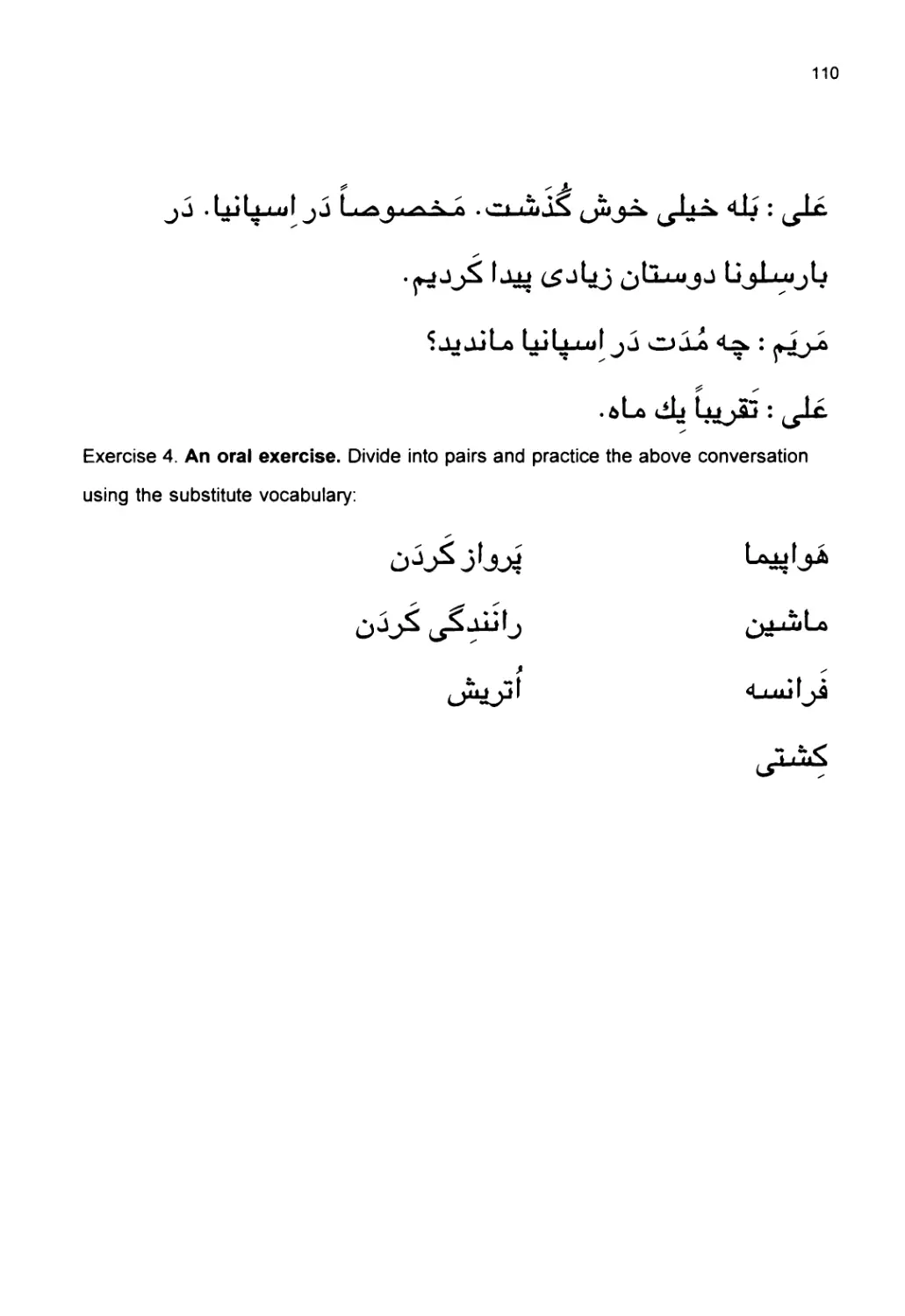
Exercise 3. First listen and then read the following conversation :

5


Exercise 4. An oral exercise. Divide into pairs and practice the above conversation
using the substitute vocabulary:
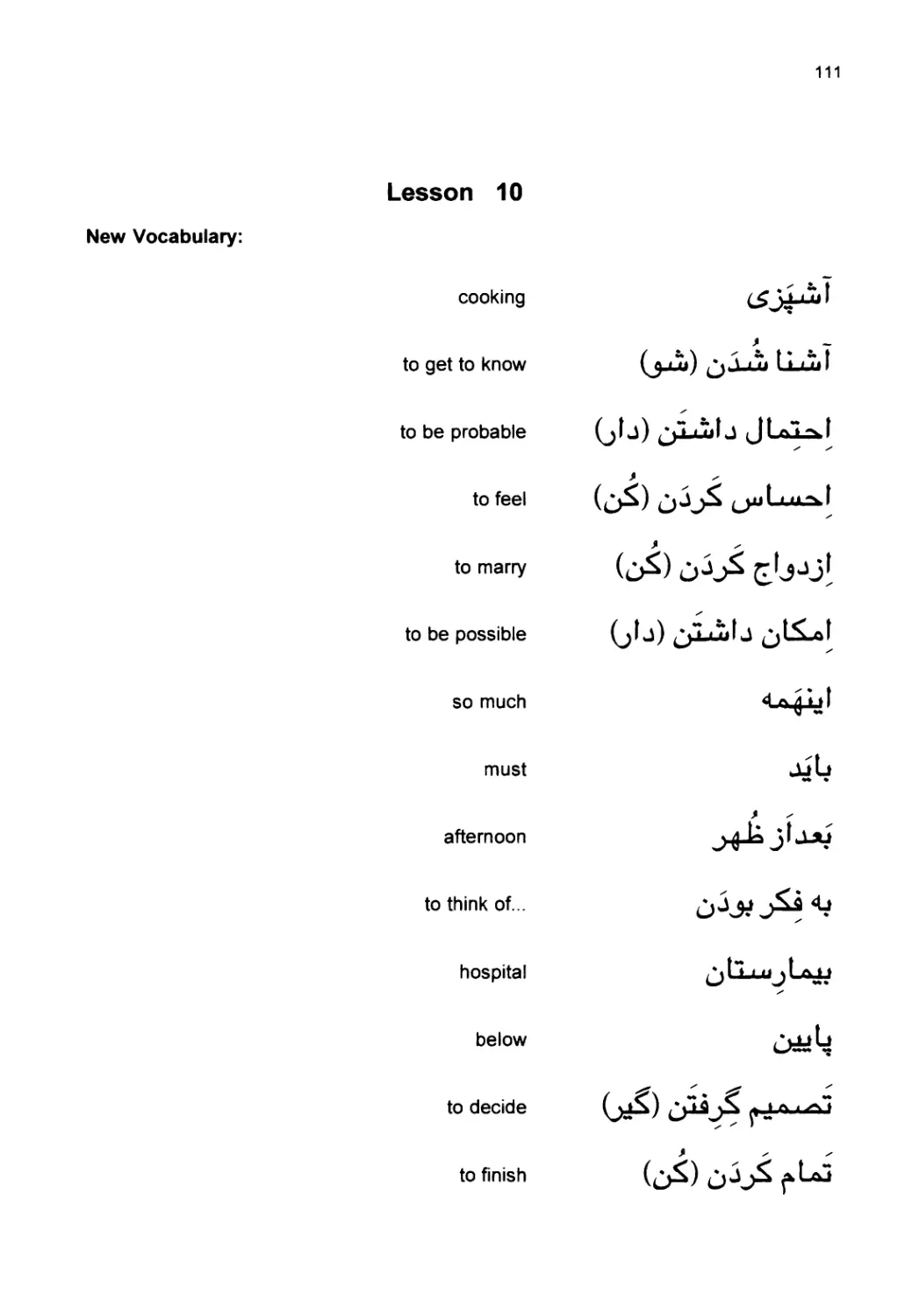
New Vocabulary:
Lesson 10
cooking to get to know to be probable
to feel
to marry to be possible
so much must afternoon
to think of...
hospital below
to decide to finish
(jb)
(g)^) GpJ^ gM
(g4)
(jij) oLib jKoi
л»ь jbA?
J A# jtlxujLuj
(j^)
(g>^) g)A?-* fbbj
a few people How many people? shopping in total to invite to ring / to call (by phone)
a lot maybe to hear
floor I storey to hurry tomorrow
tomorrow night opportunity to think
(c>^)
(Jj) CPj
□L»j
to intend
to promise coffee less to listen to
(ftj) Jjlj
(cA)
to be obliged


Grammar.
A.	Subjunctive Present. The subjunctive present of a verb is formed in the following
way:	the prefix + present stem of the verb + personal verb ending
I may see.
You may cook.
She/he may buy.
A.1. Compound verbs. The verbal component is conjugated following the above rule.
The subjunctive present of compound verbs is usually characterised by the omission
of the prefix :
I may invite.
I may get to know [him/her].
LLlxJ
However, in spoken and informal Persian the prefix is often retained:
I may speak.
A.2. If the nonverbal element of a compound verb is a particle or a preposition such
as^j , jL , j J , the prefix is not added to the verbal part:
I may return.

We must return.
A.3. To form the negative of subjunctive present the prefix & replaces <_
A.4. The subjunctive present of "to be" £ takes the following form:
plural	singular
A.5. The verb "to have" J takes the past subjunctive form for its subjunctive
present:
plural
JlLXXiL 41 L?)t J
singular
J t ' j 41 l7)I J	j-iiL 41 l7)I j
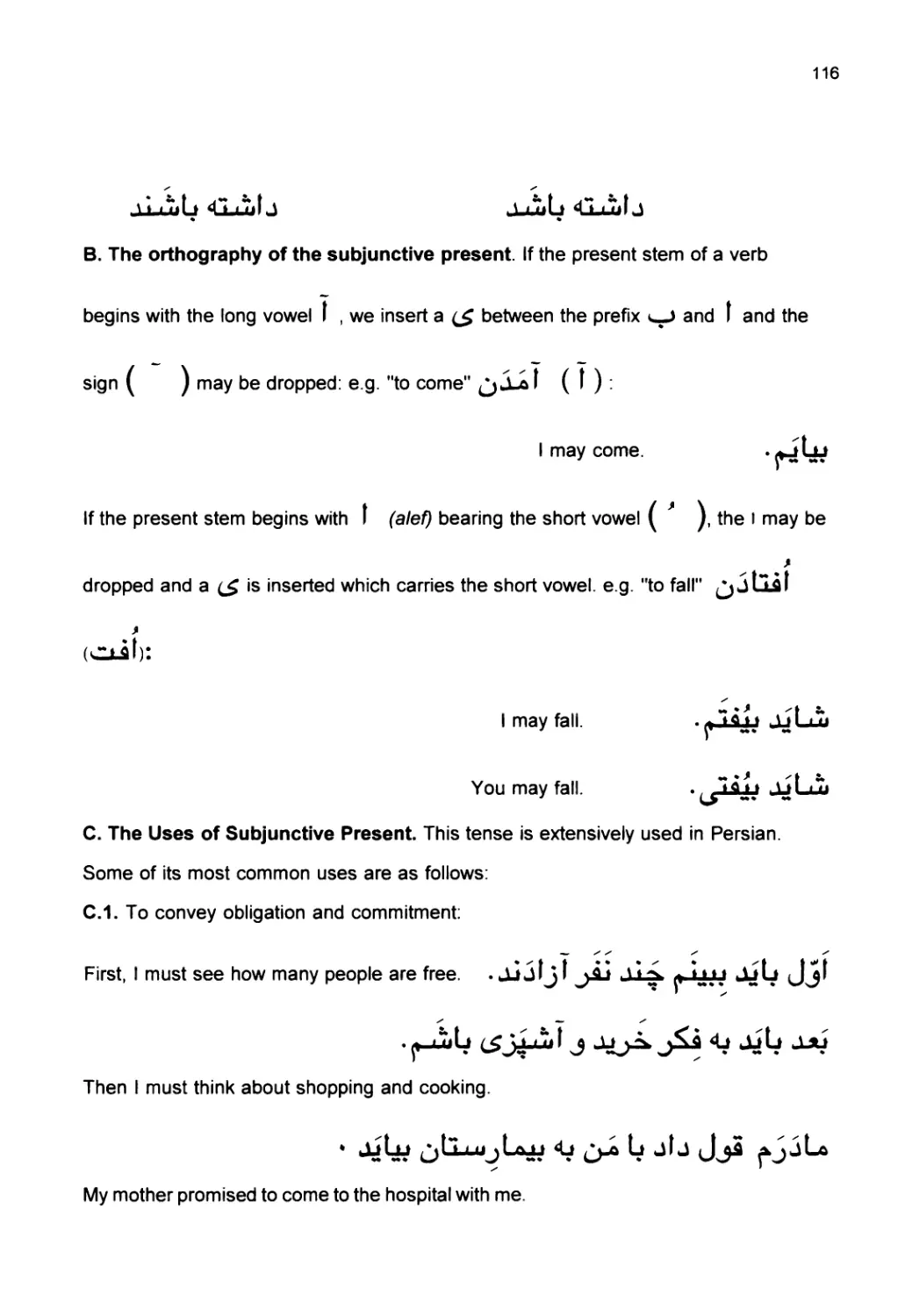
B.	The orthography of the subjunctive present. If the present stem of a verb begins with the long vowel I , we insert a between the prefix and I and the sign (	) may be dropped: e g. "to come" I ( I ) :
I may come.	.
If the present stem begins with I (alef) bearing the short vowel (	), the I may be
J dropped and a is inserted which carries the short vowel, e.g. "to fall" £
(oil):
I may fall.	- JjLlxi
You may fall.	-	e j j JjLlju
C.	The Uses of Subjunctive Present. This tense is extensively used in Persian.
Some of its most common uses are as follows:
C.1. To convey obligation and commitment:
Then I must think about shopping and cooking.
• bbLu ^CLlujIa-M 4j L jIj
My mother promised to come to the hospital with me.
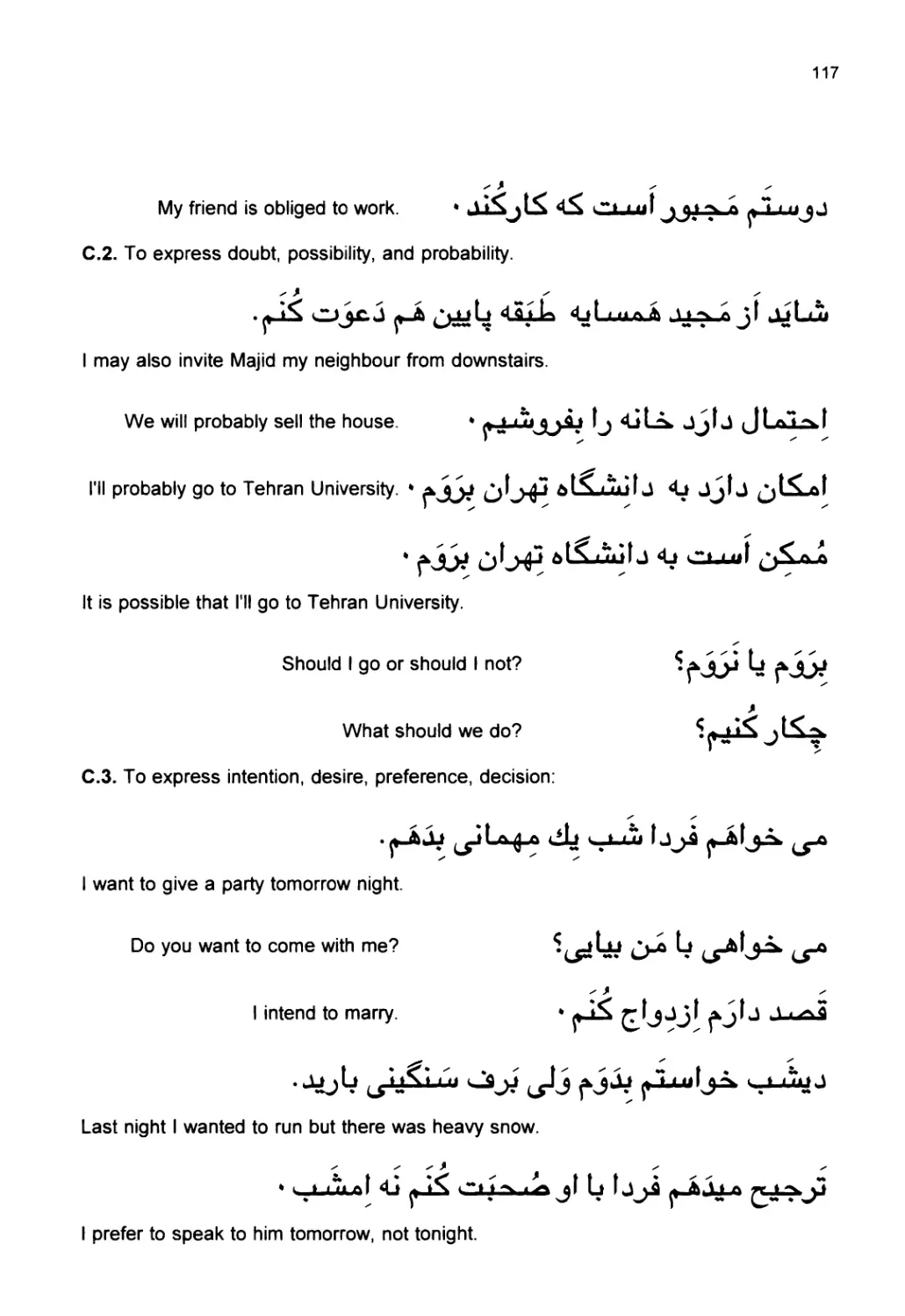
My friend is obliged to work.
C.2. To express doubt, possibility, and probability.
I may also invite Majid my neighbour from downstairs.
We will probably sell the house.
I'll probably go to Tehran University. ♦	Jjl J
It is possible that I'll go to Tehran University.
Should I go or should I not?
What should we do?
C.3. To express intention, desire, preference, decision:
I want to give a party tomorrow night.
Do you want to come with me?
I intend to marry.
Last night I wanted to run but there was heavy snow.
I prefer to speak to him tomorrow, not tonight.
•	4j 4^ mJ 41i^£	^jUj
My father has decided to return to Iran.
*	J Jjjf
I wish/hope to become rich one day.
C.4. To express ability:
I can take next week off. .	* 6 Jjj I 41iA
I can go to work today.	.
•	-н-“	й-° 5ляJ
Yesterday I was not able to go to work.
We are able to buy this land.	*	Ij -Aj jj! fUjjli
Note that after the auxiliary verbs "to want" 3-^ and "t° be able to/can" ^2)1x011jj subjunctive present is used regardless of the tense of the auxiliary verb:
C.5.. Subjunctive present is used after final conjunctions 4^ and b "so that/ in
order to", to express a sense of purpose. Note that 4^ and b are interchangeable
and unlike English in Persian these conjunctions can be omitted from the sentence.
eg.
It is a good opportunity to get to know him.
J*1
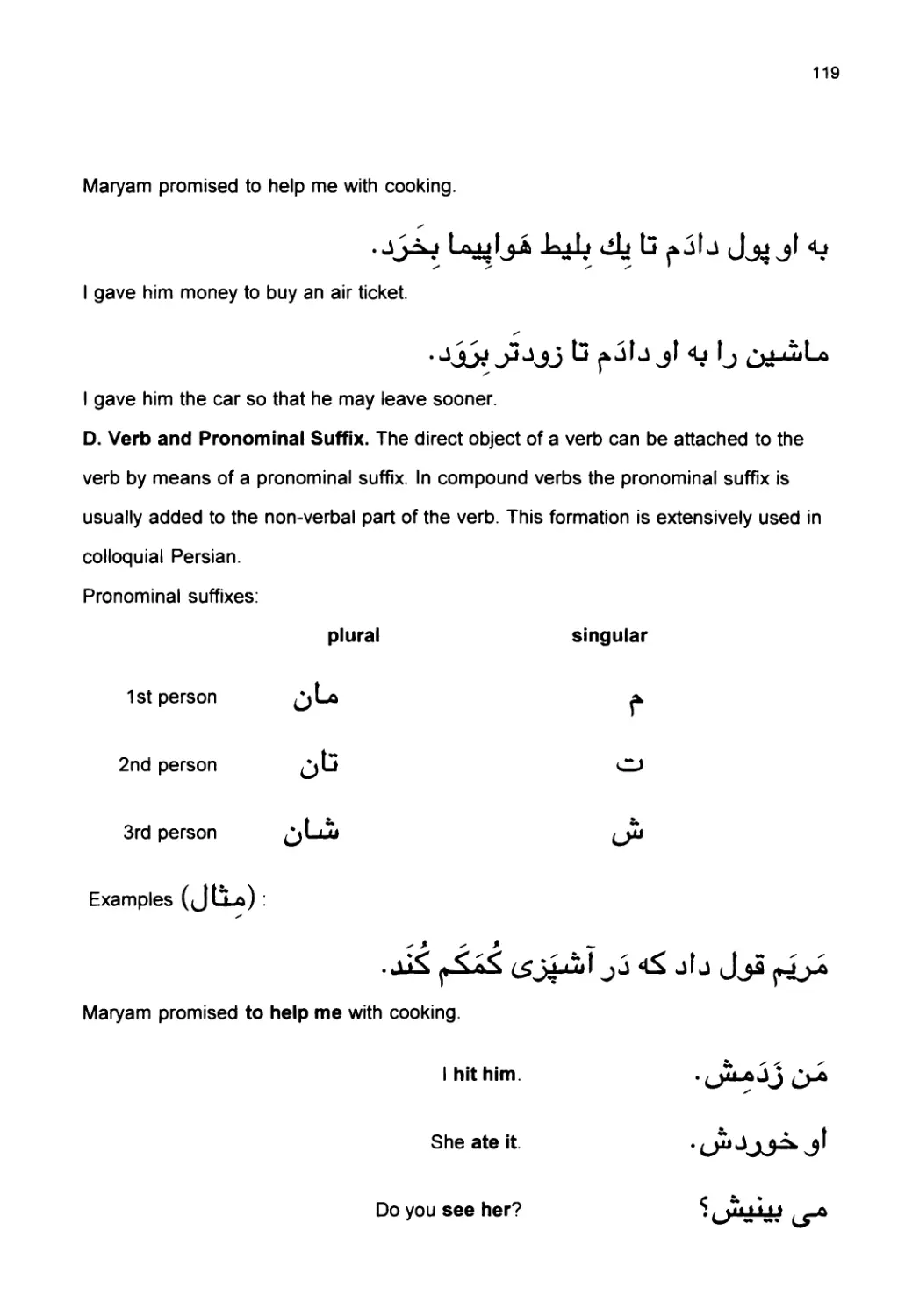
Maryam promised to help me with cooking.
.	t Ajjt3-Л Ujlj dL L> J Jjj 31 4j
I gave him money to buy an air ticket.
•	f 3b jl <U Ij ijxxbU
I gave him the car so that he may leave sooner.
D. Verb and Pronominal Suffix. The direct object of a verb can be attached to the verb by means of a pronominal suffix. In compound verbs the pronominal suffix is usually added to the non-verbal part of the verb. This formation is extensively used in colloquial Persian.
Pronominal suffixes: plural 1st person	jLo 2nd person 3rd person	£ Luu Examples ((JIXq) : X J	X	/ Maryam promised to help me with cooking. I hit him. She ate it.	singular r сЛ jxibi jJ 4^ jtj	j*-jj-o .(jAUeJj J-O
Do you see her?
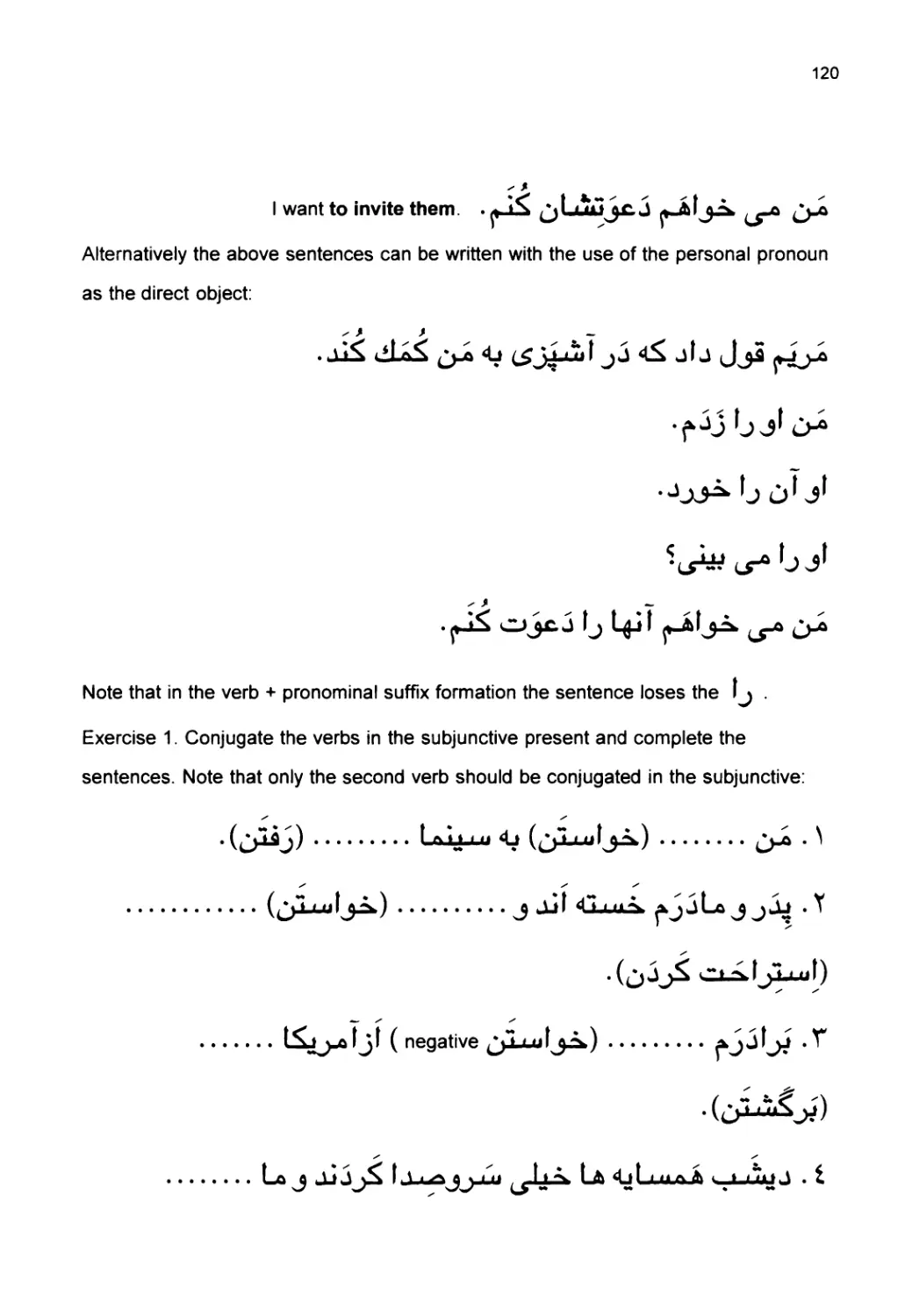
I want to invite them.
J
Alternatively the above sentences can be written with the use of the personal pronoun
as the direct object:
Note that in the verb + pronominal suffix formation the sentence loses the lj .
Exercise 1. Conjugate the verbs in the subjunctive present and complete the
sentences. Note that only the second verb should be conjugated in the subjunctive:

•(гяъ)

\ t
л . \ в
Exercise 2. Translate into Persian:
1.	She can swim.
2.	We want to go to the cinema.
3.	I want to invite my colleagues.
4.	They can't come here tonight.
5.	We may reach London this afternoon.
6.	Can I talk to him?
7.	We must study today.
8.	I prefer to go shopping with my friend.
9.	Yesterday, I was able to finish my essay.
10.	We don't want to buy that house.
11.	1 forgot to give her the news.
12. Last night we could not watch TV.
Exercise 3. Rewrite the sentences below by attaching the direct object to the verb using a pronominal suffix:
fAjjf L>
I .©
uljjj.v
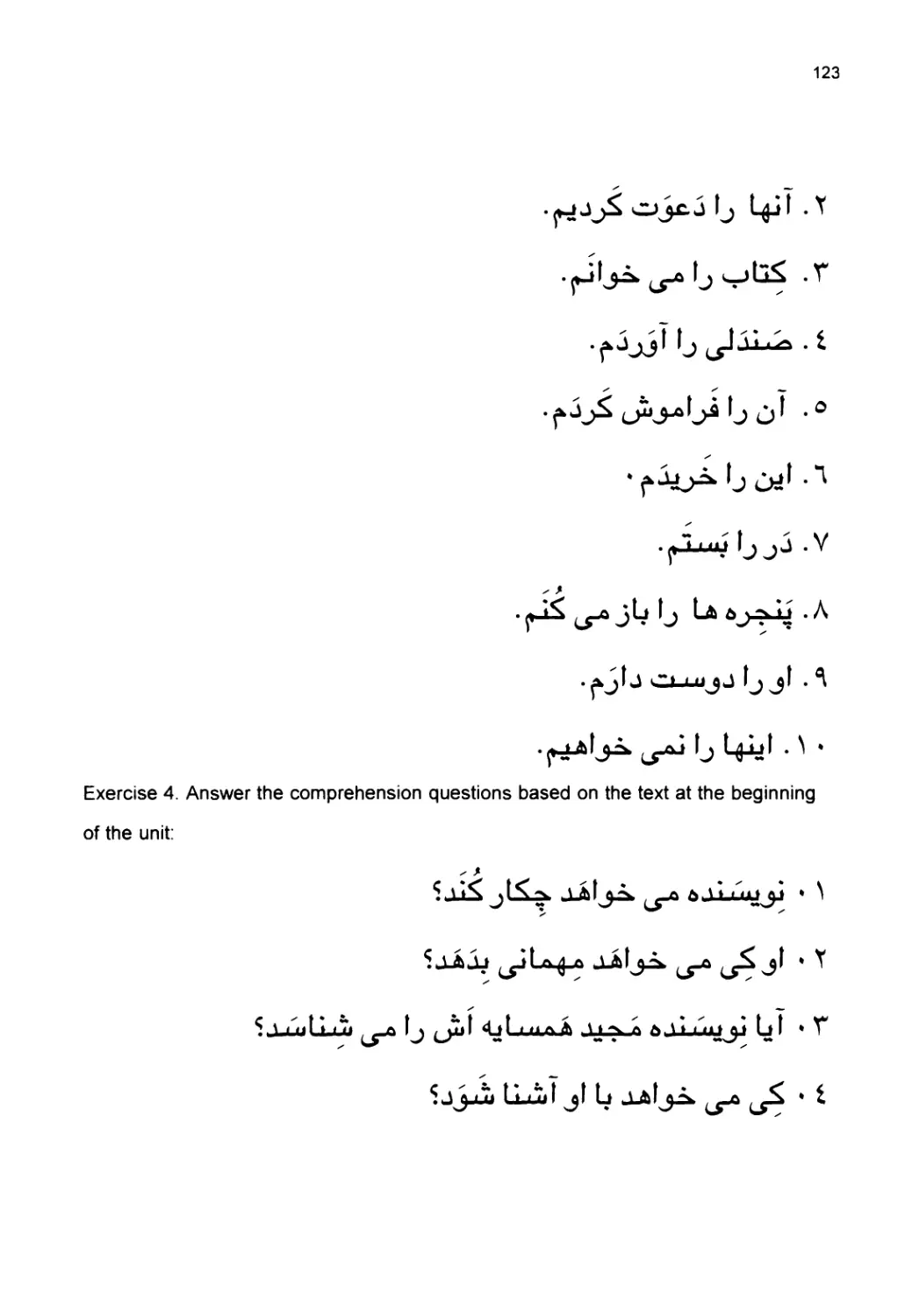
Exercise 4. Answer the comprehension questions based on the text at the beginning
of the unit:
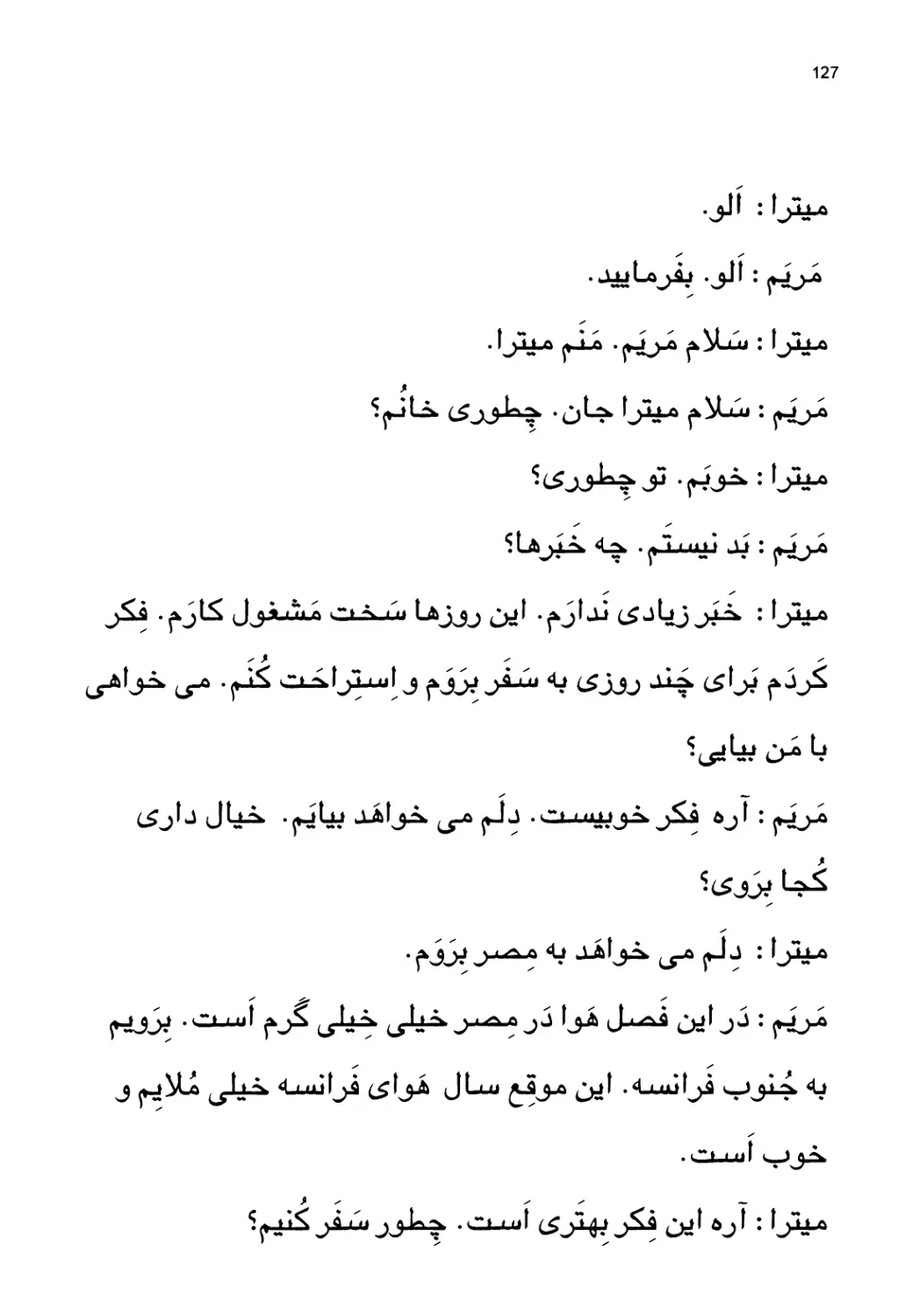
Lesson 11
New Vocabulary:
yes
hello (when answering the telephone) with
OK / Let it be.
to dislike
Let us go.
How can I help you? / Here you are. to get the jobs done / to do the work to fly to be thirsty to clean dear / life south
How are you?
Oji jjf
L
xJuL I <lJuL
(I) (jb


(O^)
jjjj <Gjiu
news	j*
to laugh	(j^)
to feel sleepy	(I)
to fall asleep	(ji)	v-jl
to like	(I) Jj-ol	(jl)
to intend	(jla)	JUk
to want	(J^)	Jj
to fast	(ja£)	ojjj
on / above
to be hard at work	(JAj?	Jjp-LU-a
to be cold
to become cold	J	Л
to take time	(<j^)	J-5^3
to graduate	(jJu) jiui J_1.w2l.-GП £jLa
France
idea / thought
to be hungry to become hungry to be hot to become hot
to cry / to burst into tears to be busy working
Egypt suddenly whatever
The sooner the better, weather / air to remember to recollect / to remember to know to forget
Я
*4^
aXlq
j-л
(I) (jj-al jL
ОАЭ? jL
(jlj) jL»
(jj) ей3 J

л

Grammar
A.1. Uses of Subjunctive Present Verbs following Impersonal constructions such as
"to feel like" jA J J also take the subjunctive present:
eg-
I would like to come.	. (►jLm AiljA ^a
I would like to go to Egypt	. jaaa 4j JJbijA ^a	J
A.2. Any verb following the construction 'Td better... / You'd better.... / etc." takes the
subjunctive present as its tense:
I'd better ring her and see what she is doing.
I'd better hurry and get on with the jobs.
We'd better fly.
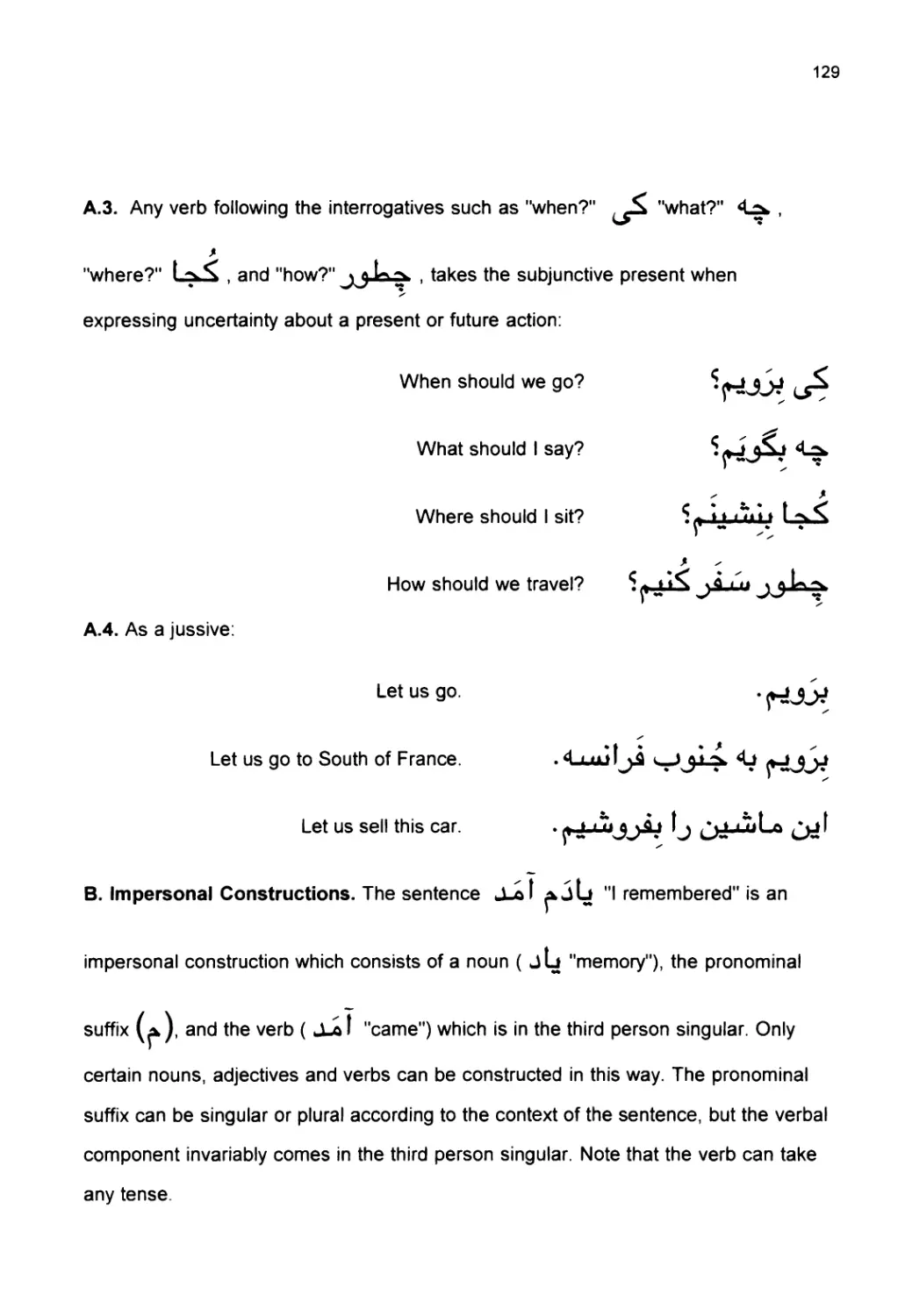
А.З. Any verb following the interrogatives such as "when?" "what?" ,
J
"where?" t 7-^ , and "how?" , takes the subjunctive present when
expressing uncertainty about a present or future action:
When should we go?
What should I say?
Where should I sit?
How should we travel?
A.4. As a jussive:
Let us go.	. pJjj?
Let us go to South of France.	.
Let us sell this car.	.
B. Impersonal Constructions. The sentence J-aI	remembered" is an
impersonal construction which consists of a noun ( "memory"), the pronominal suffix (^), and the verb ( J-a I "came") which is in the third person singular. Only certain nouns, adjectives and verbs can be constructed in this way. The pronominal suffix can be singular or plural according to the context of the sentence, but the verbal component invariably comes in the third person singular. Note that the verb can take any tense.
e g. ^jJ-aI jLj "to remember"
We remember..JjI ^a ^LojLj I remember. .JjI ^a ^jLj
You remember. .JjI ^a ^jljjLj You remember. .Jj
They remember.. JjI ^a ^LuijLj He/she remembers. . JjI qLjL Note that it is the verbal component which is made negative:
I cannot remember. . JjI ^aj ^jL
You cannot remember. . Jj
Some of the most commonly used impersonal constructions are:
I <jJ_aI I jlZbtjjLj/ qJ^j jIj I jLj (jO I
JJji	I^jJji Jjxu I <jJjJ Jj-txi I (JJ-aT 4-^3-^ !
I	I	<-jljA I 6JjA IijJjj
. JJJJ 4jlxXm I JJjJ
Examples (J Ha) :
I forgot her name.	. ClSj J Lj ^jxlajjj I
I can't remember what I said to her.	.	jl 4j C-Lxxuj jLj
I like this dress. • Jj I ^a	LJ ^jj I JI &a
He dislikes this food.
• Jjl ^A	lie (Jjl jl jl
I feel sleepy.	. Jjl ^a	&a
The child is cold.	. O-ujI Jjji <LsLj
I laughed at her clownish/silly behaviour.
I fell asleep in front of the TV.
The news of his death made me cry.
She is not hungry.
She is not thirsty.
Exercise 1. Complete the sentences below by conjugating the verbs in subjunctive present in all the six persons and then translate into English:
*	4	*j) ********* *^±^J CXjLmI • Y
Exercise 2. Give free answers to these questions:
(c-°
5^jLaj jxLuu	^a .T*
5c£jjjA Ij (jjl jjl cjjLj . £
5 jJ I ^a ojI	. °
5^1^ CX^Ijlxxil L c5jb (j^XM LF^ cf°	*
П
^AA йА»Ь> gH^ jt •
5 JJ I ^A CJ Jj 4 I ULMjljb ^Jjl j! . Л jlL jjIjI . Я
ScaJj OJjU a,LAI I .	♦
Exercise 3. Complete the sentences by conjugating the impersonal constructions in brackets in the appropriate tense and person and then translate into English:
• (caA чД)
JXaI (JujS.)
5^ C>-“ J o_i-ul ^jLi jail . Y
. (negative
(jiilaJ)
C^csUxbijt^jj.r
.(negative jLj)
X	Я
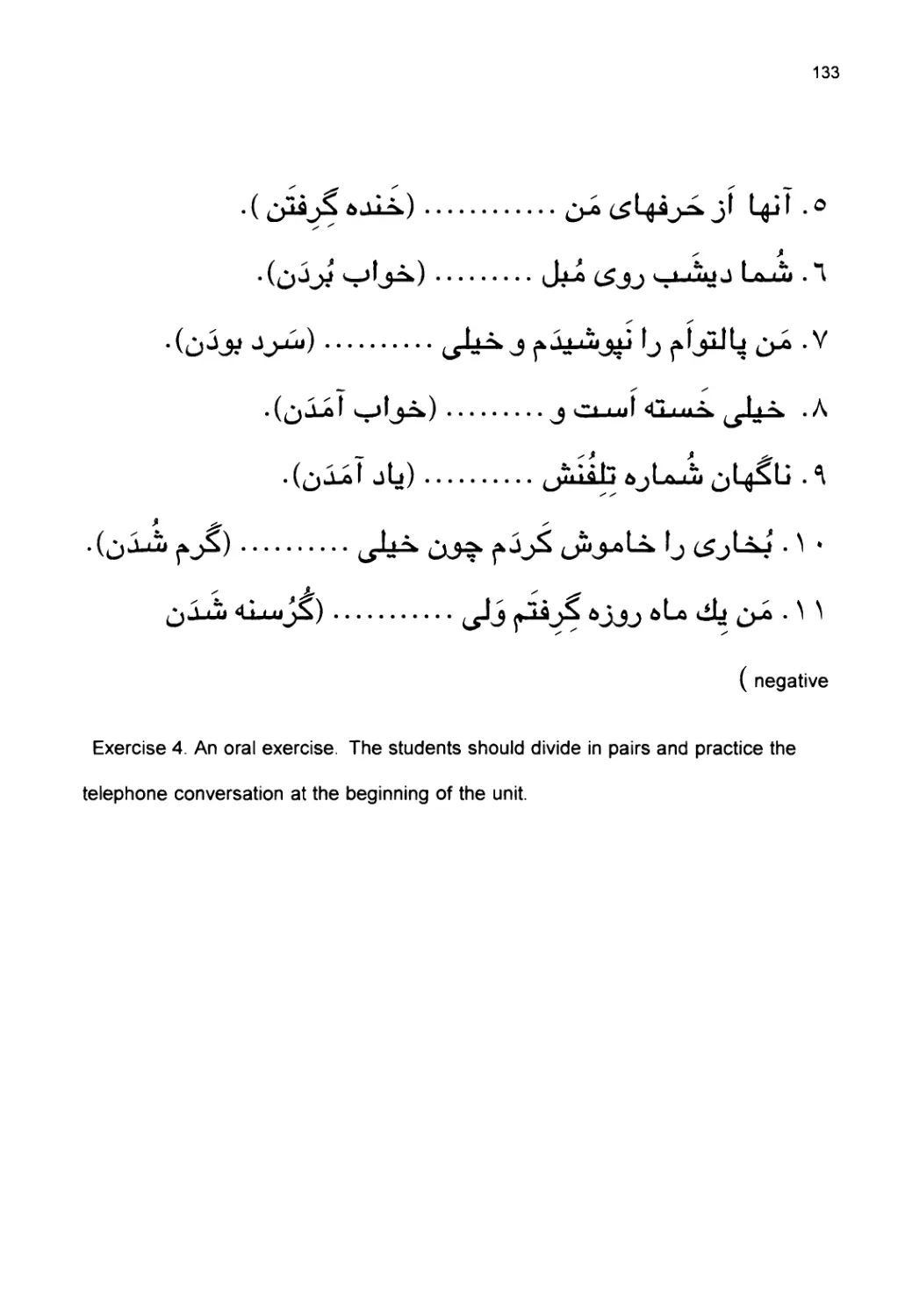
........Ч» ‘ 4iJ Ььхм . 1
•(d<5?	..........J	U f i>* 'V
. (^jj-ol ч—jl^-ik).......j O-mjI 4*t ki-4 *'~ • A
.(jlJ jL)..............(jidilj 6jIaJu jl^U . Я
.(jj-ui j\j^)....................................b	J 1-^=4 • •
Jj-xi 4ixuJ£).......................63л>	ftLo dL t>A . И
( negative
Exercise 4. An oral exercise. The students should divide in pairs and practice the telephone conversation at the beginning of the unit
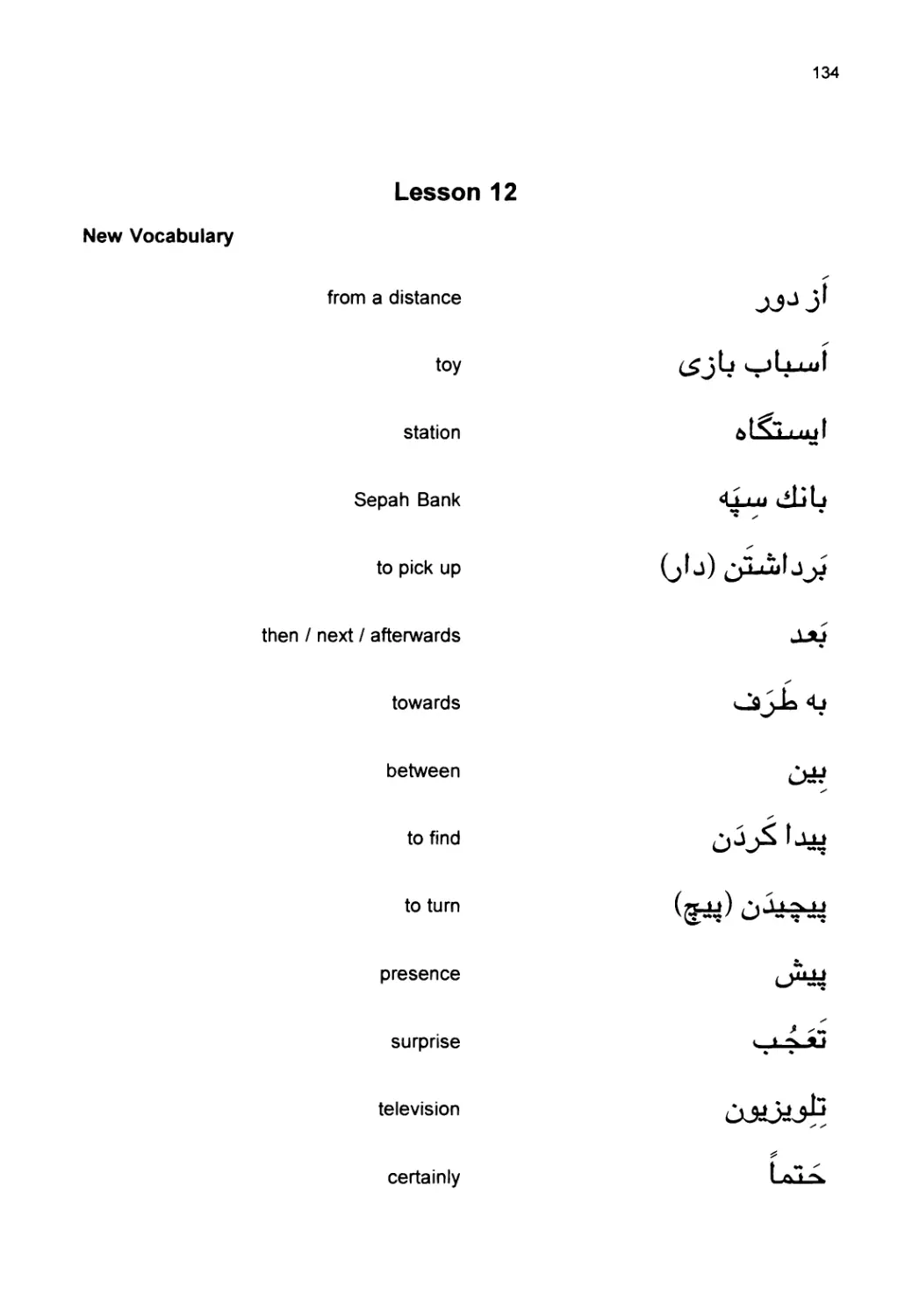
Lesson 12
New Vocabulary
from a distance toy station
Sepah Bank to pick up then / next / afterwards towards between to find to turn
presence surprise television
certainly
even
Not at all. / Don't mention it to become happy thank you very much inside
story
properly / thoroughly a short way (literally two steps) radio right
road / way to walk opposit to switch on
one day direction / way /side
Job
ill J

61J
(jj) смъ6 и
kT t XV 1 4J
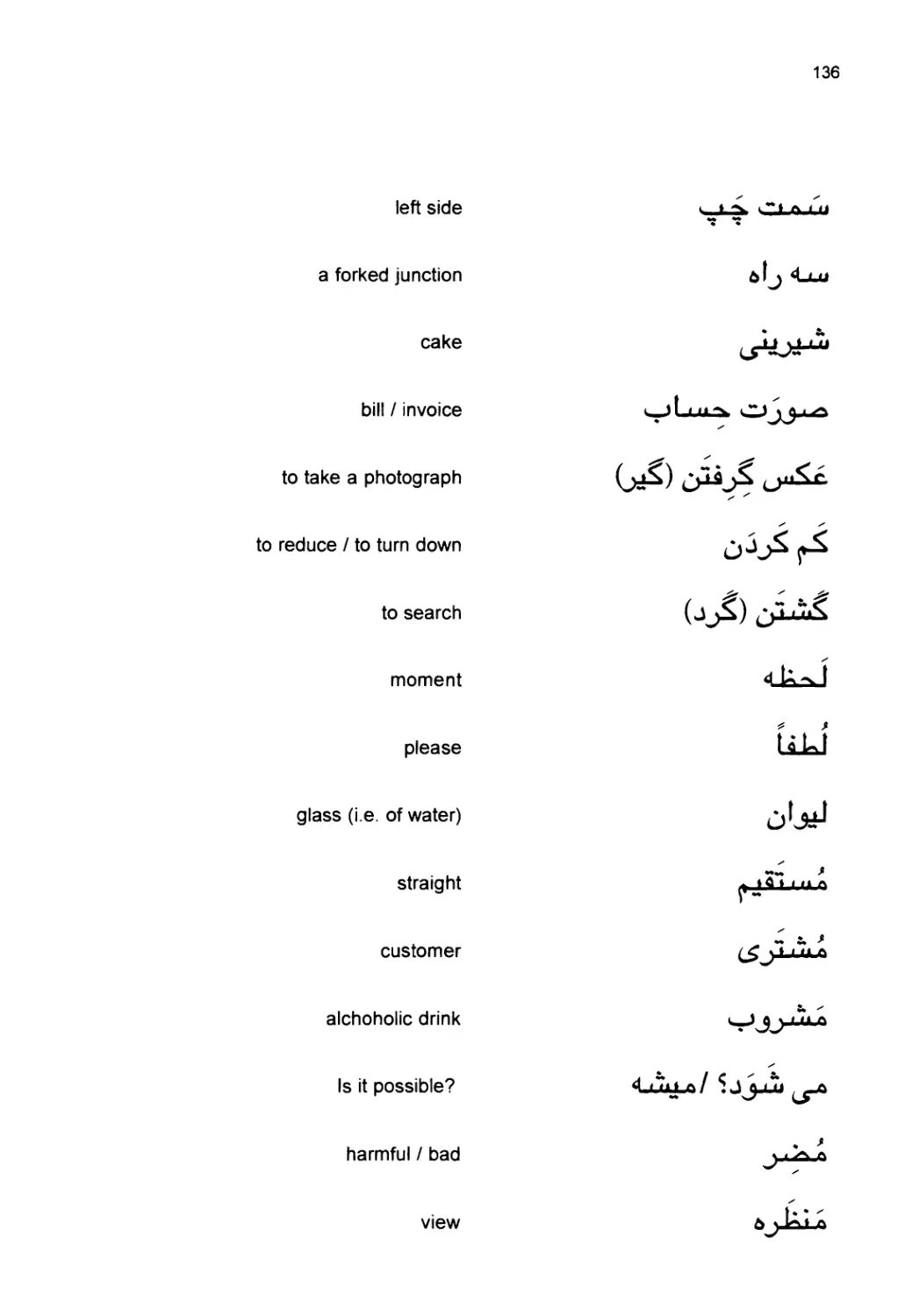
left side a forked junction cake bill / invoice to take a photograph to reduce / to turn down to search moment please glass (i.e. of water) straight customer alchoholic drink Is it possible?
harmful I bad view
tiki

И M fl
~ >
entrance
Read the text below:

я
Jbs-iijA. -jIjou Jjlu
<L^j(jX • J-X IjLU Ij qI CXxuilJ-U	uX 4-^jJb Lal -
jl -ujjj -LLA	-xU lP^Lj (jlflXL; j
. JLUJ JI ~Sj7^A J JLJJ Ij (jxJtX jjJ
A conversation:
5 y~t i U L>^ j UoJ 61 ^1. UAJI ( pj lA <.Н,Ы1\ tj
.Cbujl ^Xjj ^jLLjA j J blXjLJjtul «IjXbO

Grammar
A. The Imperative. The imperative is formed by the addition of the prefix to the
present stem of the verb. e.g.
present stem
infinitive
to read
JJ
to go
Read.
Go.
In more formal Persian the plural form of the imperative is used to convey respect for
the addressee. The plural form simply takes the second person plural ending:
Read.
Go.

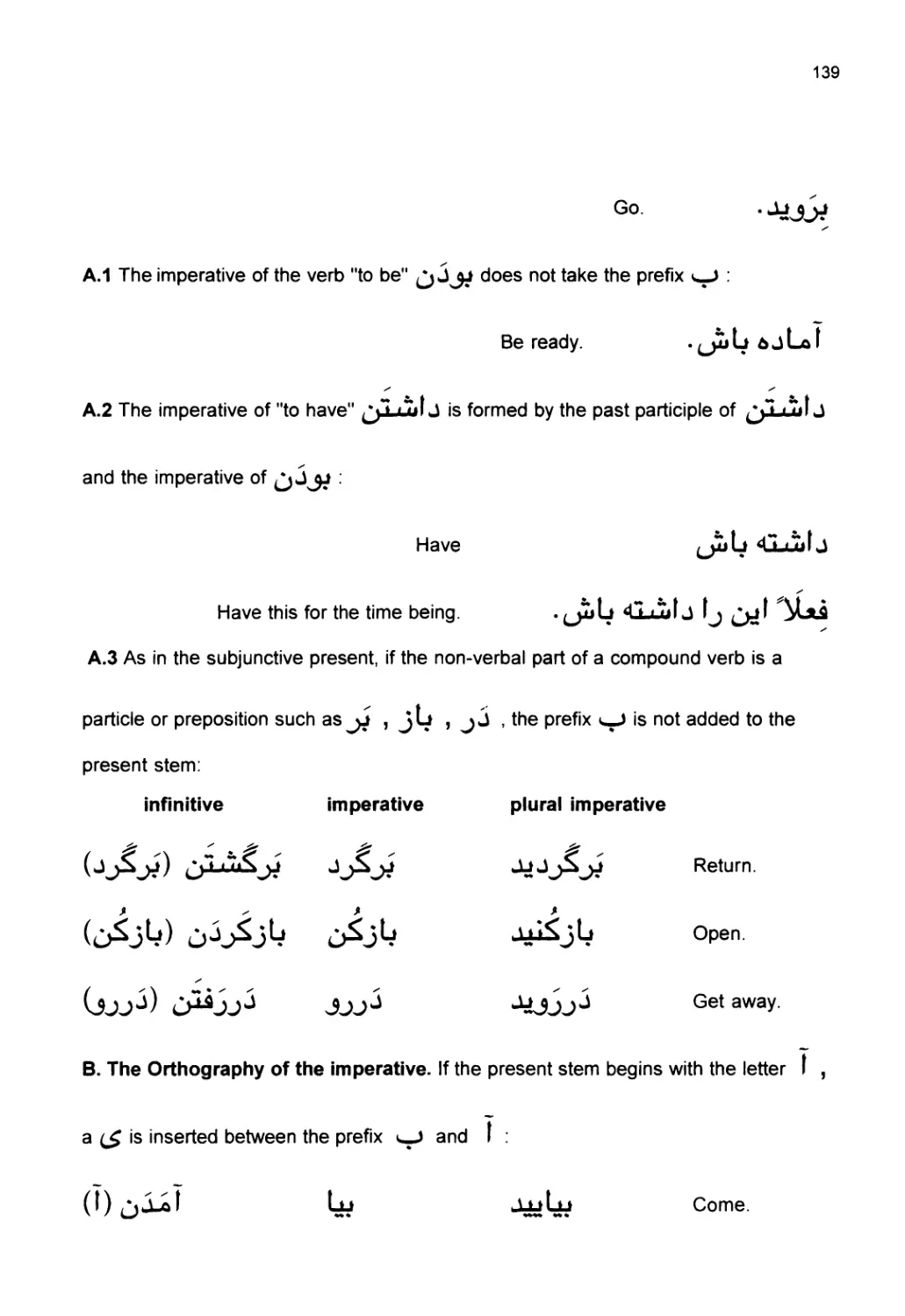
A.1 The imperative of the verb "to be" does not take the prefix <_J :
Be ready.
. 6jLol
A.2 The imperative of "to have"	is formed by the past participle of J
and the imperative of J •
Have
(jlLt <CLuulj
Have this for the time being.
A.3 As in the subjunctive present, if the non-verbal part of a compound verb is a
particle or preposition such as jj , jL , j J , the prefix is not added to the
present stem:
infinitive	imperative
plural imperative


Return.
Open.
Get away.
B. The Orthography of the imperative. If the present stem begins with the letter I ,
a is inserted between the prefix and I :
d)
Come.
(jjO
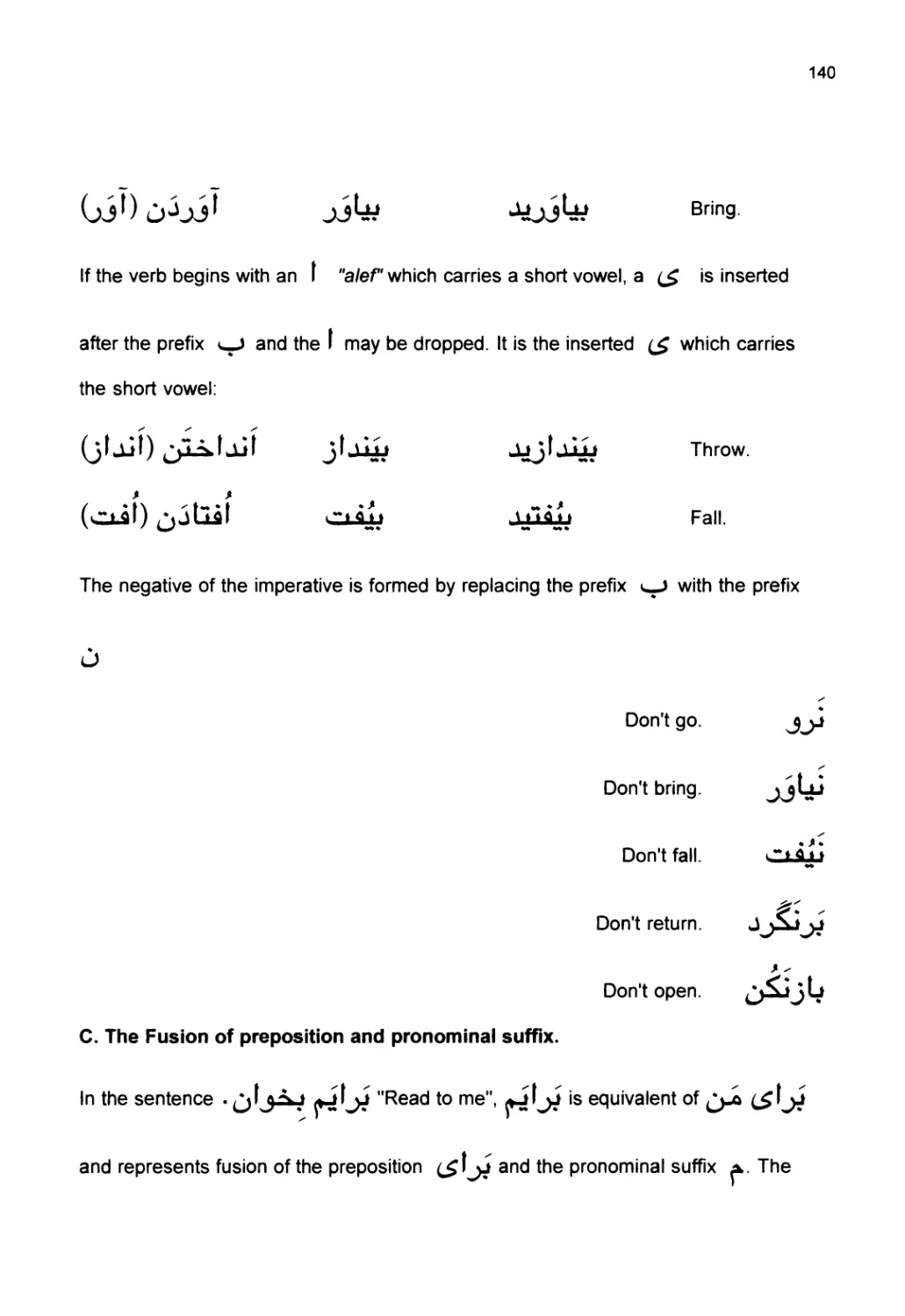
Bring.
If the verb begins with an I “alef which carries a short vowel, a is inserted
after the prefix and the I may be dropped. It is the inserted which carries
the short vowel:
(jlait) IjJI
(oil) jjtiii
jl-Uu
• Л
JjjlajLM	Throw,
„lufln	Fall.
The negative of the imperative is formed by replacing the prefix u-J with the prefix
Don't go.	ЗУ
Don't bring.
Don't fall.
Don't return.	j jCi
Don't open.
C. The Fusion of preposition and pronominal suffix.
In the sentence .	"Read to me", aJIjJ is equivalent of
and represents fusion of the preposition and the pronominal suffix The
pronominal suffix is less formal and emphatic than the personal pronoun In
colloquial Persian The prepositions J( "from, "to", L "with" also combine with pronominal suffixes, e.g.
C.1. The preposition JI "from":
from me	й-* J* =	f + '+
from you	jjjl= ojl =O + + jl
from her/him	jl jl = (Jujl =(_p	jl
Thus the plural follows the same pattern:
Note that in spoken Persian the plural froms undergo further changes and become
03-^‘йхУ
C.2 The preposition "to":
to me	=		+	<u
to you	JJ <u =	0^4 =	+	<b
to him/her	jl =	~	~ 4- c>uvj = u>xjT’	+
The plural form is	. In spoken Persian the plural form
undergoes the same changes as in number 1 above:
иэАг?
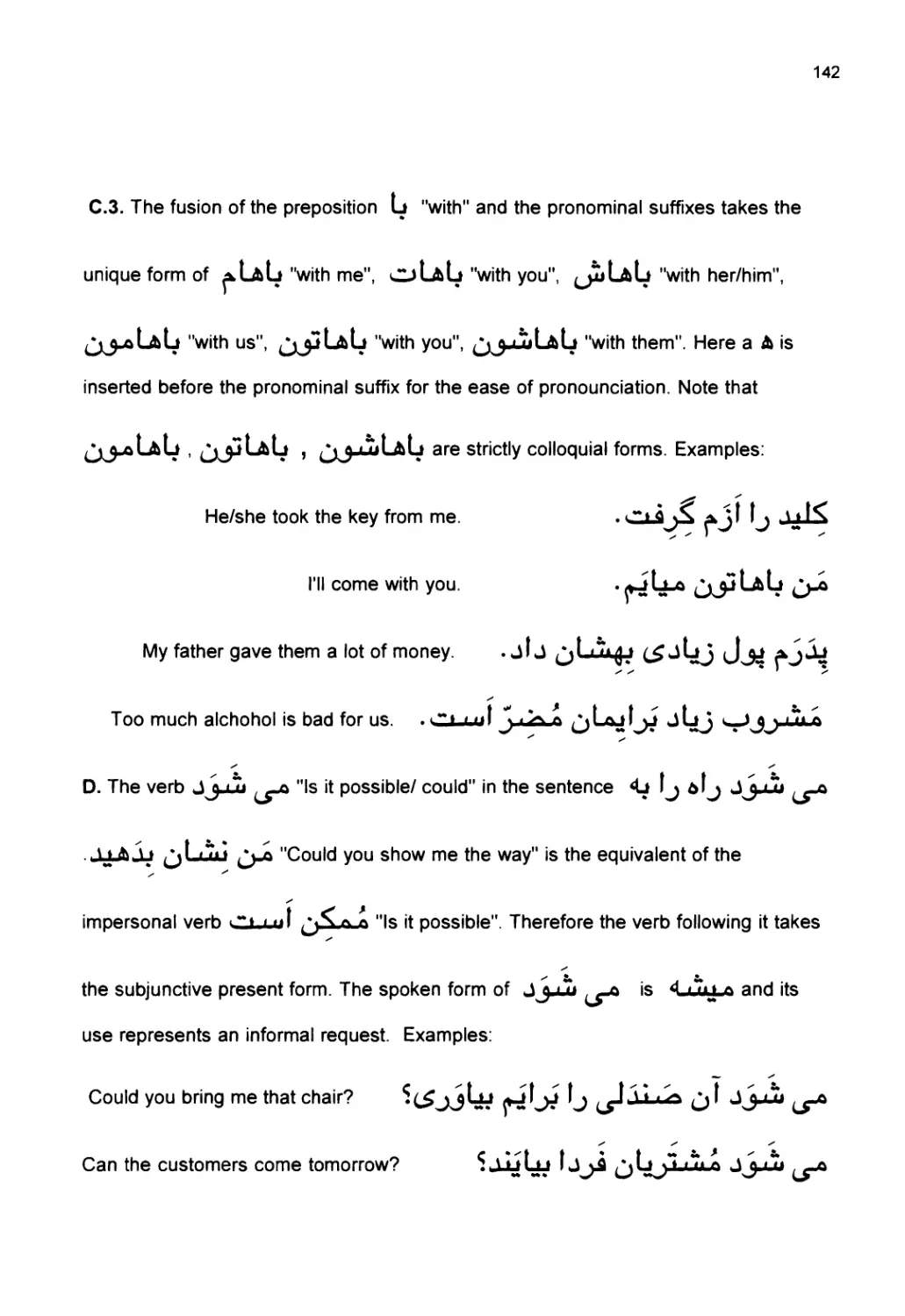
С.З. The fusion of the preposition L "with" and the pronominal suffixes takes the
unique form of "with me", CjUbL "with you", (JbLbL "with her/him",
"with us",	"with you",	"with them". Here a A is
inserted before the pronominal suffix for the ease of pronounciation. Note that
(JJ-aLaL ,	are strictly colloquial forms. Examples:
He/she took the key from me.
I'll come with you.
Ь
. aJL-c (JjjLaL &a
My father gave them a lot of money. . JIJ	jLj ^jdu
Too much alchohol is bad for us. . CJ-uul	jLj <-JjjuiiA
D. The verb Jj-ixi ^a "Is it possible/ could" in the sentence <U lj alj Jjjuu . JllA Jj (jLluj &a "Could you show me the way" is the equivalent of the impersonal verb O-xul a "Is it possible". Therefore the verb following it takes
the subjunctive present form. The spoken form of Jjjlu ^a is	and its
use represents an informal request. Examples:
Could you bring me that chair?	U is* Jjjuu
Can the customers come tomorrow?
Could you turn down the sound of the radio?
Could you close the door?
Exercise 1. Conjugate the verbs in brackets in the imperative and complete the
sentences:
Exercise 2. Translate into Persian:
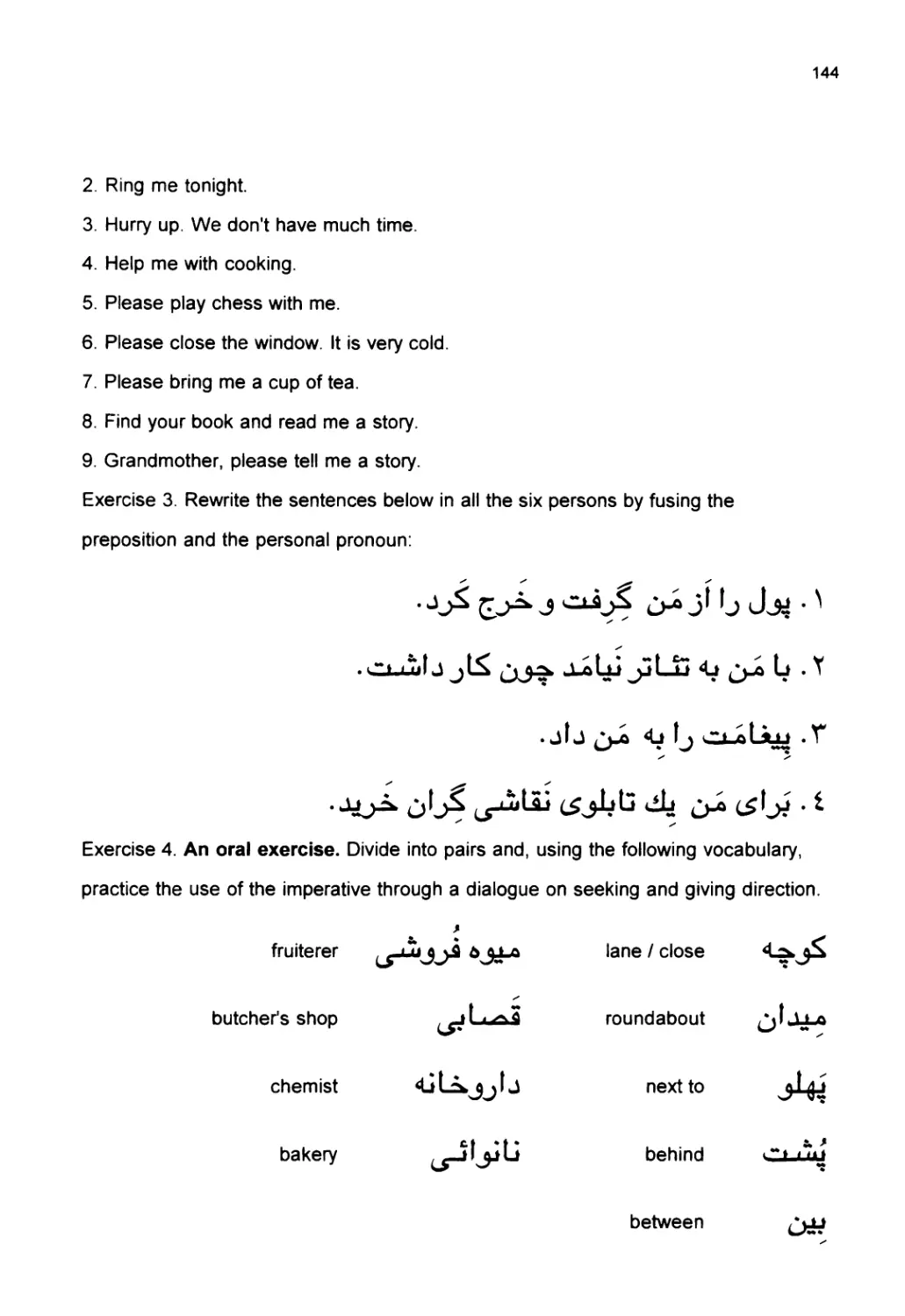
1.	Please, give me your name and address.
2.	Ring me tonight.
3.	Hurry up. We don't have much time.
4.	Help me with cooking.
5.	Please play chess with me.
6.	Please close the window. It is very cold.
7.	Please bring me a cup of tea.
8.	Find your book and read me a story.
9.	Grandmother, please tell me a story.
Exercise 3. Rewrite the sentences below in all the six persons by fusing the preposition and the personal pronoun:
•	J c>* J Ь
. O.uul J jl^ J-aLjS jjL.й	L . T
. jlj Ij	.Г
• JJjA jljC	dL	. t
Exercise 4. An oral exercise. Divide into pairs and, using the following vocabulary, practice the use of the imperative through a dialogue on seeking and giving direction.
fruiterer		lane / close	4 jC
butcher's shop		roundabout	^2) I л j a
chemist	«uLkjjl J	next to	jl
bakery	^«5I	behind	& л <^ZXjLUL1
between
Lesson 13
New Vocabulary:
apartment
to ask about one's health
to be employed garden to take
to snow
to be awake
to go out postman
to play the piano darkness
hill to crash
contact / touch
to be in touch
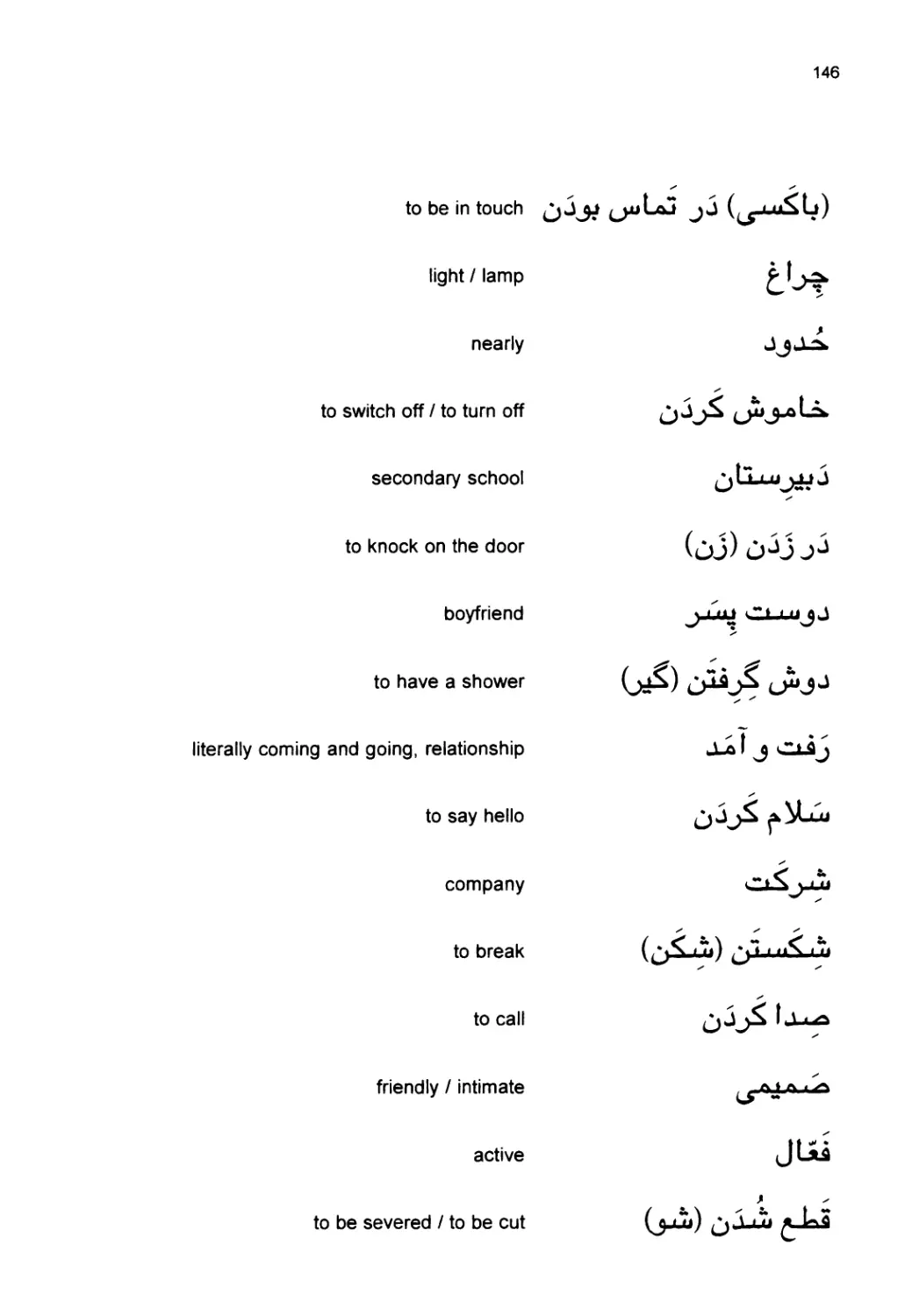
light / lamp nearly to switch off I to turn off secondary school to knock on the door boyfriend to have a shower literally coming and going, relationship to say hello company to break to call friendly / intimate active
jj
to be severed / to be cut
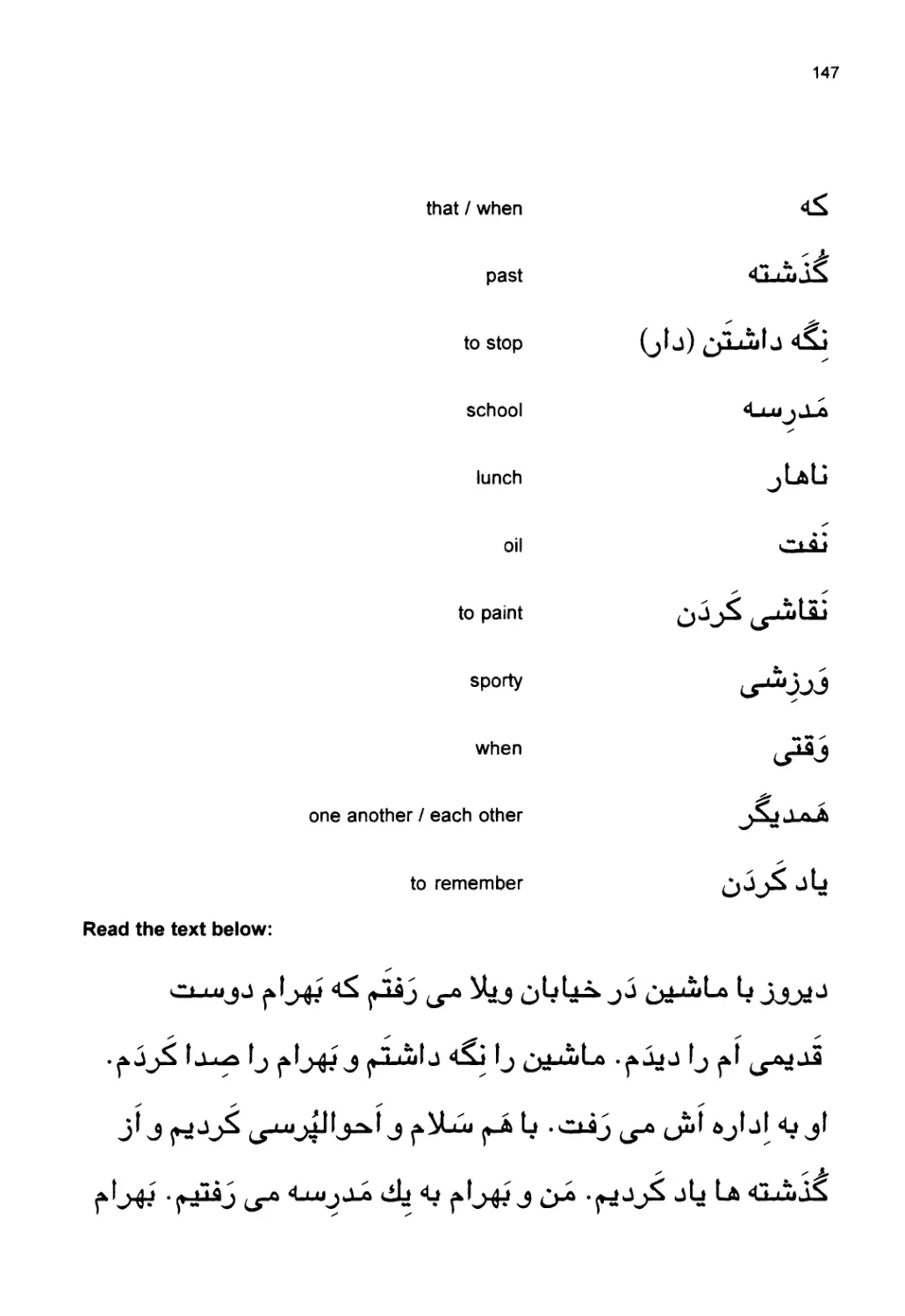
that / when

past to stop school lunch oil
to paint sporty when one another I each other to remember
Read the text below:
J	jLaG 4j
A short conversation	:otj«LoJt^o dL
‘CSA# V cxeLui ^xJa JjjjJ
•<5?
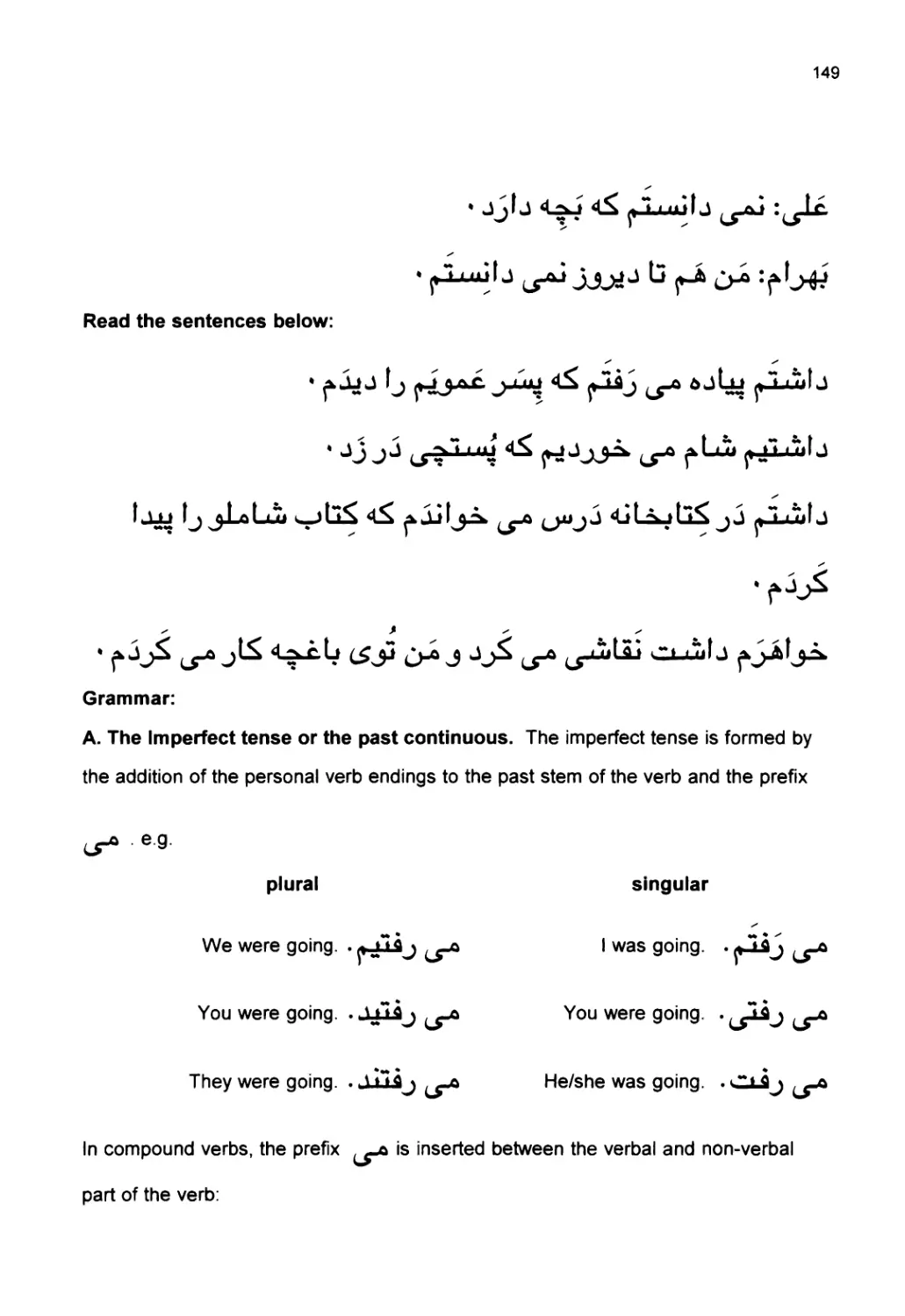
Read the sentences below:
IJ
h

Grammar:
A.	The Imperfect tense or the past continuous. The imperfect tense is formed by
the addition of the personal verb endings to the past stem of the verb and the prefix
plural
singular
In compound verbs, the prefix is inserted between the verbal and non-verbal part of the verb:
I was swimming.
You were returning.
She was resting.

A.1. The verbs ^jl-Cul J "to have" and jj "to be" form their imperfect without
the prefix . Their imperfect is therefore identical to their simple past tense.
The negative of the imperfect is formed by the addition of the prefix £ *°	•
I wasn't swimming.
I wasn't going.
B.	The Uses of the Imperfect.
B.1.	To convey a habitual action in the past:

On holidays, we used to invite each other to lunch.
She went to Iran twice a year. . 0-3j ^a (jljjl 4j JLlu j J jL j J jl
B.2.	To express continuous action in the past:
jk Jj J Ij jl 4^ (jJ* I A ‘ °
I was going to the cinema when I saw her.
It was snowing.
. Xal ^a CfljJ
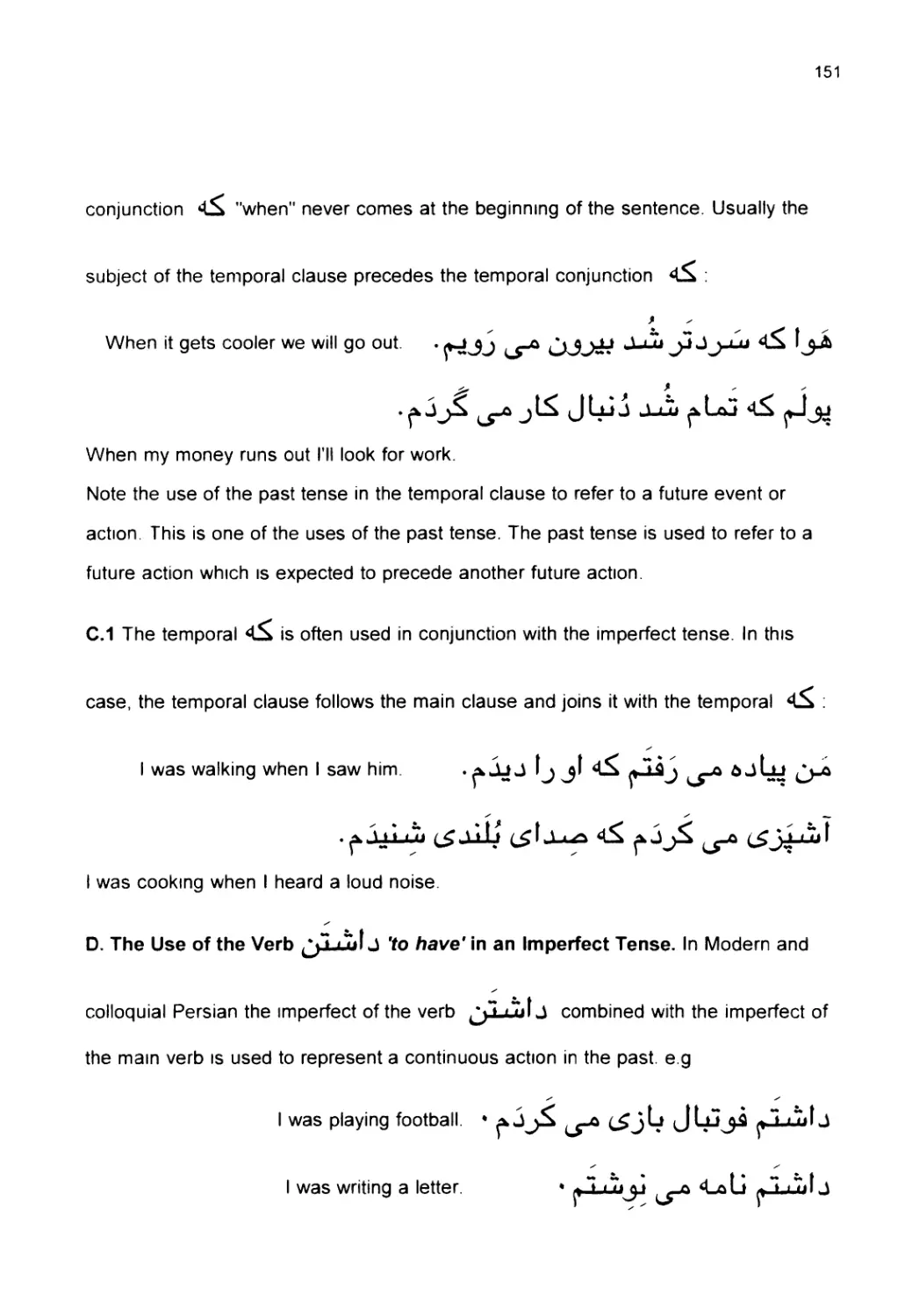
C.	The Temporal Conjunction 4^ "when". Unlike English, the temporal
conjunction "when" never comes at the beginning of the sentence. Usually the
subject of the temporal clause precedes the temporal conjunction 4j£ :
When it gets cooler we will go out. . pU
When my money runs out I’ll look for work.
Note the use of the past tense in the temporal clause to refer to a future event or
action. This is one of the uses of the past tense. The past tense is used to refer to a
future action which is expected to precede another future action.
C.1 The temporal is often used in conjunction with the imperfect tense. In this
case, the temporal clause follows the main clause and joins it with the temporal 4^ :
I was walking when I saw him. . Jj J lj jl 4^	6 J Lu
. Jji XJJ	4j£
I was cooking when I heard a loud noise.
D.	The Use of the Verb J ’to have' in an Imperfect Tense. In Modern and
colloquial Persian the imperfect of the verb	combined with the imperfect of
the mam verb is used to represent a continuous action in the past, e g
I was playing football.

I was writing a letter.
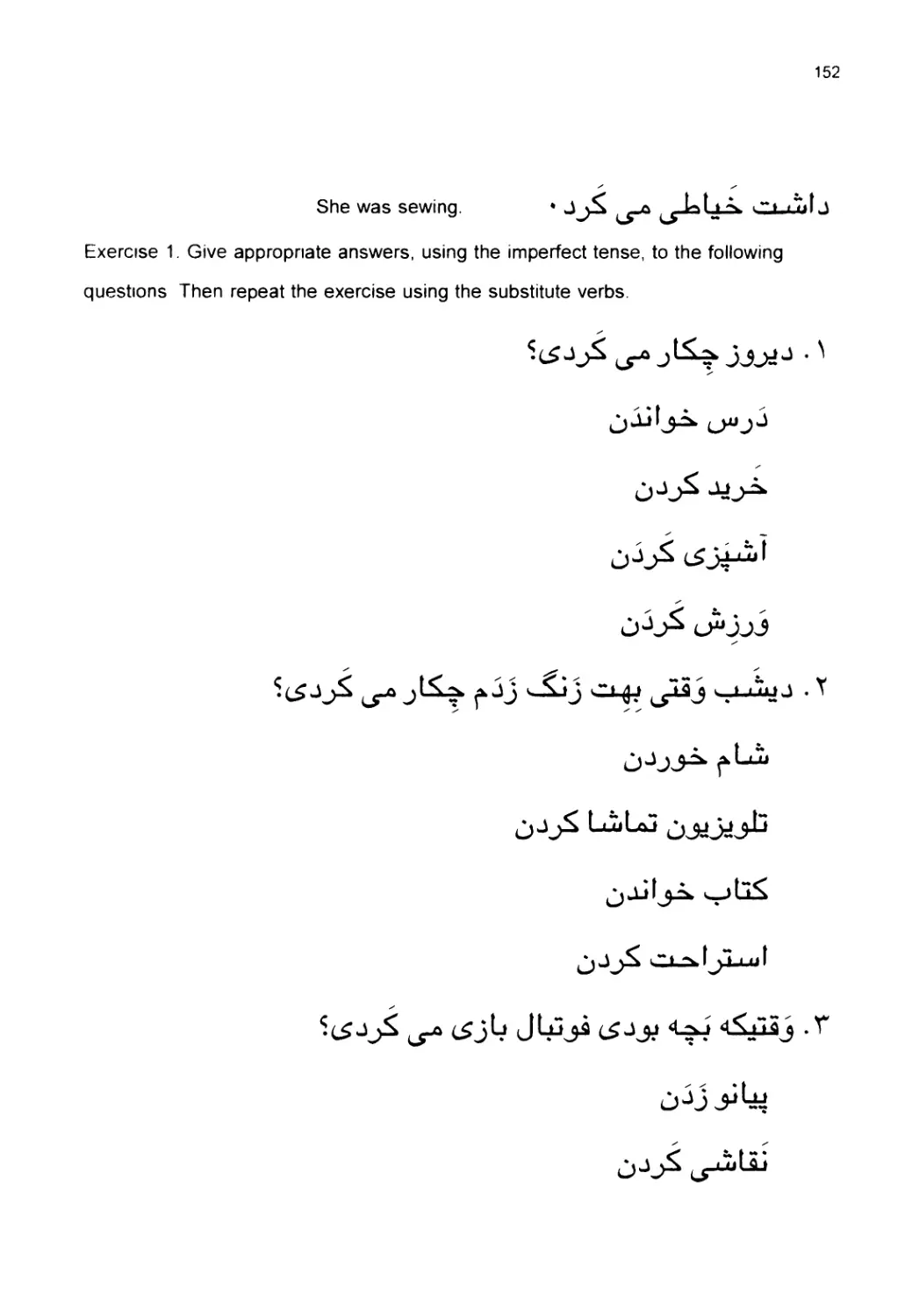
*	шjj	<LoU >2LujI j
She was sewing.
Exercise 1. Give appropriate answers, using the imperfect tense, to the following
questions Then repeat the exercise using the substitute verbs.
J
J
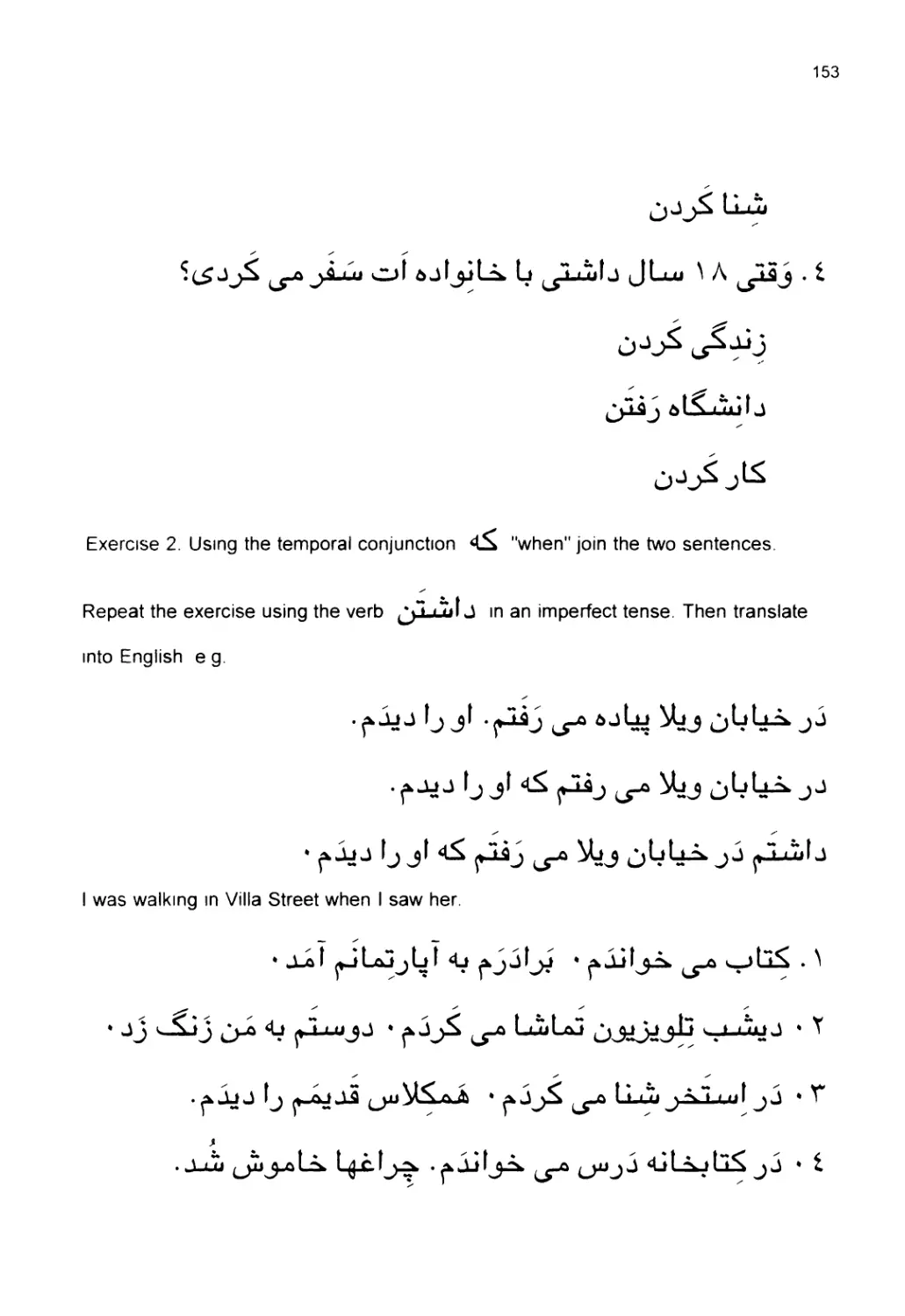
Exercise 2. Using the temporal conjunction 4^ "when" join the two sentences.
Repeat the exercise using the verb J in an imperfect tense. Then translate into English e g.
. JJ J Ij jt
• f-ЧJ U J*	jbLjk j->
•	jkJJJ Ij jl	J^ f
I was walking in Villa Street when I saw her.
•	J-ol ^jLoJjLI 4j jXjjljJ • ^JjIjA
.	IJ IJ 1Z4	dJjL J J * °
•	<~t иХ 1U IJ ^jxuL •	C5jU
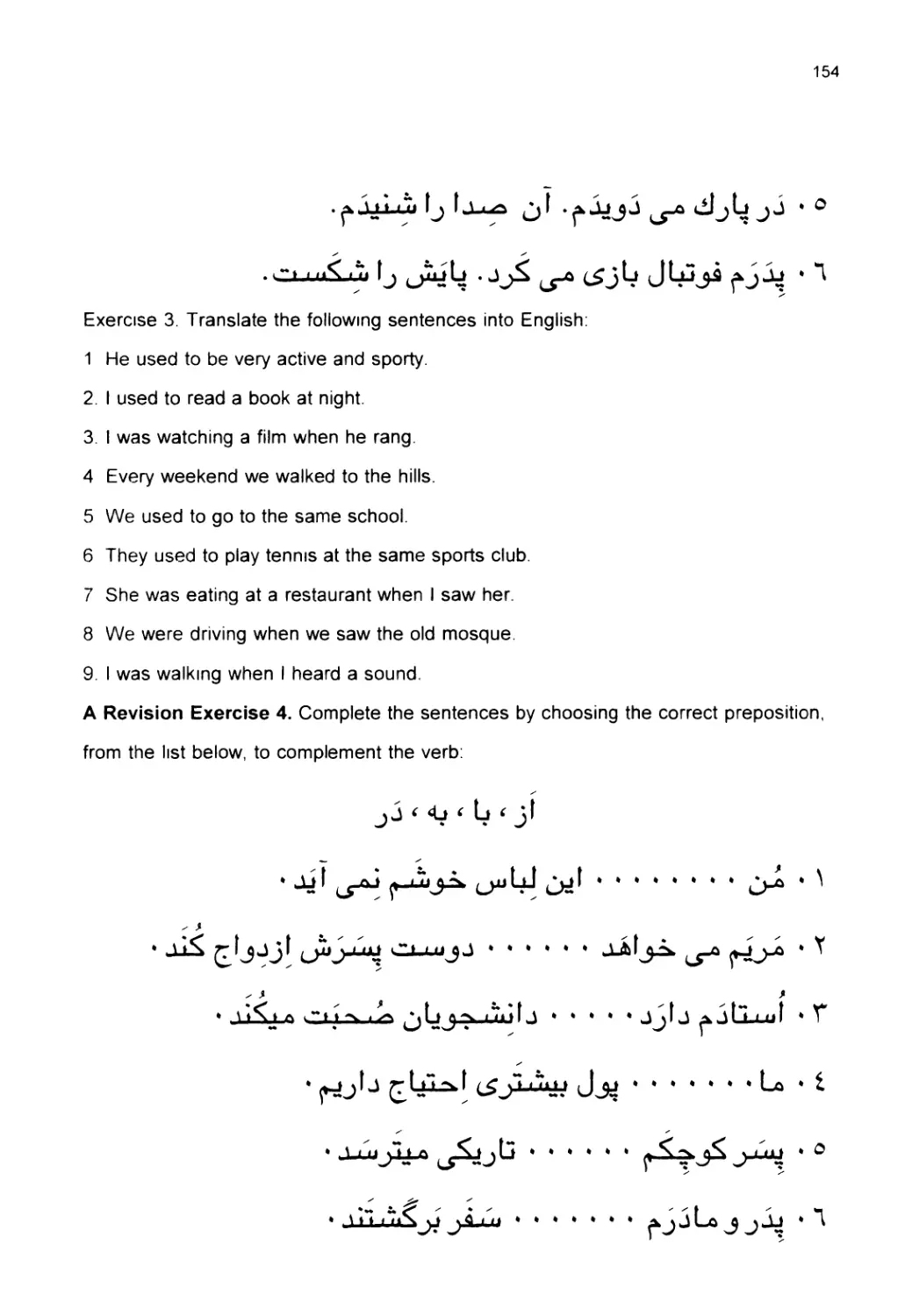
Exercise 3. Translate the following sentences into English:
1	He used to be very active and sporty.
2	. I used to read a book at night.
3	. I was watching a film when he rang.
4	Every weekend we walked to the hills.
5	We used to go to the same school.
6	They used to play tennis at the same sports club.
7	She was eating at a restaurant when I saw her.
8	We were driving when we saw the old mosque.
9	. I was walking when I heard a sound.
A Revision Exercise 4. Complete the sentences by choosing the correct preposition, from the list below, to complement the verb:

о

• • Jjjtj 4jLJLLLAJb C^Lb <LaJ > V
X Я
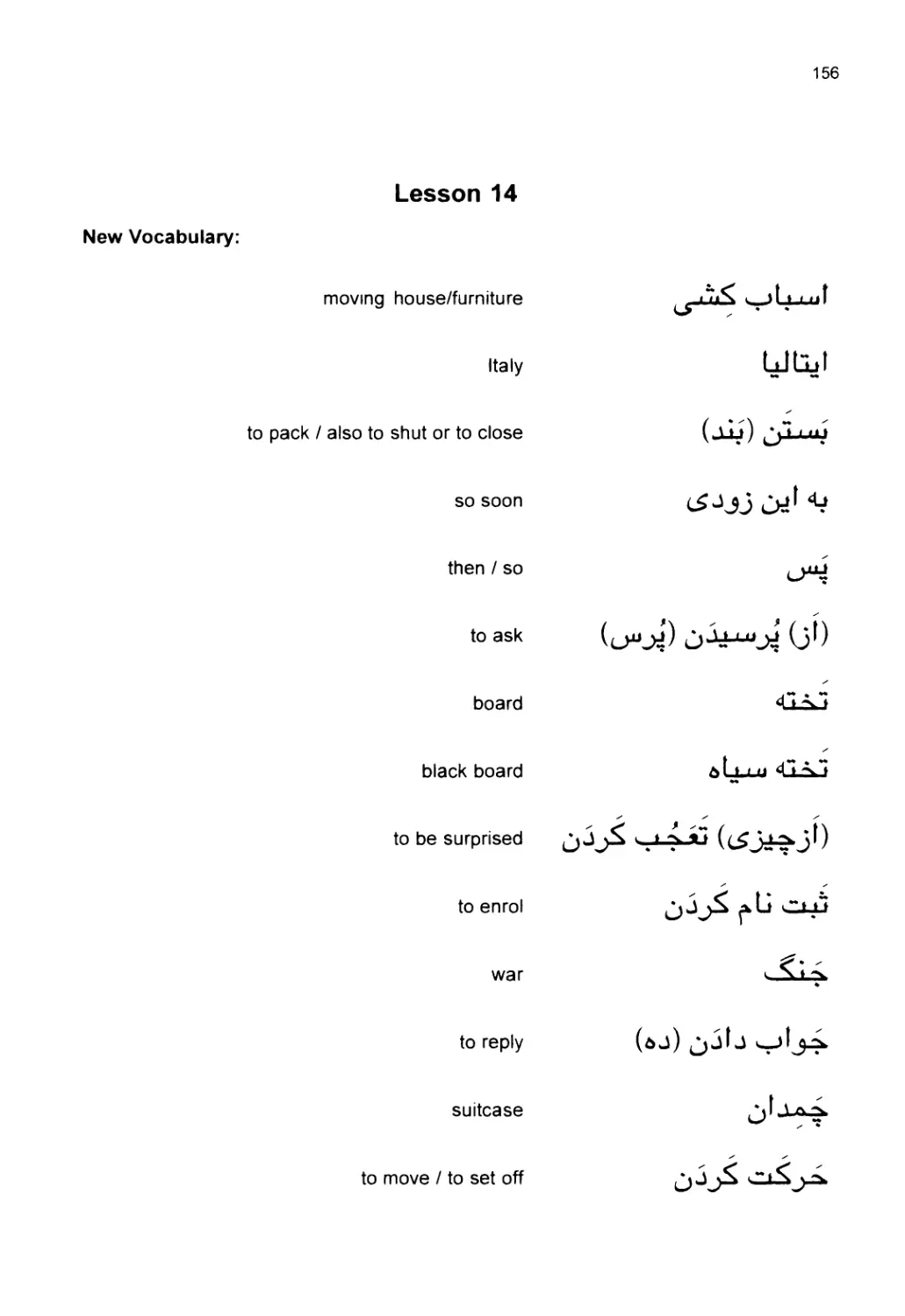
New Vocabulary:
Lesson 14
moving house/fumiture
Italy
Ul til
to pack / also to shut or to close
so soon
then / so
to ask
board
black board
to be surprised
to enrol
war
to reply
suitcase
to move / to set off
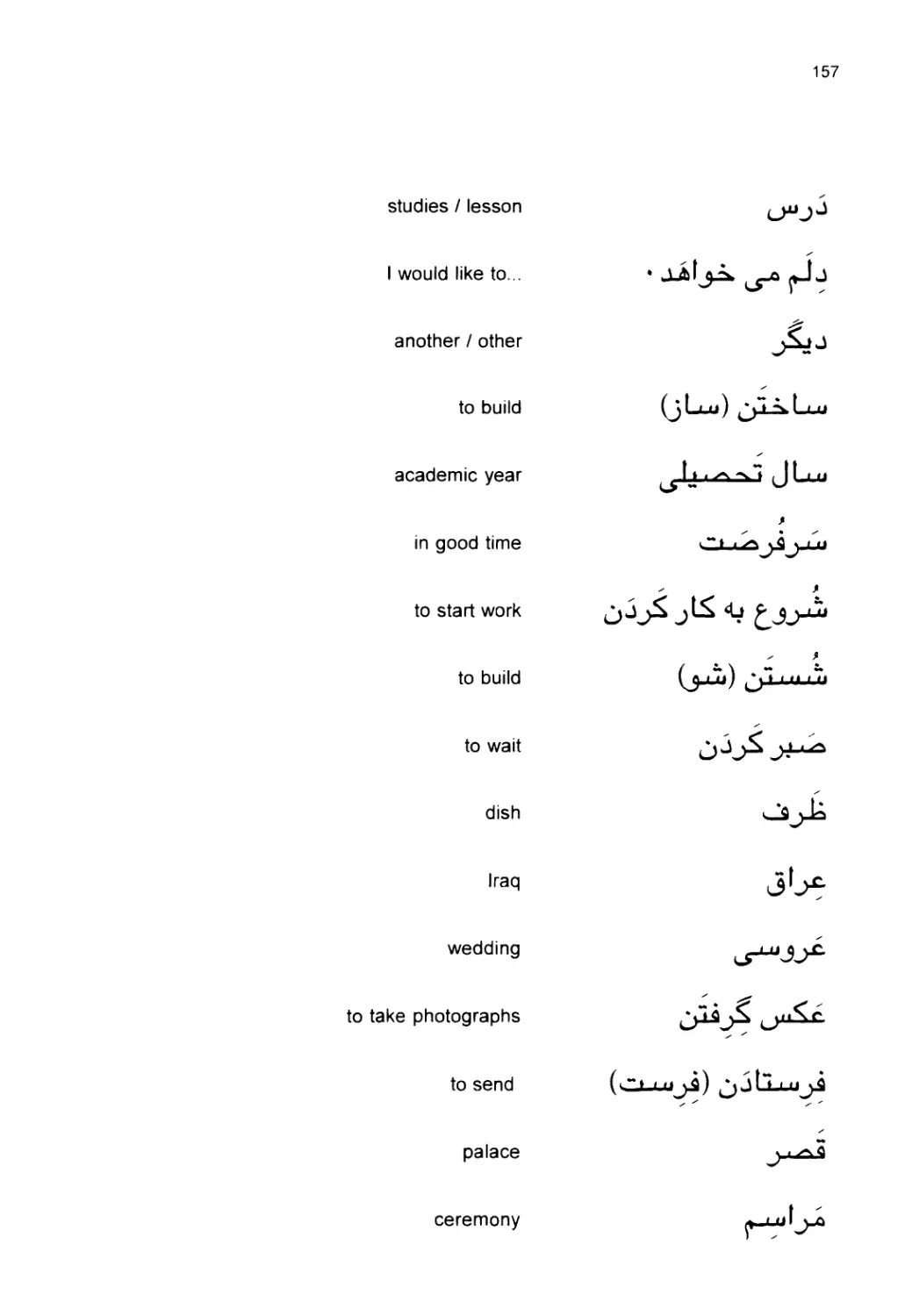
studies / lesson
I would like to... another I other to build academic year in good time to start work to build to wait dish Iraq wedding to take photographs to send palace
ceremony
mosque
to be transferred
to transfer important to set the table to set the table
letter tape to enter yet I still never
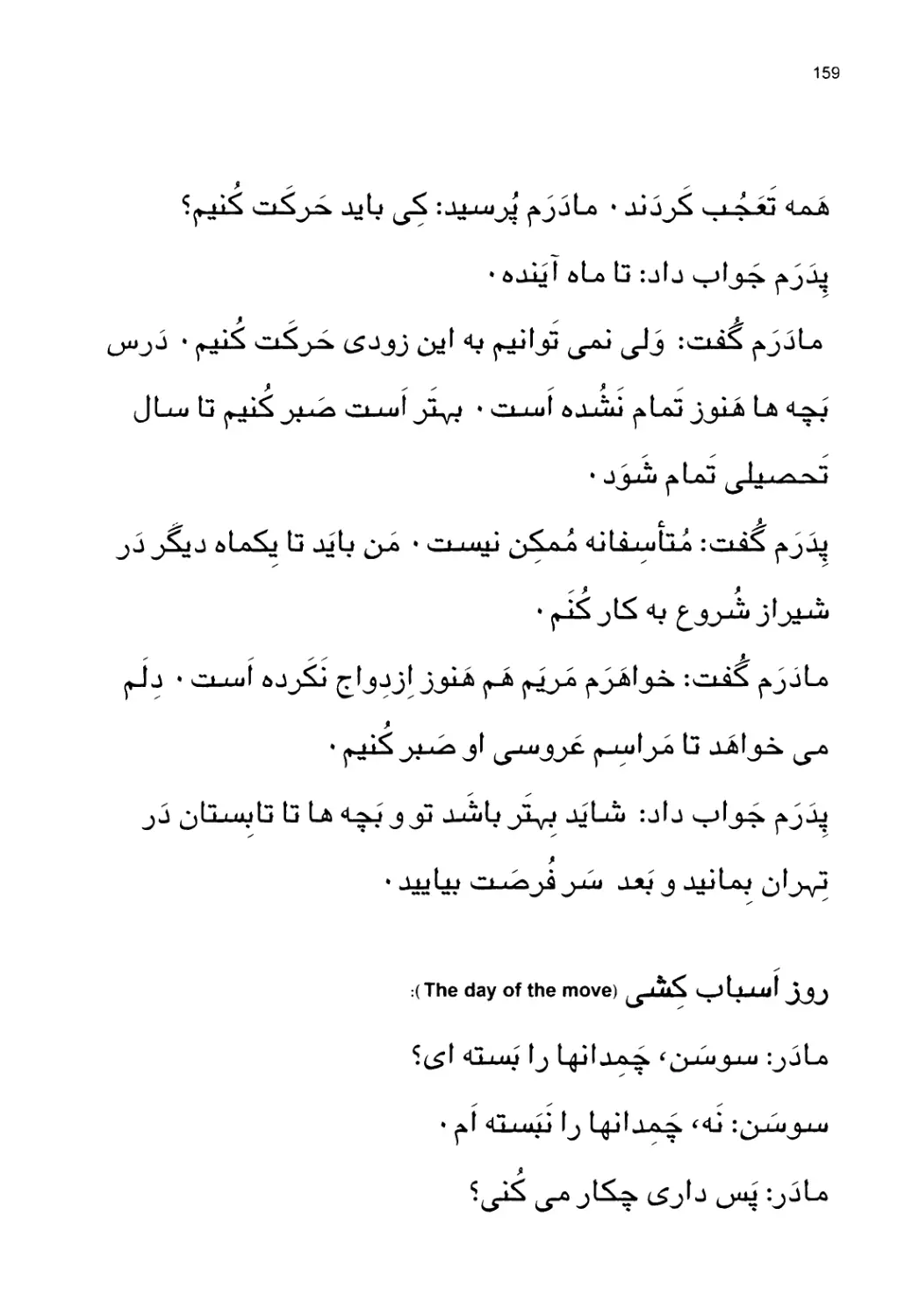
Read the text below:
77^2 п> у|г	•
ПП" П ’З'П9 Г’У<” г
LbUxJ	: Ju-u^u-u
6 JjSb jl^4>	c>a 4j :j J La
<_jl jjlqI L^-jLtSb( La^I^j ^Lqj • a I 6 La^L^
Exercise 1: Write the answers to the following comprehension questions:
Jul j djtjSLk c^IjS	jjj •
5 Jjjjj jIjJjlu 4j JjL 6 jl^JLk • X l£JJj U-AIjA jjLa Ij^ • Г
5	l^j i и 4j i*** <I (2)^ л x> La 4 2**j чЗ t—
Grammar:
A. The Past Participle. This is formed by the addition of a silent h to the past stem of any verb. Note that in compound verbs it is the verbal element which forms the past participle, e g.
В. The Perfect Tense. The Perfect is formed by the past participle followed by the short form of present tense of the verb 'to be' ^^3?
We have seen.			I have seen.	• jxl AjJj
You have seen.		6 Ju J	You have seen.	*	J
They have seen	•aSl	6JUJ	He/she has seen.	• O-luI aJj J
B.1 The negative of this tense is formed by the addition of the prefix to the past participle, e.g
I have not seen.	. jxl aJjJj
You have not seen.	aJjJj
X	Я '
It has not finished. . O_cul АjxLcj
You have not studied. . Jjl AjJl3-Sj
C. Uses of the Perfect Tense. It is used to refer to an action in the past, the effect of which is continued to the present.
D. The Use of the Verb J ‘to have' in the Present Continuous. In modern
and colloquial Persian the present tense of	followed by the present tense
of the principal verb is used to express a continuous action taking place at present, eg
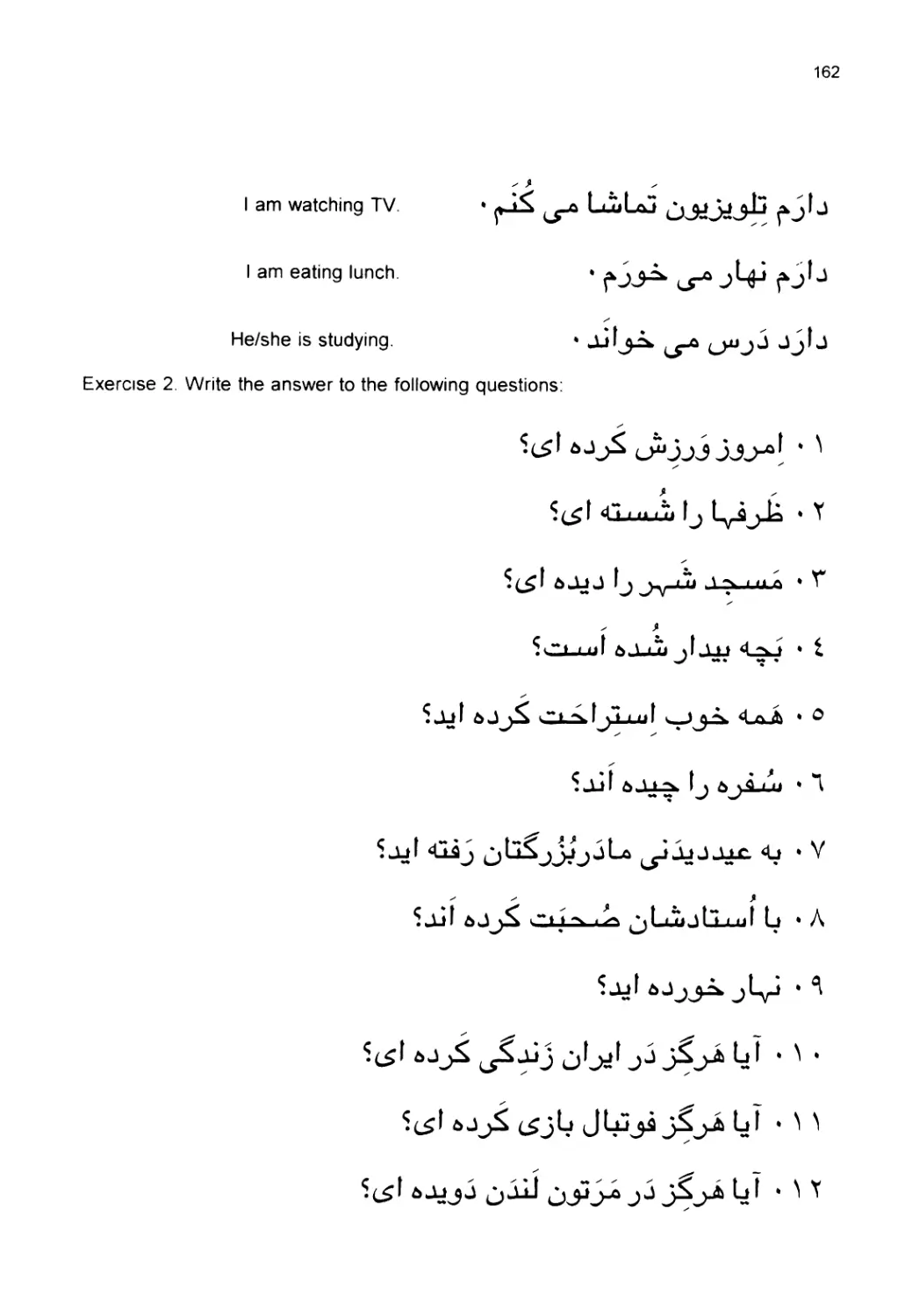
I am watching TV.
I am eating lunch.

He/she is studying.

Exercise 2. Write the answer to the following questions:
«ihhiu Ij	• T
6Ju J I j	Ay i‘if> • V"
^~l iui bJ-UJ jlj_M	• f
5jjl AJ^^	I <LoJb *
5jj( 6 Jj 2b Ij Aj j i и * 1
Sjjl	jLg	4j • V
5jjI aj^£	jCLluI L * A
5jJ 6j jjA
5 ( a	jj J (£) I j 3	L1 • •
5(^1	c£jb (JLj^	кД ‘
ajjjj jail j□ kJ *
Exercise 3 Write the questions to the answers below:
5.........................................Y
1 “I 6 J hi jxLaJ Jjl^X. j ^jl^jjl v * 7~ “llj
5.........................................Г
<......................................£
•	। i«l fijjSLi jjjl JjIa 3A.
5..................................о
• 6jJj Ij A	<Ajl
<...............................n
• ^j( 6JjSJ ji-uj jljx. L (jljjl <>	I-*
<...............................V
Exercise 4. Translate into Persian:
1.	Have your family ever lived in Italy?
2.	Have you ever gone to university?
3.	Have you posted the letter?
4.	I have set the table but the guests have not arrived yet.
5.	We have seen many Iranian films.
6.	She has taken many photographs and they are all good.
7.	My sister has not got married yet.
Lesson 15
New Vocabulary:
historic monuments to be ready recently if first time second time to retire to be hospitalised literally without news illness to arrange birthday party So much better if we go together.
^JCLluL jIjI
Jjfjb
я
<Gjl u x.uijb
jlui c^jlxuj
(^j) (Jjlj
^5* 0-^4
maternal cousin (female)
last time
to pay someone a visit
It reached me. by the time
Dubai to be improving birthday to return to work to wash
Shiraz before to make an arrangement completely
• JJUMj fb-uj 4j
4 a j Lj
LPj? *4 jj ^5» jjj
я
(jujj) jlxuJu
5^
MjlS
(j 13^) (2) и л I AS* I
to write condition I state present / gift
<>ха
both
also I like this the same age / peer
Jjj-A
j t2**A &
a day or two	Jjj j J
Read the text below	: JajIjSj jjj
4j jkl <lLk jlS.J jl <LoU (jltxj £lSLA • 4"t uJ (jJjjJ (j-A f-4-ul ' O-wl (>	I -JJ-LUj
• al£
<-?jjj «^4	p4U?

M 4j
jjj
Exercise 1. Answer the following questions in Persian:

5*.~1 I l»l 41flj tyjOJJJ-U (JjLj J <b	Ц ' '
5 jIaI^A. jiw <u	j jjjjj • °
$ J-ilji. jjjj IJ JiA • *1
jJbl^JL 1^ La L"U L	• V
SSo ujl 41$ J jljxxb 4j MjJ	* A
5jj, <GiJ jljxxi *u L jjjjj Ji5 <Ai j • Я
So-ij jljjul» 4j (jluj Jlxu aj (JjjjJ	•
Grammar.
A. Pluperfect or the Past Perfect. Pluperfect is formed by the past participle of the
verb followed by the past tense of the verb Jjj ’to be’, eg.
plural	singular
We had gone. . JjJ 41$j	1 had gone, jx Jjj 41$j
You had gone. Jj J^J 41$j	You had gone.
They had gone. Jj J^jj 41$j
He/she had gone. J
A.1 The negative of pluperfect is formed by the addition of the prefix to the past
participle, e g.
I had not gone.
He/she had not told/said.
We had not decided.	.	j
B.	The Uses of Pluperfect.
B.1.	Pluperfect is used when from some point in the past a narrator looks back at an earlier action, eg.
jjj A# j Ij
• Jjj -uJjLa
My father had arranged the trip but he had said nothing to my mother until the day of
departure.
When she rang I had gone. • jx	Jj
. v* Jt4liU 4j I_a <7^ . \ 11 mj 4jt 4j 4 C >7 q
When I got home you had gone to the bank.
B.2.	Pluperfect can be used in one or both parts of an impossible conditional sentence, e g.

If I had known I would have gone to see her.
Or:
If I had had money I would have bought that car.

If we had had time we would have celebrated her birthday.
C.	The Future. The Future is formed by the present tense of the auxiliary verb
I'to want, to desire', which is used without , followed by the short
infinitive of the main verb. e.g.
• eiij	4? J*-*-"
A day or two before the trip I will go to Shiraz.
plural	singular
We will go
You will go
They will go

I will go
You will go
She/he will go
C.1 The negative of the Future is formed by the addition of the negative prefix to the auxiliary verb. e.g.
I will not go. . OJj pJblj-Aj
You will not go. . QJj	*
C.2 This tense tends to be more emphatic than the present tense when used to convey a future action.
D.	Ordinal Numbers. The Ordinal Numbers are formed by the addition of the suffix
x 'от' to the cardinal numbers. Jjl 'avval' 'first' and 'sevvom' 'third' are irregular ordinals. The ordinal numbers are treated as regular adjectives and follow
the noun. e g.
* jb fjp jb (-jJj jjJ JjLo jj Jji jL
First time I called she was not at home but the second time she answered.
я	я
In compound numbers 'first' takes the form of as in j O-juxu 'twenty
я
first' or	'thirty first'.
It is the third time that I see you. *	Ij jj CU ut jb
* CAxul JJ	j CTtJUH jjj-ol
Today is the twenty first of Farvardin.
D.1 The ordinal suffix is also given to the interrogative word ^3 i	h°w many?':
What day of the month is it? 5cxj-uI 5 *
D.2 The ordinal number can precede the noun, in which case it will take the suffix
and loses the ezafe
the fifth day
J J J
the third child
Exercise 2. Translate into English:
*
* fJjj?	^U45s

r
Exercise 3. Complete the sentences below by choosing and conjugating the relevant
verb in Pluperfect:
I • T
• ( negative)..............................J	jj J Luu dL * i

• j л । ol jj	............<ь I4J • v
.....................La L-uL Jj lmj I At t lu 4j <£al5j U • A
...................Ij	jL$-> jl J±s * Я
Exercise 4. Answer the following questions in the future tense:
SaaI ^JbljA, Lc 3jLA 4j jj *
5 jJljA, ^j-aIjA 4 aaS La 4_^j c^Ijj * Y
Jjj-A ч i x7x л t Г
5o-5j	cjjjLc ijSjj 4j 31iA • i
5ju.u ^JbljA 11 ,i7>T Cjl 4jLj u a A L *
J-LaIjA La 4j CtliaLfl * 4
SjjjA ^-laIjA. ^Li t 5ч tjji * V
Exercise 5. Answer the questions in the future tense choosing an appropriate adverb
of time from the list below
tomorrow
tomorrow morning
tomorrow night the day after tomorrow next year
next week
another year

JJbljS <Gju*4HjL	CuJjJ * V
<JJJ jjIjS СЭ JJ3 jxii  t
Lesson 16
New Vocabulary
last / end I finish
cloudy
probable
marriage
to make a mistake
most
to throw
despite this/however
bed
to leave I It also could mean to abandon, to give up
separate
my elder sister
to request
at this time
sea
village
last days coast/beach
coastal
building silent
Ljj j
group / (also) a number of people
to change / to exchange sunset mistake I error to think of to stroll
debt
б(м-х.ц1 / klr.
(eJ)jjtiil (44)
(jj) JJj
LUIS
Canada
environment to be certain famous to be clear I to be known architect
to correspond with (jlj)	( L )
foggy
to look at
to be worried
writer / author
India
41$
I 4^ ^*O? jjLbol ch!

• La <J_A-a Lajjj oU-1

• |»jIaj l^i;
^-a	4^ L»jJ 4j
jl jl <L^ <"*  “I JLuu • O_Sj IJ Li	4j j dljJ l_)-o jjlty
Exercise 1. Answer the following comprehension questions:

Sai
* о
‘J
Grammar
A.	The Subjunctive Past. The subjuctive past is formed by the past participle of the
verb followed by the subjunctive present of the verb 'to be', e.g.
Plural	Singular
We may have gone.
I may have gone. л-ьиЬ 4jJj
You may have gone.
They may have gone.
You may have gone. .
J-LuuL He/she may have gone. J-JuL
A.1 The Uses of the Subjunctive Past. The subjunctive past informs of an action in the past about which there is doubt, e g.
* dlxLL	Ij	4^
I think they may have bought this house.
JLlu j j	xJliL ь a	Ij	J 4^ Ct xujt
* Ct t ul 61t1J
It is not possible for her to have finished her studies because she is only in her
second year of university.
A.2 The subjunctive past is used after the auxiliaries JjL and JjLxii when referring to an action in the past about which there is uncertainty, e.g.
He/she may have married.	* XcuL
They must have reached Tabriz by now.
B.	The Relative Clause. In Persian a distinction is made between restrictive and
descriptive relative clauses, both of which are introduced by the relative particle 4^ , which in English is represented by 'who, which, that, whom, where, when '. Note that 4^ is used for both persons and objects.
In a restrictive relative clause the suffix or the relative (^, is added to the noun preceding the relative particle. The relative should not be confused with the indefinite . The antecedent or the noun which the relative clause qualifies is usually specific. Note that the suffix is not applied to a descriptive clause:
* Oj ut wl O-luI 4jL aflJh 4^ I nj lu
Sima, who is my neighbour, is here.
• JuLU JjI J J^l Jj <-Suj	i"ltlj
The student who rang this morning just arrived.
Further examples:
*	I Jt"4* f j 4^
*	cxxul	jjjJ J 4^
*	JjjA jx Jjj	4^ lj i7jLx
* CXxul O-lujJ CXxul 4jj.uj,mj Laul 45b
GLUluI jx( 4jl ЪдД I IJ	4^

Note: Plural demonstrative pronouns take the relative . e.g.
Those who come early find a seat.
My elder sister and her husband who have two children.
B.1 If the antecedent is a noun qualified by an adjective, the relative is attached
to the adjective, e.g.
My sister has lost the red hat which I bought last summer.
Note that if the antecedent is definite and the direct object of both the principal
sentence and the relative clause it can take the (j This however is optional.
B.2 If the antecedent is the indirect object of the relative clause, in addition to the relative particle 4^, a pronoun is also needed in the relative clause to refer back to it. e g.
• jjb	OjjjI Jjl
This is the doctor from whom I got medicine.
* 4~t 1411 41 LUA jXjUjA, Ijx, (jt jt	6jlix
The shop from which I always bought food is closed.
B.3.	The Orthography of the Relative . If the relative is added to a word
ending in the silent ’h’ 6 , an I 'a/ef is inserted before the (£
If the noun ends in the long vowels I 'a/ef or j , a hamza over a bearer is inserted between the long vowel and relative :
(hair) I	(foot) I
Exercisel. Conjugate the verbs in the brackets in subjunctive past and complete the sentences:
•	..........L)C*	‘
• (jAb*-"j)....................
(ja»j)..........Ь (Дй оЛ	cs-U аП ‘
* ( negative)
♦ (ijXjuu jxLcu)...........*	jXji Ci aiLf • t
♦ Jju-olzLlII ^jLi).................................*	* dtSLijIj
। Cfi jjJCo j Lojla q I 4^ J JIJ (J Ia*? I j Ci 4<m	1 a * *1
* ((ji-^Luu)........*..........* * IJ Q l аЧ 4 Luu
*	(^J jL).................IJ ^_uujj^jCi£ 6jLi-A ^Lrx Ci JjLf * V
*	^Ubil) * * * 4^	^Ij ~i J ui I tj > a • Л
*	£з>^).........................U	jIAiLxLgI jjL *
*	O-Sbj-rx.)...............JliLuli	jLLj *	*
я
Exercise 2. Note the use of the compound verb jllsl 4j 'to think of in the
я
following sentence: • jxjlajl dJLL i иjJ <b 'I thought of my friend
Babak' Make sentences using this compound verb and the following vocabulary

<u
Exercise 3. Join the two sentences with the relative pronoun 4^ :
*	a Ij Li * Jjxuj jjj-a । L> •
•	U	JjI • CAxJ jljjl jtjbi Ch}! *
• AI 6 JlIjA jj I 4 X dL * *1
Я
j ul >5^ i
Exercise 4. Join the two sentences with the relative pronoun 4^ :
* 6J

* jl> 2)J1 <jL°	QJJut-“° о1 °° *
11 '4!U	C? jl U
dJL • V
U 3^ l“° * 4xll^J>	i7ot \ L jj _A
• Jj
(£ J. A I Jjl (J I *	1 <lxilXXll 6j-2>Sj jll£
♦ oxJ
Exercise 5. Translate the sentences below into Persian:
:д±1£ ‘Lo^.jJ	<U Ij Jjj оМал, • °
1.	Cook the delicious rice which you cooked last week.
2.	I was thinking of the friend who went to Canada last year.
3.	My sister, who has two children, lives in Tehran.
4.	The address that you gave me is wrong.
5.	The hospital in which I was treated is very modern.
6	Have you seen the suitcase which I have packed?
7.	Do you know the new lecturer who arrived last month?
Lesson 17
New Vocabulary:
to know / to be informed
I hope.
to choose size
God willing a small garden to be high in spite of this I despite this to know (a language) Hope to see you happily soon on time careless
<UI eLuul

to pay flight to save (money) to make money to be short of money
to what extent
to translate
to frighten to apply I to request
mobile phone to contact
to boil / to bring to boil What size is it?
what a good idea!
speech / talk to dry
о-ьз'	J J*

to put to sleep
to make laugh
to know / to have knowledge of something
during the year
(jljii) jaildLL
(Jj)
Jlxu jj
to study	(_Я
to reach	QU4 <J J O-j uJ (<j)
driver
to overtake
hobby

to deliver greetings
(jb-uj) JJ-iL-uj jkMw
fee
my dear to pass (in exams) fare to help financially to be curious
04#
to pass the time (causative verb)
to pass (through a place or time)
to lose
city centre
to write letters

the next letter

bank loan

frightening
‘3
otherwise
to get a visa
cost
each other
Read the letter below:
Lt .
Г*

>
IjLXU - J
Exercise 1 Answer the following comprehension questions:
IjLjUJ jl I A ♦
ScXbul 6jl£ <Ц. IjLlm • Г
Grammar
A.	Conditional Sentences.
A.1. Possible Conditions. Possible Conditions are divided into two groups:
(a)	Those conditions which refer to an action taking place in the present or future, e g.
If the bank gives me a loan I will come to Iran next spring.
If you drive carelessly you will crash.
*	L	Ij exuljjl J^f
If you send me your address we will correspond.
(b)	Possible conditions in which the verb of the 'if clause' refers to an action taking place in the past and the verb in the main clause refers to an action in the present or
future e.g.
If he has not gone I'll invite him to dinner.
If the film has not started I'll buy a ticket.
A.2 Impossible Conditions. An impossible conditional sentence can refer to an action
both in the present or the past. The timing of an action dictates the choice of tense of
the verbs. For example impossible conditions referring to past or present take the
'Imperfect' in both parts of the sentence:
If I could I would certainly go
Alternatively, pluperfect can be used in both parts of the sentence:
If I had been able to I would have certainly gone.
If it hadn't rained we would have walked.
Note that the use of pluperfect in both parts of an impossible conditional sentence
places the action firmly in the past.
Also note that a combination of pluperfect and imperfect can be used in impossible
conditions without any significant change to the meaning of the sentence.e.g.
If we had hurried we would have reached on time.
A.3 The use of JjLuj 'may' does not change the tense of the verbs, e.g.
If it had not rained I may have walked.
B.	The Causative Verb. The Causative verb or н nj Jjifl is formed by the
addition of the verb ending JjI to the present stem of the verb. e g.
	causative	present stem	infinitive
to deliver			Jjxxuj
to send to sleep	jaJLIjS.	^IjS.
	(jjjl Jt 4	\ t A.
to make somone laugh
Exercise 2: Conjugate the verbs in the brackets and complete the possible conditional sentences below:

• J3 *4 ‘ ’
J-Lj) ’ ’ • OjIjJ lj <Lelj (jjl


• * Ь Ub-k 5»
‘	Ь j-o • • • jL»j	• £
• (сЙЪ
* * *............................. *	* b (_>°У	‘ °
’ (cPjJl Jj4
‘	<14^)...............4?.............................j&	'
• (йЛН-О
Lx L ^Ljbl^xJb ^411 L .......................U >U f v
*	(_>uLaJ ‘jJ_£	.................
Exercise 3 Conjugate the verbs in the brackets and complete the impossible conditional sentences below.
aL^jUmIj <J •••••••• • <t jxl 6jl3-1LL >1 • X	Л
* ( negative jUj ‘ JJjS Jlx ..........................
<<2^3^ cxSxjlu) ••••••• •»•••• (2>^-jL-^Lx 6j_Lilj• Y
• (negative Cs jt
4j ^JJjL ^j?) »••••»•• 2;LgjLLlujJ Lj.....................*	» Г
41jLUj	Ct-MJ I ^jLujI JjI 4j <jt?j (^-UjLs ••••••	• О
•	<_jl_S-t_tl f	XUJtl j) ••*••*• I j
^\LLI) •*•**•• JI 4-t ••••••• j| Jj	qjUj J f J'
*	<UoLi
**•*•*• ^jXLt t *4*1 A t j J * * * * * ♦ <-JJ LjLU	* V
• (j^ Jjp	o°j^)
Exercise 4 First rewrite the verbs below in the causative. Then choose a suitable
verb to conjugate and to complete the sentences below:
to be afraid of
to laugh
to pass

(jii.) JJJaiA

to boil
(<>»>?) JAH"»
to sleep

Exercise 5: Write a letter to a pen- friend:
Appendix A
Colloquial Persian
Persian undergoes certain phonological and grammatical transformations in its spoken form:
A.1. -an and am change to -un and -urn:
Colloquial	Formal
(un) jjl	J
(tunestan)	i utjj
(tehrun)
(aqayun)	иЬШ
(khanum)
(nun) jjj
(postkhune) <bj -\~i i ш	4 tt A.71 txt
(qabrestun)
я (kodum)
(mundan)	jliLo
(umad) Xojl
(tuman) jj
(una) L>j I
Ujl
Ц31
Note that has also lost the letter Д in this transformation.
A.2. -ar changes to -e.
Colloquial	Formal
(dige)	jXiJ
(mage)
(akhe)
(age) 4^1
A.3. The plural suffix Lb changes to 1 'a':
Colloquial	Formal
(zana) Lij
(marda) ljj-o	Ub
(ketaba) Lll^
(sandalia) LjJ л i *
В. lj changes to j or jj
Colloquial
Formal
13?^
(ketabo / ketabro)
AbJa / jxl aL
(sandalio / sandaliro)
C. The verb endings contract and change:
Colloquial	Formal
(miam) Lla
(miai) (^Lla	ls^ CS-0
(miad) J Lla
(miaim) |v-jLla
(miain) ^jjLla	Ayl
(mian) ^jLla	Aul
C.1 The verb 'to be' transforms as follows.
Colloquial	Formal
*	AjLxXLAJt	* ^ZLuuJb Lajuu 4jI i ua A
	5 О j ul
	* sTi J ul 1 Д A


С.2 Imperative verbs change as follows:
Colloquial
(bedin)
(biain)
Formal
(Give.)
(Come.) JjjLj
(berin)	(Go.) JjjJj
C.3 The past tense of some verbs undergo the following change:
Colloquial
Formal
(umad) • J-aj I
(He/she came.) *Xol
(khund) ♦ JjjA.
(He/she read.) * JjljA.
Exercise 1 Read the following conversations in colloquial Persian and then re-write
them in formal Persian:
1П:пЛ?

Г 1ST
|гггт^ь
<Н~г^: |Г0 гСГгг> «
CQ г Vj5~1^г^г1	*

СОЗ
Persian - English Glossary:
water mineral water
fruit juice apartment
historic monuments last I end I finish
human being quiet, peaceful
yes to wish
free cooking
to get to know	j	~ (jjuu) JuiLLtil
acquaintance
beginning
sunny
Mr/sir/gentleman
German	^LJi
to be ready	^2)	t-01
to come	О) с/Л
America
American
that	cJ
there	LJI

those/they	l^T
future/next	6 Ли!
mirror	4 11 J
cloudy Austria
bus to rent to be probable probable to need to feel to ask about one'e health
news
recently office
post office

literature
Persian literature cheap	cuLmjI
from	У

from there

from a distance
marriage
	я
to marry	(c£)	(к»)
horse	s JU ul

toy	(£jL
to move house	<_jl ju ul
moving house	A LuUM 1
horses	jL-luI
lecturer/master	я jCLluI
to be employed	(jJlXl) J.X M 1 1 АЛ j mI

to employ	jxl J \5jluI
swimming pool	>=^-ul
rest to rest noun
Scottish to ski to make a mistake mistake / error to insist
Isfahan, a historic city in central Iran room around to know / to be informed most to fall
if now


of course	It
hello (spoken when answering the telephone)
today
tonight
to be possible	(jlj)
to hope / to be hopeful	и 4#
1 hope
to choose
to throw	(jl jSI) jklail
size	6jl jJI
God willing	4-UI cLuuJl
English	^1 шК Л
he/she	J1
first	Jji
native	JaI
Iranian
station they this
here
this kind I like this / this way these
so much

with
despite this / however first time
second time
to rain
to open to return
L
Jjijb
СЛ) о-чЛ
(o^)
to retire arm to play club university club OK I Let it be.
Sepah Bank garden to be high in spite of this / despite this must
Excuse me. child heater to dislike
brother
younger brother
for
to pick up I to lift
to take
snow
to snow
to snow
to return
Let us go.
big
to be hospitalized
to pack (a suitcase) I also to shut or to close
then I next / afterwards
after
afternoon
(jla)
G?) dG*
(i) oxoi
G1^) oauL
в"11
G-w») C^jIxuj
(jb) jIxuj
J-JU
jljJU
How can I help you? I Here you are.
rest
to know (i.e. a language) long /loud
yes ticket to be
to
hope to see you so soon
happily soon
to get the jobs done / to do the work towards on time
in my opinion spring
CM1
4j)

careless
to have no knowledge / (literally) without news
to wake up
to be awake
outside
to go out to eat out
twenty years
more
hospital
illness
(jj) СЯЪ
between
leg
last year
park below to cook father orange to pay nurse to ask
to fly flight
Parvin ( a woman's name) bird then I so after to save postman
boy/son behind window
Thursday to wear
money to make money to be short of money next to on foot
to walk I to go on foot piano to play the piano to turn to find dress/men's shirt

(jjl) cPjjl JjJ
old (man or woman)
presence I before a.m. / before noon message
until to what extent history history of art summer painting dark darkness by the time
hill
bed board black board backgammon to teach you to arrange to translate to prefer to be frightened of I to fear to be thirsty to crash to decide theatre surprise to be surprised
to frighten
to leave I to abandon Turkish to have an accident / to crash closed to apply / to request telephone
mobile phone television
contact I touch to be in touch to contact to watch to finish exercise

t izaLSj

CPj? qxiLcJ (jj)
(j^) (jxiUu (Lj)
LlaiLaj
(o^)
clean
fast
tight/narrow alone/only tennis
you What about you? sharp team
to enrol wealthy / rich
interesting
dear I life separate new
birthday party
Friday murder murder war south
to answer I to reply young to boil tourist
fat
knife
tea light eye how?
How are you?
suitcase a few a few people How many? How many years?
What day (of the week) is it?
because
What size is it?
So much better if we go together.
what a good idea!
What does he/she do? / What is his/her occupation?	ScXjluI
what kind?
to set
what is it?	c
condition	JU
certainly
even
nearly / limits / extent / boundary
to speak	(jj) gJj
speech / saying
to set off / to move
Hasan (a man's name)	jU.
courtyard/garden
maternal aunt
empty
to switch off I to turn off
Mrs/lady
family
house
news
goodbye / farewell
to spend
to buy
to shop
shopping
tired
to be tired
violent pilot
to make someone laugh cool
to feel sleepy to fall asleep to be asleep
to put to sleep to sleep
to want to read
readable my older sister to request
Not at all. I Don't mention it.
good/well self
ourselves / our own to eat to like
happy to become happy
delicious street dressmaker
dress making/sewing/tailoring to make dresses
to intend very
thank you very much
inside pharmacy I chemist story to have hot
to know I to have knowledge of pupil student students university primary school secondary school girl/daughter maternal cousin (female)
(jL) jlxulj
in / door income at this time
in total
during the year tree
to knock on the door lesson / studies
to study properly I throughly
to make
sea
to receive receipt
hand
(jj) JAj Jj


> "I IIIJ J
J	'	> >
(o^) O-LUjJ
bjj
ч~> qUjj
to receive / to reach someone
O"Un<J O_iu<J (<b)
to invite	(c>^)
last time / the time before / previous
minute	data"'
doctor	i.l
to want	(бкд)	Jj
a short way (literally two steps)
twice
bicycle
to sew / to make dresses	(jjj)
far
to throw away	(jljjl) jlAljjljjj
friend	Ctjxij J
boyfriend	JJJUJ Ct JXIjJ
girlfriend	jlbb J Ct JUJ J
to have a shower	(j^)
* я
second
to run village to see to pay someone a visit other / another
about radio right
to drive driver
road I way to walk
computer quarter
6J
(J±») JAN
(jj) J^j JAN (<M) jCn
to reach	(<_я5)	(4?)
course
literally coming and going, relationship
to go
psychology
opposite
to be improving	COj? 43M? <? jj
day	jjj
birthday
one day
next day	JJJ
the day before
newspaper	‘Ulijjj
to fast
Russia
bright/switched on
to switch on
on / above


language/tongue
winter
land I earth woman/wife husband and wife (lite rally wife and husband) life
to live
to ring I to call (by phone)
early I soon a lot beautiful
(jj) cpj
415 jLj Ljj
Japanese
coast I beach coastal to build building
watch/hour/clock silent
year
academic year to overtake
dawn / sunrise
hard
speaker
early evening
to go to work
to return
cold
to feel cold

to get cold
on the way

in good time
hobby
to make a noise
fast
The piece of cloth on which Iranians traditionally set the
food at meal time.
The special Nauruz table which contains seven items
dog
hello / greeting
to deliver greetings to say hello
direction I way I side left side
heavy third
a forked road black apple
cinema
dinner may / maybe
night
goodnight camel	Л Л
company
oil company	л
to start work
to wash	(jjLXl)	I U tli
chess
job	ij 4 i7i
to break	U~*J «Ku w
broken	4*Lt iX id
trousers	jljLi
busy / noisy / crowded
you	Л
number	Л 6jLeji
to recognize	((JAI t *1 l7l)
to swim
swimmer
Saturday to hear husband city fee milk
Shiraz, a historic city in central Iran sweet cake mischievous/devil chemistry
morning
good morning
next morning to start conversation to talk / to converse voice I sound to call adjective friendly I intimate chair bill / invoice
floor / storey to take time

dish / utensil
noon
to hurry group I a number of people
Iraq wedding dear my dear love romantic
to take photographs
to be interested in/to be fond of paternal uncle paternal aunt
to change / to exchange
(jla) jlxolj
holiday/celebration/religious festivals
the traditional new year visits (of friends and family)
Nauruz, the Iranian new year
food
sunset
error / mistake
to graduate
(3-^) o-bX	fjls
to forget
France
French tomorrow tomorrow night offspring offsprings to send / to post worn out / aged carpet opportunity airport season space active
Л	s	г


to think
A thought to occur to think of something football film
(tciil) j J Ci-fl t	(<b)
jjjj jSLs (<u)
to be able carpet boat
before to pass (tests)
tall short to stroll
(j<9?
J	'
(>^»)
alL as
(jj) j
old
to make an arrangement debt
beautiful to intend
palace to tell a story train
to be severed / to be cut to promise coffee
employee, clerk job I work to work enough
completely Canada book library where? fare
Karaj (a resort outside Tehran) to do someone class key to reduce / to turn down less to help to help financially
a little
slow to be curious short small
lane child
kindergarten that I when
old bag
who is (he/she)?
sometime
to pass the time (causative verb) passport
to pass (through a place or the time)
past expensive cat
to be hungry to become hungry to take (from) warm to feel hot to cry to burst into tears / to cry to search
To tell to lose to listen
earrings
plant
slim/thin clothes
moment please
glass (i.e. glass of water)
we mother grandmother car
belonging / property
to stay
like moon sofa/furniture unfortunately thankful
like
to be obliged to environment
especially pencil for a while
school me ceremony regularly
to take time off work / to take annual leave
man people city centre ill/invalid
Maryam (a woman's name) sports competition / matches match football match passenger/traveller straight mosque
Muslim customer alchoholic drink to be busy


Mashhad, a city in North East Iran

Egypt
harmful I bad to be sure / to be certain famous teacher architect usually


shop
to correspond (with) (jl j)	J	^,1	(L)
mild
I
to be waiting
to be transferred
to transfer
home/house
view
hair to be skilled foggy kind important guest party to give a party exciting table to set the table to set the table
Is it possible?
fruit
suddenly name letter
to write letters
next letter lunch
near to sit
opinion oil
painter
to paint
to look at
to stop / to keep newborn
drink
to write
no
lunch tape also half
midnight
and
to enter bank loan frightening
sport / exercise to exercise
athlete/sportsman
sporty	<_гА5зз
entrance
condition / state
time
to have time	(jlj) jlwlj
when
lawyer	J^3
otherwise	чА
but	A
to ge a visa
6
gift / present
4jJ_A
every
however / although whatever
to sooner the better both cost
week
next week also
one another / each other also / like this flatmate, housemate
to have something with oneself / to have a companion
neighbour

the same age / peer
colleague colleagues classmate all
always all
all together
India
yet / still weather / air
airplane not any
or
to remember / to come to mind
L
(i) JX.T jL
to remember / to recollect to recollect / to know
to forget
to remember to learn directly each other / one another
a day or two
jjjj jL
(jlj) (jXLxJj jLj
(jj) jb (jO

one by one
Index
Adjectives:
Comparative and superlative 93
Alphabet 13-20
Colloquial 199-203
Conditional sentences 193-195
Conjunctions:
Temporal 150-151
Days of the week 67
Definite and indefinite 45-46
Demonstrative adjectives and pronouns 53-54
ezafe, possessive and adjectival 25-27
The fusion of preposition and pronominal suffix 140-142
Impersonal constructions 129-131
The indifinite 7' 82-83
Interrogative sentences 44-45
Numerals 62-64
Cardinals 63-64
Ordinals 171-172
Noun:
plural of nouns 32-34
The past participle 160
Personal pronouns 25
Possessive Pronoun Suffixes 34-36
Possessive pronoun 'ma/' 55
Reflexive pronoun 81-82
Relative clause 181-184
The specific direct object suffix 'ra' 90-93
Time 64-67
The Verb:
Causative 195-196
The imperfect or the past continuous 149-150
The use of the verb 'to have' in an imperfect tense 151
The use of the verb 'to have' in the present continuous 161-162
The future 171
The imperative 138-139
The irregular 76-77
The jussive 129
The past stem 106
Pluperfect or the past perfect 169-170
The perfect tense 161
The present stem 76-77
The present tense of 'to be' 41-44
The present tense of 'to have' 62
The present tense of compound verbs 77,79
The present tense of simple and regular verbs 76, 77, 79-81
The simple past 106-108
The subjunctive present 114-119, 128-129
The subjunctive past 180-181
Verb and pronominal suffix 119-120
Verbal agreement with the plural 54-55
Word order 54, 93
MODERN PERSIAN
Simin Abrahams
Vu. '
RoutledgeCurzon

MODERN PERSIAN
A Course-Book
This book assumes no prior knowledge of the language and begins with the teaching of the Persian alphabet. Grammar and vocabulary are each covered in full. The course has not adopted any method of transliteration and expects the student to read and write in Persian script from the start. It places equal emphasis on reading, writing and speaking and aims to provide the student with the necessary skills for social interaction, as well as a basis for the study of modern literature. The course consists of seventeen units and favours teaching by communicative and contextual learning. Most units begin with a reading exercise used to introduce an item of grammar and new vocabulary, followed by an explanation of grammatical points and drill exercises aimed at consolidating the student's understanding. Each unit also contains a strong oral communication element which helps the student assimilate the theory through interaction with the teacher and other students, at first concentrating on transactional language, then moving increasingly towards more idiomatic Persian. Complete with a Persian-English vocabulary to all the exercises and CD recordings, this is an up-to-date textbook which can be used both by teachers or individuals wishing to learn Persian independently.
Simin Abrahams taught Persian at Edinburgh University from 1995-8 before embarking on a career at the Home Office. She currently works at the Office of Scottish Information Commissioner. Her research interests include Safavid history and historiography and the history of migration in sixteenth- and seventeenth-century Iran.
LANGUAGE / MIDDLE EAST STUDIES
|jtledgecurzon.com Printed in Great Britain
IRoutledgeCurzon
I Taylor & Francis Group