/





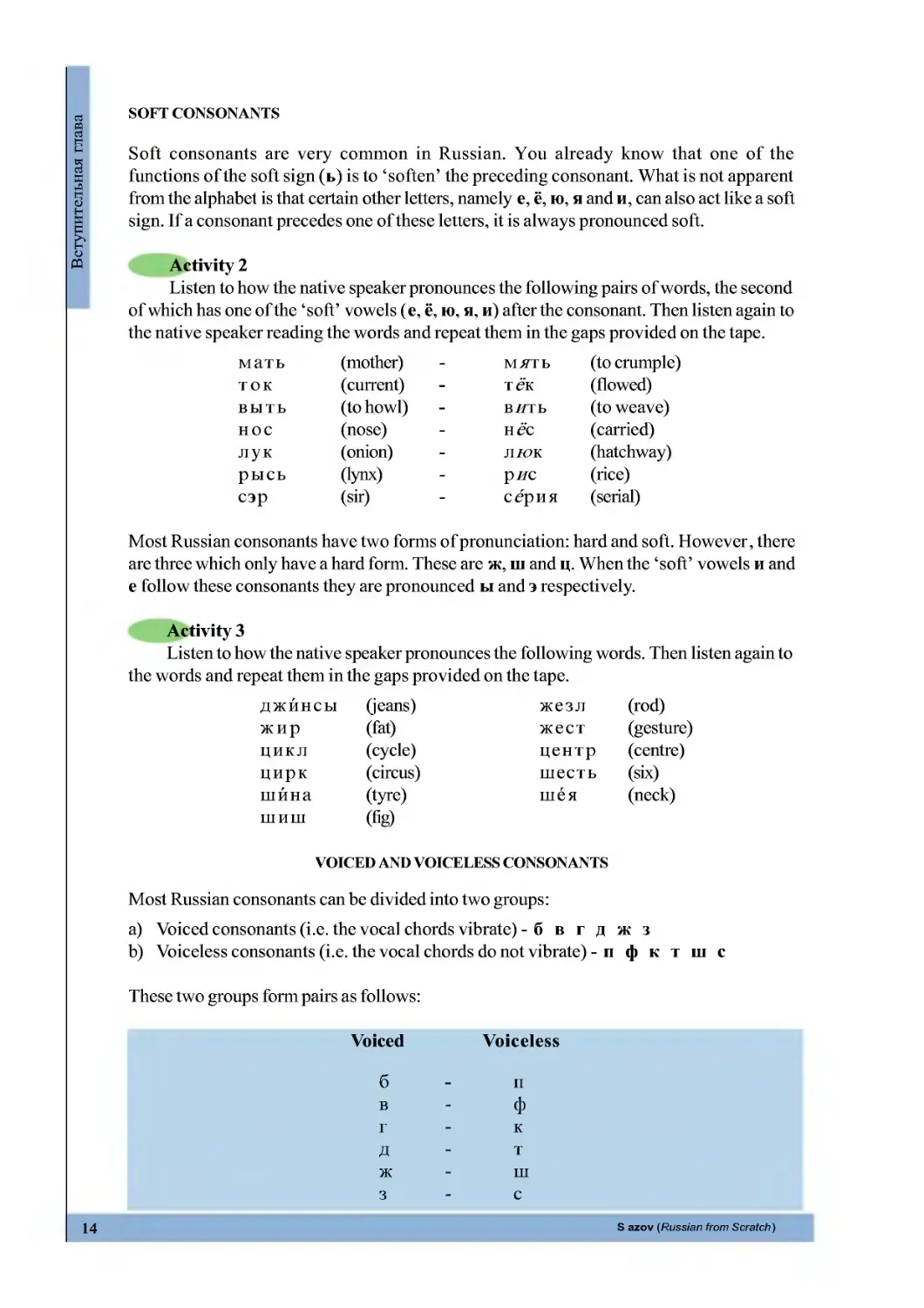
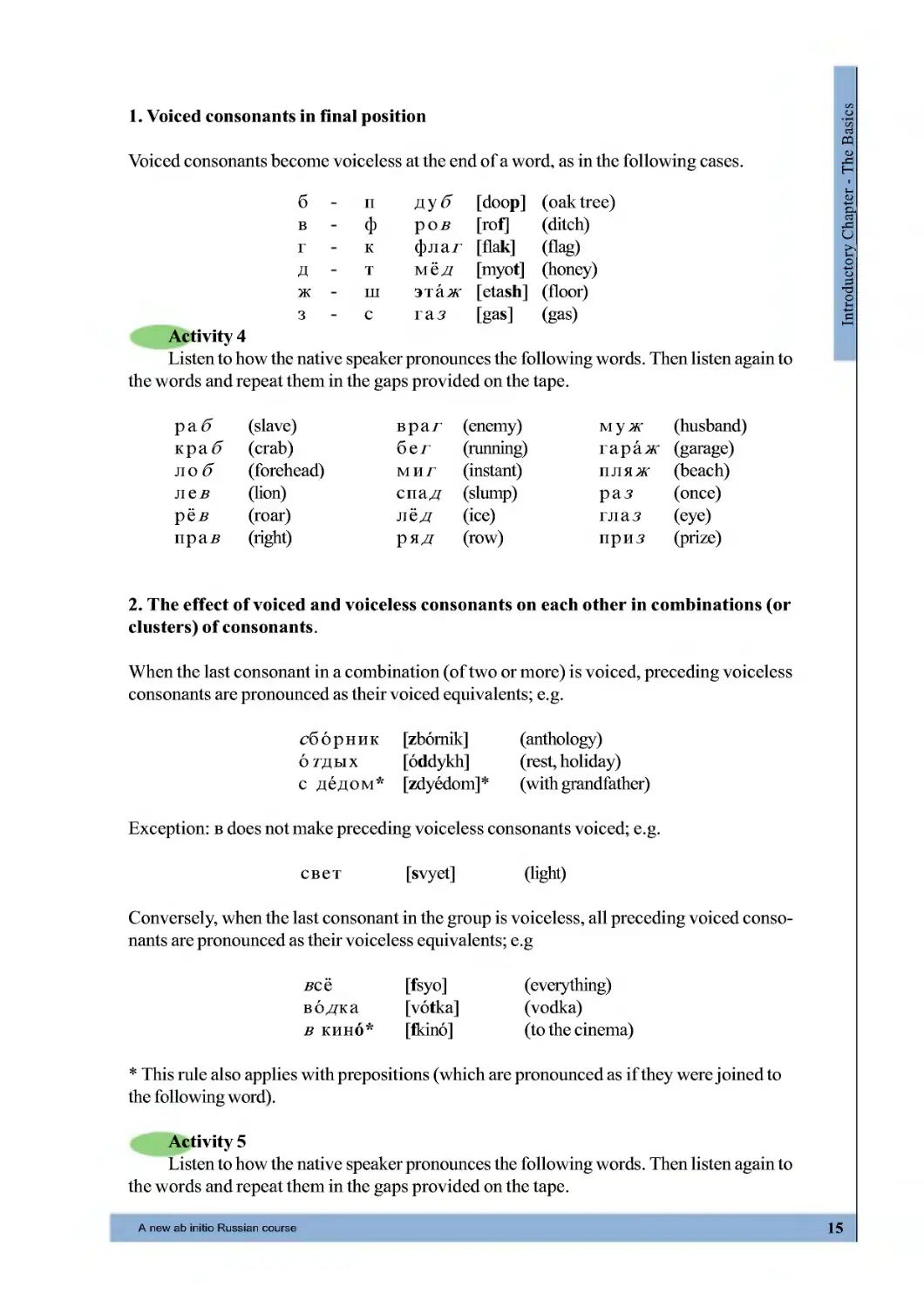
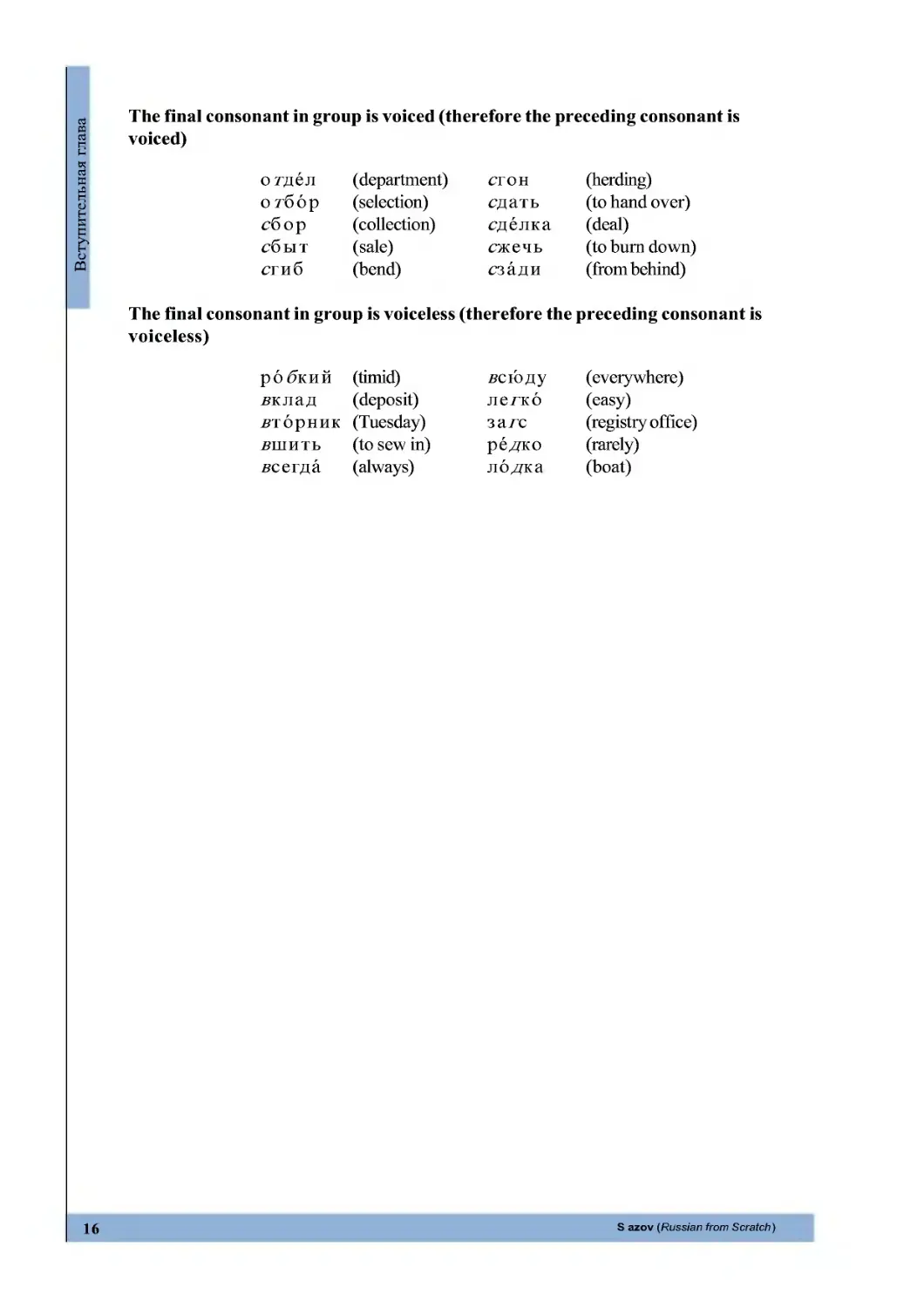


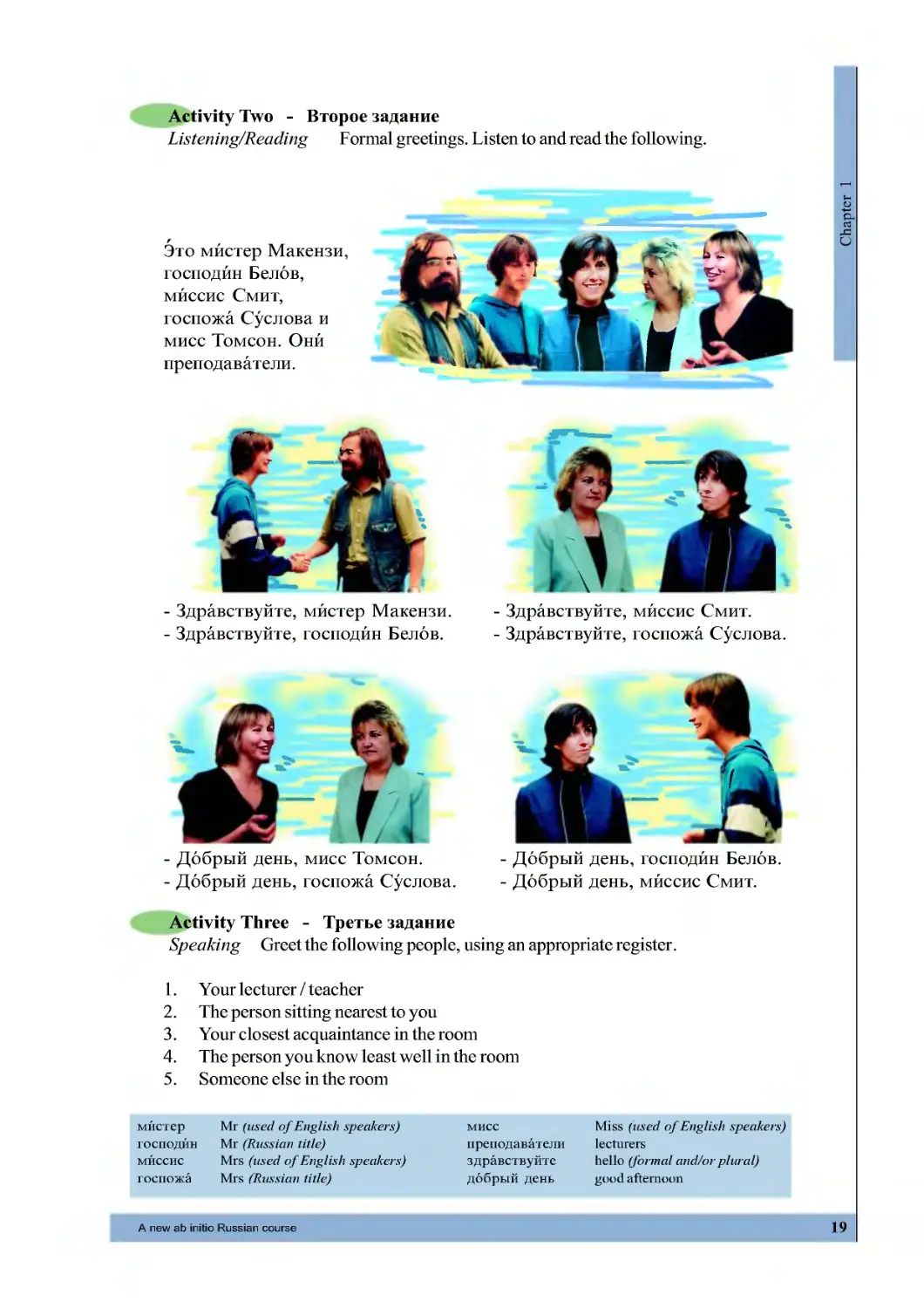






















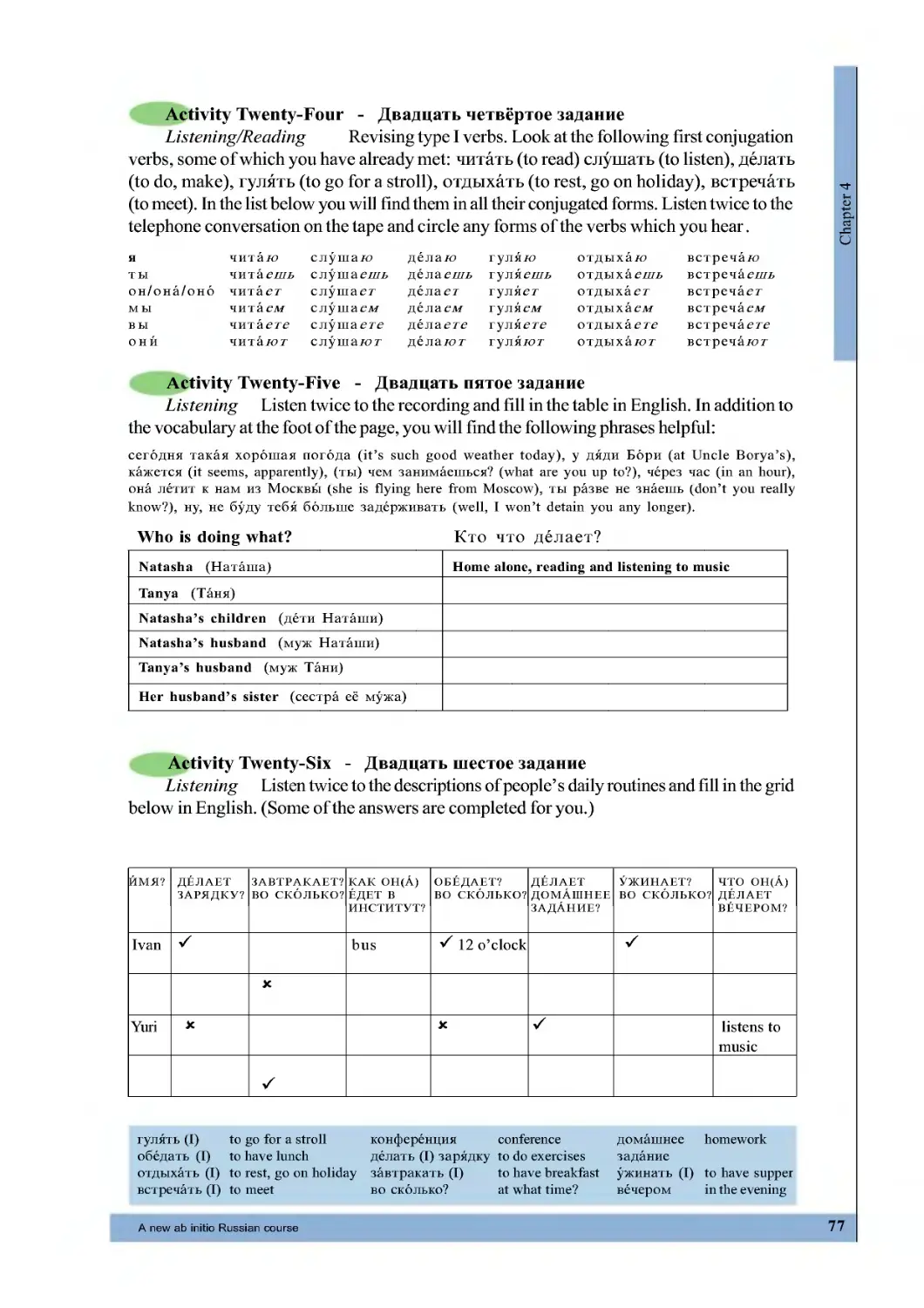
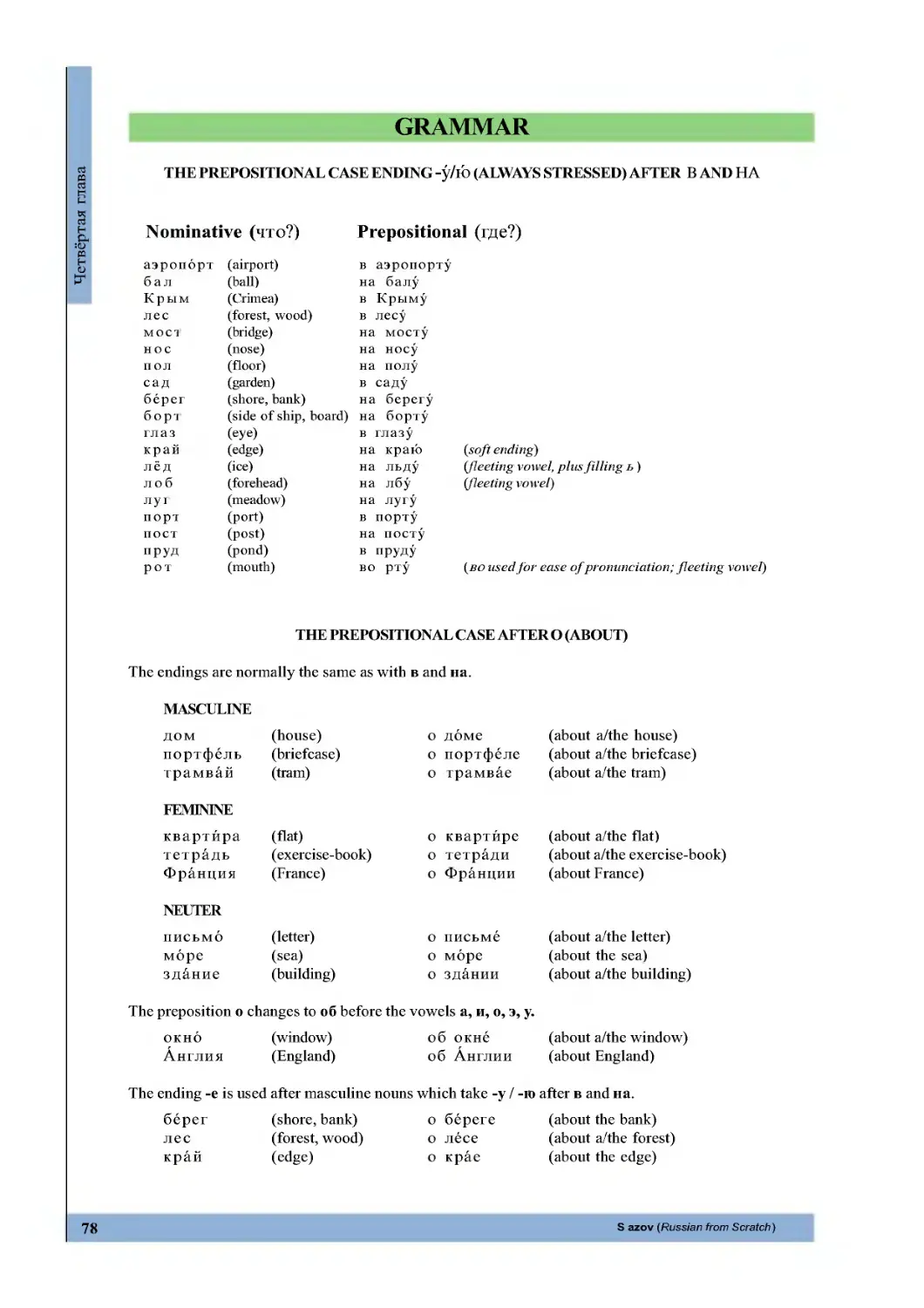


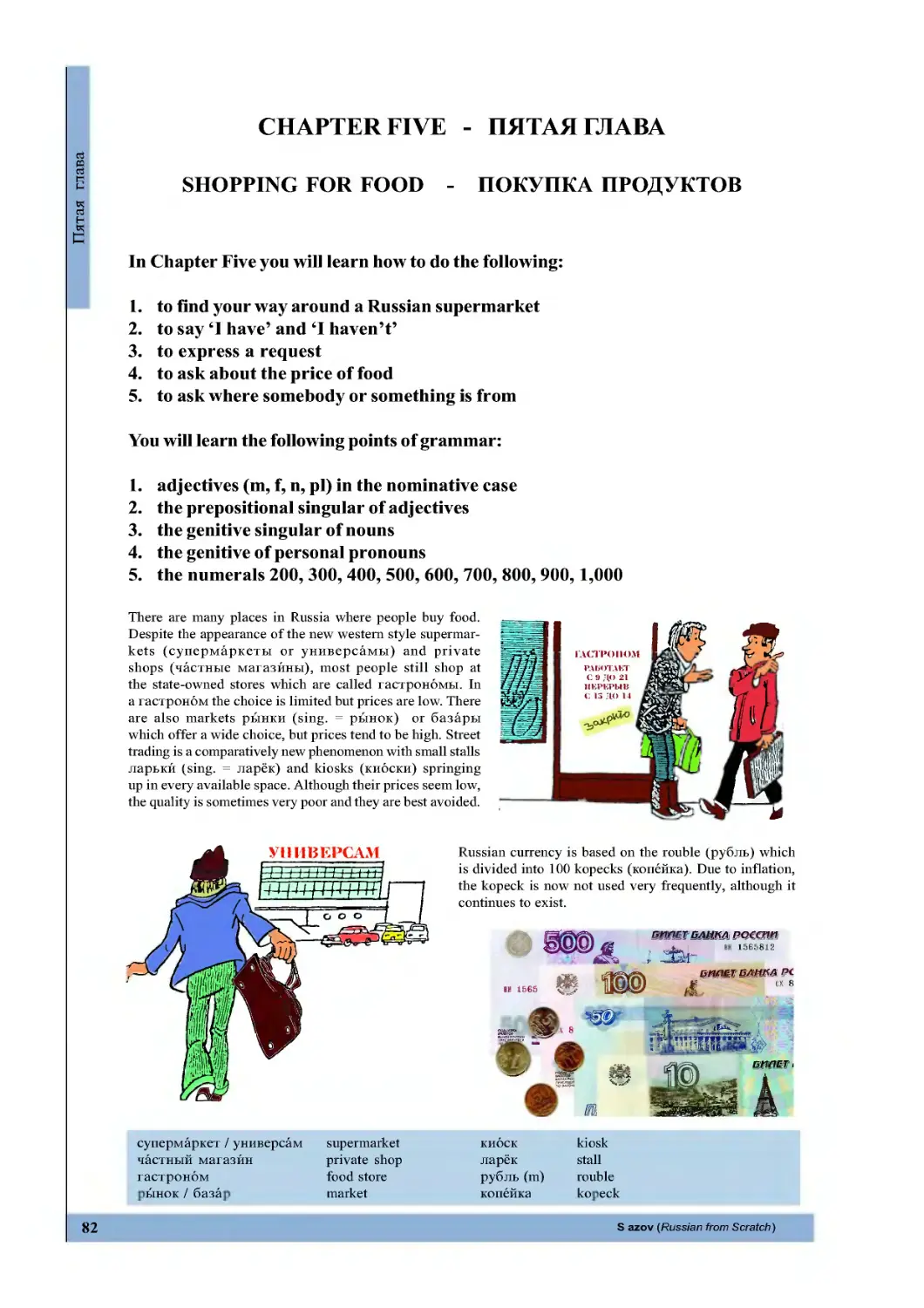
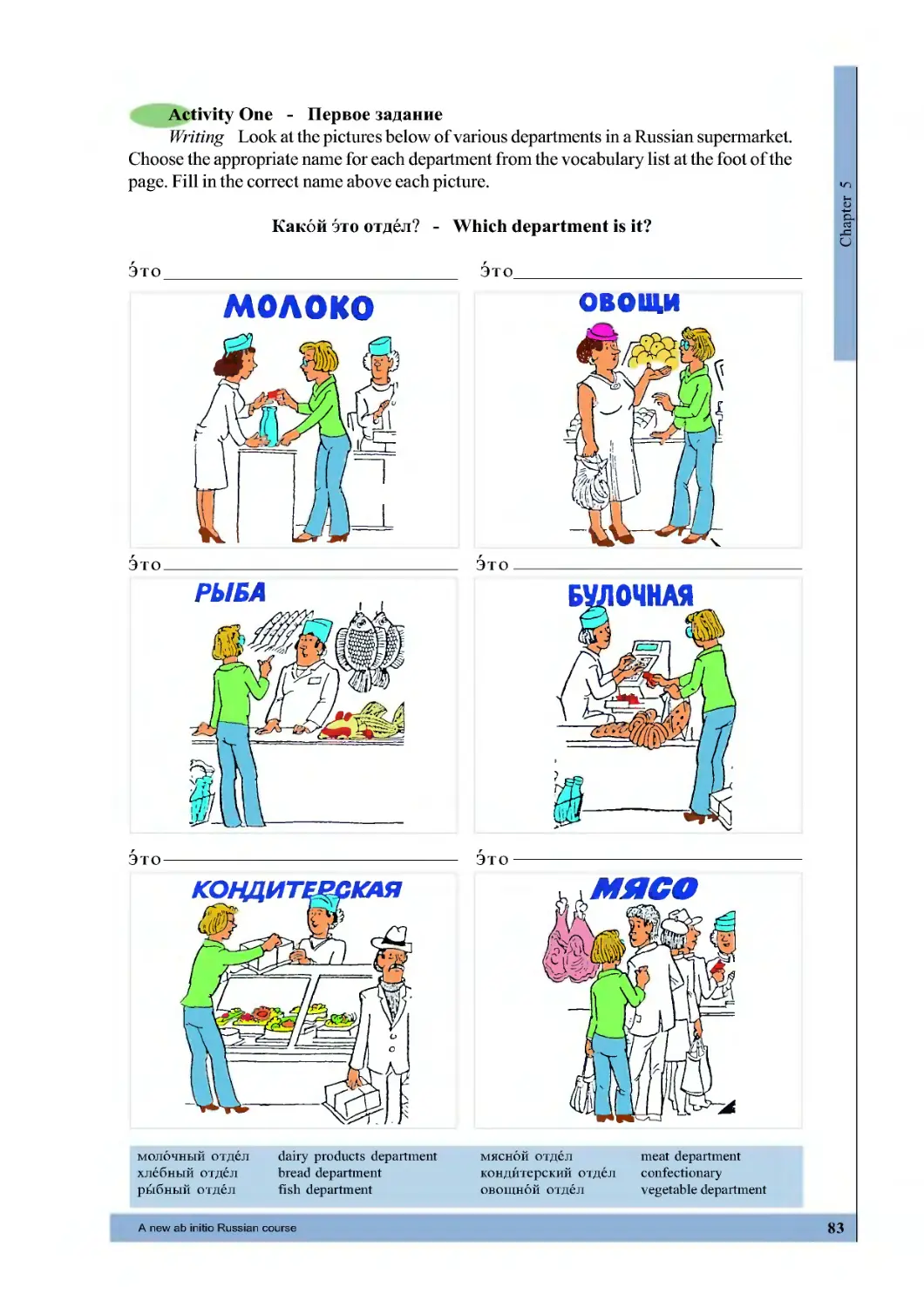


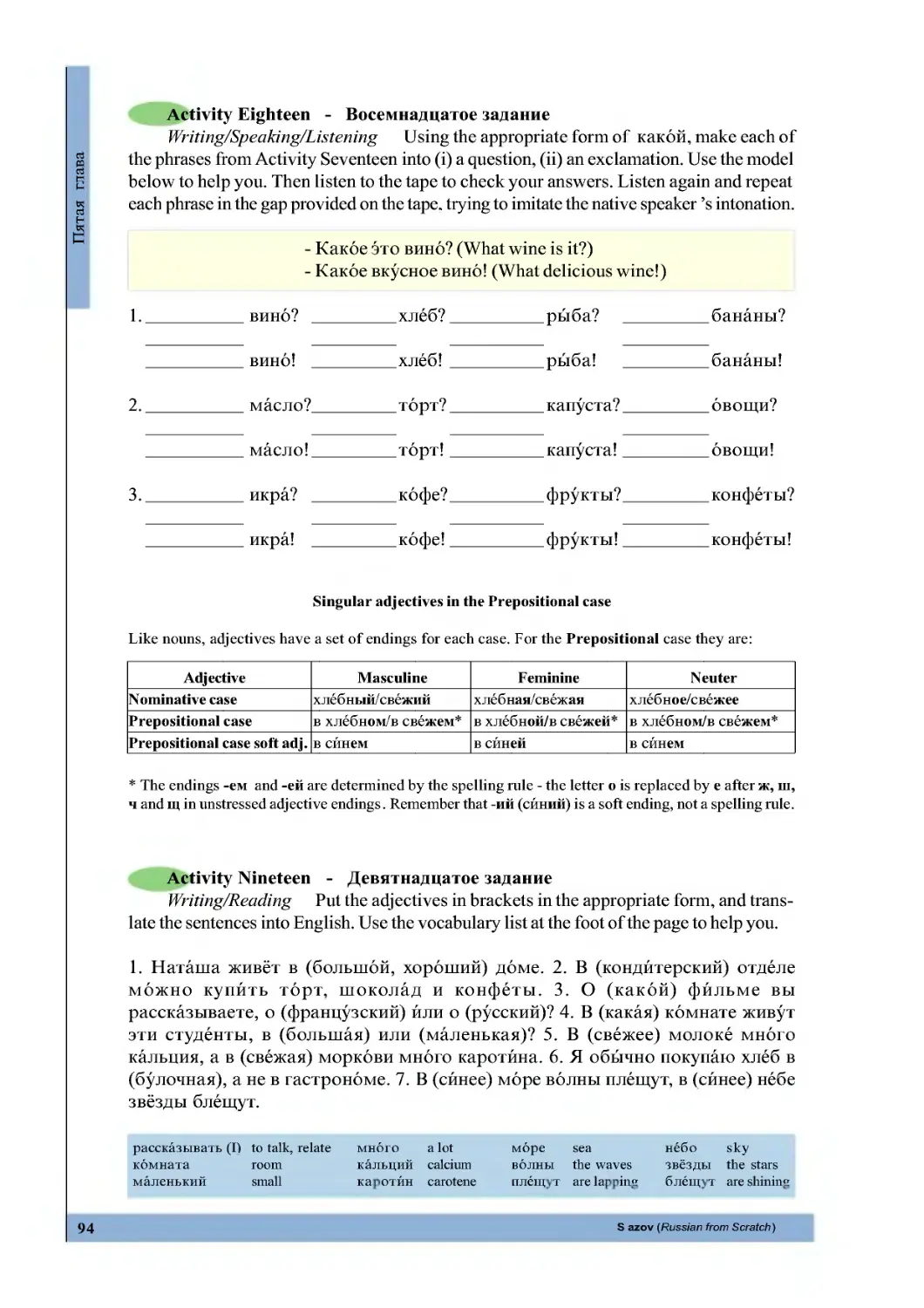
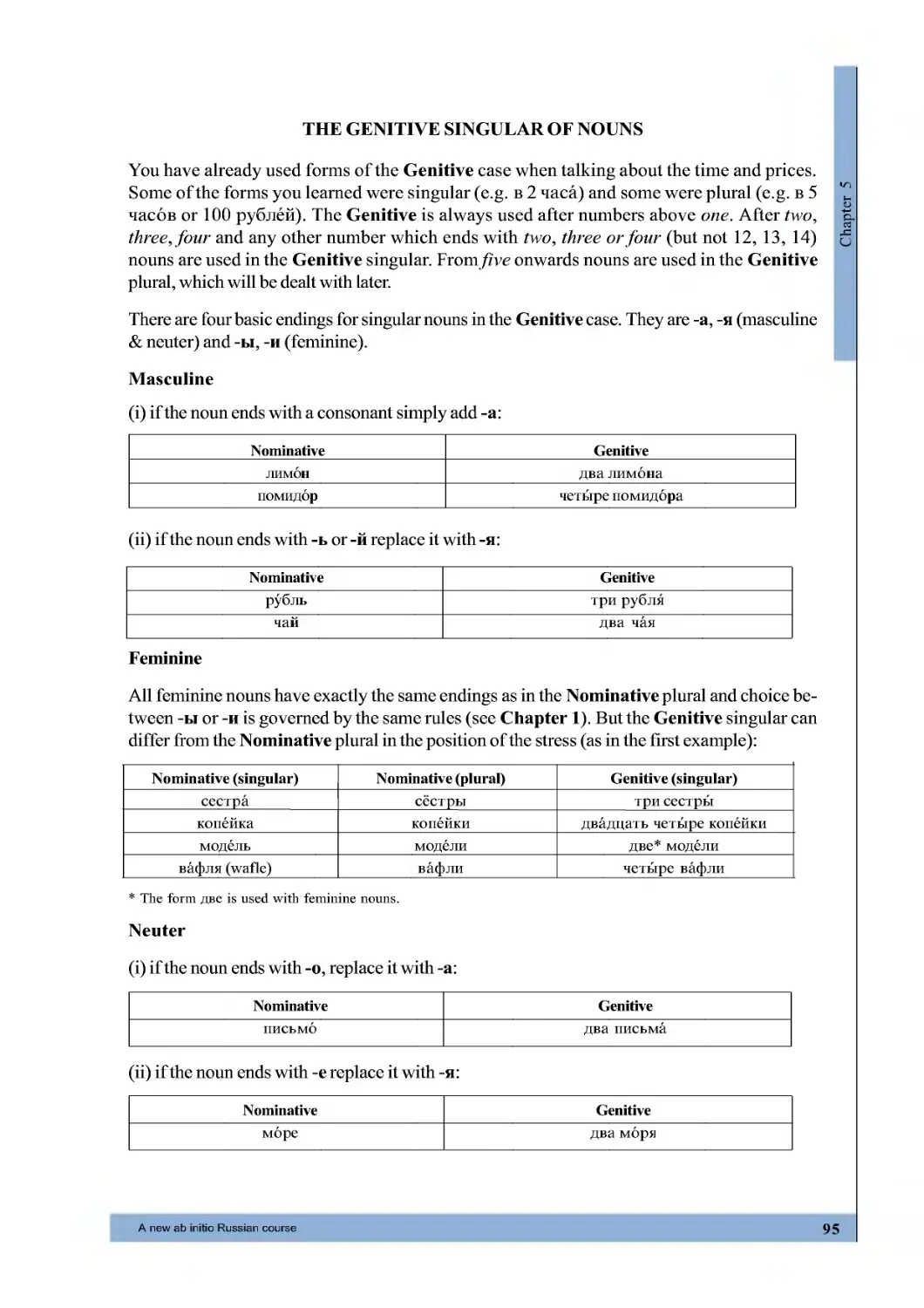
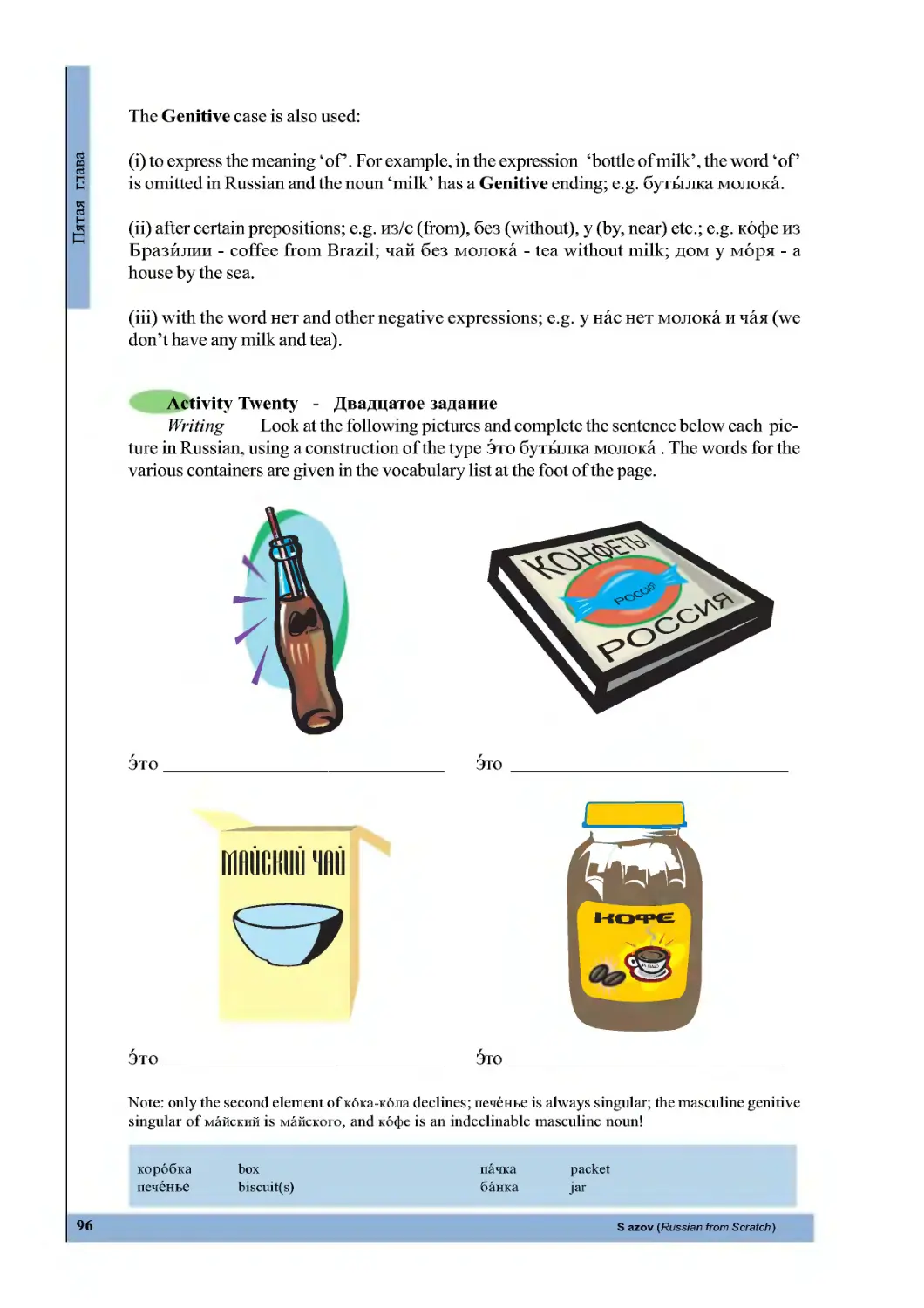
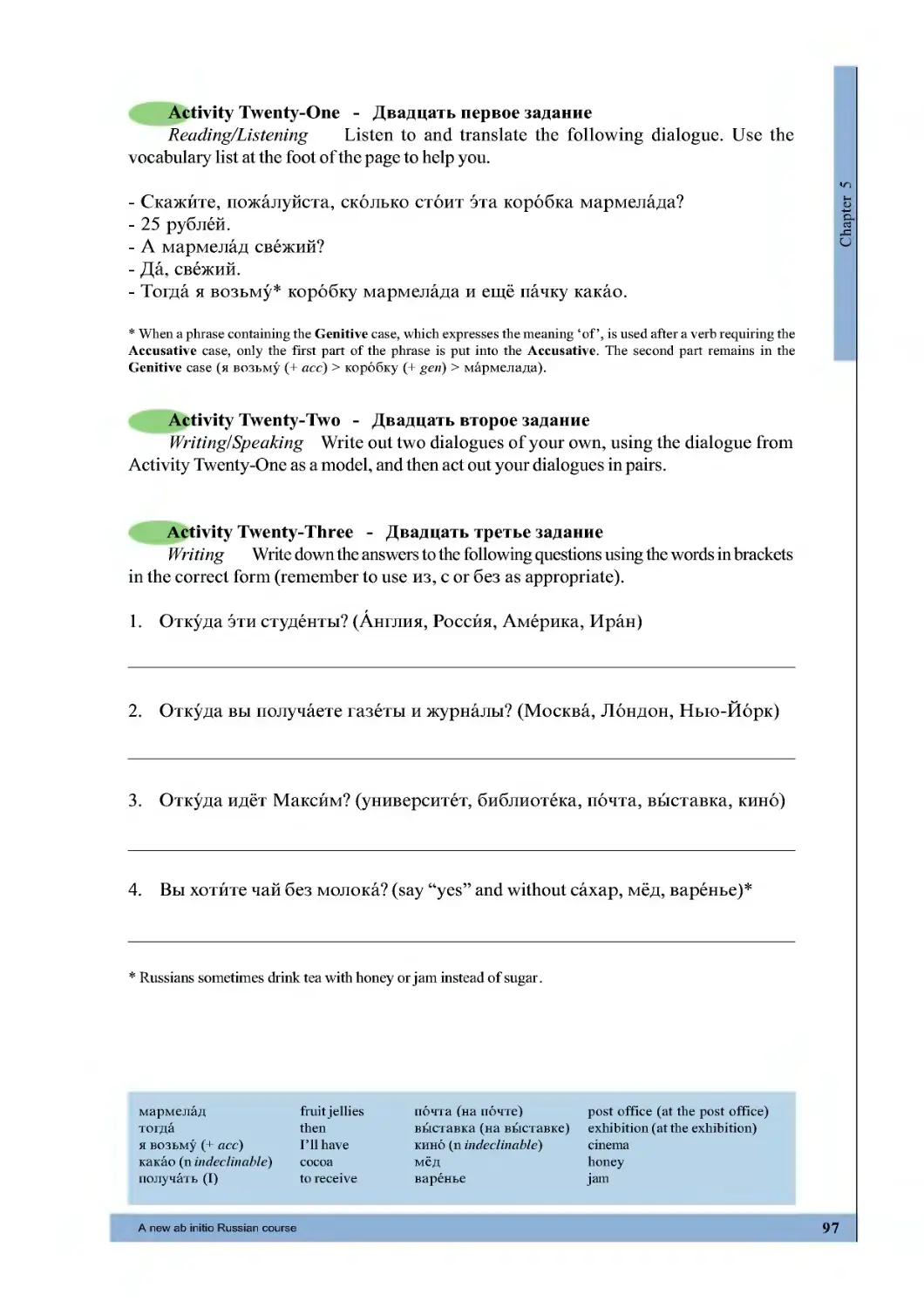





































































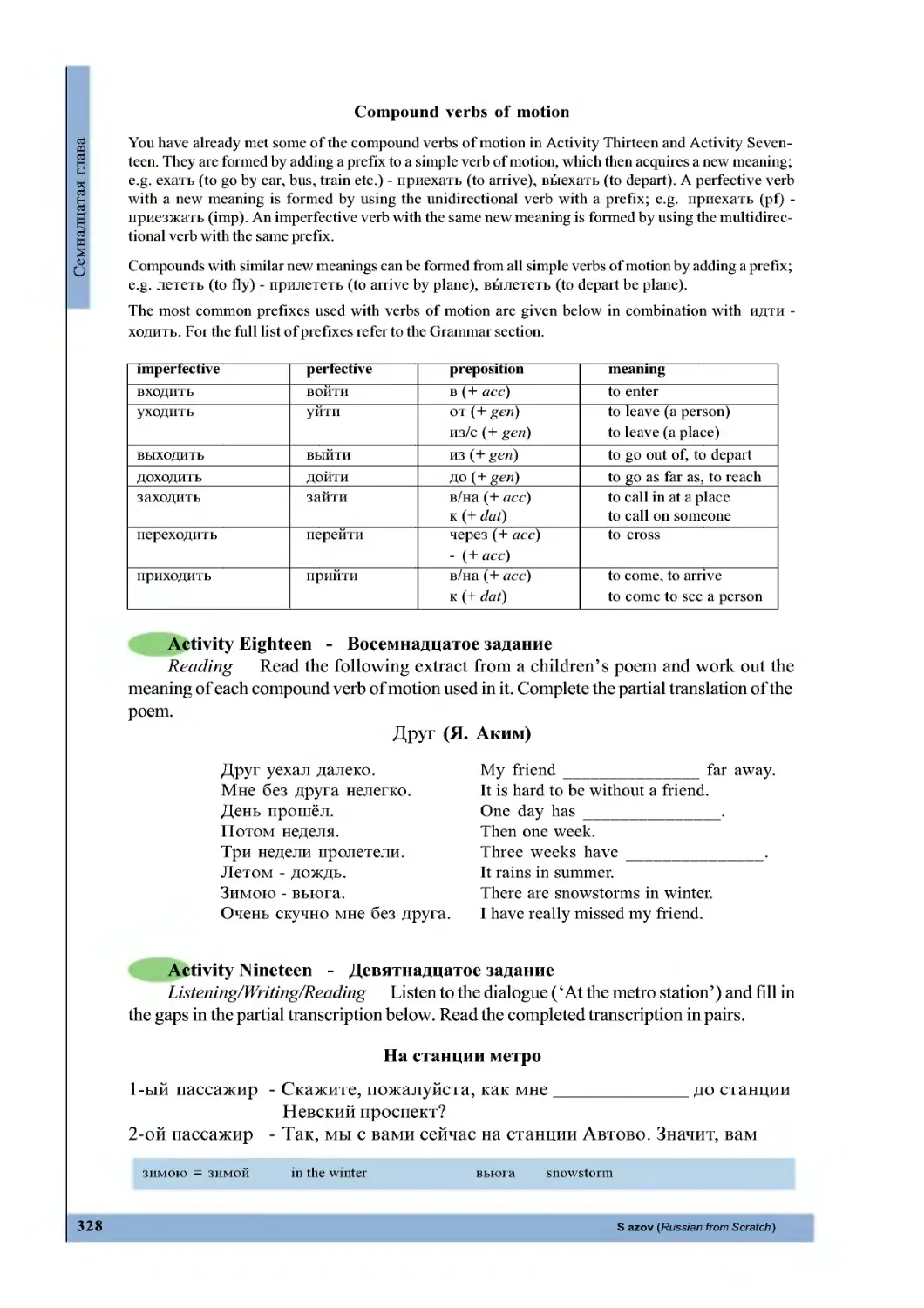
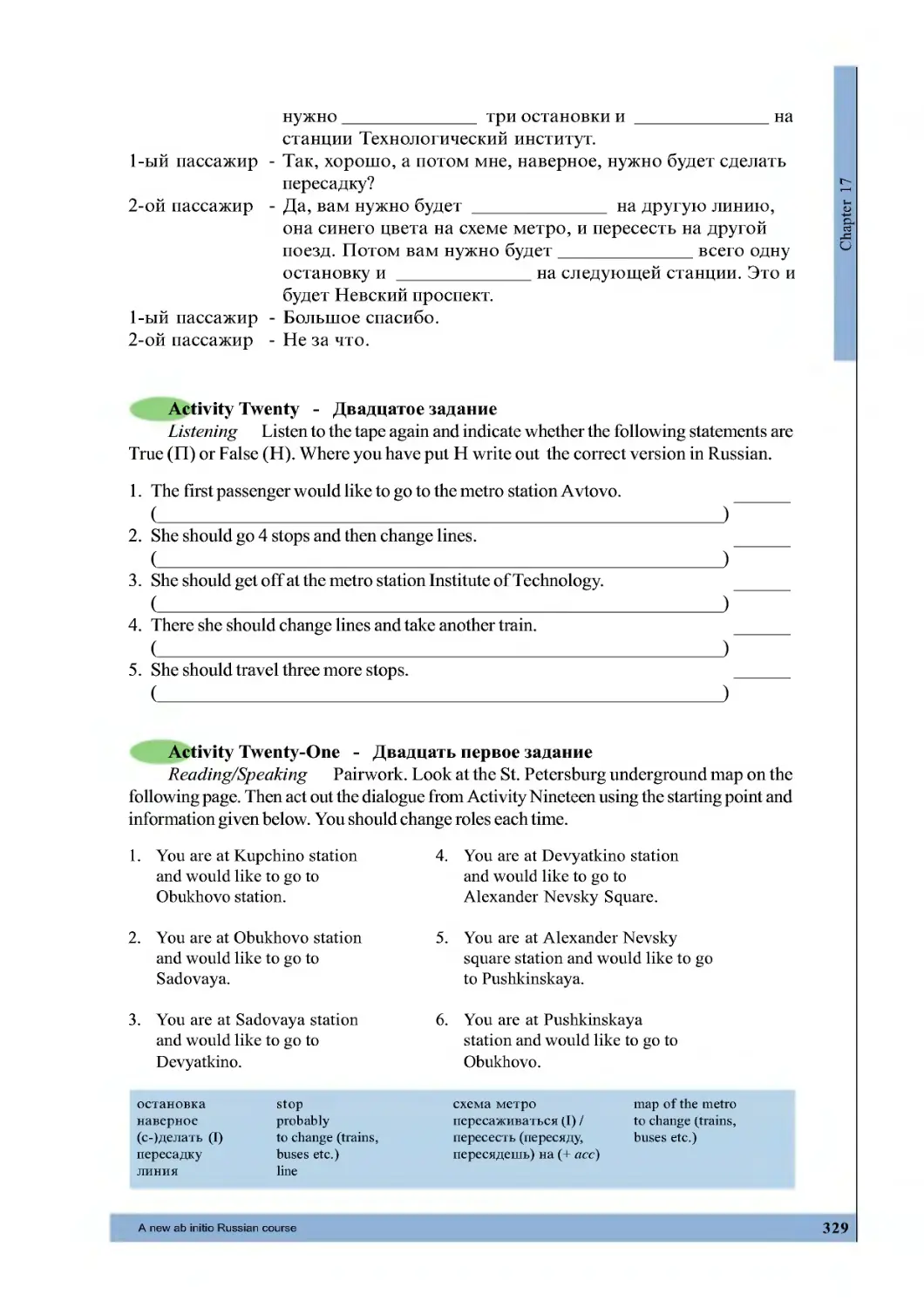

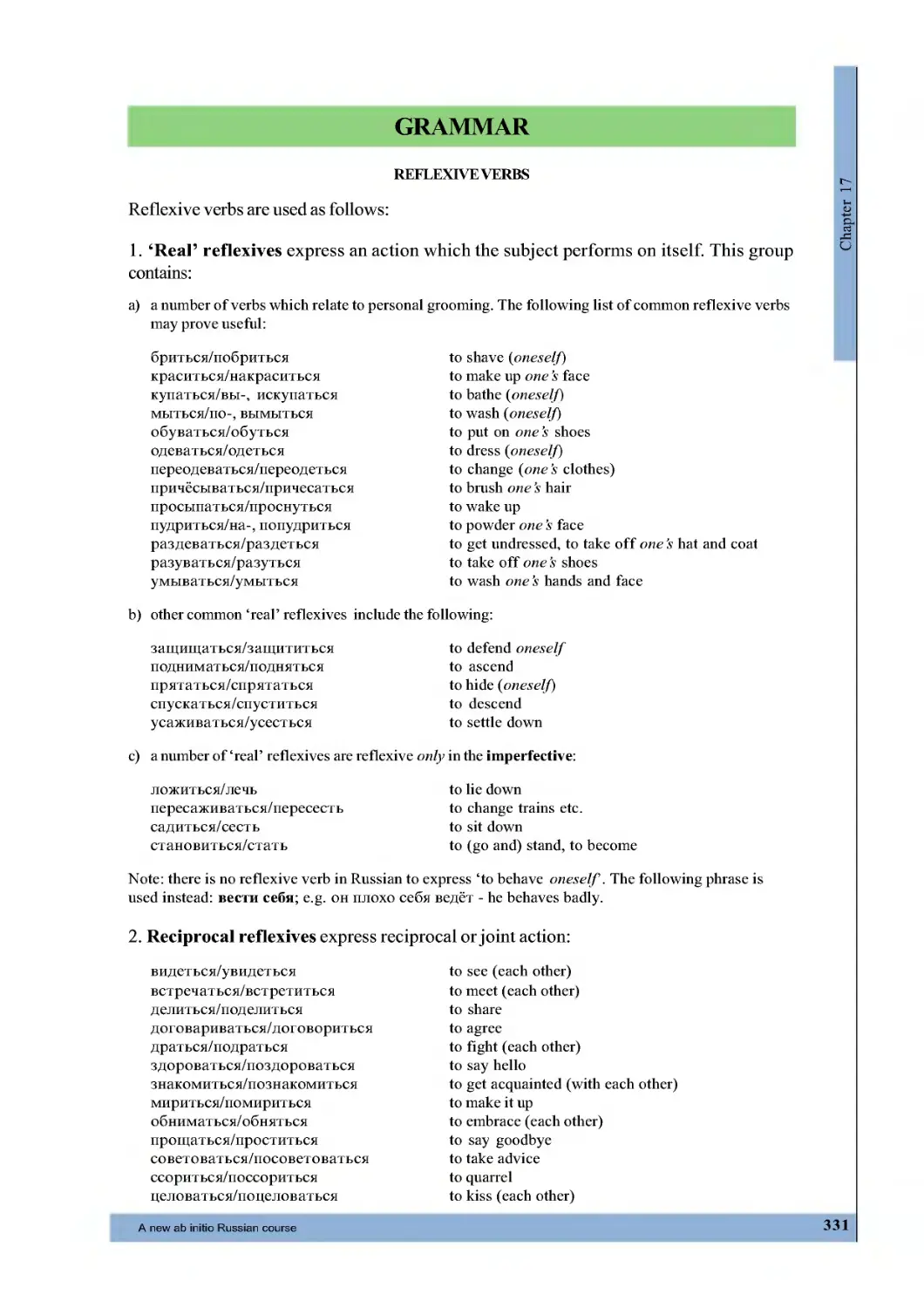
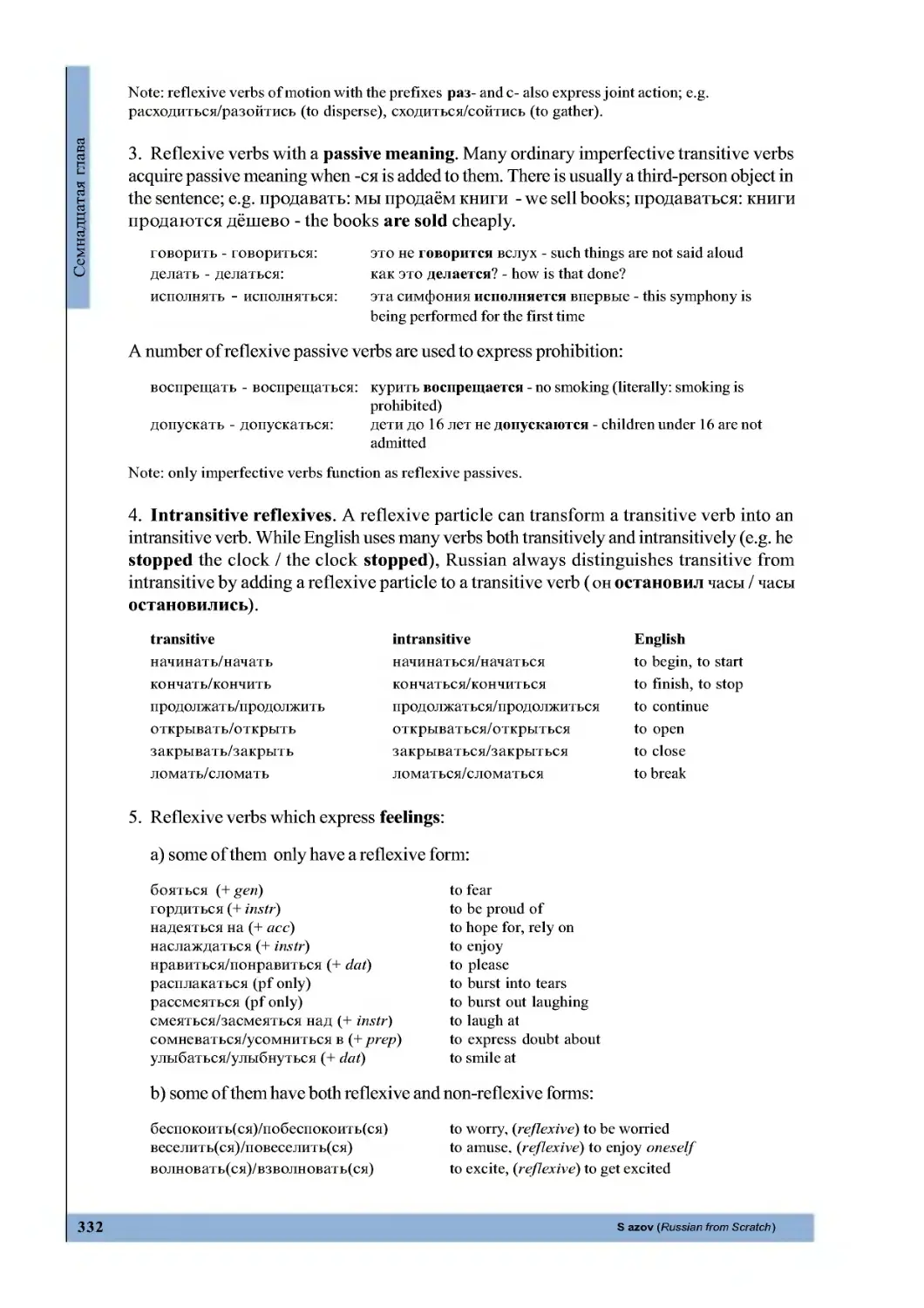




















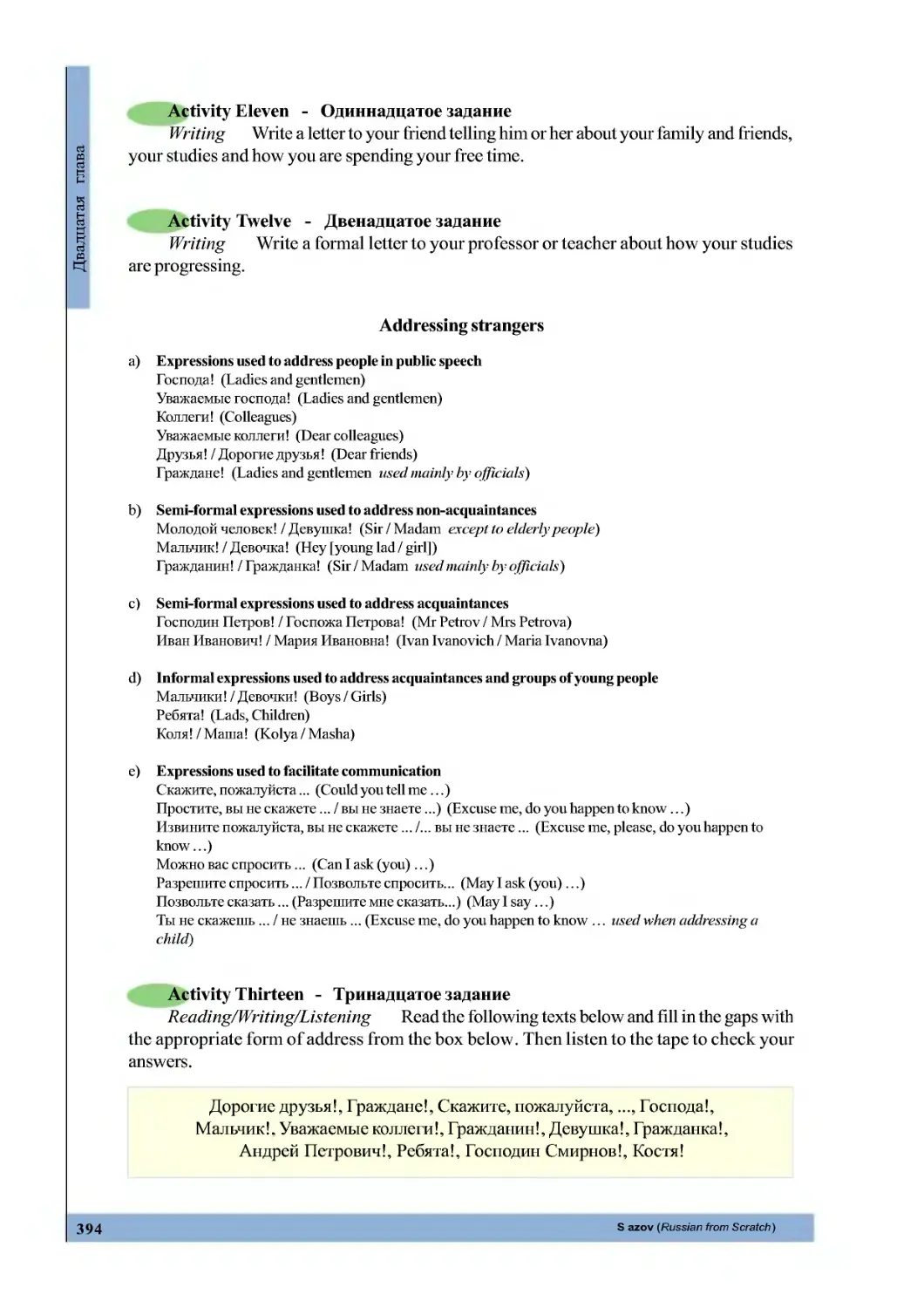

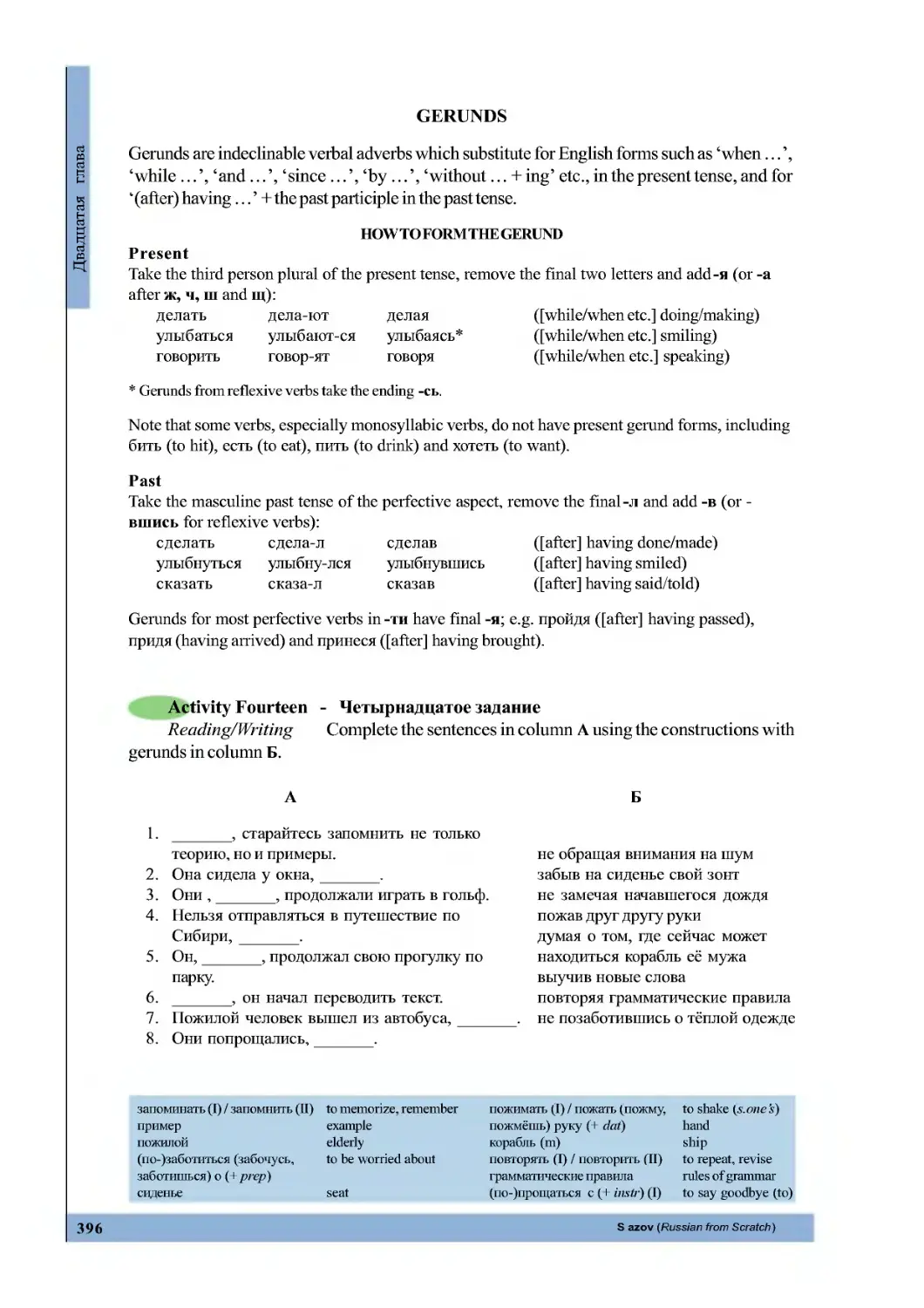

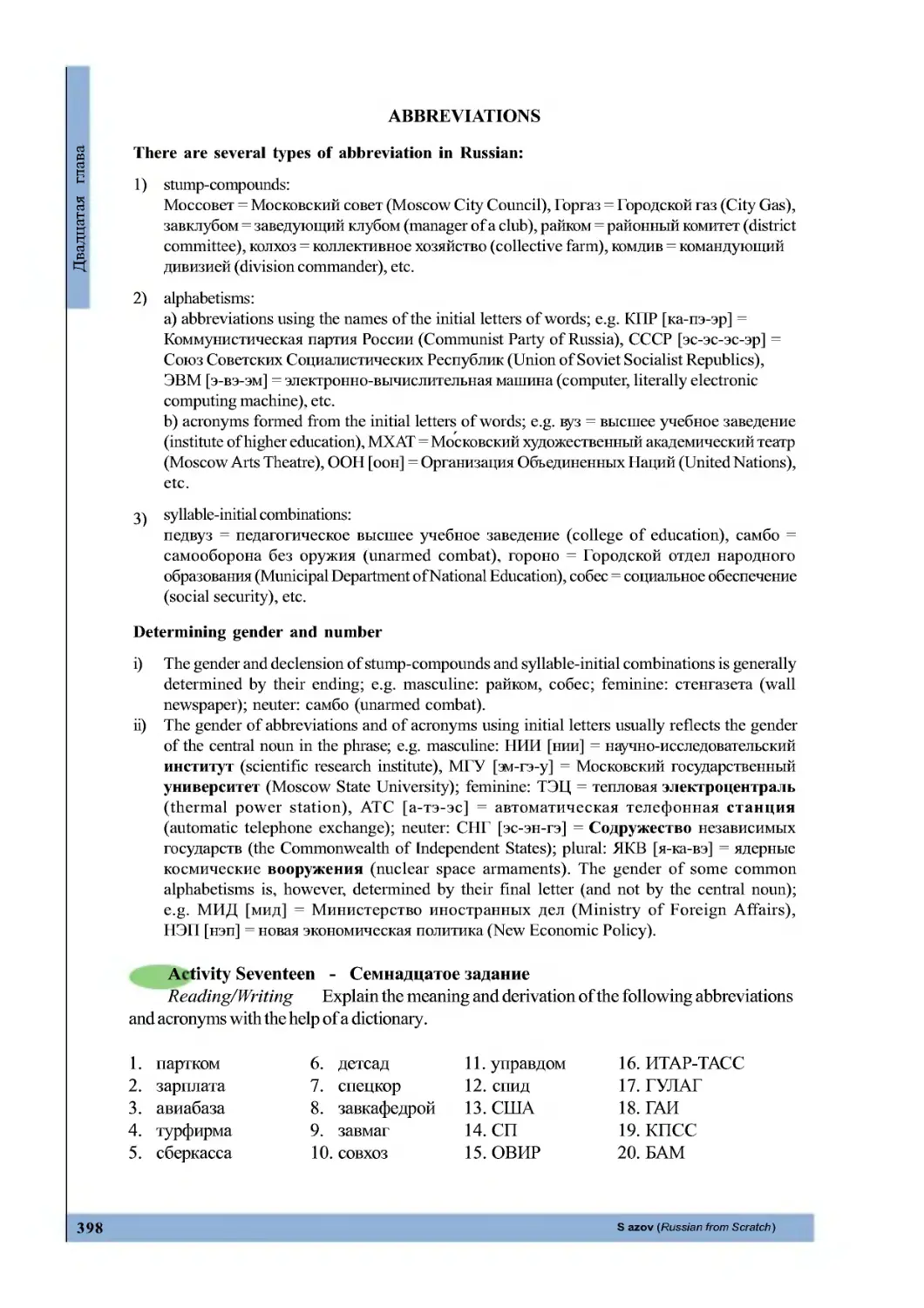

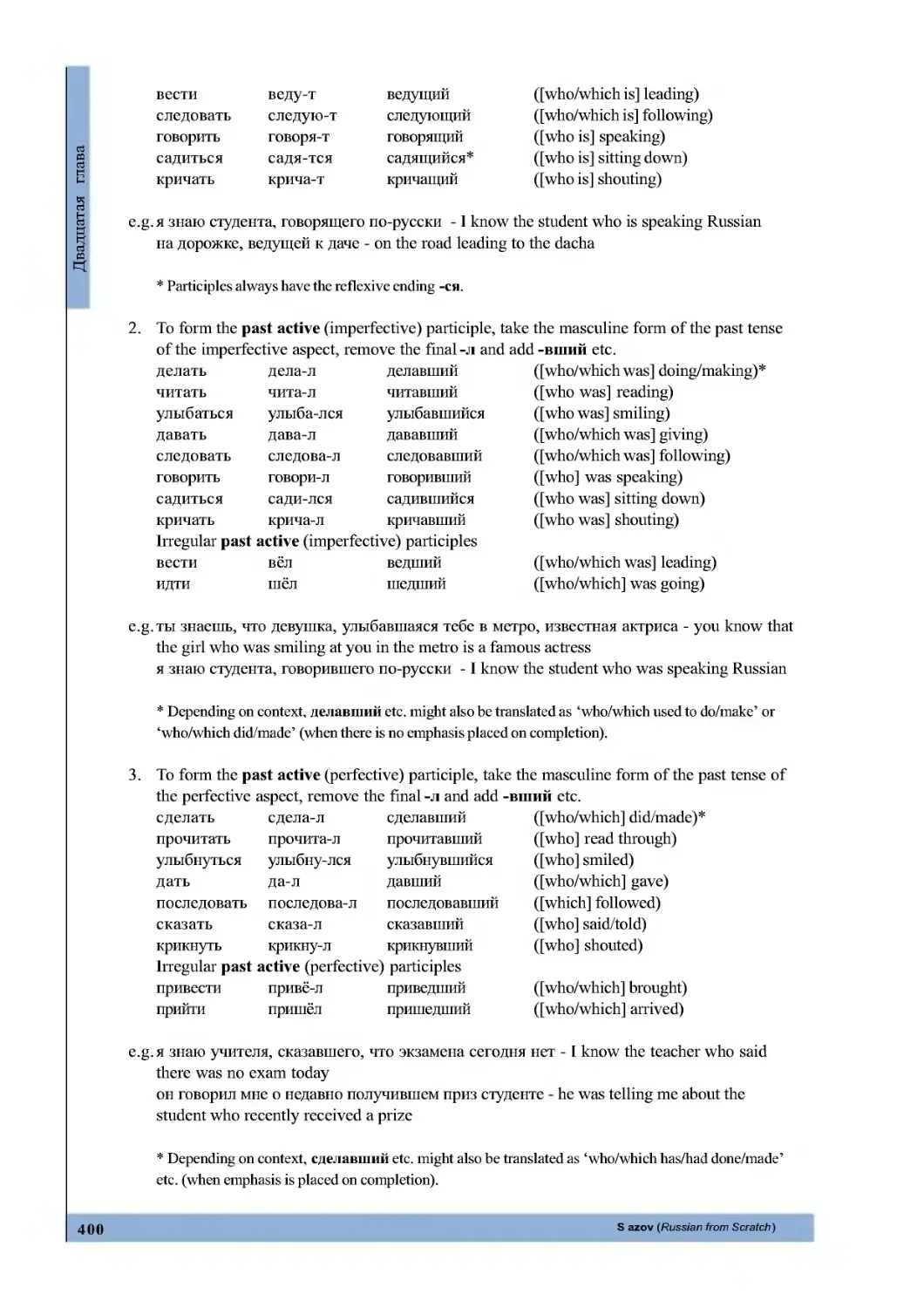







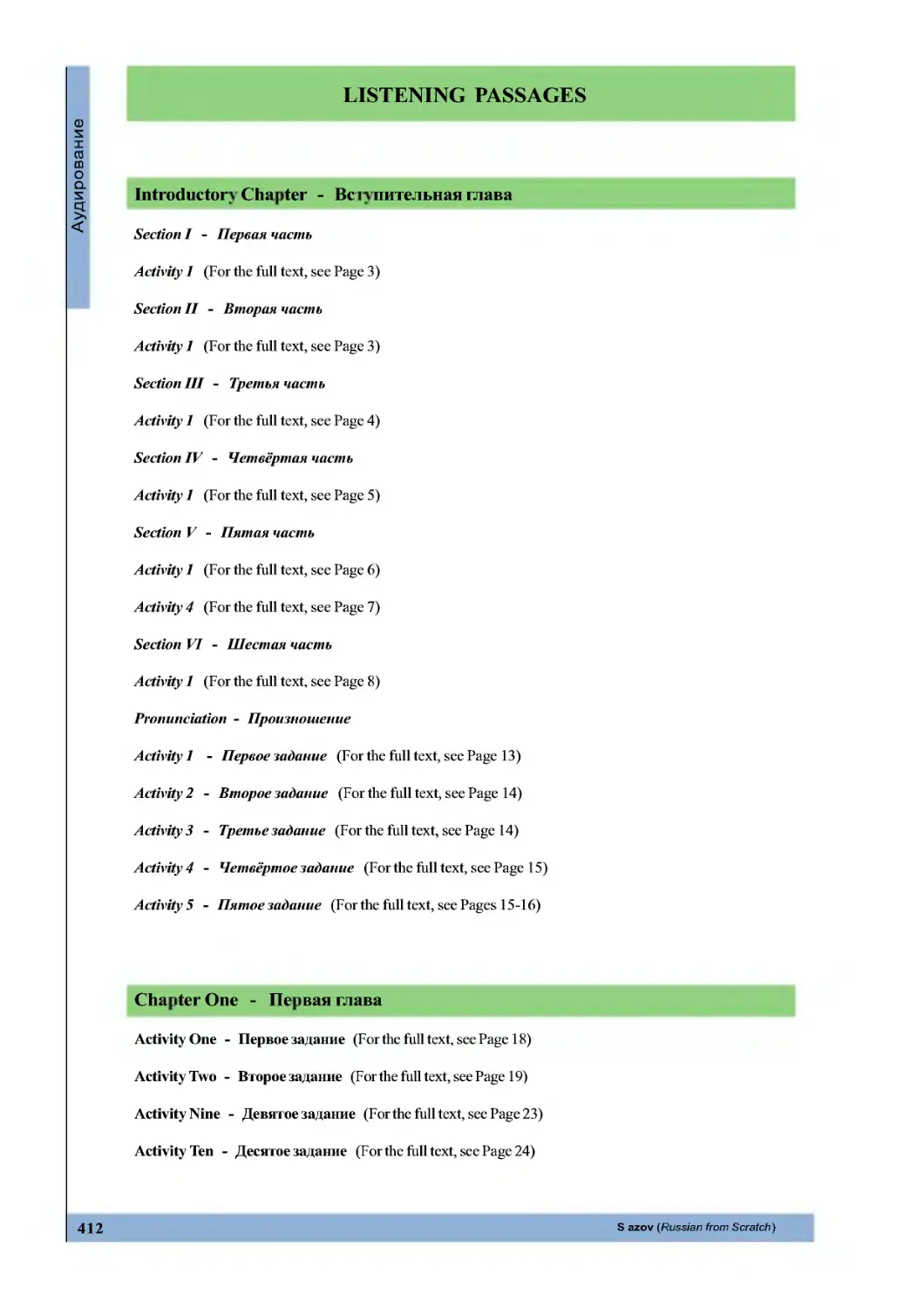
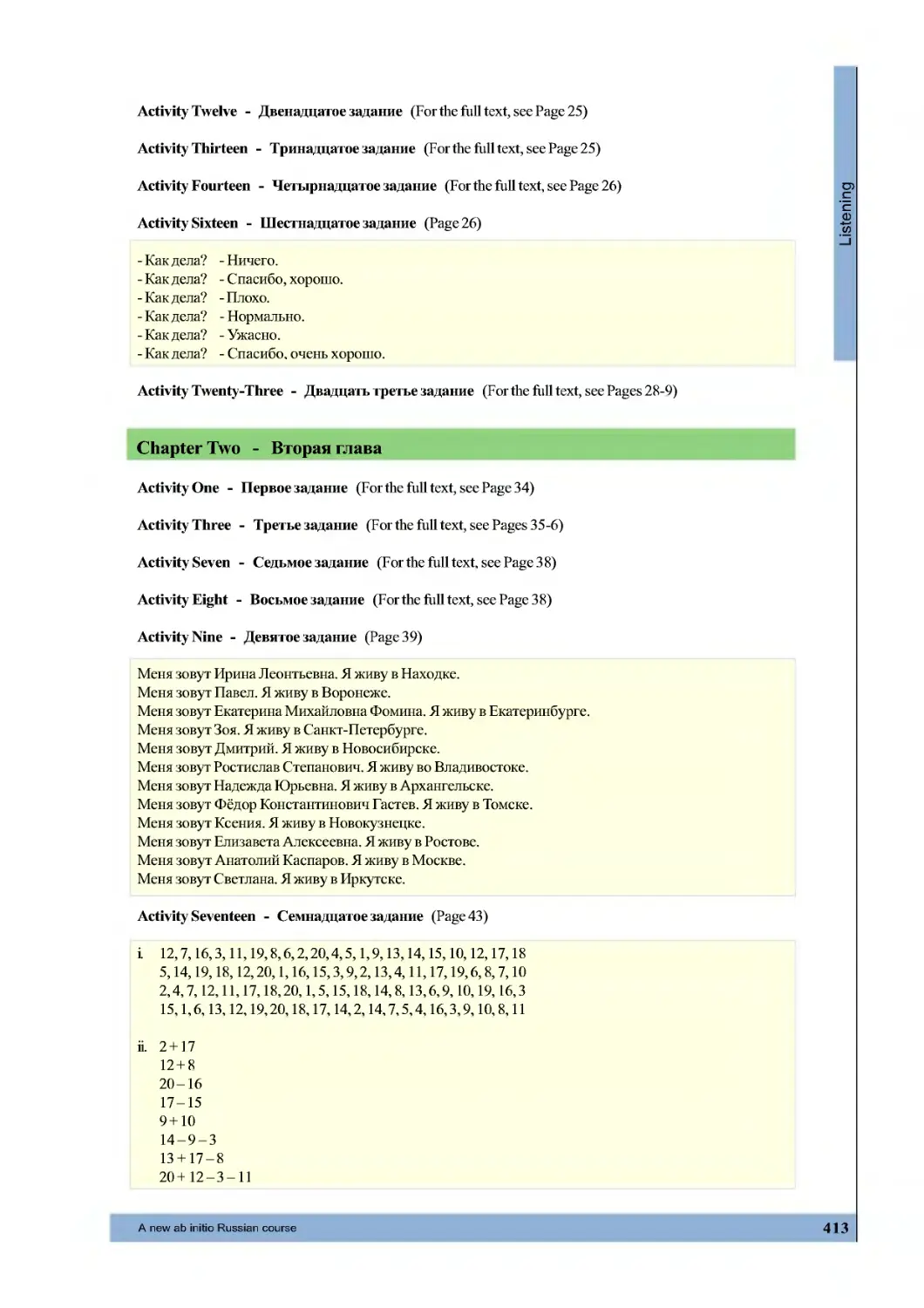
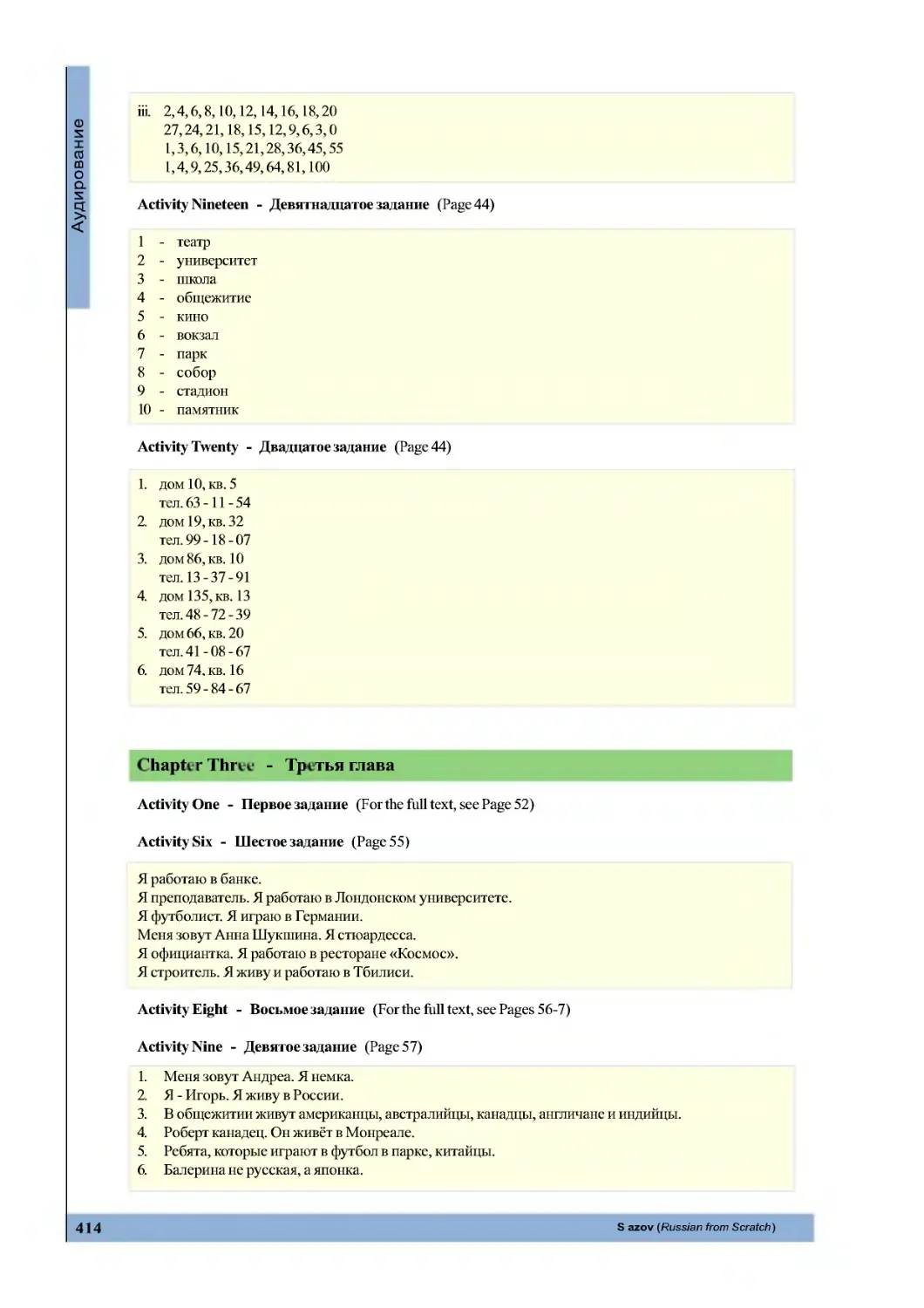

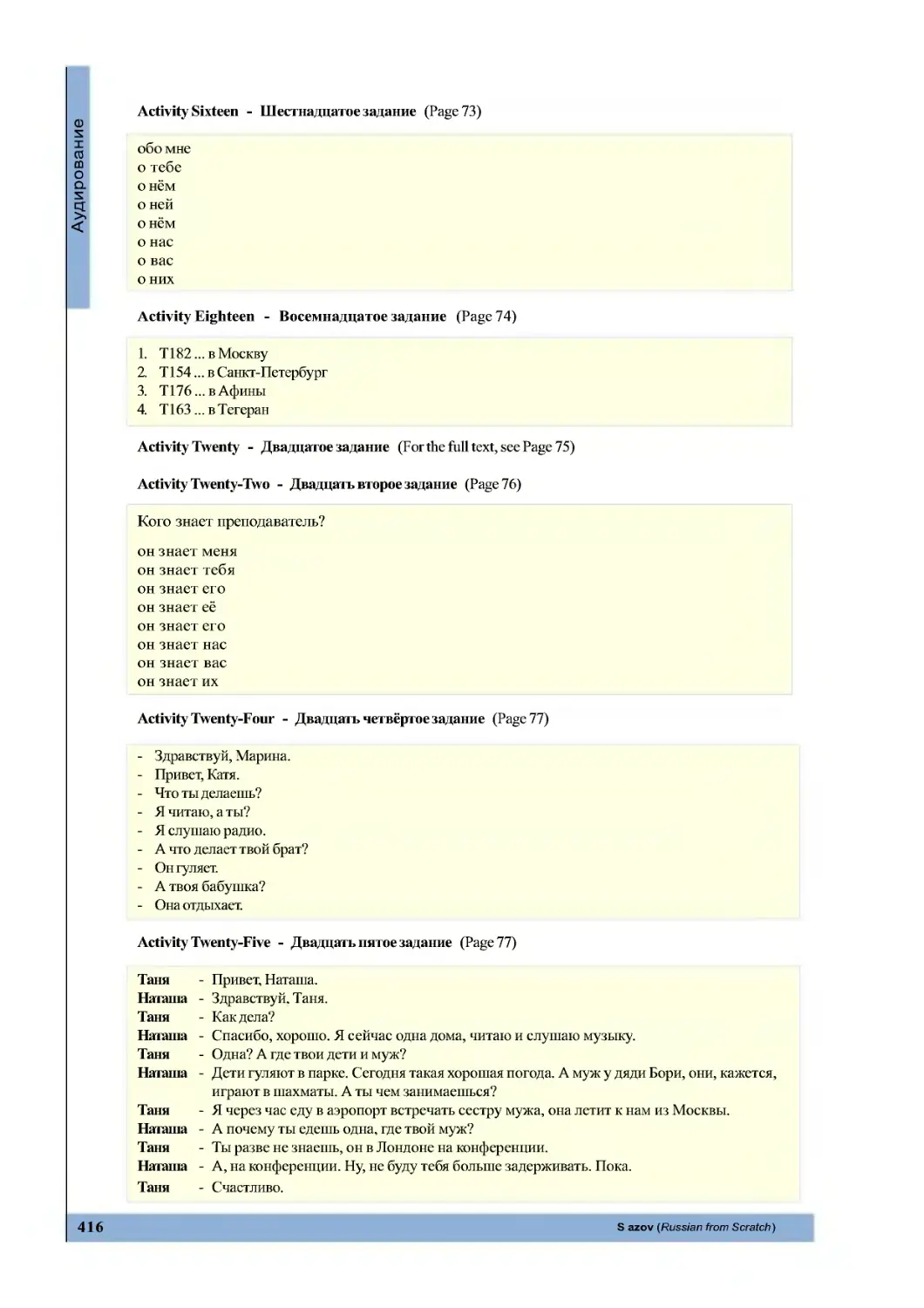


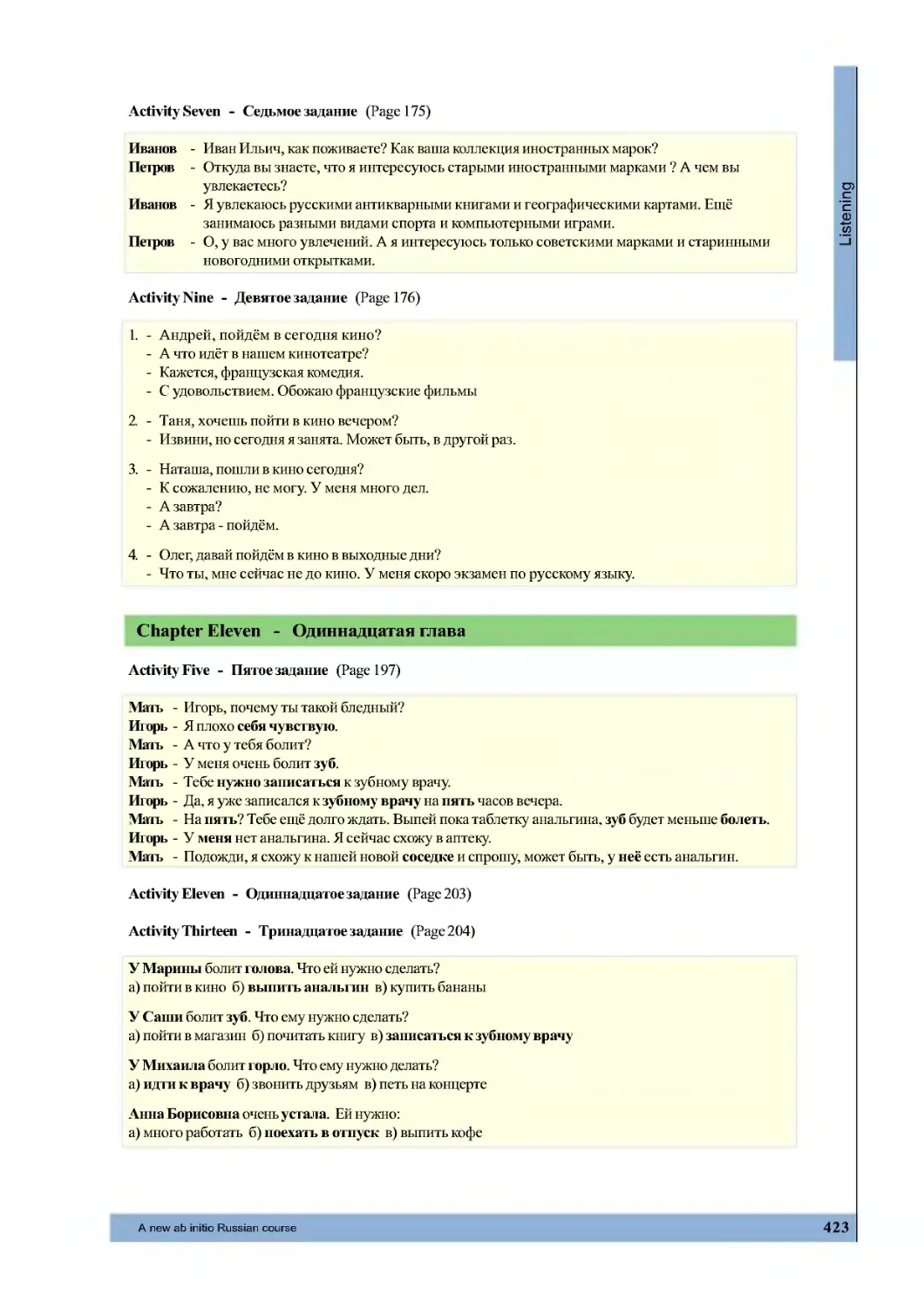
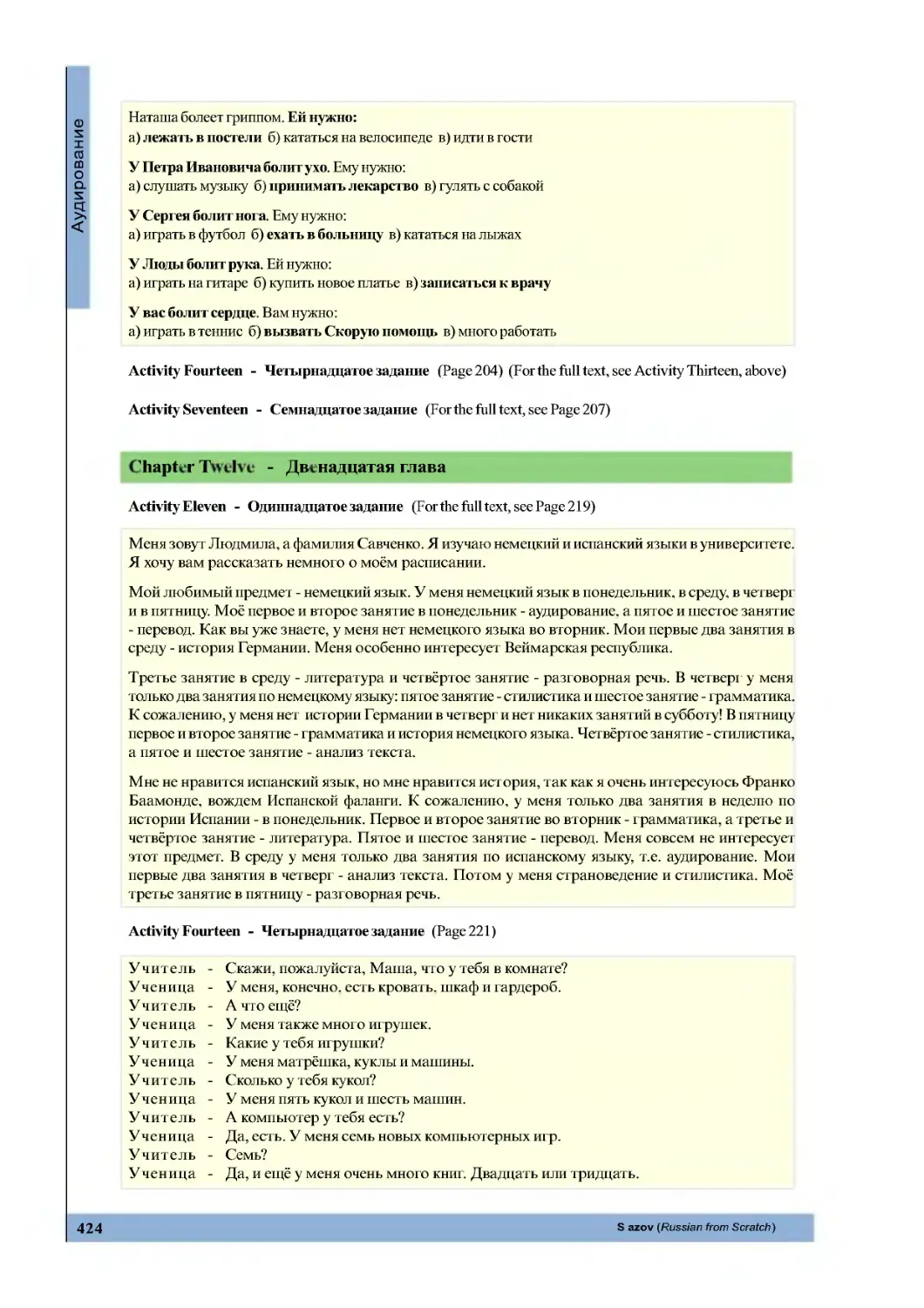

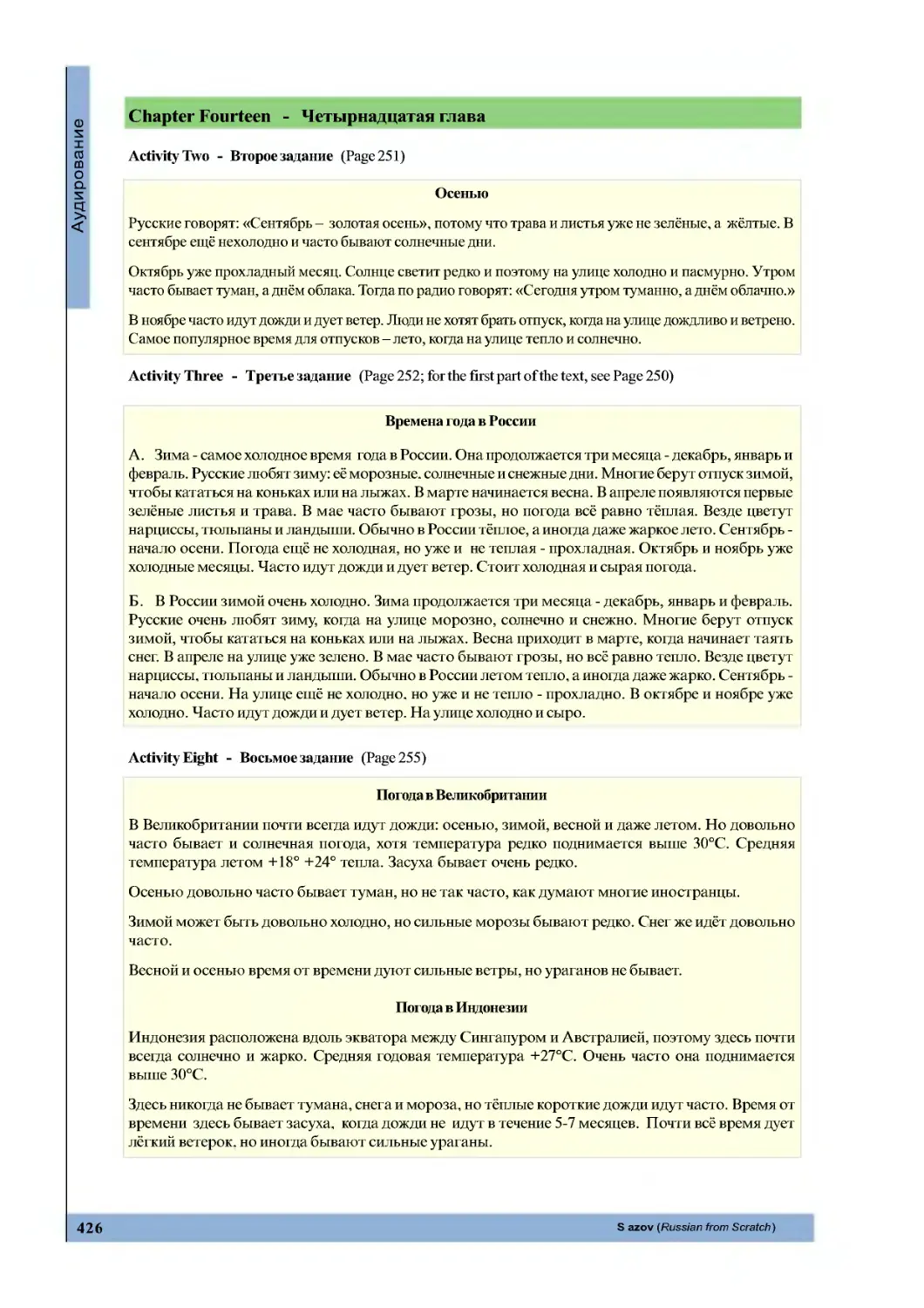


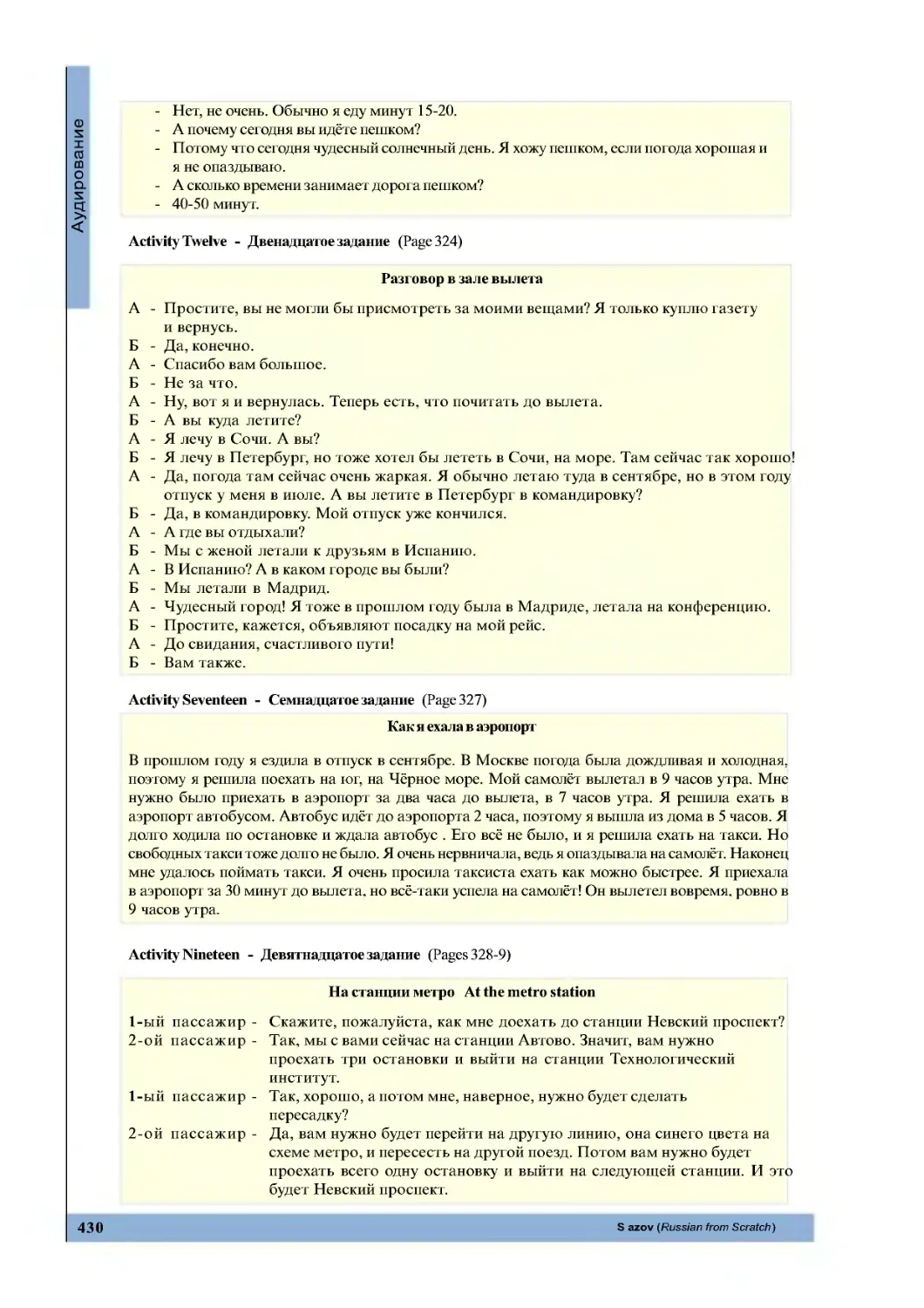
































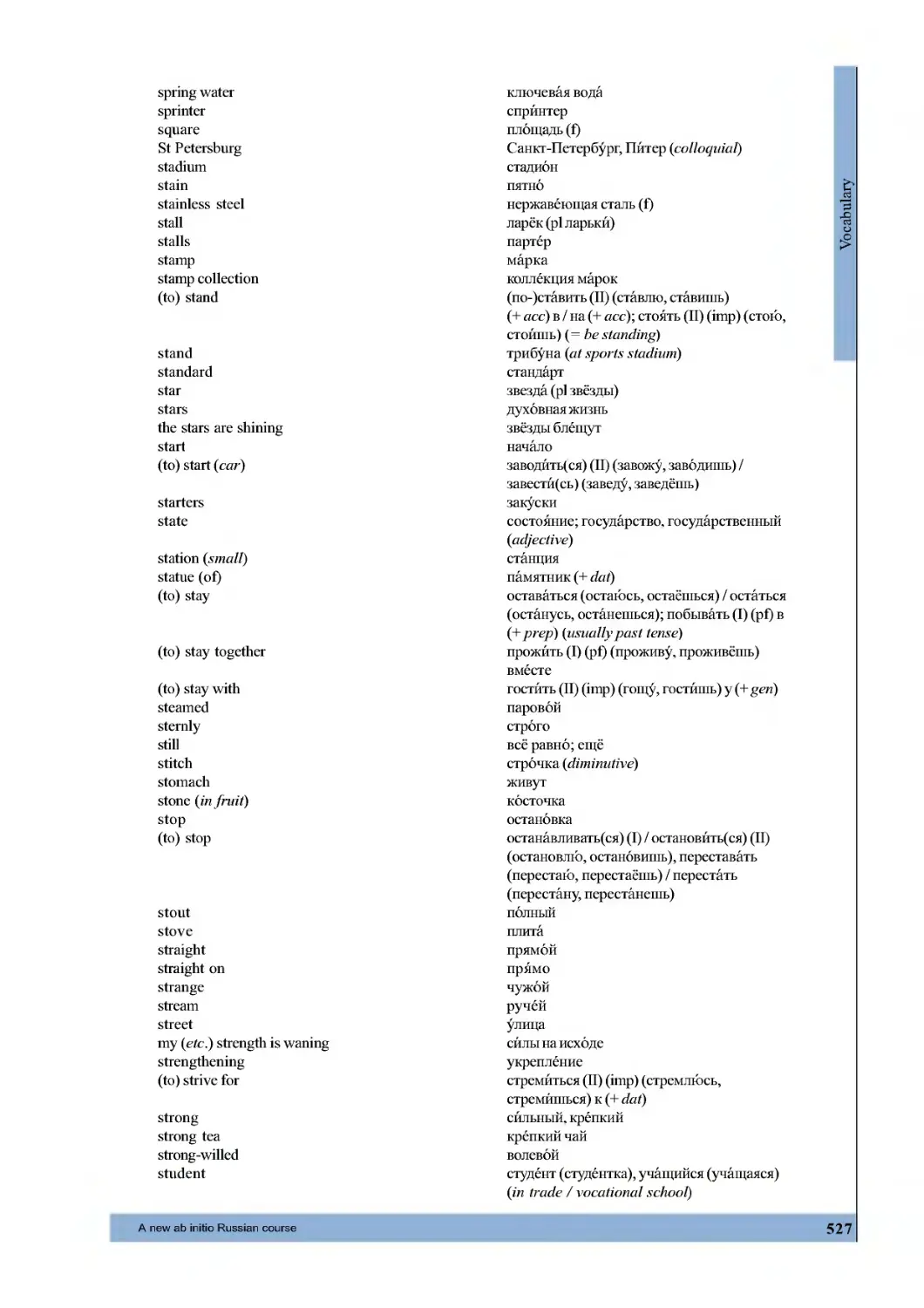


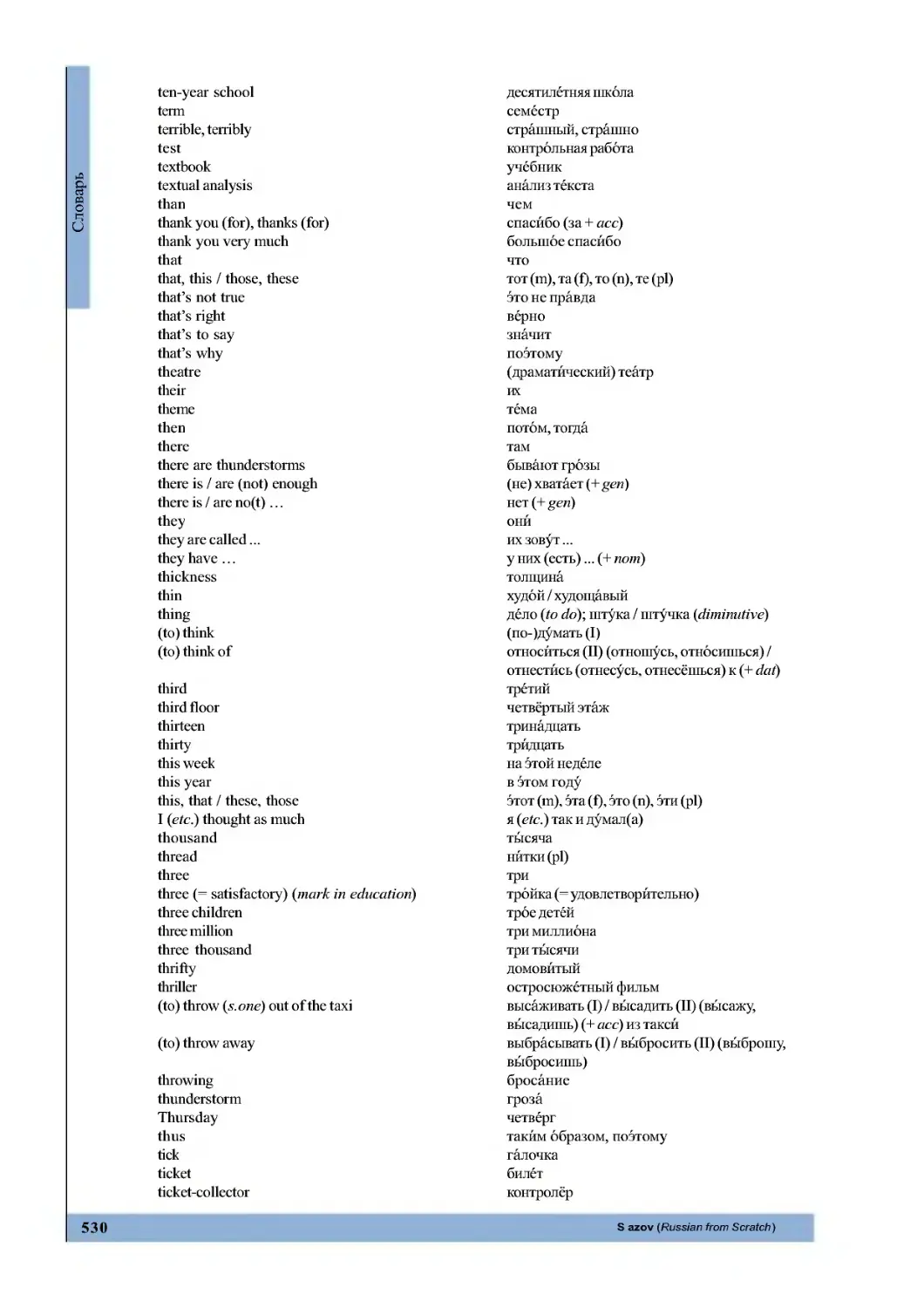
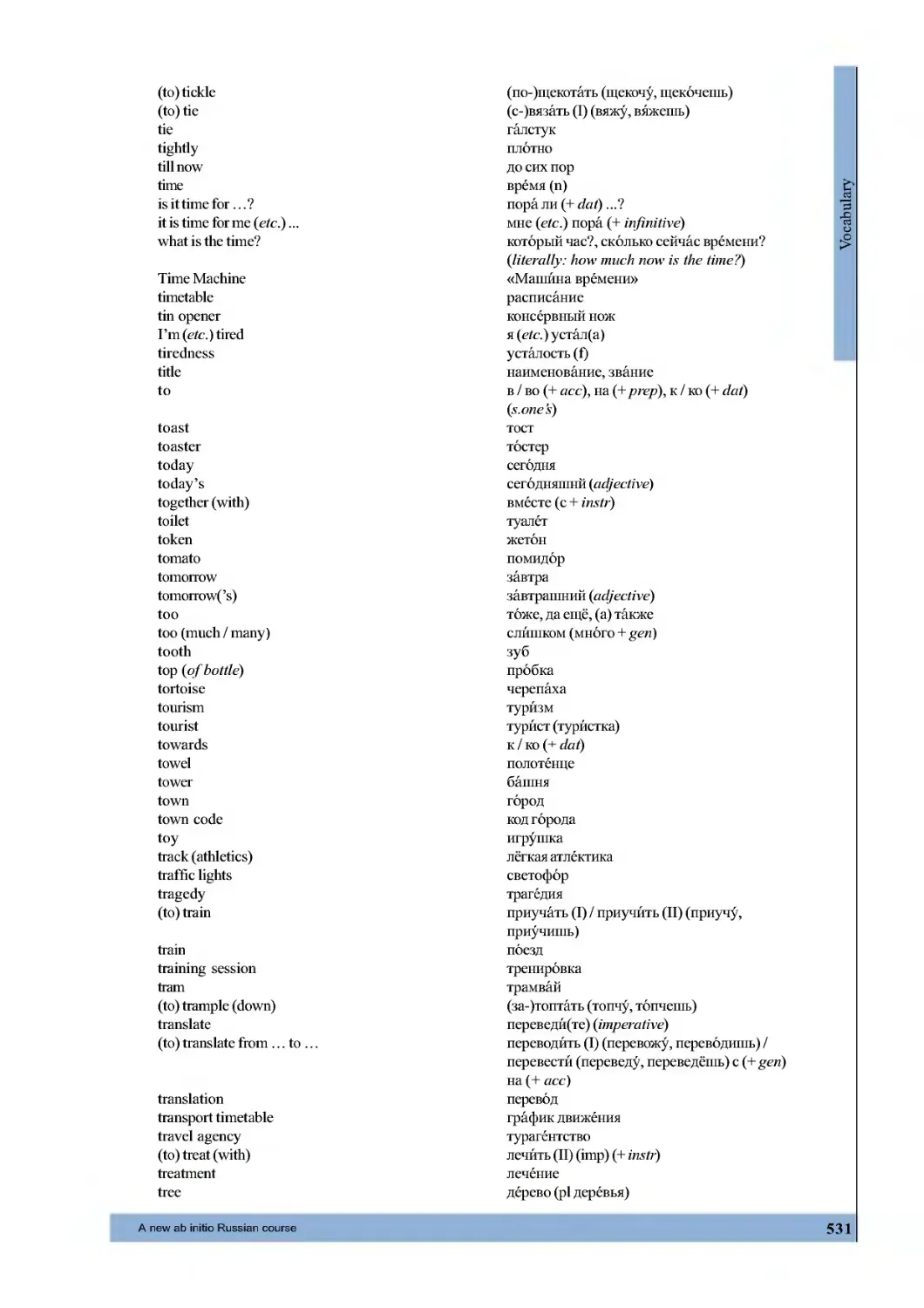
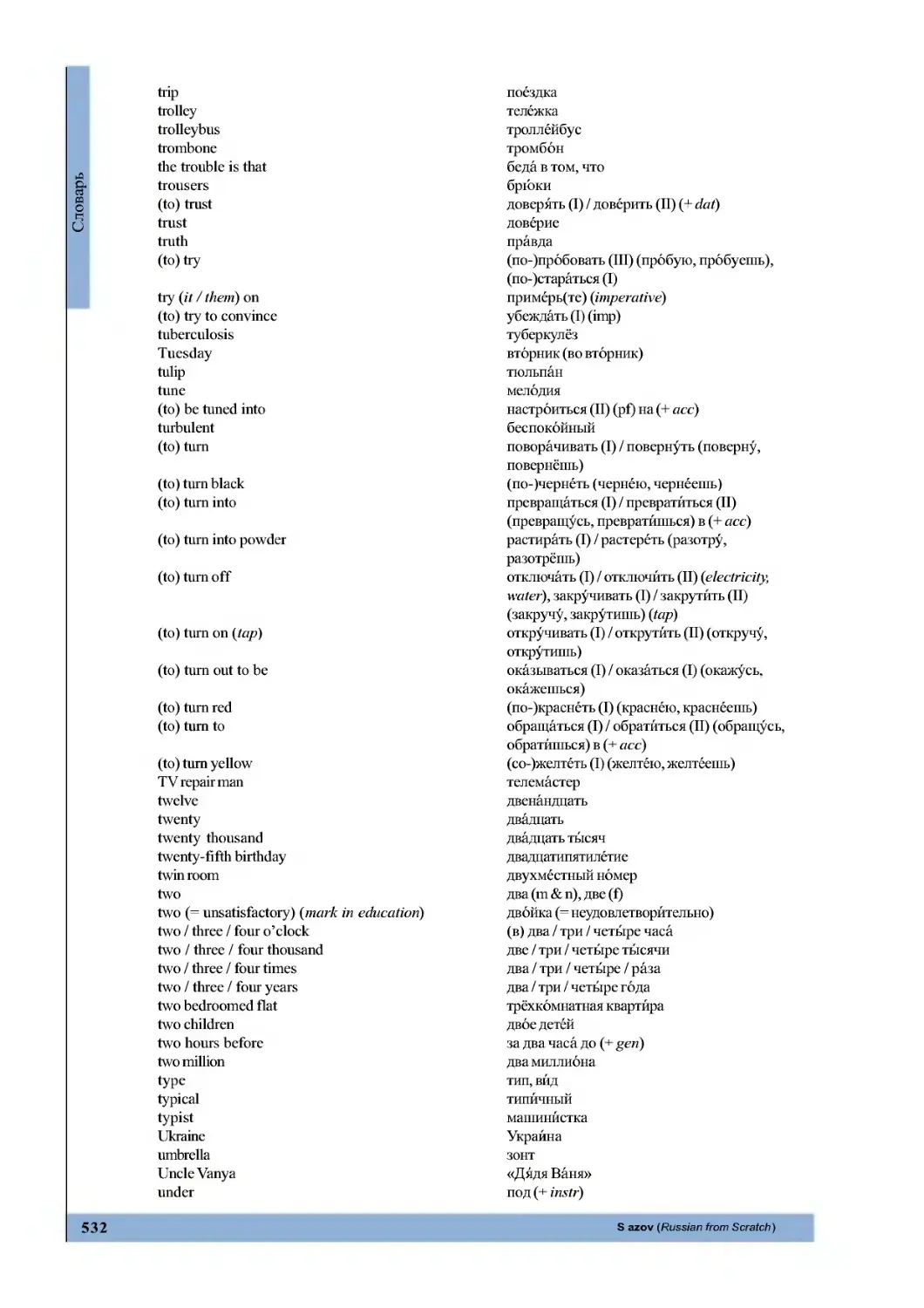

Автор: Polyakov A.
Теги: linguistics russian language

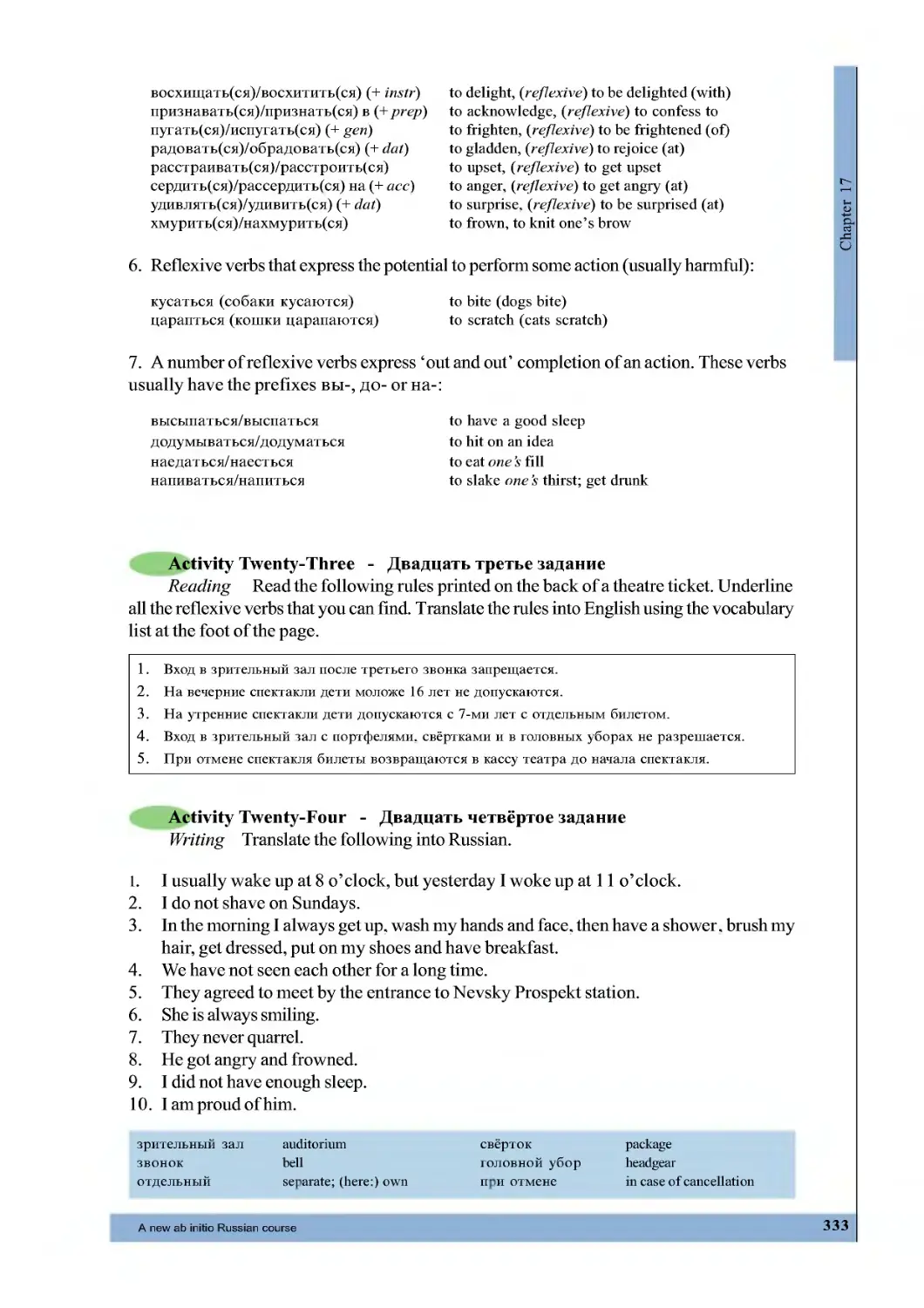
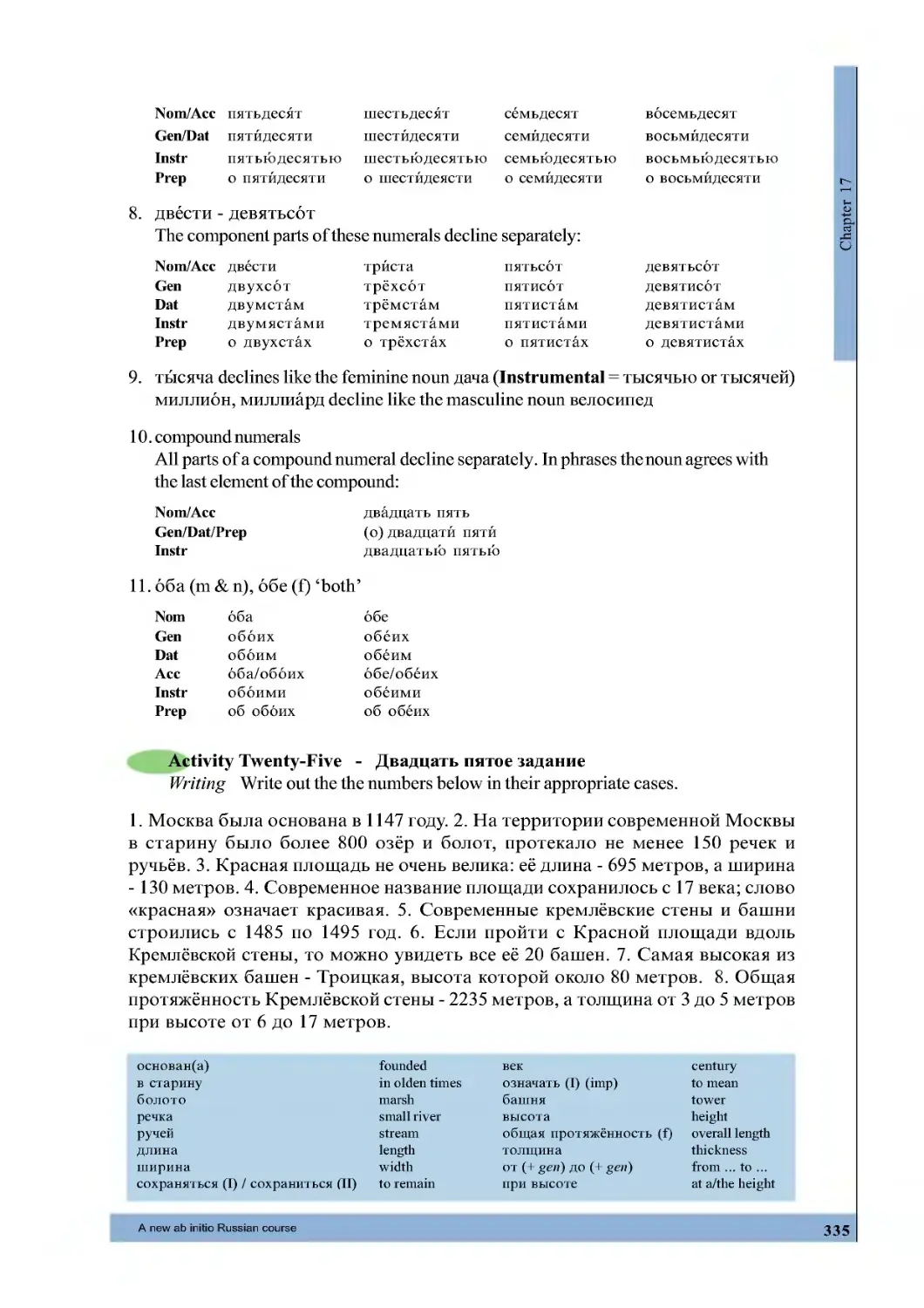
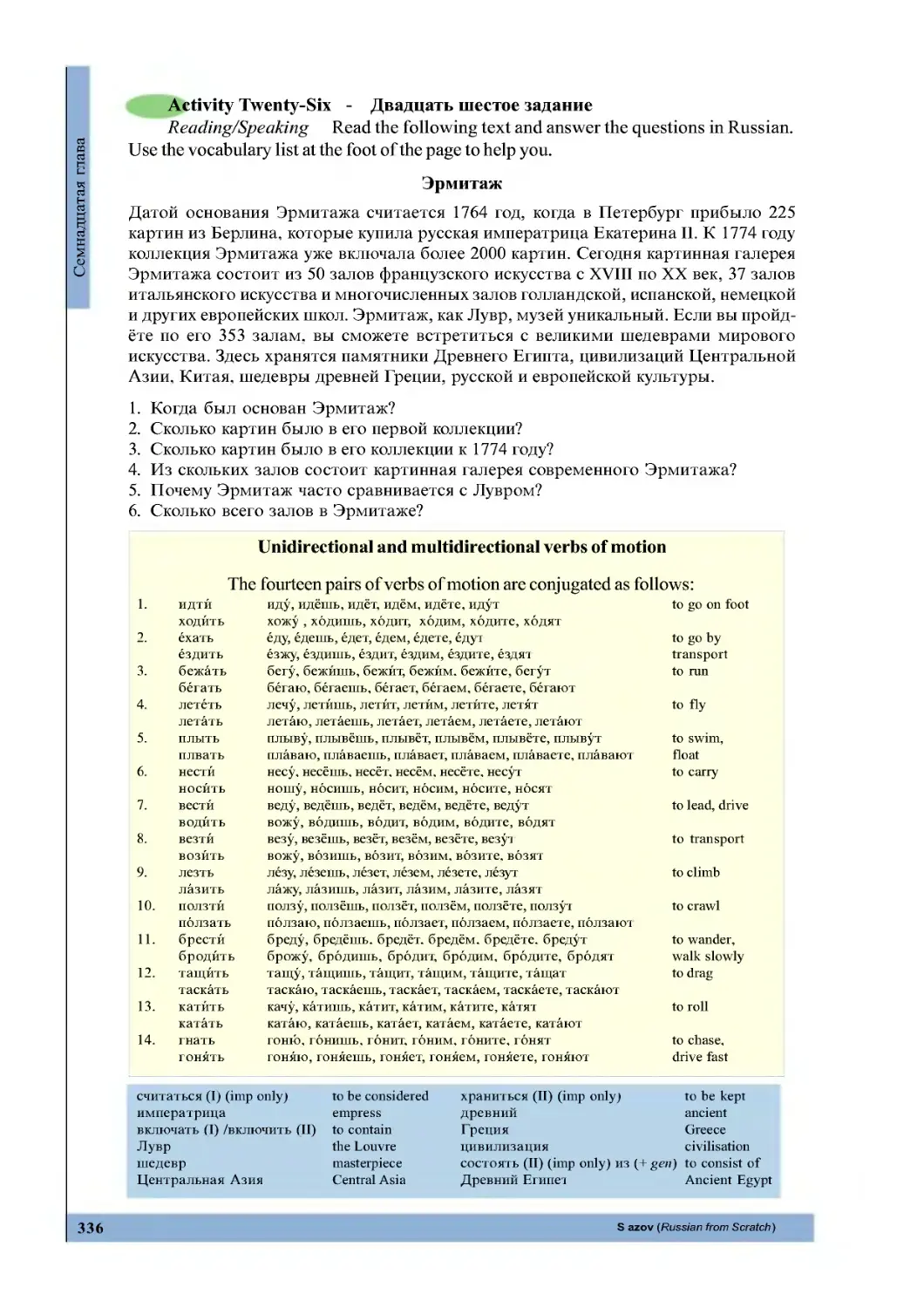
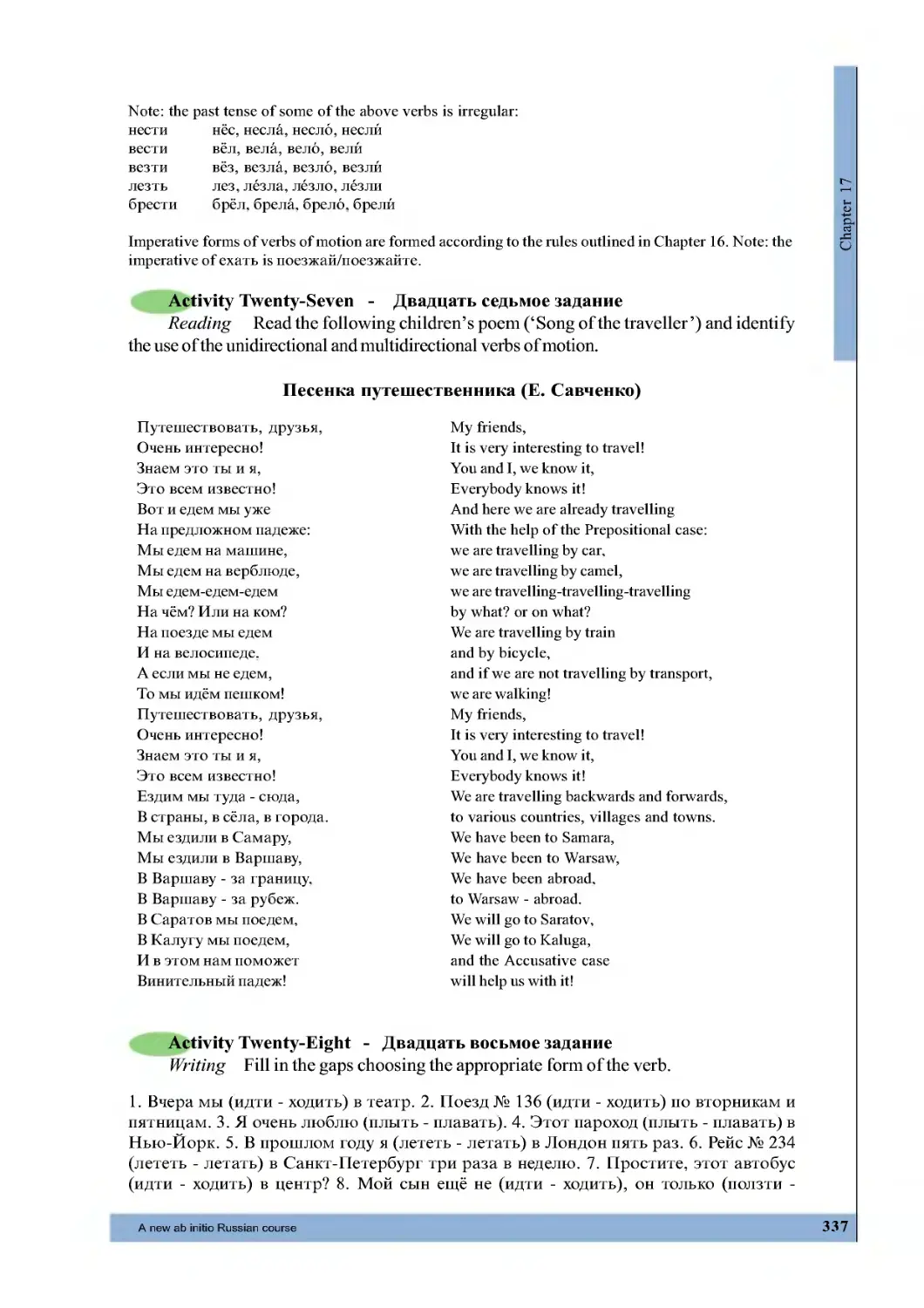
Текст
s
0
0
:E f( . ,j r [;/! I 1[;.1
I 1/,/,/,/ (f
__Jl....,.:),.:)...........
:z:
-
- ,-
Q
:z: . . ,..."
, ""
..
:z:
-
.. -
- . .
Q
:E
0 "
E-- , ...
., I..t
.
L
0
00
. ....
OMD
N
, j .( ) I _
.J___ _,L
Edited and produced by
ALEKSANDR POLYAKOV
o
M
U
I"
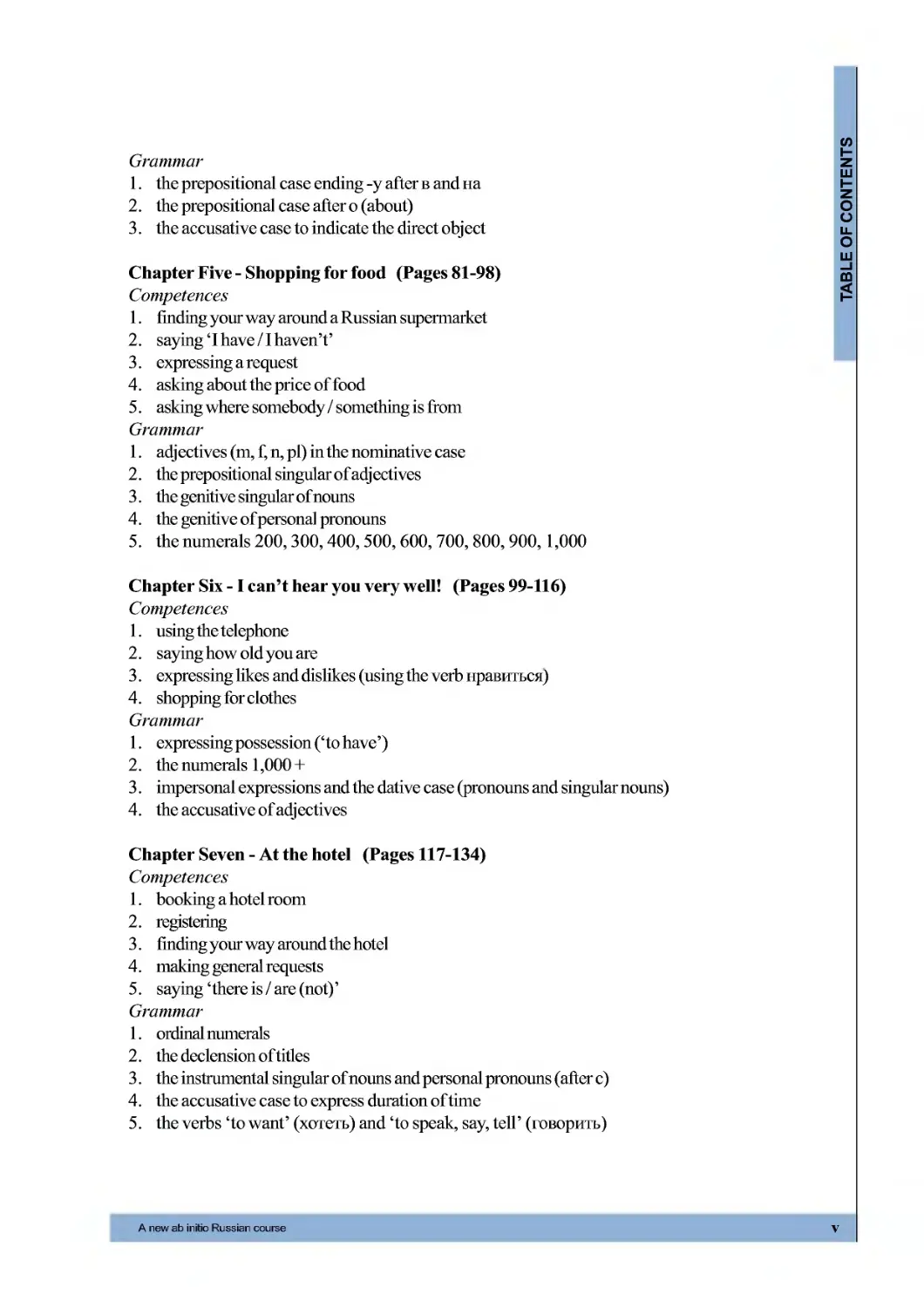
Grammar
I. the prepositional case ending -y after Band Ha
2. the prepositional case after 0 (about)
3. the accusative case to indicate the direct object
(J)
I-
Z
W
I-
Z
o
o
LL.
o
W
...J
m
Chapter Five - Shopping for food (Pages 81-98)
Competences
I. finding your way around a Russian supermarket
2. saying 'I have II haven't'
3. expressing a request
4. asking about the price of food
5. asking where somebody / something is from
Grammar
I. adjectives (m, f, n, pI) in the nominative case
2. the prepositional singular of adjectives
3. the genitive singular of nouns
4. the genitive of personal pronouns
5. the numerals 200, 300, 400, 500, 600, 700, 800, 900, 1,000
Chapter Six - I can't hear you very well! (Pages 99-116)
Competences
I. using the telephone
2. saying how old you are
3. expressing likes and dislikes (using the verb HpaBIITbC5l)
4. shopping for clothes
Grammar
I. expressing possession ('to have')
2. the numerals 1,000+
3. impersonal expressions and the dative case (pronouns and singular nouns)
4. the accusative of adjectives
Chapter Seven - At the hotel (Pages 117-134)
Competences
I. booking a hotel room
2. registering
3. finding your way around the hotel
4. making general requests
5. saying 'there is / are (not)'
Grammar
I. ordinal numerals
2. the declension oftitles
3. the instrumental singular of nouns and personal pronouns ( after c)
4. the accusative case to express duration of time
5. the verbs 'to want' (XOTeTb) and 'to speak, say, tell' (roBopHTb)
A new ab initio Russian course
v
(J)
I-
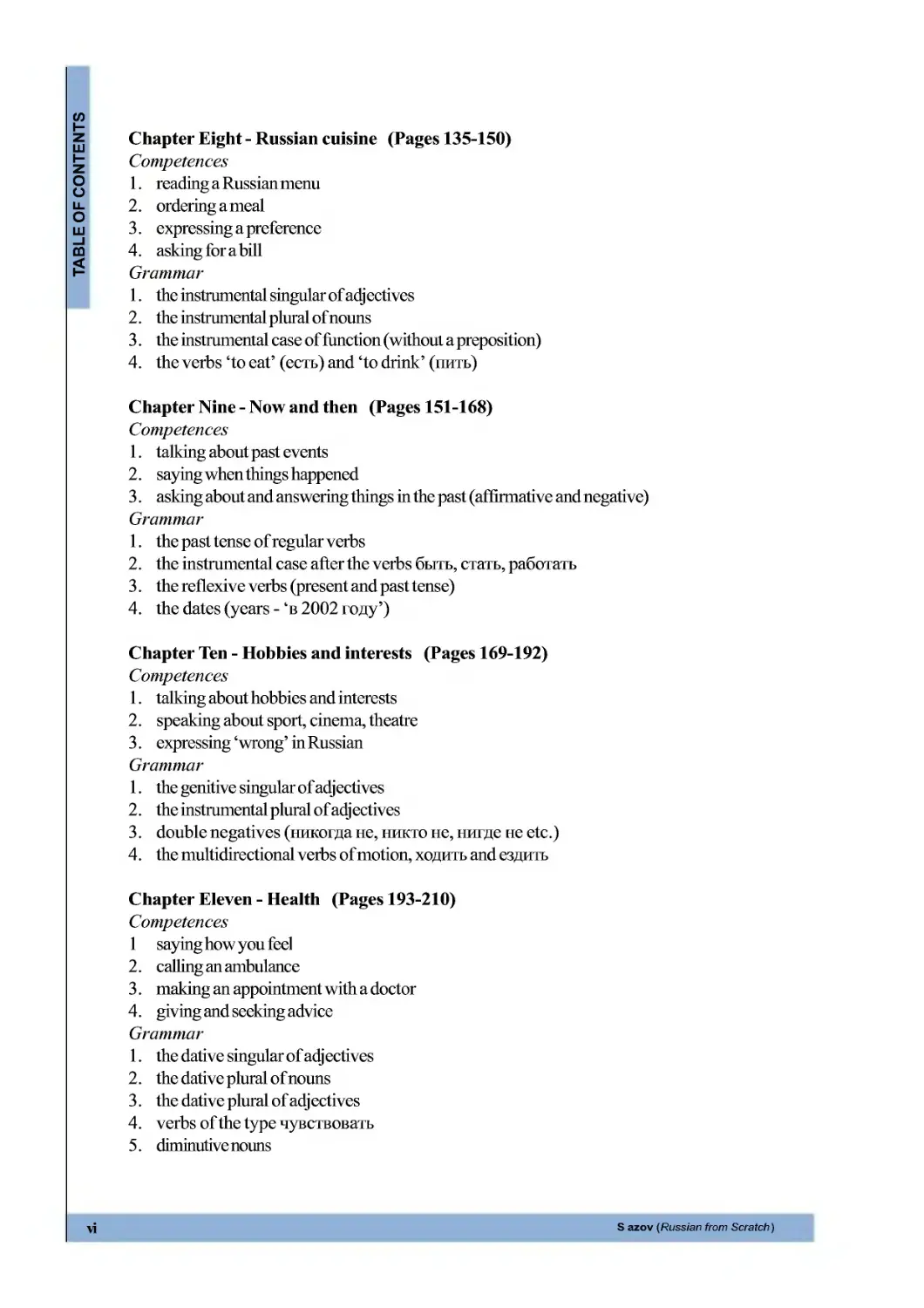
ffi Chapter Eight - Russian cuisine (Pages 135-150)
!z Competences
8 I. reading a Russian menu
2. ordering a meal
w 3. expressing a preference
...J
m 4. asking for a bill
Grammar
I. the instrumental singular of adjectives
2. the instrumental plural of nouns
3. the instrumental case of function (without a preposition)
4. the verbs 'to eat' (ecTb) and 'to drink' (mITb)
Chapter Nine - Now and then (Pages 151-168)
Competences
I. talking about past events
2. saying when things happened
3. asking about and answering things in the past (affinnative and negative)
Grammar
I. the past tense of regular verbs
2. the instrumental case after the verbs 6bITb, CTaTb, pa60TaTb
3. the reflexive verbs (present and past tense)
4. the dates (years - 'B 2002 ro,lJ,y')
Chapter Ten - Hobbies and interests (Pages 169-192)
Competences
I. talking about hobbies and interests
2. speaking about sport, cinema, theatre
3. expressing 'wrong' in Russian
Grammar
I. the genitive singular of adjectives
2. the instrumental plural of adjectives
3. double negatives (mIKOr,lJ,aHe, HHKTO He, HHr,lJ,e He etc.)
4. the multidirectional verbs of motion, XO,lJ,HTb and e3,lJ,HTh
Chapter Eleven - Health (Pages 193-210)
Competences
I saying how you feel
2. calling an ambulance
3. making an appointment with a doctor
4. giving and seeking advice
Grammar
I. the dative singular of adjectives
2. the dative plural of nouns
3. the dative plural of adjectives
4. verbs of the type qYBcTBoBaTb
5. diminutivenOlUls
vi
5 azov (Russian from Scratch)
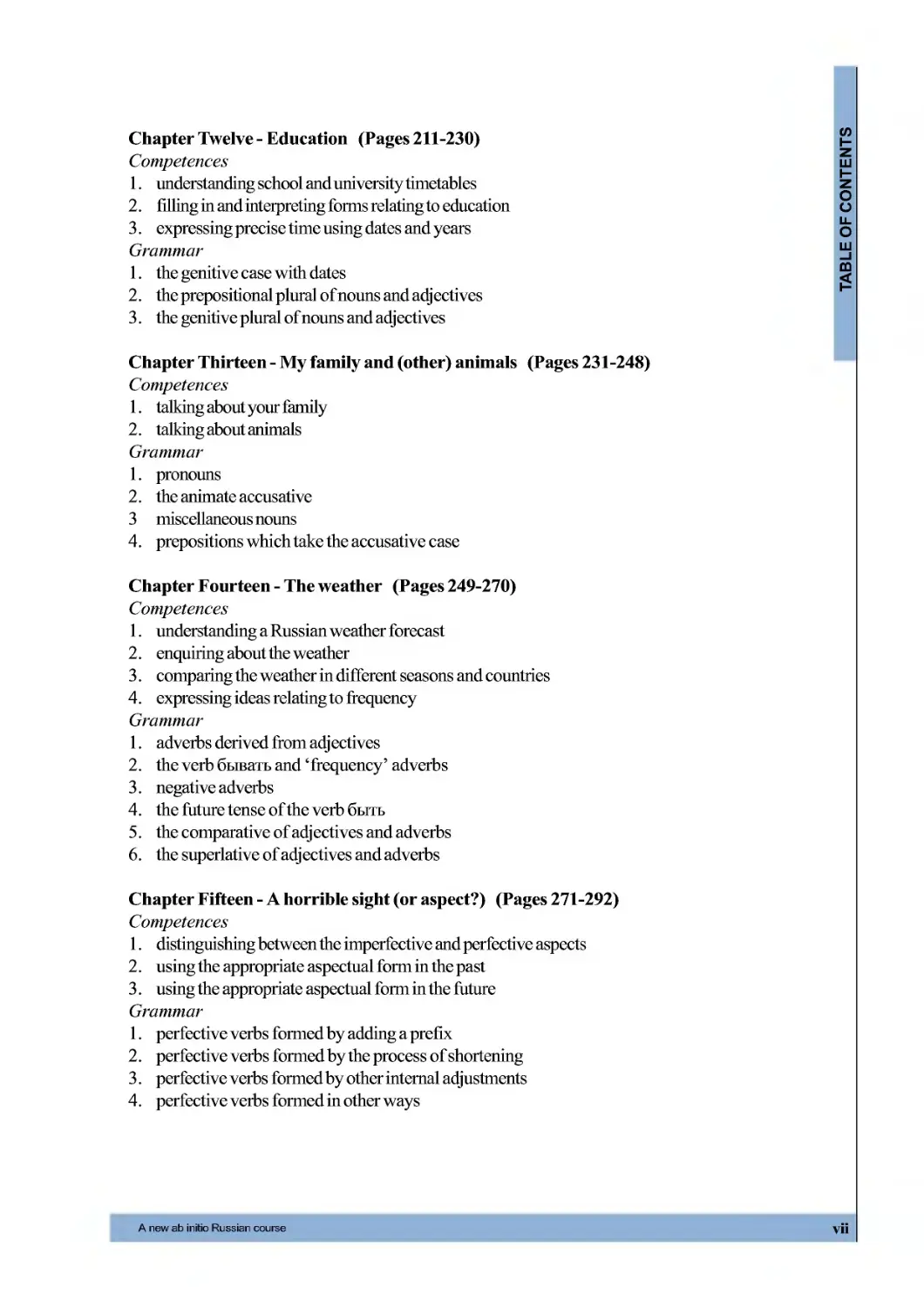
Chapter Twelve - Education (Pages 211-230)
Competences
I. understanding school and university timetables
2. filling in and interpreting fonns relating to education
3. expressing precise time using dates and years
Grammar
I. the genitive case with dates
2. the prepositional plural of nouns and adjectives
3. the genitive plural of nouns and adjectives
(J)
I-
Z
W
I-
Z
o
o
LL.
o
W
...J
m
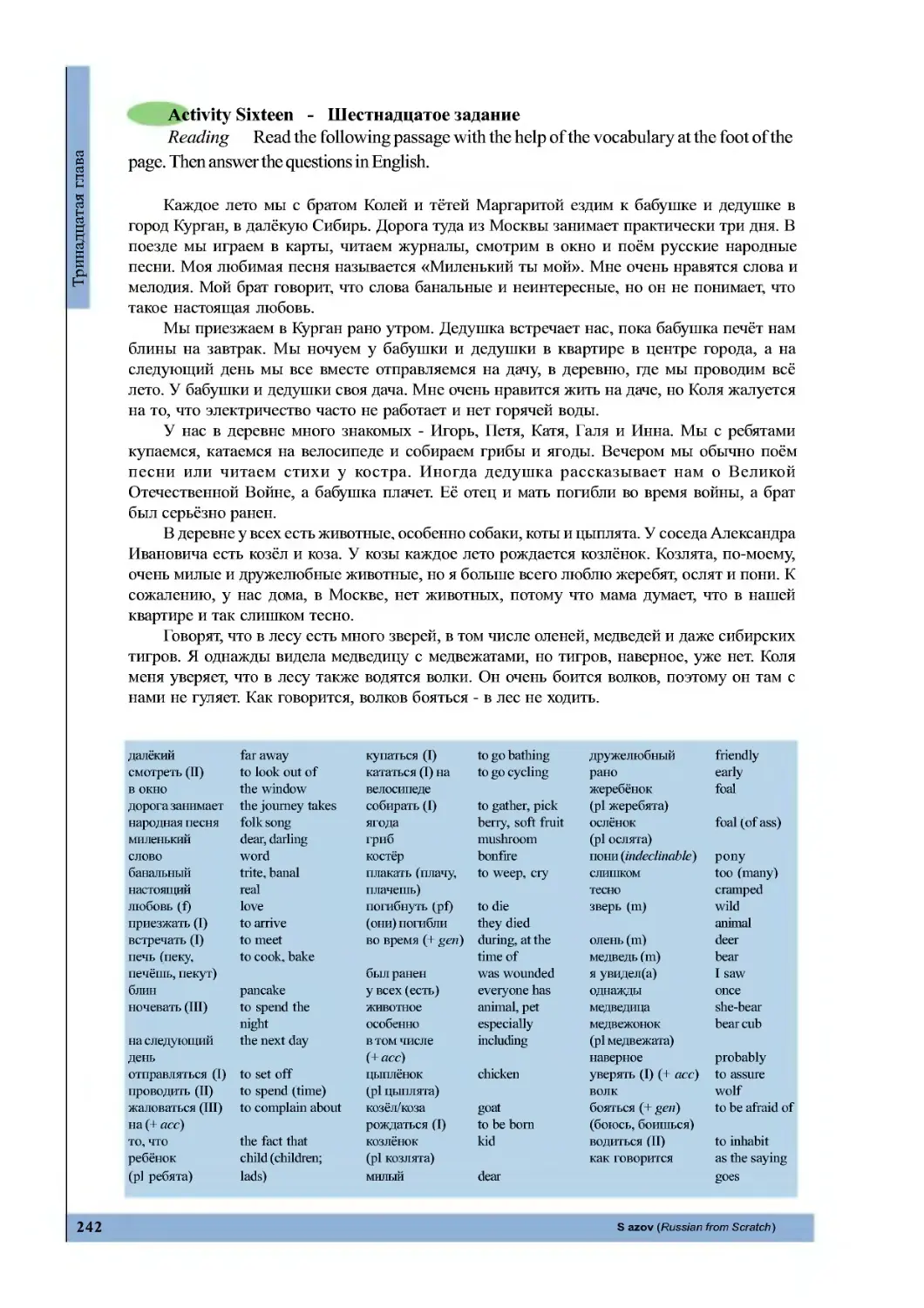
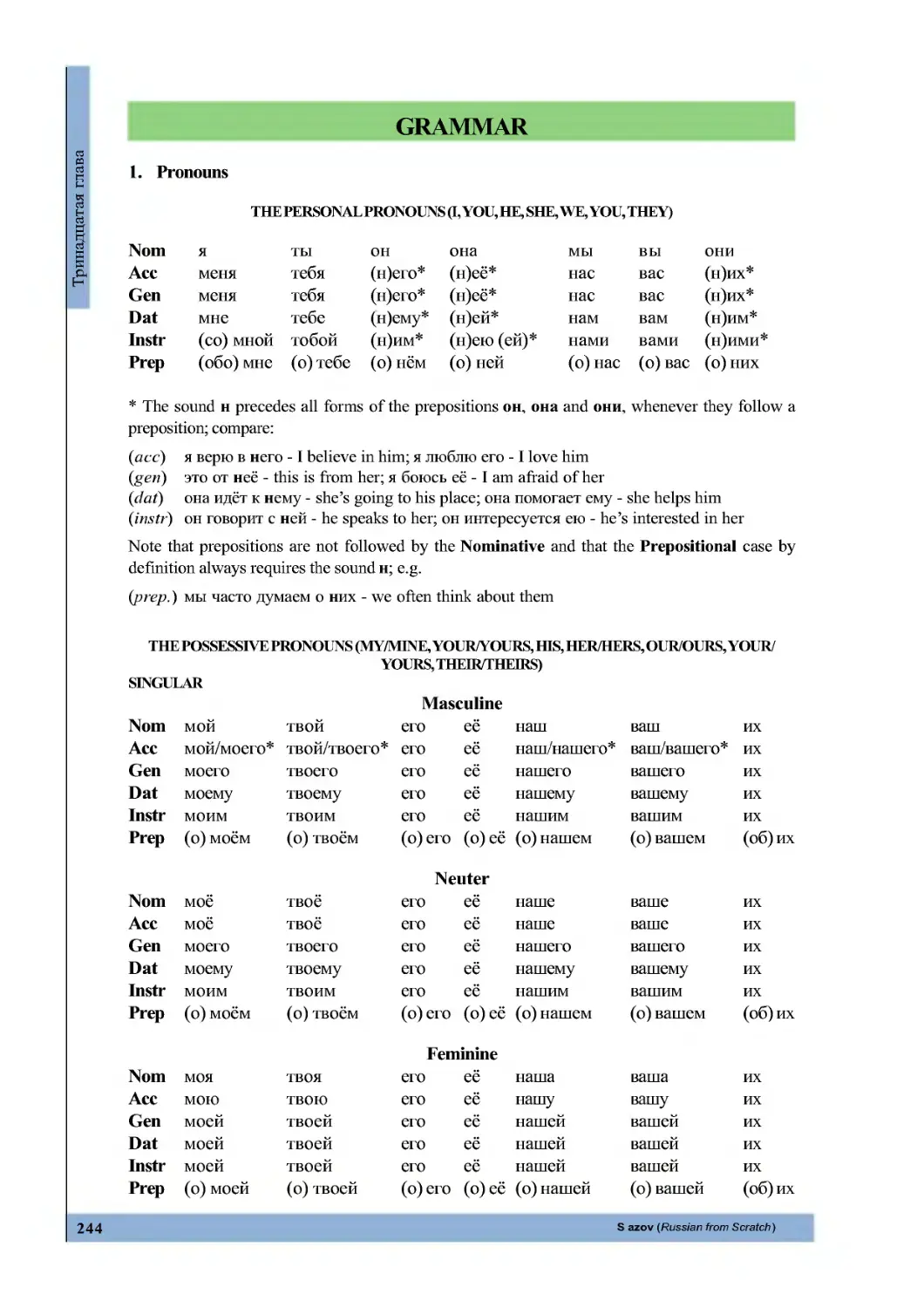
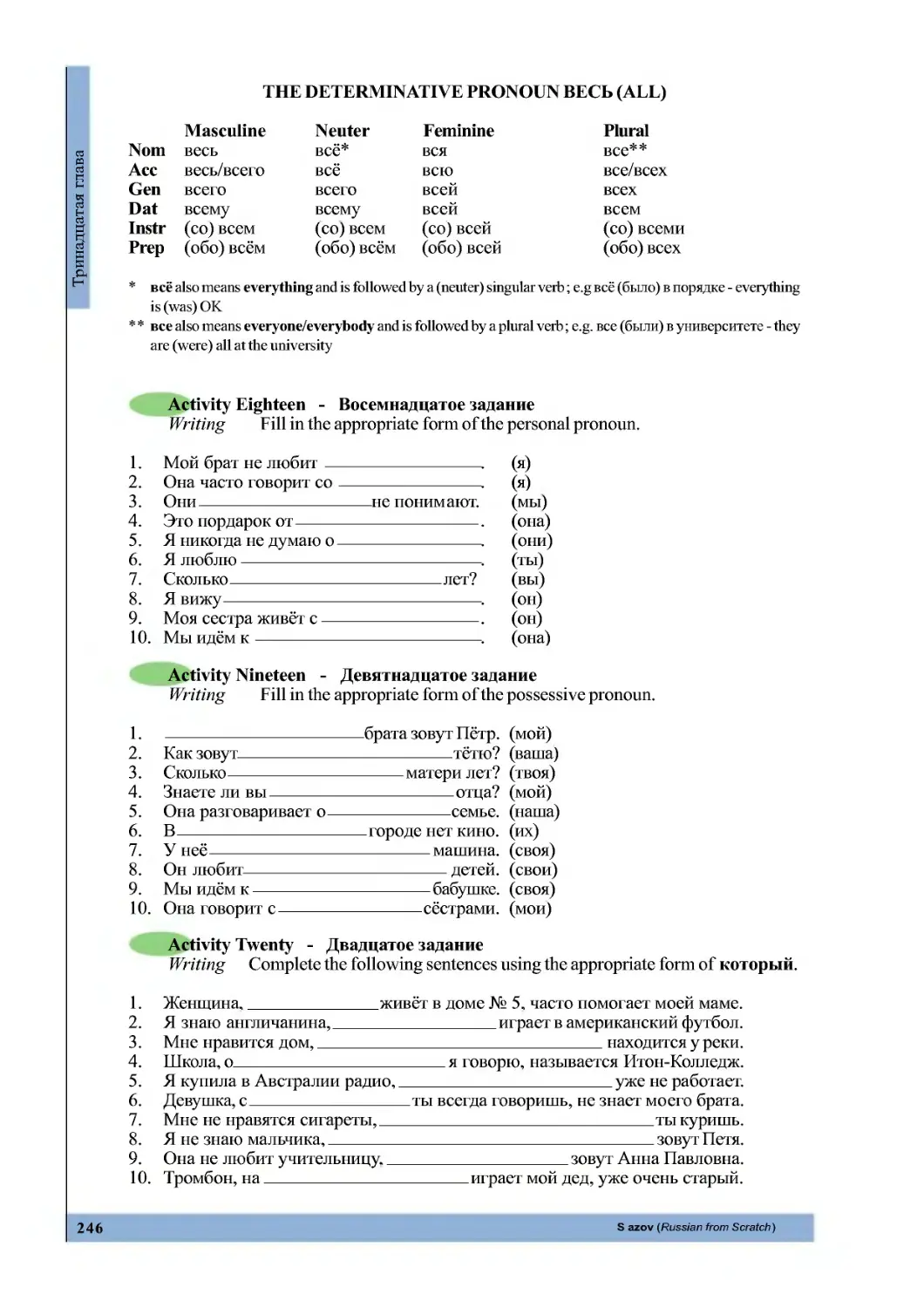
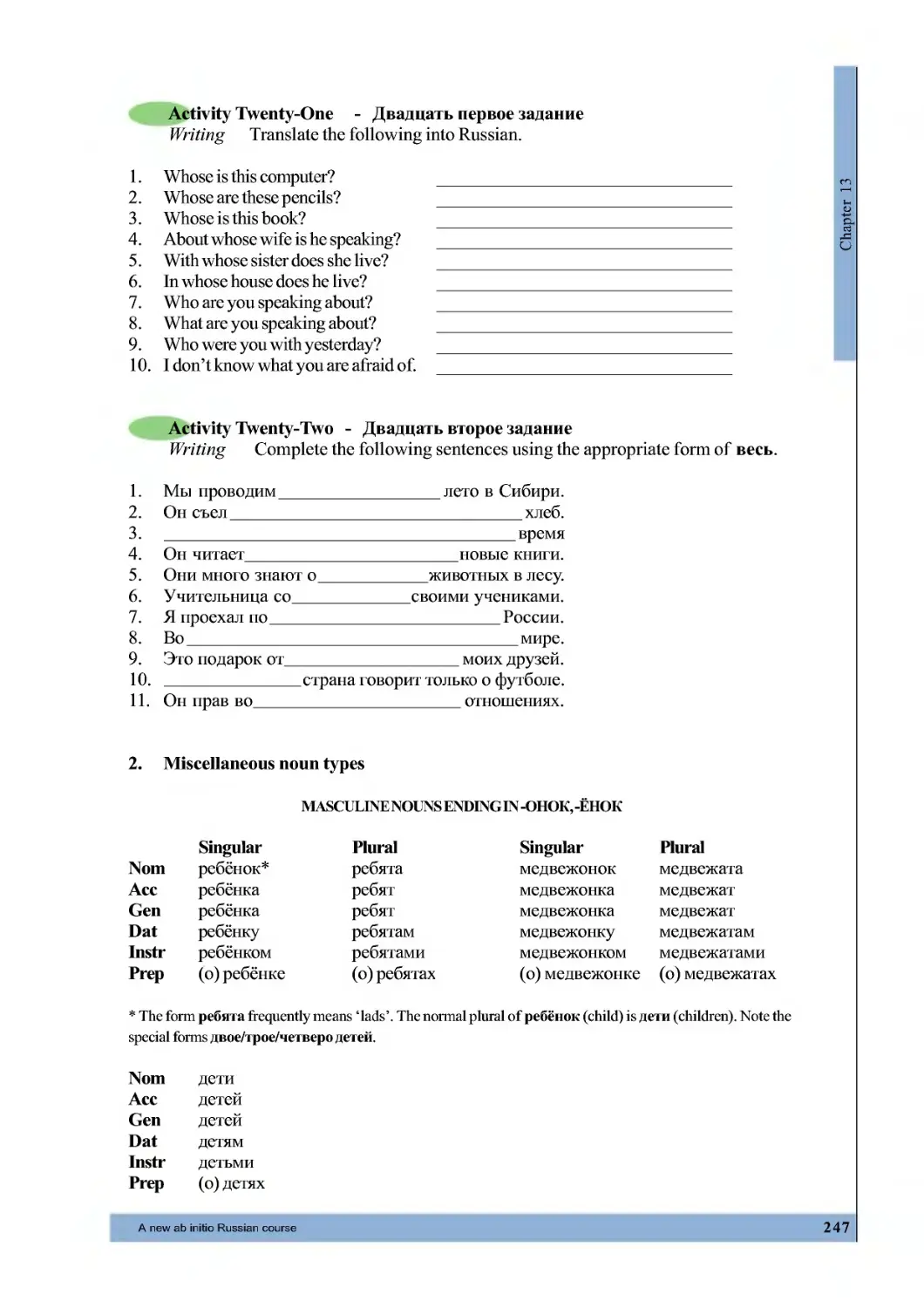
Chapter Thirteen - My family and (other) animals
Competences
I. talking about your fanlily
2. talking about animals
Grammar
I. pronouns
2. the animate accusative
3 miscellaneous nouns
4. prepositions which take the accusative case
(Pages 231-248)
Chapter Fourteen - The weather (Pages 249-270)
Competences
I. understanding a Russian weather forecast
2. enquiring about the weather
3. comparing the weather in different seasons and countries
4. expressing ideas relating to frequency
Grammar
I. adverbs derived from adjectives
2. the verb 6bIBaTb and 'frequency' adverbs
3. negative adverbs
4. the future tense ofthe verb 6bITb
5. the comparative of adjectives and adverbs
6. the superlative of adjectives and adverbs
Chapter Fifteen - A horrible sight (or aspect?) (Pages 271-292)
Competences
I. distinguishing between the imperfective and perfective aspects
2. using the appropriate aspectual fonn in the past
3. using the appropriate aspectual fonn in the future
Grammar
I. perfective verbs fonned by adding a prefix
2. perfective verbs fonned by the process of shortening
3. perfective verbs fonned by other internal adjustments
4. perfective verbs fonned in other ways
A new ab initio Russian course
vii
(J)
I-
Z
W
I-
Z
o
o
LL.
o
W
...J
m
Chapter Sixteen - In the town (Pages 293-314)
Competences
I. asking for and giving directions
2. asking for and giving infonnation
3. asking for and giving instructions
4. making and carrying out requests
Grammar
I. the fonnation ofthe imperative
2. the prepositions which take the instrumental case
3. the fonnation ofthe conditional mood
4. the fonnation of the subjunctive mood
Chapter Seventeen - Bon voyage! (Pages 315-342)
Competences
I. expressing the time of the day (a.m./p.m.)
2. telling the time more precisely
3. understanding train and plane timetables
4. requesting and giving infonnation about travel
Grammar
I. reflexive verbs
2. numerals in oblique cases
3. unidirectional and multidirectional verbs of motion
4. compound verbs of motion
Chapter Eighteen - At home (Pages 343-362)
Competences
I. talking about household goods and chores
2. talking about everyday electrical appliances
3. talking about broken equipment and faults
Grammar
1. the pronoun' -self' (caM)
2. the pronoun 'such' (TaKoif)
3. verbs with consonant mutation
4. the verb 'to put'
Chapter Nineteen - Personal information (Pages 363-382)
Competences
I. talking about ages, weights and heights
2 talking about people's appearance
3. talking about personality types
Grammar
I. expressions of approximation
2. the short fonn of adjectives
3. nouns in apposition
4. the particle mJ
viii 5 azov (Russian from Scratch)
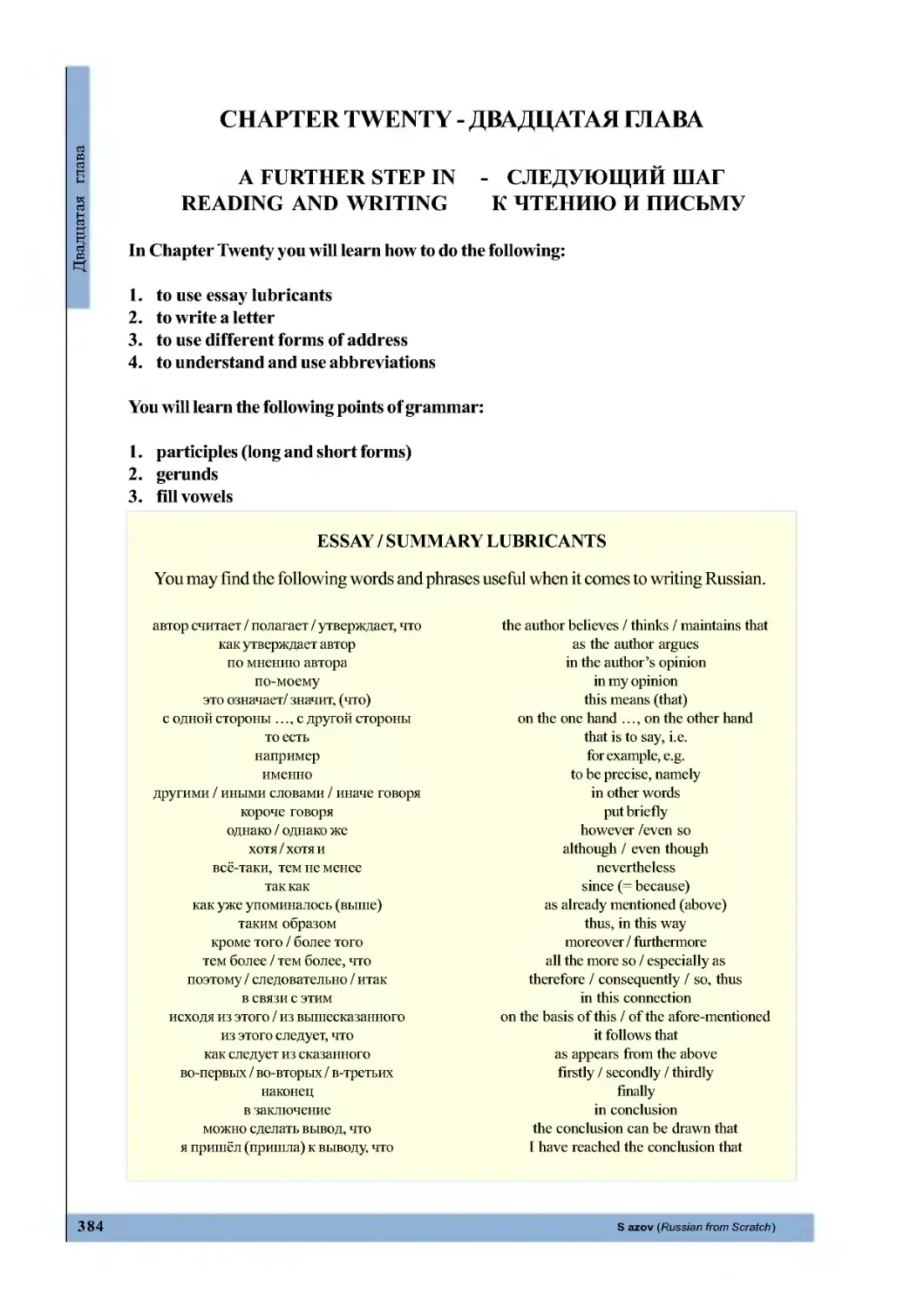
Chapter Twenty - A further step in reading and writing (Pages 383-410)
Competences
I. using essay Lubricants
2. writing a letter
3. using different forms of address
4. understanding and using abbreviations
Grammar
I. participles (long and short forms)
2. gerunds
3. fill vowels
(J)
I-
Z
W
I-
Z
o
o
LL.
o
W
...J
m
A new ab initio Russian course
ix
Introduction and acknowledgements
The authors, Tom Dickins and Irina Moore, decided to write'S azov' (Russian from Scratch)
because ofthe lack of suitable communicative ab initio Russian language courses for more mature
learners. 'S azov' has been used extensively with our own degree-level students, and has thus
benefited from considerable testing in practical classroom situations. It is appropriate for a wide
range oflearners, from school pupils with a background in foreign languages to evening-class
students and undergraduates and postgraduates.
z
o
....
u
Q
Z
....
The textbook consists of an introductory chapter and twenty further chapters based on themes
which exemplifY and consolidate a series of new linguistic concepts. Particular emphasis is placed
on the use of authentic up-to-date materials, such as advertisements, newspaper clippings,
timetables, tickets, official fonns and recent photographs, and on the creation of meaningful and
relevant contexts for language learning. Wherever possible, the students are asked to deduce
unfamiliar syntactic and morphological principles for themselves from regular paradigms, before
being required to apply the new rules or to cope with irregularities.
Each chapter begins with a sunmlaty ofthe competences which the students will acquire and with
a list ofthe main points of granmlarwhich are to be introduced. Roughly equal weighting is given
to the four skills (speaking, reading, listening and writing), which are developed through a series
oflexical and interactive activities, including memory games, crosswords, gap-filling tasks and
role plays. Vocabulary glossaries are provided at the foot of each page, where necessary, and
there is a comprehensive alphabetical Russian-English and English-Russian vocabulary list at the
end of the course. There is also a granmlar section at the end of each chapter, with more detailed
explanations and granmlatical exercises. All the listening activities are recorded on audio cassette
by educated native Russian speakers and are accompanied by transcripts.
We are enonnously indebted to our friend, Aleksandr Polyakov, who painstakingly produced
and designed the layout of the course. Particular thanks go to our fonner colleague and Head of
Russian, Peter Rooney, for his invaluable support and encouragement, to Ludmila Khalilova for
her contribution in the early planning stages and to Elena Kazimianets for her work on Chapters
10, 15 and 20. We also wish to express our gratitude to Katrina Fraser and Igor Babanov for
their practical help and to Vicki Whittaker for sharing the benefit ofher knowledge of publishing.
We would similarly like to acknowledge Linda Aldwinkle and Christine Barnard ofthe University
of Westminster for the interest that they have shown and for their constructive feedback. Without
their assistance and the efforts of numerous other colleagues and friends, the task of completing
'S azov' would have been considerably more onerous, if not altogether impossible.
Finally, there is one academic source which merits a special mention. namely' A Comprehensive
Russian Granmlar' by Terence Wade. We consulted this unparalleled work extensively when
writing our Granmlar sections, and we owe a great deal to Professor Wade's clear and detailed
explanations.
The authors acknowledge all registered trademarks as belonging to their respective owners.
Tom Dickins and Irina Moore
School of Humanities, Languages and Social Sciences, University ofW olverhampton
November, 2003
A new ab initio Russian course
iii
INTRODUCTORY
CHAPTER -
THE BASICS
c<:j
c<:j
E
gj
:I:
.!I
Q)
f-'
:::
u
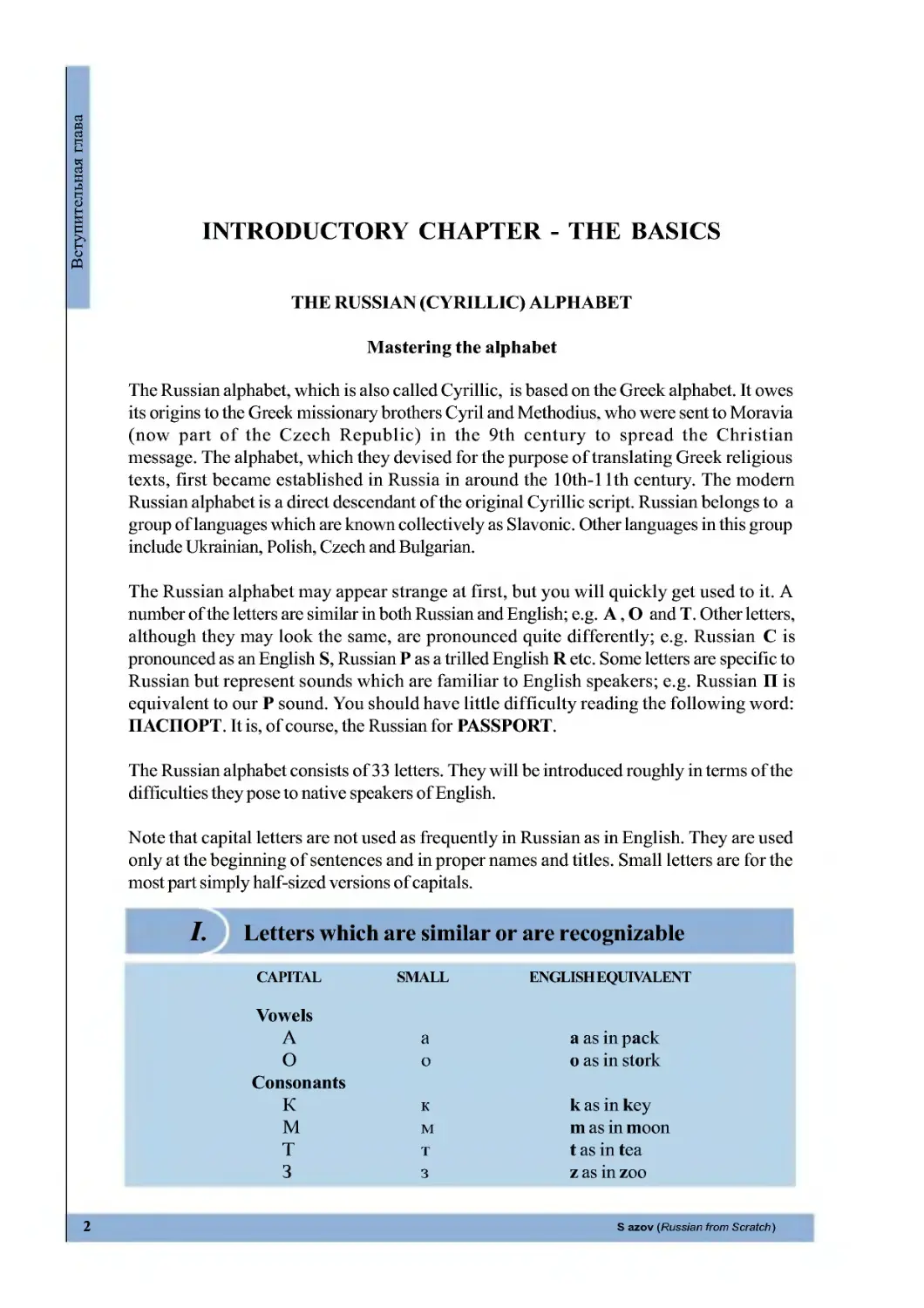
INTRODUCTORY CHAPTER - THE BASICS
THE RUSSIAN (CYRILLIC) ALPHABET
Mastering the alphabet
The Russian alphabet, which is also called Cyrillic, is based on the Greek alphabet. It owes
its origins to the Greek missionary brothers Cyril and Methodius. who were sent to Moravia
(now part of the Czech Republic) in the 9th century to spread the Christian
message. The alphabet, which they devised for the purpose of translating Greek religious
texts, first became established in Russia in around the 10th-11th century. The modem
Russian alphabet is a direct descendant of the original Cyrillic script. Russian belongs to a
group oflanguages which are known collectively as Slavonic. Other Languages in this group
include Ukrainian, Polish, Czech and Bulgarian.
The Russian alphabet may appear strange at first, but you will quickly get used to it. A
number of the letters are similar in both Russian and English; e.g. A ,0 and T. Other letters,
although they may Look the same, are pronounced quite differently; e.g. Russian C is
pronounced as an English S, Russian P as a trilled English R etc. Some letters are specific to
Russian but represent sounds which are familiar to English speakers; e.g. Russian II is
equivalent to our P sound. You should have little difficulty reading the following word:
IIACIIOPT. His, of course, the Russian for PASSPORT.
The Russian alphabet consists of 3 3 letters. They will be introduced roughly in terms of the
difficulties they pose to native speakers of English.
Note that capital letters are not used as frequently in Russian as in English. They are used
only at the beginning of sentences and in proper names and titles. Small Letters are for the
most part simply half-sized versions of capitals.
1. Letters which are similar or are recognizable
CAPITAL
SMALL
ENGLISH EQUIVALENT
Vowels
A
o
Consonants
K
M
T
3
a
o
a as in pack
o as in stork
K
M
T
3
k as in key
maSIllmoon
t as in tea
Z as III zoo
2
5 azov (Russian from Scratch)
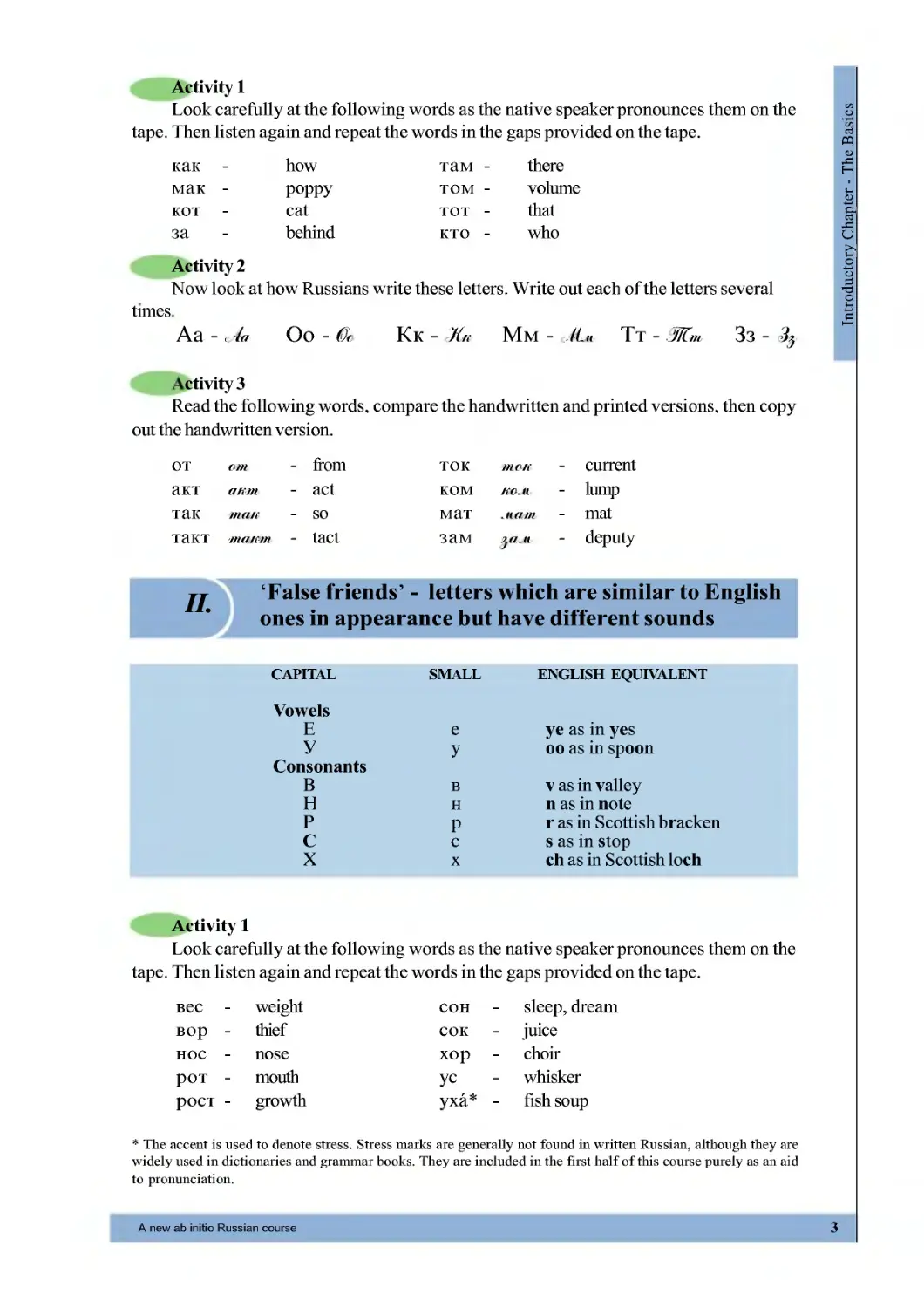
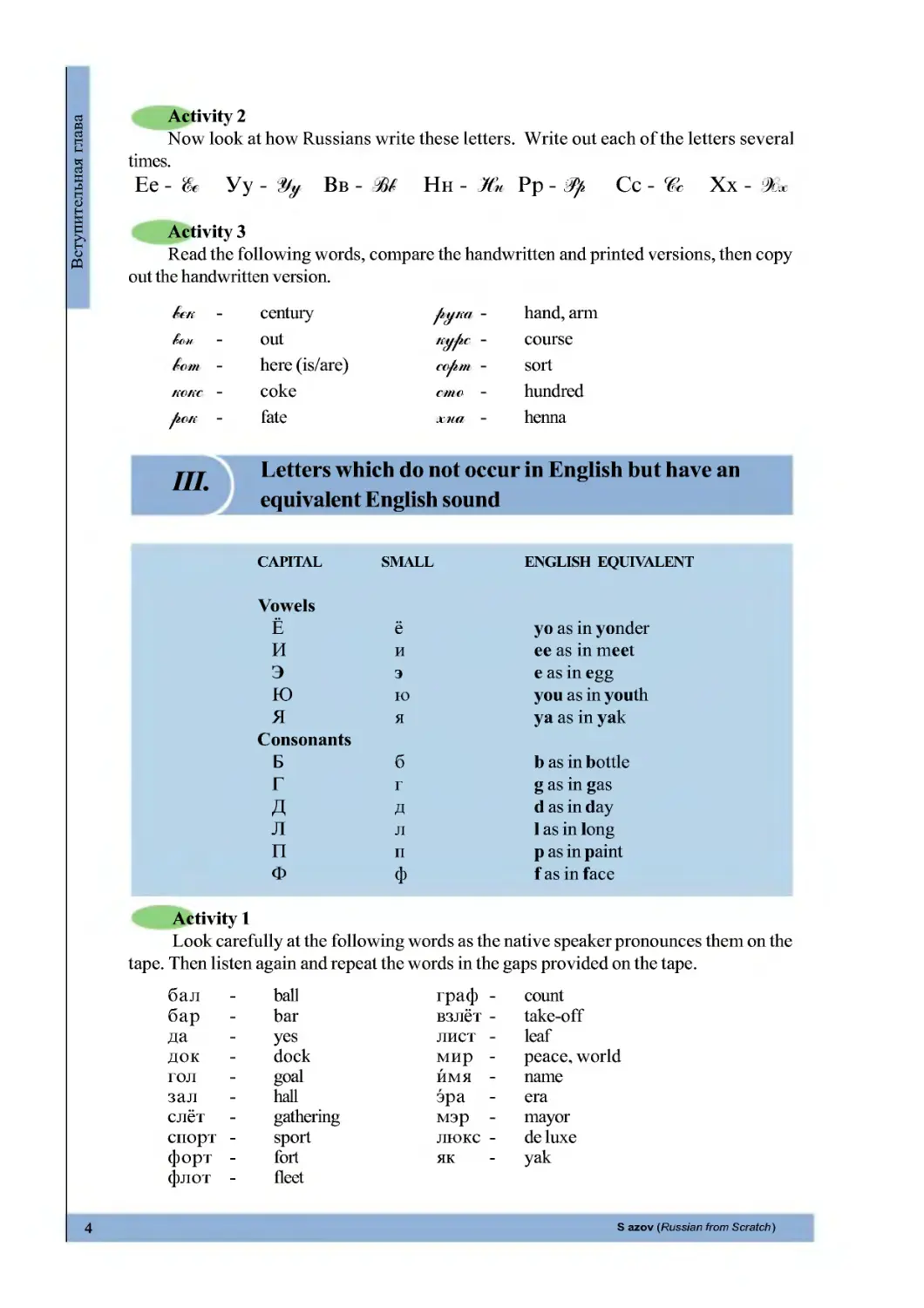
Activity 1
Look carefully at the following words as the native speaker pronounces them on the
tape. Then listen again and repeat the words in the gaps provided on the tape.
KaK how TaM - there
MaK - poppy TOM - volume
KOT cat TOT - that
3a behind KTO - who
Activity 2
Now look at how Russians write these letters. Write out each of the letters several
tImes
Aa - L fa 00 - {}c KK - }(". MM - .Il./! TT - ]f(I1," 33 - '3;
ctivity 3
Read the following words. compare the handwritten and printed versions. then copy
out the handwritten version.
OT VIII - ttom TOK III V". current
aKT a/Ull - act KOM /W.II lump
TaK Ilia". - SO MaT . II alII mat
TaKT '1lla/UII - tact 3aM ja.11 deputy
IL
'False friends' - letters which are similar to English
ones in appearance but have different sounds
CAPITAL SMALL ENGLISH EQUIVALENT
Vowels
E e ye as n yes
y y 00 as ill spoon
Consonants
B B V as in valley
H H n as in note
p p r as in Scottish bracken
C c s as in stop
X x ch as in Scottish loch
Activity 1
Look carefully at the following words as the native speaker pronounces them on the
tape. Then listen again and repeat the words in the gaps provided on the tape.
Bec weight COH sleep, dream
BOp - thief COK JUIce
HOC nose xop choir
pOT - mouth yc whisker
pOCT - growth yxa* - fish soup
* The accent is used to denote stress. Stress marks are generally not found in written Russian, although they are
widely used in dictionaries and grammar books. They are included in the first half of this course purely as an aid
to pronunciation.
A new ab initio Russian course
cf1
.
cf1
c<:j
c::q
OJ
..s=
E-<
....
OJ
....
c<:j
..s=
U
;>.,
....
o
....
C,)
;j
'"0
o
....
....
s=
......
3
c<:j
c<:j
E
gj
:I:
.!I
Q)
f-'
:::
u
Activity 2
Now look at how Russians write these letters. Write out each ofthe letters severa]
times.
Ee - gc Yy -!Jy BB - IJI HH - ,/{'u Pp - llJz Cc - We Xx - LCL
Activity 3
Read the following words, compare the handwritten and printed versions, then copy
out the handwritten version.
lac century fiy 1m - hand, arm
ho,}( out h!ffic - course
10m - here (is/are) CO/OIl - sort
NONC - coke CIllO - hundred
fiOh" - fate X1la - henna
IlL
Letters which do not occur in English but have an
equivalent English sound
CAPITAL
Vowels
E
M
3
10
51.
Consonants
E
r
,lJ,
JI
II
cD
SMALL
ENGLISH EQUIVALENT
e yo as in yonder
H ee as in meet
:} easIllegg
10 you as in youth
51 ya as in yak
6 b as in bottle
r g as III gas
,n: d as in day
JI I as in long
rr p as in paint
<P f as in face
Activity 1
Look carefully at the following words as the native speaker pronounces them on the
tape. Then listen again and repeat the words in the gaps provided on the tape.
6aJI
6ap
,n:a
.n:OK
rOJI
3aJI
CJIeT
crropT -
<pOpT -
<pJI OT -
4
ban
bar
yes
dock
goal
hal]
gathering
sport
fort
fleet
rpa<p -
B3JIeT -
JIHCT -
MHp -
HM5I -
3pa
M3p
JI10KC -
51K
count
take-off
leaf
peace. world
name
era
mayor
deluxe
yak
5 azov (Russian from Scratch)
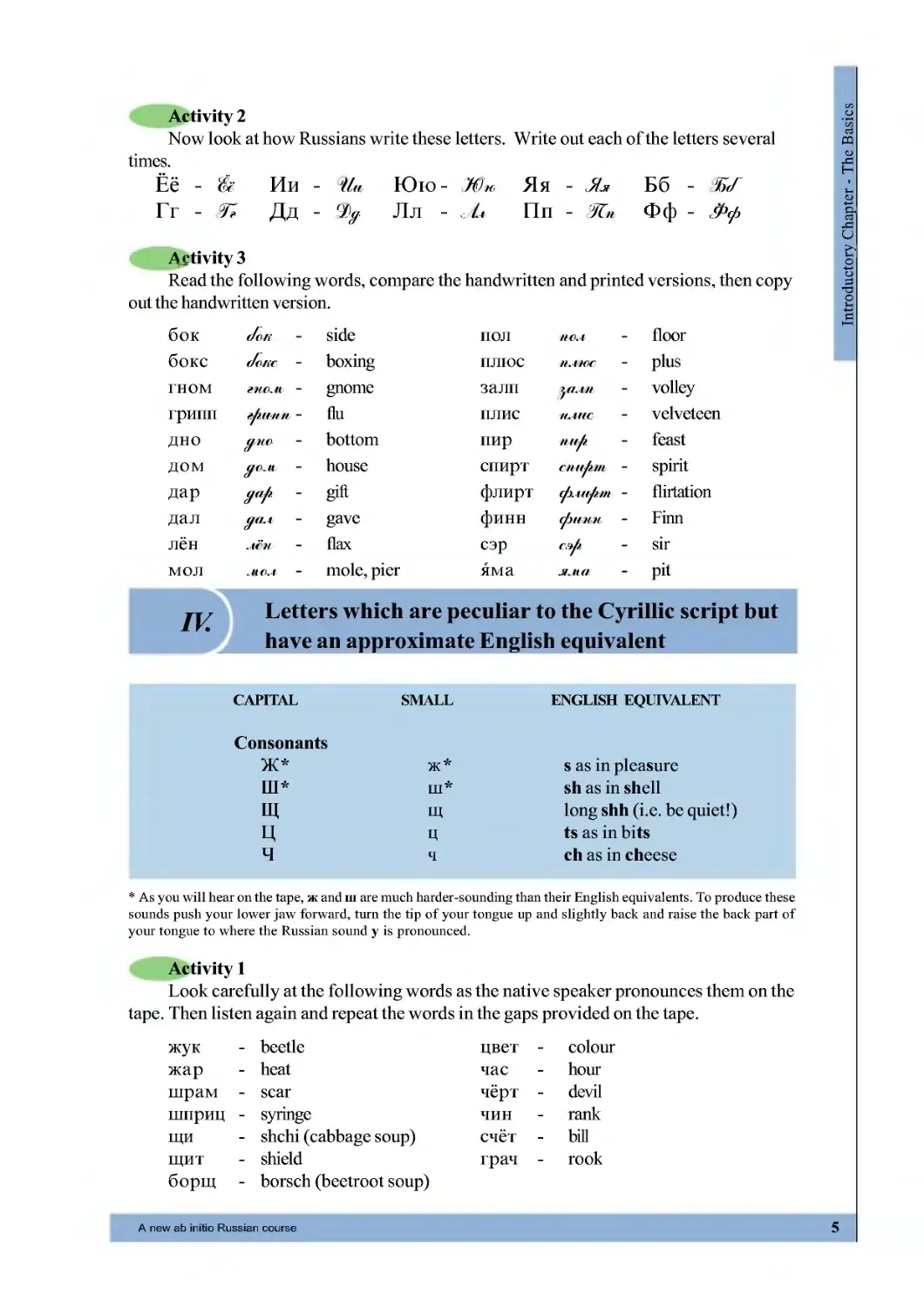
Activity 2
Now look at how Russians write these letters. Write out each ofthe letters several
times.
Ee <?i"
rr - r;
10 IO - J(IJ/Co
JIll - ,c i,
Jl5l 51 x
fIn - WIt
E6 1JJJ
ct><p - iPrp
lll1 illl
)J;,IJ; - (Jig
A..ctivity 3
Read the following words, compare the handwritten and printed versions, then copy
out the handwritten version.
60K tkh" side rrOJI 1i0A floor
60KC tkh"e boxing rrJIIOC Ii.Hoe plus
rHOM i!NO.II - gnome 3aJIrr ,aAIi volley
rpHrrrr lUU," - flu rrJIHC /{.,Ille velveteen
,n:HO /lNO bottom rrHp lilcfi feast
.n:OM /10.11 house crrHpT e Ii lcfiJ/t - spirit
,n:ap /lu/L gift <pJIHpT rp.'lcfilli - flirtation
,n:aJI /la.,1 gave <p HHH rpll'NR Finn
JIeH .,ICN flax C3p Cl1fi SIr
MOJI .110.,1 mole, pier 5lMa X.lla pit
If': Letters which are peculiar to the Cyrillic script but
have an approximate English equivalent
CAPITAL
SMALL
ENGLISH EQUIVALENT
Consonants
)J{*
III *
II(
lJ,
q
)K*
w*
s as in pleasure
sh as in shell
long shh (i.e. be quiet!)
ts as in bits
ch as in cheese
LlI,
Q
'1
* As you will hear on the tape, 11{ and m are much harder-sounding than their English equivalents. To produce these
sounds push your lower jaw forward, turn the tip of your tongue up and slightly back and raise the back part of
your tongue to where the Russian sound y is pronounced.
Activity 1
Look carefully at the following words as the native speaker pronounces them on the
tape. Then listen again and repeat the words in the gaps provided on the tape.
)KYK - beetle QBeT colour
)Kap - heat qac hour
llIpaM - scar qepT devil
llIrrpHQ - synnge qHH rank
llI,H shchi(cabbagesoup) CqeT bill
llI,HT - shield rpaq rook
60plll, - borsch (beetroot soup)
A new ab initio Russian course 5
cf1
.
cf1
c<:j
c::q
OJ
..s=
E-<
....
OJ
....
c<:j
..s=
U
;>.,
....
o
....
C,)
;j
'"0
o
....
....
s=
......
c<:j
c<:j
E
gj
:I:
.!I
Q)
f-'
:::
u
Activity 2
Now look at how Russians write these letters. Write out each ofthe letters severa]
times.
)I{)K - JIDIE IIIill - cJ2Um II:(ill - '''{(Ill, IJ,lI, - 'Jl(1l. q q - JJI't
Activity 3
Read the following words. compare the handwritten and printed versions, then copy
out the handwritten version.
)KHeu: .lIE Nell, reaper JI ell{ Aelll, bream
)KIIp oJIDllr fat rrJIall{ liAal{l, - cloak
llIaHC {llaNC chance rrJIau: /lAa{£, parade-gound
llIax {Ilax check rrJIaq li.,ra't weepmg
llIIIllI {Il {Hn fig qeT 'te/li even number
Il{yrr Ill,!I Ii probe qIIH 't1l.N rank
Two letters which are peculiar to the Cyrillic script
and have no sound of their own
1> ('b)- this letter, which is rarely used, is called the hard sign or separating hard
sign. It appears only after the consonants 6, B, )J; and c when it separates them
from the softening influence of anyone of the vowels e, e, 10 and B.
e.g. C'beJI (ate, have/has eaten), B'be3,n: (entry), 06'beM (volume)
h (b) - this letter, which is used much more frequently than the hard sign, is called the
soft sign. It serves to make the preceding consonant soft. It is very important to
soften consonants which are followed by h since the soft sign can change the
meaning of a word. Compare the following, which are recorded on the tape:
MeJI
BOH
6paT
(chalk)
(over there)
(brother)
MeJIb
BOHb
6paTb
(shoal)
(stench)
(to take)
Note: because the hard sign and the soft sign always follow other letters and never begin a word
they appear in capitals only when all the letters in a word are capitalized (e.g. in certain signs and
notices ).
Activity 1
Look carefully at the following words as the native speaker pronounces them on the
tape. Then listen again and repeat the words in the gaps provided on the tape.
<p IIJIbM film 60JIb pam
C'beM (I) will eat pOJIb role
C'beJI ate ,n:p5lHb - rubbish
C'beMKa - shooting (of a film) KOpb measles
Be,n:b you see, you know MaTb mother
6
5 azov (Russian from Scratch)
Activity 2
Now look at how Russians write these letters. Write out both the letters several times.
D1> "'6 "b bh 6 b
Activity 3
Read the following words, compare the handwritten and printed versions, then copy
out the handwritten version.
C'beCT C"bf'C III (s/he) will eat BaJIbC f.oAbC - waltz
C'beCTb r"b£,r III b - to eat JIeHb ..rrUb - laziness
C'beM C"I'£./I removal ,n:eHb !/f'}lb day
C5I,n:b Of//b sit down Qapb [(Ofib - tsar
COJIb COAb salt HHTb JUUllb - thread
Activity 4
Listen to the native speaker reading the following pairs of words, the second of which
has the soft sign (h) at the end. Note the difference in both sound and meaning. Look at the
printed text, listen again and repeat the words in the gaps provided on the tape.
eJI (was eating) eJIb (fir tree)
MeJI (chalk) MeJIb (shoal)
,n:aJI (gave) ,n:aJIb (distance)
CTaJI (became) CTaJIb (steel)
BpaJI (was lying) BpaJIb (liar)
rOJI (goal) rOJIb (the poor)
CTOJI (table) CTOJIb (so)
,n:aH (given) ,n:aHb (tribute)
KOH (kitty) KOHb (horse)
MaT (mat) MaTb (mother)
IIHT (Pete) rrHTb (to drink)
rrJIOT (raft) rrJIOTb (flesh)
eCT (is eating) eCTb (to eat)
Two more letters which are peculiar to the Cyrillic
script and have no direct English equivalent
VI.
:t1: ii this letter is called short H (or in Russian H KpaTlWe). It usually
acts as part of a dipthong and it frequently makes a sound similar
to an English y as in boy, yacht etc.
e.g. 60M (battle), MOM (my), pOM (swarm)
bI * (hI) * - the nearest approximate sound in English is i as in writ, but as you
wi11 hear on the tape there is a significant difference.
e.g. 6bIJI (was), .IJ:bIM (smoke), CbIH (son)
Listen again to these Russian words and compare them with similar- sounding English
words:
6bIJI : bill
bIM : dim
CbIH : sin
* To produce this sound you should begin by pronouncing a Russian H. Then put your tongue flat against the
bottom of your mouth, thereby tensing the muscles at the side and back of the throat. [f you now try again to
make the sound H the result should be a Russian 1,1.
Note: like the soft sign and the hard sign, LI never begins a word and therefore appears in capitals
only when all the letters in a word are capitalized (as in certain signs and notices).
A new ab initio Russian course
cf1
.
cf1
c<:j
c::q
OJ
..s=
E-<
....
OJ
....
c<:j
..s=
U
;>.,
....
o
....
C,)
;j
'"0
o
....
....
s=
......
7
Activity 1
Look carefully at the following words as the native speaker pronounces them on the
gj tape. Then listen again and repeat the words in the gaps provided on the tape.
:I:
.!I
Q)
f-'
:::
u
CbIp cheese pOM swann
MbI we MaM May
HbITb to moan paM paradise
rrbIJIb dust KpaM edge
CbIrrb rash KHM billiard cue
60M battle KJIeM glue
MOM my MOTa iota
Activity 2
Now look at how Russians write these letters. Write out both the letters several times.
l1ii Jll ii bIbI hI M
Activity 3
Read the following words, compare the handwritten and printed versions, then copy
out the handwritten version.
6 bIT th.Wl way oflife rrJIbITb Il.H.(111b - to sail
6bITb th.Wlb to be ,n:aM !fall give
CbIT C(o.[ "1 satisfied, full rraM II all share
rrbIJI II (0.[..( heat rroM II Oil smg
TbIJI 111(0.[..( rear CJIOM C.,W[[ layer
pbITb fi(o.(111b to dig CTOM C IllOU stand
JIeM .H'll pour rreM liEU drink
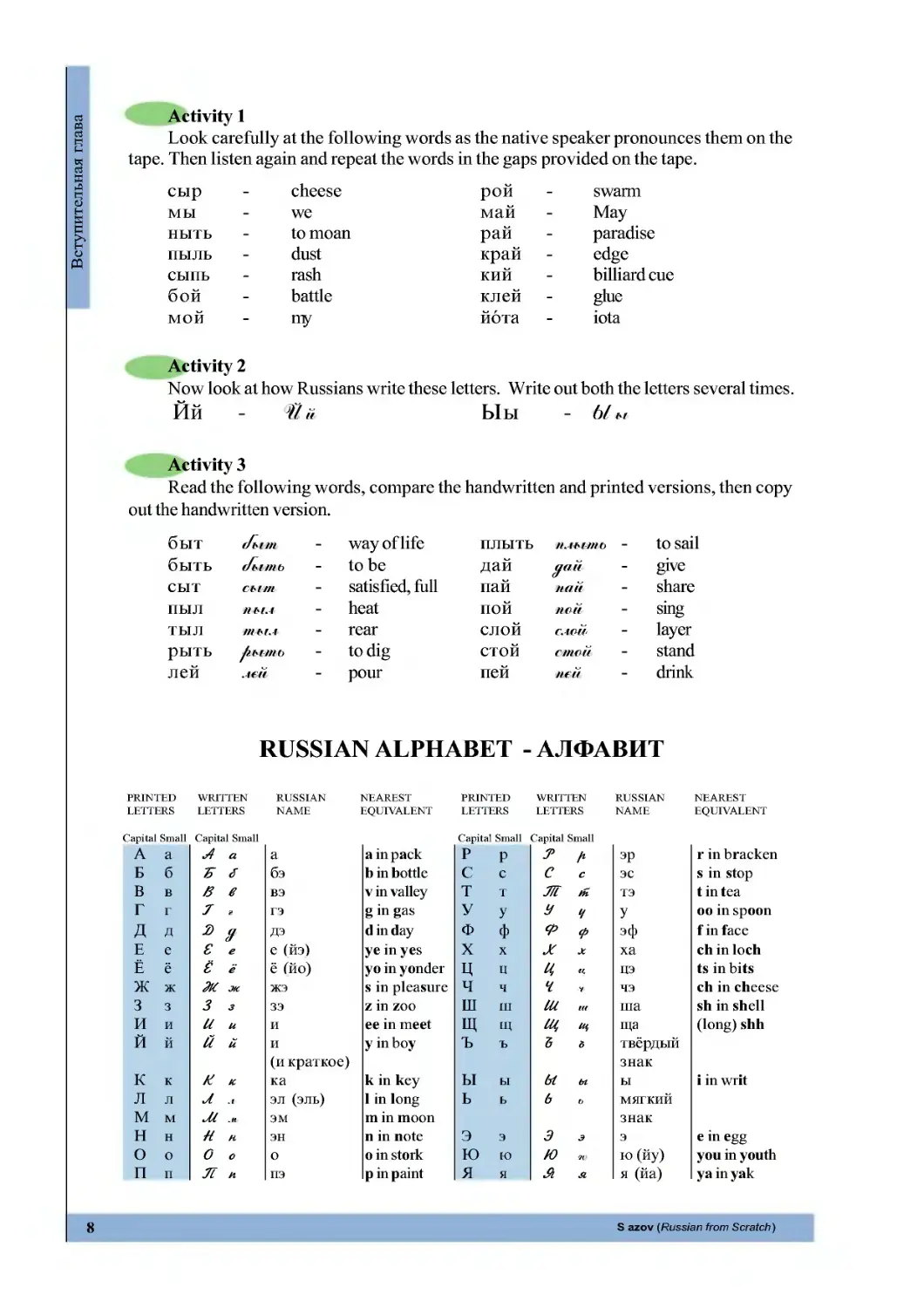
RUSSIAN ALPHABET -AJIWABHT
PRINTED WRITTEN RUSSIAN NEAREST PRINTED WRITTEN RUSSIAN NEAREST
LETTERS LETTERS NAME EQUIVALENT LETTERS LETTERS NAME EQUIVALENT
Capital Small Capital Small Capital Small Capital Small
A a A a a a in pack P p :P It 3P r i.n bracken
E 6 li cf 63 b in bottle C c C c 3C S in stop
B B IJ 8 B3 V in valley T T .Jll Hi T3 t in tea
1 r T r'1 g III gas Y y !I If Y 00 III spoon
)J; ,n: :JJ !f ,n:3 d in day <I> rp tp 3cp f in face
E e £ e e (ib) ye III yes X x .x- x xa chinloch
E e t if e (Mo) yo in yonder U; u 4 u. U3 ts in bits
}J{ )K ;Jf( JIC )K3 S in pleasure q q 'f q3 ch in cheese
3 3 3 3 33 Z III zoo III rn ttt (({ rna sh in shell
11 II tt u II ee in meet Il{ Ll( It? Il(£1 (long) shh
tI M tl u II y in boy 'b D C jj TBep,n:bIM
(II KpaTKOe) 3HaK
K K K J(; Ka k in key hI bI ht bt bI i in writ
11 n vi .. 3n (3nb) I in long h b b b M51rKIIM
M M .Jt .If 3M m III moon 3HaK
H H H It 3H n in note 3 3 :3 3 3 e III egg
0 0 0 0 0 o in stork IO EO 10 '" 1O (MY) you in youth
II rr :f[Jt rr3 p in paint 51 H .5i .!l 51 (Ma) ya in yak
8 5 azov (Russian from Scratch)
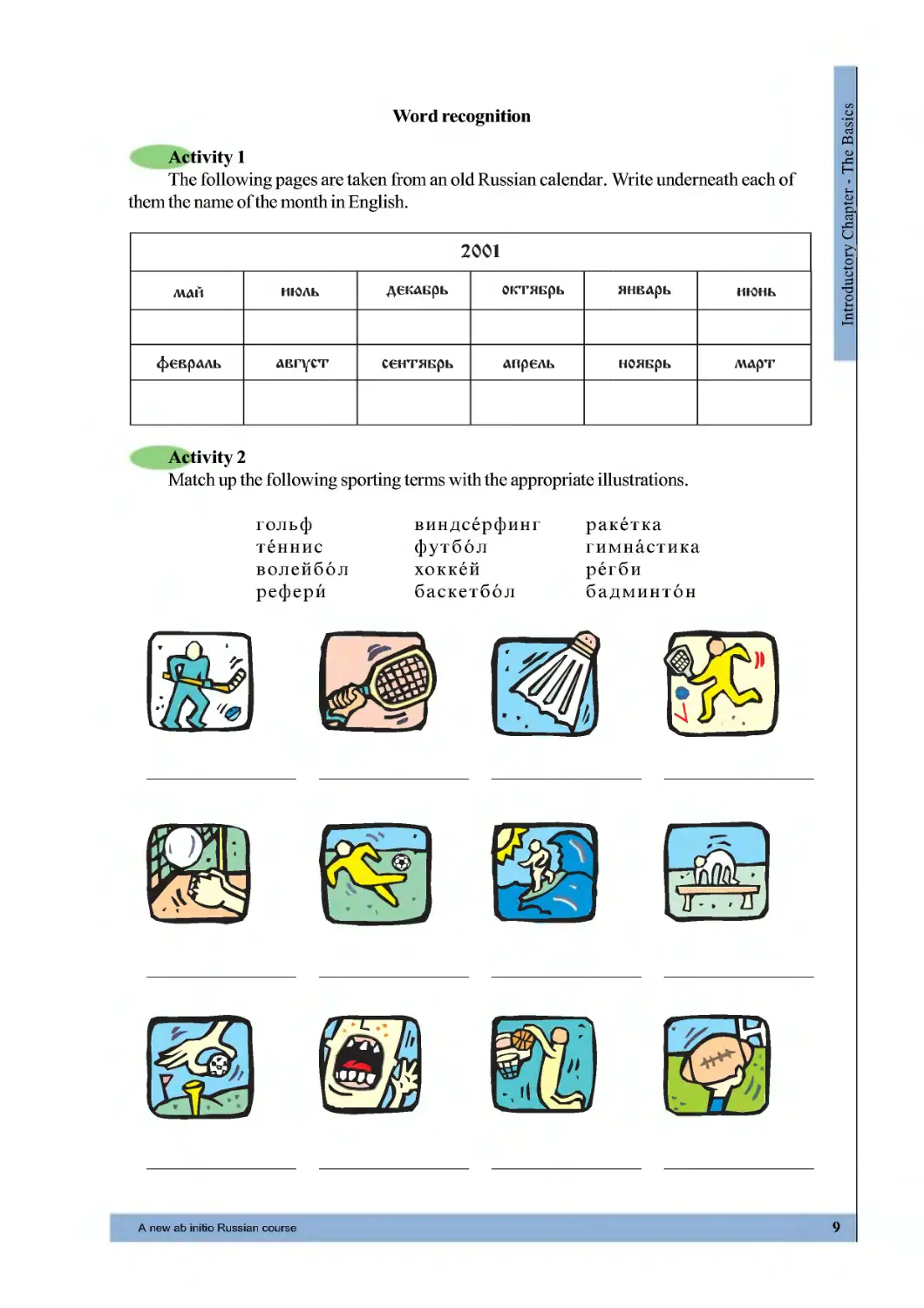
Word recognition
Activity 1
The following pages are taken from an old Russian calendar. Write underneath each of
them the name of the month in English.
2001
MAN HHMb AEKA pb OK'T'}I pb }lHEApb HH)Hb
EEpMb AErVC'T' CEH'T'}I pb AnpEl\b HO}l pb MAP'T'
Activity 2
Match up the following sporting terms with the appropriate illustrations.
rOJIb <p
TeHHHC
BOJIeii60JI
pe<pepH
BHH,n:cep<p HHr
<PYT60JI
xOKKeii
6aCKeT60JI
paKeTKa
rHMHaCTHKa
per6H
6a,n:MHHToH
-
,-
A new ab initio Russian course
cf1
.
cf1
c<:j
c::q
OJ
..s=
E-<
....
OJ
....
c<:j
..s=
U
;>.,
....
o
....
C,)
;j
'"0
o
....
....
s=
......
9
c<:j
c<:j
E
gj
:I:
.!I
Q)
f-'
:::
u
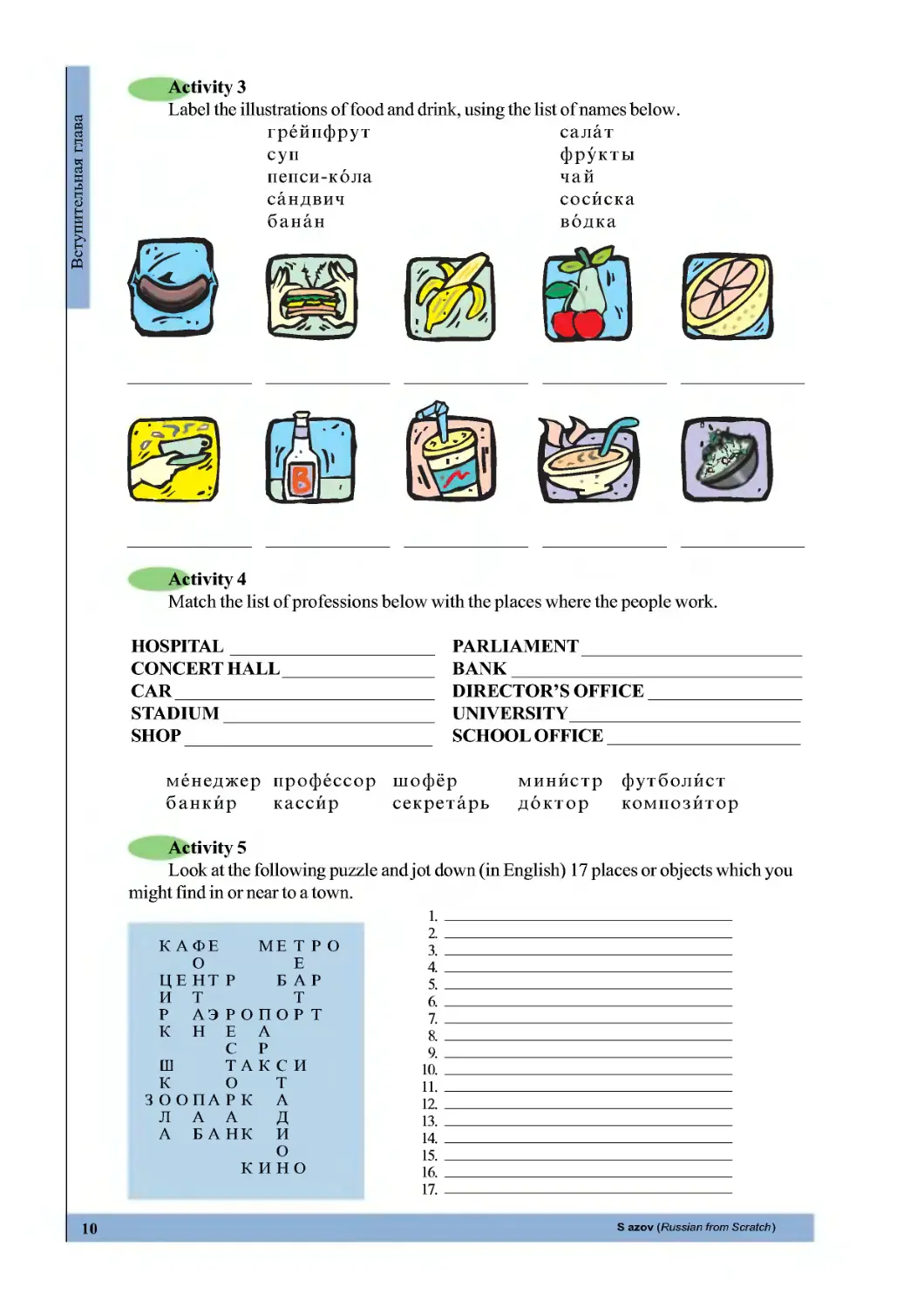
Activity 3
Label the illustrations of food and drink, using the list of names below.
rpenrr<pPYT CaJIaT
cyn <PPYKTbI
nerrCH-KOJIa qan
CaH,n:BHq cocHcKa
6aHaH BOllKa
tJ£!J
- .
-'
r
- .
. .
. .I.
D\
. I .-\
;
P
Activity 4
Match the list of professions below with the places where the people work.
HOSPITAL
CONCERT HALL
CAR
STADIUM
SHOP
PARLIAMENT
BANK
DIRECTOR'S OFFICE
UNIVERSITY
SCHOOL OFFICE
MeHe,n:)Kep npo<peccop llIO<pep
6aHKHp KaccHp ceKpeTapb
MHHHCTp
,n:OKTOp
<pYT60JIHCT
KOMrr03HTop
Activity 5
Look at the following puzzle and jot down (in English) 17 places or objects which you
might find in or near to a town.
KA<I>E MET PO
o E
qEHT P E AP
11 T T
P A3POIIOPT
K H E A
C P
rn TAKC11
K 0 T
300IIAPK A
11 A A .lJ:
A E A HK 11
o
K11HO
1.
2.
3.
4.
5.
6.
7.
8.
9.
10.
11.
12.
13.
14.
15.
16.
17.
10
5 azov (Russian from Scratch)
Activity 6
All except one ofthe following words relate to education. Which is the odd one out and
what do the others mean?
YHHBepCHTeT HHCTHTYT cTy,n:eHT JIeKQH5I CeMHHap ,n:HrrJIOM ceMecTp
rrpo<peccop ,n:eTeKTHB '}K3aMeH llIKOJIa KJIaCC TeCT
The exception:
The others: 1. 2. 3.
4. 5. 6.
7. 8. 9.
10. 11. 12.
Activity 7
The following are names of famous and infamous people. Can you identify them?
TOJICTOH
EJIbI(HH
EpHTTeH
IIYllIKHH
rOp6aqeB
III eKcrrHp
,l],ocToeBCKHH
CTaJIHH
MycCOJIHHH
qaHKoBcKHH
qepqHJIJIb
PY3eBeJIbT
IIIocTaKoBHq
rHTJIep
M oQa pT
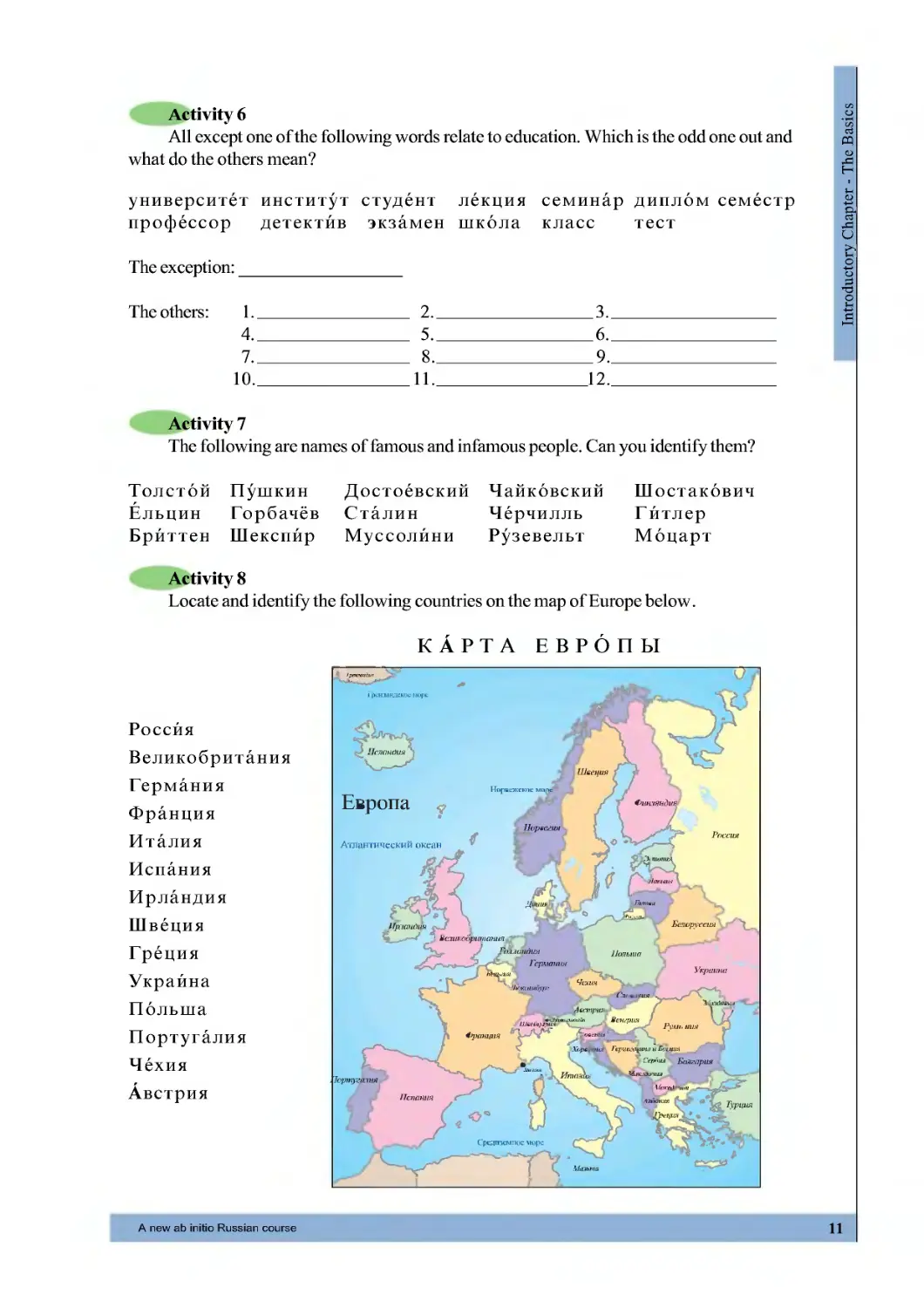
Activity 8
Locate and identify the following countries on the map of Europe below.
POCCH5I
BeJIHK06pHTaHH5I
repMaHH5I
<DpaHQH5I
MTaJIH5I
MCrraHH5I
M pJIaH,n:H5I
IIIBeQH5I
rpeQH5I
YKpaHHa
IIoJIbllIa
IIopTyraJIH5I
qexH5I
ABCTpH5I
A new ab initio Russian course
KApTA EBPOnbI
I
..
1 pCH:I31J.;:\CKO;; Hope
)}
I
e
POlXWl
E pOIIa 'V
.
HOpi:t:>KCKOe "HI"}c
(
llop6CLWl
pi'(
,!..(:.w
Ee:'lOP__VCl Wl L
llWlblllG
qlXl '
l' 1q J!1WiLl
A lTlJpU; ]
_ _..'l!LI. ' . 6e1l2pU5I
ill",,!".,,", -;c...I' .-' Py."" IlUR ' ,Onow.
r <'''' ',a Tepuec,:,""""'''",''
. _ Cepii,a E,,,zapUR
IlcllllHlIa ''''' 8 ''''' Hmo" . :>: :: ' '""'
) .o 0P m
. tUH ... .
Ii :"m"Mnoe "ope .. '1'. _.
""'7\: . . ,-
'---y -----"'-' I ('If""""
cf1
.
cf1
c<:j
c::q
OJ
..s=
E-<
....
OJ
....
c<:j
..s=
U
;>.,
....
o
....
C,)
;j
'"0
o
....
....
s=
......
11
c<:j
c<:j
E
gj
:I:
.!I
Q)
f-'
:::
u
Activity 9
When you have completed Activity 8, see how many other countries you can identify.
This can be done as an oral exercise together with your teacher . Your teacher will simply ask
you; e.g. r)J;e HopBerHH? (Where is Norway?) and you will point to it and reply HopBerHH
3LJ:eCh (Norway is here).
Activity 10
Now match up the following capital cities with the countries in Activity 8.
EepJIHH
A<p HHbI
MOCKBa
BeHa JIHcca60H
,l],y6JIHH Ma,n:pH,n:
CTOKrOJIbM
JIOH,n:OH
II para
BapllIaBa
IIapH)K
PHM
KHeB
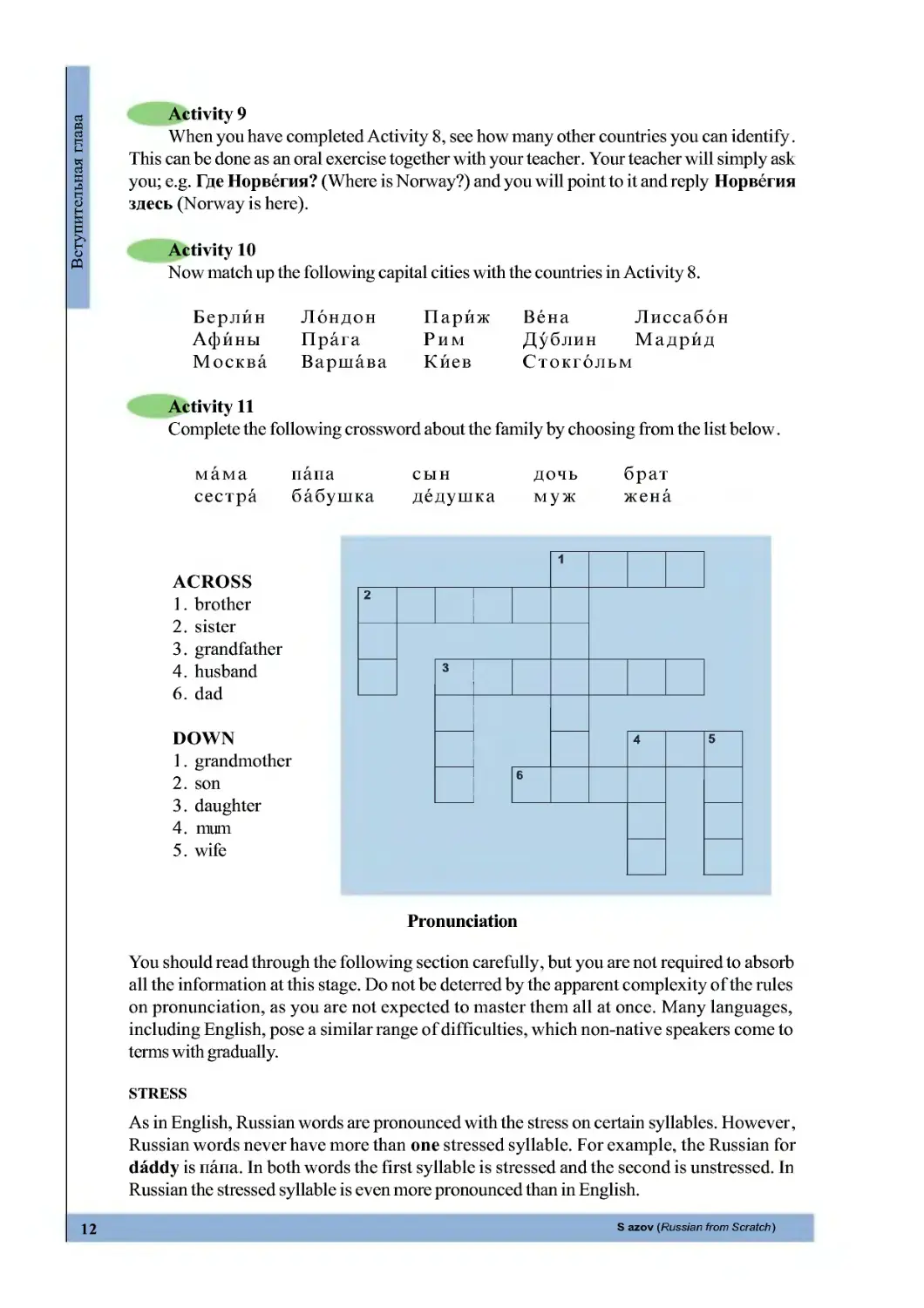
Activity 11
Complete the following crossword about the family by choosing from the list below.
MaMa
ceCTpa
6paT
)KeHa
rrarra
6a6YllIKa
CbIH
,n:en:YllIKa
,n:Oqb
MY)K
1
ACROSS
1. brother
2. sister
3. grandfather
4. husband
6. dad
2
3
DOWN
1 . grandmother
2. son
3. daughter
4. l1llUTI
5. wife
4
5
6
Pronunciation
You should read through the following section carefully, but you are not required to absorb
all the information at this stage. Do not be deterred by the apparent complexity of the rules
on pronunciation, as you are not expected to master them all at once. Many languages,
including English, pose a similar range of difficulties, which non-native speakers come to
terms with gradually.
STRESS
As in English, Russian words are pronounced with the stress on certain syllables. However,
Russian words never have more than one stressed syllable. For example, the Russian for
daddy is rrarra. In both words the first syllable is stressed and the second is unstressed. In
Russian the stressed syllable is even more pronounced than in English.
12
5 azov (Russian from Scratch)
If a word only has one syllable the vowel is of course always stressed and if a word contains
the letter e the stress is always on the e, regardless of the number of syllables; e.g. JIHKep
(liqueur), pYLKhe (gun), ep3aTh (to fidget).
Vowels in unstressed positions
Vowels in unstressed syllables are pronounced shorter (or have a reduced value) and some
of them can vary in sound (or change their quality).
Unstressed 0, E, 51.
o - in unstressed syllables is pronounced like a weak (Russian) a
,n: 0 M (house) ,n: OM a [ dama ] (houses)
OH (he) OHa [ana] (she)
E - in unstressed syllables is pronounced like a weak II
JIec (forest) JIeca [Usa] (forests)
51 - in unstressed syllables, at the beginning of a word,
is pronounced yi (as in Yiddish)
93 hI K (language) [yizYK ]
}[rroHII5I (Japan) [Yiponiya]
Other vowels do not change their quality to such an extent, but are pronounced with a
reduced value. The meaning of a word can change depending on the position of the stress.
3aMOK (castle) - 3aMoK (lock)
MYKa (tonnent) - MYKa (flour)
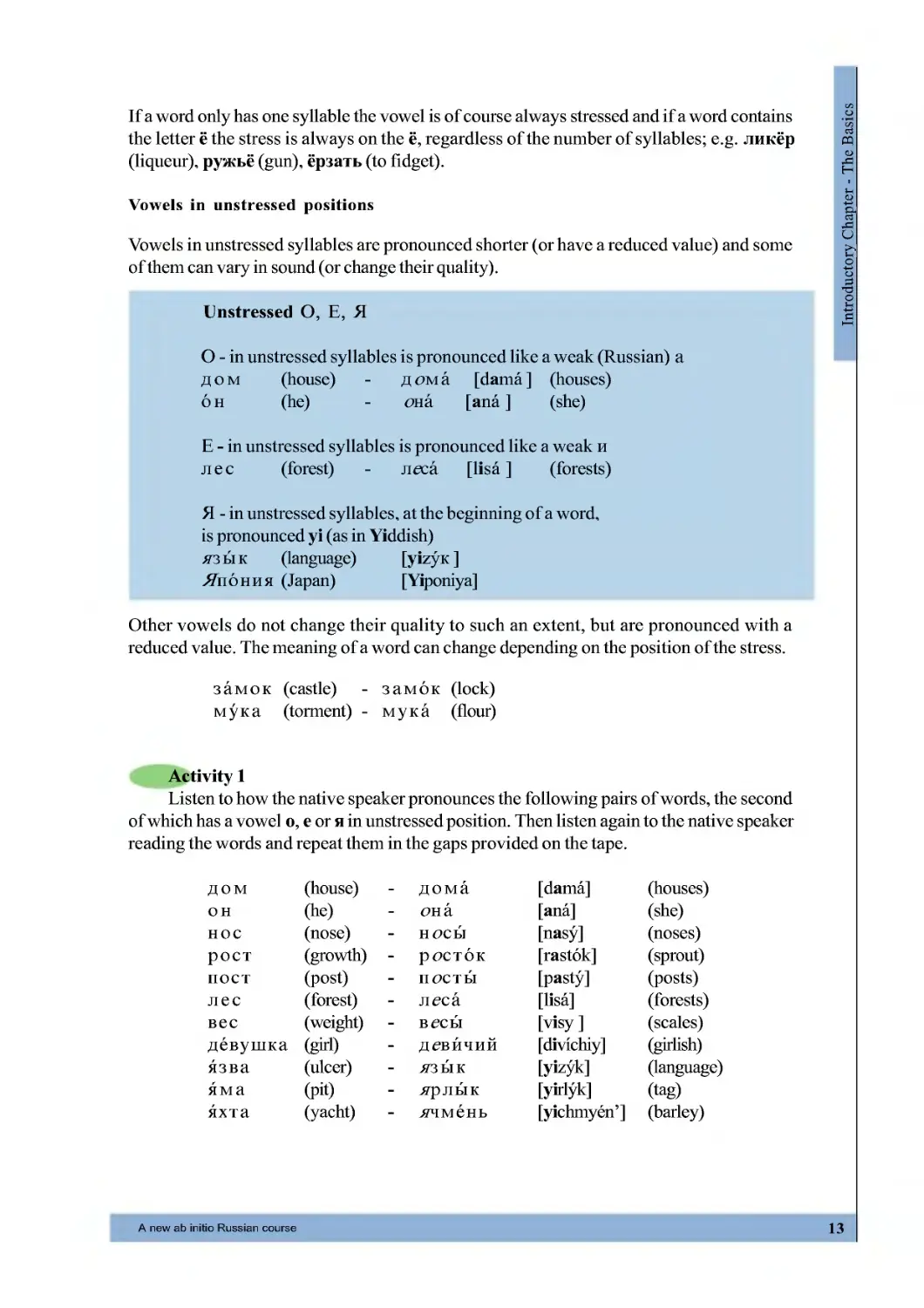
Activity 1
Listen to how the native speaker pronounces the following pairs of words, the second
of which has a vowel 0, e or H in unstressed position. Then listen again to the native speaker
reading the words and repeat them in the gaps provided on the tape.
,n:OM (house) ,n:OMa [ dama] (houses)
OH (he) OHa [ana] (she)
HOC (nose) HOChI [nasy] (noses)
pOCT (growth) pOCTOK [rast6k] (sprout)
IIOCT (post) rr OCThI [pasty] (posts)
JIec (forest) JI ec a [Usa] (forests)
Bec (weight) BechI [visy ] (scales)
,n:eBYllIKa (girl) ,n:eBHqIIH [divichiy] (girlish)
5l3Ba (ulcer) 513 hI K [yizyk] (language)
5lMa (pit) JTp JI hIK [yirlyk] (tag)
5lXTa (yacht) }lqMeHb [yicbmyen'] (barley)
A new ab initio Russian course
cf1
.
cf1
c<:j
c::q
OJ
..s=
E-<
,
....
OJ
....
c<:j
..s=
U
;>.,
....
o
....
C,)
;j
'"0
o
....
....
s=
......
13
c<:j
c<:j
E
gj
:I:
.!I
Q)
f-'
:::
u
SOFT CONSONANTS
Soft consonants are very common in Russian. You already know that one of the
functions ofthe soft sign (I» is to 'soften' the preceding consonant. What is not apparent
from the alphabet is that certain other letters, namely e, e, 10, Hand H, can also act like a soft
sign. If a consonant precedes one of these letters, it is always pronounced soft.
Activity 2
Listen to how the native speaker pronounces the following pairs of words, the second
of which has one of the' soft' vowels ( e, e, 10, H, H) after the consonant. Then listen again to
the native speaker reading the words and repeat them in the gaps provided on the tape.
MaTb (mother) MJlTb (to crumple)
TO K (current) T eK (flowed)
BbITb (to howl) BHTb (to weave)
HOC (nose) H ec ( carried)
JIYK (onion) JIlOK (hatchway)
pbICb (lynx) pnc (rice)
C3p (sir) CepH5I (serial)
Most Russian consonants have two forms of pronunciation: hard and soft. However, there
are three which only have a hard form. These are )K, m and IJ,. When the 'soft' vowels Hand
e follow these consonants they are pronounced hI and'} respectively.
Activity 3
Listen to how the native speaker pronounces the following words. Then listen again to
the words and repeat them in the gaps provided on the tape.
,n:)KHHCbI Geans) )Ke3JJ
)KHp (fat) )KeCT
U:HKJI (cycle) u:eHTp
U:HPK (circus) llIeCTb
llIHHa (tyre) llIe51
III H III (fig)
(rod)
(gesture)
(centre)
(six)
(neck)
VOICED AND VOICELESS CONSONANTS
Most Russian consonants can be divided into two groups:
a) Voiced consonants (i.e. the vocal chords vibrate) - 6 B r )J; )K 3
b) Voiceless consonants (i.e. the vocal chords do not vibrate) - n 4> K T m c
These two groups form pairs as follows:
Voiced
Voiceless
6
rr
B
r
<P
,n:
)K
3
K
T
III
C
14
5 azov (Russian from Scratch)
1. Voiced consonants in final position
Voiced consonants become voiceless at the end of a word, as in the following cases.
6 rr ,n:y6 [ doop ] ( oak tree)
B <p pOB [rot] (ditch)
r K <p JIar [flak] (flag)
,n: T Men [myot] (honey)
)K III :HaJK [ etash ] (floor)
3 c ra3 [gas] (gas)
Activity 4
Listen to how the native speaker pronounces the following words. Then listen again to
the words and repeat them in the gaps provided on the tape.
pa6 (slave) Bpar (enemy) MYJK (husband)
Kpa6 (crab) 6er (running) rapaJK (garage)
JIO 6 (forehead) MHr (instant) rrJI5IJK (beach)
JIeB (lion) crra)7 (slump) pa3 (once)
peB (roar) JIe)7 (ice) rJIa3 (eye)
rrpaB (right) p 51)7 (row) rrpH3 (prize)
2. The effect of voiced and voiceless consonants on each other in combinations (or
clusters) of consonants.
When the last consonant in a combination (of two or more) is voiced, preceding voiceless
consonants are pronounced as their voiced equivalents; e.g.
C60PHHK
o T,n:bIX
c ,n:e,n:oM*
[zb6mik]
[ 6ddykh]
[ zdyedom]*
(anthology)
(rest, holiday)
(with grandfather)
Exception: B does not make preceding voiceless consonants voiced; e.g.
cBeT
[svyet]
(light)
Conversely, when the last consonant in the group is voiceless, all preceding voiced conso-
nants are pronounced as their voiceless equivalents; e.g
Bce
BO,4Ka
B KHHO*
[fsyo]
[v6tka]
[tkin6]
(everything)
(vodka)
(to the cinema)
* This rule also applies with prepositions (which are pronounced as if they were joined to
the following word).
Activity 5
Listen to how the native speaker pronounces the following words. Then listen again to
the words and repeat them in the gaps provided on the tape.
A new ab initio Russian course
cf1
.
cf1
c<:j
c::q
OJ
..s=
E-<
....
OJ
....
c<:j
..s=
U
;>.,
....
o
....
C,)
;j
'"0
o
....
....
s=
......
15
c<:j The final consonant in group is voiced (therefore the preceding consonant is
voiced)
gj
:I:
.!I
Q)
f-'
:::
u
o T,n:eJI (department) crOH (herding)
o T60p (selection) c,n:aTb (to hand over)
c60p (collection) c,n:eJIKa (deal)
c6 bIT (sale) C)Keqb (to bum down)
crH6 (bend) C3anH (from behind)
The final consonant in group is voiceless (therefore the preceding consonant is
voiceless)
po 6KHH (timid) BCW,n:y (everywhere)
BKJIan (deposit) JIerKO (easy)
BTOpHHK (Tuesday) 3arc (registry office)
BllIHTb (to sew in) pe,4Ko (rarely)
BC er,n: a (always) JIo,4Ka (boat)
16
5 azov (Russian from Scratch)
CHAPTER 1
c<:j
c<:j
E
gj
P-
Q)
CHAPTER ONE - IIEPBAJI rJIABA
INTRODUCTIONS
3HAKOMCTBO
In Chapter One you will learn how to do the following:
L to understand basic introductions
2. to use appropriate greetings
3. to recognize and to form patronymics (i.e. Russian middle names, which are
always based on the first name of one's father)
You will learn the following points of grammar:
L the three genders (masculine. feminine. neuter)
2. the possessive pronoun 'my'
3. regular plurals
Activity One - IIepBoe 3a)J;aHHe
Listening/Reading Infonnal greetings. Listen to and read the following.
3TO OJIer, JIeHa, HaTallIa H raJI5I. OHM cTy,n:eHTbI.
,
... \......
,
t )
...
"-
\.
.,
--
.:;
\
\)
I
\
I
/
...
\
..
'" '
- 3,n:paBCTByii, OJIer.
- 3,n:paBCTByii, HaTallIa.
- 3,n:paBCTByii, JIeHa.
- 3,n:paBCTByii, raJI5I.
- IIpHBeT, OJIer.
- IIpHBeT, JIeHa.
:'JTo
II
om!
this is / these are
and
they (are)
cTy):\eHTbI
'3):\paBcTByii
rrplIBeT
students
hello (informal)
hi
18
5 azov (Russian from Scratch)
Activity Two - BTopoe 3a)J;aHHe
Listening/Reading Formal greetings. Listen to and read the following.
....
OJ
....
- p,
c<:j
'\ ..s=
T .... U
3TO MHcTep MaKeH3H, - b_
" 1 .. '\
rocrro,n:HH EeJIOB, '\. ..
\\
MHCCHC CMHT, -
---
rOCrrO)Ka CYCJIOBa 11 , ,- t .
MHCC TOMCOH. OHM
rrperrO,n:aBa TeJIH. c" \ , ...-
-.
-
.- -
-
, \
- '- .
-'
- ....
.....
\
,....
...
..
,
"
,
...
- 3,n:paBCTByiiTe, MHcTep MaKeH3H.
- 3,n:paBCTByiiTe, rocrro,n:HH EeJIOB.
\
- 3,n:paBCTByiiTe, MHCCHC CMHT.
- 3,n:paBCTByiiTe, rOCrrO)Ka CYCJIOBa.
--
_ai .' ( " ..
..,
G
-- .; '-- ...
-
..":fo ..":fo f \
--
- ,lJ,06PbIH ,n:eHb, MHCC TOMCOH.
- ,lJ,06PbIH ,n:eHb, rOCrrO)Ka CYCJIOBa.
- ,lJ,06PbIH ,n:eHb, rocrro,n:HH EeJIOB.
- ,lJ,06PbIH ,n:eHb, MHCCHC CMHT.
Activity Three - TpeTl>e 3a)J;aHHe
Speaking Greet the following people, using an appropriate register.
1. Your lecturer / teacher
2. The person sitting nearest to you
3 . Your closest acquaintance in the room
4. The person you know least well in the room
5. Someone else in the room
MMCTep
rocrrO):\MH
MMCCIIC
rOCrrO)K3
Mr (used of English speakers)
Mr (Russian title)
Mrs (used of English peakers)
Mrs (Russian title)
MIICC
rrperro):\aBaTenlI
3):\paBcTByihe
):\66pbIM ):\eHb
Miss (used of English speakers)
lecturers
hello Uormal and/or plural)
good afternoon
A new ab initio Russian course
19
c<:j
c<:j
E
gj
P-
Q)
A tivity Four - qeTBepToe 3a)J;aHHe
Speaking How would you respond to the following greetings? (You should fill in your
first name or surname, as appropriate, on the lines provided.)
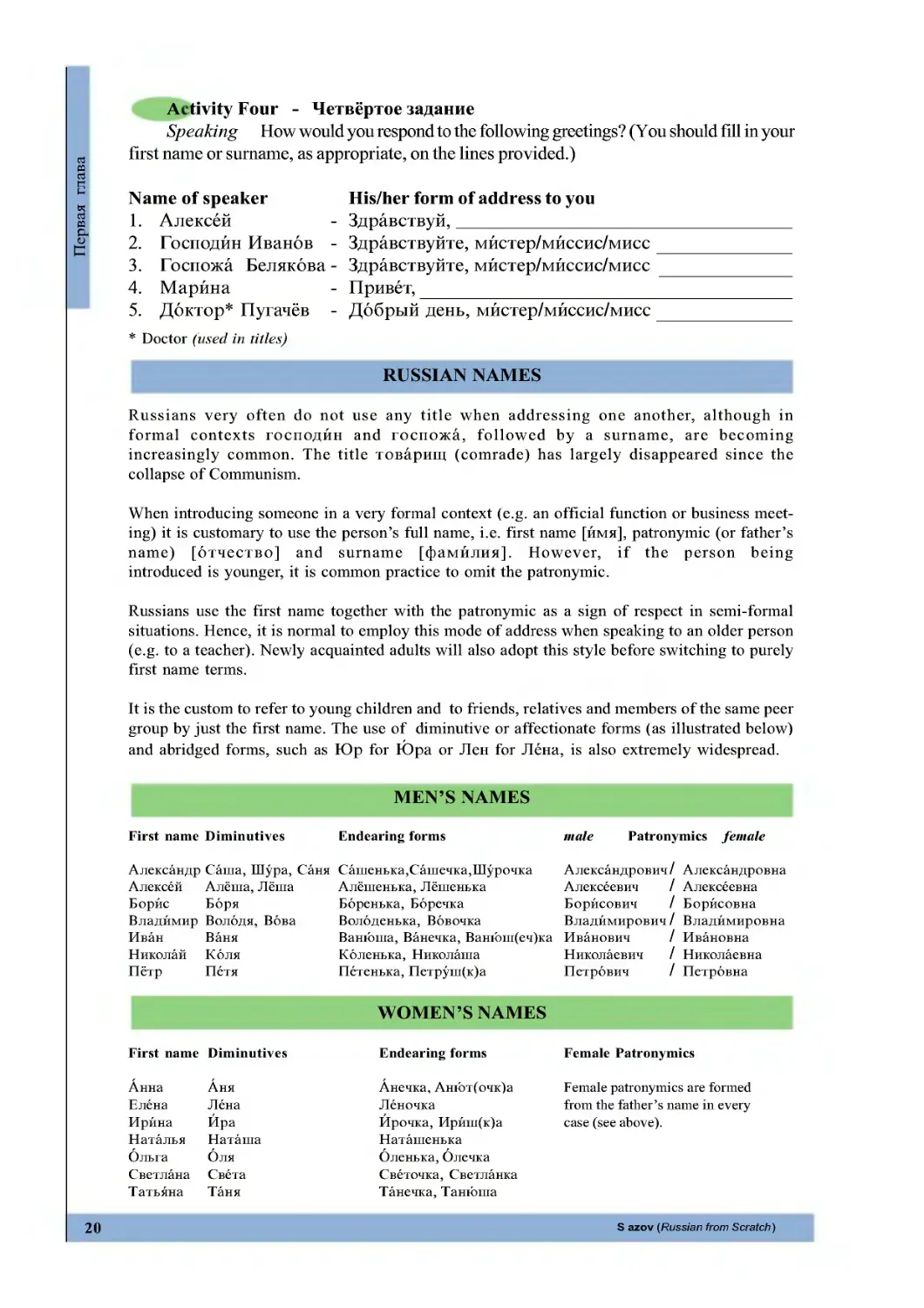
Name of speaker His/her form of address to you
I. AJIeKCeH - 3.n:paBCTBYH,
2. 10crro,n:HH MBaHoB - 3,n:paBCTBYHTe, MHcTep/MHccHc/MHcc
3. 10CrrO)Ka EeJI5IKOBa - 3,n:paBCTBYHTe, MHcTep/MHccHc/MHcc
4. MapHHa - IIpHBeT,
5. ,l],OKTOp* IIyraqeB - ,l],06PbIH .n:eHb, MHcTep/MHccHc/MHcc
* Doctor (used in titles)
RUSSIAN NAMES
Russians very often do not use any title when addressing one another, although in
formal contexts rocrro,n:HH and rocrro:>Ka, followed by a surname, are becoming
increasingly common. The title TOBapIIIl{ (comrade) has largely disappeared since the
collapse of Communism.
When introducing someone in a very formal context (e.g. an official function or business meet-
ing) it is customary to use the person's full name, i.e. first name [HM51], patronymic (or father's
name) [oTQeCTBo] and surname [cj:>aMHJIII51]. However, if the person being
introduced is younger, it is common practice to omit the patronymic.
Russians use the first name together with the patronymic as a sign of respect in semi-formal
situations. Hence, it is normal to employ this mode of address when speaking to an older person
(e.g. to a teacher). Newly acquainted adults will also adopt this style before switching to purely
first name terms.
It is the custom to refer to young children and to friends, relatives and members of the same peer
group by just the first name. The use of diminutive or affectionate forms (as illustrated below)
and abridged forms, such as lOp for IOpa or JIeH for JIeHa, is also extremely widespread.
MEN'S AMES
First name Diminutives
Endearing forms
111 ale
Patronymics felllale
AneKcaH):\p Carna, IIIypa, CaH5I
AneKceiI Anerna, JIerna
EopiIc Eop51
BnaniIMlIp Bonon5l. BOBa
MBaH BaH5I
HIIKonaiI Kon51
TIeTp TIeT5I
AneKcaH):\poBlIq / AneKcaH):\poBHa
AneKCeeBIIQ / AneKceeBHa
EopiIcOBlIq / EopiIcoBHa
BnaniIMlIpOBlIq/ BnaniIMlIpoBHa
MBaHOBlIq / MBaHOBHa
HIIKOnaeBlIq / HIIKonaeBHa
TIeTpOBlIq / TIeTpoBHa
CarneHbKa, CarneqKa,III ypOqKa
AnerneHbKa, JIerneHbKa
EopeHbKa, EOpeqKa
BononeHbKa, BOBOqKa
BaHlorna, BaHeqKa, BaHlorn(eq)Ka
KoneHbKa, HIIKonarna
rIeTeHbKa, TIeTpyrn(K)a
WOMEN'S NAMES
First name Diminutives
Endearing forms
Female Patronymics
AHHa
EneHa
MpiIHa
HaTanb51
Onbra
CBeTnaHa
TaTbiiHa
AH5I
JIeHa
llpa
HaTarna
On51
CBeTa
TaH5I
AHeqKa. AHI<)T( OqK)a
JIeHOqKa
llpoqKa, MpiIrn(K)a
HaTarneHbKa
OneHbKa, OneqKa
CBeTOqKa, CBeTnaHKa
TaHeqKa, TaHlorna
Female patronymics are formed
from the father's name in every
case (see above).
20
5 azov (Russian from Scratch)
How to form patronymics
As you can see from the charts above, it is quite easy to form patronymics. Simply take the
father's first name and add the appropriate endings.
Masculine
Feminine
Usual forms: -OBHq or-(b)eBHq (when name ends in -H or -b)*
Usual forms: -OBHa or -(b)eBHa (when name ends in -H or -b)*
....
OJ
....
P,
c<:j
..s=
U
e.g. EoplIc
AJIeKCeH
BaCIIJIIIH
Mropb
EOpIICOB1FI/ EoplIcoBH8
AJIeKCeeBIFI / AJIeKCeeBH8
BacIIJIbeBH / BacIIJIbeBH8
MropeBH / MropeBH8
* Patronymics are frequently shortened in everyday speech. Hence, instead of MBaHOBlIq / I1BaHoBHa you
may hear MBaHblq / MBaHHa.
Activity Five - IIHToe 3a)J;aHHe
Reading/Writing Look at the following graffiti and complete the activity below.
i
G-
Co4-9 Ce/fte# d1
{( tI- 11 Q. H-o-g H-o... I? 10 b
OJ Oq.Yl-P.M r '7 '"0
V /;4 --
5;. --< 0:'"\ oH "' 2 1:
k..fT'F #o':t, s:<:,lJA" %, -!'
I" I I" =:"l + jLu./c CL 2. .
o.u.A. IAtW H 17 V- uA+o... lhfej!--W1 "\-
n f?,' \-
1. Jot down the Russian equivalents ofthe following:
i) Olga, Ii) Anthony, iii) Sonya, iv) Michael, v) Peter, vi) Maria, vii) Vera, viii) Andrew
2. Write out the following in Russian:
i) Natalya Ivanovna Pushkina, ii) Yuri Ivanovich Pushkin
3. Do you think Sasha Karenina is the name of a man or a woman?
4. Could Sergei Pavlovich Borodin have a daughter called Anna Pavlovna Borodina?
5. Could Sergei Pavlovich Borodin have a son called Sergei Sergeevich Borodin?
6. What are the first names ofthe fathers of the following in Russian?
i) Sofia Sergeevna, ii) Ivan Ivanonich, iii) Nikolai Stepanovich, iv) Anna Igorevna
7. If Anton Pavlovich Pushkin has a son, Nikolai, and a daughter, Anna, what will their full names be
in Russsian?
8. Write out in Russian the male and female patronymics from the following names:
i) Anton, ii) Semion, iii) Pyotr, iv) Pavel, v) Sergei
A new ab initio Russian course
21
Activity Six - IIIecToe 3a)J;aHHe
Speaking Work out with a partner suitable dialogues based on the following
situations. (In some cases more than one form of address is acceptable.)
c<:j
E
gj I. Two school friends, Sasha and Kostya, greet each other in the street.
2. Two young women, Klara and Olga, who are already acquainted, acknowledge
each other at the hairdresser's.
3. A mother says hi to her little daughter Lyuda (whom she knows affectionately as
Lyudochka). [The Russian for lllUllllllJ7 is MaMa.]
4. Sergei Sergeevich meets his boss's wife, Anna Pavlovna, at the bus-stop.
5. Miss Derby-Jones meets her Russian teacher, Natalya Antonovna, in the buffet.
6. A young Russian, Igor Petrovich, says hello to his new English teacher, Mrs
Cuttlefish.
7. An elderly couple, Fyodor Mikhailovich Karamzin and Lidia Vasil' evna
Lomonosova, greet each other in a queue.
8. A young Russian businesswoman, Galina Vadimovna Derzhavina, meets her
American business partner, Mr Wellsbury, at Sheremetyevo airport.
Activity Seven - Ce)J;bMoe 3a)J;aHHe
Reading/Writing Complete the family tree.
The Prokofievs, Marina and Pavel, have a daughter and son. Fill in their names and the
names of their children, by selecting carefully from the list below.
CO<pb51 IIaBJIOBHa, EJIeHa AHToHoBHa, llropb AHTOHOBHq, BaJIeHTHH
HHKOJIaeBHq, TaTb5lHa HHKOJIaeBHa, HHKOJIaH IIaBJIOBHq, ApKa,n:HH
HHKOJIaeBHq
IIPOKOljJhEBhI - POjl0CJIOBHOE jJEPEBO THE PROKOFIEVS - FAMILY TREE
MapHHa <De,n:opOBHa IIpoKo<pbeBa . IIaBeJI IIeTpoBHq IIpoKo<pbeB
.! .!
.! .!
AHTOH . . JIapirca
AneKc:'LH,n:poBIIq AH,n:peeBHa
.! .!
.! .!
22
5 azov (Russian from Scratch)
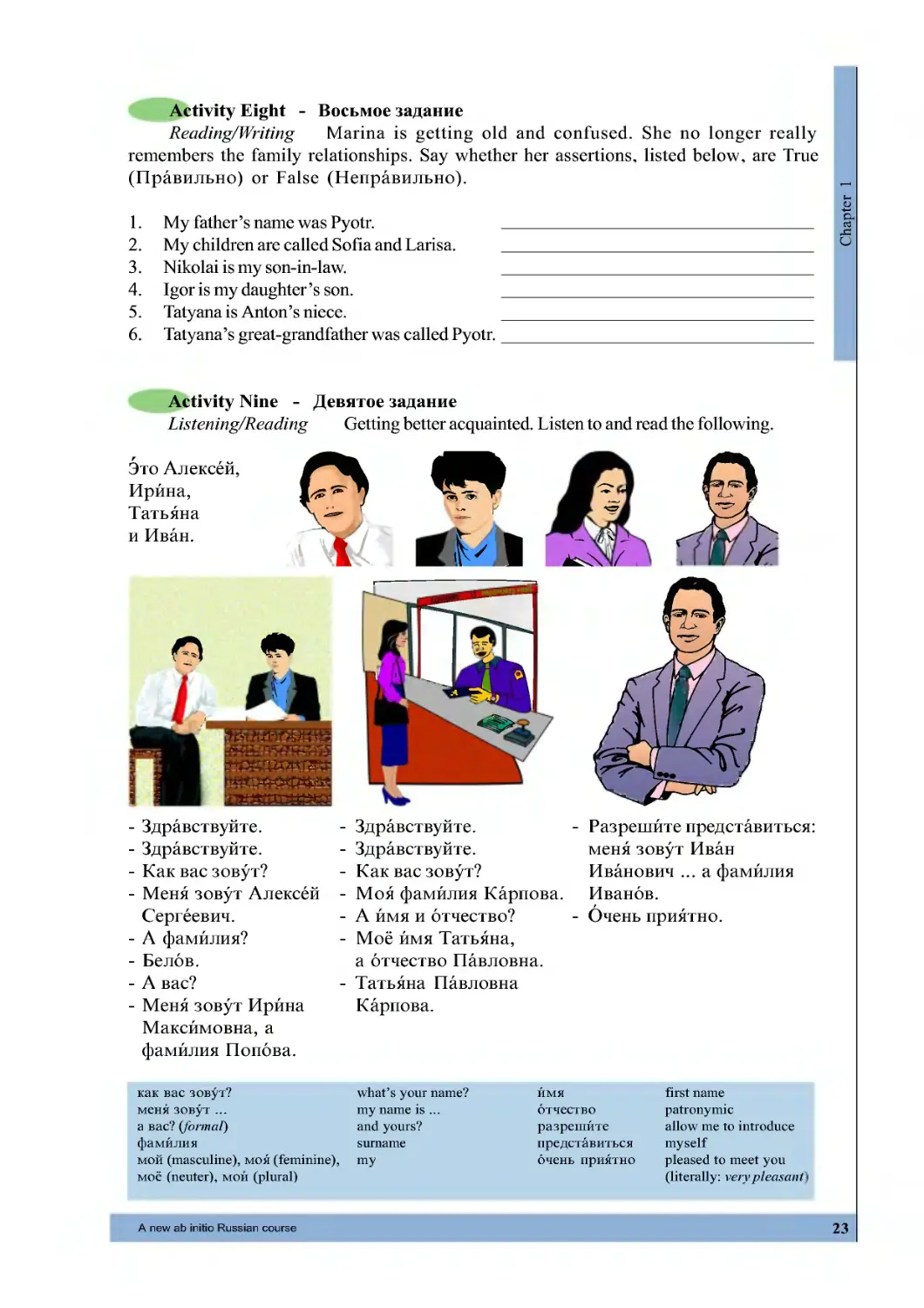
Activity Eight - BOCbMoe 3a)J;aHHe
Reading/Writing Marina is getting old and confused. She no longer really
remembers the family relationships. Say whether her assertions. listed below. are True
(ilpaBHJIbHO) or False (HerrpaBHJIbHO).
I. My father's name was Pyotr.
2. My children are called Sofia and Larisa.
3. Nikolai is my son-in-law.
4. Igor is my daughter's son.
5. Tatyana is Anton's niece.
6. Tatyana's great-grandfather was calledPyotr.
....
OJ
....
P,
c<:j
..s=
U
Activity Nine - ,l],eBHToe 3a)J;aHHe
Listening/Reading Getting better acquainted. Listen to and read the following.
,. j'};;
F'
, / I tJ: -'
'" I
.' , m
3TO AJIeKCeH,
HpHHa,
TaTb5lHa
H HBaH.
\ \11
/,
............JI.. I.. ...J'.....,.
...; . 'A.
.
...... f. ..(.."..,.,.
.........4.- -+......,,"'C...,.
'-';00, . L.""- '
- 3,n:paBCTBYHTe.
- 3,n:paBCTBYHTe.
- KaK Bac 30B)'T?
- MeH5l 30B)'T AJIeKCeH
CepreeBHq.
- A <paMHJIH5I?
- EeJIOB.
- A Bac?
- MeH5l 30B)'T HpHHa
MaKcHMoBHa, a
<paMHJIH5I I1orroBa.
- 3,n:paBCTBYHTe.
- 3,n:paBCTBYHTe.
- KaK Bac 30B)'T?
- M051 <paMHJIH5I KaprrOBa.
- A HM5I H OTqeCTBo?
- Moe HM5I TaTb5lHa,
a OTqeCTBO I1aBJIOBHa.
- TaTb5lHa I1aBJIOBHa
KaprrOBa.
KaK Bac 30BYT?
MeHii 30BYT ...
a Bac? (formal)
4JaMilnlI5I
MOM (masculine), Moii (feminine),
Moe (neuter), Moil (plural)
what's your name?
my name IS ...
and yours?
surname
my
A new ab initio Russian course
- Pa3pellIHTe rrpe,n:CTaBHTbC5I:
MeH5l 30B)'T HBaH
HBaHOBHq ... a <paMHJIH5I
HBaHOB.
- OqeHb rrpH5lTHO.
ilM5I
OTqeCTBO
pa3pelliilTe
rrpe):\cTaBIITbC51
OqeHb rrplIiiTHo
first name
patronymic
allow me to introduce
myself
pleased to meet you
(literally: very pleasant
23
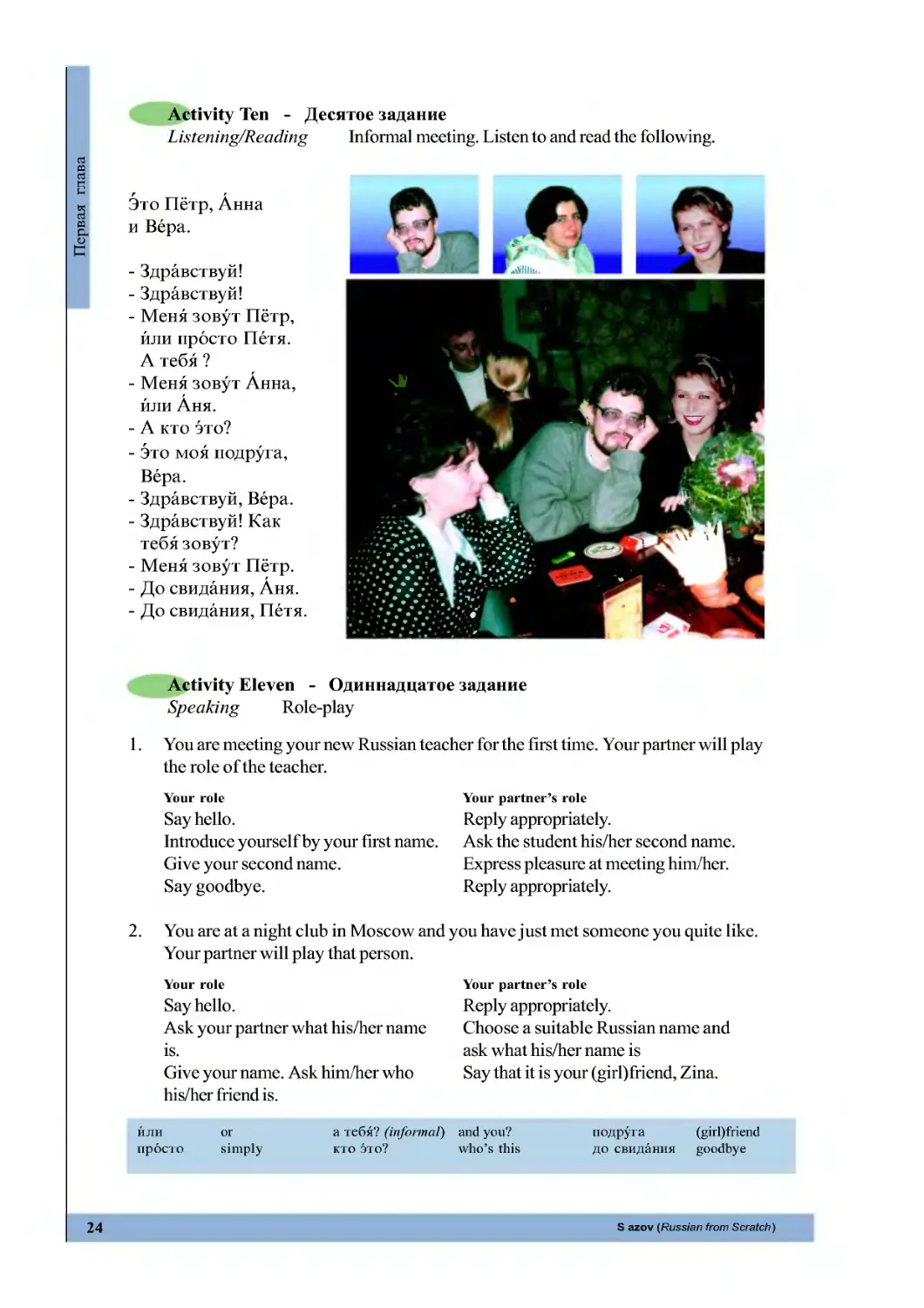
Activity Ten - ,l],ecHToe 3a)J;aHHe
Listening/Reading Infonnal meeting. Listen to and read the following.
:: ..:- . .! ." -.:::.
............. ..........;..:.
....-;1>. .... ..............
.::.'.;-.-:.... . ..:.::..:.
:: ,,': :.- .. . . .t", 4;.. . :.. .:...":';'
: '. 111 ::: .........;;... : :::... . ....
: ,': 111 : .... ......::.: .: ';t,-: .
0". :...........,..:.,..,...
_.:.' : ._ .._ ._ ...III ......:":.:.
c<:j
c<:j
E
gj
P-
Q)
3TO IIeTp, AHHa
n Bepa.
- 3,n:paBCTByii!
- 3,n:paBCTByii!
- MeH5l 30B)'T IIeTp,
HJIH rrpOCTO IIeT5I.
A Te651 ?
- MeH5l 30B)'T AHHa,
HJIH AH5I.
- A KTO :ho?
- :ho M05l rro,n:pyra,
Bepa.
- 3,n:paBCTByii, Bepa.
- 3,n:paBCTByii! KaK
Te65l 30BYT?
- MeH5l 30BYT IIeTp.
- ,2],0 CBH,n:aHH5I, AH5I.
- ,2],0 CBH,n:aHH5I, IIeT5I.
--JJ
.....
.
, llIh..
"
\
.\ 't
. -
.
..,
!
'I'
.
',1
'I
,\' " i
, -1LO
..;.
.
Activity Eleven - O)J;HHHa)J;u:aToe 3a)J;aHHe
Speaking Role-play
I. You are meeting your new Russian teacher for the first time. Your partner will play
the role of the teacher.
Your role
Say hello.
Introduce yourself by your first name.
Give your second name.
Say goodbye.
Your partner's role
Reply appropriately.
Ask the student his/her second name.
Express pleasure at meeting him/her.
Reply appropriately.
2. You are at a night club in Moscow and you have just met someone you quite Like.
Your partner will play that person.
Your role
Say hello.
Ask your partner what his/her name
IS.
Give your name. Ask him/her who
his/her friend is.
Your partner's role
Reply appropriately.
Choose a suitable Russian name and
ask what his/her name is
Say that it is your (girl)friend, Zina.
MnlI
rrpoc'lO
or
simply
a Te6ii? (informal) and you?
KTO JTo? who's this
(girl)friend
goodbye
24
rro):\pyra
):\0 cBII):\aHII5I
5 azov (Russian from Scratch)
Activity Twelve - ,l],BeHa)J;u:aToe 3a)J;aHHe
Listening/Reading In a business context. Listen to and read the following.
....
OJ
....
P,
c<:j
..s=
U
'\ .. .
"""- ....
.. .
,. " \" y
.
.. ..
I . . ," \
....
j'. '" 4 I'
t . _I
,
l
- II03HaKoMbTecb, rrO)KaJIyiiCTa, :ho
Cepreii POMaHOBHq ,D,eP)KaBHH.
- Pa,n:a C BaMH rr03HaKOMHTbC5I.
- II03HaKoMbTecb, rrO)KaJIyiiCTa, 3TO
H3JIJIH BHTaJIbeBHa <DoHBH3HHa.
- Pa,n: C BaMH rr03HaKOMHTbC5I.
Activity Thirteen - TpHHa)J;u:aToe 3a)J;aHHe
Listening/Reading Back in the night club. Listen to and read the following.
rrO)KanyiIcTa
pa):\a (female speaker) c BaMII
rro3HaKOMIITbC51
pa):\ (male speaker) C BaMII
rro3HaKOMIIThC5I
cecTpa
AJIeKCaH,n:p
MapH5I
AJIeKCaH,n:p
MapH5I
AJIeKCaH,n:p
MapH5I
AHHa
MapH5I
AJIeKCaH,n:p
BOJIo,n:51
BOJIo,n:51 H
rr03HaKOMhTech
- 3,n:paBCTByii, Mallia.
- IIpHBeT, CallIa. A KTO 3TO?
- ino M05l CeCTpa, AHHa.
- AHHa?
- ,2],a, AHHa.
- MbI eIll,e He 3HaKOMbI.
OqeHb rrpH5lTHO.
- OqeHb rrpH5lTHO.
- A 3TO Moii 6paT, BOJIo,n:51.
BbI 3HaKoMbI?
- HeT, MbI He 3HaKOMbI.
OqeHb rrpH5lTHO.
- OqeHb rrpH5lTHO.
(Embarrased pause)
AHHa - A MbI 3HaKoMbI!
,2],0 CBH,n:aHH5I!
--=--
P l
''II
" " ,
\
,
\
"
.4
let me introduce you
(literally: get to know each other)
please
(I'm) glad to make your
acquaintance
(I'm) glad to make your
acquaintance
sister
):\a
MbI
eIl(e He
3HaKoMbI (plural)
6paT
HeT
a
yes
we
not yet
acquainted
brother
no
and, but
A new ab initio Russian course
25
c<:j
c<:j
E
gj
P-
Q)
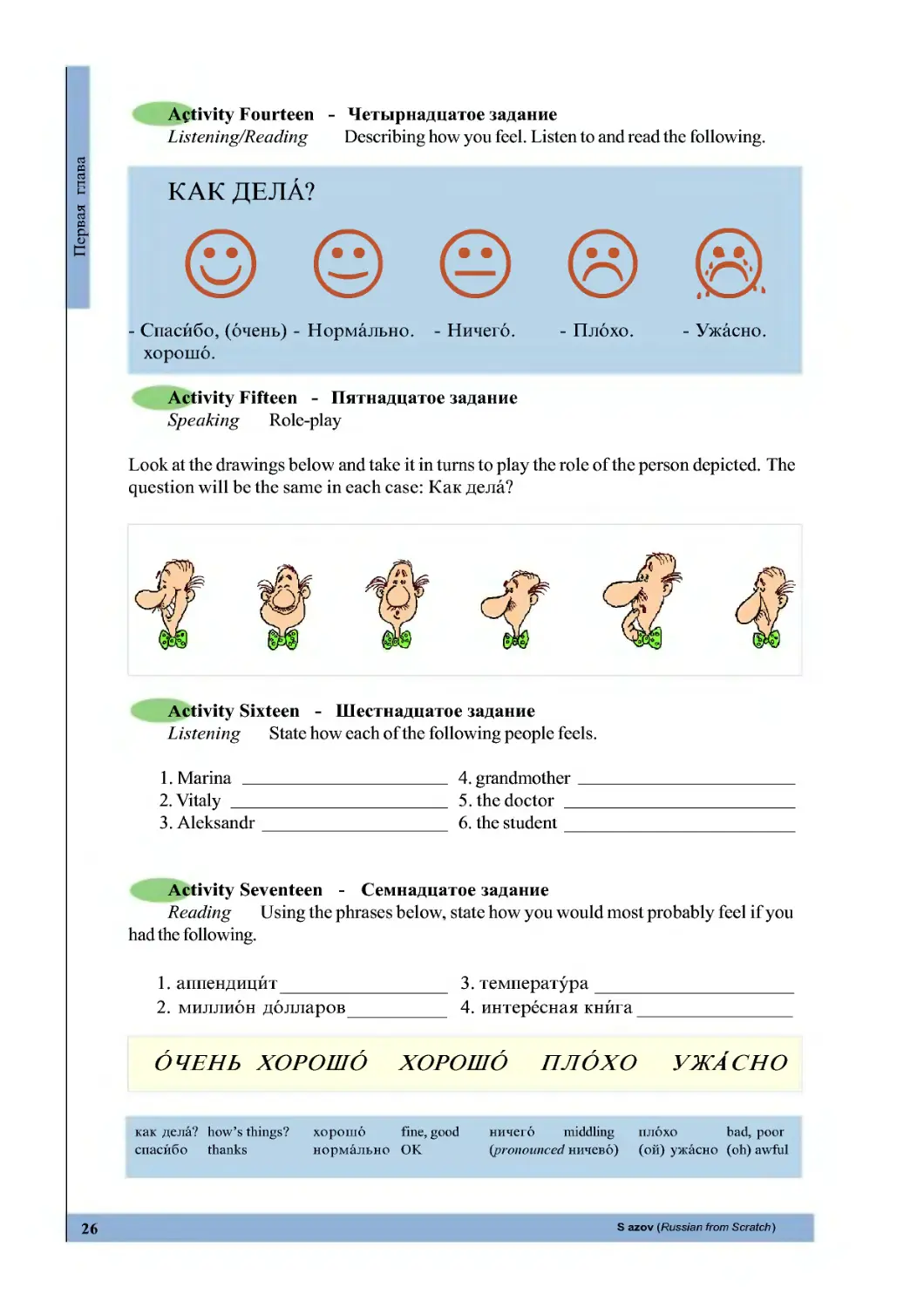
Attivity Fourteen - qeTbIpHa)J;uaToe 3a)J;aHHe
Listening/Reading Describing how you feel. Listen to and read the following.
KAK ,[(EJIA?
@@@@
@ .
. a
. .
- CrracH60, (OqeHb) - HOpMaJIbHO. - HIIqero.
XOpOllIO.
- IIJIoxo.
- Y)KaCHO.
Activity Fifteen - IIHTHa)J;u:aToe 3a)J;aHHe
Speaking Role-play
Look at the drawings below and take it in turns to play the role of the person depicted. The
question will be the same in each case: KaK ,n:eJIa?
f '
.
r
. .
. . 0
4!
...",
.
eft
Activity Sixteen - IIIecTHa)J;uaToe 3a)J;aHHe
Listening State how each of the following people feels.
I. Marina
2. Vitaly
3. Aleksandr
4. grandmother
5. the doctor
6. the student
Activity Seventeen - CeMHa)J;uaToe 3a)J;aHHe
Reading Using the phrases below, state how you would most probably feel if you
had the following.
l.arrrreH,n:IIU:HT
2. MIIJIJIIIOH ,n:OJIJIapOB
3. TeMrrepaTypa
4. HHTepeCHa51 KHHra
Ol£EHh xopomo
xopomo
llJIOXO
YJKACHO
KaK ):\ena? how's things?
crraciI60 thanks
XOpOlliO fine, good
HopManbHo OK
HlIqerO middling
(pronounced HlIqeBo)
rrnoxo bad, poor
(oil) Y)KaCHO (oh) awful
26
5 azov (Russian from Scratch)
Activity Eighteen - BoceMHa)J;uaToe 3a)J;aHHe
Reading In this chapter you have already met a number of similar-sounding words
connected with getting to know people. The common element in each case is 3HaKoM
(acquainted) which has the same root as the verb 3HaTb (to know).Unfortunately, in the list
below the phrases have got rather muddled up. Sort them out and match them with the
appropriate translation on the right-hand side, if possible without referring back.
....
OJ
....
P,
c<:j
..s=
U
e, e, ;'C-
e, c
,,"\ , ,--'C-) '{1'>0
"Q'C- 311'3. b c
lI03h
' Cll1 '
lIo3/i °l',fL1'
Cl116l',f eCL
111'1.
CJ[
let me introduce you please
%-
'?:
7
I'm glad to make your acquaintance
introductions
_ v'"
b'"
3...p.'C-1f.
we are not yet acquainted
Activity Nineteen - ,l],eBHTHaJJ:uaToe 3aJJ:aHHe
Reading/Writing The two most common Russian equivalents of 'bye!' are very
informal and are only used when you know someone quite well. Find the words for 'bye'
(running vertically below) and also state the meaning of each of the words running horizon-
tally. (You can check whether you are right by looking at Activity Twenty-One.)
1. rr p II B e T
r 0 c rr 0 ,1J, II H
,1J, 0 K Y M e H T
3 H a K 0 M C T B 0
2. 3 ,1J, P a B c T B Y H T e
0 T e c T B 0
a M II JI II 51
r 0 c rr 0 )K a
c e c T p a
rr 0 )K a JJ y H c T a
c rr a c H 6 0
p e B 0 JI b B e p
0 e H b
Activity Twenty ,l],Ba)J;uaToe 3a)J;aHHe
Writing Devise similar charts to the one above to illustrate each of the following
words (using the written form of the alphabet) and then try them out on someone else.
1. 6 a 6 y 1lI K a
2. c T y ,1J, e H T
3. rr 0 3 H a K 0 M b T e c b
4. rr p 0 C T 0
A new ab initio Russian course
27
c<:j
c<:j
E
gj
P-
Q)
Activity Twenty-One - Ll.Ba)J;u:aTl> nepBoe 3a)J;aHHe
Reading There are a number of ways to say goodbye in Russian. You have already
met ,n:o CBH,n:aHH5I!, which is the most neutral expresssion and can be used in both formal
and informal situations. In Activity Nineteen you also came across rrOKa! (bye) and
cqacTJIHBo! (which is rarely written and is a corrruption of cqacTJIHBoro nYTH! (bon
voyage!). Another alternative is,n:o 3aBTpa! (see you tomorrow).
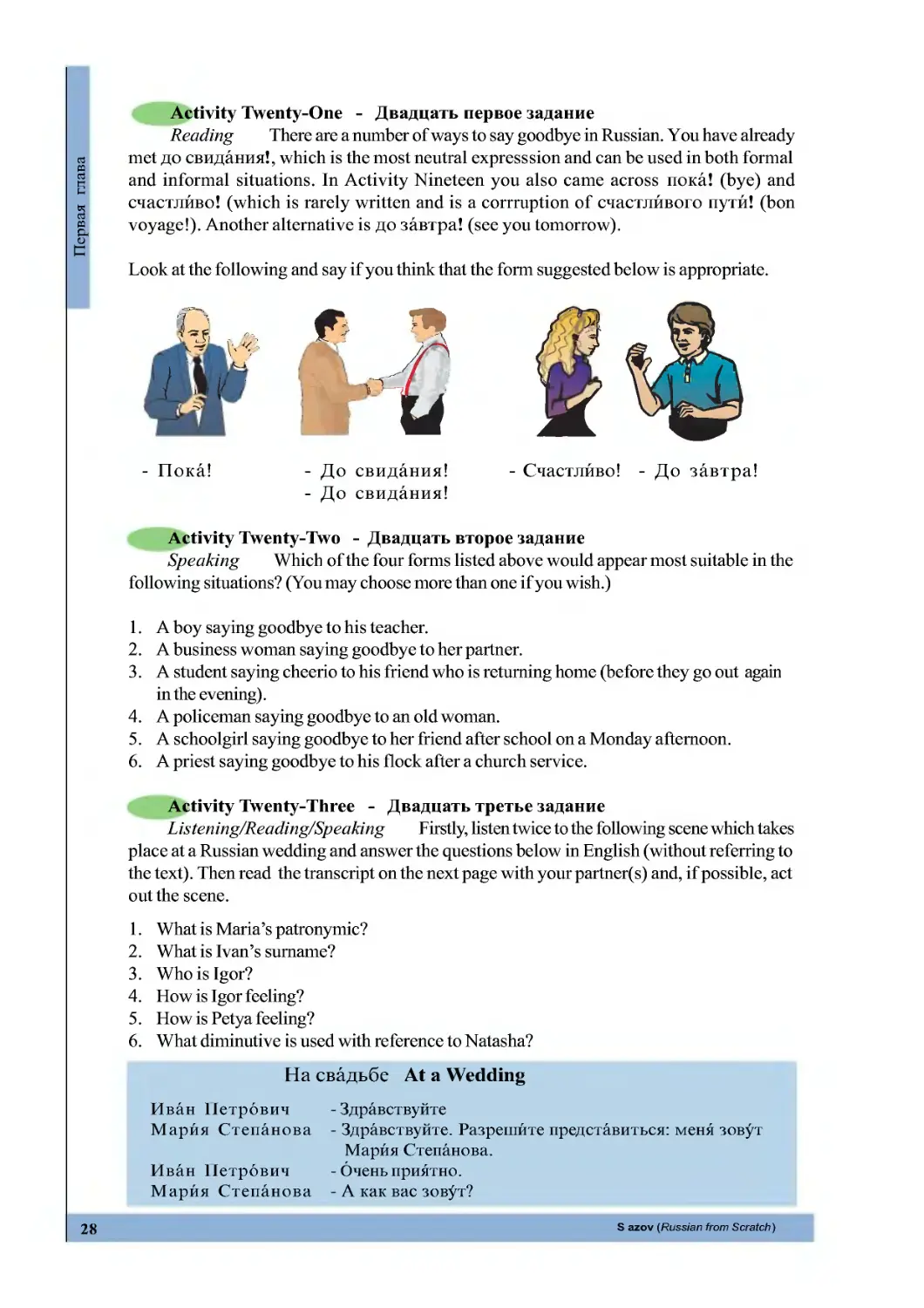
Look at the following and say if you think that the form suggested below is appropriate.
'1'>"
-:; cSl . .
, \'" .r(_.
, "J
IIi I
r:
- IIoKa!
- ,l].o CBH,n:aHH5I!
- ,2],0 CBH,n:aHH5I!
- CqacTJIHBo! -,2],0 3aBTpa!
Activity Twenty-Two - ,l],Ba)J;u:aTl> BTopoe 3a)J;aHHe
Speaking Which of the four forms listed above would appear most suitable in the
following situations? (You may choose more than one if you wish.)
I. A boy saying goodbye to his teacher.
2. A business woman saying goodbye to her partner.
3. A student saying cheerio to his friend who is returning home (before they go out again
in the evening).
4. A policeman saying goodbye to an old woman.
5. A schoolgirl saying goodbye to her friend after school on a Monday afternoon.
6. A priest saying goodbye to his flock after a church service.
Activity Twenty-Three - ,l],Ba)J;uaTh TpeThe 3a)J;aHHe
Listening/Reading/Speaking Firstly, listen twice to the following scene which takes
place at a Russian wedding and answer the questions below in English (without referring to
the text). Then read the transcript on the next page with your partner( s) and, if possible, act
out the scene.
I. What is Maria's patronymic?
2. What is Ivan's surname?
3. Who is Igor?
4. How is Igor feeling?
5. How is Petya feeling?
6. What diminutive is used with reference to Natasha?
Ha cBa,n:b6e At a Wedding
I1B lH UeTpOBIIq
MapH51 CTemlHoBa
- 3,n:p LBCTByiiTe
- 3,n:paBcTByiiTe. Pa3pernHTe rrpe,n:cTaBIITbc51: MemI 30BYT
MapH51 CTerraHOBa.
- OqeHb rrpII5lTHo.
- A KaK Bac 30BYT?
I1BaH UeTpOBIIq
MapH51 CTerraHoBa
28
5 azov (Russian from Scratch)
11B lH lleTpOBIIq
MapH51 CTemlHoBa
11B lH lleTpOBIIq
MapH51 CTemlHoBa
I1B lH lIeTpOBIIq
MapH51 CTemlHoBa
I1B lH lleTpOBIIq
Mropb
HaT lIIIa
lleT51
Mropb
lleT51
lleT51
HaT lIIIa
lleT51
Mropb
H '. T III'.
"lllfl *
. '\
.
..
:a.
- Mem] 30BYT I1B LH lleTpOBIIq.
- A B lIIIa <raMHJIII51?
- CYCJIOB.
- (Recognizing the surname) A-a-a, KOHeqHO, I1m'LH lleTpOBIIq
CYCJIOB. Pa.n:a C BaMII n03HaKoMIITbC51.
- A CKa)]{HTe, rrO)]{aJIYMcTa, KTO 1TO?
- :ho MOM CbIH, Mropb.
- MrOPb, BOT MOfr ,n:Oqb. II03HaKoMbTecb, rrO)]{aJIYMcTa.
- KaK Te6fr 30BYT?
- Mem] 30BYT HaTarna. A :'no MOM .n:Pyr, IIeT51. BbI
3HaKOMbI?
- a, MbI 3HaKOMbI. KaK .n:eJIa, Mropb?
- CrracH60, xoporno. A KaK TBOH .rreJIa?
- HIIqero.
(Several minutes later)
- IIoKa, HaTarneHbKa.
- CqaCTJIHBo!
- o 3aBTpa, Mropb!
- o 3aBTpa, lleT51! o cBII.n:aHII51, HaTarna!
- II.n:aHII51'
....
OJ
....
P,
c<:j
..s=
U
-
I I
,
"
.
,
C
J
.
,
4
?
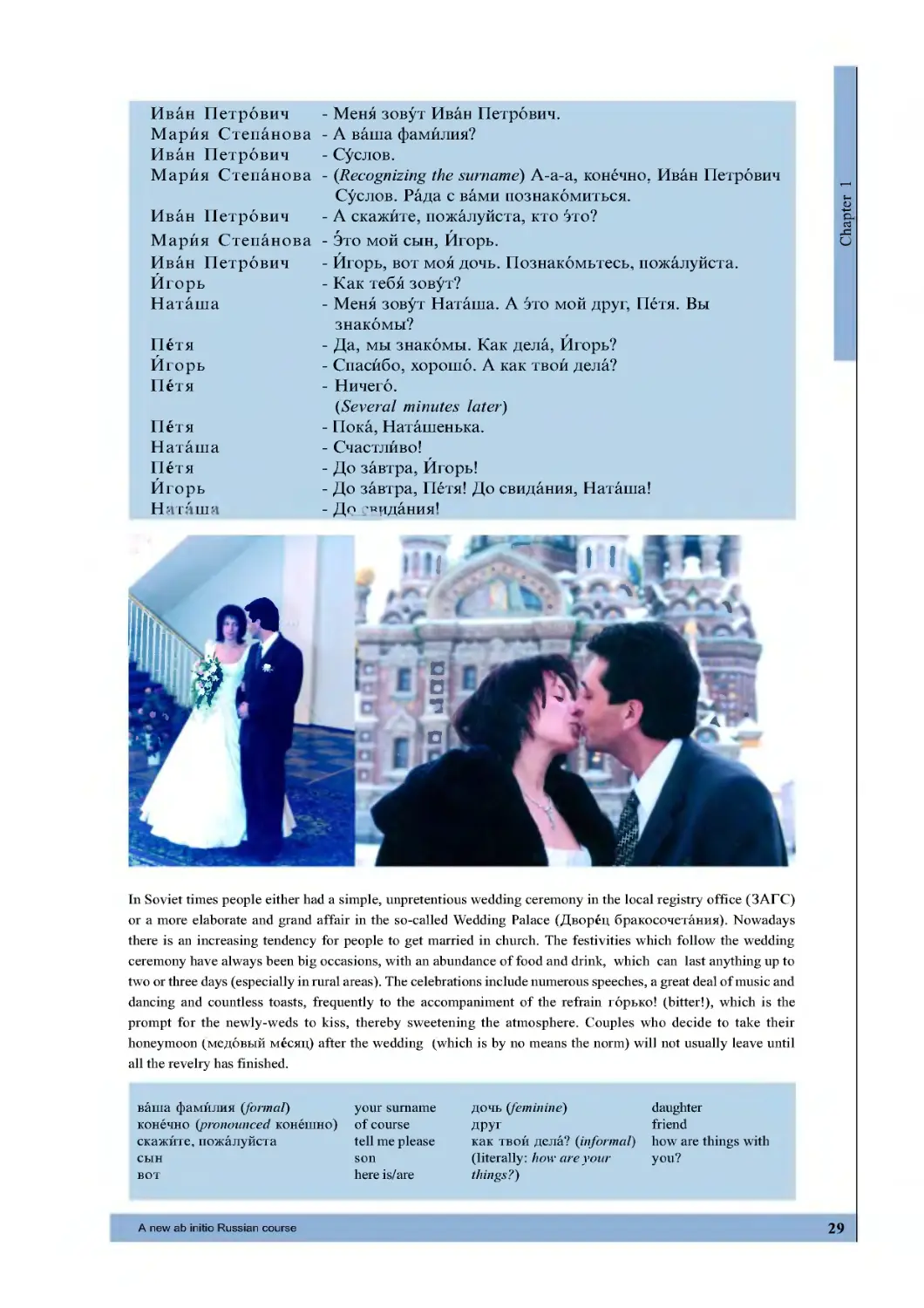
In Soviet times people either had a simple, unpretentious wedding ceremony in the local registry office (3ArC)
or a more elaborate and grand affair in the so-called Wedding Palace (,lJ,Bopel( 6paKOCOqeTaHII5I). Nowadays
there is an increasing tendency for people to get married in church. The festivities which follow the wedding
ceremony have always been big occasions, with an abundance of food and drink, which can last anything up to
two or three days (especially in rural areas). The celebrations include numerous speeches, a great deal of music and
dancing and countless toasts, frequently to the accompaniment of the refrain ropbKo! (bitter!), which is the
prompt for the newly-weds to kiss, thereby sweetening the atmosphere. Couples who decide to take their
honeymoon (Me):\oBbliI MeC5ll() after the wedding (which is by no means the norm) will not usually leave until
all the revelry has finished.
Ballia 4JaMMmI5I (formal)
KOHeqHO (pronounced KOHelliHo)
CKa)KMTe, rro)KanyiIcTa
CbIH
BOT
A new ab initio Russian course
your surname
of course
tell me please
son
here is/are
):\Oqb (feminine)
):\pyr
KaK TBOM ):\ena? (informal)
(literally: how are your
things?)
daughter
friend
how are things with
you?
29
GRAMMAR
c<:j
c<:j
E
gj
P-
Q)
TO BE OR NOT TO BE?
You may have already noticed, there is no present tense of the verb 'to be' in Russian. You
have already met the following examples:
we are acquainted
are you acquainted?
they are students / teachers -
MbI 3HaKoMbI
BbI 3HaKoMbI?
OHM cTy,n:eHTbI
/ rrperrO,n:aBa TeJIH
A/THE
Russian similarly does not have the definite article (the) or the indefinite article (a). Hence,
:ho cTy.n:eHT means both this is the student and this is a student. The plural form 3TO
cTy,n:eHTbI means both these are the students and theJ7/these are students.
GENDERS IN RUSSIAN
Russian, like German, has three genders (masculine, feminine and neuter) in the singular and
one plural form. Normally it is possible to guess the gender of a word by looking at the
ending.
Masculine
Nouns ending in a consonant or -H are usually masculine:
e.g. 6paT (brother), IIOM (house/block of flats). KapaHII:'nrr (pencil), Y:'mbc (Wales), TpaMBaH
(tram)
Note: rrarra (dad) and ,n:e,n:YillKa (grandfather) are clearly also masculine, despite ending in a vowel
Ko e (coffee) is also masculine, despite ending in -e
Some nouns ending in a soft sign (-h) are masculine: *
e.g. rrperro,n:aBaTenb (lecturer), rropT enb (briefcase), yqIITenb (teacher), ,n:O)1(,n:b (rain), ,n:eHb
(day)
Feminine
Nouns ending in the letters -a or -H/-HH /-hH are usually feminine:
e.g. ceCTpa (sister), KBapnIpa (flat/apartment), 6a6YillKa (grandmother), pyqKa (pen),
Meno,n:II51 (tune), llIoTnaH,n:II51 (Scotland), AMepIIKa (America), aMIrnII51 (surname), CeMb5r
(family)
Some nouns ending in a soft sign (-h) are feminine: *
e.g. ,n:Oqb (daughter), TeTpa,n:b (exercise book), qaCTb (part), HaU;IIoHanbHocTb (nationality)
Neuter
Nouns ending in -0 and -e/-He/-he are usually neuter:
e.g. OTqeCTBO (patronymic), rrIIcbMo (letter), OKHO (window), Mope (sea), yrrpa)1(HeHIIe
(exercise), cqacTbe (happiness)
Note: there is a small group of words ending in -H, including IrM51 (first name) and BpeM51 (time),
which look feminine but are in fact neuter
* All words ending in soft signs must be learnt separately. Make a note of their gender as soon as
you come across them!
30
5 azov (Russian from Scratch)
HOW TO SAY 'MY'
You have already met all the different forms for 'my'. They are as follows:
Singular ....
OJ
....
Masculine MOM MOM 6paT my brother p,
c<:j
..s=
Feminine M05l M051 CeCTpa my sister u
Neuter Moe Moe OTqeCTBO my patronymic
Plural
Masculine, Feminine & Neuter MOM MOM cTy,n:eHTbI my students
MOM llIOpTbI my shorts
Activity Twenty-Four - ,l],Ba,[{uaTl> -IeTBepToe 3a,[{aHHe
Reading The following phrases have got jumbled up. Draw Lines to indicate which
form of'my' should go with which word. Each form of , my' appears three times.
1. M05l rrHcbMo (letter)
2. Moe 6paT (brother)
3. MOM CeCTpa (sister)
4. MOM CHrapeTbI ( cigarettes)
5. MOM <paMHJIH5I (surname)
6. Moe KapaH,n:allI (pencil)
7. M05l cTy,n:eHTbI (students)
8. MOM OTqeCTBO (patronymic)
9. MOM rropT<p eJIb (briefcase)
10. Moe TeTpa,n:b (exercise book)
11. M05l rrperro,n:aBaTeJIH (lecturers)
12. MOM CqaCTbe (happiness)
REGULAR PLURALS
Masculine
To form a plural from a masculine noun. you normally just add -bI:
cTy,n:eHT
Mara3IrH
,n:oKYMeH1
(student)
(shop)
(document)
cTy,n:eHTbI
Mara3IrHbI
,n:oKYMeH1 bI
(students)
(shops)
(documents)
Note the spelling rule: ifthe final letter is r, K, x, *, 'I, III or m:, you must use -H instead of -hi:
rrn51)K
KapaH,n:arn
(beach)
(pencil)
rrnH)KII
KapaH,n:arnIr
(beaches)
(pencils) (Note the change in stress)
If the noun ends in a soft sign (-b) or -ii, remove the final letter and add -H:
rropT<j)enb
TpaMBaiI
(briefcase)
(tram)
rropT<j)enII
TpaMBaII
(briefcases)
(trams)
A new ab initio Russian course
31
Feminine
To form a plural from a feminine noun, you normally remove the final-a and add -1.1:
c<:j
c<:j
E
gj
P-
Q)
)KeHIl{IIHa
cIIrapeTa
KBapnIpa
KapTa
)KeHIl{IIHbI
cIIrapeTbI
KBapnIpbI
KapTbI
(woman)
(cigarette)
( flat)
(map)
(women)
(cigarettes)
(flats)
(maps)
Note the spelling rule: ifthe final letter is r, K, x, *, 'I, III or m:, after you have removed -a, you must use
-H instead of -hi:
KHMra
nIIHeiIKa
(book)
(ruler)
KHMnI
nIIHeiIKII
(books)
(rulers)
If the noun ends in a soft sign (-h) or -B /-HB / -hB. remove the final letter and add -H:
'laCTb (part) qaCTII (parts)
TeT51 (aunt) TeTII (aunts)
CTaHIJ;II51 (station) CTaHIJ;IIII (stations)
ceMbH (family) ceMbII (families) (Note the change in stress)
Neuter
To form a plural from a neuter noun, you normally remove the final -0 and add -a:
OKHO (window) oKHa (windows) (Note the change in stress)
rrIIcbMo (letter) rrMcbMa (letters) (Note the change in stress)
MecTo (place) MecTa (places) (Note the change in stress)
Ifthe noun ends in -e or -He / -be, remove the final letter and add -H:
Mope
yrrpa)KHeHIIe
rrpe,n:MeCTbe
(sea)
(exercise)
(suburb)
MOpH
yrrpa)KHeHII51
rrpe,n:MecTb51
(seas) (Note the change in stress)
(exercises)
(suburbs)
Activity Twenty-Five - ,l],Ba)J;u:aTb nHToe 3a)J;aHHe
Writing Put the following words into the plural.
1. 3aBo,n: (factory)
2. cTy,n:eHT (student)
3. KapTa (map)
4. OKHO (window)
5. aBToM06Mnb (m) (car)
6. naMrra (light, lamp)
7. TeTpa,n:b (f) (exercise book)
8. 6II6nIIoTeKa (library)
9. rrn51)K (beach)
10. c06paHIIe ( meeting)
11. OTqeCTBO (patronymic)
12. YHIIBepcIITeT (university)
13. rrone (field)
14. ceMbH (family)
15. Meno,n:II51 (tune)
Activity Twenty-Six - ,l],Ba)J;u:aTb meCToe 3a)J;aHHe
Writing The following phrases are in the plural. Put them back into the singular.
1. MOM KapaH,n:arnIr
2. rronH
3. MOM 6a6yrnKII
4. MOIr rrIrCbMa
5. KHIrrII
6. MOM aBToM06MnII
(my pencils)
(fields)
(my grandmothers)
(my letters)
(books)
(my cars)
32
5 azov (Russian from Scratch)
....
OJ
....
P,
c<:j
..s=
U
A new ab initio Russian course
CHAPTER 2
c<:j
E
gj
P-
o
f-'
CHAPTER TWO
BTOPAJI rJIABA
AN OBJECT LESSON
HArJIiI)J:HLIH YPOK
In Chapter Two you will learn how to do the following:
L to identify and locate objects
2. to express possession
3. to state where you live
4. to recognize numbers
You will learn the following points of grammar:
L the possessive pronouns 'my', 'your', 'his', 'her', 'our', 'their', 'whose'
2. the verb 'to live' (LKHTh)
3. the prepositional case after Band Ha
4. the numerals 1 to 100
Activity One - TIepBoe 3alIaHHe
Listening/Reading Object identification. Listen to and read the following.
qTO :ho?
1
IV}
, J\
:ho CaMOBap.
---
,... ,.,.
.;.
, .. .
. .. ,.
-" ..
.,.
."
-4';'
:ho KapTa PoccHH. :ho o,n:HH py6JIb.
:ho MaTpellIKa.
A '1TO :ho TaKoe?
:ho KHHra «BOHHa H MHp». :ho ra3eTa «Cero,n:H5I». :ho )KYPHaJI «OroHeK».
caMoBap
KapTa PocciIlI
O):\iIH
py6m (m)
MaTpelliKa
qTO :'JTo TaKoe?
«BoHHa II MlIp»
34
samovar (type of Russian tea urn)
map of Russia
one
rouble
matrioshka (Russian doll)
what (exactly) is this / are these?
War and Peace (epic novel by Count
Leo Tolstoy, written 1863 - 1869)
ra3eTa
«Cero):\H5I»
(pronounced (7eBo HH)
)KypHan
«OroHeK»
newspaper
Segodnya = Today (quality
daily newspaper)
magazine, journal
Ogonek = Small Flame
(popular monthly current
affairs maga ine)
5 azov (Russian from Scratch)
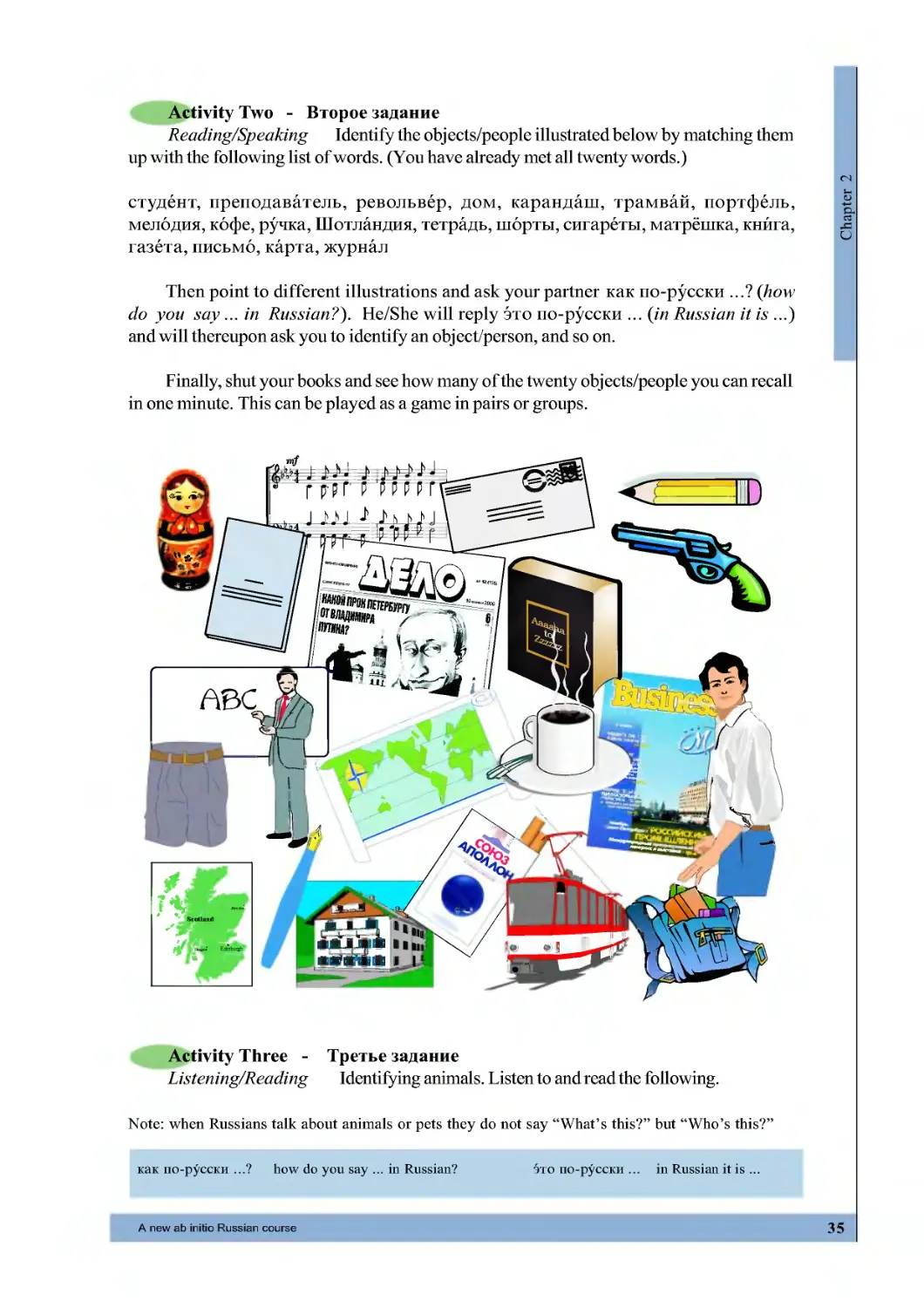
Activity Two - BTopoe 3a)J;aHHe
Reading/Speaking Identify the objects/people illustrated below by matching them
up with the following list of words. (You have already met all twenty words.)
cTy,n:eHT, rrperro,n:aBaTeJIb, peBOJIbBep, ,n:OM, KapaH,n:allI, TpaMBaH, rropT<peJIb,
MeJIo,n:H5I, Ko<pe, pyqKa, 1lI0TJIaH,n:H5I, TeTpa,n:b, llIOpTbI, cHrapeTbI, MaTpellIKa, KHHra,
ra3eTa, rrHcbMo, KapTa, )KYPHaJl
N
....
OJ
....
..s=
U
Then point to different illustrations and ask your partner KaK rro-pyccKH ...? (how
do you sa)) ... in Russian?). He/She will reply 3TO rro-pyccKH ... (in Russian it is ...)
and will thereupon ask you to identify an object/person, and so on.
Finally, shut your books and see how many of the twenty objects/people you can recall
in one minute. This can be played as a game in pairs or groups.
... .
- .m ! J,
I 'H D DDDDr
J .HJ l' J
- . F
.... ,.,.
ill
,"
...
-i ;:; .
\1
--..,# .
___i
1
, .
Scotland
'>'
/1-:
.
Ed1 burgh
. .
. -
. -"" 11- ;-. / IIII
. i. 1.::[ ;
,=. 1 '.1 .."
Activity Three -
Listening/Reading
TpeThe 3a)J;aHHe
IdentifYing animals. Listen to and read the following.
Note: when Russians talk about animals or pets they do not say "What's this?" but "Who's this?"
, ?
KaK rro-pYCCKII ....
how do you say... in Russian?
1TO rro-PyccKII... in Russian it is ...
A new ab initio Russian course
35
c<:j
E
gj
P-
o
f-'
:ho C06aKa.
:ho CJIOH.
:ho KOllIKa.
:ho JIOllIa,n:b.
KTO 3TO?
.
:ho KpOJIHK.
ino MbIllIb.
.
.
,
:ho qeperraxa.
:ho JIeB.
Whilst Russia's rural population or peasantry has, of course, been brought up with fann animals, the vast majority
of town-dwellers live in large blocks of flats and hence have always found it difficult to keep pets. The ravages of
the Second World War and the harsh economic realities oflife under Commlmism likewise had a dramatic effect on
pet-ownership. However, in recent times an increasing number of people have begun to keep cats and dogs and
other small domestic animals and there are considerably more stray animals roaming the streets. As a result of the
increase in organized and petty crime, many more Russians have invested in large dogs, such as Alsatians and
Rottweilers, to protect themselves and their property. For some of Russia's new elite, stud fanns with expensively
equipped stables and emaculately groomed horses are now becoming a status symbol to match their latest Mercedes
and BMW cars.
Activity Four - -qeTBepTOe 3a)J;aHHe
Writing Fi11 in the grid below with the names of the animals you have met so far.
co6aKa
KOT/KOlliKa
KponlIK
dog
cat
rabbit
36
qeperraxa
cnOH
nOllia):\b (f)
tortoise
elephant
horse
MbIllib (f)
neB
mouse
lion (also the Russianfor
Leo, as in Leo Tolstoy)
5 azov (Russian from Scratch)
Activity Five II5IToe 3a)JaHHe
Reading The Russian for 'whose' is qeM (m), qb51 (t), qbe (n), qbH (pi). Look at
the questions on the left and provide an appropriate reply by selecting the correct fonns from
the other two columns. Then match up your answer with the most likely speaker ofthose
illustrated on the right.
N
....
OJ
....
..s=
U
QUESTION
ANSWER
SPEAKER
,..
qeM 3TO KJIlOq?
ino Moe
KJIlOq.
;,.
, .
',- .)
qb51 3TO CHrapa?
ino MOM
rrJIa Tbe.
qbe 3TO rrJIaTbe?
ino M05l
llIOpTbI.
\'
'
qbH 3TO llIOpTbI?
ino MOM
CHrapa.
I 'L
f' (:,
Activity Six - IIleCToe 3alIaHHe
Speaking Imagine that you are working in a lost property office (6lOpO Haxo,n:oK)
and that a number of people are waiting to claim their missing possessions. Ask different
students in your group (or, if there are only two of you, your partner who will play several
roles) whose the objects are in the first list. The respondents will identifY different objects as
their own; (e.g. you ask qeM 3TO )KYPHaJI? and someone replies ino MOM )KYPHaJI.)
Then change the roles with respect to the second list. Remember to pay attention to the
correct fonns ofthe words in each case.
1. KnIO'l, cIIrapa, nIIHeiIKa, KapTa, peBonbBep, rrIIcbMo, TeTpa,n:b, MaTpernKa, rnopTbI,
KapaH,n:arn, COqIIHeHIIe, rrorryraiI
2. KHIrra, oToKorrII51, ,n:oKYMeHT, cIIrapeTbI, pyqKa, )KypHan, Bo,n:Ka, rranbTo, rrnaTbe,
rropT enb,qaiI,KapTN
61Opo (indeclinable) Haxo):\oK
qeiI (m), %51 (f), %e (n), %II (pl)
qeiI (etc. ) :'JTo ...?
KnlOq
clIrapa
rrorryraiI
lost property office
whose
whose is this ...?
key
cIgar
parrot
4JoToKOrr1I5I
rranbTo (indeclinahle)
rrnaTbe
qaiI
COqlIHeHlIe
photocopy
coat
dress
tea
essay
A new ab initio Russian course
37
Activity Seven - Ce)J;hMoe 3a)IaHHe
Listening/Reading/Speaking First, listen to the following dialogue which involves
an argument between young people and their teacher, Anna Pavlovna, about cigarettes. Then
read it aloud or act it out in groups.
c<:j
E
gj
P-
o
f-'
YqHTeJIbHHu:a
EopHc
HaTallIa
MapHHa
:I1ropb
CallIa If Mallia
:I1ropb
CallIa H Mallia
EopHC
YqHTeJIbHHu:a
BopHc
YqHTeJIbHHu:a
qbH :ho cHrapeTbI? :ho TBoH cHrapeTbI, EopHc?
- HeT, He MOM, AHHa IIaBJIOBHa. :ho TBOH CHrapeTbI,
HaTallIa?
- HeT, :ho He MOM CHrapeTbI. :ho ee cHrapeTbI. (Pointing at
Marina)
- :ho HerrpaB,n:a. :ho He MOM CHrapeTbI. :ho, MO)KeT 6bITb,
ero cHrapeTbI. (Pointing at Igor)
- HeT, He MOM. 51. He KYPW. :ho If X cHrapeTbI!
(Pointing at the twins, Sasha and Masha)
- :ho He HallIH CHrapeTbI.
- CallIa If Mallia, :ho BallIH cHrapeTbI.
- HeT, :ho He HallIH CHrapeTbI. MbI He 3HaeM, qbH :ho
cHrapeTbl.
- Pa3Be 3TO He BallIH CHrapeTbI, AHHa IIaBJIOBHa?
- MOM?
- ,l],a, BallIH.
- Oii, rrpocTHTe. ,l],a, :ho MOM CHrapeTbl.
(Evelyone laughs)
Activity Eight - BOChMoe 3a)J;aHHe
Listening/Speaking Listen again to how the native speakers pronounce the follow-
ing phrases and repeat them in the gaps provided on the tape.
1. qbH :ho cHrapeTbI?
2. MbI He 3HaeM, qbH :ho cHrapeTbl.
3. :ho TBoH cHrapeTbI, EopHc?
4. HeT, He MOM.
5. HeT, :ho He MOM cHrapeTbl.
6. :ho, MO)KeT 6bITb, ero cHrapeTbl.
7. :ho HX cHrapeTbI!
8. :ho HerrpaB,n:a.
9. :ho He HallIH CHrapeTbl.
10. Pa3Be :ho He BallIH CHrapeTbI, AHHa IIaBJIOBHa?
I 1. MOM?
12. ,l],a, :ho MOM CHrapeTbl.
TBOM (m), TBoii (f), TBoe (n), TBOM (pl)
(informal)
ero (m, f, n & pl) (pronounced eBo)
ee (m, f, n & pl)
Halli (m), Hallia (f), Hallie (n), Hallill (pl)
Balli (m), Ballia (f), Ballie (n), Ballill (pl)
Uormal)
ilK (m, f, n & pl)
38
He
rrpaBlJ a
'no HerrpaB):\a
MO)KeT 6bITb
51 He KYPro
MbI He 3HaeM
pa3Be
rrpocTMTe
not
truth
that's not true
perhaps, maybe
I don't smoke
we don't know
in fact, really
forgive (me)
your
his
her
our
your
their
5 azov (Russian from Scratch)
A tivity Nine - ,lI,eBSlToe 3a)J;aHHe
Listening/Reading/Writing Look at the map of Russia and listen to where the
interviewees say they live. Then match up each person (from the following list) with the
appropriate town.
llpMHa JIeoHTbeBHa, IIaBeJI, EKaTepMHa MHXaHJIOBHa <DOMHHa, 3051,
)J,MMTPHH, POCTHCJIaB CTenaHOBHq, Ha,n:e)K,n:a IOpbeBHa, <De,n:op KOHcTaHTMHoBHq
raCTeB, KceHH5I, EJIH3aBeTa AJIeKCeeBHa, AHaTOJIHH KaCnaPOB, CBeTJIaHa
N
....
OJ
....
..s=
U
You will need to know the Russian for 'where do you live?' - r,n:e TbI )I{IlBernb? (informal and used
with children) or me BbI )l{IlBeTe? (formal/plural) and also the reply 'I live in ...' - 51 )KIlBY B ... .
Note: the form ofthe word changes slightly after the preposition B.
If the town is masculine the letter -e is added; e.g. POCTOB (Rostov) changes to B PocToBe.
If the town is feminine the final-a (or -H) is removed and the letter -e is added; e.g. MocKBa (Moscow)
changes to B MocKBe.
KApT A POCCMM
Activity Ten - .lI.ecslToe 3a)J;aHHe
Speaking Role-play. You play the part of A and your partner plays B, then reverse
the roles.
A
1. Say hello. (formal)
Ask your partner his/her name.
Ask him/her how he/she feels.
Ask him/her where he/she lives.
Say goodbye.
B
Give an appropriate reply.
State your name.
Describe how you feel.
Say where you live.
Respond appropriately.
2. Say hi. (informal, of course)
Give your name.
Express pleasure at meeting the friend.
State where you live.
Respond appropriately.
Reply and ask your partner his/her name.
[ntroduce a friend.
Ask your partner where he/she lives.
Say: "see you tomorrow".
r):\e TbI )KIIBerrrb? (informal)
r):\e BbI )KIIBeTe? (formal)
where do you live?
where do you live?
51 )KilBY
B (+ prepositional)
I live in
A new ab initio Russian course
39
Activity Eleven - O)IHHHa)J;o:aToe 3a)IaHHe
Reading/Speaking Look at the list of names in the left-hand column and state where
c<:j you think he or she is most likely to live. All the possibilities are provided, in jumbled-up
E fonn, in the right-hand column.
gj
P- You will need to know the Russian for 'where does he/she live?' - r,n:e oH/oml )KIIBeT? and the reply
o
'he/she lives in ...' - oH/oml )KIIBeT B ... .
Note: if a country ends in -DB the final-B is removed and the letter -II is added; e.g. AHmII5I (England)
changes to B AHrnIIII. 'In France' is BO <DpaHn:IIII, for ease of pronunciation.
KTO 3TO?
1. :ho KJIay,n:H5I <pOH KpaY3e
2. :ho MapM-IIbep ,l],IOnoH
3. :ho II3,n:,n:H O'PaHJIH
4. :ho XyaH KapJIOC EeJIbBeJIb5lp
5. 3TO ApMHa BaH ,l],eHK
6. :ho Ta,n:eYllI TOMallIeBCKHH
7. 3TO <DpaHqeCKO EOH3TTH
8. 3TO Pa,n:)KMB IIaT3JI
9. 3TO AH,n:peaC IIanaH,n:pey
10. :ho Mropb EBreHbeBHq Ea6aHOB
11. 3TO XHpOKO KypaCaBa
12. 3TO ,l],)KOK MaKMMJIJIaH
r.n:e OH/OHC] )KHBeT?
I1CnaHH5I
1lI0TJIaH,n:H5I
I1H,n:H5I
<Dpa H U: H5I
repMaHH5I
11 TaJIH5I
51.noHH5I
rp e U: H5I
11 pJIaH,n:H5I
II o JIb llIa
rOJIJIaH.n:H5I
POCCM5I
Activity Twelve - ,l],BeHa)J;o:aToe 3a)J;aHHe
Writing Read the biographies below and write down similar details about where
you live. Include the following infonnation: type of accommodation, name of city/town/
village, country.
MeH5l 30BYT HHKOJIaH.
51. )KHBY B KBapTMpe B
ropo.n:e BOpOHe)K, B
PoccMH.
MeH5l 30BYT HMKoJIac.
51. )KHBY B .n:oMe B
.n:epeBHe IIaTTHHreM,
B AHrJIHH.
MeH5l 30BYT HHKOJIb.
51 )KHBY B ,n:oMe B
ropo.n:e HaHT, BO
<DpaHU: HH .
OH )KIIBeT
OHa )KIIBeT
AHrnlI5I
<l>paHl(1I5I
McrraHII5I
IIIoTnaH):\II5I
he lives
she lives
England
France
Spain
Scotland
MH):\II5I
repMaHII5I
MTanlI5I
J[rroHlI5I
rp e u lI5I
M pnaH):\II5I
India
Germany
Italy
Japan
Greece
Ireland
40
nonbrrra
ronnaH):\II5I
PocciI5I
ropo):\
n e peBH5I
B ):\epeBHe
Poland
Holland
Russia
town
village. countryside
in a/the village, in the country
5 azov (Russian from Scratch)
Activity Thirteen - TpHHaJIl(aToe 3alIaHHe
Writing Without looking back at the previous pages, sort out the correct forms for
the verb 'to live' by drawing arrows linking the appropriate parts. In order to help you, one
of the two forms which you have not yet met has been done for you. (Y ou can check your
solution by referring to the Grammar section.)
N
....
OJ
....
..s=
U
51 )KHBellIb we live
TbI )KHBeT he lives
OH )KHBYT .. . they live
OHa )KHBeTe you live (informal)
(we) MbI )KHBY you live (formallplural)
BbI )KHBeT I live
(they) OHM )KHBeM she lives
Activity Fourteen - qeThIpHa)J;l(aTOe 3a)J;aHHe
Reading Where do the people pictured below live?
OHa >KI.1Bi'n B IIla3ro
OH >KI.1Bi'n B II1HBepHecce
OH >KI.1Bi'n B HblOKacIle
OH >KI.1BeT B fll.1.Qce
OHa >KI.1BeT B Weq)(pI.1Il.Qe
"r"
-
OH >KI.1BeT B CaYTreHMnTOHe
OHa >KI.1BeT B 6pl.1CTOIle
OHa >KI.1BeT B nIlI.1MYTe
A new ab initio Russian course
41
c<:j
E
gj
P-
o
f-'
Activity Fifteen - TIHTHalIu:aToe 3a)IaHHe
Reading/Writing State in which towns the following famous European football clubs
play. The towns are given below. You will use the same construction each time.
e.g. ApceHan IlrpaeT B JIoH,n:oHe - Arsenal play in London
1. ACTOH BHJIJIa
2. IOBeHTYc
3. XH6epHHoH
4. CnapTaK
5. TOTTeHX3M XOTcnyp
6. A5IKC
MOCKBa, 3,n:HH6ypr, AMCTep,n:aM, TYPMH, bHpMHHreM, JIOH,n:OH
Activity Sixteen - IIlecTHa)J;u:aToe 3a)J;aHHe
Speaking As in English, nouns can be replaced by pronouns ('it' /'he' /'she', 'they').
In Russian masculine nouns are replaced by OH, feminine nouns by OHa, neuter nouns by
OHO and plural nouns by OHM. State whether the following electrical items are working or
not, using the appropriate pronouns.
You will either use one of the constructons ,n:a, OH/OHa/OHO pa60TaeT (yes, it's
working) or .n:a. OHM pa60TalOT (yes. they are working) or you will use a negative HeT,
OH/OHa/OHO He pa60TaeT (no, it is not working) or HeT, OHM He pa60TalOT (no,
they are not working).
_"J
.,
?
pa,n:HO ,/
, /J
, \
TeJIeBM30p ,)(
O-<J
.
#
KacceTHHK ,/ JIaMna ,/
BH,n:eOKaMepa,)( <pOTOannapaTbI'/
OR (m) it/he
ORa (f) it/she
ORO (n) it
ORl! (pl) they
(OR/ORa/ORO) IIrpaeT (he/she/it) plays
(OR/ORa/ORO) pa66TaeT (he/she/it) works
(ORl!) pa66TalOT (they) work
TeneBlI30p
pa):\lIo
rrneiIep
KOMrrbKnep
KacceTRIIK
naMrra
TocTep
42
nJIenep ,/
KOMnbHHepb] ,)(
TOCTep ,)(
npMHTep ,)(
rrpoeKTOp ,)(
npOMrpbIBaTeJIb ,)(
television
radio
walkman
computer
cassette player
lamp
toaster
rrpMRTep
BII):\eoKaMepa
4JoToarrrrapaT
rrpoeKTop
rrpoMrpbIBaTenb (m)
printer
camcorder
camera
projector
record-
player
5 azov (Russian from Scratch)
Cardinal numbers (1 -100)
1. o.n:MH L1. o.n:MHHa.n:u:aTb 21. .n:Ba.n:u:aTb o.n:MH
2. ,n:Ba L 2. ,n:BeHa,n:u:aTb 22. ,n:Ba.n:u:aTb ,n:Ba N
....
3. 13. TpHHa,n:u:aTb 30. TpM,n:u:aTb OJ
TPH ....
4. qeTbIpe L 4. qeTbIpHa,n:u: a Tb 40. COpOK ..s=
U
5. n5lTb L 5. n5lTHa.n:u:aTb 50. II5ITb.n:eC5lT
6. llIeCTb L 6. llIeCTHa,n:u:a Tb 60. llIecTb,n:eC5lT
7. ceMb 17. CeMHa,n:u:aTb 70. ceMb,n:eC5IT
8. BoceMb L 8. BOCeMHa,n:u:aTb 80. BoceMb)JeC5lT
9. .n:eB5ITb L 9. .n: eB5ITH a.n:u: a Tb 90. .n:eB5IHOCTO
10. ,n:eC5ITb 20. ,n:Ba,n:u:aTb 100. CTO
Numbers do not normally pose great problems in Russian. It might help to consider the following:
i) ,n:Ba has the same derivation as the English word two;
ii) TpIl is, of course, the same as the English three;
iii) ,n:eC5ITb has the same root as decimal, decibel, decade etc. (i.e. Latin: deci11lus - tenth);
iv) the numbers from eleven to nineteen are basically 1/2/3/4/5/6/7/8/9 on 10,
e.g. o,n:IrHHa,n:n;aTb = O,n:IrH (one) sa (on) ,n:n;aTb [shortened form of ,n:ec5ITb] (ten);
v) twenty and thirty are two ten(s) ,n:B:l+,n:n;aTb and three ten(s) TpIl+,n:n;aTb [shortened
forms] ;
vi) fifty, sixty, seventy and eighty are basically five/six/seven/eight ten(s) [ordinary forms];
e.g. rr5ITb,n:edT = rr5ITb ,n:eC5IT(b);
vii) forty (COpOK), ninety (,n:eB5IHOcTO) and a hundred (CTO) must be learnt separately;
viii) to form larger numbers, simply add new elements as in English; e.g. 135 = CTO TpIr,n:n;aTb
rr5ITb.
--
Do not try to memorize all the numbers at once! Deal with them in smaller groups.
Activity Seventeen - CeMHa)J;u:aToe 3a)J;aHHe
Listening You will hear three different activities recorded on the tape.
1. Bingo (JIOTO). Fill in the boxes below with numbers between I and 20 of your own
choice. The native speaker will then read out a series of numbers twice each and you should
cross out your numbers as soon as they are called. The winner is the first to cross out all his/
her numbers.
I.
II.
III.
IV.
2. The native speaker will test your arithmetic by reading out a number of simple subtraction
and addition sums. (Listen for the words nJIlOC and MMHYc.)
3. The native speaker will count in four recognizable patterns. Jot down the particular
pattern in each case.
I. ............ ........... ........... ........... ............... III. .......... ........... ........... ........... ............. ....
II. ............ ........... ........... ........... ............... IV. .......... ........... ........... ........... ............. ....
A new ab initio Russian course
43
c<:j
E
gj
P-
o
f-'
Activity Eighteen - BoceMHa)J;u:aToe 3a)J;aHHe
Speaking You and your partner shouldjot down ten different expressions of quan-
tity in English (e.g. 'pints in a gallon ') and then ask each other to provide relevant responses
in Russian; e.g. your partner says 'players in a rugby league team' and you reply
TpHHa)JQaTb.
Activity Nineteen - ,l],eBHTHa)J;u:aToe 3a)J;aHHe
Listening You will hear ten numbers recorded on the tape, each of which relates to a
different place or building below. Write alongside each picture the number which relates to it.
Choose from the following: TeaTp, YHHBepcHTeT, llIKOJIa, o6II(e)KMTHe, KHHO,
BOK3aJI, napK, co60p, cTa,n:HoH, naM5ITHHK
n' ga,-
j A
L . L
D
n r
uuuuul " D
rl
Activity Twenty - ,l],Ba)J;u:aToe 3a)J;aHHe
Listening You will hear six Russians saying where they live. You should fill in the
following infonnation: i) the number oftheir block of flats (,n:OM), ii) the number oftheir flat
(KBapTMpa) and iii) their telephone number (TeJIe<poH), which will consist of six digits
divided into three blocks of two.
MeHH 30BYT HBaH
IIeTpOBIlq ConOBbeB.
51 )KIlBY B MYPMaHcKe.
MOM a,n:pec:
EonbrnoM rrpocrreKT,
LlOM _, KB. _____
Ten.
MeHH 30BYT HaTanb5I
MIlxaMnoBHa KaTKoBa.
51 )KIlBY B TaM6oBe.
MOM a,n:pec:
rrnOll(a,n:b larapIlHa,
LlOM _, KB. _____,
Ten.
MeHH 30BYT MpIIHa
MBaHoBHa MOIlceeBa.
51 )KIlBY B PocToBe.
MOM a,n:pec:
ynIllJ,a Tpy,n:a,
LlOM _____, KB. _____
MeHH 30BYT IIaBen
EOPIrCOBII'I3acnoHoB.
5J )KIlBY B BOpOHe)Ke.
MOM a,n:pec:
MOCKOBCKIlM rrpocrreKT,
LlOM _, KB. ____,
Ten.
Ten.
5
MeHH 30BYT HennIl
Ba,n:IrMOBHa <I>e,n:opOBa.
51 )KIlBY B HOBropo,n:e.
MOM a,n:pec:
TBepCKa5I ynIllJ,a,
LlOM _, KB. _____,
6
MeHH 30BYT AneKceM
BIlTanbeBIlq PaM3IrH.
51 )KIlBY B TOMcKe.
MOM a,n:pec:
rrpocrreKT II06e,n:bI,
LlOM _, KB. ____,
Ten.
Ten.
Tea TP theatre co6op cathedral rrpocneKT avenue
IllKona school cTa):\IIOR stadium ynlIl(a street
06rrre)KMTlIe student hostel naM5ITHIIK monument ynlIIIa Tpyna Labour Street
KIIHO (indeclinable) crnema Tene4JoH telephone MOCKOBCKlIiI (adjective) Moscow
BOK3an station a):\pec address rrnOIl(a):\b (f) square
napK park 6onbrrroiI big rrpocneKT TIo6e):\bI Victory Avenue
44
5 azov (Russian from Scratch)
Days of the week ,l],HH He,n:eJIH
IIOHe,n:eJIbHIIK*
BTOpHIIK
cpe.n: a
qeTBepr
II51THII.Qa
cy660Ta
BocKpeceHbe
Monday
Tuesday
Wednesday
Thursday
Friday
Saturday
Sunday
N
....
OJ
....
..s=
U
* Days of the week do not begin with a capital letter unless they are the first word in a sentence.
Three of the days are connected with numbers, i.e. BTOpHIlK = BTOpOM (,n:eHb) : second (day);
qeTBepr = qeTBepTbIM (,n:eHb) : fourth day; mITHIln:a = mITbIM (,n:eHb) : fifth day.
Two days have religious connections: cy660Ta = the sabbath; BocKpeceHbe is cognate with
BocKpeceHIle (resurrection).
The word cpe,n:a means 'milieu' or 'medium'. It is the day which is in the middle ofthe week.
The word rroHe,n:enbHIlK suggests 'the day after Sunday'. (Its origin can be traced back to Old
Church Slavonic.)
Activity Twenty-One - ,l],Ba)J;u:aTh nepBoe 3a)J;aHHe
Writing Using the grid below, fill in the days of the week. (Only one order is
possible.)
Activity Twenty-Two - ,l],Ba)J;u:aTh BTopoe 3a)J;aHHe
Writing Using the grid on the next page, check that you got the days ofthe week
right in the previous exercise. Then complete the missing squares by filling in the appropriate
Russian names from the list provided below. The names are given in random order.
A new ab initio Russian course
45
PYCCKIIe IIMeHa Russian names
c<:j
E
gj 1
P- 2
0
f-'
In
3 LJ n
4 E 0 71 C
5 T H T P
6 B 0 C K piE C E H b E
7 E Y ,Q V1 ,Q
8 P 6 E LI A
9 r 6 n A
10 E 0 b
11 T H
12 A V1
-
13 K
14
15
16
2 3 4 5 6 7 8 9 10 11 12 13 14 15 16
ITa rOPI130HT AJII1(ACROSS)
I1ropb
SeJIJIa
ApKa,n:HH
COH5I
OJI5I
AH5I
I1HHa
Mar,n:aJIMHa
46
ITa BEPTI1KAJII1 (DOW )
PMMMa
3051
CTena
Ma51
AJIeKCeH
I1pMHa
AJI5I
KJIa pa
AJIeKCaH,n:pa
HHKMTa
:I1pa
PMTa
KHpMJIJI
HaTallIa
POMa
OJI5I
TaH5I
MapM5I
Pa51
MHxaMJI
5 azov (Russian from Scratch)
GRAMMAR
HOW TO SAY 'YOUR', 'HIS', 'HER', 'OUR', 'THEIR', 'WHOSE'
N
....
OJ
The attributive possessive pronouns can be sunmlarized as follows: ....
..s=
MY YOUR HIS HER OUR YOUR THEIR WHOSE U
Masc. MOM TBOM ero ee Ham Barn IlX qeM
Fem. MO}]: TBO}]: ero ee Harna Barna IlX qb5I
Neut. Moe TBoe ero ee Harne Barne IlX qbe
Plur. MOM TBOM ero ee HamIl B arnIl IlX qbIl
Note: The above forms also express the predicative possessive pronouns: 'mine', 'yours', 'his', 'hers', 'ours',
'theirs' .
Activity Twenty-Three - ,l],Ba)J;u:aTh TpeThe 3a)J;aHHe
Reading/Writing Express the following phrases in Russian. To assist you, a list of
all the required fonns and nouns is provided below, although not in the right order.
I. my cigarettes
2. myhouse
3. their school
4. our university
5. yourradio (formal)
6. your shorts (informal)
7. our library
8. his sister
M05l rrpen O.n:aBa TeJIH
TBoM llIKOJIa
HallI MaMa
HallIa llIOpTbI
TBoe KJIlOq
HallIH rrJIaTbe
BallIa cHrape
MOM ,n:OM
9. mymum
10. your exercise book (informal)
I L. your exercise (formal)
12. our letters
13. my dress
14. your pen (formal)
15. her key
16. your lecturers (infonnal)
ee CeCTpa
BallIe pyqKa
fIX 6H6JIHOTeKa
TBOiI ynpa)KHeHHe
ero YHHBepCHTeT
MOM nMCbMa
TBOM TeTpa,n:b
Moe pa,n:HO
Activity Twenty-Four - ,l],Ba)J;u:aTh qeTBepToe 3a)J;aHHe
Speaking/Writing Now write up another sixteen phrases and their English
equivalents beginning with the following fonns. You can then test your partner on them by
asking either «KaK nO-PyccKH ... ?» ("What is the Russian for ... ?") or «KaK rro-
, ? ( " Wh . h E I . h fi ?" )
aHrJIHHCKH ....» at is t e ng is or .... .
1. MOM 5. TBoM 9. M05l 13. TBOH
2. HallIa 6. HallI 10. BallIe 14. BallIH
3. BallIa 7. Moe 11. HallIH 15. Balli
4. TBoe 8. Hallie 12. MOM 16. TB05l
A new ab initio Russian course
47
THE PRONOUNS 'HE', 'SHE', 'IT', 'THEY'(WHICHREPLACENOL S)
c<:j MASCULINE NOUNS OH (it/he)
FEMININE NOUNS oHa (it /she)
E
gj NEUTER NOUNS OHO (it)
P- PLURAL NOUNS OHM (they)
0
f-'
Instead of repeating the noun, Russian (like English) frequently uses pronouns. When
referring to people the gender is obvious.
e.g. rrperro,n:aB:'nenb )KIIBeT 3,n:eCb - OH )KIIBeT 3,n:eCb
the lecturer lives here - he lives here
cTy,n:eHTKa )KIIBeT TaM - OHa )KIIBeT TaM
the (female) student lives there - she lives there
,n:eTII )KIIBYT 3,n:ecb - OHM )KIIBYT 3,n:eCb
the children live here - they live here
However, when referring to objects you must remember the gender of the object and use
the appropriate pronoun for that 0 bj ect:
e.g. In;e CTon? CTon 3,n:eCb. OH 3,n:eCb.
Where's the table? The table is here. It is here.
l,n:e 6II6nIIoTeKa? EII6nIIoTeKa TaM. aHa TaM.
Where's the library? The library is there. It is there.
l,n:e OKHO? OKHO TaM. OHO TaM.
Where's the window? The window is there. It is there.
l,n:e cIIrapeTbI? CIIrapeTbI 3,n:ecb. OHM 3,n:eCb.
Where are the cigarettes? The cigarettes are here. They are here.
THE VERB 'TO LIVE' - }JUITh
51 )KHBY I live MbI )KHBeM we live
TbI )KHBellIb you live BbI )KHBeTe you live
OH he
oHa} )KHBeT she} lives OHM )KHBYT they live
OHO it
In addition to conveying the idea 'I live' etc., the above forms also express the notions 'I am living', 'I do
live' etc. because there is only one present tense in Russian. Hence, r,n:e TbI )KIIBernb? means 'where do
you live?' Note that H only has a capital letter at the beginning of sentences.
HOW TO EXPRESS 'IN', 'ON' AND 'AT'
The prepositions B (in, at) and Ha (on, at, in) take what is called the Prepositional case.
Masculine - In most instances simply add -e
qeMo):(aR ( suitcase)
POCTOB (Rostov)
B qeMo):(aRe (in a/the suitcase)
B POCTOBe (in Rostov)
CTon (table)
KORIJ.epT (concert)
Ra CTone (on a/the table)
Ra KORIJ.epTe (at a/the concert)
If a noun ends in a soft sign (-1,), remove the soft sign and add-e
nopT<penb (briefcase) B nopT<pene (in a/the briefcase) aBToMo6iinb (car) Ra aBToMo6iwe (in the car/by car)
If a noun ends in -ii, remove -ii, and add -e
KllTaii (China) B KllTae (in China)
TpaMBaii (tram)
Ra TpaMBae (in the tram/by tram)
48
5 azov (Russian from Scratch)
Feminine
In most instances simply remove -a or -51 and add -e
MocKBa (Moscow) B MocKBe (in Moscow)
rreCH5I (song) B rrecHe (in a/the song)
4Ja6plIKa (factory) Ha 4Ja6plIKe (in a/the factory)
If a noun ends in a soft sign (-1,), remove the soft sign and add -H
neqaTb (print) B neq:lT1I (in print)
N
....
OJ
....
..s=
U
If a noun ends in -HB, remove -51 and add -H
AmnlI5I (England) B AmnlIlI (in England)
neKl(II5I (lecture)
Ha neKl(1I1I (at a/the lecture)
Neuter - In most instances simply remove -0 and add-e
nlICbMO (letter)
B nlICbMe (in a/the letter)
OKHO (window)
Ha oKHe (in a/the window)
If a noun ends in -e, the ending remains unchanged
none (field) B none (in the field(s» Mope (sea)
Ha Mope (at sea)
If a noun ends in -He, remove -e and add -H
3):\aHlIe (building) B 3):\aHIIII (in a/the building) 3aHiiTIIe (class)
Ra 3aHiiTIIII (in a/the class)
Usually B means 'in' and Hameans 'on', but sometimes Ha is used to convey the meaning 'in', as in some
ofthe examples above and with the following words: 3aBo,n: (factory), cTa,n:IIoH (stadium), Yp:'w (the
Urals), YPOK (lesson), pa60Ta (work), MarnIIHa (car) and other forms of transport.
Note: some foreign words ending in vowels do not change; e.g. B f'ml3ro (in Glasgow), Ha TaKCIr (by
taxi), Ha MeTpo (by metro / on the underground), B KIIHO (in/at a/the cinema).
Activity Twenty-Five - ,l],Ba)J;u:aTh mlToe 3a)J;aHHe
Speaking First, look at the picture below in which one object is piled on top of
another and state where each object is situated. Start at the top and work down. (Y ou will
begin KapaH,n:allI Ha nHcbMe. IIHcbMo Ha KHHre. KHHra Ha ... .) Then go
round the class adding another object each time.
- ti \
KapaH,n: lIli
IIIICbMO
KHMra
)
- .,
" ,;
"' /"
'
TeTpa,n:b (f) _______________________________
" 11
- '.
'@
KapTa
Q
qeMO,n:aH
CTYJI
...
I
"
CTOJI
.
,}, .i '()
} ;. 1
CJIOH
: *
.----,
1/1)---
\)
MarnMHa
-
rpY30BMK
A new ab initio Russian course
49
c<:j
c<:j
E
gj
P-
o
f-'
3TO KOIliKa
: .
.
' -
( ' --'
41'
h . :. ;J.
! -," ' /{. \
1/- '" I' <
: r .\1;: '-i \}(
'.< -l- _ -
50
5 azov (Russian from Scratch)
CHAPTER 3
c<:j
c<:j
E
t>:i
.!I
f-'
Q)
\ Ot-t
\ '
. ft,
''II "
'
A SI npeno,n:aBt'lTeJIb(HIrQa).
CHAPTER THREE
TPEThJl rJIABA
WORK
NATIONALITY
PAEOTA
HAQnOHAJILHOCTL
In Chapter Three you will learn how to do the following:
L to recognize and talk about jobs
2. to state your nationality and identify the nationality of other people
3. to express movement on foot and by transport
4. to use simple constructions of time
You will learn the following points of grammar:
L the use of no (+ Dative) in set expressions
2. the verbs "to work' (pa66TaTl
) and 'to go' (H)J;TH, exaTl
)
3. the accusative case with movement and expressions of time
Activity One llepBoe 3a)J;aHHe
Listening/Reading Listen to people talking about their jobs.
KTO BbI no npo<peccHH? (KTO TbI no npo<peccHH?)
(""-") )
-1/ ...,- I
f;i I
=
. I ;-,
51 no npo<peccHH
Me,n:cecTpa.
5J no npo<peccHH
HH)KeHep.
KaKa51 y Bac npo<pecCH5I? (KaKa51 y Te65i npo<pecCH5I?)
--I
f--;:-::
/
) i'::--I
- )
-! .
. 'J _ ,-,
'l -, I'
I.
'. /"'L.
. r... .
.,' \
7 - ,
51. Bpaq.
,.79'
ir
.
-
( -.. " \
I
'n-IT '
I
--
!II--
51. llIO<pep.
'
A 51 o<pHQHaHTKa.
KTO BbI no rrpo4JeccIIII? (formal)
KTO TbI no rrpo4JeccIIII? (informal)
what is your profession?
(literally: who are you by
profession ?)
what is your profession?
(literally: what profession
do you have?)
Me):\ceCTpa
IIH)KeHep
npeno):\aB[nenb( HIIl(a)
Bpaq
llio4Jep
o4JIIl(lIaHTKa
KaKa51 y Hac npo4JecCII5I? (formal)
KaKa51 y Te6ii npo4JecCII5I? (informal)
52
nurse
engmeer
lecturer
doctor
driver
waitress
5 azov (Russian from Scratch)
Activity Two - BTopoe 3a)J;aHHe
Speaking Look at the pictures below and the accompanying captions (which state
briefly the person's name, job and place of residence) and interview your partner about the
people. You should ask the following questions in each case.
QuestIon
KaK er6/ee 30BYT?
KTO oHiOHa IIO IIpo eccIIII?
r.n:e OH/OHa )J{IIBeT?
t
(/ /::'
"' -
r/ /
'
:JZehift
tp'lJfiOCJ...!UChi,
.JTla..etOcJ$
"="")
, \'{ {
?_ l
.
p ,c
t/gaJt lieunU
oamatft
/W$WfWq
JfieM!tpo a
.,/.{ocda
Tene4JoHlIcTKa
MarnlIHIICTKa
aKTplIca
):\OMarnH5!5! x03HllKa
A new ab initio Russian course
What is his/her name?
What is his/her profession?
Where does he/she live?
Reply
Er6/Ee 30BY1 ...
OH/OHa (IIO IIpo eCCIIII) ...
OH/OHa )J{IIBeT B ... (+ prepositional)
M
.....
OJ
......
P,
cO
..s:::
U
-
... I}
- >.
' , +.
A..ua
ne$t/.t1a
lJoftOJte.JIC
( .
& (
,"r
Tlaffe..t AJtfljted
zeooiloz
£ ahieftuJto'lftz
-t
(' ...
( -0;' - -: !-
'"'i . ,
-- , \ !
> Jr'
J 1JLL
- l\;=-r . _ '
.:c
\ .:.. --------
CejtzeU Cejtzee$u't Ce,ueJt()$
.JIC'f
ttjtJc'lhic
telephone operator
typist
actre s s
housewife
:iKypHanlICT
yqlITenb (m)
rreBIIl(a
reonor
--
0;::
'r-
, m- '
Ikunauta
CaJt hi-:lleIiiejto'ljtz
_: ' \
I --
; '1 = '
r- ---::
r-
,
.J1laJt.5l
aJafijtuca
IIa.xoqKa
lioftuc .:lla£,w$u't
'I't
A
journalist
teacher
sIllger
geologist
''' m 1f\'f
t
.
_I
,
tIjtmta
.JJochio$
.a
,-' I ' 1/ \
1 "1'- i-L_I
.\.""=-l
\' \ \
j!B cE\
.4lOqa
q
&aqu$oCJfio
<5 ),
\
('
/
-,-
JOjutU :JloIW$
aq$oKahi
Kue$
4JYT60nIICT
a):\BoKaT
6aHKIIp
rlIMHacTKa
footballer
barrister
banker
gynillast
53
Activity Three TpeThe 3a)J;aHHe
Reading/Writing Work out the Russian for 'builder' (in the bold box which runs
cO
vertically) by filling in the answers to the clues provided in the grid below. Words which you
E have not yet met are given at the foot of the page.
t>:!
.!I
f-'
Q)
1. OHa pa60TaeT B 60JIbHMu:e.
2. OHa pa60TaeT B TeaTpe.
3. OH pa60TaeT B 6aHKe.
4. OH pa60TaeT B pecTopaHe.
5. OH pa60TaeT Ha 3aBo,n:e.
6. OHa pa60TaeT B KaHu:emlpHH.
7. OH pa60TaeT B IIa6e.
8. OHa pa60TaeT B YHHBepcHTeTe.
9. OH pa60TaeT B llIKOJIe.
Activity Four - qeTBepToe 3a)J;aHHe
Speaking Role-play. You play the part of A and your partner plays B, then reverse
the roles. You will need to know the expressions 5I pa6oTaIO (I work), and r,n:e TbI
pa6oTaellIb? / r,n:e BbI pa6oTaeTe? (where do you work?).
A
B
Say hello to your partner. (formal)
Ask your partner what job he/she does.
Ask him/her where he/she works.
Express your pleasure at meeting him/her.
Say that you are a teacher.
Say that you work in a school in Saint
Petersburg.
Reply appropriately.
Say goodbye.
A
B
Say hello to your partner. (informal)
Tell him/her that you are fine.
Say that you are a doctor and that you
work in a hospital in Moscow.
Say goodbye.
Say hello and ask him/her how he/she is.
Ask your partner what he/she does.
Tell him/her that you are an engineer in a
factory in Kiev.
Reply appropriately.
o4JIIl(IIaHT
6apMeH
60nbHIIl(a
TeaTp
6aHK
pecTopaH
KaHl(enHplI5!
rra6
51 pa60TalO
r):\e TbI pa60Taernb? (informal)
r):\e Bbl pa60TaeTe? (formal/plural)
waiter
barman
hospital
theatre
bank
restaurant
office
pub
I work
where do you work?
where do you work?
54
5 azov (Russian from Scratch)
Activity Five - nSlToe 3a)IaHHe
Writing You have now met all the forms of the verb pa60TaTb (to work), except
MbI (the first person plural). Match up the appropriate endings below. The MbI-form is
done for you. (You can check your solution by referring to the Grammar section.)
5I pa60TaellIb we work
TbI pa60TaeT. / you work (formaZlpZural)
OH / pa60TaeM / they work
OHa pa60TaeTe you work (iriformal)
M bI pa6oTaIO she works
M
.....
OJ
......
P,
cO
..s:::
U
OHM
pa60TaIOT
pa60TaeT
he works
BbI
I work
A tivity Six - IIIeCToe 3a)J;aHHe
Listening Listen twice to the descriptions on the tape and answer the following
questions in English.
1. Where does the woman work?
2. Whatistheman'sjob?
3. In which country does the footballer play?
4. What is the woman's job?
5. What is the equivalent English name of the restaurant where the waiter works?
6. In which town does the builder work?
Activity Seven - Ce)J;hMoe 3a)J;aHHe
Reading/ Speaking/Writing You are by now quite familiar with the prepositional case
after Band Ha. As you know, 'in Moscow' = B MocKBe. However, if a word ends in -aH the
ending is not -e but -OR. Hence, rOCTMHa5I (lounge) becomes B rocTMHoH.
Bearing in mind the above rule, first of all put the following into Russian:
1. dining room cToJI6Ba5I in the dining room
2 bedroom CilaJIbH5I in the bedroom
3. study Ka6IIHeT in the study
4. toilet TyaJIeT in the toilet
5. attic '1ep.n: aK in the attic Ha
6. bathroom BaHHa5I in the bathroom
7. kitchen KYXH5I in the kitchen Ha
8. cellar II6rpe6 in the cellar
9. basement II O.n:B aJI in the basement
10. garage rapa)J{ in the garage
Then answer the questions on the next page (relating to the drawing of the house). You will
need to recognize the following vocabulary:
KapTIIHa (picture), KpOBaTb (f) (bed), KHII:iKHbIll rnKa4J (book cupboard), rap):\ep06 (wardrobe), ne% (f)
(oven, stove), 6y4JeT (sideboard), rrlIaHIIHo (indeclinable) (piano), paKoBIIHa (sink, wash-basin), KneTKa
(cage), Kpecno (armchair), naMrra (lamp, light), '3epKanO (mirror), qaCbI (pi) (clock, watch), BaHHa (bath-
tub), CTon ):\n5! HaCTonbHoro TeHHlIca (table-tennis table), qeMo):\aHbl (suitcases), BIIHO (wine), MarnlIHa
(car).
A new ab initio Russian course
55
cO
cO
E
t>:i
.!I
f-'
Q)
MatI ,l],OM
Clta.AbJt.fl
I
o
.7lli;cuelii
KaOUHeHi
8--"
JoCliiUJta5l
' .
J
lJaHH0..5/.
1..-
I. q TO Ha '1ep.n:aKe?
2. qTO B CTOJI6BOM?
3. q TO B rocTMHoM?
4. qTO B Ka6IIHeTe?
5. r.n:e pa.n:IIo?
6. r.n:e lIe'lb?
7. r.n:e BIIH6?
8. r.n:e MarnMHa?
9. KTO B BaHHOM?
10. r.n:e MaMa?
Ha qep.n:aKe
OH6B
II pell o.n:aBa TeJIb
(KYXH5I )
N ow interview your partner about the contents of the various rooms and the location of
different objects.
Activity Eight - BOChMoe 3a)J;aHHe
Listening/Reading Nationalities. Listen to and read the following.
KTO BbI IIO HaUHOHaJIbHOcTH? (KTO TbI IIO HaUHOHaJIbHOcTH?)
51. IIO HaU:HoHaJIbHOCTH 51 TO)Ke pyccKa5I.
PYCCKHH.
MbI pyccKHe.
KTO BbI rro Hal(IIOHanbHocTII? what nationality are you?
KTO TbI rro Hal(IIOHanbHocTII? (literally: who are you by nationality?)
51 rro Hal(IIOHanbHocTII ... I am ... / my nationality is ...
PYCCKlIll (m), pyccKa5! (f) Russian
pyccKlIe (pi) Russians
TO:iKe also
56
5 azov (Russian from Scratch)
KaKa5I y BaC HaU:HOHaJIbHOCTb?
(KaKa5I y Te651 HaU:HOHaJIbHOCTb?)
-
--------"'''''' "
.- i
('
\:
.' /,
...
,
.
-1"
\, !
'r
M
.....
OJ
......
P,
cO
..s:::
U
.,
...
,
.,." , ,
.51 aMepHKtmeu:.
.51 aHrJIH"LJaHKa.
.51 KaHa.II:eu:.
Activity Nine - ,lI,eBHToe 3a)J;aHHe
Listening/Reading First, study the table of nationalities below, then (with the help
of the table) answer the listening comprehension questions which follow . You may need to
listen twice to each description.
Nationality M F PL ADJECTIVE
American aMepIIKaHen: aMepIIKaHKa aMepIIKaHn:bI aMepIIKaHcKIIM
Australian aBcTpanMen: aBCTpaJIMMKa aBcTpanMMn:bI aBCTpaJIMMCKIIM
Canadian KaHa.n:en: KaHa.n:Ka KaHa.n:n:bl KaHa.n:cKIIM
Chinese KIITaen: KIITaHHKa KIITaMn:bl KIITaMcKIIM
English aHrJIII'IaHIIH aHrJIII'IaHKa aHrJIII'IaHe aHrJIMMCKIIM
French paHn:Y3 paHn:Y)J{eHKa paHn::Y3bI paHn:Y3cKIIM
German HeMeu HeMKa HeMUbI HeMeUKIIM
Indian IIH.n:Men: IIH.n:IIaHKa IIH.n:MMn:bJ IIH.n:MMCKIIM
Italian IITaJIbHHen: IITaJIbHHKa IITaJIbHHn:bl IITaJIbHHCKIIM
Japanese 5IlIOHen: 5IlIOHKa 5!lI 0 Hn:bI 5IlIOHCKIIM
Russian PYCCKIIM PyccKa5I pyccKIIe PYCCKIIM
Spanish IIcilaHen: IIclIaHKa II clIaHn:bI IIclIaHcKIIM
1. What is Andrea's nationality?
2. What nationality is Igor and in which country does he live?
3. How many ditferent nationalities live in the student hostel? (06rn:e)J{MTIIe)
4. What nationality is Robert and in which town does he live?
5. What is the nationality ofthe lads playing football in the park?
6. What is the nationality ofthe ballerina?
7. What is the nationality ofthe speaker's father and what job does he do?
8. What is the nationality ofthe speaker's mother and what does she do?
Activity Ten - .lI.ecHToe 3a)J;aHHe
Reading/Writing State the nationalities ofthe following people (assuming that they
were all born in the capital city where they now live).
1. OHa )J{IIBeT B B BarnIIHrTOHe. OHa
2. XpIIcTIIaH )J{IIBeT B EepJIMHe. OH
3. EplOC )J{IIBeT B KaH6eppe.
4. MapTa )J{IIBeT B PMMe.
5. CTy.n:eHTbI )J{IIBYT B JIoH.n:oHe.
6. MbI )J{IIBeM B Ma.n:pM.n:e. Mbl
KaKa5! Y Bac Hal(IIOHanbHocTb? (formal)
KaKa5! Y Te6H Hal(IIOHanbHocTb? (informal)
06Il(e:iKIITlIe
what is your nationality?
(literally: what nationality do you have?)
student hostel. hall of residence
A new ab initio Russian course
57
Activity Eleven - O)IHHHa)Iu:aToe 3a)IaHHe
Reading Match up the names of the people with their likely nationality from the list
in bold below.
cO
cO
E
t>:i
.!I
f-'
Q)
<Pa6HeH
,l],)KOH
BaU:JIaB
1.
2.
3.
4.
5.
6.
XaH,Zm
COH,n:HII
AKeMH
7.
8.
9.
XyaH
EJIeHa
IIaTpHK
HeMKa IIH):\IIaHKa IIpnaH):\el( IICrraHel( 5!rrOHKa aMeplIKaHel( pyccKa5! 'lex 4JpaHl(Y:iKeHKa
The Verbs H,n:TM (to go/be going on foot) and exaTb (to go/be going by transport)
SI H,n:y
TbI H,n:ellIb
I1)J,TI1 TO (BE) GO(ING) ON FOOT
I am going
you are going
he/she/it is going
OH/OHa/OHO H,n:eT
MbI H,n:eM
we are going
BbI H,n:eTe
you are going
they are going
om] H,n:YT
SI e,n:y
TbI e,n: ellIb
EXATb TO (BE) GO(ING) BY TRANSPORT
I am going
you are going
he/she/it is going
OH/OHa/OHO e,n:eT
MbI en eM
we are going
BbI e,n:eTe
you are going
they are going
OHM e,n:YT
The Russian for 'Where are you going?' is Ky.n::1 Tbl II.n:ernble.n:ernb? or, using the formal/plural form,
Ky.n:a BbI II.n:eTe/e.n:eTe? (Do not use r.n:e ...? with movement.) When you state the name of your
intended destination (e.g. 'I'm going to the park') you normally use BorHa (as appropriate) followed
by the Accusative case. The endings of the Accusative case are easy:
M
F
N
PL
51 Hlly/ellY B rrapK I'm going to the park
51 Hlly/ellY B llIKOJIY I'm going to school
51 Hlly/ellY B ceJIO I'm going to the village
51 Hlly/ellY B A<rMHbI I'm going to Athens
rra pK - rra pK
IIIKOJIa - IIIKOJIY
ceJIO - ceJIO
A<rMHbI- A<r MHbI
(no change)
(-a replaced by -y)
(no change)
(no change)
Activity Twelve - .lI.BeHa)J;u:aToe 3a)J;aHHe
Listening A group of students are discussing where they are planning to go in the
evening. Jot down in each case both their intended destination and the form of transport they
hope to use. (You will need to know the word for 'on foot' - IIellIKoM.)
1. Igor
2. Masha
3. Lena
4. Petya
5. Vanya and Anna
6. Kolya and Natasha
7. Klara
8. Alyosha
IIp naH):\ el(/Ilp naH):\Ka
qex/qernKa
Irishman/Irish woman
Czech (man/woman)
58
. ?
Ky):\a ....
ceno
where ... (to)?
village
rrernKOM on foot
5 azov (Russian from Scratch)
Activity Thirteen - TpHHa)J;u:aToe 3a)J;aHHe
Speaking Memory game. One of you begins by saying where you are going (e.g.
5I H,n:y B YHHBepcHTeT) and the next person both repeats your phrase and adds another
destination (e.g. 5I H,n:y B YHHBepcHTeT H B 6H6JIHOTeKY) and so on. You start with
ten points and lose one point each time you forget a destination or make a grammatical
mistake. The winner is the last person to lose all ten points.
M
.....
OJ
......
P,
cO
..s:::
U
Activity Fourteen - qeThIpHa)J;u:aToe 3anaHHe
Reading/Writing Express the following in Russian by selecting appropriate phrases
from the columns on the right. (They are of course in random order.)
English Pronoun Verb form B/Ha (+ accl/saTive) Ha (+ prepositional)
or rrelliKOM
1. I'm going to Odessa by car. MbI e.n:y B 6II6JIIIOTeKY Ha TpaMBae.
2. We're going to the university on foot. OH II.n:ernb B Tea TP rrernKOM.
3. He is going to the library on a bike. TbI e.n:eM B MOCKBY Ha TpOJIJIeM6yce.
4. Are you going to the stadium on foot? .5I e.n:eT B rnKOJIY Ha lIoe3.n:e.
5. She is going to the theatre by tram. .5I II.n:eM B ropo.n: rrernKoM?
6. They are going to school on foot. MbI e.n:eT B O.n:eccy rrernKoM.
7. I'm going to Moscow by train. OHa II.n:YT Ha cTa.n:IIOH Ha BeJIOCIIlIe.n:e.
8. We are going to town on the trolleybus. OHM e.n:y B YHIIBepcIITeT Ha MarnMHe.
Activity Fifteen
Speaking/Writing
reverse the roles.
- TIHTHa)J;u:aToe 3a)J;aHHe
Role-play. You play the part of A and your partner plays B, then
A
Meeting in the street
B
Say hello to your partner. (formal)
Ask your partner what nationality he/she is.
Ask him/her where he/she works.
Ask what his/her profession is.
Ask where he/she is going (on foot)?
Say goodbye.
Return the greeting.
Tell him/her your nationality.
Say that you work in a school in Moscow.
Say that you are a teacher.
Say that you are going to work (Ha pa60TY).
Reply appropriately.
A
Meeting in a Russian bus
B
Say hello to your partner. (formal)
Tell him/her that you are going to town.
Because (ilOTOMY '1TO) you work in the
town in a restaurant.
Confirm that you are a waiter/waitress.
Ask what job he/she does?
Say cheerio.
Say hello and ask him/her where he/she is going.
Ask him/her why? (IIO'IeMY?)
Ask him/her if he/she is a waiter/waitress.
Say that you are also going to work.
Say that you are a lecturer at a university.
Reply appropriately.
Now make up your own role-play. You should include questions relating to the following:
i) health, ii) nationality, iii) work iv) your partner's intended destination. Stick to what you
know and do not be over-ambitious.
ropo):\
O):\ecca
Tponnell6yc
town
Odessa (Black Sea resort)
trolleybus
A new ab initio Russian course
rroe3):\
BenoclIrre):\
IIOqeMY(?)
train
bicycle
why(?)
rrOTOMY qTO
because
59
cO
cO
E
t>:i
.!I
f-'
Q)
Activity Sixteen -
Listening/Reading
CK6JIbKO
IIIecTHa)Iu:aToe 3a)IaHHe
Telling the time. Listen to and read the following.
ceiiqac BpeMeHI1? KOT6pbIii qac?
(CeM'Iac) 'lac. (CeM'Iac) .n:Ba qaca.
(CeM'Iac) TPII '1aca. qeTbIpe'laca.
(CeM'Iac) IT5ITb'laCOB. IIIecTb '1aCOB.
CeMb qaCOB. BoceMb '1aCOB.
)J:eB5ITb '1aCOB. )J:eC5ITb '1aCOB.
O.n:MHHa.n:n:aTb'laCOB. )J:BeHa.n:n:aTb '1aCOB. *
* midday = lIOJI.n:eHb (m); midnight = lIOJIHO% (f)
Activity Seventeen - CeMHa)J;u:aTOe 3a)J;aHHe
Listening Listen twice to the following recordings from the radio in which an an-
nouncer tells you different times in Moscow. Jot down the times after the second listening.
Each announcement begins rOBOpMT Pa,n:Ho MOCKBa. MOCKOBCKoe BpeM5I ...
(Radio Moscow speaking. Moscow time is ...). Notice that the announcer uses the twenty-
four hour clock.
1.
2.
3.
4.
5.
6.
7.
8.
9.
10.
Activity Eighteen - BoceMHa)J;u:aToe 3a)J;aHHe
Writing Fill in the appropriate forms ofthe Russian for 'hour(s)' or 'o'clock': qac
(after numbers ending in 1, except 11), qaca (after numbers ending in 2,3,4, except 12,
13,14) and qaCOB (after all other numbers).
L 5................... n.
v. 21................... VI.
12 ................... lli.
1 I ................... vn.
4 ................... IV.
16 ................... Vlll.
CKonbKO cellqac BpeMeHII? (colloquial) what's the time?
(literally: how much /lOW is the time?)
KOTOpbIll 'lac? (higher style) what is the time?
(literally: which (is the) hour?)
60
23...................
22 .. .................
cellqac
rron):\eHb (m)
rrOnHO% (f)
rOBopliT
now
midday
midnight
is speaking
5 azov (Russian from Scratch)
Activity Nineteen - ,lI,eBHTHa)J;u:aToe 3a)IaHHe
Listening The following speakers are all talking about their plans to go out. State
where each person is intending to go and at what time. To express' at' a given time, Russians
simply use B (+ accusative). The endings do not change; e.g. B qac (at one o'clock), B
,n:Ba qaca (at two o'clock), B qeT:bIpe qaca (at four o'clock), B II5ITb qaCOB (at five
o'clock), B ,n:eC5ITb qaCOB (at ten o'clock), B IIOJIHOqb (at midnight).
1. The footballer
2. Galina
3. Aleksandr
4. The doctor
5. Yevgeniya
6. Nikita
M
.....
OJ
......
P,
cO
..s:::
U
'On', used with days ofthe week
To express 'on' with days ofthe week, simply use B (+ accusative)
B IIOHe.n:eJIbHIIK
BO* BT6pHIIK
B Cpe.n:y
B qeTBepr
B IIHTHIIU:Y
B cy666TY
B BOCKpeCeHbe
on Monday
on Tuesday
on Wednesday
on Thursday
on Friday
on Saturday
on Sunday
* The sound -0 is added purely for ease of pronunciation; (cf. BO <I>paHn:IIII).
Activity Twenty - ,lI,Ba)J;u:aTOe 3a)J;aHHe
Listening Say on which days of the week Inna (who has eclectic taste) listens to the
types of music listed below. Note that the noun goes into the Accusative case after the
phrase 5I CJIYllIaIO (I listen to). This rule is explained in the next chapter.
POK-H-POJIJI
IIOII-MY3bIKa
,n:)Ka3
3cTpa,n:Ha5I MY3bIKa
KJIaCCMqeCKa5I MY3bIKa
perrH
Hapo,n:Ha5I MY3bIKa
(B) 'lac
(B) lIBahplI/qeTbIpe qaca
(B) rr5!Tb/rnecTb (etc.) qaCOB
51 cnyrnalO (+ accusative)
POK-H-ponn
rrorr-MY3bIKa
(at) one o'clock
(at) two/three/four o'clock
(at) five/six (etc.) o'clock
I listen to
rock and roll
pop mUSIC
A new ab initio Russian course
):\:iKa3
3CTpallHa5! MY3bIKa
KnaCCIIqeCKa5! MY3bIKa
perrII
HapO):\Ha5! MY3bIKa
Jazz
light music
classical music
reggae
folk music
6]
GRAMMAR
cO
cO
E
t>:i
.!I
f-'
Q)
THE USE OF IIO (+ DATIVE) IN SET EXPRESSIONS
You do not need to know all the endings of the Dative case at this stage. However, you
should remember that the preposition IIO usually takes the Dative and you should learn the
following expressions by heart:
KTO TbI/BbI no rrpo4JecclIlI?
51 rro rrpo4JecclIlI
- what is your profession? (literally: who are you by profession?)
- I am a ... (literally: I am by profession a...)
KTO TbI/BbI rro Hal(IIOHanbHocTII?
51 rro Hal(IIOHanbHocTII ...
- what is your nationality? (literally: who are you by nationality?)
- I am ... / my nationality is... (literally: I am by nationality...)
REGL'LAR VERBS: PAEOTATh (TO WORK)
By now you will realize that all verbs, apart from 'to be' , have special forms for the present
tense. It is important to distinguish between these forms since verbs are generally just listed
under the infinitive in Russian dictionaries (to do, to work etc.). You can easily recognize the
infinitive by its last two letters, usually -Th (e.g. ,n:eJIaTb - to do) and occasionally -qh
(e.g. IIeqb - to bake) or -TH (e.g H,n:TM - to be going).
As you will have noticed, the ending of the verb is determined by the personal pronoun
(5I, TbI, OH, OHa, OHO, MbI, BbI, OHM). In most cases you simply remove -Th from the
infinitive and add the relevant endings:
PAEOTATh
51 pa6oTa-IO
TbI pa6oTa-ellIb
OH, OHa, OHO pa60Ta-eT
MbI pa60Ta-eM
BbI pa60Ta-eTe
OHM pa60Ta-IOT
The endings -10, -ellIb, -eT, -eM, -eTe, -lOT are very common when the infinitive ends in
-aTh or -HTh (e.g. MeH5ITb - to change). Verbs in this group (which in future we will refer
to as first conjugation or type I verbs) always adhere to the following two rules:
1) they retain -a (or -H) in their conjugated forms (e.g. 5I pa6oTa-IO);
2) they have fixed stress (i.e. the stress remains the same in their conjugated forms
as in the infInitive).
Activity Twenty-One - ,lI,Ba)J;u:aTh nepBoe 3a)J;aHHe
Writing Work out how to conjugate the verbs qHTaTb (to read) and CJIYllIaTb
(to listen to).
5I qHTa...
TbI qHTa...
OH/OHa qHTa...
MbI qHTa...
BbI qHTa...
OHM qHTa...
5I CJIYllIa...
TbI CJIYllIa...
OH/OHa CJIYllIa...
MbI CJIYllIa...
BbI CJIYllIa...
OHM CJIYllIa...
62
5 azov (Russian from Scratch)
Activity Twenty-Two - .lI.Ba)J;u:aTh BTopoe 3a)J;aHHe
Writing Match the personal pronouns with the appropriate forms of the verb
MeH5ITb (to change).
MbI MeH51IOT
TbI MeH51IO
OHH MeH51eM
BbI MeH51ellIb
5I MeH51eT
OH/OHa MeH51eTe
M
.....
OJ
......
P,
cO
..s:::
U
THE VERBS M)J:TM: (TO BE GOING ON FOOT)
AND EXATh (TO BE GOING BY TRANSPORT)
51 II):\Y
TbI II):\ernb
OH/OHa/OHO IIneT
M)J,Tl1 TO (BE) GO(ING) ON FOOT
I am going MbI II):\eM
you are going BbI II):\eTe
he/she/it is going OHII II):\YT
we are going
you are going
they are going
51 e):\y
TbI e):\ernb
OH/OHa/OHO e):\eT
ExATb TO (BE) GO(ING) BY TRANSPORT
I am going MbI e):\eM we are going
you are going BbI e):\eTe you are going
he/she/it is going OHII e):\YT they are going
THE ACCUSATIVE CASE (WITH MOVEMENT)
In response to the question 'Where are you going?' - Ky,n:a TbI H,n:ellIb/e,n:ellIb? / BbI
H,n:eTe/e,n:eTe?, you normally use B or Ha (as appropriate) followed by the Accusative
case. The endings ofthe Accusative case are as follows:
M 5I fmy/e.n:y B lIapK I'm going to the park lIapK - lIapK (no change)
5I e.n:y B Ea3eJIb * I'm going to Basle Ea3eJIb - Ea3eJIb (no change)
F 5I II.n:Yfe.n:y B rnKOJIY I'm going to school rnKOJIa - rnKOJIY (-a replaced by -y)
5I e.n:y B .n:epeBHlO I'm going to the country .n:epeBH5I - .n:epeBHlO (-5I replaced by -lO)
N 5I II.n:Yfe.n:y B ceJIo I'm going to the country ceJIo - ceJIo (no change)
5I e.n:y Ha Mope I'm going to the seaside Mope - Mope (no change)
PL 5I II.n:y Ha TaHn:bl I'm going to a dance TaHn:bI - TaHn:bI (no change)
5I e.n:y B A MHbI I'm going to Athens A MHbI - A MHbI (no change)
Only the feminine singular forms ending in -a or -5I change.
* The names oftowns and islands ending in a soft sign ( -b) are masculine.
Activity Twenty-Three - ,lI,Ba)J;u:aTh TpeThe 3a)J;aHHe
Writing The following expressions all use the Accusative case. What would the
standard (or Nominative) form of the word in the Accusative be?
1. OHa e.n:eT B .n:epeBHIO.
2. MbI e,n:eM B MOCKBY.
3. 51. H,n:y B ropo,n:
4. BbI H.n:eTe Ha KOHI(epT? 7. 51 H,n:y Ha TaHI(bI.
5. OHH e,n:YT B AHrJIHIO. 8. OH e,n:eT B O,n:eccy.
6. TbI e,n:ellIb B llIKOJIY? 9. MbI H,n:eM B KHHO.
A new ab initio Russian course
63
cO
cO
S
t>:i
.!I
f-'
Q)
THE ACCUSATIVE CASE (WITH TIMES OF THE DAY AND DAYS OF THE WEEK)
The Accusative case is used after B to express 'at' a certain time and 'on' a day ofthe
week. However, you will find it easier just to remember the following as set phrases.
Telling the time - 12-hour clock
B qac/rron):\eHb/rronHOqb
B ):\Ba/TplI/qeTbIpe qaca
B rr5!Tb/rnecTb/ceMb/BoceMb > ):\BeHa):\l(aTb qaCOB
at one 0' clock! at midday/ at midnight
at two/three/four o'clock
at five/six/seven/eight > twelve o'clock
Telling the time - 24-hour clock
B 'lac (etc.) The same as the 1 :!-hour clock up to 1 :!OO hours.
B TpIIHa):\l(aTb/qeTbIpHa):\l(aTb > ):\Ba):\l(aTb qaCOB
B ):\Ba):\l(aTb O):\IIH qac
B ):\Ba):\l(a Tb ):\Ba/TplI/qeTbIpe qaca
at 1300/1400 > 2000 hours
at 1100 hours
at 2200/2300/2400 hours
Days of the week
B rroHe):\enbHIIK
BO BTOpHIIK
B cpe):\y
B qeTBepr
B rrHTHIIl(Y
B cy660TY
B BocKpeceHbe
on Friday
on Saturday
on Sunday
on Monday
on Tuesday
on Wednesday
on Thursday
MASCl.:'LINEAND FEMININE FORMS FOR PROFESSIONS
As in many other Languages, some jobs only have masculine or feminine forms, whilst others
have two possibilities. Here is a list ofthe jobs you have met so far.
MASCULINE FEMININE ENGLISH
a):\BoKaT* ----- barrister
aKTep aKTplIca actor/actress
6aHKlIp** ----- banker
6apMeH 6apMeHrna barman/bar woman
Bpaq** ----- doctor
reonor** ----- geologist
rlIMHacl rlIMHacTKa gynillast
:iKypHanlIcT :iKypHanlIcTKa journalist
IIH:iKeHep * * ----- engmeer
----- MarnlIHlIcTKa * * * typist
Me):\6paT Me):\cecTpa (male) nurse
o4JIIl(IIaHT o4JIIl(IIaHTKa waiter/waitress
rreBel( rreBIIl(a sIllger
rrperronaBaTenb rrperronaBaTenbHlIua**** lecturer
----- ceKpeTaprna***** secretary
cTpoIITenb** ----- builder
Tene4JoHlIcT Tene4JoHlIcTKa telephonist
yqlITenb yqlITenbHIIl(a teacher
4JYT60nlIcT 4JYT60nlIcTKa footballer
rno4Jep** ----- driver, chauffeur
Theoretically the form a.n:BoKaTecca exists but the masculine form is generally preferred even
for women, since a.n:BoKaTecca sounds over-stylized and pedantic.
If no generally acceptable female form exists, the masculine form is used; e.g. oHa xop6rnIIM
Bpa'l (she is a good doctor), oHa II3BecTHbIH re6JIor (she is a well-known geologist).
* * * The masculine word MarnIIHMcl means 'machinist' /'machine engineer' or 'engine driver'.
**** The form lIpelIo.n:aBaTeJIbHIIn:a is used less frequently than lIpelIo.n:aBaTeJIb and can
have somewhat pejorative overtones.
***** The masculine form ceKpeTapb refers to the secretary of an organization. Note that
ceKpenipb is also used of women. especially in compound forms (e.g. CeKpeTapb-
MarnIIHMcTKa) .
*
**
64
5 azov (Russian from Scratch)
CHAPTER 4
CHAPTER FOUR
qETBEPTMI rJIABA
cO
S
gj
f-'
p.,
:Q)
f-'
Q)
::r
,
B A3POIIOPTY
AT THE AIRPORT
In Chapter Four you will learn how to do the following:
L to speak with a passport control officer and a customs officer
2. to change currency
3. to read addresses and telephone numbers
4. to understand airport announcements
You will learn the following points of grammar:
L the prepositional case ending -y after Band Ha
2. the prepositional case after 0 ('about')
3. the accusative case to indicate the direct object
Activity One - TIepBoe 3a)J;aHHe
Reading Work out the meaning of the following words which relate to passport
control and customs. To help you with the more difficult ones, clues are provided. (You will
find the answers in the vocabulary list at the foot of the next page.)
Checks
rracrropTHbIll KOHTpOJIb
TaMO)]{H5I
People
HOCMJIbIll,HK
TaMO)]{eHHHK
IIOrpaHMQHHK
TYPMcT(Ka)
Objects
6ara)]{
BM3a
.n: eKJIa pan;H5I
rracrropT
BaJIKHa
Places
aJpOrrOpT
6mpo
Clues:
1. TaMO)KH5I - traditions or habits, now
disappearing within the European Union?
2. The Russian verb HOCHTb means .to carry'.
3. The Russian word rpaHHn;a means
a .frontier' or .border'.
4. The word .valuta' is in the English
dictionary. Does it mean i) a ballroom dance
in triple time, ii) courage, iii) currency,
iv) a gentleman's personal attendant?
POC O :""':' t1 .. .l""'n ,.. 51
. . ". ." .":.ft . p...'" "
':" _.""""-...-1,;,;......... .......f"\.;i.
.' .... . .
.' . ..." '"
q:, ....,.,.,' :--.,...."".", ,.jo...:t.,.:....., "'1
- 'C.' '''-' A '''''' -'J." , ,- "p. ",.
. . :' " > . .7':"..I_
On arrival in Russia you are required to go through
passport control where uniformed officers will check
your passport, visa and intended length of stay. Then
you have to go on through customs which has two
channels, red and green. Like all foreigners, you are
obliged to pass through the red channel, KpacHbIll
KOplI):\Op, where you may be stopped and searched.
It is important that you declare currency and other
valuables, such as precious metals or stones, so that
you can take them out with you again when you leave
the country.
T:r , -"' , '" . . '.. . ;1) _ .- . , . ".f ">. ;N'i;
f. f; , P: - .! 1
ii,JLt ;;:' J f!
66
5 azov (Russian from Scratch)
B a3pOilOpTY IIYJIKOBO - 2
At Pulkovo - 2 Airport
'"
-
--
"<t
.....
OJ
......
P,
cO
..s:::
U
r
t't
it:
'. , _:, J ¥
-. l
j 1111'1111" 11111/11 :1:1
I .' -- . '\
i. (!J -_ --
- ---A
.J,'. .... :?": o. .... ...........
..... .......1
I I
, J _ i
. .
- -t
, \
-=_ II : II II " II I II
..,-- "" . I
-
.1
..-
. .' . I
" " " " " " p " "
£" I. -. - ..
", .
r:'-....,
../
. .
. . -
__ . . .'J. ",=,.I:f.C?;;:-
..................
I.
- " .-
--- - --- -----
.......-
-.........;-.
--
-1.; ;--:;
--
. .
. .'"
'::;
,..,."
.::r
{
"
-
Activity Two - BTopoe 3a)J;aHHe
Listening/Reading The following is a dialogue between an English tourist and a
Russian passport control officer (or, more strictly speaking, a border guard). Listen to it and
then read it out in pairs.
II OrpaHl1qHHK
TYPMCT
II OrpaHMqHHK
TYPMCT
II OrpaHMqHHK
TYPMCT
II OrpaHMqHHK
TYPMCT
II OrpaHMqHHK
TYPMCT
II OrpaHMQHHK
TYPMCT
II OrpaHMQHHK
TYPMCT
II OrpaHMQHHK
TYPMCT
rrAcrrOPTHbII1 KOHTP6JIb
- 3.n;paBcTByiiTe! Barn rracrropT, rrO)]{aJIYMcTa.
- 3.n;paBCTBYMTe! BOT MOM rracrropT.
- A r.n;e Barna BM3a?
- BOT oHa.
- BI.I aHrJIHQaHHH?
- )....(a, 51 aHrJIHQaHHH.
- A rrOQeMY BI.I )]{HBeTe B AMepHKe?
- Mofr )]{eHa aMepHKaHKa, H MI.I )](HBeM H pa60TaeM B HbIo- HopKe.
- A KTO BI.I rro rrpo<peccHH?
- 51 - YQMTeJII.. * 51 pa6oTaIO B rnKOJIe.
- KaK Bac 30BYT?
- MeHfr 30BYT MaMKJI.
- A <paMMJIH5I?
- Mofr <paMMJIH5I TOMCOH
- Xoporno. Bce B rropfr.n;Ke. )....(0 cBH.n;aHH5I.
- CrracM60. )....(0 cBH.n;aHH5I.
* Russian frequently uses a dash to indicate the present tense of the verb 'to be'.
IIaCIIopTHbIll passport control 61Opo office ):\eKnapal(II5! declaration (form)
KOHTponb HOCIIAbIl(IIK porter IIo:iKanYllcTa please, you're welcome
IIacIIop1 passport IIOrpaHlIqHIIK border guard BOT here (is/are)
TaMO:iKH5! customs TYPlIcT(Ka) tourist :iKeHa wife
TaMO:iKeHHIIK customs officer 6 ara:iK luggage Bce everything, all
a3poIIopT airport BII3a VIsa B IIopH):\Ke in order
B a3 OIIO T at the air ort BanKJTa (hard) currenc Bce B IIO H):\Ke ever thin" is OK
A new ab initio Russian course 67
Activity Three - TpeThe 3a)IaHHe
Speaking Role-play. Passport control. You play the role of A, the passport control
officer or boarder guard (ilorpaHHqHHK), and your partner plays the role of B, the tourist
(TYPHcT/Ka). Then reverse the roles.
cO
S
gj
f-'
p.,
:Q)
f-'
Q)
::r
A
B
Say hello.
Ask to see his/her passport.
Ask for his/her visa.
Ask him/her what his/her nationality is.
Ask why he/she lives in England.
Ask what job he/she does.
Ask him/her for his/her name.
Say goodbye.
Respond appropriately.
Offer him/her your passport.
Present your visa.
Say you are Canadian.
Say that you work in Manchester.
Tell him/her that you are a doctor.
Tell him/her your name.
Reply appropriately.
Activity Four - "eTBepToe 3a)J;aHHe
Listening/Reading The following is a dialogue between the English tourist, Mr
Thomson, and a Russian customs officer. Listen to it and then read it out in pairs.
TaMO)]{eHHHK
TypiIcT
TaMO)]{eHHHK
TypiIcT
TaMO)]{eHHHK
TypiIcT
TaMO)]{eHHHK
TypiIcT
TaMO)]{eHHHK
TypiIcT
TaMO)]{eHHHK
TypiIcT
TaMO)]{eHHHK
TAM6)1{HJI
- .l(66puif peHh. 3TO Barn 6adl)]{?
- J-(66puif peHh. )....(a, :'HO MOM 6adl)]{.
- XOpOllIO, a r,n:e B<lllIa ,n:eKJIapan;H5I?
- BOT oHa.
- Y Bac eCTI, Bam()Ta?
- )....(a, eCTI,.
- A KaKa51 y Bac Bam()Ta H CKOJIbKO?
- AHDIHifcKHe r];)JHThI. Y MemI 1000 (TbICH'fa) r];)JHTOB.
- A py6JIH Y Bac eCTb?
- HeT, py6m H y MemI HeT. A r,n:e MO)]{HO nOMemlTb r];)JHThI?
- B 6aHKe iIJIH B 6mpo no 06MeHY BamOTbI. *
- CnaciI60. )....(0 cBH,n:aHH5I.
- )....(0 cBH,n:aHH5I.
* A common alternative is 06MeHHbIM lIYHKT - B 06MeHHoM lIYHKTe.
Activity Five - TIslToe 3a)J;aHHe
Speaking Run through the above dialogue in pairs replacing the italicized words with
the following:
3.n:paBCTBYMTe
)J:06poe YTPO
AMepIIKaHcKIIe .n:oJIJIapbI
800 (BoceMbcoT) .n:OJIJIapOB
.n:OJIJIapbl
y Bac (ecTb) ...? (formal)
):\a, eCTb
KaKa5! y Bac Bam{)Ta?
CKonbKo?
4JYHT
aHrnlIllcKlIe 4JYHTbI
y MeHH (ecTb) ...
TbIC5!qa
68
do you have ...?
yes, I do
what currency do
you have?
how much/many?
pound
British pounds,
pounds sterling
I have ...
a thousand
TbIC5!qa 4JYHTOB
py6nb (m) (py6niI)
y MeHH He1 py6nell
MO:iKHO(?)
lIoMeHHTb
61Opo 110 06MeHY BamoTbI
):\06poe YTPO
):\onnap
aMeplIKaHcKlIe ):\onnapbI
BoceMbcoT ):\onnapoB
a thousand pounds
rouble (roubles)
J do not have any roubles
can one/Uyou/we?, one can
to change
currency exchange bureau
good morning
dollar
American dollars
eight hundred dollars
5 azov (Russian from Scratch)
Activity Six IIIeCToe 3a)J;aHHe
Reading Match the following questions with the appropriate answers.
1. KaK Bac 30BYT?
2. ::ho Balli 6ara)K?
3. Y Bac eCTb BaJIHHa?
4. r,n:e BallIa ,n:eKJIapau: :
5. KTO BbI IIO IIpo<peccH
6. BbI aHrJIHqaHHH?
7. r,n:e MO)KHO IIOMeH5ITb BaJIHHY?
B 6aHKe.
BOT OHa.
5J yqHTeJIb.
,l],a, 51 aHrJIHqaHHH.
,l],a, MOH.
MeH51 30BYT MaHKJI.
,l],a, eCTb.
"<t
.....
OJ
......
P,
cO
..s:::
U
Activity Seven Ce)J;hMoe 3a)J;aHHe
Reading Look at the Russian declaration form and answer the questions below.
TAMO>KEHHMI ,QEK.nAPALlL<1s:1
* 3anonHfleTcfl Ka bIM .n1il OM. ,[IOCTlilrWUM 16-.neTHero B03paCTa.
* HY)KHbllA OTBeT nOMe'-laeTCSI B COOTBeTCTBYIOL1IelA paMKe 3HaKOM 00
* CoxpaHAeTCA Ha BeCb nepl.1 BpeMeHHoro B'be /Bble3.Q3 Lot npe,[l'bf'IOns:leTCSI
TaMOlKeHHblM opraHaM nplll B03BpaL1leHUU. nplil YTepe He B0306HOBIlfleTCfI.
DBbIE3,Q
D TpaH31i1T
o BbE3,Q
1. CBe,qeHLul O.n lil
tLlAK:t)g
Q:Ja ljJlljS1
.AJ.eK:caH.qjz
I!!tfCK:UU
rp, a cTEm/f1ol:Ll¥!HcreD
crpaHa nOCTDHHHoro nIJDiKlAB3HIII>I
HuJCOJ.aeU'ulf,
DT'-IeCTBO
Hi Uf:!!
Co MHCCi CIle.z:\YKlT HeCOBepweHHOIleTHII'1S AeTltI
2. CBe.qeHLul 0 Ham"'-I'.1I.1 6ara)l(a:
2.1. ConpoBo}f{)J,aeMbllA Bara}/(,
BKIlKl'-lafi PY'-IHYI-O KJla,ab.
0'"
o "
1.13 KaK01A npaHbI nPL>10bln i)lK.83bIBOOTGJ'I CT[J81-1a mn[J3BJleHI.1S1)
B K8K1}KI CTpaHY GTlf'JJ.YeT (1JI(a3bIBa CTpaHa Ha.3Ha'-leHIAI'I)
D D 2.2. ConpoBmK,JJ,aeMbl1A Bara}/(,
,IJ,;.1 BI-'JlKl'-lBfI PY'-IHYID KIla,Qb.
KOIlIt1....eCTBO
o
,
o
3. CBe eHufi 0 HBJ1ULlUU TOBBpOB:
nplt1 MHe It1 B MOel\.t tSara>Ke It1MeKJTCSI TOBapbl, TpetSYIDLL.llt1e otSSl3aTeJlbHOrO ,QeKIl8plt1pOBaHIt1S11t1 nepeMeLL.leHlt1e ....epe3 rpaHIt1LjY
KOTOpblX npOIt1JBO.QIt1TCSI no paJpeWIIITeJlbHblM ,QoKYMeHTaM CDOTBeTCTBYIDLL.lIt1X KOMneTeHTHblX opraHoB.
3.1. HIt1Ljlt10HaIlbHaSllt1 IAHaSl HaIlIt1....HaSl BaIlKJTa, BaIlKJTHble LjeHHOCTIt1, lt13,IJ,eJllt1S1 1t13
.QparOljeHHblx MeTaIlIlOB 111 .QparDl.jeHHblx KaMHelA B IlID60M BIA.Qe IA COCTO$iHIllIA
o
'"
o
"
HalAMeHOBaHlAe Cyl\.tMa/KoIlIt1....ecTBo
B8IlIDTbl. ueHHOCTelA IAIlIA lA3,IJ,eIlIAIA LtlAcppaMIA npOlllACblD
2000 -B'e Jiibtc.5tlf,U
215 -B'ecHiu aHib
102 cHit) qga
3.2. Op}'>Klt1e BCilKoe. 6oenplAnaCLI, 0 0 3.8. 06beKTLII$IlDpLlIA l$aYHLI, 0 0
BJpblB....aTble BeLL.lecTB8. '" lAX ....aclA IA nony-ieHHaSl '"
1A3 HIIIX npo,[lYKLjIt1S1.
3.3. HapKOTIAKlt11A IlCIAXOTpOIlHble 0 0 3.9. BblcoKo....aCToTHble pa,QIAO- 0 0
BeLL.leCTBa. '" " aneKTpOHHble YCTPDlACTS8 '"
3.4. npe,QMeTbl CTaplAHbI IA IAcK}'ccTBa. 0 0 IA Cpe,QCTS8 CB$i3111.
, "e, 3.10. TOBapbl, 1l0,QIle>KaLL.lllle 06- 0 0
3.5. ne'-l8THble I113,QEIlIIII'I III ,QpyrlAe 0 0 IlO)/{eHIIIKJ TaMO)/{eHHbIMIA '"
IlIlaTe)/{aMIA.
HOCIIITeJllA IAHcpopMaLjIAIA. '"
3.6. fI,QoBIt1Tble It1 CIt1IlbHD,I:\eWcTBYIDLL.llt1e 0 0 3.11. BpeMeHHo BBOJIAMble 0 0
BeLL.leCTBa IA IleKapcTsa. '" {BbIBOJIt1Mble) TOBapbl. '"
3.7. Pa,Q1A08KTIIIBHble M8Tep1A8Ilbl. D D 3.12. TpaHcnopTHoe Cpe,[lCTBo. D D
,/J,<I HeT ,/J,<I HeT
.. B LjeJlSlX T3MO)/{€HHOrO KOHTpOIlfi no.o.po6Hbie CBe,QeHlllfi 0 TOBapax, YKa38HHbiX B n.n. 3.2-3.12, nplt1lt1x HaIlIt1....1t11t1 Heo6xo.o.lt1 AO
YK838Tb H8 060pOTHOIA cTopoHe ,neKIl8paLjIAIA B n.4.
1. What is the person's surname?
2. What is the person's patronymic?
3. What is the person's nationality?
4. Is the purpose of his visit a) business, b) tourism or c) personal?
5. How much currency is the person carrying and in which denominations?
6. What is the full Russian phrase for' customs declaration form'?
7. What is the Russian for (i) 'drugs' , (ii) 'radioactive materials'?
A new ab initio Russian course
69
cO
s
gj
f-'
p.,
:Q)
f-'
Q)
::r
Activity Eight - BOChMoe 3a)IaHHe
Reading/Speaking/Writing Answer the following questions in English relating to the
business cards below. Then write down your answers to the same questions in Russian with
reference to the box below.
1. What is the person's first name?
2. What is the person's profession?
3. Where does the person live?
4. What is the number of the house/flat?
5. What is the person's telephone number?
A BHHOrpalJOBa 6JIbra IIeTpoBHa B
rrperro.n;aBaTeJIb
r. MocKBa
YJI. * )....(eKa6piIcToB, .n;. 30, KB. 67
TeJI. 350 - 43 - 70**
Pa6HHoB HxaiIJI AJIeKCaHlJpOBHq
reOJIOr
r. TOMCK
rrp.* BoccTaHH5I,.n;. 17, KB. 95
TeJI. 19 - 26 - 52
C IIecKoB I1BaH IOpbeBHq
HH)]{eHep
r. KYPCK
YJI. HOBoceJIoB***, .n;. 40, KB. 8]
T 9 - 9
D HcaeBa apiIHa CepreeBHa
Bpaq
CaHKT-IIeTep6ypr
rrp. KYJIbTYPbI, .n;. 50, KB. 106
T" . III - 4 -:4
* Abbreviations: YJI. = YJIIIn:a, .n:. = .n:OM, KB. = KBapTMpa, IIp. = lIpocileKT, TeJI. = TeJIe OH
** Moscow has seven-digit numbers. 350 = TpMcTa lI5ITb.n:ecHl
***HoBoceJIOB - Russians usually omit the two dots (or diaeresis) in writing.
Ee 30BYT 6JIbra.
OHa lIpelIo.n:aBa TeJIb.
6JIbra )J{IIBeT B MOCKBe
Ha Y JIIIn:e )J:eKa6pMCTOB,
B .n:OMe N2 TpM.n:n:aTb,
B KBapllIpe N2 rneCTb.n:eCHT ceMb.
Ee TeJIe oH: 350 - 43 - 70.
Finally use the business cards and the model above as the basis for four interviews with your
partner. You should reverse the roles each time. The questions you should ask will be as
follows:
KaK ero/ee 30BYT?
KTO OH/OHa lIO lIpo eCCIIII?
r.n:e OH/OHa )J{IIBeT?
B KaKOM .n:OMe?
B KaKoiI KBapTMpe?
KaKoiI Y Hero / Y Hee
TeJIe OH?
(In which block of flats?)
(In which flat?)
(What is his/her
telephone number?)
yn. )J,eKa6plIcToB
rrp. BOCCTaHII5!
yn. HOBocenOB
IIp. KYJIbTYPbI
HOMep (=N:>
Decembrists' Street
Avenue of the Uprising
New Setttlers' Street
Culture Avenue
number
KaKoll
B KaKoM (m) ... / B KaKoll (f) ...?
(adjectives in prepositional case)
y Hero
YHee
which(?), what (sort of)(?)
in which ...?
he has
she has
70
5 azov (Russian from Scratch)
Activity Nine - ,lI,eBHToe 3a)IaHHe
Listening Listen twice to the following dialogue and fill in the gaps in the partial
transcription below.
TypMCTKa
CJIY)Kam;aH
TypMcTKa
CJIY)Kam;aH
TypMcTKa
CJIY)Kam;aH
TypMcTKa
CJIY)Kam;aH
TYPMCTKa
B OlOpO no oOMeHY BamOThI At the Bureau de Change
"<t
.....
OJ
......
P,
cO
..s:::
U
- )....(06PbIiI .n:eHb. 51 XOTeJIa 6bI IIOMemlTb BaJII()TY.
- )....(06PbIiI .n:eHb. A KaK 151 Y Bac BaJII()Ta?
Y MemI aHrJIMiIcKHe (1) H aMepHKaHCKHe (2)
- Xoporno. CKOJIbKO <PYHTOB BbI XOTMTe IIOMemlTb?
- A KaKoiI ceiIqac KYpC <PYHTa?
- Kypc <PYHTa - 44 (COpOK qeTbIpe) py6mL
- 51 XOTeJIa 6bI IIOMemlTb (3) <PYHTOB.
- A CKOJIbKO .n:OJIJIapOB BbI xOTMTe IIOMemlTb? Kypc .n:oJIJIapa - 31
(TpM.n:u;aTb O.n:MH) Py6JIb.
- XOTeJIa 6bI IIOMemlTb {4) .n:OJIJIapOB.
A tivity Ten - ,lI,ecHToe 3a)J;aHHe
Speaking Act out the above dialogue in pairs, replacing the amounts you wish to
change with the following. You should change roles each time.
1. (3) £180
(4) $65
2. (3) £75
(4) $130
3. (3) £125
(4) $50
4. (3) £48
(4) $195
Activity Eleven - O)J;HHHa)J;u:aToe 3a)J;aHHe
Listening/Reading A small group of masculine nouns take the Prepositional case
ending -y (always stressed) after Band Ha. With very few exceptions (e.g. a3poilopT - B
a3poilopTY), they are monosyllabic (i.e. they consist of only one syllable). Look at the
pictures below and note where the people and objects are.
r,n:e AHHa?
r,n:e 5IJITa?
l,n:e HBaH? r,n:e OqKH?
. .' .1Ii',
" .' . .\"\ti
..",..s . . "'JI' '" ..
.. x,. ' _ _ '): ):
p' .,:-v: .:' ___!"':-
. " .
-{.r. .,:.,
. . . t. 1
j \ i
' , '. . I . ..
:q .
. t \ -, ',':. 'k
i ; , '"
I :T
OH B JIecy. OHH Ha HOCY.
. .f \
. ,-----
CIAM4:!8 P 0!Jb.nb @ J]:J D,!:\{)CIA
SblTa
.'
. .. ;.l ,.
LfepHoe Mope
3 .
OHa Ha 6aJIY.
OHa B KpbIMY.
51 xOTen (m) 6bI (+ infinitive)
51 xOTena (f) 6bI (+ infinitive)
IIoMeHHTb BanKJTY
cnY:iKaIl(IIIl (m) / cnY:iKaIl(a5! (f)
cKonbKo 4JYHTOB / ):\onnapoB?
BbI xOTIITe(?)
):\Be / TPII / qeTbIpe TbIC5!qII
cellqac
I would like
I would like
to change foreign currency
clerk, employee
how many pounds / dollars?
(do) you want(?)
two / three / four thousand
at the moment, now
KYpC 4JYHTa
KYpC ):\onnapa
nec (B necy)
OqKII
HOC (Ha HOCY)
6an (Ha 6any)
Jt.nTa
KpbIM (B KpbIMY
sterling exchange rate
dollar exchange rate
forest, wood
glasses, spectacles
nose
ball
Yalta (town in Crimea)
Crimea
A new ab initio Russian course
71
cO
s
gj
f-'
p.,
:Q)
f-'
Q)
::r
Activity Twelve - ,lI,BeHa)J;u:aToe 3a)IaHHe
Reading Look at the following pictures and, using the vocabulary at the foot of the
page, answer the questions below.
---
"'
.. 'I"
_.J
u u : o
( ,-i, -
- I \
I \
" ,
&
-
,- i\'
-t I_.=-
' I
" - I
. '7.:'t
,
'--' , '
.; I :2 .;
,£-{:'--. "'} // '1 -
r,n:e co6aKa?
r'
- -
::",
.I
r,n:e HOCHJIb.IIJ:HK?
r,n:e 6ara)K?
r,n:e TaKcH?
Activity Thirteen - TpHHa)J;u:aToe 3a)J;aHHe
Reading There is another common preposition 0 (or 06 before the vowels a, H, 0,
3, y) - about, which takes the Prepositional case. Note: when 0 is used before any ofthe
monosyllabic nouns above, the ending is -e; (e.g. 0 MocTe - 'about the bridge'). Look at
the front covers ofthese books and suggest what each is about.
e.g.
:ho KHHra
o co6aKe.
This is a book
about a dog.
,'I'" ')
, I
1 LLI
- ' / -
.;; \ ,,,. L I
l'Jci] 5J
r!!' _. "
('
\ ., '0J f=V
I .'
'¥
1. 2. . ............... 3. 4.
- .
.. \ri Ii' h
'. " '
..'"....: .,-
>:n C )J
\
5. 6. 7. 8.
Activity Fourteen - qeThIpHa)J;u:aToe 3a)J;aHHe
Speaking 'Which town are you thinking about?' - 0 KaKoM ropo,n:e TbI
,n:YMaellIb?
You should split up into pairs or groups and then run through the English alphabet from A to Z
each naming in turn a town beginning with the appropriate letter; e.g. the first player might
begin 51 .n;YMam 06 A6ep.n;lme, the second might say 5I .n;YMam 0 E6cToHe, the third 51
.n;YMam 0 KeM6pHLDKe and so on. You have five seconds to answer and you score one
point for each town you name. If you fail to think of a town or get the ending wrong you score
no points.
a3porropT (B a3porropTY) airport
TaKclI (n indeclinable) taxi
MOCT (Ha MOCTY) bridge
MH):\II5! India
):\YMaTb (I) to think
rron (Ha rrony) tloor
ca):\ (B ca):\y) garden
crropT sport
rronlITIIKa
penlIrlI5!
MY3bIKa
politics
religion
mUSIC
72
5 azov (Russian from Scratch)
Activity Fifteen - TIHTHalIu:aToe 3a)J;aHHe
Reading/Writing The Prepositional forms of qTO (what) and KTO (who) are 0
lfeM( about what) and 0 KOM( about whom) respectively. Write out questions and answers
relating to the nouns below, using the completed example (no. 1 ) as your model.
QUESTION (0 '1eM? / 0 KOM? )
SUBJECT
1. 0 '1eM TbI .n:YMaernb?
2. 0 ___ Tbl .n:YMaernb?
3. 0 ___ Tbl .n:YMaernb?
4. 0 ___ Tbl .n:YMaernb?
5. 0 ___ Tbl .n:YMaernb?
6. 0 ___ Tbl .n:YMaernb?
7. 0 ___ Tbl .n:YMaernb?
8. 0 ___ Tbl .n:YMaernb?
rnK6JIa
)J{eHIIJ:IIHa
YT60JIMCT
IIOpT eJIb
c06aKa
MY)J{'1MHa
AHrJIII5I
JIec
ANSWER (.5I .n:YMalO 0 /06 ____)
"<t
.....
OJ
......
P,
cO
..s:::
U
.5I .n:YMalO 0 rnK6JIe.
.5I .n:YMalO _______
.5I .n:YMalO _______
.5I .n:YMalO _______
.5I .n:YMalO _______
.5I .n:YMalO _______
.5I .n:YMalO ______
.5I .n:YMalO _______
Activity Sixteen - IIIecTHa)J;u:aToe 3a)J;aHHe
Listening/Reading Listen to all the forms of the personal pronouns (5I, TbI, OH,
OHa, OHO, MbI, BbI, OHH) in the Prepositional case. Then Listen again and match up the
different forms with the appropriate pronouns. (You will notice that the phrase for about me
is somewhat unusual.)
about me 660 Hac
about you (informal) 0 HeM
about him/it 0 HeM
about her/it 0 Bac
about it (n) 0 HIIX
about us 0 Te6e
about you (plural/formal) 0 MHe
about them 0 HeM
Activity Seventeen CeMHa)J;u:aToe 3a)J;aHHe
Reading Look at the picture of the Aeroflot ticket and answer the questions below.
You should refer to the vocabulary provided at the foot of the page.
l1f) f1Q:;;S1or---ws. ; ,CC PC:M : Z t7 AS. JI '.-/£7 VJ ,f./ I rnu.II 1-" """"'.. --- ;
eaerabO/J ,' ,. }s "..,u . age arA '/' r> ./l/:;;._ -.i'f/ 2- .vr1j9t; NGeFOR!B AAtJ -B06MEtl H I() " : ,,:;
"'"'1 -"YtJer bu !If8E ,,,l -7J e, n ul/-/ n!. p,., _ -
". c,, ' "JJ7/;u-=l , /./ 0 C-:.. """""' ''' '''' ;' '5'k.pETERSBURG.RU
. a agE f'11 6. ' CONJUNCTIONTICtlETI,QOf1C1IHIIITEJ1bHbl IoI Ei\lltlET 1 :' BbIJII.H JI.!! OXOo,ln oroNA CEI'I'OIIHblAIIOIIIEP "Et e"' . _. '
7 1 / sa to I It . ,O 1," , F....RE B,II.StS ....
u 'I CARRIER FLIGHT CLASS CATE I PE': E 51 B\II ,,,,PMa:>.I. . rtm " ..
'CD I l .... 'IT} eQIJa, .-- NOT OOOD FOR n . . .. n . " ' Q ' 03I(\II nEPEII03 4 "K PE C / I("ACC I .y: u. , I - '/,
'-roll. '1.10 tlp TElIE H ._ 3 c... -T' . ' .c::t
Cf 'IIC( (!!o-:I"/L. :" /-'Li!dfJ/ in '/7 lIlS' _ ¥-\:_\
; '" )D'WI/.J. //'y/J/ O!:>D ; /1 I f - n \ rv
"" :""C<4 -I- f>' Z /C.O ) [Y¥\
@ ' "'."" I }.JlJ-'LNFTbEL!..D '
---!.--- _ - 1 'OUFICOOLKOATIPA
vo// \ I
I ---:- , - ., TAKe" 1FQIWOFPAYMafT,<OOPMAonMTbI
TAJlT....KC...
.0'"'... """"' .'.... "' ,,'C' _ , \ IIH/I ! ?!l6-:-
'::Bf' · 73;2(.-7 !lQ ' - , : ;; ; :';O. ; ;; o '; ; 0
CARR/£. T .tcEro "1/6
7 7QO}/::p, j\I'o \ -m.."'Rof.
1. What is the passenger's full name? 4. What was the flight number?
2. Where was the passenger flying from? 5. What was the departure date?
3. Where was the passenger flying to? 6. How much did the ticket cost?
o KOM (?) about whom (?) 6IIneT ticket BpeM5! rrplI6bIT1I5! arrival time
o qeM (?) about what (?) pellc flight number MaprnpYT (OT / ):\0) route (from / to)
:iKeHIl(IIHa woman MeCTO seat, place rroca):\Ka boarding
MY:iKqIIHa man BpeM5! oTrrpaBneHII5! departure time BbIXO):\ gate, exit
A new ab initio Russian course 73
cO
s
gj
f-'
p.,
:Q)
f-'
Q)
::r
Activity Eighteen - BOCeMHa)Iu:aToe 3a)IaHHe
Listening Listen to the following airport announcements, which are recorded on the
tape. You you should not expect to understand everything, but you should be able to
recognize the flight numbers, gate numbers and destinations. When you have heard all the
announcements once, listen to each of them again and fill in the gaps in the partial
transcription below.
1. 061>5IBJI5leTC5I perHCTpaIJ:H5I 6HJIeTOB H 6ara)Ka Ha peHc .NQ
BbIJIeTaIOllIHH B
2. 061>5IBJI5leTC5I IIoca,n:Ka Ha peHc .NQ
, BbIJIeTaIOllIHH B
3. IIpoH3Bo,n:HTC5I IIoca,n:Ka Ha peHc.NQ
B:bIXO,n: .NQ
4. IIacca)KHpoB, BbIJIeTaIOIIJ:HX peHcoM .NQ
IIpOC5IT IIpOHTH Ha IIoca,n:KY K B:bIXO,n:y .NQ
B
B
Activity Nineteen - ,lXeBHTHa)J;u:aToe 3a)J;aHHe
Reading/Writing Look at the following timetable and answer the questions below in
Russian. You should refer to the vocabulary list at the foot of the page.
MOCKBA
a3poilopT IIIepeMeTbeBo - 2
JI6H)....(OH (CAMOJIET - EOMHr 767)
a3pOilopT XHTPOY (TepMHHaJI 2)
,l],HI1 He,n:eJIH
BpeM5I BpeM5I Qepe3 PeHc .NQ
OTilpaBJIeHH5I IIpH6:bITH5I
12.00 18.30 lIapiDK T194
10.15 14.15 rrp5lMoiI T192
15.45 19.25 E e p m'm T087
12.00 18.30 IIapiDK T194
10.15 14.15 rrp5lMoiI T192
20.00 03.10 BeHa T065
IIoHe,n:eJIbHHK
BTOpHHK
Cpe,n:a
qeTBepr
IIfrTHHua
Cy660Ta
BocKpeceHbe
I. At what time does the plane Leave for London on Monday?
2. On what days can you go to London via Paris?
3. Where does the plane stop on Wednesday?
4. At what time does the flight via Vienna arrive in London?
5. What is the number of the direct flight to London?
6. On what days can you take direct flights?
7. Via which city does the plane fly on Sunday?
8. On which day does the plane not fly?
9. At which terminal does the plane arrive in London?
10. What sort of plane is it?
BbmeTaTb (I)
rrplI6bIBaTb (I)
neTaTb (I)
to depart (flying)
to arrive (flying)
to fly
caMoneT
rrp5!MOU
qepe3 (+ accusative)
plane
direct
VIa
74
5 azov (Russian from Scratch)
ACCUSATIVE CASE (DIRECT OBJECTS)
You already know that the Accusative case is used after B (with verbs of movement, days and times). It
is also used after very many verbs. Nouns and pronouns which 'receive' the action of the verb (i.e.
which have an action performed upon them) and which take the Accusative case without a preposition
are called direct objects. The direct object always answers the one-word question 'whom?' or 'what?'.
In Russian the direct object ( or Accusative) form is usually the same as the standard, nominative forms
for masculine, neuter and plural nouns. However, when a feminine noun is at the 'receiving end' ofthe
verb, the final-a is replaced by -yo Hence, 'to change currency' is IIoMeHHTb Bamcny{not BaJIHna).
"<t
.....
OJ
......
P,
cO
..s:::
U
Activity Twenty - ,lI,Ba)J;u:aToe 3anaHHe
Listening/Reading Listen to the following extract from a Russian children's poem
and see how many feminine Accusative forms you can spot. Then read through it carefully
and make a note of all the feminine nouns in the Accusative case.
.lI.aMa c):\aBana B 6ara)K
.lI.IIBaH,
eMo):\aH,
CaKBOH:iK,
Ka PTIIHY,
KOp3IIHY,
KapTOHKY,
Ii ManeHbKYIO C06aqOHKY.
BbI):\anII ):\aMe Ha CTaHl(IIII
eTbIpe 3eneHbIX KBIITaHl(IIII
o TOM, qTO rronyqeH 6ara:iK:
.lI.IIBaR,
eMo):\aH,
CaKBOH:iK,
KapTIIHa,
KOp3IIHa,
KapTOHKa,
Ii ManeHbKa5! C06aqOHKa.
TIplIexalliI B ropo):\ )[{IITOMlIp.
HociinbIl(IIK rr5!THa):\l(aTbIll HOMep
Be3eT Ha Tene:iKKe 6ara:iK:
.lI.IIBaH,
eMo):\aH,
CaKBOH:iK,
Ka PTIIHY,
KOp3IIHY,
KapToHKY,
A c3a):\11 Be):\YT C06aqOHKY.
BAr A}J{ (C. MapllIaK)
.lI.aMa c):\aBana B 6ara:iK
.lI.IIBaR
A lady checked in
Settee
CaKBOH:iK
Grip
KOp3IIHa
KapTOHKa
ManeHbKa5! C06aqOHKa
Basket
Hat-box
small dog
BbI):\aJIII ):\aMe Ha CTaHl(IIII
eTbIpe 3eneHbIx KBIITaHl(IIII
o TOM, qTO IIonyqeH 6ara:iK
They issued the lady at the station
Four green receipts
As proof that they had received her luggage
TIplIexanlI
II5!THa):\l(aTbIll HOMep
Be3eT Ha Tene:iKKe
They have arrived
number fifteen
Carries on a trolley
C3a):\11 Be):\YT C06aqOHKY
behind (them) follows a small dog on a lead
Activity Twenty-One - ,lI,Banu:aTh rrepBOe 3anaHHe
Speaking Look at the following list of objects and say which items are normally
checked in and which are not. (Remember the Accusative endings.)
06bI'IHO c.n:aHH B 6ara)J{ ... / He c.n:aHH B 6ara)J{ ... (+ accusative)
Usually people check in... / don't check in...
IIHaHHHO qeMO,n:aHbI CaKB05l)K C06aKa peBOJIbBep IIOpT<peJIb 60M6a KOllIKa
06bIqHO
ally
A new ab initio Russian course
IIIIaHiIHO (n indeclinable)
60M6a
pIane
nn
75
Activity Twenty-Two - ,lI,BaJIu:aTh BTopoe 3a)J;aHHe
Listening/Reading Just as some nouns change in the Accusative case, so too do
pronouns (cf. English: 'The lecturer knows me, him, her, us, them'). The Accusative form
ofKTo (who) is Koro (whom), in which r is pronounced B. Listen to the different forms of
the personal pronouns (5I, TbI, OH, OHa, OHO, MbI, BbI, OHH) in the Accusative case,
which are recorded three times. Then match up the various forms with the appropriate pro-
nouns, in response to the following question:
cO
S
gj
f-'
p.,
:Q)
f-'
Q)
::r
Koro 3HaeT IIpeIIo.n:aBaTeJIb? Who(m) does the lecturer know?*
he knows me OH 3HaeT Bac
he knows you (informal) OH 3HaeT IIX
he knows him/it OH 3HaeT MeHH
he knows her/it OH 3HaeT ero
he knows it (n) OH 3HaeT Hac
he knows us OH 3HaeT ero
he knows you (formal/plural) OH 3HaeT Te6H
he knows them OH 3HaeT ee
* The Accusative of'lTO (what) is the same as the Nominative, hence 'What does the lecturer know?' is
qTO 3HaeT IIpeIIo.n:aBaTeJIb?
1\.Ctivity Twenty-Three - ,lI,Ba)J;u:aTh TpeThe 3a)J;aHHe
Speaking Role-play. You play the role of A and your partner plays the role of B.
Then reverse the roles.
to know
Avenue of Strikes
novel
Brothers Karamazov (novel by (51) 60nbIIIe
Fyodor Dostoevsky, 1879 - 1880) mo6mo
A
Say hello. (formal)
Introduce your friend, Vadim.
Ask your partner whether he/she knows
his (i.e. Vadim's) sister.
Say that she is called Svetlana.
Say that you do not know them.
Ask where they live.
Conclude the conversation appropriately.
A
Say hello. (informal)
Ask him/her what the time is.
Ask him/her if he/she is reading the novel
(poMaH) Brothers Karamazov.
Say that you are reading a newspaper.
Say no, you always (Bcer.n:a) read Pravda.
Ask him/her ifhe knows the magazine
()J{YPHaJI) Krokodil.
Reply that you usually read Krokodil.
Say goodbye.
Koro (pronounced KOBO)
(accusative OfKTO)
'3HaTb (I)
rrpocrreKT CTaqeK
pOMaH
«EpaTb5! KapaMa30BbI)}
whom
76
B
Return the greeting.
Point out that you are already acquainted.
Say that you do not know her and ask
your partner what her name is.
Ask your partner if he/she knows Galina and
Marina.
Tell your partner that they know him/her.
Say that they live on prospekt Stachek.
Respond accordingly.
B
Return the greeting.
Reply that it is seven o'clock.
Say yes, you are reading it and ask your
partner what he/she is reading.
Ask if it is Izvestiya.
Say that you also (To)J{e) read it.
Say that you know it but do not read it. Ask
him/her what magazine he/she usually reads.
Say you prefer (60JIbrne JIlO6mo) Ogonek.
Reply appropriately.
<{M3BeCTII5!)}
«lIpaB):\a)}
Bcer):\a
«KpoKo):\lIm>
Izvestiya = News (daily paper)
Pravda =Truth (hard-line paper)
always
Krokodil = Crocodile (satirical
magazine)
1 prefer (literally: llike more)
5 azov (Russian from Scratch)
Activity Twenty-Four - ,lI,Ba)Iu:aTh qeTBepToe 3a)J;aHHe
Listening/Reading Revising type I verbs. Look at the following first conjugation
verbs, some of which you have already met: qHTaTb (to read) CJIYllIaTb (to listen), ,n:eJIaTb
(to do, make), rymITb (to go for a stroll), oT,n:bIxaTb (to rest, go on holiday), BCTpeqaTb
(to meet). In the list below you will find them in all their conjugated forms. Listen twice to the
telephone conversation on the tape and circle any forms of the verbs which you hear.
"<t
.....
OJ
......
P,
cO
..s:::
U
H qlITalO cnYIIIalO ):\enalO rynHlO OT):\bIxalO BCTpeqalO
TbI qlITaemb cnYIIIaemb ):\enaemb rynHemb OT):\bIxaemb BCTpeqaemb
OH/OHa/OHO qlITaeT cnYIIIaeT ):\enaer rynHeT OT):\bIxaeT BCTpeqaeT
MbI qIITaeM cnyrnaeM ):\enaeM rynHeM OT):\blxaeM BCTpeqaeM
BbI qlITaeTe cnYIIIaeTe ):\enaeTe rynHeTe OTnbIxa e Te BCTpeqaeTe
OHII qlITalO T cnYIIIalO T ):\enalOT ry nHlO T OT):\bIxalOT BCTpeqalO T
Activity Twenty-Five - ,lI,Ba)Iu:aTh nslToe 3a)IaHHe
Listening Listen twice to the recording and fill in the table in English. In addition to
the vocabulary at the foot of the page, you will find the following phrases helpful:
cerO):\H5! TaKa 51 XOpOIIIa5! noro):\a (it's such good weather today), y ):\H):\II EopII (at Uncle Borya's),
Ka:iKeTC5! (it seems, apparently), (TbI) qeM 3aHIIMaeIIIbC5!? (what are you up to?), qepe3 'lac (in an hour),
oHa neTIIT K HaM 113 MOCKBbI (she is flying here from Moscow), Tbl pa3Be He '3HaeIIIb (don't you really
know?), HY, He 6y):\y Te6H 60nbIIIe 3a):\ep:iKIIBaTb (well, 1 won't detain you any longer).
Who is doing what?
KTO qTO p:eJIaeT?
Natasha (HaTaIIIa) Home alone, reading and listening to music
Tanya (TaH5! )
Natasha's children ():\eTII HaTaIIIII)
Natasha's husband (MY:iK HaTaIIIII)
Tanya's husband (MY:iK TaHII)
Her husband's sister (ceCTpa ee MY:iKa)
Activity Twenty-Six - ,l:{Ba)J;u:aTb meCTOe 3a)J;aHHe
Listening Listen twice to the descriptions of people's daily routines and fill in the grid
below in English. (Some of the answers are completed for you.)
MJI? .n:EJIAET 3ABTPAKAET? KAK OH(A) OEE.n:AET? .n:EJIAET Y)J{IIHAET? qTO OH(A)
3APJI.n:KY? BO CKOJIbKO? E.n:ET B BO CKOJIbKO? .n:oMAIIIHEE BO CKOJIbKO? .n:EJIAET
IIHCTIITYT? 3A.n:AHIIE? BEqEPOM?
Ivan ./ bus ./ 12 o'clock ./
X
Yuri X X ./ listens to
mUSIC
./
rynHTb (I)
06e):\aTb (I)
OT):\bIXaTb (I)
BCTpeqaTb (I)
to go for a stroll
to have lunch
to rest, go on holiday
to meet
KOH4JepeHl(II5! conference
):\enaTb (I) '3apH):\KY to do exercises
3aBTpaKaTb (I) to have breakfast
BO cKonbKo? at what time?
):\OMaIIIHee
'3a):\aHlIe
Y:iKIIHaTb (I)
BeqepOM
homework
to have supper
in the evening
A new ab initio Russian course
77
cO
s
gj
f-'
p.,
:Q)
f-'
Q)
::r
GRAMMAR
THE PREPOSITIONAL CASE ENDING -y/w (ALWAYS STRESSED) AFTER BAND HA
Nominative (qTO?)
a3porropT
6an
KpbIM
nec
MOCl
HOC
rron
ca):\
6eper
60pl
rna3
Kpall
ne):\
n06
nYI
IIOpT
rrOCT
rrpy):\
pOT
(airport)
(ball)
(Crimea)
(forest, wood)
(bridge)
(nose)
(floor)
(garden)
(shore, bank)
(side of ship, board)
(eye)
(edge)
(ice)
(forehead)
(meadow)
(port)
(post)
(pond)
(mouth)
Prepositional (r,n:e?)
B a3porropTY
Ha 6any
B KpbIMY
B necy
Ha MOCTY
Ha HOCY
Ha rrony
B ca):\y
Ha 6epery
Ha 60PTY
B rna3Y
Ha KpalO
Ha nb):\y
Ha n6y
Ha nyry
B IIOPTY
Ha rrocTY
B rrpy):\y
BO PTY
(soft ending)
(fleeting vowel, plus filling b )
(fleeting vowel)
(EO used for ease of pronunciation; fleeting vowel)
THE PREPOSITIONAL CASE AFTER 0 (ABOUT)
The endings are normally the same as with Band Ha.
MASCULINE
.n:OM
IIOpT eJIb
TpaMBaH
FEMININE
KBapTMpa
TeTpa.n:b
<I>p aH n: II5I
NEUTER
IIIICbMO
Mope
3.n:aHIIe
(house)
(briefcase)
(tram)
(flat)
( exercise-book)
(France)
(letter)
(sea)
(building)
o .n:oMe
o IIOpT eJIe
o TpaMBae
o KBapTMpe
o TeTpa.n:II
o <I>paHn:IIII
o IIIIcbMe
o Mope
o 3.n:aHIIII
The preposition 0 changes to 06 before the vowels a, H, 0, 3, y.
OKHO
AHrJIII5I
(window)
(England)
06 oKHe
06 AHrJIIIII
(about a/the house)
(about a/the briefcase)
(about a/the tram)
(about a/the flat)
(about a/the exercise-book)
(about France)
(about a/the letter)
(about the sea)
(about a/the building)
(about a/the window)
(about England)
The ending -e is used after masculine nouns which take -y / -10 after Band Ha.
6eper (shore, bank) 0 6epere (about the bank)
JIec (forest, wood) 0 JIece (about a/the forest)
KpaM (edge) 0 Kpae (about the edge)
78
5 azov (Russian from Scratch)
Pronouns
Nominative Prepositional (Equivalents with 8(0) and Ha)
KTo(?) o KOM(?) (about what(?)) (B/Ha KOM(?)) "<t
'1TO(?) o '1eM(?) (about whom(?» (B/Ha '1eM(?» .....
OJ
o 60 MHe (about me) (HalBo MHe) ......
5I P,
cO
Tbl o Te6e (about you) (Ha/B Te6e) ..s:::
U
oH/oHo o HeM (about him/it) (Ha/B HeM)
oHa 0 HeM (about her/it) (Ha/B HeM)
MbI 0 Hac (about us) (Ha/B Hac)
Bbl 0 Bac (about you) (Ha/B Bac)
OHM 0 HIIX (about them) (HalB HIIX)
THE ACCUSATIVE CASE (DIRECT OBJECT)
Nouns and pronouns which receive the action of the verb without a preposition (i.e. which have an
action performed upon them) usually take the Accusative case. These nouns and pronouns are known
as direct objects. The direct object always answers the one-word question 'whom?' or 'what?'; e.g.
who(m) do you see in the park? - I see the girl (direct object = the girl), what do you see in the park? -
I see the bench (direct object = the bench).
The direct object (or Accusative) form is generally the same as the standard, nominative forms for
masculine, neuter and plural nouns.
MASCULINE
)J{YPHaJI (magazine)
cTy.n:eHT '1IITaeT )J{YPHaJI
(the student is reading a magazine)
NEUTER
IIIICbMO
(letter)
CTy.n:eHT '1IITaeT IIIICbMO
(the student is reading a letter)
PLURAL
ra3eTbI
(newspapers) CTy.n:eHT '1IITaeT ra3eTbI
(the student is reading the newspapers)
However, when a feminine noun is at the 'receiving end' ofthe verb, the final -a is replaced by -y and the
final -H is replaced by -10. The ending does not change ifthe final letter is -b.
FEMININE
KHMra (book) CTy.n:eHT '1IITaeT KHMr y (the student is reading a/the book)
cecTpa (sister) CTy.n:eHT 3HaeT ee cecTpf (the student knows her sister)
TeT5I (aunt) CTy.n:eHT 3Hae1 ee TeT 10 (the student knows her aunt)
MaTb (mother) CTy.n:eHT 3Hae1 ee MaTb (the student knows her mother)
Pronouns
Nominative Accusative
KTo(?) Koro (?) Koro oHa CJIyrnaeT? (to whom is she listening?)
'1TO(?) '1TO(?) '1TO omi CJIyrnaeT? (what is she listening to?)
5I MeHH oHa CJIyrnaeT MeHH (she is listening to me)
TbI Te6H oHa CJIyrnaeT Te6H (she is listening to you)
oH/oHo ero oHa CJIyrnae1 ero (she is listening to him/it)
oHa ee OHa CJIyrnaeT ee (she is listening to her/it)
MbI Hac oHa CJIyrnaeT Hac (she is listening to us)
BbI Bac oHa CJIyrnaeT Bac (she is listening to you)
OHM IIX oHa CJIyrnaeT IIX (she is listening to them)
A new ab initio Russian course
79
ro
cO
S
gj
f-'
p.,
:Q)
f-'
Q)
::r
Official invitation for a private visa
H3BEmEHHE.Nn 74/319 1
Ba:rrr-il-cotbI1T9.H(iIff
(rpIUKJl. 8I1 CTBO)
.
vvY13ep
( 1»8MIIJIHJI )
KaTpf1Ha 8m13aOeT
(HMR,O'I"'IecTBO)
- /
P83peweH B'be3)J, H3 Be.mIIro6pYrTaI-ll1f1J B i-t)CC!IJ[O
(crp8H8)
D'tXX:P'
G1HRT-[]8'rep6:ypr
(1I8HllleIlOB8HHe roPOA8, paiiOHa)
H8
90
(f'YTOR)
')4
B nepHOA C " "
(J7 2002
I _r.
no .. -=- ..
19 -=- r.
HallaJl.bHUK OBHP
80
5 azov (Russian from Scratch)
CHAPTER 5
CHAPTER FIVE
IIHTAR rJIABA
cO
cO
S
gj
f-'
SHOPPING FOR FOOD
IIOKYIIKA IIPO,lJ;YKTOB
I L\CTI>OIlO l I J
.b'
,f{t '1
' "' I
"'}h
- to . f: r(
-:>o:I-fYM .,
-
It£ - l ' I
i.
"
....' \. "
In Chapter Five you will learn how to do the following:
1. to find your way around a Russian supermarket
2. to say 'I have' and 'I haven't'
3. to express a request
4. to ask about the price of food
5. to ask where somebody or something is from
You will learn the following points of grammar:
1. adjectives (m, f, n, pi) in the nominative case
2. the prepositional singular of adjectives
3. the genitive singular of nouns
4. the genitive of personal pronouns
5. the numerals 200, 300, 400, 500, 600, 700, 800, 900, 1,000
There are many places in Russia where people buy food.
Despite the appearance of the new western style supermar-
kets (cyrrepMapKeTbI or YHIIBepcaMbI) and private
shops (qaCTHbIe Mara3IIHbI), most people still shop at
the state-owned stores which are called racTpOHOMbl. In
a racTpoHoM the choice is limited but prices are low. There
are also markets pbIHKII (sing. = pbIHOK) or 6a3apbI
which offer a wide choice, but prices tend to be high. Street
trading is a comparatively new phenomenon with small stalls
napbKII (sing. = napeK) and kiosks (KIIOCKII) springing
up in every available space. Although their prices seem low,
the quality is sometimes very poor and they are best avoided.
p_\b(_n \I.;T
C 9 ,'\021
llEPEPblB
( 13 :10 1-1
It
fu)
I' \ \\
;\! I! \I\il'
q,l
\
Russian currency is based on the rouble (py6nb) which
is divided into 100 kopecks (KorrellKa). Due to inflation,
the kopeck is now not used very frequently, although it
continues to exist.
j.,&
Q4
88 1565 ....v
::;::.(1:" '6
"f :';: ; :.
c...../
\
1m
cyrrepMapKeT / YHIIBepcaM
qaCTHbIll Mara3IIH
racTpoHoM
bIHOK / 6a3a
supermarket
private shop
food store
market
KIIOCK
napeK
py6nb (m)
KorrellKa
kiosk
stall
rouble
ko eck
82
.:Qr
g!/1.JJ!i:'!i fM.1t!f'iJJ lJ-(!J(Q}U}t
88 1565612
IJ:fIl!Ui!l' !l!! 1JtJjJ IJ(
1< ex 6
1-",
j-:= y
;'f,1 ;iiil.n:r ri
.: j.: 1 I ',
119) . fir '!i'
A
a4
..........
5 azov (Russian from Scratch)
Activity One - TIepBoe 3a)J;aHHe
Writing Look at the pictures below of various departments in a Russian supermarket.
Choose the appropriate name for each department from the vocabulary list at the foot of the
page. Fill in the correct name above each picture.
KaKoii 3TO oT)J;eJI? - Which department is it?
on
.....
OJ
......
..s:::
U
3TO
3TO
MOAOICO
3TO
3TO
' O'lHAt, ' .
Ii
ii@'
..
3TO
3TO
KOHAv/1j ___
,rfiii
..f \.
{;
MOnOqHbIll OT):\en
xne6HbIll OT):\en
pbI6HbIll OTnen
dairy products department
bread department
fish department
M5!CHOil OT):\en
KOH):\IITepcKlIll OT):\en
OBOIIIHOIl OTnen
meat department
confectionary
vegetable department
A new ab initio Russian course
83
Activity Two - BTopoe 3a)J;aHHe
Reading Read and translate the following text. Complete the tasks after the text,
using the vocabulary list at the foot of the next page to help you.
cO
S
gj HaTaIIIa H.II:eT B racTpoHoM
f-'
Cero,n:H5I qeTBepr. HaTallIa XOqeT IIpHroToBHTb BKYCHbIH o6e,n:. Ho CHaqaJIa HY)KHO
KYIIHTb IIpO,n:YKTbI, n HaTallIa H,n:i.h B racTpoHoM. 3,n:ecb MO)KHO KYIIHTb Bce, KpoMe
<PPYKTOB. <DPYKTbI IIpo,n:aIDTC5I Ha pbIHKe.
BOT XJIe6HbIH OT,n:eJI. 3,n:eCb HaTallIa IIOKYilaeT 6eJIbIH xJIe6 H 6YJIOqKH. IIoTOM
OHa H,n:eT B MOJIOqHbIH OT,n:eJI H IIOKYilaeT CJIHBOqHOe MaCJIO H IIOJIY)KHpHOe
MOJIOKO. IIoTOM oml H,n:eT B OBOlll,HOH oT,n:eJI. 3,n:ecb IIpo,n:aIDTC5I CBe)Ka5I KailycTa,
MOpKOBb, CaJIaT H ,n:PyrHe OBOlll,H. HaTallIa BbI6HpaeT 3eJIeHbIH IIepeu: n KpacHbIe
IIOMH,n:OpbI.
B pbI6HOM oT,n:eJIe IIpo,n:aeTC5I qepHa5I HKpa, HO OHa OqeHb ,n:opora5I. HaTallIa
IIOKYilaeT TOJIbKO pbI6y.
H HaKOHeu:, HY)KHO KYIIHTb qTO-HH6y,n:b Ha ,n:ecepT. B KOH,n:HTepCKOM OT,n:eJIe
HaTallIa BbI6HpaeT 60JIbllIOH TOpT.
1. All the words in bold are adjectives. Fill in the nouns they describe in the table below.
Indicate their gender, number and case. The first one is done for you.
adjective noun gender / number / case
BKYCHbIH o6e,n: masculine / singular I accusative
XJIe6HbIH
6eJIbIH
MOJIOqHbIH
OBOlll,HOH
60JIbllIOH
3eJIeHbIH
CJIHBOqHOe
IIOJIY)KHpHOe
CBe)Ka5I
,n:opora5I
qepHa5I
KpacHbIe
B pbI6HOM
B KOH,n:HTepcKoM
2. Complete the following rule:
In Russian the adjective always agrees with the noun it describes in ____,
and
3. What gender are the adjectives BKYCHbIH and OBOlll,HOH?
4. Complete the following rule:
Hard masculine adjectives have the unstressed ending __ and the stressed ending
84
5 azov (Russian from Scratch)
Activity Three - TpeThe 3a)J;aHHe
Reading/Writing Indicate whether the following sentences (based on Activity Two)
are True (TI) or False (H) and correct the sentences in Russian where required. The first
sentence is done for you. on
.....
OJ
......
..s:::
U
1. Natasha buys some brown bread. H (HeT, OHa IIOKYIIaeT* 6eJIbIH xJIe6)
2. She buys butter at the dairy ( )
department.
3. Then she goes to the fish ( )
department.
4. At the vegetable department she ( )
buys carrots and salad.
5. F or pudding she chooses a big ( )
cake.
Activity Four - qeTBepToe 3a)IaHHe
Reading/Listening/Writing Read the following text and fill in the gaps choosing the
adjectives from the box below. Put the adjectives in the appropriate gender, number and
case. Listen to the tape to check your answers.
6eJIbIH
IIOJIY)KHpHbIH
CBe)KHH**
CJIHBOqHbIH
60JIbllIOH
)KeJITbIH
KpacHbIH
qepHbIH
3eJIeHbIH
,n:oporoH
Cero,n:H5I Mbl H,n:eM Ha pbIHOK. 3,n:ecb IIpo,n:aIDTC5I pa3HbIe IIpO,n:YKTbI:
OBOlll,H H <PPYKTbI, MaCJIO, ________ pbI6a, ________ HKpa, a TaK)Ke
xJIe6 H M5lCO. MbI IIoKYilaeM xJIe6, 60JIbllIHe IIOMH,n:OpbI,
IIepeu H MOJIOKO. QepHa5I HKpa OqeHb , H MbI
IIoKYilaeM pbI6y. IIoToM MbI H,n:eM IIOKYIIaTb <PPYKTbI. MbI BbI6HpaeM ________
6aHaHbI.
* You come across two verbs for 'to buy' in this chapter: IIoKYIIaTb (from which the present tense is
formed) and KYIIMTb. Do not worry about the distinction at this stage. This is dealt with in detail in
Chapter Fifteen.
* * Some masculine adjectives have the ending -uu. This is determined by the spelling rule. See the
Grammar section for more details.
rrplIroTOBIITb to cook rroToM then KpacHbIe red
OHa XOqeT she wants CnlIBOqHOe butter rroMII):\opbI tomatoes
BKYCHbIll 06e):\ delicious dinner Macno qepHa5! IIKpa black caviar
HO CHaqana but first (of all) rr onY:iKlIp Hoe halffat milk ):\oporoll expenSIve
HY:iKHO it is necessary to MonoKo TonbKo only
KyrrlITb to buy CBe:iKa5! KarrycTa fresh cabbage pbI6a fish
rrpo):\YKTbI food MOpKOBb (f) carrots HaKOHel( finally
KpoMe 4JPYKTOB except for fruit canaT salad qTO-HII6Y):\b something
rrpo):\alOTc5! are sold ):\pyroll other (Ha) ):\ecepT (for) dessert
rroKyrraTb (I) to buy OBOIIIII vegetables TOpT cake
6enbIu xne6 white bread BbI6IIpaTb (I) to choose :iKenTbIll yellow
6'nOqKa bread roll 3eneHbIll: rre el( "reen e er 6aHaH banana
A new ab initio Russian course 85
cO
cO
S
gj
f-'
Activity Five - nSlToe 3a)J;aHHe
Speaking/Writing Pairwork. Look at the following pictures of food products and
ask your partner in which department you can buy them. Use the model in the box below to
help you. Complete the sentences underneath each picture.
Note: an adjective in a phrase such as 'in the bread department' should be used in the Prepositional case (since
it agrees with the case of the noun 'department'). In order to use a masculine adjective in the Prepositional case,
simply remove the nominative masculine ending -MH and replace it with -OM:
xne6HMH oT):\en
bread department
B xne6HoM oT):\ene
in the bread department
- CKa)KHTe, IIO)KaJIYHCTa, * B KaKOM OT,n:eJIe MO)KHO KYIIHTb HKPY?
- HKP:Y MO)KHO KYIIHTb B pbI6HOM OT,n:eJIe.
r,n:e :ho MO)KHO KYIIHTb?
Where can I buy it?
f; 'r;. '
.v'
PbI6y MO)J{HO KYIIMTb B
OT.n:eJIe.
MOJIOKO MO)J{HO KYIIMTb B
OT.n:eJIe.
IIepen: MO)J{HO KYIIMTb B
OT.n:eJIe.
XJIe6 MO)J{HO KYIIMTb B oT.n:eJIe.
i;y , ....,.
, .
, r
11 .-- .,
-
Mirco MO:iKHO KyrrlITb B oT):\ene.
TOpT MO)J{HO KYIIMTb B
OT.n:eJIe.
* Many requests in Russian start with direct phrases such as CKa:iKIITe, rro:iKanYllcTa, ... (tell me, please ...),
6Y):\bTe ):\06PbI ... (be so kind ...) or rrpocTIITe, rro:iKanYllcTa, ... (excuse me, please ...). These phrases are largely
interchangable.
86
5 azov (Russian from Scratch)
Activity Six - IIIeCToe 3a)IaHHe
Speaking Pairwork. Ask your partner where it is possible to buy different products
in Russia. You should use the model in the box below and you may refer to the photographs
to help you.
on
.....
OJ
......
..s:::
U
You will need to know how to form the Prepositional case of feminine adjectives, as the names of some shops in
Russian look like feminine adjectives. They are part of a small group of so-called adjectival nouns, which look like
adjectives, and change their endings in the same way as adjectives. In order to use a feminine adjective in the
Prepositional case simply remove the nominative feminine ending -aH and replace it with -OH:
6ynOqHaH
bakery
B 6ynOqHOH
at the bakery
- CKa)KHTe, IIO)KaJIYHCTa, KaKOH 3TO Mara3HH?
- :ho 6fJIO'IH85l.
- A qTO MO)KHO KYIIHTb B 6fJIO'IHOi!?
- B 6fJIO'IHOiiMO)KHO KYIIHTb ...
'i -
"'1 i-'I.
i, (] (]r : - A
= ; IT
.,- z:= -.--=., --"... -
--- l (lU : U [JJ11 Nn
-
-
-
--'I
.;..
i I
'I
L
?
I
- h-
...' ft l'
i
-""J....
.!
" .'
. '
-r MIlUII]. -.. ,
-"
.......,
, ' ..','
I II I
II i
'I
I r
L .=-.,',..
-It') I)J - I! 1. ... ...
JJWIIT - 'I < 7 - , ,71
iltHll f I I', · ,n ll::m
-
-
. ., 1-
Cardinal numbers (200 - 1,000)
200
300
400
.IJ:BeCTH
TpHCTa
qeTbIpeCTa
500
600
700
II5ITbCOT
llIeCTbCOT
ceMbCOT
800
900
1,000
BoceMbCOT
,n:eB5ITbCOT
TbIC5Iqa
Note: compound numerals are formed by placing simple numerals in sequence, exactly as in English; e.g. 456
(qeTbIpeCTa rr5!TbneCHT IIIeCTb - four hundred and fifty-six), 1,973 (TbIC5!qa neB5!TbCOT ceMb):\eC5!T
TPII - one thousand nine hundred and seventy-three).
6ynOqHa5!
KOH):\IITepCKa5!
bakery
confectioner's
Mara3IIH «MOJIOK6»
arrTeKa
dairy products shop
chemist
A new ab initio Russian course
87
Activity Seven Ce,IIbMOe 3a,IIaHHe
Listening /Writing Listen twice to the following numbers and write them out in
figures. When you have checked your answers write the numbers out in full in Russian. The
cO
S first one is done for you.
gj
f-'
1. 1,649 TbIC5Iqa llIecTbcoT COpOK ,n:eB5ITb
2.
3.
4.
5.
6.
7.
8.
9.
10.
How much does it cost?
CKOJIbKO :ho CTOHT?
To ask the price of a single item. simply use the phrase cKonbKo CTOUT + a singular noun in the Nominative case:
CKonbKo CTOUT MonoKo?
CKonbKo CTOUT xne6?
CKonbKo CTOUT pbI6a?
How much is the milk?
How much is the bread?
How much is the fish?
If the noun that you want to ask about is plural, use the phrase cKonbKo CTORT + a plural noun in the Nominative
case:
CKonbKo CTORT 6aHaHbI?
CKonbKo CTORT rroMII):\opbI?
How much are the bananas?
How much are the tomatoes?
Activity Eight - BOChMOe 3a)J;aHHe
Reading/Speaking Read the following statements about the prices of various food-
stuffs and fill in the price tags below in figures. Then ask your partner about the prices, using
the model in the box below to help you.
- IIpocTHTe, IIO)KaJIYHcTa, CKOJIbKO CTOHT KOKa-KOJIa?
- KOKa-KOJIa CTOHT ,n:eC5ITb Py6JIeH 6YTbIJIKa *.
* When you have to use the phrases 'per kilo/bottle' or 'each' simply say the price + the noun 'kilo/ bottle' or
'each' in the Nominative case.
1. TOpT CTOHT BOCeMb.n:eC5IT py6JIeH KHJIOrpaMM.
2. BaHaHbI CT05IT ,n:Ba,n:u:aTb IUITb py6JIeH KHJIOrpaMM.
3. JIHMOHbI CT05IT TPH py6mI llITYKa.
4. MOJIOKO CTOHT ,n:Ba,n:u:aTb O,n:HH py6JIb 6YTbIJIKa.
6aHaHbI
MOJIOKO
JIIIMOHbl
TOp1
6YTbIJIKa
bottle
IIITYKa each
KlInorpaMM kilogrmmne
nlIMOH lemon
88
5 azov (Russian from Scratch)
Activity Nine ,l],eB5ITOe 3a,n:aHHe
Listening Listen to the following dialogues twice and find out what the people are
buying and the price of each purchase. Fill in your answers in English in the table below, using
the vocabulary list at the foot of the page to help you. on
.....
OJ
......
..s:::
U
Purchase Price Per
1.
2.
3.
How to say 'Where are you from?'
'Where from' is one word in Russian - oTKy.n:a. Simply say oTKy.n:a + the Nominative case of a
personal pronoun or noun:
OTKy.n:a BbIITbI?
Where are you from?
OTKy.n:a omoHa?
Where is he/she from?
OTKy.n:a HaTarna?
Where is Natasha from?
The answer to the above questions is expressed by the preposition H3 (from) + the place name in the
Genitive.
If the place name is masculine the ending -a is added: JIOH.n:OH (London) - II3 JIoHn;oHa (from London).
Ifthe place name is feminine the final-a (or -H) is removed and the ending -hi (or-H) is added respectively:
MocKBa (Moscow) - II3 MOCKBbI (from Moscow); AHrJIIIH (England) - II3 AHrJIIIH (from England).
OTKy.n:a BbI?
.5I II3 POCCMII
I am from Russia
Activity Ten - .lI.ecslToe 3a)J;aHHe
Speaking/writing Look at the following pictures and say who these people are and
where they are from. Complete the sentences under each picture in Russian. Then find out
where your fellow students are from.
:ho
OHa H3
:ho
OHH3
:ho
OHH3
BIIHO
COK
WIlle
JUIce
rraKeT
CbIp
carton
cheese
qall
tea
A new ab initio Russian course
89
cO
cO
S
gj
f-'
A..ctivity Eleven - O)IHHHa)Iu:aToe 3a)IaHHe
Reading Read the newspaper advertisement below of a Russian import company
and answer the following questions in English. Use the vocabulary list at the foot of the page
to help you.
::: ill ':': : [p ::: ' W :': : m ':: . m ": . [B ": . [g :-:':: : [g :': . [S2} ':': . m ':: . @ '::" cp '::' 1[ '::' [j ":: [p ':::::::::::::::
: :: :..:: :. : :: : :.: : . :: : : : : : ".::. t: : : . :: ::.. : :::::::::::::
... .... . ... . .... .............
...............................................................................
...............................................................................
::: . m : , ': . 00 '":" : . @) :' [E "::' 0 : 1 Tt\8 qn :': . [] ::: . @ ':' [[ '::' m : " :' [] :::" OJ ":' OJ ":' f] ": lR ::..:::
_..........................................
... . . . . .. . .. . ...... ... . ... .......... ... ...
... . . .... .... ..
...............................................................................
...............................................................................
[I[J (JJ) (J[)
...............................................................................
...............................................................................
_N_ E_ S _ C _0_ _ _I. 9_ _ illJ?Jl1tJDJ[ lm 113 {SCJIT
-
. . nplAnaraeM £0 £KJl8A8 ' B C80HT ' neIep6Mpre " . . . . . . " . . . . . . . . " . " . . . . . . . . " . . . . . . . . " . " . . . . . . .
... .... . _.. . ...............................................
. .. .... ...............................................
...........................................................................................................
: GA nQjIJj " ii ttiiJienai y: p i : : MOn"'"b. ri OAj j j {f:Qnn Ji",jj
I ;: A r
: : :1 Q% ClK YJ IJ' r :Q AClJJ.r: JtIJPJ: : : : : : : : : : : : : : . . : : K1J".U ' WQ JJ..A {Q t""o,aJ: : : : : : : :
..... '{!:n:n' DILMAH ' ( U' .-.". . ) ......."........"."........".... . wOKOJI II:a..."."..... '-' BONN ' . ANIMAL ' ..
: -=: :"]"11: : '",eHDOH :::::::::::::::::::::::::::::. :: f¥.\:MDnO HIJIH: Y: : ::
...........................................................................................................
:.: :KOfIJfIlRAZIURA{ARrJlAH}:::::::::::::::::::::::: : :IUOKonAn:LlI.A:PAUSf:tftllilka":::::::::::
. . . . . . . . . . . . . . . . . . . . . . . . . . . . . . . . . . . . . . . . . . . . . . . . . . . . . . . . . . . . . . . . . . . . . . . . H. . . . . . . . . . . . . .\'!I . . . . . . . . . . . . . .
CaHKT iieT8iiiiYiir lIiiroBtKHH iiii 36 Ieiii.liiaKt 164;661Zr t64 5.86i) 164 il888
1. In which city is the company located?
2. What products are advertized for sale?
3. Which countries supply goods to the company?
4. What do you think the adjective I1HTPycoBbIe means? Why is it in the plural form?
Activity Twelve - ,lI,BeHa)J;u:aToe 3a)J;aHHe
Speaking Pairwork. Using the countries and products mentioned in the advert from
Activity Eleven, compose and act out dialogues along the lines of the following model.
- CKa)KHTe, IIO)KaJIYMcTa, oTKy,n:a Balli caxap?
- HallI caxap c* YKpaHHbI.
* In Chapter] you learned that some nouns require Ha instead of B + the Prepositional case. These nouns require
c/co instead of 03 + the Genitive case; e.g. Ha YKpalIHe (in Ukraine) - C YKpalIHbI (from Ukraine). Almost all
islands require Ha + the Prepositional and accordingly require c + the Genitive case.
KpyrrHbIll IIMrrOpTep
BbICOKOKaqeCTBeHHbIIl
rrpo):\YKTbI rIIITaHII5!
CRr
EBporra
exlI5!
rrpe):\nara Tb (I)
large importer
high quality
foodstuffs
CIS
Europe
Czech Republic
to offer
C/co (+ genitive) from
CKna):\ warehouse
caxap sugar
Ko4Je (m indeclinable) coffee
KlIrrp (Ha KlIrrpe) Cyprus
Qell:nOH Sri Lanka
rOnnaH):\II5! Holland
YKpalIHa Ukraine
MOnOqHbIe dairy
rrpo):\YKTbI products
neTcKoe rIlITaHlIe baby food
KOH4JeTbI sweets
MOnOqHbIll: milk
IIIoKona):\ chocolate
90
5 azov (Russian from Scratch)
Activity Thirteen - TpHHaJIu:aToe 3alIaHHe
Listening/Reading Listen to the forms of the personal pronouns (5I, TbI, OH, OHa,
OHO, Mbl, BbI, OHH) in the Genitive case. Then listen again and match up the various
forms with the appropriate pronouns. One of them is done for you. on
.....
OJ
......
..s:::
U
Personal pronouns (Nominative case)
.51
TbI
OH
OHA
OHa
Mbl
BbI
OHM
Personal pronouns (Genitive case)
BAC
EE (HEE)*
HAC
HX (J;fHX)*
TEB.5I
Era (HEra)*
MEHfI
Era (HEra)*
* Personal pronouns in the Genitive case are frequently used after the preposition y in phrases expressing
possession ('to have'). When ero, ee, ox are used after a preposition, the letter H is added to the pronoun, so they
become Hero, Hee, HOX (to facilitate pronunciation); e.g. y HerO/Hee eCTb ):\OM? - does he/she have a house?; y HIIX
eCTb MaIIIIIHa? - do they have a car?
Activity Fourteen - qeThIpHalIu:aTOe 3a)J;aHHe
Speaking Pairwork. Ask your partner ifhe/she possesses any ofthe objects below.
You will need to know the Russian for 'do you have a + noun?' - y BacITe6ir eCTb + noun in the Nominative
case?; e.g. y Te6ir!Bac eCTb ):\OM? - do you have a house? If you want to give an affirmative reply, simply add):\a
at the beginning of the sentence and change the personal pronoun to y MeHir to refer to youself; e.g. ):\a, y MeHir
eCTb ):\OM - yes, I have a house. If you want to give a negative reply, use the negative word HeT + y MeHir HeT +
noun in the Genitive case; e.g. HeT, y MeHir HeT nOMa - no, I don't have a house. Note: I don't have a watch =
y MeHir HeT qaCOB.
........\
"<7,
A new ab initio Russian course
.,
.,.,"
'"
,
91
Activity Fifteen - TIHTHa)J;u:aToe 3a)J;aHHe
Writing There are five differences in the following two pictures. Spot them and
complete the sentences below in Russian.
cO
S
gj
f-'
1. Y Hero eCTb
2. Y Hero eCTb
3. Y Hero eCTb
4. Y Hero eCTb
5. Y Hero eCTb
1. Y Hero HeT
2. Y Hero HeT
3. Y Hero HeT
4. Y Hero HeT
5. Y Hero HeT
Activity Sixteen - IIIecTHa)J;u:aToe 3a)J;aHHe
Listening Listen to the dialogue. Although you will not understand everything, you
should be able to complete the table below. Use ticks to indicate which items the couple have
and which they do not have.
o PO,l],YKTbl ECTh HET
MaCJIO
xJIe6
6aHaHbI
Kocpe
CaJIaT
MOJIOKO
JIHMOHbI
MOpKOBb
COK
qaM
BHHO
CbIp
IIepeu:
92
5 azov (Russian from Scratch)
GRAMMAR
ADJECTIVES
Adjectives are words which describe the quality of something, for example, red dress, fresh
bread, hot tea.
In Russian the adjective always agrees with the noun it describes in gender, case and number.
Therefore, ifthe noun is masculine, singular, nominative, the adjective must have a masculine,
singular, nominative ending; e.g. XJIe6HbIM OT,n:eJI. This is also the form in which adjectives
appear in dictionaries.
Most adjectives have the following endings in the Nominative case:
on
.....
OJ
......
..s:::
U
Position of stress Preceding Masculine Feminine Neuter Plural
consonant
unstressed ending various XJIe6HhIU XJIe6HaH XJIe6HOe XJIe6HhIe
r, K, x* KOH.n:MTepcKHu KOH.n:MTepcKaH KOH.n:MTepcKoe KOH.n:MTepcKHe
*, III, 'I, IQ * cBe)J{Hu cBe)J{aH cBe)J{ee cBe)J{He
stressed ending any OBOIIJ:HOM OBOIIJ:HaH OBOIIJ:HOe OBOIIJ:HbIe
* Some endings are determined by the spelling rules:
(i) H replaces hi after r, K, x, *, III, 'I and IQ - .n:OJIrHU (long), PYCCKHU, TMXHU (quiet), cBe)J{Hu, xopornHu
(good), rOpH'IHU (hot), HaCTOHIIJ:HU (real);
(ii) unstressed 0 is replaced by e after *, III, 'I and III - cBe)J{ee, xopornee. rOpH'Iee. HacToHrnee.
Remember that the stressed ending -ou is used after any consonant.
There are also about thirty so called soft adjectives which end with -HHH in the masculine
nominative form. They have the following endings:
Masculine Feminine Neuter Plural
CMHHU (blue) CMHHH cMHee cMHHe
Activity Seventeen - CeMHa)J;u:aToe 3a)J;aHHe
Writing Fill in the gaps in Russian using the following adjectives in the appropriate
form.
1. BKYCHbIM
BHHO,
xJIe6,
pbI6a,
6aHaHbI
2. CBe)KHM
MaCJIO,
TOpT,
KailycTa,
OBOIl{H
3. ,n:oporoM
HKpa,
Ko<p e ,
<PPYKTbI,
MOJIOKO
A new ab initio Russian course
93
cO
cO
S
gj
f-'
Activity Eighteen - BoceMHa)J;u:aToe 3a)IaHHe
Writing/Speaking/Listening Using the appropriate form of KaKoM, make each of
the phrases from Activity Seventeen into (i) a question, (ii) an exclamation. Use the model
below to help you. Then Listen to the tape to check your answers. Listen again and repeat
each phrase in the gap provided on the tape, trying to imitate the native speaker's intonation.
- KaKoe :ho BHHO? (What wine is it?)
- KaKoe BKycHoe BHHO! (What delicious wine!)
1.
BHHO? xJIe6? pbI6a? 6aHaHbI?
BHHO! xJIe6 ! pbI6a! 6aHaHbI!
MaCJIo? TOpT? KailycTa? OBOlll,H?
MaCJIo! TOpT! KailycTa! OBOlll,H!
HKpa? KO<p e ? <PPYKTbI? KOH<p eTbI ?
HKpa! KO<p e ! <PPYKTbI! KOH<p eTbI !
2.
3.
Singular adjectives in the Prepositional case
Like nouns, adjectives have a set of endings for each case. For the Prepositional case they are:
Adjective Masculine Feminine Neuter
Nominative case XJIe6HhIH/cBbKun XJIe6HaWCBe)J{aH XJIe6Hoe/cBbKee
Prepositional case B XJIe6HoMlB cBbKeM* B XJIe6Hon/B cBbKen* B XJIe6HoMlB cBbKeM*
Prepositional case soft adj. B cMHeM B cMHen B cMHeM
* The endings -eM and -en are determined by the spelling rule - the letter 0 is replaced by e after *, m,
'I and IQ in unstressed adjective endings. Remember that -un (cMHun) is a soft ending, not a spelling rule.
Activity Nineteen - ,l],eBHTHa)Iu:aTOe 3a)J;aHHe
Writing/Reading Put the adjectives in brackets in the appropriate form, and trans-
late the sentences into English. Use the vocabulary list at the foot ofthe page to help you.
1. HaTallIa )KHBi.h B (60JIbllIOM, XOpOllIHM) ,n:oMe. 2. B (KoH,n:HTepcKHM) OT,IIeJIe
MO)KHO KYIIHTb TOpT, llIOKOJIa,n: H KOH<peTbI. 3. 0 (KaKoM) <pHJIbMe BbI
paccKa3bIBaeTe, 0 (<ppaHI.J:Y3CKHM) HJIH 0 (PYCCKHM)? 4. B (KaKa5I) KOMHaTe )KHBYT
3TH cTy,n:eHTbI, B (60JIbllIa5I) HJIH (MaJIeHbKa5I)? 5. B (cBe)Kee) MOJIOKe MHoro
KaJIbIlH5I, a B (cBe)Ka5I) MOpKOBH MHoro KapoTHHa. 6.51. 06bIqHO rroKYIIaIO xJIe6 B
(6YJIOqHa5I), a He B racTpoHoMe. 7. B (CHHee) Mope BOJIHbI IIJIelll,YT, B (CHHee) He6e
3Be3,n:bI 6JIelll,YT.
paCCKa3bIBaTb (I) to talk, relate
KOMHaTa room
ManeHbKIIll: small
He60 sky
'3Be3):\bI the stars
6neIl( Tare shinin u
MHoro a lot
Kanbl(IIIl calcium
Ka OTIIH carotene
Mope sea
BonHbI the waves
nneIl( Tare la in u
94
5 azov (Russian from Scratch)
THE GENITIVE SINGULAR OF NOUNS
You have already used forms of the Genitive case when talking about the time and prices.
Some ofthe forms you learned were singular (e.g. B 2 qaca) and some were plural (e.g. B 5
qaCOB or 100 py6JIeM). The Genitive is always used after numbers above one. After two,
three, four and any other number which ends with two, three or four (but not 12, 13, 14)
nouns are used in the Genitive singular. Fromfive onwards nouns are used in the Genitive
plural, which will be dealt with later.
on
.....
OJ
......
..s:::
U
There are four basic endings for singular nouns in the Genitive case. They are -a, -H (masculine
& neuter) and -hI, -H (feminine).
Masculine
(i) if the noun ends with a consonant simply add -a:
Nominative Genitive
JIIIMOH .n:Ba JIIIMOHa
IIOMII.n:Op qeTbIpe IIoMII.n:opa
(ii) if the noun ends with -h or -H replace it with -H:
Nominative Genitive
py6m> TPII py6mi
'Ian .n:Ba '1a5I
Feminine
All feminine nouns have exactly the same endings as in the Nominative plural and choice be-
tween -hI or -H is governed by the same rules (see Chapter 1). But the Genitive singular can
differ from the Nominative plural in the position ofthe stress (as in the first example):
Nominative (singular) Nominative (plural) Genitive (singular)
cecTpa CeCTpbJ TPII cecTpbI
KOIIeMKa KOIIeMKII .n:Ba.n:n:aTb '1eTbIpe KOIIeMKII
Mo.n:eJIb Mo.n:eJIII .n:Be* Mo.n:eJIII
Ba JI5I (walle) Ba JIII '1eTbIpe Ba JIII
* The form ):\Be is used with feminine nouns.
Neuter
(i) if the noun ends with -0, replace it with -a:
Nominative
IIIICbMO
Genitive
.n:Ba IIIIcbMa
(ii) if the noun ends with -e replace it with -H:
Nominative
Mope
Genitive
.n:Ba MOp5I
A new ab initio Russian course
95
The Genitive case is also used:
cO
cO
S
gj
f-'
(i) to express the meaning .of'. For example, in the expression 'bottle of milk', the word .of'
is omitted in Russian and the noun 'milk' has a Genitive ending; e.g. 6YTbIJIKa MOJIOKa.
(ii) after certain prepositions; e.g. H3/C (from), 6e3 (without), y (by, near) etc.; e.g. Ko<pe H3
Epa3HJIHH - coffee from Brazil; qaM 6e3 MOJIOKa - tea without milk; ,n:OM y MOp5I - a
house by the sea.
(iii) with the word HeT and other negative expressions; e.g. y Hac HeT MOJIOKa H qa5I (we
don't have any milk and tea).
Activity Twenty - ,lI,Ba)J;u:aToe 3a)J;aHHe
Writing Look at the following pictures and complete the sentence below each pic-
ture in Russian, using a construction of the type ino 6YTbIJIKa MOJIOKa . The words for the
various containers are given in the vocabulary list at the foot of the page.
:ho
3TO
. . .
mAUCHUU AU
G
Hecp£.
" 1/
:ho
3TO
Note: only the second element of KOKa-Kona declines; rreqeHbe is always singular; the masculine genitive
singular of Mall:CKIIll: is MallcKoro, and Ko4Je is an indeclinable masculine noun!
Kop06Ka
rreqeHbe
box
biscuit( s)
rraqKa
6aHKa
packet
Jar
96
5 azov (Russian from Scratch)
Activity Twenty-One - .lI.Ba)J;u:aTh rrepBoe 3a)J;aHHe
Reading/Listening Listen to and translate the following dialogue. Use the
vocabulary list at the foot of the page to help you.
- CKa)KHTe, IIO)KaJIYMcTa, CKOJIbKO CTOHT :ha Kopo6Ka MapMeJIa,n:a?
- 25 Py6JIeM.
- A MapMeJIa,n: CBe)KHM?
- ,l],a, CBe)KHM.
- Tor,n:a SI B03bMY* Kopo6KY MapMeJIa,n:a H eIll,e IIaqKY KaKao.
* When a phrase containing the Genitive case, which expresses the meaning' of', is used after a verb requiring the
Accusative case, only the first part of the phrase is put into the Accusative. The second part remains in the
Genitive case (51 B03bMY (+ acc) > Kop06KY (+ gen) > MapMena):\a).
Activity Twenty-Two - ,lI,Ba)J;u:aTh BTopoe 3a)J;aHHe
Writing/Speaking Write out two dialogues of your own, using the dialogue from
Activity Twenty-One as a model, and then act out your dialogues in pairs.
Activity Twenty-Three - ,lI,Ba)Iu:aTh TpeThe 3a)IaHHe
Writing Write down the answers to the following questions using the words in brackets
in the correct form (remember to use H3, C or 6e3 as appropriate).
1. OTKy,n:a 3TH cTy,n:eHTbI? (AHrJIH5I, POCCH5I, AMepHKa, HpaH)
2. OTKy,n:a BbI IIOJIyqaeTe ra3eTbI H )KYPHaJIbI? (MocKBa, JIOH,IIOH, HbIO-MopK)
3. OTKy,n:a H,n:eT MaKcHM? (YHHBepcHTeT, 6H6JIHOTeKa, IIOqTa, BbIcTaBKa, KHHO)
4. BbI xOTHTe qaM 6e3 MOJIOKa? (say "yes" and without caxap, Me,n:, BapeHbe)*
* Russians sometimes drink tea with honey or jam instead of sugar.
MapMena):\
Tor):\a
51 B03bMY (+ acc)
KaKao (n indeclinable)
rronyqaTb (I)
rrOqTa (Ha rrOqTe)
BbIcTaBKa (Ha BbIcTaBKe)
KIIHO(n indeclinable)
Me):\
BapeHbe
post office (at the post office)
exhibition (at the exhibition)
cmema
honey
jam
fruit jellies
then
I'll have
cocoa
to receive
A new ab initio Russian course
on
.....
OJ
......
..s:::
U
97
ro
cO
S
gj
f-'
98
I
IIpII}]THOrO arrrreTHTa - bon appetit!
II
)1
r
1#
1 "
(. -j
, " ,
IJ . , 1)
.. .
;
-y
-
, \.
..
, I.
"'I
. ' '\
;.
I ?V' :"\\
. r '.
1 . . ,
, ...
.
,.
... r - I
.- >;..,'
. i''- . .
'"- ..... I
'.
..
..... ......
"'---
.'
. .
.
5 azov (Russian from Scratch)
CHAPTER 6
ro
cO
S
gj
f-'
u
Q)
S
CHAPTER SIX
llIECTAJI rJIABA
] CAN'T HEAR YOU VERY WELL! - BAC nJloxo CJlLImHO!
In Chapter Six you will learn how to do the following:
L to use the telephone
2. to say how old you are
3. to express likes and dislikes (using the verb HpaBHThcH)
4. to shop for clothes
You will learn the following points of grammar:
L expressing possession ('to have')
2. the numerals 1,000 +
3. impersonal expressions and the dative case (pronouns and singular nouns)
4. the accusative of adjectives
Activity One - TIepBoe 3anaHHe
Writing The Russian for a female telephone operator is, as you already know,
TeJIe<poHHcTKa. See how many Russian words you can make in 5 minutes using th ese
letters. (The letters T and e may each appear twice in words.)
Until recently, using the telephone in Russia posed quite a problem and
required both patience and perseverance. It was often difficult to get
through and reception could be very poor. Most long-distance and
international calls on public phones had to be booked in advance at the
central telegraph office (n:eHTpaJIbHbIiI TeJIerpa ) or a head post-
office (IIO'lTaMT). However, the situation has changed for the better in
the last few years. About half the population now has a mobile phone
(M06iIJIbHbIiI TeJIe OH or COTOBOiI TeJIe oH), and in big cities it is
possible to phone virtually anywhere from a public phone (TeJIe OH-
aBToMaT or TaKco oH), using coins (MoHeTbI), a phone card
(TaKco OHHa5I IIJIaCTIIKOBa5I KapTO'lKa) or even a credit card
(Kpe.n:IITHa5I KapTO'lKa).
c=J
I
'- y
I G(j)@(j) I I
@@@@
@(t@(j.
€(*)@@
.
Activity Two - BTOpOe 3a)J;aHHe
Reading The words and phrases below are all associated with telephoning. By using
the knowledge of Russian which you have already acquired and a process of deduction, see
if you can identify their meaning from the jumbled-up list of equivalent English terms. (Y ou
will find the answers in the vocabulary section.)
IIopTaTHBHbIM TeJIe<poH, TeJIe<poHHpoBaTb, TeJIe<p0HH3aI(H5I, TeJIe<poHHa5I CTaHI(H5I,
rOBopHTb IIO TeJIe<poHY, TeJIe<poHHa5I 6y,n:Ka, aBTOM06HJIbHbIM pa,n:HoTeJIe<poH,
TeJIe<poHHbIM pa3roBop, Mo6HJIbHHK.
to speak on the telephone, portable phone, telephone installation, telephone conversation,
mobile, carphone, telephone booth, to telephone, telephone exchange
100
5 azov (Russian from Scratch)
Activity Three - TpeThe 3a)J;aHHe
Listening/Reading/Speaking Read and listen to the following text about booking
an international phone call and then take it in turns to play the parts of the speakers.
TYPMCT(Ka)
C JI Y )]W rn: H Ii
TYPMCT(Ka)
C JI Y )]W rn: H Ii
TYPMcT(Ka)
C JI Y )]W rn: H Ii
TYPMcT(Ka)
C JI Y )]W rn: H Ii
TYPMcT(Ka)
C JI Y )]W rn: H Ii
TYPMcT(Ka)
C JI Y )]W rn: H Ii
TYPMCT(Ka)
C JI Y )]W rn: H Ii
TYPMcT(Ka)
C JI Y )]W rn: H Ii
TYPMcT(Ka)
C JI Y )]W rn: H Ii
TYPMcT(Ka)
C JI Y )]W rn: H Ii
TYPMCT(Ka)
CJIY)KalllHIi
- 3.D;paBCTByliTe. MO)KHO 3aKa3an, pa3roBop C lIIe<pqmJI):J:OM*?
- MO)KHo, KOHeqHO. CKa)KMTe, IIo)KaJIylicTa, B KaKoli cTpaHe
HaXO.D;HTC5I lIIe<P<PHJI.D;?
- lIIe<p<PHJI.D; HaXO.D;HTC5I B BeJIHK06pHTaHHH, TO ecn, B AHrJIHH.
- Celiqac 6YlJeTe rOBopMn,?
- )....(a, celiqac.
- HOMep a60HeHTa, IIo)KaJIylicTa.
- HOMep a60HeHTa? 51 He IIOHHMam.
- KaKoli HOMep BbI Ha6HpaeTe?
- A-a-a, celiqac IIOmlTHo. 51 Ha6Hpam 269-18- 75 (.D;BeCTH rneCTb.D;eC5rT
.D;eB5ITb - BOCeMHa.D;u;aTb - CeMb.D;eC5IT II5ITb).
- A BbI He 3HaeTe KO,lI ropOlJa?
- 3Ham. Ko.D; - 0114 (HOJIb - CTO qeTbIpHa.D;u;aTb).
- 3HaqHT 044-114-269-18-75 (HOJIb COpOK qeTbIpe - CTO
qeTbIpHa.D;u;aTb - .D;BeCTH rneCTb.D;eC5rT .D;eB5ITb - BOCeMHa.D;u;aTb -
CeMb.D;eC5IT II5ITb). Koro BbI BbI3bIBaeTe?
- Ero <paMMJIH5I - A.D;aMC, a MM5I KpMcTo<pep.
- Ha CKOJIbKO MHHYT?
- Ha II5ITb MHHYT, IIo)KaJIylicTa.
- II5ITb MHHYT. :ho 115 (CTO II5ITHalJUan,) py6JIeli.
- IIJIaTMTb BaM?
- )....(a, MHe.
- IIo)KaJIylicTa. (Hands over the money)
- BOT Barna c.D;aqa. EY.D;Ka HOMep II5ITb. )K.D;MTe, IIo)KaJIylicTa, y
TeJIe<poHa.
- CIIacM60.
- )....(0 CBH.D;aHH5I!
'D
.....
OJ
......
P,
cO
..s:::
U
* = 'with Sheffield' - you will learn this construction in Chapter 7.
Activity Four - qeTBepToe 3a)J;aHHe
Speaking Pairwork. Using the above dialogue as your model, make up two similar
conversations in a telegraph office, taking the names and telephone numbers of friends or
relatives. (Or if you cannot recall a suitable number, invent friends in, say, Brighton [01273]
and Aberdeen [01224].) Reverse the roles after the first dialogue.
Remember: in Scotland = B IIIoTnaH):\IIII, in Wales = B Ylnbce, in (Northern) Ireland = B (CeBepHoll)
HpnaH)IIIII, in America = B AMeplIKe, in Canada = B KaHa)Ie. If a number has five digits, you should split
it up into two elements of three and two (e.g. 45897 = 458 97) and if it has six digits you should refer to three two-
figure numbers (e.g. 918462 = 9] 8462).
MO:iKHO(?)
JaKa3aTb
pa3roBop
cTpaHa
Haxo):\IITC5!
BeJIIIK06pIITaHII5!
TO eCTb
6y):\eTe rOBoplITb?
HOMe a60HeHTa
A new ab initio Russian course
one can. can one?
to book
conversation
country
is situated
Great Britain
I.e.
will you speak?
subscriber's no.
rroHIIMaTb (I)
Ha6IIpaTb (I)
rroHirTHo
KO):\ ropo):\a
Honb = Hynb
3HaqIIT
BbI3bIBaTb (I)
Ha cKonbKo
MIIH . T'?
for 5 minutes
115 roubles
do I pay you?
(to) me
change
booth
wait
(here:) by the
tele hone
to understand
to dial
understood
town code
zero, nill
that's to say
to call
for how many
minutes?
Ha 5 MIIHYT
115 py6nell
rrna TIITb BaM?
MHe (dative)
c):\aqa
6Y):\Ka
:iK):\IITe
y Tene4JoHa
101
ro
cO
S
gj
f-'
u
Q)
S
Activity Five - nSlToe 3a)J;aHHe
Reading/Speaking Read the following statements about prices and write them out in
figures on the products below. Then interview your partner about the prices. (Your question
will, of course, be CKOJIbKO CTOHT ...? each time.)
1. BHHO CTOHT ,o:BecTH COpOK py6JIeiI.
2. TOpT CTOHT CTO ,o:Beml,o:u;an, py6JIeiI.
3. CbIp CTOHT ,o:eB5IHOCTO ceMb py6JIeiI.
4. Mfrco CTOHT BoceMb,o:eC5IT II5ITb py6JIeiI.
5. IIMBo CTOHT ,o:B<l,o:u;aTb II5ITb py6JIeiI.
6. XJIe6 CTOHT mecTb py6JIeiI II5ITb,o:ecfrT KOIIeeK.
:'
----------- .
Cardinal numbers (1,000 +)
Below are the numbers froml,OOO onwards. (You have already learnt the numbers I to 100 in
Chapter Two and 200 to 1,000 in Chapter Five.) After 10,000 you will recognize the recurring
patterns and forming larger numbers should pose few serious problems.
1,000 (o):\Ha)
2,000 ):\Be
3,000 TPII
4,000 qeTbIpe
5,000 rr5!Tb
6,000 IIIeCTb
7,000 ceMb
8,000 BoceMb
9,000 ):\eB5!Tb
10,000 ):\eC5!Tb
TbIC5!qa
20,000 ):\Ba):\l(aTb
100,000 CTO TbIC5!q
200,000 ):\BecTII
1,000,000 ( O):\IIH) MlInnlIoH*
2,000,000 ):\Ba
3,000,000 TPII MIInnlIoHa *
4,000,000 qeTbIpe
5,000,000 rr5!Tb
20,000,000 ):\eC5!Tb MlInnlIoHoB
100,000,000 CTO
TbIC5!qII
TbIC5!q
* The forms MIIJIJIIIOH and MIIJIJIIIOHa equally apply in numbers such as 21,000,000 and 22,000,000.
Activity Six - IIIecToe 3anaHHe
Listening/Writing Listen twice to the following numbers and jot them down in
figures. When you have checked your answers write the numbers out in full in Russian. To
help you, the first one is done for you.
1. 7896
2.
3.
4.
5.
6.
7.
8.
9.
10.
CeMb TbIC5IQ BoceMbcoT lIeB5IHOCTO meCTb
102
5 azov (Russian from Scratch)
Activity Seven - Ce)J;hMOe 3a)J;aHHe
Speaking/Writing First, read out the following telephone numbers in Russian. Then
write them out in full, paying particular attention to spelling. (Remember that seven-digit
numbers split up into three elements ofthree, two and two [e.g. 579-85-91], that six-digit
numbers split up into three equal elements oftwo [e.g. 88-17-11] and that five-digit numbers
split up into two elements ofthree and two [e.g. 338-29].)
1. 998345
2. 356729
3. 1076354
'D
.....
OJ
......
P,
cO
..s:::
U
4. 728018
5. 42217
6. 601844
7. 9015534
8. 304066
9. 85623
10.2948670
11. 66594 1
12.5171282
Activity Eight - BOChMoe 3a)J;aHHe
Listening Listen twice to the following telephone numbers in Russian and write them
down in the spaces provided below. To help you, the first one is done for you.
1. 1845932 4. 7. 10.
------ ------ -----
2. 5. 8. 11.
------ ------ ------ ------
3. 6. 9. 12.
------ ------ ------ -----
Activity Nine - ,lI,eBHToe 3a)J;aHHe
Listening/Reading/Speaking Read and listen to the transcript of the following
telephone call and then take it in turns to play the parts of the speakers.
HiIHa
CTemlH
HiIHa
CTemlH
HiIHa
CTemlH
HiIHa
CTerraH
HiIHa
CTemlH
- AJIJIo!
- IIorrpocine HaT LIrry, IIo)]{('lJIyiIcTa.
- Bac rrJIOXO CJIbIIIIHO. rOBopine rpOMqe.
- HanlIrry, rro)]{ lJIyiIcTa.
- Bbl, HaBepHoe, orru'I6JIHCb HOMepoM. KaKoiI HOMep Bbl
Ha6HpaeTe?
- 79-64-23 (ceMb.D:eC5IT .D:eB5ITb - rneCTb.D:ecfrT qeTblpe - .D:Ba.D:uaTb
TpH).
- :ho 79-64-32 (ceMb.D:eC5IT .D:eB5ITb - rneCTb.D:eC5rT qeTblpe -
TpM.D:UaTb .D:Ba).
- 113BHHMTe, rro)]{aJIyiIcTa.
- HHqero. )....(0 CBH.D:aHH5I.
- )....(0 CBH.D:aHH5I.
Remember that the direct object ofthe verb (i.e. HaTarna) goes into the Accusative case.
IIOilpocHTe HaTallIY - Accusative case
anno! (used on phone)
rrorrpocliTe (imperative)
Bac rrnoxo cnbIIIIHo
rOBopliTe (imperative)
hello!
ask for, call
I can't hear you
(very) well
speak
rpOMqe
HaBepHo( e)
BbI oIIIII6nlIcb HOMepoM
II3BIIHIITe
HlIqerO
louder
probably
you've got the wrong number
sorry, excuse me
(here:) it doesn't matter
A new ab initio Russian course
103
ro
cO
S
gj
f-'
u
Q)
S
Activity Ten - ,l],ecslToe 3a)IaHHe
Listening/Reading/Speaking Read and listen to the transcript of the following
telephone call and then take it in turns to play the parts of the speakers.
CTemlH - AJIJIO?
a JII, r a-51 Bac CJIyrnaIO.
CTemlH - 3TO Hanlrna?
OJIbra - HeT, 3TO He Hanlrna.
CTemlH - A Hanlrny MO)]{HO?
OJIbra - Om13.n;ecb y)]{e He )]{HBeT. II03BoHIne rro HOMepy 15-74-89.
CTemlH - Xoporno. 15-74-89. CrracM60 60JIbrnoe.
OJIbra - IIo)]{ lJIyiIcTa.)....(o cBH.n;aHH5I.
Activity Eleven - O)IHHHa)J;u:aToe 3a)IaHHe
Listening/Reading/Speaking Listen to the telephone conversation and fill in the gaps
in the partial transcription below. When you are sure that you know all the missing words,
read through the conversation in pairs.
HaTarna - AJIJIo! CJIyrnaIO.
CTerraH - . 3TO TbI, HaTarna?
HaTarna - )....(a, y TeJIe<roHa.
CTerraH - 3TO CTerraH. IIoMHHrnb MemI?
HaTarna - KOHeqHO rrOMHIO.
CTerraH - 51 CHOBa B . Y Te6fr eCTb cB06o.n;Hoe BpeM5I?
HaTarna - )....(a, eCTb.
CTerraH - )....(aBaiI BCTpeTHMC5I.
HaTarna - )....(aBaiI. A Kor.n;a?
CTerraH - Qepe3 y Bxo.n;a B XpaM XpHcTa CrraCMTeJI5I. TbI3Haernb,
r.n;e Haxo.n;HTC5I XpaM XpHcTa CrraCMTeJI5I?
HaTarna - HeT, He________.
CTerraH - 3TO cOBceM HOBoe 3.n;aHHe. TaM, r.n;e paHbrne Haxo.n;MJIC5I OTKpbITbIM
6acceiIH «MoCKBa».
HaTarna - )....(a, ceiIqac rrOMHIO. )....(0
CTerraH - rIoKa!
RUSSIAN TELEPHONE ETIQUETTE
There are many more standard telephone expressions in Russian than in English. When making a call Russians
usually say Anno! (sometimes pronounced Ane!), which may be followed by the name of the town (e.g. Anno!
MocKBa?). The most frequent response is either Anno! or 51 Bac cnYIIIalO, CnYIIIalO Bac or simply
CnYIIIalO (literally: 'I hear you'). Russians rarely give their names when they pick up the receiver, although if
they expect the call to be for them personally they sometimes reply Y Tene4JoHa (literally: 'On/By the phone').
If they wish to identify themselves they may, of course, use the phrase :'JTO roBOpliT ... (literally: 'this is ...
speaking'). When the quality of the line is poor, you will often hear Russians remark Bac (or Te6ir) rrnoxo
cnhIIIIHo or 51 Bac (Te65!) rrnoxo cnhIIIIY (I can't hear you very well).
(51 Bac) cnYIIIalO yes, speaking cHoBa agaill r):\e Haxo- where is ...
MO:iKHO (rrorrpo- can I speak y Te6ir (ecTb) ...? do you have? ):\IITC5! ...? (situated) ?
CIITb) (+ acc)? to ...? cB060):\Hoe BpeM5! spare time cOBceM HOBbIll brand new
Y:iKe He no longer ):\aBall BCTpeTIIMC5! let's meet paHbIIIe previously
rr03BoHIITe rro call (number) Korna (?) when (?) HaXOnlInC5! (m) was
HOMepy ...,nng... qepe3 'lac in an hour situated
y Tene4JoHa speaking y Bxo):\a B (+ acc) by the OTKphlTbIll: open( -air)
:'no £'OBOpliT ... ... speaking entrance to 6accellH sWIllIllung-
rroMHIIIIIb MeHir? remember me? XpaM XpIIcTa Cathedral of pool
rroMHIO (Te6ir) I remember you CrraClITen5! Christ the ):\0 BCTpeqn till we next
Saviour meet
104 5 azov (Russian from Scratch)
XPAM XPI1CT A CIIACI1TEJI.5I
CATHEDRAL OF CHRIST THE SAVIOUR
.
.. \
...,
......---.......
4
t L J I I rj.
r--. -
" ,::' iI','
t 1
" ' ).IU I I i < \;_
· ,'""!t \ . . r - j .......,-.
1-' .' AI".
A.,..L.... 1 . .',
In 1931 Stalin decided to destroy one ofthe most
powerful symbols of Russian Orthodoxy, the
imposing 19th century Cathedral of Christ the
Saviour, situated in the heart of Moscow. In its
place Khrushchev ordered the construction of a
huge open-air heated swimming pool, named
Moskva. In a seemingly extravagant act of
reconciliation with the past, the mayor of
Moscow, Luzhkov, resolved to rebuild the
cathedral on its original site.
'D
.....
OJ
......
P,
cO
..s:::
U
Activity Twelve - ,lI,BeHa)J;u:aToe 3a)J;aHHe
Listening Listen to the following recordings of Russians stating their age and fill in the
details below. The first one is done for you.
1. Anna Pavlovna 46
2. Galya
3. Boris Ivanovich
4. YuriPopov
5. Svetlana
6. Viktor Luzhkov
7. Nelya Sergeevna
8. Pyotr
9. Katya
10. PavelOblomov
Activity Thirteen TpHHa,n:uaToe 3a,n:aHHe
Reading Look at the picture of the Kuligin family and identifY the names and ages of
the family members, using the description below.
8
f\J _J
'- )
JfJ:
/ 0 cS
I
, '
3TO KYJIHrHHbI. BOT ,IIe,n:YllIKa, HBaH IIaBJIoBHq, H 6a6YllIKa, MapH5I IIeTpoBHa.
EMY BoceMb,n:eC5IT ceMb JIeT, a eM BoceMb,n:eC5IT llIeCTb JIeT. :ho HX CbIH, BaJIepHM
HBaHOBHq. EMY rnecTb,n:eC51T JIeT. Ero )KeHY 30BYT EKaTepHHa. EM IT5ITb,n:eC51T llIeCTb
JIeT. Y HHX ,n:Boe ,n:eTeM, PaHca H I1ropb. HM TpH,n:u:aTb JIeT H ,n:Ba,n:u:aTb ,n:eB5ITb
JIeT. PaHca pa3Be,n:eHa, H Y Hee O,IIHH pe6eHoK, IIeT5I. EMY II5ITb JIeT.
):\Boe ):\eTell
two children
OHa pa3Be):\eHa she is divorced
pe6eHOK child
A new ab initio Russian course
105
HOW OLD ARE YOU? CKOJIhKO TEEE (BAM) JIET?
ro
cO
S
gj
f-'
u
Q)
S
When Russians talk about age they say 'to me ... years', 'to you ... years' etc., which is expressed by use
ofthe Dative case. You have already met most ofthe Dative forms ofthe personal pronouns: to me =
MHe, to you = Te6e or BaM (see above), to him = eM)', to her = eiI, to them = IIM.
Activity Fourteen - "eThIpHa)J;u:aToe 3a)J;aHHe
Writing Work out the Russian for the English phrases on the left-hand side by
matching up the ages on the right with the appropriate personal pronouns in the middle. (The
only unfamiliar form is done for you.)
He is eighteen years old
MHe
,n:BanuaTb IT5ITb JIeT
She is eleven years old
o,n:HHHa,n:uaTb JIeT
Te6e
,n:eB5ITb JIeT
You (fonnal/plural) are thirty-six years old
EMY
,n:eB5IHOCTO ceMb JIeT
We are twenty-five years old
BoceMHa,n:uaTb JIeT
EM
Ha
They are seventy years old
I am ninety-seven years old
BaM
ceMb,n:eC5IT JIeT
You (informal) are nine years old
HM
TpH,n:uaTb llIeCTb JIeT
O.IJ:I1H ro.IJ:
.IJ:BAfTPHJ1IETbIPE rO.IJ:A
rrRTh>.IJ:BA.n: ATh ET
The most common form ofthe word for 'years' is JIeT, as you already know; e.g. CKOJIbKO Te6e JIeT?
(How old are you?) - MHe o.n:MHHa.n:n:aTb JIeT. (I am eleven years old.). However, for reasons which
will become clear later in the course, after the number one you must use the word ro.a:; e.g. eMY O.n:MH
ro.n: (he is one year old), eM .n:Ba.n:n:aTb O.n:MH ro.n: (she is twenty-one years old). After two, three and
four you must use the form ro.a:a; e.g. eM)' TPII ro.n:a (he is three years old), eiI TpM.n:n:aTb qeTbIpe
ro.n:a (she is thirty-four years old), BaM CTO .n:Ba ro.n:a (you are a hundred and two years old).
Activity Fifteen - TIHTHa)J;u:aToe 3a)J;aHHe
Speaking Establishing the ages of other students in the class. Every student in the
class should ask every other student his or her age CKOJIbKO Te6e JIeT? or CKOJIbKO
BaM JIeT? if you wish to be more formal. The student being questioned can either tell the
truth or make up an alternative age. The questioner then has to decide whether the age
suggested is IIpaBHJIbHO (correct) or HeilpaBHJIbHO (incorrect). Ifthe questioner guesses
correctly the interviewee will respond TbI IIpaB(a) or, more formally, BbI IIpaBbI (you're
right), but if he/she gets it wrong, the response will be TbI He IIpaB(a) or BbI He IIpaBbI.
If the questioner is right he/she gets a mark if not the interviewee gets the mark However,
the interviewee will get no marks if the questioner spots a mistake in his/her use of the forms
rOll, ro,n:a and JIeT. The winner is the student who emerges with the largest overall number
of marks.
106
5 azov (Russian from Scratch)
Activity Sixteen - IIIecTHa)J;u:aToe 3a)J;aHHe
Speaking Role-play
1. You are on holiday in Moscow and you have fallen ill. You have gone to the
IIOJIHKJIHHHKa (the equivalent ofyourlocal medical centre or GP's surgery) and the re-
ceptionist asks to take down your details. Reverse the roles when you have completed the
scene.
'D
.....
OJ
......
P,
cO
..s:::
U
Your role
Say hello.
Your partner's role - the receptionist
Respond appropriately. Ask the patient for
his/her name.
Ask the patient what nationality he/she is.
Ask him/her where he/she is living in Moscow.
Ask him/her how old he/she is.
Tell the patient to take a seat. (Ca.n:M1 eCb)
State your first name and your surname.
Give your nationality.
Say that you are living in the Hotel Rossiya.
State your age.
Thank the receptionist.
2. You have been asked by the local police to find out some basic information about a
(non English-speaking) Russian tourist who has got lost from his/her party. Reverse the roles
when you have completed the scene.
Your role
Russian tourist
Say hello and introduce yourself.
Ask the tourist his/her name.
Ask him/her where he/she is living.
Ask for his/her age.
Ask him/her if he/she has a passport.
Ask if he/she knows London well.
Tell him/her not to worry. (He 6eciloKoiITecb)
and offer him/her a seat.
Respond appropriately.
Give a suitable Russian name.
Say in a hostel ( 06IIIe)J{MTIIe) in Enfield.
State your age.
Reply that your passport is in the bus.
Say no.
Express your gratitude.
Activity Seventeen - CeMHa)J;u:aTOe 3a)J;aHHe
Writing Write a short description of your family in Russian, giving their names, ages,
where they live and other relevant information (e.g. their nationality, their interests/hobbies,
their jobs and their place of work).
You may find the phrases below helpful. (Do not worry about the endings and other unfamiliar forms -
they will all be explained at a later stage.)
(my) father/dad is called... ero 30BYT ...
(my) mum/mother is called... ee 30BYT ...
m arents are called... IIX 30B 'T ...
I have one brother, 6paTa/MolIx
two/three/four brothers 6 aTbeB 30B 'T ...
I have one sister, cecTPY/MOIIX cecTep
two/three/four sisters 30BYT ...
he is called...
she is called...
the are called ...
my brother/s
is/are called ...
my sister/s
is/are called ...
randmother is called...
mum is ... ears old
ca):\IITeCb, rro:iKanyiIcTa
please take a seat
He 6ecrroKoiITeCb (imperative) do not worry
A new ab initio Russian course
107
GRAMMAR
ro
cO
S EXPRESSING POSSESSION ('TO HAVE')
gj You have now met the majority ofthe forms used for expressing possession. As you will have noticed,
f-'
there is no verb 'to have' in Russian. Instead, Russians say y MeH5I (ecTb)... 'in my possession (is)
S ...' (etc.). The full forms are as follows:
y MeH51 (ecTb) I have
y Te651 (ecTb) (informal) you have
(pronounced y HeBo) y Hero (eCTb) (m & n) he/it has
y Hee (ecTb) she/it has
y Hac (eCTb) we have
y Bac (ecTb) (formal/plural) you have
y HHX (ecTb) they have
Use of the word eCTb to denote existence
I) Y Koro eCTb M5I'I?
Who has a ball?
Y MeH5I eCTb.
I do.
2) Y Koro M5ICf?*
Who has the ball?
Y MeH5I.
I have.
In the first example, the question aims to establish the existence ofthe ball. In the second example, the
existence is not in doubt - the question seeks merely to identify the location ofthe ball.
Omission of eCTb with adjectives
The word eCTb is therefore usually omitted in statements where the noun is qualified by an adjective,
since in such cases we tend to be more concerned with the quality of an object than with its existence.
I) Y MeH5I eCTb M5I'I.
I have a ball.
2) Y MeH5I HOBun M5I'I.
I have a new ball.
Use of eCTb with adjectives to provide supplementary information
The word eCTb is, however, used with adjectives when their function is merely to provide supplemen-
tary information about an object, (in cases where the existence ofthe object is already established). By
extension. therefore. eCTb is used when the adjective is seen more or less as an integral part of the
noun.
I) Y MeH5I eCTb 6bIun M5ICf. 2) Y MeH5I eCTb TeHHHcHun M5ICf.
I have got a .white ball. I have got a tennis ball.
In the first example, the adjective 'white' merely serves to give us a clearer idea of what the ball looks
like. In the second example, 'tennis ball' is virtually a single entity.
Use of eCTb in questions
Hence, eCTb is commonly used in questions (even when the noun is qualified by an adjective), since
questions frequently seek to establish the existence, rather than the quality, of an object.
I) Y Te65I eCTh HOBbIiI M5I'I? D:a, eCTh. 2) Y Te65I HOBun M5I'I? D:a, HOBun.
Do you have a new ball? Yes, I do. Do you have the new ball? Yes, the new one.
SUMMARY OF USES
Use eCTb for:
Do not use eCTb for:
I) Existence
2) Existence & supplementary information
I) Quality (=adjectives)
2) Location
* All italicized words are stressed. We are indebted to Robert L. Baker, who provides a useful summary
. fthe main points listed here in Russian for Everybody, Sixth Edition, pp. 165 - 166.
112
5 azov (Russian from Scratch)
ro
cO
S
gj
f-'
u
Q)
S
Activity Eighteen - BOCeMHa)Iu:aTOe 3a)IaHHe
Listening/Writing As you will have noticed in the exercise above, not only do the
personal pronouns change in the Dative case, but nouns also change their forms. There are
four basic endings: y, -10, -e, -H:
(m) HBaH > HBaHY, BaCMJIIIiI > BaCMJIIIlO, Y'IMTeJIb > Y'IMTeJIlO
(f) AHHa > AHHe, TeT5I > TeTe, MapM5I > MapMII
Listen to the statements about the following people and fill in their ages in the gaps below.
The first one is done for you. When you have completed the listening task, write out the
nominative form ofthe people mentioned.
1. CBeTJIaHe I1BaHoBHe _____ JIeT.
2. BOPHCY HHKOJIaeBHqy _____ JIeT.
3. CTy,n:eHTY _____ JIeT.
4. CTy,n:eHTKe _____ JIeT.
5. Ba6YllIKe _____ JIeT.
6. AH,n:peIO CH,n:OpOBY _____ JIeT.
7. JIIO,n:MHJIe IIeTpoBHe _____ JIeT.
8. IIpeIIo,n:aBaTeJIIO _____ JIeT.
9. Ha,n:e)K,n:e BacHJIbeBHe ____ JIeT.
10. BHTaJIHIO ,l],MHTpHeBHqy _____ JIeT.
Activity Nineteen - ,lI,eBHTHa)J;u:aToe 3a)J;aHHe
Reading The Dative case is also used in a wide range of impersonal expressions,
such as HBaHY CKyqHO - 'Ivan is bored' (literally: 'To Ivan it is boring'). (For a more
comprehensive list of impersonal expressions, see the Grammar section.)
Ir"7
./ r;\
h /}
::"J EI-,
_ ;. 5
BHKTopy XOpOllIO.
\,_. 'I
'"
£-
"
. -
r
3HHaH,n:e CKyqHO.
<De,n:opy BeCeJIo.
\:
\; I I
!
I l
,l],eBYllIKe XOJIO,n:HO.
o
ffJ
'h I. A
g''L
MaJIbqHKY IIJIOXO.
HM TeIIJIO.
,
'
, q
";j _ )i
=---- ,.....
\
Ifi
",,-' i
r\.' \ ,,\
-\!/r
- r,T-: i
.t-
En HpaBHTC5I TeHHHc.
I:.a
...... .
Mpe HpaB5ITC5I KOH<peTbI.
\
I
L
EMY HpaBHTC5I rOJIb<p.
--"
CKY'IHO bored
Beceno happy
neBYIIIKa girl
xonO):\HO cold (dative) HpaBIITC5! (+ nom. singular)
Terrno warm (dative) HpaB5!TC5! (+ nom. plural)
Manb'llIK boy
...like(s) (+ object),
(subject) please(s) ...
108
5 azov (Russian from Scratch)
Activity Twenty - ,lI,Ba)J;u:aTOe 3a)J;aHHe
Listening Listen to the recording in which members of the Petrov family talk about
which drinks they like and dislike and complete the table below. Some of the items are
already filled in. (All the drinks are given in alphabetical order at the foot of the page,
together with other essential vocabulary.)
Name Likes a lot Quite likes Dislikes
Ivan Coffee
Mariya Beer
Yuri Tea
Igor
Alya
Yekaterina
'D
.....
OJ
......
P,
cO
..s:::
U
Note: TO:iKe - also (used when the object is the same but the subject is different); (a) TaK:iKe - also, likewise (broader
usage - can be used when the subject is the same). See Chapter Thirteen. p. 241.
Activity Twenty-One - ,lI,Ba)J;u:aTh rrepBOe 3a)J;aHHe
Speaking Now agree upon the choice of six drinks with your partner, but do not tell
each other your order of preference. You should ensure that there is one drink which you like
a great deal, another four which you like to varying degrees (to be listed in declining order of
preference) and a sixth which you positively dislike. Your objective is to try to establish in
the least number of goes possible each other's order of preference, by asking the ques-
tion Te6e HpaBHTC5I ...? or BaM HpaBHTC5I ...?, if you wish to be more formal. If you
very much like the drink mentioned you should reply ,l],a, MHe 60JIbllIe Bcero HpaBHTC5I
... or ,l],a, MHe OqeHb HpaBHTC5I ... and if you strongly dislike the drink mentioned you
reply HeT, MHe cOBceM He HpaBHTC5I ... . Otherwise, you reply in every case ,l],a,
MHe HpaBHTC5I ..., HO MHe 60JIbllIe HpaBHTC5I ... and you name the drink which is
next highest on your list. This activity can, of course, be repeated with other subjects such as
different football teams.
Activity Twenty-Two ,lI,Ba)J;u:aTh BTopoe 3a)J;aHHe
Speaking/Writing Answer the following questions in writing, then use the questions
as the basis for interviewing your partner about his/her likes and dislikes.
1. Te6e (BaM) 60JIbllIe HpaBHTC5I qaM HJIH KO<pe?
2. Te6e (BaM) HpaBHTC5I IIOJIHTHKa?
3. Te6e (BaM) 60JIbllIe HpaBHTC5I reorpa<pH5I HJIH HCTOpH5I?
4. Te6e (BaM) HpaBHTC5I KJIaCCHqeCKa5I M}'3bIKa?
5. Te6e (BaM) 60JIbllIe HpaBHTC5I IIOII-M}'3bIKa HJIH .D:)Ka3?
6. Te6e (BaM) HpaBHTC5I <pYT6oJI?
7. Te6e (BaM) HpaBHTC5I YHJIb5IM IIIeKcIIHp?
8. KaKoM ropo.D: Te6e (BaM) 60JIbllIe Bcero HpaBHTC5I?
BIIHO
KOKa-Kona
KOHbHK
nIIMOHaD,
rriIBo
WIlle
coca-cola
cognac
lemonade
beer
MHe 60nbIIIe Bcero HpaBIITC5! ...
MHe 60nbIIIe HpaBIITC5! ...
MHe COBceM He HpaBIITC5! ...
qall
I like... most of all
I prefer... (literally: llike ... more)
I do not like ... at all
tea
A new ab initio Russian course
109
ro
cO
S
gj
f-'
u
Q)
S
Activity Twenty-Three - ,lI,Ba)J;u:aTh TpeThe 3a)J;aHHe
Reading Logic exercise. Five schoolchildren (Natasha, Boris, Lyena, Ivan and
Marina) were asked to place Russian, Maths, History, Latin and English in declining order of
preference. They all agreed that thay had one subject which they liked a great deaL one
which they strongly disliked and three which they liked to varying degrees. However,
remarkably, none ofthem placed any ofthe subjects in exactly the same position as any of
the others. Below are the details of their preferences.
HaTallIe HpaBHTC5I aHrJIHHcKHM 5I3:bIK , HO 60JIbllIe HpaBHTC5I MaTeMaTHKa .
BOPHCY HpaBHTC5I HCTOpH5I , HO 60JIbllIe HpaBHTC5I aHrJIHMCKHM 5I3:bIK . ]H He
HpaBHTC5I JIaTHHCKHM 5I3:bIK If OqeHb HpaBHTC5I MaTeM{lTHKa . l1BaHY COBceM
He HpaBHTC5I MaTeMaTHKa , HO eM}' HpaBHTC5I JIaTHHCKHM 5I3:bIK . HBaHY
TaK)Ke OqeHb HpaBHTC5I HCTOpH5I . MapHHe HpaBHTC5I H HCTOpH5I , H
MaTeMaTHKa, HO eM COBceM He HpaBHTC5I PYCCKHM 5I3:bIK . BOPHCY 60JIbllIe
HpaBHTC5I aHrJIHMCKHM 5I3:bIK , qeM HaTallIe. HaTallIe 60JIbllIe HpaBHTC5I
aHrJIHMCKHM 5I3:bIK , qeM HBaHY. JIeHe COBceM He HpaBHTC5I aHrJIHMCKHM
5I3:bIK . I1BaHY 60JIbllIe HpaBHTC5I PYCCKHM 5I3:bIK, qeM JIaTHHCKHM 5I3:bIK H
60JIbllIe HpaBHTC5I JIaTHHCKHM 5I3bIK , 'IeM aHrJIHMCKHM 5I3:bIK . JIeHe 60JIbllIe
HpaBHTC5I PYCCKHM 5I3:bIK , qeM HCTOpH5I . HaTallIe TO)Ke 60JIbllIe HpaBHTC5I
PYCCKHM 5I3:bIK , qeM HCTOpH5I . MapHHe 60JIbllIe HpaBHTC5I HCTOpH5I , qeM
MaTeMaTHKa , H eM HpaBHTC5I MaTeMaTHKa 60JIbllIe, qeM JIaTHHCKHM 5I3:bIK .
JIeHe 60JIbllIe HpaBHTC5I JIaTHHCKHM 5I3:bIK , qeM HBaHY. BOPHCY 60JIbllIe
Bcero HpaBHTC5I PYCCKHM 5I3:bIK .
N ow, by putting the appropriate subj ects in the correct squares below, see if you can work
out the order of preference of each of the children. (No.1 represents the children's favourite
subject, while No.5 is the subject which they liked least of alL )
Remember: strong dislike is expressed by the phrase ... COBceM He HpaBHTC5I ..., while
strong liking is expressed either by ... 60JIbllIe Bcero HpaBHTC5I ... or by ... OqeHb
HpaBHTC5I ... Note that since none of the children placed a single subject in the same
position as any ofthe others you should have different subjects in each column.. both horizontally
and vertically.
HaTallIa BOpHC JIeHa HBaH MapHHa
]
2
3
4
5
PYCCKIIiI 5I3bIK
MaTeMaTIIKa
Russian (language)
mathematics
JIaTMHCKIIiI 5I3bIK Latin
aHmMiIcKIIiI 5I3bIK English
II ... II both... and
'1eM than
110
5 azov (Russian from Scratch)
Activity Twenty-Four - .lI.Ba,lJ;IJ:aTh qeTBepTOe 3a)J;aHHe
Listening/Reading/Speaking Read and listen to the following text about shopping
for clothes and then take it in turn to play the parts of the speakers.
IIpo.n:aBen:
IIoKyrra TeJIb
IIpo.n:aBen:
IIoKyrra TeJIb
IIpo.n:aBen:
IIoKyrra TeJIb
IIpo.n:aBen:
IIoKyrra TeJIb
IIpo.n:aBen:
IIoKyrra TeJIb
IIpo.n:aBen:
IIoKyrra TeJIb
IIpo.n:aBen:
IIoKyrra TeJIb
IIpo.n:aBen:
IIoKyrra TeJIb
IIpo.n:aBen:
IIoKyrra TeJIb
- 3.n:paBcTByiITe! qeM 5I Mory BaM rrOMO%?
- IIoKa)J{Iue, rro)J{aJIyiIcTa, MexoBYro IIIarrKY.
- IIo)J{aJIyiIcTa.
- CKOJIbKO OHa CTOIU?
- 580 (rr5ITbCOT BoceMb.n:eC5IT) py6JIeiI. IIpIIMepbTe.
- Omi MHe BeJIIIKa. A MeHbIIIe y Bac eCTb?
- HeT, y Hac TOJIbKO 60JIbIIIMe pa3MepbI.
- A '1epHbIe KO)J{aHbIe rrep'laTKII y Bac eCTb?
- BOT, rro)J{aJIyiIcTa. ITOCMoTpMTe.
- OHM MHe MaJIbI. EOJIbIIIIIe rro pa3Mepy eCTb y Bac?
- ECTb. IIpIIMepbTe.
- :ho KaKoiI pa3Mep?
- Ce.n:bMoiI*.
- XOpOIIIO, OHM MHe KaK pa3. CKOJIbKO OHM CT05IT?
- 320 (TpMcTa .n:Ba.n:n:aTb) py6JIeiI.
- )J:aiITe, rro)J{aJIyiIcTa, .n:Be rrapbI.
- :ho 640 (IIIeCTbCOT COpOK) py6JIeiI
- CrracM60. no CBII.n:aHII5I!
'D
.....
OJ
......
P,
cO
..s:::
U
* Ce):\bMall (Seventh) = Size 7. Russian sometimes uses ordinal numbers where English uses cardinal numbers.
Activity Twenty-Five - .lI.Ba)J;u:aTh mlToe 3a)J;aHHe
Speaking You are in a Russian shoe shop and you have seen a pair of black shoes
which you really like. You play the part of the customer and your partner the role of shop
assistant. Reverse roles when you have completed the scene.
Customer
Say hello.
Ask the assistant to show you the black leather
shoes (TY
JIII) and say how much you like them.
Say that you are size 37.
Say that they are big on you.
Say thank you and ask how much they cost.
Tell the assistant that you will take them.
rrpo):\aBel( (rrpo):\aBIl(iIl(a)
rroKym:nenb(HIIl(a)
qeM 51 Mory BaM rrOMaqb?
rroKa:iKiITe (imperative)
MexoBall
IIIarrKa
rrplIMepbTe (imperative)
oH(-a, -a, -II) MHe
BeniIK (-a, -a, - iI)
MeHbIIIe
TanbKo
6onbIIIai1 pa3Mep
qepHbIll
shop assistant
customer, shopper
(how) can [ help you?
show (me)
fur
hat
try (it/them) on
it's (they are) big
on me
smaller, less
only, just
large size
black
A new ab initio Russian course
Sales assistant
Say hello and ask how you may help.
Ask the customer what size he/she is.
Say that you only have size 38 and ask the
customer to try them on.
Tell the customer that you have some very
nice shoes in brown ( O'leHb KpaCMBbIe
KOpM'IHeBbIe TY
JIII), size 37.
Say that they cost 980 roubles.
Say thank you and goodbye.
Ka:iKaHbIll
rrepqaTKII (sing. rrepqaTKa)
rrocMoTpiITe (imperative)
oH(-a, -a, -II) MHe
Man (-a, -a, -bI)
6anbIIIIIll (-a5!, -ee, -lIe)
rro pa3Mepy
eCTb y Bac? = y Bac eCTb?
OH (-a, -a, -II) MHe
KaK pa3
):\allTe ):\Be rrapbl
KopiIqHeBbIll
Ty4JnII (sing. Ty4Jn5!)
leather
gloves
have a look
it's (they are) small
on me
bigger size (literally:
according to sbe)
do you have?
it is (they are) just
right on me
I'll have two pairs
brown
shoes
111
SINGULAR ENDINGS OF NOl.:'NS
THE DATIVE CASE
There are four basic endings for nouns in the Dative case, which are illustrated below by the use ofthe
preposition K ('towards'. 'to [someone's place]') The endings are -y, -10 (masculine & neuter) and -e,-H
(feminine).
MASCULINE
Bpa'I
TpaMBaM
IIpeIIo.n:aBaTenb
(doctor)
(tram)
(lecturer)
NEUTER
OKHO
Mope
3.n:aHIIe
(window)
(sea)
(building)
FEMININE
Me.n:ceCTpa
TaHH
AHrnIIH
IInOlL\a.n:b
(nurse)
(Tanya)
(England)
(square)
'D
.....
OJ
....
P,
c<:j
..s=
U
[K] Bpa'IY
[K] TpaMBalO
[K] IIpeIIo.n:aBaTenlO
([to] the doctor['s))
([towards) the tram)
([to] the lecturer)
[K] OKHY
[K] MOplO
[K] 3.n:aHIIlO
([to] the window)
([towards] the sea)
([towards] the building)
[K] Me.n:cecTpe
[K] TaHe
[ K] AHmIIII
[K] IInOlL\a.n:II
([to] the nurse)
([to] Tanya['s])
([towards] England)
([towards] the square)
Note: masculine nouns ending in -a or -H (e.g. IIaiia or KonH) are treated the same as feminine
nouns.
Pronouns
Nominative Dative Dative (with prepositions)
KTo(?) KOMY( ?) (to/for [etc.] whom?) [K/IIO] KOMy(? )
'ITo(?) 'IeMY(?) (to/for [etc.] what?) [K/IIO] 'IeMY(?)
H MHe (to/for [etc.] me) [KO/IIo]MHe
TbI Te6e (to/for [etc.] you) [K/IIO] Te6e
OH eMY (to/for [etc.] him) [K/IIO] HeMY
oHa eii (to/for [etc.] her) [K/IIO] HeM
MbI HaM (to/for [etc.] us) [K/IIO] HaM
BbI BaM (to/for [etc.) you) [K/IIO] BaM
OHM IIM (to/for [etc.] them) [K/IIO] HIIM
Activity Twenty-Six ,l],Ba.n:u:aTb llIeCToe 3a.n:aHHe
Writing Translate the following phrases into Russian.
I. I am going to the doctor's.
2. He is going towards the building.
3. We are going to Ivan's place.
4. She is going towards the park.
5. They are going to Anna Petrovna' s.
6. Are you [TbI] going to Boris Petrov's?
7. I am going to (see) the nurse.
8. Are you [BbI] going to Natalya Ivanovna's?
A new ab initio Russian course
113
MAIN USES OF THE DATIVE CASE
ro
c<:j
EJ
gj
f-'
u
Q)
S
L Impersonal constructions
Sensations and feelings
MHe (etc.) ... xopollI6, IIn6xo, nY'IllIe, xY:lKe, Beceno, rpycTHo, IIHTepecHo, CKY'IHO, TeIIn6, :lKapKO,
,o:YllIHO, x6no,o:Ho, y,o:66HO, cTpallIHo, T6llIHO
I feel/am (etc.)... fine, poorly, hetter, worse, happy, sad, interested, bored, warm, hot, suffocated, cold,
comfortable, terrified, sick
Age
MHe (etc.) O,o:MH ro,o:
,o:BaITpII/'IeTbIpe r6,o:a
IIHTb > ,o:Ba,o:u,aTb neT
(,o:Ba,o:u,aTb O,o:MH ro,o:, TpM,o:u,aTb O,o:MH ro,o:)
(,o:Ba,o:u,aTb ,o:BaITpII/'IeTbIpe r6,o:a)
(,o:Ba,o:u,aTb IIHTb/llIeCTb/ceMb/B6ceMb/,o:eBHTb neT)
Note: the form TO)J, is used only when the number actually ends in O)J,IIH (e.g. 21, 31, 41, 81, 101) and the form
ron;a is used only when the number actually ends in n;Bahpn/'leTbIpe (e.g. 22, 32. 43. 73. 104). Hence. 'I am
eleven' = MHe o)J,IIHHa)J,QaTb neT and 'I am twelve' = MHe )J,BeHa)J,QaTb neT.
Likes and dislikes
MHe (etc.)
MHe (etc.)
MHe (etc.)
MHe (etc.)
MHe (etc.)
(He) HpaBIITCH ... (+ singular subject - Nominative case)
(He) HpaBHTCH ... (+ plural subject - Nominative case)
66nbllIe Bcer6 HpaBIITcH ... I HpaBHTcH ...
66nbllIe HpaBIITcH ... I HpaBHTcH ... , 'IeM ...
cOBceM He HpaBIITcH ... I HpaBHTcH ...
I (do not) like ...
I (do not) like ...
I like... most of all
I like ... more than ...
I do not like ... at all
Expressions containing verbs
MHe (etc.) He BepiiTCH (, 'ITO ...)
MHe (etc.) Ka:IKeTCH, 'ITO ...
MHe (etc.) IIpe,o:CTOMT (+ infinitive) ...
MHe (etc.) IIpIIX6,o:IITCH (+ infinitive) ...
MHe (etc.) cne,o:yeT (+ infinitive) ...
MHe (etc.) X6'1eTCH (+ infinitive) ...
Set phrases
MHe (etc.) :lKanb, 'ITO ...
MHe (etc.) Ha,o:o (+ infinitive) ...
MHe (etc.) HY:lKHO (+ infinitive) ...
MHe (etc.) HY:lKeH (+ m. sing. noun - nom.)
MHe (etc.) HY:IKH6 (+ n. sing. noun - nom.)
MHe (etc.) HY:IKHa (+ f sing. noun - nom.)
MHe (etc.) HY:IKHbI (+ pi. noun - nom.)
MHe (etc.) IIopa (+ infinitive) ...
MHe (etc.) Bce paBH6
Idiomatic usage (relating to clothes)
OH (-0 -a,) MHe (etc.) II,o:eT
OHM MHe (etc.) II,o:YT
OH (-a, -0, -II) MHe (etc.) BenMK (-a, -6, -II)
OH (-a, -0, -II) MHe (etc.) Man (-a, -6, -bI)
OH (-a, -0, -II) MHe (etc.) KaK pa3
OH (-a, -0) MHe (etc.) IIo,o:oihIeT
OHM MHe (etc.) IIo,o:oiI,o:YT
114
I do not believe it; I cannot believe that ...
it seems to me that...
I have to ..., I am to ... (i.e. the necessity al,l'aits me)
I must ..., I have to n.
I ought to ...
I want to...
I'm sorry that...
I must ..., I have to ...
I must ..., I have to ...
I need...
I need...
I need...
I need...
it is time forme to ...
I don't mind (literally: it's all the same to me)
it suits me
they suit me
it is (they are) big on me
it is (they are) small on me
it is (they are) just right on me
it will suit me (i.e. meet my requirements)
they will suit me (i.e. meet my requirements)
5 azov (Russian from Scratch)
2. To express the indirect object ('to' or 'for')
The Dative case is used to express 'to' or 'for' (with living objects), after verbs such as 'to give', 'to say/
speak'. 'to write'. 'to show'. 'to buy' etc. In these examples the Dative form is known as the Indirect
object.
,o:aiITe MHe (etc.), IIo:IKanyiIcTa, PY'IKY
oHa MHe (etc.) Bcer,o:a rOBopMT «Hen>
OH IIMllIeT MHe (etc.) IIO- PYCCKII
IIOKa:IKMTe MHe (etc.), IIo:IKanyiIcTa, MH'I
OH MHe (etc.) 'IaCTO IIoKYilaeT p63bI
please give the pen to me; please give me the pen
she always says "no" to me; she always tells me "no"
he writes to me in Russian
please show the ball to me; please show me the ball
he often buys roses for me; he often buys me roses
'D
.....
OJ
....
P,
c<:j
..s=
U
There are many other verbs (which you will meet in later chapters) that also take the Dative case. These
include: BepIITb (to believe), 3BOHMTb (to ring), IIOMOraTb (to help), II03BOmITb (to permit, allow),
pa3pellIaTb (to allow), paCCKa3bIBaTb (to relate, narrate, tell) and cOBeToBaTb (to advise).
3. After the prepositions K, no and BonpeKH
The prepositions K (to [someone's place]. towards). IIO (along, according to. by etc.) and. less com-
monly, BOIIpeKM (in spite of) are also followed by the Dative case. Several examples of K are given in
the section on singular endings and you have also met IIO in several set phrases.
H II,o:y K Bpa'lY
OH II,o:eT KO MHe
MbI II,o:eM (IIO HailpaBneHIIlO) K IIapKY
OHM II,o:YT K 6a6YllIKe
KTO oH/a IIO IIpo eCCIIII?
KTO oH/a IIO HaIJ,IIOHanbHOCTII?
OH (-a, -6, -M) IIO pa3Mepy
II03BOHMTe IIO H6Mepy ...
3K3aMeH IIO iI3IIKe
IIO pa,o:IIoITeneBM30py
II,o:MTe IIO ynIIIJ,e
IIO MoeMY MHeHIIlO
BOIIpeKM cOBeTY
I am going to the doctor's
he is coming to my place
we are going towards the park
they are going to grandmother's
what is his/her job? (lit.: -who is he/she by profession?)
what is his/her nationality (lit.: -who is he/she by
nationality?)
it is (they are) the right size (lit.: it is/they are according
to size)
ring (number) ..., call (number) ...
an exam in physics
on the radioltelevision
go along the street
. . .
III my OpInIOn
in spite of advice, despite the advice
Activity Twenty-Seven - ,l],Ba,lJ;u:aTh Ce,lJ;hMOe 3a,lJ;aHHe
Writing Write out the Russian for the following ages, paying particular attention to
the Dative case and the forms ro,lJ;, rO,lJ;3 and JIeT.
I. Ivan is 67 years (old)
2. She is 35 years (old)
3. Petya is 2 years (old)
4. ] am 44 years (old)
5. Marina Pavlovna is 28 years (old)
6. Fyodor Petrovich Karamzin is 31 years (old)
7. He is 53 years (old)
8. They are 12 years (old)
9. Sergei Alexandrovich is 59 years (old)
10. Grandmother is 91 years (old)
A new ab initio Russian course
115
THE ACCUSATIVE OF ADJECTIVES
You have already been introduced to the Accusative case of nouns in Chapter Four and you learnt about the
Nominative forms of adjectives in the previous chapter.
ro
c<:j
EJ
gj
f-'
u
Q)
S
In this chapter you have come across several adjectives in the Accusative case. Masculine and neuter
Accusative adjective endings are usually the same as in the nominative case. but the feminine forms -aB and
-BB change to -YIO and -1010, respectively.
MASCULINE (no change)
BOT KpacuhIn II cMuBn IIII)])KaK.
MaMa MHe IIoKYilael KpacuhIn II CMuBn IIII)])KaK.
BOT rOJIy6on rancTYK.
.5I IIoKYilaro eMY rOJIy6on rancTYK.
NEUTER (no change)
BOT 3eJIeUOe II cMuee IIanbTO.
IIaiia MHe IIoKYilaeT 3eJIeUOe II CMuee IIanbTO.
BOT *eJITOe IInaTbe.
.5I eM IIoKYilaro *eJITOe IInaTbe.
FEMININE (-aB changes to -YIO; -BB changes to -1010)
BOT '1epUaB llIailKa.
.5I Te6e IIoKYilaro '1epuylO llIailKY.
BOT CMUBB ffi6Ka.
TbI MHe IIOKYilaellIb CMUIOIO ffi6KY?
PLURAL (no change)
BOT KOpM'IUeBhIe Ty nII.
MOM 6paT MHe IIoKYilaeT KOpM'IUeBhIe Ty nII.
BOT cephle IIep'laTKII.
.5I IIOKYilaro ceCTpe cephle IIep'laTKII.
Here is the red and (dark) blue jacket.
Mum is buying me the red and (dark) blue jacket.
Here is the (light) blue tie.
I am buying him the (light) blue tie.
Here is the green and (dark) blue coat.
Dad is buying me the green and (dark) blue coat.
Here is the yellow dress.
I am buying her the yellow dress.
Here is the black hat.
I am buying you the black hat.
Here is the (dark) blue skirt.
Are you buying me the (dark) blue skirt?
Here are the brown shoes.
My brother is buying me the brown shoes.
Here are the grey gloves.
I am buying my sister the grey gloves.
Activity Twenty-Eight - ,l],Ba)J;u:aTh BOChMoe 3a)J;aHHe
Writing Write out the Russian for the following, paying particular attention to the adjective
endings.
1. Mum is buying me a blackjacket.
2. J am buying her a (light) blue coat.
3. He is buying me a red dress.
4. Jam buying mum grey shoes.
5. Dad is buying me a green hat.
6. J am buying you a red tie.
7. My brother is buying me the yellow gloves.
8. My sister is buying me a new brown coat.
9. I am buying him a (dark) blue jacket.
10. Are you buying me a (dark) blue skirt?
116 5 azov (Russian from Scratch)
CHAPTER 7
ro
c<:j
s
gj
:2
.!I
1'::1:
Q)
U
CHAPTER SEVEN - CE,[(:bMA.H rJIABA
AT THE HOTEL - B rOCTHHHIJ;E
In Chapter Seven you will learn how to do the following:
L to book a hotel room
2. to register
3. to find your way around the hotel
4. to make general requests
5. to say 'there is/are (not)'
You will learn the following points of grammar:
L ordinal numerals
2. the declension of titles
3. the instrumental singular of nouns and personal pronouns (after c)
4. the accusative case to express duration of time
5. the verbs 'to want' (xon Th) and 'to speak, say, tell' (roBopHTh)
--.......
.a.-
. -,
, !.i', '
.
., .J
1"-
.J>t/' . ,. I
,1. ..,
L.
T
- .e
'n -
.'
: I
,- ":\-
I_ -
118
n'l.r"'I'11111111 II ..........
. J'" I....... I ...n.", ... I.' JI
...............1......11..111.
.......11.........1'.11111....
. . 1'1' . .. I' .. . II.... II I"
,........ ""1'1''1'111''
11.11.1.. 1.1" 1....1...
1.1.....1.1 ............
.,...., .. I . I I I . . . . . . .. .....-
. .1" III' . 1.1.
. I .1...
.UH. \'
,:rt '1"", ,
.
io
.-\ :.
., ,
I -t
'., J -
.----
-" ....
1"""'
,
. ' .
I .. .:..................- :...' t .
"'-- !If -I.
-. ..
...
-- .,. "". ....
[
,..... Ii'"
!! !!. II
-
- w
"" ..
. H , I
.. ..!:- i'" -L- . --
- - -..
.
.
...
._;.. - .
.
,--...... ...
When looking for accommodation in Russia, the traveller
is presented with several possibilities. Western-style
hotels have now appeared in major cities. They are of
high quality but the rooms (HOMepa) are often very
expensive. The old Intourist hotels, which once were the
best available, now tend to occupy the middle range.
Municipal hotels are cheap but standards are generally
low. They often have inadequate plumbing, periods
without hot water and poor hygiene. (You may need to
know the Russian word for cockroach - TapaKaH!).
,
GRANO HI'TH fUROPE
I
II
" rI\\
, .
11111111 ... _ UIlJ;;'-"iI'" n
,wiTI;TI1i I- 'I rn U _u 'Il
t '/11' 1 '- : )('> 1ft;
" 'I[ ". ,,, .
" ,'''': '''' '1.
- \
- .,
- 1
.,.-,1/1111
-,
.-
--
\
.
o
,, \
,K' -,' ...", , \ 1 c.
. \.. <j' ,
- ,: -, i )
I '--'_1
.f:-j
I
. .r'
. T'J1 -r
....-!!'
I_
-
-,
5 azov (Russian from Scratch)
Activity One - TIepBoe 3a)J;aHHe
Listening The tape outlines the facilities available at an hotel in St. Petersburg.
Listen to the recording twice and complete the tables below. In the first table tick any
facilities which you hear mentioned. Listen again and indicate in the second table where the
different facilities are located. Use the vocabulary list at the foot of the page to help you.
Note: floors in Russian are numbered differently than they are in English. The English ground floor is
called the first floor (IIepBbIH na:IK) in Russian and so on up.
r--
.....
OJ
....
..s=
U
Ordinal numbers (first, second etc.) decline like hard adjectives with the endings -hin I-on, except for
TpeTIIM. Like adjectives, ordinal numbers agree in gender, case and number with the noun they qualify.
For further details, see the Grammar section.
Facilities
restaurant car-park snack- bar satellite swimming- sauna hair- car currency
bar TV pool dresser hire exchange
Gr.
1st
2nd
3rd
4th
Activity Two - BTOpOe 3a)J;aHHe
Speaking Pairwork. Using the information from Activity One, say which facilities
are present in the hotel and which are not. Use the following model as a guide:
qTO eCTb B rocTMHIrQe ? - B rocTMHIrQe eCTb 6ap.
qero HeT B rocTMHIrQe ? - B rocTMHIrQe HeT 6apa.
You will need to know the Russian for 'there is I are' - eCTb + Nom and 'there isn't I aren't' - HeT +
Genitive.
Note: the English word order is different from Russian; e.g. B rOCTMHIIue eCTb 6ap - there is a bar in the
hotel; B rocTMHIIue HeT 6apa - there isn't a bar in the hotel.
10CTb (m) / rOCTbH (f)
noporlIe rOCTIi
ycnyrlI
K BarrIlIM ycnyraM IIMelOTCH
6y4JeT
6accellH
rrYHKT rro 06MeHY BamOTbI
rraplIKMaxepcKaH
caYHa
guest
dear guests
servIces
for your use there are
snack-bar
swimming-pool
currency exchange office
hairdresser
sauna
rrpoKaT / apeH)J,a MarrrlIH
aBTOCToiiHKa
crrYTHIiKoBoe TeneBII)J,eHlIe
pacrrOnO)[{eHbI
rrepBbIll 'Ha)[{
BTOpOll 3Ta)[{
TpeTlill 3Ta)[{
'leTBepTbIll 3Ta)[{
rriiTbIll 3Ta)[{
car hire
car-park
satellite TV
are situated
ground fioor
I st floor
2nd floor
3rd floor
4th floor
A new ab initio Russian course
119
Activity Three - TpeThe 3a)J;aHHe
Writing / Speaking Pairwork. Look at the tables below and write down where the
various facilities are located in each hotel. Then repeat the activity orally. Use the following
model as a guide:
ro
c<:j
S
gj
:2
.!I
1'::1:
Q)
U
- r,n:e Haxo,n:HTC5I rrapHKMaXepCKa51 B rocTMHH.Qe «EBporra» / B «EBporre»?
- OHa Haxo,n:HTC5I Ha BTOpOM 3Ta)I(e.
Note: if the names of hotels are quoted. they are declined. unless they are preceded by rocTMHIIua
(hotel), which is itself declined, instead.
3Ta)I( rocTMHH.Qa «POCCM5I»
I I
2
3
4
5
rOCTMHH.Qa «EB orra»
2
3
4
5
You will need to know the Russian for 'it is situated in/on ...' - OWOH:1/oH6 Hax6,o:IITcH B/Ha
+ Prepositional; e.g. 6ap Hax6,o:IITcH Ha qeTBepToM ::Ha:IKe - the bar is situated on the fourth floor (3rd
floor in the UK).
When asking questions, remember that the English word order is different from the Russian; e.g. r,o:e
Hax6,o:IITcH 6ap? - where is the bar situated?
Activity Four - -qeTBepToe 3a.l{aHHe
Speaking Role-play. You play the part of A and your partner the role of B, then
reverse the roles. Use vocabulary list at the foot ofthe page to help you.
A (guest)
Say good afternoon.
Ask whether there is a bar in the hotel.
Ask where it is situated.
Say thank you.
Say good morning.
Ask whether there is a fax at the hotel.
Ask where the nearest fax is situated.
Say thank you.
EBporra
Haxo)J,IITcH
a)J,MIlHllcTpaTop
TpeHa)[{epHbIll 3an
rrYHKT Me)J,IIQIIHcKOll rrOMOIl(1I
rrO'lTOBbIM HIl(IIK
Europe
is situated
receptionist
gym
first aid room
post box
120
B (receptionist)
Give an appropriate reply.
Give an affirmative reply.
Say it is situated on the ground floor.
Respond appropriately.
Give an appropriate reply.
Give a negative reply.
Say it is situated at the hotel Metropole.
Respond appropriately.
4JaKc
KOH4JepeHQ -3an
CKa)[{IITe, rrO)[{anYllcTa
6 nlI)[{allrrIlIE
MeTporronb (m)
fax
conference room
could you tell me please
nearest
Metropole
5 azov (Russian from Scratch)
Activity Five - TIslToe 3a)J;aHHe
Reading/Writing Upon arrival at a hotel all guests are required to fill in a registration
fonn (aHKeTa rocT5I) like the one given below. Read the fonn using the vocabulary list at the
foot of the page and try to fill it in.
AHKeTa rocT5I
r--
.....
OJ
....
..s=
U
aMMnIIH
rIMH, 6T'leCTBO
H6Mep mlcilopTa
u:enb IIOe3LJ:KII
CpOK IIpe6blBaHIIH
LJ:OMallIHIIM aLJ:pec
LJ:enOBaH,nM HaH,TYPM3M
C... IIO...
LJ:aTa
II6LJ:IIIICb
Activity Six - IIIeCToe 3a)J;aHHe
Reading /Speaking After registration all guests are issued with a guest card. This is
used to re-enter the hotel and collect the room key. Look at the card below and answer the
following questions in Russian. Use the vocabulary list at the foot of the page to help you.
1. KaK 10BYT rOCTH?
., KaKoll y Hero HOMep KOMHaTbI?
3. CKOnbKO )J,Hell OH 6Y)J,eT )[{IITb B rocTIIHIIQe?*
4. B KaKoM ropo)J,e Haxo)J,IITcH rocTIIHIIQa?
5. KaKoll HOMep Tene4JoHa B rocTIIHIIQe?
6. Korna B rocTIIHlIue paC'leTHbIll 'lac?
KAPTO'-lKA rOCTfI.
Plflttt
tDaMTunur, TfMSI, OT£feCTBO
£00
HO!vIep KOMHaTbI
CpOK IIpmL.1Bamm c B / a10
rrtil/ p
.
8tB
PAC'-lETHbUIL '-lAC
1/6
109377, r.l\IoCKna
Yn.3eneHoponhCKan,A.3. Kopn.2
TeJI. 378-.13-92, 371-68-41
npOAJIemle c
IIO
N1MJ1HJ1CTpaTOp
U.3lfe6
* To answer this question you will need to know the Russian for '(for) 1, 2, 3 ... days':
I (OLJ:IIH) LJ:eHb (for) one day
2 (LJ:Ba) LJ:HH (for) two days
3 (TpII) LJ:HH (for) three days
4 ( eTblpe) LJ:HH (for) four days
5 (IIHTb -7) LJ:HeM (for) five days
Qenb (f) IIoe3)J,KII
)J,enoBaH IIoe3)J,Ka
nIi'lHaH IIol:3)J,Ka
TYPlI3M
CpOK IIpe6bIBaHII / IIpO)[{IIBaHII
c... (+ gell) IIO... (+ ace)
)J,oMaIIIHlIll a)J,pec
purpose of the trip
business trip
private trip
tourism
length of stay
from... until...
home address
)J,aTa
IIO)J,IIIICb (f)
HOMep KOMHaTbI
cKonbKo )J,Hell
6Y)J,eT )[{IITb
paC'leTHbIll 'lac
IIpo)J,neHlIe
date
signature
room number
(for) how many days
(he/she) will stay
check-out time
extension
A new ab initio Russian course
121
ro
c<:j
s
gj
:2
.!I
1'::1:
Q)
U
Irregular verb 'to want' - XOTeTb
This verb combines the personal endings of the I st and 2nd conjugations and doesn't con-
form to any of the patterns of regular verb types.
Singular (1st conjugation)
Plural (2nd conjugation)
51 XOqy
TbI XOqellIb
OH/OHa/OHO XOqeT
[ want
you want
he/she/it wants
MbI XOTMM
BbI xOTMTe
OHM XOTiIT
we want
you want
they want
Activity Seven - CeLJ:hMOe 3a)IaHHe
Listening/Reading The following is a dialogue between a hotel receptionist and a
family of three (mother, father and teenage daughter). Listen to it and repeat it with your
partner.
OTeI(
A,n:MIIHIICTpa TOp
OTeI(
A,n:MIIHIICTpa TOp
OTeI(
A,n:MIIHIICTpa TOp
MaTb
,l],Oqb
MaTb
A,n:MIIHIICTpa TOp
OTeI(
A,n:MIIHIICTpa TOp
MaTb
A,n:MIIHIICTpa TOp
MaTb
A,n:MIIHIICTpa TOp
OTeI(
A,n:MIIHIICTpa TOp
MaTb
- 3,n:paBCTBYMTe, MbI XOTMM 3aKa3aTb ,n:Ba HOMepa.
- ,l],06PbIM ,n:eHb, KaKMe HOMepa BbI XOTMTe?
- O,n:MH ,n:BYXMeCTHbIM HOMep H O,n:MH o,n:HOMeCTHbIM.
- M Ha CKOJIbKO ,n:HeM BbI XOTMTe 3aKa3aTb HOMepa?
- Ha TPII ,n:H51.
- A KaKMe HOMepa BbI xOTMTe - C ,n:YllIeM MJIII C BaHHoM?
- C BaHHoM, rrO)I(aJIYMcTa.
- A XOqy C ,n:YllIeM, eCJIII MO)I(HO.
- Hy, XOpOIliO. O,n:MH HOMep C BaHHoM II O,n:MH C ,n:YllIeM.
- 51. Mory rrpe,n:JIO)I(MTb BaM 4-bIM MJIII 8-0M* 3Ta)I(.
- A Ha I-oM MJIII 2-0M 3Ta)I(e Y Bac HIIqerO HeT?
- K CO)I(aJIeHIIIO, HeT.
- CKa)I(MTe, rrO)I(aJIYMCTa, a JIII T Y Bac B rOCTMHIII(e eCTb?
- ,l],a, eCTb.
- Hy, Tor,n:a Ha 4-0M 3Ta)I(e.
- 3arrOJIHIITe aHKeTbI, rrO)I(aJIYMCTa.
- rOTOBO.
- CrracM6o. BallIII HOMepa - 425-bIM** II 426-0M. *** BOT
BallIII KJIIOqM. }[{eJIaIO BaM rrpII5lTHOrO OT,n:bIxa.
- CrracM60.
* BOCbMOiI :Ha:IK
** '1eTbIpecTa ,o:Ba,o:u,aTb mITbIiI
*** '1eTbIpecTa ,o:Ba,o:u,aTb rnecToiI
3aKa3aTb (+ acc)
HOMep (pI. HOMepa)
)J,ByxMecTHbIll HOMep
o)J,HoMecTHbIll HOMep
. ?
Ha CKonbKO )J,Heli ....
Ha TPIl )J,H
)J,yrrr
C )J,yrrreM
ecnlI MO)[{HO
BaHHa
122
to book, order
hotel room
double / twin room
single room
for how many days ...?
for three days
shower
with a shower
if possible
bath
C BaHHOll
H Mory rrpe)J,nO)[{IITb
y Bac HII'lerO HeT?
K CO)[{aneHIIIO
nlIqn
'3arrOnHIlTb (+ acc)
'3arrOnHIITe (imperative)
rOToBo
)[{enalO BaM rrplIilTHOrO
oT)J,bIxa
with a bath
I can offer
do you have anything?
unfortunately
lift
to fill in
could you fill in
it's done
I wish you a pleasant
stay
5 azov (Russian from Scratch)
Activity Eight - BOChMoe 3a)J;aHHe
Listening/Reading Listen to the dialogue again and indicate whether the following
statements are True (II) or False (H). The first answer is already provided for you.
1. OHM xouIT 3aKa3aTb ,n:Ba HOMepa
2. ,l],Oqb XOqeT HOMep C BaHHoM
3. OTeI( II MaTb xouIT HOMep C ,n:yrneM
4. OHM xouIT 3aKa3aTb HOMepa Ha TPII ,n:H5I
5. ,l],Oqb 6y,n:eT )I(IITb B o,n:HoMecTHoM HOMepe
6. B rocTMHIII(e HeT JIM Ta
7. OHM xouIT )I(IITb Ha qeTBepTOM 3Ta)I(e
n
r--
.....
OJ
....
..s=
U
INSTRUMENTAL CASE (with the preposition c)
The preposition c (with) takes what is called the Instrumental case. The main meaning of C is 'with',
'accompanied by':
H6Mep
H xO'ly 6bITb
CbIH
C BaHHoM
C BaMII
C oTu6M
The endings ofthe Instrumental singular of nouns are:
a room with a bath
I want to be with you
a son with his father
m f n
Nom (hard/soft) Tene 6H/rocTb BaHHalTeTH OKH6/II6ne
Instr (hard) C Tene 6HoM C BaHHoM C OKH6M
Instr (soft) C r6cTeM C TeTeM C II6neM
Activity Nine - ,l],eBHToe 3a)IaHHe
Speaking Role-play. Make up a new traveller - receptionist conversation. You play
the role of A and your patner plays the role of B. Then reverse the roles. You should refer to
the vocabulary list at the foot of the page.
A (traveller)
Say good evening.
Ask whether they have any vacant rooms.
Say you would like to book a single
room with a TV and telephone.
Make your own choice.
Say you want a room on the ground floor.
Reply that you want to book a room for 5
days.
Say: "it's done".
Say: "thank you very much".
cB06o)J,HbIll
o)J,IIHHa)J,QaTbIll 3Ta)[{
OT + gell
vacant, free
tenth floor
from
A new ab initio Russian course
B (receptionist)
Return the greeting.
Give an affirmative reply.
Say all rooms have TV s and telephones. and
ask whether your partner wants a room with
a shower or bath.
Say you can offer single rooms on the ground
floor or on the 10th floor.
Ask how many days the traveller wants a
room for.
Say: "O.K." and ask the guest to fill in a
registration form.
Say: "here is the key to your room; your room
number is 106".
Reply appropriately.
Knro'l(II) OT-Barrrero HOMepa
60nbrrroe crraclI60 / crraclI60
60nbrrroe
key(s) to your room
thank you very much
123
ro
c<:j
s
gj
:2
.!I
1'::1:
Q)
U
Activity Ten - .lI.ecslToe 3a)J;aHHe
Listening/Reading/Writing Listen to the following extract from a Russian children's
poem and see how many masculine and feminine Instrumental forms you can recognize.
Then read it through carefully and write the appropriate Nominative forms for them in the
spaces provided. Finally, complete the partial translation below.
MMCTEP TBI1CTEP (C. MaprnaK)
MMCTep
TBMcTep,
EbIBllIIIM MIIHMCTp,
MMcTep
TBMcTep,
MiinniioHep
BXO,o:IIT B rOCTMHIIIJ,Y
«AHrneTep»
Twister
The ex-
The
Enters the hotel
):(ep)KIIT BO PTY
30noTYlO cIInlPY
11 rOBopMT
IIo-aHmMMcKII
IIIBeMlJ,apy:
- ECTb nii
B oTene
Y Bac HOMepa?
BaM TenerpaMMY
IIocnanii B'Iepa.
He has in his mouth
A golden
To the doorman
A
Was sent to you yesterday.
- ECTb, - rOBopM1 OH,-
):(Be KOMHaTbI pH,o:OM
C BaHHoM,
rocTImoM,
<PoHTaHoM
11 ca,o:oM.
IIepBaH neCTHIIlJ,a,
TpeTIIM :na)K.
Cne,o:oM 3a BaMII
):(ocTaBHT 6ara)K.
Two rooms next to each other
First staircase.
Closely behind they will bring
Your
BOT 3a llIBeMlJ,apOM
IIpoxo,o:HT IJ,eIIO'lKOM
TBMCTep
C )KeHOM,
06e3bHHKOM
11 ,o:O'lKOM.
The doorman
Is followed in file by
With a little monkey
124
5 azov (Russian from Scratch)
Activity Eleven - O)J;HHHa)J;u:aToe 3a)J;aHHe
Speaking Pairwork. Look at the following pictures of objects which you might need
in your hotel room. Taking alternately the roles of guest and receptionist, ask for each item in
turn and give an appropriate reply based on the model below (Choose a different room
number each time.)
- IIpocTHTe, MHe HY)I(eH ynor.
- XOpOllIO, a KaKoM y Bac HOMep KOMHaTbI?
- ,l],BeCTII TpH,n:u:aTb II5ITbIM.
I :::
ynor
O,n: e51JI 0
rrOJIOTeHu:e
rro,n:YllIKa
HrOJIKa
eH ,n:JI5I BOJIOC
HO)I(HHU:bI
HHTKH
. l
--
., /
1-\
!r J
::/ )'"
....-=.::,. A
(J'/
L, )
In Chapter 6 you learned how to say 'I need + verb' - MHe HY:lKHO + verb. In this construction, the word
HY:lKHO is an adverb, which doesn't change. However. when you want to say that you need an object (]
need + nom), the word 'need' - HY:lKeH (HY:lKHa, HY:lKH6, HY:lKHbI) is a short adjective which agrees in
gender and number with the following noun. The noun is always used in the Nominative case.
MHe HY:lKeH :lKYPHan (m sing)
MHe HY:lKHa KHMra (f sing)
MHe HY:lKH6 pa,o:IIo (n sing)
MHe HY:lKHbI cIIrapeTbI (pi)
J need a magazine
J need a book
J need a radio
J need cigarettes
Note: when asking for an extra item (e.g. blanket, pillow etc.) use elL\e O,o:MH (o,o:Ha, o,o:H6, O,o:HM); e.g.
MHe HY:lKHa elL\e o,o:Ha IIo,o:YIIIKa - I need an extra pillow. The form O,o:HM is used with plural-only
nouns; e.g. MHe HY:lKHbI elL\e O,o:HM H6:IKHIIUbI - I need another pair of scissors.
ynoI
o)J,eiino
IIo)J,YIIIKa
IIOnOTeHL\e
IIronKa
HIITKII (p 1)
4JeH )J,nH Bonoc
HO)[{HIIL\bI (pi)
eII(e O)J,IIH (o)J,Ha, O)J,HO, O)J,HII)
thread
hair-drier
pair of scissors
extra, one more
Iron
blanket
pillow
towel
needle
A new ab initio Russian course
r--
.....
OJ
....
..s=
U
125
ro
c<:j
s
gj
:2
.!I
1'::1:
Q)
U
Activity Twelve - ,l],BeHa)Il(aTOe 3a)IaHHe
Reading Read the following extract from a hotel brochure.Y ou will not understand
everything, but you should be able to glean enough information to answer, in English, the
questions below. (Note that the stress marks are not generally included in written Russian.)
1. What types of room are available in the hotel?
2. What specific facility is available in all rooms?
3. What types of vehicles are available for hire?
4. What communication services did you recognize?
5. Is there a hair-dressing salon in the hotel?
6. Is there a swimming pool in the hotel?
7. How many restaurants does the hotel have?
8. What is the gist of the final sentence?
-
J J
I J\ ,- }
.r/
...)
r r-
!:.)r
rOCTHHHl(a COBeTCKaH
rOCTHHHua "CoBeTcKaH" - OTeJIb BbIClliero pa3pH)J,a.
T
-
3TO uepBoe BbICOTHoe 3,Z:\aHHe B CaHKT-neTep6ypre.
rOCTHHH.Qa COCTOHT H3 Tpex KOMcI>OpTa6eJIbHbIX KOPUYCOB B
KOTOpbIX YIOTHO pa3MeCTHJIHCb O,Z:\HOMeCTHbIe, ,Z:\ByxMecTHbIe
HOMepa H HOMepa BbIcllieH KaTerOpHH. Bce HOMepa
UO,Z:\KJIIO'IeHbI K CHCTeMe CUYTHHKoBoro TeJIeBH,Z:\eHHH.
.
...
. I
..
T..
K YCJIYraM UpO*HBalOI.QHX B rOCTHHH.Qe 60JIblliOH BbI60p
cepBHcHbIX YCJIyr: upoKaT JIerKOBOro aBTOM06HJIH
"Mepce,Z:\ec-500", MHKpOaBTo6yca "MH.Qy6HCH",
UJIaTHaH aBTOCTOHHKa, OT,Z:\eJIeHHe "BHelli3KoHoM6aHKa",
UO'lTa, KaMepa xpaHeHHH, Kacca "A3pocI>JIOTa", KHOCKH
"CoI03Ue'laTb", "CYBeHHpbI", "OuTHKa". HMelOTcH
KOMM)'HHKa.QHoHHbIe YCJIyrH: TeJIeKC, TeJIecI>aKc, ,Z:\OCTYII K
Internet, KcepoKc.
.. -
L
..
l,
I
--
. .
-
. ,
B rOCTHHH.Qe pa6oTalOT: CaJIOH-UapHKMaxepcKaH H
KOCMeTH'IeCKHH Ka6HHeT, 6aHH, caYHa, UYHKT Me,Z:\H.QHHcKOH
UOMOI.QH.
I-I
. .t
I · .
IIpo6JIeM)' UHTaHHH MOryr pelliHTb: TPH pecTopaHa, rpHJIb-6ap,
KacI>eTepHH, 6ycI>eTbI, pacUOJIo*eHHbIe Ha 6, 9, 12, ]5 3Ta*ax
BbICOTHoro Kopnyca.
_.
"I."' I .
".
. r
II
Pa,Z:\bI BH,Z:\eTb Bac HalliHMH rocTHMH!
"..
-'.
.
,
#1#
)J{eJIaeM BaM UpHHTHOro upe6bIBaHHH B rocTHHH.Qe
"CoBeTcKaH"!
I
..
126
5 azov (Russian from Scratch)
Activity Thirteen - TpHHa)Il(aToe 3alIaHHe
Reading Read the following text and translate it into English (with the help ofthe
vocabulary at the foot of the page).
AHrJIHqaHHH
A,n:MHHHCTpa TOp
AHrJIHqaHHH
A,n:MHHHCTpa TOp
AHrJIHqaHHH
AHrJIHqaHKa
A,n:MHHHCTpa TOp
AHrJIHqaHKa
A,n:MHHHCTpa TOp
AHrJIHqaHHH
A,n:MHHHCTpa TOp
AHrJIHqaHKa
A,n:MHHHCTpa TOp
AHrJIHqaHHH
A,n:MHHHCTpa TOp
AHrJIHqaHKa
A,n:MHHHCTpa TOp
- 3,n:paBCTBYMTe, MbI XOTHM 3aKa3aTb HOMep C ,n:yrneM.
- ,l],06PbIM ,n:eHb, oTKy,n:a BbI?
- MbI H3 AHrJIHH.
- BbI xoporno rOBopHTe rro-pYCCKH.
- M05l )I(eHa rOBopHT JIyqrne MeH5l.
- 3TO He rrpaB,n:a, IIHTep. 51. rOBOprn rrJIOxo. TbI rOBopHrnb
6bICTpee. MbI qaCTO rOBopHM rro-pYCCKH C
rrperro,n:aBaTeJIeM.
- AHrJIHqaHe 06:bIqHO rOBOp5lT TOJIbKO rrO-aHrJIHMCKH.
- Harn CbIH 6066H rOBopHT cBo60,n:HO rro- paHU:Y3cKH.
- BbI MOJIO,n:U::bI! TaK, BbI xOTHTe HOMep C ,n:yrneM. Ha
CKOJIbKO ,n:HeM BbI xOTHTe 3aKa3aTb HOMep?
- Ha qeT:bIpe ,n:H51.
- Xoporno. Y Hac eCTb OTJIHqHbIM HOMep C ,n:yrneM Ha
BTOpOM 3Ta)I(e. HOMep - 254-bIM.
- A TeJIeBH30p eCTb?
- KOHeqHO, eCTb.
- Xoporno.
After all the preliminaries have been completed
- BOT Barn KJIIOq.
- CrracH6o.
- IIo)I(aJIYMcTa.
r--
.....
OJ
....
..s=
U
Activity Fourteen - qeThIpHa)Il(aTOe 3alIaHHe
Writing If you have been especially observant, you may have noticed that the text
above contains all six forms of the type II (or second conjugation) verb roBOpHTb (to
speak, say, tell). Using the text to help you, try to complete the table below . (You can check
your answers in the Grammar section.)
aHrnlI'laHIIH/aHrnlI'laHKa
aHrnlI'laHe
OTKY)J,a BbI?
113 AHrmiII
£'OBOplITb (II)
nY'lrrre Mew!:
6bIcTpee
'IaCTO
A new ab initio Russian course
51 rOBOp___
TbI rOBOp ___
OH/a roBOp___
MbI rOBOp___
BbI rOBOp___
OHH rOBOp___
I speak
you speak
he/she speaks
we speak
you speak
they speak
Englishman/woman
the English
where are you from?
from England
to speak, say, tell
better than me
quicker, more quickly
often
c rrperrO)J,aBaTeneM
06bI'lHO
TonbKO
£'OBOplITb (II) rro-aHmlIllCKIi
CB06o)J,HO
rOBoplITb (II) oo-tPpaHL\Y3cKIl
BbI MonO)J,L\bI!
OTnlI'lHbIll
with the teacher
usually
only
to speak English
fluently
to speak French
well done!
excellent
127
GRAMMAR
ro
c<:j
s
gj
:2
.!I
1'::1:
Q)
U
ORDINAL Nl.:'MERALS (1 - 100)
Apart from rrepBbIM (first) and BTOpOM (second) all ordinal numbers derive from their
respective cardinal numbers (see Chapter 2). They are as follows:
1st IIepBbIM 20th ,o:Ba,o:u,:l1 bIM
2nd BTOpOM 21st ,o:Ba,o:u,aTb IIepBbIM
3rd rpeTIIM 22nd ,o:Ba,o:u,aTb BTOpOM
4th '1eTBepTbIM 30th TP II,o:U, a TbIM
5th mITbIM 31st TPM,o:u,a 1 b IIepBbIM
6th rnecToM 40th COpOKOBOM
7th ce,o:bMoM 41st COpOK IIepBbIM
8th BOCbMOM 50th IIHTII,o:ecHTbIM
9th ,o:eBHTbIM 51st IIHTb,o:ecHT IIepBbIM
10th ,o:ecHTbIM 60th rnecTII,o:ecHTbIM
11th o,o:MHHa,o:u,a1 bIM 61st rnecTb,o:ecHT IIepBbIM
12th ,o:BeHa,o:u,a TbIM 70th ceMII,o:ecHTbIM
13th rpIIHa,o:u,a TbIM 71st ceMb,o:ecHT IIepBbIM
14th '1eTbIpHa,o:u,a TbIM 80th BocbMII,o:ecHTbIM
15th IIHTHa,o:u,a TbIM 81st BoceMb,o:ecHT IIepBbIM
16th rnecTHa,o:u,a TbIM 90th ,o:eBHHocTbIM
17th ceMHa,o:u,a TbIM 91st ,o:eBHHocTO IIepBbIM
18th BoceMHa,o:u,aTbIM 100th COTbIM
19th ,o:eBHTHaIIu,a TbIM 101st CTO IIepBbIM
Ordinal numbers decline like hard adjectives with the endings -Mw-oil, except for TpenIM
which has irregular endings (which should be learned by heart). Like adjectives. ordina]
numbers agree in gender, case and number with the noun they qualify:
Hard:
Nom
IIepBhIH HOMep
IIepBaH KHMra
IIepBoe IIIICbMO
Prep
B IIepBoM HOMepe
B IIepBoH KHMre
B IIepBoM IIIIcbMe
Irregular:
TpeTHH ,o:OM
TpeTbH KOMHaTa
TpeTbe OKHO
B TpeTbeM ,rrOMe
B TpeTbeH KOMHaTe
B TpeTbeM OKHe
Ordinal numbers from 50th to 80th have central-H- which appears in place ofthe central-h-
in cardinal numbers:
cardinal
IIHTb,o:ecHT
ordinal
IIHTH,o:ecHTbIM
In compound numbers only the fina] component has the form of an ordinal number and is
declined: rnecTb,n:ec5IT qeTBepTbIM HOMep - B rnecTb,n:eC51T qeTBepToM HOMepe.
Note: Russian ordinal numbers are used with house/room numbers, pages, chapters, channels etc.
where cardinals are used in English:
ce,o:bMOM rOM
IIO qeTBepTOM IIporpaMMe
Ha IIHTHa,o:u,aTOM CTpaHMu,e
volume seven
on channel four
on page fifteen
128
5 azov (Russian from Scratch)
Activity Fifteen - TIHTHa)J;u:aToe 3a)J;aHHe
Writing Replace the figures with words in the appropriate forms in the sentences
below.
1. 3 pecTopaHa, rpIIJIb-6ap, Ka eTepIIM II 6y eTbI pacrrOJIO)I(eHbI Ha 6 3Ta)I(e, 9
3T a)I(e , 12 3Ta)I(e II Ha 15 3Ta)I(e rOCTIIHII.QbI.
2. KOH epeH.Q-3aJI Haxo,n:IITC5I B 50 KOMHaTe Ha I 3Ta)I(e.
3. B 8 qaCOB 6y,n:eT HHTepecHbIM IIJIbM rro 3 rrporpaMMe.
4. CepreM IIeTpoBIIq CeMqaC )I(IIBi.h B 65 KBapTHpe Ha 17 3Ta)I(e, HO OH XOqeT
KyrrHTb 10 KBapTHpy Ha 33Ta)I(e.
5. 13 3a,n:aHIIe Haxo,n:IITC5I Ha ] I cTpaHH.Qe.
r--
.....
OJ
....
..s=
U
HOW TO SAY 'THERE IS/ARE (NOT)'
In Chapter 5 you learnt the word eCTb with the meaning of 'have' in such constrnctions as Y MeHH
eCTb ... -] have... The word eCTb (+ Nominative) is also used to express 'there is/are'. Remember: when
translating sentences such as 'there is a bank in this street', the English word order is different to the
Russian:
Ha "nOM ynIIIJ,e eCTb 6aHK - there is a bank in this street
Ha "nOM ynIIIJ,e eCTb 2 6aHKa - there are 2 banks in this street
Note: the same word order applies to questions; e.g. Ha :'nOll ynlIL\e eCTb 6aHK? - is there a bank in this street?
The opposite of eCTb ('there is / are') is HeT ('there isn't / aren't'). HeT is always followed by the Genitive
case:
Ha :'nOM ynIIIJ,e HeT 6aHKa - there isn't a bank in this street
Activity Sixteen - IIIecTHa)J;u:aToe 3a)J;aHHe
Writing Translate the following sentences into Russian.
I. There is a hairdresser in this hotel.
2. There are restaurants and bars in this street.
3. There is no telephone in this room.
4. There are 4 bars and 2 restaurants on the
ground floor.
5. Is there any milk in the bottle?
6. Are there any roubles on the table?
7. I have 250 pounds.
8. Do you have any apples?
9. Are there any lemons in the fridge?
10. There are 4 lemons and a bottle of wine
in the fridge.
A new ab initio Russian course
129
THE DECLENSION OF TITLES
ro
c<:j
S
gj
:2
.!I
1'::1:
Q)
U
If the names of hotels or titles of books, magazines, newspapers, films etc. are quoted, they
are declined unless preceded by the words rOCTMHIrQa, KHMra, )I(YPHaJI, ra3eTa, HJIbM
etc. (which themselves are declined instead).
Activity Seventeen - CeMHa)J;u:aToe 3a)J;aHHe
Reading Pairwork. Read the following dialogues putting each title given in brackets
into the appropriate case.
1. - q TO BbI ,[(enaeTe cerO,[(HH Be'lepoM?
MbI IIn;eM Ha 6aneT (<<In:enKYH'IIIK»), a BbI?
A MbI II,[(eM Ha (<<qaMKa»).
2. - q TO TbI 'IIITaellIb?
(<<BoMHa II MIIP»).
A 'ITO TbI 'IIITaellIb?
A H 'IIITalO (<<OTenno»).
4. - BbI )KIIBeTe B rOCTMHIIlJ,e
(<<EBpoIIa»)?
LIa, H )KIIBY B (<<EBpoIIa»), a BbI?
A H )KIIBY B (<<MeTpoIIonb»).
3. - CKa)KMTe, IIO)KanYMcTa, Y Bac eCTb
(<<KpOKO,rrMJD) )?
HeT, K CO)KaneHIIlO, (<<KpoKo,[(Mn») HeT.
A (<<HOBbIM MIIP») eCTb?
LIa, eCTb.
«m:enKYH'lIIK»
«KpoKo)J,lIn»
« allKa»
«ROBbIll MlIp»
«OTenno»
The Nutcracker (ballet by Pyotr Tchaikovsky, written in 189.?)
Crocodile (popular satirical maga ine)
The Seagull (play by Anton Chekhov, written in 1896)
Novyi mir (monthly literary maga ine)
Othello
THE ACCUSATIVE CASE TO EXPRESS DURATION OF TIME
The Accusative case without a preposition is used in Russian to express the length oftime that an
action lasts in constructions such as 'to read for an hour; to stay for a week' etc.:
'IIITa Tb 'I a C
)KIITb (O,[(HY) He,[(enlO
MeCHIJ,
ro,[(
to read
to stay
for an hour
for a week
for a month
for a year
If a numeral is involved; e.g. 'for 2 hours; 4 weeks' etc. the numeral takes the Accusative case and the
subsequent noun takes the Genitive (see Capter 5):
'IIITaTb 2 (,[(Ba), 3 (TpII), to read
4 ('IeTbIpe) 'Iaca
)KIITb 2 (,[(Be), 3 (TpII), to stay
4 ('IeTbIpe) He,[(enII,
MIIHYTbI
2 (,[(Ba), 3 (TpII),
4 ('IeTbIpe) MeCHlJ,a
2 (,[(Ba), 3 (TpII),
4 ('IeTbIpe) ro,[(a
for 2,3,
4 hours
for 2,3,
4 weeks,
minutes
for 2,3,
4 months
for 2.3,
4 years
As you have already learned, nouns used with numbers 5 and above take the Genitive plural. You do not
need to know all the plural endings ofthe Genitive case at this stage. However, the following phrases
are frequently used and should be learned by heart:
5 ... 'IaCOB
5 ... MIIHYT
5 ... He,[(enb
5 ... MeCHlJ,eB
5 ... neT
for 5 n. hours
for 5 ... minutes
for 5 ... weeks
for 5 ... months
for 5... years
130
5 azov (Russian from Scratch)
THE IRREGULAR VERB 'TO WANT' - XOTETb
This verb combines the personal endings of 1st and 2nd conjugations and doesn't conform to any of
the patterns of regular verbs.
Singular Plural
(First conjugation) (Second conjugation)
H xO'ly I want MbI XOTMM we want
TbI XO'lellIb you want BbI xOTMTe you want
OH/OHa/OHO XO'leT he/she/it wants OHM xoniT they want
r--
.....
OJ
....
..s=
U
Note: the verb XOTeTb is generally used with an infinitive of another verb; e.g. H XO'ly cnyrrraTb pa)J,lIo - I want
to listen to the radio. [f xOTeTb is followed by a noun, the noun should be used in the Accusative case; e.g. Bepa
XO'leT KOMHaTY c )J,yrrreM - Vera wants a room with shower. However, if the noun denotes food or drinks it is
normally used in the Genitive case (which is expressed in English by some); e.g. H XO'ly MonoKatxne6a - I want
some milk/bread.
Activity Eighteen - BOCeMHa)J;u:aTOe 3a)J;aHoe
Reading /WrUing Complete the sentences given below.
),) ))
.j
1. 51. (xoTeTb) KyrrMTb ...
\/
2. Mropb II MapMHa (xoTeTb) cMoTpeTb ...,
a 6a6YllIKa (xoTeTb) CJIYllIaTb ...
:::0
-v
}
8 - ::':::
o .":
::...
3. MbI (xoTeTb) ...
} :Jl - I
'.< ) .'" J l l
=---- ,
-
4.
- TbI (xoTeTb) ...?
- HeT, 51 (xoTeTb) ...
\1
5.
- BbI (xoTeTb) ...?
- ,l],a, (xoTeTb)
/A
'iA ,
----
A new ab initio Russian course
13]
THE TYPE II VERB 'TO SPEAK, TELL, SAY' - rOBOPHTb
ro
c<:j
S
gj
:2
.!I
1'::1:
Q)
U
Type II (or second conjugation) verbs follow the pattern of rOBopMTb below:
rOBopMM
rOBopMTe
rOBopHT
H rOBopro
TbI rOBopMllIb
omoml/oH6 rOBopMT
speak
speak
speaks
I
we
speak
speak
speak
MbI
you
he/she
BbI
OHM
you
they
Note: some type II verbs have different endings in the infinitive than -UTI.; e.g. co.o:ep)IG1Tb (to con-
tain), IIpIIHa.o:ne:IIdLTb (to belong), BM.o:eTb (to see), CMOTpeTb (to watch), CTOHTb (to stand).
If the stem of a class II verb ends in certain consonants, the verb usually mutates in the first person
singular, as follows:.a: > *,3> *, C > III, T> 'I, CT > IQ; e.g. IInaTMTb (to pay): H IIna'lY, TbI IImlTIIllIb,
oma IInaTIIT, MbI IInaTIIM, BbI IInaTIITe, OHM IInaTHT.
If the stem is a sibilant (*, 'I, III or IQ), the third person plural changes from -HT to -aT.
Activity Nineteen - ,l],eBHTHa)Il(aTOe 3a)J;aHHe
Writing Conjugate the following type n verbs in full.
1. cMoTpeTb (to watch)
2. BapMTb (to boil)
3. BepHTb (to believe)
4. co.n:ep)I(aTb (to contain)
5. rrpHHa.n:JIe)I(aTb (to belong)
6. BM.n:eTb (to see)
7. CT05lTb (to stand)
8. XBaJIMTb (to praise)
9. XO.n:MTb (to go)*
10. B03MTb (to convey)*
II. rrpocMTb (to ask, request)*
12. llIYTMTb (to joke)*
13. rrycTMTb (to let go )*
14. CJI:bIllIaTb (to hear)**
15. .n:ep)I(aTb (to hold)**
16. cTyqaTb (to knock)**
* Remember the rule about the mutation in the first person singular.
* * Remember the rule about the change in the third person plural after sibilants.
INSTRUMENTAL CASE (WITH PREPOSITION 'C')
The preposition C (with) takes what is called the Instrumental case. The main meaning of C is 'with' /
'(together) with', 'accompanied by':
H6Mep
H XO'lY 6bITb
Manb'lIIK
C Tene 6HoM
c cecTp6iI
C 6paToM
a room with a telephone
I want to be with my sister
a boy with his brother
The ending ofthe Instrumental singular of nouns are:
m f n
Nom (hard/soft) .o:oM!IIopT enb MaMa/TeTH IIIICbM6/M6pe
Instr (hard) C .o:6MOM C MaMoH C IIIICbM6M
Instr (soft) C IIopT eneM C TeTe" C M6peM
132
5 azov (Russian from Scratch)
THE INSTRUMENTAL OF PERSONAL PRONOUNS
H co MHOiI with me MbI C HaMII with us
TbI c T060iI with you BbI c BaMII with you
OH c HIIM with him OHM C HMMII with them
OHa c HeiI with her KTO c KeM with whom
OHO c HIIM with it '1TO C '1eM with what
r--
.....
OJ
....
..s=
U
Note: in phrases such as 'you and 1'; 'mother and father'; 'bread and butter' etc., the preposition is translated into
Russian as c: H c T060ll (literally: 'I with you'), MaMa c rrarroll, xne6 c MacnoM
Activity Twenty - ,l],Ba)J;u:aTOe 3a)IaHHe
Writing Fill in the gaps using personal pronouns in appropriate forms.
I. 3TO MapMHa. JI. pa6oTaIO C B 6aHKe. 2. 51. CeMqaC e,n:y B Mara3MH.
KTO XOqeT rroexaTb co ? 3. 3TO HIIKOJIaM AHTOHOBIIq. MOM rrarra e,IIeT
C B MocKBY. 4. MOM 6a6YllIKa II ,n:e,n:YIlIKa )I(IIBYT B KpbIMY. JI. qaCTO
pa3roBapIIBaIO C rro TeJIe oHY. 5. MbI Bcer,n:a oT,n:bIxaeM Ha Mope. B
3TOM ro,n:y OJIer TO)I(e XOqeT OT,n:bIxaTb C . 6. TbI II,n:ellIb rymITb? JI.
TO)I(e rroM,n:y C . 7. BbI e,IIeTe B YHIIBepcIITeT Ha MaIlIMHe? JI. XOTeJI 6bI
rroexaTb C , eCJIII MO)I(HO.
HOW TO SAY 'I NEED + (NOUN)'
When you want to say that you need an object (I need + noun), the word 'need' - Hy)]{eH
(HY)]{Ha, HY)]{HO, HY)]{HbI) is a short adjective which agrees in gender and number with the
following noun. The noun is always used in the Nominative case. Personal pronouns in such
constructions are always used in the Dative case.
MHe Hy)]{eH OT,n:bIX (m sing)
MHe HY)]{Ha Bl'na (f sing)
MHe HY)]{HO Terrnoe rranbTo (n sing)
MHe HY)]{HbI .LJ:eHbrl1 (pI)
1 need a rest
1 need a visa
1 need a warm coat
1 need money
Remember: when you ask for an extra item, you use eIll,e o,n:im (o,n:Ha, O,n:HO, 0,n:Hl1); e.g.
MHe HY)]{HO eIll,e O.LJ:HO o.LJ:eflllo - 1 need an extra blanket. The form O,n:HM is used with
plural-only nouns; e.g. MHe HY)I(H:bI elll,e O,n:HM OqKM - [ need another pair of glasses.
Activity Twenty-One - ,l],Ba)J;u:aTh rrepBoe 3a)J;aHHe
Speaking Look at the pictures below and say what each person needs based on the
following model.
EM HY)I(H:bI OqKM.
A new ab initio Russian course
133
c<:j
c<:j
EJ
gj
:2
.!I
1'::1:
Q)
U
I i_
I C-
- I -I = -=-\ -L
_ I. II . ) ::= f(. )\ ,.
" '. - = - - = - I
.,
--
aLa1
-
....
,
--
\
\
Q. !/
, '
/ . 1\ ' . '''Tf)'I
. \ '.:.:.y
,,1 ........ 1 ''''''''I
'.
134
j/)
I ,)j )
'- .-" I I (J
,:/'
ew
5 azov (Russian from Scratch)
CHAPTER 8
CHAPTER EIGHT - BOC:bMA.H rJIABA
c<:j
c<:j
EJ
gj
:2
.!I
U
o
RUSSIAN CUISINE - PYCCKA5I KYXH5I
In Chapter Eight you will learn how to do the following:
L to read a Russian menu
2. to order a meal
3. to express a preference
4. to ask for a bill
You will learn the following points of grammar:
L the instrumental singular of adjectives
2. the instrumental plural of nouns
3. the instrumental case of function (without a preposition)
4. the verbs 'to eat' (ecTh) and 'to drink' (IIHTh)
The Russian system of naming meals is both simple and
tmiversal. The three main meals of the day are: 3aBTpaK
(breakfast), 06e)J, (lunch) and IIH (supper); lunch being
taken between I p.m. and 2 p.m. On special occasions,
such as birthdays, amriversaries etc. and especially when
guests are invited. 06en - the main meal of the day - can be
moved to the evening.
"-
'"
.... ' ,<',
3aBTpaK
- -
,-y.;..;
ii
J
J
.t\
\\\
-i,t.1
06en
Y)[{IIH
e,
)
..-/'
/
.....'
"<
\ J
Activity One - TIepBoe 3a)J;aHHe
Speaking Pairwork. Look at the pictures above. then ask your partner what is
being served for breakfast, lunch and supper. Use the following model as a guide:
- q TO cero,n:H5I Ha 3aBTpaK?
- Cero,n:H5I Ha 3aBTpaK xJIe6 II Ko e.
Note: the English word order is different from Russian; e.g. 'lTO ceronHH Ha laBTpaK? - what is for breakfast
today?
3aBTpaK
06e)J,
Y)[{IIH
Ha laBTpaK
Ha 06e)J,
breakfast
dinner
supper
for breakfast
for diuner
Ha Y)[{IIH
KyplIQa
)[{apeHaH pbI6a
rroMII)J,op
QBeTHaH KarrycTa
136
for supper
chicken
fried fish
tomato
cauliflower
5 azov (Russian from Scratch)
Activity Two BTopoe 3a.n:aHHe
Listening/Reading Listen twice to the following telephone conversation between a
hotel guest and room service and find out what the guest has ordered for breakfast. Tick
what she ordered in the table below the dialogue.
00
.....
OJ
....
..s=
U
The Russian breakfast tends to be a major meal which can comprise porridge, sausage, cold meat, eggs
and cheese as well as the usual bread, butter, jam etc. with coffee or tea. You can choose as much or as
little as your appetite dictates. To follow the conversation you will need to understand: H xOTena 6bI
3aKa3aTb ... (I would like to order ...), K6<j)e co cnMBKaMII (coffee with cream), OHM Y Hac 6'1eHb
BKycHbIe II cBbIme, T6nbKo '1TO IICIIeKnM (we have very tasty and fresh ones. just baked).
rOCTb
OqmD:l1aHTKa
rOCTb
O<p I1 D:l1aHTKa
rOCTb
O<pI1III1aHTKa
rOCTb
O<p I1 D:l1aHTKa
rOCTb
O<p I1 D:l1aHTKa
rOCTb
O<p I1 D:l1aHTKa
rOCTb
O<pI1III1aHTKa
--
-\
-
,[.(o6poe YTPO, XOTena 6bI 3aKa3aTb 3aBTpaK B HOMep.
,[.(o6poe YTPO, qTO BbI XOTl'ITe Ha 3aBTpaK?
ArrenbCMHOBbIll COK, rrO)]{anYMCTa, rrOTOM MqHI1D:Y,
TBopor 11 KO<pe.
XOpOlliO. BbI XOTMTe TBopor C caxapOM Mnl1 C BapeHbeM?
C BapeHbeM, rrO)]{anYMcTa.
A Ko<pe C MonoKoM Mnl1 co cnMBKaMI1?
C MonoKoM.
MonoKo ropfrqee Mnl1 xono.lJ:Hoe?
Xono.lJ:Hoe, rrO)]{anYMcTa.
BbI He XOTMTe 3aKa3aTb 6ynOqKI1 Mnl1 pOranl1KI1 K KO<pe?
OHM Y Hac OqeHb BKYCHbIe 11 CBe)]{l1e, TonbKO qTO I1crreKnM.
51 OqeHb mo6mo pOranl1KI1. O.n:MH pOranl1K, rrO)]{anYMcTa.
XOpOlliO. IIoBTopfrIO Balli 3aKa3: arrenbCMHOBbIM COK,
MqHI1D:a, TBopor C BapeHbeM, O.n:MH pOranl1K 11 Ko<pe C
xono.n:HbIM* MonOKOM.
,[.(a, crracM60.
IIO)]{anYllCTa.
Breakfast order
orange JUIce
coffee with cream
coffee with hot milk
coffee with cold milk
fried eggs
cottage cheese with sugar
cottage cheese with jam
buns
croissants
.. :. .
1-
It
rTfI
...-. .f. \ i\.l
,! I II ",
, "
-' , (
:10-:' J _
..
- .\\' J
.... $,
..,,
:==. .
I-I
, - - I..
..
,,", -
I j :;;;.".
, III
'. , - : ff \1,
* The adjective xono)J,HbIll is used in the Instrumental case. The Instrumental singular of adjectives is very
simple to form. For masculine and neuter adjectives just remove the Nominative ending -LIn/-oe and add the
ending -LIM. If the stem of an adjective ends with r, K, x, 1K, 'I, 11\, 11\, then remove -on/-ee and add -OM:
xonO)J,HbIll COK
xono)J,Hoe MonOKO
c xono)J,HbIM COKOM ropir'llill 'lall
c xono)J,HbIM MonOKOM ropir'lee MonOKO
c ropir'lliM 'IaeM
c ropir'lliM MonOKOM
xonO)J,Ha BO)J,a
For feminine adjectives remove -aH (or soft -HH) and add -on (or soft -en):
c CIIHell CYMKOll
o4JIIQlIaHTKa
arrenbCIIHOBbIll COK
HlI'lHlIua
TBopor (TBopor)
BapeHbe
ropir'llill
A new ab initio Russian course
c xonO)J,Holl BO)J,Oll
CIIHHH CYMKa
waitress
orange JUIce
fried egg( s)
cottage cheese
Jam
hot
xonO)J,HbIll
6ynO'lKa
poranliK
K Ko4Je
rrOBTOpirTb (I)
'3aKa3
cold
bun
croissant
with coffee
to repeat
order
137
c<:j
c<:j
EJ
gj
:2
.!I
U
o
Activity Three - TpeThe 3a)J;aHHe
Speaking Role-play. Using the breakfast menu below play the part of A and your
partner the role of B, then reverse the roles.
MEHIO 3ABTPAKA
I. BapeHbIe HMIJ,a BKPYTYlO
2. BapeHbIe HMIJ,a BCMHTKY
3. oMnh
4.HM'IHIIIJ,a
5. CbIp
6. COCMCKII
7. oBcHHaH Kama
8. MaHHaH Kama
9. pMcoBaH Kama
A (waiter/waitress)
Say good morning.
Ask: "What would you like to order ?"
Ask: "Would you like it hard or soft boiled?"
Ask if the guest wants anything else. (BbI
xOTMTe eIIJ,e '1TO-HII6y,o:b?)
Ask ifthe guest wold like some tea or coffee.
Say hello (formal).
Ask if the guest would like some juice.
Offer some tea or coffee.
Ask ifthe guest would like anything else.
Offer some drop-scones; say they are very
tasty.
Reply positively and repeat the whole order.
10. ona,o:bII co cMeTaHoH
II. 6nMH'IIIKII C TB6poroM
12. TBop6r co cMeTaHoH
13. TBop6r C BapeHbeM
14. ailenbcMHoBbIM COK
15. aHaHacHbIM COK
16. rpeMII PYTOBbIM COK
17. K6 e C MonoK6M / co cnMBKaMII
18. 'laM C nIIM6HoM/Me,o:oM
B (guest)
Respond appropriately.
Choose any fruit juice and an egg.
Make your own choice.
Say you would like some pancakes, but
without cottage cheese. Order them with jam
and soured cream.
Say you would like some coffee with hot milk.
Give an appropriate reply (formal).
Say you don't want any juice.
Order some tea with cold milk without sugar.
Choose some sausage and porridge.
Ask if you can order them without soured
cream but with butter and pineapple jam.
Confirm it and say thank you.
Activity Four - qeTBepToe 3a)J;aHHe
Speaking Pairwork. Look at the pictures on the next page and ask your partner at
what time people have their breakfast, lunch and supper. Then change roles and answer
your partner questions about the time of your meals.
You will need to remember the Russian for 'to have breakfast/lunch/supper', first introduced in Chapter
Four, which are expressed by one word. Simply add -an. to the noun for the meal in question:
3aBTpaK +aTb - 3aBTpaKaTb 06e,o: +aTb = 06e,o:aTb Y)KIIH +aTb = Y)KIIHa Tb
-
breakfast to have lunch to have supper to have
breakfast lunch supper
MeRlO (n indeclinable)
HllQ 0 (p I HllQa)
BapeHoe HllQO
BKPYTYIO (adverb)
BCMHTKY (adverb)
oMneT
coclIcKa
Karrra
oBcHHaH Karrra
menu
egg(s)
boiled egg
hard boiled
soft boiled
omelette
frankfurter
porridge
oat porridge
138
MaHHaH Karrra
plIcoBaH Karrra
ona)J,bH (pi ona)J,blI)
ona)J,blI co CMeTaHOll
6 nlIH( 'lIIK)
aHaHaCHbIll COK
rpellIHPPYTOBbIll COK
Me)J,
6e3 (+ gen)
semolina
rice pudding
drop-scone( s)
drop-scones with soured cream
pancake, small pancake
pineapple juice
grapefruit juice
honey
without
5 azov (Russian from Scratch)
00
.....
OJ
....
..s=
U
4.
'of J
...
(
The Irregular verb 'to eat' - eCTh
This verb has very unusual singular endings. Learn the conjugation of this verb by heart:
ECTb
Singular Plural
H eM I eat MbI en:MM we eat
TbI ellIb you eat BbI en:MTe you eat
OH/0H:l/0HO ec'I he/she/it eats OHM en:HT they eat
The verb eCTh is followed by the Accusative case: eCTb Cyrr/M5lCO/P:bI6y.
The verb 'to drink' - IIHTh
This verb has regular first conjugation endings. The only thing to remember is that you have
to replace the -H- of the infinitive with -h- in all personal forms:
IIl1Tb
Singular Plural
H IIblO I drink MbI IIbeM we drink
TbI IIbellIb you drink BbI IIbeTe you drink
OH/OHa/OHO IIbeT he/she/it drinks OHM IIblOT they drink
The verb IIHTh is followed by the Accusative case: rrHTb COK/MOJIOKO/BO.n:y.
Activity Five - nSlToe 3a.l{aHHe
Speaking Pairwork. Ask your partner what his/her family members usually eat and
drink at breakfast time. Then reverse roles. Check the results with the rest ofthe group to
discover the most popular breakfast food and drink. Use the vocabulary list at the foot of the
page to help you.
eCTb (irregular)
IIIITb (irregular)
eCTb / IIIITb Ha '3aBTpaK
TOCT
xnoIIbH (pi)
to eat
to drink
to eat / drink for breakfast
toast
flakes, cereals
MI03nII (pi)
KOHcepBlIpoBaHHaH !jJaconb (f)
6eKoH
(4JPYKTOBbIll) iIorYPl
n)[{eM
muesli
baked beans
bacon
(fruit) yoghurt
marrnalade
A new ab initio Russian course
139
c<:j
c<:j
EJ
gj
:2
.!I
U
o
Activity Six - IIIeCToe 3a)IaHHe
Reading Read the following extract from a book for young parents which gives
advice on feeding a child. Answer the questions below in English. Use the vocabulary list at
the foot of the page to help you.
COBETbIPO MTEn M
oporMe po,n:MTeJIII, e,n:a pe6eHKa ,n:OJI)I(Ha 6bITb BKYCHOM II pa3Hoo6pa3HoM.
3aBTpaK ,n:OJI)I(eH BKJIIOqa Tb B ce65i ,n:Ba,n:u:aTb rr5ITbITpM,n:u:aTb rrpou:eHToB CYTOqHOrO
paU:IIoHa, o6e,n: - TpM,n:u:aTb [l5ITb/COpOK rrpou:eHToB II Y)I(IIH - TpM,n:u:aTb/copOK
rrpou:eHToB.
He rrpIIHY)I(,n:aMTe pe6eHKa eCTb, eCJIII OH He XOqeT. He pa3pernaMTe eMY
pa3roBapIIBaTb, qIITaTb KHMry IIJIII cMoTpeTb TeJIeBM30p BO BpeM5I e,n::bI. C rnecTM
JIeT OH MO)I(eT eCTb 3a 06ll1,IIM CTOJIOM C po,n:MTeJI5IMII.
IIoMHIITe: CJIa,n:Koe rropTIIT arrrreTMT. He ,n:aBaMTe pe6eHKY CJIa,n:ocTII ,n:o e,n::bI.
Pe6eHoK ,n:OJI)I(eH eCTb qepe3 TPII C rrOJIOBMHOM - qeT:bIpe qaca.
I. What percentage of the daily ration is provided by dinner?
2. What three activities are discouraged at meal times? '-
3. At what age is it suggested that a child may eat with adults?
4. How &equently should a child be red? C.)
5. What problem is associated with eating sweets? '7
6. How can this problem be overcome?
p
3:1111 paK - 25%/30%:
CYTO'lHOrO paIJ,II6Ha
Activity Seven - Ce)J;hMoe 3a)J;aHHe
Listening The following recording outlines a suitable breakfast menu for children.
Listen to it twice and fill in the partially completed table below in English.
Food Quantity Drink Quantitv
80gm fruit iuice 200 gm
hard-bolied e2:2: ------ 200 2:m
------ coffee with milk
drop-scones with soured cream
------ ------ ------
rice pudding 200 gm ------ ------
semolina 200 gm ------
cottage cheese with soured ------ ------
cream and jam
200 gm ------ ------
cOBeT
)J,oporoll
pO)J,IITenli (pi only)
nOn)[{Ha (f) 6bITb
BKYCHbIll
pa3Ho06pa3HbIll
BKnro'laTb B ce6ir
advice
dear
parents
should be
tasty
varied
to contain
rrpoQeHT
CYTO'lHbIll paQlIoH
BO BpeMH (+ gen)
rrplIHy)[{naTb (+ ace)
ecnlI
pa3perrraTb (I) (-'- dat)
e)J,a sing)
percent
daily ration
during
to force
if
to allow
meal s)
OOMHIITb (II) to remember
cna)J,KlIll sweet
OOpTIITb (+ ace) to ruin, damage
cnanocTb (f) sweetmeat
)J,O (+ gen) before
TPII c rronoBIIHoll three and a half
oocne + gen) after
140
5 azov (Russian from Scratch)
Activity Eight - BOChMoe 3a)J;aHHe
Reading/Speaking Pairwork. As in Britain, the menu in Russia is usually divided into
sections. Read the following menu and complete the dialogue on the right. Use the vocabulary
list at the foot of the next page to help you. 00
.....
OJ
....
..s=
U
(XOJIo,n:HbIe / rop5iqIIe) 3aKycKII
rrepBbIe 6mo,n:a
BTOp:bIe 6mo,n:a
CJIa,n:KIIe 6mo,n:a or .rrecepT
6e3aJIKOrOJIbHbIe / aJIKOrOJIbHbIe HarrMTKII
(cold / hot) starters
first courses (usually various soups)
mam courses
dessert
non-alcoholic / alcoholic drinks
Note: you will see some words with the endings -aMO (hard) I-HMO (soft). These are the Instrumental
plurals of nouns: rpII6 (mushroom) - C rpII6aMII; xn6IIbH - C xn6IIbHMII.
MeHID
xon6nHbIe 3aKycKII:
1. 'lepHaH/KpacHall IIKpa
2. canaT C IIoMIIn6paMII H cMeTaHoll
3. oceTplIHa C oBoIUaMn
rOpH'lIIe 1aKycKII:
1. rpeHKII C BeT'lIIH6ll, CbIpOM II oBoIUaMII
2. rpII6bI C nYKoM
IIepBbIe 6mo)J,a:
1. 60PIU
2. IUII
3. yxa
4. 6ynb6H C IIIIpO)[{KaMll
BTopbIe 6mo)J,a:
1. p6CT6IICP C rapHlIpoM
2. 6ecpcTp6raHoB C plICOM
3. mHIIl(enb C KapT6cpenbHbIM mope
4. oceTplIHa IIapoBaH
5. IIanTYc )[{apeHbIll
)J,ecepT:
1. H6no'lHbIll IIIIp6r
2. Mop6)[{eHOe
3. BIImHeBbIll KOMII61
anKor6nbH e HaIIIITKII:
1. B6)J,Ka
2. KOHbHK
3.)J,)[{IIH
4. BepMYT
5. nIIKep
6e3anKor6nbH e HaIIIITKII:
1. aIIenbclIHoBbIll/ aHaHacHbIll COK
2. KIIcenb
3. K6Ka-K6na/IIeIIcn-K6na
4. MIIHepanbHaH BO)J,a
5. 'lall
6. K6cpe
A new ab initio Russian course
)J,IIaJIOr
OcpIIl(IIaHT
IIoceTIITenb
OcpIIl(IIaHT
IIoceTIITenb
OcpIIl(IIaHT
IIoceTIITenb
OcpIIl(IIaHT
IIoceTIITenb
OcpIIl(IIaHT
IIoceTIITenb
OcpIIl(IIaHT
IIoceTIITenb
OcpIIl(IIaH r
IIoceTIITenb
OcpIIl(IIaH r
IIoceTIITenb
OcpIIl(IIaH r
IIoceTIITenb
OcpIIl(IIaHT
IIoceTIITenb
OcpIIl(IIaHT
IIoceTIITenb
OcpIIl(IIaHT
IIoceTIITenb
OcpIIl(IIaHT
- )J,66pbIll Be'lep. CnymalO Bac.
- Order some black caviar.
- K CO)[{aneHIIlO. IIKpbI HeT.
- Ask if they have any sturgeon.
- Give an affirmative reply.
- Order some sturgeon with vegetables.
- BbI He XOTIITe 3aKa3aTb rOpH'lIIe
3aKycKII?
- HeT, cIIaclI60.
- Ask what your partner would like to
order for first course (Ha IIepBoe).
- A 'lTO BbI cOBeTyeTe 1aKa3aTb?
- Say that the clear soup is delicious and
that the small turnovers are just baked.
- Order the clear soup with turnovers.
- A 'lTO BbI xOTIITe Ha BTop6e?
- Say that you would like to order some
meat. Ask what the waiter would advise
you to order.
- Say that all the dishes are fresh and
tasty.
- Make your own choice.
- Xopom6. A 'lTO BbI xOTIITe Ha )J,ecepT?
- Order some ice-cream.
- Ask if your partner would like some tea or
(other) drink.
- Order some mineral water and an
alcoholic drink of your choice.
- Ask if your partner would like some
tea or coffee.
- Order some coffee without milk or
sugar.
- Xopom6, IIOBTOpHlO Bam 3aKa3
(repeat the order).
- ,ITa. cIIaclI60.
- IIpIIHTHoro aIIIIeTIITa.
] 41
c<:j
c<:j
EJ
gj
:2
.!I
U
o
Activity Nine - ,l],eBHToe 3a)J;aHHe
Reading/Writing Read the menu from Activity Eight again. Choose one dish from
each section for your friend. He/she doesn't like meat, but likes fish, as well as fruit and
vegetables. He/she is allergic to dairy products, citrus fruit and coffee and doesn't drink
vodka. Fill in the table below with the dishes of your choice in Russian.
xon6,o:HbIe 3aKycKII
rOpH'IIIe '3aKycKII
IIepBbIe 6mo,o:a
BTopbIe 6mo,o:a
,o:ecepT
6e3 anKor6nbHbIe HaIIMTKII
anKoronbHwe HaIIIITKII
Activity Ten - ,l],ecHToe 3a)J;aHHe
Listening/Reading/Speaking Listen twice to the following extract about table
manners from a book for young parents and see how many Instrumental fonns of the noun
you can recognize. Then read it through carefully and answer the questions below in Russian.
,l],oporMe po.n:MTeJIII, CJIe.n:MTe 3a TeM, qTo6bI pe6eHoK rrpaBIIJIbHO .n:ep)I(aJI JIO)I(KY:
He B KYJIaKe, a TpeM5I rraJIb.QaMII rrpaBOM PYKM; He eJI JIO)I(KOM TO, qTO Ha.n:o eCTb
BMJIKOM. IIpIIyqaMTe pe6eHKa rrOJIb30BaTbC5I HO)I(OM. Ha.n:o .n:ep)I(aTb HO)I( B rrpaBoM
PYKe, a BMJIKY - B JIeBoM.
IIocJIe e.n::bI pe6eHoK .n:OJI)I(eH rrpOrrOJIOCKaTb pOT BO.n:OM.
1. KaK HY)I(HO .n:ep)I(aTb JIO)I(KY?
2. B KaKoM PYKe HY)I(HO .n:ep)I(aTb HO)I(?
3. B KaKoM PYKe HY)I(HO .n:ep)I(aTb BMJIKY?
4. qeM HY)I(HO rrpOrrOJIOCKaTb pOT rrOCJIe e.n::bI?
Note: you should have found five forms of the Instrumental case of the noun in this text. They are:
II:lnblJ,aMH (pi), n6)KKOM (f sing), BMnKoM (f sing), HO)K6M (m sing), Bo,o:6u (f sing). As you can see, the
Instrumental case in this text is used without a preposition. When it is used in this way, it indicates the
'instrument' by which an action is performed. This is often called the Instrumental of function; e.g.
eCTb HO)K6M II BMnKoM - to eat with a knife and fork. In English, this meaning is generally expressed by
the preposition with + noun.
oceTplIHa sturgeon rranTYc halibut TpeMH with three
rpeHKa crouton )[{a peHbIll fried rranbQaMIi fingers
BeT'lIIHa ham ii6no'lHbIll rrlIpoI apple pie rrpaBbIll right
rplI6 mushroom BlllIIHeBbIll KOMrroT cherry compote PYKa hand, ann
nYK onion(s) KOHMJ:K cognac nO)[{Ka spoon
6ynb6H clear soup )J,)[{IIH grn TO, 'lTO what, that which
rrlIpO)[{OK small pasty BepMYT vermouth BlinKa fork
pOCT61I4J roast beef nliKep liqueur rrplIY'laTb to teach
rapHlIp garnish Klicenb (m) fruit jelly rronb30BaTbc to use
6e4JcTporaHoB beef stroganoff cne)J,IITe 3a TeM, make sure that HO)[{ knife
llIHIIQenb (m) breaded veal cutlet 'lTo6bI Ha)J,o )J,ep)[{aTb one should hold
KapTo4JenbHoe mashed potatoes rrpaBlInbHo correctly neBbIll left
mope )J,ep)[{a Tb (II) to hold rrporronocKaTb to rinse out one:
rrapoBoll steamed KynaK fist pOT (+ instr) mouth (with)
142 5 azov (Russian from Scratch)
Activity Eleven - O)IHHHa)Il(aTOe 3alIaHHe
Listening/Reading Listen twice to the following poem by the Russian children's poet
S. Mikhalkov and see if you can spot any nouns used in the Instrumental case of function.
Then read it through carefully and complete the partial translation below.
6BOIUM (C. MIIXaJIKoB)
00
.....
OJ
....
..s=
U
MaMa OnHa)[{nbI C 6a3apa opIImna.
MaMa C 6a3apa )J,OM6ll IIpIIHecna:
KapT6mKY,
KaIIYCTY,
MopK6BKY,
rop6x,
IIeTpymKY H cBeKny.
Ox!..
BOT 6BOIl(II
KTO nY'lme,
One day
came back from the market
brought home from the market
Carrots,
Peas,
Parsley and beetroot.
Aaah!..
CIIOp 3aBenii Ha cTom - And the began to argue
BKycHell H HY)[{Hell Ha 1eMne: Who is the best, the tastiest and the most useful in the
world:
KapT6mKa?
KaIIycTa?
MopK6BKa?
rop6x?
IIeTpymKa IInb cBeKna?
Ox!.
MaMa reM BpeMeHeM H6)[{IIK B3Hna
11 H6)[{IIKOM 3TIIM KpomlITb Ha'lana:
KapT6mKY,
KaIIYCTY.
MopK6BKY,
rop6x,
IIeTpymKY H cBeKny.
Ox!..
HaKpbITbIe KpbImKoll B nymHoM ropmKe
KIIIIenII, KIIIIenii B KPYT6M KIIIIHTKe:
KapT6mKa,
KaIIycTa,
MopK6BKa,
rop6x,
IIeTpymKa H cBeKna.
Ox!..
11 CYII OBOIl(H6ll oKa3ancH HeIIn6x!
?
?
?
?
or
?
Aaah!..
Meanwhile took a small knife
And with this knife began to chop:
and
Aaah!..
Packed tightly in the saucepan, covered with the lid
Were boiling, boiling in the seething water:
and
Aaah!..
And the vegetable
was delicious!
Activity Twelve - ,l],BeHa)J;l(aTOe 3a)J;aHHe
Speaking Pairwork. Using the model below, ask your partner which sorts of food
and drink he/she prefers.
- qTO TbI 60JIbllIe mo6IIllIb - qaM IIJIU Ko e? - What do you prefer, tea or coffee?
- 51. 60JIbllIe mo6mo qaM. - I prefer tea.
Note: the verb m06IITb (to like, love) is followed by the Accusative case; e.g. H nro6mo MHCO/pbI6y - I like
meat/fish.
A new ab initio Russian course
143
Activity Thirteen - TpHHa)J;o:aToe 3a)J;aHHe
Listening/Writing Listen to the following dialogue, stopping and recapping as
often as you need, and fill in the gaps in Russian.
c<:j
c<:j
EJ
gj
:2
.!I
U
o
O IIIJ,IIaHT
IIoceTMTenb -
O IIIJ,IIaH'I
IIoceTMTenb -
O IIIJ,IIaHl
IIoceTMTenb -
O IIIJ,IIaHT
IIoceTMTenb -
O IIIJ,IIaHl
IIoceTMTenb
O IIIJ,IIaHT
IIoceTMTenb
O IIIJ,IIaHl
IIoceTMTenb -
O IIIJ,IIaHl
IIoceTMTenb
IIoceTMTenb -
O IIIJ,IIaHl
IIoceTMTenb -
)J;66pbIM Be'lep. BOT ___'
IIpocTMTe, H IIHoCTpaHeIJ, II IIn6xo '3HalO
q TO BbI cOBeTyeTe ?
Ha _____________ cOBeTylO____________ '1epHYlO _________.
MKpa - HacTOHlllIIM PYCCKIIM ,o:enIIKaTec.
XopolII6, O,o:HY II6pIJ,IIlO IIKpbI C xne60M II
BbI CYII?
HeT, cIIacM60. .5I He 6'1eHb r6no,o:eH. A '1TO nY'IlIIe '3aKa3aTb Ha
A '1TO BbI mo6IITe - pbI6y Mnii ?
.5I pN6
Tor,o:a cOBeTYlO 3aKa3aTb . OHa 6'1eHb
CBbI>:aH.
XopolII6, C BapeHOM KapT6IIIKOM, II
A '1TO BbI xOTMTe ?
O,o:MH 60Kan lIIaMIIaHCKoro II MIIHepanbHOM BO,o:bI.
Ha COBeTYlO 3aKa3aTb Mnii
?
II
HeT, CIIaCM60, H He
BbI XOTMTe '1epHbIM K6 e lInn C
cna,o:Koe. T6nbKo K6 e,
?
C
(an hour later)
)J;aMTe, IIO)KanYMcTa, C'IeT.
BOT, C'IeT.
Bce 6bInO 6'1eHb BKYCHO.
, IIO)KanYMCTa.
Activity Fourteen - qeThIpHa)J;o:aTOe 3a)J;aHHe
Reading Pairwork. Read the completed version of the dialogue from Activity
Thirteen and answer the following questions in English.
I. What dish, in the waiter's opinion, is a real Russian delicacy?
2. What does the customer order for starters?
3. What main course does he choose?
4. What is his choice for the side dish?
5. What alcoholic drink does he choose?
6. What is recommended by the waiter for dessert?
7. Why does he decline his recommendation?
8. What non-alcoholic drinks are ordered?
9. Was the customer satisfied with the meal?
COBeTOBaTb(COBeTYro,
cOBeTyerrrb)
HaCTOiiIl(lIll
)J,enliKaTec
OOPQIIH
H He rOnO)IeH ronO)J,Ha
144
to advise
nY'lrrre
BapeHbIll
KapTorrrKa
60Kan
C'leT
)J,aIiTe C'leT, IIO)[{anYllCTa
better, best
boiled
potato
tall wine glass
bill
could Y( i.lilng th
real
delicacy
portion
I am nth ngry
ill, pi a
5 azov (Russian from Scratch)
G . JI J .
THE INSTRUMENTAL SINGULAR OF ADJECTIVES
Adjectival endings in the Instrumental singular are as follows:
Masculine/Neuter: -hiM (hard),-HM (soft)
Feminine: -on (hard),-en (soft)
Nominative
Instrumental
m
HOBbIH
n m
HOBoe CIIHIIH
n m
clIHee HOB hi
n m
HOB hiM CIIHHM
n
CIIHHM
End-stressed adjectives (e.g. rony66M - blue) in the Instrumental case decline like H6BbIM.
Note: some adjectives whose stem ends with r, K, x, *, 'I, IQ, IQ appear to have a 'mixed' declension. For
example, PYCCKIIM looks like a soft adjective in the masculine Nominative/Instrumental singular and all
plural forms. Remember the spelling rules:
I. H replaces hi after r. K, x. *, 'I. IQ, m ;
2. unstressed 0 is replaced by e after *, 'I, IQ, IQ (e.g. compare c 60nb1lI6n pbI60M and c xop611Ien
pbI60M).
Activity Fifteen - nHTHa)J;u:aToe 3a)J;aHHe
Writing Put the nouns and adjectives in brackets into the Instrumental case.
1. Cero.n:H5I Ha 3aBTpaK Kama co (CJIMBOqHOe MaCJIO) MJIII 5IMqHIIUa C ()I(apeHa5I
KOJI6aca), Ko e II TOCTbI C (KJIy6HMqHOe BapeHbe). 2. MaMa Bcer.n:a pe)I(eT xJIe6
(60JIbmOM HO)I(), a PYKTbI - (MaJIeHbKIIM HO)I(). 3.51. OqeHb mo6mo llI,II co (cBe)I(a5I
KarrycTa). 4. M05I cecTpa- BereTapIIaHKa. OHa He eCT M5lCO, HO OqeHb mo6IIT OBOlll,II
C (paCTMTeJIbHOe MaCJIO), OBOlll,H:bIe cyrr:bI n rrIIpO)I(HbIe C (mOKOJIa.n:HbIM KpeM). 5.
bJIIIH:bI 06:bIqHO rro.n:aHH co (cBe)I(a5I cMeTaHa) n BapeHbeM K qaIO. 6.
Tpa.n:nQIIOHHOe pyccKoe 6mo.n:o - 6JIIIH:bI C (KpaCHa5I MJIII qepHa5I IIKpa).
Activity Sixteen - IIIecTHa)J;u:aToe 3a)J;aHHe
Speaking Pairwork. Name, in Russian, the dishes pictured below and say which
ones you like and do not like.
"-
t -
.
.j.
---
:f,
,
- .
.
.. .
I . t
'-
'
\....,0:.... ....
.....J. ...
....-..k,
f,!.. .1'"It:
.- ,
\ .
,
-
.. ,, -
- "
\
..I
-
'"
..
.
......
A new ab initio Russian course
00
.....
OJ
....
..s=
U
145
THE IRREGULAR VERB 'TO EAr - ECTh
c<:j
c<:j
EJ
gj
:2
.!I
U
o
This verb has unusual singular endings. In the plural forms an extra consonant -JJ:- appears
which is absent from the infinitive and singular forms.
51 eM I eat MbI e,n:MM we eat
TbI ellib you eat BbI e,n:MTe you eat
OH/OHa/OHO eCT he/she/it eats OHM e,n:5IT they eat
THE VERB 'TO DRINK' - IIMTh
This verb has regular first conjugation endings, but you have to remember to replace the
-H- ofthe infinitive with -h- in all personal endings.
51 rrbIO I drink MbI rrbeM we drink
TbI rrbellib you drink BbI rrbeTe you drink
OH/OHa/OHO rrbeT he/she/it drinks OHM rrbIOT they drink
Activity Seventeen - CeMHa)J;u:aToe 3a)J;aHHe
Listening/Writing Listen to the tape twice and fill in the gaps in Russian.
B POCCMII, KaK II B AHrJmII, OqeHb mo651T qaM. AHrJmqaHe 06:bIqHO
___________ qaM C MOJIOKOM II 6e3 caxapa. A PyccKIIe ___________ qaM 6e3
MOJIOKa, qaCTO C caxapoM 11 JIIIMOHOM. K qaIO 06:bIqHO rro,n:aHH CJIa,n:Koe: BapeHbe,
Me,n:, rrIIporM, KOH eTbI II rreqeHbe. BapeHbe 11 Me,n: __ C XJIe60M MJIII
rreqeHbeM, a IIHor,n:a rrpocTo Klla,n:YT B qaM. bJIIIH:bI - TO)I(e Tpa,n:nQIIOHHOe 6mo,n:o
K qaIO. Mx MO)I(HO ___________ C MaCJIOM MJIII cMeTaHoM, C BapeHbeM, C Me,n:oM H
C TBoporoM. PyccKIIe oco6eHHo mo651T qaM BeqepOM, rrocJIe Y)I(IIHa,
Kor,n:a MO)I(HO crroKoMHo rrocII,n:eTb, rroroBopMTb ,n:orro3,n:Ha, O,n:HMM CJIOBOM,
- rrOqaeBHIIqaTb.
Activity Eighteen - BoceMHa)J;u:aToe 3a)J;aHHe
Reading/Speaking Read through the completed exercise above and answer the
following questions in Russian. Use the vocabulary list at the foot of the page to help you.
I. KaK rrbIOT qaM B AHrJIIIII?
2. KaK mo651T rrIITb qaM PyccKIIe?
3. qTO 06:bIqHO rro,n:aHH K qaIO B POCCMII?
4. Kor,n:a PyccKIIe mo651T rrIITb qaM II rrOqeMY?
IIHorna
npocTo Kna)J,YT
cnOKOHHO noclI' eTb
sometimes
simply put
to sit quietly
norOBoplITb (II) non03nHa
O)J,HIIM cnOBOM
no- 'laeBHlI'laTb (I
to talk till late
in a word
to have tea
146
5 azov (Russian from Scratch)
THE INSTRUMENTAL PLURAL OF NOUNS
The Instrumental plural of nouns is very simple. Irrespective of gender, the endings
are -aMH (for nouns with a hard stem - ending with a consonant. -3 or -0) and -HMH
(for nouns with a soft stem - ending with -h-, -H-, -e- and -H-).
00
.....
OJ
....
..s=
U
hard I soft
Gender m f n m f II
Nom sing HO)K n6)KKa BIIH6 KIIcenb BMIlIHH BapeHbe
Instr pi HO)KaMII n6)KKaMII BMHaMII KIIcemIMII BMIlIHHMII BapeHbHMII
Note: those nouns which have -LH in the Nominative plural (cTynMI, CbIHOBbii, 6paTbH) have -LHMU in the
Instrumental plural (xnoIIbHMIl, cTynbHMII, CbIHOBbiiMII, 6paTbHMII).
A few feminine nouns have ending -LMU instead of -HMU. At this stage you need to remember only three of them:
)J,O% - )J,O'lepbMII, nlO)J,1I (people) - nlO)J,bMII, )J,eTIi (children) - )J,eTbMII.
Activity Nineteen - ,l],eBHTHa)J;u:aTOe 3a)J;aHHe
Speaking/Writing Look at the pictures below and answer the following questions. The
first question is already answered for you as an example.
I. C qeM :3TOT cyrr?
.
';'
3TOT cyrr c rroMH,n:opaMH.
rrOMH,n:opbI
2. C qeM 3TH rrHpO)I(KM?
.-.- .....- .
""_ " 1
5i6JIOKH
3. C qeM 3TO MOJIOKO?
XJI 0 rrb51
4. C KeM MaMa 3aBTpaKaeT?
a
\
.r' .. -....
.,,f't - '
\ \.. III ,(1
. \ ,
" "
,n:OqepH H CbIHOBb5i
A new ab initio Russian course
147
THE INSTRUMENTAL CASE OF FUNCTION (WITHOUT A PREPOSITION)
c<:j
c<:j
EJ
gj
:2
.!I
U
o
The Instrumental case without a preposition is generally used to indicate the instrument
with which an action is perfomed. In English this meaning is expressed by the preposition
'with' + noun: to write with a pen/pencil- mlcaTb pyqKoM/KapaH.n:allIoM.
Activity Twenty - ,l],Ba)Iu:aToe 3an:aHHe
Reading Read and translate the following Russian recipe for coffee cream. Underline
all adj ectives and nouns used in the Instrumental case. Can you distinguish which of them
express the meaning of function? Use the vocabulary list at the foot of the page to help you.
Ko4>eHHhIH KpeM
,l],epeB5lHHOM JIO)I(KOM pacTepeTb SIMqHbIe )I(eJITKM C caxapoM II BaHIIJIMHoM.
BCKIIII5ITMTb CJIMBKII H .n:06aBIITb Ha6yxllIIIM B Ko e )I(eJIaTMH. IIocTerreHHo
BMellIaTb BMJIKOM rop5lqIIe CJIMBKII B 5IMqHYIO Maccy II rro.n:ep)I(aTb Ha BO.n:5IHOM 6aHe.
CMa3aTb OJIMBKOBbIM HJIII paCTMTeJIbHbIM MaCJIOM MaJIeHbKIIe OPMOqKII,
pa3JIO)I(MTb B HIIX KpeM II rrocTaBIITb B XOJIO.n:MJIbHIIK Ha qac. OrrpoKMHYTb
OPMOqKII C KpeMoM Ha TapeJIKY. YKpacIITb KpeM pYKTaMII, llIOKOJIa.n:oM,
B36MTbIMII CJIMBKaMII. IIo.n:aBaTb Ha .n:ecepT C qaeM MJIII Ko e.
Note: all verbs in the text act as command forms ('you should ...'); e.g. pacTepeTb - (you should) whisk.
Activity Twenty-One - ,l],Ba)J;u:aTh rrepBOe 3a)J;aHHe
Writing Complete the sentences below, putting the missing words in the appropriate
case.
I. MbI e.n:MM XJIOrrb5I
2. M5lcO e.n:5lT
"
'--
.'<
3. Ha 3arra.n:e mo.n:II e.n:5lT
--
'--===-
-,
- _:-
a B MH.n:IIII qaCTO e.n:5lT
,
"--
)J,epeBHHHbIH
paCTepeTb
HlI'lHbIH )[{enTOK
BaHllnlIH
BCKIIIIHTIITb (II)
)J,06aBIITb (II)
Ha6yxIIIIIiI )[{enaTIIH
IIOCTeIIeHHO BMerrraTb
wooden
to whisk
egg yolk
vanilla
to boil
to add
dissolved gelatin
gradually fold in
Macca mass
IIO)J,ep)[{aTb (II) to hold
BO)J,HHa 6aHH bain-marie
CMa3aTb to grease
onlIBKOBbIH olive
pacTIITenbHbIH vegetable
410pMO'lKa mould
pa3nO)[{IITb (II) to spoon
IIoCTaBIITb (II)
OIIPOKIIHYTb
TapenKa
YKpaCIITb (II)
B36IITble CnIiBKII
IIo)J,aBaTb
3aIIa)J,
MH)J,IIH
to put
to turn out
plate
to decorate
whipped cream
to serve
west
India
148
5 azov (Russian from Scratch)
HOW TO EXPRESS PREFERENCE
There are two different ways to express preference in Russian. In Chapter 6 you learned
how to say' I like' - MHe HpaBIITC51. In this chapter you came across one more verb which
usually expresses a greater degree of preference: to love - mo6MTb. As in English, these
verbs are often interchangeable, but you must remember that in Russian the two
grammatical constructions are different:
00
.....
OJ
....
..s=
U
MHe HpaBI1TC pbI6a (I like fish) mo6mo pbI6y (I love fish)
dat + verb + nom nom + verb + ace
To say that you prefer something simply add 60JIbllIe (more) before the verb:
MHe 60nbIIIe HpaBI1TC5I pbI6a= 60nbIIIe mo6mo pbI6y (I prefer fish)
If you want to express an alternative add qeM + noun in Nominative case:
MHe 60nbIIIe HpaBI1TC KO<re, qeM qaiJ = 51 60nbIIIe mo6mo KO<re, qeM qaM
(I prefer coffee to tea)
Note: there is an actual verb 'to prefer' in Russian, namely IIpen;IIO'liiTaTb (I). This is usually found in
dictionaries as a direct translation ofthe English verb, but it is rarely used colloquially. Nevertheless, if
you choose to use it, remember that it is fairly formal and generally used when expressing an alternative:
rrpe,D:rrOql1TaIO KO<re (ace) qaIO (dat) (I prefer coffee to tea)
THE VERB 'TO LOVE' - JIIOEI1Tb
This verb is ofthe same type as the verb rOBopMTb (type II; see Chapter Seven). However,
note:
1. an -JI- in the first person singular only: 6/6JI - mo6MTb/mo6mo
2. mobile stress: infinitive and first person singular - last syllable stressed; other
forms - penultimate syllable stressed: mo6MTb - mo6mo, mo6HllIb etc.
51 mo6mo I love MbI JIW6HM we love
TbI JIW6HllIb you love BbI JIW6HTe you love
OH/OHa/OHO JIW6HT he/she/it loves OHM JIW651T they love
Activity Twenty-Two - ,l],Ban:u:aTh BTopoe 3a)J;aHHe
Listening On the tape a mother is describing her family's preferences for various
foods and drinks. Although you might not understand everything, you should be able to pick
out the preferences of the different members of the family. Listen to the recording twice and
indicate in the table on the next page these preferences. The first one is done for you as an
example.
You will need to know the Russian for '(they) can't stand' - TeprreTb He MorYT and for '(they)
adore' - 060)]{aIOT.
A new ab initio Russian course
149
c<:j
EJ
t>:i
c<:j
:2
.!I
U
o
food and drinks MaTb OTeIJ, ,o:O'lb CbIH
MHCO ./ ./ x x
KYPIIIJ,a ----- x x
6e cTp6raHoB ----- x x
p6CT6II ----- X x
pbI6a ./ ./ x
PYKTbI
COK ./ ./ ./ ./
H6nOKII
6amlHbI ./ ./ ./ ./
BMIIIH}l (cherries)
BIIHorpa,o: (grapes ./ ./ ./ ./
ailenbcMHbI
IIOMII,o:6pbI x
nYK x x
MopK6BKa ./ ./
cBeKna
IIIoKona,o: ./ ./ ./ ./
BapeHbe
K6 e ./ ./ ./ ./
'laM
MonoK6 x x
150
5 azov (Russian from Scratch)
CHAPTER 9
c<:j
c<:j
EJ
gj
f-'
t>:i
Q)
CHAPTER NINE - ,[(EB.HTA.H rJIABA
NOW AND THEN - TEIIEPL H PAHLIIIE
In Chapter Nine you will learn how to do the following:
L to talk about past events
2. to say when things happened
3. to ask about things and reply in the past (affirmative and negative)
You will learn the following points of grammar:
L the past tense of regular verbs
2. the instrumental case after the verbs 6hITh, CTaTh, pa66TaTh
3. the reflexive verbs (present and past tense)
4. dates (years - B 2003 rO)J;Y)
Activity One - TIepBoe 3a)J;aHHe
Reading /Listening Look at the photographs and read text A, then read and listen
to text E and answer the questions after the texts.
A 3TO BJIa,IJ:MMHp llBaHoBHq EeJIOB. EMY 74
rO,IJ:a. OH )I(HBeT B MocKBe. CeMqaC OH He
pa60TaeT, OH Ha rreHCHH. OH OqeHb .m06HT qHTaTb
pOMaHbI, rymITb B rrapKe II HrpaTb B llIaXMaTbI.
Y Hero eCTb CbIH H BHYK, HO OHM )I(HBYT B CaHKT-
IIeTep6ypre. BJIa,IJ:MMHp llBaHoBHq qaCTO
BcrrOMHHaeT rrpOllIJIOe.
,
.
.
E B MOJIO,IJ:OCTH
BJIa,IJ:MMIIp
llBaHoBHq )I(H]]
BCaHKT-
IIeTep6ypre. OH
XOTe]] yqMTbC5I B
YHHBepCHTeTe, HO
CTaJI COJI,IJ:a TOM,
'.
rrOTOMY qTO :ho
6bIJI L941 ro,IJ:.
\".... ,,
. :.. '.
.. ...' -a."
:. .. ...:; "' . .
. "''',
.: .:t(;:.-. ....._-
..-. . ,.. .",
. - ',, .r
.
--:....
=-,
II
..
i'
\
..
_:... .. "0
:3TOT rOD; - HaqaJIO BTOpOH MHpOBOM BOMH:bI* B
POCCMH. IIocJIe BOMH:bI OH nocTyrrMJI B MOCKOBCKHM
YHHBepcHTeT Ha Me,IJ:nQMHcKHM aKYJIbTeT. IIocJIe
YHHBepcHTeTa OH pa60TaJI BpaqOM B ,IJ:eTCKOM
60JIbHMQe.
J
Ji
.....
"..
-eo:
,... ,;.. .
:t-.,. -
..JJi..---
':" ;
. .
.
.
-r.: "'" .".",
........ ..-=.-- . . ,
" -..- :-: .......:r
45- ..." "" ...
* In Russian the Second World War is usually called Bem'!Ka OTt 'IeCTBeHHa BOHHa (the Great Patriotic War).
IIeHCIU! pensIOn
BHyKlBHY'lKa grandson/granddaughter
BCIIOMIiHaTb (I) to remember
IIpornnoe (n) the past
Mono' OCTb (f) youth
Ha'lanO
BTopaH MlipoBaH BOHHa
oocne (+ gell)
CTaTb (+ illstr)
con'aT
beginning
World War II
after
to become
soldier
II OCTYIIIITb (II)
Me)J,IiQIIHcKIiH
4JaKynbTel
)J,eTcKIlH
60nbHii a
to eurol
medical
faculty
children's
hospital
152
5 azov (Russian from Scratch)
I. Which text is about the present and which one is about the past?
2. Find an example ofthe past tense ofthe verbxoTeTb.
3. What is the last letter of this verb in the past tense?
4. What is the last letter ofthe other verbs in textE?
5. What gender are these verbs?
6. Complete the following rule:
0'
.....
OJ
....
..s=
U
To form the masculine past tense remove ___ from the infinitive and replace it with ___'
Note: in order to form the feminine, neuter and plural past tense add -a, -0 or -H respectively to the masculine past
tense.
'IIiTaTb (infinitive)
'lliTan (past m) 'lliTana (past f)
'lliTanO (past n)
'lliTamJ (past pi)
Activity Two - BTOpOe 3a)J;aHHe
Listening/Writing Read text B and fill in the gaps choosing the appropriate verb from
the box below. Use the past tense in each case. Listen to the tape to check your answers.
BCTpeTIITb mo6MTb 6bITb cKY'IaTb KYIIMTb
3a60neTb CTaTb )KIITb IIpO)KMTb e3):(IITb
... ....
J
I i; ....'
11 ,
/ l
"
B B 60JIbHMu;e OH
6y.n:YIIJ:YIO )I(eHY. OHa
Me.n:ceCTpOM. OHM OqeHb .n:pyr
.n:pyra II BMecTe 35 JIeT. 5 JIeT
Ha3a.n: OHa H YMepJIa.
BJIa.n:MMIIp ]/[BaHOBIIq .n:OJIro
O.n:MH, HO He.n:aBHO OH
II Terrepb eMY He TaK
BJIa.n:MMIIp ]/[BaHOBIIq
IIeTep6ypr H
CBOW
'.
I
co6aK}'
O.n:IIHOKO. B HWHe
B
Y C:bIHa, a co6aKa
B MOCKBe C coce.n:5IMII. OHM
.n:pyr no .n:pyry.
OqeHb
BCTpeTIITb (II)
CBOll
6Y)J,YII(aH )[{eHa
nro6IITb (II) )J,pyr )J,pyra
IIPO)[{IITb BMecTe
5 neT Ha3an
3a60neTb
YMepna (f)
to meet
ol1e's (01-1'11)
future wife
to love each other
to stay together
5 years ago
to fall ill
died
)J,onro
He)J,aBHo
eMY He TaK O)J,IIHOKO
e3 )J,IITb (II)
rOCTIITb (II) y (+ gen)
cocen!cocenKa (f)
cKY'laTb (I) )J,pyr IIO )J,pyry
A new ab initio Russian course
\
for a long time
recently
he is not so lonely
to go (by transport)
to stay with
neighbour
to miss each other
153
c<:j
c<:j
EJ
gj
f-'
t>:i
Q)
Activity Three - TpeThe 3a)J;aHHe
Reading/Writing Complete the sentences below matching a part of the sentence
from column A with a part from column E. Put the verbs in column E into the past tense.
A
1. IIocJIe BOMH:bI ...
E
MbI ____________ (rrpO)I(MTb) BMecTe
25 JIeT.
2. 51: CTa]] COJIn:aTOM B ] 941 ron:y, ...
__ (pa6oTaTb)
OHa
3. CeMqaC 51 )I(IIBY B MocKBe, ...
Men:ceCTpOM.
51 ____________ (rrocTyrrMTb) B
YHIIBepcIITeT.
rroToMY qTO 3TOT ron:
(6bITb) ron:oM HaqaJIa BOMH:bI B
POCCMII.
4. 51: BCTpeTIIJI CBOID 6yn:YIll:YIO )I(eHY
B 60JIbHMu;e, ...
5. MbI OqeHb m06MJIII n:pyr n:pyra II ...
Hen:aBHO 51 ___
HIIM.
HO n:o BOMH:bI 51
B CaHKT-IIeTep6ypre.
( e3n:IITb) K
()I(IITb)
6. MOM CbIH II BHYK )I(IIBYT
B IIeTep6ypre, ...
Activity Four - qeTBepToe 3a)J;aHHe
Speaking Pairwork. Ask and answer questions using the phrase Korn:a TbI B
rrOCJIen:HIIM pa3 ...? - When did you last ...?, plus a follow-up question each time. Make a
note of your partner's answers and tell the class what you learned about him/her. Use the
expressions from the list below.
Bqepa
yesterday
YTPOM > instr
n:HeM > instr
BeqepoM> instr
mommg
afternoon
eVenIng
rrpOllIJIOM HOqbIO > instr last night
B rrpOIliJIbIM rrOHen:eJIbHIIK> ace last Monday
B rrpOIlIJIYIO mITHIIU;Y > ace last Friday
B rrpOIlIJIOM ron:y > prep last year
B npOIlIJIOM Mec51u;e > prep last month
Ha rrpOIlIJIOM Hen:eJIe > prep last week
- TaH51, Korn:a TbI B rrOCJIen:HIIM pa3 o6en:ana B pecTopaHe?
- Ha rrpOIlIJIOM Hen:eJIe.
- ]I[ qTO TbI eJIa?
- 51 eJIa 6opIll: II p:bI6y.
Reporting back: B rrOCJIen:HIIM pa3 TaH51 o6en:aJIa B pecTopaHe Ha rrpOIlIJIOM
Hen:eJIe, OHa eJIa 60pm II p:bI6y.
You may like to use the following ideas for your questions:
I. XOn:MTb B Mara3MH
2. )I(IITb B rocTMHIIu;e
3. cMoTpeTb BMn:eo
4. CJIYllIaTb MY3bIKY
5. rrIITb llIaMrraHcKoe
6. qIITaTb pOMaH
7. 6bITb B TeaTpe
8. rOBopMTb rro TeJIe oHY
9. eCTb IlIOKOJIan:
10. rrIIcaTb rrIIcbMo
154
5 azov (Russian from Scratch)
Activity Five - fislToe 3a,lJ;aHHe
Writing Look at the pictures below and complete the sentences. Use the verbs in
brackets in the appropriate tense.
Note: the Russian verbs 6bITb, C1aTb, pa661aTb take the Instrumental case of the following noun
in constructions like OH X6'1eT 6bITb Bpa'l6M - he wants to be a doctor; OH:l pa66TaeT Bpa'l6M - she
works as a doctor; OHM CTanii Bpa'laMII - they became doctors. This rule applies to all tenses.
However, remember that the verb to be - 6bITb does not have a present tense form in Russian, therefore
the Nominative is used: OH Bpa'l - he is a doctor.
0'
.....
OJ
....
..s=
U
PaHbllIe
1. BJIa,IJ:HMIIp (6bITb)
=
QI
c:J
Eo-
Q,
o
=
c:J
2. MapHHa (xoTeTb) CTaTb __________.
Q,
QI
Eo-
£
3. IHhp II OJIer (pa6oTaTb) _________.
QI
I:Q
o
Q,
=
4. CBeTa (xoTeTb) 6bITb ____________.
A new ab initio Russian course
=
=-
=
QI
:;:,:::
QI
=
Terrepb
1. OH (6bITb)
2. OHa (XOTeTb) CTaTb
.
3. OHH (pa60TaTb)
4. OHa (XOTeTb) 6bITb
Q,
:(!)
=
Q,
=
,.Q
QI
Eo-
=
=-
.,.
Q,
I:Q
:;:,:::
=
Eo-
QI
Eo-
155
c<:j
c<:j
EJ
gj
f-'
t>:i
Q)
Activity Six - IIIeCToe 3a,lJ;aHHe
Writing/Listening Translate the following sentences into Russian, then listen to the
texts A, E and B from Activities One and Two. Can you find these sentences in the texts?
Number them in order of their appearance.
NQ ... She was a nurse.
NQ ... He wanted to study at university, but became a soldier.
NQ ... After university he worked as a doctor at a children's hospital.
Activity Seven - Ce,lJ;hMOe 3a,lJ;aHHe
Speaking Role-play. You play the part of A and your partner the role ofB, then
reverse the roles. Use the vocabulary list at the foot ofthe page to help you.
A
Say hi (informal).
Ask your partner how he/she feels.
B
Reply appropriately.
Describe how you feel and ask the same
question.
Ask what job your partner is doing now.
Say you remember that your partner
wanted to be a teacher and work with children.
Say you work as an engineer at a big factory
as you always wanted.
Say you are well.
Say you are a doctor.
Say you did work as a teacher for two years but
recently became a doctor. Ask your partner where
he/she is working.
Say you were pleased to meet your friend
and goodbye.
Respond appropriately.
B OlOpO no TPY)IOYCTpoiicTBY - At the job centre
A (client)
Say good morning.
Say you work as a secretary but would like a
new job.
Say you speak French and Russian well.
B (official)
Respond appropriately.
Ask what else (qTO ewe ...?) your client
can do.
Say there is a vacancy at the local school
and ask whether you client would like to
work as a teacher.
Ask what your client would like to do. *
Say there is a vacancy in an oil firm in
London.
Say: "] wish you luck." ()KenalO Y)J,a'llI)
Reply appropriately.
Say you don't want to be a teacher.
Say you would like to work as an interpreter.
Say that is interesting and thank him/her.
Say: "Thank you very much, goodbye."
* When asking about occupations, the phrase 'what would you like to do ...1' is usually rendered in the
following way - KeM TbI XO'lellIb / BbI xOTMTe pa60TaTb ...?
IIOMHIITb (II)
BaKaHCIiH
4Ja6plIKa
He4JTHHa 4JIIPMa
IIHTepeCHo
)[{enaTb (I) (+ gell)
to remember
vacancy
factory
YMeTb
MeCTHbIll
IIepeBo)J,'lIiK
to be able (to do)
local
interpreter
oil firm
interesting
to wish
156
5 azov (Russian from Scratch)
Activity Eight - BOChMoe 3a,lJ;aHHe
Writing/Listening Look at the pictures below and complete the questions with the
appropriate verb from the box. Use the verbs in the past tense. Listen to the tape, paying
particular attention to the intonation of the questions. 0'
.....
OJ
....
..s=
U
IIIITb
CMOTpeTb
e3):(IITb
rOBopMTb
100 JIeT Ha3a.L\ mo,n:H
_____________ pa,n:Ho?
Ha MarnHHe?
\ ,
-4f- ,'".
---
O I'
-::::::
4
- "..---
------- r \I
_-<!
Ha caMoJIi.he?
_______ no TeJIe OHY?
/
,"
/
... ,
Remember the following rule:
cnyrnaTb
neTaTb
_________ TeJIeBH30p?
\
{
_________ KOKa-KOJIY?
.,.
"
To ask a question about an event which occurred in the past, simply emphasize the verb
in the past tense by raising your voice.
Activity Nine - ,l],eBHToe 3alIaHHe
Speaking Pairwork. Using the model below answer the questions from Activity Seven,
take turns with your partner asking and answering.
Question
- JIW,n:H CJIyrnaJIH MY3bIKY CTO JIeT Ha3a,n:?
Remember the following rule:
Possible answer
- ,l],a, CJIyrnaJIH.
(Yes, they did.)
- HeT, He CJIyrnallH.
(No, they didn't.)
- 51 He YBepeH(a).
(I am not sure.)
To make a negative statement about an event which occurred in the past, simply put the
negative particle He before the verb in the past tense.
A new ab initio Russian course
157
c<:j
c<:j
EJ
gj
f-'
t>:i
Q)
Astivity Ten - ,l],ecslToe 3a)IaHHe
Reading Read the text about the Life of the Russian writer Anton Chekhov.
You will need to know the Russian for 'in 1884' and other dates. This is very simple: the first three
numbers are used in the Nominative case and the last one in the Prepositional (B TbICH'Ia BoceMbc6T
B6ceMb,o:ecHT 'IeTBepToM ro,o:y). If the date ends in zero, the last two digits are used in the Preposi-
tional case; e.g. 'in 1920' - B TbICH'Ia ,o:eBHTbc6T ,o:Ba,o:u;aToM ro,o:y.
AHTOH IIaBnOBIIq qexoB (1860 - 1904)
AHTOH IIaBnOBIIq qexoB - BenHKIIM PYCCKIIM
rrIIcaTenb-peanHcT. Ero paccKa3bI II rrbeCbI
II3BeCTHbI BO MHorIIx cTpaHax.
OH po,n:HnC5I* B 1860 ro,n:y B TaraHpore, Ha
lOre POCCHII. Ero oTeII 6bIn KOMMepcaHToM II
co,n:ep)I(an He6onbIIIYIO naBOqKY. OH YBneKanC5I \
MY3bIKOM, XOpOlliO pIIcoBan II rren. AHTOH TO)I(e
nI06Hn MY3bIKY, HO 60nbIIIe Bcero eMY HpaBIInC5I
TeaTp. OH qaCTO IIrpan B ,n:oMaIIIHIIx crreKTaKn x.
B 1876 ro,n:y )I(II3Hb AHToHa II3MeHHnacb. Ero
oTeII pa30pHnC5I, H BC5I ceMb5i yexana B MOCKBY. .,/ ,r
B MocKBe AHTOH yqHnC5I B YHIIBepcIITeTe Ha Me,n:IIIIHHcKOM aKynbTeTe II
3aKOHqIIn ero B 1884 ro,n:y. CBOM rrepBbIM C60PHIIK paccKa30B OH orry6nIIKoBan B
1886 ro,n:y. OH )I(IIn B MocKBe rr5ITb neT, pa60Tan BpaqOM H rrIIcan paCCKa3bI. IIoToM
OH 3a6onen Ty6epKyne30M, rrepeexan B KpbIM II )I(IIn B 5rnTe. 3,n:ecb OH HarrIIcan
CBon 3HaMeHHTble rrbeCbI «,lJ,5i,n:5I BaH5I» (1900), «TPII CeCTp:bI» (190 I) II «BIIIIIHe-
BbIM ca,n:» (1903). OH )I(eHHnC5I B 1901 ro,n:y Ha aKTpHce 6nbre KHHrrrrep, a B 1904
ro,n:y OH YMep.
* The verb po,o:MncH is a masculine past tense of the infinitive pO,o:MTbCH. All Russian verbs ending
with the particle -CD in the infinitive are called reflexive verbs. In order to form the past tense of reflexive
verbs follow the usual rule leaving the particle in place. However. the particle -CD changes to -Cb when
preceded by a vowel:
infinitive
pO,o:MTbCH
past (m sing)
po,o:MncH
past (fsing)
po,o:IInacb
past (n sing)
po,o:IIn6cb
past (pi)
po,o:IInMcb
Bemumii great plicoBaTb to draw IIepeexaTb B (+ ace) to move to
IIIICaTenb (m) writer IIerb to sing KpbIM Crimea
PO)J,iubCH (II) to be born TeaTp theatre «)J,ii)J, Ba » Uncle Vanya
lOr south )J,oMailIHuii domestic «Tpli cecrpbI» Three Sisters
IIbeca play crreKTaKnb (m) perfonnance «BuilIHeBblii cam> The Cherry Orchard
U3BeCTHbI (PI) known pa30piubCH (II) to go bankmpt U3MemUbCH (II) to change
paCCK:l3 short story 3aKOH'IIUb (II) to graduate yqiubCH (II) to study
KOMMepcaHT businesslnan naBO'lKa small shop YMep (m) died
cOnep)[{aTb (II) to own C60PHIiK volume )[{emUbCH (II) Ha to marry. get
YBneKaTbcH (I) (+ illstr) to be kern on Ty6epKyne3 TB (+ prep) married to
158
5 azov (Russian from Scratch)
Activity Eleven - O,lJ;HHHa,lJ;o:aToe 3a,lJ;aHHe
Writing Look at the pictures below and complete the sentences. Use the verb
pO,lJ;MThCH in its appropriate form.
0'
.....
OJ
....
..s=
U
,
UleKcrrMp____________B
AHrmII1
OHM
51rrOHI1I1
B
MapMHa
POCCMI1
B
Activity Twelve - ,l],BeHa,lJ;o:aToe 3a,lJ;aHHe
Reading Indicate whether the following sentences are True (II) or False (H). Correct
the false sentences in English. The first sentence is done for you.
I. Anton Chekhov wrote poems. H
2. His father was a businessman.
3. Anton was keen on drawing.
4. His father was very keen on theatre.
5. Anton studied medicine in Mosco\¥.
6. He left for Yalta after graduation.
7. He wrote his plays in Moscow.
8. He was ill with tuberculosis.
(No, he wrote short stories and plays )
( )
( )
( )
( )
( )
( )
( )
Activity Thirteen - TpHHa,lJ;o:aToe 3a,lJ;aHHe
Speaking Answer the following questions in Russian.
1. Kor.IJ:a 11 me pO.IJ:MJIC5I AHTOH IIaBJIoBl1q qexoB?
2. KeM 6bIJI ero oTeu:?
3. qeM OH YBJIeKaJIC5I?
4. qTO HpaBI1JIOCb AHTOHY 60JIbllIe Bcero?
5. IIoqeMY )I(113Hb AHToHa H3MeHMJIaCb B 1876 ro.IJ:Y?
6. l.IJ:e OH yqMJIC5I B MocKBe?
7. KeM OH pa60TaJI rrocJIe YHI1BepCI1TeTa?
8. IIoqeMY OH rrepeexaJI B KpbIM?
9. Kor.IJ:a 11 Ha KOM OH )I(eHMJIC5I?
10. KaKMe rrbecbI OH Harrl1CaJI B KpbIMY?
Activity Fourteen - qeThIpHa,lJ;o:aToe 3a,lJ;aHHe
Writing Write, in Russian, about your past. Use the guide below to help you.
PonMnCH/nonIImlCl' PonMTenii IIlKona OTnbIx Pa60Ta/YHIIBenCIITeT
r,o:e? B03pacT? Kor,o:a? xo66II? KaKaHIKaKoM?
Kor,o:a? pa6oTa? r,o:e? CIIOpT? Kor,o:a?
CKonbKO BaM neT. me"! IIpe,o:MeTbI. ,o:PY3bH. me!
A new ab initio Russian course
159
c<:j
c<:j
EJ
gj
f-'
t>:i
Q)
Activity Fifteen - TIHTHalIu:aToe 3a)IaHHe
Listening Two people on the tape talk about how they met their spouse. Split up into
two groups. Group A listens to Marina's story and group B listens to Igor's story. Then
answer, in English, the questions about your couple.
How we met - KaK MhI BCTpeTHJIHCh
lith.
I. When did they meet?
2. How did they meet?
3. What do they do now?
4. What did they do when they met?
5. When did they get married?
6. Do they have any children?
7. Where do they Live?
8. What is Marina's husband's name?
9. Why did he change his job?
10. What is Igor's wife's name?
I L. What did she study at university?
...
,
;
\,0
I
...- \ .
_ ;:1 \' j.
'.-.:\:" -- l
Activity Sixteen - IIIecTHa,lJ;u:aToe 3a,lJ;aHHe
Speaking Find a partner from the other group and compare information. Ask and
answer questions in Russian. Look at the photographs of the two couples. How old do you
think they are? How old were they when they met? Tell your own story or your parents'
story. Use the questions below to help you.
You will need to know the Russian for 'he/she was ... years old' - eMY / eM 6I;Ino ... neT/ro,o/ro,o:a.
Note: if you want to give an approximate age, 'he/she is/was about 19/23 years old', simply place the
words neT/ro,o:/ro,o:a before the number - eMy/eiI 6I;InO neT 19 / ro,o:a 23.
1. TbI 3aMY)KeM / )KeHaT?
2. Y Te6fr eCTb .D:eBYlliKa / rrapeHb?
3. Kor.D:a 11 r.D:e BbI BCTpeTl1lll1Cb?
4. CKOllbKO BaM 6bIllO lleT, KOr.D:a BbI
BCTpeTl1lll1Cb?
5. r.D:e BbI TOr.D:a )KHlll1?
6. r.D:e BbI TOr.D:a pa6oTalll1 / yqHlll1Cb?
7. 11 TO BbI .D:ellaeTe CeMQac?
8. l1TO .D:ellaeT TB05I .D:eBYlliKa / TBOM IIapeHb?
9. r.D:e oH(a) paHbIIIe pa60Tall(a) /
YQHllC (YQHllaCb)?
.:
.
.
I.
.., .. I
IA . '.
4\ If. "
... ;.
'.
,It \
-:.,W'
I,
"
-- "'
.. -
j ,..
- \ .
:
-II. ...
........
'-
...
'I.
.. '\
.\.
,.
BCTpeTIITbCH (II)
OToKoppecIIoH)J,eHT
Mono)J,e)[{HbIll
oTorpa IIH
xo661I (n indeclinable)
IIo)J,pa6aTbIBaTb (I)
oToaTenbe
(n indeclinable)
)[{eHaT (m) / 3aMy)[{eM (f)
CHIiMaTb (I) KBapTlIpy
'3apIInaTa
60nblile 'leM
)[{ypHanlIcTIiKa
limb
cnY'lallHO
TpexKoMHaTHaH
KBapTlIpa
IIapeHb (m) / )J,eBYIIIKa (f)
to rent a flat
salary
more than
journalism
foreign languages faculty
by chance
three-room
flat
boyfriend / girlfriend
to meet (each other)
photo correspondent
for young people
photography, photograph
hobby
to earn extra
photo studio
married
160
5 azov (Russian from Scratch)
GRAMMAR
THE PAST TENSE OF REGULAR VERBS
0'
.....
OJ
....
..s=
U
I. The masculine past tense of verbs with an infinitive ending in -Th is formed by replacing
-Th with -JI:
infinitive pastern)
IIIIcaTb OH IIIIcan he was writing/wrote
rOBopIITb OH rOBopiin he was talking/talked
IIOBTOpHTb OH IIoBTopHn he was repeating/repeated
boneTb OH bonen he was ill
2. The feminine, neuter and plural forms are formed by adding endings-a, -0 and-II
respectively to the masculine form:
past (rn) past (f) past (n) past (pi)
OH IIIIcan OHa IIIIcana OHO IIIIcano OHM IIII c:um
OH rOBopMn OHa rOBopMna OHO rOBopMno OHM rOBopMnii
OH IIOBTopHn OHa IIOBTopHna OHO IIOBTopHno OHM IIOBTopHnii
OH 60nen OHa 60nena OHO 60neno OHM 60nenii
3. The past tense agrees with the subject ofthe verb in number (sing pi) and gender (m, f, n):
H IIIIcan I was writing (male subject)
H IIIIcana I was writing (female subject)
TbI IIIIcan you were writing (male subject)
TbI IIIIcana you were writing (female subject)
MbI, BbI, OHM IIIIc:um we, you, they were writing (plural)
Some types of verbs have no -JI in the masculine past tense, but in all other forms they follow
the usual rules. In this chapter you came across one such verb, namelYYMepeTb (to die).
All verbs ending with -epeTh follow the same pattern: remove -eTh from the infinitive in
order to form the masculine past tense; add -JI and the appropriate endings for the feminine,
neuter and plural past forms:
YMepeTb (inf)
YMep (past m)
YMepna (past f) YMepno (past n) YMepnii (past pi)
To ask a question about the past simply emphasize the verb in the past tense by raising your
voice. The word order doesn't change in Russian as in English: OH XO.IJ:HJI B KIIHO - he went
to the cinema; OH XO.IJ:HJI B KIIHO? - did he go to the cinema?
To give a negative reply about the past, use the negative partic1eHe before the verb in the
past tense:
- TbI qIITaJI 3TY KHHry?
- HeT, He qIITaJI.
Did you read this book?
No, I didn't.
A new ab initio Russian course
161
c<:j
c<:j
EJ
gj
f-'
t>:i
Q)
Activity Seventeen - CeMHaJIu:aToe 3a,lJ;aHHe
Speaking Pairwork. Choose a verb from the box below and make up a sentence in
the past tense. Use the nonsense verb r8r8.n(-8, -0, -n) (which is something like English
blah-blah) instead of the verb you chose. Your partner should give the past tense of the
missing verb. then you should change roles if the missing verb is named correctly.
rrocTyrrMTb
6bITb
CTaTb
'1IITaTb
3a60neTb
YMepeTb
rrIIcaTb
BCTpeTIITb
mo6MTb
BcrrOMIIHaTb
e3LJ:IITb
pa66TaTb
3aK6H'IIITb
cnyrna Tb
KyrrMTb
A - Bqepa 51 r8rflJI HHTepecHYIO KHMry.
E - qHTaJI
E - OHa r8raJI8 YHHBepCHTeT B 1989 ro.n:y.
A - 3aKOHqHJIa
Activity Eighteen - BOCeMHa,lJ;u:aToe 3a,lJ;aHHe
Listening/Reading You will hear people answering the questions given below. Before
you listen, read the sentences in the table. Indicate in the spaces provided which speaker you
think will use each one. Then listen to the tape and check your answers. The first one is done
for you.
A Kor.n:a BbI B rrOCJIe.n:HHM pa3 rrMJII1 rnaMrraHcKoe?
E Kor.n:a BbI B rrOCJIe.n:HHM pa3 6:bIJIH 3a rpaHMueM?
B Kor.n:a BbI B rrOCJIe.n:HHM pa3 rOTOBHJIH 06e.n:?
r Kor.n:a BbI B rrOCJIe.n:HHM pa3 XO.n:MJIH B TeaTp?
TaM 6:bIJIO OqeHb )I(apKO.
BceM rrOHpaBHJIC51 .n:ecepT.
51: OqeHb JII06mo MY3bIKY qaMKoBcKoro.
A Ha cBa.n:b6e .n:pyra.
3TO 3K30TMqeCKa51 cTpaHa.
M5ico C OBOIIJ;aMH.
A OH )I(eHMJIC51 Ha aHrJIHqaHKe.
«EBreHHM OHerHH»
Bce 6:bIJIO OqeHb BKYCHO.
Activity Nineteen
Listening/Writing
activity happened.
- ,l],eBHTHa,lJ;u:aToe 3a,lJ;aHHe
Listen to the tape again and write down in Russian when each
I. OH B rrOCJIe.n:HHM pa3 rrH]] rnaMrraHcKoe
2. OHa B B rrOCJIe.n:HHM pa3 6bIJIa 3a rpaHMu:eM
3. OHa B rrOCJIe.n:HHM pa3 rOTOBHJIa o6e.n:
4. OH B rrOCJIe.n:HHM pa3 6bIJI B TeaTpe
162 5 azov (Russian from Scratch)
Activity Twenty - ,l],BaJIu:aToe 3alIaHHe
Writing Look at the picture of Sveta and her husband Boris. They never do the
same things on the same day, for example:
Bqepa CBeTa xo,n:MJIa B Mara3MH.
Bqepa EOpMC He XO,IIMJI B Mara3MH.
0'
.....
OJ
....
..s=
U
Write down what else happened or didn't happen yesterday.
1. CBeTa He CMOTpeJIa TeJIeBM30p.
EOpMC
I
'...:
o
< .
s'
t
2. EOpMC qIUaJI ra3eTY.
CBeTa
3. CBeTa rOToBIma Y)I(HH.
EOpMC
,
., "'<..
-.,:' \
'''"''j \:,," '" ""-
, -
. "'> .. . '"
. . /JI-." I
.
"
..
of
t
, ,
4. EOpMC rrHJI rrMBO.
CBeTa
5. CBeTa eJIa IlIOKOJIa,n:.
EOpMC
'- "-
. ",.
-
Activity Twenty-One - ,l],B,lJ;a,lJ;u:aTh rrepBoe 3a,lJ;aHHe
Reading/Listening/Writing Read and translate the two texts below. There are
three factual mistakes in each text. Listen twice to the tape and find the correct details.
Write them down, as in the model provided.
TIepBhIH qeJIOBeK B KocMoce
COBeTcKHi1 JIi.hqHK IOpHi1 rarapHH CTaJI rrepBbIM qeJIOBeKOM, KOTOpbli1 rr06bIBaJI
B KocMoce. 3TO rrpOH3011IJIO B 1961 ro,n:y, ,n:BeHa,n:u:aToro arrpeJI . rarapHH BrrepB:bIe
06JIeTeJI 3eMJIIO Ha KOCMMqeCKOM Kopa6JIe «BOCTOK», KOTOpbli1 BeCHJI 5 TOHH.
IIoJIth rrpo,n:oJI)I(aJIc5I 100 MHHYT. MaKCHMaJIbHa5I BblcoTa 6blml 200 MHJIb.
I. IIoJIeT rrpo,n:oJI)I(aJIc5I He 100 MHHYT. OH rrpo,n:oJI)I(aJIc5I 108 MHHYT.
2.
3.
Glossary
COBeTCKllll JIeT'lllK
rarapllH CTaJI IIepBbIM
'leJIOBeKOM, KOTOpbIll
II06bIBaJI B KOCMoce
:'no IIpOll30IIIJIO
)J,BeHa.I1L\aTOrO aIIpeJI
BIIepBble
the Soviet pilot
Gagarin was the first
man III space
it happened
on the 12th of April
for the first time
06JIeTeJI 3eMJIlo
Ha KOCMlI'leCKOM
Kopa6JIe
KOTOpbIll BeCIlJI
IIOJIeT IIpOnOJI)[{aJIc
MaKCIlMaJIbHa BblcoTa
200 MIlJIb
flew around the Earth
in a space ship
which weighed
the flight lasted
the maximum hight
200 miles
A new ab initio Russian course
] 63
nepBhIH qeJIOBeK Ha JIYHe
IIepBbli1 qeJIOBeK rr06bIBaJI Ha JIYHe B 1967 ro,n:y. :ho rrpOII3011IJIO ,n:Ba,n:uaTb
c<:j
EJ rrepBoro HIomI B 3 qaca 58 MIIHYT YTpa. AMepIIKaHcKIIi1 aCTpoHaBT HIIJI
gj ApMcTpoHr rroKMHYJI KOCMMqeCKIIi1 Kopa6JIb «ArrOJIllO - 12» II c,n:eJIaJI rrepBbli1 llIar
f-'
Ha JIYHe.
Q)
Glossary
II06bIBaJI Ha JIYHe
)J,Ba,I\L\aTb IIepBoro IlK)JI
B 3 'laca 58 MIlHYT YTpa
was on the Moon
on the 21 st of July
at 3.58 a.m.
aMepllKaHCKllll aCTpoHaBT
OOKIIHYJI KOCMlI'leCKllll Kopa6JIb
c)J,eJIaJI IIepBbIll IIIar
the American astronaut
left the space ship
made the first step
1.
2.
3.
The past tense when used to denote age
The neuter singular form is used in phrases expressing age in the past tense:
MHe 6bInO 18 neT Te6e 6bInO 23 ro,o:a EM 6bInO 8 neT EMY 6bInO 30 neT 11M 6bInO 19 neT
I was 18 years old You were 23 She was 8 Hewas30 They were 19
years old years old years old years old
Note: ifthe last digit ofthe number is I (except in the case of II which complies with the above rule) the
masculine singular form is used:
MHe 6bIn 21 ro,o:
Te6e 6bIn 31 ro,o:
EM 6bIn 1 ro,o: EMY 6bIn 41 ro,o: 11M 6bIn 51 ro,o:
Activity Twenty-Two - ,l],Ba,lJ;u:aTh BTopoe 3a,lJ;aHHe
Writing Look at the pictures below and write down, in Russian, how old these
people are now and how old they were at different times in the past.
-
II
' "'-.c....
. ". r -.:;-.
-': .. . f I
:-.V
!
. - : ::; :
- _. l
,. --.., ,
',. " ':. 'JA
ft,...
I ';;:;'" -:
1'.51
t
_ ;S.-
......
.'
"-
.
.
,
I'" ·
..
.<.
,
'U
J
10 JIeT
24 ro,n:a
56 JIeT
Cei1Qac eMY 10 JIeT.
2 ro,n:a Ha3a,n:
7 JIeT Ha3a,n: __________
9 JIeT Ha3a.n: __________
Cei1qac
3 ro,n:a Ha3a,n:
5 JIeT Ha3a,n: __________
13 JIeT Ha3a.n: _________
Cei1qac
6 JIeT Ha3a,n: __________
15 JIeT Ha3a,n: _________
18 JIeT Ha3a.n: _________
164
5 azov (Russian from Scratch)
REFLEXIVE VERBS
All Russian verbs ending with the particle -CD in the infinitive are called reflexive verbs. In the
present tense they conjugate like any other verb of a given type. To determine the type of the
reflexive verb simply ignore the particle; for example, the Verb)I(eHMTbC51 is ofthe same
type as the verb rOBopMTb. The only thing to keep in mind is that the particle-cD changes
to -Ch when preceded by a vowel:
0'
.....
OJ
....
..s=
U
Present tense
rOBopMTb )I(eHMTbC51
51 rOBopID )I(eHID - Cb
TbI rOBopMllIb TbI )I(eHIIllIb - C51
OH/OHa/OHO rOBopMT OH/OHa/OHO )I( eHIIT - C51
MbI rOBopMM MbI )I(eHIIM - C51
BbI rOBopMTe BbI )I(eHIITe - Cb
OHM rOBOp5lT om] )I(eH51T - C51
Past tense
In order to form the masculine past tense of reflexive verbs replace the-Th of the infinitive
by -JI, leaving the particle -CD in place:
BCTpenITbC51 (infinitive) - BCTpenmc51 (past m)
In order to form the feminine, neuter and plural forms in the past tense add -a, -0 and -H
respectively to the masculine form. The particle -CD changes to -Ch when preceded by a
vowel:
BCTpenmC51 (past m), BCTpeTImaCb (past t), BCTpenmocb (past n), BCTpenuUIcb
(past pi)
Activity Twenty-Three - ,l],Ba,lJ;u:aTh TpeThe 3a,lJ;aHHe
Writing The table below is partially completed with reflexive verbs from the text in
Activity Nine. Fill in the remaining spaces in the table.
infinitive past (m sin!!:) past (f sin!!:) past (n sin!!:) past (pI)
PO)J,IITbCH
YBneKarrCJI
HpaBIITbcH HpaBIInocb
II3MeHIInOCb
)KeHIITbcH* 0 0
pa30plInIIcb
YQlInCH
* This verb applies only to men; a different one BbIllTIl 3aMY)[{ 3a (+ acc) is used for women.
A new ab initio Russian course
165
c<:j
c<:j
EJ
gj
f-'
t>:i
Q)
Activity Twenty-Four - ,l],Ba)Iu:aTh qeTBepToe 3a)IaHHe
Writing Fill in the gaps using the verbs in brackets in the appropriate tense and fOnTI.
1. IDpIIi1 rarapIIH ___________ (pO.n:MTbC51) B 1934 ro.n:y, a ero cTapllIa51 .n:Oqb
(pO.n:MTbC51) B 1959 ro.n:y. 2. Cei1qac MaKcMM ___________ (yqMTbC51)
B MOCKOBCKOM YHIIBepcIITeTe, a paHbllIe OH (yqMTbC51) B llIKOJIe. 3. B
rrpOllIJIOM ro.n:y CBeTa OqeHb (YBlleKaTbc51) rrorr-MY3bIKoi1, a cei1qac
ei1 60JIbllIe ___________ (HpaBIITbc51) KllaCCMQeCKa51 MY3bIKa. 4. MOM po.n:MTeJIII
(BcTpeTIITbc51) 20 JIeT Ha3an;. 5. MbI C cecTpoi1 ________ (pO.n:MTbC51)
B O.n:MH II TOT )I(e .n:eHb. 6. Cei1Qac 51 ___________ (YBJIeKaTbc51) TeaTpoM II
JIIITepaTypoi1, a MOM 6paTb51 ___________ (YBlleKaTbC51) TeHHIICOM II YT6oJIOM.
7. llropb (BcTpeTIITbc51) C MapMHoi1 2 ro.n:a Ha3a.n: II ___________
()I(eHMTbc51) Ha Hei1 B rrpOllIJIOM ro.n:y.
How to answer the question B KaK6M [Q)J,Y ...? ('In which year ...?')
Years in Russian are expressed by ordinal numerals; e.g. CeM'IaC TbICH'Ia I1eBHTbC6T I1eBHH6cTO mITbIM
ro)J, - 'it is 1995 now' (literally: 'it is the 1995th year now').
To answer the above question use the Prepositional case. [n Chapter Seven you learned that in
compound numbers only the the final component has the form of an ordinal number and is declined.
Therefore, if you want to say 'in 1995', only the last digit should be used in the Prepositional case:
B TbICH'Ia )J,eBHTbc6T )J,eBHH6cTO mIToM ro)J,Y - in 1995
Note that the final component of a compound number may contain more than one digit:
B TbICH'Ia )J,eBHTIIc6TOM* ro)J,Y
B TbICH'Ia I1eBHTbC6T BocbMIIIIeoIToM rOilY
in 1900 (three digits)
in 1980 (two digits)
* Remember: ordinal numbers from 50th to 80th and from 500th to 900th have a central-H- which appears
in place ofthe central-b- in cardinal numbers. The central-H- appears in all cases:
TbICH'Ia rnecTIIc6TbIM [Q)J, / B TbICH'Ia rnecTIIc6TOM ro)J,Y
TbICH'Ia )J,eBHTbc6T rnecTII)J,eoITbIM ro)J, / B TbICH'Ia )J,eBHTbc6T
rnecTII)J,eoIToM ro)J,Y
1600/ in 1600
in 1960
Activity Twenty-Five - ,l],Ba,lJ;u:aTh mlToe 3a,lJ;aHHe
Speaking Say in Russian in which year each ofthe people pictured below was born
and died.
,.(,. :i/ 'i'
_-: "':-j! C
..
IJ
C:
t .... "
.,
t
,
.
., .
-'<I'
" -
,>,:
,,'
-. ..,
, -.:\.
;.1. - .
-\
:
..J,
, \. "
. . "i-1-.
-;1:' ,.-.......
:. _ '\b, _ t
- \ I f ,j
>'/-
lIIeKcrrIIp
(1564 - 1616)
II yrnKIIH
(1799 - 1837)
MepIInIIH MOHpO
(1926 - 1962)
166
5 azov (Russian from Scratch)
THE INSTRUMENTAL CASE AFTER THE VERBS EbITb, CTATbAND PAEOTATb
The Russian verbs 6bITb, CTaTb and pa60TaTb take the Instrumental case of the following noun in
constructions like 6bITb/cTaTb Bpa'lOM - 'to be/become a doctor' and pa60TaTb Bpa'lOM - 'to work
as a doctor'. This rule applies to all tenses. However, remember that the verb to be - 6bITb does not have
a present tense form in Russian. therefore the Nominative case is used: OH Bpa'l - 'he is a doctor'.
0'
.....
OJ
....
..s=
U
Activity Twenty-Six - ,l],Ba,lJ;u:aTh rneCToe 3a,lJ;aHHe
Reading/Speaking Read the Curriculum Vitae given below and tell the story of
Alexander's life in Russian.
HM5I, aMHJm5I, OTqeCTBo:
ro,n: pO)I(,n:eHII5I:
MecTo pO)I(,n:eHII5I:
06pa30BaHIle:
IIpo eccH5I:
Pa6oTa:
CeMb5l:
EpaK:
,l],eTH:
Xo66H:
ABTo6HorptulnuI
AJIeKcaH,n:p BJIa,n:HMHpOBHq 3axapoB
1960
MocKBa
MOcKOBCKa5I IlIKOJIa .N23, 1967 - 1977
MOCKOBCKHM YHHBepcHTeT, 1977 - 1982
6HOJIOr
1982 - 1984 yqHTeJIb 6HOJIOrHH (IliKOJIa .N2 15)
1984 - 1989 rrperro,n:aBaTeJIb 6HOJIOrHH
(rre,n:HHcTHTYT)
1989 - 1990 6e3pa6oTHbIM
1990 - ,n:o HaCT05lmerO BpeMeHH 6HOJIOr -
KOHcYJIbTaHT (l/IHcTHTYT oxpaHbI rrpHpo,n:bI )
OTeu: - BJIa,n:HMHp IIeTpoBHq 3axapoB,
rreHcHoHep
MaTb - HHHa ]/[BaHoBHa 3axapoBa, Bpaq
(60JIbHHu:a .N2 I)
1985, )I(eHa - OJIbra EOpHcoBHa rpaqeBa,
rrepeBon: qHK
,n:Oqb (ro,n: pO)I(,n:eHH5I - 1987)
apxHTeKTypa, TeaTp, TeHHHc
Activity Twenty-Seven - ,l],Ba,lJ;u:aTh Ce,lJ;hMOe 3a,lJ;aHHe
Speaking/Writing Pairwork. Enquire about your partner's Curriculum Vitae in
Russian and write down the details. Tell the group what you have found out. (You haven't yet
learnt how to use the phrase for 'from ... to... 'with dates, so avoid this construction.)
aBT061I0rpa4JIIH
ro)J, pO)[{)J,eHIIH
MeCTO pO)[{)J,eHIIH
06pa30BaHlie
6IIonor
61I0nOrliH
IIpeIIO)J,aBaTenb (m)
IIe)J,IIHCTIITYT
A new ab initio Russian course
curriculum vitae
year of birth
place of birth
education
biologist
biology
lecturer, teacher
pedagogical institute
6e3pa6oTHbIll/-aH
)J,O HaCTOHIl(erO BpeMeHII
KOHcynbTaHT
MHCTIITYT oxpaHbI
IIpliponbI
IIeHclioHep
6paK
apxlITeKTypa
unemployed
until the present time
consultant
Environmental Protection
Institute
pensIOner
marrrrage
architecture
167
c<:j
EJ
gj
f-'
t>:i
Q)
Ea6YIlIKa, ,n;e,n;YIlIKa II BHYK
.. '-
-
""
"..
.
.
"
\'
.........
... -
:J. "' .\
....of
. "
. ! ": \ .
.I....
., j.,_.....
.
.t ,
. .
...
.
--
--
..
...
-
.
-
.
..
....
]68
-
-' -
.
,..,::
........
,.
..-v
.
.
A
"
...
...
"
..
-'
,-
'-.
,., ..
.......;:...... .,.
. - ,
, "'-- ..
.....
...... . -
..
..
H
-
,.
,
..
-
__l
. ..
-JI
-
.
..
!
..
'"
...,It i..
'-.
L. .
,
.
-
..
.,#
"
,.
..
5 azov (Russian from Scratch)
CHAPTER 10
CHAPTER TEN - ,[(EC.HTA.H rJIABA
c<:j
c<:j
EJ HOBBIES AND INTERESTS - YBJIKQEHH5I II IIHTEPECLI
gj
f-'
t>:i
u
In Chapter Ten you will learn how to do the following:
L to talk about hobbies and interests
2. to speak about sport, cinema, theatre
3. to express 'wrong' in Russian
You will learn the following points of grammar:
L the genitive singular of adjectives
2. the instrumental plural of adjectives
3. double negatives (HHKOr,lJ;a He, HHKTO He, HHKY,lJ;a He, HHr,lJ;e He, HHqerO
He, etc.)
4. the mutual pronoun ,lJ;pyr ,lJ;pyra (JIPyr ,lJ;pyry, etc.)
5. the multidirectional verbs of motion XO,lJ;HTh and e3,lJ;HTh
Activity One - nepBoe 3a,lJ;aHHe
Speaking Say what the people in the pictures are doing. Use the words given below
the pictures together with the verbs above each picture.
3aHfIMaTbc (+ instr)
YBlleKaTbc (+ instr)
I
( crropT)
(MaIIIHHbI)
3aHIlMaTbC (I) (+ instr) to take part in, go in for
YBJIeKaTbC (I) (+ instr)
to enjoy
170
5 azov (Russian from Scratch)
YBlleKaTbc (+instr)
3aHfIMaTbc (+ instr)
-Y'iiiIJ -
I ; r - - i I ; .
. : . r.- l "'..... ...."
,,;;. :
C!1 L c
, .I
I
-r:;
f I
! r<>/
.
.,
(KllaCCHqeCKa MY3bIKa)
"',- -=-.
o
..--<
-- ..."
I
.....
OJ
....
..s=
U
II
/
I
'.
...
ff
$'
"
';:; j
/
(pYCCKa 11 3apy6e)I(Ha mITepaTypa)
Activity Two - BTopoe 3a)J;aHHe
Writing/Speaking Insert the missing questions in the following exchanges. The first
one is done for you. When you have completed the exercise. ask your partner the same
questions relating to his/her interests. Then reverse the roles.
Note: the second conjugation verbs rrpoBo)J,MTb (to spend time), XO)J,MTb (to go on foot) and e3)J,IITb (to go
by transport) mutate in the first person singular: H xmKY, H e3*y, H rrpoBo*y. (See the Grammar section for
further details.)
I. - KY,lJ,a TbI 06:bIQHO e3,lJ,I1IIIb B OTrrYCK?
- 06:bIQHO e3)I(y B OTrrYCK Ha lIepHoe MOpe.
2. -
- 51 YBlleKaIOCb l1rypHbIM KaTaHl1eM 11 a3po611KOM.
?
3
?
- B CB06o,lJ,HOe BpeM 3aHI1MaIOCb crropToM Hlll1 MY3bIKOM.
4. -
- 51 c0611paIO MapKI1 0 KocMoce.
5. - 51 rrpOBO)I(Y cB06o,lJ,HOe BpeM Ha ,lJ,I1CKOTeKe.
?
?
?
6. -
- IIo cy660TaM qaCTO XO)I(Y B ropo,lJ,.
3apy6e)[{HbIll
06bI'IHO
e3)J,IlTb (II) B OTIIYCK
cPllrypHoe KaTaHlle
a3po611Ka
B CB06o)JHoe BpeM
foreign
usually
to go on holiday
figure skating
aerobics
in my free time
c0611paTb (I) MapKIl
MapKIl 0 KOCMoce
'{aCTO
XO)J,IITb (II)
Ha )J,IlCKoTeKe
00 cy660TaM
A new ab initio Russian course
to collect stamps
stamps to do with space
often
to go (on foot)
at the disco
on Saturdays
]71
Activity Three - TpeThe 3a)IaHHe
Listening Listen to the following recordings by Russians and state in the boxes
below how they spend their leisure time. Use the vocabulary list at the foot ofthe page to
help you.
c<:j
c<:j
EJ
gj
f-'
t>:i
u
Q)
Name
Leisure activities
How Russians spend their free time
Summer is the favourite holiday period for most Russians. This is when they take their annual break (oTnycK),
and the children have their school holidays (KaHlIKynbI). The resorts of the Black Sea (
epHoe Mope) are
popular destinations, but most people visit the family dacha ()J,aqa) - either a simple country cottage or a large
house, but always with its own plot of land (yqaCTOK 3eMmI) and a vegetable garden (oropon) or small
orchard (ca)J,). From early spring Russians make weekend trips to their dachas, where they prepare the ground for
planting after the long winter months. When summer comes, the whole family will often move to the dacha and
may continue to live there until the autmrm, commuting to and from work. Most dachas are located in small villages
in the countryside, frequently near a lake, where the holidaymakers can go swimming, or a forest, where they can
pick mushrooms and berries (c06lIpaTb rplI6bI II ii:ro)J,bI). Russians still marinate and preserve a great deal of
natural produce, which provides a vital source of food throughout the winter and helps bring back pleasant
memories of the summer.
+1
--
l
J'
;I.
"
- 4
--....: 1
.
Macca cB06o)J,Horo BpeMeHFI
qaIl(e
OnHOKJIaCCHFlK
060)[{aTb (I)
CKp IIIIKa
MaJIO cB06o)J,Horo BpeMeHFI
cOBpeMeHHa
MY3bIKa
IIJIaBaHFle
IIPbI)[{KII c BbIIIIKFI
172
II
.' -
.,
. 11
. -t v
"Ii
.t!....
.::r
.f
.I,,
"':.'
o!; .
-
f "'
'tW
J. ";
;;J
". l
..
....J;-r
.I
\
"
loads of free time
more often
classmate
to adore
violin
little free time
modern music
swrnmung
spring board diving
FlHor)J,a
FlHTepecoBaTbc
(FlHTepec-
yroCb, - yeIIIbc
) (+ ins tr)
KOHHbIll CIIOpT
60JIeTb (I) 3a (+ ace)
)J,aqa
BblpaIl(FlBaTb (I) L\BeTbI
cPPYKTbI
OBOIl(FI
111 111
nil
'" \\\\\
1'_ '
.
11
II""J r I
II
I
1
sometimes
to be interested in
horse riding
to support
summer cottage, dacha
to grow flowers
fruit
vegetables
5 azov (Russian from Scratch)
Activity Four - qeTBepToe 3a)J;aHHe
Speaking Role-play. You play the part of A and your partner plays B, then reverse
the roles.
A
Ask how your partner spends his/her
free time.
Ask what he/she does on his/her days off.
Ask if he/she goes to the dacha.
Ask if your friend likes to go hiking.
A
Ask your friend how he/she spends
his/her holidays.
Ask your partner where he/she has been. *
Wish your partner a pleasant journey.
A
Ask if your partner has a hobby.
Ask where your partner usually buys
them.
Ask what sort of CDs your partner collects.
B
Say that you have very little free time.
You are very busy.
Say that you usually go to the country.
Reply that you do not have a dacha and
you usually go mushroom picking in the woods.
Reply that you do not like hiking. You always
go by car.
o
..--<
.....
OJ
......
..s:::
U
B
Say that you like to go abroad.
Reply that you have been to France, Germany
and Spain.
Reply appropriately.
B
Reply that you like to collect CDs.
Say that you usually buy them at the
supermarket or in a specialist shop.
Say that you collect rock-music CDs.
* Use either e3llIITb B (+ ace) or 6bITb/rr06bIBaTb B (+ prep).
Activity Five - llslToe 3a)J;aHHe
Reading/Speaking Work out the meaning of the following dialogues, using the
vocabulary provided on the following page, and then read them in pairs. (Note: the words in
bold relate to Activity Six.)
MMP YBJIEqEHMili
KOHI(epT
- Y Hac eCTb 6HJIeTbI Ha KOH:QepT AJIJIbJ IIyraqeBOH. TbI 1l0H)J,ellIb C mlMH?
)..I;eJIo B TOM, qTO Y Hac eCTb JIl1llIHHH 6HJIeT.
- 5I He OqeHb JII06mo 3cTpa)J,Y. A 3TO ee COJIbHbIH KOHIJ;epT, HJIH eIlIe )J,pyrHe
lleBIJ;bI 6Y)J,YT BbICTYIl3Tb?
- 5I He '3HalO. Ka)l(eTC5I, eIlIe 6Y)J,eT lleTb H <DHJIHllli KHpKOpOB.
- qTO )1(, MO)l(HO 1l0CJIYllIaTb. A r)J,e 6Y)J,eT KOHllepT?
- B KOHIJ;epTHOM 3aJIe «POCCH5I». )..I;aBaH BCTpeTHMC5I OKOJIO rJIaBHOrO
Bxo)J,a.
BaJI
Callia
BaJI
Callia
BaJI
jI 3aHjIT13aHjITa
B BbIXO.r\HbIe .r\Hll
e3.r\llTb B .r\epeBHIO
XO.r\IITb B JIee
3a rp1l6aMli
3aHliMaTbCjI TYPlI3MOM
XO.r\IITb B lIOXO.r\
lIpOBO.r\IITb OTlIYCK
I am busy
on (one's) days off
to go to the country
to go mushroom picking
in the woods
to go hiking
to spend one's holidays
A new ab initio Russian course
()KeJIaIO Te6e/BaM)
CqaCTJIIIBOrO lIYTII
KOMIIaKT- .r\IICK
lIOKYlIaTb (I)
ClIeL\llaJIbHbIM Mara3IIH
KaK6M(?)
KOMIIaKT- .r\IICKli
C POK-MY3bIKOM
(I wish you) bon voyage,
have a pleasant journey
CD
to buy
specialist shop
what sort of(?)
rock music CDs
173
c<:j
c<:j
EJ
f-'
t>:i
u
Q)
Ba,lJ,MM
COH
Ba,lJ,MM
COH
HanlIIIa
JIM3a
HanlIIIa
JIM3a
HanlIIIa
JIM3a
HanlIIIa
JIM3a
HanlIIIa
JIM3a
BaJUI
Mallia
BaJUI
Mallia
TeaTp
- TbI mo6HllIb TeaTp?
- )..I;a, KaK pa3 B TY cy660TY 51 H)J,Y B DOJIbllIOH Tehp Ha 6aJIeT «JIe6e)J,MHoe
o3epo». TOJIbKO Bqepa 51 CMOTpeJIa Ha BM)J,eo ollepy EapToKa «3aMoK CMHeH
EOPOllbI».
- )..I;a? A KaK TbI )J,ocTaJIa 6HJIeTbI?
- MemlllpHrJIaCMJI BMKTop, OH H KYIIMJI 6HJIeTbI. 5I y)l(e xO)J,MJIa C HHM Ha
ollepy «IlBaH CycaHHH».
* * *
- JIM3a, )J,aBaH 1l0H)J,eM 3aBTpa B TeaTp. Y Meml eCTb 6HJIeTbl.
- KY)J,a? B KaKoH?
- B MaJIbIH TeaTp. TbI )l(e 3HaellIb, 51 JII06mo )J,paMaTMqeCKHH TeaTp. Ollepy
H 6aJIeT IIpe)J,IlOqHTalO cMoTpeTb 110 TeJIeBM30py.
- A 51 JII06mo ollepeTTY. OOMHHllIb, MbI B IIpOIlIJIOM ro)J,Y CMOTpeJIH
IIpeMbepy «BeCeJIOH B)J,OBbI»?
- Hy, :'no 6bIJIO OqeHb )J,aBHo. A CeHqaC 51 IIpHrJIallialO Te6» Ha «,Z..(»)J,IO
BaHIO» qexoBa.
- A r)J,e HalliH MecTa? Ha 6aJIKOHe?
- HeT, B llapTepe, B cepen;MHe TpeThero p»)J,a.
- A KTO HrpaeT? Il3BecTHbIe aKTepbI?
- 5I He 3HalO, n;eJIO B TOM, qTO :'no IIpeMbepa. Hallo 6YlleT KYIIMTb
IIporpaMMKY B cpOHe.
- qTO )l(e, Ha IIpeMbepy 51 C y)J,OBOJIbCTBHeM 1l0H)J,Y. CllacM60 3a
IIpHrJIallIeHHe.
KHHO
- Mallia, KY)J,a TbI H)J,ellIb? B KHHO?
- )..I;a, cero)J,H5I B HallieM KHHoTeaTpe lloKa3bIBalOT HHTepecHbIH cpHJIbM.
- Y Te6» HeT JIMIIIHerO 6HJIeTa?
- qTO TbI? Bce 6HJIeTbI llaBHo IIpOllaHbI. 5I llOCTaJIa OllMH C 60JIbllIMM
TPY)J,OM.
Mllp YBJIeqeHllM
TbI lIoM.r\ernb c HaMll?
.r\eJIo B TOM, qTO
JIlIrnHllM 611JIeT
3CTp a .I1 a
COJIbHbIM KOHQepT
eIl(e .r\pyrlIe lIeBQbl
6Y.r\YT BbICTYlIaTb
eIl(e 6Y.r\eT lIeTb
qTO )K
MO)KHO lIOCJIyrnaTb
r.r\e 6Y.r\eT ...?
KOHQepTHbIM 3aJI
.r\aBaM BCTpeTllMCjI
rJIaBHbIM BXO.r\
KaK pa3
«JIe6e.r\IIHoe 03epo»
«3aMOK repQora CIIHjIjI
Eop0.r\a»
.r\OCTaTb (.r\OCTaHY, -ernb)
KYlIlITb (KYliJIlO. KYlIlirnb)
MaJIbIM TeaTp
174
world of entertainments
will you come with us?
the fact is that
spare ticket
variety show/music
solo concert
other singers as well
(they) will perform
(s/he) will also sing
well, in that case
you can listen to that
where will ... be?
concert hall
let's meet
main entrance
just
Swan Lake
(Duke) Bluebeard's
Castle
to get, obtain
to buy
Maly (Small) Theatre
.r\paMaTlIqeCKliM TeaTp
lIpe.r\lIOqllTaTb (I)
oliepeTTa
lIOMHllTb (II)
B lIpOrnJIOM ro.r\Y
lIpeMbepa
«BeceJIajJ B.r\oBa»
lIpllrJIarnaTb (I)
lIapTep
6aJIKOH
cepe.r\IIHa
TpeTliM PjI.r\
113BecTHbIM
Ha.r\o 6Y.r\eT
lIporpaMMKa
!jJoMe
jJ nOM.r\y
C y.r\OBOJIbCTBlieM
cliacII60 3a lIpllrJIarneHlle
lIoKa3bIBaTb (I)
Bce 611JIeTbI lIpo.r\aHbI
C 60JIbrnlIM TPY.r\OM
theatre
to prefer
operetta
to remember
last year
premIere
The Merry Widow
to invite
the stalls
balcony
middle
third row
famous, well known
it will be necessary
programme
foyer
I'll go
with pleasure
thanks for the invitation
to show
all the tickets are sold out
with great difficulty
5 azov (Russian from Scratch)
Activity Six - llIeCToe 3a)J;aHHe
Writing The forms in bold in the previous exercise are singular adjectives in the
Genitive case. Bearing in mind that the masculine and neuter forms are the same, complete
the chart below. (You can check your answers in the Grammar section.)
Masculine: (hard)
(soft)
Neuter: (hard)
(soft)
Feminine: (hard)
(soft)
o
..--<
OKOJIO HOB
6e3 JIMIliH
.....
OJ
......
..s:::
U
CTa)J,HOHa
6HJIeTa
(near the new stadium)
(without a spare ticket)
(not far from the old building)
(by the blue sea)
(for the new student)
(opposite the New Year's tree)
He)J,aJIeKO OT CTllp _____ 3)J,aHH5I
y CMH ______ MOp51
)J,JI5I HOB _____ cTyn;eHTKH
HarrpOTHB HOBorO)J,H _____ eJIKH
Activity Seven - Ce)J;hMoe 3a)J;aHHe
Reading/Listening Read the following dialogue and work out what it means. Then
listen to the tape and fill in the gaps.
The form which you are listening out for in each case is the Instrumental plural of adjectives. As you will
hear, the ending is the same for all three genders, although soft adjectives differ in spelling from hard
adjectives and the spelling rule also affects some of the forms. (See the Grammar section for further
details. )
- I1B{lH I1JIhHq, KaK IIO)I(I1BaeTe? KaK Ballia KOJIm3KIJ;I1 I1HocTpaHHblx
MapoK?
- OTKY,lJ,a BbI 3HaeTe, qTO I1HTepecYIOcb cTap _____ I1HocTpaHH ____
MapKaMI1 ? A BbI qeM YBJIeKaeTecb?
- 51 YBJIeKaIOCb PYCCK ______ aHTI1KBapH ______ KHJlraMI1 11
reorpaqrHqeCK _____ KapTaMI1. Eme 3aHI1MaIOCb pa3H _____ BJ1.lJ.aMI1
crropTa 11 KOMrrbKHepH _____ HrpaMI1.
- 0, Y Bac MHoro YBJIeqeHI1M. A I1HTepecYIOcb TOJIbKO cOBeTcK ____
MapKaM1111 cTapHHH _____ HOBOrO,lJ,H _____ OTKpbITKaMI1.
MBaHOB
IIeTpoB
HBaHOB
IIeTpoB
Activity Eight - BochMoe 3a)J;aHHe
Writing/Speaking Answer the following questions, using the vocabulary List at the
foot of the next page, if necessary.
1. lIacTo JII1 BbI XO,lJ,I1Te B TeaTp?
2. r,lJ,e BbI rrpe,lJ,rrOql1TaeTe CI1,lJ,eTb B TeaTpe?
3. KaKHe rrbecbI BbI JII06I1Te?
4. lITO BaM HpaBI1TC 60JIbIIIe: orrepa, 6aJIeT, orrepeTTa HJII1 ,lJ,paMa?
5. lITO BbI rrpe,lJ,rrOqI1TaeTe: cMoTpeTb I1JIbM B KI1HOTeaTpe, rro BH,lJ,eO HJII1 rro
TeJIeBH30PY?
6. KaKHe HJIbMbI BbI JII06I1Te?
KaK lIO)KllBaeTe?
KOJIJIeKL\lljI MapOK
OTKY.r\a BbI 3HaeTe ...?
llHOCTpaHHbIM
aHTllKBapHajJ KHlIra
reorpa!jJlIqeCKa KapTa
A new ab initio Russian course
how's things?
stamp collection
how do you know...?
foreign
second-hand book
physical map
pa3HbIe BII.r\bI
KOMlIbKnepHajI llrpa
cOBeTcKliM
cTaplIHHbIM
HOBoro.r\HjIjI OTKpbITKa
various types
computer game
Soviet
very old, ancient
New Year card
] 75
7. BbI XO,lJ,I1Te Ha KOHIJ;epTbI? Ha KaKHe?
8. KaKa MY3bIKa BaM HpaBI1Tc ?
9. KTO Balli JII06HMbIM aKTep, lleBeIJ;, KOMrr03HTop?
10. BbI YBJIeKaeTecb KOJIJIeKIJ;110HHpOBaHl1eM? lITO BbI c06l1paeTe?
c<:j
c<:j
EJ
f-'
t>:i
u
Q)
Activity Nine ,l],eBHToe 3a)J;aHHe
Listening Listen to the following dialogues and complete the table below. The first
one is done for you. The necessary vocabulary is provided for you at the foot of the page.
Name Availability Reasons given
Andrei ./ He loves French films
Tanya
N atasha
Oleg
Activity Ten - ,l],ecHToe 3a)J;aHHe
Reading Read the television schedules below and identifY the programmes listed in
English. Don't expect to understand every word!
TB 6 MOCKBA
7.45,2.45 ClIac1l60 3a lIOKYliKY
8.00.20.00.22.35 IlIecTb
HOBocTeM
8.10,0.30 ..D:OPO)KHbIM lIaTpYJIb
8.25 MYJIbTCepllaJI
«ITpllKJIIOqeHll KaliliTaHa
BpYHreJIjI»
L 0.40 <PllJIbM «ABTOM0611JIb,
cKpliliKa II c06aKa KJIjIKca»
12.20 TOK-lliOY «51 caMa»
13.20 OTKpbITlljJ He.r\eJIli
13.55 TeaTpaJIbHbIM lIOHe.r\eJIbHllK
14.40 ClieKTaKJIb
«He06bIKHoBeHHbIM KOHQepT»
16.15 KliHOKaHaJI «KllHecKolI»
16.45, 20.55 KllHO pHaJI
«<PllTllJIb»
17.15 <PllJIbM «51 Bac .r\O)K.r\YCb»
18.25 HbIO-HopK, HbIO-HopK
18.55 qaM-KJIy6
10.10 CKaH.r\aJIbI He.r\eJIli
21.10,22.45 <PllJIbM «30JIOTOM
TeJIeHoK»
0.45 ..D:llcK-KaHaJI «BbIllie TOJIbKO
3Be3.r\bI! »
2.30 «)I{1l3Hb - llrpa» O. Ka60
HTB
L 8.00 MYJIbTCepllaJI «ropeQ»
L8.30 51 II MOjI c06aKa
L9.00, 22.00 «Cero.r\HjI»
L9.30 CepllaJI «IlIlillOHbI»
20.00 «C.r\eJIKa PaMMoHa», 4-ajJ CeplijI
(CIlIA)
21.00 HaMe.r\Hll
21.45 KYKJIbI
22.35 <PllJIbM «qeJIOBeK TbMbI»
0.15 «TpeTliM ma3»
1.00 BceMlipHajJ lliaXMaTHajI
OJIliMlIlla,IIa
L .05 ITJIeM60M
31 KAHAJI
9.00, 17.20 MYJIbTCepllaJI
«CaHpllo»
9.35 30JIOTOM lIeTYllioK
11.00, L2.50, 17.50, 19.50,21.20,
23.35 TV-Shop
13.05 <PllJIbM «BpeMjJ JIeTaTb»
14.35 MY3KaH
15.35 Kpoxa
15.50 OTKpbITbIe He6eca
18.05 <PllJIbM «qeJIOBeK-aM.p1l611jI»
19.45,23.30 «TaMHbI 30JIOTOM
aHTllJIOlIbI»
20.05 MacKll-llioy «MacKli B
O.r\ecce»
20.35 3Be3.r\HbIM .r\O)K):lb
21.35 MOTOp lIJIIOC
22.00 <PllJIbM «JII0611MajI )KeHlliliHa
MexaHliKa raBpllJIOBa»
0.05 «KJIy6HllqHbIM» .r\ecepT
1.05 MY3KaH
aM.pllTeflTp circle MYJIbT.pIIJIbM cartoon B .r\pyroM pa3 another time
Tpare.r\lljI tragedy MbIJIbHajI oliepa soap opera lIO lliJIII let's go
OCTpOCIO)KeTHbIM thriller KOJIJIeKQllOHlIpOBaHlie collecting (jI) He Mory I can't
.pllJIbM lIoll.rleM? shall we go? .r\eJIo thing (to do)
Hap0.r\HajI MY3bIKa folk music qTO ll.r\eT? what is showing? (.r\aBaM) lIoM.r\eM let's go
.r\eTeKTIIB detective story Ka)KeTCjI it seems; I think MHe He .r\o I don't feel
60eBIIK block buster KOMe.r\lljI comedy (+ gen) ... like going to ...
o.r\e : (m) . . dy '-H laybe, pe - ap .;op' . . 1, S . - ly
176
5 azov (Russian from Scratch)
OPT
8.00 «EpaJIalli»
8.20 <PllJIbM «<POKYCHllK»
9.40 )J;oMalliHjIjI 6116JIliOTeKa
10.00, 15.00 HOBOCTli
10.15 CJIOBO lIaCTbIpjI:
MeTpOlIOJIliT KllpllJIJI
10.30 He 3eBaM!
11.00 YTpeHHjIjI lIOqTa
11.35 CMaK
11.5 5 «B03BpaIl(eHlle
TpeTbjIKOBKll». <PllJIbM 2-0M
12.30 ITo.r\ 3HaKOM «ITll»
13.00 <PllJIbM «qepeMYlliKll»
14.30 OKHO B EBPOlIY
15.20 «B03BpaIl(eHlle Ha OCTpOB
COKpOBllIl(». 3-bjJ CeplijI
16.15 B Mllpe )KllBOTHbIX.
H. )J;p03.r\OB
16.55 <PYT60JI. «3eHllT» (CIT6) -
«POTOP» (BoJIrorpa.r\)
B lIepepbIBe - HOBOCTli
18.5 5 <PllJIbM «PyccKoe lIOJIe»
20.45 CliOKOMHOM HOqll, MaJIbIllill!
21.00 BpeMjJ
21.40 CepllaJI «BbeTHaM .r\0
BocTpe60BaHlljI»
22.40 3. rep.r\T B lIporpaMMe
3. PjI3aHOBa
23.20 Ep3MH-pllHr
0.05 MacTep-paJIJIll-96
0.25 <PllJIbM «Pa30pBaHHbIM
3aHaBec»
PTP
8.00 YpOK Be.r\eT lIliCaTeJIb
8.45 MYJIbTCepllaJI «Maymll>}
9.05 CepllaJI «MaK II MaTJIll»
9.30 ITo BalliliM lIliCbMaM
9.5 5 «)J;BopeLl BeJIliKOrO KHjI3jI
BJIa.r\llMlipa AJIeKcaH.r\poBllqa». )J;OK.
.p llJIbM
10.15 TOBapbI - nOqTOM
10.30 TeJIeClieKTaKJIb «O.r\eccKlie
paCCKa3bI»
11.00 BecTli B O.r\llHHa.r\LlaTb
11.15 3KClIOpTJIeC
11.30 )J;06poe YTPO
11.55 Bpaqa BbI3bIBaJIll?
12.25 AHOHllMHbIe c06ece.r\HllKli
12.50 MYJIbT.pllJIbM
«BllHHll-ITyX»
13.00 «IT03T B POCClili - 60JIbllie qeM
lI03T». E. EBTYllieHKo
13.25 ITpoIl(e lIpocToro
14.00,20.00,0.55 BecTll
14.20 CepllaJI «rpexll»
15.10 HllqerO, KpoMe...
15.25 )J;e-.paKTo
15.50 B Mllpe )KllBOTHbIX
16.20 CBOjI llrpa
16.45 «K-2» lIpe.r\cTaBJIjIeT: «CIO)KeT»
17.40 AHaTOMlijI C06bITliM
18.05 CTapa KBapTlipa
19.00 «KopOJIeBa Mapro». 5-ajI
cep lljI
20.35 Cy660THliM Beqep C
H. AHaHlialliBliJIli
22.00 IToro.r\a Ha 3aBTpa
22.05 )J;BOMHOM lIopTpeT
23.00 <PllJIbM «HeBliHoBHbIM»
1.10 ITporpaMMa «A»
5 KAHAJ]
10.10 CTliJIb )K1l3Hll
10.25 ITo peKe nJIbIBeT TOliOp
10.55, 12.55, 14.55. 16.55. 19.55
I1H.pOpM - TB
11.10 qecTb llMeIO
11.40 HelI03HaHHoe
12.10 Ha06YM
12.40 CTpacTll-Mop.r\acTli
13.10 <PllJIbM «OTLlbI II .r\e.r\bI»
14.30 MYJIbT.pllJIbM «Xpa6pbIM
ITaK»
15.10 ITo BceM POCClili
15.25 MYJIbT.pllJIbM
«CqaCTJIliBbIM lIpllHLI»
15.45 TeaTpaJIbHajI lIpOBllHLllljI?
16.10 CliOpTllBHoe 0603peHlle
16.25 ITapa.r\oKcbI llCTOplili
17.10 AHTOJIOrlijI KopoTKoro
paCCKa3a
17.3 5 )J;eTcKoe TB. «CKa3Ka 3a
cKa3KoM»
18.05 IToxYJIliraHliM
18.35 IToKa3bIBaeT JIOT
19.40 EOJIblliOM .pecTliBaJIb
20.20 <PllJIbM «JII060Bb lIO.r\
BOlipOCOM»
21.55 CBeTcKajJ xpoHliKa
22.10 EJIe.p-KJIy6
22.50 KpyroBopOT
23.05 XOKKeM. CKA - «)J;llHaMo»
(MocKBa)
23.45 ITapa.r\ lIapa.r\OB
o
..--<
.....
OJ
......
..s:::
U
I. Theatrical Monday
2. The old flat
3. My dog and I
4. Motorplus
5. Serial 'Spies'
6. Today
7. Scandals of the week
8. Window on Europe
9. Film 'The Russian Field'
10. Good morning
11. The parade of parades
12. Good night, kids!
13. Cartoon film 'The Happy Prince'
14. Film' Fathers and Grandfathers'
15. The paradoxes of history
16. Tomorrow's weather
17. The morning post
18. Teaclub
19. Sports review
20. New York, New York
Activity Eleven O)J;HHHa)J;o:aToe 3a)J;aHHe
Speaking Ask your partner when different programmes begin, based on the
examples given in the exercise above. Then reverse the roles. You will need to use the phrase
Bo CKOJIbKO (or B KOTOpOM qacy) Haql1HaeTC ?
177
A new ab initio Russian course
Activity Twelve ,l],BeHa)Io:aToe 3a)IaHHe
Reading Read the following text and indicate with arrows which TV programmes
Oleg's family watches. The first one is done for you.
c<:j
c<:j
EJ
f-'
t>:i
u
Q)
.bo MhI CMOTpHM no TeJIeBJ'Bopy
Om3r Ka)I(,lJ,bIM Bl3qep CMOTpl1T TeJIeBJ'nop. OH 3aHI1MaeTC crropToM 11 HI1KOr,lJ,a He
rrporrYCKaeT crropTHBHble rrporpaMMbI. OH Bcerna CMOTpl1T MaTql1 no YT60JIY 11
xOKKeIO. A Bqepa OH CMOTpeJI qeMrrl10HaT MHpa «<I>opMYJIa - I». Ero JII06HMa
rrporpaMMa - «<I>YT6oJIbHOe 0603peHl1e». MaMa OJIera COBceM He I1HTepecyeTc
crropTOM. OHa mo611T CMOTpeTb MbIJIbHble OrrepbI. OHa BCer,lJ,a CMOTpl1T Bce cepl1l1
«CaH-<I>paHUHCKO». MaMa 11 6a6YIIIKa Ka)I(J]bIM Beqep CI1LI51T y TeJIeBH30pa Ii )I(,lJ,YT HaqaJIa
I1X JII06HMOro cepl1aJIa. ITarra He mo611T Cepl1aJIbI. OH mo611T ,lJ,eTeKTHBbI. CerO,lJ,H ,
Harrpl1Mep, OH 6Y,lJ,eT CMOTpeTb HOBbIM OCTpOCIO)I(eTHbIM I1JIbM «HOqHOM 3Kcrrpecc».
MJIa,lJ,IIIa ceCTpa OJIera, KaT , BCer,lJ,a CMOTpl1T MYJIbT HJIbMbI 11 rrepe,lJ,aqy ,lJ,JI ,lJ,eTeM
«CrrOKOMHOM HOql1, MaJIbIIIIH!». Ee JII06HMbIM MYJIbT HJIbM «Hy, 1l0roLIH!». A eme OHa
3aHI1MaeTC TaHIJ;aMI1 11 MY3bIKOM, rr03TOMY C y,lJ,OBOJIbCTBl1eM CMOTpl1T Bce
MY3bIKaJIbHble rrepe,lJ,a ql1.
OJIer
KaT5I
MaMa
IIaiia
6a6YllIKa
Ka)K.r\bIM
HllKor.r\a (He)
lIpolIYCKaTb (I)
MaTq lIO (+ dat)
qeMliliOHaT MlIpa
cPYT6oJIbHOe 0603peHlle
COBceM He
CeplijI
Cll.r\eTb
)K.r\aTb ()K.r\Y, )K.r\ellib,
)K.r\YT) (+ gen)
every
never
to miss
... match
world championship
footballrevievv
not at all
serial, series
to sit
to wait (for)
178
MbIJIbHbIe OIIepbI
«HOqHOli 3KCIIpeCC»
«Hy, IIOrO,2]M!»
CIIOpTMBHbIe IIpOrpaMMbI
,Z..( eTeKTMBbI
MaTqIJ IIO cpYT60JIY II XOKKeIO
MYJIbTcpMJIbMbI
«CIIOKOliHOli HOqII, MaJIbIIlIM!»
qeMIIIIOHaT MMpa «<DopMYJIa - 1»
cepIIarrbI
«<DYT6oJIbHOe 0603peHIIe»
the start
Night Express
younger/youngest
sister
oepe.r\aqa .r\JIjI .r\eTeli children's programme
CliOKOMHOM HOqll, MaJIbIllilI! Good night, kids!
JII06IIMbIM favourite
«Hy, lIoro.r\II!» Just You Wait!
3aHliMaTbCjI TaHuaMli to go dancing
OO:'nOMY thus, that's why
HaqaJIO
«HOqHOM JKClipecc»
MJIa.r\lliajI cecTpa
5 azov (Russian from Scratch)
Activity Thirteen TpHHa)J;o:aToe 3a)J;aHHe
Speaking Pairwork. Ask your partner (i) whether he/she takes part in the following
sports, and (ii) whether he/she enjoys them, then reverse the roles. Use the vocabulary list at
the foot ofthe page to help you.
'I
o
..--<
.....
OJ
......
..s:::
U
,
Activity Fourteen qeThIpHa)J;o:aToe 3a)J;aHHe
Reading/Speaking Match up the sports person in the left-hand column with the
appropriate sport in the right-hand column, as illustrated. Then say what each sports person
does, using 3aHI1MaTbC (+ instr).
BeJIOCl1rre,lJ,HCT
60Kcep
aTJIt3T
eXTOBaJIbIIJ;I1K
rl1MHaCT
rrJIOBeIJ;
rpe6eIJ;
CTpeJIeIJ;
rrpblrYH B BOllY
rpe6JIjI
BO.r\HbIe JIbI)Kll
6er
JIerKajJ aTJIeKTllKa
cepqmHr
rowmg
water skiing
nmnmg
track (athletics)
surfing
A new ab initio Russian course
JIerKa aTJIeTI1Ka
60KC
BeJIOCrrOpT
rrpbI)I(KH B BO,lJ,y
eXTOBaHl1e
rl1MHaCTI1Ka
CTpeJIb6a
rrJIaBaHl1e
rpe6mI
aMepllKaHcKlill .pYT60JI
BeJIOCII OpT
OPbI)KKll B BO.r\Y
.peXToBaHlie
CTpeJIb6a
American football
cycling
diving
fencing
shooting
179
c<:j
c<:j
EJ
f-'
t>:i
u
Q)
Activity Fifteen TIHTHa)J;o:aToe 3a)IaHHe
Reading/Speaking Pairwork. Using the table below ask your partner how many
games a team has won, draw or lost in the Russian Football League, based on the model
below.
B - BbIHrpaTb
H - cblrpa Tb BHHqbID
TI - rrpoHrpaTb
Win
Draw
Lose
- CKOJIbKO M[LTqell BbIHrpaJIa/llpoHrp[wa/ cbIrp[wa BHHqblO KOM[lH)J,a «CllapTaK»?
- KOMaH)J,a «CllapTaK» BbIHrpaJIa 22 MaTqa, CbIrpaJIa BHHqblO 6 MaTqell,
IIpOHrpaJIa 6 MaTqen.
Note: the form M[nqeH is used with the following numerals: 5-20,25-30,35-40, etc.
HTorOBaH Ta6JIH a '1eMnHOHaTa POCCHH no cI>YT60JIY - 96
B H II
1. CIIAPTAK 22 6 6
2. AJIAHHJI 21 9 4
3. POTOP 21 7 6
4. .IJ:HHAMO 20 7 7
5. U;CKA 20 6 8
6. JIOKOMOTHB (M) 15 10 9
7. EAJITHKA 12 10 12
8. JIOKOMOTHB (HH) 13 6 15
9. KPbIJIMI COBETOB 12 9 13
10.3EHHT 13 4 17
11. POCTEJIbMAIII 11 8 15
12. TOPIIE.IJ:O 10 11 13
13. "lIEPHOMOPEU; 11 6 17
14. KAMA3 10 6 18
15. )J{EM1JY)J{HHA 10 6 18
16. YPAJIMAIII 8 9 17
17. TEKCTHJIblQHK 4 12 18
18. JIA.IJ:A 4 6 24
Activity Sixteen llIecTHa)J;o:aToe 3a)J;aHHe
Reading The following page is taken from a brochure for Russian football fans
travelling to the European Championships. Answer the questions below in English.
I. What was the name of the tourist company organizing the trip?
2. In which country were the championships taking place?
3. When and where did Russia play Italy?
4. When and where did the final take place?
5. What is the Russian for 'semi final'?
6. How long was Tour 1 for?
7. Where did Tour 1 fly to and from?
8. What meals were provided in the tours?
9. What excursions did Tour 2 offer?
10. How much did Tour 2 cost, using a 3 star hotel?
180 5 azov (Russian from Scratch)
'1EMnHOHAT EBPon6/
no tfJmOI1Y
B AHfl1HH
BfU1MAfU1E!!!
AtoJ;I1Telll1 tpy-n;olla.
Cneltl1allbflO AMI Bac
TYPtpl1pMa <:<PyccKafl flpMapKa'!>
npeAocTaBllfleT B03MO)l(flOCTb CTaTb
Y'faCTflI1KoM rpynnbl J;Ollellblltl1KOB
TYP 1
c 9 110 20 Hto"SI
12 4"eH/11 "O eH
MaHLlectep 11 i\I1BepnYAb - 3Aetb J;YAeT
I1TpaTb CJ;0pttafl POCCI1I1
B npeABapl1TellbttblX MaT'fax.
Typ BKAIO QeT:
- QBI1QnepeAeTbl: MOCKBQ - MQfl eCTep.
MQfl eCTep - MOCKBQ:
- ABYXMeCTflbl11 flOMep B OTeAe ***. *****:
- nl1TGftl1e: 3GBTpaKI1. y)l(l1flbl:
- npoe3A: 113 113ponopTQ B OTeAb
113 OTeAIi B Q3ponopT:
- 611AeTbi flQ MQT I1:
POCCI1I1 - KTaAl1l1.
POCCI1I1 - r epMQfll1l1.
Poccl1l1-lfexl1l1:
- npoe3A: 113 OTeAIi flQ CTaAl10fl.
co CTaAI10flQ B OTeAb:
- 0630pttble 3KCKypcl111 no MGft eCTepy 11 11I1BepnyAlO:
- pyCCKorOBoplllllero conpOBO)I(AQlOlIIero:
-BI13Y
lteflQ TYpa:
3050$. OTeAb ***
3910$. OTeAb
A new ab initio Russian course
MATlfH.
KOTOPblE
Bbl
CMO>KETE
YBHAETbf
o
..--<
.....
OJ
......
..s:::
U
11l1toflfl
AI1BepnYllb
POCCl1fl - HTalll1fl
16 I1toflfl
Mafl'feCrep
POCCl1fl - r epMafll1fl
19 I1toflfl
AI1BepnYllb
POCCl1fl - Ii eXl1fl
26 I1toflfl
AOflAOfl. CTaAI10fl Y3M6A11
nOllytpl1flall
30 I1toflfl
AOflAOfl. CTaAI10fl Y3M6A11
tpl1flall
TYP2
c 1S Hto"SI 110 2 HtoASI
8 4"eH/7 "O eH
i\OfW)H - 3Aetb fla CTaAI10fle Y3M6A11
COCTOl1TaI OAfta 113 nOllytpl1flallbttblX I1Ip 11
tpl1ltaA!
Typ BKAIO QeT:
- QBI1QnepeAeTbl: MOCKBQ - IIOflAOfl.
IIOflAOfl - MOCKBQ:
- ABYXMeCTflbl11 flOMep B OTeAe ***. ****. *****:
- nl1TQfll1e: 3QBTpaKll. y)l(l1flbl:
- npoe3A: 113 Q3ponOpTQ B OTeAb
113 OTeAIi B Q3ponopT:
- 611AeTbi flQ MQT I1:
nOAycpl1flQA.
cpl1flQA:
- npoe3A: 113 OTelUl flQ CTaAI101t.
co CTaAl101tQ B OTeAb:
- 0630PflYlO 3KCKypCI11O no II0Il40flY:
- 3KCKypCI111 B BI11l430p 11 X3MmOlt KOpTll
- pyccKorOBoplllllero conpOBOIK.4Q1OlIIero:
- BI1 3Y
lteflQ TYPQ:
3575$. OTeAb ***
4050$. OTeAb ***
4385$. OTeAb
181
c<:j
c<:j
EJ
f-'
t>:i
u
Q)
A..ctivity Seventeen CeMHa)Io:aToe 3a)IaHHe
Speaking Answer the following questions which will almost certainty require a
negative response!
THE DOUBLE NEGATIVE
never - HHKor)J,cl (He); nowhere (location) - HHr)J,e (He); nowhere (movement) - HHKY)J,cl (He);
nobody - HHKTO (He); nothing - HHqerO (He)
Note that the particle He is always used before a verb; e.g. cerO)J,H5I BeqepOM 51 HHKY)J,cl He
e)J,V - I am not going anywhere this evening.
1. Kor,lJ,a BbI B rrOCm3,lJ,HI1M pa3 6:bIJII1 Ha JIYHl3?
2. KTO 113 BaC mo611T 3aHI1MaTbC PYCCKOM rpaMMaTI1KOM?
3. KYlia BbI XOlIl1Te B Tpl1 qaca HOql1?
4. r,lJ,e BbI rr06bIBaJII1 BO BJIa,lJ,I1BOCToKe?
5. lITO BbI 3HaeTe 06 aToMHoM H3I1Ke?
GRAMMAR
GENITIVE SINGULAR OF ADJECTIVES
You already know that the adj ective always agrees with the noun in number (singular or
plural), gender (m, f, n) and case. The adjective endings for the Genitive singular are as
follows: (m, f, n)
Masculine/Neuter:
Feminine:
-oro (hard)/-ero (soft) (pronounced -OBa and -eBa. respectively)
-OH (hard) and -eH (soft)
Note the spelling rule: unstressed -0 cannot follow *, 'I, III, IQ, and is replaced by -e; e.g.
y Hac HeT rOpHqen BOllbI - we don't have hot water
Nominative Genitive
Masculine/N euter Feminine Masculine/N euter Feminine
HOBbIM/-oe HOBa HOBoro HOBOM
MOJIO,lJ,OM/-oe MOJIO,lJ,a MOJIO,lJ,Oro MOJIO,lJ,OM
CHHI1M/ -ee CHH cHHero cHHeM
xopo IIII1M/ -ee xopoIIIa xopolliero xopollieM
B lIOCJIe.r\Hllll pa3
KTO 113 Bac ...?
last time
who of you ...?
aTOMHajI ljJii311Ka
atomic physics
182
5 azov (Russian from Scratch)
Activity Eighteen BOCeMHa)Io:aToe 3a)IaHHe
Writing Complete the following sentences (using the Genitive case after a negative
verb). The first one is done for you.
1. Jf He rrOMHIO (TaK,'uI rrJIOxa ) rrOrO,lJ,bI.
51 He rrOMHIO TaKOM llJIOXOM rrOrO,lJ,bI.
2. MbI He mo611M (HOBbIM) IIperrO,lJ,aBaTeJI .
3. 51 HI1KOr,lJ,a He BM,lJ,eJI (lIepHoe) MOp .
4. 51 He ql1TaJIa (BqepaIIIH ) ra3eTbI.
5. OHM He 3HaIOT (HI1KaKOM I1HOCTpaHHbIM) CTy.rreHTa.
6. MMllia He XOqeT (CJIa,lJ,Koe) 5i6JIOKa.
Activity Nineteen ,l],eBHTHa)J;o:aToe 3a)J;aHHe
Writing Put the nouns and adjectives into the Genitive case.
MbI rrOlliJIM Ha pbIHOK 11 KyrrMJII1 HeMHoro (CJIMBOqHOe MaCJIo), (MOJIO,lJ,a5L KapToIIIKa),
(3eJIeHbIM JIYK), (cBe)I(ee MOJIOKO) 11 ()I(MpHa cMeTaHa). IIOTOM MbI BCrrOMHI1JII1, qTO
He KYIIMJII1 (6eJIbIM xJIe6) 11 (,lJ,epeBeHCKI1M TBopor). Bepa CKa3aJIa, qTO OHa 6bI XOTeJIa
BbIIII1Tb (TerrJIOe MOJIOKO) MJII1 (KperrKI1M qaM) *. Ho B ac rrpe,lJ,JIO)I(MJI BbIIII1Tb (qepHbIM
Ko e). 51 CKa3aJIa, qTO He JII06mo rrl1Tb Ko e 6e3 MOJIOKa 11 peIIIMJIa BbIIII1Tb CTaKaH
(arreJIbCMHOBbIM COK).
* The Genitive case is also used with food and drink to denote 'some'.
BqepfmIHllM yesterday's 6eJIbIM xJIe6 white bread
HliKaKOM not a single, no .r\epeBeHcKliM TBopor country cheese
pbIHOK market (oHa) CKa3aJIa she said
CJIa.r\KllM sweet (OHa) 6bI XOTeJIa she would like
ii6JIOKO apple TelIJIOe MOJIOKO wann milk
MbI lIOlliJIM we went KpelIKllM qaM strong tea
CJIMBOqHOe MaCJIO butter ope.r\JIO)KMTb (II) to offer, propose
MOJIo.r\ajI KapTolliKa new potatoes BbIIIllTb (I) to drink (up)
)KMpHajJ cMeTaHa full fat sour cream qepHbIM Ko!jJe black coffee
3eJIeHbIM JIYK green OnIons pelliMTb (II) to decide
CBe)Kee MOJIOKO fresh milk cTaKaH a glass
BClIOMHllTb (II) to recall alIeJIbCMHOBbIM COK orange
A new ab initio Russian course
o
..--<
.....
OJ
......
..s:::
U
183
c<:j
c<:j
EJ
f-'
t>:i
u
Q)
Activity Twenty ,l],Ba)Io:aToe 3a)IaHHe
Writing Translate the following sentences into Russian using the prepositions
provided in the boxes.
I. This is a present from my younger sister [ OT ].
2. We play football near the new stadium [ OKOJIO ].
3. He does not live here, he is from a different town [ 113 ].
4. We are beginning from chapter ten (= the tenth chapter) [ c ].
5. This is an article from yesterday's paper [113].
6. They Live by the beautiful blue sea [ y ].
7. The church is situated opposite the old school [ HarrpOTI1B ].
8. It is a textbook for the new (female) student [ ,lJ,JI ].
9. We bought a new wetsuit for scuba diving [ ,lJ,JI ].
10. I returned from [ 113 ] the student library without the required book [ 6e3 ].
INSTRLME TALPLURAL OF ADJECTIVES
The adjectives endings for the Instrumental plural are as follows:
Masculine/Neuter/F eminine:
-hIMH (hard), -HMH (soft).
Note the spelling rule: -hi cannot follow r, *. K. 'I. X, III. III. and is replaced by -u:
H IIHTepeCYlOCb pelIKIIMII MapKaMII - I am interested in rare stamps
All genders
Nominative
HOBbIe
MOJIO,lJ,ble
CHHl1e
XOpOIIIl1e
Instrumental
HOBbIMI1
MOJIO,lJ,bIMI1
CHHI1MI1
XOpOIIII1MI1
Activity Twenty-One ,l],Ba)J;o:aTh rrepBoe 3a)J;aHHe
Writing Fill in the gaps using the adjectives given in brackets in the Instrumental
plural.
I. MaTb 6blml OqeHb ,lJ,OBOJIbHa ( OTJIHqHble) OIJ;eHKaMI1 cbIHa.
2. OJIer YBJIeKaeTC (KoMrrbHnepHble) HrpaMI1.
3. I1HHa 3aHI1MaeTC _______ (pa3Hble) BH,lJ,aMI1 crropTa.
lIO.r\apOK
.r\pyroM
cTaTbii
QepKOBb (f)
yqe6HllK
HY)KHbIM
KOCTIOM
lIO.r\BO.r\Hoe lIJIaBaHlie
jI BepHYJICjI / BepHYJIaCb
CTY.r\eHqeCKajJ 6116JIliOTeKa
required
(wet)suit
scuba diving
I returned
student library
present
different
article
church
textbook
184
5 azov (Russian from Scratch)
4. 51 OqeHb I1HTepecYIOcb ________ (OJII1MIIJ1MCKl1e) MrpaMI1.
5. HaIIII1I1H)I(eHl3pbI pa6oTaIOT Ha,lJ, ________ (HoBbIe) rrpOeKTaMI1.
6. Hallia yqMTeJIbHI1u:a OqeHb HHTepecyeTc _______ (3K30TMqeCKl1e) paCTeHI1 MI1
11 _______ (,lJ,MKl1e) )I(I1BOTHbIMI1.
7. )J,eBOqKI1 Halliero KJIaCCa 3aHI1MaIOTC ______ (6aJIbHble) TaHIJ;aMI1, a MaJIbql1KI1
YBJIeKaIOTC51 _____ (KoMrrbHnepHble) IIIaXMaTaMI1.
8. AHml1 CJIaBI1TC CBOMMI1_______ (KpacMBble) Ca.lJ.aMI1.
o
..--<
.....
OJ
......
..s:::
U
Activity Twenty-Two ,l],Ba)J;o:aTh BTopoe 3a)J;aHHe
Reading Read the following sentences and put the words in brackets into the
Accusative or the Instrumental case, as appropriate.
I. AHHa 3aHI1MaeTC (rI1MHaCTI1Ka).
2. IIeTp JII0611T (coBpeMeHHa rr03311 ).
3. CepreM 3aHI1MaeTC (rrO,lJ,BO,lJ,HOe rrJIaBaHl1e).
4. I1BaH YBJIeKaeTC (IIIaxMaTbI).
5. HaTallia I1HTepecyeTc (aHmMllcKa JII1TepaTypa).
6. MOM ,lJ,PY3b5l YBJIeKaIOTC (T )I(eJIa aTJIeTI1Ka).
THEMUTUALPRONOLN PYr PY N-Y OMU
There is no Nominative form of this pronoun and only the second element declines.
Uses with verbs alone
Acc
Gen
Dat
Instr
OHM 3HaIOT ,lJ,pyr ,lJ,pyra - they know each other
OHM 605lTC ,lJ,pyr ,lJ,pyra - they are afraid of each other
OHM rroMoraIOT ,lJ,pyr ,lJ,pyry - they help each other
OHM rOp,lJ,5lTC ,lJ,pyr ,lJ,pyroM - they are proud of each other
Uses with prepositions
Acc
Gen
Dat
Instr
Prep
MbJ CMOTpl1M ,lJ,pyr Ha ,lJ,pyra - we are looking at each other
MbI rrOJIyqaeM IIMcbMa ,lJ,pyr OT ,lJ,pyra - we receive letters from each other
MbJ COCKyql1JII1Cb ,lJ,pyr 110 ,lJ,pyry - we missed each other
MbJ pa3rOBapl1BaeM ,lJ,pyr C ,lJ,pyroM - we talk to each other
MbI ,lJ,YMaeM ,lJ,pyr 0 ,lJ,pyre - we think about each other
.r\oBOJIeH / .r\OBOJIbHa (+ instr)
OTJIMqHbIM
OL\eHKa
Bll,!1bI CliopTa
pa66TaTb (I) Ha,!1 (+ instr)
lIpoeKT
.r\MKllM
content (with)
excellent
mark
sports
to work on
plan, project
wild
)KllBOTHOe
paCTeHlle
(6aJIbHbIe) TaHL\bI
CJIaBllTbCjI (II) (+ ins tr)
OJIliMlIMMCKlie MrpbI
TjI)KeJIajJ aTJIeTliKa
animal
plant
(ballroom) dancing
to be renowned for
Olympic games
weight-lifting
A new ab initio Russian course
185
c<:j
c<:j
EJ
f-'
t>:i
u
Q)
Activity Twenty-Three ,l],Ba)J;o:aTh TpeThe 3a)J;aHHe
Speaking/Writing Complete the dialogues, using the mutual pronoun ,lJ,pyr ,lJ,pyra in
the appropriate cases.
I. - TbI er.u;e ,lJ,PY)I(I1IIIb C AHeM?
- )J,a, MbI JII0611M _______
2. - BaJI H KomI 3HaKoMbI?
- )J,a OHJ1 ,lJ,aBHO 3HaIOT _______
3. - TbI qaCTO rrMIIIellib rrMCbMa MapMI1 I1BaHOBHe?
- He OqeHb, HO I1HOr,lJ,a MbI rrMllieM
4. - Bepa 11 KOJI OqeHb qaCTO rrOCbIJIaIOT rrOCbIJIKl111 rrMcbMa _______ _______?
- )J,a, OHM rrOMH T _______ _______ Ii OqeHb XOpOlliO OTHOC TC _______ K
5. - )J,eTI1, He Cep,lJ,MTeCb ________ Ha ________.
- Ho Callia He ,lJ,aeT MHe I1rpYIIIKY!
6. - TbI 6bIJI Bqepa Ha KOHIJ;epTe pOK-rpyrrrrbI «MaIIIMHa BpeMeHI1»?
- )J,a. EbIJIO OqeHb MHoro 3pMTeJIeM, JIIO,lJ,11 rrOqTM CI1,lJ,eJII1 _______ Ha _______.
- Jf TO)I(e TaM 6bIJI. )J{aJIb, qTO MbI He BM,lJ,eJII1
USEFULCONSTRUCTIONSWITH.IJ:pyr .IJ:pyr...
lIPY)KllTb to be friends ceplI llTbCH to be angry
rreperrllcbIBaTbcH to correspond HalIeHTbcH lIpyr Ha lIPyra to rely on
31I o poBaTbcH to say hello cMoTpeTb to look at
BCTpeqaTbCH lIpyr C lIPyroM to meet
CCOpIITbCH to quarrel rOBopllTb to talk
rOBopllTb to speak 6eCrrOKOIITbCH .r\pyr 0 LJ:pyre to be worried
paJroBapIIBaTb to talk MeqTaTb to dream
JIl0611Tb to love lIaBaTb to give
BcrroMIIHaTb to recall lIIIcaTb to write
YBa)KaTb to respect 3BoHllTb lIpyr lIPyry to phone
rroMHIITb lIpyr lIPyra to remember lIOCbIJIaTb to send
HeHaBlllIeTb to hate lIepelIaBaTb to hand over
CJIbIIrraTb to hear lIoMoraTb to help
CJIYlliaTb to listen
.r\PY)KlrTb (II) c (+ ins tr)
lIocbImhb (I)
lIOCbIJIKa
OTHOClrTbCjI (II) K (+ dat)
to be friends with
to send
parcel
to relate to, think of,
get on with
to be angry at
<{MallilrHa BpeMeHll)}
MHoro 3plrTeJIeM
Time Machine
lots of concert goers, a big
audience
people
almost
to be sitting
JIIO.r\ll
lIOqTIJ
cll.r\eTb (Cll)KY, Cll.r\lrllib)
cep.r\lrTbCjI (II) Ha (+ ace)
186
5 azov (Russian from Scratch)
Activity Twenty-Four ,l],Ba)J;o:aTh qeTBepToe 3a)J;aHHe
Writing In chapter 10 you have met the phrase ,lJ,eJIo B TOM, qTO (the fact is that),
which is one of many expressions based on the construction TO, qTO (that which, the thing
which, what, the fact that); e.g. TO, qTO HY)I(HO (what is necessary) and OH Y3HaJI TO, qTO
eMY Ha,lJ,O (he found out what he needed to know). Similar constructions are TOT, KTO (some-
one who, the person who) and Te, KTO (those who, people who); e.g. TOT, KTO ,lJ,YMaeT, qTO
... (someone who thinks that ...) and Te, KTO MeH513HaeT (those who know me). Use one of
these phrases, as appropriate, in the following sentences.
o
..--<
.....
OJ
......
..s:::
U
1. Y cTY,lJ,eHTa CrrpOCHJII1 0 EeTxoBeHe, HO OH Hl1qerO He OTBeTI1JI.
OH YBJIeKaeTC rrorr-MY3bIKOM, a He KJIaCCHqeCKOM.
2. - lITO AHHa IIeTpoBHa KyrrHJIa Ha pbIHKe?
- AHHa IIeTpoBHa KyrrHJIa
3. I1BaHoB MHoro paCCKa3bIBaJI 0 Ky6e.
4. - KTO l1,lJ,eT Ha CTa,lJ,l1oH?
- Ha CTa,lJ,110H I1,lJ,YT YBJIeKaIOTC YT6oJIOM.
5. - lITO Te6e HpaBI1TC B :3TOM pOK-rpyrrrre?
- MHe HpaBI1TC y HI1X Opl1rl1H aJIbHa MY3bIKa.
)I(I1BeT B CaHKT-IIeTep6ypre 06blqHO 60JIeeT 3a 3eHHT.
HY)I(HO ,lJ,JI5I 06e,lJ,a.
OH TaM He,lJ,aBHO rr06bIBaJI.
6.
NEGATIVE PRONOUNS HHKTO, Hll"lITO, HHKAKOll
The negative pronouns and adverbs are formed by adding HH- to the following pronouns and
adverbs: KTO, qTO, KaKoM, r,lJ,e, KY,lJ,a, oTKY,lJ,a (from where), KOr,lJ,a, KaK.
KTO? HI1KTO no one, nobody
qTO? Hl1qTO nothing
KaKoM? HI1KaKOM not any, no
r,lJ,e? Hl1r,lJ,e nowhere (location)
Ky,lJ,a? HI1KY,lJ,a nowhere (direction)
oTKY,lJ,a? HI10TKY,lJ,a from nowhere
KOr,lJ,a? HI1KOr,lJ,a never
KaK? HI1KaK by no means, in no way
HI1KaKOM (not a single, no) follows the normal adjective declension. HI1KTO and Hl1qTO
decline as follows:
Nom HI1KTO Hl1qTO
Acc HI1KOrO Hl1qerO
Gen HI1KOrO Hl1qerO
Dat HI1KOMY Hl1qeMY
lnstr HI1KeM Hl1qeM
Prep HI1 0 KOM HI1 0 qeM
ClipOclITb (II) Y (+ gen)
OTBeTllTb (II)
to ask s.one
to reply, answer
He.r\aBHO
opllrllHaJIbHbIM
recently
original
A new ab initio Russian course
187
DOUBLE NEGATIVES
c<:j
c<:j
EJ Remember: when these negative pronouns are used with the verb they are always accompa-
nied by another negative.
t>:i
u
Q)
Without prepositions
HI1KTO He OTBeTI1JI Ha MOM 3BOHOK - no one answered my call
HI1KOrO He 6bIJIO ,lJ,OMa - there was no one at home
OH Hl1qeM He I1HTepecyeTc - he is not interested in anything
y MemI HeT HI1KaKJ1X KHl1r - I do not have any books
Hl1qerO He 3HaIO 06 3TOM - I do not know anything about it
He 3aHI1MaIOCb HI1KaKMM crropToM - I do not take part in any sport
With prepositions
HI1 C KeM He rreperrMCbIBaIOCb - I do not correspond with anybody
OH HI1 0 KOM He ,lJ,YMaeT - he is not thinking about anyone
Activity Twenty-Five ,l],Ba)J;o:aTl mlToe 3a)J;aHHe
Writing Use the pronoun in brackets in the appropriate form. Note that it will not
change in every sentence.
1. 51 (HI1KTO) He 3HaIO.
2. (HI1KTO) HeT ,lJ,OMa.
3. OH (HI1KTO) He OTBeqaeT.
4. Jf He XOqy (HI1KTO) 11I1CaTb.
5. 51 (Hl1qTO) He 1l0HI1MaIO.
6. 51 (Hl1qTO) He YBJIeKaIOCb.
7. OH HI1Kor.n.a (Hl1qTO) He CrrpaIIII1BaeT.
8. OHa He 3HaeT (HI1KaKMe) I1HoCTpaHHbIX 3bIKOB.
9. Y MemI HeT (HI1KaKMe) xo6611.
10.51 He I1HTepeCYIOCb (HI1KaKMe) BM,lJ,aMI1 crropTa.
11. Jf (HI1r.D.e) He Mory HaMTM 3TY KHMry.
12.51 (HI1Ky,lJ,a) He l1,lJ,y CerO,lJ,H5I BeqepoM.
Activity Twenty-Six ,l],Ba)J;o:aTh meCToe 3a)J;aHHe
Writing Fill in the gaps with negative pronouns and adverbs.
MHe He HpaBI1TC , 11 C He ,lJ,PY)I(Y. 51 He
JII06mo BbIXO,lJ,MTb 113 ,lJ,OMa 11 rr03ToMY He XO)I(Y. MaMa qaCTO MemI
CrrpaIIII1BaeT, rrOqeMY co MHOM ___________ He ,lJ,PY)I(I1T, 11 llarra ,lJ,YMaeT, qTO
___________ He I1HTepeCYIOCb. OHM ___________ He MorYT rrOH5lTb, qTO
rrpe,lJ,rrOql1TaIO 6brrb O,lJ,Ha.
HaMTII (HaM.r\Y, HaM.r\ellib)
BbIXO.r\IITb (II) 113 .r\oMa
MO% (Mory, MO)Kellib, MOryT)
to find
to leave the house
to be able (to)
OOml:Tb (liOMMY, lIOMMellib) to understand
6bITb 0.r\IIH/0.r\H3 to be alone
188
5 azov (Russian from Scratch)
THE MULTIDIRECTIONAL VERBS OF MOTION XO.IJ:IITb (TO GO
[ON FOOT]) AND E3.IJ:IITb (TO GO [BY TRANSPORT])
XO)J;MTb
XO)I(Y
TbI XO,lJ,MIIIb
oH/oml XO,lJ,MT
MbI XO,lJ,MM
BbI XO,lJ,MTe
OHM XO,lJ, T
e3)J;HTb
SI e3)I(y
TbI e3,lJ,MIIIb
(rrelliKOM)
MbI e3LIMM
BbI e3,lJ,MTe
OHM e3,lJ, T
o
..--<
(Ha aBTo6yce)
(Ha TpOJIJIeM6yce)
oH/oml e3,lJ,MT (Ha MeTpo)
(Ha MaIIIMHe)
(Ha TaKcM)
(Ha rrOe3,lJ,e)
.....
OJ
......
..s:::
U
The multidirectional verbs XO,lJ,MTb and e3LIMTb are used to express the following types of
action:
I. to denote habitual or repeated movement (frequently with purpose) and non-occurrence
or irregular occurrence (sometimes accompanied by such words as qaCTO, 06bIqHO,
pe,lJ,KO, Ka)I(,lJ,bIM ,lJ,eHb, perymipHo and HMKOr,lJ,a), as well as more generalized action:
M05l cecTpa y)I(e XO,lJ,MT B IIIKOJIY - my sister already goes to school
qaCTO XO)I(Y B KMHO - I often go to the cinema
MbI pe,lJ,KO e3,lJ,MM 3a rpaHMIJ;y - we rarely go abroad
OHM XO,lJ,MJIM B ropo,lJ, rro cy660TaM - they used go to town on Saturdays
BbI 06blqHO e3,lJ,MTe Ha lIepHoe Mope? - do you usually go to the Black Sea?
paHbIIIe MbI HMKOr,lJ,a He XO,lJ,MJIM B 6acceMH - we never used to go to the swimming
pool
2. to denote movement there and back in the past (where it can be assumed that a return
journey has taken place):
Bqepa MbI XO,lJ,MJII1 B KMHO - yesterday we went to the cinema
BbI e3,lJ,MJIM BO <!>paHIJ;MIO JIeToM? - did you go to France in the summer?
3. to denote movement in more than one direction (frequently without a special purpose):
oml XO,lJ,MJIa rro rrapKJ - she walked around the park
oceHbIO JII06mo XO,lJ,MTb rro JIecy - in the autumn I like to walk through the
woods
B rrpOIIIJIOM ro,lJ,Y MbI e3,lJ,MJIM 110 30JIOTOMY KOJIbIJ;Y - Last year we went around
the Golden Circle
4. to denote physical ability or permission to do something:
pe6eHoK H<l qaJI XO,lJ,MTb - the child began to walk
rrocJIe OrrepaIJ;MI1 BaM HeJIb35l XO,lJ,MTb - you are not allowed to walk after the
operation
A new ab initio Russian course
189
c<:j
c<:j
EJ
f-'
t>:i
u
Q)
Activity Twenty-Seven ,lI,Ba)Io:aTl Ce)IhMOe 3a)IaHHe
Writing Fill in the gaps with the appropriate forms of verbs (XO,lJ,IITb or e3,lJ,MTb).
1. Bqepa TOJI ________ B 1l0XO,lJ,.
2. Hallia CeMb5l BCer,lJ,a ________ Ha ,lJ,aqy B BbIXO,lIHble ,lJ,HM.
3. M051 6a6YIIIKa CJIOMaJIa Hory Ii He MO)I(eT ________.
4. Ka)I(,lJ,bIM ro,lJ, OHJ1 Ha lOr.
5. )J,t3TM IIeTpa I1BaHOBMqa ___ B IIIKOJIY, a CbIH Mapim CepreeBHbI ___
B ,lJ,eTCKMM ca,lJ,.
6. JIeToM MbI 'IaCTO ________ Ha Mamime B ,lJ,epeBHIO.
7. rrelliKoM - OqeHb IIOJIe3HO ,lJ,JI 3,lJ,OpOBb .
8. Ka)I(,lJ,bIM ,lJ,eHb BHKa _______ Ha aBTo6yce B YHMBepcMTeT, a ee 6paT ______
Ha pa60TY Ha MeTpo.
9. Callia qaCTO ________ 3a rpaHHIJ;Y.
10. B rrpOIIIJIOM ro,lJ,Y MbI ________ BO <I>paHIJ;MIO.
Activity Twenty-Eight ,l:{Ba)J;o:aTh BOChMoe 3a)J;aHHe
Speaking/Writing Change the sentences below based on the following model. Choose
XO,lJ,HTb or e3,lJ,MTb as appropriate:
JIeHa YTPOM 6bIJIa B 300rrapKe.
JIeHa YTPOM XO,lJ,HJIa B 300rrapK.
I. MHHa CepreeBHa JIeTOM 6bIJIa Ha lIepHoM Mope.
2. I1BaH I1BaHOBMq y)I(e 6bIJI B arrTeKe.
3. MaKcHM LIHeM 6bIJI B HHcTMTYTe, a BeqepOM 6bIJI Ha LIaqe, OH BepHYJIC LIOMOM B 10
qaCOB Beqepa.
4. - r,lJ,e TbI 6bIJI? - 51 6bIJI B 6M6JIMOTeKe.
5. PaHbIIIe Callia 6bIBaJI B crropTHBHOM JIarepe Ka)I(,lJ,Oe JIeTo.
6. )J,Ba rO,lJ,a Ha3a,lJ, MbI 6bIJII1 B POCCHM.
7. Bqepa BeqepOM HaTallia 6bIJIa y rrO,lJ,PyrM.
CJIOMaTb (I) Hory
lIOJIe3HO .r\JIjI 3.r\0POBbjI
to break one: leg
good for one: health
aliTeKa chemist, phannacist
CliOpTIIBHbIll JIarepb sports camp
190
5 azov (Russian from Scratch)
EXPRESSING 'WRONG' IN RUSSIAN
The words below all mean 'wrong( -ly)' .
o
..--<
He TaK
He TOTlTalTolTe
He TY,lJ,a
He TaKoMITaKa ITaKoeITaKJ1e
.....
OJ
......
..s:::
U
Activity Twenty-Nine ,l],Ba)J;o:aTb )J;eBHToe 3a)J;aHHe
Writing Translate the sentences below into Russian using the following examples to
help you.
BbI :ho ,lJ,eJIaeTe He TaK.
BbI B35rJIM He TY KHJlry.
BbI He TY,lIa H,lIeTe.
51 rrpocfma Te65r KyrrIITb qepHbIM rrOpT eJIb, a TbI Kyrrim He TaKOM, KaK XOTeJIa.
I. He always does it wrong.
2. She is listening to the wrong CD.
3. They are going (in the) wrong (direction).
4 . You bought the wrong (type of) cigarettes.
Tbi He TYlJ:a HlJ:emh!
p
- , I-I . - .
I
,
. ,..:;
.,
I _
I - b L
-
.
.. c..J
n
@
;;;r
\
?
A new ab initio Russian course
191
c<:j
c<:j
EJ
f-'
t>:i
u
Q)
192
Y.ORG. J
XOKKen
_: II I Ii -
· W .W 5 -n IRG.l,J ' '*' ')'.!:IO
rr" . .... 11" .\ - \1 -w
. '. '" 1: 2' "'
A
" .\i- --
--- "
"
t::-
-
.
5 azov (Russian from Scratch)
CHAPTER 11
c<:j
EJ
!;j
I::f
c<:j
:I:
:I:
:::
1'::1:
o
CHAPTER ELEVEN - O,[(HHHA)lQATAR rJIABA
HEALTH - 3,l];OPOBLE
In Chapter Eleven you will learn how to do the following:
L to say how you feel
2. to call an ambulance
3. to make an appointment with a doctor
4. to give and seek advice
You will learn the following points of grammar:
L the dative singular of adjectives
2. the dative plural of nouns
3. the dative plural of adjectives
4. verbs of the type qYBcTBoBaTh
5. diminutive nouns
Note: from Chapter Eleven onwards, stress marks are only included for the purpose of emphasis. You
will have to get used to coping without stress marks, since they are not normally used in written
Russian.
Activity One - TIepBoe 3a)J;aHHe
Reading Give the meaning and grammatical form ofthe following words which
relate to health and medicine. Fill in your answers in the table below. The first one is done for
you. The answers are provided in the comprehensive vocabulary list at the end of the book.
aJIJIeprH allergy (m noun, sing.)
aHTH6HoTHK
alllleH,lJ,HIJ;HT
aCTMa
6POHXHT
BHTaMHH
HMMYHHa5I CHCTeMa
OllepaIJ;H
TeMllepaTypa
311H,lJ,eMH5I
Activity Two - BTopoe 3a.l{aHHe
Reading The following is a dialogue between two neighbours who are discussing
family health problems. Read the text and answer the questions below in English.
ranHHa BacHnbeBHa
apHHa EOpHcoBHa
- 3.n:paBcTBYMTe, apHHa 60pHcoBHa.
- ).J,06PbIM .n:eHb, ranHHa BacHnbeBHa. ).J,aBHo Bac He
BH.n:ena. KaK .n:ena?
194
5 azov (Russian from Scratch)
ranHHa BaCHnbeBHa
apHHa EOpHCOBHa
ranHHa BaCHnbeBHa
apHHa EOpHCOBHa
ranHHa BaCHnbeBHa
apHHa EOpHCOBHa
ranHHa BaCHnbeBHa
apHHa EOpHCOBHa
ranHHa BaCHnbeBHa
apHHa EOpHCOBHa
- He OqeHb xoporno. B 3TOM ro,n:y MbI Bce qaCTO
6oneeM: H ,n:eTH, H MY)I(, H MaMa, H .
- ,l],a, CeMqaC MHorHe )I(anYIOTC * Ha 3,n:opOBbe.
- 3HMOM, Kor,n:a 6blna 3rrH,n:eMH rpHrrrra, MbI Bce
rrepe6onenH. A KaK Y Bac ,n:ena?
- HeT, MbJ He 60nenH rpHrrrrOM. Ho MbI BCIO 3HMY
rrpHHHManH BHTaMHHbI, qTo6bI YKperrHTb
HMMYHHYIO CHCTeMY.
- bI TO)I(e rrHnH BHTaMHHbI, HO Bce paBHO
3a6onenH rpHrrrrOM.
- .51 He Mory CKa3aTb, qTO Y Hac HeT rrpo6neM co
3,n:opoBbeM. Y MoeM ,n:OqepH anneprH Ha opexH, a
Y Mna,n:rnero CbIHa aCTMa.
- ,l],a, CeMqaC MHorHe nIO,n:H 60neIOT aCTMOM H
anneprHeM, oco6eHHO ,n:eTH.
- A KaK qYBCTByeT ce6 Barna MaTb? OHa Be,n:b Y)I(e
OqeHb rrO)I(Hna )I(eHlIJ:HHa.
- ,l],a, eM ceMb,n:eC T ,n:eB Tb neT. He,n:aBHO OHa
60nena 6POHXHTOM. Y Hee 6bIfla BblCOKa
TeMrrepaTypa 11 CHnbHbIM Karnenb. EM HY)I(HO 6bIflO
rrpHHHMaTb aHTH6HoTHKH. CeMqaC eM ropa3,n:o
nyqrne. A KaK Barn MY)I(? .51 cnblrnana, qTO OH 6bIfl
B 60nbHHIJ:e.
- ,l],a, ,n:Ba MeC IJ:a Ha3a,n: eMY c,n:enanH OrrepaIJ:HIO. Y
Hero 6bln aJIrreH,n:HIJ:HT, HO CeMqaC OH qYBCTByeT
ce6 xoporno.
* All verbs of this type have suffix -oBa/-eBa replaced by -e- in all personal forms; e.g. )KanOBaTbCjI - jI )KanYIOCb,
TbI )KanyeIIIbCjI, OH )KanyeTCjI, MbI )KanyeMCjI, BbI )KanyeTecb, OHIl )KanYIOTCjI.
I. What common winter illness is mentioned?
2. What did Marina Borisovna's family take during the winter and why?
3. What particular problems do Marina Borisovna' s son and daughter have?
4. How old is Galina Vasilevna's mother?
5. What illness did she suffer from recently?
6. What symptoms did she show?
7. What treatment did she take?
8. How does she feel now?
9. What happened to Marina Borisovna' s husband?
10. When did it happen?
60neTb (I) (+ instr) to be ill (with)
)KanOBaTbCjI / lIO)KanOBaTbCjI (111)* Ha (+ ace) to complain about
3lIll.r\eMlljI
rpillili
lIepe60neTb (I) (+ instr)
lIpllHIlMaTb (I) / OpllHjITb BIlTaMIlHbI
YKpelinjITb (I) / YKpelIllTb (II) (+ ace)
IlMMYHHajI CIlCTeMa
3a60neBaTb (I) / 3a60neTb (I) (+ instr)
anneprlljI Ha (+ ace)
opex
epidemic
flu
to recover (from)
to take vitamins
to boost
immune system
to fall ill (with)
allergy to
nut
A new ab initio Russian course
aCTMa
qYBCTBoBaTb (111)* ce6jI
OO)KllnOM
He.r\aBHO
6pOHXll1
cllnbHbIE KaIIIenb (m)
aHTIl61l0TIlK
ropa3.r\0 nyqIIIe
60nbHIll(a
Oliepal(lljI
alilIeH.r\Ill(IlT
asthma
to feel
elderly
recently
bronchitis
bad cough
antibiotic( s)
much better
hospital
operation
appendicitis
.....
OJ
......
..s:::
U
] 95
c<:j
EJ
!;j
I::f
c<:j
:I:
:I:
:::
1'::1:
o
Look at the picture, then answer the following questions.
I. What is the Russian equivalent
of 'ambulance'?
2. What Russian telephone number is
used to summon this vehicle?
Activity Three - TpeThe 3a)J;aHHe
Reading Read the dialogue below and indicate whether the sentences are True (n) or
False (R). Where appropriate, correct the sentences in English. The first one is done for you.
CKopa rrOMOlll,b
,l],Oqb - MaMa, KaK XOpOllIO, qTO TbI npIIllIJIa. Ea6YllIKa OqeHb rrJIOXO ce6
qYBcTByeT. .51 He 3HaIO, qTO .n:eJIaTb!
MaTb - A 'ITO C HeM?
,l],Oqb - Y Hee BblCOKa TeMrrepaTypa II OqeHb 60JIMT cep.n:u:e.
M a Tb - Ha.n:o BbI3BaTb CKOPYIO rrOMOlll,b. IIo3BOHII no TeJIe<pOHY HOJIb-TpII.
,l],Oqb - AJIJIO, cKopa ?*
CKopa - HOJIb-TPII CJIYllIaeT.
,l],Oqb - IIpIIMIITe BbI30B, rrO)I(aJIYMcTa. YJIIIu:a qexoBa, .n:OM rr Tb,
KBapTIIpa .n:ec Tb. AHHa rOpeJIOBa.
CKopa - TaK, 3anIICaJIa. Ha qTO )I(aJIyeTc 60JIbHa II CKOJIbKO eM JIeT?
,l],Oqb - EM ceMb.n:eC T .n:Ba ro.n:a. Y Hee CIIJIbHa 60JIb B cep.n:u:e II BblCOKa
TeMrrepaTypa.
CKopa - }I(.n:IITe, cKopa 6y.n:eT B TeqeHIIe .n:Ba.n:u:aTII MIIHYT.
,l],Oqb - CrracII6o.,l],o CBII.n:aHII .
* In colloquial Russian the phrase «CKOpajI lIOMOIIIb» is usually reduced simply to «CKOpajI».
I. Grandmother feels very well No. she feels very unwell
2. She has a high temperature and heart trouble
3. They phone the family doctor
4. Their address is ulitsa Chekhova, block 5, flat 9
5. Grandmother is 72 years old
6. The doctor will arrive in 30 minutes
qTO c...? (+ instr)
cep.r\l(e
BbI3bIBaTb (I) / BbI3BaTb (+ ace)
CKOpbIil
lIOMOIl(b (f)
what's the matter with ...?
heart
to call
fast
help
lIplIMIITe BbI30B
3alIIIcaTb
60flb (f)
60flbHOil/60flbHajI
B TeqeHlIe (+ gen)
(could you) take a call
to note down
pam
patient
within
196
5 azov (Russian from Scratch)
Activity Four - "eTBepToe 3a)J;aHHe
Speaking Pairwork. Look at the pictures below and ask your partner what is wrong
with each person. Then change roles and answer your partner's questions. Use the vocabu-
lary list at the foot of the page to help you.
J
.....
OJ
......
..s:::
U
., .
The Russian equivalent of the English phrase 'What is wrong with you/him/her/them?' is qTO y Te6jI/Bac/Heroi
Hee/Hllx 60lliIT? which translates roughly as 'What is hurting you/him/her/them?'. To reply to this question
simply use the following construction:
y MeHjI/Hero/Hee/Hllx 60llin (sing) I 60njIT (pi) + nom (e.g. y MeHjI 60llin ronoBa - I have a headache)
Activity Five - fislToe 3a.l{aHHe
Listening/Reading/Writing Listen to the dialogue twice and fill in the gaps in the
partial transcription below.
MaTb
Mropb
MaTb
Mropb
MaTb
Mropb
MaTb
Mropb
MaTb
];lropb, rrOqeMY TbI TaKoM 6JIe.IJ:HbIM?
51 rrJIOXO ce6
A qTO Y Te6 6omIT?
y MeH OqeHb 60mIT
Te6e HY)I(HO K 3y6HOMY* Bpaqy.
,lJ,a, y)I(e 3arrHCaJIC5I K _____________ Ha _____________ qaCOB.
Ha _____________? Te6e eIIJ;e .IJ:OJIro )I(.IJ:aTb. BbIIIeM rrOKa Ta6JIeTKY
aHaJIbrHHa, _ ___ 6Y.IJ:eT MeHbllIe
Y __ HeT aHaJIbrHHa. 51 CeMqaC CXO)I(Y B arrTeKY.
I10.IJ:O)I(.IJ:H, CXO)I(Y K HallIeM* HOBOM* _____________ 11 crrpOIlIY,
MO)I(eT 6bITb, Y _____________ eCTb aHaJIbrHH.
* The adjectives 3y6HOil, HOBajI and the pronoun Harna are used in the Dative case. The Dative singular of
adjectives and pronouns is very simple to form. For masculine and neuter just remove the Nominative endings
-Mill-oil, -oe and add ending -OMY. If the stem of an adjective or a pronoun ends with 1K, '1, m, lIt, remove -nil,
-ee and add the ending -eMY:
1I3BecTHbIil/3y6Hoil Bpaq
60nbHoe ropno
K 1I3BecTHoMy/3y6HOMY Bpaqy
K oonbHoMY ropny
xopornlIil Bpaq
xopomee lIlICbMO
K xoporneMY Bpaqy
K xopomeMY lIlICbMY
HOBajI coce.r\Ka
For feminine adjectives remove -aH (or soft -HH) and add -oil (or soft -eil):
K HOBOil coce.r\Ke
CIIHjIjI Ta6neTKa
K clIHeil Ta6neTKe
If the stem ofa feminine pronoun ends with -lIt then remove -a and add -eil; e.g. Harna coce.r\Ka - K Harneil coce.r\Ke
(for more details on pronouns see Chapter 13).
ronoBa
ma3(a)
ropno
yxo (ymlI)
HOn} (Hom)
PYK<l (PYKII)
6ne.r\HbIil
head
eye(s)
throat
earls)
lege s). foot
arm, hand
ale
A new ab initio Russian course
3y6
3y6HOil Bpaq
3alIIICbIBaTbCjI (I) I 3alIIICaTbCjI K (+ dat)
BbIIIeil lIOKa Ta6neTKY
aHanbrlIH
DO.r\O)K.r\1I (imperative)
II Cli orn
tooth
dentist
to make an appoinment with
for the time being take a tablet
common painkiller in Russia
hang on, wait
['11 ask
197
c<:j
EJ
!;j
I::f
c<:j
:I:
:I:
:::
1'::1:
o
Activity Six - llIeCToe 3a)J;aHHe
Writing Look at the pictures below. Choose the appropriate name for each 'doctor'
from the vocabulary list at the bottom ofthe page. Fill in the correct name above each picture
then complete the sentences beneath the pictures. The first one is done for you.
3TO 3y6HOM Bpaq.
3TO
E
E w 3 m
< \ rj\
r
= I
3mEwE3m3
.. ....",. . <
r
'c6' :'II
f/ ""' " 1tl)
\
-""'"
\
r.J
OH 3arrHCaJIC K 3y6HOMY Bpaqy.
OHa 3arrHCaJIaCb K
3TO
3TO
\-
.-:0(...,
i- '
- - ... -'
\
\
IOHa 3anIlcarraCb K
I OIlIl3anIlcarmCb K
rna3HoM Bpaq
.r\eTcKIIM Bpaq
BeTeplIHapHbIM Bpaq veterinary surgeon
eye surgeon
pediatrician
198
5 azov (Russian from Scratch)
Activity Seven - Ce)J;hMoe 3a)J;aHHe
Speaking Role-play. You play the part of A and your partner plays the role ofB, then
reverse the roles. Use the vocabulary list at the foot of the page to help you.
You will need to know the Russian for 'on Mondays etc.' - lIO + Dative (pi). The Dative plural ending for all nouns
is -aM (hard) /-HM (soft). Simply add -aM/-HM to masculine nouns; e.g. lIOHe.r\enbHlIK - lIO lIOHe.r\enbHlIKaM, .r\eHb
- lIO .r\HjIM. With feminine and neuter nouns remove the final vowel and add -aM/-HM; e.g. cpe.r\a - lIO cpe.r\aM,
BOCKpeceHbe - lIO BOCKpeceHbHM.
.....
OJ
......
..s:::
U
B perHcTpaType* - At the reception desk
A (patient)
Greet the receptionist.
Say you would like to make an appointment
with an eye surgeon.
Say you would like to make an appointment
for Wednesday.
Say that you work on Wednesday mornings and
would prefer an appointment in the afternoon.
Say that Friday is OK.
Say you would like it at 3 p.m.
Give the required details.
B (receptionist)
Give an appropriate reply.
Say that the eye surgeon sees patients
(rraIJIIeHToB) only on Mondays, Wednesdays
and Fridays. Ask the patient when he/she
would like an appointment.
Say that on Wednesdays the doctor sees
patients in the morning. Ask at what time
the patient would like an appointment.
Say that the doctor sees patients in the
afternoon on Fridays only.
Ask what time on Friday.
Confirm that it is OK and ask the patient's
surname and first name.
Say: "Here is your appointment card".
Repeat £111 details ofthe appointment.
* Russians go to 'polyclinics' - IIonIIKnIIHIIKII. They differ from British health centres in that both GPs and
specialists work in them. If you wish to see a specialist the general receptionist will make an appoinment directly
with the specialist concerned without the need for an initial consultation with the GP. The patient is given an
appointment card (TanoH) with the name of the specialist and the date and time of the appointment.
Y Bpaqa - At the doctor's
A (doctor)
Greet the patient and invite him/her to sit down.
Ask what is wrong with the patient.
Ask if the patient has a temperature.
Say it is necessary to take his/her temperature now.
Say that the patient has a high temperature - 37.5.
Say you have to examine his/her stomach and
ask the patient to lie down.
Ask if it hurts on the right side.
Say that you think the patient has appendicitis.
B (patient)
Reply appropriately.
Say you have a bad stomach ache.
Say that yesterday evening it was 37.4*.
Agree to this suggestion.
Say that you thought so because you are
hot.
Express your agreement.
Reply that it hurts very much.
Say that you thought as much.
* a) 37.4 = TplI.r\IJa Tb ceMb II qeTbIpe
b) in Russia doctors usually take a patient" s temperature by placing the thermometer under his/her armpit.
lIplIHIIMaTb (I) / lIplIHjITb (+ ace)
Ha (+ ace) cpe.r\y
ca.r\IICb / ca.r\IITeCb (imperative)
)KIIBOT
1I3MepjITb (I) / 1I3MeplITb (II) (+ ace)
lIoBbIllIeHHbIM
to see (patients)
for Wednesday
sit down
stomach
to take (temperature)
high (literally: raised)
A new ab initio Russian course
MHe )KapKO [ am hot
(lIO-)IIJYlIaTb (I) (+ ace) to examine (by touching)
njIr(Te) (imperative) lie down
60nbHo it hurts
clipaBa on the right (side)
jI TaK II .r\YMan(a) [thought as much
] 99
c<:j
EJ
!;j
I::f
c<:j
:I:
:I:
:::
1'::1:
o
Activity Eight - BOChMoe 3a)IaHHe
Reading Read the advertisement below from a Russian magazine for a brand of
medicine and answer the following questions in English. Use the vocabulary list at the foot of
the page to help you.
3,lJ;OpOBbe ,lJ;eTeM - CIIOKOMCTBlie pO,lJ;lITeJIeM
KaK pa,n:ocTHo BH,n:eTb CBoero pe6eHKa 3,n:OpOBbIM! A qTO ,n:eJIaTb, eCJIH
MaJIbIIIIY He3,n:opoBHTC ? MO)I(eT 6bITb, Y Hero pe)I(YTC 3y6bI? llJII1 rro,n:H JIaCb
TeMrrepaTypa?
Ha 3TOT CJIyqaM Bcer,n:a xoporno HMeTb rro,n: PYKOM Ha,n:e)I(HOe JIeKapCTBO.
BarneMY pe6eHKY rrOMO)I(eT IIaHa,n:oJ] E36H 3H,n: llH<paHT.
3TO 3<p<peKTHBHoe H 6e30rracHoe cpe,n:cTBo pa3pa6oTaHo Crrel(HaJIbHO ,n:JI ,n:eTeM.
IIpHHHMa CJIa,n:Koe, C KJIy6HHqHbIM BKYCOM JIeKapCTBo, Barn pe6eHOK He 6y,n:eT
KarrpH3HHqaTb. MaJIblrny cpa3Y CTaHeT JIerqe.
O,n:06peHO MHHHCTepCTBOM 3,n:paBooxpaHeHH POCCHH.
I. F or which age group is the medicine recommended?
2. What two conditions are mentioned for which the medicine may be beneficial?
3. Which three qualities is the medicine said to have?
4. What is the name of the medicine?
5. How is the taste of the medicine disguised?
6. What immediate effect is it said to have on the patient?
7. Given that the word «oxpaHa» means 'protection' try to work out the meaning of
the phrase «MHHHcTepcTBo 3,n:paBooxpaHeHH ».
8. Write down in the table below three phrases in which a noun is used in the Dative
case.
Now complete the rules:
I. The Dative case is used to express
2. The Dative case is used with the verb 'to help' (_______ in Russian).
CliOKoiIcTBlIe peace of mind Ha 3TOT CJIyqall in such a case ClIeIIIIanbHO specially
pa.r\ocTHo joyful(ly) IIMeTb lIO.r\ PYKOM to have at hand lIpllHllMM (by) taking
3.r\OpOBbIM healthy Ha.r\e)l(HbIM reliable KJIy6HllqHbIll (adj.) strawberry
ManbIm little one neKapcTBo medicine BKYC taste
He3.r\0poBIITbCjI to feel unwell lIOMoraTb (I) / to help He 6Y.r\eT (he/she) will
( + dat) lIOMO% (+ dat) KalIplI3HIIqaTb (I) not play up
(lIpo-)pe3aTbCjI to teethe 3<p<peKTIIBHbIM effective CTaHeT nerqe will become
lIO.r\HjInaCb has his/her 6e30lIacHbIM safe ( + dat) easier (here:
TeMliepaTypa? temperature Cpe.r\CTBO remedy get better)
risen? pa3pa60TaHo developed 0.r\06peHo (+ instr) approved (by)
200 5 azov (Russian from Scratch)
Activity Nine - ,l],eBHToe 3a)J;aHHe
Speaking/Writing Look at the pictures below and say how people feel. Write down
your answers beneath the pictures. The first one is done for you.
1.
MaplTSIllBaHOBHa 11
EOpIIC IIeTpOBUq
c
.:. - Ir -. '"'' .
o .f;;-..::e. - c.. 11,
.:!! ";. .. .4__ r '
_ _f " :-'-:- ' ...
='. "ti -' . .' ==
<bI!D _
.....
OJ
......
..s:::
U
MapIIIIl1BaHoBHe II EOPIICY
IIeTpOBIIqy XOJIOLIHO
-=
XOJIOLIHO
2. HaTarna II MaKCIIM
-
-:J I -:- lit. <].r -c-J]
. .!- '\ \ -- \-i /;I : I' < --
,(\\!- .L l_r'J # j ,'._.
A1!j: - (\) \eil'
""
CKyqHO
3.
TaThSiHa
\ .
,.. 'l >
1-
, -
........
rrJIOXO
4.
CepreiI
o
)KapKO
A new ab initio Russian course
201
c<:j
EJ
!;j
I::f
c<:j
:I:
:I:
:::
1'::1:
o
5. KOT MYP3IIK
6. AHTOH
JIW60IIbITHO
If't\
,
60JIbHO
Activity Ten - .lI.ecslToe 3a)J;aHHe
Reading Read the doctor's advice on keeping healthy and try to match each of the
suggestions with one of the pictures given below.
QTo6bI 6bITb 3,IJ:OpOBbIM qeJIOBeKOM, HY)I(HO He KypIITb, eCTb MHoro OBOIIJ;eM II
<PPYKTOB, perYJI pHO 3aHIIMaTbc crropTOM, He IIIITb aJIKOrOJIbHble HaIIIITKII II He
eCTb MHoro )I(IIpHbIX II CJIa,IJ:KIIX rrpO,IJ:YKTOB.
..___Ul_.
I )
, ,
\ ,.1-\", I
../ r
M
A
.JJ., ?
c;_ = Jl
-- .
. ./ ... ( -
'.,;;;;: :::.:-'
;;--.; \
202
?--.
-
Ii
))
5 azov (Russian from Scratch)
Activity Eleven - O)J;HHHa)J;o:aToe 3a)J;aHHe
Listening /Reading Read and listen to the recording ofthe text 'Doctor's advice',
which is a commonly cited piece in Russian language textbooks, and tick in the table below
what the patient was advised to do. Then read the text again and translate it into English.
COBeT Bpaqa
O.n:Ha)I(.n:bI K Bpaqy rrpIIllIeJI O.n:IIH qeJIOBeK. Bpaq BHIIMaTeJIbHO OCMOTpeJI ero H
CKa3aJI:
- JIeKapcTBo BaM He rrOMO)I(eT. BaM HY)I(HO XOpOIliO OT.n:OXHYTb. IIoe3)I(aMTe Ha
MeC lJ, B .n:epeBHIO, crraTb JIO)I(IITeCb paHo, rreMTe MOJIOKO, MHoro rYJI MTe II KYpIITe
TOJIbKO o.n:HY cIIrapeTY B .n:eHb.
- .51 c.n:eJIaIO Bce, KaK BbI MHe cOBeTyeTe, .n:OKTOp, - CKa3aJI 60JIbHOM II YllIeJI.
Qepe3 MeC lJ, OH orr Tb rrpIIllIeJI K Bpaqy.
- Hy, KaK .n:eJIa? KaK BaIlIe 3.n:opOBbe? - CrrpOCIIJI ero Bpaq.
- CeMqaC qYBCTBYIO ce6 JIyqllIe, - OTBeTIIJI qeJIOBeK. - 5J XOpOIliO OT.n:OXHYJI.
JIO)I(IIJIC crraTb paHO, rrIIJI MOJIOKO, MHoro rYJI JI. Ho MHe Tpy.n:HO 6bIJIO KYpIITb.
PaHbllIe HIIKor.n:a He KypIIJI.
.....
OJ
......
..s:::
U
go on holiday do not smoke have plenty do not drink take lots smoke only one drink plenty
of sleep of walks cigarette a day of milk
Activity Twelve - ,l],BeHa)J;o:aTOe 3a)J;aHHe
Reading/Speaking Pairwork. You are at the doctor's complaining about genera]
tiredness and the doctor questions you on your lifestyle and gives advice. Read through the
text and, where appropriate, translate the information given in English.
Bpaq
IIalJ,IIeHT
- ,l],06PbIM .n:eHb! Ca.n:IITecb, rrO)I(aJIYMcTa. Ha qTO BbI )I(aJIyeTecb?
- Say hello to the doctor. Explain that you often have a headache and
sleep badly.
- Ask ifthere are any problems at home or at work.
- HeT, .n:OMa II Ha pa60Te y MeH Bce B rrop .n:Ke.
- MO)I(eT 6bITb, BbI OqeHb MHoro pa6oTaeTe?
- Say that you often work a lot and sometimes even on Sundays.
- .51 .n:YMaIO, qTO BaM HY)I(HO xopollIeHbKo OT.n:OXHYTb. IIoe3)I(aMTe
B oTrrycK B .n:epeBHIO IIJIII Ha Mope.
- Say that you have just been on holiday but still feel unwell.
- Ask whether the patient smokes and drinks coffee and alcohol.
- ,l],a, KYpIO II OqeHb m06JIIO Ko<pe, HO OqeHb pe.n:KO rrbIO
aJIKOrOJIbHble HarrIITKII.
Bpaq
IIalJ,IIeHT
Bpaq
IIalJ,IIeHT
Bpaq
IIalJ,IIeHT
Bpaq
IIalJ,IIeHT
COBeT
lIplillIen
BHIIMaTenbHO
OCMOTpeTb (II)
lIOe3)1(aihe (imperative)
nO)l(IITbCjI ClIaTb
Clia Tb (CIInIO, ClIlillIb, ClijIT)
aHO
piece of advice
came
carefully
to examine
lIeiI(Te) (imperative)
jI c.r\enalO
Bce,KaK
OlijITb
ClipOCIITb (II)
OTBeTIITb (II)
MHe TPY.r\HO 6bInO
xo OllIeHbKO
drink
] will do
everything as
agam
to ask
to answer
] found it difficult
ro erl , well and trul
go
to go to bed
to sleep
earl
A new ab initio Russian course
203
c<:j
EJ
!;j
I::f
c<:j
:I:
:I:
:::
1'::1:
o
Bpaq
IIaU:IIeHT
Bpaq
CKOJIbKO cIIrapeT B ,n:eHb BbI KypIITe II CKOJIbKO Ko<pe BbI rrbihe?
Say you smoke 35 cigarettes a day and drink 4 cups of coffee.
Tell your patient to smoke only one cigarette a day and drink two cups
of coffee. Also say that it is necessary to work less, to walk a lot, to
take vitamins and to eat plenty of fruit and vegetables.
CrracII60, c,n:eJIaIO Bce, KaK BbI MHe cOBeTyeTe, ,n:OKTOp.
IIaU:IIeHT
Activity Thirteen TpHHa)Io:aToe 3a)IaHHe
Listening/Writing Listen twice to the tape and write down in Russian in each box
what the problem is and which ofthe suggestions is the most appropriate. The first one is
done for you in full and the others have also been partially completed.
MapIIHa Y Hee 60JIIIT rOJIOBa. EM HY)KHO BbIIIMTb aHaJIbrMH.
Carna Y Hero 60JIMT . EMY HY)KHO
MIIXaIIJI Y Hero 60JIMT . EMY HY)KHO
AHHa EOpIIcOBHa OHa . EM HY)KHO
HaTarna OHa . EM HY)KHO
IIeTp llBaHoBIIq Y Hero 60JIMT . EMY HY)KHO
CepreM Y Hero 60JIMT . EMY HY)KHO
JIIO,n:a Y Hee 60JIMT . EM H)')KHO
BbI Y Bac 60JIMT . BaM H)')KHO
Activity Fourteen - qeThIpHa)J;o:aToe 3a)J;aHHe
Listening Listen to the tape again and write down in English what other actions have
been suggested for each person.
MapIIHa
Carna
MIIXaIIJI
AHHa EOpIIcoBHa
HaTarna
IIeTp llBaHoBIIq
CepreM
JIIO,n:a
BbI
204
5 azov (Russian from Scratch)
GRAMMAR
THE DATIVE SINGULAR OF ADJECTIVES
Masculine/Neuter: -OMY (hard) /-eMY (soft)
Feminine: -on (hard) I-en (soft)
.....
OJ
......
..s:::
U
Adjectival endings in the Dative singular are as follows:
Nominative
m
n
m
n
m
Dative
n
m
n
HOB bIn
CUHun
CUHee HOBOMY
HOBO MY CUHeMY
CUHeMY
End-stressed adjectives (rOJIy6oM) in the Dative case decline like HOBbIM.
Note: according to the spelling rule unstressed 0 is replaced bye after *, 'I, IQ, IQ; e.g. masculine Dative
- K 60JIbllIOMY ,o:OMY, but K xopOllieMY ,o:OMY.
Activity Fifteen TIHTHa)J;o:aToe 3a)J;aHHe
Writing Put the nouns, adjectives and pronouns in brackets into the Dative case.
1. y MeH OqeHb 60mIT 3y6, ( ) HY)I(HO 3arrIIcaTbC K (3y6HOM Bpaq). 2. Cero,n:H
(MJIa,n:llIHM 6paT) 10 JIeT. 3. K (PYCCKIIM qaM) 06blqHO rro,n:aIOT BapeHbe, Me,n: H
,n:pyrIIe CJIa,n:OCTII [sweets]. 4. MbI eXaJIII rro (60JIbIIIa xopOIIIa ,n:opora). 5. (MbI)
HY)I(HO BbI3BaTb «CKOPYIO», (HaIIIa 6a6YIIIKa) OqeHb rrJIOxo. 6. (HOBbIM coce,n:) y)I(e
75 JIeT, HO OH eIIJ;e pa60TaeT II HrpaeT B TeHHIIC rro cy660TaM. 7. (MJIa,n:IIIa ,n:Oqb),
HaBepHoe, OqeHb CKYqHO Ha KOHl{epTe, Be,n:b OHa He JII06IIT KJIaCCIIqeCKYIO MY3bIKY.
8. Mo c06aKa OqeHb rrJIOXO eCT, (MbI) HY)I(HO 3aIIIIcaTbC K (BeTepIIHapHbIM Bpaq).
9. Bpaq cOBeTyeT (60JIbHOM) He KYpIITb. 10. Cero,n:H (CTapIIIIIM CbIH) ropa3,n:0
JIyqIIIe, y Hero HeT TeMrrepaTypbI II KaIIIJI . 11. .51 II,n:y B aiiTeKY KyrrIITb JIeKapCTBo
( HaIIIa MaMa).
THEDATIVE PLL'RAL OF NOL'NS
The Dative plural of nouns is very simple. Irrespective of gender, the endings are -aM (for
nouns with a hard stem-ending with a consonant, -a or -0) and -HM (for nouns with a soft
stem-ending with -h, -H, -e and -Ii).
hard I soft
gender m f n m f n
Nom sing Bpaq II5ITHMlI,a OKHO lIOpT eJIb TeT5I lIOJIe
Dat pi BpaqaM lI5ITHMlI,aM OKHaM lIOpT eJI}lM TeTHM lIOJIHM
Note: those nouns which have -bH in the Nominative plural (6paTbH, CbIHOBbH, cTynbH) have -bHM in the
Dative plural (6paTbHM, CbIHOBbHM, cTynbHM).
A new ab initio Russian course
205
Activity Sixteen - llIecTHaJIo:aToe 3a)J;aHHe
Reading/Writing Read the notice showing the opening times at the doctor's surgery
EJ and write down the answers for the questions given below.
!;j
I::f
c<:j
:I:
:I:
:::
1'::1:
o
qACbI IIPMEMA
rrOHe,n:eJIbHHK c 8.00 q. ,n:o 19.00 q.
BTOpHHK C 9.00 q. ,n:o 20.00 q.
cpe,n:a c 9.00 q. ,n:o 21.00 q.
qeTBepr c 7.30 q. ,n:o 18.30 q.
rr THHu:a c 8.00 q. ,n:o 19.00 q.
cy660Ta HeT rrpHeMa
BOCKpeceHbe HeT rrpHeMa
1. IIo KaKHM ,n:H M Bpaq rrpHHHMaeT c 8.00 qaCOB ,n:o 19.00 qaCoB? (c BOCbMH
,n:o ,n:eB THa,n:u:aTH qaCoB)*
2. no KaKHM ,n:H M Bpaq rrpHHHMaeT ,n:o 21 qaca? (,n:o ,n:Ba,n:u:aTH o,n:Horo qaca)
3. no KaKHM ,n:H M Bpaq rrpHHHMaeT C 9 qaCoB? (c ,n:eB TH qaCoB)
4. no KaKHM ,n:H M Bpaq rrpHHHMaeT ,n:o 18.30 qaCoB? (,n:o BoceMHa,n:u:aTH
TpH,n:uaTH qaCoB)
5. I10 KaKHM ,n:H M Bpaq He rrpHHHMaeT?
* The numbers are written out for you in the Genitive case. You will meet the oblique cases of numbers in Chapter
16.
THE DATIVE PLURAL OF ADJECTIVES
Adjectival endings in the Dative plural are as follows:
Masculine/Feminine/Neuter: -hiM (hard) I-OM (soft)
hard
(HOBbIM/-oe/-a5l) HOBhIM
soft
( CMHMM /-ee /-5151) CMHOM
qaCbI lIplieMa
surgery hours
on which days ...?
lIO KaKIiM I HjIM ...?
206
5 azov (Russian from Scratch)
Activity Seventeen CeMHa,lJ,UaTOe 3a,lJ,aHHe
Listening/Reading/Speaking Listen to and read the following extract from a poem
about a vet by the Russian children's poet K. Chukovsky. Then Listen again and repeat the
poem. When you have completed the first task see if you can spot any nouns and adjectives
which are used in the Dative plural in the last five lines.
.....
OJ
......
..s:::
U
,l],OKTOP AM60JIHT (K. qYKOBCKHM)
A p5l OM 6ereMoTMKM*
CXBaTMJIMCb 3a MBOTMKM*
Y HMX, Y 6ereMoTMKoB,
}J{MB01 MKM 60JI5IT.
11 TYT }Ke CTpaYC5ITa **
BM3 aT, KaK lIOpOC5ITa,
Ax, aJIKO, aJIKO, aJIKO
Ee HbIx cTpayc5IT!
11 KOpb, M M(l)TepMT y HMX,
11 OClIa, M 6POHXMT Y HMX,
11 rOJIOBa 60JIMT y HMX,
11 rOpJIbIIlIKO* 60JIMT.
A p5l OM lIPMKopHYJIa
3y6acTa51 aKYJIa,
3y6acTa51 aKYJIa
Ha COJIHbIIliKe JIe MT.
A y ee MaJIIOTOK,
Y 6e HbIx aKYJI5IT,
Y e BeHa u.aTb CYTOK
3y6KM* 60JI5IT!
,Z..(eC5lTb HoqeiI AiI60JIMT
He eCT, He lIbeT M He ClIMT,
,Z..(eC5ITb HoqeiI lIO p5l
OH JIeqMT HeCqaCTHbIX 3Bep5lT.
11 cTaBMT, M CTaBMT MM rpa ycHMKM.
11 K lIOJIOCaTbIM 6e MT OH TMrp5lTaM,
11 K 6e HbIM rop6aTbIM
EOJIbHbIM Bep6JIIO aTaM,
11 Ka oro rOrOJIeM-MOrOJIeM lIOTqyeT.
The baby hippopotamuses sitting nearby
Are holding their tummies
They, the baby hippos,
Have tummy ache.
N extto them
Some baby ostriches are squealing like piglets,
How sad, sad, sad
F or the poor ostriches!
They have measels and diphtheria,
Smallpox and bronchitis,
They have headaches
and sore throats.
And next to them
A sharp-toothed shark is dozing,
The sharp-toothed shark
Is dozing in the sun.
And her little ones,
Poor baby sharks,
Have, for twelve days,
Had toothache!
F or ten days and nights Doctor Itsaching has not
been eating, drinking or sleeping,
F or ten nights in a row
He has been treating poor baby animals.
And taking, taking their temperatures.
He also hurries to help some stripey baby tigers
And some poor, sick, humped
Baby camels.
He gives them all a drink made of eggs and sugar.
Diminutive nouns
There are five so-called diminutive nouns (marked with asterisks) in the poem above. They are mainly
used in colloquial speech to indicate various emotional nuances and can be formed by the addition of a
special suffix:
* i) The diminutive suffix -UK (never stressed) is usually affixed to the stems of masculine nouns to
indicate smallness; e.g. 6ereMoT - 6ereMoTMK (small/baby hippo), 3y6 - 3y6MK (little tooth), OM -
OMMK (small house); or to express emotional nuances such as affection, scorn or irony; e.g. MBOT-
MBOTMK (tummy), B3m5l (look) - B3m5l MK (withering look); ii) the diminutive suffix -hiIliKO is
affixed to the stems of neuter nouns and also indicates smallness or expresses emotional nuances; e.g.
ropJIo - rOpJIbIIliKO (poor little throat), COJIHu.e (sun) - COJIHbIIliKO (as a term of endearment for the sun).
The other most commonly used diminutive suffixes are given in the table on the following page.
A new ab initio Russian course
207
c<:j
EJ
!;j
I::f
c<:j
:I:
:I:
:::
1'::1:
o
masculine feminine neuter
-oKf-eK (always stressed) f-eKf-qIIK -lIqKaf- Kaf-oHbKaf-eHbKa -IIKof- Kof-nof-ne
ropO.r\ - ropO.r\OK (small town) ceCTpa - CeCTplIqKa (dear little sIster) TIlInO (face) - TIlIqlIKO
CTaplIK - CTaplIqOK (little old man) TIIICa (fox) - TIIIClIqKa (small fox) (dear little face)
qaiI - qaeK (nice cup of tea) IITlIna (bird) - IITlIqKa (birdie) HiIno - jIIIqKO (small egg)
3aMOK (lock) - 3aMOqeK (tiny lock) .r\Oqb - .r\OqeHbKa (dear daughter) DIICbMO - lIlICbMeno
ceCTpa - cecTpeHKa (-fe-) (dear little (short letter)
sister) 3epKaTIO - 3epKaTIbne
(small mirror)
** The suffix -HT(a) (or -aT(a) after *, III, 'I) is usually used to indicate baby animals and birds; e.g.
KOT5ITa (kittens). meH5ITa (puppies). YT5ITa (ducklings). KpOJIbqaTa (baby rabbits). Bom:aTa (wolf
cubs), MbIlliaTa (baby mice).
Activity Eighteen - BoceMHa)J;o:aToe 3a)J;aHHe
Writing Put the nouns, pronouns and adjectives in brackets into the Dative plural.
I. Cero,n:H BocKpeceHbe, H (MOH po,n:HTeJIH) He HY)I(HO M,n:TH Ha pa6oTY. 2. K
(PyccKHe rreJIbMeHH) Bcer,n:a rro,n:aIOT cMeTaHY HJIH MaCJIO. 3. no (BTOpHHKH H
BocKpeceHb ) MbI HrpaeM B TeHHHC, a rro (cpe,n:bI H rr THHU:bI) XO,n:HM B 6acceMH. 4.
(MoH MJIa,n:llIHe cecTpbI H 6paTb ) CKYqHO, rroToMY qTO (OHH) HeJIb3 CJIYIIIaTb
MY3bIKY: 6a6YIIIKa 60JIeeT. 5. Cero,n:H K (HaIIIH coce,n:H) rrpHxo,n:HJI Bpaq, HaBepHoe,
KOJI orr Tb 3a6oJIeJI.
THE -OBATbf-EBATb VERBS
1. All verbs ofthis type have the suffix -OBa or -eBa (after stems ending with -q and -11.) replaced by
-y in all personal forms:
'1YBCTBOBaTh
51 qYBCTBYIO
TbI qYBCTByellib
OH/OHa/OHO qYBCTByeT
MbI qYBCTByeM
BbI qYBCTByeTe
OHM qYBCTBYlOT
2. All verbs ofthis type have fixed stress, either on the suffix or the root ofthe infinitive. In either
case, the stress remains in the same position in all personal forms.
3. All verbs ofthis type are first conjugation, but are referred to in this course as type III verbs.
You have to pay particular attention to the vowel preceding -Ba-. as there are a number of verbs in
Russian containing vowels other than -of-e.
Note:
a) ifthis first vowel is -of-e, the whole suffix is replaced by -y- (followed by personal endings); e.g.
iKaJIOBaThCH I TaHu:eBaTh
51 )J\:aJIYIOCb / TaHu.ylO
TbI )KaJIyellIbc5I / TaHu.yellib
omoHa/oHo )KaJIyeTc5I/ TaHu.yeT
MbI )KaJIyeMc51 / TaHu.yeM
BbI )KaJIyeTecb / TaHu.yeTe
OHM )KaJIYIOTC5I / TaHu.YIOT
208
5 azov (Russian from Scratch)
b) ifthis first vowel is -a-, the suffix -Ba- is dropped, and the personal endings are added to -a-; e.g.
)J,aBaTh
51 )JalO
Tbl )Jaellib
omoHa/oHo )JaeT
MbI )JaeM
BbI )JaeTe
OHM )JalO'!
c) ifthis first vowel is -hi-/-H-, the whole suffix remains in all personal forms; e.g.
pa3rOBapHBaTh I 3aIIHChIBaTh
51 pa3roBapHBalO /3alIMchiBalO
TbI pa3roBapHBaellib /3alIMchiBaellib
oH/oHa/oHo pa3roBapHBaeT / 3alIMChiBaeT
MbI pa3roBapHBaeM I 3alIMChiBaeM
BbI pa3roBapHBaeTe I 3alIMChiBaeTe
OHM pa3rOBapHBalOT / 3alIMChiBalOT
A new ab initio Russian course
.....
OJ
......
..s:::
U
209
oj
'"
:I:
:I:
:>:
01:
o
Advertisement for the sore throat remedy Sebedin
(...}
:.., 'oj J _J1
@
CE6H,Q
. .
- .. ,.
ACKOP15MHoe8R KM .', '.. ..
- ,. _ cnOT8, aXo,qR"'. .
CE6H,QHHA ........ a COCTaa
. YKpennReT .
M MYHMT8T OpraHM3M8.
6 peAeH AnR
CE6\1A..,H a6comoTH2 e3B
B>\yT eHHI1)( op aHOB
11 cnl13l1CTbl)( ooonO'leK.
- '
.
..1f.'t'JJ[:i : .'
.-i.:tf:I:I i:._
.oj=l=1 "
.:iiI.r:1:('].',[:J:h[']:f;I:I .
.rh'=.II'I (:.JTr-.
, ".
.
.
--..
,
. .:Jc!'I'I II I.',.
\,"';" /\.
, ."..,J
.., "1
, -}.-
EmiCI
o
..:).
\
..
-
1l,lfa. Pozna;' SA.
n"""''''''$!P'. '''''''''.''''I..",JlCfb '. >.0 n>'l",
]'
210
5 azov (Russian from Scratch)
CHAPTER 12
c<:j
c<:j
EJ
!;j
1'::1:
c<:j
:I:
Q)
CHAPTER TWELVE - ,[(BEHA)J;IJ:ATMlrJIABA
EDUCATION
OEPA30BAHHE
In Chapter Twelve you will learn how to do the following:
L to understand school and university timetables
2. to fill in and interpret forms relating to education
3. to express precise time using dates and years
You will learn the following points of grammar:
1. the genitive case with dates
2. the prepositional plural of nouns and adjectives
3. the genitive plural of nouns and adjectives
Activity One - TIepBoe 3a)J;aHHe
Reading Nina Gamelgaard is a Danish student who is studying Russian (as a foreign
language) and Linguistics at a Russian University. Look at her timetable below and answer
the questions on the following page.
II 0 H E ,l],EJIbHMK q E T B E P r
1 HCTOpH [I] 1 pa3roBopHa peqb
2 HCTOpH [I] 2 pa3roBopHa peqb
3 CHHTaKCHC 3 aY,lJ,HpOBaHHe
4 CHHTaKCHC 4 aY,lJ,HpOBaHHe
5 llepeBO,lJ, 5 cOBpeMeHHbIll PYCCKHll 513bIK
6 llepeBO,lJ, 6 cOBpeMeHHbIll PYCCKHll 513bIK
B T 0 P H M K II.5ITH 11 IJ,A
1 aHaJIH3 TeKCTa 1 JIMTepaTypa [I]
2 aHaJIH3 TeKCTa 2 JIMTepaTypa [I]
3 ceMaHTHKa 3 HCTOpH pYCCKoro 3bIKa
4 ceMaHTHKa 4 HCTOpH pyccKoro 3bIKa
5 CTpaHOBe,lJ,eHHe 5 CTHJIHCTHKa
6 CTpaHOBe,lJ,eHHe 6 CTHJIHCTHKa
CPE,l],A C Y E E 0 T A
1 rrparMaTHKa 1 JIMTepaTypa [II]
2 rrparMaTHKa 2 JIMTepaTypa [II]
3 rpaMMaTHKa 3
4 rpaMMaTHKa 4
5 HCTOpH L II J 5
6 HCTOpH L II J 6
CIIHTaKCIIC syntax CTpaHOBeneHlIe background (country) cOBpeMeHHbIll modem
rrepeBO.r\ translation studies mnepaTypa literature
aHami3 textual pa3rOBOpHajI peqb spoken language IICTOplijI pyccKoro history of
TeKCTa analysis rrparMaTIiKa pragmatics jI3bIKa Russian
ceMaHTIIKa semantics aY.r\lIpoBaHlIe listening (comprehension) CTlImiCTIIKa stylistics
212 5 azov (Russian from Scratch)
I. Kor,lJ,a Y Hee ceMaHTHKa? Y Hee ceMaHTHKa BO BTOpHHK.
2. Kor,lJ,a Y Hee HCTOpH ?
3. Koma Y Hee rpaMMaTHKa?
4. Kor,lJ,a Y Hee JII1TepaTypa?
5. Kor,lJ,a Y Hee CTHJIMCTHKa?
6. KaKHe rrpe,lJ,MeTbI Y Hee B cy66oTY? B c y 660T Y Y Hee
7. KaKHe rrpe,lJ,MeTbI y Hee B cpe,lJ,Y?
8. KaKHe rrpe,lJ,MeTbI y Hee B rr THHU:Y?
9. KaKHe rrpe,lJ,MeTbI Y Hee B qeTBepr?
10. KaKHe rrpe,lJ,MeTbI Y Hee BO BTOpHHK?
N
..--<
.....
OJ
......
..s:::
U
Activity Two - BTopoe 3a)J;aHHe
Speaking Pairwork. One of you asks questions about Nina's timetable (such as
«Koma Y Te6 ...?» or «KaKHe rrpe,lJ,MeTbI Y Te6 B ...?») and the other replies as if you
were Nina Gamelgaard. When you have asked five questions, reverse the roles.
Activity Three - TpeThe 3a)J;aHHe
Speaking/Writing Pairwork. First, you should run through the following questions
on student life with your partner, then you should write a brief description of student life.
Fpe TbI Y'fHllihCH?
51 yqYCb B BYJIbBepXeMIIToHcKOM
YHHBepCHTeTe.
Ha KaKOM KYpce TbI Y'fHllihCH?
(Ha KaKOM ThI Kypce?)
51 Ha llepBoM/BTOpoM/TpeTbeM Kypce.
CKOJIbKO JIeT /KaK POJIrO ThI 3peCh
Y'fHllihCH?
51 3,lJ,eCb yqYCb ... O,lJ,HH Mec :u;, ,lJ,BaITpn/
qeThrpe MeC5!:Qa, ll5!Tb > O,lJ,HHHa,rr,u,aTb MeC5!:QeB
... O,lJ,HH ro,lJ" 1l0JITOpa/,lJ,BaITpH/qeTbIpe
rO,lJ,a, Il Tb > O,lJ,HHHa,lJ,:u;aTb JIeT.
KaKHe IIpepMeThI ThI H3Y'faellih?
qTO ThI Y'fHllih B YHHBepeHTeTe?
51 H3yqaIO/yqy ... (+ aee)
KaKHe Y Te6H 3aHHTHH B IIOHeL(eJIhHHKlBO
BTOpHHK/ B cpepy/ 'feTBepn IIHTHHLfY?
B 1l0He.D:eJIbHHK/BO BTOpHHK y MeH ...
CKOJIbKO JIeT TbI6ypellih H3Y'faTb PYCCKHif
H3hIId rjJpaHLfY3cKIIii H3hIId HeMeIIKIIii H3hIK?
51 6y,lJ,y H3yqaTb PYCCKHll 3bIK O,lJ,HH ro,lJ"
1l0JITOpa/.D:BaITpH/qeTbIpe rO.D:a, Il Tb JIeT.
KaKoif TBOif JIE06HMhIif IIpepMeT?
MOll JII06HMbIll IIpe,lJ,MeT ...
KaKHe H3hIKH (KpoMe PyccKoro) TbI
H3Y'faellih?
A new ab initio Russian course
Where do you go to university? (literally:
Where do you stud)'?)
I go to (i.e. study at) the University of
Wolverhampton.
Whieh year are you in? (literally: On whieh
eourse are you?)
I am in my first/second/third year.
How many years / How long have you been
(stud.-ving) here?
I've been here ... one month, two/three/
four months, five > eleven months
... one year, one and a half/two/three/four
years, five > eleven years.
Whieh subeets do you stud.-v?
What do you stud.-v at university?
I study ...
What classes do you have on Monday/
Tuesday/Wednesday/Thursday/Friday?
On Monday/on Tuesday I have ...
How many years will you stud.-v Russian/
Freneh/German?
I will study Russian for one year, two/
three/four years, five years.
Whieh is your favourite subjeet?
My favourite subject is ...
Whieh languages (apart fi"om Russian)
do you stud.-v?
213
c<:j
c<:j
EJ
!;j
1'::1:
c<:j
:I:
Q)
51 TaK)I(e H3yqam HCllaHCKHll 3bIK/
<ppaH:U;Y3CKHll 3bIK/HeMe:U;KHll 513bIK/
HTaJIb HCKHll 3bIK.
KaKoii H3bIK Te6e 60JIbme Bcero HpaBHTCH?
MHe 60JIbIIIe Bcero HpaBHTC ...
Te6e HpaBHTCH cTypeH'feCKaH JKH3Hh?
HeT, MHe (coBceM) He HpaBHTC
CTY,lJ,eHqeCKa5I }](H3Hb / )....(a, MHe (OqeHb)
HpaBHTC cTy,n;eHqeCKa )l(H3Hb.
I also study Spanish/French/German!
Italian.
Whieh language do you like most of all?
I like ... most of all.
Do you like student life?
No, [ do not like student life (at all) /
Yes, I (very much) like student life.
Activity Four - qeTBepToe 3a)J;aHHe
Speaking Role-play. You play the part of A and your partner plays the role ofB, then
reverse the roles. (You should use the informal mode of address in the first dialogue and the
BbI form in the second dialogue.)
A
1. Ask your partner where he/she goes to
university.
Ask himlher which year he/she is in.
Find out what classes he/she has today.
Ask himlher what his/her favourite subject is.
Ask himlher ifhe/she likes Russian.
Enquire about the other languages he/she studies.
2. Introduce yourself.
Say that you do not work - you are a student.
Reply appropriately.
Tell himlher which subjects you study.
Tell him/her what you think of student life.
Reply appropriately
B
Reply appropriately.
Give your year of study.
Tell himlher what classes you have.
State your favourite subject.
Reply appropriately.
State which other languages you study. if any.
Say that you are pleased to meet himlher and find
out what he/she does (e.g. KeM BbI pa60TaeTe?).
Ask where he/she studies.
Ask himlher which subjects he/she studies.
Find out ifhe/she likes student life.
Establish whether he/she has to do a lot of studying
in the library (e.g. BbI MHoro 3aHIIMaeTeCb ...?).
A.,ctivity Five - llslToe 3a)J;aHHe
Reading/Writing Complete Marina's school timetable on the following page based
on the information which she provides below. (Note that the word ypOK is used oflessons in
school, while 3aH THe or, of course, JIeKU:H is preferred for classes in higher education.
The homework, ,lJ,OMallIHee 3a,lJ,aHHe, is already filled in for you.)
1. BTOpOll ypOK B 1l0He,lJ,eJIbHHK - MY3bIKa.
2. Ce,n;bMoll H BOCbMOll ypOKH B 1l0He,n;eJIbHHK - reorpa<pH .
3. Bo BTOpHHK Y MeH MaTeMaTHKa, PYCCKHll 3bIK (qeTBepTbIll YPOK), peJIIIrH ,
6HOJIOrH H aHrJIIIllCKHll 3bIK.
4. BTOpOll ypOK B cpe,lJ,Y - MY3bIKa. lIeTBepTbIll ypOK B cpe,lJ,Y - ,lJ,OMOBO,lJ,CTBO.
IIoToM Y MeH ,lJ,Ba ypoKa pHcoBaHH , JIaTHHCKHll 3bIK H <pH3HKa.
5. B qeTBepr TpeTHll H qeTBepTbIll ypOKH - HCTOpH . BOCbMOll ypOK - ,n;OMOBO,n;CTBO.
6. B Il THH:U;Y llepBbIll ypOK - peJIHrH , BTOpOll ypOK - XHMH , TpeTHll ypOK -
PYCCKHll 3bIK H ypOK B o,n;HHHa,n;uaTb qaCOB - <pH3HKa. )....(Ba 1l0CJIe,n;HHX ypoKa B
Il THH:U;Y - HCTOpH .
ypOK
pemirlIjI
lesson
religious studies
.r\OMOBO.r\CTBO home economics
plIcoBaHlIe drawing, art
JIaTIIHCKIIM jIJI,IK Latin
IIOCJIe.r\HIIM last, fInal
214
5 azov (Russian from Scratch)
IIIKOJIbHOE PACIIMCAHME MAPMHbI IIIEBqEHKO
IIOHELIEJIbHMK q E T B E P r
1 6HOJIOrH 1 aHrJIHMCKHM 3bIK
2 2 LIOMOBOLICTBO
3 aHrJIHMCKHM 3bIK 3
4 aHrJIHMCKHM 3bIK 4
5 PVCCKHM 3bIK 5 dmaHuv3cKHM 3bIK
6 nVCCKHM 3bIK 6 (hnaHUV3cKHM 3bIK
7 7 (hH3KVJIb Tvna
8 8
LIOMAlliHEE 3ALIAHME LIOMAlliHEE 3ALIAHME
I XHMH I dm3HKa
II DVCCKHM 3bIK II dmaHIIV3CKHM 3bIK
... HCTODH ...
III III
B T 0 P H M K II .51 T H MilA
1 MaTeMaTHKa 1
2 MaTeMaTHKa 2
i i
4 4
'i ,... 'i ,1-
h nH()TT()rH h
n ()rn (nH
7 5fThTK 7
R 5f"ll'.TK R
;-tH
)J,OMAlliHEE 3A)J,AHME )J,OMAlliHEE 3A)J,AHME
I peJIHrH I MaTeMaTHKa
II 6HOJIOrH II <ppaHQY3CKHM 3bIK
... aHrJIHMCKHM 3bIK ...
III III
C P E ,ZJ, A C y E E 0 T A
1 cPpaHQY3cKHM 3bIK 1
2 2
3 HCTOpH 3
4 4
5 5
6 6
7 JIaTHHCKHM 3bIK 7
8 8
)J,OMAlliHEE 3A)J,AHME )J,OMAlliHEE 3A)J,AHME
I MaTeMaTHKa I
II JIaTHHCKHM 3bIK II
... reorpa<pH ...
III LII
Activity Six - llIeCToe 3a)J;aHHe
Speaking Pairwork. When you have filled in the timetable above, one of you should
pretend to be Marina and the other will ask a variety of questions about her timetable (such
as - Koma y Te6 ...?, - KaKoM y Te6 rrepBbIM ypOK B...?, - KaKHe y Te6 ypOKH B
...?, and - KaKoe y Te6 ,lJ,OMailIHee 3a,lJ,aHHe Ha (+ aee) ...?). When you have asked six
or seven questions, reverse the roles.
IlIKOJThHOe pacIIllcaHue school timetable
4Ju3KYJThTypa P. E.
, OMalliHee '3a' aHue homework
A new ab initio Russian course
N
..--<
.....
OJ
......
..s:::
U
215
c<:j
c<:j
EJ
!;j
1'::1:
c<:j
:I:
Q)
Activity Seven - Ce)IhMOe 3a)IaHHe
Reading/Writing Every four or five years an international Russian language
competition for schoolchildren (Me)I(,lJ,YHapO,lJ,Ha OJUIMrrHa,lJ,a) is held in Moscow. You
have been asked to attend as group leader. Fill in the form below as appropriate.
MEE YHAPO HAR ACCO HA HR
lIPEIIO ABATEnEili PYCCKOrO
R3bIKA 11 nHTEPATYPbI
ME}J{,LI;YHAPO)];HA5I OJUIMIIMA)];A lliKOJIbHMKOB IIO
PYCCKOMY.5I3bIKY
AHKETA PYKOBO HTEnR rpYIIIIW
OprKoMHTeT Me)l(,lJ,YHapO,lJ,HOll OJIHMIIHa,lJ,bI IlIKOJIbHHKOB IIpHBeTcTByeT BaIlIe yqaCTHe
B Me)l(,lJ,YHapO,lIHOll OJIIIMIIHa,lJ,e IIIKOJIbHHKOB 110 PYCCKOMY 3bIKY.
IIpoCHM 3arrOJIHHTb aHKeTY Ha PYCCKOM H aHrJIHllCKOM 3bIKax lleqaTHbIMH 6YKBaMH.
I. <DaMHJIM , HM
2. CTpaHa
3. IIOJI
4. rO,lJ, pO)I(,lJ,eHH
5. 3BaHHe, yqeHa CTerreHb
6. MeCTO pa60TbI, ,lJ,OJI)I(HOCTb
7. IIOJIHbIM a,lJ,pec ,lJ,JI KoppeCrrOH,lJ,eHI(HH (Ha aHrJIMMCKOM 3bIKe), TeJIe<poH
a) CJIY)I(e6HbIM
6) ,lJ,OMallIHHM
nO,LI;IIMCb
)];AT A
AHKeTY He06xo,lJ,HMO rrpHCJIaTb ,lJ,0 1 Ma 1999 r. rro a,lJ,pecy:
POCCHMCKa <De,lJ,epaI(H , r. MocKBa 1] 7485, YJI. BOJIrHHa, ,lJ,OM 6, MHCTHTYT
pYCCKoro 3bIKa HM. A. C. IIYllIKHHa, CeKpeTapHaT MAIIP.5IJI.
}J{EJIAEM BAM HOBhIX YCIIEXOB B IIPEIIO,Z..(ABAHMM PYCCKOrO 5I3hIKA!
OprKoMHTeT OJIHMrrMa,lJ,bI
Me)l(.r\YHap0.r\HbIM international 3arrOnmiTb (II) to fill in rrO.r\rrlICb (f) signature
acco l(lIal(lIjI association rreqaTHajI 6YKBa printed letter ,[\aTa date
OlliiMrrlIa.r\a olympiad rron sex, gender He06xo.r\IiMo (+ dat) must, it is
IlIKonbHIIK school pupil ro.r\ p0)l(.r\eHlIjI year of birth necessary
aHKeTa questionnaire 3BaHIIe title rrplIcnaTb to send
pYKOBonlITenb (m) leader yqeHajI CTerreHb academic degree no (+ gen) before
oprKOMIITeT orgarnzmg MeCTO pa60TbI place of work )l(enaTb (I) to wish
cOimnittee .r\OJDKHOCTb (f) position ycrrex(lI) success
rrpliBeTcTBoBaTb to welcome rronHbIM fu] IiM(emi) (+ gen) named after
yqaCTlIe participation cnY)l(e6HbIM/.r\oMa- work/home ceKpeTaplIal secretariat
rrpoclITb (II) to ask. request IlIHIiIl Tene4JoH telephone rrperro.r\aBamie teaching
216 5 azov (Russian from Scratch)
o IJ, E H K 11 (0 T MET K 11) - MAR K S
The Russian school system uses five grades for assessing schoolchildren, which are recorded in the
pupils' notebook/diary or ,lJ,HeBHHK. The marks are as follows: (5) rr TepKa - OTJIHqHO
(excellent), (4) qeTBepKa - XOpOllIO (good), (3) TpoMKa - y,lJ,OBJIeTBOpHTeJIbHO (satisfactory),
(2) ,lJ,BOMKa - HeY,lJ,OBJIeTBOpHTeJIbHO (unsatisfactory), (1) e,lJ,HHHI(a - OqeHb rrJIOXO (very
poor). In practice any mark below 4 is considered disappointing and teachers are very reluctant to
give 1 or 2. In some institutes of higher education (BY3bI) the fourth grade disappears, while
universities frequently apply just two grades, 3aqeT (pass) and He3aqeT (fail). The term 3aqeT
means 'test' and is used in the phrases C,lJ,aTb 3aqeT (to pass a test) and MHe rrOCTaBHJIH
3aqeT rro (+ dat) (I was awarded a pass in ...). Other phrases which you might need to know
include C,lJ,aBaTb 3K3aMeH (to take an exam), C,lJ,aTb 3K3aMeH (to pass an exam) and, purely
theoretically (we hope), He C,lJ,aTb 3K3aMeH / rrpOBaJIHTbC Ha 3K3aMeHe (to fail an
exam). Note that the majority ofthe marks in Russia are based on oral assessments rather than on
written exanlinations.
N
..--<
.....
OJ
......
..s:::
U
Activity Eight - BOChMoe 3a)J;aHHe
Writing Participants in the finals of the Russian language Olympiad are required to
provide a range of personal information (as listed below). W rite a brief description of each of
the following pupils, using the vocabulary at the foot of the page, where necessary.
1. Name: Margaret Stephenson
Country: Britain
Sex: Female
Born: 10th January, 1978*
Place of birth: Manchester
Year: 12
Time spent studying Russian: 4 yrs
Total no. of hours: 200 ills
School: comprehensive
Russian teacher(s): Mr J. Bradbury
& Mrs N. Krylova
3. Name: Jacqueline Dupont
Country: Belgium
Sex: Female
Born: 15th August, 1979*
Place of birth: Brussels
Year: 11
Time spent studying Russian: 5 yrs
Total no. of hours: 350 hours
School: lycee
Russian teacher(s): Madame D. Pinot
& Monsieur I. Antonov
* Dates are explained in detail Activity 9.
06Il(e06paJoBaTeJIbHM Il(KOJIa comprehensive
mMHaJlljJ granilllar school
A new ab initio Russian course
2. Name: Frank Strassberger
Country: Germany
Sex: Male
Born: 24th October, 1980*
Place of birth: Bonn
Year: 10
Time spent studying Russian: 3 yrs
Total no. of hours: 250 ills
School: grammar school
Russian teacher(s): Herr B. Schmidt
4. Name: Tadeusz Kolikovsky
Country: Poland
Sex: Male
Born: 30th April, 1981 *
Place of birth: Gdansk
Year: 9
Time spent studying Russian: 2 yrs
Total no. of hours: 280 ills
School: special school
Russian teacher(s): Pan K.
Mularczyk
xepp Herr
JIIIlIell lycee
Ma.IJ,aM madam
MCbe monsIeur
mrn pan ('Mr')
ClIeqIIIKOJIa special school
217
c<:j
c<:j
EJ
!;j
1'::1:
c<:j
:I:
Q)
Activity Nine - ,l],eBSlToe 3a)IaHHe
Writing Using the table below, write down when you and various members of your
family were born.
5I pO,lJ,iIJIc llepBoro 51HBap5J
MOll MY)I( BToporo <peBpaJI
" 6paT " TpeTbero MapTa
" OTeIJ; " qeTBepTorO allpeJI
" ,lJ,e,lJ,(YIIIKa) " Il Toro Ma5I
" ,lJ, ,lJ, " IIIeCToro IUOH
" KY3eH* " Ce,lJ,bMOrO IUOJI
" llJIeM HHHK " BOCbMoro aBrycTa
" CbIH " ,lIeB TOro ceHT 6p
" " " ,lJ,eC TOro OKT 6p
" " " O,lJ,HHHa,lJ,IJ;aTOrO Ho 6p51
" " " ,lJ,BeHa,lJ,IJ;aTOrO ,lJ,eKa6p
" " " TpHHa,lJ,IJ;aTOrO
" " " qeTbIpHa,lJ,IJ;aTOrO
5I pO,lJ,Hmlcb Il THa,lJ,IJ;aTOrO
Mo )l(eHa " IIIeCTHa,lJ,IJ;aTOrO
" cecTpa " CeMHa,lJ,IJ;aTOrO
" MaTb " BOCeMHa,lJ,IJ;aTOrO
" 6a6YIIIKa " ,lJ,eB THa,lJ,IJ;aTOrO
" TeT " ,lJ,Ba,lJ,IJ;aTOrO
" KY3HHa * " ,lIBa,lJ,IJ;aTb llepBoro
" llJIeM HHHIJ;a " ,lJ,Ba,lJ,IJ;aTb BToporo
" ,lJ,Oqb " ,lJ,Ba,lJ,IJ;aTb TpeTbero
" " " ,lJ,Ba,lJ,IJ;aTb qeTBepTorO
" " " ,lIBa,lJ,IJ;aTb Il Toro
" " " ,lJ,Ba,lJ,IJ;aTb rneCToro
" " " ,lJ,Ba,lJ,IJ;aTb Ce,lJ,bMOrO
" " " ,lJ,Ba,lJ,IJ;aTb BOCbMoro
MOH 6paTb pO,lJ,HJIMCb ,lIBa,lJ,IJ;aTb eB Toro
" CeCTpbI " TpH,lJ,IJ;aTOrO
" ,lJ,eTH " TpH,lJ,IJ;aTb llepBoro
* More commonly, ):(BOlOpO):(HbIM 6paT and ):(BOlOpO):(Ha51 ceCTpa.
Note that the date (e.g. Il Toro) and the month (e.g. Ma ) are both in the Genitive case. If
a year is specified, that too takes the Genitive case (e.g. MOll OTeIJ; pO,lJ,HJIC 10 HIOH , 1951 r.
= ,lJ,eC TOro HIOH TbIC qa ,lJ,eB TbCOT Il Tb,lJ,eC T lle Boro rO,lJ,a .
on 12th A ril, 1945 - ,lJ,BeHa.n:I(aTOrO an eJI TbIC qa ,lJ,eB TbCOT co OK rr Toro ro,lJ,a
on 22nd Jan , 1950 - ,lJ,Ba,r:J,IJ;aTh BTO ro 5IHBa TbIC a ,lJ,eB ThCOT rrmIJ,[(eC Toro ro,lJ,a
on 18th March, 1705 - BOCeMHa,lJ,I(aTOrO Ma Ta TbIC qa ceMbcOT rr Toro ro,lJ,a
on 4th August, 1900 - qeTBepToro aBrycTa TbIC qa ,lJ,eB THCoToro rO,lJ,a
on 30th October, 2000 - T H,lJ,I(aTOrO OKT 6 ,lJ,B XTbIC qHOrO rO,lJ,a
KY3eH = .r\BOIOP0.r\HbIM 6pm
KY3IIHa = .r\BOIop0.r\HajI cecTpa
COUSIn
COUSIn
rrneMjIHHIIK
rrneMjIHHIIl(a
nephew
mece
218
5 azov (Russian from Scratch)
Activity Ten - ,l],ecslToe 3a)IaHHe
Speaking Interview other students in the group about their date of birth. In each case
you should ask the question Kor,lJ,a TbI pO,lJ,HJIC /pO,lJ,HJIacb? (KaKoro 'IHCJIa (gen)
TbI pO,lJ,HJIC /pO,lJ,HJIacb?) (On what date were you born?) and you should jot down the
reply which wil1 include the year as well as the date and month.
N
..--<
Activity Eleven - O,lJ;HHHa,lJ;o:aToe 3a,lJ;aHHe
Listening/Speaking/Writing Listen twice to the following recording in which a young
Russian describes her university course abroad (in German and Spanish) and fill in the miss-
ing details in her timetable below.
.....
OJ
......
..s:::
U
IIOHE,l],EJIbHMK q E T B E P r
1 1
2 2
3 3
4 4
5 5
6 6
BTOPHMK I1.51THMIJ,A
1 1
2 2
3 3
4 4
5 5
6 6
CPE,l],A CY6EOTA
1 1
2 2
3 3
4 4
5 5
6 6
PYCCKA5I CMCTEMA OEPA30BAHM5I - THE RUSSIAN SYSTEM OF EDLCATION
Formal education in Russia usually begins with the nursery school or kindergarten, ,o:eTcKIIM ca,o:, at the
age of 3 or 4. Children then move on to basic eleven-year schooling, o,o:IIHHa,o:u.aTIIJIeTH5I5I IlIKOJIa or
cpe,o:H5I5I 06rrre06pa30BaTeJIbHa51 IlIKOJIa, consisting of three parts, HaqaJIbHa51 IlIKOJIa (6 - 10),
HelIOJIHa51 cpe,o:H5I5I IlIKOJIa (11 - 15) and lIOJIHa51 cpe,o:H5I5I IlIKOJIa (16 - 17). At 15 they receive a
general certificate of (incomplete) secondary education, CBII,o:eTeJIbCTBO 0 HelIOJIHOM cpe,o:HeM
06pa30BaHIIII, and at 17 they are awarded their school-leaving certificate, aTTeCTaT 3peJIOCTII.
Nowadays they tend to go on to a KOJIJIe,o:)K, although they frequently have the choice of alternative
educational establishments, including technical and vocational schools, such as the IITY [pronounced
II3-n-y] (lIpo«peccIIOHaJIbHO-TeXHIIqeCKOe Y'IIIJIIIrrre) or TeXHIIKYM. Young people usually take
their higher education entrance exams, BCTYlIIITeJIbHbIe 3K3aMeHbI, at the age of 17 and, on successful
completion of their degree course at a BY3 (RE. institution), they receive their degree or ,o:IIlIJIOM 0
BbICllIeM 06pa30BaHIIII. Graduates are called BbIIIYCKHIIKII while postgraduates are known as
aClIIIpaHTbI. The main higher education qualifications are the KaH,o:II,o:aTCKa51 CTelIeHb, roughly
equivalent to a Ph.D., and ,o:OKTopCKa51 CTelIeHb, effectively a post-doctoral degree, which bestows on
scholars the highly prestigious title of ,o:OKTOp HayK. The only academic title with even higher status is
aKa,o:eMIIK.
A new ab initio Russian course
219
Activity Twelve - ,l],BeHa)J;o:aToe 3a)J;aHHe
Reading/Writing Read the following secondary school-leaving certificate
(CBII,lJ,eTeJIbCTBO 0 BOCbMIIJIeTHeM o6pa30BaHIIII) which was awarded to a Russian
pupil and answer the questions below.
c<:j
c<:j
EJ
!;j
1'::1:
c<:j
:I:
Q)
ATTECTAT
06 OCHOBHOM 06meM 06pa30BaHHH
HaCTOIIIl\J1M YAOCTOBeplIeTClI, 'ITO..
XO ..Jl/C t:L-
.# '.... Fe '" _...
B 19 . rOAY B .......o:.- q "!1:- 'CO'U-.....
_ (noa- ;Id \l'HOB<lHI1C
J- Ka:; o p "
.. " ."",.,,",,;, H;X H") .. .......
e. U-Ky:. ,co.-a.. ii".A-a-t:/n'-<"
nOJlY'IJ1J1 t:L-... OCHOBHoe 061l\ee 06pa30BaHJ1e.
HaJ1MeHOBaHJ1e npeAMeToB OQeHI<a
<Cl CCKu.U:...: n;c:,-............... 1j / op/..
./Ltu . /!:tV?zJl,/t 1/ f 'f!J m
vf.A.l e .. ... '1' (-?:.C/?'/ .
.O !L m .5Itfl!l ;/
.nzP;tz-tL.L .. 'I(:z.c0j7;1..
. m .. 'I(?=.';7' /....
. ....... .ffx.'?!;/..
:Et) .................7.'1%.0/';/...
U.A.-U-LJL .......... 'I ( .o/l;J
l£ -V'!-C:.IClJt :J'( r. 972;J. .
... .
..?" ..z..e/-!. .. ..?(
11!!/!..c. .................... ........ .. .[(&Tl!7-..:')
:;: wum.e:-:,- tJ't HC'.5Y l.'m ,fb...["/pm
....."CJ . Ze.CKOJl....:',jjf...A- /:.CL::.... ........'I( qt7 /
1rf '" zenue,................. .. '(( 7C 77/
..0 k.. .. ..... .............. ......... ..'I/ tp7./
v1hc:f. t!e......-! :JKt7HO '7(x. y
-4L.r. -!l:....7£-?'Jl c. ;U) ................
..... .-'C-cY /l-4-- ............ .. /tm1-!)
KpOMe Toro, ycneulHo BbInOJlHJ1J1 m nporpaMMY
no 4'aI<YJlbTaTJ1BHbIM I<ypcaM.
(,.7.1. >>..2t./OH. Jl- ... 19 9. <f rOAa
/{Ul'eKmnp.fll
a </'()o«& ("N1 :C k
",'" .l' . ! ,c'lY'-'(1eR' iJUl'eKmnpa
. -or (I. U,/ ..!t" 6"f) " cnumameR."ou /"
g ,-. _.. .. 6! pa60me
"" '!i J r,. '" i '
.... \\" n'. . . .x:gJ Y'lUmeRR: Je-cICt.L-
',,\,. . ;;, /) .r,t. -
..... \..r;; Q/v
"f A Ai l.!516365 -
..,/
1. KaK ee 30BYT? A <paMIIJIII II OTqeCTBO?
2. KaK rro-pYCCKM 'name(s) of the subjects'?
3. r,lJ,e HaXO,lJ,IITC ee llIKOJIa?
4. KaKYIO ou:eHKY OHa rrOJIyqIIJIa rro JIIITepaType?
5. IIo KaKIIM rrpe,lJ,MeTaM OHa rrOJIyqIIJIa rr TepKII?
6. KaKoM 3bIK OHa II3yqaJIa?
7. Kor,lJ,a Mallie BbI,lJ,aJIM CBII,lJ,eTeJIbCTBo?
8. KaK rrO-aHrJIIIMCKII «,lJ,IIpeKTOp (llIKOJIbI)>>?
9. KaK rro-pyccKM 'teachers'?
10. IIpII rrOMOIl{II TeKCTa, rrepeBe,lJ,IITe Ha PYCCKIIM 3bIK 'optional courses'.
aTTecTaT leaving certifIcate qHI3UqeCKajI P.E. Ol(eHKa no a mark in ...
OCHOBHOM basic KynbTypa (+dat) ...
06Il(IIM general (= «P 1I3K YnbTypa) no KaKliM in which
Cpe)IHjIjI IlIKona secondary school TpY.r\OBoe labour npe.r\MeTaM ...? subjects ...?
nonyqUTb (II) (pt) to receive 06yqeHIIe instruction, BbI.r\aTb (pt) to issue
HalIMeHOBaHlIe name, title teaching CBII.r\eTenbCTBO certifIcate
anre6pa algebra npaBO law, rights nplI nOMOIl(Ii with the
reOMeTplIjI geometry BBe.r\eHlIe B (+ ace) introduction to (+ gen) help (ot)
IIHOCTpaHHbIM jI3bIK foreign lallb'lmge 3KOHOMIIKa econOlll1CS nepeBe):\IUe translate
qepqeHlIe sketching MlIpOBOM world (imperative) s.th. into
1I306pa3IITenbHOe fine arts xY.r\o)l(ecTBeHHbIll art(istic) (+ ace) Ha Russian
IICKYCCTBO KynbTypa culture PYCCKIIM H3bIK
220 5 azov (Russian from Scratch)
Activity Thirteen TpHHa,lJ,I(aTOe 3a,lJ,aHHe
Reading Match up the educational status of the people on the left with an
appropriate type of institution on the right. Two of the answers are interchangeable.
N
..--<
IIIKOJIbHHKH yqaTC B yqHJIHIlI,aX .....
" OJ
CTY,lJ,eHTbI YHHBepCHTeTax ......
yqeHHKH " HaqaJIbHbIX IIIKOJIaX ..s:::
U
yqaIll,HeC " Cpe,lJ,HHX IIIKOJIaX
PREPOSITIONAL PLURAL OF OU S AND ADJECTIVES
As the above exercise illustrates, the Prepositional plural of nouns and adjectives in Russian is
very straightforward. The hard adj ective ending is -hIX for all genders (or -HX where there is a
soft adjective or the spelling rule applies). The normal noun ending is -ax for all genders (or -SIX
where the nominative plural is -hSl and where the singular noun ends in (i) a soft sign, (ii) the
vowels -ii, -SI or soft -H, or (iii) the vowel-e, except in the combinations -o:e and -m:e, which
have the ending -ax).
GENITIVE PLURAL OF ADJECTIVES
The Genitive plural of adjectives is exactly the same as the Prepositional plural of adj ectives,
i.e. -hIX or -HX for all genders.
Activity Fourteen - qeThIpHa)Io:aToe 3a)IaHHe
Listening Listen twice to the following dialogue between a young child and her teacher
about the various objects which she has in her bedroom and fill in the gaps in the partial
transcription below.
Y qHTeJIb
YqeHHu;a
Y qHTeJIb
YqeHH:u;a
Y qHTeJIb
YqeHH:u;a
YqHTeJIb
YqeHH:u;a
Y qHTeJIb
YqeHH:u;a
Y qHTeJIb
YqeHH:u;a
Y qHTeJIb
YqeHH:u;a
Y qHTeJIb
YqeHH:u;a
Y qHTeJIb
YqeHH:u;a
IlIKOJIbHIIK! -Hill( a
yqeHIIK! - HIIl(a
yqaIillIiiclli
yqallIajICjI
HaqaJThHajI llIKOJIa
qlI"lliIile
- CKa)l(H, 1l0)l(aJIYllcTa, Mallia, qTO Y Te6 eCTb B KOMHaTe?
- Y MeH , , eCTb KpOBaTb, llIKa<r H rap.n;ep06.
- A qTO eIll,e?
- Y MeH MHoro HrpYllieK.
- KaKHe Y Te6 HrpYlliKII?
- Y MeH , KYKJIbI H MaIIIIIHbI.
Y Te6 KYKOJI?
- Y MeH Il Tb KYKOJI H rneCTb MaIIIIIH.
- A Y Te6 eCTb?
- )J,a, eCTb. Y MeH ceMb KOMllbIOTepHbIx Hrp.
- CeMb?
- )J,a, H eIll,e Y MeH OqeHb MHoro KHHr. HJIH TpH,lJ,:u;aTb.
- TbI qHTaTb?
- )J,a, JII06JIIO.
- A Te6e HpaBHTc ?
- )J,a, HpaBHTc . Y MeH KacceT H ceMb KOMlIaKTHbIX
,lJ,HCKoB.51 1l01l-MY3bIKY H HrpaIO Ha
- TbI XOpOlliO HrpaeIIIb?
- HeT, He OqeHb. XOTHTe 1l0CJIYIIIaTb?
schoolchild
school pupil
student (in trade/
vocational school)
junior school
vocational school
IlIKa4J
IIrpYIliKa
KYKJIa
KOMIIblOTepHajI
IIrpa
KOMIIaKTHbIM .r\IICK
IIrpaTb Ha (+ prep) to play (an
mstrmnent)
xOTeTb (XOqy, XOqellIb, to want,
XOqeT, XOTiiM, wish
xOTine, xOTiiT)
IIOCJI llIaTb (II) (f) to listen (to)
cupboard
toy
doll
computer
game
CD
A new ab initio Russian course
221
c<:j
c<:j
EJ
!;j
1'::1:
c<:j
:I:
Q)
GENITIVE PLURAL OF NOUNS
If you have been especially observant, you will have noticed in this chapter and earlier chapters a number of endings which
are unfamiliar to you. The principal grmmnatical form which we have not yet covered is the Genitive plural of nouns. The
Genitive plural is used (i) to express possession, (ii) after numbers (above 4), (iii) after expressions of quantity, (iv) after
negatives, and (v) after certain prepositions and verbs. There are five main endings: (masculine) -OB, -eB (or -eB), -eii;
(neuter and feminine) zero ending, -eii, -uii. Examples which you have already met are marked with an asterisk below.
M (qac)
(pbIHOK)
( OTt l()
(TpaMBaii)
(6paT)
(IIHOcTp[mel()
(:na)l()
(py6m)
N (MecTo)
(OKHO)
(noJIe)
(3.r\aHlIe)
F (KHlIra)
(KYKJIa)
(IIrpYIIIKa)
(TeTjI)
(aY.r\IITOplIjI )
(TeTpa.r\b)
PL (YCbI)
(mo.r\lI)
(6pIOKII)
njITb qaCoB*
Y Hac HeT pbIHKOB
MHoro OTl(OB
HeT TpaMBaeB
IIIecTb 6paTbeB
MaJIO IIHOCTpaHl(eB
.r\eCjITb :na)l(eii
TbICjIqa py6JIeii*
MHoro MecT
ceMb OKOH
6e3 nOJIeii
MaJIO 3.r\aHlIii
MHoro KHIfT*
ceMb KYKOJI*
MHoro IIrpYIIIeK*
Y BIiX HeT TeTeii
njITb aY.r\IIToplIii
HeT TeTpa.r\eii*
Y Hero HeT YCOB
MHoro JIIO.r\eii
Y MeHjI HeT 6plOK
(add -OB)
(pbIHOK > pbIHKOB, fleeting vowel)
(oTel( > OTl(OB, [stressed -el(],fleeting vowel)
(remove -ii, add -eB)
(if plural is -bjI, remove -jI, add -eB)
(HHOCTpaHel( > HHOCTpaHl(eB, [unstressed -el(], fleeting vowel)
(if ending is -)I(, - q, -III or - Il(, add -eii)
(remove -b, add -eii)
(remove -0, ::ero ending)
(OKHO> OKOH, ::ero ending, fill vowel-o)
(remove -e, add -eii)
(remove -e, add -ii)
(remove -a, ::ero ending)
(KYKJIa> KYKOJI, ::ero ending, fill vowel-o)
(IIrpYIIIKa> IIrpYIIIeK, ::ero ending, fill vowel -e if ending is
-)I(Ka, -qKa, -IIIKa, -Il(Ka)
(remove -jI, add -eii; colloquially TeTb)
(remove -H, add -ii)
(remove -b, add -eii)
(remove -bI, add -OB)
(remove -II, add -eii)
(remove -II, ::ero ending)
Activity Fifteen O THa,lJ,u:aToe 3a,lJ,aHIIe
Reading/Speaking Underline every use ofthe Genitive plural in the following
passage (about shopping for fruit in Russia) and then read the passage in pairs.
IIOKYllaTeJIb
IIpO,lJ,aBeu;
IIoKYllaTeJIb
IIpO,lJ,aBeu;
IIoKYllaTeJIb
IIpO,lJ,aBeu;
IIoKYllaTeJIb
IIpO,lJ,aBeu;
IIoKYllaTeJIb
IIpO,lJ,aBeu;
IIoKYllaTeJIb
IIp0,lJ,aBeu;
IIoKYllaTeJIb
IIpOIJ;aBeu;
IIoKYllaTeJIb
II pOIJ;aBeu:
pbIHOK
IIHOCTpaHel(
IIrpYIIIKa
YCbl
6e3 (+ gen)
JIIO.r\1I
6plOKII
222
- )....(allTe, 1l0)l(aJIYllcTa, KHJIO rpYIll.
- Y Hac HeT rpYIll.
- A alleJIbCHHbI Y Bac eCTb?
- ArreJIbCHHOB TO)l(e HeT.
- A llepcHKH eCTb?
- l111epcHKoB HeT.
- A 6JIOKII?
- 516JIOKH eCTb.
- )....(allTe, 1l0)l(aJIYllcTa, 1l0JIKHJIO 6JIOK.
- rIO)l(aJIYllcTa. )....(Ba,lJ,u;aTb Il Tb Py6JIell. qTO eIll,e?
- CKOJIbKO CTO T 6aHaHbI?
- EaHaHOB Y Hac HeT.
- A JIIIMOHbI?
- 11 JIHMOHOB HeT.
- Mara3HH Ha3bIBaeTC «CYllepCPPYKTbI», a Y Bac IIpaKTHqeCKH HeT CPPYKTOB.
- q TO BbI! Y Hac HaMHoro 60JIbIIIe CPPYKTOB, qeM paHbIIIe.
market
foreigner
toy
moustache
without
people
trousers
npO.r\aBewnpO.r\aBIl(IIl(a
nOKynaTem(-HIIl(a)
rpYIIIa
aneJIbCIIH
nepCIIK
nOJIKIIJIO
jI6JIOKO (pI jI6JIOKIi)
banana
lemon
practically
what are you saying!
much, far, many
shop assistant
shopper
pear
orange
peach
half a kilo
apple
6aHaH
JIIIMOH
npaKTlIqeCKII
qTO BbI!
HaMHoro (before
comparatives)
60JIbIIIe
more
5 azov (Russian from Scratch)
Activity Sixteen IIIecTHa,IIuaToe 3a,IIaHIle
Reading/Writing So far we have concentrated on school timetables and on the timetables
of students who are studying abroad. Higher educational courses for Russians studying in Russia,
however, differ significantly from those illustrated up to now, as shown by luna Rostovtseva's N
..--<
timetable below. Read her timetable carefully and answer the questions on the following page. .....
OJ
......
..s:::
BpeM ay,lJ,. BpeM ay,lJ,. u
09.00 - 10.30 aHrJUIMCKHM 3bIK 74 09.00 - 10.00 HeMeIIKHM 3bIK 106
(rpaMMaTHKa) (rpaMMaTHKa)
10.30 - 12.00 pYCCKa 59 10.30 - 12.00 aHrJUIMcKHM 3bIK 78
JUITepaTypa (pa3roBop)
12.00 - 13.30 aHrJUIMcKHM 3bIK 78 12.00 - 13.30 HCTOpIDI <pIIJIOJIOrnH 43
(pa3roBop)
13.30 - 15.00 <pHJIOCO<pH 45 13.30 - 15.00 aHrJIHMCKHM 3bIK 74
(rpaMMaTHKa)
BpeM BTOPHMK ay,lJ,. BpeM II.5ITHMlJ,A ay,lJ,.
09.00 - 10.00 HeMeuKHM 3bIK 106 09.00 - 10.00 aHrJIHMCKHM 3bIK 74
(rpaMMaTHKa) (pa3roBop)
10.30 - 12.00 aHrJIHMCKHM 3bIK 72 10.30 - 12.00 PYCCKM JIHTepaTYPa 59
( <poHeTHKa)
12.00 - 13.30 o6ll1,ee 18 12.00 - 13.30 aHrJIHMCKHM 3bIK 74
3bIK03HaHHe (rpaMMaTHKa)
13.30 - 15.00 aHrJIHMCKHM 3bIK 74 13.30 - 15.00 HeMeIIKHM 3bIK 101
(pa3roBop) ( <poHeTHKa)
BpeM CPE,l],A ay,lJ,. BpeM CYEEOTA ay,lJ,.
HeMeIIKHH 3bIK HCTOpH aHrJUIHCKoro
(pa3roBop) 3bIKa 78
aHrJIHHCKHH 3bIK
(rpaMMaTHKa)
3apy e)I(Ha
JIMTepaTypa
aHrJIHHCKHH 3bIK
(cTpaHOBe,lJ,eHHe)
Further information about Inna
HHHa Ha rrepBOM Kypce.
OHa YQHTC5I
B TaM6oBCKOM rOCYlIapCTBeHHOM YHHBepCHTeTe.
(Tambov State University)
Ha qmJIOJIOrHQeCKOM cjJaKYJIbTeTe.
(Faculty of Languages and Literatures)
Ha OT)J,eJIeHHH aHrJIHllCKOro 513bIKa "
aHrJIHllCKOll JIHTepaTypbI.
(Department of English Language and Literature)
IIoTOM OHa XOQeT
YQHTbC5I B acrrHpaHType
Ha KacjJe)J,pe repMaHCKOll cjJHJIOJIOrHH.
(Sub-faculty of German Philology)
pa3roBop
4JlInocoqHIjI
4JoHeTIiKa
06Il(ee jI3bIKO-
3HaHlie
conversation
philosophy
phonetics
general
linguistics
3apy6e)KHajI
mnepaTypa
4JlInonorlijI
(ad}. 4Jnno-
nOrlIqeCKIIM)
Ka4Je.r\pa
foreign
literature
philology (language
and literature)
rocY.r\apcTBeHHbIM
4JaKynbTeT
OT.r\eneHlIe
state
faculty, school
department, section,
division
sub-faculty
A new ab initio Russian course
223
c<:j
c<:j
EJ
!;j
1'::1:
c<:j
:I:
Q)
1. Kor,n;a Y I1HHbI pYCCKa mnepaTypa?
2. Kor,lJ,a y Hee HCTOpH aHrJIIIllcKoro 3bIKa?
3. Kor,lJ,a y Hee HCTOpH5I <pHJIOJIOrHH?
4. Kor,lJ,a y Hee o6II1,ee 3bIKo3HaHHe?
5. Kor,lJ,a y Hee <pHJIOCO<pH ?
6. B KaKoll aY,lJ,HTOpHH* Y Hee rpaMMaTHKa aHrJIIIllCKOro 3bIKa?
7. B KaKoll aY,lJ,HTOpHH* Y Hee <poHeTHKa HeMeIJ;KOrO 3bIKa?
8. B KaKoll ay,n;HTopHH* y Hee HCTOpH <pHJIOJIOrHH?
9. B KaKoll aY,lJ,HTOpHH* Y Hee 3apy6e)l(Ha JIIITepaTypa?
10. CKOJIbKO pa3 B He,lJ,emO y Hee 3apy6e)l(Ha JIHTepaTypa?
1]. CKOJIbKO pa3 B He,lJ,emO y Hee HCTOpH aHrJIIIllCKOro 3bIKa?
12. CKOJIbKO pa3 B He,lJ,emO Y Hee rpaMMaTHKa aHrJIIIllCKOro 3bIKa?
13. CKOJIbKO pa3 B He,lJ,emO y Hee pyccKa JIHTepaTypa?
14. Kor,lJ,a HaqHHaeTC llepBoe 3aH THe B 1l0He,lJ,eJIbHHK?
15. Kor,lJ,a HaqHHaeTC TpeTbe 3aH THe BO BTOpHHK?
16. Kor,lJ,a KOHqaeTC BTopoe 3aH THe B cy660TY?
17. Kor,n;a KOHqaeTC qeTBepToe 3aH THe B Il THHU:Y?
18. B KaKOM YHHBepcHTeTe OHa yqHTC ?
19. Ha KaKOM OT,lJ,eJIeHHH OHa yqHTC ?
20. ITo KaKoMY 3bIKY OHa ClleIJ;HaJIH3HpyeTC ?
* Use the adjectival form in your reply (e.g. B COpOK ,o:eB5ITOM ay,o:IITOprrrr).
GENITIVE SINGULAR OF NUMBERS
In order to express 'from ... to' with numbers (e.g. she has Philosophy from L3.30 to 15.00 on
Monday), Russian uses the construction c (+ gen) ... ,lJ,0 (+ gen). The Genitive case of numbers
(used in time expressions) is as follows:
c/,lJ,O qaca (colloquially ,lJ,0 qacy)
c/,lJ, 0 ,lJ,ByxlTpex/qeTblpex
c/,lJ,O rr TJ1/11IeCTJ1/ ceMH/BocbMH/ ,lJ,eB TH/ ,n;ec TiI/ O,lJ,HHHa,n;uanI/ ,lJ,BeHa,lJ,UanI
If the minutes are included, the same pattern follows; e.g.
c ,lJ,eC TH rr THa,n;uanI (from 10.15) ,n;o TpIIHa,lJ,I(anI TpH,n;uaTH (to 13.30)
c ,lJ,Ba,lJ,I(aTH TpH,lJ,I(aTH (from 20.30) ,lJ,0 ,lJ,Ba,lJ,I(aTH ,lJ,BYX copoKa II TH (to 22.45)
More on higher education...
Each 1 Yz-hour session is known in Russian as a llapa (i.e. a 'pair' of 45-minute classes). Typically
linguists will major in one foreign language (English in the case ofInna) and study a second related
language for 3 or 4 years (German in Inna's case). In their third year they specialize in either
literature or linguistics and they may take up a third language from the same sub-faculty (e.g. Dutch
or Norwegian). In January and June students have their main assessment period (known as ceccH )
which consists of 3 or 4 exams (3K3aMeHbI) and 5 or 6 formal tests (3aqeTbI) on specialist
courses (such as pedagogics). In their fifth year they take their State Examination (in Inna's case
rocY,lJ,apCTBeHHbIll 3K3aMeH 110 aHrJIHllCKoMY 3bIKY, HeMeIJ;KoMY 3bIKY H 06II1,eMY
3bIKo3HaHHIO) and they also have to complete and defend a dissertation (which is a process
known as 3aIIl,HTa ,lJ,HllJIOMHOll pa60TbI).
CKOJIbKO pa3 B ...(+ ace)?
pa3
2/3/4 pa3a
5 > 20 pa3
how many times per ...?
time(s); once, one
2/3/4 times
5 > 20 times
pair, couple; 1 Yz-hour class
examination period
to specialize in ...
Cne MaJlli3MpOBaTbcjJ
no ... (+ dat)
napa
ceCCIU!
224
5 azov (Russian from Scratch)
GRAMMAR
THE PREPOSITIONAL PLURAL
N
..--<
ENDINGS OF NOUNS
.....
OJ
......
..s:::
U
There are just two endings for nouns in the Prepositional plural, as illustrated below by the use of the prepositions B, Ha
and 0(6). The normal ending is -ax for all genders. The ending -HX occurs where the Nominative plural is -LH and where
the singular noun ends in (i) a soft sign, (ii) the vowels -ii, -H or soft -H (i.e. -H not resulting from the spelling rule), or (iii)
the vowel -e, except in the combinations -lie and -lI\e, which have the ending -ax).
ropon; B ropon;ax
pbIHOK Ha pbIHKax (fleeting vml'el)
oTeu. 06 oTu.ax (fleeting vowel)
MeCTO B MeCTax
OKHO B OKHax (fleeting vml'el)
yqIlJIIIIIJ e B yqIlJIIIIIJax
KHIIra B KHIIrax
KYKJIa o KYKJIaX
cIIrapeTbI o cIIrapeTax
6plOKH Ha 6plOKax
6paT (pI6paTb5l) o 6paTbHx
CbIH (pI CbIHOBb5l) o CbIHOBbHX
lIOpT eJIb B lIOpT eJIHX
n;51n;51 o n;51n;HX
TpaMBaM Ha TpaMBaHX
lIOJIe B lIOJIHX
3n;aHIIe B3n;aHIIHX
n;0% (pI n;oqepIl) o n;OqepHX
qaCTb B qaCTHX
TeT5I o TeTHX
ayn;I1TopIl51 B ayn;I1TopIlHX
n;eTII o n;eTHX
ENDINGS OF ADJECTIVES
There are just two endings for adjectives in the Prepositional plural. The standard adjective ending is -LIX for all
genders. The ending -HX occurs where there is a soft adjective or the spelling rule applies, as illustrated below.
HOBbIM
cTapbIM
cOBpeMeHHbIM
rony60M
KaKOM?
60JIbllIOM
clIHlIiI
B HOBhIX ropon;ax
B CTaphIX MeCTax
B COBpeMeHHhIX Y'lIlJIIIIIJax
Ha rOJIy6hIX TpaMBa5lX
B KaKUX OKHax?
B 60JIbllIUX n;OMax
Ha CIIHUX 6plOKax
(spelling rule)
(spelling rule)
(soft adjective)
ENDINGS OF POSSESSIVE PRONOUNS
MOM (pI MOIl)
TBOM (pI TBOIl)
ero
ee
Halli (pI HaIlIII)
Balli (pI BaIlIII)
I1X
CBOM (pI CBOIl)
MOUX
TBOUX
ero
ee
HalliUX
BallIUX
I1X
CBOUX
A new ab initio Russian course
225
OTHER ADJECTIVAL FORMS
c<:j
c<:j
EJ
!;j
1'::1:
c<:j
:I:
Q)
BeCb (pI Bce)
3TOT (P13TII)
TOT (pI Te)
Bcex
3THX
Tex
3HaKoMbIuI3HaKOMa51
PYCCKIIU/pyccKa51
)KIIBOTHOe
3HaKOMhiX
PYCCKHX
)KIIBOTHbIX
(adjective used as noun)
(adjective used as noun)
(adjective used as noun)
Activity Seventeen - CeMHanuaToe 3a)J;aHHe
Writing Put the following phrases into the Prepositional plural, using the
preposition provided in brackets.
1. (B) CTapble IlIKOJIbI
2. (B) 60JIbllIHe Mara3HHbI
3. (Ha) MOH HOBbIe 6pIOKH
4. (B) pYCCKHe yqHJIl1IlI,a
5. (0) HalliHe aHrJIHMCKHe 6paTb
6. OH roBOpHJI (0) CBOH MHTepeCHble ,lJ,OqepH
7. (Ha) CHHHe py6allIKH
8. (0) MaJIeHbKHe ,lJ,eTH
9. (B) 60JIbllIHe COBpeMeHHble aY,lJ,HTOpHH
10. (0) ero CKyqHble TthH
Activity Eighteen - BoceMHa)J;o:aToe 3a)J;aHHe
Writing Translate the following phrases into Russian.
1. in old English towns
2. in big Russian villages (.rrepeBHM)
3. in the new universities
4. in modern books
5. a play (rrbeca) about animals ()I(MBOTHoe)
6. on my dark blue (cHHHe) shoes
7. in all our books
8. Turgenev wrote a story (HaIII1CaJI paccKa3) about fathers and sons
9. about my new French dolls
10. you will find a pen (HaM,IIellib pyqKY) in all these briefcases
THE GENITIVE PLURAL
USES
1. To express possession
n:PY3b51 MOIIX 6paTbeB
lIJIaTb51 MOIIX cecTep
my brothers' friends
my sisters' dresses
2. Mter numbers (over 4) and expressions of quantity
lI5ITb CTOJIOB five tables
KIIJIO 516JIOK a kilogram of apples
CKOJIbKO cTyn:eHToB? how many students?
226 5 azov (Russian from Scratch)
CTOJIbKO IIHOCTpaHlI.eB
MaJIO mo,o:eH
MHoro ,o:pY3eH
3.
After negatives
3,o:eCb HeT MaJIbqIIKOB
He 6bIJIO ,o:eBYllieK
51 He BIJ:)KY MallIIIH (or MalliIIHbI)
so many foreigners
few people
many friends
N
..--<
there are no boys here
there were no girls
I cannot see the cars
.....
OJ
......
..s:::
U
4.
For comparison (instead ofqeM + Nominative)
OHa cTapllIe ,o:pyrIIx cTy,o:eHToB
OH MOJIO)Ke MOIIX 6paTbeB
she is older than the other students
he is younger than my brothers
5. For animate accusatives (see Chapter Thirteen)
51 3HalO 3TIIX )KeHIIIIIH I know these women
6.
After certain prepositions
6e3 0llIII60K
BMeCTO He60cKpe60B
BOKpyr ,o:aq
,o:JI5I MOIIX ,o:eTeH
,0:0 KpaeB
(Y3HaTb) II3 ra3eT
II3-3a ,o:BepeH
II3-3a lIp06JIeM
Kop06Ka II3-lIO,o: cIIrapeT
KpoMe MOIIX cecTep
HalipoTIIB cTapbIx 3,o:aHIIH
OKOJIO CliOpTIIBHbIX 3aJIOB
,o:aJIeKO OT 60JIbllIIIX ropO,o:OB
lIOCJIe Bcex ,o:OJITIIX BOHH
lIpOTIIB HalliIIX O)KIIlIaHIIH
OR YlIaJI C JIeCOB
cpe,o:II HallIIIX 3HaKOMbIX
y TBOIIX po,o:IITeJIeH
without mistakes
instead of skyscrapers
around the dachas
for my children
up to the brim (literally: 'the edges')
(to learn) from the newspapers
from behind the doors
because of the problems
a cigarette packet
apart from my sisters
opposite the old buildings
near the sports halls
far away from the big cities
after all long wars
against our expectations
he fell off the scaffolding
amongst our acquaintances
at your parents'; your parents have
I wish you success
There are five main noun endings: (masculine) -OB, -eB (or -eB), -en; (neuter and feminine) zero ending, -en,
-un.
7.
After certain verbs
(51) )KeJIalO BaM YClIexoB
ENDINGS
M qac
pbIHOK
OTell.
TpaMBaH
KpaH
6paT (pI6paTb5l)
CbIH (pI CbIHOBb5l)
IIHoCTpaHell.
MeC5IlI.
3Ta)K
lIpelIo,o:aBareJIb
aHrJIllqaHIIH
qaCOB
pbIHKOB
OTlI.OB
TpaMBaeB
KpaeB
6paTbeB
CbIHOBeH
IIHocTp::mll.eB
MeC5IlI.eB
3Ta)KeH
lIpelIo,o:aBaJ eJIeH
aHrJIIIqaH
A new ab initio Russian course
(final consonant)
(final consonant, fleeting vowel)
(final stressed -ell., fleeting vml'el)
(final-H)
(final -H, irregular)
(nominative plural - b5l)
(irregular nominative plural)
(tinalunstressed -ell.. fleeting vowel)
(final unstressed -5111.)
(final -)K, -q, -III, -III)
(final -b)
(masculines .with final -aHIIH)
227
N MeCTO
OKHO
c<:j lIIICbMO
,o:epeBO (pl,o:epeBb5l)
c<:j
EJ lIOJIe
yqIIJIIIIIIe
!;j cep,o:ue
1'::1: 3,o:aHIIe
c<:j
:I: BpeM5I
Q)
F
KHIIra
KYKJIa
)KeHa (pI )KeHbI)
ceCTpa (pI cecTpbI)
IIrpYIliKa
TeT5I
CeMb51
He,o:eml
ay,o:IITOpII5I
TeTpa,o:b
,0:0% (pl,o:oqepII)
PL YCbI
llIaXMaTbI
TPYCIIKII
6plOKII
,o:eHbrII
mo,o:II
,o:eTII
Other Genitive plurals
qeJIOBeK
pa3
COJIlIaT
rpaMM
ma3 (plma3a)
(final-o)
(final-o, fill vml'el-o)
(final -0, fill vml'el -e, irregular)
(nominative plural -b5l, irregular)
(final -e)
(final -IIIIJe)
(final-e, fill vml'el-e, irregular)
(final -lIe)
(neuters j,l'ith final -51)
(final-a)
(final-a, fill vowel -0)
(final -a, plural mutation -e > -e)
(final -a, plural mutation -e > -e, fill
vowel -e)
(final -)KKa, -qKa, -IlIKa, -IlIKa, fill
vowel -e)
TeTeM (colloquially Ten) (final -51)
ceMeM (final stressed -b5l)
He,o:eJIb (final -JI5I)
ay,o:IITopIIM (final -II5I)
TeTpa,o:eM (final -b)
,o:OqepeM (irregular nominative plural)
YCOB (final -bI)
llIaXMaT (final -bI)
TPYCIIKOB (final -II)
6plOK (final-II)
,o:eHer (final -II,fill vowel -e, irregular)
JIlO,o:eM (final -II)
,o:eTeM (final-II)
MeCT
OKOH
lIIIceM
,o:epeBbeB
lIOJIeM
yqIIJIIIIIJ
cep,o:eu
3,o:aHIIM
BpeMeH
KHIIr
KYKOJI
)KeH
ceCTep
IIrpYllieK
qeJIOBeK
pa3
COJIlIaT
rpaMM( OB)
rJIa3
(after numbers above 4 and HeCKOJIbKO)
The Genitive plural of adjectives is exactly the same as the prepositional plural of adjectives. i.e. -hiX or -ox for
all genders.
Activity Nineteen - ,l],eBHTHano:aToe 3anaHHe
Writing Put the following phrases into the Genitive plural.
1. (Kopo6Ka) BKycHble aHrJUIMcKHe KOH<peTbI
2. (rpyrrrra) MOJIO,lJ,ble pyccKHe cTY,lJ,eHTbI
3. (CKOJIbKO) HaHBHble HHocTpaHQbI?
4. (y Hero MHoro) xopOllIHe ,lJ,PY3b
5. (3,lJ,eCb HeT) HOBbIe MallIHHbI
6. (OHa MOJIO)I(e) MOH 6paTb
7. (,lJ,JI ) Bce HHTepecHble rrperrO,lJ,aBaTeJIH
8. (,lJ,aJIeKO OT) CTapble 3,lJ,aHH
9. (KpoMe) MOH MJIa,lJ,IlIHe cecTpbI
10. (cpe,lJ,H) 60raTble pYCCKHe
228 5 azov (Russian from Scratch)
Activity Twenty )J,Ba,lJ,I(aTOe 3a,lJ,aHHe
Writing Translate the following into Russian.
1. How many French dolls?
2. I do not have dark blue trousers.
3. Opposite the new shops.
4. Many American fuends.
5. Six big red trams.
6. He has no children and no parents.
7. She has six thousand roubles.
8. We bought (MbI KYIIMJII1) many toys for the children.
9. Seventy-five thousand people live ()I(MBYT) in Lincoln.
10. He wrote (OH HarrMCaJI) the book for his (CBOH) sons and daughters.
N
..--<
.....
OJ
......
..s:::
U
RULES FOR NUMBERS
(y MeH ) O,lJ,HH (m), O,lJ,HO (n), O,lJ,Ha (t) + Nominative singular
(y MeH ) ,lJ,Ba (m & n), ,lJ,Be (t), TPH, qeTbIpe + Genitive singular
(y MeH ) rr Tb > ,lJ,Ba,lJ,I(aTb + Genitive plural
The system continues thereafter. Hence, 32 takes the Genitive singular, 35 takes the Genitive
plural, 101 takes the Nominative singular, 213 takes the Genitive plural etc.
(y MeH ) HeT + Genitive singular or Genitive plural
Activity Twenty-One )J,Ba,lJ,I(aTb rrepBoe 3a,lJ,aHHe
Writing Answer the following questions in Russian.
1. CKOJIbKO y Bac 6paTbeB?
2. CKOJIbKO Y Bac cecTep?
3. CKOJIbKO Y Bac 3aH THM B rrOHe,lJ,eJIbHHK?
4. CKOJIbKO Y Bac 3aH THM B rr THHI(Y?
5. CKOJIbKO Y Bac KacceT?
6. CKOJIbKO Y Bac KOMrraKTHbIX ,lJ,HCKOB?
7. ECTb JII1 Y Bac rrpH ce6e ,lJ,eHbrH?* CKOJIbKO?
8. Y Bac eCTb Kpe,lJ,HTHbIe KapTOqKH? CKOJIbKO?
9. CKOJIbKO y Bac HHocTpaHHbIx 3HaKoMbIx? KTO OHH rro HaI(HOHaJIbHOCTH?
10. CKOJIbKO ,lJ,HeM B He,lJ,eJIe?
11. CKOJIbKO ,lJ,HeM B 3TOM ro,lJ,Y?
12. CKOJIbKO cTY,lJ,eHTOB B 3TOM rpyrrIIe?
* Do you have money on you?
Activity Twenty-Two - ,l],Ba,lJ;o:aTh BTopoe 3a,lJ;aHHe
Speaking/Writing Write down six questions beginning with the phrase CKOJIbKO Y
Te6 ... (+ gen) ? and then interview your partner using your own questions.
A new ab initio Russian course
229
oj
oj
E
oj
oj
:r:
t::J:
PYCCKHH y..eHHK
'-
P to
....
-
, '..
')'
..
(
----
..........
\\ '\ ..'
\
II
I V#'V , I ..,. ..,
,
-.;"
."
.«:;7.-.
o.
-
.
230
-
5 azov (Russian from Scratch)
CHAPTER 13
ro
c<:j
EJ
!;j
:I:
:::
CHAPTER THIRTEEN - TPHHA,n;:U;ATMI rJIABA
MY FAMILY AND (OTHER) ANIMALS - MOJICEMLJI II)KIIBOTHbIE
In Chapter Thirteen you will learn how to do the following:
1. to talk about your family
2. to talk about animals
You will learn the following points of grammar:
L pronouns
2. the animate accusative
3. miscellaneous nouns
4. prepositions which take the accusative case
Activity One - TIepBoe 3a,lJ;aHHe
Writing Fill in the missing words to find out the Russian for 'relations'. You have
already met most of the common words used to describe members of the family, but to
remind you, they are given again (in no logical order) below.
Parents
Father
Uncle
Son
Aunt
Grandson
Grandfather
Granddaughter
Wife
Nephew
Grandmother
Niece
MaTh (MaMa), oTeo: (rrarra), LKeHa, MYLK, ,lJ;Oqh, ChIH, oaoymKa, ,lJ;e,lJ; (,lJ;e,lJ;ymKa), BHyqKa,
BHYK,TeTH,,lJ;HilH,rrneMHHHHo:a,rrneMHHHHK,poilHTenH
Activity Two - BTopoe 3a,lJ;aHHe
Writing Using the following information, work out the Russian for the phrases below:
,lJ;BOlOpO,lJ;HhIH opaT = (first male) cousin
rrpaBHyqKa = great granddaughter
rrpa,lJ;e,lJ; = great grandfather
rrparrpaBHYK = great great grandson
232
5 azov (Russian from Scratch)
1. (first female) cousin
2. great grandmother
3. great grandson
4. great great granddaughter
5. great great grandfather
M
..--<
.....
OJ
......
..s:::
U
Activity Three - TpeThe 3a)J;aHHe
Writing Establish the identity ofthe following in Russian.
1. ceCTpa Moero OTIJ;a 3TO M051
2. MY)I( Moen 6a6YllIKH 3TO Mon
3. )J,Oqb Moen TeTI1 3TO
4. CbIH Moero )J,51)J,H 3TO
5. )J,Oqb Moero CbIHa 3TO
6. CbIH Moero BHYKa 3TO
7. cecTpa Moero llJIeM5IHHHKa 3TO
8. OTeIJ; Moero OTIJ;a 3TO
9. MaTI, Moen 6a6YllIKI1 3TO
10. )J,Oqb Moen ceCTpbI 3TO
Activity Four - "eTBepToe 3a)J;aHHe
Reading Read the following description of the family below and identify the relations
to whom the young speaker, Klara. is referring. Then answer the questions on the next page
in Russian.
3TO Mon IIpa)J,e)J" Ilropb IIaBJIoBHq. OH rOBopHT, qTO eMY )J,eB5IHOCTO 115lTb JIeT, HO HHKTO He 3HaeT,
Kor)J,a H r)J,e OH pO)J,HJIC5I. OH 6bIBllIHn qJIeH KOMMYHHCTHqeCKOn llapTHH, Hero JII06HMaH TeMa -
BeJIHKa51 OKT5I6pbCKa51 COIJ;HaJIHCTHqeCKa51 peBOJIIOIJ;H5I. PaHbllIe OH pa60TaJI IIpello)J,aBaTeJIeM, a
Tellepb OH BCe BpeM5I CH)J,HT )J,oMa H CJIYllIaeT pa)J,Ho. K CO)l(aJIeHHIO, Y Hero OqeHb cJIa60e 3peHHe,
1l03TOMY OH )J,a)l(e He MO)l(eT qHTaTb. Ero )l(eHa, M05l11pa6a6YIlIKa, Y)I(e )J,aBHO YMepJIa. Ero cTapllIHn
CbIH, Mon lIe)J" TO)l(e YMep, HO M051 6a6YllIKa ewe )l(HBa. Ee 30BYT AJIeKcaH)J,pa IIeTpoBHa, en
ceMb)J,eC5IT TPH ro)J,a. Ea6YllIKa CH)J,HT p5l)J,OM C IIpa)J,e)J,oM H KypHT cHrapery. 3a HHMH CTOHT M051
MaMa, ee 30BYT AHHa. OHa ynbI6aeTC5I H pa3rOBapHBaeT co CBoen ceCTpon, IlHHon, KOTOpa51 CTOHT
CJIeBa OT Hee. MaMa - MaIlIHHHcTKa, a TeT5I - aKTpHca. TeT5I pa60TaeT B )..I;eTcKoM TeaTpe B
IJ;eHTpe MOCKBbI. Ee M a 3)J,ecb HeT, TaK KaK OH B KOMaH)J,HpoBKe B repMaHHH. Ilx )J,Oqb, HaTallIa,
o)J,eTa, KaK Bcer)J,a, B )J,)I(HHCbI H llynoBep. Mon 6paT, EOpHC, He MO)l(eT TeplleTb HaTaIlIY, 1l0TOMY
qTO OHa - cpeMHHHCTKa. Eop51 CTOHT p5l)J,OM C MaMon H 3a MHOH. Ha HeM OqKI1 OT COJIHIJ;a. KCTaTH,
51 qYTb 6bIJIO He 3a6bIJIa CKa3aTb: MeH5I 30BYT KJIapa. H MHe ,1IBeHalIllaTb JIeT.
6bIBIllIIH
q]JeH
KOMMYCTIIqeCKajI rrapTIIjI
TeMa
BeJIIIKajI OKTH6pbCKajI COIJIIaJI-
IICTIIqeCKajI peBOJIIOIJIIjI
CJIa6bIH
3peHIIe
YMepeTb (past YMep/JIa)
CTapllIliH
)KllB(a)
A new ab initio Russian course
former
member
Communist Party
theme
Great October Socialist
Revolution (1917)
weak. poor
VISIOn
to die
older, oldest
alive
paJroBapIIBaTb (I)
CBOH
CJIeBa OT (+ gen)
)IeTCKliH TeaTp
B KOMaHlIIIpOBKe
OlIeT(a)B(+acc)
TeprreTb
OqKll OT COJIHIJ£1
KCT£1Tll
qYTb (6bIJIO) He
3a6bITb (pt)
to talk, chat
one sown
to the left of
children's theatre
on a husiness trip
dressed in
to bear, endure
sunglasses
incidentally
almost
to forget
233
ro
c<:j
EJ
!;j
:I:
:::
I. KaK 30BYT rrpa,lJ,e,lJ,a KrrapbI?
2. KaKa ero JII06I1Ma TeMa?
3. KeM OH paHbIIIe pa60TaJI?
4. IIoqeMY ero )I(eHbI HeT 3,lJ,ecb?
5. IIoqeMY OH He MO)I(eT ql1TaTb?
6. KaK 30BYT 6a6YIIIKy KrrapbI?
7. CKOJIbKO eM JIeT?
8. KTO TaKa I1HHa?
9. KeM pa60TaeT MaTb KrrapbI?
10. r,lJ,e pa60TaeT I1HHa?
11. Bo qTO o,lJ,eTaHaTaIIIa?
12. IIoqeMY Eop He JII0611T HaTaIIIY?
13. CKOJIbKO JIeT Krrape?
14. KaK 30BYT MaTb KJIapbI?
c \
\ q ,::
-1 't .:
;
y
..
-
\
J\
} :')
.
-
.. I
, r. 0.
.
c -
Vv
Activity Five - fislToe 3a)J;aHHe
Listening Listen twice to the following descriptions ofIvan's family and fill in the
missing details below. Relevant vocabulary is given on the following page.
1 2 3 4
Name
Age
Relationship
to Ivan
Place of
residence
Job
Interests
Married!
single
Spouse's
name & age
Children and
relevant
infom1ation
234
5 azov (Russian from Scratch)
Activity Six - llIecToe 3a)J;aHHe
Speaking Pairwork. Devise conversations based on the following information. First
you play the role of A, then reverse roles.
A
JIeoHM,lJ,
)KMBeT B BOpOHe)I(e
26
Pa60TaeT IIIBeMIJ;apOM
I1rpaeT Ha TpoM60He
)KeHaT
)KeHY 30BYT I1pMHa
25
lIMTaeT ,lJ,eTeKTMBbI
,l],Boe ,lJ,eTeM
HaTallie 4, I1BaHY 5
6
BaJIeHTMHa
)KMBeT B Xa6apoBcKe
21
Pa60TaeT yqMTeJIbHMIJ;eM
IIMllieT CTHXH
3aMJ)I(eM
MJ)I(a 30BYT JlKOB
22
KOJIJIeKIJ;MOHMpyeT MapKH
O,lJ,MH pe6eHoK
)KaHHe 2
M
..--<
.....
OJ
......
..s:::
U
A
MaKcMM
)KMBeT B TYJIe
32
Pa60TaeT 3JIeKTpOMoHTepoM
CMOTpMT YT60JI
)KeHaT
)KeHY 30BYT CBeTJIaHa
34
IIoeT HapO,lJ,HbIe lleCHM
Tpoe ,lJ,eTeM
POMaHY 3, 3,lJ,yaplJ,y 5, 3MHaM,lIe 8
6
EBreHM
)KMBeT B KaJIMHMHrpa,lJ,e
38
Pa60TaeT rrCMXOJIOrOM
3aHMMaeTc Ca,lJ,OBO,lJ,CTBOM
Pa3Be,lJ,eHa
EbIBIIIero MJ)I(a 30BYT I1ropb
43
IIbeT BO,lJ,KY
,l],eTeM HeT
TeMa theme, subject MllKpopalloH large housing estate
o.r\eT(-a, -bI) B (+ llCC) dressed in (administrative unit)
3aMY)KeM3a (+ instr) married (of II wOllllln) BMeCTe c (+ instr) together with
)KeHaT Ha (+ prep) married (ofllllllln) MOJIO)Ke MeHjJ Ha (T llCC) younger than me by
CTapllie MeHjJ Ha (+ llCC) older than me by MbI C COHell Sonya and I
MOpjIK sailor BoceMb c lIOJIOBliHOll eight and a half
.r\BoelTpoe/qeTBepO .r\eTell two/three/four children YBJIeqeHlle hobby
jI lIepeCeJIllJICjI B (+ llCC) I moved to KaTaHlie Ha JIbWaX skiing
xllpypr surgeon uIBellQap porter
3aHliMaTbCjI JIerKOll to take part in track TpoM60H trombone
aTJIeTliKOll and fIeld athletics .r\eTeKrllB detective (story)
ClIpllHTep sprinter JJIeKTpOMoHTep electrician
6er c 6apbepaMli 100 metres hurdles ueTb (liOIO, lIoellib, lIoeT to sing
Ha CTO MeTpOB uoeM,lIoeTe,lIoIOT)
lIjJTllJIeTHfm pe6eHoK fIve-year old child Hap0.r\HajJ lIeCHjJ folk song
KOTOpbIll who. which KOJIJIeKLlllOHlipOBaTb (III) to collect
jI Ha.r\eIOCb, qTO I hope that UCllXOJIOr psychologist
OH CTaHeT ( + instr) he will become 3aHliMaTbCjI (I) ca.r\OBOCTBOM to garden
113BeCTHbIll well known paJBe.r\eHipaJBe.r\eHa divorced
aTJIeT athlete 6bIBllifm former
ITliTep (colloquilll) St Petersburg
A new ab initio Russian course 235
ro
c<:j
EJ
!;j
:I:
:::
A
MaprapHTa
)J{HBi5T B JIHllellKe
27
Pa60TaeT HH)I(eHepOM
CJIYllIaeT KOMlIaKT- )J,HCKJI
3aMY)I(eM
MY)I(a 30BYT AH)J,peH
34
CTpOHT MO)J,eJIH CaMOJIi5ToB
6
JIeB
)J{HBeT B KypraHe
28
Pa60TaeT MexaHHKOM
Pa3Bo)J,HT 1l0llyraeB
Pa3Be)J,eH
DbIBIlIYIO )l(eHY 30BYT IIoJIHHa
24
IIepeBo)J,HT CKa3KH (c aHIJIHHCKOro 513bIKa Ha
PYCCKHH)
)..I;Boe lIeTeH
BapBape 1, JIIO)J,MHJIe 4
OlIHH pe6eHOK
POCTHCJIaBY 9
Activity Seven - Ce)J;hMoe 3a)J;aHHe
Reading Look at the photograph below and say whether the following statements
are True (n) or False (H).
1. J[ PYCCKHM. J[ )I(MBY B MocKBe.
2. MeHH 30BYT )J,)I(Op,lJ,)I( EYlli.
3. Mo ,lJ,Oqb MOJIO)I(e MeHH.
4. MHe ,lJ,Ba,lJ,:u;aTb JIeT.
5. Mo )I(eHa )I(HBeT co MHOH.
6. PyccKHe qaCTO rOBop T 060 MHe.
(
--
-' .
- =:::;I
Activity Eight - BOChMoe 3a)J;aHHe
Writing The above examples illustrate the personal pronoun H in all six cases (1.
Nominative, 2. Accusative, 3. Genitive, 4. Dative, 5. Instrumental, 6. Prepositional).
Make up six sentences about each of the following, using the personal pronouns listed below:
(i) your friend (TbI), (ii) your teacher (BhI), (iii) George Bush (OH), (iv) the British queen
(oHa), (v) you and your family (MhI), and (vi) yourneighbours (OHH). Note that you do not
need to stick rigidly to the model above.
Nom TbI OH oHa MbI BbI OHM
Acc MeH Te6 (H)ero* (H)ee* Hac Bac (H)MX*
Gen MeH Te6 (H)ero* (H)ee* Hac Bac (H)MX*
Oat MHe Te6e (H)eMY* (H )eM* HaM BaM (H)MM*
Instr MHOM T060M (H)MM* (H )eM* HaMM BaMI1 (H)MMM*
Prep (060) MHe (0) Te6e (0) HeM (0) HeM (0) Hac (0) Bac ( 0 ) HMX
* The sound H precedes all forms of the prepositions OH, OHa and OHO, whenever they follow a preposi tion; e.g.
.JJ:IDI Hero (for him), c Hen (with her), K HJIM (towards them). Compare: }l mo6mo ero - I love him;}l JIHTepeCYIOCb
JIM - I am interested in them; MbI IIOMoraeM en - we help her.
KOMIIaKr-.r\llCK CD
MO.r\eJIb (f) CaMOJIeTa model airplane
PaJBO.r\llTb (II) (paJBO)KY, pa3Bo.r\llllib) to breed
lIepeBO.r\llTb (II) (m:peBo , lIepeBo.r\llllib) to translate
C (+ gen) Ha (+ ace) from... into...
lIllTb (liMO. lIbellib. lIbeT. lIbeM. lIbeTe. lIbIOT) to drink
236
5 azov (Russian from Scratch)
Activity Nine - ,l],eBSlToe 3a,lJ;aHHe
Speaking Role-play. You play the role of A and you partner plays B. Then reverse
roles.
M
..--<
1. Say hello to your partner.
Find out his/her name and age.
Ask him/her if he/she is married.
If so, find out more about his/her
husband or wife.
Ask who (else) lives with him/her.
Ask him/her where they live.
Reply appropriately in each case.
.....
OJ
......
..s:::
U
Reply appropriately in each case.
Say hello to your partner.
Ask him/her about his/her family
(brothers, sisters, parents, husband/wife,
children).
Find out where he/she works.
Ask him/her ifhe enjoys his/her work.
Find out about his/her hobbies.
2.
Astivity Ten - ,l],ecslToe 3a,lJ;aHHe
Reading/Listening Read the following biography carefully and then listen to the
description by Ivan's elderly and forgetful mother of her son's life. Make a list of any
inaccuracies which you note in her description.
lIMjI, OTqeCTBO, !jJaMIIJIIIjI
A!J:pec B POCCIIII
B03pacT
06paJoBaHIIe
IIpo!jJeccmI
cDelIOP MaKCIIMOBIIq IIaBJIoB
MOCKBa, MllXaJIKOBCKajI YJIllIIa, .r\.5, KB.322
39
OKOHqIIJI !jJIIJIOJIOrIIqeCKliH !jJaK)'JIbTeT MOCKOBCKOro
rOCYlIapCTBeHHoro YHIIBepCIITeTa
(IIHocTpaHHble H3bIKll: aHrJIllHCKilH II HeMeIJKllH)
,l],IIrrJIOMaT (B IIocoJIbcTBe POCCIIHCKOH cDelIepaIJIIII B
KorreHrareHe)
OTeIJ (78), HarreHCIIll, 6bIJITeXHIIKoM
MaTb (81 ), Ha rreHCIIII, 6bIJIa rrpo.r\aBIl(llIJeH
HIIKOJIaH (17), JIapIIca (14), lIropb (12)
)l{eHa - CBeTJIaHa (40), ceKpeTapb-MarrIllHIICTKa
1.{TeHIIe, HYMII3MaTIIKa
PO):JllTeJIli
CeMbjI
YBJIeqeHIIjI
(OH) OKOHqllJI (YHllBepcllTeT) he graduated (from rrllCaTeJIb writer
university) rrOCOJI amabassador
.pllJIOJIOmqeCKliM .paKYJIbTeT faculty oflanguages OpraHll3amIH 06'be.r\- United Nations
and literature llHeHHbIX Haru-m Organisation
MOCKOBCKliM rocY.r\apcTB- Moscow State TexHoKpaT technocrat
eHHbIM YHllBepCllTeT University ( OH) XOTeJI, qT06bI OH CTaJI (he) wanted him to
llHOCTpaHHbIM jI3bIK foreign language JIeTqfIKOM become a pilot
ITOCOJIbCTBO POCCliMCKOM the Embassy of the HaCKOJIbKO MHe rrOMHllTCjI as fas as 1 can remembe -
<De.r\eparu- IH Russian Federation O.r\HaKO however
TeXHIIK technician Ha.r\O rrp1l3HaTbCjI it must be admitted
rrpO.r\aBllJllIJa shop assistant rraMjJTb (f) memory
ceKpeTapb-MaIIIIIHIIcTKa secretary Be.r\b you know, you see
HYM1l3MaTliKa mmIismatics (collection HeMHO)KKO a little
or study of coins etc.) B MOJIO.r\OCTli in one's youth
( OH) Ha3BaJI ero B qeCTb (+ gen) he called him after OTJIllqHO excellently
A new ab initio Russian course
237
Activity Eleven - O,lJ;HHHa,lJ;o:aToe 3a,lJ;aHHe
Speaking Role-play. One of you thinks of a mutual acquaintance or friend. The other
has to guess who it is, with the help of the questions and answers below. Stick initially to the
full phrase, using the pronouns TBOH (etc.) or Barn (etc.) and MOH each time, as appropri-
ate. Then repeat the exercise, based on a different friend, using the more natural sounding OH
( etc.) or OHa (etc.), which are listed on the following page. (Once again the questions are
grouped in accordance with grammatical case.)
ro
c<:j
EJ
!;j
:I:
:::
Nommative
r)J,e )l(HBeT TBOH 3HaKOMbIH / TBOD 3HaKOMa5l?
Or: ... Barn / Barna ...
r)J,e pa60TaeT TBOH 1HaKoMbIH / TBOD 3HaKOMa5l?
Or: ... Barn / Barna ...
KeM pa60TaeT TBOH 3HaKOMbIH / TBOD 3HaKOMa5l?
Or: ... Barn / Barna ...
TBOH 3HaKOMbIH )l(eHaT/ TBOD 3HaKOMa51 3aM eM?
Or: Barn / Barna ...
KTO TBOH 3HaKOMbIH / TBOD 3HaKOMa51 110
Ha:U;HOHaJIbHOCTH?
Or: Barn / Barna ...
Accusative
KTO eIlIe 3HaeT TBoero 3HaKOMoro / TBOIO
3HaKoMYIO?
Or: ... Barnero / Barny ...
KaK )J,OJIro OH/OHa 1HaeT TBoero 3HaKOMoro /
TBOIO 3HaKOMYIO?
Or: ... Barnero / Barny ...
Genitive
Y TBoero 3HaKOMoro / TBoeH 1HaKoMoH eCTb
pO)J,HTeJIH / )J,eTH?
Y TBoero 3HaKOMoro / TBoeH 3HaKoMoH eCTb
6paTb51 HJIH CeCTpbI?
Or: Y Barnero / BarneH ...
KaK 30BYT 6paTa, 6paTbeB / cecTpy, CeCTep
TBoero 3HaKOMoro / TBoeH 3HaKoMoH?
Or: ... Barnero / BarneH ...
Dative
CKOJIbKO JIeT TBoeMY 3HaKoMoMY / TBoeH
3HaKoMoH?
Or: ... BarneMY / BarneH ...
TBoeMY 3HaKoMoMY / TBoeH 3HaKoMoH HpaBHTC5I
cpYT60JI (TeHHHc, 6a)J,MHHToH, rHMHacTHKa)?
Or: ... BarneMY / BarneH ...
238
MOH 3HaKoMbIH / MOD 3HaKOMa51 ...
" " " "
" " " "
" " " "
" " " "
" " " "
)..I;a/HeT, MOH 3HaKOMbIH / MOD 3HaKOMa51
(He) )l(eHaT / 3aMY)l(eM.
MOH 3HaKoMbIH / MOD 3HaKOMa51
IIo Ha:U;HOHaJIbHOCTH ...
... 3HaeT Moero 3HaKOMoro / MOIO
3HaKoMYlO
OH /oHa 3HaeT Moero 3HaKOMoro /
MOIO 3HaKoMYlO ...
)..I;a, y Moero 3HaKOMoro / MoeH
3HaKoMoH eCTb ...
HeT, Y Moero 3HaKOMoro / MoeH
3HaKoMoH HeT OTua / MaTepH, )J,eTeH
)..I;a, y Moero 3HaKOMoro / MoeH
3HaKoMoH eCTb O)J,HH 6paT / )J,Ba,
TPH, qeTbIpe 6paTa H o)J,Ha cecTpa / )J,Be,
TPH, qeTbIpe cecTpbI
HeT, y Moero 3HaKoMoro / MoeH
3HaKoMoH HeT (HH) 6paTa, (HH)
cecTpbI
EpaTa, 6paTbeB / cecTpy, CeCTep
Moero 3HaKOMoro / MoeH 3HaKoMoH
30BYT ...
MoeMY 3HaKoMoMY / MoeH
3HaKoMoH ...
)..I;a/HeT, MoeMY 3HaKoMoMY / MoeH
3HaKOMOH (He) HpaBHTC5I ...
5 azov (Russian from Scratch)
Instrumental
KTO )l(HBeT C TBOHM 3HaKOMbIM / TBoeH 3HaKoMon?
Or: ... C BallIHM / BallieH ...
KTO pa60TaeT BMeCTe C TBOHM 3HaKOMbIM /
TBoeH 3HaKoMon?
Or: ... C BallIHM / BallieH ...
C MOHM 3HaKOMbIM / MoeH 3HaKoMon
)l(HBi5T ...
... pa60TaeT BMeCTe C MOHM
3HaKOMbIM / MoeH 3HaKoMon
M
..--<
Prepositional
PaCCKa)I(H(Te) MHe 60JIbIIIe 0 TBoeM 3HaKOMOM /
TBoeH 3HaKoMon ...
Or: ... 0 BallieM / BallieH ...
.....
OJ
......
..s:::
U
Possessive pronouns
SINGULAR
Masculine
Nom Mon TBon ero ee Ham Balli HX
Acc MoWMoero* TBoWTBoero* ero ee Hanr/HallIero* Banr/BallIero* HX
Gen Moero TBoero ero ee Halliero Balliero HX
Dat MoeMY TBoeMY ero ee HallieMY BallieMY HX
Instr MOHM TBOHM ero ee HallIHM BallIHM HX
Prep (0) MOeM (0) TBOeM (0) ero (0) ee ( 0) HallieM ( 0) BallieM (06) HX
Neuter
Nom MOe TBOe ero ee Hallie Ballie HX
Acc MOe TBOe ero ee Hallie Ballie HX
Gen Moero TBoero ero ee Halliero Balliero HX
Dat MoeMY TBoeMY ero ee HallieMY BallieMY HX
Instr MOHM TBOHM ero ee HallIHM BallIHM HX
Prep (0) MOeM (0) TBOeM (0) ero (0) ee ( 0) HallieM ( 0) BallieM (06) HX
Feminine
Nom M051 TB051 ero ee Hallia Ballia HX
Acc MOIO TBOIO ero ee Harny BaIllY HX
Gen Moen TBoen ero ee Hallien Ballien HX
Dat Moen TBoen ero ee Hallien Ballien HX
Instr Moen TBoen ero ee Hallien Ballien HX
Prep (0) Moen (0) TBoen (0) ero (0) ee ( 0) Hallien ( 0) Ballien (06) HX
PLURAL
All genders
Nom MOH TBOH ero ee HallIII BalliH HX
Acc MOWMOHX* TBOWTBOHX* ero ee HaIliWHaIlIIIx* BallIWBallIIIx * HX
Gen MOHX TBOHX ero ee HallIIIX BallIHX HX
Dat MOHM TBOHM ero ee HallIHM BallIHM HX
Instr MOHMH TBOHMH ero ee HallIIIMII BallIHMII HX
Prep (0) MOHX (0) TBOHX (0) ero (0) ee ( 0) HallIHX ( 0) BallIHX (06) HX
* Genitive = Accusative for all animate nouns (except for feminine singular). See Activity Thirteen.
A new ab initio Russian course
239
Activity Twelve - ,l],BeHaJIo:aToe 3alIaHHe
Speaking/Writing As stated above, the Accusative form of all animate nouns (as
; well as pronouns and adjectives), except the feminine singular, is the same as the Genitive.
EJ Answer the following questions, paying particular attention to this grammatical rule, where
appropriate.
!;j
:I: 1. KaK 30BYT TBoero oTua?
:::
2. KaK 30BYT rrpeMbep-MMHMcTpa BeJIMK06pMTaHMM?
3. KaK 30BYT rrpe3M,lJ,eHTa POCCMM?
4. KaKoro KOMrr03MTopa TbI 60JIbIIIe Bcero JII06MIIIb?
5. KaKoro aKTepa TbI 60JIbIIIe Bcero JII06MIIIb?
6. Ha Koro TbI rroxo)I((a)?
Activity Thirteen - TpHHa,lJ;o:aToe 3alIaHHe
Writing Imagine that you have just made a new penfriend in Russia and that you are
sending him/her your first letter. You should write in particular about yourself, your hobbies,
your family and your friends, but also ask him/her appropriate questions. Try to stick to
vocabulary which you know and do not be too ambitious. Your letter should begin ,l],OpOroH
...f ,l],oporaH ... and finish with a phrase such as Bcero ,lJ;o6poro! (All the best).
Note that Russian also has a reflexive pronoun CBOH (with the same declension as MOH or TBOH)
which is used to refer back to noun and pronoun subjects; e.g.
Nom
Acc
Gen
Dat
Instr
Prep
y MeH CBOH MaIIIMHa - I have my own car
rrOTep JI(a) CBOH 6YMa)I(HMK - I have Lost my wallet*
oHa KyIII1JIa p03bI ,lJ, CBoeH CeCTpbJ - she bought roses for her sister*
OH rrOMoran cBoeMY 6pary - he used to help his brother**
TbI Mrpan(a) co CBOHMH ,lJ,PY3b MM - you used to play with your own friends
rOBOpMJI( a) 0 CBoeH ,lJ,OqepM - I was talking about my own daughter
* Although cBon (etc.) is preferred in sentences of this type. Mon, TBon, Balli and Balli (etc.) may be used as
an alternative. Sometimes the pronoun may be omitted altogether, especially when speaking about people; e.g.
H m06mo 6paTa - I love my brother; OR paJroBapIIBaJI c cecTpoH - he was talking to his sister.
** CBon (etc.) cannot, however, be replaced by ero, ee or ox when it refers back to noun or pronoun subjects;
cf. OR IIOMOraJI (CBoeMY) 6paTY - he used to help his (own) brother and OR IIOMOran ero 6paTY - he used to help
his (i.e. someone else's) brother. or ORa BIInIIT CBon nOM - she can see her (own) house and ORa BIInIIT ee nOM
- she can see her (i.e. someone else's) house.
Activity Fourteen - qeThIpHa,lJ;o:aToe 3a,lJ;aHHe
Reading/Writing The relative pronoun KOTOphIH (which, who) has the same endings
as any normal hard adjective and agrees with its antecedent in gender and number (although
its case depends on the grammar ofthe relative clause); e.g. 3HaIO qeJIOBeKa, KOTOphIH
rOBopMT rrO-,lJ,aTCKM - I know a person who speaks Danish or BOT qeJIOBeK, KOToporo
3HaIO - here's the person (whom) I know. Read the following sentences and identify (i) the
appropriate missing noun from the box below, and (ii) the gender, case and number of the
relative pronoun.
240
5 azov (Russian from Scratch)
I. lIeJIOBeK, KOTOpbIM MrpaeT B YT60JI - 3TO
2. )J{eHI.QMHa, KOTopa MCrrOJIH eT pOJIM B TeaTpe - 3TO
3. lIeJIOBeK, KOTOpbIM )I(HBeT B MOCKBe - 3TO
4. )J{eHI.QMHa, Y KOTOpOM ,lJ,eC Tb ,lJ,eTeM - 3TO
5. MJ)I(qMHa c ,lJ,eTbMM, Y KOToporo HeT )I(eHbI - 3TO
6. JIIO,lJ,M, KOTopble )I(MBYT 3a rpaHM:u;eM - 3TO
7. YqeHMK, C KOTOpbIM MbI yqMMC B O,lJ,HOM KJIacce - 3TO
8. lIeJIOBeK, OT KOToporo 1l0JIyqaIOT ,lJ,eHbrM - 3TO
M
..--<
.....
OJ
......
..s:::
U
HHOCTpaHO:hI, O,lJ;HOKJIaCCHHK, aKTpHca, CIIOHCOp, OTeO:-O,lJ;HHOQKa, MaTh-repoHHH,
YTOOJIHC MOCKBHQ
Activity Fifteen - TIHTHa,lJ;o:aToe 3a,lJ;aHHe
Writing One ofthe most difficult concepts to translate into Russian is 'also', 'too' or
'as well (as)'. Complete the following grid, using the expressions in bold below. (Note that,
in accordance with crossword tradition, gaps do not appear between phrases consisting of
two or more words.)
2
3
4
6
TOLKe (also, too)
e.g. - TbI aHrJIIIqaHIIH? - 51 TO)Ke. (Are you English? Me too.)
51 IIlIY B napK. OHa TO)Ke IIlIeT TYlIa. (I am going to the park. She is also going there.)
(More colloquial than maK3ICe; used most commonly where the subjects in the two sentences or two
parts of the sentence are different)
(a) TalOKe (also, too, likewise)
e.g. OHa II3yqaeT cppaHIIY3CKliH H3bIK, a TaK)Ke HeMerrKliH. (She studies French as well as German.)
KpoMe pYCCKoro oHa II3yqaeT TaK)Ke II HnOHCKliH. (She studies Japanese in addition to Russian.)
(More formal than m03ICe, but more versatile in its usage)
H (also, as well, and)
e.g. 51 IIlIY B napK. II oHa IIlIeT TYlIa. (I am going to the park. She is also going there.)
OH rOBopIIT II no-aHmIIHcKli. (He also speaks English.)
,lJ;a em:e (H) (also, too, as well (as»
e.g. OH myn(bIH), lIa eIIJe II JIeHIIB(bIH). (He is stupid, and lazy too.) (Colloquial)
K TOMY LKe, KpOMe Toro, OOJIee TOrO, CBepx Toro (furthermore, moreover, besides, also)
e.g. ... K TOMY )Ke, OH JII06IIJI CBOlO POlIIIHY. (... Furthermore, he loved his country.)
(More or less interchangeable phrases; frequently used at the start of a sentence)
B,lJ;OOaBOK (furthermore, moreover, besides, in addition, also)
e.g. OH BcerlIa rpy6IIT, lIa B!J:06aBoK eIIJe II JI)KeT. (He is rude and he also lies.) (Colloquial)
IICnOJIHjITb(l)pOJIll
yqeHIIK
nOJIyqaTb (I) J eHbrII
to perform roles
pupil
to receive money
IIHOCTpaHerr
OlIHOKJIaCCHIIK
OTe -OJIIHOqKa
foreigner
classmate
single father
MaTb-repOIIHjI heroine of
motherhood
MOCKBIIq(Ka) Muscovite
A new ab initio Russian course
241
ro
c<:j
EJ
!;j
:I:
:::
Activity Sixteen - llIecTHa)J;u:aToe 3a)J;aHHe
Reading Read the following passage with the help of the vocabulary at the foot of the
page. Then answer the questions in English.
Ka)l()J,oe JIero MbI C 6paToM KOJIell H Ti5Tell MaprapHTOll e3)J,HM K 6a6YllIKe H )J,e)J,YIlIKe B
ropo)J, KypraH, B )J,aJIeKYIO CH6Hpb. )..I;opora TY)J,a H3 MOCKBbI 3aHHMaeT IIpaKTHqeCKH TPH )J,H5I. B
lloe31Ie MbI HrpaeM B KapTbI, qHTaeM )l(ypHaJIbI, CMOTpHM B OKHO H IlOeM pYCCKHe HapOlIHble
lleCHH. M051 JII06HMa5l11eCH5I Ha3bIBaeTC5I «MHJIeHbKHll TbI MOll». MHe OqeHb HpaB5ITC5I CJIOBa H
MeJIO)J,H5I. MOll 6paT rOBopHT, qTO CJIOBa 6aHaJIbHbIe H HeHHTepecHbIe, HO OH He IlOHHMaeT, qTO
TaKoe HaCT05IIIIa51 JI106oBb.
MbI IIpHe3)1(aeM B KypraH paHO YTPOM. ,Z..(e)J,YIlIKa BCTpeqaeT Hac, IlOKa 6a6YllIKa lleqeT HaM
6JIHHbI Ha 3aBTpaK. MbI HOqyeM y 6a6YllIKH H )J,e)J,YIlIKH B KBapTHpe B u;eHTpe ropo)J,a, a Ha
CJIe)J,YIOIIIHll )J,eHb MbI Bce BMeCTe OTllpaBJI5IeMC5I Ha )J,aqy, B )J,epeBHIO, r)J,e MbI IIpOBO)J,HM BCe
JIeTO. Y 6a6YllIKH H n;e)J,YIlIKH CB051 )J,aqa. MHe OqeHb HpaBHTC5I )l(HTb Ha )J,aqe, HO KOJI5I )l(aJIYeTC5I
Ha TO, qTO 3JIeKTpHqeCTBO qaCTO He pa60TaeT H HeT rOp5lqell BO)J,bI.
Y Hac B lIepeBHe MHoro 3HaKOMbIX - Ilropb, IIeT5I, KaT5I, raJI5I H IIHHa. MbI C pe651TaMH
KYllaeMC5I, KaTaeMC5I Ha BeJIOCHlle)J,e H co6HpaeM rpH6bI H 51rO)J,bI. BeqepOM MbI 06bIqHO IlOeM
lleCHH HJIH qHTaeM CTHXH y KOCTpa. IIHor)J,a )J,e)J,YIlIKa paCCKa3bIBaeT HaM 0 BeJIHKOll
OTeqeCTBeHHOll BOllHe, a 6a6YllIKa llJIaqeT. Ee OTeu; H MaTI, IlOrH6JIH BO BpeM5I BOllHbI, a 6paT
6bIJI Cepbe3HO paHeH.
B )J,epeBHe y Bcex eCTb )l(HBOTHbIe, oco6eHHO co6aKH, KOTbI H U;bIllmTa. Y cocen;a AneKcaH)J,pa
IIBaHoBHqa eCTb K03eJI H K03a. Y K03bI Ka)l()J,oe JIeTO pO)l()J,aeTC5I K03JIeHOK. K03JI5ITa, IlO-MoeMY,
OqeHb MHJIbIe H n;pY)l(eJI106HbIe )l(HBOTHbIe, HO 51 60JIbllIe Bcero JII06JIIO )l(epe651T, OCJI5IT H IlOHH. K
CO)l(aJIeHHIO, y Hac )J,OMa, B MocKBe, HeT )l(HBOTHbIX, IlOTOMY qTO MaMa )J,YMaeT, qTO B Halliell
KBapTHpe H TaK CJIHIlIKOM TeCHO.
rOBOp5lT, qTO B JIecy eCTb MHoro 3Bepell, B TOM qHCJIe OJIeHell, Me)J,Be)J,ell H )J,a)l(e CH6HPCKHX
THrpOB. 5I O)J,Ha)l()J,bI BH)J,eJIa Me)J,Be)J,HU;y C Me)J,Be)l(aTaMH, HO THrpOB, HaBepHoe, y)l(e HeT. KOJI5I
MeH5I YBep5leT, qTO B JIecy TaK)l(e BO)J,51TC5I BOJIKH. OH OqeHb 60HTC5I BOJIKOB, Il03TOMY OH TaM C
HaMH He ryn5leT. KaK rOBOpHTC5I, BOJIKOB 605lTbC5I - B JIec He XO)J,HTb.
.r\aJIeI<HH far away KYrraTbCjJ (I) to go bathing .r\pY)Kem06HbIM friendly
CMOTpeTb (II) to look out of KaTaTbCjJ (I) Ha to go cycling paHO early
B OKHO the window BeJIOClme.r\e )Kepe6eHoK foal
.r\opora 3aHliMaeT the journey takes c0611paTb (I) to gather, pick (pI )Kepe6jITa)
HapO.r\HM rreCHjJ folk song jIro.r\a berry, soft fruit OCJIeHOK foal ( of ass)
MllJIeHbKIm dear, darling rp1l6 mushroom (pI OCJIjJTa)
CJIOBO word KOCTep bonfIre rrOHli (indeclinable) pony
6aHaJIbHbIM trite, banal rrJIaKaTb (rrJIaqy, to weep, cry CJIlllliKOM too (many)
HaCTOmw-m real rrJIaqellib) TeCHO cranlped
JII060Bb (f) love rrom6HYTb (pf) to die 3Bepb (m) wild
rrplle3)KaTb (I) to arrive (OHll) rrOm6JIli they died animal
BCTpeqaTb (I) to meet BO BpeMjJ (+ gen) during, at the OJIeHb (m) deer
rreqb (rreKY. to cook. bake time of Me.r\Be.r\b (m) bear
rreqellib, rreKYT) 6bIJI paHeH was wounded jJ YBll.r\eJI(a) 1 saw
6JIllH pancake y Bcex ( eCTb) everyone has O.r\Ha)K):IbI once
HOqeBaTb (III) to spend the )KlIBOTHOe animal, pet Me.r\Be.r\llL\a she-bear
night oc06eHHo especially Me.r\Be)KOHOK bear cub
Ha CJIe.r\YIOlliliM the next day B TOM qllCJIe including (pI Me.r\Be)KaTa)
.r\eHb (+ ace) HaBepHoe probably
OTrrpaBJIjJTbCjI (I) to set off L\bIIIJIeHOK chicken YBepjITb (I) (+ ace) to assure
rrpOBO.r\llTb (II) to spend (time) (pI L\bIIIJIjJTa) BOJIK wolf
)KaJIOBaTbCjI (III) to complain about K03emK03a goat 60jITbCjI (+ gen) to be afraid of
Ha (+ ace) pO)K):laTbCjI (I) to be born (60IOCb,6011llibCjI)
TO,qTO the fact that K03JIeHOK kid BO.r\llTbCjI (II) to inhabit
pe6eHoK child (children; (pI K03JIjJTa) KaK rOBOpllTCjI as the saying
(pI pe6jITa) lads) MIIJIbm dear goes
242 5 azov (Russian from Scratch)
1. How long does the j oumey take?
2. Name three ofthe activities which occupy the children's time on the train.
3. Why does Kolya not like the song 'Milen'kii ty moi'?
4. How long do the children spend at the dacha?
5. Why does Kolya not like living at the dacha?
6. Name three activities that the children undertake during the day.
7. Why does the grandmother sometimes cry in the evening?
8. Which are the most popular animals in the village?
9. What are the narrator's favourite animals?
10. Why do the children not have pets in Moscow?
11. Why does Kolya not play in the forest?
12. What do you think the Russian proverb «BOJIKOB 605lTbC51 - B JIec Re XO)J,HTb» means?
M
..--<
.....
OJ
......
..s:::
U
Activity Seventeen - CeMHa)J;u:aToe 3a)J;aHHe
Reading Read the following traditional folk song. If you are musically inclined, you
may also wish to sing it in pairs.
MIIJIEHbKIIM TbI MOM
MY DEAREST
- MMJIeHbKMM TbI MOM,
B03bMM MeH C C060M!
TaM, B KpaIO ,lJ,aJIeKOM,
Ey,lJ,y Te6e )I(eHOM.
My dearest,
Take me with you!
In that far-away land
I will be your w fe.
- MMJIa MO ,
B3 JI 6bI Te6 .
Ho TaM, B KpaIO ,lJ,aJIeKOM,
ECTb y MeH )I(eHa.
My dear,
I would take you.
But in that far-away land
I have a wife.
My dearest,
Take me with you!
In that far-away land
1 will be your sister.
- MMJIeHbKMM TbI MOM,
B03bMM MeH C C060M!
TaM, B KpaIO ,lJ,aJIeKOM,
Ey,lJ,y Te6e ceCTpOM.
- MMJIa MO ,
B3 JI 6bI Te6 .
Ho TaM, B KpaIO ,lJ,aJIeKOM,
ECTb y MeW! ceCTpa.
My dear,
I would take you.
But in that far-away land
I have a sister.
- MMJIeHbKMM TbI MOM,
B03bMM MeH C C060M!
TaM, B KpaIO ,lJ,aJIeKOM,
Ey,lJ,y Te6e qy)I(OM.
My dearest,
Take me with you!
In that far-away land
I'll be a stranger to you.
- MMJIa MO ,
B3 JI 6bI Te6 .
Ho TaM, B KpaIO ,lJ,aJIeKOM,
lIY)I(a TbI MHe He HY)I(Ha.
My dear,
I would take you.
But in that far-away land
A stranger is not what I need.
A new ab initio Russian course
243
GRAMMAR
ro
c<:j L Pronouns
EJ
!;j THE PERSONAL PRONOUNS (I,YOU,HE, SHE, WE, YOU, THEY)
:I:
:::
Nom TbI OH OHa MbI BbI OHI1
Acc MeH Te6 (H)ero* (H)ee* Hac Bac (H)MX*
Gen MeH Te6 (H)ero* (H)ee* Hac Bac (H)MX*
Dat MHe Te6e (H)eMY* (H )eM* HaM BaM (H )MM*
Instr (co) MHOM T060M (H)MM* (H)eIO (eM)* HaMI1 BaMM (H)MMM*
Prep (060) MHe (0) Te6e ( 0) HeM (0) HeM (0) Hac (0) Bac ( 0 ) HMX
* The sound H precedes all forms of the prepositions OH, OHa and OHM, whenever they follow a
preposition; compare:
(ace) 51 BeplO B Hero - I believe in him; 51 JII06JIIO ero - I love him
(gen) 3TO OT Hee - this is from her; 51 60lOCb ee - I am afraid of her
(dat) ORa H.n:eT K HeMY - she's going to his place; ORa lloMoraeT eMY - she helps him
(instr) OR rOBopHT CHen - he speaks to her; OR HRTepecyeTC51 elO - he's interested in her
Note that prepositions are not followed by the Nominative and that the Prepositional case by
definition always requires the sound H; e.g.
(prep.) MbI qaCTO .n:YMaeM 0 HHX - we often think about them
THE POSSESSIVE PRONOUNS (MY/MINE, YOUR/YOURS,mS,HER/HERS,OUR!OURS, YOUR!
YOURS, THEIR!fHEIRS)
SINGULAR
Masculine
Nom MOM TBOM ero ee Halli Balli MX
Acc MOM/Moero* TBoM/TBoero* ero ee HaIIIlHaIIIero* BaIIIlBaIIIero* MX
Gen Moero TBoero ero ee Halliero Balliero MX
Dat MoeMY TBoeMY ero ee HallieMY BallieMY MX
Instr MOMM TBOMM ero ee HaIIIMM BaIIIMM MX
Prep (0) MoeM (0) TBoeM (0) ero (0) ee (0) HallieM (0) BallieM (06) MX
Neuter
Nom Moe TBoe ero ee Hallie
Acc Moe TBoe ero ee Hallie
Gen Moero TBoero ero ee Halliero
Dat MoeMY TBoeMY ero ee HallieMY
Instr MOMM TBOMM ero ee HaIIIMM
Prep (0) MoeM (0) TBoeM (0) ero (0) ee (0) HallieM
Feminine
Nom MO TBO ero ee Hallia
Acc MOIO TBOIO ero ee Harny
Gen MoeM TBoeM ero ee HallieM
Dat MoeM TBoeM ero ee HallieM
Instr MoeM TBoeM ero ee HallieM
Prep (0) MoeM (0) TBoeM (0) ero (0) ee (0) HallieM
244
BaIlIe MX
BaIlIe MX
Balliero MX
BallieMY MX
BaIIIMM MX
(0) BallieM (06) MX
Ballia MX
Barny MX
BallieM MX
BallieM MX
BallieM MX
(0) BallieM (06) MX
5 azov (Russian from Scratch)
PLURAL
All genders
Nom MOI1 TBOI1 ero ee HallIl1 BallIl1 I1X
Acc MOWMOI1X* TBOI1/TBOI1X* ero ee HalliWHallIl1x* BaIIIWBaIIIl1x* I1X
Gen MOI1X TBOI1X ero ee HaIIII1X BaIIII1X I1X M
..--<
Dat MOI1M TBOI1M ero ee HaIIII1M BaIIII1M I1X .....
OJ
......
Instr MOMMM TBOMMM ero ee HaIIIMMM BaIIIMMI1 MX
(0) MOMX (06) MX ..s:::
Prep (0) TBOMX (0) ero (0) ee ( 0 ) HaIIII1X ( 0 ) BaIIII1X u
THE REFLEXIVE POSSESSIVE PRONOUN CBOll (ONE'S OWN)
Masculine Neuter Feminine Plural
Nom CBOM CBoe CBO
CBOM
Acc CBoM/cBoero* CBoe CBOIO CBOM/CBOMX*
Gen CBoero CBoero CBoeM CBOMX
Dat CBoeMY CBoeMY CBoeM CBOMM
Instr CBOMM CBOMM cBoeM CBOMMM
Prep (0) cBoeM (0) cBoeM (0) cBoeM ( 0) CBOMX
* The Genitive case is used whenever animate nouns are in the Accusative (except where the
nouns are feminine singular). This form is known as the Animate Accusative:
OHa XOpOlliO 3HaeT Moero 6paTa - she knows my brother well
MbI He rrOHMMaeM Halliero rrperrO,lJ,aBaTeJUI - we don't understand our teacher
KaK 30BYT Balliero cbIHa? - what's your son called?
TbI BM,lJ,MIIIb Moero pe6eHKa? - can you see my child?
but OH YBa)I(aeT CBOIO TeTIO - he respects his aunt
THE RELATIVE PRONOUNKOTOPbIH (WHO, WIllCH)
Masculine Neuter Feminine Plural
Nom KOTOpbIM KOTopoe KOTopa
KOTopbIe
Acc KOTOpbIWKoToporo KOTopoe KOTOpyIO KOTopbIe/KoTopbIX
Gen KOToporo KOToporo KOTOpOM KOTOpbIX
Dat KOTOPOMY KOTOPOMY KOTOpOM KOTOpbIM
Instr KOTOpbIM KOTOpbIM KOTOpOM KOTOpbIMI1
Prep (0) KOTOpOM ( 0) KOTOpOM (0) KOTOpOM (0) KOTOpbIX
THEINTERROGATIVE/RELATIVEPRONOUNS
KTO (WHO), qTO (WHAT) AND ..Ell (WHOSE)
Masculine Neuter Feminine Plural
Nom KTO qTO qeM %e qb
qbM
Acc Koro qTO qeM/qberO %e qbIO qbWqbMX
Gen Koro qero qberO qberO qbeM qbMX
Dat KOMY qeMY qbeMY qbeMY qbeM qbMM
Instr KeM qeM qbMM qbMM qbeM qbMMM
Prep (0) KOM (0) qeM (0) qbeM (0) qbeM (0) qbeM (0) qbMX
A new ab initio Russian course
245
THE DETERMINATIVE PRONOUN BECb (ALL)
ro
c<:j
EJ
!;j
:I:
:::
Nom
Acc
Gen
Dat
Instr
Prep
Masculine
BeCb
Becb/Bcero
Bcero
BceM)'
(co) BceM
(060) BceM
Plural
Bce**
Bce/Bcex
Bcex
BceM
(co) BceMII
(060) Bcex
Feminine
BC51
BCIO
BceM
BceM
(co) BceM
(060) Bcen
Neuter
Bce*
Bce
Bcero
BceMY
(co) BceM
(060) BceM
* Bce also means everything and is followed by a (neuter) singular verb; e.g BCe (6billO ) B rropMKe - everything
is (was) OK
* * Bce also means everyone/everybody and is followed by a plural verb; e.g. Bce (6blnIr) B YHIIBepCIITeTe - they
are (were) all at the university
Activity Eighteen - BoceMHa)J;o:aToe 3a)J;aHHe
Writing Fill in the appropriate fonn of the personal pronoun.
1. MOM 6paT He JII06IIT
2. OHa qaCTO rOBopiiT co
3. OHII
4. 3TO IIop)J,apoK OT
5. 51 HIIKor)J,a He )J,YMaIO 0
6. 51 JII06JIIO
7. CKOJIbKO
8. 51 BII)](Y
9. M051 cecTpa )](IIBeT c
10. Mbl II)J,eM K
(51)
(51)
(MbI)
(oHa)
(OHII)
(TbI)
(BbI)
(OH)
(OH)
(oHa)
He IIOHIIMaIOT.
JIeT?
Activity Nineteen - ,l],eBHTHa)J;o:aToe 3an:aHHe
Writing Fill in the appropriate fonn of the possessive pronoun.
1.
2. KaK 30BYT
3. CKOJIbKO
4. 3HaeTe JIM BbI
5. OHa pa3rOBapIIBaeT 0
6. B
7. Y Hee
8. OH JII06IIT
9. MbI II)J,eM K
10. OHa rOBopiiT c
6paTa 30BYT lleTp. (MOM)
TeTIO? (BaIIIa)
MaTepii JIeT? (TB05l)
OTu;a? (MOM)
ceMbe. (HaIIIa)
ropo)J,e HeT KIIHO. (IIX)
MaIIIIIHa. (CB05l)
)J,eTeM. (CBOII)
6a6yrrrKe. ( CB05l)
cecTpaMII. (MOll)
Activity Twenty - ,l],Ba)J;o:aToe 3a)J;aHHe
Writing Complete the following sentences using the appropriate fonn of KOTOphIH.
1. )J{eHIUIIHa. )](IIBeT B 1I0Me N2 5. qaCTO IIOMoraeT MoeM MaMe.
2. 51 3HaIO aHrJIIIqaHIIHa, IIrpaeT B aMepIIKaHcKIIM YT60JI.
3. MHe HpaBIITC51 )J,OM, HaXO)J,IITC51 Y peKII.
4. IIIKOJIa,O 51 rOBopIO, Ha3bIBaeTC51 I1ToH-KoJIJIe)J,)](.
5. 51 KyrrIIJIa B ABCTpaJIIIII pa,lIIIO, e He pa60TaeT.
6. ,l],eBYIIIKa, c TbI Bcer)J,a rOBopIIIIIb, He 3HaeT Moero 6paTa.
7. MHe He HpaB5ITC51 cIIrapeTbI, TbI KyPIIIIIb.
8. 51 He 3HaIO MaJII,qIIKa, 30BYT lleT5I.
9. OHa He JII06IIT yqIITeJIbHIIU;Y. 30BYT AHHa llaBJIOBHa.
10. TPOM60H, Ha IIrpaeT MOM )J,e)J" y)Ke OqeHb cTapbIM.
246 5 azov (Russian from Scratch)
Activity Twenty-One - ,lI,Ba)J;l{aTl nepBoe 3a)J;aHHe
Writing Translate the following into Russian.
1. Whose is this computer?
2. Whose are these pencils?
3. Whose is this book?
4. About whose wife is he speaking?
5. With whose sister does she live?
6. In whose house does he Live?
7. Who are you speaking about?
8. What are you speaking about?
9. Who were you with yesterday?
10. I don't know what you are afraid of
M
..--<
.....
OJ
......
..s:::
U
Activity Twenty-Two - ,lXBa)J;o:aTl BTopoe 3a)J;aHHe
Writing Complete the following sentences using the appropriate fonn of BeCL.
MbI rrpOBO)J,IIM
OH C'beJI
JIeTO B CII6IIpii.
XJIe6.
BpeM5I
HOBbIe KHIIrii.
1.
2.
3.
4.
5.
6.
7.
8.
9.
10.
11.
OH qIITaeT
OHII MHoro 3HaIOT 0
Y qIITeJIbHIIu;a co
51 rrpoeXaJI []O
Bo
3TO rro)J,apoK OT
)](IIBOTHbIX B JIecy.
CBOIIMII yqeHIIKaMII.
POCCIIII.
Mllpe.
MOIIX )J,pY3eM.
cTpaHa rOBopiiT TOJIbKO 0 YT60JIe.
OTHOIIIeHII5IX.
OH rrpaB BO
2.
Miscellaneous noun types
MASCULINE NOUNS ENDING IN -OHOK,-EHOK
Singular Plural Singular Plural
Nom pe6eHoK* pe651Ta Me)J,Be)](OHOK Me)J,Be)](aTa
Acc pe6eHKa pe651T Me)J,Be)](OHKa Me)J,Be)](aT
Gen pe6eHKa pe651T Me)J,Be)](OHKa Me)J,Be)](aT
Dat pe6eHKy pe651TaM Me)J,Be)](OHKy Me)J,Be)](aTaM
Instr pe6eHKoM pe651TaMII Me)J,Be)](OHKOM Me)J,Be)](aTaMII
Prep (0) pe6eHKe (0) pe651Tax (0) MelIBe)](OHKe (0) Me)J,Be)](aTaX
* The form pe6HTa frequently means 'lads'. The normal plural of pe6eHoK (child) is .ueTH (children). Note the
special forms .uBoe/Tpoe/'1eTBepO .ueTe".
Nom
Acc
Gen
Dat
Instr
Prep
)J,eTII
)J,eTeM
)J,eTeM
)J,eT5IM
)J,eTbMII
(0) )J,eT5IX
A new ab initio Russian course
247
MASCULINE NOUNS ENDING IN -AHIIH,-IDIIIH (E.G. APMIDlIIH -ARMENIAN)
ro Singular Plural Singular Plural
c<:j Nom aHrJIIIqaHIIH aHrJIIIqaHe apM5IHIIH apM5IHe
EJ
Acc aHrJIIIqaHIIHa aHrJIIIqaH apM5IHIIHa apM5IH
!;j Gen aHrJIIIqaHIIHa aHrJIIIqaH apM5IHIIHa apM5IH
Dat aHrJIIIqaHIIHY aHrJIIIqaHaM apM5IHIIHY apM5IHaM
:I: Instr
::: aHrJIIIqaHIIHOM aHrJIIIqaHaMI1 apM5IHIIHOM apM5IHaMII
Prep (06) aHrJIIIqaHIIHe (06)aHrJIIIqaHaX (06) apM5IHIIHe (06) apM5IHaX
NEUTER NOUNS ENDING IN -JI (E.G. HMJI, BPEMJI, II.JIAMJI [FLAME])
Singular Plural
Nom IIM5I IIMeHa
Acc IIM5I IIMeHa
Gen IIMeHII IIMeH
Dat IIMeHII IIMeHaM
Instr IIMeHeM IIMeHaMII
Prep (06) IIMeHII (06) IIMeHax
3. Summary of prepositions taking the Accusative
B( 0 )lHa
3a .. . ):\0
3a
qepe3
Hma):\
rro
rro):\
CKB03b
(motion towards)
(to)
(expressions of time etc.)
(in. on. for. at)
( .. . before)
(during)
(behind - motion)
(for)
(in.. .['s time])
(over, across)
(through. by means of)
(ago)
(each)
(under - motion)
(through)
51 IIAY B napK
OH II):\eT Ha KOHQepT
B nHTHHQY / B TOT L1eHb
B MeCHn / B TPH '1aca
OH rrpIIexan Ha HeLlemo
HaPo eCTBO
oTBeTIITb Ha Bonpoc
3a HeLlemO ):\0 KOHl(£1
3a CYTKH
cecTb 3a CTOJI
crracII60 3a nOMOII]b
rrnaTHTb 3a TOBapbI
Qepe3 HeLlemO / MeCHQ
Qepe30KeaH
Qepe3 L1PY3eu
HeLlemo / rOll Hma):\
rro L1Ba / L1BOe
rrocTaBIITb rro):\ CTOJI
cMex CKB03b CJIthbi
248
I'm going to the park
he's going to a concert
on Friday / on that day
in a month / at three o'clock
he came for a month
at Christmas
to answer (literally: reply to) a question
a week before the end
in the space oftwenty-four hours
to sit at the table
thanks for the help
to pay for the goods
in a week(' s time) / in a month
across the ocean
through the friends
a week / year ago
in pairs / twos
to put under the table
laughter through tears
t 11 lt fl.
5 azov (Russian from Scratch)
M
..--<
.....
OJ
......
..s:::
U
A new ab initio Russian course
249
CHAPTER 14
ro
B
gj
!;j
1'::1:
c<:j
:I:
p.,
::E
f-'
OJ
::r
CHAPTERFOURTEEN-qETLIPH UATARr ABA
THE WEATHER
rrOrO,l];A
In Chapter Fourteen you will learn how to do the following:
L to understand a Russian weather forecast
2. to enquire about the weather
3. to compare the weather in different seasons and countries
4. to express ideas relating to frequency
You will learn the following points of grammar:
L adverbs derived from adjectives
2. the verb OhIBaTl and 'frequency' adverbs
3. negative adverbs
4. the future tense ofthe verb OhITh
5. the comparative of adjectives and adverbs
6. the superlative of adjectives and adverbs
Activity One - IIepBoe 3a)J;aHHe
Reading Read the texts A and E. then answer the questions following the texts. Use
the vocabulary list at the foot of the next page to help you.
BpeMeHa rO)J;a B POCCHH
A. 3IIMa - caMoe XOJIo,n:Hoe BpeM5I ro,n:a B POCCIIII. OHa rrpo,n:OJI)KaeTC5I TPII MeC5IIIa
- ,n:eKa6pb, 5IHBapb II <peBpaJIb. PYCCKIIe m065IT 3IIMY: ee MOp03HbIe, COJIHeqHbIe H
CHe)KHbIe ,n:HII. MHorIIe 6epYT OTrrYCK 3IIMOH*, qTo6bI KaTaTbC5I Ha KOHbKax IIJIII Ha
JIbI)Kax. B MapTe HaqIIHaeTC5I BeCHa. B arrpeJIe rr05IBJI5IIOTC5I rrepBbIe 3eJIeHbIe JIIICTb5I
II TpaBa. B Mae qaCTO 6bIBaIOT rp03bI, HO rroro,n:a Bce paBHO TerrJIa5I. Be3,n:e IIBeTYT
HapIIIICCbI, TIOJIbrraHbI II JIaH,n:bIIlIII. 06bIqHO B POCCIIII TerrJIOe, a IIHor,n:a ,n:a)Ke )KapKOe
JIeTO. CeHT5I6pb - HaQaJIO oceHII. IIoro,n:a ellJ,e He XOJIo,n:Ha5I, HO Y)Ke II He TerrJIa5I -
rrpOXJIa,n:Ha5I. OKT5I6pb II H05I6pb Y)Ke XOJIo,n:HbIe MeC5IIIbI. qacTo II,n:YT ,n:O)K,n:II H
,n:yeT BeTep. CTOIIT XOJIo,n:Ha5I II CbIpa5I rroro,n:a.
Eo B POCCIIII 3IIMOH* OQeHb XOJIO,n:HO. 3IIMa rrpo,n:OJI)KaeTC5I TPII MeC5IIIa - ,n:eKa6pb, 5IHBapb
II <peBpaJIb. PYCCKIIe OQeHb JII065IT 3IIMY, Kor,n:a Ha YJIIIIIe MOp03HO, COJIHeQHO II CHe)KHO.
MHorIIe 6epYT OTrrYCK 3IIMOH, QTo6bI KaTaTbC5I Ha KOHbKax IIJIII Ha JIbI)Kax. BeCHa
rrpIIxo,n:IIT B MapTe, Kor,n:a HaqIIHaeT Ta5ITb CHer. B arrpeJIe Ha YJIlIue Y)Ke 3eJIeHO. B Mae
QaCTO 6bIBaIOT rp03bI, HO Bce paBHO TerrJIO. Be3,n:e QBeTYT HapIIIICCbI, TIOJIbrraHbI H
JIaH,n:bIIlIII. 06bIQHO B POCCIIII JIeTOM* TeIUIO, a IIHor,n:a ,n:a)Ke )KapKO. CeHT5I6pb - HaQaJIO
oceHII. Ha YJIIIIIe ellJ,e He XOJIO,n:HO, HO Y)Ke H He TerrJIO - rrpOXJIa,n:HO. B OKT5I6pe H
H05I6pe Y)Ke XOJIO,n:HO. qaCTo II,[(YT )]O)J([(II II ,n:yeT BeTep. Ha YJIlIue XOJIO,IIHO II CbIpO.
* The Instrumental case is used to denote seasons ofthe year and parts ofthe day; e.g. 3IIMOM, BecHoM, neToM,
oceHbIO (in the winter, spring, summer, autumn); YTPOM, ,o:HeM, BeqepOM, HOqbIO (in the morning, afternoon,
evening, at night).
250
5 azov (Russian from Scratch)
1. KaKa5I* lIoro,n:a B POCCIIII 3IIMOH?
2. KaK Ha YJIuQe 3IIMOH?
3. KaK Ha YJIuQe B arrpeJIe?
4. KaKa5I lIoro,n:a CTOIIT B Mae?
5. KaK Ha YJIuQe B Mae?
6. KaKoe 06bIqHO B POCCIIII JIeTo?
7. KaK 06bIQHO B POCCIIII JIeToM?
8. KaKa5I lIoro,n:a 06bIQHO CTOIIT B CeHT5I6pe?
9. KaK Ha YJIuQe B CeHT5I6pe?
10. KaKa5I lIoro,n:a CTOIIT B OKT5I6pe II H05I6pe?
11. KaK Ha YJIuQe B OKT5I6pe II H05I6pe?
"<t
..--<
.....
OJ
......
..s:::
U
* In your answer you have to choose either an adjective or an adverb from texts A or E depending on the
question, i.e. KmWH (-aD, -oe, -He)? requires an adjective in the answer whereas KaK? requires an adverb.
Activity Two BTopoe 3a)J;aHHe
Listening/Writing Read the text below and fill in the gaps fonning the appropriate
adverb from the adjectives given in the box. Listen to the tape to check your answers.
xono,o:Hbrn ,o:O)K):\nIIBbIM (rainy) TYMaHHbIM (foggy) 06naqHbIM (cloudy)
rracMYPHbIM COnHeqHbIM (sunny) BeTpeHbIM (windy) He xono,o:HbIM
pe,o:KIIM (rare) TerrnbIM
OceHh
PYCCKIIe rOBOp5IT: «CeHT5I6pb - 30JIOTa5I oceHb», IIOTOMY QTO TpaBa II JIIICTb5I Y)Ke He
3eJIeHbIe, a )KeJITbIe. B CeHT5I6pe elll,e _ II QaCTO 6bIBaIOT COJIHeQHbIe
,n:HII .
OKT5I6pb Y)Ke IIpOXJIallHbIH MeC5IU. COJIHUe CBeTIIT II II03TOMY Ha YJIIIue
II . YTpOM QaCTO 6bIBaeT TYMaH, a ,n:HeM 06JIaKa. Tor,n:a
IIO pa,n:IIO rOBOp5IT: «Cero,n:H5I YTPOM , a ,n:HeM ».
B H05I6pe QaCTO H,n:YT ,n:O)K,n:II II ,n:yeT BeTep. JIIO,n:II He XOT5IT 6paTb OTIIYCK, Kor,n:a Ha
YJIuQe II . CaMoe IIOlIYJI5IpHOe BpeM5I ,n:JI5I OTIIYCKOB - JIeTO,
Kor,n:a Ha YJIuQe II
3HMa winter BCe paBHo still, nevertheless xono):\HbIH/xono):\Ho cold
caMbIH xono):\HbIH the coldest TeIUIbIHITerrnO warm rrpoxna):\HbIH/ cool
BpeMH ro):\a season Be3):\e everywhere rrpoxna):\Ho
rrpo):\Ofl)KaTbCH (I) to last l\BeCTII (l\BeTY, to flower II):\YT ):\O)K):\II it rains
MOp03HbIH/MOp03HO frosty l\BeTeT, l\BeTYT) ):\yeT BeTep it's windy
COnHeqHbIH/conHeqHO sunny l\BeTOK (UBeTbI) flower(s) rroro):(a CTOIIT the weather is
CHe)KHbIIDCHe)KHO snowy HapUlIcc daffodil CblpOH/CblpO damp
MHorlIe 6epYT many people TlOnbrraH tulip Ha ymrue outside
take (a/their) naH):\blrn lily of the valley pe):\KIIH rare
oTrrycK holiday rracMypHbIH overcast BeCHa rrpHxo):\HT sprmg comes
lI):(eT ):(O)K):(b (m) it is raining TeIUIbIIDTerrnO warm TaHTb to melt
rrOHBn5lTbCH (I) to appear HHor):\a sometimes CHeI snow
3eneHbIID3eneHo green )KapKIIH/)KapKO hot 30nOTOH golden
"mCT (mrCTbH) leaf (leaves) neTO smmner COJIHue CBeTIIT the sun shines
TpaBa grass HaqanO beginning 06naKo cloud
6bIBalOT rpO'3bI thr ar hnn oceHb a tmn Tor):\a th n
A new ab initio Russian course 251
Activity Three - TpeThe 3a)J;aHHe
; Writing/Listening Translate the following phrases into Russian, then listen to the texts
B from Activities One and Two. Can you find these phrases in the texts? Number them in order of
gj their appearance.
!;j
1'::1:
NQ ... It is cold and damp outside.
NQ ... It is very cold in Russia in winter.
NQ ... It is cold and overcast outside.
NQ ... Usually it is wannin Russia in summer.
Note: whereas in English we say 'it is' when talking about the weather (e.g. 'it is cold'), the Russian equivalent
is simplyxonoLJ:Ho. In Russian, the word 'if is always omitted and the verb 'to be' is only used in the past and
future tenses. Usually, the order ofthe remaining words is reversed (i.e. the Russian adverb comes at the end
ofthe sentence); e.g. CerO,lJHJl xono,o:HO - it is cold today; BCfepa 6bInO xono,o:HO - it was cold yesterday.
Activity Four 'IleTBepToe 3a)J;aHHe
Writing Look at the pictures and complete the sentences by each one. Use the
appropriate adverb and tense of the verb 'to be' - 6bITb. The first one is done for you.
Bqepa 6bIJIO* ,n:O)K,n:JIIIBO.
, , , , , I
J' ,
LdJ
Cero,n:H5I
3aBTpa *
''' Q ' , I -
.. -
." .. L
4 .
Bqepa
Cero,n:H5I
[
[!iJ
if.
3aBTpa
Bqepa
10
. " . "
"---
Cero,n:H5I
(I ';,
3aBTpa
""'-'
"---... ---- - ;
1i
f'_ ,'-
* Use the neuter singular 6bInO for the past tense and 6y,o:eT for the future tense.
252
5 azov (Russian from Scratch)
Activity Five TIslToe 3a)J;aHHe
Reading Sort out the correct fonns of the future tense for the verb 'to be' by drawing
arrows linking the appropriate parts. In order to help you, one of the fonns which you have just
met has been done for you. (You can check your solution by referring to the Grammar section.)
SI 6y,n:ellIb
TbI 6y,n:eT
omOHa/OHO 6y,n:YT
MbI 6y,n:y
BbI 6y,n:eM
OHII 6y,n:eTe
"<t
..--<
we will be
he/she/it will be
they will be
you will be (inlonnal)
I will be
you will be (Jannal plural)
.....
OJ
......
..s:::
U
Activity Six meCToe 3a)J;aHHe
Speaking Role-play. You play the part of A and your partner plays the role of B, then
reverse the roles. Use the vocabulary list at the foot of the page to help you.
A
1. Say good morning.
Say that the weather is very cold today.
Ask whether he/she knows what the
temperature is.
Say that you read in the paper that it will be rainy
in the afternoon.
Say that the weather is very changeable in the
autumn and that you always have your umbrella
with you (c c060iI).
B
Reply appropriately.
Say: "Yes, it is very cold and windy".
Say that you heard on the radio that it will be
+3°C*today.
Say that you do not have an umbrella because
it was dry yesterday.
2. Your partner (A) who normally lives in the Crimea is visiting you (B) in Moscow in December:
A
Say that it is very frosty weather in Moscow.
Say that the weather in the Crimea is dry and
sunny now.
Reply that it is usually + 12°C in December.
Say that you rarely have frost and snow in the
Crimea.
B
Say that it is always cold in Moscow in
December.
Ask about the temperature.
Express your surprise (e.g. HeY:IKenII?!). Add
that it is often -20°C in Moscow in December.
Say that in Moscow it can be frosty even in
March.
* There are two constructions for expressing temperature, i.e. +3°C - TPIl rpa):\yca Terrna (literally: three degrees of
warmth) or rrnlOc TpH (plus three) and -20°(' - ):\Ba):\l(aTb rpa):\ycoB Mop03a (twenty degrees of frost) or MHHYC
):\BannaTb (minus twenty).
The verb 6hIBaTi. and the 'frequency' adverbs
In Russian, as you already know, the verb 'to be' is usually 6bITb. There is another verb, 6bIBaTb (I), which
also means 'to be' (you met it in the texts inActivity One). This verb is used to denote frequency or repetition
and is usually preceded by an adverb such as often, rarely, sometimes etc.
51 peD:KO 6uBam B MocKBe
BecHoiI qaCTO 6uBamT rp03bI
- I am rarely in Moscow
- there are often thunderstorms in spring
30HT unrbrclill
cyxoiilcyxo dry
1I3MeHqlIBbIH changeable
c C060H
MOp03
B KpbIMY
A new ab initio Russian course
with oneself
fro st
in the Crimea
HeY)KenlI
):\a)Ke
really
even
253
Activity Seven - Ce)J;hMoe 3a)J;aHHe
; Reading/Writing/Speaking Read the expressions in the table below and work out
B the meanings of the ones that you do not know. Use the vocabulary list at the foot of the
gj page, if necessary. Rank them in order of frequency in the boxes provided (the words
!;j
denoting greater frequency are towards the top of the list). Some are already done for you.
1'::1:
Then answer the questions below in Russian.
p.,
::E
f-'
OJ
::r
II3pe,n:Ka BpeM5I OT BpeMeHII = ,n:OBOJIbHO rrOqTII Bce IIHO r,n: a pe,n:Ko
(BpeMeHaMII) qaCTO BpeM5I
BCer,IIa Bce BpeM5I HIIKor,n:a OqeHb qaCTO perYJI5IpHO qaCTO
1. Bcerna/Bce BPeM5I
2.
3.
4.
5. qaCTO
6.
7.
8.
9. BpeM5I OT BpeMeHII
10.
11. HIIKor,n:a (He)*
* The particle He is always used when the negative adverb is followed by a verb, but is omitted when there
is no verb:
B A pIIKe HIIKor,o:a He II,o:eT CHer - it never snows in Africa
B A pIIKe IIHor,o:a 6bIBaeT cHer? - HeT, HIIKor,o:a - does it sometime Snow in Africa? - no, never
There are a number of negative adverbs which are also followed by particles He/HeT. (For more details see
the Grammar section.)
1. KaK qaCTO TbI 6bIBaellib B KIIHO?
2. TbI Bcer,n:a 6bIBaellib ,n:OMa BeqepOM?
3. TbI pe,IIKO 6bIBaellib B TeaTpe orrepbI II 6aJIeTa?
4. Tbl IIHor,n:a 6bIBaellib B IIapII)Ke?
5. TbI perYJI5IpHO 3aHIIMaellIbC5I crropTOM?
6. Tbl IIHor,n:a CJIYllIaellib pa,n:IIO?
7. TbI qaCTO Hrpaellib B rOJIb<p?
8. KaK qaCTO TbI CMOTpIIllIb TeJIeBII30p?
1I3pe):\Ka
BpeMH OT BpeMeHII = BpeMeHaMII
):\OBonbHO
rrOqTII
occasionally
from time to time
quite
ahnost
BCe BpeM5I
pe):\Ko
HHKor):\a
peryn5lpHo
254
all the time
rarely
never
regularly
5 azov (Russian from Scratch)
Activity Eight - BOChMoe 3a)J;aHHe
Listening Listen to the recordings about typical weather conditions in Great Britain
and Indonesia, and fill in the missing infonnation in the table below. Use the vocabulary list at
the foot of the page to help you. but do not expect to understand every word.
"<t
..--<
IIOrO,l],A BEJIMKOEPMTAHM.5l MH,l],OHE3H5I
COnHl]e ,o:OBonbHO qaCTO rrOqTII Bcer,o:a
,o:O)K):\b
CHer
MOp03
TYMaH
BeTep
yparaH
3acyxa
TeMrrepaTypa Bblilie 30°C
.....
OJ
......
..s:::
U
Activity Nine - ,lXeBSlToe 3a)J;aHHe
Reading/Writing Look at the pictures of the newspaper cuttings below which
explain the symbols that are used on Russian and British weather maps. Work out an English
or Russian equivalent in the case of each duplicated symbol. completing the table provided.
Oli03HaQeHKSI Ha Kaprax -Q- Sunny (A Sleet and
.ii .. .. -+ (6 Sunny 0' rs
intervals .,. Ughtning
o Cloudy
°0°0° 0 0 °00 .. DriZZle "Hail
.. snow
CoJ1He1.lHO nepeMeHHasI Kpan<o- 110J1<J1M naCOYPHO HanpaM, .. Overcast
06l1a HOCTb BpeUeHHbte c"na Rain 13 Temperature
IIOJ1<J1M BeTpa (Celsius)
+21(+12) +15 (A Sunny tI' Wind speed
" showers I r£ ction
TeMnepmypa B03JWXa IIHeM (It HO blO) TeMnep31Ypa BQj!bI
Sunny
TeMliepaTypa B03,n:yxa ,n:HeM (II HOqbIO)
KpaTKOBpeMeHHbIe ,n:O)K,n:II
Rain
Overcast
IIepeMeHHa5I 06JIaQHOCTb
TeMliepaTypa BO,n:bI
Now try to link with arrows the remaining English phrases with their Russian equivalents in the
columns below. Check your answers in the vocabulary list at the foot of the following page.
cloudy
drizzle
hail
sleet & sunny showers
snow
lightning
wind speed & direction
KpaTKOBpeMeHHbIH ,n:O)K,n:b co CHerOM
CHer
rpa,n:
06JIaQHO
MOJIHII5I
MOpOC5IllJ,IIH ,n:O)K,n:b
HarrpaBJIeHIIe II CIIJIa BeTpa
Bemm06plITaHIIH
MH):\OHe3IIH
XOTH
rrO):\HliMaTbCH (I)
Bblrne (+ gen)
cpelHUH
Great Britain
Indonisia
although
to rise
above
a rage
3acyxa
TYMaH
IIHOCTpaHeIJ, (IIHOCTpaHKa)
ClInbHbIH
yparaH
pacrrOnO)KeH( -a, -0)
drought
fog
foreigner
strong
hurricane
i 'it at
Bllonb (+ gen)
3KBaTop
Me)K):(y (+ instr)
CIIHrarryp
KOpOTKIIH
nerKUH
along
equator
between
Singapore
short
light
A new ab initio Russian course
255
Activity Ten - ,l],ecslToe 3a)IaHHe
; Listening Listen to the weather forecast for the various regions of the CIS and
B complete the table below, using the vocabulary list at the foot ofthe page to help you. The
gj first one is partially done for you.
!;j
1'::1:
c<:j
:I:
p.,
::E
f-'
OJ
::r
Weather Moscow St. Petersburg Crimea Central Siberia Urals
Asia
drizzle
sunny
cloudy
sunny intervals
water temperature
windy
showers
dry
showers with sleet
lightning
hail
air temperature + 18°C + 20°C
afternoon air temp.
night air temp.
Activity Eleven - O)J;HHHa)J;o:aToe 3a)J;aHHe
Speaking Pairwork. Using the infonnation from the table in Activity Ten, ask your
partner about the weather conditions in the various regions of the CIS. Swap roles after each
question. Use the following as a guide.
A. - KaKa5I CerOpHJlIIOro,n:a B MocKBe?
E. - Cero,n:H5I B MocKBe KpaTKoBpeMeHHbIe ,n:O)K,n:II.
A. - KaKa5I IIoro,n:a 6ype1* B MocKBe 3aBTpa?
E. - 3aBTpa B MocKBe 6ypy1* KpaTKoBpeMeHHbIe ,n:O)K,n:II.
A. - KaKa5I IIoro,n:a 6bIJIa* B MocKBe B'Iepa?
E. - B'Iepa B MocKBe 6bI.JII1* KpaTKoBpeMeHHbIe ,n:O)K,n:II.
* Remember that the form ofthe verb 6bITb in the future tense depends on the number ofthe noun which it
precedes; in the past tense it depends on both the gender and number. If the verb 6bITb is followed by an
adverb, remember to use the neuter singular form (past or future); e.g. Bqepa B MocKBe 6bInO n:O:IKn:nIIBO /
3aBTpa B MocKBe 6y,o:eT n:O:IK,o:nIIBO - it was rainy in Moscow yesterday / it will be rainy in Moscow
tomorrow.
rrporH03 rrorO):\bI weather forecast rronOBIIHa half MOpOCHIIIIIM ):\O)K):\b drizzle
06nacTb (t) regIon B03MO)KeH (B03- is/are possible 06naqHbIH/06naqHO cloudy
OWi):\aTbC5I (I) to be expected MO:iKHa, -0, -bI) KpaTKoBpeMeHHbIH showers with
KpaTKoBpeMeHHbIH shower BOlla water llO)Kllb co CHerOM sleet
):\O)K):\b <l>IIHCKIIH 3amrn Gulf of Finland MonHIIH lightning
B03):\YX arr Cpe):\H5I5I A3IIH Central Asia HarrpaBneHlIe II wind direction
rrepeMeHHaH Slunry interval( s) rpa):\ hail clIna BeTpa and speed
06naqHOCTb (t) Ha Ypane in the Urals
256 5 azov (Russian from Scratch)
Activity Twelve - ,lXBeHa)J;o:aToe 3a)J;aHHe
Writing Look at the weather maps of Russia and Britain which were published on
the same day in the sunm1er. First identifY whether the statements comparing the weather in
Britain and Russia are True (ll) or False (H). Then translate the descriptions below into
Russian.
"<t
..--<
You will need to know how to form the comparative degree of adjectives and adverbs. There are
two ways of expressing the comparative in Russian:
.....
OJ
......
..s:::
U
a) by using the words 60JIee (more) / MeHee (less) before the adjective or adverb; e.g. KpaclIBbIM
- 60JIee/MeHee KpaclIBbIM (more/less beautiful); COJIHeqHO - 60JIee/MeHee COJIHeqHO (more/
less sunny)
b) by adding the ending -ee to the stem of the adjective or adverb; e.g. KpaclIBbIM - KpaclIBee
(more beautiful); COJIHeqHO - COJIHeqHee (more sunny/sunnier).
Comparative adjectives and adverbs are used in various types of constructions. One of the most
common of these contains the word qeM (than) always preceded by a comma; e.g. cero,n:H5I B
MocKBe 60JIee COJIHeqHa51 rroro,n:a, qeM B JIoH,n:oHe / cero,n:H5I B MocKBe COJIHeqHee, qeM B
JIoH,n:oHe - the weather is sunnier in Moscow today than in London; B MocKBe cero,n:H5I 60JIee
COJIHeqHO, qeM B JIoH,n:oHe - it is sunnier in Moscow today than in London.
IIOrO,l],A B BEJIMKOEPMTAHMM IIOrO,l],A B POCCMM
'7____. +11
.. ..... +20
+13 MODERATE + 22 (+13)
cr ( "!-: +16
10" er +15
0----.
+14- (0+15 + 13 17
.. )
( "!-: +17
(0 + 22 (+14) +21
+17
(.. (; +24(+15)
..
(6 8 (0
AIODERATE / (0 .. M E +3-8
/
1. Today the weather in Russia is colder than in Britain.
2. It is more overcast and rainy in Britain than in Russia.
3. The weather in Britain is sunnier than in Russia.
4. It is less windy in Russia than in England.
5. It is wanner in Russia today than in England.
Now write down some more comparisons of your own, based either on the weather maps above
or on infonnation taken from a recent newspaper.
A new ab initio Russian course
257
ro
B
gj
!;j
1'::1:
c<:j
:I:
p.,
::E
f-'
OJ
::r
Activity Thirteen - TpHHalIo:aToe 3a)IaHHe
Speaking/Writing Groupwork. Look at the weather maps below and discuss the
variations in the weather in the different parts of Britain over the three days. Use the model
below and the vocabulary list at the foot ofthe page to help you.
BQEPA
3ABTPA
Ha 3arra,n:e* AHrJIIIII Bqepa 6bIJIa MeHee ,n:O)K,n:JIIIBa5I IIoro,n:a, qeM cero,n:H5I (or: Ha
3arra,n:e AHrJIIIII Bqepa 6bIJIO MeHee ,n:O)K,n:JIIIBO, qeM cero,n:H5I). 3aBTpa TaM 6y,n:eT
60JIee COJIHeqHa5I IIoro,n:a, qeM cero,n:H5I (or: 3aBTpa TaM 6y,n:eT 60JIee COJIHeqHO, qeM
cero,n:H5I).
* Always use the preposition Ha with points ofthe compass; e.g. Ha IOre (Prepositional) Bcer.rra Terrno - it
is always warm in the south; Ha IOrO-3arra,o:e (Prepositional) - in the south-west; 51 e,o:y Ha lOr (Accusative)
- I am going to the south.
When you have completed the groupwork, you should write a brief description of the weather
in Great Britain (or any other country of your choice) over the past two days, and attempt to
predict the weather for the following day.
The superlative of adjectives
The superlative is formed by using caMbIM (the most) before another adjective. CaMbIM agrees in gender and
number with the adjective which it precedes; e.g. caMbIM 6e30rracHbIM TpaHcrropT - the safest (form of)
transport; caMa51 cepbe3Ha51 rrp06neMa - the most serious problem.
ceBep
lOr
north
south
west
east
ceBepo-3arra):\
ceBepO-BOCTOK
IOrO-'3arra):\
IOrO-BOCTOK
north-west
north-east
south-west
south-east
northern
southern
western
eastern
ceBepHbIll
10 )KHbIll
3arra):\HbIll
BOCTOqHbIll
3arra):\
BOCTOK
258
5 azov (Russian from Scratch)
Activity Fourteen - 'IleThIpHa)Io:aToe 3a)IaHHe
Reading/Writing Read the following conversation in which three people discuss
their preferred means of travel and write answers in Russian about yourself based on the
questions after the text.
Ma pII5I
EOpIIC
Ma pII5I
EOpIIC
Ma pII5I
OJIbra
Ma pII5I
EOpIIC
OJIbra
"<t
..--<
nOqeMY BhI e3)J;HTe 3THM BH)J;OM TpaHcIIopTa?
.....
OJ
......
..s:::
U
- CKa:)KIITe, rrO)KaJIYHcTa, EOpIIC, Ha qeM BbI 06bIqHO e3,n:IITe B oTrrycK?
- 51. rrOqTII Bcer,n:a e3)KY MaIlIIIHoH*.
- A rrOqeMY?
- 51. ,n:YMaIO, qTO 3TO caMbIH ,n:ellIeBbIH II caMbIH 6e30rraCHbIH BII,n:
TpaHcrropTa.
- A BbI, OJIbra, TO)Ke e3L(IITe B OTrrYCK Ha MaIlIIIHe?
- HeT, 51 06bIqHO JIeTaIO CaMOJIeTOM, rrOTOMY qTO 3TO caMbIH
6bICTpbIH BII,n: TpaHcrropTa.
- 51. TO)Ke JIeTaIO Ha CaMOJIeTe. OH 6bIcTpee, qeM ,n:PyrIIe BII,n:bI
TpaHcrropTa. A BbI, EOpIIC, JIeTaeTe CaMOJIeToM?
- HeT, HIIKor,n:a. IIo-MoeMY, CaMOJIeT OqeHb orraCHbIH II ,n:oporoH
TpaHcrropT.
- 51. He COrJIaCHa C 60PIICOM, qTO MallIIIHa - caMbIH 6e30rraCHbIH BII,n:
TpaHcrropTa. CaMoe 60JIbllIOe KOJIIIqeCTBO aBapIIH CJIyqaeTC5I Ha
,n:opore, a He B B03,n:yxe.
* The Instrumental case can be used to denote the means of transport as well as Ha + the Prepositional case;
e.g. 'by car' can be expressed as Ha MaIIIIIHe (Prepositional case) or MaIIIIIHoM (Instrumental case)
1. Ha qeM TbI 06bIqHO e3,n:IIllIb B oTrrycK?
2. IIoqeMY TbI e3,n:IIllIb Ha 3TOM BII,n:e TpaHcrropTa?
3. Tbl Kor,n:a-HII6y,n:b JIeTaellib CaMOJIeTOM?
4. IIoqeMY TbI JII06IIllIb / He JII06IIllIb JIeTaTb CaMOJIeToM?
5. Ha qeM TbI 06bIqHO e3,n:IIllIb B YHIIBepCIITeT / Ha pa6oTY?
6. IIoqeMY TbI BbI6paJI(a) IIMeHHO 3TOT BII,n: TpaHcrropTa?
7. Ha qeM 06bIqHO e3,n:51T TBOII po,n:IITeJIII? llOqeMY?
8. KaKoH, rrO-TBoeMY, caMbIH 6e30rraCHbIH BII,n: TpaHcrropTa? IIoqeMY?
9. KaKoH, rrO-TBoeMY, caMbIH orraCHbIH BII,n: TpaHcrropTa? IIoqeMY?
Activity Fifteen - TIHTHa)J;o:aToe 3a)J;aHHe
Writing/Speaking Groupwork. Discuss the types of transport that you prefer when
travelling on holiday, using as many superlative fonns ofthe adjectives below as possible.Y ou
should work in groups of three or four and use the text from Activity Fourteen as your
model.
y,n:06HbIH
CKOpOCTHOH
(convenient)
(high-speed)
Hey,n:06HbIH (incovenient)
Ha,n:e)KHbIH (reliable)
Me,n:JIeHHbIH (slow)
HeHa,n:e)KHbIH (unreliable)
6e30rraCHbIll safe
Blf,[\ T aHcrro Ta form of trans or!
neTaTb (I) to fly
6bICT bIll fast
orraCHbIll dangerous
comaceH (comacHa) a -ee(d)
KOlliiqeCTBO nunrber
aBa l!51 accident
A new ab initio Russian course
259
Activity Sixteen - IIlecTHa)J;o:aToe 3a)J;aHHe
; Speaking/Writing Pick anyone of the groups given below. You now have five
B minutes to ask as many people as possible which one ofthe items in this group they would
gj most like to have, and why. Write down the answers and report your preferences in Russian
!;j
to the other students in the group. Then repeat the activity based on the picture below.
1'::1:
c<:j
:I:
1. co6aKa, KOT, XOM5IK, JIOllIa,n:b
f-'
2. KBapTIIpa, ,IIOM, ,IIaqa
3. MaIlIIIHa, MOTOI(IIKJI, BeJIOCIIIIe,n:
4. ,n:eHbrII, 3,n:opoBbe, y,n:aqa
5. KpaCOTa,YM,TaJIaHT
6. TeJIeBII30p, pa,IIIIO, MarHIITo<poH
You will need to krrow how to say in Russian 'I would like to...' This is very simple: you use the verb XOTeTb
in thepasttense + particle 6bI + the infinitive; e.g. 51 xOTen(a) 6bI IIMeTb c06aKY -I would like to have a dog;
oHa XOTena 6bI yqIITbC51 B YHIIBepCIITeTe - she would like to study at university; MbI XOTenII 6bI
rrYTeIIIecTBoBaTb - we would like to travel. Note: when asking questions the particle 6bI usually follows the
pronoun: qTO 6bI TbI xOTen(a) IIMeTb? - what would you like to have? When asking about pets you have to
use the pronoun KTO (remember that the verb IIMeTb requires the Accusative case and therefore KTO changes
to Koro); e.g. KOro 6bITbI xOTen(a) IIMeTb: KOTaIInii c06aKY? - what would you like to have: a cat or a dog?
You will also need to know how to say 'most of all' in Russian. This is a superlative adverb which is formed by
a comparative adverb 60nbilie + Bcero; e.g. qTO 6bI xOTen(a) IIMeTb 60nbilie Bcero? - what would you
like to have most of all? For more details on superlative adverbs see the Grammar section.
'\
t / :,
1\'
I \
-
.
\
---- _'--._-----:i
Y):\06HbIH
MenneHHbIH
, opo' ,,-:
comfortable
slow
ligh-sp
Ha):\e)KHbIH reliable
XOMHK hamster
y):\a", .,
KpacoT3
YM
beauty
intelligence
260
5 azov (Russian from Scratch)
GRAMMAR
ADVERBS
"<t
..--<
Adverbs are indec1inable words which qualify verbs (OH XOpOIIIO rroeT - he sings well), adjectives
(Bcer.a:a Be)KJIIIBbIM - always polite), nouns (qTeHlIe BCJIYX - reading aloud) or other adverbs
(HHor.a:a ,n:O)K,n:JIIIBO - it is sometimes rainy).
They answer questions such as KaK? (how?), KaK qaCTo? (how often?), KaK ,n:oJIro? (how
10ng?), r,n:e? (where?), Kor,n:a? (when?) etc.
Most adverbs are formed from adjectives by removing the adjectival ending and replacing it with
-0 (if the adjective is hard) or -e (if the adjective is soft):
XOJIO,n:HbIH
.....
OJ
......
..s:::
U
adverb
K aCIIBO
XOJIO,n:HO
Note: there are three exceptions to the above rule. The following soft adjectives fonn the adverbs
with -0:
paHHIIH (early)
rro3,n:HIIH (late)
,n:aBHIIH (long-standing)
paHO (early)
II03,n:HO (late)
,n:aBHO (long ago)
Adverbs derived from adjectives ending in -CKHID-O:KHH are fonned with -H; e.g. JIOrIIqeCKIIH
(logical) - JIOrIIqeCKII (logically). Some adverbs ofthis group have the hyphenated prefix IIO-
(these usually denote an action in the manner or style of something): M5ICO IIo-<ppaHQY3cKII
(meat cooked in a Franch style).
cMOTpeTb KpIITIIqeCKII
rOBopIITb IIO-PYCCKII
qIITaTb IIO-aHrJIIIHCKII
Ko<pe IIo-TypeQKII
(to look critically)
(to speak in Russian)
(to read in English)
(coffee Turkish style)
The Russian language is very rich in adverbs and the following list ofthe most common may prove
useful as a guide:
1. Adverbs of manner
BMeCTe
HapOqHO
HarrpacHo
rro-HacTo51 eMY
rrOHeBone
rro-cBoeMY
rrOqTII
qYTb He
e,o:Ba
TaK
He TaK
CrOp51qa
co CHa
2. Adverbs of place
r,o:e
r,o:e-TO
A new ab initio Russian course
together
on purpose
lllvalll
properly
against one's will
in one s own way
almost, nearly
almost, all but (relates to avoidance of negative events; e.g. 51 qYTb He
yrran - I almost fell)
scarcely, hardly
thus, so (in reply to KaK)
wrong(ly)(literally: 'not so')
in the heat ofthe moment
half awake
where
somewhere
261
ro
B
gj
!;j
1'::1:
c<:j
:I:
p.,
::E
f-'
OJ
::r
HIIr,o:e
Be3,o:e
3,o:ecb,TYT
TaM
,o:oMa
n:oMoiI
3a rpaHIIl]eiI
3a rpaHIIl]Y
cIO,o:a
Ty,o:a
BHII3
BHII3Y
HaBepx
HaBepxy
cneBa
crrpaBa
HalleBO
HarrpaBo
nowhere
everywhere
here
there
at home
home (homewards)
abroad (location)
abroad (movement)
here (movement)
there (movement)
downwards (movement)
below (no movement)
upwards (movement)
upstairs (no movement), on the top
on the left
on the right
to the left
to the right
3. Adverbs of time (including 'frequency' adverbs)
Tor,o:a then (in repl)' to Kor,o:a?)
Korn:a-TO some time (ago)
ceron:H51 today
3aBTpa tomorrow
rrocne3aBTpa the day after tomorrow
Bqepa yesterday
rr03aBqepa the day before yesterday
,o:aBHO a long time ago
paHO early
rr03,o:HO late
,o:orr03,o:Ha until late
BO BpeM51 on time, punctually
Tonac (:lKe), ceiIqac (:lKe) immediately
cpa3Y (:lKe) immediately
Ha ,o:H51X during the next few days; a few days ago
HaKaHYHe the day before
CKOpO soon
c MIIHYTbI Ha MIIHYTY every minute
II3pe,o:Ka occasionally
BpeM51 OT BpeMeHII from time to time
BpeMeHaMII from time to time
peryn51pHo regularly
BCe BpeM51 all the time
Bcer,o:a always
qaCTO often
pe,o:Ko seldom, rarely
,o:OBonbHO quite
4. Adverbs of quantity
OqeHb very
CnIIIIIKOM (MHOro) too (much)
CnIIIIIKOM (MallO) too (little)
MallO little, few (not a little, a few)
HeMHoro little
HeMHO:IKKO a little
MHoro much
60nbilie more
,o:OBOJIHO quite
262
5 azov (Russian from Scratch)
,o:ocTaTOqHO enough
CKonbKO how much
CTonbKO so much
5. Adverbs of expressing doubt and possibility "<t
..--<
BP51D: mr/eD:Ba nii it is unlikely .....
OJ
HaBepHo( e) probably ......
,o:Ofl)KHO 6bITb perhaps ..s:::
U
MO:IKeT 6bITb perhaps
rro:IKanyiI may be, perhaps
6. Interrogative adverbs
r,o:e? where? (location)
Ky,o:a? where? (direction)
KaK? how?
Kor,o:a? when?
pa3Be? can it be that ...?
HeY:IKenII? really?, can it be that... ?
7. Affirmative adverbs
,o:a yes
TaK so, it is so
rrOH51THO of course, naturally
pa3YMeeTc51 of course, evidently
KOHeqHO of course
Be,o:b surely
B caMOM ,o:ene indeed
8. Negative adverbs
HIIr,o:e (He) nowhere (location)
HIIKy,o:a(He) nowhere (direction)
HIIoTKy,o:a (He) from nowhere
HIIKor,o:a (He) never
HIICKOnbKO (He) not at all
HIIKaK (He) III no way
HII pa3Y (He) not once
* There are two adverbs which sound almost the same, but have different spelling and meaning - HII pa3Y (not
once) and He pa3 (more than once); e.g. oHa HII pa3Y He rrpIIroToBIIna 06e,o: - not once did she cook dinner;
51 He pa3 rrpocIIn Te651 y6paTb KBapTIIpy - I asked you more than once to clean the flat.
Remember: the negative adverbs from the list above are always followed by He when used with a verb; e.g. oHa
HIIKy,o:a He II,o:eT cero,o:H51 BeqepOM - she is not going anywhere tonight.
11 is possible to use more than two negatives in one sentence; e.g. cero,o:H51 HIIKTO HIIKy,o:a He II,o:eT - today
no one is going anywhere.
9.
'Potential' negative adverbs
Her,o:e
HeKy,o:a
HeKor,o:a
HbaqeM
there is nowhere to (location)
there is nowhere to (direction)
there is no time to
there is no point
* HeKor,o:a can also mean 'once, at one time'.
These negative adverbs have the prefix He- and are used in the two following types of sentences:
l) in personal constructions with a 'subject' in the Dative case. In such sentences they are always followed by
an infinitive; e.g. HaM HeKor,o:a cMoTpeTb TeneBII30p - we have no time to watch television.
2) in impersonal constructions; e.g. cMoTpeTb TeneBII30p 6bInO HeKor,o:a - there was no time to watch
television.
A new ab initio Russian course
263
ro
B
gj
!;j
1'::1:
c<:j
:I:
p.,
::E
f-'
OJ
::r
lO. Indefinaeadverbs
me-TO;
Ky,o:a-To
KaK-To
Kor,o:a-To
rrOqeMY-To
r,o:e-HII6y,o:b
Ky,o:a-HII6y,o:b
KaK - HII6y,o:b
Koma-HII6y,o:b
rrOqeMY-HII6YIIb
somewhere (location)
somewhere (direction)
somehow
at one time, once
for some reason
somewhere, anywhere (location)
somewhere, anywhere (direction)
somehow, anyhow
at any time, ever
for some reason or other
* All these adverbs can also combine with -nII60. This is more bookish and expresses an even greater degree
of indefiniteness than the above adverbs; e.g. OH 6bIn caMbIM IIHTepecHbIM qenOBeKOM II3 Bcex nIO,o:eiI,
KOTOpbIX 51 Kor,o:a-nII60 BCTpeqan - he was the most interesting person] have ever met.
Koe-KTo
KOe-qTO
Koe-r,o:e
Koe-KaK
Koe-Kor,o:a
Koe-Ky,o:a
someone
something, one or two things
in various places
somehow (with great difficulty); carelessly
occasionally
to a particular place
Activity Seventeen - CeMHa)J;o:aTOe 3a)J;aHHe
Writing Fill in the gaps choosing an adjective or adverb as appropriate from the
brackets. Make sure that any adjectives used are in their correct fonn.
1. Cero,n:H5I 6bIJI OqeHb 06e,n:. MaMa Bcer,n:a OqeHb rOTOBIIT (BKYCHbIM
- BKYCHO) . 2. OH OqeHb qeJIOBeK. KaK , qTO 51 ero BCTpeTIIJIa! (XOpOIIIIIH
- XOpOIIIO) 3. Cero,n:H5I Ha YJIII.Qe _ . 3aBTpa TO)Ke 6y,n:eT _ rroro,n:a.
(,n:O)K,n:JIIIBbIM - ,n:O)K,n:JIIIBO). 4. IIHTepeCHbIM qeJIOBeK! IIHTepeCHo OH
rOBoplIT! (KaKoM - KaK). 5. Bqepa 6bIJIO OqeHb . B 3TOM ro,n:y OqeHb
JIeTO. ()KapKIIM - )KapKo). 6. OceHbIO II,n:YT ,n:0)K,n:1I. 51 He m06mo
oceHHlIe ,n:0)K):.\1I. (qaCTbIM - qaCTo).
Activity Eighteen - BoceMHa)J;o:aToe 3a)J;aHHe
Writing Translate the following into Russian.
1. She sings well. 2. [t is cold today. 3. He speaks Russian well. 4. In England it is often cloudy
and rainy in the autumn. 5. It is cold and frosty in Russia in the winter. It often snows. 6. The
weather is very changeable in Britain, and people never know what the weather will be like
tomorrow. 7. I do not want to go anywhere tonight. 8. We have been nowhere since sunmler.
9. We have nowhere to live. 10. Last night they watched television until late. 11. J like Turkish
coffee. 12. It never snows in Central Asia. 13. Sometimes it is very hot in the south of Russia.
14. It was very windy yesterday. 15. Today the weather is wann and sunny.
THE VERB EhIBATh (I) - TO BE
This verb is used to denote frequency or repetition and is usually preceded by a 'frequency' adverb (e.g. often,
rarely, sometimes etc.); e.g. OHII 'faCTO 6bIBaIOT a MocKBe - they are often in Moscow
Sometimes 6bIBaTb can be translated into English as 'to visit':
MbI 'faCTO 6bIBanII B ::noiI ceMbe
OH pe.l.(KO 6bIBaeT y Hac
oHa 6bIBana y Hac 'faCTO
- we often visited this family
- he seldom visits us
- she used to visit us often
264
5 azov (Russian from Scratch)
Activity Nineteen - ,l],eBHTHa)J;o:aToe 3a)J;aHHe
Writing Translate the following into Russian.
1. It is rarely cold in May. 2. Sometimes in the summer the temperature is above 30°C in Britain.
3. Usually it is not very windy in Indonesia, but occasionally there are hurricanes. 4. He seldom
visits his parents. 5. Occasionally there are droughts in the south of Spain. 6. We are often in
London. 7. They used to visit us from time to time.
"<t
..--<
.....
OJ
......
..s:::
U
THE FUTURE TENSE OF THE VERB EbITb - TO BE
The future tense ofthe verb 6bITb is as follows:
51 6y,o:y (I will be)
TbI 6y,o:eIIIb (you will be) informal
oHioHa/oHo 6y,o:eT (they will be)
MbI 6y,o:eM (we will be)
BbI 6y,o:eTe (you will be)formal plural
OHII 6y,o:YT (they will be)
Note: the future tense is generally used in Russian after the conjunctions Kor,o:a and ecnII, while the present
tense is used in English after the corresponding conjunctions when and if; e.g. Kor,o:a 51 6y,o:y B MocKBe, 51
6y,o:y rOBopIITb rro-pYCCKII - when I am in Moscow I will speak Russian; ecnii rroron:a 6y,o:eT xopoIIIa51, MbI
6y,o:eM ryn51Tb B rrapKe - if the weather is nice we will walk in the park.
Activity Twenty - ,l],Ba)J;l{aTOe 3a)J;aHHe
Writing Translate the following into English.
1. 3aBTpa 6y,n:eT xoporna51 IIoro,n:a. 2. Bqepa 6bIJIO XOJIO,n:HO, a 3aBTpa 6y,n:eT TeIIJIO. 3.
Koma 51 6y,n:y B JIoH,n:oHe, 51 6y,n:y rOBopIITb IIO-aHrJIIIHcKII. 4. ECJIII IIoro,n:a 6y,n:eT
,n:O)K,n:JIIIBa51 II XOJIo,n:Ha5l, MbI 6y,n:eM ,n:OMa, a eCJIII 6y,n:eT COJIHeqHO, MbI 6y,n:eM B ,n:epeBHe
Ha ,n:aqe. 5. Kor,n:a BbI 6y,n:eTe B MocKBe, KYIIIITe MHe, IIo)KaJIyiicTa, pyccKIIe ra3eTbI II
)KypHaJIbI.
THE COMPARATIVE OF ADJECTIVES
Most Russian adjectives have two comparatives:
l) those formed with 60nee/MeHee + long adjective; e.g. 60nee IIHTepecHbIM :lKYpHan (a more interesting
magazine), MeHee KpacIIBa51 MaIIIIIHa (the less beautiful car). These are generally used attributively
(i.e. before the noun). The words 60nee/MeHee are invariable, while the long adjective agrees with the
noun it qualifies in gender, number and case:
m f n pI case
60nee KpaCIIBbIM 60nee KpaCIIBa51 60nee KpaCIIBoe 60nee KpaCIIBble HeT 60nee KpaCIIBbIX
ca,o: MaIIIIIHa rrna Tbe ,o:OMa ,o:OMOB
2) those formed by removing the ending of a long adjective and adding the ending -ee or -e to the stem of the
adjective. These are used predicatively (i.e. after the verb 'to be'):
a) the ending -ee (which is often shortened to -en in conversational Russian) is the regular ending
of the comparative of most adjectives; e.g. KpacIIBbIM (beautiful) - KpacIIBee (more beautiful).
Adjectives which have a stressed -a in the feminine short form have a stressed -ee in the
comparative; e.g. HOBbIM (HoBa) - HOBee. Elsewhere, occasionally the stress is on the ending;
e.g. 3,o:OpOBbIM (3,o:opoBa) - 3,o:opoBee).
b) the ending -e is added when the stem of an adjective ends in r, K or x. In the comparative the
consonants r, K, x change to *, 'I, III respectively; e.g. ,o:oporon (expensive) - ,o:opo*e (more
expensive), :lKapKIIM (hot) - :lKapqe (hotter), M51rKIIM (soft) - MHrqe (softer), cyxon (dry) - CYilie (drier).
A new ab initio Russian course
265
ro
B
gj
!;j
1'::1:
c<:j
:I:
p.,
::E
f-'
OJ
::r
Comparatives in -ee or -e are invariable, i.e. they are used with nouns of any gender, case or number; e.g.
,o:OM KpacIIBee the house is more beautiful
MaIIIIIHa KpacIIBee the car is more beautiful
rrna Tbe KpacIIBee the dress is more beautiful
,o:OMa KpacIIBee the houses are more beautiful
There are a number of adjectives with irregular comparatives. Here is a list of the most common ones:
i) those which end in -me:
60nbiliOM
60nbilie
big
small
good
old
thin
long
bigger
smaller
better
older
thinner
longer
MeHbilie
nyqIIIe
cTapilie
TOHbilie
,o:onbilie
ManeHbKIIM
XOpOIIIIIM
cTapbIM
TOHKIIM
,o:OillIIM
ii) those which end in -:lKe, - e, -e:
MOJIO,o:OM young
rrnOXOM bad
TBep,o:bIM hard
my60KIIM deep
rr03,o:HIIM late
qaCTbIM frequent
CnaJJ:KIIM sweet
rrpocToM simple
IIIIIpOKIIM wide
BbICOKIIM tall
MOnO:IKe
xY:IKe
TBep:IKe
my6:IKe
rr03:IKe
qa e
cnailie
rrpo e
IIIMpe
Bblilie
younger
worse
harder
deeper
later (also rr03,o:Hee)
more frequent
sweeter
simpler
wider
taller
Constructions with the comparative
1. when a comparison is made, the second part is introduced by the conjunction qeM (than), preceded
by a comma. Both parts ofthe comparison must be in the same case:
MOH cecTpa cTapIIIe, qeM H - my sister is older than me
y nee 60nee [{nIIHHble BonOCbI, qeM Y MenH - she has longer hair than me
2. comparisons can also be expressed by the Genitive case without the conjunction qeM:
M051 cecTpa cTapilie MeH51 - my sister is older than me
ee BonOCbI ,o:nIIHHee MOIIX - her hair is longer than mine
3. in order to express a difference in age, price etc. the preposition Ha + Accusative is used after the
companson:
oHa cTapilie MeH51 Ha rr51Tb neT - she is five years older than me
3TII rpYIIIII ,o:opo:IKe Tex Ha ,o:Ba py6n51 - these pears are two roubles more expensive than those
4. 'much' in combination with a comparative is expressed by HaMHoro/ropa3JJ:o:
oHa HaMHoro/ropa3,o:o cTapilie MeH51 - she is much older than me
5. constructions of the type 'the bigger the better' are expressed by qeM ..., TeM ...:
qeM 60nbIIIe, TeM nyqIIIe - the bigger the better
qeM paHbIIIe, TeM nY'IIIIe - the earlier the better
6. constructions ofthe type 'as ... as possible' are expressed by KaK MO:IKHO + comparative
KaK MO:IKHO cKopee - as soon as possible
KaK MO:IKHO paHbilie - as early as possible
Activity Twenty-One - ,lXBa)J;o:aTl rrepBOe 3a)J;aHHe
Writing Fonn the comparatives from the following adjectives. The first one is done
for you.
HOBbIH
XOJIO,n:HbIH
CBe)KIIH
MOJIO,n:OH
)KapKIIH
60JIee HOBbIH
HOBee
266
5 azov (Russian from Scratch)
TIIXIIH
CJIa,n:KIIH
KpaCHbIH
TeliJIbIH
Activity Twenty-Two - ,lI,Ba)J;o:aTl BTopoe 3a)J;aHHe
Writing Compare the objects and people in the pictures below and write down your
comparisons. The first one is done for you.
IIJIaTbe ,n:opo)Ke, qeM 6pIOKII
EpIOKII ,n:erneBJIe IIJIaTb5I
-:::u=1
I I /- "\
I--!i;;;;]
- *
I"
,
, '
\;\-1 - I ""'I
\if .;) II-I! L 1(/ @ I '"
i l (' 1r1ll 1 . '. -.
11 1
f\
(
"<1 "
IJ 1,/i?1ft \
'f e
:\' ,
-:::-.,
:----::
"--'"
A new ab initio Russian course
"<t
..--<
.....
OJ
......
..s:::
U
267
THE COMPARATIVE OF ADVERBS
ro
B
gj
!;j
1'::1:
c<:j
:I:
p.,
::E
f-'
OJ
::r
The comparatives of adverbs in -ee/-e are identical to the comparatives ofthe corresponding adjectives. Thus
the comparatives of KpacIIBo, XOpOIIIO, Terrno are KpacIIBee, nyqIIIe, Terrnee (exactly the same as the
comparatives ofthe adjectives KpacIIBbIM, XOpOIIIIIM, TerrnbIM).
Adverbs with more than two syllables normally form the comparative with 60nee/MeHee; e.g. ,o:O:IK,o:nIIBO -
60nee/MeHee ,o:O:IK,o:nIIBO (but ,o:O:IK,o:nIIBee is possible).
The comparative with 60nee/MeHee is the norm for adverbs other than those in -o/-e; e.g. ,o:pY:IKecKII -
60nee/MeHee ,o:pY:IKecKII (more/less friendly).
Comparative adverbs are used in these types of construction as comparative adjectives.
Some comparative adverbs have alternative forms:
60nbilie/60nee more
MeHbilie/MeHee less
rr03:IKe/rr03,o:Hee later
paHbilie/paHee earlier
These alternative forms differ stylistically. The comparatives in -IIIe, -)Ke are more neutral sounding, whereas
and those in -ee are more bookish.
Activity Twenty-Three - ,lI,Ba)J;o:aTl TpeThe 3a)J;aHHe
Writing Fonn the comparatives from the following adverbs.
1. COJIHeqHO
2. XOJIO.D:HO
3. .D:O)K.D:JIIIBO
4. )KapKO
5. rJIy6oKo
6. JIOrIIqeCKII
7. MHoro
8. XOpOllIO
THE SUPERLATIVE OF ADJECTIVES
Superlative adjectives are formed by putting caMbIM before the long adjective; e.g. caMbIM KpacIIBbIM ,o:OM
(the most beautiful house).
The word caMbIM agrees with the adjective and noun in gender, number and case:
m f n pI Genitive pI
caMbIM KpacIIBbIM caMa51 KpaCIIBa51 caMoe KpaCIIBoe caMble KpaCIIBble HeT caMblX KpaCIIBbIX
,o:OM n;eBYiliKa rrna Tbe ,o:OMa ,lIOMOB
Note: caMbIM can also combine with the comparatives nyqIIIIIM and Xy,o:IIIIIM:
caMble nyqIIIIIe rrO:IKenaHII51 (the very best wishes), caMoe xy,o:IIIee, qTO Morno cnY'IIITbC51 (the worst
thing that could happen).
JIyqIIIIIM and XY,lIIIIIIM, cTapIIIIIM and Mna,lIIIIIIM can function as comparatives or as superlatives
depending on the context.
The superlative in -eHIIIHH and -aHIIIHH
1. certain adjectives can also form the superlative by adding the suffix -eHIII (plus the appropriate ending) to
the stem; e.g. KpacIIBbIM - KpacIIBeMIIIIIM (KpacIIBeMIIIa51, KpacIIBeMIIIee, KpacIIBeMIIIIIe).
2. the suffix -aHIII is added to stems ending in r, K, x which change to)K, 'I, III respectively; e.g.
cTporIIM
MenbKIIM
TIIXIIM
strict
small
quiet
CTpO)KaMIIIIIM
Menb qaMIIIIIM
TIIIII aMIIIIIM
the strictest
the smallest
the quietest
268
5 azov (Russian from Scratch)
All these forms are characteristic of high style, although some of them are used in conversational Russian too;
e.g. 6nII:lKaMIIIIIM Mara3IIH (the nearest shop), KpaPl:aMIIIa51 ,o:opora (the shortest road).
Superlatives with HalI60JIee/HalIMeHee
"<t
..--<
The superlatives which are formed with the indeclinable words HaII60nee and HaIIMeHee + a long adjective
are characteristic of a bookish style; e.g. HaII60nee TO'lHbIM MeTO,o: (the most accurate method), HaIIMeHee
:lKenaTenbHbIM pe3ynbTal (the least desirable result).
.....
OJ
......
..s:::
U
Activity Twenty-Four - ,lI,Ba)J;o:aTl qeTBepTOe 3a)J;aHHe
Writing First fill in the gaps using the word caMbIH in the appropriate fonn, then
translate the sentences into English.
1. MIOJIb )KapKIIH MeC5II{ B ro,n:y.
2. Harna yqIITeJIbHIII{a Bcer,n:a OTBeqaeT Ha Tpy,n:HbIe BOrrpOCbI.
3. M05I ceCTpa pa60TaeT B cTapoH 6II6JIIIOTeKe ropo,n:a.
4. OR rrpIIrJIaCIIJI TaHI{eBaTb KpaCIIBYIO )1eByrnKY.
5. EaHKaJI my6oKoe 03epo POCCIIII.
Activity Twenty-Five - ,lI,Ba)J;o:aTl THToe 3a)J;aHHe
Writing Translate the following phrases into Russian.
1. the coldest day
2. the most interesting article
3. the nearest bus-stop
4. the eldest brother
5. the sharpest knife
6. the longest day
7. the deepest lake
8. the shortest distance
9. the most beautiful bird
10. the most expensive cars
THE SUPERLATIVE OF ADVERBS
The superlative degree of an adverb is formed by:
l. adding Bcero (when compared with other actions, times, conditions and qualities) or Bcex (when compared
with other people) after a comparative adverb in -e or -ee; e.g. 60nbilie Bcero OH nI06IIT neTO (he likes
summer best); OHa Bblm51,o:ena nyqIIIe Bcex (she looked better than anyone else). This type of superlative
adverb is characteristic of conversational Russian.
2. adding the words HaII60nee or HaIIMeHee before an adverb; e.g. HaII60nee 51pKO (most vividly),
HaIIMeHee Tpy,o:HO (least difficult). This type of superlative adverb is characteristic of bookish style.
Note that adverbs which end in -o/-e can form the superlative of both types; e.g. IIHTepeCHO - IIHTepeCHee
Bcero/Bcex or HaII60nee/HaIIMeHee IIHTepecHo.
The adverbs which do not end in -o/-e can only form the superlative with HaII60nee/HaIIMeHee; e.g.
,o:pY:IKecKII - HaII60nee/HaIIMeHee ,o:pY:IKecKII.
CTaTMI
OCTpbIH
article
sharp
paCCTOHHHe
distance
A new ab initio Russian course
269
ro
B
gj
!;j
1'::1:
c<:j
:I:
p.,
::E
f-'
OJ
::r
Activity Twenty-Six - ,lXBa)J;o:aTl meCToe 3a)J;aHHe
Writing Fonn the superlatives from the following adverbs. The fIrst one is done for you.
1.
2.
3.
4.
5.
6.
7.
8.
9.
10.
TeIIJIee Bcero/Bcex
HaII6oJIee/HaIIMeHee TeIIJIO
TeIIJIO
XOJIO,n:HO
OliaCHO
rJIy6oKo
JIOrIIQeCKII
XOpOllIO
IIJIOXO
TeOpeTIIQeCKII
,n:oporo
IIcKpeHHe
Activity Twenty-Seven - ,l],Bano:aTh ce)J;hMoe 3a)J;aHHe
Writing Translate the following phrases into Russian.
1. best of all
2. to sing loudest (most loudly)
3. younger than anyone else
4. most dangerously
5. worst of all
6. to speak most quietly
7. the deepest of all
8. the most fuendly
270 5 azov (Russian from Scratch)
CHAPTER 15
c<:j
EJ
gj
!;j
:I:
f-'
t'i
t:::
272
CHAPTER FIFTEEN - IIHTHNJ;:QATMI rJIABA
A HORRIBLE SIGHT (OR ASPECT?)
Y)KACHLIH BII)J;
In Chapter Fifteen you will learn how to do the following:
L to distinguish between the imperfective and perfective aspects
2. to use the appropriate aspectual form in the past
3. to use the appropriate aspectual form in the future
You will learn the following points of grammar:
L perfective verbs formed by adding a prefix
2. perfective verbs formed by the process of shortening
3. perfective verbs formed by other internal adjustments
4. perfective verbs formed in other ways
IMPERFECTIVE AND PERFECTIVE ASPECTS
Because aspects are somewhat tricky, this entire chapter is devoted to them. The chapter is
therefore more grammar-based than the others and does not have a theme as such, although
most of the material relates to everyday activities.
So far we have looked at verbs mainly in the present tense. For example: H CTpOIO etc.
(I build, I am building, etc.). These are all fonned from an infinitive which is known as the
imperfective infinitive. Verbs in the present tense can only be fonned from this infinitive.
Most verbs in Russian also have a second infinitive, which is known as the perfective
infinitive. For example, the perfective infinitive ofCTpoHTb is OOCTpOHTb. These two fonns
ofthe verb are known as aspects. Some verbs have more than one form ofthe perfective
aspect in order to convey different shades of meaning, but here we will concentrate on the
most common perfective fonns. All tenses in Russian are fonned either from the imperfec-
tive or perfective infinitive. You should note that the conjugation of the verb does not depend
on the aspect, and you must learn the conjugation of each new verb individually (For a table
giving all the different fonns ofthe verb (00- )CTpOHTb, see the Grammar section.)
Imperfective
Infinitive: CTpOIITb
Present: 51 CTpOIO, TbI CTpOIIIIIb, oH(a) CTpOIIT, MbI CTpOIIM, BbI cTpoIITe, OHII CTp05lT
(I, you, he/she, we, you, they build / I am, you are, (s)he is, we are, you are, they are
building)
Past: 51 CTpOIIJI(a) (I was building, I used to build, I built, etc.)
Future: 51 6y)J,y CTpOIITb * (I will build, I will be building, etc.)
* The imperfective future is formed by using the appropriate form ofthe future tense ofthe verb 'to
be' (6bITb) - 51 6y):\y, TbI 6y):\ernb, oRCa) 6Y):\eT, MbI 6y):\eM, ORII 6Y):\YT, followed by the imperfective
infinitive.
5 azov (Russian from Scratch)
Perfective
Infinrtive:rrocTpoIITb
Past: 51 rrOCTpOIIJI(a) (l built, I have built, I had built, etc.)
Future: 51 rrocTpOIo* (I will build, etc.)
on
..--<
* The perfective fUUlre is formed by following the appropriate conjugation pattern ofthe verb. In this
case, the verb is second conjugation: 51 rrOCTpolO, TbI rrOCTpOIIrnb, oRCa) rrOCTpOIIT, MbI rrOCTpOIIM, BbI
rrOCTpOIITe, ORII rrOCTp051T.
.....
OJ
......
..s:::
U
In summary we have three tenses in Russian: present, past (with imperfective and perfective
fonns) and future (with imperfective and perfective fonns). You will notice that the various
fonns ofthe past and future tenses correspond to a number of English tenses, and that the
approximate English translation cannot alone tell you which aspect to use. \.\e wi11 look at
how aspectual usage works after we have considered the classification of various imperfec-
tive and perfective pairs.
Classification ofimperfective and perfective pairs*
(i) perfectives formed by adding a prefix (such asrro-, C-, rrpo-, 3a-, BbI-, y- etc.) to
the imperfective infinitive:
e.g. CTpOIITb > []OCTPOIITb (to build), rYJI5ITb > rrorYJI5ITb (to walk), CJIYIIIaTb >
rrOCJIYIIIaTb (to hear), lIeJIaTb >ClIeJIaTb (to do. make), qIITaTb > rrpOqIITaTb (to
read), XOTeTb > 3aXOTeTb (to want), rrIITb > BbIITIITb (to drink), CJIbIIIIaTb >
YCJIbIIIIaTb (to listen)
(ii) perfectives fonned by shortening the imperfective infinitive:
e.g. paCCKa3bIBaTb > paCCKa3aTb (to relate, tell), 3a6bIBaTb > 3a6bITb (to forget),
BbIHrpbIBaTb > BbIHrpaTb (to win), )J,aBaTb > )J,aTb (to give), BCTaBaTb > BCTaTb
(to get up), c06IIpaTb > c06paTb (to collect, gather)
(iii) perfectives fonned by other internal adjustments:
e.g. rrOHIIMaTb > rrOH5ITb (to understand), 3aHIIMaTbC5I > 3aH5ITbC5I (to engage
in), YBJIeKaTbC5I > YBJIeqbC5I (to enjoy), OTBeqaTb > OTBeTIITb (to reply, answer),
3aMeqaTb > 3aMeTIITb (to notice). rrpIImaIIIaTb > rrpIImaCIITb (to invite), peIIIaTb
> peIIIIITb (to decide)
(iv) other perfectives:
e.g. rroKyrraTb > KyrrIITb (to buy), rOBopIITb > CKa3aTb (to say, tell) * * . 6paTb >
B351Tb (to take), ca)J,IITbC5I > ceCTb (to sit down), JIO)](IITbC5I > JIeqb (to lie down),
JIOBIITb > rrOMMaTb (to catch), B03BpaID;aTbC5I > BepHYTbC5I (to return), II)J,TI1 >
rrOMTII (to [be] go[ingD
* The imperfective aspect is normally stated first. The majority of the perfective aspects are formed by adding
a prefix to the imperfective infinitive. The most common prefix is rro-. Note that every imperfective and
perfective pair will have to be learned separately.
** The verb rOBopIITb (to speak, say, tell) is an example of an imperfective aspect with alternative perfective forms:
CKa3aTb (to say, tell), rrorOBopIITb (to have a chat).
A new ab initio Russian course
273
c<:j
EJ
gj
!;j
:I:
f-'
t'i
t:::
Aspectual usage
PAST
The imperfective aspect describes generalized or habitual actions in which the result is
incomplete or not established, or is otherwise of secondary importance to the process:
(i) continuous action
e.g. 51 CTpOHJI )J,aqy u;eJIbIM ro)J, (I built the dacha for a whole year = 1 spent a
whole year building the dacha)
(ii) repeated action
e.g. 51 qaCTO CTpOHJI )J,aqII (I often built / used to build dachas)
(iii) process
e.g. CTpOHJI )J,aqy, Kor)J,a 3a60JIeJIa MaTI. (I was [in the process of] building the
dacha when my mother fell ill)
(iv) incomplete action (generalised description)
e.g. Bqepa 51 KpaCIIJI 3a60p II CTpOHJI )J,aqy (yesterday 1 painted the fence and built
the dacha)
(v) result undetennined or in doubt
e.g. TbI Kor)J,a-HII6Y)J,b CTpOHJI )J,aqy? (have you ever built a dacha?)
(vi) most negatives
e.g. 51 HIIKor)J,a He CTpOHJI )J,aqII (I have never built dachas)
The perfective aspect places strong emphasis on the completion of actions:
(i) definite result
e.g. 51 ( e) nOCTpOHJI )J,aqy (I have/had [already] built / finished building the
dacha)
(ii) single event (on one occasion)
e.g. 51 TOJIbKO O)J,HmK)J,bI nOCTpOHJI )J,aqy (I only once built a dacha)
FUTURE
The imperfective aspect again emphasizes generalized, incomplete and habitual actions:
(i) continuous action
e.g. 51 oY)J;y CTpOHTb )J,aqy QeJIbIM ro)J, (I will build the dacha over a whole year = I
will spend a whole year building the dacha)
(ii) repeated action
e.g. 51 Bcer)J,a oY)J;y CTpOHTb )J,aqII (I will always build dachas)
(iii) process
e.g. 51 oY)J;y CTpOHTb )J,aqy BO BpeM5I YT60JIbHOrO MaTqa (I will [be in the process
of] build[ing] the dacha during the football match)
(iv) incomplete action (generalised description)
e.g. 51 oY)J;y CTpOHTb )J,aqII BCIO )](II3Hb (I will build dachas all my life)
(v) result undetennined or in doubt
e.g. TbI Kor)J,a-HII6Y)J,b oY)J;emb CTpOHTb )J,aqII? (will you [ever] [be] build[ing]
dachas?)
(vi) negatives denoting a general state of affairs
e.g. 51 HIIKor)J,a He OY)J;y CTpOHTb )J,aqII (I will never [be] build[ing] dachas)
274
5 azov (Russian from Scratch)
The future perfective is used very commonly in statements and questions and does not
always place such strong emphasis on the completion of an action as the past perfective:
(i) definite result
e.g. 51 nOCTpOIO )J,aqy (I will [finish] build[ing] the dacha)
(ii) single event (on one occasion)
e.g. cerO)J,H5I BeqepOM 51 nOCTpolO MO)J,eJIb CaMOJIeTa )J,JI5I Moero CbIHa
(this evening I will build a model aeroplane for my son)
(iii) negatives emphasising incompletion (of a specific task)
e.g. 51 HIIKor)J,a He noCTpolO )J,aqy (I will never [finish] build[ing] the dacha)
on
..--<
.....
OJ
......
..s:::
U
Activity One - IIepBoe 3a)J;aHHe
Reading Translate the following sentences into English and explain the use of
aspects. with the help of the vocabulary at the foot of the page.
1. EOJIbIIIOM TeaTp []OCTpOIIJIII II 1855 ro)J,Y.
2. XpYIlI,eBKII CTpOIIJIII IIPII XpYIlI,eBe.
3. KyrroJI MIIJIJIeHIIYMa B JIoHLIoHe IIOCTpOIIJII1 B 2000 ro)J,Y.
4. XpaM XpIIcTa CilaCIITeJI5I IIOCTpOIIJIII IIPII EJIbIJ;IIHe.
5. HOBbIe pYCCKIIe CTp05lT 60JIbIIIIIe BIIJIJIbI.
6. B POCCIIII 6Y)J,YT CTpOIITb HOBYIO )](eJIe3HYIO )J,opory Me)]()J,y MOCKBOM H CaHKT-
lleTep6yproM.
7. B CJIe)J,YIOIlI,eM ro)J,y MbI IIOCTpOIIM )J,aqy.
8. B JIoH)J,oHe CKOpO rrOCTp05lT HOBbIM CTa)J,IIOH.
9. JIeHIIH CKa3aJI: «MbI rrOCTpOIIM COIJ;IIaJIII3M».
10. MOCKOBCKIIM MeTpOIIOJIIITeH HaqaJIII CTpOIITb B 1932 ro)J,Y.
KaKOU Y)KaCHbiU BU.lJ:!
. ....
, . .;.. i,;' ,':
, .. r..' ,
. !tI ..:' ,
I ' '
t . ,
) ('1
t
" ,
11
1 Y\
" " t' 't/
\ ...(V
'-. ( .....-
-..:
,I I
.--
1 "
", " " () 1
. ( \...i
f "-
"
I
\
'Q ,.......
.... ...., :-
I D
I
".
i.
L.. " 1]'-
-.L-.h __
I' P1':_
...10:..,:..
,
ff' r.
-
-
I ' '"
'\.
- .
----
'-
XpYIl(eBKa (coli.)
Kyrron MIInneHIIYMa
block of flats (from the
Khmshchevera)
Millennium Dome
BIInna
)Kene3Ha51 ):\opora
MeTporronIITeH
villa
railway
metro, underground
A new ab initio Russian course
275
c<:j
EJ
gj
!;j
:I:
f-'
t'i
t:::
Activity Two - BTopoe 3a)J;aHHe
Reading/Writing Answer the following questions in Russian.
1. Korlia rrOCTpOIIJIII 1I0M. B KOTOpOM BbI )KIIBeTe?*
2. Korlia HaqaJIII CTpOIITb MOCKOBCKIIM MeTpOrrOJIIITeH?
3. KaKIIe 31IaHII5I Terrepb CTp05lT B ropOlle (IIJIII lIepeBHe), rlie BbI )](IIBeTe?
4. B KaKIIX 6pIITaHcKIIx ropoliax rrOCTpOIIJIII MeTpo?
5. KaK BbI lIYMaeTe. rrOCTpOIIJIII JIll COUIIaJIII3M B CCCP?
* The third personal plural (without the pronoun OHII) is often used in colloquial Russian where English
might prefer a passive construction; e.g. Kor):\£1 rrOCTpOIInii ):\OM, B KOTOpOM BbI :lKIIBeTe? - when was the
house in which you live built?
Activity Three - TpeTl>e 3a)J;aHHe
Reading/Writing Read the following passage, paying particular attention to the use
of verbal aspects. Then answer the questions below in English.
Points to consider:
1. Imperfective verbs are sometimes accompanied by adverbs such as Bcer,a:a (always), HHor,a:a (some
times), 'IaCTO (often), pe,a:Ko (rarely), 06hI'IHO (usually), ,a:OJIro (for a long time), Ka)K)J:hIH ,a:eHh! ro,a:!
MeCHD: ! He,a:emo (every day! year! month! week).
2. The verbs Ha'lHHaTh - Ha'laTh (to begin), rrpo,a:OJI)KaTh - rrpo,a:OJI)KIITh (to continue), KOH'IaTh - KOH'IHTh
(to finish) are always followed by imperfective infinitives.
3. The adverbs B,a:pyr (suddenly), HeO)KH.lJ:aHHO (unexpectedly), cpa3Y (immediately), BHe3arrHO
(all of a sudden) tend to be used with perfective verbs.
Bqepa KOJI5I XOlIIIJI B KIIHO. 06bIqHO OH XOlIIIT B KIIHO IIJIII TeaTp rro cy660TaM II qaCTO
rrpIIrJIaIIIaeT B KIIHO CBOIIX lIPY3eM. OlIHa)](lIbI OH lIa)](e rrpIIrJIaCIIJI B KIIHO CBOIO
6a6YIIIKY. OHII rroCMOTpeJIII OqeHb XOpOIIIIIM IIJIbM - «C06aqbe ceplIu;e». llOTOM OHII
lIOJIrO 06C lIaJIII 3TOT IIJIbM. KOJI5I HaqaJI IIHTepecOBaTbC5I KIIHO B lIeTcTBe, B cTapIIIIIx
KJIaCCaX CTaJI YBJIeKaTbC5I TeaTpoM. II03TOMY rrOCJIe OKOHqaHII5I IIIKOJIbI OH rrocTyrrIIJ1 B
TeaTpaJIbHOe yqIIJIHIue. OH Bcerlia rOBopIIT, qTO TeaTp - 3TO caMa )](II3Hb. HeO)](IIlIaHHO
OH peIIIIIJI 6pOCIITb yqe6y B TeaTpaJIbHOM yqIIJIIIlQe II rrocTyrrIITb B YHIIBepcIITeT Ha
IIJIOJIOrIIqeCKIIM aKYJIbTeT. Bce OqeHb YlIIIBIIJIIICb 3TOMY peIIIeHIIIO. KOJI5I CKa3aJI, qTO
TeaTp II KIIHO oCTaHYTc5I ero x066II.
1. On which day did Kolya usually go to the cinema?
2. With whom did Kolya watch the film 'Heart of a Dog'?
3. When did he begin to take an interest in theatre?
4. What was the reaction of other people to his decision to give up drama school?
o):\Ha)K)1bI
«C06aqbe cep):\L\e»
06cy)[{):\aTb (I) ! 06CY):\IITb (II)
(OH) CTan YBneKaTbc51
rrocne OKOHqaHII5I IIIKonbI
rrocTyrraTb (I) ! rrocTyrrIITb (II)
B (+ ace)
TeaTpanbHoe yqIInIIIl(e
TeaTp - JTO caMa )[{II3Hb
HeO)KlI):\aHHO
6pocaTb (I) ! 6pOCIITb (II)
yqe6a
qmnonOmqeCKIIll
.paKynbTeT
to give up (lit. to throw
studies
Philological Faculty
(Faculty of Language and
Literature)
to be surprised (at)
once
Heart of a Dog
to discuss
he began to enjoy theatre
after finishing school
to go to (college etc.)
y):\IIBn5lTbC5I (I) /
y):\IIBIITbC5I (II) (+ dat)
OCTaBaTbC5I (ocTarocb,
oCTaeIIIbC5I)/ocTaTbC5I
(ocTaHycb,ocTaHeIIIbc5I)
to remain, stay
drama school
theatre is life itself
unexpectedly
276
5 azov (Russian from Scratch)
Activity Four - qeTBepToe 3a)J;aHHe
Reading/Speaking Answer the questions below using the past tense of the
imperfective verbs given in brackets.
on
..--<
1. llTO )J,eJIaJI CaIIIa Bqepa?
(II3yqaTb PYCCKIIM 5I3bIK)
.....
OJ
......
..s:::
U
2. llTO )J,eJIaJIa yqIITeJIbHIIIJ;a B cy660TY?
(rrpOBep5lTb KOHTpOJIbHbIe pa60TbI)
3. KaK rrpOBO)J,IIJIII KaHIIKYJIbI BaIIIII )J,PY3b5l?
(rrYTeIIIeCTBOBaTb rro EBporre)
4. lleM 3aHIIMaJIaCb TB051 cecTpa B BbIXO)J,HbIe )J,HII?
(XOLIIITb B rocTII)
5. llTO )J,eJIaJIII BaIIIII pO)J,IITeml BeqepoM?
( CMOTpeTb TeJIeBII30p)
6. lleM 3aHIIMaJIIICb BaIIIII )J,eTII B BocKpeceHbe?
(e3LIIITb B JIec)
Activity Five - IIHToe 3a)J;aHHe
Reading/Writing Put the verbs in brackets into the imperfective past and explain the
precise meaning of the fonns used.
1. Kor)J,a OR yqIIJIC5I B YHIIBepCIITeTe, MIIIIIa qaCTO (XO)J,IITb) Ha )J,IICKOTeKy.
2. Kor)J,a MbI 6bIJIII )J,eTbMII, HaIIIa ceMMI e)](erO)J,HO (oT)J,bIxaTb) Ha IOre.
3. CTY)J,eHTbI IIHor)J,a (pa60TaTb) B KOJIX03e.
4. B rrpOIIIJIOM ro)J,Y MbI IIHor)J,a (HaBer.u;aTb) pO)J,cTBeHHIIKoB.
5. B )J,eTCTBe MbI pe)J,Ko (rroKyrraTb) KOH eTbI.
6. MOM )J,e)J,YIIIKa )J,OJIro (qIITaTb) ra3eTY rrepe)J, CHOM.
7. MOJIo)J,bIe JIIO)J,I1 (TaHIJ;eBaTb) BeCb Beqep.
8. M051 6a6YIIIKa HIIKor)J,a He (pa60TaTb), (OHa 6bITb) )J,OMaIIIHeM X0351MKOM.
9. Kor)J,a MbI ()](IITb) B CapaToBe, MbI qaCTO (rrIIcaTb) HaIIIIIM pO)J,IITeJI5IM B
MocKBy.
10. Bo BpeM5I KaHIIKyJI M051 ceCTpa (IIrpaTb) Ha rriiaHIIHO Ka)]()J,oe YTpO.
rrpOBep5lTb (I) / rrpOBepIITb (II)
KOHTpOnbHa51 pa60Ta
B BblXO):\Hble ):\HII
XO):\IITb B rOCTII
e)KerO):\HO
to check, mark
test
on (olle s) days off
to visit a friend
annually, every year
KonX03
HaBeIl(aTb (I) / HaBeCTIITb
(HaBeIl(Y, HaBecTIIIIIb)
rrepe):\ CHOM
):\OMaIIIH5I5I X0351llKa
collective fann
to visit
before sleeping
housewife
A new ab initio Russian course
277
c<:j
EJ
gj
!;j
:I:
f-'
t'i
t:::
Activity Six - IIIecToe 3a)J;aHHe
Speaking Look at the pictures below and say what the people are doing now and
what they were doing yesterday, using the imperfective fonn ofthe verbs given in brackets.
(rIJIaKaTb)
...
v
(IIrpaTb Ha riiTape)
(KaTaTbC51 Ha BeJIOCIIrre)J,e)
(3a-)rrnaKaTb (rrnaqy, rrnaqeT)
KaTaTbC5I (I) Ha BenOCIIrre):\e
278
(rypIITb)
(rreTb)
..... l .....
\ ,
'I-
( CMe5lTbC5I)
8
-
I
f").
i I' - )
-
'>\, ...
( 06e)J,aTb )
(pa60TaTb)
tr ,
-, }
1
/
-
(
]
W
(pa3roBapIIBaTb)
to cry
to cycle
(pac- )CMe5lTbC5I (CMerocb, CMeeIIIbC5I) to laugh
5 azov (Russian from Scratch)
Activity Seven - Ce)J;bMoe 3a)J;aHHe
Writing/Speaking Complete the following dialogues, putting the second part of each
sentence into the perfective past. The verb fonns are stated in the box below. The first one is
done for you.
1. - JIeKQII5I HaqlIHaeTC5I B 9 qaCOB.
- A CeMqaC 9.30, 3HaqlIT OHa Y)Ke HaqaJIaCb.
2. - PeCTopaH OTKpbIBaeTC5I B 11 qaCOB.
- A CeMqaC 11.30,
on
..--<
.....
OJ
......
..s:::
U
3. - DII6JIIIOTeKa 3aKpbIBaeTC5I B 10 Beqepa.
- A CeMqaC 10.10,
4. - <DIIJIbM HaqlIHaeTC5I B 5.30.
- A CeMqaC 5.45,
5. - BbICTaBKa 3aKpbIBaeTC5I 12 MapTa.
- A cerO)J;H51 17 MapTa,
6. - OTeu; B03Bpa aeTC5I C pa60TbI B 6 qaCOB.
- A CeMqaC 6.15,
7. - lloe3)J; OTrrpaBJI5IeTC5I B 2.20.
- A CeMqaC 2.25,
8. - DaJIeT KOHqaeTC5I B 10.15.
- A CeMqaC 10.35,
9. - Pa60qlIM )J;eHb 3aKaHqlIBaeTC5I B 5 qaCOB.
- A CeMqaC 5.05,
10. - OJIer rrpOCbIIIaeTC5I Ka)K)J;oe YTPO B 8 qaCOB.
- A CeMqaC 8.10,
11. - ,lJ,eTII JIO)KaTC5I crraTb B 10 qaCOB.
- A CeMqaC 10.40,
l2. - OHII BCTpeqaIOTC5I B 3 qaca.
- A cenqac 3.50,
Imperfective
Perfective
HaqlIHaTbC5I
OTKpbIBaTbC51
3aKpbIBaTbC5I
B03Bpa aTbC5I
OTrrpaBJI5ITbC51
KOHqaTbC5I
3aKaHqlIBaTbC5I
rrpOCbIIIaTbC5I
JIO)KIITbC5I crraTb
BCTpeqaTbC5I
HaqaTbC5I
OTKpbITbC5I
3aKpbITbC5I
BepHYTbC51
OTrrpaBIITbC5I
KOHqIITbC51
3aKOHqlITbC5I
rrpOCHYTbC5I
JIeqb (past JIer, JIerna) crraTb
BCTpeTIITbC5I
A new ab initio Russian course
English
to begin
to open
to close
to return
to set off
to end
to finish
to wake up
to go to bed
to meet (Up)
279
c<:j
EJ
gj
!;j
:I:
f-'
t'i
t:::
The verb EbITb (TO BE)
Cero):\H51 Y MeH51 3K3aMeH(bI)
Bqepa Y MeH51 OhIJI (m) 3K3aMeH
" " " OhIJIO (n) 3aH5!TIIe
" " " OhIJIa (f) neKl(II5!
" " " OhIJIH (pI) 3K3aMeHbI
3aBTpa Y MeH51 0YlJ:eT 3K3aMeH
3aBTpa Y MeH51 0YIJ:YT (pI) 3K3aMeHbI
Activity Eight - BocbMoe 3a)J;aHHe
Writing Put the following sentences into the past tense. using appropriate phrases
such as B-Iepa, n03aB-Iepa (the day before yesterday) and B npOmJIbIH -IeTBepr (last
Thursday).
1. 3aBTpa y Hac 6Y.D:eT c06paHIIe.
2. B HaIIIeM rpynne B nOHe.D:eJIbHIIK 6Y.D:eT JIeKIJ;II5I no MOp OJIOrIIII.
3. 3aBTpa 6Y.D:eT cy660Ta. llOCJIe3aBTpa 6Y.D:eT BocKpeceHbe.
4. Cero,n:H5I B []5ITb qaCOB 6Y.D:eT BCTpeqa C aKTepaMII KIIHO.
5. B CJIe.D:YIOIl{IIM qeTBepr 6y,n:YT cnopTIIBHbIe copeBHOBaHII5I.
Activity Nine - ,l],eBHToe 3a)J;aHHe
Writing Describe how you spent yesterday. using at least ten different verbs in the
past tense. The following list of verbs may help you.
rrpoCbIIIaTbC51/rrpoCHYTbC51 (to wake up), BCTaBaTb/BCTaTb (to get up), (rro-)3aBTpaKaTb (to have
breakfast), XO,[(IITb/rroHTII (to go), exaTb/rroexaTb (to go by transport), B03BpaIl\aTbC51/BepHYTbc51
(to return), (rro- )cMoTpeTb (to watch, look at), (rro- )CJIYIIIaTb (to listen to), (rrpo- )qIITaTb (to
read), (rro- )06e,[(aTb (to have dinner/lunch), oT,[(bIxaTb/oT,[(OXHYTb (to rest), (rro- )Y)KIIHaTb (to have
supper), JIO)KIITbC51 crraTbl JIeqb crraTb (to go to bed), 3acbIIIaTb/3acHYTb (to fall asleep)
A..ctivity Ten - ,LI,ecHToe 3a)J;aHHe
Speaking Describe your daily routine using the present tense. The following
questions may help you.
Koma BbJ 06bIqHO BCTaeTe?
Kor,n:a BbI 06bIqHO 3aBTpaKaeTe (06e,n:aeTe, Y)KIIHaeTe)?
r,n:e BbI yqlITecb?
Kor,n:a HaqlIHaeTC5I BallI yqe6HbIM ,n:eHb?
KaKlIe rrpe,n:MeTbI BbI 1I3yqaeTe?
r,n:e BbI pa60TaeTe?
Kor,n:a BbI B03Bpa aeTeCb ,n:OMOM?
Kor,o:a BbI oT,o:bIxaeTe?
Kor,n:a BbI rOTOBIITe ,n:oMailiHee 3a,n:aHlIe?
Kor,o:a BbJ JIO)KIITeCb crraTb?
c06paHIle
Mop.ponOrII5I
rrocne3aBTpa
meeting
morphology
the day after tomorrow
copeBHoBaHIIe
yqe6HbIll ):\eHb
competition
academic day
280
5 azov (Russian from Scratch)
The verbs 'to put', 'to lie', 'to sit', 'to hang' etc.
(For full conjugations, see the Grammar section)
English Imp Pf Cases English Imp
to put (stand) CTaBHTh rrOCTaBHTh (ace, B/Ha + aee)* to stand, be standing CTOHTh on
..--<
to put (7a)) KJIaCTh rrOJImKIITh (ace, B/H£1 + ace) to 7ie, be lying JIe)KaTh .....
OJ
to lie down JIO)KIIThCH JIe'lh to 7ie, be lying JIe)KaTh ......
to hang BernaTh rrOBeCHTh (ace, B/H£1 + ace) to hang, be hanging BHceTh ..s:::
U
to sit down ca)J:HThCH ceCTh to sit, be sitting CH)J:eTh
* e.g. OHa rrOCTaBIIJIa IJ;BeTbI (ace) B Ba3Y (ace) - she put/stood the flowers in the vase
Activity Eleven - O)J;HHHa)J;o:aToe 3a)J;aHHe
Writing Look at the pictures below and describe Marina's morning routine using
the questions provided.
1'; 1
( /) - Y I"' !.:-
. }./
,
r,n:e JIe)KIIT MaplIHa, 11 qTO OHa
,n:eJIaeT?
-+
qTO BIICIIT Ha CTeHe?
r,n:e CTOIIT ee 6y,n:IIJIbHIIK?
CKOJIbKO CeMqaC BpeMeHII?
KaK BbI ,n:YMaeTe, Koro OHa BIIIJ;IIT
BO CHe?
+-
- \\
,.J\. \
/) I \
---;-
.
CKOJIbKO CeMqaC BpeMeHII?
3BOHIIT JIII 6y,n:IIJIbHIIK?
IIpOCHYJIaCb JIII MaplIHa?
BCTaeT JIII MaplIHa?
IIopa JIII MaplIHe BCTaBaTb?
qTO BbI BlI,o:lITe Ha KapTIIHe?
qTO ,n:eJIaeT MaplIHa? BCTaJIa JIII
MaplIHa?
-+
IIoqeMY OHa rrOJIO)KIIJIa rrOIJ;YIIIKY
Ha 6y,n:IIJIbHIIK?
KaK BbI ,n:YMaeTe, orr03,n:aeT JIII
MaplIHa B IIIKOJIY?
6Y):\IlnbHIlK alann clock
(Y-)BIl):\eTb BO CHe (+ ace) to dream about
rropa nIl (+ dat) ...? is it time for...?
KapTIlHa picture
rrO):\YIIIKa pillow
orra3):\bIBaTb (I) / orr03):\aTb (I) B (+ ace) to be late for
A new ab initio Russian course
281
c<:j
EJ
gj
!;j
:I:
f-'
t'i
t:::
Activity Twelve - ,l],BeHa,lJ;UaTOe 3a,lJ;aHHe
Reading/Writing/Listening Read the following text and put the appropriate verb in
brackets in its correct fonn. The basic conjugation patterns are given below as a reminder.
(Remember: there are two forms ofthe future - the perfective future and the imperfective
future, which emphasizes generalized. incomplete and habitual action, and is formed by
taking the appropriate person of the verb ObITb and adding the imperfective infinitive.) When
you have finished, listen to the answers on the tape.
3aBTpa 51 (IIlI,TII - rroiiTII) B YHIIBepCIITeT. llperrO,lIaBaTeJIb CKa3aJI, qTO 3aBTpa MbI (rrIIcaTb
- HarrIIcaTb) KOHTpOJIbHYIO pa60TY. Cer01l,H5I5I (rroBTOp5lTb - rrOBTopIITb) HOBbIe PYCCKIIe
CJIOBa II3 TeKCTOB II rpaMMaTIIqeCKIIe rrpaBIIJIa. HaBepHoe,5I (3aHIIMaTbC5I - 3aH5ITbC5I)
BeCb Beqep. ECJIII 51 (yqIITb - BbIyqIITb) Bce CJIOBa II rrpaBIIJIa, TO (rrIIcaTb - HarrIIcaTb)
:3TY pa60TY XOpOIIIO H (rrOJIyqaTb - rrOJIyqIITb) XOPOIIIYIO oTMeTKY. TIperrO,lIaBaTeJIb
rrpe1l,yrrpe1l,IIJI, qTO MbI (rrIIcaTb - HarrIIcaTb) KOHTpOJIbHbIe pa60TbI KmK1I,YIO He1l,eJIIO.
KpOMe Toro, OH IIHOr1l,a (rrpOBep5lTb - rrpOBepIITb) HaIIIII 1I,0MaIIIHIIe 3a1l,aHII5I. ECJIII R
(BbIIIOJIH5ITb - BbIIIOJIHIITb) Bce 1I,0MaIIIHIIe 3a1l,aHII5I perYJI5IpHO, R XOpOIIIO (C1I,aBaTb -
C,lIaTb) 3K3aMeH B KOHue ceMecTpa.
IMPERFECTIVE (PRESENT)
lI.l\TlI (lI.l\Y, lI.l\ellIb, lI.l\eT, lI.l\eM, lI.l\eTe, lI.l\YT)
PERFECTIVE (FUTURE)
rrOllTlI (rrOll.l\Y, rrOll.l\ellIb, rrOll.l\eT, rrOll.l\eM, rrOll.l\eTe,
rr 0 ll.l\YT )
HarrlIcaTb (HarrlIIlIY, -ellIb, -eT, -eM, -eTe, -YT)
rrOBToplITb (rrOBTOplO, -lIllIb, -liT, -lIM, -liTe, -SIT)
3aHSITbC.sI (3aHMYCb, -eIIIbC.s.r, -eTC.s.r, -eMC.s.r, -eTeCb,
-YTCSI)
BbIY'llITb (BbIY'lY, -lIllIb, -liT, -lIM, -liTe, -aT)
rrOJIY'llITb (rrOJIY'lY, -lIllIb, -liT, -lIM, -liTe, -aT)
rrpOBeplITb (rrpOBeplO, -lIllIb, -liT, -lIM, -liTe, -SIT)
BbIIIOJIHlITb (BbIIIOJIHIO, -lIllIb, -liT, -lIM, -liTe, -SIT)
C.l\aTb (C.l\aM, C.l\allIb, C.l\aCT, C.l\a.l\lIM, C.l\a.l\lITe, C.l\a.l\YT)
rrlIcaTb (rrlIIlIY, -ellIb, -eT, -eM, -eTe, -YT)
rrOBTopSITb (rrOBTOpSIIO, -ellIb, -eT, -eM, -eTe, -lOT)
3aHHMaTbC.sI (3aHHMaIOCb, -eIIIbC.sI, -eTC.sI, -eMC.sI, -eTeCb,
-IOTCSI )
Y'llITb (Y'lY, -lIllIb, -liT, -lIM, -liTe, -aT)
rrOJIY'laTb (rrOJIY'lalO, -ellIb, -eT, -eM, -eTe, -lOT)
rrpOBepSITb (rrpOBepSIIO, -ellIb, -eT, -eM, -eTe, -lOT)
BbIIIOJIHSITb (BbIIIOJIHSIIO, -ellIb, -eT, -eM, -eTe, -lOT)
c.n;aBaTb (c.n;alO, c.n;aeIIIb, c.n;aih, c.n;aeM, c.n;aihe, c.n;alOT)
Activity Thirteen - TpHHa,lJ;o:aToe 3a,lJ;aHHe
Speaking Answer the questions below, using words such as oOH3aTeJIbHO,
KOHe-IHO, B03MomHO, MomeT ObITb, cKopee Bcero, HaBepHoe, BpH,lJ; JIH etc. The first
one is done for you.
1. - TbI 6Y1l,eIIIb pa60TaTb Ha KOMrrbIOTepe Cer01l,H5I BeqepoM?
- B03MO)](HO, 6y1l,Y.
2. - Bbl 6Y1l,eTe rrIIcaTb TeCT rro PYCCKOMY 5I3bIKY?
3. - TbI rrOe1l,eIIIb 3a rpaHIIU;y 3TIIM JIeToM?
4. - Bo CKOJIbKO BbI BCTaHeTe B cy660TY?
5. - TbI rrOe1l,eIIIb B POCCIIIO?
6. - BbI 6Y1l,eTe pa60TaTb rrOCJIe OKOHqaHII5I yqe6bI?
7. - TbI rrpIImacIIIIIb 1I,pY3eM Ha CBOM 1I,eHb pO)](1I,eHII5I?
8. - Bbl 6Y1l,eTe CJIYIIIaTb pa1l,IIO 3aBTpa YTPOM?
9. - Kor1l,a TbI BepHeIIIbC5I1I,0MOM Cer01l,H5I BeqepoM?
10. - lITO TbI 6Y1l,eIIIb 1I,eJIaTb rrOCJIe3aBTpa?
rrpaBIIllo
KpOMe Toro
rrpe):\yrrpe)[{):\aTb (I) / rrpe):\yrrpe):\IlTb (II)
rule
furthermore
to let (s.one) know in
advance
to fulfil, carry out
definitely
possibly
most likely
probably
it is unlikely
06513aTenbHo
B03MO)[{HO
CKopee Bcero
HaBepHoe
Bp5l):\ JIll
BbIIIOnH5ITb (I) / BbIIIonHIITb (II)
282
5 azov (Russian from Scratch)
Activity Fourteen - qeTbIpHa)J;uaToe 3a)J;aHHe
Speaking Pairwork. Ask your partner about his/her plans for tomorrow, using the
questions given below. Then reverse roles.
on
..--<
1. Kor)J,a BbI BCTaHeTe?
2. Kor)J,a BbI HaqHeTe CJIYIIIaTb JIeKIJ;IIII B YHIIBepcIITeTe?
3. Kor)J,a BbI nOM)J,eTe B 6II6JIIIOTeKY?
4. Kor)J,a BbI BepHeTecb II3 YHIIBepcTIITeTa?
5. qTO BbI 6Y)J,eTe ,lIeJIaTb BeqepoM?
6. Kor)J,a BbI 6Y)J,eTe rOTOBIITb )J,OMaIIIHee 3a)J,aHIIe?
7. Kor)J,a BbI JI5I)](eTe cnaTb?
.....
OJ
......
..s:::
U
Activity Fifteen - IIHTHa)J;o:aToe 3a)J;aHHe
Reading/Writing Read the following account of how Yuri spent the previous day,
then imagine that he is predicting how he will spend the following day. Rewrite the passage in
the future tense, replacing the italicised verbs currently in the past tense. You should consult
the vocabulary list at the foot of the page. Begin with the adverb 3aBTpa.
Bqepa 6blJl OqeHb IIHTepecHbIM )J,eHb. 51 eCl1WJl OqeHb paHO, npU2011WeUJl ce6e 3aBTpaK:
ceapUJl Ko e II cOeJlaJl 6YTep6po)J,bI. Bo BpeM5I 3aBTpaKa 51 CJlJ.JlUaJl rrOCJIe,lIHIIe HOBOCTII
no pa)J,IIO. B 8.3051 y)](e 6blJl B YHIIBepCIITeTe II B 9.00 Ha'/aJlUCb JIeKIJ;IIII. Y Hac 6blJla
OqeHb IIHTepeCHa51 JIeKIJ;II5I no PYCCKOM JIIITepaType, ee ,/Ul1WJl JIeKTOp II3 CaHKT-
lleTep6ypra. ITocJIe JIeKIJ;IIII MbI )J,OJIro 6eceOoeaJlu C npeno)J,aBaTeJIeM 0 )](II3HII B
POCCIIII. B )J,Ba qaca 51 noo6eOaJl B cTY,lIeHqeCKOM CTOJIOBOM. llocJIe 06e)J,a 51 nOLUeJl B
6II6JIIIOTeKY II 3aHILII-taJlC51 TaM )J,O []5ITII qaCOB. Kor)J,a 51 eepHJ.JJlC51 )J,OMOM, 51 n03eOHUJl
cBoeM nO)J,pyre II npU2JlaCUJl ee B cTY)J,eHqeCKIIM )J,IICKO-KJIy6. MbI ecmpemUJlUCb B ceMb
qaCOB II npoeeJlu BeCb Beqep BMeCTe: pa320eapUeaJlu C )J,PY3b5lMII, J.J:J/CuHaJlU II MHoro
l1WHlf.eeaJlU. 51 eepHJmC51 )J,OMOM n03,lIHO - B 12 qaCOB. HeMHoro nOc.lI-lOmpeJl HOqHYIO
nporpaMMY II Jle2 cnaTb.
I ;...:.. ,
. , , i I "
\
, . -- I -t
, I;', to(.
-e. I' I ( IJ ,
'1 ,
j
\I ,.
\
...
!"
-
.,.1
Y.
A
'If.
... .
.
'::>
, .....
BCTaBaTb (BCTaro, BCTaeIIIb) /
BCTaTb (BCTaHY, BCTaHeIIIb)
HaqIIHaTb( C5I) (I) / HaqaTb( C5I)
(HaqHY, HaqHeIIIb)
B03BpaIl(aTbC5I (I) / BepHYTbC5I
(BepHYCb, BePHeIIIbC5I)
JIO)KIITbC5I (II) / JIe% (JI5Iry,
JI5I)KeIIIb) crraTb
(rrpII - )roToBIITb (II)
(C- )BapIITb (II)
BO BpeM5I (+ gell)
to get up
(rro-)6eCeJlOBaTb (III) (6ece):\yro,
6ece):\yeIIIb)
3aHIIMaTbC5I (I) / 3aH5ITbC5I
(3allMYCb, 3allMeIIIbC5I)
cTy):\eHqeCKa51 CTOJIOBa51
(rro- )3BOHIITb (II)
opIImaIIIaTb (I) / rrpIImaCIITb
(rrpIImaIIIY, rrpIImaCIIIIIb)
BCTpeqaTbC5I (I) / BCTpeTIITbC5I (II)
OpOBO):\IITb (II) / rrpOBeCTII
(rrpOBeJlY, rrpOBeJleIIIb)
to talk, converse
to begin
(here:) to study
to return
student canteen
to ring, telephone
to invite
to go to bed
to cook, prepare
to boil, cook
during
to meet (up)
to spend (time)
A new ab initio Russian course
283
Activity Sixteen - IIIecTHa)J;o:aToe 3a)J;aHHe
Reading Read the following children's story by Tolstoy, paying particular
EJ attention to the use of imperfective and perfective verbs. Then answer the questions
gj below, putting the verbs in their appropriate forms and indicating the aspect in brackets.
!;j
The first one is done for you.
:I:
KOCTOqKA (JI. TOJICTOii)
t:::
KyrrIIJIa MaTI. CJIIIB II XOTeJIa IIX )J,aTb )J,eT5IM rrOCJIe 06e)J,a. OHII JIe)](aJIII Ha TapeJIKe.
BaH5I HIIKor)J,a He eJI CJIIIB II Bce HIOXaJI IIX. 11 OqeHb OHII eMY HpaBIIJIIICb. OqeHb
XOTeJIOCb C'beCTb. OH Bce XO)J,IIJI MIIMO CJIIIB. Kor)J,a HIIKoro He 6bIJIO B ropHIIu;e* , OH He
y)J,ep)](aJIC5I, CXBaTIIJI O)J,HY CJIIIBY II C'beJI. llepe)J, 06e)J,oM MaTI. coqJIa** CJIIIBbI II BII)J,IIT:
O)J,HOM HeT. OHa CKa3aJIa OTU;Y. 3a 06e)J,OM oTeu; II rOBopIIT:
- A qTO, )J,eTII, He C'beJI JIE KTO-HII6Y)J,b O)J,HY CJIIIBY?
Bce CKa3aJIII:
- HeT.
BaH5I rroKpaCHeJI KaK paK II CKa3aJI TO)](e:
- HeT, 51 He eJI.
Tor)J,a OTeu; CKa3aJI:
- qTO C'beJI KTO-HII6Y)J,b II3 Bac - 3TO HexopoIIIo, HO He B TOM 6e)J,a. Ee)J,a B TOM, qTO B
CJIIIBaX eCTb KOCTOqKII, II eCJIII KTO He YMeeT IIX eCTb II rrpOrJIOTIIT KOCTOqKY, TO qepe3
)J,eHb YMpeT. 51 3Toro 60IOCb.
BaH5I rr06JIe)J,HeJI II CKa3aJI:
- HeT, 51 KOCTOqry 6pOCIIJI 3a OKOIIIKO.
11 Bce 3aCMe5lJIIICb, a BaH5I 3arrJIaKaJI.
* rOpHIIl]a = rOCTIIHa5! (sitting room)
** coqna = COCqIITana (she counted). Both words are now considered old-fashioned.
1. lITO KyrrIIJIa MaTI. ?
2. lloKyrraJIa JIll OHa IIX paHbIIIe?
3. llOqeMY BbI TaK peIIIIIJIII?
4. KY)J,a OHa IIX rrOJIO)](IIJIa?
5. Ha qeM OHII JIe)](aJIII?
6. llOqeMY BawJ C'beJI O)J,HY CJIIIBY?
7. KaK 06 3TOM Y3HaJIa MaTI. ?
8. lITO peIIIIIJIII C)J,eJIaTb pO)J,IITeJIII?
9. llOqeMY BaH5I rroKpaCHeJI?
10. llOqeMY Bce 3aCMe5lJIIIcb?
KOCTOqKa
cmma
BCe
(rro- )HIoxaTb (I)
(eMY) XOTenOCb
OH He y):\ep)KanC5I
CXBaTbIBaTb (I) / CXBaTIITb (II)
3a 06e,lIOM
6e):\a B TOM, qTO
(rro- )KpaCHeTb (KpacHero,
KpaCHeeIIIb)
stone (in fruit)
plum
(here:) all the time
to smell
(he) wanted (to)
he couldn't stop himself
to grab
at dinner
the trouble is that
to turn red
284
OHa KyrrIIJIa (pt) CJIIIBbI.
KaK pa3
rnOTaTb (I) / rrpornoTIITb (II)
(rro- )6ne):\HeTb (6ne):\Hero, -eeIIIb)
YMIIpaTb (I) / YMepeTb
(YMPY, YMpeIIIb)
6pocaTb (I) / 6pOCIITb (II)
OKOlliKO
3aCMe5lTbC5I (pi) (3acMerocb,
3aCMeeIIIbC5I )
3arrnaKaTb (pf) (3arrnaqy,
3aIIJlaqeIIIb)
just, at once
to swallow
to go pale
to die
to throw (away)
window
to begin to laugh
to begin to cry
5 azov (Russian from Scratch)
GRAMMAR
THE VERB ELITL (TO BE)
on
Present Past Future ..--<
OhIJI(a) [ was, used to be, have/had been oy)J:Y I will be .....
51 lam OJ
......
11>1 you are OhIJI(a) you were. used to be. have/had been oy)J:emh you will be
..s:::
OR he is OhiJI he was. used to be. has/had been °YlJ:eT he will be U
ORa she is OhiJIa she was, used to be, has/had been °YlJ:eT she will be
ORO it is OhIJIO it was, used to be, has/had been °YlJ:eT it will be
MbI we are OhIJIII we were, used to be, have/had been oy)J:eM we will be
BbI you are OhIJIII you were, used to be, have/had been °YlJ:eTe you will be
ORII they are OhIJIII they were, used to be, have/had been oy)J:yr they will be
Activity Seventeen CeMHa)J;QaTOe 3a)J;aHHe
Writing Put the following sentences into the past tense. Remember that the
Instrumental is generally used after the past tense of the verb 'to be' .
1. OJIer - ero )J,pyr.
2. CbIH Moero )J,pyra - MOp5lK.
3. )J{eHa MIIIIIII - Me)J,cecTpa.
4. MOM 6paT - II3BecTHbIM apXIITeKTOp.
5. JIeB TOJICTOM - 3HaMeHIITbIM PYCCKIIM IIHCaTeJIb.
6. OB IIpO)J,aBeu;, a OHa CilopTCMeHKa.
7. HIIKTO He 3HaJI, qTO CaIIIa - XOpOIIIIIM IIJIOBeu;.
8. M051 ceCTpa - OTJIIIQHa51 TeHHIICIICTKa.
IMPERFECTIVE
Present
51 CTpOIO
TbI CTpOHIDh
OH CTpOHT
OHa CTpOHT
MbI CTpOHM
BbI CTpOHTe
OHII CTpOHT
Past
51 CTpOHJI(a)
TbI CTpOHJI(a)
OH CTpOHJI
OHa CTpOHJIa
MbI CTpOHJIH
BbI CTpOHJIH
OHII CTpOHJIH
Future
51 6YJJ:Y CTpOHTh
TbI 6YJJ:eIDh CTpOHTh
OH 6YJJ:eT CTPOHTI,
OHa 6YJJ:eT CTPOHTI,
MbI 6YJJ:eM CTPOHTI,
BbI 6YJJ:eTe CTpOHTh
OHII 6YJJ:YT CTpOHTh
A new ab initio Russian course
IMPERFECTIVE AND PERFECTIVE ASPECTS
(For detailed notes on usage, see the start of the chapter)
I build, am building
you build, are building
he builds, is building
she builds, is building
we build, are building
you build, are building
they build, are building
I built, was building, used to build
you built, were building, used to build
he built, was building, used to build
she built, was building, used to build
we built, were building, used to build
you built, were building, used to build
they built, were building, used to build
I will build, will be building
you will build, will be building
he will build, will be building
she will build, will be building
we will build, will be building
you will build, will be building
they will build, will be building
PERFECTIVE
No present
Past
51 nOCTpOHJI(a)
TbI nOCTpOHJI(a)
OH nOCTpOHJI
OHa nOCTpOHJIa
MbI nOCTpOHJIH
BbI nOCTpOHJIH
OHII nOCTpOHJIH
Future
51 nocTpolO
TbI nocTpoHIDh
OH nocTpoHT
OHa nOCTpOHT
MbI nOCTpOHM
BbI nOCTpOHTe
OHII nOCTpOHT
I built, have built, had built
you built, have built, had built
he built, has built, had built
she built, has built, had built
we built, has built, had built
you built, have built, had built
they built, have built, had built
I will build, will have built
you will build, will have built
he will build, will have built
she will build, will have built
we will build, will have built
you will build, will have built
they will build, will have built
285
c<:j
EJ
gj
!;j
:I:
f-'
t'i
t:::
Activity Eighteen - BoceMHa)J;uaToe 3a)J;aHHe
Writing Complete the following sentences using the appropriate fonn of the verb
CTpOHTb or nOCTpOHTb.
1. MbI ,lIOJIro
2. MbI HaKOHeu;
3.
4. lIT06bI
,lI,OM B ,lI,epeBHe, UeJIbIX II5ITb JIeT.
,lI,aqy.
,lI,OM 6bIJIb HeJIerKO.
XOpOIIIIIM ,lI,OM, HY)](HbI xopoIIIIIe cTpoMMaTepIIaJIbI II
CTpOIITeJIII.
5. 51 HIIKOr,lI,a HIIqerO He
CTpOIITeJIbCTBO ,lI,aqII.
6. lIT06bI
,lI,OBepIIe II YBa)](eHIIe.
7. 3ry XOPOIIIYIO ,lI,opory
8. 3Ta IIpMa
9. 3aBTpa MbI HaKOHeu;
10. BbI KOr,lI,a-HII6Y,lI,b
, rro 3TOMY HaIIIeJI cTpOIITeJIeM Ha
xopOIIIIIe OTHOIIIeHII5I B ceMbe, HY)KHbI JII060Bb,
II5ITHa,lI,u;a Tb JIeT.
CTO ,lI,OMOB B ro,lI,.
BIIJIJIY.
( future) HOBbIM ,lIOM?
Activity Nineteen - ,l],eBHTHa)J;o:aToe 3a)J;aHHe
Writing/Speaking Put the following sentences into (a) the past and (6) the future.
The first one is done for you.
1. 51 qaCTO rYJI5IIO B IIapKe JIeTOM.
(a) 51 qaCTO rYJI5IJI(a) B IIapKe JIeTOM.
(6) 516y,lI,y qaCTO rYJI5ITb B IIapKe JIeTOM.
2. Ka)](,lI,bIM ,lI,eHb 51 YMbIBaIOcb XOJIOLIHOM BO,lIOM.
(a)
(6)
3. )J,eTII XO,lI,5IT B aHrJIIIMCKyIO IIIKOJIY.
(a)
(6)
4. TbI XOpOIIIO KaTaeIIIbC5I Ha KOHbKax.
(a)
(6)
5. BbI pa60TaeTe C YTpa,lI,O Beqepa Ha 3TOM He,lI,eJIe.
(a)
(6)
6. llOJIIIUeMCKIIM CJIe,lI,IIT 3a IIOp5lLIKOM Ha YJIIIue.
(a)
(6)
HenerKo
CTpOllMaTepIInbI
CTpOIITenbCTBO
OTHOllieHII5I (pi)
):\OBe IIe
(it is) difficult
building materials
building
relations
trus t
policeman
to look after
YMbIBaTbC5I / YMbITbC5I
(YMOIOCb, YMoeIIIbc5I)
rromruellcKIIll
cne):\IITb (cne)!(y, cne):\IIIIIb)
3a (+ illstr)
to wash (olleselJ)
286
5 azov (Russian from Scratch)
Activity Twenty - ,l],Ba)J;uaToe 3a)J;aHHe
Writing/Speaking Complete the following sentences, putting the verbs printed in
bold into an appropriate fonn. The first one is done for you.
on
..--<
1. llTO )J,eJIaeT I1BaH I1BaHOBIIq? - nHmeT nIICbMO CBoeMY CbIHY. - A ero )](eHa Y)Ke
HanHCaJIa CbIHY.
2. llTO )J,eJIaIOT cTY)J,eHTbI? - nHmYT )J,IIKTaHT. - A MbI y)](e )J,IIKTaHT.
3. llTO )J,eJIaeT AJIeKcaH)J,p? - qHHHT CBOIO MaIIIIIHY. - A lleTp Y)Ke
MaIIIIIHY.
4. llTO )J,eJIaIOT 3TII )J,eTII? - rYJIHIOT B napKe. - A HaIIIII )J,eTII y)](e B.
napKe.
5. llTO )J,eJIaeT rocnO)J,IIH I1BaHoB? - YmHHaeT C )J,PY3b5lMII. - A rocnO)J,IIH CMIIpHOB
y)](e
6. llTO )J,eJIaeT rocno)](a I1BaHoBa? - qHTaeT cerO)J,H5IIIIHIOIO ra3eTY. - A ee MY)]( Y)Ke
____________ra3eT
7. llTO )J,eJIaeT )J,)](OH? - Y-IHT HOBbIe CJIOBa. - A KJIaMB Y)Ke HOBbIe
CJIOBa.
8. llTO )J,eJIaIOT BaIIIII )J,PY3b5l? - rOTOBHTCH K 3K3aMeHY no PYCCKOMY 5I3bIKY. - A MbI
y)](e K 3K3aMeHY.
9. llTO )J,eJIaeT TaH5I? - C)J;aeT 3K3aMeH. - A HaTaIIIa Y)Ke 3K3aMeH.
1O.llTo )J,eJIaIOT TBOII pOLIIITeJIII? - CTpOHT HOBYIO )J,aqy. A MOll pO)J,IITeJIII Y)Ke
____________ )J,aqy.
.....
OJ
......
..s:::
U
Activity Twenty-One - ,l],Ba)J;uaTl> nepBoe 3an;aHHe
Speaking Answer the questions below, using first the past tense and then the future
tense. The first one, which is done for you, provides the model.
1. - CaIIIa BbIyqIIJI HOBbIe CJIOBa?
- Ll,a, OH y)](e BbIyqIIJI CJIOBa.
- HeT, HO 06513aTeJIbHO BbIyqIIT.
2. - HIIKOJIaM BaCIIJIbeBIIq noexaJI B )J,OM oT)J,bIxa?
- )J,a,
- HeT,
3. - PO)J,IITeJIII TaHII KynIIJIII eM BeJIOCIIne)J,?
- )J,a,
- HeT,
4. - HOBbIM KIIHoTeaTp y)](e OTKpbIJIC5I?
- )J,a,
- HeT,
5. - CaIIIa y)](e OKOHqIIJI YHIIBepcIITeT?
- Ll,a,
- HeT,
):\IIKTaHT
(rro- )qIIHIITb (II)
(rro- )rYll5lTb (I)
(BbI - )yqIITb (II)
(rro):\- )rOTOBIITbC5I (II)
K(+dat)
dictation
to repair
to play. walk
to learn
to prepare (olleselj)
for
rroKyrraTb (I) / KyrrIITb (II) to buy
( Kyrrllro, KyrrIIIIIb)
oTKpbIBaTb(C5I) (I) / OTKpbITb(C5I) to open
(OTKPOro, oTKpoeIIIb)
OKaHqIIBaTb (I) / OKOHqIITb (II) to finish
(OKOHqy,OKOHqIIIIIb)
A new ab initio Russian course
287
6. - POCCIIMCKa51 YT60JIbHa51 KOMaH)J,a Y)Ke BbIHrpaJIa IIepBeHCTBO IIO YT60JIY?
- HeT,
c<:j
- )J,a,
EJ 7. - BaIIIII )J,eTII Y)Ke HayqIIJIIICb IIJIaBaTb?
gj - )J,a,
!;j
- HeT,
:I: 8. - )J,)](OH CMIIT IIoCMOTpeJI HOBYIO BbIcTaBKY B 3pMIITa)](e?
f-'
- )J,a,
- HeT,
9. - HaTaIIIa y)](e c)J,eJIaJIa )J,OMaIIIHee 3a)J,aHIIe?
- )J,a,
- HeT,
10. - BaIIIII coce)J,II y)](e IIOCTpOIIJIII )J,aqy?
- )J,a,
- HeT,
ctivity Twenty-Two - ,lJ,Ba)J;o:aTl> BTopoe 3a)J;aHHe
Speaking/Writing Make up meaningful sentences by matching a phrase in column A
with a phrase in column E.
A
1. 51 He Mory IIOMTII B rOCTII, IIOTOMY
qTO 51: elll,e ...
2. Kor,n,a Tbl II03BOHIIIIIb MHe, 51: ...
3. CKOJIbKO BpeMeHII Bbl...
4. B,n,pyr KTO-TO ...
5. CeMqaC 51: XOqy IIocMoTpeTb
TeJIeBII30p, IIOTOMY qTO 51: y)Ke ...
6. 51 HIIKor,n,a...
7. 51 ,n,Ba ro,n,a ...
8. Cero,n,H5I: JIeKII;IIII ...
9. HaKoHeII; Bce IIpeIIO)J,aBaTeJIII II
CTY)J,eHTbl ...
10. KaK-To pa3 MOM )J,e,n,YIIIKa...
1]. CKOJIbKO BpeMeHII Tbl 06blqHO ...
12. OTeII; IIpIIIIIeJI ,n,OMOM, Kor,n,a 51:
y)](e ...
13. Ha IIpOIIIJIOM He,n,eJIe Mbl ...
BbIIIrpbIBaTb (I) / BbIIIrpaTb (I)
rrepBeHCTBO
(Ha- )yqIITbC5I (HayqYCb.
HayqIIIIIbC5I )
rrOllTII B rOCTII K (+ dat)
(rro- )3BOHIITb (II)
BCTyrrIITellbHbIll3K3aMeH
c06IIpaTbC5I (I) / c06paTbC5I
(c06epYCb, C06epeIIIbC5I)
to win
championship
to learn (how to)
to visit (s.one)
to call
entrance exam
(i) to meet, (ii) be
about (to), intend (to)
288
E
IIrpaeIIIb B TeHHIIC?
6y,n,y lOTOBIITbC5I: K
BCTYIIIITeJIbHblM 3K3aMeHaM.
C06paJIIICb B XOJIJIe.
He Bbl3,n,opOBeJIa IIOCJIe rpIIIIIIa.
He 3a6y,n,y Te651:.
KyIIIIJI MHe II;eJIYIO KOP3IIHY
II;BeTOB.
co6panc5I: JIO)KIITbC5I: CIIaTb.
3aKOHQIIJI Bce ,n,eJIa.
XO,n,IillII B II;IIpK.
3aKOHQIIJIIICb B 2 Qaca.
II3YQanII PYCCKIIM 5I:3bIK?
pa60Tana Ha <pa6pIIKe.
II03BOHIill.
xomr
BbI3):\opaBllIIBaTb (I) /
BbI3):\opOBeTb (BbI3)JopoBero.
BbI3J10pOBeeIIIb)
KaK-TO pa3
I1enbIH
Kop3IIHa
3a6bIBaTb(l) / 3a6bITb (3a6y):\y,
3a6YJleIIIb)
hall, foyer
to get better
once
whole
basket
to forget
5 azov (Russian from Scratch)
Activity Twenty-Three - ,lXBa)J;o:aTl. TpeTl.e 3a)J;aHHe
Reading/Writing/Listening Read the following text and put the appropriate verb in
brackets in its correct fonn. When you have finished, listen to the answers on the tape.
JIeToM MbI IIHor)J,a (XO)J,IITb - rroiiTII) B JIec IIJIII Ha 03epo. B JIecy MbI (c06IIpaTb -
c06paTb) 5IrO)J,bI 11 rpII6bI. MbI 06513aTeJIbHO (6paTb - B351Tb) c C060M 6YTep6po)J,bI, COK II
MIIHepaJIbHYIO BO)J,Y. B JIecy MbI )J,OJIro (IIcKaTb) rro)J,xo)J,5IlQee MeCTO, (pa3Bo)J,IITb -
pa3BecTII) KocTep II (ycTpaIIBaTb - YCTPOIITb) BeCeJIbIM []IIKHIIK. MbI (cII)J,eTb - rrocII)J,eTb)
y KOCTpa qaca )J,Ba-Tpii II XOpOIIIO (oT)J,bIxaTb - OT)J,OXHYTb). K Beqepy MbI (B03BpalQaTbC5I
- BepHYTbc5I) )J,OMOM. 11 qaCTO (BcrroMIIHaTb - BcrroMHIITb) HaIIIII rrporYJIKII B JIecy.
on
..--<
.....
OJ
......
..s:::
U
ASPECTUAL USAGE WITH INFINITIVES
The following verbs are always followed by an imperfective infinitive:
HaqIIHaTb - HaqaTb to begin
rrpO)J,OJI)](aTb - rrpo)J,OJI)](IITb to continue
rrepeCTaBaTb - rrepeCTaTb to stop
KOHqaTb - KOHqIITb to end, finish
e.g. oHa Ha'faJIa nHcaTh pOMaH eIl(e B IOHOCTII - she began to write the novel when she was still young
OH npO,[lOJI1KaeT H3Y'faTh KIITallCKIIll 513bIK BCIO )KII3Hb - he has continued to study Chinese all his life
51 nepeCTaJI(a) 3aHHMaThCH crropToM rrocne 60ne3HII - 1 stopped playing sport after the illness
rrIIcaTenb KOH'fHT nHcaTh CBOIO rrOBeCTb B KOHL\e Ma51 - the writer will finish his story at the end of May
The perfective infinitive is generally used after the following verbs:
y)J,aTbc5I to manage
ycrreTb to succeed in
3a6bITb to forget
e.g. MHe Y,[IaJIOCh pemHTh TPY):\HYIO 3a):\aqy - 1 managed to solve the difficult problem
51 He ycnelO BhIY'fHTh Bce cnOBa - [will not succed in learning all the words
OH, HaBepHoe, 3aOY,[IeT KynHTh com, - he will probably forget to buy the salt
but OH 3aOhIBaeT TymHTh CBeT - he forgets to turn offthe light
The perfective infinitive is normally used after the following modal words:
Ha)J;O, HY HO, CJIe)J;yeT, )J;OJI eH, Heooxo)J;HMO, eTC.
e.g. MHe Ha,[lO BepHYThcH Ha ):\aqy B cy660TY - [have to return to the dacha on Saturday
HaM UY1KHO C,[IeJIaTh ,[IOMalliHee 3a,[laHIIe - we have to do the homework
eMY CJIe,[lyeT 3anJIaTHTh 3a peMOHT qaCOB - he ought to pay for the watch repair
Ka)K):\bIll cTy):\eHT ,[IOJI1KeH K)'nHTh cnOBapb - every student should buy a dictionary
BaM HeOOXO,[lHMO npHHHTh neKapCTBO - you must take the medicine
but HaM HY1KHO eCTh - we have to eat
c06IIpaTb (I) / c06paTb (c06epy,
C06epeIIIb)
6paTb (6epy, 6epeIIIb) / B351Tb (B03bMY,
B03bMeIIIb)
IICKaTb (IIIl(y, IIIl(eIIIb)
rrO):\XO):\51Il(IIll
pa3BO):\IITb (pa3BO)KY, pa3BO):\IIIIIb) /
pa3BeCTII (pa3Be):\y, pa3Be):\eIIIb) KOCTep
to gather,
collect
to take
to look for
suitable
to make a camp
fire
YCTpaIIBaTb (I) / YCTPOIITb (II)
Ca,[lIITbC5I( Ca)KYCb, Ca,[lIIIIIbC5I) /
ceCTb (C5I)KY, C5I):\eIIIb)
OT):\bIxaTb / OT):\OXHYTb
(OT,[IOXHY, OT,[IOXHeIIIb)
K Beqepy
BcrrOMIIHaTb (I) / BcrrOMHIITb (II)
rrporynKa
to arrange
to sit down
to rest. relax
by evening
to recall
walk
A new ab initio Russian course
289
c<:j
EJ
gj
!;j
:I:
f-'
t'i
t:::
Note that only the imperfective infinitive is possible when these modal words are used in the
negative:
MHe He Ha.L\O Cep.L\HTbCH II3-3a rrYCT5IKOB - [don't have to get angry over trifles
OH He .L\OJDKeH e3.L\HTb TaK 6bICTpO Ha aBToM06IIne - he should not go so fast in the car
ell He CJIe.L\yeT 3aObIBaTb pOJ\IITenell - she should not forget her parents
He CTOHT paCCTpaHBaTbCH II3-3a Hey):\aq - it's not worth getting upset about failures
He UY1KHO nJIaKaTb - there's no need to cry
Activity Twenty-Four - ,l],Ba)J;o:aTl> -IeTBepTOe 3a)J;aHHe
Reading/Writing Fill in the gaps with the appropriate infinitive in brackets.
1. KocMoHaBTbI )J,omKHbI (rrpoxo)J,IITb - rrpoiiTII) Me)J,IIIJ;IIHCKIIM TeCT.
2. EMY He CTOIIT (e3)J,IITb - rroexaTb) B KpbIM.
3. M051 ceCTpa HaqaJIa (3aHIIMaTbC5I - 3aH5ITbC5I) MorOM B rrpOIIIJIOM
ro)J,Y II )]0 CIIX rrop rrpO)]OmKaeT (rroceIllaTb - rroceTIITb) 3aH5ITII5I.
4. 51 60IOCb, qTO He ycrreIO (B03BpalQaTbC5I - BepHYTbC5I) )J,OMOM K
HaqaJIY MoeM JII06IIMOM TeJIeBII3IIOHHOM rrepe)J,aqII.
5. )J,eT5IM He CJIe)J,yeT (JIO)](IITbC5I - JIeqb) crraTb rr03)J,HO.
6. EOJIbHbIM rpIIrrrrOM HY)](HO (rrpIIHIIMaTb - rrpIIH5ITb) JIeKapCTBO
BOBpeM5I.
7. Kor)J,a MOM 6paT KOHqIIT ()J,eJIaTb - C)J,eJIaTb) ypOKII, MbI BMeCTe
rrOM)J,eM B KIIHO.
8. POCCIIMCKIIM crropTCMeHaM Y)J,aJIOCb (BbIHrpbIBaTb - BblHrpaTb)
copeBHOBaHII5I rro JIerKOM aTJIeTIIKe.
9. He HY)](HO (cep)J,IITbC5I - paccep)J,IITbC5I) rro rrycT5IKaM.
10. BaIII CbIH rrJIOXO yqIITC5I, BaM He06xo)J,IIMO (roBopIITb -
rroroBopIITb) C yqIITeJIeM.
The verbs 'to put', 'to lie', 'to sit', 'to hang' etc.
To stand/put (something somewhere) - (rro-)cTaBHTh (+ aee) B/Ha (+ aee)
CTaBIITb (cTaBnlO, CTaBIIrnb, CTaBIIT, CTaBIIM, CTaBIITe, cTaB51T)
rrOCTaBIITb (rrocTaBnlO, rrOCTaBIIrnb, rrOCTaBIIT, rrOCTaBIIM, rrOCTaBIITe, rrocTaB51T)
To stand (= to be standing) - CT051Th
CTOHTb (CTOrO, cToMrnb, CTOMT, CTOMM, cToMTe, CTOHT)
To lay/put (something somewhere) - KJIaCTh / rrOJIIDKHTh (+ aee) B/Ha (+ aee)
KnaCTb (Kna):\y, Kna):\ernb, Kna):\eT, Kna):\eM, Kna):\eTe, Kna):\YT)
(PastKnan, Knana, Knano, KnanII)
rrOnO:IKIITb (rrono:IKY, rrOnO:IKIIrnb, rrOnO:IKIIT, rrOnO:IKIIM, rrOnO:IKIITe, rrOnO:IKaT)
To lie (= to be lying) - JIe*an
ne:IKaTb (ne:IKY, ne:IKIIrnb, ne:IKIIT, ne:IKIIM, ne:IKIITe, ne:IKaT)
rrpoxo):\IITb (II) / rrpollTII
(rrpoll):\y, rrpOll):\eIIIb)
eMY He CTOIIT
llora
):\0 CIIX rrop
rrOCeIl(aTb (I) / rroceTIITb
(rroceIl(Y, rroceTIIIIIb)
to go through,
(here:) to take
it's not worth it for him
yoga
till now
to visit, to attend (classes)
60nbHoll
rrpIIHIIMaTb (I) / rrpIIH5ITb
(rrpIIMY, rrpIIMeIIIb)
BOBpeM5I
(pac- )cep):\IITbC51 (cep)[{ycb,
cep):\IIIIIbC5l) Ha (+ ace)
rr 0 rry CT5IKaM
an ill person
to take, accept
on time
to be angry at
about trivia
290
5 azov (Russian from Scratch)
To lie (down) (somewhere) - JImKHThCH I JIe'lh B/Ha (+ aee)
nO:IKIITbC51 (nO:IKYCb, nO:IKIIrnbC51, nO:IKIITC51, nO:IKIIMC51, nO:IKiiTeCb, nO:IKaTC51)
neqb (mIry, ml:IKernb, n51:IKeT, n51:IKeM, ml:IKeTe, n51rYT)
(Past ner, nerna, nerno, nernII)
To lie (= to be lying) - JIe*aTh
ne:IKaTb (ne:IKY, ne:IKIIrnb, ne:IKIIT, ne:IKIIM, ne:IKIITe, ne:IKaT)
on
..--<
To sit (down) (somewhere) - Ca,lJ:HThCH I ceCTh B/Ha (+ aee)
ca):\IITbc51(ca:IKycb,canIIrnbc51,canIITc51,canIIMc51.caniiTecb.can51TC51)
ceCTb (C51):\y, C51):\ernb, C51):\eT, C51):\eM, C51):\eTe, C51):\YT)
(Pastcen, cena, ceno, cenII)
To sit (= to be sitting) - CH,lJ:eTh
CII):\eTb (CII:lKY, CII):\IIrnb, CII):\IIT, CII):\IIM, CII):\IITe, CII):\51T)
.....
OJ
......
..s:::
U
To hang (something somewhere) - BernaTh I rrOBeCHTh B/Ha (+ aee)
BernaTh (BernalO, Bernaernb, BernaeT, BernaeM, BernaeTe, BernalOT)
rrOBeCIITb (rrOBerny, rrOBeCIIrnb, rrOBeCIIT, rrOBeCIIM, rrOBeCIITe, rroBec51T)
To hang (= to be hanging) - BHCeTh
BIIceTb (BIIrny. BIICIIrnb. BIICIIT. BIICIIM. BIICIITe. BIIC51T)
Activity Twenty-Five - ,l],Ba)J;uaTh nHToe 3a)J;aHHe
Reading/Writing Answer the questions below, denoting first placement (i.e. B or Ha
followed by the Accusative case) and then location (i.e. B or Ha followed by the
Prepositional case). The first one is done for you.
1. - KY)J,a TbI []OJIO)](IIJI(a) KHIIry?
- 51 rrOJIO)](IIJI( a) KHIIry Ha CTOJI.
- r)J,e JIe)](IIT KHIIra?
- OHa JIe)](IIT Ha CTOJIe.
2. - KY)J,a BbI rrOJIO)](IIJIII HOBbIe )](YPHaJIbI? (rrOJIKa)
- r)J,e JIe)](aT HOBbIe )](YPHaJIbI?
3. - KY)J,a MO)](HO rrOCTaBIITb IJ;BeTbI? (Ba3a)
- r)J,e CT05lT IJ;BeTbI?
4. - KY)J,a TbI []OBeCIIJI(a) :3TY KapTIIHY? (CTeHa)
- r)J,e BIICIIT :3Ta KapTIIHa?
5. - KY)J,a TbI rrOJIO)](IIJI(a) MaCJIO? (XOJIO)J,IIJIbHIIK)
- r)J,e JIe)](IIT MaCJIO?
6. - KY)J,a OTeIJ; BeIIIaeT KYpTKy? (IIIKa )
- r)J,e BIICIIT KYPTKa?
rrOllKa
shelf
KypTKa
(man's) jacket
A new ab initio Russian course
291
7. - KY)J,a BI.I IIOCTaBIIJIII TeJIeBII30p? (rOCTIIHa5l)
- r)J,e CTOIIT TeJIeBII30p?
\r)
..--<
E 8. - KY)J,a BI.I []OJIO)](IIJIII CJIOBapI.? (IIIKa )
f?
..s:::
U - r)J,e JIe)](IIT CJIOBapI.?
Activity Twenty-Six - ,l],Ba)J;o:aTl> meCToe 3a)J;aHHe
Reading/Writing Insert the correct fonn of the verbs CTaBIITI. - IIOCTaBIITI., KJIaCTI.
- IIOJIO)](IITI., BeIIIaTI. - IIOBeCIITI. or CT05lTI., JIe)](aTI., BIIceTI., as appropriate.
1. - r)J,e IIaM5ITHIIK AJIeKcaH)J,PY CepreeBIIqy llYIIIKIIHY?
- llaM5ITHIIK A.C. llYIIIKIIHY B CKBepe OKOJIO KIIHOTeaTpa
«POCCII5I».
2. - KY)J,a BI.I
CBOII yqe6HIIKII II TeTpa)J,II?
3. - BaM Ha)J,O
- 51 y)](e
IIJIaru; Ha BeIIIaJIKy B IIpIIXO)](eM.
IIJIaru; B IIIKa .
4. - TI.I )J,OJI)](eH
- OB y)](e
xJIe6 B XJIe6HIIIJ;Y.
B XJIe6HIIIJ;e.
5. - X0351MKa
- lIaMHIIK
qaMHIIK Ha IIJIIITY.
Ha IIJIIITe.
Ha IIOJIKe. a TeTpa)J,II
B IIOpT eJIe.
6. - Yqe6HIIKII
7. - 3IIMHIIe Beru;II M051 MaMa
B IIIKa<py.
B IIIKa . Bce IIaJII.TO
8. - OHa He XOTeJIa
p03bI B Ba3Y.
9. - TI.I
T apeJIKII Ha CTOJI?
11. - 51 3a6I.IJIa
Ha CTOJ] HO)](II II BIIJIKII.
rraM5ITHIIK (+ dat)
cKBep
BerrraJIKa
rrpIIXO)Ka
xne6HIIL\a
statue (of)
public garden
hanger
(entrance) hall
bread basket
X0351llKa
qallHIIK
IInIITa
3IIMHIIe BeIl(II
housewife
kettle
stove
winter things
292
5 azov (Russian from Scratch)
CHAPTER 17
c<:j
c<:j
E
gj
!;j
1'::1:
c<:j
:I:
:2
OJ
U
CHAPTER SEVENTEEN - CEMHNJ:IJ,ATMI rJIABA
BON VOYAGE! - CqACTJIIIBOrO TIYTII!
In Chapter Seventeen you will learn how to do the following:
L to express the time ofthe day (a.m. / p.m.)
2. to tell the time more precisely
3. to understand train and plane timetables
4. to request and give information about travel
You will learn the following points of grammar:
L reflexive verbs
2. numerals in oblique cases
3. unidirectional and multidirectional verbs of motion
4. compound verbs of motion
Activity One - IIepBoe 3a)J;aHHe
Listening Listen to the dialogues and tick in the table below if the time of day
mentioned in each case is a.m. or p.m.
a.m. v.m.
1
2
3
4
5
6
Note: the 24-hour clock is often used in contexts such as rail and flight times, the radio, television, films
etc.; e.g. 20 qaCOB = 8 p.m. If a specific time is mentioned. use the Genitive case ofthe day; e.g. 8 qaCOB
YTpa - 8 a.m., 8 qaCOB Beqepa - 8 p.m. In Russian the day is broken down as follows:
l, 2, 3 qaca HOqII
1,2,3 o'clock at night
4 qaca > 11 qaCOB YTpa
4 to 11 o'clock in the morning
l2 qaCOB > 4 qaca ,o:H51
12 to 4 o'clock in the afternoon
5 qaCOB > 12 qaCOB Beqepa
5 to 12 o'clock in the evening
Remember to use the forms YTPOM, ,o:HeM, BeqepOM, HOqbIO if a specific time is not mentioned.
oTrrpaBn5ITbC5I (I) /
OTrrpaBIITbC5I (oTrrpaBnlOcb,
oTrrpaBlIrnbC5I) Ha (+ ace)
to depart, leave, set off
(for / to)
3neKTplIqKa
local train
316
5 azov (Russian from Scratch)
Activity Two - BTopoe 3a)J;aHHe
Reading/Writing Read the train timetable given below and indicate whether the
following statements are True (D) or False (H). Where you have put H write out the correct
version in Russian. The first one is done for you.
r-
..--<
PACIIMCAHME ,[(BM}J{EHR5I IIOE3,[(OB
nOE3)J, rrOH. BT. Cpo qT. maH. cy6. BOCKp. rrnaT4JopMa
MocKBa - 6.00 - 23.00 - 12.00 6.00 6.00 1
C. - IIeTep6ypr
MocKBa - - 5.00 - 5.00 - 9.00 - 5
KIIeB
MocKBa - 9.00 - - - 24.00 - - 3
PIIra
MocKBa - 01. 00 - 15.00 - - - - 2
EepnIIH
.....
OJ
......
..s:::
U
Note: in Russian a full stop is used in the 24-hour clock.
1. On Mondays, Saturdays and Sundays the train to Petersburg departs at 6 p.m. H
(HeT, IIO IIoHe.n:eJIbHIIKaM, cy660TaM II BocKpeCeHb5IM IIoe3.n: Ha
DeTep6ypr OTIIpaBJI5IeTC5I B 6 qaCOB YTpa.)
2. On Wednesdays the train to Petersburg departs at 11 p.m.
(
)
3. On Tuesdays and Thursdays the train to Kiev departs at 5 a.m.
(
)
4. On Saturdays the train to Kiev departs at 9 p.m.
(
)
5. On Mondays the train to Riga departs at 9 a.m.
(
)
6. On Mondays the train to Berlin departs at 1 p.m.
(
)
Activity Three - TpeTl>e 3a)J;aHHe
Speaking Pairwork. Take it in turns with your partner to make enquiries about train
departure times and platfonns on various days of the week. Refer to Activity Two for the
necessary infonnation, and use the model below as a guide.
A - CKa)](HTe, IIO)](aJIYMcTa, Kor.n:a OTIIpaBJI5IeTC5I IIoe3.n: Ha DeTep6ypr
IIO IIoHe.n:eJIbHIIKaM?
E - OE OTIIpaBJI5IeTC5I B 6 qaCOB YTpa.
A - A C KaKOM rIJIaT<popMbI?
E - C IIepBoM IIJIaT<popMbl.
rrnaT4JopMa
platform
rrOnHO% (t)
midnight
rron):\eHb (m) afternoon
A new ab initio Russian course
317
REFLEXIVE VERBS
c<:j
c<:j
E
gj
!;j
1'::1:
c<:j
:I:
:2
OJ
U
You have already met reflexive verbs in Chapter Nine and Chapter Fifteen, in particular. You learned how
to conjugate them and how to form the past tense. Some common verbs only have a reflexive form; e.g.
HpaBIITbc51. 3,o:opoBaTbc51. CMe51TbC51, ynbI6aTbc51.
Many other verbs have reflexive and non-reflexive forms; e.g. oTrrpaBn51Tb/oTrrpaBn51Tbc51,3aKpbIBaTb/
3aKpbIBaTbc51, OTKpbIBaTb/oTKpbIBaTbc51, etc. The particle -CD changes a transitive verb (one which
takes a direct object) into an intransitive verb (which does not take a direct object).
Compare: 51 oTKpbrn(a) ,o:Bepb I opened the door (transitive)
,o:Bepb oTKpbrnacb the door opened (intransitive)
For more details on the uses ofreflexive verbs see the Grammar section.
Activity Four - qeTBepToe 3a)J;aHHe
Reading/Speaking Read the following text and fill in the gaps, choosing the
appropriate fonn of a reflexive or non-reflexive verb from the box below.
OTKpbIBaTbloTKpbIBaTbC5I
3aKpbIBaTb/3aKpbIBaTbC5I
HaqIIHaTblHaqIIHaTbC5I
3aKaHqIIBaTb/3aKaHqIIBaTbC5I
qTO Kor)J;a paooTaeT B MOCKBe
BOJIbIlIIIHCTBO* Mara3IIHOB B MOCKBe
B 8 IIJIII 9 qaCOB Beqepa.
Ha o6e.n: c qacy .n:o .n:BYX qaCOB .n:H5I.
B 8 IIJIII 9 qaCOB YTpa II
HeKoTopbIe Mara3IIHbI
KpYIIHbIe peCTopaHbI 06bIqHO Ha o6e.n: C .n:BeHa.n:u:aTII .n:o
qeTbIpex qaCOB .n:H5I II llOTOM .n:o ceMII qaCOB Beqepa. OHII CHOBa
CBOII .n:Bepii B 7 qaCOB Beqepa II IIX B IIOJIHOqb.
IIoqTa 06bIqHO
qaCOB Beqepa.
B 9 qaCOB YTpa II
B 6 IIJIII 7
B
KIIHOTeaTpax <pIIJIbMbI IIOKa3bIBalOT BeCb
B 9 qaCOB YTpa II
.n:eHb. IIepBbIM ceaHC
B 12 qaCOB HOqII.
BeqepHIIe CileKTaKJIII B TeaTpax 06bIqHO
B 19.30.
MeTpo
B 6 qaCOB YTpa II
B qac HOqII.
Bo.n:IITeJIII aBTo6ycOB II TpOJIJIeM6ycoB
II pa60qIIM .n:eHb B IIOJIHOqb.
pa60TY B 6 qaCOB YTpa
* The noun 60nbIIIIIHcTBO is followed by a singular verb; e.g. 60nbIIIIIHcTBO 6aHKoB OTKpbIBaeTc51
B 9.30 YTpa - the majority of banks open at 9.30 a.m.
KpyrrHbIM
ceaHC
large
showing (ofa film)
performance (in the theatre)
driver
crreKTaKnb (m)
BO):\IITenb (m)
318
5 azov (Russian from Scratch)
Activity Five - IIHToe 3a)J;aHHe
Reading/Speaking Read the following newspaper cuttings which advertise various
services and then answer in Russian the questions which accompany each advertisement.
Use the vocabulary list at the foot of the page to help you.
r-
..--<
.....
OJ
......
..s:::
U
To read the opening times in each advertisement you will need to know the Genitive case of numerals
after the prepositions c (from) and,o:o (until). For all numerals ending in -h simply remove the soft sign
and replace it with -II; e.g. rr51Tb qaCOB - C rr51TII qaCOB (from five o'clock), ,o:BeHa):\I]aTb qaCOB - ,0:0
,o:BeHa,o:l]aTII qaCOB (until twelve o'clock). The Genitive forms of O,o:IIH, ,o:Ba, TPII and qeTbIpe are as
follows: o,o:Horo, ,o:BYX, TpeX and qeTbIpeX. In the phrase 'from one o'clock' the numeral is usually
omitted in colloquial Russian; e.g. C qacy. For more details on numerals in oblique cases see the Gram-
mar section.
I. lJ,EHTP rOMEOIIATMqECKOM
ME)J,MlJ,MHbI
TI"illKllRa,10,
POCTOB, YJl.J 8 4"
6-53 llJlH 62-3 - )
Ten. 62-3 .' 8 "0 20 qaCOB
P a6o Tb l. C ,..
BpeM5I 9 15 qaCOB
TIo cy660TaM: C JIO
II. 3JIEKTPOHMKA <DMPMbI SONY
t1>MPI\IEHHbIM tvl--\C.....3I1H
PACITOJIO)l{EH ITO AWECY,
BACll!IbEBCKIIfI OCTPOB,
H r..fAJThTU DPOCTTFKT, 37
I\J/\I'-\3MH OTKPblT:
en
o
Z
cl0.;:to20-qacoBoc306e.IlallBhIx <
III. lJ,EHTP AHrJlMMCKOrO .5I3bIKA
1J. 1olJT l'.VfI:r1Jr
J1H<jJOPM' 11('1(01'0
(0])"1 ) 2 6 i!.4JIll 1"Jo Tc.fJe , ,' o JI3LJ-kA.
-- -28-38) P lJ.}':
AiI P<t2£LI OJ B -.
IJOB J,eJfLIIJJF; IJ/J L Ha Bee BaIlJ
c8. ()(J.-lO 17 o;nOIJJJII:Ui4.Y J1.B()IJpoc..w
lJi_:pep-LlB Ha . _ !JrollICBTP?
o'-' L 13. (){I.4 14. I r
J{) 'iaCO.H
rOMeOrraTlIqeCKlIe
rrperra parrTbI
peKnaMlIpOBaTb( C5I) (III)
(peKnaMHPYIO( Cb),
peKnaMlIpyernb( C5I)
061>5IBneHlIe
TOBa bI
homeopathic cures
3neKTpOHIIKa
4JlIpMeHHbIH Mara3IIH
to (be) advertize( d)
1. q TO peKnaMIIpyeTc51 B 3TOM
o 61>51BneHIIII?
2. B KaKOM ropo,o:e Haxo,o:IITC51
ueHTp?
3. Kor,o:a OH OTKpbIBaeTc51 II
'3aKpbIBaeTc51 rro pa60qIIM ,o:H51M?
4. Kor,o:a OH OTKpbIBaeTc51 II
'3aKpbIBaeTc51 rro cy660TaM?
1. KaKIIe TOBapbI peKnaMIIpyeT
3TOT Mara3IIH?
2. [,o:e OH pacrrOnO:IKeH?
3. Korn:a OH OTKpbIBaeTc51 II
'3 aKpbIBaeTc51?
4. Kor,o:a Mara3IIH 3aKpbIBaeTc51 Ha
06e,o:?
5. IIo KaKIIM ,o:H51M OH pa60TaeT?
1. q TO peKnaMIIpyeTc51 B 3TOM
o 61>51BneHIIII?
2. KaK MO:IKHO rronyqIITb
IIH<popMauII IO ?
3. [10 KaKIIM ,o:H51M pa60TaeT
3TOT l]eHTp?
4. Kor,o:a OH OTKpbIBaeTc51 II
'3 aKpbIBaeTc51?
5. Kor,o:a HaqIIHaeTC51 II
'3aKaHqIIBaeTC51 rrepepbIB Ha 06e,o:?
electrical appliances
shop (selling only one brand
of goods)
day off; weekend
on which days ...?
lunch break
from ... (through) to (Frida
advertisement
goods
BNXO):\HOH; BNXO):\HNe
rro KaKIIM ):\H5IM ...?
rrepepbIB Ha 06e):\
c ... rro (rr5ITHIIl] )
A new ab initio Russian course
319
How to tell the time more precisely
c<:j
c<:j
E
gj
!;j
1'::1:
c<:j
:I:
:2
OJ
U
1. In the first half-hour after the full hour, the time is expressed in Russian as 'five, ten, fifteen minutes'
etc. ofthe next hour; e.g. rr51Tb MIIHYT BToporo - five past one (literally: 'five minutes ofthe second').
Note that the ordinal numeral in the Genitive case is used for the hour:
o,o:Ha MIIHYTa
,o:Be MIIHYTbI
rr51Tb MIIHYT
,o:eC51Tb MIIHYT
rr51THa,o:l]aTb MIIHYT/qeTBepTb
,o:Ba,o:l]aTb MIIHYT
,o:Ba,o:l]aTb rr51Tb (MIIHYT)
rronOBIIHa
one
two
five
ten
fifteen/quarter past
twenty
twenty-five
half
BToporo
one
2. In the second half-hour after the full hour, the time is expressed as 'without five, ten, fifteen minutes'
etc. one, two, three (o'clock) etc.; e.g. 6e3 rr51TII ,o:Ba - five to two (literally, 'without five minutes
two'). Note that the cardinal numeral in the Nominative case is used for the hour:
6e3 ,o:Ba,o:l]aTII rr51TII (MIIHYT)
6e3 n:Ba[{l]aTII (MIIHYT)
6e3 rr51THa,o:l]aTII/6e3 qeTBepTII
6e3 ,o:eC51TII (MIIHYT)
6e3 rr51TII (MIIHYT)
6e3 ,o:BYX MIIHYT
6e3 o,o:HoiI MIIHYTbI
twenty-five (minutes) to
twenty (minutes) to
quarter to
ten (minutes) to
five (minutes) to
two minutes to
one minute to
two
,o:Ba
Note:
a) in colloquial Russian rronOBIIHa is often replaced by rron-; e.g. rronBToporo, rronTpeTbero
b) MIIHYT may be omitted in ,o:Ba,o:l]a Tb rr51Tb (MIIHYT) BToporo; in other phrases MIIHYTbI/MIIHYT musT
be included; e.g. ,o:Ba,o:l]aTb 'leTbIpe MIIHYTbI BToporo; ,o:ec51Tb MIIHYT BToporo
c) to answer the question Kor,o:a ...? simply add B at the beginning of the phrase which indicates the time
between the hour and half hour; e.g. B ,o:eC51Tb MIIHYT BToporo - at ten past one. Do not forget to use
rronOBIIHa in the Prepositional case; e.g. B rronOBIIHe BToporo - at half past one (but B rronBToporo!).
The phrases which indicate the time after the half hour do not require B; e.g. 6e3 n:eC51TII ,o:Ba - at ten to
two.
Activity Six - IIIecToe 3a)J;aHHe
Reading/Speaking/Listening Pairwork. Read the Russian TV guide below and
listen to the TV presenter reading the guide using the 24 hour clock. Ask your partner when
various programmes start and finish using the 12 hour clock. Take it in turns to ask questions.
using the model below as a guide.
IIPorPAMMA KAHAJIA TB6 MOCKBA
TB 6 MOCKB3
- Kor.n:a HaqIIHaeTC5I rrepe.n:aQa «llIeCTb
HOBOCTeM» ?
- OHa HaQIIHaeTC5I B ceMb QaCOB YTpa.
- A Kor.n:a OHa KOHQaeTC5I?
- OHa KOHQaeTC5I B .n:eC5ITb MIIHYT
BOCbMoro.
7 .00 dIlecTb HOBOCTeih>
7.10 ):(IICK-K3H3JI
7.40 MYJIbT<pHJIbM <{.l1eHb
pOJKp;eHluD>
8.10 ):(opmKHbIH rr3TpYJIb
8.20 <d'eIjerrTbI OT QErr-
TEP"
8.25 TeneMara3lIH «CIIa
cn60 33 IIOKYIIKY!»
8.45 AmeK3
9.00 «IIlecTb HOBOCTeih>
9.10 TeJIeKOHKpeTHo
9.20 T eneMara3lIH «Crra-
cn60 33 IIOKYIIKY!»
17.35 ):(IICK-K3H3JI
17.55 TeJIeM3r33HH
«CrracII6o 33 IIOKYIIKY!)}
18.10 AmeK3
18.20 ):(opmKHbIH rr3T-
PYJIb
18.35 <{'l3CTHbIH CJIYQ3H"
18.50 CepH3JI «rPEMC
B OrHE 11», 9->1 -10->1
Ceplill
19.55 «IIlecTb HorBOCTeH»
20.05 TOK-IIIOY <(rrpO-
«peccllH: ra30BIIK)}
21.00 «IIlecTb HOBOCTeih>
21.15 KHHOTe3Tp TB 6
320
5 azov (Russian from Scratch)
Verbs of motion
You have already met two of these verbs in Chapter Three: II,o:TII (to go on foot) and exaTb (to go by
transport). There are twelve more verbs which express different types ofmotion (therefore fourteen in all);
e.g. 6e:IKaTb (to run), neTeTb (to t1y), rrnbITb (to swim, t1oat) etc. You will find the full list of verbs of
motion in the Grammar section.
r-
..--<
Each ofthe fourteen types of motion is actually represented in Russian by two imperfective verbs, making
fourteen pairs in all; e.g. 'to go on foot' is expressed by the pair II,o:TII/XO,o:IITb and 'to go by transport' is
expressed by the pair exaTb/e3,o:IITb. In each pair the first verb expresses movement in one direction only
and is called a unidirectional verb. The second verb expresses movement in more than one direction and
is called a multidirectional verb.
Multidirectional verbs are used to express the following types of action:
L action in various directions (backwards and forwards, up and down, to and fro, round and round,
and so on); e.g. MbI XO,o:IIM rro rrapKY - we walk around the park
2. action performed more than once; e.g. MbI XO,o:IIM B rrapK Ka:IK,o:bIM ,o:eHb - we go to the park every
day; e.g. 51 OqeHb pe,o:Ko x0:IKY B TeaTp - I hardly ever go to the theatre
3. action in general and the capacity to perform it; e.g. pe6eHoK Y:IKe XO,o:IIT - the child can already
walk.
.....
OJ
......
..s:::
U
51 XO:IKY
TbI XO,o:IIIIIb
oH/oHa/oHo XO,o:IIT
MbI XO,o:IIM
BbI xo,o:IITe
OHII XO,o:51T
51 b:IKY
TbI e3,o:IIIIIb
oH/oHa/oHo e3,o:IIT
MbI e3,o:IIM
BbI e3,o:IITe
OHII e3,o:51T
Activity Seven - Ce)J;bMoe 3a)J;aHHe
Reading/Writing/Listening Read the dialogue below and fill in the gaps choosing the
unidirectional verb exaTb or the multidirectional verb e3.D:IITb. Use them in the appropriate
form. Listen to the tape to check your answers.
- )J,06PI.IM ,n:eHI..
- 3,n:paBcTBYMTe. MI.I C BaMII coce,n:1I rro KYrre.
- )J,a, HaM 6y,n:eT BeCeJIee
- A BI.I Ky,n:a ?
- 51 B MocKBY, BI.I TO)Ke?
- HeT, 51 B MIIHCK.
- 3Haq1IT, MI.I 6YlJeM BMeCTe TOJII.KO qeTI.Ipe qaca.
- BI.I qaCTO B MocKBY?
- )J.a, 51 B MOCKBY rr5lTI.-IIIeCTI. pa3 B ro,n:.
- TaK qaCTo? BI.I, HaBepHoe, rro ,n:eJIaM?
- )J,a, 51 B KOMaH,n:lIpOBKII. A BI.I )KIIBeTe B MIIHcKe
IIJIII TO)Ke B KOMaH,n:lIpoBKY?
2-bID nacca)KUp - 51 TO)Ke B KOMaH,n:lIpOBKY. 06I.IqHO 51
B MocKBY, HO B 3TOM ron;y HaIIIa <plIpMa OTKpI.IJIa <pIIJIlIaJ1 B MIIHCKe.
)J,YMaIO, qTO TerrepI. MHe HY)KHO 6y,n:eT qaCTO B MIIHCK.
I-bID nacca)Kup - CTpaHHo, qTO B HaIIIeM Kyrre TOJII.KO ,o:Ba qeJIOBeKa.
PaHI.IIIe Tpy,n:HO 6I.IJIO KyrrlITI. 6IIJIeT Ha 3TOT rroe3,n:, a TerrepI.
6IIJIeTI.I eCTI. Bcer,n:a.
2-bID nacca)Kup - )J,a, TerrepI. JIIO,n:1I
I-bID nacca)Kup
2-bID nacca)Kup
I-bID nacca)Kup
2-bID nacca)Kup
i-bID nacca)Kup
2-bID nacca)Kup
i-bID nacca)Kup
2-bID nacca)Kup
I-bID nacca)Kup
2-bID nacca)Kup
I-bID nacca)Kup
MaJIO, 6IIJIeTI.I OqeHI. ,n:oporlIe.
coce):(1I rro Kyrre
(n illdeclillable)
HaM 6y):\eT Becenee
people who share a compartment
(in a railway carriage)
that will be nicer for us
rro ):(enaM
KOMaH):\lIpOBKa
4JlInlIan
on business
business trip
branch
A new ab initio Russian course
321
c<:j
c<:j
E
gj
!;j
1'::1:
c<:j
:I:
:2
OJ
U
Activity Eight - BOCbMoe 3a)J;aHHe
Listening/Speaking Listen to the dialogues and tick the boxes which show the usual
way of going to work and the actual method used today. In each case indicate the time taken
for the j oumey. Then reconstruct the dialogues with your partner using the infonnation from
the table and the appropriate fonns ofthe verbs chosen.
II,n:TII - XO,n:IITb I exaTb - e3,n:IITb
,n:IIaJIOr 06bIQHO cero,n:H5I BpeM5I 06bIQHO cero,n:H5I BpeM5I
1
2
Activity Nine -
Reading/Speaking
in Russian.
,LI,eBHToe 3a)J;aHHe
Look at the train timetable below and then answer the questions
PACIUICAHME ,l],BM}J{EHM.5I IIOE3,l],OB
HarrpaBneHIIe .N2 rroe3,o:a BpeM51 BpeM51 ,o:HII He,o:enii
OTrrpaBneHII51 rrpII6bITII51
MocKBa - CaHKT- 651 24.00 8.30 e:IKe,o:HeBHO
IIeTep6ypr
MocKBa - KIIeB 303 12.45 1l. 25 rrOH., cp., qT.
MocKBa - BIInbHIOc 526 23.30 7.40 e:IKe,o:HeBHO
MocKBa - BapiliaBa 260 9.00 24.00 BT., rr51TH., cy6.
1. KaK qaCTO XO,n:IIT* 651-I.IM rrOe31J?
2. Ky,n:a OH XO,n:IIT?
3. Kor,n:a OH OTrrpaBJI5IeTC5I II rrplI6I.IBaeT?
4. Ky,n:a XO,n:IIT 303-IIM rroe3,n:?
5. llo KaKIIM ,n:H5IM OH XO,n:IIT?
6. Kor,n:a OH OTrrpaBJI5IeTC5I II rrplI6I.IBaeT?
7. llo KaKIIM ,n:H5IM XO,n:IIT rroe3,n: Ha BIIJII.HIOC?
8. KaKoM y Hero HOMep?
9. Kor,n:a OH OTrrpaBJI5IeTC5I II rrplI6I.IBaeT?
10. XO,o:IIT JIII rroe3,o: Ha BapIIIaBY rro cpe,o:aM?
11. KaKoM y Hero HOMep?
12. Koma OH OTrrpaBJI5IeTC5I II rrplI6I.IBaeT?
* While the movement of people on vehicles is expressed by exaTb - e3,o:IITb, the movement of the
vehicles themselves (trains, buses, trams, trolleybuses and cars) is normally expressed by II,o:TII - XO,o:IITb.
Activity Ten - .lI.ecHToe 3a)J;aHHe
Reading Read the following Aeroflot advertisement and answer the questions given
below in English. Use the vocabulary list at the foot of the next page to help you.
CKonbKo BpeMeHII 3aHIIMaeT
):\opora Ha MarnlIHe / rrernKOM?
qy):\eCHbIH
HarrpaBneHlIe
BpeM5! OTrrpaBneHII5!
how long does it
take by car / on foot?
wonderful
destination
departure time
BpeM5! rrplI6bITII5! arrival time
BlInbHlOc Vilnius (capital of
Lithuania)
BaprnaBa Warsaw
322
5 azov (Russian from Scratch)
A
POCCUUCKue ABUanUHUU
r-
..--<
.....
OJ
......
..s:::
U
HA4AJl nOJlETbl BHYTPL4 POCCL4L4.
HA,lJ,E>KHOE B03.QYWHOE C006I..UEHL4E CBfl3AJlO MOCKBY L4 POCCL4L4CKL4E rOPO,IJ,A:
HOBOCL46L4PCK, XA6APOBCK, CAHKT-nETEP6ypr
HanpaBneHl'le .QHI'I BblJleTa NQ petica BbineT npl'lneT .QHI'I BblJleTa NQ petica BblJleT npl'lneT CTOI'IMOCTb
1'13 MOCKBbl (MeCTHoe B MOCKBY B USD
BpeM5I)
HOBOCII16111PCK BT"<H,,cy6, SU 721 08.15 15,30 BT"<H,,cy6 SU 722 17,10 18.30 OT 186AO 340
XA6APOBCK BT"<H,,BOCKP, SU 723 21,30 12,15+1 nH"Cp"n5lTH, SU 724 15,15 16,30 OT 534 AO 762
G.-nETEP6ypr BT"<H,,cy6, SU 731 20,15 21,35 e>KeAHeBHO SU 732 2225 23.40 OT 89 AO 127
BOCKP, C 15 l'lIOH5I
C 15 l'lIOH5I
PeLIICbl BbinonHflIOTCflII13 aaponopTa WepeMeTbeBo-1 Ha COBpeMeHHblX
aBlI1anaLIIHepax C 06cnY>KII1BaHlI1eM no nepBOMY, -61113Hec 111 aKOHOMII1'-1eCKOMY KIlaccaM.
npe,QYCMOTpeHbl Y,Q06Hble CTblKOBKII1 C Me>K,QYHapO,QHbIMII1 peLIICaMII1 B CTpaHbl 6anTII1I11.
It1HcpoPMal\II1f1:
B MOCKBe no Ten.: (095) 155-50-45111926-62-78
B HOBOCII16111pCKe no Ten.: (383-2)22-77-90
BXa6apoBcKe no Ten.: (421-2)24-62-89
a TalOKe B Kaccax Aapocj:>nOTa II1nll1 B TypareHTcTBax.
1. What new destinations are advertized?
2. Which of these is served by flight number SU 721 ?
3. On what days does this flight leave?
4. What is the flight number of the plane to St. Petersburg?
5. At what time does this flight arrive in St. Petersburg?
6. How often are there flights to Khabarovsk?
7. At what time does this flight leave Moscow?
8. From which of Moscow's airports do all the flights depart?
9. What classes of seat are available on these flights?
10. Are there convenient connections with other flights?
11. What connecting destinations are mentioned in the advertisement?
12. Can you name any other sources of infonnation about available flights?
rrOneT
BHYTPII (+ gell)
B03):\yrnHoe C006rrreHIIe
BbIneT
rrplIne1
BbIII OnH5ITb( -C5I) (I) /
BbIII onHIITb( -C5I) (II)
aBlIanaHHep
flight
inside
air communications
departure (flying)
arrival (flying)
to carry out, be carried
out
passenger aircraft
06cnY)KIIBaHlIe
rrepBbIW61I3Hec-/
1KOHOMIIqeCKIIH Knacc
rrpe):\ycMoTpeHbI (pi)
CTbIKOBKa
B TOM qlIcne
cTpaHbI EanT1I1I
TypareHcTBo
servIce
first/business/economy
class
are provided for
connection
including
the Baltic States
travel agency
A new ab initio Russian course
323
c<:j
c<:j
E
gj
!;j
1'::1:
c<:j
:I:
:2
OJ
U
Activity Eleven - O)J;HHHa)J;o:aToe 3a)J;aHHe
Speaking Look at the advertisement from Activity Ten again and answer the
following questions in Russian.
1. Ky.n:a JIeTalOT HOBbIe peMcbI A3po<pJIOTa?
2. ITo KaKIIM .n:H5IM JIeTaeT caMoJIth B HOBOCII6IIpCK?
3. ECJIII cero.n:H5I BOCKpeceHbe, TO Ky.n:a cero.n:H5I JIeTIIT* caMoJIth?
4. ECJIII cero.n:H5I BTOpHIIK, TO Ky.n:a cero.n:H5I JIeT5IT peMCbI Su 721 II Su 731?
* You have already met the multidirectional verb neTaTb (to fly) in Chapter Four. Its unidirectional pair
is neTeTb. The conjugation ofthis verb is as follows:
51 neqy
TbI neTMilib
oH/oHa/oHo neTMT
MbI neTMM
BbI neTMTe
OHII neTHT
Activity Twelve - ,l],BeHa)J;o:aToe 3a)J;aHHe
Reading/Writing/Listening Read the dialogue below and fill in the gaps choosing
the appropriate fonn of either the unidirectional verb JIeTeTb or the multidirectional verb
JIeTaTb. Listen to the tape to check your answers.
Pa3rOBOp B 3aJIe BbIJIeTa
A - llpocTIITe, BI.I He MOrJIII 6I.I nplICMOTpeTI. 3a MOIIMII BeIIIaMII? 51 TOJII.KO KyrrJIIO
ra3eTY II BepHYCI..
E - )],a, KOHeqHO.
A - CrracII60 BaM 60JII.IIIoe.
E - He 3a qTO.
A - Hy, BOT 51 II BepHYJIacI.. TerrepI. eCTI., qTO nOqlITaTI. ,n:o BI.IJIeTa.
E - A BI.I Ky,n:a ?
A-51 B COqlI. A BI.I?
E - 51 B lleTep6ypr, HO TO)Ke XOTeJI 6I.l
COqlI. Ha Mope. TaM CeMqaC TaK XOpOIIIO!
A - )],a, rroro,n:a TaM CeMqaC OqeHI. )KapKa5l. 51 06I.IqHO
CeHT5I6pe, HO B 3TOM ro,n:y OTrrYCK y MeH51 B IIIOJIe. A BI.I
lleTep6ypr B KOMaH,n:lIpoBKY?
E - )],a, B KOMaH,n:lIpoBKY. MOM oTrrycK y)Ke KOHqIIJIC5I.
A - A r,n:e BI.I oT,n:I.IXaJIII?
E - MI.I C )KeHOM K ,n:PY3b5lM B I1crraHIIIO.
A - B I1crraHIIIO? A B KaKOM ropo,n:e BI.I 6I.IJIII?
E - MI.I B Ma,n:plI,n:.
A - qy,n:ecHI.IM ropOLl! 51 TO)Ke B rrpOIIIJIOM ro,n:y 6I.IJIa B MaLlplILle, ________
Ha KOH<pepeH.QIIIO.
E - llpocTIITe, Ka)KeTC5I, 06'b5lBJI5IIOT rroca,n:KY Ha MOM peMc.
A - )],0 cBII,n:aHII5I, CqaCTJIIIBOrO rrYTII!
E - BaM TaK)Ke.
B
Ty,n:aB
B
3an BbIneTa
rrplICMaTplIBaTb (I) /
rrplICMOTpeTb (II) 3a BerrraMIl
B03BparrraTbC5I (I) / BepHYTbC5I
(BepHycb, BepHernbC5I)
He 3a qTO
departure lounge
to keep an eye
on belongings
to return
Terrepb eCTb,
qTO rrOqlITaTb
OTrrYCK
MbI C )KeHOH
06"b5IBn5ITb (I) / 06"b5IBIITb (II)
rroca):\Ka
now I have
something to read
holiday, leave
my wife and I
to announce
boarding
you're welcome
324
5 azov (Russian from Scratch)
1\.Ctivity Thirteen - TpHHa)J;o:aToe 3a)J;aHHe
Speaking Role-play. You play the role of A and your partner plays the role of B.
then reverse the roles. Use the infonnation given in Activity Ten.
r-
..--<
You will need to know how to say in Russian 'to depart' and 'to arrive' when flying. Add the prefixes BhI-
(to indicate departure) or rrpH- (to indicate arrival) to the appropriate verb neTeTb or neTaTb. The newly
formed verbs BbmeTaTb - BbmeTeTb, rrpiineTaTb - rrpiineTeTb are called compound verbs of motion.
For more details see the Grammar section.
.....
OJ
......
..s:::
U
At the information desk - B OT)J;eJIe HH4>opMaQHH
A
I. Say good afternoon.
Ask on what days the plane flies to Khabarovsk.
Ask at what time it departs from Moscow.
Ask at what time it arrives in Khabarovsk.
Ask the flight number.
A
2. Say good morning.
Ask on what days there is a plane to St. Petersburg.
Ask at what time it departs from Moscow.
Ask at what time it arrives in St. Petersburg.
Ask for the flight number.
B
Give an appropriate reply.
"
"
"
B
Give an appropriate reply.
"
"
"
"
The perfective forms of unidirectional verbs
The perfective infinitives of unidirectional verbs are formed with the prefix rro-; e.g. II,o:TIIIrroihii (to go),
exaTb/rroexaTb (to travel), neTeTb/rroneTeTb (to fly) etc.
Perfective forms either stress setting off or recent depature and possible arrival:
OH rroe,o:eT B MocKBY qepe3 TPII ,o:H51 - he will be setting off for Moscow in three days
OHa rroilina B Mara3IIH - she has gone to the shop
OHII rroneTenii H3 KOH epeHl]IIIO - they have gone to the conference
Activity Fourteen - qeTbIpHa)J;o:aToe 3a)J;aHHe
Reading/Speaking Look at the tickets below and answer the following questions in
Russian. Use the vocabulary list at the foot ofthe next page to help you.
MOCKOBCKIila:1
roY,QAPCTBEHHbla:1
Ha<Jano B 7 <JaCOB Be<Jepa
LlIt1PK \ CeKTOp A
n., \,'t pJl,Q 18 MeCTO 26
Ha IleH"HcK"X ropaA \ "
\b I LleHa 120 py6Jlev.
Ten. 130-02-90
-
)J;BOPEIJ; CIIOPT A
" IO E II 11 E II H hI II "
067 3 MlOHH
CE 20132
2001TPrrEYHA N212
PH;'!;?
lueCTO 6
UeH3 l5 U py6JIeii
A new ab initio Russian course
1. KaKOrO qIICJIa MO)](HO
IIOMTII B .QIIpK?
2. CKOJIbKO CTOIIT Ka)](.D:bIM
6IIJIeT?
3. KaKoe MeCTO II p5I.D:
YKa3aHbI B 6IIJIeTax?
4. KaKoro qIICJIa MO)](HO
IIOMTII BO )J;Bope.Q CilopTa?
325
c<:j
c<:j
E
gj
!;j
1'::1:
c<:j
:I:
:2
OJ
U
Activity Fifteen - IIHTHa)J;o:aToe 3a)J;aHHe
Reading/Writing Read the infonnation on the train ticket and indicate whether the
following statements are True (II) or False (H). Where you have written H, write out the
correct version in Russian. Use the vocabulary list at the foot of the page to help you.
:n ' . ) ,
'("JJ.\cM I
'"")20:0/ ,
\:- '
'ffP(}E AHOlr
l\ (r YA\'t:H'r
i__l"" 'J
'JJtttll <mm.
;
, AO' ,
(jK(I1PE(J"
a,
BY2010067 44322,,3
. :
""
3J 'L : 1-, m", ,
0E05Ui,3 2B 77.5 0i
i:, / nE'T' i
-: -:- n; '1' E : :)'-F n.- C EEH.q-; ::r G n . { ;;:: !:::"ua}.H:E::) i_,"-- 2 1. ? =j )
...t.: n!/ L{'.f1E C
iVjE;::'T'r :1 f::}" .;. . :::. C!.< ,. ..
:: .i q.q.:::i:-;:::Z3 Ci=) =: . E T?t::[j:t :;:: . f::}0S;k::f i> i:t )6 CD 3 ; D ; f:;j : :: d"'- :L"7S2 /2::2..... :!.t. .:a:::: ;:::S':' )
' 28 ! ;: ;1EY :d8i2i ;r :t ;r ;Lj.1. 0 :;:i. B2 3t:1.:i/ C F! ;f. f:'T ::-:::i!.. {]B;:;::j..1R
:::: . '.,. "!',- ;" :<; :.:!' t:::.
_f,,,- _,. .. .........u. .... ..-
:E::2i; r.:::: [! r r)v: ::d::;i'T'Vii:::: :2 ::::i. f::]f:; :3 2:::i. ::'. 5
1. C 3TIIM 6IIJIeTOM MO)](HO IIOeXaTb B CeBaCTOilOJIb
( )
2. IIoe3,D; OTilpaBJI5IeTC5I B 7. 55 YTpa.
( )
3. IIoe3,D; OTilpaBJI5IeTC5I ,D;Ba,D;u:aTb TpeTbero IIlOH5I.
( )
4. 3TO IIOe3,D; HOMep ceMb.
( )
5. HOMep BarOHa - ,D;Ba.
( )
6. bIIJIeT CTOIIT ceMbCOT ,D;Ba,D;u:aTb py6JIeM, BOCeMb,D;eC5IT KOileeK.
( )
7. HOMep MeCTa - COp OK qeTbIpe.
( )
The perfective forms of multidirectional verbs
The perfective infinitives of multidirectional verbs are also formed with the prefix rro-, i.e. XO,o:IITb/
rrOXOD:IITb (to walk), e3D:IITb/rroe3D:IITb (to travel), neTaTb/rroneTaTb (to fly) etc.
These perfective forms express an action of short duration:
OH rroxo,o:IIn rro KOMHaTe II cen - he walked around the room for a while and then sat down
MbI CHaqana rroe3,o:IInii Ha BenOCIIrre,o:e, a rrOTOM rrOilinii B KIIHO - first we rode a bike for a bit and then
we went to the cinema
):\Bopel( crropTa
rocy):\a pCTBeHHbIH
l(IIPK
TplI6YHa
BarOH
sports centre
state
CIrcus
stand (at sports events)
carnage
p5I):\
YKa3aHbI
ceKTOp
CeBaCTorronb
MecTo
seat
row
are indicated
section
Sebastopol
326
5 azov (Russian from Scratch)
Activity Sixteen - IIIecTHa)J;o:aToe 3a)J;aHHe
Writing Look at the pictures below. Complete the sentences beneath each picture
choosing the appropriate fonn of either XO.D:IITb/rroxO.D:IITb Of e3.D:IITb/rroe3.D:IITb.
-
::.. , I
:. l! ---;-.r
II · \I II.
,
.I -
,--
..,-
..::;", --. -'- l
OH ,o:onro
k-
rro rrapKY.
,
0 ";' ,(#i -'
r.J
'\\,\" , "l,\', -4 .:= -_ -c:?
/"llj YI' ",
'(
.1J - Y
:\. I
-
-
.J..
...it r
MbI HeMHoro Ha HOB OM
MaIIIIIHe II rrOCTaBIInii ee B rpa:IK.
r-
..--<
=- 1 Yr' -=-- -:-
r?; {_J \
II::" .'
.....
OJ
......
..s:::
U
- ----
v-
\,'
OH HeMHoro
Yilien ,o:OMOM.
rro rrapKY l]
,,
:" '" !&I .rL
da . '-==-h r:!rl \=<;
J..!, 11 ) 1 <
/' _ i -... .
f" ' 0"'j, ""fi( m '
',.'"" - - 1 ".,' .
. ' ,," ,
-- ". ' :+, iii
"'" -.. '":-..- ,
-(
MbI Y:lKe ,o:aBHO He
MaIIIIIHe, OHa cnOManaCb.
Ha
Activity Seventeen - CeMHa)J;o:aToe 3a)J;aHHe
Reading/Writing/Listening Listen to the tape twice and fill in the missing verbs of
motion which are given in the infinitive fonn in the box below. Then analyse the sentences and
justify the choice of the verbs.
exaTI.
e3,n:IITI.
rroexaTI.
rrplIexaTI.
BI.IMTII
rroxo,n:IITI.
BI.IJIeTeTI.
BI.IJIeTaTI.
KaK H exaJI B a3ponopT
B rrpOIIIJIOM ro,n:y 51 B OTrrYCK B CeHT5I6pe. B MocKBe rroro,n:a 6I.lJIa
,n:O)K,n:JIIIBa51 II XOJIo,n:Ha5l, rr03TOMY 51 peIIIIIJIa Ha lOr, Ha qepHoe Mope.
MOM CaMOJIeT B 9 qaCOB YTpa. MHe HY)KHO 6I.IJIO
B a3porropT 3a ,n:Ba qaca ,n:o BI.IJIeTa, B 7 qaCOB YTpa. 51 peIIIIIJIa B
a3porropT aBT06ycOM. ABT06yc lI,n:eT ,n:o a3porropTa 2 qaca, rr03ToMY 51
1I3 ,n:OMa B 5 qaCOB. 51 ,n:OJIro xo,n:IIJIa rro OCTaHOBKe II )K,n:aJIa aBT06yc . Ero Bce He 6I.IJIO,
II 51 peIIIIIJIa Ha TaKCII. Ho CB060,lIHI.IX TaKCII TO)Ke 1I0JIrO He 6I.IJIO. 51
OqeHI. HepBHlIqaJIa, Be,n:I. 51 orra3,n:I.IBaJIa Ha CaMOJIeT. HaKOHeu; MHe y,n:aJIOCI. rrOMMaTI.
TaKCII. 51 OqeHI. rrpOCIIJIa TaKCIICTa __________________ KaK MO)KHO 6I.ICTpee. 51
B a3porropT 3a 30 MIIHYT ,n:o BI.IJIeTa, HO Bce-TaKII ycrreJIa Ha CaMOJIeT!
OH BOBpeM5I, pOBHO B 9 qaCOB YTpa.
(c-)noMaTbC51 (I)
33 ):\Ba qaC3 ):\0 ( gell)
(rro):\o- »)K):\aTb ()K):\Y, )K):\ernb)
HepBHlIqaTb (I) (imp)
orra3):\bIBaTb (I) / orr03):\aTb (I)
Ha (+ ace)
MHe y):\anocb
to break down
two hours before
to wait
to be anxious
to be late for
I managed
A new ab initio Russian course
nOBIITb (noBnlO, nOBlIrnb) /
rroHMaTb (I)
(rro- )rrpOCIITb (rrporny, rrpOClIrnb)
KaK MO)KHO 6bICTpee
BCe-TaKII
ycrreBaTb (I) / ycrreTb (ycrrelO,
ycrreernb) Ha ( + ace)
to catch
to ask
as fast as possible
all the same, still
to manage to catch
327
Compound verbs of motion
c<:j
c<:j
E
gj
!;j
1'::1:
c<:j
:I:
:2
OJ
U
You have already met some ofthe compound verbs of motion in Activity Thirteen and Activity Seven-
teen. They are formed by adding a prefix to a simple verb of motion, which then acquires a new meaning;
e.g. exaTb (to go by car, bus, train etc.) - rrpIIexaTb (to arrive), BbIexaTb (to depart). A perfective verb
with a new meaning is formed by using the unidirectional verb with a prefix; e.g. rrpIIexaTb (pt) -
rrpIIe3:IKaTb (imp). An imperfective verb with the same new meaning is formed by using the multidirec-
tional verb with the same prefix.
Compounds with similar new meanings can be formed from all simple verbs of motion by adding a prefix;
e.g. neTeTb (to fly) - rrpIIneTeTb (to arrive by plane), BbmeTeTb (to depart be plane).
The most common prefixes used with verbs of motion are given below in combination with H,o:TII-
XO,o:IITb. For the full list of prefixes refer to the Grammar section.
Impenecnve penecnve preposlIlon meamng
BXO,o:IITb Boihii B (+ aee) to enter
YXO,o:IITb yihii OT (+ gen) to leave (a person)
II3/c (+ gen) to leave (a place)
BbIXO,o:IITb BbIihii II3 (+ gen) to go out of, to depart
,o:OXO,o:IITb ,o:oihii ,0:0 (+ gen) to go as far as, to reach
3axo,o:IITb 3aihii B/Ha (+ aee) to call in at a place
K (+ dat) to call on someone
rrepexo,o:IITb rrepeihii qepe3 (+ aee) to cross
- (+ aee)
rrpIIxo,o:IITb rrpIIihii B/Ha (+ aee) to come, to arrive
K (+ dat) to come to see a person
Activity Eighteen - BOCeMHa)J;o:aTOe 3a)J;aHHe
Reading Read the following extract from a children's poem and work out the
meaning of each compound verb of motion used in it. Complete the partial translation of the
poem.
D,pyr (R. AKHM)
)J,pyr yexaJI ,n:aJIeKO.
MHe 6e3 ,n:pyra HeJIerKO.
)J,eHI. rrpOIIIeJI.
llOTOM He,n:eJI5I.
TpH He,n:eJIII rrpOJIeTeJIII.
fleTOM - )JO)K,n:I..
3IIMOIO - BI.IOra.
OqeHI. CKyqHO MHe 6e3 ,o:pyra.
My friend _______________ far away.
It is hard to be without a friend.
One day has _______________.
Then one week.
Three weeks have
It rains in summer.
There are snowstorms in winter.
I have really missed my friend.
Activity Nineteen - ,l],eBHTHa)J;o:aToe 3a)J;aHHe
Listening/Writing/Reading Listen to the dialogue ('At the metro station') and fill in
the gaps in the partial transcription below. Read the completed transcription in pairs.
Ha CTaHO:HH MeTpo
I-bIM rracca)]mp - CKa)](IITe, rrO)](aJIYMcTa, KaK MHe .n:o CTaH.QIIII
HeBcKIIM rrpocrreKT?
2-0M rraCCa)](IIp - TaK, MbI c BaMII CeMqaC Ha CTaHUIIII ABTOBO. 3HaQIIT, BaM
3HMOIO = 3HMOH
in the winter
BblOra
snowstorm
328
5 azov (Russian from Scratch)
HY)](HO TPII OCTaHOBKII II Ha
CTaH[(IIII TeXHOJIOrIIqeCKIIH IIHCTIITYT.
I-bIM rraCCa)](IIp - TaK, XOpOllIO, a llOTOM MHe, HaBepHoe, HY)](HO 6y.n:eT c.n:eJIaTb
rrepeca.n:KY?
2-0M llaCCa)](IIp - ,l],a, BaM HY)](HO 6y.n:eT Ha .n:pyrylO JIIIHIIlO,
OHa CIIHero [(BeTa Ha cxeMe MeTpo, II rrepeceCTb Ha .n:pyroM
rroe3.n:. IIoTOM BaM HY)](HO 6y.n:eT Bcero o.n:HY
oCTaHoBKY II Ha CJIe.n:YlOIlJ,eM CTaH[(IIII. 3TO If
6y.n:eT HeBcKIIM rrpocrreKT.
I-bIM rraCCa)](IIp - bOJIbllIOe crracII6o.
2-0M llaCCa)](IIp - He 3a qTO.
r-
..--<
.....
OJ
......
..s:::
U
Activity Twenty - ,l],Ba)J;o:aToe 3a)J;aHHe
Listening Listen to the tape again and indicate whether the following statements are
True (II) or False (H). Where you have put H write out the correct version in Russian.
1. The first passenger would like to go to the metro station A vtovo.
(
2. She should go 4 stops and then change lines.
(
3. She should get off at the metro station Institute of Technology.
(
4. There she should change lines and take another train.
(
5. She should travel three more stops.
(
)
)
)
)
)
Activity Twenty-One - ,l],Ba)J;QaTl> nepBoe 3a)J;aHHe
Reading/Speaking Pairwork. Look at the St. Petersburg underground map on the
following page. Then act out the dialogue from Activity Nineteen using the starting point and
infonnation given below. You should change roles each time.
1. You are at Kupchino station
and would like to go to
Obukhovo station.
4. You are at Devyatkino station
and would like to go to
Alexander Nevsky Square.
2. You are at Obukhovo station
and would like to go to
Sadovaya.
5. You are at Alexander Nevsky
square station and would like to go
to Pushkinskaya.
3. You are at Sadovaya station
and would like to go to
Devyatkino.
6. You are at Pushkinskaya
station and would like to go to
Obukhovo.
OCTaHOBKa
HaBepHoe
(c-»):\enaTb (I)
rrepeca):\KY
nlIHII5!
stop
probably
to change (trains,
buses etc.)
line
cxeMa MeTpo
rrepeCa)KIIBa TbC5! (I) /
rrepececTb (rrepec5!):\y,
rrepeC5!):\ernb) Ha (+ ace)
map of the metro
to change (trains,
buses etc.)
A new ab initio Russian course
329
c<:j
c<:j
E
gj
!;j
1'::1:
c<:j
:I:
:2
OJ
U
B-b16vpr
,l\EBHTKMHO
Jje6RmKUliO .OEVJATKINO
A>K,I\AHCKM npocnEKT
8"""0'"'''''' "ROonr"T
I :' : :; fluu, en.
. AKADEMICESKAJA
I nonMTEX M ECKAfl
. POLITEHNICESKAJA
I nnOll\A,I\b M}>KECTBA
. PlOSCAD' MUZESTVA
I nECHAfl
. lESNAJA
"'" nAP HAC
"'" PARNAS
npnr'n.ruT n nrc.r::II I: I !un
PROSPEKT PROSVEtCENiiA
O 03EPKM
OlERKI
0 0 Y,I\EnbHAfl
UDEl'NAJA
ECTOBCKM OCTPUB 0 nMOHEPCKAfl
RESTDVSKIJ DSTRDV 0 PIDNERSKAJA
KAnOBCKA " " EPHAfl PE KA
CKAlOVSKAJA ." 0 CERNAJARECKA
. Bbl60prCKAfl
nPMMOPCKAfl 0 :--... _ VYBDRGSKAJA
PRIMDRSKAJA - I
o nETPOrPA,I\CKAfl ,.- MHnflH,I\CKM
{ CnOPTMBHAfl 0 PETRDGRADSKAJA nnOll\A,I\b REHMHA
SPDRTIVN \ AJA rOPbKOBCKAfl . PlDSCAD' lENINA
BACMnEDCTPOBCKAfl 0 0 GDR'KDVSKAJA HIll A- I -
VASllEDSTRDVSKAJA - n -:::::::;:::----
A,I\MMPAnTEMC - U HEBfj(M npOCnEKl EPHblU1EBCKAfl
ADMIRAlTEJSK . AJA, c::,. NEVSKIJ PROSPEKT I . CERNYSEVSKAJA
\....... rDCTMHbl" ,l\eD A,I\b BDCCTAHMfl
GDSTI YJ DV .. lDS AD' VDSSTANIJA
MAflKDBCK
! CEHHAfl nn, MAJAKDVSK Z J I! _ MOCKDBCKM
CA,I\DBAfle/ ENNAJA PL \'\
SADDVAJA BnA,I\MMM CKAfl /
'::.. IPo" rr n !0.- - - .. VLADIMIRSKAJA
,l\DCT d nn AnEKCAH,I\PA HEBCKDrO
nYUJKMHflAfl. JA O 'b Pl'AlEKSANDRA NEVSKDGO
_ PUSK'NStAI f3l nMrOBCKM n Tb '
rEXHDnOrM ECKMM MHCTMTYT.. LlGOVSKIJ PROSPEKT J HOBO EPKACCKAfl
TEHNOlOGICE KI 7 INSTITU 0 BMTE6CKM ./ NOVOCERKASSKAJA
:>:: IQfj :HI>lU ! 3APOBCK fl 0
6AnTMMCKAR . 0 <PPY 3EHCKAfl ElIlAROVSKAJAO 0 nAn01KCKAfl
BAl TIJSKAJA FRU ZENSKAJA I 0 0 "-
6AnTM CKMil r r'- ;:;. BAPU1ABCKM nOMOHOCOBCK flO n lAOOlSKAJA
HAPBCKAfl'1 - u MOC OBCKME BOPOTA lOMONOSOVSKAJA npocn kT 6on,bWEBMKO
I NARVSKAJA. 0 MOSKOVSKIE VOROTA nponETAPcKlfl 0 PROSPlKT BOl SEVIKOV
I 0 I PROlETARSKAJAO 0
KMPOBCKM 3ABO 0 3nEK,pOCMnA 0 0
::s:: KIROVSKIJ lAVOO I 0 ElEKlROSllA 0 yn ,l\bI6EHKO
I ABTOBO nAPK n06E,I\bl 06YXO 0 0 Ul OYBENKO
. 0 OBUHOVO"
oe. AVTOVO IT ,;11 PARK POBEOY I\.'" HAPO,l\HAfl
_ j ",eIiUIiCKU-u I PbI6Al\ O NAROONAJA
nEHMItCKMM npOCnEK npocn, 0 MOCKOBCKAfl RYBACKOEO
lENINSKIJ PROSPE I' \\ MOSKOVSKAJA \\
./ .. 3BE3J\HAk'>. KYn M O Pb16 Koe
npOCnEKT BETEPAHOB lVEZONAJAO 0 KUPCINO
PROSPEKT VETERANOV Kyn ulio
" ""'- ///u,
..........
Activity Twenty-Two ,l],Ba,[rQaTb BTopoe 3a,n:aHIIe
Reading Work out the meaning ofthe following words which can often be seen at
underground stations, public buildings and in car parks. Indicate with arrows all the boxes
relevant to each word.
EXIT FROM CARPARK
I PEDESTRIAN CROSSING I
BXO,IJ:
I ENTRANCE TO CARPARK I
BbIXO,IJ:
I ENTRANCE TO MUSEUM
CROSSING BETWEEN UNDERGROUND LINES I
EXITFROMCINEMA I
rrepexo,IJ:
B'be3,IJ:
I ENTRANCE TO UNDERGROUND I
BbIe3,IJ:
ENTRANCE FORDELIVERYVEIllCLES
330
5 azov (Russian from Scratch)
GRAMMAR
REFLEXIVE VERBS
r-
..--<
1. 'Real' reflexives express an action which the subject perfonns on itself. This group
contains:
.....
OJ
......
..s:::
U
Reflexive verbs are used as follows:
a) a number of verbs which relate to personal grooming. The following list of common reflexive verbs
may prove useful:
6pIITbC51/rr06pIITbC51
KpacIITbc51/HaKpacIITbc51
KyrraTbc51/BbI-, IIcKyrraTbc51
MbITbc51/rro-, BbIMbITbC51
06YBa TbC511 06YTbC51
o,o:eBaTbc51/o,o:eTbc51
rrepeo,o:eBaTbc51/rrepeo,o:eTbc51
rrpIIqeCbIBa TbC51/rrpIIqeCa TbC51
rrpOCbIIIa Tbc51/rrpocHYTbC51
rry,o:pIITbc51/Ha-, rrorry,o:pIITbC51
pa3,o:eBaTbc51/pa3,o:eTbc51
pa3YBaTbc51/pa3YTbc51
YMbIBa TbC51/YMbITbC51
to shave (oneself)
to make up one s face
to bathe (oneself)
to wash (oneself)
to put on one s shoes
to dress (oneself)
to change (one s clothes)
to brush one s hair
to wake up
to powder one s face
to get undressed, to take off one s hat and coat
to take off one s shoes
to wash one s hands and face
b) other common 'real' reflexives include the following:
3a II a TbC511 3 a IITIITbC51
rro,o:HIIMaTbC51/rro,o:H51TbC51
rrp 51Ta TbC511 crrp 51Ta TbC51
crrYCKaTbC51/crrYCTIITbC51
yca:IKIIBa Tbc51/ycecTbc51
to defend oneself
to ascend
to hide (oneself)
to descend
to settle down
C) a number of 'real' reflexives are reflexive only in the imperfective:
nO:IKIITbC511 neqb
rrepeCa:IKIIBa TbC511 rrepececTb
ca,o:IITbc511 ceCTb
cTaHoBIITbc51/cTaTb
to lie down
to change trains etc.
to sit down
to (go and) stand, to become
Note: there is no reflexive verb in Russian to express 'to behave oneself. The following phrase is
used instead: BeCTH ce6H; e.g. OH rrnoxo ce651 Be,o:eT - he behaves badly.
2. Reciprocal reflexives express reciprocal or joint action:
BII,o:eTbC51/YBII,o:eTbC51
BCTpeqaTbC51/BcTpeTIITbc51
,o:enIITbc51/rro,o:enIITbc51
,o:oroBapIIBaTbc51lnoroBopIITbC51
,o:pa TbC511 rro,o:pa TbC51
3,o:opoBaTbc51/rr03,o:opoBaTbc51
3HaKoMIITbc51/rr03HaKoMIITbC51
MIIpIITbc51/rroMIIpIITbC51
06HIIMa TbC51/06H51TbC51
rrpo a Tbc51/rrpocTIITbC51
COBeTOBaTbC51/rroCOBeTOBaTbC51
CCOpIITbc51/rroccopIITbC51
l]enOBa TbC51/rro l]enOB a TbC51
to see (each other)
to meet (each other)
to share
to agree
to fight (each other)
to say hello
to get acquainted (with each other)
to make it up
to embrace (each other)
to say goodbye
to take advice
to quarrel
to kiss (each other)
A new ab initio Russian course
331
Note: reflexive verbs of motion with the prefixes pa3- and c- also express joint action; e.g.
pacxo,o:IITbc51/pa30MTIIcb (to disperse), CXO,o:IITbC51/cOMTIICb (to gather).
c<:j
c<:j
E
gj
!;j
1'::1:
c<:j
:I:
:2
OJ
U
3. Reflexive verbs with a passive meaning. Many ordinary imperfective transitive verbs
acquire passive meaning when -C5I is added to them. There is usually a third-person object in
the sentence; e.g. rrpo.n:aBaTb: MbI rrpo.n:aeM KHIIrii - we sell books; rrpo.n:aBaTbC5I: KHIIrii
rrpo.n:alOTC5I .n:erneBo - the books are sold cheaply.
rOBopIITb - rOBopIITbC51:
,o:enaTb - ,o:enaTbC51:
IIcrronH51Tb - IIcrronH51TbC51:
3TO He rOBopHTCH Bcnyx - such things are not said aloud
KaK 3TO ,a:eJIaeTcH? - how is that done?
3Ta CIIM<pOHII51 HCrrOJIHHeTCH BrrepBbIe - this symphony is
being performed for the first time
A number of reflexive passive verbs are used to express prohibition:
Bocrrpe aTb - Bocrrpe aTbC51: KypIITb BOCrrpelI]aeTCH - no smoking (literally: smoking is
prohibited)
,o:orrycKaTb - ,o:orrycKaTbc51: ,o:eTII,o:o 16 neT He ,a:orrYCKaIOTCH - children under 16 are not
admitted
Note: only imperfective verbs function as reflexive passives.
4. Intransitive reflexives. A reflexive particle can transfonn a transitive verb into an
intransitive verb. While English uses many verbs both transitively and intransitively (e.g. he
stopped the clock / the clock stopped), Russian always distinguishes transitive from
intransitive by adding a reflexive particle to a transitive verb ( OH OCTaHOBHJI qaCI.I / qaCI.I
oCTaHOBHJIHCb).
transitive
HaqIIHaTb/HaqaTb
KOHqaTb/KOHqIITb
rrpo,o:on:IKaTb/rrpo,o:on:IKIITb
OTKpbIBa Tbl OTKpbITb
3aKpbIBaTb/3aKpbITb
nOMaTb/cnoMaTb
intransitive
HaqIIHaTbC51/HaqaTbC51
KO H'la TbC51/KOHqIITbC51
rrpo,o:on:IKaTbC51/rrpo,o:on:IKIITbC51
OTKpbIBa TbC511 OTKpbITbC51
3aKpbIBa Tbc51/3aKpbITbC51
nOMa TbC51/cnoMa TbC51
English
to begin, to start
to finish, to stop
to continue
to open
to close
to break
5. Reflexive verbs which express feelings:
a) some of them only have a reflexive fonn:
6051TbC51 (+ gen)
rop,o:IITbC51 (+ instr)
Ha,o:e51TbC51 Ha (+ aee)
HaCna:IK,o:aTbC51 (+ instr)
HpaBIITbc51/rroHpaBIITbc51 (+ dat)
pacrrnaKaTbC51 (pf only)
paccMe51Tbc51 (pf only)
cMe51Tbc51/3acMe51Tbc51 Ha,o: (+ instr)
cOMHeBaTbc51/ycOMHIITbC51 B (+ prep)
ynbI6aTbc51/ynbI6HYTbC51 (+ dat)
to fear
to be proud of
to hope for, rely on
to enjoy
to please
to burst into tears
to burst out laughing
to laugh at
to express doubt about
to smile at
b) some of them have both reflexive and non-reflexive fonns:
6ecrroKoIITb( c51)/rr06ecrroKoIITb( C51)
BecenIITb( c51)/rroBecenIITb( C51)
BonHoBaTb( c51)/B3BonHoBaTb( C51)
to worry, (reflexive) to be worried
to amuse. (reflexive) to enjoy oneself
to excite, (reflexive) to get excited
332
5 azov (Russian from Scratch)
BOCXII aTb( C51)/BOCXIITIITb( C51) (+ instr)
rrpII3HaBaTb(C51)/rrpII3HaTb(C51) B (+ prep)
rryr aTb ( C51)/IIcrryraTb( C51) (+ gen)
pa,o:oBaTb(C51)/06pa,o:oBaTb(C51) (+ dat)
paCCTpaIIBaTb( C51)/paCCTpoIITb( C51)
cep,o:IITb( C51)/paccep,o:IITb( C51) Ha (+ aee)
yn:IIBn51Tb( C51)/y,o:IIBIITb( C51) (+ dat)
XMYPIITb( C51)/HaXMYPIITb( C51)
to delight, (reflexive) to be delighted (with)
to acknowledge, (reflexive) to confess to
to frighten, (reflexive) to be frightened (of)
to gladden, (reflexive) to rejoice (at)
to upset, (reflexive) to get upset
to anger, (reflexive) to get angry (at)
to surprise, (reflexive) to be surprised (at)
to frown, to knit one's brow
r-
..--<
.....
OJ
......
..s:::
U
6. Reflexive verbs that express the potential to perfonn some action (usually hannful):
KycaTbc51 (c06aKII KycaIOTC51)
I1aparrTbC51 (KOiliKII I1aparraIOTC51)
to bite (dogs bite)
to scratch (cats scratch)
7. A number of reflexive verbs express' out and out' completion of an action. These verbs
usually have the prefixes BbI-, ,n:o- or Ha-:
BbICbIIIa TbC51/BbIcrra TbC51
,o:O,o:YMbIBa TbC51/ ,o:o,o:YMaTbC51
Hae,o:aTbc51/HaecTbc51
HarrIIBaTbC51/HarrIITbC51
to have a good sleep
to hit on an idea
to eat one s fill
to slake one s thirst; get drunk
Activity Twenty-Three - ,l],Ba)J;o:aTl> TpeTl e 3a)J;aHHe
Reading Read the following rules printed on the back of a theatre ticket. Underline
all the reflexive verbs that you can find. Translate the rules into English using the vocabulary
list at the foot ofthe page.
1. Bxo):\ B 3plITenbHbIH 3an rrocne TpeTbero 3BOHKa 3arrperrraeTC5!.
2. Ha BeqepHlIe crreKTaKnlI ):\eTII MOnO)Ke 16 neT He ):\orrycKaIOTC5!.
3. Ha YTpeHHlIe crreKTaKnlI ):\eTl1 ):\orrYCKaIOTC5! C 7-MII neT C OT):\enbHbIM 6IIneTOM.
4. Bxo):\ B '3plITenbHbIH lan C nopT4Jen5!MII. CBepTKaMII II B ronOBHbIX y60pax He pa3pernaeTC5!.
5. TIpn OTMeHe crreKTaKn51 6IIneTbI B03Bparrra1OTC5! B Kaccy TeaTpa ):\0 Haqana crreKTaKn5!.
Activity Twenty-Four - ,l],Ba)J;o:aTl> -IeTBepTOe 3a)J;aHHe
Writing Translate the following into Russian.
1. I usually wake up at 8 0' clock, but yesterday I woke up at 11 0' clock.
2. I do not shave on Sundays.
3. In the morning I always get up. wash my hands and face. then have a shower. brush my
hair, get dressed, put on my shoes and have breakfast.
4. We have not seen each other for a long time.
5. They agreed to meet by the entrance to N evsky Prospekt station.
6. She is always smiling.
7. They never quarrel.
8. He got angry and frowned.
9. I did not have enough sleep.
10. I am proud of him.
3plITenbHbIll 3an
3BOHOK
OT):\enbHbIH
auditorium
bell
se arate; (here:) own
A new ab initio Russian course
CBepTOK
ronoBHoH y60p
rr II OTMeHe
package
headgear
in case of cancellation
333
NUMERALS IN OBLIQUE CASES
c<:j
c<:j
E
gj
!;j
1'::1:
c<:j
:I:
:2
OJ
U
The cardinal numerals decline as follows:
1. HOJIb/HYJIb declines like a masculine soft-sign noun with stressed ending
Nom
Acc
Gen
Dat
Instr
Prep
Honb/Hynb
Honb/Hynb
HomI/HymI
Homo/Hymo
HoneMiHyneM
o Hone/Hyne
2. O,n:IIH declines like 3TOT but with stressed ending
masculine feminine neuter plural
Nom OD:MH OD:Ha OD:HO OD:HM*
Acc o,o:MHlo,o:Horo O,o:HY O,o:HO O,o:HM/ O,o:HMX
Gen o,o:Horo o,o:HoiI o,o:Horo O,o:HMX
Dat O,o:HOMY o,o:HoiI O,o:HOMY O,o:HMM
Instr OD:HMM OD:HoiI OD:HMM OD:HMMII
Prep 06 O,o:HOM 06 O,o:HOH 06 O,o:HOM 06 O,o:HMX
* Used with plural-only nouns; e.g. O,o:HII caHKII (one sledge)
3. IIOJITOpa (m & n) / nOJITOpbI (t) 'one and a half' are the Nominative and Accusative
forms. In all other cases use IIOJI}'TOpa.
4. ,n:Ba / ,n:Be
masculine/neuter feminine
Nom ,o:Ba ,o:Be
Acc ,o:Ba/,o:BYx ,o:Be/,o:BYx
Gen ,o:BYX ,o:BYX
Dat D:BYM D:BYM
Instr ,o:BYMH ,o:BYMH
Prep o ,o:BYX o ,o:BYX
5. II5ITb (and all other numerals ending in a soft sign)
Nom rr51Tb IIIeCTb ceMb BoceMb ,o:ec51Tb o,o:MHHa,o:l]aTb* ,o:Ba,o:l]aTb
Acc rr51Tb IIIeCTb ceMb BoceMb ,o:ec51Tb o,o:MHHa,o:l]aTb ,o:Ba,o:l]aTb
Gen rr51TM IIIecTM ceMM BOCbMM ,o:ec51TM o,o:MHHa,o:l]aTII ,o:Ba,o:l]aTM
Dat rr51TM IIIecTM ceMM BOCbMM ,o:ec51TM o,o:MHHa,o:l]aTII ,o:Ba,o:l]aTM
Instr rr51TbrO IIIecTbrO ceMbrO BOCMbrO ,o:ec51TbrO o,o:MHHa,o:l]aTbIO ,o:Ba,o:l]aTbrO
Prep o rr51TM o wecTM o ceMH o BOCbMM o ,o:ec51TM 06 o,o:MHHa,o:l]aTII o ,o:Ba,o:l]a TM
* 11 - 19 decline with medial stress, whereas 5-10, 20 and 30 have stressed ending in all oblique cases.
6. CopoK,,n:eB5IHOCTO,CTO
These numerals have only one oblique case ending: -a
NomlAcc
Gen/Dat/Instr/Prep (0)
COpOK
copoKa
CTa
,o:eB51HOCTO
,o:eB51HOCTa
CTO
7. II5ITb,n:ec}]:T, rnecTb,n:ec}]:T, ceMb,n:eC5IT, BoceMb,n:eC5IT
The component parts ofthese numerals decline separately like soft-sign feminine nouns.
The stress falls on the second syllable in oblique cases:
334
5 azov (Russian from Scratch)
NomJAcc rr51Tb,o:eCHT IIIeCTb,o:eCHT ceMb,o:eC51T BoceMb,o:eC51T
GenJDat rr51TM,o:eC51TII IIIeCTM,o:eC51TII ceMM,o:eC51TII BOCbMM,o:eC51TII
Instr rr51TbrO,o:eC51TbIO IIIecTbrO,o:eC51TbIO ceMbrO,o:eC51TbIO BocbMbrO,o:eC51TbIO
Prep o rr51TM,o:eC51TII o IIIeCTM,o:e51CTII o ceMM,o:eC51TII o BOCbMM,o:eC51TII r-
..--<
.....
8. ,n:BecTII - ,n:eB5ITbCOT OJ
......
The component parts of these numerals decline separately:
..s:::
U
NomJAcc ,o:BecTII TpMcTa rr51TbCOT ,o:eB51TbCOT
Gen ,o:BYXCOT TpexcoT rr51TIICOT ,o:eB51TIICOT
Dat ,o:BYMcTaM TpeMcTaM rr51TIICTaM ,o:eB51TIICTaM
Instr ,o:BYM51cTaMII TpeM51cTaMII rr51TIICTaMII ,o:eB51TIICTaMII
Prep o IIByxcTax o TpexcTax o rr51TIICTax o ,o:eB51TIICTax
9. TbIC5Iqa declines like the feminine noun .n:aqa (Instrumental = TbIC5IqblO or TbIC5IQeH)
MIIJIJIIIOH, MIIJIJIIIap,n: decline like the masculine noun BeJIOCIIlIe.n:
10. compound numerals
All parts of a compound numeral decline separately. In phrases the noun agrees with
the last element of the compound:
NomJAcc
GenJDat/Prep
Instr
11. o6a (m & n), o6e (f) 'both'
Nom
Gen
Dat
Acc
Instr
Prep
06a
060IIX
060IIM
06a/060IIx
060IIMII
06 060IIX
,o:Ba,o:l]aTb rr51Tb
(o),o:Ba,o:l]aTM rr51TM
,o:Ba,o:uaTbrO rr51TbrO
06e
06eIIx
06eIIM
06e/06eIIx
06eIIMII
06 06eIIx
Activity Twenty-Five - ,l],Ba)J;o:aTl> nHToe 3a)J;aHHe
Writing Write out the the numbers below in their appropriate cases.
1. MocKBa 6bIJIa OCHOBaHa B 1147 ro,n:y. 2. Ha TeppiiTopIIII cOBpeMeHHoH MOCKBbI
B cTapIIHY 6bIJIO 60JIee 800 o3ep II 60JIOT, []pOTeKaJIO He MeHee 150 peQeK If
pYQbeB. 3. KpaCHa5I lIJIOll.m,n:b He OQeHb BeJIIIKa: ee ,n:JIIIHa - 695 MeTpoB, a llIHpIIHa
- 130 MeTpOB. 4. COBpeMeHHoe Ha3BaHIIe lIJIOllJ,a,n:n cOXpaHIIJIOCb C 17 BeKa; CJIOBO
«KpaCHa5I» 03HaQaeT KpaCIIBa5I. 5. COBpeMeHHbIe KpeMJIeBCKIIe CTeHbI II 6arnHII
CTpOIIJIIICb C 1485 lIO 1495 ro,n:. 6. ECJIII lIpOHTII C KpacHoH lIJIOllJ,a,n:II B,n:OJIb
KpeMJIeBCKOM CTeHbI, TO MO)](HO YBII,n:eTb Bce ee 20 6arneH. 7. CaMa5I BbICOKa5I II3
KpeMJIeBCKIIX 6arneH - TpoII.QKa5I, BbICOTa KOTOpOH OKOJIO 80 MeTpoB. 8. 06llJ,a5I
lIpOT5I)](eHHOCTb KpeMJIeBCKOH CTeHbI - 2235 MeTpoB, a TOJIllJ,IIHa OT 3,n:o 5 MeTpoB
lIPII BbICOTe OT 6 ,n:o 17 MeTpoB.
OCHOBaH(a)
B CTaplIHY
60nOTO
peqKa
pyqeiJ
):\nlIHa
llIHpHHa
COXpamITbC5I (I) / coxpaHIITbC5I (II)
A new ab initio Russian course
founded
in olden times
marsh
small river
stream
length
width
to remain
BeK
03HaqaTb (I) (imp)
6arnH5I
BbICOTa
06rrra5I rrpOT5I)KeHHOCTb (f)
Tonrrr lIHa
OT (+ gell) ):\0 (+ gell)
rrplI BbICOTe
century
to mean
tower
height
overall length
thickness
from ... to ...
at a/the height
335
Activity Twenty-Six - ,l],Ba)J;o:aTl> meCToe 3a)J;aHHe
Reading/Speaking Read the following text and answer the questions in Russian.
c<:j
Use the vocabulary list at the foot of the page to help you.
E
3pMHTam
!;j
)J,aToM OCHOBaHII51 3pMIITa)Ka CqlITaeTC5I 1764 ro,n:, Kor,n:a B lleTep6ypr rrplI6I.IJIO 225
1'::1:
KapTIIH 1I3 EepJIIIHa, KOTopI.Ie KyrrlIJIa pyccKa5llIMrrepaTplIQa EKaTeplIHa n. K 1774 ro,n:y
KOJIJIeKQII5I 3pMIITa)Ka y)Ke BKJIIOqaJIa 60JIee 2000 KapTIIH. Cero,n:H5I KapTIIHHa51 raJIepe51
U 3pMIITa)Ka COCTOIIT H3 50 3aJIOB <ppaHQY3cKoro IICKYCCTBa C XVIII rro XX BeK, 37 3aJIOB
IITaJII.5lHCKOrO IICKYCCTBa II MHOrOqlICJIeHHI.IX 3aJIOB rOJIJIaH,n:cKoM, HcrraHcKoM, HeMeQKoM
II ,n:pyrlIx eBporreMcKlIx IIIKOJI. 3pMIITa)K, KaK JIYBP, MY3eM YHIIKaJII.HI.IM. ECJIII BI.I rrpoM,n:-
eTe rro ero 353 3aJIaM. BI.I CMO)KeTe BCTpeTIITI.C51 C BeJIIIKIIMII IIIelIeBpaMH MlIpOBoro
IICKYCCTBa. 3,n:ecb XpaH5ITC5I rraM5ITHIIKII )J,peBHero ErlIrrTa, QIIBIIJIII3aQIIM l(eHTpaJII.HOM
A31I1I, KIITa5l, IIIe,o:eBpI.I ,n:peBHeM rpeQIIII, PYCCKOM II eBporreMcKoM KYJII.TYpI.I.
1. Kor,n:a 6I.IJI OCHOBaH 3pMIITa)K?
2. CKOJII.KO KapTIIH 6I.IJIO B ero rrepBoM KOJIJIeKQIIII?
3. CKOJII.KO KapTIIH 6I.IJIO B ero KOJIJIeKQlI1I K 1774 ro,n:y?
4. 113 CKOJII.KIIX 3aJIOB COCTOIIT KapTIIHHa51 raJIepe51 COBpeMeHHoro 3pMIITa)Ka?
5. llOqeMY 3pMIITa)K qaCTO cpaBHIIBaeTC51 C JIYBPOM?
6. CKOJII.KO Bcero 3aJIOB B 3pMIITa)Ke?
The fourteen pairs of verbs of motion are conjugated as follows:
H):\y, lI):\ernb, lI):\eT, lI):\eM, lI):\eTe, II):\YT to go on foot
XO)KY , xO):\lIrnb, XO):\IIT, XO):\IIM, xO):\IITe, XO):\5!T
e):\y, e):\ernb, e):\eT, e):\eM, e):\eTe, e):\YT
e3 , e3):\lIrnb, e3):\HT, e3):\IIM, e3):\IITe, e3):\5!T
6ery, 6e)KMrnb, 6e)KMT, 6e)KMM. 6e)KMTe, 6erYT
6eralO, 6eraernb, 6eraeT, 6eraeM, 6eraeTe, 6eralOT
neqy, neTMrnb, neTMT, neTMM, neTMTe, neTirT
neTalO, neTaernb, neTaeT, neTaeM, neTaeTe, neTalOT
nnbIBY, rrnbIBernb, rrnbIBeT, rrnbIBeM, rrnbIBeTe, rrnbIBYT
nnaBalO, rrnaBaernb, rrnaBaeT, rrnaBaeM, rrnaBaeTe, rrnaBalOT
Hecy, Hecernb, HeCeT, HeCeM, HeceTe, HecYT
Horny, HoclIrnb, HOCIIT, HOCIIM, HOCIITe, HOC5!T
Be):\y, Be):\ernb, Be):\eT, Be):\eM, Be):\eTe, Be):\YT
BO)KY, BO):\lIrnb, BO):\IIT, BO):\IIM, BO):\IITe, BO):\5!T
Be3Y, Be3eIIIb, Be3eT, Be3eM, Be3eTe, Be3Yl
BO)KY, B031Irnb, B03IIT, B03IIM. B03IITe. B035!T
ne3Y, ne3ernb, ne3eT, ne3eM, ne3eTe, ne3YT
na , na3lIrnb, na3lIT, na3lIM, na3lITe, na35!T
non3Y, rrOn3ernb, rrOn3eT, rrOn3eM, rrOn3eTe, rron3YT
non3alO, rron3aernb, rron3aeT, rron3aeM, rron3aeTe, rron3alOl
6pe):\y, 6pe):\ernb. 6pe):\eT. 6pe):\eM. 6pe):\eTe. 6pe):\YT
6po)KY, 6pO):\lIrnb, 6PO):\IIT, 6PO):\IIM, 6pO):\IITe, 6PO):\5!T
TarrrY, TarrrlIrnb, TarrrlIT, TarrrlIM, TarrrlITe, TarrraT
TaCKalO, TaCKaernb, TaCKaeT, TaCKaeM, TaCKaeTe, TaCKalOT
Kaqy, KaTlIrnb, KaTIIT, KaTIIM, KaTIITe, KaT5!T
KaTalO, KaTaernb, KaTaeT, KaTaeM, KaTaeTe, KaTalOT
£'OHIO, rOHlIrnb, rOHIIT, rOHIIM, rOHIITe, rOH5!T
rOHirlO, rOHirernb, rOHireT, rOHireM, rOHireTe, rOHirlOT
1.
II):\TM
XO):\MTb
exaTb
e3):\IITb
6e)KaTb
6eraTb
neTeTb
neTaTb
rrnbITb
rrnBaTb
HeCTM
HOCMTb
BeCTM
BO):\MTb
Be3TM
B03MTb
ne3Tb
na3IITb
rron3TM
Unidirectional and multidirectional verbs of motion
to go by
transport
to nm
to fly
to swim,
float
to carry
to lead, drive
to transport
to climb
to crawl
to wander,
walk slowly
to drag
to roll
to chase,
drive fast
'}
3.
4.
5.
6.
7.
8.
9.
10.
11.
rron3aTb
6pecTM
6PO):\MTb
TarrrMTb
TaCKaTb
CqIITaTbC5! (I) (imp only)
IiMrrepa TplIl(a
BKnlOqaTb (I) IBKnlOqlITb (II)
JIYBP
rne):\eBp
QeHTpanbHa5! A31I5I
336
12.
13.
KaTMTb
KaTaTb
rHaTb
rOHirTb
14.
to be considered
empress
to contain
the Louvre
masterpiece
Central Asia
xpaHIITbC5! (II) (imp only)
):\peBHlIll
['pel(lI5!
l(IIBlInII3al(lI5!
COCT05!Tb (II) (imp only) 1I3 (+ gell)
)J,peBHlIll ErlIrrel
to be kept
ancient
Greece
civilisation
to consist of
Ancient Egypt
5 azov (Russian from Scratch)
Note: the past tense of some ofthe above verbs is irregular:
HeCTII Hec,Hecna,Hecno,HecnM
BecTII Ben, Bena, Beno, BenM
Be3TII Be3, Be3na, Be3no, Be3nM
ne3Tb ne3,ne3na,ne3no,ne3nII
6pecTII 6pen,6pena, 6peno, 6penM
r-
..--<
Imperative forms of verbs of motion are formed according to the rules outlined in Chapter 16. Note: the
imperative of exaTb is rroe3:IKaiI/rroe3:IKaihe.
.....
OJ
......
..s:::
U
Activity Twenty-Seven - ,l],Ba)J;o:aTl> ce)J;hMoe 3a)J;aHHe
Reading Read the following children's poem ('Song ofthe traveller') and identify
the use of the unidirectional and multidirectional verbs of motion.
IIeceHl\:a "YTemecTBeHHHKa (E. CaBIfeHKo)
IIYTeIIIecTBoBaTb, ,o:PY3b51,
OqeHb IIHTepecHo!
3HaeM 3TO TbI II H,
3TO BceM H3BecTHo!
BOT II e,o:eM MbI Y:IKe
Ha rrpe,o:nO:IKHOM rra,o:e:IKe:
MbI en:eM Ha MaIIIIIHe,
MbI e,o:eM Ha Bep6nIO,o:e,
MbI e,o:eM-e,o:eM-e,o:eM
Ha qeM? Mnii Ha KOM?
Ha rroe3,o:e MbI e,o:eM
M Ha BenOCIIrre,o:e.
A ecnii MbI He e,o:eM,
To MbI II,o:eM rreiliKoM!
IIYTeIIIecTBoBaTb, ,o:PY3b51,
OqeHb IIHTepecHo!
3HaeM 3TO TbI II 51,
3TO BceM H3BecTHo!
E3,o:IIM MbI Ty,o:a - CIO,o:a,
B cTpaHbI, B cena, B ropo,o:a.
MbI e3,o:IInii B CaMapy,
MbI e3,o:IInii B BapiliaBY,
B BapiliaBY - 3a rpaHIIIIY,
B BapiliaBY - 3a py6e:IK.
B CapaToB MbI rroe,o:eM,
B Kanyry MbI rroe,o:eM,
M B '3TOM HaM rrOMO:IKeT
BIIHIITenbHbIiI rra,o:e:IK!
My friends,
It is very interesting to travel!
You and I, we know it,
Everybody knows it!
And here we are already travelling
With the help ofthe Prepositional case:
we are travelling by car,
we are travelling by camel,
we are travelling -travelling -travelling
by what? or on what?
We are travelling by train
and by bicycle,
and if we are not travelling by transport,
we are walking!
My friends,
It is very interesting to travel!
You and I, we know it,
Everybody knows it!
We are travelling backwards and forwards,
to various countries, villages and towns.
We have been to Samara,
We have been to Warsaw,
We have been abroad,
to Warsaw - abroad.
We will go to Saratov,
We will go to Kaluga,
and the Accusative case
will help us with it!
Activity Twenty-Eight - .lI.Ba)J;o:aTh BOChMoe 3a)J;aHHe
Writing Fill in the gaps choosing the appropriate fonn ofthe verb.
1. Bqepa MI.I (II,n:TII - XO,n:IITI.) B TeaTp. 2. rIoe3,n:.N'2 136 (II,n:TII - XO,n:IITI.) rro BTopHIIKaM II
rr5lTHIIu;aM. 3.51 OqeHI. JII06mo (rrJII.ITI. - rrJIaBaTI.). 4. 3TOT rrapoxo,o: (rrJII.ITI. - rrJIaBaTI.) B
HI.IO-J/rOpK. 5. B rrpOIIIJIOM ro,n:y 51 (JIeTeTI. - JIeTaTI.) B JIOH,n:OH rr5lTI. pa3. 6. PeMc.N'2 234
(JIeTeTI. - JIeTaTI.) B CaHKT-lleTep6ypr TplI pa3a B He,n:eJIIO. 7. rIpocTIITe, 3TOT aBT06yc
(II,n:TII - XO,n:IITI.) B u;eHTp? 8. MOM CI.IH eIIle He (II,n:TII - XO,n:IITI.), OH TOJIbKO (rrOJI3TII -
A new ab initio Russian course
337
c<:j
c<:j
E
gj
!;j
1'::1:
c<:j
:I:
:2
OJ
U
rrOJI3aTI.), Be,n:I. eMY BCerO rneCTI. MeC5I.QeB. 9. 06I.IqHO pe6eHKa (BecTII - BO,n:IITI.) B ,n:eTcKIIM
ca,n: 6a6YIIIKa, HO cero,n:H5I ero (BecTII - BO,n:IITI.) MaTI.. 10. 51 (HeCTII - HOCIITI.) KHlIry B
61I6JIIIOTeKY. 11. 51 OqeHI. JII06JIIO (6pecTII - 6PO,n:IITI.) rro YJIII.QaM BeqepHeM MocKBR 12.
OHa He (BeCTII - BO,n:IITI.) MaIIIIIHY. 13. (exaTI. - e3,n:IITI.) Ha qepHoe Mope! 14. OH orra3,n:I.IBaJI
B a3porropT II (rHaTI. - rOH5ITI.) MaIIIIIHY Ha MaKCIIMaJII.HOM CKOpOCTII. 15. )J,eTII, He
IIIYMIITe II He (6e)KaTI. - 6eraTb) rro KOMHaTe! 16. qeMo,n:aH 6I.IJI OqeHI. T5I)KeJII.IM, 51 He
MOrJIa (HeCTII - HOCIITI.) ero II rr03TOMY (TaIIlIITI. - TaCKaTI.) ero rro rrOJIY.
Figurative uses of verbs of motion
Some verbs of motion have figurative meanings. Usually only one of a pair is used
figuratively, either the unidirectional or the multidirectional verb. The following figurative
expressions may prove useful:
I. Only unidirectional verbs are used in the following phrases:
lI,o:TlI
II,o:eT ,o:O:IKI(b. CHer
'laCbI II,o:YT*
3TO rrnaTbe BaM II,o:eT
3TOT lInbM II,o:eT 2 qaca
II,o:eT 3K3aMeH
II,o:TII rrpoTlIB cBoeM Bonii
it is raining, snowing
the clock is working
this dress suits you
this film lasts 2 hours
the examination is in progress
to go against one's will
* In certain contexts it is possible to use multidirectional verb XO,o:lITb; e.g. 3TlI qaCbI Y:IKe ,o:aBHo He
XO,o:51T - this clock has been broken for a long time; MOlI qaCbI XO,o:51T OqeHb XOpOiliO - my watch works
really well.
neTeTb
6e:IKa Tb
time, days, years fly past
time, days, years fly past
to keep a diary
to carryon a correspondence
to conduct negotiations
to chair a meeting, a discussion
BeCTII
BpeM51, ,o:HlI, ro,o:bI neT51T
BpeM51 6e:IKIIT, ,o:HlI, ro,o:bI 6erYT
BeCTII ,o:HeBHlIK
BeCTII rreperrlIcKY
BeCTII rreperoBopbI
BeCTII c06paHlIe, ,o:lICKYCClIIO
II. Only multidirectional verbs are used in the following phrases:
XO,o:lITb
HOClITb
rumours are rife
to wear clothes
to bear a title, a name
to lead up the garden path
BO,o:lITb
XO,o:51T cnyxii. pa3roBopbI
HOCIITb o,o:e:IK,o:y
HOCIITb 3BaHlIe, lIM51
BO,o:IITb 3a HOC
A,..ctivity Twenty-Nine - ,l],Ba)J;o:aTl> )J;eBHToe 3a)J;aHHe
Reading Read the following children's poem and underline the verb of motion which
is used figuratevly. Then complete the partial translation ofthe poem.
qacbI (B. OpJIOB)
10BOp51T: qac@ CT051
10BOp51T: qaCbI crreiliaT.
10BOp51T: 'laCbI lI,o:YT,
Ho HeMHO:IKKO OTCTaIOT.
MbI CMOTpenii C MlIIIIKOM BMeCTe,
Ho qaCbI CT051T Ha MeCTe.
They say: the clock is _______.
They say: the clock is _______.
They say: the clock is _______,
But it is a bit
--------
Mishka and [watched it together,
But the clock is
338
5 azov (Russian from Scratch)
COMPOUND VERBS OF MOTION
Compound verbs of motion are fonned by adding different prefixes to simple verbs of
motion. Most compound verbs are linked to the following noun by a preposition. The
following is a list of compounds from XO.D:IITb - II.D:TII:
imperfective perfective preposition English
BXO,o:lITb Boihii B (+ aee) to enter, go in
BbIXO,o:lITb BbIihii lI3 (+ $Zen) to leave, gO out of
,o:OXO,o:lITb ,o:oihii ,0:0 (+ f{en) to go up to
3axo,o:lITb 3aihii K (+ dat) to call on (someone)
B/Ha (+ aee) to call in at (a place)
06XO,o:lITb 060ihii BOKpyr (+ gen) to go round
(+ aee) to inspect; avoid
OTXO,o:lITb OToihii OT (+ $Zen) to leave, move away from
rrepexo,o:lITb rrepeihii qepe3 (+ aee) to cross
(+ aee)
rro,o:xo,o:lITb rro,o:oihii K (+ dat) to go towards
rrplIxo,o:lITb rrplIihii K (+ dat) to come to see (a person)
B/Ha (+ aee) to arrive come to (a nlace)
rrpoxo,o:lITb rrpoihii MlIMO (+ gen) to pass
(+ aee) to cover a distance
pacxo,o:lITbC51 pa30MTlIcb rro (+ dat) to disperse, go in different
directions
CXO,o:lITb COMTII c (+ f{en) to come down from, step off
CXOITlITbC51 COMTlICb c (+ instr) to lIet tOlIether (with)
YXO,o:lITb YMTII OT (+ gen) to leave a person
lI3/C (+ $Zen) to leave a place
Compounds with similar changes of meaning can be formed from all the other verbs of
motion listed on page 336 by adding a prefix; e.g. YJIeTeTb (to flyaway), IIepeIIJIbITb (to
swim across), IIpOIIOJI3TII (to crawl through) etc. Some verbs will change their stems when
a prefix is added to a simple verb of motion. These are indicated by the bold type below:
imperfective perfective
- XO.D:IITb -HTII
-e3)KaTb -exaTb
-6enlTb* -6e)KaTb
-IIJIbIBaTb - IIJIbITb
-IIOJI3aTb* -IIOJI3TII
-KaTbIBaTb - KaTIITb
* The stems -6eraTb and -rron3aTb differ from the simple verbs of motion stems only in stress.
When fonning the compound verbs of motion remember to apply the following spelling rules:
1. 0 is inserted between a consonant and -iiTH; e.g. BOHTII, OTOHTII, COHTU
2. a hard sign is inserted between a prefix ending in a consonant and all stems beginning
with e; e.g. B'beXaTb, B'be3)KaTb, C'beXaTb, C'be3)KaTb.
A new ab initio Russian course
r-
..--<
.....
OJ
......
..s:::
U
339
Figurative uses of compound verbs of motion
c<:j
c<:j
E
gj
!;j
1'::1:
c<:j
:I:
:2
OJ
U
Many compound verbs of motion have figurative meanings. The following expressions may
prove useful:
1. compounds from XOn:IITb - IIllTII
BXO,o:lITb/BOiiTii B MO,o:y
BbIXO,o:lITb/BbIiiTii lI3 MO,o:bI
,o:OXO,o:lITb/,o:oiiTlI,o:O cne3
3axo,o:lITb/3aiiTii cnlIIIIKOM ,o:aneKO
rrepexo,o:lITb/rrepeiiTii K ,o:pyroM TeMe
rrepexo,o:lITb/rrepeMTII Bce rpaHlIl]bI
rrepexo,o:lITb/rrepeMTII lI3 PYK B PYKII
CXO,o:lITb/cOMTII c YMa
to come into fashion
to become old-fashioned
to be reduced to tears
to go too far
to switch to a different topic
to overstep the limits
to pass through many hands
to go mad
2. compounds from BOn:IITb - BeCTII
BbIBO,o:lITb/BbIBecTII Koro-HlI6y,o:b lI3 TeprreHlI51
3aBo,o:lITb/3aBecTII 'laCbI
3aBo,o:lITb/3aBecTII Koro-HlI6y,o:b
rrepeBo,o:lITb/rrepeBecTII pa3rOBOp Ha ,o:pyryIO TeMY
rro,o:Bo,o:lITb/rro,o:BeCTII Koro-HlI6y,o:b
rrpoBo,o:lITb/rrpoBecTII BpeM51
pa3Bo,o:lITbc51/pa3BecTlIcb
to exasperate someone
to wind up a clock/watch
to wind someone up
to change the topic of conversation
to let someone down
to spend time
to get divorced
3. compounds from HOCIITb - HeCTII
BbIHOClITb/BbIHecTII rrplIrOBOp
BbIHOClITb/BbIHeCTII cop lI3 lI36bI
51 He BbIHOIIIY ero/ee
,o:OHOClITb/,o:oHeCTII Ha Koro-HlI6y,o:b
rrplIHoClITb/rrplIHeCTII rronb3Y
to pass sentence
to wash one s dirty linen in public
I can't stand him/her
to denounce someone
to be useful
Activity Thirty - TpH)J;o:aToe 3a)J;aHHe
Writing Complete the following sentences using a preposition if appropriate. Re-
member that the noun endings may change.
1. MI.I BI.IIIIJIII ___ (,n:OM) II rrOIIIJIII ___ (rrapK). 2. Ea6YIIIKa rrOIIIJIa __ (Bpaq).
3. OH rrpOIIIeJI _____ (51) II He rr03,n:opOBaJIC5I. 4. MI.I rrepeIIIJIII _____ (YJIII.Qa) II BOIIIJIII
_______ (Mara3IIH). 5. Ka)K,n:I.IM ,n:eHI. 51 rrpOXO)KY ______ (.QeHTpaJII.Ha51 rrJIOIIla,n:I.). 6.
ABT06yc rro,n:oIIIeJI _______ (ocTaHoBKa) II OCTaHOBIIJIC5I. 7. MI.I rro,n:'bexaJIII _______
(TeaTp) Ha TaKCII. 8. Ha KOH<pepeH.QIIIO rrplIexaJIII ,n:eJIera.Q1I1I _______ (pa3HI.Ie cTpaHI.I).
9. MaIIIIIHa BI.IeXaJIa _______ (rapa)K), rrpoexaJIa _______ (MeTpoB ,n:eC5ITI.) II
OCTaHOBIIJIacI.. 10. llo ,n:opore Ha pa60TY 51 3aIIIeJI ______ (rrOqTa) II KyrrlIJI MapKII. 11.
OHa Me!meHHO 060IIIJIa _______ (ca,n:) II BOIIIJIa ______ (,n:OM). 12. MaIIIIIHa C'bexaJIa
______ (,n:opora) II OCTaHOBIIJIaCI. y peKII. 13. MI.I yJIeTaeM______ (MocKBa) B ceMI.
qaCOB Beqepa.
Activity Thirty-One - TpH)J;o:aTl> nepBoe 3a)J;aHHe
Writing Fill in the gaps with the appropriate verbs of motion.
B rrpOIIIJIOM ro,n:y MI.I
peIIIIITI. -
MI.I peIIIIIJIII
B MocKBY Ha 3KCKypCIIIO. CHaqaJIa MI.I He MOrJIII
rroe3,n:OM IIJIII CaMOJIeTOM. B KOH.Qe KOH.QOB
Ha CaMOJIeTe, rrOTOMY qTO CaMOJIeT
340
5 azov (Russian from Scratch)
Bcero rrOJITOpa qaca, a rroe3,n: _______ ,n:BeHa,n:u:aTI. qaCOB. MI.I _______B
a3porropT 3a ,n:Ba qaca,n:o BI.IJIeTa, 3aperlICTplIpOBaJIII 6IIJIeTI.I I) 6ara)K II _______
rrOCMOTpeTI., qTO eCTI. B 3aJIe BI.IJIeTa. TaM 6I.IJIII Mara3IIHI.I, Ka<pe II 6ap. MI.I
B Ka<pe II 3aKa3aJIII KO<pe. Kor,n:a 0<pIIU:lIaHTKa Ko<pe,
MI.I YCJII.IIIIaJIII, qTO 06'b5lBJI5IeTC5I rroca,n:Ka Ha MOCKBY. Ho 3TO 6I.IJI He HaIII peMC, HaIII
CaMOJIeT _______________ qepe3 qac. MI.I ycrreJIII BI.IIIIITI. Ko<pe H ,lIa)Ke HeMHoro
rro Mara3lIHaM. MI.I BOBpeM5I1I B
MOCKBY B ,o:Ba qaca ,o:H5I. MI.I B351JIII TaKCII II _______________ B rocTIIHIIU:Y. MI.I
OKOJIO qaca, rroToMY qTO a3porropT Haxo,n:IITC5I 3a ropo,n:oM. HaKoHeu:
MI.I YBII,n:eJIII 60JII.IIIOM 3HaK «MocKBa», 3HaqlIT MI.I B ropo,n:. MIIHYT
qepe3 rr5lTHa,n:u:aTI. MI.I _______________ K rOCTIIHIIu:e. llopTI.e rrOMor HaM
_______________ qeMo,n:aHI.I II rrOKa3aJI, r,n:e Haxo,n:IITC5I HaIII HOMep. MI.I HeMHoro
OT,lIOXHYJIII II CMOTpeTI. ropo,n:. MI.I 1I3 rOCTIIHIIU:I.I II
YBII,n:eJIII, qTO KpaCHa51 rrJIOIIla,n:I. Haxo,n:IITC5I He,n:aJIeKO. MI.I ,n:o Hee
rreIIIKOM, Me,lIJIeHHO ee II B KpeMJII.. rIoCJIe KpeMJI5I
MI.I Ha MeTpo Ha Ap6aT. Ha 3TOM YJIIIu:e MHoro Mara3IIHOB II Ka<pe.
MI.I KyrrlIJIII CYBeHlIpI.I II 6IIJIeTI.I B EOJII.IIIOM TeaTp. BeqepOM MI.I B
TeaTp II Y)KIIHaJIII B peCTopaHe. Ha CJIe,n:YIOIIIIIM ,n:eHI. MbI rrOqTII BCIO
MOCKBY Ha 3KCKypCIIOHHOM aBT06yce II YBII,n:eJIII MHoro IIHTepeCHoro.
Activity Thirty-Two - TpH)J;u:aTl> BTopoe 3a)J;aHHe
Writing Translate the following into Russian.
1. Our plane departs at 7 p.m.
2. ] left home at 9 a.m. and went to work by car. After work] went to see my friend.
3. My father brought the rare books from St. Petersburg forme.
4 . Yesterday my sister brought an interesting book about London.
5. He entered the room, smiled and greeted us.
6. We drove round the square three times and still could not find the museum.
7. She came to see me when] was ill and brought me some nice cakes.
8. We went through the forest and came out by the river.
9. ] went up to him and asked what he wanted.
10. The birds are flying, the dogs are running, the snakes are crawling and the fish
are swmmnng.
11. A car crossed the bridge and stopped.
12. We walked for about twenty minutes and arrived at mother's house* at six o'clock.
* (we) arrived at mother's house - (MbI) rrplIIIInii K MaTepii
CHaqana
B KOHl(e KOHl(OB
Bcero
3a ):\Ba qaca ):\0 BbIneTa
BOBpeM5!
at first
eventually
in all; only
two hours before the flight
on time
HaKOHel(
'3 HaqlIT
nopTbe (m illdeclillable)
Ha cne):\YIOIl(HM ):\eHb
JKCKYPCIIOHHbIll aBT06yc
at last
so
porter, doorman
the next day
coach
A new ab initio Russian course
r-
..--<
.....
OJ
......
..s:::
U
341
..- .r
! ..r::
.I _ !t . .; h ":'" , - I : r:
.' ,J ", "'l..j,t, .,,;;..... I t.. .. ...,.:. !<.iIl'!: &.
,, .- ,<..,;;.'1 t\,.:. ..Ii!", , ,0' " ,O ."1 . .'
,,' J . '# : : l " " '\ : i ' ":'." 'I \ :..' ; ' r .. . ,:'
..... "e 'I.' :, - . .. ,'.. }l:.... c.:;. ........ ... ' . €. . g' ,
.<!> t:" : :. . . :. : :. .:' _. <", ..:r:.. ,. .,,-... , -:.; 'O " ..
.......L.t. . . ..." ." . ..,.-, . fS. . '.,. . . " :.' ;." _'
:..' '" "":; i . ..' '..:>- .. . ': ":";" ''1'' -, .:
.: fff:;,f1, ,., : jf" ;,t, .J: '''' ".i"._ . :.' ;: ,_lii' ' ' ,,,,., '/'1;;,.:- .:': \" ' '-.
._",-.it, ., .'" ., '."..' \ _$&" .. , ., * - ,f... 'V ...' ...... > .'
I' ..,.;;; . -:.,.,.I. - -i: ,-=- " I. ;; .1 ..'":' .'_\ Y.-" :.c... :.: ." .."..,.. .... ..... ";i-' '-;' fj(f;
'; .:::-. 11_4w;;... "". ..... ,;,'. I 'J,:' 1;- i ' :; , ..t : <'" -,; ,'" --> ' '{ . :.
, . / , . .. ->..> ' -:.?' :. . \ ' ;Ji ':: 'f.';,; '- _" I : '.: >'., :"' ' f" \ ' .;Y£:r
. ¥:'. < 'P' - "' :i;;.; "" ,.... , ,,;>, ¥. ." >;. : .
J; . . ___"= ==== .'. "': . .\ :: . .'" .;;? ':../' , ", . " . "<-,,,:, : ,: ,:: ".;
=::::::=:::- - .._ :: .:-- ". , ;:.'.., ,.;;} .lf'< .tf.... - . " __, c
>""'" ,+. - .1.: .! - t _ ..;r: I..... 5; . "-- Jac' ....\.,
'..,'" _ -:. ,.. -#." 11' -,.,. -.:II---- :t ,,__ , ,. . . .
,.',._ .. ."' > : . "\,' .JI .' _ /' : : ,; . : '. <',. .<- ':.
'.' . ;;. , '_ " ./' f . "<2.",," ,' ; -. . . .
" ,-":'. . ,.1{:?-.,.. . ;'. . ' ' -.....' ,----;-..
. , - -..' .: A;." .', .... .,..:,......_.,.;. ,1 4¥"'$ " ....i'C . :_.r
, ' . ,< . ." ",;,' ,;:1:;.....'1''';, <' ., ':i- ' .\..tIo, r . .<'1. ..:: ,' ','
.$'" ry .......\ .t ,:j!r. __.... -..-... _.--......c"j;:. . ... .. _
"'-'':. :"":... - "--;" : .. ' . ' . . " -.r_.: . $ "C ------ ..-. '.. r-- - -./' - '" -: i2 --",\ . .
J .... _ -'" tL.,. ..' .4" .Z "" ...."!.i ... .... ',,---- I".. .- -':"_""_'. 1.
'. . 1: ," ': '. ". R . .W' . ... .a . i. :i1..':- ... --.....- .... .. -:f:" -M I;: .
'-._6: ' , ; '. ". :'';: .,,-. - .," .. t w..:-:. --., :;
c<:j
c<:j
EJ
!;j
1'::1:
c<:j
:I:
:2
OJ
U
I
> " .k<;
-;" .-
342
DOC. JIa3apeBCKOe
:.
'*'t.JI
,....
0":;;:"
".' r ",\" ' ,
f-'" ,10-'....
.
. ,
,..;.
.
, .,
. ..
\.\
-:0 .
t..- .".
.. I
'\":"
. ,.
'.-
.........
","
,
5 azov (Russian from Scratch)
CHAPTER 18
CHAPTER EIGHTEEN - BOCEMHA):(QATMI rJIABA
ro
c<:j
B
gj
!;j
1'::1:
c<:j
:I:
:2
OJ
u
o
t:CI
AT HOME - ,l];OMA
In Chapter Eighteen you will learn how to do the following:
L to talk about houshold goods and chores
2. to talk about everyday electrical appliances
3. to talk about broken equipment and faults
You will learn the following points of grammar:
L the pronoun '-self' (caM)
2. the pronoun 'such' (TaKoii)
3. verbs with consonant mutation
A..ctivity One - TIepBoe 3a)J;aHHe
Reading/Speaking Pairwork. Read the vocabulary List at the foot ofthe page and
describe each picture with an appropriate phrase. Then take it in turns with your partner to
ask whether you do these things yourself or somebody else does them for you.
You will need to know how to say in Russian 'myself', 'yourself', 'himself', 'herself', 'itself', 'ourselves',
'yourselves', 'themselves': caM (m), caMa (f), caMo (n), caMII (pI); e.g. BbI caMII y6lIpaeTe B ,o:OMe lInii
KTO-TO BaM y6lIpaeT? - do you clean the house yourself or does somebody else clean for you?; 51 caMa
y6lIpaIO B ,o:OMe - I clean the house myself. Note that in Russian caM (-a, -0, -II) usually follows a personal
pronoun or a noun; e.g. OH caM rrplIroToBIIn 06e,o: - he cooked the dinner himself. For more details see the
Grammar section.
,
. ? l-
, )
..
,Ii':. .
""\..
b " ----
.... \
r . ...
( '\
I ' :, \ /\
. ' t;"'"
, "\
... 9\j:;- ,
(rro-)cmpaTb (I)
y6upaTb (I) / y6paTb
(y6epy, y6epernb)
to wash (clothes)
to clean (house, flat etc.)
BbITUpaTb (I) / BbITepeTb (BbITPy, to do the dusting
BbITpernb) rrbInb (t)
XO):\IITb (II) 3a rroKyrrKaMII to go shopping
344
5 azov (Russian from Scratch)
Conjugation of y6paTb and BbITepeTb
The conjugation ofthese verbs is irregular:
y6pan. (Pt)
51 y6epy
TbI y6epeilib
OH/OHa/OHO y6epeT
(to clean)
MbI y6epeM
BbI y6epeTe
OHII y6epYT
BhITepen. (pt) (to wipe up)
00
..--<
51 BbITPy
TbI BbITpeilib
omOHa/OHO BbITpeT
MbI BbITpeM
BbI BbITpeTe
OHII BbITPYT
.....
OJ
......
..s:::
U
Activity Two - BTOpOe 3a)J;aHHe
Listening Listen to the tape and tick below which household chores Ivan does
himself and which are done by other members of the family. The first one is completed for
you. Use the vocabulary list at the foot ofthe page to help you.
household chores Ivan (himself) his wife his children
cookinl! ./
washinl! (clothes)
decoratinl!
house cleaninl!
vacuuming
dusting
floor polishing
watering plants
washing up
Ironrng
shopping
Activity Three - TpeThe 3a)J;aHHe
Speaking Pairwork. Using the answers from the table in Activity Two ask your
partner whether Ivan does the listed household chores himself. Use the model below as a
guide, and reverse the roles after each question.
- HBaH caM rOTOBIIT?
- HeT, B ero ceMbe rOTOBIIT :lKeHa.
or
- HBaH caM LJ:enaeT peMoHT?
- ):(a, OH caM ,o:enaeT peMOHT.
Astivity Four - 'IleTBepToe 3a)J;aHHe
Speaking Using the model from Activity Three. ask your partner whether he/she
does various household chores himself/herself. Then reverse the roles.
Note:
(i) the verbs rrbmecoclITb/rrporrbmecoclITb and rna):\IiTb/rrorna):\IiTb have final consonant mutation in the H form. All
other personal forms retain the same consonant as in the infinitive; e.g. 51 rrbmecorny, TbI rrbmeCOCIillIb, oH(a) rrbmecoCliT,
MbI rrbInecoCliM, BbI rrbInecoCliTe OHII rrbIneCOC5IT: 51 rna , TbI rna):\Iirnb etc.
(ii) the verbs MbITb/rroMbITb have a vowel mutation in all personal forms; e.g. 51 MOIO, TbI Moernb, oH(a) MoeT, MbI MoeM,
BbI MoeTe, OHII MOIOT. For more details see the Granmlar section.
):\oMarnHlIe ):\ena
3aTO
(c-»):\enaTb (I) peMoHT (+ gell)
caM, caMa, caMo, caMII
(rrpo- )rrbmecoclITb
(rrbmecorny. rrbmecoclIrnb)
KOBep (KOBpbI)
(OT- )rromipoBaTb (III)
rron
rromrnaTb(I)/rromiTb
(rr. II. , I . II. .. . )
household chores
on the other hand
to decorate
olleself
to vacuum, hoover
l(BeTOK / l(BeTbI
(rro-)MbITb (MOIO, Moernb)
(rro-)MbITb rrocy):\y
(rro-)rna):\IiTb (rna , rna):\lIrnb)
(rro-)rna):\IiTb 6enbe
):\OpO)KHbIll YTlOr
):\OBep5lTb (I) / ):\OBeplITb (II) (+ dat)
(c- »)Ke% ((co »)Kry, )K)Kernb, )KrYT)
BeIl(b (t)
T 51)KenbIll
CYJV ,',
flower(s), plant(s)
to wash
to do the washing up
to iron
to do the ironing
travel iron
to trust
to burn
thing
heavy; hard
lag
carpet( s)
to polish
floor
to water
A new ab initio Russian course
345
Activity Five - nSlToe 3a)J;aHHe
Reading Work out the meaning ofthe words in the boxes below (the answers are
given in the vocabulary list at the foot of the next page). Then look at the pictures and the
slogans from the Russian magazine advertisements. which are mixed up. Read the slogans
and draw arrows matching them to the correct pictures.
ro
c<:j
B
gj
!;j
1'::1:
c<:j
:I:
:2
OJ
u
o
t:CI
XOJIO.D:IIJIbHIIK
IIbIJIeCOC
KOMIIblOTe
m _,n IlJT' IlI_ n,_ nl_ln
'lli lID illI:: Illi iIIl Inl illI:: Illi Inl Illi,
3JIeKlp
"DD "opal{IiaTop
P "'V:lGO T"
eIIJelfli 11 -
e np 0 6JIeM.bI X
OJIo..Qa!
MOIIIHbIll
06bIKHOBeHHbIll
qYlJO (pI qy):\eca)
Mo):\em (f)
powerful
ordinary
miracle
model
346
-
."",
TOJlbKO BbTCOqaihrme CTaH,!1apTbT!
BbI IIOqYBcrnyeTe 3TO, K}lIIIIB
CTllparrbHYID MaIIlliH)' MapKH
3KO-JIABAMAT!
D
0- ..
c::::::::::J
' ",» ,\%
KyrrlIB
perneHlIe
CTaHlJapT
rrplIqlIHa
having bought
solution
standard
reason
5 azov (Russian from Scratch)
Activity Six - IIIecToe 3a)J;aHHe
Reading/Speaking Pairwork. The phrases in the box below are useful for asking for
things if you don't know the precise tenn. Look at the pictures below and ask your partner
about the objects illustrated and about other objects. as appropriate. Use the following model
as a guide.
.....
OJ
......
..s:::
_ U
00
..--<
- TIpocTIITe, 51 He OqeHb xoporno roBOplO rro-PYCCKII. KaK Ha3bIBaeTC5I rropornoK ):\n51 CTlIpKII 6enb5l?
("Excuse me, I don't speak Russian very welL What do you call the powder used for washing clothes?")
- CTlipanbHbIll rropornoK. ("Washing powder.")
A
(r )
. .
. .
'.
........:= ......
.... -.
'
,
,o:n51 MbITb51 OKOH (for cleaning windows), ,o:n51 OTKpbIBaHII51 KOHcepBoB (for opening tins), ,o:n51 MbITb51
rrocy,o:bI (for washing the dishes), ,o:n5I rrOMon3 Ko e (for grinding coffee), ,o:n51 oTKpbIBaHII51 6YTbInOK (for
opening bottles), ,o:n51 KIIrr51qeHII51 BO,o:bI (for boiling water)
Activity Seven - Ce)J;hMoe 3a)J;aHHe
Listening Listen to the following descriptions of various domestic appliances and
complete the partially filled table below. Do not expect to understand every word.
appliances (in Russian) electrical hand operated battery operated
./
Ko4JeMOnKa
KOHcepBHbIll HO)K
cTlIpanbHa51 MarnlIHa
./
rrbmecoc
cTlIpanbHa51 MarnlIHa
xonO):\lInbHIIK
pa):\lIaTOp
KOMrrblOTep
)K1I):\KOCTb (t)
rrplIcrroc06neHIIe
rnTYKa (rnTyqKa)
KOHcepBHbIll HO)K
rnTorrop
rrocy):\oMOeqHa51 MarnlIHa
A new ab initio Russian course
vacuunr cleaner
washing machine
refrigerator
radiator
computer
liquid
gadget
thing
tin opener
corkscrew
dishwasher
kettle
coffee grinder
toaster
glass cleaner
to plug in
qallHIIK
Ko4JeMonKa
TOCTep
CTeKnOOqlICTIITenb (m)
BKnlOqaTb (I) / BKnlOqlITb (II) (B
1neKTpoceTb)
pyqHOll
1neKTplIqeCKIIM
6aTapellKa
3neKTpoceTb (t)
pa60TaTb (I) OT ceTII
hand operated
electric
battery
maillS
mains operated
347
ro
c<:j
B
gj
!;j
1'::1:
c<:j
:I:
:2
OJ
u
o
t:CI
Activity Eight - BOChMOe 3a)J;aHHe
Reading/Writing/Listening Read the following dialogue between a customer and a
shop assistant and fill in the gaps. Listen to the tape to check your answers.
IIoKynaTeJIb - 3,o:paBcTBYMTe, MHe HY:lKHO rrpIIcrroc06JIeHIIe, qT06bI OTKpbITI. 6YTI.IJIKY BIIHa.
IIpoD:aBen: - BbI HMeeTe B BII,o:y ?
IIoKynaTeJIb - )J,a, KOHeqHO, . 5I BCer,o:a 3a6bIBalO, KaK 3TO
Ha3I.IBaeTC51 rro-pYCCKII. H eIIle MHe HY:IKHbI TaKIIe MaJIeHI.KIIe IIITyqKII ,o:JI51
Moero oToarrrrapaTa.
IIpoD:aBen: - KaKIIe IIITyqKII? )J,JI51 qero OHII IICrrOJIb3YIOTC51?
IIoKynaTeJIb - 3TO TaKIIe MeTaJIJIIIqeCKIIe IIITyqKII, 6e3 KOTOpbIX <pOToarrrrapaT He pa60TaeT.
IIpoD:aBen: - A, BaM HY:IKHbI ! BOT, rrO:IKanYMCTa. QTO-HII6y,o:I. eIIle?
IIoKynaTeJIb - )J,a, eIIle MHe HY:IKHO KyrrIITI. TaKYIO IIITYKY, qT06bI oTKpI.IBaTI. KOHCepBI.I.
IIpoD:aBen: - BOT, rrO:IKaJIYMcTa, 3TO
IIoKynaTeJIb - EOJII.IIIOe crracII60. )J,a, qYTb He 3a6bIJI, MHe eIIle HY:lKHbI ,o:Be BeIIlII: o,o:Ha,
qT06bI MO:IKHO 6bIJIO rrOrJIa,o:IITI. B ,o:opore, a BTopa51, qT06bI BCKIIrr51TIITI.
BO,o:y.
- BbI HMeeTe B BII,o:y
IIpoD:aBen:
II
?
IIoKynaTeJIb - )J,a,
II
IIpoD:aBen:
- K CO:IKaneHIIIO, OHII y Hac He rrpo,o:aIOTC51. BaM HY:lKHO rrOMTII B Mara3IIH
«3JIeKTpOTOBapI.I».
Activity Nine - ,lXeBSlToe 3a)J;aHHe
Writing/Speaking Look at the labels on your clothes, your shoes, your watch etc.
Make a list of the countries where these things were made. Ask your partner where his/her
clothes and possessions were made. then reverse the roles. Use the mode] below as a guide.
- l,o:e c,o:enaH TBOll rropT enb? - OH c,o:enaH B KIITae.
You will need to know how to say in Rusian 'made in ...' Use the form c):\enaH (for masculine nouns), c):\enaHa (for
feminine), c):\enaHO (for neuter) and c):\enaHbI (for plural); e.g. 3TOT KapaH):\arrr c):\enaH B KIITae - this pencil was made
in China; JTa py6arnKa c):\enaHa B AHrlliiII - this shirt was made in England; 3TO rranbTO C)IenaHO B POCCIIII - this coat
was made in Russia; 3TII qaCbI c):\enaHbI B J[rroHliII - this watch was made in Japan. For more details on these constructions
see Chapter 20.
Activity Ten - ,lXecslToe 3a)J;aHHe
Writing Write a description of any three of the following objects using the
description of an iron (ynor) below as your model: TOCTep, KOMIIbIOTep, qaHHIIK,
CTIIpaJIbHa5I MaIlIIIHa, IIocy.rrOMOeQHa5I MaIlIIIHa.
3Ta BernI, c):\enaHa 1I3 MeTanna II rrnacTMaCCbI. OHa oKono ):\Ba):\l(aTIl rr5!TII caHTIIMeTpoB B ):\lliiRY II oKono
rr5!THa)Il(aTII caHTIIMeTpoB B rnnplIHY. OHa IICrrOnb3yeTC5! )In51 rna)KeHII5! 6enb5!. 3TO YTlOr.
This objeCT is made OUT ofmeral alld plastic. IT is abouT Twelll)'-jive celllimeTres lOllg alld abouT fifi;eell celltimeTres wide. IT is
used for irollillg clothes. It is all iroll,
rrpllClloc06neHIIe
rnTyqKa
IICIIOnb30BaTbC51 (III) (imp) (+ illstr)
IIMeTb (IIMelO, liMeernb) B BII):(y
(BC-)KIilurunb (II)
rrnaCTMacca
MeTann( IIqeCKlIll)
B ):\miRY / B nmplIHY
device, appliance
thing, object
to be used
to have in mind
to boil
plastic
metal(lic)
in length / in width
348
5 azov (Russian from Scratch)
Activity Eleven - O)J;HHHa)J;u:aTOe 3a)J;aHHe
Speaking Pairwork. Each choose one of the objects from Activity Ten and find out
what your partner's obj ect is by asking questions about it. You might want to use some of the
questions given below. (Remember to change the gender of the nouns or pronouns where
appropriate. )
00
..--<
KaKOM OH (oHa, OHO) B ,o:nIIHY/B IIIIIPIIHY?
KaKOM OH (OHa, OHO) B TonIIIIIHY?
1'13 qero OH (oHa, OHO) c,o:enaH (c,o:enaHa, c,o:enaHo)?
KaKoro OH (oHa, OHO) l]BeTa?
):(n51 qero OH (oHa, OHO) IIcrronb3yeTc51?
How long/wide is it?
How thick is it?
What's it made of?
What colour is it?
What's it used for?
.....
OJ
......
..s:::
U
Activity Twelve - ,l],BeHa)J;u:aToe 3a)J;aHHe
Reading/Writing Read the sentences and write down what you should do as in the
model. Use the verbs and phrases in the box below.
BKnIOqIITb
BbIKnIOqIITb
c,o:enaTb(rrO)TIIIIIe
c,o:enaTb (rro )rpOMqe
rrOMeH51Tb
BKnIOqIITb B p03eTKY
OTKPYTIITb (or OTKpbITb)
3aKpYTIITb (or 3aKpbITb)
BbIKnIOqIITb II3 p03eTKII
rrepeKnIOqIITb
OTKnIOqIITb
- qTO BaM HY:lKHO c,o:enaTb, ecnII BbI XOTIITe CMOTpeTb TeneBII30p? - BKnIOqIITb ero.
qTO BaM HY)](HO c.n:eJIaTb, eCJIII ...
1. BbI 3aKOHqIIJIII pa60TaTb Ha KOMlIblOTepe?
2. BbI XOTIITe lIoma.n:IITb py6allIK)'?
3. BbI XOTIITe lIOCJIYllIaTb pa.n:IIo?
4. pa.n:IIo IIrpaeT OQeHb TIIXO?
5. MarHIITo<poH IIrpaeT CJIIIIlIKOM rpoMKo?
6. <pIIJIbM, KOTOpbIH BbI XOTIITe lIOCMOTpeTb, II.n:i.h lIO .n:pyroH lIporpaMMe?
7. BbI XOTIITe HaJIIITb BO.n:y B BaHHY?
8. KOHQIIJIIICb 6aTapeHKII B <poToarrlIapaTe?
9. BaHHa y)](e llOJIHa?
10. lIeperOpeJIa JIaMlIOQKa?
Note: plugs in Russia do not have switches, so the Russian phrases BKnlOqlITb B p03eTKY/BbIKnlOqIITb 1i'3 p03eTKII (plug
in/unplug) also mean 'to switch on/off'.
BKnlOqUTb (II) (Pt)
BKnlOqUTb (II) (Pt) B p03eTKY
OTKPYTIITb (OTKpyqy,
OTKpYTlIrnb) (Pt)
3aKpYTIITb (3aKpyqy,
3aKpYTlillIb) (pt)
KpaH tap
BbIKnlOqriTb (II) (pt) to switch off
BbIKnlOqriTb (II) (Pt) 1I3 p03eTKII to unplug
rrepeKnlOqriTb (II) (pt) to change (channels)
to switch on
to plug in
to hlfIl on (tap)
OTKnlOqUTb (II) (pt)
to 1llfIl off (electricity,
water)
to 1llfIl the sound down
to 1llfIl the sound up
to change
to fill the bath with
water
the batteries are flat
the bath is full
the bulb is gone
to 1llfIl off
c):\enaTb (I) (pt) (rro )TlillIe
c):\enaTb (I) (pt) (rro)rpOMqe
rrOMemITb (I) (Pt)
HalliiTb (II) (HamlO,
Hamernb) (pt) BO):\Y B BaRHY
6aTapellKII KOHqlIlliiCb
BaRHa rronRa
naMrrOqKa rreperopena
A new ab initio Russian course
349
Activity Thirteen - TpHHa)J;u:aToe 3a)J;aHHe
Reading Read the following dialogue and answer the questions below. Use the
vocabulary list at the foot of the page to help you. Then read the passage in pairs.
ro
c<:j
B
gj
!;j
1'::1:
c<:j
:I:
:2
OJ
u
o
t:CI
TaH5I
MaIIIa
TaH5I
MaIIIa
TaH5I
MaIIIa
TaH5I
MaIIIa
TaH5I
MaIIIa
TaH5I
MaIIIa
TaH5I
MaIIIa
- rrplIBeT, MaIIIa, KaK ,n:eJIa?
- flyqIIIe He crrpaIIIIIBaM, XY)Ke HeKy,n:a.
- A qTO CJIyqIIJIOCI.?
- TI.I rrpe,n:CTaBJI5IeIIII., MI.I He,n:aBHO rrplIexaJIII 1I3 OTrrYCKa, II rro ,n:opore 1I3
a3porropTa ,n:OMOM y Hac CJIOMaJIaCI. MaIIIIIHa. qTO-TO CJIyqlIJIOCI. C MOTOpOM.
TerrepI. MaIIIIIHa B peMOHTe.
- Hy, He CTOIIT TaK paCCTpaIIBaTI.C5I. llOqlIH5IT BaIIIY MaIIIIIHY.
- 51 CHaqaJIa He OqeHI. paCCTpOIIJIaCI., HO TI.I )Ke 3HaeIIII., qTO 6e,n:a HIIKor,n:a He
rrplIxo,n:IIT o,n:Ha. * CJIOMaHHa51 MaIIIIIHa - 3TO TOJII.KO o,n:Ha 1I3 HaIIIlIx rrp06JIeM.
- A qTO eIIle CJIyqIIJIOCI.?
- IIplIexaJIII MbI lJOMOM, a TaM OlJHa rrp06JIeMa 3a ,n:pyrOM. CHaqaJIa CJIOMaJIaCI.
CTlIpaJII.Ha51 MaIIIIIHa, rrOTOM XOJIO,n:IIJII.HIIK, a cero,n:H5I YTPOM He pa60TaJI
aBTOOTBeTqIIK. 11 TaK y)Ke rrOqTII MeC5I.Q. 113TO TOJII.KO KpyrrHI.Ie rrp06JIeMI.I, a
MeJIOqaM 51 II CqeT rrOTep5lJIa.
- ,l],a, OqeHb HerrplI5ITHo.
- Hy,n:a JIa,n:Ho. Ha,n:eIOCb, qTO CKOpO Bce 6y,n:eT XOpOIIIO. A KaK ,n:eJIa y re651?
- Y MeH5I Bce 60JIee-MeHee HOpMaJII.Ho. BOT TOJII.KO He,n:aBHo HaqaJI rrpoTeKaTI.
KpaH Ha KYxHe II TeJIeBII30p 6apaXJIIIT. Ho 3TO Bce MeJIOqlI. 51 y)Ke BI.I3BaJIa
caHTeXHIIKa II TeJIeMaCTepa.
- A qTO C TeJIeB1I30poM? Be,n:I. TbI He,n:aBHO BI.I3I.IBaJIa reJIeMaCTepa.
- CHaqaJIa IICqe3 QBeT, a TerrepI. BpeM5I OT BpeMeHII IICqe3aeT 3BYK.
- 51 ,n:YMaIO. qTO Te6e JIyqIIIe KyrrlITI. HOBI.IM TeJIeB1I30p, Be,n:I. 3TOT y)Ke OqeHI.
cTapI.IM. TI.I rrOTpaTIIIIII. 60JII.IIIe ,n:eHer Ha peMOHT, qeM Ha HOBI.IM TeJIeB1I30p.
* The English equivalent of the Russian saying 6e):\a HliKor):\a He rrplIxo):\liT o):\Ha (literally: 'misforhme never comes
alone') is 'troubles always come in threes'. Another conmlOn Russian saying with the same meaning is rrplIrnna 6e):\a -
OTBOp5!ll BopoTa (literally: 'when misforhme has come - open your gates').
1. What happened to Masha's car on the way home from the airport?
2. Where is Masha's car now?
3. What major problems did Masha find at home?
4. What else went wrong?
5. What did she do to fix the problems?
6. Why did Tanya have to call the TV repairman twice?
7. What solution to Tanya's problems did Masha propose?
8. What is the gist ofthe final sentence?
XY)Ke HeKy):\a it couldn't be worse
rrpe):\cTaBn5lTb (I) / rrpe):\cTaBIITb (II) to imagine; present
(c-)noMaTbC5! (I)
MOTOp
peMoHT
He CTOIIT ...
paCCTpaHBaTbC5! (I) /
paCCTpOIITbC5! (II)
(rro-)qIIHliTb (II)
6e):\a
cnoMaHHbIll
o):\Ha rrp06neMa 3a ):\pyroll
aBTOOTBeTqlIK
350
to break (down)
engme
repaIr
it is not worth ...
to get upset
KP yrrHbIll large
HY ):\a na):\HO well, OK
MenO% (f) little thing
nOTep5!Tb (I) (pf) Cqel to lose count
60nee-MeHee more or less
npoTeKaTb (I) (imp) to leak. drip
6apaXlliiTb (II) (imp) to be on the blink. pink
caHTeXHIIK plumber
TeneMacTep TV repair man
IICqe3aTb (I) / IICqe3HYTb to disappear
(IICqe3HY, HCqe3HellIb)
'3BYK
rro- TpaTIITb (II
to repair
misfOrhme
broken (down)
one problem after another
ansaphone
sound
to spend
5 azov (Russian from Scratch)
Activity Fourteen - qepThIpHa)J;u:aTOe 3a)IaHHe
Listening/Writing Listen to the dialogues which identify problems with
various household objects. Tick what is wrong with each thing. The first one is done
for you. Listen again and fill in the gaps in the partial transcription which follows.
Use the vocabulary list at the foot of the page to help you.
00
..--<
.....
OJ
......
..s:::
U
objects it won't it won't it won't it won't it's it's
work open record start stopped dripping
car ¥
tape recorder
camera
tap
WIndow
watcb
1. - qTO C TBoeM MaIIIIIHoM?
- OHa He
2. - YHac
MarHIIT0<p0H.
- A qTO CJIyqIIJIOCI.?
- OH rrOqeMY-To He
3. - MO)KHO B351TI. TBOM <poToarrrrapaT?
- A qTO, TBOM ?
- )J,a, BcrrI.IIIIKa He
4. - HY)KHO BI.I3BaTI. caHTexHIIKa?
- A qTO CJIyqIIJIOCI.?
- KpaH B BaHHOM
5. - B KOMHaTe TaK ,n:YIIIHO! OTKpOM
OKHO, rrO)KaJIYMCTa.
- OHO He
6. - KOTOpI.IM qac?
- He 3HaIO, MOII qaCI.I
Activity Fifteen - TIHTHa)J;u:aToe 3a)J;aHHe
Speaking Role-play. You play the role of A and your partner plays the role ofB.
then reverse the roles.
A
l. Tell your partner you know that his/her car
was repaired and ask how it is now.
Ask if your partner recorded the TV
programme last night.
Ask what happened to it.
Suggest that your partner call a TV
reparr man.
2. Ask if your partner is happy with (,o:oBoneH/
,o:OBonbHa + instr) his/her new washing
machine.
Ask why. What has happened?
Ask if the repair man has been called.
Ask whether the washing machine is under
guarantee (c rapaHTIIeiI).
3aBo):\liTb(C5I) (3aBo , '3aBo):\lIrnb) /
3aBecTH(cb) (3aBe):\y, 3aBe):\ellIb)
rrOqeMY-TO
3arrlICbIBaTb (I) / '3arrlICaTb (3arrlIrny,
3aIIIirnernb)
BcrrblrnKa
to start ( car)
for some reason
to record
flash
A new ab initio Russian course
B
Say that your car is more or less all right but the
engine is pinking from time to time.
Say you did not record it because your video
recorder doesn't work.
Say it won't record.
Say you are going to buy a new video recorder
because you have called the repair man three
times and it will be cheaper to buy a new one.
Say that you are very unhappy (He,o:oBoneH/
He,o:oBonbHa).
Say it is already on the blink. The door (,o:BepIla)
won't close properly (rrnoxo 3aKpbIBaeTc51).
Say you called him a week ago to repair the
door and now you have called him again.
Reply in the affirmative.
BbI3bIBaTb (I) / BbI3BaTb (BbI30BY,
BbI30BellIb) (+ ace)
):\yrnHo
OCTaHaBllirnaTbC5I (I) /
OCTaHOBIITbC5I (II)
BII):\eoMarHIITo4JoH
to call (s.one)
stuffy
to stop
video recorder
351
3aBeCTH type verbs
ro
c<:j
B
gj
!;j
1'::1:
c<:j
:I:
:2
OJ
u
o
t:CI
Most verbs which end with -CTII have a consonant mutation in all personal forms. These are first conjugation
verbs:
3aBeCTH (cT/,o:) - to start (car)
51 3aBe,o:y MbI3aBe,o:eM
TbI 3aBe,o:eIIIb BbI 3aBe,o:eTe
owoHa 3aBe,o:eT OHII 3aBe,o:YT
nepeBeCTH (cT/,o:) - to translate
H rrepeBe,o:y MbI rrepeBe,o:eM
TbI rrepeBe,o:eIIIb BbI rrepeBe,o:eTe
ow oHa rrepeBe,o:eT OHII rrepeBe,o:YT
For more details see the Grammar section.
Activity Sixteen - IIIecTHa)J;u:aToe 3a)J;aHHe
Reading Read the following text and note how the verbs are used. Answer the
questions in Russian after the text, using the vocabulary list at the foot ofthe page to help
you.
KaK BIIXpb
MOM CI.IH Bcer,n:a KY.lIa-TO crreIIIIIT. OH. KaK BIIXpI.. BOT II CerOlIH5I OH rrplI6e)KaJI 1I3 IIIKOJII.I,
rroeJI Ha xo,n:y II y6e)KaJI Ha TpeHlIpoBKY rro TeHHlIcy. B crreIIIKe OH Bcer,n:a qTO-TO pOH5IeT,
pa3JIIIBaeT, rraqKaeT, paccI.IIIaeT, pa36lIBaeT, orrpoKlI,o:I.IBaeT IIJIH rrpO)KlIraeT.
OH y6e)KaJI Ha TpeHlIpoBKY, a 51 XO)KY rro ,n:OMY II, KaK crraCaTeJII.Ha51 KOMaH,n:a, YCTpaH5IIO
rrOCJIe,n:cTBII5I «BIIXP5l».
51 3aXO)Ky Ha KYXHIO II BII : rrOKa OH eJI, OH pa3JIIIJI COK II paCCI.IIIaJI COJII., IICrraqKaJI cKaTepTI.
II CaJI<peTKY MaMOHe30M, ypOHIIJI Ha rrOJI TapeJIKY II pa36IIJI ee, orrpoKIIHYJI CTYJI II rrpO)Ker
KyxoHHoe rrOJIOTeHn;e. MOM CI.IH 06e,n:aJI Bcero ,n:Ba,n:n;aTI. MIIHYT, a 51 rrplIBo,n:IIJIa KYXHIO B
rrOp5l,n:oK n;eJII.IM qac. MHe Ha,n:oeJIO TpaTIITI. CTOJII.KO MHoro BpeMeHII Ha y60PKY, rr03ToMY 51
peIIIIIJIa CKa3aTI. CI.IHY BeqepOM, qTO C 3aBTpaIIIHero lIH5I OH caM 6YlIeT y6IIpaTI. 3a C060M.
MO)KeT 6I.ITI., 3TO HayqlIT ero 6I.ITI. 60JIee aKKypaTHI.IM.
1. llOqeMY MaTI. cpaBHIIBaeT CBoero CI.IHa C BlIxpeM?
2. 1:1 TO Bcer,n:a rrpOlIcxo,n:IIT. Kor,n:a OH crreIIIIIT?
3. llOqeMY MaTI. cpaBHIIBaeT ce651 co crraCaTeJII.HOM KOMaH,n:oM?
4. 1:1TO YBII,n:eJIa MaTI. Ha KyxHe?
5. CKOJII.KO BpeMeHII OHa rrplIBo,n:IIJIa KYXHlO B rrOp5l,n:oK?
6. 1:1 TO OHa peIIIIIJIa c,n:eJIaTI. BeqepOM II rrOqeMY?
Note: pa3lliiTb and pa36uTb are first conjugation verbs and have the vowel 0 and a soft sign in all personal forms; e.g.
51 pa30nblO/pa306blO, TbI pa30nbernb/pa306bernb, owoHa pa30nbeT/pa306beT, MbI pa30nbeMlpa306beM, OHII
pa30nblOT/pa306blOT.
PaccbIIIaTb is also a first conjugation verb, but it conjugates as follows: 51 paccbIIInIO, TbI paccbIIInernb, owoHa
paccbIIIneT, MbI paccbIIIneM, BbI paccbIIIneTe, OHII paccbIIInlOT.
BIIXpb (m)
Ha xO):\Y
B crrernKe
TpeHlIpoBKa
pOH5ITb (I) / ypOHliTb (II)
pa3lliiBaTb(l) I pa3lliiTb
(pa30nblO, pa30nbernb)
(IIC- )rraqKaTb (I)
paccNrraTb(paccNrrnlO,
paccbIIInernb) I paccbIIIaTb (I)
pa36IIBaTb (I) I pa36uTb
(pa306blO, pa306bernb)
orrpoKH):\bIBaTb (I) I
orrpoKIIHYTb (orrpoKIIH
orrpoKIIHernb
whirlwind
on the move
in (his) haste
training session
to drop
to spill (liquid)
rrpO)KlIraTb (I) I rrpO)Ke%
(rrpo)Kry, rrpO)K)Kernb) (past
rrpO)Ker)
crracaTenbHa51 KOMaH):\3
YCTpaH5ITb (I) / YCTpaHIITb (II)
rrocne):\CTBlIe
CKaTepTb (t)
KYXOHHoe rronOTeHI.(e
rrplIBonlITb (rrpIIBo ,
rrpliBo):\lIrnb) I rrpliBeCTII
(rrpIIBe):\y, rrpIIBe):\ernb) B rrOp5l):\OK
MHe Ha):\oeno
y60pKa
C 3aBTparnHero ):\H5I
aKKypaTHbIll
to burn
rescue team
to eliminate
consequence
tablecloth
tea towel
to put in order
to make dirty
to spill (dry
goods)
to break (glass
etc.)
to knock over
[ am fed up
cleaning
as of tomorrow
careful
352
5 azov (Russian from Scratch)
Activity Seventeen - CeMHaJIu:aTOe 3a)J;aHHe
Listening Listen to the dialogues in which people apologize for doing something
wrong and tick what happened in each case. Do not expect to understand every word.
spilt some broke a knocked dropped spilt some dirtied the broke a burnt the
wine plate over a a plate sugar tablecloth glass napkin
glass
1 ./
2
3
4
5
6
00
..--<
.....
OJ
......
..s:::
U
Activity Eighteen - BOCeMHa)J;u:aTOe 3a)J;aHHe
Speaking Pairwork. Play the role of A and imagine that you have done the things
listed below. Apologize to your partner who will choose the appropriate reply from those
listed under B. Change roles each time. Use the vocabulary list at the foot ofthe page to help
you.
A B
spilt the tea never mind
tom the tablecloth not to worry
burnt the carpet it could happen to anyone
knocked over a vase oh dear!
dirtied the sofa that's a pity
broken a wine glass how did that happen?
dropped and broken a plate you are so clumsy
scratched the table that's all right
spilt the washing powder it happens
Activity Nineteen - ,lXeBHTHa)J;u:aTOe 3a)J;aHHe
Reading/Writing Read the following text about the new year and fill in the gaps with
the correct fonns ofthe verb 'to put', or with CT05ITb, JIe)](aTb, CII.n:eTb or BIIceTb, which
you met in Chapter Fifteen. If necessary, you may use a dictionary to help you with this text.
Cero,n:H5I TplI,n:n:aTI. rrepBoe ,n:eKa6p5l. HOBI.IM rOLl - MOM JII06IIMI.IM rrpa3LlHIIK, II K HaM Bcema
rrplIxo,n:5IT B rOCTII ,n:PY3I.5l. BOT II cero,n:H5I B BoceMI. qaCOB Beqepa K HaM rrplI,n:YT rOCTII. MI.I C
MY)KeM 6I.IJIII 3aH5ITI.I n:eJII.IM ,n:eHI.. YTpOM, rroKa OH xo,n:IIJI rroKYrraTI. eJIKY, 51 xo,n:IIJIa B Mara3IIH
3a rrpo,n:YKTaMII. llOTOM MI.I BMeCTe YKparnaJIII eJIKY II y6IIpaJIII KBapTlIpy. MI.I
Ha eJIKY HOBoro,n:HlIe IIrpyrnKII, a rro,n: eJIKY rro,n:apKII ,n:JI5I
Bcex HarnlIX rOCTeM. MI.I rrpOrrI.IJIeCOCIIJIII KOBpI.I, BI.ITepmJ rrI.IJII. I) rrOMI.IJIII rrOJI. TerrepI. B
KBapTlIpe qlICTO II YIOTHO. QT06I.I BceM 6I.IJIO y,n:06HO CII,n:eTI., MI.I CTOJI
rrOCepe,lIlIHe KOMHaTI.I, a qT06I.I 6I.IJIO 60JII.rne MeCTa, MI.I BI.IHeCJIII 1I3 KOMHaTI.I JIlIrnHIOIO
Me6eJII.. 06I.IqHO TeJIeBII30p B yrJIY OKOJIO 6aJIKOHa, HO TerrepI. TaM
eJIKa, a ,o:Ba KpeCJIa II pH(UThHI.IM CTOJIIIK CeMqaC B CrraJIbHe.
60Kan
can4JeTKa
He BOJIHyiicWBOJIHyiiTecb
He rrepe)KliBaii( Te)
HlIqerO
6bIBaeT
wine glass
napkin
don"t worry
not to worry
never mind
it happens
cnyqaiiHO
3TO co BC5!KIiM MO)KeT cnyqlITbC5!
rocrro):\1I / 60)Ke Moii
)Kanb
BCe B rrOp5!lJKe
rro- )l(aparraTb (I
by accident
it can happen to anyone
oh dear, oh god
that's a pity
that's all right
to scratch
A new ab initio Russian course
353
ro
c<:j
B
gj
!;j
1'::1:
c<:j
:I:
:2
OJ
u
o
t:CI
llOTOM 51 rOTOBIIJIa Y)KIIH, a MOM MY)K HaKpI.IBaJI Ha CTOJI. OH TapeJIKII II
60KaJII.I ,n:JI5I BIIHa, _______________ HO)KII, BIIJIKII H JIO)KKII, rrocepe,n:IIHe CTOJIa OH
Ba3Y C QBeTaMII, a CJIeBa OT TapeJIOK CaJI<peTKII. EllIe Ha
CTOJIe CBeqlI II OTKpI.ITKII ,n:JI5I Ka)K,n:oro rOCT5I.
3BOH5IT B ,n:BepI.. BOT I) roCTII!
MI.I oTKpI.IBaeM )JBepI. II rrplImarnaeM IIX BOMTII. B rrplIXO)KeM rnYMHo II TeCHO. Bce CHIIMaIOT
rraJII.TO II rnarrKII, IIX Ha BernaJIKY I) rrpoxo,n:5IT B KOMHaTY. )J,eTII cpa3Y )Ke
rr06e)KaJIII K eJIKe, K rro,o:apKaM, HO IIX ellIe HeJII.351 oTKpI.IBaTI.. OHII ,o:OJI)KHI.I
rro,n: eJIKOM ,n:o ,n:BeHa,n:QaTII qaCOB HOqlI. MbI Bce ceJIII 3a CTOJI, rroY)KIIHaJIII II co CMeXOM II
pa3rOBOpaMI) rrpoBo,n:IIJIII CTapI.IM ro,n:. 11 BOT qaCI.I 6I.IOT ,n:BeHa,n:QaTI. pa3. MI.I OTKpI.IBaeM
6YTI.IJIKY rnaMrraHCKoro. C HOBI.IM rO,n:OM! C HOBI.IM CqaCTI.eM! llOTOM MI.I OTKpI.IBaJIII
rro,o:apKII, IIrpaJIlI B pa3HI.Ie IIrpI.I II TaHIJ:eBaJIII.
Christmas and New Year in Russia
r
.
.. IF,"
5f -
. I //-1
D' .:
. 'w.-.
I
The Russian Christmas (PO:IKn:ecTBo) falls on 7th
January according to the Julian Calendar. It is not widely
observed; the main celebration being on New Year's
Eve (HoBoro,o:H5151 HOqb) when a tree (HoBoro,o:H5151
enKa) is decorated. Presents are exchanged at midnight
amidst general celebration with fireworks etc. Small
children have to wait until morning to find out what
they have received from D:e,o: MOp03 (Grandfather
Frost), the Russian equivalent of Father Christmas. He
is usually helped by his granddaughter CHerypOqKa
(the Snow Maiden). The tree generally remains in place
until the old style New Year or 15th January.
Activity Twenty - ,l],Ba)J;u:aTOe 3a)J;aHHe
Reading/Writing Read the text from Activity Twenty again and indicate whether the
following statements are True (II) or False (H). Where you have put H write out the correct
version in Russian. The first one is done for you.
1. We put all the presents under the tree.
(HeT, MbI IIOJIO)](IIJIII Bce IIo)JapKII IIO,n: eJIry)
H
2. We hoovered the carpets. dusted the flat and washed the floors.
(
)
3. We putthe table in the comer ofthe room.
(
)
4. Usually the television set is by the window.
(
)
5. Our Christmas tree is in the comer by the balcony.
(
)
enKa
KOBep (KOBpbI)
Byron (movemellt), B yrny (locatioll (+gell
Christmas tree
carpet( s )
in the comer (of)
in the middle ( ot)
to remain
rrocepe):\liHe (+gen )
oCTaTbc (ocTaHycb,
oCTaHernbc ) (pf
354
5 azov (Russian from Scratch)
6. My husband putthe vase of flowers in the middle ofthe table.
( )
7. He put the napkins on the right by the plates. 00
( ..--<
.....
OJ
......
8. There are also chocolates on the table and a flower for each guest. ..s:::
u
( )
9. Our guests put their coats and hats on the sofa.
( )
10. The presents should remain under the tree until twelve p.m.
( )
GRAMMAR
THE PRONOUN '-SELF'
The pronoun caM declines as follows:
masculine feminine neuter plural
Nom caM caM-a caM-o caM-II
Acc caM/caM-oro CaM-Y/CaM-Oe* caM-o caM-wcaM-Mx
Gen caM-oro caM-oi] caM-oro caM-Mx
Dat caM-oMY caM-oi] caM-oMY caM-MM
Instr caM-MM caM-oit'-oIO caM-MM CaM-MMII
Prep ocaM-oM o caM-oi] o caM-oM o CaM-rIX
* The Accusative feminine caMoe is an old-fashioned literary form, but it is still used in phrases with the
pronoun ce6H; e.g. HeHaBIIIIeTb/nI06IITb caMoe ce6H - hate/love oneself.
CaM is an emphatic pronoun and may precede or follow a noun:
51 rrepe,o:an( a) rrOCbInKY caMOH MapuHe (or MapuHe caMoH) -I passed the parcel to Marina herself
When used with another pronoun it normally follows that pronoun:
51 pa3roBapIIBan( a) CHUM caMUM - I talked to him himself
CaM agrees with other pronouns and nouns in case, gender and number.
Note: do not confuse caM and ce6H
OH KyrrIIn ce6e IIIn51rry - he bought himself a hat
OH caM KyrrIIn IIIn51rry - he himself bought a hat
CAM and CAMhItr
Note that the above pronouns differ in declension and use. CaMhIH indicates precise location; e.g.
MbI :lKIIBeM B caMOM l]eHTpe ropo,o:a - we live in the very centre ofthe town
a Terrepb rroBTopII BCe c caMoro Haqana - and now repeat everything from the very beginning
MbI rro,o:OIIInII K caMoM Bo,o:e - we went right up to the water.
A new ab initio Russian course
355
ro
c<:j
B
gj
!;j
1'::1:
c<:j
:I:
:2
OJ
u
o
t:CI
CaMbIM is always stressed on the stem:
masculine feminine neuter plural
Nom caMbrH caMa51 caMoe caMble
Acc caMblwcaMoro caMYIO caMoe caMble/caMblx
Gen caMoro caMoM caMoro caMblx
Dat caMoMY caMoM caMoMY caMbIM
Instr C:lMbIM caMoM caMbIM caMbIMH
Prep o caMoM o caMoM o caMoM o caMblx
Note: the phrase TOT:lKe caMbliJ (Ta:IKe caMa51, TO :lKe caMoe, Te:IKe caMble) means 'the same'; e.g. OH
rrOBTopIIn TOT :lKe caMbIM Borrpoc ,o:Ba:IK,o:bI - he repeated the same question twice; HaM HpaBIITc51 Ta :lKe
caMa51 MY3bIKa - we like the same music; 3,o:eCb BCe TO :lKe caMoe - everything is the same here; Y Hac Te :lKe
caMble IIHTepecbI - we have the same interests.
The phrase TOT caMbIM (Ta caMa51, TO caMoe, Te caMble) means 'the very'; e.g. 3TO TOT caMbIM qenOBeK, c
KOTOpbIM TbI XOTen(a) rr03HaKOMIITbC51 - this is the very person you wanted to meet; 3TO TO caMoe 03epo,
o KOTOpOM 51 rOBopIIn BaM - this is the very lake I told you about; 51 KyrrIIn(a) TY caMYIO rrnacTIIHKY,
KOTOpyIO TbI XOTen - I bought the very record you wanted; 3TO Te caMble nIO[{II, KOTopble crrpaIIIIIBanII 0
Te6e - these are the very people who asked about you.
Activity Twenty-One - ,lI,Ba)J;u:aTl rrepBoe 3a)J;aHHe
Writing Translate the following into Russian.
1. She said, .. [ want to try to do it myself'.
2. We built this house ourselves.
3. He always does everything himself
4. She decided to repair the washing machine herself
5. They did not want to renovate their flat themselves.
6. You must translate this text yourself ((onnal)
7. We saw the singer herself
8. The director himselftold us about it.
9. I myself was not there, ] was away on holiday.
10. The bus goes all the way to the village.
11. He always wants to sit in the very centre of the first row.
12. We did not stop talking all the way home.
TAKOM (}KE)
The pronoun TaImii (such) has stressed ending in all fonns and declines as follows:
masculine feminine neuter plural
Nom TaKoM TaKa51 TaKoe TaKMe
Ace TaKowTaKoro TaKYIO TaKoe TaKMeITaKMx
Gen TaKoro TaKoiJ TaKoro TaKMx
Dat TaKoMY TaKoiJ TaKoMY TaKMM
Instr TaKMM TaKoiJ TaKMM TaKMMII
Prep o TaKoM o TaKoM o TaKoM o TaKMx
TaIWH IIHTepecHbIM IInbM - such an interesting film
cero,o:H51 TaKaH xopoIIIa51 rroro,o:a - today is such good weather
OH HarrIIcan MHe TaKoe [{nIIHHOe rrIICbMO - he wrote me such a long letter
Y Hee TaKHe rpycTHble rna3a - she has such sad eyes
356
5 azov (Russian from Scratch)
The following phrases with TaKoM may prove useful:
B TaKOM cnyqae
rrpII TaKHX 06cTo51TenbcTBax
TaKHM 06pa30M
,0:0 TaKoH CTerreHII
TaKoH-c51KOM
TaKoH-To
in that case
in thee se) / such circumstances
thus
to such an extent
so-and-so
so-and-so; such-and-such
00
..--<
.....
OJ
......
..s:::
U
The phrase TaKoH *e means 'the same (as), the same sort/type of'; e.g. OHII KyrrIInII TaK)'1O *e MaIIIIIHY, KaK
y Hac - they bought the same type of car as we have.
Note: the adverb TaK is related to TaKOH and means 'so, thus'; e.g. OH TaK YCTM, qTO Cpa3Y 3acHyn - he got
so tired that he fell asleep immediately; cero,o:H51 TaK xono,o:HO, qTO 51 peIIIIIna He BbIXO,o:IITb II3 ,o:oMa - it is so
cold today that ['ve decided not to leave the house.
Activity Twenty-Two - ,lI,Ba)J;u:aTl BTopoe 3a)J;aHHe
Reading/Writing Translate the following into English.
1. MI.I KyrrlIJIII TY caMYIO KHlIry, KOTOPYIO BI.I peKoMeH,n:oBaJIII.
2. OH m06IIT qlITaTI. TY )Ke caMYIO KHlIry HeCKOJII.KO pa3.
3. 3TO TO caMoe rrJIaTI.e, KOTopoe 6I.IJIO Ha MHe B ,n:eHI. HarneM BCTpeqlI.
4. 51 He mo6mo qaCTO Ha,n:eBaTI. TO )Ke caMoe rrJIaTI.e.
5. EMY rro,o:aplIJIII TOT caMI.IM MOTOU:IIKJl, 0 KOTOpOM OH MeqTaJI.
6. Y Hero Bce eIIle TOT )Ke caMI.IM MOTOU:IIKJl, KOTOpI.IM Y Hac 6I.IJI ,n:eC5lTI. JIeT Ha3a,n:.
7. 3,n:ecb HlIqerO He 1I3MeHIIJIOcI.: Bce Te )Ke KapTIIHI.I BIIC5lT Ha CTeHax, TO )Ke
rrlIaHIIHO CTOIIT Y OKHa, ,n:a)Ke TOT )Ke KOT JIe)KIIT Ha ,n:IIBaHe.
8. HaKoHeu: 51 YBII,n:eJI Te 3HaMeHIITI.Ie KapTIIHI.I, perrpo,n:YKU:1I1I KOTOpI.IX CTOJII.KO pa3
BII,n:eJI B KHlIrax.
9. Y HIIX TaKOM xopornlIM ,n:OM!
10. 51 Bcer,n:a MeqTaJ1 0 TaKOM MarnlIHe.
11. 51 TaK ,n:OJIro )K,n:aJI aBT06yc, qTO cOBeprneHHo 3aMep3.
VERBS WITH CONSONANT MUTATION
I First conjugation verbs (nHcan> type) with consonant mutation in all forms.
These verbs all end with -an>, and do not retain the suffix -a in the personal forms. They mostly have a mobile
stress (it changes from the ending to the stem after the first person singular), and they all undergo consonant
mutation:
C>III 3> :IK ,o:>:IK r >:IK T>q
rrIIcaTb CKa3aTb rno,o:aTb ,o:BMraTb IIIerrTaTb
(to write) (to say) (to gnaw) (to move) (to whisper)
51 rrIIIIIY CKa:IKY mO:IKY ,o:BM:lKY III errqy
TbI rrMIIIeilib CKa:IKeilib rnO:IKeilib ,o:BM:lKeilib IIIerrqeIIIb
OH( a) rrMilieT CKa:IKeT rnO:IKeT ,o:BM:lKeT IIIerrqeT
MbI rrMilieM CKa:IKeM mO:IKeM ,o:BM:lKeM IIIerrqeM
BbI rrMili eTe CKa:IKeTe rnO:IKeTe ,o:BM:lKeTe IIIerrqeTe
OHII rrMIIIYT cKa:IKYT mO:IKYT ,o:BM:lKYT IIIerrqYT
perrpo):\YKl(II5I
COBeprneHHO
reproduction
completely
'3aMep3aTb (I) / 3aMep3HYTb (3aMep3HY, to freeze
'3aMep3Hernb) (past '3aMep3, 3aMep3na)
A new ab initio Russian course
357
x> III CK> K>q T> 6>6n,M>Mn,
ro rr > rrn
MaXa Tb IICKaTb rrnaKaTb* xneCTaTb ,o:peMaTb
c<:j
B (to wave) (to seek) (to cry) (to lash, whip) (to doze)
gj 51 MaIIIY II Y rrnaqy xne y ,o:peMmO
!;j TbI MaIIIeilib MIIIeilib rrnaqeIIIb xneIIIeilib n:peMneilib
1'::1: oH(a) MailieT M eT rrnaqeT xne eT ,o:peMneT
c<:j
:I: MbI MailieM M eM rrnaqeM xne eM ,o:peMneM
:2
OJ BbI MailieTe M eTe rrnaqeTe xne eTe ,o:peMneTe
u
0 OHII MaIIIYT M YT rrnaqYT xne YT ,o:peMnIOT
t:CI
* rrnaKaTb has a fixed stress on the stem.
Activity Twenty-Three - ,lI,Ba)J;u:aTl TpeTl e 3a)J;aHHe
Writing Conjugate the following verbs which follow the patterns above.
paCCKa3aTI. (pt)
60pMoThI./rrp060pMoTaTI.
B5I3aTI./cB5I3aTI.
cbrnaTI. (imp)
KOJIe6aTI.C5I
JIII3aTI. (imp)
Ma3aTI./HaMa3aTI. *
rrp5lTaTI./crrp5lTaTI. *
pe3aTI./rrope3aTI.*
TorrTaTI.13aTorrTaTI.
xoxoTaTI.13axoxoTaTI.
qeCaTI./rroqeCaTI.
IIIeKOTaTI./rrollIeKoTaTI.
to tell
to mutter
to knit, tie
to pour
to hesitate
to lick
to spread, smear, oil, grease
to hide
to cut, slice
to trample (down)
to laugh 10udly
to scratch
to tickle
* These verbs have a fixed stress on the stem.
Activity Twenty-Four - ,lI,Ba)J;u:aTl qeTBepToe 3a)J;aHHe
Writing Fill in the gaps using the verbs given in brackets in the appropriate fonn.
Translate the sentences into English.
1. KTO (IICKaTI.), TOT Bcer,n:a HaM,n:eT. 2. MaJIeHI.KIIe ,n:eTII qaCTO (rrJIaKaTI.) rro HOqaM. 3. Harn
KOT OqeHI. JII06IIT, Kor,n:a eMY (qeCaTI.) 3a yxOM. 4. 51 CeMqaC (Hape3aTI.) xJIe6, (HaMa3aTI.) ero
MaCJIOM II ClIeJIaIO 6YTep6polIbI C CI.IpOM. 5. OH qaCTO qTO-TO (60pMoTaTI.) BO CHe. 6. Ea6yrnKa
CII,n:IIT y OKHa II (B5I3aTI.) HOCKII. 8. Ba,n:IIM Bcer,n:a TaK rpOMKO (xoxoTaTI.). 9. Cero,n:H5I 51
(paccKa3aTI.) BaM 0 A. []yrnKIIHe. 10. III.eTKOii MOIO 51 IIIeHKa, (lIIeKOTaTI.) ero 60Ka. 11. EllIe
TI.I (,n:peMaTI.), ,n:pyr rrpeJIeCTHI.IM. 12. )JeTII CH.D:5IT Ha CKaMeMKe, (JIlI3aTI.) MOpO)KeHOe II BeCeJIO
CMeIOTC5I. 13. CHaqaJIa OHa ,n:OJIro (KoJIe6aTI.C5I), HO rrOTOM corJIarnaeTC5I rrpIIH5ITI.
rrpIIrJIarneHIIe. 14. OH OqeHI. OTKpI.ITI.IM qeJIOBeK II HIIKorna He (rrp5lTaTI.) CBOIIX qYBCTB.
15.0cTopO)KHO, rrOJITOJII.KO qTO rrOMI.IJIII, He (3aTorrTaTI.) ero.
KTO ... TOT ...
qeCaTb 3a YXOM
BO CHe
me.
a person who ...
to tickle (its) ears
in olle's sleep
puppy
60K
rrpenecTHbIll
qYBCTBO
. . opo;. . .
side
chamIing
feeling
- I
358
5 azov (Russian from Scratch)
n. First conjugation verbs in -TII and -cn./-3Tb (3aBecTII type) with consonant mutation in all forms.
(i) Most verbs in -Tn with preceding -c- have a consonant mutation in their personal forms. They also have
fixed stress (as in the infinitive):
CT > n:
rrepeBecTM* BecTM* 6pecTM* 3aBecTM* 6nIOcTM*
(to translate) (to lead) (to wander) (to start) (to guard)
51 rrepeBe,o:y Be,o:y 6pe,o:y 3aBe,o:y 6nIO,o:y
TbI rrepeBe,o:eIIIb Be,o:eIIIb 6pe,o:eIIIb 3aBe,o:eIIIb 6nIO,o:eIIIb
oH(a) rrepeBe,o:eT Be,o:eT 6pe,o:eT 3aBe,o:eT 6nIO,o:eT
MbI rrepeBe,o:eM Be,o:eM 6pe,o:eM 3aBe,o:eM 6nIO,o:eM
BbI rrepeBe,o:eTe Be,o:eTe 6pe,o:eTe 3aBe,o:eTe 6nIO,o:eTe
OHII rrepeBe,o:YT Ben:YT 6pe,o:YT 3aBe,o:YT 6n IO n:YT
Other mutations are as follows:
Cl >6 CT > T CT> C
rpecTM* cKpecTM* MecTM** rrnecTM** l]BeCTM ** HeCTM* rracTM*
(to row) (to scour) (to sweep) (to plait) (to t1ower) (to carry) (to graze)
51 rpe6y cKpe6y MeTY rrneTY l]BeTY Hecy rracy
TbI rpe6eIIIb cKpe6eIIIb MeTeilib rrneTeilib l]BeTeilib Heceilib rraceilib
oH(a) rpe6eT cKpe6eT MeTeT rrneTeT l]BeTeT HeceT rraceT
MbI rpe6eM cKpe6eM MeTeM rrneTeM l]BeTeM HeceM rraceM
Bblrpe6eTe cKpe6eTe MeTeTe rrneTeTe l]BeTeTe HeceTe rraceTe
OHII rpe6YT cKpe6YT MeTYT rrneTYT l]BeTYT HeCYT rraCYT
* These verbs have an irregular masculine past tense, i.e. rpecTII - rpe6, cKpecTII - cKpe6, HeCTII - Hec. The
feminine, neuter and plural past tenses are formed by adding - n and the appropriate endings to the masculine
past tense; e.g. rpe6 (rpe6na, rpe6no, rpe6nM).
* * The verbs MecTM, rrnecTM and l]BeCTM have the past tenses Men/Mena, rrnen/rrnena and l]Ben/l]Beml,
respectively.
Note that the verb pacTM (to grow) is unusual in that it does not mutate at all: 51 pacTY, TbI pacTeIIIb, oH(a)
paCTeT, MbI paCTeM, BbI paCTeTe, OHII pacTYT. The past tense of pacTII is also irregular: poc, pocna,
pocno, pocnM.
When -TII is preceded by -3- the following mutation occurs - 3T > 3:
Be3TM* (to convey)
51 Be3Y
TbI Be3eIIIb
OH Be3eT
MbI Be3eM
BbI Be3eTe
OHII Be3YT
3T> 3
rromTM* (to crawl)
rromy
rron3eIIIb
rron3e-r
rron3eM
rron3eTe
rromYT
* These verbs have an irregular masculine past tense, i.e. Be3TII - Be3 (Be3na, Be3no, Be3nM); rron3TII - rron3
(rromna, rromno, rromnM).
A new ab initio Russian course
00
..--<
.....
OJ
......
..s:::
U
359
(ii) Verbs in -cn./-3Tb have the following consonant mutations in all personal forms:
ro CT >,0: CT > H CT > 3
KnaCTb ceCTb KpaCTb Kn51CTb ne3Tb* rpbI3Tb *
c<:j
B (to put) (to sit down) (to steal) (to curse) (to climb) (to gnaw)
gj 51 Kna,o:y CH,o:y Kpa,o:y Kn51HY nby rpbI3Y
!;j TbI Knan:eIIIb cHn:eIIIb Kpan:eIIIb Kn51Heilib ne3eIIIb rpbI3eIIIb
1'::1: oH(a) Kna,o:eT CH,o:eT Kpa,o:eT Kn51HeT nbeT rpbI3eT
c<:j
:I: MbI Kna,o:eM CH.o:eM Kpa,o:eM Kn51HeM nbeM rpbI3eM
:2
OJ BbI Kna,o:eTe CH,o:eTe Kpa,o:eTe Kn51HeTe nbeTe rpbI3eTe
u
0 OHII Kna,o:YT CH,o:YT Kpa,o:YT Kn51HYT ne3YT rpbI3YT
t:CI
* These verbs have an irregular masculine past tense, i. e. ne3Tb - ne3 (ne3na, nbno, nbnII), rpbI3Tb - rpbI3
(rpbI3na, rpbI3nO, rpbI3nII).
(iii) Verbs in -'II. have the following consonant mutations in all personal forms:
q > r/:IK*
6epeqb :lKe'lb neqb MOqb rrpeHe6peqb CTPIIqb HarrpHqb
(to look after) (to burn) (to lie (to be (to disdain) (to cut (to strain)
down) able) [hair/nails J)
51 6epery :lKry mIry Mory rrpeHe6pery cTpIIry Harrp51ry
TbI 6epe:IKeilib :IK:IKeilib mI:lKeilib MO:IKeilib rrpeHe6pe:IKeilib CTpII:lKeilib Harrp51:IKeilib
oH(a) 6epe:IKe-r :IK:IKeT mI:lKeT MO:IKeT rrpeHe6pe:IKeT CTpII:lKeT Harrp51:IKeT
MbI6epe:IKeM )K)KeM nH:lKeM MO:IKeM rrpeHe6pe:IKeM CTpII:lKeM Harrp51:IKeM
BbI 6epe:IKeTe :IK:IKe-re mI:lKeTe MO:IKeTe rrpeHe6pe:IKeTe CTpII:lKeTe Harrp51:IKeTe
OHII 6eperYT :lKrYT mIrYT MorYT rrpeHe6perYT CTpIIrYT Harrp51rYT
* r mutates to * before e/e
'1 > Kfq*
Bneqb BOnOqb** rreqb Ceqb Teqb TOnOqb
(to attract, pull) (to drag) (to bake) (to flog/beat) (to flow/leak) (to crush)
51 BneKY BonoKY rreKY ceKY TeKY TonKY
TbI BneqeIIIb BOnOqeIIIb rreqeIIIb CeqeIIIb TeqeIIIb TOnqeIIIb
oH(a) BneqeT BOnOqeT rreqeT CeqeT TeqeT TOnqeT
MbI BneqeM BOnOqeM rreqeM CeqeM TeqeM TOJI1IeM
BbI BneqeTe BOnOqeTe rreqeTe CeqeTe TeqeTe TOJI1IeTe
OHII BneKYT BonoKYT rreKYT ceKYT TeKYT TonKYT
* K mutates to q before e/e
* * BOnOqb is a colloquial alternative to the regular second conjugation verb BOnOqMTb.
Activity Twenty-Five - ,lI,Ba)Iu:aTl mlToe 3an:aHHe
Writing Fill in the gaps using the verbs given in brackets in the appropriate fonn.
Translate the sentences into English.
1. OH qTO-TO (rnerrTaTI.) eii, II OHa CqaCTJIIIBO YJII.I6aeTC5I. 2. MaTI. CTOIIT Ha rrJIaT<popMe,
(rrJIaKaTI.) II rpYCTHO (MaxaTI.) HaM BCJIe,n:. 3. OHa Bcer,n:a Bce (KJIaCTI.) Ha CBOII MeCTa. 4.Bcer,n:a
Ka)KeTC5I, qTO qY)KlIe ,n:eTII (pacTII) OqeHI. 6I.ICTpO. 5. Ea6yrnKa Bcer,n:a BCTaeT OqeHI. paHO:
CHaqaJIa OHa (rreqI.) xJIe6. rrOTOM (cKpecTII) II MoeT rrOJI, (B5I3aTI.) BHYKaM Bape)KKII, rOTOBIIT
o6e,n:, II TaK u;eJII.Iii ,n:eHI. - OHa He (MOqI.) CII,n:eTI. 6e3 ,n:eJIa. 6. OHa HIIKor,n:a He (JIeqI.) crraTI.,
rrOKa He C,lIeJIaeT Bce lIeJIa. 7. 3IIHa pa60TaeT B rraplIKMaxepcKoii: OHa rreJII.Iii ,lIeHI. (CTPlIqI.) II
6peeT. 8. HaM HY)KHO BI.I3BaTI. caHTeXHIIKa: Y Hac (TeqI.) KpaH. 9. OceHI.IO B ca,n:ax II rrapKax
360
5 azov (Russian from Scratch)
()Ke%) cyxlIe JIIICTI.5l. 10. 51 OqeHI. YCTaJIa II 60JIbrne He (MO%) pa6oTaTI.. 11. Ero (BJIe%)
ropI.I H rrYTerneCTBII5I. 12. Kor,n:a qero-HII6y,n:I. OqeHI. )K):.\ernI., TO Ka)KeTC5I, qTO ,n:HII (rrOJI3TII)
OqeHI. Me,n:JIeHHO.
00
III. Second conjugation verbs in -IITb and -eTb (roBopIITb type) with consonant mutation in the first ..--<
person singular only. .....
OJ
......
..s:::
(i) verbs in -IITb have the following consonant mutations in the first person singular forms: U
6> 6n rr > rrn B > Bn M>Mn > <1m
mo6MTb KyrrMTb CTaBIITb KOpMMTb rpa MTb
(to love) (to buy) (to put) (to feed) (to rule [paper])
51 mo6mo Kyrrmo CTaBnIO KOpMmO rpa mo
TbI m06IIIIIb KyrrIIIIIb CTaBIIIIIb KOpMIIIIIb rpa<p IIIIIb
oRCa) m06IIT KYIIIIT CTaBIIT KOpMIIT rpa<p IIT
MbI m06IIM KyrrIIM CTaBIIM KOpMIIM rpa IIM
BbI m06IITe KyrrIITe CTaBIITe KopMIITe rpa IITe
ORII mo651T Kyrr51T CTaB51T KOpM51T rpa 51T
):\>:IK 3>:IK C>III CT > T>q
rna):\IITb na3IITb rrpoCMTb MCTIITb rrnaTMTb
(to iron) (to climb) (to ask) (to avenge) (to pay)
51 rml:IKY na:IKY rrpoIIIY M y rrnaqy
TbI rna):\IIIIIb na3IIIIIb rrpocIIIIIb MCTIIIIIb rrna TIIIIIb
oRCa) ma):\IIT na3IIT rrpOCIIT MCTIIT rrnaTIIT
MbI ma):\HM n:l3IIM rrpOCIIM MCTIIM rrnaTIIM
BbI rna):\IITe na3IITe rrpOCIITe MCTIITe rrnaTIITe
ORII rna):\51T na351T rrpOC51T MCT51T rrnaT51T
(ii) verbs in -eTb have the following consonant mutations in the first person singular forms:
M>Mn rr > rrn CT > T>q C>III ):\>:IK
IIIYMeTb xparreTb cBIIcTeTb neTeTb BIIceTb cII):\eTb
(to make a noise) (to snore) (to whistle) (to fly) (to hang) (to sit)
51 IIIYMmo xparrmo CBII y neqy BIIIIIY CII:lKY
TbI IIIYMMilib xparrMilib CBIICTMilib neTMilib BIICMIIIb CII):\MIIIb
OR( a) IIIYMMT xparrMT CBIICTMT neTMT BIICMT ClI):(iIT
MbI IIIYMMM xparrMM CBIICTMM neTMM BIICMM cIf.lJiIM
BbI IIIYMMTe xparrMTe CBIIcTMTe neTMTe BIIcMTe CIII(MTe
ORII IIIYMHT xparrHT CBIICTHT neTHT BIICHT CII):\HT
Second conjugation verbs in -IITb and -eTb may have either a fixed stress or a mobile stress.
If the stress is on the final or penultimate syllable of the infinitive. it remains in the same position in all forms;
e.g. CTaBIITb - CTaBnIO. cTaBIIIIIb; IIIYMeTb - IIIYMmO. IIIYMMilib.
Mobile stress: the final syllable of the infinitive and the first person singular are stressed, while elsewhere the
penultimate syllable is stressed; e.g. nI06MTb - nI06mo, mo6IIIIIb.
rpYCTHO
MaxaTb (imp) (Marny, Marnernb) (+ illslr)
Bcne):\ (+ dat)
sadly
to wave
after
qy)KOH
Bape)KKa
(rro-)6pIITb (6pelO, 6peernb)
someone else's
mitten
to shave
A new ab initio Russian course
361
Activity Twenty-Six - ,lXBa)J;u:aTl meCTOe 3a)J;aHHe
c<:j Writing Fill in the gaps, using the appropriate fonn of the verbs given in brackets.
c<:j
EJ
1. 51 OqeHI, (mo6IITI,) BecHY. 2. - Kor,n:a BI.I (JIeTeTI.) B MocKBY? - 51 (JIeTeTI.) 3aBTpa. 3.llaJIbTo
!;j (BlIceTI.) Ha BernaJIKe. 4.51 Y)Ke ,n:OJIro (BlIceTI.) Ha TeJIe<poHe, Ha,n:o 3aKaHqlIBaTI. pa3roBop.
g 5. Ceiiqac 51 pa6oTaIO: (clI,n:eTI.) ,n:OMa C ,n:eTI.MII, (roToBIITI.) o6e,n:, (ma,n:IITI.) 6eJII.e,
c<:j
(rrI.IJIeCOcIITI.) KOBpI.I, O,n:HIIM CJIOBOM - (CJIe,n:IITI.) 3a ,n:OMOM. 6. Ceiiqac 51 (rroKopMIITI.)
pe6eHKa II rroii,n:y B Mara3lIH. 7. OH rrpocTo (KlIrreTI.) rHeBOM. 8. B KOMHaTe TIIXO, TOJII.KO 51
(cKplIrreTI.) rrepOM rro 6YMare. 9.51 He (TeprreTI.) JI)KII II HeqeCTHOCTII. 10. 51 (3aBlIceTI.) OT
Te651. 11. 3a OKHOM (rnYMeTI.) BeTep II JII.eT ,n:O)K,n:I.. 12. MI.] ,n:oroBOpIIJIIICI., qTO Kor,n:a 51
(3acBlIcTeTI.), OH BI.Iii,n:eT 1I3 YKpI.ITII5I.
or JI'
'<\ k\
'\
"'\
. .. .
\I' .
HE
.,
"""'''''N_ ..........._.....
.. ......., ..............". '-'''''-'''''''''
@ "KoHTaKT-KynbTypa». 2001, H. BaTOnL-1Ha, 1941
6Yllb HA '1EKY.
B TAKME 11HM
noACIlYIIIMBAIOT tTEHbJ
HEJlAIIEKO oT EOnrOeHM
M COIIETHM
llO M3M[Hbl.
i _,
TA .
I
He 60JITaii! (Don't chatter!) = He BHcn Ha TeJIe<poHe! (Don't stay on the phone!)
BeIIIanKa
BlIceTb Ha Tene4JoHe
KHneTb (imp) rHeBOM
cKplIneTb (imp) nepoM
TepneTb (imp) (Tepnmo,
TepnlIIIIb)
nmKb (t)
HeqeCTHOCTb (t)
coat hanger, peg
to be on the telephone
to seethe with anger
to scratch with a pen
to tolerate, stand
lie
untruth, dishonesty
362
'3aBIICeTb (II) OT (+ gell)
IIIYMeTb (imp) (IIIYMmo,
IIIYMIIIIIb)
nbeT ):\O)K):\b
):\orOBoplITbC5I (II) (Pt)
'3aCBIICTeTb (pt)
(3aCBIIll\Y, 3aCBIICTlillIb)
BbIHTII 1I3 YKpbITII5I
to be dependent on
to howl, make a noise
it is pouring down
to agree
to begin to whistle
to come out of hiding
5 azov (Russian from Scratch)
CHAPTER 19
c<:j
EJ
gj
1'::1:
c<:j
:I:
f-'
t>:i
Q)
CHAPTER NINETEEN - ,lJ;EHHTHA,IJJJ;ATMI rJIABA
PERSONAL INFORMATION
JIH"IIHMI HH<I>OPMA:QIUI
In Chapter Nineteen you will learn how to do the following:
L to talk about ages, weights and heights
2. to talk about people's appearance
3. to talk about personality types
You will learn the following points of grammar:
L expressions of approximation
2. the short forms of adjectives
3. nouns in apposition
4. the particle JIU
Activity One - TIepBoe 3a)J;aHue
Writing Look at the following pictures and write down the approximate age of the
people illustrated. Use the model below as a guide.
OJIbre JIeT .n:Ba.n:QaTb (reversed word order)
Olga is about twenty.
OJIbre OKOJIO .n:Ba.n:QaTII JIeT (OKOJIO + gen)
. I )i ,.,.,
I
'""- f
\ I
J'
- . . .
"
....
#-
ITOJIIIHa ApKaLWH Cepe)Ka
IIeTpOBII'I
-
_.
\
.,
- I
JIH,lI;IDI
MBaHoBHa
MaKCIIM
Activity Two - BTOpOe 3a)J;aHue
Reading Read the following dialogue in pairs and indicate with a tick in the table
after the dialogue the age of each person mentioned in the conversation. The first one is done
for you. Use the vocabulary list at the foot of the next page to help you.
A - KaK TbI ,L.\YMaellIb, CKOJIbKO JIeT MaplUI IIeTpoBHe?
E - JI ,L.\YMaIO, qTO eii ro,L.\a TplI,L.\n:aTb TplI.
A - JI TO)Ke TaK ,L.\YMaJIa, HO He,L.\aBHO 5I Y3HaJIa, qTO eii Y)Ke 3a COpOK. Ee CbIHY Callie Y)Ke
OKOJIO II5ITHalIuaTII JIeT.
E - HeY)KeJIII? OHa TaK XOpOlliO BbIrJI5I,L.\IIT.
A - )J,a, OHa BbIrJI5I,L.\IIT MOJIO)Ke CBOIIX JIeT, a BOT ee ceCTpa CBeTJIaHa BbIrJI5I,L.\IIT CTapllIe
CBoero B03paCTa. CKOJIbKO JIeT TbI eii ,L.\allIb?
E - JI 6bI ,L.\aJIa eii JIeT ,L.\Ba,L.\n:aTb llIeCTb, HO pa3 TbI rOBoplIllIb, qTO OHa BbIrJI5I,L.\IIT CTapllIe
CBOIIX JIeT, TO, MO)KeT 6bITb. eii OKOJIO ,L.\Ba,L.\n:aTII qeTbIpeX JIeT.
364
5 azov (Russian from Scratch)
A - HeT, eM TOJIbKO ,n:Ba,n:n;aTb JIeT.
E - A Tbl 3HaellIb, CKOJIbKO JIeT IIX OTn;y, BIIKTOPy MBaHOBlIqy?
A-51 61,1 ,n:aJIa eMY JIeT llIeCTb,n:eC5IT II5ITb, HO, rOBOp5IT, qTO eMY y)Ke ceMb,n:eC5IT C qeM-TO.
E - )...!,a, eMY He,n:aBHO IICIIOJIHIIJIOCb ceMb,n:eC5IT ceMb JIeT. OH upeKpaCHO BblrJI5I,n:IIT ,n:JI5I
CBoero B03paCTa.
name about 15 about 77 about over 40 about 24 20 about 65 over 70
26 33
Maria ./
Petrovna
Sash a
Svetlana
Victor
Ivanovich
Activity Three - TpeThe 3a.LJ:aHHe
Speaking Pairwork. Discuss with your partner the age of each person illustrated in
Activity One, using the dialogue from Activity Two as a guide. Reverse roles after each
picture.
Activity Four - qeTBepToe 3a.LJ:aHHe
Listening Listen to the recording in which six people describe their relatives. Fill in
the table below with the appropriate information. Some ofthe answers are given for you.
Use the vocabulary list at the foot of the page to help you.
JIIO,n:1I B03paCT pOCT Bec rJIa3a BOJIOCbI
MY)K MaplIHbl roJIy6 1,1 e
CbIH OJIbrlI 4.5 KIIJIO pycble
)KeHa MBaHa 3eJIeHble
OTen; TaHII 60 ce,n:ble
MaTI, TaHII
,n:e,n:VllIKa CBeTbl JIIICblM
6a6YllIKa EoplI
Y3HaBaTb (Y3HaIO,
ymaeIIIb) / Y3HaTb (I)
3a COpOK over 40
BbIrJUlneTb (imp) (BbJ- to look
rm)K)', BbIrJIMIIIIIb)
MOJIO)Ke CBOIIX JIeT
to recognize
hair
thin, lean
dark-haired person
snub-nosed
personality
to weigh
...andahalf
brown (eyes)
soft
light-brown (hair)
in the world
well-proportioned
(of) average height
approximately
BbICOKIIH tall, high
Ka6JIYK heel
C TpynoM with difficulty
(rro-)cTapeTb to grow old
(cTapelO. -eIIIb)
cenoH grey (hair)
rrOJIHbIM stout
JIbICbIH bald
rop6IITbCH (II) to stoop
rrO-rrpe)KHeMY as before
(rro-)rrOJIHeTb to grow stout
(rrOJIHelO, -eIIIb)
cepbIH grey (eyes)
TeMHbIH dark
BOJIOCbI
xynOIl(aBbIH / xyn oH
6pIOHeT(Ka)
KYPHOCbIM
xapaKTep
BeCIITb (II) (imp)
... C rrOJIOBIIHOE
KaplIH
MHrKIIH
PYCbIM
Ha CBeTe
CTpOHHbIH
cpenHero B03pacTa
rrplI6mi3IITeJIbHO
B03paCl
H 6bI naJI(a) (+ dat)
ceMbneCHT C qeM-TO
eMY IICrrOJIHIIJIOCb ...
nJI}I CBoero B03pacTa
pOCT
Bec
younger than
one : years
age
1 would put ... at
over 70
he's just turned ...
for one : age
height
weight
A new ab initio Russian course
0\
...-<
.....
OJ
......
..s:::
U
365
c<:j
EJ
gj
1'::1:
c<:j
:I:
f-'
t>:i
Q)
Activity Five - nSlToe 3a)J;aHHe
Writing/Listening Look at the chart below and complete it by converting the
information into the metric system, using the table after the chart to help you. Then write the
information for each person in Russian. The first one is done for you. Finally, listen to the tape
to check your answers.
name height weight pOCT Bec
John 6 ft3 ins 14 st 2 Ibs ...M ...CM ...Kr
Mary 5 ft5 ins 9 st ...M ...CM ...Kr
Mike 5ft8ins 10 st 5 Ibs ...M ...CM ...Kr
Helen 5ft7ins 9 st 7 Ibs ...M ...CM ...Kr
Karen 5 ft4ins 8 st 7 Ibs ...M ...CM ...Kr
Anna 4 ftH ins 6 st 10 Ibs ...M ...CM ...Kr
Robert 5 ft 10 ins 12 st 7Ibs ...M ...CM ...Kr
1 in 2.5cm
12 ins 1 ft (30 cm)
lIb 450 gm
2.2Ibs 1 kg
1 st 14 Ibs (6.4 kg)
1. POCT ,l],)KOHa rrpH6JUf3IUeJIbHO 1 MeTp 88 caHTHMeTpoB, OH BeCHT 90
KHJIOrpaMMoB.
2. POCT MepH
3. POCT MaHKa
4. POCT XeJIeH
5. POCT AHHbI
6. POCT Po6epTa
366
5 azov (Russian from Scratch)
Activity Six - IIIeCToe 3a,lJ;aHHe
Reading/Speaking Read the Body Statistics Report completed for Anna at the Sports
Centre. Answer the questions after the report in Russian, using the vocabulary at the foot of
the following page to help you.
Bodystat
IIPAB,l],A 0 COCTABE BAlliErO TEJIA
OTqET
lIMB: AHHa EepHlIKoBa
CrrOpTI.J;eHTp: «EO,n:POCTb», MOCKBa
B03paCT: 25
POCT: 1M 75cM
,l],aTa: 12.10.02
Pe3YJIhTaThI:
,l],aHHhIe TeCTa
PeKOMeH,lJ;yeMhIe ,lJ;aHHhIe
)KlIp = 17.5%
Bec )KlIpa = 10.5 Kr
Bec KOCTeM II MbIIlI.Q = 49.5 Kr
061.QIIM Bec TeJIa = 60 Kr
BOlla = 59.5%
061>eM BO,n:bI B TeJIe = 35.7 JI (=JIIITpOB)
ypOBeHb qm3IIQeCKOM aKTIIBHOCTM:
21 - 27%
14-18Kr
47 - 51 Kr
63 - 68 Kr
50 - 60%
30 - 36 JI
HII3KIIM, HII3KIIWcpe,n:HIIM,
cpe,n:HIIM, Cpe,lJ;HHH/BhICOKHH,
OQeHb BbICOKIIM
KOMMeHTaplI1I KOHCYJIbTaHTa: BbI Haxo,n:IITeCb B xopollieM <p1I3IIQeCKOM <popMe, HO Balli Bec
HeMHoro HII)Ke HOpMbI, BaM 60JIbllIe He CJIe,n:yeT Tep5ITb Bec, rro,n:,n:ep)KIIBaMTe ero Ha 3TOM
ypOBHe IIJIII rrorrpaBbTeCb Ha 3 Kr.
1. r.n:e H KOma rrpoxo.n:HJIa TeCT AHHa 6epHHKoBa?
2. CKOJIbKO eM JIeT?
3. KaKoM Y Hee pOCT?
4. CKOJIbKO OHa BecHT?
5. CKOJIbKO BeC5IT ee KOCTH H MbIllI.QbI?
6. CKOJIbKO rrpO.QeHTOB OT ee o6IlJ,ero Beca COCTaBJI5IeT )](Hp?
7. CooTBeTcTByeT JIH 3TO HopMe?
8. MHoro JIH OHa 3aHHMaeTC5I crropToM?
9. qTO eM He CJIe.n:yeT 60JIbllIe .n:eJIaTb?
10. KaKHe .n:Ba COBeTa .n:aeT eM KOHcYJIbTaHT?
A new ab initio Russian course
0\
..--<
.....
OJ
......
..s:::
U
367
Activity Seven - Ce)IhMOe 3a)IaHHe
Listening Look at the picture and then listen to the tape. You are going to hear one
EJ of the people in the picture speaking. Try to identifY who is speaking after the first listening.
gj Listen again and identifY the other people, filling in the appropriate infonnation in English in
the table below the picture.
1'::1:
c<:j
:I:
f-'
t>:i
Q)
of < f
"..\,
.....
...
.....
.f
.\
' , .
-'1:
\
'. 1\
"
'
'.
--
-
"<1',.
\
,. IC
11'
...-
....
naIne age height eyes hair looks like
mother/father
Inna
Andrei
Katya
Nikita
COCTaB
TeJIO
OTQeT
60npOCTb (f)
naHHble
peKoMeHnyeMbIH
)KlIp
KOCTb(f)
MbIIlIQa
06Il(IIH
06'beM
ypOBeHb (m)
HII3 KIIM
composition
body
report
good spirits
data
reconmlended
fat
bone
muscle
genera1
volume
level
low, short
(+ dat) He CJIenyeT
(rro- )TepHTb (I)
rrOnnep)KIIBaTb (I) / rronnep)KaTb (II)
rrOrrpaBJIHTbCH (I) / rrOrrpaBliTbCH (II)
COOTBeTCTBOBaTb (III) (imp) (+ dat)
rrpoxonlITb (II) (imp)
COCTaBJIHTb (I) / COCTaBIITb (II)
rrOJIHble ry6bI
Y1KIIe ry6bI
6pOBb (f) / 6pOBII
pecHIIQa / pecmiUbI
YHaCJIenOBaTb (III) (pt)
rra eHb (m)
one ought not (to)
to lose
to maintain
to put on weight
to correspond (to)
to take place
to comprise
full lips
thin lips
eyebrow(s)
eyelash(es)
to inherit
bo (friend)
368
5 azov (Russian from Scratch)
Activity Eight - BOChMOe 3a)J;aHHe
Speaking/Listening/Writing Answer the questions in Russian using the infonnation
from the table in Activity Seven. Then listen to the tape again and complete the sentences
which follow the questions, You should provide two pieces of infonnation missing from the
table about each person in the picture.
0\
..--<
1. CKOJIbKO JIeT l1HHe H AH.n:pelO?
2. CKOJIbKO JIeT HX cecTpe KaTe?
3. KaKoro OHH pocTa?
4. KaKoro I(BeTa rJIa3a HHKHTbI?
5. KaKoro OH pocTa?
6. Ha Koro OH IIOXO)K?
7. Ha Koro IIOXO)Ka Kau:?
8. KaKHe qepTbI OHa YHaCJIe.n:OBaJIa OT po.n:HTeJIeH?
9. KaKHe BOJIOCbI y HHHbI?
10. Ha Koro OHa IIOXO)Ka?
11. CKOJIbKO JIeT HHKHTe?
12. qTO OH JIlO6HT HOCHTb?
.....
OJ
......
..s:::
U
Missing Information
1. Y HHHbI a)
b)
2. Y AH.n:pe51 a)
b)
3. YKaTH a)
b)
4. Y HHKHTbI a)
b)
A tivity Nine - )J,eBSlToe 3a)J;aHHe
Reading Read the following story and answer the questions in Russian.
)J,e.n:, 6a6a II AJIellIa (IO. KOBaJIb)
CIIOp5lT .n:e.n: .n:a * 6a6a, Ha Koro IIOXO)K HX BHYK. Ba6a rOBopHT:
- AJIellIa Ha MeH51 IIOXO)K. TaKoH )Ke YMHbIH H TPy.n:oJIlO6HBbIH.
AJIellIa rOBopHT:
- BepHo, BepHo, 51 BeCb B 6a6y.
)J,e.n: roBOpHT:
- A IIO-MoeMY, AJIellIa Ha MeH5I IIOXO)K. Y Hero TaKHe )Ke rJIa3a - KpaCHBbIe, rOJIy6bIe.
H 60po.n:a 60JIbllIa51 BbIpaCTeT, Kor.n:a AJIellIa H caM BbIpaCTeT.
AJIellIe 3aXOTeJIOCb, qT06bI Y Hero BbIpOCJIa TaKa51 )Ke 60po.n:a, H OH rOBopHT:
* .n:3 = II
A new ab initio Russian course
369
- BepHo, BepHO, 51: 60JIbllIe Ha .n:e.n:a IIOXO)](.
Ba6a rOBOpIU:
- KaKa51: 60po.n:a BbIpaCTeT, elI{e HeH3BeCTHO. Ho AJIellia Ha MeH5I: IIOXO)](. OH TaK )](e,
KaK H 51:, m06HT qaii C Me.n:oM. A BOT H qaii rOTOB. Ceiiqac IIOCMOTpHM, Ha KOrO 60JIbllIe
IIOXO)]( AJIellia.
AJIellia IIO.n:YMaJI HeMHOrO H rOBOpHT:
- BepHo, BepHO, 51: BeCb B 6a6y.
A .n:e.n: rOBopHT:
- qaii C Me.n:oM - 3TO elI{e He Bce. BOT AJIellia m06HT, KaK 51:, no JIecy rYJI5I:Tb.
AJIellia IIo.n:YMaJI-IIo.n:YMaJI H rOBopHT:
- BOT y.n:HBHTeJIbHO! 51 IIOJI.n:H5I: Ha 6a6y IIOXO)](, a nOJI.n:H5I: - Ha Te651:. BOT ceiiqac qaii
IIOIIblO H cpa3Y )](e Ha Te651: IIOXO)]( 6y.n:y.
c<:j
EJ
gj
1'::1:
c<:j
:I:
f-'
t>:i
Q)
1. IIoqeMY MaJIbqHK XOqeT 6bITb IIOXO)](HM TO Ha 6a6YIlIK)', TO Ha .n:e.n:YIlIK)'?
2. qTO paCCKa3aJI 0 ce6e .n:e.n:YIlIKa?
3. q TO paCCKa3aJIa 0 ce6e 6a6YIlIKa?
4. KaKHe qepTbI AJIellia YHaCJIe.n:oBaJI OT .n:e.n:YIlIKH?
5. KaKHe qepTbI AJIellia YHaCJIe.n:oBaJI OT 6a6YIlIKH?
Activity Ten - ,l],ecslToe 3a)J;aHHe
Speaking Pairwork. Ask your partner about any resemblances in his/her family, then
swap roles. Use the questions in the box below as a guide.
Note: Russians often ask from whom various physical and mental characteristics might have been
inherited. The following are some of the most common questions:
Ha Koro TbI IIOXO)]((a)?
Ha Koro IIOXO)](a TB051: cecTpa,
Ha MaMY HJII-) Ha IIaIIY?
Y Te651: ma3a KaK Y MaMbI HJIH KaK Y IIaIIbI?
A Ha Koro IIOXO)]( TBOii OTeu, Ha .n:e.n:YIlIK)'
HJIH Ha 6a6YIlIK)'?
B Koro Y Te651: TaKoii BbICOKHii pOCT?
Ha Koro TbI IIOXO)]((a) xapaKTepOM?
B Koro TbI TaKoii MY3bIKaJIbHbIii?
TbI COBceM He IIOXO)]((a) Ha CBOHX
po.n:HTeJIeii, TbI, HaBepHoe B .n:e.n:YIlIKY
C 6a6YIlIKoii?
YMHbIH
TPynom06IIBbIH
BepHo
51 BeCb B 6a6y
60p o n a
(BbI-)pacTII (pacTY, pacTellIb)
clever, bright
hard-working
that's right
I am like my granny
beard
to grow (up)
370
- Who do you take after?
- Does your sister take after your mother or
your father?
- Do you have your mother 's or father's eyes?
- Does your father take after your grandfather
or grandmother?
- From whom do your get your height?
- From whom does your personality come?
- From whom do you get your musical ability?
- You don't look like your parents at all; do
you take after your grandparents?
( + dat) 3aXOTeJIOCb
HelI3BeCTHO
OR TaK )Ke, KaK II H, ...
(OH) IIonYMaJI( -iionYMaJI)
ynlIBIITeJIbHO
qepTa
... wanted
it is uncertain
he, like me, ...
(he) thought a little
it is amazing
feature
5 azov (Russian from Scratch)
Activity Eleven - O,lJ;HHHa,lJ;u:aToe 3a,lJ;aHHe
Reading/Writing You are going on a business trip to Russia. Write to a person you
don't know, asking him/her to meet you at the airport. Give a description of yourself in the
letter. Read the letter below as a guide.
0\
..--<
r-HY I1BaHoBY
MocKBa
Ca.n:oBoe KOJI1,U:O, 12
JIOH.n:OH
30 MapTa 2003 r.
.....
OJ
......
..s:::
U
YBa)KaeM1,IM rocrro.n:HH I1BaHoB!
Co061I{alO BaM, qTO 51: rrpH61,IBalO B MocKBY 5-ro arrpeJI5I:. MOM caMoJIth rrpHJIeTaeT B
a3porropT llIepeMeT1,eBo - 2 peMcoM SU524 B 12.05. IIOCKOJI1,K)' 3TO MOM rrepB1,lM BH3HT
B MOCKBY, 51: 61,IJIa 61,1 OqeH1, npH3HaTeJI1,Ha, eCJIH 61,1 B1,I CMOrJIH MeH5I: BCTpeTHT1,.
K CO)KaJIeHHlO, Y MeH5I: HeT rro.n:xo.n:5I:lI{eM <poTorpaqmH, HO B1,I CMO)KeTe Y3HaT1, MeH5I:
rro CJIe.n:YlOlI{eMY orrHcaHHlO: MHe 29 JIeT, 51: cpe.n:Hero pOCTa, Y MeH5I: KopOTKHe TeMH1,le
BOJIOC1,I H rOJIy61,le ma3a. 51 6y.n:y o.n:eTa B qepH1,lM KOCTlOM C rOJIy60M 6JIY3KOM H
cep1,lM nJIalI{.
3apaHee BaM 6JIaro.n:apHa, .n:o CKOpOM BCTpeqH.
C YBa)KeHHeM,
MepH CMHT
Activity Twelve )J,BeHa.n:u:aToe 3a.n:aHHe
Speaking/Reading Pairwork. Look at your partner and ask him or her questions
about your appearance. Then reverse the roles. Use the following dialogue as a guide.
A - KaK T1,I ,n:YMaellI1" CKOJI1,KO MHe JIeT?
E - IIo-MoeMY, Te6e JIeT 20.
A - )...!,a. MHe 20 JIeT. a KaKoM Y MeH5I pOCT?
E - T1,I ,n:OBOJIbHO BblcoKoro pOCTa.
A - KaKoro .QBeTa MOH rJIa3a?
E - Y Te65I cepble ma3a.
A - A KaKHe Y MeH5I BOJIOCbl?
E - Tbl 6JIOH,n:HHKa C ,n:JIHHHbIMH rrp5IMblMH BOJIOCaMH.
A - Bo qTO 5I o,n:eTa?
E - Tbl o,n:eTa B rOJIy6ble ,n:)KHHCbl H cepblM CBHTep.
A - A BO qTO 5I 06YTa?
E - Tbl 06YTa B qepHble Tyq)JIH.
YBa)KaeMb1H
C006Il(aTb (I) / C006Il(IITb (II)
rrplI6bIBaTb (I) (imp) B (+ ace)
rrOCKOJIbKY
BII3IIT
51 6bIJIa 6b] rrplI3HaTeJIbHa.
eCllir 6b1 Bb1 CMOrJIlI
rrOnXOnHIl(IIH
dear
to inform
to arrive (in)
as
visit
1 would be grateful
if you could
suitable
CJIenYIOIUIIH
orrlIcaHlIe
H 6yny oneT(a) B (+ ace)
6JIY3Ka
IIJIaIl(
3apaHee HaM 6JIarOn;apHa
no CKOpOH BCTpeqlI
H 06 T(a) B (+ ace)
following
description
1 will be wearing
blouse
raincoat
thank you in advance
see you soon
1 am wearing (on m feet)
A new ab initio Russian course
371
c<:j
EJ
gj
1'::1:
c<:j
:I:
f-'
t>:i
Q)
Activity Thirteen - TpHHa)J;o:aToe 3a)J;aHHe
Speaking Pairwork. Look at the pictures. The four people are: a singer, a painter,
an actress and a politician. Discuss who is who. Use the dialogues below as a guide.
I. A-51 )JYMalO, qTO qeJIOBeK Ha rrepBoH KapTIfHKe - IIOJIHTHK.
E - 51 c To60H He comaceWHe COrJIaCHa. OH 60JIbllIe rrOXO)K Ha XY)JO)KHHKa.
II. A - MHe Ka)KeTC5l., qTO )KeHIlJ,HHa Ha BTOpOH KapTHHKe - aKTpHca.
E - 51 TO)Ke TaK )JYMalO, OHa BbIrJI5I.)JHT KaK aKTpHca.
. I
4t'
"
.I
Activity Fourteen - qeThIpHa)J;o:aToe 3a)J;aHHe
Reading/Writing/Listening Read the description of two sisters' personalities and fill
in the gaps using the appropriate words from the box below. Listen to the tape to check your
answers. Use the vocabulary list at the foot ofthe page to help you.
qepCTBbIH CIIOKOHHbIH 3aMKHYTbIH :mepnrqHbIH
(hard) (calm) (reserved) (energetic)
OTKpbITbIH
(open)
OT3bIBqlIBbIH cepbe3HbIH
(ready to help) (serious)
HamH XapaKTephI
MbI c CeCTpOH OqeHb IIOXO)KH BHeIlIHe, HO Y Hac cOBepllIeHHO pa3HbIe xapaKTepbI.
51 OqeHb qeJIOBeK, MO)KHO )Ja)Ke cKa3aTb <pJIerMaTHqHbIH, a cecTpa
qeJIOBeK, OHa Bcer)Ja qTO-TO )JeJIaeT, He IIOCH)JHT CIIOKOHHO HH
MHHYTbI. 51 OqeHb qeJIOBeK, He JIlO6JIlO IIOKa3bIBaTb CBOH qYBCTBa
)JPyrHM, a Y ceCTpbI xapaKTep, KaK rOBOpHTC5I., qTO B .n:YllIe, TO H
Ha JIHue. OHa OqeHb qeJIOBeK, Bcer)Ja BceM IIOMoraeT, 51. )Ke He
JIlO6JIlO BMellIHBaTbC5I. B qY)KHe )JeJIa, HaBepHoe, l103TOMY MeH5I. CqHTalOT
qeJIOBeKOM. Ho B O)JHOM MbI C cecTpoH OqeHb IIOXO)KH: MbI
If OTBeTCTBeHHbIe JIlO)JH, Bcer)Ja )JOBO)JHM HaqaTOe )JeJIO )JO KOHlJ,a.
MbI BHelliHe IIOXO)KII
COBepllIeHHO
pa3HbIH
4JJIerMaTlIqHbIH
IIOClIneTb (pi) (IIOCII)K)I,
IIOClIn lIllIb )
HII MIIHYTbI
KaK rOBoplITCH
qYBCTBO
we look alike
completely
different
phlegmatic
to sit (for a while)
OTBeTCTBeHHbIH
not for a minute
as the saying goes
feeling
to complete something that
has been started, see some-
thing through to the end
what one feels inside is also
(written) on one: face
to interfere in
qTO B nYllIe, TO II
Ha JIIIQe
BMeIlIIIBaTbC5! (I) /
BMellIaTbCH (I) B (+ ace)
qY)KlIe neJIa
responsible
nOBOnlITb (II) / nOBeCTII
(n;oBen;y, n;oBen;ellIb)
HaqaTOe 'eJIO ' 0 KOHIIa
other people's business
372
5 azov (Russian from Scratch)
Activity Fifteen - TIHTHa)J;u:aToe 3a)J;aHHe
Reading/Writing/Listening Look at the adjectives in the box below. Do you know
with which sign of the zodiac any of them are associated? Write them in the table as
illustrated in the example. Then listen to the tape to check your answers and complete the
table. * Add to the table any other adjectives which are associated with the signs but not
included in the box. Use the vocabulary list at the foot of the page to help you.
0\
..--<
.....
OJ
......
..s:::
U
mo603HaTeJIbHbIH (curious), Tpy.n:oJII06IIBbIH (hardworking), BClIbIJIbqIIBbIH (fiery), cTpacTHbIH
(passionate), qeCTOJI106IIBbIH (ambitious), TeplIIIMbIH (tolerant), QeJIeycTpeMJIeHHbIH (purposeful),
3a60TJllIBbIH (caring), .n:IIlIJIOMaTIIqHbIH (diplomatic). YBepeHHbIH (confident). ypaBHoBellIeHHbIH
(well balanced), lIpoHIIQaTeJThHbIH (perceptive), HeTeplIeJIIIBbIH (impatient)
* Some ofthe adjectives on the tape are used in the short form; e.g. BClIbIJIbqIIB (hot-tempered). To produce
the masculine short form, simply remove the masculine ending from the long form. To produce the feminine,
neuter and plural short forms, remove the final vowel from the ending.
Gender Long form Short form
Masculine BCIIbIJIbqIIB - bIH BCIIbIJImIIB
Feminine BCIIbIJIbqIIB - aH BCIIbIJIbqUB - a
Neuter BCIIbIJIbqIIB - oe BCIIbIJIbqUB - 0
Plural BCIIbIJIbqIIB - bIe BCIIbIJIbqUB - bI
qepTbI xapaKTepa
BClIbIJIbqIIBbIH,
OBeH
T eJIeIl,
EJIII3HeQbI
PaK
JIeB
.D:eBa
Becbl
CKOpIIIIOH
CTpeJIeQ
K03epor
BOnOJIeH
PbI6bl
TIIIIIIqHbIH
HeTepIIemiBbIH
qYBCTBIITeJIbHbIH
CKJIOHHbIH K e- dat)
Aries
Taurus
Gemini
Cancer
Leo
Vrrgo
Libra
Scorpio
Sagittarius
Capricorn
Aquarius
Pisces
typical
impatient
sensitive
inclined to
He3aBIICIIMbIH
HaXOnqIIBbIH
06Il(IITeJIbHbIH
HeycIInqIIBbIH
LlOMOBIITbIH
YBmKIITeJIbHbIH
B3bICKaTeJIbHbIH
MY3bIKaJIbHbIH
apTUCTUqHbIH
BOJIeBOE
3HalOIl(IIH
6ecIIoKoHHbIE
opraHII30BaHHbIH
IICCJIenOBaTeJIbCKaH pa60Ta
JII06HIIIIIE
A new ab initio Russian course
independent
resourceful
sociable
restless
thrifty
respectful
perfectionist
musical
artistic
strong-willed
learned
turbulent
lwell) organized
research work
loving
373
c<:j
EJ
gj
1'::1:
c<:j
:I:
f-'
t>:i
Q)
Activity Sixteen - IIIecTHa,lJ;I.J:aToe 3a)J;aHHe
Speaking Work in small groups. Find out your partners' star signs and whether
their personalities conform to their star signs. Use the following model as a guide.
- Kor.n:a TbI po.n:IIJICmpo.n:IIJIacb?
- 51 pO.n:IIJIC5I/po.n:IIJIaCb .n:Ba.n:QaTb lI5ITOro IIIOH5I.
- 3HaqIIT TBOH 3HaK 30.n:IIaKa - PaK?
- ):(a, PaK.
- KaK TbI .n:YMaellIb, TBOH xapaKTep TIIlIIIqeH .n:JI51 PaKOB?
- M .n:a, II HeT. HalIpIIMep, 51 CqIITalO, qTO 51 3a60TJIIIBbIH II qYBcTBIITeJIbHbIH '1eJIOBeK.
(3TII qepTbI xapaKTepHbI.n:JI51 Moero 3HaKa, HO H He OqeHb .n:eJIOBIIT(a).)
- A KaKIIe qepTbI CBoero xapaKTepa TbI CqIITaellIb HeTIIlIIIqHbIMII ,[(JIH TBoero 3HaKa
30.n:IIaKa?
- 51 OqeHb HeycII.n:qIIB(a), a 3Ta qepTa .n:omlma 6bITb TIIlIIIqHa .n:JIH EJIII3HeQoB. a He .n:JIH
PaKOB.
A ctivity Seventeen - CeMHa)J;u:aToee 3a)J;aHHe
Reading Read the text below and fill in the quiz (BorrpOCHI-IK) on the next page.
Use the vocabulary list following Activity Eighteen.
E)J;HHCTBeHHhIU rrpaBHJIhHhIU 3HaK 3o)J;HaKa
IToXO)Ke, qTO HallIlI aCTpOJIOrlIqeCKlIe 3HaKII 1I3MeHIIJIIICb. HII O,n:IIH cOBpeMeHHbIM CKoprrlIoH
IIJIII neB He po,n:IIJIC5.I Tor,n:a, Kor,n:a COJIH.Qe Haxo,n:IIJIOCb B 30He 3HaKa CKoprrlIOHa IIJIII nbBa.
KaK YTBep)K,n:alOT aCTpOHOMbI, ,n:eJIO B TOM, qTO COJIH.Qe B HarrIll ,n:HII Y)KaCHO orra3,n:bIBaeT, a
:no 3Haq1IT, qTO MbI pO,n:IIJIIICb IIO,n: ,n:PyrlIM 3HaKOM. OHII ,n:a)Ke BbI,n:eJI5.llOT HOBbIM 3HaK,
O<lmlOKYC (HeCYIUIIM 3MII5.I)*, KOTOpbIM 5.IBJI5.leTC5.l3HaKOM TBOpqeCTBa II IIHTepeCa K ,n:YXOBHOM
)K1I3HII. O,n:HaKO, HOBbIe 3Be3,n:bI He 3aMeH5.llOT C060M cTapbIe. HarrIll HOBbIe 3HaKII JIlIllIb
YKa3bIBalOT Ha caMbIe TBOpqeCKlIe qepTbI Halliero xapaKTepa II OTBeqalOT He Ha Borrpoc
«KTO 51?», a Ha Borrpoc «K qeMY 51 CTpeMJIlOCb?». ITo ,n:aHHOM HII)Ke Ta6JIII.Qe BbI CMO)KeTe
HaMTII CBOM HOBbIM 3HaK 30,n:lIaKa. A BorrpOCHIIK rrOMO)KeT BaM orrpe,n:eJIIITb, HaCKOJIbKO
CIIJIbHO BJIII5.lHlIe Balliero HOBoro 3HaKa.
* Conmlas are used to mark off words and phrases which stand in apposition to the noun which is the subject or object
of the sentence; e.g. aHlI na)Ke BbIneJI}lIOT HOBbIH 3HaK, OrjJUKJKYC (HecYII.(uii 3MIDI). Here the noun OqHlIOKYC
is in apposition to 3HaK and adds further information about it. For more details see the Granmlar section.
3HaK 30.n:IIaKa ):(eHb p0)K.n:eHII5I
OBeH 19 ailpeJIH - 13 MaH
TeJIeQ 14 Ma51 - 22 IIIOH5I
Em13HeQbI 23 IIIO H5I - 2 I IIIOJI5I
PaK 22 IIIOJIH - 10 aBrycTa
JIeB II aBrycTa - 16 CeHT5I6p51
):(eBa 17 CeHT5I6pH - 31 OKT5I6p51
BecbI I H05l6p51 - 23 H05l6p51
CKOpilIIOH 24 H05l6p51 - 29 H05l6p51
OcpIIIOKYC 30 H05l6p51 - 17 .n:eKa6p51
CTpeJIeQ 18 .n:eKa6p51 - 19 51HBap51
K03epor 20 51HBap51 - 17 cpeBpaJIH
Bo.n:OJIeH 18 cpeBparr51 - 12 MapTa
PbI6bI 13 MapTa - 18 ailpeJIH
374
5 azov (Russian from Scratch)
BorrpOCHIIK - BmUleT JIM Ha Bac HOBbIH 3HaK ?
CD q TO BbI CMOTpiiTe lIO TB?
A MbIJI'bHbIe olIepbI
E cDIIJIbMbI 0 lIpIIpo.n:e
B ):(IICKYCCIIII
r qaT-llIoy
):( EaJIeT
@ KaKOB Balli II.n:eaJIbHbIH .n:OM?
A IIJIaBY'IIIH .n:OM IIJIII aBTolIpIIQelI
E KBapTIIpa B QeHTpe ropo.n:a
B }J{IIJIKoMYHHa C .n:PY3b5lMII
r CTapbIH n:OMIIK B TIIXOH n:epeBHe
):( ):(OM He06bIqHOH apxIITeKTypbI
CID KaKYIO II3 CJIe.n:YIOIQIIX lIpocpecIIIIH BbI
6bI BbI6paJIII?
A EII3Hec MeHe.n:)Kep
E Me.n:cecTpa/Me.n:6paT
B JIIITepaTYPHbIH KPIITIIK
r ):(IIpeKTop KapTIIHHoH rarrepell
):( CKYJIbilTOp
@ KaKoe KaqeCTBO HaII60JIee Ba)KHO .n:JI5I
Bac?
A 06a5lHIIe
E IIo.n:.n:ep)KKa
B CilpaBe.n:JIIIBOCTb
r MHTeJIJIeKTyaJIbHbIe clIoc06HOCTII
):( IIpIIBJIeKaTeJIbHaH BHellIHOCTb
@ q TO BbI CqIITaeTe HaII60JIee
3aXBaTbIBa1OIQIIM 3aH5ITIIeM?
A IIPbI)KKII B BO.n:y C 60JIbllIOH BbICOTbI
E IIoQerryrr mo6IIMoro qeJIOBeKa
B YqaCTIIe B aBTorOHKe
r EpocaHMe lIOMII.D:OpOB B lIOmITIIKOB
):( YqaCTIIe B .n:eMOHCTpaQIIII
0\
..--<
.....
OJ
......
..s:::
U
@ KaKoBa BallIa 3aBeTHa51 QeJIb?
A BecTII IIHTepecHbrH 06pro )KII3HM
E MMeTb YCilellIHYIO Kapbepy
B 3aHIIMaTbc5I qeM-TO lIOJIe3HbIM
r Bce BpeM5I yqIITbC5I qeMY-TO HOBOMY
):( MMeTb 60JIbllIY1O BJIaCTb
CD OT qero B )KII3HII BbI 6bI MOrJIII lIPII
He06xo.n:IIMOCTII oTKa3aTbC5I?
A .lJ:pY3bH
E Pa60Ta
B M Y3bIKa
r PemIrIIH
):( TeXHIIqeCKIIe cpe.n:CTBa
@ q TO 6bI paccep.n:IIJIo Bac 60JIbllIe
Bcero B lIapTHepe?
A HeBbIlIOJIHeHHOe 06eIQaHMe .n:pyra
E YBOJIbHeHIIe C pa60TbI
B HeBbIlIOJIHeHHbIe 06eIQaHII5I lIOJIIITIIKOB
r EOJIe3Hb .n:pyra
):( KTO-TO, qIITalOIQIIH BallIII lIIICbMa
6e3 Cilpoca
IIo.n:cqeT OqKOB (Total points) - BJIII5IHIIe OcpIIIOK)'Ca Ha Bac (The influence of Ophiucus on you)
1. A=2 E=l B=O ['=1 )],=1
4. A=O E=2 B=2 ['=1 )],=1
7. A=O E=2 B=l ['=2 )],=1
2. A=l E=2 B=l ['=0 )],=1
5. A=O E=l B=l ['=2 )],=1
8. A=l E=O B=2 ['=2 )],=1
3. A=2 E=O B=O ['=2 )],= l
6. A=2 E=O B=l ['=0 )],=1
ECJIH BM Ha6paJIH OT 0 ./IO 6 OCfKOB:
BbI lIpIIHa.n:JIe)KIITe K cTapoH CIICTeMe 30.n:IIaKa. BbI He mo6IITe pIICKOBaTb II lIpe.n:lIoqIITaeTe II.n:TII lIO
)KII3HII 3HaKOMOH .n:oporOH. HOBbIH 3HaK He OKa3bIBaeT Ha Bac CYIQeCTBeHHoro BJIII5IHII5I.
ECJIH BM Ha6paJIH OT 7 ./IO 11 OCfKOB:
BbI Haxon:IITeCb Ha lIepeKpecTKe cTaporo II HOBoro. HOBbIH 3HaK OKa3bIBaeT Ha Bac cpaBHIITeJIbHO
CIIJIbHOe BJIII5IHIIe, B pe3YJIbTaTe qero BbI cTapaeTecb lIPIIMIIPIITb pa3HbIe qepTbI CBoero xapaKTepa.
ECJIH BM Ha6paJIH OT 12./Io 16oCfKoB:
HOBbIH 3HaK OKa3bIBaeT Ha Bac OqeHb CIIJIbHOe BJIII5IHIIe. MHorIIe qepTbI BallIero cTaporo 3HaKa
TelIepb y.n:IIBIDIIOT Bac. BbI cTpeMIITecb K HOBbIM B03MO)KHOCT5IM II K HOBOM)' 6y.n:YIl(eMY, IIHor.n:a PIICKY51
cBoeH 6e30lIacHocTblO.
CKOJIhKO Y Bac OTBeTOB II?
BbIcoKoe qIICJIO OTBeTOB ):( YKa3bIBeT Ha CIIJIbHOe BJIII5IHIIe OcpIIIOKyca. qeM HII)Ke 3TO qIICJIO. TeM
MeHbllIe ero BJIII5IHIIe.
A new ab initio Russian course
375
c<:j
EJ
gj
1'::1:
c<:j
:I:
f-'
t>:i
Q)
Activity Eighteen
Speaking/Writing
below as in the example.
- BOCeMHa)Il(aTOe 3a)IaHHe
Groupwork. Interview people in your group and fill in the table
l'IM5I!.n:eHb CTapbIH 3HaKlqepTbI HOBbIH 3HaKlqepTbI
po )](.n:eHIUI xapaKTepa xapaKTepa
AHHa/12 Ma5I TeJIeu: - OBeH - BCrrbIJIbqHBbIH,
u:eJIeycTpeMJIeHHbIH, HeTeprreJIHBbIH,
Haxo.n:QHBbIH, He3aBHcHMbIH
rrpoHHu:aTeJIbHbIH
neJIOBIITbIH efficient rroQeJIYH kiss
HeyclInqlIBbIll not persevering aBTorOHKa car race
rrOXO)Ke, qTO it seems that 6pocaHIIe throwing
KaK YTBep)KnalOT as the astronomers JaBeTHaH QeJIb (f) outstanding ambition
aCTpoHoMbI claim BJIaCTb (f) power
BbIneJI}lTb (I) / BbInemiTb (II) to assign rrplI He06xonlIMOCTII in case of necessity
HecYIl(Hii 3MII5! serpent -bearer OKa3bIBaTbCH (I) / to turn out to be
(Biblical) OKa3aTbCH (oKa)Kycb,
TBOpqeCTBO creativity OKa)KellIbcH)
nYXoBHaH )K1I3Hb spiritual life TeXHlIqeCKlIe cpenCTBa technology
3Be3na / 3Be3nbI star( S ) HeBbIIIOJIHeHHbIH unfulfilled
3aMeH}lTb (I) / 3aMeHIITb (II) to replace 06eIl(aHlIe promIse
(C060H) (oneself) YBOJIbHeHlIe C pa60Tbl dismissal from work,
YKa3bIBaTb (I) / YKa3aTb to indicate redundancy
(YKa'lK)', YKa)KellIb) 6e3 crrpoca without pernIission
CTpeMliTbCH (imp) (cTpeMJIIOCb / to strive for, Ha6IIpaTb (I) / Ha6paTb to pick up points
cTpeMlIllIbcH) K (+ dat) aim for (Ha6epy, Ha6epellIb) OqKII
rro naHHoH HH)Ke Ta6miQe according to the rrplIHanJIe)KaTb (rrpIIHanJIe , to belong to
table below rrpHHanJIe)KHIlIb) (imp only)
orrpen;eJI}lTb (I) / orrpen;emiTb to deternIine K (+ dat)
(II) OKa3bIBaTb (I) OKa3aTb to exert an influence on
HaCKOJIbKO CIIJIbHO how strong (oKa , OKa)KellIb) BmiHHHe
rrJIaByqlIH nOM houseboat Ha (+acc)
()KIIJIOH) aBTOrrplIQerr caravan plICKOBaTb (III) (imp) (+ instr) to risk (s.th.)
)KIIJIKOMMYHa conmlune cYIl(eCTBeHHbIH vital, important
BbI6IIpaTb (I) / BbI6paTb to choose rrepeKpecToK crossroads
(BbI6epy, BbI6epellIb) cpaBHIITeJIbHO comparatively
06aHHIIe charm (rrO-)CTapaTbcH (I) to try
rrOnnep)KKa support(iveness) rrpHMlIpHTb (I) / to reconcile
crrpaBenmiBocTb (f) fairness rrplIMlIpHTb (II)
IIHTeJIJIeKTyaJIbHbIH intellectual ynlIBJI}lTb (I) / ynlIBliTb to surprise
crroc06HoCTII abilities (ynIIBJIIO, ynliBlIllIb)
rrplIBJIeKaTeJIbHbIH attractive 6e30rracHocTb (f) safety
BHelliHOCTb (f) appearance qeM HII)Ke ..., TeM the lower..., the
3axBaTbIBalOIIIIIH exciting MeHbIlIe ... less.
C 60JIbllIOH BbICOTbl from a great height
376 5 azov (Russian from Scratch)
Activity Nineteen - .lI.eBHTHa,lJ;I.J:aToe 3a)J;aHHe
Speaking Pairwork. Find out your partner's opinion of the results ofthe analysis
of his /her personality from the interview in Activity Eighteen, using the model below.
AHHa, TbI COrJIaCHa co CBoeH xapaKTepIIcTIIKOH lIO HOBOMY 3HaKY?
- H .n:a, II HeT. 51 CqIITalO, qTO TOJIbKO o.n:Ha qepTa xapaKTepa lIO HOBOMY 3HaKY
TIIlIIIqHa .n:JIH MeH5I.
- H KaKaH 3TO qepTa?
- IIo-MoeMy,51 OqeHb He3aBIICIIMa, HO, MHe Ka)KeTC5I, qTO 51 TeplIeJIIIBa II CilOKOHHa.
- A qTO TbI .n:YMaellIb 0 cBoeH xapaKTepIIcTIIKe lIO cTapoMY 3HaKY?
- 51 lIOJIHOCTblO C HeH COrJIaCHa.
0\
..--<
.....
OJ
......
..s:::
U
GRAMMAR
THE SHORT FORM OF ADJECTIVES
Most qualitative adjectives have long and short fonns. However, relative adjectives which denote
inherent characteristics have long fonns only; e.g. .n:epeB5IHHbIM (denotes material), He.n:eJIbHbIM
(denotes time), 3apy6e)](HbIM (denotes place) etc. The masculine short form is produced by
removing the whole ofthe masculine ending from the long fonn. The feminine, neuter and plural
short fonns are produced by removing the final vowel ofthe endings:
Gender Long form Short form
Masculine CIIOKOMH - bIll. cIIOKoeH*
Feminine CIIOKOMH - a5I CIIOKOMH - a
Neuture CIIOKOMH - oe CIIOKOMH - 0
Plural CIIOKOMH - bIe CIIOKOMH - bJ
* The fill vowels -e- or -0- may occasionally appear in the stem of a masculine short-form adjective. Their
function is to break up the consonant cluster left after the removal ofthe full-form masculine ending; e.g.
60JThH - on (60JIeH), HHTepecH - bin (IIHTepeceH), KOpOTK - un (KOpOTOK). The fill vowel -e- usually
replaces a soft sign or n, whereas the fill vowel-o- splits the consonant clusters ending in r, K.
There are a small number of adjectives with the fill vowel e:
OCTpbIH sharp oCTep (ocTpa.ocTpo.OCTp b 0
CIIJThHbIH strong CIIJIeH (cIIJIbHa.cIIJThHo.CIIJIbHb0
YMHbIH clever YMeH (YMHa. YMHO. YMHbI)
XIITpbIH cunnIng xiiTep (XIITpa,XIITpO,XIITpbI)
Some adjectives with a consonant cluster do not have a fill vowel in the masculine short form:
6 0 .n:pbrH cheerful 60n:p
n:06PbrH kind n:06p
roP.D:b IH proud rop.n:
MepTBbIH dead MepTB
lIecTpbIH multi-co loured lIecTp
A new ab initio Russian course
377
Special short forms
c<:j
EJ
gj
1'::1:
c<:j
:I:
f-'
t>:i
Q)
1. In the following adjectives the stem ofthe short fonn is completely different from that of
the full fonn:
60JIbllIOH
MaJIeHbKHH
big
small
BeJIHK, BeJIHKa, BeJIHKO, BeJIHKH*
MaJI, MaJIa, MaJIO, MaJIM*
* The adjectives BeJIIIKIIH / 60JIbllIOH and MarreHbKIIH / MaJIbIH are not distinguished in the short forms.
2. In the following adjectives the stem of the masculine short fonn is slightly different from
that ofthe full fonn:
,n:OCTOHHbIH
HCKpeHHbIH
worthy
smcere
,n:OCTOHH,,n:ocToHHa,,n:ocToHHO,,n:OCTOHHM
HCKpeHeH,HcKpeHHa,HcKpeHHo,HcKpeHHM
3. Pa,n: (-a, -0, -bI) (glad), COrJIaCeH, COrJIaCHa, (-0, -bI) (agreeable), ,n:OJI)KeH,
,n:OJI)KHa, (-0, -bI) (obliged) have no long fonn.
4. KaKoB (-a, -0, -bI) is used in the meaning 'what kind of / what' and TaKOB (-a, -0, -bI)
in the meaning' such' . However, KaK and TaK are used to modifY short adjectives:
KaKOBO TBoe MHeHHe no 3TOMY Bonpocy? what is your opinion on this issue?
TaKOBO Hallie MHeHHe such is our opinion
KaK npeKpaceH 3TOT MHp! howwonderfulthisworldis!
OH TaK YMeH he is so clever
USE OF THE SHORT FORM OF ADJECTIVES
1. In modern Russian the short fonn of adjectives is used predicatively (i.e. after a link-verb
such as 6bITb, 6bIBaTb, Ka3aTbC5I, OKa3aTbC5I, CTaTb etc.). The link-verb is used
in the past and future tenses (e.g. OH 6bIJI YMeH - he was clever; CKOpO OH 6y,n:eT
rGJIo,n:eH - soon he will be hungry); in the imperative mood (e.g. 6y,n:b CqaCTJIHBa - be
happy); in the conditional-subjunctive mood (e.g. MbI 6bIJIH 6bI pa,n:bI, eCJIH 6bI BbI
npHexaIDI K HaM - we would be glad if you visited us ).In the present tense the link-verb
is omitted (e.g. OH YMeH - he is clever; OH rOJIo,n:eH - he is hungry). The short-fonn
adjective nonnally follows the noun or pronoun but may precede it for greater emphasis
(e.g. CqaCTJIHB qeJIOBeK, KOTOpbIH TOqHO 3HaeT, qero OH XOqeT - a person who
knows exactly what he wants is a happy person).
Attributive use ofthe short-fonn adjective is considered archaic. It occurs in folk songs. poetry,
epics etc. (e.g. He BCTpeqaeT ero MOJIo,n:a )KeHa - his young wife does not meet him; KpacHo
COJIHbIIliKO - beautiful sun). It is also used in certain set expressions, some of which are found
in colloquial Russian:
Ha 60cy Hory
OT MaJIa ,n:o BeJIHKa
no 6eJIY cBeTY
on one's bare feet
great and small
into the wide world
378
5 azov (Russian from Scratch)
2. While the long form usually denotes permanent characteristics, the short form is generally
used to indicate a temporary state or condition.
Compare, for example, the following:
0\
..--<
3Ta KOMHaTa MaJIeHbKa51
the full-form adjective MaJIeHbKa51: simply
means that the room is small
.....
OJ
......
..s:::
U
3Ta KOMHaTa Marra
the short-form adjective MaJIa implies that it is
too small for somebody or for some particular
purpose or occaSIOn
Note that an adjective should always be used in its short form when it is accompanied by words
or phrases identifYing restrictions:
a) when followed by a noun, pronoun or prepositional phrase
3Ta KOMHaTa MaJIa ,lJ;JIH MeHH this room is too small for me
3TOT <pHJIbM HeHHTepeceH OTU:Y this film is not interesting for my father
b) when followed by a subordinate clause
51: CqaCTJIHBa, IJTO ThI rrpHmeJI
I am happy you came
c) when followed by an infInitive with or without qTo6bI
OHa ,n:ocTaTOqHO COCT05l:TeJIbHa, she is sufficiently well off not to worry about
IJTOOhI He rrepeLKHBaTl 0 ,n:eHbrax money
TbI He cnoco6eH nOH5I:Tb 3TO you are incapable of understanding it
Activity Twenty - ,l],Ba,lJ;u:aToe 3a,lJ;aHHe
Writing Put the adj ectives into their appropriate short forms in the following
Russian sayings and proverbs. Then match up the phrases with the literal translations
given in the right-hand side of the box. Can you think of any English equivalents?
1. JIlO6BH Bce B03pacTbI (noKopHbIe). As is the priest, so is the flock
2. Koma 51: eM, H (rJIyxoii) H (HeMoii). Love is blind, you can fall in love even
with a goat.
3. Kyii )KeJIe30, nOKa (rop5l:qee). When I am eating I am deaf and dumb.
4. (KaKoii) non, (TaKoii) If npHxo,n:. Hanm1er the iron while it is hot.
5. JIlO6oBb (cJIena5l:), nOJIlO6HIIIb H K03JIa. All ages are submissive to love.
Activity Twenty-One - ,l],Ba,lJ;u:aTl rrepBoe 3a,lJ;aHHe
Reading/Writing Read the following astrological forecast from the Russian
magazine «OHa» (January, 2001) for Capricornians. Underline all the short-form
adj ectives that you can find and analyse their use.
A new ab initio Russian course
379
c<:j
EJ
gj
1'::1:
c<:j
:I:
f-'
t>:i
Q)
K03epor
22 ,IJ;eKa6p51 - 20 5lHBap51
5IHBapb - MeC5II( K03epora.
Y Bac HaqIfHaeTC5I HOBbIH ro,n:HqHbIH I(HKJI )KH3HH. BbI 3HeprHQHbI, OIITHMHCTHQHbI
H YBepeHbI B CBOHX CHJIax. Te, KTO rrpe)K.n:e He o6pamaJI Ha Bac BHHMaHH5I, CeHQaC He
rrpOCTO 3aMeT5IT, HO H rrpH3HalOT JIH,n:epOM. B 'nOT 3HMHHH MeC5II( BbI JIerKO
HaJIa)KHBaeTe KOHTaKTbI, C 6JIeCKOM pernaeTe JIl06bIe 3a,n:aQH KaK JIHQHOrO, TaK H
,n:eJIOBOrO xapaKTepa. Oco6eHHO y,n:aQHO ,n:eJIa CKJIa,n:bIBalOTC5I B rrepBOH ,n:eKa,n:e
5IHBap5I. BaM rrpe.n:CTOHT MHoro pa3JIHQHOrO po.n:a pa3rOBopOB If KOpOTKHX rroe3.n:OK.
Ey,n:bTe 6,n:HTeJIbHbI: B ,n:opore BbI BrrOJIHe MO)KeTe BCTpeTHTb CBOlO JIl060Bb!
NOUNS IN APPOSITION
Words are said to be in apposition when they refer to the same person or thing and are placed
one after the other without beingjoined by a conjunction,
You should try to remember the following:
l. Commas are normally used to mark offwords and phrases standing in apposition to the noun
or pronoun which is the subject/object of the sentence; e.g. MaplI5I, 1I3BeCTHa5I rreBII.Qa, He
rrplIBbIKJIa K TaKoMY 06pameHII1O - Maria, a famous singer, was not used to such treatment.
2. Single nouns in apposition (usually geographical proper nouns) are hyphenated when they
precede the noun they describe. The hyphen is omitted when the order is reversed; e.g. MOCKBa-
peKa (but peKa MocKBa), I1JIbMeHb-03epo (but 03epo I1JIbMeHb).
3. When two or more nouns, pronouns or modifiers refer to the same person or object they are
used in the same case; e.g. MaplIlO, 1I3BecTHYlO rreBII.QY, OH 3HaJI C .n:eTCTBa - he knew
Maria, a famous singer, from childhood.
Activity Twenty-Two - ,l],Ba,lJ;I.J:aTh BTopoe 3a)J;aHHe
Writing Put the words in brackets in their correct form in the sentences below.
1. 5I y)Ke 6bIJIa Ha JIeK.QHH MBaHa BOPHCOBHQa III,e,n:pHHa,
(H3BecTHbIH rrpo<peccop MaTeMaTHKH).
rOnlIqHbIH QIIKJI
YBepeHHbIH B (+ prep)
CIiJIa
'Ie, K'IO
year-long cycle
confident
strength
(those) people who
previously
to pay attention to
to notice
C 6JIeCKOM
pellIa'Ib (I) (imp)
JIlO 6 0 iI
lanaqa
,L\eJIOBOH
yn aQHO
CKJIanbIBa'IbCH (I) / CJIO)KII'IbC5! (II)
pa3llirQHOrO pona
BaM rrpenC'IOII"I
6nlI'IeJIbHbIH
BrrOJIHe
brilliantly
to solve (s. th.)
any
task
business
successful(ly)
to turn out
of various sorts
you are in for
alert, watchfuJ
entirely, fully
rrpe)Kn e
06pama'Ib (I) BHIIMaHlre Ha (+ ace)
3aMeQa'Ib (I) /3aMe'III'Ib (3aMeQy,
3aMe'IlillIb)
rrpu3HaBa'Ib (rrpII3HaIO,
rrpu3HaellIb) / rrpu3Ha'Ib (I)
HaJIa)KIIBa'Ib (I) (imp) KOH'IaK'IbI
to recognize
to set up contacts
380
5 azov (Russian from Scratch)
2. MbI IIOMonUl IIOJIyqMTb BM3Y HaIlleMY HOBOMY cTy.n:eHTY,
(MOJIO.n:OH aHrJIMqaHMH M3 BpaHToHa).
3. Cero.n:H5I MbI HaKOHeu BCTpeTMJIMCb C MapMeH IIeTpoBHoH,
(HaIlla HOBa51 coce)JKa).
4. OHM )KMBYT B BaIllMHrTOHe,
(CTOJIMua) CIlIA.
5. 5I He mo6mo CIIOpMTb co CBoeH ceCTpOH,
(BCIIbIJIbqMBa51 M HeTepIIeJIMBa51 .n:eBYIllKa).
6. Bqepa 51 BM.n:eJI CBoero .n:Pyra, (BOpMC),
(Haxo.n:qMBbIH IIapeHb C lOMOpOM).
7. 3aBTpa MbI IIoH.n:eM B rOCTM K HaIllMM .n:PY3b5lM,
(OqeHb MHTepecHbIe M YMHbIe JIlO.n:M).
8. B ra3eTax qaCTO IIMIllYT 0 HOBbIX PYCCKMX
(6oraTbIe, HO He Bcer)Ja XOpOIllO 06pa30BaHHbIe JIlO.n:M).
9. B IIpOIllJIOM ro.n:y MbI K)'IIMJIM HOBbIH aBTOIIpMUeII,
(y.n:06HbIH, XOTb M He6oJIbIlloH).
10. MOH OTeu pO.n:MJIC5I B 06IllapoBKe,
(He6oJIbIlla51 .n:epeBH5I Ha BOJIre).
THE PARTICLE JIll
Particles are words which are used with other words and phrases to express uncertainty and
subjective attitudes and emotions.
The particle IDI has the following functions:
i) It corresponds to 'if' or 'whether' in English
51 He 3HalO, .n:OMa JIM OHa
OHa He YBepeHa, COrJIaCMTC5I JIM OH
OH CIIpOCMJI, rOBopMT JIM OHa IIO-PYCCKM
- I don't know if! whether she is at home
- she is not sure if/whether he will agree
- he asked if/whether she spoke Russian
The particle JIM follows the operative word (usually a verb) in the subordinate clause.
Note: do not use eCJIII in similar constructions. Although 'if can be used in English, eCJIII is only
used in Russian in conditional sentences; e.g. eCJIII IIoro.n:a 6y.n:eT xoporna5I. 5I IIoii.n:y rYJI5ITb - if
the weather is nice I will go for a walk.
Remember the following rule: if you can replace 'if' by 'whether' in English, use JIll; otherwise, use
eCJIII .
A new ab initio Russian course
0\
..--<
....
OJ
.....
..s:::
U
381
c<:j
EJ
n) It is also used in questions
.D:aBHO JIM BbI IIpMeXaJIM M3 MOCKBbI?
He XOTMTe JIM BbI IIOHTM B TeaTp?
- is it long since you returned horn Moscow?
- would you like to go to the theatre?
gj
In questions, JIM always follows the word which bears the logical stress, and it is not nonnally
translated.
:I:
f-'
gj Note: the word order in questions with the particle JIll is inverted. If JIll is omitted from the question,
Q)
there is no inversion. Compare the following:
.n:aBHo JIll BbI rrpIIeXaJIII II3 MOCKBbI?
= BbI .n:aBHO rrpIIeXaJIII II3 MOCKBbI?
The following phrases containing JIM might be useful: Bp5I.D: JIM (hardly likely), e.D:Ba JIM (hardly)
51 Bp5l.D: JIM IIpM.D:Y CerO.D:H5I K Te6e - I am hardly likely to come to see you today
Bp5l.D: JIM MO)KHO C BaMM COrJIaCMTbC5I - one can hardly agree with you
Activity Twenty-Three - ,lI,Ba,lJJ.(aTl TpeThe 3a)J;aHHe
Writing Translate the following into Russian. Use JIM where appropriate.
1. I don't remember in have read this book
2. Is it long since you saw your brother?
3. Aren't you going with us?
4. She asked whether I wanted to buy a new computer.
5. Do they work?
6. He is not sure ifhe is able to go on holiday next year.
7. She is hardly likely to do it.
8. We don't know if they are learning Russian or some other language.
9. One can hardly argue with it.
10. He asked whether she had passed the exam.
382 5 azov (Russian from Scratch)
CHAPTER 20
c<:j
c<:j
EJ
gj
1'::1:
c<:j
CHAPTER TWENTY - ,lJ;BM:QATMI rJIABA
A FURTHER STEP IN
READING AND WRITING
CJIE,lI;YIO:m;HH mAr
K "IlTEHHIO H IIHCbMY
In Chapter Twenty you will learn how to do the following:
L to use essay lubricants
2. to write a letter
3. to use different forms of address
4. to understand and use abbreviations
You will learn the following points of grammar:
L participles (long and short forms)
2. gerunds
3. fill vowels
ESSAY / SUMMARY LUBRICANTS
You may find the following words and phrases useful when it comes to writing Russian.
aBTop CqIITaeT / lIOJIaraeT / YTBep)Kj(aeT, qTO
KaK YTBep)K.n:aeT aBTOp
lIO MHeHIIlO aBTopa
lIO-MoeMY
3TO 03HaqaeT/3HaqIIT, (qTO)
c O)IHOH CTOpOHbI ..., c .n:pyroH CTOpOHbI
TO eCTb
HalIpIIMep
IIMeHHO
.n:pyrIIMII / IIHbIMII CJIOBaMII / IIHaqe rOBopH
KOpOqe rOBopH
o.n:HaKO / o.n:HaKO )Ke
XOTH / XOTH II
Bce-TaKII, TeM He MeHee
TaK KaK
KaK y)Ke YilOMIIHarrOCb (BbIIlIe)
TaKIIM 06proOM
KpoMe Toro / 60JIee Toro
TeM 60JIee / TeM 60JIee, qTO
lI03TOMY / CJIe.n:oBaTeJIbHO / IITaK
B CBH3II C 3TIIM
IICXO.n:H II3 3Toro / II3 BbIlliecKroaHHoro
II3 3Toro CJIe.n:yeT, qTO
KaK CJIe.n:yeT II3 cKroaHHoro
BO-lIepBbIx / BO-BTOpbIX / B-TpeTbIIx
HaKoHeQ
B 1aKJIlOqeHIIe
MO)KHO c.n:eJIaTb BbIBO.n:, qTO
H lIpIIIlIeJI (lIpIIIlIJIa) K BbIBO.D:Y, qTO
384
the author believes / thinks / maintains that
as the author argues
in the author's opinion
. . .
In my OpInIOn
this means (that)
on the one hand..., on the other hand
that is to say, i.e.
for example, e.g.
to be precise, namely
in other words
put briefly
however /even so
although / even though
nevertheless
since ( = because)
as already mentioned (above)
thus, in this way
moreover / furthermore
all the more so / especially as
therefore / consequently / so, thus
in this connection
on the basis ofthis / ofthe afore-mentioned
it follows that
as appears from the above
firstly / secondly / thirdly
finally
in conclusion
the conclusion can be drawn that
[ have reached the conclusion that
5 azov (Russian from Scratch)
Activity One - TIepBoe 3a)J;aHHe
Reading Read the following text and note how the essay lubricants are used. Then
retell the text, using alternative essay lubricants where possible.
CXBATKA CO BPEMEHEM
o
N
.....
OJ
......
..s:::
U
HaKOHen: eCTb rrepBble pe3YJIbTaTbI YHIIKaJIbHbIX IICCJIe.n:oBaHIIH. YqeHble MOCKBbI II CaHKT-
Ikrep6ypra Ha.n:elOTCH OCTaHOBIITb rrpIIpo.n:HYlO «MaIlIIIny BpeMeHII», 3arrYIl(eHnylO B opraHII3Me MOJIO.n:Oro
qeJIOBeKa II3 JIIITBbI II, TaKHM 06pa30M, rrOBepHYTb BpeMH BcrrHTb. KaK YLKe YIIOMHHaJIOCb B rreqaTII,
)l(IITeJIb E3Haca ArrbBII.n:ac rY3eJIHycKac 3a rrHTb C JIIIIIIHIIM JIeT rrpeBpaTIIJICH B CTapQa, TO eCTb B CBOII
27 BblrJIH.n:IIT ... Ha 75 JIeT. B CBH3H C 3THM B pe.n:aKQIIlO rrOIIIeJI rrOTOK rrIIceM OT qIITaTeJIeH,
BCTpeBO)l(eHHbIX cpeHoMeHoM. JIlO.n:II COBeTYlOT, KaK eM)' rr06e.n:IITb B 3TOH rOHKe co BpeMeHeM, JJ:PyrHMH
CJIOBaMH, rrpe.n:JIaralOT pa3JIIIqHble Hapo.n:Hb1e cpe.n:CTBa. 1I03TOMY AJIbBII.n:ac rrOrrpOCIIJI Hac rrepe.n:aTb
IIM 6JIaro.n:apHOCTb OT ero IIMeHII. OJJ:HaKO rrp06JIeMa CJIIIIIIKOM CJIO)l(Ha, qT06bI rrOMOqb 60JIbHOMY
«rrpIIrrapKaMII». JIIIToBcKIIe yqeHble IIpHIIIJIH K BbIBOJJ:Y, qTO TIO - CIIH.n:pOM BepHepa, TO eCTb CIIH.n:pOM
rrpe)l(.n:eBpeMeHHoro CTapeHIIH. TeM He MeHee, rrOCJIe rry6JIIIKaUIIH 0 rY3eJIHYCKace B pOCCIIHCKOH
rreqaTII, ero CJIyqaeM 3aIIHTepeCOBarrIICb pOCCIIHCKIIe yqeHble. OHII rr006eIl(arrII C006Il(IITb rrepBble
CBe.n:eHIIH 06 IICCJIe.n:OBaHIIHX cpeHoMeHa AJIbBII.n:aca B KOHQe JIeTa - HaqaJIe oceHII. XOTH IICCJIe.n:OBaHIIH
eIl(e He 3aKOHqeHbI, MHorIIe crreQIIarrIICTbI B POCCIIII CqIITalOT, qTO «rrpIIroBOp» - rro.n: 60JIbIIIIIM COMHeHIIeM.
HallpHMep, MapIIHa KOBIIHa rrpe.n:rrOJIaraeT, qTO y ArrbBII.n:aca He HaCJIe.n:CTBeHHoe 3a60JIeBaHIIe. 110 ee
MHeHHIO, KaTaCTpocpIIqeCKOe CTapeHIIe )l(IITeJIH JIIITBbI HBJIHeTCH CJIe.n:CTBIIeM .n:pyroro He.n:yra II ero
JIeqeHIIH, qTO rrpIIBeJIO K rrOpa)KeHIIlO IIMMYHHOH CIICTeMbI, a HMeHHO: rrapeHb Kor.n:a-TO 60JIeJI
Ty6epKYJIe30M, II B TeqeHIIe IIIeCTII JIeT ero JIeqIIJIII 60JIbIIIIIMII n03aMII pa3JIIIqHbIX JIeKapCTB. Ho Bce-
TaKH yqeHble y6e)K.lJ:alOT rY3eJIHYCKaca He TepHTb orrTIIMII3Ma. TeM 60JIee, QTO rrOCJIe.n:HIIe pe3YJIbTaTbI
rr03BOJIHlOT Ha.n:eHTbCH Ha JIyqIIIee.
(Adapted from «JIIITOBCKIIH Kypbep», .N 38 (291), September 2000)
skirmish. fight
umque
investigation
scientist
to hope
CXBaTKa
Y HIIKaJIbHbIll
IICCJIe,lIOBaHIIe
yqeHbIll
Ha,I.\ejiTbCji (I) (H<1,!IeIOCb,
Ha,I.\eeIIlbCji )
oCTaHaBJIIIBaTb(I)/ocTaHoBIITb
(OCTaHOBJIIO, oCTaHoBIIIIlb)
rrpIIpO,I.\HbIll
1arrYIIleHHbIll
JIIITBa, JIIITOBCKHH
rroBopaqHBaTb(I)/rroBepHYTb
(rroBepHY, rroBepHeIIlb)
BCrrjiTb back(wards)
)KHTeJIb (m) resident
rrpeBpaIIlaTbCji (I) / to turn into,
rrpeBpaTHTbCji (II) B (+ ace) transform into
CTapeu old man
rrOTOK rrHceM a flood ofletters
BCT)JeBO)KeHHbIll (past pwticiple) alamled
.peHoMeH phenomenon
KaK eMY rr06e,lIHTb? how can he win?
rOHKa c(o) (+ illstr) race against
rrpe,lIJIaraTb (I) / rrpe,lIJIO)KHTb (II) to suggest
pa:3JIIIqHbIll vanous
HapO,lIHbIe cpelICTBa folk remedies
rrepenaTb (pt) 6JIarOn a pHocTb (t) to express gratitude
OT ero HMeHII on his behalf
CJIO)KHbIll complicated
rrOMoraTb (I) / rrOMO% to help
(rroMory, rrOMO)KeIIlb) (+ dat)
to stop
natural
put, released
Luhuania,Luhlunllan
to turn
A new ab initio Russian course
60JIbHOll
rrpHrrapKa
CHH,!.\pOM BepHepa
rrpe eBpeMeHHWll
cTapeHHe
rry6JIHKaUHji
CJIyqall
(3a-)HHTepeCOaBTbCji (III)
(HHTepeCYIOCb,
HHTepecyeIIlbCji) (+ illstr)
(rro- )06eIIlaTb (I)
co06IIlaTb (I) / C006IIlHTb (II)
CBe,I.\eHIIji
3aKOHqeH (-a. -0. -bI)
rrpHroBop
(HaXO,I.\IITbCji) rro,lI COMHeHHeM
rrpe,lIrrOJIaraTb (I) /
rrpe,lIrrOJIO)KHTb (II)
HaCJIe,I.\CTBeHHbIll
1a60JIeBaHHe
jiBJIjiTbCji (I) (imp) (+ illstr)
CJIe,lICTBIIe
He,I.\yr
JIeqeHIIe
rrpHBeCTH K rropIDKeHHIO
rrapeHb (m)
60JIeTb Ty6epK)'JIe30M
JIeqHTb (II) (+ illstr)
y6e aTb (I) (imp)
(rro- )TepjiTb (I) HalIe y
rr03BOilllTb (I) / rr03BOJIHTb (II)
ill (person)
poultice
Verner's syndrome
premature
agerng
published piece
case
to be interested (in)
to promise
to provide information
concluded
sentence, verdict
(to be) in question
to suppose
hereditary, inherited
decease. illness
to be
consequence
ailment, disease
treatment
to lead to the defeat/failure
lad
to be ill with TB
to treat (with)
to try to convince
to lose hope
to allow
385
Activity Two - BTOpOe 3a)J;aHHe
Reading Read the following text, which is a summary of an article from the weekly
c<:j
paper «Apr)'MeHTbI 11 aKTbI», paying particular attention to the use of essay lubricants.
EJ
gj OT,lJ,bIXATb HA)J,O qAIIJ,E
i B :noii CTaThe oocYLK,lJ;aeTCH rrp06JIeMa OT)J,blxa. ABTOp CqHTaeT, qTO rrOCJIe OTrrYCKa
qeJIOBeK He qYBCTByeT YCTaJIOCTI1 rrpl1MepHO rrOJIrOlia. II3BecTHo, qTO lIIDI xopornero OTlIblxa
BmKHa He TOJIbKO ero OpO)J,OJI)I(I1TeJIbHOCTb, HO 11 ero KaqeCTBO. KaK YTBepLK,lJ;aeT aBTOp,
)J,JI5I OT)J,blxa HY)I(HO yql1TbIBaTb HeCKOJIbKO aKTopOB. Bo-nepBhIX, B03paCT, Harrpl1Mep,
rrOCJIe 45 JIeT )I(eJIaTeJIbHO OT)J,blxaTb He MeHee )J,BYX He)J,eJIb rro)J,p5l)J,. BO-BTOPhIX, Ha)J,O
rrpl1HI1MaTb BO BHI1MaHl1e KJII1MaTl1qeCKl1e YCJIOBI151 MeCTa OTlIblxa 11 lIaBaTb BpeM5I Ha
a)J,arrTaIJ;I1IO K HOBOMY KJII1Ma'IY 11 pea)J,arrTaIJ;I1IO rro B03BpaI.U;eHI1I1. TeM OOJIee, qTO 3TO
OTHOCI1TC5I11 K )J,eT5IM, TaK KaK I1X MeXaHI13MbI a)J,arrTaIJ;1111 TOJIbKO OpMI1PYIOTC5I. B-TpeThHX,
)J,JII1TeJIbHOCTb He06xo)J,I1Moro OT)J,blxa orrpe)J,eJI5IIOT 11 I1H)J,I1BI1)J,yaJIbHble oc06eHHOCTI1
qeJIOBeKa. HanpHMep, no MHeHHIO rrCI1XOJIOrOB, lIJI5I XOJIepl1KOB 1I0CTaTOqHO 7-14 lIHeM,
O)J;HaKO I1X OT)J,bIX )J,OJI)I(eH 6bITb aKTI1BHbIM. II HaooopoT, )J,JI5I HeTOpOrrJII1BbIX 11
06CT05lTeJIbHbIX JIIO)J,eM JIerMaTl1qHOrO Tl1rra H)')KeH IJ;eJIbIM MeC5IIJ;. ABTOp nOJIaraeT, qTO
MeJIaHXOJII1Ky HerrJIOXO )J,a)I(e rrOBaJI5ITbC5I HeCKOJIbKO )J,HeM B OOCTeJII1 rrepe)J, aKTI1BHbIM
OTlibIXOM, a CaHrBI1HI1KI1 MorYT rrpeKpacHo 06XOlII1TbC5I 6e3 lIJII1TeJIbHOrO OTlIblxa, HM
)J,OCTaTOqHO cy660TbI 11 BocKpeCeHb5l.
, . ,J', ':
.
"..... -
f, '1
JI'JE,LL-
.
';h
-
-'
,;
,- "!:--
- --:.. -.:, -
....r. .!.- :_
---:G.- -
-&
.
-
"
B ::noll CTaTI,e 06cY)K)1aeTCjI (+ 110m)
YCTaJIOCTb (f)
rrpIlMepHO
113BeCTHO
rrpO.r\omKIlTeJIbHOCTb (f)
KaqeCTBO
yqIlTbIBaTb (I) (imp)
)KeJIaTeJIbHO
rro.r\pjI.r\
rrpIlHIlMaTb (I) BO BHIlMaHIle
YCJIOBIle
(pe )anaIITaqmI
rr B Bpa HIlIl
this article discusses
tiredness
roughly
it is well known
duration
quality
to take into account
it is desirable
III a row
to take into account
condition
(re )adaptation
aft rr t ruing
386
....
'<
: -", - /'-
-:.;.v ,..,
-!!I ,-
:(
'.>
.'
OTHOCIlTbCjI (OTHOIIlYCb,
OTHOCIlIIlbCjI) (imp) K (+ dat)
cPOpMIlpoBaTb( CjI) (III)
.r\JIIlTeJIbHOCTb (f)
orrpe.r\eJIjITb (I) / orrpe.r\eJIIlTb (II)
oc06eHHocTb (f)
XOJIepIlK
HeTOpOIIJIIlBbIll
06CTOjITeJIbHbIll
(rro- )BalliITbCjI (I)
CaHrBIlHIlK
06XO.r\IlTbCjI (II) (imp) 6e3 (+ gel1)
to relate to
to form
length
to detemune
peculiarity
choleric person
unhurried
reliable
to loll around
sangtune person
to do without
5 azov (Russian from Scratch)
Activity Three - TpeThe 3a)J;aHHe
Reading/Writing Read the text below by N. Tsvetovaya. Then rewrite it using the
essay lubricants already listed.
TOJICTbIE - YMHEE (H. IJ,BeToBaH)
o
N
.....
OJ
......
..s:::
U
YqeHble 113 KeM6pl1)])KCKOrO YHI1BepCI1TeTa pea611JII1TI1pOBaJII1 TOJICTbIX JIIO,lJ,eM. OHI1
,lJ,OKa3aJII1, qTO Te, y Koro Ha6JIIO,lJ,aIOTC5I H3JII1IIIKI1 )Impa, YMHee H pa60Tocrroc06Hee XY,lJ,bIX
H Cpe,lJ,HeyrrI1TaHHblx. )J{I1P OTJIl1qHO 3aI.U;l1I.U;aeT CKeJIeT 11 BHYTpeHHl1e opraHbI 01'
rrOBpe)KJ]eHI1M, perYJIl1pyeT Bblpa60TI<y ropMOHOB, crroc06cTByeT yKperrJIeHI1IO I1MM)'HI1TeTa
OpraHI13Ma 11 YJIyqIIIaeT perrpO,lJ,YKTI1BHYIO CI1CTeMY )I(eHI.U;I1H. Y TOJICTbIX JIIO,lJ,eM
Bblpa6aTbIBaeTC5I: )I(113HeHHO Ba)I(HbIM ropMOH JIerrTI1H, KOTOpbIM rrO,lJ,,lJ,ep)I(I1BaeT
He06xo,lJ,I1MbIM ypOBeHb 3Heprl111 B OpraHl13Me. Kor,lJ,a CI1JIbI Ha I1CXO,lJ,e, 31'01' ropMOH rrO,lJ,aeT
rrpe,lJ,yrrpe)KJ]aIOrul1e Cl1rHaJIbI B M03r - 11 qeJIOBeK 6e)I(I1T B 3aKycOqHYIO. «Bo06rue )I(l1p -
31'0 opraH. Ero Ha,lJ,O BOCrrpl1HI1MaTb TaK )I(e, KaK, Harrpl1Mep, neqeHb», - 3a5l:BI1JI
rrpe,lJ,CTaBI1TeJIb KOpOJIeBCKOM Me,lJ,I1IJ;I1HCKOM IIIKOJIbI B JIoH,lJ,OHe.
.' .
"
.
,
j
.
.\
"
I
./
.;;..>1'
,;-;".
<
otJ\rVorJapnntscom
pea6IIJIIITpOBaTI, (III) to rehabilitate BbIpa6aTbIBaTI,( CjI) (I) / to (be) produce( d)
.r\OKa3bIBaTb (I) / .r\OKa3aTb to prove BbIpa60TaTb( CjI) (I)
(.r\OKIDKY, .r\oKa)KeIIlb) )KII3HeHHO vitally
Te, y Koro Ha6monaIOTCjI those who have nerrTIIH leptin
II3nIIIIlKII )KIIpa excesses offat rrO.r\.r\ep)KIIBaTb (I) / rro.r\.r\ep)KaTb to support
pa6OTocrroc06HbIll able to work (II) lrro.r\.r\ep)[{)', rro.r\nep)KIIIIlb)
xyno ll thin CIIJIbI Ha IICXO.r\e strength is waning
cpe.r\HeyrrIITaHHbIH of average weight rrO.r\aBaTb (rro.r\aIO, rro.r\aeIIlb) / to give
3aIIlIIIIlaTb (I) / 3aIIlIITIITb to defend rronaTb (rronaM, rronaIIlb)
(3aIIlIIIIlY, 3aIIlIITIIIIlb) rrpe.rl)'rrpe)K)1aIOIIlIIll CIIrnan warnmg SIgn
CKeneT skeleton M03r brain
BHYTpeHHIIll internal 3aKYCOQHajI snack bar
rrOBpe)K)1eHIIe damage, harnl BocrrpIIHIIMaTb (I) (imp) to perceive, take
perynIIpOBaTb (III) (imp) to regulate TaK )Ke, KaK just like
BbIpa60TKa production rreQeHb (f) liver
ropMOH hormone 3aJIBnjITb (I) / 3aJIBIITb (II) to announce
crroc06cTBoBaTb (III) ( + dat) to contribute (to) (3ajIBnIO, 3ajIBIIIIlb)
YKperrneHIIe strengthening rrpe.r\CTaBIITenb (m) representative
f HIITeTopraHII3Ma the body's immunity KoponeBcKIIll queen's / king's, royal
perrp°.r\YKTIIBHaJICIICTeMa reproductive system
A new ab initio Russian course
387
PARTICIPLES
Participles are words fonned from a verb and used as an adj ective which answer the question
c<:j
EJ KaKoii.? etc.
gj
There are five kinds of participles:
l. Present active - take the third person plural of the present tense, remove the final-T and
tl add -m:HH(CH) etc.:
,n:eJIaTb ,n:eJIalO-T ,n:eJIaIo:rn;HH ([who/which is] doing/making)
YJIbI6aTbc51 YJIbI6alO-Tc51 YJIbI6aIo:rn;HHC51 ([who is] smiling)
roBOpHTb roBOP5l-T roBOp5l:rn;HH ([who is] speaking)
2. Past active (imperfective) - take the masculine form of the past tense of the imperfective
aspect, remove the final-J] and add -BIIIHH(CH) etc.:
.n:eJIaTb .n:eJIa-JI .n:eJIaBIlIHH
YJIbI6aTbc51 YJIbI6a-JIc51 YJIbI6aBIlIHHc51
rOBopHTb rOBOpH-JI rOBopHBIlIHH
([who/which was] doing/making)
([who was] smiling)
([who] was speaking)
3. Past active (perfective) - take the masculine form of the past tense of the perfective aspect,
remove the final -J] and add -BIIIHH(CH) etc.:
c,n:eJIaTb c,n:eJIa-JI c,n:eJIaBIlIHH
YJIbI6HYTbC51 YJIbI6HY-JIC51 YJIbI6H)'BIlIHHC51
KpHIrnYTb KpHKHY-JI KpHKH)'BIillIH
([who/which] did/made)
([who] smiled)
([who] shouted)
4. Present passive participle - take the first person plural of the present tense and add-hIH etc.:
.n:eJIaTb .n:eJIaeM .n:eJIaeMbIH ([which is] done/made)
JI106HTb JI106HM JI106HMbIH ([who/which is] (be )loved =
favourite)
IIOBTOpHTb IIOBTOpHM IIOBTOpHMbIH ([which is] repeated)
5. (a) Past passive participle long form - take the perfective aspect and follow these rules:
(i) for most verbs ending in -aTh or -HTh, remove the final-Th and add -HHhIH
c.n:eJIaTb c.n:eJIaHHbIH ([which was] done/made)
(ii) for most other verbs, take the 1 st and 2 nd person singular of the future tense. Replace the
final-y /-10 of the I s1 person singular by -eHHhIH if the 2 nd person ending is unstressed
IIOJIyqMTb IIOnyqy IIOJIyqHllIb II0nYqeHHbIH ([who/which was] received)
or replace the final-y /-10 of the I st person singular by -eHHhIH if the 2 nd person singular
ending is stressed
pellIMTb pellIY pelliMllib pellIeHHbIH ([which was] decided)
(iii) for verbs with infinitives in -YTh, -hITh, -eTh and -epeTh, and various monosyllabic verbs
and compound verbs, take the infinitive, remove the final-Th and add -ThIH
3aKpbITb 3aKpbI- 3aKpbITbIH ([which was] closed)
(b) Past passive participle short form - take the long form (above) and use the short
adjective endings:
c,n:eJIaH (m), c,n:eJIaHa (f), c,n:eJIaHO (n), c,n:eJIaHbI (pI) (done, made)
3aKpbIT (m), 3aKpbITa (f), 3aKpbITO (n), 3aKpbITbI (pI) (closed)
If the short passive participle is derived from Long forms ending in-eHHhIH and -eHHhIH,
the final syllable is stressed; e.g. pellIeHHbIH:
pellieH (m), pellIeH<l (f), pellieHo (n), pellIeHbI (pI) (decided)
For more details, see the Grammar section.
388
5 azov (Russian from Scratch)
Activity Four - qeTBepTOe 3a)J;aHHe
Reading Read the following passage, paying particular attention to the meaning of
the particple forms which are in bold.
o
N
.....
OJ
......
..s:::
U
He,lJ,aBHO 51 BCTpenIJI CBoero CTaporo ,lJ,pyra, BepHYBmerOCH 113 POCCI1I1 He,lJ,emO Ha3a,lJ,.
OH paCCKa3aJI MHe 0 OOe3,lJ,Ke, rrpOH3Be)J;meii Ha Hero HeH3rJIa)J;HMoe BneqaTJIeHl1e. OH
paCCKa3aJI MHe, KOr,lJ,a 6bIJII1 rrOCTpoeHhI MOCKBa 11 CaHKT-IIeTep6ypr, HanOMHI1JI, qTO
CaHKT-IIeTep6ypr 6bIJI OCHOBaH IIeTpoM IIepBbIM. OH 3aMeTI1JI. qTO CBeTHm:HeCH 3Be3,lIbI
KpeMJIR BH)J;HhI H3,lJ,aJIeKa, a Ha OCBem:eHHhIX YJII1IJ;ax CBeTJIO, KaK ,lJ,HeM. OH ,lJ,OJIro
paCCKa3bIBaJI 06 YBH)J;eHHoM B POCCI1I1: 0 XpaMe Xpl1CTa CnaCI1TeIDI, BOCCTaHOBJIeHHOM
COBceM He,lJ,aBHO, 0 bOJIbIIIOM TeaTpe, paCrrOJIOLKeHHOM B u;eHTpe MOCKBbI, 06 3pMI1Ta)I(e
- ohIBmeii pe3111IeHUI111 PYCCKI1X uapeM.
Activity Five -
Reading/Writing
right.
fiHToe 3a)J;aHHe
Complete the sentences, using the phrases given in the box on the
1. Ha CTOJIe JIe)I(aJIO nI1CbMO,
2. MOJIO,lJ,OM qeJIOBeK, , He,lJ,aBHO
3.
paCCKa3aJI KOJIJIeraM 0 HOBOM
nocTyrrl1JI B YHI1BepcI1TeT. nepe,lJ,aBaeMble no pa,lJ,l1o
npoeKTe.
4. 3aHRTI1R,
, 6Y,lJ,YT npOBO,lJ,I1TbC5I
no BeqepaM.
5. YHI1BepCI1TeT,
, CTaJI O,lJ,HI1M 113
JIyqIIII1X YHI1BepCI1TeTOB Ml1pa.
6. CrY,lJ,eHTbI, , B npOIIIJIOM ro,lJ,y
noexaJII1 B CaHKT-IIeTep6ypr Ha Tpl1
MeCRu;a.
7. MbI BCer,lJ,a CJIYIIIaeM HOBOCTI1,
8. Mara311H He 6Y,lJ,eT pa60TaTb ,lJ,Ba
MeCRu;a.
rrpOII3BO,[lIITb (II) / rrpoII3BecTII
(rrpoII3Be,[ly, rrpOII3Be,[leIIlb)
BrreqaTlleHIle Ha (+ ace)
HeII3rna)J;IIMbrH
HarrOMIIHaTb (I) / HarrOMHIITb (II)
OCHOBbIBaTb (I) / OCHOBaTb (III)
cBeTIITb( CjI) (cBeqy, cBeTIIIIlb) (iIIlp)
OCBerrraTb (I) / OCBeTIITb
(ocBeqy, oCBeTIIIIlb)
to produce an
IIIlpresslOn on
(s.one)
indelible
to reIIlind
to found
to shine, gleaIIl
to light up
A new ab initio Russian course
BepH)'BIIII1MCR 113 KOMaH,lJ,l1pOBKI1
I1H)I(eHep
Hanl1CaHHOe MHOM Bqepa
)I(I1BYI.QI1M B HallieM ,lJ,OMe
3aKpbITbIM Ha peMOHT
nOCeI.QaeMble pa60TaIOI.QI1MI1 ,lJ,HeM
cry,lJ,eHTaMI1
OCHOBaHHbIH M.B. JIOMOHOCOBbIM
3aHI1MaBIIII1eCR PYCCKI1M R3bIKOM
YBII,!.\eHHOe
BoccTaHaBllIIBaTb(I)/BoccTaHoBIITb
(BoccTaHoBllIO, BoccTaHoBIIIIlb)
6bIBIIlIIU
rrpOBO,[lIITbCjI (II) / rrpoBecTIIcb
(rrpOBe,[leTCjI )
rrepe,[laBaTb (rrepe,[laIO, rrepe,[laeIIlb)/
rrepe,[laTb (rrepe,[laM. rrepe,[laIIlb)
the things seen
to restore
fonner
to be held
to broadcast
389
c<:j
c<:j
EJ
gj
1'::1:
c<:j
A_ctivity Six - IIIecToe 3a)IaHHe
Reading/Writing/Listening Fill in the gaps in the sentences, choosing the
appropriate participle from the box below. Listen to the tape to check your answers.
JII06I1MbIM. CileTax. OTKpbIBIIIaxcx. 3a6bITbIM, OOIOIIIl1e. TaHIJ;YIOI.U;YIO.
3a6bIBIIII1M, III1CaBIIII1X, XpaHI1Mble, IIO,lJ,apeHHOe, JII06xI.U;l1e
l. Cero)J,Hx B HaureM TeaTpe 6Y)J,eT BbICTYrraTl, BceMH apTHCT BXqeCJIaB
THXOHOB.
2. BblcTaBKa, B rrpourJIOM Mecx:u;e, CKOpO 3aKpoeTCX.
3. .lJ:eTH, B xope, B HIOHe lIoe)J,YT BblcTyrraTb BO <DpaHrrHIO.
4. IIecHx, BrrepBble Ha KOHKypce MOJIO)J,bIX HCrrOJIHHTeJIen, HMeJIa ycrrex.
5. A. II. qexoB - O.n:HH H3 rrHCaTeJIen, B )KaHpe KopOTKoro paCCKa3a.
6. OHa rrOTepXJIa KOJIb:U;O, en )KeHHXOM.
7. OH CMOTpeJI Ha .n:eByurKY H .n:YMaJI 0 MY3bIKe .n:IDI HOBoro 6aJIeTa.
8. IIaCCa)KHp, CBon 30HT B TpoJIJIen6yce, 06paTHJICX B CTOJI Haxo)J,oK. TaM
H JIe)KaJI HM 30HT.
9. _ pO)J,HTeJIH Bcer)J,a cTapalOTcx )J,aTb )J,eTXM Bce caMoe JIyquree.
lO. IIHcbMa A. C. IIyurKHHa, )J,OJIro ero rrOTOMKaMH, Terrepb HaXO)J,XTCX
B MY3ee.
Activity Seven - Ce)IhMOe 3a)IaHHe
Writing Answer the following questions in Russian using either short- form past
participles (+ the Instrumental to express 'by') or, where appropriate, an active verb (in
the Nominative). The necessary infonnation is given in random order in the box below.
qaHKoBcKHn, PaCTpeJIJIH, <DpaHK CHHarpa, AJIJIa OyraqeBa, IIIBap:U;Herep,
IIfup I, JIOMOHOCOB, IIHrpH)J, EeprMaH, JIeB TOJIcTon, cpapaoHbI
1. KeM 6bIJI HaIII1CaH pOMaH «BOMHa 11 MI1P»?
2. KTO HaIII1CaJI 6aJIeT «JIe6e,lJ,I1HHOe 03epo»?
3. KeM 6bIJI OCHOBaH Mry?
4. KTO OCHOBaJI CaHKT-IIeTep6ypr?
5. KeM 6bIJII1 IIOCTpoeHbI IIl1paMI1,lJ,bI?
6. KTO IIOCTpOI1JI 311MHI1M ,lJ,BOpe:u;?
7. KeM 6bIJIa cblrpaHa maBHax pOJIb B I1JIbMe «TepMI1HaTop»?
8. KTO CblrpaJI maHYIO pOJIb B I1JIbMe «Kaca6JIaHKa»?
9. KeM 6bIJIa BIIepBble I1CIIOJIHeHa IIeCHX «HbIO-lloPK, HbIO-lloPK»?
1 O. KTO BIIepBble I1CIIOJIHI1JI IIOIIYJIXPHYIO PYCCKyIO IIeCHIO «ApJIeKI1Ho»?
(c- )rren, (rroIO, rroeIIIb)
xpaHIITb (II) (iIIIp)
(rro- ).r\apIITb (II)
BbIcTyrraTb (I) / BbIcTyrrIITb
(II) (BbIcTyrrJIIO, BbIcTyrrIIIIIb)
KOHK)'pC
IICrrOJIHIITeJIb (III)
IIMeTb ycrrex
:iKaHp
KOJIbL\O
to sing
to preserve
to give (a present)
to perfonn
:iKeIDIX
30HT
06parrraTbCjI (I) / 06paTIITbCjI (II)
(06parrrycb, 06paTIIIIIbCjI) B (+ ace)
CTOJI HaXO.r\OK
rrOTOMOK
cPapaOH
3IIMHIIll.r\BopeL\
IIrpaTb (I) / CbIrpaTb (I)
IICIIOJIHjITb (I) / IICrrOJIHIITb (II)
lost property office
descendant
Pharaoh
Winter Palace
to play
to perfonn
fiance
umbrella
to turn to, go to
cOIIIpetition
perfonner
to be successful
genre
nng
390
5 azov (Russian from Scratch)
Activity Eight - BOChMoe 3a)IaHHe
Writing/Listening Fill in the gaps in the text, choosing the correct passive past
participle form from the brackets. Listen to the tape to check your answers.
1. Mara311H c 9 ,lJ,0 18 qaCOB. Mara3l1H, B rrpOIIIJIOM
ro,lJ,Y, Ha3bIBaeTC «Mo,lJ,a» ( OTKpbITbIM - OTKpbIT).
2. CTapble KHl1rl1, MOHaXaMI1, ,lJ,0 CI1X nop xpaH Tc B MOHacTblp X,
6116JII10TeKaX [1 MY3e x. ITepBble KHl1rl1 6bIJII1 MOHaXaMl111 CeMqaC
OHI1 CTO T OqeHb ,lJ,oporo (rreperrl1CaHHble - rreperrI1CaHbI).
3. POCCI1MCKl1e crropTCMeHbl, yqaCTBOBaBIIIl1e B OJII1Mrrl1MCKI1X I1rpax, 6bIJII1
Ha rrpl1eM K rrpe311,lJ,emy. CrroprcMeHbI, Ha rrpl1eM K
rrpe311LIeHTY, OqeHb BOJIHOBaJII1Cb (rrpl1maIIIeHHble - rrpl1rJIaIIIeHbI).
4. KapTI1Ha pyccKoro XY,lJ,O)I(HI1Ka IIII1IIIKI1Ha 6Y,lJ,eT Ha aYKl(110He. Ha
BblCTaBKe BI1,lJ,eJI KapTI1HY, Ha aYKl(110He B rrpOIIIJIOM ro,lJ,y
(rrpO,lJ,aHHYIO - rrpO,lJ,aHa).
5. HeCKOJIbKO JIeT Ha3aLI IIImma BbIIIIJIa 113 MOLIbI. 3Ta IIImma 6bIJIa
HeCKOJIbKO JIeT Ha3a,lJ, B YHI1BepMare (KynJIeHHml - KynJIeHa).
6. BceM OqeHb rrOHpaBI1JIC Beqep, OKOHqaHI1IO IIIKOJIbI. 3TOT Beqep
OKOHqaHI1IO UIKOJIbI (rroCB Il(eHHbIM - rrOCB Il(eH).
o
N
.....
OJ
......
..s:::
U
U sefnl expressions for writing letters
Informal
Forms of address
)..I;oporoH IIBaH! (Dear...)*
MHJIa51 AHHa IkrpoBHa! (My dearest...)
3.n:paBcTBYH, KaT5I! (Hello,...)
3.n:paBcTBYHTe, IIBaH IIBaHoBHq! (Hello,...)
IIpHBeT, Callia! (Hi, Sasha)
Concluding remarks
IJ,eJIYIO. (Love,...)
)J{.n:y OTBeTa. (Looking forward to hearing
from you.)
IJ,eJIYIO H 06HHMaIO. (Hugs and kisses, ...)
IIHlliH. (Keep in touch.)
)..1;0 CBH.n:aHH5I. (Goodbye.)
KperrKo l(eJIYIO. (Lots of love, ...)
Bcero xopolliero. / Bcero .n:06poro. / Bcero
HaHJIyqlliero. (All the best.)
Formal
YBa)l(aeMbIH AJIeKcaH.n:p IIBaHoBHq!
(Dear ...)
MHoroYBa)l(aeMa51 MapH5I IIBaHoBHa!
(Dear ... Vel)! formal)
[fcKpeHHe Balli ... (Yours faithfully, ...)
C YBa)l(eHHeM ... (Yours sincerely, ...)
Balli ... (Yours, ...)
OCTaIOCb rrpe.n:aHHbIH BaM ... (Yours
respectfully, ...)
* The translations suggested are only approximate equivalents.
MOHax
,[10 CIIX rrop
MOHaCTbIpb (m)
rrepemrCbIBaTb (I) / rreperrIIcaTb
(rreperrIIrny, rreperrIIllIellIb)
yqaCTBOBaTb (III) B (+ prep)
rrpIIeM
monk
till now
monastery
to re-write
(B3-)BOllHOBaTbCjI (III) (BOllHYIOCb,
BOllHyellIbCjI )
XYJIO)KHIIK
ayKI\IIOH
BbIllTII (BbIrmy, BbIrmellIb) (pt) II3 MO,[lbI
rrOCBjIIIIaTb(I)/rroCBjITIITb
(rroCBjIIIIY, rrOCBjITIIllIb) (-+- dat)
to take part in
reception
A new ab initio Russian course
to be worried,
anxiOUS
artist
auction
to go out of fashion
to devote, dedicate
(to)
391
Activity Nine - .lI.eBSlToe 3a)J;aHHe
Reading Read the following business letter, paying particular attention to the layout
c<:j
and the way the address is written.
EJ
gj
POCCHSI
OCKBa
117259 YHHBepcHTeTcKHH IIpoclleKT, 89
t}mpMa «YHHTpeCT»
TeJI.: (095) 278-18-14
4>aKc: (095) 278-18-39
POCCIUI
CaHKT- IIeTep6ypr
EYJIbBap HaXI1MOBa, 8
c1mpMa «OPT3KC»
CeMeHoBY, H. J1
TeJI.: (812) 243-18-45
cpaKc: (812) 243-18-44
22.9.02
KaCaTeJIbHO: Barnero 3aKa3a N2270 1 OT 4 OKUI6p51 2002 r.
YBmImeMbIM rOCrrOLII1H CeMeHoB!
MbI paLIbI C006Il{I1Tb BaM, qTO TOBapbI, 3aKa3aHHbIe BaMI1 rrOLI BbIrneYKa3aHHbIM
HOMepOM, cero,lJ,H5I6bIJII1 OTrrpaBJIeHbI B CaHKT-IIeTep6ypr CaMOJIeTOM. TOBapbI yrraKoBaHbI
B KapTOHHbIe 5I:Il{I1KI1, rrpOHYMepOBaHHbIe OT 1,lJ,0 4. COrrpOBO)K)J,aIOIl{l1e rpY3,lJ,oKyMeHTbI
rrOCJIaHbI BaM KypbepcKoM rrOqToM. Ha Bce TOBapbI ocpopMJIeH cTpaxoBoM rrOJII1C,
HarrpaBJIeHHbIM B MOCKOBCKI1M HarI:110HaJIbHbIM 6aHK.
MbI YBepeHbI, qTO 3aKa3aHHbIe BaMI1 TOBapbI 6Y,lJ,YT OTBeqaTb Barnl1M Tpe60BaHI151:M.
C YBa)I(eHl1eM,
C. Tl1xOMl1pOB
)J,l1peKTop OT,lJ,eJIa C6bITa cpl1pMbI
« YHI1TpecT»
KacaTenbHO (+ gell) with reference to TOBapbI goods
3aKa3 order OcPOPMlliITb (I) / OcPOPMIITb to register
BbIIIleYKa3aHHbIll foregoing (ocPopMnIO, OcPOPMIIIIlb)
OTrrpaBlliITb (I) / OTrrpaBIITb to send CT)JaxOBOll rronIIC insurance policy
(oTrrpaBnIO, oTrrpaBIIIIlb) HarrpaBn Tb(I)/HarrpaBIITb to send, direct
yrraKOBbIBaTb (I) / yrraKoBaTb (III) to pack (HarrpaBnIO, HarrpaBIIIIlb)
lyrraK)'IO, yrraK)'eIIlb) OT):\en department
KapToHHbIll cardboard MbI YBepeHbI we are sure
(rrpo- )HYMepoBaTb (III) (HYMepyIO, to number 3aKa3bIBaTb (I) / 3aKa3aTb to order
HYMepyeIIlb) (3aKa)K)', 3aKffiKeIIlb)
corrpoBo aTb(I)/coBrrpoBo):\IITb to accompany OTBeqaTb(I)/oTBeTIITb to correspond (to)
l corrpOBO)K)', corrpoBo):\IIIIlb) lOTBeqy, oTBeTIIIIlb) l-+- dat)
rpY3 freight, cargo Tpe60BaHIIe demand
K)'pbepCKa rrOqTa courier (post) C6bIT sales(s)
392
5 azov (Russian from Scratch)
Activity Ten - ,l],ecslToe 3a)IaHHe
Reading Read the following letter written by Sasha to his English friend John. Note
the differences in style between official and private letters.
MOCKBa
24.10.02
o
N
....
OJ
.....
..s:::
U
Iloporoll Il)l(oH!
HeCKOJIbKO ,n:Hell Ha3a,n: 51 rrOJIyqHJI TBoe lIHCbMO. .5I 6bIJI pa,n: Y3HaTb, qTO TbI XOpOlliO rrpOBeJI
CBOH JIeTHHe KaHHKYJIbI H C'be3,n:HJI BO <DpaHQHIO.
.5I TO)l(e rrpOBeJI JIeTO OqeHb HHTepeCHO. CHaqaJIa 51 ,n:Be He,n:eJIH rrOMOraJI OTQY CTpOHTb ,n:aqy.
Ilaqa Y)I(e rrOqTH rrOCTpoeHa, OCTaJIOCb JIHllib ClIeJIaTb BHYTpeHHlO1O OTIJ;eJIKY, rrOKpaCHTb
OKHa H ,n:BepH. CTpOHTb ,n:aqy HaM rrOMOraJIH ,n:PY3b51 Moero OTQa H MOll o,n:HorpyrrrrHHK IIaBeJI
- 51 Te6e 0 HeM y)l(e rrHCaJI. Koma pa60Ta 6bIJIa 3aKOHqeHa, MbI C IIaBJIoM oTrrpaBHJIHCb B
rroxo,n: Ha 6aH,n:apKax BMeCTe C HalliHMH ,n:PY3b5lMH rro YHHBepcHTery. TaK qTO 51 rroCMOTpeJI
ceBep POCCHH, Y3HaJI OqeHb MHoro 0 Hapo,n:HbIX Tpa,n:HQH5IX CeBepa, 0 PYCCKOM ,n:epeB5IHHOM
30,n:qeCTBe. Halli rroxo,n: rrpo,n:oJI)I(aJIC5I ,n:Be He,n:eJIH. II XOT5I 6bIJIO rropoll Tpy,n:HO, Bce OCTaJIHCb
OqeHb ,n:OBOJIbHbI. KCTaTH, B rroxo,n:e 51 rr03HaKOMHJIC5I C OqeHb xopolliell ,n:eBYlliKoll, ee 30BYT
TaTb5lHa, H OHa H3yqaeT aHIJIHllCKHll 513bIK H JIHTeparypy. Kor,n:a TbI rrpHe,n:ellib K HaM B MOCKBY,
51 06513aTeJIbHO Bac rr03HaKOMJIIO. B cepe,n:HHe aBrYCTa y Hac B MocKBe rrpoxo,n:HJI
Me)l(IJ;YHapo.n:HbIll KHHocpecTHBaJIb, H MHe y.n:aJIOCb rrorraCTb Ha rrpocMoTp rr5lTH cpHJIbMOB. B
aBrycTe 51 He TOJIbKO OT,n:bIXaJI, HO II pa60TaJI B YHHBepcHTeTcKoM BblqHCJIHTeJIbHOM QeHTpe:
MbI C03.n:aBaJIH HHTepHeTOBcKIIe cTpaHHQbI .n:JI5I pa3Hblx cpaK)'JIbTeTOB Halliero YHHBepcHTeTa.
3Ta pa60Ta OqeHb MeH5I YBJIeKJIa. IIepBoro CeHT5I6p5l, KaK TbI 3Haellib, HaqaJIC5I yqe6HbIll
ro,n: - MOll rrOCJIe,n:HHll ro,n: B YHHBepCHTeTe. MHe Ha,n:o rrocepbe3Hell yqHTbC5I B 3TOM ro,n:y,
qT06bI lIOCJIe OKOHqaHH5I YHHBepCHTeTa 51 Mor rrocryrrHTb B acrrHpaHrypy. II03TOMY 51 MHOro
3aHHMaIOCb, cB060,n:Horo BpeMeHH oCTaeTC5I MaJIO. .5I rro-rrpe)l(HeMY 3aHHMalOCb crropToM.
3TO Moe x066H.
TbI rrHCaJI, qTO B 3TOM ro,n:y y Te651 6y,n:eT 513bIKOBaH rrpaKTHKa B POCCHH. Kor,n:a TbI
c06Hpaellibc5I rrpHexaTb B MOCKBY? MbI Bce (51 H MOH ,n:PY3b5l) )l(](eM Te651 B rOCTH. MOH
po,n:HTeJIH rrepe,n:alOT Te6e rrpHBeT.
OHlliH. He 3a6bIBaH.
TBOll Callia.
Y3HaBaTb (Y3HaIO, Y3HaeIIlb) /
Y3HaTb (I)
CJ,e3,IIIITb (Pi) (cJ,e3)K)', cJ,e3,IIIIIIlb)
OCTaBaTbCji (ocTaIOcb, oCTaeIIlbCji) /
OCTaTbCji (OCTaHYCb, oCTaHeIIlbCji)
nIIIIlb
to find out,
recognIze
to go (and return)
to relliain
only
decorating
to paint
person in the
sallie group
rrOXO,[l Ha 6aiV:\apKax canoeing trip
,[IPY3bji rro YHIIBepCIITeTY university friends
,[IepeBjiHHbIH wooden
30nQeCTBO archrtecture
rrpO,[lOIDKaTbCji (I) / rrpO,[lOJDKIITbCji (II) to last, continue
rropoH at tillies
(rro-)3HaKoMIITb (3HaKOMllIO, to acquaint
3HaKoMIIIIlb) C (+ illstr) with ls.one)
rrpOXO,[lIITb (iIIlp) (II) to take place
OT,[IenKa
(rro- )KpacIITb (KpaIIlY, KpacIIIIlb)
onHOrpyrrrrHIIK
A new ab initio Russian course
KIIHo.peCTIIBanb l III)
rrorraCTb (pi) (rrorra,[ly, rrorra.rreIIlb)
B/Ha (+ ace)
rrpOCMOTp
He TonbKO ... HO II
filIIl festival
to get to, fall
int%n
Vlewmg
not only... but also
cOlliputer centre
to create
BbIQIICnIITenbHbIH LleHTp
C03,[1aBaTb (c03,[1aIO, C03,[1aeIIlb) /
C03,[1aTb (c03,IIaM. C03,IIaIIlb)
IIHTepHeT( OBCKIIii)
YBneKaTb (I) / YBne% (YBneI<)',
YBneQeIIlb)
rrocepbe3HeH
internet
to captivate
l a little) more
seriously
postgraduate
studies
ji3bIKOBaji rrpaKTIIKa language practice
rrepe,[laBaTb lrrepe,[laIO, to give regards
rrepe,[laeIIlb) / rrepe,[laTb to (s.one)
(rrepe,[laM. rrepe,[laIIlb) rrpIIBeT ( + dat)
acrrIIpaHTypa
393
c<:j
c<:j
EJ
gj
1'::1:
c<:j
Activity Eleven - O,lJ;HHHa,lJ;o:aToe 3a,lJ;aHHe
Writing Write a letter to your friend telling him or her about your family and friends,
your studies and how you are spending your free time.
Activity Twelve - ,l],BeHa.l{uaTOe 3a.l{aHHe
Writing Write a formal letter to your professor or teacher about how your studies
are progressmg.
Addressing strangers
a) Expressions used to address people in public speech
roclIo.n:a! (Ladies and gentlemen)
YBa)KaeMbIe roclIo.n:a! (Ladies and gentlemen)
Korrrrem! (Colleagues)
YBa)KaeMbIe KOJIJIem! (Dear colleagues)
D.PY3bH! / D.opome .n:PY3bH! (Dear friends)
rpa)KnaHe! (Ladies and gentlemen used mainly by officials)
b) SeIni-forInal expressions used to address non-acquaintances
MOJIo.n:oH qeJIOBeK! / D.eBYIlIKa! (Sir / Madam except to elderly people)
MarrbqIIK! / D.eBOqKa! (Hey [young lad / girl])
rpa)K.n:aHIIH! / rpa)K.n:aHKa! (Sir / Madam used main l' by officials)
C) SeIni-forInal expressions used to address acquaintances
rociionIIH IIeTpoB! / rOClIO)Ka IIeTpoBa! (Mr Petrov / Mrs Petrova)
HBaH HBaHOBIIq! / MapIIH HBaHoBHa! (Ivan Ivanovich / Maria Ivanovna)
d) Informal expressions used to address acquaintances and groups of young people
MarrbqIIKII! / D.eBOqKII! (Boys / Girls)
Pe6HTa! (Lads, Children)
KOJIH! /MaIlIa! (Kolya/Masha)
e) Expressions used to facilitate cOInInunication
CKa)KIITe, lIO)KarryHcTa... (Could you tell me...)
IIpocTIITe, BbI He CKa)KeTe ... / BbI He 3HaeTe ...) (Excuse me, do you happen to know ...)
H3BIIHIITe lIO)KarrYHcTa, BbI He CKa)KeTe ... /... BbI He 3HaeTe ... (Excuse me, please, do you happen to
know.. .)
MO)KHO Bac CilpOCIITb... (Can I ask (you) ...)
PropeIlIIITe CilpOCIITb ... / II03BoJIbTe cilpocIIn... (May I ask (you) ...)
II03BoJIbTe cKroaTb ... (PropeIlIIITe MHe cKroaTb...) (May I say ...)
TbI He CKa)Kellib ... / He 3Haellib ... (Excuse me, do you happen to know... used when addressing a
child)
Activity Thirteen - TpHHa,lJ;o:aToe 3a,lJ;aHHe
Reading/Writing/Listening Read the following texts below and fill in the gaps with
the appropriate form of address from the box below. Then listen to the tape to check your
answers.
)J,opOrI1e lI,PY3Mr!, rpa)K)J,aHe!, CKmKI1Te, IIO)I(arryi1cTa, ..., rOCIIOll,a!,
Marrf>qI1K!. YBa)I(aeMble KOJIJIerI1!, rpmKlI,aHI1H!, )J,eBYIlIKa!, rpa)I(lIaHKa!,
AHlI,pei1 IIeTpoBI1Q!, Pe6 Ta!, rOCIIOll,I1H CMI1pHOB!, KOCT !
394
5 azov (Russian from Scratch)
(Ha YJlU14e)
A - , me HaXO.D:TIICH EOJIbIlIOH TeaTp.
E - K CO)KarreHIIlO, H IIHocTpaHeQ. He Mory BaM cKroaTb.
(B mpoJ/Jleii6"vce)
A - ! BbI He BbIXoniiTe Ha CJIe.D:YlOIl(eH OCTaHOBKe?
E - BbIXO)KY.
(B aemo6"vce)
BO,a:HTeJIl.: -
KOHTpOJIep: -
o
N
.....
OJ
......
..s:::
U
! He 3a6bIBaHTe OlIJIaqIIBaTb lIpoe3.n:.
! IIpe.n:'bHBIITe Balli 6IIJIeT, lIO)KarrYHCTa!
(Ha co6paHlJU)
.LJ:oKJIa,a:'1HK: - ! MbI C06paJIIICb B 3TOM 3arre, qT06bI 06Cy.n:IITb Ba)KHbIe BOlIpOCbI,
KaCalOIl(IIeCH HOBoro ro.n:OBoro lIJIaHa.
(HeOJ/CuoaHHa51eCmpet.t.a)
MOJIO,a:OH '1eJIOBeK: -
Au.n:peH neTpOBH'I: -
! BbI MeHH He Y3HaJIII? 5f KOCTH IIOTalIOB, Balli 6bIBIlIIIH yqeHIIK.
!? KaK )Ke, KOHeqHO, Y3Harr, pa.n: Te6H BII.n:eTb!
(B lUKOJle)
Mama: - ! )],aBaHTe lIoHneM B KIIHO?
Hropb: - HeT, Ha.n:o ypOKII .n:eJIaTb.
CBeTa: - )],aBaHTe JIyqIlIe 3aBTpa lIOH.n:eM Ha lIHTb qaCOB.
(B meampe)
MOJIO,a:OH '1eJIOBeK: - , Bac He HaTaIlIa30BYT?
.LJ:eBYIlIKa: - HeT, He HaTallia.
MOJIO,a:OH '1eJIOBeK: - H3BIIHIITe, H OIlIII6cH - BbI OqeHb lIOXO)KII Ha MOlO 3HaKOMYlO .n:eBYIlIK)', ee 30BYT
HaTallia.
(B npucJlmoii y OupeKmopa qJUP./l-Tbl)
CeKpeTapb: - ! ,lJ,IIpeKTop )Kj(eT Bac, lIO)KarrYHCTa, Bxo.n:IITe.
CMHpHOB: - CilaCII60.
(Ha 3aceOaHUU KarjJeOpbl e .1/Hueepcumeme)
A - ! BallieMY BHIIMaHIIlO lIpenCTaBJIeHa nIIccepTaUIIH, lIOCBHIl(eHHaH lIp06JIeMe lIpIIqaCTIIH
B PYCCKOM H3bIKe. )],0 CIIX lIOp He 6bIJIO lIpoBe.n:eHo .n:ocTaTOqHO cepbe3HbIx IICCJIe.n:oBaHIIH lIO 3TOH TeMe.
(Ha OHe pOJ/COeHlJ5l)
A - ! PropeIlIIITe MHe OT IIMeHlI Bcex c06paBIlIIIxcH 3a 3TIIM CTOJIOM lI03.n:paBIITb Halliero
.n:opororo MaKcIIMa C .n:Ba.n:QaTIIlIHTIIJIeTIIeM II lIO)KeJIaTb eMY orpoMHoro CqaCTbH II 60JIbIlIIIX YCilexoB.
(B )/Hueep./l-taze)
.LJ:aMa: - ! IIoqeMY TbI lIJIaqeIlIb? r.n:e TBOH MaMa?!
MaJIb'lHK: - 51: MaMY lIOTepHJI. OHa cKroarra MHe lIo.n:O)K.n:aTb 3.n:eCb MIIHYTK)', HO ee Y)Ke .n:OJIro HeT!
.LJ:aMa: - He lIJIaqb. MaMa CeHqaC lIpII.n:eT. CMOTPII, 3TO He TBOH MaMa II.n:eT?
MarrbqIIK: - OH! 3TO MOH MaMa!
OrrJIaqIIBaTb (I) / OTrrJIaTIITb (II)
rrpOe3,I:\
KOHTpOJIep
rrpe,I:\'MlBillITb (I) / rrpe,I:\'MIBIITb
(rrpe,I:\'MIBJIIO, rrpe,I:\'MIBIIIIlb)
,I:\OKJIa,I.\qIIK
KacaIOIIIIIllCji (+ gell)
rO,I:\OBOll rrJIaH
OIIlII6aTbCji (I) / OIIlII6IITbCji
( OIIlII6YCb, OIIlII6IIIIlbCji)
rrpe,I:\CTaBillITb (I) / rrpe,I:\CTaBIITb
(rrpe,I:\CTaBJIIO, rrpe,I:\CTaBIIIIlb)
to pay (back)
trip, journey
ticket-collector
to show, produce
rrpOBO,I:\IITb (II) / rrpOBeCTII
(rrpOBe,I:\y, rrpOBe,I:\eIIlb)
IICCJIeJrOBaHIIe
OT IIMeHII ( + gell)
rr03JrpaBJIjiTb (I) / rr03):\paBIITb
(rr03):\paBJIIO, rr03):\paBIIIIlb)
(+ ace) C (+ illstr)
):\Ba,I.\uaTIlillITIIJIeTIIe
(rro- ))[{eJIaTb (I) (+ dat) (+ gell)
to conduct
to present, introduce
CqaCTbe
research
on behalf (of)
to congratulate
(s.one) on
(something)
25 th birthday
to wish (s.one)
(s.th.)
happiness
speaker, lecturer
concemmg
yearly plan
to make a mistake
A new ab initio Russian course
395
GERUNDS
c<:j
c<:j
EJ
gj
1'::1:
c<:j
Gerunds are indeclinable verbal adverbs which substitute for English fOnTIS such as 'when, . . ' ,
'while,..', 'and,..', 'since,..', 'by,..', 'without,.. + ing' etc., in the present tense, and for
. ( after) having, . . ' + the past participle in the past tense.
HOW TO FORM THE GERUND
Present
Take the third person plural of the present tense, remove the final two letters and add-B (or-a
after )K, 'I, III and m;):
)J;eJIaTl, )J;eJIa-IOT
YJII,I6aTbC5I YJIbI6alOT-C5I
rOBopHTb rOBOp-5IT
)J;eJIa51
YJIbI6a5lCb *
rOBOp51
([while/when etc.] doing/making)
([while/when etc.] smiling)
([while/when etc.] speaking)
* Gerunds from reflexive verbs take the ending -Cb.
Note that some verbs, especially monosyllabic verbs, do not have present gerund forms, including
6HTb (to hit), eCTb (to eat), nHTb (to drink) and XOTeTb (to want).
Past
Take the masculine past tense of the perfective aspect, remove the final-J] and add -B (or -
BIIIHCh for reflexive verbs):
C)J;eJIaTb c)J;eJIa-JI
YJIbI6HYTbC5I YJIbI6HY- JIC5I
CKa3aTb CKa3a-JI
C)J;eJIaB
YJIbI6HYBlliHCb
CKa3aB
([ after] having done/made)
([ after] having smiled)
([ after] having said/told)
Gerunds for most perfective verbs in-TH have final-B; e.g. npoH)J;5I ([after] having passed),
npH)J;5I (having arrived) and npHHeC5I ([after] having brought).
Activity Fourteen
Reading/Writing
gerunds in column 6.
- qeThIpHa)J;u:aToe 3a)J;aHHe
Complete the sentences in column A using the constructions with
A
I)
l. , cTapaHTecb 3arrOMHHTb He TOJIbKO
TeopHIO, HO H npHMepbI.
2. OHa CH)J;eJIa y OKHa,
3. OHH, , npO)J;omKaJIH HrpaTb B rOJIbcp.
4. HeJIb351 OTnpaBJI5ITbC5I B nYTelliecTBHe no
CH6HPH,
5. OH, , npOIJ;OmKaJI CBOIO nporyJIKY no
napK)'.
6. , OH HaqaJI nepeBo.n:HTb TeKCT.
7. IIo)l(HJIOH qeJIOBeK BbIllieJI H3 aBT06yca,
8. OHH lIonpo:rn;aJIHCb,
He 06pa:rn;aH BHHMaHH5I Ha lliYM
3a6bIB Ha cH)J;eHbe CBOH 30HT
He 3aMeqa51 HaqaBllierOC5I )J;0)l()J;5I
nO)l(aB )J;pyr )J;PYry PYKH
)J;YMa51 0 TOM, r)J;e CeHqaC MO)l(eT
HaXO)J;HTbC5I Kopa6JIb ee MY)l(a
BblyqHB HOBbIe CJIOBa
nOBTOp5l51 rpaMMaTHqeCKHe lIpaBHJIa
He n03a60THBlliHCb 0 TenJIOH o)J;e)l()J;e
3arrOMIIHaTb (I) / 3arrOMHIITb (II)
rrpIIMep
rrO:iKl-illOll
(rro- )3a60TIITbCji (3a60QYCb,
3a6OTIIIIlbCji) 0 (+ prep)
crrneHbe
to IIleIIlorize, reIIleIIlber
example
elderly
to be worried about
rrO)KIIMaTb (I) / rrO)KaTb l rrO)KMY,
rrO)KMeIIlb) PYKY (+ dat)
Kopa6nb (m)
rrOBTOpjiTb (I) / rrOBTopIITb (II)
rpaMMaTIIQeCKIIe rrpaBIIJIa
lrro- )rrporrraTbCji C l + illstr) (I)
to shake ls.olles)
hand
ship
to repeat, revise
rules of granmlar
to say goodbye lto)
seat
396
5 azov (Russian from Scratch)
Activity Fifteeen - fiHTHa)Iu:aToe 3a)IaHHe
Writing/Listening Choose the appropriate gerund construction to complete the
following sentences. Listen to the tape to check your answers.
0
1. YCJII,IllIaB 0 60JIe3HH HHKOJIa5l, > N
,n:PY3b51 cpa3Y )l(e OTlIpaBHJIHCb B .....
60JIbHH:U;y Y3HaTb 0 COCT05lHHH ero OJ
......
CJIbIllia 0 60JIe3HH HHKOJIa5l, 3,n:OpOBb5l. ..s:::
U
< CH,n:51 B KpeCJIe.
2. OH qHTaJI ra3ery,
IIOCH,n:eB B KpeCJIe.
< 3aHHMa5lCb 2 qaca PYCCKHM 513bIKOM.
3. OHH IIOlliJIH ryrurTb,
II03aHHMaBlliHCb 2 qaca PYCCKHM 513bIKOM.
4. qHTa51 CTaTblO 0 rH6eJIH
IIO,n:BO,n:HOH JIO,n:KH «KypCIO>, > MOp5lKH pelliHJIH IIOMOqb CeMb5lM
IIorH6lliHx TOBapH:rn;en.
IIpoqHTaB CTaTblO 0 rH6eJIH
IIO,lIBOlIHOH JIOlIKH «KypCIO>,
Activity Sixteen - IIIecTHa)J;u:aToe 3a)J;aHHe
Writing/Listening Choose the most appropriate complement to the following
gerund constructions. Listen to the tape to check your answers.
I. YCJIbIlliaB 0 TOM, qTO ee pa60Ta <
IIpH3HaHa nyqllieH,
Mallia KpacHeeT OT pa.n:OCTH.
Mallia IIOKpaCHeJIa OT pa,n:ocTH.
2. YBH,n:eB HHKOJIa5l, <
OHa pa,n:OCTHO C HHM 3,n:opOBaeTC5I.
OHa pa,n:OCTHO C HHM II03,n:opOBanaCb.
3. IIpocHYBlliHcb, <
51 ce651 IIJIOXO IIOqYBCTBOBaJI.
51 ce651 IIJIOXO qYBCTBYIO.
4. ManmHK IIolIan IIO,n: MalliHHY,
ManmHK IIolIa,n:eT IIOlI MalliHHY,
> IIepe6eraH qepe3 YJIH:U;Y.
COCTOjiHIIe
m6em, (f)
rrO.r\BO.r\HIDI nO.r\Ka
MOpjiK
rrom6aTb (I) / rrom6HYTb
(rrom6HY, rrom6HeIIlb)
(rro-)KpacHeTb (KpacHeIO,
KpacHeeIIlb)
state
death, deIIlise
submarine
sailor
to perish
pa,I.\OCTb (f)
pa.r\OCTHO
(rro- )3.r\opoBaTbCji (I) C (+ illstr)
to turn red
rrOrra.IIaTb (I) / rrorraCTb (rrorra.IIY,
rrOrra,I.\eIIlb) rro.r\ (+ ace)
rrepe6eraTb (I) / rrepe6e)KaTb
(rrepe6ery, rrepe6e)KIIIIlb) Qepe3 (+ ace)
JOY
joyously
to greet (s.one), say
hello (to s.one)
to fall under
to nm across
A new ab initio Russian course
397
c<:j
c<:j
EJ
gj
1'::1:
c<:j
ABBREVIATIONS
There are several types of abbreviation in Russian:
I) stump-compounds:
MOCCOBeT = MOCKOBCKIIH COBeT (Moscow City Council), ropra3 = rOpO,n:CKOH ra3 (City Gas),
3aBIrny6oM = 3aBe,n:YIOIIJ;IIH KJIy60M (manager of a club), paHKoM = paHoHHbIH KOMIITeT (district
committee), KOJIX03 = KOJIJIeKTIIBHoe X0351HCTBO (collective farm), KOMlIIIB = KOMaHIJ;YI011IIIH
,n:IIBII3IIeH (division commander), etc.
2) alphabetisms:
a) abbreviations using the names of the initial letters of words; e.g. KIIP [Ka-II3-3p] =
KOMMYHIICTIIqeCKa51 rraJITII5I POCCIIII (Communist Party of Russia), CCCP [3C-3C-3C-3p] =
C0103 COBeTCKIIX COIJ;IIaJIIICTIIqeCKIIX Pecrry6JIIIK (Union of Soviet Socialist Republics),
3BM [3-B3-3M] = 3JIeKTpOHHO-BbIQIICJIIITeJIbHa51 MaurIIHa (computer, literally electronic
computing machine), etc.
b) acronyms formed from the initial letters of words; e.g. B)'3 = Bblcuree YQe6HOe 3aBe,n:eHIIe
(institute of higher education), MXAT = MOCKOBCKIIH xy.n:O)l(eCTBeHHbIH aKa.n:eMIIQeCKIIH TeaTp
(Moscow Arts Theatre), OOR [OOH] = OpraHII3aIJ;II5I Ofu,e,n:IIHeHHblx RaIJ;IIH (United Nations),
etc.
3) syllable-initial combinations:
rre,n:BY3 = rre,n:arOrIIQeCKOe Bblcuree YQe6HOe 3aBe,n:eHIIe (college of education), caM60 =
caMoo6opoHa 6e3 0PY)l(II5I (unarmed combat), ropOHO = rOpO.n:CKOH OT.n:eJI Hapo.n:Horo
o6pa30BaHIffi (Municipal Department ofN ational Education), co6ec = COIJ;IIaJIbHOe o6eCrreQeHIIe
(social security), etc.
Determining gender and number
i) The gender and declension of stump-compounds and syllable-initial combinations is generally
determined by their ending; e.g. masculine: paHKoM, co6ec; feminine: CTeHra3eTa (wall
newspaper); neuter: caM60 (unarmed combat).
ii) The gender of abbreviations and of acronyms using initial letters usually reflects the gender
of the central noun in the phrase; e.g. masculine: RIlIl [HIIII] = HayQHO-IICCJIe,n:oBaTeJIbCKIIH
HHCTHryT (scientific research institute), Mry [3M-r3-Y] = MOCKOBCKIIH rocy,n:apcTBeHHbIH
YHHBepcHTeT (Moscow State University); feminine: T3U, = TerrJIOBa51 3JIeKTpOu;eHTpaJIh
(thermal power station), ATC [a-T3-3c] = aBTOMaTIIQeCKa51 TeJIecpoHHa51 CTaHU;HH
(automatic telephone exchange); neuter: CRr [3c-3H-r3] = Co,n:PY)KeCTBO He3aBIICIIMbIX
rocy.n:apCTB (the Commonwealth of [ndependent States); plural: .5IKB [51-Ka-B3] = 51.n:epHble
KOCMIIQeCKIIe BoopY)KeHHH (nuclear space armaments). The gender of some common
alphabetisms is, however, determined by their final letter (and not by the central noun);
e.g. MIl)..!; [MII,n:] = MIIHIIcTepcTBo IIHocTpaHHblx ,n:eJI (Ministry of Foreign Affairs),
R3II [mrr] = HOBaH 3KOHOMIIQeCKa51 lIOJIIITIIKa (New Economic Policy).
A tivity Seventeen - CeMHa)J;u:aToe 3a)J;aHHe
Reading/Writing Explain the meaning and derivation ofthe following abbreviations
and acronyms with the help of a dictionary.
1. rraprKOM 6. ,n:eTca,n: 11. yrrpaB,n:OM 16. I-ITAP- TACC
2. 3aprrJIaTa 7. CrreIJ;KOp 12. CIIl1,n: 17.rYJIAr
3. aBlm6a3a 8. 3aBKa e,n:poM 13. CIIIA 18. rAil
4. TYP l1pMa 9, 3aBMar 14. crr 19. Krrcc
5. c6epKacca 10. COBX03 15. OBllP 20. EAM
398
5 azov (Russian from Scratch)
RAMMAR
PARTICIPLES
o
N
.....
OJ
......
..s:::
U
WHAT ARE PARTICIPLES?
Participles are words fonned from a verb and used as an adjective which answer the question
KaKoii.? etc. Participles may either precede the noun or introduce a subordinate clause which
replaces a verbal phrase (containing KOTOpbli1).
CTpOHTeJIH, pa6omaww,ue [KaKIIe?] Ha ,n:eB5ITOM :na)l(e, rrOJIyqaT rrpeMIIIO.
- The builders working [which ones?] on the ninth floor will receive a prize.
OH 3HaeT ,n:eBYIIIK)', pa6omaww,yw (KaKYIO?) Ha,n: rrpoeKTOM.
- He knows the girl [which one?] working on the project.
Pa6omaww,ux (KaKIIx?) Ha,n: rrpoeKTOM HH)KeHepOB rrpIIrJIaC5IT Ha OTKpbITIIe BblCTaBKII.
- The engineers working on the project will be invited to the opening of the exhibition.
As "adjectives' participles change in terms of:
a) gender: pa6OTaIOIIJ;HH rreHCIIOHep (working [male] pensioner, a male pensioner who works),
pa6OTaIOIIJ;aH rreHCIIOHepKa (a working [female] pensioner), pa60Ta1OIIIee YCTPOHCTBO (a
working principle)
b) number: pa60TaIOIIJ;HH rreHCIIOHep - pa60TalOIIJ;He rreHCIIOHepbI (working pensioners)
c) case: pa6OTalOIIJ;HH rreHcIIoHep He BepHYJIC51 ,n:OMOH (the working pensioner has not returned
home), 51 3HaIO pa60TaIOIIJ;erO rreHCIIOHepa (I know a working pensioner)
d) form (long and short - see Chapter 19): HapIIcoBaHHbIH IJ;BeTOK (a painted flower) - IJ;BeTOK
6bill HapIIcoBaH (the flower was painted)
As "verbs' they have the following grammatical features:
a) tense (present and past): nepeBo,n:HID;HH ([who ] translating) - llepeBo,n:HBIIIHH (who was
translating)
b) perfective and imperfective aspects (according to their stem): CTpOHBIIIHH (who was
building / used to build) - nOCTpoHBIIIHH (who [has/had] built)
c) active and passive voice: llepeBo,n:HID;HH ([who is] translating) - llepeBo,n:HMhIH ([which is]
translated)
TYPES OF PARTICIPLES
There are five types of participles:
1. present active: llepeBO)1HID;HH ([who is] translating)
2. past active (imperfective): llepeBo,n:HBIIIHH ([who was] translating)
3. past active (perfective): llepeBe,n:IIIHH ([who (has/had)] translated)
4. present passive: llepeBo,n:HMhIH ([which is] translated)
5. (a) past passive long form: llepeBe,n:eHHhIH ([which has/had been] translated)
(b) past passive short form: llepeBe,n:eH / lleBe,n:eHa (-0, -hI) (translated)
HOW TO FORM PARTICIPLES
l. To form the present active participle, take the third person plural of the present tense
(i.e. the imperfective aspect), remove the final-T and add -ID;HH etc.:
,n:eJIaTb ,n:eJIalO-T ,n:eJIalOIIJ;IIH ([who/which is] doing/making)
qIITaTb qIITalO-T QIITalOIIJ;IIH ([who is] reading)
YJIbI6aTbc51 YJIbI6alO-Tc51 YJIbI6alOIIIIIHc5l* ([who is] smiling)
,n:aBaTb ,n:alO-T ,n:alOIIJ;IIH ([who/which is] giving)
A new ab initio Russian course
399
c<:j
c<:j
EJ
gj
1'::1:
c<:j
BecTIl
CJIe,n:oBaTl,
rOBopIlTb
ca,n:IlTbC51
KpIlqaTb
Be.n:yIIJ;IlH
CJIen;YIOIIJ;IlH
rOBOp5lIIJ;IlH
ca,n:51IIJ;IlHC5l*
KpIlqaIIJ;IlH
Be,n:Y-T
CJIe,n:YIO-T
rOBOp5l-T
ca,n:51-TC51
KpIlqa-T
([who/which is] leading)
([who/which is] following)
([who is] speaking)
([who is] sitting down)
([who is] shouting)
e.g. 51 3Ha1O C'I)',n:eHTa, rOBOp5lIIJ;ero rro-pYCCKIl - I know the student who is speaking Russian
Ha ,n:opmKKe, Be,n:YIIJ;eH K ,n:aqe - on the road leading to the dacha
* Participles always have the reflexive ending -CH.
2. To form the past active (imperfective) participle, take the masculine form of the past tense
of the imperfective aspect, remove the final-JI and add -BIIIHH etc.
([who/which was] doinglmaking)*
([who was] reading)
([who was] smiling)
([who/which was] giving)
([who/which was] following)
([who] was speaking)
([who was] sitting down)
([who was] shouting)
.n:eJIaTb .n:eJIa-JI .n:eJIaBIlIIlH
qIlTaTb qIlTa-JI qIlTaBIlIIlH
YJIbI6aTbC51 YJIbI6a-JIc51 YJIbI6aBIlIIlHc51
,n:aBaTb ,n:aBa-JI ,n:aBaBIlIIlH
CJIe,n:OBaTb CJIe,n:OBa-J1 CJIen;OBaBIlIIlH
rOBopIlTb rOBOpIl-J1 rOBopIlBIlIIlH
ca,n:IlTbC51 ca,n:Il-JIC51 ca,n:IlBIlIIlHC51
KpIlqaTb KpIlqa-JI KpIlqaBIlIIlH
Irregular past active (imperfective) participles
BeCTIl BeJ1 Ben;IlIIlH
Il,n:TIl llIeJI llIe,n:IlIIlH
([who/which was] leading)
([who/which] was going)
e.g. TbI 3HaellIb, qTO ,n:eBYIlIKa, YJ1bI6aBllIa5lc51 Te6e B MeTpO, Il3BeCTHa51 aKTpIlca - you know that
the girl who was smiling at you in the metro is a famous actress
51 3HaIO C'I)',n:eHTa, rOBopIlBllIero rro-pYCCKIl - I know the student who was speaking Russian
* Depending on context, LleJIaBIlIHH etc. might also be translated as 'who/which used to do/make' or
'who/which did/made' (when there is no emphasis placed on completion).
3. To form the past active (perfective) participle, take the masculine form of the past tense of
the perfective aspect, remove the final-JI and add -BIIIHH etc.
c,n:eJIaTb
rrpOqIlTaTb
YJIbI6HYTbC51
,n:aTb
rrOCJIe,n:OBaTb
CKa3aTb
c,n:eJIaBIlIIlH
rrpOqIlTaBIlIIlH
YJ1bI6HYBIlIIlHC51
,n:aBIlIIlH
rrOCJIen;OBaBIlIIlH
CKa3aBllIIlH
c,n:eJIa-JI
rrpOqIlTa-J1
YJIbI6HY- JIC51
,n:a-J1
rrOCJIe,n:OBa- JI
CKa3a-JI
KpIlIrnYTb KpIlKHY- JI KpIlKH)'BIlIIlH
Irregular past active (perfective) participles
rrpIlBeCTIl rrpIlBe-JI rrpIlBe,n:IlIIlH
rrpIlih'Il rrpIlllIeJ1 rrpIlllIe.n:IlIIlH
([who/which] did/made) *
([who] read through)
([who] smiled)
([who/which ] gave)
([which] followed)
([who] said/told)
([who] shouted)
([who/which] brought)
([who/which] arrived)
e.g. 51 3HaIO yqIlTeJI5I, CKa3aBllIero, qTO 3K3aMeHa CerOlIH5I HeT - [ know the teacher who said
there was no exam today
OH roBOpIlJI MHe 0 He,n:aBHO rrOJIyqIlBllIeM rrpIl3 C'I)',n:eHTe - he was telling me about the
student who recently received a prize
* Depending on context, CLleJIaBIlIHH etc. might also be translated as 'who/which has/had done/made'
etc. (when emphasis is placed on completion).
400
5 azov (Russian from Scratch)
4. To form the present passive participle, take the first person plural of the present tense (i.e.
the imperfective aspect) of the transitive verb (i.e. a verb which takes a direct object) and add
-hID. etc. Note that the present passive is the least common of the five participles, and many
verbs (especially monosyllabic verbs, such as 6paTb and 3HaTb, and second-conjugation
verbs, such as roTOBHTb and rrJIaTHTb) do not have this form.
,n:eJIaTb ,n:eJIaeM n;eJIaeMbIH ([which is] done/made) *
qHTaTb qHTaeM qHTaeMbIH ([which is] read)
Ha3bIBaTb Ha3bIBaeM Ha3bIBaeMbIH ([which is] named)
YBa)l(aTb YBa)l(aeM YBa)l(aeMbIH ([who/which is] respected = Dear
in formal correspondence)
JI106HTb JI106HM JI106HMbIH ([who/which is] (be)loved= favourite)
rrOBTopHTb rrOBTopHM rroBTopHMbIH ([which is] repeated)
o
N
....
OJ
.....
..s:::
U
e.g.3To TaK Ha3bIBaeMbIH MHHepaJI 3,n:OpOBb51 H y,n:aqH - MaJIaXHT - this is the so-called mineral of
health and success - Malachite
* Depending on context, )IeJIaeMhIH etc. might also be translated as 'which is being done/made' etc.
5. (a) The past passive participle long form is formed from the perfective aspect of
transitive verbs (i.e. verbs which take a direct object), as follows:
(i) for most verbs ending in -aTh or -HTh, remove the final-Th and add -HHhID.
c,n:eJIaTb
rrpOqHTaTb
rrOTep5lTb
c,n:eJIaHHbIH**
rrpOqirraHHbIH
rrOTep5lHHbIH
([which was] done/made)
([which was] read)
([who/which was] lost)
(ii) for most other verbs, take the] s, and 2 nd person singular of the future tense. Replace the
final-y /-10 of the )', person singular by -eHHhID. if the 2 nd person ending is unstressed; e.g.
rrOJIyqMTb rronyqy rrOJIyqHurb rrOJIyqeHHbIH ([who/which was]
received)
KyrrMTb KyrrmO K)orrHurb K)orrJIeHHbIH ([which was] bought)
BbIpa3HTb BbIpa)l(Y BbIpa3Hurb BbIpa)l(eHHbIH ([which was] expressed)
or replace the final y /-10 of the I S, person singular by -eHHhID. if the 2 nd person singular
ending is stressed; e.g.
rrpHHecTM
peurMTb
rrpHHecy
peury
rrpHHeceurb
peurMurb
rrpHHeceHHbIH
peureHHbIH
([who/which] was brought)
([which was] decided)
(iii) for verbs with infinitives in -YTh, -hITh, -eTh and -epeTh, monosyllabic verbs ending in
-RTh and -eTh, compound verbs ending in -HHTh, and other miscellaneous verbs, take the
infinitive, remove the final-Th and add -ThID.; e.g.
3aKpbITb
y6HTb
pa36HTb
3aH5ITb
B351Tb
HaqaTb
3aKpbI-
y6H-
pa36H-
3aH5I-
B351-
Haqa-
3aKpbITbIH
y6HTbIH
pa36HTbIH
3aH5ITbIH
B351TbIH
HaqaTbIH
([which was] closed)
([who was] killed)
([which was] broken)
([who/which was] occupied)
([who/which was] taken)
([which was] begun)
e.g. (preceding the noun)
MbI HaurJIH rrOTep5lHHbIH KoureJIeK - we found the lost purse
51 3aMeTHJIa 3aKpbITOe OKHO - I noticed a closed window
A new ab initio Russian course
401
OH rrOpe3aJIC51 0 pa36HTOe CTeKJIO - he cut himself on the broken glass
(introducing a subordinate clause)
oHa qHTaeT KHHry, HarrHcaHHYIO MOHM CbIHOM*** - she is reading a book written by my son
c<:j
EJ 51 yqYCb B YHHBepCHTeTe, OCHOBaHHOM B 1922 ro,n:y - [ go to a university founded in 1922
gj MbI )l(HBeM B ,n:OMe, rrocTpoeHHoM cpHHHaMH - we live in a house built by the Finns
* In these verbs the stress normally falls on the syllable before the suffix.
1'::1:
* * Depending on context, c,a:eJIaHHhIH etc. might also be translated as 'which has/had been done/
made' etc.
***The word 'by' in passive constructions is expressed by the InstruInental case (without a
preposition).
(b) The past passive participle short form is formed from the perfective aspect of
transitive verbs in the same way as the long form, but has short adjectival endings (cf. rOTOB,
rOTOBa, rOTOBO, rOToBbI) and is always used predicatively (i.e. after the verb 'to be'):
c,n:eJIaH (m),
3aKpbIT (m),
rrpo,n:aH (m),
c,n:eJIaHa (f),
3aKpbITa (f),
rrpo,n:aHa(f),
c,n:eJIaHO (n),
3aKpbITO (n),
rrpo,n:aHO (pI),
c,n:eJIaHbI (pI)
3aKpbITbI (pI)
rrpo,n:aHbI (pI)
(done, made)
( closed)
(sold)
Note that short passive participles derived from long forms ending in-eHHhIH and -eHHhIH
have stress on the final syllable:
pellIeHHbrH:
pellieH (m),
pellIeml (f),
pellieHO (n),
pellIeHbI (pI) (decided)
e.g. 6HJIeT rrpo.n:aH
6HJIeT 6bIJI rrpo,n:aH
6HJIeT 6y,n:eT rrpo,n:aH
6HJIeTbI 6bIJIH KyrrJIeHbI MOHM 6paToM
3aBTpa 6H6JIHOTeKa 6y,n:eT 3aKpbITa
(the ticket is/has been sold)
(the ticket was sold)
(the ticket will be sold)
(the tickets were bought by my brother)
(the library will be closed tomorrow)
SUMMARY OFPARfICIPLECHARACTERISTICS
Active Passive
verb present past present past
Imperfective transitive + + + +
intransitive + + - -
Perfective transitive - + - +
intransitive - + - -
Activity Eighteen - BoceMHa)J;u:aToe 3a)J;aHHe
Reading/Writing/Listening Fill in the gaps in the text, putting the verbs in brackets
in an appropriate form. Listen to the tape to check your answers.
1. B KOMHaTe CI1,lJ,I1T qeJIOBeK, (pacCKa3bIBaTb)
CBeTa.
2. Cry,lJ,eHTKa, (qI1TaTb)
(rroCB5Ir:.u;aTb)
o rrYTellie CTBI1I1 BOKpyr
CTaTbIO, CKOpO 6Y,lJ,eT C,lJ,aBaTb 3K3aMeHbl,
BorrpocaM rpaMMaTI1KH.
402
5 azov (Russian from Scratch)
3. )J{ypHamlcT 6eCe,lJ,OBaJI C IUICaTeJIeM, (Harr11CaTb) KH11ry 06
ApKT11Ke. (Harr11CaTb) 11M KH11ra 6bIJIa rrepeBe,lJ,eHa Ha MHOr11e
3bIK11 M11pa.
4. Er.u;e He (113yq11Tb)
5. H11KeM He (3aMeT11Tb)
rrp06JIeMbI rrp11BJIeKaIOT BH11MaH11e yqeHbIX.
, OH 6bICTpO rrpOIIIeJI B CBOH Ka611HeT.
o
N
.....
OJ
......
..s:::
U
Activity Nineteen - .lI.eBHTHa)J;u:aToe 3a)J;aHHe
Reading/Writing Change the sentences as appropriate, using past participle forms
for the verbs in bold, as in the model below.
a) 3)J,ecb CKOpO IlOCTpOHT HOBbIe )J,OMa, IlIKOJIbI H KHHOTeaTpbI. - CKOpO HOBbIe )J,OMa,
IlIKOJIbI H KHHOTeaTpbI 6Y)J,YT IlOCTpoeHhI 3)J,eCb.
6) 3)J,aHHe YHHBepCHTeTa IlOCTpOHJIH B 1949 ro)J,Y. - 3)J,aHHe YHHBepcHTeTa 6hIJIO
lloCTpoeHo B 1949 ro)J,Y.
B) KHHOTeaTp Y)I(e rrOCTpOHJIH, TaM H)J,YT HHTepeCHble cpHJIbMbI. - KHHOTeaTp Y)I(e rrOCTpoeH,
H TaM H)J,YT HHTepeCHble cpHJIbMbI.
1. a) 3KCrrep11MeHT, HaqaTbIH HaM11 B B 3TOM ro,lJ,y, B CJIe,lJ,YIOr.u;eM ro,lJ,y 6y)J,yr rrpO,lJ,OmlmTb
MOJIO,lJ,ble yqeHble.
6) CTp011TeJIbCTBO HOBoro 3,lJ,aH11 YH11BepC11TeTa rrpO,lJ,OmlmT qepe3 Tp11 rO,lJ,a.
B) ,l],eJIO M. B. JIOMoHocOBa IlpO,lJ,OJI)I(11JI11 rrOCJIe ero CMepT11.
2. a) CT11XOTBOpeH11 M. U,BeTaeBOH 113,lJ,a,lJ,YT B KOHIJ;e rO,lJ,a.
6) C06paH11e COq11HeH11H A. C. IIYIIIK11Ha TOJIbKO qTO 113,lJ,aJI11, 11 KH11r er.u;e HeT B
Mara311Hax.
B) POMaH JI. TOJIcToro «BoHHa 11 M11p» 113,lJ,aJI11 B ,lJ,BYX TOMax ,lJ,Ba rO,lJ,a Ha3a,lJ,.
3. a) B ra3eTax co06r.u;aIOT, qTO aBT06ycHble MapIIIpYTbI 113MeH T.
6) EY,lJ,bTe BH11MaTeJIbHbI: rpaqmK ,lJ,B11)I(eH11 aBT06ycOB I13MeH11JI11.
B) MapIIIpyr 5-oro TpOJIJIeH6yca 113MeH11JIH er.u;e B Haqane rO,lJ,a.
Activity Twenty - .lI.Ba)J;u:aToe 3a)J;aHHe
Reading/Writing Replace the participles in the following sentences with
subordinate clauses containing KOTOpbIH, as in the models below.
)..I;eBYIlIKa, CH)J, :rn;a51 HarrpOTHB MeH5I, qHTaJIa KHHry. - )..I;eBYIlIKa, KOTopaH CH)J,eJIa HarrpOTHB
MeHH,qHTaJIaKHHry.
1. 1p11TeJI11, C11,lJ, r.u;11e B 3aJIe, O)I(11,lJ,aJI11 HaqaJIa 11JIbMa.
2. IIacca)I(11p, 3a6bIBIII11H CBOH rrOpT eJIb B aBT06yce, ,lJ,OJI)I(eH rr03BOH11Tb B EIOpO
HaXO,lJ,OK.
BOKpyr CBeTa
rrpIIBneKan, (I) / rrpIIBneqb (rrpIIBneK)',
rrpIIBneqeIIlb) BHIIMaHIle
CTIIXOTBopeHIle
II3,!IaBaTb (II3,!IaIO, II3,!IaeIIlb) /
II3,!IaTb (II3,[1aM, II3,[1aIIlb)
around the world
to attract attention
c06p reCOqIIHeHIIll
C006rrraTb (1) / C006rrrIITb (II)
II3MemITb (I) / II3MeHIITb (II)
BHIIMaTenbHbIll
rpa.pIIK ,!IBII)KeHII
MapIIlpYT
collection of works
to inform
to change
careful
transport timetable
route
poem
to publish
A new ab initio Russian course
403
3. JIIO,lJ,I1, 3aHI1MaIOr.u;l1ec crroprOM, 3a6oT Tc 0 CBoeM 3,lJ,OpOBbe,
4. MOI1 ,lJ,PY3b , rrpl1eXaBIIIl1e OT,lJ,bIXaTb B KpbIM, rrpOBO,lJ,I1JII1 IJ;eJIblH ,lJ,eHb Ha omDKe.
c<:j
EJ
gj IIocTpoeHHbIH B 1972 ro.n;y TeaTp 3aKpbIT Ha peMoHT. - TeaTp, KOTOpbIH IIOCTpOllJIII B 1972
ro.n;y, 3aKpbIT Ha peMoHT.
1'::1:
c<:j
tl 5. 3a6bITml B aBTo6yce C)'MKa JIe)I(aJIa Ha CI1,lJ,eHbe.
6. IIpoql1TaHHa KHl1ra 6bIJIa OqeHb HHTepecHoM.
7. OHaBbI6pocI1JIa pa3611TYIO qaIIIKy.
8. JlI1CKaJIa B 6116JII10TeKe rrepeBe,lJ,eHHble Ha aHrJII1MCKI1M 3bIK CTI1XI1 A. IIYIIIKI1Ha.
IIpHmallIeHHaH MHOH B TeaTp .n;eBYIliKa )I(.n;aJIa y Bxo.n;a. - )..(eBYIlIKa, KOTOpylO rrpHmaCHJI
B TeaTp, )I(.n;aJIa Y Bxo.n;a.
9. IhyqeHHa HaMI1 JIHTepmypa ,lJ,aJIa HaM B03MO)I(HOCTb Harrl1CaTb pe epaT.
10. 3arrl1CaHHble cry,lJ,eHTaMI1 JIeKIJ;1111 rrOMOrJII1 11M rrO,lJ,rOTOBI1TbC K 3K3aMeHaM.
11. IIo,lJ,apeHHml OTIJ;OM KHl1ra 6bIJIa OqeHb I1HTepecHoM.
Activity Twenty-One - ,lI,Ba,lJJ.(aTl rrepBoe 3a)J;aHHe
Reading/Writing Change the following sentences, using (6) subordinate clauses
containing KOTOphIH and (B) past participles, as in the model below.
a) Cry.n;eHT HarrHCaJI KypCOBYIO pa6OTY. KYPcoBmI pa60Ta 6bIJIa OqeHb xopollien.
6) KYPcoBaH pa6OTa, KOTOPYIO HaIIHCaJI cry.n;eHT, 6bIJIa OqeHb xopollien.
B) KypCOBaH pa60Ta, HarrHCaHHa51 cry.n;eHTOM, 6bIJIa OqeHb xopOllien.
1. IIperro,lJ,aBaTeJIb 3a,lJ,aJI cry,lJ,eHTY Borrpoc. Borrpoc 6bIJI OqeHb TPY,lJ,HbIM.
2. K HaM B rOCTI1 opl1eXaJIa 6a6YIIIKa. Ea6YIIIKa )I(HBeT B ,lJ,epeBHe.
3. EJIeHa rrOca,lJ,I1JIa B ca,lJ,y IJ;BeTbI. OHa KyIII1JIa IJ;BeTbI B IJ;BeTOqHOM Mara3l1He.
5. OXOTHI1KH rrOMMaJII1 Me,lJ,Be,lJ, . Me,lJ,Be,lJ,b 6bIJI OqeHb 60JIbIIII1M.
6. MbI KyIII1JII1 KBaprl1py. KBaprl1pa 6bIJIa B IJ;eHTpe ropO,lJ,a.
BbI6pacbIBaTb (I) / BbI6poCIITb to throwaway
(BbI6pOIIlY, BbI6poCIIIIlb)
pe.pepaT paper, essay
3arrIICbIBaTb (I) / 3arrIIcaTb to record
(3arrIIrny, 3aIIIIIIleIIlb)
KYpCOBa pa60Ta project
3a,!.\aBaTb (3a,!.\aIO, 3anaeIIlb) /
3a,!.\aTb (3anaM, 3a,!.\aIIlb) Borrpoc
Ca)KaTb (I) / rrOCanIITb (rrocIDKY,
rrocan IIIIlb )
L\BeTOQHbIll Mara3IIH
OXOTHIIK
to ask a question
to plant
flower shop
hunter
404
5 azov (Russian from Scratch)
GERUNDS
Gerunds are verbal adverbs which substitute for English fOnTIS such as 'when, . . " 'while,..',
'and...', 'since...', 'by..,', 'without.., +ing' etc., in thepresenttense, and for '(after) having
, . . ' + the past participle in the past tense. The present gerund denotes simultaneously occurring
actions, while the past gerund is used to describe one action which precedes another. Unlike
participles, gerunds are indeclinable.
o
N
.....
OJ
......
..s:::
U
HOW TO FORM THE GERUND
Present
Take the third person plural of the present tense (i.e. the imperfective aspect) remove the final
two letters and add -H (or -a after )K, 'I, III and m;):
,n:eJIaTl, ,n:eJIa-IOT ,n:eJIa51
qHTaTb qHTa-IOT qHTa51
YJIbI6aTbc51 YJIbI6alOT-c51 YJIbI6a5lCb *
BeCTH Be,n:-YT Be,n:5I
CJIe,n:OBaTb CJIe,n:y-IOT CJIe,n:Y51
rOBopHT rOBOp-5IT rOBOp51
ca,n:HTbC5I ca,n:-5ITC5I ca,n:5ICb*
KpHqaTb KpHq-aT KpHqa
Irregular present gerunds
,n:aBaTb
BCTaBaTb
6bITb
,n:aBa51
BCTaBa51
6y,n:yqIJ
* Gerunds from reflexive verbs take the ending - Cb.
([while/when etc.] doing/making)
([while/when etc.] reading)
([while/when etc.] smiling)
([while/when etc.] leading)
([while/when etc.] following)
([while/when etc.] speaking)
([while/when etc.] sitting down)
([while/when etc.] shouting)
([while/when etc.] giving)
([while/when etc.] getting up)
([while etc.] being)
e.g. rOBOp51 c MY)l(eM, oHa Bcema XMypHTC51 [= rroKa oHa rOBopHT ...] - while speaking to her
husband she always frowns
OH qaCTO KypHT Tpy6KY, qHTa51 ra3ery [= Koma OH qHTaeT ...] - he often smokes a pipe
when reading the newspaper
He Tep5l51 BpeMeHH, OHa BbI3BaJIa Bpaqa - without wasting time, she called for a doctor
Note that some verbs, especially monosyllabic verbs, do not have present gerund forms, including
6HTb (to hit), eCTb (to eat), )K,n:aTb (to wait), rreTb (to sing), rrHTb (to drink), pe3aTb (to cut) and
XOTeTb (to want). Occasionally an alternative form may be used; e.g. BbIIIHBa51 ([while/when]
drinking) and O)l(IJ,n:a51 ([ while/when] waiting).
Past
Take the masculine past tense of the perfective aspect, remove the final-.JI and add -B (or -BIIIHCh
for reflexive verbs):
c,n:eJIaTb
rrpOqHTaTb
YJIbI6HYTbC51
.n:aTb
rrOCJIe,n:OBaTb
CKa3aTb
c,n:eJIa-JI
rrpOqHTa-JI
YJIbI6HY-JIC51
.n:a-JI
rrOCJIe,n:OBa-JI
CKa3a-JI
KPHKHYTb KpHIrnY-JI
Irregular past gerunds
BblpacTH BblpOC
crraCTH crrac
A new ab initio Russian course
c,n:eJIaB
rrpOqHTaB
YJIbI6HYBlliIJCb
.n:aB
rrOCJIe,n:OBaB
CKa3aB
KpHKH)'B
BblpOClliH
CrraClliH
([after] having done/made)
([after] having read through)
([after] having smiled)
([after] having given)
([after] having followed)
([ after] having said/told)
([after] having shouted)
([after] having grown up)
([after] having saved)
405
c<:j
c<:j
EJ
gj
1'::1:
c<:j
e.g. c.n:eJIaB .n:oMallIHee 3a.n:aHHe, OH JIer cnaTb [= nocJIe Toro, KaK OH c.n:eJIaJI] - having done his
homework he went to bed
OHa noexaJIa B ropo):\, KPHKHYB «):\0 cBH):\aHH5I, KOJI5I» [= nOCJIe Toro, KaK oHa KpHKHYJIa] -
she set off for town, after shouting" goodbye, Ko1ya"
Note: some verbs have alternative forms in -8 and -H / -a; e.g. 3aMeTHB /3aMeT5I (having noticed)
and YBH.n:eB / YBH.n:51 (having seen). Gerunds for most perfective verbs in -TH also have fina1-H; e.g.
npoH):\51 ([after] having passed), npH):\51 (having arrived) and npHBe):\51 / npHHeC51 ([after] having
brought).
Activity Twenty-Two - ,l],Ba,lJ;I.J:aTh BTopoe 3a)J;aHHe
Reading/Writing/Listening Replace the clauses in the following complex sentences
with constructions using the present gerund, as illustrated in the model below. Listen to the
recording to check your answers.
Kor):\a 51 rYJI5IJI B napKe, 51 BCTpeTHJI npocpeccopa HBaHoBa. - rYJI5IH B napKe, 51 BCTpeTHJ1
npocpeccopa IlBaHoBa.
1. Koma 51 nYTeIIIeCTBOBaJI no KHTaIO, 51 ClleJIaJI MHoro I1HTepecHblx Ha6mOlleHI1M.
2. Korlla JII1JI5I CneIIII1JIa B Mara311H 3a npollYKTaMI1, oHa COCTaBI1JIa B )'Me Cnl1COK
HY)I(HbIX npOllYKTOB.
3. Korlla A. IIYIIIKI1H HaXOllI1JIC5I B MI1XaMJIOBCKOM, OH Hanl1CaJI CBOI1 JIYQIIIl1e
np0I13BelleHI151.
4. Korlla OH 3aHI1MaJIC5I rI1MHaCTI1KOM, OH CJIOMaJI Hory.
5. Korlla OHa npOCMaTpl1BaJIa ra3eTbI, OHa I1CKaJIa CTaTbl1 0 cnopre.
Activity Twenty-Three - ,l],Ba)J;u:aTh TpeThe 3a)J;aHHe
Reading/Writing/Listening Replace the clauses in the following complex sentences
with constructions using the past gerund, as illustrated in the model below. Listen to the
recording to check your answers.
Kor):\a 51 c):\eJIaJIa ):\OMaUIHee 3a):\aHHe, 51 lIOlliJIa B KHHO. - C):\eJIaB ):\OMalliHee 3a):\aHHe, 51
nOlliJIa B KHHO.
1. Korlla lleTI1 norYJI5IJII1 B napKe, OHI1 BepHYJII1Cb llOMOM.
2. Koma OH Y3HaJI 0 rpy60cTH CbIHa, OTerr cTporo HaKa3aJI ero.
3. Korlla MaKCI1M BepHYJIC5I113 YHI1BepCI1TeTa, OH n006ellaJI, HeMHoro OTllOXHYJI 11 ceJI
3aHI1MaTbC5I.
4. Korlla Hall5I nOJIYQI1JIa nOCbIJIKy OT cecTpbI, OHa cpa3Y)I(e Hanl1CaJIa eM OI1CbMO.
5. Koma OHa BblrJI5IHYJIa 113 OKHa. OHa YBl1lleJIa. QTO K llaQe npI16JII1)I(aIOTC5I
He3HaKOMble JIIOlll1.
Ha6mo.r\eHIle
COCTaBn Tb (I) / COCTaBIITb
( COCTaBnIO. COCTaBIIIIlb) crrIICOK
BYMe
rrpOII3Be.r\eHIIe
rrpOCMaTpIIBaTb (I) / rrpOCMOTpeTb lII)
rpy60cTb (f)
observation
to cOIIlpile a list
sternly, severely
to punish
CTporo
HaKa3bIBaTb (I) / HaKa:3aTb
(HaK<DKY. HaKa)KeIIlb)
BbIIJUI.r\bIBaTb (I) /BbIrn HYTb
(BbIr HY, BbIrn HeIIlb) II3 (+ gen)
rrpII6nII)KaTbC lI) / rrpII6nII3IITbc
l rrpII6mDK)'Cb, rrpII6nII3IIIIlbc )
in one shead
work (of art)
to look through
rudeness
to look out of
to approach
406
5 azov (Russian from Scratch)
Activity Twenty-Four - ,l],Ba,lJJ.(aTl qeTBepTOe 3a)J;aHHe
Reading/WritingReplace the gerunds in the following sentences with clauses
containing the conjunctions provided in the square brackets.
1. )J,YMmI 0 pO,lJ,I1He, OHa BCer,lJ,a IIJIaqeT.
[Kor,lJ,a , . . ]
2. Ihyqax I1HocTpaHHble X3bIKI1, MbI Y3HaeM KYJIbTYPY pa3Hblx HapO,lJ,OB.
[Kor,lJ,a , . . ]
3. Pa60Tax C YTpa ,lJ,O HOql1 Ha 3aBO,lJ,e, OH Bce )J:(e HaXO,lJ,I1JI BpeMX ,lJ,JIX CbIHa.
[XOTX .. . ]
4. IIoJIb3yxcb CJIOBapeM, TbI CMO)J:(eIIIb rrepeBeCTI13TOT TeKCT Ha aHrJII1MCKI1M X3bIK.
[EcJII1 .. . ]
5. )J{eJIax OqeHb XOpOIIIO C,lJ,aTb 3K3aMeHbI, BI1KTOp 3aHI1MaJICX ,lJ,a)J:(e B BbIXO,lJ,Hble ,lJ,HI1.
[llTo6bI ,. . ]
7. YCJIblIIIaB 0 60JIe3HI1 HI1KOJIaX, ,lJ,PY3bX cpa3Y)J:(e OTrrpaBI1JII1Cb B 60JIbHI1U;y Y3HaTb 0
COCTOXHI1I1 ero 3,lJ,OpOBbX.
[Kor,lJ,a, . . ]
8. IIpoql1TaB CTaTbIO 0 rl16eJII1 rrO,lJ,BO,lJ,HOM JIO,lJ,KI1 «KYPCK», MOpXKI1 peIIII1JII1 rrOMOQb
ceMbXM rrOrl16IIII1X MOpXKOB.
[IIocJIe Toro, KaK ...]
9. YBI1,lJ,eB HI1KOJIaX, OHa pa,lJ,OCTHO C HI1M rr03,lJ,OpOBaJIaCb.
[Kor,lJ,a , . . ]
10. BCrrOMHI1B 0 HaTaIIIe, IOJIX rr03BOHI1JIa eM.
[Kor,lJ,a , . . ]
Activity Twenty-Five - ,l],BaJIl(aTh mlToe 3a)J;aHHe
Reading Read the text below and answer the following questions in English, using
the vocabulary on the following page. Then state in the table provided the part of speech
(e.g. present gerund or present active participle, accusative plural) indicated by the words
which are in bold in the text. The first one is done for you.
OceHHhIH JIec (II. COKOJIOB-MHKHTOB)
Oco6eHHO KpaCI1B 11 OeQarreH PYCCKI1M JIec B paHHl1e OCeHHl1e ,lJ,HI1. Ha 30JIOTOM oHe
rrOLKeJITeBmeH JII1CTBbJ BbI,lJ,eJIXIOTCX XpKl1e rrXTHa pacKpameHHhIX KJIeHOB 11 OCI1H.
Me,lJ,JIeHHO KpYLKach B B03,lJ,yxe, Oa,lJ,aIOT C 6epe3 rrOLKeJITeBmHe JIerKl1e JII1CTbX. Tl1xo.
IIIeJIecTI1T rro,lJ, HOraMI1 orraBmaH cyxax JII1CTBa. Koe-r,lJ,e KpacHeeT IIIJIXrrKa rr03,lJ,HerO
rrO,lJ,OCI1HOBI1Ka.
lITO-TO rpycTHoe, rrpOI.U;aJIbHOe CJIbIIIII1TCX 11 BI1,lJ,I1TCX B oceHHeM JIecy. I1,lJ,eIIIb rro TaKoMY
oceHHeMY, paCl(BeqeHHoMY KpaCKaMI1 JIecy, MY3bIKaJIbHbIM 003TI1QeCKI1M qYBCTBOM
HarrOJIHXeTCX ,lJ,YIIIa. Ea6bl1M JIeTOM Ha3bIBaJII1 B ,lJ,epeBHe 3TO oceHHee KpaTKoe BpeMx.
p0.L\IIHa
BCe )Ke
native land, home( -land)
still, all the same
(BOC- )rrollb30BaTbCji (rrollb3YIOCb, rrollb3yeIIlbCji) (+ illstr) to use
COCTOjiHIIe state
A new ab initio Russian course
o
N
.....
OJ
......
..s:::
U
407
1. Which season is the author describing?
2. What five words are used to describe the leaves?
3. What emotion does the author feel during his walk in the forest?
EJ 4. What is meant by the phrase «Ea6be JIeTO» in the finalline?
gj
1'::1:
c<:j
rrO)l(eJITeBllien Past active participle, Genitive singular
paCKpallieHHbIX
KpY)l(aCb
rrO)l(eJITeBlliHe
orraBllimI
paCIJ;BeqeHHOMY
FILL VOWELS
Fill vowels are used to facilitate pronunciation in consonant clusters and normally occur
l. in the Nominative singular of masculine nouns with zero ending (e.g. -e- in OTeu:,
aMepHKaHeu:,rraJIeu:)
2. in feminine / neuter Genitive plurals (e.g. ,n:eBYlliKH - ,n:eBYllieK, rrOJIKH - rrOJIOK,
KYXHH - KYXOHb)
3. in short-form masculine adjectives (e.g. 60JIeH, ,n:OBOJIeH, TOHOK)
4. in the past tense (e.g. llieJI, Hec)
The choice of fill vowel (-0- or -e-)
1. after the consonants r, K and x, always add -0- (e.g. KYXOHb, OKOH, KYKOJI)
11. -0- is also added before r, K and x (e.g. MapOK, KapTOHOK, rrpHrrapoK), but if the preceding
consonant is )K, III, 'I or m;), -e- is added instead (e.g. HrpYllieK, TOqeK, CTpOqeK, HO)l(eK)
111. elsewhere in the Genitive plural the fill vowel is normally -e-, whether the preceding
consonant is hard or soft (e.g. ceMen, KorreeK, rrHceM, MeTeJI)
Note: when the first of two consonants in a consonant cluster is a hardJI, the fill vowel-o- is
inserted in order to keep the JI hard; e.g. rrOJIOK and MeTeJIOK.
There are some clusters which do not have a fin vowel; e.g. 6pHTBa - 6PHTB, OTqeCTBO -
OTqeCTB, rrpocb6a - rrpocb6.
Masculine nouns with stressed final-hH require a fill vowel in the Genitive plural; e.g. MY)I(b51 -
MY)I(en, ,n:PY3b51 - ,n:PY3en, CbIHOBb51 - CbIHOBen.
rreqaJIbHbIll
30nOTOll
cP OH
(rro- »)KenTeTb ()KenTeW, )KenTeeIIlb)
nIICTBa
BbI,!.\emITbCjI (I) / BbI,!.\enIITbCjI (II)
jIpKIIll
illITHO
paCKpaIIlIIBaTb (I) / paCKpaCIITb
(pacKpaIIlY, pacKpacIIIIlb)
!illeH
OCHIm
(3a- )KPY)KIITbCjI (II)
6epe3a
IIleneCTeTb (II) (iIIlp)
Orra,I.\aTb (I) / orraCTb
(orra,!.\y, Orra,I.\eIIlb)
408
sad
golden
background
to turn yellow
foliage
to be IIlarked out
bright
stain
to paint
here and there
cap (of a IIlushroOIIl)
orange-cap boletus
farewell, parting
to adorn, paint in
bright colours
paint
to fill
KOe-r;I\e
IIlJlllrrKa
rrO,!.\OCIIHOBIIK
rrpOrrraJIbHbIll
paCIweqIIBaTb l I) /
paCIweTIITb (II)
KpaCKa
HarrOnHjITbCjI (I) /
HarronHIITbCjI (II)
,!.\YIIla
KpaTKIIll
TOqKa
CTpOqKa (diminutive)
HO)KKa (diminutive)
MeTna
MeTenKa (diminuTive)
rrpocb6a
soul, spirit
short, brief
full-stop
line, stitch
leg
brooIIl
brooIIl
request
IIlaple
aspen
to spin round
birch
to rustle
to fall off
5 azov (Russian from Scratch)
Activity Twenty-Six - ,lI,BalIu:aTl meCTOe 3a)IaHHe
Reading/Writing Complete the sentences using the words in brackets in the
appropriate form.
1. CKOpO CBa,lIb6a, a MbI erne He KymIJII1 06pyqaJIbHbIX
2. Mo cecTpa OqeHb JII0611T (KomKI1).
3. ITo KOHTpaKTY MbI ,lJ,OJDKHbI rrOJIYQI1Tb ,lJ,Be TbIC QI1
4. CJIOBa 113 (cK06KI1) rrOCTaBbTe B H)')KHOM rra,lJ,e)I(e.
5. )KeHbI O(lmuepoB ,lJ,aBHO He BI1,lIeJII1 CBOI1X (MY)I(b ).
6. AH,lJ,peM peml1JI, QTO He rrOM,lJ,eT B KI1HO 6e3 (,lJ,PY3b ).
7. OTeu; He CTaJI CJIymaTb (rrpocb6bI) ,lJ,eTeM.
8. KOJIOKOJIbH I1BaHa BeJII1KOrO - O,lJ,Ha 113 caMbIX 3aMeQaTeJIbHbIX
(KOJIOKOJIbHI1) B POCCI1I1.
9. HI1KOr,lJ,a eI.U;e y Te651 He 6bIJIO TaKI1X KpaCI1BbIX
10. B BameM COQI1HeHl111 He XBaTaeT 3arr TbIX 11
(KOJIbua).
(60 QKI1) rrl1Ba.
( C arrO)I(KI1 ).
(TOQKI1).
OHA JIIOEIfT KOIIIEK
."'-
. '" ..
-
1"
.
- '
..:;
\,,;;:
r i, ,
: ,,, j
, "
", ""
)ira'
fH.
;::-",
.> ','
"'.: \ . \
'O . -;'(J"
. . .
,
..
.
"I k
,..."...
\
..
"'-
... -
, ,,-
, 4ji-'
o6pYQaJIbHOe KOJIbL\O
60QKa
cKo6KII
IIa,I.\e)K
KOJIOKOJIbHjI
wedding ring
barrel
brackets
(granmlatical) case
bell-tower
HBaH BeJIIIKfrH
3aMeQaTeJIbHbIll
He XBaTaeT ( + gell)
CarrO:iKKl-I
3aIIjlTaJI
Ivan the Great
remarkable
there is/are not enough
boots
conmm
A new ab initio Russian course
o
N
.....
OJ
......
..s:::
U
409
ro
c<:j
EJ
!;j
H. C. TyprEHEB (1882)
«Bo ,2J;HIf COMHeHlfM,
BO ,2J;HIf T rOCTHbIX
pa3,2J;YMlfM 0 cY,2J;b6ax
Moelf pO,2J;lfHbI, - TbI
O,2J;lfH MHe rrO,2J;,2J;ep)KKa
If orropa, 0, BeJIlfKlflf,
Moryqlflf, rrpaB,2J;lfBbIIf
If CB060,2J;HbIM
PYCCKlfM 3bIK!»
410
5 azov (Russian from Scratch)
i
rJ1
Summary of the principal grammar points
BASICS
the Cyrillic script (Introductory chapter)
word recognition (Introductory chapter)
pronunciation (Introductory chapter)
CASES AND THEIR USAGE
NOMINATIVE CASE
the three genders (masculine, feminine, neuter) (Chapter 1)
the possessive pronoun 'my' (Chapter 1)
regular plurals (Chapter 1)
the possessive pronouns 'my', 'your', 'his', 'her', 'our', 'their', 'whose' (Chapter2)
adjectives (m, f, n, pI) in the nominative case (Chapter 5)
ACCUSATIVE CASE
the accusative case with movement and expressions oftime (Chapter 3)
the accusative case to indicate the direct object (Chapter 4)
the accusative of adjectives (Chapter 6)
the accusative case to express duration of time (Chapter 7)
prepositions which take the accusative case (Chapter 13)
GENITIVE CASE
the genitive singular of nouns (Chapter 5)
the genitive of personal pronouns (Chapter 5)
the genitive singular of adjectives (Chapter 10)
the genitive case with dates (Chapter 12)
the genitive plural of nouns and adjectives (Chapter 12)
the animate accusative (Chapter 13)
DATNE CASE
the use of ITO in set expressions (Chapter 3)
impersonal expressions and the dative of pronouns and singular nouns (Chapter 6)
the dative singular of adjectives (Chapter 11)
the dative plural of nouns (Chapter 11 )
the dative plural of adjectives (Chapter 11)
INSTRUMENTAL CASE
the instrumental singular of nouns and personal pronouns (after c) (Chapter 7)
the instrumental singular of adjectives (Chapter 8)
the instrumental plural of nouns (Chapter 8)
the instrumental case of function (without a preposition) (Chapter 8)
the instrumental case after the verbs 6bITb, CTaTb, pa60TaTb (Chapter 9)
the instrumental plural of adjectives (Chapter 10)
the prepositions which take the instrumental case (Chapter 16)
x
5 azov (Russian from Scratch)
PREPOSITIONAL CASE
the prepositional case after Band Ha (Chapter 2)
the prepositional case ending -y after Band Ha (Chapter 4)
the prepositional case after 0 ( about) (Chapter 4)
the prepositional singular of adjectives (Chapter 5)
the prepositional plural of nouns and adjectives (Chapter 12)
rJ1
GENERAL DECLENSIONS
the declension oftitles (Chapter 7)
diminutive nouns (Chapter 11)
miscellaneous nouns (Chapter 13)
shortfonns of adjectives (Chapter19)
PRONOUNS
pronouns (Chapter 13)
the pronoun '-self' (caM) (Chapter 18)
the pronoun 'such' (TaKoif) (Chapter 18)
VERBS
CONJUGATIONS
the verb 'to live' ()I(IfTb) (Chapter2)
the verbs 'to work' (pa6OTaTb) and 'to go' (If)J,TIf, exaTb) (Chapter 3)
expressing possession ('to have') (Chapter 6)
the verbs 'to want' (XOTeTb) and 'to speak, say tell' (roBopIfTb) (Chapter 7)
the verbs 'to eat' (ecTb) and 'to drink' (IIIfTb) (Chapter 8)
reflexive verbs (present and past tense) (Chapter 9)
the past tense of regular verbs (Chapter 9)
verbs of the type qYBCTBOBaTb (Chapter 11)
the future tense ofthe verb 6bITb (Chapter 14)
reflexive verbs (Chapter 17)
verbs with consonant mutation (Chapter 18)
the verb 'to put' (Chapter 18)
VERBS OF MOTION
the multidirectional verbs of motion, XO)J,IfTb and e3)J,IfTb (Chapter 10)
the unidirectional and multidirectional verbs of motion (Chapter 17)
the compound verbs of motion (Chapter 17)
ASPECTS
perfective verbs fonned by adding a prefix (Chapter 15)
perfective verbs fonned by the process of shortening (Chapter 15)
perfective verbs fonned by other internal adjustments (Chapter 15)
perfective verbs fonned in other ways (Chapter 15)
IMPERATIVES
the fonnation of the imperative (Chapter 16)
A new ab initio Russian course
xi
MOODS
I
rJ1
the fonnation of the conditional mood (Chapter 16)
the fonnation of the subjunctive mood (Chapter 16)
GERUNDS AND PARTICIPLES
gerunds (Chapter 20)
participles (long and short fonns) (Chapter 20)
ADVERBS
negative adverbs (Chapter 14)
adverbs derived from adjectives (Chapter 14)
the verb 6bIBaTb and 'frequency' adverbs (Chapter 14)
COMPARATIVES AND SUPERLATIVES
the comparative degree of adjectives and adverbs (Chapter 14)
the superlative degree of adjectives and adverbs (Chapter 14)
NUMBERS AND DATES
the numerals 1 to 100 (Chapter 2)
the numerals 200,300,400,500,600,700,800,900,1,000 (Chapter 5)
the numerals 1,000 + (Chapter 6)
the ordinal numerals (Chapter 7)
the dates (years - 'B 2002 rolJ,y') (Chapter 9)
numerals in oblique cases (Chapter 17)
DOUBLE NEGATIVES
the double negatives (Hl-IKOrlJ,a He, HMKTO He, HMrlJ,e He etc,) (Chapter 10)
MISCELLANEOUS
lJ,aBHO or lJ,oJIro? (Chapter 19)
expressing approximation (Chapter 19)
nouns in apposition (Chapter 19)
the particle JIM (Chapter 19)
fill vowels (Chapter20)
xii
5 azov (Russian from Scratch)
'S AZOV' (Russian from Scratch)
i · Introduction and acknowledgements (iii)
· Table of contents (iv-ix)
· Summary ofthe principal grammar points (x-xii)
· Introductory Chapter (Pages 1-16)
· Chapter One - Introductions (Pages 17-32)
· Chapter Two - An object lesson (Pages 33-50)
· Chapter Three - Work/Nationality (Pages 51-64)
· Chapter Four - At the airport (Pages 65-80)
· Chapter Five - Shopping for food (Pages 81-98)
· Chapter Six - I can't hear you very well! (Pages 99-116)
· Chapter Seven - At the hotel (Pages 117-134)
· Chapter Eight - Russian cuisine (Pages 135-150)
· Chapter Nine - Now and then (Pages 151-168)
· Chapter Ten - Hobbies and interests (Pages 169-192)
· Chapter Eleven - Health (Pages 193-210)
· Chapter Twelve - Education (Pages 211-230)
· Chapter Thirteen - My family and (other) animals (Pages 231-248)
· Chapter Fourteen - The weather (Pages 249-270)
· Chapter Fifteen - A horrible sight (or aspect?) (Pages 271-292)
· Chapter Sixteen -In the town (Pages 293-314)
· Chapter Seventeen - Bon voyage! (Pages 315-342)
· Chapter Eighteen - At home (Pages 343-362)
· Chapter Nineteen - Personal information (Pages 363-382)
· Chapter Twenty - A further step in reading and writing (Pages 383-410)
· Listening passages (Pages 411-436)
· Vocabulary (Pages 437-536)
ii 5 azov (Russian from Scratch)
LISTENING
Q)
:s:
I
CO
ra
o
c..
:s:
q
»
«
412
LISTENING PASSAGES
Introductor Cha ter - Bc" IIHTeJIbHaD rJIaBa
Section I - IIep6aR 'laCmb
Activity 1 (For the full text, see Page 3)
Section II - BmopWl 'laCmb
Activity 1 (For the full text, see Page 3)
Section III - TpembR 'laCmb
Activity 1 (For the full text, see Page 4)
Section IV - Qem6epmaR 'laCmb
Activity 1 (For the full text, see Page 5)
Section V - IIRmaR 'laCmb
Activity 1 (For the full text, see Page 6)
Activity 4 (For the full text, see Page 7)
Section VI - llIecmWl'lacmb
Activity 1 (For the full text, see Page 8)
Pronunciation - IIpou3noUlenue
Activity 1 - IIep60e 1aoanue (For the full text, see Page 13)
Activity 2 - Bmopoe 3aoanue (For the full text, see Page 14)
Activity 3 - Tpembe 3aoanue (For the full text, see Page l4)
Activity 4 - Qem6epmoe 3aoanue (For the full text, see Page 15)
Activity 5 - IIRmoe 3aoanue (For the full text, see Pages 15 -16)
Cha I ter One - lIe I BaD rJIaBa
Activity One - IIepBoe3a.u:aHIIe (For the full text, seePage 18)
ActivityTwo - BTopoe3a.n:aHIIe (For the full text, seePage 19)
Activity Nine - .IJ:eBHToe 3a.n:aHIIe (For the full text, see Page 23)
Activity Ten - .IJ:ecHToe 3a.n:aHIIe (For the full text, see Page 24)
5 azov (Russian from Scratch)
Activity Twelve - .IJ:BeHa.n:n:aTOe 3a.n:aHIIe (For the full text, see Page 25)
Activity Thirteen - TpIIHa.n:n:aToe 3a.n:aHIIe (For the full text, see Page 25)
Activity Fourteen - "lleThIpHa.n:n:aToe 3a.n:aHIIe (For the full text, see Page 26)
0>
C
C
(])
Ei
...J
Activity Sixteen - llIecTHa.n:n:aToe 3a.n:aHIIe (Page 26)
- KaK .n:eJIa? - HIIqero.
- KaK .n:eJIa? - CilacII60, XOpOlliO.
- KaK .n:eJIa? - IIrroxo.
- KaK .n:eJIa? - HopMarrbHo.
-KaK.n:eJIa? - Y)KaCHo.
- KaK neJIa? - CilacII60, OqeHb XOpOlliO.
Activity Twenty-Three - .IJ:Ba.n:n:aTb TpeTl.e 3a.n:aHIIe (For the full text, see Pages 2R-9)
Chapter Two - BTOpaH maBa
Activity One - IIepBoe 3a.n:aHIIe (For the full text, see Page 34)
Activity Three - TpeTbe 3a.n:aHIIe (For the full text, see Pages 35-6)
Activity Seven - CeL{hMOe 3aL{aHIIe (For the full text. see Page 38)
Activity Eight - BochMoe 3a.n:aHIIe (For the full text, see Page 38)
Activity Nine - .IJ:eBHToe 3a.n:aHIIe (Page 39)
MeHH 30BYT HpIIHa JIeoHTbeBHa. 51 )KIIBY B Haxo.n:Ke.
MeHH 30BYT IIaBeJI. 51 )KIIBY B BopoHe)Ke.
MeHH 30BYT EKaTepIIHa MIIXaHJIOBHa cDoMIIHa. 51 )KIIBY B EKaTepIIH6ypre.
MeHH 30BYT 30H. 51 )KIIBY B CaHKT- IIeTep6ypre.
MeHH 30BYT ,l],MIITpIIH. 51 )KIIBY B HOBOCII6IIpcKe.
MeHH 30BYT POCTIICJIaB CTeilaHOBIIq. 51 )KIIBY BO BJIa.n:IIBocToKe.
MeHH 30BYT Ha.n:e)K.n:a IOpbeBHa. 51 )KIIBY B ApxaHreJIbcKe.
MeHH 30BYT cDe.n:op KOHcTaHTIIHOBIIq racTeB. 51 )KIIBY B TOMcKe.
MeHH 30BYT KceHIIH. 51 )KIIBY B HOBOK)'3HeQKe.
MeHH 30BYT EJIII3aBeTa ArreKceeBHa. 51 )KIIBY B PocToBe.
MeHH 30BYT AHaTOJIIIH KacilapoB. 51 )KIIBY B MocKBe.
MeHH 30BYT CBeTJIaHa. 51 )KIIBY B HpK)'TCKe.
Activity Seventeen - CeMHa.n:QaToe 3aL{aHIIe (Page 43)
i 12,7, l6, 3,11,19,8,6,2,20,4,5, 1,9,13,14,15,10,12,17,18
5, 14, 19, 18, l2,20, I, 16, 15,3,9,2, 13,4, 11, 17, 19,6,8, 7, 10
2,4,7, l2, 11, 17, 18,20, 1,5, 15, 18, 14, 8,13,6,9,10,19, l6,3
15,1,6,13,12,19,20,18,17,14,2,14,7,5,4,16,3,9,10,8,11
11. 2+17
12+R
20-16
17 -15
9+10
14-9-3
13+17-8
20+ 12-3-11
A new ab initio Russian course
413
Q)
:s:
I
CO
ra
o
c..
:s:
q
»
«
ill. 2,4,6,8,10,12, l4,16, l8,20
27,24,21,18,15,12,9,6,3,0
l,3,6, 10, 15,21,28,36,45,55
l,4, 9, 25, 36,49, 64, 81, 100
Activity Nineteen - .IJ:eBHTHaD:n:aToe 3aL{aHIIe (Page 44)
I - TeaTp
2 - YHIIBepcIITeT
3 - IlII<OJIa
4 - 06Il(e)KIITIIe
5 - KIIHO
6 - BOK3arr
7 - lIapK
8 - c060p
9 - CTa.n:IIOH
10 - lIaMHTHIIK
Activity Twenty - .IJ:Ba.n:n:aToe 3a.n:aHIIe (Page 44)
1. .n:OM 10, KB. 5
TeJI. 63 - 11 - 54
2. .n:OM 19, KB. 32
TeJI. 99 -18 - 07
3. .n:OM 86, KB. 10
TeJI. 13 - 37 - 91
4. .n:OM 135, KB. l3
TeJI. 48 - 72 - 39
5. .n:OM 66, KB. 20
TeJIAI - 08 - 67
6. nOM74.KB.16
TeJI. 59 - 84 - 67
'hapt'r Thr" - Tp . TbH maBa
Activity One - IIepBoe 3a.n:aHIIe (For the full text, see Page 52)
Activity Six - llIecToe 3a.n:aHIIe (Page 55)
51 pa6OTalO B 6aHKe.
51 lIpelIo.n:aBaTeJIb. 51 pa60TalO B JIOH.n:OHCKOM YHIIBepcIITeTe.
51 cpYT60JIIICT. 51 IIrpalO B repMaHIIII.
MeHH 30BYT AHHa IIIYKIlIIIHa. 51 cTlOap.n:ecca.
51 ocpIIQIIaHTKa. 51 pa60TalO B pecTopaHe «KOCMOC».
51 cTpOIITeJIb. 51 )KIIBY II pa60TalO B T6IIJIIICII.
Activity Eight - BochMoe 3aD:aHIIe (For the full text, see Pages 56-7)
Activity Nine - .IJ:eBHToe 3a.n:aHIIe (Page 57)
1. MeHH 30BYT AH.n:pea. 51 HeMKa.
2. 51 - Hropb. 51 )KIIBY B POCCIIII.
3. B 06Il(e)KIITIIII )KIIBYT aMepIIKaHQbI, aBCTparrIIHQbI, KaHa.n:QbI, aHrrrIIqaHe II IIH.n:IIHQbI.
4. P06epT KaHa.n:eQ. OH )KIIBeT B MOHpearre.
5. Pe6HTa, KOTopbIe IIrpalOT B cpYT60JI B lIapKe, KIITaHQbI.
6. EarrepIIHa He PYCCKaH, a HlIOHKa.
414 5 azov (Russian from Scratch)
7. MOH OTeQ - IICilaHeQ. OH Bpaq B Ma.n:pII.n:cKOH 60JIbHIIQe.
8. MaMa IITarrbHHKa. OHa pa60TaeT Me.n:ceCTpOH.
Activity Twelve - .IJ:BeHa.n:QaTOe 3a.n:aHIIe (Page 58)
1. 51 II.D:Y B Kacpe «Mapc}} lIelliKOM.
2. A H e.n:y B IIpary Ha MaIlIIIHe.
3. 51 e.n:y B IlIKOJIY Ha aBT06yce.
4. 51 e.n:y B 60JIbHIIQY Ha TpaMBae.
5. MbI e.n:eM B IIapII)K Ha lIoe3.n:e.
6. A MbI II.n:eM B TeaTp lIelliKOM.
7. 51 e.n:y B EOJIbIlIOH TeaTp Ha TaKCII.
8. 51 e.D:Y B YHIIBepCIITeT Ha BeJIOCIIlIene.
0>
C
C
(])
Ei
...J
Activity Sixteen - llIecTHa.n:n:aToe 3a.n:aHIIe (For the full text, see Page 60)
Activity Seventeen - CeMHa.n:QaToe 3a.n:aHIIe (Page 60)
1. 8.30
2. 6.45
3. l2.15
4. 21.10
5. l3.00
6. 3.35
7. 9.05
8. l7.20
9. l4.50
10. l5.25
Activity Nineteen - .IJ:eBHTHa.n:QaTOe 3a.n:aHIIe (Page 61 )
1. 51 II.n:y Ha CTa.n:IIOH B TPII qaca.
2. 51 e.n:y B 6II6JIIIOTeK)' B .n:eBHTb qaCOB.
3. 51 II.n:y B lIapK B lIHTb qaCOB.
4. 51 e.n:y B 60JIbHIIQY B qac.
5. 51 e.n:y Ha .n:IIcKoTeK)' B lIOJIHOqb.
6. 51 II.n:y B MarroIIH B o.n:IIHHa.n:QaTb qaCOB.
Activity Twenty - .IJ:Ban:n:aToe 3a.n:aHIIe (Page 61 )
B lIHTHIIQY H crryllialO IIJIII POK-H-POJI IIJIII perrH. A B cy660TY H crryllialO lIOlI-MY3bIKY. 51 06bIqHO CJIYIlIalO
3CTpa.n:HYlO MY3bIK)' B cpe.n:y, a Hapo.n:HYlO MY3bIK)' H CJIYIlIalO B qeTBepr. 51 CJIYIlIalO .n:)Kro B BocKpeceHbe. Bo
BTOpHIIK H CJIYIlIalO KJIaCCIIqecK)'lO MY3bIK)'.
Chapter Four - qeTBepTaH maBa
Activity Two - BTopoe 3a.n:aHIIe (For the full text, see Page 67)
Activity Four - "lleTBepTOe 3a.n:aHIIe (For the full text, see Page 68)
Activity Nine - .IJ:eBHToe 3a.n:aHIIe (Page 71 )
1. cpYHTbI
2. .n:orrrrapbI
3. 50
4. 85
Activity Eleven - O.n:IIHHa.n:QaToe 3a.n:aHIIe (For the full text, see Page 71 )
A new ab initio Russian course
415
Q)
:s:
I
CO
ra
o
c..
:s:
q
»
«
416
Activity Sixteen - llIecTHa.n:QaTOe3a.n:aHIIe (Page 73)
060 MHe
o Te6e
o HeM
OHeH
o HeM
o Hac
o Bac
o HIIX
Activity Eighteen - BoceMHa.n:n:aToe 3a.n:aHIIe (Page 74)
1. Tl82...BMocKBY
2. Tl54... B CaHKT-IIeTep6ypr
3. Tl76... BAcpIIHbI
4. Tl63... B TerepaH
Activity Twenty - .IJ:Ba.n:QaTOe 3a.n:aHIIe (For the full text, see Page 75)
Activity Twenty-Two - .IJ:Ba.n:n:aTl> BTopoe 3a.n:aHIIe (Page 76)
Koro 3HaeT lIpelIo.n:aBaTeJIb?
OH 3HaeT MeH5I
OH 3HaeT Te651
OH 3HaeT ero
OH 3HaeT ee
OH 3HaeT ero
OH 3HaeT Hac
OH 3HaeT Bac
OH 3HaeT IIX
Activity Twenty-Four - .IJ:Ba.n:QaI'h qeTBepToe 3a.n:aHIIe (Page 77)
- 3.n:paBCTBYH, :vIapIIHa.
- IIpIIBeT, KaTH.
- 1.JTO TbI.n:eJIaeIlIb?
- 51: qIITalO, a TbI?
- 51: CJIYIlIalO paniiO.
- A qTO neJIaeTTBOH 6paT?
- OHrymeT.
- A TBOH 6a6YIlIKa?
- OHa OT.n:bIxaeT.
Activity Twenty-Five - .IJ:Ba.n:QaI'h IIHToe 3a.n:aHIIe (Page 77)
TaHH
Hararna
TaHH
Hararna
TaHH
Hararna
TaHH
Hararna
TaHH
Hararna
TaHH
- IIpIIBeT, HaTallia.
- 3.D:paBCTBYii. TaHH.
- KaK.n:eJIa?
- CilaCII60, XOpOlliO. 51: CeHqaC o.n:Ha .n:OMa, lIIITalO II CJIYIlIalO MY3bIK)'.
- O.n:Ha? A r.n:e TBOII .n:eTII II MY)K?
- )J,eTII rYJIHlOT B lIapKe. Cero.n:HH TaKaH xopolliaH lIoro.n:a. A MY)K Y .n:H.n:II EOPII, OHII, Ka)KeTCH,
IIrpalOT B IlIaXMaTbI. A TbI qeM 3aHIIMaeIlIbcH?
- 51: qepe3 qac e.n:y B mpoilopT BCTpeqaTb cecTpy MY)Ka, OHa JIeTIIT K HaM 1I3 MOCKBbI.
- A lIOqeMY TbI enellib onHa, me TBOH MY)K?
- TbI proBe He 3HaeIlIb, OH B JIoHnoHe Ha KOHcpepeHUIIII.
- A, Ha KOHcpepeHQIIII. Hy, He 6y.n:y Te6H 60JIbIlIe 3a.n:ep)KIIBaTb. IIoKa.
- CqaCTJIIIBo.
5 azov (Russian from Scratch)
Activity Twenty-Six - .IJ:Ba.n:QaTh rneCTOe 3a.n:aHIIe (Page 77)
IIBaH .n:eJIaeT 3apH.n:K)', 3aBTpaKaeT B BoceMb qaCOB II e.n:eT B IIHCTIIryT Ha aBT06yce. OH 06bIqHO 06e.n:aeT B
.n:BeHa.n:QaTb qaCOB, a B TPII qaca OH .n:eJIaeT .n:OMalliHee 3a.n:aHIIe. OH Y)KIIHaeT B ceMb IIJIII BoceMb qaCOB.
BeqepoM OH qIITaeT )KypHarrbI II CMOTpiiT TeJIeBII30p.
Mallia He .n:eJIaeT 3apH.n:K)' II He 3aBTpaKaeT. OHa e.n:eT B IIHCTIIryT Ha BeJIOCIIlIe.n:e. OHa 06e.n:aeT B qac, a B .n:Ba
qaca OHa neJIaeT nOMalliHee 3anaHIIe. OHa Y)KIIHaeT B IlIeCTb qaCOB, lIOTOM OHa IIrpaeT B IlIaXMaTbI.
0>
C
C
(])
Ei
...J
IOpIIH He neJIaeT 3apHnK)'. OH 3aBTpaKaeT B neBHTb qaCOB II IIneT B IIHCTIIryT lIelliKOM. OH He 06enaeT. OH
.n:eJIaeT )IOMalliHee 3an:aHIIe B qeTbIpe qaca II Y)KIIHaeT B .n:eBHTb qaCOB. BeqepoM OH crrylliaeT MY3bIK)'.
MapIIHa .n:eJIaeT 3apH.n:K)', 3aBTpaKaeT B ceMb qaCOB II e.n:eT B IIHCTIIryT Ha TpOJIJIeH6yce. OHa 06e.n:aeT B .n:Ba
qaca II .n:eJIaeT .n:oMalliHee 3a.n:aHIIe B lIHTb qaCOB. OHa Y)KIIHaeT B ceMb qaCOB, lIOTOM OHa CJIYIlIaeT MY3bIK)'.
Chapter Five - llHTaH maBa
Activity Four - "lleTBepTOe 3a.n:aHIIe (Page 85)
Cero.n:H5I MbI II.n:eM Ha pbIHOK. 3.n:eCb lIpo.n:aIOTC5I pa3HbIe lIPO.n:YKTbI: CBe)KIIe OBOIQII II cpPYKTbI, MaCJIO,
CBe)Ka51 pbI6a, 'lepHa51 IIKpa, a TaK)Ke xJIe6 II M5ICO. MbI lIOKYilaeM 6eJIbIH xJIe6, 60JIbllIIIe KpaCHbIe
lIOMIID:OpbI, 3eJIeHbIH lIepeu II rrOJIY)KIIpHOe MOJIOKO. 4epHa51 IIKpa OqeHb D:opora5l, II MbI lIOKYilaeM
pbI6y. IIoTOM MbI II.n:eM lIOKYlIaTb cpPYKTbI. MbI BbI6IIpaeM )KeJITbIe 6aHaHbI.
Activity Seven - Ce.n:hMoe 3a.n:aHIIe (Page 88)
1,649; 300; 675; 1,283; 766; 500; 961; 800; 1,451; 1,996
Activity Nine - )JeBHToe 3a.n:aHIIe (Page 89)
- ('Ka)KIITe lIO)KaJIKHCTa, CKOJIbKO CTOIIT qaH?
- 450 Py6JIeH KIIJIOrpaMM.
- IIpocTIITe, CKOJThKO CTOIIT MaCJIo?
- 120 Py6JIeH KIIJIOrpaMM.
- A CbIp?
- 130 Py6JIeH KIIJIOrpaMM.
Activity Thirteen - TpIIHa.n:QaToe 3a.n:aHIIe (Page 91 )
51 MeHH
TbI Te651
OH ero
OHa ee
OHO ero
MbI Hac
BbI Bac
OHM IIX
Activity Sixteen - llIecTHa.n:uaToe 3a.n:aHIIe (Page 92)
CepreH - CBeTa, 51 II.D:Y B Mara3IIH, qTO HaM HY)KHO KYilIITb?
CBeTa - Y Hac HeT xJIe6a II MOJIOKa. KYilii 6eJIbIH xJIe6 II 6YTbIJIKY MOJIOKa.
CepreH - XOpOIIIO, a qTO eIIIe?
('BeTa - CeHqaC 51 lIOCMOTplO B XOJIO.n:IIJIbHIIKe, qTO Y Hac eCTb, a qero HeT. TaK. Y Hac eCTb JIIIMOHbI
II MOpKOBb, a BOT lIepQa HeT. Cepe)Ka, lIOCMOTpii Ha CTOJIe B Ba3e eCTb 6aHaHbI?
CepreH - ):(a, eCTb.
A new ab initio Russian course
417
Q)
:s:
I
CO
ra
o
c..
:s:
q
»
«
418
CBeTa - XOpOIIIO. EIQe Y Hac HeT Macna II CbIpa. KYilii lIaqKY Macna II 200 rp. cbIpa.
Cep reH - A Kocpe Y Hac eCTb?
CBeTa - ):(a, eCTb. A BOT qa51 HeT. Hy, Ka)KeTCH, Bce. OH, qYTb He 3a6bIJIa, eIQe Y Hac HeT COKa II
BIIHa.
CepreH - A CaJIaT HY)]{HO KYilIITb?
CBeTa - HeT. carraT Y Hac eCTb.
Activity Eighteen - BoceMHa.n:QaTOe 3a.n:aHIIe (Page 94)
1. KaKoe 3TO BIIHO? KaKOeBK)'CHOeBIIHO!
KaKOH TIO XJIe6? KaKOH BK)'CHbIH xJIe6!
KaKaH 3TO pbI6a? KaKaH BK)'CHaH pbI6a!
KaKIIe 3TO 6aHaHbI? KaKIIe BK)'CHbIe 6aHaHbI!
2. KaKoe 3TO MaCJIo? KaKoe BK)'CHoe MaCJIo!
KaKoH TIO TOpT? KaKoH BK)'CHbIH TOpT!
KaKaH 3TO KailycTa? KaKaH BK)'CHaH KailycTa!
KaKIIe 3TO OBOIl(II? KaKIIe BK)'CHbIe OBOIl(II!
3. KaKaH 3TO IIKpa? KaKaH BK)'CHaH IIKpa!
KaKoH 3TO Kocpe? KaKoH BK)'CHbIH Kocpe!
KaKIIe 3TO cpPYKTbI? KaKIIe BK)'CHbIe cpPYKTbI!
KaKIIe 3TO KOHcpeTbI? KaKIIe BK)'CHbIe KOHcpeTbI!
Activity Twenty-One - .IJ:Ba.n:n:an> llepBoe 3a.n:aHIIe (For the full text, see Page 97)
Chapter Six - IIIecTaH rJIaBa
Activity Three - TpeTl>e 3a.n:aHIIe (For the full text, see Page 10 I )
Activity Six - llIecToe 3a.u:aHIIe (Page 102)
1. 7,896
2. 3,680
3. 13,987
4. 97,638
5. 245,923
6. 18,568
7. 64,823
8. 9,085
9. 44,415
10. 9,840,184
Activity Eight - BochMoe 3a.u:aHIIe (Page 103)
1. 1845932
2. 7675429
3. 38 l2 12
4. 5746 83
5. 230 67 84
6. 4134819
7. 89508
8. 653231
9. 998317
10. 44415
11. 1849645
12. 963 78 84
Activity Nine - .IJ:eBHToe 3a.n:aHIIe (For the full text. see Page 103)
Activity Ten - .IJ:ecHToe 3a.n:aHIIe (For the full text, see Page 104)
Activity Eleven - O.n:IIHHa.n:QaToe 3a.n:aHIIe (Page 104)
HaTalIIa - AnJIo! CnYlIIalO.
CTeilaH - 3.n:paBcTBYH. 3TO TbI, HaTalIIa?
HaT alII a - ):(a. cnYIlIalO.
5 azov (Russian from Scratch)
CTeilaH - 3TO rOBOpiiT CTeilaH. IIOMHIIllIb MeH5I?
Ha TallIa - KOHeqHO lIOMHIO.
CTeilaH - 51 CHOBa B MOCKBe. Y Te651 eCTb cB060.n:HOe BpeM5I?
Ha TallIa - ):(a, eCTb.
CTeilaH - ):(aBaH BCTpeTIIMC5I.
Ha TallIa ):(aBaH. A Korn:a?
CTeilaH - Qepe3 qac, Y Bxo.n:a B XpaM CilaCIITeJI5I. TbI 3HaellIb. r.n:e Haxo.n:IITC5I XpaM
CilaCIITeJIH?
HaTallIa - HeT,He3HalO.
CTeilaH - 3TO COBceM HOBoe 3.n:aHIIe. TaM, r.n:e paHbllIe Haxo.n:IIJIC5I OTKpbITbIH 6acceHH
«MOCKBa».
Ha TallIa - ):(a, CeHqaC lIOMHIO. ):(0 BCTpeqII!
CTeilaH - IIoKa!
0>
C
C
(])
Ei
...J
Activity Twelve - .IJ:BeHa.n:QaTOe 3a.n:aHIIe (Page 105)
I. 3.n:paBCTBYHTe! MeH5I 30BYT AHHa IIaBJIoBHa. MHe 46 JIeT.
2. IIpIIBeT! MeH5I 30BYT ranH. MHe 14 JIeT.
3. MeH5I 30BYT EOpIIC MBaHOBIIq. MHe 63 ro.n:a.
4. A 51- IOpIIH IIOilOB. MHe 52 ro.n:a.
5. MeH5I 30BYT CBeTJIaHa. MHe 7 JIeT.
6. BIIKTOp JIY)]{KOB. 31 rOlJ.
7. 3n;paBCTBYHTe! MeH5I 30BYT HeJIH CepreeBHa. MHe 43 ro.n:a.
8. MeH5I30BYT IIeTp. MHe 19 JIeT.
9. A 51 - KaT5I. MHe 4 ro.n:a.
10. MeH5I30BYT IIaBeJI 06JIOMOB. MHe 89 JIeT.
Activity Eighteen - BoceMHa.n:QaToe 3a.n:aHIIe (Page 108)
I. CBeTJIaHe MBaHoBHe 46 JIeT.
2. EOPIICY HIIKOJIaeBIIqy 65 JIeT.
3. CTy.n:eHTY 19 JIeT.
4. CTy.n:eHTKe 20 JIeT.
5. Ea6YIlIKe 78 JIeT.
6. AH.n:pelO CII.D:OpOBY 37 JIeT.
7. JIIO.n:MIIJIe IIeTpoBe 50 JIeT.
8. IIpelIOlJaBaTemo 48 JIeT.
9. HalJe)K.n:e BaCIIJIbeBHe 99 JIeT.
10. BiiTaJIIIIO ):(MIITpIIeBIIqy 80 JIeT.
Activity Twenty - .IJ:Ba.n:QaTOe 3a.n:aHIIe (Page 109)
3.n:paBCTBYHTe! MeH5I 30BYT MBaH IIeTpOBIIq IIeTpoB. MHe OqeHb HpaBIITC5I BIIHO, a TaK)]{e KOHb5lK,
HO MHe COBceM He HpaBIITC5I Kocpe.
51 ero )KeHa. MeH5I 30BYT MapII5I. MHe HpaBIITC5I Kocpe, HO lIIIBO MHe HpaBIITC5I 60JIbllIe. MHe COBceM
He HpaBIITC5I qaH.
51 IIX CbIH. MeH5I 30BYT IOpIIH. MHe 60JIbllIe Bcero HpaBIITC5I KOHb5lK, a TaK)Ke HpaBIITC5I qaH. MHe
COBceM He HpaBIITC5I lIIIBO.
MeH5I 30BYT MroPb. MHe TO)Ke He HpaBIITC5I lIIIBO. MHe HpaBIITCH Kocpe, HO qaH HpaBIITC5I 60JIbllIe.
51- AJIH. MHe 60JIbllIe Bcero HpaBIITC5I JIIIMOHa.n:, a TaK)Ke BIIHO. MHe COBceM He HpaBIITC5I KOKa-KOJIa.
51 ee ceCTpa. MeH5I30BYT EKaTepIIHa IIJIII lIpOCTO KaT5I. MHe OqeHb-OqeHb HpaBIITCH KOKa-KOJIa, a
TaK)]{e Kocpe, HO MHe COBceM He HpaBIITC5I lIIIBO.
Activity Twenty-Four - .IJ:Ba.n:llaTh '1eTBepToe 3a.n:aHIIe (For the full text. see Page lll)
A new ab initio Russian course
419
Q)
:s:
I
CO
ra
o
c..
:s:
q
»
«
Chapter Seven - Ce,[(bMaH maBa
ActivityOne - IIepBoe3a.n:aHIIe (Page 119)
,l],opome rOCTII!
B HallieH rOCTIIHIIQe K BaIlIIIM YCJIyraM IIMelOTCH: peCTopaH, 6ycpeT, 6ap, 6acceHH, lIapIIKMaxepCKaH,
lIpOKaT MaIlIIIH II CilYTHIIKOBoe TeJIeBII.n:eHIIe.
PeCTopaH II 6ap paClIOJIO)KeHbI Ha BTOpOM 3Ta)Ke, 6ycpeT - Ha qeTBepTOM 3Ta)Ke, 6acceHH II
lIapIIKMaxepCKaH - Ha TpeTbeM 3Ta)Ke, lIpOKaT MaIlIIIH paClIOJIO)KeH Ha lIepBOM 3Ta)Ke, CilYTHIIKOBoe
TeJIeBHlleHIIe eCTb Ha Bcex TIa)Kax.
Activity Seven - Ce.n:hMoe 3a.n:aHIIe (For the full text, see Page 122)
Activity Eight - BochMoe 3a.u:aHIIe (For the full text, see Page 122)
Activity Ten - .IJ:ecHToe 3a.n:aHIIe (For the full text, see Page 124)
Chapter Eight - BOCbMaH ['JIaBa
ActivityTwo - BTopoe3a.n:aHIIe (For the full text, seePage l37)
Activity Seven - Ce.n:hMoe 3a.n:aHIIe (Page 140)
D.o 3aBTpaKa MO)KHO .n:aTb pe6eHK)' cpPYKTOBbIH COK (.n:BecTII rpaMM) IIJIII MOJIOKO (.n:BecTII rpaMM), lIOTOM
OMJIeT (BoceMbnecHT rpaMM) IIJIII onHO HHUO BKPYrylO IIJIII BCMHTK)', IIJIII OJIanbii co cMeTaHoH (.n:BecTII
rpaMM), IIJIII PIICoBYlO/MaHHYlO KaIlIY (.n:BecTII rpaMM). HHor.n:a MO)KHO .n:aTb TBopor co cMeTaHoH II
BapeHbeM (lIHTb.n:ecHT rpaMM) IIJIII 6JIIIHqIIKII C TBoporoM (.n:BecTII rpaMM). IIocJIe e.n:bI MO)KHO .n:aTb
pe6eHK)' Kocpe C MOJIOKOM (CTO rpaMM) IIJIII qaH (CTO lIHTb.n:eCHT rpaMM).
ActivityTen - .IJ:ecHToe3a.n:aHIIe (For the full text, see Page 142)
Activity Eleven - O.n:IIHHa.n:QaToe 3a.n:aHIIe (For the full text, see Page 143)
Activity Thirteen - TpIIHa.n:QaTOe 3a.n:aHIIe (Page 144)
Ocl)ln alIT
IIoceTIITeJIh
Ocl)ln alIT
IIoceTIITeJIh
Ocl)ln alIT
IIoceTIITeJIh
Ocl)ln alIT
IIoceTIITeJIh
Ocl)ln alIT
IIoceTIITeJIh
Ocl)ln alIT
IIoceTIITeJIh
Ocl)ln alIT
IIoceTIITeJIh
Ocl)ln alIT
IIoceTIITeJIh
IIoceTIITeJIh
Ocl)ln alIT
IIoceTIITeJIh
420
- ,l],06PbIH Beqep. BOT MeHIO.
- IIpOCTIITe, H IIHocTpaHKa II rrrroxo 3HalO PyccK)'1O K)'XHIO. 1.{TO BbI cOBeTyeTe 3aJ\:a3aTh?
- Ha 3aK)'cK)' cOBerylO 3aKa3aTb qepHYlO IIKPY. HKpa - HaCTOHIl(IIH PYCCKIIH .n:eJIIIKaTec.
- XOpOIlIO, o.n:HY lIOPQIIlO IIKpbI C 6eJIhiM XJIe60M II MaCJIOM.
- BbI XOTIITe CYlI?
- HeT, cilacII60. 51: He OqeHb rOJIOnHa. A qTO JIyqIlIe 3aKroaTb Ha BTopoe?
- A qTO BbI 60JIhrne JI106IITe - pbI6y IIJIII MHCO?
- 51: 60JIhrne JII06JIIO pbI6y.
- Tor.n:a cOBerylO 3aKa3aTb oceTpIIHY. OHa OqeHb BK)'cHaH II CBe)KM.
- XOpOIlIO, oceTpIIHY C BapeHOH KapTOlliKOH, oBorn:aMII II rpII6aMII.
- A qTO BbI XOTIITe llIITh?
- O.n:IIH 60Karr IlIaMlIaHCKoro II 6YThIJIK)' MIIHeparrbHoH BO.n:bI.
- Ha .n:ecepT cOBerylO 3aKa3aTb MopmKeHoe IIJIII H6JIo'lHhIH llIIpor.
- HeT, cilacII60, H He JII06JIIO CJIanKoe. TOJIbKO Kocpe, IImKaJIYHcTa.
- BbI XOTIITe qepHbIH Kocpe IIJIII C MOJIOKOM?
- C rOpH'IIIM MOJIOKOM, lIO)KarryHcTa.
- ,l],aHTe, lIO)KarrYHcTa, cqh
- BOT, Barn CqeT.
- Bce 6bIJIO OqeHb BK)'CHO. CliacII60.
5 azov (Russian from Scratch)
Activity Seventeen - CeMHa.n:n:aTOe 3a.n:aHIIe (Page 146)
B POCCIIII, KaK II B AHrJIIIII, OqeHb JI106HT lIIITb qaii. AHrrrIIqaHe 06bIqHO lIblOT qaH C MOJIOKOM II 6e3 caxapa.
A PyccKIIe lIblOT qaH 6e3 MOJIOKa, qaCTO C caxapoM II JIIIMOHOM. K qalO 06bIqHO lIo.n:alOT CJIa.n:Koe: BapeHbe,
Me.n:, lIIIporII, KOHcpeTbI II lIeqeHbe. BapeHbe II Me.n: e.n:HT C XJIe60M IIJIII lIeqeHbeM, a IIHor.n:a lIpOCTO KJIa.n:YT B
qaii. EJIIIHbI - TO)Ke TpanIIUIIoHHoe 6JIlOnO K qalO. Ilx MO)KHO eCTb C MaCJIOM lIJIII cMeTaHoH, C BapeHbeM, C
Me.n:oM II C TBoporoM. PyccKIIe oc06eHHo JI106HT lIIITb qaH BeqepOM, lIOCJIe Y)KIIHa, Kor.n:a MO)KHO CilOKOHHO
lIOCII.n:eTb, lIoroBopIITb .n:OlI03.n:Ha, O.n:HIIM CJIOBOM, - lIOqaeBHIIqaTb.
0>
C
C
(])
Ei
...J
Activity Twenty-Two - .IJ:Ba.n:QaTl> BTopoe 3a.n:aHIIe (Pages 149-50)
B HallieH ceMbe Y Bcex proHbIe BK)'CbI. Kor.n:a .n:eTII 6bIJIII MarreHbKIIMlI, MHe 6bIJIO OqeHb JIerKO rOTOBIITb,
lIOTOMY qTO MarreHbKIIe .n:eTII 06bIqHO e.n:HT TO, qTO IIM .n:alOT po.n:IITeJIII. A CeHqaC MoeH .n:oqepii ceMHa.n:QaTb
JIeT, a CbIHY - qeTbIpHanuaTb, II OHII 06a - BereTapiiaHUbl. MbI C MY)KeM JI106IIM pbI6y II MHCO, XOTH H 60JIbIlIe
JI106JIlO K)'pIIQY, a MOH MY)K - 6ecpcTporaHoB IIJIII pocT6IIcp. CbIH II .n:Oqb MHCO He e.n:HT, lIpaBl:"(a, CbIH JI106IIT
pbI6y, a .n:Oqb 11 pbI6y He eCT. MbJ Bce OqeHb JI106IIM cpPYKTbI II COKII, oc06eHHO JI106IIM H6JIOKII, 6aHaHbI,
BIIIlIHlO II BIIHorpa.n:. BOT TOJIbKO MY)K He JI106IIT aileJIbCIIHbI. Ho BOT C OBOIl(aMII y Hac lIp06JIeMbI: }I He
JI106JIlO lIOMII.n:OpbI, a .n:eTII II MY)K IIX OqeHb JI106HT; MY)K II CbIH TeplIeTb He MorYT JIYK, a MbI C .n:oqepblO
JI106IIM JIYK B proJIIIqHbIX 6JIlO.n:ax; .n:Oqb He eCT MOpKOBK)' II CBeKJIY, }I TO)Ke IIX He JI106JIlO, a CbIH II MY)K
060)KalOT MOpKOBHbIH II CBeKOJIbHbIH carraT. MbI Bce JI106IIM IlIOKOJIa.n:, BapeHbe, Kocpe II qaH, HO .n:eTII He
JI106HT MOJIOKO, rrOTIOMY OHII lIblOT Kocpe II qaH 6e3 MOJIOKa. MbI C MY)KeM Bcer.n:a rrbeM qaH II KOcpe C
MOJIOKOM.
Chapter ine -
eBHTaH rJIaBa
Activity One - IIepBoe 3a.n:aHIIe (For the full text, see Page 152)
Activity Two - BTopoe3a.n:aHIIe (Page 153)
B 60JIbHIIQe OH BCTpeTIIJI CBOlO 6y.n:YIl(YlO )KeHY. OHa 6hIJIa Me.n:ceCTpoii. OHII OqeHb JIl06IIJIII .n:Pyr .n:Pyra II
IIpmKIIJIII BMeCTe 35 JIeT. 5 JIeT Hroa.n: OHa 3a6oJIeJIa II YMepJIa. BJIa.n:IIMIIp IlBaHOBIIq .n:OJIro )KIIJI O.n:IIH, HO
HenaBHO OH K)'IlIIJI c06aKY II TelIepb eMY He TaK OnIIHOKO. B IIlOHe BJIanIIMIIp IlBaHOBIIq e3nIIJI B IIeTep6ypr
II rOCTIIJI Y CbIHa, a c06aKa )KIIJIa B MocKBe C cocenHMII. OHII OqeHb CK)"IaJIII .D:Pyr lIO npyry.
Activity Six - llIecToe 3a.n:aHIIe (For the full text, see Page 152 and Activity Two, above)
Activity Eight - BochMoe 3a.n:aHIIe (Page 157)
lOO JIeT Ha3a.n: JIlO.n:II CJIYIIIaJIII pa.n:IIo?
lOO JIeT Hroan JIlOnii e3.IJ:IIJIII Ha MaIlIIIHe?
lOO JIeT Ha3an JIlOnii CMOTpeJIII TeJIeBII30p?
lOO JIeT Hroa.n: JIlO.n:II JIeTaJIII Ha CaMOJIeTe?
lOO JIeT Hroa.n: JIlO.n:II rOBOpIIJIII lIO TeJIecpoHY?
lOO JIeT Hroa.D: JIlO.n:II llIIJIII KOKa- KOJIY?
Activity Fifteen - IIHTHa.n:n:aToe 3a.n:aHIIe (Page 160)
MeHH 30BYT MapIIHa, a Moero M a - Ba.ll:IIM. 51 cTY.lI:eHTKa, a Ba.ll:IIM pa60TaeT cpOToKoppeClIOH,[(eHTOM
B MOJIo.n:e)KHOH ra3eTe. Kor.n:a MbI BCTpeTIIJIIIcb. 2 ro.n:a Ha3a.n:, OH pa60TaJI yqIITeJIeM B IlIKOJIe, a
cpoTorpacpII5I 6bIJIa ero x066II. B cB060.n:Hoe BpeM5I OH lIo.n:pa6aTbIBaJI B cpoToaTeJIbe, r.n:e MbI II
BCTpeTIIJIIICb. MHe HY)KHa 6bIJIa cpoTorpacpII5I.n:JI51 lIacilopTa. MbI lIO)KeHIIJIIICb 3 MeC5IQa Ha3a.n:. IIoKa
MbI CHIIMaeM KBapTIIpy, HO XOTIIM KYilIITb CBOIO KBapTIIpy, lI03TOMY Ba.n:IIM lIOMeH5IJI pa60TY. B ra3eTe
Y Hero 3aplIJIaTa 60JIbllIe, qeM B IlIKOJIe. Y Hac lIOKa HeT .n:eTeH.
M051 )KeHa II 51 BCTpeTIIJIIICb 15 JIeT Ha3a.n:. Tor.n:a MbI 6bIJIII cTy.n:eHTaMII II yqIIJIIICb B MOCKOBCKOM
YHIIBepcIITeTe, lIpaB.n:a, Ha pa3HbIX cpaKYJIbTeTax. 51 yqIIJIC5I Ha cpaKYJIbTeTe )KypHaJIIICTIIKII, a JIeHa-
Ha IIH5I3e (oHa II3yqarra aHrJIIIHCKIIH II HeMeQKIIH 513bIKII). MbI yqIIJIIICb B O.n:HOM YHIIBepcIITeTe 4
A new ab initio Russian course
421
Q)
:s:
I
CO
ra
o
c..
:s:
q
»
«
ro.n:a II He 3HaJIII .n:Pyr .n:pyra, lIOKa He lI03HaKOMIIJIIICb CJIyqaHHO B MeTpo. MbI lIO)KeHIIJIIICb 13 JIeT
Ha3a.n:, HallieH .n:oqepii CeHqaC I I JIeT. MbI pa60TaeM BMeCTe B )KypHaJIe «OrOHeK». 51 - )KypHaJIIlCT, a
JIeHa pa60TaeT lIepeBo.n:qIIKOM. MbI )KIIBeM B MOCKBe B TpeXKOMHaTHOH KBapTIIpe.
Activity Eighteen - BoceMHa.n:n:aToe 3a.n:aHIIe (Page 162)
A - Kor.n:a BbI B lIOCJIe.n:HIIH pa3 lIIIJIII llIaMlIaHCKoe?
- 51 rrIIJI llIaMlIaHCKoe B lIpOllIJIYIO cy660TY Ha CBa.n:b6e .n:pyra. OH )KeHIIJIC5I Ha aHrJIIIqaHKe.
E - Kor.n:a BbI B lIOCJIe.n:HIIH pa3 6bIJIII 3a rpaHIIQeH?
- B lIpOllIJIOM ro.n:y. 51 e3.n:IIJIa B MH.n:IIIO. TaM 6bIJIO OqeHb )KapKO. 3TO OqeHb IIHTepeCHa51
3K30TIIqeCKa51 CTpaHa.
B - Kor.n:a BbI B lIOCJIe.n:HIIH pa3 rOTOBIIJIII 06e.n:?
- Bqepa .n:HeM. 51 lIpIIrOTOBIIJIa 60pIQ, M5ICO C OBOIQaMII II llIOKOJIa.n:HbIH MYCC. Bce 6bIJIO OqeHb
BKYCHO. Oc06eHHO BceM lIOHpaBIIJIC5I n:ecepT.
f' - Kor.n:a BbI B lIOCJIe.n:HIIH pa3 6bIJIII B TeaTpe?
- Ha lIpOllIJIOH He.n:eJIe. 51 6bIJI Ha Ollepe «EBreHIIH OHerIIH» B EOJIbllIOM TeaTpe. 51 OqeHb
JIIo6JIIO MY3bIKY qaHKoBCKoro.
Activity Nineteen - .IJ:eBHTHa.n:n:aToe 3a.n:aHIIe (For the full text, see Page 162)
Activity Twenty-One - .IJ:Ba.n:QaI'h llepBoe 3a.n:aHIIe (Pages 163-4)
IIepBhIH 'IeJIOBeK B KOCMoce
COBeTCKIIH JIeTqIIK IOpIIH f'arapIIH CTaJI lIepBbIM qeJIOBeKOM, KOTOpbIH lI06bIBaJI B KOCMoce. 3TO
lIpOII30llIJIO B 1961 ro.n:y, 12 ailpeJIH. f'arapIIH BlIepBbIe 06JIeTeJI 3eMJI1O Ha KOCMIIqeCKOM Kopa6JIe
«BocToK», KOTOpbIH BeCIIJI 4,5 TOHHbI. IIoJIeT lIpo.n:oJI)]{aJIc5I l08 MIIHYT. MaKCIIMaJIbHa51 BbICOTa 6bIJIa
190 MIIJIb.
IIepBhIH 'IMOBeK Ha JIYHe
IIepBbIH qeJIOBeK lI06bIBaJI Ha JIYHe B 1969 ro.n:y. 3TO lIpOII30llIJIO 21 IIIOJIH B 3 qaca 56 MIIHYT YTpa.
AMepIIKaHcKIIH aCTpoHaBT HIIJI ApMcTpoHr lIOKIIHYJI KOCMIIqeCKIIH Kopa6JIb «AlIOJIJIO - II» II c.n:eJIaJI
lIepBbIH llIar Ha JIYHe.
Chapter Ten - ,l],ecHTaH maBa
Activity Three - TpeThe 3a.n:aHIIe (Page 172)
KaK MhI IIpOBOJJ:IIM cBo6oJJ:Hoe BpeMH
OJIer - Y MeHH Macca cB060nHoro BpeMeHII. HHorna H XO)Ky B KIIHO, HO qaIl(e CMOTplO
TeJIeBII30p II Biineo nOMa. OqeHb JI106JIlO aMepIIKaHCKIIe cpIIJIbMbI. CilOpTOM He
3aHIIMalOCb, HO IIHOr.D:a IIrpalO B cpYT60JI C o.n:HOKJIaCCHIIKaMII.
Haranra - 51 060)KalO MY3bIK)'. lIacTo XO)Ky Ha .n:IIcKoTeK)', a .n:oMa CJIYIlIalO MarHIITocpOH.
Oc06eHHo YBJIeKalOCb COBpeMeHHOH MY3bIKOH, HO IIHor.n:a CJIYIlIalO KJIaCCIIqecK)'lO.
HrpalO Ha cKpIIlIKe II lIIIaHIIHO.
Ba.n:IIM - Y MeHH Marro cB060.n:Horo BpeMeHII. Ho eCJIII eCTb BpeMH, 3aHIIMalOCb CilOpTOM.
lIacTo XO)KY B 6acceHH, JI106JIlO lIJIaBaHIIe II lIpbI)KKII C BbIlliKII. MHoro BpeMeHII
lIpOBO)KY Y KOMilblOTepa. 3TO Moe x0661I.
IIroph - B cB060nHoe BpeMH H 3aHIIMalOCb CilOpTOM. JI106JIlO KOHHbIH CilOpT. IIHTepeCYlOCb
cpYT60JIOM. lIacTo XO)KY Ha CTa.n:IIOH, 60JIelO 3a «3eHIIT».
AIrnaIIeTpoBHa - Bce cB060.n:Hoe BpeMH lIpOBO)KY Ha .n:aqe, BbIpaIl(IIBalO QBeTbI, cpPYKTbI 1I OBOIl(II.
IIo BeqepaM JI106JIlO CMOTpeTb TeJIeBII30p IIJIII qIITaTb. YBJIeKalOCb PYCCKOH
KJIaCCIIqeCKOH JIIITeparypOH.
422
5 azov (Russian from Scratch)
Activity Seven - Ce.n:hMOe 3a.n:aHIIe (Page l75)
lIBaHOB
IIerpoB
- HBaH HJIbIIq, KaK lIO)KIIBaeTe? KaK Ballia KOJIJIeKQIIH IIHOCTpaHHbIX MapOK?
- OTK)'.n:a BbI 3HaeTe, qTO H IIHTepeCYlOCb CTapbIMII IIHOCTpaHHbIMII MapKaMII ? A qeM BbI
YBJIeKaeTecb?
51: YBJIeKalOCb PYCCKIIMII aHTIIKBapHbIMII KHIIraMII II reorpacpIIqeCKIIMII KapTaMII. EIl(e
3aHIIMalOCb proHbIMII BII.n:aMII cilopTa 1I KOMilblOTepHbIMII IIrpaMII.
- 0, Y Bac MHoro YBJIeqeHIIH. A H IIHTepecYlOcb TOJIbKO COBeTCKIIMII MapKaMII II cTapIIHHbIMII
HOBoro.n:HIIMII OTKpbITKaMII.
0>
C
C
(])
Ei
...J
lIBaHOB
IIerpoB
Activity Nine - .LJ:eBHToe 3a.n:aHIIe (Page 176)
1. - AH.n:peH, lIoH.n:eM B cero.n:HH KIIHO?
- A qTO IIneT B HallieM KIIHoTeaTpe?
- Ka)KeTCH, cppaHQY3cKaH KOMe.n:IIH.
- C y.n:OBOJIbcTBIIeM. 060)KalO cppaHQY3cKIIe cpIIJIbMbI
2. - TaHH, XOqeIlIb lIOHTII B KIIHO BeqepoM?
- H3BIIHII, HO cero.n:HH H 3aHHTa. MO)KeT 6bITb, B .n:PyroH pro.
3. - HaTaIlIa, lIOIlIJIII B KIIHO cero.n:HH?
- K CO)KarreHIIlO, He Mory. Y MeHH MHoro .n:eJI.
- A3aBTpa?
- A 3aBTpa - lIoH.n:eM.
4. - OJIer, .n:aBaH lIoH.n:eM B KIIHO B BbIxo.n:HbIe .n:HII?
- 1.{TO TbI, MHe CeHqaC He .n:o KIIHO. Y MeHH CKOpO 3K3aMeH lIO PYCCKOMY H3bIK)'.
Chapter Eleven - OJJ:HHHa.LJJ.t:aTaH rJIaBa
Activity Five - nHToe 3a.n:aHIIe (Page 197)
:'\fan. - Hropb, lIOqeMY TbI TaKOH 6JIe.n:HbIH?
IIroph - 51: lIJIOXO Ce6H "YBCTBYIO.
Man. - A qTO Y Te6H 60JIIIT?
IIroph - Y MeHH OqeHb 60JIIIT 3y6.
Man. - Te6e HY)KHO 3allIIcaThCH K 3y6HOMY Bpaqy.
IIroph - D,a, H y)Ke 3alIIIcarrCH K 3y6HOM)' Bpa..y Ha IIHTh qaCOB Beqepa.
\fan. - Ha IIHTh? Te6e ellie nOJIro )KnaTb. BbIlIeH lIOKa Ta6JIeTK)' aHarrbrIIHa. 3y6 6Y)IeT MeHbIlIe 60JIeTh.
IIroph - Y MeHH HeT aHarrbrIIHa. 51: CeHqaC CXO)Ky B alITeK)'.
:'\fan. - ITO.n:O)Kj(II, H CXO)Ky K HallieH HOBOH coce.n:Ke II CilPOIlIY, MO)KeT 6bITh, y Hee eCTh aHarrbrIIH.
Activity Eleven - O.n:IIHHa.n:QaToe 3a.n:aHIIe (Page 203)
Activity Thirteen - TpIIHa.n:QaTOe 3a.n:aHIIe (Page 204 )
Y MapIIHhI 60JIIIT rOJIOBa. 1.{TO eH HY)KHO CneJIaTb?
a) lIOHTII B KIIHO 6) BhIIIIITh aHaJIhrIIH B) K)'lIIITb 6aHaHbI
Y Call1II 60JIIIT 3y6. 1.{TO eMY HY)KHO c.n:eJIaTb?
a) lIOHTII B MarroIIH 6) lIOqIITaTb KHIIry B) 3allIIcaThcH K 3y6HOMY Bpa..y
Y MIIXaIIJIa 60JIIIT rOpJIO. 1.{TO eMY HY)KHO .n:eJIaTb?
a) II)ITIIKBpa..y 6)3BOHIITb.n:PY3bHM B) lIeTbHaKOHQepTe
AHHa EOpIIcOBHa OqeHb YCTaJIa. EH HY)KHO:
a) MHoro pa60TaTb 6) lloexaTh B OTllYCK B) BbIlIIITb KOcpe
A new ab initio Russian course
423
Q)
:s:
I
CO
ra
o
c..
:s:
q
»
«
HaTallia 60JIeeT rpIIlIlIOM. Eii H)')KHO:
a) JIe)KaTl. B IlOCTeJIII 6) KaTaTbCH Ha BeJIOCIIlIe.n:e B) II.n:TII B rOCTII
Y IIeTpa lIBaHOBIIQa 60JIIITYXO. EMY HY)KHO:
a) crryIlIaTb MY3bIK)' 6) IIpIIHIIMaTl. JIeKapCTBo B) rYJIHTb C c06aKOH
Y CepreH 60JIIIT Hora. EMY HY)KHO:
a) IIrpaTb B cpYT60JI 6) exaTl. B 60JIhHII B) KaTaTbCH Ha JIbI)KaX
Y JIIOD:hI 60JIIIT pYKa. EH H HO:
a) IIrpaTb Ha riiTape 6) K)'lIIITb HOBoe rrrraTbe B) 3allIIcaThCH K BpaQy
Y Bac 60JIIIT cep.n:n:e. BaM HY)KHO:
a) IIrpaTb B TeHHIIC 6) BhI3BaTh CKOPYIO IlOMOIIJ;h B) MHoro pa60TaTb
Activity Fourteen - "lleThIpHa.n:n:aToe 3a.n:aHIIe (Page 204) (For the full text, see Activity Thirteen, above)
Activity Seventeen - CeMHa.n:n:aToe 3a.n:aHIIe (For the full text, see Page 207)
'hapt-r T -I
- ,l],B - Ha.LJ:u:aTaH rJIaBa
Activity Eleven - O.n:IIHHa.n:n:aToe 3a.n:aHIIe (For the full text, see Page 219)
MeHH 30BYT JIIO.n:MIlJIa, a cpaMIImI5I CaBqeHKo. 51 II3yqa1O HeMeQKIlH II IIclIaHcKIrii 513bIKII B YHIIBepcIITeTe.
51 XOqy BaM paccKa3aTb HeMHoro 0 MoeM paclIIIcaHIIII.
MOH JI106IIMbIH lIpen:MeT - HeMeUKIIH 513bIK. Y MeH5I HeMeUKIIH 513bIK B lIOHen:eJIbHIIK, B cpe.n:y, B qeTBepr
II B lI5ITHIIQY. Moe lIepBoe II BTopoe 3aH5ITIIe B lIOHe.n:eJIbHIIK - ay.n:IIpoBaHIIe. a lI5ITOe II llIeCToe 3aHHTIIe
- lIepeBo.n:. KaK BbI y)Ke 3HaeTe, y MeHH HeT HeMeQKoro 513bIKa BO BTOpHIIK. MOll lIepBbIe .n:Ba 3aH5ITII5I B
cpe.n:y - IlCTOpII5I f'epMaHIIII. MeHH oc06eHHo IIHTepecyeT BeHMapcKa51 peclIy6JIIlKa.
TpeTbe 3aH5ITIIe B cpe.n:y - JIIlTepaTypa II qeTBepToe 3aH5ITIIe - pa3roBopHaH peqb. B 'leTBepr y MeHH
TOJIbKO .n:Ba 3aHHTIIH lIO HeMeQKoMY 513bIK)': lI5ITOe 3aHHTIIe - CTIIJIIICTIIKa II llIeCToe 3aHHTIIe - rpaMMaTIIKa.
K CO)KarreHIIIO, y MeH5I HeT IICTOpIIII f'epMaHIIII B qeTBepr II HeT HIIKaKIlX 3aHHTIIH B cy660TY! B lI5ITHIlQY
lIepBoe II BTopoe 3aH5ITIIe - rpaMMaTIIKa II IICTOpIIH HeMeQKoro 513bIKa. qeTBepTOe 3aHHTIIe - CTIIJIIlCTIIKa,
a lI5ITOe II IlIeCToe 3aH5ITIIe - aHamI3 TeKCTa.
MHe He HpaBIITC5I IIClIaHCKIIH 513bIK, HO MHe HpaBIITC5I IICTOpII5I, TaK KaK 51 OqeHb IIHTepeCYIOCb cDpaHKO
EaaMOHn:e, BO)Kn:eM IIClIaHCKOH cparraHrii. K CO)KaJIeHIlIO, y MeH5I TOJIbKO n:Ba 3aH5ITII5I B Hen:eJIIO lIO
IICTOpIIII MCilaHIIII - B lIOHe.n:eJIbHIIK. IIepBoe II BTopoe 3aH5ITIIe BO BTOpHIIK - rpaMMaTIIKa, a TpeTbe II
qeTBepToe 3aHHTIIe - JIIlTepaTypa. II5IToe II llIeCToe 3aH5ITIIe - lIepeBo.n:. MeHH COBceM He IIHTepecyeT
':HOT lIpe.n:MeT. B cpe.n:y y MeHH TOJIbKO .n:Ba 3aH5ITII5I lIO IIclIaHcKoMY 513bIKY, T.e. ay.n:IIpoBaHIIe. MOll
lIepBbIe .n:Ba 3aH5ITIIH B qeTBepr - aHamI3 TeKCTa. IIoToM Y MeH5I cTpaHoBe.n:eHIle II CTIIJIIlCTIIKa. Moe
TpeTbe 3aH5ITIIe B lI5ITHIIQY - pa3rOBOpHa51 peqb.
Activity Fourteen - "lleThIpHa.n:QaTOe 3a.n:aHIIe (Page 221)
Y qIITeJIb -
YqeHIIQa -
Y qIITeJIb -
Y qeHIIQa -
Y qIITeJIb -
YqeHIIQa -
Y qIITeJIb -
Y qeHIIQa -
Y qIITeJIb -
YqeHIIQa -
Y qIITeJIb -
Y qeHIIQa -
CKa)KII, lIO)KaJIYHcTa, Mallia, qTO y Te651 B KOMHaTe?
Y MeHH, KOHeqHO. eCTb KpoBaTb. llIKacp II rap.n:ep06.
A qTO eIQe?
Y MeH5I TaK)Ke MHoro IIrpYllieK.
KaKIle y Te651 IIrpYllIKII?
Y MeHH MaTpellIKa, KYKJIbI II MallIIIHbI.
CKOJIbKO y Te651 KYKOJI?
Y MeH5I lI5ITb KYKOJI II llIeCTb MallIIIH.
A KOMlIblOTep y Te651 eCTb?
):(a, eCTb. Y MeH5I ceMb HOBbIX KOMlIblOTepHbIX IIrp.
CeMb?
):(a, II eIQe y MeH5I OqeHb MHOro KHIlr. ):(Ba.n:QaTb IImI TpII.n:QaTb.
424
5 azov (Russian from Scratch)
Y qIITeJIb - TbI m06IIllIb qIITaTb?
Y qeHIIQa - ):(a, mo6mo.
Y qIITeJIb - A Te6e HpaBIITC5I MY3bIKa?
YqeHIIQa - ):(a, HpaBIITC5I. Y MeH5I.n:eB5ITb KacceT II ceMb KOMilaKTHbIX .n:IICKOB. 51 CJIYllIalO lIOlI-
MY3bIKY II IIrpalO Ha riiTape.
TbI XOpOIlIO IIrpaellIb?
HeT. He OqeHb. XOTIITe lIOCJIYllIaTb!
0>
C
C
(])
Ei
...J
Y qIITeJIb
YqeHIIQa -
Chapter Thirteen - TpHHaJ aTaH maBa
Activity Five - nHToe 3a.n:aHIIe (Page 234)
MeHH 30BYT HaTarrbH IIBaHoBHa. MHe IlIeCTb.n:eCHT TPII ro.n:a. 51- TeTH HBaHa. KaK II MOH JI106IIMbIH lIJIeMHHHIIK
HBaH, H )KIIBY B KBapTIIpe B CaHKT-IIeTep6ypre. 51 pa60TalO MencecTpoH B 60JIbIlIOH cOBpeMeHHoH 60JIbHIIQe.
B cB060.n:Hoe BpeMH H crryllialO KJIaCCIIqecK)'lO MY3bIK)'. 51 Y)Ke TpII.n:QaTb ceMb JIeT 3aMY)KeM. Moero MY)Ka
30BYT IIaBeJI II OH cTapIlIe MeHH Ha TPII ro.n:a. OH Y)Ke Ha lIeHCIIII, HO paHbIlIe OH 6bIJI MOpHKOM. Y Hac .n:Boe
.n:eTeH: BIIKTOp II CepreH. BIIKTOPY - .n:Ba.n:QaTb .n:eBHTb, a CeprelO - .n:Ba.n:QaTb lIHTb JIeT.
3.n:paBCTBYHTe! MeHH 30BYT BIIKTOp, a cpaMIIJIIIH EplOJIJIOB. MHe .n:Ba.n:QaTb .n:eBHTb JIeT. 51.n:BOlOpO.n:HbIH 6paT
HBaHa. 51 He.n:aBHo lIepeCeJIIIJIIICH II3 CaHKT- IIeTep6ypra B MOCKBY, r.n:e H pa60TalO xIIpyprOM. 51 OqeHb JI106JIlO
3aHIIMaTbCH CilOpTOM, oc06eHHO JIerKOH aTJIeTIIKOH. 51 - ClIpIIHTep. BbI Y)Ke 3HaeTe MOlO MaTb, HaTarrblO
HBaHOBHY, HO BbI eIl(e He 3HaeTe, [no MOlO )KeHY 30BYT OJIbra. EH naBnuaTb ceMb JIeT. OHa 3aHIIMaeTCH 6eroM
C 6apbepaMII Ha CTO MeTpoB. Y Hac O.n:IIH lIHTIIJIeTHIIH CbIH, KOToporo 30BYT KOJIH. 51 HaI(elOCb, [no OH CTaHeT
II3BeCTHbIM aTJIeTOM.
MeHH 30BYT IIeTp. MHe TpiinuaTb qeTbIpe rona II H pa60TalO Ha cpa6pIIKe. 51 CTapIlIIIH 6paT HBaHa. 51 )KIIBY B
OI(HOM II3 MIIKpopaHOHOB IIIITepa, BMeCTe C )KeHOH, COHeH, II C .n:eTbMII. COHH MOJIO)Ke MeHH Ha .n:Ba ro.n:a. MbI
C COHeH OqeHb JI106IIM IIrpaTb B IlIaXMaTbI. HHor.n:a MbI IIrpaeM II C .D:H.n:eH IIaBJIoM. Y Hac TPII .n:oqepII, KOTOpbIX
30BYT JIIIJIIIH, HeJIJIII II Bepa. HM .n:eCHTb, BoceMb II IlIeCTb JIeT.
IIpIIBeT! MeHH 30BYT JIIIJIJIIIH. MHe BoceMb C lIOJIOBIIHOH JIeT. 51 lIJIeMHHHIIua HBaHa. 51 )KIIBY B KBapTIIpe B
CaHKTe-IIeTep6ypre, (KOTOpbIH paHbIlIe HrobIBarrcH JIeHIIHrpa.n:). 51, KOHeqHO, yqeHIIQa. Y MeHH .n:Be cecTpbI,
HeJIJIII II Bepa. Moe YBJIeqeHIIe - KaTaHIIe Ha JIbI)KaX, a JIeTOM H IIrpalO B TeHHIIC.
Activity Ten - .IJ:ecHToe 3a.u:aHIIe (Page 237)
Moero cTapIlIero cbIHa30BYT cDe.n:op. MOH MY)K MaKcIIM ero Ha3Barr cDe.n:opOM B qeCTb lIIICaTeJIH ,lJ,ocToeBcKoro.
ECJIII qeCTHO, H COBceM He JI106JIlO IIMH cDe.n:op. Moe JI106IIMOe IIMH - JIeB.
cDe.n:oPY 42 ro.n:a. OH CeHqaC lIOCOJI B IIIBeQIIII, a paHbIlIe OH pa60TaJI lIepeBo.n:qIIKOM B OpraHII3aQIIII
06'be.n:IIHeHHbIx HaQIIH B HblO-HopKe. MOH MY)K, KOTOpbIH 6bIJI TexHoKpaToM, Bcer.n:a XOTeJI, qT06bI cDe.n:op
CTarr JIeTqIIKoM.
Y cDe.n:opa OqeHb IIHTepecHaH II xopolliaH pa60Ta. OH He.n:aBHO KYlIIIJI KpacIIBYlO HOBYlO KBapTIIpy B MocKBe,
Ha YJIIIQe MIIXaHJIOBa. OH )KIIBeT B ce.n:bMOM .n:OMe, HO H 3a6bIJIa HOMep KBapTIIpbI.
cDe.n:op II3yqarr aHrJIIIHCKIIH II cppaHQY3cKIIH H3bIKII B YHIIBepcIITeTe. rOBOpHT, qTO OH OTJIIIqHbIH JIIIHrBIICT, HO
MHe Ka)KeTCH, qTO OR lIJIOXO rOBopiiT lIo-cppaHQY3CKII. HaCKOJIbKO MHe lIOMHIITCH, OH HIIKor.n:a He pa60Tarr BO
cDpaHQIIII. O.n:HaKO, Ha.n:o lIpII3HaTbcH, qTO Y MeHH lIJIOXaH lIaMHTb. Be.n:b MHe 78 JIeT!
Y cDe.n:opa Tpoe .n:eTeH: HIIKOJIaH, JIapIIca II reOprIIH. HIIKOJIalO JIeT ceMHa.n:QaTb. OH CTapIlIe JIapIIcbI Ha TPII
ro.n:a. reoprIIlO JIeT .n:eCHTb. Hx MaTb 30BYT CBeTJIaHa. OHa HeMHO)KKO MOJIO)Ke cDe.n:opa.
B cB060.n:Hoe BpeMH cDe.n:op lIIITaeT pOMaHbJ II KOJIJIeKQIIoHIIpyeT MapKII. B MOJIO.n:OCTII OH OTJIIIqHO IIrpaJI B
cpYT60JI.
A new ab initio Russian course
425
Q)
:s:
I
CO
ra
o
c..
:s:
q
»
«
Chapter Fourteen - qeTbIpHa.a:u:aTaH maBa
Activity Two - Bropoe 3a.n:aHIIe (Page 251 )
OceHhlO
PYCCKIIe rOBopHT: «CeHTH6pb - 30JIOTaH oceHb», lIOTOMY qTO TpaBa II JIIICTbH Y)Ke He 3eJIeHbIe, a )KeJITbIe. B
ceHTH6pe eIl(e HeXOJIo.n:HO 1I qaCTO 6bIBalOT COJIHeqHbIe .n:HII.
OKTH6pb Y)Ke lIpOXJIa.n:HbIH MeCHQ. COJIHQe CBeTIIT pe.n:Ko II lI03TOMY Ha YJIIIQe XOJIO.n:HO II lIaCMypHO. YTpOM
qaCTO 6bIBaeT ryMaH, a .n:HeM 06JIaKa. Tor.n:a lIO pa.n:IIO rOBopHT: «Cero.n:HH YTPOM ryMaHHo, a .n:HeM 06JIaqHO.»
B HOH6pe qaCTO II.n:YT .n:O)K.n:II II .n:yeT BeTep. JIlO.n:II He XOTHT 6paTb OTlIYCK, Kor.n:a Ha YJIIIQe .n:O)Kj(JIIIBO II BeTpeHO.
CaMoe lIOlIYJIHpHOe BpeMH.n:m OTlIYCKOB - JIeTO, Kor.n:a Ha YJIIIQe TelIJIO II COJIHeqHO.
Activity Three - TpeThe 3a.n:aHIIe (Page 252; for the first part of the text, see Page 250)
BpeMeHa ro.n:a B POCCIIII
A. 3IIMa - caMoe XOJIon:Hoe BpeMH ron:a B POCCIIIJ.. OHa lIpon:OJDKae-rC5I TPII MeC5Iua - n:eKa6pb, 51HBapb II
cpeBparrb. PYCCKIIe mo651T 3IIMY: ee MOp03HbIe. COJIHe'lHbIe II CHe)KHbIe .n:HII. MHorIIe 6epYT OTlIYCK 3IIMOH,
qT06bI KaTaTbC5I Ha KOHbKax IIJIII Ha JIbI)Kax. B MapTe HaqIIHaeTC5I BeCHa. B ailpeJIe lI05lBJIHIOTC5I lIepBbIe
3eJIeHbIe JIIICTb51 II TpaBa. B Mae qaCTO 6bIBa1OT rp03bI, HO lIoro.n:a Bce paBHO TelIJIa5l. Be3.n:e QBeTYT
HapQIICCbI, TIOJIblIaHbI II JIaH.n:bIIlIII. 06bIqHO B POCCIIII TelIJIOe, a IIHor.n:a .n:a)Ke )KapKOe JIeTO. CeHT5I6pb -
HaqaJIO oceHII. IIoro.n:a eIQe He XOJIo.n:Ha5l, HO Y)Ke II He TelIJIa51 - lIpOXJIa.n:Ha5l. OKT5I6pb 1I H05l6pb Y)Ke
XOJIo.n:HbIe MeC5IQbI. qacTo II.n:YT .n:O)K.n:II II .n:yeT BeTep. CTOIIT XOJIo.n:HaH II CbIpa51 lIoro.n:a.
E. B POCCIIII 3IIMOH OqeHb XOJIO.n:HO. 3IIMa lIpo.n:OJI)KaeTC5I TPII MeC5IQa - .n:eKa6pb, 51HBapb II cpeBpaJIb.
PYCCKIIe OqeHb JII0651T 3IIMY, Kor.n:a Ha YJIIIQe MOp03HO, COJIHeqHO II CHe)KHO. MHorIIe 6epYT OTlIYCK
3IIMOH, qT06bI KaTaTbC5I Ha KOHbKax IIJIlI Ha JIbI)Kax. BecHa lIpIIXO.n:IIT B MapTe, Kor.n:a HaqIIHaeT Ta5lTb
CHer. B ailpeJIe Ha YJIIIQe Y)Ke 3eJIeHO. B Mae qaCTO 6bIBa1OT rp03bI, HO Bce paBHO TelIJIO. Be3.n:e QBeTYT
HapQIICCbI, TIOJIblIaHbI II JIaH[{bIIlIIJ.. 06bI'IHO B POCCIIII JIeTOM TelIJIO, a IIHorn:a n:a)Ke )KapKO. CeHT5I6pb -
HaqaJIO oceHII. Ha YJIIIQe ellIe He XOJIO.n:HO. HO Y)Ke II He TelIJIO - lIpOXJIa.n:Ho. B OKT5I6pe II H05l6pe Y)Ke
XOJIO.n:HO. qacTo II.n:YT .n:O)K.n:II II .n:yeT BeTep. Ha YJIIIQe XOJIO.n:HO II CbIpO.
Activity Eight - BOChMoe 3a.n:aHIIe (Page 255)
IIoroLI:a B BeJIIIK06pIITaHllII
B BeJIIIK06pIITaHIIII lIOqTII Bcern:a II.n:YT n:O)Kn:II: oceHblO, 3IIMOH, BeCHOH II n:a)Ke JIeTOM. Ho n:OBOJIbHO
qaCTO 6bIBaeT II COJIHeqHa51 lIoro.n:a, XOT5I TeMilepaTypa pe)IKO lIo.n:HIIMaeTC5I BbIllIe 30°C. Cpen;H5I5I
TeMilepaTypa JIeTOM + 18° +24° TelIJIa. 3acyxa 6bIBaeT OqeHb pe.n:Ko.
OceHblO .n:OBOJIbHO qaCTO 6bIBaeT TYMaH, HO He TaK qaCTO, KaK .n:YMaIOT MHorIIe IIHOCTpaHQbI.
3IIMOH MO)KeT 6bITb .n:OBOJIbHO XOJIO.n:HO, HO CIIJIbHbIe MOp03bI 6bIBa1OT pe.n:Ko. CHer )Ke II.n:eT .n:OBOJIbHO
qaCTO.
BecHoH II oceHblO BpeM5I OT BpeMeHII .n:YIOT CIIJIbHbIe BeTpbI, HO yparaHoB He 6bIBaeT.
IIoro.n:a B lIH.u.oHe3HII
MH.n:OHe3II5I paClIOJIO)KeHa B.n:OJIb 3KBaTopa Me)K.n:y CIIHrailYPoM II ABcTpaJIIIeH, lI03TOMY 3.n:eCb lIOqTII
Bcer.n:a COJIHeqHO II )KapKo. Cpe.n:H5I5I ro.n:OBa51 TeMilepaTypa +27°C. OqeHb qaCTO OHa lIo.n:HIIMaeTC5I
BbIllIe 30°C.
3.n:eCb HIIKor.n:a He 6bIBaeT TYMaHa, CHera II Mop03a, HO TelIJIbIe KopOTKIIe .n:O)K.n:II II.n:YT qaCTO. BpeM5I OT
BpeMeHII 3n:eCb 6bIBaeT 3acyxa, Korn:a n:O)Kn:II He II.n:YT B TeqeHIIe 5-7 MeC5IueB. IIOqTII Bce BpeM5I .n:yeT
JIerKIIH BeTepoK. HO IIHorn;a 6bIBa1OT CIIJIbHbIe yparaHbI.
426
5 azov (Russian from Scratch)
Activity Ten - )],eCHTOe 3a.n:aHIIe (Page 256)
IIpOrH03110ro.n: hI
Cero.n:H5I B MOCKBe II MOCKOBCKOH 06JIaCTII O)KII.n:aIOTCH KpaTKOBpeMeHHbIe .n:O)K.n:II. TeMilepaTypa
B03.n:yxa.n:HeM + 18°+20° TelIJIa.
B IIeTep6ypre cero.n:H5I lIepeMeHHaH 06JIaqHOCTb II KpaTKoBpeMeHHbIe .n:O)K.n:II. Bo BTOpOH lIOJIOBIIHe .n:H5I
B03MO)KHa rp03a. LIHeM + 12°+ 14°, HOqblO rpa.n:ycoB TelIJIa, + 10°+ 12°. TeMilepaTypa BO.n:bI B cDIIHCKOM
3amme +5°+6°C.
0>
C
C
(])
Ei
...J
B KpbIMY ceron:H5I COJIHeqHa51 II cyxa51 lIoron:a. HOqblO +20°+22° rpan:ycoB TelIJIa, n:HeM +25°+27°.
TeMilepaTypaBo.n:bIB qepHoMMope +23°.
B peclIy6mIKax Cpe.n:HeH A3IIII COJIHeqHO II cyxo. TeMilepaTypa .n:HeM lIo.n:HIIMeTC5I BbIllIe +30 rpa.n:ycoB
TelIJIa. HOqblO +26°+28° C.
B CII6IIpii 6y.n:YT KpaTKoBpeMeHHbIe .n:O)K.n:II, B03MO)KeH rpa.n: co CHerOM. TeMilepaTypa .n:HeM +5+8
rpa.n:ycoB TelIJIa, HOqblO +2°+3°.
Ha YpaJIe BeTpeHa51 lIoro.n:a. IIacMYPHo. B03MO)KHbI MOpOC5IIQIIe .n:O)K.n:II. TeMilepaTypa B03.n:yxa .n:HeM
+13°+15°, HOqblO +9°+11°.
Chapter Fifteen - IIHTHa.a:u:aTaH maBa
Activity Twelve - )],BeHa.n:n:aToe 3a.n:aHIIe (Page 282)
3aBTpa H IlOH.n:y B YHIIBepCIITeT. IIpeilOnaBaTeJIb cKroarr, qTO 3aBTpa MbI llIIIIIeM KOHTpOJIbHYlO pa6OTY. CeronHH
H IlOBTOpHIO HOBbIe pYCCKIIe CJIOBa II3 TeKCTOB II rpaMMaTIIqeCKIIe lIpaBIIJIa. HaBepHoe, H 6y.n:y 3aHIIMaThCH
BeCb Beqep. ECJIII H BhIyqy Bce CJIOBa II lIpaBIIJIa, TO HallIIIIIY 3TY pa60ry XOpOlliO II IlOJIyqy XOpOrrrylO OTMeTK)'.
IIpelIo.n:aBaTeJIb lIpe.n:YlIpe.n:IIJI, qTO MbI 6YIJ.eM llIIcaTh KOHTpOJIbHbIe pa60TbI Ka)K.n:ylO He.n:eJIlO. KpoMe TOro, OH
IIHor.n:a IIpOBepHeT HaIlIII .n:OMaIlIHIIe 3a.n:aHIIH. ECJIII H 6yIJ.Y BhIIIOJIHHTh Bce .n:OMaIlIHIIe 3a.n:aHIIH perympHo, H
XOpOlliO c.n:aM 3K3aMeH B KOHQe ceMeCTpa.
Activity Twenty-Three - )],Ba.n:n:aTh TpeThe 3a.n:aHIIe (Page 289)
JIeToM MbI IIHor.n:a XO.n:IIM B JIec IIJIII Ha 03epo. B JIecy MbI co6IIpaeM Hro.n:bI II rpII6bI. MbI 06H3aTeJIbHO 6epeM
C C060H 6YTep6po.D:bI, COK II MIIHepaJIbHYlO BO.n:y. B JIecy MbI .n:OJIro IIm:eM lIO.n:xo.n:HIl(ee MeCTO, pa3Bo.n:IIM
KocTep II YCTpaIIBaeM BeCeJIbIH 06en. MbI CII,lJ:IIM Y KocTpa qaca nBa-Tpii II XOpOlliO OTlJ.hIXaeM. K Beqepy MbI
B03BpaIIIaeMcH nOMOH. II qaCTO BCIiOMIIHaeM HaIlIII lIpOryJIKII B JIecy.
Chapter Sixteen - IIIecTHaJ aTaH maBa
Activity One - IIepBoe 3a.n:aHIIe (Page 294)
CeHqaC MbI C BaMII e.n:eM no HeBcKoMY lIpoclIeKry. 3TO rrraBHaH YJIIIQa ropo.n:a. 3.n:ecb Haxo.n:HTCH MHorIIe
rOCTIIHIIQbI, MarroIIHbI, pecTopaHbI II MY3eII.
IIOCMOTpiiTe HarreBO, MbI lIpOe3)KaeM pecTopaH «HeBcKIIH», 3.n:eCb rOTOBHT Tpa.n:IIQIIoHHbIe pyccKIIe 6JIlO.n:a:
60pIl(, Il(II II lIeJIbMeHII. ,lJ,arrbIlIe lIO lIpOClIeKTY, TO)Ke CJIeBa, Haxo.n:IITCH rOCTIIHIIQa «HeBcKIIH IIarrac». CilpaBa,
HailpoTIIB rOCTIIHIIQbI «HeBcKIIH IIarrac», MarroIIH «CYBeHIIpbI».
IIOCMOTpiiTe HailpaBo, MbI lIpOe3)KaeM 3HaMeHIITbIH «rpaHn-OTeJIb EBpolIa». 3TO onHa II3 caMbIX noporIIx
rOCTIIHIIU CaHKT-IIeTep6ypra. CJIeBa. HailpoTIIB «rpaHn-OTeJIH». paClIOJIO)KeH onIIH II3 caMbIX cTapbIx
YHIIBepCaJIbHbIX MarroIIHoB ropo.n:a - «rOCTIIHbIH .n:BOp».
IIOCMOTpiiTe HarreBO - 3T0 O.n:IIH II3 caMbIX KpacIIBbIx C060POB IIeTep6ypra - KroaHcKIIH c060p.
IIpHMO lIO lIpoclIeKTY BbI BII.n:IITe ,lJ,BOPQOBYlO lIJIOIl(a.n:b. CJIeBa OT lIJIOIl(a.n:II Haxo.n:IITCH A.n:MIIparrTeHcTBo, a
cilpaBa - 3HaMeHIITbIH 3pMIITa)K.
A new ab initio Russian course
427
Activity Two - BTOpOe 3a.n:aHIIe (For the full text, see Activity One, above)
Activity Five - IIHToe 3a.n:aHIIe (Page 297)
I
CO
l. q T06bI CbIp 6bIJI CBe)KIIM .n:OJIro, lIOJIO)KIITe Ha TapeJIKY p5l.n:OM C CbIpOM KycOqeK caxapa II
c.. HaKpOHTe ero .n:PyroH TapeJIKOH.
:s:
q 2. XpaHIITe MaCJIO II MaprapIIH B HelIp03paqHOH MaCJIeHKe. CBeT pa3pYllIaeT BiiTaMIIHbI.
»
<1: 3. q T06bI coxpaHIITb BiiTaMIIHbl II BKYC OBOIQeH, BapiiTe IIX B lIo.n:cOJIeHOH Bo.n:e.
4. QT06bI PYKII He qepHeJIII, qIICTIITe KapTocpeJIb II Bce OBOIQII HO)KOM II3 Hep)KaBelOIQeH CTaJIII.
5. Q T06bI OBOIQII cOXpaHIIJIII CBOH QBeT, lIOJIO)KIITe B BO.n:y, B KOTOpOH OHII Bap5lTC5I, HeMHoro
lIIITbeBoH CO.n:bI.
Activity Ten - )],ecHToe 3a.n:aHIIe (Page 300)
3TO Can:oBa51 YJIIIua. 3n:ecb eCTb OqeHb XOpOllIa51 lIapIIKMaXepCKa5l. 3a lIapIIKMaxepcKoH Haxon:IITC5I
Kacpe. a lIepe.n: lIapIIKMaxepcKoH - TeJIecpoH-aBToMaT. CJIeBa OT lIapIIKMaxepcKoH II Kacpe paClIOJI)]{eH
cKBep. B cKBepe, lIocepe.n:IIHe, Haxo.n:IITC5I cpoHTaH, a 3a cpoHTaHoM CTOIIT lIaM5ITHIIK II YIlIKIIHY. CJIeBa II
cilpaBa OT cpoHTaHa CT05lT ca.n:OBbIe cKaMeHKII. IIepe.n: cKBepoM Haxo.n:IITC5I aBT06ycHa51 OCTaHOBKa.
CJIeBa OT OCTaHOBKII eCTb lIo.n:3eMHbIH lIepexo.n:. CJIeBa OT cKBepa Haxo.n:IITC5I racrpoHoM. 3a racrpoHoMoM
paClIOJIO)KeHa CTaHQII5I MeTpo, a lIepe.n: racTpoHoMOM CTOIIT ra3eTHbIH KIIOCK.
Activity Fifteen - IIHTHa.n:QaToe3a.n:aHIIe (Page 302)
l. ECJIII BbI lIOHIIMaeTe 3TO lIpe.n:JIO)KeHIIe, HalIIIIlIIITe lIO-PYCCKII «):(a».
2. ECJIII BbI YMeeTe rOBopIITb lIo-cppaHQY3cKII, lIOCTaBbTe 3HaK lIJIIOC, a eCJIII He YMeeTe, lIOCTaBbTe
3HaK MIIHYC.
3. ECJIII Ha YJIIIQe COJIHeqHO, HapIIcYHTe KPY)]{OK, a eCJIII HeT, HIIqerO He pIICYHTe.
4. ECJIII cero.n:HH cpe.n:a, HalIIIIlIIITe CJIOBO cpe.n:a, a eCJIII HeT, TO HalIIIIlIIITe, KaKOH cero.n:H5I.n:eHb He.n:eJIII.
5. ECJIII BaM IIHTepecHo .n:eJIaTb 3TO YlIpa)KHeHIIe, lIOCTaBbTe rarrOqKY, a eCJIlI HeIIHTepecHo,
HalIIIIlIIITe «Hen> lIO-aHrJIIIHcKII.
6. ECJIII B BallIeM KJIaCCe 60JIbllIe, qeM 5 qeJIOBeK, lIOCTaBbTe 3 3HaKa lIJIIOC, a eCJIII MeHbllIe, TO
lIOCTaBbTe 2 3HaKa lIJIIOC.
Activity Sixteen - llIecTHa.n:QaToe 3a.n:aHIIe (Page 303)
ECJIII 6hI Y MeHH 6hIJIO MHoro .n:eHer, H K)'lIIIJI 6bI MaIIIIIH)'.
ECJIII 6bI H CeHqaC 6hIJIa .n:OMa, H BbIlIIIJIa 6bI rOpH'IerO qaH C JIIIMOHOM.
ECJIII 6hI H BbIIIrparr JIOTepelO, H KYllIIJI 6hI HOBbIH .n:OM.
ECJIII 6hI Y MeHH ceronHH 6hIJI neHb pO)KneHIIH, H 6hI K)'lIIIJIa co6aKY.
ECJIII 6bI H He pa60TaJIa ceii'lac, H lIOIIIJIa 6bI B JIec.
ECJIII 6hI Y MeHH 6hIJIO MHoro cB060.n:Horo BpeMeHII, H II3yqarr 6bI KIITaHcKIIii H3bIK.
Activity ineteen - )],eBHTHa.n:uaToe 3a.n:aHIIe (Page 305)
l. MapIIHa, 3aKpoH OKHO, lIO)KarryiicTa.
2. CallIa, KYlIII, lIO)KaJIYHcTa, xJIe6.
3. IIalIa, BKJIlOqII TeJIeBII30p.
4. ):(eTII, He KpIIqIITe.
5. EOpIIC, OTKpOH, lIO)KarrYHcTa, .n:Bepb.
6. MaMa, BbIKJIlOqII pa.n:IIo, lIO)KarrYHcTa.
7. TaH5I, lIOqIITaH .n:eT5IM cKa3KY.
8. BIIKTOp, CXO.n:II B aiiTeKY, lIO)KaJIYHcTa.
9. Ea6YIlIKa, .n:aH MHe, lIO)KarrYHcTa, KHIIry.
428
5 azov (Russian from Scratch)
Chapter Seventeen - CeMHa.a:u:aTaH DIRBa
Activity One - IIepBoe 3a.n:aHIIe (Page 316)
l) - CKa)KIITe, lIO)KarryHcTa, Kor.n:a lIpII6bIBaeT CaMOJIeT II3 MOCKBbI?
- B 6 qaCOB YTpa.
0>
C
C
(])
Ei
...J
2) - M3BIIHIITe, lIO)KarryHcTa, BbI He CKa)KeTe, Kor.n:a OTilpaBJIHeTC5I lIoe3.n: HOMep O.n:IIH MOCKBa -
CaHKT- ITeTep6ypr?
- B 23 qaca.
3) - CKa)KIITe, lIO)KarryHcTa, Kor.n:a OTilpaBJIHeTC5I 6JIII)KaHllIIIH aBT06yc Ha KYCKOBO?
- B 15.30
4) - Kor.n:a lIpII6bIBaeT CJIe.n:YIOIQa5l3JIeKTpIIqKa II3 IIeTep6ypra?
- B 2 qaca n:HH.
5) - CKa)KIITe, lIO)KarryHcTa, Korn:a 3aKpbIBaeTC5I MeTpo?
- B qac HOqII.
6) - CKa)KIITe, lIO)KarryHcTa, Kor.n:a HaqIIHaeT pa60TaTb MeTpo?
- OHO HaqIIHaeT pa60TaTb B 5 qaCOB YTpa.
Activity Six - llIecToe 3a.n:aHIIe (For the full text, see Page 320)
Activity Seven - Ce.n:hMoe 3a.n:aHIIe (Page 321 )
I-hiM llaCCa)KIIp - ):(06PbIH n:eHb.
2-hIM llaCCa)KIIp - 3.n:paBcTBYHTe. MbI C BaMII coce.n:II lIO KYile.
I-hiM llaCCa)KIIp - ):(a, HaM 6y.n:eT BeCeJIee exaTb.
2-hIM llaCCa)KIIp - A BbI Ky.n:a e.n:eTe?
I-hiM llaCCa)KIIp - 51 e.n:y B MOCKBY, BbI TO)Ke?
2-hIM llaCCa)KIIp - HeT, 51 e.n:y B MIIHCK.
I-hiM llaCCa)KIIp - 3HaqIIT, MbI 6y.n:eM exaTb BMeCTe TOJIbKO qeTbIpe qaca.
2-hIM llaCCa)KIIp - BbI qaCTO e3.n:IITe B MOCKBY?
l-hiMliaCCa)KIIp - ):(a, 51 e3)Ky B MOCKBY lI5ITb-IIIeCTb pa3 B ron:.
2-hIM llaCCa)KIIp - TaK qaCTO? BbI, HaBepHoe. e3.n:IITe lIO .n:eJIaM?
I-hiM llaCCa)KIIp - ):(a, 51 e3)Ky B KOMaH.n:IIpoBKII. A BbI )KIIBeTe B MIIHcKe IIJIII TO)Ke e3.n:IITe B
KOMaH.n:IIpoBKY?
2-hIM llaCCa)KIIp - 51 TO)Ke e.n:y B KOMaH.n:IIpoBKY. 06bIqHO 51 e3)Ky B MOCKBY, HO B 3TOM ro.n:y HaIIIa
cpIIpMa OTKpbIJIa cpIIJIIIaJI B MIIHcKe. ):(YMalO, qTO TelIepb MHe HY)KHO 6y.n:eT
qaCTO e3.n:IITb B MIIHCK.
I-hiM llaCCa)KIIp - CTpaHHo, qTO B HaIIIeM KYile e.n:YT TOJIbKO .n:Ba qeJIOBeKa. PaHbIIIe Tpy.n:HO
6bIJIO KYilIITb 6IIJIeT Ha 3TOT lIoe3n:, a TelIepb 6IIJIeTbI eCTb Bcern:a.
2-hIM llaCCa)KIIp - ):(a. TelIepb JIIO.n:II e3.n:51T MaJIO. 6IIJIeTbI OqeHb .n:oporIIe.
Activity Eight - BochMoe 3a.n:aHIIe (Page 322)
l) - CKa)KIITe, BbI 06bIqHO xo.n:IITe IIJIII e3.n:IITe Ha pa60TY?
- 06bIqHO 51 XO)Ky Ha pa60TY lIeIIIKOM.
- A BaM .n:aJIeKO II.n:TII?
- HeT, 51 II.n:y TOJThKO 15 MIIHYT.
- BbI Bcern:a xo.n:IITe lIeIIIKoM?
- HeT, eCJIII II.n:eT .n:O)K,[(b IIJIII 51 OlIa3.n:bIBalO. TO 51 e3)Ky Ha MaIIIIIHe. BOT II cero.n:H5I H e.n:y Ha
pa60TY, lIOTOMY qTO II.n:eT .n:O)K.n:b.
- CKOJIbKO BpeMeHII 3aHIIMaeT .n:opora, eCJIII BbI e.n:eTe Ha MaIIIIIHe?
- OKOJIO 5 MIIHYT.
2) - CKa)KIITe, BbI 06bIqHO xo.n:IITe IIJIII e3.n:IITe Ha pa60TY?
- 06bIqHO 51 e3)Ky Ha pa60TY Ha BeJIOCIIlIe.n:e.
- A BaM .n:aJIeKO exaTb?
A new ab initio Russian course
429
Q)
:s:
I
CO
ra
o
c..
:s:
q
»
«
- HeT, He OqeHb. 06bIqHO 51 e.n:y MIIHYT 15-20.
- A lIOqeMY cero.n:HH BbI II.n:eTe lIellIKoM?
- IIoToMY qTO cero.n:H5I qy.n:ecHbIH COJIHeqHbIH .n:eHb. 51 XO)KY lIeIlIKOM, eCJIIr lIoro.n:a XOpOllIa51 II
H He OlIa3.n:bIBalO.
- A CKOJIbKO BpeMeHII 3aHIIMaeT .n:opora lIellIKoM?
- 40-50 MIIHYT.
Activity Twelve - .IJ:BeHa.n:IJ;aTOe 3a.n:aHIIe (Page 324)
Pa3rOBOp B 3aJIe BhIJIeTa
A - IIpocTIITe, BbI He MOrJIII 61.1 lIpIICMOTpeTb 3a MOIIMII BeIQaMII? 51 TOJIbKO KYlIJIIO ra3eTY
II BepHYCb.
E - ):(a, KOHeqHO.
A - CilacII60 BaM 60JIbllIoe.
E - He '3a qTO.
A - Hy, BOT 51 II BepHYJIaCb. TelIepb eCTb. qTO lIOqIITaTb .n:o BbIJIeTa.
E - A BbI Ky.n:a JIeTIITe?
A-51 Jleqy B COqII. A BbI?
E - 51 JIeqy B IIeTep6ypr, HO TO)Ke XOTeJI 61.1 JIeTeTb B COqII, Ha Mope. TaM CeHqaC TaK XOpOIlIO!
A - ):(a, lIoro.n:a TaM CeHqaC OqeHb )KapKa5l. 51 06bIqHO JIeTalO Ty.n:a B CeHT5I6pe, HO B 3TOM ro.n:y
OTlIYCK y MeH5I B IIIOJIe. A BbI JIeTIITe B IIeTep6ypr B KOMaH.n:IIpoBKY?
E - ):(a, B KOMaH.n:IIpoBKY. MOH OTlIYCK y)Ke KOHqIIJIC5I.
A - A r.ll:e BbI OT.lI:bIXaJIII?
E - MbI C )KeHOH JIeTaJIII K .n:PY3b5lM B l1clIaHIIIO.
A - B MCilaHIIIO? A B KaKOM ropo.n:e BbI 6bIJIII?
E - MbI JIeTaJIII B Ma.n:pII.n:.
A - qy.n:ecHbIH ropo.n:! 51 TO)Ke B lIpOIlIJIOM ro.n:y 6bIJIa B Ma.n:pII.n:e, JIeTaJIa Ha KOHcpepeHQIIIO.
E - IIpocTIITe, Ka)KeTC5I, 06'b5lBJI5IIOT lIoca.n:KY Ha MOH peHc.
A - ):(0 CBII.n:aHII5I, CqaCTJIIIBOrO rrYTII!
E - BaM TaK)Ke.
Activity Seventeen - CeMHa.n:IJ;aTOe 3a.n:aHIIe (Page 327)
KaK H eXaJIa B IDpOIiOpT
B lIpOIlIJIOM ro.n:y 51 e3.n:IIJIa B OTlIYCK B CeHT5I6pe. B MocKBe lIoro.n:a 6bIJIa .n:O)K.n:JIIIBa51 II XOJIo.n:HaH,
lI03TOMY 51 pellIIIJIa rroexaTb Ha IOr, Ha qepHoe Mope. MOH CaMOJIeT BbIJIeTarr B 9 qaCOB YTpa. MHe
HY)KHO 6bIJIO lIpIIexaTb B a3pOilopT 3a .n:Ba qaca .n:o BbIJIeTa, B 7 qaCOB YTpa. 51 pellIIIJIa exaTb B
a3poilopT aBT06ycOM. ABT06yc II.n:eT .n:o a3poilopTa 2 qaca, lI03TOMY 51 BbIIlIJIa II3 .n:OMa B 5 qaCOB. 51
.n:OJIro xo.n:IIJIa lIO OCTaHOBKe II )K.n:arra aBT06yc . Ero Bce He 6bIJIO, II 51 pellIIIJIa exaTb Ha TaKCII. Ho
cB060.n:HbIX TaKCII TO)Ke .n:OJIro He 6bIJIO. 51 OqeHb HepBHII'faJIa, Be.n:b 51 OlIa3.n:bIBaJIa Ha CaMOJIeT. HaKOHeQ
MHe Y.ll:aJIOCb lIOHMaTb TaKCII. 51 OqeHb lIpOCIIJIa TaKCIICTa exaTb KaK MO)KHO 6bICTpee. 51 lIpIIexarra
B a3pOilopT '3a 30 MIIHYT .n:o BbIJIeTa. HO Bce-TaKII YCileJIa Ha CaMOJIeT! OH BbIJIeTeJI BOBpeMH. pOBHO B
9 qaCOB YTpa.
Activity Nineteen - .IJ:eBHTHa.n:IJ;aTOe 3a.n:aHIIe (Pages 328-9)
Ha CTaHIJ;IIII MeTpo At the Inetro station
I-bIH lIaCCa)KIIp -
2-0H lIaCCa)KIIp -
CKa)KIITe, lIO)KaJIYHcTa, KaK MHe .lI:OeXaTb .lI:O CTaHIJ;IIII HeBcKIIH lIpocileKT?
TaK, MbI C BaMII CeHqaC Ha CTaHQIIII ABToBo. 3HaqIIT, BaM HY)KHO
lIpoexaTb TPII OCTaHOBKII II BbIHTII Ha CTaHQIIII TeXHOJIOrIIqeCKIIH
IIHCTIITYT.
TaK, XOpOIlIO, a lIOTOM MHe, HaBepHoe, HY)KHO 6y.n:eT c.n:eJIaTb
lIepeca.n:KY?
):(a, BaM HY)KHO 6y.n:eT lIepeHTII Ha .n:pyrylO JIIIHIIIO, OHa CIIHero QBeTa Ha
cxeMe MeTpo, II lIepeceCTb Ha .n:pyroH lIoe3.n:. IIoTOM BaM HY)KHO 6y.n:eT
lIpoexaTb Bcero O.ll:HY oCTaHoBKY II BbIHTII Ha CJIe.n:YIOIQeH CTaHIJ;IIII. M 3TO
6y.n:eT HeBcKIIH lIpocileKT.
I-bIH lIaCCa)KIIp -
2-0H lIaCCa)KIIp -
430
5 azov (Russian from Scratch)
I-bIH lIaCCa)KIIp - EOJIbllIOe CilaCII60.
2-0H lIaCCa)KIIp - He 3a qTO.
Activity Twenty - )];Ba.n:n;aToe 3a.n:aHIIe (For the full text, see Activity Nineteen, above)
Cha I ter Ei hteen - BOCeMHa.a:u:aTaH maBa
0>
C
C
(])
Ei
...J
Activity Two - BTopoe 3a.u:aHIIe (Page 345)
- MBaH, paCCKa)KII, KTO Y Bac B ceMbe 3aHIIMaeTC5I .n:OMaIlIHIIMII n;eJIaMII.
- M051 )KeHa 06bIqHO rOTOBIIT II cTIIpaeT.
- A TbI eH He lIOMoraellIb?
- HeT, 51 He YMelO rOTOBIITb II He JI106JI1O CTIIpaTb. Ho 3aTO 51 caM .n:eJIalO peMoHT II y6IIpa1O
KBapTIIpy.
- TbI Bcer.n:a y6IIpaellIb KBapTIIpy caM? A .n:eTII He lIOMoralOT Te6e?
- KOHeqHO, lIOMoralOT. 51 Bcer.n:a caM lIbIJIeCOIlIY KOBpbI II lIOJIIIPYIO lIOJI, a .n:eTII BbITIIpalOT lIbIJIb II
lIOJIIIBalOT n;BeTbI.
- A KTO MoeT lIOCY.n:y?
- 06bIqHO 3TIIM 3aHIIMaIOTC5I .n:eTII.
- CaMII?
- ):(a, OHII caMII MOIOT lIOCY.n:y, Be.n:b OHII y)Ke He MarreHbKIIe.
- A KTO ma.n:IIT 6eJThe?
- 3TO .n:eJIO )KeHbI. OHa MHe He .n:OBep5leT, rOBopIIT, qTO, eCJIII 51 6y.n:y rJIa.n:IITb caM, TO CO)Kry Bce
BeIQII.
- A 3a lIoKYilKaMII TO)Ke Xon;IIT )KeHa?
- HeT. 3a lIoKYilKaMII 51 XO)Ky caM. lIOTOMY qTO eH HeJIb351 HOCIITb T5I)KeJThIe CYMKII.
Activity Seven - Ce.n:hMoe 3a.n:aHIIe (Page 347)
I. 3Ta MallIIIHa IIClIOJTh3yeTc5I .n:JIH MbITb51 lIOCy.n:bI.
2. A 3TO pyqHaH KocpeMOJIKa. Ee lIOn;apIIJIa MHe 6a6YIlIKa. OHa Bcern;a rOBOpIIJIa: «Kocpe,
lIOMOJIOTbIH B PY'lHOH KocpeMOJIKe. apoMaTHee II BKycHee. qeM Kocpe. lIOMOJIOTbIH B
3JIeKTpoKocpeMOJIKe.»
3. 3TO HallI HOBbIH 3JIeKTpIIqeCKIIH qaHHIIK. B HeM Bo.n:a 3aKIIlIaeT ropa3.n:0 6bICTpee, qeM Ha ra3e.
4. 3TOT 3JIeKTpIIqeCKIIH KOHcepBHbIH HO)K - HOBIIHKa II3 AMepIIKII.
5. 3TO MaIlIIIHa .n:JIH CTIIpKII 6eJIb51 HOBOH Mo.n:eJIII. OHa OqeHb 3KOHOMHO IICilOJIb3yeT BO.n:y 1I
3JIeKTp03HeprIIIO.
6. 3TO .n:OPO)KHbIH YTlOr. B OTJIIIqIIe OT 06bIqHOrO 3JIeKTpIIqeCKoro YTlOra, OH pa60TaeT Ha
6aTapeHKax II ropa3n;0 MeHbllIe lIO pa3Mepy.
7. 3TOT KOMlIblOTep MO)KeT pa60TaTb II OT ceTII. II Ha 6aTapeHKax. lI03TOMY ero y.n:06HO
IICilOJIb30BaTb II .n:OMa. II B .n:opore.
Activity Eight - BochMoe 3a.n:aHIIe (Page 348)
IIOI YllaI'Mh - 3.n:paBcTBYHTe, MHe HY)KHO lIpIIClIOC06JIeHIIe, qT06bI OTKpbITb 6YTbIJIKY BIIHa.
IIpo.n:aBen; - BbI IIMeeTe B BII.n:y IlITOlIOp?
IIoK)'IIaI'Mh - ):(a, KOHeqHO, IlITOilOp. 51 Bcern;a 3a6bIBa1O, KaK 3TO Ha3bIBaeTC5I lIO-PYCCKII. M
ellIe MHe HY)KHbI TaKIIe MaJIeHbKIIe IlITyqKII IIJIH Moero cpoToaililapaTa.
IIpo.n:aBen; - KaKIIe IlITyqKII? ):(JIH qero OHII IICilOJIb3YIOTC5I?
IIoK)'IIaI'Mh - 3TO TaKIIe MeTaJIJIIIqeCKIIe IlITyqKII, 6e3 KOTOpbIX cpOToaililapaT He pa60TaeT.
IIpo.n:aBen; - A, BaM HY)KHbI 6aTapeHKII! BOT, lIO)KarrYHCTa. QTO-HII6y.n:b eIQe?
IIoK)'IIaI'Mh - ):(a, eIQe MHe HY)KHO KYilIITb TaKYIO IlITYKY, qT06bI OTKpbIBaTb KOHCepBbI.
IIpo.n:aBen; - BOT, lIO)KarrYHCTa, 3TO KOHcepBHbIH HO)K.
IIoK)'IIaI'Mh - EOJThIlIOe CilaCII60. ):(a, qYTb He 3a6bIJI, MHe eIQe HY)KHbI .n:Be BeIQII: o.n:Ha, '1T06bI
MO)KHO 6bIJIO lIOrJIan;IITb B n;opore, a BTOpa5l, qT06bI BCKIIlI5ITIITb BO.n:y.
A new ab initio Russian course
431
Q)
:s:
I
CO
ra
o
c..
:s:
q
»
«
IIpo.n:aBen: - BbI IIMeeTe B BII.n:y .n:OPO)KHbIH YTlOr II .n:OPO)KHbIH qaHHIIK?
IIOI Yllare.TIh - ):(a, .n:OPO)KHbIH YTlOr II .n:OPO)KHbIH qaHHIIK.
IIpo.n:aBen: - K CO)KarreHIIIO, OHII Y HaC He lIpo.n:aIOTC5I. BaM HY)]{HO lIOHTII B Mara3IIH
«3JIeKTpOTOBapbD>.
Activity Fourteen - "lleThipHaD:n:aToe 3aL{aHIIe (Page 351)
1. - q TO C TBoeH MallIllHOH?
- OHa He 3aBo.n:IITC5I.
2. - Y Hac CJIOMaJIC5I MarHIITocpOH.
- A qTO CJIyqIIJIOCb?
- OH lIOqeMY-TO He 3alIIICbIBaeT.
3. - MO)KHO O.n:OJI)]{IITb BaIll cpoToaililapaT?
- A qTO, BaIll CJIOMaJIC5I?
- ):(a, BClIbIIllKa He pa60TaeT.
4. - HY)KHO BbI3BaTb caHTeXHIIKa.
- A qTO CJIyqIIJIOCb?
- KpaH B BaHHoH lIpoTeKaeT.
5. - B KOMHaTe TaK .n:YIlIHO! OTKpOH OKHO, lIO)KaJIYHcTa.
- OHO He OTKpbIBaeTC5I.
6. - KOTOpbIH qac?
- He 3Ha1O, MOll qaCbI OCTaHOBIIJIIICb.
Activity Seventeen - CeMHa.n:n:aToe 3a.n:aHIIe (Page 353)
I. - IIpOCTIITe, lIO)KarrYHCTa, 51 pa36IIJIa BaIll CTaKaH.
- HIIqerO, He BOJIHYHTeCb, 6bIBaeT. B03bMIITe .n:PyroH CTaKaH B IllKacpy.
2. - 10ClIO.n:II, MIIIlla, qTO 3TO 3a IllYM Ha KyxHe? TbI OlI5ITb QTO-HII6y.n:b pa36IIJI?
- ):(a, MaMa, lIpOCTII, lIO)KaJIYHCTa, 51 ypOHIIJI TapeJIKY II pa36IIJI ee.
3. - OH, II3BIIHIITe, lIO)KaJIYHcTa, 51 OilPOKIIHYJI 60KaJI II pa3JIIIJI BIIHO Ha cKaTepTb.
- HIIqerO cTpaIllHoro. .n:aBaHTe lIOCbIlIeM lI5ITHO COJIblO.
4. - IIpocTIITe, lIO)KaJIYHcTa, H CJIyqaHHO IIClIaqKarra cKaTepTb COYCOM.
- HIIqerO, He lIepe)KIIBaHTe, lIocTIIpaeM.
5. - IIpocTIITe, lIO)KarrYHcTa, MHe OqeHb Hey.n:06Ho, HO 51 ypOHIIJI lIeileJI II CJIyqaHHO lIpO)Ker BaIllY
CaJIcpeTKY.
- HIIqerO, He lIepe)KIIBaHTe, 3TO CO BC5IKIIM MO)KeT CrryqIITbC5I.
6. - IIpocTIITe, lIO)KaJIYHcTa, 51 paCCbIlIaJIa caxap H3 KyxHe.
- HIIqerO, 51 CeHqaC lIO.ll:MeTY lIOJI, II Bce 6Y.lI:eT B lIOp5l.ll:Ke.
Chapter Nineteen - ,l],eBHTHa,lJJt:aTaH maBa
Activity Four - "lleTBepToe 3a.n:aHIIe (Page 365)
MeHH 30BYT MapIIHa. 51: 3aMY)KeM. MoeMY MY)KY Y)Ke 3a COpOK, HO OH BbIrJIH.n:IIT ropro.n:o MOJIO)Ke CBOIIX JIeT.
OH BbICOKOro pOCTa, xy.n:OIl(aBbIH 6plOHeT C rOJIy6bIMII rrrroaMII. Y Hero K)'pHOCbIH HOC II OqeHb BeCeJIbIH
xapaKTep.
MeHH 30BYT OJIbra, MeCHQ Hroa.n: y MeHH pO.n:IIJICH CbIll AJIelliKa. OH OqeHb 6bICTpO paCTeT, OH Y)Ke BeCIIT
qeTbIpe C lIOJIOBIIHOH KIIJIOrpaMMa, a ero pOCT lIHTb.n:eCHT IlIeCTb caHTIIMeTpOB. Y Hero 60JIbIlIIIe KapIIe rrrroa II
MHrKIIe PYCbIe BOJIOCbI.
MeHH 30BYT HBaH, H HenaBHO )KeHIIJICH. MOH )KeHa - caMaH KpacIIBaH )KeHIl(IIHa Ha cBeTe! OHa OqeHb CTpOHHa51
6plOHeTKa C 3eJIeHbIMlI rJIroaMII, cpenHero pOCTa. HO Bcerna Ka)KeTCH BbICOKOH, lIOTOMY qTO OqeHb JI106IIT
HOCIITb rycpJIII Ha BbICOKOM Ka6JIYKe. OHa He JI106IIT roBOpIITb 0 CBoeM B03paCTe, lI03TOMY H TOJIbKO CKa)KY, qTO
eH OKOJIO TpII.n:QaTII.
MeHH 30BYT TaHH. 51: lIpIIexarra II3 CII6IIpii B MOCKBY Ha .n:eHb p0)K.n:eHIIH CBoero OTQa. Tpii .n:HH Hroa.n: eMY
IICilOJIHIIJIOCb IlIeCTb.n:eCHT JIeT. 51: .n:aBHO He BII.n:eJIa CBOIIX po.n:IITeJIeH II C TPy.n:OM Y3Harra IIX B mpollopry. OHII
432
5 azov (Russian from Scratch)
OqeHb lIOCTapeJIII. 06a CTarrii OqeHb ce.n:bIMII, lIOJIHbIMII II lIOqTII o.n:Horo pOCTa, XOTH Kor.n:a-TO lIaiia 6bIJI ropro.n:o
BbIllie MaMbI. TOJIbKO rJIroa He II3MeHIIJIIICb, OCTarrIICb Y 060IIX TaKIIMII)Ke rOJIy6bIMII, KaK B MOJIO.n:OCTlI.
MeHH 30BYT CBeTa, H OqeHb JI106JIlO CBoero .n:e.n:YIlIK)'. OH He OqeHb CTapbIH, eMY IlIeCTb.n:eCHT C qeM-TO, HO MaMa
rOBopIIT, qTO OH BbIrm.n:IIT CTapIlIe CBoero B03paCTa. HaBepHoe, lIOTOMY, qTO OH COBceM JIbICbIH 1I OqeHb
rop6IITCH. Ho MHe TaK He Ka)KeTCH, OH OqeHb CilOpTIIBHbIH II xy.n:OIl(aBbIH 1I lIO-lIpe)KHeMY 6eraeT lIO YTpaM,
rOBopIIT, qTO He XOqeT lIOJIHeTb. .H lIOXO)Ka Ha .n:e.n:YIlIK)', Y MeHH TaKIIe)Ke cepbIe rJIroa, KaK II Y Hero.
0>
C
C
(])
Ei
...J
MeHH 30BYT bOpH, H )KIIBY C 6a6YIlIKOH, lIOTOMY qTO MOll pOI(IITeJIII pa60TalOT 3a rpaHIIQeii. .H TOqHO He 3HalO,
CKOJIbKO 6a6YIlIKe JIeT, HO .n:YMalO, qTO eH lIpII6JIII3IITeJIbHO JIeT 70. OHa cpe.n:Hero pOCTa, xy.n:aH, C TeMHbIMII
BOJIOCaMII, XOTH Bce ee lIo.n:Pyrii ce.n:bIe. OHa rOBopIIT, qTO OHa OqeHb lIOXO)Ka Ha MOlO lIpa6a6YIlIK)', CBOlO MaTb.
Y Hee 6bIJIII TaKIIe)Ke TeMHbIe BOJIOCbI II KapIIe rrrroa.
Activity Five - nHToe 3a.n:aHIIe (Page 366)
1. POCT ,l],)KOHa 1 MeTp 88 caHTIIMeTpoB, OH BeCIIT lIpII6JIII3IITeJIbHO 90 KIIJIOrpaMMOB.
2. POCT Mepii I MeTp 62 caHTIIMeTpa, OHa BeCIIT lIpII6JIII3IITeJIbHO 57 KIIJIOrpaMMOB.
3. POCT MaHKJIa 1 MeTp 70 caHTIIMeTpOB, OH BeCIIT lIpII6JIII3IITeJIbHO 65 KIIJIOrpaMMoB.
4. POCT XeJIeH I MeTp 67 caHTIIMeTpOB, OHa BeCIIT lIpII6JIII3IITeJIbHO 60 KIIJIorpaMMOB.
5. POCT KapeH I MeTp 60 caHTIIMeTpoB, OHa BeCIIT lIpII6JIII3IITeJIbHO 53 C lIOJIOBIIHOH KIIJIOrpaMMa.
6. POCT AHHbI 1 MeTp 47 caHTIIMeTpOB, OHa BeCIIT lIpII6JIII3IITeJIbHO 42 KIIJIOrpaMMa.
7. POCT P06epTa I MeTp 75 caHTIIMeTpOB, OH BeCIIT lIpII6JIII3IITeJIbHO 79 KIIJIOrpaMMOB.
Activity Seven - CeUhMoe 3aL{aHIIe (Page 368)
MeH5I30BYT MHHa. Y MeH5I eCTb MJIa.n:IIIaH cecTpa (ee 30BYT KaT5I) II 6paT AH.n:peH. MbI Bce cpe.n:Hero
pocTa. MbI C AH.n:peeM o.n:Horo B03paCTa, HaM lIO .n:Ba.n:QaTb .n:Ba ro.n:a. XOT5I, HeT, 51 Bce-TaKII Ha .n:eC5ITb
MIIHYT CTapIIIe ero. MbI 6JIII3HeQbI, HO COBceM He lIOXO)KII .n:pyr Ha .n:pyra. 51 - 6JIOH.n:IIHKa C .n:JIIIHHbIMII
lIp5lMbIMII BOJIOCaMII, a y AH.n:pe51 TeMHbIe BbIOIQIIeC5I BOJIOCbI. Y MeH5I rOJIy6bIe rJIa3a, KaK y MaMbI, a y
AH.n:pe51 - 3eJIeHbIe, KaK y lIailbI. Bo06IQe, 51 60JIbIIIe lIOXO)Ka Ha MaMY: y MeH5I TaKoH )Ke lIp5lMOH HOC II
lIOJIHbIe ry6bI, KaK y Hee. AH.n:peH)Ke - KOlIII5I OTQa: KYPHOCbIH HOC II Y3KIIe ry6bl. Hallia MJIa.n:IIIaH ceCTpa
KaT5I MOJIO)Ke Hac Ha TPII ro,[(a, eH CeHqaC ,[(eB5ITHa'[(QaTb JIeT. OHa lIOXO)Ka II Ha OTQa, II Ha MaTb II
YHaCJIe,[(OBaJIa IIX rryqIIIIIe qepTbI: lIp5lMOH HOC II rOJIy6bIe rJIa3a MaMbI C .n:JIIIHHbIMlI peCHIIQaMII II
BbIOIQIIeC5I TeMHbIe BOJIOCbI OTQa. OHa OqeHb KpaCIIBaH, II y Hee Bcer.n:a MHoro lIapHeH. A y MeH5I TOJIbKO
O.n:IIH lIapeHb. Ero 30BYT HIIKIITa. OH Ha ro.n: cTapIIIe MeH5I. OH OqeHb lIOXO)K Ha CBoero OTQa: OH TaKoH
)Ke BbICOKIIH II TeMHOBOJIOCbIH C KapIIMII rJIa3aMII II IIIIIpOKIIMII TeMHbIMII 6POB5IMII.
Activity Eight - BochMoe 3a.n:aHIIe (For the full text, see Activity Seven, above)
Activity Fourteen - "lleThIpHaUQaTOe 3auaHIIe (Page 372)
MbI C cecTpoH OqeHb lIOXO)KII BHeIIIHe, HO y Hac COBepIIIeHHO pa3HbIe xapaKTepbI. 51 OqeHb CilOKOHHbIH
qeJIOBeK, MO)KHO .n:a)Ke CKa3aTb - cpJIerMaTIIqHbIH, a ceCTpa - 3HeprIIlfHbIH qeJIOBeK, OHa Bcer.n:a qTO-TO
.n:eJIaeT, He lIOCII.n:IIT CilOKOHHO HII MIIHYTbI. 51 OqeHb 3aMKHYTbIH qeJIOBeK, He JI106JI1O lIOKa3bIBaTb CBOII
qYBCTBa .n:pyrIIM, a y ceCTpbI OTKpbITbIH xapaKTep, KaK rOBOpIITC5I, qTO B .n:YIIIe, TO II Ha JIIIQe. OHa
OqeHb OT3bIBqIIBbIH qeJIOBeK - Bcer.n:a BceM lIOMoraeT, 51 )Ke He JI106JI1O BMeIIIIIBaTbC5I B qy)KIIe .n:eJIa.
HaBepHoe, lI03TOMY MeH5I CqIITalOT qepCTBbIM qeJIOBeKOM. Ho B O.n:HOM MbI C ceCTpOH OqeHb lIOXO)KII:
MbI cepbe3HbIe II OTBeTCTBeHHbIe JIIO,[(II, Bcer,[(a ,[(OBO,[(IIM HaqaTOe ,[(eJIO ,[(0 KOHQa.
Activity Fifteen - nHTHa.n:n:aToe 3a.n:aHIIe (Page 373)
I. JIIO.n:II, KOTopbIe pO.n:IIJIIICb lIO.n: 3HaKOM OBeHa, 06bIlfHO BClIbIJIbqIIBbI II HeTeplIeJIIIBbI. OHII
TaK)Ke OTJIIIqaIOTC5I He3aBIICIIMbIM xapaKTepoM.
2. TeJIbQbI - OqeHb QeJIeycTpeMJIeHHbIe, Haxo.n:qIIBbIe II lIpoHIIQaTeJIbHbIe JIIO.n:II, qaCTO II3 HIIX
lIorryqalOTC5I xopoIIIIIe 6II3HeCMeHbI.
3. Te, KTO pO,[(IIJIC5I lIO,[( 3HaKOM EJIII3HeQOB, OqeHb JI10603HaTeJIbHbI II 06IQIITeJIbHbI. OHII
06JIa.n:a1OT )KIIBbIM YMOM II CTpeMJIeHIIeM YlfIITbC5I, HO OHII OqeHb HeycII.n:lfIIBbI.
4. PaKII 06bIqHO .n:OMOBIITbI, 3a60TJIIIBbI II qYBcTBIITeJIbHbI.
A new ab initio Russian course
433
5.
0)
:s:
I 6.
co
ra
0
c.. 7.
:s: 8.
q
» 9.
«
lO.
ll.
l2.
434
JIbBbI lIOJIb3YIOTC5I Bce06IQeH mo60BbIO II BOCXIIIQeHIIeM. 3TO, KaK lIpaBIIJIO, YBepeHHbIe B
ce6e JIIO.n:II, HO B TO )Ke BpeM5I OHII YBa)KIITeJIbHbI K .n:PyrIIM.
):(eBa - 3HaK pa60TbI II .n:OJIra. JIIO.n:II, pO.n:IIBllIIIeC5I lIO.n: HIIM, 06bIqHO Tpy.n:oJII06IIBbI II
B3bICKaTeJIbHbI K ce6e II .n:pyrIIM.
BeCbI 06JIa.n:aIOT ypaBHoBeIIIeHHbIM XapaKTepOM, OHII OqeHb MY3bIKaJIbHbI II apTIICTII'fHbI.
CKOpiliiOH - 3HaK BOJIeBOrO, 6eCilOKOHHOrO II CTpaCTHOrO XapaKTepa.
JIIO.n:II, pO.n:IIBIIIIIeC5I lIO.n: 3HaKOM CTpeJThQa, .n:IIlIJIOMaTIIqHbI. CilOKOHHbI II XOpOIIIO
OpraHII30BaHbI.
K03epOrii - qecTomo6IIBbIe JIIO.n:II C XOpOIIIIIMII OpraHII3aTOpCKIIMII ClIoc06HOCT5IMII.
BO.n:OJIeII CKJIOHHbI K IICCJIe.n:OBaTeJIbCKOH pa60Te II 06JIa.n:aIOT yqeHbIM CKJIa.n:OM YMa. OHII
ClfIITaIOTC5I 3HaIOIQIIMII JIIO.n:bMII, KOTOpbIe CTpeM5ITC5I lIepeCTpOIITb Mllp.
PbI6bI - 3TO 06bIqHO JIIO.n:II C TeplIIIMbIM II JII0651IQIIM XapaKTepOM, KOTOpbIe BCer.n:a CTpeM5ITC5I
lIOH5ITb .n:pyrIIX.
Chapter Twenty - ,l],Ba.a:u:aTaH rJIaBa
Activity Six - llIecToe 3a.n:aHIIe (Page 390)
1. Cero.n:HH B HallieM TeaTpe 6y.n:eT BbIcrylIaTb BceMII JII06IIMhIH apTIICT BHqecJIaB TIIXOHOB.
2. BbICTaBKa, onq)hIBIIIaHCH B lIpOIlIJIOM MeCHQe, CKOpO 3aKpOeTCH.
3. ,l],eTII, IlOIOIU:IIe B xope, B IIlOHe lIoe.n:yT BbIcTYlIaTb BO cDpaHQIIlO.
4. IIecHH, ClieTaH BlIepBbIe Ha KOHK)'pce MOJIO.n:bIX IICilOJIHIITeJIeH, IIMeJIa YCilex.
5. A. II. 1.{exoB - O.n:IIH II3 lIIICaTeJIeH, llIIcaBIIIIIX B )KaHpe KopOTKoro paccKroa.
6. OHa lIOTepHJIa KOJIbUO, IlOLI:apeHHOe eH )KeHIIXOM.
7. OH CMOTpeJI Ha TaHn:ylOIU:YIO .n:eBYIlIK)' II .n:YMarr 0 MY3bIKe .D:JIH HOBoro 6arreTa.
8. ITacCa)KIIp, 3a6hIBIIIIIH CBOH 30HT B TporrrreH6yce, 06paTIIJICH B CTOJI Haxo.n:OK. TaM II JIe)Karr 3a6bITbIH
IIM 30HT.
9. JII06HIU:IIe po.n:IITeJIII Bcer.n:a cTapalOTcH .n:aTb .n:eTHM Bce caMoe JIyqIlIee.
10. IIIIcbMa A. C. IIYIlIKIIHa, .n:OJIro xpaHIIMhIe ero lIOTOMKaMII, TelIepb Haxo.n:HTCH B MY3ee.
Activity Eight - BochMoe 3a.n:aHIIe (Page 391)
1. MarroIIH onq)hIT C 9 no 18 qaCOB. MarroIIH, OTKphIThiH B lIpOIlIJIOM ro.D:Y, HrobIBaeTcH «Mona».
2. CTapbIe KHIIrII, llepellIIcaHHhIe MOHaxaMII, .n:o CIIX lIOp xpaHHTCH B MOHaCTbIpHX, 6II6JIIIOTeKax II
MY3eHX. IIepBbIe KHIIrii 6bIJIII llepellIIcaHhI MOHaxaMII II CeHqaC OHII CTOHT OqeHb .n:oporo.
3. POCcIIHcKIIe cilopTcMeHbI, yqaCTBOBaBIlIIIe B OJIIIMlIIIHCKIIX IIrpax, 6bIJIII IIpIIrJIaIIIeHhI Ha lIpIIeM
K lIpe3II.n:eHry. CilOpTCMeHbI, IIpIIrJIaIIIeHHhIe Ha lIpIIeM K lIpe3II.n:eHry, OqeHb BOJIHOBarrIICb.
4. KapTIIHa pyccKoro xy.n:O)KHIIKa IIIIIIlIKIIHa 6y.n:eT IIpo.n:aHa Ha aYKQIIoHe. Ha BbICTaBKe H BII.n:eJI
KapTIIHY, IIpO.n:aHHYIO Ha aYKQIIoHe B lIpOIlIJIOM ro.n:y.
5. KYllJIeHHaH HeCKOJIbKO JIeT Hroan IIIJIHiia BbIIIIJIa II3 MOnbI. 3Ta IIIJIHIIa 6bIJIa K)'IlJIeHa HeCKOJIbKO JIeT
Hroan B YHIIBepMare.
6. BceM OqeHb lIOHpaBIIJICH Beqep, IlOCBHIU:eHHhIH OKOHqaHIIlO IlIKOJIbI. 3TOT Beqep IlOCBHIU:eH
OKOHqaHIIlO IlIKOJIbI.
Activity Thirteen - TpIIHa.n:n:aToe3a.n:aHIIe (Pages 394-5)
(Ha YJlul(e)
A. - CKa)KIITe, IlO)KaJIYHcTa, me HaxonTIICH EOJIbIlIOH TeaTp.
E. - K CO)KarreHIIlO. H IIHocTpaHeu. He Mory BaM cKroaTb.
(B mpoJlJleii6yce)
A. - rpa)K)J.aHIIH! BbI BbIxo.n:IITe Ha CJIe.n:YlOIl(eH oCTaHoBKe?
E. - ,l],a.
(B a6mo6yce)
Bo.n:IITeJIb: - rpa)K)J.aHe! He 3a6bIBaHTe OlIJIaqIIBaTb lIpoe3.n:.
KOHTpOJIep: - rpa)K)J.aHKa! IIpe.n:'bHBIITe Balli 6IIJIeT, lIO)KarryHcTa!
5 azov (Russian from Scratch)
(Ha co6panuu)
,l],OKJIa.n:qIIK: - rOCIIo.n:a! MbI c06parrIICb B 3TOM 3arre, qT06bI 06Cy.n:IITb Ba)KHbIe BOlIpOCbI, KaCalOIl(IIeCH
HOBoro ro.n:OBoro lIJIaHa.
(Heo UOannaR6Cmpe a)
MOJIo.n:oH qeJIOBeK: - AHllpeii IIeTpOBIIq! BbI MeHH He Y3HarrII? 51 KOCTH IIOTalIOB, Balli 6bIBIlIIIH yqeHIIK.
AH.n:peH IIeTpOBIIq: - KOCTH!? KaK )Ke, KOHeqHO, Y3Harr, pa.n: Te6H BII.n:eTb!
(B UlKolle)
Mallia: - Pe6HTa! ,l],aBaHTe lIoH.n:eM B KIIHO?
Hropb: - HeT, Ha.n:o ypOKII .n:eJIaTb.
CBeTa: - ,l],aBaHTe JIyqIlIe 3aBTpa lIoHneM Ha lIHTb qaCOB.
0>
C
C
(])
Ei
...J
(B meampe)
MOJIo.n:oH qeJIOBeK: - .IJ:eBYIIIKa, Bac He HaTallia 30BYT?
,l],eBYIlIKa: - HeT, He HaTallia.
MOJIo.n:OH qeJIOBeK: - H3BIIHIITe, H OIlIII6cH - BbI OqeHb lIOXO)KII Ha MOlO 3HaKoMYlO .n:eBYIlIK)', ee 30BYT
HaTallia.
(B npueMnoii y oupeKmopa rjJUpMbT)
CeKpeTapb: - rOCIIO.n:IIH CMIIpHOB! ,l],IIpeKTop )Kj(eT Bac, lIO)KarrYHcTa, Bxo.n:IITe.
CMIIpHOB: - CilacII60.
(Ha 3aceoanuu KapeopbT 6 ynu6epcumeme)
A: - YBa)KaeMhIe KOJIJIerII! BallieMY BHIIMaHIIlO lIpe.n:cTaBJIeHa .n:IIccepTaQIIH, lIOCBHIl(eHHaH lIp06JIeMe
lIpIIqaCTIIH B PYCCKOM H3bIKe. ,l],o CIIX lIOp He 6bIJIO lIpoBeneHo nOCTaTOqHO cepbe3HbIx IICCJIenOBaHIIH lIO
3TOH TeMe.
(Ha One po oenUJ1)
A: - .IJ:oporIIe .n:PY3hH! PropeIlIIITe MHe OT IIMeHII Bcex c06paBIlIIIxcH 3a 3TIIM CTOJIOM lI03.n:paBIITb Halliero
.n:opororo MaKcIIMa C .n:Ba.n:QaTIIlIHTIIJIeTIIeM II lIO)KeJIaTb eMY orpoMHoro CqaCTbH II 60JIbIlIIIX YCileXOB.
(B ynu6epMaze)
,l],aMa: - MaJIhqIIK! IIoqeMY TbI lIJIaqeIlIb? r.n:e TBOH MaMa?!
MarrbqIIK: - 51 MaMY lIOTepHJI. OHa cKroarra MHe lIo.n:O)K.n:aTb 3.n:eCb MIIHYTK)', a ee Y)Ke .n:OJIro HeT!
,l],aMa: - He lIJIaqb. MaMa CeHqaC lIpII.n:eT. CMOTPII, 3TO He TBOH MaMa II.n:eT?
MarrbqIIK: - OH! 3TO MOH MaMa!
Activity Fifteen - IIHTHa.n:llaToe 3a.n:aHIIe (Page 397)
1. YCJIbIlliaB 0 60JIe3HII HIIKOJIaH, .n:PY3bH cpa3Y )Ke OTilpaBIIJIIICb B 60JIbHIIQY Y3HaTb 0 COCTOHHIIII ero
3.n:OpOBbH.
2. OH qIITaJI rroeTY, CII.n:H B KpeCJIe.
3. OHII lIOIlIJIII rYJIHTb, lI03aHIIMaBIlIIICb 2 qaca PYCCKIIM.
4. IIpOqIITaB CTaTblO 0 rII6eJIII lIO.n:BO.n:HOH JIO.n:KII «KYPCK», MOpHKII peIlIIIJIII lIOMOqb ceMbHM lIorII6IlIIIx
TOBapIIIl(eii.
Activity Sixteen - llIecTHa.n:n:aToe 3a.n:aHIIe (Page 397)
1. YCJIbIlliaB 0 TOM, qTO ee pa60Ta lIpII3HaHa JIyqIlIeH, :Mallia lIoKpaCHeJIa OT pa.n:OCTII.
2. YBII.n:eB HIIKOJIaH, OHa pa.n:OCTHO C HIIM lI03.n:opOBarraCb.
3. IIpOCHYBIlIIICb, H ce6H lIJIOXO lIOqYBcTBoBarr.
4. MarrbqIIK lIOilarr lIO.n: MaIlIIIHY, lIepe6eraH qepe3 YJIIIQY.
Activity Eighteen - BoceMHa.n:QaToe 3a.n:aHIIe (Pages 402-3)
1. B KOMHaTe CII.n:IIT qeJIOBeK, paccKrobIBalOIl(IIH 0 lIYTeIlIecTBIIII BOKpyr CBeTa.
2. Cry.n:eHTKa, qIITalOIl(aH / qIITaBIlIaH CTaTblO, CKOpO 6y.n:eT c.n:aBaTb 3K3aMeHbI, lIOCBHIl(eHHbIe
BOilpocaM rpaMMaTIIKII.
3. )j{ypHaJIIICT 6ece.n:oBarr C lIIICaTeJIeM, HalIIIcaBIlIeM KHIIry 06 ApKTIIKe. HalIIIcaHHaH IIM KHIIra 6bIJIa
lIepeBe.n:eHa Ha MHorIIe H3bIKII Mllpa.
A new ab initio Russian course
435
Q)
:s:
I
CO
ra
o
c..
:s:
q
»
«
4. EIl(e He II3yqeHHbIe lIp06JIeMbI lIpIIBJIeKalOT BHIIMaHIIe yqeHbIx.
5. HIIKeM He 3aMeqeHHbIH, OH 6bICTpO lIpOIlIeJI B CBOH Ka6IIHeT.
Activity Twenty-Two - )];Ba.n:n:aTb BTopoe 3a.n:aHIIe (Page 406)
1. IIYTeIlIecTBYH lIO KiiTalO, H cneJIarr MHoro IIHTepecHbIx Ha6JIlOneHIIH.
2. Cilellia B MarroIIH 3a lIpo.n:YKTaMII, JIIIm COCTaBIIJIa B YMe ClIIICOK HY)KHbIX lIpO.n:YKTOB.
3. Haxo.n:Hcb B MIIXaHJIOBCKOM, IIYIlIKIIH HalIIIcarr CBOII JIyqIlIIIe lIpoII3Be.n:eHIIH.
4. 3aHIIMaHcb rIIMHacTIIKoH, OH CJIOMarr Hory.
5. IIpocMaTpIIBaH rroeTbI, OHa IICKarra CTaTbii 0 CilopTe.
Activity Twenty-Three - )];Ba.n:n:aTb TpeTbe 3a.n:aHIIe (Page 406)
1. IIorymB B lIapKe, neTII BepHYJIIICb nOMOH.
2. Y3HaB 0 rpy60cTII CbIHa, OTeQ cTporo HaKroarr ero.
3. BepHYBIlIIICb II3 YHIIBepcIITeTa, OH lIo06e.n:arr, HeMHoro OT.n:OXHYJI II ceJI 3aHIIMaTbCH.
4. IIOJIyqIIB lIOCbIJIK)' OT cecTpbI, Ha.n:H cproy )Ke HalIIIcarra eH lIIICbMO.
5. BbIrJIHHYB II3 OKHa, OHa YBII.n:eJIa, qTO K .n:aqe lIpII6JIII)KalOTCH He3HaKOMbIe JIlO.n:II.
436
5 azov (Russian from Scratch)
VOCABULARY
RUSSIAN
ENGLISH
and, but
passenger aircraft
Australian / the Australians
Australian
curriculum vitae
car race
car
carphone
ansaphone
caravan
car-park
(re )adaptation
barrister
receptionist
The Admiralty
address
Asia
actor (actress)
algebra
(non- )alcoholic drinks
allergy to
hello!
America
American / the Americans
American
circle (in a theatre)
textual analysis
common painkiller in Russia
pineapple juice
English / British
British pounds, pounds sterling
English
Englishman (English woman) / the English,
the British
England
questionnaire
antibiotic( s)
second-hand book
orange
orange JUIce
appendicitis
chemist, pharmacist
Armenian / the Armenians
artistic
architecture
postgraduate
postgraduate studies
association
asthma
athlete
atomic physics
school-leaving certificate
listening (comprehension)
auction
Athens
aerobics
airport
grandmother
.!I
ft
o
U
a
aBIIarraHHep
aBCTparrMeQ (aBcTparrMHKa) / aBCTparrMHQbI
aBcTparrMHcKIIH (adjective)
aBT06IIorpacpIIH
aBToroHKa
aBTOM06Mrrb (m)
aBTOM06MJIbHbIH pa.n:IIOTeJIecpoH
aBTOOTBeTqIIK
()KIIJIOH)aBTOlIpIIQelI
aBTocTo}]:HKa
(pe )anaIITaUHH
a.n:BoKaT (a.n:BoKaTecca)
a.n:MIIHIIcTpaTop
A.n:MIIparrTeHcTBo
a.n:pec (pi a.n:peca)
A3IIH
aKTep (aKTpMca)
arrre6pa
(6e3 )arrKOrOJIbHbIe HarrlITKII
arrrrepriiH Ha ( + acc)
arrrro! (on the phone)
AMepIIKa
aMepIIKaHeQ (aMepIIKaHKa) / aMepIIKaHQbI
aMepIIKaHcKIIH (adjective)
aMcpIITeaTp
aHarrII3 TeKcTa
aHarrbrMH
aHaHacHbIH COK
aHmMHcKIIH (adjective)
aHmMHcKIIe cpYHTbI
aHmMHcKIIH H3bIK
aHmIIqaHIIH (aHrrrIIqaHKa) / aHrrrIIqaHe
AHmIIH
aHKeTa
aHTII6IIoTIIK( II)
aHTIIKBapHaH KHMra
aileJIbCMH
aileJIbCMHOBbIH COK
aillIeH.n:IIQlIT
aiiTeKa
apM}]:HIIH(apM}]:HKa)/apM}]:He
apTIICTMqHbIH
apxIITeKrypa
aClIIIpaHT(aclIIIpaHTKa)
aClIIIpaHTypa
aCCOQIIaQIIH
aCTMa
aTJIIT
aToMHaH cpM3IIKa
aTTecTaT 3peJIOCTII
aY)IMpOBaHIIe
aYKQIIoH
AcpMHbI
a3p06IIKa
a3poilopT (B mpoilopTY)
6a6YIlIKa
438
5 azov (Russian from Scratch)
(MOlO) 6a6YIlIK)' 30BYT ...
6ara)K
6roap
EmeJIb(m)
6 aH .n: a pKa
6arr (Ha 6arry)
6arrKOH
6aHarrbHbIH
6aHaH
6aHK
6aHKa
6aHKMp
6apaxniiTb (II) (imp)
6apMeH (6apMeHIlIa)
6acceHH
6aTapeHKa
6aIlIHH
6er
6er c 6apbepaMII Ha CTO MeTpoB
6e.n:a
6e.n:a B TOM, qTO
6e3 (+ gen)
6e3 cilpoca
6e30lIacHocTb (f)
6e30lIacHbIH
6e3pa60THbIH (6e3pa60THaH) (adjectival noun)
6eKoH
6eJIbIH
6eJIbIH XJIe6
6eper (Ha 6epery)
6epe3a
(OHM) 6epYT OTIIYCK
6eCiloKOHHbIH
He 6eCiloKOHCH I He 6eCiloKOHTeCb (imperative)
6ecpcTporaHoB
6II6JIIIOTeKa
6IIOJIOr
6IIOJIOrHH
6IIJIeT
6JIe)IHbIH
6JIII)KaHIlIIIH
EJIII3HeQbI
6JIIIH I 6JIMHqIIK (diminutive)
6JIlO.n:o
6 0 .n:pOCTb (f)
60eBMK
60K
60Karr
60KC
60JIee Mrrii MeHee
60JIee Toro
(3a- )60JIeTb (I) (60JIelO, 60JIeeIlIb) (+ instr)
60JIeTb (I) (imp) 3a (-+- acc)
60JIOTO
60JIb (f)
60JIbHMQa
60JIbHO
60JIbHOH (60JIbHaH) (adjectival noun)
60JIbIlIe (qeM)
H (etc.) 60JIbIlIeJI106JIlO
A new ab initio Russian course
(my) grandmother is called...
luggage
market
Basle
canoe
ball
balcony
trite, banal
banana
bank
Jar
banker
to be on the blink, pink (of an engine)
barman (bar woman)
swimming pool
battery
tower
runnIng
hundred metres hurdles
misfortune
the trouble is that
without
without permission
safety
safe
unemployed (person)
bacon
white
white bread
shore, bank
birch
they take a holiday
turbulent
do not worry
beef stroganoff
library
biologist
biology
ticket
pale
nearest
Gemini
pancake, small pancake
dish, course
good spirits
block buster
side
tall wine glass
boxing
more or less
furthermore, moreover, in addition, also
to be ill (with), to fall ill (with)
to support
marsh
paIn
hospital
it hurts
ill (person), patient
more (than)
I (etc.) prefer
.g
C,)
439
.!I
ft
o
U
60JIbIlIe Bcero I Bcex
60JIbIlIOe clIacM60
60JIbIlIOH
60M6a
(lIpO- )60pMoTaTb (60PMOqy, 60pMOqeIlIb)
60p o .n: a
60pT (Ha 60PTY)
60qKa
60iTbCH (II) (imp) (60lOCb, 60MIlIbCH) (+ gen)
(lIO- )6ece.n:oBaTb (III) (6ece.n:ylO, 6ece.n:yeIlIb)
(lIO- )6JIe.n:HeTb (I) (6JIe.n:HelO, 6JIe.n:HeeIlIb)
6JIlO.n:o
6paT
(Moero) 6paTai (MOMX) 6paTbeB 30BYT ...
«EpanH KapaMmOBbI»
6paK
6paTb (6epy, 6epeIlIb) I B3Hn (B03bMY, B03bMeIlIb)
(lIO- )6pIITb (6pelO, 6peeIlIb)
6pOBb (f)
6pOHXMr
6pocaHIIe
6pocaTb (I) I 6pOCIITb (II) (6pOIlIY, 6pOCIIIlIb)
6plOKII
6plOHeT (6plOHeTKa)
6y.n:MrrbHIIK
6y.n:bTe .n:06PbI (+ imperative)
H 6y.n:y, TbI 6y.n:eIlIb, OH I OHa 6y.n:eT, MbI 6y.n:eM,
BbI 6y.n:eTe, OHM 6y.n:YT
6y.n:YIl(aH )KeHa
6YJIOqKa
6YJIOqHaH
6yThIJIKa
6ycpeT
(H) 6bIXOTeJI(a)...
6bIBaTb (I) (imp)
6bIBaeT
6bIBIlIIIH
6bIcTpee
6bICTpO
6bICTpbIH
6bITb (imp)
B I BO (+ prep)
B/BO (+ acc)
BaroH
BaKaHcIIH
Barrrna
(lIO- )Barr}]:TbcH (I)
BaHIIJIMH
BaHHa
BaHHa}l (adjectival noun)
Bape)KKa
BapeHbe
( c- )BapMTb (II)
BapIlIaBa
Balli (m), BaIlIa(f), BaIlIe (n), BaIlIII (pi) (formal)
B.n:06aBOK
Be.n:b
BeK
BerriiKIIH
440
most of all
thank you very much
big
bomb
to mutter
beard
side of ship, board
barrel
to be afraid of
to talk, converse
to go pale
course, dish
brother
my brother(s) is I are called ...
Brothers Karamazov
marnage
to take
to shave
eyebrow
bronchitis
throwing
to give up (literal v: to throw)
trousers
dark haired (person), brunette
alarm clock
be so kind (as to)
I, you, he I she, we, you, they will be
future wife
bun, bread roll
bakery
bottle
snack-bar; sideboard
I would like. . .
to be (frequentative)
it happens
former
quicker, more quickly
quick(ly)
quick
to be
in, at
to, into
carrIage
vacancy
(hard) currency
to loll around
vanilla
bathe -tub)
bathroom
mitten
Jam
to cook, boil
Warsaw
your
furthermore, moreover, in addition, also
you know, you see
century
renowned, big
5 azov (Russian from Scratch)
OH (OHa, OHO, OHM) MHe (etc.)
BeJIMK (BeJIIIKa, BeJIIIKO, BeJIIIKM)
BeJIMKM OKT5i6pbcKaH
COQIIarrIICTMqeCKaH peBOJIlOQIIH
BeJIIIK06pIITaHHH
BeJIOCIIlIen
BeJIOCilOpT
(lIO- )BepIITb (II) ( + dat)
BepMYT
BepHo
BepHYTbcH (I) (pf) (BepHycb, BepHeIIIbcH)
BepTIIKarrbHOelIOJIO)KeHIIe
Bec
BeCeJIO
«BeceJIaH B.n:oBa»
BecIITb (II) (imp) (Berrry, BecIIIIIb)
BecHa
BecHoH
Becbl
BeCb (m), BCH (f), Bce (n), Bce (PI)
(H) BeCb B 6a6y
BeTepIIHapHbIH Bpaq
BeTpeHO
BeTpeHbIH
BeqepOM
Beqep
BeIIIarrKa
BeIIIaTb (I) I lIOBeCIITb (II)
(ilOBeIIIY, lIOBeCIIIIIb) (-+- acc) B I Ha (+ acc)
B36iiThIe CJIMBKII
B3rm.n:
B3bICKaTeJIbHbIH
B3HTb (pf) (B03bMY, B03bMeIIIb)
BII.n:eOKaMepa
(y - )BM.n:eTb (II) (B y, BM.n:IIIIIb)
(y- )BM.n:eTb (II) BO CHe (+ acc)
Bi-I.z:\
BMnbI CilOpTa
BM3a
BMrrKa
BMrrrra
BiiJIbHlOC
BIIHO
BIIceTb (II) (imp) (BIIrrr)', BIICMIIIb)
BiiTaMlIH
BIIxpb(m)
BIIIIIHeBbIH KOMilOT
BKJIlOqaTb (I) I BKJIlOqMTb (II)
BKJIlOqaTb (I) I BKJIlOqMTb (II)
(B p03eTK)' I B 3JIeKTpoceTb)
BKJIlOqaTb (I) (imp) (B ce65i)
BKPYTYlO (adverb)
BKYCHbIH
BJIacTb (f)
BMecTe (c + instr)
BMecTo (+ gen)
BMeIIIIIBaTb (I) I BMeIIIaTb (I)
BMeIIIIIBaTbcH (I) / BMeIIIaTbcH (I)
MbI (etc.) BHelliHe lIOXO)KII
BHelliHocTb (f)
it's I they are big (on me) (etc.)
Great October Socialist Revolution
Great Britain
bicycle
cycling
to believe
vermouth
that's right
to return
upright position
weight
happy
The Merry Widow
to weigh
spnng
in (the) spring
Libra
all, the whole
(I am) just like my granny
veterinary surgeon
(it is) windy
windy
in the evening
evenIng
hanger
to hang (s.th. s.where)
.g
C,)
whipped cream
look
perfectionist
to take
camcorder
to see
to dream about
type, sort
sports
VIsa
fork
villa
Vilnius (capital of Lithuania)
WIlle
to hang (= to be hanging)
vitamin
whirlwind
cherry compote
to contain; to include
to switch on, plug into (a socket I the mains)
to contain
hard boiled
tasty, delicious
power
together (with)
instead of
to mix in, fold in
to interfere
we (etc.) look alike
appearance
A new ab initio Russian course
441
.!I
ft
o
U
BHIIMaTeJIbHO
BHIIMaTeJIbHbIH
BHYK
BHyqKa
BHYTpeHHIIH
BO BpeMH (+ gen)
BO CKOJIbKO?
BOBpeMH
Bo.n:eBMrrb (m)
BOL(iiTeJIb (m)
Bo.n:HbIe JIbl)KII
Bo.n:oJIeH
BonHHaH 6aH}I
B03MTb (II) (imp) (BO)KY, B03IIIIIb)
B03MO)KHO
B03BpaIl(aTbCH (I) I BepHYTbcH (I)
(BepH)'Cb, BepHeIIIbcH)
«BoHHa II MIIp»
BOHTM (I) (Pf) (BOH.n:Y, BOH.n:eIIIb)
(past BOIIIeJI, BOlliJIa) (B I Ha + acc)
B03pacT
BOK3arr
BOKPyr (+ gen)
BOKpyr cBeTa
BOJIeBOH
BOnK
BOJIKOB 605lTbCH - B JIec He XO.n:MTb (proverb)
(B3- )BOJIHOBaTb (III) (BOJIH)'lO, BOJIHyeIIIb)
(B3- )BOJIHOBaTbCH (III) (BOJIHYlOCb, BOJIHyeIIIbCH)
He BOJIHYHCHIHeBOJIHYHTeCb
BOJIHbI lIJIeIl(YT
BOlIpeKM ( + dat)
BOlIpeKM COBeTY
BoceMb
BoceMb C lIOJIOBMHOH
BoceMbneCHT
BoceMHanuaTb
BoceMbCOT
BoceMb TbICHq
BOCKpeceHbe
BOClIpIIHIIMan (I) I BOClIpIIH5ITb (BOClIPIIMY,
BoclIpMMeIIIb)
BocCTaHaBJIIIBaTb (I) I BoccTaHoBMTb (II)
(BoccTaHOBJIlO, BoccTaHoBIIIIIb)
BOCTOK(HaBOCTOKe)
BOT
Bpaq
BpeMH (n)
BpeMH ro.n:a
BpeMH OT BpeMeHII
BpeMH OTilpaBJIeHIIH
BpeMH lIpII6bITIIH
BpHn JIll
Bce
Bce 6IIJIeTbI lIpo.n:aHbI
Bcer.n:a
Bce
Bce 6bIJIO OqeHb BryCHO
Bce B lIOp5l.n:Ke
442
carefully
careful
grandson
granddaughter
internal
during, at the time of
at what time?
on time
musical comedy
driver
water skiing
Aquarius
bain-marie
to convey
possibly, it is possible
to return
War and Peace
to enter
age
(railway) station
around
around the world
strong-willed
wolf
if you are afraid of wolves don't go into the
forest
to worry
to be worried. anxious
don't worry
waves are lapping
in spite of
despite the advice
eight
eight and a half
eighty
eighteen
eight hundred
eight thousand
Sunday
to perceive, take
to restore
east
here (is I are)
doctor
time
season
from time to time
departure time
arrival time
it is unlikely
all, everybody, everyone
all the tickets are sold out
always
everything, all
everything was delicious
everything is OK, that's all right
5 azov (Russian from Scratch)
Bce )Ke
Bce paBHO
MHe (etc.) Bce paBHO
Bce-TaKII
BCKIIlIHTMTb (II) (Pf) (BCKIIIIHq)', BCKIImTlIIIIb)
BCM5ITK)' (adverb)
BClIoMIIHaTb (I) I BClIOMHIITb (II)
BClIbIlliKa
BCIIHTb
BCTaBaTb (BcTalO, BCTaeIIIb) I BCTaTb (BcTaHY,
BCTaHeIIIb)
BCTpeBO)KeHHbIH (past participle)
BCTpeqaTb (I) I BCTpeTIITb (II) (BcTpeqy, BCTpeTIIIIIb)
BCTpeqaTbCH (I) I BCTpeTIITbCH (II)
BCTYlIMTeJIbHbIH 3K3aMeH
BTopaH MIIpoBaH BOHHa
BTOpHIIK (BO BTOpHIIK)
BTOp6H
BTOpOH TIa)K
BTopoe 6JIlO.n:o
BY3 (= BbIcIIIee yqe6HOe 3aBe.n:eHIIe)
BXO.n:
BXO.n:MTb (II) (BXO)KY, BXO.D:IIIIIb) I BOHTM
(BOH.n:y, BOH.n:eIIIb) (past BOIIIeJI, BOlliJIa) (B I Ha + acc)
Bqepa
BqepaIIIHIIH
BbI
BbI6IIpaTb (I) I BbI6paTb (I) (BbI6epy. BbI6epeIIIb)
BbI6pacbIBaTb (I) I BbI6poCIITb (II)
(BbI6pOIIIY, BbI6poCIIIIIb)
BbIIJI5I,[(eTb (II) (imp) (BbIrIDDKy, BbIIJI5I,[(IIllIb)
BbIrJIMbIBaTb (I) I BbIrmHYTb (I)
(BbIrmny, BbIrmHeIIIh) II3 (+ gen)
BbI.n:aH (past participle)
BbI.n:aBaTb (Bbl,[(alO, BbI.n:aeIIIb) I BbI.n:aTb (BbI.n:aM,
BbI.n:aIIIb, BbIllaCT, BbIllanIIM, BbIllallIITe. BbIlla.D:YT)
Bbl,[(eJI5ITb (I) I BbI.n:eJIIITb (II)
Bbl,[(eJI5ITbCH (I) I BbI.n:eJIIITbCH (II)
BbI3.n:opaBJIIIBaTb (I) I BbI3nopoBeTb (I)
(BbI3.n:opoBelO, BbI3.n:opoBeeIIIb)
BbI30B
BbI3bIBaTb (I) I BbI3BaTb (I)
(BbI30BY, BbI30BeIIIb) ( + acc)
BbIIIrpbIBaTb (I) I BbIIIrpaTb (I)
BbIHTII (I) (Pf) (BbIH.D:Y, BbIH.n:eIIIb) II3 MO.n:bI
BbIKJIlOqaTb (I) I BbIKJIlOqIITb (II) (II3 p03eTKII)
BbIJIeT
BbIJIeTaTb (I) I BbIJIeTeTb (II) (BbIJIeqy, BbIJIeTIIIIIb)
BbIIIIITb (I) (pf) (BbIllblO, BbIIIbeIIIb)
BbIIIOJIHHTb (I) I BbIIIOJIHIITb (II)
BbIIIOJIHHTbCH (I) I BbIIIOJIHIITbCH (II)
BbIIIYCKHMK (BbIIIycKHMQa)
BbIpa6aTbIBaTb( CH) (I) I BbIpa6OTaTb( CH) (I)
BbIpa60TKa
BbIpacTII (Pf) (BbIpacry, BbIpacTeIIIb)
(past BbIpOC I BbIpOCJIa)
A new ab initio Russian course
all the same
still, all the same
I (etc.) don't mind
nevertheless, all the same, still
to boil
soft boiled
to recall, remember
flash
back(wards)
to get up
.g
C,)
alarmed
to meet
to meet (up)
(higher education) entrance exam
World War Two
Tuesday
second
first floor
maIn course
higher educational establishment
entrance, entry
to enter
yesterday
yesterdayC s )
you (formal and/or plural)
to choose
to throwaway
to look
to look out of
issued
to issue
to assign
to be marked out
to get better
call
to call (s.one)
to win
to go out of fashion
to switch off, unplug
deparhrre (flying)
to depart (flying)
to drink (up)
to fulfil, carry out
to be carried out
graduate
to (be) produce( d)
production
to grow (up)
443
.!I
ft
o
U
BbIpaIl(IIBaTb (I) I BbIpaCTIITb (II) (BbIpaIl(y,
BbIpaCTIIIIIb)
BbIca)KIIBaTb (I) I BbIca.n:IITb (II) (BbICa)KY,
BbIca.n:IIIIIb) (+ acc) II3 TaKcM
BbICOKIIH
BbICOKOKaqeCTBeHHbIH
BbIcoTa
BbICOXHYTb (I) (Pf) (BbICOXHY, BbIcoxHeIIIb)
BbIcTaBKa (Ha BbIcTaBKe)
BbICTpeJI
BMcrylIaTb (I) I BbICTYilIITb (II)
(BbIcryrrrrlO, BbICTYlIIIIIIb)
BbITIIpan (I) I BbITepeTb (BbITPY, BbITpeIIIb)
BbIXO.n:
BbIXonMTb (II) (BbIXO)KY, BbIxonIIIIIb) I BbIHTII (I)
(BbIH.n:y, BbIH.n:eIIIb) II3 ( + gen)
BbIXO.n:HOH
BbIxonHbIe
B BbIxo.n:HbIe .n:HII
BbIqIICJIMTeJIbHbIH QeHTp
BbIIIIeYKmaHHbIH (past participle)
Bbrora
(c- )BH3aTb (I) (BH)KY, B}]:)KeIIIb)
ra3eTa
rapa)K
rap.n: e p06
racTpoHoM
rarrOqKa
rarrcTYK
rapHMp
r.n:e 6y.n:eT ...?
, ?
rne HaxoniiTCH ... .
r.n: e - HII 6y.n: b
r.n:e-TO
r.n:e :'no MO)KHO K)'lIMTb?
reorpacpMqeCKaH KapTa
reoJIor
reoMeTpIIH
repMaHIIH
rM6eJIb ( f)
rIIMHmIIH
rIIMHaCT (rIIMHacTKa)
maBHbIH
(lIO- )rrra.n:IITb (II) (ma)KY, ma.n:IIIIIb) 6eJIbe
rJImro (indeclinable)
ma3 (B ma3Y) (pI rrra3a)
mOTiTb (I) I lIpomOTMTb (II) (ilpOrrrOqy,
lIpomoTIIIIIb)
rOBopMT Pa.n:IIo MocKBa
rOBopMTb (II) I cKroaTb (I) (cKa)KY, CKa)KeIIIb)
rOBopMTb (II) lIo-aHmMHcKII I lIO-PYCCKII I
lIo-cppaHQY3cKlI
rOBopMTb (II) lIO TeJIecpoHY
(onMH) ron
(.n:Ba/TpII/qeTbIpe)ro.n:a
ro.n: pO)Kj(eHIIH
ro.n:oBOH rrrraH
rorrrraH.n:IIH
444
to grow
to throw (s.one) out ofthe taxi
high, tall
high quality
height
to wither
exhibition
(gun) shot
to perform
to wipe (up)
gate, exit
to leave
day off
days off, weekend
on (ones) days off
computer centre
foregoing
snowstorm
to knit, tie
newspaper
garage
wardrobe
food store
tick
tie
garnish
where will... be?
vvhereis ... (situated)?
somewhere, anywhere (locatzon)
somewhere (location)
where can I buy it?
physical map
geologist
geometry
Germany
death, demise
grammar school
gymnast
mam
to do the ironing
Glasgow
eye
to swallow
Radio Moscow speaking
to speak, say, tell
to speak English I Russian I French
to speak on the telephone
(one) year
(two I three I four) years
year of birth
yearly plan
Holland
5 azov (Russian from Scratch)
rOJIOBa
rOJIOBHOH y60p
rOJIo.n:eH (roJIo.n:Ha)
rOJIy60H
rOHKa
ropa3.n:o (before comparatives)
ropmno 60JIbIIIe
ropa3.n:o JIyqIIIe
(c- )rop6IITbCH (II) (rop6JIlOCb, rop6IIIIIbCH)
ropMoH
ropo.n:
ropbKo! (used at weddings)
rop}]:qaH Bo.n:a
rop}]:qIIH
rociionii I 60)Ke MOH
roclIo.n:MH
rOClIO)Ka
rocTMHaH
rOCTMHbIH ,l],BOp
rocTMTb (II) (imp) (roIl(Y, rocTMIIIb) y (-+- gen)
rOCTb (m) (rocTbH)
rocy.n:apCTBeHHbIH (adjective)
rocynapcTBo
(lIOI\ - )rOToBIITbCH (II)
(rOTOBJIlOCb, rOToBIIIIIbCH) K ( + dat)
(lIpII-)rOToBIITb (II) (rOTOBJIlO, rOToBIIIIIb)
rOToBo
rpaHMQa
rpacpIIK .n:BII)KeHIIH
rpe6m
rpeHlIcpPYTOBbIH
rpeHKa
(Ha-)rpeTb(I) (rpelO,rpeeIIIb)
rpeQIIH
rpII6
rpIIlIlI
rp03a
6bIBalOT rp03bI
(ilO )rpOMqe
rpy60cTb (f)
rpY3
rpycTHo
rpYllia
ry6a (pI ry6bI)
(lIO- )ryJI}]:Tb (I)
.n:.=.n:OM
na
)Ia eIl(e
.n:aBaH( Te) BCTpeTIIMCH
.n:aBaTb (.n:alO, .n:aeIIIb) l.n:aTb (.n:aM, .n:aIIIb, .n:aCT,
.n:a.n:MM, .n:amITe, .n:a.D:)'T)
.n:aHTe .n:Be lIapbI
.n:aHTe CqeT, lIO)KarryHcTa
.n:arreKo OT (+ gen)
narreKIIH
)IarrbIIIe lIO (+ dat)
.n:aMa
.n:aHHbIe
(lIO- ).n:aPMTb (II)
.n:aTa
A new ab initio Russian course
head
headgear
hungry
(light) blue
race
much
much more
much better
to develop a stoop
hormone
town
bitter!
hot water
hot
oh dear (oh god)
Mr (Russian title)
Mrs (Russian title)
lounge
Gostiny Dvor
to stay with
guest
state
state
to prepare (onese?f) for
.g
C,)
to cook, prepare
it's done
frontier, border
transport timetable
roWIng
grapefruit juice
crouton
to heat, warm up
Greece
mushroom
flu
(thunder )storm
(there are) thunderstorms
(a little) louder
rudeness
freight, cargo
sad
pear
thin lips
to walk, go for a stroll; play
block of flats, house
yes
also, too. as well (as)
let's meet
to give
could I have two pairs
could you bring the bill, please
far away from
far, distant
further along
lady
data
to give (a present)
date
445
.!I
ft
o
U
446
.n:aTa pO)Kj(eHIIH
.n:aqa
.n:Ba(m&n),.n:Be(f)
(B) .n:Ba I TPII I qeTbIpe qaca
.n:Ba MIIJIJIIIOHa
.n:Ba.n:QaTb
nBanuaTb TbICHq
.n:Ba.n:QaTIImTIIJIITIIe
.n:Be I TPII I qeTbIpe TbICHqII
.n:BeHa.n:QaTb
.n:Boe .n:ereH
.n:BOHKa (= Hey.n:oBJIeTBopMTeJIbHo)
.n:BopeQ 6paKOCOqeTaHIIH
.n:BopeQ cilopTa
)J,BOPUOBM rrrrOIl(anb
.n:BolOpo.n:HaH cecTpa
.n:BOlOpO.n:HbIH 6paT
.n:BYXMecTHbIH HOMep
)J,eBa
.n:eBYlliKa
.n:eBHHocTO
.n:eBHTHa.n:QaTb
neBHTb
.n:eBHTb ThICHq
.n:e.n:YIIIKa(m)
.n:e.n:YIIIK)' 30BYT ...
.n:eKJIapaQIIH
( c- ).n:eJIaTb (I)
(c- ).n:eJIaTb (I) .n:oMaIIIHIIe 3a.n:aHIIH
(c- ).n:eJIaTb (I) 3ap}]:.n:K)'
( c- )neJIaTb (I) IIepeCanK)'
( c- )neJIaTb (I) peMOHT
.n:eJIIIKaTeC
.n:eJIo
.n:eJIo B TOM, qTO
.n:eJIOBaH IIoe3.n:Ka
.n:eJIOBlIThrH
.n:eHb(m)
nepeBeHcKIIH TBopor
)IepeBHH
.n:epeBo (pl.n:epeBbH)
.n:epeB}]:HHbIH
.n:ep)KaTb (II) (imp) (.n:eP)KY, .n:ep)KIIIIIb)
.n:ecepT
.n:ecHTb
.n:ecHTb TbICHq
necHTb MIIJIJIIIOHOB
)IeCHTIIJIITmIH llIKoJIa
.n:eTeKTIrn
.n:eTeKTMBHbIH pOMaH
.n:ITlI
.n:ITCKIIH
.n:eTcKIIH Bpaq
.n:eTcKoe IIIITaHIIe
neTcKIIH can
)IeTCKIIH TeaTp
,[()Ka3
.n:)KeM
,[()KlIH
.n:IIBaH
date of birth
summer cottage, dacha
two
(at) two I three I four o'clock
two million
twenty
twenty thousand
twenty-fifth birthday
two I three I four thousand
twelve
two children
two (= unsatisfactory) (mark in education)
wedding palace
sports centre
Palace Square
(first female) cousin
(first male) cousin
double I twin room
Virgo
girl(friend)
ninety
nineteen
nIne
nine thousand
grandfather
(my) grandfather is called...
declaration (form)
to do, to make
to do one s homework
to do one s exercises
to change (trains, buses)
to decorate
delicacy
matter, business, thing (to do)
the fact is that
business trip
efficient
day
country cheese
village. countryside
tree
wooden
to hold
dessert
ten
ten thousand
ten million
ten-year school
detective (story)
detective story
children
children's
pediatrician
baby food
nursery school, kIndergarten
children's theatre
Jazz
marmalade
gIn
settee
5 azov (Russian from Scratch)
L(iiKIIH
):(III(rilHT
.n:IIrrrrOM
.n:IICKOTeKa (Ha .n:IICKOTeKe)
.D:JIIIHa
L\III'ITeJIbHOCTb (f)
nm(+ gen)
.n:HeBHMK
.n:HeM
.n:HII He.n:eJIII
.n:o (+ gen)
C I co (+ gen) ... .n:o ... (+ gen)
.n:o 3aBTpa!
.n:o HaCTo}]:Il(erO BpeMeHII
no CBIInaHIIH
.n:o CIIX IIOp
.n:o TaKOH CTeileHII
.n:06aBJI}]:Tb (I) 1.n:06aBIITb (II) (.n:06aBJIlO, .n:06aBIIIIIb)
.n:06PbIH .n:eHb
.n:06poe YTPO
.n:oBepIIe
.n:oBeP}]:Tb (I) l.n:oBepIITb (II) (+ dat)
nOBonMTb (II) (.D:OBO)KY, nOBonIIIIIb) I nOBecTM
(.n:oBe.n:y, .n:oBe)IeIIIb) .n:eJIo.n:o KOHua
.n:oBOJIeH (.n:oBOJIbHa) (+ instr)
.n:O)l(.lJ:lIlffibIH
.n:O)Kj(b(m)
.n:oe3)KaTb (I) l.n:oexaTb (.n:oe.n:y, .n:oe.n:eIIIb) .n:o (+ gen)
.n:oKmbIBaTb (I) l.n:oKroaTb (I) (.n:oKa , .n:oKa)KeIIIb)
.n:OKJIa K
nOKTop (title)
.n:OK)'MeHT
.n:orrro
.n:OJI)KHOCTb (f)
.n:orrrrap
.n:OM (pl.n:oMa)
.n:oMa
.n:oMaIIIHIIH
nOMaIIIHIIe neJIa
.n:oMalliHee 3a.n:aHIIe (pi nOMaIIIHIIe 3a.n:aHIIH)
.n:oMaIIIHHH x03}]:HKa
.n:OMOBMTbIH
.n:OMOBO.n:CTBO
.n:oII03.n:Ha
.n:oporoH
.n:ocTaBaTb (.n:ocTalO, .n:ocTaeIIIb) l.n:ocTaTb
(.n:ocTaHY, nocTaHeIIIb)
.n:0% (f)
(MOlO) .n:0% 30BYT
(IIO- ).n:YMaTb (I)
.n:paMaTMqeCKIIH TeaTp
.n:peBHIIH
.n:pyr (pl.n:pY3b}]:)
.n:pyr6H
B .D:pyroH pro
.n:pY)KeJIlO6HbIH
(c- ).n:PY)KMTb (II) C (+ instr)
.n:PY3b}]: IIO YHIIBepcIITeTY
.n:yeT BeTep
.n:yxoBHaH )KII3Hb
A new ab initio Russian course
wild
dictation
first degree
disco
length
duration
for
diary, notebook
in the afternoon
days ofthe week
up to, before
from... until...
see you tomorrow!, bye!
until the present time
goodbye
till now
to such an extent
to add
good morning I afternoon
good morning
trust
to trust
to complete something
.g
C,)
content (with), happy (with)
raInY
ram
to get to, reach (by transport)
to prove
speaker, lecturer
doctor
document
for a long time
position
dollar
house, block of flats
at home
home, domestic
household chores
homework
housewife
thrifty
home economics
until late
dear, expensive
to get, obtain
daughter
(my) daughter is called ...
to think
theatre
ancient
friend
different
another time
friendly
to be friends with
university friends
the wind is blowing, it's windy
spiritual life, stare s)
447
.!I
ft
o
U
.lJ:YIII
.n:YIIIa
.n:YIIIHO
«,lJ,}]:.n:H BaHH}}
EBpOila
ErnrreT
ero (pronounced eBo)
er030BYT ...
e.n:a (sing)
e.n:IIHMQa (= OqeHb IIJIOXO)
ee
ee 30BYT ...
e)Kero.n:Ho
e3.n:IITb (II) (imp) ( e3)KY, e3.n:IIIIIb)
(frequentative. multi-directional)
e3.n:IITb (II) (imp) B .n:epeBHlO
e3.n:IITb (II) (imp) B OTIIYCK
eMKocTb (f)
eMY IICilOJIHIIJIOCb IIIecTb.n:ec}]:T
eCJIII
(C'b)eCTb (eM, eIIIb, eCT, e.n:MM, e.n:MTe, e.n:}]:T)
eCTb JIll Y Bac IIPII ce6e .n:eHbrII?
eCTb y Bac? = y Bac eCTb?
(IIO- )exaTb (I) (e.n:y, e.n:eIIIb) (unidirectional)
eIl(e
eIl(e He(T)
eIl(e O.n:MH (m), o.n:Ha (f), O.n:HO (n), O.n:HM (Pl)
(IIO- »)KarrOBaTbcH (III) ()KarrylOCb, )KarryeIIIbcH)
Ha (+ acc)
)Karrb
MHe (etc.) )Karrb (, qTO ...)
)KaHp
)KapeHbIH
)KapKIIH
)KapKO
(IIO.n:O- »)Kj(aTb ()K.lJ:Y, )K.n:eIIIb) (+ gen)
)Kj(M( Te) (imperative)
)KeJIaTeJIbHO
(IIO- »)KeJIaTb (I) ( -+- dat) (+ gen)
(H) )KeJIalO (Te6e I BaM) CqaCTJIMBOrO IIYTM
)KeJIe3HaH .n:opora
(CO- »)KeJITeTb (I) ()KeJITelO, )KeJITeeIIIb)
)KerrTbrH
)KeHaT
)KeHMTbCH (II) Ha (+ prep) (of a man) I BbIHTII (I)
(BbIH.D:Y, BbIHneIIIb) 3aMY)K 3a ( + acc) (ofa woman)
)KeHiIx
)KeHIl(IIHa
)Kepe6eHoK (pi )Kepe6}]:Ta)
)KeTOH
( c- »)Ke% ()Kry, )K)KeIIIb, )KrYT)
B )KllBbIX
)KllBOT
)KIIBOTHOe
)KMnKOCTb (f)
)KM3HeHHo
)KIIJIKoMYHHa
)KIIp
)KMpHaH cMeTaHa
448
shower
soul, spirit
stuffy, suffocating; it is stuffy, close
Uncle Vanya
Europe
Egypt
his
his name is ..., he is called...
meal/meals
one (= very poor) (mark in education)
her
her name is ..., she is called...
annually, every year
to go (by transport)
to go to the country
to go on holiday
container
he's just turned sixty
if
to eat
do you have money on you?
do you have?
to (be) go(ing) (by transport)
still, yet
not yet
one more, extra
to complain about
it's I that's a pity
I'm (etc.) sorry (that ...)
genre
fried
hot
(it is) hot
to wait ( for)
wait
it is desirable
to wish (s.one) (s.th.)
(I wish you) bon voyage. have a pleasant
Journey
railway
to turn yellow
yellow
married (of a man)
to get married
fiance
woman
foal
token, coupon
to burn
alive
stomach
animal, pet
liquid
vitally
commune
fat
full fat sour cream
5 azov (Russian from Scratch)
eJIb ()KMTeJIbHIIQa)
)KIITb (imp) ()KIIBY, )KIIBeIIIb)
)KypHarr
)KypHarrMcT ()KypHarrMcTKa)
)KypHarrMcTIIKa
3a(+ acc)
3a (+ instr)
3a .n:Ba qaca I(O (+ gen)
3a 06e.n:oM
3a COpOK
3a60JIeBaTb (I) 13a60JIeTb (I) (3a60JIelO,
3a60JIeeIIIb) (+ instr)
(IIO- )3a60TIITbCH (II)
(3a60qycb, 3a60TIIIIIbcH) 0 (+ prep)
3a6bIBaTb (I) 13a6bITb (3a6yny, 3a6y.n:eIIIb)
3aBeTHM QeJIb (f)
3aBO.n:
3aBo.n:MTb( CH) (II) (3aBO)KY, 3aBo.n:IIIIIb) I 3aBecTM( Cb)
(3aBe.n:)',3aBe.n:eIIIb)
3aBTpa
3aBTpaIIIHIIH (adjective)
(Ha)3aBTpaK
(IIO- )3aBTpaKaTb (I)
3am}]:.n:bIBaTb (I) (imp) IIO.n: KpOBaTb
3arc
3a.n:aBaTb (3a.n:alO, 3a.n:aeIIIb) 13a.n:aTb
(3a.n:aM, 3a.n:aIIIb) BOilpOC
3aKm
3aKmbIBaTb (I) I 3aKroaTb (3aKa , 3aKa)KeIIIb)
(XOJIo.n:HbIe I rop}]:qIIe) 3arycKlI
3aKOHqeH (past participle)
3aKOHqIITb (II) (Pf)
3aKpyqIIBaTb (I) 13aKpYTMTb (II) (3aKpyqy,
3aKpYTIIIIIb)
3aKpbIBaTb (I) 13aKpbITb (3aKpolO, 3aKpoeIIIb)
3arycOqHaH
3arr BbIJIeTa
3aMeH}]:Tb (I) 13aMeHMTb (II) (C060H)
3aMeqaTeJIbHbIH
3aMeqaTb (I) 13aMeTIITb (II) (3aMeqy,3aMeTIIIIIb)
«3aMoK repQora CMHHH DOpo.n:a»
3aMY)KeM
3aHIIMaTbcH (I) 13aH}]:TbcH
(3aHMycb, 3aHMeIIIbcH) (+ instr)
3aHIIMaTbcH (I) JIerKOH aTJIeTIIKOH
3aHIIMaTbcH (I) ca.n:oBo.n:cTBOM
3aHIIMaTbcH (I) TaHQaMII
3aHIIMaTbcH (I) TYPM3MOM I xonMTb (II)
(xo , XO.n:IIIIIb) B IIOXO.n:
3aHHT (3aHHTa) (past participle)
3aH}]:TIIe
3aIIa.n: (Ha 3aIIa.n:e)
3aIIax
3aIIMcbIBaTb (I) 13aIIIIcaTb (3aIIIIrrr)', 3aIIMIIIeIIIb)
3aIIMcbIBaTbcH (I) 13aIIIIcaTbcH
(3aIIIIrrr)'cb, 3aIIMIIIeIIIbcH) K ( + dat)
3aIIJIaKaTb (Pf) (3aIIJIaqy, 3aIIJIaqeIIIb)
3aIIOJIHII( Te) (imperative)
3aIIOJIH}]:Tb (I) I 3aIIOJIHIITb (II)
3aIIoMIIHaTb (I) 13aIIoMHIITb (II)
A new ab initio Russian course
resident
to live
magazine, journal
journalist
journalism
over (a period)
behind; for (to fetch)
two hours before
at dinner
over forty
to fall ill (with)
.g
C,)
to be wOITied about
to forget
outstanding ambition
factory
to start (car)
tomorrow
tomorrowCs)
(at I for) breakfast
to have breakfast
to look under the bed
registry office
to ask £1 question
order
to book, order
(cold I hot) starters
finished. concluded
to graduate
to turn off (tap)
to close
snack bar
deparhrre lounge
to replace (onese(f>
remarkable
to notice
(Duke) Bluebeard's Castle
married (of a woman)
to take part in, go in for, engage in; to study
(in library' etc.)
to take part in track and field athletics
to garden
to go dancing
to go hiking
busy
class (in further / higher education)
west
smell
to record
to make an appointment with
to begin to cry
( could you) fill in
to fill in
to memorize, remember
449
.!I
ft
o
U
:mIIYIl(eHHbIH (past participle)
3aIIHTM
3apaHee
3apIIJIaTa
3apy6e)KHbIH
3apy6e)KHaH JIIITepaTypa
3ap}]:nKa
3acMe}]:TbcH (pf) (3acMelOcb, 3acMeeIIIbcH)
3acyxa
3acbIIIaTb (I) 13acHYTb (3acHY, 3acHeIIIb)
3axBaTbIBalOIl(IIH
3aqfu
3aqIITiTbcH (I) (pf) KHMroH
3aIIIIIBaTb (I) 13arrrMTb (3aIIIblO, 3aIIIbeIIIb)
3aIl(MTanIIrrrroMHoHpa60TbI
3aIl(IIIl(aTb (I) 13aIl(IInITb (II) (3aIl(IImY, 3aIl(IITMIIIb)
3a}]:BJIHTb (I) 13aHBMTb (II) (3aHBJIlO, 3a}]:BIIIIIb)
3BaHIIe
(IIO- )3BaTb (30BY, 30BeIIIb)
3Be3.n:a(pI3Be3.n:bD
3Be3.n:bI 6JIeIl(YT
3Bepb(m)
(IIO- )3BOHMTb (II) ( -L dat)
3BOHOK
3BYK
3.n:aHIIe
3.n:eCb
(IIO- )3.n:opoBaTbcH (I) c (+ instr)
3.n: O pOBbIH
3.n:paBCTBYH
3.D:paBCTBYHTe
3eJIeHbIH 13eJIeHO
3eJIeHbIH rryK
3epKarro
3epHa Kocpe
3IIMa
3IIMOH
3MMHIIe BeIl(II
3MMHIIH nBopeQ
3HaK
3HaKoM (past participle)
(IIO- )3HaKoMIITb (II) (3HaKOMJIlO, 3HaKoMIIIIIb)
3HaKoMbIH (3HaKoMaH) (adjectival noun)
3HaKoMcTBO
3HaMeHMTbIH
3HaHIIH (pl) IIO (+ dat)
3HaTb (I) (imp)
3HaqIIT
3HaqIITb (II) (imp)
3HalOIl(IIH
KaK Bac 30BYT? (formal)
KaK Te6}]: 30BYT? (informal)
30.n:qeCTBO
30JIOTOH
30HT
3peHIIe
3pMTeJIbHbIH 3arr
'Jy6
3y6HOH Bpaq
II
450
put, released
comma
in advance
salary
foreign
foreign literature
exercise(s)
to begin to laugh
drought
to fall asleep
exciting
pass (in higher education)
to be engrossed in a book
to sew in
defence of diploma (work), dissertation
to defend
to announce
title
to call
star
(the) stars are shining
wild animal
to ring, call, telephone
bell
sound
building
here
to greet (s.one), say hello to (s.one)
healthy
hello (informal)
hello (formal and/or plural)
green
green omons
muror
coffee beans
winter
in (the) winter
winter things
Winter Palace
sIgn
acquainted
to acquaint
acquaintance, friend
acqumntance, introductions
famous
knowledge of
to know
that's to say
to mean
learned
what's your name?
what's your name?
architecture
golden
umbrella
VISIon
auditorium
tooth
dentist
and
5 azov (Russian from Scratch)
II... II
IIBaH BeJIMKIIH
WOJIKa
IIrpaTb (I) I CbIrpaTb (I)
IIrpaTb (I) B ( + acc)
IIrpaTb (I) Ha (+ prep)
IIrpYlliKa
II.D:M( Te) (imperative) IIO YJIIIIIe
HlleT .n:O)Kj(b (m)
OH (oHa, OHO) MHe (etc.) II.n:eT I (OHM) MHe (etc.) II.n:YT
II.n:TM (II.n:y, HlleIIIb) I IIOHTM (IIOH.n:)', IIOH.n:eIIIb)
(past IIIeJI, IIIJIa) (unidirectional)
II3 (+ gen)
II3 AHrJIIIII
II3BIIHM( Te) (imperative)
«H3BeCTIIH}}
II3BecTHo
II3BecTHbIH
II3.n:aBaTb (II3.n:alO, II3.n:aeIIIb) I II3.n:aTb (II3.n:aM,
II3.n:aIIIb, II3.n:acT, II3.n:a.D:iiM, II3.D:aL(iiTe, II3.n:a.D:)'T)
II3.n:arreKa
II3-3a (+ gen)
II3JIMlliKII )KMpa
II3MeH}]:Tb( CH) (I) I II3MeHMTb( CH) (II)
II3Mep}]:Tb (I) I II3MepIITb (II) (+ acc)
II3yqaTb (I) (imp) (+ acc)
II3yqeHIIe
IIKpa
iiJIII
Mrrii ... Mmf
MM(eHII)(+ gen)
IIMeTb (I) (imp) (IIMelO. IIMeeIIIb)
IIMeTb (I) B BII.n:y
IIMeTb (I) IIO.n: PYKOH
IIMeTb (I) YCilex
IIMMYHHaH cIIcTeM£1
IIMMYHIITeT opraHM3Ma
IIMilepaTpMQa
IIMilopTep
MMH (n)
IIH.n:MHCKIIH (adjective)
IIH.n:MeQ (IIH.n:IIaHKa) I IIH.n:MHQbI
MHllIIH
IIH)KeHep
IIHor.n:a
IIHoCTpaHeQ(IIHocTpaHKa)
IIHocTpaHHbIH
IIHocTpaHHbIH H3bIK
IIHCTIIryr
IIHCTIIT)'T oxpaHbI IIpIIpO.n:bI
IIHTerrrreKTyarrbHbIe cIIoc06HOCTII
IIHTepecHo
IIHTepecHbIH
(3a- )IIHTepeCOBaTbcH (III) (IIHTepecYlOcb,
IIHTepecyeIIIbCH) (-+-instr)
IIHTepHIT
IIHTepHeTOBcKIIH (adjective)
IIH}]:3 ( cpaKYJIbTeT IIHocTpaHHbIx H3bIKOB)
IIpJIaH.n:eQ (IIpJIaHllKa) I IIpJIaH.n:QbI
HpJIaH.n: HH
A new ab initio Russian course
both... and
Ivan the Great
needle
to play
to play (game, sport)
to play (instrument)
toy
go along the street
it is raining
it suits I they suit me (etc.)
to (be) go(ing) (on foot)
.g
C,)
from
from England
sorry, excuse me
Izvestiya = News (daily paper)
(it is) well known
famous, well known
to publish
from far off
from behind; because of
excesses of fat
to change
to measure, to take (temperature)
to study (subject)
study
caVIar
or
either... or ...
named after
to have
to have in mind
to have at hand
to be successful, have success
immune system
the body's immunity
empress
importer
first name
Indian
Indian I the Indians
India
engIneer
sometimes
foreigner
foreign
foreign language
institute
environmental protection institute
intellectual abilities
(it is) interesting
interesting
to be interested (in)
internet
internet
foreign languages faculty
Irishman (Irish woman) I the Irish
Ireland
45]
.!I
ft
o
U
llpJIaH.n:CKllH (adjective)
llCilaHeQ (llcIIaHKa) I llCIIaHQbI
HCIIaHllH
llcIIaHcKllH (adjective)
llcrre% (pf) (llcilery, llCIIeqeIIIb, llcileryT)
(pastllcIIeK,llCIIeKJIa)
eMY (etc.) llcrrOJIHllJIOCb IIIecTbllec}]:T
llCilOJIHMTeJIb (m) (llCilOJIHMTeJIbHllua)
llCilOJIH}]:Tb(I)/llCilOJIHllTb(II)
llCilOJIb30BaTb (III) (imp)
(llCilOJIb3YlO, llcrrOJIb3yeIIIb) (+ acc)
llCCJIe.n:oBaHlle
llCCJIe.n:oBaTeJIbCKaH pa60Ta
llCTOpII}l
llCTOpllH PYCCKOro H3bIKa
llCqe3aTb (I) I llCqe3HYTb (I) (llCqe3HY, llCqe3HeIIIb)
HTMHH
llTarrb}]:HcKllH (adjective)
llTarrb}]:HeQ (iiTarrb}]:HKa) I llTarrb}]:HQbI
1IX
llX30BYT ...
Hora
(cpPYKTYBbIH) HorypT
K /Ko (+ dat)
K BallillM YCJIyraM llMelOTcH ...
K Beqepy
K Kocpe
K CO)KarreHlllO
Ka6llHeT
bIH
Ka)KeTCH
MHe (etc.) Ka)KeTCH, qTO...
KroaHcKllH c060p
KaK(?)
KaK rOBopMTCH
KaK.n:eJIa?
KaK.n:OJIro?
KaK eMY II06e.n:Mn?
KaK TBOM I Ballill neJIa?
KaK ero I ee 30BYT?
KaK Te6}]: I Bac 30BYT?
KaK IIO)KllBaeTe?
KaK - Hll6y.n:b
, ?
KaK IIO-aHrJIIIIICKlI ... .
KaKilo-PYCCKII ...?
KaK pm
(OH, OHa, OHO, OHM) MHe (etc.) KaK pro
KaK-TO
KaK-Topro
KaKao (n) (indeclinable)
KaKoH(?)
KaKoH y Hero I y Hee TeJIecpOH?
KaKoro qllCJIa?
KarrbQllH
KaHanCKllH (adjective)
KaHa.n:eu (KaHa.n:Ka) I KaHaI\UbI
KaHarr
KaHQeJI}]:pll5I
KaIIpM3HllqaTb (I) (imp)
KailycTa
452
Irish
Spaniard I the Spanish
Spain
Spanish
to bake
he's (etc.) just turned sixty
performer
to perform
to use, utilise
investigation, research
research work
history
history of Russian
to disappear
Italy
Italian
Italian I the Italians
their
they are called...
yoga
(fruit) yoghurt
to (s.ones), towards
for your use there are ...
by evening
with coffee
unfommately
study
every, each
it seems, apparently, I believe
it seems to me (etc.) that...
Kazan Cathedral
how(?), as
as the saying goes
how's things?
(for) how long?
how can he win?
how's things with you?
what is his I her name?
what's your name?
how's things?
somehow, anyhow
how do you say... in English?
how do you say... in Russian?
just, at once
it is I they are just right (on me) (etc.)
somehow
once
cocoa
which(?), what (sort of)(?)
what is his I her telephone number?
on what date?
calcium
Canadian
Canadian I the Canadians
canal
office
to play up
cabbage
5 azov (Russian from Scratch)
KapaH.n:aIII (pi KapaH.n:arrrii)
KapllH
KapMaH
KapOTMH
KapTa
KapTMHa I KapTMHKa (diminutive)
KapToHKa
KapToHHbIH (acljective)
KapTocpeJIbHOe IIlOpe (n) (indeclinahle)
KaCaTeJIbHO (+ gen)
KaCalOIl(llHCH (+ gen)
KacceTHllK
KaTaHlle HarrbDKaX
KaTaTbcH (I) Ha BeJIOCllIIe.n:e I HaJIbI)KaX I Ha KOHbKax
Kacpe (n) (indeclinable)
KacpeI\pa
KaqeCTBO
KaIII£1
KaIIIeJIb (m)
KB. = KBapTMpa
KBIITaHQHH
KllHO (n) (indeclinable)
KllHocpecTllBarrb(rn)
KiiOCK
Kllilp
(BC- )KIIIIHTlITh (II) (KIIIIHq)', KIIIIHTMIIIb)
KIICeJIb (m)
KiiTaeQ (KllTa}]:HKa) I KllTaHQbl
KIITaii
KllTaHcKllH (aclj ective)
KllTaHcKlle lleporrrllcpbI
(IIepBbIH I 6M3Hec- I 3KOHOMMqeCKllH) KJIaCC
KJIaCCMqeCKaH MY3bIKa
KJIaCTb (KJIa.n:)', KJIa.n:eIIIb) I IIOJIO)KMTb (II) (+ acc)
B I Ha (+ acc)
KJIITKa
KJIeH
KJIlO q (pi KJIlOqM)
KJIlOq OT Balliero HOMepa
KJIlOqeBaH BO)Ia
KIIiira
KHM)KHbIH IIIKacp
KOBep
Kor.n: a (?)
Kor.n:a -Hll6y.n:b
Kor.n:a-TO
Koro(?) (acc)
KO)I ropona
Koe-r.n:e
KO)KaHbIH
K03epor
K03eJI (K03a)
K03JIeHOK (pI K03JI}]:Ta)
KOKa-KOJIa
(IIO- )KoJIe6aTbCH (KOJIe6JIlOCb, KOJIe6JIeIIIbcH)
KOJIMqeCTBO
KOrrrre,[()K
KOrrrreKQllOHep
KOrrrreKQllOHMpOBaHlle
KOJIJIeKQllH MapoK
A new ab initio Russian course
pencil
brown (eyes)
pocket
carotene
map
picture
hat-box
cardboard
mashed potatoes
with reference to
concernmg
cassette player
skiing
to go cycling I skiing I skating
cafe
sub- faculty
quality
pOITidge
cough
flat, apartment
receipt
CInema
fihn festival
kiosk
Cyprus
to boil
fruit jelly
Chinese man (Chinese woman) I the Chinese
China
Chinese
Chinese characters
(first I business I economy) class
classical music
to lay I put (s.th. s. where)
.g
C,)
cage
maple
key
key to your room
spring water
book
book cupboard
carpet
when(?)
at any time, ever
at one time, once
whom(?)
town code
here and there
leather
Capricorn
goat
kid
coca-cola
to hesitate
number, quantity
college (of further education)
to collect
collecting
stamp collection
453
.!I
ft
o
U
KOJIOKOJIbHH
I<OJIX03
KOJIbQO
KOMaH.n:a
KOMaH.n:llpOBKa
B KOMaH.n:llpOBKe
KOMenllH
KOMMepcaHT
KOMMYHllCTMqeCKaH IIapTllH
KOMilaKTHbIH .n:llCK I KOMIIaKT-.n:llcK
KOMIIaKT-.n:llcK c pOK-M)'3bIKOH
KOMilblOTep
KOMilblOTepHaH llrpa
KOM:Y(?) (dat)
KonnMTepcKaH
KOHllMTepcKllH OT.n:eJI
KOHeqHO (pronounced KOHellIHo)
KOHK)'pC
KOHHbIH CilOpT
KOHcepBHbIH HO)K
KOHcepBMpoBaHHaH cpaCOJIb (f)
KOHcYJIbTaHT
KOHTpOJIep
KOHTpOJIbHM pa60Ta
KOHcpepeHQ-3arr
KOHcpeTa
KOHQepT (Ha KOHQepTe)
KOHQepTHbIH 3arr
KOHqaTb (I) I KOHqllTb (II)
KOHb}]:K
KOIIeHK£1
Kopa6JIb (m)
Kop3MHa
KOpMqHeBbIH
Kop06Ka
Kop06KaII3-IIo.n: (+ gen) cllrapeT
KOpOJIeBCKllH
KOpOTKIIH
KOCMOC
KocTep
KOCTOqKa
KOCTb (f)
KOCTlOM
KOT (KOIIIKa)
KOTOpbIH (relative pronoun)
KOTOpbIH qac?
Kocpe (m) (indeclinable)
KocpeMOJIK£1
KOIIIeJIeK
Kpall (Ha KpalO)
KpaH
(IIO- )KpacllTb (II) (KpaIIIY, KpacllIIIb)
(IIO- )KpacHeTb (I) (KpacHelO, KpacHeeIIIb)
KpacKa
KpacHbIH
KpacHbIH Kopllnop
KpaTKIIH
KpeIIKllH qaH
KpeCJIO
(3a- )KpllqaTb (II) (Kpllq)', KpllqMIIIb) (OTY)Kaca)
454
bell-tower
collective farm
nng
team
business I study trip
on a business trip
comedy
businessman
Communist Party
cd
rock music cd
computer
computer game
to I for whom(?)
confectioner
confectionary section
of course
competition
horse riding
tin opener
baked beans
consultant
ticket-collector
test
conference room
sweet, candy
concert
concert hall
to end, finish
cognac
kopeck
ship
basket
brown
box
a cigarette packet
queen's I king's, royal
short
space
bonfire
stone (in fntit)
bone
(wet)suit
cat
who, which
what is the time?
coffee
coffee grinder
wallet
edge
tap
to paint
to turn red
paint
red
red channel
short, brief
strong tea
armchair
to shout, scream (with fright)
5 azov (Russian from Scratch)
KpoBaTb (f)
«KpOKO.n: MID }
KpOJIIIK
KpOMe (+ gen)
KpOMe Toro
KPYIIHbIH
(3a- )KPY)KMTbCH (II)
KPY)KOK
KpbIM (B KpbIMY)
KCTaTII
KTO(?)
KTO ll3 Bac ...?
KTO-TO
KTO-Hll6Y.D: b
KTO-TO?
KTO TbI I BbI IIO IIpocpeccllll?
KTO TbI I BbI IIO HaQllOHarrbHocTll?
K)'.n: a ?
K)'.n:a -Hll6y.n: b
K)'.n:a -TO
K)'3eH (= .n:BOlOpO.n:HbIH 6paT)
K)'3MHa (= .n:BolOpo.n:HaH cecTpa)
K)'Krra
K)'JIaK
K)'IIaTbCH (I) (imp)
K)'IIe (n) (indeclinable)
K)'IIMn (II) (pf) (K)'IIJIlO, ryIIllIIIb)
K YIIOJI MllJIJIeHllYM£1
(IIO- )K)'pMTb (II) (K)'plo, rypllIIIb)
rypllQa
K)'pHOCbIH
K)'pc
K)'pc cpYHTal .n:orrrrapa
K)'pCOBaH pa60Ta
rypTKa
K)'pbepCKaH IIOqTa
K)'COqeK
K)'xIrn
K)'xOHHOeIIOJIOTeHQe
JIaBKa I JIaBOqKa (diminutive)
JIaMIIa
(3JIeKTpMqeCKaH) JIaMIIOqKa
JIaMIIOqK£1 rreperopeJIa
JIaH.n:bIlli
JIapeK (plJIapbKM)
JIaTMHCKIIH H3bIK
«JIe6enMHoe 03epo»
JIeB
JIeB
JIeBbIH
JIerqe
JIec (B JIecy)
JIerKIIH
JIerKaH aTJIeKTllKa
JIen (HaJIb.n:)')
JIe)KaTb (II) (imp) (JIe)KY. JIe)KMIIIb)
JIeKapCTBo
JIeKQllH
JIerrTlIH
(IIHTb > .n:Ba.n:QaTb) JIeT
bed
Krokodil = Crocodile (satirical magazine)
rabbit
apart from
furthermore, moreover, in addition, also
large
to spin round
circle
Crimea
incidentally
who(?)
which of you ... ?
somebody, someone
somebody, anybody
who's this?
what is your profession?
what nationality are you?
where ... (to)?
somewhere, anywhere (direction)
somewhere (direction)
COUSIn
COUSIn
doll
fist
to go bathing
compartment (in railway carriage)
to buy
Millennium Dome
to smoke
chicken
snub-nosed
course, year
sterling I dollar exchange rate
project
(man's) jacket
courier (post)
small lump, piece
kitchen
tea towel
(small) shop
lamp, light
electric bulb
the bulb is gone
lily of the valley
stall
Latin
Swan Lake
lion
Leo
left
easier, lighter
forest, wood
easy, light
track (athletics)
Ice
to lie (= to be ving)
medicine
lecture
leptin
(five> twenty) years
A new ab initio Russian course
.g
C,)
455
.!I
ft
o
U
456
JIcraTb (I) (imp)
JIITO
JIeTOM
JIfuqllK
JIeqeHlle
JIeqMTb (II) (imp) (+ instr)
JIll3aTb (I) (imp) (JIll)KY, JI eIIIb)
JIllMOH
JIllMoHa.n:
JIllHeHKa
JIMHHH
JIllCa
JIllCT (pI JIMCTbH)
JIllCTBa
JIMTBa. JIllTOBCKIIH
JIllTeparypa
JIllcpT
JIllQeH
JIIIQO
JIMqHaH noe3.n:K£1
JIMIIIHllH 6llJIIT
JIllIIIb
JI06 (HaJI6y)
JIOBMTb (II) (JIOBJIlO, JIOBllIIIb) I nOHMaTb (I)
JIO)KMTbCH (II) I JIe% (JI}]:ry, JI}]:)KeIIIb)
JIO)KMTbCH (II) I JIe% (JI}]:ry, JI}]:)KeIIIb) crraTb
JIO)KK£1
(c- )JIOMaTb( CH) (I)
JIOTO (n) (indeclinable)
JIOIIIanb (f)
JIYBP
rryr (Ha rryry)
rryHa
rr)'qIIIe
JIbICbIH
JI106MMbIH
JI106MTb (II) (imp) (JI106rrlO, JIlO6llIIIb)
JI1060Bb (f)
JI1060H
JIlO6HIl(llH
rrlO.n:ll
JI}]:r( Te) (imperative)
MarroMH
(Ha - )MmaTb (Ma)KY, Ma)KeIIIb)
Ma.n:aM
MarreHbKllH
OH (oHa. OHO, OHM) MHe (etc.)
Marr(Marra,MarrO,MarrM)
Marro (+ gen)
Marro cB060.n:Horo BpeMeHlI
MarrbIH TeaTp
MarrbIlli (MarrbIIIIKa) I MarrbIlliM
MarrbqllK
MaMa
MaMe... ron I ronal JIeT
MaMY I MaTb 30BYT ...
MaHHaH Kallia
MapKa
MapMeJIa.n:
to fly
summer
in the summer
pilot
treatment
to treat (with)
to lick
lemon
lemonade
ruler
line
fox
leaf
foliage
Lithuania. Lithuanian
literature
lift
lycee
face
private trip
spare ticket
only
forehead
to catch
to lie down
to go to bed
spoon
to break (down)
bingo
horse
Louvre
meadow
moon
better
bald
favourite
to love, like
love
any
loving
people
lie down
shop
to spread, smear, oil, grease
Madame
small
it's I they are small (on me) (etc.)
few, little
little free time
Maly (Small) Theatre
baby, little one
boy
millll
mum is ... years old
(my) mum I mother is called ...
semolina
stamp
fruit jellies
5 azov (Russian from Scratch)
MapIIIPYT ( OT / .n:o + gen)
MaCJIeHKa
MaCJIO
Macca
Macca cB060.n:HOro BpeMeHlI
MaTeMaTllKa
MaTpelliKa
MaTq no (+ dat)
MaTb (f)
MaTb-repoMHH
MaxaTb (I) (imp) (MaIIIY, MaIIIeIIIb) (+ instr)
MaIIIMHa
«MaIIIMHa BpeMeHll»
MaIIIllHMcT
route (from / to)
butter dish
butter, oil
mass
loads offree time
mathematics
matrioshka (Russian doll)
... match
mother
heroine of motherhood
to wave
car
Time Machine
machinist / machine engineer, engine / train
driver
typist
Monsieur
male nurse
she-bear
bear
bear cub
medicine
medical faculty
honeymoon
nurse
long distance call, trunk call
international
tune
little thing; change
smaller, less
menu
me
mynameIS...
to change
local
seat, place
place of work
place of birth
whereabouts. location
month
broom
metro
metro, underground
Metropole
fur
honey
large housing estate (administrative unit)
policeman
million dollars
dear, darling
mInUS
world; peace
world of entertainments
Miss (used of English speakers)
Mrs (used of English speakers)
Mr (used of English speakers)
younger / youngest
I am... year(s) old
a lot
MaIIIllHMcTKa
M( e )cbe
Me.n:6paT
Me.n:Be.n:llQa
Me.n:Be.n:b(m)
Me.n:Be)KOHOK (pI Me.n:Be)KaTa)
MenllQMHa
Me)IllUMHCKllH cpaK)'JIbTeT
Me.n:oBbIH MecHQ
Me.n:cecTpa
Me)Kj(yropo.n:HbIH TeJIecpoH
Me)Kj(YHapo.n:HbIH
MeJIo.n:HH
MeJIO% (f)
MeHbIIIe
MeHlO (n) (indeclinable)
MeH}]: (acc)
MeH}]:30BYT ...
(no )MeH}]:Tb (I)
MecTHbIH
MecTo (pi MecTa)
MecTo pa60TbI
MecTo p0)KneHll}I
MecTo HaXO)K)IeHHH
MecHQ
MeTJIa / MeTeJIKa (diminutive)
MeTpo (n) (indeclinable)
MeTpOnOJIllTeH
MeTponoJIb (m)
MexoBOH
Men
MllKpopaHOH
MllJIllQlloHep
MIIJIJIllOH .n:OJIJIapOB
MMJIbIH / MMJIeHbKllH (diminutive)
MMHYC
Mllp
Mllp YBJIeqeHllH
MllCC
MMCCllC
MMcTep
MJIa.n:IIIllH
MHe... ro.n:/ro.n:a/ JIeT
MHoro (+ gen)
A new ab initio Russian course
.g
C,)
457
MHOro 3pMTeJIeH
.!I
ft
o
U
MHorlle
M06MrrbHllK
Mo.n:eJIb (f)
Mo.n:eJIb (f) CaMOJIeTa
MO)KeT 6bITb
MO)KHO (?)
MO)KHO (rrorrpoCMTb) (+ acc) ...? (on the phone)
M03r
MOll (m), M051 (f), Moe (n), MOM (PI)
(rro- )MOJIMTbCH (II)
MOJIo.n:aH KapTOlliKa
MOJIo.n:e)KHbIH
MOJIOnOH
MOJIO.D:OCTb (f)
B MOJIO.n:OCTII
(BbI) MOJIO.n:QbI!
MOJIO)Ke MeH)]: (etc.) Ha (+ acc)
MOJIO)Ke CBOMX JIeT
MOJIOKO
MOJIOqHaH (adjectival noun)
MOJIOqHbIH OTneJI
MOJIOqHbIerrp°.D:YKTbI
MOJIOqHbIH IIIOKOJIa.n:
MOHacTbIpb (m)
MOHax (MoHaIIIKa)
MOHeTa
Mope (pi MOp}]:)
MOpKOBb{f)
MOp03HO
MOp03HbIH
MopcpOJIOm}l
MOP}]:K
MOCKBMq (MOCKBMqKa)
MOCKOBCKllH (adjective)
MOCKOBCKllH rocy.n:apcTBeHHbIH YHllBepcllTeT
MocKoBcKoe BpeMH (...)
MOCT (Ha MOCTY)
MOTOp
(c- )MO% (Mory, MO)KeIIIb, MorYT)
MOIl(HbIH
MY)KqMHa
MY3bIKa
MY3bIKarrbHbIH
MYJIbTcpMJIbM
MbI
MbI C COHeH
(rro- )MbITb (MOlO, MoeIIIb) rrocy.n:y
MbIllib (f)
MlOCJIll (n) (indeclinable)
M}]:CO
MHCHOH OT.n:eJI
MHq
MbI
MbIJIbHaH orrepa
MbIIIIQa
Ha(+ prep)
Ha (+ acc)
Ha 3aBTpaK / 06e.n: / Y)KllH
458
lots of spectators / concert goers, a big
audience
many people
mobile (phone)
model
model airplane
perhaps, maybe
one can, can one?
can I speak to ...?
brain
my
to pray
new potatoes
for young people
young
youth
as a young person, in one s youth
well done! (literal v: you 'refine people)
younger than me (etc.) by
younger than one sage
milk
dairy products shop
dairy products department
dairy products
milk chocolate
monastery
monk (nun)
COIn
sea
carrots
(it is) frosty
frosty
morphology
sailor
Muscovite
Moscow
Moscow State University
Moscow time (is ...)
bridge
engIne
to be able (to)
powerful
man
mUSIC
musical
cartoon
we
Sonya and I
to do the washing up
mouse
muesli
meat
meat department
ball
we
soap opera
muscle
on, at, in
for; to, on(to)
for breakfast / dinner / supper
5 azov (Russian from Scratch)
Ha rrHTb MllHYT
Ha CKOJIbKO MllHYT?
Ha CKOJIbKO .n:Heii?
Ha CJIe.n:YlOIl(llH .n:eHb
Ha ( + acc) cpe.n:y
Ha TPII .n:HH
Ha YJIllQe
Haxo.n:)'
Ha6llpaTb (I) / Ha6paTb (Ha6epy, Ha6epeIIIb)
Ha6llpaTb (I)/Ha6paTb (Ha6epy, Ha6epeIIIb)OqKM
Ha6JIlO.n:eHlle
Ha6yxIIIllH )KeJIaTMH
HaBepHo( e )
HaBeIl(aTb(I)/HaBecTMTb(II) (HaBemY,HaBecTMIIIb)
Han (-+- instr)
Ha)IeHTbCH (I) (imp) (HanelOcb. HaneeIIIbcH)
Ha.D:e)Kj(a
Ha.n:e)KHbIH
MHe (etc.) Ha.n:o (+ infinitive)
Ha.n:o 6y.n:eT
Ha.n:o rrpll3HaTbcH
(+ acc) Hroa.n:
HallMeHoBaHlle
HaHTM (I) (Pf) (HaH.n:)', HaiineIIIb)
HaKmbIBaTb (I) / HaKroaTb (I) (HaKa , HaM)KeIIIb)
HaKOHeQ
HaKpbIBaTb (I) / HaKpbITb (HaKpolO,
HaKpoeIIIb) Ha CTOJI
HarreBo
HaM (dat)
HaM 6yneT BeCeJIee
HaMHoro (= ropa3no) (before comparatives)
HarrllcaTb (II) (Pf) (Harrllrrr)', HarrMIIIeIIIb)
HarrOJIH}]:TbCH (I)/HarrOJIHllTbCH (II)
HarroMllHaTb (I) / HarroMHllTb (II)
HarrpaBJI5ITb (I) / HarrpaBllTb (II) (HarrpaBJIlO,
HarrpaBllIIIb)
HarrpaBJIeHlle
HarrpaBo
HarrpOTIIB ( + gen)
Hapo.n:HaH MY3bIKa
Hapo.n:HaH rrecHH
Hapo.n:HbIH
Hapo.n:HbIe cpe.n:cTBa
HapQMCC
Hac (acc)
HaCKOJIbKO MHe rrOMHIITCH
HaCKOJIbKO CMrrbHO
(y- )HaCJIe.n:oBaTb (III) (HaCJIe.n:ylO, HaCJIe.n:yeIIIb)
HaCJIe.n:CTBeHHbIH
B HaCTo}]:Il(ee BpeM5I
HaCTo}]:Il(llH
HacTpollTbCH (II) (pf) Ha (+ acc)
Haxo.n:MTb (II) (HaXO)KY, Haxo.n:llIIIb) / HaHrn (Haw,
HaH.n:eIIIb)
HaXO)IMTbCH (II) (imp)
Haxo.n:MTbCH (II) rro.n: cOMHeHlleM
Haxo.n:qIIBbrH
HaqaJIO
HaqarrbHM IIIKOJIa
A new ab initio Russian course
for five minutes
for how many minutes?
for how many days?
the next day
for Wednesday
for three days
outside
on the move
to dial
to pick up points
observation
dissolved gelatin
probably
to visit
above, over
to hope
hope
reliable
I (eTc.) must ..., I (eTc.) have to...
it will be necessary (to)
it must be admitted
ago
name, title
to find
to punish
finally, at last
to lay the table
.g
C,)
on / to the left
to / for us
that will be nice for us
much. far. many
to write
to fill
to remind
to send, direct
destination
on / to the right
opposite
folk music
folk song
national
folk remedies
daffodil, narcissus
us
as far as I can remember
how strong
to inherit
hereditary, inherited
at the present time
current, present; real
to be tuned into
to find
to be situated
to be in question
resourceful
beginning, the start
junior school
459
.!I
ft
o
U
HaqllHaTb( CH) (I) / HaqaTb( CH) (HaqHY, HaqHeIIIb)
Halli (m), Hallia (f), Hallie (n), Hallill (pi)
HaQllOHanbHoCTb(f)
He
MHe (etc.) He.n:o (+ gen)
He 6ecrroKOHCH / He 6ecrroKOHTeCb (imperative)
MHe (etc.) He BepiiTCH, [no...
He BOJIHYHCH/HeBOJIHYHTeCb
He rrepe)KllBaHTe( Te)
He c.n:aTb (Pf) (c.n:aM, c.n:aIIIb, c.n:aCT, c.n:a.n:MM,
c.n:amITe, c.n:a.D:)'T) 3K3aMeH
He60
He60CKpe6
HeBcKllH IIarrac
HeBcKllH rrpocrreKT
HeBbIIIOJIHeHHOe 06eIl(aHlle
He.n:aBHo
He.n:eJIH
He.n:yr
He3aBMcllMbIH
He3aqeT
He3nopOBllTbCH (-+- dat) (MHe (etc. ) He3nopOBIITCH)
HeII3rrranMMbIH
HeJIerKO
HeMeQKllH (adjective)
HeMeQ (HeMKa) / HeMQbI
HeMHO)KKO (+ gen)
He06xo.n:MMO (+ dat)
HeO)KM.n:aHHo
Herrp03paqHbIH
HepBHllqaTb(1) (imp)
Hep)KaBelOIl(aH CTarrb (f)
HecYIl(llH 3MeH
HeT (+ gen)
HeTeprreJIMBbIH
HeTOpOrrJIMBbIH
HeycM.n:qllBbIH
HecpTHHaH cpMpMa
Hll... Hll... (He)
Hllr.n:e (He)
HM3KllH
HllKaKOH(He)
HIII<or.n:a(He)
HllKTO (He)
HllK)'.n:a (He)
HMTKII (PI)
HllqerO (pronounced HllqeBO ) (He)
HllqerO (pronounced HllqeBO)
HOBoro.n:HAA OTKpbITKa
HOBbIH
«HOBbIH Mllp»
Hora / HO)KKa (diminutive)
HO
HO)K
HO)KHllUbI (pi)
HOJIb = HYJIb
.N2 = HOMep
HOMep (pi HOMepa)
HOMep a60HeHTa
460
to begin
our
nationality
not
I (etc.) don't feel like going to ...
do not worry
I (etc.) do not! cannot believe that...
don't worry
not to worry
to fail an exam
sky
skyscraper
Nevsky Palace (hotel)
Nevsky Prospekt (main street in St.
Petersburg)
unfulfilled promise
recently
week
ailment, disease
independent
fail (in higher education)
to feel unwell
indelible
(it is) difficult
German
German / the Germans
a little
must, it is necessary, it is essential
unexpectedly
opaque
to be nervous. be anxious
stainless steel
serpent-bearer (Biblical)
no; there is / are no ...
impatient
unhurried
restless, not persevering
oil firm
neither ... nor ...
nowhere (location)
low, short
not £1 single, no
never
noone, nobody
nowhere (movement)
thread
nothing
it doesn't matter, never mind, OK, middling
New Year card
new
The New World
leg
but
knife
SCIssors
zero, nil
number
hotel room
subscriber's no.
5 azov (Russian from Scratch)
HOpMaJIbHO
HOC (Ha HOCY)
HOCMrrbIl(llK
HOCMTb (II) (imp) (HOrrr)', HOCllIIIb)
(rrepe- )HOqeBaTb (III) (HOq)'lO, HOqyeIIIb)
HO% (f)
HOqblO
«HOqHOH 3Kcrrpecc»
MHe (etc.) HpaBIITcH (+ sing)
MHe (etc.) HpaBHTcH (+pl)
(rro- )HlOxaTb (I)
«Hy, rroro.n:M!»
MHe (etc.) HY)KeH (+ m), HY)KHa (+ f), HY)KHO (+ n),
HY)KHb1 (+pl) ...
MHe (etc.) HY)KHO (+ infinitive)
HY)KHb1H
(rrpo- )HYMepoBaTb (III) (HYMepylO, HYMepyeIIIb)
HYMll3MaTllK£1
o Bac (prep)
o KOM(?) (prep)
o Hac (prep)
o HeH (prep)
o HeM (prep)
o HllX (prep)
o Te6e (prep)
o qeM(?) (prep)
06a}]:Hlle
06e.n:
(rro- )06e.n:aTb (I)
(rro- )06eIl(aTb (I)
06JIaqHO
06JIaqHb1H
06JIllBaTbCH (I) (imp) XOJIO.n:Hb1M rroToM
06HapY)KllBaTb(I)/06HapY)KllTb(II)
060 MHe (prep)
060)KaTb (I) (imp)
06prooBaHlle
06paIl(aTbCH (I) / 06paTMTbcH (II) (06pamYcb,
06paTMIIIbcH) B (+ acc)
06pyqaJIbHOeKOJIbUO
06CJIY)KllBaHlle
06cTo}]:TeJIbHb1H
06CY)K.n:aTb (I) / 06Cy.n:MTb (II) (06cY)KY, 06Cy.n:llIIIb)
06yqaTbCH (I)/06yqMTbcH (II)
06yqeHlle
06XO.n:MTbCH (I) /060HTMCb (060H.n:)'Cb,
060HneIIIbcH) 6e3 (+ gen)
06Il(ee H3b1K03HaHlle
06Il(e)KMTIIe
06Il(e06prooBaTeJIbHaH IIIKOJIa
06Il(llH
06Il(MTeJIbHb1H
06b1KHoBeHHb1H
06b1qHO
06'beM
06'bHBJIeHlle
06H3aTeJIbHO
OBeH
OBOIl(ll
OBOIl(HOH OT.n:eJI
A new ab initio Russian course
OK, normal(ly)
nose
porter
to carry
to spend the night
night
at night
Night Express
I (etc.) ...like...
I (etc.) ...like...
to smell
Just You Wait! (TVprogramme)
I (etc.) need ...
.g
C,)
I (etc.) have (to)...
necessary, required
to number
numismatics (collection or stud}' of coins etc.)
about you (formal and/or plural)
about whom(?)
about us
about her / it
about him / it
about them
about you (informal)
about what(?)
charm
lunch, dinner
to have lunch, have dinner
to promise
(it is) cloudy
cloudy
to break out in a cold sweat
to display, reveal
about me
to adore
education
to turn to, go to
wedding ring
servIce
reliable
to discuss
to learn
instruction
to do without
general linguistics
student hostel, hall of residence
comprehensive school
general, overall
sociable
ordinary
usually
volume
advertisement
definitely
Aries
vegetables
vegetable department
461
.!I
ft
o
U
OBCHHa}l Kallia
o.n:eBaTbcH(I)/o.n:eTbcH (O.n:eHYCb, o.n:eHeIIIbCH)
o.n:eT (o.n:eTa) (past participle) B (+ acc)
o.n:eMo
O.n:MH (m), o.n:Ha (f), 0.n:H)' (n), O.n:HM (PI)
O.n:MH MllJIJIll OH
onllHHanQaTlIJIeTHHH IIIKOJIa
onMHHanuaTb
eMY (etc.) He TaK O.n:llHOKO
o.n:Ha Tb1CHqa
o.n:Ha)K.n:b1
o.n:HaKo
O.n:HMM CJIOBOM
o.n:Horo pOCTa
onHorpyrrrrHllK(OnHorpyrrrrHllQa)
OnHOKJIaCCHllK(onHOKJIaCCHllua)
o.n:HoMeCTHb1H HOMep
«OroHeK»
03HaqaTb (I) (imp)
oKmbIBaTb (I) / oKroaTb (I) (oKa)KY, OKa)KeIIIb)
BJIll}]:Hlle Ha ( + acc)
oKmbIBaTbcH (I) /oKroaTbcH (I) (oKa)Kycb, OKa)KeIIIbcH)
OKaHqllBaTb (I) / OKOHqllTb (II)
OKHO (ploKHa)
OKOJIO (+ gen)
OKOlliKO (diminutive)
OJIa.n:bH (pI OJIa.n:bll)
OJIeHb (m)
OJIllMrrlla.n:a
OJIllMrrMHCKlle Mrpbl
OMJIeT
oH(m)
oHa(f)
OHM (pi)
OHO (n)
orra.n:aTb (I) / orracTb (orra.n:)', orra.n:eIIIb)
orrm.n:bIBaTb (I) / orr03.n:aTb (I) B / Ha (+ acc)
OrrepaQllH
OrrepITTa
orrllcaHlle
orrMcbIBaTb (I) / orrllcan (orrllrrr)', orrMIIIeIIIb)
OrrJIaqllBaTb (I) /orrJIaTMTb (II) (orrJIaq)', OrrJIaTIIIIIb)
orrpe.n:eJI}]:Tb (I) / orrpe.n:eJIMTb (I)
orrpoKM.n:bIBaTb (I) / orrpoKMHYTb (I) (orrpoKMHY,
orrpoKMHeIIIb)
orr}]:Tb
OpraHII3aQllH 06'benllHeHHb1x HaQllH
opraHll30BaHHb1H (past participle)
oprKoMIITeT
opex
opllrllHanbHb1H
oceTpMHa
OCBe)KaTb (I) / OCBe)KMTb (II)
OCBeIl(aTb (I) / oCBeTMTb (II) (ocBeIl(Y, OCBeTIIIIIb)
oceHb (f)
oceHblO
oCMHa
OCJIeHoK(plocJI}]:Ta)
oCMaTpllBaTb (I) /ocMoTpeTb (II)
OCHOBb1 (PI)
462
oat porridge
to get dressed
dressed in, (to be) wearing
blanket
one
one million
eleven-year school
eleven
he (etc.) is not so lonely
one thousand
once
however
in a word
ofthe same hight
person in the same group
classmate
single room
Ogonyok = (Small) Fire (journal)
to mean
to exert an influence on
to turn out to be
to finish
window
near
window
drop-scone
deer
olympiad
Olympic Games
omelette
it / he
it / she
they it
to fall off
to be late for
operation
operetta
description
to describe
to pay (back)
to determine
to knock over, overturn
agaIn
United Nations Organisation
(well) organized
organizing committee
nut
original
sturgeon
to freshen up
to light up
autumn
in (the) autumn. fall
aspen
foal (of ass)
to examine
fundamentals
5 azov (Russian from Scratch)
OCHOBbIBaTb (I) / oCHoBan (III) (OCHYlO, OCH)'eIIIb)
oco6eHHocTb (f)
oCTaBaTbcH (ocTalOcb, oCTaeIIIbcH) /ocTaTbcH
(ocTaHycb,ocTaHeIIIbcH)
OCTaHaBJIIIBaTb( CH) (I) / oCTaHoBMTb( CH) (II)
(ocTaHOBJIlO, oCTaHoBllIIIb)
oCTaHoBKa
OCTOpO)KHO
OCTpOClO)KeTHb1H cpllJIbM
OT (+ gen)
OT MMeHII (+ gen)
oTBeTcTBeHHbIH
OTBeqaTb (I) / oTBeTllTb (II) (oTBeqy, OTBeTIIIIIb) (+ dat)
OT.n:eJI
OTneJIeHlle
OT)IeJIKa
oT.n:eJIbHbIH
oT.n:b1xaTb (I) /OT.n:OXHYTb (I) (OT.n:OXH)', oT.n:oxHeIIIb)
«OTerrrro»
OTeQ
OTeQ-o.n:llHOqKa
OTKJIlOqaTb (I) / OTKJIlOqMTb (II)
oTKpyqllBaTb (I) / OTKPYTMTb (II) ( OTKPyqy, OTKPYTIIIIIb)
oTKpbIBaTb( CH) (I) /OTKpbITb( CH) (OTKpOlO. oTKpoeIIIb)
OTKpbTI'brH
OTry.n:a Tb1 / Bb1?
OTry.n:a Tb1 3Haellib / Bb1 3HaeTe ...?
OTJIMqHb1H
oTMeTK£1
OTHOCMTbCH (II) (OTHOrrr)'Cb, OTHOCllIIIbCH) /oTHecTMcb
( OTIIecycb, OTIIeCeIIIbcH) K ( + dat)
oTHoIIIeHllH (PI)
OTrrpaBJIeHlle
OTIIpaBJI}]:Tb (I) /OTIIpaBllTb (II) (OTIIpaBJIlO,
OTIIpaBllIIIb)
OTIIpaBJI}]:TbcH (I) / OTIIpaBllTbcH (II)
( OTrrpaBJIlOCb, oTrrpaBllIIIbcH) Ha ( + acc)
OTIIYCK (B OTIIycKe)
OTqeCTBO
OTqeT
ocpllQllaHT(ocpllQllaHTKa)
0CPOPMJI}]:Tb (I) / ocpopMlln (II) (OcpOpMJIlO,
OcpOpMllIIIb)
OXJIa)Kj(aTb (I) /oXJIaL(iiTh (II) (OXJIa)KY, oxrraL(iiIIIb)
OXOTHllK
OQeHKa
OqeHb
OqeHb rrpll}]:THo
OqKM
OqK£r OT COJIHQa
oIIIll6aTbcH (I) / OIIIll6MTbCH (II) (OIIIll6YCb,
OIIIll6MIIIbCH)
(Bb1) OIIIM6JIllCb HOMepoM
rra6
rrane)K
rraneQ (pi rranbub1)
rranTYc
rrarrbTo (n) (indeclinable)
rraMHTHllK ( + dat)
rraMHTb(f)
A new ab initio Russian course
to found
peculiarity
to remain, stay
to stop
stop
careful
thriller
from
on behalf (of)
responsible
to answer, reply (to), COITespond (to)
department
department. section, division
decorating
separate
to rest, relax, have a break, go on holiday
Othello
father
single father
to turn off (electricif).; water)
to turn on (tap)
to open
open(-air)
where are you from?
how do you know ...?
excellent
grade, mark
to relate to, regard, think of, get on with, treat
.g
C,)
relations
departure
to send
to set offfor, leave for
holiday, leave
patronymic
report
waiter (waitress)
to register
to cool (down)
hunter
grade, mark
very
pleased to meet you (literally: very.' pleasant)
glasses
sunglasses
to make a mistake
you've got the wrong number
pub
(grammatical) case
finger
halibut
coat
monument, statue (of)
memory
463
.!I
ft
o
U
rrarra(m)
rrarre... ro.n: / ro.n:a/ JIeT
rrarry / OTQa30BYT...
rrapa
rrapeHb (m)
rrapllKMaxepcKm1
rrapK
rrapoBoH
rrapTep
rracMypHb1H
rracrropT(plrracrropTa)
rraCrrOpTHb1H KOHTpOJIb
rraqKa
(llC- )rraqKaTb (I)
rreBeQ (rreBMQa)
rrenllHcTllryT (= rre.n:arOrllqeCKllH llHCTllryT)
rreH( Te ) (imperative)
rreHlle
rreHHb1H
rreHcml
rrepBeHcTBo
rrepBb1H
rrepBb1H :na)K
rrepe6eraTb (I) / rrepe6e)Kan (rrepe6ery, rrepe6e)KMIIIb)
rrepe60JIeTb (I) (pf) (rrepe60JIelO, rrepe60JIeeIIIb)
( + instr)
rrepeBe.n:M( Te) (imperative)
rrepeBo.n:
rrepeBo.n:MTb(I) (rrepeBO)KY, rrepeBo.n:llIIIb)/rrepeBecTM
(rrepeBe.n:y, rrepeBe.n:eIIIb) c (+ gen) Ha ( + acc)
rrepeBonqllK (rrepeBonqllQa)
rrepen (+ instr)
rrepe.n: CHOM
rrepe.n:aBan (rrepe.n:alO, rrepe.n:aeIIIb) / rrepe.n: aTb
(rrepe.n:aM, rrepe.n:aIIIb, rrepe.n:acT, rrepe.n:a.n: MM ,
rrepe.n:aL(iiTe, rrepe.n:a.n:Y T )
rrepe.n:aBan (rrepe.n:alO, rrepe.n:aeIIIb) / rrepe.n: aTb
(rrepe.n:aM, rrepe.n:aIIIb) rrpllBeT ( -+- dat)
rrepenaBan (rrepenalO, rrepenaeIIIb) / rrepenaTb
(rrepenaM.rrepenaIIIb)6JIaronapHocTb(f)
rrepe.n: aqa
rrepe.n:aqa.n:JIH .n:eTeH
rrepee3)KaTb (I) / rrepeexaTb (rrepee.n:y, rrepee.n:eIIIb)
He rrepe)KllBaHTe( Te)
rrepeKJIlOqaTb (I) / rrepeKJIlOqMTb (II)
rrepeKpecToK
rreperrMcbIBaTb (I) / rreperrllcaTb (rreperrllrrr)',
rreperrMIIIeIIIb)
rrepepbIB Ha 06e.n:
rrepeca.n:Ka
rrepeCa)KllBaTbCH (I) / rrepececTb (rrepec}]:.n:y,
rrepec}]:.n:eIIIb) Ha (+ acc)
rrepeCeJI}]:TbcH (I) / rrepeCeJIMTbCH (II) B (+ acc)
rrepecTaBan (rrepecTalO, rrepecTaeIIIb) /
rrepecTaTb (rrepecTaH rrepecTaHeIIIb)
rrepexonMTb (II) (rrepexo)KY. rrepexo.n:llIIIb) / rrepeHTM
(rrepeH.n:y, rrepeH.n:eIIIb) (qepe3) (+ acc)
rrepeQ
rrepMo.n:
rrepcllK
464
dad
dad is ... years old
(my) father / dad is called ...
pair, couple; one and a half hour class
boy(friend), lad
hair-dresser
park
steamed
the stalls
overcast
passport
passport control
packet
to dirty, soil
SInger
pedagogical institute
drink
SIngIng
frothy
penSIOn
championship
first
ground floor
to run across
to recover (from)
to translate
translation
to translate from. .. to ...
interpreter
before, in front of. ahead of
before sleeping
to broadcast
to give regards (to)
to express gratitude
programme (on television and radio)
children's programme
to move
not to worry
to change (channels)
crossroads
to re-write
lunch break
change (of trains, buses)
to change (train, bus)
to move to
to stop
to cross
pepper
period
peach
5 azov (Russian from Scratch)
rrepqaTKa
rrecHH
rreTPYlliKa
( c- )rreTb (rrolO, rroeIIIb, rroeT, rroeM, rroeTe, rrolOT)
rreqanbHb1H
rreqaTHaH 6YKBa
rreqaTb (f)
rreqeHb (f)
rre% (f)
(llC- )rre% (rrery, rreqeIIIb, rreryT) (past rreK, rreKJIa)
rrelliKOM
rrllaHMHo (n) (indeclinable)
rrMBo
rr K
rrllpO)KOK
(Ha )rrllcaTb (rrllrrrY, rrMIIIeIIIb)
rrllCaTeJIb (m) (rrllcaTeJIbHllQa)
rrllcbMo (pi rrMcbMa)
IIMTep (colloquial)
rrllTb (I) (rrblO, rrbeIIIb) / BbIIIllTb (I) (BbIIIblO, BbIIIbeIIIb)
rrllTb (I) (rrblO, rrbeIIIb) / BbIIIllTb (I) (BbIIIblO, BbIIIbeIIIb)
CHOTBopHoe
rriiTbeBaH BOna
rrJIaBaHlle
rrJIaByqllH .D:OM
(3a- )rrJIaKaTb (rrJIaqy, rrJIaqeIIIb)
rrJIaMH (n)
rrJIaCTMaCca
(3a- )rrrranITb (II) (rrJIaq)', rrrraTIIIIIb)
rrJIaTMTb BaM?
rrJIaTcpopMa
rrJIaTbe
rrJIeBaTb (rrJIlOlO, rrJIlOeIIIb) / rrrrlOHYTb (rrJIlOHY,
rrJIlOHeIIIb)
rrJIeiiep
rrJIeM}]:HHllK
rrJIeM}]:HHllQa
rrJIeqo (pI rrJIeqll)
IIJIIITa
rrrrOTHo
rrrroxo
rrrroxOH
rrrro Il(a.D:b (f)
rrJIlOC
rro (+ dat)
C rr}]:THllQb1 (etc.) ... rro (+ acc) BOCKpeceHbe (etc.)
rro )IaHHOH H e Ta6JIMUe
rro .D:eJIaM
rro MoeMY MHeHlllO / rro-MoeMY
(H) rro HaQllOHanbHoCTII
rro rrYCTHKaM
rro (+ acc) pa.D:110 / TeJIeBM30py
rro cy660TaM
rr06bIBaTb (I) (pt) B (+ prep) (usually past tense)
rrOBe)IeHlle
rrOBOpaqllBaTb(I)/rroBepHYTb(rroBepH)',rrOBepHeIIIb)
rrOBpe)Kj(eHlle
rroBTop}]:Tb (I) / rroBTopMTb (II)
rroBb1IIIeHHb1H (past participle)
A new ab initio Russian course
glove
song
parsley
to sing
sad
printed letter
print
liver
oven, stove
to bake
on foot
pIano
beer
jacket
small pasty
to write
writer
letter
St Petersburg
to drink
to take sleeping pills
.g
C,)
drinking water
sWlillllllng
houseboat
to cry, weep
flame
plastic
to pay
do I pay you?
platform
dress
to spit
walkman
nephew
mece
shoulder
stove
tightly
bad(ly), poor(ly)
bad, poor
square
plus
along, according to, by
from Friday to Sunday (up to and including
Sunday)
according to the table below
on business
In my OpInIOn
(I am ...) by nationality
about trivia
on the radio / television
on Saturdays
to spend (time s.where), be, go to, stay
conduct
to turn
damage, harm
to repeat, revise
high (literally: raised)
465
.!I
ft
o
U
rrom6aTb (I) / rrorM6HYTb (rrorM6HY, rrorM6HeIIIb)
(past rrorM6 / rrorM6JIa etc.)
rroroBopMTb(II)(pf)
rroro.D:a ( CTOMT)
rrOrpaHMqHllK
rrorpe6
rron (+ instr)
rrO.D:aBaTb (rrO.D:aro, rrO)IaeIIIb) / rrO.D:aTb (rrO.D:aM,
rrO.D:aIIIb, rrO.D:aCT, rrO.D:amIM, rrO.D:aL(iiTe, rrO.D:a.n:)'T)
rrO.D:apOK
rrO.D:Ban
rrO.D:BO.D:HM JIO.D:Ka
rrO.D:BO.D:HOerrJIaBaHlle
rrO.D:.D:ep)KllBaTb (I) / rrOMep)KaTb (Il) (rroMep)KY,
rrOnnep)KllIIIb)
rrO.D:.D:ep)KK£1
rrO.D:3eMHb1H rrepexo.D:
rro.D:KJIi.D:Ka
OH (oHa, OHO) MHe (etc.) rrO.D:OH.D:eT / (OHM) MHe (etc.)
rrO.D:OH.n:)'T
rro.D:OJI
rrO.D:OCMHOBllK
rronrrllcb (f)
rrO.D:pa6aTbIBaTb (I) / rrO.D:pa60TaTb (I)
rro.D:Pyra
rro.D:P}]:.D:
(OH) rrO.D:YMarr-rrO.D:YMarr
rrO.D:YIIIKa
rro.D:XO.D:}]:Il(llH
rrOe3.D:
rrOe3)KaH( Te) (imperative)
rrO)KanYHcTa
rrOe3.D:Ka
rrO)KIIJIOH
rrO)KllMan (I) / rro)Kan (rrO)KMY, rrO)KMeIIIb)
PYK)' (+ dat)
rr03.D:paBJI}]:Tb (I)/rr03.D:paBllTb (II)
(rr03.D:paBJIIO, rr03.D:paBllIIIb) (-+- acc) C (-+- instr)
rr03HaKOMbTeCb (imperative)
rrOHMaTb (I) (pf)
rroHTM (pf) (rrOH.D:Y, rrOH.D:eIIIb) (pastrroIIIeJI, rrOlliJIa)
rroHTM (pf) (rrOH.D:Y, rrOH.D:eIIIb) B rocTII K (+ dat)
rroKa!
rroKa (Te) (imperative)
rroKmbIBaTb (I) / rroKroaTb (rroKa)KY, rrOKa)KeIIIb)
rrOK)'rraTb (I) / K)'rrMTb (II) (K)'rrJIro, ryrrllIIIb)
rrOK)'rraTeJIb (rrOK)'rraTeJIbHllua)
rrOJI (Ha rroJIY)
rrOJI
(B) rrorr.n:eHb (m)
rrOJIe (pI rrOJI}]:)
rrOJIe3HO .D:JIH 3.D:OpOBbH
rrOJIllBaTb (I) / rrOJIMTb (rrOJIbro, rrOJIbeIIIb)
( OT- )rrOJIllpOBaTb (III) (rrOJIllpylO, rrOJIllpyeIIIb)
rrorriiTIIKa
rrOJIKa
rrOJIKIIJIO
(B) rrOJIHO% (f)
rrOJIHbrH
466
to perish, die
to have a word
the weather (is)
border guard
cellar
under, below
to give, serve
present
basement
submarine
scuba diving
to support, maintain
support( iveness )
pedestrian subway
lining
it will / they will suit me ( etc.)
hem
orange-cap boletus (f).pe of mushroom)
signature
to earn extra
(girl)friend
m a row
(he) thought a little
pillow
suitable
train
go (by transport)
please. you're welcome
trip
elderly
to shake (s.ones) hand
to congratulate (s.one) on (s.th.)
let me introduce you (literally: get to know
each other)
to catch
to go (on foot)
to visit (s.one)
bye!
show (me)
to show
to buy
customer. shopper
floor
sex, gender
(at) midday
field
good for one s health
to water
to polish
politics
shelf
half a kilo
(at) midnight
full, stout
5 azov (Russian from Scratch)
rrOJIHbIe ry6b1
rrOJIOBMHa
rrOJIO)KMTb (II) (pf) (+ acc) B / Ha ( + acc)
rrOJIOTeHQe
rrorry)KMpHb1H
rrOJIyqaTb (I) / rrOJIyqMTb (II) (rrorryqy, rrOJIyqllIIIb)
rrorryqMTb (II) 3aqeT
rrOJIyqeHHb1H (past participle)
(BOC- )rrOJIb30BaTbcH (III) (rrOJIb3YlOCb,
rrOJIb3yeIIIbcH) (+ instr)
IIOJIbIIIa
rroMeH}]:Tb (I) (pf) (BarrroTY)
rroMll.n:op
rroMHllTb (II) (imp)
rroMoraTb (I) / rrOMO% (rroMory, rrOMO)KeIIIb) (+ dat)
rrOMOIl(b (f)
rroHe.n:eJIbHllK
rroHII (n) (indeclinable)
rroHllMaTb (I) / rroH}]:Tb (rroHMY, rroHMeIIIb)
rroH}]:THo
rrorr-MY3b1Ka
rrorracn (pf) (rrorra.n:y, rrorra.n:eIIIb) B / Ha (+ acc)
rrorrpaBJI}]:TbcH(I)/rrorrpaBllTbcH(II)
(rrorrpaBJIlOCb, rrorrpaBllIIIbcH)
rro- rrpe)KHeMY
rrorrpocM(Te) (imperative)
rrorryraH
MHe (etc.) rropa (+ infinitive)
rropa JIll (+ dat) ...?
rropoH
rropT (B rropTY)
rrOpTaTMBHbIH TeJIecpoH
(llC- )rrOpTllTb (II) (rropqy, rrOpTllIIIb)
rrOpTcpeJIb (m)
rrOPQllH
rrop}]:.n: oK
B rrop}]:.n:Ke
Bce B rrop}]:.n:Ke
rrocanKa
rrOCBHIl(aTb (I) / rrocBHTMTb (II) (rrocBHmY,
rrocBHTMIIIb) (+ dat)
rrocepe.n:MHe (+ gen)
rrocepbe3HeH
rrOCeIl(aTb (I) / rroceTMTb (II) (rrocemY, rrocernIIIb)
rrOCKOJIbK)'
rrOCJIaTb (pt) (rrOlliJIro, rrOIIIJIeIIIb)
rrocJIe (+ gen)
rrocJIe OKOHqaHllH IIIKOJIb1
rrOCJIe.n:HllH
(B) rrOCJIe.n:HllH pro
rrOCJIe.n:CTBlle
rrOCJIe3aBTpa
rrOCOJI
IIoCOJIbcTBO POCCMHCKOH cDe.n:epaQlllI
rrocMoTpM(Te) (imperative)
rrOCT (Ha rrocTY)
rrocTaBllTb (II) (Pt) (rrocTaBJIlO, rrocTaBllIIIb)
rrOCTaBJI}]:Tb (I) / rrocTaBllTb (II) (rrocTaBJIlO, rrocTaBllIIIb)
rrOCTeJIb (f)
rrocTerreHHo
A new ab initio Russian course
full lips
half
to put, lay (s.th. s.where)
towel
halffat
to receive
to pass
received
to use
.g
C,)
Poland
to change (foreign currency)
tomato
to remember
to help
help
Monday
pony
to understand
(it is) understood
pop mUSIC
to get to, fall into / on
to put on weight
as before
ask for, call
parrot
it is time forme (etc.) to ...
is it time for ...?
at times
port
portable phone
to ruin, damage
briefcase
portion
order
in order
everything's OK
boarding
to devote. dedicate (to)
in the middle
(a little) more seriously
to visit, to attend (classes)
as (far as)
to send
after
after finishing school
last, final
(for the) last time
consequence
the day after tomOITOW
amabassador
the Embassy ofthe Russian Federation
(have a) look
post
to put (in an upright position), stand
to deliver
bed
gradually
467
.!I
ft
o
U
468
rrocTyrraTb (I) / rrocTyrrMTb (II) (rrocTyrrJIro,
rrocTyrrIIIIIb) B (+ acc)
rrOCbIJIaTb (I) / rrOCJIaTb (rroIIIJIro, rrOIIIJIeIIIb)
rrOCbIJIKa
rrocy.n:oMOeqHaH MaIIIMHa
rroTep}]:Tb (I) (pf)
rroToK rrMceM
rroToM
rroToMoK
rroToMY qTO
rroxo.n: Ha 6aii.n:apKax
rroxo)Ke, qTO
rrOQeJIYH
rrOqeM:Y(?)
rrOqeMY-HII6y.n: b
rrOqeMY-To
rrOqTa (Ha rrOqTe)
rrOqTaMT
rrOqTM
(H) (etc.) rrOIIIeJI/ rrOlliJIa
rrOlliJIM (colloquial)
rro:'noMY
rrOHBJI}]:TbCH (I) / rroHBMTbCH (II) (rroHBJIrocb,
rro}]:BIIIIIbCH)
rrp. = rrpocrreKT
rrp. BoccTaHIIH
rrp. II06e.n:b1
rrp.PerrIIH£1
rrp. CTaqeK
rrpa6a6YIIIK£1
Tb1 rrpaB(a) / Bb1 rrpaBb1
Tb1 He rrpaB(a) / Bb1 He rrpaBb1
rrpaB.n: a
«IIpaB.n: a »
rrpaBIIJIO
rrpaBIIJIbHO
rrpaBHYK
rrpaBHyqK£1
rrpaBO
rrpaBb1H
rrpafMaTIIK£1
rrpa.n:e.n:
rrpaKTMqeCKlI
rrparrpaBHYK
rrparrpaBHyqKa
rrpeBpaIl(aTbCH (I) / rrpeBpaTMTbCH (II)
(rrpeBpaIl(YCb, rrpeBpaTMIIIbCH) B ( + acc)
rrpenBapMTeJIbHO
rrpe.n:JIaraTb (I) / rrpe.n:JIO)KMTb (II)
rrpe.n:MeCTbe
rrpe.n: MeT
rrpe.n:rrOJIaraTb (I) / rrpe.n:rroJIO)KMTb (II)
rrpe.n:rrOqIITiTb (I) / rrpe.n:rrOqeCTb
(rrpe.n:rrOqTY, rrpe.n:rrOqTeIIIb)
rrpencTaBMTeJIb (rrpencTaBMTeJIbHIIQa)
rrpencTa b(I)/rrpencTaBIITb(II)
(rrpe.n:cTaBJIlO, rrpe.n:cTaBIIIIIb)
MHe (etc.) rrpe.n:cToMT (+ infinitive)
rrpe.n:yrrpe)Kj(aTb(I)/rrpe.n:yrrpe.n:MTb(II)
(rrpe.n:yrrpe)KY, rrpe.n:yrrpe.n: MIIIb )
to go to (college etc.), emol in
to send
parcel
dishwasher
to lose
£1 flood ofletters
then
descendant
because
canoeing trip
it seems that
kiss
why(?)
for some reason, for any reason
for some reason
post office
head post office
almost
I (etc.) setoff, went
let's go
thus, that's why
to appear
avenue
Avenue ofthe Uprising
Victory Avenue
Repin Avenue
Avenue of Strikes
great grandmother
you are right
you are wrong
truth
Pravda (newspaper)
rule
cOITect(ly)
great grandson
great granddaughter
law, rights
right
pragmatics
great grandfather
practically
great great grandson
great great granddaughter
to turn into, transform into
beforehand
to suggest, offer, propose
suburb
subject
to suppose
to prefer
representative
to present. introduce; imagine
I (etc.) have to ...
to let (s.one) know in advance
5 azov (Russian from Scratch)
rrpe.n:yrrpe)Kj(:'UOIl(IIH cIIman
rrpe.n:ycMOTpeH (past participle)
rrpe.n:'bHBJI}]:Tb (I) / rrpe.n:'bHBllTb (II) (rrpe.n:'bHBJIlO,
rrpe.n:'b}]:BIIIIIb)
rrpe)K.n:eBpeMeHHb1H
rrpeJIeCTHb1H
rrpeMbepa
rrperronaB:'lHIIe
rrperro.n:aBaTeJIb(rrperro.n:aBaTeJIbHIIQa)
rrpII (+ prep)
rrpII He06xo.n:MMOCTII
rrpII oTMeHe
rrpII rrOMOIl(II (+ gen)
rrpII TaIdix 06cTo}]:TeJIbCTBaX
rrpII6JIII)KaTbCH (I) / rrpII6JIM3IITbCH (II)
(rrpII6JIM)KYCb, rrpII6JIM3IIIIIbCH)
rrpII6JIII3MTeJIbHO
rrpII6bIBaTb (I) / rrpII6bITb (rrpII6y.n:y, rrpII6y.n:eIIIb)
rrpII6b1TIIe
rrpIIBecTM (pf) (rrpIIBe.n:y, rrpIIBe.n:eIIIb) K rrOpa)KeHIIlO
rrpIIBeT
rrpIIBeTcTBoBaTb (III) (imp) (rrpIIBITCTBYlO,
rrpIIBeTcTByeIIIb)
rrpIIBJIeKaTeJIbHb1H
rrpIIBJIeKaTb (I) / rrpIIBJIe% (rrpIIBJIery,
rrpIIBJIeqeIIIb) BHIIMaHIIe
rrpIIBo.n:MTb(rrpIIBO)Ky,rrpIIBo.n:IIIIIb)/rrpIIBecTM
(rrpIIBe.n:)', rrpIIBe.n:eIIIb) B rroPMoK
rrpIIrrraIIIaTb (I) / rrpIIrrracMTb (II) (rrpIIrrrarrr)',
rrpIIrrracMIIIb)
rrpIIrrrallieHIIe
rrpIIroBop
rrpIIfOToBIITb (II) (pf) (rrpIIfOTOBJIlO, rrpIIfOToBIIIIIb)
rrpIIe3)KaTb(I)/rrpIIexaTb(rrpIIe.n:
rrpIIe.n:eIIIb) (B / Ha + acc)
rrpIIeM
rrpII3HaBaTb (rrpII3Haro, rrpII3HaeIIIb) / rrpII3Han (I)
(H 6bIJI 6b1/ 6bIJIa 6b1) rrpII3HaTeJIeH / rrpII3HaTeJIbHa
rrpIIJIIT
rrpIIMep
rrpIIMepHo
rrpIIMepb(Te) (imperative)
rrpIIMIIp}]:Tb (I) / rrpIIMIIpMTb (II)
rrpIIHa.n:JIe)KaTb (imp) (rrpIIHa.n:JIe
,
rrpIIHa.n:JIe)KMIIIb) K (+ dat)
rrpIIHIIMaTb (I) / rrpIIH}]:Tb (I) (rrpIIMY, rrpMMeIIIb)
rrpIIHIIMaTb (I) BO BHIIMaHIIe
rrpMHTep
rrpIIHY)K.n:aTb (I) / rrpIIHy.n:IITb (II) (rrpIIH)')KY,
rrpIIHy.n: IIIIIb )
rrpIIrrapKa
rrpIIpo.n: a
rrpIIpo.n:Hb1H
rrpIIcMaTpIIBaTb (I) / rrpIIcMoTpeTb (II)
(rrpIIcMoTpro, rrpIIcMoTpIIIIIb) 3a BelliaMII
rrpIIcrroc06JIeHIIe
rrpIICbIJIaTb (I) / rrpIICJIaTb (I) (rrpIIIIIrrlO, rrpIIIIIJIeIIIb)
rrpIIyqaTb (I) / rrpIIyqMTb (II) (rrpIIYqy, rrpIIyqIIIIIb)
MHe (etc.) rrpIIxo.n:IITCH (+ infinitive)
A new ab initio Russian course
warnmg SIgn
is foreseen
to show, produce
premature
charming
prellllere
teaching
lecturer
at the time of
if necessary, in case of necessity
in case of cancellation
with the help (of)
in the( se) circumstances, in such
circumstances
to approach
.g
C,)
approximately
to aITive (by any means)
arrival
to lead to defeat, failure
hi
to welcome
attractive
to attract attention
to put in order
to invite
invitation
sentence, verdict
to cook, prepare
to aITive (in) (by Transport)
reception
to recognize
(I should be) grateful
arrival «((ring)
example
roughly
try (it / them) on
to reconcile
to belong to
to take, accept, see (patients)
to take into account
printer
to force, compel
poultice
nature, country
natural
to keep an eye on belongings
gadget
to send
to train
I (etc.) must ..., I (etc.) have to...
469
rrpIIxo.n:MTb (II) (rrpIIXO)KY, rrpIIXO.n:IIllIb) / rrpIIllm (I) to aITive (in, at) (on foot)
(rrpII.n:)', rrpII.n:ellIb) (past rrpIIllIeJI, rrpIIIlIJIa) (B / Ha + acc)
.!I
f?
o
U
rrpIIXO)KaH
rrpIIqMHa
OqeHb rrpII5rTHO
rrpII5rTHOrO oT.n:bIxa
rrp06Ka
(rro- )rrp060BaTb (III) (rrp06ylO, rrp06yellIb)
rrpOBaJIMTbCH (II) (Pf) Ha 3K3aMeHe
rrpOBep5rTb (1)/rrpoBepIITb (II)
rrpoBo.n:MTb (II) (rrpOBO)KY, rrpoBo.n:IIllIb) / rrpoBecTM
(rrpoBe.n:y, rrpoBe.n:ellIb)
rrpoBo.n:MTbCH (II) / rrpoBecTMcb
(rrpoBe.n:eTcH,rrpoBe.n:YTcH)
rrporpaMMa / rrporpaMMKa (diminutive)
rrporYJIKa
rrpo .n:aBeI( (rrpo .n:aBIl(MI(a)
rrpo.n:aBaTb( CH) (rrpo.n:alO, rrpo.n:aellIb) / rrpo.n:aTb( CH)
(rrpo.n:aM, rrpo.n:allIb, rrpo.n:acT, rrpo.n:a.n:MM, rrpo.n:a.n:MTe,
rrpo.n: a $)
rrpo.n:OJI)KaTb (I) / rrpo.n:OJI)KIITb (II)
rrpo.n:OJI)KaTbCH (I) / rrpo.n:OJI)KIITbCH (II)
rrpOD:OJI)KMTeJIbHOCTb (f)
rrpon;YKTbI(rriiTaHIIH)
rrp oe3 .n:
rrpOe3)KaTb (I) (imp)
rrpoeKT
rrpoeKTop
rrpO)KIIraTb (I) / rrpo)Ke% (rrpo)Kry , rrpO)K)KellIb)
(past rrpo)Ker / rrpo)Kma etc. )
rrpO)KMTb (I) (pf) (rrpO)KIIBY, rrpO)KIIBellIb) BMecTe
rrpoMrpbIBaTeJIb (m)
rrpoII3Be.n:eHIIe
rrpoII3Bo.n:MTb (II) (rrpoII3BO)KY, rrpoII3Bo.n:IIllIb) /
rrpoII3BecTM (rrpoII3Be.n:y, rrpoII3Be.n:ellIb) BrreqaTJIeHIIe
Ha (+ acc)
rrpollTM (pf) (rrpoll.n:y, rrpoll.n:ellIb) K (+ dat)
rrpoKaT / apeH.n:a MallIMH
rrpOrrOJIaCKIIBaTb(I)/rrporrOJIOCKaTb
(rrporroJIoIl(Y. rrporrOJIOIl(ellIb) pOT
rrporrYCKaTb (I) / rrporrYCTMTb (II) (rrporrymY,
rrporrYCTIIllIb)
(rro- )rrpOCMTb (II) (rrporrrY, rrpOCIIllIb)
rrpOCMaTpIIBaTb (1)/rrpocMoTpeTb (II)
(rrpOCMoTplO, rrpOCMOTpIIllIb)
rrpOCMOTp
rrpocrreKT
rrpocTM(Te) (imperative)
rrpocTO
rrpocbIIIaTb (I) / rrpocrraTb (II) (rrpocrrJIlO, rrpocrrMllIb)
rrpocb6a
rrpOTeK:lTb (I) / rrpOTe% (rrpOTeqeT, rrpOTeK)'T)
rrpOTIIB (+ gen)
rrpoTIIB qaCOBOH CTpeJIKII
rrpOTH)KeHHOCTb (f)
rrpoxrraD:HbIll
rrpoxo.n:MTb (II) (rrpoxo)KY, rrpoxo.n:IIllIb) / rrpollTM (I)
(rrpoll.n:y, rrpoll.n:ellIb) rro (+ dat)
rrpoxo.n:MTb (II) (imp)
rrpOXO)KIIll
470
(entrance) hall
reason
pleased to meet you (literally: very.' pleasant)
a pleasant stay
top, cork (of bottle)
to taste. try
to fail an exam
to check, mark
to spend (time), conduct
to be held
channel, programme
walk
shopkeeper
to sell (be sold)
to continue; extend (pf only)
to last, continue
duration
foodstuffs
trip, journey
to pass (by transport)
plan, project
projector
to burn
to stay together
record-player
work (0 f art)
to produce an impression on (s.one)
to get to (onfoot)
car hire
to rinse one s mouth
to let pass, miss
to ask, request
to look through
vIewIllg
avenue
forgive (me)
simply
to oversleep
request
to leak, drip
against
anti-clockwise
length
cool
to walk along, go through
to take place
passer-by
5 azov (Russian from Scratch)
rrpoI(e.n:ypa
rrpOI(eHT
rrpOIlIJIOe (adjectival noun)
Ha rrpOlIIJIOll He.n:eJIe
B rrpOIlIJIOM ro.n:y
rrpOlIIJIbIH
rrpOIl(anbHbIll (adjective)
rrpYD: (B rrpyn;y)
rrpbWKM B BOD:Y
rrpbI)KKM c BbIIliKII
rrp5rMO
rrpHMoll
(c- )rrp5rTaTb (rrp5rqy, rrp5rqellIb)
rrCIIXOJIOr
rrTiiI(a
IITY (= rrpocjJecciioHanbHo-TeXHMqeCKOe yqMJIIIlue)
rry6JIIIKaI(IIH
rrYHKT Me.n:III(MHCKOll rrOMOIl(II
rrYHKT rro 06MeHY BaJIlOTbI
rrycKaTb (I) /rrycTMTb (II) (rrymY, rrYCTIIllIb)
(rrpo- )rrbIJIeCOCIITb (II) (rrbIJIeCoIlIY, rrbIJIeCOcIIllIb)
rrbeca
rrHTepKa (= OTJIMqHO)
rrHTIIJIeTHIIll pe6eHoK
IIHTHa.n:I(aTb
rr5rTHIII(a
IIHTHO
rrHTHo OT cjJPYKTOB / BIIHa
IIHTb
rrHTb MIIJIJIIIOHOB
rrHTb TbICHq
rrHTbD:eC5rT
pa60Ta
pa60TaTb (I) (imp)
pa60TaTb (I) Ha.n: (+ instr)
pa60TaTb (I) oTceTII
pa6OTocrroc06HbIH
paD:(a) C BaMII rr03HaKoMIIncH
paD:IIaTOp
pa.n:IIo (n) (indeclinable)
pa.n:ocTHo
pa.n:ocTb (f)
pa36IIBaTb (I) / pa36MTb (pa306blO, pa306bellIb)
pa3
.n:Ba / TPII / qeTbIpe / pa3a
rrHTb > D:BaD:I(aTb pa3
p:l3Be
pa3Be.n:eH (pa3Be.n:eHa) (past participle)
pa3BO.n:MTb (II) (pa3BO)KY, pa3BO.n:IIllIb) /
pa3BeCTM (pa3Be.n:y, pa3Be.n:ellIb) KocTep
pa3rOBapIIBaTb (I)
pa3rOBOp
pa3rOBOpHaH peqb
pa3JIIIBaTb (I) / pa3JIMTb (pa30JIblO, pa30JIbellIb)
Pa3JIMqHbIll
Pa3JIO)KMTb (II) (Pf)
P:l3HbIll
pa30p5rTb( CH) (I) / pa30pMTb( CH) (II)
pa3pa6aTbIBaTb (I) / pa3pa60TaTb (I)
A new ab initio Russian course
procedure
percent
the past
last week
last year
past
farewell, parting
pond
diving
spring board diving
straight on
direct, straight
to hide
psychologist
bird
professional technical school
published piece
first aid room
cUITency exchange office
to let go
to vacuum, hoover
play
five (= excellent) (mark in education)
five-year old child
fifteen
Friday
stain
fruit / wine stain
five
five million
five thousand
fifty
work
to work
to work on
mains operated (literal v: to work from the
network)
able to work
(I'm) glad to make your acquaintance
radiator
radio
joyously, with joy
JOY
to break (glass etc.)
once, one
two / three / four times
five> twenty times
in fact, really
divorced
to make a camp fire; to breed
.g
C,)
to talk, chat
conversation
spoken language
to spill (liquid)
vanous
to spoon
vanous
to (go) bankrupt
to develop
471
.!I
f?
o
U
pa3pellIaTb (I) / pa3pellIMTb (II) (+ dat)
pa3pellIMTe rrpe.n:CTaBIITbCH
pa3pYllIaTb (I) / pa3PYIlIIITb (II)
paHeHHbIll (part participle)
paHo
paHbllIe
PaK
paKoBIIHa
pacKpallIIIBan (I) / pacKpacIITb (II) (pacKpaIlIY,
pacKpacIIllIb)
pacrrIIcaHIIe
pacrrOJIO)KeHHbIll (part participle)
paccBeTaTb (I) / paccBecTM (paccBeTeT)
paCI(BeqIIBaTb (I) / paCI(BeTIITb (II) (paCI(Beqy,
paCI(BeTMllIb)
paCCK:l3
paCCK:l3bIBaTb (I) / paCCKa3aTb (I)
(pacCKa)Ky,paCCKa)KelIIb)
paccTpaIIBaTbcH (I) / paccTpoIITbCH (II)
paccbIIIaTb (I) / paccbIIIaTb (pacCbIIIJIIO, paCCbIIIJIellIb)
pacTeHIIe
pacTM (pacTY, pacTellIb) / BbIpaCTII (BbIpacry,
BbIpacTellIb) (pastpoc / pocJIa; BbIpOC / BbIpOCJIa)
paCTIIpaTb (1)/pacTepeTb (pa30TPy, pa30TpelIIb)
paCqeTHbIll qac
(IliKOJIa) C pacllIMpeHHbIM II3yqeHIIeM PYCCKOro H3bIKa
pea6IIJIIITMpOBaTb (III) (imp & pf) (pea6IIJIIITMPYIO,
pea6IIJIIITMPyellIb)
pe6eHoK (p1.n:eTII)
peBOJIbBep
perm
peryJIMpOBaTb (III) (imp) (peryJIMPYIO, peryJIMpyellIb)
pe.n: KIIll
(Ha- )pe3aTb (pe)KY, pe)KellIb)
(rro- )pe3an (pe)KY, pe)KellIb)
Y Hero / Hee pe)KYTCH 3y6bI
pe3YJIbTaT
pellC
peKJIaMMpoBaTb( CH) (III) (peKJIaMMPYIO,
peKJIaMMPyellIb)
peKoMeH.n:yeMbIll (past participle)
peJIMrIIH
peMoHT
perrpo.n:YKTMBHaHcIIcTeMa
peCHMI(a
pecTopaH
pecjJepaT
peqKa
pellIaTb (I) / pellIMTb (II)
pellieHIIe
pIIcKoBaTb (III) (imp) (pIICK)'IO, pIICK)'ellIb) (+ instr)
pIIcoBaHIIe
(Ha- )pIIcoBaTb (III) (pIICYIO, pIIcyellIb)
pMcoBaH Kallia
poranIIK
pOD:MBIlIIIllCH (past participle)
po.n:MTeJIII (no singular)
pO.n:HOll H3bIK
p0)K.n:aTbcH (I) / pO.n:MTbCH (II) (p0)KYCb, pO.n:MTCH)
p03a
472
to allow
allow me to introduce myself
to destroy
wounded
early
previously
Cancer
sink, wash-basin
to paint
timetable
is / are situated
to dawn
to adorn, paint in bright colours
(short) story. tale
to relate, narrate, tell
to get upset
to spill (dry substances)
plant
to grow (up)
to whisk. turn into powder
check-outtime
(school) with extended Russian
to rehabilitate
child / children
revolver
reggae
to regulate
rare
to cut
to cut, slice
he / she is teething
result
flight number
to (be) advertize( d)
recommended
religion, religious studies
repair( s)
reproductive system
eyelash
restaurant
paper, essay
small river
to decide
solution
to risk (s.th.)
drawing, art
to draw
rice pudding
croissant
(who was) born
parents
mother tongue
to be born
rose
5 azov (Russian from Scratch)
POK-H-POJIJI
pOJIb(f)
pOMaH
pOH5rTb (I) / YPOHMTb (II)
POCCM5I
pOCT
pOCT6IIcjJ
pOT (BOPTY)
pbI6a
pbI6HbIll OT.n:eJI
pbIHOK
py6JIb (m)
pYKa
PYKOBo.n:MTeJIb (PYKOBo.n:MTeJIbHIII(a)
PYCCKIIe IIMeHa
PYCCKIIll (adjective)
PYCCKIIll(pyccKaH)/PyccKIIe
PYCCKIIll H3bIK
PYCbIll
PyqeH
PyqKa
pyqHOH
PbI6bI
pbIHOK
PM
C / co (+ gen)
C / co (+ gen) ... rro ... (+ acc)
C / co (+ instr)
C 60JIbllIMM Tpy.n:OM
C 60JIbllIOH BbICOTbI
C 3aBTpalliHero D:HH
C rr5rTHIII(bI (etc.) ... rro BOCKpeceHbe (etc.) (+ acc)
C YD:OBOJIbCTBIIeM
ca.n: (B ca.n:y)
ca.n:MCb / ca.n:MTecb (imperative)
ca.n:MTbcH (II) (ca)Kycb, Ca.n:MllIbCH) / ceCTb
( C5r.n:y, C5r.n:ellIb)
ca.n:oBbIH (adjective)
Ca)KaTb (I) / rrOCaD:MTb (II) (rroca)KY, rrOCaD:IIllIb)
caKBo
CaJIaT
caM (m), caMa (f), caMo (n), caMII (pI)
caMoBap
CaMOJIeT
caMbIll rrJIOXOll
caMbIH XOJIO.n:HbIH
caHrBMHIIK
CaHTeXHIIK
carror (pI carrorM) / CarrO)KOK (pI CarrO)KKII) (diminutive)
caxap
caYHa
C60PHIIK
C6bIT
cBa.n:b6a (Ha cBa.n:b6e )
CBe)KIIll
cBepx Toro
cBepToK
CBeT
cBernTb( CH) (II) (imp) ( cBeqy, CBeTIIllIb)
cBeTocjJop
A new ab initio Russian course
rock and roll
role
novel
to drop
Russia
height
roast beef
mouth
fish
fish department
market
rouble
hand
leader
Russian names
Russian
Russian / the Russians
Russian (language)
light brown (hair)
stream
pen
hand operated
Pisces
market
row
off, from
from... to...
with
with great difficulty
from a great height
from tomorrow, as of tomorrow
from Friday to Sunday
with pleasure
garden
sit down
to sit down
.g
C,)
garden
to plant
gnp
lettuce
myself, yourself(etc.)
samovar (l).pe of Russian tea urn)
plane
the worst
the coldest
sanguIlle person
plumber
boot(s)
sugar
sauna
volume
sale(s)
wedding
fresh
furthermore. moreover. in addition. also
package
light
to shine, gleam
traffic lights
473
.!I
f?
o
U
CBII.D:eTeJIbCTBO
cBII.n:eTeJIbCTBO 06 06pa30BaHIIII
CB060.n:HO
(B) cB060.n:Hoe BpeMH
CB060.n:HbIll
CBOH (etc. )
CBHTOll HCTOqHIIK
c.n:aBan B 6ara)K (+ acc)
c.n:aBaTb (I) (imp) (c.n:alO, c.n:aellIb) 3K3aMeH
c.n:aTb (Pf) ( c.n:aM, c.n:allIb, c.n:aCT, c.n:a.n:MM, c.n:anMTe,
C.n:a.n:)'T) 3K3aMeH
c.n:aqa
ceaHc
ceBep (HaceBepe)
CerOD:HH
cero.n:HHIlIHIIll (adjective)
ce.n:oll
CellqaC
ceKpeTapiiaT
ceKpeTapllIa
ceKpeTapb (m)
ceKTop
ceJIo
ceMaHTIIKa
ceMecTp
ceMHa.n:I(aTb
ceMb
ceMb TbICHq
ceMb.n:ecHT
CeMb5r
(pac- )cepD:MTbCH (II) (cep)Kycb, CepD:IIllIbcH) Ha (-L acc)
cepD:ue
cepe.n: MHa
cepIIH
cepcjJIIHr
cepbIll
ceccIIH
cecTpa
(MOlO) cecTpy / (MOMX) cecTep 30BYT ...
C3aD:II (+ gen)
cIIrapa
cIIrapeTa
cII.n:eHbe
cII.n:eTb (II) (imp) (Cll)KY, CII.D:MllIb)
CMnbI Ha IIcxo.n:e
CMnbHbIH KallIeJIb (m)
CIIHD:pOM BepHepa
CMHIIll
cMHTaKcIIc
cIIcTeMa 06pa30BaHIIH
cKa ( Te) (imperative) rrO)KMyllcTa
CKa3aTb (I) (pf) ( CKa)KY, CKa)KellIb)
cKaMellKa
CK:lTepTb (f)
cKBep
CKeJIIT
CKJIa.n:
CKJIOHHbIll K (+ dat)
cK06KII
CKOJIbKO (+ gen)?
474
certificate, evidence
general certificate of education
fluently; (it is) free
in one s spare time
free, vacant
one sown
Holy Spring
to check in
to take an exam
to pass an exam
change
showing (of a film)
north
today
today's
grey (hair only)
now, at the moment
secretariat
secretary
secretary (of organization, sociel).' etc.)
section
village
semantics
term
seventeen
seven
seven thousand
seventy
family
to be angry at
heart
middle
serial, series
surfing
grey
examination period
sister
my sister/s is/are called...
(from) behind
cIgar
cigarette
seat
to sit (= to be sitting)
(the) strength is waning
bad cough
Verner's syndrome
(dark) blue
syntax
education system
(could you) tell me please
to say, tell
bench
tablecloth
(small) public garden
skeleton
warehouse
inclined to
brackets
how much / many?
5 azov (Russian from Scratch)
CKOJIbKO .n:HeH?
CKOJIbKOpa3 B/ BO ... (+ acc)?
CKOJIbKO CellqaC BpeMeHII? (colloquial)
CKOJIbKO CTOIIT / CTOHT ...?
CKOJIbKO Te6e / BaM JIeT?
CKOJIbKO cjJYHTOB / D:OJIJIapoB?
cKopee Bcero
CKoprriioH
CKOpO
CKOpbIll
cKpMrrKa
(rro- )CK)'qaTb (I) .n:pyr rro .n:Pyry
CK)'qHO
MHe (etc.) CK)'qHO
CK)'qHbIll
CJIL16bIll
CJILIBIITbCH (II) (imp) ( CJILIBJIIOCb, CJILIBIIllIbCH) (+ instr)
cnaJJ:l(Jrii
CJILl.n:KIIe / TpeTbii 6JIlO.n:a
CJIeBa
CJIeBa OT (+ gen)
CJIeD: (-L dat)
cJIe.n:M( Te) (imperative) 3a TeM, qT06bI
CJIe.n:MTb (II) (imp) ( cJIe)KY, CJIe.n:MllIb) 3a (+ instr)
(rro- )cJIe.n:oBaTb (III) (imp) ( cne.n:ylO, CJIe.n:yellIb)
CJIe.n:CTBIIe
MHe (etc.) CJIe.n:yeT (+ infinitive)
CJIe.n:YIOIl(IIll
Ha CJIe.n:YIOIl(IIH .n:eHb
CnMBa
CJIMBOqHOe MaCJIO
CJIMIliKOM
CJIMIliKOM MHoro (+ gen)
CJIO)KHbIll
CJIOMaHHbIll (past participle)
CJIOMaTb (I) (pf)
CJIOH
CJIY)KaIl(IIll ( cn)')KaIl(aH)
CJIY)Ke6HbIll TeJIecjJoH
CJIyqall
CJIyqallHO
(rro- )CJIYllIaTb (I)
CJIYllIalO / CJIYllIalO Bac / H Bac CJIYllIalO (on the phone)
(y - )CJIbIllIaTb ( CJIbInry, CJIbIIlIIIllIb)
Bac / Te65r rrJIoxo CJIbIIliHO (= H Bac / Te65r rrJIoxo
CnbInry)
CM:l3bIBaTb (I) / CM:l3aTb (cMa)KY, CMa)KellIb)
cMeTaHa
(pac- )cMe5rTbCH (cMelOcb, cMeellIbcH)
(rro- )cMoTpeTb (II) (CMOTplO, CMOTpIIllIb)
cMoTpeTb (II) B OKHO
CMO% (pf) (CMory, CMO)KellIb, CMorYT)
CHaqana
CHr
CHer
CHe)KHO
CHe)KHbIll
CHIIMaTb (I) (imp) KBapTMpy
cHoBa
A new ab initio Russian course
how many days?
how many times per...?
what's the time? (literally: how much now is
the time?)
how much do(es)... cost?
how old are you?
how many pounds / dollars?
most likely
Scorpio
soon
fast
violin
to miss each other
(it is) boring
I'm (etc.) bored
boring
weak, poor
to be renowned for
sweet
dessert
on / from the left
to the left of
after
make sure that
to look after
to follow
consequence
I ought to ...
following
the following day
plum
butter
too
too much / many
complicated
broken
to break
elephant
clerk, employee
work telephone
case
by accident, by chance
to listen (to)
yes, speaking
to hear
I can't hear you (very) well
.g
C,)
to grease
sour( ed) cream
to laugh
to watch
to look out ofthe window
to be able (to)
first (of all)
CIS
snow
(it is) snowy
snow(y)
to rent a flat
agaIn
475
.!I
f?
o
U
c06aKa / C06aqOHKa (diminutive)
«C06a%e cep.n:I(e»
c06IIpan (I) / c06pan (c06epy, c06epellIb)
c06IIpancH (I) / c06paTbcH (c06epycb, c06epellIbcH)
co66p
c06paHIIe
c06paHIIe COqIIHeHIIll
cOBepllIeHHo
COBIT
(rro- )coBeToBaTb (III) (coBeTYIO, cOBeTyellIb) (+ dat)
cOBeTcKIIll
cOBpeMeHHbIll
cOBceM
cOBceM He
comaceH (m), comaCHa (f), comacHbI (PI)
comacHo
cOD:ep)KaTb (II) (imp) (co.n:eP)KY, COD:ep)KIIllIb)
c03.n:aBaTb (c03.n:alO, c03.n:aellIb) / c03.n:aTb
( c03.n:aM, c03.n:allIb, c03.n:acT, c03.n:a.n:MM,
c 03 .n: a niiTe,c 03 .n: a $)
COllTM C (pf) (COH.n:y, cOll.n:ellIb) C (+ gen)
COK
COJID:aT
COJIHeqHO
COJIHeqHbIll
cOJIHI(e
COJIbHbIll KOHI(epT
C006Il(aTb (I) / C006Il(MTb (II)
C006Il(aTb (I) / C006Il(MTb (II) cBe.n:eHIIH
COOTBeTCTBOBaTb (III) (imp) ( cOOTBeTCTBYIO,
cooTBeTcTByellIb) ( + dat)
cOrrpOBO)K)JaTb (I) / cOrrpOBOD:MTb (II)
(corrpOBO)KY, corrpoBo.n:MllIb)
copeBoBHoBaHIIe
COpOK
coce.n: (coce.n:Ka)
cocMcKa
cocTaB
COCTaBJI5rTb (I) / cocTaBIITb (II) ( COCTaBJIIO, cocTaBIIllIb)
COCT05rHIIe
COXpaH5rTbCH (I) / coxpaHMTbcH (II)
COqIIHeHIIe
crrMbHH
crraCaTeJIbHaH KOMaH.n:a
crracM60 (3a + acc)
crraTb (imp) ( CIIJIIO, crrIIllIb)
CrreKT:lKJIb (m)
CrreUIIaJIII3MpOBaTbcH (III) (imp & pf)
( CrreI(IIaJIII3MpYIOCb, CrreI(IIaJIII3MpyellIbcH) B ( + prep)
CrreI(IIMbHbIll Mara3MH
(rro- )crrellIMTb (II)
B crrelliKe
crrMcoK
rrocII.n:eTb (I) (pf) (rrocII , rrocII.n:MllIb)
crroKollHo
crroKollHoll HOqII!
crroKollcTBIIe
crroHcop
crropT
crropTMBHbIll JIarepb
476
dog
Heart of a Dog
to collect, gather, pick
to meet; get ready (to), prepare (to)
cathedral
meeting; collection
collection of works
completely
piece of advice
to advise
Soviet
modern
completely, brand
not at all
I (etc.) agree
agreed
to keep, maintain
to create
to get off
JUIce
soldier
(it is) sunny
sunny
sun
solo concert, recital
to inform
to provide information
to correspond (to)
to accompany
competition
forty
neighbour
frankfirrter
composition
to compile
state
to remain; be preserved
essay, composition, (literary) work
bedroom
rescue team
thank you (for), thanks (for)
to sleep
performance (in the theatre)
to specialize in
specialist shop
to hurry up
in haste
list
to sit (for a while)
peacefully, calmly
good night!
peace of mind
sponsor
sport
sports camp
5 azov (Russian from Scratch)
(rro- )crroc06CTBoBaTb (III) (crroc06CTBYIO,
crroc06cTByellIb) ( + dat)
crrpaBa
crrpaBa(OT) (+ gen)
crrpaBe.n:rrMBoCTb (f)
crrpMHTep
crrpallIIIBaTb (I) / crrpoCMn (II) (crrporrrY,
crrpOCIIllIb) y (+ gen)
crrYTHIIKoBOeTeJIeBM.n:eHIIe
cpaBHMTeJIbHO
cpe.n: a
cpe.n:M (+ gen)
cpe.n:HeyrrMTaHHbIH
Cpe.n: HIIH
CpeD:HHH ( 06Il(e06pa30BaTeJIbHaH) IlIKOJIa
CpeD:CTBO
CpOK rrpO)KIIBaHIIH
(rro- )CTaBIITb (II) ( CTaBJIIO, CTaBIIllIb)
(+ acc) B / Ha(+ acc)
CTaJJ:IIOH
CTaK:lH
CTaHJJ:apT
CTaHoBMTbCH (CTaHOBJIlOcb, CTaHOBIIllIbCH) /
CTaTb (CTaHY, CTaHellIb) (+ instr)
CTaHI(IIH
(rro- )CTapaTbCH (I)
CTapeHIIe
CTapeI(
CTapIIHa
CTapMHHbIll
CTapllIe MeH5r (etc.) Ha (+ acc)
CTapllIe CBoero B03paCTa
CTapllIIIll
CTaTb (pf) (CTaHY, CTaHellIb) (+ infinitive)
CTaTb5r
CTeKJIO
CTeKJIOOqIICTMTeJIb (m)
CTIIJIllCTIIKa
CTIIpMbHaH MallIMHa
(rro- )cTIIpaTb (I)
CTIIxoTBopeHIIe
CTO
CTO TbICHq
CTO MIIJIJIIIOHOB
CTOIITb (II) ( CTOIIT, CTOHT)
CTOJ]
CTOJI D:m HaCTOJIbHOrO TeHHIIca
CTOJI HaXOD:OK
CTOJIOBaH (adjectival noun)
CT05rTb (II) (imp) (CTOlO, CTOMllIb)
cTpaHa
cTpaHoBe.n:eHIIe
CTpaHbI Eanmii
CTpaXOBOll rrOJIIIC
cTpalliHo
CTpeJIb6a
CTpeJIeI(
cTpeMMTbcH (II) (imp) (cTpeMJIlOcb,
cTpeMMllIbcH) K ( + dat)
cTporo
to contribute (to)
on / from the right
to the right (of)
fairness
sprinter
to ask (s.one)
.g
C,)
satellite TV
comparatively
Wednesday
amongst
of average weight
average, middle; central
middle (comprehensive) school
remedy
length of stay
to put (in an upright position), stand
stadium
a glass
standard
to become
station (small)
to try
agemg
oldman
olden times
very old, ancient
older than me (etc.) by
older than one sage
older, oldest
to begin
article
glass
glass cleaner
stylistics
washing machine
to wash (clo thes)
poem
hundred
hundred thousand
hundred million
to cost
table
table-tennis table
lost property office
dining room
to stand (= to he standing)
country
background (country) studies
The Baltic States
insurance policy
(it is) terrible, terribly
shooting
Sagittarius
to strive for, to aim for
sternly, severely
A new ab initio Russian course
477
.!I
f?
o
U
CTpOMTeJIb (m)
CTpOMTeJIbCTBO
CTpollMaTepIIMbI
CTpOllHbIll
(rro- )CTpOIITb (II)
CTpOqKa (diminutive)
CTY.n:eHT ( cTYD:eHTKa)
CTY.n:eHqeCKaH 6II6JIIIOTeKa
cry.n:eHqeCKaH )KII3Hb
cry.n:eHqeCKaH CTOJIOBaH
(rro- )cTyqaTb (II) ( CTYqy, CryqMllIb)
CTbIKoBKa
cy660Ta
cYMKa
cyrrepMapKeT
CYTOqHbIll pauIIoH
cYIl(eCTBeHHbIll
cXBaTKa
cXBaTbIBaTb (I) / cXBaTMTb (II) (cxBaqy, CXBaTIIllIb)
cxeMa MeTpo
CXO.n:MTb (II) (imp) (CXO)KY, CXO.n:IIllIb) B Mara3MH
CqaCTbe
CqaCTJIMBo!
CqaCTJIMBOrO rrYTM!
CqeT
CqIITaTb( CH) (I) (imp)
cbe3.n:IITb (II) (pf) ( Cbe3)KY, cbe3.n:IIllIb)
CbIH
(Moero) cbIHa30BYT...
cbIIIaTb (imp) ( CbIIIJIIO, CbIIIJIellIb)
CbIp
CbIpO
CbIpOll
Ta6JIeTKa
TaK
TaK )Ke, KaK
H (etc.) TaK II .n:)'MaJI(a)
(a) TaK)Ke
TaKMM 06pa30M
TaKOll
TaKOll )Ke
TaKOll-cHKOll
TaKOll-To
B TaKOM CJIyqae
TaKcM (n) (indeclinable)
TaM
TaMO)KeHHIIK
TaMO)KHH
TapaHb (f)
TapeJIKa
TaHeI( (pI TaHI(bI)
(pac- )TMTb (I) (TalO, TaellIb)
TBOll (m), TB05r (f), TBoe (n), TBOM (pI) (informal)
TBopor
TBOpqeCTBO
TeaTp
TeaTpMbHoe yqMnIIIl(e
Te6e HpaBIITcH ...? / BaM HpaBIITcH ... ? (sing)
Te6e HpaBHTcH ...? / BaM HpaBHTcH ...? (pI)
TeJI. = TeJIecjJoH
478
builder
building
building materials
well proportioned
to build
line, stitch
student
student library
student life
student canteen
to knock
connection
Saturday
bag
supermarket
daily ration
vital, important
skirmish, fight
to grab
map ofthe metro
to pop to the shop
happiness
bye!, cheerio!
bon voyage!
bill
to (be) consider( ed)
to go (and return)
son
(my) son is called...
to pour
cheese
(it is) damp
damp
tablet
so
just like
I (etc.) thought as much
also, too, likewise
thus
such
the same (as), the same sort (of)
so-and-so
so-and-so; such-and-such
in that case
taxi
there
customs officer
customs
sea-roach
plate
dance(s), dancing
to melt
your
cottage cheese
creativity
theatre
drama school
do you like ...?
do you like ...?
telephone
5 azov (Russian from Scratch)
TeJIeBM30p television
TeJIerpacjJ telegraph office
TeJIe)KKa trolley
TeJIeMaCTep TV repairman
TeJIecjJoH telephone
TeJIecjJoH-aBToMaT public telephone
TeJIecjJoHII3aI(IIH telephone installation
TeJIecjJoHMpoBaTb (III) (imp & pf) to telephone .g
C,)
(TeJIecjJoHMpylO, TeJIecjJoHMpyellIb)
TeJIecjJoHMcT (TeJIecjJoHMcTKa) telephone operator
TeJIecjJoHHaH 6y.n:Ka telephone booth
TeJIecjJoHHaH CTaHI(IIH telephone exchange
TeJIecjJoHHbIll pa3rOBOp telephone conversation
TeJIeI( Taurus
TeJIO body
TeMa theme
TeMHo (it is) dark
TeMHbIll dark
TeMrrepaTypa temperature
TeHHIIc tennis
TeHHIIcHbIll MHq tennis ball
Terrepb now( adays)
TeIIJIO (it is) warm
TeIIJIbIll wann
(rro- )TeprreTb (TeprrJIlO, TeprrIIllIb) to bear, endure
H (etc.) He MorYTeprreTb (-r- acc) I can't stand
(rro- )Tep5rTb (I) to lose
(rro- )Tep5rTb (I) c03HaHIIe to faint, lose consciousness
(rro- )Tep5rTb (I) CqeT to lose count
TecHo (it is) cramped
TeTpaD:b (f) exercise book
TITH aunt
reXIlllK technician
TeXHIIK)'M technical college
TeXHMqeCKIlecpe.n:cTBa technology
TeXHOKpaT technocrat
B TeqeHIIe (+ gen) in the course (of), within
TIIrr type
TIIrrMqHbIll typical
(rro )TiiIIIe (a little) quieter
TO eCTb I.e.
TO,qTO the fact that; what
TOBapbI goods
ror.n:a then
TO)Ke also, too
TOJIIl(IIHa thickness
TOJIbKO only, just
TOJIbKO qro just
TOM volume
(3a-)TomaTb (Torrq)', TOrrqellIb) to trample (down)
TOpT cake
TOCT toast
TocTep toaster
TOT (m), Ta(f), TO (n), Te (pI) that, this / those, these
B TOM qIICJIe including
TOT)Ke caMbIll (m), Ta)Ke caMaH (f), the same
TO )Ke caMoe (n), Te)Ke caMbIe (pI)
TOTcaMbIll (m), TacaMaH (f), the very
TO caMoe (n), Te caMbIe (pI)
TOqKa full-stop
A new ab initio Russian course 479
.!I
f?
o
U
TOqHO
TOIliHO
TpaBa
Tpare.n:IIH
TpaMBall
Tpe60BaHIIe
TpeHa)KepHbIll3aJI
TpeHIIpOBKa
TpeTIIll
TpeTIIll3T
TpeTbii / CJIa.n:KIIe 6JIlO.n:a
TpeXKoMHaTHaH KBapTMpa
Tpii
TPII MIIJIJIIIOHa
TPII TbICHqII
TpII6YHa
TpM.n:I(aTb
TpIIHa.n:I(aTb
Tpoe .n:eTeH
TpOllKa (= y.n:oBJIeTBOpMTeJIbHo)
TpoJIJIeH6yc
TpOM60H
TpYD:OBOe 06yqeHIIe
TPYD:OJII06MBbIll
TPYCbI / TPYCIIKII (diminutive)
ryaJIIT
ry6epK)'JIe3
TYMaHHo
TYMaHHbIll
TypareHTcTBo
TYPM3M
TYPMCT (TypMcTKa)
TycjJJIH (pI TycjJJIII)
TbI (informal)
TbICHqa
TIOJIbrraH
TH)KeJIbIll
TH)KeJIaH aTJIeTIIKa
y (+ gen)
y Bac (ecTb) ...(?) (formal/plural) (+ nom)
y Bxo.n:aB (+ acc)
y Ka)K.n:oro ( eCTb)
y MeH5r (ecTb)... (+ nom)
y MeH5r .n:Boe / Tpoe / qeTBepO .n:eTeH
y MeH5r (etc.) HeT ... (+ gen)
y MeH5r o.n:Ha cecTpa, y Meml.n:Be / TPII / qeTbIpe
cecTpbI
y MeH5r OD:MH 6paT, y MeH5r D:Ba / TPII / qeTbIpe 6paTa
y Hac (eCTb) ...(?) (+ nom)
y HerO (pronouncedy HeBo) (ecTb) ...? (+ nom)
y Hee (ecTb) ...(?) (+ nom)
y HIIX (ecTb) ...(?) (+ nom)
y Te65r (ecTb) ...(?) (informal) (+ nom)
Y TeJIecjJoHa (on the phone)
y6e)K,[(aTb (I) (imp)
y6IIpan (I) / y6pan (y6epy. y6epellIb)
y60pKa
YB TeJIbHbIll
YBep5rTb (I) / YBepIITb (II)
YBM.n:eTb (II) (pf) (YB y, YBM.n:IIllIb)
480
exactly
sick
grass
tragedy
tram
demand
gym
training session
third
second floor
dessert
two bedroomed flat
three
three million
three thousand
stand (at sports stadium)
thirty
thirteen
three children
three (= satisfactory) (mark in education)
trolleybus
trombone
labour instruction
hard-working
underpants, shorts
toilet
tuberculosis
(it is) foggy
foggy
travel agency
tourism
tourist
shoe
you
a thousand
tulip
heavy, hard
weight-lifting
at s.one s place; I, you (etc.) have
you have ...; do you have...?
by the entrance to
everyone has
I have ...
I have two / three / four children
I (etc.) do not have...
I have one sister, two / three / four sisters
I have one brother. two / three / four brothers
we have ...; do we have ...?
he / it has ...; does he / it have ...?
she / it has ...; does she / it have ...?
they have ...; do they have ...?
you have ...; do you have ...?
speaking
to try to convince
to clean (house, flat)
cleaning
respectful
to assure
to see, catch sight of
5 azov (Russian from Scratch)
YBJIeKaTb (I) / YBJIe% (I) (YBJIeK)', YBJIeqellIb)
YBJIeKaTbcH(I)/YBJIeqbcH(I)
(YBJIeK)'Cb,YBJIeqellIbCH) (+ instr)
YBJIeqeHIIe
YBOJIbHeHIIe C pa60TbI
MHe (etc.) y.n:aJIOCb (+ infinitive)
(IliKOJIa) C ymy6JIeHHbIM II3yqeHIIeM (+ gen)
YD:aJI5rTb (I) / YD:aJIiiTJ> (II)
y.n: aqa
y.n:IIBMTeJIbHO
y.n:IIBJI5rTb (I) / YD:IIBMTb (II) (yn;IIBJIlO, y.n:IIBMllIb)
y.n:IIBJI5rTbCH (I) / y.n:IIBMTbCH (II) (+ dat)
y.n: 0 6HO
y)KaCHO
y)Ke
y)Ke He
Y)KIIH
(rro- )Y)KIIHaTb (I)
Y3KIIll
Y3HaBaTb (I) (Y3HalO, Y3HaellIb) / Y3HaTb (I)
YK:l3bIBaTb (I) / YKa3aTb (YKa)KY, YKa)KellIb)
YKpaMHa
YKpallIaTb (I) / YKpaCIITb (II) (YKpaIlIY, YKpaCIIllIb)
YKperrJIeHIIe
YKperrJI5rTb (I) / YKperrMTb (II) (YKperrJIlO, YKperrIIllIb)
YJI. = YJIIII(a
YJI. ,lJ,eKa6pMCToB
YJI. HOBOCeJIOB
YJI.Tpy.n: a
YJIIII(a
Ha YJIIII(e
YJIyqllIaTb (I) / YJIyqllIIITb (II)
BYMe
(C-)YMeTb (I) (YMelO, YMeellIb)
YMIIpaTb (I) / YMepeTb (YMPY, YMpellIb)
(past YMep / YMepJIa)
YMHbIH
YMbIBaTbCH (I) / YMbITbCH (YMOIOCb, YMoellIbCH)
YHaCJIeD:OBaTb (III) (pf) (YHaCJIenylO, YHaCJIeD:yellIb)
YHIIBepcaM
YHIIBepCIITeT
YHIIKMbHbIll
yrraKoBbIBaTb (I) / yrraKoBaTb (III) (yrraK)'lO, yrraK)'ellIb)
yrrpa)KHeHIIe
YpM
YPoBeHb (m)
YPOK
YPOHMTb (II) (pf)
YCJIOBIIe
ycrreBaTb (I) / ycrreTb (ycrrelO, ycrreellIb) (Ha + acc)
ycrrex(II)
H (etc.) YCTM(a)
YCTaJIOCTb (f)
YCTpaIIBaTb (I) / YCTPOIITb (II)
YCTpaH5rTb (I) / YCTpaHMTb (II)
YCbI
YTPO
YTPOM
YTlOr
YXO (YIlIII)
A new ab initio Russian course
to captivate
to enjoy, be keen on
hobby
dismissal from work
I (etc.) managed
(school) with in-depth study (of)
to remove
luck
(it is) amazing
to surprise
to be surprised (at)
(it is) comfortable, (it is) convenient
awful(ly)
already
no longer
supper
to have supper
naITOW
to find out, recognize
to indicate
Ukraine
to decorate
strengthening
to boost
street
Decembrists' Street
New Setttlers' Street
Labour Street
street
outside
to improve
in one shead
can, to be able (to)
to die
.g
C,)
clever, bright
to wash (oneselfj
to inherit
supermarket
university
UnIque
to pack
exerCIse
the Urals
level
lesson
to drop
condition
to make it in time (for); manage
success
I'm (etc.) tired
tiredness
to aITange
to eliminate
moustache
mornIllg
in the morning
Iron
ear( s)
481
.!I
f?
o
U
482
yqaCTBOBaTb (III) (imp) (yqaCTBYIO, to take part in
yqaCTByellIb) B (+ prep)
yqacTIIe B (+ prep) participation
yqaCTHIIK (yqaCTHIII(a) participant
yqaIl(IIllCH (yqaIl(aHcH) (adjectival noun) student (in trade / vocational school)
yqe6a studies
yqe6HIIK textbook
yqe6HbIll D:eHb academic day
yqeHaH CTerreHb academic degree
yqeHMK (yqeHMI(a) school pupil
yqeHbIll (adjectival noun) scientist
yqMJIIIIl(e vocational school
yqMTeJIb(yqiiTeJIbHIII(a) teacher
yqMTbIBaTb (I) / yqeCTb (yqry, yqTellIb) to take into account, consider
(B)- )yqiITh (II) to learn, teach
(Ha-)yqMTb(lI) (+acc) to study (a subject)
(Ha-)yqMTbCH (II) (yqYCb, yqIIllIbCH) (+dat) to study, go to (universil)'); to learn (how to)
YIlIII ears
)T3JIbC VVales
cjJa6pIIKa (Ha cjJa6pIIKe) factory
cjJ fu
cjJaK)'JIbTeT (Ha cjJaK)'JIbTeTe) faculty, school
cjJaMMnmI surname
cjJeH D:JIH BOJIOC hm drier
cjJeHoMeH phenomenon
cjJexToBaHIIe fencing
cjJMra rude gesture
cjJIIrypHoe KaTaHIIe figure skating
cjJM3IIKa physics
cjJII3K)'JIbTypa (= cjJII3MqeCKaH K)'JIbTypa) physical education
cjJIIJIIIM branch
cjJIIJIOJIOrMqeCKIIll cjJaK)'JIbTeT faculty oflanguages and literature
cjJIIJIOJIOrII51 philology (language and literature)
cjJIIJIOCOcjJIIH philosophy
cjJMpMeHHbIll Mara3MH shop (selling only one brand of goods)
cjJJIerMaTMqHbIll phlegmatic
cjJolle (n) (indeclinable) foyer
cjJOH background
cjJoHeTIIKa phonetics
cjJoHTaH fountain
(c- )cjJOpMIIpoBaTb( CH) (III) (cjJOpMIIPYIO, cjJopMIIpyellIb) to (be) forme ed)
cjJopTOqKa mould
cjJoToarrrrapaT camera
cjJOToaTeJIbe (n) (indeclinable) photo studio
cjJOTorpacjJIIH photography, photograph
cjJoToKorrIIH photocopy
cjJOToKoppeCrrOHD:eHT (cjJOToKoppeCrrOHD:eHTKa) photo correspondent
cDpaHuIIH France
cjJpaHI(Y3 (cjJpaHI(Y)KeHKa) / cjJpaHI(Y3b1 Frenchman (French woman) / the French
cjJpaHI(Y3cKIIll (adjective) French
cjJPYKTbI fruit
cjJYHT pound (sterling)
cjJYT60JI football
cjJYT60JIMCT ( cjJYT60JIMCTKa) footballer
cjJYT60JIbHOe 0603peHIIe football review
xapaKTep personality
(rro- )XBarriiTb (II) to praise
(He) XBaTaeT ( + gen) there is / are (not) enough
xIIpypr surgeon
xrre6HIII(a bread basket, bread bin
5 azov (Russian from Scratch)
xrre6HbIll OT.n:en
xrrorrbH (PI)
x066II (n) (indeclinable)
xoniin> (II) (imp) (XO)KY, XO.n:IIllIb)
(frequentative, multi-directional)
XO.n:MTb (II) 3a rrOK)'rrKaMII
xoniin> (II) B rocTII
Haxon;y
X035rllKa
XOJIepIIK
XOJIO.n:iim>HIIK
XOJIOD:HO
XOJIO.n:HbIll
XOpOIlIIIll
XOpOIliO
(3a- )XOTITb (xoqy. XOqellIb, XOqeT, XOTMM. xOTMTe. XOT5rT)
H (etc.) XOTeJI(a) 6bI (+ infinitive)
( OH) XOTeJI, qT06bI OH CTaJI JIeTqIIKOM
(3a- )xoxOTaTb (XOXOqy, XOXOqellIb)
MHe (etc.) XOqeTCH (+ infinitive)
XpaM XpMcTa CrracMTem
xpaHiiTb (11) (imp)
xpaHMTbcH (II) (imp)
xpYIl(eBKa (colloquial)
xy.n:Oll / xy.n:OIl(aBbIll
x e
xY)Ke HeK)'.n:a
(0- )I(aparraTb (I)
I(BeCTM (imp) (I(Bery, I(BeTIT)
I(BeTHaH KarrycTa
I(BeTOK (pI I(BeTbI)
UBeTOqHbIll Mara3MH
IJ;ellJIOH
I(eiirroHcKIIll
I(eJIb(f)
I(eHTpMbHbIll
I(epKOBb (f)
I(IIBIIJIII3aI(IIH
I(IIPK
I(bIIIJIeHOK (pI UbIIIJI5rTa)
(rro- )qaeBHIIqaTb (I)
qall
«lIallKa»
qallHIIK
(B) qac
(B) .n:Ba / TPII / qeTbIpe qaca
(B) rrHTb / llIecTb ( etc.) qaCOB
qaCTHbIll
qaCTO
qaIl(e
qaCbI (PI)
qaCTb (f)
qell (m), %H (f), %e (n), %II (pI)
qeM
qeM (TbI) 3aHIIMaellIbcH?
qeM H Mory BaM rrOMOqb?
qeM HM)Ke, TeM MeHbllIe
qeMo.n:aH
qeMrriiOHaT MMpa
qep.n: aK
A new ab initio Russian course
bread department
flakes, cereals
hobby
to go (on foot)
to go shopping
to visit a friend
while walking, on the move
housewife
choleric person, bad-tempered person
refrigerator
(it is) cold
cold
fine, good
fine, good, well
to want
I (etc.) would like
(he) wanted him to become a pilot
to laugh loudly
I (etc.) wantto...
Cathedral of Christ the Saviour
to keep, preserve
to be kept
block of flats (from the Khrushchev era)
thin
.g
C,)
worse
it can't be worse
to scratch
to flower, bloom
cauliflower
house plant, flower
flower shop
Ceylon (Sri Lanka)
Ceylonese
aIm, purpose
central
church
civilisation
CIrCUS
chicken
to have tea
tea
The Seagull (play by Chekhov)
kettle
(at) one o'clock
(at) two / threee / four 0' clock
(at) five/ six o'clock
private
often
more often
clock, watch
part
whose
than
what are you up to?
(how) can I help you?
the lower ..., the less ...
suitcase
world championship
attic
483
.!I
f?
o
U
qepe3 (+ acc)
qepe3 qac
qeperraxa
(rro- )qepHeTb (qepHelO, qepHeellIb)
qepHbIll
qepTa
qepqeHIIe
(rro- )qecan (qeIlIY. qellIellIb)
B qecn (+ gen)
qeTBepO .n:eTeH
qeTBepKa (= XOpOIlIO)
qeTBepTbIll
qeTBepTbIll3Ta)K
qeTBepr
qeThIpe
qeTbIpe MIIJIJIIIOHa
qeTbIpe TbICHqII
qeThIpHa.n:I(aTb
qex (qeIlIKa) / qeXII
lIeXIl5l
qellICKIIll (adjective)
qIICJIO
B TOM qIICJIe
(rro- )qMCTIITb (II) (qlIIl(Y. qMCTIIllIb)
(rro- )qIIHMTb (II)
(rrpo- )qIITaTb (I)
qrreH
qTO(?)
qTO eIl(e?
qTO )K
qTO TbI / BbI!
qTO 3TO TaKoe?
qT06bI
qTO- HII6y.n:b
qTO-TO
qTO II.n:eT B KIIHoTeaTpe?
qyBcTBMTeJIbHbIll
qYBCTBO
qYBCTBoBaTb (III) (qyBCTBYIO, qYBCTByellIb) (ce65r)
qYD:eCHbIll
qy.n:o (pI qy.n:eca)
qy)KOll
qYTb (6bIJIO ) He
llIarrKa
IlIBellI(ap
llIe.n:eBp
llIeJIeCTeTb (imp) (llIeJIeCTIrr)
llIeCTHaD:uaTb
llIeCTb
llIeCTb TbICHq
llIecTb.n:eC5rT
llIecTb.n:eC5rT C qeM-TO
IlIIIpIIHa
IlIKacjJ
llIKOJIa
IlIKOJIbHIIK (IliKOJIbHIIua)
IIIKOJIbHOepacrrIIcaHIIe
IlIJI5rrrKa
IlIHMI(eJIb (m)
1lI0pTbI
484
via; in (a period of time)
in an hour
tortoise
to turn black
black
feature
sketching
to scratch
(named) after, in honour of
four children
four (= good) (mark in education)
fourth
third floor
Thursday
four
four million
four thousand
fourteen
Czech / the Czechs
Czech Republic
Czech
number, date
including
to clean. peel
to repair
to read
member
what(?); that
what else?
well, in that case
what are you saying!
what (exactly) is this / are these?
in order (to)
something, anything
something
what is showing at the cinema?
sensitive
feeling
to feel
wonderful
miracle
someone else's, alien, strange
almost
hat
porter
masterpiece
to rustle
sixteen
SIX
six thousand
sixty
over sixty
width
cupboard
school
school pupiL schoolchild
school timetable
cap (of a mushroom)
breaded veal cutlet
shorts
5 azov (Russian from Scratch)
IIIoTJI:'iH)JIIH
1lI0cjJep
IlITOrrOp
IlITYKa / IlITyqKa (diminutive)
(rro- )nryTIrrb (II) (nryqy, rrrYTIIllIb)
(rro- )Il(eKOT:lTb (Il(eKOqy, Il(eKOqellIb)
«IIJ;eJIKYHqIIK»
Il(eHOK
(rro- )Il(yrraTb (I) (+ acc)
3K3aMeH rro (+ dat) cjJM3IIKe
3JIeKTpMqeCKIIll
3JIeKTpMqKa
3JIeKTpOMoHTep
3JIeKTpOHIIKa
3JIeKTpoceTb(f)
3rrIID:eMIIH
'3pMIITa)K
3cTp a .n: a
3cTpa.n:HaH MY3bIKa
3TO
3TO rOBopMT...
3TO He rrpaB.n:a
3TO rro-pyccKII ...
3TO CO BC5rKIIM MO)KeT CnyqMTbCH
Ha -JTOll He.n:eJIe
B 3TOM ro.n:y
3TOT (m), 3Ta (f), 3TO (n), 3TII (PI)
lO6Ka
lOr (HalOre)
H
5r6JIOKO(pl5r6JIOKII)
5r6JIOqHbIll rrIIpor
HBJI5rTbCH (I) (imp) (+ instr)
5rro.n:a
H3bIK
H3bIKoBaH rrpaKTIIKa
HMqHIII(a
HMqHbIH )KeJITOK
HllI( 0 (P 15rllI(a)
HrrOHeI( (HrroHKa) / HrroHUbI
Scotland
driver, chauffeur
corkscrew
thing
to joke
to tickle
The Nutcracker
puppy
to examine (by touching)
an exam in physics
electric( al)
local train
electrician
electrical appliances
maIllS
epidemic
the Hermitage
variety show / music
light music
it is, this is / they are, these are
... speaking
that's not true
in Russian it is ...
it can happen to anyone
this week
this year
this, that / these, those
skirt
south
I
apple
apple pie
to be
berry, soft fruit
language
language practice
fried eggs
egg yolk
egg
Japanese man (Japanese woman) / the
Japanese
Japan
Japanese
bright
box
.g
C,)
5IrroHIIH
HrroHcKIIH (adjective)
5rpKIIll
5rIl(IIK
A new ab initio Russian course
485
ENGLISH
a little
(to) be able (to)
.!I
f?
o
U
able to work
about me / you / him, it / her, it / us /
you / them
about trivia
about what(?)
about whom(?)
above
academic day
academic degree
(to) accept
(to) accompany
according to the table below
according to
(to) acquaint
acquaintance
acquainted
actor (actress)
adaptation
(to) add
address
Admiralty
(to) adore
(to) advertize, be advertized
advertisement
(to) advise
aerobics
(to) be afraid of
if you are afraid of wolves don't go into the forest
after
after finishing school
in the afternoon
agaIn
against
age
agemg
ago
I (etc.) agree
agreed
ahead of
aihnent
ann
(to) aim for
airport
alarm clock
alanned
alcoholic drinks
algebra
alive
all
486
RUSSIAN
HeMHO)KKO (+ gen)
(c- )MO% (Mory, MO)KellIb, MorYT);
(c- )YMeTb (I) (YMelO, YMeellIb)
pa6OTocrroc06HbIll
060 MHe / 0 Te6e / 0 HeM / 0 HeH / 0 Hac /
o Bac / 0 HIIX (prep)
rro rrycTHKaM
o qeM(?) (prep)
o KOM(?) (prep)
Ha.n: (+ instr)
yqe6HbIll.n: eHb
yqeHaH cTerreHb
rrpIIHIIMaTb (I) / rrpIIH5rTb (I) (rrpIIMY,
rrpMMellIb)
cOrrpOBO)K,[(aTb (I) / corrpoBo.n:MTb (II)
(corrpOBO)KY, corrpoBo.n:MllIb)
rro .n:aHHoll HM)Ke Ta6JIMI(e
rro (+ dat)
(rro- )3HaKoMIITb (II) (3HaKOMJIIO, 3HaKoMIIllIb)
3HaKoMcTBO (familiaril).'), 3HaKoMbIll
(3HaKoMaH) (friend) (adjectival noun)
3HaKoM (past participle)
aKTep (aKTpMca)
a.n:arrTaI(II51
.n:06aBJI5rTb (I) / .n:06aBIITb (II) (.n:06aBJIIO,
.n: 0 6aBIIllIb)
a.n:pec (pI a.n:peca)
ArlMIIpaJITeHCTBO
060)KaTb (I) (imp)
peKJIaMMpoBaTb( CH) (III) (peKJIaMMPYIO,
peKJIaMMpyellIb)
06bHBJIeHIIe
(rro- )coBeToBaTb (III) ( cOBeTYIO, cOBeTyellIb)
( + dat)
mp06IIKa
605rTbCH (II) (imp) (60lOCb, 60MllIbCH) (+ gen)
BOJIKOB 605rTbCH - B JIec He XO.n:MTb (proverb)
rrocne (+ gen), cneD: (-L dat)
rrocJIe OKOHqaHIIH IlIKOJIbI
.n:HeM
Orr5rTb, cHoBa
rrpOTIIB (+ gen)
B03pacT
cTapeHIIe
( + acc) Ha3a.n:
comaceH (m), comacHa (f), comacHbI (PI)
comacHo
rrepe.n: (+ instr)
He.n:yr
I(eJIb (f)
cTpeMMTbcH (II) (imp) (cTpeMJIlOcb,
cTpeMMllIbcH) K ( + dat)
mporropT (B mporropTY)
6YD:MnbHIIK
BCTpeBO)KeHHbIll (past participle)
aJIKOrOJIbHbIe HarrlITKII
aJIre6pa
B )KIIBbIX
BeCb (m), BCH (f), Bce (n), Bce (PI)
5 azov (Russian from Scratch)
all the same Bce )Ke, Bce paBHO, Bce-TaKII
all the tickets are sold out Bce 6IIJIeTbI rrpo.n:aHbI
allergy to aJIJIeprMH Ha ( + acc)
(to) allow pa3pellIaTb (I) / pa3pelliMn (pa3peIlIY,
pa3peIliMllIb) (--1- dat)
allow me to introduce myself pa3pellIMTe rrpe.n:cTaBIITbcH
almost rrOqTII,qYTb(6bIJIo)He
along rro (+ dat) .g
C,)
already y)Ke
also TO)Ke,.n:a eIl(e, (a) TaK)Ke
always Bcer.n:a
amabassador rrocoJI
amazIllg YD:IIBMTeJIbHO
America AMepIIKa
American aMepIIKaHeu (aMepIIKaHKa), aMepIIKaHcKIIll
(adjective)
the Americans aMepIIKaHI(bI
amongst cpe.n:M (+ gen)
ancient .n:peBHIIll, cTapMHHbIll
and II, a
animal )KIIBOTHOe
announce 3aHBJI5rTb (I) /3a5rBIITb (11) (3aHBJIlO, 3a5rBIIllIb)
annually e)KerOD:HO
another time B .n:pyroll pa3
ansaphone aBTOOTBeTqIIK
(to) answer OTBeqaTb (I) /OTBeTIITb (II) ( OTBeqy,
OTBeTIIllIb) (+ dat)
antibiotic(s) aHTII6IIOTIIK( II)
anti-clockwise rrpoTIIB qaCOBOll CTpeJIKII
(to) be anxious (B3- )BOJIHOBaTbcH (III) (BOJIHYIOCb,
BOJIHyellIbcH)
any JIlO6oll
(at) anytime Kor.n: a - HII 6y.n: b
anybody KTO- HII6y.n:b
anyhow KaK-HII6y.n: b
anything qTO- HII6y.n:b
anywhere K)'.n:a-HII6y.n:b (direction), r.n:e-HII6y.n:b
(location)
apart from KpoMe (+ gen)
apartment KB. = KBapTMpa
apparently Ka)KeTCH
(to) appear rrOHBJI5rTbCH (I) / rroHBMTbCH (II) (rroHBJIlOcb,
rr05rBIIllIbCH)
appearance BHelliHocTb (f)
appendicitis arrrreHJJ:III(iiT
apple 5r6JIOKO (p15r6JIOKII)
apple pie 5r6JIOqHbIll rrIIpor
(to) make an appointment with 3arrMcbIBaTbcH (I) /3arrIIcaTbcH (3arrIIrrrYcb.
3arrMlliellIbcH) K (+ dat)
(to) approach rrpII6JIII)KaTbCH (I) / rrpII6JIM3IITbCH (II)
(rrpII6JIM)KYCb, rrpII6JIM3IIllIbCH)
approximately rrpII6JIII3MTeJIbHO
Aquarius Bo.n:oJIeH
architecture apXIITeKTYpa,3o.n:qeCTBO
Aries OBeH
annchair KpeCJIO
Armenian / the Armenians apM5rHIIH (apM5rHKa) / apM5rHe
around BOKpyr (+ gen)
around the world BOKpyr CBeTa
(to) aITange YCTpaIIBaTb (I) / YCTPOIITb (II)
A new ab initio Russian course 487
arrival
arrival time
(to) aITive (in / at)
(to) ask a question
rrpII6bITIIe,rrpIIJIeT( ving)
BpeMH rrpII6bITIIH
rrpII6bIBaTb (I) / rrpII6bITb (rrpII6y.n:y, rrpII6y.D:-
ellIb) (B / Ha + acc) (by an)' means), rrpIIe3)KaTb
(I) / rrpIIexaTb (rrpIIe.n:y, rrpIIe.n:ellIb) (B / Ha
+ acc) (by transport), rrpIIxo.n:MTb (II)
(rrpIIXO)KY, rrpIIXOD:IIllIb) / rrpIIllTM (I) (rrpIIn;:Y,
rrpII.n:ellIb) (pastrrpIIllIeJI, rrpIIIlIJIa) (B / Ha +
acc) (on foot)
pIIcoBaHIIe
CTaTb5r
apTIICTMqHbIll
rrOCKOJIbK)', HaCKOJIbKO
B MOJIO.n:OCTII
rrO-rrpe)KHeMY
HaCKOJIbKO MHe rrOMHIITCH
KaK rOBopMTCH
.n:a eIl(e
A3IIH
crrpallIIIBaTb (I) / crrpocMTb (II) (crrporrrY,
crrpocIIllIb) y (+ gen),
(rro- )rrpocMTb (II) (rrporrrY, rrpocIIllIb) (request)
3aD:aBaTb (3aD:alO, 3aD:aellIb) /3aD:aTb (3aD:aM,
3a.n:allIb) Borrpoc
rrorrpocM(Te) (imperative)
oCMHa
Bbl,[(eJI5rTb (I) / Bbl,[(eJIIITb (II)
aCCOI(IIaI(IIH
YBep5rTb (I) / YBepIITb (II)
aCTMa
B / BO (+ prep), Ha (-L prep)
3£1 06eD:OM
.n:OMa
HaKOHeI(
KaK P:l3
Kor.n:a-TO
y (+ gen)
CeHqaC
B HaCT05rIl(ee BpeMH
rrpii (+ prep); BO BpeMH (+ gen)
rropOll
BO CKOJIbKO?
AcjJMHbI
aTJIIT
aTOMHaH cjJM3IIKa
rrOCeIl(aTb (I) / rrocernTb (II) (rrocemY,
rroceTiiIIIb)
qepD:aK
rrpIIBJIeKaTb (1)/rrpIIBJIeqb (rrpIIBJIeK)',
rrpIIBJIeqellIb)BHIIMaHIIe
rrpIIBJIeKaTeJIbHbIll
aYKI(IIOH
3pMTeJIbHbIll3aJI
mH
aBCTpaJIMeI( (aBCTpaJIMllKa), aBCTpaJIMllCKIIll
(adjective)
aBCTpaJIJIMllI(bI
oceHb (f)
oceHblO
rrpocrreKT
.!I
f?
o
U
art
article
artistic
as (far as)
as a young person
as before
as far as I can remember
as the saying goes
as well (as)
Asia
(to) ask (s.one)
ask for
aspen
(to) assign
association
(to) assure
asthma
at
at dinner
at home
at last
at once
at one time
at s.one s place
at the moment
at the present time
at the time of
at times
at what time?
Athens
athlete
atomic physics
(to) attend (classes)
attic
attract attention
attractive
auction
auditorium
aunt
Australian
the Australians
autumn
in (the) auttmm
avenue
488
5 azov (Russian from Scratch)
Avenue of Strikes
Avenue ofthe Uprising
average
of average weight
awful(ly)
baby
baby food
back(wards)
background
background (country) studies
bacon
bad
bad cough
bad(ly)
bag
bain-marie
(to) bake
rrp. CTaqeK
rrp. BoccTaHIIH
Cpe.n: HIIH
cpe.n:HeyrrMTaHHbIll
y)KaCHO
MaJIbIIli (pI MaJIbIllIM)
D:eTCKOe rriiTaHIIe
BcrrHTb
cjJOH
cTpaHoBe.n:eHIIe
6eKoH
IIJIOXOll
CMnbHbIll KallIeJIb (m)
IIJIOXOH,IIJIOXO
cYMKa
Bo.n:HHaH 6aHH
(IIC- )rre% (rreK)', rreqellIb, rreK)'T) (pastrreK,
rreKJIa)
KOHcepBMpoBaHHaH cjJaCOJIb (f)
6YJIOqHaH
6aJIKOH
JIbICbIll
6aJI (Ha 6aJIY); MHq (in games)
cTpaHbI EMTIIII
6aHMbHbIll
6aHaH
6aHK; 6eper (Ha 6epery)
6aHKMp
pa30p5rTb( CH) (I) / pa30pMTb( CH) (II)
6apMeH (6apMeHllIa)
60qKa
aD:BOKaT(aD:BOKaTecca)
rro.n:BM
Kop3MHa
EmeJIb (m)
BaHHa
K)'rraTbCH (I) (imp)
BaHHaH (adjectival noun)
6aTapeHKa
6bITb (imp), HBJI5rTbCH (I) (imp) (+ instr);
6bIBaTb (I) (imp) (frequentative)
H 6y.n:y, TbI 6y.n:ellIb, OH / OHa 6y.n:eT, MbI 6y.n:eM,
BbI 6y.n:eTe, OHM 6y.n:YT
(C- )MO% (Mory, MO)KellIb, MorYT);
(C- )YMeTb (I) (YMelO, YMeellIb)
605rTbCH (II) (imp) (60lOCb, 60MllIbCH) (+ gen)
(pac- )cepD:MTbCH (II) (cep)Kycb, cep.n:IIllIbcH) Ha
(+acc)
(B3- )BOJIHOBaTbcH (III) (BOJIHYIOCb,
BOJIHyellIbcH)
p0)K.n:aTbcH (I) / pO.n:MTbCH (II) (p0)KYCb, pO.n:MTCH)
Orr:l3.n:bIBaTb (I) / orr03.n:aTb (I) B / Ha (+ acc)
HepBHIIqaTb(I) (irnp)
6apaxrrMTb (II) (imp)
CJIaBIITbCH (II) (imp) (CJIaBJIIOCb, CJIaBIIllIbcH)
( + instr)
Haxontm>cH (II) (imp)
y.n:IIBJI5rTbCH (I) / y.n:IIBMTbCH (II) ( + dat)
(B3- )BOJIHOBaTbcH (III) (BOJIHYIOCb,
BOJIHyellIbcH)
baked beans
bakery
balcony
bald
ball
Baltic States
banal
banana
bank
banker
(to) bankrupt, go bankrupt
barman (bar woman)
baITel
barrister
basement
basket
Basle
bathe -tub)
(to) go bathing
bathroom
battery
(to) be
I, you, he / she, we, you, they will be
(to) be able (to)
(to) be afraid of
(to) be angry at
(to) be anxious
(to) be born
(to) be late for
(to) be nervous
(to) be on the blink
(to) be renowned for
(to) be situated
(to) be surprised (at)
(to) be worried
A new ab initio Russian course
.g
C,)
489
(to) be worried about
(rro- )3a6oTIITbCH (II) (3a6oqYCb, 3a6oTIIllIbCH)
0(+ prep)
6y.n:bTe .n:06PbI (+ imperative)
(rro- )TeprreTb (TeprrJIlO, TeprrIIllIb)
Me.n:Be.n:b (m)
Me.n:Be)KOHOK (pI Me.n:Be)KaTa)
60poD:a
rroToMY llTO
II3-3a (+ gen)
cTaHoBMTbcH(cTaHOBJIBOCb,CTaHoBIIlIIbCH)/
CTaTb (cTaHY, cTaHellIb) (+ instr)
rrOCTeJIb(f), KpoBaTb (f)
JIO)KMTbCH (II) / JIe% (JI5rry, JI ellIb) crran
crranbHH
6ecjJcTporaHoB
rrMBo
rrepe.n: (+ instr), .n:o (+ gen)
rrepe.n: CHOM
rrpe.n:BapMTeJIbHO
HaqIIHaTb( CH) (I) / HaqaTb( CH) (HaqHY,
HaqHellIb), CTaTb (pf) (cTaHY, cTaHellIb)
(+ infinitive)
3arrJIaKaTb (pf) (3arrJIaqy, 3arrJIaqellIb)
3aCMe5rnCH (pf) (3acMelOcb. 3acMeellIbcH)
HaqanO
(rro- )BepIITb (II) ( + dat)
3BOHOK
KOJIOKOJIbHH
rrpIIHa.n:JIe)KaTb (imp) (rrpIIHa.n:rre)KY,
rrpIIHa.n:JIe)KMllIb) K ( + dat)
rrOD: (+ instr)
cKaMellKa
5rro.n:a
JIyqllIe
BbI3.n:opaBJIIIBaTb (I) / BbI3.n:opoBeTb (I)
(BbI3.n:opoBelO, BbI3.n:opoBeellIb)
BeJIOCIIrre.n:
60JIbIlIOH, BeJIiiKIIH
OH (oHa, OHO, OHM) MHe (etc.) BeJIMK (BeJIIIKO,
BeJIIIKa. BeJIIIKM)
CqeT
.n:allTe CqeT, rrO)KanyllcTa
JIOTO (n) (indeclinable)
6IIOJIOr
6IIOJIOrIIH
6epe3a
IITiiI(a
ropbKo! (used at weddings)
qepHbIll
o.n:e5rJIo
60eBMK
.n:OM (pl.n:oMa); xpYIl(eBKa (from the Krushchev
era)
I(BeCTM (imp) (I(Bery, I(BeTfu)
CMHIIll (dark), rOJIy6oll (light)
«3aMoK repuora CMHHH EopoD:6»
rroca.n:Ka
TeJIO
IIMMYHIITeT opraHM3Ma
.!I
f?
o
U
be so kind (as to)
(to) bear
bear
bear cub
beard
because
because of
(to) become
bed
(to) go to bed
bedroom
beef stroganoff
beer
before
before sleeping
beforehand
(to) begin
(to) begin crying
(to) begin laughing
beginning
(to) believe
bell
bell-tower
(to) belong to
below
bench
berry
better
(to) get better
bicycle
big
it's / they are big (on me) (etc.)
bill
bill, please
bingo
biologist
biology
birch
bird
bitter!
black
blanket
block buster
block of flats
(to) bloom
blue
Bluebeard's Castle
boarding
body
body's immunity
490
5 azov (Russian from Scratch)
(to) boil
(BC- )KIIIIHTIrrb (II) (KIIrrHq)', KIIIIHTMllIb);
( C- )BapMTb (II)
60M6a
(H) )KeJIalO (Te6e / BaM) CqaCTJIMBOrO rrYTM!
KOCTb (f)
KOCTep
KIIMra
3aK:l3bIBaTb (I) /3aKa3aTb (3aKa , 3aKa)KellIb)
KH HbIllIlIKacjJ
YKperrJI5rTb (I) / YKperrMTb (II) (YKperrJIlO,
YKperrMllIb)( + acc)
carror (pI carrorM) / CarrO)KOK (pI CarrO)KKII)
(dim inutive)
rpaHMI(a
rrOrpaHMqHIIK
MHe (etc.) CK)'qHO
CKyqHbIll, CK)'qHO
p0)K.n:aTbcH (I) / pO.n:MTbCH (II) (p0)KYCb, pO.n:MTCH)
II... II
6YThlJIKa
Kopo6Ka, 5rIl(IIK
60KC
MMbqIIK
rrapeHb (m)
cKo6KII
M03r
cjJIIJIIIM
cOBceM (HOBbIll)
xrre6HIII(a
xrre6HbIll OT.n:eJI
6YJIOqKa
IlIHMI(eJIb (m)
( c- )JIOMaTb( CH) (I)
pa36IIBan (I) / pa36Mn (pa306blO, pa306bellIb)
06JIIIBaTbCH (I) (imp) XOJIO.n:HbIM rroTOM
3aBTpaK
(rro- )3aBTpaKaTb (I)
pa3BO.n:MTb (II) (pa3BO)KY, pa3BO.n:IIllIb) / pa3BeCTM
(p a3Be nY,pa3BeD:elIIb)
MOCT (Ha MOCTY)
KpaTKIIll
rrOpTcjJeJIb (m)
5rpKIIll, YMHbIll (intelligent)
aHmMllcKIIe cjJYHTbI
rrepe.n:aBaTb (rrepe.n:alO, rrepe.n:aellIb) /
rrepe.n:an (rrepe.n:aM, rrepe.n:allIb, rrepe.n: acT ,
rrepeD:aniiM,rrepeD:aD:MTe,rrepeD:anY T )
CJIOMaHHbIll (past participle)
6POHXMT
MeTJIa / MeTeJIKa (diminutive)
6paT
«EpanH KapaM:l30BbI»
KOpMqHeBbIll, KapIIll (eyes)
(rro- )CTpOIITb (II)
cTpOMTeJIb (m)
3D:aHIIe;CTpOMTeJIbCTBO
cTpollMaTepIIMbI
JIaMrrOqKa rreperopeJIa
6YJIOqKa
bomb
bon voyage!
bone
bontire
book
(to) book
book cupboard
(to) boost
boot(s)
border
border guard
I'm (etc.) bored
boring, it is boring
(to) be born
both ... and
bottle
box
boxing
boy
boy(friend)
brackets
brain
branch
brand (new)
bread basket, bread bin
bread department
bread roll
breaded veal cutlet
(to) break (down)
(to) break (glass etc.)
(to) break out in a cold sweat
breakfast
(to) have breakfast
(to) breed
bridge
brief
briefcase
bright
British pounds
(to) broadcast
broken
bronchitis
broom
brother
Brothers Karamazov
brown
(to) build
builder
building
building materials
the bulb is gone
bun
A new ab initio Russian course
.g
C,)
491
(to) burn
business
.!I business trip
f? on a business trip
businessman
0
busy
U
but
butter
butter dish
(to) buy
by
by accident, by chance
by evening
by nationality
by the entrance to
bye!
cabbage
cafe
cage
cake
calcium
call
call
(to) call (s.one)
calm, cahnly
camcorder
camera
can (= to know how to)
(how) can I help you?
can I speak ...?
can one?
it can happen to anyone
I can't hear you (very) well
I can't stand
it can't be worse
Canadian
Canadians
canal
Cancer
canoe
canoeing trip
cap (of a mushroom)
Capricorn
(to) captivate
car
car hire
car race
caravan
cardboard
careful, carefully
cargo
carotene
car-park
carpet
492
(c- »)Ke% ()Kry, )K)KellIb, )KrYT), rrpO)KIIraTb (I) /
rrpO)Ke% (rrpo)Kry, rrpO)K)KellIb) (past rrpO)Ker
/ rrpo)Kma etc. )
.n:eJIO
.n:eJIOBaH rroe3.n:Ka, KOMaH.n:IIpoBKa
B KOMaH.n:IIpoBKe
KOMMepcaHT
3aHHT (3aHHTa) (past participle)
HO,a
(CJIMBOqHoe) MaCJIO
MaCJIeHKa
rrOK)'rraTb (I) / K)'rrMTb (II) (K)'rrmO, K)'rrIIllIb)
rro (+ dat)
CJIyqaHHO
K Beqepy
rroHaUIIoHMbHOCTII
y Bxo.n:aB (+ acc)
rroKa!, CqaCTJIMBo!
KarrycTa
KacjJe (n) (indeclinable)
KJIITKa
TOpT
KMbI(IIll
BbI30B
rrorrpocM(Te) (imperative)
BbI3bIBaTb (I) / BbI3BaTb (I) (BbI30BY, BbI30BellIb)
(+ acc), (rro- )3BaTb (30BY, 30BellIb) (+ acc),
(rro- )3BOHMTb (II) (+ dat)
crroKollHbIll,crroKollHo
BII.n:eoKaMepa
cjJOToarrrrapaT
(c- )YMeTb (I) (YMelO, YMeellIb)
qeM 51 Mory BaM rrOMOqb?
MO)KHO (rrorrpocMn) (+ acc)...? (on the phone)
MO)KHO (?)
3TO co BC5rKIIM MO)KeT CJIyqMTbCH
Bac / Te65r rrJIoxo CJIbIIliHO (= H Bac / Te65r
IIJIOXO CJIbInry)
H (etc.) He Mory TeprreTb (+ acc)
xY)Ke HeK)'D:a
KaHa.n:eI( (KaHa.n:Ka), KaHaD:CKIIll (adjective)
KaHa.n:I(bI
KaHM
PaK
6all.n: a pKa
rroxo.n: Ha 6aH.n:apKaX
IlIJI5rrrKa
K03epor
YBJIeKaTb (I) / YBJIe% (I) (YBJIeK)', YBJIeqellIb)
MaIlIMHa, aBTOM06MJIb (m)
rrpoKaT / apeH.n:a MallIMH
aBToroHKa
()KIIJIOll)aBTOrrpIII(err
KapTOHHbIll (adjective)
BHIIMaTeJIbHbIll, OCTOpO)KHbIll; BHIIMaTeJIbHO,
OCTOpO)KHO
rpY3
KapOTMH
aBTOCTOHHKa
KOBep
5 azov (Russian from Scratch)
carphone
carnage
caITots
(to) carry
(to) carry out, be caITied out
cartoon
case
cassette player
cat
(to) catch
(to) catch sight of
cathedral
Cathedral of Christ the Saviour
cauliflower
caVIar
cd
cellar
central
century
cereal( s)
certificate
Ceylon (Sri Lanka)
Ceylonese
championship
change
aBTOM06MnbHbIll pa.n:IIoTeJIecjJoH
BaroH
MOpKOBb(f)
HOCMTb (II) (imp) (HOnrY, HOCIIllIb)
BbIIIOJIH5rTb( CH) (I) / BbIIIOJIHIITb( CH) (II)
MYJIbTcjJMJIbM
cn)'qall; rraD:e)K (grammatical)
KacceTHIIK
KOT (KOIlIKa)
JIOBMTb (II) (JIOBJIlO, JIOBIIllIb) / rrollMaTb (I)
YBM.n:eTb (II) (pf) (YB y, YBM.n:IIllIb)
co66p
XpaM XpIIcTa CrraCMTeJIH
I(BeTHaH KarrYcTa
IIKpa
KOMrraKTHbIll D:IICK / KOMrraKT-D:IICK
rrorpe6
Cpe.n:HIIll,I(eHTpMbHbIll
BeK
xrrorrbH (PI)
CBII.D:eTeJIbCTBO
l{eiirroH
I(eiirroHcKIIll
rrepBeHcTBo
c.n:aqa,MeJIoqb(f);rrepeca.n:Ka(oftrain
buses)
II3MeH5rTb( CH) (I) / II3MeHMTb( CH) (II);
(rro )MeH5rTb (I) (BaJIlOTY) (foreign currency);
rrepeKJIlOqaTb (I) / rrepeKJIlOqMTb (II) (channels);
rrepeCa)KIIBaTbCH (I) / rrepececTb (rrepec5r.n:y,
rrepecMellIb) Ha (+ acc) (train. bus)
rrporpaMMa / rrporpaMMKa (diminutive)
06a5rHIIe
rrpeJIeCTHbIll
pa3rOBapIIBaTb (I)
1lI0cjJep
rrpOBep5rTb (1)/rrpoBepIITb (II)
c.n:aBan B 6ara)K (-+- acc)
paCqeTHbIll qac
CqaCTJIMBO
CbIp
arrTeKa
BIIIlIHeBbIll KOMrrOT
K)'pIII(a, I(bIIIJIeHOK (pI I(bIIIJI5rTa)
pe6eHoK
.n:ITII
D:ITCKIIll
rrepeD:aqaD:JIHD:eTell
.n:eTcKIIll TeaTp
Kmall
KiiTaeI( (KIITa5rHKa), KiiTallcKIIll (adjective)
KiiTallcKIIe IIepomIIcjJbI
KiiTallI(bI
XOJIepIIK
BbI6IIpaTb (I) / BbI6paTb (I) (BbI6epy,
BbI6epellIb)
I(epKOBb (f)
cIIrapa
cIIrapeTa
Kopo6KaII3-rro.n: (+ gen) cIIrapeT
(to) change
channel
chann
charming
(to) chat
chauffeur
(to) check
(to) check in
check -out time
cheerio
cheese
chemist
cherry compote
chicken
child
children
children's
children's programme
children's theatre
China
Chinese (Chinese man / woman)
Chinese characters
the Chinese
choleric person
(to) choose
church
cIgar
cigarette
cigarette packet
A new ab initio Russian course
.g
C,)
493
(to) complain about
KIIHO (n) (indeclinable)
KPY)KOK; aMcjJIITeaTp (in a theatre)
I(IIPK
CHr
I(IIBIIJIII3aI(II5I
KJIacc; 3aH5rTIIe (in further / higher education)
KJIaCCMqeCKaH MY3b1Ka
OD:HOKJIaCCHIIK(OD:HOKJIaCCHIIua)
(rro- )qMCTIITb (II) (qlIIl(Y, qMCTIIllIb); y6IIpaTb
(I) / y6paTb (y6epy, y6epellIb) (house,flat)
y60pKa
CJIY)KaIl(IIll ( cn)')KaIl(aH)
YMHb1ll
qaCb1 (PI)
3aKpbIBaTb (I) /3aKpbITb (3aKpolO, 3aKpoellIb)
06JIaqHb1ll, 06JIaqHO
rraJIbTo (n) (indeclinable)
KOKa-KOJIa
KaKao (n) (indeclinable)
KocjJe (m) (indeclinable)
3epHa KocjJe
KocjJeMOJIKa
KOHb5rK
MOHeTa
XOJIOD:Hbrn, XOJIO.n:HO
caMb1ll XOJIO.n:HbIll
c06IIpan (I) / c06pan (c06epy, c06epellIb)
KOJIJIeKI(IIOHMpOBaHIIe
c06paHIIe
c06paHIIeCOqIIHeHIIll
KOJIX03
KOJIJIeKUIIOHep
KOJIJIe,[()K
KOMe.n:IIH
y.n: 0 6HO
3aIIHTaH
)KIIJIKoMYHHa
KOMMYHIICTMqeCKaH rrapTIIH
cpaBHMTeJIbHO
K)'rre (n) (indeclinable)
rrpIIHY)K.n: aTb (I) / rrpIIHy.n: IITb (II) (rrpIIH)')KY,
rrpIIH)'.n: IIllIb )
KOHK)'pC;COpeBoBHoBaHIIe
COCTaBJI5rTb (I) / cocTaBIITb (II) ( COCTaBJIIO,
cocTaBIIllIb)
(rro- »)KMOBaTbcH (III) ()KMyIOCb, )KMyellIbcH)
Ha (+ acc)
D:OBOD:MTb (II) (D:OBO)Ky, D:OBOD:IIllIb) / D:OBeCTM
(.n:oBe.n:y, .n:oBe.n:ellIb) (.n:eJIo.n:o KOHI(a)
cOBepllIeHHo; cOBceM
CJI O)KHb1ll
cocTaB
06Il(e06pa30BaTeJIbHaH IlIKOJIa
KOMrrblOTep
Bb1qIICJIMTeJIbHb1ll I(eHTp
KOMrrblOTepHaH IIrpa
KaCalOIl(IIllCH (+ gen)
KOHI(epT (Ha KOHI(epTe)
KOHI(epTHb1ll3aJI
YCJIOBIIe
.!I
f?
o
U
cInema
circle
CIrCUS
CIS
civilisation
class
classical music
classmate
(to) clean
cleaning
clerk
clever
clock
(to) close
cloudy, it is cloudy
coat
coca-cola
cocoa
coffee
coffee beans
coffee grinder
cognac
com
cold, it is cold
coldest
(to) collect
collecting
collection
collection of works
collective farm
collector
college (offurther education)
comedy
comfortable
comma
commune
Communist Party
comparatively
compartment (in railway carriage)
(to) compel
competition
(to) compile
(to) complete
completely
complicated
composition
comprehensive school
computer
computer centre
computer game
concernmg
concert
concert hall
condition
494
5 azov (Russian from Scratch)
conduct
(to) conduct
rroBe.n:eHIIe
rrpoBo.n:MTb (II) (rrpOBO)KY, rrpoBo.n:IIllIb) /
rrpoBecTM (rrpoBe.n:y, rrpoBe.n:ellIb)
KOHJJ:MTepCKIIll OT.n:eJI
KOHJJ:MTepCKaH
KOHcjJepeHI(-3M
rr03D:paBJI5rTb (I) / rr03D:paBIITb (II)
(rr03D:paBJIIO. rr03n;paBIIllIb) (+ acc) c (+ instr)
CTbIKOBKa
c03HaHIIe
rrOCJIe.n:cTBIIe,CJIe.n:cTBIIe
yqMTbIBaTb (I) / yqeCTb (yqTY, yqTellIb),
CqIITaTb (I) (imp), c aTb( CH) (I) (imp)
KOHcYJIbTaHT
BKJIlOqaTb (I) / BKJIlOqMTb (II) (B ce65r)
eMKOCTb (f)
.n:oBOJIeH (.n:oBOJIbHa) (+ instr)
rrpo.n:OJI)KaTb( CH) (I) / rrpo.n:OJI)KIITb( CH) (II)
(rro- )crroco6cTBoBaTb (III) (crroco6cTBYIO,
crroco6cTByellIb) (+ dat)
y.n: 0 6HO
pa3rOBOp
(rro- )6eCeD:OBaTb (III) (6eCeD:YIO, 6eCeD:yellIb)
B03MTb (II) (imp) (BO)KY, B03IIllIb)
( c- )BapMTb (II); (rrpii - )rOToBIITb (II) (rOTOBJIIO,
rOToBIIllIb)
rrpOXJIa.n:HbIll
OXJIa)K,[(aTb (I) /oXJIa)Jiin> (II) (OXJIa)KY,
OXJIaniiIIIb )
rrpo6Ka
IlITorrop
rrpaBIIJIbHO
COOTBeTCTBOBaTb (III) (imp) ( cOOTBeTCTBYIO,
cooTBeTcTByellIb) (+ dat), OTBeqaTb (I) /
OTBeTIITb (II) ( OTBeqy, OTBeTIIllIb) (+ dat)
CTOIITb (II) ( CTOII1; CTOHT)
TBopor
KallIeJIb (m)
D:allTe D:Be rrapb1
cTpaHa; rrpIIpOD:a (nature)
e3.n:IITb (II) (imp) B .n:epeBHIO
.n:epeBeHcKIIll TBopor
.n:epeBHH
rrapa
)KeTOH
K)'pbepCKaH rrOqTa
6JIlOD:0; K)'pc (in education)
.n:BOlOpOD:Hb1ll 6paT. K)'3eH / D:BolOpOD:Ha51
cecTpa, K)'3MHa
TecHo
C03.n:aBaTb (C03.n:aBO, c03.n:aelIIb)/c03.n:aTb
( c03.n:aM, c03.n:allIb, c03.n:acT, c03.n:a.n:MM,
c03.n: a niiTe,c03.n: a $)
TBOpqeCTBO
Kpb1M (B Kpb1MY)
pOraJIIIK
rrepexo.n:MTb (II) (rrepexo)KY, rrepexo.n:IIllIb) /
rrepellTM (I) (rrepell.n:)', rrepell.n:elIIb) (qepe3)
(+acc)
rrepeKpecToK
confectionary section
confectioner
conference room
(to) congratulate (s.one) on (s.th.)
connection
conSCIOusness
consequence
(to) consider, be considered
consultant
(to) contain
container
content (with)
(to) continue
(to) contribute (to)
convenient, it is convenient
conversation
(to) converse
(to) convey
(to) cook
cool
(to) cool (down)
cork (of bottle)
corkscrew
correct(ly)
(to) correspond (to)
(to) cost
cottage cheese
cough
could I have two pairs
country
(to) go to the country
country cheese
countryside
couple
coupon
courier (post)
course
COUSIn
cramped
(to) create
creativity
Crimea
croissant
(to) cross
crossroads
A new ab initio Russian course
.g
C,)
495
.!I
f?
o
U
496
crouton
(to) cry
cupboard
cUITency exchange office
CUITent
curriculum vitae
customer
customs
customs officer
(to) cut
(to) cycle, go cycling
cycling
Cyprus
Czech (person)
Czech Republic
the Czechs
dacha
dad
dad is ... years old
dad is called ...
daffodil
daily ration
dairy products
dairy products department
dairy products shop
damage
(to) damage
damp, it is damp
dance(s), dancing
(to) go dancing
dark, it is dark
dark haired (person)
darling
data
date
date of birth
daughter
(to) dawn
day
the day after tomorrow
day off
on (one s) days off
days ofthe week
dear
death
Decembrists' Street
(to) decide
declaration (form)
(to) decorate
rpeHKa
(3a- )rrJIaKaTb (rrJIaqy, rrJIaqellIb)
IlIKacjJ
rrYHKT rro 06MeHY BaJIlOTb1
HaCT05rIl(IIll
aBT06IIorpacjJIIH
rrOK)'rraTeJIb (rrOK)'rraTeJIbHIII(a)
TaMO)KHH
TaMO)KeHHIIK
(Ha- )pe3aTb (pe)KY, pe)KellIb)
KaTaTbcH (I) Ha BeJIOCIIrre.n:e
BeJIOCrrOpT
KIIrrp
qex (qeIlIKa), qellICKIIH (adjective)
lIeXIl5l
qeXIl
.n:aqa
rrarra(m)
rrarre... ro.n: / ro.n:a/ JIeT
rrarry 30BYT...
HapI(MCC
CYTOqHb1H paI(IIOH
MOJIOqHbIerrp°D:YKTbI
MOJIOqHb1ll OTD:eJI
MOJIOqHaH (adjectival noun)
rrOBpe)K,[(eHIIe
(IIC- )rrOpTIITb (rropqy, rrOpTIIllIb)
Cb1pOll, Cb1pO
TaHeI( (pI TaHI(b1)
3aHIIMaTbcH (I) TaHI(aMII
TeMHb1ll, TeMHo
6plOHeT (6pIOHeTKa)
MMJIb1ll / MMJIeHbKIIll (diminutive)
.n:aHHb1e
.n:aTa, qIICJIO
.n:aTa pO)K,[(eHIIH
.n:O% (f)
paCCBeTaTb (1)/paccBecTM (paccBeTeT)
D:eHb(m)
rrOCJIe3aBTpa
Bb1XOD:HOll
B Bb1xo.n:Hb1e .n:HII
.n:HII He.n:eJIII
.n:oporoll, MMJIb1ll / MMJIeHbKIIll (diminutive)
rM6eJIb (f)
YJI. )J,eKa6pMcToB
pellIaTb (I) / pellIMTb (II)
D:eKJIapaUIIH
(c- ).n:eJIaTb (I) peMOHT; YKpallIaTb (I) /
YKpacIITb (II) (YKpaIlIY, YKpacIIllIb)
oT.n:eJIKa
rrOCBHIl(aTb (I) / rrocBHTMTb (II) (rrocBHmY,
rrocBHTMllIb) ( + dat)
OJIeHb (m)
3aIl(MTa D:IIrrJIOMHOll pa60Tbl
3allIIIIl(aTb (I) /3a1lIIITIrrb (II) (3aIlIIImY.
3aIl(IITMrnb)
06H3aTeJIbHO
.n:eJIIlKaTeC
decorating
(to) dedicate (to)
deer
defence of diploma (work)
(to) defend
definitely
delicacy
5 azov (Russian from Scratch)
(to) deliver
rrOCTaBJI5rTb (I) / rrocTaBIITb (II) (rroCTaBJIIO,
rroCTaBIIllIb)
Tpe60BaHIIe
rM6eJIb ( f)
3y6HOll Bpaq
BbIJIeTaTb (I) / BbIJIeTeTb (II) (BbIJIeqy,
BbIJIeTIIllIb)
OTD:eJI,OTD:eJIeHIIe
OTIIpaBJIeHIIe, BbIJIeT (flying)
3aJI BbIJIeTa
BpeMH OTrrpaBJIeHIIH
rroToMoK
orrMcbIBaTb (I) / orrIIcan (orriinrY, orrMlliellIb)
orrIIcaHIIe
)KeJIaTeJIbHO
BorrpeKM cOBeTY
.n:ecepT, CJIa.n:KIIe / TpeTbii 6JIlO.n:a
HarrpaBJIeHIIe
pa3PYllIaTb (I) / pa3PYIlIIITb (II)
.n:eTeKTMB, .n:eTeKTlIBHb1ll pOMaH
orrpe.n:eJI5rTb (I) / orrpe.n:eJIMTb (I)
pa3pa6aTbIBaTb / pa3pa60TaTb (I)
(c- )rop6IITbCH (II) (rop6JIIOCb, rop6IIllIbCH)
rrOCBHllIaTb (I) / rrocBHTMTb (II) (rrocBHmY,
rrocBHTMllIb) ( + dat)
Ha6IIpaTb (I) / Ha6paTb (Ha6epy, Ha6epellIb)
.n:HeBHMK
)JIIKT:'iHT
YMIIpan (I) / YMepeTb (YMPY, YMpellIb) (past
YMep / YMepJIa), rrom6aTb (I) / rrorM6HYTb
(rrorM6HY, rrorM6HellIb) (past rrorM6 / rrorM6JIa etc. )
.n:Pyroll
HeJIerKO
C (60JIbIlIMM) TPy.n:OM
CTOJIOBaH (adjectival noun)
06e.n:
(rro- )06e.n: aTb (I)
rrpHMoH
HarrpaBJI5rTb (I) / HarrpaBIITb (II) (HarrpaBJIIO,
HarrpaBIIllIb)
(IIC- )rraqKaTb (I)
IICqe3an (I) / IICqe3HYTb (I) (IICqe3HY, IICqe3HellIb)
.n:IIcKOTeKa (Ha .n:IIcKOTeKe)
06CY)K.n:aTb (I) / 06Cy.n:MTb (II) (06cY)KY, 06Cy.n:IIllIb)
He.n:yf
6JIlO.n:0
rrocYD:OMOeqHaH MallIMHa
YBOJIbHeHIIecpa6oTbI
06HapY)KIIBaTb(I)/06HapY)KIITb(II)
Ha6yxllIIIll )KeJIam
.n:aJIeKIIll
rrpbWKM B BO.n:y
oT.n:eJIeHIIe
pa3Be.n:eH (pa3Be.n:eHa) (past participle)
( c- ).n:eJIaTb (I)
rrJIaTMTb BaM?
He 6ecrrOKOllCH / He 6ecrroKOllTecb
(imperative)
( C- ).n:eJIaTb (I) 3ap5r.n:K)'
(C- ).n:eJIaTb (I) .n:OMaIlIHIIe 3a.n:aHIIH
demand
demise
dentist
(to) depart (flying)
department
departtrre
departtrre lounge
departtrre time
descendant
(to) describe
description
desirable, it is desirable
despite the advice
dessert
destination
(to) destroy
detective (story)
(to) determine
(to) develop
(to) develop a stoop
(to) devote
(to) dial
diary
dictation
(to) die
different
difficult
with (great) difficulty
dining room
dinner
(to) have dinner
direct
(to) direct
(to) dirty
(to) disappear
disco
(to) discuss
disease
dish
dishwasher
dismissal from work
(to) display
dissolved gelatin
distant
diving
division
divorced
(to) do
do I pay you?
do not worry
(to) do one s exercises
(to) do one s homework
A new ab initio Russian course
.g
C,)
497
(to) do the gardening
(to) do the ironing
(to) do the washing up
(to) do without
3aHIIMaTbCH (I) ca.n:oBo.n:CTBOM
(rro- )ma.n:IITb (II) (ma)KY, ma.n:IIllIb) 6eJIbe
(rro- )MbITb (MOIO, MoellIb) rrocy.n:y
06xo.n: MTb cH(I)/060llTMcb(060ll.n:)'cb,
060ll.n:ellIbCH) 6e3 (+ gen)
y Te65r / y Hac / y Bac / y HIIX (eCTb) ...? (+ nom)
y HerO (pronounced y HeBo) / y Hee (ecTb) ...?
eCTb JIll y Bac rrpii ce6e D:eHbrII?
eCTb? = y Te65r / Bac eCTb?
Te6e / BaM HpaBIITcH ...? (sing), Te6e / BaM
HpaBHTCH...? (pI)
Bpaq; .n:OKTOp (title)
.n:OK)'MeHT
c06aKa / C06aqOHKa (diminutive)
K)'KJIa
D:OJIJIap
.n:oMallIHIIll
rOTOBo
He BOJIHYllCH / He BOJIHYllTeCb
.n:BYXMeCTHb1ll HOMep
TeaTpMbHoe yqMnIIIl(e
(Ha- )pIIcoBaTb (III) (pIICYIO, pIIcyellIb)
pIIcoBaHIIe
(y - )BMneTb (II) BO CHe (+ acc)
rrJIaTbe
o.n:eBaTbcH(I)/o.n:eTbcH (O.n:eHYCb, o.n:eHelIIbCH)
o.n:eT (o.n:eTa) (past participle) B (+ acc)
rreH( Te) (imperative)
rrIITb (I) (rrblO, rrbellIb) / BbIIIIITb (I) (BbIIIblO,
BbIIIbellIb)
rriiTbeBaH BOD:a
rrpOTeK:lTb (I) / rrpOTe% (rrpOTeqeT. rrpOTeK)'T)
Bo.n:MTeJIb (m), llIocjJep
pOH5rTb (I) / YPOHMTb (II)
OJIa.n:bH (pI OJIa.n:bII)
3acyxa
.n:rrMTeJIbHOCTb (f), rrpo.n:OJI)KMTeJIbHOCTb (f)
BO BpeMH (+ gen)
Ka)KD:b1ll
yxo (YIlIII)
paHo
rro.n:pa6aTbIBaTb (I) / rro.n:pa6oTaTb (I)
JIerqe
BOcToK(HaBocToKe)
JIerKIIll, JIerKO
( Cb )ecTb ( eM, ellIb, eCT, e.n:MM, e.n:MTe, e.n:5rT)
Kpall (Ha KpalO)
06pa30BaHIIe
CIICTeMa 06pa30BaHIIH
.n:eJIoBlIThlli
HllI( 0 (pI 5rllI(a)
HMqHb1ll )KeJITOK
ErMrreT
BoceMb
BoceMb C rrOJIOBMHOll
BoceMbcoT
BoceMb TbICHq
BoceMHa.n:I(aTb
BoceMb.n:ecHT
Mnii ... Mnii
.!I
f?
o
U
do you / we / you / they have ...?
does he / she have ...?
do you have money on you?
do you have?
do you like ...?
doctor
document
dog
doll
dollar
domestic
it's done
don't worry
double room
drama school
(to) draw
drawing
(to) dream about
dress
(to) get dressed
dressed in
drink
(to) drink
drinking water
(to) drip
driver
(to) drop
drop-scone
drought
duration
during
each
ear( s)
early
(to) earn extra
eaSIer
east
easy, it is easy
(to) eat
edge
education
education system
efficient
egg
egg yolk
Egypt
eight
eight and a half
eight hundred
eight thousand
eighteen
eighty
either ... or ...
498
5 azov (Russian from Scratch)
elderly
electric bulb
electric( al)
electrical appliances
electrician
elephant
eleven
eleven-year school
(to) eliminate
Embassy ofthe Russian Federation
employee
empress
(to) end
(to) endure
(to) engage in
rrO)KIIJIOll
(3JIeKTpMqeCKaH) JIaMrrOqKa
3JIeKTpMqeCKIIH
3JIeKTpOHIIKa
3JIeKTpOMoHTep
CJIOH
OD:MHHaD:I(aTb
OD:IIHHaD:uaTIIJIeTHHH IlIKOJIa
YCTpaH5rTb (I) / YCTpaHMTb (II)
IIoCOJIbcTBO POCCMllCKOll cDe.n:epaI(IIII
CJIY)KaIl(IIll ( cn)')KaIl(aH)
IIMrrepaTpMI(a
KOHqaTb (I) / KOHqIITb (II)
(rro- )TeprreTb (TeprrmO, TeprrIIllIb)
3aHIIMancH (I) /3aH5rnCH (3allMycb,
3allMellIbcH) (+ instr)
MOTOp
IIH)KeHep
AmJIIIH
aHmMllcKIIll (adjective), aHmMllcKIIll H3b1K
aHmIIqaHe
aHmIIqaHIIH (aHmIIqaHKa)
3aqIIT:lTbCH (I) (pf) KHMroll
YBJIeKaTbCH (I) / YBJIe%CH (I) (YBJIeK)'Cb.
YBJIeqelIIbCH) (+ instr)
BXO.n:MTb (11)( BXO)KY, BXO.n:IIllIb) / BOllTM (I)
(BOll.n:)', BOll.n:ellIb) (past BOllIeJI, BOlIIJIa)
(B/Ha+acc)
BCTyrrMTeJIbHb1ll3K3aMeH (for higher education)
rrpIIXO)KaH
BXOD:
IIHCTIITYT oxpaHb1 rrpIIpOD:b1
3rrIID:eMIIH
COqIIHeHIIe,pecjJepaT
EBporra
Beqep
BeqepOM
Kor.n: a - HII 6y.n: b
Ka)KD:b1ll
e)KerOD:HO
Bce
YKa)K.n:oro (ecTb), YBcex (ecTb)
Bce
Bce B rrop5r.n:Ke
Bce 6bIJIO yqeHb BK)'CHO
CBII.D:eTeJIbCTBO
TOqHO
3K3aMeH rro (+ dat) cjJM3IIKe
ceccmr
oCMaTpIIBaTb (I) / oCMoTpeTb (II); (rro- )Il(yrraTb
(I) (+ acc) (by touching)
rrpIIMep
OTJIMqHb1ll
IIwMIIIKII )KMpa
K)'pc
3axBaTbIBalOIl(IIll
II3BIIHM( Te) (imperative)
yrrpa)KHeHIIe
TeTpa.n: b (f)
3ap5r.n: Ka
engme
engmeer
England
English
the English
Englishman (English woman)
(to) be engrossed in a book
(to) enjoy
(to) enter
entrance exam
entrance hall
entrance, entry
environmental protection institute
epidemic
essay
Europe
evenIng
in the evening
ever
every
every year
everybody, everyone
everyone has
everything
everything is OK
everything was delicious
evidence
exactly
exam in physics
examination period
(to) examine
example
excellent
excesses of fat
exchange rate
exciting
excuse me
exerCIse
exercise book
exerCIses
A new ab initio Russian course
.g
C,)
499
(to) exert an influence on
OK:l3bIBaTb (I) / OKa3aTb (I) (OKa)KY, OKa)KellIb)
BJIII5rHIIe Ha ( + acc)
Bb1CTaBKa (Ha Bb1CTaBKe)
BbIXO.n:
.n:oporOll
rrepe.n:aBaTb (rrepe.n:alO, rrepe.n:aellIb) /
rrepeD:aTb (rrepeD:aM, rrepeD:allIb)
6 JIaro .n: a pHOCTb (f)
rrpo.n:OJI)KIITb (II) (Pf)
ma3 (B maJY) (pI ma3a)
6pOBb (f)
peCHMI(a
JIIlI(O
.n:eJIo B TOM, qTO
TO,qTO
3aBO.n:, cjJa6pIIKa
cjJaK)'JIbTeT (Ha cjJaK)'JIbTeTe)
cjJIIJIOJIOrMqeCKIIll cjJaK)'JIbTeT
He3aqeT
He c.n:aTb (pf) (c.n:aM, c.n:allIb, c.n:aCT, c.n:a.n:MM,
c.n: a nM T e,c.n: a .n:)'T)3K3aMeH,rrpoBaJIMTbCH(ID
(pf) Ha 3K3aMeHe
(rro- )Tep5rTb (I) c03HaHIIe
crrpaBe.n:JIMBocTb (f)
3acbIIIaTb (I) /3acHYTb (3acHY, 3acHellIb)
(3a- )60JIeTb (I) (60JIelO, 60JIeellIb) (+ instr),
3a60JIeBaTb (I) /3a60JIeTb (I) (3a60JIelO,
3a60JIeelIIb) (+instr)
rrorracTb (pf) (rrorra.n:y, rrorra.n:ellIb) B / Ha (-+.- acc)
orra.n:aTb (I) / orracTb (orra.n:)', orra.n:ellIb)
CeMb5r
II3BeCTHb1ll. 3HaMeHMTb1ll
.n:aJIeKIIll
.n:aJIeKO OT (+ gen)
rrpOIl(aJIbHb1ll (adjective)
CKOpb1ll
)KIIp
OTel(
OTI(a30BYT ...
JIlO6MMb1ll
cjJaKc
qepTa
(rro- )qyBcTBoBaTb (III) (qyBCTBYIO, qYBcTByellIb)
( ce65r)
He3.n:opOBIITbCH (+ dat) (MHe (etc.) He3.n:opOBIITCH)
qYBCTBO
cjJexToBaHIIe
MMO (+ gen)
)KeHMX (HeBecTa)
rroJIe (pI rroJI5r)
IIHTHa.n:I(aTb
IIHTb.n:eC5rT
cXBaTKa
cjJIIrypHoe KaTaHIIe
HarrOJIH5rTbCH (I) / HarrOJIHIITbCH (II)
3arrOJIHII(Te) (imperative)
3arrOJIH5rTb (I) /3arrOJIHIITb (II)
KIlHocjJecTIIBMb(rn)
rrOCJIe.n:HIIll
HaKOHeI(
.!I
f?
o
U
exhibition
exit
expenSIve
(to) express gratitude
(to) extend
eye
eyebrow
eyelash
face
the fact is that
the fact that; what
factory
faculty
faculty oflanguages and literature
fail (in higher education)
(to) fail an exam
(to) faint
fairness
(to) fall asleep
(to) fall ill (with)
(to) fall in(to) / on
(to) fall off
family
famous
far
far away from
farewell
fast
fat
father
father is called...
favourite
tax
feature
(to) feel
(to) feel unwell
feeling
fencing
few
fiance (fiancee)
field
fifteen
fifty
fight
figure skating
(to) fill
fill in
(to) fill in
fihn festival
final
finally
500
5 azov (Russian from Scratch)
(to) find
Haxo.n:MTb (II) (HaXO)KY, Haxo.n:IIllIb) / HallTII
(Hall.n:)', Hall.n:ellIb)
Y3HaBaTb (I) (Y3HalO, Y3HaellIb) / Y3HaTb (I)
rraneI( (pI rranbI(bI)
KOHqaTb (I) / KOHqIITb (II), OKaHqIIBaTb (I) /
OKOHqIITb(Il)
3aKOHqeH (past participle)
rrepBb1ll
CHaqana
rrYHKT Me.n:IIuMHcKOll rrOMOIl(II
.n:IIIIJIOM
BTOpOllTIa)K
MMH (n)
pb16a
pb16Hb1ll OT.n:eJI
K)'JIaK
IIHTb
rrHTepKa (= OTJIMqHO)
(B) rrHTb/ llIeCTb (etc.) qaCOB
rrHTb > D:BaD:I(aTb pa3
rrHTb> D:BaD:uaTb JIeT
rrHTb MIIJIJIIIOHOB
rrHTb Tb1CHq
rrHTIIJIeTHIIll pe6eHOK
xrrorrbH (PI)
rrJIaMH (n)
Bcrrb1llIKa
KBapTMpa
pellc
rroToK rrMceM
rrOJI (Ha rron)')
I(BeCTM (imp) (I(Bery, I(BeTfu)
I(BeTOK (pI I(BeTb1)
I(BeTOqHb1ll Mara3MH
rpIIrrrr
cB06o.n:HO
JIeTaTb (I) (imp)
)Kepe6eHoK (pI )Kepe65rTa); OCJIeHOK (pI
OCJI5rTa)( of ass)
TYMaHHb1ll, TYMaHHo
JIIICTBa
Hapo.n:HaH M)'3b1Ka
Hapo.n:Hb1e cpe.n: CTBa
Hapo.n:HaH rreCHH
(rro- )CJIe.n:OBaTb (III) (imp) ( cne.n:ylO, CJIe.n:yellIb)
CJIeD:YIOIUIIll
racTpoHoM
rrpOD:YKTbI(rriiTaHIIH)
cjJYT6yoJI
cjJYT6oJIbHOe0603peHIIe
cjJYT60JIMCT ( cjJYT60JIMCTKa)
.n:JIH (+ gen); Ha(+ acc); 3a(+ instr) (fetch)
.n:onro
Ha 3aBTpaK / 06e.n: / Y)KIIH
Ha rrHTb MIIHYT
Ha CKOJIbKO D:HeH?
Ha CKOJIbKO MIIHYT?
rrOqeMY-To. rrOqeMY-HII6YD:b
B rrOCJIe.n:HIIll pa3
Ha TPII .n:H5I
(to) find out
finger
(to) finish
finished
first
first (of all)
first aid room
first degree
first floor
first name
fish
fish department
fist
five
five (= excellent) (mark in education)
five / six o'clock
five> twenty times
five> twenty years
five million
five thousand
five-year old child
flakes
flame
flash
flat
flight number
flood ofletters
floor
(to) flower
flower
flower shop
flu
fluently
(to) fly
foal
foggy, it is foggy
foliage
folk music
folk remedies
folk song
(to) follow
following
food store
foodstuffs
football
football review
footballer
for
(for) a longtime
for breakfast / dinner / supper
for five minutes
for how many days?
for how many minutes?
for some reason
( for) the last time
for three days
A new ab initio Russian course
.g
C,)
501
for Wednesday
for young people
for your use there are ...
(to) force
.!I
f?
o
U
foregoing
forehead
foreign
foreign language
foreign languages faculty
foreign literature
foreigner
is foreseen
forest
(to) forget
forgive (me)
fork
(to) form, be formed
former
forty
(to) found
fountain
four
four (= good) (mark in education)
four children
four million
four thousand
fourteen
fourth
fox
foyer
France
frankfirrter
free, it is free
freight
Frenchman (French woman)
French
the French
fresh
(to) freshen up
Friday
fried
fried eggs
friend
(to) be friends with
friendly
trom
from... until...
from a great height
from behind
from England
from far oiT
from Friday to Sunday (up and including Sunda)1
from time to time
from tomorrow
frontier
502
Ha ( + acc) cpe.n:y
MOJIo.n:e)KHb1ll
K BallIIIM YCJIyraM IIMelOTcH ...
rrpIIHY)K.n:aTb (I) / rrpIIHy.n:IITb (II) (rrpIIH)')KY,
rrpIIH)'.n: IIllIb )
Bb1llIeYK:l3aHHb1ll (past participle)
JI06 (HaJI6y)
3apy6e)KHb1ll, IIHocTpaHHb1ll
IIHocTpaHHb1ll H3b1K
IIH5r3 ( cjJaK)'JIbTeT IIHocTpaHHbIx H3b1KOB)
3apy6e)KHaH JIIITepaTypa
IIHoCTpaHeI(IIHocTpaHKa)
rrpe.n:ycMoTpeH (past participle)
JIec (B JIecy)
3a6bIBaTb (I) /3a6bITb (3a6YD:Y, 3a6YD:ellIb)
rrpocTM(Te) (imperative)
BlIJIKa
(c- )cjJOpMIIpoBaTb( CH) (III) (cjJOpMIIPYIO,
cjJopMIIpyellIb)
6bIBllIIIH
COpOK
OCHoBbIBaTb (I) / oCHoBaTb (III) (OCHYIO,
oCHyellIb)
cjJOHTaH
qeTh1pe
qeTBepKa (= XOpOIlIO)
qeTBepO .n:eTeH
qeTb1pe MIIJIJIIIOHa
qeTb1pe Tb1CHqII
qeTb1pHa.n:I(aTb
qeTBepTb1ll
JIIICa
<polle (n) (indeclinable)
cDpaHI(IIH
cocMcKa
cB06o.n:Hb1ll,CB06o.n:HO
rpY3
cjJpaHI(Y3 (cjJpaHI(Y)KeHKa)
cjJpaHI(Y3cKIIH (adjective)
cjJpaHUY3b1
CBe)KIIll
OCBe)KaTb (I) / OCBe)KMTb (II)
rr5rTHIII(a
)KapeHb1ll
HMqHIII(a
.n:pyr (p1.n:pY3b5r); 3HaKoMb1ll (3HaKoMaH)
(adjectival noun)
( c- )D:PY)KMTb (II) C ( -L instr)
.n:pY)KeJIlO6Hb1ll
II3 (+ gen); OT (+ gen); C / co (+ gen)
C / co (+ gen) ... .n:o ... (+ gen)
C 60JIbllIOll Bb1COTb1
c3a.n:II (+ gen); II3-3a (+ gen)
II3 AHmIIII
II3.n:aJIeKa
C rr5rTHIIUb1 (etc.) ... rro (+ acc) BocKpeceHbe
(etc.)
BpeMH OT BpeMeHII
C 3aBTpalliHero .n:HH
rpaHMI(a
5 azov (Russian from Scratch)
frosty, it is frosty
frothy
fruit
fruit / wine stain
fruit jellies
fruit jelly
fruit yoghurt
(to) fulfil
full
full fat sour cream
full lips
full-stop
fundamentals
fur
further along
firrthermore
future wife
gadget
garage
garden
(to) do the gardening
garnish
gate
(to) gather
Gemini
gender
general
general certificate of education
general linguistics
genre
geologist
geometry
German
the Germans
Germany
(to) get (obtain)
MOp03Hb1ll, MOp03HO
rreHHb1ll
cjJPYKTb1
rrHTHo OT cjJPYKTOB / BIIHa
MapMeJIa.n:
KIICeJIb (m)
(cjJPYKTOBbIll)llorypT
BbIIIOJIH5rTb (I) / BbIIIOJIHIITb (II)
rrOJIHbrn
)KMpHaH cMeTaHa
rrOJIHbIe ry6bI
TOqKa
OCHOBb1 (PI)
MexoBoH
D:MbllIe rro (+ dat)
60JIee Toro, BD:06aBOK, KpoMe Toro, CBepx TOro
6y.n:YIl(aH )KeHa
rrpIIcrroc06JIeHIIe
rapa)K
ca.n: (B ca.n:y), ca.n:oBb1ll (adjective)
3aHIIMaTbcH (I) ca.n:oBo.n:cTBOM
rapHMp
BXOD:
c06IIpan (I) / c06paTb (c06epy, c06epellIb)
EJIII3HeI(b1
rrOJI
06Il(IIll
cBII.n:eTeJIbCTBO 06 06pa30BaHIIII
o6Il(ee H3b1K03HaHIIe
)KaHp
reoJIor
reoMeTpIIH
HeMeI( (HeMKa), HeMeI(KIIll (adjective)
HeMI(b1
repMaHIIH
.n:ocTaBaTb (.n:ocTalO, .n:ocTaellIb) / .n:ocTaTb
(.n:oCTaHY, .n:ocTaHellIb)
Bb13.n:opaBJIIIBaTb (I) / Bb13.n:opoBeTb (I)
(Bb13D:0pOBelO, Bb13D:OpOBeellIb)
OD:eBaTbcH(I)/oD:eTbCH (OD:eHycb, o.n:eHelIIbcH)
COllTM C (pf) (COll.n:y, COll.n:ellIb) C (+ gen)
OTHOCMTbCH (II) (OTHOnrYCb, OTHOCIIllIbCH) /
oTHecTMcb ( oTHecycb, oTHecellIbcH) K ( + dat)
c06IIpancH (I) / c06pancH (c06epycb,
c06epellIbcH)
rrpoHTM (pf) (rrpoH.n:y, rrpoH.n:ellIb) K (-+- dat),
rrorracTb (pf) (rrorra.n:)', rrOrraD:ellIb) B / Ha
(+ acc). D:Oe3)KaTb (I) / D:OeXaTb (.n:oen;y,
.n:oe.n:ellIb).n:o (+ gen) (by transport)
BCTaBaTb (BcTalO, BCTaellIb) / BCTaTb (BcTaHY,
BCTaHellIb)
,[()KIlH
.n:eBYIliKa
rro.n:pyra
D:aBaTb (!JalO, D:aellIb) / D:aTb (!JaM, D:allIb, D:aCT,
D:aniiM, D:ame, D:an;yT). (rro- )D:apMTb (II)
(a present)
rrepe.n:aBaTb (rrepe.n:alO, rrepe.n:aellIb) /
rrepe.n:an (rrepe.n:aM, rrepe.n:allIb) rrpIIBeT (+ dat)
6pocaTb (I) / 6pOCIITb (II) (6pOIlIY, 6pOCIIllIb)
(to) get better
(to) get dressed
(to) get off
(to) get on with
(to) get ready (to)
(to) get to (on foot)
(to) get up
gIn
girl
girlfriend
(to) give
(to) give regards (to)
(to) give up (literally: throw)
A new ab initio Russian course
.g
C,)
503
.!I
f?
o
U
glad to make your acquaintance
Glasgow
glass
glass cleaner
glasses
(to) gleam
glove
(to) (be)go(ing) (unidirectional)
(to) go (frequentative, multi-directional)
pa.n:(a) C BaMII rr03HaKoMIITbCH
rJIa3rO (indeclinable)
CTeKJIO; cTaKaH (for drinking)
CTeKJIOOqIICTMTeJIb (m)
OqKM
CBeTMTb(CH)(II) rnp)(cBeq)',cBeTIIlIIb)
rrepqaTKa
(rro- )exaTb (I) (e.n:y, e.n:ellIb) (by transport), II.n:TM
(II.n:y, II.n:ellIb) / rrollTM (rroll.n:y, rroll.n:ellIb) (past
llIeJI, IlIJIa) (onfoot)
e3.n:IITb (II) (imp) (e3)KY, e3.n:IIllIb) (by transport),
XO.n:MTb (II) (imp) (XO)KY, XO.n:IIllIb) (onfoot), cbe3.n:IITb
(II) (pf) ( Cbe3)KY, cbe3.n:IIllIb)
rrOe3)KaH( Te) (imperative)
IID:M( Te) (imperative) rro YJIIIUe
K)'rraTbCH (I) (imp)
JIO)KMTbCH (II) / JIe% (JI5rry, JI ellIb) crran
(rro- )ryJI5rTb (I)
e3.n:IITb (II) (imp) B OTIIYCK, oT.n:bIxaTb (I) / OT.n:OXH)'Tb
(I) (OT.n:OXH)', oT.n:oxHellIb)
Bb1llTII (I) (pf) (Bb1ll.n:y, Bb1ll.n:ellIb) II3 MO.n:b1
XO.n:MTb (II) 3a rrOK)'rrKaMII
KaTaTbcH (I) HaKoHbKax
KaTaTbcH (I) HaJIbl)KaX
rrpoxo.n:MTb (II) (rrpoxo)KY, rrpoxo.n:IIllIb) / rrpollTM
(I) (rrpoll.n:y, rrpoll.n:ellIb) rro (+ dat)
rrocTyrraTb (I) / rrocTyrrMTb (II) (rrocTyrrJIlO,
rrocTyrrIIllIb) B (+ acc), (Ha- )yqMTbCH (II) (yqyCb,
yqIIllIbCH)
B (-L prep)
K03eJI (K03a)
30JIOTOll
XOpOIlIIIll
.n: 0 6pb1ll.n: eHb
rrOJIe3HO .n:m 3.n:OpOBbH
.n:06poe YTPO
crroKollHoH HOqII
6 0 .n:pOCTb (f)
XOpOIlIIIll, XOpOIliO
.n:o CBIID:aHIIH
TOBapb1
rOCTMHb1ll )J,BOp
cXBaTbIBaTb (I) / cXBaTMTb (II) (cxBaqy, CXBaTIIllIb)
oTMeTKa, OI(eHKa
rrocTerreHHo
BbIIIYCKHMK (BbIIIycKHMI(a)
3aKOHqIITb (II) (Pf)
rIIMH:l3IIH
BHyqKa
.n:e.n:yIlIKa (m)
.n:e.n:YIlIK)' 30BYT ...
6a6YllIKa
6a6YIlIK)' 30BYT...
BHYK
rpeHrrcjJpYToBb1ll COK
TpaBa
rrpII3HaTeJIeH/rrpII3HaTeJIbHa
cMa3bIBaTb (I) / cMa3aTb (cMa)KY, CMa)KellIb),
(Ha - )M:l3aTb (Ma)KY, Ma)KellIb)
BeJIIIK06pIITaHIIH
go (by transport)
go along the street
(to) go bathing
(to) go to bed
(to) go for a stroll
(to) go on holiday
(to) go out offashion
(to) go shopping
(to) go skating
(to) go skiing
(to) go through
(to) go to (college etc.)
goat
golden
good
good afternoon
good for one s health
good morning
good night
good spirits
good, (it is) good
goodbye
goods
Gostiny Dvor
(to) grab
grade
gradually
graduate
(to) graduate
grammar school
granddaughter
grandfather
grandfather is called...
grandmother
grandmother is called...
grandson
grapefruit juice
grass
grateful
(to) grease
Great Britain
504
5 azov (Russian from Scratch)
great granddaughter
great grandfather
great grandmother
great grandson
Great October Socialist Revolution
rrpaBHyqKa
rrpa.n:e.n:
rrpa6a6YllIKa
rrpaBHYK
BeJIMKaH OKT5r6pbCKaH COI(IIaJIIICTMqeCKaH
peBOJIlOI(IIH
rpeI(IIH
3eJIeHb1ll, 3eJIeHO
3eJIeHb1ll nyK
(rro- )3.n:opOBaTbCH (I) C (+ instr)
cepb1ll, ce.n:oll (hair only)
CaKB05r)K
rrepBb1ll3Ta)K
Bb1paIl(IIBaTb (I) / Bb1paCTIITb (II) (Bb1paIl(Y,
Bb1pacTIIllIb)
pacTM (pacTY. pacTellIb) / Bb1paCTII (Bb1pacry,
Bb1pacTellIb) (past poc / pocJIa; Bb1pOC /
Bb1pOCJIa)
rOCTb (m) (rocTbH)
Bb1CTpeJI
TpeHa)KepHb1ll3aJI
rIIMHacT (rIIMHacTKa)
rrapIIKMaxepcKaH
cjJeH D:JIH BOJIOC
rrOJIOBMHa
rroJIKIlJIo
rrony)KMpHb1ll
rranryc
06Il(e)KMTIIe
pYKa
pyqHOll
BIIceTb (II) (imp) (BIInr)', BIICMllIb) (be
hanging), BellIaTb (I) / rroBecIITb (II) (rroBeIlIY,
rroBecIIllIb) (+ acc) B / Ha (+ acc) (s.th.
s.where)
BellIaJIKa
6bIBaeT
CqaCTbe
BeCeJIO
D:OBOJIeH (D:OBOJIbHa) (+ instr)
TH)KeJIb1ll
BKPYTYIO (adverb)
BaJIrna
Tpy.n:O JI I06MBb1ll
rrOBpe)K,[(eHIIe
y (+ gen)
B crrelliKe
llIarrKa
KapTOHKa
y (+ gen)
IIMeTb (I) (imp) (IIMelO, IIMeellIb)
rroroBopMTb(II)(pf)
IIMeTb (I) rro.n: PYKOll
(rro- )3aBTpaKaTb (I)
(rro- )06eD:aTb (I)
IIMeTb (I) B BIIn;y
(rro- )Y)KIIHaTb (I)
(rro- )qaeBHIIqaTb (I)
Greece
green
green omons
(to) greet (s.one)
grey
gnp
ground floor
(to) grow
(to) grow (up) (intransitive)
guest
gun shot
gym
gymnast
hairdresser
hair-drier
half
half a kilo
halffat
halibut
hall of residence
hand
hand operated
(to) hang
hanger
it happens
happiness
happy
happy (with)
hard
hard boiled
hard cUITency
hard-working
hann
has; he, she (etc.) has
in haste
hat
hat-box
have; I, you (etc.) have
(to) have
(to) have a word
(to) have at hand
(to) have breakfast
(to) have dinner, lunch
(to) have in mind
(to) have supper
(to) have tea
A new ab initio Russian course
.g
C,)
505
I (etc.) have to ...
MHe (etc.) HY)KHO (+ infinitive), MHe (etc.)
rrpe.n:cToMT (+ infinitive), MHe (etc.) Ha.n:o
( +infinitive), MHe (etc.) rrpIIxo.n:IITCH (+infinitive)
oH(m)
y Hero (pronounced y HeBo) (ecTb) ... (+ nom)
ero30BYT ...
rOJIOBa
rrOqTaMT
roJIOBHOll y60p
3.n: O pOBb1ll
(y - )CJIb1llIaTb ( Cnb1llIY, CJIb1IlIIIllIb)
cep.n:I(e
«C06a%e cep.n:I(e»
(Ha- )rpeTb (I) (rpelO, rpeellIb)
TH)KeJIb1ll
Bb1coTa; pOCT
rrpOBo.n:MTbCH (I) / rrpOBeCTMCb (rrpOBe.n:eTCH,
rrpOBe.n:YTCH)
3.n:paBCTBYll /3.n:paBCTBYllTe; aJIJIO! (on the
phone)
rrOMOIl(b (f)
rrpii rrOMOIl(II (-+- gen)
rroMoran (I) / rrOMO% (rroMory, rrOMO)KellIb)
( + dat)
rro.n:oJI
ee
3.n:eCb
BOT
Koe-r.n:e
HaCJIe.n:CTBeHHbIH
3pMIITa)K
MaTb-repOMHH
eMY (etc.) IICrrOJIHIIJIOCb llIeCTb.n:eC5rT
(rro- )KoJIe6aTbCH (KoJIe6JIIOCb, KOJIe6JIellIbCH)
rrpIIBeT
(C- )rrp5rTaTb (rrp5rqy, rrp5rqellIb)
Bb1COKIIll, rrOBb1llIeHHb1ll (past participle)
Bb1coKoKa qeCTBeHHb1ll
BY3 (= Bb1cllIee yqe6HOe 3aBeD:eHIIe)
3aHIIMaTbcH (I) TYPM3MOM / XOD:MTb (II) (XO)KY,
XO.D:IIllIb) B rroxo.n:
ero (pronounced eBo)
IICTOpIIH
YBJIeqeHIIe, xo66II (n) (indeclinable)
.n:ep)KaTb (II) (imp) (.n:eP)KY, .n:ep)KIIllIb)
OTIIYCK (B OTIIycKe)
e3D:IITb (II) (imp) B OTIIYCK, OTD:bIXaTb (I) /
OTD:OXHYTb (I) (OTD:OXH)'. OTD:OXHellIb)
rOJIJIaH.n:IIH
CBHTOll HCTOqHIIK
.n:oMa
.n:OMOBO.n:CTBO
.n:oMalliHee 3a.n:aHIIe (pl.n:oMaIlIHIIe 3a.n:aHIIH)
Me.n:
MeD:OBb1ll MeCHI(
(rrpo- )rrbIJIeCOCIITb (II) (rrbIJIeCoIlIY,
rrbIJIeCOcIIllIb)
Ha.n:e)K,[(a
Ha.n:eHTbcH(I) rnp)(Ha.n:elOcb,Ha.n:eelIIbcH)
ropMoH
.!I
f?
o
U
he / it
he / it has ...
he is called. . .
head
head post office
headgear
healthy
(to) hear
heart
Heart of a Dog
(to) heat
heavy
height
(to) be held
hello
help
with the help (of)
(to) help
hem
her
here
here (is / are)
here and there
hereditary
Hermitage
heroine of motherhood
he's (etc.) just turned sixty
(to) hesitate
hi
(to) hide
high
high quality
higher educational establishment
(to) go hiking
his
history
hobby
(to) hold
holiday
(to) go on holiday
Holland
Holy Spring
at home
home economics
homework
honey
honeymoon
(to) hoover
hope
(to) hope
hormone
506
5 azov (Russian from Scratch)
horse
horse riding
hospital
hot water
hot, (it is) hot
hotel room
house
house plant
houseboat
household chores
housewife
how do you know ...?
how do you say... in English? / in Russian?
how long?
how many days?
how many times per...?
how much / many?
how much doe es) ... cost?
how old are you?
how strong
how(?), as
however
how's things (with you)?
hundred
hundred metres hurdles
hundred million
hundred thousand
hungry
hunter
(to) hurry up
it hurts
I
I, you, he / she, we, you, they will be
I am... year(s) old
I (etc.) do not / cannot believe that...
I (etc.) do not have...
I ( etc.) don't feel like going to ...
I (etc.) don't mind
I have (etc.)...
I have one brother, two / three / four brothers;
I have one sister, two / three / four sisters
I have two / three / four children
I (etc.) would like to ...
I.e.
Ice
if
if necessary
(to) be ill (with)
ill (person), patient
(to) imagine
immune system
impatient
importer
(to) improve
A new ab initio Russian course
JIOllIa.n:b (f)
KOHHb1ll crropT
60JIbHMI(a
rOp5rqaH BO.n:a
rOp5rqIIH, )KapKIIll, )KapKO
HOMep (pI HOMepa)
D:OM (pI D:OMa)
UBeTOK (pI UBeTb1)
rrJIaByqIIll.n: OM
.n:oMallIHIIe .n:eJIa
.n:oMaIlIHHH X035rllKa
OTK)'.n:a Tb1 3Haellib / Bb1 3HaeTe ...?
KaK rro-aHmMllCKII ...? / rro-pYCCKII ... ?
KaK .n:OJIro?
CKOJIbKO D:Hell?
CKOJIbKOpa3 B/ BO... (+ acc)?
CKOJIbKO (+ gen)?
CKOJIbKO CTOIIT / CTOHT ...?
CKOJIbKO Te6e / BaM JIeT?
HaCKOJIbKO CMnbHO
KaK(?)
o.n:HaKo
KaK (TBOM/ BaIlIII) D:eJIa?; KaK rrO)KIIBaeTe?
CTO
6er C 6apbepaMII Ha CTO MeTpoB
CTO MIIJIJIIIOHOB
CTO Tb1CHq
rOJIo.n:eH (roJIo.n:Ha)
OXOTHIIK
(rro- )crrellIMTb (II)
60JIbHO
H
H 6y.n:y, Tb1 6y.n:ellIb, OH / oHa 6y.n:eT, Mb1 6y.n:eM,
Bb1 6y.n:eTe, OHM 6y.n:YT
MHe... ro.n:/ro.n:a/ JIeT
MHe (etc.) He BepiiTCH, qTO...
Y MeH5r (etc.) HeT ... (+ gen)
MHe (etc.) He.n:o (+ gen)
MHe (etc.) BCe paBHO
y MeH5r (eCTb) (etc.)... (+ nom)
y MeH5r O.n:MH 6paT, y MeH5r .n:Ba / TPII / qeTb1pe
6paTa;
y MeH5r o.n:Ha ceCTpa, y MeH5r .n:Be / TPII /
qeTb1pe ceCTpb1
y MeH5r .n:Boe / Tpoe / qeTBepO .n:eTeH
H (etc.) XOTeJI(a) 6b1 (+ infinitive), (H) 6b1
XOTeJI(a) (+ infinitive)
TO eCTb
JIe.n: (HaJIb.n:y)
eCJIII
rrpii He06xo.n:MMOCTII
(3a- )60JIeTb (I) (60JIelO, 60JIeellIb) (+ instr)
60JIbHOll (60JIbHaH) (adjectival noun)
rrpe.n:cTaBJI5rTb (I) / rrpe.n:cTaBIITb (II)
rrpeD:CTaBJIIO, rrpeD:CTaBIIllIb)
IIMMYHHa51 cIIcTeMa
HeTeprreJIMBb1ll
IIMrropTep
YJIyqllIaTb (I) / yn)'qllIIITb (II)
.g
C,)
507
.!I
f?
o
U
508
III
B / BO (+ prep), qepe3 (+ acc) (a period of
time)
rro.n:P5r.n:
O.n:HMM CJIOBOM
60JIee Toro, B.n:06aBoK, KpOMe Toro, cBepx Toro
3apaHee
qepe3 qac
rrpii oTMeHe
pa3Be
rrepe.n: (+ instr)
B qecn (+ gen)
rro MoeMY MHeHIIIO / rro-MoeMY
BYMe
(B) cB06o.n:Hoe BpeMH
B MOJIOD:OCTII
B rrOp5rD:Ke
qTo6b1
3TO rro-PYCCKII ...
BorrpeKM ( + dat)
rrpii Tam 06CT05rTeJIbCTBaX
B TaKOM CJIyqae; qTO)K
B TeqeHIIe (+ gen)
KcmTII
CKJIOHHb1ll K (+ dat)
BKJIIOqaTb(I) rnp)
B TOM qIICJIe
HeII3manMMbIll
He3aBMCIIMb1ll
HH.n:IIH
IIH.n:MeI( (IIH.n:IIaHKa), IIH.n:MllCKIIH (adjective)
IIHD:MllI(bI
YKa3bIBaTb (I) / YKa3aTb (YKa)KY. YKa)KellIb)
C006Il(aTb (I) / C006Il(MTb (II)
(Y- )HaCJIe.n:oBaTb (III) (HaCJIe.n:ylO, HacJIe.n:yellIb)
HaCJIe.n:cTBeHHb1ll
BMecTo (+ gen)
IIHCTIIryT
06yqeHIIe
CTpaXOBOll rrOJIIIC
IIHTeJIJIeKTYMbHb1ecrroco6HoCTII
(3a - )IIHTepeCOBaTbcH (III) (IIHTepecYlOcb,
IIHTepecyelIIbCH) (+instr)
IIHTepecHb1ll,IIHTepecHo
BMellIIIBaTbcH (I) / BMellIaTbcH (I)
BHYTpeHHIIll
Me)K,[(YHapo.n: HbIH
IIHTepHeT, IIHTepHeToBcKIIll (adjective)
rrepeBOD:qIIK(rrepeBOD:qIIua)
rrpe.n:cTaBJI5rTb (I) / rrpe.n:cTaBIITb (II)
(rrpe.n:CTaBJIIO, rrpe.n:cTaBIIllIb)
IICCJIe.n:oBaHIIe
rrpIImallieHIIe
rrpIImallIaTb (I) / rrpIImacMTb (rrpIImanrY,
rrpIImacMllIb)
HpJIaHD:IIH
IIpJIaHD:eU (IIpJIaH.n:Ka)
IIpJIaH.n:cKIIll (adjective)
IIpJIaH.n:I(b1
YTlOr
(rro- )ma.n:IITb (II) (ma)KY, ma.n:IIllIb) 6eJIbe
In a row
in a word
in addition
in advance
in an hour
in case of cancellation
in fact
in front of
in honour of
In my OpInIOn
in one shead
in one s spare time
in one s youth
in order
in order (to)
in Russian it is ...
in spite of
in such circumstances
in that case
in the course (of)
incidentally
inclined to
(to) include
including
indelible
independent
India
Indian
Indians
(to) indicate
(to) inform
(to) inherit
inherited
instead of
institute
instruction
insurance policy
intellectual abilities
(to) be interested (in)
interesting, it is interesting
(to) interfere
internal
international
internet
interpreter
(to) introduce
investigation
invitation
(to) invite
Ireland
Irishman (Irish woman)
Irish
the Irish
Iron
(to) do the ironing
5 azov (Russian from Scratch)
(to) issue
Bb1.n:aBaTb (Bb1.n:alO, Bb1.n:aellIb) / Bb1.n:aTb
(BbI,[(aM, BbI,[(allIb, BbI,[(aCT, BbI,[(a.n:IIM,
BbI,[(a)J,IITe, BbI,[(anyT)
Bb1.n:aH (past participle)
OHO (n)
3TO
IITaJIb5rHeI(IITaJIb5rHKa),IITaJIb5rHCKIIll
(adjective)
IITaJIb5rHI(b1
IITanIIH
IIBaH BenMKIIll
«H3BecTIIH»
rrII,[()KaK, K)'pTKa (man s)
BapeHbe
5IrroHIIH
HrroHeu (HrroHKa)
HrroHcKIIll (adjective)
HrrOHI(b1
6aHKa
,[()KaJ
(rro- )nryTIrrb (II) (nryqy, nrYTIIllIb)
)KYPHLlrr
)KYPHaJIMCTIIKa
)KYPHaJIMCT ()KYPHaJIMCTKa)
rrp oe3 .n:
pa.n:ocTb (f)
pa.n:ocTHo
COK
HaqanbHaH IlIKOJIa
TOJIbKO; TOJIbKO qTO, KaK pa3
TaK )Ke, KaK
(OH, oHa. OHO. OHM) MHe (etc.) KaK pa3
BeCb B 6a6y
«Hy, rroro.n:M!» (TV programme)
Ka3aHCKIIll c060p
YBJIeKaTbCH (I) / YBJIe%CH (I) (YBJIeK)'Cb,
YBJIeqellIbcH) (+ instr)
co.n:ep)KaTb (II) (imp) ( co.n:eP)KY, co.n:eP)KIIllIb);
xpaHiiTb (II) (imp)
rrpIIcMaTpIIBaTb (I) / rrpIIcMoTpeTb (II)
(rrpIIcMOTplO, rrpIIcMoTpIIllIb) 3a BeIl(aMII
XpaHlITbCH (II) (imp)
qallHIIK
KJIlOq (pI KJIlOqM)
KJIlOq OT Balliero HOMepa
K03JIeHOK (pI K03JI5rTa)
D:eTCKIIll caD:
KIIOCK
rroI(eJIyli
$IDr
HO)K
( c- )BH3aTb (I) (BH)KY, B ellIb)
(rro- )cTyqaTb (II) ( CTYqy, CryqMllIb)
orrpoKM.n:bIBaTb (I) / orrpoKMHYTb (I)
(orrpoKMHY, orrpoKMHellIb)
3HaTb (I) (imp)
(c- )YMeTb (I) (YMelO, YMeellIb)
3HaHIIH (pI) rro (+ dat)
KorrellKa
«KpOKO.n: Mn »
issued
it
it is, this is / they are, these are
Italian
Italians
Italy
Ivan the Great
Izvestiya = News (daily paper)
jacket
Jam
Japan
Japanese man (Japanese woman)
Japanese
the Japanese
Jar
Jazz
(to) joke
journal
journalism
journalist
Journey
JOY
joyously
JUIce
junior school
just
just like
it is / they are just right (on me) (etc.)
just like one s granny
Just You Wait!
Kazan Cathedral
(to) be keen on
(to) keep
(to) keep an eye on s.one s belongings
(to) be kept
kettle
key
key to your room
kid
kindergarten
kiosk
kiss
kitchen
knife
(to) knit
knock
(to) knock over
(to) know
to know how to
knowledge of
kopeck
Krokodil = Crocodile (satirical magazine)
A new ab initio Russian course
.g
C,)
509
.!I
f?
o
U
labour instruction
Labour Street
lad
lads
lady
lamp
language
language practice
large
large housing estate (administrative unit)
(to) last
last
( for) the last time
last week
last year
(to) be late for
Latin
(to) laugh
(to) laugh loudly
law
(to) lay (s.th. s.1t'here)
(to) lay the table
(to) lead to defeat, failure
leader
leaf
(to) leak
(to) learn
learned
leather
(to) leave
leave (holiday)
(to) leave for
lecture
lecturer
left
on / from the left
on / to the left
leg
lemon
lemonade
length
length of stay
Leo
leptin
less
lesson
(to) let (s.one) know in advance
(to) let go
let me introduce you (literally: get know each other)
(to) let pass
let's go
let's meet
510
Tpy.n:oBoe 06yqeHIIe
YJI. Tpy.n: a
rrapeHb (m)
pe65rTa
.n:aMa
JIaMrra
H3bIK
H3b1KoBaH rrpaKTIIKa
KpyrrHb1ll
MIIKpopalloH
rrpo.n:OJI)KaTbCH (I) / rrpo.n:OJI)KIITbCH (II)
rrOCJIe.n:HIIll;rrpOlIIJIb1ll
B rrocne.n:HIIll pa3
Ha rrpOIlIJIOH He.n:eJIe
B rrpOIlIJIOM rOD:Y
Orra3D:bIBaTb (I) / Orr03D:aTb (I) B / Ha (+ acc)
JIaTMHCKIIll H3b1K
(pac- )CMe5rnCH (CMelOcb, CMeellIbCH)
(3a- )xoXOTaTb (xoxoq)', XOXOqellIb)
rrpaBo
KJIaCTb (KJIa.n:y, KJIa.n:ellIb)/ rrOJIO)KMTb (II) (+
acc) B / Ha (+ acc)
HaKpbIBaTb (I) / HaKpbITb (HaKpolO, HaKpOellIb)
Ha CTOJI
rrpIIBeCTM (pf) (rrpIIBe.n:)', rrpIIBe.n:ellIb) K
rrOpa)KeHIIIO
PYKoBo.n:MTeJIb (PYKoBo.n:MTeJIbHIII(a)
JIIICT (pI JIMCTbH)
rrpOTeK:lTb (I) / rrpOTe% (rrpOTeqeT, rrpOTeK)'T)
(Bb1- )yqMTb (II), 06yqaTbCH (I) / 06yqMTbCH (II)
3HalOIl(IIll
KO)KaHb1ll
Bb1XO.n:IITb (II) (Bb1XO)KY, Bb1XOD:IIllIb) / Bb1llTII (I)
(Bb1ll.n:Y, Bb1ll.n:ellIb) II3 (+ gen)
OTIIYCK (B OTIIycKe)
OTIIpaBJI5rTbCH (I) / OTIIpaBIITbcH (II)
( OTrrpaBJIIOCb, oTrrpaBIIllIbcH) Ha ( + acc)
JIeKI(IIH
rrperrOD:aBaTeJIb (rrperrOD:aBaTeJIbHIII(a);
D:OKJIaD:qIIK
JIeBb1ll
CJIeBa
HaJIeBO
Hora / HO)KKa (diminutive)
JIIIMOH
JIIIMoHa.n:
D:JIIIHa; rrpOTH)KeHHOCTb (f)
CpOK rrpO)KIIBaHIIH
neB
JIerrTMH
MeHbllIe
YPOK
rrpe.n:yrrpe)K,[(aTb (1)/rrpe.n:yrrpe.n:MTb (II)
(rrpe.n:yrrpe)KY, rrpe.n:yrrpeniiT)
rrYCKaTb (I) /rrYCTMTb (II) (rrymY, rrYCTIIllIb)
rr03HaKOMbTeCb (imperative)
rrporrycKaTb (I) / rrporrycTMTb (II) (rrporrymY,
rrporrYCTIIllIb)
rrOIliJIM (colloquial)
.n:aBall( Te) BCTpeTIIMCH
5 azov (Russian from Scratch)
letter rrIIcbMo (pI rrMcbMa)
lettuce CaJIaT
level YPoBeHb (m)
Libra Becb1
library 6II6JIIIOTeKa
(to) lick JIII3aTb (I) (imp) (JIll)Ky,JI ellIb)
(to) lie (= be lying) JIe)KaTb (II) (imp) (JIe , JIe)KMllIb)
lie down JI5rr(Te) (imperative) .g
C,)
(to) lie down JIO)KMTbCH (II) / JIe% (JI5rry, JI ellIb)
lift JIIIcjJT
light JIaMrra, CBeT
light JIerKIIll (adjective)
light brown (hair) PYCb1H
light music 3cTpa.n:HaH MY3b1Ka
(to) light up OCBeIl(aTb (I) / oCBernTb (II) (ocBeIl(Y,
oCBeTiiIIIb)
lighter JIerqe
(to) like JIlO6MTb (II) (imp) (JII06nro, JIlO6IIllIb)
Ilike (etc.) ... MHe (etc.) HpaBIITcH... (+ sing), MHe (etc.)
HpaBHTcH... (+pl)
do you like ...? Te6e / BaM HpaBIITcH ...? (sing), Te6e / BaM
HpaBHTCH...? (pI)
likewise (a) TaK)Ke
lily of the valley JIaHn;b11lI
line JIMHIIH; CTpOqKa (diminutive)
lining rro)JKJI:lJJ:Ka
lion JIeB
lips ry6a (pI ry6b1)
liquid .KOCTb(f)
list crrMcoK
(to) listen (to) (rro- )cn)'llIaTb (I)
listening (comprehension) aYD:MpOBaHIIe
literary work COqIIHeHIIe
literature JIIITeparypa
Lithuania niiTBa
Lithuanian JIIITOBCKIIll, JIIITOBeI( (JIIITOBKa)
little MMO (+ gen)
little child(ren) MaJIb1llI (MaJIb1IlIKa) /MaJIbIllill
little free time MMO cB06oD:HOrO BpeMeHII
little thing MeJIO% (f)
(to) live )KIITb (imp) ()KIIBY, )KIIBellIb)
liver rreqeHb (f)
loads of free time Macca cB06o.n:Horo BpeMeHII
local MecTHb1ll
local train 3JIeKTpMqKa
location MecTo HaXO)K.n:eHIIH
(to) loll around (rro- )BaJI5rTbCH (I)
(for) a longtime D:onro
he (etc.) is not so lonely eMY (etc.) He TaK O.n:IIHOKO
long distance call Me)K,[(yropo.n:Hb1ll TeJIecjJoH
look rrocMoTpM(Te) (imperative)
look B3IIDI.n:
(to) look Bb1rm.n:eTb (II) (imp) (Bb1rJI5l)KY, Bb1rm.n:IIllIb)
we (etc.) look alike Mb1 (etc.) BHelliHe rrOXO)KII
(to) look after CJIeD:MTb (II) (imp) (cJIe)KY, CJIeD:MllIb) 3a (-Linstr)
(to) look out of Bb1m5rD:bIBaTb (I) / Bb1rmHYTb (I) (Bb1rmHY,
Bb1mHHellIb) II3 (+ gen)
(to) look out ofthe window cMoTpeTb (II) B OKHO
(to) look through rrpoCMaTpIIBaTb (1)/rrpocMoTpeTb (II)
(rrpocMoTplO, rrpoCMOTpIIllIb)
A new ab initio Russian course 511
(to) look under the bed
(to) lose
(to) lose count
lost property office
.!I lots (of), a lot (of)
f? louder
lounge
0
Louvre
U
love
(to) love
loving
low
the lower ..., the less ...
luck
luggage
lump
lunch
lunch break
lycee
machinist / machine engineer
Madame
magazIlle
mam
maIn course
maIllS
mains operated
(to) maintain
(to) make
(to) make a camp fire
(to ) make it in time (for)
male nurse
Maly (Small) Theatre
man
(to) manage
I (etc.) managed to...
many
many people
map
map ofthe metro
maple
111a1k
(to) mark
(to) be marked out
market
marmalade
marnage
married
(to) marry, get married
mashed potatoes
mass
masterpiece
match
mathematics
matrioshka (Russian doll)
512
3am5r.n:bIBaTb (I) (imp) rro.n: KpoBaTb
(rro- )Tep5rTb (I)
(rro- )Tep5rTb (I) CqeT
CTOJI Haxo.n:oK
MHoro (+ gen)
rpOMqe
rocTMHaH
nYBp
JIlO6oBb (f)
JIlO6MTb (II) (imp) (JII06JIlO, JIlO6IIllIb)
JII065rIl(IIll
HM3KIIll
qeM HM)Ke, TeM MeHbllIe
y.n: aqa
6ara)K
K)'COqeK
06e.n:
rrepepbIB Ha 06e.n:
JIIII(eH
MallIIIHMcT
Ma.n:aM
)KYPHM
maBHb1ll
BTopoe 6JIlOD:o
3JIeKTpOCeTb (f)
pa60TaTb (I) OT ceTM (literal v: to workfrom
the network)
rro.n:D:ep)KIIBaTb (I) / rro.n:D:ep)KaTb (II)
(rro.n:D:ep)KY, rro.n:D:ep)KIIllIb)
( c- ).n:eJIaTb (I)
pa3BOD:MTb (pa3BO)KY, pa3BOD:IIlIIb)/pa3BeCTM
(pa3BeD:Y. pa3BeD:ellIb) KocTep
ycrreBaTb (I) / ycrreTb (ycrrelO, ycrreellIb)
(Ha + acc)
Me.n:6paT
MMb1H TeaTp
MY)KqMHa
ycrreBaTb (I) / ycrreTb (ycrrelO, ycrreellIb)
MHe (etc.) y.n:aJIOCb (+ infinitive)
HaMHoro (= rop:l3D:o) (before comparatives)
MHorIIe
KapT£1
cxeMa MeTpo
KJIeH
OI(eHKa, oTMeTKa
rrpOBep5rTb (I) / rrpoBepIITb (II)
BbID:eJI5rTbCH (I) / BbID:eJIIITbCH (II)
6a3ap. pbIHOK
.n:)KeM
6paK
)KeHaT (of a man), 3aMY)KeM (of a woman)
)KeHMTbCH (II) Ha (+ prep) (of a man) / Bb1llTII
(I) (Bb1ll.n:y, Bb1ll.n:ellIb) 3aMY)K 3a ( + acc) (of a
woman)
KapTocjJeJIbHOe rrlOpe (n) (indeclinable)
Macca
llIe.n:eBp
MaTq rro (+ dat)
MaTeMaTIIKa
MaTpelliKa
5 azov (Russian from Scratch)
matter
it doesn't matter
maybe
meadow
meal/meals
(to) mean
(to) measure
meat
meat department
medical faculty
medicine
(to) meet
.n:eJIo
HIIqerO (pronounced HIIqeBo)
MO)KeT 6bITb
nyr (Ha nyry)
e.n:a (sing)
3HaqIITb (II) (imp), 03HaqaTb (I) (imp)
II3Mep5rTb (I) / II3MepIITb (II) (+ acc)
M5rCO
MHCHOll OT.n:eJI
Me.n:III(MHCKIIll cjJaK)'JIbTeT
JIeKapCTBo,Me.n:III(MHa
BCTpeqaTb(I)/BcTpeTIITb(II)(BcTpeq
BCTpITIIllIb)
BCTpeqaTbCH (I) / BCTpeTIITbCH (II), c06IIpaTbcH
(I) / c06pancH (c06epycb, c06epellIbcH)
c06paHIIe
(pac-)T:lHTb(l) (TaBD,TaelIIb)
qrreH
3arroMIIHaTb (I) /3arroMHIITb (II)
rraMHTb (f)
MeHlO (n) (indeclinable)
«BeceJIaH B.n:oBa»
MeTpo (n) (indeclinable), MeTpOrrOJIIITeH
MeTporroJIb (m)
(B) rron.n:eHb (m)
cepe.n:MHa, Cpe.n:HIIll (adjective)
rrocepe.n:MHe (+ gen)
Cpe.n:HHH (06lI(e06pa30BaTeJIbHaH) IIIKOJI£1
(B) rrOJIHO% (f)
MOJIOKO
MOJIOqHb1llIlIOKOJIaD:
K yrroJI MIIJIJIeHIIYMa
MIIJIJIIIOH .n:OJIJIapOB
MMHYC
qy.n:o (pI qy.n:eca)
3epKaJIO
6e.n:a
rrporrycKaTb (1) / rrporrycTMTb (II) (rrporrymY,
rrporrYCTIIllIb); (rro- )CK)'qaTb (I) D:pyr rro D:pyry
(each other)
MIICC
0llIII6aTbcH (I) / 0llIII6MTbCH (II) (0IlIII6YCb,
0llIII6ellIbcH)
Bape)KK£1
BMellIIIBaTb (I) / BMellIaTb (I)
M06MJIbHIIK
MOD:eJIb (f)
MOD:eJIb (f) CaMOJIeTa
cOBpeMeHHb1ll
MOHacTb1pb (m)
rroHe.n:eJIbHIIK
MOHax
M( e )cbe
MeCHI(
rraMHTHIIK ( + dat)
nyHa
60JIbllIe (qeM)
qame
60JIee MJIII MeHee
cepbe3Hell
(to) meet (up)
meeting
(to) melt
member
(to) memorize
memory
menu
The Merry Widow
metro
Metropole
midday
middle
in the middle
middle (comprehensive) school
midnight
milk
milk chocolate
Millennium Dome
million dollars
mIllus
miracle
llllITor
misfortune
(to) miss
Miss (used of English speakers)
(to) make a mistake
mitten
(to) mix in
mobile (phone)
model
model airplane
modern
monastery
Monday
monk
Monsieur
month
monument
moon
more (than)
more often
more or less
more seriously
A new ab initio Russian course
.g
C,)
513
.!I
f?
o
U
moreover
mornIllg
in the morning
morphology
Moscow
Moscow State University
Moscow time (is ...)
most likely
most of all
mother
mother is called...
mother tongue
mould
mouse
moustache
mouth
(to) move (to)
60JIee TOro, B.n:06aBoK, KpOMe TOro, CBepx Toro
YTPO
YTPOM
MopcjJOJIOmH
MOCKOBCKIIll (adjective)
MOCKOBCKIIH rocy.n:apcTBeHHb1ll YHIIBepcIITeT
MocKoBcKoe BpeMH (...)
cKopee Bcero
60JIbllIe Bcero / Bcex
MaTb (f)
... MaMY / Man30BYT...
pO.n:HOll H3b1K
cjJopTOqKa
Mb1llIb (f)
YCb1
pOT (BOPTY)
rrepee3)KaTb(I)/rrepeexaTb(rrepee.n:
rrepee.n:elIIb),rrepeCeJI5rTbcH(I)/rrepeCeJIMTbCH
(II) B (+ acc)
rocrro.n:MH, MMcTep (used of English speakers)
rocrro)Ka, MMCCIIC (used of English speakers)
HaMHoro, rop:l3.n:o (before comparatives)
rop:l3D:o 60JIbllIe / n)'qllIe
MlOCJIII (n) (indeclinable)
MaMa
MaMe... ro.n: / ro.n:a/ JIeT
... MaMY / Man30BYT...
Mb1llII(a
MOCKBMq (MOcKBMqKa)
rpII6
MY3b1Ka
MY3b1KMbHb1ll
Bo.n:eBMnb (m)
MHe (etc.) Ha.n:o (+ infinitive), MHe (etc.)
rrpIIxo.n:IITCH (+ infinitive)
Ha.n:o rrpII3HaTbC5I
(rrpo- )60pMoTaTb (60PMOqy, 60pMOqellIb)
MOll (m), M05r (f), Moe (n), MOM (pI)
(Moero) 6paTa / (MOMX) 6paTbeB 30BYT ...
MeH5r30BYT ...
(MOlO) cecTPY / (MOMX) cecTep 30BYT...
caM (m), caMa (f), caMo (n), caMII (pI)
MMH,HaIIMeHoBaHIIe
MM(eHII) (+ gen), B qeCTb (+ gen)
paccKa3bIBaTb (I) / paCCKa3aTb (I) (pacCKa)KY,
paCCKa)KellIb)
Y3KIIll
HapOD:Hb1ll
HaI(IIOHMbHOCTb(f)
KTO Tb1 / Bb1 rro HaI(IIOHaJIbHOcTII?
rrpIIpo.n:Hb1ll
rrpIIpo.n: a
OKOJIO (+ gen)
6JIII)KaHIlIIIll
HY)KHb1ll
He06xoD:MMO (+ dat)
Ha.n:o 6y.n:eT
MHe (etc.) HY)KeH (+ m), HY)KHa (+ f), HY)KHO
(+n),HY)KHb1(+pl) ...
WOJIKa
Mr (Russian title)
Mrs (Russian title)
much
much more / better
muesli
mllill
mum is ... years old
mum is called...
muscle
Muscovite
mushroom
mUSIC
musical
musical comedy
I (etc.) must...
it must be admitted
(to) mutter
my
my brother(s) is / are called ...
mynameIS...
my sister(s) is / are called...
myself, yourself(etc.)
name
named after
(to) narrate
naITOw
national
nationality
what nationality are you?
natural
nature
near
nearest
necessary
it is necessary
it will be necessary (to)
I (etc.) need...
needle
514
5 azov (Russian from Scratch)
neighbour
neither ... nor ...
nephew
(to) be nervous
never
never mind
nevertheless
Nevsky Palace (hotel)
Nevsky Prospekt (main street in St. Petersburg)
new
new potatoes
New Setttlers' Street
The New World
New Year card
newspaper
next day
that will be nice for us
mece
night
at night
Night Express
nil
nIne
nine thousand
nineteen
ninety
no
no longer
nobody
noone
normal, normally
north
nose
not
not a single
not at all
not yet
notebook
nothing
(to) notice
novel
now
nowhere
number
(to) number
numismatics (collection or stud}' of coins etc.)
nurse
nursery school
nut
The Nutcracker
oat porridge
observation
(to) obtain
of course
off
(to) offer
office
A new ab initio Russian course
coce.n: (Coce.n:Ka)
HII... HII... (He)
rrJIeM5rHHIIK
HepBHIIqaTb(I) (irnp)
HIIl<or.n:a(He)
HIIqerO (pronounced HIIqeBO )
Bce- Tam
HeBcKIIll IIaJIac
HeBcKIIll rrpocrreKT
HOBb1ll
MOJIo.n:aH KapTOIliKa
YJI. HOBOCeJIOB
«HOBb1ll MIIp»
HOBoro.n:HAA OTKpbITKa
raJeTa
Ha CJIeD:YlOlliIIll D:eHb
HaM 6y.n:eT BeCeJIee
rrJIeM5rHHIII(a
HO% (f)
HoqblO
«HOqHOll 3Kcrrpecc»
HOJI], = HYJIb
D:eBHTb
D:eBHTb Th1CHq
.n:eBHTHa.n:I(aTb
.n:eBHHocTO
HeT; HIIKaKOll (He)
y)Ke He
HIIKTO (He)
HIIKTO (He)
HOpMMbHb1ll, HOpMMbHO
ceBep (HaceBepe)
HOC (Ha HOCY)
He
HIIKaKOll (He)
cOBceM He
eIl(e He(T)
.n:HeBHMK
HIIqerO (pronounced HIIqeBO ) (He)
3aMeqaTb (I) /3aMeTIITb (II) (3aMeq)',
3aMeTIIllIb)
pOMaH
CellqaC, Terrepb
HIIr.n:e (He) (location), HIIK)'.n:a (He) (movement)
HOMep, .N2; qIICJIO; KOJIMqeCTBO
(rrpo- )HYMepOBaTb (III) (HYMepylO,
HYMepyellIb)
HYMII3MaTIIKa
Me.n:cecTpa
.n:eTcKIIll ca.n:
opex
«IIJ;eJIK)'HqIIK»
OBC5rHaH Kallia
Ha6JIIO.n:eHIIe
D:OCTaBaTb (D:OCTa}Q, D:OCTaellib)/D:OCTaTb
(D:OCTaHY, D:OCTaHellIb)
KOHeqHO (pronounced KOHelllHo)
c / co (+ gen)
rrpe.n:JIaraTb (I) / rrpe.n:JIO)KMTb (II)
KaHI(eJI5rpIIH
.g
C,)
515
.!I
f?
o
U
516
often
Ogonyok = (Small) Fire (journal)
oh dear (oh god)
oil
oil firm
OK
old
oldman
olden times
older than one sage
older, oldest
Olympiad
Olympic Games
omelette
on
on behalf (of)
on business
on foot
on Saturdays
on the move
on the radio
on the television
on time
on what date?
once
one
one (= very poor) (mark in education)
one and a half hour class
qaCTO
«OrOHeK»
rocrro.n:II / 6o)Ke MOll
MaCJIO
HecjJTHHaH cjJMpMa
HIIqerO (pronounced HIIqeBo), HOpMaJIbHO
cTapb1ll
cTapeu
cTapIIHa
cTapllIe cBoero B03pacTa
cTapllIIIll
OJIIIMrrIIa.n:£1
OJIIIMrrMllCKIIe Mrpb1
OMJIeT
Ha(+ prep)
OT MMeHII (+ gen)
rro .n:eJIaM
rrelliKoM
rro cy660TaM
Haxo.n:)'
rro (+ acc) pa.n:IIo
rro (+ acc) TeJIeBM30py
BOBpeM5I
KaKoro qIICJIa?
Kor.n:a-TO; o.n:Ha)K,[(b1; KaK-TO pa3; pa3
O.n:MH (m), o.n:Ha (f), O.n:HO (n), O.n:HM (PI); pa3
e.n:IIHMI(a (= OqeHb rrJIoxo)
rrapa
MO)KHO (?)
O.n:MH MIIJIJIII OH
eIl(e OD:MH (m), OD:Ha (f), OD:HO (n), OD:HM (PI)
(B) qac
o.n:Ha TbICHqa
CBOll (etc. )
JIIllllb, TOJIbKO
Herrp03paqHb1ll
OTKpbIBaTb( CH) (I) /OTKpbITb( CH) (OTKpOIO,
OTKpOellIb)
OTKpbITb1ll
orrepauIIH
orrephTa
HarrpOTIIB (+ gen)
iimI
arreJIbCMH
arreJIbCMHOBb1ll COK
rro.n:ocMHOBIIK
3aK:l3bIBaTb (I) / 3aKa3aTb (3aKa)KY, 3aKa)KellIb)
3aK:l3; rrOp5rD:OK
06b1KHOBeHHb1ll
oprKoMIITeT
opIIrIIHMbHb1H
«OTeJIJIO»
MHe (etc.) CJIe.n:yeT (+ infinitive)
Halli (m), Hallia (f), Hallie (n), HallIII (pI)
Ha YJIIII(e
3aBeTHaH UeJIb (f)
rre% (f)
Ha.n: (+ instr), 3a (+ acc) (a period)
3a COpOK
llIecTb.n:eC5rT C qeM-TO
one can
one million
one more
one 0' clock
one thousand
one sown
only
opaque
(to) open
open(-air)
operation
operetta
opposite
or
orange
orange JUIce
orange-cap boletus (l)pe of mushroom)
(to) order
order
ordinary
organizing committee
original
Othello
I (etc.) ought to ...
our
outside
outstanding ambition
oven
over
over forty
over sixty
5 azov (Russian from Scratch)
overall 06Il(IIll
overcast rracMypHb1ll
(to) oversleep rrpocbIIIan (I) / rrpocrraTb (II) (rrpocrrJIlO,
rrpocrrMllIb)
(to) overtt1fll orrpoKM.n:b1BaTb(I)/orrpoKMHYTb(I)
(orrpoKMHY, orrpoKMHellIb)
(to) pack yrraKoBbIBaTb (I) / yrraKoBaTb (III) (yrraKYIO,
yrraK)'ellIb) .g
C,)
package cBepToK
packet rraqKa
paIn 60JIb (f)
painkiller aHaJIbrMH
paint KpacKa
(to) paint (rro- )KpacIITb (II) (KpaIlIY, KpaCIIllIb),
pacKpallIIIBaTb (I) / pacKpacIITb (II)
(pacKpaIlIY, pacKpacIIllIb)
parr rrapa
Palace Square )J,BOpI(OBaH IIJIOIl(a.n:b
pale 6JIe.n:Hb1ll
(to) go pale (rro- )6JIe.n:HeTb (I) (6JIe.n:HelO, 6JIe.n:HeellIb)
pancake 6JIIIH / 6JIMHqIIK (diminutive)
paper pecjJepaT
parcel rrOCbIJIK£1
parents pOD:MTeJIII (no singular)
park rrapK
paITot rrorryrali
parsley rreTPYIliKa
part qaCTb (f)
participant yqaCTHIIK (yqaCTHIII(a)
participation yqaCTIIe B (+ prep)
parting rrpOIl(anbHb1ll (adjective)
(to) pass rrpOe3)KaTb (I) (imp) (by transport)
pass 3aqcr
(to) pass an exam c.n:aTb (Pf) (c.n:aM, c.n:allIb, c.n:aCT, c.n:aniiM,
c.n:anMTe, c.n:anYT) 3K3aMeH, rrOJIyqMTb (1I)3aqeT
(in higher education)
passenger aircraft aBIIaJIallHep
passer-by rrpOXO)KIIH
passport rracrropT(plrracrropTa)
passport control rraCrrOpTHb1ll KOHTpOJIb
the past rrpOIlIJIOe (adjectival noun)
past rrpOIliJIbIll
patronymic OTqeCTBO
(to) pay (3a - )rrJIaTMTb (II) (rrJIaq)', IIJIaTIIllIb)
(to) pay (back) OrrJIaqIIBaTb (I) /orrJIaTMTb (II) (orrJIaqy,
OIIJIaTIIllIb)
peace Mllp
peace of mind crrOKOllCTBIIe
peaceful, peacefUlly crroKollHbIll,crroKollHo
peach rrepcIIK
pear rpYllia
peculiarity oco6eHHocTb (f)
pedagogical institute rre.n:IIHcTIIryT (= rre.n:arOrMqeCKIIll IIHCTIIryT)
pedestrian subway rro.n:3eMHb1ll rrepexo.n:
pediatrician D:eTCKIIll Bpaq
(to) peel (rro- )q£rCTIITb (II) (q£rIl(Y, qMCTIIllIb)
pen pyqKa
pencil KapaH.n:allI (pI KapaH.n:aIlIM)
penSIOn rreHcIIH
people nlO.n:II
A new ab initio Russian course 517
(to) play
rrepeI(
BocrrpIIHIIMan (I) / BOCrrpIIH5rn (BocrrpIIMY,
BocrrpMMellIb)
rrpoI(eHT
B3b1CKaTeJIbHbIll
Bb1cTyrraTb (I) / Bb1cryrrIITb (II) (Bb1cTyrrJIIO,
Bb1cryrrIIllIb); IICrrOJIH5rTb (I) / IICIIOJIHIITb (II)
CrreKT:lKJIb (m)
IICrrOJIHMTeJIb (IIcrrOJIHMTeJIbHIII(a)
MO)KeT 6bITb
rrepMo.n:
rrorII6aTb(I)/rrorM6HYTb(rrorM6H
rrorM6HellIb) (past rrorM6 / rrorM6JIa etc.)
6e3 crrpoca
OD:HOrpyrrrrHIIK(OD:HorpyrrrrHIII(a)
xapaKTep
)KIIBOTHOe
arrTeKa
cjJeHoMeH
cjJIIJIOJIOrIIH
cjJIIJIOCOcjJIIH
cjJJIerMaTMqHb1ll
cjJoHeTIIKa
cjJoToKorrIIH
cjJOToKoppecrroH.n:eHT(cjJoToKoppecrroH.n:eHTKa)
cjJOTorpacjJIIH
cjJOToaTeJIbe (n) (indeclinable)
cjJII3K)'JIbTypa (= cjJII3MqeCKaH K)'JIbTypa)
reorpacjJMqeCKaH KapTa
cjJM3IIKa
rrIIaHMHo (n) (indeclinable)
c06IIpan (I) / c06pan (c06epy, c06epellIb)
Ha6IIpaTb (I) / Ha6paTb (Ha6epy, Ha6epellIb)
OqKM
KapTMHa/ KapTMHKa (diminutive)
K)'COqeK
cOBeT
rro.n:YIlIKa
JIfuqIIK
aHaHacHb1ll COK
6apaxn:iin> (II) (imp)
Pb16b1
)KaJIb
MecTo (pI MecTa)
MecTo pO)K,[(eHIIH
MecTo pa60nI
rrpoeKT
CaMOJIeT
pacTeHIIe
Ca)KaTb (I) / rrOCanMTb (II) (rroca)KY,
rroca.n:IIllIb)
rrJIaCTMaCca
TapeJIKa
rrJIaTcjJopM£1
rrbeca
IIrpaTb (I) / cb1rpaTb (I), (rro- )ryJI5rTb (I) (of
children)
IIrpaTb (I) B (+ acc) (game, sport), IIrpaTb (I)
Ha (+ prep) (instnI171ent)
KarrpM3HIIqaTb (I) (imp)
pepper
(to) perceive
.!I
f?
o
U
percent
perfectionist
(to) perform
performance (in the theatre)
performer
perhaps
period
(to) perish
without permission
person in the same group
personality
pet
pharmacist
phenomenon
philology (language and literature)
philosophy
phlegmatic
phonetics
photocopy
photocorrespondent
photograph, photography
photo studio
physical education
physical map
physics
pIano
(to) pick
(to) pick up points
picture
pIece
piece of advice
pillow
pilot
pineapple juice
(to) pink (of an engine)
Pisces
it's / that's a pity
place
place ofbirth
place of work
plan
plane
plant
(to) plant
plastic
plate
platform
play
(to) play
(to) play up
518
5 azov (Russian from Scratch)
pleasant
please
pleased to meet you (literally: very.' pleasant)
with pleasure
(to) plug in (a socket! the mains)
plum
plumber
plus
pocket
poem
Poland
policeman
(to) polish
politics
pond
pony
poor, poorly
pop mUSIC
(to) pop to the shop
porridge
port
portable phone
porter
portion
position
possibly, it is possible
post
post office
postgraduate
postgraduate studies
poultice
pound (sterling)
(to) pour
power
powerful
practically
pragmatics
(to) praise
Pravda (newspaper)
(to) pray
(to) prefer
I (etc.) prefer
premature
prellllere
(to) prepare
(to) prepare (onese(f) for
(to) prepare (to)
present
present
(to) present
(to) preserve. (be) preserve(d)
previously
print
printed letter
A new ab initio Russian course
rrpII5rTHb1ll
rrO)KanYllCT£1
OqeHb rrpII5rTHO
C YD:OBOJIbCTBIIeM
BKJIlOqaTb (I) / BKJIlOqMTb (II) (B p03eTK)' /
B 3JIeKTpOCeTb)
CnMB£1
CaHTeXHIIK
rrJIIOC
KapMaH
CTIIXOTBOpeHIIe
IIOJIbllIa
MIIJIIII(IIOHep
(OT- )rrOJIIIpOBaTb (III) (rrOJIIIpylO, rrOJIIIpyellIb)
rron:iimKa
rrpYD: (B rrpyn:y)
rrOHII (n) (indeclinable)
IIJIOXOll,IIJIOXO
rrorr-MY3b1K£1
CXO.n:MTb (II) (imp) (CXO)KY, CXO.n:IIllIb) B Mara3MH
Kallia
rropT (B rropTY)
rrOpTaTMBHbIll TeJIecjJoH
HOCMJIbIUIIK; IlIBelluap
rrOpI(IIH
.n:OJDKHOCTb (f)
B03MO)KHO
rrOCT (Ha rrocTY)
rrOqTa (Ha rrOqTe)
acrrIIpaHT (acrrIIpaHTKa)
aCrrIIpaHTypa
rrpIIrrapKa
(aHmMllcKIIll) cjJYHT
cbIIIaTb (imp) ( CbIIIJIIO, Cb1IIJIellIb)
BJIacTb (f)
MOIl(Hb1ll
rrpaKrnqeCKII
rrparMaTIIKa
(rro- )XBaJIMTb (II)
«IIpaBD:a»
(rro- )MOJIMTbCH (II)
rrpe.n:rrOqIITaTb (I) / rre.n:rrOqeCTb (rrpe.n:rroqry,
rrpe.n:rrOqTellIb)
H (etc.) 60JIbllIe JIlO6JIlO
rrpe)K.n:eBpeMeHHb1ll
rrpeMbepa
(rrpII- )rOToBIITb (II) (rOTOBJIIO, rOToBIIllIb)
(rroD:- )rOToBIITbCH (II) (rOTOBJIlOcb.
rOToBIIllIbCH) K ( + dat)
c06IIpancH (I) / c06pancH (c06epycb,
c06epellIbcH)
HaCT05rIl(IIll (adjective)
rro.n:apoK
rrpe.n:cTaBJI5rTb (I) / rrpe.n:cTaBIITb (II)
(rrpeD:CTaBJIIO,rrpeD:CTaBIIllIb)
xpaHMTb (II) (imp), COXpaH5rTb( CH) (I) /
coxpaHMTb( CH) (II)
paHbllIe
rreqaTb (f)
rreqaTHaH 6YKBa
.g
C,)
5]9
(to) produce an impression on (s. one)
rrpMHTep
qaCTHb1ll
JIMqHaH rroe3.n:Ka
HaBepHo( e)
rrpoI(e.n:ypa
rrpOII3Bo.n:MTb(CH) (II) (rrpoII3BO)KY,
rrpo II3BO D:IIllIb ) / rrpo II3BecTM( Cb) (rrpo II3BeD:Y,
rrpOII3BeD:ellIb); rrpeD:bHBJI5rTb (I) / rrpeD:bHBMTb
(rrpe.n:bHBJIlO, rrpe.n:b5rBIIllIb);
Bb1pa6aTbIBaTb( CH) (I) / Bb1pa6OTaTb( CH) (I)
rrpoII3Bo.n:MTb (II) / rrpOII3BeCTM (rrpoII3Be.n:y,
rrpoII3Be.n:ellIb) BrreqaTJIeHIIe Ha ( + acc)
Bb1pa60TKa
KTO Tb1 / Bb1 rro rrpocjJeccIIII?
IITY ( rrpocjJecciioHanbHo-TeXHMqeCKOe
yqMnIIme)
rrporpaMM£1 / rrporpaMMKa (diminutive),
rrepe.n:aq£1 (on television and radio)
rrpoeKT; K)'pCOBaH pa60Ta (in education)
rrpoeKTop
(rro- )06emaTb (I)
rrpe.n:rraraTb (I) / rrpe.n:JIO)KMTb (II)
D:OK:l3bIBaTb (I) / D:OKa3aTb (I) (.n:oKa)Ky,
D:OKa)KellIb)
C006maTb (I) / C006mMTb (II) cBe.n:eHIIH
rrCIIXOJIOr
rra6
CKBep
TeJIecjJoH-aBToMaT
II3.n:aBaTb (II3.n:alO, II3.n:aellIb) / II3.n:aTb (II3.n:aM,
II3D:allIb, II3D:aCT, II3D:anMM, II3D:anMTe, II3D:a.n:)'T)
rry6JIIIKaUII5I
HaK:l3bIBaTb (I) / HaKa3aTb (I) (HaKa)KY,
HaKa)KellIb)
meHoK
I(eJIb (f)
(rro- )cTaBIITb (II) ( CTaBJIIO, cTaBIIllIb)
(+ acc) B / Ha (+ acc) (in an upright position),
KJIaCTb (KJIaD:Y, KJIaD:ellIb) / rrOJIO)KMTb (II)
(+ acc) B / Ha (+ acc) (to lay)
rrpIIBo.n:MTb (rrpIIBO)KY, rrpIIBo.n:IIllIb) /
rrpIIBecTM(rrpIIBe.n:y,rrpIIBe.n:ellIb)BrrOp5r.n:O K
rrOrrpaBJI5rTbCH (I) / rrorrpaBIITbcH (II)
(rrorrpaBJIIOCb, rrorrpaBIIllIbcH)
KaqeCTBO
KOJIMqeCTBO
HaXOD:MTbCH (II) rrOD: cOMHeHIIeM
aHKeT£1
6b1CTpb1ll, 6b1CTpO
6b1cTpee
TMrne
KpOJIIlK
rOHK£1
pa.n:IIaTop
paD:IIO (n) (indeclinable)
rOBopMT PaD:IIO MocKBa
)KeJIe3HaH .n:opora
BOK3an
.n:O)K,[(b(m)
II.D:eT .n:O)K,[(b (m)
.!I
f?
o
U
printer
private
private trip
probably
procedure
(to) produce, be produced
production
what is your profession?
professional technical school
programme
project
projector
(to) promise
(to) propose
(to) prove
(to) provide information
psychologist
pub
public garden
public telephone
(to) publish
published piece
(to) punish
puppy
purpose
(to) put (s.th. s.where)
(to) put in order
(to) put on weight
quality
quantity
(to) be in question
questionnaire
quick, quickly
quicker, more quickly
quieter
rabbit
race
radiator
radio
Radio Moscow speaking
railway
railway station
raIll
it is raining
520
5 azov (Russian from Scratch)
raIllY .n:O)K,[(JIiiBb1ll
rare pe.n: KIIll
(to) reach (by transport) .n:oe3)KaTb (I) / .n:oexaTb (.n:oe.n:y, .n:oe.n:ellIb) .n:o
(+ gen)
(to) read (rrpo- )qIITaTb (I)
(to) get ready (to) c06IIpaTbCH (1)/c06paTbcH (c06epycb,
c06epellIbcH)
real HaCT05rmIIll .g
C,)
really p:l3Be
reason rrpIIqMHa
(to) recall BcrroMIIHaTb (I) / BcrroMHIITb (II)
receipt KBIITaHI(IIH
(to) receive rronyqaTb (I) / rrOJIyqMTb (II) (rronyqy,
rrOJIyqIIllIb)
received rrOJIyqeHHb1ll (past participle)
recently HeD:aBHO
reception rrpIIeM
receptionist a.n:MIIHIIcTpaTop
(to) recognize Y3HaBaTb (I) (Y3HalO, Y3HaellIb) / Y3HaTb (I),
rrpII3HaBaTb (rrpII3HalO, rrpII3HaellIb) /
rrpII3HaTb (I)
recommended peKoMeH.n:yeMb1H (past participle)
(to) reconcile rrpIIMIIp5rTb (I) / rrpIIMIIpMTb (II)
(to) record 3arrMcbIBaTb (I) /3arrIIcaTb (3arriinrY,
3arriiIIIellIb)
record-player rrpoMrpbIBaTeJIb (m)
(to) recover (from) rrepe60JIeTb (I) (pf) (rrepe60JIelO,
rrepe60JIeelIIb) (+instr)
red KpacHb1ll
red channel KpacHb1H KOpII.n:Op
refrigerator XOJIOD:MnbHIIK
reggae perm
(to) register OcjJOPMJI5rTb (I) / ocjJopMIIn (II) (OcjJOPMJIIO,
OcjJOPMIIllIb)
registry office 3arc
(to) regulate perYJIMpOBaTb (III) (imp) (peryJIMpylO,
perYJIMpyellIb)
(to) rehabilitate pea6IIJIIIrnpOBaTb (III) (imp) (pea6IIJIIITMPYIO,
pea6IIJIIITMpyellIb)
(to) relate paCCK:l3bIBaTb (I) / paCCKa3an (I) (pacCKa)KY.
paCCKa)KellIb)
(to) relate to OTHOCMTbCH (II) (OTHOnrYCb, OTHOCIIllIbCH) /
oTHecTMcb ( oTHecycb, oTHecellIbcH) K ( + dat)
relations oTHollieHIIH (PI)
(to) relax oT.n:b1xaTb (I) / OT.n:OXH)'Tb (I) (OT.n:OXH)',
oT.n:oxHellIb)
released 3arrymeHHb1ll (past participle)
reliable HaD:e)KHb1ll. 06CT05rTeJIbHb1ll
religion, religious studies peJIMrIIH
(to) remain oCTaBaTbcH(ocTaBOcb,ocTaelIIbcH)/ocTaTbcH
(ocTaHycb,ocTaHelIIbcH)
remarkable 3aMeqaTeJIbHb1ll
remedy cpe.n:cTBo
(to) remember BcrroMIIHaTb (I) / BcrroMHIITb (II), rroMHIITb (II)
(imp), 3arroMIIHaTb (I) /3arroMHIITb (II)
(to) remind HarroMIIHaTb (I) / HarroMHIITb (II)
(to) remove y.n:aJI5rTb (I) / ynaJIMTb (II)
renowned Ben:iiIalli
(to) be renowned for CJIaBIITbCH (II) (imp) (CJIaBJIIOCb, CJIaBIIllIbcH)
(+ instr)
A new ab initio Russian course 521
(to) rent a flat CHIIMaTb (I) (imp) KBaprnpy
(to) repair (rro- )qIIHMTb (II)
repair( s) peMOHT
(to) repeat rrOBTOp5rTb (1)/rroBTopMTb (II)
.!I (to) replace (oneself) 3aMeH5rTb (I) /3aMeHMTb (II) (c06611)
f? (to) reply (to) OTBeqaTb (I) / OTBeTIITb (II) ( OTBeqy, OTBeTIIllIb)
( + dat)
0
report OTqfu
U
representative rrpe.n:cTaBMTeJIb (rrpe.n:cTaBMTeJIbHIII(a)
reproductive system perrpo.n:YKTMBHaHcIIcTeMa
(to) request (rro- )rrpocMTb (II) (rrponrY, rrpocIIllIb)
request rrpocb6a
rescue team crraCaTeJIbHaH KOMaH.n:a
research (work) IICCJIe.n:oBaHIIe,IICCJIe.n:oBaTeJIbCKaHpa6oT£1
resident eJIb ()KMTeJIbHIII(a)
resourceful HaXOD:qr}Bbrn
respectful YBa)KMTeJIbHbIll
responsible oTBeTcTBeHHbIll
(to) rest oT.n:b1xaTb (I) /OT.n:OXHYTb (I) (OT.n:OXH)',
oT.n:oxHelllb )
restaurant pecTopaH
restless HeycM.n:qIIBb1H
(to) restore BocCTaHaBJIIIBaTb (I) / BoccTaHoBMTb (II)
(BoccTaHOBJIlO. BoccTaHoBIIllIb)
result pe3YJIbTaT
(to) return B03BpamaTbcH (I) / BepHYTbcH (I) (BepHycb,
BepHellIbcH)
(to) reveal 06HapY)KIIBaTb (I) / 06HapY)KIITb (II)
(to) revise rrOBTOp5rTb (1)/rroBTopMTb (II)
revolver peBOJIbBep
(to) re-write rreperrMcbIBaTb (I) / rreperrIIcaTb (rreperriinrY,
rreperrMlliellIb)
rice pudding pIIcoBaH Kallia
right rrpaBb1ll
on / from the right crrpaBa
on / to the right HarrpaBo
that's right BepHo
you (etc.) are right Tb1 (etc.) rrpaB(a) / Bb1 (etc.) rrpaBb1
rights rrpaBo
nng KOJIbUO
(to) ring (rro- )3BOHMTb (II) ( + dat)
(to) rinse one: mouth rrpOrrOJIaCKIIBaTb (I) / rrpOrrOJIOCKan
(rrporroJIomy, rrporrOJIOmellIb) pOT
(to) risk (sth.) pIICKOBaTb (III) (imp) (pIICrylO, pIICK)'ellIb)
( + instr)
roast beef pocT6IIcjJ
rock and roll POK-H-POJIJI
rock music cd KOMrraKT-D:IICK C pOK-M)'3b1KOll
role pOJIb(f)
rose p03a
rouble py6JIb (m)
roughly rrpIIMepHo
route (from / to) MapllIPYT ( OT / .n:o + gen)
row PM
roWIng rpe6JIH
royal KOpOJIeBCKIIll
rude gesture cjJMra
rudeness rpy60CTb (f)
(to) ruin (IIC- )rrOpTIITb (II) (rropqy, rrOpTIIllIb)
rule rrpaBIIJIO
522 5 azov (Russian from Scratch)
ruler
(to) run across
JIIIHellKa
rrepe6eraTb (I) / rrepe6e)KaTb (rrepe6ery,
rrepe6e)KMllIb)
6er
POCCMH
PYCCKIIH (PYCCKaH), PYCCKIIH (adjective),
PYCCKIIll H3b1K (language)
PyccKIIe
PyccKIIe IIMeHa
llIeJIeCTeTb (I) (imp) (llIeJIeCTIrr, llIeJIeCT5rT)
rpYCTHb1ll, rreqanbHb1ll
6e30rracHb1ll
6e30rracHocTb (f)
CTpeJIeI(
MOp5rK
3aprrJIaTa
C6bIT
TaKoll )Ke
TOT)Ke caMb1ll (m), Ta)Ke caMaH (f), TO)Ke
caMoe (n), Te )Ke caMb1e (pI)
o.n:Horo pOCTa
caMoBap
caHrBMHIIK
crrYTHIIKoBOeTeJIeBMD:eHIIe
cy660Ta
caYHa
rOBopMTb (II) / CKa3aTb (I) (cKa)KY, CKa)KellIb)
(rro- )3.n:opoBaTbcH (I) C (+ instr)
llIKOJIa
yqeHMK (yqeHMI(a), IlIKOJIbHIIK (IliKOJIbHIII(a)
IIIKOJIbHOepacrrIIcaHIIe
(IliKOJIa) C pacllIMpeHHb1M myqeHIIeM
PyccKoro H3b1Ka
IlIKOJIa C ymy6JIeHHb1M myqeHIIeM (+ gen)
IlIKOJIbHIIK (IliKOJIbHIII(a)
aTTecTaT 3peJIOCTII
yqeHb1ll (adjectival noun)
HO)KHIII(b1 (PI)
CKoprriioH
IIIoTJIaH)JII51
(0- )I(aparraTb (I), (rro- )qeCaTb (qenrY, qellIellIb)
(3a- )KpIIqaTb (II) (KpIIq)', KPIIqMllIb)
( OT Y)Kaca)
rro.n:Bo.n:HoerrJIaBaHIIe
Mope (pI MOp5r)
«lIaHKa»
TapaHb (f)
BpeMH rOD:a
MecTO (pI MecTa), cII.n:eHbe
BTOpOll
TpeTIIll3T
aHTIIKBapHaH KHMra
ceKpeTapiiaT
ceKpeTapllIa, ceKpeTapb (m) (of organization,
sociel)." etc.)
OTD:eJIeHIIe;CeKTop
(Y-)BM.n:eTb (II) (B y, BM.n:IIllIb); rrpIIHIIMaTb (I)
/ rrpIIH5rTb (I) (rrpIIMY, rrpMMellIb) (patients)
.n:o 3aBTpa!
(MHe (etc.) Ka)KeTCH (, qTO ...)
runnIng
Russia
Russian
the Russians
Russian names
(to) rustle
sad
safe
safety
Sagittarius
sailor
salary
sale(s)
the same (as), the same sort (of)
the same
ofthe same hight
samovar (l).pe of Russian tea urn)
sanguIlle person
satellite TV
Saturday
sauna
(to) say
(to) say hello to (s. one)
school
school pupil
school timetable
school with extended Russian
school with in-depth study (of)
schoolchild
school-leaving certificate
scientist
SCIssors
Scorpio
Scotland
(to) scratch
(to) scream (with fright)
scuba diving
sea
The Seagull (play by Chekhov)
sea-roach
season
seat
second
second floor
second-hand book
secretariat
secretary
section
(to) see
see you tomorrow
it seems (to me (etc.) that ...)
A new ab initio Russian course
.g
C,)
523
it seems that
(to) sell (be sold)
semantics
.!I semolina
f?
(to) send
0
U
sensitive
sentence
separate
serial, series
serpent-bearer (Biblical)
(to) serve
servIce
(to) set offfor
I (etc.) set off
settee
seven
seven thousand
seventeen
seventy
severely
(to) sew in
sex
(to) shake (s.ones) hand
(to) shave
she / it
she / it has ...
she is called...
she-bear
shelf
(to) shine
ship
shoe
shooting
shop
shopkeeper
shopper
(to) go shopping
shore
short
short story
shorts
shoulder
(to) shout
(to) show
show (me)
shower
showing (of afilm)
524
rrOXO)Ke, qTO
rrpo.n:aBaTb( CH) (rrpo.n:alO, rrpo.n:aellIb) /
rrpo.n:an( CH) (rrpo.n:aM, rrpo.n:allIb, rrpo.n:acT,
rrpo.n:a.n:MM, rrpo.n:a.n:MTe, rrpo.n:a.n:)'T)
ceMaHTIIKa
MaHHa51 Kallia
OTIIpaBJI5rTb (I) / OTIIpaBIITb (II) (OTIIpaBJIIO,
OTIIpaBIIllIb). rrOCbIJIaTb (I) / rrocnaTb (rrOIliJIlO.
rrOIlIJIellIb), rrpIICbIJIaTb (I) / rrpIICJIaTb (I)
(rrpIIlIIJIlO, rrpIIlIIJIellIb)
qyBcTBMTeJIbHb1ll
rrpIIroBop
oT.n:eJIbHbIll
cepIIH
HecYIl(IIll 3MeH
rrOD:aBaTb (rroD:alO. rrOD:aellIb) / rrOD:aTb (rrOD:aM.
rro.n:allIb, rro.n:acT, rro.n:anMM, rro.n:a.n:MTe,
rro.n: a $)
06CJIY)KIIBaHIIe
OTIIpaBJI5rTbCH (I) / OTIIpaBIITbcH (II)
( OTrrpaBJIIOCb, oTrrpaBIIllIbcH) Ha ( + acc)
H (etc.) rrOllIeJI / rrOIliJIa
D:IIBaH
ceMb
ceMb TbICHq
ceMHa.n:I(aTb
ceMb.n:ecHT
cTporo
3allIIIBaTb (I) /3anrMTb (3allIblO, 3allIbellIb)
rrOJI
rrO)KIIMan (I) / rrO)Kan (rrO)KMY, rrO)KMellIb)
PYK)' (+ dat)
(rro- )6pIIn (6pelO, 6peellIb)
oHa(f)
y Hee (ecTb)... (+ nom)
ee30BYT ...
Me.n:Be.n:III(a
rrOJIKa
CBeTIrrb( CH) (II) (imp) ( cBeqy, CBeTIIllIb)
Kopa6JIb (m)
TycjJm (pI TycjJJIII)
CTpeJIb6a
Mara3MH, cjJMpMeHHb1ll Mara3MH (selling only
one brand of goods), JIaBKa / JIaBOqKa
(diminutive)
rrpo .n:aBeI( (rrpo .n:aBIl(MI(a)
rrOK)'rraTeJIb (rrOK)'rraTeJIbHIII(a)
XOD:MTb (II) 3a rrOK)'rrKaMII
6eper (Ha 6epery)
KOpOTKIIll, KpaTKIIll
paccKa3
IlIOpTbI
rrJIeqo (pI rrJIeqII)
(3a- )KpIIqaTb (II) (KpIIqy, KPIIqMllIb)
rrOK:l3bIBaTb (I) / rrOKa3aTb (rroKa)KY,
rrOKa)KellIb), rrpeD:bHBJI5rTb (I) / rrpeD:bHBMTb (II)
(rrpe.n:'bHBJIlO, rrpeD:b5rBIIllIb)
rroKa ( Te) (imperative)
.n:y1lI
ceaHc
5 azov (Russian from Scratch)
sick
side
side of ship
sideboard
sIgn
signature
simply
(to) sing
TOIliHO
60K
60pT (Ha 60PTY)
6ycjJeT
3HaK
rro.n:rrIICb (f)
rrpOCTo
(C- )rreTb (rroro. rroellib. rroeT. rroeM. rroeTe.
rrolOT)
rreBeI( (rreBMI(a)
rreHIIe
OTeI(-o.n:IIHOqKa
o.n:HoMeCTHb1ll HOMep
paKoBIIH£1
ceCTpa
(rro- )CII.n:eTb (II) ( CII)KY, CIID:MllIb)
ca.n:MCb / ca.n:MTecb (imperative)
ca.n:MTbcH «II)ca)Kycb, Ca.n:MllIbCH) / ceCTb
(cir.n:y, cir.n:ellIb)
Haxo)JiiTbcH (II) (imp)
pacrrOJIO)KeHHb1ll (part participle)
llIeCTb
llIeCTb Tb1CHq
llIecTHan;uaTb
llIecTb.n:eC5rT
KaTaTbcH (I) HaKoHbKax
CKeJIIT
qepqeHIIe
KaTaHIIe HaJIbl)KaX
KaTaTbcH (I) Hanb1)KaX
lO6Ka
He60
He60cKpe6
crraTb (imp) ( CIIJIIO, crrIIllIb)
(rro- )pe3an (pe)KY, pe)KellIb)
ManeHbKIIll
OH (oHa, OHO, OHM) MHe (etc.) MaJI (MaJIO,
MaJIa, MaJIb1)
rrIIpO)KOK
peqKa
MeHbllIe
3arrax
(rro- )HlOxaTb (I)
(rro- )K)'pMTb (II) (K)'plo, KYPIIllIb)
3aK)'COqHaH,6ycjJeT
CHer
CHe)KHb1ll, CHe)KHO
Bbrora
K)'pHOCb1ll
TaK
TaKOll-To, TaKOll-CHKOll
MbIJIbHaH orrepa
06Il(MTeJIbHb1ll
BCM5rTK)' (adverb)
5rroD:£1
(IIC- )rraqKaTb (I)
CO.lJ,[(aT
COJIbHb1ll KOHI(epT
pellieHIIe
KTO-TO, KTO-HII6y.n:b
.g
C,)
sInger
SIngIng
single father
single room
sink
sister
(to) sit (= be sitting)
sit down
(to) sit down
(to) be situated
is / are situated
SIX
six thousand
sixteen
sixty
(to) go skating
skeleton
sketching
skiing
(to) go skiing
skirt
sky
skyscraper
(to) sleep
(to) slice
small
it's / they are small (on me) (etc.)
small pasty
small river
smaller
smell
(to) smell
(to) smoke
snack bar
snow
snow(y), it is snowy
snowstorm
snub-nosed
so
so-and-so
soap opera
sociable
soft boiled
soft fruit
(to) soil
soldier
solo concert
solution
somebody
A new ab initio Russian course
525
.!I
f?
o
U
526
somehow
someone
someone else's
something
sometimes
somewhere
KaK-TO, KaK-HII6y.n:b
KTO-TO, KTO-HII6y.n:b
qy)KOll
qTO-TO, qTO-HII6y.n:b
IIHOr.n:a
K)'.n:a-TO, K)'.n:a-HII6y.n:b (direction), r.n:e-To,
rne-HII6YD:b (location)
CbIH
rrecHH
Mb1 C COHell
CKOpO
II3BIIHM( Te) (imperative)
MHe (etc.) )KaJIb (, qTO ...)
BM.n:
D:YllIa
3BYK
cMeTaHa
lOr (Harore)
cOBeTcKIIH
KOCMOC
HcrraHIIH
IICrraHeI(IIcrraHKa)
IIcrraHcKIIll (adjective)
IIcrraHub1
JIMIlIHIIll 6IIJIh
(B) cB06o.n:Hoe BpeMH
rOBopMTb (II) / CKa3aTb (I) (CKa)KY, CKa)KellIb)
rOBopMTb (II) rro-aHmMllCKII / rrO-PYCCKII / rro-
cjJpaHI(Y3CKII
rOBopMTb (II) rro TeJIecjJOHY
D:OKJIaD:qIIK
3TO rOBopMT .... YTeJIecjJOHa... (on the phone)
CrreI(IIanbHb1ll Mara3MH
CrreI(IIaJIII3MpOBaTbcH (III) (imp & pf)
(crreI(IIaJIII3MPYIOCb, crreI(IIaJIII3MpyellIbcH) B
(+ prep)
3pMTeJIII
rrpoBo.n:MTb (II) (rrpOBO)KY, rrpoBo.n:IIllIb) /
rrpoBecTM (rrpOBeD:Y, rrpOBeD:ellIb), rr06bIBan
(I) (pf) B (+ prep) (usually past tense)
(rrepe- )HOqeBaTb (III) (HOqylO, HoqyellIb)
paccbIIIaTb (I) / paccbIIIaTb (pacCbIIIJIIO,
paCCbIIIJIellIb) (dry substances), pa3JIIIBaTb (I) /
pa3JIMTb (pa30JIbro, pa30JIbellIb) (liquid)
(3a- )Kp bCH (II)
.n:YllIa
rrJIeBaTb (rrJIrolO, rrJIlOellIb) / rrJIroHYTb (rrJIroHY,
rrJIroHellIb)
pa3roBopHaH peqb
crroHcop
JIO)KKa
Pa3JIO)KMTb (II) (Pf)
crropT
BM.n:b1 crr opTa
crropTMBHb1ll JIarepb
D:BOpeU crropTa
(Ha - )M:l3aTb (Ma)KY, Ma)KellIb)
BecHa
BecHoll
rrpb1)KKM C Bb1llIKII
son
song
Sonya and I
soon
sorry
I'm (etc.) sorry (that ...)
sort
soul
sound
sour( ed) cream
south
Soviet
space
Spain
Spaniard
Spanish
the Spanish
spare ticket
in one s spare time
(to) speak
(to) speak English / Russian / French
(to) speak on the telephone
speaker
speaking
specialist shop
(to) specialize in
spectators
(to) spend (time)
(to) spend the night
(to) spill
(to) spin round
spirit
(to) spit
spoken language
sponsor
spoon
(to) spoon
sport
sports
sports camp
sports centre
(to) spread
sprIng
in (the) spring
spring board diving
5 azov (Russian from Scratch)
spring water KJIlOqeBaH Bo.n:a
sprinter crrpMHTep
square IIJIOIl(a.n:b (f)
St Petersburg CaHKT-IIeTep6ypr, IIMTep (colloquial)
stadium cTaniioH
stain IIHTHO
stainless steel Hep)KaBelOIl(aH CTaJIb (f)
stall JIapeK (pI JIapbKM) .g
C,)
stalls rrapTep
stamp MapKa
stamp collection KOJIJIeKI(IIH MapoK
(to) stand (rro- )cTaBIITb (II) ( CTaBJIIO, cTaBIIllIb)
(+ acc) B/Ha(+ acc); CT05rTb (II) (imp) (CTOro,
CTOMllIb) (= be standing)
stand TpII6YHa (at sports stadium)
standard CTaHJJ:apT
star 3Be3.n:a(pIJBe3D:bD
stars .n:yxoBHaH )KII3Hb
the stars are shining 3Be3.n:bI 6JIeIl(YT
start HaqanO
(to) start (car) 3aBo.n:MTb( CH) (II) (3aBO)KY, 3aBo.n:IIllIb) /
3aBecTM( Cb) (3aBe.n:)', 3aBe.n:ellIb)
starters 3aK)'CKII
state COCT05rHIIe; rocYD:apCTBo. rocYD:apCTBeHHb1ll
(adjective)
station (small) CTaHI(IIH
statue (of) rraMHTHIIK ( + dat)
(to) stay oCTaBaTbcH(ocTaBOcb,ocTaelIIbcH)/ocTaTbcH
(ocTaHycb, oCTaHellIbcH); rr06bIBaTb (I) (pf) B
(+ prep) (usually past tense)
(to) stay together rrpO)KMTb (I) (Pf) (rrpO)KIIBY, rrpO)KIIBellIb)
BMecTe
(to) stay with roCTMTb (II) (imp) (roIl(Y, rocTMllIb) y ( + gen)
steamed rrapoBOll
sternly cTporo
still Bce paBHo; eIl(e
stitch CTpOqKa (diminutive)
stomach )KIIBYT
stone (in fnlit) KOCTOqKa
stop oCTaHoBKa
(to) stop oCTaHaBJIIIBaTb( CH) (I) / oCTaHoBMTb( CH) (II)
(ocTaHOBJIro, oCTaHoBIIllIb), rrepecTaBaTb
(rrepecTaBO,rrepecTaelIIb)/rrepecTaTb
(rrepecTaHY, rrepecTaHellIb)
stout rrOJIHbrn
stove IIJIIITa
straight rrpHMoll
straight on rrp5rMO
strange qy)KOll
stream pyqell
street YJIIII(a
my (etc.) strength is waning CMJIbI Ha IIcxo.n:e
strengthening YKperrJIeHIIe
(to) strive for cTpeMMTbcH (II) (imp) ( CTpeMJIrocb,
cTpeMMllIbcH) K ( + dat)
strong CMnbHb1ll. KperrKIIll
strong tea KperrKIIll qall
strong-willed BOJIeBOll
student cry.n:eHT (cry.n:eHTKa), yqaIl(IIllCH (yqaIl(aHcH)
(in trade / vocational school)
A new ab initio Russian course 527
.!I
f?
o
U
student canteen
student hostel
student library
student life
studies
study
(to) study
cry.n:eHqeCKaH CTOJIOBaH
06Il(e)KMTIIe
cTy.n:eHqeCKaH 6II6JIIIOTeKa
cry.n:eHqeCKaH )KII3Hb
yqe6a
myqeHIIe; Ka6IIHeT (room)
(Ha- )yqMTb (II), myqaTb (I) (imp) (+ acc)
(subject); (Ha- )yqMTbCH (II) (yqyCb, yqIIllIbCH)
(+ dat); 3aHIIMaTbcH (I) /3aH5rTbCH (3allMycb,
3allMellIbcH) (+ instr) (in library etc.)
KOMaH.n:IIpoBKa
.n:YIlIHb1ll, .n:YIlIHO
oceTpMHa
cTIIJIiicTIIKa
KacjJeD:pa
rrpen;MeT
rro.n:Bo.n:HaH JIo.n:Ka
HOMep a60HeHTa
rrpe.n:MecTbe
ycrrex(II)
IIMeTb (I) ycrrex
TaKoll
D:O TaKoll cTerreHII
TaKoll-To
caxap
rrpe.D:JIaraTb (I) / rrpe.n:JIO)KMTb (II)
OH (oHa, OHO) MHe (etc.) II.n:eT / (OHM) MHe
(etc.)WT
OH (oHa, OHO) MHe (etc.) rro.n:Oll.n:eT / (OHM) MHe
(etc.) rro.n:oll.n:YT
rroD:XOD:5rIl(IIll
qeMOD:aH
JIITO
JIeTOM
COJIHI(e
BocKpeceHbe
OqKM OT COJIHI(a
COJIHeqHb1H,COJIHeqHO
cyrrepMapKeL YHIIBepcaM
Y)KIIH
(rro- )Y)KIIHaTb (I)
60JIeTb (I) (imp) 3a (+ acc)
rro.n:D:ep)KKa
rrpe.n:rrOJIaraTb (I) / rrpe.n:rroJIO)KMTb (II)
cJIe.n:M( Te ) (imperative) 3£1 TeM, qTo6b1
cepcjJIIHr
xIIPypr
cjJaMMnIIH
y.n:IIBJI5rTb (I) / y.n:IIBMTb (II) (YD:IIBJIro, YD:IIBMllIb)
y.n:IIBJI5rTbCH (I) / YD:IIBMTbCH (II) ( + dat)
mOThb (I) / rrpomOTMTb (II) (rrpomoqy,
rrpomOTIIllIb)
«ne6e.n:MHoe 03epO}}
CJIa.n:KIIH (adjective)
KOHcjJeTa
rrJIaBaHIIe
6accellH
Bb1KJIlOqaTb (I) / Bb1KJIlOqIITb (II) (m p03eTKII)
BKJIlOqaTb (I) / BKJIlOqMTb (II) (B p03eTK)' / B
3JIeKTpOCeTb)
study trip
stuffy, it is stuffy
sturgeon
stylistics
sub- faculty
subj ect
submarine
subscriber's number
suburb
success
(to) be successful
such
such an extent
such-and-such
sugar
(to) suggest
it suits / they suit me (etc.)
it will / they will suit me (etc.)
suitable
suitcase
summer
in (the) summer
sun
Sunday
sunglasses
sunny, it is sunny
supermarket
supper
(to) have supper
(to) support
support(iveness)
(to) suppose
make sure that
surfing
surgeon
surname
(to) surprise
(to) be surprised (at)
(to) swallow
Swan Lake
sweet
sweet
sWImmIllg
swimming pool
(to) switch off
(to) switch on
528
5 azov (Russian from Scratch)
syntax
table
tablecloth
tablet
table-tennis table
(to) take
CMHTaKCIIC
CTOJI
CKaTepTb (f)
Ta6JIeTKa
CTOJI .D:JIH HaCTOJIbHOrO TeHHIIca
6paTb (6epy, 6epellIb) / B3HTb (B03bMY,
B03bMellIb); II3Mep5rTb (I) / II3MepIITb (II)
(+ acc) (temperature)
rrpIIHIIMaTb (I) / rrpIIH5rTb (I) (rrpIIMY,
rrpMMellIb)
c.n:aBaTb (I) (imp) (c.n:aro, c.n:aellIb) 3K3aMeH
rrpIIHIIMaTb (I) (imp) BO BHIIMaHIIe, yqMTbIBaTb
(I) / yqeCTb (yqry, yqTellIb)
yqaCTBOBaTb (III) (imp) (yqaCTBYIO,
yqaCTByellIb) B (+ prep)
3aHIIMaTbcH (I) JIerKOll aTJIeTIIKOll
rrpoxo.n:MTb (II) (imp)
rrIITb (I) (rrblO, rrbellIb) / BbmIITb (I) (BbmblO,
BbmbellIb) CHOTBopHoe
pa3rOBapIIBaTb (I) / pa3rOBOpMTb (II),
(rro- )6ece.n:oBaTb (III) (6ece.n:ylO, 6ece.n:yellIb)
Bb1COKIIH
KpaH
(rro- )rrpo60BaTb (III) (rrpo6ylO. rrpo6yellIb)
BK)'CHb1ll
TeJIeI\
TaKcM (n) (indeclinable)
qall
K)'XOHHOerrOJIOTeHI\e
rrperro.n:aBaTb (imp) (rrperro.n:aro, rrperro.n:aellIb),
(Bb1-)yqiITh (II)
yqMTeJIb (yqirreJIbHIIua)
rrperro.n:aBaHIIe
KOMaH.n:a
TexHIIK)'M
reXIlllK
TeXHOKpaT
TeXHMqeCKIIecpe.n:cTBa
y Hero / Hee (etc.) pe)KYTCH 3y6b1
TeJIerpacjJ
(rro- )3BOHMTb (II) (+ dat), TeJIecjJOHMpOBaTb (III)
(imp & pf) (TeJIecjJOHMpylO, TeJIecjJOHMpyellIb)
(+dat)
TeJIecjJOH
TeJIecjJOHHaH 6y.n:Ka
TeJIecjJOHHb1H pa3rOBOp
TeJIecjJOHHaH CTaHI\II5I
TeJIecjJOHII3auIIH
TeJIecjJOHMCT (TeJIecjJOHMCTKa)
TeJIeBM30p
rOBopMTb (II) / CKa3aTb (I) ( CKa)KY, CKa)KellIb),
paCCK:l3bIBaTb (I) / paCCKa3an (I) (paCCKa)KY,
paCCKa)KellIb)
cKa (Te) (imperative), rrO)KanYllcTa
TeMrrepaTypa
D:eCHTb
.n:ecHTb MIIJIJIIIOHOB
.n:ecHTb Tb1CHq
TeHHIIc
TeHHIIcHb1ll MHq
(to) take
(to) take an exam
(to) take into account
(to) take part in
(to) take part in track and field athletics
(to) take place
(to) take sleeping pills
(to) talk
tall
tap
(to) taste
tasty
Taurus
taxi
tea
tea towel
(to) teach
teacher
teaching
team
technical college
technician
technocrat
technology
he / she is (etc.) teething
telegraph office
(to) telephone
telephone
telephone booth
telephone conversation
telephone exchange
telephone installation
telephone operator
television
(to) tell
tell me please
temperature
ten
ten million
ten thousand
tennis
tennis ball
A new ab initio Russian course
.g
C,)
529
.!I
f?
o
U
530
ten-year school
term
terrible, terribly
test
textbook
textual analysis
than
thank you (for), thanks (for)
thank you very much
that
that, this / those, these
that's not true
that's right
that's to say
that's why
theatre
their
theme
then
there
there are thunderstorms
there is / are (not) enough
there is / are no(t) ...
they
they are called...
they have...
thickness
thin
thing
(to) think
(to) think of
.n:ecHTIIJIITHAA llIKOJIa
ceMecTp
cTpallIHbIll, cTpalliHo
KOHTpOJIbHaH pa60Ta
yqe6HIIK
aHanII3 TeKcTa
qeM
crracM60 (3a + acc)
60JIbllIOe crracM60
qTO
TOT (m), Ta(f), TO (n), Te (pI)
:'JTo He rrpaB.n:a
BepHo
3HaqIIT
rr03ToMY
(npaMaTMqeCKIIll) TeaTp
llX
TeM£1
rroTOM, Tor.n:a
TaM
6bIBalOT rp03bI
(He) XBaTaeT ( + gen)
HeT (+ gen)
OHI'I
IIX30BYT ...
Y HIIX (eCTb)... (+ nom)
TOJIIl(IIHa
xy.n:Oll / xy.n:OIl(aBbIll
.n:eJIo (to do); IlITYKa / IlITyqKa (diminutive)
(rro- ).n:)'MaTb (I)
omocMTbcH (II) (om0nrYcb, omocIIllIbcH) /
omecTMcb ( omecycb. omecellIbcH) K ( + dat)
TpeTIIll
qeTBepTbIll3Ta)K
TpIIHa.n:I\aTb
TpM.n:I\aTb
Ha 3TOll He.n:eJIe
B 3TOM ro.n:y
3TOT (m), 3Ta(f), 3TO (n), 3TII (pI)
H (etc.) TaK II n:YMaJI(a)
TbICHqa
HMTKII (PI)
Tpii
TpollKa (= YD:OBJIeTBOpMTeJIbHo)
Tpoe .n:eTeH
TPII MIIJIJIIIOHa
TPII TbICHqII
D:OMOBMTbIll
OCTpOCIO)KeTHbIll cjJIIJIbM
BbICa)KIIBaTb (I) / BbIca.n:IITb (II) (BbICa)KY,
BbIca.n:IIllIb) ( + acc) II3 TaKcM
BbI6pacbIBaTb (I) / BbI6poCIITb (II) (BbI6pOIlIY,
BbI6poCIIllIb)
6pocaHIIe
rp03a
qeTBepr
TaKMM 06Pa30M, rr03ToMY
ranOqKa
6IIJIeT
KOHTpOJIep
third
third floor
thirteen
thirty
this week
this year
this, that / these, those
I (etc.) thought as much
thousand
thread
three
three (= satisfactory) (mark in education)
three children
three million
three thousand
thrifty
thriller
(to) throw (s.one) out ofthe taxi
(to) throwaway
throwing
thunderstorm
Thursday
thus
tick
ticket
ticket-collector
5 azov (Russian from Scratch)
(to) tickle
(to) tie
tie
tightly
till now
time
is it time for...?
it is time forme (etc.)...
what is the time?
(rro- )meKoTaTb (meKOqy, meKOqellIb)
( c- )BH3aTb (I) (BH)KY, B ellIb)
rancTYK
IIJIOTHO
.n:o CIIX rrop
BpeMH (n)
rrOpaJIII (+ dat) ...?
MHe (etc.) rropa (+ infinitive)
KOTOpbIll qac?, CKOJIbKO CellqaC BpeMeHII?
(literally: how much now is the time?)
«MaIlIMHa BpeMeHII}}
pacrrIIcaHIIe
KOHcepBHbIll HO)K
H (etc. ) YCTan( a)
YCTanocTb(f)
HaIIMeHoBaHIIe,3BaHIIe
B / BO (+ acc), Ha (+ prep), K/ KO (+ dat)
(s.ond)
TOCT
TocTep
cero.n:HH
cero.n:HHIlIHll (adjective)
BMecTe (c + instr)
ryarrIT
)KeTOH
rroMII.n:op
3aBTpa
3aBTpallIHIIll (adjective)
TO)Ke,.n:a eme, (a) TaK)Ke
CJIMIliKOM (MHoro + gen)
3y6
rrpo6Ka
qeperraxa
TYPM3M
TYPMCT (TypMcTKa)
K /Ko (+ dat)
rrOJIOTeHIIe
6allIwI
ropoD:
KOD: ropoD:a
IIrpYIliKa
JIerKaH aTJIeKTIIKa
cBeTocjJop
Tpare.n:IIH
rrpIIyqaTb (I) / rrpIIyqMTb (II) (rrpIIyqy,
rrpIIyqIIllIb)
rrOe3D:
TpeHIIpoBKa
TpaMBall
(3a- )TOIITaTb (Torrq)', TOrrqellIb)
rrepeBe.n:M(Te) (imperative)
rrepeBo.n: MTb (I) (rrepeBO)KY, rrepeBo.n:IIllIb) /
rrepeBecTM (rrepeBe.n:y, rrepeBe.n:ellIb) C (+ gen)
Ha (+ acc)
rrepeBOD:
rpacjJIIK D:BII)KeHII5I
TypareHTcTBo
JIeqMTb (II) (imp) (+ instr)
JIeqeHIIe
.n:epeBo (p1.n:epeBbH)
Time Machine
timetable
tin opener
I'm (etc.) tired
tiredness
title
to
toast
toaster
today
today's
together (with)
toilet
token
tomato
tomorrow
tomorrowCs)
too
too (much / many)
tooth
top (of bottle)
tortoise
tourism
tourist
towards
towel
tower
town
town code
toy
track (athletics)
traffic lights
tragedy
(to) train
train
training session
tram
(to) trample (down)
translate
(to) translate from... to ...
translation
transport timetable
travel agency
(to) treat (with)
treatment
tree
A new ab initio Russian course
.g
C,)
531
.!I
f?
o
U
trip
trolley
trolleybus
trombone
the trouble is that
trousers
(to) trust
trust
truth
(to) try
(to) turn black
(to) turn into
rroe3.n:Ka
TeJIe)KKa
TpoJIJIeH6yc
TpOM6oH
6e.n:a B TOM, qTO
6proKII
D:OBep5rTb (I) / D:OBepIITb (II) (-L dat)
D:OBepIIe
rrpaB.n: a
(rro- )rrpo60BaTb (III) (rrpo6ylO, rrpo6yellIb),
(rro- )CTapaTbCH (I)
rrpIIMepb( Te) (imperative)
y6e)K,[(aTb (I) (imp)
ry6epKYJIe3
BTOpHIIK (BO BTOpHIIK)
TIOJIbrraH
MeJIo.n:IIH
HacTpoIITbCH (II) (pf) Ha ( + acc)
6ecrroKollHbIll
rrOBOpaqIIBaTb (1)/rroBepHYTb (rroBepHY,
rroBepHellIb)
(rro- )qepHeTb (qepHelO, qepHeellIb)
rrpeBpaIl(aTbCH (I) / rrpeBpaTMTbcH (II)
(rrpeBpaIl(ycb, rrpeBpaTMllIbcH) B ( + acc)
paCTIIpaTb (1)/pacTepeTb (pa30TPY,
pa30TpellIb)
OTKJIlOqaTb (I) /OTKJIlOqMTb (II) (electricil);
water), 3aKPyqIIBaTb (I) /3aKpYTMTb (II)
(3aKpyqy, 3aKpYTIIllIb) (tap)
oTKpyqIIBaTb (I) /OTKPYTMTb (II) ( OTKPyqy,
OTKpYTIIllIb)
OK:l3bIBaTbCH (I) /oKa3aTbCH (I) (oKa)Kycb.
OKa)KellIbcH)
(rro- )KpaCHeTb (I) (KpaCHelO, KpaCHeellIb)
06paIl(aTbCH (I) / 06paTMTbcH (II) ( 06pamYcb,
06paTMllIbcH) B ( + acc)
( co- »)KeJITeTb (I) ()KeJITelO, )KeJITeellIb)
TeJIeMaCTep
D:BeHaHD:uaTb
D:BaD:UaTb
.n:Ba.n:uaTb ThICHq
.n:Ba.n:I\aTIIIIHTIIJIITIIe
.n:ByxMecTHbIll HOMep
.n:Ba (m & n), .n:Be (f)
.n:BollKa (= Hey.n:oBJIeTBOpMTeJIbHo)
(B) .n:Ba / TPII / qeTbIpe qaca
D:Be / TPII / qeTbIpe TbICHqII
D:Ba / TPII / qeTbIpe / p:l3a
.n:Ba/TpII/qeTbIpero.n:a
TpeXKOMHaTHaH KBapTMpa
.n:Boe .n:erell
3a .n:Ba qaca.n:o (+ gen)
.n:BaMIIJIJIIIOHa
TIIrr, BM.n:
TIIrrMqHbIll
MallIIIHMCTKa
YKpaiiHa
30HT
«)J,5r.n:H BaHH}}
rro.n: (+ instr)
try (it / them) on
(to) try to convince
tuberculosis
Tuesday
tulip
tune
(to) be tuned into
turbulent
(to) turn
(to) turn into powder
(to) turn off
(to) turn on (tap)
(to) turn out to be
(to) turn red
(to) turn to
(to) turn yellow
TV repairman
twelve
twenty
twenty thousand
twenty-fifth birthday
twin room
two
two (= unsatisfactory) (mark in education)
two / three / four 0' clock
two / three / four thousand
two / three / four times
two / three / four years
two bedroomed flat
two children
two hours before
two million
type
typical
typist
Ukraine
umbrella
Uncle Vanya
under
532
5 azov (Russian from Scratch)
underground
underpants
(to) understand
understood
unemployed (person)
MeTpo (n) (indeclinable)
TPYCbI / TPYCIIKII (diminutive)
rroHIIMaTb (I) / rrOH5rTb (rrollMY, rrollMellIb)
rrOH5rTHO
6e3pa6oTHbIll (6e3pa6oTIIaH) (adjectival
noun)
HeO)KMD:aHHO
K CO)KaJIeHIIIO
HeBbmOJIHeHHOe 06eIl(aHIIe
HeTOpOrrJIMBbIll
YHIIKMbHbIll
OpraHII3al\IIH 06be.n:IIHeHHbIx Hal\IIll
YHIIBepcIITeT
.n:PY3b5r rro YHIIBepcIITeTY
BPHD: JIll
BbIKJIlOqaTb (I) / BbIKJIlOqIITb (II) (m p03eTKII)
.n:orr03.n:Ha
.n:o HaCT05rIl(erO BpeMeHII
.n:o (+ gen)
BepTIIKMbHOerrOJIO)KeHIIe
paccTpaIIBaTbcH (I) / paccTpoIITbCH (II)
YpM
(BOC- )rrOJIb30BaTbcH (III) (rrOJIb3YIOCb,
rrOJIb3yellIbcH) (+ instr), IICIIOJIb30BaTb (III)
(imp) (IICIIOJIb3YIO, IICIIOJIb3yellIb) (+ acc)
06bIqHO
IICrrOJIb30BaTb (III) (imp) (IIcrrOJIb3YIO,
IICIIOJIb3yellIb) (+ acc)
BaKaHcIIH
cB06o.n:HbIll
(rrpo- )rrbIJIeCOCIITb (II) (rrbIJIeCoIlIY,
rrbIJIeCOcIIllIb)
BaHIIJIMH
3cTp a .n: a
pa3JIMqHbIH, P:l3HbIll
OBOIl(HOll OT.n:eJI
OBOIl(II
BepMYT
CIIHD:pOM BepHepa
OqeHb
TOTcaMbIll (m), TacaMaH (f), TO caMoe (n), Te
caMbIe (pI)
cTapMHHbIll
BeTepIIHapHbIll Bpaq
qepe3 (+ acc)
rrp. II06e.n:bI
rrpocMoTp
Bl'IJIJI£1
.n:epeBIIH,CeJIO
BMnbHIOC
cKpMrrKa
,l],eBa
BM3a
3peHIIe
rrOCeIl(aTb (I) / rroceTMTb (II) (rroceIl(Y,
rroceTMllIb), HaBeIl(aTb (I) / HaBecTMTb (II)
(HaBemY, HaBecTMllIb), XO.n:MTb (II) (XO)KY,
XO.n:IIllIb) / rrollTM (rroll.n:Y, rroll.n:ellIb) (past
rrOllIeJI, rrOIliJIa) B rocTII K (+ dat)
cYIl(eCTBeHHbIH
unexpectedly
unforttmately
unfulfilled promise
unhUITied
umque
United Nations Organisation
university
university friends
unlikely
(to) unplug
until late
until the present time
up to
upright position
(to) get upset
Urals
(to) use
usually
(to) utilize
vacancy
vacant
vacuum
vanilla
variety show / music
vanous
vegetable department
vegetables
vermouth
Verner's syndrome
very
the very
very old
veterinary surgeon
VIa
Victory Avenue
vIewIllg
villa
village
Vilnius (capital of Lithuania)
violin
Virgo
VIsa
vIsIOn
(to) visit
vital
A new ab initio Russian course
.g
C,)
533
.!I
f?
o
U
vitally
vitamin
vocational school
volume
wait
(to) wait (for)
waiter (waitress)
Wales
walk
(to) walk
(to) walk along
)KM3HeHHo
BHTaMlIH
yqMJIHIl(e
06beM;c6opHHK;TOM
(rro.n:o- »)K,[(M(Te) (imperative)
(rro.n:o- »)K,[(aTb ()K,[(y, )K.n:ellIb) (+ gen)
ocjJHl\HaHT(ocjJHl\HaHTKa)
Y:'mbc
rrporYJIKa
(rro- )ryJI5rTb (I)
rrpoxo.n:MTb (II) (rrpoxo)KY, rrpoxo.n:HllIb) /
rrpollTM (I) (rrpoll.n:)', rrpoll.n:ellIb) rro (+ dat)
rrJIeliep
KOllIeJIeK
(3a- )xOTeTb (xoq)', XOqellIb, XOqeT, XOTMM,
xorirre, XOT5rT)
MHe (etc.) XOqeTCH (+ infinitive)
«BollHa H MHP}}
rap.n: e po6
CKJIa.n:
(Ha- )rpeTb (I) (rpelO, rpeellIb)
TeIIJIbIll, TeIIJI 0
rrpeD:yrrpe)K,[(alOIl(Hll CHrHan
BapllIaBa
(rro-) cTHpaTb (I)
YMbIBaTbcH (I) / YMbITbCH (YMOIOCb,
YMoellIbcH)
paKoBHH£1
cTHpanbHaH MallIMHa
(rro- )MbITb (MOIO, MoellIb) rrocy.n:y
qaCbI (PI)
(rro- )cMoTpeTb (II) ( CMOTpro. CMOTpHllIb)
Bo.n:a
rrOJIHBaTb (I) / rrOJIMTb (rrOJIbro, rrOJIbellIb)
Bo.n:HbIe nbl)KH
MaxaTb (I) (imp) (ManrY, MalliellIb) (+ instr)
BOJIHbI rrJIeIl(yT
MbI
y Hac (eCTb)... (+ nom)
CJIa6bIll
o.n:eT (o.n:eTa) (past participle) B (+ acc)
rroro.n:a
cBa.n:b6a (Ha cBa.n:b6e)
.n:Bopel\ 6paKOCOqeTaHHH
06pyqanbHOeKOJIbl\O
cpe.n: a
HeD:eIDI
BbIXOD:HbIe
(3a- )rrJIaKaTb (rrJIaqy, rrJIaqellIb)
BecHTb (II) (imp) (BeIlIY, BecHllIb)
Bec
TH)KeJIaH aTJIeTHKa
rrpHBeTcTBoBaTb (III) (imp) (rrpHBITCTBYIO,
rrpHBeTCTByellIb)
XOPOIlIO; qTO)K
(BbI) MOJIOD:UbI!
H3BecTHbIll,H3BecTHo
opraHH30BaHHbIll (past participle)
CTpOllHbIll
H (etc.) rrOllIeJI / rrOIliJIa
wa1kman
wallet
(to) want
I (etc.) wantto...
War and Peace
wardrobe
warehouse
(to) warm up
warm, (it is) wann
warnIng SIgn
Warsaw
(to) wash (clothes)
(to) wash (onese(f)
wash-basin
washing machine
(to) do the washing up
watch
(to) watch
water
(to) water
water skiing
(to) wave
the waves are lapping
we
we have ...
weak
weanng
weather
wedding
wedding palace
wedding ring
Wednesday
week
weekend
(to) weep
(to) weigh
weight
weight-lifting
(to) welcome
well
well done! (literal
v: you're fine people)
well known, it is well known
well organized
well proportioned
I (etc.) went
534
5 azov (Russian from Scratch)
west
wetsuit
what(?)
what
what (exactly) is this / are these?
what (sort of)(?)
what are you saying!
what are you up to?
what else?
what is his / her name?
what is his / her telephone number?
what is showing at the cinema?
what is the time?
3arra.n: (Ha 3arra.n:e)
KOCTlOM.n:JIH rro.n:Bo.n:Horo IIJIaBaHIIH
qTO(?)
TO,qTO
qTO :'JT0 TaKoe?
KaKOH(?)
qTO TbI / BbI!
qeM (TbI) 3aHIIMaellIbcH?
qTO eIl(e?
KaK ero / ee 30BYT?
KaKoll y Hero / y Hee TeJIecjJOH?
qTO II.n:eT B KIIHOTeaTpe?
KOTOpbIll qac?, CKOJIbKO CellqaC BpeMeHII?
(literally: how much now is the time?)
KaK Te65r / Bac 30BYT?
Koma(?)
r.n: e (?)
KY.n: a ?
OTK)'.n:a TbI / BbI?
r.n:e :'JT0 MO)KHO KYrrMTb?
. ?
r.n:e HaXO)J,IITCH ... .
r.n:e 6y.n:eT ...?
MecTo HaXO)KD:eHIIH
KOTOpbIll (relative pronoun)
KaKoll(?)
KTO II3 Bac ...?
B36MTbIe CJIMBKII
BIIxpb(m)
pacTIIpan (I) / pacTepeTb (pa30TPy,
pa30TpellIb)
6eJIbIll
KOTOpbIll (relative pronoun)
pO.n:MBIlIIIllCH (past participle)
KTO(?)
KTO :'JT0?
BeCb (m), BCH (f), Bce (n), Bce (PI)
qell (m), %H (f), %e (n), %II (pI)
rrOqeMY(?)
IlIIIpIIHa
niiKIIll
3Bepb(m)
BbIMrpbIBaTb (I) / BbmrpaTb (I)
.n:yeT BeTep
OKHO (ploKHa), OKOIliKO (diminutive)
BeTpeHbIll, BeTpeHo
BIIHO
60KM
3IIMa
3IIMOll
3MMHIIll.n: B opel(
3MMHIIe BeIl(II
BbITIIpaTb (I) / BbITepeTb (BbITPY, BbITpellIb)
(rro- »)KeJIaTb (I) ( + dat) (+ gen)
C / co (+ instr)
KKocjJe
paD:OCTHO
C YD:OBOJIbCTBIIeM
KaCaTeJIbHO (+ gen)
rrpII rrOMOIl(II (+ gen)
BbICOXHYTb (I) (Pf) (BbICOXHY, BbIcoxHellIb)
what's your name?
when(?)
where(?)
where... (to)?
where are you from?
where can 1 buy it?
where is ... (situated)?
where will. .. be?
whereabouts
which
which(?)
which of you... ?
whipped cream
whirlwind
(to) whisk
white
who
who was born
who(?)
who's this?
the whole
whose
why(?)
width
wild
wild animal
WIn
the wind is blowing
window
windy, it is windy
WIlle
wine glass
winter
in (the) winter
Winter Palace
winter things
(to) wipe (up)
(to) wish (s.one) (s.th.)
with
with coffee
with joy
with pleasure
with reference to
with the help (of)
(to) wither
A new ab initio Russian course
.g
C,)
535
.!I
f?
o
U
without
without permission
wolf
woman
wonderful
wood
wooden
work
work (0 f art)
(to) work (on)
work telephone
world
world championship
world of entertainments
World War Two
(to) worry, be worried
(to) be worried about
6e3 (+ gen)
6e3 crrpoca
BOJIK
)KeHIl(IIHa
qy.n:ecHbIll
JIec (B JIecy)
.n:epeB5rHHbIll
pa60Ta
rrpoII3Be.n:eHIIe
pa60TaTb (I) (imp) (Ha.n: -r- instr)
CJIY)Ke6HbIll TeJIecjJoH
MIIp
qeMrrIIOmlT MMpa
MIIp YBJIeqeHIIH
BTOp:'UI MIIpOB:'UI BOllml
(B3- )BOJIHOBaTb( CH) (III) (BOJIHYlO, BOJIHyellIb)
(rro- )3a6oTIITbCH (II) (3a6oqycb, 3a6oTIIllIbcH)
0(+ prep)
He rrepe)KIIBallTe( Te)
xY)Ke
caMbIll rrJIOXOll
paHeHbIH (part participle)
(Ha)rrIIcaTb (rrHIIr)', rrMlliellIb)
rrIICaTeJIb (m)
HerrpaBIIJIbHO
TbI (etc.) He rrpaB(a) / BbI (etc.) He rrpaBbI
(BbI) 0llIM6JIIICb HOMepoM
(O.n:MH) ro.n:; KYpc (in education)
ro.n: P0)K.n:eHIIH
ro.n:oBoH IIJIaH
)KeJITbrn
)Ja
cn)'llIalO / CJIYllIalO Bac / H Bac CJIYllIalO (on the
phone)
Bqepa
BqepallIHIIll
eme
Mra
TbI (informal)
BbI
y Te65r / Bac (ecTb) ... (formal! plural) (+ nom)
Be.n:b
MOJIO.n:Oll
MJIa.n:IlIIIll
MOJIO)Ke MeH5r (etc.) Ha (+ acc)
MOJIO)Ke CBOMX JIeT
TBOH (m), TB05r (t), TBoe (n), TBOM (pI)
(informal) / Balli (m), BallIa(t), BaIlIe (n), BallIII
(PI) (formal)
rrO)KanYllcTa
MOJIO.n:OCTb (t)
HOJIb = HYJIb
not to worry
worse
worst
wounded
(to) write
writer
wrong
you (etc.) are wrong
you've got the wrong number
year
year of birth
yearly plan
yellow
yes
yes, speaking
yesterday
yesterdayC s )
yet
yoga
you
you (formal and/or plural)
you have...
you know, you see
young
younger / youngest
younger than me (etc.) by
younger than one sage
your
you're welcome
youth
zero
536
5 azov (Russian from Scratch)